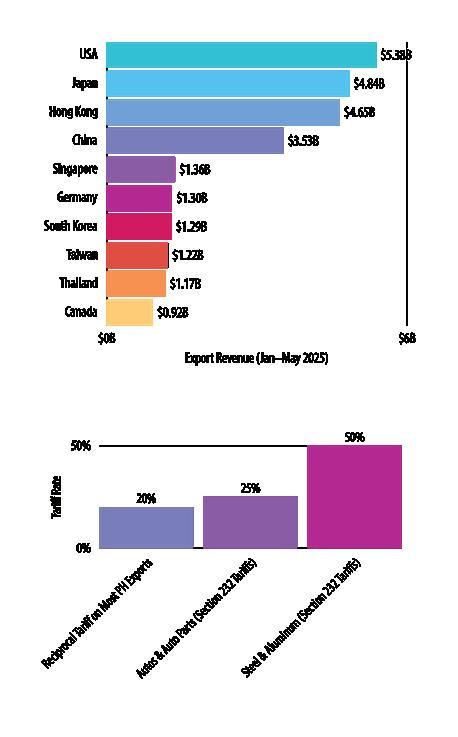
THEPhilippine government still views the United States as a “very important” trading partner as it accounts for 10 percent of Philippine trade, but some Filipino economists deem it more important to pivot to other markets such as countries within the BRICS (Brazil, Russia, India, China, and South Africa) bloc, and the 27-member bloc European Union, among others.
TPBy Lenie Lectura @llectura
HE National Grid Corporation of the Philippines (NGCP) is assessing the impact of the P28.29-billion staggered cost recovery on its operations while it awaits the decision on the fifth regulatory period (5th RP) rate reset.
The grid operator could not yet say how the amount will affect key transmission projects moving forward, but NGCP spokesperson Atty. Cynthia Alabanza said fil-
ing for motion for reconsideration remains an option. “There is space for that but again, we are studying it if it’s necessary. There were several items that were disallowed and we’re still studying it further to see the impact on the NGCP side. On the consumer side, I think it was announced by the chair already but on the impact on NGCP side, we’re still studying,” she said.
Last week, the Energy Regulatory Commission (ERC) set NGCP’s maximum allowable revenue (MAR) at P335,788.65 bil-
lion for the fourth regulatory period (4RP), or from 2016 to 2022, using the “as spent” approach and adopting a Weighted Average Cost of Capital (WACC) of 11.33 percent. MAR is the maximum amount that NGCP is allowed to take in annually to recover its operational expenses. In contrast, NGCP applied for P554 billion for the 4RP. Following this decision, NGCP was entitled to recover an additional P28.29 billion in under-recoveries, leading to an increase of P0.0384 per kilowatt hour (kWh)
in transmission charges to be collected from consumers over 84 months starting August this year.
“We will implement the decision of the ERC for the recovery of the P28 billion this coming July 2025 billing period. The impact of this to consumers is starting August,” said NGCP Head of Business and Regulatory Development Julius Ryan Datingaling during a news conference.
Alabanza said the NGCP still welcomed the ERC decision because it gave the grid operator a
By Ada Pelonia @adapelonia
ERSISTENTLY high tariffs could dampen economic activity and dent demand for coconut products in the United States, one of the biggest buyers of Philippine coconuts, according to an industry group. United Coconut Association of the Philippines (Ucap) Chairman Marco Reyes noted that the 20- percent reciprocal tariffs slapped by Washington on Philippine coconut products would be passed on to American con-
sumers. “If this higher tariff persists, what will happen is that it will dampen economic activity in the USA as a whole. American consumers will buy less coconut products due to the higher prices. Purchasing power drops,” Reyes said.
“The expected drop in American demand will have an effect on Philippine exports of coconuts to the USA since it is the second biggest market for Philippine coconuts.” Despite this, Reyes noted that the country’s coconut products
TBy Ada Pelonia
HE 20-percent reciprocal tariffs unveiled by the United States could push Philippine exporters to lay off employees, according to the Philippine Food Processors and Exporters Organization (Philfoodex).
With the country having a relatively “higher” production cost compared to others, Philfoodex
President Ruben See raised a concern that the additional duties could dent the demand for Philippine goods in the US, thus pulling down outbound shipments of certain commodities.
“If our exports decrease, our sales will also decline. If that happens, our exporters or processors might lay off their workers—that’s what we’re seeing as a significant
effect [of the reciprocal tariffs],” See said in a radio interview on Monday.
“We don’t want that, but there’s nothing we can do if exports decline, since this will affect the exporters,” he added.
In particular, See said exporters and processors that belong to the micro, small, and medium enterprises (MSMEs) would likely shoulder the impact, since they “wouldn’t get to compete.” He added that some of them are not even direct exporters and instead bank on consolidators.
While the Philippines has several free trade agreements (FTAs) with other countries, including China, Japan, South Korea, Australia, New Zealand, and European nations, See noted that the US remains a crucial market for Philip -
pine goods.
“We have an FTA with these countries, but the US market is different because it’s a captured market. Sayang [What a waste],” he said.
With this, See urged President Ferdinand Marcos Jr., who is set
to meet with US President Donald Trump this month, to discuss the tariffs levied on Philippine goods.
“Our request to the president, especially to our negotiators, is to continue the negotiations so that we can achieve zero tariff, or at least a maximum of 5 percent, and we would be happy,” See said.
“But if it’s really 20 percent, we will have a hard time. That’s our stand,” he added.
Despite this, See noted that the reciprocal tariffs could prompt the Philippines to search for other markets through local and international trade shows that could boost the country’s products.
“If we really can’t get a lower tariff, we have no choice but to look for other markets [...] There are many markets that the Philippines is yet to penetrate,” he said.
By Andrea E. San Juan @andreasanjuan
PHILFOODEX
For individuals, it’s important to use strong and unique passwords for each online account or consider password managers. Kaspersky also advised Filipinos to turn on two-factor authentication wherever possible.
It also advised Filipinos against downloading unknown apps or software or using official sources. They can also resort to reliable online products that can block phishing, spam, and fake websites in real time.
Earlier, complaints received by the Bangko Sentral ng Pilipinas (BSP) involving unauthorized transactions have reached P3.37 billion in the past two years.
Unauthorized transaction complaints make up only 13 percent of complaints received and processed by the BSP Consumer Assistance Mechanism (CAM).
The complaints received by BSP have reached a total of 135,369 complaints between 2022 and 2024. The highest was 70,112 total complaints recorded in 2024.
BSP CAM explained that unauthorized transaction complaints may include those alleged to be caused by phishing in all its forms such as voice phishing, SMS phishing, fake QR code phishing.
These unauthorized transactions also include other social engineering schemes, and alleged fraud perpetrated by employees and/or other clients of the BSP Supervised Institutions (BSIs).
Between 2022 and 2024, the top recipient of complaints about unauthorized transactions are the universal and commercial banks followed by the non-bank e-money issuers.
Manufacturing investments surge 165% to ₧26.6B in H1
By Andrea E. San Juan @andreasanjuan
INVESTMENTS poured into manufacturing in the Philippines in the first half of 2025 soared to P26.63 billion, up 165 percent compared to the P10.05 billion in the January to June 2024 period, according to the Board of Investments (BOI).
The investment promotion agency attached to the Department of Trade and Industry (DTI) also said these investments will generate 5,725 jobs.
Meanwhile, P33.54 billion worth of investments in the manufacturing sector are still for “checklisting.”
BOI Director Sandy Recolizado explained that projects checklisted “are actually the application forms filled up including the supporting documents to assess completeness of information needed to evaluate the project.”
Recolizado said these projects, while still in the checklisting phase, already have the intention to apply or
register with the BOI.
The BOI revealed to reporters the surge in the manufacturing investments after noting in a statement on Monday that the Philippine manufacturing sector’s output grew by 4.9 percent in May 2025, the fastest pace of expansion in 10 months.
“Physical output produced by factories over time, as measured by volume of production index [VoPI], expanded by 4.9 percent year-on-year in May 2025, according to preliminary data from the Philippine Statistics Authority’s [PSA] Monthly Integrated Survey of Selected Industries,” the BOI said.
The agency said this marks a “con-
tinued acceleration” from the 4.3-percent growth posted in April.
Trade and Industry Secretary and Board of Investments (BOI) Chairman Cristina A. Roque said the “sustained rise” in industrial production, coupled with increasing investor confidence, is “laying the groundwork for significant employment opportunities for Filipinos.”
“The surge in manufacturing output in the Philippines shows how we are taking advantage of opportunities to serve growing markets and, importantly, to provide jobs and income for our people,” Roque said.
The growth in May was primarily driven by a 15.7-percent jump in the food products subsector, which accelerated from its 11.2
percent rise in April, BOI noted.
BOI added that the manufacture of transport equipment also provided a major boost, with output increasing by 13.5 percent, nearly doubling the 7.4-percent growth recorded in the previous month.
Citing S&P Global’s report for June, BOI noted: “The Philippines’ Purchasing Managers’ Index [PMI] for manufacturing rose to 50.7 in June 2025 from 50.1 in May, indicating a strong improvement in operating conditions.”
Roque said the “positive outlook” on the manufacturing sector is a “catalyst” for the country’s economic growth and more job opportunities for Filipinos.
“When factories produce more, they need to hire more workers,” added Roque.
Tariffs could hit PHL…
would remain competitive compared to other coconut-producing nations, given the lower tariffs levied on the Philippines.
Washington slapped 32-percent tariffs on Indonesia, while India was levied 26 percent. Both countries are the Philippines’s “closest rivals” when it comes to coconut products, according to Reyes.
“Since there are no domestic competitors for coconuts in the USA [they don’t have coconuts and the USA needs our coconuts], it will be business as usual for coconut exports from the Philippines to the USA,” he said.
Reyes also said the situation remains dynamic, considering the ongoing negotiations between the US and the Philippines.
“Our 20-percent tariff might even be lower in the end since we do not intend to retaliate on American exports to the Philippines, but offer concessions.”
He also noted that the group has sent position papers to the Department of Trade and Industry (DTI) and the Philippine Coconut Authority (PCA) to continue negotiations with the US on bringing down the tariff.
“After all, the Philippines is a long-time colony of the USA, and we are a crucial strategic geopolitical partner of the USA in the Southeast Asia region,” Reyes said.
“Strengthening and growing our exports to the USA, particu-
larly coconut, will go a long way in further strengthening the USAPhilippine relationship.”
Diversify MEANWHILE , Reyes said the country’s coconut industry should rethink its approach to exporting coconut-based products, particularly in diversifying markets and value-added products.
He noted that over 60 percent of coconut exports are “overly dependent” on the European Union and the US.
“It is a wake-up call for our Philippine coconut industry [ . . . ] We have to act double time to expand our export markets to other markets,” he said, noting that this includes protecting the local market from the “onslaught” of palm oil, which is a coconut oil substitute for cooking.
Reyes added that the country’s coconut export is mostly crude coconut oil, which is just one value-added product from copra or dried coconut meat.
“[We have to] diversify our coconut products into more valueadded and downstream products,” he said.
Such value-added products include coconut milk, coconut water, virgin coconut oil, oleochemicals, surfactants, cosmetic derivatives, MCT oil, coconut board, activated coconut carbon, coconut nectar vinegar, and coconut aminos, among others.
[the water quality issue].”
very particular about El Nido, so they’re going to work on that,” he said.
Social media has been rife with complaints about tourists in El Nido getting diarrhea even after consuming bottled water. The last high-profile case was of awardwinning singer Celeste Legaspi and her family. Only 3 percent of El Nido households are connected to the municipality’s STP. (See, “Celeste Legaspi sings the blues about El Nido,” in the BusinessMirror, June 8, 2025.)
“If DENR finds something wrong, they have the power to put a stop to it and put in remedial measures,” Remulla said in a mix of English and Filipino. Told that EMB even holds up the El Nido facility as a model for all STPs in the country, the DILG chief assured, “I will personally attend to this. I’m going there in July so I will talk to them [Gov. Amy] about it
future endeavors. Nevertheless, electricity rates continued to rise on her watch,” said the group. The spokesperson of the National Grid Corporation of the Philippines (NGCP) said Dimalanta pursued her mandate of being a regulator. “I hope the best for her future endeavors. Having said that, as regards to what the effect would be to NGCP’s applications, the ERC is a continuing body. Even though there will be vacancies, I am sure that the government and administration will ensure that the crucial work is given to them and to ensure the continuous development of the energy industry as well as the balance, the interests will go on unhampered,” said Atty. Cynthia Alabanza.
Power firms, consumer groups, officials from the energy sector are all waiting for an official announcement as to who will lead the ERC.
“I hope that her successor will have the same dedication to fair and effective governance in the energy sector that will ensure the welfare of consumers and the stability and development of the entire sector,” added Gatchalian. Economic analyst Astro C. del Castillo said a replacement must be immediately made to avoid significant delays in management decision specifically on power and energy related projects and reforms.
“It’s a surprising and unfortunate development. The ongoing initiatives in the ERC must continue as well. A smooth transition will be better for the industry and stakeholders,” added del Castillo.
Atty. Jay Layug, former DOE Undersecretary and President of the Developers of Renewable Energy for AdvanceMent, Inc. (DREAM), is looking forward to the President’s swift appointment of three new ERC commissioners, including the Chairperson.
“A regulator like ERC operating without a quorum is effectively paralyzed and unable to carry out its statutory duties. We all know the critical importance that ERC plays in setting electricity rates, enforcing industry standards and safeguarding consumer interests,” he said.
The Philippine Rural Electric Cooperatives Association (Philreca) said there are numerous crucial matters concerning its member electric cooperatives that were already referred to Dimalanta’s office and are due for discussion.
“We are ready to welcome and work with her eventual replacement. We look forward to establishing a new and equally productive relationship with the incoming Chair.
It is our hope that the next leader of the ERC will be an individual who is not only well-versed in the complexities of the energy sector but also has a genuine and unwavering advocacy for the member-consumerowners [MCOs] of our Electric Cooperatives,” it said.
Tieza to fund STP MEANWHILE, several areas around Coron Bay also showed excessive fecal coliform levels after water sample tests were taken on April 15, 2025. Barangay 3 (Zipline Reclamation Area) had the highest contamination levels at 920 MPN/100 mL, followed by Brgy. 2 (Comesaria) at 540, Brgy. 1 (Bakawan) at 240, Brgy. 5 (Sea DriveBancuang Baba) at 240, Brgy. Guadalupe (between CIPC and RCA) at 240, Sitio Bayo Bayo 2 (130/100), Brgy. Tagumpay (130), and Brgy. 6 (Sitio Jolo Governor’s Drive) at 130. The Tourism Infrastructure and Enterprise Zone Authority (Tieza) has allocated P500 million for the construction of an STP in Coron this year. The government firm will post the bidding announcement for the project’s detailed engineering and design within the month, said Tieza COO Mark T. Lapid. El Nido attracted half a million tourists in 2023, while 341,546 tourists visited Coron in 2024 as per latest official LGU data.
Without providing specifics, they also welcomed “practical measures that could reduce tensions and the risk of accidents, misunderstandings and miscalculation.”
“We stressed the importance of undertaking confidence-building and preventive measures to enhance, among others, trust and confidence amongst parties, and we reaffirmed the importance of upholding international law, including the 1982 Unclos,” they said in the joint communique. (See related story: https://businessmirror. com.ph/2025/04/14/asean-chinameet-on-scs-code-of-conduct/)
Tuesday, July 15, 2025
Lawmaker urges unified strategy against online gambling crisis
By Jovee Marie N. dela Cruz & Rizal Raoul Reyes
ALAWMAKER has urged the Marcos administration to adopt a unified, whole-of-government strategy to confront the worsening crisis of online gambling, which has been described by Church leaders as the “new plague” devastating families and communities.
Party-list Rep. Terry L. Ridon of Bicol Saro filed House Resolution
48, seeking stricter regulations on online gambling in response to the alarming rise in gambling addiction and its social and economic consequences—particularly among vulnerable sectors.
“The online gambling industry has grown unchecked in recent years,” said Ridon. “It is now contributing to a mental health and financial crisis in our society, and the government can no longer afford to take a hands-off approach.”
Citing data from the Philippine Amusement and Gaming Corporation (Pagcor), Ridon pointed out
that gross gaming revenue (GGR) from electronic gambling surged from P58.16 billion in 2023 to P154.51 billion in 2024. In the first quarter of 2025 alone, GGR has already reached P51.39 billion.
Rehabilitation center Bridges of Hope reported that 70 percent of its clients are now battling online gambling addiction—outnumbering cases related to substance abuse. The Catholic Bishops’ Conference of the Philippines (CBCP), through its president, Cardinal Pablo Virgilio David, has likewise raised alarm over the growing
number of families and livelihoods destroyed by gambling.
In the resolution, Ridon called on the Bangko Sentral (BSP) to prohibit online gambling-related transactions through e-payment services and digital banking apps such as GCash, Maya, and traditional banking platforms.
He also urged Pagcor to require all licensed online gambling operators to develop proprietary financial platforms with robust Know-YourCustomer (KYC) systems; implement a minimum cash-in threshold of P20,000 to discourage impulsive
task force assessing damage caused by Chinese ship on reef
Philippine-held Pag-asa Island.
“On 7 June 2025, a Chinese vessel with bow number 16868 was reported in shallow waters near Pag-asa Island. According to official reports, the vessel remained grounded for nearly three hours before managing to free itself without external assistance. It was later accompanied out
of the area by the China Coast Guard [CCG] and two other Chinese vessels,” the task force said in a statement Monday.
And while the Chinese ship did run aground directly on the coral reef, the vessel’s anchoring activity caused significant damage
See “WPS,” A6
Army commander seeks more exercises with allies
THE Army(PA) commander has reiterated his service’s commitment to heighten interoperability among land forces in the Asia-Pacific Region.
In a statement Monday, Lt. Gen. Roy Galido said this can be done through increased participation in multilateral or bilateral exercises.
“These collaborative efforts will play a crucial role in strengthening defense relations and improving cooperation among allied and partner land forces in the broader Indo-Pacific Region,” he said.
Galido made the statement when he represented the Armed Forces (AFP) chief of staff, Gen. Romeo Brawner Jr., at Australia’s Exercise Talisman Sabre 2025 exercise on July 12 in Sydney.
The AFP sent a “training audience” at
Exercise Talisman Sabre.
A total of 32 Filipino military personnel composed of seven from the PA, three from the Marine Corps, five from the Navy, and 17 from the Air Force, flew to Australia on July 5, to participate in the exercise.
Exercise Talisman, which is set from July 13 to August 4, is Australia’s largest bilateral exercise with the United States, and with training audiences from other partner nations, including the Philippines.
Participating countries are the United States as well as forces from Canada, Fiji, France, Germany, India, Indonesia, Japan, the Netherlands, New Zealand, Norway, Papua New Guinea, the Philippines, Republic of Korea, Singapore, Thailand, Tonga, and the United Kingdom.
Rex Anthony Naval
or casual betting; and ban all forms of gambling advertisements, sponsorships, and promotional content across media platforms, including television, radio, print, digital, and outdoor.
The resolution also seeks the creation of a joint task force composed of the National Police (PNP), National Bureau of Investigation (NBI), and Department of Justice (DOJ) to aggressively pursue unlicensed gambling operations. It also calls on the National Telecommunications Commission (NTC) and the Department of In -
formation and Communications Technology (DICT) to identify and block illegal gambling websites and apps.
While Pagcor Chairman Alejandro Tengco recently announced new measures such as regulating gambling advertisements and using artificial intelligence (AI) to monitor gambling platforms, Ridon said these efforts are not enough to shield the public—especially minors—from long-term harm.
See “Gambling,” A6
Story on Teodoro’s Maltese marks 9th anniversary of ruling vs China
By Rex Anthony Naval
ECRETARY of National Defense (SND)
SGilberto Teodoro Jr. had already surrendered and renounced his Maltese passport prior the filling of his certificate for candidacy for the 2022 elections where he ran for senator.
“The alleged existing Maltese passport of Secretary Gilberto Teodoro was surrendered and renounced prior to the filing of his certificate of candidacy in 2021 for the 2022 elections,” Assistant Secretary Arsenio
Andolong of the Department of National Defense said in a statement. Andolong issued the statement after a newspaper reported that Teodoro was issued a Maltese passport on December 22, 2016. This document was reportedly valid for 10 years and was allegedly acquired by Teodoro through Malta’s citizenshipby-investment program where interested individuals are encouraged to invest a
See “Gibo,” A6
Congressmen ask SC: Junk pleas questioning VP impeach process
TWO lawmakers on Monday called on the Supreme Court (SC) to dismiss the petitions questioning the impeachment proceedings against Vice President Sara Duterte, asserting that the House of Representatives acted in full accordance with the Constitution and established jurisprudence.
In a news conference, Party-list Rep. Terry Ridon of Bicol Saro said there is no basis to invalidate the impeachment process initiated by the House, particularly the transmittal of the Articles of Impeachment to the Senate. “This case should ultimately be
See “Impeachment,” A6
Comelec begins ‘trusted build’ process for BARMM elections
THE Commission on Elections (Comelec) on Monday initiated the “trusted build” process for the automated election system (AES) that will be used in the first parliamentary elections in the Bangsamoro Autonomous Region in Muslim Mindanao (BARMM) in October.
The “trusted build” process includes the compilation of the final, verified source codes into executable, machine-readable programs.
Comelec said the process is designed to
ensure the integrity, security, and accuracy of the election system—especially after any modifications to the code. In an interview, Comelec Chairman George Erwin M. Garcia explained that while the BARMM parliamentary elections are a continuation of the 2025 national and local polls, a separate trusted build was necessary to account for system changes.
See “Barmm,” A6
Senator seeks probe into high food prices
SBy Butch Fernandez
EN. Francis Pangilinan has asked the Senate to investigate and determine the cause of what he said was “skyrocketing food prices and other consumer supplies.”
“In response to growing concerns over the affordability of food, a resolution seeking to investigate the persistently high prices of food
and basic agricultural commodities was filed in the Senate to identify interventions that will strengthen food security and address food inflation,” Pangilinan said. Prices of essential food items— rice, vegetables, meat, fish, and other agricultural products—have significantly increased in recent months, burdening Filipino families and depriving the country’s most vulnerable sectors of healthy and nutritious food, he added.
Marcos optimistic on new gas found at Malampaya
PRESIDENT Marcos is optimistic that natural gas reserves to replace the nearly depleted Malampaya gas field will be found in the ongoing drilling operations offshore Palawan.
In his speech during the groundbreaking ceremony of the Caticlan Passenger Terminal Building last Monday, the Chief Executive said: “Energy Secretary Sharon Garin is with us today because after here, we are going to fly by the rig in Malampaya that is now slowly drilling down into the seabed with a reasonable chance of success of finding further reserves.”
DOE announced that it will know by the end of the year if there are any additional natural resources in the Malampaya gas field with the completion of the US$893-million drilling project in the said area.
The Marcos administration is currently rushing to find an alternative source for natural gas since the Malampaya gas field is expected to be depleted by 2027. Gas from Malampaya is used to provide for 20 percent of the electricity in Luzon. Razon-led Prime Energy Resources Development operates the contract to operate the gas field.
Garin, who took her oath of office before the President on Monday, earlier said she is optimistic the drilling operations will extend the life of the Malampaya gas field.
The former lawmaker and DOE officer-incharge replaced former Secretary Raphael P.M. Lotilla, who is now the Environment and Natural Resources Secretary. Samuel P. Medenilla
Habits that support your leadership presence
By Henry J. Schumacher
LEADERSHIP presence is the ability to show up in a manner that creates more space and connection, inspires one to follow you because they want to (versus have to), and invites authentic presence in others.
A solid leadership presence creates impact without saying a word, evokes courage to engage, empowers others to lead, creates safety in connection, and leaves others feeling better, clearer, and even more intentional themselves—just by being in your presence— all via the simple art of intention and being.
Here are significant habits that can support your leadership:
Seeking inputs
SEEKING inputs is healthy when done with the intent to invite diverse perspectives.
People don’t expect leaders to have all the answers or to always be right, but they do expect ownership—showing conviction in their decision, taking action and adjusting as needed.
Presence requires owning your perspective. Give others a reason to trust your leadership.
Be visible in moments that matter PEOPLE don’t demand perfection when things are tough, but they do expect you to speak up when everyone else goes silent, stand steady when others hesitate and to show up with clarity even when the path is uncertain. That’s when true leadership presence is felt. Show up, stand beside your team.
Do not be too busy to be present
PEOPLE don’t need a leader who’s always in motion. They need a leader who’s present in the moment—someone who’s willing to slow down to listen, focus and connect. Someone who makes them feel important; someone who’s not rushing from task to task but pausing to build real connections.
Slow down when it counts. When you’re truly present, even brief moments can feel like an hour of focused leadership. It’s that feeling that leaves a lasting influence—one that builds leadership presence.
Do not ignore the human connection
PEOPLE don’t just want to be managed; they want to be seen. They want to be recognized not only for what they contribute, but for who they are. And that kind of recognition doesn’t happen by default—it requires intention, presence and a genuine interest in the person behind the role.
Leadership presence depends on relational connections, not routines. Be human. That’s where real presence begins.
Do not speak in vague, unclear terms AS a leader, your voice carries weight. Use it to
bring structure to ambiguity, to simplify complexity and to help others move forward with confidence. Even when the path is uncertain, your ability to clearly articulate what matters, what’s next and what’s true gives others the confidence to follow you.
Do collaborate, do not dominate
LEADERSHIP presence isn’t about taking over—it’s about drawing others in. It’s about creating space to listen deeply, reflect collaboratively and elevate the thinking in the room, not just your own. Slow down. Ask questions. Stay curious a little longer.
Respond with intention rather than impulse THE steadier you’re in difficult moments, the more confident others feel in your leadership. Leadership presence is not about suppressing emotions; it’s about regulating them. It means acknowledging them without letting them drive your behavior. Consciously create space between stimulus and response. Respond with intention rather than impulse.
Summary
1. Building leadership presence requires trusting your judgment, even when the path ahead is ambiguous, uncertain or the outcome isn’t guaranteed—be willing to take a stand and course-correct as needed.
2. Leadership presence is not built by hiding, but by showing up when it matters the most.
3. Being physically present isn’t enough—your full attention is what builds leadership presence.
4. Leadership presence isn’t just about driving outcomes—it’s about seeing, hearing and understanding the humans behind the work. Acknowledge people, show empathy and invest in building relationships.
5. Clear, direct communication enhances performance and productivity which makes your leadership stand out and your presence felt.
6. Leadership presence requires pausing, listening and showing interest in what others have to say.
7. Leadership presence requires emotional steadiness, especially in high-pressure moments.
I sincerely hope that my views on leadership are attractive. I would appreciate your reactions; contact me at hjschumacher59@gmail.com.
The measure, titled “Resolution Directing the Senate Committee on Agriculture, Food and Agrarian Reform to Conduct an Inquiry, in Aid of Legislation, into the Persistently High Prices of Food and Other Basic Agricultural Commodities, with the End in View of Identifying Urgent Interventions to Ensure Food Affordability, Strengthen Food Security, and Protect Consumers from Excessive Price Increases,” was filed on July 8.
Through the resolution, Pangilinan urged the Senate panel “to review the effectiveness of existing policies, programs, and interventions to address the rising cost of food, identify systemic gaps, and recommend appropriate legislative and administrative measures.”
While the resolution recognized that “the government has taken measures to stabilize food prices, including importation, price monitoring, and targeted subsidies,” it
lamented that “many consumers still experience limited access to affordable food.”
The resolution also cited recent reports from various government agencies, which identified the multiple factors—supply chain disruptions, elevated production and transportation costs, importation constraints, hoarding, profiteering, and the increasingly severe effects of climate change on local food production—that drive food
inflation.
According to the Social Weather Stations survey released on June 28, the number of Filipinos who experienced involuntary hunger at least once in the past three months rose to 20 percent, slightly increasing from 19.1 percent in April 2025. Mindanao posted the highest hunger rate at 26.3 percent, followed by Metro Manila at 20.3 percent, the Visayas at 19.7 percent, and Balance Luzon at 17 percent.
Medical, HMO groups back Konektadong Pinoy Act
By Lorenz S. Marasigan
MORE than 50 of the country’s leading medical and healthcare organizations have jointly urged President Marcos to sign the Konektadong Pinoy Act into law.
The 53 groups—including the Philippine Medical Association, Philippine College of Physicians, and Philippine Heart Association—warned that poor connectivity threatens to derail the goals of universal healthcare and impede the country’s ability to deliver basic medical services.
“Without connectivity, many rural health units cannot view or submit electronic records and conduct other critical tasks. This represents a barrier to healthcare access for many communities in the countryside,” Philippine Medical Association President Hector Santos said.
The groups said the lack of digital infrastructure is hindering the full implementation of the Universal Health Care Law (RA 11223), which mandates the use of electronic medical records to improve patient care and health outcomes.
Rice still fills half of Pinoys’ plates
RICE and rice-based dishes continue to make up about half of the average Filipino’s daily energy intake, far exceeding the recommended levels in a balanced diet.
Citing data from the 2023 National Nutrition Survey, Food and Nutrition Research Institute (FNRI) senior science researcher Eva Goyena said during an FNRI seminar that while rice does offer nutrients like thiamin, niacin, zinc and phosphorus, much of its nutritional value is stripped away during the milling process that turns brown rice into white rice.
The country’s heavy reliance on rice, she explained, is shaped by a web of interconnected factors, from cultural preferences and limited household budgets to the types of food that are most accessible in communities.
“Based on our study...we saw that there are complex factors affecting or shaping our dietary patterns,” Goyena noted in Filipino.
Goyena also shared insights from the FNRI’s Food and Vegetable for Sustainable Healthy Diet (FRESH) Project, which revealed that many Filipinos fall short of the recommended intake of fruits, vegetables and protein-rich foods.
Instead, meals are often overloaded with carbohydrates, leading to nutrient gaps that may increase long-term health risks.
“On one hand, specialty varieties of rice, such as red and purple rice, contain higher levels of anthocyanin, a powerful antioxidant. But even these offer limited micronutrients when eaten alone,” said Goyena.
She emphasized that the food environment, including the availability, affordability and promotion of certain products, plays a decisive role in shaping what people eat.
“If there are more unhealthy or less healthy food options that are more affordable and easily accessible, then of course, those are what Filipinos will more likely consume,” she said.
Despite this mandate, many facilities— especially outside urban centers—continue to rely on manual documentation owing to limited access to stable internet.
“Connectivity was our main problem in piloting primary care in a rural and remote site,” added Antonio Dans, president of the Asia-Pacific Center for Evidence-Based Health Care.
The groups said the piece of legislation is “key to giving healthcare professionals the tools they need, and Filipinos the care they deserve,” as it aims to close the connectivity gap by streamlining permitting, strengthening competition, and mandating digital access in unserved and underserved areas.
Citing Department of Information and Communications Technology (DICT) data, the groups pointed out that 19,000 barangays— representing 45 percent of the country’s total—still lack digital infrastructure,
while over a third of households remain unconnected.
They also noted that telemedicine usage has declined post-pandemic, largely due to persistent internet limitations.
Their endorsement follows support from over 35 private sector and civil society organizations, including the Philippine Chamber of Commerce and Industry (PCCI), Philippine Cable and Telecommunications Association (PCTA), Financial Executives Institute of the Philippines (Finex), and Union of Local Authorities of the Philippines (Ulap).
Within government, the Konektadong Pinoy Act is backed by the DICT, the Department of Economy, Planning, and Development (DEPDev), and the Philippine Competition Commission (PCC), all of which recognize the bill as a m policy that will make internet services more affordable, competitive, and inclusive.
However, the Philippine Communications and Telecommunications Operators (PCTO), a group representing incumbent telecommunication companies and tower firms, had raised “red flags” over certain provisions, warning that the bill could discourage further investment in infrastructure.
The PCTO specifically cited concerns about unequal regulatory obligations and what it described as “overly broad” open access rules that may compromise sustainability and security in the sector.
Konektadong Pinoy has been in the legislative pipeline for nearly a decade, undergoing revisions and scrutiny through different Congresses. The measure is currently awaiting the President’s signature. If enacted, it is expected to serve as an enabler for digital governance, education, agriculture, and healthcare.
Tuesday, July 15, 2025
Gambling. . .
Continued from A4
More balanced approach
A CONSUMER group on Monday urged government leaders to pursue a more balanced and forward-looking approach to the online gaming industry, emphasizing the need to strengthen regulatory frameworks rather than an outright ban.
Orlando Oxales, lead convener of CitizenWatch Philippines, acknowledged
Continued from A4
“You can’t just change something without modifying the source code. And once you change the source code, you need a new trusted build to generate a new version of the program. That’s also what the law requires, any change to the code must go through this process. If we don’t, we risk violating the Bangsamoro Electoral Code,” Garcia said, mostly in Filipino.
Among the additions to the system are new features such as the inclusion of
Impeachment. . .
Continued from A4
dismissed,” Ridon stated, pointing out that the one-year ban on filing impeachment complaints applies only after a formal complaint has been acted upon in plenary. “The one-year bar only applies to the actual impeachment complaint that proceeded to plenary action. In this case, 215 lawmakers voted to approve and transmit the Articles of Impeachment to the Senate on the same day,” he explained. Ridon made the call in the wake of the SC’s directive to Congress to provide details on the first three impeachment complaints filed against VP Duterte. These initial complaints were not referred to the House Committee on Justice but were later consolidated into a fourth complaint, which was adopted by more than one-third of House members.
“The question before the SC will likely focus on those first three complaints,”
the validity of public concerns over the negative effects of online gambling. However, he argued that the total prohibition is not the solution.
“Calls for a total ban on online gaming are understandable given rising public concern. But banning isn’t the answer. It creates more problems than it solves. What we need is stricter, smarter regulation—clear rules, modern tools, and responsible enforcement that protect our people while preserving public benefit,” Oxales said.
candidate photos and regional political party logos on the ballots, along with a “none of the above” option for voters who choose not to support any listed candidate. Garcia also confirmed that the system now includes a “add on feature” to easily accommodate any last-minute adjustments, particularly those that may arise from the unresolved issue of the seven unallocated parliament seats originally intended for Sulu.
“For example, we’re anticipating that the Supreme Court might rule on this later. Right now, we only have 73 seats accounted for, because those seven remain uncertain,” he said.
Ridon said. “Under established rulings like Francisco and Gutierrez, the requirement is referral to the Committee on Justice. And in this case, that never happened with the first three complaints.”
Manila Rep. Joel Chua, a member of the House prosecution panel, backed Ridon’s position, maintaining that the 19th Congress followed proper procedure.
“In my view, all elements and steps required by law were complied with by the House,” Chua said, adding that jurisprudence permits the consolidation of multiple impeachment complaints before referral to the committee.
“Consolidation before referral is allowed. Otherwise, it would just become a race over who files first,” he added.
Meanwhile, Ridon clarified that only the fourth complaint met the constitutional threshold, being filed by at least one-third of House members.
“This is what happened in the fourth complaint—it was filed by one-third of all House members with the House Secretary General. That fulfills the
Oxales warned that a blanket ban would likely drive the industry underground, stripping regulators of oversight and leaving users vulnerable to illegal and often predatory offshore operators that are outside the country’s jurisdiction.
“These platforms are beyond our jurisdiction, avoid taxes, and offer no consumer protections. Worse, they use aggressive, manipulative tactics to exploit vulnerable users,” he added.
In contrast, the legal online gaming industry in the Philippines has proven to be a
Garcia said the poll body has received information that the Bangsamoro Transition Authority (BTA) may soon approve the distribution of the seven seats among the remaining BARMM provinces.
To recall, the SC ruled last year that Sulu should be excluded from the region’s jurisdiction after it voted against the Bangsamoro Organic Law.
That left Lanao del Sur, Basilan, Tawi-Tawi, Maguindanao del Sur, and Maguindanao del Norte as the provinces included in the autonomous region.
While the Comelec has repeatedly urged the BTA to finalize the new allocation, Garcia recently disclosed that the Moro National
constitutional requirement,” he said. “The 19th Congress complied fully with both the Constitution and relevant jurisprudence.”
Also, Chua noted that the process mirrors past impeachment cases.
“This isn’t the first time this has happened. The same approach was used during the impeachment of former President Joseph Estrada,” he said, citing the presumption of regularity in legislative proceedings.
He also warned against abusing procedural rules to block legitimate impeachment cases. “For example, if I were an ally of the President, I could just file a baseless impeachment case every year to trigger the one-year ban and shield my ally from real accountability,” he said.
Ridon, for his part, emphasized the seriousness of the allegations against VP Duterte.
He also underscored the overwhelming support behind the impeachment.
“It’s clear: 215 members of the 19th Congress—almost 70 percent—
vital source of public funding. In 2024 alone, licensed platforms generated P50 billion in revenue, half of which supported universal healthcare, grassroots sports development, and drug rehabilitation programs.
Oxales pointed out that eliminating the industry would potentially remove up to P100 billion in projected earnings in the coming year.
“Let’s be clear: abuse must be stopped. But prohibition is a blunt tool. Precision regulation is more effective—and more sustainable,” Oxales said.
Liberation Front (MNLF) is contesting the move, arguing that all seven seats should go to its members. (Related: https:// businessmirror.com.ph/2025/07/07/ no-barmm-area-under-red-categoryfor-now/)
“We need to see the exact wording first of the final resolution before we can decide how to proceed,” Garcia added.
The commission on Monday also began printing the 160 sample ballots that will be used for field testing this month.
The Comelec noted that test ballots will not contain any candidate names or party logos, and will be used strictly for simulation purposes only.
supported the move to impeach the Vice President,” he added.
No reason
THE two lawmakers also emphasized that there is no reason to be alarmed over the Supreme Court’s recent directive to Congress concerning the impeachment proceedings against Duterte, despite concerns raised by Party-list Rep. Leila de Lima of Mamamayang Liberal, one of the incoming House prosecutors.
Earlier, de Lima expressed concern that the Senate might use the Supreme Court’s order as a reason to suspend the impeachment trial.
Chua said the Supreme Court’s order is part of its responsibility to address the petitions filed before it and clarified that the House is fully capable of complying with the requirements.
“The directive of the Supreme Court is clear,” Chua said. “It is part of resolving the issue brought before them. The House, and even the Senate, will comply. You can be assured this will not derail the pending impeachment complaint.”
Continued from A4
to the surrounding reef area.
NTF-WPS said the incident occurred amid heightened activity by Chinese Maritime Militia and CCG vessels within the territorial sea of Pag-asa Island highlighting persistent operational concerns in the area.
“The vigilance of our coastal communities, as demonstrated by the timely report from a local fisherman, remains vital in safeguarding our marine resources. Their
Gibo. . .
Continued from A4
minimum of €600,000 to get Maltese citizenship.
Under Philippine law and Constitution, dual citizenships are prohibited for public officials, especially those in the Cabinet level.
www.businessmirror.com.ph
lived experience at sea reflects not only environmental risks but also daily threats to their safety, livelihood, and dignity,” it noted. With this development, NTF-WPS said it supports the Palawan Council for Sustainable Development’s recommendations on reef rehabilitation and the enforcement of environmental accountability under Philippine law.
Also, NTF-WPS said it remains committed to safeguarding the WPS and preserving the country’s marine ecosystems, and upholding the well-being of the communities that depend on them. Rex Anthony Naval
“Its existence was disclosed to the Bureau of Immigration and Comelec [Commission on Elections] prior to the 2022 elections, as well as to the [legislative] Commission on Appointments prior to the confirmation of his appointment as Defense Secretary. The motive of this rumor is clear and known to Secretary Teodoro. The timing of the article adds to this motive,” Andolong said. He did not elaborate.
Chua also emphasized that there is no legal barrier stopping the Senate from proceeding with the trial. “Some may ask if the Senate should wait. But there’s no reason to do so because the Supreme Court has not issued a Temporary Restraining Order [TRO],” he added.
Ridon acknowledged de Lima’s concerns, particularly on the possibility of judicial overreach. However, he stressed that jurisprudence allows the SC to determine whether the one-year ban rule on the filing of impeachment complaints was properly observed.
“We understand Representative de Lima’s concern, especially on judicial overreach. But under Francisco v House of Representatives and Gutierrez v House of Representatives, the SC is permitted to determine whether the constitutional one-year bar was observed by Congress,” Ridon said. “We respect that. However, the Senate cannot use the Court’s directive as a reason to delay its constitutional mandate to try and decide the impeachment case.”
Ridon also pointed out that in the absence of a TRO, all branches of
Teodoro has been vocal in his criticisms of China’s aggressive actions in the West Philippine Sea and the newstory about Teodoro’s Maltese passport appeared on the ninth anniversary of the Arbitral Tribunals ruling that invalidated China’s expansive claim over all of the South China Sea, including the Exclusive Economic Zones of countries that abut the sea, as well as the land features that they claim.
government must continue to fulfill their constitutional duties.
“If the Supreme Court does issue a TRO—which is still hypothetical at this point—it would temporarily halt the proceedings. And the critical question then becomes, is that constitutionally allowed? ” he said. “But I am confident that our Supreme Court recognizes the separation of powers and will act accordingly.”
He warned that if the House were to question the Court’s directive outright, it would only lead to further delays. “The truth is, everyone is waiting—especially the senators and the Senate President. We in the House are complying with all requirements to the best of our ability,” he said.
“The House has eternal patience when it comes to impeachment,” he said. “This is about truth, accountability, and justice. If we need to wait a few more months, so be it. But the Senate impeachment court has a constitutional obligation to conduct a full-blown trial. There is no reason for a motion to dismiss.”
Jovee Marie N. dela Cruz
Editor: Angel R. Calso
War fighting drills drawing together 19 nations and 35,000 military personnel begin in Australia
By Rod Mcguirk Associated Press
MELBOURNE, Australia—The largest-ever war fighting drills in Australia, Exercise Talisman Sabre, is underway and expected to attract the attention of Chinese spy ships.
Talisman Sabre began in 2005 as a biennial joint exercise between the United States and Australia. This year, more than 35,000 military personnel from 19 nations, including Canada, Fiji, France, Germany, India, Indonesia, Japan, the Netherlands, New Zealand, Norway, Papua New Guinea, the Philippines, South Korea, Singapore, Thailand, Tonga, and the United Kingdom, will take part over three weeks, Australia’s defense department said on Sunday.
Malaysia and Vietnam are also attending as observers.
The exercise will also take part in Papua New Guinea, Australia’s nearest neighbor. It is the first time Talisman Sabre activities have been held outside Australia.
Chinese surveillance ships have monitored naval exercises off the Australian coast during the last four Talisman Sabre exercises and were expected to surveil the current exercise, Defense Industry Minister Pat Conroy said.
“The Chinese military have observed these exercises since 2017. It’d be very unusual
for them not to observe it,” Conroy told the Australian Broadcasting Corp.
“We’ll adjust accordingly. We’ll obviously observe their activities and monitor their presence around Australia, but we’ll also adjust how we conduct those exercises,” Conroy added.
Conroy said the Chinese were not yet shadowing ships as of Sunday.
The exercise officially started on Sunday with a ceremony in Sydney attended by Deputy Commanding General of US Army Pacific Lt. Gen. J.B. Vowell and Australia’s Chief of Joint Operations Vice-Adm. Justin Jones.
The exercise, showcasing Australia’s defense alliance with the United States, started a day after Australian Prime Minister Anthony Albanese began a six-day visit to China, where he is expected to hold
his fourth face-to-face meeting with Chinese President Xi Jinping in Beijing on Tuesday. Albanese said Chinese surveillance of Talisman Sabre would not be an issue raised with Xi.
“That would be nothing unusual. That has happened in the past and I’ll continue to assert Australia’s national interest, as I do,” Albanese told reporters in Shanghai Monday. Albanese also noted that while he had visited the United States as prime minister five times, he had only been to China twice.
The Australian leader has been criticized at home for failing to secure a face-to-face meeting with US President Donald Trump.
“I look forward to a constructive engagement with President Trump. We have had three constructive phone conversations,” Albanese said.
Search ends for the missing mariners after Yemen’s Houthi rebels sink ship in Red Sea
By Jon Gambrell The Associated Press
DUBAI, United
Arab
Emirates—The search for those missing after Yemen’s Houthi rebels sank a ship in the Red Sea has ended as at least four people are presumed dead and 11 others remain unaccounted for, the private security firms involved said Monday.
The announcement came as satellite photos show long, trailing oil slicks from where the bulk carrier Eternity C sank, as well as another where the sinking of the bulk carrier Magic Seas by the Iranianbacked Houthis took place. Both ships were attacked over a week ago by the rebels as part of their campaign targeting vessels over the Israel-Hamas war in the Gaza Strip that’s upended shipping in the Red Sea, through which $1 trillion of goods usually passes a year.
Ten people were recovered alive from the attack, including eight Filipino crew members and a Greek and Indian from the vessel’s security team, the EU’s Operation Aspides said. At least four are presumed to have been killed in the attack, leaving 11 others missing, the EU mission has said.
The Houthis claimed to have taken some mariners after the attack, but have offered no evidence of that.
The US Embassy in Yemen said it believed the rebels had “kidnapped” some of the crew.
“The decision to end the search has been taken by the vessel’s Owner reluctantly but it believes that, in all the circumstances, the priority must now be to get the 10 souls safely recovered alive ashore and to provide them with the urgent medical support they need at this difficult time,” a statement by the security firms said. “The thoughts of all those involved in the rescue operation are with the families of those who remain missing.”
Oil slicks seen after two vessels sank THE attacks on the vessels also raised concerns about damage to the environment in the Red Sea, home to corals and wildlife that draws divers, tourists and scientists.
Search called off as mariners missing THE private security firms Ambrey and Diaplous Group ran the search for those missing from the Eternity C, which had a three-man security team aboard but requested no escort from either the US Navy or a European Union force in the region. The ship came under attack July 7 and faced hours of Houthi assaults by small arms and bomb-carrying drones before ultimately sinking in the Red Sea. The initial attack on the Eternity C came a day after the attack on the Magic Seas. Both ships were Liberian-flagged, Greek-owned vessels.
Satellite photos from Planet Labs PBC analyzed Monday by The Associated Press show large, spreading oil
in the southern Red Sea where the vessels sank.
Wim Zwijnenburg, an analyst with the Dutch peace organization PAX, estimated the length of the slick from the Eternity C at some 80 kilometers (50 miles) and from the Magic Seas at some 65 kilometers (40 miles). He warned it could threaten wildlife reserves in nearby Eritrea in Africa and elsewhere.
The oil comes from the ship’s tanks and had been used for their own propulsion. Other shipping disasters have seen much of the slicks evaporate on their own, though they cause damage to the environment, too.
Houthis have attacked shipping since 2023 FROM November 2023 to December 2024, the Houthis targeted more than 100 ships with missiles and drones. In their campaign so far, the Houthis have sunk four vessels and killed at least eight mariners.
The Houthis stopped their attacks during a brief ceasefire in the war. They later became the target of an intense weekslong campaign of airstrikes ordered by US President Donald Trump before he declared a ceasefire had been reached with the rebels.
slicks
ROCKETS are launched from a High Mobility Artillery Rocket System during Exercise Talisman Sabre 2025, Australia’s largest-ever war fighting drills at Shoalwater Bay Training Area, near Rockhampton, Australia, Monday, July 14, 2025. AP/RICK RYCROFT
Trump to meet NATO chief amid plans to sell US weapons to allies for Ukraine
By Aamer Madhani The Associated Press
BRIDGEWATER, N.J.—NATO
Secretary-General Mark Rutte is set to meet President Donald Trump this week on the heels of the US leader announcing plans to sell NATO allies weaponry that they can then pass on to Ukraine.
Rutte will be in Washington on Monday and Tuesday and plans to hold talks with Trump, Secretary of State Marco Rubio and Defense Secretary Pete Hegseth as well as members of Congress.
“I’m gonna have a meeting with the secretary-general who’s coming in tomorrow,” Trump told reporters as he arrived in Washington on Sunday night. “But we basically are going to send them various pieces of very sophisticated (weapons) and they’re gonna pay us 100% for them.”
A top ally of Trump, Republican Sen. Lindsey Graham of South Carolina, said Sunday that the conflict is nearing an inflection point as Trump shows growing interest in helping Ukraine fight back Russia. It’s a cause that Trump, who during his campaign made quickly ending the war a top priority, had previously dismissed as being a waste of US taxpayer money.
“In the coming days, you’ll see weapons flowing at a record level to help Ukraine defend themselves,” Graham said on CBS’ “Face the Nation.” He added: “One of the biggest miscalculations (Russian President Vladimir) Putin has made is to play Trump. And you just watch, in the coming days and
weeks, there’s going to be a massive effort to get Putin to the table.”
The Rutte visit comes after Trump last week teased that he would make a “major statement” on Russia on Monday and as Ukraine struggles to repel massive and complex air assaults launched by Russian forces. Trump on Sunday declined to offer further details on his coming announcement.
“We’re going to see what we will see tomorrow,” he said. Graham and Democratic Sen. Richard Blumenthal of Connecticut, who also appeared on CBS, said there is also growing consensus on Capitol Hill and among European officials about tapping some of the $300 billion in Russian assets frozen by Group of Seven countries early in the war to help Ukraine.
“It’s time to do it,” Blumenthal said.
RUBIO said Friday that some of the US-made weapons that Ukraine is seeking are deployed with NATO allies in Europe. Those weapons could be more quickly transferred to Ukraine, with European countries buying replacements from the US, he said.
French Defense Minister Sebastien Lecornu, in an interview published Sunday in La Tribune
Dimanche, said European officials have been making the case to the Trump administration to bolster air defense capabilities with any coming packages.
He added that France is in a “capacity hole” and will have to wait until next year before being able to provide Ukraine new groundair missiles.
Trump is also facing calls from Republicans and Democrats as well as European allies to support legislation in the Senate that aims to cripple Russia’s oil industry and hit Moscow with US sanctions for its ongoing invasion of Ukraine.
The legislation, in part, calls for a 500% tariff on goods imported from countries that continue to buy Russian oil, gas, uranium and other exports. It would have an enormous impact on the economies of Brazil, China and India, which account for the vast majority of Russia’s energy trade.
“The big offender here is China, India and Brazil,” Graham said. “My goal is to end this war. And the only way you are going to end this war is to get people who prop
up Putin—make them choose between the American economy and helping Putin.”
That revenue is critical in helping keep the Russian war machine humming as the US and Europe have imposed significant import and export bans on a wide range of goods to and from Russia, affecting sectors like finance, energy, transport, technology and defense.
Trump for months had threatened, but held off on, imposing new sanctions against Russia’s oil industry.
But the Republican leader has become increasingly exasperated with Putin in recent days and has repeatedly laid into the Russian leader for prolonging the war.
“He talks so beautifully and then he’ll bomb people at night,” Trump said in his latest broadside against Putin. “We don’t like that.”
Congress has been prepared to act on the legislation, sponsored by Graham and Blumenthal, for some time.
See “Nato,” A11
Trump envoy arrives in Kyiv as US pledges Patriot missiles to Ukraine
By Illia Novikov The Associated Press
KYIV, Ukraine—US President Donald Trump’s special envoy to Ukraine and Russia, retired Lt. Gen. Keith Kellogg, arrived in Kyiv on Monday, a senior Ukrainian official said, as anticipation grew over a possible shift in the Trump administration’s policy on the more than three-year war.
Trump last week teased that he would make a “major statement” on Russia on Monday. Trump made quickly stopping the war one of his diplomatic priorities, and he has increasingly expressed frustration about Russian President Vladimir Putin’s unbudging stance on USled peace efforts.
Putin “talks nice and then he bombs everybody,” Trump said late Sunday, as he confirmed the US is sending Ukraine badly needed USmade Patriot air defense missiles to help it fend off Russia’s intensifying aerial attacks.
Russia has spread terror in Ukrainian cities, including the capital, Kyiv, with hundreds of drones and cruise and ballistic missiles that Ukraine’s air defenses are struggling to counter. June brought the highest monthly civilian casualties of the past three years, with 232 people killed and 1,343 wounded, the UN human rights mission in Ukraine said Thursday. Russia launched 10 times more drones and missiles in June than in the same month last year, it said.
That has happened at the same time as Russia’s bigger army is making a new effort to drive back Ukrainian defenders on parts of the 1,000-kilometer (620-mile) front line.
A top ally of Trump, Republican Sen. Lindsey Graham of South Carolina, said Sunday that the conflict is nearing an inflection point as Trump shows growing interest in helping Ukraine fight back against Russia’s full-scale invasion. It’s a
cause that Trump had previously dismissed as being a waste of US taxpayer money.
“In the coming days, you’ll see weapons flowing at a record level to help Ukraine defend themselves,” Graham said on CBS’ “Face the Nation.” He added: “One of the biggest miscalculations (Russian President Vladimir) Putin has made is to play Trump. And you just watch, in the coming days and weeks, there’s going to be a massive effort to get Putin to the table.” Also, NATO Secretary-General Mark Rutte was due in Washington on Monday and Tuesday. He planned to hold talks with Trump, Secretary of State Marco Rubio and Defense Secretary Pete Hegseth, as well as members of Congress.
Talks during Kellogg’s visit to Kyiv will cover “defense, strengthening security, weapons, sanctions, protection of our people and enhancing cooperation between Ukraine and the United States,” said the head of Ukraine’s presidential office, Andrii Yermak.
“Russia does not want a cease fire. Peace through strength is President Donald Trump’s principle, and we support this approach,” Yermak said.
Russian troops conducted a combined aerial strike at Shostka, in the northern Sumy region of Ukraine, using glide bombs and drones early Monday morning, killing two people, the regional prosecutor’s office said. Four others were injured, including a 7-year-old, it said.
Overnight from Sunday to Monday, Russia fired four S-300/400 missiles and 136 Shahed and decoy drones at Ukraine, the air force said. It said that 61 drones were intercepted and 47 more were either jammed or lost from radars mid-flight.
The Russian Defense Ministry, meanwhile, said its air defenses downed 11 Ukrainian drones over Russian regions on the border with Ukraine, as well as over the annexed Crimea and the Black Sea.
NATO Secretary General Mark Rutte attends a news conference with German Chancellor Friedrich Merz during a meeting at the chancellery in Berlin, Germany, Wednesday, July 9, 2025. AP/MARKUS SCHREIBER
Thailand eyes Middle East market to make up for Chinese tourists
By Pathom Sangwongwanich
THAILAND aims to boost tourist arrivals and spending from the Middle East and Southeast Asia to help offset declining revenue largely caused by a drop in visitors from China.
“The Middle East market is a supporting factor helping to boost tourism revenue as it currently has a growth of about 17% to 18%,” Tourism Authority of Thailand Governor Thapanee Khiatpaibool said on Monday. “We need to increase the volume of arrivals from the Middle East and airlines.” The Tourism Authority lowered its 2025 foreign arrival forecast to 35 million, down from 40 million, due to weaker-thanexpected Chinese tourism. Total revenue is projected at about 2.8 trillion baht ($86 billion), consisting of 1.6 trillion baht from foreign visitors and the rest coming from
domestic travelers.
China sent 2.3 million visitors to Thailand in the first half of 2025, down from 3.4 million a year earlier, according to data from the Ministry of Tourism and Sports. The decline is linked to safety concerns. News of Chinese actor Wang Xing’s kidnapping to Myanmar through Thailand and his subsequent rescue prompted a wave of Lunar New Year trip cancellations by mainland travelers.
Attracting Chinese tourists remains a priority, but the agency is also targeting other markets, Thapanee said. Oceania and Southeast Asia are seen as pivotal for boosting demand and offsetting the drop in Chinese visitors.
In 2026, the agency plans a “value over volume” strategy, aiming for a 7% revenue increase by attracting higher-spending tourists with a lower environmental impact, Thapanee said.
China’s exports surge in June, driving record trade surplus
By Bloomberg News
CHINA ended the first half of the year with a record trade surplus of about $586 billion after exports to the US began to stabilize, as factories rode out the tariff rollercoaster that upended global commerce.
Exports rose 5.8% in June from a year earlier to $325 billion, exceeding the median estimate in a Bloomberg survey of analysts. Imports rose 1.1% to grow for the first time since February, according to data from the General Administration of Customs on Monday.
Shipments to the US fell 16.1% from a year earlier after slumping by over 34% in May. Chinese firms were able to increase their sales in other markets to compensate for the drop to the US, with exports to the 10 Southeast Asian nations in the Asean group soaring 17% from a year earlier.
“China’s trade resisted pressure and progressed in the first half of
the year,” Wang Lingjun, deputy head of the customs agency, said at a press briefing. “But we need to note that unilateralism and protectionism are on the rise globally, and the external environment is becoming more complex, grim and uncertain.”
Diversions of exports away from the US help explain the resilience of Chinese factories, supporting a slowing domestic economy during one of the most turbulent periods in international trade. The question now is how long the recent strength will last, as the Trump administration looks to curb the transshipment of goods to America through other countries.
The US last week announced a raft of new levies on trading partners, declaring those tariffs will take effect on Aug. 1. It also unveiled a 50% tariff on copper imports and signaled more sectoral levies are in the works.
“The pick-up in headline export growth mainly reflected the rebound of US-bound exports in June, likely due to the substantial tariff reduction following the US-China trade talks in Geneva in May,” Goldman Sachs Group Inc. economists including Andrew Tilton said in a report. “Both export and import growth surprised to the upside.”
While US tariffs on Chinese goods have been cut back to around 55%, down from as high as 145% in early April, Beijing faces mounting risks from Washington’s evolving trade strategy.
A new agreement with Vietnam, for instance, includes a 20% tariff on Vietnamese exports to the US and a steeper 40% duty on goods deemed to be transshipped, targeting a workaround Chinese exporters have long used to evade American tariffs. The move could curb demand for Chinese products headed directly to the US as well
as for components used in supply chains across other countries.
Treasury Secretary Scott Bessent said he expected to meet with his Chinese counterpart in the coming weeks to continue discussions.
“The pickup in China’s export growth in June was led by a rebound in shipments to the US after a temporary thaw in the trade war that brought down tariffs. The blip may not last long,” said Bloomberg economist Eric Zhu.
The stronger-than-forecast trade figures are a boost for an economy mired in deflation and a yearslong housing crisis, which has slashed demand and people’s wealth. Official figures due Tuesday are expected to show gross domestic product rose 5.1% yearon-year in the quarter ended June, according to a Bloomberg survey.
“It seems the front loading of exports to the US has not ended,” said Zhiwei Zhang, chief economist at Pinpoint Asset Management. “The strong exports help to partly offset the weak domestic demand and likely keep GDP growth around the government target of 5% in the second quarter.” Bloomberg News
Malaysia responds to US pressure, requires permits for AI chip exports
By Ram Anand & Mackenzie Hawkins
MALAYSIA will now require permits for exports of high-performance US artificial intelligence chips, suggesting the government is seeking to clamp down on potential diversion of the sensitive components to places like China.
Effective immediately, individuals and companies must notify Kuala Lumpur at least 30 days prior to exporting or shipping such hardware, Malaysia’s trade and industry ministry said Monday. They must inform the agency if they know or “have reasonable grounds” to suspect the items will be misused or used for restricted activities.
Malaysia “will not tolerate the misuse of Malaysia’s jurisdiction for illicit trading activities,” the ministry said. Kuala Lumpur has come under increasing pressure from Washington—which has effectively banned the sale of advanced AI chips to China since 2022—to halt the suspected flow of those parts to China via intermediaries in Malaysia. Malaysian authorities said in March that they would tighten regulations on the country’s burgeoning data center industry,
The bill has overwhelming support in the Senate, but Republican leadership has been waiting for Trump to give the green light before moving ahead with it.
The White House had expressed some reservations about the legislation. Trump made clear he wants full authority over the waiver process to lift the sanctions, tariffs or other penalties, without having to cede control to Congress.
Under the initial bill, the president “may terminate” the penalties under certain circumstances, but immediately reimpose them if the violations resume. Graham
which relies on chips from the likes of Nvidia Corp. The new permit requirements aim to “close regulatory gaps,” according to the ministry’s statement, while Malaysia “undertakes further review” of the potential inclusion of AI chips to a national list of items covered by the Strategic Trade Act.
The ministry did not immediately respond to questions about whether the controls came at Washington’s urging.
Semiconductor sales to Malaysia also are a focal point of a court case in neighboring Singapore, where prosecutors charged three men with defrauding customers about the ultimate destination of AI servers—originally shipped from the island nation to Malaysia—that may have contained advanced Nvidia chips. Malaysia said in March that its investigation into the matter hadn’t uncovered evidence of such shipments, and that the country will continue to monitor for possible fraud. Nvidia has not been accused of any wrongdoing in Singapore’s investigation.
Malaysia is a key part of the AI supply chain, home to many facilities used for developing and deploying AI models. American companies including Oracle Corp. are massively expanding their data
has said the president would be allowed to waive the sanctions, for 180 days, and could also renew a waiver.
Some Democratic lawmakers have expressed concerns about the waivers. But Blumenthal downplayed the differences and said the legislation would give Trump a “sledgehammer” to utilize on Putin.
“The waiver language we will have in this bill is very much like the provisions have existed in past similar measures,” Blumenthal said. He added, “What I think is most important right now is our unity.”
center footprints in the country, which saw an increase in imports of crucial components this year— particularly in April, the month before the US was expected to start requiring licenses to ship AI chips to Malaysia and many other countries.
President Donald Trump’s administration decided not to move forward with that policy in May,
though officials have since drafted a separate regulation that would mandate such approvals for AI chip shipments to Malaysia and Thailand in particular—an effort that seeks to crack down on suspected semiconductor smuggling into China, Bloomberg has reported. That rule is not yet finalized and could still change.
Nvidia Chief Executive Officer
Jensen Huang has said there’s “no evidence” of AI chip diversion, in general remarks that didn’t touch on any particular country. In response to earlier Bloomberg queries about the potential US curbs, Malaysia’s trade ministry said that it welcomes dialogue with the US and other nations to “clarify any misunderstandings,” while also warning that unilateral restrictions could disrupt legitimate trade and hamper innovation. The ministry—which, like many others in Asia, is currently hammering out a trade deal with US officials—added that “all matters related to Malaysia-US bilateral trade are interlinked, each having its own unique role in the current trade negotiations.” With assistance from Andy Lin/Bloomberg
CHINESE tourists in traditional Thai dress at Wat Arun Ratchawararam Rathawaramahawihan in Bangkok. SIRACHAI ARUNRUGSTICHAI/BLOOMBERG
Tuesday, July 15, 2025
Taal Lake bones: DOJ to focus on forensic examination, not politicking–Remulla
divers could have been “planted.”
T₧1B in grant from
Canada
to boost PHL climate, disaster resilience
By Jonathan L. Mayuga @jonlmayuga
By Joel R. San Juan @jrsanjuan1573
HE Department of Justice
(DOJ) shrugged off insin -
uations that the sacks of bones retrieved from the Taal Lake by Philippine Coast Guard (PCG)
At a press briefing Monday, Justice Secretary Jesus Crispin Remulla said the recovered bones will still have to be subjected to forensic examinations by the Philippine National Police (PNP) before making any conclusion.
Remulla said the government is likely to tap forensic pathologist expert Dr. Raquel Fortun to examine the bones recovered from the “ground zero” in Taal Lake since the search and recovery operations started last Friday.
“Yes, but she’s under medical furlough now. But she is being touted or being asked to head the Philippine Forensics Institute which we are establishing and she will be helping us,” the DOJ chief said.
When asked to comment on allegations that the sacks of bones recovered were planted, Remulla replied: “It’s nothing, if I were to answer all of those criticisms, we might as well stop doing what we do.”
He attributed the allegations as part of politicking and could be the handiwork of troll farms.
“That’s nonsense. This country is full of politics and troll farms. That they always want to spoil whatever good things that we can do as a county and that’s part of politics, it’s the politics that they want to practice, so be it,” the DOJ chief added.
Meanwhile, Remulla is still not discounting the possibility that those who were behind the disappearance of cockfighting aficionados were also involved in the killings related to drug war.
He cited the arrest of individuals in Meycauyan, Bulacan who were believed to be members of an anti-drug death squad.
These persons, he said, were also being linked in the killings related to the missing sabungeros.
See “Bones,” A13
THE Government of Canada is investing more than P1 billion in grant financing to promote integrated climate action and disaster resilience in the Philippines.
This was disclosed during the Philippines-Canada Partnership Forum held on July 10 at The Westin Manila in Mandaluyong City, wherein the Embassy of Canada highlighted its portfolio of over CAD$30 million (approx. P1.2 billion) dedicated to funding initiatives on climate adaptation and resilience.
“Canada’s substantial contributions to disaster risk reduction and climate resilience in the Philippines are a fitting example of the growing breadth and depth of Canada’s bilateral partnership with the Philippines,” Ambassador of Canada to the Philippines David Hartman said in a statement.
Close to 200 government leaders, development partners, the private sector, civil society organizations, and members of the diplomatic community attended the forum to discuss solutions to the growing threats posed by natural disasters and climate change.
“Canada is working with Canadian, local and international organizations to unlock financing for climate adaptation, and implement locally-led naturebased solutions in vulnerable communities,” Ambassador Hartman added.
The grant financing also supports ecosystem restoration, including through natural capital accounting, and assisting local governments to assess, plan for, and implement disaster resilience and climate adaptation measures. The financing also seeks to improve integrated water resource management in partnership with the private sector.
Marcos wants new Caticlan terminal to be completed in under two years
By Samuel P. Medenilla @sam_medenilla
PRESIDENT Ferdinand Marcos wants the completion of the new Caticlan Passenger Terminal Building (PTB) in less than two years to boost tourism and economic activity in Western Visayas (WV).
The Chief Executive made the remark during the groundbreaking ceremony for the construction of the new facility at the Caticlan airport or the Godofredo P. Ramos Airport, which is operated by the Trans Aire Development Holdings Corp. (TADHC), a subsidiary of San Miguel Corporation (SMC) Infrastructure.
Marcos said he initially told SMC President and CEO Ramon S. Ang to take their time in completing the construction within their two-year timeline for the project.
“We take it back, pressure, pressure. I’m sorry, we really need for you to finish this 24 months or even less than now,” he said.
He noted the increased capacity of the Caticlan Airport, which is a popular gateway to the iconic tourists hotspot, Boracay Island, will be crucial in increasing the economic activities in Western Visayas.
Similar airport enhancements, he said, are ongoing in Iloilo, Bohol, and Siargao, according to the President.
“The influx of people, of travelers, is going to be a big boost to the local economy and, I might add, the national economy,” Marcos said. “Tourism right now contributes close to eight percent to our GDP [Gross Domestic Product]. And that is something that we want to increase and that is why these projects that we have are also very important,” he added.
Marcos said he is confident that Megawide Construction Corporation (MCC), the developer tapped by SMC for constructing the PTB will finish the project within 18 months to 24 month without going beyond its budget. He also lauded the concerned local government units (LGU) in Aklan in helping address the right-of-way and land acquisition requirement of the PTB project. The two-storey PTB, which has a total floor area of 36,470 square meters, will feature six passenger boarding bridges and 36 individual check-in counters.
It is expected to be able to accommodate 3,000 passengers at any given time once completed.
DMW mourns caregiver Leah Mosquera, victim of Iranian missile attack in Israel
T HE Department of Migrant Workers (DMW) has mourned the recent death of the Filipino caregiver Leah Mosquera, who was hospitalized and under critical condition after Iranian missile attacks hit her
flat in Israel last month.
“Our deepest sympathies to the family of OFW [overseas Filipino worker] caregiver Lea[h]
Marcos orders PCO Secretary Gomez to steer clear of politics, promote government initiatives
WITH only a less than a month before his fourth State of the Nation Address Address (SONA), President Ferdinand Marcos ordered newly appointed Presidential Communications Office (PCO)
Secretary Dave M. Gomez to steer away from politics and focus on promoting government programs and policies.
In an interview with Palace reporters, Gomez said the Chief Executive instructed him to focus on the programs, expanding the digital footprint of government, countering fake news, as well as to protect and preserve press freedom.
Gomez took his oath of office before the President last Monday in Malacañang.
“I really just want to focus on his programs and policies. No more politics and that would be a good lead up to the SONA where the president would be giving his report to the nation,” he said in Filipino.
Marcos has been actively promoting the initiatives of his administration such as the P20 per kilo rice, enhanced digital connectivity, as well as ongoing construction of major infrastructures such as the Caticlan Passenger Terminal Building less than a month before
he delivers his fourth SONA on 28 July 2025. Aside from promoting government initiatives, Gomez said he will also continue with the ongoing performance review of the existing officials and staff of PCO to ensure its efficient operations.
“I need to conduct a fair, honest-togoodness and unbiased performance audit of the office,” Gomez said. He said he will also look into the concerns raised by members of the Malacañang Press Corps (MPC), which includes the controversial accreditation guidelines for its members, which would require the president to have at least five years of experience covering politics. Despite his numerous tasks, Gomez said he is ready to face the challenge of his new position.
Gomez is the fifth communications head of Marcos, He succeeded former PCO secretaries Jaybee “Jay” C. Ruiz, Cesar B. Chavez, Cheloy V. Garafil, and former Office of the Press Secretary Beatrix “Trixie” CruzAngeles, who all served served in the said post for less than a year. Samuel P. Medenilla
www.businessmirror.com.ph
Rice. . .
Continued from A5
Goyena warned that excessive consumption of energy-dense foods, especially when not balanced with physical activity, can raise the risk of obesity, which is linked to chronic illnesses like diabetes, high blood pressure and heart disease.
“I’m not saying you shouldn’t eat rice, but it should be in moderation, “she clarified. “And take note, half of our plate should come from fruits and vegetables,” she said.
To encourage healthier eating habits,
Continued from A1
change to the under-recoveries, considering the massive investments that have been infused into the transmission system since 2016.
“We’re still in the process of assessing the disallowances. It is favorable in the sense that this is long overdue. As you know...this decision covers the period 2016 to 2022, so it’s backward and the process should have been started as early as 2014. So in that sense, we welcome the decision.
“We’re waiting for the fifth regulatory final determination which will cover 2023 to 2027. So we’re in the middle of that. And hopefully we’ll receive that before the regulatory period ends so that the sixth regulatory period will finally be normalized,” she said.
Meanwhile, the NGCP officials said transmission rates for July increased owing to higher Ancillary Services (AS) rates.
The two main components of transmission rates are AS and transmission wheeling rates. For the June 2025 billing period, which are reflected in the consumers’ July bills, both AS and NGCP’s transmission wheeling rates went up, but the surge in AS costs accounts for most of the adjustment.
Overall equivalent average transmission rates for the June 2025 billing period increased by 5.49% to P1.2113 per kilowatt hour (kWh) from May’s P1.1482/kWh.
“There will be another line item.
It will be called the 2016 to 2020 under recovery with a fixed rate of
Continued from A12
Mosquera in Israel. May her soul rest in eternal peace,” DMW Secretary Hans J. Cacdac said in a social media post last Monday.
Mosquera, 49, was under oxygen and ventilator support at the Shamir Medical Center in Israel when her health deteriorated last Friday, according to her sister. The Filipino caregiver was supposed to celebrate her 50th birthday on July 29. She and three other Filipinos were injured and hospitalized in the City of Rehovot, Israel due to Iranian missile attacks on 15 June 2025. DMW and its attached agency, the Overseas Workers Welfare Administration (OWWA), assured it will provide the necessary aid to Mosquera’s loved ones. The said assistance included the
Goyena recommended the “Pinggang Pinoy” model: a visual food guide that promotes balanced meals.
Under this model, half of one’s plate should be filled with fruits and vegetables, a quarter with rice or other carbohydrates like root crops or pasta, and the remaining quarter with protein sources such as fish, eggs, poultry or legumes like mung beans and pigeon peas.
The International Rice Research Institute (Irri) has similarly pointed out that highglycemic index (GI) foods like white rice may contribute to a higher risk of diabetes, while low-GI options are better for longterm health. Bless Aubrey Ogerio
3 centavos per kilowatt hour, and it will be implemented over a period of approximately 84 months—that is, from July 2025 to June 2032,” added Datingaling.
The increase in this month’s transmission rates was driven by a 9.32-percent increase in ancillary service rates in the June 2025 billing period. From P0.5655/kWh in May, AS rates increased to P0.6182/kWh.
AS rates pertain to the pass-through costs for power supplied by AS providers to stabilize the grid during power supply-demand imbalance. AS charges are remitted directly to generating companies with bilateral contracts with NGCP, and to the Independent Electricity Market Operator of the Philippines (Iemop) for the AS sourced from the Reserve Market.
The AS cost for Visayas for the June 2025 billing period includes the sixth and last tranche of the settlement of the remaining 70 percent AS from the Reserve Market during the March 2024 billing period, the recovery of which was deferred by the ERC.
NGCP does not earn from AS and does not benefit from the movement in prices.
Meanwhile, NGCP’s transmission wheeling rates slightly increased by 0.39 percent, from P0.4593/kWh in the May 2025 billing period to P0.4611/ kWh in the June 2025 billing period.
Transmission wheeling rates are what NGCP charges for its primary service of delivering power.
“For the July 2025 electric bill of the end consumers, NGCP charges only PhP0.46/kWh for the delivery of its services,” NGCP explained, adding that AS still accounts for the bulk of transmission charges.
repatriation of Mosquera’s remains as well as its funeral and burial expenses.
“As per the report from our Welfare Officer in Israel, preparations are still underway for the repatriation of OFW Mosquera to the Philippines,” OWWA told reporters in a Viber statement.
The government will also provide her family with financial and psychosocial assistance, including airfare for her sister, Mae Joy, who is also a caregiver in Israel in line with the instructions of President Ferdinand Marcos.
The said interventions, DMW said, aims to honor the sacrifice made by Mosquera by working abroad to help her family.
“Let us honor Ms. Mosquera’s life and service not only with our words, but with enduring care and commitment to every Filipino who serves abroad. May her memory live on in the hearts of those she served and loved,” DMW said in a statement. Samuel P. Medenilla
Pivot. . .
Continued from A1
“The US is a very important trading partner, and an FTA with the US will further strengthen our economic relations not only in the area of trade in goods but also services and investments,” Department of Trade and Industry (DTI) Undersecretary Allan B. Gepty told the BusinessMirror in a Viber message on Monday.
Gepty noted that the US already accounts for 10 percent of Philippine total trade, and accounts for almost 17 percent of the Philippines’s exports pie.
For his part, Ateneo De Manila University (ADMU) economist Leonardo Lanzona believes that because the US just imposed a 20-percent tariff on Philippine goods, “The government should just decouple the economy from the US.”
Added Lanzona, “I suggest that we simply focus on building our exports on domestic inputs that have a higher value added and look for other markets where mutual benefits arising from trade exists. We can consider setting up FTAs with Europe, India or China. The sooner we move away from the US, the better.”
Meanwhile, the Philippines, which is already negotiating a free trade agreement (FTA) with the EU, “can expect increased exports of various goods, particularly agricultural products, industrial goods, and potentially services” with the bloc, according to Lanzona.
As for an FTA with India, Lanzona said the Philippines can ship more goods and services to this country, particularly in sectors like textiles, garments, pharmaceuticals, automotive and IT services.
Asked if the Philippines is currently exporting garments to India, Confederation of Wearable Exporters of the Philippines (Conwep) Executive Director Maritess JocsonAgoncillo told the BusinessMirror on Viber: “Nope, we are not selling to India. 70 percent of our exports is US.”
“Additionally, agricultural products, consumer goods, luxury items, machine tools, and precious metals are also likely to see export opportunities,” added Lanzona.
In the case of China, he said a Free Trade Agreement (FTA) in place can result in a “wide
Continued from A12
“I think the death squads might intersect…the people who undertake the
range” of goods and services, particularly those where tariffs are reduced or eliminated under the agreement.
“This can include agricultural products, resources and energy products, manufactured goods, and again potentially even services,” Lanzona also told this paper.
Lanzona explained: “These agreements could provide deeper access to emerging markets, foster stronger strategic partnerships with major global players, and potentially offer more comprehensive coverage of trade and investment issues, including those related to sustainability and digital trade, without being irrationally limited by right-wing forms of protectionism and nationalism that are found in the US.”
PHL-US FTA a long shot
FOR his part, Former Socioeconomic Planning Secretary Dante B. Canlas believes it seems impossible for the Philippines to have a free trade agreement (FTA) under the administration of US President Donald Trump.
“It seems there are no FTAs with Trump. Per the letter, it’s 20 percent across the board,” Canlas told this newspaper.
Instead, the former Socioeconomic Planning chief said the Philippine government should“just negotiate with other groups like Asean; ANZ; Japan, South Korea, China, and BRICS.”
An industry leader and former Tariff commissioner George N. Manzano explained why an FTA won’t likely happen under the Trump administration.
In a phone interview on Monday, he explained: “An FTA usually means both partners will agree to have zero tariff with each other. I don’t think that’s going to happen because Trump will not bring his tariffs to zero.”
“Because if mag-zero si Trump, magdedeficit ulitang US sa atin. The reason why he put the reciprocal tariffs is because he would like to erase the deficit. So an FTA will not help him. So from the point of view of the US, I don’t think they will agree,” Manzano also told this paper.
Foreign Buyers Association of the Philippines (FOBAP) President Robert M. Young explained to this paper in a recent phone interview that an FTA with the US is a “long shot.”
“The FTA is a long shot, to be frank about
contractual killings may intersect somehow with the drug war and with the e-sabong,” Remulla said.
“That’s as far as we can trace right now, but we will have to establish clearer links to each other,” he added.
it. Why? Because Trump’s mindset now is in this Make America Great Again [MAGA],” Young said.
The industry leader pointed out, however, that with the US putting in place a protectionist policy, this means that enacting an FTA will not “sit well” with any manufacturing country.
“Trump wants to bring back all the production on USA soil. So when you talk about FTA, you cannot make a profit from it. So it’s impossible,” added Young.
For her part, De La Salle University (DLSU) economist Maria Ella Oplas told the BusinessMirror in a Viber message: “I still believe that it’s worth working on a free trade agreement with the US despite how they are treating us now.”
Oplas said the Philippines can consider tapping other markets in Europe such as the Netherlands.
“If I were to choose a country to focus on… how about the Netherlands? There is interest.
We can focus on exportation of floriculture, fruits, nuts and vegetables, banana,” she told this paper.
In exchange, Oplas said with the “growing interest” on solar energy in the Philippines, “We can import their expertise in indoor vertical farming. The vertical farming technology so we can build green cities which the Netherlands is rich in.”
Moreover, she said “We can further entice Dutch investors, especially with the opening of the Clark Food Hub.”
In the view of Jonathan Ravelas, Senior Adviser at professional services firm Reyes Tacandong & Co., the Philippines should expand its “horizons” for new countries which may need Philippine exports as well as markets “where importation we can benefit from based on the new tariff landscape.”
In particular, Ravelas said: “We can pivot to EU countries.”
He said, however, that the Philippines cannot veer away from the US, adding: “We need defense. We need allies to help defend the [West Philippine Sea] WPS.”
Meanwhile, Ravelas underscored the importance of continuously working on improving how the country would negotiate on the tariffs.
He said the Philippines should “take
Remulla also admitted that the government has yet to officially admit Julie “Totoy” Patidongan, the whistleblower in the case of missing sabungeros, under the DOJ’s Witness Protection Program (WPP).
advantage of the situation where Agri products like wheat/soybeans are cheaper in the US which are used in feeds for livestock.”
“If we can negotiate for cheaper imports, this helps our inflation situation,” added Ravelas.
Last Thursday, US President Donald Trump penned a letter to Philippines’ President Ferdinand R. Marcos, Jr. saying: “Starting on August 1,2025, we will charge the Philippines a tariff of only 20 percent on any and all Philippine products into the United States, separate from all Sectoral Tariffs. Goods transshiped to evade a higher tariff will be subject to that higher tariff.”
Gepty explained to this paper that the 20 percent tariff is the “country-specific reciprocal tariff for PH goods exported to the US should there be no agreement before August 1.”
“Kindly note, however, that in the earlier EO, exemptions have been made for certain tariff lines such as semiconductors,” he also told this paper. The Philippines’Trade undersecretary, who is part of the trade negotiating team for the US, also underscored: “Additionally, products already covered under existing Section 232 tariffs, such as steel, aluminum, autos, and auto parts, are not affected by the reciprocal tariff but they are subject to different rates [25 percent for auto and auto parts and 50 percent for steel and aluminum products].”
Data from the Philippine Statistics Authority (PSA) showed the US remains to be the Philippines’s top export market.
Shipments from the Philippines to the US amounted to $5.38 billion in export revenues in the January to May 2025 period. This is equivalent to 15.7 percent of the Philippines’ $34.20 billion in export revenues in the five-month period.
Trailing behind the US are Japan,Hong Kong, People’s Republic of China, Singapore, Republic of Korea, Germany, Taiwan, Canada and Thailand.
In the January to May 2025 period, the Philippines’s exports to Japan amounted to $4.84 billion; Hong Kong, $4.65 billion; People’s Republic of China, $3.53 billion; Singapore, $1.36 billion; Germany, $1.30 billion; South Korea, $1.29 billion; Taiwan, $1.22 billion; Thailand, $1.17 billion and Canada, $920 million.
The DOJ chief added that he would be meeting with Patindongan within to ask questions in relation to the missing sabungeros.
“I have many questions to ask him that I cannot discuss with you yet,” Remulla told reporters.
PHL’s last chance to shine in the global IC design industry editorial
AS the Philippines aims to become a key participant in the global integrated circuit (IC) design industry, it faces a crucial turning point. With artificial intelligence (AI) poised to automate much of the work in the next 10 to 15 years, industry expert Sherif Sweha warns that this is the country’s “last chance” to secure a competitive position in this booming sector. (Read the BusinessMirror story: “Last chance’ for PHL to lead in global chip design before AI shift,” July 12, 2025).
The Philippines has long been recognized for its talented engineers and strong work ethic, with Filipino IC designers earning global recognition for their capabilities. However, despite its promising start, the country has struggled to keep pace with neighboring countries like Malaysia, Vietnam, and India, which have made steady, sustained progress in IC design development.
To reverse this trend, Sweha emphasizes the need for a smarter, longterm strategy that leverages new technologies and moves away from outdated methods. This requires a driver, not just hard work, to ensure that the country has plans to close the gap and get ahead. The newly launched Philippine Integrated Circuit Design Association (PICDA) is a critical step towards achieving this goal, with its focus on talent development, government policy support, infrastructure development, and improving the overall investment and business environment.
The stakes are high, with the global IC design market expected to continue growing rapidly. Semiconductors power about 70 percent of all electronic devices exported worldwide, and the Philippines currently receives only one percent of global funding in the IC design value chain. However, with a well-planned strategy and government support, the country can increase its global share and become a trusted partner in the industry.
The government has expressed its commitment to supporting PICDA and the IC design sector, with Usec Angel Ignacio, Special Assistant to the President for Investment and Economic Affairs, welcoming the launch of the association and congratulating its pioneering officers. The government’s goal is for the Philippines to become a major player in the semiconductor industry by 2030, producing $70 billion worth of semiconductors, assembling $40 billion in electronics, and delivering world-class IC design services.
To achieve this goal, the government must work closely with stakeholders and agencies to support IC design initiatives and ensure the continuity of research and training programs. This includes addressing bottlenecks in assembly and packaging, developing a larger talent pool for IC design, and improving the overall semiconductor ecosystem to attract more investment.
The creation of PICDA and the government’s support for the IC design sector are crucial steps towards realizing the country’s ambition to become a competitive and future-ready player in the industry.
As Sweha aptly puts it, “This is probably the last chance, because over the next 10 to 15 years, artificial intelligence will change how work is done.” The Philippines must seize this unique opportunity and work towards a brighter future in IC design. With the right strategy, government support, and industry collaboration, the country can shine in this critical sector and reap the benefits of a growing global market.
Opinion
The Philippines’ risky energy gamble
COUTSIDE THE BOX
HINA loves to present itself as the global champion of green energy. Its factories churn out solar panels, wind turbines, and electric vehicle batteries at a scale no other country can match. By mid-2025, Beijing had installed enough renewable capacity to power the Philippines several times over. Today, China accounts for nearly half of the world’s solar power capacity.
Impressive? On the surface, yes. But do not mistake volume for virtue. China’s green dominance is no accident. It is fueled by massive state subsidies and an export strategy that floods global markets with cheap technology. While this crushes local industries and locks other nations into Chinese supply chains, Beijing gains extraordinary leverage. Dependence on imported solar panels is still dependence —and for countries like the Philippines, that is a dangerous trade-off.
Here is the sharper irony: while China sells the renewable dream abroad, it burns more coal than the rest of the world combined. In 2024 alone, Beijing approved nearly 95 gigawatts of new coal-fired capacity, its highest in over a decade. And these plants are built to run for 40 to 60 years. China understands something Manila politicians seem determined to ignore: political survival depends on keeping the lights on. Solar and wind are weather-dependent and unreliable. Coal is cheap, abundant,
Here is the sharper irony: while China sells the renewable dream abroad, it burns more coal than the rest of the world combined. In 2024 alone, Beijing approved nearly 95 gigawatts of new coal-fired capacity, its highest in over a decade. And these plants are built to run for 40 to 60 years. China understands something Manila politicians seem determined to ignore: political survival depends on keeping the lights on.
and works rain or shine. Beijing is not confused about energy priorities—it is profiting from everyone else’s confusion. Now consider the Philippines, eager to buy the renewable dream. We import more than 80 percent of our energy requirements, with coal supplying over half of our electricity. Renewables contribute barely a fifth of our power mix. Yet policymakers keep chanting targets about 35 percent renewables by 2030, as
if ambition alone can keep the grid running. It is easy to see why renewables appeal to politicians. Solar and wind promise clean energy, unlock climate-linked development funds, and deliver photo opportunities at ribbon-cuttings. But in practice, they cannot shoulder the burden of an entire grid. Filipino households already pay some of the highest electricity prices in Southeast Asia. Our energy fragility is no secret. In the 1990s, brownouts paralyzed the economy and forced businesses onto costly diesel generators. Even now, thin reserves and transmission bottlenecks trigger rotational blackouts across Luzon and Visayas. Nor should we romanticize “clean energy.” Solar panels and wind turbines rely on rare earths, lithium, and cobalt mined in fragile ecosystems. The production and disposal of batteries multiply environmental damage. For all the hype, wind and solar remain far less energy-dense than traditional fuels. Germany’s oncecelebrated green transition collapsed See “Mangun,” A15
EU plans to engage more with other nations hit by US tariffs
By Jorge Valero, Andrea Palasciano & Alberto Nardelli
THE EU is preparing to step up its engagement with other countries hit by Donald Trump’s tariffs following a slew of new threats to the bloc and other US trading partners, according to people familiar with the matter.
The contacts with nations including Canada and Japan could include the potential for coordination, said the people, who spoke on condition of anonymity to discuss private deliberations.
The move comes as talks between the EU and the US have dragged on and continue to be stuck on several issues, including cars and tariff rates on agriculture.
Member states were briefed on the status of talks on Sunday.
Earlier in the day, European Commission chief Ursula von der Leyen said the bloc will extend the suspension of trade countermeasures against the US until August 1 to allow for further talks. The measures had been adopted in response to tariffs imposed earlier by Trump on steel and aluminum before being paused a first time, and were due to snap back into place at midnight on Tuesday.
“At the same time, we will continue to prepare further countermeasures so we are fully prepared,” von der Leyen told reporters in Brussels on Sunday, while reiterating the EU’s preference for a “negotiated solution.”
The current list of countermeasures would hit about €21 billion
($24.5 billion) of US goods, while the EU has another one ready of about €72 billion, as well as some export controls, that will be presented to member states as early as Monday, said the people.
Von der Leyen also said that the EU’s anti-coercion instrument, the bloc’s most powerful trade tool, won’t be used at this point. “The ACI is created for extraordinary situations,” she said. “We are not there yet.”
In a social media post responding to Trump’s announcement, French President Emmanuel Macron called for the speeding-up of preparations for credible countermeasures, including the anticoercion tool, if no agreement is reached by August 1.
German Chancellor Friedrich Merz on Sunday evening said 30 percent tariffs would hit exporters in Europe’s largest economy “to the core” if a negotiated solution in the trade conflict can’t be found.
Merz said he was coordinating closely with other leaders to ensure tariffs of such magnitude don’t come into force. “That requires two things: unity in the European Union and good lines of communication with the American president,” the
conservative leader told ARD in an interview.
The proposed 30 percent tariff rate, together with existing sectoral duties and an expected levy on critical goods would take the increase in the US effective tariff rate on the EU to 26 percentage points, Goldman Sachs Group Inc. economists including Sven Jari Stehn wrote in a note. If implemented and sustained, that would lower euro area GDP by a cumulative 1.2 percent through end-2026, with most of the hit still to come.
“The EU would likely retaliate to a 30 percent across-the-board tariff in a gradual way starting on the day new US tariffs are implemented, raising the risk of further trade escalation,” the Goldman Sachs economists wrote. Still, the latest threat “might well be a negotiating tactic,” so the economists are sticking to their base case where current tariff levels are agreed, including 10 percent on all goods and 25 percent on steel, aluminum and autos.
Trump has sent letters to a slew of trading partners, tweaking tariff levels proposed in April and inviting them to further talks. In a letter published Saturday, the US president warned the EU it would face a 30 percent rate from next month if better terms can’t be negotiated.
The EU is talking with the US on trade, Trump told reporters at Joint Base Andrews in Maryland on Sunday.
The EU had sought to conclude a
tentative deal with the US to stave off higher tariffs, but Trump’s letter punctured recent optimism in Brussels over the prospects for an 11thhour agreement. Other countries like Mexico, which has also been negotiating with the US, were surprised to receive similar letters.
The EU is seeking a tariff no higher than 10 percent on agricultural exports. An offset mechanism that some carmakers had pushed as a way to grant tariff relief to companies in return for investments in the US isn’t under consideration for now, amid worries from the EU that it could shift production across the Atlantic.
The bloc’s negotiators are focusing talks on car tariffs instead, according to people familiar with the matter, who spoke on condition of anonymity to discuss private deliberations. Negotiations between the US and EU are expected to continue this week, said the people. The US and the EU have been discussing an initial deal that would see most EU exports hit with a 10 percent tariff, with limited exemptions for some industries such as aviation and medical devices, Bloomberg previously reported. The EU has also been arguing for lower rates on spirits and wines, as well as mitigating through quotas the 50 percent tariffs that Trump has imposed on steel and aluminum. The US has proposed a 17 percent tariff on agricultural products. Any initial agreement
John Mangun
VAT zero-rating under CREATE MORE
RAtty. Mabel L. Buted
TAX LAW FOR BUSINESS
EGISTERED business enterprises (RBEs), especially those registered and operating within freeport and economic zones, have always been enjoying VAT zero-rating on their local purchases. This means that their purchases of goods and services from local suppliers have been subjected to 0% VAT. But the qualifications and the rules on entitlement to the VAT incentive have evolved throughout the years.
Before the enactment of the CREATE Act (Corporate Recovery and Tax Incentives for Enterprises) in 2021, the cross-border doctrine was in place. Based on this doctrine, sales to RBEs registered with and located in economic and freeport zones were treated as export sales. Hence, these were subjected to 0 percent VAT. In other words, all RBEs located inside the zones were entitled to VAT zerorating on their local purchases as long as the entities remain registered. No prior application for effective VAT zero-rating was required. The VAT incentive could be availed of on the basis of the Certification of VAT zero-rating issued by the Investment Promotion Agency to the RBE. Then, after the CREATE Act was passed, the application of the VAT zero-rating incentive became limited. The incentive covered only purchases that were directly and exclusively used in the registered project or activity of the enterprise. The “direct and exclusive use” in the registered project or activity would refer to the raw materials, inventories, supplies, equipment, goods, services, and other expenditures necessary for the registered project or activity, without which the registered project or activity cannot be carried out. Based on the law, local purchases qualified for VAT zero-rating were restrictive. This effectively removed the coverage, support, and administrative expenses like janitorial, security, banking and financial, consultancy, marketing and promotion, and other administrative expenses.
The implementing revenue regulations of the CREATE Act further restricted the application of the VAT incentive. While the law did not limit the RBEs that are entitled to VAT zero-rating on their local purchases, its IRR limited the entitlement of the incentive only to those considered as export enterprises (Registered Export Enterprises or the REEs). In effect, the domestic market enterprises or the DMEs were stripped off the incentive. Further, during the initial implementation of the CREATE Act, prior approval from the tax authority before the RBEs can avail of the VAT zero-rating was required. However, this requirement was later removed. In response to the concerns raised by various groups on the changes introduced by the CREATE Act and its implementation, the CREATE MORE Act (Corporate Recovery and Tax In-
EU. . . Continued from A14
would also cover non-tariff barriers, economic security cooperation and strategic purchases.
In addition to a universal levy now due in August, Trump has also introduced 25 percent levies on cars and parts, as well as double that on metals. The president is working to introduce sectoral levies in other areas, including pharmaceuticals and semiconductors, and recently announced a 50 percent duty on copper. Any deal at this stage wouldn’t automatically shield the EU from those sectoral measures, but the bloc continues to seek preferential treatment in the potentially affected industries. With assistance from Michael Nienaber, Ros Krasny, Shiyin Chen, Malcolm Scott and Michael Heath/Bloomberg
Opinion
The world needs a new growth model
Fcentives for Enterprises to Maximize Opportunities for Reinvigorating the Economy) was subsequently passed. The Act later became effective in November 2024.
The requirement of “direct and exclusive use” in the RBE’s registered project or activity before the purchases may be subjected to 0 percent VAT was relaxed in the CREATE MORE Act. Under the new law, the local purchases need only to be “directly attributable,” and not anymore “directly and exclusively used,” to the registered project or activity. “Directly attributable” expenses would include expenses incidental to and reasonably necessary for the registered project or activity. These now cover the administrative expenses previously excluded under the CREATE Act (janitorial, security, financial, consultancy, marketing, legal, human resources, and accounting). Under the CREATE MORE Act, registered export enterprises are still entitled to VAT zero-rating without further qualification. However, with respect to domestic market enterprises, only those considered as highvalue DMEs can enjoy the VAT incentive. To qualify as a high-value DME, the enterprise must meet either of the following requirements: (a) investment capital exceeding P15 billion and it must be engaged in sectors considered as import-substituting; or (b) with export sales in the immediately preceding year amounting to at least US$100 million. No prior application or prior approval from the tax authority is required before entitlement to VAT zero-rating.
Our tax laws are indeed significantly evolving. We are yet to see the impact of the changes under the CREATE MORE Act. But whatever it is, I hope that our government will continue the tax reforms, as there are still rules that need to be fixed and to conform with the requirements of our current situation.
The author is a partner of Du-Baladad and Associates Law Offices (BDB Law) (www.bdblaw. com.ph).
The article is for general information only and is not intended, nor should be construed as a substitute for tax, legal, or financial advice on any specific matter. Applicability of this article to any actual or particular tax or legal issue should be supported, therefore, by a professional study or advice. If you have any comments or questions concerning the article, you may e-mail the author at mabel.buted@ bdblaw.com.ph or call 8403-2001 local 160.
Dr. Rene E. Ofreneo
LABOREM EXERCENS
ROM June 30 to July 3, 2025, around 15,000 delegates from over 190 countries gathered in Sevilla, Spain to take part in the Fourth International Conference on “Financing for Development” or FfD4. The global summit was a gallant effort of the indefatigable UN Secretary General, Antonio Guterres, to rebuild the trust of peoples of the world in the 80-year-old United Nations, whose Charter states that member countries should forge “cooperation in solving international problems of an economic, social, cultural, or humanitarian character.”
In Sevilla, the focus was on what the conference’s title declares: financing development. Per estimates by the FfD4 organizers, the world needs to mobilize at least $4 trillion to finance growth and development in countries lagging behind in meeting the 17 Sustainable Development Goals (SDGs). These are mostly countries in the Global South that have been reeling from rising levels of debt, trade deficits and budget shortfalls. Hence, the popular call for changes in the global financial architecture, one that enables developing countries to avail themselves of investment and financial assistance in order to grow their economies without falling into a debt trap.
The trouble is that the FfD4 failed to spell out what are the needed changes to make the global financial architecture fair and fully supportive of the sustainable development (susdev) needs of countries of the Global South. The FfD4 response, through a “Sevilla Commitment,” was a general call: for cooperating member countries to mobilize more “public and private investments for sustainable development, including actions to strengthen the tax system and domestic resource mobilization.” There are also proposed measures to ease the debt burden of developing countries such as lowering the debt service ratio, including “pause clause” during crisis periods.
The above Sevilla Commitment, packaged in pro-poor rhetorics of the representatives of the rich countries, is too sweeping and tends to reduce susdev problems of the Global South to a simple question of having access to “official development assistance” (ODA) and foreign investments, which the writers of the Commitment imply can only come from the rich countries of the Global North. The call does not say where these
Mangun. . .
Continued from A14
under these realities. When the wind stopped blowing, coal plants roared back to life.
The Philippines cannot afford such illusions. A credible strategy must balance sustainability with energy security. That means a mix of geothermal, natural gas, hydro— and yes, nuclear power.
ODA and investments should go and how these shall be managed.
The truth is that there is nothing new in the call for the mobilization of more funds and investments for susdev, including domestic resource mobilization. This is what the World Bank, Asian Development Bank (ADB) and the other multilateral and bilateral financial institutions have been articulating openly for over half a century. In fact, the WB and the ADB were the first to use—in the 1970s—the term “development finance,” understood to mean lending in support of development for countries in the Global South. Thus, “loans for development” were packaged to cover numerous infra projects of a borrowing country, from “hard” projects such as construction of dams and bridges to “soft” ones like upgrading a country’s health and education programs.
The most publicized development project in the 1970s was the Green Revolution (GR), which the WB and ADB, together with the Rockefeller Foundation and the bilaterals such as USAID and JICA, proclaimed as the solution to Asia’s hunger problem. And yet, hunger has not disappeared since. It has remained an obstinate reality in Asia, especially in the Philippines where the IRRI’s high-yielding rice (HYV) technology was originally developed.
Why the failure of the GR program to wipe out hunger? The answer is in the simplistic focusing of the program on the distribution of the HYV seeds and the propagation of the needed inputs, mainly fertilizer and chemicals produced by the “cooperating” agribusiness multinationals (MNCs). The packaging of the program failed to consider that in building a country’s capacity to feed its people, the government of the bor-
Nuclear has long been dismissed as politically toxic, haunted by the ghost of the Bataan Nuclear Power Plant. Critics cite cost, safety, and corruption risks. But times have changed. Modern small modular reactors are safer, scalable, and ideal for our archipelago. Unlike solar and wind, nuclear does not care about the weather. It runs day and night, rain or shine, and with zero carbon emissions.
Across Asia, countries are mov-
In Sevilla, the focus was on what the conference’s title declares: financing development. Per estimates by the FfD4 organizers, the world needs to mobilize at least $4 trillion to finance growth and development in countries lagging behind in meeting the 17 Sustainable Development Goals (SDGs). These are mostly countries in the Global South that have been reeling from rising levels of debt, trade deficits and budget shortfalls.
rowing country and its cooperating lenders should be able to craft an integrated agricultural transformation program that is able to address the manifold problems bedeviling the agri sector such as land tenure issues, availability of farm loans, stability of farm gate prices, affordability of farm inputs, break-up of trading monopolies, skills and knowledge upgrading of HYV adoptors, and respect of the basic human and labor rights of farmers and farm workers. Ironically, in the Philippines, the GR, launched by the martial-law government of President Ferdinand Marcos Sr. as “Masagana 99,” was subverted by the multilateral aid givers themselves. This happened in the 1980s when they imposed policy conditionalities on the debt-hungry Philippines, which was then trying to secure new loans in order to stave off a debt-driven financial-economic crisis and service maturing old loans. One of the conditionalities was “agricultural deregulation,” which hit the agricultural sector big time because government farm credit subsidies and price support to palay harvests were withdrawn at a time when prices of inputs were rapidly rising. Agricultural deregulation means full opening up of the agri sector to the “free market” and to those who dominate this market, i.e., big traders, big importers, big lenders and big input producers/ distributors. Agricultural deregulation happens to be part of a bigger neo-liberal policy package aimed at fostering global market integration through “free market” programs that include privatization of government services (cutting off the “visible hand” of the government), deregulation of various sectors of the economy, and liberalization of trade and investment regimes (opening up the economy to foreign trade and foreign investors). This set of neo-liberal policies, dubbed as the “structural adjustment
ing in this direction. Indonesia is exploring nuclear partnerships. Vietnam is reconsidering its suspended program. Even Japan, scarred by Fukushima, is extending the life of its nuclear plants to stabilize its grid. Yet in Manila, the debate remains stuck in the 1980s.
This is the gamble: if we keep betting on an unbalanced, weatherdependent energy plan, the odds are stacked against us. When the lights go out, no amount of idealism will
program” or SAP, has become the main guide of the multilateral/bilateral credit agencies in their lending operations. SAP and the vision of a “borderless” world market underpin the establishment of the World Trade Organization (WTO) in 1994-95 and the formation of scores of “free trade agreements” in various regions of the world. SAP became better known as the Washington Consensus. Thus overall, catalyzing funds and foreign investments for capitalstarved countries of the Global South has been on the agenda of the WB, ADB and other multilaterals and bilaterals, including the cooperating MNC partners from the Global North, since the 1980s. A call for such mobilization is not really new. What really matters at this point is to ask: what has been the impact of the growth model propounded by the architects of neo-liberalism in the economies of the Global South, especially those which have become addicted to foreign borrowings and yet have failed to develop despite the flow of foreign loans and FDIs. The Philippines and a number of African and Latin American countries are examples of how the neo-liberal policy agenda, in place from the 1980s to the present, has failed miserably in delivering inclusive and sustainable growth and development. Yes, some countries from the Global South have performed well. These include South Korea and China, which have become global export champions and economic dynamos. However, these countries succeeded by not adhering to the SAP agenda or Washington Consensus doctrine. This topic deserves a separate discussion.
To conclude, it is abundantly clear that it is too simplistic for the FfD4 organizers of the UN to issue a global call for the stronger mobilization of foreign funds and investments to meet the susdev needs of poor countries of the Global South. One must ask first: for what and which way? Secondly, what kind of development model should be pursued by heavily-indebted developing countries to be able to achieve the 17 SDGs?
With the United States, an absentee in the FfD4 summit, now leading the assault against the WTO and the free-trade rules set by Donald Trump’s predecessors, this is a good time to debate the answers to the above questions.
Dr. Rene E. Ofreneo is a Professor Emeritus of the University of the Philippines. For comments, please write to reneofreneo@ gmail.com.
power the factories, hospitals, and homes that keep the nation alive. Manila must decide: do we want to gamble on the weather—or finally take control of our energy future? Because in the end, no country ever powered its economy on wishful thinking.
E-mail me at mangun@gmail.com. Follow me on Twitter @mangunonmarkets. PSE stock-market information and technical analysis provided by AAA Southeast Equities Inc.
AI is already showing signs of slashing job openings in the UK
By Irina Anghel
UK businesses are dialing back hiring for jobs that are likely to be affected by the rollout of artificial intelligence, a study found, suggesting the new technology is accentuating a slowdown in the nation’s labor market.
Job vacancies have declined across the board in the UK as employers cut costs in the face of sluggish growth and high borrowing rates, with the overall number of online job postings down 31 percent in the three months to May compared with the same period in 2022, a McKinsey & Co. analysis found.
But it has been the most acute for occupations expected to be significantly altered by AI: Postings for such jobs—like white-collar ones
in tech or finance—dropped 38 percent, almost twice the decline seen elsewhere, according to the consulting firm.
“The anticipation of significant—albeit uncertain—future productivity gains, especially as the technology and its applications mature, is prompting companies to review their workforce strategies and pause aspects of their recruitment,” said Tera Allas, a senior adviser at McKinsey.
The trend appears to be exerting
another drag on the UK job market just as tax increases prompt cuts in lower-skilled sectors like retail and hospitality and the pace of economic growth stalls.
Occupations considered to be highly exposed to AI—meaning the technology can replace at least some of the tasks involved—have recorded the sharpest contractions in vacancies, McKinsey’s analysis showed. Demand for jobs such as programmers, management consultants or graphic designers fell more than 50 percent over the last three years.
Some of that may also be due to industry-specific issues and a challenging macroeconomic backdrop. But McKinsey said in some sectors, like professional services and information technology, the
number of job openings dropped even as businesses reported healthy growth rates.
Data shared by job-search website Indeed also indicated early signs that AI is affecting hiring decisions. It showed that employers tend to cut hiring in fields that involve building or using AI tools, according to Pawel Adrjan, director of EMEA economic research at the Indeed Hiring Lab.
For example, vacancies in mathematics, which mainly consist of data science and analytics roles, had the highest share of AI mentions in job descriptions but are down almost 50 percent from prepandemic levels, Indeed figures showed. At the other end of the spectrum, real estate or education jobs that barely mention the tech -
nology grew over the period. Some entry-level jobs involving tasks like summarizing meetings or sifting through documents are particularly exposed to AI, accelerating a decline in such roles as companies streamline headcount costs. Entry-level postings, which include apprenticeships, internships or junior jobs with no degree requirements, have fallen by almost a third since ChatGPT came to market at the end of 2022, according to data from job-search website Adzuna.
“The rapid rise of artificial intelligence is adding pressure on young jobseekers, who are still in the grip of the Covid aftermath, marked by inflation, economic headwinds, and low business confidence,” said James Neave, head of data science at Adzuna. Bloomberg
Tuesday, July 15, 2025 BANKS
ERC chief’s surprise exit sends biz groups in panic
By Lenie Lectura, Samuel P. Medenilla and Andrea E. San Juan
FOLLOWING the retirement of two Energy Regulatory Commission (ERC) commissioners last week, the agency’s chairperson—Monalisa Dimalanta—resigned from her post three years before her term expires, prompting business groups to seek a replacement as soon as possible to avoid disruption.
Malacañang, on Monday, confirmed that Dimalanta filed her irrevocable resignation.
Dimalanta, when sought for comment, could only say that “unless there is any announcement from Malacañang, nothing is official. We should never preempt the appointing authority.” There were no further details as of press time.
Industry stakeholders were surprised to hear that Dimalanta, whose term will expire in 2029, suddenly stepped down.
“The resignation of ERC Chair Monalisa Dimalanta is a significant loss to the government. Her unwavering commitment to integrity has been instrumental in steering the commission, and her dedication to consumer welfare and regulatory transparency set a high bar,” said Senator Sherwin Gatchalian, vice chairman of the Senate Committee on Energy.
PCCI weighs in THE Philippine Chamber of Commerce and Industry (PCCI), the
largest business group in the country, is urging the administration to “act with deliberate speed” in appointing a new ERC chairperson and commissioners to avoid delaying decisions that may affect industrial and domestic consumers.
PCCI, in a statement on Monday, expressed concern over the “sudden resignation” of Dimalanta and the concurrent end of term of ERC’s commissioners.
“This move effectively deprives the Commission of a quorum to perform its regulatory role,” PCCI said in its statement.
The business group said the “leadership vacuum” will also delay key decisions regarding power tariffs, consumer protection and energy policies that “will unfairly weigh on industrial and domestic consumers.”
It added: “We urge the administration to act with deliberate speed in appointing able and independent-thinking commissioners so as to ensure continuity in the ERC mandate.”
PCCI pointed out that the energy sector needs a “strong and robust” regulatory body to protect the interests of electricity consumers
across the country.
ERC Commissioners Catherine P. Maceda and Alexis M. Lumbatan ended their seven-year term last July 9. (See: https://businessmirror.com.ph/2025/07/09/ commission-of-3-erc-vows-tomake-decisions-effectively-prom ptly/?fbclid=IwQ0xDSwLhpqlle HRuA2FlbQIxMQABHgQ9rs2M kYEfcqx_LR4BatM96ehvMpXMjEVWYY0eig1RgTZJDJ88rdKQI_ Ok_aem_XgXzvy9GSxEdAcBMDBIIWQ)
Dimalanta said then: “We still constitute a quorum. So there’s no excuse for us to stop or delay operations of the commission. Plus, aside from that, it’s our duty to still make sure that the commission functions with just three commissioners.”
The two remaining commissioners are Floresinda Baldo-Digal and Marko Romeo Fuentes.
P4P cites reforms
THE Power for People Coalition (P4P) recognized that despite difficult circumstances, Dimalanta has managed to put reforms forward that served consumer interests.
“We wish her the best of luck in
TOLD: BE MORE VIGILANT AGAINST FINANCIAL PHISHING
By Cai U. Ordinario @caiordinario
PHILIPPINE banks need to be more vigilant against financial phishing as cybersecurity firm Kaspersky said these can already undermine their credibility and integrity.
Based on a recent study of Kaspersky, it blocked over 10.7 million phishing attempts linked to financial scams involving cryptocurrency globally. This included 38,370 attacks in the Philippines.
Sam Yan, head of Sales for Asia Emerging Countries at Kaspersky, said financial phishing is no longer just a consumer issue but a direct attack on institutional credibility and operational integrity.
“Banks must view phishing as a strategic risk. It’s not just about blocking suspicious emails anymore, it’s about building cybersecurity awareness across all levels of the organization and hardening digital infrastructure against deception,” Yan said.
In Southeast Asia, where mobile banking and digital wallets have become part of everyday life, Kaspersky said phishing tactics are becoming more convincing. They found that scammers now use fake bank websites, SMS phishing messages, and bogus investment platforms to target users more effectively.
Kaspersky said the Philip -
pines faces additional risk due to low public awareness and the increasing number of scam messages imitating banks and government agencies.
“Cybercriminals are adapting fast, but so can we. Through proactive investment in cybersecurity technologies and a culture of digital vigilance, Philippine institutions can stay one step ahead,” Yan also said.
Kaspersky noted that financial phishing commonly takes different forms which includes credential harvesting, where fake sites trick users into giving up usernames and passwords.
The data also showed scammers resort to social engineering, using fake messages to push users into verifying accounts or claiming refunds as well as impersonation of government services, especially during tax filing periods or public aid rollouts. In order to counter these, Kaspersky recommended that firms keep all systems and software updated to avoid known vulnerabilities as well as the use of strong passwords, restrict remote access, and never expose RDP or MSSQL ports to public networks. It is also important to educate their staff with simulated phishing tests and training and protect endpoints and network with solutions.
By Malou Talosig-Bartolome
AFTER more than two decades of negotiations, the Association of Southeast Asian Nations (Asean) and China have agreed on a Single Draft Code of Conduct (COC) Negotiating Text, which will serve as the framework for establishing behavior guidelines to prevent conflict in the South China Sea.
Foreign Affairs Secretary Ma. Theresa Lazaro announced that three meetings have been scheduled this year to fast-track discussions on the COC.
Done with third and final reading IN a joint communique issued last week in Kuala Lumpur, Asean foreign ministers said they welcomed “progress so far” in the ongoing negotiations, specifically the completion of the third and final reading of the single draft text.
A senior diplomatic official noted that the finalized draft provides a “frame” for the next round of talks which are expected to be more “intense,” as they will tackle the most critical issues—including how claimant states might exercise “self-restraint” and other measures to stop any escalation, miscalculation, and armed conflict.
Talks on the COC began in 2003, with the first reading completed only in 2019 and the second in 2023.
Why code of conduct is important
DESPITE being one of the slowest negotiation processes in the bloc’s history, the agreement could serve as a critical cornerstone for regional security amid China’s expanding presence in the disputed waters. China’s expansive claims, backed by militarized artificial islands and aggressive coast guard maneuvers, have raised alarm across the region.
The South China Sea remains one of the world’s most strategically vital and hotly contested maritime regions—home to rich fisheries, untapped energy reserves, and a trade route that carries over $3 trillion in
annual commerce.
Among Asean’s 10 members, four have overlapping claims in the South China Sea—Vietnam, Malaysia, Brunei and the Philippines. Indonesia also claims maritime rights around the Natuna Islands in the southern part of the South China Sea.
Fast-track talks for ‘26 deadline IN 2023, Asean ministers committed to concluding the negotiations by 2026, following the “Guidelines for Accelerating the Early Conclusion of an Effective and Substantive Code of Conduct in the South China Sea.”
Last week, ministers reiterated that they “looked forward to the early conclusion of an effective and substantive COC that is in accordance with international law, including the 1982 Unclos.”
The Philippines will assume the Asean chairmanship next year. Lazaro said the next technical working group meetings will take place in Malaysia next month, followed by sessions in Singapore and China later this year.
“All of these are, as you mentioned—‘fast-tracking’—but of course, in its own time frame and the discussions being intensely discussed. Hopefully, we can have something in 2026, during our chairmanship, as mandated by the foreign ministers in 2023,” Lazaro told reporters during a press briefing Monday.
Milestone issues to be negotiated include:
L egal status: Will the COC be legally binding?
• Geographic scope: Which areas of the South China Sea will be covered?
Enforcement mechanisms
Role of external powers
While we are talking... ASEAN foreign ministers stressed the importance of maintaining “an environment conducive to the COC negotiations,” including the situation in the South China Sea.
By Ma Stella F. Arnaldo Special
Nto the BusinessMirror
EW water quality surveys in El Nido and Coron, Palawan continued to show massive fecal coliform levels in many of its bodies of water.
Samples taken on June 3, 2025 by the Environmental Management Bureau (EMB)-Mimaropa, a unit of the Department of Environment and Natural Resources (DENR), showed several areas in Bacuit Bay exceeded the standard water quality guidelines for fecal coliform level of 100 most probable number (MPN) per 100
milliliters (mL): Masagana (5,400), Maligaya (170), Buena Suerte (280), Lugadya (350), Corong-Corong Cove 1 (1100), Corong-Corong Cove 2 (350), Corong-Corong Cove 3 (220). People can safely swim in bodies of water which have a fecal coliform level of up to 100 MPN/100 mL only. All of the outfalls tested by the EMB on April 8, 2025 also showed alarming levels of fecal coliform, indicating that effluents discharged from El Nido town continue to be untreated. These are: Corong-Corong outfall at 1,100 MPN/100 mL; El Nido Estero Outfall (170,000); Masagan Outfall
1 (1.6 million); Masagana Outfall 2 (780); and Cabugao Outfall (130,000). The water sample results are now available on the EMB-Mimaropa’s website. Among tourist destinations in Bacuit Bay, Helicopter Island had the highest fecal coliform level at 920 MPN/100 mL, followed by the Secret Lagoon (540), and Pasandigan Beach (110). The water sample tests were made on February 18, 2025.
‘DENR can stop it’ IN an interview with the BusinessMirror, Interior Secretary Juanito
Victor “Jonvic” Remulla said he will discuss with the incoming governor of Palawan, Amy Alvarez, ways to improve the environment, especially in El Nido, one of the province’s major tourism destinations. He said he was aware of the cases of tourists falling ill in El Nido due to the poor water quality, despite the presence of a sewerage treatment plant (STP). “Governor [Pepito] Alvarez naman is committed to improving the situation. We
Editor: Jennifer A. Ng
SEC: New rules to hasten processing of applications
By VG Cabuag @villygc
THE Securities and Exchange Commission (SEC) has issued new guidelines that enforce strict timelines in processing substantially all types of applications, with a “deemed approved” policy for requests left unattended beyond the prescribed period.
The new policy, released last week, sets clear and enforceable turnaround times for applications for permits, licenses, registrations, certificates, clearances and other authorizations, subject to a limited list of exclusions.
tions requiring legal or financial review or inter-agency clearances must be completed within 20 working days, while transactions governed by special laws must be processed according to timelines under applicable statutes or the SEC Citizen’s Charter.
If the SEC fails to act within these prescribed timelines without reverting to the applicant with a notice of deficiency, the application is deemed approved, provided all documentary requirements have been submitted.
to submit required information, or documents will face administrative penalties, including revocation of the issued approval.
“This is without prejudice to the right of the public to proceed against applicants in case they suffer damage as a result of the applicants’ false or misleading information or failure to comply with the SEC requirements,” Lim said.
“We are removing bottlenecks, eliminating unreasonable delays, and imposing discipline in our internal processes to give entrepreneurs and investors the level of responsiveness and certainty they deserve,” PSE Chairman Francis Ed. Lim said.
Under the circular, simple applications must be processed within three working days, complex applications requiring evaluation or coordination must be resolved within seven working days, highly technical applica-
Upon confirmation of completeness and lapse of the processing period, the SEC is mandated to issue the corresponding Payment Assessment Form (PAF) immediately. After payment of the assessed fees, the requested documents must be released within two working days.
Approvals under the deemed approved rule shall be subject to post-approval evaluation. Applicants found to have submitted false or misleading information or fail
The new policy will not apply in cases involving ongoing legal proceedings or regulatory investigations, fraud or misrepresentation, force majeure or uncontrollable delays and applications requiring specialized or multi-agency evaluations where the inability of the SEC to act on the application within the prescribed timeline is attributable to other government agencies.
“We recognize that predictability in regulatory action is vital to the business community, and with this policy, we are saying clearly: the SEC will act, and act swiftly.”
Bohol solar plant of RGEC to go live
YBy Lenie Lectura @llectura
UCHENGCO-LED Rizal Green Energy Corp. (RGEC), a partnership between its PetroGreen Energy Corp. (PGEC) and Japan’s Taisei Corp., said Monday its 27.121-megawatt direct current (MWdc) Dagohoy Solar Power Plant (DSPP) in Bohol will start commercial operations on July 16.
The first large utility-scale solar plant in Bohol province secured its Provisional Authority to Operate (PAO) from the Energy Regulatory Commission (ERC) and the Independent Electricity Market Op -
erator of the Philippines’ (IEMOP) approval on July 8 for the facility’s commercial operations date in the Wholesale Electricity Spot Market (WESM).
The DSPP is among four utilityscale ground mounted solar projects with an aggregate capacity of 111.58 MWDC under RGEC. Included in this portfolio are the 19.61-MWDC San Jose plant in Nueva Ecija which also awaits ERC and IEMOP approval for commercial operations and the 25.01-MWDC Bugallon plant in Pangasinan, and the 39.84 MWDC Limbauan solar plant in Isabela, which are both set for completion in late 2025.
“We are proud that our Dagohoy solar power facility is set to begin commercial operations in Bohol, adding much needed indigenous and clean energy in the province which has long relied on imported power from neighboring provinces and a few small capacity diesel and hydro power plants operating in the province,” said PGEC Assistant Vice President for Power Markets Dave P. Gadiano.
Gadiano said the commercial participation in the WESM also marks the commencement of the company’s power supply agreement with our offtaker SN Aboitiz Power.
“This milestone not only in -
creases Bohol’s energy security but also boosts the provincial government’s efforts to make Bohol a premier ecotourism destination in the country.”
Last May, the Department of Energy certified three offshore wind (OSW) projects of PGEC as energy projects of national significance (EPNS).
These are the 1.98-gigawatt (GW) Northern Luzon OSW power project in Ilocos Norte, which is scheduled to begin operations in 2030; the 0.990GW Northern Mindoro OSW, which is targeted to commence in 2031; and the 0.990-GW East Panay OSW, which is set to start in 2033.
Singapore IPO revival hopes pick up with NTT’s REIT debut gains
SINGAPORE’S biggest initial public offering (IPO) in eight years is offering hope that the country’s stock exchange is finally attractive for new listings.
NTT DC REIT gained as much as 3 percent on Monday in its trading debut, outpacing the benchmark Straits Times Index. This comes after it secured the city-state’s sovereign wealth fund as a rare cornerstone investor.
The $773-million data center listing is being closely watched as the spark that could revive Singapore’s moribund IPO scene, following an all-hands-on-deck effort to reboot it. There was a palpable sense of relief among the executives, bankers and exchange officials at the trading ceremony, where a big barrel of sake was broken to symbolize new beginnings and good fortune.
With this IPO, Singapore will be hoping to join the party in the region. Bourses across Asia-Pacific have been raking in new listings, with firms raising $39 billion of fresh capital so far this year, the most since 2023. Hong Kong, its main financial hub rival, and India are booming, while the city-state has watched from the sidelines—until now.
“This listing is hugely important,” said Pol de Win, Singapore Exchange Ltd.’s head of global sales and origination. “The IPO market has been challenging for a while, so it’s important to see a high quality asset come to market and show the way for others.”
The exchange, along with banks and others, have been in talks with NTT executives for years, he said.
Underscoring the stakes for the country, its sovereign wealth fund GIC Pte. bought more than $100 million worth of units as a cornerstone investor, making it the REIT’s secondbiggest shareholder. It’s the first time GIC has provided such support to a local IPO, notwithstanding the 2010 jumbo listing of its overseas logistics unit, based on Bloomberg checks.
That said, the landscape has been increasingly barren in Singapore. Four IPOs in the city raised just over $34 million last year--the second-lowest tally in more than two decades, according to data compiled by Bloomberg.
“GIC’s mandate is to preserve and enhance the international purchasing power of the reserves under our management over the long term,” a spokesperson for the firm said in response to queries. There has been no change in the firm’s policies, which allow it to invest in SGX entities, the
spokesperson said.
The offer drew interest from longonly and wealthy investors, according to people familiar with the matter. Against geopolitical tensions and interest rates that remain elevated, the firm offered a more generous yield as investors were price sensitive, the people said, asking not to be identified as the process is confidential.
NTT DC REIT set a forecast distribution yield of 7.5 percent from July to March 2026, according to the prospectus, a figure at the higher end of a marketed range. Its $773 million fundraise comes at the lower end of initial estimates. The placement tranche was about four times subscribed, while the Singapore public offer was close to 10 times subscribed.
The investment trust’s $1.6 billion portfolio consists six data centers across Singapore, Austria, and the US. It’s backed by Japan’s NTT Ltd., part of
By Andrea E. San Juan @andreasanjuan
THE Department of Trade and Industry (DTI) has forged a deal with Japan-based Rinna Co. Ltd. to launch an AI-powered assistant to make government services faster and more accessible.
DTI said it signed a memorandum of understanding (MOU) with Rinna Co. Ltd. on Monday. Project TRINA, which stands for Trade and Industry Assistant, will feature a 24/7 conversational AI avatar on the DTI website that will serve as a one-stop, seamless support tool for the public, reducing the need for in-person visits or manual searching.
The AI assistant will handle queries related to trade, MSME development, consumer rights, and investment policies.
Trade and Industry Secretary Cristina A. Roque, who led the signing, said the project is “pivotal” in creating a more modern and inclusive approach to public service.
“With Project TRINA, we are introducing a new technology that allows people to access DTI services anytime, in a way that feels as natural as talking to a real person, breaking
down barriers for users who may not be tech-savvy,” Roque said in a statement.
One of TRINA’s key features is its ability to simulate human interaction in English and Tagalog through voice-enabled and emotionally intelligent responses, especially helpful for users with limited digital skills. In the project’s next phase, DTI plans to expand TRINA’s capabilities, allowing its various frontline offices to develop their own specialized AI assistants that can facilitate active tasks like applying for a license, registering a new business, or filing a consumer complaint with the appropriate DTI office.
The Trade chief noted that Project TRINA aligns with President Ferdinand R. Marcos Jr.’s directive to adopt advanced digital tools for public service delivery, guided by “ethical” AI standards with human oversight and strong data privacy. The agency noted that the MOU signing also signals the start of DTI’s broader public engagement campaign to raise nationwide awareness about Project TRINA and its role in providing “user-friendly” government services.
the NTT telecoms giant with extensive data center presence around the world.
“The demand is not perfect, but we got GIC as a cornerstone investor and its commitment shows the market still believes in our story,” Yutaka Torigoe, chief executive officer of the REIT manager, said at a briefing last week.
Singapore will be hoping firms in its IPO pipeline are encouraged by NTT DC REIT’s performance, as well as the stock market index that have reached new highs.
“With NTT leading the way, other issuers are picking up the pace,” Loh Boon Chye, SGX’s chief executive officer, said at Monday’s listing ceremony. “Conversations are building, pipelines are forming and confidence is gaining ground.”
The government has announced a raft of incentives including tax perks to attract listings and incentives for funds to buy local stocks, while authorities are also mulling streamlining prospectus requirements.
Hong Kong’s Link REIT and France’s Praemia REIM are among firms exploring REIT IPOs in Singapore, Bloomberg News has reported. Outside of real estate, companies such as UltraGreen.ai and Neon are also reportedly considering floats on the SGX.
“Just by having the deal able to come to market, is already a win,” said Art Karoonyavanich, head of equity capital markets at DBS Group Holdings Ltd., the country’s biggest bank. “That already signals that this whole initiative, the ability to bring good quality issuers to this market, is there.” There’re many more firms in the lineup to list, he said.
By Jonathan L. Mayuga @jonlmayuga
MANILA Water Company Inc. announced on Monday the launch of its Mainline Extension Pipelaying Project along Edenville Street in Angono, Rizal, to reach more customers in the area.
The company said the infrastructure initiative will directly benefit over 1,110 households in Barangays San Isidro and Kalayaan, many of whom have long relied on informal water sources, according to Manila Water.
For years, residents in these barangays have fetched water from neighbors with existing connections, due to the absence of a direct waterline. The new project will install 300 water service connections and 1 bulk water service connection, bringing water access closer to homes.
Commencing in February 2025, the project involves the installation of 1,245 linear meters of 150mm diameter high-density polyethylene (HDPE) pipeline along Edenville Street, which will be interconnected with the existing 400mm pipeline along MLQ Ave. using open-cut methodology. This upgrade will enhance the distribution network and ensure consistent water delivery to every household.
Designed to meet a 1.4 million
liters per day (MLD) water demand, the project not only addresses current needs but also anticipates future growth, including the development of the Life Industrial Park, a key component of Angono’s Dream Plan.
With a total investment of P24.4 million and an expected completion date in Q3 2025, Manila Water said this expansion underscores its “proactive approach to infrastructure development and community support.”
“This project is more than just laying pipes--it’s about laying the foundation for healthier, more resilient communities. By bringing water directly to over a thousand households in Angono, we are fulfilling our mission to make clean, safe water accessible to every Filipino family,” said Jeric Sevilla, Manila Water’s Corporate Communication Affairs Group Director.
Manila Water is the private water concessionaire of the Metropolitan Waterworks and Sewerage System (MWSS) in the East Zone. It covers the areas of Mandaluyong, Makati (eastern part), Marikina, Pasig, Pateros, Quezon City (eastern part), San Juan, Taguig, portions of Manila (Santa Ana and San Andres), and parts of Parañaque (San Martin de Porres area). Additionally, Manila Water also covers several municipalities in Rizal, including Antipolo, Taytay, and Cainta.
Banking&Finance
‘New taxes to collapse online gaming ecosystem’
By Reine Juvierre Alberto @reine_alberto
WITH electronic games
emerging as the country’s top revenue driver, added tax burden could “collapse” the stillfragile ecosystem supporting it and leave the government with nothing.
According to lawyer Marie Antonette B. Quiogue, gaming law and policy expert, new taxes or rate hikes would result in licensed operators leaving, closing down or avoiding the market, and ultimately, the government losing revenue.
“Burdening operators beyond commercial viability will not only drive them away, but also collapse the ecosystem now required to support them,” Quiogue, CEO of Ardent Consult International Pte. Ltd., said in a policy brief.
Her position was issued after the Department of Finance (DOF) announced it will propose an online gaming tax to shore up government revenues and help Filipinos escape from the gambling trap.
“An over-taxation strategy would undermine its own purpose: the government could end up collecting little or nothing (as play shifts to untaxed platforms), while illegal gambling flourishes unchecked,” Quiogue said. In the Philippines, about 35 percent to 38 percent of each operator’s
Manulife Investment upbeat on markets
By VG Cabuag @villygc
THE Manulife Investment Management and Trust Corp. believes investors remain upbeat on Asian fixed-income and equities markets with Asian and Philippine bonds outperforming on the back of a weaker US dollar and credit remaining resilient.
Murray Collis, head of Manulife Investment’s Asia (ex-Japan) fixed income business, said the positive momentum in Asia fixed income has so far continued this year.
According to Collis, the US Federal Reserve left Fed funds unchanged at 4.5 percent in the first half of the year.
“The Fed will continue to be data dependent for its future decisions and has not reacted impulsively to trade policies, which remain under negotiation, preferring to monitor their impact on growth and inflation as this comes through,” he added.
The market is expecting the Fed to resume cutting rates in the second half, and this will be supportive for fixed income overall, Collis said.
“In local Asia fixed income markets, we see room for selective Asian central banks, including Malaysia, Thailand, Indonesia and the Philippines to cut rates further as they seek to buffer the impact from higher US tariffs on domestic growth, which will help boost returns in Asian local bonds,” he added,
Collis said that the Asia-US dollar credit market should continue to
appeal to investors “based on their attractive yields and lower duration compared with peers.”
With uncertainty around the US fiscal position and an underperforming US dollar so far this year, he said they see greater interest from global and Asia-based investors turning back to the region for investment and diversification opportunities.
For the equities market, Charlie Dutton, head of Manulife Investment’s emerging market equities, also expressed optimism about Asia’s long-term prospects, citing strong structural drivers and high-conviction opportunities across the region.
Dutton, who is also the firm’s senior portfolio manager in emerging markets equity, said he sees “robust thematic drivers” across artificial intelligence (AI), consumption and healthcare, alongside macro trends. The latter he cited as regional disinflation, dovish central banks and diversified growth engines in China, India and the Association of Southeast Asian Nations (Asean) region.
“Countries like Indonesia, Thailand and Malaysia are benefiting from lower inflation, rate cuts and supply chain realignment. With young populations, improving infrastructure, and reform momentum, Asean is attracting foreign investment and driving domestic demand,” Dutton said. “We see strong potential in companies aligned with rising consumption, digital inclusion, and regional integration.”
gross gaming revenues (GGR) is collected by the government, even before any operating costs or profit are accounted for, Quiogue said.
Broken down, licensed operators pay an average of 30 percent of their GGR to the Philippine Amusement and Gaming Corp. (Pagcor) as a license fee, including an additional 10-percent audit fee on the Pagcor share or 3 percent of GGR.
A 5-percent franchise tax on GGR is also remitted to the government, on top of standard corporate taxes on non-gaming income, business taxes, withholding employees’ income taxes and contributions to the government’s social benefit programs.
Unlike traditional businesses, licensed operators are taxed on their GGR that, Quiogue noted, makes taxation “significantly more burdensome” since they must pay fixed fees and taxes even when operating at a loss or earning minimal profit.
“Online gaming companies operate under a stricter and less forgiving tax regime than most non-gaming corporations, whose obligations ad-
just based on actual earnings,” the lawyer added.
Against this backdrop, licensed operators compete with illegal online gaming companies, which contribute nothing in terms of revenue-based taxes to the government.
“This creates a grossly uneven playing field. To impose additional taxes on Licensed Operators while allowing illegal platforms to thrive tax-free is not only economically irrational; it undermines the very goals of regulation, fairness, and public revenue generation,” Quiogue said.
Illustrating the case of France and Germany with tax rates of 55 percent and 38 percent, respectively, Quiogue said this has led to players shifting to the illegal market offering better odds.
“The gambling activity itself would not disappear—instead, players would migrate to illegal outlets (or offshore sites) that can offer better payouts because they pay no tax,” she added.
Compared to other countries, Quiogue wrote that the Philippines
already levies one of the heaviest tax burdens on legal online gaming.
Brazil imposes a rate of 18 percent of GGR while Columbia, an emerging market in South America, set a rate of 15 percent of GGR to attract and legitimize operators, she said in the policy brief.
The optimal tax “zone” for online gaming is often cited at around 20 to 30 percent of GGR, which maximizes government revenue while still keeping the legal market attractive to players and operators, Quiogue said.
A smart gambling regulation will also keep licensed operators financially viable to remain in the regulated fold, continuing to generate tax revenue, create jobs and operate under government oversight, rather than being pushed into the illegal market, she added.
By Cai U. Ordinario @caiordinario
FINANCIAL support extended by Philippine banks to mid-level businesses increased 9.54 percent in the first quarter of the year.
Data released by the Bangko Sentral ng Pilipinas (BSP) showed bank lending for micro-sized, small-scale, and medium-sized enterprises (MSMEs) increased to P11.82 trillion as of March from the P10.79 trillion posted in March last year. The bulk of these financing were extended by universal and commercial banks amounting to P10.81 trillion as of March. Based on the data, this represented an 8.82-percent growth from the
P9.93 trillion posted in the first quarter of last year. The rest of the financing extended to MSMEs in the first quarter of the year were: by thrift banks amounting to P734.15 billion; by rural and cooperative banks, P245.1 billion; and, by digital banks, P30.21 billion.
The data showed financing extended by thrift banks grew 17.02 percent from the P629.097 billion posted in the period ending March 2024.
Funding for MSMEs received through rural and cooperative banks grew 16.08 percent from the P211.14 billion posted in the same period last year.
Digital banks, meanwhile, saw the fastest increase in financing to 68.39 percent from the P17.94 billion posted
The country’s largest casino operators, which also run online gaming operations, vowed to prioritize ethical business practices and promote responsible gaming under Pagcor’s regulations.
“We actively promote responsible gaming through tools such as selfexclusion, deposit limits and account restrictions. We strictly prohibit minors from accessing our platform through our stringent age-gating system and verification,” the operators said in a statement.
The operators include Bloomberry Resorts Corp., which manages the Solaire Resort and Casino at Entertainment City in Manila and the Solaire Resort North complex in Quezon City. The signatories to the statement also include Tiger Resort, Leisure and Entertainment Inc., operator of the Okada Manila property and Travellers International Hotel Group Inc., owner of the Newport World Resorts casino complex.
“At the end of the day, licensed operators are still businesses. They pay rent, hire employees, invest in technology, and absorb regulatory compliance costs — all while competing in a dynamic and often borderless digital environment. If the economics no longer make commercial sense, they will not stay,” Quiogue wrote.
Bank lending for MSMEs increased to ₧11.82T in Q1
in the period ending March 2024.
Last year, the Department of Trade and Industry through its financing arm for MSMEs, the Small Business Corp. (SBCorp), said it is allotting P10 billion for loans to small merchants. According to SBCorp, its program include extending a loan of up to P300,000 for multisectoral microenterprises that has a business track record of at least a year.
The government also said it is offering the “SME Multi-Purpose Loan Suki” for existing borrowers of SBCorp in “good standing,” or those with a repayment track record of at least 6 months. Under this type of loan, small merchants can borrow up to P5 million, which is collateral-free. (See: https://
The release of the data is in accordance with the Magna Carta for MSMEs or Republic Act (RA) 9501, which amended RA 6977 and RA 8289 and took effect in June 2008. Under Section 18 of the amended charter, MSMEs are entitled to be given mandatory allocation in the credit resources of all lending institutions as defined under BSP rules. These institutions, the Magna Carta stated, shall set aside at least eight percent of their total loan portfolio for micro and small enterprises. This will be based on their balance sheet as of the end of the previous quarter.
T-bill yields fall on investor demand for safe assets
YIELDS of Treasury bills fell for the second straight week on strong investor demand for safe assets amid uncertainties unleashed by tariff wars.
On Monday’s auction, total tenders for the government securities reached P102.906 billion, making the auction 4.1 times oversubscribed.
Strong market appetite prompted the auction committee to double the accepted non-competitive bids for the 182-day T-bills to P6.8 billion.
This enabled the auction committee to raise a total of P28.4 billion from the short-term debt papers, an upsize from its P25 billion initial offering, due to favorable investors’ asking yields.
Particularly, the average yield of the 91-day tenor T-bills went down by 5.1 basis points to 5.475 percent from the 5.526 percent set in the previous auction last week. Rates went from a low of
5.473 percent to a high of 5.483 percent.
The auction committee awarded in full the P7-billion T-bills up for bid, as tenders amounted to P38.156 billion or 5.4 times oversubscription of the offer.
The 182-day T-bills also fetched a decreased average yield at 5.575 percent, lower by 4.3 basis points from last week’s average of 5.618 percent. The rate settled between 5.563 percent and 5.593 percent.
Bids for the 182-day T-bills were 4.5-times the P8.5-billion amount offered. This high demand led the auction committee to increase the volume it awarded to P11.9 billion.
Meanwhile, the average yield of 364day T-bills declined by 0.6 basis points to 5.650 percent from 5.656 percent in the previous auction. Yields ranged from 5.630 percent to 5.660 percent.
The debt papers were awarded in full at P9.5 billion, as the amount tendered
How to build your own financial independence
course. But I wanted them to understand that just as our heroes fought for national freedom, we also need to work toward personal freedom—the kind that allows us to live with dignity, to make decisions without fear, and to build a future shaped by our values rather than our limitations.
It’s not the kind of freedom that draws crowds or headlines. But for many of us, it matters just as much.
What does financial independence really mean?
PEOPLE often think financial independence means being wealthy, retiring early or never needing to work again. For others, it means being debt-free or no longer relying on others financially. But the truth is, financial independence doesn’t have one fixed definition. It carries different meanings for everyone, relative to goals, responsibilities and stage in life.
For a young professional, it might mean being able to afford rent and bills without asking for help. For a parent, it could be about paying for school fees and groceries without falling into debt. For someone nearing retirement, it might be the peace of mind that comes from knowing they won’t be a burden to their children.
There’s no one version of financial independence that fits all. The important thing is to define it for yourself.
Real freedom means having options AT its core, financial independence
is about having the freedom to make choices. It’s the ability to say no to a job that is affecting your health. It’s being able to take time off when you need it. It’s knowing that an unexpected expense won’t completely derail your plans.
A friend of mine recently left a stressful job. She didn’t have another job lined up, but she had saved enough to support herself for several months.
That small cushion gave her the space to breathe, reflect, and eventually find work that aligned better with her values. That is financial independence in action. Not about being rich, but about having the ability to choose what’s best for your life.
Define it for yourself
TO begin your own path toward financial independence, start by answering a simple question: “I will feel financially free when I can finally ______.”
Your answer might be: n Stop living from paycheck to paycheck n Support your parents without falling behind on your own bills
was P25.9 billion, or 2.7 times oversubscribed the offering. Compared to the secondary benchmark rates, yields of the 182-day and 364-day T-bills, except the 91-day tenor, are lower than the Philippine Bloomberg Valuation (PHP BVAL) rates. The PHP BVAL rates are 5.431 percent for the three-month tenor, 5.642 percent for the six-month debt paper and 5.683 percent for the one-year tenor as of July 14.
According to Michael L. Ricafort, chief economist at Rizal Commercial Banking Corporation (RCBC), T-bill yields declined amid the risk of an economic slowdown after US President Donald Trump imposed new tariffs on various countries.
This fueled expectations of the US Federal Reserve reducing interest rates by about 0.50 percentage points for the rest of the year, which local monetary officials could also match, Ricafort said.
n Take a break from work without feeling guilty
n Start a small business you’ve always dreamed of
Once you define what financial independence means to you, it becomes easier to make decisions that support that goal.
Start where you are
YOU don’t need to earn a six-figure salary to begin working toward financial independence. In fact, the most powerful steps are often small and consistent.
Here are a few ways to start:
n Track your spending. Knowing where your money goes is the first step toward taking control of it.
n Build a basic emergency fund. Even setting aside a few hundred pesos each month can help.
n Avoid lifestyle inflation. When your income increases, let your savings grow too, not just your expenses.
n Make intentional choices. Just because others are doing something doesn’t mean it’s right for your goals.
Progress
He said this is consistent with estimates of additional BSP rate cuts by about 50bps for the rest of the year amid benign inflation and external risk factors. Ricafort added the latter two factors could slow down economies across the world, which “would warrant monetary easing and/or accommodative monetary policy measures.” The Monetary Board, the country’s highest monetary policy-making body, is set to convene on August 28 for its rate-setting meeting. Ricafort said that a 25-basis point rate cut could possibly be delivered that day.
This July, the Bureau of the Treasury (BTr) raised a total of P32.68 billion out of the P125-billion borrowing program for T-bills. The outstanding T-bills issued by the national government amounted to P886.478 billion as of the end of June. Reine Juvierre S. Alberto
A legacy of freedom ON our way home, my daughter asked: “Mom, what would you do if you didn’t have to work for money anymore?” I
Art BusinessMirror
In support of Philippine arts and culture
SinagLarawan 2025 photo contest launches theme ‘Isa sa Isla’
The SinagLarawan photo contest of JTI Philippines returns for the third year to celebrate the unique traits of the Filipino people that shape our national identity, through the lens of the country’s talented photographers.
SinagLarawan forms part of JTI Philippines’ community investment programs, which support three focus areas: people, environment, and arts and culture. The annual contest falls under the third category and turns the spotlight on the art form of photography, described by company general manager Guilherme Silva as a “powerful tool to connect with people emotionally.”
“At JTI Philippines, making meaningful contributions to the growth of societies is key to being a socially responsible business,” Silva said. “Alongside our focus on People and Environment, we are committed to transformative projects in Arts and Culture such as SinagLarawan, which is a standout initiative that promotes artistic development and helps drive cultural preservation, using the powerful art of photography to highlight the unique Filipino traditions and characteristics.”
In a press conference last week at the JTI Collaboration Hub in Bonifacio Global City, the company unveiled the theme for this year’s edition of SinagLarawan, “Isa sa Isla,” or one with the island. The concept centers on the vital role of water to Filipinos as a nation of islanders, and how it nurtures the senses of connection, collective spirit, and community. The contest is open to all members of photography
clubs and independent photographers endorsed by a photography club, who must be 18 years old and above.
The top honors for the SinagLarawan 2025 recognize both the individual photographers and their affiliated photo clubs. The grand winner or SinagLarawan of the Year is set to receive a ₱150,000 cash prize and a trophy, with their photo club receiving ₱30,000 and a certificate. First Runner-Up will get ₱120,000 and a trophy, with their club receiving ₱25,000 and a certificate, as the Second Runner-Up will be awarded ₱100,000 and a trophy, with ₱20,000 and a certificate for their club.
There will be eight winners awarded as well as part of the Circle of Excellence. Each is set to receive a cash prize of ₱80,000 and a trophy, while their respective clubs receive ₱10,000 and a certificate each. SinagLarawan 2025 has a total of 13 Special Awards, with each winner receiving ₱50,000 and a certificate. The photo contest includes the Rehiyon Awards for the top 3 photographers from Luzon,
Metro Manila, Visayas, and Mindanao, as well as the special JTI Employee Choice Award. For this year’s run, the photo contest will also be naming 76 Finalists as part of its top 100 roster, each receiving ₱ 10,000 in cash and a certificate.
In total, SinagLarawan will be awarding over ₱2.5 million in cash prizes for 2025, with all 100 winning photographs to be featured in a coffee table book. SinagLarawan will also be honoring its top 24 in an exhibition and awards event in November, while featuring the photos in its special edition calendar.
As with previous editions, the panel of judges this year consists of notable names in photography and the arts and culture sector, including veteran photographer Veejay Villafranca. During the press conference, Villafranca, this year’s head judge, shared a few tips and notes with interested participants for SinagLarawan 2025.
“The theme is very important,” he said, “and See “SinagLarawan 2025,” B5
The Bayeux Tapestry will be displayed in the UK for the first time in nearly 1,000 years
LONDON—The Bayeux Tapestry, the 11th-century artwork depicting the Norman conquest of England, will be displayed in the UK for the first time in almost 1,000 years.
Officials said Tuesday that the treasured medieval tapestry will be on loan from France and arrive next year at the British Museum, where it will star in a blockbuster exhibition from September 2026 to July 2027.
The loan was announced during French President Emmanuel Macron’s state visit to the UK.
The fragile 70-meter (230-foot) cloth depicts the events leading up to the conquest of England by William the Conqueror in 1066. The artwork was believed to have been commissioned by Bishop Odo of Bayeux and has been displayed in various locations across France, including most recently at the Bayeux Museum in Normandy.
“The Bayeux Tapestry is one of the most iconic pieces
of art ever produced in the UK and I am delighted that we will be able to welcome it here in 2026,” Culture Secretary Lisa Nandy said in a statement.
“This loan is a symbol of our shared history with our friends in France, a relationship built over centuries and one that continues to endure,” she added.
In return, the British Museum will loan treasures from the Sutton Hoo collection—artifacts from a 7th century Anglo Saxon ship burial—to museums in Normandy. The excavation of Sutton Hoo was dramatized in the 2021 film “The Dig” starring Ralph Fiennes and Carey Mulligan.
Other items to be loaned to France include the Lewis Chessmen, the mysterious medieval chess pieces carved from walrus tusks and whales’ teeth dating from around the 12th century that were discovered on the Isle of Lewis in Scotland. AP
others perceive you and how much leeway you’ll receive without interference. HHHHH
eLEO (July 23-Aug. 22): Put your creativity to work for you, and you’ll devise a plan or suggestion that can catapult you forward if you share your vision openly and follow through. Your charismatic presentation will captivate people who can contribute to your success. Personal improvements are evident, particularly in personal or professional connections. HHH
fVIRGO (Aug. 23-Sept. 22): Confide cautiously to avoid emotional backlash. Share with people who have similar concerns. Don’t let the changes happening around you disrupt your plans. Head in the direction that offers solitude and the opportunity to bring about positive change. HHH
g
LIBRA (Sept. 23-Oct. 22): Keep a low profile. The less others know about you and what you’re up to, the better. Working from or on your home will help you focus on your endgame. Change begins with you and what you know; learn and practice until you are ready to show off your skills. HHH
h
SCORPIO (Oct. 23-Nov. 21): You’ll shine at events if you display your talents. Step into the spotlight; you’ll feel comfortable and in control once you begin. An opportunity will develop if you are gracious with the time, talent and encouragement you offer. Apply what you discover about yourself and your abilities to your everyday routine.HHHHH
iSAGITTARIUS (Nov. 22-Dec. 21): Hold tight; don’t feel you have to share every detail with everyone you encounter. There is safety in silence when you are trying to get something done without interference. Someone’s input will lead to a change of heart and perspective regarding partnerships and lifestyles. HH
j CAPRICORN (Dec. 22-Jan. 19): Engage in events that connect you with people heading in the same direction. What interests you will lead to good conversations, knowledge and encouragement to stop dreaming and start doing. Invest your energy into an outlet that propels you toward your
THE Bayeux Tapestry
‘Superman’ and DC Studios fly to a $122 million opening
By Jake Coyle The Associated Press
NEW YORK—In a bid to kickoff a new era for DC Studios, James Gunn’s Superman opened with $122 million in U.S. and Canada ticket sales over the weekend, according to studio estimates Sunday.
DC and Warner Bros. had a lot riding on Superman
While the Walt Disney Co.’s Marvel Studios has had its own share of struggles, the superheroes of DC have recently found mostly kryptonite in theaters. Films like Joker: Folie à Deux, The Flash and Shazam! Fury of the Gods all flopped.
But Superman, written and directed by Gunn, is intended as a new start. It’s the first release fully steered by Gunn and Peter Safran, co-heads of DC Studios, since they were handed the keys to DC’s superhero cinematic universe.
And while Gunn turned “Guardians of the Galaxy” into a massive success for Marvel, his irreverent, idiosyncratic touch made the director—once a B-movie filmmaker with Troma Entertainment—an unlikely steward for one of the movies’ most bankable and
Many more chances
LIFE certainly gives us many chances—to rectify what has not been done right, to renew friendships and heal old wounds, to stay healthy and fit again, to reconnect with old friends, and to find the person who will treat and love us the way we deserve to be treated.
Recently local showbiz has been abuzz with inspiring stories about second chances. Topping the list is the blossoming love affair between actress Bea Alonzo and supermarket scion Ferdinand Vincent Co.
Photos and videos of the two holding hands together in public have surfaced for months now and even if the two have not confirmed or denied anything yet, their eyes and smiles certainly do not lie. Their most recent public appearance was at a Puregold music event at the Philippine Arena where the attendees, numbering tens of thousands, cheered when the two made their way to their seats.
Alonzo, reeling from a controversial 2024 separation from her former beau Dominic Roque, deserves a man that will pamper her, and Co certainly can do that and treat her like a princess. It also works well because Co’s parents are not the usual conservative and traditional Chinese-Filipino who would insist that their son marry a person of Chinese descent, too.
Lucio and Susan Co of Puregold Price Club are said to be happy to have Alonzo, a British-Filipina whose real surname is Fagestrom, as a future daughterin-law. Many are saying that it will most likely be a whirlwind affair that will lead to a grand wedding very soon since Alonzo is turning 38 this year and the Co’s unico hijo is 45.
If that happens, we will be so happy for dear Bea because she is such a fine lady, with a big heart.
ALL IS FORGIVEN
ALL is well between Kiko and Sharon Pangilinan and
SinagLarawan 2025…
beloved brands.
The roughly on-target opening was the third largest of 2025, and the first DC title to surpass $100 million in its opening weekend since Wonder Woman in 2017. Warner Bros. could also celebrate a unique hot streak: Superman is their fifth movie in a row to open over $45 million.
“It’s quite a win for DC Studios,” said Jeffrey Goldstein, chief of distribution for Warner Bros. “We needed to get the trust of the fanbase, and we didn’t have it. They were clear to us that we needed to take a step back and reinvent ourselves.”
Ticket sales were relatively soft for Superman overseas. In 78 international markets, it grossed $95 million. In China, it collected just $6.6 million.
David A. Gross, who runs the movie consulting firm FranchiseRe, called the international performance the only ding against the otherwise strong Superman debut.
“Thus far, the foreign openings are not equal to domestic,” said Gross. “Superman has always been identified as a quintessentially American character and story, and in some parts of the world, America is currently not enjoying its greatest popularity.”
As an American icon, Superman also attracted political discourse at home. Some right-wing commentators criticized the movie as “woke” after Gunn described the superhero from Krypton as “an immigrant.” On X, the White House posted an image of President Donald Trump as Superman.
In Superman, which cost about $225 million to make, Gunn steers the Man of Steel in a drastically different tonal direction than in previous iterations from filmmaker Zack Snyder. Skipping the Kansas origin story, the film instead picks up with Super-
man ( David Corenswet ) after his first defeat. Rachel Brosnahan plays Lois Lane and Nicholas Hoult is Lex Luthor.
The Superman debut didn’t come close to besting the $166 million launch for Snyder’s man: Dawn of Justice, in 2016. But it did open higher, not accounting for inflation, than Snyder’s That film debuted with $116 million in 2013.
But while Snyder’s films were often unloved by critics, largely good reviews greeted Gunn’s Super man. On Rotten Tomatoes, it scored 82% fresh— the best for the franchise since the first two movies with Christopher Reeve: Superman and Superman II (1980). Audiences gave it an “A-” CinemaScore.
Superman faced sizeable competition too. Last week’s top film, Jurassic World Rebirth to second place with $40 million. With Superman soaking up many large-format screens, Universal Pictures’ seventh film slipped a steep 57% from its opening weekend. Starring Scarlett Johansson, Jurassic World Rebirth got off to a thunder ous $318.3 million global start. In two weeks, it’s amassed $529.5 million worldwide.
Also still in the mix is Apple Stu dios’ biggest box-office success yet, F1. Joseph Kosinski’s Formula One action thriller, starring Brad Pitt, came in third with $13 million in its third weekend. The film, distributed by Warner Bros., has collected $393.4 million globally in three weeks. But it also car-
talk show host Cristy Fermin. The Pangilinans have withdrawn the cyber libel case they filed against Fermin. The parties finalized an outof-court settlement and affirmed such before the Makati Regional Trial Court last week.
“Kung nakapanakit tayo ng kalooban, marunong naman tayong humingi ng tawad,” Fermin said in all humility. “All is well now. We just do not throw away old friendships. My heart is happy and at peace,” Mrs. Pangilinan remarked. Fermin thanked her former prodigy and now popular showbiz personality Ogie Diaz who brokered the reconciliation between the two parties. We are very happy with this new development as both camps are our friends.
RECONNECTED BY DESTINY
WE also learned that former ‘80s commercial modelturned-part-time actress Irene Celebre, now 67, received an engagement proposal recently from Artie Perez de Tagle, the 69-year-old son of the late musical artist Sylvia La Torre. She was surprised at the proposal that coincided with her birthday celebration two weeks ago. Celebre, who appears from time to time on television, is the mother of actor Gabby Eigenmann, “Artie was Mom’s first love before she met my dad, and nobody expected that their paths would cross again after more than 50 years. What is happening is like the consummation of an unfinished business, and part of life’s many beautiful surprises!” her son Gabby shared.
Ambassador of Israel to the Philippines pays courtesy call on GMA Network
HIS Excellency Ilan Fluss, the Ambassador of the State of Israel to the Philippines, made a courtesy visit to GMA Network, the country’s leading media company, on July 10. He was received by President and CEO Gilberto R. Duavit Jr. at the GMA Network Center in Quezon City. A ccompanying Ambassador Fluss were Press Officer Rose Chavez, and Development Cooperation Officer Richelle Maulion.
D uavit was joined by GMA Network Executive Vice President and Chief Financial Officer Felipe S. Yalong, Senior Vice President and Head of GMA Integrated News, Regional TV, and Synergy Oliver Victor B. Amoroso, and Vice President and Head of Corporate Affairs and Communications Angela Javier Cruz.
T he visit formed part of Ambassador Fluss’ farewell engagements as he concludes his fouryear diplomatic posting in the Philippines.
T hroughout his tenure, Israel extended humanitarian assistance efforts in the Philippines including support for typhoon-stricken areas and aid during the pandemic.
I n his message, Duavit spoke of the relationship between the Philippines and Israel, and commended Ambassador Fluss on his role in being directly involved in enhancing the understanding between the two countries and furthering their partnerships.
In particular, he noted the ambassador’s participation in preparing relief goods for donation to the GMA Kapuso Foundation. “It’s not often that we come across ambassadors who physically participate in what our foundation does.”
Ambassador Fluss, meanwhile, expressed his gratitude. “Thank you very much for allowing me to join you. Thank you very much for being part of my journey.”
Following the courtesy call, Ambassador Fluss had an interview with GMA Integrated News journalist Raffy Tima. He also visited the GMA Kapuso Foundation (GMAKF), the sociocivic arm of the network. Israel, through its Agency for International Development Cooperation, MASHAV, donated hygiene kits and modular tents in support of GMAKF’s Operation Bayanihan project and disaster relief efforts.
with heated tobacco product Ploom and oral nicotine pouch Nordic Spirit. n
More information can be found at www GMANetwork.com.
COUNTERCLOCKWISE Bea Alonzo, Vincent Co and Cristy Fermin flanked by Kiko and Sharon Pangilinan.
Sun Life PH, Liter of Light, National Museum set new GUINNESS WORLD RECORDS™ title
Sun Life Philippines, in partnership with Liter of Light and the National Museum of the Philippines, officially set a new GUINNESS WORLD RECORDS™ title for the largest display of solar-powered lamps, illuminating a new path for sustainability and social impact.
During the event on July 1, 2025, “Circle of Light,” Sun Life Philippines’ flagship program for its 130th anniversary, unveiled a big display of nearly 3,000 hand-built solar lamps. These lamps were meticulously arranged in a sun-like formation, symbolizing unity, hope, and the collective light communities can offer each other.
“The Circle of Light is more than a display of lights, it’s a quiet but powerful movement,” said Jeremy Barns, Director General of the National Museum of the Philippines. “Each solar lamp represents not only a practical source of illumination but also a beacon of hope, dignity, and empowerment for communities that has long lived in the shadows.”
The previous GUINNESS WORLD RECORDS™ title belonged to India, which put up a display of 2,203 solar-powered lamps in January 2025. However, according to Official Adjudicator of Guinness World Records™ Sonia Ushirogochi, “After examining the evidence from the attempt, the number [for Sun Life Philippines’ Circle of Light] is 2,743,” confirming that a new record was made.
Illac Diaz, Founder of Liter Light, a globally recognized non-profit organization that empowers communities through solar lighting solutions, emphasized the essence of unity that made the momentous feat possible.
“I didn’t want to be the one to say, ‘Give me your money and then we will make a change.’ I wanted everybody to be able to be a solar engineer,” Diaz mentioned. “So by reaching out to Sun Life, we were able to say, ‘Can we make everybody in the company contribute to making lives better, not just financially but sweat equity?’”
Thus, the solar lamps were assembled by Sun Life employees, advisors, volunteers, and community members through workshops led by Liter of Light. The initiative also featured a collaboration with Odangputik Art Space, a community of potters, who shaped each lamp by hand.
“This achievement is a shining example of what we can accomplish when purpose-driven organizations and passionate individuals come together,”
said Benedict Sison, CEO and Country Head of Sun Life Philippines. “As we celebrate our 130th anniversary, we are proud to mark this milestone not just with a record, but with a message that light, in all its forms, has the power to transform lives.”
Following its public display, the nearly 3,000 solar lamps from the “Circle of Light” will be distributed to underserved communities currently living without electricity, illuminating students with clean energy and allowing them to study at night.
“We wanted to raise awareness around sustainability, clean energy, and of course, giving aid to underserved communities,” Sun Life Philippines Chief Client Experience and Marketing Officer Carla Gonzales-Chong explained. VPR
I am MAD, Alon and Araw unite for youth, ocean advocacy
What began as one volunteer’s dream became a ripple of hope—now transformed into a wave of lasting impact.
In a meaningful collaboration between nonprofits, I am MAD (Making A Difference) Volunteers Inc. (I am MAD) and Alon and Araw Club (AAC) recently brought together 27 volunteers and 50 children beneficiaries to the 102nd MAD Camp in Cabangan, Zambales. MAD Camp is a values-driven, youth-focused program designed to ignite purpose, passion, and change.
This milestone camp marked a first for I am MAD, a full co-creation model with another nonprofit. “What’s unique about this camp is that we didn’t just partner with Alon and Araw Club to bring in participants, we co-designed the entire experience,” said Maco Ravanzo, co-founder of I am MAD. “We came to share our core values with the kids, but we also gained so much from our friends at AAC, especially their environmental advocacy and how they empower communities through ocean protection.”
The initiative was co-led by Teacher Lourie Garcia, project manager at AAC and a graduate of I am MAD’s 2025 Builders Training Program, a leadership immersion designed to equip volunteers to hold MAD Camps in their local communities. With deep roots in Cabangan and a heart for its children, Garcia spearheaded the camp’s planning and execution, supported by I am MAD mentors, volunteers, and local partners.
“It was exhausting to prepare, but deeply fulfilling,” Garcia shared, adding that seeing the children rediscover their power to dream and make a difference even in small ways made it all worth it. “All this was for the children’s smiles. For them, I endure. I always will.” Alon and Araw Club (AAC), a nonprofit based in Cabangan, Zambales, champions both ocean protection and the empowerment of underprivileged coastal children
through holistic community support. For this camp, AAC brought together youth from its adopted fishing village in San Isidro and students from Sapangbato Elementary School, uniting them for a weekend of learning, connection, and advocacy.
While I am MAD led sessions on values formation, storytelling, reflection, and teambuilding, AAC grounded the experience with environmental education, highlighted by an immersive eco-village tour and beach cleanup led by founders Gabi del Rosario and Donn Quintos.
Volunteers witnessed how AAC’s plastic upcycling program rewards families for properly segregated waste, turning trash into resources and diverting over 25,000 kilograms of plastic from the ocean to date.
“Environmental issues aren’t always a priority when families are focused on survival,” said Del Rosario. “But when you engage youth through values, sports, and storytelling—like we did with I am MAD—you spark interest and ownership.”
A defining moment of the camp was the MAD Circle, where children shared emotional letters to their parents after sessions on love and reconciliation. “This was the moment that truly pushed me to build this camp,” Garcia shared. “It’s a beautiful reminder that change starts at home.”
For volunteers, the experience was equally transformative, deepening their understanding of coastal challenges and strengthening their commitment to environmental stewardship.
Garcia’s journey through I am MAD’s Builders Training Program empowered her with the skills and confidence to bring her vision to life. Thanks to the support of generous sponsors and a committed community, she successfully gathered the resources needed to cover the camp’s logistics, from meals and transportation to school kits alongside various in-kind donations.
“This experience showed me that when you believe in something and act on it, the right people and resources will follow,” Garcia said.
The 102nd MAD Camp stands as a powerful reminder of what’s possible when people and purpose align. From shared values to shared action, I am MAD and AAC nurtured a spirit of compassion, empowerment, and unity—a space where dreams were affirmed, hearts were healed, and change gently took root. And it all started with one volunteer willing to say yes.
Registration is ongoing for MAD Camps 2025, I am MAD’s flagship volunteer outreach program focused on values formation, education, and community-building for children aged 10-12 in underserved areas nationwide. To join or support, visit bit. ly/MADcamp2025reg, donate to BIDA Eskwela AmBAGan at bit.ly/bidadonate, follow fb.com/IamMakingADifference, or email iammadph@gmail.com. Learn more about Alon and Araw Club at fb.com/alonandarawclub.
DR. RICH ADVANCED COSMETIC CENTER NOW OPEN Albano, a board-certified cosmetic surgeon, recently opened the Dr. Rich Advanced Cosmetic Center, reportedly the first liposuction center in San Fernando, Pampanga/ Dr. Albano serves as the center’s medical director and had his Cosmetic Surgery Fellowship at the Philippine Academy of Aesthetic Surgery. He earned his Degree in Medicine at the Far Eastern University and had his pre-med studies at the University of the Philippines-Manila.
Albert Martinez Joins Assurance
Philippines as BOD, CMO to Drive Insurance Accessibility
IN a strategic move signaling the evolution of the Philippine insurance industry, veteran actor and seasoned marketing professional Albert Martinez has been appointed Chief Marketing Officer and Board Director of Assurance Philippines, a rising player redefining non-life insurance for the Filipino market.
Assurance Philippines leverages technology to challenge the industry’s traditional structures, offering flexible, usage-based insurance coverage that empowers consumers to pay only for what they use. By breaking away from rigid, fixed annual premiums, the company aims to bring insurance within reach for millions of underserved Filipinos—a demographic historically excluded by cost and complexity.
“I’m thrilled to help make insurance simpler, more relatable, and ultimately more attainable for every Filipino,” said Martinez, whose appointment reflects the company’s commitment to merging innovation with inclusivity. His broad public influence and strategic marketing insight are expected to accelerate Assurance’s efforts to reshape public perceptions of insurance as a necessity rather than a luxury. Industry analysts view Martinez’s entry as a key inflection point for Assurance, positioning the company as a formidable force in a market where insurance penetration remains significantly below global averages. The company’s tailored, digital-first products
directly address the financial realities of Filipino consumers, especially amid an increasingly dynamic economic landscape.
Joining Martinez on the board are Assurance founder Christian Bradley and board director Jomel Paradero, forming a dynamic leadership team with a bold vision: to close the country’s protection gap and redefine financial resilience for everyday Filipinos through smarter, fairer coverage. With their combined expertise, they are dedicated to transforming the landscape of insurance in the Philippines.
Assurance Philippines also strategically partnered with Milestone Guarantee and Assurance Corporation and FPG Insurance to further strengthen their service capabilities towards their growing client base. The key partnerships will ensure that Assurance will be able to cater to the demands for their services nationwide. As the Philippine insurance sector undergoes much-needed disruption, Assurance Philippines stands at the forefront, delivering accessible, techenabled solutions that make peace of mind more accessible for all Filipinos. With these innovations, Assurance is poised to redefine the future of insurance in the country.
Assurance is also preparing to launch its mobile app to enhance accessibility and provide a more convenient, user-friendly platform for customers to manage their insurance needs.
MG Motor Philippines Launches the New MG ZS
MG Motor Philippines, the official distributor of MG vehicles in the country, has launched the new generation MG ZS. Built from the ground up, the new ZS brings a stronger, sleeker, and more refined presence, infused with the latest in global design and engineering. With worldclass details, intelligent hybrid technology, and future-ready features, this next-generation ZS is now more advanced than ever before.
Commanding from every angle, the All-New MG ZS embodies the brand’s new global design identity. Now sporting the signature “Connected Hunter Eyes” LED headlamps flowing to its sculpted sides and bold, aggressive fascia, it’s a vehicle that immediately makes a statement.
With larger proportions — now 4,430mm long, 1,818mm wide, and 1,635mm tall, riding on a 2,610mm wheelbase — the AllNew ZS offers more space and presence than its predecessor (previously 4,323mm × 1,809mm × 1,653mm with a 2,580mm wheelbase).
However, this design isn’t just about looks. Every detail has been meticulously engineered to meet international standards of style, safety, and performance. Whether navigating tight city streets or cruising wideopen expressways, the new ZS feels right at home. The All-New ZS will be
available in four variants, each thoughtfully designed to meet the unique needs of today’s drivers — from the top-of-the-line Hybrid+, to the Turbocharged Sport, the everyday Luxury, and the practical Comfort. Regardless of which variant you choose, the ZS empowers you to step up and stand out:
STEP UP IN STYLE: All variants showcase MG’s newest global design language — from the bold new grille and angular lines to sporty alloy wheels and premium light signatures.
STEP UP IN SPACE: Thanks to increased overall dimensions, the All-New ZS offers more interior room, enhanced legroom, and improved cargo flexibility. Visibility has also been improved, with reduced blind spots for a more confident drive. In the second row, cabin space has noticeably increased — with +18mm in headroom, +23mm in elbow room, and +3mm in legroom — ensuring a more comfortable ride for rear passengers.
STEP UP IN TECHNOLOGY: Built to meet European safety and tech standards, every ZS includes disc brakes on all wheels, Electronic Stability Program (ESP), and advanced driver assistance options. The All-New MG ZS is now available in all MG dealerships nationwide. Whether you’re drawn to hybrid innovation, turbocharged excitement, everyday luxury, or entry-level practicality — there’s a ZS variant that fits your lifestyle. The prices of the All-New MG ZS are as follows:
MG ZS Hybrid+: P1,328,888 with an introductory price of P1,248,888.
MG ZS Sport: P1,198,888 with an introductory price of P1,148,888. MG ZS Luxury: P1,088,888 with an introductory price of P1,048,888. MG ZS Comfort: P948,888 with an introductory price of P908,888. The introductory prices will be applicable
In the photo are, from left, Jeremy Barns, Director-General of the National Museum of the Philippines;, Benedict Sison CEO and Country Head of Sun Life Philippines; Sonia Ushirogochi, Official Adjudicator of the Guinness World Records and Illac Diaz, founder of Liter of Light during the official awarding of the GUINNESS WORLD RECORDS™ title for the largest display of solar-powered lamps.
In the photo are, from left, Assurance PH Sales Manager Angelica Megui, Assurance PH Soliciting Officer Jeffrey Ejercito, Assurance PH President Melody Antonio, Assurance PH Chief Marketing Officer and Board of Director Albert Martinez, Assurance PH Business Development Manager Joyce Lazaro, and Assurance PH Claims Officer Sam Sangalang
Trump’s FTC chairman balances antitrust enforcement and corporate deal-making
By Josh Sisco
TO American business leaders who hoped that Donald Trump’s return to the White House would immediately usher in an era of unfettered deal-making, Andrew Ferguson seemed like a cold shower.
In early meetings with CEOs, congressional testimony and public statements, Trump’s head of the Federal Trade Commission echoed the tough-cop messaging of his controversial predecessor Lina Khan: If corporate conduct or a proposed merger would hurt Americans, he would say, “I’m taking you to court.”
The 39-year-old stood behind new Biden-era merger guidelines. He’s kept aggressive cases against Meta Platforms Inc. and Amazon.com Inc. and continued the previous administration’s investigation of Microsoft Corp.
Yet nearly six months in, a more nuanced picture is emerging. Ferguson’s FTC reached settlements in several multibillion dollar megadeals and dismissed one Bidenera lawsuit altogether. He has acknowledged harm from mergers, but eschews the language of a traditional trustbuster, saying dealmaking can be “fuel for the fires of innovation.” What Ferguson does share with Khan is an expansive—and relatively novel—approach to the agency’s authority to police what it deems anti-competitive behavior. Like Khan, he believes that high prices aren’t the only evidence of harm to consumers, a framework that gives Ferguson a lot of latitude to use the agency’s enforcement arm to support Trump’s broader agenda.
To that end, he opened an investigation into allegations that conservative speech has been suppressed online and called out “collusion or unlawful coordination on DEI employment metrics” as a target of a task force on labor market harms. On July 9, the agency held a policy workshop to “explore unfair or deceptive practices” by doctors performing gender affirming care.
“Andrew is exactly the right person for this role at this time,” said James Burnham, a prominent conservative attorney who recently stepped down as the general counsel of the Department of Government Efficiency, and a close friend of Ferguson. “He has a strong grounding in classical conservative thought—both in general and about antitrust specifically—but isn’t a reflexive
adherent of the old way.”
To critics, Ferguson is playing politics, bending the authority of his agency to Trump’s agendas.
“I agree with a fair amount of what he says about antitrust, but very little of what he has done,” said Rebecca Kelly Slaughter, a Democratic commissioner at the agency from 2018 until Trump fired her in March. “He had a real opportunity to build on the bipartisan effort to reign in corporate power, but instead he’s greenlighting multi-billion dollar deals, fighting culture wars, and hollowing out the agency.”
Ferguson declined multiple requests for an interview.
Bloomberg spoke with more than two-dozen government officials, outside lawyers and other people who know the chairman for this story, and both friends and professional adversaries described him as a brilliant lawyer and a savvy political operator with farreaching ambition.
His resume has the hallmarks of a candidate for a judicial appointment. Ferguson has mused privately that he could be qualified for a seat on the federal bench and possibly even the Supreme Court someday, according to people who heard the remarks and asked not to be identified because the conversations were private. FTC spokesperson Joe Simonson said Ferguson is focused on his work at the FTC. “The only thing he hopes is that he can help deliver President Trump’s agenda, which includes a fair marketplace, lower prices, and justice for wronged American consumers,” he said. Ferguson has seized a wide range of opportunities to align himself with the president. In a late 2024 statement supporting the FTC’s judgement on an online shoe retailer’s return policies, Ferguson included a litany of complaints about censorship of topics like the 2020 election results, the safety of Covid-19 vaccines and other issues.
More recently, he said Trump was within his rights to fire Slaughter and Alvaro Bedoya, the other Democratic commissioner at the agency. They have filed suit challenging
their removal, and their case is working its way through the federal courts. Now the traditional five-member bipartisan panel is down to three Republicans, including Melissa Holyoak, who is expected to be nominated to be US Attorney for Utah. That would leave Ferguson and Mark Meador alone on the commission.
Historically, antitrust enforcers at the FTC and at the Department of Justice have viewed themselves akin to umpires, apolitically calling balls and strikes on mergers and other corporate conduct. That began to shift at the DOJ during the first Trump administration, then gained steam at the FTC under Khan, with both agencies using their powers to further presidential priorities.
Ferguson has criticized Khan for overreaching. At the same time, he’s continuing her focus on the tech industry and on labor market abuses that, he agrees, hurt workers. He has also distanced himself from prior Republican administrations. A muscular FTC is here to stay, he reportedly said at a closeddoor meeting with corporate executives this spring: “I want to be really clear about something: This isn’t the Bush administration.”
Raised in rural Virginia, Ferguson majored in history, then got his law degree, at the University of Virginia. In 2016, he went to clerk for Supreme Court Justice Clarence Thomas, a stint that he has said cemented his relationship with one of the country’s most stalwart conservatives. It also persuaded Ferguson, who is firmly prolife and in 2022 converted to Catholicism, that the best way to overturn Roe vs. Wade was to put more like-minded judges on the federal bench.
It also funneled him quickly into roles on Capitol Hill, first with the Senate Judiciary Committee then as a top aide to former Majority Leader Mitch McConnell. He led work that focused the body’s attention on confirming Trump-picked judges, and in 2021, McConnell praised his “stunningly outsized imprint” on the judiciary. Ferguson, he said, had been “indispensable” to the Supreme Court confirmations of Justices Brett Kavanaugh and Amy Coney Barrett, as well as dozens of lower-court appointees.
Once Trump left office, Ferguson volunteered for Republican Glenn Youngkin’s gubernatorial campaign in Virginia. When Youngkin won, he made Ferguson solicitor general, a post that created an opportunity to collaborate with the Biden administration on the one area where they shared common ground: antitrust. Ferguson was highly involved in the investigation and eventual lawsuit by the Justice Department and state attorneys general over the advertising business of Alphabet Inc.’s Google, which was filed in Virginia federal court. When the tech giant moved to transfer the case to New York, Ferguson personally argued in court for Virginia and the other states— and won.
Around that time, Senate leaders turned to Ferguson to join the FTC as one of its
Republican commissioners. He initially hesitated to join “one of the alphabet soup agencies,” he said in a podcast with Burnham. But ultimately, he went on, he was persuaded by the agency’s growing profile and the “importance of doing real consumer protection work.”
In the minority on the commission, he found common cause with the Khan’s progressive majority on policing big tech and healthcare.
At the same time he also wrote more than 400 pages of dissents, often in opposition to Khan’s views of expansive agency power. That includes his criticism of a popular regulation to ban non-compete agreements in employment contracts, agreeing that the provisions are a problem for the labor market but saying that Khan exceeded the FTC’s scope of authority.
The rule was challenged by business groups including the US Chamber of Commerce and overturned by a federal judge late last year. The FTC has until September 8 to decide whether to continue to defend the rule.
After a tepid start to the year, deals are ticking up. Corporate leaders seem less fazed by shifting trade policies, and Ferguson’s “see you in court” rhetoric has been tempered by his willingness to make deals. He has criticized the prior administration for its refusal to negotiate settlements, saying that if his agency can resolve its issues with a proposed merger, it will “get the hell out of the way.”
His concerns, too, may also be resolved with more novel compromises. In May Ferguson launched an investigation into ad agencies, alleging that they colluded in politically motivated ad boycotts, a bugbear of conservative media and X.com owner Elon Musk in particular.
Shortly after, the FTC signed off on Omnicom Group’s $13.5 billion buyout of rival Interpublic, a tie-up that would create the world’s biggest ad agency. To secure the regulator’s approval, the two groups
promised they wouldn’t engage in any such boycotts in the future, but made no economic concessions.
That deal may prove to be a template for the FTC under Ferguson. By focusing attention on the alleged ad boycotts and leaving the underlying businesses untouched, the terms appealed to the MAGA faithful and corporate interests.
The Omnicom settlement, however, also engendered criticism from some government officials, including Republicans, who have privately cast the settlement as a shakedown and as a violation of the First Amendment, according to people who asked not to be identified in order to speak candidly.
Simonson, the FTC spokesperson, strongly rejected both claims, saying that the agency “works for the American people” and pointing to Ferguson’s statement at the time which cited a Republican congressional investigation into coordinated conduct in the advertising industry.
Thriving in the Trump administration can be precarious business. Ferguson has on multiple occasions compared the attention of the White House to the “Eye of Sauron”— the powerful allseeing antagonist in the Lord of the Rings trilogy, according to people who have heard him use the phrase and asked not to be identified because the conversations were private.
Simonson denies that Ferguson ever made that comment. “The Chairman enjoys a productive and positive relationship with the White House and is honored to work for President Trump,” Simonson said. White House spokesman Kush Desai said Ferguson “continues to be a champion for President Trump’s agenda of protecting American consumers, standing up for free speech against censorship, and unleashing economic growth.”
In internal agency
Ferguson’s FTC reached settlements in several multibillion dollar megadeals and dismissed one Biden-era lawsuit altogether. He has acknowledged harm from mergers, but eschews the language of a traditional trustbuster, saying dealmaking can be “fuel for the fires of innovation.”
communications, Ferguson tends to avoid the political and cultural tropes he deploys publicly, according to people who asked not to be identified because they were not authorized to speak about agency matters. Staff say he is hard-working and engaged on cases, and both critics and supporters say he is generally concerned about getting it right. But some staff do have concerns about Ferguson’s interest in using the agency to pursue what they see as social policy. Almost 150 employees joined an anonymous statement opposing the growing body of work against gender affirming care, saying “this is not the FTC’s lane.”
At a July 9 workshop titled “The Dangers of ‘GenderAffirming Care’ for Minors,” Ferguson said that probing d octors for misleading claims about gender care is no different than many other cases the FTC has brought in the past. “Time and time again we have enforced the FTC Act against businesses and individuals who have made claims about their health products and services that were not backed by scientific evidence,” he said.
Chad Mizelle, chief of staff at the Justice Department attended the event; later in the day, the DOJ announced subpoenas of more than 20 doctors and clinics who provide gender-related medical care for children.
Dealmaking is continuing to rise. Data compiled by Bloomberg show that M&A advisers are now on course for their best year since 2022, feeling confident about more ambitious merger activity through the rest of 2025 and into next.
The agency is navigating the uptick with a shrinking staff. In keeping with the Trump administration’s drive to reduce the government workforce, Ferguson told Congress in May that he wants to shrink the agency’s headcount to around 1,100, down 15% from the start of the year. Simonson said the cuts would return the FTC to 2021 staffing levels.
Ferguson’s remaining plans for the FTC will likely continue to mix traditional agency enforcement actions and culture war missives. How long he will head the FTC is unclear, with supporters and critics expecting him to be nominated for a judgeship before Trump’s term is up.
“Could I see him being a federal judge? Yes,” said Garrett Ventry, a Republican lobbyist and former senate staffer who worked on the Hill alongside Ferguson and considers him a close, personal friend. “Same for a big job at DOJ. He’s extremely smart and well connected. He backs the president’s agenda. This is not performative.”
Alvaro Bedoya, one of the fired Democratic FTC commissioners and a key Ferguson foil agrees—to a point.
“He has a singular intellect and could be a brilliant law enforcer,” Bedoya said. That’s undermined by fealty to the administration, he said: “You can’t be a trustbuster and a culture warrior at the same time.” With assistance from Leah Nylen, Fareed Sahloul and Zoe Tillman/Bloomberg
FEDERAL Trade Commission Chairman Andrew Ferguson GRAEME SLOAN/BLOOMBERG
Go back to work in 20th Congress: Sports tops tasks
ENATOR Christopher “Bong”
SGo reaffirmed his longstanding support for Philippine sports development by filing a bill at the start of the 20th Congress seeking to amend Republic Act No. 10699 or the National Athletes and Coaches Benefits and Incentives Act.
The proposal resumes his efforts from the previous Congress where he filed a similar measure, underscoring the need to address disparities in the incentive system for Filipino athletes, particularly para-athletes.
In his explanatory notes attached to the bill, Go pointed out that the Philippine Constitution itself mandates that “the State promote physical education and encourage sports programs, league competitions, and amateur sports, including training for international competitions, to foster self-discipline, teamwork, and excellence for the development of a healthy and alert citizenry.” Go emphasized the outstanding achievements of Filipino athletes on the world stage.
“Through the years, we have witnessed how Filipino athletes stand out in various international sports competitions such as the Asian Games, Para Games, World Championships, and the Olympics,” Go said.
“The accomplishments of our athletes have inspired and brought pride to the Filipino people, demonstrating that we can excel in sports with hard work, perseverance, and determination,” he added.
Go, however, identified a significant gap in the current framework of incentives, noting that “the present law, however, seemingly provided disproportionate incentives as compared to those competing in para sport competitions compared to other international competitions. Para athletics, which is practiced by athletes with a disability, must be recognized on the same footing as other international competitions.”
The senator explained that the bill if passed, “seeks to upgrade the incentives for para-athletes to be at par with other international competitions of the same caliber. This bill also intends to provide equal opportunities and recognition to all athletes, thereby promoting inclusivity and diversity in sports.”
Sinner blessed in All England
LONDON—
Jannik Sinner insisted early on
at Wimbledon that he put an excruciating loss to Carlos Alcaraz in their epic French Open final behind him.
Sinner was sure that one defeat wouldn’t haunt him, wouldn’t prevent a quick recalibration and certainly wouldn’t mean a thing at the All England Club.
Sure was right about all of that.
Exactly five weeks after the devastating defeat at RolandGarros against his rival, Sinner reversed the result, beating two-time defending Wimbledon champion Alcaraz, 4-6, 6-4, 6-4, 6-4, on Sunday to win his first championship at the grass-court major.
At the end of the day, it doesn’t really matter how you win or you lose the important tournaments. You just have to understand what you did wrong. Trying to work on that—that’s exactly what we did. We tried to accept the loss and then just kept working,” Sinner said Sunday, his shiny gold hardware in his hands. “And this is, for sure, why I’m holding this trophy here.”
The No. 1-ranked Sinner earned his fourth Grand Slam title overall, moving him one away from No. 2 Alcaraz’s total as the two no-longerrising-but-firmly-established stars of the game separate themselves from the rest of the pack in men’s tennis.
Sinner, a 23-year-old Italian, put an end to several streaks for
LUCAS REVILLEZA led a strong surge at the Apo Golf and Country Club with homegrown talents either seizing control or moving into contention in all but one of the six categories after the opening round of the International Container Terminal Services Inc. (ICTSI) Apo Golf Junior Philippine Golf Tour (JPGT) Championships on Monday. No performance stood out more than Revilleza as the eight-year-old tapped into his familiarity with the challenging layout to card a one-under 7 and share the lead with Cagayan de Oro’s Jamie Barnes in the boys’ 7-10 division.
The Rizal Memorial Colleges Inc. student Revilleza overcame early nerves with four birdies against three bogeys to put himself in prime position for a breakthrough victory— he previously placed third at Del Monte, second at Pueblo de Oro and third again at South Pacific.
“I felt nervous at first but I tried my best to focus and trust my game,” said Revilleza, who bogeyed No. 4 but bounced back with two birdies over the next three holes.
He closed out with two more birdies, including a pressure-packed putt from pin-length range to negate a pair of late bogeys.
“I hope to win this one in my home course ko,” added Revilleza, who is targeting a two-under total to finally clinch his first win in the four-leg Mindanao swing of the seven-stage VisayasMindanao Series organized
ABy Aldrin Quinto
LAS PILIPINAS races to regain its footing as it seeks to stamp its mark both on zonal battles and global arenas, with the Southeast Asian V.League returning to action this week and the FIVB Volleyball Men’s World Championship firing off in two months.
Kim Malabunga, team captain for the squad in the SEAVL in the City of Candon, admits team members are getting a little nervous with the world championship just around the corner.
But he noted the immediate task is to “regroup and recalibrate” for the SEA V.League second leg in Indonesia after a less than ideal result in the opening stage at the Candon City Arena.
We just have to reset for the second leg, and we really need to win to boost our morale again,” M alabunga said.“We really need those kinds of games for the World Championship.”
Sports BusinessMirror
B8 Tuesday, July 15, 2025
mirror_sports@yahoo.com.ph
Editor: Jun Lomibao
Alcaraz, a 22-year-old Spaniard, who had been 5-0 in Grand Slam finals.
Alcaraz had won their last five matches, most famously across five sets and nearly five and a half hours on the red clay of the French Open on June 8.
Sinner took a two-set lead, then held a trio of match points, but couldn’t close the deal. Today was important not just because it was a Grand Slam final, not just because it was Wimbledon, and not just because Carlos had won the last five matches against him,” said Darren Cahill, one of Sinner’s two coaches, who had planned to leave the team at the end of 2025 but now might stick around. “He needed that win today. So he knew the importance of closing this one out when he had the opportunities.”
Asked during Week 1 at Wimbledon whether what happened in Paris created lingering doubts, Sinner immediately replied: “Why negative feelings?
Because I lost in [that] final?”
by Pilipinas Golf Tournaments Inc.
Standing in his way, however, is Barnes—the consistent and composed standout who swept the first three legs of the Mindanao series in an impressive JPGT debut.
Despite trailing Revilleza by three shots late in the round after a double bogey on the parthree 11th, he showed his grit by birdieing Nos. 13 and 14.
Barnes then capped off his round with back-to-back birdies, including a dazzling up-and-down from the bunker on the 18th to match Revilleza at oneunder.
Cebu’s Kvan Alburo trailed at third with a 77, while Shaqeeq Tanog and James Rolida struggled with rounds of 85 and 90, respectively.
Davaoeña Soleil Molde remained on track for back-to-back wins in the girls’ 7-10 category despite a 78.
The Living Learning Home School student, who dominated the Del Monte leg, took a comfortable 11-stroke lead as Pueblo de Oro winner Claren Quiño stumbled with an 89.
Z oey Mascariñas and Kassandra Morente carded 93 and 103, respectively.
South Cotabato’s Jared Saban, meanwhile, also moved 18 holes away from scoring back-to-back victories after nailing his first leg win at South Pacific last week, wresting a one-shot lead over Valencia’s Marcus Dueñas despite a 77.
Then he continued: “No. Look, it’s a new tournament, new Grand Slam, new surface. I’m not concerned about my level I can play.... I’m not concerned that one loss can influence you for so long a time. I believe that here is a new chance that I can do something good.” Great, even. This time, he didn’t waver, asserting himself in a match that featured moments of terrific play by both men, but also the occasional lapses—and one memorable, brief,
Tinterruption right before a Sinner serve when a Champagne cork came flying out of the stands and settled on the turf.
With Prince William and Princess Kate in the Royal Box, along with King Felipe VI of Spain, Alcaraz stepped into the sunlight bathing Centre Court with a career-best 24-match unbeaten run. He had won 20 matches in a row at the All England Club.
“It’s difficult to lose,” Alcaraz said. “It’s always difficult to lose.”
The last man to beat him at Wimbledon? Sinner, in the fourth round in 2022.
So this served as a bookend win for Sinner, who would be forgiven for at least thinking a bit about his collapse in their last match—especially when facing two break points while serving at 4-3, 15-40 in the fourth set Sunday.
B ut he calmly took the next four points to take that game, then soon was serving out the win after a chorus of “Car-los! Car-los!” rang out from spectators.
The things that went his way in Paris,” Sinner said, “went my way this time.”
W hen it ended, he put both hands on his white hat. After embracing Alcaraz, Sinner crouched with his head bowed, then pounded his right palm on the grass.
He has participated in four consecutive major finals, including triumphs at the US Open—shortly after the world learned about a doping case that eventually led to a three-month ban—and the Australian Open.
Wearing the same tape job and white arm sleeve to protect his right elbow that he has been using since falling in the fourth round, Sinner never showed any issues, just as he hadn’t while eliminating Novak Djokovic on Friday. AP
By Josef Ramos
nights ago—but that gives head coach Chot Reyes to worry rather than relax.
He keeps reminding his team that no huge lead is safe especially against powerhouse San Miguel Beer.
We must rely on each other, hang on, and find a way to win in the end game,” said Reyes, whose team almost squandered a 67-43 third quarter lead before hanging on for a 99-96 win in Game 1.
“That is what you called the low of averages,” he said.
Reyes was very particular about his team’s six of 15 turnovers in the last period that helped the Beermen get into the game—the Beermen only made eight errors and outscored their rivals in the fourth quarter, 30-14.
“ Turnovers…we can’t live with it—and that is what we have to address heading to Game 2,” he said. “We can live with our missed attempts but not on our turnovers, which we need to address against SMB’s depth roster.” Game 2 is set 7:30 p.m. also at the
“I h ope our other teammates who weren’t with us today can play,” he added.
A sked if he was referring to Marck Espejo, out recently with an ankle issue, and Bryan Bagunas, who has been out for a year with a knee injury, Malabunga responded with a grin and declined to answer.
Alas Pilipinas actually had a commendable week with two wins in four matches despite starting the tournament undermanned.
Already without Espejo weeks before the tournament, on opening day, firstchoice setter Owa Retamar fell ill and went on to miss two matches. Louie Ramirez was also unable to contribute after attending his graduation ceremony at University of Perpetual Help and rejoining the team only for the second half of the event.
Malabunga said the team will work even harder as they try to give home fans reasons to cheer about in the FIVB Volleyball Men’s World Championship
record with eight knockouts.
Barrios, who’s 16 years younger and seven inches taller than Pacquiao with a four-inch reach advantages, said he’s thrilled to fight Pacquiao (62-8-2 win-loss-draw record with 39 knockouts).
Good for my resume,” said Barrios (29-2-1 record with 18 knockouts).
Smart Araneta Coliseum. San Miguel Beer looked poise to getting the head start in the best-ofseven series until the referees made a controversial call—they stopped play seconds after Mo Tautuaa
said he’s also concerned about managing
Philippines 2025 with tickets available via the official website https://www. philippineswch2025.com/. Of course we are all nervous because it is our first time, it is the first time for the Philippines. But there is still time, we just need to prepare, we will maximize out overseas training.” Philippine National Volleyball Federation president Ramon “Tats” Suzara graded the team’s performance as fair, but noted they need to play much more consistently. The northern crowd went wild as Alas Pilipinas swept perennial medal contender Vietnam, but the home team was unable to earn max points against Cambodia, needing five sets to get the win. Cambodia, recently promoted to the top flight from the SEAVL Challenge, lost in straight sets to the other teams. T
ANOTHER historic moment for Manny Pacquiao happens this weekend.
TNT head coach Chot Reyes tells wards to rely on each other and hang tough. PBA IMAGE
LUCAS REVILLEZA is in a prime position for a breakthrough victory.