

PHL among most exposed to El Niño shock
By Andrea E. San Juan
ANOTHER think tank has flagged the Philippines as one of the most exposed to El Niño shock in Asia, saying the weather disturbance is seen to pose a “dual threat” to the economy—a supply-side inflation shock and a demand-side growth shock.
“The Philippines and India are most exposed to an El Niño shock, followed by Indonesia and Thailand. Philippines is particularly vulnerable to higher rice prices: it is a net food importer [2 percent of GDP], and rice accounts for 8.9 percent of its CPI basket,” Japanbased think tank Nomura Global Research said in its Asia Economic Monthly report.

THEBy Andrea E. San Juan
Bangko Sentral ng Pilipinas (BSP) has laid out a set of sanctions it would slap on BSPsupervised institutions (BSIs) who violate the provisions of the Financial Consumer Protection Act (FCPA).
By Bless Aubrey Ogerio
BUSINESSES , particularly micro, small and medium enterprises (MSMEs), may have little choice but to raise prices to absorb the newly approved wage increase in Metro Manila, and the adjustment could contribute to higher inflation, the Employers Confederation of the Philippines (ECOP) warned.
ECOP chairman emeritus Enunina Mangio said passing on higher labor costs to consumers is becoming increasingly difficult to avoid, especially for
smaller firms that have limited room to improve productivity in the short term.
“The increase in prices, I think, is inevitable,” Mangio said in a televised interview on Monday.
Asked whether businesses across the board would pass on the additional P85 daily wage increase, Mangio replied: “Especially the MSMEs. Unless they really can find ways and means to improve their efficiency, which you cannot just do just like this.”
She said many small busi-

Based on Nomura’s scorecard, the Philippines has a 103.2 score, with the chart showing it has the second highest score as it trailed behind India with a 104.7 score, meaning the Philippines is the second most vulnerable to El Niño shock, among the 9 countries included in the scorecard.
The countries included in Nomura’s scorecard are: China, Hong Kong, India, Indonesia, Malaysia, Philippines, Singapore, South Korea and Thailand.
For Emerging Market Asian economies especially the Philippines, India, Indonesia and Thailand, Nomura said: “El Niño poses a dual threat: a supply-side inflation shock [widely discussed] and a demand-side growth shock
[widely underappreciated].”
According to Nomura, the agriculture sector still accounts for 42 percent of total employment in India, 29 percent in Thailand, 27 percent in Indonesia, and 20 percent in the Philippines, so weaker agriculture output translates into weaker farm incomes.
On top of this, the think tank said the El Niño shock could hurt rural consumption demand.
“If food price inflation picks up next year, lower real disposable incomes could weaken consumer demand from low- and middleincome households,” it explained further.
In a separate commentary issued on July 3, ANZ Research said the Philippines “appears the most
vulnerable” to what it deemed a
“more challenging” climate backdrop in 2026 and 2027.
“Food-price sensitivity remains high, while imported rice continues to account for a meaningful share of domestic consumption,” ANZ Research said.
“Although rice inventories are somewhat higher than a year ago, the improvement has been modest,” it also noted.
This, it emphasized, leaves the Philippines exposed to a combination of weaker domestic agricultural production, higher food import costs and tighter regional rice supply if weather-related disruptions emerge. Based on the Bangko Sentral ng





By Reine Juvierre S. Alberto
MORE than two-thirds of middleclass Filipinos are financially anxious as rising living costs, healthcare expenses and retirement concerns undermine their confidence in managing finances, according to a report by FWD Life Insurance Philippines.
The Filipino Financial Confidence Report 2026 revealed that only 32 percent of middleclass Filipinos consider themselves financially confident, while 68 percent experience persistent financial anxiety.
This uneasiness is fueled mostly by higher prices of everyday goods and services, with 74 percent of respondents saying rising costs of living have strained their monthly budgets. Meanwhile, 52 percent worry about unexpected medical expenses, while 34 percent are bothered by not having enough savings for retirement.
Among Generation X respondents, 60 percent said they plan to retire on their own terms, but 40 percent worry they cannot afford to do so. Their retirement fund is also threatened by medical crises, inflation and increasing life expectancy, with 82 percent saying they do not have enough funds to cover major medical expenses and 71 percent fearing outliving their retirement savings.
For millennials, described in the report as “forever breadwinners,” 91 percent said they provide financial support to their parents while raising an average of two children.
The report said this dependency weighs heavily on their monthly income, which is consumed by immediate and non-negotiable family expenses and derails their personal security.
“Even when extra money or a windfall becomes available, Gen Y consistently chooses to deprioritize themselves,” the report read.
“Their deep-seated commitment to family
causes them to sacrifice their own long-term security for immediate household peace
Continued from A11
credit history instead of starting from scratch.
The proposal would likewise broaden the definition of household income by allowing lenders to consider earnings from spouses, adult children, overseas employment, professional practice, small businesses, digital work, and regular remittances when assessing a family’s ability to repay a housing loan.
Salceda also proposed allowing Filipinos to temporarily tap their Personal Equity and Retirement Account (PERA) savings for the down payment on a first home, provided the amount is repaid over time. He likewise urged the government to strengthen the secondary housing and mortgage markets to make it easier for lenders to recycle capital and expand access to housing loans.
He said financing should also cover pre-owned homes, repairs, title transfers, and disaster-resilience improvements.
Other recommendations include a limited government guarantee for first-time homebuyers who can afford monthly amortizations but lack the required down payment, expanded rental housing for workers and students, and locating housing projects closer to jobs, schools, transport hubs, and other essential services.
“Projects should be measured not only by the number of units completed, but also by occupancy, repayment, travel time, access to services, and the growth of household assets,” Salceda also said.
Continued from A11
Railway Operations and Maintenance and the Tumauini River Multipurpose Project, alongside initiatives to improve water and sanitation, strengthen social protection and human capital, and expand farm-to-market infrastructure.
ERC moves to fast-track adoption of net metering
By Lenie Lectura
THE Energy Regulatory Com-
mission (ERC) has proposed comprehensive reforms to accelerate the adoption of net-metering (NM) and distributed energy resources (DER) by making approvals faster, lowering costs, and expanding consumer access.
As of end-June, the country has 23,684 net-metering prosumers, with
ECOP…
Continued from A1
nesses are still studying how much of the higher labor cost they can absorb before adjusting prices. The warning came after the Regional Tripartite Wages and Productivity Board in the National Capital Region approved an P85 increase in the daily minimum wage, to be implemented in two tranches—P60 starting July 19 and another P25 in January next year.
Mangio said the immediate concern for employers is not business closures but the pressure to increase
a combined capacity of 232 megawattpeak (MWp), and 181 DER participants, with 226 MWp.
The numbers will increase under the proposed rules.
“We are removing the barriers that have long prevented consumers from participating in the energy transition. These reforms make it faster, more affordable, and more accessible for Filipinos to generate their own power, while ensuring that the system re -
prices while attempting to retain workers through improved efficiency.
“It’s more of increasing prices and reducing the number of workers by maximizing the efficiency and usage of manpower,” she said.
She estimated that the wage adjustment could add around 0.3 percentage point to inflation, although she noted that the full impact remains uncertain because many businesses have yet to finalize their pricing decisions.
“If you would study the impact of this one, it will only bring in a very small part or point. Looking at it, maybe it will just be about 0.3 points, or we are not very sure yet, because the reaction is not as we are anticipat-

mains fair, reliable, and responsive to the needs of the public,” said ERC Chairperson Atty. Francis Saturnino C. Juan.
Among the reforms include a shorter timeline for net-metering applicants from 20 days to 10 working days, with automatic approval if distribution utilities delay meter installation. Also, digital submissions and esignatures gain full legal validity,
ing,” Mangio said. Data released by the Philippine Statistics Authority last week showed inflation eased to 6.4 percent in June from 6.8 percent in May. Mangio said employers recognize the need to improve workers’ wages but maintained that increases should be balanced against businesses’ capacity to absorb higher operating costs.
“You know very well that there was a request for P200, and then we recommended for, I think, P50. The government thought that P50 may not be enough, and P200 is too high, so they came up with P85,” she said.
She added that a regulated wage adjustment is preferable to granting the full amount originally sought because larger increases could place greater pressure on prices.
Mangio also appealed for flexibility in implementing the second tranche of the wage hike, saying additional time would allow MSMEs to better assess its impact. “If they can delay it a little further, the MSMEs can find ways and can really study the impact,” she said.
She questioned whether implementing the additional P25 in-
Inflation…
Continued from A1
Healthcare costs also remain a concern among younger Filipinos, with 45 percent reporting deep anxiety over medical expenses. More than half said traditional insurance and protection products are too expensive, while 21 percent are reluctant to commit to longterm financial products and 20 percent find conventional financial products too complicated.
“Filipinos have long been known for their resilience and diskarte. These qualities help people endure challenges and keep moving forward,” FWD Philippines President and Chief Executive Officer Soon Liang Lau said. Despite these pressures, the report found
Continued from A1
Pilipinas’ (BSP) latest Monetary Policy Report, inflation could remain above the 3-percent target for an extended period under the “high-inflation scenario.”
Among the factors taken into account under this scenario is the threat of El Niño.
“El Niño is expected to raise both domestic and global rice prices. Drier-than-normal conditions could lead to local supply disruptions, increasing domestic rice prices by 8.5 percent over the 12 months starting in Q3 2026. Higher international rice prices could also raise domestic prices by an additional 17.5 percent,” the BSP’s Monetary Policy Report noted.
This inflation scenario suggests the need for a tighter monetary policy stance to contain “sustained cost-push shocks,” the cen-
completely eliminating notarization requirements and processing costs.
The ERC will also revisit residential meter costs, exempt small-scale systems from costly technical studies, and limit testing to basic safety checks.
The proposal also introduces multi-site crediting, priority dispatch for renewable energy in offgrid areas.
crease in January would coincide with another round of wage petitions later in 2027.
“If we’re going to implement the P25 by January, what would happen in May or June again? Are they going to request for another increase? It’s becoming a chain,” she said.
Mangio said repeated wage increases could have broader implications, particularly for food and other essential goods. “If you increase the labor cost, you increase costs as well, especially the food...you cannot keep on increasing because it is that big,” she said.
She urged businesses to improve operational efficiency and make greater use of government training and productivity programs to help offset higher labor costs instead of relying solely on price adjustments.
Earlier this month, ECOP president Sergio Ortiz-Luis Jr. told the BusinessMirror that the employer sector had proposed a lower adjustment of P50 to P60, arguing that it would have provided a better balance between improving workers’ incomes and preserving businesses’ ability to absorb higher labor costs under current economic conditions.
that middle-class Filipinos are still prioritizing baseline economic stability.
When asked about their goals for the next two to three years, 56 percent want to guarantee long-term financial security for their families.
Another 52 percent are actively building their solid emergency fund, while 45 percent are striving to achieve financial independence.
“Financial confidence is knowing that when setbacks happen, you have the preparation and protection in place to recover without losing the progress you’ve worked hard to build,” Soon added. The report surveyed 1,050 middle-income earners aged 21 to 65, with a mix of genders and life stages. The study was conducted by market research and consulting firm Ipsos last October 2025.
tral bank emphasized. In an earlier interview with reporters, BSP Governor Eli M. Remolona Jr. said that even as energy shocks may start to show signs of waning, another “supply shock” may now warrant close monitoring.
“That’s what we’re monitoring. So this energy shock may have already passed. Maybe. We don’t know. There’s a coming El Niño shock,” which he characterized as “also a supply shock.”
During the Monetary Policy Stance briefing held by the Bangko Sentral ng Pilipinas (BSP) on June 18, Remolona said the potential effects of El Niño, which the Monetary Board has not yet taken into account in its revised inflation forecast, poses a “big risk” to inflation.
“So far, we haven’t [taken that into account]. It’s a big risk. We know that this one could be unusually big. So, it is a big risk, but we’re still analyzing the potential effects of El Niño,” he said.
Continued from A1
The central bank said it may also order the suspension of operation of any BSI in relation to a particular financial product or service when in the central bank’s judgment, based on findings, the BSI is operating in violation of the FCPA, its IRR, and other related issuances.
According to the central bank, it may also disqualify and suspend directors, trustees, officers, or employees of BSIs responsible for violations of the provisions of the FCPA, its IRR and other related issuances.
BSP Supervised Institutions are financial entities operating under the direct oversight of the Bangko Sentral ng Pilipinas and include universal and commercial banks; digital banks; thrift banks and nonbanks and e-money issuers like electronic wallets.
Against the backdrop of these sanctions, the BSP noted it aims to adopt regulations governing financial consumer protection (FCP) supervision.
“FCP supervision shall ascertain whether BSIs comply with applicable FCP requirements and whether governance, risk management systems, controls, products, services, delivery channels, third-party arrangements, and business practices adequately protect financial consumers, prevent or mitigate consumer harm, and promote fair, transparent, responsible, and responsive delivery of financial products and services,” the BSP circular noted. With this, the central bank said it may conduct surveillance and examination, whether on-site or off-site, of BSIs, consistent with the BSP’s risk-based supervision approach, to discover if institutions are adhering to the FCPA, its IRR and other issuances relating to FCP.
“The provisions on the conduct of surveillance and examination, access to records and information, submission of reports, refusal to permit examination, and other supervisory powers of the Bangko Sentral under its Charter, pertinent special laws, and applicable Bangko Sentral rules and regulations shall apply to FCP surveillance and examination activities,” the BSP explained further. According to the BSP, the scope of the FCP examination may include but need not be limited to the following:
a. Appraisal of the quality of governance arrangements for FCP, including business strategy, and Board and senior management oversight and responsibilities;
b. Assessment of the BSI’s consumer protection risk management system, including the adequacy of policies, procedures, systems, controls, monitoring, reporting, escalation, remediation mechanisms, and compliance and internal audit functions relating to FCP;
c. Review of the BSI’s financial products and services, delivery channels, third-party arrangements, consumer-facing practices, complaints handling, remediation, and observed consumer outcomes;
d. Assessment of compliance with the FCPA, its IRR, the FCP Framework, and other applicable Bangko Sentral rules, regulations, and FCP issuances; and e. Any other activity relevant to the above. On the conduct of FCP examination, the BSP said it may be conducted separately from examination of prudential regulations compliance.
“FCP examination may be conducted through such procedures as the Bangko Sentral may deem necessary to determine compliance with FCP requirements, and to assess the adequacy and effectiveness of the BSI’s governance, risk management systems, controls, processes, and practices for managing consumer protection risks,” the BSP circular noted.
The central bank also noted that BSIs shall afford the central bank “full opportunity” to examine their records and review their systems and procedures at any time during business hours when requested by the BSP.
“BSIs shall comply with requests for information, documents, reports, records, data, explanations, certifications, and other supervisory requirements issued by the Bangko Sentral pursuant to this Section,” the central bank also noted.
House leader seeks Ombudsman
probe
of Villar siblings in Senate
AN assistant majority leader of the House of Representatives on Monday urged the Office of the Ombudsman to investigate two government officials over their business interests, echoing the Ombudsman’s reminder that public officials must avoid conflicts of interest.
L as Piñas Rep. Mark Anthony Santos issued the statement following Ombudsman Jesus Crispin Remulla’s reminder that government officials must avoid conflicts of interest, saying they must choose between business and politics and should never mix the two.
S antos said Sens. Mark and Camille Villar should have separated from their family businesses when they entered public office to avoid any conflict of interest.
Santos also cited issues involving Villar Land Holdings Corp., including a P12-million fine from the Securities and Exchange Commission and complaints related to insider trading and market manipulation.
S antos said the matter should be thoroughly investigated to determine whether the Villar siblings complied with all applicable laws and ethical standards governing public officials, particularly those intended to prevent actual or perceived conflicts of interest.
He added that the Ombudsman is also looking into claims that the Villar siblings tried to influence the LRT-1 Cavite Extension project to benefit their family properties. The senators have denied this.
“ The Code of Conduct and Ethical Standards for Public Officials and Employees [Republic Act No. 6713] mandates that officials divest their holdings or resign from private businesses within a specified timeframe after assuming office, especially when a potential conflict of interest is identified,” according to Santos.
Santos said a fair investigation is needed to protect public trust and ensure all officials follow the law.
Cruz
Jovee Marie N. dela
Sara has capability to make good her threats, NBI says
By Jovee Marie N. Dela Cruz | @joveemarie
THE National Bureau of Investigation (NBI) told the Senate Impeachment Court on Monday that their probe indicated that Vice President Sara Duterte allegedly had the intent, motive, and capability in relation to the threats she was accused of making against President Marcos, First Lady Liza Araneta-Marcos, and former Speaker Martin Romualdez.
O n the fourth day of the impeachment trial, NBI Bangsamoro Autonomous Region in Muslim Mindanao (BARMM) Regional Director Jeremy C. Lotoc testified that the agency considered Duterte’s statements against the three as “serious and real.”
The NBI, in its analysis, established the intent, motive, and capability of the vice president to carry out the threats she mentioned,” Lotoc said.
where she allegedly said she had instructed an individual to kill Marcos, the First Lady, and Romualdez if she were killed herself.
President commit a crime?”
“ Based on our findings, we believe the Vice President committed the crime of grave threats and inciting to sedition… prima facie evidence with reasonable certainty of conviction,” Lotoc replied.
[Our conclusion was the threat] was serious and real,” Lotoc added.
L otoc appeared before the senator-judges to present the results of the NBI investigation into Duterte’s remarks, with prosecutors seeking to establish that the statements were not merely emotional reactions but deliberate and credible threats.
Defense counsel Atty. Mark Vinluan rejected the allegation that Duterte hired someone to carry out the supposed threat, saying the defense will present evidence to refute the claim.
as saying that it treats any threat against the safety and security of the President and other public officials with utmost seriousness.
The safety of the President is a national concern, and any direct or indirect threat to his life must be addressed with the highest level of urgency,” he said.
For his part, Senator-Judge Paolo Benigno Aquino asked whether the NBI was able to identify or confirm the individual Duterte allegedly contracted to carry out the assassination.
L otoc said the agency had not established validated information confirming the identity of the alleged assassin.
We have not been able to establish any validated information or confirmation. In fact, up to this point, we are still waiting,” Lotoc said.
trial
House prosecution team ready to speed up impeachment
THE House of Representatives prosecution team said it is ready to cooperate with the Senate Impeachment Court in efforts to speed up the trial of Vice President Sara Duterte while ensuring that it can properly present its evidence.
P rosecution legal spokesperson lawyer Jay Tolosa maade the statement on Monday following the call of Senator-Judge Panfilo Lacson to shorten the proceedings.
Tolosa said the prosecution understands the desire of some senatorjudges to conclude the trial sooner but stressed that the need for speed should not compromise the panel’s ability to present its case effectively.
The Senate impeachment court earlier approved the 92-day trial timeline proposed by both the prosecution and defense teams. For the fourth impeachment article involving alleged grave threats against President Marcos, the prosecution was given 11 trial days to present its evidence.
“ We also want this to finish as soon as possible. We do not want to unnecessarily prolong the proceedings, but this should not come at the expense of our ability to properly, efficiently, and effectively present the evidence,” Tolosa said. He said the prosecution team conducts assessments after every hearing to determine what issues have already been covered and what adjustments may be needed in presenting its case.
After every witness and evidence presentation, we assess what important matters were discussed and what else needs to be presented,” he said.
Tolosa also said the prosecution may decide not to call some witnesses listed in its pre-trial brief if their intended testimonies have already been sufficiently covered by previous witnesses.
We will make adjustments. Some witnesses listed in our pre-trial brief may no longer need to be called if their intended testimonies have already been discussed by earlier witnesses. If we can shorten and speed up the trial, we will do so,” he said.
A sked about Lacson’s warning that the proceedings could extend until the Christmas season if not expedited, Tolosa reiterated that the prosecution would work with the impeachment court to make the trial more efficient. “ We will work on ensuring that this can be expedited to the extent reasonably possible. But this is not simply about making the trial faster. What is important is that the evidence is properly presented because the charges involved are very serious,” he said.
Tolosa added that the prosecu -
tion shares the goal of completing the proceedings at the soonest possible time while maintaining the integrity of the trial.
Reject
THE House prosecution panel on Monday meanwhile rejected portrayals of Duterte’s impeachment trial as a political “bloodbath,” saying the proceedings are focused on establishing accountability through evidence and the constitutional process.
H ouse trial spokesperson and Lanao del Sur Rep. Zia Alonto Adiong pushed back against claims that the prosecution’s goal was to politically damage Duterte.
Never was it the intention of the prosecution to cause harm. The prosecution’s real objective is accountability,” Adiong said.
He said the prosecution’s case should be judged based on the articles of impeachment, the evidence presented before the Senate impeachment court, and the defense’s response. He added that the panel would not use violent imagery to describe a proceeding governed by constitutional rules, witness examination, and deliberation by senator-judges.
A diong also questioned the repeated use of blood-related rhetoric in discussions about the trial.
T he remarks came after statements describing the impeachment proceedings as a bruising political battle. The prosecution maintained that such language should not overshadow the central issue before the court: whether the evidence establishes grounds for impeachment and whether Duterte remains fit to continue serving as Vice President.
Under the 1987 Constitution, public office is a public trust. The Vice President may be removed through impeachment and conviction for offenses such as betrayal of public trust, with the Senate holding the sole authority to try and decide impeachment cases.
House impeachment adviser and spokesperson Robert Ace Barbers said the trial should help the public understand impeachment as a constitutional accountability mechanism rather than an act of personal retaliation.
Tolosa likewise said the panel remains focused on building an evidence-based case instead of political calculations.
The prosecution emphasized that accountability requires a fair process where evidence is presented publicly, the defense is given the opportunity to challenge it, and senator-judges decide based on the Constitution and the trial record. Jovee Marie N. dela Cruz
L otoc, the prosecution’s second witness under Article IV of the impeachment complaint, said the NBI found a sufficient basis to believe that Duterte’s remarks during a November 23, 2024, online news conference could constitute criminal offenses.
He said investigators reviewed the content and circumstances surrounding Duterte’s statements made on November 23, 2024, as well as on October 18, 2024, including the reactions of the alleged targets and assessments from various government agencies.
L otoc also recounted Duterte’s statements during the November 23, 2024, online press conference,
“ Huwag kang mag - alala , ma’am, sa security ko sapagkat may kinausap na akong tao Ang sabi ko sa kaniya , ‘ Pag pinatay ako, patayin mo si BBM, si Liza Marcos, si Martin Romualdez. No joke, no joke. Nagbilin na ako, ma’am. Ang sabi ko sa kaniya , Pag namatay ako, huwag kang tumigil hangga t ’ di mo sila mapapatay,’ and he said yes,” Lotoc quoted Duterte as saying.
He said investigators observed that Duterte appeared “furious” and “fuming mad” while making the statements during the November 2024 video conference.
The NBI official also cited an October 18, 2024, press conference at the Office of the Vice President where Duterte allegedly expressed a desire to “cut his head [off]” while referring to Marcos.
D uring questioning, prosecution counsel Amando Virgil Ligutan asked Lotoc, “Did the Vice
National security LOTOC told the impeachment court that government security agencies treated Duterte’s remarks as a serious matter involving national security.
H e cited statements from the National Security Council (NSC), National Police (PNP), and Armed Forces of the (AFP) regarding the alleged threats.
According to Lotoc, the NSC stated that all threats against the President are considered serious.
Any and all threats against the life of the President shall be validated and considered a matter of national security,” he said.
L otoc also cited the PNP’s statement referring to the assassin Duterte allegedly mentioned during her news conference.
“ The PNP used the term assassin,” he said.
H e quoted the police agency
“ If the second-highest official of the land said that, it cannot be taken lightly. It is a serious matter… It came with anger and profanity…. We took it very seriously,” he added.
Meanwhile, Lotoc also explained that the NBI’s investigation was conducted under its statutory mandate to investigate threats against the country’s highest officials.
He said his duties included directing cybercrime investigations under Republic Act 10175, or the Cybercrime Prevention Act of 2012, and other relevant laws.
L otoc’s testimony formed part of the prosecution’s presentation of evidence under Article IV of the impeachment complaint, which alleges that Duterte committed culpable violations of the Constitution and betrayal of public trust through her alleged threats against government officials.
LRT, banks launch automated fare collection in Line 2
By VG Cabuag
THE government and the bank-
ing community have launched
t he rail-based automated fare collection system that seamlessly integrates open-loop EMV card payments, mobile NFC and QR payments in a single interoperable platform.
The said payment system, which is almost the same as those being used with the Metro Rail Transit 3, is now available for the Light Rail Transit Line 2. Officials said they will roll out the system for the Line 1 later this year.
Commuters for the LRT 2 can tap their Visa or Mastercard debit, credit or prepaid cards, use near field commu-
nication (NFC)-enabled mobile wallets such as Google Pay, or scan GCash QR to pay for their rail fares.
L RT 2 has about 160,000 daily commuters, mostly from the eastern part of Metro Manila.
The landmark initiative is powered by Yuchengco-led Rizal Commercial Banking Corp. in partnership with Visa, the Light Rail Transit Authority and the Department of Transportation. It represents a major step in the government’s digital transformation agenda by modernizing public transportation through globally accepted, secure and interoperable digital payments.
Designed to be bank-agnostic and future-ready, the system enables commuters to use payment instruments
Palace: Marcos invigorates drive to uphold arbitral ruling on WPS
MALACAÑANG on Monday said President Marcos Jr. has restored the Philippines’s campaign to uphold the landmark 2016 South China Sea arbitral ruling after years of neglect, saying the administration has consistently asserted the country’s maritime rights through diplomacy anchored on international law. Palace Press Officer Claire Castro said the arbitral award, secured by the Philippines in 2016 under the United Nations Convention on the Law of the Sea (UNCLOS), had not been fully utilized by the previous administration despite its significance. (Related stories on page B8)
So, totoo naman na ipinaglaban ito sa panahon ni PNoy [late former President Benigno Aquino III]. Pero sa panahon ni dating Pangulong Duterte, ang arbitral award o ruling ay kinunsidera lamang na simpleng papel na puwedeng itapon sa basurahan. [It is true that the case was fought during the Aquino administration. But during the Duterte administration, the arbitral award or ruling was treated merely as a piece of paper that could be thrown into the
trash],” Castro said in a Palace briefing. Castro said the Marcos administration has since taken a different course by actively asserting the country’s rights while avoiding military confrontation.
“ H indi po kasi ganiyan ang patakaran ng ating Pangulo; ipaglaban ang ating karapatan sa diplomatikong pamamaraan. [That is not the President›s policy. His policy is to defend our rights through diplomatic means],” she said.
S he cited the government’s response in September 2023 when Marcos ordered the removal of a floating barrier installed by the China Coast Guard near Bajo de Masinloc to allow Filipino fishermen access to their traditional fishing grounds.
C astro also recalled that the administration of former President Rodrigo Duterte, which has been widely criticized for kowtowing to China’s intimidation in the West Philippine Sea dispute, stopped the construction of a shelter for Filipino fishermen at Sandy Cay and even allowed Chinese vessels to patrol the area.
See “Palace,” A4
i ssued by any participating bank, electronic money issuer, or fintech provider, e liminating the need for a dedicated transit card while making commuting faster, more convenient, and more inclusive.
To encourage adoption, RCBC is launching its Piso fare cashback promo from now through end of the month, exclusively for RCBC debit and credit card holders and MySSS RCBC DiskarTech Debit Card holders, allowing them to enjoy fare cashback while experiencing the country’s newest interoperable cashless transit payment system.
Transportation authorities expect the new payment system to streamline fare collection and enhance the commuting experience for the more than 58.7 million passengers who use LRT 2 each year. The initiative also supports the government’s continuing efforts to modernize public transportation and accelerate the country’s transition toward a digital economy. A rniel Vincent Ong, president and CEO of RCBC Credit Cards, said the project reinforces the growing role of digital payments in everyday commerce. As more Filipinos embrace cashless lifestyles, initiatives like this make digital payments even more practical for daily commuting. We are proud to help deliver secure, convenient, and interoperable payment solutions that benefit millions of commuters,” Ong said.
Herbosa out, Pujalte in at DOH; Pangandaman to Amanah bank
By Claudeth Mocon-Ciriaco @claudethmc3
PRESIDENT Marcos has appointed Dr. Jose Brittanio Pujalte Jr. as the new Secretary of the Department of Health (DOH) after Health Secretary Teodoro Herbosa tendered his resignation due to health reasons. Until his appointment as acting Health Secretary, Pujalte headed the Philippine Orthopedic Center in Quezon City, a DOH specialty hospital.
Herbosa, who once served as Undersecretary at the
Economy
Beauty brands bet on ‘creator commerce’
By Bless Aubrey Ogerio
FILIPINO beauty brands are shifting marketing budgets from traditional celebrity endorsements to creator-led campaigns and live commerce, betting that smaller online communities generate stronger consumer trust and higher sales conversion than conventional advertising.
Executives from local skincare brand Dermorepubliq and consumer goods giant Unilever Philippines said the rise of social commerce has changed how consumers discover, evaluate and purchase products, prompting brands to prioritize content creators over celebrity ambassadors.
thenticity and these creators being so honest about what they think about the product that really resonated with a lot of people,” she said.
For Unilever Philippines, Dove has likewise focused on cultivating community engagement instead of celebrity-driven campaigns.
“We’re a brand that isn’t really known for having celebrity endorsers, right? So, we are very reliant on organic community brand love,” said Alexa Coronel, the company’s assistant brand manager and the lead for Dove Philippines.
They all have this unique ability to make any brand story we want to tell more human than we ever could,” she added.
content, read comments, and make that decision. It all happens in one platform.”
She added that consumers increasingly use creator content to gain confidence before making purchasing decisions rather than simply seeking product information.
Consumers don’t just consume content mindlessly. They’re actively engaging with it... Consumers might want more information, but really what they’re looking for is how to build up the confidence to actually make a decision,” Coronel said.
ity showed the creative economy expanded 6.9 percent to P2.12 trillion in 2025, accounting for 7.6 percent of gross domestic product.
Developing products
LIM said Dermorepubliq regularly incorporates customer feedback into product formulation, allowing the company to respond more quickly to changing consumer preferences.
“The feedback of our consumers is our formula,” she said.
DBy Lenie Lectura @llectura
Since we formulate our own products, we have that agility and that capability to really listen to what the consumers need.”
Gabrielle Lim, marketing director of Dermorepubliq, said the company built its presence on TikTok Shop without relying on celebrity endorsers. “ We became the top brand on TikTok Shop without any celebrity endorser. And it happened because of community love,” Lim said during a panel discussion at a TikTok event in Makati City.
Coronel said creators have also become increasingly important in driving product demand and influencing purchasing decisions.
The executives said social commerce has shortened the path from product discovery to purchase by allowing consumers to watch reviews, compare products and complete transactions within a single platform.
She attributed the brand’s growth to creators who provide candid product reviews rather than scripted endorsements. “It’s really the au -
Consumers don’t actually look at content and commerce separately the way that we marketers used to,” Coronel said. “You discover a product, watch
Lim described TikTok as a platform where entertainment and shopping have become closely intertwined. “TikTok on its own, it’s already a journey.... You’re just there for the funny memes or viral trends, next thing you know, you’re checking out,” she said.
The growing reliance on creators also reflects the broader expansion of the country’s creative economy.
A recent World Intellectual Property Organization-backed report said the sector’s long-term growth will depend on strengthening businesses that can commercialize creative outputs and connect them to markets.
O n the other hand, data from the Philippine Statistics Author -
Furthermore, she said comments about product scent, texture and formulation are reviewed and incorporated into product improvements whenever possible.
Meanwhile, Coronel said legacy consumer brands are also adjusting their messaging to meet changing consumer expectations.
“ When you’re talking as a premium legacy brand, you kind of have all of these guardrails in your head... But what we’re seeing is that consumers don’t look for perfection anymore. What they’re looking for is authenticity,” she said.
PHL, Germany project to boost climate action, protect biodiversity
By Jonathan L. Mayuga @jonlmayuga
THE Climate Change Commission (CCC), in partnership with the Federal Republic of Germany, is strengthening the implementation of local climate action and biodiversity protection through the Transformative Actions for Climate and Ecological Protection and Development (Transcend) Project.
The initiative supports the country’s efforts to translate national climate and biodiversity commitments into concrete actions on the ground, while reinforcing climate resilience across communities and ecosystems.
By Henry J. Schumacher
WHAT if the intelligence that could catch corruption as it happens was left unread—until the money was gone?
B efore a corruption case becomes a headline, there are usually warning signs:
A suspicious transfer.
A pattern of spending that does not match someone’s income.
A company structure that hides who is really in control. None of these clues may be enough on their own. But together, they can help reveal where the money came from, who benefited and how it was hidden.
That is where financial intelligence units, or FIUs, come in.
F IUs sit at the center of countries’ anti-money laundering systems. They receive reports of suspicious financial activity from banks, accountants and other obligated service providers, analyze them with other data and share intelligence with law enforcement, prosecutors, supervisors and foreign counterparts.
The smoke alarm nobody wired
ONE of the Transparency Interna -
CCC Vice Chairperson and Executive Director Robert E.A. Borje underscored the importance of translating commitments into tangible results at the local level, following the issuance of a special authority by President Marcos, signaling the full implementation of the project.
“ We are gathered here, united by a common purpose: turning our climate and biodiversity commitments into action that lasts for people, communities, a nd ecosystems,” he said. T he project aims to strengthen coordinated action across key sectors, including biodiversity; urban ecosystem-based adaptation; energy efficiency in micro, small, and medium
During the 2nd National Technical Working Group (TWG) Conference, stakeholders from national government agencies, local government units (LGUs), development partners, and implementing organizations convened to assess progress, align priorities, and strengthen coordination across project components.
enterprises; transport; and governance.
B orje emphasized that it reflects a national priority and highlights the need for strong collaboration across sectors to address interconnected climate a nd biodiversity challenges.
O ver the past year, implementation has moved from planning to action, with LGUs beginning to align development plans with national climate and biodiversity strategies. Initial progress across project sites has demonstrated the value of coordinated efforts, while also surfacing key challenges that require sustained collaboration.
Th e conference brought together partners from national and regional government agencies, representatives from LGUs, and community stakeholders from the project’s implementation a reas, alongside consortium and imple -
menting organizations.
On the sidelines of the 64th Sessions of the Subsidiary Bodies (SB64) of the United Nations Framework Convention on Climate Change (UNFCCC) in Bonn, Germany, the Philippines, through the CCC and Department of Environment and Natural Resources (DENR), d iscussed the project’s progress with Kathrin Blaufus, co-head of Germany’s International Climate Initiative (IKI).
D iscussion centered on linking NDC implementation to investment planning, strengthening the biodiversity—climate nexus, and helping local governments’ access climate finance— including the People’s Survival Fund (PSF), Green Climate Fund (GCF), Global Environment Facility (GEF), and Fund for Responding to Loss and Damage (FRLD)—through findings from the
The Warning Signs are There
tional report’s starkest findings is about what happens after FIUs share what they know. Often, law enforcement and prosecutors are more likely to use financial intelligence when they requested it for an investigation already under way.
P roactively shared intelligence—the kind that could help detect new corruption cases—is used less consistently and is less likely to lead to investigative action.
R equest-based intelligence helps investigations that are already under way. Proactive intelligence can identify corruption risks before a full case exists. If they are not properly integrated i nto investigations, FIUs risk becoming reactive tools—useful for following up on suspicious activity, but ill-equipped to sound the alarm before it’s too late.
Following money, they can’t trace FOR FIUs to detect corruption early, they need more than reports of suspicious transactions. They need to understand what those transactions mean. The quality of reporting matters. Some

FIUs must process large volumes of low-quality transaction reports, which can make it harder to identify the most relevant cases. Limited feedback on what happens after FIUs share i ntelligence can also make it harder to refine future analysis.

The fix is political, not technical FIUs can only connect the dots if governments let them.
Th at means direct access to key data, stronger reporting rules for high-risk sectors, skilled analysts, modern technology and closer cooperation with law e nforcement, prosecutors and foreign counterparts. It also means shielding FIUs from political pressure, especially when their work touches powerful officials.
Following the money remains one of the most effective ways to uncover corruption and recover stolen assets. But FIUs c annot do it with missing information, weak reporting and limited support. Governments need to make sure the warning signs are seen, understood and acted on before the money disappears.
Do we have an Intelligence Unit or a similar organization in the Philippines?
es, we have!!!!! In the midst of several issues of corruption now being exposed and fought against by the public, along with multiple calls for transparency on flood control project probes, Naga City declared war on corruption through an AI-powered anti-corruption system.
Governed by the country’s former vice president and now Mayor of Naga City Leni Robredo, who championed transparency during her term through multiple high COA audit ratings, she led the deployment of Centro—the first 100 percent Filipinodeveloped anti-corruption and governance technology, innovated by a team of young scientists and innovators from PhilCentro Technologies Inc.
Highlighting that this partnership is not a reaction to the multiple corruption issues flooding the country, but instead a proactive approach for transparency, Mayor Leni said: “This is more than innovation. This is integrity in motion.”
W ith this technology, Nagaueños can monitor project progress, fund usage, and validate the completion of projects under the city. Additionally, Naga citizens can contribute to the fight against corruption as the MyNaga app, available in both
enhanced Local Climate Change Action Plan (eLCCAP).
O ther priorities discussed included advancing the MRV system, launching the National Adaptation Plan (NAP) Gender Action Plan, and coordinating through the Development Partners’ Coordination Group (DPCG).
Th e Transcend Project is a joint initiative of the Philippines and Germany through the IKI, which aims to develop solutions in climate adaptation, emissions mitigation, and biodiversity conservation in the Philippines.
The SB64, held in Bonn, Germany, from 8 to 18 June 2026, was a preparatory meeting ahead of the 31st Conference of the Parties (COP31) in Antalya, Turkey, in November. It focused on technical and scientific matters as well as the implementation of the climate treaties.
Android and iOS, lets them report and g ive feedback on the projects.
C entro Protrak collaborated with AIRA AI Labs for the artificial intelligence (AI) and blockchain technology used for the system’s analytical core, enabling them to process complex data from multiple departments in real time.
A s transparency was a key point for this project, they made sure that every project milestone, transaction and approval logged through ProTrak is permanently recorded on a tamper-proof ledger.
Th is safeguards public funds from alteration and ensures that public funds and processes are auditable to the public and regulatory bodies.
E xperts believe that had this technology been made available years prior, the flood control controversy could have been prevented, or at least made transparent to the public.
This new technology sets a precedent for what the country’s fight against corruption in the near future would look like. No more empty promises; only auditable, factual and transparent numbers available to the public.
Th is new technology needs to be implemented by LGUs nationwide and by the Central Government. The Philippine public is urged to monitor the progress and complain if the Philippine kind of Financial Information Unit is not implemented.
I would appreciate your feedback; contact me at hjschumacher59@gmail.com.
IESEL and kerosene prices will go up this week, while gasoline prices may roll back, Energy Secretary Sharon Garin said on Monday. I n an online news briefing, Garin said gasoline prices may be reduced by as much as P1 per liter or may increase by up to P1 per liter. “So negative one to positive one. So that’s the gas price range,” said Garin. For diesel and kerosene, prices may increase by as much as P4.62 per liter and P4.22 per liter, respectively. “The price increase for kerosene cannot exceed P4.22. The same applies to diesel; the increase cannot exceed P4.62,” added Garin. The DOE has been prescribing price range adjustments that oil firms are expected to implement since the declaration of the national energy emergency. However, starting next week, the DOE will revert to prescribing a fixed maximum or minimum price adjustment, citing continued market volatility a nd consumer protection. “ The situation in the Middle East remains volatile. If things do not settle down, we will be adjusting the announcement on the price adjustment next week. There will be no range anymore. It will only be the maximum or minimum that will be announced,” said Garin. This move is also meant to address complaints that despite the price range, oil firms always choose the higher end of the range. “We don’t want any abuse. That’s why it is easier for the DOE to monitor and control of there is only one definite prescribed price adjustment instead of a range. We’re not saying that the range has been abused, but having a specific number is better for consumer protection and for monitoring,” Garin said. A s of July 10, the country’s fuel inventory stood at 47.87 days, up from the previous week. Of which, gasoline supply is good for 48 days; diesel, 45; kerosene, 148; jet fuel,80; fuel oil, 33; and LPG, 39.
Davao’s P190-M fish ports projects seen to cut losses
By Mary Jade Jadormio
FISH port projects worth some P190 million are underway in Davao del Sur as the government moves to improve post-harvest facilities and strengthen the fisheries sector.
T he Philippine Fisheries Development Authority (PFDA) is building the facilities in Malalag and Sta. Cruz, with both projects expected to be completed in early 2027.
Agriculture Secretary Francisco Tiu Laurel Jr. said modern fish ports would help preserve fish quality, improve distribution and allow fishermen to earn more from their catch.
“Modern fish ports are investments in food security. By reducing post-harvest losses and improving the movement of fish from our coastal communities to consumers, we strengthen the country’s food supply while helping our fishermen earn more from every catch,” Tiu Laurel said.
T he projects form part of the government’’s push to strengthen post-harvest i nfrastructure, shifting attention beyond increasing fish production to improving handling, storage and market access.
In Malalag, the second phase of the municipal fish port is now under construction after the completion of its first phase in late 2024.
T he expansion will add a trading hall, warehouse, administration building, utility systems and site development works to i mprove fish handling and distribution.
Meanwhile, the Sta. Cruz Municipal Fish Port will include a market hall, ice stall, food hub, administration building and access roads that will centralize fish unloading and trading activities. Both facilities are expected to serve as fisheries hubs by providing landing, trading and post-harvest facilities for fishing communities.
P FDA Acting General Manager Glen Pangapalan said modern fish ports play a key role in strengthening the fisheries value chain by improving post-harvest efficiency and expanding market access.
“Every fish port we build is an investment in the future of Philippine fisheries,” Pangapalan said. The agency also expects the projects to spur investments in cold storage, fish processing and logistics while generating jobs during both construction and operation.
The DA said stronger post-harvest systems will help reduce waste, preserve fish quality and improve seafood distribution while raising incomes for fishing communities.
High number of underage Filipino social media users alarms Sen. Win
By Butch Fernandez @butchfBM

AHIGH percentage of under -
age Filipino users continue to access the platform, despite Facebook’s minimum age requirement of at least 13 years old for its users, according to Senate President Win Gatchalian.
Citing data from the Philippine Statistics Authority (PSA), Gatchalian pointed out that 87.64 percent of Filipino internet users aged 12 have a social media account, while 80.76 percent of those aged 11 are social media users. Among 10-year old Filipino internet users, 72.86 percent have social media accounts, while 93.72 percent of internet users aged 13 are social media users.
“Alam natin na maraming naidudulot na kabutihan ang teknolohiya. Ngunit may kaakibat din itong mga negatibong epekto sa ating mga kabataan, lalo na kung ang paggamit ng mga gadget at iba pang teknolohiya ay hindi namomonitor at hindi nabibigyan ng wastong gabay. [We know that technology can bring many benefits. But they come with a negative impact on our youth, especially if the use of gadgets and other technologies is not being monitored or provided proper guidance],” Gatchalian said during a hearing of the Senate Committee on Basic Education.
The Senate leader previously filed the Social Media Safety for Children Act (Senate Bill No. 2066), which seeks to ban social media use for minors under 16.
Gatchalian also filed the Electronic Gadget-Free Schools Act (Senate Bill No. 627) to prohibit the use of smartphones and other electronic devices during class hours in public and private schools.
Marcos inaugurates ₧86.9-M Benoni port facility to boost Camiguin tourism and curb smuggling
By Samuel P. Medenilla @sam_medenilla
PRESIDENT Ferdinand Marcos
Jr., said the completion of the new P86.9-million Benoni Port Light Craft Landing Station in Camiguin will help boost tourism by easing congestion and minimizing smuggling in the said province.
The Chief Executive led the inauguration ceremony of the new addition to the Benoni port, which has suffered congestion especially during peak seasons. “During peak season, finding
a boat ticket can be a problem [in the Benoni Port]. Travelers looking for tickets often fall victim to unauthorized ticket processors or ‘fixers’ who take advantage of tourists and locals alike—people who simply want a safe and comfortable journey,” Marcos said in Filipino in his speech during the event.
The Benoni Port Light Craft Landing Station features a new berthing facility, a trestle, and a two-story landing station.
Aside from tourism, the new port facility will also benefit businessmen and fisherfolk, who use Benoni port.
The said new facility will cater to domestic vessels, handle
rolling cargoes, fuel, and other essential goods.
“It will also improve port operations, thereby helping to eliminate opportunities for unscrupulous individuals and fixers, and reducing smuggling, since small vessels will be required to dock here instead of just anywhere,” Marcos said.
He said the ongoing development of ports of Balbagon and Guinsiliban will also help cement Camiguin’s reputation as a primary transport link that connects the province to the Port of Jagna in Bohol and the Port of Balingoan in Misamis Oriental.
Construction of the Benoni Port Light Craft Landing Sta -
First ₧60 tranche of NCR wage hike takes effect July 25
By Mary Jade Jadormio
INIMUM wage earners
Min Metro Manila will start receiving the first P60 tranche of the approved P85 daily wage increase on July 25, the Department of Labor and Employment (DOLE) said on Monday.
Labor Secretary Francis N. Tolentino said the implementation date follows the publication of NCR Wage Order No. 27 in a newspaper of general circulation on July 9. The wage order grants an P85 daily increase for minimum wage earners in Metro Manila, the largest single daily wage adjust -
ment approved by the Regional Tripartite Wages and Productivity Board-NCR.
Under the wage order, the increase will be implemented in two tranches, with a P60 increase taking effect on July 25 and the remaining P25 to be granted on January 20, 2027.
Once fully implemented, the daily minimum wage for non-agriculture workers in Metro Manila will reach P780, while workers in agriculture, retail and service establishments employing 15 workers or fewer, and manufacturing firms with fewer than 10 regular employees will receive P743 a day.
Tolentino said employers are
expected to comply with the new wage order, warning that violations carry corresponding penalties under existing labor laws.
“There are penalties for noncompliance. But in Metro Manila, the compliance rate is around 94 to 95 percent. Employers usually comply immediately. That has been our monitoring based on previous wage hikes,” he said.
The labor chief also encouraged employers and workers to use collective bargaining agreements (CBAs) to address possible wage distortions affecting employees already earning above the minimum wage.
He added that wage boards in
other regions continue to assess prevailing economic conditions and conduct consultations to determine whether new wage adjustments are warranted.
Article 123 of the Labor Code provides that a regional wage order takes effect 15 days after its complete publication in at least one newspaper of general circulation within the region.
The provision also requires Regional Tripartite Wages and Productivity Boards to investigate and study relevant economic conditions before issuing a wage order whenever circumstances in a region warrant a minimum wage adjustment.
Visayas grid remains under yellow alert on July 13 as DOE cites ongoing plant outages,
By Carmel Pedroza
ICtion started in 2023. Its completion faced slight delays due to the substantial rise in fuel prices and construction materials this year due to the Middle East Crisis.
Marcos said the newly completed facility is estimated to accommodate 950,000 passengers and 155,491 transport by 2030.
While in Camiguin, Marcos also visited the Camiguin General Hospital to inspect its implementation of the zero-balance billing scheme (ZBB) of the government.
The Camiguin General Hospital is a first-level and 105-bed capacity general hospital under the Department of Health.
THE Department of Agrarian Reform (DAR) capped the month-long celebration of the 38th anniversary of the Comprehensive Agrarian Reform Program (CARP) with the distribution of individual land titles and Certificates of Condonation with Release of Mortgage (COCROMs), securing farmers’ land ownership free of agrarian debt in Eastern Visayas. According to the DAR, 132 ARBs from Borongan City and the municipalities of Balangkayan, Dolores, Giporlos, Lawaan, Llorente, Maydolong, Quinapondan, DAR distributes land titles, wipes clean ₧395.6-M agrarian debt in E. Visayas
See “DAR,” A10
transmission updates
Marasigan said.
Generation from PEDC Unit 3 was successfully restored at approximately 3:33 p.m. on the same day, with no further complications reported.
To strengthen long-term energy security, Marasigan said the DOE is developing regional power master plans in coordination with government agencies, electric cooperatives,
transmission operators, generation companies, local government units, and potential investors. The department has already completed draft master plans for
By Claudeth Mocon-Ciriaco @claudethmc3
N preparation for Wednesday’s oral argument, defense panel spokesperson Michael Poa stated that they have already drafted their comments on the prosecution’s request to subpoena the tax records and bank accounts of Vice President Sara Duterte, her husband Manases “Mans” Carpio, and 22 businesses allegedly linked to them.
“This is fair play kasi kung ano ang pina -file natin sa impeachment court dapat may kopya din ang prosecution. Nasa rules naman yan,” Poa told reporters in a press briefing before the 2 p.m. resumption of the impeachment trial, noting that both sides will be given 10 minutes each whether to release the requested tax and bank records.
‘Material testimony’ NOTING that she will provide “material testimony,” Poa also said Office of the Vice President chiefof-staff Zuleika Lopez will attend day five of the impeachment hearing after she was issued a subpoena to appear before the court on July 13 and July 14. “She is an irregular witness. Ang hostile witness kasi hindi yan automatic, that is something the prosecution has to work on in their presentation and the witness qualified as a hostile witness,” Poa explained.
Poa: Defense to seek copy of prosecution’s tax subpoena for VP Sara, husband, and 22 firms See “POA,”
EBU CITY—The Visayas grid continues to be placed under yellow alert on Monday, July 13, with the National Grid Corporation of the Philippines (NGCP) warning of tight operating reserves during the evening peak as several power plants remain offline or operating at reduced capacity.
The yellow alert was in effect from 5 p.m. to 8 p.m., with available capacity at 2,602 megawatts (MW) against an expected peak demand of 2,376 MW.
According to the NGCP, the alert was prompted by the continued unavailability of Therma Visayas Inc. (TVI) Units 1 and 2, the recent outage of the Panay Coal-Fired Power Plant (PCPC), and higher demand forecasts. A total of 40 generating units remain unavailable due to forced outages, while 14 power plants are operating on derated capacities, resulting in 940.6 MW of unavailable capacity.
A yellow alert is declared when the operating margin is insufficient to meet the transmission grid’s contingency requirement.
Department of Energy (DOE) Undersecretary Mario Marasigan, in an online press briefing, said the agency continues to closely monitor power supply conditions while implementing both immediate and long-term measures to improve grid reliability, particularly in the Visayas.
Marasigan said the latest supply situation stems from a series of plant and transmission incidents that began on July 8, when a 138-kilovolt transmission line serving the Iloilo Power Development Corp. (PEDC) tripped shortly after lunchtime.
The transmission line fault immediately isolated PEDC Unit 3 from the grid.
“The transmission line was restored by around 2 p.m., allowing PEDC to re-energize its facilities,”
However, the following day, the Panay Coal-Fired Power Plant (PCPC) experienced a separate outage due to a suspected boiler tube leak.
Marasigan said repair works remain ongoing.
“Based on the update we received this morning, PCPC is scheduled to begin synchronizing Unit 1 back to the grid tomorrow at 11 p.m.,” he said.
The DOE earlier expected the unit to return sooner, but the restoration timeline was adjusted following further assessment of the repairs.
Despite the challenges in the Visayas, Marasigan said both Luzon and Mindanao continue to maintain adequate power reserves.
For Luzon, the highest demand recorded this year remains 14,534 MW, logged on May 28, while projected peak demand has yet to be reached.
The DOE is projecting Visayas peak demand to reach 2,942 MW during Week 32, while Mindanao is expected to peak at 3,038 MW during Week 31.
So far, the highest recorded demand has reached 2,779 MW in the Visayas and 2,775 MW in Mindanao.
Marasigan noted that last week’s actual supply in the Visayas reached only 2,102 MW, significantly below the forecast of 2,749 MW, largely because of the prolonged outage of TVI Units 1 and 2 and multiple generating units operating on derated capacities.
He added that excess generation from Luzon has allowed the transfer of as much as 250 MW to the Visayas through the interconnection, helping ease supply constraints.
plan for the Visayas.

Palawan and Mindoro and is now prioritizing a comprehensive master
See “Visayas,” A10
Technology gaps stall Cebu value-chain climb
By Bless Aubrey Ogerio
CEBU CITY—
Manufacturers in Cebu continue to grapple with manual production processes, outdated equipment and limited factory automation, creating bottlenecks that make it harder for local industries to move into higher-value manufacturing, according to the Department of Science and Technology (DOST).
DOST Central Visayas Regional Director Tristan Abando said food processing, metals and engineering, and furniture manufacturing remain among the sectors with the largest technology gaps.
“These are the gaps that we have identified, and that’s the reason we are pursuing digital transformation for the MSMEs [micro, small and medium enterprises],” Abando said during the 2026 Regional Science, Technology and Innovation Week briefing on Monday.
See “Cebu,” A10
SC to continue oral arguments on the petitions assailing constitutionality of 2024, 2025, 2026 national budgets
THE Supreme Court (SC) is scheduled to continue Monday the oral arguments on the four consolidated petitions assailing the constitutionality of specific provisions relating to the unprogrammed allocations and special accounts in the 2024, 2025, and 2026 national budgets.
The oral arguments on the consolidated petitions filed by Representative Edcel Lagman et al, Aquilino “Koko” Pimentel II and Pantaleon “Bebot” Alvarez, Filipinos for Peace, Justice and Progress Movement Inc., and Edgar Erice and Leila de Lima, will start at 9:30 a.m. In their petition, former Camarines Sur Rep. Gabriel Bordado Jr., former Basilan Rep. Mujiv Hataman, former senator Aquilino “Koko” Pimentel III, former House speaker Pantaleon “Bebot” Alvarez, and the late Albay 1st District Rep. Edcel Lagman seek to nullify the alleged P449.5-billion insertion in the 2024 national budget.
Caloocan Second District Representative Edgar Erice and Mamamayang Liberal party-list Rep. Leila de Lima assail provisions authorizing unprogrammed appropriations in the 2026 General Appropriations Act (GAA). On the other hand, the petition filed by Filipinos for Peace, Justice and Progress Movement Inc., questions amendments involving special accounts and appropriations in the 2025 GAA, including the reported increase in the budget allotted to the Department of Public Works and Highways’ Special Road Fund from P16.756 billion to P34.748 billion.
University of the Philippines (UP) economics professor Solita “Winnie” Monsod, one of the four amici curiae or “friends of the Court” that were invited by the SC during the oral arguments, has accused the administration
See “SC,” A10
Grave threats, inciting to sedition complaint vs VP remains pending, no bearing on the ongoing impeachment trial–DOJ
JUSTICE Secretary Fredderick Vida said the grave threats and inciting to sedition complaint filed by the National Bureau of Investigation (NBI) against Vice President Sara Duterte remains pending before the Department of Justice (DOJ).
In an interview, Vida said the complaint before the DOJ by the NBI in February 2025 has no bearing with the ongoing impeachment trial of Duterte before the Senate, sitting as an impeachment court. “The impeachment process is a separate process. Its purpose is to hold an impeachable officer accountable when there is a sufficient basis, and that is precisely what our impeachment court, the Senate, is currently hearing,” Vida explained.
On the other hand, Vida said the proceedings before the DOJ deals with the possible criminal liability of the Vice President based on existing laws which follow a separate legal process.
“So, the evaluation being conducted by the DOJ and our panel of prosecutors is a separate process which we will carry out in accordance with the law,” the DOJ secretary said. The case pending before the DOJ stemmed from Duterte’s statement made in during an online press briefing in November 2024 claiming that she had hired someone to assassinate President Ferdinand “Bongbong” Marcos Jr., First Liza Araneta-Marcos and House Speaker Martin Romualdez if a purported plot against her life succeeds.
See “DOJ,” A10
A8 Tuesday, July 14, 2026
Editor: Angel R. Calso
US, Iran issue dueling claims over Strait of Hormuz as strikes escalate
By Arsalan Shahla & Sara Gharaibeh
THE US launched fresh missile attacks against Iran on Sunday in what has become a pattern of strikes and counterstrikes by Washington and Tehran as the two sides issued conflicting declarations over whether the Strait of Hormuz is open to shipping.



US Central Command said that American forces carried out a new round of strikes designed to degrade Tehran’s ability to attack shipping in the Strait of Hormuz.
Dozens of targets were hit, including Iranian air-defense systems, coastal radar sites, and missile and drone capabilities, Centcom said Sunday in a post on X.
It was the fourth time the US struck Iran in about a week and followed one of the heaviest bombardments since a June agreement intended to halt the fighting. Centcom said on Saturday its forces struck about 140 targets under orders from President Donald Trump.
Iran’s retaliatory operations were continuing, its IRNA news agency reported, citing the Islamic Revolutionary Guard Corps. The IRGC said Sunday night it intercepted two vessels it viewed as endangering shipping in the strait by proceeding along an “illegal route.” IRNA also reported the Iranian forces used missiles and drones to set fire to missile depots and fuel tanks at Jordan’s Prince Hassan Air Base. Jordan said three missiles landed in the kingdom.
CNN reported that the IRGC had fired at commercial ships, and that US aircraft intercepted an Iranian

cruise missile and attack drone.
Central Command said the Cyprusflagged M/V GFS Galaxy suffered significant damage and was unable to continue its voyage, with one civilian crew member missing.
The Islamic Republic launched retaliatory drone and missile assaults Sunday on US allies across the Middle East, including Bahrain, Kuwait and Qatar. So far, only minor damage was reported and no one was injured.
Brent crude climbed 4.4% to above $79 a barrel as the exchange


is prepared to ensure freedom of navigation. The Joint Maritime Information Center, a global monitoring body, reported Sunday it was still possible to transit the strait’s southern route.
Trump also said the strait remained open as he spoke Sunday on NBC’s Meet the Press. “We bombed the hell out of them last night,” he said. “They’re very, very evil and sick people.”
Iranian attacks on commercial shipping have prompted the UK, France and Germany to issue a joint statement condemning the strikes and calling for the resumption of the ceasefire and peace talks.
of strikes stoked concerns over potential supply disruptions.
The increasingly heated tit-fortat attacks are casting doubt on US-Iran negotiations intended to resolve issues including the Islamic Republic’s nuclear program and eventually end the war Washington and Israel began in late February.
Over the weekend, Iran said the Strait of Hormuz would now be closed “until further notice.” Central Command disputed that, saying that waterway was still open to all vessels and the US military
The LNG tanker Al Hamra appeared to transit the Strait of Hormuz over the weekend and is now in the Gulf of Oman, according to ship-tracking data compiled by Bloomberg. Axios reported, citing a US official, that some 20 commercial vessels managed to transit the Strait of Hormuz in coordination with the US military.
Iranian media early Sunday reported blasts on the country’s southern coast, including at the energy and petrochemical hubs of Bushehr and Asalouyeh, the port cities of Bandar Abbas and
See “Hormuz,” A10


PEOPLE stand in shallow water as a cargo ship appears anchored in the Strait of Hormuz off
Bandar Abbas, Iran, Tuesday, June 30, 2026. AMIRHOSEIN KHORGOOI/ISNA VIA AP

China’s ‘Green Great Wall’: 500,000 square kilometers of desert now covered in trees
KUBUQI DESERT, China—For half a century, millions of workers have repeated a task across the deserts in northern China: inserting forearmlength sticks into shifting sand, first in a row, then in an intersecting line, gradually forming a grid. Then saplings are planted at the center of each small square.
The technique, known as “straw checkerboards,” is a simple yet widely used method to stabilize sand dunes against the wind and help plants take root by using water supplied through an irrigation system.
The widespread lattice it created across the sand has become the iconic image of China’s decades-long campaign against the spreading of desert conditions, known as the Three-North Protective Forest Program or the Green Great Wall.
The generations of work have yielded measurable progress, but scientists caution that preserving the gains will require decades of continued effort.
For a long time, drought, overgrazing and farming removed vegetation, harmed the soil and made areas vulnerable to wind and sandstorms. That kind of degradation of the land over time is known as desertification. The area of desertified land in northern China peaked in 2000, and it has been reduced by over 1,000 square kilometers (400 square miles) each year since then, according to data published by state media.
The Chinese government said the initiative launched in 1978 has played a crucial role in transforming vast regions covering nearly half of China from “the desertification advancing and people retreating” to “greenery advancing and the desertification retreating.” Forests planted by the program now cover a cumulative 500,000 square kilometers (200,000 square miles).
“The broad significance of the Three-North Program is not only the scale of restoration, but the long-term political commitment behind it,” said Barron Joseph Orr, chief scientist for the U.N. Convention to Combat Desertification. In a response to The Associated Press, he wrote that reversing desertification is possible when it becomes part of long-term development strategies.
Elsewhere, efforts to combat desertification have included a project launched in Africa in 2007 to plant trees across a number of countries to hold back the Sahara Desert.
Measuring the success of the Green Great Wall THE progress is the result of the efforts of frontline sand-control workers, along with top-level planning and substantial state investment, said Zhu Jiaojun, a scientist at the Institute of Applied Ecology, Chinese Academy of Sciences, who has long been dedicated to the construction and management of the program. He added that increased rainfall in recent years in some areas has made vegetation restoration easier.
“The achievement of desertification combat is due to people’s hard work and a bit of luck with climate,” he said.
According to long-term monitoring data by Zhu’s team, China’s desertified land has shrunk by around 10% overall since 2000, and areas of severely or extremely desertified land have decreased by more than 40%. Forest cover in the program area has risen from around 5% in 1978 to 14% in 2022.
In a recent government-organized media tour to a corner of Kubuqi Desert, about 800 kilometers (500 miles) to the west of Beijing, 60-year-old Yin Yuzhen recounted her early days of being a sand-control worker as “very lonely.” Working alongside her husband near her hometown in the neighboring Mu Us desert, she said that it felt delightful to encounter any other creature.
“Even the passing of a bird across the sky made me happy,” she said.
Four decades ago, she recalled, the sand often blew so thick that it made it hard to see a short distance.
“But now we can see the sun. We can see the green in the distance. We can see the road,” said Yin.
She and her husband now work from dawn to noon every day, attending to trees and fixing or replacing checkerboards. They are joined by their children and sometimes local volunteers.
Zhu, the scientist, estimated that over 300 million rural laborers have been involved in the program, mostly on a paid, part-time basis.
Sustaining both land and livelihood
ORR said restored ecosystems in drylands can become increasingly self-sustaining over time, but they still require careful management and long-term monitoring, with success depending on factors such as water availability and soil health.
The environmental advocacy group Green Camel Bell in Gansu province works to explain desertification and its risks to farmers and herders, plant trees with them in dryland areas, and help restore and sustain vegetation.
“Efforts to combat desertification and restore forests should be linked to local livelihoods, so communities do not see economic development and ecological protection as an either-or choice,” said its founder Zhao Zhong.
Orr agreed that restoration efforts have a much greater chance of succeeding if they’re structured to help communities benefit economically.
Zhu said that a key question for the project is how conservation can be sustained if the scale of human intervention and investment is reduced.
“This is what we are very concerned with and this is also the biggest challenge,” he said.
Yin hopes the younger generation will continue her work.
“We need to teach young people to love this Earth. If we love it with all our hearts, nature will love us in return,” she said.
AP/Video producer Olivia Zhang contributed to this story.
At least 27 killed as inferno ravages Bangkok beer hall
By Anton L. Delgado & Jintamas Saksornchai The Associated Press
BANGKOK—A huge fire tore through a beer hall in Bangkok overnight into Monday, killing at least 27 people and injuring dozens before firefighters brought the blaze under control.
Footage shared online by first responders shows a huge blaze raging and plumes coming out of the front door of the Na Ladprao beer hall in the northern part of the Thai capital. People are seen trying to flee as thick black smoke billows into the sky.
Authorities are still investigating the cause of the fire, but Bangkok Gov. Chadchart Sittipunt said investigators would examine the ceiling materials and whether any emergency exits may have been obstructed, potentially making it more difficult for people to evacuate.
The Bangkok city government said the fire broke out shortly before midnight Sunday. By Monday morning, the site had been cordoned off as dozens of Thai forensic officers combed through the burned remains for clues about what caused the fire.
The building’s street-facing windows had been blown out
and debris littered the sidewalk, including charred television sets, speakers and an electric guitar. From outside, the scale of the devastation was visible through the shattered windows, where burned-out tables, some still holding empty beer bottles, remained inside.
Some Buddhist monks visited the site Monday morning to pray for the victims, while nurses handed out face masks to people nearby to help protect them from smoke and lingering fumes from the burned-out building.
Prime Minister Anutin Charnvirakul told reporters at the scene that 27 people died.
Anutin said a musician who was performing at the bar told him that he saw smoke coming out of a circuit breaker near the stage before the power went out, then an explosion was heard and thick smoke quickly filled the place.
Many of victims were found at

the restrooms at the back of the bar, Anutin added.
Bangkok Gov. said 63 people were taken to the hospital, 22 of them in critical conditions. He said authorities are working on identifying victims as many did not carry an ID or were unconscious.
Firefighters took about half an hour to bring the fire under control. Photos of the aftermath show charred tables and chairs, and the damaged interior of the bar.
A registration spot was set up to gather information from relatives coming at the scene looking for their loved ones.
Singer Sukanya Wongwongwai said she was performing nearby when she heard news of the fire and rushed to the scene because
several of her bandmates were performing at the bar. She said one of them died, three were hospitalized, and one hasn’t been located.
“From what I heard from people who were inside, when the fire started everything went dark. The power was out and there was smoke everywhere, so they couldn’t locate other people,” she said. In 2022, 14 people were killed by a fire at a music bar in the eastern part of the country. And more than a decade before that, 66 people were killed and more than 200 injured in a fire during a Jan. 1, 2009 New Year’s Eve celebration at the Santika nightclub in Thailand’s capital. That blaze was apparently sparked by an indoor fireworks display.
Hundreds of firefighters battle wildfire in southern Spain that killed at least 12
By Sergio Rodrigo & Serge Cartwright The Associated Press
BEDAR, Spain—Hundreds of firefighters backed by helicopters and fixed-wing aircraft struggled on Saturday to contain one of Spain’s deadliest wildfires that erupted earlier this week and killed a least 12 people.
The blazes, which also lashed France this week, came as parts of Western Europe are facing their third heat wave in six weeks. Europe is the world’s fastest-warming continent, with temperatures increasing twice as fast as the global average since the 1980s, according to the European Union’s Copernicus Climate Change Service.
In Spain’s Andalusia, a combination of light winds and high humidity are helping crews but the sheer size of the fire still poses challenges, Antonio Sanz, head of the region’s emergency services, said. The fire has so far scorched some 66 square kilometers (25 square miles) of forest and farmland—about the size of Manhattan.
Sanz said fire crews carried out controlled burns overnight around the perimeter of the fire, which broke out late Thursday in a semi-arid area near the Sierre de Los Filabres mountains in in Almería province, just as Spain was sizzling.
Favorable weather conditions were expected into Sunday, which could help firefighting efforts, Spain’s official EFE news agency reported. Justice Minister Félix Bolaños said nearly all homes on the fire front’s perimeter were undamaged.
Most of the victims, who are believed to be foreign nationals, died after ignoring shelter-in-place instructions, authorities said. Seven people died while on foot after abandoning their cars.
Four of the dead were believed to be British because the steering wheel of their burned-out car was on the right side, as with British vehicles, regional authorities said.
Sanz said Saturday that authorities had completed autopsies and DNA samples were collected to identify them.
Spain’s Foreign Minister José Manuel Albares has spoken with his counterparts

from the U.K., Belgium, Canada and the Netherlands about the fire, EFE reported. Almería is home to one of the largest communities of foreign nationals in Andalusia. Authorities proactively evacuated 1,448 people from some 11 areas.
Many are fleeing the flames
JEFFREY KEMBER and his wife, Christine, were watching a favorite TV show in their Los Pinos farmhouse when the blare of a siren alerted them to the fire. The couple jumped into their respective cars while also trying to help a neighbor with two toddlers.
The husband described how they got separated and how he was unable to speak to his wife because she didn’t have a phone on her.
“I’m driving through the flames. It was actually flames. thought, ‘I can’t stop, I just gotta go,” he told The Associated Press, his wife now next to him outside an evacuation center. “It was eerie because all of a sudden I came out of the flames and it was all bright sunshine. It was like surreal.”
Meanwhile, Spanish authorities arrested two people for ignoring evacuation orders and returning to a high-risk area, according to EFE. Authorities are still
combing through the Bédar area in search for any victims.
Europe withers in intense heat
SPAIN has battled frequent and severe heat waves in recent years, with temperatures often exceeding 40 degrees Celsius (104 degrees Fahrenheit). Wind, high temperatures and little rainfall help small wildfires grow into unchecked blazes.
Bolaños, the justice minister, on Saturday attributed the ferocity of the Almeira wildfire to a “climate emergency.” He said the fire, at its most intense, advanced as fast as 100 meters per minute (328 feet per minute.)
Spain’s Meteorological Agency warned that the wildfire risk over the weekend will remain very high.
In June, Spain experienced several days of record-setting heat, with over 1,000 excess deaths. Globally, 2025 was the third-hottest year on record, bringing several intense heat waves across Europe.
Wildfires lash France
SEVERAL wildfires remained active across France on Saturday as temperatures soared.
Interior Minister Laurent Nunez said that
32 people have been arrested across the country since the beginning of the summer in connection with wildfires.
“Those unacceptable acts, which have disastrous consequences and mobilize our firefighters at the risk of their lives, now fall into the hands of the justice system,” he said. “We will continue our determined action and will not let anything slide.” French President Emmanuel Macron also weighed in, recalling in a post on X that nine out of 10 wildfires start because of human activity. More than 25,000 hectares (62,000 acres) of land have burned in France since the start of 2026, roughly double the area compared to the same period last year. France is experiencing the peak of its third heat wave this summer, with temperatures reaching 40 C across western and central areas and around 37 C (98 F) in Paris. In the French capital, the Eiffel Tower will close in the afternoon over the weekend instead of late at night, as it usually does. The Louvre and Orsay museum have also announced reduced opening hours because of the heat wave.
Last month was France’s hottest June on record, with deaths surging by nearly a third during the hottest week.
Spain and Portugal have faced deadly fires before SPAIN is no stranger to wildfires, with last year’s fire season burning more than 393,000 hectares (971,000 acres). according to the European Forest Fire Information System, an area twice as large as London. Four people died.
Spain’s deadliest wildfire was in 1979, when 21 people perished in Lloret de Mar, a coastal town about an hour north of Barcelona.
In 2017, a wildfire in neighboring Portugal left 66 people dead in Pedrogao Grande, located 200 kilometers (120 miles) northeast of Lisbon. In that blaze, 47 people died on one road while similarly attempting to flee in
A VIEW of a burnt area affected by wildfires in Bedar, near Almeria, Spain, Saturday, July 11, 2026. AP/GREGORIO MARRERO
DESERT control worker Yin Yuzhen walks along sand dunes covered by grass checkerboard that’s part of desertification control efforts at the Engebei Ecological Area near Ordos in northern China’s Inner Mongolia province on Friday, June 12, 2026. AP/NG HAN GUAN
A10 Tuesday, July 14, 2026
. .
Continued from A5
‘Bloodbath’ remarks
MEANWHILE Poa said that “bloodbath” remarks meant no violence nor does actually insinuate it.
“I think it’s not what she meant and she has already said this when she said bloodbath. Ibig niyang sabihin sarili n’yang dugo ang tatagas kasi sya ang subject ng impeachment proceedings,” Poa said in a press briefing, adding Duterte’s remark was “subjected to a lot of misconception.”
Prior to the start of the first day of the impeachment trial on July 6, Duterte, in a press conference, uttered: In this bloodbath and bludgeoning, I will be bloodied but unbowed.
“The Vice President made no such insinuation...So, what she meant by bloodbath was actually herself,” Poa said.
. .
Salcedo, Sulat, and Taft received their individual electronic land titles (e-titles) under the Support to Parcelization of Lands for Individual Titling (Project SPLIT), giving them stronger proof of ownership over the lands they cultivate.
A 90-year-old farmer, Benita Garol of Dolores, Eastern Samar, received her COCROM, erasing more than P9,000 in unpaid land amortization and accumulated interest, freeing her from a long-standing financial burden. She said it was the best gift she received on her 90th birthday.
Garol was among the 53 ARBs in Eastern Samar who received COCROMs from DAR Eastern Visayas Regional Director Atty. Robert Anthony Yu during the distribution ceremony at the Provincial Capitol Gymnasium.
Although she no longer tills the land due to her age, Garol said her grandchildren now cultivate the property, ensuring that the farm awarded to their family continues to provide for future generations.
Iran’s largest non-Muslim minority faces fiercest crackdown since 1979 revolution
By Fatma Khaled The Associated Press
PEYVAND NAIMI has spent more than six months in an Iranian prison, accused of killing state security agents during nationwide protests, although his family says no formal charges or evidence have been presented. “The Baha’is will not be released,” the family says it was told by the prosecutor.
Ever since the Baha’i faith was founded in Persia—now Iran—in the 19th century, its followers there have been persecuted, usually more harshly during times of crisis.
This year, amid massive antigovernment protests and war with the United States and Israel, the Islamic Republic has mounted a fierce crackdown on the country’s largest non-Muslim religious minority, human rights groups say.
Omid Ghaemmaghami, an associate professor of Middle East Studies at the State University of New York at Binghamton. He and other experts said the scapegoating of Baha’is also serves to instill fear and obedience among other Iranians.
the 1860s by a Persian nobleman named Baha’u’llah, who was considered a prophet by his followers. He taught that all religions represent progressive stages in the revelation of God’s will, leading to the unity of all people and faiths.
There are more than 5 million Baha’is across the world, according to Harvard University’s The Pluralism Project. Most live in Asia, with the largest community in India.
Baha’is also face persecution in Egypt, Qatar and Yemen. But the mistreatment is greatest in Iran, where Shiite Muslim clerics have regarded the faith as heretical since its earliest days.
After the 1979 Islamic Revolution, many Baha’is fled Iran in the face of arrests, executions, property seizures, and restrictions on education and employment. Some stayed, while others have returned in the ensuing decades. An estimated 300,000 Baha’is live in Iran, whose population exceeds 90 million.
Cebu. . .
Continued from A7
A Cebu investment brief showed that the area hosts a diverse export-oriented manufacturing sector, producing semiconductors, garments, food products, industrial equipment, electronics, packaging materials and power cables, supported by its strategic location and access to major shipping routes.
Latest data from the Philippine Statistics Authority showed that Cebu is the only Visayas province among the country’s 10 largest provincial economies outside Metro Manila, with the rest located in Luzon.
To address constraints, DOST has begun introducing digital transformation tools, data analytics and Industry 4.0 technologies that automate parts of the production process and improve quality control.
Beyond upgrading factories, the science agency acknowledged that another challenge lies within government itself, ensuring that its field personnel possess the technical expertise needed to help businesses adopt emerging technologies.
Continued from A5 SC. . .
The Borongan distribution concluded DAR’s three-leg regional rollout held from June 22 to 29, following ceremonies in Catbalogan City and Tacloban City.
Across Eastern Visayas, DAR distributed 10,857 COCROMs covering 190,543.49 hectares to 8,144 ARBs, condoning a total of P395.6 million in unpaid land amortizations. The agency also awarded 370 individual e-titles covering 513.4017 hectares to 306 beneficiaries under Project SPLIT.
A total of 71 COCROMs covering 128 hectares of farmland in Borongan City and the municipalities of Can-avid, Dolores, Taft, and nearby areas were distributed, condoning P805,012 in unpaid land amortizations and interest. The debt relief is made possible through Republic Act No. 11953, or the New Agrarian Emancipation Act, signed by President Ferdinand Marcos Jr. on July 7, 2023. Yu reminded beneficiaries that agrarian reform goes beyond land distribution by providing support services that improve farm productivity and raise farmers’ incomes. He encouraged ARBs to organize into cooperatives to access more government programs and livelihood opportunities.
He also echoed the directive of Agrarian Reform Secretary Conrado Estrella III to ensure that every ARB benefits from the government’s programs and services.
“No ARB must be left behind. Lahat sabay-sabay na uunlad,” Yu said, quoting Secretary Estrella.
As part of DAR’s continuing support services, Yu also turned over a tractor with disc plow and rotary tiller to the Malico Agrarian Reform Farmers Association, Inc. in San Policarpo, Eastern Samar, to help improve farm productivity through mechanization. Jonathan L. Mayuga
Continued from A5
“We are identifying the needed capacity to support Visayas and help it stand on its own through location-based generation and ancillary services,” Marasigan said. As immediate interventions, the DOE is targeting an additional 270 MW of capacity, with around 200 MW already in sight, while
Since January, dozens of Baha’is have been imprisoned because of their faith, human rights groups say. Holy books and religious symbols have been desecrated during raids of Baha’i family homes—which these groups say is evidence of authorities’ sectarian motivations. Those detained have faced mistreatment ranging from electric shocks to mock hangings, and some have made forced confessions to crimes punishable by death, rights groups say.
The Islamic Republic’s intensified campaign against Baha’is is part of a wider crackdown across Iran. Nationwide protests that began in late December prompted the deadliest backlash by Iranian security forces since the Islamic Republic took power in 1979, with thousands killed and tens of thousands reportedly arrested.
Iran’s Foreign Ministry and its spokesperson at the United Nations didn’t respond to multiple requests to discuss the treatment of Baha’is.
The targeting of Baha’is, who make up less than 1% of Iran’s population, is hardly discreet: The authoritarian government often uses state TV and social media to accuse followers of being spies and blame them for the country’s economic woes.
“Every time there is a crisis— social, economic, or political— shift the blame to the Baha’is,” said Simin Fahandej, who represents the international community of Baha’is at the United Nations.
“And this (year’s) protest and the war have also been no different.”
While Baha’is often practice their religion in secret, the Iranian public is encouraged to report on neighbors if they are known or suspected followers of the faith, which is considered immoral by the country’s ruling clerics.
“Much of this portrayal stems from theological hostility,” said
more generation projects are expected to come online before the end of the year.
Marasigan also reported progress under the DOE’s Task Force 200, which monitors major energy projects nationwide.
The number of closely monitored priority projects has increased from 11 to 12 following the inclusion of the Limbuan Solar Power Project Phase 2, with a capacity of 26.809 MW.
A confession made under duress NAIMI was arrested at work on the afternoon of Jan. 8 by agents from Iran’s intelligence ministry, according to his family, which insists he did not participate in anti-government protests. Amnesty International says the alleged killings of three Basij agents during Jan. 8 protests in Kerman took place after he was arrested. The government has not publicized any details about the alleged killings.
On Feb. 1, Iranian state TV broadcast a clip of him admitting to taking part in the protests, though his family says the confession was made under duress.
Authorities also accused Naimi of “celebrating” from prison the killing of Supreme Leader Ayatollah Ali Khamenei during the opening salvos of the Iran war, according to the Baha’i International Community. The group said Naimi at the time had no access to communications and “no knowledge” of Khamenei’s death.
Naimi told his family over the phone that he was held in solitary confinement in Kerman Central Prison for over two months, according to Fahandej.
Naimi’s cousin Emilia Nazari said a judge ordered Naimi’s release on March 7, but that he remained behind bars. Soon after, family members visited the prosecutor’s office every day for more than a week to demand his release. That is when the family says the prosecutor told them it would never happen—and referred to Naimi only by his religion.
When his parents visited him in late March, he told them he had been subjected to 10 days of harsh treatment that included denial of food, Nazari said. In mid-May, his family learned that he was transferred out of solitary and into a cell among the general population at the Kerman prison, Nazari said.
Baha’is have a long history of persecution in Iran
THE Baha’i faith was founded in
Three renewable energy projects have also completed testing and commissioning: the Bugallon Solar BGEC (18.56 MW), Maladugao River Hydro (8.4 MW), and Maguima Hydro (12 MW).
Meanwhile, the Terra Solar project has been authorized by the National Grid Corporation of the Philippines to increase its testing and commissioning capacity from 250 MW to 750 MW, a significant
Many Baha’is feel a sense of purpose by remaining in Iran, said Sheyda Kamran, a professor at the Baha’i Institute for Higher Education. Despite living in fear, her students often ask how they can help Iranians grieving losses from protests and war. “They have a goal,” she said. “That is the only way they can survive.”
Scapegoating intensified after war began THE crackdown against Baha’is— and all Iranians—intensified after the US and Israel launched the war in late February.
The Baha’i International Community says at least 63 Baha’is were detained in Iranian prisons as of June 11, though it says the figure is likely an undercount because some families fear speaking out.
Most detainees are being held without known charges, while others face accusations of “propaganda against the regime” and acts deemed “contrary to Islamic law,” the Human Rights Activists News Agency said on X.
Some Iranian television outlets and social media accounts have amplified anti-Baha’i rhetoric in recent months, accusing followers of the faith of collaborating with Israel to undermine the Islamic Republic.
In May, in the northern Mazandaran province, an exhibition open to the public portrayed Baha’is as enemies of the state, according to IRNA, the Iranian state-run news agency. A representative for Iran’s supreme leader who attended the exhibition, Mohammad Baqer Mohammadi Laini, said Baha’is are “spies” and should be banned from owning property, according to the semiofficial news agency Tasnim.
The highly publicized harassment of Baha’is suggests the real purpose is to instill fear among all Iranians, said Mahmood AmiryMoghaddam, founder of Iran Human Rights, an Oslo-based organ ization.
“I think it’s part of the general intensification of the repression in Iran,” he said.
increase from its initial allocation of 364 MW.
Marasigan said the DOE expects Terra Solar to eventually reach 1,350 MW of generation capacity, while discussions continue on determining the export capability of its battery energy storage system.
“We’re seeing more capacities entering the grid based on the monitoring of our Task Force 200,” he said.
www.businessmirror.com.ph
The agency is also partnering with the ASEAN AI (artificial intelligence) Foundation to further train its personnel in AI applications and prompt engineering while simultaneously helping hundreds of MSMEs integrate AI into their operations.
“So that when an MSME asks for assistance from our staff in the provinces, we are ready to respond,” Mabborang said in the same press conference.
He claimed that DOST supported nearly 23,000 MSMEs in 2025 through its technology assistance programs, generating close to P18 billion in sales and creating almost 12,000 jobs. At the national level, the science department is also rolling out shared technology facilities to reduce the cost of adopting advanced manufacturing technologies.
For his part, DOST Secretary Renato Solidum Jr. said MSMEs will be able to access governmentowned AI computing resources through the National AI Research and Innovation Center instead of investing in expensive computing infrastructure on their own.
Given this, Abando said DOST expects to intensify its engagement with manufacturers in Central Visayas in the coming months by encouraging more companies to adopt digital technologies and strengthening partnerships between MSMEs and technology providers.
He said the agency also wants to better understand the barriers preventing businesses from adopting Industry 4.0 technologies so future interventions can be tailored to industry needs.
Scientific interventions
DOST Undersecretary Sancho Mabborang said more than 300 regional and provincial personnel have undergone training in their programs about artificial intelligence, robotics, machine learning, automation, Internet of Things technologies and coding so they can provide technical assistance to MSMEs.
On the other hand, the agency also announced that it will establish a smart factory laboratory at the Metals Industry Research and Development Center this year to demonstrate how artificial intelligence and automation can be integrated into manufacturing operations. Further, Solidum said every enterprise faces different operational challenges, making customized interventions necessary for successful digital transformation.
In his opening remarks during the regional science and innovation event, Solidum said the country’s long-term competitiveness will depend on whether it develops technologies of its own rather than simply importing innovations created elsewhere.
“These are not questions for the government alone. They are questions for every Filipino who yearns for a prosperous, resilient nation,”he said. “Our answers will determine whether the future we long for remains a pipe dream, or becomes our reality.”
to be used only “when specific conditions are met, such as when revenue collection exceeds targets, or when additional grants or foreign funds are generated.”
of President Marcos Jr. of resurrecting the pork barrel system that has been declared unconstitutional by the SC in a ruling in 2013.
In fact, Monsod said, the pork barrel system has become more “sophisticated” under the Marcos Jr.’s administration since it is now embedded in the budget allotted for infrastructure projects, including flood control projects under the Department of Public Works and Highways (DPWH).
Monsod also described the current pork barrel system as “obscenely larger in scale” compared to the pork barrel scam which amounted to P24 billion.
Under the 2026 GAA, the unprogrammed appropriations serves as a “standby authority”
Continued from A7 DOJ. . .
Continued from A7
In her counter-affidavit, Duterte maintained that she did not violate any law with regard to her November 16 online press briefing.
The Vice President added that the NBI has not presented any evidence to support the grave threat and inciting to sedition complaints, however, she decided to file her counter-affidavit to correct the “false allegations” hurled against her.
“I categorically deny the charges against
Continued from A8
Bandar-e Dayyer, and the Sirik area near the Hormuz strait, a global energy chokepoint. A communication tower was hit in the southern province of Kerman, injuring two people, according to the Mehr news agency.
Iran’s IRNA news agency reported that 10 or 11 missiles were fired at Qeshm Island later Sunday by the “enemy,” without causing casualties. Kuwait said a drone attack damaged a Kuwait Oil Co. drilling platform.
The IRGC said Sunday it wouldn’t allow any vessels to transit the Hormuz strait until foreign interference ends, according to state-run IRIB News.
C ontrol of the waterway—through which a fifth of the world’s crude oil and liquefied natural gas once moved—has been central to US-Iran negotiations.
Monsod told the Court that the unprogrammed appropriations in the national budgets became the repository of budget insertions by the bicameral conference committee in Congress.
Former Senate President Franklin Drilon, also one of the amici curiae, has urged the Court to decide on the case as early as possible considering that the budget proposal for 2027 is expected to be submitted to Congress 30 days after the President delivers his State of the Nation Address in July.
Chief Justice Alexander Gesmundo has assured the parties that “the Court is conscious of the timelines in the budget process.”
Joel R. San Juan
me. Being accused of a criminal offense, I am constitutionally presumed innocent even in these proceedings and need not dignify the complaint with a reply, when no evidence has been shown to support it,” Duterte said in her counter affidavit. The crime of grave threats penalizes statements that create real and imminent danger to specific persons, regardless of whether actual harm occurs. On the other hand, the crime of inciting to sedition penalizes statements that pose a real and imminent threat to public order, regardless of whether actual unrest occurs. Joel R. San Juan
T here was almost no visible traffic in the strait on Sunday. The maritime security threat “remains severe,” the multinational JMIC said in a note.
Qatar said three people were injured by falling debris after Iranian missiles were intercepted. Kuwait also said it was responding to aerial attacks, after Iran’s regular army announced drone assaults aimed at a US Patriot missile battery, an ammunition depot and a radar site in the country. The Iranian military said a US communications array and radar installation in Bahrain were targeted too. Iranian state media reported strikes on US naval logistics hubs and aircraft carrier refueling facilities at Oman’s Port of Duqm. Oman summoned Iran’s ambassador and protested drone attacks that targeted sites in the sultanate’s Musandam and Alwusta governorates, its foreign ministry said. With assistance from Catherine Lucey, Michael Heath and Paul Abelsky/Bloomberg
2nd Front Page
BusinessMirror
CBCP: HIKE MENTAL HEALTH SUPPORT, END THE STIGMA
By Mary Jade Jadormio
THE Catholic Bishops’ Conference of the Philippines (CBCP) on Monday urged parishes, schools and Catholic communities to help break the stigma surrounding mental health and become places where people can seek help without fear or shame.
In a pastoral letter, CBCP President Archbishop Gilbert A. Garcera said the Church must respond to the growing mental health crisis by listening, accompanying and caring for those who are struggling.
The bishops said many Filipinos silently carry the burden of anxiety, depression, addiction, grief and loneliness, while others are weighed down by poverty, unemployment, debt, family conflict and migration.
“Many suffer in silence, afraid of being judged, misunderstood, or rejected. There are those who begin to believe their lives no longer matter,” the pastoral letter read.
The CBCP stressed that mental illness is neither a punishment from God nor a sign of weak faith, saying those experiencing mental health challenges deserve compassion and proper care.
It also warned that social problems such as poverty, injustice, family breakdown, natural disasters and online gambling continue to deepen emotional and psychological suffering.
The bishops likewise acknowledged that while technology and artificial intelligence bring opportunities for learning and communication, their
misuse can also contribute to anxiety, cyberbullying, addiction and loneliness, especially among young people.
The CBCP encouraged people experiencing mental health challenges to seek professional medical and psychological help whenever necessary.
Seeking medical or psychological help is not a lack of faith,” the bishops said, adding that healing often comes through the work of doctors, psychologists, counselors and other caregivers.
The pastoral letter also addressed families who have lost loved ones through suicide, assuring them of God’s mercy and urging them not to lose hope.
The bishops apologized to families who may have felt unwelcome or misunderstood during their grief and called on priests and pastoral workers to accompany them with compassion.
The CBCP also urged parishes, Basic Ecclesial Communities, schools and religious communities to promote open conversations on mental health and strengthen partnerships with families, professionals and government institutions. It also encouraged parishes to organize counseling groups, regularly offer the Sacrament of Reconciliation and include prayers for mental health and healing in liturgical celebrations.
“We commit to building communities of encounter, breaking the stigma, strengthening collaboration, and walking together in hope so that every person is welcomed, accompanied, and freed from stigma,” the bishops said.
Grow homebuyers’ ranks after building houses–Salceda
By Justine Xyrah Garcia
Adian annual household income, while condominium prices stood at 19.8 times the median income. Meanwhile, the median monthly rent for an apartment in Metro Manila reached $1,052, or about 141 percent of the median monthly household income. Salceda said the Marcos administration has already laid the groundwork through the Pambansang Pabahay para sa Pilipino Program (4PH), which he described as the country’s most ambitious hous-
ing initiative in recent years. He noted that the program has also expanded beyond its original focus on vertical housing projects to include horizontal house-and-lot developments, lot-only projects, community mortgage arrangements, and rental housing. With housing supply already receiving significant government attention, Salceda said the next step is to strengthen access to housing finance.
Among his suggestions is the creation of a “unified national home-finance window” that would streamline housing loan applications across Home Mutual Development Fund (Pag-IBIG Fund), the Social Security System (SSS), the Government Service Insurance System (GSIS), government banks, and accredited private lenders.
“The institutions do not have to be merged. But the borrower should face one application, one household-income assessment, one property appraisal, and one set of documentary requirements,” Salceda said. Under the proposal, borrowers would undergo a single application process regardless of the financing institution.
It would also allow spouses employed in the public and private sectors to combine their incomes under one housing loan, while workers moving between the two sectors would retain their housing

ODA-funded projects in PHL up by $2B
By Justine Xyrah Garcia
THEvalue of active official development assistance (ODA)funded projects in the Philippines increased by more than $2 billion in 2025, according to the Department of Economy, Planning, and Development (DepDev).
In its 2025 Annual Report released earlier this month, DepDev said the value of the country’s 452 active ODA-funded projects reached $41.8 billion in 2025, up from $39.6 billion across 426 projects in 2024.
“Active ODAs refer to loans and grants that were signed, became effective, continued implementation, completed implementation, or had ODA financing closed from January 1 to December 31, 2025,” the agency said.
Last year’s portfolio shifted further toward project financing. Project loans totaled 95 and were valued at $31.7 billion, compared with 92 project loans worth $28.02 billion in 2024. Program loans declined, with 17 loans amounting to $8 billion, down from 19 loans worth $9.2 bil-
Naia among world’s
By Ma. Stella F. Arnaldo
lion a year earlier.
Meanwhile, the number of grants increased to 340 from 315, although their total value fell to $2.1 billion from $2.4 billion in 2024.
Project loans are used to finance specific infrastructure or development projects, while program loans provide general budget support to help meet the National Government’s overall financial needs.
Grants, unlike loans, do not require repayment by the government.
By sector, DepDev noted that infrastructure development accounted for the largest share, with 125 projects worth $28.9 billion.
This was followed by 117 agriculture, agrarian reform, and natural resources projects valued at $3.9
to $41.8B
billion; 111 social reform and community development projects worth $4.4 billion; and 88 governance and institutions development projects amounting to $4.1 billion.
The industry, trade, and tourism sector had the smallest portfolio, with 11 projects worth $500 million.
Japan remained the country’s largest ODA partner, supporting 91 projects totaling $14 billion.
It was followed by the Asian Development Bank (ADB) with 60 projects worth $13.4 billion and the World Bank (WB) with 31 projects amounting to $8.5 billion, DepDev said.
Other major development partners included Korea, which funded 39 projects worth $2.1 billion, and China, which supported eight projects valued at $1 billion.
IFP pipeline grows to P10.6T
MEANWHILE, the socioeconomic agency also noted that both the number and value of the country’s Infrastructure Flagship Projects (IFPs) increased in 2025.
The agency reported 209 IFPs worth P10.6 trillion, up from 186 projects valued at P9.6 trillion a year earlier.
Most of the 2025 projects are funded through ODA, which finances 80 projects worth P5.8 trillion.
This was followed by projects
funded through the General Appropriations Act (GAA) with 52 projects worth P972.82 billion, and publicprivate partnerships (PPP) totaling P3.2 trillion.
By geographic coverage, regionspecific projects accounted for the largest number of IFPs, with 149 projects worth P4.9 trillion, reflecting what DepDev described as a “strong focus on localized initiatives.”
“Interregional projects account for 46 projects but represent the highest total cost of P5.4 trillion, suggesting larger-scale and more capital intensive efforts,” it also said.
Nationwide projects accounted for the smallest share, with 14 projects worth P300 billion.
By sector, physical connectivity dominated the IFP pipeline with 140 projects. This was followed by water resources with 32 projects, while agriculture and other infrastructure ranked next with nine projects each. The DepDev also reported that the Economy and Development (ED) Council approved eight new projects in 2025, along with 23 changes to ongoing projects. This was lower than the 29 new projects and 36 project modifications approved in 2024.
Among the newly approved projects were the North-South Commuter
FIRE-DAMAGED BRIDGE Culiat Bridge II along Congressional Avenue in Quezon City remains closed to motorists on Monday, July 13, after sustaining structural damage from a fourth-alarm fire that razed 46 houses beneath the bridge on the night of July 11. Authorities shut down the bridge to allow engineers to assess the extent of the damage caused by the intense heat, while traffic was rerouted and dozens of families remained displaced by the blaze. In response, President Ferdinand Marcos Jr. directed the Department of Public Works and Highways (DPWH) to immediately conduct a comprehensive
plan to ensure the safety of motorists and pedestrians before the bridge is reopened. NONOY LACZA
The FDI wake-up call: Trust is there, but capital is fickle
THE latest data from the Bangko Sentral ng Pilipinas shows foreign direct investment plummeting 58.8 percent to a near-decade low of $250 million in April 2026, a stark warning of the country’s vulnerability to global headwinds. While the big drop from the previous year is alarming, it is not a cause for panic—but it must be treated as a warning shot. (Read the BusinessMirror story: “FDI slumps to decade low of $250M in April,” July 11, 2026).
The numbers paint a picture of corporate caution. The 91.7 percent collapse in net debt instruments—intercompany borrowings that typically lubricate the gears of local expansion—highlights a global shift in risk appetite. As Union Bank Chief Economist Ruben Carlo Asuncion aptly noted, this “significant pullback” is a response to “trade tensions, geopolitical risks, and episodes of financial market volatility.”
However, it is crucial to look beneath the surface. The narrative is not one of total investor abandonment. Equity capital placements actually improved, with significant contributions from Japan, the US, and Singapore, channeled into manufacturing, financial services, and real estate. This distinction is vital. It suggests that while foreign parent companies are tightening the purse strings on loans, they remain willing to stake long-term ownership claims in the Philippine economy. The confidence in the country’s long-term horizon remains intact.
The recent slump is a dramatic illustration of why the Philippines must pivot its investment strategy away from reliance on “hot debt” and toward “hard equity.” The challenge for the Marcos administration and our economic managers is to cultivate an environment that compels foreign firms to not just lend to their Philippine subsidiaries, but to truly invest in them.
To reverse FDI decline and ensure sustainable growth, the country must tackle structural weaknesses head-on: streamline business rules, cut red tape, and ensure regulatory certainty—since permit delays deter investment. Infrastructure and power costs must also improve; “Build, Better, More” needs transparent, bankable projects backed by reliable grids, internet, and skilled labor, as high electricity costs repel manufacturers. Lastly, amid regional tensions, policy stability is critical— domestic political noise worsens global jitters, so the government must signal consistent, business-friendly policies that endure beyond political shifts.
The $250 million dip in April is a symptom of a global malaise, not a domestic disease. However, it exposes the structural fragility of our current investment model. We cannot control global trade wars or the monetary policy of the Federal Reserve. But we can control the quality of our institutions and the competitiveness of our economy. Reinvestment of earnings remained relatively steady; equities grew. This indicates that those already here believe in the story. But to attract new players and more substantial capital, the Philippines must transform this belief into tangible, secure, and profitable reality.
Let this be the springboard for transformative reforms that fortify our economy and broaden its benefits. It would serve the administration and our economic managers well to double down on reforms that prioritize resilience and fairness. Ultimately, the nation’s economic destiny will be defined less by its external debt and more by its internal capacity to earn the world’s trust and capital.
Opinion


OOUTSIDE THE BOX
N July 1, 2026, the World Bank moved five economies from lower-middle to upper-middle income: Jordan, Micronesia, the Philippines, Sri Lanka, and Vietnam. Vietnam needed 20 years to move from “lower” to “upper.” It took the Philippines nearly 40 years.
“Vietnam tells a story of growth. Powered by an export-led model, the country saw exports surge by more than 15 percent in both 2024 and 2025, one of the strongest sustained runs in the region. The Philippines achieved its reclassification through broad-based expansion reflecting gains across all major industries, an economy-wide shift.”
The official online communication account of the Vietnam Government Portal on “X” is @VNGovtPortal. The official broadcast arm of the Philippine government is @PTVph.
On July 3, @VNGovtPortal posted: “Viet Nam’s GDP growth accelerated to 8.39 percent in April-June period from 7.83 percent in the first
quarter this year, the National Statistics Office reported on Friday.”
On July 3, @PTVph posted: “The Senate will hold an all-senator caucus this Friday morning, July 3, where the impeachment trial of Vice President Sara Duterte, set to begin next week, is expected to be discussed.”
Is that a fair comparison? No. Is that accurate? Yes.
Why Vietnam got to ‘upper’ faster is not a mystery. It is the economic equation South Korea solved in 1961. Park Chung-hee’s government tied bank credit to corporate export performance instead of political favor and oligarch rent seeking. Vietnam is running that program today. Behind the numbers of exports
Why Vietnam got to ‘upper’ faster is not a mystery. It is the economic equation South Korea solved in 1961. Park Chung-hee’s government tied bank credit to corporate export performance instead of political favor and oligarch rent seeking. Vietnam is running that program today.
surging more than 15 percent in both 2024 and 2025, sits a legislative package. Massive corporate tax exemptions for exporters. Personal income tax relief for skilled workers in innovation sectors. The business license tax scrapped outright. Every province forced to set aside land for high-tech industrial parks.
None of it pleased Vietnam’s own state enterprises. It passed anyway, in a single cycle, because a government that treats its own GDP release as the week’s biggest news has organized itself around being graded on that number.
Here are some often heard complaints and choices that explain why the Philippines cannot be like Vietnam: an archipelagic geography, high energy costs, exposure to every natural disaster. However, the things that make Vietnam work are
Ex-Malaysia ruling party’s Johor win raises questions for Anwar
MS.
817-9467; 813-0725. Fax line: 813-7025. (Advertising Sales) 893-2019; 817-1351, 817-2807. (Circulation) 893-1662; 814-0134 to 36. E-mail: news.businessmirror@gmail.com www.businessmirror.com.ph


By Ram Anand
ALAYSIAN investors are turning their attention to the stability of the country’s ruling coalition, after a key member won a landslide victory in the country’s fastest-growing state at the expense of Prime Minister Anwar Ibrahim’s bloc.
Barisan Nasional won 48 of 56 Johor state assembly seats on Saturday, according to the Election Commission of Malaysia. That’s up from 40 at the last state vote. Anwar’s Pakatan Harapan coalition took eight, down from 12, with a high turnout of around 68 percent of eligible voters.
The ringgit is down 0.2 percent versus the dollar at 4.08, in tandem with Asian peers, with Goldman Sachs Group Inc. stating in a postelection report that there could be choppy trade as markets focus on the risk to Malaysia’s coalition government. The result will also play into Anwar’s thinking about his prospects in any national polls, which people familiar have said Anwar could bring forward from their due date of 2028.
“While the risk of an early general election has risen, our base case remains for polls to be held closer to the end of this term of government—in other words, by February 2028,” Barclays Plc analyst Brian Tan wrote in a note.
Unlike in the previous election, when smaller parties picked up four seats, the two main coalitions dominated Saturday’s vote. Tan noted that Anwar’s bloc actually improved its share of the vote, so even though BN saw bigger gains, it may wish to avoid destabilizing the national government.
“Choosing not to trigger a downfall of the federal government could also have the benefit of fostering to the royal establishment the appearance of BN being a reliable governing partner that does not contribute to political instability nationally,” Tan said.
Oversea-Chinese Banking Corp. analyst Lavanya Venkateswaran said in a report that national polls can’t be ruled out in the next year due to the country’s resilient economic activity. Goldman analysts including Chris Poh and Danny Suwanapruti said Bank Negara Malaysia’s recent measures to encourage foreign-exchange inflows should help “limit excessive
More immediately, the result will raise concerns over Anwar’s backing among ethnic Chinese, who have been among his biggest supporters. Its key coalition member, the Democratic Action Party, lost four of its 10 seats as BN’s Chinese component—the Malaysian Chinese Association— doubled its count to eight.
volatility and depreciation pressure.”
There should be limited immediate market impact, CIMB Securities analysts Ivy Ng Lee Fang and Kenny Mak Hoy Ken said in a report on Monday morning. The result “reinforces expectations of policy continuity and supports the continued implementation of Johor’s investment and infrastructure plans,” they said.
More immediately, the result will raise concerns over Anwar’s backing among ethnic Chinese, who have been among his biggest supporters. Its key coalition member, the Democratic Action Party, lost four of its 10 seats as BN’s Chinese component—the Malaysian Chinese Association—doubled its count to eight.
The Chinese-led DAP was already set to review its role in government
policy choices the Philippines has structurally rejected, not accidents of geography or luck. Archipelagic geography did not write the 60/40 rule into the 1987 constitution, requiring stop-gap rather than comprehensive changes. Vietnam handed exporters full incentive packages inside a single legislative cycle. High energy costs did not design the PSE to protect the conglomerates already listed rather than fund the exporters who need it. Typhoons did not write the incentive codes layered with enough exceptions that whoever arrived first keeps the advantage forever. Every one of those is a document with a signature on it, not a weather pattern or a topographic map. Vietnam absorbs typhoons too, and its coastline runs long enough to carry its own storm risk every season. What it does not carry is a constitutional ceiling on foreign ownership, or a stock exchange built by the companies it was supposed to discipline, or a Congress that treats reform as something to be managed rather than delivered. Those are the actual variables separating 20 years from 40, and all three were chosen by people, many still in office or still holding board seats. The comfortable version of these See “Mangun,” A11
next month, a move that was triggered by the party’s loss of all six of its seats in Sabah state elections last year. Johor is Malaysia’s southernmost state and shares one of the world’s busiest land borders with Singapore. It’s also home to a special economic zone being co-developed with Singapore. Malaysia’s current King Sultan Ibrahim Iskandar hails from Johor. PH was quick to deny that the result of the poll was a referendum against Anwar, who has faced a wave of discontent over what critics claim to be unfulfilled promises, and pointed to vote-swings from third parties to BN.
“You cannot generalize what happens at a state and general elections,” said PH’s Khalid Samad, who is the communications director of Amanah, one of the PH components. Khalid cited state factors such as popularity of BN’s incumbent Johor chief minister Onn Hafiz Ghazi coming into play. Onn Hafiz was sworn in for a second term late on Sunday.
The poll was also bruising for Anwar’s former Economy Minister Rafizi Ramli—whose new two-month-old upstart party Bersama lost deposits in all of the 15 seats it contested.
John Mangun
Antonio L. Cabangon Chua
The qualified domestic minimum top-up tax: What, why, who, and when?

TAtty. Jomel N. Manaig
TAX LAW FOR BUSINESS
HE Philippines may have taken its sweet time. But, alas, the gears have started moving. The 15 percent global minimum tax may soon arrive on Philippine shores in the form of the Qualified Domestic Minimum Top-up Tax or QDMTT. For today, we would talk about its basics: the WHAT, WHY, WHO, WHEN, and some others in between.
The WHAT. The QDMTT is part of the Global Minimum Tax initiative spearheaded by the OECD. The Global Minimum Tax aims to set a minimum tax rate of 15 percent to end the “race to the bottom” in corporate taxation that countries found themselves into. It also seeks to curb profit-shifting to tax havens. By adopting the QDMTT, the Philippines would impose an additional top-up tax which is the difference between the 15 percent minimum tax rate and the effective tax rate.
To be clear, the current plan is only for the adoption of the QDMTT. There are other facets of the Global Minimum Tax (such as the Income Inclusion Rule and the Undertaxed Profits Rule) which the Philippines has no official plans of adopting yet in the near future. As to what the Income Inclusion Rule and the Undertaxed Profits Rule are, let’s leave that for another day.
The WHY. The Global Minimum Tax is an international initiative which already has 148 countries committing to its implementation. International consensus is important for the Global Minimum Tax to work. With this as context, why should the Philippines play along and ride the bandwagon?
The rules governing the Global Minimum Tax are designed to focus on ensuring that income is taxed at a minimum of 15 percent regardless of where that tax is collected. If an in-scope entity is effectively taxed at a rate below 15 percent in the Philippines, the difference would still be collected but at a different jurisdiction. The Philippines would then be at an unfavorable position: an income was generated and taxed here at a low rate but another jurisdiction gets to impose and collect the additional top-up tax.
The logical decision, therefore, is to adopt at least the QDMTT to ensure that the Philippines would have the “first crack” in collecting the additional top-up tax.
The WHO. Speaking of “in-scope entities,” let me start by saying that not all companies are subject to the QDMTT. Only those that are part of the largest multinational entities having global annual revenues of at least 750 million euros are covered. Further, the threshold should have been breached in at least two of the four immediately preceding taxable years to be considered as an in-scope entity. Based on government data, 531 multinational entities (accounting to 44 percent of all multinational entities in the Philippines) are considered as in-scope entities. Though this figure may still change due to a number of factors.
The WHEN. Since our current tax laws do not provide for the imposi-
Opinion
China expands strategic mineral toolkit with new investment firm
By Annie Lee & Heng Xie
ANEW, Beijing-backed mining investment vehicle is aimed at bolstering China’s grip on overseas resources, as the country pushes back against US and European efforts to curb its dominance of the mineral supply chain.
Adopting the QDMTT in the Philippines is not as simple as increasing the tax rate to reach the 15 percent tax rate floor. It actually raises questions about the government’s policy and how it would go about adopting the QDMTT to fit the current Philippine incentive structure.
tion of the QDMTT, it would need a law to breathe life into it. However, the legislative mill grinds slow and with all the events happening in Congress, enacting a QDMTT law may take some time. Nonetheless, the government hopes to have a law adopting the QDMTT before the end 2026 or until mid-2027 at the latest.
The SOME OTHERS IN BETWEEN. Adopting the QDMTT in the Philippines is not as simple as increasing the tax rate to reach the 15 percent tax rate floor. It actually raises questions about the government’s policy and how it would go about adopting the QDMTT to fit the current Philippine incentive structure.
One question is its dynamic with existing tax incentives. We have income tax incentives that result in effective tax rates below 15 percent (such as the Income Tax Holiday and the 5 percent Special Corporate Income Tax). When in-scope entities made its choice of tax incentive, the QDMTT was not yet a factor. Now, with the introduction of the QDMTT, how would it affect the enjoyment of existing incentives?
Another is the policy direction involving incentives. Since fiscal incentives are greatly affected by the international implementation of the Global Minimum Tax, should the Philippines rely more heavily on non-fiscal incentives? If we do, what non-fiscal incentives could we offer that surpasses our competitors?
There are a lot more questions that we could raise but let us keep it simple for now. In any case, we are still waiting for the draft bill which may already answer a lot of questions…or maybe even raise some more.
The author is a partner of Du-Baladad and Associates Law Offices (BDB Law) (www.bdblaw. com.ph).
The article is for general information only and is not intended, nor should be construed as a substitute for tax, legal, or financial advice on any specific matter. Applicability of this article to any actual or particular tax or legal issue should be supported, therefore, by a professional study or advice. If you have any comments or questions concerning the article, you may e-mail the author at jomel.manaig@ bdblaw.com.ph or call 8403-2001 local 140.
Chinese companies have been aggressive buyers and builders of overseas mining assets for more than a decade, with a few champions leading the way. At a time when Western rivals were under shareholder pressure to cut spending, firms from the world’s top metals consumer expanded in Congo’s copper and cobalt production, took stakes in key iron ore projects and transformed Indonesia’s nickel industry.
But fresh challenges—including more demanding producer nations and rising geopolitical tensions— have prompted Beijing to increase the number of tools at its disposal when it comes to managing strategic supply chains, according to people familiar with the matter.
Guangyan International Investment Co. will be part of a broader effort led by the National Development and Reform Commission, which oversees economic planning, the people said. The relatively new company will be used to provide support ranging from direct equity investment to advice on compliance, risk-management and market conditions.
China is seeking to standardize its process for international metals
deals to improve oversight of proceedings, the people said, asking not to be identified given the sensitive nature of discussions. Miners will also be encouraged to manage their risk by bringing in other partners, rather than taking full ownership of projects, especially as costs rise and political challenges become more complex.
Guangyan, which also uses the English name Vast Rock International Investment Co., does not appear to sit within the upper ranks of Chinese political hierarchy—but it fits neatly with Beijing’s efforts to increase control over its supply chain. In the iron ore industry, China Mineral Resources Group has already been working to tighten the country’s control of purchasing and to increase the steel sector’s bargaining power.
NDRC did not immediately respond to faxed queries. Guangyan did not respond to telephone calls and questions sent to its registered email address.
China has been a major investor in overseas resources for since the early 2000s, taking large bets on vital minerals, including in jurisdictions where most Western mining giants
China is seeking to standardize its process for international metals deals to improve oversight of proceedings, the people said, asking not to be identified given the sensitive nature of discussions. Miners will also be encouraged to manage their risk by bringing in other partners, rather than taking full ownership of projects, especially as costs rise and political challenges become more complex.
have been reluctant to buy, from Tajikistan to the Democratic Republic of Congo. The spree, combined with heavy investment in processing at home, helped create an unparalleled grip on the mineral supply chain.
Over the last two decades, Chinese companies have spent over $100 billion in strategic outbound M&A deals in the mining sector, according to Bain & Co., with copper, iron ore and gold assets among the most sought after.
But increasingly, deals have become fraught. Minerals have become a flashpoint in global geopolitics, as supply chain shocks and an increased awareness of China’s dominance pushes countries to respond with investment and industrial policies of their own.
The US has been seeking allies to build an alternative supply chain from China, including by concluding
Traders grapple with world that’s good for dollar, bad for bonds
By Carter Johnson & Michael MacKenzie
WHAT’S good for the US dollar isn’t always good for US bonds—but investors are finding ways to work around it. Even as the greenback draws support from a resilient American economy and renewed tensions in the Middle East, those same variables have pressured US Treasuries. Bond yields have remained elevated on concerns that strong growth and higher oil prices will stoke already-sticky inflation and prompt Federal Reserve interest-rate hikes.
The outlook is most clearly reflected in a sharp rise in so-called real US yields, which strip out the effect of inflation on returns. The yield on inflation-adjusted, 10-year Treasuries last week climbed above 2.3 percent, its highest level in more than a year, as investors price in tighter Fed policy in the months ahead.
“The reason real yields are where they are today is straightforward,” said Brendan Murphy, head of fixed income for North America at Insight Investment, which manages about $836 billion in assets globally. “The Fed has turned more hawkish, economic data has remained resilient and inflation has stayed elevated.”
For investors, this creates a conundrum. While the rise in real yields relative to those in other major markets makes dollar-denominated assets more attractive to global investors, investing in inflation-sensitive US bonds leaves investors vulnerable to losses. Some, however, are finding ways to thread the needle.
Adam Coons, chief investment officer at Winthrop Capital Management, which manages more than $3.9 billion, says he is long the dollar, but less positive on longer-term US bonds that will get hit the most should the US economy continue to outperform
the rest of the world and fuel inflation. He’s funding the firm’s long dollar exposures by selling the euro and yen, currencies that offer less attractive all-in yields.
“The dollar is currently enjoying the best of both worlds. It offers high yield and superior economic growth,” Coons said. He’s wagering that longerterm bonds in the UK and Europe will perform better than their US counterparts.
The greenback has historically tracked US real yields closely. That relationship fractured last year as the Trump administration’s trade war shook confidence in US assets, but it has since re-emerged, putting the Fed’s rate outlook—especially relative to major peers—back at the center of the dollar’s trajectory.
The Bloomberg Dollar Spot Index held firm last week, not far from its highs for the year, as fresh doubts emerged around peace prospects between the US and Iran. The yield on policy-sensitive two-year Treasury notes rose 7 basis points to 4.21 percent—also near its year-to-date high. Over the weekend, the US and Iran traded strikes, while Washington and Tehran issued conflicting declarations over whether the Strait of Hormuz remains open to shipping.
Even as the greenback draws support from a resilient American economy and renewed tensions in the Middle East, those same variables have pressured US Treasuries. Bond yields have remained elevated on concerns that strong growth and higher oil prices will stoke already-sticky inflation and prompt Federal Reserve interest-rate hikes.
At Brandywine Global Investment Management, portfolio manager Jack McIntyre argues the dollar’s recent strength is justified as markets price in a more hawkish Fed and holds an underweight position in Treasuries, in large part because of the robust US economy. Speculative traders are now the most bullish on the greenback since 2015 and hold more than $40 billion in long dollar derivatives positions, according to Commodity Futures Trading Commission data for the week ended July 7.
This week, traders will scrutinize key readings on US consumer and wholesale prices in June. They will be the last inflation prints before Fed officials led by Chairman Kevin Warsh meet later this month, providing important clues for investors assessing the outlook for rates.
Investors will also focus on Warsh’s first Congressional testimony as Fed chairman, expected on Tuesday.
Swaps traders now price almost 40 basis points of Fed tightening by December, up from about 15 basis points in early June. Economists surveyed by Bloomberg expect headline CPI as well as the core figure, which excludes food and energy, to have cooled slightly
partnerships with Congo to grant US investors preferential access to the African nation’s metal deposits of copper, cobalt, lithium and tantalum. The European Union, and countries including Japan, are trying to catch up too.
Producer nations have also begun demanding more from natural resources companies, eager to create higher-value jobs and more tax revenue.
Congo began export controls on cobalt last year. Guinea, the world’s biggest bauxite producer, has discussed plans to limit shipments of the material used to make alumina. The country also wants the companies behind the massive Simandou iron ore project to build a factory to produce iron pellets or steel. Zimbabwe, meanwhile, has told producers that they must make additional investments in refining if they want to avoid an export ban on lithium concentrate. The Chinese embassy in Harare, in response, warned companies to strengthen risk prevention. Working with Guangyan is not mandatory and, as with CMRG, larger companies may resist the effort to share information and delegate risk assessments, the people said. Still, some domestic companies are being encouraged to communicate plans so that they can be assessed.
Job postings advertisement on China’s social media WeChat showed that Guangyan has stepped up hiring since around February. With assistance from Alfred Cang /Bloomberg
from May on a year-over-year basis, with both still running well above the Fed’s 2 percent target.
“US exceptionalism explains why real yields are high. Structural shifts in AI investment, fiscal borrowing and stronger demand for capital explain why they’ll stay elevated even if inflation continues to moderate,” said Alyce Andres, Bloomberg macro strategist.
Not all investment houses are convinced the Fed needs to hike rates before the end of the year, in large part because the jobs backdrop isn’t as solid as it was even six months ago.
“Growth has been strong, but we think the labor market is telling a more nuanced story,” said Insight Investment’s Murphy. “The path of least resistance is for policymakers to remain on hold, and we think real yields have likely already seen their highs.”
There’s also the risk, as described by George Goncalves at MUFG Securities, that rising real yields and a stronger dollar are already tightening financial conditions—in effect, hiking borrowing costs without the Fed having to move itself.
Major financial firms, Bank of America Corp among them, are nonetheless sticking with their expectation that a hawkish Fed and sticky real yields will bolster the dollar in the months ahead.
A team at the firm including Michalis Rousakis and Claudio Piron recently upgraded their forecasts for the greenback into the third quarter. On Friday, they noted that “resilient growth is likely to keep US real rates elevated” and recommend traders buy the US currency versus loweryielding peers. With assistance from Alice GledhillBloomberg
. . Continued from A12
trigger a blue wave across other states,” said Zahid, referring to the party’s signature color, at a briefing in Johor late Saturday. Anwar will now have to shift his attention immediately to another state election—Negeri Sembilan— which will take place on Aug. 1. His party will again battle with BN there, although they will be under greater pressure to win, as PH is the incumbent state government and seeking to keep control. With assistance from Kok Leong Chan, Claire Jiao, Marcus Wong and Joy Lee /Bloomberg
Mangun.
. . Continued from A10 BN dominated Malaysian politics for decades until a crushing defeat in 2018, and the Johor result will likely strengthen its resolve to contest the next national elections against Anwar’s PH instead of entering into a governing pact. The parties are partners at the federal level, with BN chief Ahmad Zahid Hamidi serving as Anwar’s deputy prime minister. “Hopefully, this victory will also
arguments blames the map. The map explains why a container port costs more to build in Mindanao than in the Mekong Delta. It does not explain why the tax code protecting that container port’s operator has gone untouched since before some of its readers were born. This is the straight answer on en-
ergy costs. The Philippines cannot out-cheap Vietnam on power price alone, not with the Vietnamese state utility willing to eat losses to keep rates artificially low. Like the Philippines, Vietnam imports as much as an estimated 60 percent of the coal burned for electricity, most of it also from Indonesia.
But energy price parity is not the point. A meaningful share of Philippine industrial power cost is not generation, it is grid congestion,
curtailment, and the archipelago’s fragmented transmission topology forcing redundant capacity on islands that cannot share a line the way a contiguous country can. Investment in interisland transmission (Mindanao-Visayas-Luzon backbone strengthening) has a better payoff ratio than trying to chase Vietnam’s coal-subsidized tariff, because it is a fixable infrastructure problem rather than a structural energy-mix disadvantage. I will only whisper geothermal and nuclear. Don’t be like Vietnam. Be like the Philippines, only better. Start by accepting where the country actually stands, naming what has gone wrong, and deciding what has to change first.
9 FILIPINO ATHLETES LOCKED IN FOR YOG
TBy Joel San Juan
HE National Bureau of Investigation (NBI) on Monday has recommended the prosecution for reckless imprudence resulting in two counts of homicide before the Department of Justice (DOJ) against former Ateneo de Manila University men’s basketball coach Thomas Anthony “Tab” Baldwin and seven others in connection with the drowning incident in Dipaculao, Aurora of two of the school’s players. P romising basketball player
Rene Clert Baternonia, 18, and Nigerian Divine Adili, 21, drowned during a team building activity in Dipaculao last June 8.
Besides Baldwin, also named as respondents in the complaint were strength and conditioning coaches
Ceasar Vincent “CJ” Elumba and Grant Dearns, assistant coaches Reynaldo “Jon” Jacinto Jr., Dean Caesar Castaño, Sandro Nicholas Soriano, Herman Ameer Domingo and physical therapist John Eric “Jeric” Rueca.
The NBI specifically accused the respondents of violating Article 365 of the Revised Penal Code which imposes a medium penalty of two years to a maximum penalty of six years.
The NBI also sought the prosecution of Ateneo’s athletic director Emmanuel “Em” Fernandez, Hermanos Resort operating manager Francisco Zubia III and co-managers Fredrick Zubia and Yedda Mary Rubio for simple negligence resulting in two counts of homicide.
Meanwhile, the NBI recommended to the Department of the Interior and Local Government (DILG) the imposition of administrative sanctions against the responsible officials of the Business Permits and Licensing Office, Municipal Tourism and Cultural Development and Municipal Disaster Risk Reduction and Management Office of the Municipality of Dipaculao.


THE Southeast Asian Plus Youth Games (SEAPYG) is a genuine Filipino pride that will lure the spotlight on the region and country’s youth as they hone up for tougher competitions in the future.
S amahang Basketbol ng Pilipinas (SBP) president Ricky Vargas told the BusinessMirror on Monday that the SEAPYG created by Philippine Olympic Committee (POC) president Abraham Tolentino would benefit the Filipino athletes’ Southeast Asian neighbors to sharpen their skills while they’re still young.

SENATOR Mark Villar filed Senate Resolution No. 507 congratulating and commending Filipina tennis star Alexandra “Alex” Maniego Eala for her historic achievements and invaluable contributions to Philippine sports, recognizing her as an inspiration to millions of Filipinos, especially the youth. The resolution honors Eala’s historic
Kudos to our POC president for the first-ever SEA Plus Youth Games,” Vargas said. Tolentino is the brainchild of the first multi-sport games for athletes aged 16 and below that are a major pathway to the Asian Youth Games and Youth Olympic Games.
President Tolentino is responsible for suggesting that kind of tournament. It is also a pride of our nation,” Vargas said. “It is excellent that he rallies the entire Southeast Asian nation to have something like that.” Vargas, a former POC and boxing
performance at the 2026 Wimbledon Championships, where she became the first Filipino to reach the Round of 16 of a Grand Slam singles tournament after defeating some of the world’s top players, including reigning Wimbledon champion and former World No. 1 Iga Świątek.
Vamos, Alex! Your success is proof that Filipino athletes are worldclass. Your hard work, discipline, and perseverance inspire our youth to dream big and strive to achieve their dreams,” Villar said. “With every victory Alex earns, she raises the
St. John’s-Bacolod girls unscathed
ST. JOHN’S Institute (SJI)-Bacolod swept listless Pusong Azul, 25-20, 25-17, for back-to-back wins in the 2026 Shakey’s Juniors National Invitationals on Monday at the Playtime FilOil Arena in San Juan. C aera Celis waxed-hot on offense as she rained down 12 kills, three aces and a kill block in a sizzling 16-point performance for the Falcons.
association president, added that the games the country is hosting from December 2 to 14 next year would aspire young athletes to work hard to reach their dreams.
“ It will be a great start not only for our athletes but for the athletes of Southeast Asia where they can fully develop their talents and skills in their respective sports,” he said. A total of 23 sports composed of two mandatory sports—athletics and swimming—together with 12 sports and maximum of five non-Olympics sports and one traditional sport. Josef Ramos
Philippine flag even higher and shows the world the skill and determination of Filipino athletes. Above all, she reminds our youth that success is the result of hard work, perseverance, and determination,” he added.
“ What is even more admirable about Alex is her character. In every interview and public appearance, her humility, respect for her opponents, and love for the Philippines are evident. This is proof of the good upbringing he received from his family, making her a model athlete and a good citizen,” Villar said.
THE Philippines will officially send nine athletes to the Dakar 2026 Youth Olympic Games (YOG) this October after the gymnastics association nominated two of its artistic athletes to the global competitions for athletes aged 15 to 18. They’re the rising stars of Philippine sports,” said Philippine Olympic Committee president Abraham “Bambol” Tolentino, who just last Saturday elaborately launch what would be the feeder for future YOGs—the inaugural Southeast Asia Plus Youth Games—a well-attended event at Solaire Resort.
We are hoping for a podium finish and of course, we are praying for the gold,” Tolentino said. “This is a fighting team and I believe they will do their best.”
Gymnasts Hilarrion Palles III (men) and Tchelzy Mei Maayo (women) will join athletics bets Pi Durden Wangkay (men’s 200m) and Naomi Marjorie Caesar (women’s 800m), swimmers Riannah Chantelle Coleman (women’s 100m breaststroke) and Jamesray Mishael Ajido (men’s 100m Butterfly),
The local government officials, according to the NBI, should be held accountable for permitting a nontourism accredited establishment and for non-enforcement of a municipal ordinance on resort safety. Justice Secretary Fredderick Vida told reporters that the referral of the NBI would be consolidated with the complaints filed by the Philippine National Police-Criminal Investigation and Detection Group (PNP-CIDG). Padel Pilipinas bags gold medals in Asia Pacific tourney in Taguig
S JI-Bacolod displayed consistency and better execution compared to its opening-day win over One La Salle in the tournament backed by Shakey’s Pizza Parlor. We fought back today,” said Celis, who was efficient on her
attacks with a 12-of-18 spiking clip. “We prepared well and we tried to improve on our skills today.” K ara Feril added nine points while Mishaella Geraldizo dished out seven excellent sets to help the Falcons hammer down 27 hits.
J henica Sadia had seven points to pace Pusong Azul, which absorbed a third straight defeat in as many games.

A rellano University High School rolled to its second straight win after sweeping Pusong Azul, 25-18, 25-13, in Day 2 curtain-raiser of the

weeklong competition.
C assandra Paralejas fired 15 points on 12 kills, two aces and a kill block to lead the Lady Braves, who improved to a 2-1 win-loss record.
doubles to complete Padel Pilipinas successful defense of its pro division crown.
Cheng, manager of the national
women’s football team’s historic run in the 2023 FIFA Women’s World Cup, noted that hosting the APPC is just the starting point for their grassroots mission.
“ Being a young sport, the idea is to promote it and get more people to participate, and I think it’s about building the entire ecosystem by first having the right coaches,” Cheng said. “By having the right coaches, we build the right foundation for the players.” P rescott Development Team settled for first runner-up honors, while Ace Padel India secured the second runner-up spot following a 2-1 win over PadThai Padel Thailand. Tamayo and Tao Yee Tan also emerged as the male and female Most Valuable Players (MVP) in the four-day event organized by the Asia Pacific Padel Tour and Padel Pilipinas—the national sports association recognized by the Philippine Sports Commission and Philippine Olympic Committee and led by Cheng and Cayetano.

THE Alas Pilipinas Boys overcame a second-set hiccup to frustrate Bahrain, 25-22, 13-25, 25-23, 25-14, for their first victory in the 2026 Asian Volleyball Confederation (AVC) Boys’ U18 Championship on Monday at the Wuyuan River Gymnasium in Haikou, China.
The Philippines and India, both with a 1-1 win-loss record in Pool B, will face off in a high-stakes match on Tuesday at 1 p.m., with the winner joining Iran (2-0) in the quarterfinals. O nly the top two teams from each of the four pools will advance to the next round.
universally “tougher,” it’s more accurate to say they demand different forms of excellence.
Many sports writers summarize the distinction this way, in team sports, you share both the burden and the glory. In individual sports, you carry both alone. No teammates, no excuses

“ They showed heart in today’s match and I told the boys that we need this win for us to improve our chances [in making it to the next round],” Alas head coach Oliver Balse said. “Next up is India and we want to give our all.” With only a month and a half to prepare for the championship, Balse was glad to see his team’s composure againsat Bahrain.
CAERA CELIS easily breaks the defense. SSL PHOTO
VILLAR
Royalties in Tour de France
Tadej Pogacar, wearing the overall leader’s yellow jersey, and Jonas Vingegaard, clad in the best climber’s dotted jersey, are shielded from the sun ahead of the ninth stage—won by one of their potential rivals Mathieu van der Poel—of the Tour de France at the start in Malemort, France, Sunday. AP
Editor: Jennifer A. Ng

China is supercharging a rooftop solar boom in PHL
IN a shopping mall in the south -
ern Philippine city of Davao on a recent weekday afternoon, more than 700 people jostled for position. Some drove as long as nine hours to make the event, dedication more commonly seen in the archipelago for celebrity concerts or religious festivals.
But this crowd had gathered for something else entirely — a chance to glimpse cutting-edge panel and battery technology from one of the world’s top solar manufacturers,
China’s Jinko Solar Co.
Economies across Asia have been hit by soaring utility bills in the months since the war in the Middle East upended oil and gas markets, prompting many to rethink power supply. In the Philippines, households and businesses have embraced green alternatives, and created a welcome boon for Beijing’s solar producers in the process. It has become China’s singlebiggest overseas market for solar panels for the first time this year,
outpacing even success stories like Pakistan. Only the Netherlands, a hub for northwest Europe, imports more.
“Electricity bills here are increasing,” said Cesar Arriaga, who lives in the city’s suburbs and came along to learn about how to buy and install panels. “I like the Chinese products not only because they’re cheap, but because they’re technologically competitive.”
China is the source of the world’s most inexpensive and most ad -
vanced solar technology, producing about 80 percent of global supply. But it has also been producing far too much of a good thing — meaning new markets are vital for the industry’s survival.
China’s solar exports to the Philippines more than doubled in the first five months of 2026 from a year earlier, according to Trade Data Monitor. In March alone, imports jumped 262 percent year-on-year. Filipino buyers have spent more than half a billion dollars on Chi -
nese panels so far in 2026.
Granted, some of that is down to suppliers front-loading shipments ahead of changes to Chinese export tax rebates. But analysts and industry insiders say the trend will prove a lasting one, even amid on-off tensions between the two countries, including disputes in the South China Sea.
One indicator is that demand has now expanded far beyond Manila into regional centers like Davao, where enthusiasts crammed
the mall, fueling a leap in revenue. In 2025, Jinko’s sales to the Philippines were equivalent to nearly 1.5GW, handing it a market share of more than a quarter. In the first six months of this year, it has already shipped close to 1GW. The popularity of higher-end N-type modules, particularly effective in hot climates, have raised the company’s average selling price overseas and its profit margins.
Continued on
GLOBE: HOTELS, RESTAURANTS MUST MODERNIZE
By Lorenz S. Marasigan @lorenzmarasigan

GLOBE Telecom Inc. is urging the Philippine hotel and restaurant industry to overhaul its digital backbone as operators compete for a slice of the country’s digital travel economy, betting that connectivity, cloud, and cybersecurity will determine who wins guests in an increasingly tech-driven tourism market.
Marlon Cruz, head of Consulting and Architecture at Globe Business, said the industry must look at what Globe calls as “Intelligent Transformation” to help hospitality and food service businesses modernize operations and personalize guest experiences.
“Today, the most successful hospitality businesses rely on how effectively a company integrates every digital touchpoint of the guest journey,” Cruz said. “Intelligent Transformation helps organizations establish technology as a strategic asset that supports employees, safeguards guest data, and drives sustainable revenue.”
In a nutshell, it integrates connectivity, cloud infrastructure, and data analytics into one solution. Cruz said combining guest data, AI-enabled systems, and real-time analytics allows businesses to deliver more relevant recommendations and interactions, citing industry benchmarks
OPERATIONS
that this level of personalization can lift guest lifetime value by 20 percent to 30 percent.
A unified digital foundation, he added, also lets operators retire fragmented legacy IT systems in favor of a single, secure infrastructure.
The push comes as the sector faces mounting pressure from fast-growing tourism segments, including medical and wellness tourism, Meetings, Incentives, Conferences, and Exhibitions (MICE), experiential travel, and the rising digital nomad or “workation” trend.
These shifts are raising the bar for what travelers expect from hospitality brands, both in service quality and data security.
According to Cruz, 87 percent of Filipino consumers now expect experiences tailored to their individual preferences, making generic service a competitive liability. At the same time, cyber threats targeting the industry have surged 325 percent, underscoring cybersecurity’s shift from a technical afterthought to a baseline requirement for guest trust.
Labor shortages and rising costs are adding further strain.
Cruz noted that automating routine functions such as billing and reservation changes can free up staff to focus on higher-value, personal guest interactions — a rebalancing it frames as central to staying competitive.
WTE deals must have realistic goals—DOE
THE Department of Energy (DOE) admitted to experiencing the “birth pangs” of its green energy auction (GEA) for offshore wind (OSW) and waste-toenergy (WTE), but one of its officials said this will not hamper the agency’s goal of achieving its renewable energy (RE) targets.
“Remember that GEA-5 for offshore wind and the special auction for waste-to-energy are our first auctions for those two technologies. Hence, there are some birth pains, and we are addressing those birth pains. In fact, if you notice, for the special auction for waste-to-energy, it only took us about two to three weeks to resume the auction activities. So, allow us time to recalibrate the auction to make sure that our targets are realistic and that we can deliver,” said DOE Undersecretary Rowena Guevara during a press briefing on Monday.
The DOE has temporarily paused the fifth round of the GEA for OSW to review its implementation framework. This re-calibration aims to align auction requirements with project development conditions, including port readiness, transmission capability, and regulatory requirements.
By refining these elements before
the auction resumes, the DOE aims to enhance investor confidence and improve the successful implementation of awarded offshore wind projects, it said. The GEA is the primary market established by the DOE to accelerate private investment in clean energy designed to achieve the country’s firm, non-negotiable RE targets--35 percent by 2030 and 50 percent by 2040.
“As for the effect of the delays on our power targets, there is actually no effect because we remain on track to achieve 35 percent renewable energy in the generation mix by 2030,” said Guevara.
She also said there is a “long list” of investors who have signified their intent to join the auctions. “Oh yes, a long list. That’s why we increased the auction capacity from 230 megawatts to 400 megawatts,” added Guevara.
The special auction round for WTE projects has resumed, following last week’s issuance of the second supplemental terms of reference (TOR).
The other key revisions include extending capacity delivery to 2029 and mechanical completion to 2028; extending the registration period to end of this month, and expanding eligibility to biomass

‘Dual-track strategy for auto sector perks gains traction’
By Bless Aubrey Ogerio @blessogerio
THE government is advancing a dual-track incentive strategy for the automotive industry, proposing a scaled-down revival of its vehicle manufacturing incentive program while simultaneously pushing incentives for electric vehicle (EV) production.
Department of Finance (DOF)
Secretary Frederick Go said the proposed Revitalizing the Automotive Industry for Competitiveness Enhancement (RACE) is moving through the government’s approval process, alongside the Electric Vehicle Incentive Strategy (EVIS).
“There’s an effort now to have simultaneously RACE for internal combustion engines and EVs for electric vehicles,” Go told reporters in an interview with reporters last Friday.
He added that the proposal is currently being followed up with the Fiscal Incentives Review Board (FIRB) and the Office of the Executive Secretary.
The Department of Trade and Industry (DTI) is positioning RACE as a transition program between the expiring Comprehensive Automotive Resurgence Strategy (CARS) Program and the forthcoming EVIS.
DTI Undersecretary Ceferino Rodolfo said RACE would not match the scale of the CARS Program, which provided larger incentives over a longer implementation period.
“It cannot be bigger than CARS,” Rodolfo said last week. “RACE will be shorter and will have fewer slots.”
Under the proposal, RACE would receive a P9-billion budget to support three participants, translating to roughly P3 billion in incentives per qualified manufacturer over a three-year implementation period.
Ma. Corazon Dichosa, executive director of the DTI’s Industry Development Services, said the proposed program is intended to ensure continuity in domestic vehicle manufacturing while the country transitions toward electric vehicle production.
“It’s really just a bridge between CARS and EVIS.”
Unlike RACE, EVIS is already at a more advanced stage because it is anchored on the Electric Vehicle Industry Development Act (EVIDA) and an executive order currently undergoing final processing at the Office of the President, Rodolfo said.
He noted that EVIS has a “clearer” legal framework and budget pathway, making it easier to advance than the proposed RACE program, which would require a Joint Administrative Order among government agencies and a separate budget approval.
Asked whether RACE could still be launched this year, Rodolfo said that remains the government’s intention, although he acknowledged that the timeline would depend on completing the necessary approvals.
“The intention is this year, but we don’t know yet.”
Meanwhile, Dichosa said DTI is already in discussions with two local automotive firms that are seeking foreign partners to participate in EVIS.
She said one participant has already been confirmed, while two other prospective applicants are being evaluated based on their market performance in both passenger and commercial vehicle segments.
The proposed RACE program forms part of the government’s broader effort to support the domestic automotive industry as manufacturers gradually shift from internal combustion engine vehicles to electric mobility while maintaining local production and employment.
Koloma begins seismic survey
UNITED States-based Koloma Inc., operator of service contract (SC) No. 84, has started 2D seismic survey in Pangasinan and Zambales to map subsurface geology and locate native hydrogen.
Department of Energy (DOE) Secretary Sharon Garin led a commencement activity in Bugallon, Pangasinan last Friday, following “promising” initial results from hydrogen gas sampling at the Los Fuegos Eternos natural gas seep area.
Concurrently, Koloma Inc. has completed an extensive 27,976.5-line kilometer aero-gravity and magnetics survey and is initiating a 132.6-line kilometer 2D seismic survey to further identify potential hydrogen reservoirs.
Koloma is likewise undertaking exploration under the adjacent SC 83, which covers portions of Zambales.
“After the seismic survey, their next commitment is to drill the well. We think they could actually be drilling the well by the end of this year or the first quarter of next year.
But at the end of the day, this is still exploration. We do not yet know whether we have a deposit large enough to be commercially viable. So it needs to be drilled, and we need to measure how much can be extracted from the ground,” DOE Undersecretary Alessandro Sales said during an online briefing on Monday.
Native hydrogen occurs naturally beneath the Earth’s surface, unlike conventional hydrogen that is produced through industrial processes. If commercially viable resources are confirmed, native hydrogen could provide an additional indigenous energy source that supports the country’s clean energy transition while strengthening longterm energy security. Lenie Lectura
developers. Lenie Lectura
STRIKE OVER BONUSES AND ROBOT JOB SECURITY Hyundai Motor Co. workers began a three-day partial strike on Monday as their union demands bigger bonuses following landmark deals at semiconductor companies, and seek guarantees jobs won’t be lost to AI and robots. Production workers at South Korea’s largest carmaker will walk off the job two hours ahead of their scheduled shift end through Wednesday, after last week’s wage talks ended without an agreement.
Photo shows the Atlas robot by Hyundai's Boston Dynamics unit. PHOTOGRAPHER: BING GUAN/BLOOMBERG
Banking&Finance
LandBank shelves bond issuance on timing issue
THE Land Bank of the Philippines (LandBank) has shelved its plan to issue bonds in the second half of the year, opting instead to return to the debt market early next year, according to the state-run lender’s top executive.
The cost of always saying ‘Yes’

ASIBLING asks for help with tuition. A friend needs a contribution for a celebration. A relative requests a loan. Out of love, guilt, or duty, many people say “Yes,” even when their own finances are already stretched thin.
Generosity is one of our most admired cultural traits. We are proud to be family-oriented, community-driven, and always ready to extend a helping hand. But as much as saying “Yes” reflects love and compassion, it also carries a cost. When we give beyond our means, we may be helping others in the short term while quietly hurting our own financial future.
Culture of generosity HELPING family and friends is deeply embedded in our values. Gratitude, respect, and harmony are often expressed through financial support. It is common for adult children to help parents, for siblings to share income, and for relatives to pool resources for milestones. These practices strengthen bonds and show care.
Yet while the spirit of giving is beautiful, the expectation to always say yes can place heavy pressure on individuals. A breadwinner supporting parents, siblings, and their own children may find that no matter how hard they work, there is never enough left for savings. The desire to help becomes a source of pride, but also of quiet exhaustion.
Why saying no is difficult FINANCIALLY, it may seem simple to say “No” when you cannot afford to give.
Emotionally, it is far more complex. Turning down a request from family can feel like turning your back on everything they have done for you. Declining to contribute to a friend’s event may risk damaging relationships. In many cases, people prefer to sacrifice their own financial stability rather than face the guilt of saying “No.” Behavioral economics helps explain this struggle. One factor is loss aversion. We feel the pain of disappointing loved ones more sharply than the financial loss of giving money we cannot spare. Another factor is social norms. Humans are wired to conform to group expectations, and in many cultures, generosity is not only admired but expected. The fear of being judged as selfish can outweigh the very real cost of overextending our finances.
Costs of saying ‘Yes’
THE impact of constant giving is often invisible at first. But over time, the consequences become clear.
Savings are delayed, making it harder to prepare for emergencies or long-term goals. Some borrow just to meet requests, piling debt on top of obligations. Stress grows as financial pressure mounts, leading to resentment, guilt, or strained relationships.
The biggest cost comes later in life. Those who give beyond their means often find themselves without retirement savings or sufficient security. Ironically,
On the sidelines of the “GOCC Day” event last week, LandBank President and CEO Lynette V. Ortiz told reporters that the state-run bank will not be issuing bonds anymore this year.
Ortiz earlier said that the bank is eyeing to sell sustainability bond in the second-half to raise up to P50 billion, following the success of its bond issuance in January.
“We are keen to go back to the market,” the Landbank CEO has said
OFFICIALS of the Social Security System (SSS) are keeping options open to extending the state-run pension fund’s three-year pension-increase program beyond 2027.
SSS President and CEO Robert Joseph M. De Claro told reporters last week that they will assess the program’s sustainability as it is scheduled to end in 2027.
“We’ll evaluate it by next year,” De Claro responded when asked if the pension fund would consider extending the pension hike.
In 2025, the SSS rolled out a “pension reform” program, which will increase pensions every September from 2025 to 2027.
the same people who once gave generously may end up depending on the very family members they supported. What began as a cycle of generosity turns into a cycle of dependence. There are also emotional costs. People who say yes out of guilt may begin to feel resentment, which can damage the very relationships they are trying to protect. Financial stress can spill over into health, work performance, and family dynamics. The weight of always saying yes is not just financial, it is emotional and mental as well.
Finding balance
THE solution is not to stop helping. It is to find balance; to give in ways that are loving but also sustainable.
One way is to set boundaries with kindness. A simple, compassionate explanation such as “I wish I could give more, but this is what I can afford right now” communicates care without overpromising. Practicing this consistently helps others understand that your limits come from reality, not from a lack of love. It is also important to prioritize your own stability. Building an emergency fund, paying down debt, and securing insurance are not selfish acts. They are foundations that allow you to continue helping others without risking your own future.
Another strategy is to offer alternatives. Support does not always need to be financial. You can contribute time, advice, or small, meaningful gestures that show solidarity without straining your budget. Offering to cook for a gathering instead of giving cash, or helping a relative explore scholarship options instead of covering full tuition, are practical ways to give without jeopardizing your stability. Honesty also matters. Be transparent about your limits. When people understand your situation, they are less likely to create unrealistic expectations. Over time, openness builds trust and prevents disappointment. Finally, create a giving budget. Setting aside a fixed portion of income for family or community support ensures that generosity has a place in your finances without overwhelming essentials. Even small amounts, given consistently, can make a difference while keeping you financially secure. Financial wellness is not about choosing yourself over others. It is about finding balance where your needs are protected and your capacity to give remains strong. Helping others is most meaningful when it is guided by wisdom, not guilt. When we give within our means, we protect our future while ensuring we can support our loved ones for many years to come.
Janice Sabitsana is a Registered Financial Planner of RFP Philippines. The views and opinions she
The program grants retirement
noting that the planned issuance is part of the bank’s P200-billion bond program. Asked when the next issuance could take place, Ortiz told reporters last week their decision “would all depend on the market.”
“It’s going to be likely next year,” she added.
“Everything is market-driven,” Ortiz expounded. “It will all have to be timed with the general macroenvironment, investor sentiment, but we’re keen. We will go back. It’s
and disability pensioners a 10-percent annual increase, while death or survivor pensioners will receive a 5-percent raise.
This year’s pension increase was advanced by three months with the SSS releasing P6.5 billion purportedly to help pensioners cope with rising commodity prices.
According to De Claro, there haven’t been any “serious discussions” with Finance Secretary and Social Security Commission Chair Frederick D. Go yet regarding the extension. He mused aloud that 2028 would be an appropriate time to review whether changes to the SSS Law’s provisions are needed.
“What we’re focused on is how we can further improve the benefits

just timing.”
The Landbank last tapped the debt market in January with its “Agriculture, Sustainability, Environment, and Socioeconomic Development” bonds for a minimum investment of P10,000.
Orders for that bond, called “Asenso,” or “Progress,” surged more than tenfold past the P5 -billion minimum offer, exceeding the bank’s P30 -billion target and prompting an early close amid strong retail and
that our members can receive,” De Claro said.
Solar loan
MEANWHILE, the SSS is close to launching its “Energy Sustainability Loan” program, which aims to help members finance the installation of residential solar panels amid high energy prices.
De Claro said the SSS will announce the loan program in September, while the implementation is targeted for late 2026 or early 2027, depending on the completion of the implementing rules.
The SSS will earmark around P40 billion for the loan program to benefit around 100,000 households, he added.
GOING UP This undated photo courtesy of the Manufacturers Life Insurance Co. (Phils.) Inc. shows Erwin Go, the new chief corporate solutions and alternative distribution officer of the local arm of leading international financial services provider Manulife. According to the company, Go will lead the development and execution of Manulife Philippines’s corporate solutions and alternative distribution strategy, strengthening capabilities across group insurance, partnerships, and emerging distribution channels. CREDITS:
Employers urge PhilHealth to widen benefits package
EBy Bless Aubrey Ogerio
XPAND benefit packages for members who regularly pay premiums, as contributors should receive healthcare coverage that better reflects their continued support of the state insurer, the Employers Confederation of the Philippines (Ecop) told the Philippine Health Insurance Corp. (PhilHealth).
A statement issued by the Ecop last Monday read that while the employers’ association remains supportive of the Universal Health Care law, or Republic Act (RA) 11223, “fairness must run both ways.” According to Ecop, the latter could be achieved by ensuring direct contributors receive additional and differentiated benefits as provided under the law.
The group said more than 33 million direct contributors, including employed workers, self-employed professionals and employers, consistently pay their premiums and should see corresponding improvements in the benefits they receive.
The Ecop cited 2025 data that showed direct contributors paid P209 billion in premiums but received only P121 billion in benefit claims. Meanwhile, 58 percent of all PhilHealth claims were paid to subsidized or indirect members.
“A system that consistently takes more from those who contribute while giving them proportionally less is one that will eventually lose the trust—and the compliance—of the very people who sustain it,” read Ecop’s statement.
The employers’ group issued the ap -
peal following the widely-publicized case of a Filipino father, whose experience in accessing PhilHealth benefits sparked renewed public discussion on the country’s healthcare system.
“What happened to Marvin Sulit should never happen to any Filipino again,” Ecop said. “For 25 years, he paid into a system that was supposed to protect him. When the moment came that he needed it most, the system wasn’t there. That is not just a tragedy—it is a failure of a promise.”
Ecop urged PhilHealth to fully implement the provision in RA 11223 allowing additional and differentiated benefits for direct contributors.
The group also called for the removal of the 24-hour confinement requirement, saying patients who are discharged or die before reaching the required confinement period should not automatically lose access to PhilHealth benefits.
Accordin to the Ecop, these measures would strengthen confidence in the national health insurance program while ensuring contributors receive more responsive healthcare support.
“In light of PhilHealth’s recent positive performance and improving track record, Ecop hopes that this commitment will be reciprocated through a reliable, responsive, and trustworthy state health insurer that delivers on its mandate to serve its members,” it said.
Last month, the PhilHealth said it would review its benefit policies and seek stronger enforcement of the Anti-Hospital Deposit law (RA 10932) after the viral social media post on Sulit.
institutional demand. (See https:// www.landbank.com/news/landbank-raises-50b-asenso-bondson-record-retail-demand-enterssecondary-market) According to the country’s fourthlargest universal and commercial bank, proceeds from the sale of its debt papers will bankroll green and social projects nationwide, such as renewable energy, food security, housing, employment and socioeconomic empowerment.
According to the SSS chief, up to P400,000 may be borrowed by members, payable over four to seven years, with interest rates set slightly above the prevailing Treasury bill rate at 5.5 percent. The SSS logged a net income of P142.97 billion in
MOST Treasury bill (Tbill) yields dropped on Monday as investors snapped up safe-haven assets, betting that moderating inflation could pave the way for a rate cut in the months ahead.
If inflation trends lower further in the next three months, then the Bangko Sentral ng Pilipinas (BSP) could deliver a rate cut, Reyes Tacandong & Co. Senior Adviser Jonathan A. Ravelas explained.
Inflation has gone down from a peak of 7.2 percent in April to 6.8 percent and 6.4 percent in May and June, respectively.
Michael L. Ricafort, chief economist at Rizal Commercial Banking Corp., said easing inflation reduces the urgency for aggressive monetary policy tightening by the central bank.
BSP Governor Eli M. Remolona Jr. has signaled that the economy could still absorb another quarter-point rate hike to bring inflation back down to the bank’s 2-percent to 4-percent target range.
“But if the Middle East crisis worsens, then all bets are off,” Ravelas said.
The global benchmark Brent increased above $79 per barrel as tensions between the United States and Iran reescalated.
Bloomberg reported that the US Central Command has struck dozens of targets to degrade Iran’s capacity to attack international shipping passing through the Strait of Hormuz.
Iran also announced last Sunday that the waterway would be closed “until further notice” as the Islamic Republic’s forces launched retaliatory drone and missile attacks on American allies, including Jordan and Qatar.
However, investors were apparently more focused on inflation and rate figures.
On Monday’s T-bill auction, the Bureau of the Treasury saw total tenders reach P126.091 billion, more than 2.5 times
the P50 billion offering, which was fully awarded.
“[This] reflects strong market confidence and ample liquidity in the financial system,” Ravelas said. “The oversubscription shows that banks and institutional investors continue to prefer the safety and liquidity of government securities amid manageable inflation and easing global rate pressures.”
The 91-day average yield fell by 4.6 basis points to 5.097 percent from 5.143 percent in the previous auction, last July 6. Yields awarded ranged from a low of 5.050 percent to a high of 5.118 percent.
Average yield on the 182day securities also declined by 2.2 basis points to 5.707 percent from 5.729 percent previously. The Treasury accepted yields between 5.650 percent and 5.729 percent. Meanwhile, the 364-day debt papers fetched a slightly higher yield, up to 5.972 percent by 0.8 basis points from last week’s 5.972 percent. Investors demanded returns of 5.940 percent to 6 percent.
Ravelas said the decline in yields suggests investors are positioning defensively, while the slight uptick in the 364-day yield indicates that the market is optimistic about near-term rates. Nonetheless, some investors remain cautious about medium-term inflation and external risks, he added.
Compared with secondary market levels, average yields of the 91-day and 182-day Tbills, except the 364-day tenor, were higher than the current Philippine Bloomberg Valuation (PHP BVAL) rates.
The PHP BVAL rates for the comparable tenor were as follows: 5.077 percent for three-month, 5.580 percent for six-month and 6.016 percent for 1-year.
This Tuesday, the Treasury will auction 7-year Treasury bonds with a coupon rate of 6.625 percent. Reine Juvierre S. Alberto
Reine Juvierre S. Alberto
Art BusinessMirror
Erickson Arcilla reframes the wait as a process, not delay

THERE are gestures as small as a slight smile, and articulations that are as direct as “everything’s going to be okay.” For painter Erickson Arcilla, solace is expressed through a pensive visual language, one that is as poetic as it is photorealistic.
The inspiring message of hope and optimism blooms in Arcilla’s upcoming solo exhibition, in depictions of life springing from places thought dead. Titled The longest wait makes for the prettiest flowers the show will run from July 21 to August 10 at Art Underground in San Juan City, set to present 10 paintings of orchids improbably blossoming from moss-covered limestones.
“Each work documents a quiet collaboration between the durable and the delicate, and the compositions are deliberately patient,” Arcilla writes in his exhibition note. “They ask the viewer to consider how life establishes itself in inhospitable terrain, where growth depends not on abundance but on persistence, on the gradual claiming of a surface that offers little.”
The artist insists that, in this sense, the artworks “are studies in time as much as in form. The stone records the seasons it has endured, the moss the years it has spent softening that hardness, and the orchid the long interval before its flowering.”
It’s a poignant narrative visualized with great attention to detail. Textures and lighting define each element in Arcilla’s artworks, from the jaggedness of the limestones—devoid of life and color—to the crawling velvety mosses; and the tenderness of the disarming orchids.
In the piece titled At the end of the long wait, the petals

reach skyward, implying a culmination, with its base perched on a stone in the form of a delicately crafted and arranged vase, viewed from the front. Meanwhile, Spring kept in secret shows a shift in perspective, the subject now in a flat lay, framing the moss like a sophisticated urban road network, where life manages to thrive in the thrum of the city.
This, after all, is another point of reflection by the artist. Arcilla grew up in the province of Catanduanes, spoiled by natural beauty, before moving to the city and dwelling in Metro Manila. In the show, the artist strikes a metaphor inspired by that path, which is also taken by countless Filipinos.
He said what emerges from his works is a “meditation on the conditions under which beauty arrives, and on the difference between belonging to

something and becoming something.”
“The orchid here is not ornamental, nor is it subordinate to the rock that supports it; it is a distinct presence, asserting its own form against the very surface that might have denied it,” Arcilla writes. “The work proposes that integration and individuality need not be opposed—that one can be rooted in a place, shaped by it, and still remain wholly oneself.”
Thus, as a whole, he said that his paintings speak about the values of patience and perseverance, amid a landscape that, given enough time, “makes room for what is fragile to flourish.”
“The longest wait, as the title suggests,” he concludes, “is not a delay but a process: the slow, deliberate becoming that precedes anything worth seeing.”
Free film screenings on time, transformation, transcendence

RESIDUAL Imagery, a free feature of several films which explore the concept of transformation through time and what remains, will be screened as part of MCADxMoving Image, a program of the Museum of Contemporary Art and Design (MCAD) of the De La Salle-College of Saint Benilde (DLSCSB).
These view culture, society and politics through the media of the moving image—from filmed performances, narrative experiments to hybrid documentaries and video essays, and archival audiovisions.
Meticulously curated by multidisciplinary artist Miggy Inumerable, each selected work reveals how complex patterns and meanings may emerge in time from images, whether through the movement of people and society, the instability of how things are perceived, or the materiality and deterioration of film.
These movies reflect an interest in accumulation, processing, and the ways systems and conversations evolve beyond their initial parameters.
The lineup is headlined by the pioneering non-narrative documentary Koyaanisqatsi (1982) by director Godfrey Reggio.
It exhibits extensive footage of natural landscapes and elemental forces, investigating the complex relationship between humanity, technology and nature.
Experimental docu-drama Decasia (2002) by filmmaker


and visual artist Bill Morrison presents decaying archival footage with an original symphonic score–a meditation on the human quest to transcend physicality.
The surrealist, rotoscoped animated piece Waking Life (2001) by filmmaker Richard Linklater delves into a protagonist’s lucid, dream-like journey as he engages in philosophical discussions on free will, existentialism, and the nature of reality.
As an artist, Inumerable primarily works with traditional drawing, new media, and video. He utilizes science and technology, particularly computer programming and creative coding, in his art-making.\
In his practice and visual language, he usually plays around with both real and interpreted data, and the idea of randomness and emergent behavior.
Inumerable graduated with a bachelor’s degree in science with a major in Computer Science, and has earned his certificate in studio art. He currently lives and works in Manila as an artist, IT professional and educator.
Residual Imagery is free and open to the public.
It will be held at The Loop on the 12th floor of the Benilde Design + Arts Campus, 950 Pablo Ocampo Street, Malate, Manila.
The event will run from July 15 to 17, 2026, beginning at 12 noon. Interested participants may register through tinyurl. com/MCADResidualImagery.
LEO (July 23-Aug. 22):
you
and you’ll persuade others to join your team. Scour the rules and regulations to ensure you are doing everything by the book, but don’t lose sight of your ability to stand out and present yourself in a colorful manner. Show your leadership ability, and explore what’s possible. ★★★
VIRGO (Aug. 23-Sept. 22): Rethink your path forward. Don’t get caught up in someone else’s dreams. Take the path that leads to your heart’s desires. Reach out to those who share your concerns and aspirations, and you’ll form a reliable team that allows everyone to advance in their own unique way. Your ability to bring others together will pay off. ★★★★
LIBRA (Sept. 23-Oct. 22): Rethink your strategy. Set boundaries with people who take advantage of you. Be authentic when assessing, pursuing or offering advice, and follow through with actions. A change to your surroundings will revive your energy and encourage positive thoughts and results. Choose your words carefully, and get your facts straight before making promises that require your time, effort or money. ★★
SCORPIO (Oct. 23-Nov. 21): Haste makes waste. Assessing, planning and budgeting will encourage progress and long-term success. Don’t let anyone talk you into something you don’t need or want. Stick to what works best for you, and map out how you intend to reach your target. Short trips, meetings and presentations will pay off if you stick to your plans. ★★★★★
SAGITTARIUS (Nov. 22-Dec. 21): Stick close to home, and don’t make promises you cannot deliver or that put you in debt. Look at the possibilities and the reasonable changes you can craft that will make a difference and serve you well. Take a unique approach to how you live, and rid yourself of unnecessary expenses. You will lower your stress. ★★★
CAPRICORN (Dec. 22-Jan. 19): Point your thoughts and energy in a direction that is self-serving. Refuse to let others take advantage of your talents and skills when it’s you who needs to come out ahead. Consider partnerships with people who share your mindset and prospects. Take better care of your health, wealth management and important relationships. Romance is on the rise.
AQUARIUS

A STILL from Decasia (2002) by filmmaker and visual artist Bill Morrison
Princess Kate watches Wimbledon women’s final in Royal Box with Jodie Foster and Olympian Eileen Gu
LONDON—Kate,
Eileen

while pursuing his long-held dream of higher education, the 36-year-old actor-director has marched during the Commencement Exercises at the Philippine International Convention Center (PICC) to receive his diploma in Bachelor of Arts in Music Production from the De La Salle-College of Saint Benilde (DLS-CSB).
Lim, who is also a licensed commercial pilot, pursued his degree through the Benilde Expanded Tertiary Education, Equivalency, and Accreditation Program (ETEEAP). ETEEAP is a Commission on Higher Education (CHED)-approved alternative learning system which allows individuals to earn a bachelor’s degree through an assessment process which credits prior knowledge and skills obtained from relevant work experiences and training.
On his Instagram account, he recalled how he began to work at the early age of 15.
“My first job was in a restaurant and, right after school, I’d head straight into my shift, excited to earn and learn,” he wrote. “Not long after, I spent about a year working at Costco, juggling work and studies just to make ends meet.” Around this time, he was a Psychology Major at Skyline College in San Bruno, California.
Eventually, he moved to the Philippines, where an unexpected prospect in the entertainment industry allowed him to become a full-time actor. This newfound path relocated his education to the backseat.
“Fifteen years flew by as I poured everything I had into my craft. But deep inside, I always felt something was missing,” he confessed. “There was a quiet insecurity—a void I couldn’t quite explain. I had never finished school or earned a college degree, and that absence stayed with me. It became a gap I could no longer ignore, and I knew it was something I had to confront for myself.”
In 2025, Lim, who was then studying and training to become a pilot at Topflite Academy, was encouraged by its founder and CEO Capt. Sahl Andrews Onglatco to consider finishing his formal college education through Benilde ETEEAP. Onglatco himself, through the said program, is a graduate of BS Hotel, Restaurant, and Institution Management (BS-HRIM).
Lim officially enrolled in the same year.
Lim imparted how the program granted him the opening to explore the discipline from a deeper and more technical perspective, including how music is arranged, recorded, and produced, and how it serves as a powerful tool to share stories and connect with others.
“Going back to school at this stage in my life wasn’t easy,” he admitted. “I had my doubts. There were moments when I felt shy—even embarrassed. People would ask why I was back in school, or assume I was taking a master’s degree. Then there was the reality that many of the people around me were almost 10 years younger than I was.”
Lim admitted the walk back into an academic environment after nearly two decades of absence was intimidating at first. He was likewise challenged to juggle school requirements amid his busy schedule.
“For many years, finishing college was something that remained unfinished in my life. It was a goal that stayed in the back of my mind, something I always hoped I would return to someday,” he expressed.
“Now that I’m here, I feel a deep sense of fulfillment and peace,” he added. “It feels as though this moment has finally arrived, and I can proudly say that I’ve completed an important chapter in my life.”
Heart in Paris, Joaquin in the West End

AS expected, Heart Evangelista
fashion world by storm once more when she returned to Paris Fashion Week recently.
“It was another amazing experience,” she said, adding that every Haute Couture Week she has attended in Paris has enriched her tremendously and allowed her to bask in so many wonderful discoveries and meet extraordinary artists and celebrities from around the globe.
On her social media accounts, Heart shared with her fans and followers the fashion shows she graced and showcased her behind-the-scenes adventures.
She also shared her most recent unforgettable encounter with Thai viral sensation Aon Somrutai, the luxury and lifestyle influencer, entrepreneur and content creator best known for her famous catchphrase, “Thank you, Kateyki.”
In a video shared by Heart, the two influencers made an instant bubbly bond, sharing laughs, hugs, and anecdotes about their respective experiences in Paris. Heart also hobnobbed with other A-listers like American socialite and entrepreneur Becca Bloom, another Thai celebrity Davika Hoorne, and American actress and musician Ashley Park who is part of the main cast of the Netflix hit Emily in Paris.
“I’m so thrilled to have met many international celebrities in Paris, not to mention the designer clothes I was so happy to wear when I went to the fashion shows. Paris has always welcomed me with such warmth every time I attend Fashion Week,” she told us.
Heart is pleased that she has banked enough episodes for her new game show The People Have Spoken, which airs on GMA. “I wear many hats in this business and I’m glad the TV audiences have accepted and supported this new game show which not only entertains but also lets many in on the pulse and thoughts of the masses.
RAISING THE FLAG
THE principal cast was recently announced for Jonathan Larson’s Tony Award- and Pulitzer Prizewinning musical RENT, which is scheduled to open at the Duke of York’s Theatre in late September this year. The good news is: London-based Filipino actor
By Lindsey Bahr | The Associated Press
THE Walt Disney Company’s live action Moana may be the No. 1 movie at the domestic box office, but it did not make a big splash in its first weekend in theaters.
The movie, which cost a reported $250 million to produce, earned just $43 million from ticket sales in the US and Canada, according to studio estimates on Sunday.
Internationally, it earned $52 million from 50 markets, adding up to a $95 million global debut.
The studio bet big on Moana, one of its most popular franchises. The 2016 animated film is the most watched movie on Disney+. Its sequel, which was stitched together from a planned streaming series, made over $1 billion and scored a Thanksgiving record when it opened with $225 million in 2024. Moana 2 was also released just 19 months ago.
This latest Moana, directed by Thomas Kail, brings Dwayne Johnson back as the demigod Maui and introduces Catherine Lagaʻaia as the adventuring Polynesian princess. Despite praise for Lagaʻaia, the film set sail on a wave of dismal reviews from critics for being essentially a shot-for-shot remake of the original.
WHAT AUDIENCES SAY ABOUT ‘MOANA’
IT’S currently sitting at a 34 percent on Rotten Tomatoes. Audiences, the majority of whom were women (66 percent), were less negative: According to PostTrak, 63 percent said they would “definitely” recommend the film to their friends. Parent reactions were even stronger, with 78 percent saying they would recommend it to other parents. It also got a promising
“A-” CinemaScore.
Disney’s live action remakes of beloved animated films, new and old, have had their share of successes
Joaquin Pedro Valdes has landed the role of Benny, the lead antagonist of the musical who was a former struggling artist and roommate to Mark and Roger, until he married into a wealthy real estate family and became the landlord of the building. He threatens to evict his former friends for unpaid back rent, which fuels the central conflicts of the musical.
Joaquin will be pitting talents with theater thespians Gaten Matarazzo as Mark, Travis Ross as Roger, Bella Brown as Mimi, Billy Nevers as Collins, Lazy Violet as Maureen, Olivier Award nominee Danielle Fiamanya as Joanne, and Jeevan Braich as Angel.
Producers Chris Harper and Sonia Friedman said, “One of the greatest privileges of producing theater is discovering and championing exceptional new talent, and that’s exactly what this extraordinary young company represents. This remarkable group of actors embodies everything that has made Jonathan Larson’s RENT so enduring: individuality, honesty, fearlessness and generosity of spirit.

and disappointments. Some have made over $1 billion, including Lilo & Stitch The Lion King and Beauty and the Beast. Others have floundered, most notably last year’s Snow White, which made only $205 million worldwide. Moana opened more on par with Snow White ($42.2 million).
Paul Dergarabedian, the head of marketplace trends for Rentrak, said Moana’s debut could also be a product of PG-rated oversaturation in the marketplace: Universal’s Minions & Monsters was in second place with $20.5 million and Toy Story 5 was close behind in third place with $18.5 million. “Families love going to the movies, but right now there are three of them,” Dergarabedian said. “That’s a lot of competition.”
PG-rated films outgrossed others in 2024 and 2025, so Moana’s performance may not be a case of “family movie fatigue,” he said, but simply shows there can be a ceiling. Families have to make a choice, and after four weekends, Toy Story 5 is still going strong with a running global total of $879.1 million.
There also are signs that these movies might not sink or swim based on the opening weekend alone. Although Minions & Monsters opened below expectations over the Fourth of July holiday, it also


We last saw Joaquin when he joined the cast of the Philippine staging of Into The Woods last year, playing the dual role of The Wolf and Prince Charming. Steadfastly making a name for himself in the international theater circuit, Joaquin had memorable performances in Fanny and Stella, Heathers: The Musical, the sci-fi musical Vanara, Pacific Overtures, The Lightning Thief, and he was also part of the UK and Ireland touring productions of The Lion King. His romance with international musical theater started the he was cast as Thuy in the UK production of Miss Saigon in 2017. Joaquin packed his bags and left a budding career in the Philippines when work overseas beckoned. “I’m very excited to be part of RENT, 30 years after it was first staged,” he remarked. RENT follows a group of young artists, musicians and friends as they struggle to survive and build a life for themselves. The story of love, friendship and resilience set in New York’s East Village celebrates its 30th year and performances will run until March 2027.
had a modest 45 percent drop this weekend. Its running domestic total is currently sitting at $108.3 million.
ELSEWHERE AT THE BOX OFFICE, HORROR AND HISTORY
THE weekend’s other big new opener was definitely not PG: The R-rated horror Evil Dead Burn, a Warner Bros. release, opened in fourth place with $13.7 million. It’s a significant dip from the previous two films in the series, which both opened in the $25 million range.
Angel Studios’ George Washington movie Young Washington rounded out the top five films in its second weekend in theaters, with $6.4 million. Olivia Wilde’s chamber dramedy The Invite landed in sixth place in its first weekend in wide release, with $5.7 million from 1,610 theaters. And though it has dropped out of the top 10 domestically, Michael has officially crossed $1 billion at the worldwide box office, only the second film this year to do so after The Super Mario Galaxy Movie. It’s also now the highest grossing musical biopic of all time, a title previously held by Bohemian Rhapsody. The total domestic box office for the year is currently sitting just under $5.2 billion, up about 10.7 percent from this point last year. While both May and June were very strong—both generating over $1 billion in North America—July, Dergarabedian said, has faced some headwinds with a string of underperformers, including Supergirl. Things will likely pick up next week with the arrival of Christopher Nolan’s The Odyssey followed by SpiderMan: Brand New Day the weekend after.
“They could power a stronger
HEART EVANGELISTA (left) and Joaquin Pedro Valdes
the Princess of Wales, returned to Wimbledon for the women’s final between Linda Noskova and Karolina Muchova on Saturday as part of a Royal Box contingent that included tennis greats Martina Navratilova and Billie Jean King.
Jodie Foster, Emily in Paris star Lily Collins, and Ted Lasso actress Hannah Waddingham were also among the invited guests in the Royal Box at Centre Court for the all-Czech women’s final, along with two-time Wimbledon singles champion Petra Kvitova of the Czech Republic.
Gu, a three-time Olympic goal medalist, was also on hand. The US-born skier, one of the stars of the Milan Cortina Games, competes for her mother’s homeland of China. Kate, the patron of the All England Club, was scheduled to present the trophy to the winner, as she has done in prior years. was in remission, also visited the grass-court tournament last
Top telco execs share values they learned at home and how these shape the way they lead
In the fast-paced world of telecommunications and technology, speed and innovation often define success. But for the executives behind PLDT and Smart Communications, leadership is anchored in something more enduring: the lessons they learned from their fathers.
These values continue to influence how they lead, make decisions, and connect with others, both at work and at home.
For PLDT Chief Operating Officer Butch Jimenez, one of the most important lessons he learned from his father was the importance of living out one’s values.
“I make it a point that people see the values I believe in. While it is a cliché, I try my best to ‘walk the walk and not just talk the talk,’” Jimenez said.
He shared that his family’s Christian heritage, which began with his greatgrandmother, has been passed down through generations, including to his own children.
“‘To whom much is given, much is required.’ This is the same value I live by from God’s playbook,” he said.
For PLDT Senior Vice President and Home Business Head John Y. Palanca, leadership begins with integrity, a value instilled in him long before he entered the corporate world.
“My father taught me that success means little if you lose your integrity along the way. He believed that doing what is right, even when it is not easy, builds lasting respect and trust,” Palanca said.
That principle has shaped him to lead with empathy and accountability, particularly when making difficult decisions.
“I believe people will follow you if they know your decisions are grounded in fairness, honesty, and a genuine concern for others,” he added.
Amid a rapidly changing digital landscape, Palanca hopes to pass on resilience, street smarts, curiosity, and strong values.
“Technology will continue to evolve, but character, empathy, and the ability to adapt will always remain important,” he said.
For Smart co-Officer-in-Charge and First Vice President Lloyd R. Manaloto, the most powerful lessons were not taught, they were lived.
“My father was my role model. He’s a

self-made man who got to where he is in life through hard work and making a bet on a new medical technology in the early ’80s,” Manaloto said.
Rather than imparting lessons through words, his father modeled values that Manaloto sought to emulate.
“I did not follow in his footsteps, as my life took a different path away from the medical field, but the roll-up-your-sleeves attitude and inquisitive mind definitely rubbed off on me,” he added.
Those traits continue to shape how he leads.
For Manaloto, people gravitate toward leaders who demonstrate authenticity, work alongside their teams, continue learning, and support those around them.
He applies the same principle to brandbuilding.
“I’ve always said that the success of the TNT brand is a function of the brand remaining true to its core values from 1999 until now. By being true to our values, we create a foundation of authenticity that allows us to deliver our ‘saya’ services despite shifts in technology,” he said. At home, Manaloto makes a conscious effort to be fully present with his family.
“You can’t fake the smiles on your children’s faces. The photos of core memories are priceless,” he said.
For PLDT Senior Vice President and Enterprise Business Head Blums S. Pineda, leadership is closely tied to reputation and legacy.
“My father, Patricio Pineda Jr., and my grandfather, Patricio Pineda Sr., both taught me about the importance of a man’s name, his reputation, his integrity, what he stood for— and that you need to protect it,” Pineda said.
That sense of responsibility has taught him to carefully consider the consequences of his words, actions, and decisions.

“The quality of leadership is more about how one makes the hard decisions, not the easy ones,” he said.
In an age of social media visibility and metrics, Pineda believes success should be measured by one’s contributions to others and society.
As the great-great-grandson of Filipino hero Marcelo H. del Pilar, he also draws inspiration from a legacy of sacrifice and service.
“In a way, that’s also the leadership lesson for me—that leadership is about sacrifice, about dedication,” Pineda said.
Across their stories, one truth stands out: leadership does not begin in the office. It begins at home and is strengthened by the connections one builds.
“We have to put in the effort to connect, and to connect as deeply as we can, as often as we can—so make the time,” Pineda said.
Palanca emphasized that fatherhood requires intentional effort and that small, consistent moments—from family dinners to meaningful conversations—often have the greatest impact.
For Manaloto, being “real, present, and engaged” makes fatherhood worthwhile.
Jimenez, meanwhile, acknowledged that balancing work and family requires discernment.
“There will be times when you will have to focus more on work and times when you will have to focus more on home. You need God’s guidance to know when. But when in doubt, the norm for me is family first,” he said.
In a business driven by connectivity, these leaders show that the most enduring connections remain deeply human, built on trust, character, integrity, and presence.
Before they led organizations, they were shaped at home. And their first lessons in leadership came from their fathers.
Raise a glass for National Tequila Day at Solaire Resort Quezon

IT’S no secret that tequila shines through as a popular choice at the bar whether it be on its own or as a classic cocktail such as the wellloved Margarita, Tequila Sunrise, or Paloma.
This National Tequila Day, Skybar at Solaire Resort Quezon City elevates the celebration with an exciting bar takeover featuring Shinichi Itoh, the Head Bartender at Raion, this July 24, 2026, where the best moments with friends become better with the best drinks.
Let the night unfold as a simple drink in hand becomes more this July. Electrifying memories are waiting to be made as the art of mixology perfects each night at Skybar. Relish new tequilabased blends as Ultimate Bartender Champion of 2024 Shinichi Itoh brings his prowess to the party from Raion. The veteran mixologist will be personally serving up a variety of cocktails developed exclusively for the one-night-only takeover, with glasses starting at P550++.
THERE’S a new drink on the scene and it’s bringing a fresh burst of flavor and excitement for today’s generation. Last June 26, 2026, Rise Energy Pop officially introduced itself through “A Pop of Surp-RISE,” a vibrant media launch held at SM City Manila.
in playful shades of purple, the venue transformed into a lively, immersive space filled with music, performances, games, and interactive brand experiences. The energetic setup perfectly reflected Rise Energy Pop’s bold and youthful personality, bringing together media, creators, influencers, and special guests for an unforgettable afternoon of spontaneity and fun. Designed for young people constantly on the go, whether balancing school, work, side hustles, content creation, or social life, Rise Energy Pop was created to fit seamlessly into today’s active and social moments. More than just another beverage, it offers an enjoyable refreshment experience made for everyday moments, big or small.
“We noticed that younger consumers, especially Gen Z, are always looking for something new and exciting,” shared Marketing Head Apple de Belen during the launch. “They want drinks that are delicious, refreshing, and bagay sa kanilang fast-paced lifestyle. That inspired us to create
City
Say cheers and keep the party going for the rest of the month and enjoy the takeover’s special concoctions at Skybar until July 31 only. Don’t miss out on the chance to experience Skybar as the place to be whether for a sip of tequila or more, savory or sweet bar bites, or the striking views of the city from sunset until midnight.
Revel in nights made better as Skybar welcomes guests for evenings meant to be remembered. From expertly crafted drinks to be shared amongst friends all the way to an uninterrupted view of the cityscape, enjoy the best cocktails with the best people, and unforgettable conversations that call for celebrating life at new heights.
For inquiries and reservations, visit sn.solaireresort.com/dining/skybar, call +632 8888 8888, or email sn.reservations@ solaireresort.com.
something that offers an enjoyable beverage experience.”
Leading the brand’s debut is Rise Energy Pop Grape, the first flavor in the lineup. Combining fruity grape flavor with satisfying carbonation, it delivers a playful drinking experience that feels right at home during hangouts, study breaks, gaming sessions, or spontaneous adventures.
Senior Brand Manager Joanna Araullo shared that Rise Energy Pop was built with today’s consumers in mind. “When we created Rise Energy Pop, we wanted to offer something more than just a drink. We wanted a brand that naturally fits today’s lifestyle—fun, enjoyable, flavorful, and exciting,” she said.
She also explained why grape was chosen as the launch flavor.
“For our launch flavor, we chose grape because it perfectly captures the fun, vibrant, and playful personality of the brand. It’s youthful, exciting, and expressive, exactly the kind of experience we want Rise Energy Pop to deliver. Even its signature purple color reflects the bold and energetic spirit of Rise. We can’t wait for everyone to experience Rise Energy Pop and discover why Sarap Mag-Rise!” At the heart of the brand are three defining experiences: Refreshi-
DOH Head: Investing in women’s health is investing in the Philippines’ future
HEALTH Secretary Teodoro J. Herbosa emphasized that investing in women’s health is not only a public health imperative but also a strategic investment in national development and economic resilience, as he delivered his keynote message at the High-Level Dialogue on Women’s Health convened by the ASEAN Business Advisory Council (ASEAN-BAC) Philippines, Swiss Chamber of Commerce of the Philippines, and the Embassy of Switzerland.
Herbosa congratulated ASEAN-BAC Philippines and its partners for convening the dialogue, noting that it comes at a critical moment when women’s health must be recognized as central to both social progress and economic growth.
“Women’s health is beyond a social and public health priority. It is also a strategic investment in national development and economic resilience,” Herbosa said.
In his remarks, the Health Secretary underscored that today’s discussion brings to the forefront the compelling reality of breast cancer as an economic issue that affects workforce participation, household stability, and national productivity.
“When women, who form the backbone of both the formal workforce and the care economy, are affected, the ripple effects are felt across families, communities, and the entire economy,” he said. Herbosa noted that breast cancer remains the leading cancer among women in the Philippines, with many cases occurring during their most productive years. He added that estimates show breast cancer may account for losses equivalent to nearly 1.9 percent of the country’s Gross Domestic Product (GDP).
“This means that investing in women’s health is about safeguarding human capital and sustaining economic growth,” he said. Under the Universal Health Care (UHC) framework, Secretary Herbosa stated that the Department of Health is enhancing the full continuum of breast cancer care, from screening and diagnosis to treatment, survivorship, and palliative care, to ensure no woman is left behind.
“Our goal is simple but ambitious: no woman should be left behind because of where she lives, what she earns, or what services are available in her community,” he said. He outlined the Department’s key priorities in advancing women’s health and breast cancer care, including: Strengthening early detection and screening through primary care networks and local government partnerships; Improving access to treatment and medicines

through cancer care centers and stronger service delivery networks under the National Integrated Cancer Control Act (NICCA);
Enhancing financial risk protection in coordination with Philhealth to improve benefit packages that support the full continuum of care; Investing in sustainable health financing to reduce out-of-pocket costs, strengthen procurement systems, and explore innovative financing approaches; Strengthening data systems and cancer registries to guide policy and accountability; and Promoting multi-sectoral collaboration across health, finance, labor, education, and industry through a wholeof-government and whole-of-society approach. Herbosa stressed that prioritizing women’s health and breast cancer care is essential to strengthening families, protecting livelihoods, and sustaining national development.
“By prioritizing women’s health and breast cancer care, we are strengthening families, protecting livelihoods, and sustaining national development,” he said.
Herbosa called on government, the private sector, civil society, and development partners to sustain shared action and transform women’s health into one of the country’s most meaningful and high-impact investments.
“The challenge before us is significant, but so is the opportunity. Let us move forward with a shared commitment,” he said.
Small steps, big impact: Building your roadmap to a greener lifestyle

LIVING sustainably doesn’t have to happen overnight.
In fact, the most lasting changes often begin with small, intentional steps. As more individuals and families seek to reduce their environmental impact, building a roadmap toward a greener lifestyle makes the journey more manageable and more meaningful.
The first step is awareness, understanding how everyday choices affect the environment. Simple shifts, such as choosing reusable over disposable, can make a meaningful difference. Green Finds available at SM Store help reduce waste while supporting daily routines. Even in fashion, more conscious options are emerging, such as sustainable denim from Code Blue, designed with both style and environmental responsibility in mind. Next is starting small and staying consistent. Sustainable living is built on habits, and even the simplest actions can create lasting impact over time. Creating a more sustainable home environment also plays a key role in this journey. This can mean reducing energy use, minimizing waste, or finding ways to
RISE, Yummi-RISE, and Invigo-RISE, capturing the refreshing fizz, delicious flavor, and vibrant spirit that make Rise unique.
The event also unveiled Rise Energy Pop’s first campaign video featuring
reuse and repurpose everyday items.
Incorporating practical alternatives from SM Home, such as linens made of Bamboo, and home scents made by a social enterprise called Bright Ideas, help turn mindful choices into everyday practice.
For growing families, Baby Company offers products that are gentle, safe, and kind to both child and planet, making it easier to adopt greener habits early on. The Beaba Silicone Meal Set, made from durable, food-grade silicone, offers a reusable alternative to disposable feeding items, making mealtimes safer and less wasteful.
Even playtime becomes more purposeful with the Gund Eco Baby Plush which is made from recycled materials, combining sustainability with the warmth of a child’s favorite companion.
Making mindful purchases is another important step. Instead of buying for convenience, more consumers are choosing products that are responsibly made and designed to last.
Personal care essentials available at SM
how sustainability and indulgence can easily go hand in hand.
As these steps come together, they form a clear and achievable roadmap, one that evolves over time. A greener lifestyle is not about drastic changes, but about making better choices every day.
Start your journey to greener living today. Visit SM Store

PLDT Chief Operating Officer Butch Jimenez PLDT Senior Vice President and Home Business Head John Y. Palanca
Health Secretary Teodoro J. Herbosa delivers his keynote message at the High-Level Dialogue on Women’s Health, emphasizing that investing in women’s health is investing in the Philippines’ future.
Blue Denim Pants, an SM Green Finds
Skybar proudly hosts award-wining bartender Shinichi Itoh of Raion this July 24, 2026, for National Tequila Day

World Cup bets on prediction markets seen getting tax edge over sportsbooks
By Caitlin Reilly
AMERICANS using prediction markets to bet on the World Cup may face a lighter tax burden than peers wagering through sportsbooks thanks to tax breaks aimed at investments.
While the tax rules governing gambling are clear, the rise of prediction market bets— which are structured as investments—injects fresh uncertainty into how wagers are taxed. The crux of the issue is whether the payouts from these prediction market bets are considered gambling, like wagers placed in sportsbooks and betting apps, or proceeds from financial instruments. The answer has major implications since US tax law gives preferential treatment to investment income while penalizing gambling. Treating prediction market bets like investments allows taxpayers to fully deduct losses and, under the most aggressive strategy, apply a lower tax rate. Though neither approach is without risk.
S upporters of more favorable tax treatment argue prediction markets differ from traditional sportsbooks in ways that extend beyond branding. Rather than placing wagers with bookmakers, traders buy and sell standardized event contracts, with trades cleared through market infrastructure designed for financial products.
C ritics counter that the underlying economics remain the same: Participants risk money on uncertain outcomes in hopes of payouts. They argue courts and the Internal Revenue Service have historically looked beyond legal structure when deciding whether an activity amounts to gambling.
So far, the IRS has been silent on the issue. Some tax experts said the IRS may be reluctant to weigh in quickly given the politically charged environment surrounding prediction markets, including the involvement of President Donald Trump’s family in the sector. Neither the Treasury Department nor the IRS returned a request for comment. Absen t clear guidance, gamblers have been left to navigate the tax uncertainty themselves.
“This is kind of the Wild West right now. We don’t know who the sheriff in town is,” said Andrew Lautz, director of tax policy for the Bipartisan Policy Center.
Sports gambling has exploded in recent years with more than a quarter of Americans saying they have an active online sports betting account, according to the Research Institute at Siena University. State-regulated sports gambling revenue hit a record $16.96 billion last year, according to the American Gaming Association.
The increasing popularity of prediction markets as well as expansion into the space by cryptocurrency platforms, online sportsbooks and tech giants, such as Meta Platforms’ experimental foray, mean the issue is unlikely to disappear anytime soon.
Gambling or not?
BETTING apps, like the ones operated by DraftKings Inc. and FanDuel Inc., have dominated the explosion of online sports gambling. The platforms are regulated by states and are subject to both state levies and a federal excise tax. Payouts from bets placed on the platforms face the same tax treatment as casino winnings, including limited deduction of losses.
But more recently, prediction markets regulated on the federal level by the Commodity Futures Trading Commission, like Kalshi and Polymarket US, have emerged as a force in the sports-betting arena. Both DraftKings and FanDuel have also entered the space with their own prediction market products.
W hile both types of platforms allow users to bet on the outcomes of athletic competitions, prediction markets have made the case that as federally regulated derivatives markets, they’re not subject to the same state-level rules as sports betting apps and casinos.
“The big question is: Is it gambling or not?” said James Creech, a principal at Baker Tilly’s specialty tax practice.
The big disadvantage for gambling income from a tax perspective is the treatment of losses. Gamblers can only deduct losses if they itemize their taxes, which few Americans do and would mean forgoing the $16,100 standard deduction. They also can’t write off more than they’ve won and are limited to deducting no more than 90% of their losses.
A FanDuel spokesperson said questions about how payouts could be taxed are a matter for the authorities.
Special treatment
SOME tax experts say prediction market payouts clearly fall under those rules, citing case law on wagers and the obvious similarities between betting on athletic competitions whether it’s on state-regulated app or federally regulated prediction market.
But some prediction market enthusiasts are warming to a different approach that involves treating event contracts like financial products, allowing them more generous loss deductions. A more aggressive interpretation even allows for a reduced tax rate on winnings.
“These are no longer sports bets,” said Nathan Goldman, an accounting professor at North Carolina State University’s Poole College of Management, citing the structure of the contracts, regulation by the CFTC and even the tax forms the markets distribute to customers.
That has opened two alternative tax approaches. The first, and more straightforward, is to treat the contract payouts as capital gains, allowing taxpayers to fully write off losses. If they lose more than they win, up to $3,000 in losses could be used to lower other taxable income from that year, and further losses could be carried forward to offset future income.
Another, more controversial pathway to yield even greater savings involves using a tax regime reserved for specific types of derivatives under Section 1256 of the tax code.
If prediction market wagers meet the parameters—which many tax experts said was doubtful—the provision would allow bettors to apply the lower, long-term capital gains rate to 60% of the payout, regardless of how long they’ve held the contract. The rest would be considered short-term gains, subject to the taxpayer’s usual income tax rate.
“Everyone would like them to be able to qualify” for that treatment, said Loren Lembo, a partner at Katten Muchin Rosenman LLP. But it’s not entirely clear sports events contracts would qualify for the provision, which has very specific parameters, she said. Yet Carl Kennedy, a partner and co-chair of Financial Markets and Regulation at the firm, defended the alternative, investment-aligned approaches, saying that while the economic exposure online sports gambling apps and prediction markets provide may be identical, structurally the two products are different.
“When you go to a casino, it’s just you and the casino. You go to an online gambling site, that’s it,” Kennedy said. “There’s no third party. There’s no clearinghouse. There’s no regulator sitting on top imposing rules on every aspect of that relationship.” With assistance from Lydia Beyoud and Carolyn Silverman/Bloomberg
A hidden-debt scandal derails Senegal’s infrastructure dream
By Katarina Hoije
DAKAR’S gleaming commuter train was supposed to showcase Senegal’s economic transformation: a modern railway linking the capital to a new international airport and beyond, the centerpiece of a state-led building boom.
Instead, the Regional Express Train has become an emblem of the fiscal strain weighing on a West African economy long considered a bastion of stability in a volatile region. More than two years after the airport extension was meant to open, the flagship project remains unfinished as a debt crisis forces the government to reassess spending across the country.
The question of how to fix the debt problem has divided the country’s top leaders and strained relations with the International Monetary Fund. Investors are betting it will have to restructure. The crisis has also impacted ordinary Senegalese, stalling a government pledge to lower the cost of living and spawning new taxes such as levies on mobilemoney transfers.
Together with a new bus rapid transit network and expanded highways, the railway was intended to help transform Dakar into a modern city and cast Senegal as an economic success story under former President Macky Sall. Then the auditors checked the books—a process ordered by President Bassirou Diomaye Faye after he won elections in 2024.
What they found turned Sall’s narrative on its head: billions of dollars in loans and public spending that hadn’t been fully reported. The revelations forced Senegal to rewrite its debt history, shaking its reputation as one of West Africa’s most fiscally disciplined economies—IMF officials have since described the episode as the largest case of debt misreporting in the institution’s history.
The absence of new financing for the country’s infrastructure is “a reality,” said Babacar Camara at SynDev, a Senegalese institute that monitors development finance. “The tap has been turned off.”
The audit ordered by Faye found about $7 billion of previously unreported loans. Subsequent reviews by the Court of Auditors and the IMF confirmed widespread reporting discrepancies, lifting estimated public debt to more than 130% of gross domestic product—almost double the previously reported 74%.
“We inherited a budgetary situation in which the state had been financing itself through the private sector for years,” Budget Minister Bassirou Sarr told lawmakers last week. “This wasn’t something that happened over two, four or five years. It’s a phenomenon that goes back a very long time.”
After the audit, the IMF suspended its $1.8 billion loan to Senegal, credit-rating companies downgraded its sovereign debt further into junk and international investors withdrew, leaving the country effectively shut out of the eurobond market that had become a key source of financing.
The scandal has invited comparisons with the eurozone debt crisis, in which Greece—long-viewed by markets and official partners as a stable borrower—was forced to admit its fiscal position was far worse than reported.
The options now facing Senegal include either restructuring its debts—a choice the finance ministry has repeatedly said it won’t accept; reprofiling its loans by lengthening maturities or adjusting repayment plans; or convincing the IMF that it can sort out its finances without a debt revamp. So far, there’s been little progress on securing a resumption of IMF funding. A visit by the lender to the country last month concluded that “further decisive action” is needed by the authorities to resolve the misreporting case, and called for a private international audit of its payment arrears. More talks are planned this month.
Many global investors doubt Senegal will be able to avoid defaulting on its international bonds, which trade at an average premium of more than 15 percentage points over US Treasuries, according to Bloomberg indexes. That’s far into distressed territory and the highest level for any country still current on its obligations.
“The debt is not sustainable,” said Matthew Vogel, head of global emerging markets at Marex in London.
In another echo of the Greek debt crisis, the IMF has become central to Senegal’s route back to credibility—a path that’s exposed a widening rift between Faye and his former ally Ousmane Sonko.
The two men swept to power in 2024 with the promise of a clean break with the past. Two years later, they’re divided over whether Senegal should restructure its loans. After Faye removed Sonko as prime minister in May, Sonko retained influence as speaker of parliament and leader of the majority Pastef party—giving him a say on how Senegal handles the debt crisis. While Faye has been less committal, Sonko has repeatedly warned against any restructuring he believes would undermine Senegal’s economic sovereignty. Still, Sonko has recently acknowledged external pressures may force a rethink.
“The problem of them trying to go ahead without an IMF program is that it means there is not likely to be an adjustment program,” said Vogel. “And so as time goes on, public finances and buffers are further reduced and could lead to

lower recovery values when they finally enter a debt restructuring.”
As access to international borrowing has tightened, Senegal has increasingly relied on the West African capital market—known as UMOA-Titres—to roll over and fund its debt. That’s led to increased borrowing from regional banks, raising pressure on their balance sheets as much of those loans are concentrated in short-term Treasury bills that require frequent refinancing.
Fitch Ratings in June downgraded private lender UBA Senegal’s viability rating, citing its significant exposure to the sovereign. In April, it downgraded to negative the outlook on the West African Development Bank, warning that Senegal’s debt stress posed a direct risk to the regional lender.
In addition to losing access to Western capital markets, Senegal hasn’t secured new African Development Bank project approval since 2024, according to SynDev’s Camara. The AfDB didn’t respond to a request for comment. The country is in arrears to the Arab Bank for Economic Development in Africa. The squeeze on Senegal’s finances is stark. The government faces about 5.5 trillion CFA francs ($9.6 billion) in debt repayments this year, compared with about 5.4 trillion francs in expected tax revenue, of which the government raised 1.1 trillion francs in the first quarter, according to budget documents. Total repayments, including principal plus interest, are forecast to reach 18.9 trillion francs over the 2027-29 period.
Beyond the money that Senegal owes foreign creditors—which the government put at $25.5 billion at the end of 2024 — labor unions estimate the state has about 200 billion francs in unpaid bills for domestic public works, leaving firms squeezed for cash in an industry that accounts for about 4% of Senegal’s $37 billion economy. The government set aside 800 billion francs since last year to settle its domestic arrears, Sarr said last week, without specifying who the payments will be made to. The IMF estimated last year that Senegal’s arrears were equivalent to 4% of GDP at the end of 2024.
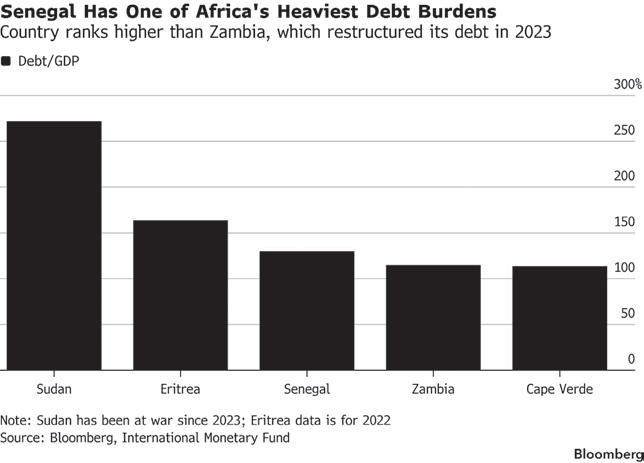
The debt burden presents grim choices for Senegal, as it battles to repay creditors at great cost to other programs that would benefit ordinary Senegalese.
“Many governments are being forced to default not formally on their debts but on their development ambitions,” UN Trade and Development warned in March.
When the president took a test ride on the TER railway on June 20, it was to signal that the line that should have started running in 2024 is finally ready for service. It’s expected to start operating in September. Faye made no mention of the financial strain that Senegal is facing when he addressed local leaders, officials and workers in Wolof.
Construction “took longer than expected due to recurring design and sizing issues identified across several projects,” he said.
French national railway SNCF’s local subsidiary Seter, which operates and maintains the TER, didn’t address whether payments are currently up to date when Bloomberg sought comment. France-based Eiffage SA, which led the construction consortium, said the Dakar section of the TER project is 98% complete and undergoing final testing and commissioning. It didn’t address questions about the impact of payment delays, referring them to the project owner, state-run investment and public works agency APIX.
Recent Treasury-related cash - f low pressures have led to payment delays beyond contractual terms, forcing adjustments to some contractors’ timetables, though “they have not jeopardized the continuity of the project,” an APIX spokesman said in an emailed response to questions. A government spokesperson and officials at Senter, the Senegalese state entity that owns and manages the TER’s infrastructure, as well as Senegal’s transport and infrastructure ministries didn’t respond to requests for comment. Beyond the airport, much of the corridor earmarked for an extension east of Dakar—remains covered by forest. The railway encapsulates one of the key problems facing Senegal: it borrowed in euros and dollars to fund projects like the TER that earn revenue in CFA francs, leaving it short of the foreign exchange needed to service its external debt, said Ndongo Samba Sylla, Africa director for research and policy at the Dakar-based International Development Economics Associates research group.
“I’m not debating their social usefulness, but these projects did not generate the foreign-currency earnings needed to repay the debt,” said Sylla. “The hidden debt is just the tree that hides the forest.” With assistance from Momar Niang, Ray Ndlovu and Matthew Hill/Bloomberg
DAKAR’S
A COMMERCIAL for DraftKings during the Super Bowl LX broadcast in Los Angeles. BLOOMBERG
Tuesday, July 14, 2026
Zambales resolves to reclaim fishing grounds in WPS
By Henry Empeño
MASINLOC, Zambales—Most
of its deep-sea fishing boats may be grounded for now, unused over a decade of harassment by Chinese militia vessels in the West Philippine Sea (WPS), but Zambales is aiming to reclaim lost ground in the contested waters near the Scarborough Shoal.
On Friday, in a ceremony commemorating the 10th anniversary of the 2016 Arbitral Ruling that upheld Philippine sovereign rights over the WPS, the provincial government of Zambales reasserted its claim over the Scarborough, or Bajo de Masinloc, which fell into Chinese control after a standoff in 2012.
“Scarborough is ours!” Gov. Hermogenes Ebdane Jr. declared to the wild applause of residents and government officials at the “Bayanihan sa Karagatan” ceremony here on Friday.
“Let us always remember this, let us keep it in our hearts, and let us shout it to the whole world,” he added.
Ebdane recalled that as early as March 16, 2011, the municipality of Masinloc had formally declared through a council resolution that Bajo de Masinloc is part of the town’s territory.
“This only shows that our local government stands firm on this issue and won’t ever capitulate in defending the welfare of our constituents,” the governor said.
“Defending our sovereignty is not a fight for just a few,” Ebdane reminded
Beijing
Zambales residents. “It needs collective action and a united stand.”
Strategic spearhead
DEFENSE Secretary Gilberto Teodoro Jr., who was guest of honor in Friday’s Masinloc commemoration, also stressed the importance of Bajo de Masinloc in the broader context of defending the WPS.
“We are here in Masinloc today because you are the spearhead in the fight for Bajo de Masinloc,” he told the assembled fisherfolk and local officials.
“But how can we last for the fight if we don’t have the support from those in the Visayas and in Mindanao?” he added. “We have to make the whole country feel how important it is to stand firm.”
Teodoro also warned that should there be no pushback against foreign incursion in WPS, Scarborough may suffer the same fate as that of Mischief Reef, located 135 nautical miles west of Palawan.
He pointed out that China established at Mischief Reef in 1995 what it called fishermen’s shelters,
blasts global coalition
marking 10th anniversary of The Hague ruling
By Malou Talosig-Bartolome
CHINA has launched a sharp diplomatic rebuke against the Philippines, the United States, and 12 other nations for reaffirming the 2016 South China Sea Arbitral Tribunal Award.
On the 10th anniversary of the landmark ruling, Beijing labeled the decision “illegal, null and void” and accused the coalition of destabilizing the region.
The 2016 ruling, issued by a panel under the Permanent Court of Arbitration in The Hague, the Netherlands, had declared China’s “nine-dash line” claim invalid under the United Nations Convention on the Law of the Sea (Unclos) while affirming the Philippines’ sovereign rights within its exclusive economic zone. Although China continues to reject the award as “illegal, null and void,” it remains final and legally binding under International Law.
In a statement released by the Ministry of Foreign Affairs Sunday, Beijing reiterated its sovereignty over the South China Sea islands—including the Pratas Islands, Paracels, Scarborough Shoal, Macclesfield, and the Spratlys—citing “historic rights dating back to the Western Han Dynasty.” The ministry asserted that China was the first to “continuously, peacefully and effectively” exercise sovereignty and jurisdiction over these islands and relevant waters.
Beijing said that 10 years before the arbitral ruling, it submitted an optional declaration under Article 298 of the Unclos. This declaration stated that China does not accept compulsory dispute settlement procedures (such as binding
but had since turned it into a militarized artificial island.
“This is why we have to make a stand here now,” Teodoro said.
Bullied, blunted FOR Zambales fishermen, however, that spearhead had been dulled and dented by incessant Chinese harassment at the West Philippine Sea for over a decade.
In Friday’s forum after Teodoro ceremonially turned over some fishing gear and food packs to fishermen here, Paulo Quitaneg, president of the Zambales Provincial Fishermen’s Association (ZPFA), bemoaned the plight of the 28,000 Zambales fishermen who could no longer access Bajo de Masinloc.
Quitaneg said Chinese coast guard ships and militia boats prevent the entry of local fishermen into the shoal and even cut the ropes anchoring their fish aggregating devices, or payaos, installed in nearby waters.
Bajo de Masinloc, which literally translates to “Masinloc shallows,” is about 124 nautical miles off the coast of the town from which it was named.
For decades, local fishers have fished in the waters in and around the shoal and considered these their traditional fishing grounds, said Efren Forones, who used to be the skipper of a fishing boat that ventured into Scarborough in the early 2000s.
Forones used to bring home P5,000 as captain’s salary per fishing trip on top of the extra income from his personal catch out at sea. Now, he lives off the marginal income from fishing with a small fiberglass boat issued by the government to municipal fishermen.
“Fishing was very good in those days,” Forones fondly recalled in an interview last May, as he rested in the shade of the grounded FBCA La Salvia, a deep-sea boat that was
arbitration) for specific categories of disputes, most notably maritime delimitation and historic bays or titles.
“The so-called ‘award’ is nothing but a worthless piece of paper,” the Chinese Foreign Ministry spokesperson declared. “China does not accept or recognize the ‘award’, and opposes and does not accept any claim or action based on it.”
Beijing also pushed back against the coalition’s defense of Freedom of Navigation, asserting that such navigation has “never been a problem.”
Instead, the ministry blamed the United States and other external powers for “reinforcing military presence,” “throwing their weight around,” and “fanning the flames” of conflict.
The ministry further challenged the legitimacy of the support offered by the 14 nations, questioning the consistency of their stance.
“If the ‘award’ were to be taken as a standard, many countries’ islands and reefs would be denied the basis for claiming maritime rights and interests. May we ask, have those countries supporting the ‘award’ voluntarily waived the maritime rights and interests deriving from their relevant islands and reefs?” the statement asked.
Beijing also accused the Philippines of using the ruling to expand its own claims and urged the coalition to “stop stirring up trouble over the South China Sea issue” and to cease undermining regional peace and stability.
See related story: https:// businessmirror.com.
ph/2026/07/12/south-chinasea-ruling-turns-10-14-nationsreaffirm-support/
captained by his brother-in-law Viany. “You cannot compare those days with today,” he said.
Symbols, struggles DESPITE the 2016 ruling by the Permanent Court of Arbitration in The Hague, which invalidated China’s nine-dash-line in the South China Sea and affirmed Philippine sovereignty over waters within the country’s 200-nautical mile exclusive economic zone, the Chinese continue to maintain a chokehold over Scarborough.
In an earlier interview with the BusinessMirror , Leonardo Cuaresma, president of the New Masinloc Fishermen’s Association (NMFA), recalled that Masinloc fishermen literally jumped for joy when the arbitral ruling came out, especially when (then President) Rodrigo Duterte announced that locals can now peaceably fish at Bajo de Masinloc, along with the Chinese.
“But it turned out to be a lie,” Cuaresma said. He lamented that Duterte later treated the ruling as a mere scrap of paper, and bullying and watercannoning by the Chinese persisted.
In June 2024, China made matters worse for Filipino fishers when it imposed a “no trespassing” policy at Scarborough and barred fishing within a 40-nautical-mile perimeter around the shoal. Local fishermen had no choice but to fish elsewhere.
The 2016 Arbitral Ruling became “just a symbolic victory for us fishermen,” Cuaresma said.
Solutions, substance THE sad plight of local fishermen, however, did not escape the attention of the Zambales local governments, said Ebdane.
He pointed out that LGUs had to provide assistance every time residents get economically displaced
by disasters, calamities, or other emergencies. “So, the problem borne by the geopolitical conflict at West Philippine Sea is a deep concern for us,” he said.
During the July 10 Arbitral Ruling commemoration, Ebdane proudly disclosed that the Zambales LGU will soon deliver a 92-footer steel-hulled harvester boat to be operated by the Zambales Provincial Fishermen’s Association (ZPFA), a federation of 10 fishermens groups in the province.
“We fully feel the ordeal you go through,” Ebdane told the fishermen on Friday. “You are the living proof of our rights over these waters, and that is why we won’t ever give us this fight.”
Ebdane said the provincial government started organizing fisherfolk into cooperatives early last year to kick off an alternative livelihood program for those displaced by the Bajo de Masinloc blockade.
Initially assisting them with boats and gears for payao operations within the 15-nautical mile limit of municipal waters, the local initiative soon developed into a long-term program for local fishery modernization and sustainability.
In January this year, the provincial government delivered two 45-footer fiberglass-hulled auxiliary fishing boats to the ZPFA, with two bigger boats being built by a shipbuilder in Cavite.
Last Friday, Ebdane promised the fisherfolk that the 92-footer steelhulled harvester boat will be delivered within two months to start the ZPFA payao program.
As of now, he said, the first batch of ZPFA members are undergoing training on modern boat operation and safety at sea at the Philippine Merchant Marine Academy in San Narciso, Zambales.
Storm, habagat casualty count up: 20 dead, 9 injured
TROPICAL Storm Inday and the southwest monsoon left 20 people dead, nine injured, and 16 others missing, the National Disaster Risk Reduction and Management Council (NDRRMC) reported on Monday.
While the southwest monsoon is now less likely to bring significant rainfall in the western sections of Northern and Central Luzon, the country faces yet another threat, as the lowpressure area east of the Visayas has developed into a tropical depression and may enter the Philippine Area of Responsibility (PAR) by Tuesday, the Philippine Atmospheric, Geophysical and Astronomical Services Administration (Pagasa) reported.
Tropical Storm Inday and the southwest monsoon that caused heavy rainfall in Mindanao triggered flashfloods and landslides in the past few days, claiming the lives of at least 20 persons who died either of drowning or because of rain-induced landslides.
The NDRRMC reported that 10 of the fatalities were reported from Sarangani Province, which was recently struck by the 7.8 magnitude offshore earthquake last month, the NDRRMC said. Six of
the fatalities were from Lanao del Sur, two from Bukidnon, and one each from Iloilo and Davao Occidental.
In its situation report issued at 6:00 a.m. on Monday, the NDRRMC said the search is ongoing for the 16 reported missing, including eight from Davao Occidental, five from Lanao del Sur, two from Sarangani, and one from Maguindanao del Sur.
The NDRRMC continues to receive reports of the extent of the affected population in Mindanao and Luzon.
So far, the NDRRMC said a total of 146,000 families or 654,000 individuals were affected.
The NDRRMC said more than 5,000 families or 20,000 persons were displaced, and are currently sheltered in 162 different evacuation centers.
It reported that damage to infrastructure has so far reached P3.18 million, with a total of 890 houses having been damaged. Of these, 277 were totally damaged, and 613 were partially damaged.
According to the NDRRMC, the government has so far spent P43.38 million in assistance given to affected families.
Meanwhile, Tropical Depression Haishen was spotted 1,265 km east of Eastern Visayas, packing maximum sustained winds of up to 70 kilometers per hour. It is moving west northwest at 30 kmh and is bringing strong winds that extend outwards up to 480 km from the center, the weather bureau said.
Haishen may enter the PAR either Monday night or Tuesday morning and will be named Josie. According to the weather bureau, once inside PAR, Josie will move generally northward and then turn northeastward until it exits PAR by Wednesday.
Josie, the 10th severe weather disturbance to affect the country’s weather system this year, may intensify into a tropical storm within the next 12 hours, but is less likely to directly affect the weather and sea conditions in the next two days.
However, PAGASA said that while the southwest monsoon is now less likely to cause rainfall, the weather bureau said some areas in Central and Northern Luzon may continue to experience scattered rainshowers.
Jonathan L. Mayuga
PNP reiterates support for govt activities in WPS
THE National Police (PNP) on Monday reiterated its commitment to support government-led activities that promote national unity, patriotism, and awareness of the country’s sovereign rights in the West Philippine Sea (WPS).
Gen. Jose Melencio Nartatez Jr., National Police chief, in a statement made this the commitment following the police force’s participation in the 2026 National Peace Walk on Sunday, at the Quirino Grandstand in Manila.
The peace walk commemorated the 10th anniversary of the landmark 2016 South China Sea Arbitral Award, which affirmed the Philippines’ maritime entitlements under international law.
The event was organized by the National Task Force for the West Philippine Sea (NTF-WPS) under the theme “Walking in Unity, Celebrating a Decade of Victory,” and gathered representatives from government agencies, uniformed services, and various sectors in a show of support for defending the country’s sovereignty and national interest in the West Philippine Sea.
“While our primary duty remains maintaining peace and order, we also stand with the Filipino people in upholding our national interest through lawful and peaceful means,” Nartatez said.
Defense Secretary Gilberto Teodoro Jr. recognized the participation of the police force in the event.
Convergence
IN Friday’s WPS commemoration ceremony here, Mayor Hazel Lim said the apparent lack of enforcement mechanism for the 2016 Arbitral Ruling makes it more necessary for Filipinos to assert the WPS victory.
“The arbitral ruling proves that the law is on our side,” Lim said. “It is important for us to celebrate the ruling which affirmed our rights because these rights cannot be taken away just because some people refuse to acknowledge them.”
Teodoro, meanwhile, hammered home the point that defending the West Philippine Sea also requires strengthening public understanding of the issue, national unity, and collective support to protect the nation’s maritime domain.
“In this fight, we won’t win if we don’t get the support of our people,” he said.
Teodoro also assured local fishermen that the government is looking for ways to resolve the impasse at Bajo de Masinloc.
“We are looking at various options with the objective of having our fishermen freely fishing there at the soonest possible time, but this is not along the line proposed by the Ambassador of China, which calls for joint fishing rights,” he said.
“We already won that in the Arbitral Ruling; it’s our right, so why do we have to get their permission?” he added.
Teodoro said that in the meantime, the task is to improve the livelihood of fisherfolk. Her promised make it his personal priority to provide Zambales with a cold storage or blast freezing unit, so that fishermen can store their catch and market them elsewhere.
“The boat being built by the provincial government under Governor Ebdane is also one good option,” he also said.
Teodoro calls for more govt efforts to develop Pag-asa
EFENSE Secretary Gilberto Teodor o, Jr. called for “greater wholeof-government convergence” to speed up development on Pag-asa Island, the country’s westernmost municipality, to further support its civilian community. Teodoro made this call after leading the flag-raising ceremony on Pag-asa Island to commemorate the 10th Anniversary of the landmark 2016 Arbitral Award, which affirmed the Philippines’ sovereign rights in the West Philippine Sea under international law. He added that Pag-asa should not be viewed solely through the lens of security but as a thriving municipality where Filipinos live, work, raise families, and build their future.
“Pag-asa is not a military outpost. It is a living municipality,” the defense chief said.
“By the way, I would like to make a special mention because I saw our police officers dancing earlier. Let us thank our police because while they continue protecting our communities, they are also standing with us in the fight for the WPS,” Teodoro stressed.
Nartatez welcomed Teodoro’s acknowledgment of the PNP’s participation.
“Our participation sends a clear message that the PNP stands with every Filipino in supporting our country’s sovereignty and national interest. We remain committed to protect the people, preserve peace and order, and support lawful initiatives that strengthen unity and love of country,” he also said. Rex Anthony Naval
He also emphasized that the island is home to families, schoolchildren, public services, and a growing community that deserves sustained government support. Teodoro also explained that the continued presence of civilians on the island reflects the Philippines’ exercise of governance and the normal functioning of a local community, with residents requiring education, healthcare, livelihood opportunities, clean water, electricity, waste management, and other essential public services.
To further strengthen government support for the island, Teodoro directed the Armed Forces (AFP) Western Command to establish command arrangements for a dedicated Task Force Pag-asa, which will support security preparations for the regularization and normalization of civilian life on the island in close coordination with national government agencies and the local government. He added that the initiative aims to facilitate greater interagency cooperation in delivering basic services, improving infrastructure, and enhancing the quality of life of residents while maintaining the island’s security. Rex Anthony Naval