ROTARY CLUB OF MANILA JOURNALISM AWARDS
2006 National Newspaper of the Year 2011 National Newspaper of the Year 2013 Business Newspaper of the Year 2017 Business Newspaper of the Year 2019 Business Newspaper of the Year 2021 Pro Patria Award 2026 National Newspaper of the Year PHILIPPINE STATISTICS AUTHORITY 2018 Data Champion
BusinessMirror
www.businessmirror.com.ph
A broader look at today’s business n
Sunday, July 12, 2026 Vol. 21 No. 271
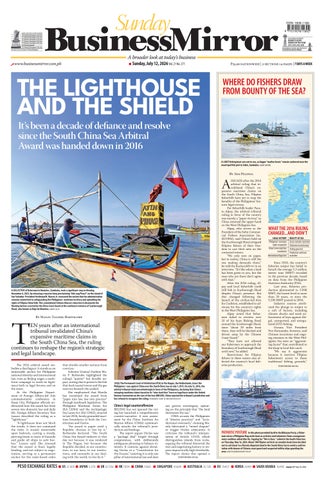
THE LIGHTHOUSE AND THE SHIELD
EJAP JOURNALISM AWARDS
BUSINESS NEWS SOURCE OF THE YEAR
(2017, 2018, 2019, 2020)
DEPARTMENT OF SCIENCE AND TECHNOLOGY
2018 BANTOG MEDIA AWARDS
P25.00 nationwide | 2 sections 14 pages | 7 DAYS A WEEK
WHERE DO FISHERS DRAW FROM BOUNTY OF THE SEA?
It’s been a decade of defiance and resolve since the South China Sea Arbitral Award was handed down in 2016
A LIGHT fishing boat sets out to sea, as bigger “mother boats” remain anchored near the municipal fish port in Subic, Zambales. HENRY EMPEÑO
By Ada Pelonia
A
DECADE after the 2016 arbitral ruling that invalidated China’s expansive maritime claims on the South China Sea, Filipino fisherfolk have yet to reap the benefits of the Philippines’ historic legal victory. For fisherfolk leader Fausto Alpay, the arbitral tribunal ruling in favor of the country was merely a “paper victory,” as China retained the upper hand on the West Philippine Sea. Alpay, who serves as the President of the Subic Commercial Fishers Association Inc. (SCOFAI), said China’s hold on the Scarborough Shoal stripped Filipino fishers of their freedom to cast their nets on the contested waters. “We only won on paper, but in reality, China is still the one making demands there,” he told the BusinessMirror in an interview. “It’s like when a land has been given to you, but the ones who are there don’t agree with that.” After the 2016 ruling, Alpay said local fisherfolk could still fish in Scarborough Shoal despite China’s presence. But this changed following the launch of the civilian-led Atin Ito Coalition, established to advocate for the country’s rights in the West Philippine Sea. Alpay noted that fishermen failed to retrieve over 10 of his buya [fishing float] around the Scarborough Shoal, since “about 20 miles from there, they will be blocked and driven away by the Chinese Coast Guard.” “They have not allowed our fishermen to approach the boundary of Scarborough Shoal until now,” he added. Restrictions for Filipino fishers in these waters also affected the country’s local fisheries production.
A COLLECTIVE of fishermen in Masinloc, Zambales, took a significant step on Monday, November 6, 2023, by releasing a massive buoy proclaiming “Atin ang Pinas!” on the island of San Salvador. President Ferdinand R. Marcos Jr. reassured the nation that his administration remains committed to safeguarding the Philippines’ maritime territory and upholding the rights of Filipino fisherfolk. This commitment follows Marcos’s directive to dismantle the floating barriers erected by the China Coast Guard at the southeast entrance of Scarborough Shoal, also known as Bajo de Masinloc. NONOY LACZA
T
By Malou Talosig‑Bartolome
EN years after an international tribunal invalidated China’s expansive maritime claims in the South China Sea, the ruling continues to reshape the region’s strategic and legal landscape. The 2016 arbitral award embodies a dual legacy: it stands as an immovable anchor for Philippine national identity and international law, even as Beijing wages a multifront campaign to erode its legitimacy both in legal forums and on the water. At the Philippine Department of Foreign Affairs-led July commemorative conference in Pasay City, Philippine officials underscored how the award has been woven into domestic law and daily life. Foreign Affairs Secretary Tess Lazaro described the ruling as a “lighthouse.” “A lighthouse does not block the winds; it does not command the tides. It stands immovable upon bedrock, casting a steady, piercing beam to warn of hazards and guide all ships to safe harbor,” Lazaro said. She stressed that the award is final, legally binding, and not subject to negotiation, serving as a permanent anchor for the rules‑based order
that shields smaller nations from coercion. Solicitor General Darlene Marie P. Berberabe highlighted the ruling’s “quieter” but durable impact, noting that it protects the fish that feed coastal towns and the gas reserves beneath the seabed. She emphasized that Manila has translated the award from “paper into law, law into practice” through landmark legislation. The Philippine Maritime Zones Act (RA 12064) and the Archipelagic Sea Lanes Act (RA 12065), enacted in late 2024, firmly grounded maritime boundaries in both the Constitution and Unclos. “An award is paper until a Republic chooses to live by it,” Berberabe declared. “The South China Sea Award endures to this day not because it was rendered in The Hague, but because the Republic decided, in our constitution, in our laws, in our institutions, and outwards in our dealing with the world, to live by it.”
WHAT THE 2016 RULING CHANGED...AND DIDN’T LEGAL VICTORY Philippines’ sovereign rights recognized China’s nine-dash line invalidated International legal win
REALITY AT SEA Access remains restricted Fishermen turned away Fishing gear lost Production continues to decline
Since 2016, the country’s fisheries output has failed to breach the average 5.2 million metric tons (MMT) recorded in the previous decade, based on data from the Philippine Statistics Authority (PSA). Last year, fisheries production plummeted to 3.998 MMT, the lowest level in more than 20 years, or since the 3.296 MMT posted in 2004. Industry sources attributed the plunge in output to a raft of factors, including climate shocks and weak enforcement of laws against illegal, unreported, and unregulated (IUU) fishing. Oceana Vice President Von Hernandez, however, said Chinese incursions and ongoing tensions in the West Philippine Sea were an “aggravating factor” that contributed to the drop in local fish catch. “We say it aggravates because it restricts Filipino fishermen’s access to those traditional fishing grounds,” Continued on A2
[FILE] The Permanent Court of Arbitration (PCA) in The Hague, the Netherlands, hears the Philippines’ case against China over the South China Sea on July 7, 2015. On July 12, 2016, the arbitral tribunal ruled overwhelmingly in favor of the Philippines, declaring that China’s sweeping maritime claims based on its “nine-dash line” have no legal basis under the United Nations Convention on the Law of the Sea (UNCLOS). China rejected the tribunal’s jurisdiction and has refused to recognize the ruling. PERMANENT COURT OF ARBITRATION VIA AP
China’s legal counteroffensive
BEIJING has not ignored the ruling but launched a comprehensive counter-narrative. A new assessment by the China Institute for Marine Affairs (CIMA) systematically attacks the tribunal’s jurisdiction and findings. The report argues Unclos was a “package deal” forged through compromises, with deliberately ambiguous phrasing to balance interests. It cautions against elevating Unclos to a “Constitution for the Oceans,” insisting it is only one pillar of international law and does
not govern sovereignty, operating on the principle that “the land dominates the sea.” CIMA accuses the Philippines of “abusive practices” and “jurisdictional overreach,” claiming Manila fabricated a “mixed dispute” to trigger Unclos arbitration. It criticizes the tribunal’s interpretation of Article 121(3), which distinguishes islands from rocks, arguing the tribunal distorted the text and negotiating history to impose impractically high thresholds. The report claims this opened a
PATRIOTIC POSTURE In this photo provided by Atin-Ito/Akbayan Party, a fisher-
man raises a Philippine flag on his boat as activists and volunteers from a nongovernment coalition called Atin Ito, Tagalog for “This is Ours,” sailed at the South China Sea on Thursday, May 16, 2024. About 100 Filipino activists on wooden boats have decided not to sail closer to a fiercely disputed shoal in the South China Sea to avoid a confrontation with dozens of Chinese coast guard and suspected militia ships guarding the area. ATIN-ITO/AKBAYAN PARTY VIA AP
Continued on A2
PESO EXCHANGE RATES n US 61.5830 n JAPAN 0.3793 n UK 82.5766 n HK 7.8594 n CHINA 9.0683 n SINGAPORE 47.6649 n AUSTRALIA 42.7201 n EU 70.4017 n KOREA 0.0409 n SAUDI ARABIA 16.4042 Source: BSP (July 10, 2026)
News BusinessMirror
A2 Sunday, July 12, 2026
www.businessmirror.com.ph
Analysis: China’s ballistic missile launch was a message for the US The
B
lighthouse…
By Huizhong Wu | The Associated Press
Continued from A1
ANGKOK—When China launched a ballistic missile into the South Pacific Ocean on Monday, it was a rare test of a nuclear-capable weapons system that drew international rebuke.
Arriving two years after a similar missile launch in international waters in the Pacific, the test by the People’s Liberation Army caught the attention of small island nations whose leaders have increasingly urged bigger countries to stop using the vast oceanic region for power struggles. But Beijing’s message was largely for just one country, experts say: the United States. “The most important message is the PLA is becoming a powerful military with a very strong strategic nuclear capability,” said Tong Zhao, a senior fellow with the Nuclear Policy Program at the Carnegie Endowment for International Peace, a think tank. The test, launched from a nuclear-powered submarine, was a demonstration of the sea-based leg of China’s nuclear triad capability, which refers to the ability to have land, sea, and air-based nuclear systems. Further, it showed that China’s military has what is called a second-strike capability, said Dominic Meagher, a research fellow at the Crawford School of Public Policy in Australia. That means even if China was attacked first, it still has the ability to strike back, because the ability to fire could be anywhere, in the ocean or on land.
Beijing said the launch was part of annual exercises, suggesting that it may conduct similar launches in the future. “I would see this as a systematic move, not an isolated event,” said K. Tristan Tang, Nonresident Fellow at the National Bureau of Asian Research, in emailed comments. The missile testing comes as China is also racing to build more nuclear-powered submarines. In the past five years, China has been building these types of submarines faster than the US, according to a report from the International Institute for Strategic Studies, a think tank.
For countries in the Pacific, launch recalls grim nuclear history
HOWEVER, the use of international waters, specifically treaty-protected waters where nuclear testing is prohibited, drew criticism from countries in the region. The waters of the South Pacific Ocean are contested because they’re strategically important and rich with fisheries and minerals. For Pacific nations, nuclear testing in particular recalls historical harm. The US, the UK and France have all detonated nuclear warheads in the Pacific, causing environmental contamination and
“Pandora’s box” with “evident intent to ‘create a judicial precedent’” despite lacking jurisdiction.
The global legal battlefield
A LONG-RANGE ballistic missile bursts out of the sea during a test launched from a Chinese nuclear-powered submarine in the South Pacific on Monday, July 6, 2026. LI XIANGCHAO/XINHUA VIA AP
health issues such as cancers and birth defects that some island nations say they are still recording generations later. “Those tests resulted in outrage and resulted in treaties to prevent future tests, and that includes the nuclear test ban treaty and the Treaty of Rarotonga, said Meagher. “These kinds of missile tests haven’t been conducted since.” Monday’s missile landed in the South Pacific Nuclear Free Zone, which was established by the 1986 Rarotonga accord, which prohibits nuclear weapons throughout the region. China ratified the protocols in 1987 that prohibit testing nuclear weapons within the zone or threatening to use them against signatories with territory in the region. Solomon Islands Prime Minister Matthew Wale, speaking to
reporters in the Solomon capital Honiara Tuesday, said, “China is a good friend of Solomon Islands, but this is not something a friend does. This is not … good in our region.” While US forces still conduct nuclear missile testing in the Pacific, they avoid the treaty area, Meagher said.
Beijing conducted the test with short notice, other leaders say
AUSTRALIA and New Zealand both said they were not given enough prior notice about the test, and other countries like Japan said it was done without transparency. Canberra and Wellington are two of the South Pacific’s biggest powers and have grown anxious about Beijing’s attempts to vie for sway in the region. Bilateral deals between China and the leaders of small Pacific nations have prompted Australia’s Prime Minister Anthony Albanese to embark on a charm offensive of his own. That has included defense and security pacts inked with Vanuatu, Fiji and Papua New Guinea in the past year. On Tuesday, Albanese decried the missile launch as “a provocative act by China which does destabilize the region,” when he spoke to reporters in Honiara, where he was holding talks with officials. Australia and the Solomon Islands are in the process of negotiating a comprehensive treaty. “The fact that this test took place yesterday with very little notice is of real concern,” he added. China has defended its actions and said it gave countries in the area appropriate notice. “China informed the relevant countries in
advance, which demonstrates the openness and transparency of the Chinese military,” according to a statement from its Defense Ministry issued Tuesday. Experts say that if there is a standard, it would be the Hague Code of Conduct which sets out regulations on ballistic missiles and their use. It expects states to provide notice at least 24 hours beforehand, but the code is not legally binding. Further, Tang said, China is not a member of the Hague Code of Conduct. Much speculation remains around what was fired and when. The People’s Liberation Army is known to make very little information public, but the secretary-general of Taiwan’s National Security Council said on Wednesday that this was a JL-2 missile launched from waters off Guangdong, a southern Chinese province. The JL-2 is an older ballistic missile for submarines. Chinese state media, on the other hand, presented experts saying it was likely a JL-3, which has a longer range than the JL-2. "The JL-3’s range can strike a target on the east side of the Pacific from the west side,” said Shao Yonglin, a military expert featured in an interview with state broadcaster CCTV. As China becomes a major military power, it should expect more international scrutiny. If “China wants to become a major military power, it should be put under the same standards,” as countries such as the US, the UK and France, said Zhao, the nuclear expert. (AP writer Charlotte Graham-McLay contributed to this report from Wellington.)
WHERE DO FISHERS DRAW FROM BOUNTY OF THE SEA? Continued from A1
Hernandez told this newspaper in an interview. “Now, we have to compete with foreign vessels that may be better equipped, which will certainly affect fish abundance. There have also been reported destructive activities in Ayungin Shoal, where evidence of cyanide fishing was found,” he added. Last April, the National Security Council (NSC) said intensive laboratory testing confirmed that yellow bottles from Chinese sampans operating at Ayungin Shoal were “positive for the presence of cyanide.” (See: https://businessmirror.com.ph/2026/04/13/bottlescontaining-cyanide-found-in-chinesesampans-at-ayungin-shoal-nsc/) The use of cyanide poses a threat to the fragile marine environment of the West Philippine Sea and the livelihood of Filipino fisherfolk, the NSC said. As such, Hernandez stressed that while the 2016 arbitral ruling was a landmark legal victory for the country, the domestic fisheries industry have continued to seek light at the end of the tunnel. “While it was a significant victory for the Philippine govern-
ment, it has yet to translate into tangible benefits for our fisheries sector,” he said. For Bureau of Fisheries and Aquatic Resources (BFAR) Spokesperson Nazario Briguera, the ruling boosted the confidence of Filipino fishers since it reinforced that the waters belong to the country under international law. “It affirms our sovereign rights over the West Philippine Sea, which is favorable on the part of the government. But there are still challenges being faced by the Filipino fisherfolk and the government in general,” Briguera told the BusinessMirror. Without productive government-to-government dialogue on this matter, however, Alpay worried that local fishers’ access to the West Philippines Sea would remain restricted in succeeding years. “Until there are no productive talks between China and the Philippines [regarding the West Philippine Sea], the challenges will keep hounding [local fisherfolk],” Alpay said. “We were free to fish there from the beginning. Why we’re being prohibited from doing so in those areas baffles us, because the [West Philippine Sea] is ours. It’s not China’s property.”
THIS clash of narratives has reshaped diplomacy. During the Center for Strategic and International Studies (CSIS) South China Sea Conference in Washington, D.C., Robert Harris, Assistant Legal Adviser for East Asia and Pacific Affairs at the US Department of State, noted that before 2016, South China Sea discourse was dominated by military power, but the tribunal “made the international law part of the conversation.” China attempted to reformulate its claims by blending Unclos concepts with “historical rights.” Yet Chiang Tai, Associate Professor at National Taiwan University, said this forced precision backfired: “Once a claim is cast in a precise legal language it becomes something that can be examined, compared and also rebutted.” This sparked the “battle of the note verbales,” with 25 diplomatic notes filed by nations including the US, France, Germany, and the UK, all citing the award to dismantle Beijing’s revised claims.
Escalation and control on the water
DESPITE unified legal pushback, Beijing has intensified physical coercion. At CSIS, experts warned the region is shifting from a “contest over presence to a contest over control.” Tu Lai, Research Fellow at the Diplomatic Academy of Vietnam, explained that Beijing now uses systematic gray‑zone tactics to dictate who can fish, enter lagoons, or conduct surveys, altering operational realities. Dr. Jay Batongbacal, director of the Institute for Maritime Affairs and Law of the Sea at the University of the Philippines, described the maritime landscape as one of “escalation and intensification.” China continues to deploy “ICAD” (illegal, coercive, aggressive, and deceptive) actions, including vessel ramming, water cannons, and encirclement of Filipino fishermen. Henrietta Levin, Senior Fellow at CSIS, noted that Beijing increasingly deploys armed PLA Navy vessels for frontline coercion, abandoning “operational reciprocity” and escalating risks of miscalculation.
National unity and regional pressures
CHINA’S pressure has hardened Philippine resolve. Surveys show surging public support for transparency initiatives and alliances with partners such as the US, Japan, Australia, and France. “China’s escalation has not forced submission; instead, it has intensified Philippine resistance,” Batongbacal concluded. “Ten years later we celebrate rather than commemorate . . . the law remains on our side, the global community is increasingly by our side, and most importantly, the Filipino people stand resolute.” Yet middle powers face dilemmas. Natalie Sambhi, Founder and Executive Director of Verve Research, highlighted Indonesia’s “multi‑alignment” struggle. While Jakarta seeks deeper defense ties with Washington, it remains dependent on China, which supplies 80 to 90 percent of its nickel processing plants. These economic dependencies complicate neutrality and strategic balance.
Enduring paradox
TEN years on, the South China Sea remains a theater of paradox. On the water, China is bolder than ever, leveraging maritime forces to alter facts and shift toward control. Yet in law and diplomacy, the 2016 arbitral award endures as a potent weapon. For Manila, it is both lighthouse and shield—anchoring national identity, guiding policy, and rallying alliances against coercion.
The World
Editor: Angel R. Calso
Sunday, July 12, 2026
A3
China’s push to erase hidden debt threatens to cap infra spending
C
By Bloomberg News
HINESE provinces are nearing a milestone in Beijing’s plan to refinance their crushing debts, allowing local officials to refocus efforts on raising funds for infrastructure projects despite limited room to offer more support to the economy. Led by the powerhouse economies of Jiangsu, Shandong and Zhejiang, borrowing meant to swap so-called hidden debt into local government bonds approached 94% of the 6 trillion-yuan ($883 billion) allowance as of the end of June, according to data compiled by Bloomberg. After raising more than 1.62 trillion yuan in the first half of 2026, regions could use up the remaining three-year quota this month or next if their issuance continues at its current clip. For reg iona l of f icia ls, t he push to eliminate hidden debt has turned into a major source of pressure, according to local civil servants who asked not to be identified. Once the work is complete, they said provincial administrations would be able to shift more of their attention back to supporting economic growth, though stricter scrutiny of infrastructure projects may still temper their willingness to commit more spending to that area. The conundrum reflects the competing priorities pulling at policymakers with China’s domestic economy close to its weakest point since the reopening from
Covid lockdowns. Even as economists call for greater fiscal stimulus to revive domestic demand, local officials must still abide by constraints on spending following Beijing’s campaign to defuse debt risks. “Shifting hidden debt onto the government’s books has somewhat reduced pressure on the authorities, but their underlying fiscal burden remains heavy,” said Wen Laicheng, a professor at Central University of Finance and Economics in Beijing. While officials may pivot toward bolstering the economy as more hidden debts are cleared, Wen said they will have to find alternative paths such as through promoting private investment. “Relying on government bond issuance and state-owned enterprise investment to drive growth is unsustainable,” he said. Hidden debt refers to borrowing by mostly state-owned companies known as local government financing vehicles, or LGFVs, to fund projects such as roads, bridges and industrial parks. It’s generally costlier than government bonds, with local authorities often providing an
implicit guarantee of repayment. The effort to repair the balance sheets of the nation’s regional governments is bringing more transparency, reducing their cost of borrowing and buying them time to mend public finances. But it’s almost certainly insufficient to reverse the trajectory for China’s overall liabilities. Bloomberg economists predict the combined debt of central and local governments will climb to 101% of gross domestic product by end-2035, up from 69% at the end of last year. The debt cleanup has also given Beijing more reason to hold the line on fiscal austerity even if it comes to the detriment of the economy. Broad government expenditure fell 0.3% on year in January-May despite a 0.8% gain in income. Bloomberg Economics estimates slower public spending, along with faster revenue collection, has shaved roughly 0.2 percentage point from China’s economic expansion this year. Still, wrapping up the debt swap would clear the way for new issuance to support growth in the coming months. Prov incial author ities sold less than 1.58 trillion yuan in special securities meant for infrastructure investment in the first half equivalent to just 44% of their yearly allowance, as officials rush to meet the deadline next year to sever links with special financing vehicles they once used to keep liabilities off the public books. By contrast, they raised 47% of last year’s quota at the same point in 2025. In the era before the debt cleanup, some years saw more than 90% of the annual allowance met by
THE effort to repair the balance sheets of the nation’s regional governments is bringing more transparency, reducing their cost of borrowing and buying them time to mend public finances. BLOOMBERG PHOTO
the halfway mark. The slower issuance this year means they will likely accelerate drawing down the more than 2 trillion yuan in the remaining quota, according to Bloomberg-compi led data. That excludes the 800 billion yuan granted by Beijing each year over 2024-2028 to complement the debt cleanup program. More than half of that was issued in the first half. W hen announcing the debt swap in 2024, the Ministry of Finance expected it to free up fiscal resources to boost investment and consumption by saving local governments around 600 billion yuan in interest payments over five years. It’s already lowered borrowing costs for LGFVs by easing their default risks offering welcome relief for local authorities still untangling financial links with such entities. The average coupon on five-year LGFV bonds has dropped during the first half to near 2% Bloomberg calculations show a fall of 210 basis points that was far steeper than declines in yields on Chinese government
debt during the same period. The rate on local bonds of the same tenor still stands more than 50 basis points lower. While a change in fiscal priorities would remove an immediate drag on growth, local governments are unlikely to splurge again on debt-fueled infrastructure projects over the longer term. China’s yearslong property slump and slow ing economic growth have put their finances under extreme strain, with revenue from land sales extending its collapse and plunging by more than a quarter in the first five months of the year. The political rhetoric is also changing. President Xi Jinping has pressed for higher returns on investment and warned against wasteful expenditure leading to tighter scrutiny of projects. Indeed, a shortage of quality projects has been among major hurdles facing provincial officials. The National Audit Office’s annual report revealed that 17 counties inflated their expected revenues on 69 projects to get around 12 billion yuan in special local bond quota last year.
Once completed, the income from them couldn’t cover the cost, forcing authorities to sell refinancing bonds to repay the debt. “China’s restrained spending reflects a shift in local political incentives: Gone are the days when local governments deployed massive infrastructure projects to chase growth targets. Instead, debt reduction has become the top priority,” said Bloomberg economists Chang Shu and David Qu. Uncertainty over the true scale of hidden debt is another reason Beijing remains wary of a fresh credit-fueled spending spree at the local level. At the time of the campaign’s launch almost two years ago, the Ministry of Finance said it recognized 14.3 trillion yuan in local hidden debt as of the end of 2023. The IMF, however, predicts LGFVs would have outstanding debt in excess of 76 trillion yuan at the end of this year. The IMF has explained the difference in estimates by saying that it uses a broader approach whereas China follows “a legal definition based on explicit backing by local governments.” Xia Le, chief Asia economist at BBVA Hong Kong, expects local governments to accelerate the issuance of special bonds, completing most of this year’s sales by the end of September. However, additional stimulus is unlikely, he said. “To mitigate risks, the central government imposes stringent oversight over local infrastructure projects,” he said. “As a result, local authorities have become more prudent in infrastructure investment, abandoning their previous aggressive, rushed approach.”
The supertanker ‘tycoon’ making millions on Hormuz shuttle runs By Weilun Soon, Alex Longley & Anthony Di Paola
sent a further stream of supertankers into the Persian Gulf ready to collect crude including at least two that have already returned again after exiting to offload their cargoes. And it’s not just UAE cargoes; the company has been active in touting its services to shipbrokers as it looks to pick up barrels from elsewhere in the gulf. “Sinokor’s moves during the Iran war are groundbreaking,” said Matt Wright, Kpler’s principal freight analyst. “By creating an environment that supports their negotiating position they are lifting rates for all owners. They are also willing to go to corners of the market where shipowners might still be cautious about, and we are seeing initial signs of a market recovery because of that.”
J
UST a few weeks into the war, one of the Persian Gulf’s top oil producers quietly began sneaking its crude out of the Strait of Hormuz. Before long, the covert project became so successful that the United Arab Emirates was already approaching its prewar rate of flows through the waterway by the time the US and Iran signed their interim peace deal. The UAE’s aggressive push to get barrels safely out of the strait relied on tactics normally associated with sanctioned countries like Iran, Russia and Venezuela: the ships traveled “dark” without their transponders (and often under the cover of literal darkness) before offloading their cargo into other tankers waiting outside the waterway, and then returning back to collect more. Crucially though, officials in Abu Dhabi needed enough ships to make the risky transit not just once, but over and over. And for that they turned for help to Ga-Hyun Chung. The intensely private Korean shipping tycoon rocked the tanker industry early this year as his Sinokor Group embarked on an unprecedented buying spree. Bloomberg reported in March that he stood to be one of big winners from the turmoil in the oil trade from the Iran war, as rates for tankers surged. Now, Sinokor has emerged as a major owner of supertankers moving crude out of the Persian Gulf. The company started leasing ships to Abu Dhabi National Oil Co. for its “shuttle runs” from at least mid-April. By June, almost half of Emirati crude shipments were sailing on vessels controlled by Sinokor, according to ship tracking data collected by analytics firm Vortexa. This story is based on vessel tracking data compiled by Bloomberg, figures from Vortexa and Kpler, another leading analytics firm, and conversations with more than a dozen shipbrokers, traders and other industry insiders. The scale of Sinokor’s role in leasing ships for “dark” transits has not previously been reported. Sinokor didn’t respond to requests for comment. Adnoc L&S, which is Adnoc’s
Bold bets
SMOKE billows from the Mayuree Naree, a Thailand-flagged bulk carrier, after it was hit by a projectile in the Strait of Hormuz, north of Oman, on March 11, 2026. PANITHI TUMKAEW VIA AP
shipping and logistics arm, said it doesn’t comment on matters related to the position, movements, or routing of its vessels, but noted that it has “an extensive fleet including owned and chartered vessels.” While Adnoc also relied on tankers it owned directly, as well as from other owners, the deals with Sinokor were key to helping the UAE ramp up exports through Hormuz far faster than its Gulf neighbors. The shipments meant Adnoc was able to take greater advantage of surging oil prices earlier in the war, and helped alleviate the impact of the broader closure of the strait on global supplies. The company has continued to ramp up shipments, with tankers traveling more openly through the strait with transponders
on since the interim peace agreement. But the deals have also created a huge profit opportunity for Sinokor, Chung and his new co-owner, Italian container giant MSC Group. Oil tanker markets are having one of the most lucrative years ever, and shipbrokers suggest that the premium for sailing into the Gulf during the war could have yielded three to four times the prewar rate. The terms of the deals haven’t been disclosed, but the brokers estimated just three tankers doing shuttle runs since midApril could have earned Sinokor somewhere around $60 million to $120 million. Since the interim ceasefire between the US and Iran came into effect, Sinokor has
EVEN in an industry dominated by largerthan-life characters, Chung’s bold bets have set him apart. Sinokor, which is headquartered in Seoul, started out as a container shipper, before expanding to become a smaller player in oil tankers. That changed dramatically late last year, when the company suddenly went on a dealmaking spree to buy and charter supertankers with backing from one of shipping’s biggest players, MSC. By late February, Sinokor controlled about 150 very large crude carriers, according to industry estimates nearly 40% of the global fleet that wasn’t either sanctioned or tied up on long-term leases or regular routes. After the US issued licenses allowing the trade in Venezuelan oil at the beginning of this year, Sinokor deployed several of its vessels toward the US Gulf and the Caribbean in anticipation of the flood of barrels entering the mainstream market. At one point, the company controlled nearly all of the available supertankers that could reach the US Gulf within 30 days. Sinokor’s aggressive buying combined with a swell in oil flows to send tanker rates surging even before the US and Israeli strikes on Iran led to the effective closure of the world’s most important oil shipping lane. By early March, rates had soared dramatically higher, hitting unprecedented levels as the market adjusted to the reality that a large
percentage of the global fleet was stuck inside the Persian Gulf. Bloomberg reported in March that Sinokor itself had moved at least six empty supertankers into the Gulf in the weeks before the war, which meant the company was able to hire the vessels out at eyepopping daily rates to hold oil, as storage in the region filled up. (Around the same time time, more details of the company’s tie up with MSC became public the world’s biggest container line had actually bought a 50% stake in Sinokor Maritime Co.)
Daring dash
IN the early weeks of the war, the sparse traffic through Hormuz appeared largely dominated by tankers with links to Iran, while the UAE and Saudi Arabia quickly diverted crude flows to export terminals on the Gulf of Oman and the Red Sea via pipelines that bypassed the strait. But while most ship owners and crews saw the journey as too dangerous, at least one firm Greece’s Dynacom Tankers Management Ltd. quickly appeared to find a See “Hormuz,” A6
A4
The World
Sunday, July 12, 2026
www.businessmirror.com.ph
Ukrainian midrange drones reshape the battlefield by targeting Russian supply lines By Samya Kullab & Dmytro Zhyhinas
K
The Associated Press
HARKIV REGION,— Ukraine Through the grainy gray-andwhite haze of thermal images streamed from a drone, Ukrainian pilots watch the roads that keep Russian forces supplied, hunting for targets with a fleet of midrange drones that is reshaping the battlefield. In a basement command post in U k raine’s K hark iv reg ion, hundreds of kilometers from the drone over Russian-held territory, pilots wait for movement. When a vehicle appears, they will nudge the controller, sending the aircraft diving toward its target to disrupt Russian supplies deep behind the front. “Our mission is to cut logistics,” said Kat, commander of Ukraine’s K-2 brigade, which fires midrange drones. “Cut off their supply lines, and the infantry on the front line have no food, no ammunition, no night vision, no batteries. Nothing. That’s how we’re wearing them down in every sense.” Soldiers spoke to The Associated Press on condition their call signs and not real names be used, in line with military regulations. By repeatedly striking the highways that carry fuel, ammunition and reinforcements, Ukrainian commanders say they have made logistics slower, costlier and far less predictable, helping stall Russian advances and enabling Ukrainian counterattacks and strikes into illegally annexed Crimea to isolate the peninsula from the mainland. Until recently, much of that territory lay beyond Ukraine’s reach.
Front-line drones lacked the range, while long-range drones were reserved for strategic targets hundreds of kilometers away. Between them stretched a 25- to 200-kilometer (15- to 125-mile) corridor where Russian troops and supplies moved with relative freedom. Fixed-wing midrange drones equipped with Starlink satellite communications have begun closing that gap, turning Russia’s logistical rear into an active battlefield. “They’re ensuring that the Russians are constantly pressured along their supply logistics lines and that they are unable to supply certain parts of the front so that the situation may be more controllable,” said Samuel Bendett, a researcher at the Center for Naval Analyses. Ukraine will have to sustain the pressure while Russia develops countermeasures, Bendett said. He expects Moscow to adapt eventually but said its larger military allows it to absorb heavier losses in the meantime. “ T he quest ion i s whet her Ukraine can keep this pressure up over the next few weeks and months,” he said. From a drab office, Ukrainian
drone operators target Russian supplies The machinery of the midrange campaign hides in plain sight. An ordinary office is a command post. A carpenter’s workshop is a drone assembly point. A quaint village house, a launch site. The nerve center of K-2, one of Ukraine’s most elite drone units, sits in a drab workspace. The workstations are cluttered with coffee mugs, energy drink cans and e-cigarettes. In May, the unit launched 800 midrange drones, 650 of which struck intended targets all from this room. Dressed in civilian clothes, the pilots sit beneath harsh fluorescent lights, eyes fixed on computer screens, as if working late over spreadsheets. But the grids on their monitors are target lists and satellite maps. As they plot each flight before takeoff, a separate unit launches the aircraft more than 200 kilometers (125 miles) away. Control then passes to the pilots in Kharkiv, who fly it for up to four hours more than 100 kilometers (60 miles) behind Russian lines. Some who were driven from their hometowns by Russia’s invasion now revisit familiar streets through a drone’s lens, passing old schools and childhood haunts, searching the places where they once played for concealed Russian troops and ammunition depots. A whiteboard tracks an ongoing competition among the unit’s 10 drone crews. The current record stands at 17 consecutive hits. Missing a high-value target can be as memorable as hitting one. After one such miss, brigade commander Col. Kyr ylo Veres called the crew and scolded: “Are you drunk?” Some days, the screen reveals little more than a truck hauling fuel and supplies or a lone soldier on a motorcycle. Other days, it
A SERVICEMAN with Ukraine’s K-2 brigade prepares a midrange drone before flying it toward Russian positions on the front line in Ukraine’s Donetsk region on June 22, 2026. AP PHOTO/EVGENIY MALOLETKA
lights up with more prized targets: a loaded multiple rocket launcher or a cluster of Russian troops. Among the top pilots is Pharaon, 20, who said the work comes naturally an extension of the video games he grew up playing. “When I was a kid, I used to go to computer clubs where we played Counter-Strike over a local network,” he said. “The competition here is pretty much the same. It’s about who can kill more enemy troops or take out the biggest target.”
Starlink enabled the breakthrough drone campaign
UKRAINE’S breakthrough came earlier this year when SpaceX cut off Russian forces’ unauthorized access to Starlink satellite services, disrupting Russia’s drone operations and communications. That gave Ukraine an advantage, allowing upgraded drones to evade detection, resist jamming and strike more accurately while Russia raced to adapt. “The blocking of Starlink for Russian forces was one of the most significant battlefield developments of the year,” said Rob Lee, senior fellow in the Foreign Policy Research Institute’s Eurasia Program.
The success of Ukraine’s midrange campaign is a consequence of that shift. “What’s changed is that now eight out of every 10 sorties are successful,” said Pharaon. Just a few months ago, the success rate was the reverse, he said. K-2 flies the Dart, one of the cheaper models in Ukraine’s expanding fleet of midrange drones. Built from polystyrene, wood and 3D-printed parts, the Dart primarily targets Russian logistics convoys. Larger drones, such as the Hornet, carry heavier payloads to strike bridges and other infrastructure. Before launch, crews inspect the batteries, cameras, flight controllers and the most critical component, the Starlink satellite communications system that keeps the drone connected throughout the mission. From the assembly point, the drones are transported to concealed launch sites near the front line. There, a soldier with the call sign Buckwheat moves between aircraft, ensuring each Starlink terminal is connected before the drones are catapulted into the sky. “It’s gotten a little quieter now. You can tell the pressure from the enemy has eased,” he said. Russia, caught by surprise, is
playing catch-up Russian forces were caught off guard when the campaign intensified three months ago. Now they have started deploying mobile fire groups and other countermeasures to intercept the drones. But the campaign’s speed, scale and element of surprise have so far kept Ukraine a step ahead. Russia’s Achilles’ heel is coordination between units, Bendett said. Some sectors of the front may identify the threat, but unless that information is quickly shared with neighboring units, Russia will struggle to intercept the drones. Ukraine’s campaign focuses on the highways linking occupied Mariupol, Berdyansk, Melitopol and the Crimean Peninsula, the main arteries supplying Russian forces fighting in southern and eastern Ukraine. Commanders say sustained attacks have forced Russia onto slower, less efficient resupply routes. Ukrainian military intelligence says the drones have made sections of the land corridor linking Russia to Crimea too dangerous, slowing the movement of fuel, ammunition and reinforcements. To defend against the drone campaign, Russia is “significantly increasing the number of their mobile anti-aircraft units and fixed machine-gun positions, and are deploying more interceptor crews near major cities,” Pharaon said. Drone pilots now plot routes around known mobile fire group positions. Through the camera, they can sometimes spot the flashes of anti-aircraft fire as the drone slips past. Russia is deploying electronic warfare systems against Starlink after testing it since 2024, Lee said. So far, however, their effectiveness has been limited. “I think they have some success, but we’ll have to wait and see,” he said.
Trump’s other billionaire envoy keeps busy in Mideast heartland By Kate Sullivan
T
HE Trump administration’s Middle East diplomacy is mostly about crisis management right now, but one key envoy has been quietly working on longer-run plans to tilt the region in a US-friendly direction. Tom Barrack, President Donald Trump’s ambassador to Turkey, was already overseeing policy in Syria when Iraq got added to his portfolio. It makes him America’s point man for a swath of Arab lands where the US and Iran competed for influence long before Trump went to war. The president is in Turkey this week for a NATO summit where the Iran conflict will be center stage, which could put more of a spotlight on Barrack. He’s played a behindthe-scenes role in contrast to Steve Witkoff, the other longtime Trump friend and real estate billionaire turned diplomat, who’s been thrust into crisis management over wars in Iran, Ukraine and Gaza. Barrack has not been a central participant in Iran peace talks, according to officials
familiar with the matter, but the issues he’s focused on will likely be important post-war. They include rebuilding Syria and reconnecting its economy with neighbors including Iraq. The approach marks a shift after many years when Washington’s posture toward these countries was focused on countering the Islamic State and the Syrian regime of Bashar al-Assad, according to Devorah Margolin, a fellow at the Washington Institute for Near East Policy. “It’s very interesting to see US policy once again move under a singular person or office through Tom Barrack,” she said. “This administration’s focus on energy and infrastructure projects shows that they see a new level of stability in Syria and Iraq.”
‘Level of frankness’
THEN there’s the relationship with Turkey, seen as a rising power in the region and one whose interests clash with another key US ally, Israel. Trump’s trip comes as the administration weighs taking a step forward on arms
transfers to President Recep Tayyip Erdogan’s government, an issue that includes the sale of F-35 fighter jets, long stalled due to Turkey’s purchase of Russian air defenses. Barrack has signaled that a deal, which would require congressional approval, is within reach. The ambassador has gotten flak in Israel, where he’s been accused of cozying up to Erdogan and by opposition parties in Turkey itself, for similar reasons. Still, he enjoys the one thing that’s crucial in Trump-era diplomacy: a direct line to the president himself. Barrack, a 79-year-old with family roots in Lebanon, has known Trump for decades and helped fundraise for his 2016 campaign. He entered government with no diplomatic experience. But current and former US officials said a combination of factors have made him one of the administration’s most influential players in the Middle East: his line to the Oval Office, longstanding business relationships across the region and willingness to operate outside traditional channels in the ways Trump prefers. People who’ve worked with
him describe a fast-moving, relationshipdriven dealmaker with little patience and minimal need for sleep. Barrack “has been instrumental in advancing President Trump’s bold, historic Middle East agenda,” White House spokesperson Olivia Wales said in an emailed comment. “The President appreciates the Special Presidential Envoy’s efforts to give post-Assad Syria a chance at peace and prosperity, and engage Iraq to become terrorism- and Iranian-backed militia-free.” One former US official said that when Barrack is in Washington, it’s not a question whether he will get time with the president, which isn’t the case for most diplomats. He regularly calls and messages Trump directly. Barrack has at times leaned into that access, floating the idea of arranging calls directly from the Oval Office to underscore his influence in conversations with foreign counterparts, the person said.
Syria pivot
IRAQ was only formally added to Barrack’s
job title at the end of May, though officials said he’d already been engaged there. The country chose a new prime minister in April and pressure from Trump helped block a candidate seen as close to Iran, which has gained influence within its neighbor since the American invasion in 2003 to topple Saddam Hussein. US priorities include disarming Tehran-backed militias that have been active in Iraq, as they have in Syria and Lebanon, and staunching the flow of weapons across that corridor. The clearest example of Barrack’s influence has been in Syria. Current and former officials said he played a central role in persuading Trump to embrace the government of President Ahmed alSharaa, a former jihadist commander who as recently as 2024 had a $10 million US bounty on his head. The US has begun easing the sanctions that isolated Syria under Assad, who was toppled by al-Sharaa in 2024. It’s aligned with Turkey in efforts to reunify a country fragmented by a decade of civil war. Trump even suggested recently that al-Sharaa’s
forces could do a “better job” than Israel of fighting Hezbollah in Lebanon, though a Syrian intervention hasn’t been publicly endorsed by his national security team, and al-Sharaa himself rejected the idea. Barrack’s vision is rooted in the idea of restoring economic connectivity across the war-torn region via long-dormant transportation and energy links, according to Representative Joe Wilson, a South Carolina Republican and member of the House Foreign Affairs Committee who traveled to Syria and Lebanon with the ambassador last year. One example Wilson cited is the proposed revival of the historic Hejaz Railway, which would connect Syria, Turkey, Jordan and Saudi Arabia – and bypass the Strait of Hormuz. Another is the currently inoperative Kirkuk-Baniyas pipeline, which could carry Iraqi crude to Syria’s Mediterranean coast. Systems such as these have “deteriorated and fallen into disrepair and non-use,” but they can be restored, Wilson said. “We must have the infrastructure in place so that there actually can be peace and prosperity.” To be sure, the Middle East has a long history of ambitious projects that never materialized. There are lots of questions around the ones Barrack is backing, including who’ll pay for them and how they can get built across countries still exposed to fallout from old conflicts and risks from new ones like the US-Israeli war on Iran. “For most companies looking to invest, especially US companies, it’s not stable enough yet,” said Margolin at the Washington Institute.Bloomberg News
The World
www.businessmirror.com.ph
Sunday, July 12, 2026
A5
Isolated and unrecognized, Afghanistan needs engagement, not neglect, UN says By Elena Becatoros The Associated Press
I
T is crucial for Western nations to engage with Afghanistan to prevent the country from sliding back into instability that could have repercussions far beyond its borders, two top United Nations officials said. “The lesson of (the) recent past is that ignoring Afghanistan is not a good thing to do,” the United Nations High Commissioner for Refugees, Barham Salih, told The Associated Press in an interview Tuesday alongside the head of the United Nations Development Program, Alexander De Croo, during a joint visit to the country. Although many challenges and difficulties remain, “it’s wiser to engage, to support and promote the right type of policies to making sure that Afghanistan remains safe and secure,” Salih said, speaking via
video link. “Without it, I think we may well risk instability, with all the implications of that instability,” whether that is drugs, extremism, criminal activity or the movement of refugees, he said.
Afghanistan hit by multiple crises AFTER four decades of conflict, the impoverished, aid-dependent country is now buffeted by multiple crises, from natural disasters and climate change to the largest influx of returning refugees the world has seen in decades.
“In Afghanistan, there is never a crisis just on its own. It’s always crisis on top of crisis,” De Croo told the AP. “And that you see here.” Nearly 6 million people have returned to Afghanistan since 2023, the vast majority from neighboring Pakistan and Iran since those countries began a crackdown on migrants living there. Another roughly 2 million people are expected to return this year, the U.N. officials said. The returnees have strained local communities, many of which already have scant resources in a country where poverty is rife and malnutrition stalks the most vulnerable. This has been compounded by massive cuts in international aid and a Taliban government that has sidelined half of Afghanistan’s population, denying women and girls education beyond primary school and banning them from the vast majority of jobs. The country is also internationally isolated. No Western nation has formally recognized Afghanistan’s government since the Taliban seized
power in the wake of a chaotic withdrawal of US-led troops in August 2021. Russia was the first country to officially do so, in 2025. Last month, a delegation from the Taliban government traveled to Brussels to meet European Union staff for talks on diplomatic services and the return of Afghans from European countries. The meeting symbolized a small crack in Afghanistan’s diplomatic isolation.
Progress seen in some areas
YET despite the significant challenges, Afghanistan has nonetheless shown improvement in some areas, notably in security and combating corruption and drug production, the U.N. officials said. “I wouldn’t close my eyes to the fact that there is progress, and maybe progress that no one would have expected five years ago,” De Croo told the AP. He said drug production was down by 95% in a country that was one of the world’s major producers of opium and heroin. “If now the international community turns its back to Afghanistan, the consequences will not only
Chinese men in Germany use Telegram to share rape videos and drugging tips, prosecutors say By Kirsten Grieshaber, Stefanie Dazio & Huizhong Wu The Associated Press
B
ERLIN They called themselves the “German driving school for experts,” but prosecutors say the true purpose of their Telegram chats was to brag about the women they raped and share tips about how to drug them. In posts that sometimes included photos and videos of their attacks on unconscious victims, they referred to women as “cars,” sedatives as “fuel” and rape as “driving,” according to court documents. They called their victims “dead pigs.” Investigators have been poring through several years’ worth of posts in roughly two dozen group chats on the popular messaging app that authorities believe served an online predator network of mainly Chinese men targeting mostly Chinese women in Germany. Their investigation has led to the convictions of three alleged inner circle members on rape and other charges, and the ongoing trial of a fourth man in Berlin. “The perpetrators were characterized by a particular ruthlessness, an objectification of the victims, and the perfidious planning of their crimes,” Frankfurt chief prosecutor Dominik Mies told The Associated Press. Major details of the investigation remain unknown, at least to the public, including how many attacks and perpetrators have been linked to the German Telegram chats and how the chats, some of which reportedly had tens of thousands of members, could have operated for so long. It’s also unclear if the chats are linked to a ballooning investigation in Europe and the Americas into drug-facilitated sexual assaults by misogynist online communities.
Chinese community rallies to support the victims
UNDER German privacy laws, prosecutors are limited in what they can say outside the courtroom, documents are restricted and, in the ongoing case in Berlin, members of the public have been forced to leave the courtroom during parts of the trial. This may be why the investigation into the Telegram group has garnered less attention in Germany than might be expected. But members of the country’s Chinese community, mostly women, have been attending court proceedings to show support for the victims even if they don’t know them. “What makes one really angry is to see
that such groups hate women, they have no respect,” said Fu Xiao, who traveled roughly 500 kilometers (310 miles) to Berlin last week to attend the trial. “Women aren’t seen as people.” In China, state media has covered the cases comprehensively, but wider discussion about the prosecutions on Chinese-language social media like Rednote has been partially censored. Certain tags have been more likely to get a post deleted or banned on Rednote, screenshots and searches show. But posts using less direct language have survived the censors, including ones that refer to “date rape” or the euphemistic “students studying abroad in Germany.” China’s Ministry of Public Security and Rednote didn’t respond to requests for comment.
Cases echo a landmark French trial
THE German cases have drawn comparisons to the attacks on Gisèle Pelicot, a French woman who, over the course of nearly a decade, was repeatedly drugged and raped by her then-husband and strangers he invited to their home. The trial and Pelicot’s decision to waive her anonymity prompted a reckoning over rape culture in France and beyond. “Pelicot is not an isolated case,” Judge Markus Koppenleitner said during a hearing in Munich for one of the Chinese men convicted in the German investigation. “This is not a Chinese or French phenomenon, but one that also exists in Germany and, ultimately, worldwide.” Similar cases to the “German driving school” investigation have been popping up around the globe. Although authorities haven’t publicly linked them to the German prosecutions, some investigators have cited tips from German authorities and journalists as crucial to their progress. In Los Angeles, German investigators last year reached
out to police about a potential suspect in drug-facilitated sexual assaults. The defendant, a graduate student from China, is accused of drugging and sexually assaulting three women in LA after he allegedly procured the drugs from a Chinese national in Germany. In the Netherlands last month, police arrested four men suspected of drugging and sexually abusing women after hearing from authorities in Germany and the U.K. Dutch police said the alleged perpetrators used social media chat groups to disseminate videos showing the abuse and discuss how to drug victims. And Europol, the European Union’s police agency, last week announced “Project Medusa,” an international operation designed to dismantle online networks that promote drug-facilitated sexual assaults. Law enforcement from Germany and the U.K. are leading the operation, which has already netted 57 arrests.
Cases raise questions about Telegram
THE German predator network managed to thrive despite clear violations of Telegram’s terms of service, again raising questions about how the platform has been used for criminal activity. In 2024, the app’s founder was arrested in Paris over allegations that the platform was being used for illicit activity, including drug trafficking and the distribution of child sexual abuse images. He denied wrongdoing, blaming surging numbers of Telegram users that he said “caused growing pains that made it easier for criminals to abuse our platform.” The investigation is ongoing. “Sexual violence is explicitly forbidden by Telegram’s terms of service and such content is routinely removed,” the company said in a statement. “Telegram fulfils all of its legal obligations in relation to such harmful content, including everything set out by” the European Union’s Digital Services Act.
be in Afghanistan. The consequences will be much, much broader,” De Croo said. “The message to Western countries is: if you want to have a stable and peaceful society, you are not only achieving that with domestic policy. If you want to live in peace and stability, your neighborhood also needs to be at peace and stability,” he added.
Draconian restrictions on women and girls remain
The harsh government-imposed restrictions on women and girls remain one of the greatest points of contention between the Afghan government and the international community. De Croo and Salih said they had discussed the issue in their meetings with Afghan officials during their visit to the country. Both said they believed the key to progress was engagement. “We hope that constructive engagement will show the way forward in that regard,” Salih said. “It’s important that there is progress, there is tangible reforms that will allow for an inclusive system
in this country.”
Aid cuts could have lasting repercussions
THE international aid cuts have had “a very tangible impact” on the country, De Croo said, noting that 422 medical centers shut down in Afghanistan due to lack of funding in the space of a year. “Closed because the funding just disappeared. That is more than 3 million people that are impacted, that just lose their access to basic medical services,” he said. Earlier this year, the World Food Program said funding cuts had forced it to turn away three out of four acutely malnourished children seeking help because it no longer had the funds to feed them. T h e A f g h a n g o v e r n m e nt launched a campaign to eradicate poppy cultivation soon after it seized power. But the dramatic cut in drug production was also due in part to farmers being given alternative crops to the cultivation of opium poppies, De Croo said, noting that funding for such programs had been severely curtailed.
A6
The World
Sunday, July 12, 2026
www.businessmirror.com.ph
Global capitalism bets it all on AI future that alarms voters
D
By Shirin Ghaffary & Enda Curran
AYS after filing confidentially to go public, Anthropic, the $965 billion artificial intelligence juggernaut that’s one of the fastestgrowing startups of all time, dropped another bombshell. In a blog post, Anthropic suggested the world might benefit from a slowdown in development of the very technologies that have been minting cash for the company. Provided global peers agreed, and enforcement mechanisms could be set up, that would help societies deal with the “immense implications” of AI, it said. Critics have long accused Anthropic of “doom marketing” hyping its own products as so good that they’re bad. But the post’s co-author, who’s also the company’s co-founder, says the motive is very different. “We say this stuff because we think the world needs to know the truth about what’s happening,” Jack Clark, who now heads Anthropic’s public benefit work, said in an interview. He’s not the only AI leader warning that the already fastevolving technology is on the cusp of accelerating into a potentially dangerous new phase. And that’s spreading alarm across the planet. Dizzying amounts of money are pouring into AI. Stock markets increasingly look like a giant bet that it will transform work and spur unprecedented breakthroughs in science. The boom in AI capital spending accounts for a large and rising share of economic growth. This week ’s record SpaceX IPO captured the euphoria and made Elon Musk the world’s first trillionaire. Yet all the while, much of the global public is looking on aghast. What they see: A threat to automate millions of jobs, an unstoppable buildout of resource-intensive data centers that’s pushing up power bills, and a disconnect between big financial winners and those struggling to make ends meet. All this is enough to make AI a lightning rod for voters, and a big political risk for governments.
Pom-poms and pitchforks
“THINGS are going to transform,” said Evan Solomon, Canada’s AI minister. “The pom-pom crowd has a strong case that AI is going to be very beneficial,” he said. “The pitchforks crowd also has a case of concern: What is this gonna mean for my privacy, my data, my job, my skill, the future?” These fears are showing up in
Hormuz. . . Continued from A3
way through. Just 10 days into the war, a Dynacom-operated vessel popped up on tracking systems showing its location near India, after having last signaled from within the Persian Gulf. Dynacom’s “dark transit” move would be one that many other shipowners and crude exporters would emulate in the coming weeks and months. Adnoc was one of them. At least four of Sinokor’s ships appear on the Equasis maritime database as being managed by Adnoc, two of them since mid-April, though shipbrokers said privately that it’s possible some of them even began in March. The total number may also be far higher, as the already opaque practices of the shipping industry have been exacerbated by the risks of war. To be sure, Adnoc also relied on ships from owners other than Sinokor, including tankers owned by Navig8, an Adnoccontrolled firm. By early May, several people
polls and local politics. There’s growing pushback against datacenter plans, while among Americans AI is now less popular than the immigration enforcement agency ICE, according to a recent NBC survey. It leaves Anthropic and its peers in a difficult spot: Trying to strike a balance between developing a technology that might disrupt peoples’ lives, and vowing to defend those same people against undue risks, all while raising a ton of money from investors. As global capitalism bets the house on an AI future, cashstrapped governments have no easy way to square the circle if the fallout gets costly. And if enough people get angry about what the AI transformation could mean for them, it might not happen at all. Pope Leo XIV and China’s Workers’ Daily each broadcasting to a potential audience of 1.4 billion people are among the latest to sound the alarm. Fe w suc h wor r ies t rouble SpaceX. Musk’s sprawling rocketsand-AI venture this week kicked off a $3.6 trillion wave of initial public offerings that amounts to a massive bet on AI’s potential. The shares closed Friday up 19% from the IPO price. Rivals Anthropic and OpenAI which has also warned of the dangers its technology could pose are lined up to follow suit. While Wall Street and Silicon Valley tout the eventual gains in productivity and economic growth from AI, those promises raise two sets of doubts: What if it doesn’t deliver, at least for a while? And how will the benefits be shared if and when it does? The AI buildout is a key pillar of growth in much of the world right now, helping offset surging energy costs from the US war on Iran. Global data-center spending may reach $7 trillion by 2030, according to McKinsey. It’s boosting construction and other industries. If all this falters, the world will feel it. “There is this one source of demand,” said Karen Dynan, an economics professor at Harvard University. “If there is a setback in this area, there are real risks to the momentum of the global economy.” with knowledge of the matter said that Adnoc was also actively seeking tankers to purchase, to join the Hormuz shuttles a practice that by then was already being jokingly dubbed the “Adnoc milk runs” by traders across the industry. After collecting their cargoes at UAE ports like Zirku and Das Island, it would take the tankers roughly two days to sail with their transponders off through the Persian Gulf and along the Strait of Hormuz to the Gulf of Oman. There, they’d pull up alongside empty tankers waiting to receive the oil and then deliver it to global markets. The ships would travel under cover of darkness, often in convoys that sailed close together and hugged the Omani coast, according to two people familiar with the matter. Without transponders to follow, analysts and journalists have been left poring over satellite imagery from the region. On average, Sinokor ships have transported at least 680,000 barrels a day of supplies from the UAE’s Persian Gulf ports since April, based on loadings that have been detected by both the Kpler and Vortexa
It’ll take time for AI to boost productivity, the key measure for how fast economies can grow without triggering inflation. Meanwhile, its fierce demand for water, energy and hardware such as memory chips is already sending prices up, at a time when the cost of living is top of mind for voters. That’s combined with deeper worries about the impact AI will ultimately have on labor markets. Some 9.3 million jobs in America are vulnerable on a “median adoption path,” and the number could rise near 20 million if it spreads faster, according to the American AI Jobs Risk Index produced by Tufts University’s Fletcher School. Looming over all this is the risk of wider inequalities, both between countries and within them. The International Monetary Fund’s AI Readiness Index shows that advanced economies are streaking ahead of their developing peers. Managing Director Kristalina Georgieva says organizations including hers missed the inequalities stoked by globalization, and wants policymakers to avoid repeating the mistake, but it’s not clear how they’ll do that. Meanwhile, AI’s IPO pipeline is creating new millionaires and billionaires, while the wider stockmarket boom it’s driving has funneled wealth upward. The richest 10% of Americans own around 90% of the equity market. The AI boom has great potential, said Eswar Prasad an economics professor at Cornell University “but it could equally fuel economic and social instability if the gains rem a i n h igh ly concent rated , amidst widespread dislocations to jobs and traditional industries.” While the US is at the epicenter, none of this is an exclusively American problem. In South Korea, one of the biggest winners of the global AI race thanks to its powerhouse chipmakers, tensions are emerging over how the gains should be shared out. The issue came into sharp focus after workers at Samsung Electronics Co. threatened to strike, demanding a share of soaring profits. The company responded by offering record bonuses in its semiconductor division, but that fueled fury among workers in other parts of the economy who missed out on the payday. The government has begun exploring ways to redistribute the windfall. “We must ensure a fair transition for all one that is centered on people rather than technology,” said Labor Minister Kim Young-hoon.
‘Replaced by machines’
BEIJING, too, is feeling the AI heat. China is the only country platforms though the actual figures could be far higher. Those numbers accelerated in June to 1.4 million barrels a day, the data show. At least 10 Sinokor vessels have been engaged in shuttle runs from the UAE’s oil terminals inside the Persian Gulf before discharging in the Gulf of Oman, and three of the shuttling ships have been doing so since the middle of April. Carrying such large volumes at a time when tanker earnings have been so high has been highly lucrative for the company, and would have already gone some way to paying back a multibillion-dollar bet on supertankers. It also puts Chung and Sinokor among some of the biggest winners of the shock to energy markets from the Iran war, alongside other large tanker owners, as well as energy traders such as Vitol Group and Trafigura Group, which tend to thrive during times of disruption and volatility.
Dark rush
WHILE the UAE was one of the earliest and most active shippers through the strait, by early June its tankers had been joined by
BRANDING for Claude Code on posters at Anthropic PBC’s Code with Claude developer conference in London. PHOTOGRAPHER: CHRIS RATCLIFFE/BLOOMBERG
close to matching the US in AI development. Officials face the challenge of promoting the technology while protecting a 700 million-plus workforce. A wave of job losses could threaten social stability, a political priority for the Communist Party. The Workers’ Daily the official mouthpiece of China’s umbrella trade union organization wrote an editorial this week calling for AI’s gains to “be shared by society as a whole, rather than becoming a tool for a small number of employers to undermine workers’ rights.” The government has indicated it’s well aware of the risks. The Ministry of Human Resources and Social Security says it will roll out measures to address AI’s impact on employment, which may include a campaign to enhance workers’ skills. Some big Chinese tech companies appear to have got the message. JD.com Inc. founder Liu Qiangdong last month pledged “not to fire a single front-line worker replaced by machines.” Still, regulations likely wouldn’t prevent companies from laying off employees using other excuses. Governments elsewhere from Australia to the UK are monitoring the impact of AI on jobs, even as fear of missing out compels them to support the industry. In the US, public misgivings are most evident in animosity toward data centers. President Donald Trump has made adoption a centerpiece of his economic agenda. But a Reuters/Ipsos poll published this week found just 14% of respondents favored having them in local communities, with 57% opposed. Voters in the California town of Monterey Park overwhelming approved a referendum that would bar construction of new ones, the first local initiative of its kind. Objections stem largely from evidence that data centers strain local power grids and push electricity prices higher. There’s concern around water usage and other environmental impacts too. Angst over AI extends to the an expanding stream of vessels carrying oil from neighbors including Kuwait and Iraq. As the shipping industry gathered for a major conference in Athens, the growing flow of dark transits was one of the key subjects of conversation. Another, of course, was Chung himself. Known in the industry for his love of arm wrestling just about everyone he encounters, the indefatigable tycoon was still in dealmaking mode trying to convince other owners to sell him more supertankers, people familiar with the matter said. By then, many of the ships moving through Hormuz were supported by a US military program that provided guidance and aerial protection as they sailed along the Omani coast to avoid potential mines in the middle of the strait, and as Iran controlled traffic through its own waters to the north. The flow of dark traffic is one of the factors that helped explain why oil markets had weakened significantly by early June, together with a surge in exports from the US and pullback in buying by China.
companies themselves. Anthropic’s blog post reflects a growing anxiety within some of the top labs that leading systems may soon cross an irreversible line, setting off a so-called “recursive self-improvement” loop in which AI can build smarter versions of itself without much need for humans. Such an acceleration could help unlock new discoveries in medicine and other fields, or even herald an era of abundance that drives down the cost of goods. But it could also, AI leaders worry, cause havoc in global labor markets and leave a swath of the human race unemployed. There are even more dystopian scenarios, like the creation of a novel bioweapon or a cyberattack on critical infrastructure. Industry people “are looking at the technology, and they see that it will just keep scaling,” said Clark, who’s a former Bloomberg journalist. “Everyone is realizing, oh my goodness, the stakes of this stuff are just unimaginably large.” The big takeaway from Anthropic’s blog post, he said, should be this: AI has developed incredibly fast but it’s “going to start moving even quicker.”
‘Catastrophic risk’
TO be sure, labs have long fretted about AI going off the rails, even as they barrel ahead. But lately this worry has reached a fever pitch. Anthropic isn’t alone: A few days after its call for a slowdown, OpenAI followed suit. In a blogpost, CEO Sam Altman and Chief Scientist Jakub Pachocki called for an international organization to coordinate “efforts to reduce catastrophic risk.” What’s both captivating and spooking the AI world is the advent of coding agents that don’t just chat – they can do much of the work of full-time software engineers. Some lab staffers believe even their own jobs will soon be redundant, and fear the emergence of an “underclass” of labor. Anthropic’s limited release of its Mythos model in April set off alarm bells among governBut the covert nature of the transits meant the task of estimating the outlook for global supply got even harder. Some analysts at the time estimated that about 2 million barrels a day was exiting the strait, while JPMorgan Chase & Co. put the figure at just over 5 million. US Energy Secretary Chris Wright said on June 12 that about 7 million barrels a day of oil was making its way out. The interim peace deal between the US and Iran that followed just days later would open up those flows even further. But as a stream of stranded ships began exiting the Persian Gulf with their transponders turned on, the next question was whether empty vessels would be willing to re-enter and take on fresh loadings. Again, Sinokor was well positioned. The company controls more than a third of the VLCCs that would be able to reach the Persian Gulf in the next two weeks, according to shipbrokers’ estimates. At least one tanker that has sat waiting empty for months near South Africa is already heading towards Hormuz.
ment and financial leaders for the strength of its cyber hacking capabilities, spurring calls for more oversight. Anthropic CEO Dario Amodei said authorities should have the ability to test and block the release of models if they’re deemed unsafe, similar to how the aerospace industry is regulated. Others warn against too much oversight. “Regulatory overcaution is itself a risk,” said Landry Signe, executive director of the Washington Center at Arizona State University’s Thunderbird School of Global Management. While the risks are real, they are manageable, he said, and “the opportunity cost of slowing AI deployment is enormous.” Politicians have reasons to prefer light-touch regulation. In the US, Trump’s embrace of AI has been matched by financial support from the industry, including for his 2024 presidential campaign.
Only the beginning
AT the same time, heading toward November’s midterms with inflation at a three-year high and AI increasingly unpopular, Trump has signaled some openness to an idea that’s gained traction: redistributing some financial gains to the public. The president has said he’ll discuss a potential public stake in AI companies with their executives, though it’s not clear when. Senator Bernie Sanders has proposed the biggest firms should hand over half their stock to the government. OpenAI has been supportive of giving some of its equity to a public wealth fund, and has discussed the idea with White House leaders. All these debates will likely grow more urgent as the great AI acceleration gathers pace. Robert Gordon, an 85-year-old economics professor at Northwestern University, is among the leading historians of American growth and the tech breakthroughs that helped speed it up. He thinks that will happen with AI, but warns that nobody should underestimate the accompanying disruptions. “It’s going to be an enormous bifurcation,” he said. “You’re going to see a lot of prosperous corporations, a lot of people getting richer, a lot of people for whom AI is a complement doing their jobs better and becoming more productive. At the same time that we are creating an enormous societal problem of unemployment of skilled whitecollar workers.” “That’s just going to be a big weight on society,” Gordon said. “And we’ve only seen the very beginning of it.” With assistance from Gregory Korte, Jing Li, Yujing Liu, Soo-Hyang Choi, Michael Shepard, Emily Birnbaum and Matthew Boesler / Bloomberg
In late June, the company informed shipbrokers it had provisionally booked a vessel to transport oil from the Persian Gulf to India at a rate that was among the highest so far this year. The communication was typical of the firm’s bold marketing tactics, brokers said. Freight rates have dropped after an initial surge following the peace deal, as it becomes more apparent that more ships are entering the Gulf, but still remain high by historical standards. Sinokor, again, continues to play a key role. In the last week alone the company has sent at least 18 supertankers into the Gulf, enough to carry 36 million barrels of crude out of the world’s most important energy producing region. “We can pass Hormuz Strait after loading,” Sinokor said in a message distributed to shipbrokers in late June, in which it urged brokers to book the company’s ships to load from an Iraqi oil terminal, adding: “Please let us know if you have any cargoes available.” With assistance from Prejula Prem, Jack Farchy and Archie Hunter / Bloomberg
www.businessmirror.com.ph • Editor: Lyn Resurreccion
Sunday, July 12, 2026 A7
PHL now has labs for forest products testing
L
Story& photos by John Eiron R. Francisco
OS BAÑOS, LAGUNA—The Department of Science and Technology–Forest Products Research and Development Institute (DOST-FPRDI) on Monday unveiled three landmark research and development laboratories that will boost the country’s capacity in forest DNA analysis, product safety testing, and fire performance evaluation of construction materials.
Launched under the institute’s Advancing LABoratories, Accelerating Breakthroughs (ALAB) program, the new facilities include the Wood and Nonwood DNA Laboratory, and the Enhanced Fire Testing Laboratory. In an interview with the BusinessMirror on the sidelines of DOST-FPRDI’s 69th anniversary celebration, Director Rico J. Cabangon said the new laboratories will open up “very big opportunities” for local industries by providing testing and certification services within the country. Cabangon said companies will no longer need to send overseas to test forest-based materials, as the institute can now evaluate and certify their quality locally. “These are the basic testing facilities. Hopefully, with this, we can add more testing facilities,” he said.
The Wood and Nonwood DNA Laboratory
THE Wood and Non-Wood DNA Laboratory is the first facility in the Philippines dedicated exclusively to forest DNA research.
It combines wood anatomy and molecular technologies to improve species identification and support the development of the country’s first Philippine Timber DNA Database. In an interview with the BusinessMirror, DOST-FPRDI Senior Science Research Specialist Jennifer Conda said the laboratory seeks to address the absence of a local DNA reference database for Philippine timber species. “ There is no existing DNA database for Philippine timber. The sequences that we generate here will serve as the basis for certification requested by law enforcement agencies, researchers, and industries involved in the import and export of raw materials,” she said. Conda added that the facility also positions the country to meet the growing demand for DNA-based verification of timber products, as more countries require proof that raw materials are sourced from sustainably managed forests. “As countries such as those in Europe, Australia, and the
THE country’s first dedicated Wood and Nonwood DNA Laboratory advances forest science through improved species identification, biodiversity conservation, and efforts against illegal logging.
United States adopt DNA-based certification requirements, we are preparing by developing our own DNA database using DNA sequences,” she said. Science Secretary Renato U. Sol idu m Jr., mea nwh i le, e xplained the facilit y w ill also strengthen efforts to combat illegal logging by providing scientific evidence for forestry law enforcement. He said authorities often encounter difficulties in determining whether timber shipments match the species declared in transport permits, which allows protected wood to be mixed with legally documented cargo. Conf iscated wood samples may also be forwarded to the laboratory to verify the species and provide scientific evidence that could support the prosecution of forestry-related violations. Meanwhile, the institute is also developing an artificial intelligence-powered mobile application that will enable checkpoint personnel to identify wood species more efficiently. Read here: https://businessmir ror.com.ph /2026/07/07/ govt-agencies-to-sign-pact-vsillegal-logging/
DESIGNED to support industry, the Enhanced Fire Testing Laboratory will primarily benefit the construction sector by providing local, cost-efficient fire performance testing.
Enhanced Fire Testing Laboratory
MOREOVER, the Enhanced Fire Test i ng L aborator y e x pa nd s DOST-FPRDI’s capability to evaluate the fire performance of wood and construction materials. Equipped with upgraded infrastructure and additional testing equipment, the facility is expected to provide more accessible fire testing services and reduce the need for manufacturers to send samples overseas for evaluation. DOST-FPRDI Senior Science Research Specialist Rodrigo Cortez told the BusinessMirror that the laboratory currently offers ignitability and combustibility tests on small material samples. “Ignitability determines how quickly a material catches fire, while combustibility evaluates how effective a fire-retardant treatment is,” he explained. A key addition to the laboratory is an indicative furnace, acquired through funding approved by the Department of Budget and Management in 2024. Cortez said the equipment allows researchers and manufacturers to conduct preliminary fire performance assessments before pursuing full-scale testing abroad.
PHL healthtech startups attract intl interest
He noted that overseas fire testing can cost as much as P500,000 per sample, while the indicative test conducted at DOST-FPRDI is expected to be significantly more affordable. Although the final testing fee has yet to be determined, the institute estimates the cost will be lower than P100,000 per sample once the service becomes available. According to Cortez, the laboratory is the first of its kind in the country and is expected to begin accepting clients next year after its personnel complete their training and the testing procedures and fees are finalized. The facility is expected to benefit the woodworking and construction industries by helping manufacturers assess the fire resistance of products, such as doors, walls, and ceiling materials before seeking certification. Cortez said the laboratory also supports compliance with fire safety requirements under the National Building Code, noting that many local manufacturers have long relied on foreign laboratories because comparable testing services were unavailable in the Philippines. “There is strong demand for this
PHL team wins gold, places 6th at 1st Asia-Pacific AI Olympiad
T
PHILIPPINE Ambassador to the United Kingdom Teodoro L. Locsin Jr. (left) listens to Manila HealthTek Inc.’s Dr. Raul Destura, together with Lemuel Petronio and Jana Denise Lacuna, in presenting the features of the Lab-in-a-Mug (LiaM) 3.0, a portable molecular diagnostic device capable of detecting multiple infectious diseases outside traditional laboratory settings.
T
WO Filipino health technology startups have strengthened the international visibility of Philippinedeveloped healthcare innovations that address critical healthcare challenges through affordable, accessible, and scalable technologies. Manila HealthTek Inc. and AYO Tech Corp. engaged with prospective partners, investors, healthcare stakeholders, and innovation leaders, opening opportunities for future collaborations and demonstrating the growing global interest in Filipino-developed technologies. The international engagements were undertaken during London Tech Week 2026, held from June 8 to 10 at Olympia, London, where Manila HealthTek Inc. and AYO Tech Corp. represented Philippine health technology innovations before global investors, healthcare stakeholders, and industry leaders. Among the guests during the event was Philippine Ambassador to the United Kingdom Teodoro L. Locsin Jr.
The activity formed part of Department of Science and its Technology-Technology Application and Promotion Institute’s (DOSTTAPI’s) continuing efforts to support Filipino innovators in expanding their international networks and exploring opportunities for technology commercialization. The featured innovations showcased the country’s capability to develop practical healthcare solutions with the potential to benefit both local and international communities.
Opening doors to international collaboration
BEYOND showcasing their technologies, both star tups held discussions with prospective collaborators, investors, and healthcare organizations from different countries, expanding opportunities for future partnerships, market access, and technology commercialization. According to Dr. Raul Destura, the international engagement demonstrated that the Philippines is not only home to highly
AYO Tech Corp., represented by Dr. Jair Kimri Jingco and Dr. Lily Jingco, features AquaVac, an affordable negative-pressure wound therapy system designed to make advanced wound care more accessible to patients and healthcare providers.
skilled professionals but also to globally competitive scientific innovations. “The world sees that the Philippines can provide a cheaper, but quality, source of innovations,” he said. The international exposure also enabled the startups to benchmark their technologies against global standards while strengthening their credibility among prospective partners and stakeholders. Dr. Jair Kimri Jingco shared that participating in an international technology platform helped increase awareness of their innovation and opened opportunities to connect with organizations interested in healthcare solutions. “It gives us a lot of exposure. It gives us some modicum of legitimacy that we’re able to present here. The more people know about us, the more they will know about our technology,” Jingco said.
Government support as catalyst for innovation
THE startup founders likewise emphasized
the important role of government support in helping Filipino innovations reach international markets. Destura noted that government adoption can serve as a strong vote of confidence for emerging technologies and encourage broader market acceptance. “It’s essential that the first client or adopter is the government. It sends a strong message that our country believes in the talent and ingenuity of Filipino innovators,” he said. The startups also recognized that participating under the DOST-TAPI delegation increased their visibility, strengthened their credibility, and provided opportunities to connect with international stakeholders and benchmark their technologies against global innovations. Jingco likewise encouraged fellow startups to maximize available government programs that support innovation, commercialization, and global market expansion. “If you’re a startup, it pays well to partner with DOST. They have a lot of programs that could help startups,” he said.
service because manufacturers need fire-resistant certification for their products. Having this capability locally will help them comply with standards while reducing the cost and time required for testing,” he said. The institute reported that, in 2020, the DOST’s Grants-inAid (DOST-GIA) program funded 32 research projects worth about P201 million. Most of the projects focused on sustainable bamboo, wood and biomaterials, green construction, sustainable manufacturing technologies, forest biotechnology, digital forestry, the circular economy, natural products, and infrastructure digitization and science promotion. At present, the program supports 31 ongoing projects with a combined funding of about P150 million. The initiatives continue to cover the same priority areas, with greater emphasis on green construction, infrastructure digital transformation, smart technologies, the circular economy, and community-based innovations. The institute added that 18 new project proposals worth about P249 million are currently under review.
H E eight-member Philippine national team won one gold, one silver, and two bronze medals at the first Asia-Pacific Olympiad in Artificial Intelligence (APOAI 2026), securing a historic tie for sixth place against a hundred of the best secondary-school students from across 18 countries. Hosted by the Ateneo Business Insights Laboratory for Development (BUILD) of the John Gokongwei School of Management, Ateneo de Manila University, the gruelling six-hour examination tested the students’ skills in machine learning, mathematical modeling, and algorithmic problemsolving, AdMU said in a news release. On June 27, from 2 p.m. to 8 p.m. the Filipino students worked under strict international testing conditions, with no breaks and with independent onsite invigilators present throughout the competition. The final verified standings were released by the APOAI International Scientific Committee after a full score audit. To ensure fairness across all participating countries and regions, all official contest sites were monitored simultaneously through live Zoom streams coordinated by the IOAI China Organizing Committee. Contestants also used the same highperformance AI GPU cloud environment, giving all students access to equal computing resources regardless of location. Leading Team Philippines was Noe Nathan Y. Arreza of Philippine Science High School (PSHS)–Calabarzon Campus, who ranked eighth overall and won the country’s gold medal. Troy Dylan T. Serapio of PSHS–Main Campus ranked 23rd and won silver. Daphne Eunice U. Acena of De La Salle University Dasmariñas High School ranked 42nd, while Jhareign S. Solidum of the University of Mindanao Ilang High School ranked 52nd. Both received bronze medals.
Ryan James L. Alfaro of PSHS–Calabarzon Campus ranked 88th, while Sean Marcus N. Castillo of PSHS–Central Luzon Campus ranked 95th. Both received Honorable Mentions. Completing the Philippine delegation were Ellison Matthew S. Ang of PSHS–Main Campus, who ranked 101st, and Aretha Cai Faustine M. Sy of St. Scholastica’s Academy of Marikina, who ranked 114th. The Philippine team was selected through a rigorous, merit-based national screening process organized by the International Olympiad in Artificial Intelligence Philippines (IOAI PH). Participation in IOAI PH is free for students, in keeping with the program’s goal of making national representation dependent on talent, preparation, and performance rather than financial capacity. “This historic performance establishes a powerful baseline for the country,” said IOAI PH Executive Director Martin Gomez. “This result belongs to far more than the students who sat the exam. It is a testament to the coaches who trained this team, the local staff who maintained competition integrity, and the families, schools, and communities who championed these students every step of the way.” For the Philippines, the result marks a strong opening performance in the region’s first AI Olympiad. It also points to the growing depth of Filipino youth talent in AI, a field that is increasingly shaping science, industry, education, and daily life. With the right support, these students show that Filipino talent can stand with the best in the region. The Philippine participation in APOAI 2026 was supported locally by Joy-Nostalg, Times Paint Corp., and the Tiu Family, with testing operations hosted by Ateneo BUILD. Globally, the Olympiad was supported by Taobao of Alibaba Group, Jane Street, and DP Technology.
A8 Sunday, July 12, 2026
Faith
Sunday Editor: Lyn Resurreccion • www.businessmirror.com.ph
Cardinal Quevedo first recipient of SEA Harmony in Diversity Award
D
By Manuel T. Cayon
AVAO CITY—A Filipino Catholic cardinal who was a leading figure in interreligious dialogue in former troubled central Mindanao was named to receive the inaugural award of a Southeast Asian regional peace body. Archbp. Emeritus Orlando Cardinal Quevedo, OMI, of the Archdiocese of Cotabato City was recognized as the Inaugural Recipient of the Harmony in Diversity Award, besting 70 other prominent regional and national personalities who were nominated across the region. “Throughout his ministry, Cardinal Quevedo recognized the regional insurgency as a socio-political struggle requiring structural fairness, respect for ancestral domains, and the resolution of historical injustices,” the award-giving bodies Temasek Foundation and the 5P Global Movement said in its statement about Quevedo, 87. They said the cardinal helped establish the Bishops-Ulama Conference in 1996, “bringing together Catholic bishops, Protestant pastors, and Muslim ulama to create a platform
for sustained interfaith cooperation.” They added: “He also advocated for peace legislation, including the Bangsamoro Basic Law [BBL], to ensure the protection of fundamental rights, freedom of worship, and selfdetermination for all communities.” It said the awardee represented a region that continued to demonstrate that harmony “is not merely an aspiration, but something built through everyday leadership, dialogue, and community action at a time when societies across Southeast Asia are becoming increasingly diverse and interconnected.” “It is in this spirit that the Harmony in Diversity Award was established, to recognize individuals whose lifelong commitment to fostering social cohesion and harmony serves as an inspiration for communities across Southeast Asia,” they said.
A LONG-TIME peace worker in Mindanao, Archbp. Orlando Cardinal Quevedo, OMI, (right) of the Archdiocese of Cotabato City discuss with Mindanao-based journalists the peace framework with the Bangsamoro at the archbishop’s residence in Cotabato City in 2014. PHOTO FROM MANUEL T. CAYON
They said that as the first cardinal from Mindanao, “Cardinal Quevedo is honored as a unifying figure who has consistently championed a dialogue of life, the everyday encounters between ordinary citizens of different faiths, as the true foundation for overcoming suspicion and building lasting peace.” Quevedo belongs to the Oblates of Mary Immaculate and is currently Archbishop Emeritus of Cotabato. The Temasek Foundation and 5P Global Movement said the award “recognizes individuals in Southeast Asia who have demonstrated outstanding
efforts to foster social cohesion and harmony between people of different cultures.” It was launched in August last year and received 70 nominations. Former Singapore President, Madam Halimah Yacob, now the chancellor of the Singapore University of Social Sciences and Patron of the Harmony in Diversity Award, said through the decades that Quevedo displayed continued resilience toward peacebuilding “proves that harmony is built through everyday acts of dialogue, compassion, and courage.” “His lifelong commitment toward
PHL Catholic bishop: Due process for SKorean church leader, peace worker in Mindanao
A
R C H B P. Emeritus Antonio J. Ledesma of Cagayan de Oro has appealed for due process and humanitarian consideration in the ongoing legal proceedings involving 95-year-old Chairman Lee Man-hee of Heavenly Culture, World Peace, Restoration of Light (HWPL) and the Shincheonji Church of Jesus. Ledesman cited Lee’s years of work with him on collaboration in advancing interfaith dialogue and peacebuilding efforts in Mindanao. Lee, internationally known for leading HWPL’s peace initiatives, is currently detained in South Korea while awaiting trial on allegations of political interference. The Shincheonji Church of Jesus denies the allegations, saying Lee fully cooperated with investigators, did not instruct members to join political parties, and poses no risk of flight or destruction of evidence.
Ledesma cites firsthand peacebuilding experience
IN a letter issued after learning of Lee’s detention, Ledesma expressed concern over the arrest and called for an independent judicial process. “I express deep concern upon hearing the news that Chairman Lee Man-hee, with whom I have long maintained contact and worked together for peace in Mindanao, has been arrested,” he wrote. Ledesma said he personally witnessed Lee, as HWPL chairman, bring together religious leaders from different faiths to foster dialogue and reconciliation in conflict-affected communities.
ARCHBP. Emeritus Antonio J. Ledesma and Chairman Lee Man-hee, during their first meeting at a hotel in Manila in 2013.
“His dedication has inspired many people, including myself, and has made a meaningful contribution to the process of reconciliation and peacebuilding in Mindanao,” he said. While expressing confidence in South Korea’s judicial system, Ledesma said he hopes Lee, 95, can undergo legal proceedings without detention, provided there is no risk of flight or destruction of evidence, adding that “justice is more fully realized when due process, fairness, and respect for human dignity are upheld together.”
tion between Christian and Muslim communities. Among the signatories were thenMaguindanao governor Ismael Mangudadatu and former Davao Archbp. Fernando Capalla. Later that year, Ledesma signed the Pact of Religious Unity during the World Peace Summit in South Korea and has since participated in HWPL programs, including the International Religious Peace Academy (IRPA) and the National Peace Convention in the Philippines.
HWPL’s peace work in Mindanao
Case gains international attention
LEDESMA first met Lee in 2013 through HWPL’s interfaith peace initiatives in Mindanao. In January 2014, HWPL facilitated a civilian peace agreement involving around 300 political, religious, and community leaders, committing to peaceful coopera-
THE case has also drawn attention from international obser vers of religious freedom. Italian sociologist of religion Dr. Massimo Introvigne, founder of the Center for
Studies on New Religions, wrote in Bitter Winter that the case should be resolved through evidence and established legal principles, adding that it has raised broader discussions on judicial fairness and religious freedom in South Korea. Ledesma’s appeal adds a Philippine voice to the growing international attention surrounding the case, highlighting Lee’s role in interfaith peacebuilding efforts in Mindanao alongside continuing calls for due process and humanitarian consideration. HWPL is an international peace nongovernment organization registered with the United Nations Economic and Social Council and associated with the United Nations Department of Global Communications. Through international law, peace education, interfaith dialogue, and community engagement, HWPL works with governments, civil society, educational institutions, and religious leaders to advance sustainable peace worldwide. Meanwhile, Shincheonji Church of Jesus, the Temple of the Tabernacle of the Testimony, is a church established according to the promises of the Bible. Founded in 1984 as the fulfillment of Revelation, SCJ represents the new kingdom and people of God. Its mission is to help all people come to the knowledge of the truth by understanding the revealed Word and receiving the blessings promised in Revelation. The Zion Christian Mission Center, its theological education arm, offers free Bible study. SCJ now has branches in over 100 countries.
peaceful coexistence and understanding between people of different cultures embody the values of the Harmony in Diversity Award. This award is a launch pad to inspire more collective effort in building Harmony in Diversity across Southeast Asia,” said Ng Boon Heong, executive director and chief executive officer of Temasek Foundation. The award bodies said nominations for the award were reviewed by a distinguished panel of regional leaders consisting of: HRH Tunku Tun Aminah, non-independent non-executive Chairman of Berjaya Corporation Berhad; M. Retno L.P. Marsudi, former Minister of Foreign Affairs of Indonesia; Quezon City Mayor Joy Belmonte; Panote Sirivadhanabhakdi, Group CEO, Frasers Property Limited; and Ng Boon Heong. Contacted by the award body, Cardinal Quevedo said he was “deeply honored” by the recognition, “which I accept with gratitude on behalf of the many communities, faith leaders, and peacebuilders who have dedicated themselves to the quiet and often unseen work of building peace”. “Harmony is not the absence of differences. It is our willingness to embrace those differences with respect, compassion, and a genuine desire to understand one another,” he said. “Our diversity should never be a reason for fear or division; rather, it is a gift that enriches our shared hu-
manity. True harmony is built through everyday relationships—when we choose dialogue, respect, and compassion,” Quevedo added. He explained that lasting peace grows from these daily encounters between people of different faiths, cultures, and communities. “I hope we will continue to walk this journey together, building societies where every person is treated with dignity and where diversity is embraced as a source of strength rather than division,” he said. Cardinal Quevedo will be presented with the Harmony in Diversity Award at the inaugural Award Ceremony on July 15 in Jakarta, Indonesia. He will receive a $20,000 prize, a trophy symbolizing harmony in diversity, and the opportunity to share his work with regional peacebuilders, thought leaders, and representatives from government, civil society, and the private sector. The Philippine government’s peace office also honored Quevedo in 2025 for his lifelong mission of “healing divisions and inspiring hope,” the CBCP News said. Quevedo, 86, was among the three recipients of the Gawad Kapayapaan award of the Office of the Presidential Adviser on Peace, Reconciliation and Unity (OPAPRU)in 2025. The recognition was held as the OPAPRU culminated the observance the National Peace Consciousness Month on September 30, 2025.
SSPX that defied pope and caused schism, defends actions, casts itself as victim
R
OME—The traditionalist Catholics, who defied Pope Leo XIV and caused a schism, defended their actions Friday, insisting they were merely saving souls and were victim of an unjust sanction by the Holy See. The head of the Society of St. Pius X (SSPX) wrote to Leo a day after the Vatican excommunicated the group’s bishops and priests and warned its faithful they too could be excommunicated for participating in the schism, or rupture in church unity. The society celebrates the ancient Latin Mass and opposes the modernizing reforms of the Catholic Church. On July 1, it consecrated four new bishops without papal consent during a massive ceremony at its seminary in Econe, Switzerland, committing one of the gravest crimes in church law. Leo had begged the SSPX not go ahead with the ceremony, but the SSPX defied his will. Within 24 hours, the Vatican declared an exceptionally harsh punishment that surprised even the SSPX’s toughest critics. In his letter to Leo, the SSPX superior, the Rev. Davide Pagliarani cast the SSPX as the defiant guardian of the church’s tradition and the victim of an unjust sanction by Rome. “What the Society of Saint Pius X has done, and will continue to do, is nothing other than an extraordinary initiative for the salvation of souls, amidst the doctrinal and moral confusion into which the church is plunged,” he wrote. Despite the “unjust and invalid” sanctions, the SSPX will love the church even more and “offers up the suffering caused by these new
sanctions for the good of the universal church and of Your Holiness,” Pagliarani wrote. French Archbishop Marcel Lefebvre founded the SSPX in 1970 in opposition to the reforms of the Second Vatican Council, which revolutionized the church’s relations with other Christians, Jews and people of other faiths and allowed Mass to be celebrated in the vernacular rather than Latin. While now a fringe movement on the Catholic right, the SSPX has been a thorn in the Vatican’s side for five decades because it claims to be even more Catholic than the Holy See. The harshness of Vatican’s response suggested that after trying to negotiate with the SSPX over three pontificates, the Vatican under Pope Leo XIV had had enough. The Rev. Robert Gahl, an ethics expert at The Catholic University of America, said the speed and decisiveness with which the Vatican responded to the consecrations was significant in clearly alerting the SSPX faithful that they were participating in a schism. Doing so, he said, exposed how the SSPX falsely claims to be “more Catholic than the pope.” The SSPX claimed it had to proceed with the consecrations, “that they had a case of necessity because of the need of the faithful to receive their sacramental care, while claiming that their sacramental care is somehow better than what the rest of the church offers,” Gahl said. The Vatican’s decisive response “calls them out and says, ‘If you want the salvation that the church offers, you have to belong to the church, and you stepped out of full communion by disobeying the pope’s explicit command.” Nicole Winfield/Associated Press
Cubao diocese to increase Latin Masses, pastoral outreach for adherents affected by SSPX schism
T
HE Diocese of Cubao will offer pastoral assistance for adherents affected by the Society of St. Pius X (SSPX) schism and expand the availability of Traditional Latin Masses as it seeks to welcome devotees attached to the older form of the Roman Rite. In a pastoral letter on July 6, Cubao Bishop Elias L. Ayuban Jr. said the diocese would form a group of priests and lay volunteers to provide information, counseling and pastoral care to Catholics who had been attending Masses at SSPX chapels, while studying the possibility of offering more celebrations of the 1962 Roman Missal in accordance with Vatican norms under the apostolic letter of the late Pope Francis, “Traditionis custodes.”
“While the Mass of the 1962 Roman Missal [Traditional Latin Mass] will continue to be celebrated in the Diocese of Cubao, we shall explore the possibility of providing additional Traditional Latin Masses accessible to a greater number of devotees,” he said. The Diocese of Cubao is home to Our Lady of Victories Church in New Manila, Quezon City, one of the best-known SSPX chapels in the Philippines and a major center of worship for Catholics attached to the traditional Latin liturgy. Addressing Catholics who have attended SSPX liturgies, Ayuban assured them that they remain part of the Church and should be received with compassion rather than judgment.
BISHOP Elias Ayuban Jr. of Cubao. DIOCESE OF CUBAO
“I am saddened that many of you… now find yourselves not only in a painful moment of discernment but also of being deprived of the sacraments,” he said. “You are also God’s children…who have genuinely loved the sacred liturgy and seriously devoted yourselves to Catholic tradition… you will always have a place in the local Church of Cubao,” Ayuban added. The bishop urged diocesan clergy and faithful to welcome SSPX members “with charity, understanding, and patience,” emphasizing preaching and catechesis over condemnation as the Church seeks reconciliation. Ayuban, a former Claretian superior who holds a doctorate in canon law from
the Pontifical Lateran University, also reiterated the canonical consequences of the SSPX’s recent actions following the Vatican’s declaration that the society had entered into schism, or separation from the Roman Catholic Church. The Vatican announced the penalty after the SSPX proceeded with the episcopal consecration of four bishops in Écône, Switzerland, without papal approval, despite explicit opposition from Pope Leo XIV. The Dicastery for the Doctrine of the Faith said the act constituted schism, resulting in the automatic excommunication of the bishops involved. In his letter, Ayuban said the SSPX bishops and priests “have willfully and
deliberately chosen to exclude themselves from the communion of the Catholic Church,” making their celebrations of the sacraments illicit. He added that confessions heard and marriages witnessed by SSPX clergy are invalid. The bishop stressed that lay faithful do not automatically incur the same canonical penalties, but warned that those who continue participating in SSPX liturgies risk separating themselves from the Church’s communion. At the same time, he said SSPX bishops and priests may still be reconciled with the Catholic Church if they choose to leave the society. Felipe Salvosa II/CBCP News
Biodiversity Sunday BusinessMirror
Asean Champions of Biodiversity Media Category 2014
Sunday, July 12, 2026 A9
Editor: Lyn Resurreccion
Filipino-led intl scientists’ landmark research cultivates PHL’s ‘Rafflesia’ in Washington D.C.
M
By Jonathan L. Mayuga
“The Tibetan marigold, or ‘Primulina tabacum,’ for instance, was about to go extinct when researchers found a way to propagate it via cloning. The clones were eventually reintroduced to the wild, saving the species from going into the history books,” Yan added. According to Yan as “Rafflesia speciosa” is also endangered, ex situ propagation efforts can help restore populations if in situ conservation fails due to diseases, climate change, deforestation, or any combination of natural threats.
EET “Rafflesia.” Also called “stinking corpse lily” because of its offending smell, Rafflesia is a genus of parasitic flowering plants in the family Rafflesiaceae. Known as the largest flower in the world, its buds rise from the ground or directly from the lower stems of host plants. The Biodiversity Management Bureau of the Department of Environment and Natural Resources (DENR-BMB) recently announced a historic milestone—the cultivation of the Philippine “Rafflesia speciosa” in the Western Hemisphere for the first time. The successful ex-situ cultivation— or outside of its natural habitat— “Rafflesia speciosa,” a Philippine endemic species, was reported in a newly published paper “Growing a plant you cannot see: Ex situ propagation of the endoparasite ‘Rafflesia speciosa’ to strengthen in situ conservation.” The DENR-BMB described the research a landmark advance for one of the world’s most extraordinary and threatened plants. “Often called the ‘panda of the plant world,’ “Rafflesia” spends nearly its entire life hidden inside its host vine, with no visible leaves, stems, or roots, making it exceptionally difficult to study and propagate,” the DENR-BMB said in its Facebook post.
A collaborative effort THE achievement was the result of more than a decade of persistence and international collaboration among Pace University, the US Botanic Garden (USBG) in Washington D.C., the DENR, the University of the Philippines, the National Museum of the Philippines, the municipality of Miagao in Iloilo, and local and Indigenous Filipino communities. Led by Filipino Dr. Jeanmaire Molina, Associate Professor of Biology at Pace University and lead author of the study, she also credited Indonesian collaborators Sofi Mursidawati at Bogor Botanic Garden and Ngatari, whose pioneering grafting technique laid the foundation for the propagation used in the study, and a broad network of scientists, horticulturists, students, and community partners.
The propagated material came from “Rafflesia speciosa” found in Miagao, Iloilo, underscoring the global importance of Philippine biodiversity and the urgent need to protect the forests and host vines on which Rafflesia depends. “This success belongs not only to the scientific community, but also to the Filipino communities and partners who have helped safeguard ‘Rafflesia’ in its natural habitat,” Molina was quoted in the DENR-BMB report.
Endemic to Southeast Asia RAFFLESIA includes about 42 recognized species, depending on the taxonomic authority, most of which are threatened with extinction. These rare parasitic “corpse flowers” are native to the rainforests of Southeast Asia, including the Philippines, one of the global centers of Rafflesia diversity. The Philippines hosts at least 13 recognized species, many of them endemic and highly threatened. The 13 endemic Rafflesia species in the Philippines are found across five of it major islands: Luzon, Samar, Panay, Negros, and Mindanao.
Impossible no more IN its news release, the New York-based Pace University said that for more than 200 years, “Rafflesia” was widely considered nearly impossible to cultivate outside its native habitat. Thanks to the persistence of Molina, who has spent more than a decade trying to change that, collaborating on the propagation research with the USBG in Washington, D.C., a landmark conservation breakthrough made ex-situ cultivation possible. “In a newly published paper in ‘Sibbaldia: The International Journal of Botanic Garden Horticulture,’ Molina and an international team of collaborators report the first documented cul-
Knowledge sharing
FILIPINO scientist Dr. Jeanmaire Molina, Associate Professor of Biology at Pace University, is with the “Rafflesia speciosa” flower in Miagao, Iloilo, which produced buds at the United States Botanic Garden in Washington D.C.—the first time the flower grows outside its habitat. Molina led the research of a team of international scientists to cultivate the critically endangered “Rafflesia” outside its ecosystem. PHOTO COURTESY OF DR. JEANMAIRE MOLINA’S FACEBOOK
tivation of “Rafflesia” in the Western Hemisphere, a milestone that may help strengthen conservation efforts for a critically endangered plant that has long challenged botanists, horticulturists, and conservation scientists around the world,” the Pace University said.
Scientific, deeply personal accomplishment FOR Molina, the accomplishment is both scientific and deeply personal. Originally from the Philippines, she first encountered Rafflesia more than 20 years ago as a graduate student. The plant immediately captured her imagination. Known as the “panda of the plant world,” Rafflesia is charismatic, critically endangered, and biologically extraordinary. It is commonly called a “corpse flower” because of its powerful odor, an adaptation that mimics rotting flesh, to attract carrion flies for pollination.
Rare plant UNLIKE most plants, Rafflesia has no leaves, roots, or stems. It is a parasitic plant that lives inside the tissues of a host vine, “Tetrastigma,” where it can remain invisible for years before producing a bud and, eventually, a bloom. That cryptic life cycle is part of what makes the plant so fascinating and so difficult to study, cultivate, and protect.
How the journey began MOLINA bared that the path to that
breakthrough began modestly. In 2014, she launched a crowdfunding campaign to support her dream of bringing a Philippine “Rafflesia” to the Western Hemisphere as an ambassador for biodiversity conservation. In the pitch, she made a playful nod to Lady Gaga, another singular figure known for being extraordinary and impossible to ignore. The campaign caught the USBG’s attention and sparked a partnership between Molina and the US botanic garden that has continued for more than a decade.
‘Cried’ over first ‘Rafflesia’ buds IN 2025, one graft produced two “Rafflesia speciosa” buds—the first evidence of bud initiation outside Southeast Asia. Finally, “Rafflesia” buds had appeared at the USBG! Though they did not survive to bloom, the achievement marked a major scientific step forward. “For a plant with high bud mortality in the wild, the emergence of buds in cultivation demonstrated that the botanical parasite had survived transport, grafting, and growth far from its native habitat,” the Pace University press release said. “I actually cried when I was told that we have [‘Rafflesia speciosa’] buds in D.C.,” Molina was quoted in the press release. “It was so long.” The bloom may still be years away and the science is still unfolding, but researchers continue to endeavor to learn
Regenerative farming reduces waste, maximizes natural resources By Bernard Testa
S
OIL degradation, rising input costs, climate change, and declining farm productivity. These challenges have been plaguing agriculture in the Philippines. In response, a growing number of farmers have started to adopt the regenerative circular economic principles that reduce waste and maximize natural resources. This photographer examined the experience of a farm-to-table agricultural enterprise in Coron, Palawan, that transitioned from conventional to a regenerative circular farming system. The farm owners, couple Al and Mae Linsangan, are members of the Decalachao Farmers Association that helped organize the people’s organization Coron Organic Farmers Association. They have been involved in tourism since 2000 through Calamianes Expeditions and Ecotours. “Our journey into farming grew naturally from our experience in tourism. We began asking ourselves the question: How can we become a more sustainable and responsible tourism operator, not only in the tours we offer but also in the food we serve?” Al said. Their farm became a farm tourism destination and learning site for organic farming, and
regenerative circular approach that connects food production, tourism, community, and environmental stewardship. The farm demonstrates that agricultural sustainability can be achieved through ecological design and resource efficiency. That means through soil restoration, composting, vermiculture, aquaculture, aquaponics, and nutrient recycling, The Linsangans said they began farming in 2010 and 2016. They noted that 2010 was marked by what they now describe as doing agriculture “the wrong way.” Like many farmers, the Linsangans—who also own the Calamianes Expeditions and Eco Tours in Palawan—initially relied on conventional methods that required big expenditures on inputs but with disappointing yields After five years of operation, they suspended the venture. “We were spending more than we were producing,” Al recalled. “There was no yield that justified the expenses.” Rather than abandoning agriculture altogether, they spent a year traveling across the Philippines, studying successful farms and learning from practitioners of sustainable and regenerative agriculture in Batangas, Cavite, Tagaytay, Iloilo, Bacolod, Benguet, and Davao. The lessons they gathered fundamentally
changed their understanding of farming. In 2016, they restarted—not by planting crops, but by rebuilding the soil.
Feeding the soil before feeding the plants
THE recognition that healthy soil is a living ecosystem is the cornerstone of regenerative agriculture, the Linsangans explained. That’s the secret, Al said. The farm’s soil had become compacted and biologically inactive after years of conventional practices. wsoil’s microbial life—instead of immediately planting crops, Organic matter—previously burned as waste—was collected and composted. Through biocomposting, the leaves, plant residues, and other biodegradable materials were transformed into nutrient-rich soil amendments. This led to the formation of earthworm mounds, thus, soil organisms became indicators of success. “The soil is alive,” Al noted. The process mirrors what naturally occurs in forests, where fallen leaves, animal waste, and decomposing organic matter continuously create fertile topsoil, he explained. The farm adopted the forest as its ecological blueprint.
Biocomposting and vermiculture
A KEY component of the farm’s circular economy model is biocomposting. Organic residues are layered and allowed to decompose naturally over two to three months, eventually becoming fertile soil. To improve soil structure, compost is mixed with carbonized rice hull, an agricultural byproduct that increases aeration and prevents soil compaction. The farm also maintains vermiculture beds populated by African nightcrawler worms. The worms accelerate decomposition while producing nutrient-rich vermicast— widely recognized as one of the most effective organic fertilizers. The result is a continuous cycle where agricultural waste is converted into resources that improve soil health and plant productivity, Al said.
Aquaculture and nutrient cycling
THE farm extends circular economy principles beyond soil management. The aquaculture system integrates ducks, fish, aquatic plants, and microorganisms in a mutually beneficial cycle.
what triggers “Rafflesia” to emerge from dormancy, how to improve bud survival, and how to use knowledge of the plant’s genetics, chemistry, microbiome, and host relationships to support future propagation.
A significant milestone THE work establishes replicable greenhouse propagation protocols for “Rafflesia”-infected “Tetrastigma,” offers a practical framework for confirming infection before buds emerge, and shows that infected tissues can persevere beyond the lifespan of the original plant material, according to the Pace University press release. These advances, taken together, open new possibilities for safeguarding one of the world’s most endangered plant groups. Molina took pains to explain that the work is not simply about bringing “Rafflesia” to the Western Hemisphere, and that the deeper goal is to strengthen conservation where “Rafflesia” naturally grows.
Accomplishment hailed BEST Alternatives, an environmental nonprofit communicating environmental solutions, hailed the development. “Best Alternatives congratulates the team for their success in cultivating ‘Rafflesia speciosa.’ Captive or ex situ propagation has saved many plant and animal species from extinction,” environmentalist Gregg Yan shared via Messenger on July 9.
According to caretaker Rizal Dio, fish ponds are strategically connected to duck enclosures. Nutrients from duck manure stimulate algae growth and microbial activity in the water, creating a natural food source for fish. The farm also cultivates azolla, a floating aquatic fern known for its high protein content and nitrogen-fixing capabilities. Azolla serves as feed for ducks and fish while improving water quality. Rather than treating animal waste as a disposal problem, the system views it as a valuable resource. In this model, waste from one component becomes an input for another.
Aquaponics: Integrating fish and vegetables
THE farm further closes the nutrient loop through aquaponics, where fish raised in tanks produce nutrient-rich water that is circulated to vegetable-growing areas. The system makes plants absorb the dissolved nutrients from fish waste, effectively filtering the water before it returns to the fish system. The farm likewise uses natural gravity and terrain slopes to aerate the water, reducing energy consumption while maintaining oxygen levels for fish. The excess nutrient-rich water is directed to rice fields, ensuring that no valuable resource leaves the system unused.
DR. Theresa Mundita S. Lim, executive director of the Environmental Studies Institute at Miriam College, the DENR-BMB director when Molina began her journey with “Rafflesia” said: “I am quite pleased that the objective of this project has finally been achieved. But I believe that the process should also be considered as important as the outcome.” She said it is essential that the knowledge gained from the various attempts, together with local knowledge documented, that eventually helped lead to this success, can be shared with Filipino scientists, conservation practitioners, and local communities concerned, to ensure that conservation benefits are sustained in-situ. Molina, in fact, has been working with local partners in Bukidnon, home of Rafflesia schadenbergiana, to teach in situ grafting techniques in the wild. This collaboration with local partners, to help save R. schadenbergiana from the brink of extinction, is discussed in BusinessMirror’s 2024 article, https://businessmirror.com.ph/2024/08/18/savingrafflesia-from-edge-of-extinction. The ex situ breakthrough is connected to in situ conservation efforts in the Philippines. Lim, an international biodiversity expert who was formerly the executive director of the Asean Centre for Biodiversity, said ex-situ research on propagating species, like “Rafflesia speciosa,” which have complex reproductive processes, contributes to valuable insights and a deeper understanding of how Philippine biodiversity can replenish itself. “The efforts of Filipino researchers, like Doctor Molina, are inspiring and deserve recognition. However, we should not lose sight of the ultimate goal— scientific breakthroughs should not end in the lab, but should be translated into concrete actions toward ensuring the survival and recovery of the species in its natural habitat,” she pointed out.
This integration demonstrates one of the central principles of circular agriculture: maximizing resource efficiency while minimizing waste.
Challenges
DESPITE its benefits, regenerative circular farming presents significant challenges. The transition requires extensive learning and technical understanding. Farmers must understand soil biology, composting, aquaculture, water management, and ecosystem interactions. Unlike synthetic fertilizers that produce rapid results, soil regeneration may take years before measurable improvements occur. Managing multiple interconnected systems demands more observation and maintenance than conventional monoculture farming. At the same time, consumers may appreciate sustainably produced food, but premium pricing remains difficult in markets dominated by cheaper conventional products. Climate vulnerability is likewise a concern. Even regenerative farms remain vulnerable to typhoons, droughts, and extreme weather events, which are becoming more frequent due to climate change. Can circular agriculture be sustainable? The evidence suggests that circular agriculture offers one of the most promising pathways toward long-term sustainability—for the environment, economy and society.
Sports BusinessMirror
A10 Sunday, July 12, 2026
Fans go wild at World Cup
A Moroccan holds a flare in his mouth and a Frenchman waves his country’s flag in the World Cup quarterfinal match which France won, 2-0, in Foxborough in Boston Thursday. AP
ArenaPlus users back Eala against tennis superstars
A
LEX EALA has made a habit of delivering her best tennis against the sport’s biggest stars and that growing reputation was on full display during her historic Wimbledon campaign where ArenaPlus users backed the Filipina more heavily whenever she faced higher-ranked opponents. According to the latest data from ArenaPlus, users showed their strongest confidence in Eala when she faced an elite foe. Against then-reigning Wimbledon champion and world No. 3 Iga Swiatek in the third round, Eala accounted for 91.51 percent of the total bet count between the two players—the highest among all four of her matches in the tournament. The 21-year-old Filipina, ranked No. 32 in the Women’s Tennis Association, pulled off arguably the tournament’s biggest upset by unseating the Polish superstar, 7-6(9), 6-2. She drew similarly overwhelming support in the Round of 16 against world No. 17 Jasmine Paolini, accounting for 84.64 percent of the total player bet count. Eala, however, eventually bowed out in three sets, 6-4, 4-6, 6-3. Interestingly, Eala did not receive the same level of backing against lower-ranked opponents earlier in the tournament. Against world No. 75 Renata Zarazua in the opening round, she accounted for just 19.63 percent of the total bet count and also received 41.95 percent of the bets against Australia’s Maya Joint in the second round, where she avenged her loss in last year’s Eastbourne Open Final with a convincing 3-6, 6-2, 6-0 victory on grass. For Ethan William, Head of ArenaPlus, the numbers reflect the growing confidence that Filipino fans have developed in Eala whenever she faces the best of the best. “Alex has shown time and again that rankings don’t tell the whole story,” William said. “She has built a reputation for rising to the occasion against the world’s best, and it’s clear many ArenaPlus users have taken notice.” “Her Wimbledon run was another reminder of how far she has come. More importantly, it showed that Filipino fans believe she has the talent and composure to compete with anyone on the biggest stages in tennis.”
mirror_sports@yahoo.com.ph | Editor: Jun Lomibao
VIRTUAL REALITY, GAMING ADD KICK TO TAEKWONDO
K
UALA LUMPUR—When Vietnamese athlete Nguyen Thanh Hien Linh stepped into her first virtual taekwondo competition in Singapore in 2024, she had little idea what she was doing. “I was just kicking into the air,” recalled the 21-year-old. Despite her background as an elite national taekwondo champion, she struggled in the virtual arena with no clue on strategy, skills or how the technology worked. Two years later, she won a gold medal at a recent virtual taekwondo competition in Malaysia and was part of a growing community of the gamified combat sport across Southeast Asia.
Once unfamiliar and experimental, virtual taekwondo is now emerging as a structured competitive discipline. Co-developed by World Taekwondo and Singapore-based technology company Refract Technologies, it combines virtual reality technology with traditional taekwondo techniques to woo tech-savvy young athletes. Competitors wear VR headsets that transport them into a digital 3D arena, and strap motion-tracking sensors on their spine, thighs and shins. They use their bodies to control digital avatars in noncontact virtual matches, where every fast and welltimed strike depletes the opponent’s virtual health bar. Unlike conventional taekwondo where competitors are separated by age, weight and gender, virtual taekwondo places everyone in the same digital arena. It was showcased at Singapore’s Olympic Esports Week in 2023 and held its first World Championships in Singapore in 2024 and this year, the sport will make its debut at the Asian Games in Japan, and it is expected to be included in the 2027 Southeast Asian Games in Malaysia.
Physically demanding sport sans injury risk
DURING last month’s Malaysian competition, athletes and coaches described how the discipline is reshaping perceptions of both martial arts and gaming. Singapore national athlete Brian Peh, 46, said he was not into gaming
but joined the 2024 championship with his son out of curiosity. Both won gold and have since participated in many other local and regional games. Peh now also trains students in virtual taekwondo in his dojang, or training hall. “I always tell parents: your kids love
VICTORIA SIOW, 12, calibrates motion-tracking sensors and virtual reality controllers during a virtual competition in Kuala Lumpur. AP
games. Do you want them using their hands to play, or using their legs?” he said. “When they put on the headset and start to fight, wow, their energy is so high. They can play and play and they love it.” Cambodian coach Vandy Yiv said more children and parents in his country are showing interest due to the low risk of injury. In a local tournament earlier this year, he said there were more participants for virtual taekwondo than traditional segments. Many initially thought it was a video game but quickly realized it was a physically grueling combat sport. “Your whole body is moving. There is action, but no injury,” he said. Vandy said he hopes virtual taekwondo can become a medal event in the Olympic Games in the near future. Some athletes described their initial experiences as disorienting, reporting dizziness before they adjusted to the virtual environment. Many teen players, however, were immediately attracted to the gamified experience. Matches consist of intense and fast-paced rounds, only a minute for each bout, and requires continuous offensive pressure. AP
New handicapping rate makes all PHL golfers NGAP stakeholders
F AL PANLILIO: We are committed to aligning Philippine golf with global standards. NGAP PHOTO
OR the first time in eight years, the National Golf Association of the Philippines (NGAP) will increase its fees for the handicapping system, not for bloated income, but to basically make every golfer in the country a stakeholder, with the funds collected to help finance the national team and host of world-class events, among others. Members of the NGAP board of trustees passed this measure in a resolution recently, with the new
rate, P100 a month, to be collected starting this month. It is a far departure from the P500 the golf body charged annually before, but under the leadership of new president Al Panlilio, all stakeholders can be assured that collections from hereon will go directly to all of the NGAP’s undertakings, foremost of them the national squads and the elite tournaments. The new leadership is also
Flat stick love THERE’S a popular saying in golf: “Drive for show, putt for dough.” Though this isn’t absolute, there is more than a bit of truth in it. While much of golf equipment marketing focuses on hitting the ball higher and longer, true improvement might come from a different area of the game. We cannot deny that today’s game has become all about length. So much so that the governing bodies in golf have decided on a golf ball “roll back.” That’s an entirely different topic which we will discuss at another time. For this week’s column, I want to focus on what I feel is the most important club in the bag—the putter. Unlike driving it miles or sticking approach shots beside the pin, putting seems like the least exciting part of the game. It’s ironic because half of our scores depend on what we do on the greens. Along with chipping and pitching, putting comprises half of the game. A 320-yard drive is equal to a 2-foot putt on the scorecard since they both count as a single stroke. Why then don’t we see as many golfers on practice putting greens as we do on the driving ranges? Maybe that’s what separates the professionals and
really good amateurs from the weekend basher. Personally, my best ever games were not great driving days and not great approach days. They were days when I was hitting the ball okay but the putter got hot and I kept draining putts from all over. Making 8eightbirdies from all over the place offset a few bogeys and for the only time in my golfing life, I broke 70. That lone 68 wasn’t achieved through booming drives. It wasn’t done by close approach shots either. That day, I made putts from everywhere, including from off the green. On another instance, putting again saved what could have been a terrible round. At an alumni tournament I played a couple of years back, I was hooking and flaring my drives all over the course. That day, I did not hit one good tee shot. I was
encouraging all golfers to use the NGAP app, which will also see constant improvements moving forward with the help of the stakeholders as the country›s governing agency for the sport continues to upgrade NGAP services to be in line with the modern times for all of the country’s golfers. Panlilio, the former Samahang Basketbol ng Pilipinas president, and his board have buckled down to work, appointing people tasked to lead key
always scrambling, punching out from trouble. But my putter was scorching hot. I made one-putts on most of the greens and when I managed to get on in regulation, I holed birdie putts too. After a day of miserable driving, I scored 74. That would be a great score on a good ball-striking day for me. But on a day when I was all over the course, putting kept my round decent. Making putts from distance is down to luck. What great putters do consistently are two things: one, they lag putts to tap-in range most of the time and two, when faced with short putts, they make most of them. Putting is also highly dependent on confidence. Tentative strokes almost always miss. Talking about putting got me thinking about my past putters and how I ended up with my current gamer. The putter I’ve had most success with was my Ping B90. It is an old model broomstick putter which I used for six years until the governing bodies of golf banned anchoring. I couldn’t get myself comfortable with using a long putter while making sure it isn’t anchored so I forced myself to go back to standard length putters. My next favorite putter was my SeeMore Giant FGP. The oversized blade and alignment aids worked for me. I kept that putter on the bag for a good five years. Not until zero-torque putters
committees, like Miko Alejandro, who was given the responsibility of overseeing the National Team compositions and how the squads are prepared for major international events. “We are answerable to the golfing community whenever our national team performs,” Panlilio said. “So we are going to make sure—with the help of every golfer in the country—that they are equipped well and prepped in the best way to represent our country.”
started to become popular did I consider changing. Since around 2023, zero torque has been the talk on the greens. LAB Golf opened the floodgates and soon, every manufacturer jumped into the zero/low torque bandwagon. I tried and tested multiple LAB models and some from other brands. So, after months of trying out multiple models and brands, which zero torque putter did I get? None. Surprisingly, I never got comfortable with the awkward grip shapes and positions of zero torque putters. After months of searching, I chose feel over all else and chose a putter which felt the best for me— the 2025 Scotty Cameron Studio Style Fastback. Their new face milling just felt perfect for me and the shape and weight were also what I liked. It had enough tech but wasn’t too weird looking. But the feel is what made me pull the trigger and so far, I am not regretting my choice. I used to be partial to center-shafted shafts too, but my current heel-shafted Scotty works just fine. I think it promotes an arching plane rather that the straight to straight stroke I always made with the center-shafted putters I had. Putters deserve more attention if we want to score better. While everyone loves sending the ball miles down the fairway, it won’t matter if we keep missing putts. Give your flat sticks some love and get those scores tumbling.
BusinessMirror
‘Love Island’ cracked the code on Gen Z’s attention span
July 12, 2026
2
BusinessMirror JULY 12, 2026 | soundstrip.businessmirror@gmail.com
BEHIND THE DAWN
YOUR MUSI
Martin Galan recalls the making of the band that just played its 40th anniversary concert Story by Jingo Zapata Photos courtesy of Martin Galan
“M
artin Galan is The Dawn,” said the title of an article Ces Rodriguez wrote in the late ’80s, when the band was the Next Big Thing to happen in the post-Pinoy Rock era. In this Q&A, Galan recalls the making of The Dawn before it even had a name. What was your relationship with The Dawn before becoming its manager? They weren’t called The Dawn yet when I first heard of the band from my brother-in-law, who happened to be the uncle of Teddy Diaz. He was the brother of Teddy’s mom. Knowing that I had business dealings with a club the band wanted to play in, my brother-in-law asked me to help Teddy get that gig, or talk him out of being a musician. He stressed the latter. As fate would have it, we know how things went. JBLeonorsaidTeddyhadthestructureof“EnvelopedIdeas” and “Dreams” already written when they first played together. I’m guessing this was before the band was completely formed. When did you come in? One of the first things we focused on was to get as many
Publisher : T. Anthony C. Cabangon Editor-In-Chief : Lourdes M. Fernandez Concept : Aldwin M. Tolosa Y2Z Editor : Jt Nisay SoundStrip Editor : Edwin P. Sallan Group Creative Director : Eduardo A. Davad Graphic Designers : Chow Jarlego Niggel Figueroa Contributing Writers
: Tony M. Maghirang Rick Olivares Jingo Zapata Reine Juvierre S. Alberto John Eiron R. Francisco Patrick Villanueva Ana Zoe V. Davad
Justine Xyrah Garcia
Ginger Franz S. Ocampo Trixzy Leigh Bonotan Bless Aubrey Ogerio Photographers
: Bernard P. Testa Nonie Reyes
Y2Z & SOUNDSTRIP are published and distributed free every Sunday by the Philippine Business Daily Mirror Publishing Inc. as a project of the
The Philippine Business Mirror Publishing, Inc., with offices on the 3rd Floor of Dominga Building III 2113 Chino Roces Avenue corner Dela Rosa Street, Makati City, Philippines. Tel. Nos. (Editorial) 817-9467; 813-0725. Fax line: 813-7025 Advertising Sales: 893-2019; 817-1351,817-2807. Circulation: 893-1662; 814-0134 to 36. www.businessmirror.com.ph
original songs made or sorted out, so we could get it to the ears of whoever would give us a chance and listen. I was asked to manage the band sometime late 1985 when they barely got started. Teddy had a previous band. He had written “Enveloped Ideas” already. The lyrics were co-written by a former bandmate. “Dreams” had also written prior to the birth of The Dawn. It was titled “Ice Cream Sunday.” I told Teddy that the title wouldn’t fit the band’s image. Teddy asked me to come up with new lyrics to the song, which became “Dreams.” It was about our fears and ideals at the time. Knowing how cruel reality can get, we didn’t want to lose our innocence and drive. How did the album deal with OctoArts happen? Did you play a role in it? The recording contract with OctoArts happened sometime mid-1986. We were then doing our self-produced club gigs at Roxy’s just off Makati Avenue. One evening, a producer approached us for a show at Lights and Sound, a very popular upscale live music venue. We would share the bill with Paula Luz and Albert Albert, with Freddie Santos directing. Getting the music out was a priority. The crossover setting at LightsandSoundwouldbegreatvenuetointroducethebandtothe recording industry. I made band’s artist profile with photos. What was lacking was a demo to introduce ourselves prior to the show. We agreed that “Enveloped Ideas” was the song, the bridge, to get the industry interested in our music. I thought of adding a choir intro to the song. Teddy agreed and said he, too, was thinking along the same line. Friends and family contributed their voices to the choir intro, which was inspired by the Rolling Stones’ “You Can’t Always Get What You Want.” With the demo, I asked a friend who were the top four record companies. I personally visited OctoArts, WEA, Dyna, and another one. I personally invited them to the show and had four front tables reserved for them. Imagine these guys seeing each other at the show. That night, after the show, I secured a firm handshake for a recording contract. You took on a more active role in the second album, “I Stand with You,” receiving cowriting credits in “Love Will Set Us Free” and especially “Mga Kuya,” which I think you had a hand in, due to the lyrical references to Anak Bayan’s song “Habang Buhay.” Was Teddy also a fan of Pinoy Rock? I was then getting very frustrated with our sound checks. The band, being perfectionists, were not easy to please. The sound technicians would usually turn deer-eyed. It sapped too much energy from the guys for the show proper. In desperation, I tookarecordingengineeringcourseattheLosAngelesRecording workshop for three months. It helped me find answers to our technical questions. It also helped. while in LA, that I got to see bands like Echo and the Bunnymen, REM, and the like. I was bursting with ideas to enhance our sound and live performances. I can’t forget how “Mga Kuya” was written. We were in between the soundcheck and show time. I was telling Teddy stories of the Pinoy Rock days. He was a fan hungry to know what happened then to better appreciate the songs. We analyzed what were the factors that held the music back, hoping for us as a band to learn from it. The words just came to me and I presented it to Teddy. In no time we had a song. As JB Leonor said, “Teddy was like a jukebox. Give him a peso and you will get a song.” Teddy and the band thoroughly enjoyed Pinoy Rock. We had our heroes Pepe Smith and Edmund Fortuno jam with us at JB’s rehearsal studio on separate occasions. Edmund would sometimes jam with us on stage at our annual concerts at the Las Piñas Church close to his house.
The Dawn post-Teddy Diaz in Guam (from left): Martin Galan, Millette Saldajeño, Caloy Balcells, unidentified sound technician, Jett Pangan, JB Leonor, and Francis Reyes A week after Mike Hanopol came home from the US, I personally went to his house to invite him to play as a surprise guest in one of our “Storm” concerts. It was his first big gig in Manila. The Dawn came at a period when Pinoy Rock was dead. Would you say it was destiny or just pure luck? TheDawnwasbornduringaperiodofrevolution—Edsa1and the struggling economy after decades under martial law, noontime shows, Top 40 music, the mindless drone of disco, cover bands in every joint. There was a large youth segment that was ignored, consciously or subconsciously by the establishment. But it was there for the tapping. We provided another option acceptable to many. One of the things people noticed when the band started gaining media exposure was the support of San Miguel Beer. Tell us how SMB came into the picture. The beer monopoly of SMB was then coming to an end. Otherbrandsbothlocalandforeignwereatthegate.SMBhadFPJ as endorser for the longest time, and Apo Hiking Society provided the music and camaraderie for the core SMB consumer. [But] therewasamarketthey hadnotcoveredyet.SMBcommissioned a survey on what group was the most popular and would fit in to the missing market. The results showed a strong bias for The Dawn. SMB came to us. The relationship was good. They trusted our input and gave us a free hand in the execution of projects. Even crazy ideas saw the light, likehaving“IisangBangka”playedonallTVstationssimultaneously at 7 pm, prime time. Change to any channel and you’d still see The Dawn. All my thanks and respect to the SMB team. The sponsorship deal included the appearance of the band in SMB TV commercials, as well as the subtle product references in “Salamat,”andalsothatlongcommercialwith“IisangBangkaTayo” as soundtrack. Did the band write the songs for SMB, or did SMB’s advertising agency at the time, McCann Erickson, do it? Themusicandarrangementfor“Salamat”and“IisangBangka” were all The Dawn’s. We got a simple brief from McCann Erickson’s SMB division to create a song that would celebrate the joy of being together and gratitude. They had proposed lines, phrases, and key words that they wanted included. It was a creative back and forth. The key was the band playing at large venues. Considering the acoustics of such venues, anthemic songs fit the bill. Lyrics could be understood and the instruments wouldn’t muddy up because of long reverb time. A few years later, all the rights to “Salamat” and “Iisang Bangka” were assigned to The Dawn and they took on a life of their own. When Teddy died, you and the band faced the enormous challenge of whether to move forward or just quit. There was a scheduledFolkArtsTheaterconcertandyouhadtofindaguitarist to take Teddy’s place. Whose idea was it to have Noel Mendez, Francis Reyes, and Dave Lava as guest guitarists? The super guitar trio was my idea. We owed it to the fans. It was also a good test on who and how to fill Teddy’s shoes based on audience response to these great guitarists. In my latest interview with the band for the Kwarenta concert,Jettrecalled,“Thewaveofnewbandsgainingpopularity in the early ’90s got us into some sort of existential crisis.” And then the band stopped playing for four years. Were you still involved as manager at the time? What were your thoughts? In1993Ifeltthescenewasshifting.Ihadusedwordslikeiconic, legendary, and senior to describe The Dawn a year prior. I didn’t feel our position was threatened on the image and musical end. It was more of the business and technical side that I was bothered with.
Teddy Diaz tribute segment at The Dawn’s Kuwarenta anniversary concert June 27 at Theater at the Solaire. PHOTO BY RICHIE MACAPINLAC
Ces Rodriguez, writing in Score magazine: “Martin Galan is the reason you hear the Dawn on WKC, see them in ‘Superstar’ and ‘Concert at the Park,’ shell out P50 for each of their albums, [and watch] their massively-advertised stadium-type concerts.” Up and coming bands were aggressive in providing easier payment terms. They didn’t mind sharing a common band setup with five other bands. I wasn’t going back to that, along with other reasons. I told the guys that I was calling it quits in 1994-’95. I told them, “You are still at your zenith. Making a comeback in the future won’t be difficult. You won’t be that has-been band desperately trying to regain its lost glory. AfewyearslaterIgotacallfromJB.Hesaidtheywerereuniting and asked if I would want to manage them again. I said, “Thank you verymuch,JB.Inthepastfewyears,themusicbusinesshaschanged rapidly. Napster, “America’s Got Talent,” the death of Top 40, even more so rock, etc. had been overwhelming. All my business models have gone out the window. Frankly I don’t know how to make you as big as before. I am sorry.” You watched the “Kuwarenta” concert. What were your impressions? I enjoyed it. There were technical things that I noticed, but that would be nitpicking. The guys still have the core essence of what defines them as The Dawn. They have evolved from my time. For better or worse, those were because of choices they had to make along the way as the times required. Not for me to judge. Sancho messaged me after the gig, “I saw you dancing to Enveloped Ideas.” I replied, “Why not!” In my interview, with the band, I asked them if they believe artists don’t really retire because they can still create even in old age. Do you think it’s all part of having that artistic spirit that never leaves until they croak? Those are personal choices, but as long as the creative juices are there, I am sure, in one way or another, The Dawn would still be rocking. You never asked me, if Teddy were still alive, would you still be managing him? And would you? I would still be living the dream.
IC
JULY 12, 2026 | soundstrip.businessmirror@gmail.com
3
BUSINESS
‘CLOSEST WE’VE EVER BEEN’ 1ST.ONE enters new era with ‘GIGIL’ album
A
Story by Vincent Peter Rivera
s they near their six-year anniversary, P-Pop group 1ST.ONE is charting a new course for their next era in the music scene.
The sextet—Ace, Alpha, J, Jayson, Max, and Russel—announced on Wednesday the arrival of “GIGIL,” which serves as both the title of their first-ever album and its leading track. This collection of songs unravels the journey of the boy group, describing it as “not just five years of chasing a sound, but five years of living … the slow work of becoming someone worth listening to.” The upcoming album will comprise 10 songs, with previously released tracks like “Kung Saan Saan” and “Gusto Mo Ba” included in the lineup. Ace, the leader of the group, explained the meaning behind the project’s name. “GIGIL, actually, wala siyang exact translation in English. So that very opportunity itself, I think, is the treasure of this song kasi it has a lot of meanings,” he said.
The story behind “GIGIL”
While the grit and direction of the title track came naturally to the group, cementing “GIGIL” as the definitive name of their first
album was an entirely different battle. According to the members, the process was a grueling exercise in overthinking, finalized a mere three days before the announcement. “Siyempre first album, it’s very critical. Personally, very critical ako sa first album because it’s a big milestone para sa amin,” Max confessed to BusinessMirror together with other media organizations, admitting he initially sought out other options out of a desire for absolute perfection. “Gusto ko lang din maging perfect ‘to... ayaw ko naman din maging regret siya pagdating ng panahon,” he added. “Pero siyempre, dumating na rin sa point na, ‘sige GIGIL na,’ kasi ‘yun ‘yung best word to describe this album.” Ace echoed this sentiment, admitting that the pressure in dropping a full-length album felt heavier since it took them 16 standalone singles in the last five years before coming to this point. He even revealed that words like, “Six” and “Anima” along with other options,
were considered in the process of naming their album. But aside from the group’s resolve, their producer Ken Ponce helped Ace to gain absolute confidence with their plan and their song. “Sabi niya, ‘You just have to trust your song. Oftentimes, artists always make songs and then, they doubt it… Gagawa nalang ako ng next. Pero pa’no kung wala ng next?’” Ace recalled.
A new era: ‘Closest to how we want to be’
Beyond the milestone of releasing a debut album, GIGIL marks a bold step toward creative freedom and musical authenticity— forging the group’s most honest identity yet. This rebranding is so profound that it even prompted a personal reclamation of identity for member Russel (formerly known as Joker), who is finally shedding his old stage name. “Si Russ is matagal ko ng multo. ‘Yung ‘Joker’ na pangalan is hindi rin naman siya sa akin galing... wala akong naging choice kung hindi gamitin ang Joker,” Russ shared. “So, kinatawang tao ko na lang siya, pero ang totoong nasa loob ko is si Russ and makikita niyo ‘yan dito sa album.” This era grants the sextet total creative freedom, allowing each member to inject their individual identities into the songwriting and production process. “‘Yung buong process ng paggawa ng album naming ito, lahat talaga kami nag-
chip in,” shared Alpha. “Lahat ng identity namin, individually and as a FIRST.ONE, naka-summarize dito sa new album namin.” Jayson also noted that GIGIL is finally the chapter where they rebrand their sound on their own terms, while J added that the tracks now naturally reflect who they are, guided closely by producers who understood their vision. According to Max, the group has officially stopped holding back, both visually and lyrically. It is a sentiment the rest of the band fiercely stands by as they strip away the polished armor of their past concepts to show the world who they are when the cameras stop rolling. Ace clarified that while they have always been honest with their craft, GIGIL represents a newfound depth. “Ito ‘yung pinaka-purest and most honest form na makikita niyo sa 1ST.ONE,” he mentioned. Ultimately, this evolution brings them to a definitive realization: “I think we’re the closest we’ve ever been to what we really want to sound like.” As 1ST.ONE steps confidently into this new era, they are ready to share this monumental achievement with the people who carried them there—their beloved fandom, FOR.ONE. To celebrate the album’s long-awaited debut and mark this new beginning, the group will be holding the “GIGIL Album Launch Party” on August 1, 2026, at Dogzilla Studios, opening a clean slate alongside the supporters who have been listening all along.
‘Love Island’ cracked the code on Gen Z’s attention span
“It started with 10 people in my house around the TV,” Garcia says, and now “there’s a big sense of community there.” Garcia says the series is an easy conversation starter, sparking discussions about dating, relationship dynamics and social perception. “I’ll have acquaintances I barely talk to reach out just to discuss the show,” she says.
By Melos Ambaye
E
Bloomberg
rnsto “Ej” Guillaume has had the same non-negotiable commitment almost every night this summer. Since June 2, Love Island USA has dropped a new episode six days a week, around 8:40 p.m. US East Coast time. Without fail the 22-year-old New Yorker has tuned in. He’s one of millions of Gen Zers who gather—both virtually and in person— around the Peacock original series, which is in its eighth season. The finale is on July 12. “I don’t want to go outside. Don’t call my phone. Don’t text me. Don’t bother me when it’s Love Island time,” Guillaume says. And he means it. Guillaume posts at least 20 videos a day dissecting episodes as they air, analyzing every conversation, confrontation and plot twist for his roughly 300,000 TikTok followers. He’s part of a growing ecosystem of creators who’ve helped turn Love Island USA into one of streaming’s rare appointmentviewing successes at a time when media companies are struggling to hold audiences’ attention. “We’ve seen this massive move away from appointment television towards asynchronous viewing,” says Danielle Lindemann, a professor of sociology at Lehigh University. “So the novelty of Love Island’s format is that viewers have to show up in real time. That brings people together, watching and talking about it.” Airing over a six-week run, the reality show follows upwards of 30 singles living together in a tropical villa, in various configurations over the season, with one mandate: Couple up or risk being dumped. It’s an adaptation of the hit UK series, which began in 2015 and is now in its 13th season. Contestants spend their days pursuing romantic connections, switching partners when new arrivals walk in, and trying to stay afloat through constant recouplings and public votes that decide who stays and who gets sent home. The show’s first three episodes this sea-
Feed-Fueled Fandom
OTHER reality shows such as The Traitors and RuPaul’s Drag Race may have deep fan bases, but they pale against the fervor of the Love Island fandom. Their 2026 seasons generated 181 million and 291 million video views, respectively. PHOTO FROM BLOOMBERG son racked up 824 million minutes viewed, according to NBCUniversal, Peacock’s parent company. It reached 2.3 billion minutes in the first two weeks, putting it in the broader streaming conversation with scripted heavyweights including House of the Dragon and The Bear—and ahead of many realityTV rivals. Among viewers who started Love Island Season 8 within its first two days, 80 percent have watched at least 15 episodes, a rarity among Generation Z, which increasingly favors algorithm-driven social feeds over scheduled programming. Love Island’s popularity also defies broader reality-TV trends: The genre’s share of top 50 most watched broadcast programs fell from roughly 34 percent in the early 2010s to about 12 percent by 2023.
A Reason to Gather
THERE was a time when reality TV dominated the cultural calendar. Families packed couches and roommates hosted parties to catch an American Idol finale or watch a The Bachelor rose ceremony together. At its early 2000s peak, Idol pulled more than 35 million viewers, while The Bachelor reached about 25 million in 2002. Those numbers have faded to roughly 8 million in 2026 and 2.4 million and 2025, respectively. The decline has unfolded alongside a shift away from scheduled television, as Netflix, Hulu and other streaming services flooded audiences with thousands of ondemand movies and TV series, most often dropped all at once. This fragmented what had been a shared viewing schedule and encouraged bingeing. But Love Island USA seems to have upended that. The constant drumbeat of content
and the sportslike participatory ecosystem surrounding risks spoiling the fun if you don’t tune in. And like New York turned out for the Knicks, fans have gathered in droves. For this year’s season premiere, Guillaume invited his followers to watch with him at Love’s Club, a bar he rented out in Brooklyn’s Bushwick neighborhood. “I wanted to create a replica of what I built on social media in real life,” he says. He sold more than 900 tickets across two viewings, priced from around $5 to $10 a person, to fans eager to experience the show together. The appetite for communal viewing has become so strong that venues across the country are screening Love Island USA alongside this summer’s other hot programming, the NBA Finals and World Cup. It’s an unexpected boon for bars trying to attract Gen Z, which has largely moved away from alcohol-centered socializing. At sports bar Grails in Miami’s Wynwood, Love Island USA watch parties have “drastically” boosted business, says general manager Lea Stevenson. More than 100 guests come to watch each episode on its more than 75 TVs, and the bar expects more than 350 patrons for the season finale. “Many guests attend multiple nights a week,” Stevenson says. “We’ve seen a level of engagement that rivals major sporting events, which is something I never would have expected a few years ago.” The enthusiasm has spilled into living rooms too. Alexis Garcia, a 23-year-old from Texas, has been gathering her friends to watch the show together since last year. This year she kicked off the season by throwing a watch party complete with villa-inspired decorations, games, snacks and drinks.
PART of the fervor stems from the show’s interactive format. Much like with American Idol and Dancing With the Stars, viewers get a say in the outcome, voting through the official Love Island USA app using a registered US phone number. Fans can pick their favorite couples, help determine who stays in the villa and influence how contestants are paired. These votes are often preceded by days of campaigning online, with viewers flocking to TikTok, Instagram and Reddit to champion favorite couples, call out villains and debate who should be sent home next, turning the show into a nightly internet event. Media commentator Stephanie Tleiji, who discusses about a dozen reality TV franchises for her roughly 900,000 followers on TikTok and Instagram, says the Gen Z obsession with Love Island is unlike anything she’s seen with other shows. “They don’t want to miss an episode,” she says, adding that a wave of younger viewers discovered the show last season and transformed it into a social media phenomenon. Tleiji says some of her nightly episode debriefs draw more than a million views, with fans eager to relive the drama: “People are coming online every day sharing their opinions.” Season 7 of Love Island USA generated 2.2 billion social impressions across Instagram, Facebook, X and YouTube during its six-week run, making it the most talkedabout entertainment series on television, according to NBCUniversal. Season 8 has carried that momentum, surpassing 1 billion video views across social platforms within 16 days of the premiere. “What’s been exciting is seeing that engagement translates into deeper fan loyalty,” says Dave Kaplan, executive vice president for content analytics at NBCUniversal Media Group. “Love Island has evolved into a shared summer ritual, and social media plays a critical role in turning individual viewers into a community.” For Peacock there’s a lesson in Love Island’s success. “Younger audiences want to be part of the conversation, not just observe it,” Kaplan says. “That’s why we’ve focused on fast, reactive content that fuels fandom and extends the experience beyond the episode itself.” n Cover photo by Asad Photo Maldives on Pexels.com
Anko places sixth PH store at the commercial heart of QC By Patrick Villanueva
C
UBAO’s strategic location and prime connectivity for Filipino commuters make it one of the premier commercial and transit districts in the metro. It’s an absolute dream for brands looking to open a physical store, given its high foot traffic and today’s thriving shopping culture. Australian home and lifestyle retailer Anko now sits right in
the middle of this prized district with the opening of its sixth store in the country at Gateway Mall. “Cubao has always been a place of connection, where people pass through, meet, and discover, and that’s exactly where Anko wants to be as part of our customers’ everyday routines,” said Anko Philippines Interim Country Manager Kimberly Mulligan. “At Anko, we are guided by a simple belief that everyone should have access to well-
4 BusinessMirror
designed, quality products at everyday affordable prices.” Anko’s new store serves as its first store outside of an Ayala Malls property. As with all their branches, however, Anko’s mission of being more present in people’s lives remains. Meanwhile, Arjun Puri, Chief Executive Officer of Anko Global, said that the brand always had their eyes on the Philippines, citing the country’s growing market and GDP. He added that the new store was led and delivered fully by the local team, from its
JULY 12, 2026
fixtures and visual styling to its final styling, only supported remotely by the Anko team in store design, product selection, and visual merchandising. “This store is especially meaningful because it reflects the strength and capability of our local team,” Puri said. “It is not just another store opening for Anko, but it’s a reflection of the incredible work our Filipino team can deliver and an important step in our continued growth in the Philippines.”