THE annual growth of the country’s Gross International Reserves (GIR) was flat at the end of June 2025, according to the latest data released by the Bangko Sentral ng Pilipinas (BSP).
The BSP said the country’s dollar reserves reached $105.3 billion at end-June 2025, a 0.13-percent growth from the $105.2 billion recorded in the same period last year.
Jonathan Ravelas, senior adviser at professional services firm Reyes Tacandong & Co., told this newspaper that while this growth
indicates stability, it also “signals limited momentum.”
“Key concerns [on the GIR] include global interest rate shifts, export performance, and remittance flows. A stronger peso or lower import demand could boost reserves, while geopolitical tensions or rising debt repayments may pressure them,” Ravelas said on Tuesday.
Given these concerns and the adequate coverage that dollar reserves have on imports and short-term debt, Ravelas said, his outlook on the country’s GIR is cautiously optimistic.
“If the BSP maintains prudent monetary policy and the government sustains foreign currency inflows, GIR could edge higher. But vigilance is needed amid global uncertainty,” Ravelas said.
The BSP said the latest GIR level provides an external liquidity buffer, equivalent to 7.2 months’ worth of imports of goods and payments of services and primary income.
The central bank noted that GIR is viewed to be adequate if it can finance at least three months’ worth of the country’s imports of goods and payments of services
and primary income. The latest GIR level, the BSP said, ensures availability of foreign exchange to meet balance of payments financing needs, such as for payment of imports and debt service, in extreme conditions when there are no export earnings or foreign loans. Moreover, the data showed the GIR can cover about 3.3 times the country’s short-term external debt based on residual maturity. The BSP said short-term debt based on residual maturity refers to outstanding external debt
By Cai U. Ordinario
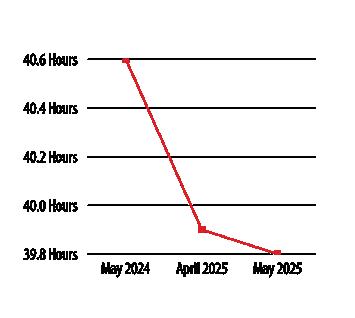
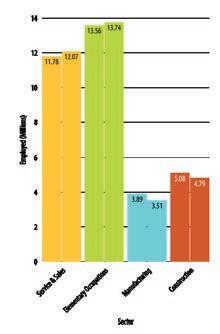
DESPITE the recent slowdown in the country’s inflation rate, economists believe more Filipinos will remain or become underemployed in the coming months, according to economists.
On Tuesday, the Philippine Statistics Authority (PSA) reported that while there was a decrease in the number of unemployed Filipinos, some 1.79 million joined the ranks of the underemployed. (See: https://businessmirror.com. ph/2025/07/08/more-pinoyslooking-for-new-side-jobs/).
Specifically, the data showed 951,000 more workers became visibly underemployed in May. This pegged the number of these Filipinos to 3.91 million, more than half of the total 6.6 million underemployed in the country.
GENERATION, TRANSMISSION CHARGES SEEN RISING IN JULY
By Lenie Lectura @llectura
THE Manila Electric Com-
Palace: PHL, US talks on tariffs ‘in a good place’
By Samuel P. Medenilla and Andrea E. San Juan
AS United States President Donald Trump starts declaring higher reciprocal tariffs for some countries like Japan and South Korea, Manila continues its trade talks with Washington in its bid to lower American custom duties on the Philippine goods, according to Malacañang.
In a press briefing on Tuesday, Palace Press Officer Claire Castro said Special Assistant to the President for Investment and Economic Affairs Frederick D. Go have yet to receive any official communication from his counterparts in the US for any changes in its current 10-percent tariff on Philippine goods entering its borders.
“This [underemployment] will continue despite the decrease in inflation. Lower inflation is tied to a general slowdown in the economy,” Ateneo de Manila University economist Leonardo M. Lanzona Jr. told BusinessMirror
“Commodity prices are down not because of government reforms but because of the sluggish economy. The claim that government is doing its part in reducing inflation is contradicted by the increase in underemployment,” he added.
Another economist from Ateneo,
pany (Meralco) said Tuesday that generation and transmission charges are likely to go up which may result in higher overall electricity rates for this month.
“While we have yet to receive all the final billings from our suppliers, indication point to a possibility of an increase in the generation charge this month,” said Meralco spokesperson Joe Zaldarriaga.
The generation charge is the largest component of an electric bill.
“This may be mainly due to the peso depreciation which will af -
fect dollar-denominated costs of our suppliers. We hope that the expected increase will be mitigated by lower WESM [Wholesale Electricity Spot Market] charges,” added Zaldarriaga.
Moreover, transmission charge could also increase due to the pressure in reserve market prices for the June supply month compared with the previous month.
Meralco will soon announce the final rates for July.
Last month, power rates went down by P0.1076 per kilowatt hour (kWh), which brought the overall rate for a typical household at P12.1552 per kWh.
Pass-through charges for generation and transmission are paid by Meralco to the power suppliers
A2
She declined to disclose any details about the negotiations due to the country’s existing confidentiality agreement with the US, but described the talks as currently in a “good place.”
“The Philippines and the US, have reached an agreement that there will be cooperation for the economic development of the Philippines,” she said. On Monday, the White House announced the extension for countries to negotiate deals to reduce or remove their tariff and non-tariff barriers for US goods until 1 August 2025.
The US also announced new tariff rates for the following countries: 25-percent tariffs for Japan and South Korea; 40 percent for Myanmar and Laos; 36 percent for Thailand; and 32 percent for Indonesia.
“We are looking at [the] supply chain, this is key as eventually [the] country of origin for this supply will be affected.”–Seipi Chairman Norberto Viera
Housing agencies told to fast-track 4PH rollout
By Bless Aubrey Ogerio @blessogerio
THE Department of Human Settlements and Urban Development (DHSUD) has directed its key shelter agencies (KSAs) to begin operationalizing its 8-Point Agenda, with a renewed push to fast-track the rollout of the government’s flagship housing initiative.
DHSUD Secretary Jose Ramon Aliling on Monday instructed the National Housing Authority (NHA), Social Housing Finance Corporation (SHFC) and the Home Development Mutual (Pag-Ibig) Fund to implement specific priority actions aligned with the Marcos administration’s housing directives.
“All key shelter agencies are hereby directed to align, implement and operationalize the following priority actions within their respective offices,” Aliling stated in the memorandum.
Among the immediate tasks is the turnover of completed but unoccupied housing units to verified beneficiaries. The NHA and SHFC were also ordered to conduct a full inventory of all governmentfunded housing projects to assess progress and identify bottlenecks.
For its part, the Pag-Ibig Fund has been designated as the financing partner for joint ventures with the NHA and SHFC, aimed at accelerating the implementation of the expanded Pambansang Pabahay
para sa Pilipino (4PH) Program nationwide.
Pending project applications under 4PH must also be acted upon without delay, according to the department’s directive.
Also, as part of process streamlining, the DHSUD ordered immediate support for one-stop shop housing service centers.
with original maturity of one year or less, plus principal payments on medium- and long-term loans of the public and private sectors falling due within the next 12 months. Further, the level of GIR as of a particular period is considered adequate, if it provides at least 100 percent cover for the payment of the country’s foreign liabilities, public and private, falling due within the immediate 12-month period.
The data also showed the net in-
ternational reserves increased by $0.3 billion to $105.3 billion as of end-June 2025 from $105 billion as of end-May 2025. Net international reserves refer to the difference between the BSP’s reserve assets or GIR and reserve liabilities—short-term foreign debt and credit and loans from the IMF. The BSP said the GIR is made up of foreign-denominated securities, foreign exchange, and other assets including gold. It also helps the country finance its imports and foreign debt obligations, stabilize its currency, and provide a buffer against external economic shocks.
Cai U. Ordinario
“All KSAs are enjoined to submit their respective status/ inventory reports of all pending cases, applications and other actionable documents together with its corresponding program of action on the above–stated directives not later than 15 days from receipt hereof,” Aliling said.
the national government raised P300 billion from the issuance of 10-year local Treasury notes toward the end of April 2025, which siphoned off some of the excess liquidity held in the financial system.
However, the growth of M3 was kept afloat after the recent reduction in the banks’ reserve requirement ratio (RRR) to 5 percent for large banks, infusing about P330 billion into the banking system.
“[This] could fundamentally lead to faster M3/domestic liquidity growth and could even be possibly reduced to zero within the term of BSP Governor Remolona from the current 5 percent for large banks, or equivalent to a total more nearly P1 trillion as of now; but any further RRR cuts, which add more peso liquidity in the banking/financial
system, would be gradual in the coming years,” Ricafort said. Meanwhile, BSP data showed claims on the domestic sector, which includes private and government entities, rose by 10.7 percent year-on-year in May from 10.9 percent in April. The claims on the private sector alone grew by 10.9 percent in May from 11.5 percent in the previous month, driven by the continued expansion in bank lending to non-financial private corporations and households. Net claims on the central government increased by 9.1 percent from 9.3 percent, driven by its higher borrowings. Net foreign assets (NFA) in peso terms decreased by 4.6 percent year-on-year in May from the 0.2-percent decline in April. The BSP’s NFA fell by 4.4 percent primarily due to the peso’s appreciation against the US dollar. Meanwhile, banks’ NFA declined largely on account of higher foreign currency-denominated bills payable.
member, and two full-time members must come from the commuting public, including road safety organizations.
The PTSB Board chairman shall also ap-
point an Executive Director, who shall be 35 years old at the time of his appointment, a member of the Philippine bar and a practicing lawyer for at least 10 years prior to the date of his appointment. “He also must not have been a candidate for any elective position in the elections immediately preceding his appointment.”
Lapid said, the proposed law, filed at the opening of the Senate on July 1, 2025, “represents a proactive approach to transportation safety, emphasizing the importance of learning from past incidents to prevent future ones. By establishing the PTSB, this bill seeks to create a safer transportation environment for all Filipinos, ensuring that transportation-related incidents are meticulously investigated, responsible parties are held accountable, and valuable knowledge is provided to policymakers for the betterment of the nation.”
may eventually be affected by Washington’s tariff policy.
US Secretary of State Marco Rubio is set to make his first visit to Southeast Asia, particularly Malaysia, this week to tackle several issues including trade and tariff.
Trump imposed the so-called reciprocal tariffs on imports from nearly all countries in April as part of his efforts to encourage multinational firms to relocate their production to the US. The Philippines was slapped with a 17-percent tariff that time.
On April 9, the US opted to defer by 90 days the tariff rates higher than 10 percent on all its trade partners, except for China, to give countries more time to negotiate for lower US tariffs.
Since the start of the trade talks, the US has forged revised trade frameworks with China and the United Kingdom. Trump also announced the US has signed a trade deal with Vietnam, which lowers the USimposed tariff from 40 percent to 20 percent.
Semicons: Eye on supply chain
IN a related development, the semiconductor and electronics industry in the Philippines, though currently exempted from tariffs slapped by the US on its trading partners, is monitoring developments along the supply chain, as it expects the Philippines’s source countries for its raw materials
“For the semiconductor export to the US, we were not affected as this was not applied to the Philippines’ export of semiconductors to the US. I believe the semiconductor is exempted so we did no work on contingencies,” Semiconductor and Electronics Industries in the Philippines Foundation Inc. (Seipi) Chairman Norberto Viera told the BusinessMirror in a text message on Tuesday.
“We continue to ship semiconductors to the US as of today. Not sure [about] the coming months as Trump policy keep changing. We are looking at [the] supply chain, this is key as eventually [the] country of origin for this supply will be affected,” Viera added.
While no contingency plans have been put in place, the industry, he said, is “reviewing countries where we get our materials and we are developing alternative sources.”
Viera said materials are sourced mostly from the United States, China, Malaysia, Taiwan and Japan.
The Seipi chairman underscored that the industry has so far been spared from any impact brought about by geopolitical developments such as Washington’s tariff policy and the conflict in Middle East.
“No impact yet, we are actually seeing an uptick of demand. Hopefully, we are seeing a start of recovery. We are not affected by the Middle East conflict,” Viera also told this paper.
Moving forward, the Seipi chairman believes “we can sustain the export [revenues].”
and the grid operator, respectively.
Meralco’s distribution charge, meanwhile, has not moved since the P0.0360 per kWh reduction for a typical residential customer
Data published on Seipi’s website showed the country’s electronics exports climbed by 1.44 percent from $19.08 billion in January to May 2024 to $19.36 billion in the fivemonth period in 2025. Electronics now accounts for 56.60 percent of the Philippine exports pie. Seipi noted that the US is the Philippines’s second top destination for electronics shipments in May 2025, equivalent to 14.40 percent of the Philippine semiconductor and electronics industry’s exports.
Data from Seipi showed the Philippines exports semiconductors components/devices, electronic data processing, telecommunication, consumer electronic products to the United States. Hong Kong is the Philippines’s top export destination in the space of semiconductor and electronics.
Last month, Seipi President Danilo C. Lachica said the industry may reach the industry’s 2022 level in export revenues—about $46 billion—but he later called this a “wish.”
“If you look at the year-to-date numbers, we may even reach the scale of what we have…[in 2022] to the tune of about $46 billion,” Lachica said at a forum in June 2025. In 2024, Philippine Statistics Authority (PSA) data showed the country’s semiconductor and electronics exports reached $39.08 billion.
Lachica earlier said the industry might see some “modest growth” this year compared to last year. The Philippine semiconductor and electronics industry have contracted two years in a row, he noted.
beginning August 2022. Meralco also reminded qualified customers to apply for available subsidy mechanisms, namely, the lifeline rate program and/or the senior citizen discount.
DHSUD Secretary Jose Ramon Aliling PHOTO FROM DHSUD WEBSITE
House impeachment prosecutor to senator: What ‘witch hunt?’
By Jovee Marie N. dela Cruz @joveemarie
AMEMBER of the House of Representatives impeachment prosecution panel on Tuesday assailed Sen. Juan Miguel Zubiri for calling the impeachment proceedings against Vice President Sara Duterte a “witch hunt,” saying the remark was inappropriate and premature coming from someone who will serve as a senator-judge.
Iloilo Rep. Lorenz Defensor emphasized that members of the Senate who will sit in judgment should refrain from making public statements that appear to prejudge the case or suggest a predetermined outcome—especially before any evidence has been formally presented.
“It’s very unbecoming of a senator-judge in an impeachment trial to say that the impeachment complaint and the trial are a witch hunt,” said Defensor.
“That should not come from a senator-judge, who is expected to receive and evaluate the evidence with impartiality and uphold the integrity of the constitutional process.”
Asked about the potential impact of such remarks, Defensor warned that they may be interpreted as a preemptive move to dismiss the case.
“Statements like that could be seen as telegraphing an early dismissal, even before the trial has
officially begun,” he said.
He added that such comments could undermine public trust in the Senate’s role as an impartial body tasked with weighing the merits of the impeachment complaint.
“It affects the people’s perception of how the case will go about and how the trial will proceed. It’s telegraphing how they want the case to be decided early on, even before the evidence is presented,” Defensor said.
Defensor reminded the public that impeachment is a constitutional process carried out by elected representatives acting on behalf of the people. He noted that more than 215 House members voted to transmit the complaint to the Senate, a sign that the complaint is backed by substantial support.
“Remember that the impeachment is a political process. It is an act not only by the members of Congress but also by representatives of Filipinos who were delegated by the people to initiate impeachment proceedings,” he said.
He also urged restraint from passing judgment before all the facts are laid out.
He added that the House prosecution panel is confident in the strength of its case, having submitted what he described as a wellargued and comprehensive reply to the vice president’s answer to the complaint.
Pangilinan, Cuneta settle cyber libel case with movie reporter
By Butch Fernandez @butchfBM
SAYING “all’s well that ends well,” Sen. Francis Pangilinan, together with his wife Megastar Sharon Cuneta, reached an out-of-court settlement with veteran movie reporter Cristy Fermin on the cyber libel cases they filed against her in 2024.
In a statement, the Office of Senator Pangilinan confirmed that both parties have settled the case out of court, via a mediation process. This, after a city prosecutor indicted Fermin in 2024, forcing her to post bail.
The Pangilinans’ counsel, Maria Fricela Kim of the Britanico, Sarmiento, and Ringler Law Offices, disclosed that the parties have settled during a mediation procedure with the Philippine Mediation Center, and affirmed the settlement at the Branch 148 of the Regional Trial Court in Makati on Tuesday, July 8.
“We also manifested that due to the settlement, we are permanently desisting from pursuing the case,” she said.
“Since the prosecution cannot proceed without the cooperation of the private complainants, [the] judge ruled that the case is dismissed for lack of evidence and Fermin is found not guilty,” the lawyer added.
Pangilinan welcomed the dismissal of the case and thanked the Court and the mediation center for assisting in the settlement process.
Ikanganila‘All’s well that ends well.’ We’re happy we can finally move forward from this case,” the senator said.
In October 2024, Fermin was indicted for five counts of libel filed against her by the Pangilinans in May that year. She posted bail as the cases were brought to the RTC. The cases were based on a 2023 report by Fermin in her online show about the Pangilinan family.
Finally, Filipino child now central to education–CCPI
THE Department of Education’s (DepEd) decision to adopt Filipino and English as the primary languages of instruction for Kindergarten to Grade 3 learners has finally placed the Filipino child at the core of national education policy, the Chamber of Commerce of the Philippine Islands (CCPI) said.
Starting school year 20252026, the new directive shifts away from the Mother Tongue-Based Multilingual Education (MTBMLE) policy and aims to address its longstanding implementation challenges, especially in linguistically diverse and resource-limited classrooms.
“This shift places the Filipino child at the center of education policy,” CCPI president Jose Luis Yulo Jr. said. “It bridges learning gaps, supports comprehension, and aligns our learners with global competencies.”
The group said the DepEd’s direction reflects its own advocacy under Pillar 5 of the Economic Compass
Ranking govt gaming firm exec linked to Atong Ang
T(Ecomp-P5), which envisions all Filipinos having access to the best possible education system. Under this vision, learners are expected to become correctly bilingual in Filipino and English, with exposure to an additional dialect or language when appropriate, while also being taught to think critically and uphold universal family and cultural values.
Meanwhile, the oldest business institution in the country also urged policymakers to repeal Republic Act 12027, or the Act of Discontinuing the Use of the Mother Tongue as Medium of Instruction from Kindergarten to Grade 3, which was enacted last year.
While the law removed the mandatory use of the mother tongue as a medium of instruction, it still permits its optional use in monolingual classrooms— something CCPI warned could hinder the full and unified implementation of the new learnerfocused framework.
Bless Aubrey Ogerio
By Joel R. San Juan @jrsanjuan1573
HE Supreme Court (SC) has started its investigation into the claim of missing sabungeros’ whistleblower Julie “Totoy” Patidongan that a former judge—now a top official of a government gaming agency— acted as a facilitator or “fixer” for businessman Charlie “Atong” Ang.
This was confirmed by Justice Secretary Jesus Crispin Remulla following his conversation with Chief Justice Alexander Gesmundo on Monday on the possible influence over the judiciary of the mastermind behind the disappearance of the more than 30 cockfighting aficionados four years ago.
In a recent radio interview, Patidongan claimed the former judge holds a high-ranking post in the Philippine Charity Sweepstakes Office and enjoys continued protection from some ranking officials in the government.
Patidongan, a long time trusted aide and farm manager of Ang, has turned key witness in the missing sabungeros case after being charged with kidnapping and serious illegal detention along with several security personnel employed by .
“Actually, ini-imbestigahan na siya ng Supreme Court ” Remulla said told reporters.
Irregular behavior
REMULLA also hinted that the SC investigation might go beyond the former judge as it is looking into “irregular behavior that is not good for the judiciary.”
“They are very sensitive about what should be done to improve our justice system. And the Su -
preme Court is the best ally we have for this.”
Remulla also confirmed that Patidongan had issued a sworn statement, but discussions on whether he will be admitted as a state witness are still ongoing.
“We were discussing that this morning with the Prosecutor General, but we haven’t concluded anything yet,” he said.
Ang has denied Patidongan’s allegations against him and accused the latter of trying to extort P300 million from him in exchange of not dragging his name on the case of missing sabungeros.
SC confirmation
THE Supreme Court (SC) on Tuesday confirmed that it is now investigating the information relayed by the Department of Justice (DOJ) that an individual allegedly involved in the missing sabungeros case may be exerting influence over judges and justices.
In a statement released through the SC-Public Information Office (PIO) chief, lawyer Camille Sue Mae Ting, the Court said it considers the information with “utmost seriousness” which warrants an independent and thorough investigation.
“When warranted, appropriate actions are taken in accordance with established procedures,” the statement read.
“It is the policy of the Court to receive and act on credible reports of corruption, including those coming from high-ranking government officials such as the Secretary of Justice,” it added.
It also urged the public to remain vigilant and report any form of corruption within the judiciary directly to integrity@judiciary. gov.ph.
DOJ prepares charges
REMULLA yesterday said government lawyers are now readying the filing of charges against individuals allegedly involved in the abduction and killing of more than 30 missing sabungeros or cockfighting aficionados.
In an interview with reporters, Remulla said among the charges being eyed against these individuals are kidnapping, violation of Republic Act 9851 or An Act Defining and Penalizing Crimes Against International Humanitarian Law, Genocide and other Crimes Against Humanity, murder and other criminal offenses.
“We are rolling by the day, we’re looking at everything by the day and at the same time our lawyers are in conference about the cases that are being evaluated for filing…,” Remulla said. He added that authorities are taking steps to take into custody the owner of the fishpond in Taal Lake that was leased by one of the suspects in the missing sabungeros case.
The fishpond is believed to be the ground zero where the bodies of the missing sabungeros were dumped.
Remulla also disclosed that there are individuals who have gotten in touch with the DOJ either to clear their names or offer their cooperation in the ongoing investigation.
“Some of them will be corroborating the activities of the Alpha
Lotilla tells DENR execs to take ‘bolder, more strategic’ role in defending WPS
SBy Jonathan L. Mayuga @jonlmayuga
ECRETARY Raphael Lotilla
recently called on Department of Environment and Natural Resources (DENR) officials to take a bolder, more strategic role in defending the Philippines’ maritime rights over the West Philippine Sea (WPS).
Lotilla underscored the agency’s critical role in reinforcing the victory through scientific data, environmental reports, and legalenvironmental strategies.
“These are essential to informing both Filipinos and the international community, protecting our marine environment from destruction, and showing that we are actively defending what is rightfully ours,” Lotilla said in a statement.
The DENR chief vowed to mobilize the DENR’s environmental, legal, and scientific capabilities in support of national sovereignty. Among his directives are to strengthen inter-agency coordination, publish marine environmental reports, and launch grassroots awareness campaigns.
“The DENR is not just a steward
of forests and rivers,” Lotilla said. “We are frontliners in protecting what is ours—from ridge to reef, and across our rightful seas.”
The 2016 ruling by the Permanent Court of Arbitration declared China’s expansive claims under its so-called “nine-dash line” invalid and affirmed the Philippines’ sovereign rights within its Exclusive Economic Zone (EEZ). However, as Lotilla emphasized, “This landmark legal victory must not be taken for granted—the work is far from over.”
At a symposium hosted by Lotilla for DENR officials on June 23, Senior Supreme Court Justice Antonio Carpio, one of the most respected voices on the issue, presented historical and legal evidence affirming Philippine ownership of key islands and reefs in the WPS. He urged the country to develop a unified narrative to counter disinformation and challenge China before the international community, backed by legal and environmental evidence that the DENR can help provide.
Lawyer Freddie Ganton, Senior State Counsel at the Department of Justice and an expert in maritime
and environmental law, emphasized that the Philippine Maritime Zones Act and the Archipelagic Sea Lanes Act align domestic law with United Nations Convention on the Law of the Sea (Unclos), clearly defining the country’s maritime zones and strengthening the legal basis for exercising jurisdiction over Philippine waters.
Ganton added that these measures integrate the 2016 arbitral ruling into Philippine law, giving the country firmer authority to protect marine resources, regulate activities, and assert sovereignty. They also institutionalize the term “West Philippine Sea,” further strengthening the country’s position in both law enforcement and diplomatic engagement.
Fernando P. Siringan, marine geologist and former director of the UP Marine Science Institute, on the other hand, stressed that scientific research is vital to uphold the Philippines’ maritime rights, and called for greater investment in coordinated research, habitat mapping, and ecological monitoring to generate data that can reinforce the 2016 arbitral ruling and support long-term marine protection.
Group. We are seeing many possibilities here because this is not just about the Alpha Group. There is also the Delta Group, Charlie Group, Bravo Group. It’s tiered according to the income stream that they all receive out of this e-sabong industry,” the DOJ chief said. He said these groups are composed of businessmen, government functionaries and others.
Corporate killings
REMULLA dubbed the case of missing sabungeros as “corporate killings,”as he appealed to those who are involved in the disappearance of the cockfighting enthusiast to come forward early before authorities catch up with them.
“In the long run, the case is going to haunt all of them. This is a long drawn out case and the earlier they come in, the better,” he said.
Meanwhile, Remulla said the team that will conduct the search for the missing sabungeros in Taal Lake is still waiting for some equipment to be used before conducting the exploratory dive. Among these equipment are the remote operating vehicles (ROVs) being requested from the Japanese government and other equipment from the Department of Environment and Natural ResourcesMines and Geosciences Bureau (DENR-MGB) that will be used to comb the lake bed of Taal.
The composite team that will conduct the exploratory dive will be composed of the Navy (PN), the Coast Guard (PCG), the MGB and the National Police Maritime Group (PNPMargroup).
Remulla said the Justice Undersecretary Eliseo Cruz will be in-charge of the composite team while Justice Assistant Secretary Jose Dominic Clavano IV is incharge of coordinating with the Japanese government the Philippine’s request for ROVs. The DOJ chief earlier said the team is eying to conduct the exploratory dive within the week.
Navy spots 49 Chinese ships at WPS in June
ATOTAL of 49 Chinese navy and coast guard ships were detected in three West Philippine Sea (WPS) land features in June, a ranking Navy (PN) official said on Tuesday.
“The PLAN [People’s Liberation Army Navy] and the [China] Coast Guard monitored in our features are as follows. For Bajo de Masinloc, nine Coast Guard vessels and 14 of the PLAN. Ayungin Shoal, 12 Coast Guard and two PLA Navy and for Pag-asa, nine for the Coast Guard and three for the PLA Navy for a total of 49,” the PN spokesperson for the WPS, Rear Adm. Roy Vincent Trinidad, said in a media briefing. He also clarified that these ships were not there all the time, but were in and out of the different WPS features.
“For the month of June, our monitoring over the entire archipelago gave us 15,305 vessels, maritime traffic, of which 2,954 were domestic ships and 12,302 were international vessels,” Trinidad said. And when asked if June’s numbers jumped to 49 compared to May’s 41, the PN official said they have no direct reference on its tactical implications.
“Probably it’s the factor of the weather or the deployment cycle, maintenance and repair.” Rex Anthony Naval
DMW bans sending of Pinoy seamen to ships plying Red Sea, Gulf of Aden
By Samuel P. Medenilla @sam_medenilla
OWING to the recent attacks by Houthi rebels on two ships, which endangered the lives of 38 Filipino seamen, the Department of Migrant Workers (DMW) banned the principals of both vessels from deployingt more Filipino marines on ships whose routes pass through the Red Sea and the Gulf of Aden.
In an online news conference on Tuesday, Migrant Wowker Secretary Hans J. Cacdac said the agency will come out with the order imposing the restriction on the owners of MV Magic Seas and MV Eternity C.
“Both principals in the MV Magic Seas and the MV Eternity C will definitely be prohibited from boarding Filipino seafarers on their ships should they insist to navigate or traverse the Red Sea and Gulf of Aden,” he said.
“We do not want any more Filipino casualties in the Red Sea and Gulf of Aden,” he added.
DMW reminded other shipowners with Filipino crew members to avoid passing through the Red Sea and Gulf of Aden. It noted sailors onboard the ships should be given the right to refuse from sailing on the high risk waterways.
The agency also said the passage of ships to the Red Sea and Gulf of Aden should be reported to the DMW.
“Failure to report such a significant event will result in the imposition of sanctions under DMW rules upon the manning agent and the principal,” Cacdac said.
The attack against MV Magic Seas happened on Sunday near the coast of Hodeidah, Yemen, which left the ship severely damaged and abandoned by its 19 crew members, 17 of whom are Filipinos.
The Filipino mariners were rescued and transported to Djibouti and will soon be repatriated, according to Cacdac.
The DMW chief said MV Eternity C, a bulk carrier, suffered heavy attacks from Houthi rebels, which made use of sea drones and fast-moving skiffs with armed assailants with rocket propelled grenades. MV Eternity C has 22 crew members, including 21 Filipinos.
Cacdac said the department is still determining if there were any Filipinos among the two wounded and two missing MV Eternity C crew members, as reported by the international media.
“We have reached out to more than 50 percent of the 21 families...Myself and fellow DMW officials have been doing the contacting we want to make sure that we ourselves are in contact with the family we will have a virtual meeting with them later today because this is the President’s directive to take care of the families and to monitor the situation with our seafarers,” he added.
Marcos eyes ‘better policy’ on online
gambling–spox
PRESIDENT Marcos is seeking a “better” policy to address issues concerning online gambling, Malacañang said on Tuesday.
Speaking to reporters, Palace Press Officer Claire Castro said Marcos understands the sentiments of families that are having problems with a household member because of addiction to online gambling games.
“Ang Pangulo po ay nakikisimpatiya sa mga pamilya na nabibiktima ng ganitong klaseng gambling dahil po iyong iba nilang kasama sa bahay ay nagiging gumon sa pagsusugal [The President sympathizes with families who fall victim to this type of gambling because other members of their household have become addicted to gambling],” Castro said.
“So, iyan po ay tinitingnan din ng Pangulo para maging mas maganda ang maging patakaran pagdating sa
online gambling [the President is looking into that in order to come up with a better policy on online gambling].”
Marcos is open to the Department of Finance’s proposal to regulate and impose taxes on online gaming platforms, Castro said on Monday.
The Philippine Amusement and Gaming Corp. (Pagcor) and the Department of Information and Communications Technology (DICT) are collaborating to take down all illegal gaming websites.
The DICT has so far removed 7,000 unauthorized online gaming sites identified by Pagcor, according to data released by Malacañang on June 19.
The Palace also encourages the public to report to Pagcor the names of individuals who are getting addicted to deny them access to any online gaming platforms. PNA
Calls vs online gambling mount
By Jovee Marie N. dela Cruz @joveemarie & Claudeth Mocon-Ciriaco @claudethmc3
DESCRIBING the rise of online gambling as a “moral and social emergency that must be urgently addressed to prevent the digital plague from consuming more lives,” a lawmaker is pushing for a bill that seeks to repeal all existing laws and legal authorities permitting any form or level of online gambling in the country.
Party-list Rep. Eddie Villanueva of CIBAC has renewed his urgent appeal for the passage of House Bill 637, or the “Anti-Online Gambling Act of 2025.”
The veteran lawmaker and faith leader stressed that the disturbing spate of disappearances and deaths linked to online cockfighting, or e-sabong, underscores the urgent need for a total ban on all forms of internet-based gambling.
“Online gambling will continue to wreak havoc in our society by destroying lives, families, and futures, unless we stop it. The deaths and disappearances of the ‘sabungeros’ are only the tip of the iceberg and are doomed to be a recurring symptom of a deeper social ill caused by greed. We must put these to an end once and for all,” said Villanueva.
Under HB 637, the placing, receiving, or transmission of bets through any online or digital platform would be outlawed. The bill also imposes heavy penalties, including imprisonment and fines, on violators. Public officials found promoting or enabling online gambling would face the maximum penalties and be permanently disqualified from holding public office.
“The disappearance of the sabungeros is a tragic manifestation of how online gambling has spiraled into lawlessness. Esabong was just one form. What happens when other online gambling platforms follow the same path of violence and exploitation?” he added.
Moral battle
VILLANUEVA also framed the issue as a moral battle, stating that gambling is “inherently opposed to God’s will” because it encourages covetousness and the love of money—traits that he said corrode both personal values and community well-being.
“Gambling is a direct violation of the 10th decree in God’s Ten Commandments, which warns us from coveting others’s possessions. Gambling is simply succumbing to a get-rich-quick formula, which has led many to debt traps and poverty,” added Villanueva.
Echoing Villanueva’s call, Manila Rep. Rolando Valeriano backed a total ban on online gambling, arguing that stricter regulation is ineffective and easily circumvented.
“Stricter regulation will not work—neither for legal nor illegal online gambling,” Valeriano said. “Addicted gamblers, even minors, find ways to bypass ‘know-your-customer’ protocols. In many homes, families share smartphones and accounts. Kids are more tech-savvy than adults— they will always find a way.”
Valeriano pointed out that gamblers pool resources, share devices, and even resort to theft or selling drugs just to sustain their addiction.
He emphasized that regulatory and enforcement agencies must act within their powers. “The National Telecommunications Commission [NTC] can already block illegal online gambling signals.
The Bangko Sentral [BSP] should expedite the release of its new circular and tighten anti-gambling regulations.”
He also noted that on digital platforms, legal and illegal gambling apps appear identical. “The social cost far outweighs any tax revenues. If people want to gamble, they should do it in regulated onsite venues like casinos—not on mobile phones where children and vulnerable individuals can easily access it.”
Bold legislation
A FORMER anti-graft commissioner called for “bold legislation” to shield youth and vulnerable groups from online gambling harm by passing a law that bans all forms of online gambling advertising, similar to Italy’s landmark “Dignity Decree.”
“Italy did what many countries were afraid to do—they drew a red line...This is not innovation—it’s exploitation,” said lawyer Nicasio Conti, chief executive officer of Capstone Intel Corp. and former Commissioner of the Presidential Anti-Graft Commission (PAGC) as he urged Congress to take a decisive step against gambling addiction.
In a press statement, Conti cited Italy’s 2018 legislation which imposed a sweeping ban on gambling advertisements in all media platforms—including online, television and radio, as well as sports sponsorships.
The move, he said, was a necessary public health measure that the Philippines should replicate.
“They understood that gambling addiction doesn’t start in a casino. It starts with an ad on your phone, a logo on a jersey, or an influencer selling ‘easy money’. Congress must now show that same courage.”
Conti, whose private intelligence firm monitors digital threats and online consumer behavior, warned that the unregulated spread of online gambling ads in the Philippines—particularly through social media platforms like TikTok and Facebook—has led to a surge in underage betting and financial losses among low-income earners.
“We are seeing a disturbing trend: college students gambling away their allowances, minimumwage earners hooked on online bingo, and influencers normalizing betting as entertainment,” he said.
He pointed to the Italian model as proof that a total advertising ban is both legally enforceable and socially effective, despite initial backlash from sports leagues and betting companies.
Under Italy’s Decreto Dignità (Dignity Decree), all forms of gambling promotion are prohibited, with violators facing steep penalties of up to €50,000 per violation. The law has since been credited with helping reduce youth gambling rates and strengthening public awareness of gambling addiction.
“If Italy can do it—with one of the largest gambling industries in Europe—why can’t we?” Conti asked.
“The Philippines must stop hiding behind so-called revenue gains and prioritize public health and moral responsibility,” he added.
He also noted that gamblingrelated sponsorships and advertising are often disguised as digital content, making it harder for regulators like the Ad Standards Council (ASC) and PAGCOR to monitor them effectively.
“No amount of disclaimers or responsible gambling slogans can undo the psychological impact of a celebrity telling kids that betting is fun,” Conti added.
Conti called on lawmakers to introduce a “Gambling Advertisement Prohibition Act” that would: n Ban all direct and indirect gambling ads on digital, print, and broadcast platforms n Prohibit gambling sponsorships in professional and amateur sports n Penalize companies and individuals promoting gambling through social media or streaming n Require public platforms to report and take down gamblingrelated content within 24 hours
He also proposed using gambling tax revenues to fund addiction treatment and nationwide awareness campaigns.
“This is not an attack on gambling per se. This is about protecting children, the poor, and the digitally vulnerable from a highly manipulative industry. We can regulate the game—but let’s stop glamorizing it,” he clarified.
Conti concluded with a challenge to legislators: “Be bold. Be like Italy. Protect the Filipino before it’s too late.”
Parañaque congressman eyes special employment office for PWDs, seniors
TO combat unemployment and discrimination faced by persons with disabilities (PWDs) as well as senior citizens, a lawmaker is calling for the establishment of dedicated public offices at the local government level that will work in partnership with the private sector to help these vulnerable groups find jobs and access training programs.
citizens who are often left behind owing to limited training, a lack of information on job opportunities, and persistent bias in hiring practices.
Parañaque Rep. Brian Raymund Yamsuan said the proposal aims to empower employable PWDs and senior
“Disabled persons and seniors who are fit to work can become productive members of our economy if given the chance. However, many PWDs and elderly citizens remain poor because they find it difficult to get hired for jobs that suit them,” Yamsuan said.
“Their talents, dedication, and work ethic are being wasted. Instead of being ignored or pitied, they should be recognized as capable contributors to our economy,” he added.
Yamsuan said he will re-file in the 20th Congress a bill mandating the Department of Labor and Employment (Dole) to establish and manage Local Centers for Inclusive Employment (LCIEs). These job facilitation centers—set up upon the request of local
governments (LGUs) in capital towns, key cities, and other strategic locations—will specifically cater to the employment and skills development needs of PWDs and senior citizens.
The proposal is a revival of a measure Yamsuan filed in the previous Congress, which was based on extensive consultations with senior citizens and PWDs in Parañaque City. Among the most common concerns raised during these meetings were the lack of targeted government support and the difficulty of finding jobs that match their capabilities.
“Our proposed bill is in support of the agenda of our President [Marcos] to implement beneficial policies and programs that will guarantee equitable opportunities, special interventions and incentives for PWDs, as well as seniors,” said Yamsuan, ahead of this year’s celebration of National Disability Rights Week on July 17 to 23. Yamsuan said that despite the enactment of laws that aim to encourage the hiring of PWDs and seniors, government data show low labor participation rates in these sectors.
Data from the Philippine Statistics Authority (PSA) reveal that only 353,000 PWDs were gainfully employed out of the 1.9 million who are within working age in 2022. In the same year, the elderly sector
faced a similar predicament where only 38.2 percent or about 965,200 of 2.54 million qualified senior citizens were employed. A study done by the Institute for Labor Studies (ILS) found that most PWDs are unaware that they can seek assistance in finding jobs through
Romualdez unveils priority bills, seeks unity for Marcos’ agenda
By: Jovee Marie Dela Cruz @joveemarie
DAYS before the 20th Congress formally convenes, House Speaker Ferdinand Martin G. Romualdez on Tuesday gathered lawmakers from Central and Southern Luzon—including returning, first-term, and reelected members led by former President and Pampanga Rep. Gloria Macapagal-Arroyo—to consolidate support for President Marcos’ Bagong Pilipinas agenda and align on legislative priorities.
Speaking before Members from Regions III and IV, Romualdez urged unity behind the President’s policy direction, which will be fully outlined in his upcoming State of the Nation Address (SONA) on July 28.
He also unveiled the first 20 bills he filed under the 20th Congress, describing them as cornerstones of a broad-based reform agenda.
“These measures are designed not only to support the President’s vision but also to address real needs on the ground—from food security to healthcare, education to digital governance, and job creation to national security,” Romualdez said. He emphasized the importance of grassroots consultation in policymaking and sought input from regional representatives on development priorities needing national support.
“Our job in Congress is to ensure national development reaches every district, every barangay, every Filipino,” Romualdez
Lawmaker says govt has no power to recall Duterte from ICC despite Senate resolution
ALAWMAKER on Tuesday emphasized that the Philippine government has no authority to bring former President Rodrigo Roa Duterte back from the custody of the International Criminal Court (ICC), saying that even a Senate resolution urging his return carries no legal weight.
Bicol Saro Party-list Rep. Terry Ridon made the remarks in response to a resolution filed by Senator Robinhood Padilla, backed by Sen. Ronald “Bato” dela Rosa and Christopher “Bong” Go—known allies of Duterte under PDP-Laban—urging the “immediate return” of Duterte from The Hague.
“Well, I think we have to be very frank that there’s nothing that the Philippine government can do today to bring the former president back home,” Ridon said.
“The ICC will decide whether or not the former president can return,” he added.
According to Ridon, the nature and seriousness of the charges filed against Duterte place the matter squarely under international jurisdiction.
“To be clear, there are legitimate grounds for former President Rodrigo Duterte’s presence at the ICC. He is facing accusations of crimes against humanity related to extrajudicial killings during his administration’s drug war. These are serious allegations,” Ridon said.
Duterte, now 80, was arrested on March 11 after arriving in Manila from Hong Kong, based on an ICC warrant for alleged crimes against humanity linked to the deadly war on drugs. He was flown to The Hague the same day and appeared via video before ICC judges on March 14. A hearing to confirm the charges is scheduled for September 23. Ridon stressed that while the Senate resolution is symbolic, it has no bearing on the ICC’s legal process.
“Of course, they are free, obviously, to do a Senate resolution. But we have to be very frank. It is not within the power of the Philippine government to send the former president back home,” he reiterated.
Padilla had cited public clamor from Mindanao and recent pro-Duterte rallies as reasons for his resolution.
Asked about this, Ridon responded: “Yes, but that’s no longer for the Philippine government to act on. It’s now in the hands of the ICC.”
The ICC accuses Duterte of crimes against humanity for allegedly establishing and supporting death squads responsible for the killings of thousands of suspected drug users and dealers during his tenure as Davao City mayor and president.
Mamamayang Liberal (ML) Party-list Rep. Leila de Lima on Tuesday slammed the Senate resolution calling for the immediate return of Roa from ICC detention, describing it as pure political posturing with no legal bearing on the ongoing case.
“I think that’s just political posturing [the Senate resolution] because it is no longer within the power of our government to bring him [Duterte] back,” De Lima, a former senator and justice secretary, said in a media interview.
De Lima explained that the ICC is an independent international tribunal with competent jurisdiction over the alleged crimes committed by Duterte during his administration’s brutal anti-drug campaign.
He appeared before ICC judges via video on March 14, and a pre-trial hearing to confirm the charges is scheduled for September 23.
The ICC has accused Duterte of crimes against humanity for allegedly ordering, funding, and enabling death squads responsible for thousands of extrajudicial killings while serving as Davao City mayor and Philippine president.
De Lima, one of Duterte’s most vocal critics and a former Commission on Human Rights chair, warned that the ICC will not be swayed by any domestic resolutions or political pressure.
De Lima underscored that Duterte’s legal team has already filed a request for interim release, and the matter is now solely in the hands of the ICC Pre-Trial Chamber. Jovee Marie Dela Cruz
NFA to auction aging rice stocks as buffer surges to 400,000MT amid market concerns
THE National Food Authority (NFA) will auction off its aging rice stocks as early as August to free up warehouses after its buffer stock surged to over 400,000 metric tons (MT).
NFA Administrator Larry Lacson said the NFA Council has approved the guidelines that would govern the trade of its aging rice stocks.
“The [plan to] auction is in the works [...] when we create the group, we’ll start to auction off some of our stocks,” Lacson told reporters during the QC Journalists’ Forum on Tuesday.
He noted that the first auction might begin next month following preparations.
The NFA chief said the floor price would be based on prices in the world market, as stipulated under the guidelines. Furthermore, he noted that the agency would prioritize trading older stocks or those that have been stored in the agency’s warehouse for five months.
Lacson said the agency’s buffer stock stands at 437,000 metric tons (MT) of milled rice equivalent or 8.7 million 50-kilo bags as of mid-June, which could feed the nation for 12 days.
“With the number of our stocks, and at the rate we are going with the P20 [program], there are more palay coming in than there is rice going out,” he said.
Despite this, the NFA chief noted that the
release of rice stocks remains “manageable,” with the resumption of sales to government agencies without the need to auction, as per the Office of the Government Corporate Counsel (OGCC).
Such agencies include the Bureau of Jail Management and Penology (BJMP) or respective city jails of local government units (LGUs) for persons deprived of liberty (PDL).
“[The release] is still slow. It’s not the speed we want,” Lacson said. The NFA chief did not disclose the initial volume of aging rice stocks that would be traded, since this remains under consultation. He noted that the auction would cover all regions nationwide.
However, Lacson raised a concern about the auction’s viability, given the current market conditions for rice, whose international prices have been on a downtrend.
Industry sources noted that the landed cost of rice hovered between P24 and P26 per kilo for the past two months.
“Now, there would be an auction when rice prices are at their lowest. I don’t know if there will be takers. That’s the problem because [imported rice] is so cheap,” Lacson said. In April, the NFA chief floated the grains agency’s bid to auction off aging rice stocks amid the low distribution rate to local governments despite the declaration of a food security emergency. Ada Pelonia
said. “That starts with listening to you— your concerns, your aspirations for your provinces, and the legislative or oversight tools you need to make that happen.”
“That’s why I also invited you here today because we also have to make sure that we have this dialogues so that we are sensitive and responsive to the needs of your constituents.”
Romualdez assured his colleagues of the House’s commitment to rigorous oversight, saying effective governance goes beyond enacting laws—it also means ensuring implementation.
The House leader also reaffirmed his commitment to ensuring that the needs of Central Luzon and Southern Tagalog will be heard and addressed in the national agenda.
Romualdez presented the following 20 bills as part of his reform “roadmap” for the 20th Congress:
1. HB No. 1: Rice Industry and Consumer Empowerment (RICE) Act
2. HB No. 2: Strengthening the Philippine Health Care System
3. HB No. 3: Philippine Centers for Disease Prevention and Control Act
4. HB No. 4: E-GASTPE Act-Expanding Government Support to Private School Students and Teachers
5. HB No. 5: Eastern Visayas Development Authority Act
6. HB No. 6: Leyte Ecological Industrial Zone Act
7. HB No. 7: Amending the Law on Secrecy
of Bank Deposits (RA 1045) 8. HB No. 8: Immigration Modernization Act 9. HB No. 9: Cybersecurity Act
PHL agricultural trade narrows to $1.02B despite import surge
fruit, nuts, or other parts of plants.
ABy Ada Pelonia @adapelonia
GRICULTURAL imports outstripped farm exports in May, based on data from the Philippine Statistics Authority (PSA).
Figures from the International Merchandise Trade Statistics (IMTS) showed that the farm trade deficit in the reference month narrowed by 16.8 percent to $1.02 billion from $1.22 billion recorded in 2024.
Overall, the country’s total agricultural trade
stood at $2.49 billion in the reference month, slightly up 1.2 percent from the previous year. This was slower than April’s 5 percent growth and 17.1 percent gain recorded in May last year.
Meanwhile, farm exports were on the upswing, growing by 19 percent year-on-year to $734.42 million. These agricultural goods accounted for 10.1 percent of the country’s total outbound shipments.
The leading farm exports of the Philippines were edible fruit and nuts; animal, vegetable, or microbial fats and oils and their cleavage products; and preparations of vegetables,
This was followed by tobacco and manufactured tobacco substitutes; and preparations of meat, of fish, of crustaceans, mollusks or other aquatic invertebrates, or of insects.
The PSA noted that of the commodity groups, edible fruit and nuts, valued at $257.99 million, held the lion’s share of total agricultural exports in the reference period.
Receipts from exports, however, paled in comparison to the import bill, which settled at $1.75 billion or 70.5 percent of the total agricultural trade.
Despite this, payments for food purchases during the period were 4.8 percent lower than the $1.84 billion recorded in the reference period last year.
Cereals, including rice and wheat, were the country’s top food imports at $452 million, or about 19 percent lower than the $559.85 million recorded in the previous year. It accounted for 25.8 percent of the total value of agricultural imports in May. The top five sources of cereals for the Philippines were Vietnam, the United States, Australia, Canada, and Myanmar.
DA seizes 31 vans of smuggled agricultural products in Subic
SUBIC BAY FREEPORT—The Department of Agriculture (DA) seized 31 container vans of smuggled agricultural commodities worth hundreds of millions of pesos at the Port of Subic on Tuesday, July 8, after finding they lacked import permits in violation of food safety and customs regulations.
Agriculture Secretary Francisco P. Tiu Laurel Jr. led the inspection here by various agencies of 10 container vans that were among the 52 vans flagged in Subic on suspicion they are loaded with smuggled agricultural products.
The Bureau of Customs (BOC) said it flagged a total of 52 container vans—not 59 as initially reported, as seven of these
were the subject of double alerts.
Of the 52 flagged containers, 21 have been released after thorough examination and clearance from the DA, the BOC said.
The DA said in a statement that the 10 inspected vans, all imported from China, were found to contain with frozen mackerel, fresh carrots, and yellow onions. However, import permits for said agricultural products “were notably absent,” the DA said.
Five of the inspected containers were consigned to 1024 Consumer Goods Trading and were loaded with frozen mackerel. The remaining five containers—two filled with fresh yellow onions and three with carrots—were consigned to Berches Consumers Goods Trading.
Laurel said the products will be subjected to testing to determine their safety for human consumption. “If found unfit, they will be destroyed immediately. Our priority is the protection of public health and the livelihood of our farmers and fisherfolk,” he added.
The DA said the 10 inspected vans contained goods estimated to be worth P100 million. The entire value of the 31 seized containers “could reach several hundreds of millions of pesos” and could be the biggest single seizure under the newly enacted Anti-Agricultural Economic Sabotage Act, the DA added.
Aside from the 31 containers, three more were seized on Tuesday after alerts were issued by the DA Inspectorate and Enforcement (DA-IE) Office.
The three containers consigned to Queenstar Industry Consumer Trading were loaded with carrots and frozen mackerel that also lacked permits.
Tuesday’s operation was conducted by the DA-IE in coordination with BOC-Subic led by Collector Noel Estanislao. The inspection followed alert requests issued by the DA-IE and was carried out with witnesses from the Bureau of Animal Industry, Bureau of Plant Industry, and Bureau of Fisheries and Aquatic Resources.
The DA said it has filed 15 alert requests starting June, leading to the seizure of 76 container vans suspected of being loaded with smuggled goods. It added that 59 of these vans arrived via the Port of Subic.
DOLE to investigate explosion at firearm facility in Marikina
THE Department of Labor and Employment (DOLE) said Tuesday it will investigate the explosion at a firearm and ammunition facility in Marikina that left two workers dead and another injured.
In a text message, Labor Secretary Bienvenido E. Laguesma said Armscor Global Defense Inc. could face a suspension of operations if it is found to have violated occupational safety and health standards, which may have caused the fatal incident.
“It’s quite unfortunate and I am very sad that such an incident has occurred that resulted in injuries to workers. The
SHOULD the transfer of Japan’s Abukuma-class destroyer escorts proceed, the Philippine Navy (PN) will have the capability to support the military’s so-called Comprehensive Archipelagic Defense Concept (CADC), which seeks to defend all of the country’s territories including its 200-nautical mile exclusive economic zone.
“The acquisition or the potential transfer of these assets would greatly enhance the PN’s capability to further support the CADC,” PN spokesperson Capt. John Percie Alcos said in a press briefing Tuesday.
He also described Japan’s Abukumaclass destroyer escorts are similar to the PN’s Jose Rizal-class guided missile frigates.
“[These ships are] very similar in terms
health and safety of all workers are first and foremost the serious concern of the DOLE, particularly in companies where the hazards and risks to workers’ life are high,” Laguesma said.
He said DOLE–National Capital Region will lead the investigation and recommend measures to address the situation and prevent similar incidents that could put workers at risk.
According to Marikina police, three Armscor workers were making bullets on Monday when a primer—a small component that ignites the gunpowder—suddenly exploded.
The blast severed one worker’s hand, inflicted chest wounds on another, and hit
of gross tonnage, speed, length to the Jose Rizal-class frigates. These destroyer escorts also have specific capabilities that we require, anti-submarine warfare, antisurface warfare, electronic warfare, anti-air warfare,” Alcos said.
Also, the PN spokesperson said the Joint Visual Inspection (JVI) of the ships will be v ery, very thorough with its assessment.
“We will be inspecting six ships, six 109-meter ships, systems, weapon systems, hull, machinery. So, this will entail a very detailed inspection as well as a very detailed assessment and evaluation,” he added.
Alcos said the JVI is expected to depart for Japan by next month and the inspection will last for two weeks.
“And the PN will be sending, based on
SP Escudero hopes Senate keeps momentum, passes more laws
the third in the eye.
‘Not the first incident’ MEANWHILE , NAGKAISA Labor Coalition Chairperson Sonny Matula called for a “thorough, impartial, and immediate” investigation, saying this was not the first explosion at the facility.
He said a similar incident happened in February 2024, when four people were injured after sustaining burns and cuts, while five nearby homes and establishments were also damaged.
“This is not a simple accident—it may be a case of gross negligence if no meaningful
what will be known or what will be inspected or the results of the JVI, we’ll be forwarding appropriate recommendations to General Headquarters and the Department of National Defense,” he added.
Earlier, the PN said there is a possibility that the soon-to-be decommissioned Abukuma-class destroyer escorts of the Japan Maritime Self-Defense (JMSDF) will be joining up to beef up its numbers.
“The PN is undertaking preparatory steps for a JVI of Abukuma-class destroyer escorts from the JMSDF, following an official invitation from the Japan Ministry of Defense,” it added in a statement.
The PN said the planned JVI forms part of exploratory discussions on the possible transfer of these naval assets to the Philippines.
corrective action was taken after the first incident. Workplace deaths should not become recurring headlines,” he said. NAGKAISA added that its convenor, Marikina Second District Councilor Rene Magtubo, will file a resolution before the Marikina City Council seeking an inquiry in aid of legislation.
“The recurrence of such deadly workplace accidents is unacceptable. It points not only to lapses in safety protocols but also to weak accountability mechanisms. The lives and safety of Filipino workers must never be sacrificed in the name of profit or neglect,” Matula said. Justine Xyrah Garcia
“Designed for anti-submarine and antiship warfare, the Abukuma-class destroyer escorts are known for their reliability and versatility, which align with the PN’s operational requirements in protecting the country’s maritime domains,” it added.
The PN also said that a delegation of naval experts will be dispatched to conduct an in-depth assessment of the ships. The results of the JVI will guide the PN in its further deliberations on the potential acquisition and its alignment with its ongoing modernization efforts.
“This initiative reflects the deepening strategic partnership between the Philippines and Japan and reinforces the shared commitment to maritime security, interoperability, and regional peace and stability,” the PN said. Rex Anthony Naval
Editor: Angel R. Calso
Trump reverses course: US to send more defensive weapons to Ukraine
By Illia Novikov & Aamer Madhani The Associated Press
WASHINGTON—President
Donald Trump said Monday the US will have to send more weapons to Ukraine, just days after ordering a pause in critical weapons deliveries to Kyiv.
The comments by Trump appeared to be an abrupt change in posture after the Pentagon announced last week that it would hold back delivering to Ukraine some air defense missiles, precision-guided artillery and other weapons because of what US officials said were concerns that stockpiles have declined too much.
“We have to,” Trump said. “They have to be able to defend themselves. They’re getting hit very hard now. We’re going to send some more weapons—defensive weapons primarily.”
The pause had come at a difficult moment for Ukraine, which has faced increasing—and more complex—air barrages from Russia during the more than threeyear-long war. Russian attacks on Ukraine killed at least 11 civilians and injured more than 80 others, including seven children, officials said Monday.
The US turnaround on weapons for Ukraine
THE move last week to abruptly pause shipments of Patriot missiles, precision-guided GMLRS,
Hellfire missiles and Howitzer rounds and weaponry took Ukrainian officials and other allies by surprise.
The Pentagon affirmed late Monday that at Trump’s direction, it would resume weapons shipments to Ukraine “to ensure the Ukrainians can defend themselves while we work to secure a lasting peace and ensure the killing stops.” Still, spokesman Sean Parnell added that its framework for Trump to evaluate military shipments worldwide continues as part of “America First” defense priorities.
Trump, speaking at the start of a dinner he was hosting for Israeli Prime Minister Benjamin Netanyahu at the White House on Monday, vented his growing frustration with Russian President Vladimir Putin. Trump has struggled to find a resolution to the war in Ukraine but maintains he’s determined to quickly conclude a conflict that he had promised as candidate to end of Day One of his second term.
He has threatened, but held off on, imposing new sanctions against Russia’s oil industry to
try to prod Putin into peace talks.
Sen. Lindsey Graham, R-S.C., said last week that Trump has given him the go-ahead to push forward with a bill he’s co-sponsoring that calls, in part, for a 500% tariff on goods imported from countries that continue to buy Russian oil.
The move would have huge ramifications for China and India, two economic behemoths that buy Russian oil.
“I’m not happy with President Putin at all,” Trump said Monday. Russia’s transport minister is found dead
SEPARATELY , Russia’s transport minister was found dead in what authorities said was an apparent suicide—news that broke hours after the Kremlin announced he had been dismissed by Putin.
The firing of Roman Starovoit followed a weekend of travel chaos—airports grounded hundreds of flights due to the threat of drone attacks from Ukraine. Russian officials did not give a reason for his dismissal.
Hundreds of flights were canceled or delayed at airports in Moscow and St. Petersburg, but Russian commentators said the air traffic disruptions have become customary amid frequent Ukrainian drone raids and were unlikely to have triggered his dismissal.
Starovoit, 53, served as Russia’s transport minister since May 2024. Russian media have reported that his dismissal could have been linked to an investigation into the embezzlement of state funds allocated for building fortifications in the Kursk region, where he served as governor before being appointed transportation minister.
The alleged embezzlement has been cited as one of the reasons for deficiencies in Russia’s defensive lines that failed to stem a surprise Ukrainian incursion in the region launched in August 2024.
Russia fired more than 100
drones at civilian areas of Ukraine overnight, authorities said. Russia recently has intensified its airstrikes on civilian areas. In the past week, Russia launched some 1,270 drones, 39 missiles and almost 1,000 powerful glide bombs at Ukraine, Ukrainian President Volodymyr Zelenskyy said Monday.
Russia’s bigger army also is trying hard to break through at some points along the roughly 1,000-kilometer (620 miles) front line, where Ukrainian forces are severely stretched.
Ukraine calls for more military aid
THE strain of keeping Russia’s invasion at bay, the lack of prog -
ress in direct peace talks and last week’s halt of some promised US weapons shipments have compelled Ukraine to seek more military help from the US and Europe.
White House spokesperson Karoline Leavitt said Monday that the pause in weapons to Ukraine came as part of a “standard review of all weapons and all aid” that the US “is providing all countries and all regions around the world. Not just Ukraine.”
Leavitt said Defense Secretary Pete Hegseth ordered the global review to ensure that “everything that’s going out the door aligns with America’s interests.”
Zelenskyy says Ukraine has signed deals with European allies and a leading US defense company
to step up drone production, ensuring Kyiv receives “hundreds of thousands” more this year.
“Air defense is the main thing for protecting life,” Zelenskyy wrote Monday on Telegram.
That includes developing and manufacturing interceptor drones that can stop Russia’s long-range Shahed drones, he said.
Extensive use of drones also has helped Ukraine compensate for its troop shortages on the front line.
One person was killed in the southern city of Odesa, another person was killed and 71 were injured in northeastern Kharkiv, and falling drone debris caused damage in two districts of Kyiv, the capital, during nighttime drone attacks, Ukrainian authorities said.
Russian short-range drones also killed two people and injured two others in the northern Sumy region, officials said. Sumy is one of the places where Russia has concentrated large numbers of troops.
Also, nine people were injured and seven killed in the Donetsk region of eastern Ukraine, regional head Vadym Filashkin said. More Russian long-range drone strikes Monday targeted military mobilization centers for the third time in five days, in an apparent attempt to disrupt recruitment, Ukraine’s Army Ground Forces command said.
Regional officials in Kharkiv and southern Zaporizhzhia said at least 17 people were injured.
Meanwhile, Russia’s Defense Ministry said Monday that its troops shot down 91 Ukrainian drones in 13 Russian regions overnight, as well as over the Black Sea and the Crimean Peninsula, which was illegally annexed by Russia in 2014.
The Associated Press writer Katie Marie Davies in Manchester, England, contributed to this report.
Ship attacked in Red Sea after bulk carrier sinking claimed by Yemen’s Houthi rebels
By Jon Gambrell The Associated Press
DUBAI, United Arab Emirates—A Liberian-flagged cargo ship came under fire from Houthi rebels Monday in the Red Sea, with two on board reported to be hurt and two others missing in an assault a day after the Yemen-based rebels sunk another vessel.
The attack on the Greek-owned bulk carrier Eternity C in the crucial maritime route came after the Houthis attacked the Liberianflagged, Greek-owned bulk carrier Magic Seas with drones, missiles, rocket-propelled grenades and small arms fire Sunday, forcing its crew of 22 to abandon the vessel.
The two attacks and a round of Israeli airstrikes early Monday targeting the rebels raised fears of a renewed Houthi campaign against shipping that could again draw in US and Western forces, particularly after US President Donald Trump’s administration targeted the rebels in a major airstrike campaign.
The attacks come at a sensitive moment in the Middle East, as a possible ceasefire in the IsraelHamas war hangs in the balance, and as Iran weighs whether to restart negotiations over its nuclear program following American airstrikes targeting its most sensitive atomic sites during the Israel-Iran war in June.
Red Sea ship attacks
THE European Union anti-piracy
patrol Operation Atalanta and the private security firm Ambrey
reported the latest attack. They said the Eternity C had been heading north toward the Suez Canal when it came under fire by men in small boats and by bomb-carrying drones. The security guards on board also fired their weapons.
Operation Atalanta said the Eternity C had a crew of 21 Filipinos and one Russian, plus three security personnel. The EU force said the ship had not requested an escort.
The EU force also said the Houthis carried out the attack.
Moammar al-Eryani, the information minister with Yemen’s internationally recognized government that opposes the Houthis and is based in southern Yemen, also blamed the rebels for the Eternity C attack. The Houthis control the northern half of Yemen and its capital, Sanaa.
The attack on the Eternity C happened in the same area as the attack Sunday on the Magic Seas, about 100 kilometers (60 miles) southwest of the port of Hodeida, Yemen, which is held by the Houthis.
An armed security team on the vessel had returned fire against an initial attack of gunfire and rocket-propelled grenades, though the vessel later was struck by projectiles. Operation Atalanta, said 22 mariners had been on board the Magic Seas, with the United Arab Emirates saying an Abu Dhabi Ports vessel rescued the sailors.
Brig. Gen. Yahya Saree, the Houthis’ military spokesman, claimed Sunday’s attack on the Magic Seas. Saree later said the vessel sunk.
The Houthis’ al-Masirah satel -
lite news channel noted the later attack Monday, but the rebels didn’t claim that assault. They routinely wait hours or even days after an attack to do so.
Israeli strikes target Houthi-held ports
THE Israeli military said that it struck Houthi-held ports early Monday at Hodeida, Ras Isa and Salif, as well as the Ras Kanatib power plant. It released footage showing an F-16 launching from Israel for the strike, which came after the Israeli military issued a warning for the area.
“These ports are used by the Houthi terrorist regime to transfer weapons from the Iranian regime, which are employed to carry out terrorist operations against the state of Israel and its allies,” the Israeli military said.
The Israeli military also said it struck the Galaxy Leader, a vehicle-carrying vessel that the Houthis seized back in November 2023 when they began their attacks in the Red Sea corridor over the Israel-Hamas war.
“Houthi forces installed a radar system on the ship and have been using it to track vessels in the international maritime arena to facilitate further terrorist activities,” the Israeli military said.
The Bahamas-flagged Galaxy Leader was affiliated with an Israeli billionaire and had been operated by a Japanese firm, NYK Line.
The Houthis acknowledged the strikes, but gave no damage assessment.
Israel has repeatedly attacked Houthi areas in Yemen, including a naval strike in June. Both Israel
and the United States have struck ports in the area in the past — including an American attack that killed 74 people in April — but Israel is now acting alone in attacking the rebels as they continue to fire missiles at Israel.
Israeli Defense Minister Israel Katz threatened to launch further strikes.
“What’s true for Iran is true for Yemen,” Katz said in a statement. “Anyone who raises a hand against Israel will have it cut off. The Houthis will continue to pay a heavy price for their actions.” Houthi attacks came over the Israel-Hamas war
THE Houthi rebels have been launching missile and drone attacks against commercial and military ships in the region in what the group’s leadership has described as an effort to end Israel’s offensive against Hamas in the Gaza Strip. Between November 2023 and January 2025, the Houthis targeted more than 100 merchant vessels with missiles and drones, sinking two of them and killing four sailors. Their campaign has greatly reduced the flow of trade through the Red Sea corridor, which typically sees $1 trillion of goods move through it annually. Shipping through the Red Sea, while still lower than normal, has increased in recent weeks.
The Houthis paused attacks until the US launched a broad assault against the rebels in midMarch. That ended weeks later and the Houthis haven’t attacked a vessel, though they have continued occasional missile attacks targeting Israel.
A RESCUE worker takes a moment to rest while others extinguish the fire at a building devastated by a Russian drone strike in Zaporizhzhia, Ukraine, on Monday, July 7, 2025. AP/KATERYNA KLOCHKO
Trump sends tariff letters to 14 nations, leaves door open for last-minute deals
By Josh Wingrove, Catherine Lucey & Stephanie Lai
PRESIDENT Donald Trump unveiled the first in a wave of promised letters that threaten to impose higher tariff rates on key trading partners, but suggested that he was still open to additional negotiations and pushed off increased duties until at least August 1.
Trump began the notifications with missives announcing his intent to impose 25% levies on goods from Japan and South Korea. A dozen more followed throughout the afternoon, outlining plans to tariff
foreign goods from trading partners including South Africa, Indonesia, Thailand and Cambodia.
Later at the White House, Trump said that “for the most part” he was content to simply impose
the duties, even as he indicated he was continuing negotiations, including talks with India that could soon wrap up.
“We’ve made a deal with United Kingdom, we’ve made a deal with China, we’ve made a deal—we’re close to making a deal with India,” Trump said. “Others we met with, we don’t think we’re going to be able to make a deal. So we just send them a letter.”
Still, the US president teased the possibility of additional negotiations and delays, saying the Aug. 1 deadline was “not 100% firm” and signaling he remained open to continuing to tweak the rates.
“Maybe adjust a little bit, depending,” Trump said, indicating he would look favorably on countries continuing to offer additional concessions. “We’re not going to be unfair.”
Trump spoke shortly after signing an executive order that delays the new rates until Aug. 1 for all nations facing the so-called “reciprocal” tariffs, effectively buying each affected nation an extra three weeks to cut a deal with the White House.
The flurry represented the latest chapter in a second-term rush to overhaul US trade policies—but one that has served as a steady source of uncertainty for markets, central bankers and executives trying to game out the effect on production, inventories, hiring, inflation and consumer demand.
Trump and other White House officials faced questions about whether the letters were simply a novel method of once again punting a looming July 9 deadline for his reciprocal tariffs until at least the beginning of August. Most
of the tariff rates, shared on his Truth Social platform, were largely in line with what Trump had already announced nations were likely to face.
Trump said goods from Malaysia, Kazakhstan and Tunisia would see a 25% rate, while South Africa would see a 30% tariff and Laos and Myanmar would face a 40% levy. Other nations hit with levies included Indonesia with a 32% rate, Bangladesh with 35%, and Thailand and Cambodia with duties of 36%. Bosnia received a 30% levy, while Serbia faces a 35% rate.
White House Press Secretary Karoline Leavitt said additional letters will arrive in the coming days. Trump in the missives also warned nations against retaliation.
“If for any reason you decide to raise your Tariffs, then, whatever the number you choose to raise them by will be added” to the threatened levels, Trump wrote. The episode was the latest turn of the screw for a program that has roiled markets and trade across the globe. One week after announcing the tariffs at a Rose Garden event, Trump offered a 90-day reprieve, lowering duties to 10% to allow time for negotiations.
Few nations successfully negotiated deals in the short time given. In the interim, Trump announced framework agreements with the United Kingdom and Vietnam and a trade truce with China.
He also said that the rates did not include any sectoral-specific tariffs that the administration had or would separately implement on goods imported in key industries. Both Japan and South Korea are major auto exporters, and are also facing US tariffs on steel.
Other nations in Trump’s early barrage have less significant trading relationships. US imports from Myanmar—where relations have been strained by the 2021 military coup—totaled just over $656 million in 2024, according to the US Trade Representative.
The US imports crude oil from Kazakhstan occasionally. The most recent purchase, according to government data, was in April, when the US shipped in about
33,000 barrels a day. Last year, cargoes from Kazakhstan averaged about 38,000 barrels a day, the highest in at least two decades of intermittent buying.
Asked why Trump had chosen to hit Japan and South Korea first, Leavitt said it was “the president’s prerogative,” adding that “those are the countries he chose.” Leavitt said the administration is “close” to securing agreements with some other trading partners, adding that Trump “wants to ensure these are the best deals possible.”
Markets fall FOLLOWING a rally to all-time highs last week, the S&P 500 fell 0.8% as of 4 p.m. New York time, while the Nasdaq 100 Index was down 0.8%. Treasuries dropped, with longer-dated bonds underperforming.
The dollar extended gains after Trump’s announcement, hitting the highest level in more than a week against a basket of peers. The currencies of South Korea, South Africa and Japan all fell more than 1% against the greenback.
Japanese automakers’ American depository receipts fell to session lows after Trump’s announcement. Toyota ADRs fell 4.3% to session lows, while Honda’s fell 3.9% to session lows.
For many of the nations, engaging Trump in trade negotiations on his accelerated timeline has proven difficult.
Even though Japan and Korea are two of the US’s closest allies in Asia, they’re both dealing with domestic situations where cutting trade deals might be risky politically. South Korean President Lee Jae-myung only took office on June 4, and elections in Japan’s upper house later this month made the government of Prime Minister Shigeru Ishiba reluctant to offer too much in concessions.
The European Union was not expecting to receive a letter setting tariff rates Monday, according to a person familiar with those discussions, who spoke on condition of anonymity.
See “Tariff,” A10
Record Taiwan exports fuel US trade tensions, currency risks
By Bloomberg News
TAIWAN’S exports are on a tear, powered by global demand for artificial intelligence—but the boom is becoming a flashpoint in trade relations with Washington and a growing risk for the economy.
Shipments hit a record $154 billion in the second quarter, according to official data released Tuesday. For June alone, exports were a record $53 billion. Taiwan’s first-half trade surplus with the US exceeded its combined surplus for sales to mainland China and Hong Kong.
Although it’s unclear whether the surge could continue through the year as Trump’s tariffs could kick in, Taiwan’s government has previously forecast that net exports will contribute the most to gross domestic product this year since 2021. But the strength is also creating problems, including a rapidly strengthening Taiwan dollar and a widening trade surplus with the US, just as Washington turns up the pressure on key trading partners. After the pandemic, many economists expected demand for Taiwanese electronics to dip as remote work faded. Instead, the global AI boom has sparked fresh demand for chips, servers and other tech products. Taiwan’s chipmakers, led by Taiwan Semiconductor Manufacturing Co., are at the heart of those global supply chains, sending chips to data centers worldwide.
TSMC and other firms are forecasting continued profit growth and investing billions into expanding production both in Taiwan and overseas. But with rising revenues come more US dollars that need to be converted back into the Taiwanese currency. As exporters buy more Taiwan dollars to pay workers and shareholders or fund growth, that drives up demand—and the cost—of the local currency.
That is causing losses at Taiwanese life insurers, who held some $780 billion in foreign assets at the end of April. Insurers have been hit hard by the wild swings that catapulted the Taiwan dollar to its biggest one-day jump in almost four decades in early May.
Worse, there are few signs that the $1.2 trillion industry is ready for a major overhaul of its investment model. The sector had a $9 billion currency loss between January and May.
Trade surplus
TAIWAN’S trade surplus with the US hit $55.2 billion for the first half of 2025, for the first time exceeding the combined surplus for exports to mainland China and Hong Kong.
The government expects July exports to expand 15%-to-20% from a year earlier, as the front-loading trend has not yet slowed, Beatrice Tsai, director general of the Department of Statistics at the finance ministry, said at a briefing in Taipei on Tuesday. At the same time, the boom in exports to the US—now Taiwan’s largest trading partner, surpassing China—is widening an already large trade imbalance and putting Taipei in the crosshairs of President Donald Trump.
US tech firms including Microsoft Corp. and Meta Platforms Inc. are pouring hundreds of billions into data centers, relying on chips produced in Taiwan. That has supercharged Taiwan’s US-bound exports. Meanwhile, tighter US export controls are limiting tech sales to China, further skewing the trade balance.
The surge in Taiwan’s exports to the US hasn’t been matched by a rise in imports, further expanding the trade surplus. In April, Trump announced a 32% tariff on Taiwanese goods to pressure companies to shift production stateside, before suspending the duties for 90 days to allow time for negotiations. That pause has been extended to August 1. Taiwan has said trade negotiations are ongoing.
While Taiwanese companies have stepped up outbound investment in the past few years, it hasn’t been enough to offset the flood of export revenue flowing home. Even when new fabs in the US, Japan and Germany come online, they’re unlikely to fully replace production in Taiwan, so the export imbalance with the US will likely continue.
All that money moving into Taiwan has pushed up its current account surplus, which hit 15% of GDP in the first quarter—the highest in the world and almost triple that of major exporters like Germany.
The central bank has been forced to intervene more aggressively in currency markets in recent months to slow the Taiwan dollar’s ascent. The US Treasury has kept Taiwan on its foreign exchange watchlist. With assistance from Cindy Wang, Argin Chang, Yian Lee and Miaojung Lin / Bloomberg
Wall Street falls as Trump pressures trading partners with hefty tariffs
By Alex Veiga AP Business Writer
STOCKS on Wall Street closed broadly lower Monday as the White House stepped up pressure on major trading partners to make deals before punishing tariffs imposed by the US take effect.
The S&P 500 fell 0.8% for its biggest loss since mid-June. The benchmark index remains near its all-time high set last week.
The Dow Jones Industrial Average gave back 0.9%. The Nasdaq composite also finished 0.9% lower, not too far from its own record high.
The losses were widespread. Decliners outnumbered gainers by nearly 4-to-1 on the New York Stock Exchange.
Tesla tumbled 6.8% for the biggest drop among S&P 500 stocks as the feud between CEO Elon Musk and President Donald Trump reignited over the weekend. Musk, once a top donor and ally of Trump, said he would form a third political party in protest over the Republican spending bill that passed last week.
The selling accelerated after the Trump administration released letters informing Japan and South Korea that their goods will be taxed at 25% starting on Aug. 1, citing persistent trade imbalances with the two crucial US allies in Asia.
“If for any reason you decide to raise your Tariffs, then, whatever the number you choose to raise them by, will be added onto the
25% that we charge,” Trump wrote in the letters to Japanese Prime Minister Shigeru Ishiba and South Korean President Lee Jae-myung. Trump also announced new tariff rates on Malaysia, Kazakhstan, South Africa, Laos and Myanmar.
Just before hefty US tariffs on goods imported from nearly every country around the globe were to take effect in April, Trump postponed the levies for 90 days in hopes that foreign governments would be more willing to strike new trade deals. That 90-day negotiating period was set to expire before Wednesday.
On Sunday, Trump said he would impose an additional 10% in tariffs against the BRICS bloc of developing nations, which had condemned tariffs increases at its summit in Brazil. In addition to Brazil, the BRICS countries also include Russia, India, China and South Africa.
This latest phase in the trade war heightens the threat of potentially more severe tariffs that’s been hanging over the global economy. Higher taxes on imported goods could hinder economic growth, if not increase recession risks.
“Just bringing back that meaty topic back into focus, after a strong week last week, has given a little bit of a pause in the market,” said Bill Northey, senior investment director at US Bank Asset Management.
The near-term outlook will likely hinge on several key factors like the extent to which trading partners are included in Trump letters, the rate of tariffs, and the effective date of such tariffs, according to analysts at Nomura.
Last week, the Trump administration announced that it reached a deal with Vietnam that would allow US goods to enter the country duty-free, while Vietnamese exports to the US would face a 20% levy. That was a decline from the 46% tax on Vietnamese imports he proposed in April.
“The type of deal struck with Vietnam may be a blueprint for similar countries in the region with economies heavily reliant on large trade deficits with the US,” said Jason Pride, chief of investment strategy and research at Glenmede.
Monday’s market sell-off came on the first day of trading in the US after a holiday-shortened week.
Nearly all of the sectors in the S&P 500 index closed in the red, with technology, financial and consumer-related stocks among the biggest weights on the market.
Apple fell 1.7%, JPMorgan Chase dropped 1.4% and Home Depot slid 1.1%.
Molina Healthcare fell 2.9% after the insurer lowered its profit guidance due to rapidly accelerating costs. UnitedHealth Group also recently reported a spike in costs that forced it to cut its forecast, sending its stock tumbling in April.
In deal news, software company
CoreWeave agreed to acquire cryptocurrency mining company Core Scientific in an all-stock transaction valued at about $9 billion. Shares in Core Scientific sank 17.6%, while CoreWeave fell 3.3%. Bond yields mostly rose. The yield on the 10-year Treasury rose to 4.39% from 4.34% late Thursday.
The downbeat start to the week follows a strong run for stocks, which pushed further into record heights last week after a betterthan-expected US jobs report.
All told, the S&P 500 fell 49.37 points to 6,229.98. The Dow lost 422.17 points to 44,406.36, and the Nasdaq slid 188.59 points to 20,412.52.
Stock indexes in Europe ended mostly higher. Asian markets closed mostly lower.
Oil prices fluctuated after Opec+ agreed on Saturday to raise production in August by 548,000 barrels per day.
US benchmark crude settled 1.4% higher at $67.93 per barrel, while Brent crude, the international standard, rose 1.9% to settle at $69.58 per barrel. This week will be relatively light on economic data. On Wednesday the Federal Reserve will release minutes from its policymaking committee’s meeting last month. The Fed’s chair, Jerome Powell, has been insisting that the central bank wants to wait and see how Trump’s tariffs affect the economy and inflation before making its next move on interest rates. While lower rates give a boost to the economy by making it easier to borrow money, they can also give inflation more fuel. That could be dangerous if the Trump administration’s tariffs send inflation higher.
Troops and federal agents briefly descend on LA’s MacArthur Park in largely immigrant neighborhood
By Tara Copp & Christopher Weber The Associated Press
LOS ANGELES—Federal officers and National Guard troops fanned out around a mostly empty Los Angeles park in a largely immigrant neighborhood on foot, horseback and military vehicles on Monday for about an hour before abruptly leaving, an operation that local officials said seemed designed to sow fear.
The Department of Homeland Security wouldn’t say whether anyone had been arrested during the brief operation at MacArthur Park. Federal officials did not respond to requests for comment about why the park was targeted or why the raid ended abruptly.
About 90 members of the California National Guard were present to protect immigration officers, defense officials said.
that has been dubbed by local officials as the “Ellis Island of the West Coast.”
Sprawling MacArthur Park has a murky lake ringed by palm trees, an amphitheater that hosts summer concerts and sports fields where immigrant families line up to play soccer in the evenings and on weekends. A thoroughfare on the east side is often crammed with food stands selling tacos and other delicacies, along with vendors speaking multiple languages and hawking T-shirts, toys, knickknacks and household items.
Among those who spoke with Bass were health care outreach workers who were working with homeless residents Monday when troops pointed guns at them and told them to get out of the park.
target precisely because of who lives there and what it represents.”
Operation escalates Trump’s immigration crackdown
THE operation in the large park about 2 miles (3.2 km) west of downtown LA included 17 Humvees, four tactical vehicles, two ambulances and the armed soldiers, defense officials said. It came after President Donald Trump deployed thousands of Guard members and active duty Marines to the city last month following protests over previous immigration raids.
announced about 200 of those troops would be returned to their units to fight wildfires.
Newsom called the events at the park “a spectacle.”
Two defense officials told reporters that what happened at MacArthur Park on Monday was not a military operation but acknowledged that the size and scope of the Guard’s participation could make it look like one to the public.
Chris Newman, legal director for the National Day Laborer Organizing Network, said he received a credible tip about the operation Monday.
“It was a demonstration of escalation,” Newman said. “This was a reality TV spectacle much more so than an actual enforcement operation.”
That is why the officials spoke on condition of anonymity to provide details about the raid that were not announced publicly. The primary role of the service members would be to protect the immigration enforcement officers in case a hostile crowd gathered, one of the officials said.
“What I saw in the park today looked like a city under siege, under armed occupation,” said Mayor Karen Bass, who showed up at the park alongside activists. She said there were children attending a day camp in the park who were quickly ushered inside to avoid seeing the troops. Still, Bass said an 8-year-old boy told her that “he was fearful of ICE.”
Trump has also threatened to slap an additional 10% levy on “any country aligning themselves with the Anti-American policies
Federal officers descend on MacArthur Park THE operation occurred at a park in a neighborhood with large Mexican, Central American and other immigrant populations and is lined by businesses with signs in Spanish and other languages
of BRICS,” targeting the bloc of developing nations led by Brazil, Russia, India, China and South Africa as they gathered for a meeting in Rio de Janeiro.
L eavitt on Monday said Trump would “take any action necessary to prevent countries from taking advantage of the
Photos show federal officers riding on horseback toward a mostly empty soccer field. Other heavily armed authorities stood guard around the area alongside armored vehicles.
“The world needs to see the troop formation on horses walking through the park, in search of what? In search of what? They’re walking through the area where the children play,” Bass said.
Eunisses Hernandez, a council member whose district includes MacArthur Park said “it was chosen as this administration’s latest
United States and our people.”
Trump’s levies will help fill the Treasury’s coffers at a time when investors are worried about the nation’s mounting debt, particularly after Congress passed much of the president’s economic agenda in a $3.4 trillion tax cut and spending package last
Trump has stepped up efforts to realize his campaign pledge of deporting millions of immigrants in the United States illegally and shown a willingness to use the nation’s military might in ways other US presidents have typically avoided.
In response to questions about the operation in MacArthur Park, the Department of Homeland Security said in an e-mail that the agency would not comment on “ongoing enforcement operations.”
More than 4,000 California National Guard and hundreds of US Marines have been deployed in Los Angeles since June—against the wishes of California Gov. Gavin Newsom. Last week, the military
week. The dollar has slumped and longerterm borrowing costs remain elevated.
Despite Trump’s contention that foreign countries pay his tariffs directly, the burden actually falls to American importers, which must contend with tighter profit margins, weigh raising prices for consumers or seek
“It’s just going to be more overt and larger than we usually participate in,” that official said.
Local officials say feds are sowing fear THIS morning looked like a staging for a TikTok video,” said Marqueece Harris-Dawson, president of the Los Angeles City Council, adding if Border Patrol wants to film in LA, “you should apply for a film permit like everybody else. And stop trying to scare the bejesus out of everybody who lives in this great city and disrupt our economy every day.”
discounts from their foreign suppliers.
“All of that new revenue is just a tax on US businesses,” Jonathan Gold, vice president of supply chain and customs policy at the National Retail Federation, wrote in a LinkedIn post Friday.
At the Rose Garden ceremony on April 2, the Trump administration announced steeper levies on more than 50 trading partners ranging as high as 50%—a shock to the economic outlook that sent financial markets into a tailspin. A week later, the president suspended those peak rates. The negotiating tracks have been different for the US’s three largest trading partners—Mexico, Canada and China. Beijing and Washington have negotiated truces that lowered tariffs on Chinese products that soared to 145% and eased export controls on key supplies. As partners in the US-Mexico-Canada Agreement, the two US neighbors aren’t subject to the reciprocal tariffs and instead are trying to negotiate lower rates on sectoral levies.
Since federal agents have been making arrests at Home Depot parking lots and elsewhere in Los Angeles, Newman said fewer people have been going to the park and immigrant neighborhoods near the city’s downtown. Betsy Bolte, who lives nearby, came to the park after seeing a military-style helicopter circling overhead.
She said it was “gut-wrenching” to witness what appeared to be a federal show of force on the streets of a US city. “It’s terror and, you know, it’s ripping the heart and soul out of Los Angeles,” she said. “I am still in shock, disbelief, and so angry and terrified and heartbroken.”
Copp reported from Washington. Associated Press journalists Damian Dovarganes and Eugene Garcia in Los Angeles; Julie Watson in San Diego; Sophie Austin in Sacramento, California; and Amy Taxin in Orange County, California, contributed to this report.
On top of market jitters and economic headwinds, legal challenges offer a potential check on the reciprocal tariffs, which Trump declared under executive authority known as the International Emergency Economic Powers Act, or IEEPA. The US Court of International Trade ruled on May 28 that the vast majority of Trump’s levies were issued illegally under IEEPA and ordered them blocked. A day later, an appeals court gave the administration a temporary reprieve from the ruling and decided that the tariffs can remain in place until it hears the case, scheduling the arguments for July 31.
Yet the Trump administration is using another presidential power to impose tariffs—Section 232 of the Trade Expansion Act—on specific sectors so far including autos, steel and aluminum.
O ther 232 sectoral cases are in the works, potentially allowing Trump to cover
Bloomberg Economics’ US trade uncertainty index has come off its April peak, but it is still higher than it was when Trump was elected in November.
See “Tariff,” A11
Tariff. . .
www.businessmirror.com.ph
Germany protests China’s ‘unacceptable’ laser use against German military aircraft
By Kirsten Grieshaber
BThe Associated Press
ERLIN—Germany’s Foreign Office said Tuesday it has summoned the Chinese ambassador to protest after a Chinese warship used a laser against a German military aircraft in the
Underemployment
Continued from A1
Luis Dumlao, also noted that 1.424 million jobs created while underemployment is growing by 1.787 million meant all the jobs created during the month were lowquality jobs.
Dumlao also that the 363,000 workers who were previously employed were downgraded to being underemployed.
“The devil is in the details,” Dumlao told BusinessMirror on Tuesday.
Visibly underemployed are Filipinos working less than 40 hours a week. These workers may or may not have contracts or are employed only on a part-time basis.
This is different from invisible underemployment which is the category of Filipinos who, despite working 40 hours a week or more, still desire more hours of work to increase their incomes.
The data showed there were 2.694 million invisibly underemployed Filipinos.
This rose by 837,000 from the 1.857 million recorded in May 2024.
Lanzona stressed that underemployment is closely linked to poverty and that workers looking for better jobs are unable to afford their basic needs.
“Poverty is the main cause of underemployment. Workers are looking for more work because their jobs are not enough to satisfy their basic needs,” Lanzona said.
“Social protection, like 4Ps, are available but structural factors—such as the poor state of manufacturing—are limiting the opportunities of workers to receive decent wages,” he added.
University of the Philippines economist and former Socioeconomic Planning Secretary Dante B. Canlas said this is linked to the slow increase in wages, which has lagged behind productivity growth.
Canlas said this also explains why the recent slowdown in inflation is not enough to prevent workers from looking for longer hours to increase their incomes.
PSA data showed the mean hours worked in a week in May actually decreased to 39.8 hours from the 40.6 mean hours recorded in May 2024. It is also lower than the 39.9 hours recorded in April 2025.
“Underemployment is rooted in inadequate wages and earnings. Workers, even those working full time, seek additional work if earnings in current jobs are inadequate,” Canlas told this newspaper.
“Inflation rate is low but as long as it’s still positive, it means prices are still rising. If wages don’t catch up with the inflation rate, families are not going to increase their consumption spending,” he also said.
Apart from these, job quality issues
Tariff. . .
Continued from A10
a wide range of US imported raw materials as well as finished consumer goods should the IEEPA levies get struck down by the courts. Trump described the latest levies as “separate from all Sectoral Tariffs.”
Another friction point for Trump on tariffs is the Federal Reserve. Jerome Powell, the chair of the US central bank, has held off on lowering rates this year—despite intense pressure and name-calling—in part to determine whether tariff-driven price hikes might evolve into more persistent cost-of-living pressures.
The maritime surveillance aircraft was part of the EU mission Aspides, which is intended to better defend civilian ships against attacks by Houthi rebels based in Yemen. It was lasered earlier this month “without any reason or prior contact” by a Chinese warship that had been encountered several times in the area, the German Defense Ministry said.
persist in the country, preventing Filipinos from accessing decent jobs, according to Philippine Institute for Development Studies (PIDS) Senior Research Fellow John Paolo Rivera.
He told B usiness M irror that underemployment also reveals “hidden labor market stress,” which indicates job creation is not enough to help Filipinos afford their basic needs.
He added that job quality in the country needs to improve, especially in the midst of wage pressures, automation, and extreme weather events such as El Niño which can wreck havoc on the agriculture sector.
“Rising prices, limited access to full-time or better-paying jobs, and the mismatch between skills and available opportunities continue to push more Filipinos to seek additional work hours or income sources,” Rivera said.
Sectors LANZONA found it unfortunate that the country’s recent economic growth has not benefited workers, especially those working part-time, and even informal workers.
PSA data showed that elementary occupations as well as service and sales workers posted the highest increases in employment.
There was a 293,000 increase in service and sales workers to 12.07 million in May 2025 from the 11.78 million posted in May 2024.
For elementary occupations, the data showed an increase of 1,887,000 workers to 13.74 million workers in these types of employment in May 2024 from 13.56 million in May 2024.
“Growth is benefiting the higher income groups, including members of political dynasties. Policies are not broad enough to create a resurgence in the manufacturing sector,” Lanzona told this newspaper.
“The country should focus on improving the productivity of the lagging regions and tapping the potential of the MSMEs. Trump’s tariffs only heighten the country’s lack of competitiveness and productivity,” he added.
Job loss in manufacturing, construction
MEANWHILE , Rivera said the recent job losses in manufacturing and construction also reflect weak external demand and investment. The arrival of higher US tariffs, he said, will likely cause these job losses to persist.
Based on the data, a total of 374,000 jobs in manufacturing were lost in May, leaving a total of 3.51 million workers in the industry from a 3.89 million-strong workforce in the sector last year.
In construction, PSA data showed a reduction of 298,000 jobs to 4.79 million
Bloomberg Economics estimates that if all reciprocal tariffs are raised to their threatened level on July 9, average duties on all US imports could climb to around 20% from less than 3% before Trump’s inauguration in January. That would add to growth and inflation risks for the US economy. Between higher tariffs, oil prices and immigration restrictions in the US, “the bottom line is that we should see inflation move higher over the coming months,” Torsten Slok, chief economist with Apollo Global Management, wrote in a note Sunday. With assistance from Raeedah Wahid, Akayla Gardner, Elena Popina, Monique Mulima, Ezra Fieser, Devika Krishna Kumar and Derek Wallbank/Bloomberg
“By using the laser, the warship accepted the risk of endangering people and material,” a spokesperson for the Defense Ministry said, speaking on condition of anonymity in line with government policy.
in May 2025, from 5.08 million posted in May 2024.
Canlas also noted that Philippine manufacturing continues to lag behind its ASEAN peers. The country was recently overtaken by Vietnam, even before the arrival of the Trump tariffs.
“If the tariffs are fully implemented and affect key PHL exports, we may see more pronounced impacts in the second half. The absence of frontloading suggests exporters may be uncertain or unprepared for the new tariff regime, reflecting either supply chain inflexibility or delayed trade decisions,” Rivera told the B usiness M irror
Government take
THE Department of Economy, Planning, and Development (DEPDev) said the latest data proves that the government is working toward high-quality and highpaying jobs for Filipinos following the highest recorded labor force participation rate since April 2005.
The Labor Force Survey of the Philippine Statistics Authority (PSA) said persons aged 15 years and over in the labor force now comprise 65.8 percent of the population.
This is higher than the 64.8 percent recorded in the same period last year, indicating that an additional 1.4 million Filipinos have joined the labor force, which now consists of 52.32 million individuals.
“We welcome this development in labor force participation because it indicates a healthy and competitive Philippine labor market. Generally, a larger workforce can lead to increased economic output and potentially higher GDP growth, as more people contribute to the economy,” said Economy, Planning, and Development Secretary Arsenio M. Balisacan.
“This also reflects growing confidence in the labor market and the impact of ongoing efforts to expand access to employment opportunities across sectors,” he explained.
Recto’s angle
FINANCE Secretary Ralph G. Recto also
The ministry said that as a precaution, the aircraft’s mission was aborted. It landed safely at the base in Djibouti and the crew is in good health, it said. The aircraft has since resumed its operations with the EU mission in the Red Sea.
The German Foreign Office said in a post on X that “endangering
underscored the latest LFPR data and the the LFPR among those aged 15 to 24 rising to 33.6 percent.
“Ang ibig sabihin po ng lahat ng numerongitoaypatuloynadumaramiang mga Pilipinong may maayos at disenteng trabaho. Ang pagtaas ng LFPR ay senyales na mas maraming Pilipino ang nakakakita angoportunidadditosabansa.Patunayang mgaitonagumagandaangtakbongating ekonomiya,atmasmaramingpamilyaang may kita at pag-asa,” Recto said.
Balisacan also said the government’s continuous push for critical Infrastructure Flagship Projects will address gaps and attract job-generating investments.
In addition, the government must enhance the efficiency of public spending and allocate limited fiscal resources to highimpact areas, including quality education, healthcare, food security, and connectivity infrastructure.
He added that equipping Filipinos with in-demand skills and competencies will ensure that the country’s workforce remains agile in an increasingly competitive and dynamic labor market.
“We will leverage recently enacted policy reforms to improve upskilling and reskilling initiatives,” the country’s chief economist said. These, he added, involve stronger industry partnerships under the Enterprise-Based Education and Training (EBET) Framework Act, as well as the implementation of the Expanded Tertiary Education Equivalency and Accreditation Program (ETEEAP) and the passage of the Lifelong Learning Development Framework Bill.
“These initiatives, and more, are outlined in more detail in the Trabaho para sa Bayan Plan, which was recently launched,” he said.
Balisacan said the government is working to create an enabling environment that attracts more Global Capability Centers (GCCs) to the Philippines, in line with the country’s shift toward high-value IT-BPM services. To support this, efforts will focus on strengthening workforce competencies in
German personnel and disrupting the operation is entirely unacceptable.”
China’s spokespeople did not comment immediately Tuesday.
The EU mission only defends civilian vessels and does not take part in any military strikes. The southern part of the Red Sea is deemed a high-risk zone. On Tuesday, Yemen’s Houthi rebels continued an hourslong attack targeting a Liberian-flagged cargo ship in the Red Sea, authorities said, after the group claimed to have sunk another vessel in an assault that threatens to renew combat across the vital waterway.
digitalization and generative AI.
As digital technologies gain ground, the government is set to release timely guidelines on the “Future Workforce in an AI Workplace.”
These guidelines aim to help government agencies, industry players, labor groups, academic institutions, and workers integrate AI into their operations while safeguarding jobs through enhanced digital literacy and AI-related skills.
The Philippine Development Plan 2023-2028 midterm update is scheduled for release this month. The updated Plan highlights key priorities and recalibrated strategies that will help the country navigate through heightened external uncertainties. The plan is vital for achieving the government’s transformation agenda, including revitalizing quality job creation.
Palace keen on jobs creation MEANWHILE , despite the growth in the labor market last May, Malacañang said the Marcos administration will continue
to push for more job generation to sustain the said gains.
The Presidential Communication Officer (PCO) attributed the trend to the government efforts to facilitate employment opportunities to jobseekers through more job fairs in line with the instructions of Marcos, However, she admitted there is still a need for the Marcos administration to intensify its efforts to generate more jobs, especially after the PSA reported that number of underemployed or employees seeking additional workhours have risen to 6.60 million last May from 4.82 million year-on-year.
“We will continue to strive, it does not end here, it seems like this is not for striving, the administration needs to show even better so that it can provide more jobs to our countrymen,” Castro said.
“The goal of the Marcos administration is to further increase the number of Filipinos given jobs under the Bagong Pilipinas (New Philippines),” she added. With Samuel P. Medenilla
Red Sea.
Local dairy industry needs boost as PHL faces rising butter import costs
BUTTER (mantikilya) is one of the preferred fillings for pan de sal, a local favorite in the Philippines. It is usually paired with hot coffee where bread can be dunked, or with soda to balance the saltiness of the butter. Pan de sal and other pastry products with butter are usually consumed during breakfast and in the afternoon as meryenda or snack.
Local companies manufacture butter, but the Philippines also imports the product from other countries. Data from the Philippine Statistics Authority (PSA) showed that the country bought 1,670 metric tons (MT) of butter in January to March for $10.96 million. The value of butter bought during the period was larger than the $7.99 million recorded a year ago for nearly the same volume bought by local traders. (See, “Pinoys paid more for same volume of imported butter,” in the BusinessMirror , July 7, 2025).
Butter is more expensive this year because of tight supply, according to the Food and Agriculture Organization of the United Nations (FAO). Around 70 percent of the butter exported around the world comes from Europe and New Zealand. FAO said each began 2025 with historically low stockpiles, and this supply tightness has caused prices to spike to a record.
One of the major factors behind this supply squeeze is the hurdles faced by dairy farmers. In Europe, farmers’ herd sizes are shrinking due to financial pressures, and they now face added risks to their cows from bluetongue virus, according to a Bloomberg report. Lumpy skin disease, which can curb an infected cows’ milk yields, is also making its way into Italy and France.
A milk supply shortfall will hurt countries like the Philippines that depend on foreign producers for their dairy requirements. The Philippines imports virtually all its milk requirements from other countries. A spike in prices caused by tight supply could put pressure on prices of consumer goods that make use of milk, like butter.
While it is ideal to source most of the country’s milk requirements from local producers, it is next to impossible because they remain unable to significantly raise output. Based on data from the National Dairy Authority (NDA), an attached agency of the Department of Agriculture, local milk production can supply only about 2 percent of the country’s milk requirements. The rest are imported from other countries such as New Zealand, United States and Indonesia.
The NDA has been seeking additional budget to help dairy producers significantly raise their milk output and meet at least 5 percent of domestic demand. (See, “NDA needs bigger budget to hike milk output,” in the BusinessMirror , October 21, 2024). Given the current challenges confronting dairy producers in other parts of the world and the potential of milk production to boost the incomes of local farmers, it makes sense for policymakers to now focus on the sector and see to it that it gets the support it needs. The assistance that will be extended to local dairy producers is small change compared to the amount of dollars that leave the Philippines every year to pay for imported milk.
Economic fundamentals
TMark Villar
THE BUILDER
HE Philippine economy remains strong, poised for continued growth above 5 percent despite global headwinds. This isn’t mere optimism; it’s a testament to the government’s commitment to infrastructure spending, which I believe is the most crucial investment we can make for the next generation’s prosperity.
Infrastructure development is not just about building roads and bridges; it’s about creating jobs, improving essential services and unlocking our nation’s full potential.
While there was a temporary dip in April 2025 due to election-related restrictions, overall infrastructure expenditures in the first four months still saw a healthy 3.6-percent increase, reaching P347.6 billion. This demonstrates resilience and a determined focus on vital projects, from right-of-way settlements to progress billings, per the Department of Public Works and Highways.
The Marcos administration rightly views infrastructure spending, alongside robust domestic economic activity, as the twin engines of growth in the coming years. The Development Budget Coordination Committee (DBCC), our esteemed group of economic managers, projects that government disbursements will remain a major growth driver, averaging a substantial 21.1 percent of the gross domestic product (GDP) annually.
Infrastructure spending will be
Gmaintained at 5.0 percent to 6.0 percent of GDP each year to ensure continuous improvements in physical connectivity. This isn’t just about concrete and steel—it’s about prioritizing crucial public investments in education, healthcare, agriculture, digital transformation and social protection, which are all aligned with the Philippine Development Plan (PDP) 2023–2028.
The DBCC recently updated its macroeconomic assumptions and fiscal program to reflect current global realities, including unforeseen escalations in the Middle East and new US tariffs. This proactive approach, driven by the collective wisdom of the Department of Budget and Management (DBM), the Department of Finance (DOF), the Department of Economy, Planning and Development (DEPDev), formerly the National Economic and Development Authority (Neda), the Office of the President and the Bangko Sentral ng Pilipinas (BSP), ensures our economic strategies are robust and adaptable to the times.
The DBCC’s latest review con-
By Natasha White
LOBAL banks channeled more than $385 billion to the coal power industry over the past three years, with annual flows increasing last year from 2023, according to analysis by a group of nonprofits.
At the COP26 climate summit in Glasgow in 2021, almost 200 governments agreed to phase down coal and many of the world’s largest commercial banks committed to decarbonize their portfolios. Four years on, those pledges have failed to make a dent on financial flows.
“It’s as if Glasgow never happened,” said Katrin Ganswindt, financial research director at Urgewald, a German nonprofit that co-authored the analysis.
Coal, the world’s most-polluting energy source, powers over two-thirds of the world’s electricity generation, according to the International Energy Agency. If coal power plants continue to operate as they are, that alone would push the world past the Paris Agreement target of limiting global warming to 1.5C.
While the pipeline of new coal projects is dwindling, the existing fleet of coal plants isn’t, Urgewald reported. Closing coal plants early is complicated, particularly in developing countries where they’re often just a few years old. As a result, not only do new clean energy sources need to be readily available, financial backers need to be compensated along the way. Meantime, existing efforts to shut plants early have been beset by delays, as well as political and financial hurdles.
Donald Trump’s return to the White House has further buoyed the coal industry. Earlier this year, he signed a raft of measures aimed at expanding the consumption and production of coal inside the US.
Chinese banks are the top providers of coal-related financing, allocat-
firms the Philippines remains one of the fastest-growing economies in Southeast Asia. Our GDP grew 5.4 percent in the first quarter, fueled by accelerated government and household spending. Both the World Bank and the Asian Development Bank expect the Philippines to sustain the growth level in the coming years.
For the entire 2025, the DBCC expects growth to settle within a solid 5.5-percent to 6.5-percent range, although a bit lower than the initial forecast. Looking further ahead, the Philippine economy is expected to expand by 6.0 percent to 7.0 percent from 2026 to 2028, signaling a measured yet confident outlook despite global headwinds.
To sustain this positive momentum, the government is committed to maintaining price stability, expanding trade partnerships and enhancing the productivity of domestic industries.
Inflation is seen settling comfortably within 2.0 percent to 3.0 percent in 2025 and stabilizing at 2.0 percent to 4.0 percent from 2026 to 2028. The foreign exchange rate is also projected to remain stable, averaging P56 to P58 per US dollar through 2028.
While merchandise goods exports may see a temporary decline of 2.0 percent in 2025 due to slower global demand amid the new US tariff regime, they are expected to recover with a 2.0-percent growth from 2026 to 2028.
Merchandise goods imports are forecast to grow by 3.5 percent in 2025, driven by resilient domestic activity, and further increase to 4.0 percent in subsequent years, supported by stable consumption and,
ing almost $250 billion to the industry between 2022 and 2024, according to Urgewald. US banks are second, led by Bank of America Corp., JPMorgan Chase & Co. and Citigroup Inc. New York-based Jefferies Financial Group Inc. has the fastest-growing coal portfolio, having increased its funding by almost 400 percent in the three-year period, Urgewald reported. In Europe, Barclays Plc and Deutsche Bank AG issued the most coal finance during that time.
A spokesperson for Deutsche Bank said the firm has reduced its engagement in carbon-intensive sectors over the past 10 years and, in 2024, it cut the emissions associated with its lending and investment in the coal mining industry by 42 percent from 2021 levels.
Spokespersons for JPMorgan and Citigroup declined to comment. Spokespersons for Bank of America, Jefferies and Barclays haven’t responded to requests for comment.
crucially, sustained infrastructure spending.
On the fiscal front, the government says it is resolute in its commitment to reducing the budget deficit from 5.5 percent of GDP in 2025 to a more manageable 4.3 percent by 2028. This will be achieved while ramping up investments in infrastructure, human capital and social services on the back of strong tax collections. Revenue collections are anticipated to increase to 16.3 percent of GDP by 2028, directly supporting a larger government budget. The DBCC unveiled a proposed 2026 national budget of P6.793 trillion, representing 22.0 percent of GDP and a 7.4-percent increase from 2025.
The new budget will prioritize investments in quality education, healthcare and workforce upskilling, complemented by continued investments in infrastructure and digital transformation, per the DBCC. It is a clear statement of intent: to unlock the country’s full potential. The government’s focus on a growth-enhancing fiscal consolidation agenda demonstrates its dedication to fostering a resilient, inclusive and sustainable economy.
My firm belief is that investing in infrastructure is the single best way to prepare the next generations for a period of more rapid economic growth that will fulfill the government’s prosperity agenda. It’s not just about what we build today, but the foundation we lay for a brighter, more prosperous tomorrow. For feedback e-mail to senatormarkvillar@ gmail.com or visit our web site: https://markvillar. com.ph
After an initial flurry of action to pare back their financing, some banks have relaxed their coal restrictions in recent years. In late 2023, Bank of America replaced a pledge not to finance new thermal coal mines with a requirement for enhanced checks ahead of doing so. Last year, Sydney-based Macquarie Group Ltd. loosened its rules around the financ-
South Korea vows to fix regulations after Trump’s new deadline
By Soo-Hyang Choi and Heesu Lee
SOUTH Korea said it will fix rules and regulations to address US demand to lower non-tariff barriers after President Donald Trump sent a letter to the Asian ally with a new August deadline to impose 25 percent levies.
“We see this letter as a de facto extension of the grace period for imposing reciprocal tariffs until August 1,”
South Korea’s Industry Ministry said in a statement on Tuesday, vowing to accelerate negotiations to reach a mutually beneficial agreement.
The 25 percent across-the-board tariff announced by Trump on all shipments from South Korea is in line with what was set to be implemented on July 9 barring a deal.
“Please understand that these tariffs are necessary to correct the many years of Korea’s Tariff, and Non Tariff, Policies and Trade Barriers, causing these unsustainable Trade Deficits against the United States,” Trump said in the letter posted on his Truth Social platform.
South Korea’s negotiations with the US have been hampered by six months of domestic turmoil following former President Yoon Suk Yeol’s attempt to impose martial law. The administration of newly installed President Lee Jae Myung is now playing catchup as multiple nations face US pressure to sign off on deals.
“We will use this opportunity to advance key industries through the manufacturing renaissance partnership between our two countries, while also enhancing domestic systems and regulations—areas of particular interest to the US in its efforts to reduce trade deficits,” the ministry said. South Korea’s trade officials have said regulations in the digital sector involving US tech companies have been a major topic in their negotiations.
The letter was unveiled just as South Korea’s top trade and security officials were in Washington in a last-minute bid to avert the punitive
tariffs. US Secretary of State Marco Rubio told South Korea’s National Security Adviser Wi Sung-lac in a meeting Monday he hopes the two nations could continue close communication to reach an agreement before the August deadline, South Korea’s presidential office said in a readout.
The US is South Korea’s secondlargest export destination after China, accounting for 18.7 percent of outbound shipments worth $127.8 billion last year. The Office of the US Trade Representative said the country ran a $66 billion trade deficit with South Korea in 2024, its eighth-largest bilateral gap. That was bound to draw the attention of Trump, who has framed persistent trade shortfalls as a national emergency.
“Despite sending a take-it-orleave-it tone, the letters actually represent a shift in the deadline from 9 July to now 1 August to still strike a deal with the US,” ING economists Inga Fechner and Carsten Brzeski said in a note on Monday. “While the ‘letters’ leave some more room for continued frontloading—although shipping times need to be considered—and negotiations, they also mean that the tariff saga continues.”
Failure to secure a deal during the extended grace period is set to deepen the drag on a trade-dependent economy that shrank in the first quarter. Exports remain vital to South Korea’s economy, equivalent to more than 40 percent of gross domestic product last year. Its supplies of chips, smartphones, cars and batteries are also key elements for global supply chains. With assistance from Whanwoong Choi/Bloomberg
Emerging market currencies rise as focus shifts to negotiations
By Jaehyun Eom & Matthew Burgess
EMERGING market currencies recovered some of their losses after US President Donald Trump signaled he is open to negotiations shortly after setting tariff rates for more than a dozen countries.
The South Korean won led a pullback in emerging currencies on Tuesday, rising as much as 0.9 percent to pare most of its overnight decline. The Philippine peso, the Thai baht and the South African rand also rose to pull back some of their losses from Monday. MSCI’s gauge of emerging market stocks rose 0.1 percent.
These moves came after mixed messages from Trump on Monday:
The president sent letters to a variety of countries setting tariff rates but also suggested he was open to negotiations. Trump added that the levies were “firm, but not 100 percent firm.” That has left markets playing a now familiar guessing game about how bad the damage could be.
“The ‘firm but not 100 percent’ headline has opened the way for another round of TACO Tuesday Trump style,” said Tony Sycamore, an analyst at IG Markets in Sydney, using an acronym for bets that Trump ultimately backs down from his worst threats. “Markets remain headline driven so to a large degree it depends on what he says next.”
Trump began the tariff notifications by announcing his intent to impose 25 percent levies on goods from Japan and South Korea. More followed throughout Monday, with
EU rushes to conclude framework trade deal with US this week
By Alberto Nardelli & Jorge Valero
THE European Union is seeking to conclude a preliminary trade deal with the US this week that would allow it to lock in a 10 percent tariff rate beyond an August 1 deadline as they negotiate a permanent agreement.
The EU is seeking an exemption from the 10 percent rate for certain key products including aircraft, aircraft parts as well as wine and spirits, according to people familiar with the matter. Some form of relief is expected as part of the agreement in principle.
The euro edged up as much as 0.3 percent in early Asia trading Tuesday as traders reacted to a Politico report that said the US offered a deal that would keep the 10 percent baseline tariffs with exemptions for sensitive sectors like aircraft and spirits. Investors view the 10 percent as a more palatable level for trade duties compared with other counterparts, providing a boost to Europe’s common currency.
The European Commission, which handles trade matters for the EU, briefed member states Monday on the status of the negotiations. A spokesperson from the commission declined to comment on the ongoing talks.
“Europe is the one that’s really getting close to a good deal,” said Billy
Leung, Sydney-based investment strategist at Global X ETFs, adding that the EU appears to be in a better situation than US trading partners such as Japan and South Korea.
The US announced on Monday that universal tariffs that were due to kick in July 9 would be delayed until at least the beginning of August. For the EU, tariffs on nearly all its exports to the US will jump to 50 percent on that date if it doesn’t strike a deal beforehand.
Trump has imposed tariffs on almost all US trading partners, saying he wants to bring back domestic manufacturing, needs to pay for a tax-cut extension and stop other countries from taking advantage of the US.
The EU is also pushing the US for quotas and exemptions to effectively lower Washington’s 25 percent tariff on automobiles and car parts as well as its 50 percent tariff on steel and aluminum, according to the people. But a breakthrough on those levies is not immediately forthcoming.
However, the two sides are dis-
The EU has approved tariffs on €21 billion ($24.6 billion) of US goods that can be quickly implemented in response to Trump’s metals levies. They target politically sensitive US states and include products such as soybeans from Louisiana, home to House Speaker Mike Johnson, as well as agricultural products, poultry and motorcycles.
cussing a so-called offsetting mechanism that would allow companies that make automobiles in the US to export a certain number tariff free, said the people.
Some officials are concerned that such an arrangement could see investments and production shift across the Atlantic, Bloomberg previously reported.
Any initial deal would likely be short and not legally binding.
The two sides are also aiming for common ground on non-tariff barriers, digital trade and economic security.
In addition to so-called reciprocal tariffs and sectoral levies on cars and metals, the US is working to introduce duties on other sectors, including pharmaceuticals and semiconductors.
Member states are divided on how
US clouds Malaysia rate path with surprise threat of 25% tariff
By Anisah Shukry
THE surprise US decision to raise its threatened tariff on Malaysia to 25 percent means trade will almost certainly dominate the Southeast Asian nation’s interest rate decision on Wednesday.
Analysts were split on the rate outlook before the US raised its proposed tariff from 24 percent in a letter Monday, with 12 of 23 economists surveyed by Bloomberg having expected Bank Negara Malaysia to reduce the Overnight Policy Rate by a quarter point to 2.75 percent. The rest predicted no change.
“The downside risk has become more elevated and this necessitates direct intervention from the policymakers, especially the central bank,” Mohd Afzanizam Abdul Rashid, an analyst at Bank Muamalat Malaysia, said Tuesday. “There could be 25 basis points cut in tomorrow’s meeting and at the same time we are not ruling out the possibility of another round of 25 basis points cut on the horizon.”
the president outlining plans to tariff foreign goods from trading partners including South Africa, Indonesia, Thailand and Cambodia.
Governments across emerging market countries are still working to secure favorable deals. Malaysia said it will continue to engage with the US, while Thailand’s Finance Minister Pichai Chunhavajira said he is optimistic about securing a lower tariff rate than the announced 36 percent levy.
There are signs investors are seeing local bond markets as a safe place to invest amid the turmoil. Thailand’s 2028 bond auction on Tuesday saw strong demand, getting a bid-tocover ratio of 3.39 times—the highest since March 2021.
Whether currency movements follow a similar pattern to April, when the dollar weakened sharply after a landmark tariff announcement, will depend on which countries are targeted and whether that adds fuel to policy uncertainty, wrote Michael Wan, a senior currency analyst at MUFG in Singapore, in a note.
“This modest reaction is perhaps a function of the market pricing in the ability to negotiate down tariffs, or perhaps a continuation of the TACO trade.” With assistance from Prima Wirayani and Marcus Wong /Bloomberg
Malaysia, which last adjusted borrowing costs in May 2023 with a 25 basis point hike, is Southeast Asia’s last holdout against interest rate cuts, and the divided economist views reflected uncertainty over the trade outlook. Negotiators had been rushing to reach a deal with the US, with Malaysia seeking a below 10 percent rate on sectors critical to both economies.
US President Donald Trump on Monday unveiled the first in a wave of promised letters to key trading partners, though he is still open to additional talks and pushed off the increased duties until at least August 1.
Malaysia’s benchmark stock index fell as much as 0.7 percent on Tuesday, while the ringgit underperformed most of its Asian peers, even as it was little changed in late morning trade. Officials have signaled they will keep seeking a deal.
“Malaysia is committed to continuing engagement with the US towards a balanced, mutually beneficial, and comprehensive trade agreement,” the Ministry of Investment, Trade and Industry said Tuesday.
Policymakers had already given dovish signs. At the central bank’s early May meeting, it dropped previously used language that its policy stance “remains supportive of the economy.” It also cut the statutory reserve requirement for banks to 1 percent from 2 percent, releasing roughly 19 billion ringgit ($4.5 billion) into the banking system.
Similar reductions in March 2020
“Malaysia is committed to continuing engagement with the US towards a balanced, mutually beneficial, and comprehensive trade agreement,” the Ministry of Investment, Trade and Industry said Tuesday.
and November 2019 were both followed by rate cuts, though BNM said in May that the SRR is used to manage liquidity and isn’t a signal of its monetary policy stance.
Here’s what to watch out for in Wednesday’s statement:
Growth risks
THE central bank may unveil its fresh growth forecast for 2025 after officials said they would revise downward the 4.5 percent to 5.5 percent projection on tariff risks.
The economy has slowed for three straight quarters.
Exports contracted by 1.1 percent in May amid trade uncertainty, while private consumption—a key driver of growth—could be dented moving forward after the government broadened its sales and service tax effective July 1. The government is also set to reduce subsidies for the country’s most popular and cheapest gasoline.
Another complication is that Trump has also threatened an additional 10 percent tariff on any country aligning themselves with BRICS,
imbalanced a deal the bloc should accept, with some pushing for a quick agreement while others want the EU to impose countermeasures and negotiate from a position of strength.
The EU will assess any end result and at that stage decide what level of asymmetry it’s willing to accept and whether any rebalancing measures would be required, Bloomberg previously reported.
The EU has approved tariffs on €21 billion ($24.6 billion) of US goods that can be quickly implemented in response to Trump’s metals levies. They target politically sensitive US states and include products such as soybeans from Louisiana, home to House Speaker Mike Johnson, as well as agricultural products, poultry and motorcycles.
The bloc has also prepared an additional list of tariffs on €95 billion of American products in response to Trump’s so-called reciprocal levies and automotive duties. They would target industrial goods including Boeing Co. aircraft, US-made cars, and bourbon. The EU is also consulting member states to identify strategic areas where the US relies on the bloc, as well as potential measures that go beyond tariffs such as export controls and restrictions on procurement contracts. With assistance from Andra Timu, Milda Seputyte and Ruth Carson/Bloomberg
with which Malaysia is a partner. Prime Minister Anwar Ibrahim was in Brazil over the weekend to attend the BRICS summit.
Another risk is the Trump administration’s plans to restrict shipments of AI chips from the likes of Nvidia Corp. to Malaysia and Thailand, part of an effort to crack down on suspected semiconductor smuggling into China.
Inflation outlook
INFLATION has remained persistently low in Malaysia, prompting the central bank to say it will come in below 3 percent this year—the government’s initial forecast was for price pressures to average 2 percent to 3.5 percent. The plan to reduce some gasoline subsidies in the second half of the year will likely have a contained impact on price pressures given that it’s set to apply only on foreigners and the country’s wealthiest.
Ringgit performance
BNM may reiterate that the ringgit’s performance is primarily driven by external factors. The currency has advanced 5.5 percent this year against the dollar, partly as firms repatriate overseas income on the encouragement of authorities. Still, the outlook for the currency—and economy—remains heavily dependent on any trade agreement with the US. Bloomberg
DUBAI’S high-end real estate market continued its record-setting run in the second quarter of 2025, shrugging off geopolitical tensions and tariff turmoil.
Sales of homes priced above $10 million surged to $2.6 billion between April and June, according to researcher Knight Frank. The figure marks a 37 percent increase from the first quarter and a 63 percent rise compared to the same period last year. A total of 143 transactions were recorded in the quarter, up 52 percent year-over-year, including 22 sales above the $25 million mark.
The market’s strength came despite the 12-day war between Israel and Iran, which eventually drew in the US. Fears of escalation briefly brought Dubai’s property market to a near standstill, brokers told Bloomberg News. The quarter was also marked by sweeping tariffs announced by President Donald Trump that rattled global markets. On average, prices across 10 luxury neighborhoods rose 18 percent from a year ago but remained nearly unchanged from the first quarter.
Demand for Dubai property has boomed since 2020, driven by the government’s handling of the pandemic and liberal visa policies that attracted foreign buyers. The luxury end of the emirate’s real estate market—including waterfront villas on the city’s artificial palm-shaped islands— has benefited from an influx of wealthy expatriates.
“This indicates that rising sales volumes and healthy market activity, as
opposed to cost inflation, underlie the growth in total sales value,” the report said. In the $10 million-and-above category, apartment sales outpaced villas for the first time since the second quarter of 2023. A total
of 80 apartments were sold, compared to 63 villas or single-family homes. Demand for Dubai property has boomed since 2020, driven by the government’s handling of the pandemic and liberal visa policies that attracted foreign buyers. The luxury end of the emirate’s real estate market—including waterfront villas on the city’s artificial palm-shaped islands—has benefited from an influx of wealthy expatriates. To be sure, analysts have started to warn that city-wide property prices face multiple risks after rising by about 70 percent over the past four years. Fitch Ratings, for one, forecasts a “moderate correction” in late 2025 into 2026, citing a
Wednesday, July 9, 2025
BSP: Consumer loans drive 11.3% bank lending growth
By Cai U. Ordinario @caiordinario
LOANSsecured by consumers drove bank lending to double-digit growth in May 2025, according to the latest data released by the Bangko Sentral ng Pilipinas (BSP).
BSP data showed outstanding loans from universal and commercial banks (U/KBs) grew 11.3 percent in May 2025, faster than the 11.2 percent posted in April 2025.
Rizal Commercial Banking Corporation Chief Economist Michael L. Ricafort said this is faster than the average of 10.8 percent since 2003 and the 7.7-percent average since the height of the pandemic.
“[This is] largely due to the continued fast growth in consumer loans by 23.7 percent, [which is] more than twice the average loan growth and more than 4 times GDP growth of 5.4 percent as of 1Q 2025,” Ricafort said.
Ricafort said the 29.4-percent growth in credit card loans and 18.2-percent growth in motor vehicle loans reflected the country’s demographics, which also made the Philippines one of the fastest-growing economies in the region.
“[The Philippines is] the world’s 12th largest population of more than 114 million and average age of less than 25 year old, thereby making consumer loans a growing pie in the local banking industry,” Ricafort said. “[The] country’s consumer loans-to-GDP ratio at more than 11 percent is still relatively lower compared to other more developed Asean Asian countries.”
The BSP data showed outstanding loans to residents rose 11.8 percent year-on-year in May from 11.9 percent in April.
However, outstanding loans to non-residents declined by 6.6 percent in May, following a 10-percent decrease in the previous month.
The central bank also said loans meant to fund business activities increased by 10.2 percent in May from 10.3 percent in April.
Loan growth eased slightly due to the slower expansion in lending to key industries such as real estate activities at 8.7 percent; wholesale and retail trade, and repair of motor vehicles and motorcycles, 9.8 percent; and transportation and storage, 14 percent. Loans to manufacturing contracted 3 percent.
The data, meanwhile, showed loans extended for Professional, Scientific and Technical Services grew 52.3 percent in May 2025, faster than the 50.6 percent posted in April 2025. This is the fastest growth rate recorded among industries.
This was followed by loans for Mining and Quarrying which grew 35 percent in May 2025, faster than
the 34.4 percent posted in April 2025. Loans extended for Electricity, Gas, Steam and Air-conditioning Supply also grew faster at 25.6 percent in May from 24.6 percent in April.
Domestic liquidity
MEANWHILE , BSP data also showed domestic liquidity (M3), or the amount of money in the economy, grew by 5.5 percent year-onyear to about P18.4 trillion in May 2025.
The BSP said that after adjusting for seasonal fluctuations, M3 also increased by 0.7 percent in May compared with the previous month.
M3 is a broad measure of money supply that includes currencies in circulation, bank deposits, and other financial assets that are easily convertible to cash, BSP explained. However, Ricafort said M3 growth in May was the slowest in 7 months or since October 2024, and among the slowest in 4 years or since May 2021. It is also among the slowest in nearly 13 years or since August 2012.
The slowdown, he said, came after
TBy Ada Pelonia
HE Philippines will import 25,000 metric tons (MT) of yellow onions due to dwindling stockpiles, according to the Department of Agriculture (DA).
Agriculture Secretary Francisco Tiu Laurel Jr. confirmed to the BusinessMirror that shipments of yellow onion would be authorized as early as August, since inventories of the onion variety were expected to be depleted by next month.
“[The importation will be allowed on] August or September [for] 25,000 MT,” Laurel told this newspaper on Tuesday.
Data from the Bureau of Plant Industry (BPI) indicated that the country’s yellow onion inventory as of June 20 stood at 9,822 MT.
With a monthly consumption of around 4,300 MT, the agency attached to the Department of Agriculture [DA] estimated that yellow onion supplies would only last until August 26. Despite this, the Philippines is expected to produce some 80 MT by the end of June, based on BPI data. However, the agency pro -
jected that the country’s additional yellow onion supplies would only last until August 27.
Earlier, Laurel also disclosed that the DA would approve the importation of red onions by October.
BPI figures showed that red onion stocks were estimated at 77,914 MT in the same reference period, which would only last until October 31, based on the country’s daily consumption.
The agency said the expected volume of red onions that will be harvested until June 30 would reach about 2,086 MT. These additional stocks are expected to last for 136 days or until November 4. The DA had authorized the importation of 4,000 MT of red and yellow onions last February as stocks thinned out, with a caveat that these would only plug the projected shortfall in domestic supply that month.
Government price monitoring report shows that the retail price of local red onions ranges from P120 to P150 per kilo, while local white onions are sold in Metro Manila markets between P85 and P150 per kilo.
By Ma. Stella F. Arnaldo Special to the BusinessMirror
ABILL creating an independent Philippine Transport Safety Board (PTSB) gives it the power to investigate any government agency, local government unit (LGU), individual or company that may shed light on serious incidents involving modes of transportation.
In his explanatory note to his proposed Philippine Transportation Safety Board Act, Senator Manuel “Lito” M. Lapid said, “This board will be responsible for collecting and analyzing relevant data, identifying the root causes of incidents, and providing comprehensive reports of their findings. The goal is not only to hold those responsible accountable, but also to use the insights gained from these investigations to inform and guide policymakers.”
In particular, the proposed Board or its designated representative “may issue orders requiring a department; agency or instrumentality of the national government; LGU; or a person, natural or juridical, which transports persons or goods to submit to the Board written answers or reports pertaining to questions the Board may propound in line with its current investigations...within a reasonable time.”
It is extremely crucial for the Philippines to show an independent body can investigate even its own government agencies tasked with civil aviation, for instance, in the case of crashes, for the country to be considered a safe destination to fly in by foreign carriers. Specifically, the PTSB “is the only thing we really need to ensure we breeze through that audit” of the International Civil Aviation Organization (ICAO) next year, stressed Transport Secretary Vivencio “Vince” B. Dizon in a recent forum. (See, “DOTr chief: We desperately need transport safety body,” in the BusinessMirror, June 16, 2025.)
Covered incidents
PRESIDENT Ferdinand R. Marcos Jr. had vetoed the 19th Congress’s consolidated bills to establish the PTSB because he felt it would duplicate the functions of existing government agencies that oversee the safety of the country’s transport system, such as the Civil Aviation Authority of the Philippines. Among the incidents the Board will investigate are: Aircraft accidents and serious incidents, “except those involving State aircraft”; motor vehicle crashes, including railroad grade crossing incidents; railroad incidents and accidents, including those involving passenger trains, which resulted to death, injury, or substantial damage to property; pipeline incident, in which there is fatality or substan-
tial property damage; major
Editor: Jennifer A. Ng
Key product categories lift Del Monte PHL sales by 14%
By VG Cabuag @villygc
DEL Monte Philippines Inc. (DMPI), the local unit of Campos-led Del Monte Pacific Ltd. (DMPL), said its sales for its fiscal year ending on April 30 rose by 14 percent to P44.2 billion from the previous year’s P36.23 billion on strong demand for its key products.
The company said it had positive cash flow from its operations amounting to $226 million.
Earnings before interest tax depreciation and amortization (EBITDA) for the period reached P8.6 billion, up 40 percent from P6.14 billion. The company did not disclose its net income.
“Our strong fiscal year 2025 results reflect the deep commitment and hard work of our team, and our relentless focus on consumer engagement, innovation and cost efficiency.
With an EBITDA growth of 40 percent, we are truly proud of what we have achieved, both in DMPI’s domestic and international markets. Our promise is to continue
delivering value to our stakeholders,” Luis Alejandro, DMPI president and COO, said.
The company said sales from the Philippines reached P21.4 billion, a 6-percent increase year-on-year.
This growth was driven by solid demand across key product categories, including beverages, packaged fruits and culinary essentials. Del Monte Juices saw a significant market share uplift, fueled by revitalized campaigns.
Del Monte Mixed Fruits broke out of its traditional usage, growing relevance beyond holidays and re-established usage in year-round celebrations and family desserts, the company said.
International sales expanded by 22 percent to P19.5 billion, driven by strong demand for fresh pineapple and packaged export products.
“Key markets in China, South Korea and Japan led the growth, supported by an improved product mix,” the company said.
It added that the premium S&W Deluxe Pineapple now accounts for a higher share of the company’s exported fresh pineapple. Packaged exports to North Asia, Europe and the Americas also saw growth, driven by increased sales of packaged pineapple and industrial products.
Last week, the US unit of DMPL filed for bankruptcy and is in the process of selling its assets.
As part of the Chapter 11 proceedings, the company said in a disclosure that its US unit, Del Monte Foods Holdings Ltd. (DMFHL), will have access to approximately $912.5 million in “debtor in possession” financing to fund their ongoing operations.
DMFHL’s non-US subsidiaries, including in Latin America, are not included in the Chapter 11 proceedings and will continue to operate as usual.
The Chapter 11 filing also does not relate to DMPL or Del Monte Philippines.
Schools in GIDAs get free SIM cards
By Lorenz S. Marasigan @lorenzmarasigan
MART Communications Inc.
Shas begun distributing free mobile SIM cards with monthly data allocations to students and teachers in remote areas, as part of the government’s push to expand internet access in geographically isolated and disadvantaged areas (GIDAs).
FUJIFILM Business Innovation Corp. announced on Tuesday that it has started the construction of its Circular Manufacturing Center (CMC) in Laguna, the Japanese firm’s first site in Asean region that will churn out remanufactured multi-function printers.
At a briefing on Tuesday, Mutsuki Tomono, executive adviser of Fujifilm Business Innovation said the firm picked the Philippines as site for its facility in Southeast Asia as it is “geographically an ideal location to distribute to and from Asia Pacific countries.”
according to Tomono. Apart from its location, Tomono said Fujifilm chose the Philippines as site for its new center due to the country’s abundant and competitive labor force availability of group production assets, and “strong government support.”
Apart from the Philippines, the other production sites for resource circulation are Japan, China, and Europe.
“By expanding access to mobile connectivity and data, especially in underserved communities, we help students continue their education, families stay in touch, and citizens access critical digital services,” Smart COO Anastacio Boy R. Martirez said.
The Pangilinan-led telco is supporting the program by providing TNT SIM cards loaded with 25GB of free data per month for one year.
The initial rollout was conducted in Masinloc, Zambales, with students and teachers from Bani National High School—Coto Annex, Coto Elementary School, and Mandaloy
The P3-billion Bayanihan SIM initiative, led by the Department of Information and Communications Technology (DICT), aims to deliver mobile data connectivity to learners and educators in public elementary and high schools located in underserved communities.
Elementary School receiving their SIMs and onboarding assistance.
The Department of Education (DepEd) identified eligible recipients, while Smart personnel are deployed on-site to assist with SIM registration, app downloads, and basic data management support.
“This program is a step towards a more inclusive digital future where every Filipino, regardless of location, can participate in learning, livelihood, and nation-building,” Martirez said.
The Bayanihan SIM program is being delivered through Smart’s wireless network, backed by the fiber infrastructure of its parent firm, PLDT Inc.
“For PLDT, nation-building is a shared responsibility. Through programs like Bayanihan SIM, we are strengthening our long-standing partnership with government to empower more communities and help bridge the digital divide,” PLDT COO Butch Jimenez said.
Funded under this year’s General Appropriations Act (GAA), the P3billion project aims to distribute one million SIM cards—each with 25GB of monthly data for one year—benefiting up to five million Filipinos, including students, teachers, and families in GIDAs.
The DICT expects to have distributed all one million SIM cards, starting with 600,000 by yearend.
Amazon sellers curb Prime Day discounts with tariffs taking bite
AMAZON.COM Inc.’s Prime Day is slamming into President Donald Trump’s trade war, with ever-shifting tariffs prompting some brands to sit out the summer sale and some shoppers dropping hints they plan to pull back.
The event, which began Tuesday and lasts four days, could provide prognosticators a glimpse of how much consumers are spending and what they’re buying amid mixed signals about the strength of the US economy.
“Prime Day will provide an early indication on consumer appetite, especially in categories like apparel, electronics and TVs, where price drops are expected to be the deepest,” said Vivek Pandya, lead analyst at Adobe Inc., which expects Amazon and other US retailers to generate $23.8 billion in online sales during the four-day event. Trump rattled global markets in April when he announced “Liberation Day” tariffs on 180 countries and territories, including China. Levies of as much as 145 percent have since been reduced or delayed to give time for negotiations, but uncertainty lingers like a dark cloud. Trump restoked the unpredictability Monday with warnings to countries including Japan and South Korea that he would impose tariffs if trade deals weren’t reached by August 1. Economic indicators have so far portrayed a resilient US consumer,
but the long-term outlook could be muddied by short-term shopper savviness — such as buying automobiles before tariffs take effect. Consumption declined slightly in May. Consumer sentiment increased in June. Prime Day could help clarify the signals for the rest of the summer.
“Prime Day will be quite a test,” said Romain Fouache, the CEO of Akeneo, which sells software used by online merchants. The firm conducted a survey of 1,000 US shoppers showing that 1 in 4 respondents planned to skip Prime Day due to tariffs while 57 percent said they would more closely monitor prices.
It’s not just shoppers sitting out the sale. Some online merchants, who provide about 60 percent of
the products sold on Amazon’s web store, say they can’t afford to offer discounts this year because they’re trying to boost prices to offset the increased costs from tariffs.
Take Dan Peskorse, whose Upstream Brands sells aluminum trays that make decorative ice cubes for the cocktail connoisseur. He usually sells his products at cost on Prime Day to promote the brand. But with them subject to 50 percent tariffs, he’s not offering any discounts for the first time.
“We’re just gonna see what happens this year,” said Peskorse, whose St. Louis-based company generates about $4 million in annual sales, mostly on Amazon.
“There’s just no room in the budget for Prime Day discounts.”
Unilever Plc’s Blueair, which
makes air purifiers and humidifiers, had to reduce the number of products it offers for sale during Prime Day this year due to tariffs, CEO Andy Lu said. The sale is a good way to promote his products, including filters that cost as much as $300 and typically feature a Prime Day discount of about 30 percent.
“We want to be cautious to see how this economy plays out for the rest of the year,” Lu said. “This Prime Day has so much meaning as an indicator for brand owners and operators.”
Amazon declined to comment about how tariffs affected this year’s event. Executives have said shoppers are trading down to less expensive products, and CEO Andy Jassy has said tariffs have not driven up prices “appreciably.”
“We’re working with our broad, varied range of valued selling partners in our store to support them in adapting to the developing environment while maintaining low prices and broad selection for customers,” a company spokesperson said in an emailed statement.
Amazon launched Prime Day in 2015 to attract new subscribers, who pay $139 a year for shipping discounts, video streaming and other benefits. Some 196 million US shoppers had Prime subscriptions as of March, up 9 percent from the previous year, according to Consumer Intelligence Research Partners. Bloomberg News
Tomono said, however, that the firm cannot disclose the size of its investment in the Philippine facility.
The facility is set to begin operations in August 2026, with the goal of increasing the availability of the remanufactured printers across the region. It will rise in Carmelray Industrial Business Park in Calamba, Laguna.
“We have the factory in Carmelray in Laguna and then we can utilize the resources already existing. So, it’s easier to start.”
The company said the CMC within Fujifilm Optics Philippines Inc.’s (FOPH) facility in Laguna will produce remanufactured multi-function printers.
Tomono said recovered used machines are disassembled, cleaned, and reassembled.
“They undergo the same inspection process as newly built machines and are shipped with the same quality assurance.”
In particular, Tomono said around 5,000 units of multifunction printers per year will be imported into the Philippines from other countries, such as Korea, Taiwan, Hong Kong, Malaysia, Vietnam, Thailand, Singapore and New Zealand. The remanufactured printers will be exported back to these countries.
Around 50 jobs will be generated with the establishment of this center,
Fujifilm said it has three remanufacturing sites for toner cartridges in Japan—Takematsu Center, established in 1995, Toyama Center, in 2004; and a site which remanufactures machines in Suzuka Center which was put up in 2010. In China, Fujifilm Business Innovation said it was able to put up Fujifilm Eco-Manufacturing (Suzhou) Corp. which has been remanufacturing toner cartridges and machines since 2008.
In Europe, the firm said it established in 2024 a CMC in Netherlands to remanufacture toner cartridges. FOPH was established in 2012. It is Fujifilm Group’s imaging products manufacturing site which produces high-precision lenses and optical devices.
As the facility is expected to rise within an industrial park in Laguna, Fujifilm Business Innovation said it signed a contract with the Philippine Economic Zone Authority (Peza) to “formalize the expansion of the FOPH site’s capabilities.”
“Fujifilm has been a valued Peza locator since 2012, beginning with optical lens manufacturing, then expanding into instax camera production and more recently, the assembly of interchangeable lenses,” said Peza Director General Tereso O. Panga.
“With the launch of its remanufacturing operations, Fujifilm takes another bold step—making the Philippines its Asean hub for circular production.” Andrea E. San Juan
MERALCO PowerGen Corp. (MGen), through its affiliate Terra Solar Philippines Inc. (MTerra Solar), said it has concluded the installation of 778 megawatts (MW) of solar photovoltaic (PV) panels for the world’s largest integrated solar PV and battery energy storage facility.
“MTerra Solar stands as a clear example of how we can shape the country’s energy future through strong partnerships and a shared vision. With 778 MW of solar PV capacity now installed, we are making real progress toward delivering cleaner and more sustainable power for Filipinos.
This milestone reflects the hard work of our teams on the ground, the
support of our government partners, and the trust of the communities we serve,” said MTerra Solar and MGen Renewable Energy President and CEO Dennis B. Jordan. The company noted that this progress was achieved in just eight months since President Ferdinand Marcos Jr. led the groundbreaking of MTerra Solar in November 2024.
As of end-June, the overall project progress for Phase 1 stands at 54 percent, reflecting significant strides in the construction and development of the integrated PV and BESS plant, including a 500-kiloVolt (kV) transmission line that will connect it to the Nagsaag-San Jose Transmission Line. Lenie Lectura
NG raises ₧30B from auction
Banking&Finance
‘Probe delayed payment to hospitals’
By Jovee Marie N. dela Cruz @joveemarie
TImillion owed to just one hospital in Batangas.
By Cai U. Ordinario @caiordinario
HE national government raised P30 billion from its Treasury bond auction on Tuesday, according to the Bureau of the Treasury (BTr).
The Auction Committee received P64.041 billion tenders for the re-issued 10-year bonds. Of this amount, the Committee accepted P30 billion and rejected P34.041 billion.
The issuance, which has a remaining term of seven years and two months, was 2.1 times oversubscribed. The BTr also stated that with this, the total outstanding volume for the series to P455.6 billion.
The offer fetched an average yield of 6.128 percent from a low of 6.1 percent and a high of 6.135 percent. Rizal Commercial Banking Corporation Chief Economist Michael L. Ricafort said this was higher than the 7-year PHP BVAL yield of 6.0753 percent in July 7, 2025.
The BVAL yield is the highest in almost a month but was still near 10-month highs. Ricafort also said it was “marginally higher” than the 6.124 percent in the previous 7-year T-bond auction nearly a month ago or on June 10, 2025. Earlier, the Marcos administration’s total outstanding debt posted a double-digit growth in May 2025 on the back of higher domestic borrowings, according to the Bureau of the Treasury (BTr).
The data showed the National Government’s (NG) total outstanding debt reached P16.92 trillion as of end-May 2025. This marked a 10.24-percent or P1.57-trillion increase from the P15.35 trillion posted in the same period last year and a 0.99-percent or P166.2-billion growth from the end-April level.
The BTr said the bulk of the national government’s debt was composed of domestic borrowings at 69.6 percent while external obligations accounted for 30.4 percent. (See: https://businessmirror. com.ph/2025/07/04/nationalgovernment-debt-up-10-2-to%E2%82%B116-92-trillion-asof-end-may/).
MPERILING lives, crippling healthcare institutions and violating the constitutional right to health stem from persistent delays in government reimbursements to public and private hospitals, lawmakers warn as they seek a probe on the holdup.
Bagong Henerasyon Party-list
Rep. Roberto Gerard L. Nazal Jr. called on the House Committees on Health, on Good Government and Public Accountability, and on Appropriations to jointly investigate the extent and impact of payment backlogs involving the Department of Health (DOH), the Philippine Health Insurance Corp. (PhilHealth), and other related agencies.
Nazal pointed to the announcement on July 6 by the Private Hospitals Association of the Philippines Inc. (PHAPI) that several of its member hospitals would no longer honor guarantee letters for indigent patients. The move stemmed from over P530 million in unpaid claims, including a staggering P94
T“These are not theoretical debts. These are emergency surgeries completed, infants delivered, chemotherapy administered, and lives momentarily saved—now threatened by bureaucratic neglect,” Nazal said in his filed resolution.
He emphasized that every unpaid claim represents a person denied care: “a mother turned away, a child untreated, a family plunged into grief or debt for care they were promised would be free.”
Nazal stressed that real healthcare reform isn’t about policy declarations but about timely service delivery. When reimbursements to hospitals and health workers are delayed or withheld, the system fails and people suffer.
Citing existing laws such as the Universal Health Care Act and the Ease of Doing Business Act, the lawmaker noted that agencies are mandated to process and settle legitimate
claims within a specified time frame. However, these deadlines, he said, are “routinely ignored, without consequence, accountability, or urgency.”
Nazal also called for full accountability and transparency in addressing the crisis.
He urged his colleagues at the Lower House to examine the root causes of the delays, such as flaws in digital claims processing, inefficient fund release procedures, and outdated internal controls. Officials found guilty of gross negligence or misconduct should be held accountable, Nazal added.
Nazal also pushed for an investigation into alleged abuses under the case-rate system, including reports of hospitals overcharging or submitting fraudulent claims. He recommended systemic safeguards, including regular audits, harsher penalties, greater billing transparency, and the establishment of independent grievance mechanisms. He proposed several long-term
reforms, including legally enforceable payment deadlines, a real-time public dashboard to track claims from submission to settlement, an independent oversight body with investigative powers, and the establishment of a dedicated fund for indigent patients—free from bureaucratic obstruction and political interference.
Likewise, TGP Party-list Rep. Jose “Bong” J. Teves Jr. expressed concern over PhilHealth’s unpaid obligations, echoing calls for an inquiry. Teves said he received reports that some private hospitals have been waiting three months to six months for payments. He plans to summon government health officials to clarify the issue. Teves also pointed out that there are existing memoranda of agreement between the private sector and DOH; but the main problem lies in the failure to release payments, which he said should be closely monitored.
By Lenie Lectura @llectura
HE Power Sector Assets and Liabilities Management (Psalm) Corp. said Tuesday it has finally resolved the member contribution issue of 1,233 former employees of the National Power Corp. (NPC).
According to Psalm, This was after its executives and officials of the NPC and the Government Service Insurance System (GSIS) participated in the ceremonial signing of the “Memorandum of Agreement on the Settlement of Premium Contributions and Corre-
TBy Lorenz S. Marasigan @lorenzmarasigan
HE operator of e-wallet app GCash announced having partnered with Chinese multinational corporation Huawei Technologies Co. Ltd. to roll out the country’s first-ever wearable payment system, allowing Filipinos to make cashless purchases using only their smartwatch.
Branded as “Watch Pay,” the feature enables users to generate a GCash QR code directly on compat-
Greatest fear and best hope
“Consult not your fears but your hopes and your dreams. Think not about your frustrations, but about your unfulfilled potential. Concern yourself not with what you tried and failed in, but with what it is still possible for you to do.”—Pope John XXIII
IN a small dinner get together among a circle of friends where the host featured a young entrepreneur who is embarking on new mode of financing education, guests were asked: “What is your greatest fear and best hope?”
Varying views were expressed on fear, including the escalation of the Middle East war, Russia’s total take-over of Ukraine, arrest and detention of all Filipinos in the United States, concerns on the West Philippine Sea, and more. Best hope included sparing our country from the global chaos, new government appointees to be real servant leaders, new ways of uplifting the education of our youth, better opportunities, and more.
The American President, after the recent “Midnight Hammer of Iran,” claimed to have obliterated Iran’s nuclear program, and it was followed by another view of the impact by no less than the Pentagon. Assertions were made by our elected national officials and, when commented on, the retort is statements were taken out of context. Fact checking has become the norm.
sponding Interest” of NPC’s DAMA (Drivers and Mechanics Association) claimants.
The ceremonial event on July 8 is “a milestone in the history of DAMA claims settlement as it marks the resolution of the GSIS premium contributions and corresponding interest for the 1,233 DAMA claimants, as validated by the Commission on Audit (COA),” the state firm said.
With the signing of the MOA by Psalm, NPC and GSIS and Psalm’s release of funds to GSIS, DAMA claimants who had received their compensation from NPC may now request for pension re-computation
ible Huawei smartwatches, which can then be scanned by merchants with QR-ready point-of-sale systems—effectively making payment hands-free and wallet-free.
“As digital payment solutions become increasingly essential, GCash Watch Pay eliminates the need to pull out a phone or wallet during purchases. Users can link their GCash account to a compatible Huawei smartwatch and generate a QR code directly from the device,” G-Xchange Inc. President and CEO Oscar Enrico A. Reyes Jr. said.
We live in challenging times. We do not know anymore what are facts and what are not, what is real and what is AIgenerated, and what are true and what are lies. This prevailing aberration adds to the complication of coping with all the struggles in life.
It is a very different world now. Just adhere to what is true and what is right. These are basic premises to uphold. If what have been happening do not meet our expectations, we should not despair. What happened belongs to the past. Move on. There is hope. Let us dream. Let us aim for what we can do and let us do our best. Oftentimes, we do not know the extent of our potentials. It is because we worry too much. We are anxious of failing. I am reminded of what Mark Twain said, “I’ve had a lot of worries in my life, most of which never happened.” So, dream and hope for the best. Do not fear. By the way, if there is one thing that is free, it is to dream!
Conchita L. Manabat is the President of the Development Center for Finance, a Trustee at the University of San Carlos, San Carlos School of Cebu Inc., and the Coalition of Services for the Elderly. She is a member of the Stakeholder Advisory Council of the International Foundation for Ethics and Audit, and she chairs the Advisory Council of the International Association of Financial Executives Institutes. Her views do not necessarily reflect those of the BusinessMirror
Swith GSIS through filing of the member’s request form.
Psalm President and CEO Dennis Edward A. Dela Serna said his office “will continue to take proactive action in providing the necessary fund replenishment” to settle the claims in accordance with regulations and latest resolutions from the COA and other concerned government offices.
The former NPC employees were retrenched due to the downsizing program authorized by Republic Act 9136 or the Electric Power Industry Reform Act.
Psalm manages the assets and liabilities of the NPC.
Reyes noted the system aims to simplify payment during moments—workouts, commuting or running errands—when handling cash or even phones is inconvenient.
Currently, there are 7 million Huawei Smartwatch users in the Philippines. The “Watch Pay” will work with merchants equipped with the “Business Scan Consumer” technology, according to G-Xchange.
The company’s website said that 94 million Filipinos have used GCash with about 6 million merchants and social sellers on the app.
ENATOR Ana Theresia “Risa”
N. Hontiveros has filed a bill seeking to ban online gambling access in e-wallets and super apps in response to the growing clamor for tighter regulations on these games which have become dangerous gateways to addiction for many Filipinos and their families.
“Phones are not casinos. Naging masyadong madali ang malulong sa sugal dahil napaka-accessible nito sa mga e-wallets at super apps,” Hontiveros said. “Napakarami sa ating mga kababayan ang nabaon sa patongpatong na utang dahil sa e-sugal na lalong pinadali ng mga e-wallets. Para sa iba, buhay ang naging kapalit, dahil isang pindot lang ang kailangan,” she
OVER 90 percent of the country’s 2025 national budget has already been disbursed by the Department of Budget and Management (DBM) in the first six months of the year. Data from the Budget Department showed it has disbursed a total of P5.83 trillion of the country’s P6.33 trillion adjusted national budget. This is composed of P3.46 trillion allocated for various departments;
BBy Butch Fernandez @butchfBM
ECAUSE scammers keep adapting and proliferating in
a rapidly digitalizing world, Senator Mark A. Villar is pushing to set up a scam prevention center serving as the Philippines’s first one-stop shop for all scam-related inquiries, complaints and concerns.
The proposed center is one of his first 10 priority measures in the 20th Congress.
“In a time when most everything is digital, we are seeing how scammers are creating new ways to defraud people,” the Senator stressed, partly in Filipino. Villar has been pushing for laws against scammers, like the Anti-Financial Account Scamming Act (Afasa), since the 19th Congress. He believes protective measures like this must be further improved to make them accessible and responsive to all Filipinos.
“We were successful in the passage of the Afasa in the 19th Congress and through this bill, we will continue to fight against scammers in order to protect Filipinos from further financial losses,” added the senator.
The new bill he filed, meanwhile, intends to establish the “Philippine Scam Prevention Center,” or PSPC, under the umbrella of the Cybercrime Investiga-
added. Aside from banning these games from being played through e-wallets and super apps, her proposal also bars those aged below 21 from online gambling platforms and prohibits the advertisement of online gambling in public spaces, tri-media, and social media.
“Tutuldukan na rin natin ang sangkaterbang billboards, commercials, at social media ads na nanghihikayat na magsugal. Para na itong panghihikayat na malugmok ang ating mga kababayan. Wala na dapat ineenganyo ang bisyong ito,” Hontiveros said.
tion and Coordinating Center. The proposed PSPC shall closely and continuously coordinate with the Department of Trade and Industry, the Bangko Sentral ng Pilipinas, the National Telecommunications Commission, the National Privacy Commission, financial institutions, telecommunication companies, online marketplaces, financial technology companies and operators of online or payment systems, among others. The PSPC will be the central and primary government agency leading enforcement efforts against digital fraud and online financial scams, aiming for accessibility and rapid response. It endeavors to establish regional and local offices to expeditiously act on cases around the country. According to the proposal, the center will support victims in filing cases against individuals or entities violating the Afasa and the Cybercrime Prevention Act of 2012 (Republic Act 10175).
“By establishing an integrated center that will cater to every Filipino victimized by scammers and hackers, the PSPC bill will bolster our goal of building our digital economy while protecting our kababayans’ hardearned money and savings. I hope that this bill will be realized in the 20th Congress,” Villar said.
P329.71 billion special purpose funds; P1.9 trillion in automatic appropriations; and P132.98 billion in other releases, composed of continuing appropriations from 2024. For releases made to departments, the DBM data showed the largest release was made to the Department of Public Works and Highways at P1.11 trillion (96.7 percent of total allocation). This was followed by the Department of Education, which received
Dahil walang limitasyon ngayon sa pagsusugal, ang nangyayari tuloy ay unli-sugal na madalas humanatong sa unli-lustay. Unli-utang at unliproblema din ang hatid nito sa ating mga kababayan, kaya dapat bigyan ng hangganan ang pag-gasta,” Hontiveros said.
The bill also seeks a minimum 10 percent tax on gross online gambling revenues to fund the treatment and rehabilitation of gambling addiction, public education campaigns against gambling, monitoring and enforcement programs, and research and policy evaluation.
The bill also mandates the Philippine Amusement and Gaming Corp. (PAGCOR) to set daily, weekly, and monthly betting and loss limits, which when reached will trigger the suspension of gaming accounts for a minimum of 30 days.
P669.62 billion as of June 2025. This represented 92.6 percent of the allocation for the department. A far third and fourth were the Department of Interior and Local Government (DILG) and Depart
Tulungan nating makabangon ang mga kababayan nating nalulong sa sugal at siguraduhin nating wala nang iba pa ang malululong dito. One life lost to gambling is one too many,” Hontiveros said.
She continued, “I hope that my colleagues in the Senate will unite against the scourge of online gambling and heed the call of the public to tighten its regulations.”
A counterpart measure in the House of Representatives was also filed Monday by Akbayan Reps. Jose Manuel Tadeo “Chel” I. Diokno, Percival “Perci” V. Cendaña, and Dadah Kiram Ismula, and Dinagat Islands Rep. Arlene “Kaka” J. Bag-ao. Butch Fernandez
Conchita L. Manabat
Show BusinessMirror
DATING AGAIN
SO the public figure is dating again after the breakup of his relationship with his longtime partner. The partner allegedly left the public figure because he was stingy and did not contribute any money to the relationship, even though they lived together and had kids. The public figure used to be married to a famous TV host and they also had a child. He also does not support that child. Anyway, the public figure is dating again and the lady is also from show business in a way. She has been previously married as well. The couple has been frequently spotted in the South although the public figure lives in the North.
HE FELL IN LOVE
IT’S so strange that a government official is said to be one of the exes of a controversial and powerful person. He is reportedly why she got into government service. The person was said to have been enamored with the government official the moment he laid eyes on her. It took a bit of wooing but she also fell for him even though he isn’t really a looker. The relationship went on for years until the government official realized that nothing was really happening and they were kind of stuck where they were because the guy was committed to someone else. So they both moved on.
JUST FRIENDS
By Eugenia Last
AN actor has come out to deny that he is dating a young actress. They have been spotted publicly acting like they are a couple but he said they are not. Whatever intimacy was seen or perceived by those who bumped into them was a result of him protecting her from the crowds. The young actress is coming off a long-term relationship and she is known for being a loyal girlfriend. Fans want her to hook up with her frequent leading man but it seems that his eyes are trained somewhere else and they are just workmates.
PRIVACY
HOW true is the rumor that every time an actress and her politician-boyfriend go to a certain restaurant, they close it for the night and the staff are not allowed to use their mobile phones while they are there? There are also reports that the restaurant’s employees are made to sign NDAs, which may seem very extreme. But if you consider the actress’ previously very public relationship, it’s understandable why she would want more privacy.
GMA Network’s Mika Salamanca, ABS-CBN’s Brent Manalo hailed as first ‘Pinoy Big Brother Celebrity Collab Edition’ Big Winner Duo
HISTORY was made with the successful collaboration between GMA Network and ABS-CBN Studios for the first-ever Pinoy
Big Brother Celebrity Collab Edition, with Mika Salamanca and Brent Manalo being named as the Big Winner Duo during the highly anticipated Big Night held last Saturday at the New Frontier Theater.
Sparkle Artist Center’s Salamanca, also known as Ang Controversial Ca-Babe-Len ng Pampanga, and Star Magic’s Manalo, Ang Gentle-Linong Heartthrob ng Tarlac, emerged victorious after garnering 33.03 percent of total public votes. Each took home the grand prize of P1 million in prize money.
Following closely as the Second Big Placer Duo were Will Ashley and Ralph De Leon with 25.88 percent of the total votes, receiving P500,000 each.
BINI celebrates world tour success with Blooms
THE nation’s girl group BINI successfully concluded their 2025 world tour, with stints in Dubai, London, Canada and parts of the US, before their most-awaited return to the Philippines. And in their comeback, BINI celebrated their biggest milestone yet with Blooms at MOA Arena on June 29 as a big “thank you” for their support. BINI’s world tour was full of stories from the girls. They shared how they felt the overwhelming support from the international Blooms, with many sold-out concerts throughout their tour.
“Aside from the concert itself, sobrang saya kasi hindi rin namin inakala na magkakaroon kami ng, aside from Filipino Blooms, nakakita rin kami ng non-Filipino Blooms,” BINI Maloi shared during the fanmeet. Hindi ako makapaniwala na like mga international Blooms [were] singing our songs,” she added. Behind-the-scene stories of their world tour will be available to Blooms soon, as they teased that they will release the BINIverse World Tour Stories on iWant
in September. BINI never forgot about the fans as they selected a few lucky winners to give pasalubong during the fanmeet for each of their world tour stops. They also had the opportunity to get up close with BINI onstage. But more than that, here they also announced that their BINI Beanie, an official merch wherein sales go to Sagip Kapamilya Foundation, allotted P362,453.50 in total. BINI performed a few of their songs “Out of My Head,” “Zero Pressure,” “Here With You,” and, most notably, “Shagidi” where they performed with 100 Blooms. They also catwalked alluringly and hilariously during their Q&A pageant-style segment. Moreover, they also answered questions submitted by fans emotionally and with humor. BINI also announced their upcoming makeup line in BINI Cosmetics.
With their successful world stint, BINI made a statement that P-pop is something to look out for. And as fans, we can’t wait for their next chapter.
The ChaRes Duo—Charlie Fleming and Esnyr—took the Third Big Placer spot with a close 22.91 percent share of the votes, bagging P300,000 each. Rounding up the top four was the AzVer duo of AZ Martinez and River Joseph with 8.77 percent, taking home P200,000 each.
The Pinoy Big Brother Celebrity Collab Edition: The Big Night kicked off with an exciting number featuring GMA Network’s Bianca Umali and Miss Universe Philippines 2023 Michelle Dee together with the PBB Collab ex-housemates Ashley Ortega, AC Bonifacio, Michael Sager, Emilio Daez, Josh Ford, Kira Balinger, Vince Maristela, Xyriel Manabat, Shuvee Etrata, Klarisse De Guzman, and Dustin Yu.
‘NIP/TUCK’S’ JULIAN MCMAHON HAS DIED
BEVERLY HILLS, California—Julian McMahon, an Australiaborn actor who performed in two Fantastic Four films and appeared in TV shows, such as Charmed, Nip/Tuck and Profiler, has died, his wife said in a statement. McMahon, 56, died peacefully this week after a battle with cancer, Kelly McMahon said in a statement provided to The Associated Press by his Beverly Hills, California-based publicist.
“Julian loved life,” the statement said. “He loved his family. He loved his friends He loved his work, and he loved his fans. His deepest wish was to bring joy into as many lives as possible.”
McMahon played Dr. Doom in the films Fantastic Four in 2005 and Fantastic Four: Rise of the Silver Surfer, which came out two years later. Along with Charmed, Nip/Tuck and Profiler, he also had roles in the TV shows Home and Away, FBI: Most Wanted and Another World, according to IMDB.
Actress Alyssa Milano, who appeared with McMahon on Charmed, mourned his death on social media, saying “Julian was more than my TV husband.” AP
LEO (July 23-Aug. 22): Participation will change how you feel about the people you encounter. Learn from experience, and it will prepare you for future events. Emotions will be prominent, but it’s best to keep your feelings a secret. Monitor situations and relationships as they unfold, and you’ll know exactly what to do. Romance is favored.
VIRGO (Aug. 23-Sept. 22): Organize and host events that encourage connecting with people who offer services you need to bring about the changes you want. Emotions and money matters will meet in conflict. Don’t spend more than you can afford or let anyone talk you into paying for something you don’t need. ★★★★★
LIBRA (Sept. 23-Oct. 22): Engage in physical activity, travel or skill-based tests. Opportunity comes from challenging yourself and expanding your mind. Strive to be your best, and sidestep anyone who displays negativity. Refuse to put up with a toxic situation or allow anyone to bully you. ★★
SCORPIO (Oct. 23-Nov. 21): A financial opportunity looks promising. Consider all the pros and cons, and fact-check information you receive. Don’t feel pressed to take the first offer. Time is on your side, and opportunities will continue to come your way. It’s up to you to be astute and only choose what holds your confidence.
SAGITTARIUS (Nov. 22-Dec. 21): Chill, observe and let your intuition lead the way. Make positive changes at home that give you an innovative space to brainstorm and plan your life. Serious talks with someone who emotionally impacts you will help clear any misconceptions about your direction. ★★★
CAPRICORN (Dec. 22-Jan. 19): Sit tight, let situations unfold and gauge your next move, and you’ll control the outcome. Participating in events or activities that challenge you to use your mental and physical abilities will ease stress and alleviate the temptation to jump into something too quickly.
AQUARIUS (Jan. 20-Feb. 18): Take care of your responsibilities and set your sights on positive change that updates your appearance or skills to suit trends. Your confidence will get the boost it needs if you negotiate personal or professional deals with key people you want to impress and stand alongside. ★★★
PISCES (Feb. 19-March 20): Open doors can lead to opportunities. Market what you can offer, and give demonstrations to grab some interest. Change is heading your way; the more you put into what you want to achieve, the better you’ll do. Take the initiative and leave
GMA Network’s Mika Salamanca (right) and ABS-CBN’s Brent Manalo
SEE “PBB,” B5
Image
The fresh start mindset
Filipino contemporary architecture firm cited as the best at 2025 Asia Architecture Design Awards
LEADING Filipino contemporary architecture firm Barchan + Architecture has been hailed as Asia’s Best Firm in Architecture Design, the most prestigious and coveted prize at the 2025 Asia Architecture Design Awards (AADA). Barchan + Architecture has been awarded this distinction following an extensive and highly competitive evaluation process conducted by AADA’s esteemed panel of judges. The winners are recognized as the most outstanding examples of innovation, sustainability, and design excellence in the region.
The Filipino architecture firm is also recognized as 2025 Asia’s Best Commercial Building Architecture Design for The Terraces at Dao, a 3,100-square-meter head office and warehouse for an entertainment equipment rental company in Marikina City. Encapsulating the firm’s dedication to reflecting Filipino culture and creativity, the design showcases vibrant hues and playful light manipulation with colorful hallmarks of Filipino culture like jeepneys and fiestas. It features a series of curvilinear canopies that unified and connected the different structures and programs on the site, a nod to the iconic Banaue Rice Terraces.
With the theme Vibrant Asia, the 2025 AADA aims to spotlight the extraordinary ingenuity and imagination of architects and designers across the continent. This theme serves as both a celebration of architectural excellence and a testament to Asia’s increasing role in defining the future of the world’s built environment.
Arch. Jason Buensalido, founder and chief design ambassador of Barchan + Architecture, expressed his gratitude to AADA for the honor and underlined how this recognition affirms their design philosophy of expressing Filipino culture in design while inspiring positive change to people, communities, and the environment.
“We are incredibly humbled and proud to be recognized as the Best Firm in Architecture Design at the 2025 AAD,” says Buensalido, noting that AADA provides an excellent platform to showcase their outstanding work internationally.
“This award reflects our deep commitment to creating impactful and sustainable architecture that truly resonates with the spirit of Vibrant Asia. We extend our sincere gratitude to the AADA judges and to our clients who trust us with their visions. Barchan + Architecture hopes to further contribute to the evolving built environment in the Philippines and in Asia by crafting spaces that helps us build a better world.”
The AADA Winners’ Night will be on July 25, 2025 at The Shilla Seoul Hotel in South Korea, which is considered as an iconic architectural destination where traditional Korean elements seamlessly blend with contemporary design. More information about Barchan Architecture can be found at www.barchan.com.ph/home and @barchan_ architecture on Instagram.
THERE is something irresistible about the idea of a fresh start. Many of us imagine it as a dramatic turning point like a new job, a different city, a clean slate where no one knows our past. We tell ourselves that if only we could move somewhere else or change our surroundings, everything would finally fall into place. But the truth is a fresh start is not a place. It is a mindset.
You do not need to pack your bags or quit your job to begin again. In fact, chasing a fresh start in the form of external change can sometimes delay the real transformation which happens within. Because no matter where you go, you take your thoughts, habits, and beliefs with you. True renewal begins when you shift the way you think about yourself and your possibilities.
Imagine two people starting the same job. One sees it as just another paycheck and brings along the same frustrations from their last role. The other views it as a new opportunity to grow, learn, and redefine how they show up professionally. Same environment, different mindset. The second person is making a fresh start not because of where they are, but because of how they choose to see it. So how do you cultivate a fresh start mindset, no matter where you are or what stage of life you are in?
The first thing you need to do is to let go of the myth that there is a perfect time. Many people wait for the stars to align before making a change. They say, “I will start once things settle down” or “I will begin again after this busy season.” The truth is, there is rarely a perfect time. The best time to start fresh is when you decide it matters enough. Even small internal shifts like deciding to respond calmly instead of reacting with anger can mark the start of a powerful beginning.
Choose a new perspective, not a new location. While changing your surroundings might feel like progress, real transformation begins with your mindset. Let go of beliefs that no longer serve you and consider how a shift in outlook can create new meaning. For instance, rather than saying, “I am stuck in this job,” reframe it as “This role is challenging, but it is building the skills I will need for what comes next.”
This should include rewriting your internal narrative. We all tell ourselves stories about who we are, like “I always give up,” “I am not good with money,” or “I am too old to change.” These stories become self-fulfilling. A fresh start mindset invites you to change your story. Instead of “I always give up,” try “I have struggled to follow through in the past, but I am learning what helps me stay committed.”
Remember that language shapes your identity. Choose words that empower you.
Follow this with focusing on daily decisions, not dramatic declarations. You do not need to announce your fresh start to the world. What matters is what you do consistently. Choosing to wake up 15 minutes earlier to do more, deciding to be more present with your loved ones, or setting boundaries at work are
Refurbished bar laboratory reopens
BENILDEAN hospitality and beverage students and professionals presently have a newly renovated training ground with the grand reopening of Salle De Bordeaux. This is a bar laboratory made on par with stringent industry standards and global evolving trends.
Housed at the Angelo King International Center (AKIC) of the De La Salle-College of Saint Benilde (DLS-CSB), courses conducted here include Bar Management Lecture and Laboratory, Beverage Management, Wine Appreciation, and Coffee and Tea Culture. The refurbished facility is characterized by its modern industrial design, welcoming ambiance, and yellow mood lighting reminiscent of speakeasy bars. Salle De Bordeaux is equipped with two functional bar stations for instructorled demonstrations and student-tostudent presentations, as well as high ceilings for flair bartending practice and performance, and a 75-inch interactive smart TV for class presentations.
It also features a customized bar counter with a fully equipped underbar,
fitted with industry-standard stainless steel components, to include ice bins, speed rails, bottle wells, and sinks. The back bar has open shelving for the organized display of spirits, glassware, and equipment.
The facility provides ample storage space for stocks and bar essentials, while advanced bar tools, such as flavor blasters, flavor extraction kits, and filtration equipment are integrated to support modern mixology techniques.
A two-group Orchestrale Etnica espresso machine with grinder is installed for coffee training.
“The upgraded Salle De Bordeaux provides students with direct exposure to current industry standards and more,” Benilde Hospitality and Luxury Management (HLM) program chairman Jerwin Pineda remarked. “By learning in a setting that mirrors real-world bar operations, they develop technical and managerial skills with confidence.”
For bar operations and cocktail mixing classes, the learning space boasts a well-curated selection of wines, beers,
small, consistent choices that signal a new direction. A fresh start is less about one big leap and more about a series of intentional steps. During the change, allow space for grace. Every fresh start includes stumbles. You might fall back into old habits, doubt yourself, or face setbacks. That does not mean you have failed. It just means you are human. The fresh start mindset includes patience, self-compassion, and the understanding that progress is not always linear. When you slip up, remind yourself that every moment is a chance to begin again. Let us look at a real-life example. Consider someone going through a breakup. The first instinct might be to escape by taking a trip, move cities, or reinvent their outer world. While those can be helpful in their own way, the most meaningful shift comes when the person decides to see the experience not as an end, but as a beginning. They might reflect on what they learned, what they want in the future, and how they want their next chapter to be. That internal decision marks the true fresh start and not the flight or the new apartment. Even in everyday moments, the same idea holds. A busy parent can choose to pause, breathe, and be more present just for a few minutes a day. That small shift is a fresh start. A student who struggled last semester can try new habits and a better mindset. Same school, but a new approach. A retiree unsure of what is next can explore new interests and redefine their purpose. The setting may be the same, but the mindset is new. It is easy to romanticize the idea of starting over somewhere else. But the deeper, more lasting form of renewal happens quietly and courageously in your own mind. When you decide to see yourself differently, to treat your time as valuable, and to live
each day with intention, that is a fresh start and it is available to you right now, wherever you are. So, the next time you find yourself craving a change, remember that you do not have to escape your life to begin again. You only need to decide to see it through a new lens. Your fresh start is not waiting for you in another place. It is already inside you, ready when you are.
Continued from B4
And for the last time this season, Bianca Gonzalez, alongside Sparkle artist Gabbi Garcia, Star Magic’s Robi Domingo, Melai Cantiveros, Enchong Dee and Kim Chiu, welcomed everyone to celebrate the biggest PBB event to date. Joining them were PBB OnlineVerse hosts Sparkle artist Mavy Legaspi and Star Magic talent Alexa Ilacad.
Staying true to its advocacy, Pinoy Big Brother, with the help of this season’s housemates and viewers, raised a total of P1 million to be donated to the GMA Kapuso Foundation and ABS-CBN Lingkod Kapamilya Foundation.
Just before the show ended, fans were given something to look forward to: the upcoming fan meet, called The Big ColLove, happening on August 10, 2025 at the Araneta Coliseum. Viewers can watch the highlights and relive the moments of Pinoy Big Brother Celebrity Collab Edition: The Big Night on GMA Network and Pinoy Big Brother’s YouTube account.
liquors and liqueurs commonly used in sensory evaluation and mixology training. Students also have access to locally produced beverages for them to be familiar with Philippine-made brands and products.
“The facility encourages creativity, innovation and attention to detail—
critical attributes in modern bartending and beverage service,” shared School of Hotel, Restaurant, and Institution Management (SHRIM) resident faculty and beverage specialist Gioseppe Angelo Racelis. “Ultimately, the lab empowers Benildeans to become forward-thinking professionals ready to lead and redefine
the future of the beverage industry.” Benilde associates arch. Wynard Dabon, engr. Arnaldo Ocfemia, and engr. Joel Zacarias designed and executed the renovation of the lab, which can accommodate up to 25 learners in a classroom-bar setup.
It, likewise, serves as a venue for masterclasses on alcoholic and nonalcoholic drinks, internal and interschool bar and beverage competitions, coffee skills training sessions with partner organizations, and beverage research and development.
The ribbon-cutting ceremony was led by Benilde president Br. Edmundo Fernandez FSC, vice chancellor for Academics Angelo Marco Lacson, and SHRIM dean Dr. Maria Paz Castro.
The event showcased fun-filled activities such as a sabrage demonstration by professional sommelier and wine educator Eanglebert Guina, flair bartending and latte art by faculty beverage specialist Kentt Yap, followed by a mixology exhibition by distinguished SHRIM HLM alumni: Janelle Ang, Clyde Ferrer, and Sheila Sih.
B5
BENILDE VVIPS Benilde HLM program chairman Jerwin Pineda (from left), SHRIM dean Dr. Marie Paz Castro, Benilde president
PHOTO BY ELISA CALVET
PBCOM Declares P480.65M
Cash Dividends at board meeting
Philippine Bank of Communications (PBCOM) announced, after its June 25, 2025 regular Board meeting, the declaration of special cash dividend of P1.0 per share to all shareholders on record as of July 9, 2025 with a payout date of July 31, 2025.
This is the
This clearly demonstrates the substantial improvement in the Bank’s financial standing over the past 27 years.
PBCOM entered into a Financial Assistance Agreement with PDIC in March 2004. The entry of the ISM Group led by Eric Recto in 2011 resulted in the Bank getting out of the PDIC FAA in March 2014. Thereafter, the entry of the PG Holdings of Lucio Co in September 2014 as the Bank’s majority shareholder, further strengthened the Bank’s recovery measures. With steady income growth resulting from a focus on core businesses, the Bank obtained its Universal Bank license in
December 2022.
PBCOM, which celebrated its 85th years in 2024 registered its highest net income of P2.2Billion, and was also awarded one of the 3 Forbes Asia’s Best Under a Billion in the Philippines that year.
Eric O. Recto, Chairman of the Board, stated that, “This is a noteworthy milestone in the long destiny of PBCOM with a lot of hard work and discipline. The Bank’s management, working closely with its major shareholders, has brought the Bank to a position of financial stability. This will provide a base for us to grow even bigger in the years to come.”
Anna Vergel RS’s Encounter with Hans Sy Sparks Creative Momentum
SM Prime Holdings Executive Committee Chairman Hans T. Sy recently welcomed celebrated Filipino artist Anna Vergel RS for what was meant to be a simple courtesy visit to SM Prime’s headquarters—but what unfolded quickly became a moment of affirmation and inspiration for the artist.
What began as a modest introduction soon evolved into one of the most meaningful encounters in Vergel RS’s artistic journey. Guided personally by Sy, she stepped into a space that, in her
words, resembled “a private wing of the Met Museum—with its own Starbucks inside.”
“I was stunned. There were museum-grade artworks, rare memorabilia, and the environment was so thoughtfully curated. Then I realized—many of my own paintings were right there on the walls fronting the HQ Chapel.” Vergel shared.
To her surprise, Sy had been keeping her works over the years—thoughtfully curating and framing them alongside pieces from celebrated local and international artists. Seeing her art preserved and displayed with such intention left Vergel RS deeply moved.
The tour continued with a look into Sy’s personal collection, which included works by some of his favorite artists and an artwork by his niece, prominently displayed in his main office. In a quiet but meaningful gesture, he handed Vergel RS a collector’s book on the private collection of modernist master Juvenal Sansó, further deepening their artistic exchange.
The visit didn’t end in admiration—it sparked something deeper.
For Vergel RS, it was a reminder of why she creates: not just to fill walls, but to stir emotion, create connection, and leave something lasting behind.
“That visit inspired me on so many levels. It reminded me of the importance of creating work that moves people, that lives outside the gallery. If someone like Mr. Hans Sy can take the time to appreciate, give importance and nurture local artists, then I owe it to myself to keep growing and sharing my work,” she said.
The experience gave her renewed clarity—to pursue new works with intention and fully commit to her upcoming exhibit next year. It was a quiet yet powerful moment that affirmed a truth every artist longs to encounter: that the most meaningful turning points don’t always arrive with spectacle, but with sincerity and quiet acknowledgment. Aliana S. Neri
Holcim Philippines, ALPAS Partner for Sustainable Construction Efforts in La Union
HOLCIM Philippines, Inc., a leading building solutions provider, has officially partnered with Filipino artist and entrepreneur Arthur Bernard D. Lui Pio—better known as Champ Lui Pio, former frontman of the rock band Hale, to promote sustainable building practices through a creative collaboration centered on ALPAS La Union, an emerging eco-friendly enterprise committed to environmental stewardship and sustainability in Brgy. Pandan, Bacnotan.
Formalized through a Memorandum of Agreement signed on April 22, 2025, the partnership aims to showcase Holcim’s sustainable product, Excel ECOPlanet cement, through the development of a graffiti wall that celebrates both creativity and sustainability.
“This collaboration goes beyond supply and demand,” said Sajith Edirisuriya, Holcim Philippines’ Head of Commercial. “It is about aligning with individuals who share our values on building greener, more sustainable communities. Champ and his team at ALPAS exemplify that vision.”
As part of the agreement, Holcim will provide technical support and guidance to ensure builders are equipped with the knowledge needed to deliver high-quality results using Holcim products. This initiative further strengthens Holcim’s commitment to supporting sustainable construction and innovative partnerships while supporting the Filipino creative and entrepreneurial community in their pursuit of building greener solutions.
Saeed Ande, Head of Supply Chain; and CJ
RCBC, Hungry Workhorse collaborate for API-powered financial services
and Chief Innovations and Inclusion Officer of RCBC. Primarily designed to streamline communication and operations, APIs are innovations that act as “mediators” among different applications. They enable these applications to request and exchange data or services with one another seamlessly. In the finance industry, for instance, APIs are commonly used in payment processing. They facilitate online transactions by connecting payment gateways, banks, and merchants, making interactions smooth and efficient.
Recognized as the country’s Best Bank for Digital for five consecutive years by Euromoney and Asiamoney, the collaboration served not only as a strategy for RCBC’s hasty scaling but also a deliberate move to the rollout of its Digital 2.0 Marketplace, a platform built on APIwiz’s centralized API management system.
This strategic move empowers RCBC to swiftly design, govern, and deploy composable APIs, allowing real-time service integration and establishing the bank as a dynamic digital platform. Through APIwiz’s APIOps framework, the entire API lifecycle will be streamlined with integrated governance, automation, and developer collaboration tools.
RCBC clarified that this initiative also aligns with the Bangko Sentral ng Pilipinas’ (BSP) proposed guidelines for the Digital Financial Marketplace model. These guidelines aim to foster an open and secure digital environment where financial products and services can be seamlessly delivered by both banks and third-party providers.
The BSP envisions this framework as a crucial element in bolstering the Philippines’ financial ecosystem. It specifically aims to enhance interoperability, strengthen consumer protection, and drive innovation through the use of trusted API-led infrastructures.
During the signing ceremony at the RCBC AT Yuchengco Centre in BGC, Villanueva announced that 30 priority APIs will
be made available within 90 days, with digital remittance being among the initial products to be integrated with these new APIs.
As both RCBC’s innovation services partner and APIwiz’s local implementation arm, Hungry Workhorse, a digital, culture, and customer experience transformation consulting firm, is key to ensuring the seamless integration and rapid delivery of RCBC’s next-generation digital banking solutions. The firm will also provide crucial support in design thinking, implementation, and digital talent development to drive this transformation.
“Our collaboration with APIwiz and Hungry Workhorse is a strategic alignment with RCBC’s digital roadmap, strengthening our commitment to build a future-ready, APIenabled financial ecosystem,” said Villanueva. “This API-first approach also unlocks exponential impact in scaling inclusive digital finance, fostering co-creation and collaboration with key fintech players both locally and globally.”
“We look forward to working loosely with RCBC to bring transformative digital solutions to Filipinos while contributing to the country’s tech ecosystem,” said Reynaldo C. Lugtu Jr., President and Chief Executive Officer of Hungry Workhorse. “Together we will drive meaningful impact through technology and human capital development.” VPR
BYD Named Official Mobility Partner of the Superman Movie
BYD Cars Philippines, a subsidiary of ACMobility, teamed up with Warner Bros. Philippines as the official mobility partner of the Superman movie. As part of this exciting collaboration, BYD took center stage at the Philippines Fans Day of the Superman World Tour held at the SM Mall of Asia Music Hall. The event brought fans together to celebrate the Man of Steel together with the film’s cast, director, and producer. The partnership kicked off on June 19, 2025, with a sneak peek of the BYD Sealion 5 DM-i, showcased with Superman-themed decals, at the Philippine fan event prior to its Philippine launch. Superman fans and distinguished guests were among the very first in the country to witness the newest sub-compact SUV offering from BYD up close.
Seven additional BYD electric vehicles including the BYD Tang seven-seater SUV, the eMAX 7 seven-seater MPV, and the Seal sedan, transported Warner Bros. executives and crew throughout the Philippine tour.
“This is an exciting partnership that introduces two game changers - a new Superman and the all-new BYD Sealion 5 DM-i,” said Bob Palanca, Managing Director of BYD Cars Philippines. “BYD’s collaboration with Superman
celebrates the Super DM-i Technology’s extraordinary performance and innovation, while inspiring hope— values that align perfectly with BYD as a global pioneer in automotive innovation and sustainable mobility,” shared Palanca.
“We are honored to be the official partner of the Superman movie here in the Philippines. At BYD, we believe that true strength isn’t just about power, it’s about using it to protect, uplift, and inspire,” said Adam Hu, Country Head of BYD Philippines.“Just like Superman, BYD is all about pushing boundaries and making a difference. As the Global No. 1 New Energy Vehicle brand,
Artist Anna Vergel RS with SM Prime Holdings Executive Committee Chairman Hans T. Sy.
NEW LAGUNA GOVERNOR TAKES OATH OF OFFICE Officers and employees welcome newly elected Governor Sol Aragones at the Laguna Provincial. Her running mate, Vice Governor JM Carait, also assumed office as Vice Governor on the same day at Laguna provincial capitol . Photo by ROY DOMINGO
In the photo are, from left, Atty. Belinda Dugan, General Counsel and Corporate Secretary; Sajith Edirisuriya, Head of Commercial; Nicolas George, President and CEO; Champ Lui Pio, owner, Alpas La Union;
Guinto, Head of Health, Safety, Security, and Environment.
BYD Executives led by BYD Cars Philippines Managing Director, Bob Palanca, and BYD Philippines Country Head, Adam Hu with
Editor: Tet Andolong
BusinessMirror
Property sector defies global volatility, shows resiliency in Q1 2025
By Rizal Raoul S. Reyes @brownindio
DESPITE the prevailing headwinds, the Philippine real estate sector continues to demonstrate steady growth in the first half of 2025, defying global volatility.
According to Santos Knight Frank, the office sector is taking the lead with occupancy levels rising as more business process outsourcing (BPO) firms choose to expand within Metro Manila, reaffirming its position as a top outsourcing destination.
“The current geopolitical climate is marked by rapid and unpredictable changes, creating uncertainty for investors, businesses, and consumers alike. Despite this, the Philippine real estate sector continues to demonstrate remarkable resilience, anchored by strong market fundamentals, proactive government policies and growing domestic demand,” Rick Santos, Chairman and CEO of Santos Knight Frank said during a recent press briefing held in Makati City.
“We continue to see steady demand in the office market from BPO and traditional occupiers. The industrial sector is expanding steadily, driven by growth in manufacturing, logistics, and storage. In residential, Manila continues to position itself as an affordable luxury market, while the hospitality sector is regaining strength with an expanding hotel pipeline across key destinations,” Santos added.
When the economic tides shift, Santos said real estate will experience a rebound and regain its status as the gold standard of investment-offering long-term value, enduring stability,
HOME
and tangible growth opportunities.”
In terms of occupancy rates, the nation’s capital is one of the most cost competitive cities in the AsiaPacific region.
Morgan McGilvray, Senior Director and Head of Occupier Strategy & Solutions, Santos Knight Frank, pointed out in a recent press briefing that Manila is ranked fourth in the cost of occupancy in Asia Pacific. Manila is ranked fourth behind Kuala Lumpur, Jakarta and Phnom Penh.
The Malaysian capital has a rate of $19.51 per square per year followed by Jakarta, Indonesia ($25.77 per square feet per year) and Phnom Penh, Cambodia ($30.38 per square feet per year). Manila has an average of $31.56 per square feet per year.
“Manila has always been a cost competitive market, but maybe what I'll point out is that there are no longer any destinations in India that are more cost competitive in the Philippines,” said McGilvray during the press briefing on Q1 2025 results held in Makati City.
“So in other words, the Philippines is more cost competitive than even the major sites in India nowadays, including Bangalore, which is a pretty standard competition. That has not always been the case. Bangalore used to be a lower cost destination for office space. Now Manila is
comes out as the less expensive option, it makes companies more likely to put their next center in the Philippines.”
Getting your money’s worth IN the super prime market, Manila continues to retain its position placing 9th in Knight Frank’s Prime Global Cities Index in Q1 2025, with a 5.5 percent y-o-y increase in prices. On a global landscape, this puts Manila in an affordable luxury market, providing more value for its consumers compared to other APAC markets.
Dkey to business
is
WITH $1 million, you will get your money’s worth when you buy a 2 bedroom, 130-square-meter
the lower cost destination,” McGilvray added.
For $1 million, Manila offers a very good value for money proposition in Asia Pacific. In Japan, you can buy a 61-square meter, two-bedroom unit. In Singapore, $1 million will buy you a two-bedroom, 72-square-meter unit. Meanwhile, in Hong Kong a budget of $1 million will get you a two-bedroom, 47-square-meter property.
was the central message of marketing strategist and educator Jerry Yao during Araneta City’s free seminar for its lessees held on May 16 at the Gateway Cineplex 15 of Gateway Mall 2. Yao, also known as “The Marketing Sensei PH,” discussed in the seminar some marketing basics, reinforcing the importance of customer-centric marketing strategies in today’s competitive landscape. He also shared marketing tips and tricks that will help businesses maximize profitability while providing better customer experiences. Yao began his presentation with a discussion on value, defined in marketing as a customerperceived difference in a brand’s product or service when compared to those offered by competitors. He said that one easy way for businesses to identify value for customers is by asking themselves why a customer should buy from them.
“What will I get from you that I won’t get from the other guy?” Yao said, adding that “if there is value, people will pay for it.”
Yao then talked about the four Ps of marketing, also called the Marketing Mix, which are “product, price, place, and promotion,” but underscored one key element that marketers should always consider when ideating marketing strategies based on these four elements: the customer. “It’s the customer who will dictate what your strategy will be with regards to these four P’s.”
Linking customer centricity to value, he said that businesses “have to know the value that the customer is seeking, and if you can provide that value.”
Creating space for what truly matters
YOU’RE standing in your living room with that familiar knot in your stomach because your kitchen counter—which you cleaned just yesterday—is already cluttered with water tumblers, takeout containers, and a growing pile of things that “need to find a home.”
You envision a different scene: a space where you can breathe deeply, where everything has its place, where your home feels like the sanctuary you desperately crave. But between that vision and your current reality lies a mountain of stuff and the overwhelming question: where do you even begin?
If this sounds familiar, you’re not alone. The gap between the peaceful home we dream of and the chaotic reality we live in—is one of the most universal experiences of modern life. And while it might feel like a small thing, the truth is that our physical spaces shape our emotional well-being in ways we’re only beginning to understand.
The hidden cost of clutter
Redefining home: From storage space to living space
THE goal isn’t just a tidy house—it’s a home that supports the life you want to live. When we approach organization as an act of creating space for what truly matters, everything changes. Instead of asking “Where can I store this?” we start asking “Does this item support the life I’m building?” We focus on making better choices about what deserves space in our homes.
This shift from storage thinking to living thinking is transformative. Your dining room table isn’t meant to be a dumping ground for pasalubongs and backpacks—it’s meant to be a place where your family gathers for
THE problem with disorganization goes far beyond aesthetics. When our homes are cluttered, we’re not just looking at an untidy space—we’re experiencing a constant drain on our mental energy. The paradox of our stuff-filled lives is striking: we accumulate possessions hoping they’ll make us feel secure and abundant, but too often they leave us feeling overwhelmed and somehow lacking. We promise ourselves that someday we’ll get organized, but someday never seems to come. But, you don’t need an entire weekend or a complete organizational system. You just need to begin where you are, right now.
Twenty two cities in Asia Pacific were surveyed by Knight and Frank. The top five in terms of high occupancy cost in the Asia Pacific are Hong Kong ($127.27 per square feet per year), Singapore ($120.81 per square feet per year), Sydney ($90.87 per square feet per year), Tokyo ($85.83 per square per feet), and Seoul ($80.77 per square per feet per year).
meals and conversations. Your bedroom isn’t meant to be a warehouse for clothes you never wear—it’s meant to be a restful retreat where you start and end each day peacefully.
The decluttering revolution: Small changes, big impact THE secret to successful organizing isn’t motivation—it’s momentum. And momentum comes from starting small and building on tiny victories. Forget the dramatic weekend; instead, try the 15-minute rule. Set a timer and tackle just one small area—fifteen minutes is long enough to make visible progress but short enough that it doesn’t feel overwhelming. Here’s what happens when you approach organizing this way: you start to see that the task isn’t as insurmountable as it seemed. You remember what your surfaces look like when they’re clear. You feel the satisfaction of putting something back in its proper place. These small wins create energy for the next small win, and before you know it, you’ve created real change.
Smart storage: When organization meets style ONCE you’ve cleared out what doesn’t belong, it’s time to create systems for what
He said Manila’s ranking will be a good advantage because it will attract multinationals, particularly shared services centers who will have operations in the Philippines. McGilvray said it is expected that cost will be a major factor to attract locators. If the Philippines
remains. This is where smart storage solutions make all the difference—not just in keeping things organized, but in making your home more beautiful and functional. The key is choosing storage that works with your real life, not your aspirational life.
n Living Areas: Entertainment centers with hidden cable management keep your technology functional while maintaining clean lines.
n Bedrooms: Under-bed storage for seasonal items like extra bedding or outof-season clothes can be a game-changer. A well-designed wardrobe system can make getting dressed each morning feel effortless rather than overwhelming. Nightstands with charging stations and small drawers keep personal items accessible but out of sight.
n Home Offices: For those working from home, a dedicated space with proper filing systems and desktop organizers can dramatically improve productivity. When everything has a designated place, you can focus on your work instead of being distracted by visual chaos.
Expert guidance meets quality solutions
OUR Home recently hosted a transformative Decluttering Masterclass led by Christine Dychiao, a certified KonMari consultant and professional organizer. The workshop drew dozens of participants who arrived feeling overwhelmed by their possessions and left with clear, actionable strategies for creating the organized homes they’d been dreaming of. Christine guided attendees through the emotional journey of decluttering, helping them understand that the goal isn’t just tidiness—it’s creating space that supports their values and lifestyle.
“What struck me most about the participants,” Christine shared, “was how quickly they shifted from feeling guilty about their clutter to feeling empowered about their choices. Once people understand that organizing is about making intentional decisions rather than following rigid rules, everything changes.”
“While in the Philippines, it gives more value to buy property because it actually avails more space for this particular budget by offering a two-bedroom, of 130 square meters,” he said. Meanwhile, prime villages in Metro Manila continue to demonstrate steady growth in the first half 2025, sustaining their upward trajectory. Forbes Parks leads with a 15-percent increase, now at P825,000 per sqm, closely followed by Dasmarińas, Magallanes and Ayala Alabang at 14 percent.
Urdaneta and San Lorenzo are at 12 percent, while Bel-Air closes the list at 11 percent. Limited availability and exclusivity continue to drive the demand in these exclusive subdivisions.
The masterclass showcased storage solutions in real-time, with demonstrations of how the right organizational pieces can transform chaos into calm.
Participants saw firsthand how a welldesigned storage system doesn’t just hide clutter—it prevents it from accumulating in the first place.
Building on the success of events like this, Our Home has developed a comprehensive Storage Solution line—a carefully curated collection that represents what really works in Filipino homes. These aren’t just storage products; they’re thoughtfully designed systems that solve real organizational challenges while enhancing your home’s aesthetic.
The Our Home Storage Solution collection features everything from modular closet systems that adapt as your needs change to beautiful wooden drawers that you’ll actually want to display. Each piece is selected for its quality, functionality, and ability to withstand the demands of daily family life. When you invest in storage solutions that are built to last, you’re not just organizing your space— you’re creating systems that will serve your family for years to come.
Ready to transform your space?
READY to turn that vision into reality? Visit any of Our Home’s 33 locations nationwide to explore our comprehensive Storage Solution line and discover how the right organizational pieces can transform your space. Whether you prefer the hands-on experience of visiting one of our branches or the convenience of shopping online, your organized home is within reach. With delivery and installation available nationwide, we make it effortless to bring professional-quality organization to your doorstep. Because every organized home starts with a single step, and every transformation begins with the courage to take action where you are.
Visit any Our Home location across the country, shop our complete Storage Solutions online via www.ourhome.ph. With delivery and installation nationwide, your organized home is just one decision away.
Yao then enumerated three effective ways to identify value for customers: segmenting, or the practice of dividing customers into sub-groups called segments; targeting, which involves tailored marketing approaches for each segment; and positioning, which is the placement of a product or service in the minds of a selected target market.
Another key point that he highlighted during his discussion was that marketers must identify different strategies for each segment, as each has unique needs and preferences. “There is no such thing as ‘one strategy for all segments.’ You have to understand one segment and how they react to your strategy.”
“Oftentimes, if a product doesn’t sell well, the problem is not the product itself, but because it doesn’t match the customer.”
Yao then discussed the importance of having a strong brand, which can be very helpful for marketers as it occupies a distinct position in consumers’ minds based on relevant benefits and creates an emotional connection between businesses and consumers.
He also listed down a few pricing strategies that companies can set within their product mix (or the comprehensive collection of products and services they offer) to maximize profits, target different segments, and enhance positioning. These are: product line pricing, where a range of related products with varying features and prices are offered to cater to different needs and budgets; optional product pricing, which is selling a core product at a lower price and then selling non-essential enhancing products at higher prices; captive product pricing, which is selling a core product at a low price and then selling necessary accessories at higher prices; by-product pricing, which entails setting prices for secondary products generated during the production of the main product; and bundle product pricing, where
CERTIFIED KonMari consultant Christine Dychiao shares transformative decluttering insights during Our Home’s Decluttering Masterclass at Megamall.
FROM left: Virgilio Velasco, Manager from Investment & Capital Markets; Mikee delos Santos, Manager for Marketing; Toby Miranda, Director from Investment and Capital Markets; Rick Santos, Chairman and CEO; Anjo Sumait, Head of Residential Services; Morgan McGilvray, Senior Director and Head of Occupier Strategy and Solutions
condominium unit in Metro Manila.
PSC, POC, SPORTS COMMUNITY: One big, happy family
By Josef Ramos
NITY,
finally found their way into Philippine sports during Tuesday’s General Assembly among the Philippine Sports Commission (PSC), Philippine Olympic Committee (POC) and national sports associations (NSAs).
T he who’s who in Philippine sports are all gathered together under one roof—the Ninoy Aquino Stadium— and the ambience and message were all over the walls: They were one big and happy family.
“It’s a wonderful day. I have to say that sports is teamwork, and it is happening now,” newly-appointed Philippine Sports Commission chairman Patrick “Pato” Gregorio told BusinessMirror. “We presented them many programs that will help our athletes and the Philippines sports. This is like playing a beautiful music—harmony, and unity. These are all very important in the sports,” POC president Abraham “Bambol” Tolentino said.
It was a well-attended General Assembly with representatives—mostly presidents and/or secretary-generals with their athletes—from 74 out of 84 registered or recognized NSAs or sports organizations in attendance. Gregorio and Tolentino shared the stage with PSC OIC executive director Atty. Guillermo Iroy and also with them were members of the POC Executive Board and PSC commissioners.
The assembly was rather brief but compelling with the NSAs applauding Gregorio’s announcement of a P5,000 across the board increase in the allowances of members of national teams. The increase came exactly a week
By Aldrin Quinto
CITY of Candon—Alas Pilipinas again vies for the title, Thailand looks to assert its lofty position in the region’s top-flight, while Cambodia hopes to prove it belongs when the Southeast Asian Men’s V.League gets going on Wednesday in Ilocos Sur. Bronze medalists in the two legs last season, Alas Pilipinas seeks a higher podium placing even as it misses the services of a key offensive player.
One year after losing Bryan Bagunas in the SEA V.League first leg to a knee injury, Alas Pilipinas plays at the Candon City Arena without Marck Espejo, who is nursing a mild ankle sprain.
First-choice setter Owa Retamar remains optimistic about the country’s chances, saying the team has learned to quickly adjust to roster changes since the coaching staff has been constantly
after Gregorio took his oath as 13th chairman of the PSC.
“This increase begins in August. Why? Because we realized that there are still so many athletes that are getting P10,000 per month,” he said. “That’s lower to minimum wage. So, how can our athletes survive with that?”
We’ll also see improvement of facilities which we need to implement right away,” he added.
Tolentino and NSA leaders praised Gregorio’s initiatives, saying that they promote peace and prosperity among sports leaders and athletes heading into a more productive and successful
performance from national athletes.
“These programs will benefit the national athletes and NSAs in a long run not only for the upcoming Southeast Asian Games in Thailand in December, but also in the coming years,” Tolentino said.
Gregorio’s administration will also focus on sports governance involving professional managers and organizers who understand the needs of the sports industry, resource management, grassroots and high-performance development, sports infrastructures and athletes’ welfare support.
Also tops in his agenda are the holding of national championships in every sport,
creation of sports foundations jointly managed by public and private sectors, leverage technology to join efforts in athlete development and NSA support and community engagement.
Gregorio’s first baptism of fire in an international competition is the Southeast Asian Games in Thailand this December.
“I am confident to the training of our athletes. I know how Mayor Bambol [Tolentino] strategizes.
So we will prioritize their training immediately,” Gregorio said. Tolentino confirmed that this will be the biggest delegation with 1,600 competing in Thailand.
Alas Pilipinas hones in SEA V.League in Candon
testing different player combinations in training and competition ahead of the FIVB Volleyball Men’s World Championship in September.
“It shouldn’t be a problem adjusting because we don’t really have a final lineup yet,” Retamar told the BusinessMirror
“Everyone in the lineup has proven capable, they are always ready. They will deliver when called upon.”
The spotlight now shines on outside hitters Kennedy Batas, the University Athletic Association of the Philippines Most Valuable Player, and Fil-am Jackson Reed from the University of Southern California as the Philippines goes for world ranking points and the lion’s share from the prize fund of $55,000 (P3.15 million) in the tournament backed by PNVF official partners PLDT, Mwell, Meralco, Rebisco, Akari and Nuvali, PNVF official suppliers Asics, Senoh and Mikasa, official television partner
Cignal, and supported by the Philippine Sports Commission, Philippine Olympic Committee and the City of Candon headed by Mayor Eric Singson.
Fir st up for Alas Pilipinas is Vietnam in the 6 p.m. match after the 3 o’clock showdown between Thailand and Indonesia.
The 23-year-old Retamar noted that while Vietnam ended up missing the podium last season, they showed great improvement in the Asian Volleyball Confederation Nations League just last month where it reached the quarterfinals behind the solid plays of Van Quoc Duy, T.D. Tuyen and Ngoc Thuan.
W hile Thailand topped both legs last season, Retamar noted Indonesia is a strong contender with Rivan Nurmulki, who plays for Wolfdogs Nagoya in Japan’s SV.League, is back. Our rivals have improved. Vietnam is playing so well right now,” Retamar
Man/Miracle Man a Marked Man
said. “But we’re focused on ourselves, we need to execute our plays.” Meanwhile, Cambodia team captain Voeurn Verasna is eager to compete against the region’s best after his team earned a place in the tournament by topping the 2024 SEA V. League Challenge over Malaysia, Laos and Singapore.
“I t is great that our team gets to face the top teams in Southeast Asia,” Veasna said. “I hope we gain a lot from this experience.”
Thailand, which swept the two SEA V.League gold medals last year, bringing back Amornthep Khonhan, Anurak Phanram, Kissada Nilsawai and Chaiwat Thungkham from the AVC Nations Cup as it goes for the champion’s cheque of $13,000 (around P743,000).
The runner-up will earn $12,000 (P686,000), the bronze medalists will receive $11,000, the fourth placers $10,000 and the fifth placers $9,000.
IΩT’S not even the Finals yet but expect the titans to throw everything they’ve got as Barangay Ginebra San Miguel and San Miguel Beer clash in Game
7 of their Philippine Basketball Association Philippine Cup semifinals series on Wednesday.
T he titanic game is set at 7:30 p.m. at the Smart Araneta Coliseum with the winner advancing to the Finals against potential Grand Slam winner TNT Tropang 5G.
Ginebra, SMB clash in no-tomorrow duel
Tough Game 7 comes tonight and the coaching staff is working extremely hard to help Japeth [Aguilar] back in good condition,” Cone said. “It is a tall, tall order for us facing June Mar Fajardo and San Miguel Beer.” A guilar was bothered with cramps and couldn’t man the
in Game 6. We must keep our energy level up against June Mar. It is very hard to match his minutes and it is very difficult,” Cone said.
A victory will send Ginebra to a 33rd finals while San Miguel Beer is seeking a return to the all-Filipino championship series for the 46th time.
Coach Tim Cone of the Gin Kings has plotted one of his best game plans ever after the Gin Kings extended the series to the full route through veteran LA Tenorio’s game-clinching triple in Game 6, 88-87, last Sunday.
Interestingly, Tenorio is turning 41 on Wednesday, the second oldest in Cone’s lineup after Raffy Reavis who’s turning 48 this July 27.
But Cone expects a different Beermen and a different June Mar Fajardo in Game 7.
TThe massive Ginebra fans from the almost jam-packed Smart Araneta Coliseum erupted deliriously, a ritual they have so masterfully memorized that it has become second nature to them.
The shot secured an 88-87 Ginebra lead that would stay rocksolid after CJ Perez misfired San Miguel Beer’s series-winner from four-point country at the buzzer. Ginebra’s win on Sunday levelled the best-of-seven series at 3-3, denying the Beermen outright entry into the race-to-four Finals against TNT 5G that begins July 13. Before Tenorio’s game-winning triple, he also buried a three that crazily circled the rim first before miraculously dropping. He would next score another basket on a running bank shot from left quarter court, his five-point barrage keying the miracle finish as Ginebra erased a 16-point deficit to force Wednesday’s deciding Game 7. C oach Tim Cone of Ginebra called Tenorio’s heroics a miracle, singling out the game-clinching triple as “the miracle of miracles.” “I t is those things that LA does that has given college tuition fees for my kids,” said Cone, whose 25 PBA titles
LA TENORIO’S the man of the hour for Ginebra in Game 6, but June Mar Fajardo remains San Miguel Beer’s great wall.