

DOF: UMIC status still a plus in loans financing
By Reine Juvierre S. Alberto @reine_alberto
THE Philippines’s clinching of upper-middle-income country (UMIC) status should improve its standing with lenders and eventually translate into cheaper financing for most of the government’s borrowings, according to Finance Secretary Frederick D. Go.
Speaking to reporters on Tuesday, Go said the Philippines has become “more creditworthy” with its UMIC status upgrade.
“The country can now borrow at lower rates,” he said, adding

WHILE
headline inflation eased for a second straight month in June, economists warned that the fight against rising prices is far from over as underlying inflationary pressures continue to build.
THE Marcos administration has moved to advance the long-delayed Unified Grand Central Station after the Economy and Development (ED) Council approved changes to the Light Rail Transit Line 1 (LRT-1) South Extension Project needed to support the facility’s operations. Approved during the Council’s 10th meeting on Tuesday, the variation order covers station completion works, viaduct construction, railway systems, signaling and the integration of the Automatic Fare Collection System.
The Department of Economy, Planning, and Development (DepDev) said the works needed for the station’s interim operations are targeted for completion by March 2028. The Common Station will connect LRT-1, MRT-3, MRT-7, and will eventually link to the Metro Manila Subway.
Designed to accommodate up to 1.5 million passengers a day, it is expected to become the country’s largest rail interchange.
“This is a key step toward an integrated transport system

that this would apply to the bulk, or about 70 to 80 percent, of the government’s borrowing, which is sourced domestically.
Go said the focus should not be on the possible loss of concessional loans, as these only make up half of the 20 to 30 percent of the government’s foreign borrowing.
Concessional loans are only granted to developing countries to provide affordable financing for critical infrastructure and come with a grant element.
He reasoned that any increase in concessional loan costs will likely be offset by lower borrowing costs, improving overall financing costs.
But if the Philippines maintained its UMIC status after three years, then the concessional loans would be more costly by about 10 to 20 basis points, he added.
“There’s nothing to be worried about, at least in the near term, because we have to maintain our upper-middle-income classification for at least three years before any change happens,” Go said. “We’re not going to lose any grants. We’re not going to borrow at more expensive rates for the next three years.”
Go likewise pushed back against concerns that lenders would stop extending concessional financ-
ing, as the government continues to sign financial and development cooperation agreements, recently with Denmark and Spain.
“As Secretary of Finance, nobody has ever told me they’re going to stop. Nobody has ever said they’re going to stop dealing with us. There’s no such thing,” he said. While becoming UMIC could lower interest rates, Go said lenders will also take into account GDP growth, fiscal deficit, reforms and investment climate. Investors should also be “happy” that the Philippines moved up in income classification and that




By Andrea E. San Juan @andreasanjuan
WAGE-PRICE spirals may prompt the Bangko Sentral ng Pilipinas (BSP) to stay on “high alert” even after inflation eased for two straight months, as the spillover effects of the wage hike to core inflation may be significant, economists said.
Following the release of the inflation print for June which showed that inflation eased for the second straight month, at 6.4 percent, HSBC
Senior Asean Economist Aris Dacanay explained in a report on Tuesday that second-order effects may now be the “main point of focus” after the Metro Manila wage board decided to hike minimum wages in the capital by P85 to P780 a day to help reduce the burden of higher living costs.
“By itself, we don’t think the minimum wage hike will lift inflation significantly since it only affects a small portion of the country’s total workforce,” Dacanay said. However, historically, he pointed out that the wage board in Metro Manila sets a “precedent” for the wage boards of other regions.
“If the wage boards of the Philippines’s
other regions also decide to hike wages by double-digits, the spillover effects of the wage hike to core inflation may be significant,” added Dacanay.
For monetary policymakers, the HSBC Senior Asean Economist emphasized that spillover effects “carry importance,” especially given the fact that core inflation continues to rise.
Core inflation in June accelerated to 4.4 percent from 4.1 percent in the previous month.
This is the second straight month that core inflation breached the upper end of the central bank’s target band.
Data from the Philippine Statistics Authority (PSA) also showed that the 4.4-percent core inflation in June was the highest in 30 months or since November 2023.
“Due to the upside surprise in wage hikes, we expect the BSP to stay on a hiking path for the rest of 2026 despite inflation being below expectations over the past two months. We expect the BSP to increase rates to 5.50 percent by the end of the year,” Dacanay said.
Meanwhile, Citi economists Wei Zheng Kit and Helmi Arman pointed out that the Monetary Board should hit the brakes at its October
rate-setting meeting amid a “below-trend” economy.
“The July minimum wage hike and associated wage-price spiral risk, deferred electricity and food price pass-throughs, and persistent peso weakness all point to upside inflation risk that will likely be hard for the BSP to ignore,” the Citi economists noted. Kit and Arman pointed out that the BSP has historically been “vigilant” toward wage-price spirals, and the current episode which they deemed an “unusually large” wage adjustment following an “unusually large inflation shock”—is “precisely the dynamic that will keep the Monetary Board on high alert.”
According to the Citi economists, stronger minimum wage hikes in the Philippines have historically followed elevated inflation episodes to keep real wage growth positive.
Despite this, Citi economists said a further 25-basis-points hike appears likely at the Monetary Board’s meeting on August 27, with October “the earliest window for a pause.”
An October pause, they explained, requires a combination of lower oil prices delivering a “material” downward revision to BSP’s fore -
casts and/or downside surprises in growth and activity data that would suggest a continuation of below trend growth.
Explaining the need to hit the brakes, Kit and Arman said limited fiscal support available to a below-trend economy cautions against “overly” aggressive tightening.
“The updated staff projections at the next forecast round are therefore a critical signpost,” the Citi economists said. In an earlier interview with reporters, BSP Governor Eli M. Remolona Jr. said the inflationary pressure of the recent
By Justine Xyrah Garcia & Andrea E. San Juan
DOF: UMIC status still a plus in loans financing
foreign direct investments in the country will increase.
“The good part of this UMIC is borrowing and investments—attractiveness to investments and creditworthiness for lower borrowing rates,” Go said.
Pax Silica framework signed this year
MEANWHILE , Go said the government aims to sign the Pax Silica framework deal with the United States within the year to accelerate the initiative.
Last April, the Philippines joined the US-led initiative, which aims to “shore up critical supply chains,” described as the first “AI-native industrial acceleration hub.”
The 4,000-acre hub, which was already visited by US officials and Foxconn Chairman Young Liu, is proposed to rise within New Clark City under the Luzon Economic Corridor.
The proposed industrial hub is intended to support investments in artificial intelligence, semiconductors, critical minerals, advanced manufacturing and resilient supply chains.
Go said Foxconn will be the tech hub’s anchor, with electronics component manufacturing as the priority investment.
Factory output growth slows to 10.2% in May from 11.7%
By Justine Xyrah Garcia
THEgrowth of the country’s factory output eased in May as production of transport equipment, food, and chemical products lost momentum, according to the Philippine Statistics Authority (PSA).
Preliminary results of the Monthly Integrated Survey of Selected Industries (Missi) showed the Volume of Production Index (VoPI) grew 10.2 percent in May, slower than the 11.7 percent expansion recorded in April.
However, the latest reading marked a reversal from the 0.3-percent contraction posted in the same month last year.
The slower growth in factory output was primarily attributed to the manufacture of transport equipment, which swung to a 1.4-percent contraction in May from a 9.8-percent increase in April.
Output growth also eased in the manufacture of food products to 1.7 percent from 4.5 percent, while the manufacture of chemicals and chemi-
cal products posted a steeper 14.8 percent decline from the 2.1-percent contraction recorded a month earlier.
Despite the moderation, the PSA said petroleum products, electronics and basic metals remained the biggest contributors to overall manufacturing output growth during the month.
Meanwhile, the Value of Production Index (VaPI), which measures factory output in terms of value, likewise posted slower growth of 13.5 percent in May from 14.6 percent in April.
The PSA attributed the deceleration to the same industries that weighed on the volume index, particularly transport equipment (from 12.6 percent to 0.9 percent), food (from 6.1 percent to 3.1 percent), and chemicals (from 1 percent to 11.5 percent contraction).

Factory sales, however, continued to improve. The Value of Net Sales Index (VaNSI) accelerated to 7.2 percent in May from 6.4 percent in April, while the Volume of Net Sales Index (VoNSI) increased 4.2 percent, faster than the 3.7-percent growth posted a month earlier.
The faster sales growth was mainly driven by the manufacture of coke and refined petroleum products, whose value of net sales surged 79.8 percent from 66.4 percent in April.
The rebound in basic metals, which posted 9.4-percent growth after contracting in the previous month, also helped lift overall sales.
The survey likewise showed manufacturing establishments operated at a slightly higher level in May.
Average capacity utilization inched up to 78.8 percent from 78.5 percent in April and 77.1 percent in May last year.
More than one-third, or 36.1 percent, of responding establishments operated at 90 percent to 100 percent of capacity during the month, while 40.6 percent operated at 70 percent to 89 percent capacity. For the first five months of the year, the VoPI grew 6 percent, while the VaPI expanded 8.2 percent. Meanwhile, the value and volume of net sales rose 5.5 percent and 3.4 percent, respectively.
Despite the easing in headline inflation, core inflation, which excludes selected food and energy items, accelerated to 4.4 percent from 4.1 percent in May, marking its highest level since November 2024, when it reached 4.7 percent. The June 2026 reading also extended the steady climb in core inflation from 2.8 percent in January.
BSP highlights core inflation
THE Bangko Sentral ng Pilipinas (BSP) highlighted the rising core inflation which indicates broadening price pressures and second-round effects.
In a statement on Tuesday, the central bank emphasized: “Inflationary pressures remain strong.”
The central bank explained that a rising core inflation indicates “underlying inflationary pressures remain persistent despite the moderation in headline inflation.”
cally will automatically work elsewhere in Southeast Asia.
“Never assume what works in Manila will automatically work elsewhere,” he said. “Consumers don’t simply buy products. They buy stories, familiarity, brands that understand them.”
Instead, he encouraged businesses to adapt products and marketing strategies to local conditions and work with partners familiar with each market.
“The best regional companies don’t duplicate. They adapt,” he said. “Working with trusted local partners dramatically reduces the risk of expansion... Instead of learning every lesson on expensive mistakes, businesses gain access to experience that already exists.”
His remarks come as AI adoption continues to expand across Asia, although implementation remains uneven.
A joint study by the United Nations Economic and Social Commission for Asia and the Pacific and the Asian Development Bank found that AI use in customs and logistics is growing across the region but remains limited overall.
Meanwhile, the 2025 UNESCO Philippines AI Readiness Report cited weak digital infrastructure, regulatory gaps and fragmented policymaking as continuing constraints to wider AI adoption.
Lim urged Philippine entrepreneurs to think beyond local markets when planning future growth.
“Today I challenge every entrepreneur with one question: Where will your next customer come from? Could it only be from Manila or Cebu or Davao? Or could it be Jakarta, Bangkok, Ho Chi Minh, Kuala Lumpur, Singapore?”
“The future of Philippine business will not be determined only by how much of our local market we capture, but how much of Asia we are all prepared to serve,” he added.
The central bank also noted that June inflation brought the average inflation for the first half of 2026 to 4.8 percent, breaching the 4-percent tolerance ceiling of BSP’s full-year target band.
Hence, even as domestic oil prices decreased in June, the BSP said global oil and fertilizer prices remain elevated and continue to drive domestic fuel and food prices.
“Rising core inflation indicates broadening price pressures and second-round effects, including higher inflation expectations,” the central bank said.
The BSP said it continues to monitor recent developments, “especially in the international oil market, and shall consider these factors in the next policy meeting.”
“The Monetary Board will continue to be guided by incoming data and is prepared to take further monetary action as needed to ensure that inflation returns to the 3.0-percent target,” BSP said.
Explaining the 3-percent inflation target, BSP Deputy Governor for Monetary and Economics Sector Zeno Ronald R. Abenoja said the BSP focuses on this number to help reiterate that “the goal is to be as close as possible to this point target.”
“At the same time, there is a tolerance range around the point target,” Abenoja said, adding that this +/- 1 range recognizes that “it could take time for inflation to move towards the target and that shocks could occur which could lead to actual inflation to drift around the target.”
that will improve the daily travel experience for thousands of Filipinos, helping them reach jobs, schools, services and opportunities faster and more conveniently,” said DepDev Secretary Arsenio M. Balisacan.
The approval follows the Department of Transportation’s (DOTr) decision to terminate its design-and-build contract with the BFC-FDSC Consortium in March 2025 after the project encountered delays.
The agency later tapped Light Rail Manila Corp. (LRMC), the operator of LRT-1 to complete portions of the remaining work.
The Common Station has missed several target opening dates. In 2019, the DOTr projected it would open in 2022, but the schedule was later moved to May 2023 after the Covid-19 pandemic disrupted construction.
In April 2023, then Transportation Secretary Jaime J. Bautista announced another postponement due to technical issues.
DepDev did not disclose the value of the variation order or provide details of the revised project cost and implementation arrangements approved by the Council.
Aside from the rail project, the ED Council approved the P15.76billion Boosting Employability in Strategic Technical and Vocational Education and Training Sectors (Best) Project of the Technical Education and Skills Development Authority (Tesda) for official development assistance (ODA) financing.
The Council also approved the Department of Energy’s (DOE) P10.07-billion Philippine Geothermal Resource Derisking Facility, the Department of Information and Communications Technology’s (DICT) Philippine Artificial Intelligence Infrastructure Master Plan 2026-2033, and revisions to the Philippine Seismic Risk Reduction and Resilience Project (PSRRRP), which aims to improve the structural resilience of selected public school buildings in Metro Manila.

Balisacan said the approved initiatives are expected to strengthen transport connectivity, human capital, clean energy, disaster resilience, and digital transformation to support the country’s long-term growth.
Justine Xyrah
Garcia
Divergence signals rising pressures UNIVERSITY of Asia and the Pacific (UA&P) economist Marco C. Agonia said the divergence (between core and headline inflation) suggests that underlying price pressures are continuing to build.
“The oil shock’s lagged passthrough effects are now sifting through other parts of the economy,” Agonia told the BusinessMirror “Stripping away the effects of the two volatile [consumer price index] components, we then get the picture that underlying price pressures continue to build.”
Union Bank of the Philippines (UBP) Chief Economist Ruben Carlo O. Asuncion shared the same view. The divergence indicates that inflation is becoming less driven by volatile food and fuel prices and more by broader cost pressures embedded in the economy, he said.
“The persistence of core inflation suggests that the inflation story is not yet over. Price pressures are becoming more broad-based, and the path back to a more comfortable inflation environment is likely to be gradual rather than immediate,” Asuncion told the BusinessMirror PSA data showed that inflation accelerated in several non-food and non-energy sectors, which contributed to higher core inflation. Housing, water, electricity, gas and other fuels rose to 8 percent in June from 7.8 percent in May, while restaurants and accommodation services accelerated to 7 percent from 6.7 percent.
Education services also posted faster inflation at 3.9 percent from 2.9 percent, while health increased to 4.6 percent from 4.1 percent.

ILOCOS NORTE’S COASTLINE TRANSFORMS WITH EXCLUSIVE BEACH VILLAGE AND CLUB
From exclusive resort-style living by the beach to all-day leisure experiences, Megaworld's Ilocandia Coastown is bringing a new level of excitement to Laoag City
By Marie Crisante
KNOWN for its heritage sites, cultural landmarks, and proximity to some of Northern Luzon's most iconic attractions, Laoag City in Ilocos Norte has welcomed a couple of exciting new additions that add more vibrancy to its growing landscape.
R ising along the city's coastline is a new development that has become the talk-of-the-town in the city: the 84-hectare Ilocandia Coastown, property giant Megaworld's first-ever township in the Ilocos region that is set to bring exciting and vibrant tourism, lifestyle, residential, and leisurel experiences in this side of Ilocos Norte.
the village will be Ilocandia Beach Club, Laoag City's first and only beach club whose character is inspired by the vibrant landscapes of Sentosa Island in Singapore and the Manly and Bondi Beaches in Sydney, Australia.
Ilocandia Beach Village and Ilocandia Beach Club are designed to highlight the unique beachside township experience that Ilocandia Coastown offers—one where residents enjoy being near the beach and experiencing all the excitement of a thriving lifestyle hub nearby. Together, these developments are helping build an exciting character and tourism draw for Ilocos Norte," says May Santos, head of sales and marketing, Ilocandia Coastown.

A mong the first township components to be introduced is the 19.4-hectare Ilocandia Beach Village, Megaworld's first residential development within its Ilocos Norte township. Occupying prime master-planned land just along the beach, Ilocandia Beach Village features sprawling lush parks and its own two-story modern clubhouse that will offer a variety of essential amenities like a swimming pool, function hall, fitness gym, and more. Soon to be located just near
L ocated near Fort Ilocandia Hotel and the Laoag International Airport, Ilocandia Coastown is master-planned as a mixed-use beachside destination where leisure, hospitality, business, and residential components come together in one integrated community. Drawing inspiration from Megaworld's successful coastal townships, such as The Mactan Newtown in LapuLapu City and Boracay Newcoast in Aklan, the development aims to become a new gateway to beachside living and tourism in the province.








Ilocandia Beach Club is envisioned
Characterized by lush, sprawling landscapes, Ilocandia Beach Village is set to welcome its future residents to an address surrounded by a variety of linear parks and generous open spaces.
The clubhouse at Ilocandia Beach Village will serve as the primary anchor of the development, featuring spa resort-amenities and other facilities that inspire movement, convergence, and tranquility.
Ilocandia Beach Club will feature a curated
with
A4 Wednesday, July 8, 2026
www.businessmirror.com.ph
Chinese ballistic missile launch alarms AFP
By Rex Anthony Naval
THE Armed Forces (AFP) on Tuesday expressed concern over the People’s Liberation Army Navy’ s (PLAN) launch of an intercontinental strategic missile from a nuclear-powered submarine into the Pacific Ocean on July 1.
“While noted as part of an annual training routine, such a demonstration of advanced strategic nuclear capability compounds existing regional anxieties. In line with the Department of National Defense (DND) and national government pronouncements, the AFP maintains that peace, stability, and adherence to international law must guide all state actions
in the Indo-Pacific [region],” AFP spokesperson for the West Philippine Sea (WPS), Rear Adm. Roy Vincent Trinidad, a reserve officer, said in a statement.
“And as the country nears the 10th anniversary of the July 12, 2016 Arbitral Award,” Trinidad said “the military reiterates its commitment to protect our sovereignty and sovereign rights in the WPS.”
“We call for transparency, restraint, and a cessation of actions that escalate tensions or threaten the rules-based international order,” he added.
As this developed, the Department of National Defense (DND) expressed concern about China’s recent ballistic missile test in the South Pacific and called it a “reckless display of military power that shows little regard for smaller countries and the fragile ecological systems that sustain their people.”
“This launch serves no peaceful purpose and is a calculated act of taunting and provocation against those who reject China’s illegal expansionism and coercive conduct,” the DND spokesperson, Assistant Secretary Arsenio Andolong, said.
Andolong added that the Philippines stands with its Pacific partners in calling on China to act responsibly and stop turning shared seas into arenas of intimidation and imperial ambition.
Chinese ships at WPS
THE AFP on Tuesday said 74 PLAN and China Coast Guard (CCG) ships were spotted in four key features of the West Philippine Sea (WPS) in June.
In a statement, Trinidad identified the four features as Bajo de Masinloc, Ayungin Shoal, Escoda Shoal, and Pag-asa Islands.
He identified the 74 Chinese naval and coast guard ships as follows:
Bajo de Masinloc—41 ships (16 PLAN, 25 CCG), Ayungin Shoal—16 (four PLAN, 12 CCG), Escoda Shoal—eight (five PLAN, three CCG), and Pag-asa Island— nine (four PLAN, five CCG).
The June numbers are slightly lower than the 82 recorded last May.
“These figures underscore the conduct of Icad [illegal, coercive, aggressive and deceptive] activities that undermine the rules-based international order and violate the
Prosecution eyes presenting Duterte as hostile witness
By Jovee Marie N. dela Cruz @joveemarie

THE House prosecution pan -
el on Tuesday informed the Senate Impeachment Court that it may call Vice President Sara Z. Duterte as a hostile witness as it presents evidence on Article IV of the impeachment complaint, which accuses her of making grave threats and committing acts of sedition.
The manifestation was made by lawyer Lorna Kapunan, counsel for the House prosecutors, following Duterte’s brief appearance at the Senate earlier in the day.
Duterte addressed reporters but did not enter the session hall for the proceedings.
In a one-sentence statement, Duterte said, “In this bloodbath and bludgeoning, I will be bloodied but unbowed,” before leaving without taking questions.
When the trial resumed, Kapunan raised the issue of whether Duterte intended to personally appear before the Impeachment Court, noting that her presence was relevant to the prosecution’s presentation of witnesses.
“This is relevant to the presentation that we will be making this afternoon,” Kapunan said, citing the court’s earlier directive requiring the prosecution to identify, every Tuesday, the witnesses it intends to present so that subpoenas may be issued when necessary.
Kapunan explained that the prosecution was proceeding with evidence on Article IV, which centers on Duterte’s alleged public threats against President Ferdinand R. Marcos, First Lady Liza Araneta-Marcos, and former Speaker Ferdinand Martin G. Romualdez.
She identified the Vice President
herself as among the prosecution’s key witnesses.
“One of the key witnesses, hostile, would be the Vice President,” Kapunan told the court.
She added that the prosecution would submit a formal written request for Duterte’s appearance in connection with the article on grave threats.
Presiding officer Sen. Francis Escudero declined to direct the question to the defense, saying he preferred to rule only on a formal motion rather than open the matter for debate.
“The impeachment rules do not mandate nor require the respondent to attend any hearing or trial of the impeachment court,” Escudero said.
“Whether she was in the building earlier or arrived after, it is totally up to the respondent because from the point of view of the court, she is represented in
this court through her counsel already,” he added. Escudero said the court would act on any request to compel Duterte’s appearance once it is formally filed, at which point the defense would be given an opportunity to respond.
“Should the counsel for the prosecutors desire to call the respondent herself, the court will act on that motion and request once it is made and or filed, and need not make a ruling at this point in time,” he said.
Kapunan acknowledged the ruling but stressed that the prosecution is preserving its right to compel Duterte’s testimony.
“With that, we will reserve the right. We are not waiving the right to call her at the appropriate time and to file the appropriate request for subpoena duces tecum and subpoena testificandum,” Kapunan said.
House prosecution panel seeks subpoena on Sara chief of staff
THE House prosecution panel has asked the Senate Impeachment Court to issue a subpoena compelling lawyer Zuleika Lopez, chief of staff of Vice President Sara Z. Duterte, to testify as a key witness in the ongoing impeachment trial.
In a motion filed on Tuesday, prosecutors requested a subpoena ad testificandum, describing Lopez’s testimony as “material, relevant, and necessary” to establish Article IV of the Articles of Impeachment. The provision accuses the vice president of making grave threats against President Marcos, First Lady Liza Araneta-Marcos, and then Speaker Ferdinand Martin Romualdez.
Prosecutors said Lopez’s testimony would not only help substan-
tiate the allegations but also aid in identifying and authenticating documentary and other evidence to be presented before the court. They asked that she be directed to appear during the hearings scheduled on July 13, 14, and 15. The move places one of Duterte’s closest aides at the center of the prosecution’s case. As chief of staff, Lopez held one of the highestranking positions in the Office of the Vice President and is expected to provide insight into the circumstances surrounding the alleged threats.
Her testimony is seen as crucial in offering firsthand accounts from within the office, particularly regarding events tied to the vice president’s public statements. Prosecutors aim to use her account to

establish context and support their claim that the statements in question constituted serious threats rather than mere political rhetoric.
The subpoena request also signals the prosecution’s strategy of building its case through witnesses with direct knowledge of internal events, alongside documentary, digital, and testimonial evidence, rather than relying solely on publicly available recordings.
If granted by the impeachment court, Lopez is expected to become one of the prosecution’s key witnesses when hearings on Article IV begin next week.
Rule violation
TENSION surfaced during the first day of the impeachment trial, as Senate presiding officer Francis Escudero and House prosecutors called out a rule violation by the Vice President’s lead defense counsel, lawyer Sheila Sison.
The exchange occurred as both sides debated the prosecution’s motion to have the four articles of impeachment formally read and for the respondent to enter a plea.
Sison questioned whether the prosecution was effectively seeking the arraignment of the Vice President, prompting both camps to speak simultaneously. This led Escudero to intervene, repeatedly striking his gavel to restore order.
After banging his gavel repeatedly, the newly installed presiding officer said, “Let this not be a debate between the counsels.”
He also cautioned Sison to limit
Philippines’s sovereign rights and jurisdiction within its maritime domain. Such actions contribute to regional tensions and highlight the importance of continued vigilance and adherence to international law,” Trinidad said.
Trinidad stressed that AFP remains steadfast in fulfilling its mandate to safeguard the nation’s maritime interests through sustained operational presence, enhanced maritime domain awareness, strengthened inter-agency coordination, continued capability development, and the protection of national sovereignty.
He said the AFP will do its part in upholding maritime security and promoting peace, stability, and the rule of law in this part of the globe.
Trinidad said AFP monitored a total of 20,494 domestic and foreign vessels in June, highlighting the military’s commitment to safeguard the nation’s maritime
domain and ensuring maritime security within the country’s exclusive economic zone.
“From 01 to 30 June 2026, the Navy [PN] monitoring efforts recorded 3,120 domestic vessels and 17,374 foreign ones operating within the areas of interest. Of these, 14,548 vessels responded to radio challenges, while 5,946 vessels did not,” he said.
The majority of these ships are merchant ships and fishing vessels.
Trinidad said the monitoring and challenging procedures form a vital component of the AFP’s maritime domain awareness efforts, enabling the timely detection, identification, and assessment of vessels operating within Philippine waters.
“Through sustained vigilance and operational presence, the PN continues to reinforce national sovereignty, sovereign rights, and contribute to the safety, security, and stability of the maritime environment,” he added. With PNA
All of Marcoleta’s co-accused in plunder case now in custody
ALL respondents in the plunder case filed against Sen. Rodante Marcoleta by the Office of the Ombudsman have been accounted for after another accused was arrested in Quezon City, the National Police (PNP) said on Tuesday.
The PNP spokesperson, Col. Allen Rae Co, said members of the Criminal Investigation and Detection Group (CIDG) arrested Aristotle Viray, 55, a businessman, around 6:45 p.m. Monday at a gasoline station on Boni Serrano Avenue.
The arrest was done by virtue of a warrant of arrest issued on July 6 by the Sandiganbayan Third Division for violation of Republic Act 7080 (An Act Defining and Penalizing the Crime of Plunder), which is a non-bailable offense.
“To confirm, noong nahuli si Mr. Viray noong July 6 [when he was arrested] he complained of elevated blood pressure, so he was brought last night, July 6, to the PNP Health Service, but he was cleared. He stayed overnight. So he will be taken to the Sandiganbayan, for the return of warrants and for the commitment order,” Co said in an interview on Tuesday.
Earlier on Monday, Marcoleta surrendered to the police and was subsequently placed under arrest.
her remarks and refrain from directing questions at the prosecution, emphasizing that all arguments should be coursed through the presiding officer.
Later, Diokno raised a similar concern after Sison asked whether the prosecution was ready to present its first witness on the opening day.
Diokno pointed out that the defense appeared to be “arrogating the powers of the court,” noting that under impeachment rules, only the court may propound questions to counsel.
“This is already the second time she has done that. She appears to be assuming or arrogating the powers of the court, because I understand that under the rules, it is only the court that can profound questions to the counsels,” the Akbayan lawmaker said.
In response, Sison clarified that her query was directed to the presiding officer.
Escudero acknowledged both sides and assured that the matter of witness presentation would be addressed at the appropriate time.
For her part, Lead Prosecutor Gerville Luistro defended the motion to read the articles and require a plea, saying it is consistent with Senate Impeachment Rules and ensures that the respondent is fully informed of the charges before responding.
She added that the Vice President may enter different pleas for each article, depending on the circumstances. Jovee Marie N. dela Cruz
Two co-accused, former congressman and Cabinet official Michael Defensor alias Mike and businessman Joseph Espiritu, were arrested at a coffee shop, also in Quezon City.
Marcoleta, Defensor and Espiritu were brought by the police to the Sandiganbayan for the return of the arrest warrant and later taken to Camp Rafael T. Crame, Quezon City, for booking procedures.
However, the senator was brought to the Philippine National Police General Hospital
(PNPGH) after complaining of chest pains while undergoing booking procedures. He was found to have high blood pressure.
“Senator Marcoleta is hypertensive. We can say that he is clinically stable because his symptoms are on and off but his blood pressure is not stable, [it is] fluctuating,” Lt. Col. Benaly Bayani, chief of the Department of Internal Medicine of PNPGH, said in another interview.
With his current condition, authorities are not discounting the possibility of additional days in the hospital until everything normalizes.
“Considering his age and the symptoms today and yesterday, we are on the stage of monitoring because his blood pressure is not stable,” said Bayani.
Marcoleta is turning 73 on July 29.
Police said it will take one or two days to complete all medical tests on Marcoleta before a full medical report can be sent to the Sandiganbayan.
Bayani, meanwhile, confirmed that Vice President Sara Duterte visited the senator at the PNPGH on Tuesday morning.
“Vice President Duterte arrived here at around 7:30 [a.m.] and she left at around 8:30 [a.m.],” she said.
Once cleared by doctors, Marcoleta is expected to be detained at the New Quezon City Jail in Payatas where all his co-accused for plunder, as well as Sen. Jose Pimentel Ejercito alias Jinggoy Estrada and former senator Ramon Revilla Jr., are detained. A case was filed against Marcoleta after he admitted to receiving P75 million in campaign contributions, that he did not declare in his Statement of Contributions and Expenditures. The three co-accused donated the amount to Marcoleta. PNA
DENR Express eases licensing process, boosts environmental compliance
THE Department of Environment and Natural Resources said more and more stakeholders are gaining access to permits, boosting environmental compliance at the community level due to the DENR Express initiative.
“The initiative supports President Marcos’s directive to make government services more accessible, efficient, and responsive to the needs of the public, particularly in far-flung and underserved areas,” Environment Secretary Juan Miguel Cuna said in a statement.
DENR Express was designed as a mobile service to address longstanding barriers to accessing environmental permits.
Two months into its implementation, the initiative is delivering measurable gains not only in improving access to services but also in strengthening adherence to environmental laws and standards.
After the launch in April, the DENR said it has conducted 34 more deployments nationwide, assisting a total of 5,713 clients between the months of April and May, and facilitating the processing and issuance of 1,565 permits and clearances.
The most issued permit-clearance during the period were for Certificate of Non-Coverage with
and
at
The direct deployment of technical per
sonnel led to remarkable efficiency gains, particularly in administrative and minimalimpact clearances. Compared to regular processing, PCO Accreditation sped up from a 14-day average processing time to two days or a 12-day reduction. The processing time for Hazardous Waste Generators IDS was cut from seven days to two days. A total of 718 transactions, such as requests for assistance on the EMB online systems, legal concerns and payment of bills were also provided. Through on-site processing, technical assistance, and direct engagement, the DENR Express has reduced travel time, costs, and administrative burdens for applicants, particularly micro, small, and medium enterprises (MSMEs), people’s organizations, and local government units.
More importantly, the initiative reinforces that compliance is a shared responsibility.
Govt agencies to sign pact vs illegal logging
By John Eiron R. Francisco
LOS
BAÑOS, Laguna—The
Department of Science and Technology (DOST), the Department of the Interior and Local Government (DILG), and the Department of Justice (DOJ) are set to sign a memorandum of agreement to intensify operations against illegal logging through the use of scientific evidence in forestry law enforcement.
tograph wood samples, examine their anatomical features, and compare them with the database. The system will also use artificial intelligence (AI) to speed up species identification.
“Essentially, it will improve the accuracy of identification and it will move processes much faster than usual,” Solidum said.
Authorities may also forward confiscated wood samples to FPRDI for laboratory tests, including deoxyribonucleic acid (DNA) analysis, to verify the species and provide scientific evidence for possible prosecution.
DILG remains a steadfast partner in advancing innovation, sustainability, and resilient local governance,” Iglesia said.
Cabangon said the agencies expect to formally sign the agreement within the year. He added that the Department of Environment and Natural Resources (DENR) will also become a signatory to the MOA.
2 Peza firms target end-Q3 operations
By Bless Aubrey Ogerio
TWO Philippine Economic Zone Authority (Peza)-registered
technology and business process management (IT-BPM) projects are scheduled to begin commercial operations by the end of the third quarter, following fresh investments exceeding P460 million.
Peza has formalized the registration of Opscale Solutions Inc. and the expansion of Telephilippines Incorporated, with both companies targeting
During the 69th anniversary celebration of the DOST-Forest Products Research and Development Institute (FPRDI) on Monday at the University of the Philippines-Los Baños, Science Secretary Renato U. Solidum Jr. told the BusinessMirror that authorities at checkpoints often encounter difficulty verifying whether timber shipments match the species declared in transport permits. He noted that protected wood species may sometimes be concealed among legally documented forest products.
To address the problem, FPRDI developed DNA characterization technology and a reference database for wood species. The institute also plans to introduce a mobile application that will allow checkpoint personnel to pho -
FPRDI Director Rico J. Cabangon said the MOA was initially scheduled for signing during the institute’s anniversary celebration. However, Cabangon said Justice Secretary Fredderick A. Vida was unable to attend the event owing to prior commitments. The DILG, meanwhile, expressed its support through Calabarzon (Cavite, Laguna, Batangas, Rizal and Quezon) Regional Director Ariel Iglesia, who represented Secretary Juanito Victor C. Remulla.
“As DOST-FPRDI celebrated this important milestone, the
“Because it’s very important that we make known that there is a government initiative, intervention against illegal logging,” Cabangon told the BusinessMirror . “It can’t be just one agency. It should be a partnership. It should be a convergence between different agencies.”
Cabangon urged those involved in illegal logging to stop the practice. He said illegal logging harms the environment, while legal and regulated tree harvesting remains an important part of the economy.
“We have to balance the environment and economy. But if you log trees illegally, that’s not supposed to happen,” he said. “We are here to curb illegal logging in the country.”
Fish production drops 3.16 percent in May
FBy Ada Pelonia @adapelonia
ISH unloading volume in regional ports fell by 3.16 percent year-onyear in May, the Philippine Fisheries Development Authority (PFDA) reported.
The PFDA said the fish unloading volume in May slid to 51,309.35 metric tons (MT), from the 52,986.3 MT recorded in the same period last year.
. .
Continued from A4
By making permitting services more accessible, the DENR, through its Environment Management Bureau (EMB) enables individuals and businesses to actively participate in meeting environmental standards.
“Every permit we issue helps ensure that activities comply with environmental laws; from proper solid waste management to maintaining water and air quality standards,” Cuna explained. He added that as more stakeholders enter the formal regulatory system, the DENR is able to improve its monitoring activities, strengthen enforcement, and promote sustainable practices across sectors.
“The initiative is further strengthened through a whole-of-government approach, with close coordination among the DENR, local government units [LGUs], and partner agencies to ensure efficient service delivery and sustained compliance at the local level,” Secretary Cuna added.
Compared to regular permitting processes, which often require clients to travel to centralized offices or navigate remote online systems, DENR Express brings services directly to local government units and Green Economy Model (GEM) sites.
This approach significantly reduces travel time and costs while allowing for face-to-face validation of documents, enabling immediate clarification of requirements and faster processing of applications.
B y strengthening coordination among stakeholders, the DENR and EMB are helping shift environmental regulations from perceived barriers into enablers of sustainable development. Through on-site services and real-time technical assistance, the initiative improves regulatory awareness and makes compliance more accessible for LGUs and businesses. It also ensures that environmental compliance becomes an integral part of operations, supporting both environmental protection and sustainable economic growth.
As the DENR continues to expand the initiative nationwide, monthly POW activities will be conducted across regions until December, further strengthening service delivery and environmental governance at the local level.
The Navotas Fish Port Complex—the largest regional fish port—held the lion’s share of fish unloading volume at 22,606.778 MT. This was lower, however, than the 26,078.81 MT in May 2025. This was followed by the General Santos Fish Port Complex, which supplied 18,116.366 MT of fish to consumers and stakeholders in the reference month. It was also lower than the 19,854.24 MT posted in the previous year.
In Luzon, PFDA said the Lucena Fish Port Complex unloaded 1,620.495 MT of fish products in May, a drop from last year’s 1,753.07 MT.
Despite the registered decreases, the PFDA said other regional fish ports (RFPs) posted annual increases.
The sole port in the Visayas—the Iloilo Fish Port Complex—delivered 3,045.49 MT of fish in the reference month, which was higher than last year’s 2,687.55 MT.
Fish unloaded in Davao Fish Port Complex leaped to 385.25 MT in May from 53.36 MT in 2025, while the unloading volume in Zamboanga Fish Port Complex rose to 647.74 MT from last year’s 460.25 MT.
Fish delivered from the Bulan Fish Port Complex surged to 4,879.7 MT in the reference month from the previous year’s 2,095.35 MT.
The agency also said the Sual Fish Port delivered 7.53 MT of fish products to consumers in May.
Central Visayas wage board starts consultations on new wage order
By Mary Jade Jadormio
THE Regional Tripartite Wages and Productivity Board (RTWPB)-VII has started public consultations on petitions seeking a new minimum wage order in Central Visayas, with labor and employer groups presenting opposing positions on proposed wage increases.
Labor groups urged the wage board to approve higher daily minimum wages, saying the current rates no longer reflect the rising cost of living in the region.
They said the existing daily minimum wages of P540 in Class A areas and P500 in Class B areas have been eroded by higher prices of basic commodities, fuel, utilities and other essential goods.
The groups also cited Central Visayas’ 10.8-percent inflation rate in May, the highest among all regions, as among the reasons for seeking a wage adjustment.
Partido Manggagawa (PM) and its allied organizations filed a petition seeking an across-the-board P100 emergency
wage increase.
“The current minimum wage no longer reflects the realities of household expenses. Workers deserve a rate that allows them to live decently,” PM representative Dennis Derige said.
Meanwhile, the Cebu chapter of the BPO Industry Employees Network (BIEN) filed a separate petition seeking a uniform regional minimum wage of P1,200 a day.
The group said recent economic developments and other supervening events justify the issuance of a new wage order ahead of the anniversary of the existing one.
Employer representatives, however, urged the wage board to strike a balance between improving workers’ welfare and ensuring business sustainability. They warned that substantial wage increases could adversely affect enterprises, particularly micro, small and mediumsized businesses already facing higher operating costs.
RTWPB-VII said it is evaluating the
positions raised by both sectors alongside prevailing economic indicators before acting on the pending wage petitions.
Days after the National Capital Region wage board approved an P85 daily minimum wage increase, labor groups described the adjustment as insufficient while employers argued that the increase was too steep for businesses.
Serving as the first leg of the consultation process, the Cebu City dialogue gathered the views of workers, employers and other stakeholders ahead of the board’s deliberations on the wage petitions.
Similar consultations are scheduled on July 9 in Bogo City, Cebu; July 15 in Tagbilaran City, Bohol; and Aug. 5 in Balamban, Cebu.
In Calabarzon (Cavite, Laguna, Batangas, Rizal and Quezon), the Regional Tripartite Wages and Productivity Board IV-A is set to hold its own public consultation on possible minimum wage adjustments for workers in the formal sector and domestic workers on July 9 in Bacoor City, Cavite.
Cebu City school kids earn by selling garbage
EBU CITY—The Cebu City government has begun purchasing properly
school students at P0.50 per kilogram as part of a new campaign aimed at reducing garbage sent to the landfill and promoting environmental responsibility among the youth. The city government on Monday, July 6, launched the “Basura Namo, Kaugmaon Nato” waste diversion initiative at Talamban Elementary School. Under the program, students are encouraged to bring recyclable and biodegradable materials from their homes or collect waste along their route to school.
T he materials are weighed and recorded by class section, with the corresponding cash incentive credited based on the total weight of the garbage collected.
Cebu City Mayor Nestor Archival led the launch together with Councilor Alvin Arcilla, officials of the Local School Board, representatives from the Department of Education Cebu City Division, school administrators, teachers, parents, and students.
Archival said the city is looking for ways
Pag-IBIG Promo Rates, Higher Loan Ceiling Help Lower Monthly Payments Amid Higher Lending Rates
HEEDING President Ferdinand R. Marcos Jr.’s directive to make homeownership more accessible to Filipino workers under the Expanded Pambansang Pabahay para sa Pilipino Program (Expanded 4PH), Pag-IBIG Fund continues to offer more affordable home financing options through its 3 percent subsidized rate for eligible socialized housing borrowers, ongoing promotional rates of 4.5 percent and 5.75 percent for low-cost to open-market homes, and higher maximum housing loan amount of P10 million, officials said.
Department of Human Settlements and Urban Development Secretary Jose Ramon P. Aliling, who also chairs the Pag-IBIG Board of Trustees, said the agency’s subsidized rate of 3 percent per annum for eligible socialized housing borrowers, and promotional rates of 4.5 percent and 5.75 percent per annum for low-cost to open-market homes, cater to a broader market, from minimum-wage earners to middleincome workers, by keeping monthly payments within reach.
“Pag-IBIG’s promo rates are about making homeownership more affordable at a time when many Filipino families are carefully weighing the cost of buying a home,” Aliling said. “By lowering monthly amortization, we help more workers qualify for home financing, support stronger housing demand and encourage more activity in the housing market.”
Under the Expanded 4PH, Pag-IBIG’s housing loan rates are structured to serve members across income segments. Eligible socialized housing borrowers may avail themselves of the subsidized 3 percent rate, including for a house and lot worth P950,000 with monthly amortization as low as P4,005, while qualified members may avail themselves of the 4.5 percent promo rate for low-cost housing loans above the socialized housing threshold up to P4.9 million, and the 5.75 percent promo rate for loans above P4.9 million up to P10 million.
“Housing has a direct impact on the economy. Every home financed means work for builders, suppliers, transport providers, furniture makers, retailers and many other sectors connected to housing,” Aliling said. “This is why affordable home financing is not
only good for Filipino families. It also helps create jobs, support businesses and move the economy forward.”
Officials said the promo rates provide qualified members with more affordable monthly payments, amid expectations that recent benchmark rate adjustments may lead to higher commercial housing loan rates.
Pag-IBIG Chief Executive Officer Marilene C. Acosta said the agency’s ability to offer belowmarket rates is a direct result of its strong financial position and prudent lending discipline.
“We are able to offer these lower rates precisely because of our strong financial position,” Acosta said. “Our total assets and net income have grown steadily, our collections remain healthy, and our members continue to save with us in record numbers. That financial strength allows us to pass on real savings to borrowers through lower monthly payments, while continuing to grow the funds entrusted to us by our members.”
Officials pointed to Pag-IBIG’s performance so far in 2026 as the foundation for these better housing terms. In the first five months of the year alone, members entrusted PagIBIG with P90.24 billion in savings, even as the agency released P55.26 billion in housing loans that financed 34,641 homes. These results, together with Pag-IBIG’s strong asset base and fiscal standing, further strengthen its capacity to sustain below-market housing loan rates while delivering competitive returns to members.
Acosta said this ability to make home financing more affordable while protecting members’ savings reflects the disciplined balance at the core of Pag-IBIG’s dual mandate.
“Pag-IBIG’s housing and savings mandates are bound by one purpose, to help Filipino workers build financial security and achieve homeownership,” Acosta said. “Every housing loan we release draws strength from our members’ savings, while every peso we prudently manage keeps Pag-IBIG strong for the next family seeking a home. This balance allows us to deliver competitive savings returns and more affordable home financing at the same time, because the strength of one mandate sustains the other.”
See “Peza,” A11



Sumitomo maps next PHL rail bets
By Bless Aubrey Ogerio
JAPAN’S Sumitomo Corp. is exploring additional investments in the Philippines, including opportunities in railway operations and maintenance, as well as energy infrastructure projects linked to the country’s expanding transport network.
According to the government, the Japanese conglomerate is studying participation in the operations and maintenance of the
Davao City plans universal school-feeding in target schools
By Manuel T. Cayon @awimailbox
DAVAO
CITY—The
city government will be implementing a universal feeding in target schools inspired by successful implementation in a Metro Manila city and the Bangsamoro region, and proponent city councilor hoped her colleagues will back her.
City Councilor Antoinette Principe has filed her proposal called Project Alaga, Advancing Learners through Accessible, Guaranteed, and Adequate nutrition, culled from the city’s benchmarking last year with Valenzuela City Central Kitchen and the Bangsamoro Autonomous Region in Muslim Mindanao (BARMM) onsite kitchen.
Instead of selected feeding from among the indigent and malnourished families, a universal feeding will be piloted first in target schools in urban and rural areas of Davao City with the highest incidence of malnutrition, the Philippine Information Agency said, quoting Principe as saying.
The feeding program will be conducted with Department of Education (DepEd) and to and supplement the department’s existing feeding program.
“Hopefully, this month we will be having the pilot testing already of the school-based feeding program,” Principe said.
She said the DepEd will implement school-based feeding, and the city will get the budget for the construction of a central kitchen at the Sta. Ana Elementary School and on-site kitchens in remote Paquibato and Marilog districts.
Councilor Principe said there is already a budget allocated for the project with the approval of Supplemental Budget Number 1.
City government offices such as the City Planning and Development Office, City Engineer’s Office, City Agriculture Office, City Cooperative Development Office, City Budget Office, and City Social Welfare and Development Office, have undergone capacity-building activities to prepare them for the program’s implementation.
She added that a capacity training was done for the procurement team as they wanted the raw materials to be sourced from the city.
“We want the raw materials to be coming from cooperatives, organizations coming from Davao City,” the councilor said.
North-South Commuter Railway (NSCR), one of the country’s flagship railway projects.
The company is also evaluating
investments in energy infrastructure, including renewable energy projects that could support railway operations.
During a meeting with Sumitomo officials, Finance Secretary Frederick Go said the government is prepared to facilitate investments in infrastructure and other priority sectors.
“Sumitomo has long been one of the Philippines’ valued partners. We look forward to continuing discussions on strategic investments in infrastructure and other key sectors,” Go said.
Sumitomo has been involved in Philippine railway projects for more than four decades, including work on the Metro Rail
Transit Line 3 and Light Rail Transit Line 1.
The company is currently participating in four railway projects under the Department of Transportation, namely the MRT-3 Rehabilitation and Maintenance Project, the Metro Manila Subway, and two contract packages for the North–South Commuter Railway.
The government did not disclose the potential value or timeline of the investments under consideration.
The discussions form part of the government’s ongoing engagement with foreign firms involved in transport and energy infrastructure projects.
DOTr recognized for timely submission of FY 2026 Annual Procurement Plan
By Lorenz S. Marasigan @lorenzmarasigan
THE Department of Transportation (DOTr) said on Tuesday it has landed on the government’s roster of agencies fully compliant with procurement reporting rules, earning recognition from the Government Procurement Policy Board–Technical Support Office (GPPB-TSO) for submitting its Fiscal Year (FY) 2026 Final Annual Procurement Plan (APP) as required.
The GPPB-TSO included the transport agency in its Positive List of FY 2026 APP-Compliant Procuring Entities, a roster that tracks government offices that properly document and report
their procurement activities.
“The GPPB-TSO commends your office for its commitment to transparency, accountability, and compliance with public procurement reporting requirements. Your continued cooperation contributes significantly to the promotion of good governance and the effective monitoring of procurement activities across government,” the oversight body said in its letter to the DOTr.
Transportation Secretary Giovanni Lopez said the recognition affirms the agency’s push to keep its spending processes above board.
“At DOTr, we are committed to ensuring that every peso of public funds is spent wisely, transpar -
ently and judiciously with the end goal of achieving value for money for the best interest of every Filipino. This recognition is a reflection of our team’s hard work and dedication to upholding the highest standards of good governance,” Lopez said.
The agency has been livestreaming its public bidding activities since 2017, as mandated by law, as part of efforts to open its procurement process to public scrutiny.
The APP is a consolidated document of all planned procurement of goods, infrastructure projects, and consulting services of a government agency for a given fiscal year, which the GPPB-TSO uses to monitor procurement activities across the bureaucracy.
DepEd-7 cites shortage of guidance counselors as schools strengthen campus security measures
By Carmel Pedroza
CEBU CITY— A shortage of licensed guidance counselors continues to challenge schools across Central Visayas, with the Department of Education in Central Visayas (DepEd-7), saying low government salaries and the limited number of qualified applicants have left many guidance counselor positions vacant despite the growing need for mental health and student support services.
DepEd-7 Regional Director Arturo Bayocot said the agency has long struggled to recruit licensed guidance counselors because the profession requires a master’s degree in Guidance and Counseling and passing the licensure examination, yet the salary offered by DepEd remains comparable to that of an entry-level Teacher I position.
“The qualifications are high, but the compensation is not attractive enough for many licensed professionals,” Bayocot explained during a Kapihan sa PIA on Tuesday morning, July 7, 2026.
As a result, numerous plantilla positions remain unfilled across the region.
In Bohol, only 12 of the province’s 71 guidance counselor positions have been filled, while in Cebu City, just 11 applicants have occupied 42 available posts.
Bayocot said the lack of applicants, rather than the absence of available positions, has become the primary obstacle to hiring.
To address the problem, DepEd has proposed upgrading the salary grade and position level of guidance counselors, in coordination with the Department of Budget and Management (DBM) and the Guidance Counselors Association
of the Philippines.
The Department is also seeking the creation of 10,000 additional guidance-related positions nationwide, higher than the 7,000 initially discussed, to strengthen psychosocial support services in schools.
While awaiting these reforms, Bayocot said DepEd continues to train teachers to help address learners’ behavioral and emotional concerns.
He emphasized that values formation remains integrated across all learning areas through the curriculum, including Good Manners and Right Conduct (GMRC), with teachers encouraged to use everyday classroom situations as opportunities to reinforce honesty, discipline, respect, and responsible behavior.
The regional director added that Disaster Risk Reduction and Management (DRRM) coordinators and teachers also undergo continuing training, including psychological first aid and student debriefing, to better assist learners affected by traumatic incidents.
Despite these interventions, Bayocot acknowledged that ensuring student safety requires the collective effort of schools, parents, local governments, and communities.
The renewed focus on guidance services comes as DepEd-7 simultaneously strengthens campus security following recent incidents involving school safety.
Bayocot said education officials across the region have reviewed existing protocols and implemented additional preventive measures to ensure schools remain safe learning environments. He stressed that the department is focused not only on re -
sponding to potential threats but also on preventing them from occurring, noting that recent incidents elsewhere have underscored the need for heightened vigilance in schools. DepEd has reiterated existing policies, including DepEd Order No. 6, which provides guidelines for ensuring a safe and motivating learning environment, Regional Memorandum No. 701 on the Safe Schools 360 Degrees Initiative, and DepEd Order No. 32, Series of 2019, which establishes the National Framework on Learners as Schools and Schools as Zones of Peace.
According to Bayocot, these policies have been reissued to all school divisions, while division superintendents and school principals have been instructed to intensify the implementation of campus security measures.
Among the measures being encouraged is the hiring of security guards using schools’ Maintenance and Other Operating Expenses (MOOE), although Bayocot acknowledged that school funds remain limited and must also cover instructional materials and other operational expenses. Schools, are likewise, encouraged to procure handheld metal detectors to screen individuals entering campuses, while ensuring inspections comply with privacy regulations.
However, Bayocot noted that infrastructure remains a major concern in many public schools. Several campuses still lack perimeter fences, making it difficult to control entry points even with security personnel and screening equipment in place.

A8 Wednesday, July 8, 2026
Tanker set ablaze after being struck by projectile in the Strait of Hormuz as Iran mourns Khamenei

By Jon Gambrell The Associated Press
DUBAI, United Arab Emirates—A tanker traveling off the coast of Oman in the Strait of Hormuz caught on fire early Tuesday morning after being struck by a projectile, the British military said.
The attack was the latest targeting a vessel moving through the narrow mouth of the Persian Gulf, through which a fifth of all oil and natural gas traded once passed in peacetime. Iranian state television said the liquefied natural gas tanker came under attack after ignoring warnings but did not directly claim the assault.
Tehran has repeatedly declared that only its approved route through the strait is safe and is suspected of attacking other ships that have used another route close to the Omani shore.
The US is eager to press ahead with negotiations with Iran aimed at fully reopening the strait, rolling back Tehran’s disputed nuclear program and reaching a permanent end to the war launched Feb. 28. But previous attacks in the strait have sparked retaliatory strikes by the US, which then saw Iran attack Gulf Arab states—raising the risk of an escalation. Talks between Iran and the US, meanwhile, appear to be on hold until after the burial of Iran’s late Supreme Leader Ayatollah Ali Khamenei, who was killed at the beginning of the war. Signs have been increasing that mourners at his funeral were calling for the death of US President Donald Trump. Authorities flew Khamenei’s body to the Shiite seminary city of Qom overnight, where mourners honored him Tuesday.
Tanker struck in latest attack in strait
THE United Kingdom Maritime Trade Operations center said the tanker had been hit near Limah, Oman, in the strait. The UKMTO said the projectile hit the port side of the vessel while trying to traveling south out of the strait toward the Gulf of Oman.
It said there was no environmental impact from the strike and that authorities were investigating.
Iranian state TV, quoting anonymous sources, implied Tehran carried out the assault on a tanker it said was carrying natural gas from Qatar. However, there’s been no official claim from the Islamic Republic for the attack.
Iran’s joint military command warned last Thursday that all oil tankers moving through the strait must use its approved routes. It also said that interference by US forces in the strait “will be met with a rapid and decisive reaction.”
But the Joint Maritime Information Center, a multinational body overseen by the US Navy, told shippers on Monday that the route around Oman “has been expanded and remains available for all traffic.”
Trump on Monday at the White House also warned Iran that they’d need to “make a deal or we’re going to finish the job.” “I’d rather make a deal, because I don’t want to affect 91 million people,” Trump said. “We can knock down their bridges in one hour. We can knock out their energy supply.”
Iran and the United States agreed as part of an interim deal to allow ships to pass without paying charges for 60 days. But Tehran insisted it must control the routes of the vessels and later charge fees for passage, upending decades of practice in the waterway.
The US and many Gulf Arab states say they won’t agree to Iran charging for passage through the strait. An effort by Oman and a United Nations agency to launch a new route near Oman’s shore earlier sparked attacks across the Mideast, highlighting the tensions.
The data firm Kpler reported that over last weekend at least 108 ships crossed through the strait using various routes.
A TRUCK carrying the coffins of the late Iranian Supreme Leader Ayatollah Ali Khamenei and members of his family makes its way through mourners during the funeral procession in Tehran, Iran, Monday, July 6, 2026. AP/VAHID SALEMI
South Korean law targeting ‘fake news’ takes effect as journalists’ groups raise concerns
By Kim Tong-Hyung The Associated Press
SEOUL, South Korea—South Korea began enforcing a law Tuesday that allows steep punitive damages against news outlets and social media influencers for spreading false information as journalist groups warned it could chill public discourse and invite censorship.



Journalists and civil liberties groups say the vaguely worded law fails to clearly define what information it prohibits and lacks adequate safeguards for the media, warning it could potentially discourage critical reporting about government officials, politicians and large businesses.
The law allows courts to award damages of up to five times the proven losses against news organizations and large social media channels, including YouTube creators, that circulate illegal, false or manipulated information to cause harm or generate profit.
In addition, those who distribute information more than twice after a court has confirmed it to be false
or manipulated could be fined up to 1 billion won ($656,000) by the country’s media regulator. Internet companies operating large social media platforms with more than 1 million daily users are required to take measures such as removing content or suspending user accounts when they receive reports of false or fabricated information.
The law was backed by President Lee Jae Myung’s liberal Democratic Party and passed by the National Assembly in December over a boycott by the conservative opposition. The liberals, who unsuccessfully sought to pass similar legislation under previous governments, say the law is necessary to combat fake news and



disinformation, which they argue is posing a growing threat to democracy by fueling division and hate speech.
The Journalists Association of Korea said the mere prospect of news organizations repeatedly facing massive damage claims or legal disputes could have an “unavoidable chilling effect.”
“Even if a law’s objective is legitimate, it could erode the foundations of democracy if it’s enforced in a way that discourages the media and ordinary citizens from freely criticizing and scrutinizing those in power,” the group said in a statement.
The Seoul Foreign Correspondents’ Club also expressed concern about the potential impact on the work of the media and the free flow of information.
Concerns about murky online discourse
THE push for the law came as Lee
expressed concern about South Korea’s online discourse and information environment after then-President Yoon Suk Yeol briefly imposed martial law in 2024. He was later impeached and removed from office. He was convicted and sentenced to life in prison for rebellion, a ruling that he appealed in February. Yoon, who faces other criminal cases as well, has promoted unsubstantiated election fraud claims circulated on YouTube to defend his botched power grab and rally conservative supporters against the Democrats. Critics say Yoon’s campaign further polarized the country by injecting falsehoods into already bitter political disputes and making compromise increasingly difficult. The Korea Media and Communications Commission has downplayed
See “Fake News,” A11



www.businessmirror.com.ph
The World

Continued from A10
concerns that the law could be used as a tool for state censorship. It would be private operators of online platforms, not the government, deciding whether reported content qualifies as false or manipulated information, and the law exempts reporting conducted in the public interest from damages claims, the commission said last week.
But Kim Hong-yeol, a professor at Seoul’s Duksung Women’s University, said the law could encourage widespread selfcensorship and discourage reporting or discussions on sensitive issues. Internet companies could end up acting as online censors, adopting overly aggressive moderation policies to avoid liability and
Continued from A5
The expansion is expected to strengthen the company’s export service capabilities for clients in the United States, Europe and the Caribbean.
Over the course of their 14-year project timelines, Telephilippines is projected to employ an average of 306 professionals, while Opscale is expected to create 41 specialized technical positions.
Peza said the projects will add support infrastructure and business process
Continued from A9
NATO as an organization does not own any weaponry—these are the property of the 32 member countries—but it does have a fleet of AWACs aircraft that are about 50 years old and some newer surveillance drones.
Some of the other projects will notably be paid for with funds from a system of cheap loans for defense purposes set up by the European Union, comprising up to $170 billion raised on capital markets.
“We need to ensure that we are translating our economic might into military capabilities, putting the cash to work from defense plans to drones, from money to missiles and interceptors,” Rutte said.
The summit is being held in President Recep Tayyip Erdogan’s sprawling palace compound in Ankara and Trump has suggested he would come bearing gifts for the Turkish leader.
Netanyahu opposes jet sales to Turkey BUT speaking Monday on the morning show “Fox & Friends,” Israeli Prime Minister Benjamin Netanyahu urged the US not to sell F-35 fighter jets to Turkey, saying that Erdogan “calls openly for the annihilation of Israel.” Turkey and Israel have acrimonious relations. Erdogan frequently accuses Israel of committing genocide in its war in Gaza, triggered by the deadly Oct. 7, 2023 Hamas-led attack on southern Israel.
Turkey was barred from the F-35 program in 2019, after it purchased Russian-made S-400 missile defense systems. However, Trump, who has warm relations with Erdogan, has hinted ahead of his planned visit to Ankara for the NATO summit that the sales could soon resume.
Netanyahu said selling Turkey F-35s would “upset the power balance in the Middle East, which is ultimately guaranteed by Israeli air superiority and also, I think, by America’s posture in the Middle East.”
More confident Zelenskyy comes to NATO meeting this year as Putin struggles at home
Vremoving legitimate content in the process, Kim wrote in an article for the news website Medius.
While major South Korean internet companies like Naver and Kakao have reportedly been updating their systems for reporting and handling false information in line with guidelines from the Korea Internet Self-Governance Organization, it’s unclear how major foreign platforms, like Google’s YouTube, would comply. Google did not immediately respond to a request for comment.
After the law was passed in December, US Under Secretary of State Sarah B. Rogers criticized it in a post on X, writing that the revised law endangers tech cooperation and that “it’s better to give victims civil remedies than give regulators invasive license for viewpoint-based censorship.”
outsourcing capacity as demand for IT-BPM services continues to grow.
“By pairing a world-class IT facilities provider like Opscale Solutions Inc. with global BPO leaders like Telephilippines Incorporated, we create greater value for investors, strengthen our export service capabilities, and generate high-quality employment opportunities for the Filipino workforce,” Peza Director General Tereso Panga said.
The agency said the projects are expected to contribute to the expansion of Pezaregistered enterprises and the country’s export-oriented IT-BPM sector.
Israel’s Air Force depends on hundreds of US fighter jets, including F-35s, F-16s and F-15s.
Seeking a stronger Europe for a stronger NATO
THE focus of the summit is a stronger Europe for a stronger NATO. The Trump administration has warned the allies that they must handle Europe’s security alone as the United States focuses on China and the Indo-Pacific region.
The Pentagon wants a reboot and is promoting what it calls “NATO 3.0,” a vision of the alliance in which Europe assumes greater responsibility for its own defense, freeing the US to concentrate on other priorities.
But hiking defense spending means increasing taxes or diverting resources from other priorities. U.K. Defense Secretary John Healey unexpectedly quit last month, saying the government was not willing to spend at a time of rising threats.
Concern is mounting among some northern and central eastern countries that Russia might be preparing a hybrid attack—a combination of conventional warfare with tactics like cyberattacks—on the continent as Russian President Vladimir Putin struggles to secure victory in Ukraine.
Keir Starmer’s office said the British leader will be “focused on building a stronger and more European NATO” on what is likely to be his last foreign trip as prime minister.
Starmer, who announced his resignation June 22, has faced criticism from military leaders, opposition politicians and some in his center-left party for the slow rate of increase in U.K. military spending.
His government has committed to reach the NATO budget target of spending 3.5% of gross domestic product on defense by 2035 but does not have a concrete plan to get there. Its current spending plan will see that spending hit 2.7% of GDP by 2029.
The Associated Press writer Jill Lawless in London contributed to this report.
By Kollen Post
OLODYMYR ZELENSKYY
is in good spirits ahead of talks with Donald Trump and other NATO leaders at their summit in Turkey, according to a person who spoke with him in recent days. The Ukrainian president has grounds for confidence.
Missile and drone strikes targeting Russian supply routes deep behind the front line and in occupied Crimea are bolstering Ukrainian morale. Billions in European Union funding have started to flow to Kyiv, easing a financial crunch that threatened to hobble its military and economy.
That’s all as Russian President Vladimir Putin faces mounting difficulties at home after an unprecedented series of Ukrainian
Inflation. . .
Continued from A2
Personal care and miscellaneous goods and services climbed to 3.7 percent from 3.4 percent, and clothing and footwear edged up to 3.1 percent from 3 percent.
For Ateneo de Manila University (ADMU) economist Leonardo A. Lanzona, the sectors driving core inflation indicate that price pressures are becoming increasingly concentrated in services and other wage-sensitive categories.
“This is consistent with second-round effects: firms that repriced during the April oil shock haven’t rolled back,” he told the B usiness M irror
Risks remain THE persistence of core inflation also led economists to caution against reading too much into the recent easing in headline inflation.
While consumer prices have slowed for two consecutive months, they said it is still too early to conclude that inflation is on a sustained downward path.
Both Agonia and Asuncion identified El Niño as a key domestic risk that could disrupt food production and reignite inflation.
They also warned that renewed tensions in the Middle East could push global oil prices higher, reversing the recent easing in fuel costs.
“If the upcoming El Niño phenomenon this year proves to be aggressive, we could see another round of faster inflation commencing,” Agonia said.
Asuncion also warned that a weaker peso could raise the cost of imported food, fuel, and production inputs—slowing the pace of disinflation.
Continued from A5
“These are our children in the city— around 135,000 of them. If we prioritize them, it is very important because they are the ones who will shape the future of our city,” he said. The program is being implemented first at Talamban Elementary School and will
Hormuz. .
Continued from A8
Mourners gather in Qom for Khamenei’s funeral
IRANIAN state television early Tuesday aired live images from a helicopter of hundreds of thousands of people walking toward Jamkaran Mosque, just south of Qom, for a funeral service for Khamenei. The mosque is believed by Shiites to have once hosted the Muhammad al-Mahdi, the 12th and last Shiite imam, who disappeared in the 9th century and will one day reappear to bring justice to the world. Images of Khamenei and his son, Iran’s new Supreme Leader Ayatollah Mojtaba
strikes on key oil refineries in the past two months triggered a nationwide gasolinesupply crunch. Russians from Kaliningrad on the Baltic Sea to the Pacific Coast reported fuel rationing, hours-long lines at filling stations and an expanding black market for gasoline.
At the NATO Summit, Zelenskyy will have something to present as the results of the Ukrainian Armed Forces,” said Oleksiy
“Developments in global monetary policy, particularly in the US, also remain relevant given their potential impact on capital flows, currencies, and financial conditions,” he said.
Lanzona, meanwhile, pointed out that the recently approved P85 daily minimum wage increase in Metro Manila could add to inflationary pressures in the coming months.
The first tranche of the wage hike worth P60 will take effect on July 19, while the remaining P25 will be implemented beginning January 20 next year.
“The biggest upside risks are Middle East re-escalation reversing the fuel gains, and wage-price feedback from NCR-27 pushing further into core services inflation,” Lanzona said.
Government goal
SOCIOECONOMIC Planning Secretary Arsenio M. Balisacan said the government’s priority is not only to bring down inflation, “but to keep it low and stable. That requires stronger food production, more efficient supply chains, and greater resilience to climate and other shocks.”
To achieve this, the government is rolling out the P26.13-billion El Niño Food Security Action Plan to boost food supply, protect farmers and fisherfolk from climate-related disruptions, and expand access to affordable food.
It is also working with the Japanese government to establish a national strategic petroleum reserve, to serve as a buffer against geopolitical shocks and sharp swings in global oil prices.
“By strengthening these foundations, we can help Filipino families plan, save, and prosper with greater confidence,” Balisacan said.
be expanded next week to another public school in Cebu City’s South District.
During the launch, students turned over 170.2 kilograms of segregated waste, including 106.9 kilograms of biodegradable materials and 63.3 kilograms of nonbiodegradable waste.
City officials said all collected materials were transported to the city’s Ecostation for processing. Carmel Pedroza
Khamenei, were displayed on banners and posters held by mourners. Mojtaba Khamenei has yet to make an appearance in the funeral ceremonies, which are unfolding over several days. He is believed to be in hiding after reportedly being wounded in the airstrike that killed his father.
At the height of the war, before an April ceasefire, Israel targeted top Iranian leaders, in at least one case likely using their public appearances to fix their position. It has also threatened to kill the younger Khamenei. Authorities have shut down streets, airspace and daily life for the mourning, which began Saturday and will end Thursday as Khamenei is buried at the Imam Reza shrine in Mashhad, his birthplace. Khamenei was 86.
Honcharenko, a member of the opposition European Solidarity Party in Ukraine’s parliament. “Ukraine can definitely surprise its allies once again.”
It’s a marked contrast to the summit in The Hague last year, when Trump kept Zelenskyy guessing until the last moment on whether the two are going to meet, only months after their infamous argument in the Oval Office.
N ow, Zelenskyy even allowed himself a wry joke after Putin rejected as “rude” an open letter calling for direct peace talks that he sent to the Kremlin leader last month. “You didn’t read first version,” he told Sky News’ Yalda Hakim in an interview.
Ukraine is “doing so much better over the last couple of months,” North Atlantic Treaty Organization Secretary General Mark Rutte told Ukrainian reporters on Monday. “You’re hitting deep into Russia when it comes to energy infrastructure or crucial defense industrial capacity. And you’re able in the front line to prevent the Russians from making big advances.”
To be sure, far from everything is going Ukraine’s way even if there’s greater optimism in Kyiv recently over the war that’s now well into its fifth year. Russian troops continue to
Unctad. . .
Continued from A1
The gains, however, were uneven. Singapore remained the region’s largest FDI recipient with $150.9 billion, followed by Indonesia with $21.44 billion and Vietnam with $20.35 billion.
The Philippines remained the sixthlargest recipient of foreign investment in Southeast Asia, although inflows slipped by 4.3 percent to $9 billion in 2025 from $9.41 billion the previous year.
Collins said the country’s recent economic progress signals stability to investors, but maintaining investment growth will depend more on policy improvements than on income classifications.
“Being a middle-income country classification, of course, shows the progress of the Philippines in its economic development
grind forward in Ukraine’s fortified eastern Donetsk region, though at immense cost in casualties.
Relentless Russian missile and drone attacks on Kyiv are exposing Ukraine’s dire need of more air defenses as shortages of US-made Patriot interceptors become acute. Strikes overnight Sunday through Monday killed at least 14 people, a day after Putin and Trump discussed Ukraine in a phone call.
“He wants to end it,” Trump said of Putin in comments to reporters on Monday. “And President Zelenskyy actually wants it to end now. And we’re going to be going to NATO, we’re going to be talking about it, and I think we’re going to get it.”
There’s no visible sign that Putin’s willing to end the war despite growing disruption to the lives of millions of Russians from Ukrainian attacks that have undercut Kremlin efforts to insulate the population and avoid social tensions. Russians’ anger over fuel shortages follows discontent over widespread mobile internet outages the Kremlin imposed on security grounds. With assistance from Volodymyr Verbianyi, Andra Timu, Michelle Jamrisko, Daniel Basteiro, Alberto Nardelli and Courtney Subramanian/Bloomberg
and the stability as a country, as a destination for investors,” she said.
“As the next step to attract more investment, as we have been advising governments in the region, is to really strengthen all the good work you have been doing—the investment facilitation measures, the digital connectivity, and really improve the regulatory environment, and then build the strategic capabilities in the sectors where the country is prioritizing,” she added. The report noted that governments are increasingly adopting more targeted investment policies as they compete to attract projects in strategic industries and strengthen domestic supply chains. At the same time, Unctad said the impact of investment should be measured not only by the volume of capital entering an economy but also by the industries it develops, the infrastructure it builds and the broader benefits it creates for host countries.


DepEd, business group forge pact to ensure integrity in education PPPs
By Claudeth Mocon-Ciriaco @claudethmc3
THE Department of Education (DepEd) and the Brotherhood of Christian Businessmen and Professionals (BCBP) have formalized a partnership to uphold transparency, accountability and good governance in Public-Private Partnership (PPP) projects to ensure integrity and efficiency in the delivery of essential school facilities.
“Transparency and accountability are essential in ensuring that every program we implement delivers meaningful results for our learners. This partnership strengthens our commitment to good governance and reinforces public confidence in our education initiatives,” said Education Secretary Juan Edgardo Angara. Through a newly signed Memorandum of Understanding (MOU), the BCBP will serve as an independent third-party observer for
DAR
TDepEd’s PPP initiatives, notably the Public-Private Partnership for Schools Infrastructure Project (PSIP).
This collaboration supports the Department’s ongoing efforts to address classroom shortages and upgrade learning environments through sustainable infrastructure.
Under the agreement, the BCBP will provide an external perspective on key phases of project implementation, including development, pre-procurement, procurement, and monitoring, consistent with existing laws, policies, and confidentiality safeguards.
BCBP’s participation will remain independent and advisory in nature. The organization will provide observations and recommendations to support continuous improvement, identify potential risks, and promote stronger governance practices.
To maintain strict impartiality, the BCBP will not participate in procurement decisions, bid evaluations, or contract awards.
BCBP Chairman Luis Jose P. Ferrer emphasized the organization’s commitment to supporting ethical leadership, integrity, and responsible partnerships that contribute to nation-building.
The MOU includes safeguards on conflict of interest, confidentiality, and non-participation in procurement activities to ensure that the partnership remains aligned with transparency and accountability principles.
The agreement supports the objectives of the Public-Private Partnership Code of the Philippines, its Implementing Rules and Regulations, the New Government Procurement Act, and other applicable policies governing public sector partnerships.
Through this collaboration, DepEd and BCBP reaffirm their shared commitment to strengthening public trust and ensuring that PPP initiatives contribute to quality, accessible, and sustainable education infrastructure for learners nationwide.
writes off ₧8.59-million agrarian debt of 166 Cebu ARBs
HE Department of Agrarian Reform’s (DAR) continuing implementation of the New Agrarian Emancipation Act has written off a total of P8.59 million in agrarian debt of 166 agrarian reform beneficiaries (ARBs) in Cebu province.
The DAR Cebu Province distributed a total of 206 Certificates of Condonation with Release of Mortgage (CoCRoM) to qualified ARBs during simple ceremonies at the Don Celestino Martinez Sr. Sports Complex, Bogo City,
Cebu, recently. The certificates formally condone unpaid land amortizations, including accumulated interests and surcharges, allowing beneficiaries to enjoy full ownership of their awarded lands free from long-standing financial obligations.
The distribution is part of DAR’s sustained implementation of Republic Act No. 11953 or the New Agrarian Emancipation Act, under the leadership of Secretary Conrado M. Estrella III, demonstrating


DAR’s commitment to strengthening land tenure security and helping ARBs improve their productivity and livelihood.
The ceremony was spearheaded by DAR Cebu Province under the leadership of DAR Region VII Regional Director Melvin Castor V. Silvestre and Provincial Agrarian Reform Program Officer (PARPO) II Christian Louis G. Luna. Representing the local government was Antonieto “Max” Suico, who conveyed the support of the
Bogo City government for the beneficiaries.
R.A. 11953 relieves qualified ARBs of unpaid land amortizations and related charges, enabling them to invest more in their farms, improve their productivity, and build more secure and sustainable livelihoods. By freeing ARBs from long-standing financial obligations, the law strengthens land tenure security and supports their greater participation in the country’s agricultural development.
Jonathan L. Mayuga


Manila Water says company better prepared for
a
strong El Niño
By jonathan L. Mayuga @jonlmayuga
MANILA Water Company, Inc. said it is better prepared to provide an adequate water supply to its East Zone concession as the country faces another El Niño episode this year.
The East Zone Concession is the flagship 1,400-square-kilometer service area of Manila Water, which provides water supply and wastewater sanitation services to over 7.6 million people. The concession encompasses 24 cities and municipalities across Metro Manila and Rizal Province.
To better prepare for the socalled dry season, Manila Water said it has significantly strengthened its capability to deliver reliable 24/7 water service across its customers, highlighting the meaningful progress made since previous periods of water stress in 2010, 2015, and 2019.
El Niño has historically brought below-normal rainfall and prolonged dry conditions across the Philippines, placing immense pressure on Metro Manila’s water supply system, which for decades depended almost entirely on the Angat Dam for more than 90 percent of its needs.
During the 2010 El Niño, Angat Dam water levels dropped to critical lows, even reaching around 157.56 meters, one of the lowest levels on
Davao City. . .
Continued from A7
Principe said the city government will use new technology to help determine the outcome of the feeding project. “We will integrate technology for nutrition data tracking. We will measure impact not only through BMI but through attendance, grades, and overall well-being,” Principe said.
The pilot testing and eventual universal implementation in city schools would still depend on the final outcome at the City Council,
Guidance Counselors. .
Continued from A7
To help address these gaps, DepEd-7 is working with local government units and ParentsTeachers Associations (PTAs) to support the construction of perimeter fences and other security improvements.
Bayocot emphasized that campus safety should not depend solely on security guards, saying teachers, school personnel, parents, local officials, and the wider
record, forcing significant supply reductions across Metro Manila, with water allocations cut by as much as 30 percent. Such water supply reduction affected millions of residents and led to widespread service interruptions and reliance on water tankers. At the time, Manila Water’s production stood at 1,325 million liters per day (MLD), with limited flexibility to offset supply shortages during extended dry periods due to reliance to a single water source. By 2015, while infrastructure had improved, the system remained largely dependent on Angat Dam. During the strong 2015–2016 El Niño, authorities proactively reduced water allocations to Metro Manila and implemented contingency measures to stretch available supply. The period was characterized by tight supply-demand balancing, heavy reliance on operational adjustments, and the continued absence of major alternative raw water sources. Manila Water’s production at the time stood at 1,479 MLD. According to Manila Water, the 2019 water crisis marked a turning point. Triggered by El Niño conditions and compounded by critically low levels at the Angat Dam and La Mesa Reservoir, the system’s emergency reservoir, Metro Manila experienced one of its most severe water shortages in recent history.
where she said it will be up for second reading. She said the program will allocate P20 million from the Local School Board fund.
“Because we have already conducted two committee hearings purposely to tackle the schoolbased feeding program. Next week will be the second reading, and I hope my colleagues will be supportive of that,” Principe said. If approved, the proposal will also grant legislative authority to Davao City Mayor Sebastian Z. Duterte to sign a memorandum of agreement between the city government and the DepEd.
community all have a role in protecting learners.
He also commended schools across Central Visayas that have developed their own innovative approaches to improving campus security and mitigating potential threats.
“Safety is everyone’s responsibility,” Bayocot said, adding that the department continues to encourage communities to contribute to making schools safer and to treat every reported threat seriously while working together to prevent violence and maintain schools as safe spaces for learning.

2nd Front Page
BusinessMirror
BSP EYEING 50 COIN DEPOSIT MACHINES, PARTNERS WITH SM
By Andrea S. San Juan
THE Bangko Sentral ng Pilipi-
nas (BSP) said it is partnering
w ith SM as it targets to fully deploy 50 coin deposit machines nationwide by January 2027 as part of efforts to improve coin recirculation across the country.
Bernadette Romulo-Puyat, BSP Deputy Governor for Regional Operations and Advocacy Sector, said the central bank is targeting the initial relaunch of the coin deposit machines by the last week of October to early November 2026.
“This timeline takes into account the required software enhancements, modifications to the enclosure and hardware components, as well as the calibration, accuracy testing, and end-to-end testing of the existing CoDM units prior to deployment,” Romulo-Puyat said. She said the full deployment of all 50 CoDMs is targeted for completion by January 2027.
Initially, BSP intended to deploy all 50 coin deposit machines by mid2026, however, Romulo-Puyat said the delay was caused by the expensive coin retrieval.
“It was too expensive because we wanted to find ways to reduce the costs. So that’s why we partnered with SM to reduce our costs. The coin retrieval was so expensive,” the BSP deputy governor said, speaking partly in Filipino.
She also emphasized that the coin
Unctad exec maps PHL’s next FDI playbook
By Bless Aubrey Ogerio
WITH foreign investment increasingly flowing to fewer economies worldwide, the Philippines needs to build on investment reforms and sharpen its competitive strengths within the Association of Southeast Asian Nations (Asean) to attract more capital, according to the United Nations Conference on Trade and Development (Unctad). Speaking at the launch of the World Investment Report 2026 on Tuesday, Unctad Director for Investment and Enterprise Nan Li Collins said the Philippines could leverage Asean’s continued investment momentum but would need to sustain reforms to improve the country’s investment environment.
“In our report, we show that the growth in Asia’s developing countries is actually quite good. Asean, for example, has continuously been growing, and this year it picked up about 10 percent growth. So regional integration is working there,” Collins said in the press conference in response to a question from BusinessMirror
She said Unctad provides country-specific policy tools that help governments identify investment opportunities, refine investment policies and prioritize sectors with the greatest potential.
“For specific countries, we do offer very tailored tools to look at the investment policies, strategic competition and also where to focus in the sector priority choices,” she said.
“So I think for more detailed advice, please get in touch with our team. We can look into the specific opportunities in both the strategic sectors that we’re talking about and also how the Philippines can continue to leverage its position in Asean,” she added.
Her remarks came as Unctad reported that more than 80 percent of global foreign direct investment (FDI) in 2025 went to just the world’s 20 largest recipient economies, highlighting intensifying competition for international capital.
Globally, FDI rose 6 percent to $1.6 trillion in 2025, ending two consecutive years of decline. However, the recovery remained uneven, with inflows to developing economies growing by just 2 percent while developed economies posted an 11-percent increase.
The report also showed that strategic industries are increasingly driving investment decisions, with sectors such as semiconductors, electronics, communications and renewable energy accounting for 44 percent of global greenfield project values, up from 16 percent in 2020.
Within Southeast Asia, FDI inflows climbed to $244 billion in 2025 from $222 billion a year earlier, making the subregion the largest investment destination in developing Asia.
See “Unctad,” A11
deposit machines would have to be deployed within SM retail stores exclusively.
With this new partnership, Romulo-Puyat said SM has agreed to do both the coin retrieval and verification. Under the old setup, she said it was BSP who used to do these.
The central bank temporarily suspended the operation of CoDMs installed in select malls in the Greater Manila Area on June 17, 2025 to undergo a thorough review of how to better recirculate idle coins and serve Filipinos’ coin exchange needs more efficiently.
The BSP aims to put up 25 CoDMs in Metro Manila and another 25 all over the country, particularly in Pampanga, Baguio, Cebu, and Davao. Romulo-Puyat earlier said there were 25 CoDMs in the country prior to the temporary suspension of the said machines.
“We had 25 but our contract ended so we had to rebid again,” RomuloPuyat said.
On its website, the BSP said through the CoDM project, it aims to encourage the public to deposit their idle coins in the coin deposit machines and promote efficient coin recirculation in the country.
“Through the CoDM project, the BSP aims to address the artificial coin shortage in certain areas of the country and help ensure that only fit and legal tender currency is readily available for public use,” BSP said.
MAP to businesses: Chase regional, not local growth
By Bless Aubrey Ogerio
PHILIPPINE
companies should begin treating Southeast Asia—not just the domestic market—as their next arena for growth, with advances in artificial intelligence (AI) making overseas expansion more accessible even for smaller firms, the Management Association of the Philippines (MAP) head said.
Speaking at the launch of the Philippine chapter of the Strategic Asia Marketing Alliance (SAMA), MAP President Donald Patrick Lim said local businesses should shift from focusing solely on winning market share at home to building brands capable of competing across the Association of Southeast Asian Nations (Asean).
“For many years, Filipino entrepreneurs have asked one question: how do we become successful in the Philippines? And I believe we now
Office leasing demand in NCR falls 32% in H1 on prolonged jitters
By Justine Xyrah Garcia
OFFICE leasing demand in Metro Manila fell by nearly a third in the first half of 2026 as businesses postponed expansion plans amid uncertainty triggered by the prolonged Middle East conflict, according to Leechiu Property Consultants (LPC).
Data presented by LPC on Tuesday showed office transactions reached 488,000 square meters (sqm) in the first six months of the year, down 32 percent from 721,000 sqm in the same period last year.
Demand likewise weakened on a quarterly basis, declining 23 percent to 213,000 sqm in the second quarter from 275,000 sqm in the first. Mikko Barranda, director for Commercial Leasing at Leechiu, said businesses are taking a wait-and-see approach amid geopolitical and economic uncertainties.
“Given all the uncertainties happening today, companies are more cautious, they’re more careful, they’re more discerning when making decisions, especially big decisions such as signing of office leases,” Barranda said in a briefing on Tuesday. He also said that many firms have been reassessing workplace strategies as employees seek greater flexibility, including work-from-home arrangements, while rising construction costs have also made office fit-outs more expensive. Quarterly data showed that the slowdown was more pronounced among traditional occupiers, whose office take-up declined 29 percent to 128,000 sqm in the second quarter from 181,000 sqm in the first.
The Information Technology and Business Process Management (IT-BPM) sector remained relatively resilient, with demand easing 10 percent to 85,000 sqm from 94,000 sqm.
Metro Manila continued to account for the bulk of leasing activity, representing 404,000 sqm, or 83 percent, of total transactions in the first half.
Makati City emerged as the top office market with 106,000 sqm of
transactions, followed by Bonifacio Global City (61,000 sqm), the Bay Area (57,000 sqm), and Quezon City (56,000 sqm).
Barranda said the market has also benefited from fewer companies surrendering office space.
LPC data showed office contractions fell 57 percent to 195,000 sqm in the first half from 454,000 sqm a year earlier.
As a result, net office demand remained positive at 293,000 sqm, reflecting that while fewer companies signed new leases, even fewer gave up office space during the period.
“The demand has softened, but also we’ve seen that contractions have slowed down at the same pace,” Barranda said.
More deals in the pipeline BARRANDA also emphasized that companies are not abandoning expansion plans altogether.
“If things improve, if sentiment improves, then we believe that we will see that reflected in the math numbers in the second half of the year,” he added.
Data showed another 353,000 sqm of office requirements are currently in active negotiations and could translate into signed leases over the coming months.
Nearly half, or 155,000 sqm (44 percent), of the pipeline comes from the IT-BPM sector, led by Global Capability Centers (88,000 sqm) and third-party BPO firms (67,000 sqm).
Traditional occupiers account for another 128,000 sqm, while government agencies represent 70,000 sqm.
According to LPC, about 740,000 sqm of new office space is expected to be completed across Metro Manila between 2026 and 2028, with the largest additions coming from Quezon City (200,000 sqm), Mandaluyong (122,000 sqm) and the Bay Area (114,000 sqm).
Outside Metro Manila, developers are expected to deliver another 459,000 sqm of office space over the same period, led by Cebu (174,000 sqm), Davao (80,000 sqm), Iloilo (75,000 sqm) and Clark (67,000 sqm).
have to ask a different question: How do we become successful beyond the Philippines?” Lim said in his key presentation at the Makati event on Tuesday.
“The next chapter of Philippine business will not be written only within our borders. It will be written across Southeast Asia,” he added. Lim said success for Philippine companies should no longer be measured solely by domestic market share but by their ability to establish brands that compete across
the region.
“Years ago, success meant becoming known in your city. Then it meant becoming a national brand. Today, I believe success means something bigger. It means becoming an Asean brand,” he said.
He said many local firms continue to view regional expansion as financially out of reach despite changes in technology that have lowered barriers to entering foreign markets.
“Too many businesses still believe that international expansion is reserved for multinational corporations. And I don’t believe that anymore,” he said.
According to Lim, the biggest hurdle facing many Philippine businesses is not access to capital but a reluctance to look beyond the domestic market.
“Our products are no longer our biggest challenge... What often limits us is that people lose confidence,” he said. “Sometimes our greatest limitation is not capital, it’s imagination.”
He added that Filipino companies have already developed resilience from operating in a challenging business environment, which could become an advantage as they ex-
pand across Asean. In the World Bank’s B-READY 2025 report, which evaluates the ease of doing business, the Philippines ranked 53rd out of 101 economies, with its overall score improving to 61.04 from 59.81 a year earlier. The country’s strongest performance remained in the regulatory framework, although execution and operational efficiency continued to lag.
AI lowers expansion costs AI is also changing how companies enter overseas markets by reducing the cost of market research, consumer analysis, marketing and business operations, Lim said. He even added that AI is reshaping competition by allowing smaller and more agile companies to compete more effectively with larger organizations.
“The future of any marketing agency: big means you will be at a disadvantage... The smaller, the nimbler, the faster, the more creative—you will have an advantage. So speed is more important,” he said. Lim cautioned, however, that Philippine companies should not assume strategies that succeed lo -
See “MAP,” A2

Hog production under threat: ASF and the cost of complacency
THE recent outbreaks in the Visayas region serve as a stark reminder that African swine fever is still a formidable foe. (See, “Bohol tightens border control measures against ASF,” BusinessMirror, July 6, 2026). Last month, the provincial government of Negros Occidental confirmed the presence of ASF in the southern part of the province. Citing the Provincial Veterinary Office, a Philippine News Agency report disclosed that 2,130 hogs died from various illnesses in 13 local government units (LGUs) across Negros Occidental, but local authorities are still trying to determine whether all of these deaths were due to the fatal hog disease.
This latest development is a cause for concern because the Negros Island Region and Central Visayas are regarded as two of the country’s major hog-producing regions. Last year, data from the Philippine Statistics Authority (PSA) showed that Central Visayas and the Negros Island Region produced 141,507.03 metric tons (MT) and 109,693.11 metric tons (MT) of hogs, respectively. Region 6 (Western Visayas) and Region 7 (Eastern Visayas) produced nearly 110,000 MT of hogs in 2025.
Government figures clearly show that hog raising is one of the major sources of livelihood in the Visayas. ASF or other animal diseases that could easily kill hogs are a major threat to the livestock sector in the island. Stopping the disease on its tracks should be the paramount concern not only of the national government, but also of LGUs and other stakeholders in the island.
ASF has proven in the past that it can cripple the domestic hog industry and make it difficult for the government to tame inflation. Elevated meat prices, particularly pork, have been responsible for higher inflation in the years following its discovery in Rizal in 2019. The outbreaks and the resulting decline in the domestic hog population made pork more expensive, a disastrous development in a country where roasted pigs and many pork dishes are popular. From this point on, both the national government and the local government units not only in the affected areas, but also in other parts of the country, particularly in Luzon, should exert all effort to prevent more outbreaks. An outbreak of ASF in Luzon, where the country’s top hog-producing regions are found, could again cripple the local hog sector. Stakeholders and authorities must therefore heighten their vigilance against ASF and strictly observe biosecurity measures and other initiatives aimed at preventing its spread.
With the substantial weakening of the peso, the spike in productions and the disruptions in the agricultural supply chain caused by the Middle East war, the Philippines can no longer rely on imports to plug shortfalls in the local output of farm products like hogs. Meat importers had already signaled their intent to reduce their purchases in the coming months due to the depreciation of the Philippine currency. (See, “Meat importers pare orders due to weak peso,” in the BusinessMirror , June 11, 2026). The government and stakeholders in the livestock sector simply cannot afford to let the fatal hog disease to spread and kill more pigs by being complacent.

The Senate President’s prudent choice: In defense of Win Gatchalian

THERE are moments in public life when leadership is not about seizing the gavel, but about knowing when to pass it. Senate President Win Gatchalian has faced criticism from some quarters for allowing Senator Chiz Escudero to preside over the impeachment trial of Vice President Sara Duterte. The objections, primarily from the minority bloc led by Senator Alan Peter Cayetano, center on a constitutional argument that the Senate President should occupy the chair. However, this position rests on a flawed reading of the law. Gatchalian’s decision is not a failure of leadership; it is a masterclass in it, demonstrating a commitment to due process, institutional integrity, and the rule of law.
The core of the issue lies in a simple, crucial detail often overlooked by the Vice President’s defenders. Under the 1987 Philippine Constitution, the Chief Justice is mandated to preside only when the President is on trial. The text is silent on who should preside over the impeachment of other officials, such as the Vice President. This is not a loophole but an intentional delegation of authority to the Senate to determine its own
Cprocedures. The Constitution grants the Senate the power to promulgate its rules on impeachment, a power it has fully exercised.
The Senate did not just stumble into this decision. On June 3, 2026, the Senate formally adopted an amendment to its impeachment rules. The new rule explicitly states that the Senate President shall preside “unless the Senate, by a majority vote of the members present, elects another
By Dobrina Zhekova
LASSIC honeymoon hideaways are increasingly trading romance for family fun. Couples who once escaped to destinations such as Bora Bora, Santorini and the Maldives in search of seclusion are now returning—this time with toddlers, teenagers and even grandparents in tow.
Multigenerational travel is climbing. With that demand, some traditionally adults-only enclaves are being reimagined to focus on family experiences with the help of direct flights, larger accommodations and immersive activities. The shift raises a question: What happens when resorts built on privacy and romance pivot to accommodate napping schedules?
Bookings to classic honeymoon destinations through luxury digital concierge Velocity Black have risen 45 percent over the past two years, according to Ian Swain, the company’s head of travel partnerships. That’s been driven by families choosing these locations over conventional kid-centric locales, he says.


When New Jersey-based Toshia Larkins and her husband planned their honeymoon in 2011, one destination stood above all others: Bora
Bora. To them, the French Polynesian island represented the ultimate splurge—the kind of once-in-a-lifetime place reserved for a milestone celebration.
Only a few years into their careers, the couple stretched their budget to make the trip happen. What drew them was the island’s cinematic reputation: overwater bungalows, a vibrantly blue lagoon and a sense of romance that felt straight out of a fantasy. “When you think of the most beautiful, picture-perfect honeymoon destination you could ever imagine, Bora Bora was always that place,” Larkins, a former corporate events manager, says.
A few years later, the couple decided to return to the island—this time with their 2-year-old son. Larkins packed a carry-on suitcase with snacks and toys. Instead of an overwater bungalow, the family settled
senator as the presiding officer.”
This is a clear, democratic, and constitutionally sound procedure.
When Senator Escudero was elected by a 12-8 vote on the trial’s opening day, it was not a usurpation of power but a legitimate exercise of the Senate’s rule-making authority. The process was followed to the letter, and Gatchalian honored the will of the majority.
This leads to the crucial distinction between a constitutional requirement and a historical precedent.
The Cayetano bloc cited historical records to argue that the Senate President must preside. However, historical precedent is not the same as constitutional mandate. The framers of the Constitution were explicit in their intent, deliberately isolating the rule for a presidential impeachment to distinguish it from all others.
Finally, Gatchalian’s decision must be viewed in light of practical statesmanship. An impeachment trial is a grave, legal proceeding that demands a presiding officer with a firm grasp of jurisprudence and procedure. Senator Escudero, a lawyer and a former Senate President, possesses exactly that background . By allowing the process to elect Escudero, Gatchalian demonstrated a
selfless desire to ensure the trial is conducted with the necessary legal expertise and stability. As Senator Panfilo Lacson explained, the presiding officer should have “the basic knowledge of the law, the rules of court, and evidence”. Gatchalian, who is not a lawyer, placed the competence and integrity of the proceedings above his personal position. In the final analysis, Senator Win Gatchalian’s actions were not those of a leader shirking his duty, but of one fulfilling it in the truest sense. He respected the clear letter of the Constitution, honored the amended rules of the Senate, and prioritized the integrity of the trial process over political expediency. By allowing Senator Chiz Escudero to take the helm, Gatchalian upheld the rule of law and set a precedent for principled, institutional leadership that future Senate Presidents would do well to follow. As our senators serve as impeachment judges, I pray that each of them will be guided by what is right and the light of justice.
Dr. Jesus Lim Arranza is the Chairman Emeritus of the Federation of Philippine Industries and concurrent Chairman of the Anti-Smuggling and AntiIllicit Trade Committee.
in a beach cottage—a safer choice for a toddler, she thought—and spent most of their time by the pool or on the beach. This time the family’s milestones—the couple had gotten matching Polynesian tattoos during their first trip as a couple—looked different.
“Our son had his first bag of Cheetos there. We have this picture of him, putting a Cheeto in his mouth and he looks like his life is changing. And he’s got the bluest waters behind him,” Larkins recounts.
Evolving demands
LARKINS is among a growing cohort of travelers transforming some of the world’s most romantic escapes into multigenerational playgrounds.
“Destinations that traditionally catered to couples are increasingly recognizing the opportunity to welcome larger, high-value family groups, adapting their offerings to better accommodate extended families traveling together,” says Livia Angelini, Europe team leader at Scott Dunn, an international travel company known for planning highend vacations.
On a recent afternoon at the Four Seasons Bora Bora, tropical warmth
hung in the air, mingling with the fragrance of gardenia blossoms. In the hotel’s infinity pool overlooking one of the resort’s white-sand beaches, a toddler in arm floaties happily splashed in the shallow water while her mother watched over her and an older sibling. Across the pool, couples lounged in shaded cabanas, sipping cocktails and gazing out at the lagoon. No signage directed guests where to sit, yet an unspoken rhythm seemed to prevail. Families—who have accounted for 61 percent of bookings here over the past two years—naturally gravitated toward the shallower end, while adults clustered around the deeper side, creating a quiet balance. Rather than choosing between couples and families, luxury resorts are creating spaces for both. To accommodate the growing demand from families, many in Bora Bora have added multibedroom beachfront villas with amenities like full kitchens and private pools with spacious outdoor areas, where families can spread out.
Seasonal experiences like Easter egg hunts have become part of
Dr. Jesus Lim Arranza MAKE SENSE
The two clocks of VAT refunds Canada unleashes wave of oil drilling permits in next big play
By Robert Tuttle
AS oil prices surged this spring, Alberta producers didn’t look to Canada’s long-cycle oil sands. Instead, they rushed to drill the Clearwater formation, a low-cost conventional oil play that lets producers bring on new supply far more quickly.
Alberta issued 1,764 drilling licenses between the start of the year and June 12, the most for a similar period since 2014, provincial data show. Nearly one in five permits targeted the Clearwater formation, the highest share on record.
For decades, Canada’s oil industry has been defined by the oil sands, where multi-billion-dollar projects can take years to build. Clearwater is changing that equation. As the Iran war exposed the vulnerability of global oil supplies, the formation gave Alberta producers the opportunity to respond to higher prices with new production in months, rather than years.
“It doesn’t take a whole bunch of capital to get started, and therefore it’s quite cost efficient,” said Brian Schmidt, chief executive officer of Tamarack Valley Energy Ltd., one of the two largest Clearwater producers. “It’s phenomenal. There’s no conventional play that compares.”
The Clearwater yields dense, high-sulfur crude oil similar to that found in Canada’s oil sands. But unlike the oil sands, the crude can be extracted at a lower cost using conventional multilateral drilling techniques, without the need for pumping steam into the ground. That’s what enables production to be brought on more quickly.
The formation has attracted some major producers including Canadian Natural Resources Ltd., Canada’s biggest oil company. But the Clearwater has mostly been the playground of smaller firms. Once minnows, Clearwater drillers Spur Petroleum Ltd. and Tamarack have risen into the ranks of the top 10 oil producers in Alberta, rivaling some oil sands companies.
Tamarack has received 89 drilling licenses this year, up by 37 from the same period last year, the biggest increase of any company in the province, Alberta Energy Regulator data show. Wells targeting the Clearwater accounted for 80 of those licenses, second only in volume to privatelyheld Spur Petroleum.
The company sold its position in the Charlie Lake region for C$804 million ($570 million) in May to focus entirely on the Clearwater. Schmidt, the CEO, said by phone that Tamarack has made “modest” increases in its capital budget to between C$430 million and C$450 million. He emphasized that the advent in recent years of multilateral, horizontal drilling has made the Clearwater viable. Tamarack and others have been injecting water into the reservoir to push out more oil.
The family. . . continued from A14
coincide with school holidays, when resorts fill up with families. Meanwhile, underwater treasure hunts, snorkeling, kid-friendly ocean conservation activities and babysitting services now come standard.
A new playbook
IN conversations with over half a dozen general managers and staff members across luxury resorts in French Polynesia and Greece, a common theme emerged: Keeping the different constituencies happy requires meticulous behind-the-scenes planning.
Concierge teams are now more likely to switch from planning candlelit dinners for couples to arranging diaper and formula deliveries from an island’s main town, guest experience managers say. While a bed covered in rose petals used to

TFor decades, Canada’s oil industry has been defined by the oil sands, where multi-billion-dollar projects can take years to build. Clearwater is changing that equation. As the Iran war exposed the vulnerability of global oil supplies, the formation gave Alberta producers the opportunity to respond to higher prices with new production in months, rather than years.
Headwater Exploration Inc., another major Clearwater producer, increased its capital budget to C$250 million from C$185 after raising the company’s forecast oil price by more than $15 to $78.85 a barrel amid the Iran war. Production will grow by 10 percent this year, versus 8 percent in earlier forecasts. Most of the growth is coming from investing in equipment to inject water into the reservoir, which roughly doubles the amount of oil that can be recovered at less than double the cost per well, Jeff Magee, the company’s vice president of engineering, said by phone. Spur Petroleum didn’t respond to a request for comment. Located in the boreal forests of north central Alberta, the Clearwater emerged from obscurity in 2017 following a series of high-priced land sales in the Marten Hills and Nipisi region, north of the provincial capital of Edmonton. Production from the formation has surged in less than a decade. Clearwater production rose from 30,000 barrels a day in 2017 to 230,000 barrels a day last year, and the formation holds 1.6 billion barrels of oil, AER said last year, citing work by McDaniel & Associates Consultants Ltd.
Figures citing the total volume of output depend on how Clearwater, which encompass a vast area including some thermal oil sands sites, is defined. For example, Headwater’s Magee defines Clearwater production in more limited terms. He cited the play as currently producing about 175,000 barrels a day, and sees it growing to as much as 250,000 barrels a day by decade end.
The multitude of Clearwater producers has drawn consolidation in the past, including Tamarack’s takeover of Deltastream Energy Corp. four years ago. More such deals are on the horizon, Schmidt of Tamarack said.
“There’s a number of smaller privates that don’t want to be in the game long,” he said. “There’ll be more consolidation in the Clearwater.” Bloomberg
be the traditional welcome offering, most resorts now stock guest rooms with custom children’s kits that include stuffed animals, stickers and coloring books.
“If we have honeymooners, we place them in one area of the resort, while families are typically [accommodated] closer to the kids’ club,” says Roger Godin, general manager of Conrad Bora Bora Nui. Private pools and 24-hour room service have also become standard features to accommodate guests seeking to avoid families in the common areas and restaurants.
Although the system generally performs well, staff members say, occasional issues can still arise.
“Once a couple complained that kids were making a lot of noise in the pool,” says Mathieu Gouniot, director of guest experience at the St. Regis Bora Bora. On another occasion, someone wasn’t happy that the family in the next-door overwater bungalow was a little too boister-
Atty. Irwin C. Nidea Jr.
TAX LAW FOR BUSINESS
AX lawyers are accustomed to counting days. In VAT refund cases, however, the more important question is not how many days have passed, but which clock is running.
Recent Supreme Court decisions provide an opportunity to revisit an issue that has long surfaced in VAT refund practice. While the Tax Code has always been clear on the applicable prescriptive period, discussions in practice have often centered on a different point in time. Read together, these decisions demonstrate that VAT refunds are governed not by one clock, but by two. The first determines when the taxpayer’s right to seek a refund arises. The second determines when the Commissioner’s period to act begins. Appreciating the distinction between these two clocks brings greater coherence to a refund mechanism that has too often been viewed simply as an exercise in counting days.
Section 112 of the Tax Code expressly provides that a claim for the refund or tax credit of unutilized input VAT attributable to zero-rated sales must be filed within two years after the close of the taxable quarter when the zero-rated sales were made.
Despite the clarity of this provision, discussions in practice often begin with a different question: When was the input VAT incurred?
That is hardly surprising. Businesses engaged in capital-intensive industries such as power generation, manufacturing, infrastructure, and renewable energy typically incur substantial input VAT during construction, often years before commercial operations begin. From a business perspective, the economic burden
arises when VAT is paid on equipment, construction contracts, engineering services, and other project costs.
This commercial reality has naturally shaped the way refund claims are described. They are commonly referred to as involving “input VAT incurred during taxable year 2025” or “input VAT incurred during the first quarter of 2026.” Over time, however, this convenient shorthand may have inadvertently suggested that the two-year prescriptive period likewise begins when the input VAT is incurred.
The Tax Code, however, measures the period differently. Consider the construction phase of a renewable energy project. At that stage, there are naturally no commercial sales. Purchases giving rise to input VAT necessarily precede the zero-rated sales to which they will eventually be attributed. Construction comes first. Commercial operations follow. The accumulated input VAT is therefore carried forward until qualifying zero-rated sales are made. Otherwise, input VAT incurred during the investment stage would effectively be lost before the taxpayer even begins generating revenue.
The question, then, is this: When does the taxpayer’s right to seek a refund legally arise?
The Supreme Court recently clarified that the right matures only when there are actual zero-rated sales to which the accumulated input VAT
may be attributed. It is the occurrence of those sales, not the earlier payment of input VAT, that triggers the statutory two-year period.
This framework is relatively straightforward where the claim involves input VAT accumulated before commercial operations begin. Once the taxpayer starts generating zerorated sales, it can establish that the previously accumulated input VAT has become attributable to those qualifying transactions.
The more difficult question arises after the business has been operating for several years.
Suppose a refund claim covers input VAT incurred during a particular taxable quarter. Must the taxpayer prove that the zero-rated sales during that same quarter are specifically attributable to each item of input VAT incurred during the period? Must every purchase be traced to a particular zero-rated sale?
These questions illustrate why attribution should not be confused with contemporaneity. Section 112 requires that input VAT be attributable to zero-rated sales. It does not necessarily require that every purchase and every qualifying sale occur within the same taxable period.
The second clock: When does the government’s time to process begin?
Once the taxpayer has properly filed an administrative claim, an entirely different timing question emerges.
When does the Commissioner’s period to act begin?
This issue was comprehensively addressed by the Supreme Court in Commissioner of Internal Revenue v. Team Sual Corporation.
Rather than prescribing a single reckoning point for all administrative claims, the Court harmonized the various legislative amendments and administrative issuances governing VAT refund claims over the years. It explained that the commencement of the Commissioner’s processing period depends on the
legal regime in force when the administrative claim was filed. Claims filed before June 11, 2014 follow one framework. Claims governed by Revenue Memorandum Circular No. 54-2014 follow another. The rules were subsequently refined by the TRAIN Law, the CREATE Act, and most recently, the Ease of Paying Taxes Act.
If the first line of cases explains when the taxpayer’s clock begins to run, Team Sual explains when the government’s clock starts ticking. Taken together, these decisions offer a more coherent understanding of Section 112. The first clock determines when the taxpayer’s right to seek a refund matures. The second determines when the Commissioner must act on a properly filed administrative claim.
For years, discussions on VAT refunds have understandably focused on counting the two-year prescriptive period. Recent jurisprudence reminds us that the more fundamental inquiry is identifying which clock the law is measuring. That distinction does more than resolve questions of prescription. It aligns the statutory framework with the commercial realities of long-term investments while ensuring that refund claims rest on a complete factual record. Ultimately, understanding the two clocks of VAT refunds provides greater certainty not only for taxpayers pursuing legitimate refund claims, but also for the administration of the VAT system itself.
The author is a senior partner of Du-Baladad and Associates Law Offices (BDB Law) (www. bdblaw.com.ph).
The article is for general information only and is not intended, nor should be construed as a substitute for tax, legal, or financial advice on any specific matter. Applicability of this article to any actual or particular tax or legal issue should be supported, therefore, by a professional study or advice. If you have any comments or questions concerning the article, you may e-mail the author at irwin.c.nideajr@ bdblaw.com.ph or call 8403-2001 local 330.
Saudis slash main oil price to rare discount as market dives
By Yongchang Chin, Alfred Cang & Anthony Di Paola
SAUDI Arabia made big reductions to its main crude oil price for buyers in Asia, selling barrels at a discount for the first time since it embarked on a price war in 2020, as a surge of global supply heightens competition to find buyers.
State producer Saudi Aramco will lower Arab Light oil for next month by $11 a barrel to $1.50 below the regional benchmark, according to a price list published Monday. The last two times it sold the grade at a discount were during price wars in 2020 and 2015, while it marks the largest monthly reduction in official selling prices since at least 2000.
The retreat underscores the speed with which Persian Gulf producers have ramped up flows through the Strait of Hormuz after an interim US-Iran deal, pressuring markets for physical barrels and forcing producers to lower their prices. In
ous on their private deck. “But it’s not something that we have too much trouble managing,” he says. For many globetrotters, introducing their children to far-flung destinations is no longer something to postpone until they’re older, those travelers and resort employees say. That a destination might be a popular couples’ retreat rarely prevents them from booking a trip.
Paige Vinckus’ three-week honeymoon across Europe in 2016 included time in Santorini and Mykonos, which she and her husband chose because of the Greek islands’ popularity among young travelers. The trip involved sunbathing, cruising around on Vespas and indulging in the island’s fabulous seafood.
“The community, the people, the vibe were just so memorable that we couldn’t wait to get back,” says Vinckus, a Nashville-based customer-relations specialist. They returned in 2024 as parents of two
recent weeks, Brent crude futures have erased all of their gains from the conflict and real-world crude has traded with discounts not seen since the Covid-19 pandemic.
Even with the deeper-than-expected cut, several Asian crude buyers said that the Saudi prices are more expensive than supplies from other regional producers that are available for immediate purchase on an ad-hoc basis, a sign that there could be further reductions ahead if the amount of crude available remains elevated.
Saudi Arabia has long been the custodian of the global oil market, boosting or reducing output when it has seen
young children, and they brought her mother too. This time, the group stayed in a short-term rental with a full kitchen and more space.
More people, longer stays
VASILEIOS KOUMPIS is general manager of Katikies Hotels, a luxury portfolio of hotels and villas in Mykonos and Santorini. He’s one of the pioneers of five-star tourism in Santorini, having opened its first hotel there nearly four decades ago. Previously, he says, reservations under the same name were mostly for a single room. In the past few years, he’s noticed an uptick of up to 20 percent in bookings for two or three guest rooms under the same name, an indicator of family travel. Dining reservations for six or more are now also common at his restaurants. Visitors who visited Santorini as a couple years earlier, he says, “want to pass the experience to the younger generation.”
The average stay at Katikies
the need to do so. Though the kingdom has embarked on two price wars in the last 15 years, it has also reduced output at times to keep markets in balance. It is currently gently lifting supply quotas as part of a series of agreements within the OPEC+ alliance.
The interim US-Iran peace deal has enabled Gulf producers to ramp up exports at the same time as a flood of trapped barrels escape through the Strait of Hormuz. With many of the world’s wartime workarounds still in place, including a plunge in Chinese crude imports, a sudden wave of oil supply has hit global markets.
Official price “cuts for August loading reflect the overhang of prompt cargoes,” said Ahmed Mehdi, an oil analyst at Renaissance Energy Advisors, adding that the plunge wasn’t a sign of a price war, but rather a function of “Hormuz’s messy normalization.”
“Pricing needs to be competitive
has increased from 3.2 nights to more than four nights, according to Koumpis, with many families extending their visits to a full week.
In some destinations, the family travel boom has fundamentally reshaped the resort landscape.
The Maldives, once known as the ultimate couples’ retreat for its white-sand beaches, calm lagoons and serene private islands, has emerged as the go-to spot for multigenerational vacations, says Lucy Rudgard, senior oceans and islands travel specialist at Scott Dunn. Its resorts boast some of the largest kids’ clubs in this part of the world.
Those facilities didn’t exist two or three decades ago.
“If someone tells me, ‘I want to go to an adults-only hotel,’ I have to break it down to a couple, whereas family-friendly resorts, there are hundreds,” Rudgard says.
For couples still hoping to enjoy the seclusion and romance these destinations were once known for,
enough to reinvigorate Chinese interest,” he added. The scale of the Saudi cutback will nonetheless raise questions on whether other Middle East producers might be forced into steeper cuts to their prices as they compete for customers. Official prices from other producers in the region are expected to be released in the coming days. Before the war, Saudi Arabia loaded most of its crude from within the Persian Gulf. However, Aramco diverted a chunk of those flows to its Red Sea facility at Yanbu as the war effectively blocked Hormuz. The kingdom made the rare move of selling some cargoes on a spot basis in recent days, as it resumed flows of shipments that had been trapped inside the Persian Gulf.
Aramco made larger cuts for buyers in Europe, reducing all of its grades by $15 a barrel. It cut US crude supplies by $8 a barrel. Bloomberg
all is not lost. Christina Turrini, senior luxury travel designer at VWT by Chase Travel, suggests booking romantic trips outside school holidays and communicating room requests in advance. She emphasizes the value of using concierge and butler services. These teams are aware of guest occupancy, allowing them to advise on optimal times for spa treatments, meal times (later in the evening is always better), room options and activities.
Meanwhile, for the Larkins, Bora Bora has evolved from a once-in-alifetime honeymoon into a recurring family tradition. This August, the family of four plans to return to the island again, this time booking an overwater bungalow at the St. Regis Bora Bora.
“I’m so excited for our 12-year-old to experience an overwater bungalow for the first time,” Larkins says, “because nothing impresses a preteen anymore.” Bloomberg

By Samuel P. Medenilla
EALA AND HER LASTING IMPACT AT WIMBLEDON
By Ken Maguire The Associated Press
ONDON—
LDespite falling short of reaching the quarterfinals, Alexandra Eala still made a lasting impact at Wimbledon.
T he 21-year-old Filipina had ousted defending champion Iga Swiatek but couldn›t solve Jasmine Paolini on Monday, losing 6-4, 4-6, 6-3 on Centre Court. For Filipino fans—both at watch parties back home and at the All England Club—it’s not always about wins and losses.

“ She’s like a ray of hope for the Philippines,” fan Roberto Ocampo Jr. said Monday at Wimbledon.
may have come to an end. But after what you have accomplished, I believe the world has only begun to see what Filipinos are capable of,” Marcos said. Th is was echoed by Executive Secretary Ralph Recto in a separate social media post.
“ The whole nation is cheering you on-not just for your victories, but for the heart and resilience you bring to every game. Never stop in your growth [in tennis],” Recto said.
HARMIE CONSTANTINO unleashed another trademark finishing kick, birdieing four of her last seven holes to deliver a three-under 69 and force a tie with the steady Yvon Bisera at the start of the International Container Terminal Services Inc. Pradera Verde Championship in Lubao on Tuesday. Constantino looked headed for another slow start after bogeys on Nos. 3 and 6 erased an opening-hole birdie, but the Caliraya Springs champion caught fire on the back nine. She birdied Nos. 12 and 13 before closing with another back-to-back birdie run from No. 16 for a 32 and catch Bisera at the top.
Bisera, meanwhile, put together the steadiest round on a hot, humid day— she snapped a run of pars with birdies


“Especially at her age. She made history. That’s one thing that we can tell to the next generation.” E ala, who lost in the first round a year ago in her Wimbledon debut, became the first player from the Philippines to reach the fourth round of a Grand Slam singles tournament in the Open era, the women’s professional tour said.
Setting foot here is already a big achievement,” said Ocampo, a London-based nurse.
The left-handed Eala talked this week about Filipino pride and being a role model for kids back home. But she also made it clear that she has big plans for her tennis career.
I n dissecting her loss to Paolini, she pointed to problems with her serve.
But I have days like that. Everyone

has days where they don’t play their best tennis,” said Eala, who trained at the Rafael Nadal Tennis Academy in Spain as a teenager. “I understand that’s part of the job. I don’t think I’m going to be playing the best tennis of my life every single day.
“With that being said,” she added, “I’m really proud of how I handled things. I just have to kind of move forward and continue with my progress.”

Nos. 9, 11 and 14, threatening to pull away before settling for a 35-34 card and a share of the lead.
O ne stroke behind at 70 was Chihiro Ikeda, who also produced a late c harge, birdieing two of her last five holes to stay within striking distance heading into the second round.
P inewoods leg champion Chanelle Avaricio also remained firmly in contention despite an early stumble.
A fter a bogey on the sixth, she responded with birdies on Nos. 13 and 18 to save a 71 and keep her bid for back-toback titles alive in the P750,000 fourth leg of the Ladies Philippine Golf Tour.
I didn’t really hit a lot of greens on the front nine, but I made up for it with birdies on the back,” said Constantino, who birdied four of her last six holes,
CARL CORPUS made an emphatic return to the Philippine Golf Tour, turning a late burst of birdies into a five-under 67 to force a three-way tie for the lead with Zanieboy Gialon and Russell Bautista as the International Container Terminal Services Inc. Pradera Verde Championship erupted into a low-scoring shootout at the Pradera Verde Golf and Country Club’s Arayat course on Tuesday in Lubao, Pampanga. A fter last week’s demanding test at Pinewoods Golf Club, where the mountain layout forced players to temper their aggression, the tour found an entirely different challenge here.
Ol’ Man River
all from inside 10 feet. “I didn’t get off to a good start, so I wasn’t expecting to score well because I wasn’t making birdies in the opening holes.”
“ It was really hot throughout the day, although the wind picked up over the last couple of holes, which made the course a lot tougher,” added Constantino, who rallied in the final to tie for second with Tiffany Lee at Pinewoods last week.
Despite the challenging conditions, Constantino stayed patient and c apitalized on her opportunities down the stretch, putting herself in prime position heading into the final 36 holes.
HARMIE CONSTANTINO makes a slow start but catches fire in the back nine. LPGT PHOTO
T he result was a considerable run of under-par rounds, with power hitters and shot-makers taking full advantage of receptive scoring conditions in the fourth leg of the 10-stage circuit organized by Pilipinas Golf Tournaments Inc.
Corpus looked headed for an ordinary start after birdie-bogey start from No. 1., but a birdie on the seventh sparked a remarkable turnaround as he caught fire with six birdies over a sevenhole, spiked by a five-birdie spree from No. 9, transforming an even-par round into one of the tournament’s three best opening efforts.
Eala, who made a breakthrough in March 2025 by reaching the Miami Open semifinals, has elevated her stardom at Wimbledon, both on and off the court. Eala met Kate, the princess of Wales, and took a photo with her. A photo of Eala diving for a ball in the match against Swiatek also has made the rounds, with edits showing Eala wearing a cape and “Superwoman” outfit.
T he Philippines Embassy in the UK has tracked her progress and posted congratulatory notes.
Filipinos love their sports stars ALEXANDRA EALA spoke earlier in the tournament about her childhood memories of boxing great Manny Pacquiao.

“ When he would have fights, it would really be like holidays in the Philippines,” she said. “We would gather and we would watch his fights. People would go off work. It would really be an event. He is someone super inspiring as an athlete.” Filipino Olympic champions are treated as national heroes. Gymnast Carlos Yulo, who won two gold medals in the Paris Olympics, returned


IT has ended, yes, but that does not mean it’s the end of it.
It will go on and on and on, like a river flowing unstoppably into the sea; the continuing journey, saga, of our dear Alex Eala is just around the bend.
We cried after seeing Alex Eala lose to Jasmine Paolini 6-4, 4-6, 6-3 on Monday night.
Th at’s natural. We are human. We feel pain. You stay stoic, that’s being robotic, if not downright humanoid. But there’s no fretting after the crying. Turbulence happens. Consider it like spilled milk: No use crying over it. Move on has always been the politically correct approach in times of trouble.
A lex Eala wasn’t even mired in trouble.
B efore losing to Paolini, the wily 30-yearold Italian, Eala showed a tremendous amount of tennis dexterity that endlessly earned the adulation of a snooty Wimbledon crowd that applauds only once in a decade.

E ach of Eala’s three wins before her face off with Paolini was a courageous caricature of how to win with pride anchored on a big heart and a mental toughness rarely seen from a 21-year-old warrior.
F irst, Eala dispatched Mexican Renata Zarazua, 6-1, 6-2, faster than Heart Evangelista could change wardrobe. T hat was Eala’s first win in the 139th edition of Wimbledon, widely considered as the fulcrum of global tennis. S econd, Eala etched a stunning 3-6, 6-2, 6-0 come-from-behind win over rising Australian star Maya Joint.
Tleg, swelling in his left knee and cartilage defects. H ead coach Tim Cone said it wasn’t worth the risk pushing Brownlee to the games. “ It wasn’t worth 40 points—and that is for sure,” Cone said in the postgame press conference for the Australia match. “You know he is a guy we can go to in tough moments, but he was not just ready to go to night.” “ He would not be much of a help the way he was feeling,” Cone added. D wight Ramos had nine points, June Mar Fajardo finished with eight points and eight rebounds and Mike Philips was the top rebounder with 12 boards for Gilas Pilipinas. Six-time Australia National Basketball League MVP Bryce Cotton had a game-high 21 points and Tyrese Proctor of the Cleveland Cavaliers, delivered 16 for the Boomers. Josef Ramos
E ala’s love-set win in the final frame to clinch the match was a totally embarrassing moment in the young career of the 20-year-old
for the rest of her life.
A nd then in her third match, Eala scored that incredible 7-6(11-9), 6-2 win over Iga Swiatek that sent shock waves worldwide as though an 8.1 magnitude earthquake had hit the Galapagos Islands. It was a victory to end all victories for Eala, who cried and cried and cried, unabashedly shedding tears of joy in front of a jampacked audience at Wimbledon’s sacred Centre Court— the only sporting arena in the world that reserves seats for British royalty.
D uring the post-game
MARCOS
THE Philippines’s Dwight Ramos finds a tough customer in Australia’s Alexander Condon. FIBA PHOTO
EALA, who made a breakthrough in March 2025 by reaching the Miami Open semifinals, has elevated her stardom at Wimbledon, both on and off the court. AP
Editor: Jennifer A. Ng
BusinessMirror
Malaysian firm sets sights on PHL healthcare market
By John Eiron R. Francisco
MALAYSIA-BASED
biotechnology and wellness company Alps Global Inc. is set to expand to the Philippines through partnerships with local healthcare and industry experts, with plans to establish an experiential facility for its integrated precision medicine and preventive healthcare ecosystem.
Amanda Low, chief operating officer of Alps Global Inc., said the company sees strong opportunities in the country as it expands across Southeast Asia, a region with about 650 million people that remains underserved despite increasing demand for advanced healthcare services.
“Definitely, the Philippines is one of the countries that is our target to have a presence in,” Low said during an interview in Bonifacio Global City, Taguig. Low noted that individuals, particularly younger generations, are becoming more health-conscious and increasingly prioritizing preventive care. However, access to advanced healthcare remains limited, while available services are often too costly for many people.
Based on Department of Health (DOH) estimates and health-seeking studies, about 90 percent of Filipinos delay seeking medical consultation until their illness has reached an advanced or severe stage.
The trend is often linked to the high cost of healthcare and low health lit-
eracy, even though many conditions could be prevented or treated earlier through timely intervention and better access to primary healthcare.
Dr. Paolo Castro, former national president of the Philippine Institute of Interior Designers (PIID) and founder and principal designer of Bespoke 88 + Branding, one of Alps Global’s local partners, said the venture seeks to help address this gap by shifting healthcare from a treatmentfocused model to one centered on prevention.
“Traditionally, people go to hospitals only when it’s already too late, when they need treatment or have already developed a serious illness,” Castro said.
Unlike conventional wellness centers that focus primarily on relaxation, he said, the planned facility will integrate science-based diagnostics, precision medicine, lifestyle medicine, and mind-body wellness into a single ecosystem.
“What we’re doing here is integrating science and lifestyle. We’re mak-
ing it more enjoyable for people to think about their health.”
Low said each client will begin with a comprehensive health assessment, including blood tests to evaluate their current health condition. Individuals may also undergo optional genomic, mRNA, bio-age, and K-cell assessments to gain deeper insights into their health profile.
Based on the results, the firm will provide personalized healthcare and wellness recommendations tailored to each individual.
“With precision medicine and early diagnostics, we are able to identify your potential health risks before you are diagnosed with a serious disease,” she noted.
But the group’s long-term vision extends beyond expanding access to precision medicine.
According to Dr. Jacob Del Rosario, CEO of CJ Medical Innovations and one of ALPS Global’s local partners, the project aims to integrate advanced medical services with the country’s tourism offerings, which allows visitors to undergo preventive care and personalized treatments while enjoying destinations such as Palawan or other wellness-friendly locations.
Del Rosario said the Philippines already has many of the attributes needed to become a leading wellness tourism destination, citing its strong hospitality industry and world-renowned tourist attractions.
However, he noted that the country continues to trail regional peers because of limited access to advanced medical technologies.
As a result, many Filipinos still travel to countries, such as Singapore and Germany, for specialized treatments, not because healthcare
is necessarily more affordable there, but because those markets offer more advanced medical technologies.
“We can bring the technology here from our international partners and, more importantly, make it actually more affordable.”
According to the Global Wellness Institute (GWI), the global wellness economy was valued at $4.4 trillion in 2020, with Asia identified as one of its key growth markets.
In the Philippines, the wellness economy reached $47.3 billion in 2024, up 31 percent from $36 billion in 2019. GWI also reported that the sector accounted for 10.2 percent of the country’s GDP in 2024, placing the Philippines among the world’s top 10 markets in terms of wellness’ contribution to national economic output.
Despite the sector’s rapid expansion, Castro said much of the local wellness industry remains centered on consumer products and conventional services rather than datadriven, evidence-based healthcare solutions.
He said the upcoming experiential facility aims to integrate precision medicine, advanced diagnostics and personalized wellness services under one roof, while reinforcing the Philippines’ position as a competitive wellness tourism destination.
“It is something that can elevate the wellness experience in the Philippines and also wellness tourism because we want to help the Philippines become more recognized as a wellness destination,” Castro said. While the expansion plans are still being finalized, with the exact location and timeline yet to be disclosed, Low said the company intends to establish its first large-scale experiential facility in the city.
Robinsons Retail set to delist from PSE

ROBINSONS Retail Holdings Inc. (RRHI) is set to be delisted from the Philippine Stock Exchange (PSE) as members of the Gokongwei family have almost completed their tender offer.
JE Holdings Inc., the buyer of the shares, has acquired some 229.58 million common shares of of RRHI, representing 21.54 percent of the company’s issued and outstanding capital stock. About 179.55 million common shares, or about 16.85 percent of the issued and outstanding capital stock of the company were also validly tendered.
The said shares are expected to be crossed on the facilities of the PSE Inc. on July 13.
The crossing of shares is not subject for the approval of the Philippine Competition Commission.
The next step in the process is to obtain the approval of the PSE for the voluntary delisting of the company’s common shares.
“We are grateful for the trust and support our shareholders have shown RRHI over the years, and for their engagement throughout this process,” Stanley C. Co, the company’s president and CEO, said.
“While we embark on a new chapter, our commitment to being the retailer of choice in the Philippines is unchanged. As we look ahead, we remain focused on strengthening our operations, pursuing long-term priorities, and driving sustainable growth,” he said.
“On behalf of the Board and the RRHI management team, I thank our shareholders for their confidence and partnership throughout RRHI’s time as a publicly listed company. Your unwavering support has been instrumental in shaping our growth and success, and it has been our privilege to have shared this journey with you,” Robina Gokongwei-Pe, chairman of RRHI, said. Following the completion of the block sale, JE, together with together with the other members of the Gokongwei family, will

AC Health inching closer to 2026 goal

By VG Cabuag
AYALA Healthcare Holdings Inc. (AC Health) said it is within striking distance of its target to build 20 multi-specialty clinics in the country before yearend after it opened its flagship facility in One Ayala in Makati City.
The wholly owned subsidiary of conglomerate Ayala Corp. said it will open another branch in LIMA Estate in LipaMalvar in Batangas by next month and McKinley West in Bonifacio Global City in Taguig later this year.
Healthway Multi-Specialty Centers COO Edwin Magsino said the Healthway One Ayala launch, its 18th branch, is “a vital step” in its expansion strategy.
“We are actively scaling our footprint to bring high-quality primary and specialized care closer to more communities, driven by our goal to reach 20 multi-specialty clinics by 2027,” Magsino said.
Its 18th branch was opened last Monday. Located within a major transit hub in Makati City, Healthway One Ayala is one of the company’s largest outpatient facilities, with approximately 1,300 square meters of floor space. It costs about P60 million to P70 million to build.
The facility features 14 consultation rooms, an ambulatory surgery center for outpatient procedures, an endoscopy unit, a 12-chair dialysis
center and a specialized women’s center with mammography. AC Health Chief Health Officer Beverly Ho said the group is committed to delivering patient-centered healthcare and advancing its goal of touching the lives of one in five Filipinos by 2030.
“This flagship clinic reflects our commitment to better care and patient experience. By establishing comprehensive multi-specialty centers in key transit hubs, we ensure that patients do not have to compromise between their busy schedules and their health.” Healthway’s new flagship facility has more than 100 on-site physicians, providing patients with direct access to an extensive medical team backed by the full strength of AC Health’s network, which boasts 2,800 physicians nationwide. It also provides patients with referral pathways to specialized services, including the Healthway Cancer Care Hospital in Arca South. It features a strategic co-location with another AC Health brand, St. Joseph Drug powered by Sugi, which includes a dedicated lane exclusively for Healthway patients to claim and fulfill their prescriptions. Luis Yanga, COO of St. Joseph Drug, said the co-location reflects a shared vision of making the pharmacy experience an integral part of the patient’s healthcare journey.
collectively own 1.06 billion common shares representing 99.69 percent of the company’s issued and outstanding capital stock.
The company’s public float will fall to 0.31 percent.
These are the owners of RRHI: Gokongwei-Pe, Lance Y. Gokongwei, James L. Go, Lisa Gokongwei-Cheng, Faith Gokongwei-Lim, Hope Gokongwei-Tang, Julia Isabelle Gokongwei Sy, Ella Akira Gokongwei Sy, Stanley C. Co and Wilfred T. Co.
RRHI has a total of 2,782 stores consisting of 805 food stores, 1,187 drugstores, 51 department stores, 234 DIY Stores and 505 specialty stores. It also has over 2,100 franchised stores of The Generics Pharmacy. VG Cabuag


PHOTO FROM WWW.ACHEALTH.COM.PH
See “AC health,” B2
‘Risks arising from banks’ AI use must be flagged’
THE Bangko Sentral ng Pilipinas (BSP) is prodding BSP-supervised Institutions (BSIs) to ensure that their cybersecurity and technology risk management frameworks, as well as cyber hygiene practices, remain “robust and resilient” against the increasing speed, scale, and sophistication of threats arising from Artificial Intelligence (AI) technology.
“The rapid advancement of frontier AI systems introduces significant cybersecurity risks that demand immediate attention,” read Memorandum M-2026034 issued by the BSP Financial Supervision Sector.
The central bank sector tasked to regulate banks said that such AI systems are described as “having the ability to identify software vulnerabilities, generate exploit pathways, and executive multi-stage cyberattacks with minimal human intervention.”
While access to these systems remains “restricted and controlled,” the BSP said “their emergence signals a shift toward increasingly adaptive and scalable cyber threats.”
The central bank is reminding BSIs that similar AI-enabled capabilities may eventually be “leveraged” by malicious actors to target financial systems, thirdparty service providers, and critical infrastructure.
As such, through this memorandum, the BSP laid out recommendations for managing emerging risks arising from “frontier” AI systems.
On top of the BSP-Financial Supervision Sector’s recommendations is the need to enhance attack surface visibility, meaning strengthening visibility across the BSI’s attack surface. According to the central bank, buttressing visibility could be achieved by “maintaining accurate and up-to-date inventories of externally reachable assets, cloud services, identities, critical applications, and software dependencies, including third-party and open-source systems/components.”
The central bank sector also recommendeds strengthening foundational security controls through “strong credential hygiene, multi-factor authentication (MFA) for critical systems and assets, and strict least-privilege access with device hardening baselines,” among others.
Banks must also implement “proactive” attack surface-reduction measures, including adopting micro-segmentation and zero trust security controls, compressing patch timeliness, replacing or upgrading end-of-life systems/platforms and limiting unnecessary internet exposure of systems.
The BSP also emphasized the importance of adopting MFA using hardware security keys, smart cards, or hardwarebacked certificate-based authentication.
“In line with this, discontinue the use of knowledge based (passwords) or communication-based (SMS/push) authentication for all administrative and privileged access to mitigate AIdriven social engineering,” central bank added.
The BSP’s Financial Supervision Sector also told banks to adopt AI-enabled cybersecurity controls and capabilities for patch management, continuous threat hunting, exposure management, and security orchestration.
“Deploy virtual patching controls to block exploit paths, particularly for critical systems, before updating the underlying software,” the BSP said.
Further, the central bank prodded BSIs to review and enhance their business continuity plans and management framework to ensure preparedness for AI-enabled threats.
Signed by BSP Deputy Governor for Financial Supervision Sector Lyn I. Javier, the memorandum explained that the recommendations intend to “complement and strengthen existing risk management and control measures, thereby ensuring that emerging risks are effectively identified, assessed, and mitigated.”
The central bank said BSIs are recommended to “formally develop” their own AI governance framework, “proportionate to the nature, extent, scale, complexity, and materiality of their AI systems, as well as the institution’s overall operational complexity and risk profile, following the principles set forth under BSP Memorandum M-2026-031 dated 24 June 2026.” Andrea E. San Juan
Banking&Finance
BSP to meet banks disobeying fees order
By Andrea E. San Juan
OFFICIALS of the Bangko Sen-
tral ng Pilipinas (BSP) will meet with executives of banks and financial entities to lay down the consequences of disobeying orders to cut interbank fees or make these “fair and reasonable.”
According to BSP Deputy Governor for Payments and Currency Management Mamerto E. Tangonan, the meeting scheduled “this week” would be with those that appear to be noncompliant with BSP Circular 1238.
Yung mga wala pa kaming nakikitang movement, mukhang hindi compliant with the circular. I say mukha ah, ’cause we need to hear the explanation,” Tangonan said.
Aside from banks, the BSP ex-
The illusion of progress

THE World Bank recently classified the Philippines as an “Upper Middle Income Country” (UMIC). Upper middle means a country records a gross national income (GNI) per capita of $4,636 to $14,375. The Philippines posted a GNI per capita of $4,850, just above the qualification line.
As quickly, President Ferdinand R. Marcos Jr. declares: “After nearly four decades as lower-middle income country since 1987, this milestone affirms that the economic policies we have pursued over the past four years have been effective.”
He continues: “Our steady economic growth, broadly stable currency and long-term reforms have strengthened our economy even amid global uncertainties. It validates the progress we have made and the resilience of the Filipino people.”
The World Bank explains: “The Philippines achieved its
reclassification through broadbased expansion. GDP grew at an average of 5.8 percent per year over five years, reflecting gains across all major industries, not a single boom, but an economywide shift.”
These words should proclaim good news, but they don’t feel so. Sure, there’s that increase in income per capita; but that’s an average. The disparities in income between the rich and the poor Filipinos have become wider, and felt more painfully by the poor Filipino.
Inflation and reduced purchasing power made GNI per capita a meaningless metric. Just look at the basics: rice and the staple food items have gone up, and stayed up, in prices. So with the cost of electricity and water. Essential transportation to move people to work has become almost prohibitive in expense.
Where’s the progress? Where’s the good news? There is disconnect between World Bank statistics and the reality of a deteriorating standard of living for the majority of our population.
Per capita statistics really provide an illusion of progress when there is meaningfully none.
That is why there is already the caution from some of our economists. The country must grow con-
pects executives from financial technology firms to attend the meeting. Yung mga hindi pa nagbabawas tsaka ’yung sa tingin namin ‘Parang ang taas naman niyan,’” were also “invited” by the monetary authority, Tangonan added.
He said they just want to also know if executives of lenders and financial institutions are “on the same page” as the regulator.
“We’ll give them a chance to explain where they are, why like that.”
Tangonan, however, noted that the strict penalties would not be immediately enforced, saying the central bank would give non-compliant financial institutions the chance to explain and adhere to the BSP circular.
“That [penalty] comes later. Hindi maganda ’yung palo agad eh. Pag na-
tinuously 5 percent to 7 percent to maintain our UMIC classification.
But in 2025, our economy grew only by 4.4 percent, a dismal record. And this year the growth might just be 3.5 percent to 4.5 percent. So many internal and external risk factors pose headwinds: high oil prices; supply chain disruptions; climate change adversities; unemployment; and, corruption that bleeds our national budget.
All these threaten our UMIC status. More significantly, they perpetuate inequalities for Filipinos in opportunities and in incomes.
“We acknowledge that income disparities persist, and many continue to face economic difficulties. Our priority is to ensure that growth becomes more inclusive, and that its benefits reach all Filipinos,” said Arsenio M. Balisacan, our government’s economic planning head.
Honestly said. Let’s move beyond our words.
Santiago F. Dumlao Jr. is the Secretary General of the Association of Credit Rating Agencies in Asia, chairman of the market governance board and market policy committee of the Philippine Dealing & Exchange Corp. and former Finex president. His views do not necessarily reflect those of the Financial Executives Institute of the Philippines and the BusinessMirror
liwanagan na, ayaw pa rin sumunod, ayun,” he said, hinting at stern actions against cantankerous institutions.
Tangonan explained these institutions should look at the rationale behind BSP Circular 1238, which is anchored on implementing a “fairer and more reasonable pricing” by not making transfers to other banks (off-us transfers) subsidize the cost of same-bank transfers (on-us transfers).
“Whether the transaction is on-us or off-us, it uses the same IT system, cybersecurity, fraud management, customer service,” he added. “So why would all these costs be charged to off-us transactions only?”
Tangonan explained further that the only major difference between on-us and off-us transaction is the
network switch fee, which in the case of InstaPay is P1.50.
When asked on why companies behing the GCash and Maya platforms are still implementing P10 transfer fees, Tangonan explained: “Reading the circular, kung gusto mong P10 (ang off-us), P8.50 dapat ’yung transfer mo to same bank or we call on-us.”
“We invited them to come over to have a discussion. Gusto ko lang maintindihan kung bakit,” Tangonan said.
Institutions that announced implementing Circular 1238 include the Bank of the Philippine Islands, GCash operator G-Xchange Inc., the Land Bank of the Philippines, Maya Bank Inc., the Rizal Commercial Banking Corp. and Union Bank of the Philippines.
Jury still out on petrol tax pause after Friday
By Reine Juvierre Alberto @reine_alberto

THE government is still weighing its options in extending the temporary fuel tax relief as Dubai crude oil currently trades below $80 per barrel, according to Finance Secretary Frederick D. Go. Go told reporters last Tuesday that the government’s economic team to which he belongs hasn’t made a decision on whether to maintain the moratorium on taxes on kerosene and liquefied petroleum gas (LPG), as the relief will end on July 17.
The chief of the Department of Finance added that the matter is still “being discussed: with the technical working board of the Development Budget and Coordination Committee (DBCC).
“I’ll wait for them to give me their recommendation,” Go said adding that the decision would primarily depend on current oil prices and projected oil prices over the next three months, he added.
Citing Executive Order (EO) 114, or the legal basis for the suspension, the DOF chief said that if the price of Dubai crude oil exceeds $80 per barrel, then the DBCC may recommend to the President, for the approval of Ferdinand R. Marcos Jr., a reduction
Strong demand pushes down 5-yr bond yields
YIELDS on the 5-year Treasury bonds (Tbonds) fell amid strong demand, as investors appeared increasingly confident that the worst of inflation and the oil price shock had passed.
Inflation eased to 6.4 percent in June, slower than the previous month’s 6.8 percent, on the back of declining oil prices, the Philippine Statistics Authority announced last Tuesday.
“The worst/highest in global crude oil prices and resulting inflationary pressures could have been seen already,” Michael L. Ricafort, chief economist at Rizal Commercial Banking Corp., said.
Lower energy prices would help reduce the country’s import bill, narrow the trade deficit and ease inflation, potentially supporting stronger economic growth, Ricafort added.
With Nymex crude oil currently priced at $69 per barrel, down from $120 in March, Ricafort said this erased almost all of the increase since tensions between the United States and Iran escalated on February 28.
Long-term borrowing costs may have likewise already peaked in May, when concerns over surging oil prices and the Middle East conflict drove government bond yields to their highest levels since 2018, Ricafort added.
The average yield on the 5-year T-bonds declined by 53.1 basis points to 6.869 percent from 7.4 percent in the previous auction last June 2. That is slightly higher by 6.1 basis points than the secondary benchmark yield of 6.818 percent for the same tenor.
Yields awarded to investors ranged from a low of 6.839 percent to a high of 6.880 percent. The Bureau of the Treasury fully awarded P30 billion in bids, as planned, as total tenders reached P72.839 billion, or 2.4 times the amount it offered.
The reissued debt papers have a remaining life of five years and 10 months and carry a coupon rate of 8 percent.
Despite the drop in yields, Ricafort said the weaker peso against the greenback as well as the hawkish stance of the Bangko Sentral ng Pilipinas (BSP) could keep interest rates elevated.
BSP Governor Eli M. Remolona Jr. has said the economy could still absorb another rate hike as keeping inflation in check tops the central bank’s priorities. (See: https://businessmirror.com. ph/2026/07/06/inflation-stilltop-priority-for-bsp/)
Remolona said the Monetary Board—the highest policy-making body of the BSP—deciding to raise borrowing costs by 25 basis points in its last meeting isn’t so big. On external factors, the US
Treasury yields also remain higher amid expectations of persistent inflation and larger fiscal deficits in the US, Ricafort said.
This July, the government seeks to raise a total of P410 billion from the local debt market, higher than the up to P268 billion it sought to raise in the previous month.
Up to P250 billion in Treasury bills and as much as P160 billion in T-bonds is programmed for auction for the month.
The government’s outstanding debt climbed to a fresh record high of P18.546 trillion as of endMay, as it continued raising funds to support its budget needs amid the Middle East crisis.
Reine Juvierre S. Alberto

in excise tax.
The removal of the tax is equivalent to P3.36 per kilo of LPG, or almost a P37-reduction for every tank of LPG, and P5.60 for every liter of kerosene. The temporary suspension is subject to a monthly review by the DBCC, which will then recommend to the President the continuation, modification, extension or termination of the order.
According to the EO, excise tax rates on petroleum products will automatically revert to the prescribed rates without the need for further issuance, in the event of developments in oil supply and pricing.
Go said the current price of Dubai crude oil is below $80 per barrel, or roughly $64.50 per barrel.
During a televised interview, the Finance Secretary said the DBCC had a discussion with Department of Economy, Planning, and Development Secretary Arsenio M. Balisacan, who’d rather let the suspension continue. While this lowers the costs of select petroleum products, Go said Balisacan’s position hurts the government’s revenue collection.
The Bureau of Customs estimates the measure will result in a revenue loss of P500 million per month from LPG and P10 million per month from kerosene.


Santiago F. Dumlao Jr.

NO TO A COMEBACK
DON’T you wonder why the beautiful actress has never made a comeback all these years, despite still being strikingly beautiful enough for leading lady roles? She’s afraid to be interviewed by press people who will most likely ask her about her first husband and their rumored child. Her husband is very possessive and she seems happy with their life together, so even if she misses their life together, she cannot bear to upset him. In her youth, the actress was the acknowledged “crush ng bayan”. She was courted and pursued by some of the country’s most eligible bachelors. It was a surprise when she married her husband. Yes, he is good looking , but not financially stable. At the height of her career, the actress was earning millions. But she wanted a family and a quiet life, and that is what she got.
A COMPLICATED STORY
WHICH starlet will never share a dressing room with a superstar? When she was much younger, the superstar dated the man who is now the starlet’s husband. That’s not an issue with the starlet. The issue is that the superstar was a minor when she dated the guy, something the starlet doesn’t know. She only knows they dated. But the love affair between the guy and the superstar was quite intense and passionate. People who ran the superstar’s career were afraid that she would get pregnant. There are rumors that it happened but an abortion allegedly happened. This much is true: after their love affair ended, the guy got the superstar’s friend pregnant.
NOT FUNNY
THE female comedian is no longer very active, except maybe for a few appearances here and there. She’s also attached herself to a rich businesswoman who has her on payroll as an endorser. Many people are wondering why she is on that payroll. It’s not that she isn’t talented or funny. She is very uncouth and likes to talk he mouth off about matters that she should stay quiet about. She likes talking about current showbiz issues but her takes are usually even more controversial than the issue. Maybe she wants to be talked about and she is succeeding in that department—but not to her advantage.
IMPEACHMENT?
THERE are rumors that a government official could face an impeachment complaint, courtesy of a powerful religious group. The said religious group is angry because of a perceived slight against one of their members, who’s also a government official. The government official who earned the ire of the religious group is also not clean. In fact, his family became rich because of their involvement in politics. What most people don’t know is that he had an affair with a controversial political figure, who’s currently not in power. This controversial figure is also married and so is the government official.
Show
Hollywood gets into the microdrama race as mobile-first storytelling draws stars and major studios
LOS ANGELES—While much of Hollywood was consumed by the streaming wars, Issa Rae was studying a different mode of entertainment thousands of miles away: microdramas. No stranger to creating a successful online series, the Emmy-nominated actor and producer became intrigued by China’s booming market for the short, mobile-first soap operas, seeing its potential to build audiences and intellectual property.
In May, Rae’s Hoorae Media released the thriller Screen Time, one of the first major studio-quality microdrama projects developed by an established Hollywood production company. The TikTok-backed series drew nearly 75 million views during its first week. Rae believes the format offers advantages traditional media often cannot.
“Because the price point is lower than TV and film, there’s an opportunity to take risks,” she told The Associated Press. “The turnaround time is also a lot quicker than TV and film, which allows us the opportunity to be more topical and relevant.”
With vertically shot episodes often running one to three minutes, microdramas have emerged as one of entertainment’s fastest-growing formats. That’s drawing interest from celebrities, creators and major media companies looking for new ways to reach audiences who increasingly consume stories on their phones. Beyond speed and cost, Rae said microdramas foster a more interactive viewing experience between creators and audiences.
“The communal experience is also amazing,” said Rae, whose web series The Misadventures of Awkward Black Girl helped launch her career. “You can see what other viewers think and engage with their commentary in real time.”
MICRODRAMAS CATCH THE ATTENTION OF HOLLYWOOD
AT first glance, the formula seems deceptively simple: smartphone-friendly bingeable miniepisodes featuring tales of romance, betrayal and redemption with titles like The Double Life of My Billionaire Husband. The first few episodes are generally free and viewers have to pay to unlock more. The model that first emerged in China during the pandemic has exploded—global microdrama revenues will hit $14 billion by the end of 2026, technology research and advisory group Omdia estimates—and the US entertainment industry is taking note.
Peacock recently launched a dedicated microdrama hub. Fox Entertainment invested in microdrama producer Holywater and committed to producing hundreds of vertical titles, while TelevisaUnivision is producing serialized shortform dramas for ViX.
At this year’s MIP London television market, executives said some of the largest microdrama platforms are spending
as much as 90 percent of their budgets on marketing as competition for audiences intensifies.
PHONES PROVIDE DIRECT ACCESS TO AUDIENCES
Hoorae Media spent more than two years researching the format before launching Screen Time. The company became convinced microdramas represented more than a passing trend after studying how audiences were consuming entertainment on their phones. “The connective tissue being the phone, and how much time people are already spending on their phone,” said Dzifa Yador, head of digital at Hoorae Media. “We’re meeting audiences where they are.” Yador believes the format gives creators something increasingly difficult to find in traditional Hollywood: Instead of waiting years for a studio decision, creators can test ideas, build an audience and retain ownership.
“You definitely get rid of the gatekeepers,” she said. “You can greenlight your own show.”
INDEPENDENT CREATORS HELPED BUILD THE AUDIENCE FIRST
LONG before Hollywood began paying attention, creators were already proving audiences would spend hours following serialized stories online.
Among the most successful is Kountry Wayne, who transitioned from the comedy sketches that made him famous to a universe of interconnected relationship dramas after noting those had a longer shelf life. The Georgia native, whose Amazon Prime Video stand-up special Kountry Wayne: Nostalgia debuted this year, said he now releases 50 episodes a day. Wayne recently posted that his content generated about 1.4 billion views on Facebook and another 100 million on YouTube over the previous month. Meta and YouTube declined to independently verify those figures.
As Hollywood’s interest in vertical storytelling accelerated, the comedian said, he turned down eight-figure deals to license or acquire his content, choosing instead to keep ownership as his audience grew.
“If they get in, they’re going try to control it,” he said. “I knew it was growing.”
THE FORMAT OFFERS A NEW PROVING GROUND FOR FILMMAKERS
THE American Black Film Festival, one of the nation’s leading showcases for Black film and television, is giving the next generation of storytellers an entry point through the format. The festival launched its first microdrama showcase this year, selecting eight finalists from hundreds of submissions. Festival programmer Bobbi Broome said the response underscored how quickly creators are embracing the format.AP
Fans feel the thrill once more as ‘First Yaya’ returns to TV

THE hit GMA series of 2021, First Yaya, has officially returned on the network’s primetime block and fans who missed the “dream love team” are already swooning over their comeback.
The well-loved tandem of “poging President” played by Gabby Concepcion and the pretty yaya portrayed by Sanya Lopez is back since last week, bringing back the thrills to viewers all over again.
Netizens quickly shared their excitement to rewatch the show. Based on some comments on GMA Network’s YouTube channel, “Uy kahit

replay lang ‘to, kilig na kilig pa rin ako. Ganda kasi ng story at ang galing talaga ni Sanya. Basta palabas ni Gabby, sure na maganda ‘yan. Ang sarap naman balikan nito. May papanoorin na ulit ako every night. My favorite drama is back.”
First Yaya follows the story of Melody Reyes (Sanya), a high-spirited and diligent woman from a humble background. Strapped for cash and being the sole breadwinner of the household, Melody strives to provide for her family despite the numerous adversities life throws at her, including an unresolved mishap.
Years later, while working at an indoor playground, Melody instinctively rescues a child from an accident, unaware that the child’s father is the incumbent vice president of the Philippines, the widower Glenn Acosta (Gabby). Life takes an unexpected turn when Melody becomes the nanny for the children of Vice President Glenn, who will later become president.
Catch First Yaya every Monday to Friday at 9:35 pm on GMA and at 11:25 pm on GTV.
Global Pinoys can also catch the program via GMA Pinoy TV.
By Eugenia Last

Use your Leo charm to captivate your audience and to gather pertinent information regarding different lifestyles that can enhance your profile and reputation. Invest time and money into looking and feeling your best. A promise or commitment will enhance your love life. ★★★★★
VIRGO (Aug. 23-Sept. 22): Sit back, wait for the right moment and prepare to take a stance that positions you for success. Take care of financial, medical and legal matters with confidence. If you show signs of angst or emotional uncertainty, you’ll have difficulty getting what you want. Negotiate boldly, and success will follow. Leave nothing to chance or in someone else’s hands. ★★★
LIBRA (Sept. 23-Oct. 22): Put everything in its place, and avoid criticism. Reach out to someone who needs help or a cause that concerns you, and do your part to make a difference. Someone you meet will touch your heart and make you realize how much helping others also helps you. Love is favored, and a lifestyle change will lead to personal gains. ★★★
SCORPIO (Oct. 23-Nov. 21): Engage in conversations, and invest more time in learning and personal growth. Consider how you can use your knowledge and reputation to teach others to make better decisions. Putting yourself mentally, physically and financially behind your beliefs and objectives will take you in a direction that exceeds your expectations. ★★★
SAGITTARIUS (Nov. 22-Dec. 21): You’ll be pulled in different directions by the people you have the most contact with. Surround yourself with those you trust and those who aren’t trying to separate you from your cash. Joint ventures require assurance and an ironclad document that puts your mind at ease.
CAPRICORN (Dec. 22-Jan. 19): You may think you have everything in place, but continue to refine and define what you want and how you plan to make it happen. Trying to do the impossible or letting a talker or scammer intervene will set you back. A thorough, comprehensive push forward is your best option.
in you make the right decision.
PISCES (Feb. 19-March 20): Choose to have fun. Distance yourself from those who put pressure on you or take advantage of you. Focus on conversations that give you hope for a brighter future. Don’t limit what’s possible

From conflict to connection

MOST arguments do not start with the real issue. They start with a tone of voice, a forgotten task, a response that came out sharper than intended. What begins as a minor irritation can escalate into something much larger before either person fully understands what happened. You walk away feeling unheard, or accused of things you did not mean, or frustrated that a conversation which should have taken five minutes somehow consumed the rest of the evening. The disagreement itself was rarely the problem. The way you both moved through it was. Conflict triggers something old and immediate in most people. When a conversation begins to feel unsafe, whether because the other person raises their voice or because you sense criticism approaching, your body responds before your thinking catches up. Your heart rate increases. Your ability to hear clearly and respond thoughtfully narrows. In that state, the goal shifts from understanding to defending. You are no longer trying to resolve anything. You are trying to protect yourself. Recognizing this shift is the first step toward changing it, because once you understand what is happening inside you, you can choose to pause rather than react.

One of the most persistent obstacles to good conflict resolution is the belief that someone has to lose. You may have grown up in environments where arguments ended with one person prevailing and the other going silent. That model teaches you to fight for your position rather than examine it. But most everyday conflicts between people who care about each other are not competitions. They are two people with different needs, different histories, and different ways of processing the same situation. The goal is not to be right. The goal is to be understood, and to extend that same understanding in return.
Listening during conflict is harder than it sounds. Most people listen just enough to know when to respond, not enough to understand what the other person is actually trying to say. You may find yourself forming your counterargument while the other person is still speaking. When your partner says they feel neglected, what you hear might be an accusation rather than a request for closeness. Slowing down your listening means paying attention to what is being said beneath the words. It means asking a question before offering a defense. A simple “What did you mean by that?” or “Can you help me understand what bothered you most?” can shift the entire direction of a difficult conversation. How you speak matters as much as what you say. When you describe your own experience rather than the other person’s behavior, you remove the accusation from the conversation without removing the truth. “I felt dismissed when the meeting ended without my input being acknowledged” lands differently than “You never listen to what I say.” The first statement is something the other person can
respond to without feeling attacked. The second invites defense. Stay with what you observed, what you felt, and what you need going forward. A vague complaint is difficult to address, but a clear and honest description of your experience gives the other person something real to work toward.
The moment you choose for a difficult conversation matters enormously. Starting an important discussion when one or both of you is tired, rushed, or already unsettled from an unrelated situation will almost always produce worse results than waiting.
This is not avoidance. This is strategy. If you notice that a conversation is generating more heat than clarity, it is reasonable to say that you need a short break and that you want to return to the topic
when both of you are calmer. The break only works, however, if you actually return to it. Postponing indefinitely turns a pause into avoidance, and unresolved tensions rarely improve with silence alone.
Healthy conflict resolution does not end when the argument stops. What happens afterward matters too. A genuine acknowledgment of the other person’s experience, even when you still disagree with their interpretation, does more to restore trust than any summary of who was right. You do not have to agree with everything that was said to recognize that the other person felt hurt or misunderstood. Saying that you hear them and that you are sorry they experienced the situation the way they did is not a concession. It is a form of care. Relationships that
AMBASSADOR ENDO ATTENDS DLSU JAPAN FESTIVAL WEEK OPENING CEREMONY
ON July 6, 2026, Ambassador Endo Kazuya attended the De La Salle University’s (DLSU) Japan Festival Week opening ceremony. Organized by the DLSU Department of International Studies, the weeklong event features a variety of cultural activities in celebration of the 70th anniversary of Philippines-Japan Friendship. Also attending the event were DLSU president Br. Bernard S. Oca, FSC, DLSU Department of International Studies chairman Dr. Evangeline Katigbak-Montoya, DLSU Department of International Studies professor Dr. Dennis Trinidad, and University of the Philippines Diliman Asian Center associate professor Dr. Karl Ian Cheng Chua, among members of the academe and the DLSU student body.
In his message, Ambassador Endo highlighted Japan and the Philippines’ evolving bilateral relations, reflecting on the milestones the two countries have achieved in seven decades of friendship. Moreover, he underscored the importance of academic, cultural, and people-to-people exchanges in fostering stronger Japan-Philippines relations, inviting the attendees to “join us in co-creating a shared future built on peace, prosperity, and endless possibilities.”
The festival showcases the significance of cultural exchange in further deepening the ties between Japan and the Philippines. Ongoing until July 10, the event also includes an exhibit on the two countries’ cultural and diplomatic relations, cosplay and other exciting contests, and a traditional Japanese tea ceremony.
handle conflict well are not the ones that never fight. They are the ones that repair honestly and quickly when the argument has ended.
The ability to move through disagreement without damaging what matters is one of the more valuable skills a person can develop, and it improves with practice far more than with personality. You do not need to be naturally calm or endlessly patient. You need to be willing to slow down, stay curious about the other person’s experience, and keep the relationship in view even when the argument feels urgent. Every difficult conversation you navigate with honesty and care adds something to your capacity to handle the next one. Over time, conflict stops feeling like a threat to the relationship and starts feeling like part of how two honest people stay genuinely close.

Flowers, so beautiful—and so deadly? How we can still enjoy nature’s blooms
WHETHER you’re gifted with one or a dozen, flowers can’t help but put a smile on your face. Chalk it up to their stunning colors, their heady scent, or what they represent (is it friendship—or love?), flowers have the power to uplift flagging spirits and brighten up a plain room. And yet, these beautiful, fragrant creations of nature can also be the death of you.
TOXINS AND FUNGUS
“CERTAIN flowers contain toxic substances, which they use to protect themselves against insects, plant-eating animals, and environmental stress,” explains Fatima Johanna T. SantosOcampo, MD, Pediatric Allergology & Immunology Specialist of top hospital in the Philippines, Makati Medical Center (MakatiMed, www.makatimed.net.ph).

vomiting, convulsions, cancer, and death.”
POLLEN
THEN there are flowers with pollen, a fine, powdery substance essential to the reproduction of plants. It’s also a known allergen. When inhaled, “our immune system thinks they are invading our body, much like a virus or bacteria. This leads to the release of histamine, which makes us itch, sniffle and sneeze,” explains SantosOcampo.
“Others experience more distressing symptoms like wheezing and shortness of breath.”
Flowers known to trigger an allergic reaction include baby’s breath, dahlia, daisy, chamomile, chrysanthemum and sunflower.
TREATMENT AND PREVENTION
and protect them with commercially available garden oils and fungicide sprays.”
As for flowers, play safe and choose from a host of pollen-free varieties or those whose pollen are sticky, heavy or trapped, thus not easily airborne.
“Among these are roses, orchids, tulips, hydrangeas, peonies, carnations, irises, begonias, snapdragons, and cactus flowers, which are low in pollen. These are also very lovely to give and receive,” advises Santos-Ocampo.
“Angel’s trumpet and azalea are highly poisonous and can cause illness or death if ingested. Poinsettia and daffodil can result in mild gastrointestinal issues, and poison ivy triggers itchy rashes upon contact.” Like humans, plants can get sick too. Notice a white dust coating leaves, stems, and even flower petals? That’s powdery mildew, a fungal disease that makes leaves turn yellow then brown before falling off. Black spot, which—true to its name—appears as black markings on the leaves of roses, and gray mold, obtains its host’s nutrients by coating it in thick gray fuzz.
“In general, we are not likely to get infected by a plant attacked by a pathogen or a microorganism that brings disease to
its host,” says Santos-Ocampo. “Still, it’s best we avoid them, especially if we’re immunocompromised. Sporotrichosis, a fungus found on the thorns of dead roses, can affect the lungs, eyes, central nervous system, bones, and joints, when it enters the skin from a scratch. Mycotoxin, a type of fungi, produces aflatoxins, which can lead to
KNOWING how to spot a potentially toxic, pathogenic, or allergenic flower or plant and avoiding it is the easiest way to prevent a bad or life-threatening reaction, says the MakatiMed specialist.
“If you notice leaves with telltale signs of a pathogen, pluck them out immediately so they don’t spread to the other leaves,” says Santos-Ocampo. “Put space between plants to promote good air circulation,
“You can also keep allergic reactions at bay by purchasing fresh flowers, which are less likely to release pollen. Flowers with an overpowering fragrance may trigger sneezing because they have volatile organic compounds [VOCs]. In concentrated form, these may trigger coughing, allergic rhinitis, or an asthma attack in sensitive individuals. It is safer to choose those with mild scents.”
Over-the-counter medications can ease your symptoms of pollen allergy. Ask your doctor to recommend antihistamines, decongestants, and eye drops for your particular case. “See a healthcare specialist immediately if the symptoms do not subside or progress,” says Santos-Ocampo.
PHOTO BY
GGC Group Asia earns gold, finalist honors at Campaign Agency of the Year Global Awards
GGC Group Asia, formerly DDB Group Philippines, has won Gold at the prestigious Campaign Agency of the Year Global Awards, one of the advertising and marketing communications industry’s most respected international competitions, held recently at the Jumeirah Carlton Tower in London.
The group’s talent management team, The Culture Hub, was awarded Gold for Talent Management Team of the Year, recognizing its outstanding commitment to employee development, engagement, and workplace culture. Meanwhile, Group Chairman and CEO Gil G. Chua was named a Global Finalist for Agency Leader of the Year, while GGC Group Asia was also recognized as a Global Finalist for Best Place to Work, underscoring the organization’s people-first culture and leadership excellence.
The Gold win, together with two global finalist nominations, places the Philippinebased group once more among the world’s most admired marketing communications organizations. It is the only agency from the Philippines to win Gold and secure top leadership recognitions at this year’s prestigious Awards.
“This recognition belongs to every member of our team,” said Chua. “Awards are never about a single leader. They are about the people who choose every day to build something bigger than themselves.

team members led by GGC Group Asia’s Chief Culture Officer Anna Chua-Norbert (3rd from right) and Group Talent Management Director Hiedy Enriquez (3rd from left) with Group Chairman and CEO Gil G. Chua (center) and Group CFO and COO Judd Balayan (2nd from right). They are joined as well by Sr. Talent Associates Clodene Abrigo (leftmost) and Raya Teylan (2nd from left), and Communications Director Maricar Angeles (rightmost).
We have always believed that businesses grow when people grow.”
The honors come during a historic period of transformation for the organization as it recently rebranded as GGC Group Asia, following the global retirement of the DDB brand.
Despite significant industry disruption, the Group achieved its strongest financial performance to date, growing revenues while increasing profit before tax. The organization accomplished this while maintaining
a people-first philosophy centered on leadership development, succession planning, capability building, and the longterm stewardship of talent.
The Gold-winning Talent Management Team of the Year entry, credited to The Culture Hub, recognized the Group’s belief that talent is not something to be owned but developed — empowering employees to become future leaders, entrepreneurs, collaborators, and industry partners. The approach contributed to strong business performance, leadership continuity, and a growing alumni ecosystem throughout the Philippines.
“At GGC Group Asia, we believe that success is not measured only by profit, but by the lives we help shape, the opportunities we create, and the impact we leave behind,” said Anna Chua-Norbert, Group Chief Culture Officer and Founder of The Culture Hub. “To win global Gold for talent management, and to be named a finalist for leadership and workplace excellence, is a proud moment not only for our people, but for the Philippines.”
The Agency Leader of the Year finalist nod recognizes Chua’s decadeslong commitment to building resilient institutions, personally leading the organization through major industry crises, organizational transformation, and sustained growth, while holding firm to a commitment to employee welfare and nation-building. The Best Place to Work finalist recognition affirms a culture built on stewardship, fairness, and growth.
For GGC Group Asia, the awards represent more than industry recognitions. They affirm a philosophy that creativity, humanity, impact, and technology can work together to create meaningful growth for clients, communities, and employees alike.
Filipino entrepreneurs have the chance to catch the next wave of ecommerce before everyone else

Aryanne Fatima Claire B. Gengos - Director of Education, GENCYS Group

ECharlie P. Gengos - Founder and Chairman of GENCYS Group
VERY successful business reaches a point where experience alone is no longer enough.
The strategies that worked five years ago are gradually losing their edge as artificial intelligence, live commerce, creator-led selling, and integrated digital ecosystems reshape the way people discover, buy, and engage with brands. For many Filipino entrepreneurs, the challenge is no longer finding customers. It is learning how to build a business that can keep pace with where commerce is heading.
This is the gap that E-VOLVE hopes to address.
Backed by Alibaba Global Initiatives and GENCYS Group, the initiative introduces a learning experience built around one objective: helping Philippine enterprises compete in a market where technology, data, and execution increasingly determine who stays ahead. Rather than compressing lessons into a series of motivational talks, the program unfolds through three connected stages.
Participants begin in Manila, where Alibaba educators and GENCYS facilitators guide them through the strategic foundations of modern ecommerce. Discussions move beyond selling products online. They explore decision-making, operational thinking, digital
systems, and the practical use of AI in building businesses that are prepared for long-term growth.
The classroom is only the starting point.
The second stage brings participants to Hangzhou, China, the city widely recognized as one of the world’s ecommerce capitals. Here, entrepreneurs step inside the ecosystem that transformed Alibaba into a global technology company. Warehouse operations, live commerce studios, supplier networks, and logistics infrastructure become case studies that can be seen, questioned, and understood firsthand.
Returning to Manila marks the beginning of the final phase, where insights gathered abroad are translated into practical business strategies. The emphasis shifts from observation to execution, allowing participants to refine operations and identify systems that can realistically be adapted to the Philippine market.
The collaboration between Alibaba Global Initiatives and GENCYS Group gives the program a distinctive balance. Alibaba contributes decades of experience in digital commerce and innovation, while GENCYS provides the operational discipline needed to localize those insights for Filipino enterprises. The result is an approach grounded in application rather than abstraction.
The organizers are equally deliberate about who joins the program. Admission is limited to a small cohort, encouraging meaningful discussions, direct mentorship, and collaboration among entrepreneurs who share similar ambitions and business maturity.
Commerce continues to evolve at a pace few industries have experienced before.
Markets are becoming faster, consumer behavior is shifting, and technology is rewriting established business models almost overnight. Keeping up is one option.
Understanding where the industry is heading before it arrives is another.
For entrepreneurs determined to build companies that remain relevant in the years ahead, E-VOLVE offers something increasingly difficult to find: direct access to the ideas, environments, and people shaping the next chapter of global ecommerce.
For inquiries about the program, visit GENCYS Group Official Facebook Page at https://www.facebook.com/gencysgroup
Light, crispy, and flavorful: Discover the new Magic Chips Thin & Crispy
SOME days can feel like they’re on repeat—same routine, same tasks, same quick pauses in between. That’s why even the smallest breaks deserve something fun, flavorful, and exciting to brighten the day. Turning an ordinary moment into something memorable can be as simple as stepping away from the screen and sharing a quick snack break with friends.
Enter the new Magic Chips Thin & Crispy, a lighter twist to the well-loved Magic Chips designed to transform ordinary breaktimes into truly magical moments. Seamlessly combining the satisfying crunch of chips with the familiar sarap of crackers (chips na, crackers pa!), it delivers a uniquely light, airy, and flavorful bite.
Made thinner and crispier than ever before, Magic Chips Thin & Crispy
is baked, not fried. This gives snack lovers a delicious, guilt-free muncharap experience they can enjoy anytime they need a light breather from their busy schedules.
Available in delicious BBQ (Barbeque) and Sour Cream & Onion variants, each bite delivers bold flavor packed into irresistibly thin, crispy pieces that keep snackers reaching for more.
Packed in convenient 28g pouches, Magic Chips Thin & Crispy is perfectly portioned for on-the-go snack breaks, study sessions, or commute cravings.
Offering a more premium snacking experience at an affordable Suggested Retail Price (SRP) of P8.20, it is now available in leading retail stores nationwide, and major e-commerce platforms. Sometimes, all it takes is one crispy

A dream fulfilled for 70 Antipolo families as SHFC
awards land titles under CMP
FOR 47-year-old Elmer Reyes, president of San Isidro Labrador Homeowners’ Association, Inc. (HOAI) Phase 1, the land titles awarded to their community are more than just legal documents;they are the culmination of years of hope, perseverance. That long-awaited dream became a reality after the Social Housing Finance Corporation (SHFC) and the Department of Human Settlements and Urban Development (DHSUD) awarded Transfer Certificates of Title (TCTs) to around 70 member-beneficiaries from San Isidro Labrador Phase 1, 2, and 3 during a ceremony held in Barangay San Roque, Antipolo City, Rizal on July 1, 2026. The title awarding was led by DHSUD Secretary Jose Ramon Aliling, together with SHFC President and CEO Federico Laxa and Antipolo City Mayor Casimiro Ynares III. The event underscored the government’s commitment to providing secure land tenure through the Community Mortgage Program (CMP), one of the housing initiatives under President Ferdinand Marcos, Jr.’s Expanded Pambansang Pabahay para sa Pilipino (4PH) Program. In his message, Laxa emphasized that the CMP is more than just a program—it is one that transforms the land ownership dreams of low-income families into reality.
“Napaka-swerte po ninyo dahil ngayong araw na ito ay matatanggap na ninyo ang pinapangarap ninyong titulo sa mga lupain ninyo, kaya binabati ko po kayo sa matagumpay ninyong pagkamit ng inyong inaasamasam na dokumento
[You are very lucky because today you will receive what you have been dreaming about—the title to your lands, so I congratulate you on your successful achievement of your long-awaited document],” he said.
Ynares, meanwhile, thanked the national government for continuously fast-tracking housing programs that benefit Antipolo residents. He stressed that the land titles not only provide his constituents with legal ownership but also with security, peace of mind, and greater opportunities to improve their quality of life.
Speaking on behalf of the beneficiaries, Reyes reminded fellow members that the titles they received symbolize far more than ownership. “Ang mga titulong ating tinanggap ngayon ay hindi lamang legal na dokumento, ito ay simbolo ng ating mga pangarap, mga sakripisyo, at katiyakan ng ating paninirahan [The titles we received today are not just legal documents; they are symbols of our dreams, sacrifices, and the certainty of our settlement],” he said. The ceremony follows another successful title awarding held by SHFC and DHSUD
financing and the opportunity to become legal owners of the land they have long called home. For more information on SHFC projects and application procedures, the public may visit www.shfc.gov.ph or call (02) 5322-7300.

LCF’s 30th year conference sets new standard for corporate citizenship
THE League of Corporate Foundations (LCF) marked its 30th year with a message to Philippine business: corporate social responsibility (CSR) must evolve from isolated, add-on initiatives to collective action, or risk losing its credibility altogether.
Thirty years is a milestone for LCF, but the organization used the occasion to call for reckoning, not celebration. CSR as it has long been practiced — siloed, add-on, intent-driven — is no longer adequate for the scale of today’s challenges, from climate change to widening social inequality. Held July 1 to 2, 2026 at the Bayanihan Center, Pasig City, the “2026 Conference on Good Corporate Citizenship” convened business, government, foundations, and development partners around a single argument: the sector must shift from awareness to action.

Make your breaktime more fun with the delicious and flavorful Magic Chips Thin & Crispy, available in BBQ and Sour Cream and Onion flavors.
bite to turn an ordinary pause into something magical. So, basta break time, Magic.
Try Universal Robina Corporation’s (URC) new Magic Chips Thin & Crispy today. Have a magical and guiltless munching with every crunchy bite.
The conference theme “Adapt. Align. Accelerate.” served as a framework for how organizations can respond to today’s sustainability and development challenges. Adapt means rethinking systems that no longer serve communities or businesses. Align means tying corporate action to institutional standards, including the Sustainable Development Goals, the Philippine Development Plan, and Environmental, Social, Governance (ESG) commitments such as carbon neutrality. Accelerate means scaling results through partnership and technology, at the pace the challenges demand.
“Working in silos is a luxury the country can no longer afford. Because when we do, our interventions, no matter how wellintentioned, risk becoming irrelevant,” said Shem Jose Garcia, LCF Chairperson and Executive Director of Vivant Foundation, Inc., adding that achieving impact takes more than any single business or sector can do on its own.
The conference opened with a keynote from Edgar O. Chua, Lead Independent Director of Shell Philippines Corporation, Chairman of the Makati Business Club, and former Country Chairman of Pilipinas Shell Petroleum Corporation, who reflected on three decades of CSR evolution in the Philippines and called on organizations to meet the scale of today’s challenges. “Given
the magnitude of the issues the country is currently facing, we must all accelerate the various programs that each and every one of you are planning or even defending,” he said. Day one’s sessions covered inclusive livelihood programs for informal workers, with Maria Fe J. Avila, Division Chief for Strategy Management Division of the Department of Trade and Industry of the Philippines–Philippine Trade Training Center; disaster resilience and financial inclusion, which examined how behavioral finance can make preparedness the default for underserved communities; and a plenary on Executive Order 117 and donee institution accreditation, led by Megan Manahan, Standards Bureau Director of the Department of Social Welfare and Development.
Day two opened with a session on personal and organization commitments to living and working on a NET ZERO carbon footprint followed by a session marking LCF’s 30th anniversary that spotlighted the mental wellbeing of social development professionals and frontliners. The program also included Accelerate NOW!, where foundations like Ayala Foundation, Manila Water Foundation, and Schneider Electric pitched active programs for partnership.
The conference closed with remarks from Jaton Zulueta, Executive Director of AHA Learning Center, who challenged delegates to move corporate citizenship beyond “doing good” toward “being good.” “This country does not need more programs. It needs more foundations willing to be changed by the people they came to serve,” he said.
Over three decades, LCF has built a network of member foundations, a track record of CSR programming, and frameworks now used across the sector. That history, LCF says, gave this gathering its credibility.
LCF positioned the 2026 Conference on Good Corporate Citizenship as a platform for corporate citizenship and extended the same challenge to every organization not yet in the room. The frameworks exist, the network is here, and the bar has been raised. The question now is whether the rest of Philippine business will act, while CSR still has the momentum to matter.
The Culture Hub’s core
The League of Corporate Foundations held its 2026 Conference on Good Corporate Citizenship on July 1 to 2 at the Bayanihan Center, Pasig City, convening business, government, and development partners around a call to move corporate citizenship from awareness to action.
Editor: Tet Andolong

Anko boosts presence in local retail sector

By Rizal Raoul S. Reyes @brownindio
AUSTRALIAN home and
lifestyle retailer Anko is deepening its footprint in the Philippines, underscoring its growing confidence in one of Southeast Asia’s fastest-growing consumer markets.
With the opening of its newest store at Gateway Mall in Araneta City, Anko is positioning itself to meet the evolving needs of Filipino families looking for stylish, functional, and affordable products for their homes and everyday lives.
“The expansion reflects Anko's belief in the Philippines' rising middle class, resilient consumer spending, and deeply family-centric culture—factors that continue to drive demand for value-driven lifestyle solutions,” said Kimberly Mulligan, Interim Country Manager of Anko Philippines.
The Gateway Mall branch marks another milestone in Anko's rapid expansion, less than two years after the Australian retailer entered the Philippine market in November 2024.
Mulligan described the new store as a bright and welcoming retail space offering everything from homewares and kitchen essentials to beauty products, toys, pet accessories, and seasonal merchandise—all designed to combine quality, style, and affordability.
For Anko Global Chief Executive Officer Arjun Puri, the company's expansion is part of a carefully planned long-term strategy rather than a race to increase store numbers.
“We are acutely aware of the economic momentum and strong consumer demand in markets such as Cebu, Davao, and key growth areas
AO

across Luzon,” Puri said. “However, we do not scale simply to chase store count. Our growth is highly calculated. We expand where we can execute our business model efficiently and deliver uncompromising value to the consumer.”
He said the Gateway store represents Anko’s disciplined approach to expansion.
“Gateway is the blueprint for how we operate—deliberate, highly strategic, and anchored in exactly the right locations. You can absolutely expect us to establish a national presence, and when we do, it will be executed with that same discipline,” Puri said.
Listening closely to customers also plays a key role in shaping the retailer's product strategy. Through the Anko Club app, the company gathers direct feedback on consumer preferences, helping determine which products to introduce and


retain in its stores.
“Our stores carry up to 2,837 product keycodes at any given time," Puri said. “We’re constantly balancing fresh, exciting ranges with the everyday affordable essentials our customers rely on. There's always something new to discover, but the core of what makes Anko will always remain.”
Mulligan added that Anko con -
tinually refreshes its product ranges to coincide with seasonal occasions such as Father’s Day, back-to-school, and Christmas, while ensuring that every collection reflects the practical needs and preferences of Filipino families.
She described the Gateway opening as significant for two reasons.
First, it represents Anko's expansion beyond the Ayala Group's mall
18: Lift the Lid, Unlock the Grid

THE Duterte administration issued Administrative Order 18 (AO 18) which effectively banned the processing of new economic zone applications in Metro Manila. The primary objective of the previous administration was to spur growth and encourage more investments outside of the capital region. Now there’s a renewed push to lift or recalibrate Administrative Order No. 18 (AO 18). This move comes at a critical juncture for the Philippine office market—one defined not by lack of demand, but increasingly by constraints on the type of space available where occupiers want it most.
Diminishing PEZA supply
THE lifting of the Philippine Economic Zone Authority (PEZA) moratorium in Metro Manila marks a significant policy shift that is likely to stimulate business expansion, strengthen investor confidence, and reinforce the capital region’s position as the country’s premier business hub. For several years, Administrative Order (AO) 18 limited the proclamation of new ecozones in Metro Manila in an effort to encourage investments in the provinces. While the policy supported regional dispersal, it also constrained the supply of PEZA-accredited office space in the country’s most established business districts. Colliers data showed that available PEZA-accredited office inventory in Metro Manila declined to about 1.46 million square meters in the first quarter of 2026 from 1.59 million square meters a year earlier, while available PEZA space in prime districts such as Makati CBD, Fort Bonifacio, and Ortigas Center narrowed further.
The removal of the moratorium should help address this imbalance by allowing more office projects in Metro Manila to secure PEZA accreditation, a key consideration among
information technology-business process management (ITBPM) firms, shared services companies, and global capability centers. PEZA incentives continue to play an important role in location decisions, particularly among multinational occupiers seeking operational efficiency and regulatory convenience. Colliers Philippines has consistently observed that PEZA-accredited buildings capture a substantial share of office transactions, reflecting the sector’s continued preference for compliant office spaces. The lifting of the moratorium should therefore expand occupier options, facilitate business growth, attract new foreign investments, and accelerate office space absorption across Metro Manila.
Rebuilding condo confidence BEYOND the office sector, the policy change is expected to generate positive spillovers across the broader property market. As more firms establish or expand operations in Metro Manila, employment creation is likely to increase, particularly in office-centric industries such as outsourcing, technology, finance, engineering, and professional services. The influx of workers will support demand for residential developments, especially condominium projects located near major business districts. Young professionals, expatriates, and employees relocating to Metro Manila typically prefer housing options that provide convenient
access to workplaces, transportation infrastructure, retail centers, and lifestyle amenities. This should help sustain condominium demand in established residential markets surrounding Makati, Bonifacio Global City, Ortigas, Quezon City, and emerging mixed-use communities. Moreover, this could potentially stoke demand in business hubs with a still sizable number of unsold condominium projects such as the Bay Area and Makati fringe.
Ultimately, the lifting of the PEZA moratorium should be viewed not merely as an office-market catalyst but as a broader economic enabler. By restoring Metro Manila’s competitiveness as a destination for more investments, the policy can support employment growth, strengthen property demand, and reinforce the capital region’s role as the country’s primary gateway for foreign direct investment. For property developers, landlords, retailers, and investors, the move presents an opportunity to capitalize on a more active real estate market driven by renewed corporate expansion and sustained economic activity.
Lift the lid, unlock the grid. As PEZA opportunities widen, businesses can grow, talent can flow, and property demand can rise in tow. From offices to condominium units, this policy shift may be the spark that reignites Metro Manila's competitive edge—proving that when investment moves, jobs improve and Metro Manila real estate gains its groove.
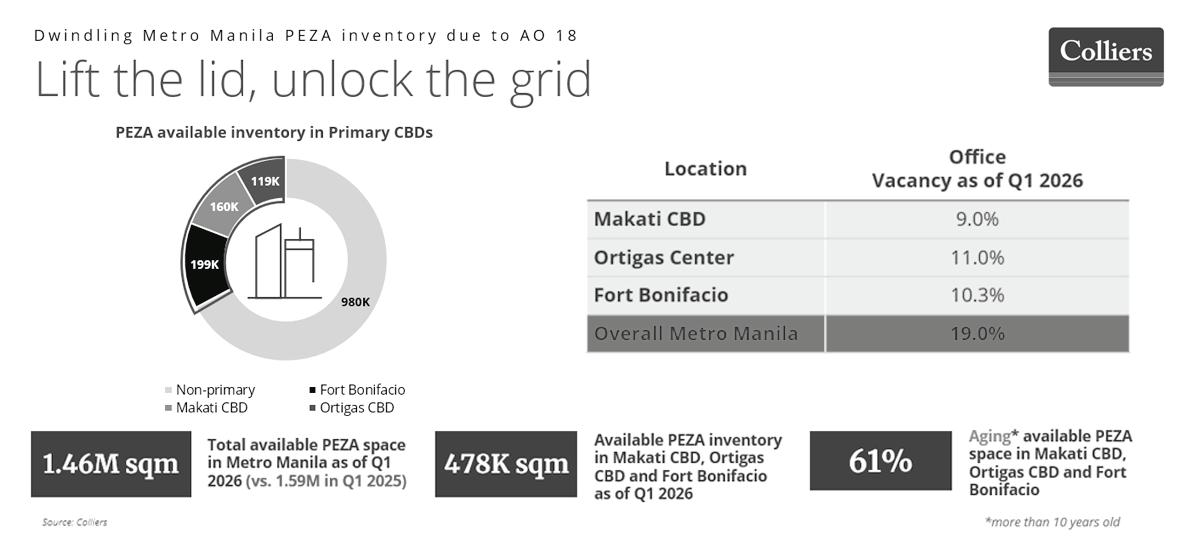
network, signaling the company's broader growth ambitions across the country.
Second, it showcases the capability of the company's Filipino workforce.
“This is the first Anko store physically led and delivered by our Filipino partners on the ground,” Mulligan said. “While our global team provided remote support in areas such as store design, product selection, and visual merchandising, every on-site decision and execution was driven by Filipinos, for Filipinos.”
“It’s not just another store opening,” she added. “It’s a reflection of what our local team can accomplish and an important step in Anko’s continued growth in the Philippines.”
A market built on consumer spending
THE retailer’s optimism is shared by industry observers.
According to Sheila Lobien, chief executive officer of Lobien Realty Group, both Anko and Japanese apparel retailer Uniqlo remain bullish on the Philippines because of its large and expanding consumer market, even as household spend -
ing growth moderates.
Philippine household consumption grew by about 5.3 percent in 2023, 4.8 percent in 2024, and an estimated 4.6 percent in 2025, reflecting continued expansion despite inflationary pressures and more cautious consumer spending. Household consumption also accounts for roughly 70 to 75 percent of the country's gross domestic product, making the Philippines one of Asia’s most consumption-driven economies.
Lobien noted that slower spending growth may actually benefit retailers focused on value.
“As consumers become more value-conscious, they prioritize quality, durability, and affordability over premium or luxury brands,” she said in an email interview. “This plays directly to the strengths of Anko's affordable home and lifestyle products and Uniqlo's LifeWear value proposition, both of which emphasize quality at accessible price points.”
The companies’ expansion plans reflect that confidence. Anko has grown from a single Philippine store in 2024 to six stores by mid-2026.
CENTURY Properties Group, Inc. (CPG) has enrolled its P3.0 billion, five-year fixed-rate corporate notes with the Philippine Dealing & Exchange Corporation (PDEx), following the successful issuance to qualified institutional investors.
The peso-denominated notes were issued to qualified buyers and are exempt from registration with the Securities and Exchange Commission. Proceeds will be used for strategic land banking nationwide specifically in Calabarzon, Central Luzon, Panay and Davao Regions, and the construction of pre-sold units for its First-Home Residential Business. China Bank Capital Corporation served as sole arranger and bookrunner for the transaction.
The issuance forms part of CPG's long-term capital management strategy to strengthen funding flexibility and diversify its funding sources. By proactively accessing the capital markets, the Company aims to reduce execution risk while preserving the flexibility to pursue growth opportunities as they arise.
“This issuance reinforces our long-term funding platform and reflects our disciplined approach to capital management,” said Marco Antonio, President and CEO of Century Properties Group. “By raising capital ahead of need, we are enhancing financial flexibility while remaining well-positioned to pursue future opportunities. We continue to see strong long-term fundamentals in the Philippine housing market, supported by the country's structural housing backlog and sustained end-user demand.”
The transaction also aligns long-term funding with the Company's long-term corporate requirements while supporting prudent balance sheet management.
“Our priority is to maintain a funding profile that gives us flexibility without compromising financial discipline,” said Rodel V. Marqueses, Chief Financial Officer and Head of Investor Relations of Century Properties Group. “This issuance strengthens our capital base, broadens our sources of long-term funding, and positions us to execute our growth plans while remaining disciplined in managing our leverage and other key financial metrics.”
KIM MULLIGAN, Interim Country Manager of Anko Philippines, delivers her welcoming remarks during the branch's grand launch.
AUSTRALIAN retail brand Anko officially opens its sixth and newest Philippine store, located on the 2nd floor of Gateway Mall 1
KEY executives lead the official ribbon-cutting ceremony for Anko Gateway Mall 1. (from left): Ayala Corporation Head of Strategy and Business Development Mark Uy, Anko Global Operations Manager Rachael Eames, Anko Global Chief Retail Officer Lil Velis-Bowker, Anko Global Chief Executive Officer Arjun Puri, Araneta City SVP of Leasing Ma. Lorna Fabian, Anko Philippines Interim Country Manager Kim Mulligan, and Anko Gateway Store Manager Herald Quizon
DENR speeds up total phaseout of ozone-depleting substances
THE
No total mobile phone ban in schools–DepEd
By Carmel Pedroza
discussions with local education officials regarding the issue.
By Jonathan L. Mayuga @jonlmayuga
Department of Environment and
Natural
Resources-
Environmental Management Bureau (DENR-EMB) is set to accelerate the country’s final steps toward the complete phase-out of ozone-depleting substances by 2030.
In a statement, the DENR said it will hold a two-day inception workshop for the Hydrochlorofluorocarbon Phase-out Management Plan Stage III (HPMP3) this month.
Organized through the Philippine Ozone Desk (POD) and in partnership with the United Nations Industrial Development Organization (Unido), the workshop marks the final phase of the country’s commitment under the Montreal Protocol to completely phase out hydrochlorofluorocarbons (HCFC).
Unido defines hydrochlorofluorocarbons (HCFC) as a group of synthetic chemical compounds containing carbon, chlorine, fluorine, and hydrogen. Because they deplete the ozone layer and act as potent greenhouse gases, Unico assists developing countries in transitioning away from HCFCs under the Montreal Protocol.
n Establishing the Implementation Framework: Officially initiating HPMP Stage 3 and ODS waste management project preparation, ensuring all regulatory bodies and private enterprises understand their roles in the 2030 phase-out.
n Targeting Specialized Sectors: Providing direct implementation support to the solvent and firefighting sectors through intensive consultations on technology alternatives, overcoming sectorspecific challenges, and navigating new regulatory requirements.
(BFP), the Technical Education and Skills Development Authority (TESDA), and the Department of Trade and Industry (DTI). They are joined by RAC associations, servicing workshops, private sector enterprises, training institutions, international development partners, and UNIDO technical experts to drive the national strategy forward.
By the conclusion of the event, the DENR-EMB and UNIDO expect to deliver a robust set of actionable outputs, including:
CEBU CITY—The Department of Education in Central Visayas clarified that its existing policy does not support a total ban on mobile phones in schools, even as the local government of Dumanjug moves to impose stricter regulations on students’ cellphone use.
As of Tuesday, Bayocot said the municipal government had yet to issue a formal memorandum implementing a total cellphone ban, noting that the proposal has so far only been announced through social media.
He expressed confidence that the matter would eventually be resolved through discussions between DepEd and the local government.
HPMP Stage III, approved under the Multilateral Fund for the Implementation of the Montreal Protocol, provides the technical and regulatory roadmap to transition the country toward lowglobal warming potential (GWP) alternatives, focusing heavily on enhancing the refrigeration and air-conditioning (RAC) servicing sector and delivering targeted technical assistance to the solvent and firefighting industries.
Under the theme “Advancing Sustainable Cooling,” the inception workshop will serve as the launchpad for these final-stage activities, transforming policy into grassroots action. By gathering a sweeping coalition of public and private sector leaders, the event directly supports its overarching objectives by:
“Having successfully met its aggressive 67.5 percemt reduction target in 2025, the Philippines is now mobilizing across all sectors to eliminate the remaining consumption of these ozone-depleting substances [ODS],” Environment Secretary Juan Miguel Cuna said in a statement.
n Paving the Way for the Kigali Amendment: Initiating crucial preparations for the Kigali Implementation Plan (KIP). The workshop bridges the gap between phasing out HCFCs and phasing down HFCs (potent greenhouse gases), identifying synergies that maximize climate benefits.
n Unlocking Energy Efficiency: Identifying distinct funding windows and future investment opportunities to enhance energy efficiency within the country’s manufacturing and cooling sectors.
Because the shift to sustainable cooling impacts everything from household appliances to industrial fire safety, the workshop brings together an unprecedented cross-section of national stakeholders.
To ensure stringent border control, skills transition, and market compliance, the event will be attended by key representatives from the Bureau of Customs (BOC), the Bureau of Fire Protection
n The official launch and comprehensive stakeholder mobilization for HPMP Stage 3.
n Formulated recommendations and tailored action plans for the solvent and firefighting sectors.
n Strengthened inter-agency coordination among government ministries, the RAC sector, and development partners.
n Clear identification of future cooling sector investments and energy efficiency enhancements.
Initial stakeholder inputs prioritizing sectors for the upcoming KIP Stage I preparation, successfully linking ODS waste management with sustainable, climatefriendly cooling.
As the Philippines races toward its 2030 phase-out deadline, HPMP Stage 3 guarantees that the transition will not only heal the ozone layer but also safeguard the climate, protect local industries, and advance a more sustainable, energy-efficient future for all Filipinos, the DENR said.
House prosecutor dares Sara to attend impeach hearings
By Jovee Marie N. dela Cruz @joveemarie
HOUSE of Representatives
prosecutor Terry Ridon
on Tuesday challenged Vice President Sara Duterte to personally attend the impeachment proceedings, stressing that accountability cannot be pursued “from the sidelines” following her remarks about a supposed “bloodbath.”
Duterte, on the advice of her defense team, gave only a onesentence remark to the media upon arrival at the Senate on Tuesday—the second day of her impeachment trial.
“In this bloodbath and blud -
geoning, I will be bloodied but unbowed,” she declared.
Her spokesperson later said the Vice President would not appear before the impeachment court that day, opting instead to meet with her defense team.
Reacting to this, Ridon said the Vice President must directly face the charges instead of relying solely on her lawyers.
“Welcome to the bloodbath, Madam Vice President. But you cannot have a bloodbath without being part of it,” Ridon, twhe nominee of they party-list group Bicol Saro to the House of Representatives, said during an interview.
“You cannot have a bloodbath from the sidelines. You cannot
have a bloodbath with proxies. You cannot expect only your lawyers to face this on your behalf,” he added.
Ridon acknowledged Duterte’s statement that she was present to support her legal team but emphasized that her role in the proceedings goes beyond that.
“She said she was there to support her defense team, and that’s fine. But we need to be clear—she is not a cheerleader in this process. She is the accused,” he said.
The House prosecutor stressed that the impeachment trial requires Duterte’s active participation, calling on her to confront the allegations head-on.
“She needs to stand up for
herself. She needs to show up and face the accusations,” Ridon said.
Asked whether Duterte’s actions were meant to provoke the prosecution, Ridon said he does not believe so but maintained that her presence should carry more substance than symbolic support.
“I don’t think she is trying to provoke anyone. But at the end of the day, she must face the truth and answer the charges,” he added.
Ridon also expressed concern over the tone of the situation, saying it is “unfortunate” if the proceedings are reduced to rhetoric rather than treated as a serious constitutional process.
First Balfour wins award for sustainability programs
IRST Balfour Inc., the construction and engineering arm of Lopez-led First Philippine Holdings Corporation, reaffirmed its commitment to a decarbonized and regenerative future after winning the prestigious Mother Nature Award from the Pollution Control Association of the Philippines, Inc. (Pcapi).
The award recognized the company’s innovative and comprehensive sustainability programs, which are embedded across its projects, operations, and longterm business strategy.
First Balfour bested seven other companies to earn the award from Pcapi during the association’s 46th national annual convention and general assembly held recently in Puerto Princesa City, Palawan.
“Choosing First Balfour as the overall winner among eight strong candidates came down to their comprehensive approach, said Gretchen Fontejon-Enarle, chairperson of the Pcapi Awards Committee.
“While many companies focus on just one area like waste or water management, First Balfour stood out by addressing all as-

pects of sustainability, including air quality, carbon reduction, and ecosystem protection,” Fontejo-Enarle, an engineer, added. Non-profit Pcapi, in partnership with the Environmental Management Bureau (EMB) of the Department of Environment and Natural Resources (DENR), hands out
awards during its annual gathering as a way of encouraging private industries to move beyond compliance toward proactive environmental stewardship and promoting sustainable development. Among the six award categories presented during the Pcapi convention, the
Mother Nature Award is regarded as one of the highest distinctions for organizations that exemplify environmental leadership and sustainability excellence.
First Balfour’s recognition followed a rigorous evaluation process that began in March 2026. Entries were reviewed through document submissions, presentations, and panel interviews where organizations were assessed on environmental performance, leadership, governance, transparency, measurable results, and sustainability impact.
Since 1969, First Balfour has played a pivotal role in building critical infrastructure across the Philippines. With more than five decades of engineering and construction experience, the company has delivered landmark projects such as the Novaliches–Balara Aqueduct 4 (NBAQ4), the Cebu–Cordova
DepEd Central Visayas Director Arturo Bayocot said DepEd Order 6, series of 2026, or the Effective School Management and Learning Environment (ESMLE) policy, regulates the use of mobile phones during class hours rather than prohibiting them altogether.
“While ensuring a safe and motivating learning environment, the order does not declare a total ban on cellphones,” Bayocot said during a Kapihan sa PIA media briefing.
He explained that students are not allowed to use mobile phones while classroom instruction is ongoing unless teachers require the devices for learning activities.
Schools are given the flexibility to enforce the policy through measures such as collecting phones before classes begin and returning them after lessons.
“The important thing is that students remain focused on the teacher and on learning,” Bayocot said.
He noted that gadgets have become valuable educational tools, particularly for technology-assisted instruction requiring internet access and digital platforms such as Khan Academy, which is already being used in many schools nationwide, including those in Central Visayas.
Bayocot added that mobile phones also serve an important purpose during emergencies, allowing parents to immediately contact their children when safety concerns arise.
While acknowledging Dumanjug Mayor Efren Guntraco Gica’s proposal, Bayocot said he understands that the local official’s primary concern is the safety and welfare of students.
“I know the mayor only wants what’s best for the children,” he said.
He added that teachers should strictly implement DepEd’s policy by confiscating phones during instructional time and returning them after classes.
He also said DepEd has begun
In a separate statement issued on July 2, Gica defended the municipality’s education reforms, saying the local government is addressing what he described as serious shortcomings in the current education system.
He argued that the implementation of DepEd’s “No Child Left Behind” policy has weakened classroom discipline and reduced academic accountability, resulting in students advancing through school despite poor learning outcomes. He cited cases of Grade 11 students who allegedly possess only Grade 2-level reading comprehension.
The mayor said the municipality has continued to invest in education by funding school activities, water facilities and classroom rehabilitation, but stressed that improving infrastructure alone would not address declining academic performance.
To strengthen learning outcomes, Gica announced that the local government will institutionalize several education initiatives, including mandatory weekend remedial tutorials for students from Grades 1 to 12, fully funded teacher training programs and Sunday values formation activities for parents and students centered on Scripture reading and moral discipline.
He said the municipality had already invested P5.6 million for its Summer Tutorial Program and described the new education initiatives as part of his administration’s long-term strategy to improve literacy, discipline and character formation among Dumanjug’s youth.
Gica said he considers the reforms part of his legal and moral responsibility as mayor and vowed to pursue them throughout his term, saying his goal is to develop students who are academically capable, disciplined, honest and guided by strong moral values.
THE National Police (PNP) Chief, Gen. Jose Melencio Nartatez Jr., on Tuesday commended police personnel for maintaining peace and order during the opening day of Vice President Sara Duterte’s impeachment trial. He earlier directed all units to sustain real-time security monitoring and operational adjustments throughout the proceedings.
“I commend our men and women on the ground for their professionalism and strict adherence to the policy of maximum tolerance. The peaceful conduct of the assembly was a testament to the discipline of our police force and the maturity of our citizens in exercising their democratic rights,” Nartatez said. The first day of the Senate impeachment trial on July 6 remained generally peaceful despite separate rallies held by different groups outside the Senate in Pasay City.
Security preparations also included the activation of a Special Task Group, the installation of additional CCTV cameras in strategic areas, the implementation of traffic rerouting plans, and coordination with nearby hospitals to provide immediate emergency medical assistance if necessary. Nartatez said maintaining peace during the opening day was only the beginning, stressing that security measures must continuously adapt to changing conditions on the ground.
“Security is a dynamic, not a static, responsibility. We have institutionalized a 24/7 intelligence feedback loop, meaning our deployment strategy is recalibrated every hour based on real-time ground assessments
The National Capital Region Police Office estimated the crowd at more than 300. To ensure the safe and orderly conduct of the proceedings, the PNP deployed 6,630 personnel which included 3,250 police officers assigned to secure the Senate complex and 2,900 Civil Disturbance Management personnel on standby for immediate deployment if needed.
FIRST Balfour employees, from left, Frefil Mark C. Benemerito, Angeline D. Abibuag, Jasmin
Jill T. Dumasig and Antonieto Opelario Jr. display the plaques of recognition, including the prestigious Mother Nature Award, which they received on behalf of the company at the 46th Pcapi National Annual Convention in Puerto Princesa City, Palawan. Pcapi gave the awards in recognition of the company’s innovative and comprehensive sustainability program embedded across its projects, operations, and long-term business strategy.