




ABy Malou Talosig-Bartolome
RTIFICIAL intelligence (AI) is no longer a distant disruptor on the horizon. It is a present force, steadily transforming labor markets worldwide—and for the Philippines, that transformation may come at an overwhelming cost.
Speaking at a recent forum organized by the University of the Philippines’ Center for Integrative and Development Studies, digital governance advocate Professor Emmanuel Lallana, Novare Technologies Chief Technology Officer Dr. William Emmanuel Yu, and UP President Angelo Jimenez said the Philippines must urgently retool its workforce. Otherwise, they warned, AI-driven job losses could erode national competitiveness— and viability.
“This is not a hypothetical discussion,” said Yu. “There are three areas where, clearly, AI—or at least this generation of AI—has already displaced jobs.”
Displacement already under way WITH advances in generative AI technologies, particularly those built on generative pre-trained transformers (GPT), machines can now autonomously generate outputs once reserved for human professionals.
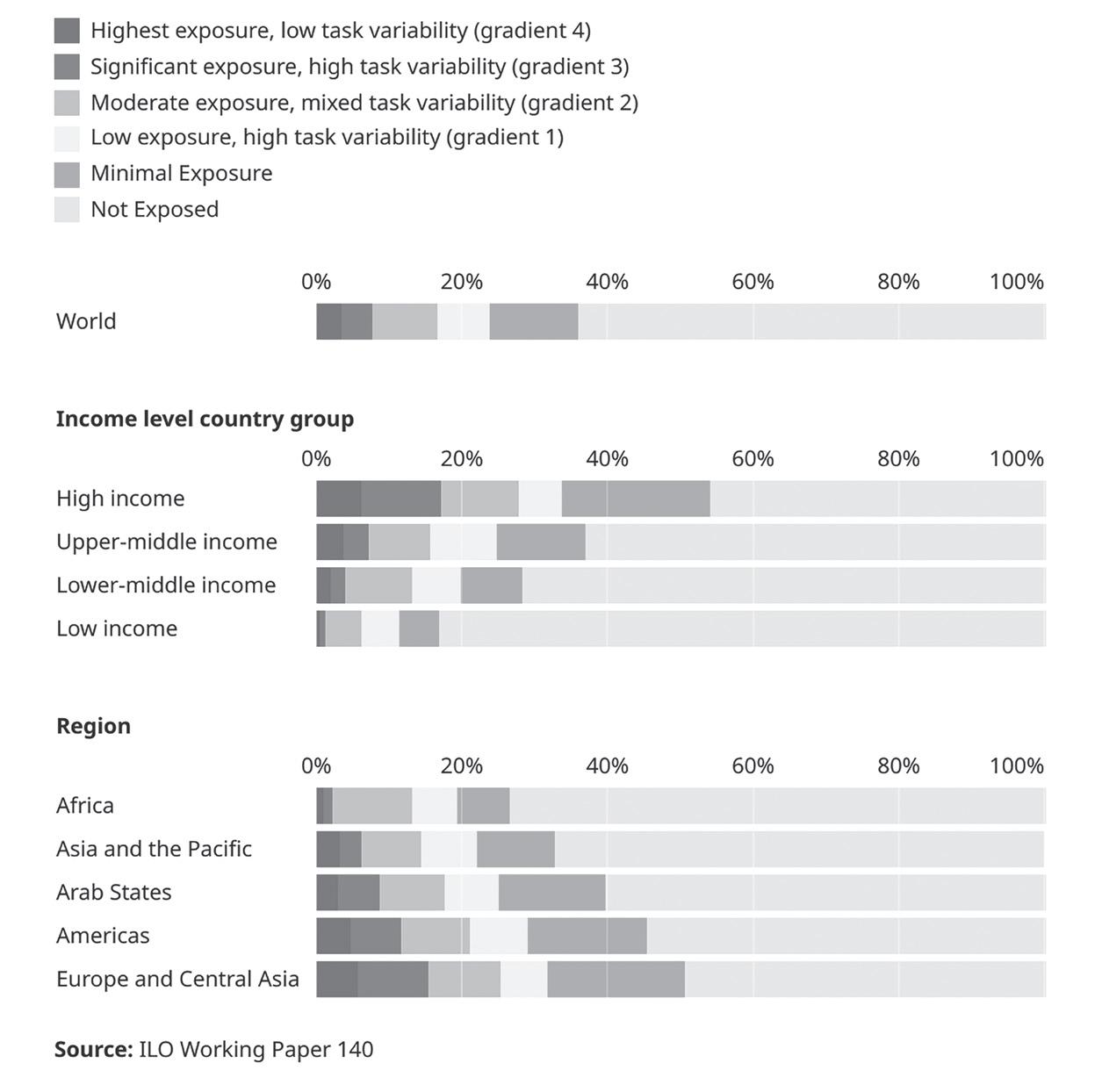
Citing International Labour Organization (ILO) data, Dr. Lallana said that 33 percent of jobs in the Philippines are highly exposed
to AI, and 14 percent face no complementarity with it.
“That’s the built-in danger,” Lallana said. “Up to 14 percent of our total workforce could be automated out as AI becomes more integrated into the economy.” Yu cited the demise of rote research roles, once filled by entrylevel workers, now replaced by AI tools with “perfect recall” and data processing capabilities.
Jimenez, a lawyer, remarked that even in legal work, libraries are considered “dinosaurs,” with solo practitioners already relying on AI for quick jurisprudence searches. “The AI does that well—it’s a very perceptive search engine,” Yu added.
Creative fields are also being disrupted. Repetitive tasks in content and media production, such as concept page layouting and storyboard framing, are now easily handled by AI tools. “Those jobs are gone,” Yu said.
BPO industry in the crosshairs THE Business Process Outsourcing (BPO) sector—one of the economy’s most critical engines—was












singled out as particularly vulnerable. While BPO workers comprise just 3 percent of the national workforce, they generated over $35 billion in revenue last year, or 7 percent of GDP.
But that strength is under strain.
“Post-call summaries, customer feedback logs, and even parts of customer service are now being handled by AI faster,” Yu said. “We estimate that 25 percent of callcenter activities are technically automated and those jobs obsolete.”
Large BPO firms are also using AI to monitor call pitch, tone,
and use of positive language. Productivity pressures have intensified: where agents previously had 200 seconds to resolve a call, new benchmarks demand the same output in just 170 seconds.
One major firm, Lallana noted, projects a net loss of 300,000 jobs in the BPO industry over the next five years—offset by only 100,000 new positions, many in lower-paying, short-term roles like algorithm training or AI moderation.
More disruptive still is the rise of “agentic AI”—systems that can make decisions and act inde -

pendently. Lallana explained that while chatbots tend to give general answers from limited databases, agentic AI draws from vast datasets to respond to more specific, individual concerns.
“If agentic AI lives up to its potential, it could wipe out the callcenter agent industry in the Philippines,” he said.
Gig work’s global downshift THE forum also tackled the gig economy, where over 2 million Filipinos now work as virtual assistants, digital marketers, designers, and IT or customer support staff. AI has lowered barriers to entry, matching freelancers with global clients more efficiently. But it has also triggered a “race to the bottom” in wages, Lallana said. He cited how in 2017, Filipino freelancers could earn up to $200 a week. By 2021, when platforms expanded to India and Venezuela, project fees dropped from $10 to under $0.01. “International clients simply pick the lowest bidder,” he said. “This undermines income stability, quality, and career growth.” For full-time Filipino freelancers, the confluence of AI automation and global price competition presents an increasingly precarious future.
By Rizwan Virk, Arizona State University
The Conversation
EVERY time I read about another advance in AI technology, I feel like another figment of science fiction moves closer to reality.
Lately, I’ve been noticing eerie parallels to Neal Stephenson’s 1995 novel The Diamond Age: Or, A Young Lady’s Illustrated Primer.
The Diamond Age depicted a post-cyberpunk sectarian future, in which society is fragmented into tribes, called phyles. In this future world, sophisticated nanotechnology is ubiquitous, and a new type of AI is introduced.
Though inspired by MIT nanotech pioneer Eric Drexler and Nobel Prize winner Richard Feynman, the advanced nanotechnology depicted in the novel still remains out of reach. However, the AI that’s portrayed, particularly a teaching device called the Young Lady’s Illustrated Primer, isn’t only right in front of us; it also raises serious issues about the role of AI in labor, learning and human behavior.

In Stephenson’s novel, the Primer looks like a hardcover book, but each of its “pages” is really a screen display that can show animations and text, and it responds to its user in real time via AI. The book also has an audio component, which voices the characters and narrates stories being told by the device.
It was originally created for the young daughter of an aristocrat, but it accidentally falls into the hands of a girl named Nell who’s living on the streets of a futuristic Shanghai. The Primer provides Nell personalized emotional, social and intellectual support during her journey to adulthood, serving alternatively as an AI companion, a storyteller, a teacher and a surrogate parent.
The AI is able to weave fairy tales that help a younger Nell cope with past traumas, such as her abusive home and life on the streets. It educates her on everything from math to cryptography to martial arts. In a techno-futuristic homage to George Bernard Shaw’s 1913 play “Pygmalion,” the Primer goes so far as to teach Nell the proper social etiquette to be able to blend into neo-Victorian society, one of the prominent tribes in Stephenson’s balkanized world.
No need for ‘ractors’
THREE recent developments in AI—in video games, wearable technology and education—reveal that building something like the Primer should no longer be considered the purview of science fiction.
In May 2025, the hit video game “Fortnite” introduced an AI version of Darth Vader, who speaks with the voice of the late James Earl Jones. While it was popular among

fans of the game, the Screen Actors Guild lodged a labor complaint with Epic Games, the creator of “Fortnite.” Even though Epic had received permission from the late actor’s estate, the Screen Actors Guild pointed out that actors could have been hired to voice the character, and the company—in refusing to alert the union and negotiate terms—violated existing labor agreements.
In The Diamond Age, while the Primer uses AI to generate the fairy tales that train Nell, for the voices of these archetypal characters, Stephenson concocted a low-tech solution: The characters are played by a network of what he termed “ractors”—real actors working in a studio who are contracted to perform and interact in real time with users.
The Darth Vader “Fortnite” character shows that a Primer built today wouldn’t need to use actors at all. It could rely almost entirely on AI voice generation and have real-time conversations, showing that today’s technology already exceeds Stephenson’s normally farsighted vision.
Recording and guiding in real time SYNTHESIZING James Earl Jones’s voice in “Fortnite” wasn’t the only recent AI development heralding the arrival of Primer-like technology.
I recently witnessed a demonstration of wearable AI that records all of the wearer’s conversations. Their words are then sent to a server so they can be analyzed by AI, providing both summaries and suggestions to the user about future behavior.
Several startups are making these “always on” AI wearables. In an April 29, 2025, essay titled “I Recorded Everything I Said for Three Months. AI Has Replaced My Memory,” Wall Street Journal technology columnist Joanna Stern describes the experience of using this technology. She concedes that the assistants created useful summaries of her conversations and meet-
ings, along with helpful to-do lists. However, they also recalled “every dumb, private and cringeworthy thing that came out of my mouth.”
These devices also create privacy issues. The people whom the user interacts with don’t always know they are being recorded, even as their words are also sent to a server for the AI to process them. To Stern, the technology’s potential for mass surveillance becomes readily apparent, presenting a “slightly terrifying glimpse of the future.”
Relying on AI engines such as ChatGPT, Claude and Google’s Gemini, the wearables work only with words, not images. Behavioral suggestions occur only after the fact. However, a key function of the Primer—coaching users in real time in the middle of any situation or social interaction—is the next logical step as the technology advances.
Education or social engineering?
IN The Diamond Age, the Primer doesn’t simply weave interactive fairy tales for Nell. It also assumes the responsibility of educating her on everything from her ABCs when younger to the intricacies of cryptography and politics as she gets older.
It’s no secret that AI tools, such as ChatGPT, are now being widely used by both teachers and students.
Several recent studies have shown that AI may be more effective than humans at teaching computer science. One survey found that 85% of students said ChatGPT was more effective than a human tutor. And at least one college, Morehouse College in Atlanta, is introducing an AI teaching assistant for professors.
There are certainly advantages to AI tutors: Tutoring and college tuition can be exorbitantly expensive, and the technology can offer better access to education to people of all income levels.
Pulling together these latest AI advances—interactive avatars, behavioral guides, tutors—you can see how an AI device like the Young
Some roles remain resilient
WHILE the forum painted a sobering picture, speakers also identified sectors likely to remain resilient—at least in the short to medium term. Management roles, though highly exposed to AI, are unlikely to disappear. Their strength lies in what speakers called “high complementarity.” AI may reshape how data is analyzed and decisions are made, but it will more likely augment— rather than replace—leadership.
“Tender-loving-care (TLC)” jobs—including nurses, doctors, and caregivers—also remain largely insulated from AI displacement. These roles require emotional intelligence, empathy, and complex social interaction—traits current AI cannot replicate effectively.
The forum also highlighted the emergence of “AI-adjacent” work. Among these:
• Quality assurance roles that monitor AI outputs for errors or bias;
• Image and text annotators, who label training data for machine learning;
• Algorithm trainers and data operators, increasingly essential in AI development pipelines.
Jobs requiring a mix of critical thinking, creativity, empathy, and adaptability—skills beyond the reach of AI—will likewise become more valuable in an AI-integrated economy.
Even within the service sector, particularly among college-educated young women, there is opportunity. These workers often occupy roles that combine communication and problem-solving—traits that align well with collaborative AI use.
Still, the speakers warned that while emerging markets like the Philippines may face slower AI dis -

Lady’s Illustrated Primer could be created in the near future. A young person might have a personalized AI character that accompanies them at all times. It can teach them about the world and offer up suggestions for how to act in certain situations. The AI could be tailored to a child’s personality, concocting stories that include AI versions of their favorite TV and movie characters. But The Diamond Age offers a warning, too. Toward the end of the novel, a version of the Primer is handed out to hundreds of thousands of young Chinese girls who, like Nell, didn’t have access to education or mentors. This leads to the education of the masses. But it also opens the door to large-scale social engineering, creating an army of Primer-raised martial-arts experts, whom the AI then directs to act on behalf of “Princess Nell,” Nell’s fairy tale name. It’s easy to envision how this sort of large-scale social engineering could be used to target certain ideologies, crush dissent or build loyalty to a particular regime. The AI’s behavior could also be subject to the whims of the companies or individuals that created it. A ubiquitous, always-on, friendly AI could become the ultimate monitoring and reporting device. Think of a kinder, gentler face for Big Brother that people have trusted since childhood.
While large-scale deployment of a Primer-like AI could certainly make young people smarter and more efficient, it could also hamper one of the most important parts of education: teaching people to think for themselves.
Rizwan Virk is a Faculty Associate, PhD Candidate in Human and Social Dimensions of Science and Technology, at Arizona State University. This article is republished from The Conversation under a Creative Commons license. Read the original article here: https://theconversation.com/ ai-is-advancing-even-faster-than-scifi-visionaries-like-neal-stephensonimagined-257509.
ruption due to lower current penetration, they also have fewer institutional tools to prepare for future shifts.
Structural gaps
exacerbate AI threat
UP President Angelo Jimenez warned that the country’s vulnerability to AI disruption is amplified by deep-rooted structural weaknesses.
“We’re already behind. We ranked last in reading and second to last in science in the latest PISA study,” he said. “Our workforce is trained mostly for menial tasks, not for cognitive, adaptive work that AI can’t replicate.”
While nations like South Korea and Singapore invest heavily in AI and workforce readiness, the Philippines is “not even in the race yet,” Jimenez added.
Infrastructure gaps, including high electricity costs, further limit the country’s appeal to AIintensive industries. “How can we attract data centers if basic utilities are not affordable?” Jimenez asked.
Lallana called for urgent interventions: upskilling programs for atrisk workers, AI literacy for all sectors, adoption of competency-based education, and micro credentials to prepare Filipinos for emerging roles.
Dr. Yu stressed the need for partnerships between schools, tech firms, and employers to build agile learning systems.
The Philippines has one advantage: time—but not much of it.
“We are currently in a demographic sweet spot, with a young, trainable population,” Jimenez said.
“But that bulge won’t last. In 26 to 27 years, we either become a prosperous economy—or we miss our chance forever.”
Editor: Angel R. Calso

By Julia Frankel & Sam Mednick The Associated Press
BEERSHEBA, Israel—American contractors guarding aid distribution sites in Gaza are using live ammunition and stun grenades as hungry Palestinians scramble for food, according to accounts and videos obtained by The Associated Press.
Two US contractors, speaking to the AP on condition of anonymity because they were revealing their employers’ internal operations, said they were coming forward because they were disturbed by what they considered dangerous and irresponsible practices. They said the security staff hired were often unqualified, unvetted, heavily armed and seemed to have an open license to do whatever they wished. They said their colleagues regularly lobbed stun grenades and pepper spray in the direction of the Palestinians. One contractor said bullets were fired in all directions—in the air, into the ground and at times toward the Palestinians, recalling at least one instance where he thought someone had been hit.
“There are innocent people being hurt. Badly. Needlessly,” the contractor said.
He said American staff on the sites monitor those coming to seek food and document anyone considered “suspicious.” He said they share such information with the Israeli military.
Videos provided by one of the contractors and taken at the sites show hundreds of Palestinians crowded between metal gates, jostling for aid amid the sound of bullets, stun grenades and the sting of pepper spray. Other videos include conversation between English-speaking men discussing how to disperse crowds and encouraging each other after bursts of gunfire.
The testimonies from the contractors—combined with the videos, internal reports and text messages obtained by the AP—offer a rare glimpse inside the Gaza Humanitarian Foundation, the newly created, secretive American organization backed by Israel to feed the Gaza Strip’s population. Last month, the US government pledged $30 million for the group to continue operations—the first known US donation to the group, whose other funding sources remain opaque.
Journalists have been unable to access the GHF sites, located in Israeli military-controlled zones. The AP cannot independently verify the contractors’ stories.
A spokesperson for Safe Reach Solutions, the logistics company subcontracted by GHF, told the AP that there have been no serious injuries at any of their sites to date. In scattered incidents, security professionals fired live rounds into the ground and away from civilians to get their attention. That happened in the early days at the “the height of desperation where crowd control measures were necessary for the safety and security of civilians,” the spokesperson said.
Aid operation is controversial
GAZA’S more than 2 million
Palestinians are living through a catastrophic humanitarian crisis. Since Hamas attacked Israel on Oct. 7, 2023, setting off the 21-month war, Israel has bombarded and laid siege to the strip, leaving many teetering on the edge of famine, according to food security experts.
For 2 1/2 months before GHF’s opening in May, Israel blocked all food, water and medicine from entering Gaza, claiming Hamas was stealing the aid being transported under a preexisting system coordinated by the United Nations. It now wants GHF to replace that UN system. The UN says its Gaza aid operations do not involve armed guards.
Over 57,000 Palestinians in Gaza have been killed since the war erupted, according to the territory’s Health Ministry, which does not distinguish between civilians and militants.
GHF is an American organization, registered in Delaware and established in February to distribute humanitarian aid during the ongoing Gaza humanitarian crisis. Since the GHF sites began operating more than a month ago, Palestinians say Israeli troops open fire almost every day toward crowds on roads heading to the distribution points, through Israeli military zones. Several hundred people have been killed and hundreds more wounded, according to Gaza’s Health Ministry and witnesses.
In response, Israel’s military says it fires only warning shots and is investigating reports of civilian harm. It denies deliberately shooting at any innocent civilians and says it’s examining how to reduce “friction with the population” in the areas surrounding the distribution centers.
AP’s reporting for this article focuses on what is happening at the sites themselves. Palestinians arriving at the sites say they are caught between Israeli and American fire, said the contractor who shared videos with the AP.
“We have come here to get food for our families. We have nothing,” he recounted Palestinians telling him. “Why does the (Israeli) army shoot at us? Why do you shoot at us?”
A spokesperson for the GHF said there are people with a “vested interest” in seeing it fail and are willing to do or say almost anything to make that happen. The spokesperson said the team is composed of seasoned humanitarian, logistics and security professionals with deep experience on the ground. The group says it has distributed the equivalent of more than 50 million meals in Gaza in its food boxes of staples.
GHF says that it has consistently shown compassionate engagement with the people of Gaza. Throughout the war, aid distribution has been marred by chaos.
Gangs have looted trucks of aid traveling to distribution centers and mobs of desperate people have also offloaded trucks before they’ve reached their destination. Earlier this month, at least 51 Palestinians were killed and more than 200 wounded while waiting for the UN and commercial trucks to enter the territory, according to Gaza’s Health Ministry and a local hospital. Israel’s military acknowledged several casualties as soldiers opened fire on the approaching crowd and said authorities would investigate.
Videos, texts, internal reports document havoc at food sites AP spoke to the two contractors for UG Solutions, an American outfit subcontracted to hire security personnel for the distribution sites. They said bullets, stun grenades and pepper spray were used at nearly every distribution, even if there was no threat.
Videos of aid being dispensed at the sites seen by the AP appear to back up the frenetic scenes the contractors described. The footage was taken within the first two weeks of its distributions—about halfway into the operations.
In one video, what appear to be heavily armed American security contractors at one of the sites in Gaza discuss how to disperse Palestinians nearby. One is heard saying he has arranged for a “show of force” by Israeli tanks.
“I don’t want this to be too aggressive,” he adds, “because this is calming down.”
At that moment, bursts of gunfire erupt close by, at least 15 shots. “Whoo! Whoo!” one contractor yelps.
“I think you hit one,” one says. Then comes a shout: “Hell, yeah, boy!”
The camera’s view is obscured by a large dirt mound.
The contractor who took the video told AP that he saw other contractors shooting in the direction of Palestinians who had just collected their food and were departing. The men shot both from a tower above the site and from atop the mound, he said. The shooting began because contractors wanted to disperse the crowd, he said, but it was unclear why they continued shooting as people were walking away.
The camera does not show who was shooting or what was being shot at. But the contractor who filmed it said he watched another contractor fire at the Palestinians and then saw a man about 60 yards (meters) away—in the same direction where the bullets were fired—drop to the ground.
This happened at the same time the men were heard talking—effectively egging each other on, he said.
In other videos furnished by the contractor, men in grey uniforms—colleagues, he said—can be seen trying to clear Palestinians who are squeezed into a narrow, fenced-in passage leading to one of the centers. The men fire pepper spray and throw stun grenades that detonate amid the crowd. The sound of gunfire can be heard. The contractor who took the video said the security personnel usually fire at the ground near the crowds or from nearby towers over their heads.
During a single distribution in June, contractors used 37 stun grenades, 27 rubber-and-smoke “scat shell” projectiles and 60 cans of pepper spray, according to internal text communications

shared with the AP.
That count does not include live ammunition, the contractor who provided the videos said.
One photo shared by that contractor shows a woman lying in a donkey cart after he said she was hit in the head with part of a stun grenade.
An internal report by Safe Reach Solutions, the logistics company subcontracted by GHF to run the sites, found that aid seekers were injured during 31% of the distributions that took place in a two-week period in June. The report did not specify the number of injuries or the cause. SRS told the AP the report refers to nonserious injuries.
More videos show frenzied scenes of Palestinians running to collect leftover food boxes at one site. Hundreds of young men crowd near low metal barriers, transferring food from boxes to bags while contractors on the other side of the barriers tell them to stay back.
Some Palestinians wince and cough from pepper spray. “You tasting that pepper spray? Yuck,” one man close to the camera can be heard saying in English.
SRS acknowledged that it’s dealing with large, hungry populations, but said the environment is secure, controlled, and ensures people can get the aid they need safely.
TO confirm the footage is from the sites, AP geolocated the videos using aerial imagery. The AP also had the videos analyzed by two audio forensic experts who said they could identify live ammunition—including machine-gun fire—coming from the sites, in most cases within 50 to 60 meters of the camera’s microphone.
In the video where the men are heard egging each other on, the echo and acoustics of the shots indicate they’re fired from a position close to the microphone, said Rob Maher, a professor of electrical and computer engineering at Montana State University and an author and research expert in audio forensic analysis. Maher and the other analyst, Steven Beck, owner of Beck Audio Forensics, said there was no indication that the videos’ audio had been tampered with.
The analysts said that the bursts of gunfire and the pop sequences in some of the videos indicated that guns were panning in different directions and were not repeatedly aimed at a single target. They could not pinpoint exactly where the shots were coming from nor who was shooting.
GHF says the Israeli military is
not deployed at the aid distribution sites. Lt. Col. Nadav Shoshani, an army spokesman, said the army is not stationed at the sites or within their immediate proximity, especially during operating hours. He said they’re run by an American company and have their own security.
One of the contractors who had been on the sites said he’d never felt a real or perceived threat by Hamas there.
SRS says that Hamas has openly threatened its aid workers and civilians receiving aid. It did not specify where people were threatened.
American analysts and Israeli soldiers work side by side, contractors say ACCORDING to the contractor who took the videos, the Israeli army is leveraging the distribution system to access information.
Both contractors said that cameras monitor distributions at each site and that American analysts and Israeli soldiers sit in a control room where the footage is screened in real time.
The control room, they said, is housed in a shipping container on the Israeli side of the Kerem Shalom crossing into Gaza.
The contractor who took the videos said some cameras are equipped with facial recognition software. In live shots of the sites seen by the AP, some videos streams are labeled “analytics”— those were the ones that had the facial recognition software, said the contractor.
If a person of interest is seen on camera—and their information is already in the system—their name and age pop up on the computer screen, said the contractor. Israeli soldiers watching the screens take notes and cross-check the analysts’ information with their own drone footage from the sites, he said.
The contractor said he did not know the source of the data in the facial recognition system. The AP could not independently verify his information.
An internal SRS report from June seen by the AP said that its intel team would circulate to staff a “POI Mugs Card,” that showed photos of Palestinians taken at the sites who were deemed persons of interest.
The contractor said he and other staff were told by SRS to photograph anyone who looked “out of place.” But the criteria were not specified, he said. The contractor said the photos were also added to the facial recognition database. He did not know what was done with the information.
SRS said accusations that it gathers intelligence are false and
that it has never used biometrics. It said it coordinates movements with Israeli authorities, a requirement for any aid group in Gaza.
An Israeli security official who was not named in line with the army’s protocol, said there are no security screening systems developed or operated by the army within the aid sites.
It was a rushed rollout, the contractors say THE several hundred contractors hired by UG Solutions landed in Israel in mid-May, not long before the first GHF site opened on May 26.
The rollout was jumbled and lacked leadership, the two contractors told the AP. Some of the men had been recruited only days prior via e-mail asking if they wanted to work in Gaza. Many had no combat experience and were not properly trained in offensive weapons, they said.
SRS did not provide the staff with draft rules of engagement until three days after distributions started, they said. The draft rules, seen by the AP, say deadly force may be used only under extreme necessity and non-lethal weapons may be used in an extreme situation on unarmed individuals who are physically violent. The Palestinians seen in the videos don’t appear to be physically aggressive. SRS says there have been occasional altercations at the sites between aid seekers, but none have involved its staff.
Each contractor was equipped with a pistol, stun grenades, tear gas and an Israeli-made automatic rifle capable of firing dozens of rounds within seconds, said the contractor who took the videos.
In an e-mail from May shared with the AP by a third party, one high-ranking contractor wrote to the head of UG Solutions and called the operation “amateur hour.” He wrote that the sites did not have enough staff or resources making them “not sustainable” and “not safe,” according to the email, seen by the AP.
The two contractors said none of the men in Israel working for UG Solutions were tested to see if they could handle a gun safely. One said the rushed rollout also meant not everyone could “zero” their weapon—adjust it to one’s personal specifications to ensure proper aim. Military experts say not zeroing a weapon poses a significant risk.
A spokesperson for UG Solutions, Drew O’Brien, said UG has an extensive recruiting and training process, including “a detailed application process, screening by experts, reference checks, background checks and weapons proficiency.” The group said it prides itself on repeated quality control checks once missions are underway.
O’Brien said the group was unaware of video showing gunfire from someone believed to be a UG Solutions contractor. He said he couldn’t comment on the allegations without seeing the videos.
The two contractors warned that if the organization continues as is, more lives will be at risk.
“If operations continue in this manner, innocent aid seekers will continue to be needlessly injured,” said the contractor who took the videos. “And possibly killed.”
The Associated Press reporter Josef Federman contributed.
By Helen Wieffering The Associated Press
THE startup Gigablue announced with fanfare this year that it reached a historic milestone: selling 200,000 carbon credits to fund what it describes as a groundbreaking technology in the fight against climate change.
Formed three years ago by a group of entrepreneurs in Israel, the company says it has designed particles that when released in the ocean will trap carbon at the bottom of the sea. By “harnessing the power of nature,” Gigablue says, its work will do nothing less than save the planet.
But outside scientists frustrated by the lack of information released by the company say serious questions remain about whether Gigablue’s technology works as the company describes. Their questions showcase tensions in an industry built on little regulation and big promises—and a tantalizing chance to profit.
Jimmy Pallas, an event organizer based in Italy, struck a deal with Gigablue last year. He said he trusts the company does what it has promised him—ensuring the transportation, meals, and electricity of a recent 1,000-person event will be offset by particles in the ocean.
Gigablue’s service is like “an extra trash can” where Pallas can discard his unwanted emissions, he said.
“Same way I use my trash can— I don’t follow where the truck that comes and picks up my trash brings it to,” he said. “I’ll take their word for it.”
‘Hundreds of thousands of carbon credits’
GIGABLUE has a grand vision for the future of carbon removal. It was originally named “Gigaton” after the one billion metric tons of carbon dioxide most scientists say will be necessary to remove from the atmosphere each year to slow global warming.
The company began trials in the South Pacific Ocean last year, and says it will work with country authorities to create a “sequestration field”—a dedicated part of the ocean where “pulses” of particles will be released on a seasonal basis.
Gigablue says its solution is affordable, too—priced to attract investors.
“Every time we go to the ocean, we generate hundreds of thousands of carbon credits, and this is what we’re going to do continuously over the upcoming years and towards the future, in greater and greater quantities,” co-founder Ori Shaashua said.
Carbon credits, which have grown in popularity over the last decade, are tokens that symbolize the removal of one metric ton of carbon dioxide from the atmosphere. On paper, companies that buy credits achieve a smaller carbon footprint without needing to reduce their own emissions—for instance, by paying another vendor to plant trees or capture carbon dioxide from the air. Only a few countries have required local industries to purchase carbon credits. Most companies that buy them, including Microsoft and Google, do so voluntarily.
The credits have helped fund a band of startups like Gigablue that are eager to tackle the climate crisis, but they are also unevenly regulat-
ed, scientifically complex, and have in some cases been linked to fraud.
Gigablue’s 200,000 credits are pledged to SkiesFifty, a newly formed company investing in greener practices for the aviation industry. It’s the largest sale to date for a climate startup operating in the ocean, according to the tracking site CDR.fyi, making up more than half of all ocean-based carbon credits sold last year. And it could beckon a rapid acceleration of the company’s work. Gigablue hopes to reach a goal this year of capturing 10 metric tons of carbon dioxide for each ton of particles it deploys, Shaashua said. At that rate, Gigablue would disperse at least 20,000 tons of particles in the ocean.
Gigablue wouldn’t reveal what it earned in the sale, and SkiesFifty’s team declined to be interviewed for this story. Most credits are sold for a few hundred dollars each—but a chart on Gigablue’s website suggests its prices are lower than almost any other form of carbon capture on the market.
A mission to save the world
THE startup is the brainchild of four entrepreneurs hailing from the tech industry. According to their LinkedIn profiles, Gigablue’s CEO previously worked for an online grocery startup, while its COO was vice president of SeeTree, a company that raised $60 million to provide farmers with information on their trees.
Shaashua, who often serves as the face of Gigablue, said he specializes in using artificial intelligence to pursue positive outcomes in the world. He co-founded a data mining company that tracked exposure risks during the Covid-19 pandemic, and led an auto startup that brokered data on car mileage and traffic patterns.
“Three years ago, I decided to take the same formula, so to say, to climate,” Shaashua said. Under his guidance, he said, Gigablue created an AI-driven “digital twin” of the ocean based on dozens of metrics to determine where to release the particles.
Chief technology officer Sapir Markus-Alford earned a bachelor’s degree in earth and environmental sciences from Israel’s Ben-Gurion University in 2021, shortly before founding Gigablue.
Markus-Alford said she began her studies and eventual path to Gigablue after seeing bleached coral reefs and other impacts of warming waters on a series of diving trips around the world.
“I understood that the best thing we could do for the ocean is to be able to remove CO2,” MarkusAlford said.
A spokesperson for Gigablue did not answer whether the other cofounders have graduate degrees in oceanography or environmental science, but said the company’s broader team holds a total of 46 Ph.D.s with expertise in biology, chemistry, oceanography, and environmental science. Markus-Alford said that
figure includes outside experts and academics and “everyone that supports us.”
The company’s staffing has expanded from Israel to hubs in New York and New Zealand, Shaashua said.
In social media posts advertising open jobs, Gigablue employees encouraged applicants to “Join Our Mission to Save the World!”
Trapping carbon at the bottom of the ocean
THE particles Gigablue has patented are meant to capture carbon in the ocean by floating for a number of days and growing algae, before sinking rapidly to the ocean floor.
“We are an elevator for carbon,” Shaashua said. “We are exporting the carbon from the top to the bottom.”
Algae—sometimes referred to as phytoplankton—has long been attractive to climate scientists because it absorbs carbon dioxide from the surrounding water as it grows. If the algae sinks to the deep sea or ocean floor, Gigablue expects the carbon to be trapped there for hundreds to thousands of years.
The ultimate goal is to lower carbon dioxide levels so drastically that the ocean rebalances with the atmosphere by soaking up more CO2 from the air. It’s a feat that would help slow climate change, but one that is still under active study by climate scientists.
Gigablue’s founders have said the company’s work is inspired by nature and “very, very environmentally safe.” The company’s particles and sinking methods simply recreate what nature has been doing “since forever,” Shaashua said.
Gigablue ran its first trial sinking particles in the Mediterranean in March last year.
Later, on two voyages to the South Pacific, the company released 60 cubic meters—about two shipping containers—of particles off the coast of New Zealand.
Materials kept a mystery
WHILE Gigablue has made several commercial deals, it has not yet revealed what its particles are made of.
Partly this is because the company says it will build different particles tailored to different seasons and areas of the ocean.
“It’s proprietary,” Markus-Alford said.
Documents provide a window into the possible ingredients. According to information on the permit, Gigablue’s first New Zealand trial last year involved releasing particles of pure vermiculite, a porous clay often used in potting soil.
In the second New Zealand trial, the company released particles made of vermiculite, ground rock, a plant-based wax, as well as manganese and iron.
A patent published last year hints the particles could also be made of scores of other materials, including cotton, rice husks or jute, as well as synthetic ingredients like polyester fibers or lint. The particles contain a range of possible binding agents, and up to 18 different chemicals and metals, from iron to nickel to vanadium.
Without specifying future designs, Markus-Alford said Gigablue’s particles meet certain requirements: “All the materials we use are materials that are natural, nontoxic, nonhazardous, and can be found in the ocean,” she said. She wouldn’t comment on the possible use of cotton or rice, but said the particles won’t include any kind of plastic. When asked about vermiculite, which is typically mined on land and heated to expand, Markus-Alford

said rivers and erosion transport most materials including vermiculite to the ocean. “Almost everything, basically, that exists on land can be found in the ocean,” she said.
The company said it had commissioned an environmental institute to verify that the particles are safe for thousands of organisms, including mussels and oysters. Any materials in future particles, Gigablue said, will be approved by local authorities.
Shaashua has said the particles are so benign that they have zero impact on the ocean.
“We are not changing the water chemistry or the water biology,” Shaashua said.
Ken Buesseler, a senior scientist with the Woods Hole Oceanographic Institution who has spent decades studying the biological carbon cycle of the ocean, says that while he’s intrigued by Gigablue’s proposal, the idea that the particles don’t alter the ocean is “almost inconceivable.”
“There has to be a relationship between what they’re putting in the ocean and the carbon dioxide that’s dissolved in seawater for this to, quote, work,” Buesseler said.
Buesseler co-leads a nonprofit group of scientists hoping to tap the power of algae in the ocean to capture carbon. The group organizes regular forums on the subject, and Gigablue presented in April.
“I left with more questions than answers,” Buesseler said.
Scientists raise questions SEVERAL scientists not affiliated with Gigablue interviewed by The Associated Press said they were interested in how a company with so little public information about its technology could secure a deal for 200,000 carbon credits.
The success of the company’s method, they said, will depend on how much algae grows on the particles, and the amount that sinks to the deep ocean. So far, Gigablue has not released any studies demonstrating those rates.
Thomas Kiørboe, a professor of ocean ecology at the Technical University of Denmark, and Philip Boyd, an oceanographer at the University of Tasmania who studies the role of algae in the Earth’s carbon cycle, said they were doubtful algae would get enough sunlight to grow inside the particles.
It’s more likely the particles would attract hungry bacteria, Kiørboe said.
“Typical phytoplankton do not grow on surfaces, and they do not colonize particles,” Kiørboe said.
“To most phytoplankton ecologists, this would just be, I think, absurd.”
The rates at which Gigablue says its particles sink—up to a hundred meters (yards) per hour—might shear off algae from the particles in the quick descent, Boyd said.
It’s likely that some particles would also be eaten by fish—limit -
ing the carbon capture, and raising the question of how the particles could impact marine life.
Boyd is eager to see field results showing algae growth, and wants to see proof that Gigablue’s particles cause the ocean to absorb more CO2 from the air.
“These are incredibly challenging issues that I don’t think, certainly for the biological part, I don’t think anyone on the planet has got solutions for them,” he said.
James Kerry, a senior marine and climate scientist for the conservation group OceanCare and senior research fellow at Australia’s James Cook University, has closely followed Gigablue’s work.
“What we’ve got is a situation of a company, a startup, upfront selling large quantities of credits for a technology that is unproven,” he said.
In a statement, Gigablue said that bacteria does consume the particles but the effect is minimal, and its measurements will account for any loss of algae or particles as they sink.
The company noted that a major science institute in New Zealand has given Gigablue its stamp of approval. Gigablue hired the National Institute of Water and Atmospheric Research, a government-owned company, to review several drafts of its methodology.
In a recent letter posted to Gigablue’s website, the institute’s chief ocean scientist said his staff had confidence the company’s work is “scientifically sound” and the proposed measurements for carbon sequestration were robust.
Whether Gigablue’s methods are deemed successful, for now, will be determined not by regulators—but by another private company.
PURO.earth is one of several companies known as registries that serve the carbon credit market.
Amid the lack of regulation and the potential for climate startups to overstate their impact, registries aim to verify how much carbon was really removed.
The Finnish Puro.earth has verified more than a million carbon credits since its founding seven years ago. But most of those credits originated in land-based climate projects. Only recently has it aimed to set standards for the ocean.
In part, that’s because marine carbon credits are some of the newest to be traded. Dozens of ocean startups have entered the industry, with credit sales catapulting from 2,000 in 2021 to more than 340,000, including Gigablue’s deal, last year. But the ocean remains a hostile and expensive place in which to operate a business or monitor research. Some ocean startups have sold credits only to fold before they could complete their work. Running Tide, a Maine-based startup aimed at removing carbon from the
atmosphere by sinking wood chips and seaweed, abruptly shuttered last year despite the backing of $50 million from investors, leaving sales of about 7,000 carbon credits unfulfilled.
In June, Puro.earth published a draft methodology that will be used to verify Gigablue’s work, which it designed in consultation with Gigablue. Once finalized, Gigablue will pay the registry for each metric ton of carbon dioxide that it claims to remove.
Marianne Tikkanen, head of standards at Puro.earth, said that although this methodology was designed with Gigablue, her team expects other startups to adopt the same approach.
“We hope that there will be many who can do it and that it stimulates the market,” she said.
The road ahead IT remains to be seen whether New Zealand officials will grant permission for the expanded “sequestration field” that Gigablue has proposed creating, or if the company will look to other countries. New Zealand’s environmental authority has so far treated Gigablue’s work as research—a designation that requires no formal review process or consultations with the public. The agency said in a statement that it could not comment on how it would handle a future commercial application from Gigablue. But like many climate startups, Gigablue was involved in selling carbon credits during its research expeditions—not only inking a major deal, but smaller agreements, too. Pallas, the Italian businessman, said he ordered 22 carbon credits from Gigablue last year to offset the emissions associated with his event in November. He said Gigablue gave them to him for free—but says he will pay for more in the future.
Pallas sought out carbon credits because he sees the signs of climate change all around him, he says, and expects more requirements in Italy for businesses to decarbonize in coming years. He chose Gigablue because they are one of the largest suppliers: “They’ve got quantity,” he said.
How authorities view Gigablue’s growing commercial activity could matter in the context of an international treaty that has banned certain climate operations in the ocean. More than a decade ago, dozens of countries including New Zealand agreed they should not allow any commercial climate endeavor that involves releasing iron in the ocean, a technique known as “iron fertilization.” Only research, they said, with no prospect of economic gain should be allowed.
Iron is considered a key ingredient for spurring algae growth and was embedded in the particles that Gigablue dispersed in October in the Pacific Ocean. Several scientific papers have raised concerns that spurring iron-fueled algae blooms on a large scale would deplete important nutrients in the ocean and harm fisheries.
The startup denies any link to iron dumping on the basis that its particles don’t release iron directly into the water and don’t create an uncontrolled algae bloom.
“We are not fertilizing the ocean,” Markus-Alford said.
“In fact, we looked at iron fertilization as an inspiration of something to avoid,” Shaashua said. But the draft methodology that Puro.earth will use to verify Gigablue’s work notes many of the same concerns that have been raised about iron fertilization, including disruptions to the marine food web.

By Bless Aubrey Ogerio
ASHIMMERING silver fish, more commonly found in home aquariums than in the wild, has surfaced in Laguna de Bay, sparking fresh concern over the growing presence of non-native species in Philippine freshwater ecosystems.
Researchers from the Ateneo de Manila University confirmed that the fish, caught in 2024, was popularly known in the ornamental fish trade as the “tinfoil barb” (Barbonymus schwanefeldii).
“While it cannot be ascertained when and how tinfoil barbs were introduced to Laguna de Bay, the
confirmation of their presence in the area highlights the largely unmonitored trend of invasive freshwater fishes establishing themselves in Philippine inland waters, with potential long-term ecological consequences,” the researchers said. Originally native to freshwater systems across mainland South -

east Asia, the tinfoil barb is a fastgrowing omnivorous species— meaning feeding on both animal and vegetable substances—prized
for its eye-catching metallic sheen and ease of care, making it a popular choice for aquarists. Yet, when introduced into the
ONE in four children in the Philippines faces a critical nutrition crisis as they experience the triple burden of malnutrition, including stunting, the Unicef said in January 2024.
The government is trying to address this situation through various fronts—including Nutribun feeding.
Yes, it is Nutribun, but this time it is developed as a healthier bread with standardized formulation called Enhanced Nutribun Premix that will be distributed to a network of “adopters” nationwide. Through a government-industry collaboration, the Department of Science and Technology-Food and Nutrition Research Institute (DOST-FNRI) and San Miguel Foods (SMF), the Enhanced Nutribun Premix standardized formulation was developed by DOST-FNRI, in partnership with SMF’s flour milling unit, San Miguel Mills Inc. (SMMI).
The formulation is seen to enhance the effectiveness of government feeding programs for underprivileged children in the country and help address malnutrition and prevent stunting among vulnerable communities, the DOST-FNRI said.
In his message during the launch on June 25, Science Secretary Renato U. Solidum Jr. called the formulation a “strategic leap forward.”
‘Agham na ramdam:’ Beyond discovery
SOLIDUM said the DOST ensures that research is done to transform into real-world solutions and address real-world problems, with the solutions reaching those who need them the most, especially those located in the geographically isolated and disadvantaged areas. Sharing his recent visit to a Enhanced Nutribun manufacturer in Bambang, Nueva Vizcaya, he said how the premix directly addressed their concerns.
“With a standardized blend, they will be able to meet delivery schedules with greater ease and improve the quality of every batch,” he said.
He added that by standardizing the formulation, including the flour and other key ingredients, the Enhanced Nutribun can be delivered to more communities, more consistently, and with greater nutritional impact.
“Ito po ang tinatawag nating agham na ramdam [This is what we call science that is felt],” he said.
Solidum highlighted San Miguel Mills’ instrumental role by not only helping ensure consistent flour quality and supply, but also bringing technical expertise and production efficiency that allow to scale the innovation nationwide.
The Science Chief added that the collaboration bridges government research and development efforts with private sector capability, transforming a legacy product into
a ready-to-use solution for today’s feeding programs and emergency food systems.
He highlighted the efforts of the DOST to build a robust innovation ecosystem, along with strengthening the links in the value chain.
This includes ideation support through the 44 Innovation Hubs at the DOST Regional and Provincial Offices, R&D funding from the DOST and its sectoral Councils, and expanded laboratories and analytical testing centers across regions.
He pointed out the intellectual property assistance, and various commercialization pathways, along with the creation of a dedicated office to strengthen technology transfer, communications, and commercialization.
Towards a healthier and vibrant
PH FOR her part, SMMI General Manager Antonina A. Sio thanked the adopters for “opening their doors” and “sharing invaluable data.”

She gave special mention to the DOSTFNRI for their “scientific leadership and for the laying the groundwork” that made the project possible, the leadership of DOST for their “trust, guidance, and unwavering support,”and to their team at SMMI and SMF “for wholeheartedly embracing this mission and driving it forward with passion and purpose.”
“As a food company, our mission is clear: to provide Filipinos everywhere with nutritious, delicious, safe, affordable, and easily accessible food. We are happy that through this partnership, we are able to fulfill this core purpose,” she added.
Power of collaboration
ATTY. Lucieden G. Raz, deputy director and officer-in-charge of the DOST-FNRI, echoed the expression of gratitude.
“This launch is not only a milestone for the [DOST-FNRI] but also a testimony to the power of collaboration between government and the private sector,” she said.
She said that the collaboration illustrates how science and technology can be directly applied to address pressing societal issues like food security and child malnutrition.
For her part, DOST Undersecretary Leah J. Buendia, for Research and Development, in her message of toast, underscored the benefit of collaboration.
“Scientific knowledge becomes truly meaningful when it unites—becoming a bridge of hope and a seed of change,” she said, adding that the collaboration reflects collective care, shared responsibility, and hope for a better tomorrow.
Also present during the launch were San Miguel Foods President Emmanuel B. Macalalag, San Miguel Foods COO Elizabeth R. Bay, and SMF Sales Manager Ronald Abanilla.
Rosemarie C. Señora/S&T Media Service
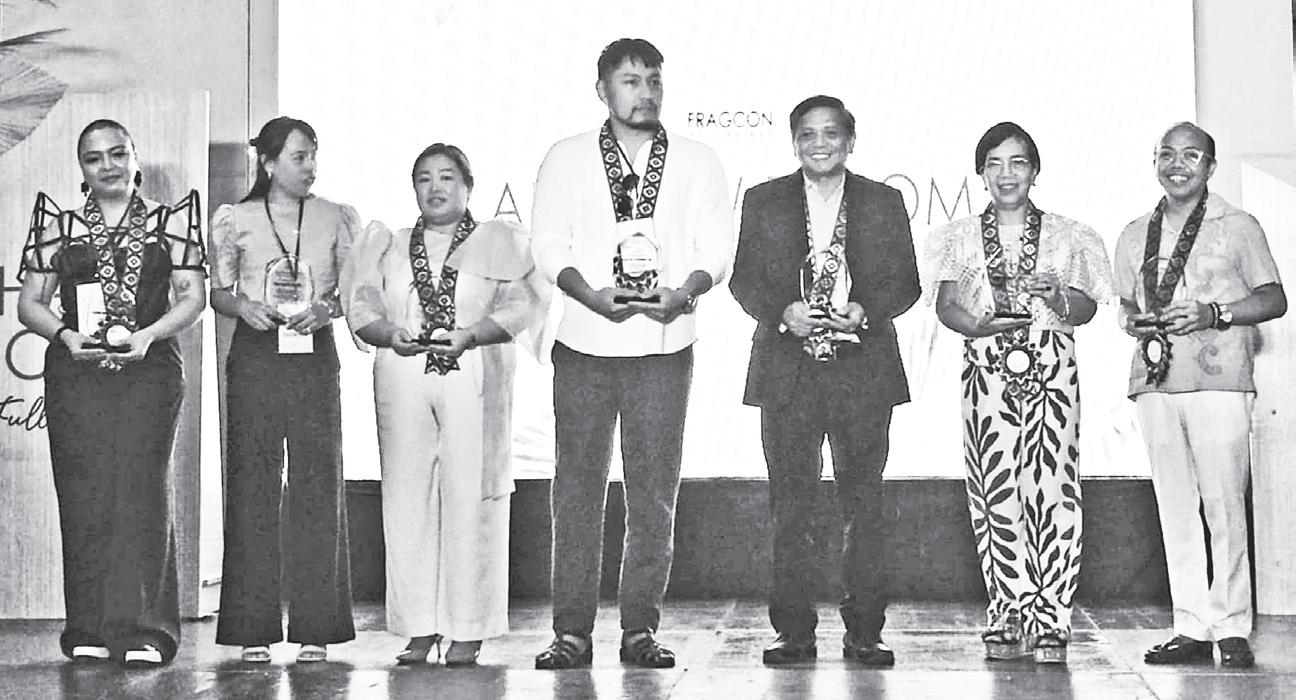
THE “FragCon Philippines: Anahaw Bloom Fragrance Full Bloom” promoted green innovation and sustainability that the Science department and its Forest Products Research and Development Institute (FPRDI) championed during the conference held at a mall in Quezon City on June 15.
Featuring 28 booths that exuded the scents of local perfume brands, the event brought together 400 participants, including fragrance enthusiasts, perfumers, vloggers, content creators, and guest speakers from both the private and government sectors.
Science Secretary Renato U. Solidum Jr. recognized the potential of the fragrance industry in contributing to the growth of the country’s economy.
“The perfume industry in the Philippines is more than a symbol of luxury—it represents a growing sector that generates employment and supports allied industries from agriculture to retail,” Solidum said.
“The DOST [Department of Science and Technology] is ready to provide innovations—from precision scent
formulation to sustainable sourcing—so that local perfumers can scale up their businesses and compete globally,” he added.
For DOST-FPRDI’s Director Rico J. Cabangon, he pointed out the Institute’s strong commitment to advance ecofriendly practices through research-driven solutions.
He said the Philippines’ rich biodiversity
“offers a unique advantage in developing sustainable and culturally relevant fragrances.”
“By focusing on native aromatic plants, the fragrance industry can create unique scent profiles that will differentiate Filipino fragrances in the global market, and empower indigenous communities that propagate and produce these aromatic raw
wild, it can become a formidable competitor especially in ecosystems already under pressure.
According to the researchers, previous reports of the species in the country had been largely anecdotal or lacked scientific verification.
They claimed that their study marks the first confirmed record of the species in Laguna de Bay, though additional unconfirmed sightings have surfaced in nearby waterways, including the Pagsanjan River.
The presence of B. schwanefeldii raises alarm among environmental scientists, given its potential to disrupt local ecosystems by competing with native fish for food, territory and breeding sites.
“If this spread continues unchecked, it could mirror the ecological disruptions caused by other invasive fish worldwide—such as tilapia or janitor fish—leading to biodiversity loss and irreversible
changes to aquatic food webs,” the study said.
They emphasized the need for more rigorous and coordinated monitoring efforts not only for the tinfoil barb, but also for other introduced invasive species quietly altering the country’s aquatic landscapes.
The Ateneo de Manila University biologists were Kent Elson S. Sorgon, Marjorie Juliana L. Martinez, Andrei Justin F. So, Mariko Franccesca R. Aboganda, Jazreen Nicole G. Parungo, Aeris Johanne G. Poricallan, Keona Tiffany B. Prieto, Mellissa Jewel S. Magday, Alexa Charlize
Their study titled “New records of the tinfoil
Luzon Island, Philippines” was posted in the Philippine Journal of Systematic Biology.
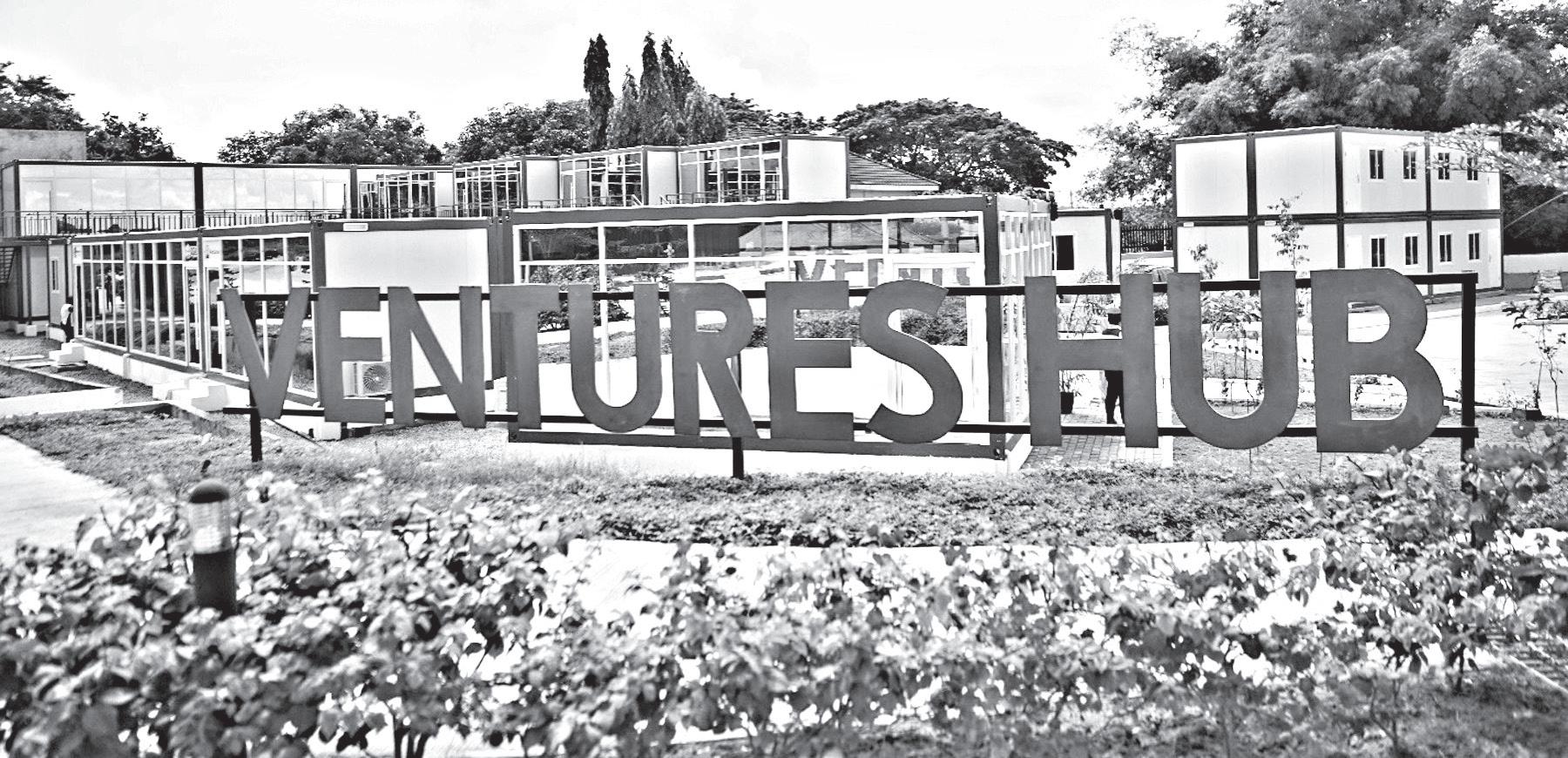
BATANGAS CITY—Batangas State University (BatStateU), the Philippines’ National Engineering University, inaugurated the highly anticipated Knowledge, Innovation and Science Technology (KIST) Park’s Ventures Hub on June 19 as the university is taking bold strides toward the future of innovation, research, and industry-academe collaboration.
This innovation space in BatStateU’s pioneering KIST Park is expected to transform the local startup ecosystem by turning visionary ideas into thriving ventures.
The Ventures Hub offers modular locator spaces tailored to help startups grow and scale up. It will enable industry locators to collaborate, explore ideas, and seize opportunities in partnership with BatStateU.
with world-class expertise, transformative research programs, and a dynamic ecosystem designed to foster innovation.
This strategic partnership ensures that ventures can seamlessly transition from research and development to market-ready solutions, enhancing their global competitiveness.
materials,” Cabangon said. He pointed out that research and development is looking into the green method of extracting essential oils for fragrances from select aromatic plant species using supercritical fluid extraction.
It is an eco-friendly approach that guarantees higher and better recovery rate, faster extraction time, and lower operating costs than traditional methods, he added.
A perfume-making contest was among the highlights of the event that allowed participants to craft their signature scents using premium oils and materials provided on-site.
The activity was facilitated by Claire Mavreen of Claire Olfaction, and judged by four prominent Filipino perfumers—Oscar Mejia III of Scentsories Inc., Shale Albao of Tadhana Fragrance, Renator Lopena Jr. of Wren Atelier, and Bernadette Lim of BC Fragrance.
Also representing DOST-FPRDI during the event were For. Florena B. Samiano, Edmark C. Kamantigue and Dr. Carl Anthony O. Lantican.
Florena B. Samiano/S&T Media Service
At the Ventures Hub, its focus will span high-impact sectors—such as semiconductors, electronics, artificial intelligence, agritech, healthtech, and more— reflecting the university’s commitment to advancing technologies that solve real-world problems.
“Through initiatives like the Ventures Hub, we are ensuring that our students, researchers, and entrepreneurs have the tools, resources, and expertise to bring their ideas to life—creating solutions that resonate on a global scale,” said Dr. Tirso A. Ronquillo, university president and COO of BatStateU KIST Park.
“The Ventures Hub will empower the next generation of tech entrepreneurs and fuel economic growth by turning their visions into thriving businesses that will drive the Philippine economy forward,” Ronquillo added.
KIST Park’s journey started from its inception as a vision approved by the Board of Regents in 2016, to its declaration as a Philippine Economic Zone Authorityregistered Special Economic Zone in 2020.
Central to BatStateU KIST Park is its access to BatStateU’s rich pool of talent, providing startups
The inauguration featured speeches from key stakeholders in the education and tech sectors, including Dr. Marita R. Canapi, Commissioner of the Commission on Higher Education; Dr. Napoleon K. Juanillo Jr., Assistant Secretary for Technology Transfer, Communications, and Commercialization of Department of Science and Technology; and Director Carmela P. Matabang, regional director of the Department of Economy, Planning and Development, Region IV-A. They all emphasized the importance of collaboration between industry and academe in advancing the country’s technology and innovation landscape.
Startups and industry locators at Ventures Hub recognize the value of being part of an ecosystem where they are not building in isolation, but co-creating alongside researchers, students, and fellow innovators. The Ventures Hub provides the structure and support they need to move quickly, test ideas, and focus on building what truly matters.
During the inauguration, industry locators, such as Plant Science Philippines Corp., ParallaxED, TRIOE, Lycan Motorcycles, among others, participated in a unit exhibition showcasing their innovations, capabilities, and active role in shaping the vibrant, collaborative ecosystem within KIST Park. BatStateU KIST Park, located in Alangilan, Batangas City, offers substantial government-backed incentives, including income tax holidays, VAT zero-rating, and streamlined business registration processes. These advantages reduce barriers to innovation, creating an ideal environment for startups to scale and succeed.
A6 Sunday, July 6, 2025

By William Trollinger
THE 1925 Scopes trial, in which a Dayton, Tennessee, teacher was charged with violating state law by teaching biological evolution, was one of the earliest and most iconic conflicts in America’s ongoing culture war.
Charles Darwin’s “Origin of Species,” published in 1859, and subsequent scientific research made the case that humans and other animals evolved from earlier species over millions of years.
Many late-19th-century American Protestants had little problem accommodating Darwin’s ideas—which became mainstream biology—with their religious commitments.
But that was not the case with all Christians, especially conservative evangelicals, who held that the Bible is inerrant—without error—and factually accurate in all that it has to say, including when it speaks on history and science.
The Scopes trial occurred from July 10 to 21, 1925. Between 150 and 200 reporters swooped into the small town. Broadcast on Chicago’s WGN, it was the first trial to be aired live over radio in the United States.
One hundred years after the trial, the culture war over evolution and creationism remains strong—and yet, when it comes to creationism, much has also changed.
The trial
IN May 1919, over 6,000 conservative Protestants gathered in Philadelphia to create, under the leadership of Baptist firebrand William Bell Riley, the World’s Christian Fundamentals Association (WCFA).
Holding to biblical inerrancy, the “fundamentalists” believed in the creation account detailed in chapter 1 of Genesis, in which God brought all life into being in six days.
But most of these fundamentalists also accepted mainstream geology, which held that the Earth was millions of years old.
Squaring a literal understanding of Genesis with an old Earth, they embraced either the “day-age theory”—that each Genesis day was actually a long period of time—or the “gap theory,” in which there was a huge gap of time before the six 24hour days of creation.
This nascent fundamentalist movement initiated a campaign to pressure state legislatures to prohibit public schools from teaching evolution.
One of these states was Tennessee, which in 1925 passed the Butler Act. The law made it illegal for public schoolteachers “to teach any theory that denies the story of divine creation of man as taught in the Bible, and to teach instead that man has descended from a lower order of animals.”
The American Civil Liberties Union (ACLU) persuaded John Thomas Scopes, a young science teacher in Dayton, Tennessee, to challenge the law in court.
The WCFA sprang into action, successfully persuading William Jennings Bryan—populist politician and outspoken fundamentalist—to assist the prosecution.
In response, the ACLU hired famous attorney Clarence Darrow to serve on the defense team.
When the trial started, Dayton civic leaders were thrilled with the opportunity to boost their town. Outside the courtroom there was a carnivalesque atmosphere, with musicians, preachers, concession stands and even monkeys.
Inside the courtroom, the trial became a verbal duel between Bryan and Darrow regarding science and religion.
But as the judge narrowed the proceedings to whether or not Scopes violated the law—a point that the defense readily admitted—it seemed clear that Scopes would be found guilty. Many of the reporters thus went home.
But the trial’s most memorable episode was yet to come. On July 20, Darrow successfully provoked Bryan to take the witness stand

as a Bible expert. Due to the huge crowd and suffocating heat, the judge moved the trial outdoors.
The 3,000 or so spectators witnessed Darrow’s interrogation of Bryan, which was primarily intended to make Bryan and fundamentalism appear foolish and ignorant.
Most significant, Darrow’s questions revealed that, despite Bryan’s’ assertion that he read the Bible literally, Bryan actually understood the six days of Genesis not as 24-hour days, but as six long and indeterminate periods of time.
The very next day, the jury found Scopes guilty and fined him
ARCHBISHOP Midyphil Billones of Jaro, Iloilo, received the pallium from Pope Leo XIV during a Mass for the Solemnity of Saints Peter and Paul at St. Peter’s Basilica on June 29.
The pallium—a narrow band of white wool worn over the shoulders resembling a stole with six black silk crosses—is a liturgical vestment symbolizing an archbishop’s communion with the pope and his role as a shepherd of the local Church.
During the celebration, Pope Leo XIV revived the ancient tradition of personally imposing the pallium on new metropolitan archbishops.
This symbolic rite had been modified by Pope Francis in 2015, when he decided to present the pallium to archbishops at the Vatican, while leaving it to the nuncio in each archbishop’s country to impose the pallium in a local ceremony.
At the time, Pope Francis explained that this change was meant to give greater prominence to local churches, to make the ceremony more pastoral and participatory, and to strengthen the bond between archbishops and their people, without weakening communion with Rome.
Pope Francis appointed Billones, 55, as archbishop of Jaro on February 2, following the retirement of Archbishop Jose Romeo Lazo.
Ordained a priest for the Jaro archdiocese in 1995, Billones was named auxiliary bishop of Cebu in 2019. He was installed as the 14th archbishop of Jaro on April 2.
Billones was among 54 new archbishops from across the globe who received the pallium from Pope Leo, who presided over the ceremony for the first time as pontiff.
During the ceremony, Pope Leo XIV warned the new archbishops against following “the same old pastoral plans without experiencing interior renewal and a willingness to respond to new challenges.”
Speaking on the Solemnity of Peter and Paul—the saints recognized by the Catholic Church as pillars of the faith and venerated as patrons of the city of Rome—the pope called for maintaining ecclesial unity while respecting diversity.
“Our patron saints followed different paths, had different ideas and at times argued with one another with evangelical frankness. Yet this did not prevent them from…a living communion in the Spirit, a fruitful harmony in diversity,” the pope said.
During Mass, Leo urged them to “find new paths and new approaches to preaching the Gospel” rooted in the “problems and difficulties” arising from their communities of faith.
“The two apostles…inspire us by the example of their openness to change, to new events, encounters, and concrete situations in the life of their communities, and by their readiness to consider new approaches to evangelization in response to the problems and difficulties raised
by our brothers and sisters in the faith.”
After the homily, deacons descended to the tomb of the Apostle Peter, located beneath the Altar of the Chair, to retrieve the palliums the pope had blessed.
In his homily, the Pope praised the example of Sts. Peter and Paul, highlighting their “ecclesial communion and the vitality of faith.”
He stressed the importance of learning to live communion as “unity within diversity—so that the various gifts, united in the one confession of faith, may advance the preaching of the Gospel.”
The pope called for fostering “fraternity” and urged his listeners to “make an effort, then, to turn our differences into a workshop of unity and communion, of fraternity and reconciliation, so that everyone in the Church, each with his or her personal history, may learn to walk side by side.”
At the end of the celebration, the pontiff descended the stairs to the tomb of the Apostle Peter and prayed for a few moments before it, accompanied by Metropolitan Emmanuel of Chalcedon, head of the Delegation of the Ecumenical Patriarchate.
The Solemnity of Sts. Peter and Paul is especially important for ecumenism because the two saints are honored by all apostolic traditions, and the Ecumenical Patriarchate has sent a delegation to Rome for the feast annually since the 1960s. CBCP News and Vatican News
$100. Riley and the fundamentalists cheered the verdict as a triumph for the Bible and morality.
The fundamentalists and ‘The Genesis Flood’ BUT very soon that sense of triumph faded, partly because of news stories that portrayed fundamentalists as ignorant rural bigots.
In one such example, a prominent journalist, H. L. Mencken, wrote in a “Baltimore Sun” column that the Scopes trial “serves notice on the country that Neanderthal man is organizing in these forlorn backwaters of the land.”
The media ridicule encouraged many scholars and journalists to conclude that creationism and fundamentalism would soon disappear from American culture. But that prediction did not come to pass.
Instead, fundamentalists, including WCFA leader Riley, seemed all the more determined to redouble their efforts at the grassroots level.
But as Darrow’s interrogation of Bryan made obvious, it was not easy to square a literal reading of the Bible—including the six-day creation outlined in Genesis—with a scientific belief in an old Earth. What fundamentalists needed was a science that supported the idea of a young Earth.
In their 1961 book, “The Genesis Flood: The Biblical Record and its Scientific Implications,” fundamentalists John Whitcomb, a theologian, and Henry Morris, a hydraulic engineer, provided just such a scientific explanation.
Making use, without attribution, of the writings of Seventhday Adventist geologist George McCready Price, Whitcomb and Morris made the case that Noah’s global flood lasted one year and created the geological strata and mountain ranges that made the Earth seem ancient.
“The Genesis Flood” and its version of flood geology remains ubiquitous among fundamentalists and other conservative Protestants.
Young Earth creationism
TODAY, opinion polls reveal that roughly one-quarter of all Americans are adherents of this newer strand of creationism—which rejects both mainstream geology as well as mainstream biology.
This popular embrace of young Earth creationism also explains the success of Answers in Genesis (AiG), which is the world’s largest creationist organization, with a website that attracts millions of visitors every year.
AiG’s tourist sites—the Creation Museum in Petersburg,
Kentucky, and the Ark Encounter in Williamstown, Kentucky— have attracted millions of visitors since their opening in 2007 and 2016.
Additional AiG sites are planned for Branson, Missouri, and Pigeon Forge, Tennessee.
Presented as a replica of Noah’s Ark, the Ark Encounter is a gigantic structure—510 feet long, 85 feet wide, 51 feet high. It includes representations of animal cages as well as plush living quarters for the eight human beings who, according to Genesis chapters 6 to 8, survived the global flood.
Hundreds of placards in the Ark make the case for a young Earth and a global flood that created the geological strata and formations we see today.
Ark Encounter has been the beneficiary of millions of dollars from state and local governments. Besides AiG tourist sites, there is also an ever-expanding network of fundamentalist schools and homeschools that present young Earth creationism as true science. These schools use textbooks from publishers such as Abeka Books, Accelerated Christian Education and Bob Jones University Press. The Scopes trial involved what could and could not be taught in public schools regarding creation and evolution.
Today, this discussion also involves private schools, given that there are now at least 15 states that have universal private school choice programs, in which families can use taxpayer-funded education money to pay for private schooling and homeschooling. In 1921, William Bell Riley admonished his opponents that they should “cease from shoveling in dirt on living men,” for the fundamentalists “refuse to be buried.” A century later, the funeral for fundamentalism and creationism seems a long way off. University of Dayton/The Conversation (CC) via AP
Pope: God’s creation is not a battleground for vital resources
AS the Church prepares to mark the Tenth World Day of Prayer for the Care of Creation on September 1, Pope Leo XIV’s message for the occasion urges Christians and all people of goodwill to recognize the urgent need for environmental and social justice in a world increasingly scarred by climate change, conflict, and inequality.
Titled “Seeds of Peace and Hope” and released on July 2, the pope’s message resonates with the spirit of the ongoing Jubilee Year, calling the faithful to embrace their role as “pilgrims of hope” and stewards of God’s creation.
Justice in a wounded world
ECHOING the prophetic words of Isaiah, Pope Leo invites the global community to envision a transformation of today’s “arid and parched desert” into “a fruitful field.”
This biblical vision, he explains, is not a poetic metaphor but an urgent call to action in the face of alarming ecological and human crises.
Quoting extensively from Pope Francis’ encyclical “Laudato si’” in the year of its 10th anniversary, he writes: “Injustice, violations of international law and the rights of peoples, grave inequalities, and the greed that fuels them are spawning deforestation, pollution, and the loss of biodiversity.”
Linking environmental destruction to the exploitation of the poor and marginalized, he highlights the disproportionate suffering of indigenous communities and the widening gap between rich and poor as hallmarks of a system that treats nature as a commodity rather than a common home.
Nature as a battleground
HE laments the fact that nature itself has become “a bargaining chip,” subjected to policies and practices that prioritize profit over people and the planet.
From agricultural lands riddled with landmines to conflicts over water and raw materials, the pope paints a sobering picture of a creation “turned into a battleground” for control and domination.
These wounds, he says, are “the effect of sin,” a betrayal of the biblical command not to dominate creation, but to “till and keep” it, a call to cultivate and preserve the Earth through a relationship of care and responsibility.
Environmental justice as a moral imperative
THE pope’s message reaffirms the Church’s commitment to an “integral ecology,” a concept at the heart of Laudato si’.
Environmental justice, the Holy Father affirms, is not an abstract
or secondary concern but a “duty born of faith.”
“For believers,” he writes, “the universe reflects the face of Jesus Christ, in whom all things were created and redeemed.” In this light, caring for the planet becomes not only an ecological necessity but also a profoundly spiritual and moral vocation.
Seeds that bear fruit
ENCOURAGING concrete action, Pope Leo calls for perseverance and love in sowing “seeds of justice” that will, in time, bear the fruits of peace.
He cites the Borgo Laudato Si’ project at Castel Gandolfo as a tangible example of how education and community life rooted in ecological values can shape a just and hopeful future.
“This may take years,” the pope acknowledges, “but years that involve an entire ecosystem made up of continuity, fidelity, cooperation and love.”
A blessing for the future
CONCLUDING his message with a prayer for the outpouring of God’s Spirit, Pope Leo XVI invokes the hope of the risen Christ as the guiding light for a world longing for healing.
“May [Laudato si’] continue to inspire us,” he writes, “and may integral ecology be increasingly accepted as the right path to follow.” Linda Bordoni/Vatican News

Editor: Lyn Resurreccion

By Jonathan L. Mayuga
N Barangay Sta. Ana, municipal -
Iity of Pandan, Antique, members of a small agrarian reform community are learning new skills and are harnessing their community’s natural resources.
The barangay, whose residents’ main source of income is gathering coconuts, is also rich in nito vines, a local resource traditionally used by Filipino artisans in weaving assorted native products.
The Department of Agrarian Reform (DAR) recently held a Technology Training on Nito Craft Making to help members of the association transform these vines into quality handicrafts.
Expert nito artisan Conrado P. Sales, who led the training, provided hands-on guidance in harvesting, preparing, and weaving nito into coasters and placemats, emphasizing quality, functionality, and sustainable use of natural materials.
Harvesting the locally available natural material “is a promising livelihood,” said Chairperson Helen P. Antonio of Sta. Ana San Joaquin Agrarian Reform Cooperative.
“With patience and the resources we already have, we can build a new source of income—and even start a small business for our cooperative,” Antonio added.
A way of life FILIPINOS are known for their exceptional craftsmanship. Each region in the country boasts of a traditional craft that reflects the people’s culture and tradition, and the rich biological diversity.
Whether it be grass, leaves, or vines, Filipino ingenuity could turn plant- or animal-based materials into quality products like baskets, embroidery, pottery, jewelry, carving, shellcraft, or decorative and other novelty items.
Filipino ancestry is known to pass from one generation to the next these exceptional skills harnessed from nature’s abundance and richness.
Mollusks and shells
IN coastal areas, fishing communities transform shells into colorful jewelry like bracelets, earrings and rings, purses, and even small bags, placemats and curtains.
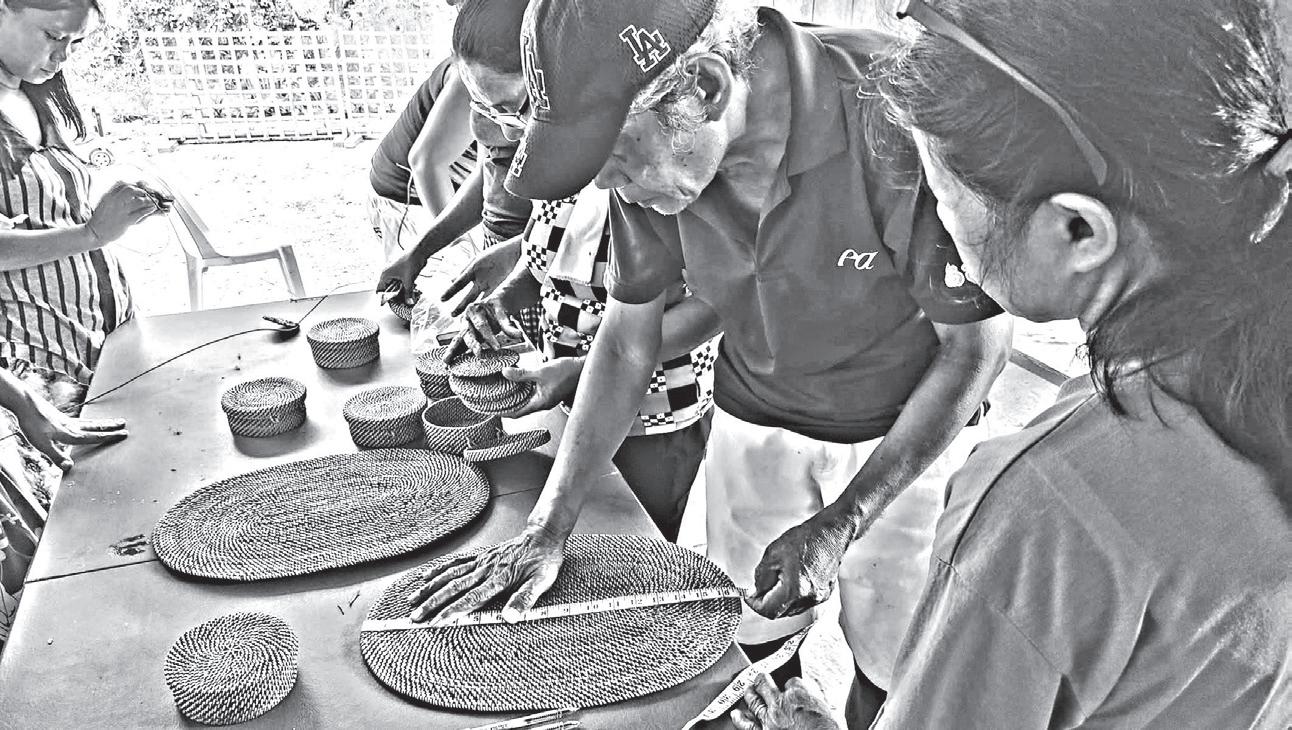

Edible or not, there are at least 5,000 species of seashells in the Philippines, according to OneOcean.org. The country is considered a hotspot for marine biodiversity, with a high diversity of mollusks. Sadly, approximately 1,500 of these species are involved in the shell trade.
Both the giant clam (Tridacna gigas), the world’s largest shell, and the world’s smallest seashell (Pisidium) can be found in the country’s waters.
Grasses
SOME species of vines or grasses are being used for various handicrafts like baskets, food or fruit bowls, trays, and a variety of functional and decorative items.
After many years, Filipino craftsmanship has evolved into making export-quality products from vines and grass, from simple kitchen tools to elegant furnitures.
Tiger grass, locally called “luway” or “tambo” is ecologically and economically important. It is used to make “walis tambo [soft broom],” providing a livelihood to upland farmers
who grow them.
In Bicol, tiger grass, called as “samhod,” is also used to make samhod, or soft broom.
Lolito C. Bayna Jr., chairman of Tinapian Fishermen Farmers Multipurpose Cooperative in Manito, Albay, said they grow tiger grass, which takes a year to mature, and produce walis tambo.
He explained the other important use of tiger grass—protecting lowland areas from flash floods and soil erosion.
“We use tiger grass as slope protection, so it has a double purpose,” he said partly in Filipino to the BusinessMirror in a telephone interview on July 2.
He added that most of the 60 members of their group of farmers and fishermen benefit from tiger grass.
Albay’s ‘karagumoy’
LERMA B. DINO, chief Agrarian Reform Program officer, Regional Program Beneficiaries Development Division of DAR Regional Office V, said many other grasses and vines provide

environmental and economic benefits to communities.
She cited “karagumoy,” a tall grass which naturally grows in Albay.
“We have a group in an island that uses karagumoy to produce ‘banig’ [sleeping mat] and baskets. They are very popular products,” she said.
Like bamboo, karagumoy, once they grow, stay for good, and are found everywhere. They grow in Catanduanes but are aplenty in Albay.
Biodiversity-friendly enterprises
ACCORDING to Dino, the DAR makes use of the country’s rich biodiversity to generate income and create livelihood opportunities, like teaching the Albayanons harness the potential of their environment, including the untapped raw materials that grow around them.
“They [raw materials] provide additional income. The diverse vines and plants generate livelihood for our farmers,” she told the BusinessMirror in a telephone interview on July 2.
This is why the DAR, which assists agrarian reform beneficiaries, encour -
ages the sustainable use of these natural materials and protect and conserve them being rich sources of income for farming and fishing communities.
“During our livelihood trainings, we emphasize sustainability in whatever we do,” she pointed out.
Rattan, bamboo and Manila hemp
NATURAL resources like rattan, bamboo and Manila hemp or abaca are harnessed into creative industries.
Known for its flexibility and strength, rattan has been the favorite material in weaving baskets, furniture, and crafts. It is like bamboo, a giant grass that naturally grows in tropical countries like the Philippines.
Bamboo is used for everything from furniture and building materials to decorative items and musical instruments.
Manila hemp, more popularly known as abaca, has been processed for centuries in making strong fiber.
It is being used in weaving textiles, ropes, and various handicrafts like bags and mats, thereby creating a dol -
lar-earning industry for the country.
Coconut and fibers
COCONUT, often referred to as the tree of life, has several byproducts being used for various handicraft goods. Imagine coconut shells being transformed into decorative bowls, or musical instruments, manifesting the testament to the resourcefulness of Filipino craftsmen.
Meanwhile, the leaves and fibers are as useful, like those from nipa and buri palms, in the construction of shelters like the famous “bahay kubo,” or native hut.
Fibers from plants like “buntal” and pandan are useful for weaving and basketry.
Likewise, cogon and “tikog” (sedge) grasses could not be outdone. They are used in different types of weaving and crafts production.
Invasive plants EVEN nonnative or what can be considered invasive plants can be very useful, too.
Take it from Gregg Yan, Founder of Best Alternatives. He said: “Nature has always provided for people, and there are a million and one ways to make use of the plants and trees around us.”
“A simple example would be the many budding cottage industries making bags, baskets, and even ‘pamaypay’ [fan] made from readily available water hyacinth [Eichhornia crassipes], an invasive plant that floats through most of our country’s rivers and lakes,” said Yan, a wildlife conservation advocate told the BusinessMirror via Messenger on July 2.
“Using these plants as handicraft products or even as animal feed removes them from our ecosystems [they blot out sunlight and decrease the oxygen levels in our waterways] while becoming financially rewarding for people. This is the kind of win-win initiative supported by Best Alternatives, which helps promote sustainable alternatives to plastics made from fossil-fuels like petrochemicals,” he added.
“Plants have a million uses: We eat them, use them for medicine. We now even have the technology to turn them into fuel,” Yan noted.
As Anabelle Plantilla of Biodiversity Finance Initiative’s once said: “Forests have served as pharmacies and groceries for generations.”
By Geraldine Bulaon-Ducusin
THE total value of forest ecosystem services in the Philippines would be $30 billion a year if 15 million hectares (ha) are forested. However, only about 7.5 million ha are currently forested, which translates to a loss of ecosystem services valued at $15 billion year.
This is according to Academician Rex Victor Cruz, during his discussion on “Natural Resource Management Issues and the Economy,” during the recent National Academy of Science and Technology (NAST-PHL) “Science Policy Forum on Forest Restoration: Status, Issues, Challenges, and Policy Reform.”
Among the forest ecosystem services are regulation of air quality, climate, water runoff, erosion, natural hazards, and pollination.
Besides these, forests also play a big role as source of provisions, such as food, fiber, biomass, fuel, fresh water and natural medicines.
Atty. Jose Andres Canivel, executive director of Forest Foundation Philippines, in his reflections on the studies presented, explained that there’s a need to recognize that forest restoration really contributes to rural economy, as they generate seedling, and participate in restoration efforts. However, the contribution to rural economies can also benefit the future, by way of what are planted, where they are planted and who are involved.
Aligned with Canivel’s insights, Dr. Dixon T. Gevaňa, professor and director of Forestry Development Center of University of the Philippines Los Baňos, in his discussion of “Restoring the Degraded Mangrove Ecosystem in the Philippines,” emphasized the difference between restoration and rehabilitation.
He said restoration pertains to bringing back the “original condition,” that is, ecosystem functions, integrity and biodiversity, while rehabilitation refers to improving the degraded condition with the goal of bringing back some of the ideal ecosystem functions and services.
The Philippines has 311,400 ha of mangrove forests, but it is losing 330 ha
A forester who is an expert in watershed management and climate change adaptation, Cruz advised the government and other stakeholders “to focus on forest restoration” because it remains as a “vital pillar of sustainable and resilient development and human security.”

each year. And what’s commonly done is rehabilitation.
Gevaňa cited that among the drivers of mangrove ecosystem degradation are aquaculture expansion, infrastructure development, logging and fuelwood harvesting, pollution, climate change, weak enforcement and policy gap.
He added that he realized there are a lot of research done already, and the Philippines also has a substantive share of existing policies.
But he underscored that what’s lacking is the implementation, and unfortunately, low compliance.
When asked how the environmental issues can be resolved, particularly the low compliance to policies, to improve the condition of many communities, Cruz suggested to invest in monitoring.
“The key here is you set in place an accountability system that will exempt no one or will not exempt anyone,” Cruz said.
He added that there should be a strongwilled system of accountability.
At the same time, it would require a robust production of evidence, that will entail an investment in a comprehensive monitoring of the environment, natural resources and ecosystem.
“Produce evidence. How do you produce evidence? Invest in monitoring. If there are evidence of what’s going on around in the ecosystem, in the watershed, in mangroves, in the forest—produce the evidence and then make people accountable to the evidences that you produce,” Cruz illustrated how to impose accountability. Forests are needed for climate-change adaptation, disaster risk reduction, conservation of biodiversity, soil and water, sustainable industry and livelihoods, and community development, the speakers said. There is a need to increase cost-effectiveness of forest restoration investments to maximize use of limited budget, they pointed out.
According to Canivel, to make the forest ecosystem economic contribution go beyond just job generation, perhaps there is need to look at where to plant forest trees and where to plant the agro-forest inputs.
“Perhaps that’s one way of ensuring longer economic benefits,” he said. The forum was organized by

A8 | Sund
mirror_sports@yahoo.com.ph
Editor: Jun Lomibao
GILAS Pilipinas Women standout Ella Fajardo is no stranger to hard work and rejection—lessons she brought to the court in the recent Kingdom Elite Invitational Basketball Camp. Now 22 and already a seasoned athlete, Fajardo shared the struggles she had to overcome to reach the international stage—from being overlooked by coaches to not making it to university rosters, thus proving that even the brightest stars face darkness before they shine.
“I went through a very low point in my life where I felt that I wasn’t good enough, but through hard work and prayers, I found the strength to keep going and prove myself,” said Fajardo, a Milo ambassadress.
Inspired by her sports journey which began at the Milo Basketball Efficiency Scientific Training Center clinics, Fajardo has come full circle by sharing her expertise with almost 100 aspiring female basketball players.
The young athletes were taught ball-handling, layup drills and defensive techniques, while also learning core values such as grit, discipline and teamwork.
“This camp is my way of giving back to the community that shaped me. I wanted to create an event where young girls can learn the game, build their confidence, and experience the same joy I felt when I was starting out,” she said.
Among the campers Regina, 12, from La Salle Antipolo, who said the camp is a motivating experience that pushed her to dream bigger.
“Coach Ella is an inspiration to me,” she said. “Because of this camp, I am inspired to become better and to reach my dreams of becoming a national athlete for the Gilas team.”
Another participant, Clara, said: “I was moved by her story, and the lesson I learned from her is to never give up and keep pushing yourself to be better.”
Fajardo, who currently plays for NCAA Division I team Iona Gaels in the US, is playing with Gila Pilipinas in the 44th Jones Cup Women’s Tournament in Taipei this week and in the FIBA Women’s Asia Cup starting July 13 in China.
“Ella embodies what Milo stands for. As someone who started her journey through the Milo grassroots program, she is a living testament to the impact of sports,” said Carlo Sampan, Milo Head of Sports.


3.5 million steps, 2,500 kms: Done!
MORE than 3.5 million steps and 2,500 collective kilometers were logged during the Move for Play: Infinity 116KM Run—the country’s firstever open-road ultra-endurance community run.
Organized by the non-profit organization FundLife, the event held last June 14 and 15 brought runners from Clark to Makati in a call to action for safe, inclusive and accessible play spaces for children in under-resourced communities.
LONDON—When Naomi
Osaka opened up about her anxiety and depression at the 2021 French Open, it sparked a conversation in sports—and society at large—about mental health and the importance of addressing such issues.
In the time since, more and more players have spoken about the topic and seeking help, and whatever taboos there were seem to have faded.
Still, the way three-time Grand Slam finalist Alexander Zverev discussed his state of mind after a first-round exit at Wimbledon this week revived the conversation.
“I feel very alone out there at times.
I struggle mentally. .. I’m trying to find ways to kind of get out of this hole. I keep kind of finding myself back in it in a way,” said Zverev, who was the runner-up at the Australian Open in January but then went through a rough stretch of results this season when he had a chance to overtake Jannik Sinner at No. 1 in the rankings.
Zverev said that at Wimbledon, he feels “quite alone in life.”’
“I feel, generally speaking, quite alone in life at the moment, which is a feeling that is not very nice,” Zverev said. “It’s not a feeling on a tennis court, it’s just a life feeling in general.”
Players at the All England Club were asked Wednesday about Zverev’s words. They could empathize, some said. Others offered advice.
Amanda Anisimova was a French Open semifinalist as a teen in 2019, then announced two years ago she was taking time off because of burnout.
She’s been back for a while now and reached the third round at Wimbledon with a victory Wednesday.
“It’s definitely tricky. Each and every one of us goes through something at some point in our lives. We have our bouts of negative times. It honestly takes some self-reflecting, figuring out what’s
going wrong or how can I create a lifestyle that I enjoy. I feel like there are so many factors. For me, personally, it was finding people that I could confide in and I trusted. People that I could talk to,” Anisimova said.
“What Alex said about feeling lonely...a lot of people struggle with being lonely, especially on the pro circuit,” she said, adding that taking a break from tour life “really helped me and I’m happy I did that, because I came back with a new perspective, felt refreshed, and I feel like I learned a lot about myself.”
Wimbledon athletes talk about turning to therapy for help.
Top-ranked Aryna Sabalenka, who owns three major trophies, said that she worked with a therapist for five years.
“It’s really important to talk openly about whatever you’re dealing with.... It’s really important to be open and to talk about what are you experiencing, because if you’re going to keep it inside, it’s just going to destroy you. I think that’s kind of like something happening to him,” Sabalenka said. “I think [Zverev] just needs to open up to whoever is close to him.”
At the Australian Open, title winner Madison Keys addressed her reliance on therapy and the ways in which it both allowed her to be happier, in general, and more successful at tennis—a sport in which losses are frequent and expectations can be a burden.
On-court losses in tennis can affect off-court identities.
“Our identity becomes very wrapped up in being a tennis player. That’s great, but when you have the tough kind of weeks, months, years on tour, that can really take a toll on how you think about yourself as a person,” Keys, a 30-year-old American, said Wednesday.

“So being able to kind of dive into that and figure out how to separate the two and know that you’re not just a tennis player, you’re a full person that has all of these other really great attributes and other interests and just different things in your life.”
When a reporter asked the No. 3-seeded Zverev after his loss to unseeded Arthur Rinderknech on Tuesday whether he might consider trying therapy, the 28-year-old German replied: “For the first time in my life, I’ll probably need it.”
This is how he described his current mindset: “I’ve never felt this empty before. Just lacking joy, just lacking joy in everything that I do. It’s not necessarily about tennis. Just lacking joy outside of tennis, as well.” Andrey Rublev, a 10-time Slam quarterfinalist from Russia who is seeded 14th at Wimbledon, said after his win Wednesday that life on tour, in and of itself, is not the problem for someone like Zverev.
“Tennis is just the trigger point,” Rublev said. “It’s something inside of you that you need to face.” AP
Zverev discusses his state of mind after a first-round
at Wimbledon this week revives the conversation on mental health. AP
recognize [them],” Raducanu said.
“That’s why I try and stay with my eyes on the court as much as possible.
Leading the finishers were ultraendurance athlete Natalie Dau and community runner Cecille Wael, who crossed the finish line together at 6:23 a.m. after running for 16 hours and 12 minutes.
“It was a tough day—the heat, the distance, the traffic—but we all knew why we were out there,” Dau said. “Running 116 kms was never about personal achievement—it was about showing up and showcasing what’s possible when we move with a clear purpose.” Wael said: “Running for those who can’t make this experience deeply meaningful.Pushing my limits while sharing the road with old friends and new faces reminded me of the power of community and collective action.”
The run coincided with the United Nations International Day of Play and was conducted on active roads and highways, requiring participants to navigate traffic, potholes, heat and city congestion. The 116-km route symbolized the difficult and often dangerous terrain many Filipino children must cross daily to access education and recreation. A total of 31 ultra-runners registered to for the full route, while over 40 additional runners joined for various segments—20 completed the entire course in a feat of physical endurance and social purpose.

LOnly after, you kind of look up and take it all in, if they’re still there.”
The seats in the Royal Box behind one of the baselines are by invitation only, and there was quite a list of celebrities on hand for Day 3 of competition.
“I was trying not to look today,” Sabalenka said about the collection of boldfaced names, explaining that she might be distracted while competing.
“I was just trying to focus on my game.
Later on, I’m going to open the social media [and ask], ‘OK, who was there?’”
Well, Aryna, here’s a rundown: Rodrigo, fresh off headlining at music festival Glastonbury while on tour for her GUTS album, sat next to Cena, the professional wrestler and movie star. Rodrigo chatted at one point with former England soccer coach Roy Hodgson (the current person in that job, Thomas Tuchel, also was in attendance).
Grohl, a member of the rock bands Foo Fighters and Nirvana, made an appearance, too, as did the married couple Chopra and Jonas. Hollywood’s Judd Apatow and Leslie


Could the first images from the Vera Rubin telescope change how we view space for good?
JULY 6, 2025 | soundstrip.businessmirror@gmail.com
How DJ Kimozave anchors the soundtrack of GMA’s
By Troi Santos
Each performance on GMA’s Stars on the Floor begins long before the cameras roll. It begins in a home studio, where DJ Kimozave builds sound from silence—composing music tailored to choreography, story arcs, and emotional cues. His work is a fusion of rhythm design, harmonic structure, and technical awareness, crafted to guide movement and draw viewers deeper into the performance.
Kimozave engineers experiences. He applies a deep knowledge of tempo modulation, dynamic phrasing, and spatial mixing to construct original tracks that fit seamlessly into the timing and tone of each performance. His compositions are precision-calibrated to match transitions, gesture accents, and narrative peaks. Each beat, chord, and break is placed with intention. His unique talent has been recognized across the industry. He was twice voted Hip-Hop DJ of the Year by his peers in the Filipino music community, a distinction earned through years of technical

Publisher :
T. Anthony C. Cabangon
Editor-In-Chief :
Lourdes M. Fernandez
Aldwin M. Tolosa
Concept :
Y2Z Editor :
SoundStrip Editor : Group Creative Director : Graphic Designers :
Jt Nisay
Edwin P. Sallan
Eduardo A. Davad
Niggel Figueroa
Chow Jarlego
Contributing Writers :
Tony M. Maghirang
Rick Olivares
Jill Tan Radovan
Reine Juvierre S. Alberto
John Eiron R. Francisco
Pocholo Concepcion
Francine Y. Medina
Justine Xyrah Garcia
Bea Rollo
Trixzy Leigh Bonotan
Bless Aubrey Ogerio
Photographers :
Bernard P. Testa Nonie Reyes
Y2Z & SOUNDSTRIP are published and distributed free every Sunday by the Philippine Business Daily Mirror Publishing Inc. as a project of the
The Philippine Business Mirror Publishing, Inc., with offices on the 3rd Floor of Dominga Building III 2113 Chino Roces Avenue corner Dela Rosa Street, Makati City, Philippines. Tel. Nos. (Editorial) 817-9467; 813-0725. Fax line: 813-7025
Advertising Sales: 893-2019; 817-1351,817-2807. Circulation: 893-1662; 814-0134 to 36. www.businessmirror.com.ph

excellence in turntablism, live remixing, and track creation. Even with that recognition, Kimozave remains understated. He prefers to let the work speak, staying away from the limelight, where the craft is quiet and the intention is clear.
That clarity comes from both skill and lineage. Kimozave is the nephew of the late Oskee Salazar, through his mother, Norma. Oskee was a key figure in the rise of Original Pilipino Music (OPM), supporting the careers of artists such as Jose Mari Chan, Pilita Corrales, Victor Wood, and Eddie Peregrina. As a journalist and music executive, Oskee helped institutionalize Filipino musical recognition through the Awit Awards and Star Awards, while representing Philippine entertainment as a correspondent for Variety, Billboard, and The Hollywood Reporter. That legacy of dedication to sound and story continues in Kimozave’s work today.
He began his own journey with Francis Magalona, as DJ for Hardware Syndrome. In this environment, he blended turntable precision with live performance energy, contributing to one of the most influential cultural movements in Filipino music history. His remix of “Unstrung Heroes” by Francis M and Ely Buendia, released on In Love and War (Sony Music), layered original emotion with new structure, demonstrating his ability to reshape narrative through harmonic contrast and rhythmic spacing.
His career has since expanded across broadcast, pageantry, and performance platforms. Kimozave has created original music for Eat Bulaga!, ASAP, Binibining Pilipinas, Miss Universe Philippines, Star Magic concerts, and Bench fashion


shows. Each track is custom-built, mapped to visual rhythm and event pacing. For runway shows, he constructs BPM-aligned grids; for coronations, he uses swelling motifs and dynamic transitions; for television, he produces multitrack stems optimized for live broadcast.
He has also worked with international reggae artists like Big Mountain at the 1st International Reggae Festival in Manila building custom backing stems and percussion overlays for performances in Manila, factoring venue acoustics and vocal channel needs into his production chain.
For Stars on the Floor, he composes from scratch. Each composition includes mapped cues, tempo shifts, and harmonic transitions that align directly with
choreography and camera direction. His music helps dancers anchor their movement and helps directors shape each segment with energy and tone.
Kimozave’s strength lies in his ability to shape audio with discipline, awareness, and restraint. His arrangements are engineered for motion, felt in muscle memory, and timed to emotion. He works with layered intentionality, combining audio theory, real-time mapping, and an intuitive sense of timing. With roots in the legacy of Oskee Salazar and the respect of the community that twice named him Hip-Hop DJ of the Year, DJ Kimozave continues to build the invisible framework that allows others to shine. His music moves quietly but powerfully and built to last beyond the final cue.
Story by Jingo Zapata
Last week, I had a close look at how serious
Romeo Lee is with his work as a visual artist.
This is unusual since the guy everyone calls Lee is known for his levity — onstage prancing while singing “Wild Thing” or “Oh, Darling”; on the streets while eating in a carinderia (“mura na, marumi pa,” he would caption his eatery photos on Facebook); or in his grotesque paintings themselves.
Lee loves to jam with anyone who can play basic rock ’n’ roll chords. That’s how I first met him — he was part of the Red Rocks/Club Dredd crowd, many of whom were from UP Diliman, including the Eraserheads which gladly obliged as Lee’s backup band on countless occasions.
He’s a real music buff, and one can see it on the various band T-shirts he wears as an expression of his easygoing, fun-loving personality.
As a visual artist, Lee stands out for the outrageous, scary, but also funny characters he portrays on the canvas. They look like monsters in your worst nightmares, anguished souls in Dante’s Inferno, or creatures that could be storyboard sketches for a horror-fantasy movie.
I asked him which artists had inspired him to keep doing such distorted human and animal faces and bodies, because his style seems to evoke that of Spanish painter Francisco Goya and other past practitioners of grotesque art.
‘Just my imagination’
“Just my imagination,” was Lee’s curt reply. I could also imagine the Rolling Stones tune playing as Lee painted at home in Cainta.
There’s actually a recurring woman figure in some of Lee’s paintings, and I just found out she has a name: Bakekang. Whether she’s a witch or just Lee’s version of the komiks character, is open to interpretation.
It’s like, if BenCab has Sabel, Lee’s got Bakekang. These observations point to the opposite side of the concept of beauty and refinement in art — that

life is ugly, messy, frightening and, in Lee’s drawings, so absurd that one has no recourse but to either go mad or laugh out loud.
I witnessed Lee’s serious intent at his first art masterclass held at Ali Mall in Quezon City, sponsored by his friends Linds and Michelle Lee of The Oil Paint Store.
He didn’t really speak in front and lectured on art, but simply encouraged the participants to let go and freely express what they have in mind, and the act of picking up a paintbrush is the first step to doing it.
Another side of Lee which sets him apart from most artists is, he seems to have no ego. He has no air of importance at all — despite having the privilege of hobnobbing with the beautiful crowd.
The elusive John Lloyd Cruz spends time with him and buys his paintings. In fact, some of them hang on the walls of JL’s house.
Lovely women like to be seen with Lee. Try scrolling through his Facebook page.
Lee is also tireless in organizing events. His latest is “Remand,” a group art show ongoing till July 22 at Leon Gallery International in Makati.
In an intimate moment at his solo exhibit at Jay Taruc’s Brixton Art Space in Kapitolyo, Pasig, Lee recounted he started drawing at a young age upon seeing a paintbrush lying around the family home in Naga.
In grade school, the teacher would ask him to draw plants on the blackboard. “Yung teacher mawawala ng dalawang oras habang nag-do-drawing ako,” he recalled.
A brother advised him to take up Fine Arts in college. Lee took the exams at UP Diliman and UST — and passed. He didn’t want to wear a uniform at UST, so he chose to enroll at UP.
The rest is histo-Lee.




By Professor Manda Banerji & Dr. Phil Wiseman University of Southampton
exploration.
The new Vera C Rubin Observatory in Chile will transform astronomy with its extraordinary ability to map the universe in breathtaking detail. It is set to reveal secrets previously beyond our grasp. Here, we delve into the first images taken by Rubin’s telescope and what they are already showing us, which vividly showcase the unprecedented power that Rubin will use to revolutionize astronomy and our understanding of the universe.
Cosmic nurseries–nebulae in detail
THE word nebula comes from the Latin for cloud, and these giant clouds are truly enormous–so vast it takes light decades to travel across them. They are stellar nurseries, the very birth sites for the next generation of stars and planets in our Milky Way galaxy.
The intense radiation from hot, young stars energizes the gas particles, causing them to glow pink. Further from these nascent stars, colder regions consist of microscopic dust grains. These reflect starlight (a process known in astronomy as “scattering”), much like our atmosphere, creating the beautiful blue hues. Darker filaments within are much denser regions of dust, obscuring all but the brightest background stars.
To detect these colors, astronomers use filters over their instruments, allow -

ing only certain wavelengths of light onto the detectors. Rubin has six such filters, spanning from short ultraviolet (UV) wavelengths through the visible spectrum to longer near-infrared light. Combining information from these different filters enables detailed measurements of the properties of stars and gas, such as their temperature and size.
Rubin’s speed–its ability to take an image with one filter and then quickly move to the next–combined with the sheer area of sky it can see at any one time, is what makes it so unique and so exciting. The level of detail, revealing the finest and faintest structures, will enable it to map the substructure and satellite galaxies of the Milky Way like never before.
THE images of galaxies powerfully demonstrate the scale at which the Rubin observatory will map the universe beyond our own Milky Way. The large galaxies
TO the ones who stayed and raised us, They used to call me a lot of things. Words that echoed in school hallways, in hushed whispers, and in the way people looked at me. And often, I believed them. I thought maybe they were right—maybe I was too weird, too soft, too different.
But you still stayed.
You didn’t always get it right but you always tried. And you always led with love. And instead of trying to change me, you let me be. That’s the kind of love I needed. That’s the kind of love every child needs, and some can only hope for.
You made me feel safe. You made me feel seen.
In a universe where I felt out of orbit, you became my gravity. Thank you for raising me with compassion instead of control. For helping me discover who I am, instead of telling me who to be. For loving the quiet parts of me, the quirky parts, the cosmicsized dreams.
Sure, they used to call me weird, weak, or invisible. But now, because of you, I see myself differently. I call myself something more: Brave. Hopeful. Worthy.
Thank you.
Okay. Bye. Love You, Elio n Elio feels like an outsider on Earth, long-
visible in the photo above (such as the two bright spiral shaped galaxies visible in the lower right quarter of the picture) belong to the Virgo cluster, a giant structure containing more than 1,000 galaxies, each holding billions to trillions of stars.
This image beautifully showcases the huge diversity of shapes, sizes and colors of galaxies in our universe revealed by Rubin in their full technicolor glory. Inside these galaxies, bright dots are visible–these are star-forming regions, just like the Lagoon and Trifid nebulae, but remarkably, these are millions of light years away from us.
The still image captures just 2 percent of the area of a full Rubin image revealing a universe that is teeming with celestial bodies. The full image, which contains around ten million galaxies, would need several hundred ultra-high-definition TV screens to display in all its detail.
By the end of its ten-year survey, Rubin will catalogue the properties of
some 20 billion galaxies, their colors and locations on the sky containing information about even more mysterious components of our universe such as dark matter and dark energy. Dark matter makes up most of the matter in the cosmos, but does not reflect or emit light. Dark energy seems to be responsible for the accelerating expansion of the universe.
The Rubin observatory isn’t just a new telescope. It’s a new pair of eyes on the universe, revealing the cosmos in unprecedented detail. A treasure trove of discoveries awaits, but most interesting among them will be the hidden secrets of the universe that we are yet to contemplate.
The first images from Rubin have been a spectacular demonstration of the vastness of the universe. What might we find in this gargantuan dataset of the cosmos as the ultimate timelapse movie of our universe unfolds? The Conversation
n Cover photo by Stefan Stefancik on Pexels.com