


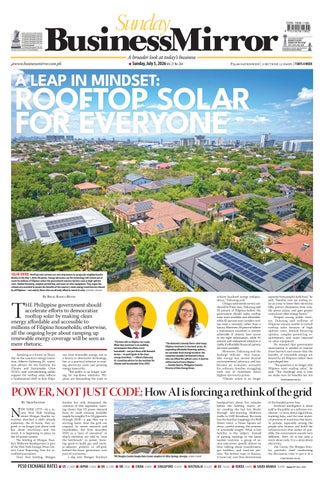


By Rizal Raoul Reyes
THE Philippine government should accelerate efforts to democratize rooftop solar by making clean energy affordable and accessible to millions of Filipino households; otherwise, all the ongoing hype about ramping up renewable energy coverage will be seen as mere rhetoric.


achieve localized energy indepen dence,” Dalusung said.
“The demand is already there: what many Filipinos
By
Speaking at a forum on Thurs day on the country’s energy transi tion, Alberto Dalusung III, transi tion advisor for the Institute for Climate and Sustainable Cities (ICSC), said overwhelming public support for rooftop solar reflects a fundamental shift in how Filipi nos view renewable energy, not as a luxury or alternative technology, but as a practical solution to soar ing electricity costs and growing energy insecurity.
By Troi Santos
“The public is no longer wait ing for top down solutions. Fili pinos are demanding the tools to
respond. In newer research and roundtables, the firm describes 2026 as a “year of execution” in which investors are told to “own the bottleneck” in power, favor ing quick‑to‑build gas and nucle ar‑adjacent projects or off‑grid, behind‑the‑fence generation over pure AI narratives. I slip into Morgan Stanley’s
“The data tells us Filipinos are ready. What they need now is an enabling environment that allows every household—not just those with financial means—to participate in the clean energy transition.”—Alberto Dalusung III, transition advisor for the Institute for Climate and Sustainable Cities (ICSC)
—Brenda Valerio,
Director

Citing a nationwide survey con ducted by Pulse Asia, Dalusung said 93 percent of Filipinos believe the government should make rooftop solar more available and affordable, while 85 percent now consider roof top solar a necessity rather than a luxury. Moreover, 93 percent believe a mainstream transition is entirely achievable if citizens have access to the right information, while 91 percent said widespread adoption is viable if affordable financial options are more available.
Moreover, Dalusung said the findings indicate that renew able energy has moved beyond environmental advocacy and has become an economic necessity for ordinary families struggling with one of Southeast Asia’s highest electricity prices.
“Climate action is no longer
headquarters about five minutes before the briefing starts, af ter crawling the last few blocks through late morning Midtown traffic to 1585 Broadway. The room has the familiar trappings of a Wall Street event: a Times Square ad dress, careful seating, the promise of actionable insight. What is less familiar is the subject. Instead of parsing earnings or the latest market tantrum, a group of se nior executives spends almost an hour talking about transformers, gas turbines, and land use per mits. The hottest topic in finance, it turns out, now lives downstream
separate from people’s daily lives,” he said. “Families now see rooftop so lar as a way to lower their electricity bills, protect themselves from vola tile power prices, and gain greater control over their energy future.”
Despite strong public inter est, Dalusung said millions of Filipinos remain unable to install rooftop solar because of high upfront costs, limited financing options, complex permitting re quirements, and taxes imposed on solar equipment. He stressed that government intervention is needed to remove these barriers and ensure that the benefits of renewable energy are shared by all Filipinos rather than a privileged few.
“The question is no longer why Filipinos want rooftop solar,” he said. “The challenge now is how we make sure its benefits are not
of the humble power line. Artificial intelligence is often sold to the public as a software rev olution—a story about algorithms, training data, and the near mysti cal promise of machines that learn. In private, especially among the people who finance and build the infrastructure that makes AI pos sible, the conversation sounds very different. Here, AI is not only a story about code. It is a story about electricity. Jim Caron, the Morgan Stan ley portfolio chief moderating the discussion, tries to put it in a
phrase that can travel. Knowledge is power, the cliché goes. But with AI, he suggests, power is knowledge. Without electricity, large language models, image generators, and autonomous systems remain lines of code on a drive. With it, they become something else: a new kind of industrial load, vast and hungry, woven through daily life.
The executives gathered around Caron’s table do not debate whether AI will be transformative. That question is largely settled on Wall Street. What occupies them instead is whether the physical systems beneath the digital boom—the grids, pipelines, cooling systems, and substations—can expand quickly enough to sustain what the market is exuberantly pricing in. Put differently: can the machines keep learning if the lights flicker?
For decades, the answer is an automatic yes. In the United States, reliable electricity feels like a natural condition, as unremarkable as gravity. The grid, built over generations, delivers what it promises: relatively cheap power, available on demand, with only occasional disruption when storms or wildfires intervene. Utilities settle into a quiet role in the background of economic life. They make slow, steady investments. Regulators reward prudence. Consumers notice only when rates rise.
AI does not sit comfortably in that arrangement. It demands not just more power, but power on a different schedule. Hyperscale data centers draw on the grid the way industrial plants once do, but their timelines resemble consumer
electronics: new chips, new models, new applications, all on a cadence measured in months rather than decades. A system designed for gradual, predictable growth must now absorb sudden, concentrated bursts of demand from companies accustomed to shipping updates every quarter.
Tom Greenburg, a vice chairman in Morgan Stanley’s investment bank, describes that collision in the language of constraint. The North American grid, he says, is “optimized around delivering the cheapest average cost of power” in a world where demand edges up modestly each year. The implicit agreement is simple: keep capital spending down, keep the rate base manageable, keep households from complaining too loudly, and the system holds. Now, data centers and electrification blow through that quiet consensus. Demand rises faster than gross domestic product in some regions; reserve margins that once look generous begin to disappear.
When the grid cannot respond as quickly as the customers it serves, those customers look for ways around it. One theme of the discussion is how often that is already happening. Rather than wait in line for interconnection approvals or new transmission lines, some operators turn to on-site generation and “behind-the-meter” solutions—bespoke power sources stitched directly into their own facilities. In theory, that might mean onshore wind, solar-plus-storage, or arrangements with nuclear plants. In practice, it means the most advanced AI infrastructure in the United States may grow partly

outside the very system meant to supply it.
This is not how the modern electric grid is designed to function. Yet it is a logical response to another trend the panel returns to repeatedly: the appearance of “missing megawatts.” On paper, the United States should be adding enough capacity to keep up with new demand. In reality, projects disappear into a tangle of local opposition, shifting incentives, and slow approvals. Capacity that is supposed to arrive on schedule never appears. Systems that once carry comfortable reserve margins begin to look surprisingly tight.
The interesting aspect of this new anxiety is that it arrives just as

As Morgan Stanley executives tell it, the AI boom has outgrown the familiar story of algorithms and venture capital and become an energy shock in slow motion, exposing the limits of power sys tems built for steady, incremen tal demand. From Wall Street conference rooms to data‑center projects in the Philippines, the future of artificial intelligence now turns on a more prosaic question: who can secure enough reliable megawatts to keep the machines learning.
the old anxiety—climate change— seems to offer a clear script. For much of the past decade, the story of energy in rich countries is framed as a transition from fossil fuels to renewables. Wind and solar advance. Coal retreats. Gas serves, at best, as a bridge. AI scrambles that story. Wind and solar are cheaper than before and will provide much of the new capacity. But their intermittency poses a problem for data centers that cannot power down when the weather shifts. Running a training cycle on a neural network while hoping for favorable weather is not an attractive proposition when delays can cost billions.
So an older vocabulary returns. Natural gas re-enters the conversation as a practical necessity: dispatchable, relatively quick to build, and abundant in the Unit-
ed States. Nuclear, long politically sidelined, regains attention as a source of dense, steady power independent of weather.
At the Morgan Stanley table, this is framed not as nostalgia but as triage. In the short term, AI runs on whatever can be built quickly and reliably. Over the longer term, the energy mix is negotiated among cost, climate, and politics. That negotiation unfolds country by country, even region by region, which is why a discussion focused on US utilities expands into global energy dynamics.
The panelists note that the US enters this period with advantages: abundant domestic gas, deep capital markets, extensive infrastructure, and strong talent pipelines. They also point out that supply chains for key technologies—solar panels, batteries, critical minerals—remain concentrated in China. The risk is that decarization, if poorly managed, simply swaps one dependency for another.
For smaller countries, the stakes are higher. Consider the Philippines.
The country increasingly markets itself as a data-center and cloud hub for Southeast Asia. The pitch is familiar: a young, Englishspeaking population, strategic geography, and a government eager to attract high-tech investment. Data centers fit neatly into a broader narrative of moving up the value chain. Projects like the 50 -megawatt VITRO Sta. Rosa facility illustrate that ambition.
But the Philippine power
system is more fragile, more expensive, and more dependent on imported fuels. Coal dominates generation. Transmission is complicated by geography. Blackouts remain a recurring issue. In this context, a large “AI-ready” data center is not just an asset—it is a significant new strain on an already stressed system.
The government is pursuing more renewables, gas, and even a cautious revival of nuclear power. Yet the core dynamic described by Morgan Stanley—rapid digital ambition layered onto a slow-moving energy system—appears here in sharper relief.
There is also a political dimension. In the United States, communities increasingly resist data centers on environmental and aesthetic grounds. In the Philippines, the concern may center on cost and reliability. A perception that foreign tech firms consume large amounts of power while households face higher prices could quickly become politically volatile.
None of this suggests the Philippines should turn away investment. Digital infrastructure can bring jobs, revenue, and strategic relevance. But it reframes the challenge: data centers are not just prizes; they are stress tests. Can the power system expand without crowding out existing users? Can policy ensure that benefits are broadly shared?
There is an irony in all of this. AI, which strains power systems, may also help optimize them. Machine learning is already used to forecast demand, coordinate storage, and predict grid failures. The same technology driving demand could improve efficiency—if deployed effectively. Ultimately, the executives frame AI’s energy demands as an investment opportunity measured in trillions of dollars. But underlying that is a deeper set of questions: who gets access to scarce power, how risk is distributed, and how decisions are made when systems are under strain. The story of AI is no longer just about software or even capital. It is about infrastructure. Silicon Valley may design the models, and Wall Street may finance them. But the outcome is decided elsewhere—in substations, in control rooms, and in the regulatory processes that determine how quickly power can reach the machines that need it. The era when AI is purely a digital story is ending. The next chapter is written in megawatts.
reserved only for those who can already afford it, but are made available to the people who need them the most.”
Brenda Valerio, Philippine Country Director of New Energy Nexus, emphasized that financing remains one of the major hurdles to clear.
“The demand is already there: what many Filipinos need now is structural access. By expanding affordable financing options—from specialized solar loans and installment to leasing models and partnerships with financial institutions— we can make clean energy inclusive, the transition shouldn’t be limited to those who can afford the upfront costs; it must be within reach of every Filipino,” she explained.
Dalusung urged policymakers to expand affordable financing programs, simplify application and permitting procedures, improve public access to credible information on rooftop solar, and revisit fiscal policies—including the value-added tax on solar technologies—that continue to increase installation costs.
He also emphasized the need for stronger public education campaigns to help consumers better understand the long-term financial benefits of investing in rooftop solar.
According to Dalusung, democratizing rooftop solar is essential as the Philippines continues to rely heavily on imported coal, oil and natural gas, exposing consumers to volatile global fuel prices.
He said enabling more households to generate their own electricity would not only reduce monthly power bills but also strengthen the country’s energy security, lessen dependence on imported fuels, and contribute to the Philippines’ climate goals.
Dalusung added that the transition toward decentralized renewable energy represents a broader transformation in the country’s power sector, where electricity generation is becoming increasingly personal and community-based.
“The data tells us Filipinos are ready,” he said. “What they need now is an enabling environment that allows every household—not just those with financial means— to participate in the clean energy transition.”
He said democratizing rooftop solar should be viewed not merely as an energy initiative but as a national development strategy that empowers consumers, creates jobs, stimulates local industries, and builds a more resilient and sustainable economy.
“People have already expressed their willingness to embrace roof-
top solar,” Dalusung said. “It is now up to the government to provide the policies, financing, and support needed to turn that demand into widespread adoption.”
The supply side FROM the supply side, the local solar sector is ready to deliver, provided the government cuts down on existing market frictions. The consumer and technology readiness are already present, yet taxes, fees, heavy administrative processes, financing gaps, and coordination challenges still make solar harder and more expensive to adopt, explained Jose Rafael Mendoza, president of the Philippine Solar and Storage Energy Alliance. He called for clearer policies and synchronized execution among government bodies, utilities, and industry players to accelerate deployment.
The panelists called for the immediate implementation and regulatory interventions championed by the campaign, including removing the value-added tax on solar technologies to instantly lower upfront costs, improving net-metering implementation to fairly compensate consumers for excess power fed back to the grid, and streamlining and digitizing permitting processes to eliminate bureaucratic red tape.
Editor: Angel R. Calso
By Weilun Soon & Stephen Stapczynski
AT anchor in the Persian Gulf, Abhijit Chopra found out about the US-Iran peace deal when his phone lit up with messages from family and friends. The captain of a crude oil tanker, he had to temper his excitement. There were no signs of celebration from nearby vessels, and no ships making haste towards the Strait of Hormuz.
Chopra and his 21-strong crew have been trapped since the war began in late February. At the beginning, they struggled with fear and uncertainty, which ebbed into boredom and a constant battle not to let negative thoughts set in. For more than 120 days they have waited, dining together and bonding by singing old Hindi songs at karaoke. In early March, Chopra and his crew—all of whom were Indian, aside from one Ukrainian—celebrated Holi, a major Hindu festival, onboard the tanker. They painted each other’s foreheads with turmeric powder taken from their kitchen.
Signs that the strait might reopen came and went. That’s why this time, Chopra didn’t overreact. “When they said the Strait of Hormuz was open, we were a bit optimistic that the vessel might transit,” he said. But when there was fresh news of attacks on tankers, they realized they were going to be stuck a bit longer. “There was a little bit of disappointment,” he said.
Around 8,000 seafarers who are not from the region remain stranded in the gulf, according to the International Maritime Organization, the United Nations agency that’s tasked with regulating and coordinating global shipping. Sailors have been left to the mercy of geopolitical forces and distant diplomatic negotiations, working to keep their ships in service as missiles and drones passed overhead. Their fate is a stark reminder that the global economy is heavily dependent on individuals, who at times have to go to extraordinary lengths and face incredible risks to keep trade flowing.
“Ultimately, we are just ordinary people. We are fathers, we are sons, we are husbands who are staying for months out at sea carrying out a duty,” Chopra said. “And we are doing this because somebody has to do this and the world’s goods, economies depend on all this seafaring job.”
Oceangoing ships are responsible for moving more than 80% of global goods, or about 70% in total value, a World Bank estimate shows. Today, nearly 2.6 million seafarers serve onboard the world’s fleet of more than 85,000 merchant vessels, according to a joint report issued by BIMCO, a trade association for the shipping industry, and the International Chamber of Shipping. The majority are recruited from lower-income countries, often in
Asia, with the Philippines and India providing around 30% of the global workforce.
Working on ships can be difficult and dangerous, with crews often away from home for months at a time.
Seafarers’ conditions at sea are largely governed by the Maritime Labour Convention, an International Labour Organization treaty that outlines work and welfare rights, and touches on protections for them in extraordinary scenarios.
But for a global industry as decentralized as shipping, enforcement and compliance is patchy. Large shipowners are often compliant, but seafarers on vessels owned by smaller companies may not be offered even those basic set of rights, top executives at support groups have told Bloomberg News.
“Global shipping is almost set up to provide multiple, different channels for ownership and operation, where I can be a shipowner sitting in London and flag it to Liberia and register it in Greece and I sit back and earn revenue from the ship,” said Ben Bailey, program director for the Mission to Seafarers, a welfare charity for maritime workers. “It is the seafarers that risk falling through the gaps and not have their rights met.”
When crises and conflicts occur, those rights are tested to the extreme.
Raman Kapoor, the captain of a Suezmax tanker, oversaw several runs in the gulf in late 2025 and early 2026, and had just 10 days left on his tour when the war broke out on Feb. 28. The ship had just finished loading a cargo of crude oil at the Iraqi port of Basra when the onshore pilot came running to Kapoor to tell him that ships in the Strait of Hormuz had been attacked.
A call soon came from his employers, and he was ordered to leave port and headed to an anchorage out in the gulf.
“The entire scenario changed,” Kapoor said. “Our processes, what’s our next port, the ship’s schedule, everything changed. All of a sudden we found that we were inside a war zone and there was no safe way out.”
Service contracts for sailors typically range between four to nine months. In a war that’s been going on for more than four months, that means that many of those seafarers trapped in the Persian Gulf are at or near the end of their contracts and should be relieved by fresh crew. In some cases, sailors are also allowed to request that they’re evacuated from conflict
zones.
However, keeping a large commercial vessel operational requires around 22 people, and ship operators need to carefully manage and time mariners’ departures and make sure that there are replacements.
A sailor’s pay often takes what’s set out in a global bargaining framework as guidance, and those serving in war zones can get a boost to their pay— in some cases, inflating their monthly salaries to as high as $30,000—but it was difficult for crewing agencies and ship operators to find mariners willing to fly into the gulf.
Early in the war, the Philippines, the singlelargest source nation for many seafarers, asked crewing agencies to stop sending its nationals to the Persian Gulf, exacerbating the shortage of available replacements, though Manila later eased that restriction. Some gulf countries, including Iraq and Kuwait, stopped issuing visas for short periods of time as the security situation worsened, preventing seafarers wanting to go ashore in order to go home from being able to get off from their vessels.
Some sailors said they had to ration food and water at the beginning of the conflict, over fears that they might not be able to resupply. Cooking ingredients and other groceries were delivered to Kapoor’s ship on a small supply vessel. The rations, including snacks, soft drinks and cigarettes, are enough to last for 1.5 to 2 months and can cost up to $10,000 for each batch.
Just keeping a ship seaworthy is a lot of work. The crew inspects their vessel every few hours, checks equipment and stands watch to look out for hazards. Electronic interference has made it hard to use global positioning systems, so sometimes seafarers needed to make visual confirmation of landmarks and other vessels.
Sailors said these routines

helped keep them grounded and alert as they waited at anchor.
But life on a ship—that in Kapoor’s case is only 280 meters long, and around 50 meters wide—is inevitably constrained. Satellite phone time is limited and expensive, so crews often ration it carefully. On some ships, sailors try to schedule one call home each week. For people who have spent months at sea with no clear idea when they might return, those brief conversations with family are often the emotional high point of the week.
For some crew, fishing has become both entertainment and food supply. Bored sailors spend hours casting lines from the side of the ship. The catch often goes straight to the galley, where the cook turns it into dinner. Anything extra gets cleaned and laid out on deck to dry under the gulf sun. Ribbonfish are especially common. Several crew members said the homemade dried fish has turned out to be surprisingly delicious—a welcome change from weeks of repetitive meals.
Captains said crew members were encouraged to do everything together, and no one should be left alone—including when they dine or relax. Several sailors said access to knives and other sharp tools is more tightly controlled than normal, reflecting concerns about mental

health as uncertainty drags on.
“We do our best to keep the morale on board for everyone— be professional, disciplined, and supportive,” Chopra said. “But there is definitely a sense of strain and uncertainty over this hundred plus days where we do not have clarity of what is about to happen.”
There have been occasional, visceral reminders of the war.
Just after midnight on March 12, Kapoor’s crew were winding down for the day when they saw flames engulfing another tanker, the Safesea Vishnu, which was only a nautical mile away. The vessel had been struck by an unmanned craft while conducting a ship-to-ship transfer of naphtha. One crew member died.
Kapoor’s ship couldn’t sail out of the area because there were too many other vessels crowded around. Sailors sheltered in a designated safe space, just beneath their accommodation area.
“It was a very frightening moment for all of us because we are just seafarers. We are not trained for any war. We are not warriors. So everyone was so scared what would happen if the next missile or drone attacked our ship,” said Kapoor.
Steven Arillo, a navigation and safety officer on a liquefied natural gas tanker, was docked at the Ras Laffan facility in
Qatar when it was hit with Iranian missiles in the middle of March. The crew were only given half an hour to leave the port. One of Arillo’s crewmates mounted a bodycam and turned it on to record missiles streaking above the complex.
His ship, crewed mainly by Filipino seafarers, was the last out of the dock before another barrage hit the plant, igniting a huge explosion. If the ship had been delayed by half an hour, he said he’s sure they would have been hit. “We’re very lucky that we left right in time,” he said. Like many others, Arillo and his crewmates asked to go home, but there was no replacement available and flights out of the region were disrupted. Stuck on board, he worked out and perfected his latte art—posting regularly to Instagram—as he waited with his binoculars to check for incoming danger.
“When you’re inside the war zone every day of your life, it’s like a ticking bomb,” he said.
“You don’t know what would happen next.”
At least 14 civilian seafarers from countries other than Iran have been killed during the war, according to industry experts’ calculations. Iran has said that around 50 of their own mariners have died. One seafarer remains unaccounted for, while there has also been at least two reported non-combat related deaths, IMO said.
As the war dragged on, governments around the world tried to negotiate with the Iranian authorities for safe passage. Pakistan secured the extraction of around 20 vessels. An Indian tanker was escorted by the Iranian navy after New Delhi negotiated with Tehran. Tokyo at one point in time, prioritized ships with clear associations with Japan—including crew nationality—as it negotiated with Tehran to extract vessels, according to people familiar with the matter.
Often whether seafarer
See “Hormuz,” A4

By Bloomberg News
QUANT funds in China have become so popular that they are being deluged with investors’ money.
Ubiquant, one of the top players, raised 2.6 billion yuan ($384 million) in less than two hours for a new fund in May, according to people familiar with the matter. Investors also snapped up over 100 million yuan of a product from Shenzhen ChengQi Asset Management Ltd. within seconds, a product distributor said.
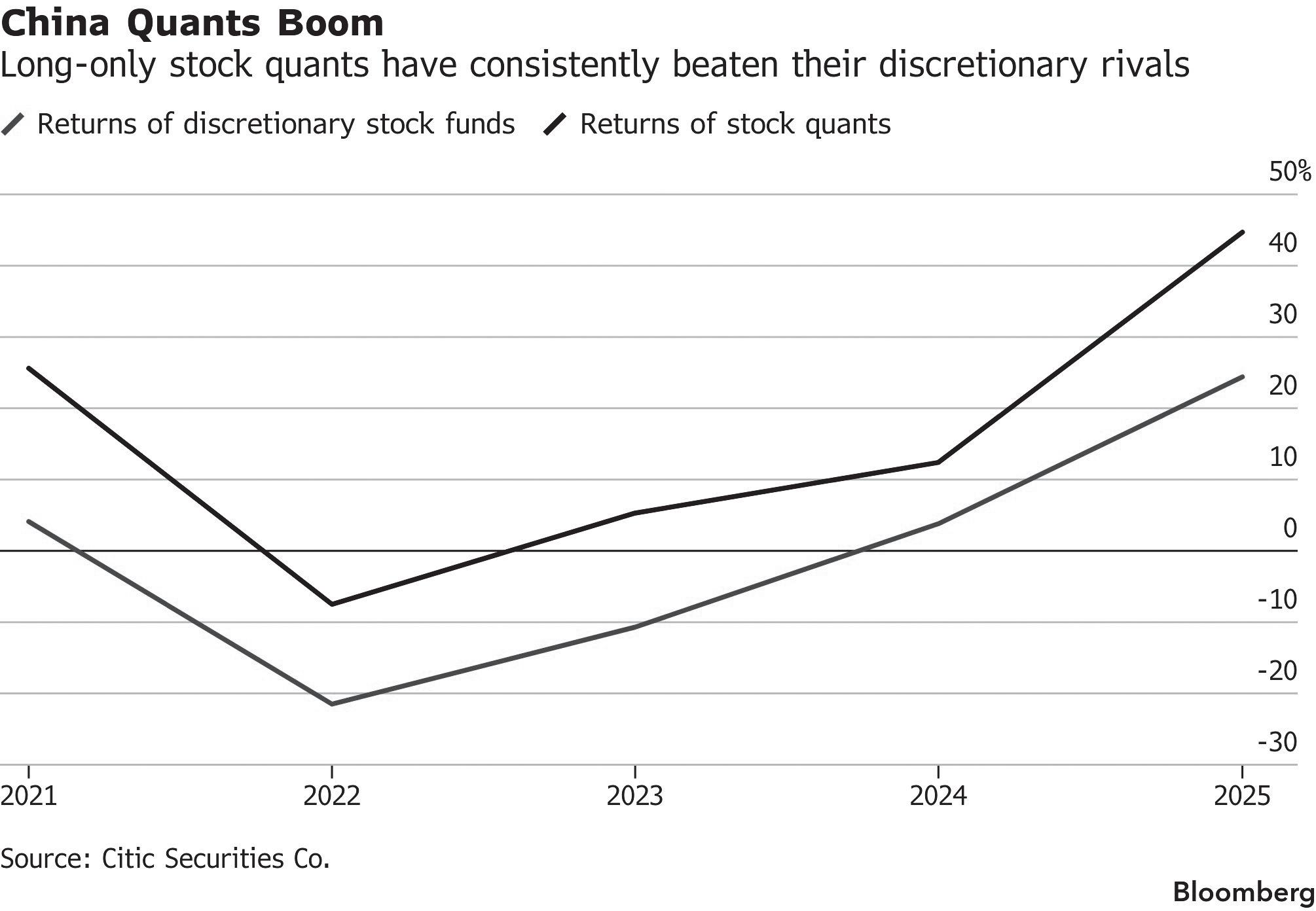
They’re not alone. Quants’ assets under management have more than doubled in less than a year to more than 2.6 trillion yuan. The frenzy is being fueled by the success of their rapid adoption of artificial intelligence. While Chinese investors have traditionally favored star managers over computer models, last year the machines trounced humans by more than 20 percentage points. The funds are churning out new products that are being snapped up by investors who are abandoning stock pickers.
“Quants’ breadth in covering thousands of stocks has prevailed over the depth of research pursued by discretionary longonly managers,” said Chen Xu, chief operating officer of BigQuant.cn, a technology provider that has co-authored white papers for quants since 2021. “Quants have finally become mainstream and there’s no turning back.”
This has led to the explosion of investing products offered. New quant products more than doubled last year to 6,296, accounting for 46% of all new
Continued from A3
could sail out safely through Hormuz depended on the value and importance of the cargo aboard the ship he was manning, the shipowner’s willingness to risk the vessel as an asset, and their ability to secure expensive insurance cover.
The shipping community has lamented the state-to-state negotiations, and the conditions on which they secured safe passage. Iran has insisted during peace talks with the US that it expects to maintain control over the Strait of Hormuz, with an implicit threat to ships that pass without meeting its conditions.
The wellbeing of seafarers is also closely tied to freedom of navigation and the laws and norms of the sea, according to Jacqueline Smith, maritime

hedge funds, according to an Industrial Securities Co. report in January. Among the more than 3,000 new products registered by top managers, more than 80% were launched by quants.
Long-only stock quants gained 44.7% last year, beating their discretionary rivals by 20.3 percentage points, according to Citic Securities Co. That compares to their average lead of 13 percentage points over the preceding five years and was the strategy’s widest edge since 2021, according to the data.
The success of quants in China’s 8 trillion yuan hedge fund industry is a stark reversal from two years ago. The sector had been hit by a series of management failures, drawing the ire of government regulators. The funds were blamed for excessive volatility and market blowups. The exchanges cracked down on the use of highfrequency trading to circumvent transaction limits and tightened supervision of leveraged products.
One dramatic example is the turnaround of Ningbo Lingjun Investment Management Partnership. In early 2024, its trading models executed a highly concentrated batch of sell orders that triggered exchange penalties and plunged the firm into a crisis.
In response, Lingjun forced portfolio managers to meet stricter risk parameters for their algorithms and started realtime monitoring of firmwide
coordinator at the International Transport Workers’ Federation, a trade union.
“If Iran asks for $10,000 to cross and the company says no, but still expects the vessel to cross, what happens then?” she said. “Do we ask seafarers to sail through in the middle of the night, lights off, and risk it all?”
Sailors serving on oceangoing ships have increasingly been caught in geopolitical crosshairs in recent years. The Covid-19 pandemic ground the global economy to a halt and left thousands of seafarers stranded at sea. Russia’s full-scale invasion of Ukraine in 2022 turned the Black Sea into a zone where drone attacks on ships became more common. The growth of the “shadow fleet” of ageing vessels using fake flags or the flags of nations that take little interest in the wellbeing of sailors has created new risks for crews.


trading data. It also added shorter-horizon signals alongside medium- and long-term models.
As a result, the company last year led the rankings among top quants with an average return of more than 70%, according to Shenzhen PaiPaiWang Investment & Management Co., a consultancy that tracks hedge funds in China.
Lingjun’s comeback also captures a deeper industry shift. Top-tier quants, leveraging their first-mover investments on AI, talent pools, and data advantages, have built a “technological moat” that smaller firms find difficult to cross, according to a report from Guolian Minsheng Securities Co., a brokerage which distributes hedge funds.
That’s fueled Lingjun’s ambitions to join in the fundraising boom. After avoiding adding new investors for about two years while it focused on internal improvements, Lingjun now aims to expand its assets
under management by between 20 billion yuan to 40 billion yuan, according to Chairwoman Cai Meijie. It currently has between 40 billion yuan and 50 billion yuan.
Investment logic has shifted from “choosing quant” to “choosing the quant with the strongest AI capabilities,” making it natural for inflows to concentrate more on the top players, according to Guolian Minsheng’s report.
Shanghai Minghong
Investment Management Co. is one example. The firm registered 157 new products last year, making it No. 1 for new launches among Chinese quants. It has grown even faster this year: By the end of May, it had launched another 149 products. The growing range of strategies it has on offer has given it more capacity to invest and raise money, according to its founder Qiu Huiming.
The number of quants managing over 10 billion yuan
has risen to 74 as of May 31, after overtaking that of discretionary funds last year for the first time, according to PaiPaiWang. There are 139 funds overall managing more than 10 billion yuan in China.
The surge of interest means funds are fighting to hire the best science and engineering students as they race to build and improve their own proprietary models.
Traditional stock pickers are also racing to adapt. Shanghai Minority Asset Management Co. exemplifies the trend to embrace AI. It spent five years transforming from pure discretionary stock-picking to relying on AI agents. It trained the models on its core investment thesis—“excess returns come from the majority’s cognitive biases”—then used the agents to autonomously mine factors that identify those biases faster.
“The moat that once protected us has become a walled prison,“ the company said in an article
“They are the underbelly of the industry that potentially will walk away when it becomes too difficult, and seafarers then get left stuck on those ships,” Bailey, from the Mission to Seafarers said. He’s also concerned that conflict and danger are becoming a new normal for the industry as a whole.
“The biggest worry is how the levels of uncertainty of the war has now gone to a worrying level of acceptance,” he said. “Seafarers, shipowners used to be terrified at the sight of missiles, being attacked. As time went on, they’re normalizing what is otherwise an abnormal situation.”
In June, the US and Iran agreed to an interim 60-day deal that included reopening the strait. More ships are now transiting the chokepoint— although still far fewer than before the war began.
In all, around 11,000

seafarers who are not from the region were stranded in the gulf during the war, according to the IMO, which announced a shortlived plan to evacuate sailors in June. It was rescinded within days after Iran attacked ships transiting Hormuz.
The plan evacuated 136 ships and rescued about 2,900 seafarers, according to Natasha Brown, a spokeswoman for the organization. “It is still paused, until I can secure the necessary security guarantees from all parties,” she said, adding that the IMO has received feedback from seafarers that there needs to be designated safe corridors, clear protocols and the right to refuse unsafe passage for them to deal with future crises like this current one.
Getting a ship ready for the transit isn’t a quick process, according to Angad Banga, chief executive officer of maritime conglomerate The Caravel


Group, which owns Fleet Management Limited, one of the world’s largest ship management companies. First, ships have to be kept in seaworthy conditions. This includes getting rid of barnacles and other things that may foul the hulls and ensuring that all equipment is ready. Then, bunkering plans have to be drawn up. Once it’s clear that the vessel is likely able to sail through Hormuz, comes training the crew for the journey, including practicing what to do in security situations. That can include rehearsing the exact words to say should they be challenged by the Iranians while crossing Hormuz.
That means there’s still work to do, and time to pass, before many of the ships in the gulf can make their way out into the open sea.
Arillo’s crew was relieved in

in May on its WeChat account, citing founder Zhou Liang. “Evolution is not a choice—it is a matter of life and death.” For foreign asset managers, the implications are clear; it is difficult to raise money without a quant strategy. Of more than 30 global firms operating a hedge fund business onshore in China, only a handful including Two Sigma and D. E. Shaw run fully systematic strategies. The rest, predominantly fundamental managers competing on research depth and brand recognition, are mostly still struggling with less than 500 million yuan in assets. As investing moves to machines competing against machines, and quant funds scale up, beating the market will inevitably become more difficult. One of the quant funds’ most popular products is an indexenhanced fund, which tracks an index and uses algorithms to shift the weightings of individual companies in an attempt to outperform the underlying benchmark.
The average excess return from that strategy shrank by more than half from a year earlier to 4% this year through April 30, with some managers barely generating any alpha after October, according to PaiPaiWang. Only 14% of such products recorded positive excess returns every month since then.
“As China’s capital markets continue to mature and pricing efficiency improves, the threshold for quant managers to generate excess returns will inevitably rise,” Shanghai Mengxi Investment Management Co., a quant fund that has posted monthly gains since October, said in a statement to Bloomberg. “This is a challenge many quant managers will have to confront.” Bloomberg News
May by a crew from Indonesia, who sailed the ship through the strait. When he arrived back in the Philippines, he proposed to his girlfriend on the beach. The ship’s operator brought the crew to a hotel in Manila for a banquet, and treated them to a complimentary stay at the hotel and a water bottle with the picture of the LNG vessel they served on.
Kapoor’s crewing agency also managed to work out a way to get him relieved, and in mid-May, a replacement—a Romanian captain—stepped onto his tanker. After a few days’ worth of debriefing and getting him familiar with the tanker’s operations and crew, Kapoor set off for home.
He took a five-hour boat ride to Basra, then a flight to Doha, Qatar, and then an onward journey to Delhi. He then caught a domestic flight to Manali, his hometown in the Himalayas. When his wife met him at the airport on May 14, she broke down in tears. Kapoor kept his in. “It was a big, big moment for all of us,” he said. Chopra is still stuck in the gulf, where he’s been since late January, waiting for more clarity. “I’ve told my crew, myself, to be optimistic, but be carefully optimistic,” he said. “We have to hope for the best.” With assistance from Alfred Cang/ Bloomberg

By John Eiron R. Francisco
CENTURIES-OLD Philippine artifacts may still hold untold stories. But not in their shape or appearance. This time, it is through the molecular composition of the materials from which they were made.
According to Dr. Jan-Michael C. Cayme, a Filipino chemist, archaeologists can often determine what an artifact looked like, how it was used, and the period it came from.
Chemical analysis, however, examines the materials themselves to uncover the evidence that conventional archaeological methods cannot readily detect.
Through an analysis of the molecular composition of pottery, bricks, lime mortars, pigments, and other heritage materials, researchers can reconstruct ancient diets, identify raw materials and manufacturing techniques, determine how centuries of environmental exposure altered these objects, and provide a more complete picture of how ancient communities have lived.
‘Organic residue analysis’
AS part of his six-month Balik Scientist Program under the Department of Science and Technology-Philippine Council for Industry, Energy, and Emerging Technology Research Development, Cayme has worked to bridge chemistry, archaeology and heritage conservation by introducing scientific techniques that can deepen the understanding of Philippine cultural heritage.
His Balik Scientist program was jointly hosted by the Archaeology Division of the National Museum of the Philippines and the Chemistry Department of the De La Salle University Manila.
At his exit report presentation, he talked about “Deepening the Narrative of Philippine Cultural Heritage at the Molecular Level,” held at the National Museum of the Philippines in Manila on June 25.
The first Filipino to earn a PhD focused on the chemical analysis of cultural heritage
materials, his work builds on the research he conducted while earning his doctorate in chemistry at Estonia’s University of Tartu, where he explored how analytical chemistry could answer archaeological questions that traditional methods alone could not.
One of his doctoral studies examined medieval pottery excavated from Kukruse, Estonia, dating back to the 12th and 13th centuries. Rather than focusing solely on the vessels’ form or appearance, Cayme analyzed microscopic organic residues that had been absorbed into the clay over hundreds of years.
Those molecular remnants helped reconstruct what the pottery once contained, which provides evidence of the kinds of food prepared or stored by people centuries ago.
The study also explored why traces of organic compounds were still present in centuriesold pottery despite the fact that such compounds normally degrade over time.
“We’re talking here about 13th- to 14th-century potteries, hundreds and hundreds of years,” Cayme said. “My idea as a chemist is, why were they preserved?”
To answer that, his team investigated whether the pottery’s mineral composition influenced the preservation of organic residues. Using minimally invasive analytical techniques, including Fouriertransform infrared spectroscopy, they identified minerals such as carbonates, clay minerals and silicates without causing significant damage to the archaeological materials.
“In cultural heritage, it’s very important that as much as possible, your technique should be non-invasive, or at least minimally invasive,” he noted.
The researchers also


examined the pottery’s porosity and analyzed fatty acids using gas chromatography-mass spectrometry, which allows them to determine how the clay interacted with ancient food residues.
Their findings showed that the composition of the clay itself played an important role in preserving molecular evidence.
Thus, pottery containing higher amounts of clay minerals retained more fatty acids, while carbonate-rich ceramics preserved fewer.
The study also found that clay minerals could chemically interact with certain organic compounds, influencing what remains detectable centuries later.
According to Cayme, these findings could help archaeologists identify which pottery fragments are more likely to contain preserved organic residues, making future archaeological investigations more efficient and providing richer insights into the lives of ancient communities.
‘Missing baseline’
HOWEVER , Cayme said one of the biggest challenges in advancing heritage science in the Philippines is the lack of baseline chemical information on cultural artifacts.
“Chemical baseline information is important because we have to remember that the material we’re seeing right now is a result of degradation,” he explained. “It’s no longer the same material that you had 100 years ago.”
Without reference data, he said, researchers face greater difficulty distinguishing an
artifact’s original characteristics from changes brought about by time and environmental exposure.
He said limited access to specialized equipment also slows heritage science research in the Philippines. In many cases, researchers have to rely on laboratories in other universities or institutions to conduct chemical analyses, making the process more complex.
“Not only equipment [is needed], in terms of facility as well. Because you might probably have the equipment, but if you don’t have any existing facility to house your equipment, that would also be a problem,” he said.
“But the DOST is trying its best to alleviate all of those limitations,” he said.
Cayme also stressed the need for more rigorous scientific analysis of cultural heritage. While techniques such as X-ray fluorescence are commonly used to determine the elemental composition of artifacts, he said findings should ideally be validated using complementary analytical methods to ensure more reliable and comprehensive results.
“In order for us to move our knowledge and understanding, we need to have published materials,” he explained. “And as much as possible, it should be peer-reviewed so that it will be open for criticism among our peers.”
He likewise called for stronger integration of science into cultural heritage research through interdisciplinary collaboration.
‘Bringing it home’ “ SO one of the things that I did
is I really wanted to duplicate some of what I’ve learned in Estonia,” he shared.
His team has collected pottery samples from archaeological sites in Calatagan, Batangas; Butuan, Agusan del Norte; and Santa Maria, dating from the 15th to the 18th centuries.
The team hopes the pottery samples will preserve chemical traces that could provide new insights into the lives of ancient Filipinos.
However, Cayme noted that organic residue analysis is a long and meticulous process, meaning results will not be available immediately.
“Hopefully in the future, we would be able to develop this more and try to offer it not only at De La Salle University, but also as a tool that can be made available outside of De La Salle University,” he said.
Why museums say ‘Hands off’ ACCORDING to Dr. Marrianne
F. Ubalde-Baclor, Director II of the National Museum of Anthropology at the National Museum of the Philippines, preserving the country’s cultural heritage has become increasingly challenging as the Philippines remains among the countries most vulnerable to climate change and natural disasters.
She said museum workers regularly contend with threats such as mold, pests, and corrosion, depending on the type of material being preserved.
Beyond environmental factors, heritage objects also suffer damage caused by human activity, which she attributed partly to the country’s still-
developing museum culture.
“That’s why public programs such as this one are important, to help people understand the complexity of maintaining and protecting museum collections,” Ubalde-Baclor said.
She explained that museum rules, including the familiar reminder not to touch artifacts, are grounded in science rather than mere strictness.
“We’re not just being strict or overly cautious. A simple touch from a dirty or sweaty hand can cause corrosion or encourage mold growth on an object,” she said.
Ubalde-Baclor emphasized that safeguarding cultural heritage should not rest solely on museum professionals but requires the participation of people from different disciplines and backgrounds.
She said chemistry plays a growing role in helping researchers better understand and preserve museum collections. While anthropologists examine artifacts for their cultural and social significance, chemists, such as Cayme, provide another layer of understanding by studying them at the molecular level.
“Safeguarding and protecting our heritage should be everyone’s responsibility,” she said, stressing that heritage includes not only physical objects but also the knowledge, traditions, technologies, and practices associated with them.
“I would like to emphasize that for every tangible object lost is also the loss of its intangible components,” Ubalde-Baclor pointed out.
AS communities across the Philippines become more dependent on digital access for work, education, livelihood, and essential services, Globe continues to strengthen the foundations that help keep people connected while building a more resilient and sustainable future.
Through its 2025 Integrated Report, the telecommunication network highlights how investments in network modernization, climate action, operational efficiency, and innovation are helping create long-term value not only for the business, but for the communities it serves.
Titled “Foundations for the Future: Building Resilience Through a Connected Nation,” the report shows how telecom company is embedding sustainability into its longterm strategy as it expands coverage, improves affordability, and strengthens operational resilience amid evolving climate and business risks.
It likewise reflects the company’s continued efforts to align with emerging global sustainability disclosure standards while advancing meaningful environmental and social impact.
Building long-term resilience through connectivity
AS connectivity goes beyond convenience, reliable mobile and internet access can help families stay connected, support students learning online, enable small businesses to grow, and provide communities with access to emergency information and digital services, especially in geographically isolated areas.
To advance digital inclusion, Globe extended its 4G coverage to 96.41 percent of the population in 2025 while continuing to improve network access in underserved communities.
With broader coverage, it pushed affordability initiatives that helped make connectivity
more accessible to more Filipinos.
Between 2019 and 2025, the price per gigabyte of Globe’s most popular mobile data plans dropped by nearly 60 percent, including a further 17 percent decrease from 2024 to 2025.
It improved affordability for home connectivity, with prepaid fiber rates declining by 50 percent from 2022 to 2024 and its lowest postpaid fiber plan reduced by 75 percent, while customers now enjoy speeds that are four times faster than those offered at the same cost in 2022.
As connectivity becomes increasingly essential in everyday life, the company continues to invest in futureready infrastructure and conduct upskilling to help more Filipinos become safer online, more digitally savvy, and better able to participate in the digital economy.
Advancing climate action and operational efficiency AT the same time, Globe
continues to strengthen its climate action efforts as part of its broader resiliency strategy.
It reported a 15 percent year-on-year reduction in Scope 1 and 2 greenhouse gas emissions, and a 9 percent reduction in Scope 3 emissions in 2025, exceeding its annual reduction targets.
Renewable energy also continues to play a growing role in its operations, with 34 percent of the company’s total energy consumption now coming from renewable energy. This keeps the telecom giant on track toward its target of reaching 42 percent renewable energy usage by 2030.
These efforts continue to help Globe build a more resilient network amid evolving climate, energy, and economic challenges while supporting its broader decarbonization roadmap.
Strengthening transparency and sustainability readiness
THE report also underscores Globe’s continued efforts to
strengthen sustainability governance and disclosure readiness. It has started aligning with International Sustainability Standards Board (ISSB), particularly climaterelated disclosures.
To contribute to the broader private sector’s readiness for transparent reporting, Yoly Crisanto, Globe’s Chief Sustainability and Corporate Communications officer, serves as the Management Association of the Philippines representative to the Philippine Sustainability Reporting Council.
This body is dedicated to issuing local implementation guidance and evaluating sustainability disclosure standards issued by the ISSB.
The telecom firm’s Integrated Report includes externally assured environmental and social metrics, verified greenhouse gas emissions data, and the results of its first Double Materiality Assessment.
By evaluating both the outside-in impact of environmental and social issues on business performance, and the insideout impact of the company’s operations on communities and the environment, the assessment allows the company to better manage risks, identify opportunities, and strengthen long-term value creation.
“Our responsibility goes beyond delivering connectivity. As digital access becomes more essential in people’s everyday lives, we need to ensure that the way we grow our business also strengthens resilience, creates long-term value, and contributes positively to communities and the environment,” Crisanto said. “Sustainability helps guide how we operate, and innovate so we can continue serving Filipinos responsibly while preparing the business for the future,” she added.
A6 Sunday, July 5, 2026 Editor: Lyn Resurreccion • www.businessmirror.com.ph

VATICAN CITY—The Vatican responded aggressively Thursday to a traditionalist society that consecrated bishops without the pope’s consent, declaring the Society of St. Pius X (SSPX) in schism, excommunicating its bishops and priests and warning its faithful they too face the harshest sanctions in the Catholic Church.
The Vatican’s doctrine office went above and beyond the minimal sanctions foreseen by the church’s canon law to respond to the consecrations Wednesday of four new bishops at the society’s Econe, Switzerland, seminary.
The society, known by its acronym SSPX, celebrates the ancient Latin Mass and opposes the modernizing reforms of the Catholic Church, which it considers to be rife with heresies and errors and has accused of straying from the Catholic faith.
During a ritual-filled, five-hour
Mass on Wednesday, attended by some 15,500 people and their children, the SSPX consecrated four new bishops in direct defiance of Pope Leo XIV, who had urged the society to hold off for the sake of the church’s unity. In a decree, the Vatican excommunicated the four new bishops and the two bishops who participated in the ceremony. It declared the consecrations a “schismatic act” and declared the society itself had created a schism, or intentional rupture with the Catholic Church.

The Vatican warned the faithful who go to the society’s Masses to stop, declaring “those who adhere formally” to the society are considered themselves schismatic and excommunicated. It declared SSPX priests to be schismatic, and therefore excommunicated, and invalidated the sacraments of confession and marriage that they administer.
The sanctions, especially those targeting the priests, the
faithful and the sacraments they can receive, were particularly harsh and reversed concessions the Vatican had granted the SSPX in recent years as part of its outreach to bring the group back under Rome’s wing.
French Archbishop Marcel Lefebvre founded the SSPX in 1970 in opposition to the modernizing reforms of the Second Vatican Council.
Among other things, the 1960s
meetings known as Vatican II revolutionized the church’s relations with other Christians, Jews and people of other faiths and allowed Mass to be celebrated in the vernacular rather than Latin.
Lefebvre consecrated four bishops without papal consent in 1988. The Vatican promptly excommunicated Lefebvre and the four bishops and declared the consecrations a “schismatic act.”
Pope Benedict XVI in 2009 lifted the excommunications as part of his yearslong outreach to the group, but the SSPX today has no legal standing in the church and with Thursday’s decree is declared to be in schism.
The consecrations had posed a crisis for Leo because the American pope has stressed the need for church unity. He has reached out especially to the conservative and traditionalist wing of the church that was in many ways alienated during the Pope Francis pontificate.
But the sanctions imposed Thursday suggest that after nearly five decades of trying to negotiate with the society, the Holy See has had enough.
The Vatican responded so aggressively in part because the
Bringing Santo Niño de Praga one step closer to Filipino pilgrims

By Karel Hejč Ambassador of the Czech Republic to the Philippines
RIGHT in the heart of Europe, in Prague, the capital of the Czech Republic, the Church of Our Lady Victorious can be found, open to everyone 365 days a year.
It is a valuable baroque monument built on renaissance foundations. However, for many, it is more important as a pilgrimage site known worldwide, thanks to the statue of the Infant Jesus of Prague.
It therefore comes as no surprise that regular services and interesting public events are held here in five different languages.
And visitors and pilgrims travel to see the Santo Niño de Praga from all around the world—and from the Philippines.
Located within the main dome, the Holy Family of Jesus is placed at the center of the right side of the nave, with the statue of the Infant Jesus of Prague surrounded by statues of Our Lady and St. Joseph.
God the Father, allegorically depicted as an old man, sends his Son to earth in the upper part of the altar, and at the very top, the Holy Spirit is depicted in the form of a dove.
On the balustrade surrounding the shrine of the baby Jesus, prayers are placed in several international languages.
Surprisingly, despite the numbers of Filipino pilgrims visiting the site every

year, which is clearly demonstrated by the Filipino store found right across the street from the church, the Filipino language was missing. Well, until now, anyway.
The origins
LET us go back in time first, to see what is behind the popularity of the Santo Niño in the Philippines.
The roots of all Infant Jesus devotions in the Philippines go back to 1521, when Ferdinand Magellan gave an image of the Santo Niño to Queen Juana of Cebu during the first mass baptisms, a moment recognized as the introduction of Christianity in the Philippines. By the Spanish colonial period, Filipinos already had a deep emotional and religious attachment to the Infant Jesus, making later forms—like the Santo Niño de Praga— easy to adopt.
Santo Niño de Praga in the Philippines
MORE than a hundred years later, in 1628, a Spanish-origin statue was brought to Prague, now known as the Santo Niño de Praga. It became famous worldwide through the Carmelites, who were missionaries and promoters of devotion spread after reports of miracles—such as saving the city from plague or protecting it from the horrors of war during the Swedish siege in 1639. It was then brought to the Philippines by Benedictine monks in early 20th century.
The Confraternity of the Infant Jesus founded in 1903 and later, in 1926, the San Beda Abbey Church (known today as the Benedictine Abbey of Our Lady of Montserrat) in Manila was officially the first church in the Philippines dedicated to the Holy Infant of Prague. It was the first, but certainly not the last.
Shrines dedicated to the Infant Jesus of Prague were established across the country.
As the number of miracles and answered prayers continued to rise, the Santo Niño’s popularity grew exponentially.
In 1655, the statue was crowned by auxiliary Bishop of Prague, Cardinal Ernst Adalbert of Harrach.
Came 1741, the statue was relocated from a smaller chapel to its present, much bigger place, and in 1776, a worthy altar was built for the statue, as described above.
By the turn of the 19th and 20th century, the veneration of the Infant Jesus had spread all over the world in a miraculous way.
Thanks to missionaries and European immigrants, the Infant Jesus is also known in India, China, Korea, North America, and in the Philippines.
Due to Nazi and communist dictatorships from 1939 to 1989, veneration was silenced for 50 years.
After the Czech Republic regained its freedom and democracy in 1993, the Discalced Carmelites returned to the church and the veneration of the Infant Jesus was brought back to life.

The most important event so far has been the visit of Pope Benedict XVI in 2009.
In his speech, the pope stated that the Infant Jesus demonstrated God’s closeness and love through his childlike tenderness.
The pope prayed for children who are victims of violence and different forms of abuse and for broken and unfaithful families.
His prayer is now available to all pilgrims in 23 different languages online, with some of them displayed on the balustrade surrounding the Santo Niño.
Thanks to joint efforts of the Czech Embassy in Manila, the Church of Our Lady Victorious in Prague and the San Juan Nepomuceno Parish in Pasay, the last translation of the prayer was added to the balustrade in June 2026 is Filipino.
Diplomacy has many faces, some traditional, some less so.
Religious diplomacy is probably not one of the traditional ones, but it certainly contributes significantly to understanding between people and between nations.
Knowing how many Filipino pilgrims visit the church every day, we believe that adding a Filipino translation of the prayer to the balustrade is a must, thus, allowing them to pray to the Santo Niño in their own language.
We, therefore, contacted San Juan Nepomuceno Parish in Malibay, Pasay City, which is dedicated to Saint John Nepomucene (Sv. Jan Nepomucký in the Czech language), a saint born in the
town of Nepomuk in the Czech Republic and buried in St. Vitus Cathedral at the Prague Castle.
Since the parish has long-standing relations with the embassy, Bro. Mark Brian Espino of the parish very kindly translated the prayer into Filipino and made sure that the translation has been adapted to best reflect Filipino terminology, the content and meaning of the prayer, and the practice of local worship.
We then requested the Church of Our Lady Victorious to consider including the Filipino language among those displayed in front of the Santo Niño.
It did not take long and we have received a positive and encouraging response.
Rev. Fr. Pavel Pola, Rector of the Church, welcomed our initiative with very kind words: “… It is a great joy to hear and see how reverence for God is an integral part of the experience for many visitors to our church from around the world. Filipino pilgrims are truly among the most frequent visitors to our church, and we are very grateful for the feedback you have provided us and, above all, for your invaluable help in preparing a prayer text directly in the Filipino language, Tagalog.”
And so, after a short time, the prayer in Filipino was added to the balustrade of the Santo Niño shrine in the Church of Our Lady Victorious in Prague and to its official website.
And it makes us very
group poses something of a threat by representing a parallel, ultraCatholic, pre-Vatican II church that has grown in the decades since its original break from Rome. The group now has six bishops, 751 priests, 264 seminarians training in five seminaries, 145 religious brothers, 88 oblates and 250 religious sisters representing 50 nationalities, according to SSPX statistics.
The SSPX has accused the church of being rife with errors, such as modernism and liberalism, and that only it is upholding the true faith of Christ. It has justified the consecrations, citing a “state of necessity” to minister to its faithful. In his homily during the consecrations Wednesday, the Rev. Davide Pagliarani, the SSPX superior, also insisted the consecrations served Leo and the church.
“We are accused of not respecting the pope,” Pagliarani said. “But it is precisely because we love the pope as the vicar of Christ, as the head of the church, that we don’t want to see the pope humiliated anymore, on the side of false shepherds representing false religions.” Nicole Winfield/Associated Press
After receiving pallium, Cebu archbishop says leadership means carrying others
ROME—Archbishop Alberto Uy of Cebu on Monday said that the lasting legacy of Church leaders is measured not by titles, buildings or public recognition, but by lives transformed through humble service.
Speaking during a Mass at the Pontificio Collegio Filippino (PCF) chapel on the feast of Saints Peter and Paul, he said the legacy of Church leaders will never be found in monuments or celebrated titles.
“…Not the buildings we live behind, not the titles we carry, not the portrait, not the applause we received, but the lives we have touched, the people we have served, and the faith we have inspired,” Uy said.
The celebration also marked the 65th anniversary of the Pontificio Collegio Filippino and honored three Filipino metropolitan archbishops who earlier in the day received the pallium from Pope Leo XIV during a Mass at St. Peter’s Basilica.
The archbishops were Uy, Archbishop Charlie Inzon of Cotabato and Archbishop David William Antonio of Nueva Segovia. They received the pallium from Pope Leo XIV with 32 other archbishops from other countries.
Uy said he and his fellow archbishops accepted the pallium not as a personal honor but as a renewed commitment to Christ and the people entrusted to their care.
“We received the pallium not as a personal trophy, but as a reminder that we belong more completely to Christ, the Good Shepherd, and to the people he entrusts to us,” he said. The pallium is a narrow white woolen band marked with black crosses and worn by metropolitan archbishops during liturgical celebrations.
Blessed by the pope each year on the feast of Saints Peter and Paul, it symbolizes an archbishop’s pastoral authority and communion with the Holy See, and the mission of a shepherd carrying their flock.
The Cebu archbishop also said that authentic Christian leadership is never defined by rank or privilege.
“Leadership in the church is never about standing above others. It is about carrying others,” he said. “And the pallium is not a decoration. It is a responsibility.”

Editor: Lyn Resurreccion

By Jonathan L. Mayuga
PUBLIC Works Secretary Vince Dizon has pledged to hasten the approval of permits to resume the construction of the P14.7- billion Victoria-Sablayan Road Project in Mindoro.
The roughly 50-kilometer intra-provincial cross-island highway project connecting the municipalities of Victoria in Oriental Mindoro to Sablayan in Occidental Mindoro is temporarily suspended because it crosses ecologically sensitive habitats—including that of the critically endangered Philippine tamaraw, the world’s rarest land buffalo that is endemic to the island of Mindoro.
Currently, only about 14 km road is passable and operational (around 6 km on the Victoria side and over 8 km on the Sablayan side).
Projected benefits
THE road project is projected to bring about enormous socioeconomic and structural benefits because it will link Oriental and Occidental Mindoro.
Once completed, the project is expected to drastically cut travel time in crossing the two provinces, providing better access to agricultural products from one side of Mindoro to the other. Likewise, this will dramatically reduce fuel costs.
Road projects are projected to provide the much-needed economic boosts, as they encourage investment that will bring about development, encourage migration, create jobs, and livelihood opportunities, including tourism.
Unesco Biosphere Reserve
MINDORO is facing this concern while the municipality of Sablayan has earned just recently the title of a Unesco Biosphere Reserve.
The United Nations Educational, Scientific and Cultural Organization granted the prestigious status to Sablayan during its 38th session in Paraguay early last June, acknowledging the town’s exceptional ability to harmonize outstanding biodiversity conservation with sustainable socioeconomic development.
The reserve encompasses 327,880 hectares of vital land, coastal, and marine ecosystems— such as the Apo Reef Natural Park, the second-largest contiguous coral reef system in the world, and the Mounts Iglit-Baco Natural Park (MIBNP).
The reserve also secures seven critical watersheds, 10 locally declared Marine Protected Areas,
and five major rivers and eight pristine lakes.
Threat to wildlife, habitats
Conservation advocates, however, strongly oppose the road project because of its environmental impact, specifically on wildlife habitats.
The road project will cut horizontally across the mountainous spine of Mindoro Island, directly traversing rugged mountain terrains, ancestral lands, and rivers to link Oriental and Occidental Mindoro.
The road will directly traverse the F.B. Harrison Game Refuge and Bird Sanctuary, a major wildlife reserve, and will cut directly through the extended ecological corridors of the MIBNP, a known habitat of the remaining population of the critically endangered Philippine tamaraw.
Thriving tamaraw population
A RECENT tamaraw count in MIBNP revealed an encouraging sign of increasing population.
The Department of Environment and Natural ResourcesSouthwestern Tagalog Region, through the Tamaraw Conservation Program Office, recorded 425 tamaraws during the 2026 Annual Tamaraw Population Count from April 15 to 20 in the Core Zone of monitoring of MIBNP.
This reflects a 12 percent increase from the 380 recorded in 2025, based on the same standardized monitoring method.
The current 425 tamaraws refer only to the population monitored within MIBNP, which hosts the country’s largest known remaining wild population of the critically endangered animal and has served as the primary long-term monitoring site since 2000.
Other known habitats OTHER confirmed tamaraw habitats in Mindoro include the proposed Siburan-Aruyan-DangariIyason-Kinarawan (Sadik) Critical Habitat (formerly the AruyanMalati Tamaraw Reservation) and the Upper Amnay Watershed. These areas support additional wild tamaraw populations and are monitored through separate sitespecific conservation and research initiatives. Together, their populations

contribute to the overall conservation status and long-term recovery of the species on Mindoro.
The Annual Tamaraw Population Count uses the Intensive Concentration Count, or Simultaneous Multi-Vantage Point Count Method, a standardized approach recommended under the Population and Habitat Viability Assessment implemented by DENR since 2000.
The survey documented adults, sub-adults, yearlings, and calves, indicating ongoing recruitment within the monitored population, said Efren de los Reyes, chief of Occidental Mindoro Provincial Environment and Natural Resource Office, to the BusinessMirror via telephone interview on June 30.
Hunting, habitat loss
DE LOS REYES expressed fears that with the completion of the Victoria-Sablayan road, certain areas where tamaraw have been sighted may now be easily accessed by hunters, admitting that the problem already persists.
During the tamaraw count, he said, along the trail, volunteers have discovered a carcass of a tamaraw, which died of wounds inflicted by arrows used by Mangyan hunters.
While hunting by Mangyan tribes is a problem, a road leading to or traversing wildlife habitats will make these areas easily accessible to hunters armed with more deadly hunting tools like rifles.
He said he is afraid that with just a handful of tamaraw rangers, they may not be able to effectively protect the animals’ population, especially when young bulls are driven away by dominant bulls from the habitat.
“We are concerned because the road project will pass through our wildlife habitats in Occidental Mindoro. Any road project has an adverse impact to biodiversity,” de los Reyes, chief of Tamaraw Conservation Program, said in Filipino.
Genetic diversity decline
DR. Emilia A Lastica-Ternura, associate professor at the Department of
Veterinary Clinical Sciences, College of Veterinary Medicine at University of the Philippines Los Baños, agreed that the the Victoria-Sablayan Road Project may lead to potential adverse impact, saying that that it may eventually lead to species decline.
“Fragmented habitats bring about fragmented populations, which result in genetic diversity decline, populations that are more prone to stress, less disease resistant, and highly likely to become extinct,” she said.
Disease transmission MOREOVER , she said roads bring people and livestock, which may inadvertently transmit diseases.
“People bring in nonnative animals and pests and diseases that come with them. Landscape changes have been proven as major disease drivers. There’s a big danger of pathogen pollution in protected areas if it is bisected by a road,” she said.
She added that Mindoro is a rich island, but devastatingly full of conservation threats.
“More pressure on its biodiversity will result in irreversible damage. People focus on the tamaraw, but there are other equally critically endangered endemics there,” she said.
TINA SHELLA M JARABE of Mindoro AdvenTours said the road project will have a significant impact on the biodiversity of inner Mindoro, especially in known tamaraw habitats.
She called for a comprehensive review of the project’s environmental impact assessment (EIA).
“The EIA for the Sablayan-Victoria Road should be thoroughly reviewed. The road alignment passes through habitats used by the critically endangered tamaraw. Road construction could result in habitat loss, fragmentation, increased human access, disturbance, and greater risks from poaching and wildlife-vehicle collisions. Infrastructure development must be based on accurate

biodiversity assessments,” explained Jarabe, a Tamaraw Conservation Ambassador.
She added that if the EIA does not adequately document the presence of tamaraw and their habitat, it should be reassessed before the project proceeds.
“I can personally attest that tamaraws are present in the area covered by the proposed SablayanVictoria Road project. Through my fieldwork and expeditions, I have directly observed evidence of tamaraw within this landscape and can provide supporting documentation,” she pointed out.
According to Jarabe—a graduate of double degrees of BS Computer Science and BS Environmental Science from the Mindoro State University—the proposed road may also affect the ancestral domains and traditional livelihoods of the Mangyan tribe.
Look at best alternatives
ENVIRONMENTALIST Gregg Yan said progress and development are usually welcome. But if it means cutting through critical wildlife habitats the government should look at the best alternative.
“The tamaraw is actually in the Guinness Book of World Record because it is the rarest wild buffalo species on Earth. Only 500 or so of the elusive bovines remain worldwide and they’re all found in Mindoro. This creates unique challenges,” Yan told the BusinessMirror via Messenger on June 29.
Risk of inbreeding
ACCORDING to Yan, animals need enough genetic diversity to prevent inbreeding, which results when an isolated population keeps breeding with its own members.
“The African cheetah, for example, have nearly identical immune system and are all nearly ‘clones’ of each other. Eight of 10 have abnormal sperm, with low survival rates,” Yan, founder and executive director of Best Alternatives, said. He said that despite being one
of the most famous endangered animals, cheetahs are much less endangered than tamaraw, which faces not just habitat loss and hunting, but also inbreeding problems.
Connect, don’t divide “ THE best solution for this is to connect vital tamaraw habitats, allowing various groups to breed and mix their DNA. Chopping up tamaraw habitats to build a highway does exactly the opposite of this by fragmenting the remaining tamaraw territories,” he said.
“As a conservation photographer, I can attest to the fact that tamaraws are incredibly shy creatures. A new highway with smokespewing vehicles will likely drive them away, splitting the left side of the road from the right side, isolating tamaraw populations,” he warned.
Animal crossings
ANIMAL crossings, already mastered in some countries, can also be tried, but these require expensive and time-consuming efforts that essentially make fenced-off bridges for animals, Yan proposed.
“The funds are better used for more pressing purposes. So what’s the simplest and most cost-effective solution? Best Alternatives recommends that the proposed new road go around the most biologically important areas of Mindoro, which are also home to the island’s Indigenous people,” he said.
“Yes, this adds a bit more travel time, but it also shows a deeper level of respect for the original people of Mindoro, plus the planet we live on,” he added.
A century ago, Yan said, tamaraws grazed in the lowlands of Mindoro, but humans pushed them up to the highest and most inaccessible peaks.
“Now that we want to make these last places accessible [to humans], what will happen to our tamaraw? Must we drive them even closer to extinction?” Yan asked.
Hospitals in Europe gearing up for next heat wave armed with lessons from this one France to spend $114-million for cooling systems for hospitals to keep wards functioning
ORSAY, France—Ice. Urgently and in large quantities.
At a Paris-region hospital, emergency medics needed it to plunge patients into cold-water baths to speedily bring down their temperatures so they wouldn’t join the growing tally of dead from a record-smashing heat wave. But lacking an ice-making machine, where to get it?
Just as they brace for the annual flu season, they know that fighting heat waves is becoming their new normal. So as they catch their breath from what the director of the public hospital described as a “horrible” last week, he and his staff are also gearing up for the next round.
“We thought we were ready. We were not actually,” said the director, Cédric Lussiez.
“The hospital was working on a 24-hoursa-day basis because we had to find new solutions in a very short delay,” he said. “We already learned some lessons.”
A fast-food restaurant helped out last week, saying the hospital could take its ice. Staff also bought ice from the supermarket. The Paris-Saclay Hospital has now ordered its own ice machine, eagerly awaited in the emergency department for a future attack of sizzling heat. Whether that hits next week, as France’s weather service says it might, or in summer months ahead, medics and hospital administrators are acutely aware that the battle they’ve just endured will, because of climate change, be followed by others.
Hospitals are preparing for more inevitable heat waves
EFFORTS to plug some of the holes exposed by the heat wave that shifted eastward to other parts of Europe after battering France, the United Kingdom and other countries are accelerating on a national level, too.
When France was baking through its hottest days on record last week, French Prime Minister Sébastien Lecornu announced a €100-million ($114-million) spend from this summer on cooling systems for hospitals and other work to keep wards functioning.
And at the latest in a series of heat-wave crisis meetings, he said Monday that the government is buying 30,000 air-conditioning units for health facilities, with the first deliveries expected “at the end of the week, beginning of next week.”
“It’s an absolute priority for us that, if the heat wave returns, the hospital situation be a lot less strained,” he said.
The World Health Organization on Tuesday described the heat wave as “a dress rehearsal” for summers that “will be harder.”
“Europe is warming at more than twice the global average. Heat waves are no longer one-off freak events,” it said. “Every summer we fail to prepare for them is a summer we pay for in lives.”
Heart attacks and other heat-exposure emergencies surge
AT the Paris-Saclay Hospital, patients suffering from heat exposure started arriving in a surge on June 20, said Dr. Nicolas Gonzales, head of the emergency department.
“It was like a big mountain,” he said. “It was like that for seven days. So it was very intense.”
“In winter, we know we’ll have influenza epidemics and probably Covid as well. And now, in the summer, we’re going to have the climate crisis,” he said.
The first patient he treated in this heat wave was an emergency call-out, for a 50-year-old man in a coma at home and with a temperature of about 40 degrees Celsius (104 Fahrenheit).
His family said he seemed fine one minute, but was unconscious the next, Gonzales said. He was rushed to the hospital for critical care.
Then came the flood: heart attacks, dehydration, kidney malfunctions and other heatrelated problems, impacting all age groups, from children to older people living alone.
“Heat is a physical assault. It is a physical assault on the body,” Gonzales said. “And when the body can no longer adapt—or, unfortunately, is no longer able to fight off that assault—you don’t feel it coming, and the heart can stop beating.”
Hospitals are urgently upgrading heat defenses
PARIS-SACLAY Hospital is new and has airconditioning, but three older hospitals that are part of its group, which Lussiez heads, aren’t so well defended against the heat. It tested them arduously.
To prevent medicines from spoiling, they had to be cooled with a temporary solution of electric fans and blocks of ice. John Leicester/Associated Press
mirror_sports@yahoo.com.ph

LAST week, Victor Hovland needed a Monday playoff to dispatch World No.1 Scottie Scheffler for the Travelers Championship at TPC River Highlands. While the exciting finish was great, seeing Scottie Scheffler on the losing end of another tournament seems beg the question: is Schefflers dominance over pro golf ending? Scottie Scheffler has held the top spot in golf for 4 years. Ever since he reached the milestone of leading the Official World Golf Rankings in 2022, he never let go of it. He has won multiple tournaments, including 4 majors, needing only the US Open to complete the career grand slam. But lately, Scottie seems to be on the losing end of tournaments. Not to say that he hasn’t played well, but he isn’t the dominant player he usually is. Although he has a win this season, it’s been half a year since he held a trophy. His win in January at the American Express at PGA West was the last, and he’s been second multiple times but hasn’t converted. Last week’s performance was pretty close, but again, he got nipped by Hovland in a playoff. So is this the end of Scottie Scheffler lording it over professional golf?
More than the Numbers IF we look at the numbers, Scottie still is head and shoulders above everyone. He is still the World No.1 by a large margin over No.2 Rory McIlroy. On this year’s money list, Scheffler also leads in 2026 tournament earnings at $15 million, over a million ahead of second placer Matt Fitzpatrick. So if we just look at rankings and cash, Scheffler seems just fine. But people have come to expect more from the generational talent that Scheffler is. Six months without a win and so many close calls suggest a dip in dominance. There was a stretch in early spring when Scheffler finished 2nd three weeks in a row. He was runner-up at The Masters, second at Harbour Town, and second again at Doral. While placing second in tournaments have done well for ranking and money, not finishing tournaments off must feel frustrating for someone as talented as Scottie. There is still a little under half a season remaining though, so things may change for Scheffler. Our short memories may also be forgetting that only a year ago, Scheffler won two majors and a handful of tournaments. So maybe it’s more of a case of a few bad starts, a couple of bad breaks, a few lucky putts by his competitors, or a combination of all these. With Scheffler’s talent and winning mindset, it shouldn’t take long until he’s back lifting trophies.
Other Dominant Runs A NUMBER of golfing legends have had runs when they seemed to win every tournament they enter. Some streaks run for weeks, while others last multiple years.
Since the Official World Golf Rankings were established in the mid-1980s here are some players who held the reins the longest (consecutive weeks and total weeks):
Tiger Woods (281 weeks straight, 683 weeks total)
Greg Norman (96 weeks straight, 331 weeks total)
Scottie Scheffler
(163 weeks straight, 192 weeks total)
Dustin Johnson
(62 weeks straight, 135 weeks total)
Rory McIlroy
( 54 weeks straight, 122 weeks total)
There are of course other players who’ve made a run and held on for a substantial number of weeks like Nick Faldo, Seve Ballesteros, Luke Donald, Jon Rahm, and Jason Day.
Pre-OWGR
OBVIOUSLY golf didn’t begin when the Official World Golf Ranking system was implemented in the 1980s. Dominant players existed way before golf was globally organized and recorded. Old Tom Morris lorded it over Scotland and The Open Championship in the 1800s. Byron Nelson famously won 18 tournament in 1945, including 11 straight tournaments. Bobby Jones was the toast of the golf world, winning the Grand Slam in 1930. The list goes on. The GOAT (greatest of all time), Jack Nicklaus of course led golf in the 1960s and 1970s. Curiously, the most wins he had in a season was only 5. But when it counted the most (the majors), The Golden Bear remains untouchable with a record 18 major wins. So while we might consider Scheffler having a bit of a dip in winning form of late, recent history might prove otherwise. Also, who wants someone to keep winning all the time?
That would be the death of professional golf. Competition, rivalries, heartbreak—all these are what makes golf the greatest game in the world.
LENEXA, Kan.—Jude Cornell joined a swarm of toddlers crawling after soccer balls, tossing training cones into the air and relocating a goalie net that was proving to be very, very portable.
“He just started walking,” laughed his mother, 27-year-old Kyra Cornell. She’s already plotting her son’s soccer career during a World Cup-themed event for toddlers at a suburban Kansas City library, about 20 miles (32 kilometers) from the stadium where six matches are being played.
Across the country, experts are watching to see whether the World Cup will give a boost to youth soccer—and mint fans for decades to come.
Soccer already ranks among the most popular youth sports in the country. Among 6- to 12-year-olds, 7.5 percent played youth soccer in 2024, a slight drop from a decade earlier, but only baseball and basketball recorded higher stats, according to a report from the Aspen Institute.
Youth soccer already has a track record of converting players into fans.
Look at Haley Garbowski, a midfielder who has been to more professional women’s soccer matches than she can count.
Just days after her private Kansas City, Missouri, high school won the state championship match, the 18-yearold was helping out at a summer camp on the Kansas side of the metropolitan area, leading a gaggle of grade-school girls around a circuit of sports that includes rugby, tennis and, of course, her own beloved soccer.
“We were killing it,” gushed Garbowski, as she recalled the title game victory in the small school division. In the fall, she is headed to San Diego State University as a business major and considering a career in sports marketing.
Are her grandparents soccer fans? She laughs at the thought. Her mother has become a fan but didn’t start out that way, unaware her high school had a soccer team until Garbowski went snooping in an old yearbook.
None of this comes as a surprise to Michael Lewis, an Emory University professor who focuses on the intersection of sports analytics and sports marketing.
“Soccer is a generational story that’s building generation after generation, but it takes a long, long time,” Lewis said.
America’s sports landscape shifts OVERALL , soccer doesn’t have the
By Troi Santos
THE World Cup is supposed to be about joy: choreographed tifos unfurling behind goals, impromptu street parades, and the sense that for a month the world’s arguments are suspended in favor of a shared game. In 2026, that game has never been bigger. For the first time, FIFA has expanded the men’s tournament to 48 teams and 104 matches, spread over 39 days across 16 cities in three host countries—the United States, Mexico, and Canada— with the opening match in Mexico City and the final slated for New York-New Jersey. Eleven US metro areas, from Seattle and the Bay Area to Miami and Dallas, form the backbone of a schedule that will see most of the tournament’s matches played on American soil, with the remainder split between Canadian and Mexican venues. Yet every dazzling storyline on the pitch depends on another, quieter story off it—one of planning, coordination, and political will. That second story, the one that begins years before the first whistle, is where the current administration has deliberately chosen to leave its mark.
On a June morning in Leesburg, Virginia, that mark is visible in a place most fans will never see: the International Police Cooperation Center, a 24/7 command hub housed in the National Conference Center. The building’s exterior is anonymous corporate Virginia; inside, it is the physical expression of a decision that the United States would not stumble into this World Cup but orchestrate it.
From the podium, FBI Special Agent in Charge Doug Olson makes it plain that the IPCC did not happen by accident. An executive order established a White House Task Force on FIFA World Cup 2026 and mandated a wholeof-government approach to planning and execution. That move did what sprawling bureaucracies rarely do on their own: it forced alignment, clarified chains of command, and made the tournament a priority at the highest
draw of the big three of baseball, basketball and the American brand of tackle-heavy football. Ipsos Sports research shows that only about 1 in 10 Americans consider themselves fans of US soccer or international soccer.
Boomers in particular grew up playing the big three and that influences what they watch now, Lewis said. Ipsos data shows that those 65 and older are especially likely to call themselves fans of the popular trio.
But market researchers see promise with millennials—and Gen Z, those between the ages of 14 and 29.
America’s sports landscape began to change in the 1970s, when the nowdefunct North American Soccer League signed greats like Pelé, the winner of

Behind the color and chaos of the 2026 FIFA World Cup, a White House–driven security strategy has produced an International Police Cooperation Center that many inside see as a benchmark for how free nations can secure global events without losing their character.
levels of the federal government. Within that framework, the FBI’s Critical Incident Response Group
are to be dismantled, not indulged, and that failure is not an option. The result is an IPCC that functions as more than just a room full of screens. It is a deliberately constructed bridge between federal agencies, host cities, and international partners, designed with the expectation that when things go wrong, no one will be able to blame
communication breakdowns or unclear lines of responsibility. That is a choice made in the West Wing, not just in agency conference rooms. For years, Washington has been saturated with talk of joined-up government. In Leesburg, that vocabulary has been forced into tangible form. The task force approach brings intelligence, homeland security, diplomacy, and local policing into the same frame, and the IPCC becomes the visible node where those strands meet. Andrew Giuliani, the executive director of the task force, makes that connection explicit. Thanking Olson and the FBI leadership, he credits the decision to create a dedicated task force and a centralized coordination hub
three World Cups with Brazil. By the 1980s, US kids were playing, too, including girls thanks to Title IX, the federal law that bans sexbased discrimination in education.
But the gym teachers and parents who coached this first batch had little experience to draw from. Some learned the rules from books. And those in football-dominated towns sometimes resisted soccer, fearful it would pull talent away from the gridiron. Players faced taunts and slurs, and were even accused of being communists.
“I cannot repeat the things I got called,” said Darin White, 58, who played and then coached at the college level before becoming the executive director of the Center for Sports Analytics at Samford University in Alabama. But kids kept playing. The US hosted the World Cup in 1994. Major League Soccer played its inaugural season two years later. Today’s parents frequently have played themselves. There are highly competitive travel teams. MLS has joined the player development effort with its MLS Next program. Its players have gotten better, and viewership is up. When American sports fans are asked why they became a fan of sports generally, about half say it was because of their family’s connection to the sport, or that they grew up as a fan of a particular team, Ipsos data shows. The women’s game has fueled soccer’s rise, too, said Nicholas Watanabe, a professor at the University of South Carolina, whose book “The Beautiful Game?” is about the future of soccer. Girls that play as kids become fans. Their enrollment helps keep youth leagues large and more financially viable, Watanabe said.
“Without the success and longstanding growth, I don’t think you get this side-by-side effect that also I think has helped the men’s team, too,” Watanabe said.
Consider the Kansas City Current, the NWSL team that touts its stadium as the first built for a women’s soccer team. Its owners include Brittany Mahomes, a former college soccer player and the wife of Chiefs quarterback Patrick Mahomes. The Current, which is playing host to the Netherlands’ team during the World Cup, sent staff to help at the camp where Garbowski was working. AP
as the move that made this structure possible. Where previous tournaments might have been treated as largely the responsibility of host cities and FIFA’s own security apparatus, this one is framed as a national undertaking backed by the full weight of the federal government. Giuliani’s tone is part gratitude, part affirmation. He describes senior officials who have engaged directly and repeatedly with FIFA’s leadership, seeing the World Cup not just as a sporting event but as a stage on which the United States can display its capacity for both hospitality and order. In this telling, the IPCC is not a mere technical fix; it is a signature example of a governing style that says the federal government’s first duty is to keep citizens and guests safe.
Much of the modern policy vocabulary—common operating picture, situational awareness—is easily mocked as jargon. Here, those phrases are forced into concrete arrangements. Screens line the walls; dashboards track stadium perimeters, fan zones, transit hubs; and liaison officers from dozens of countries share tables with local counterparts. Tables are arranged so that participating countries sit beside host city representatives, collapsing what might otherwise have been layers of bureaucracy into direct human contact. Delegations from Mexico and Canada, as co-hosts, occupy prominent positions. It is an embodiment of a broader diplomatic stance: clear about American leadership, but comfortable with genuine partnership when interests align. This physical co-location is not a neutral design choice. It reflects a conviction that relationships matter— that trust built in peacetime allows for faster, more confident decisions when crises threaten. The decision to underwrite not only the technology but the lodging, back-office work, and daily living costs for these delegations sends a message as well: the United States is prepared to invest in the infrastructure of cooperation, not just
invoke it. For all the symbolism, the IPCC’s value is ultimately measured in how it handles the messy stream of real-world threats. Olson sketches a picture of constant activity: hundreds of tips in a single day, ranging from the relatively minor, like fans planning to smuggle in fireworks, to the gravely serious, including human trafficking, organized crime, and terrorism. What differentiates this tournament, officials here suggest, is not that those threats exist—they always do—but that the apparatus to address them is empowered and expected to act quickly. Anchoring the IPCC inside a presidentially sanctioned task force gives federal and local actors something they often lack: political cover to share information aggressively and to take preventive measures that might have been politically sensitive in a less clearly mandated environment. When senior officials have framed the World Cup as a test of national competence, few mid-level managers want to be the ones who slowed down a crucial information flow or balked at an interagency request. Giuliani’s presence in the room reinforces that signal. He is not merely a messenger; he is a conduit between this operational hub and the highest levels of the administration, a reminder that decisions made here can travel quickly up the chain and that successes here will be noticed and credited.
One of the persistent criticisms of strong security


Why Gen Z is falling in love with film photography
JULY 05, 2026 | soundstrip.businessmirror@gmail.com
Retro-modern. That’s the sweeping description that appears to critically separate AME’s music from the rest of the louder-than-you OPM pack. AME is a three-piece band from Marikina whose multihyphenate music revives the blues-rockabilly-rock&roll hybrid that’s so new to this generation it summons the old saw that music is for dancing.
Here’s how the band describes the maiden performance of its current line-up at the punk and metal haven One Two Three Block in Mandala Park. “Our first bar gig was at 1-2-3 Block Mandaluyong. At first, we were advised, you need to play the old songs, the ballads, the songs para sa masa. But since we’re rebranding, we wanted to introduce our new sound, which is rockabilly, rock and roll, the upbeat stuff.
“It was scary because people didn’t know the songs we were about to play. But

Publisher :
T. Anthony C. Cabangon
Lourdes M. Fernandez
Editor-In-Chief :
Concept :
Aldwin M. Tolosa
Y2Z Editor :
SoundStrip Editor : Group Creative Director : Graphic Designers :
Jt Nisay
Edwin P. Sallan
Eduardo A. Davad
Chow Jarlego
Niggel Figueroa
Contributing Writers :
Tony M. Maghirang
Rick Olivares
Jingo Zapata
Reine Juvierre S. Alberto
John Eiron R. Francisco
Patrick Villanueva
Ana Zoe V. Davad
Justine Xyrah Garcia
Ginger Franz S. Ocampo
Trixzy Leigh Bonotan
Bless Aubrey Ogerio
Photographers :
Bernard P. Testa
Nonie Reyes
Y2Z & SOUNDSTRIP are published and distributed free every Sunday by the Philippine Business Daily Mirror Publishing Inc. as a project of the
The Philippine Business Mirror Publishing, Inc., with offices on the 3rd Floor of Dominga Building III 2113 Chino Roces Avenue corner
Dela Rosa Street, Makati City, Philippines. Tel. Nos. (Editorial) 817-9467; 813-0725. Fax line: 813-7025
Advertising Sales: 893-2019; 817-1351,817-2807.
Circulation: 893-1662; 814-0134 to 36. www.businessmirror.com.ph
the response was amazing. Everybody was jumping, everyone was dancing, which was the intention of our latest album.”
AME is composed of vocalisr Zarviel Umanos, guitarist Silas Mendoza and bassist Reggie San Pedro who wrote the trio’s debut album titled “Kwentong Barbero.”
On the album, their obvious influence is ‘80s rockabilly revivalists The Stray Cats primarily on the guitar riffages of guitar hero Brian Setzer. Still, the entire release has equal dollops of Pinoy rock swagger, especially the ineffable bluster of the Juan dela Cruz band.
And then there’s Elvis Presley, who, in this corner, is enthroned as rockabilly’s foremost godhead best displayed on his 1955 debut album, “Sun Sessions.” Reggie San Pedro offered, “Our song “Palaboy” was inspired by Elvis’ “Trouble.” It’s very slow and very dark. It’s about three inner demons named Patricia, Lorraine and Veronica who haunt me. They’re not literal women in real life; they’re just symbols or placeholders for things that torment me.”
Beyond the darkness of the soul, “Kwentong Barbero” pole vaults to the thrill of strange yet familiar new places, From the urban grit of “BluKolar” to the poignant farewell in “Langit” to the reflective patriotism in “Sana Makapili” and the heartfelt stomp of “Sandal,” the 7-track record paints vibrant stories of love, survival, identity, and hope into anthems that cut across generations.
“BluKolar,” in particular, rocks to its own ode to the nameless poor whose daily toils and challenges get woven into works of art . The band said, “We once a saw a video of Lino Brocka talking about “Maynila Sa Kuko ng Liwanag” where he said he didn’t want to get extras from the industry. He ‘d rather have real people who live in slum areas to be on the film.
“Our take was that these extras are workers from the provinces who’d do or sell everything to go to Manila. That’s how the story behind “BluKolar” evolved. We tried to foreground it against broader themes of labor, migration, and real-life struggles in
Pinoy communities.”
AME is just as conscious in producing the real deal in their organic music. The band explained, “We recorded most of our songs live so they come off very authentic. That way, the listeners can enjoy the real sound we want to share with them. As authentic as it can be. No effects, just an amp, drums, bass, vocals. That’s it.”
It’s this sense for verité by which AME has choice words for AI-generated music.
Silas: “AI helps in different aspects of life, especially in the corporate world. I don’t have a problem with that. But then again, when it comes to art, AI simply downplays the (human) talent that goes into creating music.”
Reggie: “For me, whose whole passion is music, that famous AI song, “Hawak Ko ang Beat,” is very catchy. I have nothing against it. But, come on. what is that? It’s like no effort was made to produce it. It’s just sad for me.

That’s all I can say. “
Zarv: “I don’t like AI. They suck.” P-Pop holds the other extreme end of AME’s veiled contempt for Artificial Intelligence. Surprisingly, these retro-modern warriors feel the love for a contemporary rewrite of OPM.
The band enthused, “We love P-Pop. It’s a unique form of music that’s easily digestible, especially for foreigners. It also means that more people will be discovering Filipino music.
“You know, foreign music is dominating the market. It’s good we have our own P-pop groups that we can send out to the world to proclaim that Filipino music is still alive. OPM lives!”


Story and photos by Patrick Villanueva
Four decades of enriching liturgy and shaping Filipino popular culture, the Bukas Palad Music Ministry celebrated its 40th year with people close to their hearts, singing songs of praise and covers of a few OPM (Original Pilipino Music) songs for a night of worship and celebration of music.
The concert, held at the Hyundai Hall, Areté, at the Ateneo de Manila University, felt less like a concert and more like a religious gathering, as their religious roots became the focal point of the event. With liturgical themes playing out, from the music to their messages, it was a spiritually healing experience for those who joined.
Founded by three Ateneo de Manila University students - Fr. Mano Francisco SJ, Norman Agatep, and Jandi Arboleda - back in 1986, the Bukas Palad Music Ministry became a sanctuary for Roman Catholic contemporary music in the Philippines, with its members being volunteers who are also the composers, recorders, and producers of some of their songs.
Starting off the event were the three founders who welcomed the audience for supporting the Bukas Palad Music Ministry. “Tonight we begin the year-long celebration of 40 years of music, of prayer, of friendship, and of ministry,” said Norman Agatep, a founding member of Bukas Palad Music Ministry, in his opening remarks. “Bukas Palad started simply with just music, friendship, and a shared desire to serve,” he added. Norman Agatep shared that this group never planned to become this huge. In fact, the three friends started without a name or a plan, Norman shared. But as if it were by God’s grace, they were invited to a wedding, wherein they officially started the group. And from that moment
forward, the group is now housed with nearly 80 Catholic volunteers, which continues to grow even today.
“But our songs never remained ours alone because once you sing them, then our songs become your songs, our collective repertoire. And over the past 40 years, you have sung with us, you have prayed with us, you have worshiped with us, you have allowed our songs to accompany you during your spiritual journey,” said Fr. Mano Francisco SJ, another founder of Bukas Palad.
Throughout the concert, Bukas Palad championed songs of worship, opening with “I Will Sing Forever,” followed by “Panalanging Sa Pagiging Bukas Palad” and a Prayer For Generosity Medley: “Panalanging Sa Pagiging Bukas Palad,” “Prayer For Generosity,” “Langit Mo, Ulap Mo,” and ”Awit Ng Paghahangad.”
It was a spiritual moment, wherein songs of prayer were used not only to praise the Almighty but also to heal the audience. There was simply a feeling of serenity that you cannot get from other concerts. Was it the beautifully played orchestra? Was it the ethereal sound of the choir? Or was it the longingness of a religious tie that awakened something spiritual underneath? Or, maybe, it simply was the combination of it all that had a massive effect on its audiences.
But Bukas Palad Music Ministry was more than just a religiously tied singing group. It was also a community that celebrated OPM, and for what it’s worth, classic Filipino music that brought back not only the nostalgia
but also a refreshing rendition that just feels right to be heard.
As a blast from the past, Bukas Palad Music Ministry played VST & Co. medley: “Awitin Mo At Isasayaw Ko,” “Swing,” “Kiss Kiss,” and “Tayo’y Magsayawan.” Another medley they played from the OPM catalogue was Eraserheads’, with songs “Ligaya,” “With A Smile,” and “Ang Huling El Bimbo” playing on the stage. A fitting choice for the music group as not





only was this medley popular during its forming years, but it was also a representation of their timelessness. As they entered their 40th year, Bukas Palad Music Ministry maintains its core strength and values: its closer tie to the Almighty and its love for Filipino music. And if you missed this one night of celebration, you can instead search for them on Spotify, where you can listen to their vast catalogue of songs of praise.





By Rotem Rozental
The Conversation
Film photography is experiencing a resurrection, summoned by unlikely conjurers: Gen Z.
It wasn’t too long ago that analog photography–which uses photographic film and chemical processing–was declared all but dead, relegated to the province of niche hobbyists and professional artists.
Digital cameras had taken over nearly all areas of photographic production. Film industry titans like Polaroid and Kodak had shrunk dramatically from their heyday, becoming shells of their former selves. Darkrooms, where students learned how to manually develop and print film, shuttered at high schools and college campuses across the country, replaced by digital labs. For most people, the spirit of analog photography was mainly channeled through Instagram filters.
But within the past five years, younger people have been increasingly drawn to the old way of doing photography.
In 2025, 35 percent of the 42 million active film camera users worldwide were reported to be between the ages of 18 and 30. The year prior, online searches for analog photography saw a 41 percent rise.
Disposable camera sales have been steadily increasing since 2023. The photography journal PetaPixel went a step further and announced 2024 as “film’s best year in decades,” as major brands have introduced new cameras in response to renewed demand and revived classic models. More than 30 percent of respondents to a 2024 Ilford Photo survey on film photography were in the 25-34 age group.
As I’ve witnessed more and more of my undergraduate art and design students embrace analog photography, I’m not seeing this as a trend rooted in a nostalgic yearning for the past. Instead, I’m seeing it as young people rejecting algorithms, breaking free from the alienation of social media and reacting to childhoods spent on Zoom and TikTok–a deliberate move to redefine the future of art, social connection and engagement with the world.
Pining for a ‘third place’ IN my work as a historian of photography and lecturer at the University of Southern California, I’ll often ask my students about how they take photos–whether they’re using digital cameras, their smartphones, or analog devices.
This year, for the first time, some of my students discussed images they’d

printed and the physical photography albums they’d put together of their friends and family. They talked about how they’d also been sending postcards, writing letters and tacking photographs to their bedroom walls.
I couldn’t help but think about how so much of the language tied to early social media seemed to refashion physical gestures for a virtual world–“posting” on a “wall,” “poking,” “tagging” and “bookmarking,” not to mention “friending.”
This was a rhetorical move by social media companies, likely designed to help people feel as though they were in a familiar terrain of social connection. Yet the underlying business model of these platforms depended more on maximizing engagement and advertising revenue than on nurturing authentic relationships.
Everyone knows what happened next: The more connected young people became online, the more isolated and detached they started to feel. The COVID-19 lockdown pushed social life online even further, and researchers are only now starting to see how the combination of increased screen time and isolation negatively affected adolescents’ mental health. By 2023, 51 percent of American teenagers reported they spend at least four hours a day on social media.
I see the attraction of analog photography as a response to life lived through screens, a pathway toward community engagement and the desire for what sociologists call “a third place.”
Coined by sociologist Ray Oldenburg in his 1989 book The Great Good Place, third places are meant as a space separate from home and work. They offer a reprieve for the in-between, generating the conditions needed for creative cross-pollination. They might include a local cafe, a neighborhood writing group, a weekly Magic: The Gathering game or a college
fraternity–any space that allows for social interaction and personal growth. These spaces also combat loneliness. They get people out of their heads and into a community. Oldenburg also referred to them as “havens of sociability,” places or gatherings where people can arrive alone to join others, and the atmosphere is “democratic and festive.”
music streaming represents 82 percent of revenues generated in the music industry, vinyl records sales have been rising for over a decade, crossing the US$1 billion threshold in the US in 2025.
Nearly 60 percent of Gen Z are now purchasing records. VHS tapes and VCR players are also making a strange comeback, with stores like Be Kind Video and Videotheque in California offering VHS, DVDs and Blu-ray rentals.
But beyond that, record stores and video rental shops have become third places in their own right. There’s a big difference between selecting a film to stream from your bed and getting out of the house, going to a store and talking about movies with a clerk and fellow film enthusiasts.
Think about the sound a tape cassette makes when you open and close it, or the vibrant graphics on the covers of DVDs or VHS tapes. Think about rewinding or making a mixtape for your recent crush. These are objects of belonging that signal specific cultural moments, rituals and aesthetics, and many young people today are starting to experience them for the first time.
Now, think about gently inserting a roll of film into a camera. Think about choosing an angle carefully when snap -
‘I’m not seeing this as a trend rooted in a nostalgic yearning for the past, but a deliberate move to redefine the future of art, social connection and engagement with the world.’
IN April 2026, the inaugural AnalogCon took place in Los Angeles. Organized by the Los Angeles Center of Photography, where I serve as executive director and chief curator, it was a festival for all things analog photography. It didn’t just serve as a third place for photography enthusiasts; it also showed how analog photography–as a practice, ritual and community–is flourishing.
Vendors, industry leaders, artists and teachers participated in the twoday event, which included exhibitions, panels, demonstrations and guided photography tours around Little Tokyo. The excitement and thirst for similar events was palpable.
Photography now joins a broader trend of a generational preoccupation with physical cultural objects and media. Although

ping a photo, because the number of frames is limited and you want to make them count. Think about the thrill of discovery when the pictures finally emerge as objects on paper.
To me, these are more than fleeting trends. They signal a push against a digital culture that is designed to cultivate envy and reward outrage, insults and humiliation.
Instead, armed with rolls of film, more and more Gen Zers appear to be opting out of their algorithmic feeds in favor of experiencing life in ways that feel more deliberate, personal and tangible.
n The author is a lecturer in critical studies at Roski School of Art and Design, University of Southern California.
n Cover photo by Valeria Boltneva on Pexels.com