media partner of the year
United nations
2015 environmental Media Award leadership award 2008
BusinessMirror
www.businessmirror.com.ph
A broader look at today’s business
n
Saturday, January 21, 2017 Vol. 12 No. 101
2016 ejap journalism awards
business news source of the year
P25.00 nationwide | 2 sections 20 pages | 7 days a week
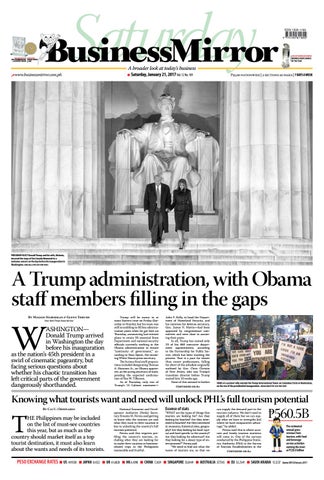
President-elect Donald Trump and his wife, Melania, descend the steps of the Lincoln Memorial to a welcome concert on the day before his inauguration in Washington. Doug Mills/The New York Times
A Trump administration, with Obama staff members filling in the gaps By Maggie Haberman & Glenn Thrush
W
New York Times News Service
ASHINGTON— Donald Trump arrived in Washington the day before his inauguration as the nation’s 45th president in a swirl of cinematic pageantry, but facing serious questions about whether his chaotic transition has left critical parts of the government dangerously shorthanded.
Trump will be sworn in at noon Eastern time on Friday (Saturday in Manila), but his team was still scrambling to fill key administration posts when he got here on Thursday, announcing last-minute plans to retain 50 essential State Department and national security officials currently working in the Obama administration to ensure “continuity of government,” according to Sean Spicer, the incoming White House press secretary. The furious final staff preparations included designating Thomas A. Shannon Jr., an Obama appointee, as the acting secretary of state, pending the expected confirmation of Rex W. Tillerson. As of Thursday, only two of Trump’s 15 Cabinet nominees—
John F. Kelly, to head the Department of Homeland Security, and his nominee for defense secretary, Gen. James N. Mattis—had been approved by congressional committees and were close to assuming their posts. In all, Trump has named only 29 of his 660 executive department appointments, according to the Partnership for Public Service, which has been tracking the process. That is a pace far slower than recent predecessors, falling far short of the schedule originally outlined by Gov. Chris Christie of New Jersey, who was Trump’s transition director before Trump ousted him 10 weeks ago. None of this seemed to bother Continued on A2
Signs at a protest rally outside the Trump International Tower on Columbus Circle in Manhattan, on the eve of the presidential inauguration. Joshua Bright/The New York Times
Knowing what tourists want and need will unlock PHL’s full tourism potential
T
By Cai U. Ordinario
he Philippines may be included on the list of must-see countries this year, but as much as the country should market itself as a top tourist destination, it must also learn about the wants and needs of its tourists. PESO exchange rates n US 49.9530
National Economic and Development Authority (Neda) Secretary Ernesto M. Pernia said getting to know who the tourists are and what they want in their vacation is key to unlocking the country’s full tourism potential. Pernia said this requires profiling the country’s tourists, including what they are looking for to make their vacation or businessrelated trips to the Philippines memorable and fruitful.
Essence of stats
“What are the types of things that tourists are looking for? Are they looking for beaches? Are they interested in beaches? Are they interested in museums, historical sites, geography? Are they looking for food: typical and food specific to the country? Are they looking for adventure? Are they looking for a sleazy type of entertainment?” Pernia said. “We need to find out what the tastes of tourists are, so that we
can supply the demand part in the tourism industry. We don’t need to supply all of them but we can supply what we have in strengths [or] where we have comparative advantage,” he added. Pernia said this is where accurate and timely tourism statistics will come in. One of the surveys conducted by the Philippine Statistics Authority (PSA) is the Survey of Tourism Establishments in the Continued on A2
₧560.5B
n japan 0.4352 n UK 61.6020 n HK 6.4398 n CHINA 7.2659 n singapore 35.0449 n australia 37.7545 n EU 53.2549 n SAUDI arabia 13.3237
The estimated annual gross revenue from tourism, with food and beverage service activities earning the most at P220.8 billion
Source: BSP (20 January 2017 )
News
BusinessMirror
A2 Saturday, January 21, 2017
www.businessmirror.com.ph
A Trump administration, with Obama staff members filling in the gaps Continued from A1
Trump. After arriving from New York, the president-elect trod solemnly down red-carpeted stairs from a government plane at Joint Base Andrews with his wife, Melania, then sped off to deliver a speech at a reception held at his ornate new hotel near the White House. There, he declared, with typical bluster, that his Cabinet nominees had “by far the highest IQ of any Cabinet assembled.” Later, he laid a wreath at Arlington National Cemetery and attended his Lincoln Memorial inaugural concert, saying that one had never been held there before even though many similar events have taken place in front of the iconic seated statue of the 16th president. “Tomorrow seems to be the big one,” Trump told a black-tie dinner crowd at Washington’s stately Union Station on Thursday night, referring to his inauguration. In off-the-cuff remarks, he teased his incoming chief of staff, Reince Priebus, for having a difficult-topronounce name, and chided fundraisers who did not contribute to his campaign until after he won. He also described his political opponents as “going crazy” over his Cabinet selections. Trump campaigned on a platform of shaking up Washington, but his pomp-and-circumstance arrival began with two jarring concessions to a city he may not inhabit full time: This week he was forced to abandon his cherished “Trump” 757 for an Air Force jet, and, according to people close to the transition, he has traded in his Android phone for a secure, encrypted device approved by the
Secret Service with a new number that few people possess. The official rationale was security. But some of Trump’s new aides, who have often been blindsided when a reporter, outside adviser or officeseeker dialed the president-elect directly, expressed relief. Several of them, however, expect the new president to satisfy his compulsion for continuous communication by calling outsiders and by tramping from office to office in search of gossip and sounding boards. Trump’s management style places unique strains on his top advisers, including Priebus, who is stepping into what is traditionally a gatekeeper’s post that has involved restricting the flow of people and paper to the Oval Office. Priebus is navigating a West Wing crowded with powerful figures in their own right, including the president-elect’s son-in-law, Jared Kushner, who will always outweigh anyone else regardless of title; the chief strategist Stephen K. Bannon; the counselor Kellyanne Conway; Vice President-elect Mike Pence; and the economic adviser Gary Cohn, the blunt former Goldman Sachs executive who is rising fast in Trump’s circle. In a conference call with incoming staff this week, Priebus informed midlevel aides that they should avoid interacting with Trump without his permission, that they were prohibited from talking to the news media, and that they should carefully restrict their social-media posts, according to two people with knowledge of the call. On Thursday aides released names of more than a dozen appointments to the White House
Vice President-elect Mike Pence and his wife Karen applaud as Presidentelect Donald Trump and his wife Melania arrive for a VIP reception and dinner with donors on Thursday in Washington. AP/Evan Vucci
staff. Most of them had worked for Priebus at the RNC. Trump also named a friend, Woody Johnson, the owner of the New York Jets, to be ambassador to Britain. Thursday’s hires notwithstanding, the halting pace of transition has alarmed senior Obama administration officials and some Republican lawmakers, who have repeatedly complained about the Trump team’s unwillingness to coordinate transition planning with them. Since his election last November 8, Trump has had little interest in the minutiae of his transition,
saying it was “bad karma” to get too involved, according to a person who spoke with him at the time. At one point, he wanted to halt the planning altogether, out of superstition, the person said. “In 21 years of covering the State Department and in eight years of serving there, I’ve seen rocky transitions and experienced what feels like a hostile takeover, but I’ve never seen anything like this,” said Strobe Talbott, the president of the Brookings Institution, a Washington-based think tank, and a former journalist and Bill Clinton administration official.
For weeks, transition officials and people close to the process have suggested that the delays are the fault of Christie, accusing him of botching the preparations during seven months of transition preparation. But copies of Christie’s plan, some of which were reviewed by The New York Times, were circulated in weekly installments to the transition team before his ouster and were discussed at weekly meetings. They revealed thorough blueprints on a range of core planning issues, from the pace of the transition to what the
president-elect’s daily schedule should look like, even 100-day and 200-day plans of action. Each sheet detailing the “landing teams” arriving at agencies had a notation on which advisers had weighed in on the selections. On the list the day of the election was a Senate nomination and confirmation plan, a first-100days agenda to take to Congress, members of landing teams and their status and interest in jobs at key departments, and a suggested schedule for Trump that included the presidential daily briefing each day and key meetings. The work was not fully completed; some pages, such as the landing team list for the Small Business Administration, were half-filled and had no input from senior advisers. The work was hobbled by the concern that most Republican policy officials had about working for their nominee. And Christie’s decision to put some of his own top allies on lists for prime jobs did not wear well with Trump’s team. Still, there was thought put into the transition and what would come next, including a draft of dozens of executive orders and recommendations for a communications plan to avoid “idle” time in the president-elect’s schedule that the news media would use to describe him as unfocused. There were proposed themes for each week, to lend a “cadence” to the transition. The suggested schedule called for completing Cabinet appointments by the first week of December, taking care of the undersecretaries and deputies the second week, and naming ambassadors by the third week, just before the holidays.
Knowing what tourists want and need will unlock PHL’s full tourism potential
El Nido in Palawan, currently ranked No. 1 on Condé Nast Traveler’s list of “20 Most Beautiful Beaches in the World.” Plotnikov | Dreamstime.com
Continued from A1 Philippines (Step). The Step is essential in the determination of the economic contribution of tourism to the Philippine economy. Data from this survey will serve as inputs in the compilation of Philippine Tourism Satellite Account (PTSA). Pernia said through this satellite account, the contribution of tourism industry to the economy within the Philippine System of National Accounts can be quantified. “Understanding and knowing the economic contribution of tourism will lead to an effective and efficient policy research, monitoring, analysis and development of the tourism industry in the country,” he added.
Earnings
Based on the 2014 Step, the country generated as much as P560.5 billion in gross revenues from tourists. Food-and-beverage service activities earned the most at P220.8 billion, or 39.4 percent of the total gross revenue. Transport operators, as well as tour and travel agencies, booked gross revenues reaching P141.7 billion in 2014, followed by accommodation, with P113.4 billion; health and wellness, P45.7 billion; and other tourism activities, P38.9 billion. Based on the PTSA 2015, tourism’s direct gross value added (TDGVA) to total GDP, the contribution of tourism to the economy was estimated at 8.2 percent in 2015. The TDGVA amounted to P1.093 trillion in 2015, higher by 14.8 percent compared to previous year’s P952.2 billion.
The PSA explained that tourism cuts across different sectors of the economy, and the TDGVA serves as the indicator to measure the value added of different industries in relation to tourism activities of both inbound and domestic visitors in the country.
‘Aggressive marketing’
Inbound tourism expenditure, which refers to the expenditure of nonresident visitors (foreign visitors and Filipinos permanently residing abroad) within the Philippines, continued to increase as it grew by 10.7 percent in 2015, amounting to P306.6 billion, from P276.9 billion in 2014. Compared to the country’s total exports, the share of inbound tourism expenditure was 8.2 percent. Inbound tourism ranked third among the biggest export
items in 2015, after miscellaneous services, at 29.8 percent; and semiconductors, at 22.8 percent. Pernia said that, while the Step and the PTSA provide critical data on tourism, more needs to be done. He said there is a need for the PSA and the Department of Tourism (DOT) to know what repels tourists, whether it is infrastructure constraints, security and/or other concerns. Apart from these, Pernia said there is a need to be more aggressive in marketing the tourism industry. He recounted his recent visit to Peru during the Asia-Pacific Economic Conference meetings last year, and how hotels in the South American country were giving away pamphlets featuring the must-see tourist sites, which is seldom done in the country.
Tourism summit
These are among the reasons behind the decision of the Duterte administration to hold a tourism summit that will involve not only the DOT but also government line agencies, such as the budget and trade departments. “We should have a tourism summit, because the tourism industry involves not only the Department of Tourism, but also all the other departments. Infrastructure, for example. Security—we have [the] national security adviser. We also need to involve the budget aspect, because tourism promotion entails some budgetary proficiency. Trade and industry, because they look after the tourism establishments, and the other departments of the Executive branch of this government,” Pernia said.
www.businessmirror.com.ph
The World BusinessMirror
Saturday, January 21, 2017
A3
Davos elites see an abyss: Populist surge upending the status quo D AVOS, Switzerland—For the investors and market-movers at the annual World Economic Forum here, a threat lurks.
At cocktail parties where the Champag ne f lows, financiers have expressed bewilderment over the rise of populist groups t h at a re feed i ng a bac k l a sh against globalization. In the halls of the Davos Congress Center, where many of the meetings this week are taking place, investors have tried to make sense of the political upheaval. The world order has been upended. As the United States retreats from the promise of free trade, China is taking up the mantle. The stark shift leaves investors trying to assess the new risk and opportunities in the global economy. “This is the first time there is absolutely no consensus,” said William F. Browder, a cofounder of Hermitage Capital Management who has been coming to Davos for 21 years. “Everyone is looking into the abyss.”
Fear of the populist ‘threat’
The religion of the global elite— free trade and open markets—is under attack and there has been a lot of hand-wringing over what Christine Lagarde of the International Monetary Fund has declared a “middle-class crisis.” But while all the attendees in Davos have a view on the state of the world, there is little agreement on how to deal with it. The biggest concern? Finding a way to make the people who are driving populist movements feel like they are part of the global economic pie that Davos participants have created and largely own. In a Twitter post from the Swiss resort, Ian Bremmer, president of Eurasia Group, a political-research firm, offered his advice: “Elites won’t be able to manage populism until they stop seeing it as a threat and start seeing it as a symptom.” If that is the case, Davos has, so far, made little progress. “I want to be loud and clear:
Populism scares me,” Ray Dalio, the billionaire hedge-fund manager, said during a panel on how to fix the middle-class crisis. “The No. 1 issue economically as a market participant is how populism manifests itself over the next year or two.” But Dalio offered little by way of a solution, beyond opining on the positive aspects of loosening regulation and lowering taxes. On the subject of rising populism, Dalio, who runs the $150-billion investment firm Bridgewater Associates, added: “It’s an antiDavos way of operating.” Jack Ma, the founder of Alibaba in China, offered his view of the problem in the US. Americans, he said, “do not distribute the money properly.”
Deciphering the Trump effect
If there was one thing Davos attendees agreed on last year, it was that Donald J. Trump would not win the US presidential election. And so this year, with Trump’s inauguration on Friday coinciding with the end of the World Economic Forum, every conversation has drifted to one question: What will the Trump presidency look like, and what will it mean for business? To many American financiers who once opposed Trump’s candidacy, the prospect of fewer regulations and a blank slate with a new leader has assuaged some of the fear about uncertainties. At the forum, some attendees have been thrust into a role of interpreting the president-elect to a befuddled global elite. “He’s not necessarily communicating in a way that the people in this community would love,” said Anthony Scaramucci, a hedgefund regular at Davos and onetime critic of Trump who is now set to join the administration as a public liaison and adviser. “But he is communicating very, very effectively to a very large group
CoChairMAN of the Bill & Melinda Gates Foundation, Bill Gates, speaks during a plenary session at the 47th annual meeting of the World Economic Forum in Davos, Switzerland, on Thursday. AP
of the population in Europe and the US that are feeling a common struggle right now.” Sc a ra mucc i prom ised t h at Trump had “the utmost respect for Angela Merkel,” the German chancellor who was the subject of an attack by the presidentelect this week; that he was, in fact, a champion of free trade; and that he wanted to have a “phenomenal relationship with the Chinese” despite his fiery anti-China language. Soon after his appearance on a panel, Scaramucci was on a plane heading to Washington to attend Trump’s inauguration.
But his words still resonated, mainly because they were being broadcast on a giant screen behind a coffee bar where World Economic Forum participants congregated between meetings. One Davos regular, billionaire investor Paul Singer, did not attend this year. Singer, a vociferous critic of Trump for most of the election campaign, was, instead, making his way to Washington for the inauguration, having recently donated $1 million to the event. One major investor has not changed in his views about Trump, however. George Soros, the investor and philanthropist who has
I want to be loud and clear: Populism scares me. The No. 1 issue economically as a market participant is how populism manifests itself over the next year or two.”—Dalio
Dollar drops on Yellen comments; China shares rise
T
he dollar weakened after Janet Yellen said it’s prudent for the Federal Reserve (the Fed) to gradually adjust policy over time, while Chinese equities extended gains, as the world’s second-largest economy grew faster than forecast. Gold climbed for a second day. The greenback slipped against major peers after the Fed chief ’s speech. The Shanghai Composite Index rose the most in almost two weeks as China’s GDP accelerated for the first time in two years in the final quarter of 2016. Japan’s Topix index swung within a halfpercentage-point range, while equities from Hong Kong to Jakarta slipped. Gold headed for a fourth straight weekly advance as investors await the opening days of Donald J. Trump’s presidency. Rallies in the dollar and equities are easing this week before Trump is sworn in as the 45th American president, with investors growing increasingly anxious for indications the administration will follow through on pro-growth campaign promises. Legendary billionaire investor
George Soros said the euphoria among stock investors since Trump’s victory will end as uncertainty takes over. The Dow Jones Industrial Average has churned in its tightest range ever over the past month. “It’s clear that investors have reached a level where they are prepared to wait and see what the Trump administration has to offer,” said Ric Spooner, chief market analyst at CMC Markets Asia Pacific Ltd. in Sydney. In a speech at the Stanford Institute for Economic Policy just a day before Trump’s inauguration in the US, Yellen argued that the Fed wasn’t behind the curve in containing inf lation pressures but, nevertheless, can’t afford to allow the economy to run too hot. In a separate speech on Wednesday, Yellen said the Fed was close to achieving its goals of full employment and stable prices. The odds of another Fed rate hike as soon as May have risen to 50 percent from 42 percent a day ago, futures contracts show. China’s economic data cemented an economic stabilization that’s
giving leaders a buffer as they transition to neutral policy and prepare for potential trade tensions with Trump. GDP increased 6.8 percent in the three months through December from a year earlier, compared with a 6.7-percent median estimate in a Bloomberg survey.
Here are the main moves in markets: Currencies
The Bloomberg Dollar Spot Index retreated 0.3 percent as of 12:41 p.m. in Tokyo, after gaining as much as 0.1 percent earlier. The gauge is down 0.2 percent for the past five days, heading toward its fourth straight weekly loss. It touched the highest level in more than a decade earlier this month. The yen added 0.2 percent to 114.60 per dollar, wiping out a decline of 0.2 percent and almost reversing a loss for the week. The Australian dollar climbed 0.3 percent, also erasing earlier losses.
Stocks
The MSCI Asia Pacific Index rose 0.3 percent, w ith about 500 stocks declining and 360 adv a nc i ng. T he Topi x i nde x
fell as much as 0.2 percent and climbed as much as 0.3 percent. The gauge is headed for its fourth weekly decline in the past five weeks. The Shanghai Composite gained 0.5 percent. Hong Kong’s Hang Seng index fell 0.7 percent. Australia’s S&P/ ASX 200 Index slipped 0.5 percent, heading toward the biggest weekly decline since early December. Futures on the S&P 500 Index rose 0.1 percent. The underlying cash index fell 0.4 percent to the lowest in two weeks on Thursday. The Dow declined for a fifth straight day, the longest losing streak since Trump’s election victor y.
Commodities
Gold rose 0.3 percent to $1,208.09 an ounce, on course for a fourth weekly climb. It’s up 0.9 percent this week, touching the highest level since November.
Bonds
The yield on 10-year Treasuries fell two basis points to 2.45 percent, retreating after a two-day rally. Bloomberg News
called Trump “a con man,” hosted a dinner on Thursday evening in Davos, during which he said Trump “would be a dictator if he could get away with it.” This was unlikely to happen, he added, because of strong democratic institutions in the US. For those who have been puzzled over market euphoria since Trump’s election, Soros put it this way: “Markets see Trump dismantling regulations and reducing taxes—and that has been their dream.” But Soros, who became known as the man who broke the Bank of England with a bet against the British pound in 1992, added that he was convinced that Trump would fail. “I don’t think the markets are going to do ver y well,” he said.
China’s leaders take center stage
When President Xi Jinping addressed the Davos forum, becoming the first Chinese head of state
to do so, his message was clear: China is ready for the world stage. He championed free trade and open markets, setting the tone for the week. On the sidelines, the countr y’s business leaders echoed that sentiment. Among the delegation that arrived in Davos with Xi were some of China’s biggest business leaders, including Ma, Wang Jianlin of Dalian Wanda and top executives from Baidu, Huawei Technologies and China Telecom. Through the week, they have been meeting with investors and talking deals with erstwhile partners. With Xi’s help, China has fashioned itself here as a new leader of the free-market world. “I wasn’t sure if it was President Xi or Ronald Reagan,” joked Thomas W. Farley, president of the New York Stock Exchange. At a lunch with Ma of Alibaba, Xi was quoting Abraham Lincoln, Ma told a small group of participants on Wednesday. It was a message somewhat at odds with the historical roots of China’s ruling Communist Party. And back in Washington, Wilbur Ross, Trump’s nominee for commerce secretary, did not mince words, calling China “the most protectionist” major economy, setting the stage for a possible trade war. But in Davos, there was a sense that change in the economic order was afoot. A licia Bárcena Ibarra, who heads the UN Economic Commission for Latin America and the Caribbean, told a small group that China could soon overtake the US when it comes to importance in Latin America. She described how on the same day last year that Trump told the world he would not sign the TransPacific Partnership, Xi arrived for a summit meeting in Chile. “So can you imagine the impact when he came talking about free trade as he did this morning?” she said, referring to Xi’s address Tuesday in Davos. “China now is the second-most important trade partner of Latin America after the US.” “Maybe this is going to change,” she added. “Very soon.” New York Times News Service
Expedia reads your mind (and face) to beat rivals
T
he travel company Expedia is trying to read my mind. Or more accurately, it’s trying to analyze my emotions in order to figure out how I’m feeling as I go about booking travel on its web site. To do so, Expedia’s researchers have wired me with electrodes. They are tracking my eye movements and scrutinizing me through one-way glass in their recently opened “usability lab” in London. The lab is an important component in Bellevue, Washington-based Expedia’s efforts to stay ahead of a growing raft of competitors, from Priceline’s Booking.com to China’s Ctrip—which recently bought Skyscanner—to Airbnb and TripAdvisor, which are increasingly morphing into full-service travel booking sites. And then there’s behemoth Google, which may one day dominate travel searches through its digital assistant. “The lab allows us to see how people emotionally engage with the site,”said Gary Morrison, Expedia senior vice president of retail and brand. Research subjects in the lab are hooked up to sensors for electromyography—technology that records minute muscle movements, in this case the muscles in people’s faces. These tiny facial movements, in turn, let Expedia’s researchers detect emotional responses, even when the subjects themselves might not be conscious
they are experiencing them. Eye tracking allows researchers to see exactly what the subjects are looking at when they experience these emotions. Researchers observing the subjects will also intervene to ask explicit questions about what’s motivating certain emotions as they book travel. Expedia is hoping the lab will help it find ways to reduce the stress and frustration associated with making online bookings. A survey its UK branch conducted found that more than 75 percent of people considered purchasing a holiday online as stressful as a bad day at the office, being stuck in traffic or arguing with a loved one. Nearly a third said the Internet had made travel booking more confusing because of the multitude of options now available. Insights from its usability labs, which Expedia operates in Bellevue and Singapore, as well as London, led the company to develop its Scratchpad feature, which automatically saves users’ travel searches as they go along, Morrison said. Researchers in the lab had been surprised to learn just how many different flight options users searched before booking—an average of 48—and how often consumers were resorting to good old paper and pencil to keep track of these searches. Bloomberg News
A4
Saturday, January 21, 2017
The World BusinessMirror
Airports to toll roads top picks amid Asean infrastructure boom I
www.businessmirror.com.ph
Mexican drug lord El Chapo lands in New York to face charges
M
anila’s Metro Pacific Investments Corp., Indonesia’s PT Krakatau Steel and Airports of Thailand Pcl. are among the top investor picks, as Southeast Asian governments embark on programs to boost roads, rail, ports and power plants.
President Duterte is promising P8 trillion ($160 billion) of spending over his six-year term, while T hailand ’s militar y-led government plans to list an infrastructure fund on the stock exchange in March. Indonesia has set aside almost 10 percent more to spend on projects this year and Malaysia is pushing ahead with plans, including a high-speed rail line from Kuala Lumpur to Singapore. Thailand and the Philippines are likely to see the biggest increase in infrastructure spending over the next few years, while in Indonesia and Malaysia, budgetary constraints may mean the rhetoric of politicians translates into comparatively little extra outlay, Capital Economics Ltd. said in a January 16 research note. Below are some selections from fund managers and analysts across the region:
Indonesia
Within Southeast Asia, Old Mutual Global Investors favors Indonesia, said Joshua Crabb, head of Asian equities in Hong Kong. The Jakarta Composite Ind e x i s c he ap a nd P re s id e nt Joko Widodo’s improved po litical standing will give him some firepower to push ahead with his infrastructure plans,
$22B The total cost of new and ongoing infrastructure contracts to be awarded by the Malaysian government over 2017 and 2018
despite perceived f isca l constraints, he said. Crabb said he liked Krakatau Steel. W h i le a c k no w le d g i n g t he budgetar y r isk, Jemmy Paul, investment director at PT Sucorinvest Asset Management in Jakarta, said many Indonesian i n f ra st r uc t u re -re l ated f i r m s h ave re ce ive d c apit a l i nje c tions from the government and have good revenue outlooks. PT Adhi K ar ya, PT Pembangunan Perumahan and PT Waskita Beton Precast are among his top construction picks, along with toll-road operator PT Jasa Marga. K rakatau Steel is also interesting, as prices are on the rise due to stronger demand from projects, Paul said. Earnings growth for Indonesian construction companies will still be there, but investors should
emphasize cash flow and look for companies with stronger balance sheets, said Jeffrosenberg Tan, a director at PT Sinarmas Sekuritas in Jakarta. The condition of the state budget will be critical this year, he said, adding that he prefers Pembangunan Perumahan and Adhi Karya.
Thailand
The 2016-2020 infrastructure rollout in Thailand should benefit from the longevity of the military government and high public- and private-sector participation, said Maria Lapiz, cohead of research at Maybank Kim Eng Securities (Thailand) Pcl. in Bangkok. She said she likes the high cash f low of Airports of Thailand and telecommunications company Advanced Info Service Pcl. Sino Thai Engineering & Construction Pcl. is also attractive, Lapiz said. The Thai government will provide 10 billion baht ($283 million) for its Future Fund, which it expects to grow to as much as 50 billion baht with money from private investors, pension funds, insurers and sovereign wealth funds. It’s an attractive investment alternative, but more details and pricing are needed before deciding to invest in the fund, sa id Ying yong Ni l asena, t he Bangkok-based chief investment officer of Government Pension Fund, which oversees around $22 billion of assets.
Philippines
Infr astructure will be least vulnerable to the headwinds of a strengthening dollar and rising US interest rates, said Frederico Ocampo, chief investment officer at BDO Unibank Inc. in Manila. Metro Pacific—which is involved in water, toll roads and electricity generation and distribution and is looking at bidding for airport projects—and
Megawide Construction Corp., are among the best bets, he said. Metro Pacific is also the top infrastructure pick of Karen Hizon, an analyst at UBS Securities Philippines Inc. in Manila. Some exposure should also go to construction company DMCI Holdings Inc., cement firms will be a good play, while banks and property companies will also benefit, she said. Eduardo Francisco, president of BDO Capital & Investment Corp. in Manila, said his company was looking at structuring new debt instruments for infrastructure, but is waiting for rules to govern such issuance. The challenge for marketing the debt would be the absence of cash flow in the initial years of projects, he said.
Malaysia
Const ruction stoc k s w i l l provide the biggest opportunity among shares in Malaysia this year, said Ang Kok Heng, chief investment officer at Phillip Capital Management Bhd. in Kuala Lumpur, whose Phillip Master Equity Growth Fund has beaten 94 percent of its peers over the last five years. He said he favors mid-cap stocks, like George Kent Malaysia Bhd., Hock Seng Lee Bhd. and Kimlun Corp., as they have better return potential, especially when they win large contracts relative to their size. Some 96 billion ringgit ($22 billion) of new and ongoing infrastructure contracts will be awarded over 2017 and 2018, Loong Chee Wei, an analyst at Affin Hwang Investment Bank Bhd. in Kuala Lumpur, wrote in a January 16 note. Loong maintained an overweight call on Malaysia’s constr uction sector and his top buys are Gamuda Bhd., Sunway Construction Group Bhd., WCT Holdings Bhd. and Gabungan AQRS Bhd. Bloomberg News
nfamous Me x ic a n d r ug kingpin Joaquin “El Chapo” Guzman, who twice escaped from maximum-security prisons in his country, was extradited at the request of the United States to face drug trafficking and other charges and arrived in New York late Thursday. A plane carrying Guzman landed at a suburban airport, where a caravan of sport-utility vehicles waited to take him away. Guzman, the convicted leader of the Sinaloa drug cartel, one of the world’s largest drug-trafficking organizations, was expected to spend the night in a New York jail before his first appearance in a federal courthouse in Brooklyn on Friday, officials said. M e x i c o ’s D e p a r t m e n t o f Foreign Relations announced Guzman was handed over to US authorities for transportation to the US earlier Thursday, the last full day of Democratic President Barack Obama’s administration and a day before Republican Donald J. Trump’s scheduled inauguration. Guzman was taken into custody by the US Drug Enforcement Administration in Ciudad Juarez, a border town across from El Paso, Texas. Guzman, who’s in his late 50s, first escaped from prison in 2001 and then spent more than a decade on the run before he was recaptured, only to escape again in 2015 via a mile-long tunnel dug to the shower in his cell. The 2015 escape was highly embarrassing for the government of Mexican President Enrique Peña Nieto, and Mexican officials were seen as eager to hand the headache off to the United States afterward. A court denied Gu zman’s appea l and found his extradition was constitutional, the Mexican Department of Foreign Relations said. In Mexico Deputy Attorney General Alberto Elias Beltran told reporters late Thursday that Guzman still faces formal charges in 10 other cases.
“When he completes his sentence in...the United States, he will return to Mexico to continue” the prosecutions, he said. Guzman’s lawyers had fought extradition since his 2016 recapture and said Thursday the Mexican government sent him to the United States to distract the public from nationwide protests over gasoline prices. “It was illegal. They didn’t even notify us,” lawyer Andres Granados said. “They handled it politically to obscure the situation of the gasprice hike. It’s totally political.” Besides New York, Guzman faces charges in five other US jurisdictions, including San Diego, Chicago and Miami. He could face the possibility of life in a US prison if convicted. An indictment in New York accuses him of running a massive drug operation that employed thousands of people, laundered billions of dollars in profits back to Mexico and used hit men to carry out murders, kidnappings and acts of torture. After his recent escape, he became something of a folk legend for a segment of Mexico’s population for his defiance of authorities. He was immortalized in songs known as narco-corridos, ballads about the drug trade and drug bosses. It was while on the lam the second time, in fall 2015, that he held a secret meeting with actors Sean Penn and Kate del Castillo. The encounter was the subject of a lengthy article Penn published in Rolling Stone last January, right after Mexican marines re-arrested Guzman in the western state of Sinaloa. In the interview, Guzman was unapologetic about his criminal activities, saying he had turned to drug trafficking at age 15 simply to survive. “The only way to have money to buy food, to survive, is to grow poppy, marijuana, and at that age, I began to grow it, to cultivate it and to sell it. That is what I can tell you,” he was quoted as saying in Penn’s article. AP
China’s growth edges up, but 2016 weakest year since 1990 C
hina’s economic growth ticked up in the final quarter of 2016, but its full-year performance was the weakest in three decades, as it heads into a potential trade battle with US President-elect Donald J. Trump. Trump, who takes office on Friday, has promised to hike duties on Chinese goods, putting pressure on industries that employ millions of workers. Suppor ted by gover n ment spending and a real-estate boom, the world ’s second-largest economy expanded by 6.8 percent over a year earlier in the three months ending last December, up from the previous quarter’s 6.7 percent, government data showed on Fr id ay. Fu l l-yea r growth was 6.7 percent, down from 2015’s 6.9 percent and the weakest since 1990’s 3.9 percent. “A touch faster growth than expected, but no real change in trend,” Bill Adams of PNC Financial Services Group said in a report. China’s economy has cooled steadily as communist leaders try to nurture domestic consumption and reduce reliance on trade and investment but trade still supports millions of jobs. Government spending and a surge in realestate sales last year helped offset a 7.7-percent plunge in exports, but analysts expect the economy to cool further. “We do not expect this rebound to extend far into 2017,” Tom Rafferty of the Economist Intelligence Group said in a report. Export industries could face more pressure, raising the threat of politically dangerous
In this December 13, 2016, photo, workers buy their lunch outside a construction site at the Central Business District in Beijing. AP
job losses, if Trump goes ahead with promises to raise tariffs on Chinese goods. In an implicit rebuke to Trump, Chinese President Xi Jinping emphatically defended free trade in a speech on Tuesday at the World Economic Forum in Switzerland. He said a “trade war” would harm all countries involved. Still, a member of the Cabinet’s economic planning agency on Friday expressed confidence. “I am hopeful that after his
election, President Trump will consider the issue from the angle of mutual benefit and win-win and will develop the long-term, cooperative ‘big country’ relations that have been formed between China and the United States,” Ning Jizhe told reporters. Asked about the potential impact of action by Trump, Ning said China should maintain “medium to high-speed growth.” Beijing has relied on repeated infusions of credit to prevent
activity from slumping too fast, prompting warnings the run-up in debt could spark a financial crisis or drag on growth. C hinese leaders have cautioned the economic outlook is “L-shaped,” meaning once the downturn ends, growth is unlikely to rebound. Looking at quarter-on-quarter growth, the way other major economies report data, the economy cooled steadily over the course of the year, despite the headline
figure showing steady expansion. Growth fell to 1.7 percent in the last quarter, down from 1.8 percent in July to September and 1.9 percent in the previous quarter. Chinese leaders say they will make the economy more competitive and productive by opening more sectors to private companies, but last year’s performance still relied heavily on spending by the government and state-owned industry. Investment by government companies in factories and
other fixed assets rose 18.7 percent last year over 2015, according to the National Bureau of Statistics. Investment by private companies was far weaker, growing 3.2 percent. Real-estate sales are booming, which has pushed up economic growth figures. But regulators are taking steps to cool surging housing prices and bank lending, which forecasters expect to depress this year’s performance. Retail sales growth decelerated to 9.6 percent, from 2015’s 10.6 percent. E-commerce, one of the brightest spots in the struggling economy, soared 26.2 percent over 2015, but that was down from the previous year’s 33.3-percent expansion. This week, the International Monetary Fund raised its China growth forecast for this year by 0.3 percentage points to 6.5 percent, citing a boost from government stimulus. But it warned rising debt increases the risk of a sharper slowdown. The ruling Communist Party is headed this year into a twicea-decade change of senior officials. Private-sector analysts expect the party to postpone any significant policy changes until that is completed. “We assume that in 2017, policy-makers will be focused on ensuring economic growth remains relatively elevated,” Rafferty said. “Determined steps to address excessive debt levels in the economy are unlikely. It will probably not be until 2018, when politics are more favorably aligned, that we begin to see a more radical approach in this area.” AP
Editor: Jun Lomibao | mirror_sports@yahoo.com.ph
Sports
BusinessMirror
Saturday, January 21, 2017 A5
GUMABAO, LAZARO JOIN SUPERLIGA TEAM M ICHELE GUMABAO and Denden Lazaro traversed the Philippine Superliga (PSL) during the off-season and will join expansion team United Volleyball Club (VC) for the league’s forthcoming tournament. Gumabao played for Pocari Sweat and Lazaro donned BaliPure’s colors in the Shakey’s V-League, a move that came as a surprise in the local volleyball community. The former De La Salle standout Gumabao and ex-Ateneo ace libero Lazaro will team up with former University of Santo Tomas (UST) star Angeli Tabaquero, as well as with Wensh Tiu and Erika Alkuino, former former players of Generika and Pocari Sweat, respectively, at the United VC camp. United VC officials, however, have yet to bare the other members of the team but the BusinessMirror learned the team is also eyeing former Lady Eagles Mae Tajima, Amy Ahomiro and Jem Ferrer. Foton and Petron, who clashed in the PSL Grand Prix Finals for the past two seasons, also tinkered with their rosters. Foton, the back-to-back Grand Prix champion, retained Jaja Santiago and sister Dindin SantiagoManabat, EJ Laure, Maika Ortiz and Ivy Perez and kept Serbian Head Coach Moro Branislav. The Tornadoes, however, lost Cherry Rondina and Rhea Dimaculangan to Petron, as well as Bia General, Patty Orendain, Angeli Araneta and Carol Cerveza, who all went to Generika. In return, though, Foton tabbed prized libero Jen Reyes from Petron. Petron also let go of former skipper Maica Morada and Acy Masangkay, who moved to Cignal and Generika, respectively. But the Tri-Activ Spikers signed PSL
FORMER collegiate stars Michele Gumabao and Denden Lazaro jump over the fence to lead a new club.
BATANG PIER VS STREAKING SMB T
ERRENCE ROMEO and the GlobalPort Batang Pier face a daunting task of pulling the rug from under a dominant San Miguel Beer side as the Philippine Basketball Association Philippine Cup goes out of town anew on Saturday at the Hoops Dome in Lapu-Lapu City, Cebu. The game is set at 5 p.m. with the prolific Romeo hoping to challenge the towering presence of three-time Most Valuable Player June Mar Fajardo, as the two hottest teams try to preserve their streaks. Two convincing victories propelled GlobalPort to a shared second place with Rain or Shine on five wins and three loses. The Batang Pier now have a chance to break free from the deadlock and gain more momentum entering the final stretch of the conference. “Our coming games will be difficult. We’ll be facing tough teams,” Batang Pier Coach Franz Pumaren said. Pumaren is fully aware of his team’s biggest headache on Saturday—Fajardo, again a front-runner in the Best Player of the Conference race. But he has Romeo, the conference top scorer with 27.6 per game he laced also with a front-running 5.9 assists per outing. “I think we have to play better and smarter against San Miguel [with June Mar there]. We have
to do something to limit his production,” Pumaren added. Fajardo posted impressive numbers of 15.4 rebounds and 20 points per game. GlobalPort beat NLEX, 110-96, last week for its second consecutive win and fifth overall in eight games. Romeo scored 32 points, while Stanley Pringle contributed 20 points in that victory. The Beermen, on the other hand, solidified their hold of the lead with a 107-101 win over Rain or Shine on January 13. Fajardo was at his usual best with 25 points and 17 boards, while Arwind Santos contributed 17 points and 15 rebounds, Alex Cabagnot 14 points and some clutch plays and baskets down the stretch to extend their streak to seven games. San Miguel is already assured of a quarterfinals seat. Ramon Rafael Bonilla
BATANG Pier’s Terrence Romeo has his hands full against the Beermen.
DAVIS CUP SPONSOR
The Philippine Tennis Association (Philta) has entered into an agreement with Babolat as the official outfitter of Team Philippines, which will face Indonesia in the Davis Cup Asia/Oceania Zone Group II tie from February 3 to 5 at the Philippine Columbian Association indoor clay court in Paco, Manila. Photo shows Philta President Salvador Andrada (left) receiving a check for the sponsorship from Guillermo Nocum, president of Techno Sports Inc., the exclusive distributor of Babolat sports equipment and apparel in the country. Also in photo is Philta Secretary-General Romeo Magat. The Philippine Davis Cup team is composed of Filipino-Americans Treat Huey and Ruben Gonzales, Francis Casey Alcantara and Albert Lim Jr. with veteran collegiate coach Karl Santamaria as captain.
Tokyo 2020 to study golf club’s membership policies
T
OKYO—Tokyo 2020 organizers say they will review membership practices at the golf course selected for the Olympic Games following criticism that it does not allow women as full members. Founded in 1929, the Kasumigaseki Country Club is one of the oldest private clubs in Japan but does not allow women to become full members or to play on Sundays. “The Tokyo 2020 organizing committee will continue studying the club owner’s policy on the membership eligibility and responses to the public discussion,” organizers said in a statement. Tokyo Gov. Yuriko Koike has urged the club to admit women as full members. “I feel very uncomfortable about women not being able to become a regular member in this era,” Koike said at a press conference. Kasumigaseki has hosted more
top-level tournaments than any other golf course in Japan. Tokyo organizers said the club has hosted various national competitions, including Japan Women’s Open in 1999, and it fully meets requirements for the Olympiclevel golf competitions. The committee seeking to land the 2024 Summer Olympics for Los Angeles, meanwhile, would stage archery at a new football stadium, mountain biking in a regional park and modern pentathlon at a stadium, with all three locations away from the downtown core. LA2024 announced on Tuesday its proposed locations for the three sports in completing a list of existing, planned or temporary venues for the Games. The committee has stressed the city’s bid doesn’t require any permanent venue construction.
Archery would be held in the new football stadium in Inglewood, 12 miles from downtown Los Angeles. The stadium is currently under construction and set to open in 2019. It will be the home of the NFL’s Chargers and Rams. It would also be the site of the opening and closing ceremonies, with gymnastics across the street at the Forum. Mountain biking would be hosted at Frank G. Bonelli Regional Park in suburban San Dimas, 30 miles from downtown. The venue would be upgraded and allow for future World Cup races to be held there. Modern pentathlon would be at StubHub Center in Carson, 17 miles from downtown, with all five of the sport’s disciplines held within a single stadium. StubHub is the proposed venue for rugby during the first week of the games, and modern pentathlon would be held the second week. AP
ambassador Mika Reyes, a prized middle blocker out of De La Salle and a former F2 Logistics star, and UST Tigress Carmela Tunay. They will join Petron mainstays Aiza Maizo-Pontillas, Frances Molina, Mina Aganon, Bang Pineda, CJ Rosario and April Hingpit, making the Shaq de los Santoscoached squad a favorite for the crown again. The Invitational Conference—a preseason tournament of the PSL—is scheduled from March 24 to 31. It will clash with the Season 79 University Athletic Association of the Philippines (UAAP) volleyball action. Petron, Cignal, Generika and United VC have commited to play in the Invitational Conference. Foton and F2 Logistics, however, are expected to skip the tournament because of most of their players’ obligations with their schools in the UAAP. Foton’s Jaja Santiago and EJ Laure are still active players of National University and UST, respectively, while Kim Fajardo, Kim Dy, Majoy Baron and Dawn Macandili need to favor their campaign with De La Salle over F2 Logistics. Team captain Cha Cruz, Ara Galang, Cyd Demecillo, Aby Maraño and Janine Navarro and Djanel Cheng will be available for the Cargo Movers. The All-Filipino Conference, meanwhile, will be played from May to July from its original June to August schedule to give way to the national team’s stints in the Asian Volleyball Confederation Asian Seniors Women’s Championship in Manila in July and the 29th Southeast Asian Games in Kuala Lumpur in August. The import-flavored Grand Prix is still scheduled in the fourth quarter of the year. Lance Agcaoili
A6 Saturday, January 21, 2017
ASIAN TOUR TO ENHANCE GLOBAL REACH WITH INTRODUCTION OF LIVE STREAMING
T
he Asian Tour will expand its reach further afield with the introduction of live streaming for a selected number of tournaments on www.asiantour.com, starting with the season-opening SMBC Singapore Open this week. The new and exciting digital initiative will complement its well-established global television platform, which already covers over 180 countries and territories with a potential reach of more than 750 million households via Asian Tour Media’s large pool of official TV broadcast partners. The live streaming on the Tour’s official web site will be streamed to select markets that do not have official Asian Tour broadcast partners for their dedicated live coverage. For this week’s SMBC Singapore Open, these countries and territories include Myanmar, the Philippines, Vietnam, the Czech Republic, Slovakia, the Netherlands, Belgium, Latin America and other select markets that are not already part of Asian Tour Media’s impressive TV platform. Asian Tour CEO Josh Burack said: “This new digital offering has been launched to further enhance our tournament coverage to all corners of the globe through our
official web site. We will obviously respect all of the exclusive TV and digital broadcast deals we already have across the world, so the streaming will be geo-blocked in these markets. For the remaining territories that the Asian Tour is not already telecast, we will stream selected events to expand our viewership even further. “We believe the live streaming will add a great deal of value to our tournaments, sponsors and our players, as coverage will now be available in territories which do not yet have an official Asian Tour broadcast partner. “With the game growing so rapidly across Asia, it is our intention to provide easier access to golf fans from anywhere around the world to watch the Asian Tour’s talented players competing in our worldclass golf events through our web site or our official broadcast partners.” The Asian Tour is the official sanctioning body for professional golf in the region. Following the SMBC Singapore Open, which begins on Thursday, the Tour will head to the Leopalace21 Myanmar Open, which will also be broadcast live across the four days or streamed on www.asiantour.com next week.
Tagaytay Ci and Golf To
Bridgestone Tour B330S and Tour B330RXS W hen golf talk turns to golf balls, Bridgestone is somewhere in the middle of the pack when it comes to what’s in play and brand awareness, and that’s a shame. Bridgestone is the largest manufacturer of rubber products in the world. They started making golf balls in 1935 and have 900 engineers worldwide working on rubber polymer science. When the first fully synthetic golf balls were produced, Bridgestone was one of the first to make one that garnered acceptance on the world’s professional tours. When Nike Golf put its first golf ball on sale, few knew that it was designed and produced for them by Bridgestone. Bridgestone came full circle in one sense when Tiger Woods, orphaned when Nike Golf stopped all production of golf equipment, signed with Bridgestone to put the new B330S golf ball in play for the foreseeable future. It’s a good choice for Tiger and an equally good choice for the rest of us. Bridgestone’s high-performance golf balls can be broken down thusly: The B330 and B330S are engineered for golfers with swing speeds over 105 mph and the B330RX and B330RXS are engineered for golfers with swing speeds below 105 mph. The S variants are identical to their non-S siblings, except for a softer cover for golfers who prefer a softer feel at impact. Both these golf balls have been around for a while, but that’s not to say Bridgestone hasn’t moved forward with these balls. Both the Tour 330S and are completely different from their predecessors in more ways than one. Where the S differs from the RXS is the core of the golf ball. The Tour Core in the B330S is 6 percent larger than the previous iteration, which boosts distance. The outer portion of the core is firmer to withstand elevated clubhead speeds, while the interior of the core is 7 percent softer. Other golf balls achieve this trick with a two-piece core; Bridgestone accomplishes this with just one. Paired with the new SlipRes cover, the center reduces driver spin by 3 percent, while the outer area makes the ball faster. The new core in the RX family is 28 percent softer than the Tour B330, so its target audience can compress it. Plus, the center of the core is 20 percent softer than in previous RXs, while the firmer area
along the outer edges is harder. Company testing shows players get more ball speed and launch shots higher, with 3 percent less driver spin than before. Combining Bridgestone’s softest urethane cover ever with a tacky coating adds short-game spin. The SlipRes cover used in both Tour B330 families is, perhaps, the biggest story and the most compelling reason to put one of these golf balls in your bag. The newly formulated SlipRes Cover is the highest-performing cover Bridgestone has ever produced on a golf ball. It has the highest friction coefficient rating possible, to achieve the impossible: maximum greenside spin without losing any spin from the rough and reduced spin off the driver for longer distance. SlipRes also delivers a self-repairing cover for longer playability. I got a box each of the Tour B330S and the Tour B330RXS. These variants have been my go-to’s in years past as I prefer a ball that spins more coming into the green and feels soft off the putter and with my wedges around the green. My swing speed hovers right about 105 mph with the driver, which means I sit right on the cutoff between the two families. I want to say right off the bat that the SlipRes cover is amazing. After 18 holes with either ball, you could put the ball back in the box and you’d be hard-pressed to tell it from the unused ones the next time you play. Both balls feel soft at impact but the RXS is perceptibly softer. I prefer the RXS on the greens but love the slightly heavier feel of the B330S from tee to green. I weighed both golf balls on my kitchen scale and they weigh exactly the same (45.20 grams) so the “heavier” feel is a function of the larger, firmer core. I got more distance with the B330S off the driver (most likely because it spun less for me) but I would recommend the B330RXS for 75 percent of golfers out there. Bridgestone has raised the bar for tour performance golf balls, particularly if you don’t have Tour level swing speed. And if you don’t lose it, you could conceivably use just one of these balls for 36 holes or more. Bridgestone seems to have done the impossible with the new Tour B330 family of golf balls by giving us enhanced playability with possibly the most durable cover ever put on a golf ball. Looks like I’ve found a new gamer. Mike Besa
Text & Photos by Mike Besa
T
he Philippine Golf Tourism Council’s (PGTC) mandate is to facilitate and develop golf tourism under the auspices of the Department of Tourism. This is a complex task that does not compete with inbound tour operators. The work of the Council revolves around eliminating the factors that hinder the industry’s progress and to let the world know that the Philippines is a viable destination for those that travel the world with their golf clubs to chase the little white ball on the fairways of the world. The PGTC has gotten the ball rolling by bringing the industry’s stakeholders together and started conversations between them. Both golf courses and inbound tour operators have their respective concerns about the growth of the industry. These concerns will be addressed in time and the path to developing golf tourism will be made smooth. The next step will be to convince the rest of the world to make the country their next golfing destination. Part of that is identifying viable destinations for those that respond to our message. Such destinations must have easy access to and from airports and must have as many golf courses as possible for the visitors to enjoy. Since the industry needs to get started quickly, the PGTC started by identifying likely locations to market to the rest of the world in the short term. Central Luzon is perhaps the best equipped to get off to a flying start. There is an international airport in the Clark Economic Zone, there are many hotels both within the zone and in the surrounding area and there are seven golf clubs (several with more than one 18-hole golf course) in Pampanga with one in Tarlac and another in Bataan that are world-class in quality.
The Calabarzon region is a close second to Central Luzon. It is a reasonable distance from the Ninoy Aquino International Airport and is the hotbed of golf in the country. Many of the finest golf courses in the country are here. There are many fine hotels that have sprung up in the Alabang area but Tagaytay is perhaps the most attractive center for tourism development in the region. Tagaytay is well established as a tourist destination for locals. Inhabitants of Metro Manila flock to the ridge to enjoy the cool weather and the breathtaking vistas of Taal Volcano. There are many dining options, as well as unique hotels, that are huge draws for international visitors. Tagaytay is strategically located as all the Cavite and Laguna golf courses are easily within an hour from the ridge. The city itself is home to some of the most unique layouts in the region; Tagaytay Highlands and Midlands and Splendido Taal Golf Club are all stunning layouts that offer unique golf experiences and will enthrall those that come to play. But Tagaytay has work to do to make ready for the influx of foreign golfers. For one thing, the traffic on the weekends needs to be addressed. The bulk of the establishments in Tagaytay inhabit a 20-kilometer stretch from Sungay North to the sprawling Twin Lakes development on the provincial border between Cavite and Batangas on the Tagaytay Ridge. The lack of alternate routes and the number of vehicles that ply the area The sunrise is spectacular at Splendido Taal Golf and Country Club
present a stumbling block to Tagaytay’s viability as the center of golf tourism for the region. The cost of hotel rooms along the ridge is another potential problem. For the price of a room at some of the very best hotels on the ridge, one can purchase a multiple day golf vacation in Thailand. Given Thailand’s proximity to the Philippines and its desirability and acceptance as a destination for golfers visiting the region, our country loses an important competitive advantage. Unconvinced? Browse the golf packages in Hua Hin and you’ll see that five rounds of golf in one of the most attractive destinations in Thailand comes to just P14,000. Factor in hotel rooms in the area and we’re looking at a five-day four-night golf trip that costs roughly $600 (without airfare). When you consider the fact that three of the golf courses in Hua Hin (Black Mountain, Banyan Tree and Springfield) are acknowledged as some of the best in the region, it is plain to see that Tagaytay City (and the rest of the Philippines) has its work cut out for us. I believe the fundamental issue is that the city of Tagaytay itself doesn’t even recognize golf tourism as a potential area of growth. As a frame of reference golf tourists to the Kingdom of Thailand add almost $2 billion to Thai coffers every year. True, margins might suffer but the bottom line is sure to swell if the city (and the rest of the country) move in the right direction.
The bottom line is that if Tagaytay (and the rest of the Philippines) wants a share of the $250-billion world tourism market, we’re going to have to fight tooth and nail to get it. Other countries have been hard at work mining their share for years and we’re just getting started. We need to shore up infrastructure, become price competitive, stage events that will attract world golf tourists and otherwise search for competitive advantages. Coming from behind does seem like a daunting task but the good news is that our golf courses, particularly those in the Calabarzon region, compare most favorably with the best in the region. There is no language barrier here as most Filipinos speak English quite fluently and the views from the Tagaytay ridge are simply stunning. Add the attractive valuation of our currency compared to that of our neighbors and Tagaytay’s (and the rest of the country’s) viability as an international golf destination starts to look pretty damn good. There’s work to be done, but this isn’t the time to wring our hands and throw in the towel. It just means that if we want to take our rightful place as one of the great golf destinations in Asia, we must get our butts in gear and get to work. We have golf courses that compare very favorably to any in the region. Our restaurants and hotels are world-class. All the elements for success are right there in front of us. Let’s not let this opportunity pass us by; let’s do everything we can to make it a reality.
www.pinoygolfer.com
ity ourism
|
Saturday, January 21, 2017 A7
Parallel fairways at Tagaytay Highlands
BUILDING MENTAL TOUGHNESS IN JUNIOR GOLFERS I
By David MacKenzie
work with many junior golfers who regularly compete in AJGA, Hurricane Tour and regional Junior PGA tournaments. Junior golf (especially in the US) is a very competitive landscape. The pressure is on for these kids to perform, which is why I’m getting more and more calls from parents. Building mental toughness in junior golfers is key to their success in these tournaments. The most common reason for parents wanting to seek the advice of a mental coach is because they believe their junior “lacks mental toughness”. Their junior can’t seem to play their best in big tournaments and they finish behind weaker players.
WHAT CAUSES UNDERPERFORMANCE IN JUNIOR GOLFERS?
Mental toughness and the ability to perform under pressure isn’t something that you’re born with, it’s nurtured by experiences and good mental coaching. What most of these parents are witnessing is less a lack of mental toughness but the effect of the parent-junior relationship. There is a right and a wrong way to be the parent of a good junior golfer and in this article, I’m going to share some simple steps that parents can take to help them feel more free to play to their potential in competition. The fourth hole at Splendido Taal offers a stunning perspective of the golf course.
BUILDING MENTAL TOUGHNESS IN JUNIOR GOLFERS
1. Praise effort, not results When results are the only focus, it puts a lot of pressure on each and every shot. There’s no way to completely get away from the importance of score, but parents of junior golfers can take some of the pressure away from “shooting good scores” by rewarding (praising) the effort that a player puts into their on-course “process” and mental approach, rather than the end result. This way, the player is encouraged to focus more on those things that are going to help them most on the course, instead of living and dying by the outcome of every shot. Instead of just looking at numbers, we need to understand what they’re doing (mentally) when we’re playing their best and try to get them to repeat those things. This is an important part of my postround review process. My players use a mental game scorecard to judge each shot by the quality of the process rather than where the ball went, which improves their focus on these steps during rounds (and improves performance).
O
ne of the more lamented losses for golf geeks was the demise of Bridgestone’s Tourstage brand. Tourstage had a certain mystique about it. For one thing, it was a Japanese domestic model (JDM) which saw limited release in other Asian and European markets but was never released in the United States. It was pricey, which added to its exclusivity, and the extensive range of golf clubs was designed mostly for the better or elite golfers. If you had a set of these bad boys in your bag, it gave you instant credibility. But Bridgestone already had a wealth of brand names on the market besides Tourstage (New Wing, Precept, Rexstar and a couple of others). This made it a nightmare to market and virtually impossible to build a global brand. So they dropped all the other brands and sought to build consolidate their golf products under the Bridgestone Golf brand, which meant the loss of some of the more eccentric and interesting products. But the word’s just hit the Internet about Bridgestone Golf’s new Tour B line of clubs, which includes three drivers, a line of fairway woods and hybrids and two forged irons. Hallelujah! The driver line includes three models designed to fit a wide range of players: XD-3 (455cc head, deep face with neutral shot shape and medium launch angle), XD-5 (460cc head, shallow face with slight draw bias and high launch angle) and XD-7 (445cc head, pear shape with fade bias and low launch angle). All three versions feature “Flex Action Speed Technology”—a flexible crown and stiff sole—that allows the top of the face to bend away from the target and leads to higherlaunching shots with less spin. Plus, the milled clubface reduces spin on low misses. Players can tweak face and lie angle while two weight ports in the sole are used to alter CG location for shot shape and spin rate adjustment.
Bridgestone Tour B
Tourstage resurrection?
2. Keep a “success log” With all my students, the first thing we focus on in a session is “what they did well” (no matter what their score was). If all you highlight is their mistakes (and seem frustrated by them) it will make them fearful of making more of them and getting the same response. Praise the good shots and put together a constructive plan to work on weaknesses (of course weaknesses need to be addressed by the coach and player). Adopt an approach of “more encouragement, less criticism” and reinforce the positives. Perhaps, get into the habit of just enjoying the car ride home without talking about golf, instead of making it about the normal round review, when the junior has no choice but to listen. Perhaps arrange a time the next day to review the round which gives them a little time to process what happened. 3. Don’t let them sense your disappointment A lot of the juniors I work with tell me that they are afraid of what their parents will think and say if they play badly. When they hit a bad shot, they immediately look over to their parents to see their reaction and they can tell (by their facial expressions and body language) exactly how they feel. This fear of a negative reaction (and desire for a positive one) has been conditioned over years of seeing their parents in a good mood when they are playing well and in a not-so-good mood when they are not. With some of my players it’s reached the point where they no longer want their parents at the course, and in some cases, this has been the turning point in that player’s game in competition. Be careful with your reactions. Try to be
level headed instead of riding the emotional roller-coaster (that your junior is already riding inside) and let them feel unconditional support no matter how they are playing. After a bad round, try to empathize with how they feel instead of telling them what they did wrong and how they can do better. 4. Teach them how to fail Dealing with adversity and learning from mistakes is a life skill that will transcend golf. Junior players need to understand that failure is part of the growing process and adversity needs to be embraced, not feared. Making mistakes is a more effective (and quicker) way to learn and improve than trying to avoid making mistakes. One of my players was in the lead in a major junior tournament recently with two holes to play. But after a 4 putt on the 17th and a bogey on the last hole he ended up finishing third. Naturally disappointed at letting the tournament slip through his hands (which I empathized with), I explained to him the importance of going through that experience (even though painful) and its importance of taking his game to the next level. A little pain is ok, to get them thinking about making changes and building mental toughness. Don’t make your junior afraid of making mistakes. Fear of failure is probably the biggest cause of underperformance but failure is part of getting better—it makes you tougher in the future! n David MacKenzie is a performance coach focusing on the mental game of golf. He lives in Washington D.C and coaches players of all levels from beginner to Tour Player. I am lucky to have him as a connection on Facebook. Look him up and sign up for his weekly e-newsletter.
The drivers come with six interchangeable weights ranging from 2 grams to 12 grams, and choice of premium aftermarket shafts from Fujikura, Mitsubishi, UST Mamiya and Aldila. All this tech won’t come cheap. Expect to pay premium prices for these big dogs. The XD-F fairway metals will feature shallow faces for ease of use off the turf and the XD-H hybrids will have compact heads that are the preference for elite golfers. The fairway metals will come in 15- and 18-degree lofts, while the hybrids will be available in lofts of 18, 21 and 24 degrees. The real excitement will be provided by the two forged irons—The X-blade is a traditionally designed forged muscleback and the X-CB a forged cavity back. Even the nomenclature is a throwback to the Tourstage line, which is sure to have some recall among the cognoscenti. The X-CB has a slightly wider sole to promote better turf interaction and less digging, while the narrow-soled X-Blade should improve shot shaping versatility. Both models feature minimal offset and additional mass behind the hitting area for improved feel at impact. Stock shafts include steel options from Nippon, KBS and True Temper, and a graphite option from UST. Both irons will be manufactured for Bridgestone by forged iron giant Endo (as were the Tourstage irons before them) so expect both irons to feel buttery smooth at impact to go with playability and shot-shaping control. Bridgestone says both irons will offer a variety of shafts as no-cost upgrades, as well as premium shafts that will be available with additional upcharges. We can expect the Tour B line in the country by March so watch this space. Mike Besa
OurTime BusinessMirror
A8 Saturday, January 21, 2017 • Editor: Efleda P. Campos
news@businessmirror.com.ph
Ima and ‘peacetime’
I
By Lizzie Radam Lazo | Special to the BusinessMirror
MA has made a deal with her firstborn, Daughter No. 1. She would live to 100 years old and, therefore, be entitled to the P100,000 given out by the government to centenarians. She likes the idea the government rewards elderly people for taking care of themselves so that they get to celebrate their 100th birthday.
Ima, baptized Socorro Valencia, was born in Tondo, Manila, on January 21, 1924. She turns 93 today. Her seven surviving children—six daughters and one son—are fervently praying she lives up to her promise. Ima, or Curing to her late husband Col. Julio C. Radam, to parents, siblings, relatives and friends, was the youngest of nine children of Rodrigo Valencia and Isabel Cortez, of Santa Rita and San Fernando, Pampanga, respectively. Ima and Julio had given life to nine of their own children, but they are now minus two. Daughter No. 4, Felicitas, was taken away by pancreatic cancer before reaching 50. The youngest, Manuel, now known as a “special child”, was lost to bronchopneumonia at age 9. These days, she lives at the ancestral home in Sampaloc, Manila, a house built by her father shortly before he died in 1962. She lives by herself, a widow for more than two years now. But not entirely alone, because there is a grandson she raised from infancy who lives with and cares for her. A daughter, Child No. 8 who has settled down in Davao City, is frequently with her, too, being an economist who must do some work for the current Davao-originated administration. It is her big regret she has no spinster-daughter. Every time one daughter married, she would complain, “They have stolen a flower again from my garden.”
Now she often laments, “So life is this way. Although you have given birth to many children, eventually, you will be alone.” Her daughters, who have set up their own homes in various places—one in Cebu, another in Davao, one in Toronto, Canada, and the first-born in Makati—frequently asked her to come live with them. But no, she wouldn’t have that. “You think I can stand living with your husbands? Humph,” she’d retort. She’s a classic example of moms who are convinced no one can be good enough for their daughters (or sons). Not only that. She cannot leave the home she inherited from her father, Ingkong Digo. After all, it is filled with a lot of things that bring back memories of the past years: The huge sepia-tone portrait of the family bordered by an antique frame, showing her as a child of about 5 years old with her siblings and parents; glass-encased cabinets, also of antique design, holding her husband’s military caps; some toys of her children from those far-off childhood years; ornamental figurines, plates and other houseware from long-ago years she cherished. Ima is happiest when she recalls what is known as the “peacetime” years before World War II. The way she and others of the same generation describe those years, they were the most idyllic period in Philippine history.
Growing into teenhood in early1930s, she remembers how peaceful and safe Tondo was—her birthplace in Manila—how gracious and mannerly the boys and the girls of those years were, how the more affluent families did not keep distance from those less than rich. (Very much unlike today, where a huge wedge keeps the very few super rich from the very many super poor). Peacetime for Ima was being loved and cherished by her parents Tatang and Inda, and her older siblings, various koyang and achi as she was the youngest in the brood of nine (only seven lived to adulthood, two having died as little girls). In particular, peacetime was basking in the affection of her idolized Koyang Titong, the youngest of the boys and four years older than she, with Dolores, the eighth and next youngest, between them. Koyang Titong, Cadet Fausto Valencia of the Philippine Military Academy (PMA) Class of 1940, had a lot of big dreams for her. One of these was to enroll her at the University of the Philippines Conservatory of Music after his graduation. The two of them both loved to sing and would often join their voices in a duet of the popular tunes of the 1930s. They both were musically talented, their friends would agree. Peacetime was when she danced in a school program at Balagtas Elementary School, also in Tondo, as “Raindrop”. For this, her mother Inda, named Sabel, made a long straight gown for her, which was plastered all over with tinfoil. “My elder brothers, Koyang Estong [Ernesto] and Koyang Titong, helped your Apo [lola] make the tinfoil-covered gown. She was so tired, spent the whole night doing that. Only my brother Koyang Estong watched me onstage,” Ima would tell her daughters. She cannot remember the music she and other pupils danced to, but it was a classical tune. Unknown to her then, another fond brother, Titong, watched her from the branch of a nearby mango tree. “There were so many people in the school grounds, he could not
COL. Ima Julio Radam and Curing Valencia in their youth
come in,” she recalled. And then, as she arrived home still in her costume, she heard her siblings cheering as she walked in, “Here comes the raindrop, here comes the raindrop.” Her beauty and fine behavior endeared her to her teachers in her elementary school and Arellano High School. Although at about third-year high school, she was transferred by Koyang Titong to Far Eastern University Girls’ High, they would often request her to return to her old school to help with activities. One was when her teachers at Arellano High asked her to join a school activity for which they needed her to reign as Miss NEPA Day (for National Economic Protectionism Association, a (nongovernmental organization). “For this, your lola made me a Maria Clara skirt striped red and black.” Peacetime was also the time when she sang a kundiman at the Metropolitan Theater. The eldest brother Arsenio, who would become Dr. Arsenio Valencia the dentist, had as a good friend an aspiring music composer from Angono, Lucio San Pedro (later to become a National Artist for Music). He once had a piano composition he wanted to present in a show and Arsenio volunteered his sister Curing as singer. “I sang ‘Madaling Araw’ at the Metropolitan Theater, with Lucio San Pedro as the pianist. The stage was huge and it was overwhelming,” she recalled. “Weren’t you nervous before such an audience?” we asked. “Of course, I was, but I had lots of practice with a singing family near our home in Magdalena and that gave me confidence,” Ima said. She never got to have a music education as her Koyang Titong
IMA and Tatay after more than 50 years
IMA with three daughters
dreamed for her. The outbreak of the war ended those dreams and Fausto would later die in the fighting in Bataan. Ima recalled going to Capas, Tarlac, to look for her brother in the prisoners-of-war camps, but her search was in vain. They would never even find his remains, but Lieutenant Valencia’s parents would later receive a letter from the military authorities acknowledging he was among the
Senate bill seeks free movies Gov. Pineda wants review of inmates’ cases for senior citizens nationwide to decongest Pampanga provincial jail
A
bill has been filed in the Senate seeking to give free movie privileges to senior citizens across the Philippines. Under Senate Bill 1265, or the Senior Citizens Free Movie Privilege Act, Sen. Sherwin T. Gatchalian wants all cinemas to allow citizens 60 years or older to get a free movie pass once per week. Gatchalian said cinema owners and operators will enter into an agreement with the Department of Social Welfare and Development (DSWD) to provide this privilege.
His measure also stated cinemas will be given the preference to make specific schedules as to the day and time when seniors may avail themselves of the privilege. They may also extend the privilege to additional days depending on their respective corporate social responsibility programs. The neophyte senator said several cities and municipalities across the country have already implemented a similar policy. He described this measure as “a simple token in recognition” of the importance of senior citizens in society. PNA
C
ITY OF SAN FERNANDO, Pampanga—Gov. Lilia G. Pineda wants an immediate review of the cases of inmates at the Pampanga Provincial Jail as one measure to address congestion problem. Provincial Administrator Andres Pangilinan Jr. said it is the governor’s instructions to ask the Lawyers’ Group of Pampanga to review pending cases of the more than 1,900 inmates, especially the senior citizens and those with weak cases. “This can alleviate the overcrowding of the jail. We must maximize all available resources just to give them a much decent and humane treatment,” he said.
Pangilinan and personnel of the Provincial Engineering Office (PEO) on Wednesday inspected the Pampanga Provincial Jail as part of the regular inspection of the facility. They also inspected the drainage system of the jail to find a solution to Pampanga Philippine National Police Compound residents’ complaint of foul odor coming from the creek near the provincial jail. “We checked the creek and found out it is not as bad as how the residents describe it. But nonetheless, we will still do some improvement with it. We might do a box culvert to minimize the foul odor coming from the creek,” he said. PNA
Medical, surgical mission for poor, elderly set this week in GenSan
G
ENER AL SANTOS CITY— Hundreds of sick and elderly indigent residents in this city and its neighboring provinces of South Cotabato and Sarangani are set to benefit from a grand free medical and surgical mission slated here this week. Dr. Marinel Lim, chief of the city government-operated Dr. Jorge P. Royeca Hospital, said they are all set for the weeklong medical and surgical mission, which began on January 15 and ends on January 21. She said doctors from the Operation Bayanihan Medical-Surgical Missions (OBMSM) would mainly perform surgical operations.
The group is a mission arm of the Phil-Am Association of Nevada in the United States. “This is one of the biggest medical and surgical missions that will be conducted here,” she said. Lim said they initially opened the prescreening and prequalification of patients for the surgical operations during the first two weeks of January. She said the operations, which will be conducted at the Dr. Jorge Royeca Hospital, will cover patients suffering from gall-bladder stones, ovarian cysts, hemorrhoids, hernia, myoma, goiter, minor cysts and other illnesses. PNA
DRIED ‘ALAMANG’ Lola Jona Peneda, 70, displays dried baby shrimp she sells in her hometown of Narvacan, Ilocos Sur. Dried alamang sells for P20 a cup at the town’s public market.
MAU VICTA
first batch of soldiers deployed, he and the other fresh graduates of the PMA. The end of World War II unsettled all the old values that sustained the gracious living Filipinos enjoyed during peacetime, but for Ima and some of her fellow survivors from that period, memories of the good days continue to strengthen their spirit. That is a consolation and a source of joy in these sorry days.
DOF open to retaining VAT exemption for senior citizens, PWDs
S
EN. Juan Edgardo M. Angara on Tuesday welcomed the decision of the Department of Finance (DOF) to come up with a revised taxreform proposal, which keeps the value-added tax (VAT) exemption benefits of senior citizens and persons with disabilities (PWDs). This comes after DOF representatives met with senators, led by Angara, chairman of the Senate Committee on Ways and Means, in a public hearing on such proposal. The DOF has recently presented the latest draft of the revised version of the first of six packages of the Duterte administration’s comprehensive taxreform program. Package one seeks to lower personal income-tax rates, broaden the VAT base, and adjust excise taxes of petroleum products and automobiles. To recall, the DOF’s initial proposal seeks to expand the VAT base by limiting exemptions to raw food, education and health, thus repealing laws exempting senior citizens and PWDs from VAT. Senior citizens and PWD groups have openly expressed their disapproval on such move. “The DOF is open to retaining the VAT exemption of senior citizens and PWDs. This means the administration listens to the demands and grievances of our citizens,” Angara said. “We will continue to coordinate with out economic managers to come up with a comprehensive tax-reform program that is fair, progressive and will not be a burden to ordinary Filipinos.” Angara, meanwhile, said he would continue to conduct more public hearings on the comprehensive tax-reform program while the DOF is finalizing its proposal. The next Senate Ways and Means Committee hearing on the comprehensive tax reform is tentatively set on January 25. PNA
news.businessmirror@gmail.com
The Millennials BusinessMirror
Young Pinoys urged to invest in stocks I
Saturday, January 21, 2017
A9
Fake news epidemic in social media
story & photo by Rizal Raoul Reyes
A
@brownindio
LTHOUGH investing in the stock market is one of the good investment platforms, a lot of Filipinos are not yet investing in the capital market. Through his own little way, COL Financial Group equity analyst Charles William Ang is conducting lectures to different sectors to enlighten them the merits of investing in stocks and the perception that it is gambling. Furthermore, he is also teaching stock-market courses at the Caylum Trading Institute (CTI), a school for investors founded by Edward K. Lee, who want to deepen their knowledge in investing in the market. “A lot of people are not much aware of the nature of the stock market. Stock market is not gambling, but involves a lot of strategy,” the 28-year-old Management Engineering graduate (cum laude) of Ateneo de Manila University told the BusinessMirror. “It’s not promoted early enough in the country. That is why these perceptions came out.” Even his parents were a bit surprised when he told them he will work with a stock-brokerage firm. “How would you say it’s gambling? Stock market is investing in a company. Being an owner or shareholder, how would you say it’s gambling?” Ang asked to no one in particular. “By buying, for example, a share in ‘Company A,’ how would that be considered gambling?”
Evangelization
ANG said he and his colleagues in
COL go to different schools and promote the stock market to develop more awareness and show them that “this is the way by starting them early.” He believes the perception on investing in the stock market will improve over time. With the improvement in technology, Ang believes more people like the millennials will become more aware of the value of investing in the stock market. His main job is to analyze the performance of publicly listed companies. “I analyze the companies and recommend to clients which stock to buy and look at their growth strategy,” he said. “The job is much dynamic, because you are able to see a lot of happenings every day.”
Ladder
ANG initially planned to apply as a management trainee after graduation to apply the knowledge he learned from his college degree. But, as they say, fate had different plans for the gentleman who has fascination for numbers. The softspoken Ang thinks he is just lucky he got introduced to finance early during his college days. “I developed a liking to finance early, unlike other management engineering students who have prioritized in eyeing a managerial posi-
COL Financial Group equity analyst Charles William Ang poses for an interview. Ang is urging fellow millennials to start having an investor-stance.
tion in the corporate world,” he said. He said his passion for finance became stronger when he passed the first level of Chartered Financial Analyst (CFA) certification. Ang took the first level after he graduated in 2009. In 2010 he took the second level and passed. He also passed the final level in 2011. “It is definitely an advantage to have a CFA certification,” Ang said. “I really benefited from the setup.”
He considers himself fortunate enough to get the chance to have an exposure in CFA in college. Ang believes his fellow millennials have a reputation of being quite eager to get to the top of the corporate ladder. Upward movement in the finance world is not slow, too, according to him. “Perhaps, if you are good, you should be in that position.”
Millennials seen appreciating history when taught uniquely
T
HERE is no doubt the Philippines has a very rich historical tradition. Furthermore, it should be an inspiration to Filipinos young and old, because it can instill in them a sense of pride for the Motherland. Late last year outdoor apparel brand Merrell, together with Bridges Travel and Tours, organized an event, dubbed Walk in the City, in historic Intramuros, Manila, not only to promote Merrell’s products but also drum up interest on the famous Walled City and the city’s history, as well. Merrell invited several influencers, such as Ira Oyco, Kas Perez and Joseph Tabor, to reach out to the millennials. To make the tour more interesting, Merrell and Bridges organized a photo-scavenger event among the participants. Ronnie Gador and Dennis Geronimo Maristany, both London Blue Badge-trained guides and members of the Mabuhay Guides, acted as tour guides and provided very interesting insights and trivia during the tour. Being former professors, Gador and Maristany made the tour interesting in a casual and relaxing manner. Based on their observations, Gador and Maristany agreed it is a challenge to handle millennials in guided tours. “They usually [only] listen and rarely interact, unless they didn’t catch the story wholly in my commentaries,” Gador said in an e-mail interview with the BusinessMirror.
Selfies
FOR Maristany, millennials give priority in taking selfies before lis-
tening to the short lecture given by the guides. “Aside from a short attention span, they want to listen to more salacious details,” he said in a separate interview with the BusinessMirror. As a former History teacher, Gador said the low interest of students, particularly millennials, in studying could be traced to the poor teaching methods of the subject. He added the past teachers had on the students, as well as on the subject. “Either they were not that interesting enough or at least enthusiastic while teaching history subjects,” Gador explained. Maristany concurred at some extent that there is weakness in the system of teaching. He experienced different types of students during tours, from the serious, who required him to research, to some who are really more into what he calls a “showbiz orientation”. “You can tell who the readers are from the slackers,” he noted. Maristany expressed concern, because a great majority of students remain misinformed and uninformed. “Let’s face it. History is not top of mind when they go on the tour,” Maristany said. “I find that students now are not as ‘well-rounded’ compared to my generation.”
Reading
BECAUSE of time limitation, only the trivia segment or other light stuff has been retained in the millennials consciousness, according to Maristany. However, he admitted that the credentials and background of the tour guide are also important to be convincing and truthful. “You cannot create a very good
guide overnight or with just a few training or seminars or for the sake of earning that accreditation annually, if he or she doesn’t love to read or do research,” he said. Maristany added that a tour guide must also be a voracious reader to enable him or her to deliver relevant commentaries. “I believe that a good guide is no different from an academician. The only difference and challenge is, we only have a few minutes and not a semester to amuse the guests,” he said. In the age where social media is the new normal and millennials and other young people are more interested in trending topics, it is a quite a challenge to teach history. However, some become interested when they mention personalities in history. Thus, history becomes alive for them. They become interested when he tells they are actually in Rajah Sulayman’s former crib. “Of course, we have to adapt by relating to their ‘language,”’ Maristany said. “Sometimes, we quote [National Hero Jose] Rizal’s hugot lines in [his novel, titled] Mi ultimo Adios. That gets their interest.” He added, “Sometimes, you crack a joke or two.”
Spark
TO qualify as a tour guide, Gador revealed that he or she has to undergo under a grueling panel interview from the experts of the travel industry and the Department of Tourism. Moreover, Mabuhay Guides was envisioned by its late project manager, Susan Calo Medina of Travel Time, and former Tourism Secretary Ace Durano, to name a few.
“In other words, we are sensitive enough to our clients, we tell them the basic information definitely. When they raise questions, that would mean we sparked their interests,” Gador said. “We cannot dictate the minds of our guests, as well. We only make sure that we are entertaining enough, friendly and very knowledgeable on a particular topic or subject.” By being a Mabuhay Guide, Maristany say they help millennials and other individuals understand history in a way that they can’t do if they’re just sticking to books. He and his colleagues have to understand that everything is available on social media. “If they care to read from Google, but it’s not all accurate, so they have to be discriminating about their facts. How does one do a crossreference online?” he pointed out. “Tour-guiding’ is like a walk through history, especially if the sites, ancestral homes are right in front of them. Then history becomes tangible.” Gador believes putting trivia is important to spark interest in the tour. Nevertheless, he stressed a guide needs to be careful of statements and they must be backed up by academic references/researches. He also reminded these funny stories need a constant validation and deeper research. For Maristany, there are times a guide needs to infuse trivia to cut the monotony. “As Mabuhay Guides, we do not follow a memorized spiel. Our commentaries are sometimes specifically geared to our guests. You need to lighten the mood somewhat, so they’re just chilling and not memorizing facts.” Rizal Raoul Reyes
was sifting through my Facebook feed when I saw a most intriguing headline stating that the Aquino administration had stowed away tons of government gold in Thailand a year before the May 2016 elections. I clicked the link and read the article. It alleged that the gold deposit was withdrawn during the campaign season for the use of Mar Roxas’s presidential bid. Along with the article are pictures of documents supposedly issued by Bangko Sentral ng Pilipinas and a Thai bank evidencing the transaction. The article was well-written and the purported documents looked genuine. I was initially perplexed, because I had not read or watched anything about it at major news sites, which was really odd, considering that the news was too big to be ignored. None of my friends in the media were aware of it. Then, it dawned on me: The article was fake. Like so many people in social media, I had almost fallen prey to fake news. Ah, fake news. Over the last year, this has become a phenomenon. More so, it has become the norm. You open your Facebook account, you access the Internet and there they are, left, right and center. Now, this is not really a new thing. Fake news began to exist the same time journalism came forth. But before this year, at least here in this country, we have treated them for what they really are: objects of amusement, entertainment and occasional scorn. I mean, come on, how else can one react to writeups about UFOs descending in a faraway province; to a mermaid being caught in a northern island, to a family of vampires in the Visayas? Yet something has changed. From outlandish topics that immediately invite snorts, fake news writers have realized the time has come to use their talents in a different realm: Political propaganda. And in the better portion of 2016, we came to see the fruits of their efforts. Articles about politicians and their vastly exaggerated achievements and shortcomings, depending on the political persuasion of the writer and, of course, on who fills his pocketbook; pieces of allegations unsupported by evidence; and writeups that have taken sensationalist language and rhetoric to new heights and unexplored dimensions. The troubling thing is, most of the time, they look legitimate and barely distinguishable from real news. And people all but lapped it all up. Hungry for something they can believe in; eager for something that wholly and unabashedly supports their views, they have thrown their sense of caution. They have taken it all in, hook, line and sinker. Not only that. Through their social, media accounts, they have posted and shared these lies as if their lives depended on them. It is a sorry sight, but yes, the political dynamics of the recent months have nourished fake news as part of the nation’s daily routine. Before we knew it, a considerable portion of public discourse has begun to be governed by the reality drawn by fake news. This, in turn, has created a culture of misinformation. That is bad enough in itself, but such misinformation comes with the power to destroy reputations, shape elections and through that, influence the government and the formulation of policy. This as a wave of the future that is simply unacceptable. The freedom of expression is one of the most cherished rights guaranteed by our Constitution.
Fernando Victor G. Manangan
MILLENNIAL UNIVERSE Yet clearly, the intention of its framers was not to protect the spread of lies and wrong information. The freedom to express comes with the reasonable expectation that it shall be exercised with due observation to the restraints imposed by law, morals and what domestic tranquility requires. If the exercise of that freedom comes with the awful promise of instability, the threat of national discord and the descent of lofty national debates to the sorry levels of jokes, and all that are precisely the natural consequences of fake news, then the time has come to act. This is a serious concern fraught with frightening implications, and it must be dealt with as soon as possible. Laws must start reflecting this new reality, and actions must be taken so that social media cannot become an unchecked source of fake news. As we wait for such policies and laws, we must exercise supreme discernment of all that we see on the Internet and in our social-media sites. As we read the contents of blogs and web sites, we must have that abundance of caution. We must be responsible in sharing and reposting stuff. For news, perhaps, it is best if we are to rely mainly on the confirmed sites of major news outlets. It is true that sometimes, the major networks and broadsheets deliver facts that are wrong and that bias can seep through their reportage, but most of the time, they get it right. There is, at times, unintentional error in information but definitely, there is no deliberate attempt to mislead. I am not condemning the presence of blogs, propaganda pages and “non-major” news sites on the Internet. As I have said, freedom of expression is essential to a democratic society. There should be no monopoly of news sources. We are entitled to believe what we want to believe, but that does not give us the right to write news that we know are wrong. We think that they may further the cause we believe in, but eventually and painfully reality will catch up, and at what cost? When we “mythify” a leader, his or her flaws will inevitably set the myth straight, leaving behind debris of expectations that were not met and loss of faith for all those who serve. When we spread the information that so-and-so has a sex video or an affair with a fellow legislator without evidence, we can derive amusement from that, our biases are satisfied, certainly, but what does that say about us as a people? One of the great media theorists, Marshall McLuhan, once said, “The medium is the message.” That is true. The advent of radio and television were hailed as manifestations of man’s genius, and the Internet the infinity of his potential to make his world a global village. What of social media, blogs, web sites? Will they be recorded as mechanisms that enhance the beauty and nobility of our freedoms, as pathways to a more informed society? Or will they be tagged as the instruments that drastically change our society for the worst because they make us believe the very lies we had invented, fear the very ghosts that we created, hate the anger that we ourselves had spawned? The choice is ours. n F. Victor G. Manangan, 28, of Cabatuan, Isabela, works as a writer for a real-estate web site. The views expressed in this edited version of his column do not necessarily reflect those of the BusinessMirror’s.
A10
BusinessMirror
Saturday, January 21, 2017
Autodesk bares trends for 2017 T
The role of endpoint security in health-care IT environment
C
Story & photo by Rizal Raoul Reyes
HE number of opportunities a cyber criminal needs to exploit health-care network vulnerabilities, steal passwords, install malware and ultimately work their way through the entire information-technology (IT) ecosystem is high. Once inside, they could hijack control of medical equipment, gain access to patient data, and much more, ultimately putting patient lives and organizational reputation on the line.
brownindio
ONNECTING teams and data in a seamless manner from one team to another will be the main thrust of Autodesk in 2017 to enable each industry to maximize the advantages of its integrated platforms and products.
“Autodesk is the equalizer for all,” Autodesk Philippines Country Manager Teddy Tiu said in a news briefing on January 11 in Makati City. “We are optimistic that 2017 will bring excitement in terms of technologies for the construction, product design and entertainment industries.” According to Tiu, the new products will enable workers to experience new scenarios in the workplace. For instance, construction workers wearing smart badges and smart helmets can now see a real-time view of the construction site. “Designers will be able to use AR [augmented reality] and VR [virtual reality] to visualize the final product before constructing it,” Tiu said. “Moreover, drones will capture relevant data on site to improve efficiency across teams.” He explained the cloud has provided infinite computing capabilities in manufacturing space, as well. According to Tiu, software
can generate up to thousands of designs for a single product based on criteria that a designer determines—such as weight, strength, cost, size and material. Generative design, as it is called, allows the computer to provide a large set of potential solutions, based on a designer’s well-stated problem, he explained. More o ve r, T iu me nt ione d new roles will emerge over the next decades, such as the AR / VR experience curator. “Organizations that are new to this territory—architecture firms, manufacturers, vocational programs and schools—will need skilled staff to create and curate AR and VR experiences.” Robot trainers w il l a lso have a per vasive presence a n d w o r k i n g a l o n g s i d e w it h a l o n g s i d e hu m a n c o l l e a g u e s . Hu m a n t r a i ne r s w i l l b e ne e d ed to demonstrate comple x tasks for robots to lear n and p e r for m . Tiu added that sensor
The shift toward deploying and managing a more patientfriendly health-care env ironment that includes the myriad of devices being accessed by patients and employees can be very challenging, especially when it comes to endpoint security. Let’s take a closer look at the role endpoint security plays in today’s healthcare environment, and why it needs to be part of the larger network security puzzle.
Supporting the PCC movement
This January 11 photo shows Autodesk Philippines Country Manager Teddy Tiu speaking during a news conference in Makati City.
system integrators w ill emerge i n response to t he de ve lop ment of net works in commercia l buildings, homes or even dur ing product development. The development of advanced algorithmic tools will enable a designer to be transformed into a “Generative Designer”, according to Tiu. “Instead of creating a 3D model from scratch, the
designer needs only use this a r t i f ic i a l i nte l l i ge nce - b a s e d generative design software to create a solution that they will refine into the ultimate design.” Tiu added that the boom in 3D printing will allow the emergence of the 3D printing specialist. This will require skilled machinists who can operate ‘subtractive’ manufacturing machines.
briefs
Facebook to build its 3rd data center outside U.S. in Denmark
COPENHAGEN, Denmark— Facebook will build a 56,500-square-meter (608,161-square-foot) data center in central Denmark, its third such center outside the United States. Facebook Executive Niall McEntegart says the facility to be built west of Denmark’s thirdlargest city, Odense, “will be one of the most advanced, energy-efficient data centers.” Odense Mayor Peter Rahbaek Juel said on Thursday’s announcement deserved “a large Facebook ‘like.’” The city sold the industrial piece of land for 68 million kroner ($10 million). No details were immediately available on when construction would begin or when the center will open. AP
Comodo releases upgraded CIS 10
CYBER-SECURITY solutions developer Comodo Group Inc. announced on January 17 the release of its free-protection option called CIS 10. In a statement, the Clifton, New Jersey-headquartered firm said the tool is upgraded “to offer a powerful shield that serves as a buffer against malware [malicious software] attacks.” “This unique tool provides extreme security for online banking and shopping for browsers and any ‘regular’ application through features [that] can be easily customized to suit a range of cyber-security needs.” According to Comodo Group, CIS “is an inherently free product and all features are provided at zero cost.” But users only have to pay for completely optional services. Oliver Samson
Susan Biddle
HEALTH-CARE providers of all types are now being required to provide platforms that allow for seamless communication and collaboration between key stakeholders. As a result, information that needs to be securely shared and stored is now flowing at an increasingly rapid rate, and in many different directions, creating a need for security solutions that can support these exchanges. This move toward patientcentr ic net work ser v ices has decentralized the monitoring process and resulted in patients, providers and other stakeholders accessing information that originates from outside the hospital’s physical walls. The more information accessed and shared outside the hospital setting, the greater the risk of malicious content working its way inside. While some health-care systems are adjusting to these changes by employing endpoint security and robust security solutions, there are still a number of organizations that have left the doors to their data wide open. Endpoint security is critical to keeping the patient and other stakeholders’ data secure.
Securing endpoints
The growing number of connected devices used by employees in the health-care sector is leading to more information sharing. But it’s also placing the endpoint at greater risk than ever before. It’s very common to see smartphones, tablets and laptops being used inside today’s hospitals, and the data that’s being accessed
This June 18, 2012, file photo shows Oracle headquarters in Redwood City, California. The Labor Department is suing Oracle, claiming that the technology giant pays white male workers more than their nonwhite and female counterparts with the same job titles. AP
needs to be secured, from the Internet to the endpoint. This data often contains sensitive medical information that’s being shared between health-care professionals, including medical imaging data, transcriptions, prescriptions and more, and typically needs to be vetted by a number of different individuals (physicians, employers, claims processors, etc.) to determine protocols and procedures. This need for a collaborative digital workspace to enable internal and external collaboration makes it critical that endpoint security be taken seriously. Without appropriate endpoint security solutions in place, health-care systems will not be able to enhance their existing systems and processes without an overabundance of risk.
Endpoint blueprint
SOLELY deploying security end to end is simply not enough in today’s health-care industry, as it lacks two key components—integration and automation. Endpoint security, today and in the future, needs to be part of a much larger security framework that can work together with other security elements, like threat intelligence. From inside the network to the cloud, powerful and integrated end-to-end solutions need to protect the attack surface at all points along the kill chain. When different security sensors and tools are able to work together to collect, analyze and coordinate a response to threats, the entire health-care environment will be better protected. Security solutions must be ready and able to deal with the sophisticated threats of today in real time. Let’s get a conversation going on Twitter. What role do you think endpoint security plays in today’s health-care IT environment and where do you think we are headed in 2017 and beyond? Susan Biddle is the senior director of healthcare of Fortinet Inc. The views she expressed in this contributed article do not necessarily ref lect those of the BusinessMirror’s.
U.S. sues Oracle, says it pays APac spending on robotics white men more than others seen to hit $133B in 2020 T N EW YORK—The US Department of Labor has filed a lawsuit against Oracle, claiming that the technolog y giant has a “systemic practice” of paying white male workers more than their nonwhite and female counterparts with the same job titles. The suit also says the company favors Asian workers in its recruiting and hiring practices for product development and other technical roles, which resulted in hiring discrimination against non-Asian applicants. In a statement, Oracle Corp. on Wednesday called the lawsuit “politically motivated, based on false allegations and wholly without merit.”
The Labor Department said the lawsuit is the result of a review of Oracle’s equal employment opportunity practices at its headquarters in Redwood Shores, California. According to the suit, Oracle has refused to comply with the agency’s “routine requests” for employment data and records. “As a federal contractor, Oracle is prohibited from engaging in employment discrimination on the basis of race, color, sex, sexual orientation, or gender identity or national origin and is required to take affirmative action to ensure that equal employment opportunity is provided to applicants and employees in all aspects of employment,”
the Labor Department said. Earlier this month, the Labor Department also sued Google , saying the company has refused to provide the department with employee compensation records and other information as part of an audit designed to ensure it isn’t discriminating against workers based on gender or race. Oracle, Google and other technolog y companies have made public commitments to improving gender and racial diversity in recent years. But change has been slow to come, and the companies continue to be dominated by white (and sometimes Asian) men, especially in technical and leadership positions. Barbara Ortutay/AP
HE International Data Corp. (IDC) said it forecasts Asia Pacific spending on robotics and related services to more than double, growing from $60 billion in 2016 to over $133 billion in 2020—a compounded annual growth rate (CAGR) of 22 percent. In a statement from Singapore on January 12, IDC said, “Robotics continues to drive the current wave of industry transformation and upgrade, which is set to disrupt many aspects of business operations, leading to tremendous improvement in operational agility, responsiveness and customer experience,” Jing Bing Zhang, IDC research director for worldwide robotics, was quoted in a statement as saying. “In Asia Pacific we are seeing accelerated growth in robotics adoption beyond manufacturing, especially in commercial and consumer service robotics.” Asia Pacific is the fastest-growing robotics market led by China, Korea and
Japan, and will account for more than two-thirds of worldwide robotics spending throughout the 2016 to 2020 forecast period, reaching over 70 percent by 2020, IDC said. Manufacturing continues to dominate Asia Pacific spending in robotics, with discrete and process manufacturing accounting for 33 percent and 28 percent, respectively, in 2016, the research firm added. This is followed by resources, consumer and healthcare industries in terms of overall robotics spending. From a technology perspective, Asia Pacific spending on robotic systems, which includes industrial, service and consumer robots and after-market robotic hardware, is forecast to grow to $64 billion in 2020. Ser vices-related spending, which encompasses application management, education and training hardware deployment, system integration, and consulting, will grow to over $36 billion in 2020.
BusinessMirror
Saturday, January 21, 2017
A11
Converge I.C.T. ties up with major I.T. brands
C
ONVERGE ICT Solutions Inc. recently announced it has tied up with several Web giants in the United States and Asia Pacific in a bid to bring a better Internet experience to its customers in the country. In an announcement on January 18 the company said it now has a direct peering with Tier-1 sites, such as Google, Facebook, Netflix, as well as with content delivery networks provider, Akamai. “ Wit h t hese pa r t nersh ips, our customers now experience seamless Web browsing once they visit these sites,” Converge ICT Network Operations Head Emil Baniqued was quoted in a statement as saying. “It also allows our network to have a better data traffic to achieve lower latencies, essential for diminishing Internet lags. These developments are part of the latest upgrades made by the company, which focused on improving their customer’s Internet experience,
Baniqued added. The company has amplified the bandwidth capacity of its core infrastructure all the way to the distribution of data, he said. “ We h ave been doi ng t hese ef for t s i n l i ne w it h ou r t h r u st of improv ing t he Inter net connect iv it y in t he countr y,” Converge IC T COO Jesu s R omero e x pl a i ne d . “ T he s e up g r a d e s a re a big leap for t he compa ny si nce we h ave qu ad r upled t he ba ndw idt h c apac it y of ou r net work ’s bac k bone.” According to Romero, the company is “also doing these improvements to ensure that we provide best-in-breed ICT products and services to our clients, especially that we are now extending our capabilities to more communities.” To date, Converge ICT has a l ready con nec ted it s f iber powered capabilities to communities in the National Capital Region and in Central Luzon, the company claims. Oliver Samson
Ashley Zegiestowsky works in the office of BidPal, a company that develops fund-raising software for nonprofits, in Indianapolis, on January 3. After graduating from Butler with a computer-science major, Zegiestowsky stayed in Indianapolis, earning less than she might in Silicon Valley, but with a much lower cost of living. “This is definitely a great place for young professionals,” she said. A J Mast/The New York Times
How Indianapolis is luring tech talent By Miranda S. Spivack | New York Times News Service
SHARP SERVICE This undated photo courtesy of Sharp Philippines Corp. shows the firm’s vehicle providing services such as the repair or check up of Sharp products and customer assistance. Different Sharp products—from audio/visual category to home appliances—would also be displayed as the service van is also designed to house a mini showroom, the company said. Sharp said the mobile service station has stopped in Ilocos Norte and Ilocos Sur. The company plans to hold more Luzon runs in the following months and to launch two new service mobile stations for the Visayas and Mindanao regions.
Netflix profit rises 56% to $67 million A year ago, Netflix boldly declared that it planned to conquer the global market for streaming television, adding more than 130 countries to its service map. It also promised to start delivering material profits in 2017 after operating at breakeven profitability for several quarters. On Wednesday the company released business results showing that it is on its way to reaching those targets, even as competition accelerates from services, like Amazon and Hulu. Netflix added a record 7.05 million streaming members in the three months that ended December 31, up from the 5.59 million net additions in the same period of 2015. That growth, in domestic and international markets, beat its forecast of 5.2 million new members for the quarter. Netflix now has a total of 93.8 million members. Fueling the increase in subscribers was a rapid rise in Netflix memberships abroad. The company said it is learning “how best to match content with audience’s tastes around the world.” It added 5.1 million international members in the quarter, and now has 44.4 million members outside the United States, more than than 47 percent of its total membership. Netflix cited its original series
Marvel’s Luke Cage and The Crown as worldwide hits. It said it planned to invest more than $6 billion in content this year, up from $5 billion in 2016. Profits are rising steadily. Net income increased 56 percent to $67 million in the quarter from the same period in 2015. The company projected that profits would reach $165 million in the current quarter, up from $28 million in the period a year ago. Netflix’s stock price is typically volatile on days when the company reports earnings, and Wednesday was no exception. The earnings report sent shares up about 8 percent in after-hours trading. Netflix shares rose about 8 percent for all of 2016, after having surged 135 percent for 2015, as the top performer on the Standard & Poor’s 500-stock index. The company predicted that subscriptions would continue to grow in the current quarter, although slower than in the period last year. It forecast that it would add 5.2 million members, 1.5 million of them in the US and 3.7 million abroad. It attributed the slowdown to tough comparisons from the same period last year, particularly with the introduction of the service in 130 countries last January. New York Times News Service
W
HEN Ashley Zegiestowsky, a computer-science major at Butler University, was hunting for a technology job during her senior year, she took a close look at Silicon Valley, the promised land for young engineers eager to be part of the next big thing.
“It sounded really glamorous,” said Zegiestowsky, 22, who is from Nashville, Tennessee. But as she was considering her options, she discovered the Indy Tech Fellowship, a two-year paid internship program in Indianapolis that is backed by a growing tech community and angel investors. Tech entrepreneurs in Indianapolis are eager to stanch a brain drain from their state’s universities, and to lure out-of-state millennials to what they hope can be a prime Midwestern technology center. To that end, they formed the nonprofit TechPoint, which is developing programs, like a short-term boot camp, for new graduates and internships for college students. Indianapolis, a city of about 850,000, has long been known as a manufacturing center where air conditioners, cars and car parts are made. It is home to the Indy 500 and the drug giant Eli Lilly. Political leaders have also made the city a sports center, moving the Colts football team from Baltimore and persuading the NCAA in 1999 to place its headquarters there.
Making up for the loss
BUT as in many other areas, the city’s manufacturing presence has diminished. Helping to make up for the loss, the city has steadily, if quietly, become a center for new technolog y, particularly software. Notably, the cloud-computing company Salesforce, based in San Francisco, announced a plan last year to expand its 1,600-person
work force in Indianapolis by another 800 employees. Salesforce already had a toehold in Indianapolis with its 2013 acquisition of the software marketing company ExactTarget for $2.5 billion. Armed with about $18 million in state and local incentives, Salesforce said it would move this year into about 278,000 square feet of office space in the 48-story Chase Tower. The building, which is in the heart of downtown on Monument Square, will be renamed Salesforce Tower. Officials at Salesforce declined to be interviewed. Local tech entrepreneurs and real estate specialists hope the company’s expansion will help attract more technology companies. In 2016 Indianapolis companies said they planned to create 3,700 new jobs, about two-thirds of those in the tech sector, said Ian Nicolini, vice president of Develop Indy, an economic development agency. That share is up from about onefifth of 4,000 new jobs that were planned in 2015, he said. “It is a city where you have a lot of access to talent,” he said. “It is easy to find a mentor here.”
People are nice
SALESFORCE joins early adopters of Indianapolis, such as Angie’s List, the online site for local services and contractors, which moved to Indianapolis from Columbus, Ohio, in 1996, and ExactTarget. Another Indianapolis company in the city’s tech vanguard was Interactive Intelligence, founded in 1994. It developed call-center
software and was acquired last December for $1.4 billion by Genysys, based in Daly City, south of San Francisco. Officials at Genysys said at the time they still planned a large presence in Indianapolis. Several start-ups were formed by ExactTarget’s principals after the company was acquired by Salesforce in 2013. ExactTarget’s founder, Scott Dorsey, for instance, left Salesforce but stayed in Indianapolis and formed High Alpha, a venture capital firm that provides funds, training and networking opportunities for tech start-ups in Indiana. He said he stayed in the state because he likes the lifestyle and the work force. “People are nice, very hardworking and very loyal.” Scot t McCork le, who succeeded Dorsey in 2014 as chief executive of ExactTarget after serving as president of technology and strategy, is another angel investor who is sharing his tech expertise with start-ups. “I have been spending time with about half a dozen of them,” he said. “It’s not only having lunch with these entrepreneurs, it is product marketing, messaging and sales plans.”
Religion no reason
STILL, a cloud hovers over Indiana’s tech landscape. The vice president-elect, Gov. Mike Pence of Indiana, ruffled the tech industry in 2015 when he signed the Religious Freedom Restoration Act, which allows businesses to cite religion as a reason to refuse to serve customers—a move that critics said was aimed at the gay community. Several tech leaders immediately protested. A letter-writing campaign led by a group of tech executives, including Marc Benioff, the chief executive of Salesforce, urged Pence to stand down, saying the legislation was bad for business, condoned illegal discrimination and muddied the separation between church and state. Pence said it was not discrimination but rather a way to ensure religious freedom. “Technology professionals are by their nature very progressive, and backward-looking legislation
such as the RFRA, will make the state of Indiana a less appealing place to live and work,” the letter said. Although the General Assembly softened the measure, it remains on the books. The newly elected governor, Eric Holcomb, Pence’s lieutenant governor, is expected to follow a similar approach to social issues. The legislation has had a chilling effect, said David Johnson, president and chief executive of the Central Indiana Corporate Partnership and head of BioCrossroads, a new organization whose goal is to build on Indiana’s agriculture sector and mesh it with life sciences and the tech sector. “Some companies have had a hard time hiring people,” he said. But he remains bullish on Indianapolis. “The corporate community stepped in and said it had to be changed,” Johnson said. “That gives you a sense of how this place works.”
Not just a number
FOR Zegiestowsky, the decision to stay in Indiana after college was a bit of a gamble. With her connections through the Indy Tech Fellowship, she signed on with BidPal, a company that develops fund-raising software for nonprofits. She is part of a small team of engineers and hopes they will give her a chance to play a larger role than she might have in larger Silicon Valley firms. “I wanted to be part of a company where I wasn’t just a number,” she said. Zegiestowsky is paid about $60,000 annually, above the state’s $50,000 median, though less than tech graduates can earn on either coast. But in Indianapolis, that salary goes far. Zegiestowsky and a roommate pay about $1,600 for a spacious two-bedroom, two-bath apartment in the heart of the compact downtown, which was laid out by Alexander Ralston, who worked with Pierre L’Enfant to design Washington and modeled Indianapolis after the nation’s capital. When Zegiestowsky is not at work, she can walk to the city’s arts, culture and growing restaurant, craft beer and club scene, where jazz has long been a fixture.
BusinessMirror
A12 Saturday, January 21, 2017
news.businessmirror@gmail.com
Practo raises $55 million Series D, led by Tencent Microsoft Connected Vehicle platform helps change automobile manufacturing C
T
By Peggy Johnson
RADITIONAL automakers, many of whom ushered in an era of incredible disruption nearly a century ago, now face disruption themselves from four modern forces—connected, autonomous, shared and electric cars.
The infrastructure and scale required to build a connected car is incredibly complicated, expensive and resource intensive. At its core is a software challenge. And a chief obstacle for these brands is integrating the complex cloud technology required to deliver next-generation driving experiences. At the Consumer Electronics Show in Las Vegas, we announced the Connected Vehicle Platform (CVP), a set of services built on the Microsoft Azure cloud and designed to empower auto manufacturers to create custom connected driving experiences. This is not an in-car operating system or a “finished product”. It’s a living, agile platform that starts with the cloud as the foundation and aims to address five core scenarios that our partners have told us are key priorities: predictive maintenance,
improved in-car productivity, advanced navigation, customer insights and help building autonomous driving capabilities. Microsoft’s cloud will do the heavy lifting by ingesting huge volumes of sensor and usage data from connected vehicles, and then helping automakers apply that data in powerful ways. Available as a public preview later this year, it brings Microsoft’s intelligent services from across the company right into the car, including virtual assistants, business applications, office services and productivity tools. Today the car is more than just a ride between two places—it is a hub of activity for daily life. People are looking to have truly connected experiences in their cars. Our services can help make a person’s work day more efficient.
Let’s say you’re on your phone at home and tell (our tool) to set up a meeting for you and your colleague the next morning at a coffee shop. The next time you get in your car, (our tool) reminds you of the morning meeting and starts navigation to get you to that coffee shop.
Automakers embrace Microsoft tech
OUR strength in building a global cloud at scale is the primary reason (automaker) chose to work with Microsoft Corp. At the CES, a company announced that the CVP will power next-generation, connected vehicles with advanced navigation, predicative maintenance, remote monitoring of car features and more. Our partnership with automakers builds on our recent momentum with other automotive companies Microsoft is not building its own connected car. Instead, we want to help automakers create connected car solutions that fit seamlessly with their brands, address their customers’ unique needs, competitively differentiate their products and generate new and sustainable revenue streams. Our customers have shared that they want to work with a partner that not only offers the right tools, but also allows them to keep their data, has a secure and compliant cloud platform, and operates at a
truly global scale (given that most automotive brands operate in more than one country). Using our platform, automakers and suppliers can benefit from the billions of dollars we’ve already invested in the cloud. Ultimately, Microsoft aspires to empower automakers in their goals for fully autonomous driving, with sophisticated machine learning and artificial intelligence capabilities, as well as advanced mapping services. In fact, just last month we announced that through new and existing relationships with TomTom, HERE and Esri, together we will create more intelligent location-based services across Microsoft. As a company, it’s our mission to empower all industries and businesses not only to survive disruption, but to seize it as an opportunity. The investments we’re making in the automotive space extend to countless other industries, such as financial services, manufacturing and smart cities. Wherever there’s a “connected signal,” Microsoft wants to be the partner that can help its customers improve people’s lives—on the road, in the cloud and everywhere in between. n Peggy Johnson is an executive vice president of Microsoft Corp. The views she expressed in this edited article neither reflect those of the BusinessMirror’s nor an endorsement of the company’s product or services.
HINA’S Tencent Holdings, an investor in Uber Technologies Inc., has led a $55-million Series D funding round into Practo Technologies Inc., the latter announced on January 18. Practo said in a statement that three new investors joined the company—ru-Net, RSI Fund (owned by Recruit Holdings) and Thrive Capital. Other existing investors Sequoia Capital, Matrix Partners, Capital G (formerly Google Capital), Altimeter Capital and Sofina also participated. “With these funds, Practo will further build an integrated platform to unlock value for the entire health-care ecosystem and invest further in its international operations,” the company’s statement said. Practo has emerged as the de facto destination to find the right health-care provider and book appointments. Over the past few months, Practo has grown rapidly to provide a more integrated experience catering to all health-care needs of consumers, including faster booking, online consultation, online medicine ordering, booking diagnostic tests and managing their health records. Additionally, Practo also provides health content for consumers written by doctors. Practo partners with healthcare providers, like doctors, clinics, diagnostic centers and hospitals, etc., to help them improve patient experience
PRACTO
and bring in efficiencies in their business. On the enterprise side, Practo’s customers include marquee institutions who use the firm’s software to provide health-care experience to their patients. Robust growth in the consumer and enterprise business has ensured Practo’s revenue streams remain strong and thus, continue to help billions of people live healthier, longer lives, according to Practo founder Shashank ND. “We welcome our new investors to the Practo family and thank existing partners for their continued support. This round will help us continue our geographic expansion,” Shashank said. He added 2017 “will be the year our integrated healthcare platform comes to life, and we will partner with various service providers to build solutions with Practo.” Rizal Raoul Reyes