ROTARY CLUB OF MANILA JOURNALISM AWARDS
2006 National Newspaper of the Year 2011 National Newspaper of the Year 2013 Business Newspaper of the Year 2017 Business Newspaper of the Year 2019 Business Newspaper of the Year 2021 Pro Patria Award PHILIPPINE STATISTICS AUTHORITY 2018 Data Champion
BusinessMirror A broader look at today’s business
EJAP JOURNALISM AWARDS
BUSINESS NEWS SOURCE OF THE YEAR
(2017, 2018, 2019, 2020)
DEPARTMENT OF SCIENCE AND TECHNOLOGY
2018 BANTOG MEDIA AWARDS
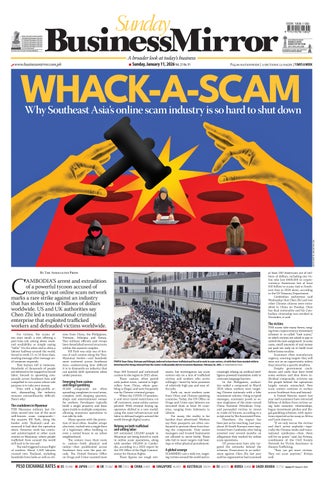
WHACK-A-SCAM
www.businessmirror.com.ph
n
Sunday, January 11, 2026 Vol. 21 No. 91
P25.00 nationwide | 2 sections 12 pages | 7 DAYS A WEEK
ANTON VIERIETIN | DREAMSTIME.COM
Why Southeast Asia’s online scam industry is so hard to shut down
C
By The Associated Press
at least 250 Americans out of millions of dollars, including one victim who lost $400,000 in cryptocurrency. Americans lost at least $10 billion to scams tied to Southeast Asia in 2024 alone, according to the US Treasury Department. Cambodian authorities said Wednesday that Chen Zhi and two other Chinese citizens were extradited to China on Tuesday. Chen has dual nationality and his Cambodian citizenship was revoked in December, it said.
AMBODIA’S arrest and extradition of a powerful tycoon accused of running a vast online scam network marks a rare strike against an industry that has stolen tens of billions of dollars worldwide. US and UK authorities say Chen Zhi led a transnational criminal enterprise that exploited trafficked workers and defrauded victims worldwide. For victims, the scams often start small: a text offering a part-time job, asking about weekend availability or simply saying “hello.” On the other end is often a laborer halfway around the world, forced to work 12- to 16-hour days, sending message after message until someone responds. That human toll is immense. Hundreds of thousands of people are believed to be trapped in forced labor, housed in sprawling compounds across Southeast Asia and compelled to run scams whose sole purpose is to take your money. Even with a high-profile arrest, dismantling the industry remains extraordinarily difficult. Here’s why:
The crackdown in Myanmar
THE Myanmar military last October moved into one of the most well-known scam compounds— the massive KK Park, along the border with Thailand—and announced it had shut the operation down. However, work has continued uninterrupted at other scam centers in Myanmar, where people trafficked from around the world still wait to be rescued. The raid triggered a mass flight of workers. About 1,500 laborers crossed into Thailand, including hundreds from India as well as citi-
zens from China, the Philippines, Vietnam, Ethiopia and Kenya. Thai military officials said troops later demolished several structures within the massive complex. KK Park was only one of dozens of such centers along the ThaiMyanmar border—and hundreds more scattered across Southeast Asia—underscoring how difficult it is to dismantle an industry that can quickly shift operations when under pressure.
Emerging from casinos and illegal gambling
SCAM compounds are often sprawling complexes in rural areas, complete with sleeping quarters, shops and entertainment venues for workers. Developers typically build a single property and lease space inside to multiple companies, allowing numerous operations to run side by side. Many operate with the protection of local elites. Smaller setups also exist, tucked into a single floor of a legitimate office building or even a rented house in an urban neighborhood. The centers trace their roots to casinos—both physical and online—that proliferated across Southeast Asia over the past decade. The United Nations Office on Drugs and Crime counted more
The victims
PEOPLE from China, Vietnam and Ethiopia, believed to have been trafficked and forced to work in scam centers, sit with their faces masked while in detention after being released from the centers in Myawaddy district in eastern Myanmar, February 26, 2025. AP/THANAPHON WUTTISON
than 340 licensed and unlicensed casinos in the region in 2021 alone. Those casinos, often paired with junket tours, catered to highrollers from China, where gambling is illegal, and were frequently run by Chinese criminal groups. When the COVID-19 pandemic and strict travel restrictions cut off customers, some online casinos pivoted. With revenue drying up, operators shifted to a new model: using the same infrastructure and labor to defraud targets around the world through digital scams.
Relying on both trafficked and willing labor
AN estimated 120,000 people in Myanmar are being forced to work in online scam operations, along with another 100,000 in Cambodia, according to a 2023 report by the UN Office of the High Commissioner for Human Rights. Those figures are rough esti-
mates, but investigators say scam centers rely on a mix of trafficked victims and workers who arrive willingly—lured by false promises of relatively high pay and easy office jobs. Early on, most workers came from China and Chinese-speaking countries. Today, the UN Office on Drugs and Crime says laborers are recruited from at least 56 countries, ranging from Indonesia to Liberia. For many, the reality is far harsher than advertised. Workers say their passports are often confiscated to prevent them from leaving the compounds. Only senior managers and trusted lieutenants are allowed to move freely. Those who fail to meet targets risk beatings or other physical punishment.
A global scourge
SCAMMERS cast a wide net, targeting victims around the world and in-
creasingly relying on artificial intelligence-powered translation tools to overcome language barriers. In the Philippines, authorities raided a compound in March 2024 where workers were targeting Chinese nationals with a fake investment scheme. Using scripted messages, scammers posed as senior employees of the state-owned China National Petroleum Corp. and persuaded victims to invest in crude oil futures, according to a script seen by The Associated Press. Elsewhere, the impact has been just as far-reaching. Last year, about 50 South Koreans were repatriated from Cambodia after being arrested over several months on allegations they worked for online scam operations. US prosecutors have also targeted the networks behind the schemes. Prosecutors in an indictment against Chen Zhi last year said his organization had scammed
THE scams take many forms, ranging from cryptocurrency investment schemes to so-called “task scams,” in which victims are asked to pay to unlock the next assignment. In some cases, small amounts of real money are paid out early on to build trust before losses escalate. Scammers often manufacture urgency, warning targets they will miss out on an opportunity unless they invest by a specific deadline. Despite government crackdowns and raids that have freed some workers and shut down individual compounds, activists say the people behind the operations largely remain untouched. New scam centers continue to surface across Southeast Asia and beyond. A United Nations report last year said scammers have extracted billions of dollars from victims using fake romantic relationships, bogus investment pitches and illegal gambling schemes, with operations reported as far away as Africa and Latin America. “If we only rescue the victims and don’t arrest anybody—especially the Chinese mafia and transnational syndicates—then there will be no point,” said Jay Kritiya, coordinator of the Civil Society Network for Victim Assistance in Human Trafficking. “They can get more victims. They can scam anytime,” Kritiya said.
PESO EXCHANGE RATES n US 59.1480 n JAPAN 0.3771 n UK 79.5067 n HK 7.5912 n CHINA 8.4697 n SINGAPORE 46.0475 n AUSTRALIA 39.6114 n EU 68.9725 n KOREA 0.0408 n SAUDI ARABIA 15.7732 Source: BSP (January 9, 2026)
News BusinessMirror
A2 Sunday, January 11, 2026
www.businessmirror.com.ph
POWER BROKER: How Delcy Rodríguez courted Donald Trump and rose to power in Venezuela
M
By Joshua Goodman | The Associated Press
IAMI—In 2017, as political outsider Donald Trump headed to Washington, Delcy Rodríguez spotted an opening. Then Venezuela’s foreign minister, Rodríguez directed Citgo — a subsidiary of the state oil company — to make a $500,000 donation to the president’s inauguration. With the socialist administration of Nicolas Maduro struggling to feed Venezuela, Rodríguez gambled on a deal that would have opened the door to American investment. Around the same time, she saw that Trump’s excampaign manager was hired as a lobbyist for Citgo, courted Republicans in Congress and tried to secure a meeting with the head of Exxon. The charm offensive flopped. Within weeks of taking office, Trump, urged by then-Sen. Marco Rubio, made restoring Venezuela’s democracy his driving focus in response to Maduro’s crackdown on opponents. But the outreach did bear fruit for Rodríguez, making her a prominent face in US business and political circles and paving the way for her own rise. “She’s an ideologue, but a practical one,” said Lee McClenny, a retired foreign service officer who was the top US diplomat in Caracas
during the period of Rodríguez’s outreach. “She knew that Venezuela needed to find a way to resuscitate a moribund oil economy and seemed willing to work with the Trump administration to do that.” Nearly a decade later, as Venezuela’s interim president, Rodríguez’s message — that Venezuela is open for business — seems to have persuaded Trump. In the days since Maduro’s stunning capture Saturday, he’s alternately praised Rodríguez as a “gracious” American partner while threatening a similar fate as her former boss if she doesn’t keep the ruling party in check and provide the US with “total access” to the country’s vast oil reserves. One thing neither has mentioned is elections, something the constitution mandates must take place within 30 days of the presidency being permanently vacated. This account of Rodríguez’s political rise is drawn from interviews with 10 former US and Venezuelan officials as well as businessmen from both countries who’ve had extensive dealings with Rodríguez and
VENEZUELAN Vice President Delcy Rodriguez smiles during a press conference at the Miraflores presidential palace in Caracas Venezuela, November 18, 2024. AP /ARIANA CUBILLOS
in some cases have known her since childhood. Most spoke on the condition of anonymity for fear of retaliation from someone who they almost universally described as bookishly smart, sometimes charming but above all a cutthroat operator who doesn’t tolerate dissent. Rodríguez didn’t respond to AP requests for an interview.
[FILE] Venezuela’s then President Nicolas Maduro, then Constituent National Assembly President Delcy Rodriguez, left, and first lady Cilia Flores, wave as they arrive to the National Assembly, in Caracas, Venezuela, May 24, 2018. AP/ARIANA CUBILLOS
Father’s murder hardens leftist outlook
RODRÍGUEZ entered the leftist movement started by Hugo Chávez late — and on the coattails of her older brother, Jorge Rodríguez, who as head of the National Assembly swore her in as interim president Monday. Tragedy during their childhood fed a hardened leftist outlook that would stick with the siblings throughout their lives. In 1976 — when, amid the Cold War, US oil companies, American political spin doctors and Pentagon advisers exerted great influence in Venezuela — a little-known urban guerrilla group kidnapped a Midwestern businessman. Rodriguez’s father, a socialist leader, was picked up for questioning and died in custody. McClenny remembers Rodríguez bringing up the murder in their meetings and bitterly blaming the US for being left fatherless at the age of 7. The crime would radicalize another leftist of the era: Maduro. Years later, while Jorge Rodríguez was a top electoral official under Chávez, he secured for his sister a position in the president’s office. But she advanced slowly at first and clashed with colleagues who
viewed her as a haughty know-it-all. In 2006, on a whirlwind international tour, Chávez booted her from the presidential plane and ordered her to fly home from Moscow on her own, according to two former officials who were on the trip. Chávez was upset because the delegation’s schedule of meetings had fallen apart and that triggered a feud with Rodriguez, who was responsible for the agenda. “It was painful to watch how Chávez talked about her,” said one of the former officials. “He would never say a bad thing about women but the whole flight home he kept saying she was conceited, arrogant, incompetent.” Days later, she was fired and never occupied another high-profile role with Chávez.
Political revival and soaring power under Maduro
YEARS later, in 2013, Maduro revived Rodríguez’s career after Chávez died of cancer and he took over. A lawyer educated in Britain and France, Rodríguez speaks English and spent large amounts of time in the United States. That gave her an edge in the internal power struggles among
Chavismo—the movement started by Chávez, whose many factions include democratic socialists, military hardliners who Chávez led in a 1992 coup attempt and corrupt actors, some with ties to drug trafficking. Her more worldly outlook, and refined tastes, also made Rodríguez a favorite of the so-called “boligarchs” — a new elite that made fortunes during Chávez’s Bolivarian revolution. One of those insiders, media tycoon Raul Gorrín, worked hand-in-glove with Rodríguez’s back-channel efforts to mend relations with the first Trump administration and helped organize a secret visit by Rep. Pete Sessions, a Texas Republican, to Caracas in April 2018 for a meeting with Maduro. A few months later, US federal prosecutors unsealed the first of two money laundering indictments against Gorrin. After Maduro promoted Rodríguez to vice president in 2018, she gained control over large swaths of Venezuela’s oil economy. To help manage the petro-state, she brought in foreign advisers with experience in global markets. Among them were two former finance ministers in Ecuador who helped run a dollarized, export-driven economy under fellow leftist Rafael Correa. Another key associate is French lawyer David Syed, who for years has been trying to renegotiate Venezuela’s foreign debt in the face of crippling US sanctions that make it impossible for Wall Street investors to get repaid. “She sacrificed her personal life for her political career,” said one former friend. As she amassed more power, she crushed internal rivals. Among them: once powerful Oil Minister Tareck El Aissami, who was jailed in 2024 as part of an anti-corruption crackdown spearheaded by Rodríguez. In her de-facto role as Venezuela’s chief operating officer, Rodríguez proved a more flexible, trustworthy partner than Maduro. Some have likened her to a sort of Venezuelan Deng Xiaoping — the architect of modern China. Hans Humes, chief executive of Greylock Capital Management, said that experience will serve her well as she tries to jump-start the economy, unite Chavismo and shield Venezuela from stricter terms dictated by Trump. Imposing an opposition-led government right now, he said, could trigger bloodshed of the sort that ripped apart Iraq after US forces toppled Saddam Hussein and formed a provisional government including many leaders who had been exiled for years. “We’ve seen how expats who have been outside of the country for too long think things should be the way it was before they left,” said Humes, who has met with Maduro as well as Rodríguez on several occasions. “You need people who know how to work with how things are not how they were.”
Democracy deferred?
WHERE Rodríguez’s more pragmatic leadership style leaves Venezuela’s democracy is uncertain. Trump, in remarks after Maduro’s capture, said Nobel Peace Prize winner Maria Corina Machado lacks the “respect” to govern Venezuela despite her handpicked candidate winning what the US and other governments consider a landslide victory in 2024 presidential elections stolen by Maduro. Elliott Abrams, who served as special envoy to Venezuela during the first Trump administration, said it is impossible for the president to fulfill his goal of banishing criminal gangs, drug traffickers and Middle Eastern terrorists from the Western Hemisphere with the various factions of Chavismo sharing power. “Nothing that Trump has said suggests his administration is contemplating a quick transition away from Delcy. No one is talking about elections,” said Abrams. “If they think Delcy is running things, they are completely wrong.”
The World
Editor: Angel R. Calso
Sunday, January 11, 2026
US military action in Venezuela: A double-edged sword for Putin
T
By The Associated Press
HE lightning US operation to capture Venezuelan leader Nicolas Maduro can be seen as both a benefit and a burden for Russian President Vladimir Putin, whose forces botched an attempt to capture Ukraine’s capital and topple its leader at the start of Moscow’s invasion nearly four years ago. The ouster of Maduro highlights another Kremlin failure to support an ally, following the downfall of Syria’s former President Bashar Assad in 2024 and last year’s US and Israeli attacks on Iran. With the US determined to establish control over Venezuela, Russia stands to lose a strategic foothold in the Western Hemisphere, along with billions of dollars invested in its oil industry. But President Donald Trump’s actions in Venezuela also are causing unease in Western nations and giving the Kremlin fresh talking points to defend its war in Ukraine. In addition, Trump’s interest in wresting control of Greenland from NATO ally Denmark also threatens to destabilize the alliance at the moment when the US-led efforts to broker peace in Ukraine enter a pivotal stage, distracting its members from their efforts to support Kyiv and provide it with security guarantees. Putin himself hasn’t commented on the US actions in Venezuela, which his diplomats have denounced as a blatant act of aggression. Dmitry Medvedev, Russia’s former president who serves as his deputy on the presidential Security Council, similarly rebuked Washington for trampling international law—but also complimented Trump on defending US interests. “Even though Trump’s action is completely unlawful, he cannot be denied a certain consistency—he and his team are very aggressively upholding their country’s national interests,” Medvedev said. On Wednesday, the US said it seized two sanctioned oil tankers linked to Venezuela, including one flagged to Russia in the North Atlantic.
Moscow’s ‘spheres of influence’
SINCE 2014’s illegal annexation of Ukraine’s Crimean Peninsula that followed the ouster of a proKremlin president in Kyiv, Putin has sought to justify his action by describing his neighbor as part of Russia’s sphere of influence where Western encroachment can’t be allowed. Putin has argued that just as the US would bristle at any foreign military presence in the Western Hemisphere, Russia sees NATO’s expansion to its borders as a major security threat. He cited Ukraine’s bid to join the military alliance as a key reason behind his full-scale invasion of the country. “We have made it clear and unambiguous that further eastward expansion of NATO is unacceptable,” Putin said shortly before sending troops into Ukraine on Feb. 24, 2022. “Are we the ones placing missiles near the US borders? No, it’s the US that has brought its missiles to our doorstep.”
Long before the invasion, Russia tested the ground on a possible deal under which it would refrain from meddling in Latin America in exchange for the US offering Moscow free rein in Europe. Fiona Hill, who oversaw Russia and Europe on Trump’s National Security Council during his first term, testified before Congress in 2019 that the Russians were signaling their willingness to make such an arrangement involving Venezuela and Ukraine. Russia never made a formal offer, Hill told The Associated Press in an interview, but Moscow’s then-ambassador to Washington, Anatoly Antonov, “hinted...many times” to her that Russia could cede its influence in Venezuela to the US in exchange for a sphere of influence in Europe. She said Trump’s administration wasn’t interested in the Russian overtures that she described as a “ hint-hint, nudge-nudge, wink-wink, how-about-doing-adeal” offer. In April 2019, Hill was sent to Moscow to convey the message that “nobody’s interested. ... Ukraine and Venezuela are not related to each other.” Hill said she did not know if the winds have now changed and whether there was any deal between the US and Russia to swap spheres of influence in Venezuela and Ukraine, but she noted that many officials, including herself, who were involved in “restraining” Trump in his first term aren’t around for his second. She argued that US Secretary of State Marco Rubio would likely be the only member of the Trump administration who would now resist such a proposal, but added that others, including Trump envoy Steve Witkoff, could have a different view. “Who knows what Witkoff and others have been chatting about recently?” Hill asked. Before Maduro was captured, AP reported Russia had started evacuating families of diplomats from Venezuela. W hen asked about the move, Hill said it would not be “implausible” that Witkoff gave Moscow a “courtesy headsup.” Sam Greene, a Russia expert at King’s College London, observed that Moscow may have backed down on Venezuela in the expectation of the US giving it a free hand on Ukraine. “My worry is that it may be part of a tacit agreement, by which Washington, Moscow and Beijing agree not to deter one another against interventions in their putative spheres of influence,” he wrote on X.
Russia’s foothold in Western Hemisphere
BEFORE the invasion of Ukraine, senior Russian officials had issued
RUSSIAN President Vladimir Putin, left, shakes hands with Venezuelan President Nicolas Maduro during their meeting at the Kremlin in Moscow, Russia, Wednesday, May 7, 2025, ahead of celebrations of the 80th anniversary of the Soviet Union’s victory over Nazi Germany during the World War II. AP/ALEXANDER ZEMLIANICHENKO
vague warnings that Moscow could deploy troops or military assets to Cuba and Venezuela—statements that the US dismissed as bluster. Some drew parallels to the 1962 Cuban Missile Crisis—when the Soviet Union deployed missiles to Cuba and the US imposed a naval blockade of the island. Russian-Cuban ties withered after the 1991 collapse of the Soviet Union, plunging Cuba into a grueling depression. Soon after his first election in 2000, Putin ordered the closure of a Sovietbuilt military surveillance facility in Cuba as he sought to improve ties with Washington. As tensions with the US and its allies mounted, however, Moscow again intensified trade and other contacts with Cuba and sent warships to visit the island. Russia also has invested heavily in Venezuela’s oil industry, as did China, and offered Caracas generous loans to purchase top-of-theline air defense missiles, fighter jets and other weapons. On several occasions, most recently in 2018, it dispatched its nuclear-capable Tu-160 bombers to Venezuela in a projection of force. Military experts have said, however, that any attempt by Russia to establish a permanent military foothold in the Western Hemisphere would face overwhelming logistical challenges.
The ‘might-makes-right’ doctrine
THE US seizure of Maduro and his wife was seen worldwide as the return of the “might- makes-right” doctrine, backing Moscow’s argument that its action in Ukraine protects its vital interests the way the US did in Venezuela. After its action in Venezuela, the US has “nothing to formally reproach our country for,” Medvedev noted. Hill noted that Maduro’s capture makes it harder for countries to condemn Russia’s action in Ukraine because “we’ve just had a situation where the US has taken over—or at least decapitated the government of another country— using fiction.” An indictment accuses Maduro and others of working with drug cartels to facilitate the shipment of thousands of tons of cocaine into the US. Fyodor Lukyanov, a Kremlinconnected, Moscow-based foreign policy expert, observed that “if we consider what’s happening from the perspective of setting a precedent, then we couldn’t ask for anything better, and this includes Trump’s conviction that the authorities in Venezuela must be approved by Washington.” Russian hawks, meanwhile, argue the US action in Venezuela has
created a new sense of urgency for Moscow to dramatically speed up its offensive in Ukraine. “Ukraine under our full control is our pass to the Great Powers club,” Alexander Dugin, a hardline nationalist ideologue, wrote in a commentary. AP European Security Correspondent Emma Burrows in London contributed.
A3
Somalia’s fight against extremist militants shows success signs on Mogadishu streets By Rodney Muhumuza & Jackson Njehia The Associated Press
M
OGADISHU, Somalia—Mogadishu’s first line of defense against the next militant attack on Somalia ‘s capital ranges from machine gunners in pick-up trucks to young men in plainclothes manning checkpoints. One of the leaders is Abdikani Ali Mohamed, a teenage-faced colonel whose authority has grown in the city as Somalia’s government tries to dismantle al-Shabab networks. Mohamed’s operatives are so suspicious that even an armored vehicle—the ultimate status symbol beloved by impor tant people—triggers alarm if it has not passed through a checkpoint for days. “What we have clearly understood is these people (al-Shabab) are always evolving,” Mohamed said. “The strategy is always evolving in terms of attack mechanisms and the complexity they are utilizing.” After his election in 2022, President Hassan Sheikh Mohamud declared a “total war” against the militants who oppose his fragile government and are responsible for killing or maiming thousands of people over the years. He has vowed to attack al-Shabab on the frontlines but also to target its finances and standing among ordinary Somalis.
‘Ring of steel’
SOMALIA has been without a properly
functional central government since the overthrow by warlords of the dictator Siad Barre in 1991. Authorities have said that the effort to stop al-Shabab—an operation backed by African Union peacekeepers and military advisers from countries such as Egypt and Turkey—must be led by intelligence gatherers, putting the National Intelligence and Security Agency, or NISA, at the center of the unwieldy security apparatus trying to keep the federal government operational. The last major attack by al-Shabab came in August 2024 and killed dozens at the city’s Lido beach, although there have been ambitious plots like the failed attempt to assassinate the president in March and a prison attack in October. Security officials claim success because of the rarity these days of major attacks in Mogadishu by al-Shabab, which is fighting to impose Islamic law in the Horn of Africa nation. The group has ties to al-Qaida. A “ring of steel” around Mogadishu makes it harder for al-Shabab to penetrate the city, said Abdi Guled, a Somali who is an independent analyst of the Horn. “The integration of high-tech surveillance and improved intelligence sharing has disrupted several cells, but this remains a tactical success.” Attacks by al-Shabab typically involve improvised explosive devices hidden in cars and detonated at strategic locations, especially the gates of popular hotels and government buildings. The most powerful See “Somalia,” A4
A4
The World
Sunday, January 11, 2026
Saudi Arabia liberalizes real estate sector to attract overseas investors
A
By Zainab Fattah
Somalia. . . Continued from A3
bombings have killed hundreds of civilians at a time.
‘We are at war’
HOTELS, restaurants, and other places frequented by government officials are now shielded by concrete barriers, while the presidency and most embassies are ensconced in a fortified zone near the airport, whose security is Mohamed’s responsibility. “For us we are at war,” Mohamed
for their projects overseas and building networks with brokers across the world. Still, many wealthy foreigners have snapped up second homes in Dubai partly because it’s seen as a fun vacation destination. Social mores remain conservative in Saudi Arabia. Although the kingdom is adding resorts, Riyadh still doesn’t offer the lifestyle perks of many other international cities even as some restrictions on alcohol sales have been loosened in recent weeks. However, some investors see the Saudi housing market as a more stable bet than nearby Dubai, where the population is mostly made up of expats, some of whom have left during previous downturns after losing their jobs. By contrast, Saudi Arabia’s population of about 35 million— the Gulf ’s largest with nearly 20 million citizens—provides a solid case for future demand. About 34% of Saudis are below 14 years old, according to government data, which is likely to boost demand for homes in the coming years. “Housing is central to the crown prince’s vision because it’s tied to a number of domestic dynamics,’’ said Sanam Vakil, director of the Middle East and North Africa Program at Chatham House. “Legitimacy internally is so important and he is not yet king. He has to deliver transactional and transformational policies to take this younger generation on the journey with him.’’ The law is also expected to breathe new life into many Saudi projects that the government started but may struggle to finance on its own like Diriyah and Qiddiya, which are near population centers and will likely see quick return on the investments. Foreign developers, suppliers and contractors will be able to enter the market through joint ventures with local firms on a more even footing as the law comes into practice, experts say. Meanwhile, more than 600,000 homes are expected to be built in Saudi Arabia by 2030 including 110,942 to be delivered in 2026 alone, according to Knight Frank. But there are also challenges, especially to the government’s affordability agenda. Apartment prices in R iyadh surged 96% from early 2019 to third quarter said, describing his work after inspecting checkpoints in Mogadishu, where security measures now also mandate shop owners to install security cameras. “This is a battle that is going to be back and forth—and one we are winning currently.” Facing military pressure, including occasional US airstrikes, al-Shabab has retreated to areas of southern and central Somalia that suit its guerrilla tactics. Beyond Mogadishu, the conflict “has shifted from a rapid offensive to a grinding war of attrition” as al-Shabab fighters retreat under pressure to resupply and then ambush government troops and their allies in remote towns, according to Guled.
Italy’s stagnant economy, fractured politics test Meloni’s grip on power By Donato Paolo Mancini
G
FTER driving for nearly an hour north of Riyadh, the sand dunes start to give way to an emerging metropolis with thousands of newlybuilt single-family homes stretching over the horizon. They could be part of any American suburb. Khuzam, as this more than 100 billion riyal ($27 billion) project is called, offers a window into Saudi Arabia’s efforts to beat the affordability problem plaguing housing markets from New York to Sydney. It’s also part of Crown Prince Mohammed bin Salman’s broader efforts to reshape the real estate market while attracting foreign investors and buyers to bolster the economy. The nation’s largest developer, the government-backed National Housing Co., which has projects worth 250 billion riyals across the kingdom, is spending billions on sprawling developments like this one while private firms across the nation are joining the race to build. The market has lured even the Trump Organization, the US president’s family property firm, which is working with a Saudi partner to add luxury apartments in the kingdom. Helping the construction boom are new reforms that are expected to take off in January to allow overseas buyers to own property in Saudi Arabia’s real estate market. They dovetail with other reforms. The kingdom this week opened its equities to all foreign investors, the latest step to boost flows into the Middle East’s largest market. It’s a long-anticipated step that developers are hoping will draw buyers and international investors to a market that remained largely off limits to foreigners for decades. The kingdom has been easing certain restrictions for some resident expats in stages and it’s now looking to designate developments and zones where foreigners are allowed to buy. Yet even as the nation draws more money from overseas it will have to ensure sufficient supply of new homes to make sure that local Saudis aren’t priced out. The new law will “be a real game changer for the market,” said Matthew Green, head of Middle East and North Africa research at real estate firm CBRE Group Inc. “There is a massive amount of capital that wants to be there and you’ll start to see those opportunities open up both on the development and the financing side.” The excitement in the property market is palpable. A similar law in Dubai has helped drive both supply and demand for new homes and lured buyers from India to the UK and Russia. Saudi developers are launching marketing campaigns
www.businessmirror.com.ph
A MODEL of the Khuzam development shows the scale of the project to visitors. MAYA ANWAR/BLOOMBERG
of 2025 while villas prices surged 53%. Thousands of Saudis have migrated to Riyadh in search of job opportunities. Meanwhile, the expats who arrived as the government pushed companies to relocate their regional headquarters to the kingdom have contributed to the surge in rents, which have been climbing an average of 8.5% a year, according to CBRE. The crown prince has ordered a freeze on rent increases in Riyadh for five years and vowed to halt an “unacceptable” rise in property prices. To ensure that prices don’t keep taking off, modern new homes will need to be built quickly. Key to those efforts are firms like National Housing Co., where Chief Executive Officer Mohammed Albuty has been tasked with helping lift homeownership rates to 70% by 2030. That means building hundreds of thousands of new homes across the kingdom. So far, the developer has managed to build only about 60,000 of those, but Albuty says delivery of entire communities will pick up sharply in coming years as much of the ground work needed to ease bottlenecks and address logistical and supply issues has been done. In his quest to create a development machine, Albuty has turned to many foreign firms. NHC has inked agreements with developers from New Jersey to Egypt and construction firms from China to South Korea thought joint ventures. The goal is bringing construction capacity while creating badly needed supply chains closer to home. The firm has over 164,000 homes under construction from Jeddah on the kingdom’s west coast and Dammam on the east coast as well as in the holy cities of Mecca and Madinah. “We’re not building housing or boxes in the middle of a desert,” Albuty said. “We’re building a city within a city. It has all services and all amenities nearby.” The firm had record sales in 2024, hitting 27 billion riyals, the CEO said. He estimated that sales in 2025 exceeded 30 billion riyals with more people moving into the growing communities. Out are the bare towers that were a hallmark of Gulf construc-
tion in the 1970s and in come American-inspired housing subdivisions that include offices, shops, entertainment, hotels, parks, gyms, clinics, schools and nurseries to reduce commuting time and provide a better quality of life. On a recent afternoon at one of Khuzam’s newly occupied neighborhoods, women clad in black abayas sipped tea from paper cups while children played in a green park just a few hundred meters from their home in the newlycompleted community. The change would have been unthinkable years ago when most Saudis preferred their own home gardens surrounded by high walls that protected families from prying eyes. But as the cost of living bites, many young Saudis are forgoing the costly housing of their parents’ generation in favor of apartments, townhouses and shared community amenities. Elsewhere, Abdulrahman Aldhyem, the CEO of privately-owned Liwan Real Estate Development is planning a new 4.5 billion riyal development with 2,500 homes in the capital along with a 300-room hotel. Liwan, which is owned by members of several prominent Saudi families, has previously made bets in Turkey and Dubai— surviving a sharp downturn in the emirate after the 2008 financial crisis. But now, with the kingdom on the cusp of allowing foreigners to buy in Saudi Arabia, Aldhyem sees the future in his home market and he can’t hide his excitement. “For a while we were being approached by Saudi institutions looking to buy entire buildings for recurring income,’’ Aldhyem said. “But now, that’s changing and we’re seeing regional investors from the Gulf as well as a Chinese fund that’s looking to buy in our project.’’ Large institutional investors are also likely to come into Saudi Arabia much faster than in Dubai because they are now more familiar with the region’s markets, Green said. “We’re going to see more investment, more developers, more joint ventures and more partnerships come out’’ of the new rules, he said about Saudi Arabia. Bloomberg News
In parts of Somalia’s Lower Shabelle region—the country’s food basket and now also a battleground in the fight with al-Shabab— confrontations between government troops and the militants have become more frequent in recent months. There are mixed results for government troops in towns like Bariire, the control of which has shifted multiple times in the past year. As the holy month of Ramadan came to a close in March, al Shabab fighters overran Bariire, torching homes and forcing people to flee. Daynab Mukhtar Aden, a 65-year-old mother of six, told The Associated Press
that she walked 40 kilometers (24 miles) from Bariire a settlement for the displaced near Mogadishu. “If we had stayed, we would have been killed,” said Aden, a tea vendor who works under a tree next to the shell of what used to be her house. She returned to Bariire only after government troops retook the city and declared it—yet again—liberated. “I came back because we were told the government will help us rebuild and keep us safe,” she said.
Recent successive victories
BUT the fighting had left a trail of carnage. Al-Shabab fighters were blamed for
IORGIA MELONI has made a career out of confounding the skeptics. Having emerged as a force beyond Italy, the country’s first female prime minister now confronts two stubborn domestic obstacles standing between her and a potentially historic tenure: stagnant living standards and a political system that tends toward deadlock. Advances on only one of those fronts would probably be enough to give the right-wing leader a second term—and extend a run that could make her the longestserving postwar leader; should she succeed on both, she’d have permanently altered the architecture of power in Italy. The situation would have been inconceivable in 2022 when the novice premier took over a post-Covid economy that was functioning largely thanks to European Union handouts. She has since sidelined her chief domestic rival, won over investors and raised Italy’s influence over issues such as Ukraine and the Mercosur trade deal. That’s a stunning contrast to Europe’s traditional leaders in Berlin and Paris, whose economic and political setbacks have been compounded by the US-led unraveling of the international order. “Meloni’s foreign policy posture is as rooted in Italy’s long instinct for caution as it is forged by constraint, with her coalition split on issues including the EU and Ukraine,” said Beniamino Irdi, the head of Milan-based consultancy Highground and a former government official. “Like a judoka, she has so far turned those limits into a reputation for balance and strategic sobriety. Paired with rare domestic stability, that has made Rome a credible interlocutor for many.” While questions over Ukraine and Venezuela are likely to dominate her annual state of the union press conference Friday, it’s the sisyphean struggles at home that are more relevant to her political success. After a series of restrained budgets—last year’s included a small tax cut financed through levies on banks aimed at wooing middle-class voters—Meloni and her allies are now eyeing more generous giveaways, including deeper tax cuts, according to people familiar with the situation. The need to put more money in people’s pockets is clear: Gross domestic product per capita was lower in 2024 than in 2008, according to the World Bank. The economic uncertainty is where changing the political rulebook comes in. After defeats in regional gubernatorial races in 2025, Meloni and her allies have come up with a number of plans to raise the chances of staying in, and exercising, power. The biggest potential obstacle, they say, is the upper house of Parliament, where current law would deprive her of an outright majority if polling numbers stay as they are and the opposition can forge a united front. As a first step, they’re considering fast-tracking a referendum, set for the spring and focused on rather limited but important changes to the judiciary, to hold it as soon as possible to crystallize the current consensus, according to people familiar with the matter. The aim, they said, was to boost the government in a pre-election year, but President Sergio Mattarella advised against it. Meloni’s and Mattarella’s office both declined to comment. “Meloni’s subsequent steps will depend on that first outcome,” said Cristina Fasone, a law professor at Luiss University in Rome. Matteo Renzi, a former prime minister, lost his premiership after campaigning in favor of a constitutional referendum he lost. “With referendums, anything can happen.” Changing the way the office of the prime minister is elected and operates has also been spoken about by Meloni and the majority more recently. Currently, the president of the republic appoints a potential candidate to lead talks to form a cabinet after parliament is elected. While a bill was introduced in 2024, it hasn’t yet progressed amid fierce criticism from the opposition, which says it would destroy the checks and balances enshrined in the country’s post-fascist constitution. Fasone, the Luiss professor, said the determining factor on what comes first will be consensus within the majority. “The majority’s current main objective is to eliminate the chance of the opposition winning in the single-member constituencies of the south at the 2027 elections,” she said. The 48-year-old Meloni, an early beneficiary of the anti-immigrant, illiberal wave spreading through the liberal West, has taken to reminding naysayers of how wrong they were when they dismissed her as a fringe figure. Italy’s financial risk profile hasn’t been this favorable in years: The spread between Italian and German 10-year bond yields, a long-time fixation for Meloni, hasn’t been this low since 2009. After her election, “the mantra was headlines along the lines of: Europe is shaking, Meloni threatens European stability,” she told a party event last month. “Three years have passed and the mood has changed quite a bit.” Still, the economy continues to show signs of deep stress. Italian families have, on average, become 8.5% poorer in the past 15 years, according to a December report by Censis, an independent research institute. Lower and middle-class families have borne the brunt of the woes, leading to an ever widening wealth gap in which only among the richest 10% of families were better off. Making matters tougher, the European Union’s €190 billion ($222 billion) pot of cash from the Covid era will peter out this year. The opposition has so far struggled to capitalize on her vulnerabilities, even if approval ratings for her and her own government have dipped since 2022. A series of large-scale demonstrations last year, for example, forced her to change tack on Gaza, passing a largely ceremonial parliamentary resolution that promised to recognize the state of Palestine. She has also been frequently accused of centralizing power and steamrolling political discourse, which she denies. Away from home, her role has grown on the international stage, with Italy playing key roles in a vote on Mercosur, the mammoth EU-Latin America trade deal, as well as a plan to issue joint debt to support Ukraine in its war against Russia, a surprise last-minute upset in which Italy was key, according to people familiar with the matter. Since early 2025, Meloni has also engaged in a careful balancing act with Donald Trump, weathering pushback from her own coalition partner, the League, at home on aid to Ukraine. Those tensions have now abated, with her government enabling further arms shipments through the end of the year. Bloomberg News
destroying bridges and effectively impeding easy access to three towns served by the Shabelle River. “The enemy fighters (al-Shabab) are sophisticated and skilled in their tactics, which constantly presents new challenges,” said Lt. Col. Abdirahim Mohammed Munye of the Somali military, citing successive victories against al-Shabab in Bariire and the nearby areas of Sabid-Anole and Awdheegle. “However, with the help of Allah, we hope to gain the upper hand and liberate our country.” Munye pointed out that degrading alShabab in Lower Shabelle—and reclaiming towns like Bariire—is key to securing
Mogadishu, where residents see the heavy security presence as reassuring. There are construction sites across Mogadishu, a city of just under 3 million people. Cafes and ice cream parlors are sprouting, and at night the neon lights come on in the main thoroughfares, emitting the kind of life that Mogadishu’s senior residents hope for. “Insecurity has been one of our biggest challenges,” said Hajji Abuker Osman, a retiree who regularly comes to have coffee in downtown Mogadishu. “It has really improved now.” Njehia reported from Bariire, Somalia.
www.businessmirror.com.ph • Editor: Lyn Resurreccion
Sunday, January 11, 2026 A5
Agri-biotech advocates: ‘Listen to the farmers’ By Edwin P. Galvez Conclusion
L
ET the farmers and consumers “participate” in the decision-making process of either planting or buying Malusog Rice, Department of Agriculture’s Philippine Rice Research Institute (DA-PhilRice), Isabela Station Director Dr. Joy Bartolome Duldulao told the BusinessMirror in an interview. Duldulao was one of the speakers at the recent “Media Forum on Biotechnology R&D and Regulatory Landscape in the Philippines” at a hotel in Manila. True to its mandate to “help develop high-yielding and cost-reducing technologies for farmers,” the DA-PhilRice, in close collaboration with the International Rice Research Institute, developed the genetically modified (GM) Malusog Rice that is “beta-carotenerich and can supply 30 percent to 50 percent of the estimated average Vitamin A requirement” of young children and pregnant or lactating women. “We want Malusog Rice to be treated like any rice because [we] did not add anything in its production. It’s grown like any ordinary rice, [only] healthier. But we don’t add cost to it [but] it’s healthier,” Duldulao explained. The goal was to make it “free for everyone,” he said, when the innovation was conceptualized, with its selling price following the prevailing rice prices in the market. The GM rice technology donated to developing countries like the Philippines was initiated in 1992 by Dr. Ingo Potrykus of the Swiss Federal Institute of Technology, and Dr. Peter Beyer of the University of Freiburg, Germany “for
the vitamin A-deficient and irondeficient poor and disadvantaged.” In his talk on “Cultivating Solutions: Biotechnology Crop Research Programs and Initiatives,” Duldulao shared that the Philippines is currently facing the “triple burden of malnutrition, undernutrition on one side, lack of essential nutrients on the other, and cases of childhood obesity on the other side.” “Malnutrition costs our country about P496 billion every year— money lost to poor health, lost productivity, and children who can’t reach their full potential. Addressing malnutrition is one of the smartest investments that we can make,” he said. “Thanks to biotechnology, we now have rice that yields more grain, resists pests and diseases, thrives in adverse conditions like drought and sullied soils, and more importantly, gives us more nutrition,” Duldulao said. Also in the pipeline at DA-Philice, he said, is the high iron and zinc rice, which was developed by adding an apple gene to contain iron and zinc in the grain. It could provide 30 percent to 50 percent of the daily estimated average requirement. Addressing food and nutrition security, the Healthier Rice Program of both PhilRice and IRRI also promotes low-glycemic, highzinc rice, pigmented, and brown rice, which are not GM. “It’s no longer just about rice. It’s about stronger, more nutritious rice that does not only fill our stomach but promises to sustain and nourish generations to come,” he said. And let this be clear, according to ISAAA: The world is now home to 8 billion people and farmers are pressured to produce 70 percent more food to feed about 10 billion
NASA finds Cloud 9, the galaxy that never was
THE Science Communicators Philippines Inc., CropLife Philippines, and Southeast Asian Regional Center for Graduate Study and Research in Agriculture jointly organize the “Media Forum on Biotechnology R&D and Regulatory Landscape in the Philippines” at a hotel in Manila recently. Biotech scientists, experts and advocates from the University of the Philippines Los Baños (UPLB)-Institute of Plant Breeding, UPLB-College of Development Communication, Department of Agriculture (DA)-Philippine Rice Research Institute, DA-Biotechnology Program Office, DA-Bureau of Plant Industry, International Service for the Acquisition of Agri-biotech Applications Inc., and International Rice Research Institute were among the speakers and panelists. Members of the media from different platforms attended the event. PHOTO FROM SEARCA
people by 2050, while the climate crisis impacts food production. “The Food and Agriculture Organization of the United Nations said that to produce food in a sustainable way for an additional 2 billion people by 2050, a business-as-usual approach will not be sufficient,” said ISAAA Program Officer Kristine Grace Tome, who presented “The Global Landscape of Agricultural Biotechnology: Breakthroughs and Future Outlook” on behalf of ISAAA Executive Director Dr. Rhodora Aldemita. Data from PG Economics should be an eye-opener as it highlights the “global socio-economic and environmental impacts” from biotech crops from 1996 to 2020 in its report released in October 2022:
n Inc rea sed produc t iv it y : $261.3 billion rise in farm income, 70 percent coming from higher yields and crop production, with remainder from reduced costs n Reduced insecticide and herbicide sprayings: 749 million kilograms (kgs), or a 17.3 percent reduction globally n Decreased carbon dioxide emissions: 39 billion kgs of carbon dioxide equivalent to taking 25.9 million cars off the road for one year n Uplifted lives: 17 million smallholder farmers and their families n Bio d ive r s it y con se r v a tion: 183 million hectares of land saved from being brought into agricultural production
‘When in doubt, listen to the farmers’
FOR her part, Prof. Clarisse Gonzalvo of UPLB College of Development Communication said: “Farmers are not just adopters—they are evaluators, decision-makers, and community actors.” She talked on “Factors Influencing Biotech Corn Adoption of Filipino Farmers After the 2015 Supreme Court Ban on GMOs.” Sharing her research findings from her experience with 111 far mers in Pampanga, when the province banned the propagation of Bt corn in 2015, Gonzalvo said that had the ban persisted, “ it could have caused ser iou s d i sr upt ions to t hei r livelihoods, high lighting t he
Viral outbreaks always on the horizon; viruses to watch in 2026
A
THE image shows the location of Cloud-9, which is 14 million light-years from Earth. The diffuse magenta is radio data from the ground-based Very Large Array showing the presence of the cloud. The dashed circle marks the peak of radio emission, which is where researchers focused their search for stars. The few objects that appear within its boundaries are background galaxies. :NASA, ESA, VLA, GAGANDEEP ANAND (STSCI), ALEJANDRO BENITEZ-LLAMBAY (UNIVERSITY OF MILANO-BICOCCA); IMAGE PROCESSING: JOSEPH DEPASQUALE (STSCI)
By Malou Talosig-Bartolome
A
STRONOMERS using NASA’s Hubble S p a ce Te l e s co p e h ave s p o t te d something never seen before: a giant cloud of gas and dark matter with no stars. Nicknamed Cloud-9, the object is thought to be a leftover from the early universe—a “failed galaxy” that never lit up. “This is a tale of a failed galaxy,” NASA quotes Alejandro Benítez-Llambay of Milano-Bicocca University in Italy as saying. “Seeing no stars is what proves the theory right. We’ve found a building block of a galaxy that never formed.” The findings, published in The Astrophysical Journal Letters, were announced Monday at the American Astronomical Society meeting in Phoenix. Team member Andrew Fox of the Space Telescope Science Institute said Cloud-9 is “a window into the dark universe,” giving scientists a rare look at dark matter—the invisible substance that makes up most of the universe. Cloud-9 sits near the spiral galaxy Messier 94 and is about 14,000 light-years wide. It contains as much gas as 100 million suns and is held together by dark matter
weighing about five billion suns. Despite its size, Hubble confirmed it has no stars at all. The cloud was first spotted three years ago by China’s FAST radio telescope, then checked by US facilities in West Virginia and New Mexico. Only Hubble’s sharp vision proved it is truly starless. Astronomers believe clouds like this exist across the universe. They are dark matter structures that never gathered enough material to spark star formation. “Among our galactic neighbors, there might be a few abandoned houses out there,” Rachael Beaton of STScI said.
Why it matters
DISCOVERIES like Cloud-9 help explain how galaxies form and why some don’t. For ordinary people, it’s a reminder that most of the universe is hidden from view. Understanding dark matter—the invisible glue holding galaxies together—brings us closer to knowing how the cosmos works and where our own galaxy fits in. Scientists say Cloud-9 is the strongest evidence yet for these “failed galaxies.” Future surveys may uncover more, offering new clues about the unseen forces that shape the universe.
need to involve farmers in policy discourse.” The Supreme Court reversed its decision in 2016. In adopting the technology, the farmers would continuously say it’s because of “pest resistance,” which leads to yield security, higher income, reduced labor as it no longer requires pesticide spraying, and ultimately, “improvement in their state of living.” In the end, Gonzalvo said, the farmers would always say “they have peace of mind” and “they feel happier” knowing pests will not consume their crops while they are sleeping. On their self-concept and their social identity in the community, Gonzalvo said that farmers saw that biotech adoption is not merely as “a technical shift,” but as “an ideal transformation that enhances productivity, reduces hardship, and brings tangible social-emotional benefits,” and that farming is not only a livelihood, but “a shared journey of growth and resilience.” With the ban and the writ decided based on “Precautionary Principle,” she said: “If this principle tells us, when in doubt, stop. Then, social science tells us, when in doubt, listen. Listen to the farmers whose lives depend on these decisions.” A nd while science has not stopped making rice stronger— ”to make every grain not only fill our stomachs, but also nourish our bodies and help build a better nation, a healthier nation” as Duldulao pointed out—the fate of the Malusog Rice, as well as the Bt talong, now rests on the hands of SC justices occupying an office on Padre Faura Street, which was named after a Spanish Jesuit and scientist. Will the Supreme Court side with science?
NEW year might mean new viral threats. Old viruses are constantly evolving. A warming and increasingly populated planet puts humans in contact with more and different viruses. And increased mobility means that viruses can rapidly travel across the globe along with their human hosts. As an infectious diseases physician and researcher, I’ll be keeping an eye on a few viruses in 2026 that could be poised to cause infections in unexpected places or in unexpected numbers.
Influenza A—on the cusp of a pandemic
INFLUENZA A is a perennial threat. The virus infects a wide range of animals and has the ability to mutate rapidly. The most recent influenza pandemic—caused by the H1N1 subtype of influenza in 2009— killed over 280,000 people worldwide in its first year, and the virus continues to circulate today. This virus was often called swine flu because it originated in pigs in Mexico before circulating around the world. Most recently, scientists have been monitoring the highly-pathogenic avian influenza H5N1 subtype, or bird flu. This virus was first found in humans in southern China in 1997; wild birds helped spread the virus around the world. In 2024, the virus was found for the first time in dairy cattle in the US and subsequently became established in herds in several states. The crossover of the virus from birds to mammals created major concern that it could become adapted to humans. Studies suggest there have already been many cow-to-human transmissions. In 2026, scientists will continue to
look for any evidence that H5N1 has changed enough to be transmitted from human to human—a necessary step for the start of a new influenza pandemic. The influenza vaccines currently on the market probably don’t offer protection from H5N1, but scientists are working to create vaccines that would be effective against the virus.
Mpox—worldwide and liable to worsen
MPOX virus, formerly called monkeypox virus, was first discovered in the 1950s. For many decades, it was seen rarely, primarily in sub-Saharan Africa. Contrary to its original name, the virus mostly infects rodents and occasionally crossed over into humans. Mpox is closely related to smallpox, and infection results in a fever and painful rash that can last for weeks. There are several varieties of mpox, including a generally more severe clade I and a milder clade II. A vaccine for mpox is available, but there are no effective treatments. In 2022, a global outbreak of clade II mpox spread to more than 100 countries that had never seen the virus before. This outbreak was driven by human-to-
human transmission of the virus through close contact, often via sex. While the number of mpox cases has significantly declined since the 2022 outbreak, clade II mpox has become established around the world. Several countries in central Africa have also reported an increase in clade I mpox cases since 2024. Since August 2025, four clade I mpox cases have occurred in the US, including in people who did not travel to Africa. It is unclear how mpox outbreaks in the US and abroad will continue to evolve in 2026.
Oropouche virus—insectborne and poised to spread
OROPOUCHE virus was first identified in the 1950s on the island of Trinidad off the coast of South America. The virus is carried by mosquitoes and small biting midges, also known as no-see-ums. Most people with the virus experience fever, headache and muscle aches. The illness usually lasts just a few days, but some patients have weakness that can persist for weeks. The illness can also recur after someone has initially recovered.
There are many unanswered questions about the Oropouche virus and the disease it causes, and there are no specific treatments or vaccines. For decades, infections in people were thought to occur only in the Amazon region. However, beginning in the early 2000s, cases began to show up in a larger area of South America, Central America and the Caribbean. Cases in the United States are usually among travelers returning from abroad. In 2026, Oropouche outbreaks will likely continue to affect travelers in the Americas. The biting midge that carries Oropouche virus is found throughout North and South America, including the southeastern United States. The range of the virus could continue to expand.
Even more viral threats
A NUMBER of other viruses pose a risk in 2026. Continuing global outbreaks of chikungunya virus may affect travelers, some of whom may want to consider getting vaccinated for this disease. Measles cases continue to rise in the US and globally against the backdrop of decreasing vaccination rates. HIV is poised for a resurgence, despite the availability of effective treatments, due to disruptions in international aid. And as-yet-undiscovered viruses can always emerge in the future as humans disrupt ecosystems and travel around the world. Around the world, people, animals and the wider environment are dependent on each other. Vigilance for known and emerging viral threats and the development of new vaccines and treatments can help keep everyone safe. Patrick Jackson, University of Virginia/The Conversation (CC) via AP
A6 Sunday, January 11, 2026
Faith
Sunday Editor: Lyn Resurreccion • www.businessmirror.com.ph
Devotion and faith at Feast of Jesus Nazareno By Lyn Resurreccion
streets. “This is our invitation before attending the annual Traslacion—that every devotee should attend Mass, because this is the most important part of our celebration,” Arellano said. He said the Eucharist is central to Catholic life, where believers hear the Word of God and receive Christ in Holy Communion. “That is why we always say that even if you join the procession for 24 hours, it will never equal the celebration of the Holy Eucharist,” he said.
T
HEY came in hundreds of thousands to pray for their intentions, thanked for answered prayers for the healing from illness, employment or good fortune, and to show their devotion. Many were with family members up to three generations, friends or officemates— repeat attendees to express their deep devotion. Many distributed foods—including lugaw (rice porridge), boiled eggs, sandwiches, friend chicken—and water as acts of thanksgiving. They were the maroon-andyellow-garbed devotees of Señor Jesus Nazareno who celebrated his feast day on January 9. The Feast of Jesus Nazareno is among the Philippines’ largest religious gatherings, drawing millions of barefoot devotees seeking miracles. On the morning of January 8, they were already on queues that snaked around the Quirino Grandstand trying to have a chance for the pahalik (kissing) of the Nazareno. This time, however, they were just allowed to wipe their towels or cloths at the cross. At the early morning of January 9, the 5.8-kilometer procession, or Traslacion (transfer), of the Nazareno image from Quirino Grandstand to Quiapo Church, began with hundreds of thousands of devotees joining the activity, many of them scrambled to climb the carriage to embrace, hold or kiss their beloved’s image, or the cross this time. Those on the streets were satisfied with throwing their towels or cloths to the hijos (volunteers) on the carriage to wipe them on the cross or just on the carriage. They believe that this practice would help them cure their illness and answer their intentions for employment and good life, believing that the Nazareno is miraculous. This brings to mind the gospel story of a woman who suffered from a chronic bleeding for 12 years, but she believed that touching the edge of Jesus’ cloak would heal her,
‘Sinner in need of Savior’
HISTORIAN Dr. Xiao Chua said he feels the faith and devotion of Nazareno devotees. “Who am I to assume that their faith is without works? I do not know their everyday struggles. What makes me a better person to assume that they do not live out their expression of faith after the Traslacion?” he quoted Dr. Lars Ubaldo. “I looked at myself and saw a sinner in need of the Savior too,” Chua, a Baptist, said in his article “How the Nazareno Devotees Opened My Heart” on esquiremag.ph on January 11, 2025. His phd dissertation was on Traslacion. THE Feast of Jesus Nazareno on January 9 reveal images that manifest different acts of devotion. There are men devotees who climb the front and back of the carriage carrying the statue of the Nazareno; a devotee distributes food to fellow devotees; and boys sleeping near the Quirino Grandstand while waiting for the start of the Traslacion to Quiapo Church. BERNARD TESTA
and she was instantly cured, prompting Jesus to commend her faith (Matthew 9:20-22).
Devotion and faith
THESE practices of showing devotion to Jesus Nazareno did not go without criticism. Many would say the “unruly” devotees could show their devotion in a more orderly, disciplined manner—join the procession peacefully, watch on the roadside while praying or attend Mass Meanwhile, Quiapo Church Rector Fr. Ramon Jade Licuanan said devotion to Jesus Nazareno should translate into stronger social awareness and responsibility among Filipino faithful. Licuanan said at a news conference on January 7 that
religious devotion must extend beyond church rituals and influence how believers live and act each day, said the CBCP News. “I can imagine millions of devotees of Jesus Nazareno will start to have a social conscience and social responsibility, becoming good Filipinos,” he said. “ He stressed that faith should not be confined to religious events but should guide daily decisions, civic duties and relationships with others. “Our faith should be seen in our everyday lives as Filipinos,” Licuanan said. “Hopefully this event would usher God into the people. And that’s the most important.” The priest warned against separating spiritual devotion
from ordinary life, saying such a division weakens the true meaning of faith. Licuanan added that the intense devotion shown during the annual feast should be reflected in conduct beyond church activities. “The devotion of our people is very deep,” Licuanan said. “I hope that depth goes beyond the four walls of the church and is seen in the daily actions of Filipinos.” Licuanan reminded the faithful that the Eucharist is the highest form of Catholic worship, surpassing even the most physically demanding acts of devotion. “The Mass is the highest form of worship,” he said. “Even if you join the procession for 24 hours or roll on the
ground, it cannot equal one hour or even 45 minutes of Mass.” The priest, however, acknowledged that many devotees draw comfort from physical expressions of faith, including touching the revered image that draws millions yearly. “We recognize that some Catholics feel a certain consolation when they are able to touch the image,” he said, referring to the deep personal devotion associated with the centuries-old icon. Similar reminder came from Fr. Robert Arellano, Traslacion 2026 spokesperson, who stressed attending Mass besides joining the annual procession, which reenacts the image’s transfer through Manila’s
Corruption scandal not missed at the homily
THE homily during the Mass at the Quirino Grandstand did not miss the hot issue of corruption scandal among lawmakers and contractors involved in floodcontrol projects. Bishop Rufino Sescon criticized officials who have refused to resign despite a public outrage, the Associated Press said. “In our country today, there are those who refuse to step down even though they made mistakes and got caught, even though they are causing hardship to the people, even though the poor are suffering, even though the country is being flooded and destroyed,” Sescon said. “Enough is enough. Have mercy on the people. Have some shame. Step down voluntarily in the name of mercy and love,” he said.
6 Catholic dioceses in PHL have no bishops By Manuel T. Cayon
D
AVAO CITY—The Catholic Church in the Philippines disclosed that six dioceses have no bishops or administrators managing the jurisdictions, an independent Filipino Catholic Social Communications group said. The Saints of Today social media account on Facebook, which quoted the Catholic Bishops’ Conference of the Philippines (CBCP), said that as of January 5, “there are six vacant sees [sede vacante] in the Philippines that are yet to have a bishop.” It posted the dioceses’s emblems with no bishops as those of Ilagan in Isabela; Tagbilaran, Bohol; Kalibo, Aklan; Masbate; the Apostolic Vicariates of Jolo in Sulu; and Tabuk in Kalinga. It said that a “sede vacante” is a Latin term meaning “the seat being vacant” and in the Catholic Church, “it refers to the period when a diocese or apostolic
vicariate is without a bishop, due to death, resignation, transfer, or removal.” During a sede vacante, the governance of the local Church is entrusted to an apostolic administrator or diocesan administrator, who ensures continuity in pastoral care and administration, but does not introduce major or long-term changes.
Priest to temporarily lead Masbate diocese
MEANWHILE, Monsignor Claro Caluya III has been chosen to temporarily govern the Diocese of Masbate days after the death of Bishop Jose Bantolo. The diocese announced Caluya’s election during Bantolo’s funeral Mass on December 30 at Masbate Cathedral. “We pray that the Lord, in His goodness, will send someone again to shepherd us—hopefully not for long,” Caluya said. The diocesan administrator serves in a caretaker
role, ensuring the basic administration of the diocese until a new bishop is appointed. Under canon law, the College of Consultors—a group of priests that advises the diocesan bishop—must elect an administrator within eight days after the diocese becomes vacant. Caluya was ordained to the priesthood in 1972 and has served the diocese in various administrative roles for decades, including as vicar general. He is currently the parish priest of St. Patrick Parish in Sitio Cagba, Barangay Tugbo, Masbate City.
New martyrs
THIS came as the CBCP recently announced the naming of seven Filipinos on the list of the Church’s new martyrs. The CBCP said it has identified seven “new martyrs who gave their lives for the Gospel, most of them victims of persecutions in the nation’s south.”
This include the four students of Mindanao State University in Marawi City who were killed in a terrorist bombing while a Mass was going on. “These individuals shed their blood between the year 2000 and the present because of violent opposition to the good brought by the Gospel,” said Msgr. Bernardo Pantin, CBCP secretary general. Among them was Fr. Rhoel Gallardo, a Claretian missionary abducted by Abu Sayyaf bandits in Basilan province in 2000, tortured for his faith, and killed after 44 days in captivity. Four others—Junrey Barbante, Janine Arenas, Evangeline Aromin, and Riza Daniel—died in a bombing at Mindanao State University in Marawi City on December 3, 2023. The explosion occurred during a Sunday Mass inside the university gymnasium and was carried out by militants linked to the Islamic State group who targeted Catholics in the
Msgr. Claro Caluya III, diocesan administrator of Masbate. DIOCESE OF MASBATE FACEBOOK PHOTO
predominantly Muslim city. In Nueva Ecija, Fr. Marcelito “Tito” Paez was fatally shot on December 4, 2017, after helping secure the release of a political prisoner from the provincial jail. Paez was known for his lifelong advocacy for human rights, social justice, and the welfare of the poor and marginalized farmers in his diocese. From Cagayan de Oro, Alberto Pinagawa, a lay leader and Eucharistic minister, was slain on December 24, 2009, for opposing illegal logging and
mining operations in Mindanao. A defender of Lumad ancestral lands, Pinagawa had received multiple threats before his murder for protecting forests and indigenous communities from exploitation. In 2023, Pope Francis created a special commission to study the modern-day killings of Christians and identify those he calls “new martyrs” of the 21st century, the CBCP said, and added that it already submitted the list to the Vatican’s Commission on New MartyrsWitnesses of the Faith for the Jubilee Year 2025. With CBCP News
Biodiversity Sunday BusinessMirror
Asean Champions of Biodiversity Media Category 2014
Sunday, January 11, 2026 A7
Editor: Lyn Resurreccion
BLACK-NAPED terns (Sterna sumatrana) in Apo Reef Natural Park PHOTO FROM ACB
CLARK’S clownfish (Amphiprion clarkii) is among the commonly photographed fishes in Apo Reef Natural Park. PHOTO FROM GREGG YAN
APO Reef’s white sand beach with crystal clear water and seagrass. PHOTO FROM GREGG YAN
Apo Reef Natural Park: Occ. Mindoro’s ‘crown jewel,’ PHL’s 14th Asean Heritage Park K
NOWN as Mindoro’s “crown jewel,” the Apo Reef Natural Park (ARNP) is home to some of the world’s diverse fish species, corals, and iconic marine wildlife. From its status as a protected area under the National Integrated Protected Areas System Act, its status has been elevated to one of the country’s 14 Asean Heritage Parks (AHP) for their high conservation value. AHPs are S outheast Asia’s most significant protected areas, renowned for their exceptional biodiversity, unique ecosystems, and outstanding natural values.
Apo Reef
SITUATED 28 kilometres west of the nearest coast of the Philippines, the municipality of Sablayan, on the Island of Mindoro, Apo Reef Natural Park, or simply Apo Reef, was declared a protected area under the category of Natural Park through Presidential Proclamation 868, series of 1996, to advance the protection and conservation of ecosystems and biological diversity in the small paradise. It covers 27,488 hectares and boasts of diverse ecosystems, including coral reefs, seagrass beds, mangroves, coastal vegetation, open water, and pelagic (open seas) zones, and terrestrial habitats (beach forests). Over the last 25 years, the natural park has remained one of the more pristine marine areas in the Philippines—proof of the unwavering commitment of its
protectors and other stakeholders toward conservation. Apo Reef has been on Unesco’s tentative list for World Heritage Site for its immense biodiversity, rich coral formations, and vital role in marine conservation. In 2022, the US-based Marine Conservation Institute likewise awarded it the prestigious platinum-level “Blue Park Award,” making it the second Philippine site to receive this top-tier recognition after Tubbataha Reefs Natural Park in Sulu Sea.
Asean Heritage Park
APO Reef was officially designated as the country’s 14th AHP, and 61st overall in the region on September 19, 2024. The Asean Centre for Biodiversity (ACB), led by Executive Director Jerome Montemayor, handed over the certificate of recognition during the eighth Asean Heritage Park Conference in Quang Ninh Province, Vietnam, on December 4, 2025. The prestigious recognition identifies Apo Reef as a protected area of high regional importance for biodiversity conservation in Southeast Asia. According to the ACB, which implements the Asean Heritage Park Programme, Apo Reef is the largest contiguous coral reef system in the Philippines and the secondlargest in the world, next to Australia’s Great Barrier Reef.
Globally significant
THE ACB said the park is a globally
significant marine protected area known for its exceptional biodiversity. It has over 482 fish species, 63 coral genera, rare marine invertebrates, endangered turtles, and iconic species like dugong (sea cow), whale sharks, and hammerhead sharks. Apo Reef is an important bird area as it shelters diverse birdlife, including migratory and threatened species.
Unique flora and fauna
ACCORDING to the ACB, the mangrove forest of Apo Reef Island exhibits the oldgrowth form or type, having mature stands of mangrove species and with little to no regenerants on its understory. Likewise, its beach forest also boasts diverse species of trees, numbering a total of 107 mature individuals. I t a l s o h a s s e ve r a l s p e c i e s o f seagrasses—including tape (Enhalus acoroides), spoon (Halophila ovalis), noodle (Syringodium isoetifolium), and sickle (Thalassia hemprichii). Of its many marine wildlife, it is known for hosting a good number of sharks and rays, including sperm whale and dugong, and marine turtles, which indicate its healthy marine ecosystem.
Tourist spot, perfect dive spot
WITH its beautiful, fine, pristine white sand beaches, the reef is a tourist magnet in Luzon. It is famous among divers with its
perfect dive spot, its world’s second-largest contiguous coral reef system, and it offers a rare combination of exceptional visibility, high biodiversity, and dramatic underwater topography. Visitors also find snorkeling and free diving an exciting outdoor activity when visiting Apo Reef owing to its crystalclear waters and vibrant coral reefs, and abundant marine life. Wildlife enthusiasts can observe rare bird species like the Nicobar pigeon and Christmas frigate bird in the area.
A haven for marine life
APO Reef is a “no-take” zone—a strictly protected marine area where all extractive activities are banned—and communities that benefit from its existence help protect its rich biodiversity. Vincent Hilomen, an ACB expert resource person, told the BusinessMirror that the presence of sharks in an ecosystem such as Apo Reef indicates a “healthy marine ecosystem.” He said the fact that it has vast coral reefs for fish to explore only means it provides adequate food for reef fishes, including the all-important parrot fish that help keep corals vibrant. Hilomen, a marine biologist, said Apo Reef has a so-called shark landing, wherein sharks gather. It, likewise, attracts sharks, rays and other species because there is substantial prey or source of food for these creatures.
International recognition
ASSISTANT Director Mariglo Laririt of the Department of Environment and Natural Resources-Biodiversit y Management Bureau said the designation of Apo Reef as an AHP is an international recognition of the richness of biodiversity in the country. “What we are hoping for is that the international recognition will emphasize the primac y of the richness of the biodiversity in the Philippines,” Laririt told the BusinessMirror in an interview on December 10. She said it also serves as a reminder to the Philippines of its huge responsibility to protect and conserve the protected areas. Laririt pointed out that there is still a need to expand the country’s network of marine protected areas to achieve its 30x30 target—a global commitment under the 2022 Kunming-Montreal Biodiversity Framework to protect and conserve 30 percent of the Earth’s land, freshwater, and ocean areas by 2030. “We still have a long way to go. We have protected less than 2 percent of our waters so we really need to step up,” she said.
Protecting Mindoro’s crown jewel
KRYSTAL T. VILLANADA, Protected Area superintendent of Apo Reef Natural Park (ARNP), told the B usiness M irror that the new status acquired by Apo Reef means a lot for the people of Occidental Mindoro. “Apo Reef is one of the top tourist destinations in the province. Through
the multiplier effect, it boosts the local economy. It also serves as one of the pristine marine sanctuaries in the country,” she said in an interview during the AHP Conference in Vietnam in December 2025. Ac co rd i n g to Vi l l a n a d a , l o c ate d b e t we e n t wo b i o re g i o n s, t h e We s t Philippine Sea and Sulu Sea, the reef serves as a bank for coral and fish larvae, and provides fish stock in adjacent fishing grounds through spill over effect, making it of high conservation value. Now that it is an AHP, Apo Reef will have a stronger linkage with different stakeholders that support AHPs. “More impor tantly, the capacit y building of ARNP staff will be strengthened through collaborations and exposure to best practices of other AHPs,” she said. She pointed out that applying to be an AHP is the easy part; the hardest part is how to maintain it as an heritage park. “We need to maintain the biodiversity and the integrity of the Apo Reef. We have par tners from nongovernment organizations and the private sector willing to help us in conserving it. One of the innovations, because of the unveiling of the AHP marker, started to pour in,” she noted. She said Apo Reef has 17 “bantay dagat” (sea patrol) and two speed boats to patrol the territor y. Communit y support, now more than ever, is needed to ensure the protection and conservation of Mindoro’s crown jewel.
Battle over global energy transition is on between petro- and electro-states
T
WO years ago, countries around the world set a goal of “transitioning away from fossil fuels in energy systems in a just, orderly and equitable manner.” The plan included tripling renewable energy capacity and doubling energy efficiency gains by 2030—important steps for slowing climate change since the energy sector makes up about 75 percent of the global carbon dioxide emissions that are heating up the planet. The world is making progress: More than 90 percent of new power capacity added in 2024 came from renewable energy sources, and 2025 saw similar growth.
Fossil fuel still expanding; US leading producer
HOWEVER, fossil fuel production is also still expanding. And the United States— the world’s leading producer of both oil and natural gas—is now aggressively pressuring countries to keep buying and burning fossil fuels. T h e e n e rg y t r a n s i t i o n w a s n o t meant to be a main topic when world leaders and negotiators met at the 2025 United Nations climate summit, or 30th Conference of Parties (COP30), in November in Belém, Brazil. But it took center stage from the start to the very end, bringing attention to the real-world geopolitical energy debate underway and the stakes at hand. Brazilian President Luiz Inácio Lula da Silva began the conference by calling for the creation of a formal road map, essentially a strategic process in which countries could participate to “overcome dependence on fossil fuels.” It would take the global decision to
transition away from fossil fuels from words to action. More than 80 countries said they supported the idea, ranging from vulnerable small island nations like Vanuatu that are losing land and lives from sea level rise and more intense storms, to countries like Kenya that see business opportunities in clean energy, to Australia, a large fossilfuel-producing country. Opposition—led by the Arab Group’s oil- and gas-producing countries—kept any mention of a “road map” energy transition plan out of the final agreement from the climate conference, but supporters are pushing ahead. I was in Belém for COP30, and I follow developments closely as former special climate envoy and head of delegation for Germany and senior fellow at the Fletcher School at Tufts University. The fight over whether there should even be a road map shows how much countries that depend on fossil fuels are working to slow down the transition, and how others are positioning themselves to benefit from the growth of renewables. And it is a key area to watch in 2026.
The battle between electrostates and petro-states
BRAZILIAN diplomat and COP30 President A n d ré A r a n h a Co r rê a d o L a g o h a s committed to lead an effort in 2026 to create two road maps—one on halting and reversing deforestation and another on transitioning away from fossil fuels in energy systems in a just, orderly and equitable manner. What those road maps will look like is still unclear. They are likely to be centered on a process for countries to discuss and
ANDASOL Solar Power Station in Spain WIKIPEDIA CC BY SA 4.0
debate how to reverse deforestation and phase out fossil fuels. Over the coming months, Corrêa plans to convene high-level meetings among global leaders, including fossil fuel producers and consumers, international organizations, industries, workers, scholars and advocacy groups. For the road map to both be accepted and be useful, the process will need to address the global market issues of supply and demand, as well as equity. For example, in some fossil fuelproducing countries, oil, gas or coal revenues are the main source of income. What can the road ahead look like for those countries that will need to diversify their economies? Nigeria is an interesting case study for weighing that question. Oil exports consistently provide the bulk of Nigeria’s revenue, accounting for around 80 percent to over 90 percent of
total government revenue and foreign exchange earnings. However, roughly 39 percent of Nigeria’s population has no access to electricity, which is the highest proportion of people without electricity of any nation. This while the countr y possesses abundant renewable energy resources across the country, which are largely untapped: solar, hydro, geothermal and wind, providing new opportunities.
What a road map might look like; Brazil and Norway
IN Belém, representatives talked about creating a road map that would be science -based and aligned with the Paris climate agreement, and would include various pathways to achieve a just transition for fossil-fuel-dependent regions. Some inspiration for helping fossil-fuelproducing countries transition to cleaner
energy could come from Brazil and Norway. In Brazil, Lula asked his ministries to prepare guidelines for developing a road map for gradually reducing Brazil’s dependency on fossil fuels and find a way to financially support the changes. His decree specifically mentions creating an energy transition fund, which could be supported by government revenues from oil and gas exploration. While Brazil supports moving away from fossil fuels, it is also still a large oil producer and recently approved new exploratory drilling near the mouth of the Amazon River. Norway, a major oil and gas producer, is establishing a formal transition commission to study and plan its economy’s shift away from fossil fuels, particularly focusing on how the workforce and the natural resources of Norway can be used more effectively to create new and different jobs. Both countries are just getting started, but their work could help point the way for other countries and inform a global road map process. The European Union has implemented a series of policies and laws aimed at reducing fossil fuel demand. It has a target for 42.5 percent of its energy to come from renewable sources by 2030. And its EU Emissions Trading System, which steadily reduces the emissions that companies can emit, will soon be expanded to cover housing and transportation. The Emissions Trading System already includes power generation, energy-intensive industry and civil aviation.
US, fossil fuel and renewable energy growth
IN the US, the Trump administration has made clear—through its policymaking and
diplomacy—that it is pursuing the opposite approach: to keep fossil fuels as the main energy source for decades to come. The International Energy Agency (IEA) still expects to see renewable energy grow faster than any other major energy source in all scenarios going forward, as renewable energy’s lower costs make it an attractive option in many countries. Globally, the agency expects investment in renewable energy in 2025 to be twice that of fossil fuels. At the same time, however, fossil fuel investments are also rising with fastgrowing energy demand. The IEA’s World Energy Outlook described a surge in new funding for liquefied natural gas (LNG) projects in 2025. It now expects a 50 percent increase in global LNG supply by 2030, about half of that from the US. However, the World Energy Outlook notes that “questions still linger about where all the new LNG will go” once it’s produced.
What to watch for
THE Belém road map dialogue and how it balances countries’ needs will reflect on the world’s ability to handle climate change. Corrêa plans to report on its progress at the next annual UN climate conference, COP31, in late 2026. The conference will be hosted by Turkey, but Australia, which supported the call for a road map, will be leading the negotiations. With more time to discuss and prepare, COP31 may just bring a transition away from fossil fuels back into the global negotiations. Jennifer Morgan, Tufts University/ The Conversation (CC) via AP
A8
Sunday, January 11, 2026 | Editor: Jun Lomibao
Sports BusinessMirror
mirror_sports@yahoo.com.ph
Life begins at 59 for ‘King Kazu’ T
OKYO—He turns 59 in February, and the globe’s oldest professional soccer player has a new club as he gets set for his 41st season. This is of course Kazuyoshi Miura who is known in Japan as “King Kazu.” Miura announced his signing this week with third-division J-League team Fukushima United—he is moving on loan from Yokohama FC and spent last season on loan with fourthdivision club Atletico Suzuka. He failed to score in seven matches with Suzuka. Miura has played professionally in Brazil, Italy, Croatia, Australia and Portugal. And of course in Japan. He made his debut in 1986 with Santos in Brazil, a club made famous by Brazilian star Pelé. In 2017 at age 50, he became the oldest player to score in a professional match. That topped the record held by highly decorated England international Stanley Matthews. Miura was one of the first big names in Japanese soccer. He scored 55 goals in 89 appearance and was a star with Japan’s national team in the 1990s.
TikTok at 2026 World Cup
TIKTOK was picked by FIFA as the first “preferred platform” for video content on social media at a men’s World Cup, the soccer body said recently. The World Cup tie-in will see creators get special access at the 48-nation tournament being co-hosted in 16 cities—11 in the United States, three in Mexico and two in Canada—from June 11 to July 19. FIFA said World Cup broadcast rights holders can livestream parts of the 104 games at a dedicated hub on the TikTok app, which has more than 170 million users in the US. “Additionally, a wide group of creators will receive the opportunity to use and co-create FIFA archival footage,” it said. FIFA did not state the value of the deal, or details of any tender process and rival bidders. YouTube had a lowlevel sponsor deal that included access for creators at the 2022 World Cup in Qatar. What kind of live content can be streamed this year, at a tournament where commercial partners’ exclusive rights are fiercely protected, also was not specified by FIFA. TikTok’s partnership with MLS and Apple TV led to the platform carrying footage from cameras dedicated just to following soccer great Lionel Messi playing in games for Inter Miami. FIFA promised fans would be taken “behind the curtain
and closer to the action than ever before,” FIFA secretary general Mattias Grafström said. TikTok’s in-app World Cup hub also will give fans “participation incentives” like custom stickers, filters and gamification features. “ TikTok GamePlan turns fandom into measurable business results for our sports partners, with fans being
42 percent more likely to tune in to live matches after watching sports content on TikTok,” said its global head of content, James Stafford. TikTok became the world’s most downloaded phone app while also under threat of being shut down in the United States as a national security threat. In December, TikTok’s China-based parent company ByteDance agreed to form a US joint venture with investors Oracle, Silver Lake and MGX. That deal is scheduled to be sealed later this month. Brazil, meanwhile, will play friendlies against France and Croatia in the US as it prepares for this year’s World Cup. The Brazilians will face France at Foxborough, Massachusetts, on March 26 and Croatia five days later at Orlando, Florida, the promoters announced Thursday. In addition, Croatia will face Colombia at Orlando on March 26 and Colombia will meet France at Landover, Maryland, on March 29. The games are being promoted by Unified Events, Florida Citrus Sports, Pitch International, Lions Sports & Media and Cardenas Media Network. A five-time champion, Brazil opens the World Cup against Morocco on June 13 at East Rutherford, New Jersey, faces Haiti six days later in Philadelphia and closes the group stage against Scotland on June 24 at Miami Gardens, Florida. AP
Kyrgios: Spirit willing, flesh weak for singles grind
M
ELBOURNE, Australia—Nick Kyrgios says he’s not fit enough to play singles at the Australian Open but will compete in doubles with his Australian mate Thanasi Kokkinakis at Melbourne Park. Kyrgios, who played in the so-called “Battle of the Sexes” exhibition against Aryna Sabalenka last month, had been tipped by local media to receive one of the three remaining wild-card entries from Tennis Australia (TA). TA announced later on Friday that 2014 champion Stan Wawrinka and Australian players Jordan Thompson and Chris O’Connell had received them. The 40-year-old Wawrinka has already announced this year will be his final season on tour. Kyrgios said Friday on social media he would only play doubles in the tournament, which starts January 18. Multiple wrist and knee surgeries have limited Kyrgios to just seven singles tour matches over the past three years, with his ranking sinking to 670. The 30-year-old veteran’s most recent singles match lasted just 66 minutes—a 6-3, 6-4 loss to American Aleksandar Kovacevic at the Brisbane International this week. Kyrgios, who reached the 2022 Wimbledon final, said his body wasn’t yet ready for five-set tennis and he wanted the wild card to go to someone who could “make their moment count.”
Messi: I don’t see myself as a coach, but as an owner
KAZUYOSHI MIURA has played professionally in Brazil, Italy, Croatia, Australia, Portugal and of course in Japan and made his debut in 1986 with Santos in Brazil, a club made famous by Brazilian star Pelé. AP
“After some good conversations with TA I’ve made the call to focus on doubles for this year’s AO,” he wrote in an Instagram post. “I’m fit and back on court, but five setters are a different beast, and I’m not quite ready to go the distance yet. “This tournament means everything to me, but I’d rather give my spot to someone who’s ready to make their moment count. It’s all building blocks, and I’ll be back next year and pumped to compete.”
Sabalenka calls season ‘insane’
ARYNA SABALENKA and Nick Kyrgios laugh ahead of their “Battle of the Sexes” match in Dubai late last month. AP
Fit for golf in 2026 TWO weeks ago, I wrote about my golf goals for the new year. My general approach was to make incremental improvements on a number of areas, namely: the technical, mental and social aspects of my golf game. While these are all equally important for a better, more enjoyable time on the fairways, I failed to include an area that is probably the most essential factor in playing golf—fitness. As much as we want to improve, the most basic step is to first ensure that we are healthy and fit enough to play the game. This week, I will be discussing my plan, as well as recurring issues I have with regards to fitness. Golf and fitness traditionally don’t go hand in hand. In the 1960s all the way to the mid-1990s, it was pretty common to see professionals smoking, having rounder figures, and looking like your run of the mill, beer-chugging adult male. Back in the day, you would seldom hear of professionals hitting the gym. Gary Player is famous for pioneering the fitness aspect of golf. The old mentality was that bulking up will hurt your golf swing or lifting weights will ruin the feel in your hands. Nowadays, we know much better. There is a reason why almost every top professional has a fitness program that they incorporate into their practice regime. Not only are the driving ranges and short game areas filled during practice rounds, but the gyms are also packed everyday, in every tour stop. For weekend hackers like us, getting a bit more fit and
LIONEL MESSI prefers to become a club owner. AP
flexible shouldn’t require hardcore gym work. But being a little lighter, a little stronger, and a bit more limber should help prevent injuries and ensure longer, better playing years. Personally, being on the bigger side, I am not an authority on golf fitness, so I am writing this as a guide, part of my golf “wish list” for the year. At 47 years old, I already see some loss in distance and even when riding carts, I still experience leg cramps after almost every round. My lack of discipline on and off the course is what caused this premature decline in my golf. This is what I need to address soonest.
Fitness
I USED to combine golf and tennis. I took up tennis first, at around 12 years old, and continued to play until my mid-40s. Golf came next, when I was around 15 and for three decades, I played both tennis and golf, sometimes on the same day.
ARYNA SABALENKA describes the tennis schedule as “insane” and said she’ll risk fines in order to skip tournaments to avoid injuries or burnout. For all those concerns, though, the world’s top-ranked woman is happy to have as much competition as possible before the season-opening Grand Slam in Australia. Sabalenka moved into the Brisbane International quarterfinals late last week, where she’ll take on fifthseeded Madison Keys almost a year after losing to her in the Australian Open final. “Always good to start the year with a little bit of drama,” Keys said in a post-match interview after three hours on court. “Glad we got that out of the way.” Keys had only two matches after her first-round exit at the US Open, so she’s looking for plenty of time on court before her title defense at the Australian Open, which starts on January 18. Her career breakthrough at a major came at the expense of Sabalenka’s bid for an Australian Open three-peat. AP While I was always on the heavy side, youth and handeye coordination allowed me to play both sports. In my 30s, I got down to around a 4 or 5 handicap. In tennis, I would be considered a strong Class B in club level competition. So for three decades, I got to enjoy both sports and played at a competitive level. While golf isn’t a high impact sport, we are still prone to injuries. I have experienced severe lower back pain, shoulder and elbow issues. The first solution to my problems is weight loss, especially for my back. Added weight up front does no favors for our backs and our knees and ankles. Strengthening core muscles, back muscles, our legs, and just our overall fitness should help avoid injuries. Consulting with a professional should be the start of the fitness journey. Targeting where and how to safely strengthen our bodies should ensure that the proper muscle groups worked on.
Flexibility
WE need to accept that our bodies will get stiffer as we age. And even if we can maintain some flexibility, it usually takes more effort, and the older we get, the more we can be prone to injury. Strengthening and stretching are essential to keep us swinging better, longer. As important as strengthening may be, flexibility is even more essential as it also helps avoid injuries and may even add a little distance to our drives. A licensed physical therapist or a specialist doctor should be able to help us with a stretching routine that targets key areas like hips, legs, back and shoulders. Even smaller joints like our wrists and ankles need
B
UENOS AIRES—Lionel Messi would prefer to become a club owner rather than a coach when he quits as a player, the Argentina soccer star has said. In October, he signed a three-year contract extension with Inter Miami to take him through the 2028 season. “I don’t see myself as a coach,” the 38-year-old Messi told the Luzu TV streaming channel in an interview recorded in December that aired Tuesday. “I like management, but if have to decide for one of the three I would like to be an owner. “I would like to have my own club, to be able to grow it, to start from the bottom and to be able to give the kids, the people, the opportunity to grow and make it an important club. If I had to choose, that’s what would appeal to me most.” Messi, who led Argentina to the World Cup title in Qatar in 2022, is already a part owner of Uruguay’s fourthdivision team Deportivo LSM, which is co-owned by Inter teammate Luis Suarez. “Deportivo LS is a family dream that began in 2018. We have grown a lot with more than 3,000 members,” club founder Suarez said last May in a video alongside Messi. “I want to offer Uruguayan soccer, the place I love and where I grew up as a child, opportunities and tools for teenagers and children to grow.” The eight-time Ballon d ’Or winner Messi also has a future minority ownership stake in Inter included in his contract. Messi won the Major League Soccer (MLS) Golden Boot this season after scoring 29 goals, five more than LAFC’s Denis Bouanga and Nashville’s Sam Surridge. He also had 19 assists, and his 48 total goal contributions was one shy of matching the league record set by Carlos Vela in 2019. Messi also became the became the first player to win back-to-back MVP awards in MLS history. AP attention. Our golf swings golf swing, as graceful and smooth or as explosive at they be, creates a lot of torque and puts our bodies in awkward positions. Being flexible can help avoid pulling or damaging muscles.
Nutrition
AS I stated above, I have always been on the bigger side. I am currently well over 200 lbs and at 5-foot-6, I am more curvy and flabby than fit. Because of added weight I need to carry, I suffer from leg cramps after golf. Weight is surely a factor, but aside from being heavy, dehydration also plays a huge part of why I get cramps. I’ve discovered that when it’s cloudy and grey outside, or when I play in cooler weather like in Baguio or in colder countries, I don’t get cramps, even when I walk the course. But on normal rounds under the heat, even when I ride the whole 18 holes, I’d get cramps after playing, usually at night. Stretching has helped lessen the occurrence and intensity of my leg cramps. Hydration is also important to keeping cramps at bay. Drinking electrolyte rich beverages a day prior to the round and during, and eating potassium-rich food like bananas can also help. Using an umbrella or a good hat to shield ourselves from the sun also contributes to lessening the effects of dehydration. Getting fitter in 2026 is not about having a six-pack. That is impossible for me. Just want pain-free golf, and hopefully, play better while I am at it. It just takes some honesty and the discipline to see this journey through. Wish me luck and I hope you join me in this mission for a fitter, better version of ourselves. Let’s get to work!
BusinessMirror
‘You don’t have to have a gym to do this’
Why mobility exercises are an important part of fitness as we age
January 11, 2026
2
BusinessMirror JANUARY 11, 2026 | soundstrip.businessmirror@gmail.com
CREATING HER BUBBLE
YOUR MUSI
Amanda’s gentle return with ‘Moonlight’
D
Story by John Eiron R. Francisco
uring life’s quiet moments, when hearts feel bruised, spirits sink, and words fall short, many turn to music. A vinyl record spins, a radio hums in the background, or a playlist scrolls endlessly on a screen, all in search of a song that understands what cannot be spoken. While many tracks linger on heartbreak and longing, Filipino-American singer-songwriter Amanda Manois-Quezada takes a different approach. Based in California, Amanda offers listeners something gentler. Her latest single, ‘Moonlight,’ released on January 2, 2026, is a smooth, uplifting R&B track that feels like a soft exhale. It invites listeners to pause, breathe, and momentarily step away from the weight of everyday worries. “I feel like this one can be like a little break from that, just chill and happy vibes,” Amanda exclusively told BusinessMirror’s SoundStrip. Written more than a year ago with co-writers
Publisher : T. Anthony C. Cabangon Editor-In-Chief : Lourdes M. Fernandez Concept : Aldwin M. Tolosa Y2Z Editor : Jt Nisay SoundStrip Editor : Edwin P. Sallan Group Creative Director : Eduardo A. Davad Graphic Designers : Niggel Figueroa Chow Jarlego Contributing Writers
: Tony M. Maghirang Rick Olivares Jingo Zapata Reine Juvierre S. Alberto John Eiron R. Francisco Patrick Villanueva Ana Zoe V. Davad
Justine Xyrah Garcia
Ginger Franz S. Ocampo Trixzy Leigh Bonotan Bless Aubrey Ogerio Photographers
: Bernard P. Testa Nonie Reyes
Y2Z & SOUNDSTRIP are published and distributed free every Sunday by the Philippine Business Daily Mirror Publishing Inc. as a project of the
The Philippine Business Mirror Publishing, Inc., with offices on the 3rd Floor of Dominga Building III 2113 Chino Roces Avenue corner Dela Rosa Street, Makati City, Philippines. Tel. Nos. (Editorial) 817-9467; 813-0725. Fax line: 813-7025 Advertising Sales: 893-2019; 817-1351,817-2807. Circulation: 893-1662; 814-0134 to 36. www.businessmirror.com.ph
Luigi Balazo and Francis Gatmaitan, ‘Moonlight’ tells a simple yet intimate story of escaping with someone you love, driving with no clear destination, and finding stillness while slow dancing beneath the night sky. At its core, Amanda said, the song is about creating a small, private world. A shared bubble where nothing else matters. Those emotions come alive in the song’s second verse and chorus, which she noted are her favorite parts of the track: “Can we play it in slow motion? Gotta count like a love potion. Away on a little vacay, take the long route, honey. Keys in the car and we both start running. New York, Vegas, LA, all the way to San Francisco, babe. Give me a sign that you got me on your mind, mind. I know that I sound crazy, but I see you when I close my eyes. Got your arms wrapped around my waist as we dance in the moonlight. Put your smile in a little bit closer, bet your lips feel so divine…” “I want my listeners to be able to kind of have a moment of peace, or happiness when they listen to my song,” she emphasized. ‘A pause, then a promise’ That sense of calm and renewal mirrors where Amanda herself now stands. At 24, the artist took a brief pause from releasing new music last year as she embraced motherhood, welcoming her child toward the end of 2025. Rather than slowing her down, she sees 2026 as a fresh beginning, one where music and motherhood move forward hand in hand. “I have even more inspiration now that I have a child,” Amanda said. “I want him to be able to listen to my music when he’s older. I want to inspire him and be a good example through what I create.” Motherhood, she added, has only deepened her creative drive, fueling her desire to write, create, and share more music rooted in love, intention, and quiet joy. “I wanted to kind of start 2026 to remind people that I'm not just a mom now. I'm still a singer songwriter and just because I'm a mom now doesn't mean I'm going to stop making music,” she said. “So I wanted to start 2026 with that.” ‘Her own beat’ Amanda first gained attention in 2016 on
Amanda Manois-Quezada
YouTube, sharing covers of K-pop, OPM, and pop songs. She released her debut EP, Bloom, in 2021, with the title track Don’t Stop Running landing on H&M’s playlist as well as Spotify’s Fresh Finds Philippines. Known for her soft, angelic voice, she quickly built a following who praised her emotive delivery and gentle tone. In 2022, Amanda won ABS-CBN Star Hunt’s Bida Star Singer, which opened doors to television appearances on Pie Channel, guest spots on iWant ASAP, and hosting stints on the popular noontime show Showtime Online U. “Never give up and to keep going,” she said, noting that her experiences as an artist in both the Philippines and the United States have shown her how different industries present different challenges. She draws inspiration from other creatives who have found success, sometimes unexpectedly and later than they imagined. “Seeing people my age go from being unknown to achieving recognition reminds me that anything can happen,” she said. “If it’s meant for you, the right time will come.” Asked how she defines success today, Amanda reflected on society’s standards. “In our world right now or society, success is often defined with numbers, like how much money you're earning or how many followers you have. And it's hard to say I'm successful if you're not earning X amount of money or have X amount of followers.” She then shared her own perspective. “But
I think with my new season of life, success is being content, just being able to do what you love and balancing all of that and having people appreciate your art, even if that's one person or a hundred people or a million, being content with that, I think is success and not letting anyone else define success for you.” Even so, Amanda remains driven to share her music with more listeners. “I hope my songs reach a wider audience, here and abroad, and maybe even find a place in movies, TV shows, or soundtracks. I think that's my main goal.” Amanda, meanwhile, expressed her hope to collaborate with rising Filipino singer-songwriter Zach Tabudlo, who is based in Manila, seeing it as an exciting opportunity to merge their creative styles.
IC
soundstrip.businessmirror@gmail.com | JANUARY 11, 2026
‘APO! BANGPO!’ BTS announces comeback album, reveals world tour
BUSINESS
A
Story by Vincent Peter Rivera
fter nearly four years of hiatus, global sensation boy group BTS is finally back on track.
On January 04, 2025, the seven-member group—RM, Jin, Suga, j-hope, Jimin, V, and Jungkook—officially announced their most awaited comeback with a fifth album, coming this March 20. According to a statement on the global fandom platform Weverse, the upcoming album will showcase the “honest stories that BTS wants to share with ARMY,” who have long been waiting for their return as a group. The group first revealed their indefinite hiatus on June 14, 2022 during their 2022 FESTA just four days after the release of their anthology album, “Proof.” Since then, each member pursued individual music careers alongside the fulfillment of their mandatory military service.
A new journey apart
Right after the announcement, j-hope was the first to kickstart the new journey of BTS with the studio album, “Jack In The Box (HOPE Edition),” on July 15, 2022. The group shared a poignant “last” moment together on October 15, 2022, during the “Yet To Come” concert in Busan. Days after the concert, Jin released his solo single “The Astronaut” on October 28, 2022—a dreamy and emotional track co-written by Coldplay and became the first member to enlist on December 13, 2022. Around the same time, RM released his first solo album, “Indigo” and Suga launched his digital variety show, “Suchwita.” Meanwhile, more members continued to dominate the global charts, one by one, in 2023. Jimin made history by hitting #1 on the Billboard Hot 100 with “Like Crazy” from his album FACE, while SUGA embarked on a massive world tour under his Agust D moniker following the release of his album, “D-DAY.” On April 18, 2023, j-hope officially entered the military to fulfill his mandatory military service. As another member entered the military, the “maknae line” kept the energy high: Jungkook took the world by storm with his record-breaking single “Seven” while V further explored soulful territory with chart-topping solo album “Layover.” Suga was the third member to enlist on September 22, 2023. Nearly two months after his enlistment, Jungkook officially released his full solo album “GOLDEN.” By December 2023, the remaining four members—RM, V, Jimin, and Jungkook— officially enlisted, marking the first time the entire septet served simultaneously. The tide began to slowly turn in June 2024
when Jin was formally discharged from the military, and immediately represented South Korea as an Olympic torchbearer in Paris shortly after. j-hope followed him home on October 17, 2024 and started working again on solo music and television projects. In December of the same year, RM also released his second studio album called, “Right Place, Wrong Person.” Last June, the world witnessed as the final five members were discharged in succession, culminating in SUGA’s return on June 21, 2025. For the first time in years, the group was complete once again. They wasted no time, celebrating their 12th anniversary with fans at Goyang Stadium before flying to Los Angeles in July to begin the recording sessions that have now led to their highly anticipated March return.
The return of the purple ocean
Beyond the new album, BigHit Music has ignited a global frenzy by confirming that BTS will return to the stage for a world tour following the March release. This tour is not just a series of concerts, but a long-awaited homecoming to the very place where the iconic “purple ocean” first glowed, the term “borahae” (I Purple You) was born, and most specially, where the group connects best with their fans. The global fanbase has now set its sights on January 14, 2026, when the tour schedule is set to be unveiled at midnight. Among the worldwide anticipation, the hopes of the Filipino ARMY are particularly palpable. Local fans have been vocal about their desire for a Philippine stop, as it has been nearly nine years since BTS last performed in the country during “The Wings Tour” in May 2017. While waiting for the comeback, fans can begin securing their copies of the album when pre-orders open at 11:00 AM KST on Friday, January 16, 2026 before the fifth album’s official release at 1:00 PM KST on March 20, 2026. Looking back on the 2022 Festa dinner where their hiatus was first announced, one moment stands out: Jungkook leading the group in a final toast, declaring that there was still “more to come.” As they shouted “Apo! Bangpo!” (ARMY Forever, Bangtan Forever) in unison, it was clear that this was more than just a chant or a shared sentiment—it was a promise. Now, nearly four years later, that promise is being fulfilled. BTS is finally back, ready to meet their beloved ARMY halfway and embark on the next chapter of the journey that awaits them together.
BTS
3
‘You don’t have to have a gym to do this’
Why mobility exercises are an important part of fitness as we age By Albert Stumm
The Associated Press
A
S they age, it’s not uncommon for many people to let out a muted groan when getting out of bed in the morning. But if you “oof” every time you get in a car or “aargh” while bending over to pick up something, it may be time to prioritize exercises that target your mobility. Dr. Miho Tanaka, a sports medicine surgeon at Massachusetts General Hospital and Harvard Medical School, said good mobility is increasingly recognized as an important part of overall health. She pointed to research showing that high mobility has long-term effects in reducing rates of cancer, cardiovascular disease, dementia and depression. “It’s not just about how you look and how your level of fitness is at any given point,” Tanaka said. “For anyone who wants to stay active later in life, there has to be a deliberate process of maintaining that level of activity by doing mobility exercises.”
Mobility equals strength plus flexibility
MOBILITY and flexibility are often confused, said Jessica Valant, a physical therapist and Pilates instructor near Denver. Flexibility is simply the extent to which a muscle can lengthen, whereas mobility involves using muscle strength to interact with a network of joints, tendons, ligaments and synovial fluid, which is the lubricant inside the joint.
‘Motion is lotion’ That network around the shoulders, spine, hips, pelvis and knees needs to work well together. Otherwise, it becomes difficult to reach things in high cabinets, squat down to tie your shoes or lift your grandchildren, let alone participate in outdoor activities or sports. Mobility exercises strengthen your muscles while increasing your range of motion, which allows you to be more functional with age, Valant said. “Motion is lotion, which is a saying we use in physical therapy all the time,” she said.
THIS combination of images show physical therapist and Pilates instructor Jessica Valant demonstrating various mobility exercises in Colorado. AP
Two early warning signs
STARTING from about 30 years old, muscles and tendons start to lose collagen, Tanaka said. That’s the same substance that in hair and skin relates to going gray and getting wrinkles. Without regular exercise, weaker muscles put extra pressure on joints, she said. Even active people lose muscle in areas that are overlooked at the gym, such as the rotator cuff around the shoulder and postural muscles that support the spine and neck. Tanaka said two early warning signs likely point to the need for mobility training. The first is aching joints and muscle stiffness without first exerting a lot of effort. Back soreness after a long day of sitting at a desk could signal limited hip or pelvic mobility, she said. Achy knees after being on your feet all day may be a sign of weak quadriceps. The second sign is more acute pain, such as when you don’t get injured but you still experience swollen or painful joints for several days after participating in a sport like basketball or skiing for the first time a while. She cautioned against following a recent social media challenge to test mobility by standing up from a seated position on the floor without using your hands. “I’ve seen some injuries from that, so I definitely don’t recommend that,” she said. Instead, try sitting in a chair and standing up without putting your hands on the chair arms. Next, try to stand on
4 BusinessMirror
one foot. If you can do both, that’s a good sign. Tai Chi and yoga are also both great for mobility training, she said.
Other recommended exercises
DR. Corey Simon, associate professor of orthopedic surgery at Duke University School of Medicine, urged people to pri-
entary should simply start walking every day. “It’s the lowest barrier to entry,” she said. Beyond that, she suggests adding 10 minutes of mobility training to whatever exercise you’re doing. She offers short mobility routines on her YouTube channel targeting the hips, spine and full body.
‘If you ‘oof’ every time you get in a car or ‘aargh’ while bending over to pick up something, it may be time to prioritize exercises that target your mobility.’ oritize mobility before they experience pain in their joints or difficulty moving around. “You don’t have to have a gym to do this,” Simon said. He suggested working body-weight exercises into your day. That could include setting an hourly timer to get up and walk around the house. When you return to your desk, add chair sits to work the quads, hamstrings, calves and glutes. Assuming your balance is OK, doing pushups against a wall or a countertop helps to mobilize the shoulders. Once those exercises become easy, add exercise bands to build strength. Valant said that people who are sed-
JANUARY 11, 2026
Some basic hip movements include lying on your side and lifting your top leg, lying on your back and squeezing your knees to your chest and sitting up with your feet together, lowering your knees toward the floor. For the spine, try the cat-cow stretch, arching and curving your back with hands and knees on the floor. Or sit in a chair with feet on the floor, twisting your shoulders to both sides. “This isn’t something that changes in five days, but I tell people, give it four weeks,” she said. “You will see results over time.” n Cover photo by Elina Fairytale on Pexels.com