By

WITH inflation expected to remain a concern in Asia and the Pacific, Moody’s Analytics expects monetary authorities in the region to continue raising interest rates until the middle of 2023.
I n its Asia Pacific Economic Preview, Moody’s Analytics said many countries in the region, including the Philippines, Indonesia, and Thailand, saw higher prices which indicates that prices could remain elevated in the first few months of the year.
C ore inflation, excluding food and energy prices, in Asia and the Pacific also remains el -
evated. In the Philippines, core inflation accelerated to 6.9 percent; Indonesia, 3.4 percent; and Thailand, 3.2 percent.
We see central banks in the region hiking rates into the middle of the year. In addition to elevated inflation, ongoing rate hikes by the US Federal Reserve will put pressure on central banks to raise interest rates to prevent interest rate differentials from widening,” Moody’s Analytics said.
C ommodity prices may remain elevated because of supply chain disruptions caused by the Russian invasion of Ukraine. However, Moody’s Analytics noted that the supply shocks have already eased in recent

months.
Contributing to higher prices are extreme weather conditions that would make commodities like food more expensive.
Supply chain disruptions last year have caused consumer prices to skyrocket, and inflation will remain a concern in the early parts of this year,” Moody’s Analytics said.

Food prices, however, have the potential to remain high because of extreme weather conditions and elevated costs of labour and input material,” it added.
Earlier, local economists have proposed a number of measures, including going after smugglers and hoarders as well as raising
real wages, to rein in inflation and stimulate the economy this year.
In an email to BusinessMirror, former Dean of the University of the Philippines School of Labor and Industrial Relations Rene Ofreneo said the recent spike in inflation can be contained if the government will run after smugglers and hoarders.
O freneo said disruptions caused by the Russia-Ukraine war are expected to continue, as well as the US-China trade tensions, albeit at a lesser degree. These are among the factors that will make trade an important area for the government to focus on this year.
THE national government announced on Monday that it will borrow at least $500 million by selling US dollar bonds with tenors of 5.5 years, 10.5 years and 25 years, marking the second dollar-denominated bond offering under the Marcos Jr. administration.
T he Philippines returned to the international market through its multi-tranche dollar-denominated bond offering that was assigned a “senior unsecured” Baa2 rating by international credit watcher Moody’s Investor Service.
Moody’s said the latest dollar bonds issued by the Philippines will be ranked “pari passu” with the country’s “current and future senior unsecured external debt obligations.”
Moody’s added that the Baa2 issuer rating for the Philippines takes into consideration the coun -
try’s “high potential” growth and a “moderate” government burden as compared to that of its peers.

T he credit watcher added that the Philippines also has a “strong” external position “to meet forthcoming cross-border payment obligations and weather capital flow volatility.”
“ Structural credit challenges include low per capita income and some constraints to the quality of institutions, which stand in contrast to strong policy effectiveness,” Moody’s said.
GOVT WILL PRIORITIZE BIG-TICKET TRANSPORT PROJECTS–MARCOS
 By Samuel P. Medenilla @sam_medenilla
PRESIDENT Ferdinand R. Marcos Jr. on Monday said more big-ticket transportation projects are already in the works as part of government efforts to “revive” the country’s rail industry and boost the economy.
D uring the start of the tunneling work for the Metro Manila Subway Project (MMSP) in Valenzuela City, Marcos said his administration will prioritize the construction of similar projects.
We will continue to invest in and improve our transportation systems as well as pursue more projects in the years to come, so that Filipinos can gain greater access to places of work, commerce, recreation, and other vital areas,” he said.
“ Having an effective and efficient transportation system will have multiplier effects on employment, the economy, [and] our society; it will bring comfort, convenience, [and] an easier life for all,” he added.
Challenges
DUBBED as the “crown jewel of the mass transit system” by the Department of Transportation (DOTr), the 33-kilometer MMSP is the first underground railway system, which will connect eight cities from Valenzuela City to the Ninoy Aquino International Airport (NAIA) in Pasay City.
P reparations for the P448.4billion project started as early as during the previous administration. It is being financed by the Japanese government and the Japan International Cooperation Agency (JICA).
Peso bulls face disappointment as headwinds for currency mount
THE Philippine peso will struggle to repeat its strong yearend performance as overseas remittances fade and the nation’s current-account deficit weighs.
Money sent home by overseas workers typically drops after the year-end holidays, while the central bank forecast last month that the current-account gap for 2023 will be similar to the $20.5 billion seen last year. With the dollar showing strength, risk-sensitive currencies like the peso will come under pressure.
“ There could be some seasonal healthy upward correction in the US dollar/peso in the first quarter as the increase in holiday spending is already done and over with,” said Michael Ricafort, chief economist at Rizal Commercial Banking Corp. in Manila. The pair may range from 55.50-56.50 this quarter, he said.
Traders will be monitoring data this week on the trade balance, which feeds into the nation’s current account, with economists expecting the deficit to widen by
almost a third to $4.5 billion for November. The median forecast of analysts surveyed by Bloomberg shows the Philippine currency will weaken slightly to 56.3 versus the dollar by the end of March.
T he peso ended Friday at 55.640 versus the dollar, and had posted a 5.1-percent gain in the fourth quarter, its best advance since 2010. Still, that was less than half the rallies for Asia’s best-performing currencies, the South Korean won and the Japanese yen in that period.
R emittances in 2021 had peaked at almost $3 billion in December, before dropping to $2.7 billion the following month. The latest available data show cash sent back from overseas workers had touched $2.9 billion in October 2022.
Technical limits
TECHNICALLY, two key levels of resistance for the peso, around its 200-day moving average and its July high, have converged and are acting to rein in the Asian currency.

Cai U. Ordinario @caiordinario
By Jasper Emmanuel Y. Arcalas @jearcalas
w P25.00 nationwide | 2 sections 18 pages | BusinessMirror ROTARY CLUB OF MANILA JOURNALISM AWARDS 2006 National Newspaper of the Year 2011 National Newspaper of the Year 2013 Business Newspaper of the Year 2017 Business Newspaper of the Year 2019 Business Newspaper of the Year 2021 Pro Patria Award PHILIPPINE STATISTICS AUTHORITY 2018 Data Champion EJAP JOURNALISM AWARDS BUSINESS NEWS SOURCE OF THE YEAR (2017, 2018, 2019, 2020, 2021) DEPARTMENT OF SCIENCE AND TECHNOLOGY 2018 BANTOG MEDIA AWARDS n Tuesday, January 10, 2023 Vol. 18 No. 87 See “Govt,” A2 See “Manila,” A2 MANILA TO RAISE $500M VIA DOLLAR BOND SALE PESO EXCHANGE RATES n US 55.6810 n JAPAN 0.4220 n UK 67.3517 n HK 7.1326 n CHINA 8.1602 n SINGAPORE 41.7211 n
n EU
n
n SAUDI ARABIA 14.8167 Source: BSP (January 9, 2023)
AUSTRALIA 38.2807
59.2613
KOREA 0.0444
Asia-Pacific nations seen hiking rates till mid-2023 See “Asia-Pacific,” A2
See “Peso,” A2 CHINA, PFIZER HIT PAXLOVID PRICE DEADLOCK AMID COVID OUTBREAK THE WORLD ›› A6
FEAST OF THE BLACK NAZARENE At least 100,000 Black Nazarene devotees trooped to the Minor Basilica of the Black Nazarene in Quiapo, Manila, on Monday, January 9, 2023, its feast day. Manila Archbishop Jose Cardinal Advincula celebrated the Misa Mayor. ROY DOMINGO
China firms want to invest in renewable energy–DOE
By Lenie Lectura @llectura
THE Philippines has attracted nine Chinese energy companies that will invest a total of about $13.76 billion to participate in the country’s development of renewable energy (RE), energy storage systems, and off-grid power supply systems.
A ccording to Department of Energy (DOE) Secretary Raphael P.M. Lotilla, the interested firms have responded positively to the country’s policy directions on RE. He said they personally conveyed their interest to invest in the country to President Ferdinand R. Marcos Jr. during a roundtable meeting on RE held last January 5.
T he nine firms are China Energy International Group Co. Ltd (Energy China); China Power International Development (CPID) Ltd.; SPIC Guangxi Electric Power Co. Ltd., a subsidiary and a secondary unit of State Power Investment Corp. Ltd. or SPIC; China Machinery Engineering Corp. (CMEC); China General Nuclear Power Group (CGN); China Huadian Engineering Co., Ltd (CHEC); China Tianying, Inc. (CNTY); Dajin Heavy Industry Co., Ltd (DHI); and Mingyang Smart Energy Group Ltd.
We are very pleased with the enthusiasm we have received from these Chinese companies during our roundtable meeting. They were upbeat with our policy reforms and directions on RE, especially on the opening of 100 percent foreign ownership on wind and solar projects,” Lotilla said.
I have now instructed our Renewable Energy Management Bureau [REMB] and Investment Promotions Office [IPO] to start communicating with them and provide the full support to hasten this particular cooperation between the Philippines and China,” he added.
D uring the roundtable meeting, Lotilla echoed to the Chinese company representatives the Marcos administration’s objectives of attaining a 35 percent RE share by 2030 and 50 percent by 2040.
To meet those targets, he said an additional 52,000 megawatts (MW)
of RE by 2040 will be needed. Of the 52,000 MW, 27,000 MW will be from solar and another 16,000 MW from wind. However, this does not take into account the total offshore wind potential of 178 gigawatts or 178,000 megawatts for the Philippines as a whole.
Some of these companies already have a presence in the Philippines.

E nergy China has been in the Philippines for more than 20 years and has project locations all over the country. In Northern Luzon, they provide power generation, substation, transmission, cell site, and fiber to home and data center projects.
CPID is involved in the development of solar, wind, hydroelectric, geothermal and biomass power. They are also into green energy emerging industries, such as energy storage, hydrogen energy, green electric transportation and integrated smart energy. CPID intends to establish corporations with local entities to invest in these industries.
SPIC Guangxi Electric Power Co., meanwhile, is a subsidiary and a secondary unit of SPIC, focusing on the development, investment, construction, and operation of electric power. Its presence in the Philippines includes the 230 kV substation EPC project in Navotas, the 500 kV Substation EPC project in Pagbilao, Taguig-Baras 500 kV overhead transmission line EPC and the Abuyog 230 kV substation
EPC project.
C MEC, a subsidiary of the China National Machinery Industry Corp. (SINOMACH), is among the world’s top 500 companies.
C GN is the third-largest nuclear power producer worldwide and China’s first-largest nuclear power producer. It also has a total wind power capacity of more than 35,000 MW and 10,000 MW worldwide for solar projects. CGN is also the pioneer in developing offshore wind in China with its largest single capacity.
C hina Huadian Engineering Co. is active in investing in RE projects in Indonesia and Vietnam and is now looking at expansion in the country.
C NTY is engaged in smart urban services, resource recycling and recovery and RE while DHI is a publicly listed company focusing on renewable business with global operations.
L astly, Mingyang Smart Energy Group is the world’s leading renewable energy solution provider and wind turbine generator manufacturer. Its wind turbine generators have reached accumulative installation of over 45 GW.
T he Department of Trade and Industry organized investors’ meetings on RE, agribusiness, nickel processing and electric vehicle manufacturing as part of the President’s state visit activities in Beijing, China.
Manila
The Philippines also has a heightened susceptibility to environmental risks given the high incidence of climate-related shocks,” it added.
T he latest dollar bond offering by the national government is registered with the United States Securities and Exchange Commission.
P roceeds from the 5.5-year and 10.5-year bonds would be used for “general budget financing.” Ditto for the amount raised via the sale of 25-year “green” bonds, aside from bankrolling or refinancing “assets in line with the country’s sustainable finance framework.”
T he Philippines’s dollar bonds offer would settle this month and would have an initial price guidance of T+155 basis points (bps) area for the 5.5-year bond, T+195 bps for the 10-year tenure, and 5.95 percent area for the 25-year sustainability or green bond.
T he joint bookrunners for the dollar bond offering are BofA Securities, Goldman Sachs, HSBC (B&D), Deutsche Bank, Morgan Stanley, Standard Chartered Bank and UBS.
I n October last year, the Philippines successfully raised $2 billion from its US dollar bond offering. It was the country’s second US dollar bond offering and the first for the Marcos Jr. administration. (Related story: https:// businessmirror .com.ph/2022/10/07/ phl-raises-2b-from-latest-global-bonds-issue/)
“ The success of this transaction is an indication of the Philippines’s readiness to brave choppy waters in pursuit of excellent results,” National Treasurer Rosalia de Leon said in a statement in October 2022.
Just as we were able to deftly capture a good execution window amid a daunting volatile market environment to attain our financing objectives at favorable cost, we too shall rise above the present difficulties through our eight-point economic blueprint toward differentiating ourselves as the prime destination of choice among quality-conscious investors,” she added.
For the whole year, the national government plans to borrow P2.207 trillion with a 75:25 mix in favor of domestic sources.
Covid cases as of Jan. 8 hit 3,127
By Claudeth Mocon-Ciriaco @claudethmc3
THE Department of Health (DOH) on Monday reported 3,127 Covid-19 cases from January 2 to January 8, lower by 9 percent as compared to the previous week.
A ccording to the DOH, the average daily cases last week reached 447. T here were 79 deaths reported. However, 17 occurred on December 26 to January 8.
M eanwhile, the DOH said, of the 2,379 ICU beds for Covid patients, 431(18.1 percent) are occupied.
O ver 73 million individuals, or 94.48 percent of the target population, were vaccinated against Covid-19 while 21 million individuals received their booster shots.
T he DOH said that 6.9 million senior citizens or 79.46 percent target A2 population have their primary series already.
L ast December 30, the Department of Tourism said the current entry protocols of the Philippines are enough to address any concerns on the arrival of Chinese tourists. The same view was shared by the DOH despite the continuing spread of Covid infections in mainland China, citing the high rate of vaccination among Filipinos.
I n a Viber message to the BusinessMirror, Tourism Secretary Christina Garcia Frasco said, “Protocols are already in place for foreign nationals arriving into the Philippines, whether they are of Chinese nationality or any other, as we do not discriminate against any nationality.”
JICA Philippine Office Chief Representative Sakamoto Takema said the project will push through despite the numerous challenges it faced including acquisition and right-of-way matters, timely budget allocation and contract, influence of the pandemic, and the serious traffic congestion in the construction sites.
T he project is expected to be completed by the end of 2028 and serve over 519,000 passengers daily although the DOTr had said meeting the said deadline will be “challenging.”
S akamoto also assured that JICA will continue extending assistance to the government for the realization of “Japan-quality” public transportation systems.
Pending projects
TRANSPORTATION Secretary Jaime J. Bautista said the government is targeting to undertake six more rail -
Peso...
I f the peso fails to break through those levels, something it couldn’t do decisively in the last three months, then any upside potential looks minimal at best.
Given all these headwinds, any hopes of the peso advancing further may quickly evaporate if US economic data spur the Federal Reserve to raise rates by 75 basis
Asia-Pacific...
Inflation is not the only concern, however. Former Socioeconomic Planning Secretary Dante B. Canlas said real wages have been declining and workers are due for an increase to cope with high prices.
C anlas said the government
way projects and craft a transportation road map.
O f the six projects, he said three are set to undergo feasibility and technical studies this year.
The Department of Transportation has already secured over 6 million dollars to fund the feasibility studies for the development of the Panay Railway, Bataan Railway, and the North long-haul Inter-Regional railway, which will connect Ilocos and Cagayan with the National Capital Region,” Bautista said.
He said the government is still in the process of securing the funding for the feasibility studies for three more railway projects, namely, the San Mateo Railway, Northern Mindanao Railway, as well as the Philippine Transport System Master plan.
“ With these [projects], the Marcos administration will be able to revive the country’s rail industry,” Baustista said.
points this year as indicated in its dot plot.
The outlook for USD/PHP will hinge on the broad USD picture, which carries much uncertainty as the outlook for inflation in the US is still unclear,” said Irene Cheung, an FX strategist at ANZ Banking Group in Singapore.
Bloomberg News
can start with adjustments in the wages of teachers, doctors and allied medical workers in public schools and hospitals. These workers can help the government address education and health gaps.
Chinese envoy...
Entry rules for Chinese travelers
DURING the meeting with local government executives, separate sources said Miraflores assured Huang that Aklan will not impose additional entry requirements specific to Chinese travelers. Under the current national government guidelines, unvaccinated tourists have to submit a negative result from a Covid antigen test taken 24 hours prior to departure from their port of origin. Those who are symptomatic are tested upon arrival in the Philippines and if found positive for Covid, are quarantined in isolation hotels.
O n his Facebook page, Miraflores said in Aklanon, “We warmly received and accompanied [the Ambassador and his party] on his ocular visit to the airports and [sea]ports, in preparation for the reopening of flights from China to our province.” With the ambassador during the courtesy call were Consul General Wang Yue, Consul Hong Jie, Consul Cao KaiWen, and Liaison Officer Peter Tay.
Several tourism stakeholders and lawmakers have called for increased
testing protocols for Chinese travelers, or tourists from high-risk countries, where Covid is still widespread. (See, “Nancy, tourism players, DOTr: Tighten border controls for Chinese tourists in PHL,” in the BusinessMirror , December 29, 2022)
Diplomat enjoys sunset cruise HUANG stayed in Boracay for three days and two nights, and made an “ocular inspection” of the island including a visit to Puka Beach. He also went paraw-sailing during which he reportedly enjoyed the famous sunset in Boracay, according to sources. He likewise expressed surprised over the large number of local tourists on the island, “and wondered if it can still handle the return of Chinese tourists.” A government study in 2018 determined the island can only handle 19,125 tourists daily, at any given time. Even without foreign tourists, the carrying capacity of the island was already breached twice during Holy Week in 2022. There are no government penalties when the carrying capacity is exceeded.
BusinessMirror www.businessmirror.com.ph Tuesday, January 10, 2023 A2 News
Continued from A1
Govt...Continued from A1
Continued
from A1
Continued
A10
from
Continued from A1
By Jonathan L. Mayuga @jonlmayuga
THE Philippine Space Agency (PhilSA) has warned the public against unburned debris from China’s Long March 7A space launch vehicle that is projected on fall two identified “drop zones” in the Philippines.
In an advisory issued on January 9, PhilSA advised the public to take necessary precautions related to space vehicle that was launched from Wenchang Space Launch Center in Hainan Island at 6 a.m.
D rop Zone Area 1 is 79.877 kilometers from Burgos, Ilocos Norte and 121.306 kilometers from Dalupiri Island in the Babuyan Island. Meanwhile, Drop Zone Area 2 is 41.686 kilometers from Sta. Ana, Cagayan, 41.37 kilometers from Camiguin Island in the Babuyan Islands and 47.844 kilometers from Babuyan Island.
Prior to the launch of Long March 7A, the Civil Aviation Administration of China (CAAC) has issued a Notice to Airmen (NOTAM) “due to an aerospace flight activity.” PhilSa was able to determine the drop areas following coordination with the Civil Aviation Authority of the Philippines (CAAP).
PhilSA said it has immediately issued an advance notice to relevant government agencies and authorities as soon as the launch dates have been confirmed, and has recommended the issuance of appropriate air and marine warnings.
According to PhilSA, unburned debris from rockets, such as the booster and faring, are designed to be discarded as the rocket enters outer space.
“ While not projected to fall on land features or inhabited areas, falling debris poses danger and potential risk to ships, aircraft, fishing boats, and other vessels that will pass through the drop zone,” PhilSA warned.
A ccording to PhilSA, there is also a possibility for the debris to float around the area and wash to nearby coasts.
T he country’s space agency also warned against the possibility of an uncontrolled reentry to the atmosphere of the rocket’s upper stages returning from outer space.
PhilSA had earlier issued an advisory to the public to inform local authorities of suspected debris, cautioning against retrieving or coming to close contact with these materials that may contain remnants of toxic substances such as rocket fuel.
By Rene Acosta @reneacostaBM
CLOSE to 600 senior police officials have heeded the call of Department of the Interior and Local Government Secretary Benjamin “Benhur” Abalos Jr. by tendering their voluntary resignations under a radical move to clean the Philippine National Police (PNP) from members allegedly involved in illegal drugs.
PNP chief Gen. Rodolfo Azurin Jr. announced during a news briefing on Monday the submission of voluntary resignation papers by police officials where an additional close to 500 senior police officials are expected to follow suit.
L ast week, Abalos called on all police officials from the ranks of colonel, brigadier general and up to submit their resignations in a drastic move to weed out those involved in illegal drugs from the PNP, which Azurin blamed for the decline of the organization’s reputation.

T hose who have submitted their voluntary resignations will undergo assessments by a five-man committee, whose members include retired police general and current Baguio City Mayor Benjamin Magalong.
“As of yesterday [Sunday], we were
able to account more or less 500 to a close to 600, as reported from our different regions, by our different units,” Azurin said during the news briefing, adding that at least 456 more senior officials are also expected to file their courtesy resignations.
During the news briefing, the PNP chief again encouraged all senior po -
lice officials to respond to Abalos’ call, which Azurin said, has the full knowledge and blessing of President Ferdinand R. Marcos Jr.
“I am calling again on all remaining PNP generals and colonels to have the courage to subject yourselves to the assessment and evaluation process,” Azurin said.
“Significantly, no less than our Commander-in-Chief, President Ferdinand R. Marcos Jr. has also expressed his full support on this initiative with ardent desire to eventually get rid of rogue cops and scalawags in the PNP,” he added.
At the Criminal Investigation and Detection Group, Azurin announced
that Brig. Gen. Romeo Caramat Jr. had been designated as the new head of the office, replacing Brig. Gen. Ronald Lee.
He said Caramat swapped posts with Lee, who is now the new deputy chief of the PNP Directorate for Intelligence.
Azurin also said PNP police units in Metro Manila have been alerted as early as Saturday to assist the Manila Police District, City Government of Manila and other agencies in ensuring law and order and public safety in the annual observance of the Feast of the Black Nazarene on Monday that is expected yet again to draw a crowd of devotees that can reach up to 2 million.
A sizable contingent of 5,559 policemen comprised the first line of policemen who have been deployed for public safety and police assistance duties in different venues of the Feast of Black Nazarene event.
T he PNP units were backed by quick response and tactical forces, crowd and traffic control units and police medical teams.
We remain confident and pray that this year’s celebration of the Feast of the Black Nazarene will be peaceful, and orderly. We continue to ask for the cooperation of the public to make this happen,” Azurin said.
DENR’s alternative dispute resolution resolves 606 land cases in four yrs
By Lorenz S. Marasigan @lorenzmarasigan
THE Department of Transportation (DOTr) deployed the tunnel-boring machine (TBM) for the Metro Manila Subway Project (MMSP) on Monday, signaling a “point of no return” to complete the country’s first-ever underground railway system.
Transportation Secretary Jaime J. Bautista said with the deployment of the tunnel-boring machine, actual construction for Metro Manila Subway would commence, as it will set in motion the operation and initiate its movement for excavation.
“ Today’s start of tunneling work signifies the point of no return. We are going full speed ahead to complete the country’s first subway,” Bautista said.
He added that the MMSP is a key ingredient in the agency’s program to promote interconnectivity among the country’s infrastructure systems, saying that the subway is an “urgent need” that will provide
By Jovee Marie N. Dela Cruz @joveemarie
ALAWMAKER is pushing for the passage of a new law that would grant a fully paid weeklong bereavement leave benefit to all employees in the event of an immediate family member’s death.
In House Bill No. 4340, Quezon City Rep. Marvin Rillo said private and public sector employees would be entitled to seven days of paid bereavement leave following the death of a spouse, biological or adoptive parent or child, or a full or half-blood brother or sister.
R illo said the measure “is in accordance with the right of employees to humane conditions of work, and consistent with the duty of the State to afford full protection to labor.”
Under the bill, the bereavement leave would be in addition to all paid leave benefits currently enjoyed by employees.
Employers would be prohibited from using the bereavement leave to
reduce existing leave rights established by laws, decrees, executive orders, or any contract, agreement or policy.
Employees who avail of bereavement leave would also be assured of security of tenure.
T he bill further provides that, “Availment of the leave shall not be considered a misconduct or any form of unsatisfactory performance, nor can it be used as reason for demotion, suspension or termination from employment.”
Under the bill, employers who fail to grant the bereavement leave benefit would face punishment by a maximum fine of P20,000 or up to 30 days in prison.
“ The death of a loved one creates considerable physical, emotional and psychological burden on employees, who deserve a break from work to grieve and attend to funeral arrangements,” Rillo said.
The paid bereavement leave, once enacted, will go a long way in cultivating a truly compassionate workplace for every Filipino,” Rillo said.
direct connectivity to the Ninoy Aquino International Airport (Naia).
“During the recent holiday rush when I inspected Naia Terminal 3, I discovered the urgent need of providing a railway station as one of the multi-modal land-based transport options for arriving passengers,” Bautista explained.
For his part, Japan International Cooperation Agency (JICA) Philippine Office Chief Representative Sakamoto Takema said the launch of the TBM is one of “many firsts.”
“ Today, let me highlight many firsts—the launching of the first tunnel boring machine of the first civil work contract under the firstever subway project, in the very first month of this year,” he said.
He was referring to MMSP’s Contract Package 101 (CP101), which involves the construction of three underground stations in Quezon City and an additional semi-underground station in the northernmost part of the Valenzuela City depot.
Six units of Tunnel Boring Ma-
chines will be utilized for CP101 to complete the excavation for the tunnels and will use a top-down construction method for the construction of the stations.
A round 1,200,000 cubic meters of soil using cut-cover and the TBMs are to be excavated for the partial operability (PO) section of the project or an equivalent of 500 Olympic size swimming pools.
For the tunnels alone, the excavation will be around 711,000 cubic meters or the equivalent of 285 Olympic size swimming pools.
T he entire alignment will have a total excavated soil of about 7,419,940 cubic meters or the equivalent of 2,500 Olympic size swimming pools.
Metro Manila Subway will cut across eight cities that will stretch from Valenzuela City to FTI-Bicutan in Parañaque City with a spur line to Naia Terminal 3 in Pasay City. Spanning 33 kilometers with 17 stations, the subway system will cut travel time between Quezon City and Pasay City to 35 minutes from the current 1 hour and 10 minutes.
ATOTAL of 606 land dispute cases have been resolved by the Department of Environment and Natural Resources (DENR) through its alternative dispute resolution (ADR), sparing the parties of unnecessary costs of going to court.
T he number represents 43 percent of the total 1,419 cases referred to the DENR’s ADR program since 2019, DENR Assistant Secretary for Legal Affairs and ADR Committee Chair Michelle Angelica Go said.
Go led the ceremonial awarding of Best ADR Officers (ADROs) to highlight the DENR’s National ADR Day 2022 celebration held at the DENR Central Office in Quezon City last December 6.
Named as 2022 Top ADROs were Mildred Atienza Pascual (DENR Region 4B), Sebastian Miguel Magat (DENR-Region 2), Alexis Valdez Abrasaldo (DENR-Region 2), Jose Angelo Nermal Fabila (DENR-Region 6) and Orland Julius Moscardon Padios (DENR-Region 6).
of the dispute.
The ADR mechanism was adopted by the DENR pursuant to Republic Act (RA) 9285, or the Alternative Dispute Resolution Act of 2004 and DENR Administrative Order (DAO) 2005-18, which called for the adoption of the ADR principles and procedures in the resolution of conflicts.
Some 412 ADR mediations were conducted in 2022 mostly via online, exceeding by 110 percent last year’s 376 ADR mediations conducted.
Go attributed the increase in ADR mediations last year to the full implementation of DAO 2021-01 entitled “Guidelines on the Conduct of Virtual Alternative Dispute Resolution Proceedings in the Resolution of Land Claims and Conflicts and Other Natural Resources Disputes in the Department” issued on January 29, 2021.
By Joel R. San Juan @jrsanjuan1573
THE Bureau of Immigration (BI) announced on Monday it has prevented a Chinese national allegedly involved in a transnational drug syndicate from leaving the country.
BI’s Border Control and Intelligence Unit head Dennis Salcedo identified the Chinese national as Chen Yiye, who was previously indicted by the Department of Justice (DOJ) for illegal possession of dangerous drugs and illegal possession of equipment, instrument, apparatus and other paraphernalia for dangerous drugs.
Chen was reportedly apprehended last August 2016 in Angeles City, Pampanga for possession of 36.58 kg of methamphetamine hydrochloride or shabu, with an estimated street value of P100 million.
However, Chen was intercepted
by BI operatives at the Ninoy Aquino International Airport (Naia) last January 5 while attempting to fly to China via a China Southern flight.
Upon inspection of the immigration officer, his record showed that his name has been included in the BI’s blacklist, and was found to be a fugitive facing a deportation case issued in 2017.
T he BI said he is in the country as a retiree until he was arrested in August 2016.
No idea on what happened to his local case because that is already with the court. He is considered a fugitive because his whereabouts is unknown in the Philippines despite having a deportation order. His case with the BI is for undesirability,” BI spokesman Dana Sandoval said.
B I Commissioner Norman Tansingco said Chen would be deported and included in the agency’s blacklist to prevent him from returning to the country.
The DENR regional offices 1, 2, 4-B, 6 and 10 also received the Top Pool of ADRO Awards in recognition of their support to institutionalize the ADR mechanism within their respective areas of jurisdiction.
The speedy resolution of land cases through the ADR mechanism raises the agency’s integrity, which, she said, is “a crucial determinant of citizens’ trust in government.”
According to Go, the 606 mediated cases over the fouryear period “is quite a feat,” considering the longer time and costly expenses these cases would have entailed if resolved through court litigation.
Go said the ADR mechanism benefits disputants in terms of time and costs compared to resorting to filing lawsuits where two parties are put through an adversary system and court decisions are based on the merits
Aside from RA 9285, DAO 2021-01 is, likewise, pursuant to RA 11494 or the “Bayanihan to Recover as One Act” which spells out measures for Covid-19 response and recovery interventions and to the Supreme Court’s Administrative Circular No. 37-2020 that calls for the pilot testing of hearings through videoconferencing.
The lands sector is the first to be adopted in the DENR’s ADR program. In 2018, comprehensive 80-hour accreditation training was conducted for the purpose.
Of the 427 individuals who completed the training program, active ADROs presently stand at 346 following the transfer to other government agencies or retirement of the other 78 ADROs.
According to Go, majority of the DENR-ADROs are nonlawyers, which is an advantage as opposed to lawyer-ADROs.
“As mediation facilitators, ADROs go beyond the legalese. The mindset should not be legalese. You get out of that box and it’s better if the ADRO is a non-lawyer,” Go pointed out. Jonathan L. Mayuga
www.businessmirror.com.ph Editor: Vittorio V. Vitug • Tuesday, January 10, 2023 A3 BusinessMirror The
Nation
PNP chief: Close to 600 police generals, colonels submit courtesy resignations PhilSa warns vs debris from China space launch vehicle ‘Point of no return’: Tunneling on Metro subway project begins Bill grants 7-day bereavement leave BI nabs Chinese national facing ₧100-M illegal drug case at Naia PNA FILE PHOTO
DTI, SEIPI showcase electronics industry growth in US trade show
By Andrea E. San Juan
According to the web site of CES, exhibitors feature products from all facets of the consumer technology industry, including 5G connectivity, artificial intelligence, augmented and virtual reality, smart cities, sports, robotics and more.
T he DTI said in a news statement issued on Monday that it has partnered with the Semiconductor and Electronics Industries in the Philippines Foundation Inc. (SEIPI), the organization of electronics companies in the country, to lead the promotion of the country’s “top export sector” on the global stage.
A ccording to DTI, CES 2023, which is dubbed as the “most influential tech event in the world,” presents wide opportunities for the
Philippines to promote its capabilities in the electronics industry and explore partnerships with academic and research institutions.
T he tech event features manufacturers, developers and suppliers of consumer technology hardware, content, technology delivery systems, and more. Moreover, the CES 2023 includes a conference program where the world’s business leaders and “pioneering” thinkers address the industry’s most relevant issues.
A s for the Philippines’s mission, DTI said the country “aims to establish and strengthen trade and investments’ linkages with global industry players, advance research and development, promote Philippine start-ups, and gain information on the latest consumer products, technologies, and innovations.”
A mong the activities during the mission are Business Forum Networking Session on January 6, 2023 at the South Hall, Las Vegas Convention Center; World Electronics Forum (WEF) meeting with key message delivered by DTI Undersecretary Rafaelita M. Aldaba on January 7, 2023; and Silicon Valley Business Meetings from January 9 to 11, 2023.
DTI said the Philippine delegation also includes Airspeed International Corporation, Integrated Microelectronics Inc., Ionics EMS Inc., Kaertech Electronics Philippines, Meralco, some government agencies such as the Department of Science and Technology (DOST), the Philippine Export Zone Authority (PEZA) and the Department of Information and Communications Technology (DICT).
According to the Philippine Statistics Authority (PSA), electronic products continued to be the country’s top export in October 2022 with earnings amounting to $5.10 billion. This amount, PSA said, accounted for 66.3 percent of the total exports during the period.
In 2021, the trade department said the electronics industry remained the top contributor to the export sector, accounting for 61.5 percent or $45.9 billion of total Philippine merchandise exports.
DICT explores digital cooperation and cybersecurity with Belgium
By Lorenz S. Marasigan @lorenzmarasigan
THE Department of Information and Communications Technology (DICT) is exploring areas of cooperation with its counterparts in Belgium, as it seeks to accelerate the country’s adoption of new technologies.
DICT Undersecretary for Public Affairs and Foreign Relations Anna Mae Yu Lamentillo said she met with
Ambassador of the Kingdom of Belgium to the Philippines Michel Parys to “discuss areas for digital cooperation, including on cybersecurity, digital ID and satellites.”
“ We want to learn from digitally-advanced nations in terms of building and improving digital infrastructure, improving the public’s access to and the government’s delivery of public services through digitalization and strengthening measures against cyber threats,”
By Manuel T. Cayon @awimailbox Mindanao Bureau Chief
DAVAO CITY—Some 100 cooperatives from across the Bangsamoro region were granted financial assistance amounting to a total of P150,000 to continue serving their members.
T he Bangsamoro government’s Cooperative and Social Enterprise Authority (CSEA) distributed the checks to the cooperatives under its Special Assistance for Viable Enterprise or SAVE grant program.
Seventy-four of the cooperatives are operating from the mainland provinces of Maguindanao Del Sur, Maguindanao del Norte, and Lanao Del Sur, as well as cities of Cotabato and Marawi, while 26 are from the island provinces of Basilan, Sulu, and Tawi-Tawi.
T he first batch of 56 cooperatives from the mainland provinces areas received their checks on December 29, while the remaining beneficiaries are scheduled to receive their assistance in January 2023.
A bdullah Dipatuan, chief of the CSEA Administrative Division,
she said.
L amentillo noted that one of the technologies that the Philippines seeks for assistance would be digital IDs. Belgium, she said, has an eID, an electronic proof of identity that citizens can use for electronic transactions, such as signing electronic documents and securely logging in to online public services.
P resident Ferdinand R. Marcos Jr. earlier said one of his key priorities is the hastening of the issuance
of national IDs to make government transactions more seamless and efficient.
“ The DICT, under the leadership of Secretary Ivan John Uy, is also exploring partnerships with other nations to help pursue the Marcos Administration’s Build Better More thrust, which aims to bridge the digital divide and improve the provision of public services through e-governance,” Lamentillo said.
Cybersecurity threats in 2023
for that purpose without having to go through lengthy budgetary exception approvals should be in place.
Make security awareness a cultural trait in your organization

EMPLOYEES are a major source of security breaches. Unfortunately, many companies relegate employee security training to the fundamentals.
By Henry J. Schumacher
THIS year, cybercriminals will be as busy as ever. Are your departments ready to fight them?
Make your organization futureready build your organization’s security awareness and skills:
Invest in your existing staff
THE best sources for raw talent are in your pre-existing networking and system groups. Individuals in these groups already have a sound grasp of IT infrastructure, where most security attacks are likely to manifest. They can build upon this infrastructure foundation by adding cybersecurity skills, and they will also buy into the organization longterm when they see you are willing to invest in their education, certifications and career opportunities.
Assign someone in your staff to be a security analyst
E mployee security training, policies and practices should be fully and clearly documented, reviewed annually with employees and continuously emphasized by the CEO, the CIO, HR and other Clevels executives so they are deeply ingrained in your work force.
Secure the edge of your enterprise
GLOBALLY, there will be over 25 billion IoT devices in use by 2030, and enterprises will be major users. With the growth of remote employee work forces and the distribution of more IT to the edges of enterprises, it will be imperative for IT to provide the same robust security at the edge as it does in the data center.
To patrol the edge, IT will need to do these six things:
Implement zero-trust networks that can monitor and administer employee access and permission levels.
Administer timely security updates for all edge IT assets.
Set security on all new incoming IoT devices so they conform to company standards.
Provide secure physical cages for IT equipment at the edge when it is not in use.
said the cooperatives were identified after a thorough selection and screening process set under the grant’s guidelines.
“ The selected cooperatives underwent a strict process of application, including the submission of their respective project proposal and verification of their residencies from conflict-affected areas. They were severely affected by the pandemic, and needing sustainable intervention,” Dipatuan said.
C SEA Executive Director Samcia Ibrahim also emphasized the importance of the cooperatives’
compliance to ensure that the beneficiaries were really functional and operational.
This financial assistance will serve as a start-up capital of your cooperatives in the implementation of your submitted feasible and viable business proposal to increase your earnings and eventually, your co-op will boost its functionality and could even lead to enhance the living conditions of your members,” Ibrahim said.
“Since this is a grant, you will expect that we will closely monitor the implementation of this program,” she added.
IT security analysts research trends and security incidents around the world so you can anticipate what the security threats of the future will be and be ready for them. Most companies don’t have this position, which is why they get caught flatfooted when a new security threat emerges. Cybercriminals work 24/7 to develop the “next best attack.” Your company should be forwardthinking and proactive about security as well.
Create a budget reserve for security
IT departments budget for security threats they’re already aware of, but nothing is allocated for the threats IT doesn’t know about yet. If an unforeseen threat emerges, you have to have the budgetary wherewithal to purchase the tools to fight it. A reserve budget that can be activated
Ensure that edge employees and managers are thoroughly trained in IT security policies and procedures.
Include IoT edge and cloud in your DR plan and test them.
I n conclusion: How much security is enough? If you’ve firewalled your network, installed security monitoring and interception software, secured your servers, issued multi-factor identification sign-ons to employees and implemented data encryption, but you forgot to lock physical facilities containing servers or to install the latest security updates on smartphones , are you covered?
Your comments will be welcome; if you need any assistance, let me know. You can reach me under hjschumacher59@gmail.com

A4
BusinessMirror
Tuesday, January 10, 2023 • Editor: Vittorio V. Vitug
www.businessmirror.com.ph Economy
THE Department of Trade and Industry (DTI) promotes Philippine capabilities in the electronics industry at the Consumer Electronics Show (CES) 2023 in the US.
₧150,000
BARMM extends
aid to 100 cooperatives
DA eyes onion imports as price tops chicken, beef
THE Philippines’ agriculture department is planning to import 22,000 tons of onions to boost domestic supply as surging prices of the cooking ingredient, possibly the most expensive in the world, helped push inflation to a 14-year high.
T he import proposal was arrived at during a meeting of the Department of Agriculture’s (DA) executive committee and will be recommended to President Ferdinand R. Marcos Jr. for approval, its assistant secretary Rex Estoperez said in a phone interview Sunday. Marcos is also the agriculture secretary.
T he proposed purchase “will be good for a month and to pull down prices,” Estoperez said. “We can’t sit idly because one of the drivers of inflation is the price of onions.”
T he purchase would be a “temporary solution” and there are no further plans to import for now, he said. The Southeast Asian nation consumes around 17,000 tons of onions a month, Estoperez said. The DA expects the planned imports, once approved, would arrive no later than the first week of February, he said.
R ed onions were selling for as much as P650, or $11.68 a kilogram, in the Philippines and the white variety was priced as high as P600, about three times the price of chicken and around 25 percent costlier than beef, based on the retail prices of farm commodities monitored by the agriculture department as of January 5.
Onion is a key ingredient in Filipino cuisine which most households use along with garlic. The price spike hit consumers particularly hard during the year-end holidays with food taking center stage in many gatherings, prompting not a few to air their rants on social media.
“ We now have the world’s most expensive domestic onion prices. We have some of the world’s most expensive domestic sugar prices,” noted Albay Rep. Joey Salceda, the chamber’s main resident-economist who heads the ways and means committee.
A drop in local output helped lift onion prices, said Estoperez. Onions contributed 0.3 percentage points to the Philippines’s overall inflation, the same as rice, National Statistician Dennis Mapa said in a briefing last week. Consumer prices in December rose 8.1 percent, reaching a 14-year high, from 8 percent the previous month.
H alf of the planned imports will be distributed in the main island of Luzon and the remaining will be shipped to Visayas and Mindanao, Estoperez said. While domestic harvests are continuing, the output is only expected to peak in the March-to-May period, resulting in the need to augment supply, he said. Bloomberg News
With 1,000MW expected to come online, DOE assures power sufficiency in 2023
By Lenie Lectura @llectura
THERE will be no red alert warnings in Luzon this year but the grid is expected to be placed under yellow alert anytime from March to November this year.
On Monday, the Department of Energy (DOE) released an updated power outlook for Luzon, which could experience yellow alert warnings in the week of March 5 to 11, March 19 to 25, April 16 to 22, all weeks of May, June 1 to June 10, August 27 to September 2, October 15 to 21, and from November 19 to 25.
A yellow alert notice means that there is insufficient operating power reserve in the grid.
Factoring in the projected forced outage ranging form 500-600 megawatts [MW] for the entire year along with the operation of existing power plants and committed power plants, the Luzon grid is projected to have zero red alert and 12 yellow alerts,” based on the DOE’s 2023 Luzon power outlook that was presented by DOE officials on Monday.
T he “12 yellow alerts” refer to 12 weeks between March and November that were identified by the DOE.
D OE Undersecretary Rowena Cristina Guevara said during a news conference that there are 1,074.318MW of committed power generation capacity that will be injected into the Luzon grid this year.
T hese include 450MW that will come from coal power projects, 11.04MW from oil-based power plants, 46MW from geothermal projects, 7.4MW from biomass, 31.36MW from hydro, over 418.51 MW from solar, and 110MW from wind power projects.
T he Luzon grid is expecting to reach a peak demand of 13,125MW this year that could occur in the last week of May.
G uevara shared another possible scenario in which the number of projected yellow alerts could go down to just one from 12 if diesel power plants at 420MW are operated. “But running diesel power plants is very expensive and will
Faustino quits, PBBM names Galvez Jr. as new DND chief
By Rene Acosta @reneacostaBM
THE Department of National Defense (DND) welcomed on Monday the appointment of retired military general and peace adviser Carlito Galvez Jr. as its incoming head following the resignation of DND Officer-in-Charge (OIC) Jose Faustino Jr.
T he appointment of Galvez was announced by Malacañang wherein it also confirmed the resignation of Faustino, who had led the agency since last year as its senior undersecretary and officer-in-charge.
No reasons were given over the resignation of Faustino, which spawned reports of supposed grumblings in the military and defense establishments, which were exacerbated by the reappointment of Gen. Andres Centino Jr. as chief- of-staff of the military, replacing Lt. Gen. Bartolome Bacarro.
Centino was replaced last year by Bacarro as the military’s chief of staff, forcing the latter to go on “floating status.” Malacañang how-
ever reappointed Centino to his old post, removing Bacarro.
Reports said Faustino had already said as early as last month that he would resign from his post if Bacarro is replaced.
T he DND believed that Galvez could effectively lead the agency due to his background as a retired general and a peace adviser.
With Secretary Galvez’s years of experience as a military commander and as a civilian public servant, we are confident that he will be able to effectively lead the Department as we fulfill our mandates to the nation,” the DND said in a statement issued by its spokesman Arsenio “Popong” Andolong Jr.
“On behalf of the entire One Defense Team, we express our deepest gratitude to Senior Undersecretary Jose C. Faustino Jr. for his service and leadership. We wish him the best in his endeavors in the next chapter of his life,” the statement added.
At the Philippine National Police in Camp Crame, its spokesperson, Col. Jean Fajardo, said the leadership
is also investigating the source of a spurious memorandum in the PNP that called for a heightened alert due to a supposed destabilization plot in the military associated with the resignation of Faustino and “all” officials of the DND.
While Fajardo admitted that the PNP had indeed been placed on heightened alert, the order was connected to the Feast of the Black Nazarene on Monday and not with Faustino’s resignation.
At then Malacañang Palace Presidential Communication Office OIC Undersecretary Cheloy E. Velicaria-Garafil, confirming Galvez’s new appointment, said, “It is with deep regret that the President has accepted the resignation of DND OIC Senior Undersecretary Jose Faustino Jr.”
“The President has offered the position of DND Secretary to the Presidential Adviser on Peace, Reconciliation and Unity Secretary Carlito Galvez Jr. and he has accepted,” she added. DND welcomed the designation of Galvez as its new head.
With Samuel P. Medenilla
mean increase in cost per kilowatt hour. Thus, we suggest demand sidemanagement,” she said.
According to DOE Secretary Raphael Lotilla, demand side management (DSM) plays a key role in addressing potential power shortages in the country.
“ We have to take a look at our demand side management which is a necessary element in managing our entire power supply. We should not view demand side management as a temporary measure. Instead, this should be a natural element or embedded already in our entire management system. If we have a controlled consumption of electricity, we would no longer need to run
the diesel plants,” said Lotilla. A ccording to the DOE, the DSM programs for various sector focuses on the utilization of efficient equipment and appliances and the promotion and implementation of policies and programs that best fit each industry.
For the commercial sector, the utilization of energy-efficient equipment such as inverter-type air conditioners and LED lightings is being promoted.
Further, the promotion of the energy-labeling program will ensure informed decisions of households regarding the energy performance and efficiency of all household appliances.
MMFF reaches P500-M gross sales; launch of summer film fest bared
By Claudeth Mocon-Ciriaco @claudethmc3
GROSS sales of the Metro Manila Film Festival (MMFF) 2022 has reached P500 million, MMFF Chairman Atty. Romando Artes of the Metropolitan Manila Development Authority (MMDA) announced on Monday.
“ We are delighted to announce that we were able to reach our target gross sales amounting to P500 million considering that we are still recovering from the impacts of the Covid-19 pandemic. Indeed, the 2022 MMFF is a certified box-office hit,” said Artes who is also the MMFF overall chairman.
Likewise, Artes mentioned the “Top 4 MMFF 2022” official entries, based on the gross sales receipts, in alphabetical order, which are the following: Deleter, Family Matters, Labyu with an Accent, and Partners in Crime.
With the theme “Balik Saya,” all the eight films were shown in cinemas nationwide from December 25, 2022 up to January 7, 2023, and now being extended until January 13, 2023.
“Rest assured that the MMFF will exert all efforts by encouraging our
stakeholders, especially the local entertainment industry, to create quality films. I urge each and every one of you to patronize Filipino films,” Artes said.
T he 2022 MMFF Parade of Stars, which featured the floats of the eight entries carrying the celebrities of the film festival’s official entries, was held on December 21, 2022, hosted by the local government of Quezon City.
O n the other hand, the 2022 MMFF Awards Night, which was held on December 27, 2022 at the New Frontier Theater in Quezon City, was, likewise, successfully conducted.
Metro Manila summer film festival
ARTES, meanwhile, said the MMDA would launch the Metro Manila Summer Film Festival in April, in partnership with Cinema Exhibitors Association of the Philippines (CEAP).
“ We will release the deadline of submission of entries as early as we can so that interested producers and filmmakers may be guided accordingly,” Artes said.
T he Parade of Stars for the MMFF Summer Edition will be held on April 1, while the Awards Night will take place on April 11.
PRC and DOH provide medical aid to Black Nazarene devotees
By Claudeth Mocon-Ciriaco @claudethmc3
OVER a thousand devotees were provided with medical assistance by the Department of Health (DOH) and the Philippine Red Cross (PRC) during the Feast of the Black Nazarene Procession 2023 in Manila.
T he DOH said a total of 642 consultations, were reported, managed, and addressed from the days of the preparation to the said celebration. Of these, four were hospitalized, three of which are now discharged, and one is still under observation.
Majority of the cases, the DOH said, are cardio-related (577).
CAAP cooperative but should speed up air traffic control fiasco probe–GCG
THE Governance Commission on GovernmentOwned and Controlled Corporations (GCG) will evaluate how the Civil Aviation Authority of the Philippines (CAAP) is fulfilling its mandate while urging the submission of more data from the Air Traffic Management Center in connection with the New Year’s Day glitch.
GCG Commissioner Gideon Mortel and other officials inspected the CAAP facility in Pasay City on Monday, eight days after the system glitch that led to flight cancellations and delays.
“Definitely, we will be submitting our report to the Commission which will render an evaluation as to all the submissions. In fact, after this we will be writing the CAAP another memorandum to complete their submissions based on what transpired
here today,” Mortel said during the media briefing.
He commended CAAP for being cooperative and willing to give the GCG all the information.
“They are very open and very transparent. We were led through the entire process of it. From the control room, we went to the equipment room, to the VSAT [very small aperture terminal].
The entire facility was shown to us,” Mortel said.
Mortel was joined by GCG Director Johann Carlos Barcena, CAAP Director General Antonio Tamayo and Department of Transportation Undersecretary and CAAP Board alternate chairperson Roberto Lim.
Right after the January 1 fiasco, Mortel said they sent a letter to CAAP to launch a probe.
CAAP is one of 118 GOCCs under the jurisdiction of GCG.
Tamayo expressed his gratitude to the GCG for hearing CAAP’s concerns.
“With the help of the GCG, very timely, they are now more aware of the issues that we’re having. We are open. Any investigation, any agency is welcome to come and help us out,” he said.
According to GCG records, the Communications, Navigation and Surveillance/Air Traffic Management (CNS/ATM) system was a strategic target in CAAP’s 2017 Performance Scorecard, and its transition and implementation included in the 2018 and 2019 scorecards.
GCG recalled that it authorized the creation of 136 CNTS officer plantilla positions through GCG Memorandum Order No. 2017-08 which aimed to support the implementation of CAAP’s targets. PNA
M eanwhile, as of 1 p.m. on Monday, PRC’s medical personnel, volunteers and first aid stations provided medical services to 502 patients with hypertension, 48 with minor injuries (e.g., abrasion, chest pain, abdominal pain, and concussion) while two were transported to hospitals for shortness of breath.
Meanwhile, two persons underwent psychosocial treatment.
E arlier, the PRC deployed the following assets to serve the participants of the Black Nazarene Feast from January 7 to 9: 15 ambulances, one fire truck, 17 foot patrollers, 280 volunteers, two medical doctors, and five medical teams.
Certification of eligibility can now be obtained in ROs–Nograles
CIVIL service eligibles may now obtain their certification from the Civil Service Commission (CSC) regional offices (RO), through a new online database.
I n a news statement issued on Monday, CSC Chairperson Karlo B. Nograles said they decided to launch their Internal Civil Service Eligibility Verification System (iCSEVS) to make it more convenient for their clients to avail of their Certification of Eligibility (COE).
T he iCSEVS contain the data of the passers of Career Service Pen and Paper Test and Computerized Examinations, and those granted special eligibility under special laws and CSC issuances nationwide.
It will be easier for our citizens to get their eligibility records since they can get it from any of the CSC Regional Office. This includes getting authenticated copies of the COE,”
Nograles said in Filipino.
T he Commission has 16 regional offices.
It noted, however, its field offices couldn’t issue COEs, while its Central Office can only do so if “required by the Courts or other investigating bodies, through a Subpoena Duces Tecum, and an Order and/or a Written Request by the CSC Executive Offices and Office for Legal Affairs.”
To boost public transparency and accountability, CSC is also set to launch its External Civil Service Eligibility Verification System (eCSEVS) on its web site this year.
T he system will allow the public to view the type of eligibility obtained by an individual.
Nograles said both the iCSEVS and the eCSEVS are part of CSC’s initiatives to digitize and streamline services to better serve their clients. Samuel P. Medenilla
F our first aid stations were positioned in (2) Quirino Grandstand, (1) Kartilya ng Katipunan, and (1) Minor Basilica of the Black Nazarene (MBBN). One Emergency Medical Unit (EMU), equipped with 20 beds, basic medical equipment, devices, and supplies, was set up at the Kartilya ng Katipunan.
THE Department of Health (DOH) on Monday reported 3,127 new Covid-19 cases from January 2 to January 8, lower by 9 percent as compared to the previous week.
According to the DOH, the average daily case this week is 447.
T here were 79 deaths reported. However, 17 occurred on December 26 to January 8.
Meanwhile, the DOH said, of the 2,379 ICU beds for Covid patients, 431(18.1 percent) are occupied.
O ver 73 million individuals or 94.48 percent of the target population has been vaccinated against Covid-19, while 21 million individuals received their booster shots.
T he DOH said that 6.9 million senior citizens or 79.46 percent target A2 population had their primary series already. Claudeth Mocon-Ciriaco
www.businessmirror.com.ph Tuesday, January 10, 2023 A5 BusinessMirror News
DOH logs 3,127 new Covid cases from January 2 to 8
China, Pfizer hit Paxlovid price deadlock amid Covid outbreak
TALKS to negotiate a lower price for Pfizer Inc.’s Covid antiviral pill Paxlovid in China didn’t pan out, the health authority said, creating a quandary for the government amid a rampant outbreak in the world’s most populous nation.
Pfizer and the government agency that oversees the state medical insurance program failed to agree on a further cut on the price of Paxlovid, which initially sold for 2,300 yuan ($339) and was recently lowered to about 1,900 yuan for a course of treatment, according to Chinese media reports. It is currently covered by state medical insurance under a provisional measure, which will continue until end of March, the National Healthcare Security Administration said in a statement on Sunday.

The government remains in talks with Pfizer for a licensing deal to allow domestic companies to manufacture generic versions of Paxlovid, Reuters reported on Saturday, citing people it didn’t identify. While five Chinese companies make inexpensive, generic versions of Paxlovid for low-income countries under an agreement with the United Nations-backed Medicines Patent Pool, they cannot sell the output in China.
Pfizer’s unwillingness to further reduce Paxlovid’s price underscores the challenge Beijing faces in getting
US and European drugmakers to help ease its strain in dealing with a colossal wave of Covid that has overwhelmed hospitals and caused medicine shortages.
Continued collaboration PFIZER will continue to collaborate with the government and other stakeholders to secure an adequate supply of Paxlovid in China, even though negotiations for state insurance coverage didn’t work out, the New York-based drugmaker said in a statement to Bloomberg on Monday.
Given China’s under-developed private medical insurance market and the reliance of its 1.4 billion people on the state-run program, Beijing has been dangling inclusion on government’s reimbursement list to push drugmakers to offer deep cost cuts. It negotiates once-a-year to set prices for newly approved and life-saving medicines that are part of the 2.87 trillion yuan ($420 billion) state program, which covers more than 95 percent of the population.
Companies ranging from As -
traZeneca Plc and GSK Plc to Gilead Sciences Inc. and Pfizer have participated since the expanded sales volume stemming from the insurance coverage can more than offset the reduced revenue from price cuts. The approach means some drugs in China cost just a fraction of their price in developed countries.
While China has relied exclusively on homegrown vaccines for most of the pandemic, authorities in Beijing have demonstrated a greater appetite for antiviral therapies developed abroad following the country’s abrupt termination of its Covid Zero approach in December. After Paxlovid was approved in early 2022, state-owned China Meheco Co. struck a deal to import and distribute more of it to meet surging demand.
Other options
PFIZER has also reached deals
with two Chinese manufacturers to produce the drug’s ingredients locally. China’s drug regulator approved Merck & Co.’s antiviral Lagevrio in late December.
The state-run health insurance program extended coverage to the home-grown Covid antiviral azvudine and traditional Chinese herbal medicine granules, though neither has demonstrated the same ability to prevent severe disease and death in clinical trials as Paxlovid.
Supply of the Pfizer drug in China has fallen significantly short of the demand for it, a situation exacerbated by the comparatively low rates of vaccination among the vulnerable elderly who are at greater risk of severe disease or death. Many families have turned to the black market, buying the drug from other countries or bringing in generic versions made in India.
Pro-Bolsonaro rioters storm Brazil’s top government offices
By Diane Jeantet & David Biller The Associated Press
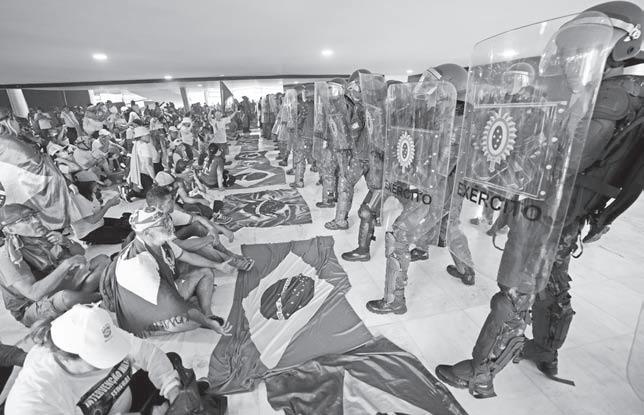
RIO DE JANEIRO—Supporters of former Brazilian President Jair Bolsonaro who refuse to accept his election defeat stormed Congress, the Supreme Court and presidential palace in the capital on Sunday, a week after the inauguration of his leftist rival, President Luiz Inácio Lula da Silva.
Thousands of demonstrators bypassed security barricades, climbed on roofs, smashed windows and invaded all three buildings, which were believed to be largely vacant and sit on Brasilia’s vast Three Powers Square.
Some of them called for a military intervention to either restore the far-right Bolsonaro to power, or oust Lula from the presidency.
In a news conference from Sao Paulo state, Lula said Bolsonaro had encouraged the uprising by those he termed “fascist fanatics,” and he read a freshly signed decree for the federal government to take control of security in the federal district.
“There is no precedent for what they did and these people need to be punished,” Lula said.
TV channel Globo News showed protesters wearing the green and yellow colors of the national flag that also have come to symbolize the nation’s conservative movement, and were adopted by Bolsonaro’s supporters.
The former president has repeatedly sparred with Supreme Court justices, and the room where they convene was trashed by the rioters. They sprayed fire hoses inside the Congress building and ransacked offices at the presidential palace. Windows were broken in all of the buildings.
Bolsonaro, who flew to Florida ahead of Lula’s inauguration, has not commented on Sunday’s events.
Police fired tear gas in their efforts to recover the buildings, and were shown on television in the late afternoon marching protesters down a ramp from the presidential palace with their hands secured behind their backs. By early evening, control of the buildings had been reestablished, Justice Minister Flavio Dino said in a press conference that roughly 200 people had been arrested, and officers were firing more tear gas to drive lingering protesters from the area.
But with the damage already done, many in Brazil were questioning how the police had ignored abundant warnings, were unprepared or were somehow complicit.
Lula said at his news conference there was “incompetence or bad faith” on the part of police, and that they had been likewise complacent when Bolsonaro supporters rioted in the capital weeks ago. He promised those officers would be punished and expelled from the corps.
The incident recalled the January 6, 2021 assault on the US Capitol by supporters of then-President Donald Trump. Political analysts have warned for months that a
similar storming was a possibility in Brazil, given that Bolsonaro has sown doubt about the reliability of the nation’s electronic voting system—without any evidence. The results were recognized as legitimate by politicians from across the spectrum, including some Bolsonaro allies, as well as dozens of foreign governments.
Unlike the 2021 attack in the US, it is likely that few officials were working in the Brazilian Congress and Supreme Court on a Sunday.
US President Joe Biden told reporters that the riots in Brazil were “outrageous.” His national security adviser Jake Sullivan went a step further on Twitter and said the US “condemns any effort to undermine democracy in Brazil.” Biden later tweeted that he looked forward to continuing to work with Lula, calling the riots an “assault on democracy and on the peaceful transfer of power in Brazil.”
British Foreign Secretary James Cleverly tweeted: “The violent attempts to undermine democracy in Brazil are unjustifiable. President @LulaOficial and the government of Brazil
have the full support of the UK.”
Earlier videos on social media showed a limited presence of the capital’s military police; one showed officers standing by as people flooded into Congress, with one using his phone to record images. The capital’s security secretariat didn’t respond to a request from The Associated Press for comment about the relative absence of the police.
“Brazilian authorities had two years to learn the lessons from the Capitol invasion and to prepare themselves for something similar in Brazil,” said Maurício Santoro, political science professor at the State University of Rio de Janeiro. “Local security forces in Brasilia failed in a systematic way to prevent and to respond to extremist actions in the city. And the new federal authorities, such as the ministers of justice and of defense, were not able to act in a decisive way.”
Federal District Gov. Ibaneis Rocha confirmed on Twitter he had fired the capital city’s head of public security, Anderson Torres. Local media reported that Torres is currently in the US.
The office of Lula’s attorney general asked the Supreme Court to order Torres’ imprisonment.
Bolsonaro supporters have been protesting Lula’s electoral win since October 30, blocking roads, setting vehicles on fire and gathering outside military buildings, urging the armed forces to intervene. The head of Brazil’s electoral authority rejected the request from Bolsonaro and his political party to nullify ballots cast on most electronic voting machines.
“Two years since January 6, Trump’s legacy continues to poison our hemisphere,” US Sen. Bob Menendez, who chairs the Senate’s foreign relations committee, tweeted, adding that he blamed Bolsonaro for inciting the acts. “Protecting democracy & holding malign actors to account is essential.”
Russia claims deadly attack, but Kyiv denies anyone killed
By Hanna Arhirova The Associated Press
KYIV, Ukraine—The Russian military claimed Sunday to have carried out deadly missile strikes on barracks used by Ukrainian troops in retaliation for the deaths of dozens of Russian soldiers in a rocket attack a week ago. Ukrainian officials denied there were any casualties.
The Russian Defense Ministry said its missiles hit two temporary bases housing 1,300 Ukrainian troops in Kramatorsk, in the eastern Donetsk region, killing 600 of them. Ministry spokesman Igor Konashenkov said the strikes were retaliation for Ukraine’s attack in Makiivka, in which at least 89 Russian soldiers died.
Serhii Cherevatyi, a spokesperson for Ukraine’s forces in the east, told The Associated Press that Russian strikes on Kramatorsk damaged only civilian infrastructure, adding: “The armed forces of Ukraine weren’t affected.”
The Donetsk regional administration said seven Russian missiles hit Kramatorsk and two more hit Kostyantynivka, without causing any casualties. It said an educational institution, an industrial facility and garages were damaged in Kramatorsk, and an industrial zone was hit in Kostyantynivka.
Kramatorsk Mayor Oleksandr Honcharenko said two school buildings and eight apartment houses were hit overnight. Photos he posted showed no indication that it had been an attack on the scale claimed by the Russians or that anyone had been in the buildings when they were struck.
“The world saw again these days that Russia lies even when it draws attention to the situation at the front with its own statements,”
Ukrainian President Volodymyr Zelenskyy said in his nightly video
address.
“Russian shelling of Kherson with incendiary ammunition right after Christmas. The strikes on Kramatorsk and other cities of the Donbas—aimed right at civilian sites and right when Moscow was reporting the supposed ‘silence’ of its army.”
Russia had declared a 36-hour cease-fire timed to coincide with Orthodox Christmas celebrations on Saturday. Ukraine denounced the pause as a ploy.
Russia said the attack on Kramatorsk was in retaliation for the Ukrainian rockets that destroyed a facility in Makiivka, also in the eastern Donetsk region, where Russian soldiers were gathered in the early hours of Jan. 1. It was one of the deadliest attacks on the Kremlin’s forces since the war began more than 10 months ago.
Also on Sunday, the Ukrainian military claimed to have hit a residential hall of a medical university in Rubizhne, a town in the Russian-occupied eastern Luhansk region, killing 14 Russian soldiers housed there. The number of wounded was unknown, it said.
Elsewhere in the east, Donetsk Gov. Pavlo Kyrylenko said one person was killed in strikes on Bakhmut, and eight others were wounded. The battles for Bakhmut and the nearby town of Soledar remained among the bloodiest on the front, Zelenskyy said. In the northeastern Kharkiv region, the town of Merefa was hit during the night, killing one person, and two other settlements in the region were shelled, Gov. Oleh Syniehubov said.
Russia and Ukraine exchanged prisoners Sunday, swapping 50 on each side, according to Konashenkov, the spokesman for the Russian Defense Ministry, and Andriy Yermak, head of the Ukrainian president’s office.
California hit by more storms, braces for potential floods
SAN FRANCISCO—California was hit with more turbulent weather Sunday as thunderstorms, snow and damaging winds swept into the northern part the state, preceding another series of incoming storms and raising the potential for road flooding, rising rivers and mudslides on soils already saturated after days of rain.
The National Weather Service warned of a “relentless parade of atmospheric rivers”— storms that are long plumes of moisture stretching out into the Pacific capable of dropping staggering amounts of rain and snow.
In the state capital, more than 60,000 customers were still without electricity Sunday evening—down from more than 350,000— after gusts of 60 mph (97 kph) knocked trees into power lines, according to the Sacramento Municipal Utility District.
Joey Kleemann was listening to the winds howling shortly after midnight, wondering whether she should move her car, when she heard a “gigantic, thumping, crashing sound” as a massive tree fell onto the Sacramento home where she’s lived for 25 years.
The gusts were strong enough to rip the tree from its roots, pulling the concrete sidewalk up with it.
Cracks in Kleemann’s roof meant rain streamed into her dining area throughout the night. She planned to place a tarp over the damaged area in anticipation of another deluge.
“I just had a feeling with the winds. They were scary winds,” she said. “Mostly I focused on: It could be so much worse.”
Gov. Gavin Newsom said 12 people lost their lives as a result of violent weather during the past 10 days, and he warned that this week’s storms could be even more dangerous. He urged people to stay home.
“Just be cautious over the course of the next week, particularly the next day or two or so,” Newsom said during a briefing with California officials outlining the state’s storm preparations.
The weather service’s Sacramento office said the region should brace for the latest atmospheric river to roar ashore late Sunday and early Monday.
“Widespread power outages, downed trees and difficult driving conditions will be possible,” the office said on Twitter.
Evacuation warnings were in place for
about 13,000 residents of a flood-prone area of Sonoma County north of San Francisco, where the swollen Russian River was expected to overspill its banks in the coming days.
And Sacramento County ordered evacuations for people living around Wilton, a town of about 6,000 roughly 20 miles southeast of downtown Sacramento, with warnings of imminent flooding. The rural area along the Cosumnes River saw flooding in an earlier storm.
“Residents must leave now before roads become impassable,” the county said.
The state Department of Transportation warned motorists to stay off mountain roads after closing a stretch of US 395 in Mono County, along the Eastern Sierra, due to heavy snow, ice and whiteout conditions.
“With the severe nature of this storm, Caltrans is asking all drivers to limit nonessential travel until the peak of the storm has passed,” the department said in a statement.
The wet weather comes after days of rain in California from Pacific storms that last week knocked out power to thousands, flooded streets, battered the coastline and caused at least six deaths.
The first of the newest, heavier storms prompted the weather service to issue a flood watch for a large swath of Northern and Central California with 6 to 12 inches (15 to 30 centimeters) of rain expected through Wednesday in the already saturated Sacramento-area foothills.
In the Los Angeles region, scattered rain fell during the weekend while stormy conditions were expected to return Monday, with the potential for up to 8 inches (20 cm) in foothill areas. High surf was expected through Tuesday, with large waves on west-facing beaches.
Since December 26, San Francisco has received more than 10 inches (25 centimeters) of rain, while Mammoth Mountain, a popular ski area in the Eastern Sierra, got nearly 10 feet (3 meters) of snow, the National Weather Service reported.
The storms won’t be enough to officially end California’s ongoing drought—but they have helped.
State climatologist Michael Anderson told a news briefing late Saturday that officials were closely monitoring Monday’s incoming storm and another behind it and were keeping an eye on three other systems farther out in the Pacific. AP
BusinessMirror Tuesday, January 10, 2023 A6
The World
Editor: Angel R. Calso • www.businessmirror.com.ph
THE government remains in talks with Pfizer for a licensing deal to allow domestic companies to manufacture generic versions of Paxlovid. BLOOMBERG
Bloomberg News
PROTESTERS, supporters of Brazil’s former President Jair Bolsonaro, sit in front of police inside Planalto Palace after storming it, in Brasilia, Brazil on Sunday, January 8, 2023. Planalto is the official workplace of the president of Brazil. AP/ERALDO PERES
MALAYSIA PLEDGES TO INVEST IN INDONESIA’S NEW CAPITAL
By Achmad Ibrahim & Niniek Karmini The Associated Press
BOGOR, Indonesia—Malaysian Prime Minister Anwar Ibrahim said Monday his country would invest in the development of Indonesia’s new capital on Borneo Island, which both nations share.
Anwar made his first overseas trip to Jakarta since taking office in November, saying at least 10 Malaysian companies have committed to invest in Nusantara, the new capital that was chosen in 2019 to replace Jakarta, some 2,000 kilometers (1,240 miles) away.
The city of about 10 million on the densely populated main island of Java has been sinking due to environmental degradation and overcrowding. The main cause is uncontrolled groundwater extraction exacerbated by the rising levels of the Java Sea.
Anwar cited the proximity of Nusantara to Malaysia’s Sabah and Sarawak states and federal territories on Borneo Island, saying the new capital’s growth will benefit the region’s economy.
The first phase of development of Nusantara started in March last year and is expected to be completed in 2045.
Anwar and Indonesian President Joko Widodo also witnessed the signing of agreements for economic cooperation estimated to be worth $263 million.

Anwar arrived in Jakarta on Sunday with a delegation that includes Foreign Affairs Minister Zambry Abdul Kadir, who held separate talks with his Indonesian counterpart, Retno Marsudi,
last week.
The two sides also discussed issues of land and maritime border demarcation, and employment and protection of Indonesian migrant workers in Malaysia, which has long been plagued with cases of human trafficking and abuse.
Indonesia’s government data shows over 50 percent of Indonesians working abroad, or about 1.6 million, are in Malaysia.
Widodo welcome Anwar’s commitment to protect migrant workers, and reiterated his request to Malaysia to also provide education for workers’ children.
Both leaders also discussed the situation in military-ruled Myanmar and joint efforts to address their exports of palm oil.
Indonesia and Malaysia account for 85 percent of global palm oil production, which plays an important role in their economic recovery. But they are hampered by the European Union, which they say favors producers of other vegetable oils.
Anwar is widely known in Indonesia as a champion of democracy in Malaysia since he was a former deputy prime minister, whose sacking and imprisonment in the 1990s led to massive street protests and a reform movement that rose into a major political force. He has frequently visited Indonesia when he was an opposition leader.
“Indonesia has a special place in my heart,” he told a joint news conference with Widodo. “I was in a difficult situation, my life was tossed around in suffering, Indonesia welcomed me as a true friend.” Karmini reported from Jakarta, Indonesia.
Aid chief: Taliban decrees against women paralyzing NGO work
By Riazat Butt The Associated Press
KABUL, Afghanistan—The Taliban’s “internal debates and extreme decrees” are paralyzing humanitarian work in Afghanistan, the head of a major aid agency told The Associated Press on Sunday, after he arrived on a week-long trip to talk to Taliban leaders about reversing a ban on women working for national and international nongovernmental groups.
Jan Egeland, the secretary-general of the Norwegian Refugee Council, is the first NGO chief to visit Afghanistan for talks with the Taliban since the ban came into effect more than two weeks ago.
Authorities have barred Afghan women from working at NGOs, allegedly because they weren’t wearing the Islamic headscarf correctly. The ban follows a slew of moves that have severely limited or suspended women’s rights and education.
Aid groups, foreign governments, and the United Nations say women are vital for the delivery of lifesaving assistance in Afghanistan and are calling for the ban’s reversal. Many groups have suspended their operations, warning of dire and deadly consequences for a population already battered by decades of war, deteriorating living conditions and economic hardship.
The Norwegian Refugee Council says it has worked in Afghanistan since 2003 and employs 470 women. It helped more than 840,000 people last year and was intending to help 700,000 this year, the group said.
Egeland said that he was meeting Taliban leaders in the capital of Kabul and in the southern city of Kandahar, the birthplace of the Taliban movement and the base of the group’s supreme leader Hibatullah Akhundzada.
Egeland has already met the economy minister, who initially announced the ban, and other Taliban officials. Egeland indicated that
those in Kabul were more willing to contemplate women returning to work because of their crucial role in delivering humanitarian aid.
“They all say that they want us to continue work and hope we will continue without females,” Egeland said in an interview Sunday at his group’s Kabul office. “But when say we’re not willing or able to work with males only, they [Taliban officials] realize that the population is totally dependent on international assistance at the moment, food, shelter, sanitation.”
Women are needed to contact women, including female-headed households and widows, he said. Aid agencies say it is impossible for men to do this work because of Afghanistan’s social and cultural norms as well as the Taliban’s own prohibitions against the mixing of genders.
Separately, two aid officials have told the AP that they were given the impression by Taliban ministers in Kabul that they want women to resume their work at NGOs but that this decision lies with the leadership in Kandahar.
Egeland said the economy minister“sent us the message given by the supreme leader that we had to discontinue all work.” He said he is traveling to Kandahar because “it is there that the ideological and religious decrees come from.”
“The [Taliban’s] internal debates and extreme decrees have paralyzed our work,” Egeland said.
The NRC chief said it was impossible to meet the supreme leader in Kandahar but hoped to influence those around him.
Two weeks after the ban, it remains unclear how comprehensive it is, and some groups have reported that they are able to continue their work.
Egeland said this raises further questions.
“Can this be a religiously activated ban if some [women] are working and some are not? It’s not thought through at all,” Egeland said. “We can’t work with males only because we can’t follow their [the Taliban’s] rules and regulations.”
Public can visit Benedict’s tomb at St. Peter’s Basilica
 By Frances D’emilio The Associated Press
VATICAN CITY—The public can now visit the tomb of Pope Benedict XVI in the grottoes under St. Peter’s Basilica.
The pontiff was buried on Jan. 5 immediately following a funeral in St. Peter’s Square. Benedict’s tomb lies in the grottoes under the basilica’s main floor.
The Vatican announced on Saturday that the public could visit the tomb starting Sunday morning.
Benedict had lived since 2013 as pope emeritus, following his retirement from the papacy, the first pontiff to do so in 600 years. He died on December 31 at the age of 95, in the Vatican monastery where he spent his last years.
On Thursday, his longtime secretary, Archbishop Georg Gaenswein, imparted a final blessing after Benedict’s body, contained inside three coffins—the cypress one displayed in the square during the funeral presided over by Pope Francis, a zinc one and an
outer one hewn from oak—were lowered into a space in the floor.
The remains were placed in the former tomb of Benedict’s predecessor, St. John Paul II. John Paul’s remains were moved up to a chapel on the main floor of the basilica following his 2011 beatification.
Some 50,000 people attended Benedict’s funeral, following three days of the body’s lying in state in the basilica, an event that drew nearly 200,000 viewers.
The name of Benedict, the Catholic Church’s 265th pontiff, was engraved on a white marble slab, the Vatican said.
The Vatican didn’t say whether Pope Francis had privately visited the completed tomb of Benedict before public viewing was permitted, or might do so at some other time.
On Sunday morning, Francis was leading a ceremony for the baptism
of 13 babies in the Sistine Chapel. The chapel, frescoed by Michelangelo, is the traditional setting for the baptisms, an event that closes out the Vatican’s year-end ceremonies.
Later, greeting pilgrims and tourists gathered in St. Peter’s Square for his Sunday noon blessing, Francis quoted from a 2008 homily by Benedict, in which the late pontiff spoke about salvation.
Drawing inspiration from his predecessor’s words, Francis said that the faithful when judging others, including in the Catholic
Church, should apply not harshness but mercy, “sharing the wounds and the fragilities” and avoiding divisions.
Francis has been criticized in some quarters by those who favored Benedict’s more conservative stances because his funeral homily made only a mere mention of the late pontiff. While Benedict and Francis had openly spoken of each other with respect, tensions festered for years between loyalists of both men. Gregorio Borgia contributed from the Vatican.
McCarthy’s next big task: Win GOP support for House
By Hope Yen & Lisa Mascaro The Associated Press
WASHINGTON—After an epic 15-ballot election to become House speaker, Republican Kevin McCarthy faces his next big test in governing a fractious, slim majority: passing a rules package to govern the House.
The drafting and approval of a set of rules is normally a fairly routine legislative affair, but in these times, it’s the next showdown for the embattled McCarthy.
To become speaker and win over skeptics, McCarthy had to make concessions to a small group of hard-liners who refused to support his ascension until he yielded to their demands.

Now those promises—or at least some of them—are being put into writing to be voted on when lawmakers return this week for their first votes as the majority party.
On Sunday, at least two moderate Republicans expressed their reservations about supporting the rules package, citing what they described as secret deals and the disproportionate power potentially being handed out to a group of 20 conservatives.
The concessions included limits on McCarthy’s power, such as by allowing a single lawmaker to initiate a vote to remove him as speaker and curtailing government spending, which could include defense cuts. They also give the conservative Freedom Caucus more seats on the committee that decides which legislation reaches the House floor.
They also raise questions about whether McCarthy can garner enough support from Republicans, who hold a 222-212 edge, on a critical vote in the coming months to raise the debt limit, given conservatives’ demand that there also be significant spending cuts, over opposition from the White House and a Democraticcontrolled Senate.
Rep. Nancy Mace, R-S.C., a strong McCarthy supporter, said she currently is “on the fence” about the proposed rules.
“I like the rules package,” Mace said, in reference to what has been released publicly. “What I don’t support is a small number of people trying to get a deal done or deals done for themselves in private, in secret.”
She said it will be hard to get anything done in the House if a small band is given a stronger hand compared with the larger number of moderates. “I am concerned that commonsense legislation will not get through to get a vote on the floor,” she said.
Rep. Tony Gonzales, R-Texas, was an outright “no” against the rules package, decrying an “insurgency caucus” that he said would cut defense spending and push extremist legislation, such as on immigration.
Democrats are expected to be united against the package.
Rep. Jim Jordan, R-Ohio, a member of the Freedom Caucus who is expected to lead the House Judiciary Committee, defended the concessions McCarthy made and said he believes the rules package will get enough Republican support to pass. He insisted that the agreements will help ensure broader representation on committees and will curtail
unfettered government spending.
“We’ll see tomorrow,” he said Sunday, but “I think we’ll get the 218 votes needed to pass the rules package.”
In the coming months, Congress will have to work to raise the debt limit before the government reaches its borrowing cap or face a devastating default on payments, including those for Social Security, military troops and federal benefits such as food assistance. Lawmakers will also have to fund federal agencies and programs for the next budget year, which begins October 1.
“Our general concern is that the dysfunction—that was historic—that we saw this week is not at an end, it’s just the beginning,” said House Democratic leader Hakeem Jeffries of New York.
The White House has rejected Republican calls to slash spending in return for an increase in the federal government’s borrowing authority. White House press secretary Karine Jean-Pierre went so far on Sunday as to call House Republicans’ likely demands “hostage taking” that would risk default, an event that could trigger an economic crisis.
“Congress is going to need to raise the debt limit without— without—conditions and it’s just that simple,” Jean-Pierre told reporters aboard Air Force One as
rules
President Joe Biden flew to Texas. “Attempts to exploit the debt ceiling as leverage will not work. There will be no hostage taking.”
Yet the White House also said it had no plans to sidestep the needed congressional approval through possible budget gimmicks such as the minting of a coin to help cover a deficit that could be roughly $1 trillion this fiscal year.
“We’re not considering any measures that would go around Congress,” Jean-Pierre said.
“That’s not what we’re doing. This is a fundamental congressional responsibility, and Congress must act.”
Jordan argued that “everything has to be on the table” when it comes to spending cuts, including in defense, in light of the government’s $32 trillion debt. “Frankly we better look at the money we send to Ukraine as well and say, how can we best spend the money to protect America?” he said.
Rep. Chip Roy, R-Texas, one of the 20 who initially voted against McCarthy before throwing his support behind the Californian, said he and other conservatives will be holding their position that there should be spending cuts in a debt ceiling bill. Asked whether he would exercise members’ new authority and unilaterally initiate a vote to remove the speaker if McCarthy doesn’t ultimately agree, Roy offered a warning.
“I’m not going to play the ‘what if’ games on how we’re going to use the tools of the House to make sure that we enforce the terms of the agreement, but we will use the tools of the House to enforce the terms of the agreement,” Roy said.
Mace and Gonzales appeared on CBS’ “Face the Nation,” Jordan spoke on “Fox News Sunday,” Jeffries was on NBC’s “Meet the Press,” and Roy was on CNN’s “State of the Union.”
BusinessMirror Tuesday, January 10, 2023 www.businessmirror.com.ph A7 The
World
FAITHFUL visit the tomb of late Pope Emeritus Benedict XVI inside the grottos of St. Peter’s Basilica, at the Vatican, Sunday, January 8, 2023. Benedict died at 95 on December 31 in the monastery on the Vatican grounds where he had spent nearly all of his decade in retirement, his days mainly devoted to prayer and reflection. AP/GREGORIO BORGIA
INDONESIAN President Joko Widodo, right, and Malaysian Prime Minister Anwar Ibrahim ride a golf cart during their meeting at the presidential palace in Bogor, West Java, Indonesia on Monday, January 9, 2023. AP/ACHMAD IBRAHIM
Associated Press writer Josh
The
Boak contributed to this report.
INCOMING House Speaker Kevin McCarthy of California receives the gavel from House Minority Leader Hakeem Jeffries of N.Y., on the House floor at the US Capitol in Washington, early Saturday, January 7, 2023. AP/ANDREW HARNIK
editorial
Let’s start practicing zero waste at home
The Philippines was the first country in the world to celebrate January as Zero Waste Month. The idea was hatched in 2012 after Philippine youth leaders issued a Zero Waste Youth Manifesto calling for, among other things, the celebration of a Zero Waste Month.
In 2014, President Benigno Simeon Aquino III issued Presidential Proclamation No. 760 declaring January as “Zero Waste Month”. The proclamation promotes designing and managing products and processes to systematically eliminate the volume and toxicity of waste and materials. It also aims to conserve and recover all resources, instead of indiscriminately disposing or burning them.
Proclamation No. 760 declares that zero waste is a goal that is ethical, economical, efficient and visionary to guide people in changing their lifestyles and practices to emulate sustainable natural cycles, where all discarded materials are designed to become resources for others to use.
On January 22, 2015, the first Philippine Zero Waste Fair was held at the Quezon Memorial Circle. Organized by EcoWaste Coalition, Global Alliance for Incinerator Alternatives, Mother Earth Foundation, and Health Care Without Harm, the fair served as an excellent opportunity for people to learn more about zero waste initiatives, and to partner with local government units and organizations supporting the zero waste advocacy.
The term zero waste was first used in the 1970s by Paul Palmer, a chemist whose company, Zero Waste Systems, was established to reduce the amount of chemical waste in laboratories across the United States. This means his interest in zero waste was scientific and monetary rather than ecological.

Bea Johnson, a French-American woman living in California, is widely credited with beginning the zero-waste lifestyle movement, starting small with her family of four and sharing the journey on her blog Zero Waste Home. Johnson brought the 5 Rs (refuse, reduce, reuse, recycle and rot) of the zero waste movement to prominence. This template of zero waste living gave potential zero wasters around the world an easy to understand and implement rulebook.
Today, with the help of social media, people around the world are embracing a zero waste lifestyle. Zero waste is no longer a theory and is being put into action by people in cities all over the world.
The Global Alliance for Incinerator Alternatives (GAIA) Asia Pacific is using the strength of the movement to celebrate International Zero Waste Month this January. The alliance was founded in 2000 when it brought together 83 participants from 23 countries to establish GAIA. The movement has grown into an organization that unites hundreds of members in 90 different countries. The alliance has played a leadership role in influencing climate policy, building a world free from plastic, and supporting cities in their transition to zero waste.
It would do well for all of us to take part in the yearly celebration of Zero Waste Month this January. We can start small by following some steps that can help in reducing our solid waste problems. For example, we can make it a habit to follow the 3Rs (reduce, reuse, recycle); we can start segregating our household waste, and avoiding the use of plastic straws and cutleries when eating outside.
Ultimately, our goal is to follow a cleaner, greener alternative to the way we manage our waste. It is not too late for us to make a difference. If we can make this a habit, we can create a zero waste society and help make landfills a thing of the past.
Ponderables and imponderables
THE EnTrEprEnEur
BusiNess planners by this time already have their own basic assumptions on how the Philippine economy would perform this year. They have their own macro-economic targets, guided by the set of goals forecast by government planners.
But economic and business planning is a dynamic exercise. No targets are set in stone—there are ponderables and imponderables that one may expect or not. And they include the geopolitical situations in other parts of the world that could throw a monkey wrench in the works.
Russia invaded Ukraine in late February last year, disrupting the global supply chain that caused world oil prices to surge to over $120 per barrel in the ensuing months. The war set off a chain of events that jolted the global financial markets. Soaring oil prices along with the break in the supply chain of wheat and corn led to high inflation in most of the world, which in turn prompted central banks across the globe to increase interest rates.
Exchange rate targets went awry—the peso flirted with the 60:$1 level briefly late last year following the big rate adjustments of the US Federal Reserve. Suddenly, the cost assumptions of many companies were way off target.
Higher inflation and interest rates are the basic recipes for recession. The United States and most of Europe are now preparing for a recession or an economic slowdown in the aftermath of the war and higher inflation. The recent surge in Covid-19 cases in China is compounding the problems of the global economy.
The Philippines, however, may be luckier than many nations. It has weathered soaring inflation and elevated interest rates. Daily Covid-19 cases have gone down below 1,000 in the last few days of December. The Philippine economy, in fact, expanded 7.6 percent in the third quarter despite rising interest rates, higher inflation and the geopolitical tensions in Eastern Europe. Our economy grew 7.7 percent in the first three quarters of 2022, exceeding the target range of 6.5 percent to 7.5 percent set by the government. The last time the economy expanded 7.7 percent in the first three quarters was in 2010.

The Philippines is not insulated
Better bad decisions
Economic and business planning is a dynamic exercise. No targets are set in stone—there are ponderables and imponderables that one may expect or not. And they include the geopolitical situations in other parts of the world that could throw a monkey wrench in the works.
from the global recession but I am confident of a solid economic growth this year. The holiday spending and the hectic pace of travel that we saw in December last year attest to a strong economic performance in the fourth quarter.
I fully agree with the assessment of Finance Secretary Benjamin Diokno on the Philippine economy. The worst is over for the economy as Filipino consumers went to the malls in droves to shop and dine in restaurants during the holidays. Many traveled to the provinces to celebrate Christmas and the New Year. Consumer spending is back with a vengeance.

We have survived the impact of Russia’s invasion of Ukraine and the peso is back on the 56:$1 territory. I see a resilient Philippine economy this year, with domestic demand as the chief growth driver.
We have seen positive economic indicators during the fourth quarter that will sustain Philippine economic growth. The S&P Global Philippines PMI, for one, has mostly been on an expansion mode, hitting 52.7 percent index points in November. Jobs in
the manufacturing sector rose 10.4 percent year-on-year in October as higher sales signaled business expansions and higher capacity use. The unemployment rate, meanwhile, dropped to 4.5 percent in October, down from 5.3 percent during the pre-pandemic period.
I am confident that the improving labor market, the recovery of the manufacturing sector and President Marcos’ push for bigger infrastructure spending will drive economic expansion this year. The stable political situation and the strong mandate received by President Marcos in the May elections are contributing to better economic prospects this year.

A more business-friendly environment also augurs well for the Philippines. Recently-enacted economic reforms like the amendments to the Public Service Act that encourage foreign investors to join in power, telecommunications, airports and other infrastructure projects with 100-percent equity will spur more businesses to open and create more employment opportunities.
And as I mentioned earlier in my previous columns, the Philippine economy has room for growth. The economic reopening, along with the full resumption of face-to-face classes, is bearing fruits. I am confident the Philippines will again survive the imponderables in 2023.
For comments, send e-mail to mbv_secretariat@vistaland.com.ph or visit www.mannyvillar.com.ph

OuTSIDE THE BOX
MY favorite quote about beginning a New Year is, “This year let’s resolve to make better bad decisions”—from that famous author Anonymous.
It is hard to believe that this Thursday marks the third anniversary of the 2020 eruption of Taal Volcano. Just when we thought we had dodged a bullet from that natural disaster, we came face to face with a man-made catastrophe. And whether or not you believe that Covid came from a bowl of
bat soup or a bioweapons lab, the disaster was the global governments’ response to the spread of the disease.
However, I am at that age when looking out for your own personal best interests is paramount. When you are over the biblical “three score and ten years” mentioned in Psalm
Start making better bad decisions by shutting out the negativity. Realize your “nation building” starts with your personal home building. And the only boat you are on is the one with a hundred million other Filipinos who need to take care of each other.
90:10, and you hear of someone’s death, you will think in passing, “So sad but I’m glad it’s not me”. Welcome to real life.
Let me share some of my personal “make better bad decisions” for 2023.
The last three years have seen Social Media turn into a cesspool of stupidity unrivaled in the history of mankind. The Spanish Inquisition and the Salem witch trials were
nothing in comparison to what happens on SocMed every day. Facebook, Twitter, and all the other “alternatives” have turned into a SCoaMF. Look it up.
That term used to be reserved for politicians, hypocritical celebrities, and vapid thought-influencers. But during the time of Covid, it has gone mainstream. During the past three months I have significantly reduced my interactions almost entirely on FB and responding on Twitter.
I finally realized that one person in particular who has 100,000 twit followers never has anything positive to say. Why? One thing I noticed is this person’s constant preaching about all the negatives today and what I should do to make sure the planet is still alive in 50 years. The reality is that neither one of us will
www.news.businessmirror@gmail.com
Tuesday, January 10, 2023 •
Opinion BusinessMirror A8
Editor: Angel R. Calso
Manny B. Villar
John Mangun
See “Mangun,” A9 BusinessMirror A broader look at today’s business Publisher Editor in Chief Associate Editor News Editor Senior Editors Online Editor Creative Director Chief Photographer Chairman of the Board President Advertising Sales Manager Group Circulation Manager T. Anthony C. Cabangon Lourdes M. Fernandez Jennifer A. Ng Vittorio V. Vitug Lorenzo M. Lomibao Jr., Gerard S. Ramos Lyn B. Resurreccion, Dennis D. Estopace Angel R. Calso Ruben M. Cruz Jr. Eduardo A. Davad Nonilon G. Reyes D. Edgard A. Cabangon Benjamin V. Ramos Aldwin Maralit Tolosa Rolando M. Manangan BusinessMirror is published daily by the Philippine Business Daily Mirror Publishing, Inc., with offices on the 3rd floor of Dominga Building III 2113 Chino Roces Avenue corner De La Rosa Street, Makati City, Philippines. Tel. Nos. (Editorial) 817-9467; 813-0725. Fax line: 813-7025. (Advertising Sales) 893-2019; 817-1351, 817-2807. (Circulation) 893-1662; 814-0134 to 36. E-mail: news.businessmirror@gmail.com www.news.businessmirror@gmail.com Printed by brown madonna Press, Inc.–Sun Valley Drive KM-15, South Superhighway, Parañaque, Metro Manila Ambassador Antonio L. Cabangon Chua Founder Since 2005 ✝ MEMBER OF
Teacher shot by 6-year-old known as devoted to students
By Denise Lavoie | The Associated Press
RICHMOND, Va.—The Virginia teacher who authorities say was shot by a 6-year-old student is known as a hard-working educator who is devoted to her students and enthusiastic about the profession that runs in her family, according to fellow teachers and city officials.
John Eley III, a former member of the Newport News School Board, identified the first-grade teacher as Abby Zwerner, 25. Zwerner was shot Friday at Richneck Elementary School, authorities said.
Shortly after the shooting, police said Zwerner had life-threatening injuries, but she has improved and was listed in stable condition at a local hospital.
Eley and other city officials met with teachers and the principal at the school Friday and later went to the hospital, where they met with members of Zwerner’s family, including several aunts who also are teachers.
“The family was all educators and said she was excited about doing the job,” said Eley, who was recently elected to the Newport News City Council.
“The custodians and other teachers spoke about how she’s a good teammate, she’s a team player, she loves her children, she’s just an allaround good teacher.”
Cindy Hurst said her granddaughter, 8, is still rattled by the shooting.
She was in Zwerner’s class last year, and told her grandmother she is a great teacher.
“I just hate that this happened,” Hurst told The Virginian-Pilot. “But life as we know it may not ever be the same—I don’t know.”
Zwerner attended James Madison University, graduating in 2019 with a bachelor’s degree in Interdisciplinary Liberal Studies and minors in Elementary Education and Music. She graduated from JMU’s College of Education in 2020 with a master’s degree in Education.
JMU President Jonathan Alger offered a message of support for Zwerner, her family, friends and fellow teachers, students and their families.
“JMU is prepared to support those impacted by this incident now and in the weeks to come,” Alger tweeted Saturday.
Police Chief Steve Drew said the boy shot and wounded the teacher with a handgun in a first-grade classroom. He was later taken into police custody. Drew said the shooting was not accidental and was part of an altercation. No students were injured.
Police have declined to describe what led to the altercation or any other details about what happened in the classroom, citing the ongoing investigation. They have also declined to say how the boy got access to the
Police Chief Steve Drew said the boy shot and wounded the teacher with a handgun in a first-grade classroom. He was later taken into police custody. Drew said the shooting was not accidental and was part of an altercation. No students were injured.
gun or who owns the weapon.
Virginia law does not allow 6-year-olds to be tried as adults. In addition, a 6-year-old is too young to be committed to the custody of the Department of Juvenile Justice if found guilty.
A juvenile judge would have authority, though, to revoke a parent’s custody and place a child under the purview of the Department of Social Services.
Mayor Phillip Jones would not say where the boy is being held.
“We are ensuring he has all the services that he currently needs right now,” Jones said Saturday.
Experts who study gun violence said the shooting represents an extremely rare occurrence of a young child bringing a gun into school and wounding a teacher.
“It’s very rare and it’s not something the legal system is really designed or positioned to deal with,” said researcher David Riedman, founder of a database that tracks US school shootings dating back to 1970.
He said Saturday that he’s only aware of three other shootings caused by 6-year-old students in the time period he’s studied. Those include the fatal shooting of a fellow student in 2000 in Michigan and shootings that injured other students in 2011 in Texas and 2021 in Mississippi.
Riedman said he only knows of one other instance of a student younger than that causing gunfire at a school, in which a 5-year-old student brought a gun to a Tennessee school in 2013 and accidentally discharged it. No one was injured in that case.
Newport News is a city of about 185,000 people in southeastern Virginia known for its shipyard, which builds the nation’s aircraft carriers and other US Navy vessels.
Richneck has about 550 students in kindergarten through fifth grade, according to the Virginia Department of Education’s web site.
Tax filing reminders
atty. Mabel L. Buted

Tax Law for Business
Happy New year!
New years are exciting as they bring us hope and opportunity to plan, try, start and live new beginnings. For most of us, these are considered as the best times to improve on ourselves and become better persons. We leave the past behind and embrace a new direction.
For taxpayers, the first few months of the new year give them the last chance to get things for the past year right, as they prepare and complete their remaining tax obligations in the coming periods.
Here are some few reminders that would help them comply with their tax obligations. Starting with the filings that are due in January, taxpayers are set to finalize and pay their withholding tax obligations on income payments made in the previous year. These include the income tax still payable on the compensation income of employees that are due to be remitted on January 15 (for non-eFPS registered taxpayers) and January 20 (for those registered with the eFPS). The income tax on compensation must be computed based on the total income earned for the year by the employee. Unless these are exempt from tax, all compensation income of the employees are subject to the withholding tax. These even include the accrued bonuses and other employee benefits
recorded in the books in the past year, even if the payment will be done this year. Upon annualization of the total taxable compensation income and computing the total taxes due, the remaining withholding taxes due shall form part of the withholding tax obligation to be remitted by the employer to the tax authority in January.
The employer should furnish the employees their Certificate of Income Taxes Withheld on Compensation (BIR Form No. 2316) on or before January 31. This will provide the employee complete information on the total amount of income taxes withheld on his salaries and compensation. The BIR Form No. 2316 must also be submitted to the BIR on or before February 28.
The other types of withholding taxes—fringe benefits tax, expanded withholding tax and final tax— must be paid to the BIR not later than January 31. Similar to the withholding tax on compensation, those that are subject to FBT, EWT and final tax
include all expenses reported for the year (unless exempt), including the unpaid and accrued ones.
The taxpayer incurring these expenses may deduct from gross income only the expenses, including the accruals, that were subjected to withholding taxes. Particularly on the expenses accrued in the previous year, the taxpayer may not, in the subsequent year, subject these to withholding tax upon payment and deduct the same as expense (GR 167679, July 22, 2015, CTA Case No. 8372, March 31, 2016). A taxpayer may not choose what taxable period it may pay the withholding taxes and claim the related expenses.
In case of over-withholding of tax on compensation, the excess must be refunded to the employee not later than January 25. For the other types of withholding taxes, the taxpayer can claim for a refund with the BIR within two years from payment.
Taxpayers are also reminded to renew their business permits and pay their local business taxes based on the preceding year’s gross receipts not later than January 20.
The filing of VAT return for the last taxable quarter must be made on or before January 25.
Next week, the filing of the Annual Income Return will also begin with the taxpayers whose fiscal years
ended on September 30, 2022. The deadline for the filing of Annual ITR is January 15, which is 105 days from the end of the taxable year. Most of the taxpayers, however, are using the calendar year. These taxpayers will need to file their ITR and pay their income taxes on or before April 15.
Other than the filing of returns and payment of taxes, taxpayers are obliged to comply with certain requirements. For example, those using loose-leaf books of accounts have also the obligation to submit bounded books of accounts annually to the BIR, within 15 days following the close of the taxable year-end. On the other hand, taxpayers using computerized books of accounts must submit to the BIR the books in optical media devices on or before January 30. For those establishments leasing or renting out spaces for commercial use, they need to submit on or before January 31 a list of their tenants as of December 31 of the previous year.
It is important for taxpayers to settle their remaining tax obligations for the previous year. The new year is after all the end of the previous year for complying with tax obligations.
The author is a junior partner of Du-Baladad and Associates Law Offices (BDB Law), a memberfirm of WTS Global.
The article is for general information only and is not intended, nor should be construed as a substitute for tax, legal or financial advice on any specific matter. Applicability of this article to any actual or particular tax or legal issue should be supported therefore by a professional study or advice. If you have any comments or questions concerning the article, you may e-mail the author at mabel.buted@ bdblaw.com.ph or call 8403-2001 local 160.
By Ken Sweet | AP Business Writer
NASSAU, Bahamas—Dressed in a canary blue suit on a warm December night, sweat dripping from his brow, Bishop Lawrence Rolle belts out the lyrics to his latest hit song for the hundreds of children and adults gathered to celebrate Christmas.
“FTX!” he sings, bent over and shaking his head for emphasis. “The money is gone!”
“FTX!” his backup singer and audience scream back. “The money have done gone!”
The cryptocurrency exchange FTX was supposed to be the crown jewel of the Bahamian government’s push to be the global destination for all things crypto, after years of having an economy overly reliant on tourism and banking. Instead, FTX is bankrupt and Bahamians are trying to figure out what’s next for their country and whether their national crypto experiment has failed. Regulators are trying to locate FTX’s customers’ missing money.
be alive then. But I also realized that this person is childless.
I have a great vested interest in the future because of my sons and grandchildren, and I always have a positive but constructive outlook for the future. If I didn’t, I should have drowned them all at birth. So, I know that I cannot change this negative person’s attitude, but I must stop hearing their negative garbage.
Anonymous also said “Negativity is a cancer of the soul that spreads like a bad cold.”
Another way to make better bad decisions is to stop thinking that we are all in the same boat. We aren’t. There are many boats and not all of them are sinking. Some are actually doing quite well.
“If a butterfly flaps its wings in Shanghai, this creates a blizzard in New York City”. Perhaps. But those same flapping butterfly wings can create perfect abundant crop-producing weather in Mozambique.
Local headlines reported that International Monetary Fund Managing Director Kristalina Georgieva said that the world faces “a tough year, tougher than the year we leave behind. One-third of the global economy will be in recession.”
I have also been saying that for several months. However, if you look at a map of projected global growth with the bad economies in “black” and progressing to the better ones in “gold”, one area of the world shines brightly—Southeast Asia.
The only loser in our region—by comparison—is Thailand, which depends on tourism from the “black” countries.
Start making better bad decisions by shutting out the negativity. Realize your “nation building” starts with your personal home building. And the only boat you are on is the one with a hundred million other Filipinos who need to take care of each other.
E-mail me at mangun@gmail.com. Follow me on Twitter @mangunonmarkets. PSE stock-market information and technical analysis provided by AAA Southeast Equities Inc.
Meanwhile, charities like Rolle’s and dozens of contractors now out of work hope that another company will come along and bring new opportunities to the island nation, without the complications and embarrassment of an alleged billion-dollar fraud.
Rolle, a Pentecostal preacher known as the “singing bishop,” is a prominent figure in the Bahamas. For decades, he’s cooked and donated food to the poor and provided school lunches from his neighborhood kitchen at International Deliverance Praying Ministry in Over-The-Hill, one of the most impoverished parts of the capital of Nassau. Rolle and his staff feed roughly 2,500 people a week.
Rolle had been invited by Kirby Samuel, the principal of Mt. Carmel Preparatory Academy, to sing as part of the school’s Christmas celebration. His act consisted mostly of a half dozen Afro-Caribbean gospel songs, but one number stood out — his social media hit about the recent collapse of FTX.
Rolle’s ministry received $50,000 from FTX in early 2022, one of several donations FTX made to the Bahamian people when it relocated to the Caribbean island nation in 2021. It was money, he said, that was used
to restore a food storage trailer and make additional food donations. Rolle said it cost upward of $10,000 a week to run his food donation program.
Asked about the failure of FTX, Rolle described it as a sad distraction from the many issues facing the country. Others are angry, particularly with Sam Bankman-Fried, the young founder of FTX. The Bahamas had a reputation, like some other Caribbean isles, as a destination for illicit and offshore finance. There was a belief that crypto would allow the island to diversify its economy, give Bahamians more financial opportunities and overall help provide the country a more prosperous future.
The country enacted the Digital Assets and Registered Exchanges Act in 2020, making the Bahamas one of the first countries to put together a regulatory framework for cryptocurrencies and other digital assets. The prime minister, Philip Davis, participated in the groundbreaking ceremony for FTX’s new $60 million headquarters in Nassau in April, along with Bankman-Fried.
“Their arrival was sort of the culmination of the work the Bahamians did to move in this direction,” said Stefen Deleveaux, president and CEO of the Caribbean Blockchain Association.
Several other crypto companies and startups are headquartered in the Bahamas, some of them at an incubator known as Crypto Isle, not far from downtown Nassau.
Deleveaux said he became interested in crypto as early as 2014, and mostly has been trying to focus his organizations’ efforts on the non-trading parts of crypto, like blockchain technology, financial inclusion and technological uses. He remains skeptical about cryptocurrency trading.
“It’s frustrating. Now when people think about crypto they are going to think of FTX,” Deleveaux said. “That’s going to make my own job much harder.”
In some ways, FTX was both ubiquitous and removed from the local community, Bahamians said. Its ads were everywhere, most notably at the Nassau Airport in the hall for tourist arrivals. But at the same time, FTX ran most of its operations from the secure luxury compound known as
Albany, where residents like Tiger Woods and Justin Timberlake can be regularly spotted. Albany is located on the opposite side of New Providence, the most populated island in the Bahamas and the location of Nassau.
“You don’t casually wander into Albany,” Deleveaux said.
One bartender at the Margaritaville Resort, where FTX ran up an unpaid $55,000 tab, described a group of 10 to 15 mostly white FTX employees who would eat in the restaurant, faces buried in their laptops the entire time. While FTX did hire Bahamians or contracted with Bahamian businesses, it was almost entirely for logistics jobs like construction, janitor services or food catering.
Just as quickly as FTX became engrained in elite Bahamian circles did the whole thing unravel. FTX failed in spectacular fashion in early November, going from solvent to bankrupt in less than a week. One food catering servicer said he had to let go most of his workers after FTX, his biggest contract, went bankrupt.
Bankman-Fried, 30, was arrested last month in the Bahamas, and extradited to the US to face criminal charges in what US Attorney Damian Williams has called “one of the biggest frauds in American history.”
The floppy-haired crypto entrepreneur has been released on bail and is scheduled to go on trial in October.
Meanwhile, law enforcement and regulators in the US and the Bahamas, as well as lawyers and FTX’s new management, are trying to determine how much of investors’ and customers’ money “is gone,” as Bishop Rolle repeats often in his song.
Estimates of how much money was lost in the FTX collapse have varied significantly, since some assets are still being recovered, but one estimate puts the losses at around $8 billion to $10 billion.
“Like the rest of the world, I’ve been glued to my television set since (FTX’s) collapse,” said Mt. Carmel’s principal Samuel, in an interview.
Other Bahamians, however, said the FTX collapse has diverted attention away from the ongoing issues facing the Caribbean country.
The Bahamian economy was sorely tested in the coronavirus pandemic. The country effectively banned
outside visitors for nearly two years, and only started letting cruise ships dock at its popular dock about eight months ago. In Nassau, there is widespread evidence of the pandemic’s economic toll. The British Colonial hotel, best known for being the site of the James Bond movie “Never Say Never Again,” was boarded up and closed in February. Rooms once went for $400 a night there.
Despite miles of pristine beaches, beautiful resorts, and the richest economy of the Caribbean, the Bahamas remains a country riven by inequality. Taxi drivers spoke about the inability to get even a $6,000 loan to buy their own vehicle. Roughly one out of five Bahamians does not have a bank account, according to the country’s central bank.
Late last year, the Bahamian government had to impose price controls on dozens of food staples in a desperate attempt to combat inflation.
FTX officials seemed to recognize food and hunger as an issue to tackle to develop goodwill with its new neighbors. Along with the $50,000 donation to Rolle’s ministry, FTX donated $250,000 to Hands for Hunger and poured $1.1 million into a new non-profit known as the Agricultural Development Committee, focused on building up the nation’s food security. The founder of the Committee, Phillip Smith, did not respond to several requests for comment on the donation.
As FTX filed for bankruptcy, there was speculation in Bahamian media about whether Rolle might have to return the $50,000 donation, which he said was spent in roughly a month after it was received.
“We pinched that money the best we could, buying flour, rice,” Rolle said. “There’s just too many hungry people.”
“It’s a difficult issue for the Bishop, but it’s one thing I think everyone in the country will agree: whatever they gave him, he did not spend it on himself,” Mt. Carmel’s Samuel said.
“I just wish there will be better companies than FTX,” Rolle said. “Many of our children got no parents, or we got parents who have two or four or five children, or kids have no father. We can barely afford to feed them. I pray to God that someone comes to donate even more.”
Tuesday, January 10, 2023 Opinion A9
www.news.businessmirror@gmail.com
BusinessMirror
Mangun.
Continued from A8
. .
Taxpayers are also reminded to renew their business permits and pay their local business taxes based on the preceding year’s gross receipts not later than January 20.
‘The money is gone’: Bahamas tries to turn page after FTX
CHINESE ENVOY MEETS AKLAN LOCAL CHIEFS
By Ma. Stella F. Arnaldo @akosistellaBM Special to the BusinessMirror
THE Chinese Ambassador to Philippines visited Kalibo and Boracay Island in Aklan over the weekend, in preparation for the reopening of outbound travel by Chinese citizens. Boracay is one of the favorite destinations of Chinese tourists, especially during the Lunar New Year.
Posting on his Facebook page entitled “My first visit to Aklan Province,” Ambassador Huang Xilian said, “There used to be 20+ direct flights from China per week and almost 400,000 tourists yearly to Boracay before the pandemic. China is opening up again for international travel, and anticipates more Chinese outbound tourists later this year.”
He added, “Aklan Province, especially Boracay, is a well-known tourist destination, together with the many other beautiful islands of the Philippines. I hope Aklan in the future would also be a well-known destination for investment and opportunity.”
Scheduled and charter flights between China and the Kalibo International Airport are already being planned for the year. These include Shanghai-based carrier Juneyao Airlines and Philippine Airlines, although the latter said negotiations are still ongoing for charter flights.
Jo Koy gatecrashes Boracay wedding
ALSO enjoying Boracay last weekend was Filipino-American come-
DFA to
dian Jo Koy with his family, which includes his sister Gemma and his son, Joseph Herbert. Posting photos on his Instagram account and on Facebook, Jo Koy (Joseph Glenn Herbert) enjoined his followers to “Visit the Philippines!” after attending an Ati-Atihan festival on the island, and gatecrashing a wedding in a local resort.
T he Department of Tourism had long wanted to tap the comedian to promote the Philippines, but was put off by his expensive tag.
Filipino-Americans who had been previously contracted to market the Philippines include musician Apl.de.Ap of the Black Eyed Peas, vlogger/comic Mikey Bustos, and celebrity chef Jordan Andino.
Jo Koy was just in Manila last August as part of his world standup tour, Funny is Funny, during which he also promoted his first film, Easter Sunday, which features Filipino families and some of their customs and traditions (See, “Jo Koy ‘shocks’ Mary Grace with shoutout,” in the BusinessMirror , September 2, 2022).
M eanwhile, Ambassador Huang met with Aklan Governor Jose Enrique M. Miraflores and Malay Mayor Frolibar Bautista on Saturday, and “discussed future cooperation in tourism and opportunities in agriculture, including the hybrid rice, bamboo industry, fruit plantations, fisheries and education as well as many other areas.” The Chinese ambassador also met with the local Chinese community and young entrepreneurs.
PCCI chief voices ‘cautious optimism’ on growth outlook
By Andrea E. San Juan
ion issue. The output of our farmers is limited and cannot meet market demand especially during the holiday season. Moving forward, legitimate importation should be allowed,” Barcelon told the BusinessMirror in a Viber message on Monday.
He said allowing importation would reduce prices and make the commodity more affordable. It would also be favorable to traders who have no cold storage facilities.
at P250 per kg (13-15 pieces). The circular was in effect until the first week of January, subject to another stakeholders’ consultation.
By Lenie Lectura @llectura
ENERGY Secretary Raphael Lotilla said Monday his office is awaiting guidance from the Department of Foreign Affairs (DFA) for the resumption of negotiations between China and the Philippines in the area of oil and gas exploration.
“ We are to be guided by the DFA in so far as to the timing of the talks as well as the venue. We will have to await their guidance. This will have to be discussed,” he said during an online press conference.
C hinese President Xi Jinping recently met with his Philippine counterpart Ferdinand Marcos Jr. China’s Foreign Ministry said Beijing is willing to continue to work with the Philippines to properly deal with maritime issues in “a friendly and consultative manner,” restart negotiations on oil and gas development, promote cooperation on oil and gas development in non-disputed areas, and develop cooperation on green energy such as photovoltaic, wind energy and new-energy vehicles.
Commenting on this, the Department of Energy (DOE) chief said, “Our presidents have agreed in principle. What it establishes is a healthy environment for talks to take place.”
Now that there is a commitment to move forward, both countries agreed to resume discussions at an early date, building upon the outcomes of previous talks.
“ In the meantime, we are proceeding with the oil and gas development in other areas of the country and as Undersecretary Alessandro Sales indicated in the past, we will be open to foreign and domestic investors carrying out development
activities,” said Lotilla.
For instance, Lotilla said state firm Philippine National Oil Co.Exploration Corp. (PNOC-EC) is looking for farm-in partners interested to take in a majority stake in Service Contract (SC) 59 located offshore which covers 14,769 square kilometers offshore Palawan, west of Balabac Island.
In case of PNOC-EC, it has announced an invitation for potential farm ins to a number of service contracts under its control. As far as those are concerned, we can proceed with that,” said Lotilla, who is also the chairman of PNOC-EC.
PNOC-EC is looking for a joint venture operator for the 75-percent participating interest in SC 59. Interested parties have until February 10 to submit their technical and financial proposals.
“As far as those are concerned, we can proceed with that,” added Lotilla. Earlier, businessman Manuel V. Pangilinan said PXP Energy, which holds interest in two petroleum exploration service contracts in the West Philippine Sea, are in talks with Chinese companies.
Pangilinan-led PXP and Forum Energy Ltd. earlier suspended all activities in SC 72 and SC 75 in compliance with the directive from the DOE to “put all on hold all exploration activities for SC 75 and SC 72 until such time that the Security, Justice and Peace Coordinating Cluster (SJPCC) has issued the necessary clearance to proceed.”

L isted PXP holds 50 percent interest in SC 75.
Forum Energy, in which PXP holds a direct and indirect interest of 79.13 percent, has a 70 percent participating interest in SC 72. PXP has a total economic interest of 54.36 percent in SC 72.
W hile he expects the Philippine economy to “sustain a healthy pace” in the first half of 2023, Barcelon said high food prices is an “issue of concern” that the government should immediately address.
“ Issue of concern is for the government to find solutions on high food prices which have heightened the clamor for big wage adjustments that could lead to even higher inflation,” Barcelon said in a Viber message sent to reporters on Monday.
He said this is a “vicious cycle” that could stunt business and “neg -
atively impact” the competitiveness of the export sector. As such, Barcelon said, “the outlook on both job creation and sustainability for the year may encounter headwinds.”
O ne of the measures that could ease food prices, he said, is the “legitimate importation” of onion, a key ingredient used in making Filipino dishes. Barclon made the statement after the prices of onions skyrocketed to as much as P700 per kilogram last month.
“ I think the [Department of Trade and Industry] DTI should consider the trade aspect of the on -
“ Food prices have a big impact on inflation and have to be dealt with. If DTI were to allow importation with quantifiable restriction, traders with no cold storage would take the opportunity to make certain reasonable profits,” he added.
I n a statement on December 31, 2022, the Trade department said it has fielded its price monitoring teams to assist the Department of Agriculture (DA) in checking the suggested retail prices (SRP) of red onions in public wet markets in the National Capital Region.
I n an administrative circular it issued on December 29, 2022, the DA set the SRP of red onions
A griculture Assistant Secretary Rex Estoperez said on Sunday there is a proposal to import 22,000 metric tons of onion to boost domestic supply and pull down retail prices. Estoperez said the proposed import program would only run until the first week of February to ensure that shipments would not arrive during the peak harvest season.
Growth drivers
MEANWHILE , Barcelon said the decline in Covid-19 cases and the reopening of schools will help boost the country’s economic growth
“Government’s plans to continue infrastructure spending and massive housing projects for the homeless will certainly give impetus to our economy,” he added.
B arcelon also hailed the “travel and leisure” business as it is exhibiting a strong comeback. In fact, he said, the recent trip of President Ferdinand R. Marcos, Jr. has “achieved China’s support of our tourism and agricultural sectors.”
‘Path to China chips ban goes through Korea’
THE United States is in discussions with Japan, the Netherlands and South Korea to restrict semiconductor exports to China, and it needs all parties to agree on a deal, US Ambassador to Japan Rahm Emanuel said in an interview.
S tressing the importance of South Korean and Dutch cooperation alongside Japan, he was speaking by phone days ahead of Prime Minister Fumio Kishida’s summit with President Joe Biden on Friday. The two allies will endorse a joint statement covering a wide range of security issues, but work is continuing on a chip industry restriction deal, he said.
“ You’ve got to work through not just Japan but you’ve got to work through obviously Korea, you’ve got to work through the Dutch,” Emanuel said. “It’s going to take a lot of work.”
S outh Korea is home to two of the world’s leading memory chipmakers, Samsung Electronics Co. and SK Hynix Inc., while the Netherlands has ASML Holding NV, maker of the world’s most advanced chip lithography systems. Japan, whose businesses provide essential machinery and materials for chip fabricators, also plays a critical role in the industry’s supply chain. Washington hopes to align all three nations in pursu -
ing its stricter measures on China exports.
“All the parties are at the table, all the parties have a mutual shared interest in the outcome. Everybody has different aspects of the industry,” Emanuel said. The deal being sought “will not be just bilateral,” he said. “It must be multilateral.”
T he Korean government is not in discussions with the US regarding participation in American restrictions on exports to China, according to a trade ministry spokesman.
T he US rolled out sweeping measures in October to limit the sale of advanced semiconductors and chipmaking equipment to China, which the Biden administration
said aim to limit the Chinese military’s access to and development of advanced tech. Beijing has challenged the move at the World Trade Organization and said the restrictions threaten the stability of the global supply chain.
Japan and the Netherlands have agreed in principle to join the US in tightening controls, Bloomberg reported last month. Tokyo officials declined to comment on whether a deal is nearing completion. Adding South Korea would be a further debilitating blow to Chinese industry and Beijing has sought to improve ties with its neighbor amid concerns over Washington’s plans. Bloomberg
A10 Tuesday, January 10, 2023
PHILIPPINE Chamber of Commerce and Industry (PCCI)
President George T. Barcelon said he is “cautiously optimistic” on the economic outlook of the country for this year, noting that high food prices could “stunt” business.
News
set time, venue of oil, gas talks between PHL and China–Lotilla
See “Chinese envoy,” A2
INSPECTION OF CAAP FACILITIES. Governance Commission for GOCCs Commissioner Gideon Mortel, Transportation Undersecretary for Aviation and Airports Roberto Lim and Civil Aviation Authority of the Philippines (CAAP) Director General Manuel Tamayo inspect CAAP’s air traffic management facility, in connection with the New Year’s Day air traffic fiasco at the Ninoy Aquino International Airport that led to the disruption of airport operations and affected thousands of passengers. NONIE REYES
ACEN secures AU$277-M loan for Australia projects
storage,” added ACEN.
By Lenie Lectura @llectura
MREIT
tralia Pty Ltd. (ACEN Australia).
The power arm of conglomerate Ayala Corp. disclosed Monday that as guarantor to ACEN Australia it signed a syndicated green term loan facility worth a total of Au$277 million (around P10.52 billion at current exchange rates), the platform’s largest green term loan facility to date.
“The loan will provide capital financing for ACEN’s renewable energy portfolio in Australia, which will be a significant contributor to the company’s strategic aspiration to grow its renewables capacity to 20 GW by 2030,” it said.
Comprising the syndicate are ba nk of China (bOC) in Manila and Hong Kong, CT bC ba nk in Manila
and Singapore, and Standard Chartered ba nk in Australia.
ba nk of China (Hong Kong) Ltd. (bOCHK) was the green loan structuring bank, while the Commonwealth ba nk of Australia acted as the agent for the syndicated green term loan facility.
Herbert Smith Freehills was legal counsel for ACEN Australia while King & Wood Mallesons was the counsel for the lenders.
“The funds will be allocated to finance the development and construction of ACEN’s project pipeline in Australia encompassing solar, wind, battery storage, pumped hydro power and energy
The New England Solar farm, the first of these projects, is expected to be in operation by the middle of 2023.
The syndicated green term loan facility is part of ACEN’s Au$600million target to be used in capitalizing Australia’s unparalleled renewables potential, and is a follow through to several transactions completed last year.
Long-term revolver
IN August 2022, ACEN Australia executed Au$100 million green long-term revolver with DbS ba nk Australia. A revolver is a borrower who carries a balance from month to month via a revolving credit line.
The following month, two transactions were completed: the Au$140 million green long-term facility signed with MuFG Sydney bra nch, and the Au$75 million green debt facility signed with the Australian government’s Clean Energy Finance Corporation (CEFC).
“This syndicated green term loan facility continues to build on the funding secured at the end of last year, and will be mobilized into our Australian portfolio.
With Stubbo 520 MWDc (MegaWatts defined conditions) project reaching Notice to Proceed late in 2022, ACEN continues on the journey in decarbonizing Australia. It is exciting to work with quality financial institutions, and the appetite for quality investments is real,” said Anton Rohner, ACEN Australia CEO.

ACEN Australia is the platform representing ACEN’s renewable energy assets in Australia. It has more than 1.5 GigaWatts (GW) of projects under construction or at an advanced stage of development, including the New England Solar, New England battery, Stubbo Solar and Valley of the Winds projects in the NSW New England and Central-West Orana Renewable Energy Zones, as well as the Robbins Island and Jim’s Plain Wind project in North-West Tasmania.
ACEN has about 4,000 MW of attributable capacity from owned facilities in the Philippines, Vietnam, Indonesia, India, and Australia, with a renewable share of 98%, which is among the highest in the region. ACEN’s aspiration is to be the largest listed renewables platform in Southeast Asia, with a goal of reaching 20 GW of renewables capacity by 2030.
MREIT Inc., the real estate investment trust of Megaworld Corp., has declared dividends of P0.2428 per share to its shareholders based on its distributable income in the fourth quarter of 2022.
The cash dividends will be payable on February 15 to stockholders on record as of January 24, the company said.
This brings total dividends for the year to P0.9770 per share, or a dividend yield of 7.1 percent as of MREIT’s closing share price of P13.70 per share last week.
“We remain committed on delivering competitive returns to our shareholders through a combination of organic growth and acquisitions,” Kevin Andrew L. Tan, the company’s president and CEO, said.
The dividends do not include additional income arising from the
announced property-for-share swap transaction. Last April, MREIT announced the acquisition of an additional four properties worth P5.3 billion. The acquisition is still subject to the approval of the Securities and Exchange Commission.
“We aim to complete within this quarter our planned acquisitions announced last year. Once complete, income from these assets will be recognized retroactively beginning January 1 of this year. The acquisition will increase MREIT’s property value by 9 percent to P64.5 billion and will provide added growth in line with our promise to deliver sustainable value to our shareholders,” Tan said.
GOLDMAN Sachs Group Inc. is embarking on one of its biggest rounds of job cuts ever as it locks in on a plan to eliminate about 3,200 positions this week, with the bank’s leadership going deeper than rivals to shed jobs.
The firm is expected to start the process mid-week and the total number of people affected will not exceed 3,200, according to a person with knowledge of the matter. More than a third of those will likely be from within its core trading and banking units, indicating the broad nature of the cuts.
The bank is also poised to unveil financials tied to a new unit that houses its credit card and installment-lending business, which will record more than $2 billion in pretax losses, the people said, asking not to be identified discussing private information.
A spokesperson for the New Yorkbased company declined to comment. The cuts in its investment bank are elevated by the inclusion of the non front-office roles that were added to divisional headcount in recent years. The bank still has plans to continue hiring, including inducting the regular analyst class later this year.
under Chief Executive Officer David Solomon, headcount has jumped 34 percent since the end of 2018, climbing to more than 49,000 as of September 30, data show. The scale of firings this year is also affected by the firm’s decision to mostly set aside its annual cut of underperformers during the pandemic.
Slowdowns in various business lines, an expensive consumerbanking foray, and an uncertain outlook for markets and the economy are prompting the bank to batten down costs. Merger activity and fees from raising money for companies have taken a hit across Wall Street, and a slump in asset prices has eliminated another source of big gains for Goldman from just a year ago. Those broader industry trends have been compounded by the bank’s mistakes in its retail-
banking foray where losses piled up at a much faster rate than forecast through the year.
That’s left the bank facing a 46-percent drop in profits, on about $48 billion of revenue, according to analyst estimates. Still, that revenue mark has been buoyed by its trading division that will post another jump this year, helping the firmwide figure notch its second-best performance on record.
The final job reductions figure is significantly lower than earlier proposals in management ranks that could have eliminated nearly 4,000 jobs.
The last major exercise of this scale came after the collapse of Lehman brothers in 2008. Goldman had embarked on a plan to cut more than 3,000 jobs, or nearly 10 percent of its workforce at the time,
and top executives elected to forgo their bonuses.
Sharing the pain
T HE latest cuts represent an acknowledgment that even businesses that outperformed this year will have to take the pain as well for a firmwide performance that’s going to miss targets set for shareholders in a year of expense bleed.
That performance miss was particularly evident in the new unit called Platform Solutions, whose numbers stand out in the divisional breakdown. The more than $2 billion hit there is magnified by lending-loss provisions, exacerbated by new accounting rules that force the firm to set aside more money as loan volumes grow as well as ballooning expenses.
“There are a variety of factors impacting the business landscape,
including tightening monetary conditions that are slowing down economic activity,” Solomon told staff at year-end. “For our leadership team, the focus is on preparing the firm to weather these headwinds.”
Goldman reports its fourth-quarter results on January 17. The cuts also come a week before the bank’s traditional year-end compensation discussions. Even for those who remain at the firm, compensation figures are expected to tumble, especially within investment banking.
It’s a stark contrast from last year, when staffers were getting showered with big bonus increases and a select few were even granted special payouts. At the time, Solomon’s $35 million compensation for 2021 put him alongside Morgan Stanley’s James Gorman as the highest paid CEO for a major uS bank. Bloomberg
By VG Cabuag @villygc
CEbu Landmasters Inc. (CLI) announced last Monday it has topped off its 263-room hotel and the 26-storey residential tower called Paragon Davao.
The tower, which CLI is carrying out through joint venture partner YHES Inc., is located in Matina in Davao City’s MacArthur Highway.
The P3-billion mixed-use development is envisioned to be a “lifestyle and convention destination.” It has 80,000 square meters (sqm) in floor area, and is becoming one of the largest mixed-use developments in the city.
“We’re pleased that the Paragon Davao will be completed just as Southern Mindanao fully opens up to travel and heightened business and leisure activity. It will serve as a natural catalyst for economic growth in the area,” CLI Chairman and CEO Jose R. Soberano III said.
Fred Yuson, president of YHES the joint venture between CLI and the Villa-Abrille clan said the hotel and residential tower will be complemented by a convention center and close to 8,000 square meters of food and retail area.
WALL Street tech bulls are counting on the industry’s megacap stocks to move higher before long and jump start a rebound in the S&P 500.
The hope is that the Federal Reserve is coming close to wrapping up its inflation-fighting campaign, and that tech, the group that’s suffered the most from interest-rate hikes, will recover. The prospect, while still not imminent, came a step closer to reality Friday when the latest employment report showed a deceleration in wage growth, which the Fed is looking for as a sign of progress in its inflation battle. Perhaps not surprisingly, the tech-heavy Nasdaq 100 Index had its best day since Nov. 30. “Even a small advance in technology megacaps will matter,” said Gary br adshaw, a portfolio manager at Hodges Capital Management in Dallas, Texas. “That’s going to be positive, and not only for technology investors. It will send a signal to the broader S&P.”
More clarity will likely come this week when investors get the latest update on inflation. A bloomberg survey of 12 economists calls for a 6.5 percent
Once complete, the acquisition will expand MREIT’s portfolio by 16 percent to 325,000 square meters covering 18 office properties in four Megaworld townships. VG
Cabuag
“The Paragon Davao will be a lively destination for locals as well as a destination or venue for meetings, incentives, conventions and exhibitions that will draw business travelers from other parts of the country,” Yuson said.
The property’s residential tower One Paragon Place with 554 units is expected to start turnover in the fourth quarter this year.

Part of development is an international hotel called Citadines Paragon Davao, and is set to open its doors next year.
It is CLI’s fourth hotel in partnership with the Ascott Ltd. and is expected to help boost the listed company’s hotel revenues.
The 2.9 hectare the Paragon Davao will also include a convention center with a grand ballroom that can accommodate up to 2,500 guests. It also has event and meeting rooms and pre-function areas.
The shopping mall, meanwhile, was masterplanned by CallisonRTKL in collaboration with local architectural firm RMDA. It will have 4,398 square meters of gross leasable area.
Cebu Landmasters is expected to soon launch horizontal projects in Davao City, the company said.
jump in the Consumer Price Index in December, down from a 9.1 percent level in June. A university of Michigan survey of uS consumers showed yearahead inflation expectations fell to the lowest level since June 2021 last month.
The S&P 500 lost 6.7 percent between the beginning of December and Thursday, with two stocks—Apple Inc. and Tesla Inc.—responsible for a third of the decline, showcasing just how strong of a grip tech megacaps have on the broader market.
u ltimately, if the Fed gets inflation under control, tech has a chance to be the market leader, but the Fed is still in play for at least another six to eight months,” said Chris Zaccarelli, chief investment officer at Independent Advisor Alliance.
but an economic slowdown that would prompt a shift by the Fed carries it’s own risks, too. Apple has ordered fewer components for a number of products, given slowing demand, Nikkei reported on January 2. ubS analysts questioned growth prospects of Microsoft Corp.’s cloud-computing business, while Tesla is grappling with falling sales in China.
BusinessMirror Editor: Jennifer A. Ng Companies B1 Tuesday, January 10, 2023
Bloomberg News
News
Wall Street still counting on big tech rip once Fed eases hikes
ACEN Corp. has secured a 277-million Australian dollar funding from major international banks to bankroll the renewable projects of its subsidiary, ACEN Aus-
CLI tops off 26-storey Davao tower
Goldman to cut about 3,200 jobs this week Goldman Sachs Group Inc. headquarters stands in new York, United States, on Friday, march 5, 2021. PhotograPher: Michael Nagle/BlooMBerg
declares Q4 ’22 dividend
Banking&Finance
Govt nearly hits ₧15-B goal from T-bills sale
By Jasper Emmanuel Y. Arcalas @jearcalas
THE national government nearly raised its total intended amount of P15 billion from the sale of Treasury Bills (T-bills) on Monday, latest auction results showed.
The auction saw the 91-day and 182-day T-bills (P5 billion each) being sold out as investors’ asking yield had been in line with secondary market benchmark levels.
The auction for the 91-day and 182-day T-bills were oversubscribed with offers for the former reaching P11.875 billion while the latter fetched a total amount of P9.18 billion in tender.
The interest rates for the 91-day T-bills ranged from 4.195 percent to 4.35 percent, averaging 4.232 percent. The average rate was just a few
basis points from the 4.267 percent secondary market benchmark level for 91-day T-bills.
The 182-day T-bills attracted interest rates ranging from a low of 4.85 percent to a high of 5 percent. The government security had an average rate of 4.959 percent while the secondary market benchmark rate for the T-bill was 4.874 percent.
The Treasury only awarded P4.75 billion of the P5-billion worth 364day T-Bills despite the tender being oversubscribed with total offer
amonting to P6.94 billion. The average rate for the T-bill was at 5.393 percent (ranging from 5.325 percent to 5.5 percent) versus its secondary market benchmark rate of 5.268 percent.
Last week, National Treasurer Rosalia V. De Leon expressed optimism that the BTr’s auctions would continue to see near full-awarding of T-bills.
Last week, the Treasury raised P13.65 billion from its sale of Tbills, which marked the highest amount raised by the government
since early August last year, when the Treasury was still able to fullyaward T-bills.
The national government seeks to raise a total of P200 billion from the sale of T-bills and Treasury bonds this month.
For the whole year, the national government plans to borrow P2.207 trillion with a 75:25 mix in favor of domestic sources. In terms of domestic borrowings, the national government aims to raise a total of P1.654 trillion, P54.1 billion of which coming from the sale of T-bills.
Healthy financial habits this 2023 Preference for digital banking boosts CIMB’s business
eNT eRING a new year is always a fresh start for each one of us to set goals especially in the aspect of personal finance. It’s like starting off with a blank sheet of paper and you are free to draw the ideas that you want to execute. Though our goals will not happen overnight, it’s better to keep track of small progress which will contribute to the bigger picture.
Here are some five financial goals that we can set and tips to make it happen.
1. Increase your savings. We may be coming from a big chunk of expenses from the holidays but remember to start a healthy cash flow as you enter 2023.
If your savings account is not yet where you want it to be, think of strategies that will help you be consistent in setting aside a portion of your income. o pening a separate savings account will help you not to use your money and just peg it for future goals. If you’re just setting aside your savings in your payroll account, there’s a greater change that you will withdraw it in case you need certain funds in the short term.
In the event that your monthly cash flow is not sufficient for you to set aside, then you may consider doing a part time job that can give you extra cash or doing a buy and sell business after office hours.
2. Pay off credit card debt. The holidays can be a season of expenses and if you exceed your budget most probably you used your credit card. Starting the year by setting goals to pay your debts will be an advantage as you move forward.
you may set a timeline on how to pay your debts, for example, you can allocate 10 percent of your income to pay a portion of debt for the next six months to 12 months. This way you can eliminate bad debts and focus on building your cash flow.
3. Build your investment funds. The stock market always has its ups and downs and we have seen that in the past year. At this point in time you may start investing if you still haven’t tried it as long as you are familiar with the platform that you will use.
A good example is investing through mutual funds handled by top fund management companies. This is an advantage for you to build your passive income as you also focus in building your career and business.
If you have financial goals and you want to beat inflation rate, then you need to start your investment journey.
Always remember to have a diversification strategy so you can minimize the risks and maximize returns.
4. Prepare for your retirement. The key to prepare for retirement, which is the longest holiday of our lives, is to start as early as you can. Many people realize this too late which is when they are already retiring in less than five years.
If you’re a Millennial like me, have you thought of the lifestyle that you want when you reach the age of 60?
This is when you don’t have much energy to work in the corporate world. or maybe if you have a business, you are already slowing down and thinking of succession planning.
A good retirement plan can help you live a decent lifestyle without being a burden to the next generation. As much as possible, we still want to bless the younger generation of the family since we will use our funds in our daily expenses as senior citizens.
Stuff like medical expenses and daily food expenses are still significant. If you will ask this amount from your children who are already raising their own family, it will be a hindrance for them to move forward and achieve their goals too.
5. Create a health protection plan. Have you ever thought of plans that can pay your medical expenses instead of withdrawing your savings? If yes, then you should start as early as you can.
Health insurance plans are very accessible in banks and insurance companies and are much cheaper if you are younger and healthy. As we all know, the more we grow old, we are more prune for certain illnesses. As much as possible we want to grow old strong and healthy but then again, the perspective here is to protect our family from unnecessary expenses because of unforeseen events.
As we all start a brand new year, we can be hopeful and take small actions for the benefit of your family and community. Do not be overwhelmed of what lies ahead but just enjoy every moment and plan so you can create a domino effect in the coming months and have a meaningful year of 2023.
Karlo Biglang-awa is a registered financial planner of RFP Philippines. To learn more about personal-financial planning, attend the 99th RFP program this January 2023. To inquire, e-mail info@rfp.ph or text at 0917-6248110.
 By Cai U. Ordinario @caiordinario
DIGITAL banking services provider cIMB Bank PH facilitated over a P100-billion worth of transactions last year as more Filipinos turned to digital banking.
cIMB Bank PH reached its alltime high cash-in transaction value of P128 billion in 2022, 68 percent higher than P76 billion in 2021.
The digital bank also disclosed that it grew its lending disbursements by 167 percent to 38 billion from 14 billion year to year.
“2022 has been a year of unprecedented growth as we continue our
innovative embedded banking digital business model. We are proud to be the leader in disrupting the banking experience and will continue to bring unmatched value and experience to our customers,” c I MB c h ief e xecutive o f ficer Vijay Manoharan said.
Manoharan attributed the alltime high deposits of the bank to the success of its 12 percent per annum anniversary promo where the Bank saw deposits increased by over P1 billion within the first five days of the promo’s launch.
cIMB Bank PH also doubled its lending customers to 2 million in 2022 from 1 million the previous
year, while improving overall asset quality and non-performing loans (NPLs).
“By offering the highest ever interest rate in the country, cIMB Bank PH allowed its customers to earn a 12 percent p.a. interest rate on their incremental Average Daily Balance (ADB) growth for December,” Manoharan said.
He said the company is committed to financial inclusion and providing greater value to customers greatly contributed to many Filipinos shifting to digital banking last year.
Manoharan cited c I MB Bank PH credit products such as R e V I credit and Gcredit and the launch
Financial relief seen with Marcos’s twin
By Jovee Marie N. dela Cruz @joveemarie
ASeNIoR lawmaker said recent actions by President Ferdinand R. Marcos Jr. provided instant financial relief to ordinary consumers with directives designed to hold off scheduled increases this year in the cost of certain basic monthly expenses.
“We commend the President and his economic team for providing instant financial relief at the onset of 2023 to Filipino consumers continuously reeling from the mostly imported elevated inflation with the twin directives designed to keep at bay the impending price spirals in basic foodstuff like rice, corn and pork and the rate adjustment in the monthly premiums of PhilHealth [Philippine Health Insurance corp.] members,” ca mSur Rep. LRay F. Villafuerte said.
Marcos issued executive order (eo) 10 last December 29 extending for a year the temporary modification or reduced import tariff rates on pork meat (whether fresh, chilled or frozen), rice, corn and coal until December 31, 2023, to alleviate the impact of inflationary pressures resulting from the continued u kraine-Russia crisis, expand supply sources, and reduce the cost of key commodities.
As endorsed by the committee on Tariff and Related Matters (c TRM) of the National economic and Development Authority, the issuance of the eo was approved by the Neda Board during its recent meeting presided over by Marcos, its chairman.
Villafuerte, who is also president of the National unity Party, said that

as pointed out after the meeting by Socioeconomic Planning Secretary Arsenio Balisacan, the lower tariff rates would enable the government to augment our domestic food supplies, diversify our sources of food staples, and temper inflationary pressures arising from supply constraints and rising international prices of production inputs due to external conflict.
EO 10
THe lawmaker said that inflation has generally remained on the high end of the curve since last year— even hitting 14-year highs in the last quarter. The increase is pinned on non-domestic factors such as spiraling petroleum prices in the world market, logistics jams or commodity supply disruptions largely caused by Russia’s invasion of u k raine and the lingering covid-19 pandemic.
eo 10 kept the reduced import duties at 15 percent (in-quota) and 25 percent (out-quota) for fresh, chilled or frozen swine meat; 5 percent (inquota) and 15 percent (out-quota) for corn; 35 percent (both in-quota and out-quota) for rice; and zero for coal. under the eo, the original or higher import duties for pork meat, rice and corn shall return after December 31, 2023, while the zero rate on coal shall remain beyond end-December.
The pace of commodity price increases quickened to 8.1 percent last December—the fastest in 14 years since the 9.1 percent print in November 2008, and the ninth consecutive month that inflation breached the 2 percent-4 percent target range set by the Bangko Sentral ng Pilipinas.
The Philippine Statistics Authority traced the accelerated inflation to
the 10.2 percent spike in the year-onyear prices of food items and nonalcoholic beverages.
Optimism
VILLAFueRTe expressed optimism that despite the economic challenges at the onset of 2023, the President and his economic managers could meet the country’s growth target of 6 percent to 7 percent for the fullyear of 2023 amid positive tailwinds in the months ahead. The latter include increasing remittances from overseas Filipinos, receding global oil prices, easing of tight monetary policies and the projected reopening of c hina’s economy.
Malacañan Palace at the same time released through the of fice of the President a memorandum signed by executive Secretary Lucas P. Bersamin ordering PhilHealth to put off the scheduled increase this year in premiums to 4.5 percent (from the current 4 percent) and in income ceiling to P90,000 (from P80,000), as set in Republic Act (RA) 11223 or the universal Health care (uHc) Act.
In issuing this stay order, the Palace said in the memo that Marcos ordered PhilHealth to suspend the increases set by RA 11223 for 2023.
“in light of the prevailing socioeconomic challenges brought about by the covid-19 pandemic, and to provide financial relief to our countrymen amidst these difficult times.”
The uHc law provided for annual increases in increments of 0.5 percent from the premium rate of 3 percent in 2020 until it reaches 5 percent in 2025.
Keep
of its partnership with SeaMoney for SPayLater for the phenomenal performance of the bank’s lending portfolio.
“We are excited for the coming new year as we continue to live out our mission of providing Filipinos accessible digital financial solutions so that they can achieve their life purpose,” he said.
cIMB Bank Philippines is a commercial bank providing innovative mobile-first digital banking solutions and services.
It is currently serving more than 6 million Filipinos and over 2 million lending customers. The bank was established in 2018.
directives
dence that the Marcos administration can keep the Philippines on high-growth mode in 2023 and onwards partly because of the President’s apt decision to sustain the unprecedented level of mega investments of the past administration in public infrastructure, “considering that infra spending has the highest multiplier effect on the economy.”
citing a Department of Budget and Management report, Villafuerte said the Marcos government had allocated an amount equivalent to 5 percent to 6 percent of gross domestic product (GDP) to spending on infrastructure and other capital outlay projects.
Proof of the continued high infra spending under the Marcos administration was that completed infrastructure projects went up by 39.3 percent in September alone as National Government expenditures for this sector plus other capital outlay projects rose to P99.1 billion in September from the year-ago’s P71.2billion disbursements.
Villafuerte said that, “The c hief executive’s bold one-two move to issue eo 3 lifting the mandatory use of face masks outdoors and, later, eo 7 relaxing the masking mandate indoors along with easing the cov id-19 tests and other strict health protocols for inbound travellers had delivered the message that the Philippines was back in business after reopening its doors wide to tourists and investors alike.”
estimates by the Neda and private analysts have put our GDP growth at 6 percent to 7 percent this year, on the back of sustained domestic consumption and investments.
Cryptocurrency tops stocks, gold on best Bitcoin streak in nearly a year
Ac Ry P To cu R R e N c y sector
battered by turmoil last year is showing some signs of life early in 2023, posting bigger gains than other asset classes like stocks, bonds and gold.
The MVIS cr yptocompare Digital Assets 100 Index of top tokens is up some 7 percent so far this month, exceeding advances of about 2 percent in global stocks, 1 percent in bonds and 3 percent from gold, according to data compiled by Bloomberg.
Global markets are taking heart from the possibility that central banks are closer to calling time on rapid
interest-rate hikes as inflation eases from very high levels. Some of that tentative relief has spilled over into crypto, even as the threat of further bankruptcies hangs over the industry after FTX’s collapse.
“There’s a faint heartbeat—the patient’s not dead,” said Tony Sycamore, a market analyst at IG Australia, referring to six straight days of increases in the Bitcoin price, the best streak since February 2022.
“Selling momentum looks exhausted and there’s a better macro environment” but the token needs to scale key technical levels like the
200-day moving average to trigger greater investor interest, Sycamore added.
Some of the sharpest crypto gains lie outside of the largest token Bitcoin.
Second-ranked et her is up 10 percent so far this month. Solana, a token that shed almost all its value last year because of a link to FTX’s fallen founder
Sam Bankman-Fried, has added over 60 percent in the early days of January.
An upgrade of the et hereum blockchain, crypto’s major commercial highway, is also engendering optimism. The upgrade, called Shanghai, may materialize in March. It will al-
low investors to withdraw et her they locked up to help operate the network. The latter process is known as staking and earns rewards.
Staking tokens
SoMe crypto protocols seek to provide easier and more flexible access to staking rewards, and coins linked to them have surged. e x amples of such so-called liquid staking tokens include StakeWise’s SWISe , Lido DAo and Rocket Pool’s RPL, which are up 113 percent, 107 percent and 21 percent respectively in January, according to data from coinGecko. Bloomberg News

BusinessMirror
• Tuesday, January 10, 2023 B3 www.news.businessmirror@gmail.com
Editor: Dennis D. Estopace
VILLAF u e R T e expressed confi-
The Bureau of the Treasury’s (BTr) auction committee awarded P14.75 billion out of the total P15-billion worth of T-bills it tendered.
pErSOnal financE
This Thursday, December 1, 2022, photo shows different cryptocurrencies at a store in slovakia. Cryptos have seen a good year in the first days of 2023. BloomBerg News
Karlo Biglang-awa
IT wasn’t until last month’s grand 20th anniversary celebration when Galerie Joaquin owner and president Jack Teotico realized the breadth and scale of the group’s accomplishments.

For the past two decades, Teotico was caught in the daily grind of spearheading one of the country’s premier networks of art galleries. He has been presenting the fine works of both masters and emerging talents here and abroad, which, in turn, helped shape today’s robust Philippine art scene. During the program, a video montage allowed Teotico
recent sitdown at The Podium, which houses a Galerie Joaquin branch since 2005.
“Suddenly, [I] woke up and realized that we’ve done quite a lot of things.”
“Quite a lot” encompasses mounting important exhibitions, collaborating with partner galleries and organizations, and presenting the Filipino artist to the global stage.
In the mid 2000’s, Sotheby’s conducted its VIP preview of Southeast Asian Modern and Contemporary Art at the gallery’s main branch in San Juan. The Galerie Joaquin Group also welcomed project integrations with other prominent auction houses such as Borobudur, Masterpiece, and Larasati. The gallery participated as well in diverse art fairs
Teotico bared that The Galerie Joaquin Group is setting up another ground-breaking move, this time by crossing oceans and expanding in Spain.
Plans are still in the early stages, he said, but the goal is to set up shop “right away,” or as early as this year. It would be the group’s entry point into the Western art market, which makes Spain the ideal choice, as Teotico believes Filipino art is highly received and accepted by Spanish art aficionados.
The acclaimed gallerist credited the rich cultural bond between Spain and the Philippines, and cited how Filipino brands thrive in the Spanish market. Teotico also points to how Galerie Joaquin has been able to determine the makings of a master artist. This includes having the vision, innovativeness, technique, strong emotional impact, and signature.
“Our artists deserve something like this,” Teotico said, referring to having a platform on the global Ang daming magagaling na Filipino artists, but the most important thing is, we have to try to get them out there. There’s only one way to find out and I think it’s worth a shot.” n


Mandala artworks of Filipino tribe member showcased in Berlin, Germany
VISUAL artist Carlito Camahalan Amalla, a member of the Agusanon Manobo tribe, pays homage to the Filipino indigenous communities in his latest solo exhibition in Berlin, Germany.
Titled Mandala: Concert of Cultures, it featured a collection of 12 contemporary Mandala art—wood carvings with acrylic paint and repousse brass sheet—inspired from unearthed Surigao and Butuan gold from ancient civilizations.
Amalla, founder and head of the Agusan Artists Association in Butuan City and the Balangay Artists Association in Manila, utilized the Mandala as a spiritual and ritual symbol in Asian cultures to encapsulate, narrate and embrace the diverse and dynamic nature, culture and literature of Filipino lives.
“Mandala is a symbol of the universe in its ideal form,” he said. “It signifies the transformation of the cosmic life from chaos, challenges and struggles into order,
organic unity and joy. It is also a form of prayer and meditation.” Each piece showcased a radial design that represents a kaleidoscope of signs and meanings, a collective community and the artist’s role in safeguarding the Philippine ecosystem from exploitation and destruction.
“It is an homage to the Philippine
indigenous tribes, whose lives are intrinsically linked with the world they inhabit, the traditional knowledge of their ancestors and the spiritual realm of their deities,” Amalla explained.
Amalla is a performer, puppeteer, dancer, chanter, musician, ceramist and researcher, who has participated in exhibitions in Wales,
Belgium, England, and the US.
He holds a Bachelor in Fine Arts with Major in Sculpture and a Master’s degree in Art History, both from the University of the Philippines. His Agusan Manobo embroidery art thesis, paintings and puppetry in Sinuyaman: Awit ni Baylan were part of the Mindanao: Cartography of History, Identity and Representation presented at the School of Oriental and African Studies of the University of London in 2019.
He is a recipient of the 2021 Asia Pacific Luminare Award and 2020 Outstanding Leadership in Culture and the Arts Award in New York City. He currently imparts his knowledge under the Design Foundation of the School of Arts, Culture and Performance of the De La Salle-College of Saint Benilde.


Mandala: Concert of Cultures was held at the Philippine Embassy in Germany in Berlin, through the support of the consulate and Amalla’s major sponsor Pacita Hienrich. It was curated by ML Ganzon.
Horoscope z
CELEBRITIES
You may crave change this year, but before you get started, put a budget in place. Consider how to make your money grow and your liabilities shrink. Paying down debt or selling off things you don’t need will help. Shared expenses will lead to additional responsibilities. Concentrate on fitness, fun and spending time with someone who brings out the best in you. Your numbers are 6, 13, 19, 27, 33, 38, 45.
ARIES (March 21-April 19): Change your resume to reflect what you enjoy doing most. Happiness is the result of doing what’s best for you. Be bold and share your intentions with someone
TAURUS (April 20-May 20): Ask direct questions and update whatever is not up to par. Don’t let a change someone makes cost you. Distance yourself from unsafe situations, and take on what’s perceived as an impossible project. HHHHH
GEMINI (May 21-June 20): Spring past the competition; you’ll gain respect and the assistance you require to bring about positive change. An emotional challenge at home will require immediate attention if you want to avoid an argument.
CANCER (June 21-July 22): Take care of details and avoid falling behind. Problems concerning authority, government agencies and institutions will surface if you neglect to do your part. You may not welcome change, but the benefits will outshine the liabilities once you embrace possibilities. HHHH
eLEO (July 23-Aug. 22): A change in routine will affect your physical well-being. Don’t overdo it or make promises you won’t want to keep. A playful attitude coupled with lending a helping hand will win points and encourage exciting opportunities and long-term friendships. HHH
fVIRGO (Aug. 23-Sept. 22): Replace criticism and negativity with a positive spin that promises change. Work alongside those who like to experiment with their skills and knowledge using unorthodox applications. Don’t rely on others. HHH
gLIBRA (Sept. 23-Oct. 22): Live up to your promises. Check the cost before signing up for something time-consuming to please someone other than yourself. Rethink your strategy and you’ll devise a plan that makes you happy and doesn’t disrupt someone’s proposals. HHH
hSCORpIO (Oct. 23-Nov. 21): Don’t visit someone and arrive empty-handed. Taking a token of appreciation will set the stage for a warm welcome. Look at every angle when making decisions that influence your reputation or position. HH
iSAGITTARIUS (Nov. 22-Dec. 21): Take the path that makes you proud and encourages you to use your attributes to persuade others to contribute to your success. A kind word or compliment will lift someone’s spirits and raise your profile. HHHHH
jCApRICORN (Dec. 22-Jan. 19): Use your imagination and save time and money. An unexpected gift or gain will also cause concern. Don’t lose sight of your long-term goal or the consequences of not doing what’s necessary to reach your destination. Finish what you start. HHH
kAQUARIUS (Jan. 20-Feb. 18): Channel your energy into home improvement, which will replenish your imagination and enrich your skills and life. Love and romance are favored, and sharing your feelings will bring you closer to that special someone. HHH
lpISCES (Feb. 19-March 20): Step outside your comfort zone and address issues that concern you. The difference you make by speaking out will impress onlookers and put you in a position to advance. Call on those you enjoy working alongside, and you’ll get good results. HHH
BIRTHDAY BABY: You are optimistic, proactive and entertaining. You are helpful and popular.
H: Avoid conflicts; work behind the scenes. HH: You can accomplish, but don’t rely on others. HHH: Focus and you’ll reach your goals. HHHH: Aim high; start new projects. HHHHH: Nothing can stop you; go for gold.
DREW SCHMENNER
B4 Art www.businessmirror.com.ph
BORN ON THIS DAY: Evan Handler, 62; Pat Benatar, 70; George Foreman, 74; Rod Stewart,
ACROSS 1 Stand-up comedian’s sole prop, at times 4 Took advantage of 8 C sharp equivalent 13 Possess 14 Greek salad cheese 15 Cantaloupe and honeydew 16 Site with lots of posts? 18 CNN journalist Jim 19 “Back when I was a kid...” 20 Safari or Chrome 22 ___ carte menu 24 Like wine aged in a barrel 25 Trite 27 Orthodontist’s deg. 28 ___ and the Tramp 32 Nightmarish street 33 Totally unimpressed 35 Backyard cookout site 36 Underworld leader 38 Mishmash of items 40 Second ___ (last baby tooth, often) 41 Transition 43 Singer Grande, to fans 44 “You said it!” 45 Green morsel in veggie soup 46 Like a foul odor 48 Rower’s necessities 49 De Armas of Knives Out 50 Flavorful spread with dill, maybe 55 “Classic” cola 59 Works of Wagner and Puccini 60 Flickering...or, read differently, what connects 16-, 20-, 36-, 38- and 50-Across? 62 Change from “Facebook” to “Meta,” say 63 In addition 64 Lion’s zodiac sign 65 “Bye!” 66 Never stops talking 67 “I do” DOWN 1 Magical charm 2 Champion’s cry 3 TV network that covers Wall Street 4 Sci-fi spacecraft 5 Coastal defense structures 6 Raison d’___ 7 Father figures? 8 Fake duck 9 Move steadily, as lava 10 Feeling of grief 11 Poker payment 12 Bygone Russian ruler 15 Con artist’s victims 17 Pinto or lima 21 Scoundrel 23 ___ of love 25 Colorful sign of spring 26 Stroll 28 Chem major’s hangout 29 Opportunity close to home? 30 Teen’s journal 31 Meditative master 32 Actress and activist Watson 34 State confidently 35 Song with many hallelujahs, say 37 Prohibit 39 Throw caution to the wind 42 Oakland’s subregion 45 Take a breather 47 Potato holder 48 Becoming author Michelle 50 d’oeuvres 51 Fencing blade 52 Thor actress Russo 53 Donkey’s cry 54 Fitzgerald who was “Queen of Jazz” 56 Like some canned fish 57 Leg joint 58 Big ones clash in Hollywood 61 Words of rejection ‘be
The Universal Crossword/Edited by David Steinberg Solution to today’s puzzle:
in touch’ BY
THE Galerie Joaquin Group senior management, led by owner and founder Jack Teotico (fifth from right)
VISUAL artist and Benilde Design Foundation educator Carlito Camahalan Amalla
Uk PAlACe Allies PUsH BACk AGAiNsT PRiNCe HARRY’s ClAiMs
By Jill Lawless The Associated Press
LONDON—Allies of Britain’s royal family pushed back on Saturday against claims made by Prince Harry in his new memoir, which paints the monarchy as a cold and callous institution that failed to nurture or support him.
Buckingham Palace hasn’t officially commented on the book. But British newspapers and web sites brimmed with quotes from unnamed “royal insiders,” rebutting Harry’s accusations. One said his public attacks on the royal family took a “toll” on the health of Queen Elizabeth II, who died in September.
Veteran journalist Jonathan Dimbleby, a biographer and friend of King Charles III, said Harry’s revelations were the type “that you’d expect...from a sort of B-list celebrity,” and that the king would be pained and frustrated by them.
“His concern...is to act as head of state for a nation which we all know is in pretty troubled condition,” Dimbleby told the BBC. “I think he will think this gets in the way.”
Harry’s book Spare is the latest in a string of very public pronouncements by the prince and his wife Meghan since they quit royal life and moved to California in 2020, citing what they saw as the media’s racist treatment of Meghan, who is biracial, and a lack of support from the palace. It follows an interview with Oprah Winfrey and a six-part Netflix documentary released last month.
Harry is not the first British royal to air family secrets—both his parents used the media as their marriage fell apart. Charles cooperated on Dimbleby’s 1994 book and accompanying television documentary, which revealed that the then heir to the throne had had an affair during his marriage to Princess Diana.
Diana gave her side of the story in a BBC interview the following year, famously saying “there were three of us in this marriage” in reference to Charles’s relationship with Camilla Parker Bowles.
But Spare goes into far more detail about private conversations and personal grievances than any previous royal revelation.
In the ghostwritten memoir, Harry discusses his grief at the death of his mother in 1997 and his longsimmering resentment at the role of royal “spare,” overshadowed by the “heir”—older brother Prince William. He recounts arguments and a physical altercation with William, reveals how he lost his virginity (in a field) and describes using cocaine and cannabis.
He also says he killed 25 Taliban fighters while serving as an Apache helicopter pilot in Afghanistan—a claim criticized by both the Taliban and British military veterans.
Spare is due to be published around the world on Tuesday. The Associated Press obtained an early Spanish-language copy.
Harry has said he expects counterattacks from the palace. He has long complained of “leaks” and “plants” of stories to the media by members of the royal household.
In an interview due to be broadcast on ITV on Sunday—one of several he has recorded to promote the book—Harry says people who accuse him of invading his family’s privacy “don’t understand or don’t want to believe that my family have been briefing the press.”
“I don’t know how staying silent is ever going to make things better,” he said.
Gorgeous, gi f ted and gay
LGBTQIA+ projects are certainly on a roll. The new year kicks off with the international premiere of I Love You, Beksman at the 52nd International Film Festival Rotterdam. The new movie of former TV network executive-turneddirector Perci Intalan is in the official selection of this highly touted European festival and it stars actors Christian Bables and Keempee de Leon.
Although many feel that Bables has already been stereotyped in gay roles, the actor does not really mind. “Work is work, and it was my gay character in the movie Die Beautiful that paved the way for many more projects, and made people take notice of me as actor. I was also blessed with recognitions from legitimate award-giving organizations. Besides, when I got hold of the script of I Love You, Beksman, I finished reading it in one sitting.”
For his role as the adoptive father of the lead character, De Leon will remind filmgoers that he is indeed a dependable actor. “I play the loud gay father of Christian and I must say that I enjoyed every shooting day we had. He is such a humble, simple dude that is gifted with immense acting skills. The reason why it was such a happy and gay set—no divas, no attitudes, only fun, fun fun and happy people!”
Intalan, the film’s director, continues to inspire not only with how he evolves creatively, but also with the way he handles life’s many challenges. His separation from his former partner Jun Lana caught everyone in the industry by surprise. Their wedding took place in New York in 2013. The two are still very civil, and focus their energies in strengthening their film outfit The IdeaFirst Company. Intalan has also been battling depression very quietly and he recently shared publicly that he has started weaning himself from antidepressants.
Meanwhile, happy couple Liza Diño and Ice Seguerra are starting the new year with two projects from their newly formed company, Fire & Ice Media and Productions. The newest producers in showtown will be staging a pre-Valentine show that will feature Drag Race Philippines Season 1 winner Precious Paula

Viñas
“Our new company wants to put the spotlight on the art of drag through this special show we call Divine Divas: The Ultimate Drag Experience. The show will present Philippine drag culture at its finest and we will also highlight the various disciplines that drag represents: impersonations of music superstars like Beyoncé and Lady Gaga, as well performances of original songs that the drag artists themselves helped create and bring to life,“ said Diño.
She added, ““This is an opportunity for our gorgeous drag queens to be seen on the main stage and to be considered as mainstream artists. Fire & Ice wants to support that, Ice and I support that, especially since we are part of the LGBT community. We deserve to be front and center and not just be in the sidelines. Through this concert, we hope that more people will appreciate these drag performance artists and help normalize drag as a mainstream form of entertainment.”
More than the performances, the concert also aims to present the colorful, multi-faceted lives of the drag queens—from their struggles to their triumphs. After all, beneath the glamorous makeup and the wonderful outfits, there is a human being wishing simply to be seen, represented, heard and loved.
For Seguerra, this is a key moment in the history of Philippine drag. “Local drag queens are finally there on center stage. You see their names alongside mainstream artists and concert performers. For me, that’s a big thing because drag was always in the sidelines, it was always underground.”

Fire & Ice will also bring the successful solo concert of Seguerra to the Waterfront Cebu City on February 18. “It’s always a thrill performing for our kababayans in Cebu. In the many shows I’ve done there, it is very obvious that the Cebuanos know what they want from a performance. They are what we artists call the listening audience who expect only the best from concert performers. They are also very generous with applause and feedback when they like what they see and hear.” n
‘M3gan’ dolls up with $30.2M while ‘Avatar’ stays No. 1
New YoRk The Blumhouse evil-doll horror film M3gan got off to a killer start, debuting with $30.2 million in ticket sales, according to studio estimates, while Avatar: The Way of Water continued its box-office reign in the top spot.
Universal Pictures’ M3gan, about a robot companion built for a young girl after her parents are killed in a car accident, rode strong buzz and viral dancing memes to an aboveexpectations debut. in the low-budget slasher, starring Allison williams, Blumhouse and producer James wan crafted Hollywood’s first hit of the new year, likely spawning a new high-concept horror franchise.
Audiences gave the PG-13 film a “B” Cinemascore— though reviews (94 percent fresh on Rotten Tomatoes) were stronger for the modern, techy twist on a Child’s Play-like thriller. it added $10 million internationally.
GMA Network reveals 2023 lineup
leADiNG broadcast company GMA Network is all set for an even stronger 2023, with the country’s biggest stars coming together for the biggest and grandest roster of television shows and films.
All set to make history on national television is the much-anticipated live-action adaptation of Voltes V: Legacy, topbilled by Miguel Tanfelix, Ysabel or tega, Radson Flores, Matt lozano, and Raphael landicho.
Another epic series is on the way via Mga Lihim ni Urduja bannered by kylie Padilla, Gabbi Garcia and sanya lopez. sofia Pablo and Allen Ansay bring young thrills in LUV IS: Caught In His Arms together with the sparkada boys, sean lucas, Vince Maristela, Raheel Bhyria and Michael sager. Also airing this 2023 is LUV IS: Love at First Read, a collaboration of GMA Network and wattpad weBTooN studios featuring kyline Alcantara and Mavy legaspi.
watch Ashley or tega and Xian lim team up for the first time and show off their figureskating skills in Hearts on Ice. Highlighting inspiration, thrill and exceptional concepts are Lady Boxer, Love Before Sunrise, Royal Blood, and Love, Die, Repeat.
A bolder slate of GMA Afternoon Prime is sure to keep viewers glued to the screen. First on the list is the remake of the 1980 film
But while M3gan drew audiences largely in 2D showings, large-format screens continued to be soaked up by James Cameron’s Avatar: The Way of Water. The 3D three-hour sequel remained No. 1 for the fourth straight week in Us and Canadian theaters with $45 million in sales.
Cameron’s sci-fi spectacle has now surpassed $500 million domestically and $1.7 billion globally. After dominating the otherwise lackluster holiday corridor, the Avatar sequel is nearly matching the original’s pace; the 2009 Avatar scored $50.3 million in its fourth weekend. The Way of Water already ranks as the seventh highest grossing film ever, not accounting for inflation—a total particularly owed to its strong overseas performance. The film’s $1.2 billion in international ticket sales exceeds that of any film released since the start of the pandemic.
M3gan was the only new film in wide release, though sony Pictures’ A Man Called Otto, starring Tom Hanks, played in 637 theaters after first launching in four theaters. The film, a remake of the swedish film A Man Called Ove, managed a solid $4.2 million ahead of its nationwide release on Friday.
Third place went to Puss in Boots: The Last Wish, with $13.1 million in its third week of release. The animated Universal Pictures sequel has tallied $87.7 million in three weeks, plus $109.7 million internationally.
while many awards contenders have struggled in recent months at the box office, Darren Aronofsky’s The Whale is proving a modest exception. The A24 indie starring Brendan Fraser ranked seventh in its fifth week of release with $1.5 million and a cumulative total of $8.6 million—a good return for a film that cost an estimated $3 million to make. AP
woman’s husband goes missing after he gets into financial trouble. As she journeys to find him, she discovers things that will put their marriage to the ultimate test, especially when she realizes that he disappeared on purpose.
Meanwhile, The king of Talk is back home to give the hottest showbiz news via Fast Talk with Boy Abunda.

Following the success of its first season, the No. 1 game show in the country Family Feud returns for a second season with Dingdong Dantes.
John lloyd Cruz is also back to make the audience laugh and fall in love even more with the new season of Happy ToGetHer
finds the strength to rise again, exact revenge on those who caused her misfortunes, and ultimately get the love and happiness she deserves.
Another intriguing program comes to light via The Seed of Love starring Glaiza de Castro, Mike Tan and Valerie Concepcion. it tackles the story of a couple who undergoes in-vitro fertilization.

Carla Abellana, Gabby Concepcion and Beauty Gonzalez join forces in Stolen Life. A woman’s life is stolen from her when her cousin, who is a wanted criminal, uses astral projection
The Voice Generations is the latest spin-off of The Voice franchise, where viewers get to see the country’s greatest performers from different generations showcase their talents.
Prepare for heart-pounding performances with the return of the award-winning and alloriginal Filipino singing competition The Clash 2023.
These are some of the major projects that the network will be premiering in 2023 on GMA and GTV on free-to-air, or on digital TV receivers GMA Affordabox and GMA Now.
GMA programs also air abroad via international channels GMA Pinoy TV, GMA life TV, and GMA News TV.
Nicole alongside drag showstoppers
Deluxe and Brigiding on February 10 at the New Frontier Theater in Quezon City.
• Tuesday, January 10, 2023 B5 Show BusinessMirror www.businessmirror.com.ph
Editor: Gerard S. Ramos
CloCkwise: The Divine Divas, keempee de leon & Christian Bables, ice seguerra & liza Diño.
Underage, headlined by lexi Gonzales, Hailey Mendes, and elijah Alejo together with sunshine Cruz and snooky serna. it follows the story of three sisters who embark on a journey to clear their names after being accused of murder. Meanwhile, Herlene Budol is ready to spread charm in Magandang Dilag together with Benjamin Alves, Rob Gomez, Christopher de leon, sandy Andolong, Chanda Romero, Al Tantay, Maxine Medina, Adrian Alandy, Bianca Manalo, and Pam Prinster. The series revolves around an heiress who was deceived by her greedy husband and friends. she eventually
to switch physical bodies with her. Jailed for her cousin’s crime, she will try to reclaim her life and family.
Arabella, on the other hand, is headlined by shayne sava, Althea Ablan, Camille Prats, wendell Ramos, klea Pineda, Alfred Vargas and Faye lorenzo. Ara comes home to her loving mother, Roselle, and they build a strong relationship. That relationship is severely tested after the discovery that they are not bloodrelated and the real daughter, Bella, returns.
Yasmien kurdi, Rocco Nacino, and Jak Roberto banner The Missing Husband. A
LET the good times roll! Pinoys are known to be lovers of food and fun that bring everyone closer.
Whether birthdays, class reunions or kiddie parties, Filipinos always make a way to share their blessings and celebrate milestones and special moments with friends and loved ones!
To offer Filipinos better ways to make their wonderful celebrations memorable and affordable, the lifestyle partner of every Filipino Home Credit Philippines expands its services and offerings to Food and Beverages, starting with its partnership with Max’s Restaurant.

Customers can enjoy a Sarap to the Bones experience with their loved ones in every special occasion by celebrating at Max’s Restaurant without breaking the bank! So if you’re looking for a sign to go a little extra on the family’s holiday celebrations, this is it!
A staple in every Filipino’s childhood and adulthood, Max’s Restaurant has always been a venue for family gatherings, with almost 200 branches nationwide. Their themed party packages – from kiddie party with goodies and a mascot for children, elegant wedding package to christening package, enjoyable group meeting, or other fun event packages – are allinclusive of a decorated venue and a wide selection of food and programs to serve their beloved customers.
Good news! Celebrations do not have to put your budget to the max. Now with Max’s Party Gives offering, customers can enjoy any special occasion at select Max’s Restaurant through an affordable monthly installment plan with Home Credit. Get that well-deserved party time without a hassle by choosing and customizing the suitable party packages
that fit your liking.
Home Credit Qwarta users can avail of an exclusive five percent off for any of Max’s party packages. Simply download the My Home Credit App via mobile, register, and enjoy this promo and other app-user benefits, such as paying your bills contactless with no extra charge and rebates when you scan-to-pay in-store.
Pinoys can also party now and pay later through Home Credit Card. Both Qwarta and Home Credit Card offer customers their last installment for FREE for consistent on-time payments of their Max’s Restaurant party package transactions.
What are you waiting for? Come and party to the max! Visit any participating Max’s Restaurant to avail of their latest party promo. Download the My Home Credit App to learn more about Qwarta and Home Credit Card offerings.
NextGen devices that give you a new line of chargers, powerbanks and speakerphone

HARMAN, a world-renowned brand known for everything from providing loud music in outdoor concert halls to the smallest and clearest earphones and headphones that deliver the same sound quality and richness, a water-resistant long battery life with True Wireless Stereo (TWS), and Audio Noise Cancellation (ANC), introduces a new array of products in partnership with InfinityLab, one of the leading companies that manufactures stateof-the art, advanced technology products for speaker phones, chargers, and powerbanks, Offering consumers with compact, light, convenient, and sturdy devices, with great sounds with their speakers, and also reliable sources of power for their mobile needs.
High-speed wall chargers
MADE to be fast-charging, from 20 to 100 watts, these chargers give maximum plug-in power whether you connect with USB type-A or type-C. They are also designed with builtin systems to protect your most important devices when charging, and always easy to carry, ready to go with you so you can keep your smartphones and other portable devices such as laptops and tablets, plugged in when you need them.
Power Delivery Technology powerbanks for Android and Apple
THESE portable powerbanks were designed with convenience in mind. Having built-in cables and with options from 5,000mah and 10,000 mah, it’s sure to give you power throughout the day. Wireless chargers are also available with 18 and 30 watts, as well as a wireless stand with 15 watts. Choose from the black or white options, and you can have your own power on-the-go.
The powerbanks are equipped with Power Delivery 3.0 (PD) for fast-charging, equipped with smart distribution, and engineered with Gallium Nitride (GaN) technology, to create smaller adapters than most laptop versions.
ClearCall Speakerphone
HAVING an online meeting even if it’s a simple audio or video conference, doesn’t matter whether you're in the office, at home, or in a public place, this compact portable device lets you do the job with its easy USB plug and play interface.
Designed with an array of four-way microphones covering 360 degrees, and a speaker nestled at the center, any one to four participants can join the call. It is equipped with an internal battery that lasts up to 24 hours of talk time. Designed to be handy, this device fits in your pocket or snugs into your laptop bag so easily.
InfinityLab chargers not only provide you with cutting-edge charging technology that protects your devices with Power Distribution and fast charging, they also come in lightweight and simple designs that are sturdy in performance. And are guaranteed that each product is built with eco-friendly recyclable materials, making you part of an eco-friendly footprint while adapting to technology.
InfinityLab is a sub-product line of the US-based company HARMAN, a pioneer in audio technology that delivers top-notch products for consumers and professional systems. InfinityLab is the result of eight years of brainstorming and ideation at the HARMAN Innovation Workshop, which made InfinityLab a partner for sustainable and innovative technology.
For any other information you need about InfinityLab, please visit infinitylab.com.ph .
IN conjunction with Buwan ng
Tagapaghatid, a month-long celebration recognizing the contributions of its driver-partners to the community, Grab Philippines partners with ColgatePalmolive to honor the Grab community's resilience amidst challenging times and to highlight the lives and aspirations of the driver-partners beyond the steering wheels. Colgate and Grab PH seek to ignite confidence and optimism with the inspiring stories of Grab driver-partners to help Filipinos face any adversity with a strong smile.
This collaboration with Grab Philippines offers a new and interactive opportunity for Colgate-Palmolive to inspire hope in thousands of Filipinos and consequently spread hope and optimism
to the entire country.
Inspired by the stories of driverpartners who are earning through the platform—including the stories of a law student working as a Grab driver at night to support his studies and a partner who doubles as an entrepreneur and sells his passengers baked goods—Grab and Colgate-Palmolive envision inspiring passengers by highlighting optimism in action.
One standout story is that of Benjie Estillore, a 52-year-old Grab driver-partner who was inspired to achieve his dream of attaining higher education after passing by local schools throughout the day. Benjie recounted the difficulty he had in finding a job, having only finished high school. Despite his age, he took a leap of faith and

enrolled in school during the pandemic, balancing it with his duties as a Grab driver-partner. Benjie now feels closer to achieving his dreams of a brighter future, showcasing the power of hard work and resilience.
Through this partnership, Grab passengers will come across different prompts throughout their passenger journey, introducing them to a Colgate Smile Strong driver’s personal story after booking a ride. Once inside, a QR code can be scanned, leading to a video narrated by the driver recounting their inspirational story of overcoming their struggles.
Passengers who share their experiences on Facebook and Instagram will be rewarded with discounts and vouchers for Colgate products on GrabMart. Passengers also have the chance to win special Colgate gift packages, as well as join a raffle where 10 winners are eligible to win a month’s worth of free Grab rides. Free samples of Colgate are also available inside every Colgate Smile Strong vehicle.
“Grab consistently reaches out to our partners to ensure that our partners receive the essential support they need for them to continuously earn from the platform during these difficult times. More than a business, we are proud to say that Grab is a community. We are committed to working with the community as together we overcome and adapt to the fast-changing economic situation. Grab is fully dedicated in protecting the wellbeing of our partners and our fellow Filipinos,” said Grace Vera-Cruz, Country Head of Grab Philippines.
Countless more Grab driverpartners are driving their way towards a better tomorrow. With the help of Grab Philippines and Colgate-Palmolive, their stories of resilience and perseverance hope to inspire Filipinos to never forget to #SmileStrong.
TECHNOLOGY is now part of today’s education system and plays a vital role in the student’s learning process and in teacher’s productivity. However, students in far-flung areas like the Inawa Panaynep Elementary School in Sablayan, Occidental Mindoro have struggled to upskill their pupils because of their lack of digital resources.
This caused a bigger problem as the Mangyan students were unable to finish their studies because of their fear of not being able to cope with students who are better equipped with knowledge in technology.
To bridge the gap in digital education, Korean organizations like the Korea International Cooperation Agency (KOICA) and Human Asia, in partnership with Sorok Uni Foundation, a non-profit organization based in the Philippines, launched the project titled “Mitigating the Digital Divide in Education for Mangyan Students in the Philippines” on September 2, 2021, at Inawa Panaynep Elementary School.
Students from Grades 5 and 6 were initially chosen as the project’s beneficiaries. PCI Tech Center, a digital education provider in the Philippines, provided the pupils with digital tablets and Rover, a digital learning platform that was installed in the tablets that enabled the students to download modules that could be accessed offline.
To fully maximize every student’s learning opportunity, the project was also introduced to the parents to familiarize them with its functions. With the knowledge of how it works, parents were able to guide their children on its proper uses.
The project also aimed for the holistic learning of the Mangyan children in terms
of digital literacy. Apart from the workshops involving tablets, it also came up with activities such as Basic Computer Literacy Workshop and Film Viewing. Through this, the students not only learned how to use the tablets, but also learned how to use the gadgets responsibly.
A year after its implementation, the teachers of Inawa Panaynep Elementary School witnessed positive results. The students were more confident about finishing their studies.
In its second year, the project was launched in Libagon Elementary School on August 19, 2022.
All of these were made possible through the efforts of KOICA, which aims to ensure that everyone will get an education by strengthening the education systems in partner countries, and Human Asia which focuses on conducting specialized advocacy activities for the promotion and protection of human rights in Asia.
As one of the developed countries, Korea has not forgotten the Philippines and continues to express its gratitude throughout the years. Korea and the Philippines established their diplomatic ties in 1949. When the Korean War started in the 1950’s, it lost at least 2.5 million people. This relationship between both countries was further strengthened during the war, when the Philippines deployed soldiers to assist South Korea.
Both nations have valued and preserved their connections throughout the years through mutual support. Agencies like KOICA and Human Asia worked hand-inhand in empowering the disadvantaged indigenous Filipino children in education to give them quality life in the future.

Tuesday, January 10, 2023 B6
CREBA receives special award. Chamber of Real Estate and Builders’ Associations Inc. (CREBA) past president and incumbent vice-chairman Jerry M. Navarrete (center) receives the special award conferred upon CREBA as an avid industry partner of the National Home Mortgage Finance Corporation (NHMFC) during the shelter agency’s recent 1st Stakeholders’ Night at the Eastwood Richmonde Hotel. Presenting the award is Hon. Renato Tobias (left),NHMFC president.
Koreans working hand in hand with Pinoys to provide education to the indigenous children
Grab Philippines, Colgate-Palmolive partner for #SmileStrong to highlight optimism in action among driver-partners
Celebrate life’s
at Max’s through Home Credit
Benjie takes pride in his school uniform and makes time for both his studies and his responsibilities as a Grab driver-partner
meaningful moments
China’s soaring Covid cases send people to black market for remedy
over how much is available in China.
state-owned drugmaker to import and market the pill.
The country’s abrupt U-turn on Covid Zero earlier this month surprised health experts and residents, as officials appear to have done little planning for the inevitable rise in cases that comes with reopening. That includes easy access to antiviral therapies that can be used by people who test positive and are at higher risk of hospitalization, like the elderly.
The worsening outbreak is boosting demand for such treatments, but Chinese have found the drugs in short supply across the increasingly strained health-care system. People are seeking out online sales channels to source generic versions of the drugs made elsewhere and not approved for sale in China, social media posts and newspaper reports show.
One user on the popular Twitter-like Weibo platform said on Sunday that she was buying generic Paxlovid made in Bangladesh because she had an elderly relative and couldn’t get hold of any in China. She said in the post, which has been removed, that while she’d heard China had imported tens of thousands of boxes of Paxlovid, ordinary residents weren’t able to access the potentially life-saving medicine.
The same day, another Weibo user called for easier and quicker access to
the pills. The poster shared a picture of an advertisement for generic versions of Paxlovid made in India that can be shipped the same day as payment and arrive in two-to-three weeks.
Those that can get their hands on antivirals are paying huge premiums.
The 21st Century Business Herald reported an unidentified white-collar worker in Guangdong paid 5,800 yuan ($830) to a Hong Kong agent for a box of Paxlovid, more than double the official price in mainland China. The Paper, a Shanghai-based publication, reported purchasing agents have sold more than 50,000 boxes of foreign generic antivirals since the government’s first tentative steps toward easing Covid Zero in November.
Even going by the book can come at a hefty price, depending on where someone seeks treatment. Guangzhou Daily reported that a staff member at the private Guangzhou United Family Hospital said Paxlovid costs about 2,300 yuan, but patients need a raft of tests in order to determine their suitability for the medication. That includes a CT screening, which costs about 5,000 yuan, plus about 1,000 yuan for a consultation, and a few hundred yuan for a check of their liver and kidney function, according to the
report. Still, most Chinese go to public hospitals, where treatment and tests are mostly covered by state medical insurance, including Paxlovid.
Hu Xijin, the retired editor-in-chief of state-backed tabloid the Global Times and a vocal pro-government commentator, joined the chorus lamenting the high price and noted dissatisfaction among Chinese.
It’s unclear whether China is prepared to satisfy the huge demand, according to Siddharth Sridhar, clinical assistant professor in the University of Hong Kong’s department of microbiology. “Even if there is enough Paxlovid for China’s large population, a distribution infrastructure to get these pills to patients in time isn’t something that can be set up overnight,” he said.
When China was still trying to keep out the virus, securing adequate supplies of antivirals was described by top health officials like Liang Wannian as essential before the country
would consider reopening. The sudden about-turn on Covid means that the under-vaccinated elderly population that benefit most from such drugs are highly vulnerable.
The supply strain may also be intensified by heightened concern among Chinese about the dangers of Covid after three years of propaganda that painted the virus as exceptionally deadly. With the government’s official stance changing—one top medical adviser likened it to a cold—so has public messaging, and state media have published articles warning that not everyone needs to take antivirals. Earlier this week, a top infectious disease doctor said patients needing the therapies should take them under medical supervision and they’re not suitable for people already taking certain medications.
Regulatory maze
INCREASING supply is also complicated, and there’s little transparency
Paxlovid is the only foreign Covid medicine approved by China’s regulator for nationwide use, though AstraZeneca’s preventative antibody drug Evusheld can be accessed in a medical pilot zone in the southern island of Hainan. State-owned China Meheco Co. said last week it reached a deal with Pfizer to import and distribute the latter’s antiviral. Pfizer in August also announced a deal with Zhejiang Huahai Pharmaceutical Co., to make ingredients of Paxlovid in the country.
Pfizer said in a statement that it’s collaborating with all stakeholders to secure an adequate supply of Paxlovid in China and remains committed to fulfilling the treatment needs of patients in the country and around the world. It said it’s committed to bringing medicines and therapies including Paxlovid that will benefit Chinese patients as soon as possible.
As a prescription medication, Paxlovid’s purchase channel will strictly align with government regulations, Pfizer said. The company continues to evaluate options to increase capacity, including opportunities to expand manufacturing capabilities, increase supplier base for key materials and contract manufacturing options for its supply chain, it said.

Meheco didn’t respond to an e-mail or phone call seeking comment. Media outlet Yicai reported Tuesday, citing a phone call in which a journalist posed as an investor, that Meheco didn’t expect sales of Paxlovid to surge despite the massive waves of infection.
Merck & Co.’s molnupiravir isn’t approved, though in September it said it struck a deal with a
Running out
EVEN what China can produce domestically doesn’t always make it to its own residents.
As part of efforts to provide generic low-cost antivirals to developing countries, the United Nations-backed Medicines Patent Pool program in March authorized five Chinese companies to make Paxlovid, but exclusively for export. The group includes Huahai, which struck a separate deal with Pfizer to make Paxlovid for China’s domestic market.
A representative in Huahai’s investor relations department said it hasn’t started making generic versions of Paxlovid under the MPP agreement, and declined to comment on whether the company has started production of Paxlovid ingredients for the China market under the deal with Pfizer. Some local companies are developing antivirals too. Henan Genuine Biotech Co. has received approval for the drug Azvudine, an HIV treatment that doctors can now prescribe for Covid patients. An antibody cocktail therapy developed by Brii Biosciences Ltd. has also been given the green light but it requires infusion at hospitals.
For now, there’s no end in sight to the antivirals shortage. On Friday, a hospital in the northeastern city of Jinan began offering Azvudine, sparking an endless stream of inquiries and buyers, Qilu Evening News reported.
While the hospital limited each person to two boxes, by Sunday it had sold all of its 5,000 pill supply. With assistance from Nacha Cattan and Phila Siu/Bloomberg.
Turning a snowless ski resort into a national park is complicated
By Laura Millan Lombrana
JOSÉ CONESA felt no hesitation as he surveyed the bare slopes of the Guadarrama mountain range in late October. Conesa runs the Navacerrada ski resort and was certain nothing— not the lack of snow and certainly not the Spanish government’s plans to dismantle the resort— would prevent it from operating this winter.
After all, Navacerrada had been welcoming skiers since the 1940s, and the central government has been trying to shut it down for years, including in each of the past three seasons.
Spain’s Minister for Environmental Transition, Teresa Ribera, called it “an occupation without a license and therefore, illegal.”
Just 50 kilometers (30 miles) north of Madrid, Navacerrada is a small but iconic spot held dear by the hundreds of thousands of Spaniards—including the country’s most famous Olympic skiing champions—that have touched snow on its slopes. It sits at the heart of a fraught dispute between authorities that want to turn it into a national park and locals who see it as a major source of income. The battle has become an example of the tensions that arise when efforts to restore nature clash with economic interests and even long-standing traditions.
“The government is turning its back on reality if it thinks that with their attitudes they’re benefitting the environment,” says Conesa, one of the partners of Puerto de Navacerrada Estación de Esquí, the company operating the resort. “We don’t just exploit a sports installation, we maintain it and take care of it—if we weren’t doing that, the result would be catastrophic.”
The Spanish government sees it differently. Rising temperatures and a dearth of snow mean the resort’s slopes can only operate if water is pumped in from a nearby river and turned into artificial snow—a solution the government says is unsustainable
over the long term. In 2022, rainfall was about 15 percent lower than historical average.
Warming in this area of Spain didn’t happen overnight, but it has been relentless. Average temperatures in Navacerrada have increased by 1.6C since measurements started in the 1950s, according to data from Spain’s meteorological agency AEMET compiled by Bloomberg Green. The Guadarrama mountain range has warmed 1.2C since 1980, according to researchers at Universidad Complutense in Madrid, compared to 1.1C for the planet since pre-industrial times. In other words, this part of Spain has warmed as much in 40 years as the average increase for the whole world over 100 years.
There was no significant snowfall in November or December, and the Navacerrada resort remains closed. Last year was the hottest year in Spain since at least 1975, according to the country’s meteorological agency Aemet. The year was 0.6C warmer than the previous joint warmest years, with average temperatures in December between 5C and 10C higher than usual, meaning that the weather during that mont was more similar to the average April than to previous December.
“The temperature increase in Guadarrama over the past two decades has been really notorious,” says Fidel González, an associate professor at the Department of Earth Physics and Astrophysics at Universidad Complutense in Madrid. “This is consistent with a global trend—continental areas are warming faster than the ocean and the coast.”
About 95 percent of ski resorts globally rely on snowmaking to either ensure good snow quality, prolong the ski season or both, according to Slippery Slopes, a report on how climate change is threatening the Winter Olympics by the Loughborough University in London. The snowless slopes are impacting professional sports too, with
Warming had been on the Spanish government’s radar for years, so when the Navacerrada resort’s 25-year license to operate on public land expired in 2019, the government decided not to issue a new one. Instead, it announced plans to turn the slopes into a national park—a more viable option in an increasingly snowless Spain, and a cheaper way for the more than 7 million people living in the Madrid metropolitan region to enjoy nature.
But those plans were immediately challenged in court by two different regional administrations—part owners of some of the land—and the resort’s owners. For the past three years, the case has been entangled in a complex legal battle. The section of the resort sitting on the Castilla y León region is awaiting a verdict from the regional court there, with no indication of when a decision could be made. The area in the Madrid region, meanwhile, depends on two different towns restarting the process to issue a new license to operate.
In October, workers following government orders started tearing down two ski lifts, the first step in the administration’s plan to dismantle old installations and abandoned buildings. Setting up visitor centers and clearing hiking trails are also on the to-do list.

Conesa says the transformation will wreck the local economy. The resort employs about 200 people every season, but virtually all economic activity in villages in the area depends on Navacerrada and Valdesqui, a second resort nearby, according to Conesa, who was once the mayor of one of these villages. “Even if they don’t ski, people come to see the snow and they buy, eat or sleep around here,” he says. On an average Saturday in winter, Conesa estimates Navacerrada attracts between 8,000 and 10,000 people, 300 of whom are skiers.
Changes in the local climate can be compensated for with technology, he says. The resort was the first in Spain to install artificial snow sprinklers and cannons, and it can produce snow even when temperatures are as high
as 2C (35.6F). This year the resort will open again, Conesa says—as soon as there’s some snow.
Closing down is not just an economic problem. Ribera, the Minister for Environmental Transition, acknowledged the decision’s “emotional impact” in an op ed published in the El País newspaper last year. The resort was a pioneer “during grey times in which skiing was a gulp of fresh air and modernity,” Ribera wrote in reference to the political repression the country endured during four decades of dictatorship.
Ribera, a hiker, argued that the mountain’s future is still one in which nature and sports are intertwined— but it needs to be sustainable.
For some local activists, this is the culmination of a decades-long campaign. Felix Sánchez, a veteran crosscountry skier, has fond memories of learning to ski at the resort—yet he is working to close it down. “For us Madrid city boys, the Guadarrama mountain range was the first point of contact with nature, and with the freedom that comes with it,” says Sánchez. But in 1993, Sánchez chained himself to an excavator to protest installation of pipes, snow sprinklers and cannons that would bring artificial snow to the resort.
Sánchez points to the pine trees and a nearby stream as he walks up the mountain toward the dismantled ski lifts. “This is a jewel, a luxury,” he says. Rusty metal poles lie on the ground, ready for the scrap yard. “Expanding [the resort] made no sense back then and to keep going with it now is going against nature.” Sánchez is now a member and a spokesperson of Ecologistas en Acción, a non-profit that has advocated for the dismantling of the resort for decades.
Uncontrolled crowds of city dwellers keen to enjoy nature are a threat to the environment, Sánchez says. The hundreds of cars that drive through the mountain’s narrow roads on the weekends emit greenhouse gases that worsen air pollution in the area. That,
coupled with the smog of the capital nearby, means ozone levels in the Guadarrama mountains are sometimes higher than in the city center.
The gold standard for mountain restoration that Sánchez is hoping for, and that Ribera and her ministry are pursuing, is just a valley away. Valcotos, a ski resort that closed down due to lack of snow during the 1990s, is now the Peñalara National Park.
“The mountain was wrecked, we tore down 30 buildings and 10 kilometers of cables,” says Juan Bielva, who oversaw the project as director of conservation for the Peñalara National Park. “The main difficulty was that there was no precedent in Spain—or anywhere that I could find, for that matter—for a project like that.”
Dismantling ski lifts was easy, even if some large poles had to be carried down the mountain by helicopters, he says. What was hard was restoring the endemic vegetation. Bielva and three biologists set out on a quest for seeds in the valleys nearby, picking them one by one. When they realized that was too slow, they collected cow droppings with seeds embedded in them. But even that wasn’t fast enough for an area of 340 square kilometers (210 square miles). Eventually, Bielsa ended up asking trucks that were clearing fire lanes in forests nearby to drop the soil on the resort’s valleys.
Restoration still took 15 years and cost about 5.5 million euros ($5.8 million). The project employed the resort’s former workers, who planted over 100,000 trees and bushes on the old slopes, cleared a country ski trail, several hiking trails and a space where people can slide down on sleighs and organize snowball fights when there is snow.
“We know climate change is happening and there’s less and less snow,” says Bielva, who is 74 and still lives close to the national park. “We need to transform. We can’t keep living out of things that are disappearing.”
BusinessMirror Tuesday, January 10, 2023 www.businessmirror.com.ph • Editor: Angel
B7 World Features
R. Calso
AS Covid-19 infections soar across China, a shortage of antiviral medicines like Pfizer Inc.’s Paxlovid appears to be spurring people to turn to the black market.
PEOPLE are seeking out online sales channels to source generic versions of the drugs made elsewhere and not approved for sale in China. BLOOMBERG
Winter Olympics organizers forced to choose host cities from an evershrinking pool. The winter games held in China earlier this year were the first to rely almost completely on artificial snow.
Spain’s Ministry for Ecological Transition declined several requests for comment on the legal dispute and on the government’s plans for the area.
Bloomberg News
DISMANTLED ski lift parts awaiting removal on the slopes of Navacerrada. EMILIO PARRA DOIZTUA/BLOOMBERG
POC head in special PSA Forum
PHILIPPINE Olympic Committee (POC) president Abraham “Bambol” Tolentino gives a glimpse of what to expect in 2023 as he graces the first Philippine Sportswriters Association Forum for the year on Tuesday.
Th e special session is set at 11 a.m. at the East Ocean Palace Restaurant in Pasay City.
It will be a busy year for Filipino athletes with the 32nd Southeast Asian Games in Cambodia, 19th Asian Games in Hangzhou, China, 6th Asian Indoor and Martial Arts Games in Thailand and qualifying tournaments for the Paris 2024 Olympics in the calendar.
The FIFA Women’s World Cup in Australia and New Zealand where the country is competing for the first time, as well as the Philippine co-hosting of the FIBA World Cup are also upcoming this year.
The weekly Forum is presented by San Miguel Corp., Milo, Philippine Sports Commission, POC and the Philippine Amusement and Gaming Corp.
PSA president Rey Lachica, sports editor of Tempo, enjoins members to attend the session being livestreamed via the PSA Facebook page fb.com/ PhilippineSportswritersAssociation and aired on a delayed basis over Radyo Pilipinas 2, which also shares it on its official Facebook page.
Jerusalem sets tone for other potential Filipino world champs
MELVIN JERUSALEM
winning a world title overseas just before the weekend sets the tone for more Filipinos to achieve the same result, according to international matchmaker Sean Gibbons.
Gibbons, head of Manny Pacquiao’s MP Promotions, told BusinessMirror on Monday that super flyweight Jade Bornea, super bantamweight Marlon Tapales, Mark Magsayo, Vincent Astrolabio and Reymart Gaballo could follow the star set by Jerusalem.
Melvin Jerusalem has already set the tone, he set the bar for these other guys getting ready to fight that you can go to other countries, you can beat some guys and achieve your dreams,” Gibbons said. “More to come for Filipino fighters.”
Jerusalem started the year with a bang with a stunning second-round technical knockout win that snatched him Japanese Masataka Taniguchi’s World Boxing Organization minimum weight belt in Osaka Friday.
The country was without a world champion for six months after Mark Magsayo lost his World Boxing Council featherweight title to Mexico’s Rey Vargas last July.

Gibbons said the six-month drought is now lost in the past.
The Philippines had five or six champions before, but as champions, things happen along the way—you fight tough fights, you have other personal things, things go wrong,” he said. “So we lost some big fights but never fear. The Philippines is always here, and always ready for a comeback.”
“Philippine boxing has never been so healthy and exciting going into any year,” he added.
Mandatory challenger Bornea will be up against International Boxing Federation (IBF) super flyweight champion Fernando Daniel Martinez later this year in a still to be undetermined venue, as well as Tapales, who will also face IBF super bantamweight champion Murodjon Akhmadaliev of Uzbekistan.
M agsayo, according to Gibbons, will also fight in March along with former IBF minimum weight world champion Rene Mark Cuarto.
CONE ON PRINGLE: GINEBRA’S LITTLE SECRET WEAPON
 By Josef Ramos
STANLEY PRINGLE has yet to fully recover from a knee injury but the way he played against the Hong Kong Bay Area Dragons on Sunday night, he looked fine and every inch lethal.
He’s our own ‘little secret weapon,’” Barangay Ginebra San Miguel head coach Tim Cone told the post-Game 5 press conference following the Gin Kings’ 101-91 victory that gave them a 3-2 lead in the Philippine Basketball Association Commissioner’s Cup Finals at the Mall of Asia Arena.
They [Dragons] don’t know the history of Stanley [Pringle] a year ago or two or three years ago—how dynamic he can be—so he’s our ‘little secret weapon’ off the bench,” Cone added.
Playing limited minutes because of a left knee meniscus injury he suffered during last year’s Governors’ Cup, the 6-foot-1 spitfire guard
averaged a measly 5.25 points, 3.0 rebounds and 1.25 assists in only four games before the Finals.
But on Sunday night, Pringle, 35, showed his true form and scored 20 points on 7 of 13 shooting from the field. He made six three-pointers— two of them dousing water on the Dragons’ last-ditch uprising—and also hauled down five rebounds.
Cone said the team’s been extra cautious of Pringle that the coaching staff have to monitor his minutes.
He’s not a 100 percent yet … everyone can tell,” Cone said. “But his 90 percent is better than most guys in the league and so we are trying to monitor his minutes off the bench, bring him up off the bench, he is a natural starter.”
Cone started using Pringle sparingly last June to add depth in Ginebra’s bench and to relieve Scottie Thompson and LA Tenorio.
But Pringle has proven his on call anytime when needed.
“ We can go to big moments even though he is not 100 percent yet
Gomera, Jelena clinch MVP honors in Masters Top 8 meet in San Carlos
MCLEEN GOMERA topped the boys’ 16-under division while Jana Jelena ruled the girls’ 14-under side as they hoisted the Most Valuable Player trophies in the Masters Top 8 at the SRJI Center Mall courts in San Carlos, Negros Occidental, Monday.

Six others also dominated their age groups but Gomera, playing out of Lanao del Norte, and Jelena, a rising star from Cavite, posted the worthiest victories in the tournament that gathered top ranking junior players from last year’s edition of the country’s longest talent-search presented by Dunlop.
G omera, who dominated the San Carlos City leg of the Palawan Pawnshop-Palawan Express Pera Padala (PPS-PEPP) junior circuit last year, crushed fellow Lanao del Norte bet Kale Cyd Villamar, 6-0, 6-0, in the finals of the 16-under class that included Kurt Barrera, Gio Manito, Ariel Cabaral, Reign Maravilla and siblings Frank and France Dilao.
He earlier trounced Manito, 6-2, 6-2, in the crossover semifinals with Villamar holding off Maravilla, 7-6(4), 6-3.
Jelena, on the other hand, repulsed Jayden Ballado from Muñoz, Nueva Ecija, 6-3, 7-6(1), in the 14-under battle that featured Marlyn Mesiona, Jan Dagoon, Jayden Ballado, Kate Imalay, Avegail Ansay, Queen Villa and Faith Lazaro.
Nueva Ecija’s Ivan Charles Manila, 6-0, 6-1, and Milliam turning back Lapu-Lapu City’s Claire Nocos, 6-3, 4-6, 6-3.
T he other winners in the week-long event, sponsored by Mayor Rene Gustilo and Vice Mayor Criston Carmona, were Kimi Brodeth, Maristella Torrecampo, Josh Benedict Lim and Armik Gabrio Serillo.
O rmoc City’s Brodeth, who topped a number of last year’s PPS-PEPP legs put up by Palawan Pawnshop president and CEO Bobby Castro, toppled Bacolod’s Hannah Divinagracia, 4-6, 6-0, 6-0, for the girls’ 16-under trophy; Torrecampo from Los Baños repelled Ormoc’s Ma. Caroliean Fiel, 6-3, 3-6, 6-2, in the girls’ 12-under finals; Lim, also from Lanao del Norte, warded off another Ormoc City bet Kenzo Brodeth, 7-5, 6-0, for the boys’ 14-under title; and Serillo from Dumaguete City defeated Claudwin Tonacao from Bogo City, Cebu, 6-1, 6-3, to snare the boys’ 12-under crown.
A ction in the junior circuit—backed by ProtekTODO, PalawanPay, the Unified Tennis Philippines and Universal Tennis Rating—heats up in the Dinagyang Festival starting Wednesday
in
0915-4046464.
The Mayor Alfredo Benitez juniors tilt, on the other hand, will be held from January 26 to 31 in Bacolod City while the Mayor Luigi Marcel Goni tournament is slated from Februry 2 to 7 in Bais City, Negros Oriental.
Ex-Azkals banner all-star team for US tourney
By Rick Olivares
FORMER national team
mainstays Stephan Schrock, Roland Muller and Anton del Rosario will join an all-star sevena-side team from Southeast Asia for the TST $1 Million Winner Takes All tournament set in North Carolina in the US from June 1 to 4.
The ex-Azkals Schrock, Muller and del Rosario will join former captains Mark Klock of Indonesia and Faiq Bolkiah of Brunei, as well as exThailand national team member Charyl
Chappuis on the Far East United squad that will vie in the 32-team event.
A mong the noted teams that will see action include a club owned by former American national team and World Cup player Clint Dempsey, a squad backed by Ryan Reynolds and Rob McElhenney who own British club Wrexham United and a team owned by celebrities Eva Longoria, National Basketball Association stars Shawn Marion and Rip Hamilton, former Germany and Real Madrid star Mesut Ozil and baseball ace Justin Verlander.
“As you can see, seven-a-side
M Summit Jakarta up Friday
MOONTON Games leads the inaugural M Summit Jakarta on Friday at the Indonesian capital.

The summit aims to guide esports and gaming stakeholders in discovering vast areas of opportunities in the industry.
Gracing the summit are MOONTON Games Regional Esports Lead Sophie Guo, Head of Esports Ecosystem Ray Ng and Regional Esports Sales Head Adrian Cher.
They will discuss the games’
demographics, partnership models, milestone and 2023 Esports Roadmap.
A d inner and networking session for leaders and participants to connect and share possible opportunities for collaboration are also in the program.
“ With Southeast Asia being a mobile gaming region, we hope that the M Summit connects innovative minds that will further drive the mobile esports and gaming to a sustainable future and greater heights,” said Lucas
football has received a lot of attention outside the football community,” said del Rosario, president of the AIA 7s Football tournament and a founder of the Asia 7s.
The participation of the teams owned by Clint Demspey, Eva Longoria, Ryan Reynolds, and others will bring attention to this fast growing sport,” he said. “It’s going to be four days of intense but fun competition in what will be the World Cup of seven-a-side football.”
T he tournament will be broadcast live on ESPN.
Mao, MOONTON Games Managing Director of Global Esports.
R ex Regum Qeon CEO Andrian “AP” Pauline, Mineski Global Esports Director Agustian Hwang, GroupM Indonesia Partner Supplies Lead Francisco Tinangon and Deputy Chairman for Digital Economy and Creative Products at the Ministry of Tourism and Creative Economy Muhammad Neil El Himam are also speaking in the summit.
A lso joining them are Mana Partners Co-founder Jamie Lewin, Vidio (EMTEK Group) Head of Esports Willy Tjahyadi and GWI Senior Manager for Corp. (APAC) Handi Yusajap.
at this point.” Cone said. “So he’s definitely a weapon out there, he is a weapon that Bay Area hasn’t seen really because he’s not playing heavy minutes.”
P ringle ably backed up Best Import Justin Brownlee’s huge game of 37 points and eight rebounds and Japeth Aguilar’s 12 points in Game 5.
P ringle gets a two-day respite for his knee with Ginebra hoping to end the best-of-seven series in Game 6 scheduled at 5:45 p.m. Wednesday at the Smart Araneta Coliseum.
G inebra willed its way in Game 5, but the Gin Kings had to stave off a final minutes uprising by the Dragons.
W itnessed by a crowd of 21,823, the Gin Kings controlled the game in the third quarter where they led by as many as 18 points.
But the Dragons clawed their way back to a five-point deficit only to be stopped on their tracks by back-toback Pringle triples, a Thompson completed steal for a fastbreak play and a Japeth Aguilar slam.
Davao City karatekas off to Malaysia tilt in March
By Manuel Cayon
So topped the girls’ e-kata and efantom kumite for 8 to 9 years old, while Dayanan ruled the boys’ e-kata event for 10 to 11 years old in the virtual karate competitions of the Batang Pinoy.
D avao City’s karate team delivered four gold medals in the Batang Pinoy with Pauleen Nicelle dominating the girls e-fantom kumite for 12 to 13 years old athletes.
Davao City clinched 11 gold, 17 silver and 31 bronze medals to finish 10th among 106 local government units in the Batang Pinoy that played a hybrid national championships.
B aguio City topped the nationals with a 31-30-38 gold-silver-bronze haul, followed by Pasig City (22-1214), Quezon City (21-10-15), Laguna (20-15-16), Iloilo City (17-14-15), Lapu-Lapu City (16-7-6), Pangasinan (15-12-14), General Santos City (1312-11) and Lucena City (12-9-3).
I’m happy to win gold medals in the Batang Pinoy. It’s a bit more difficult when you play in a virtual competition than in face-to-face,” So told a recent news conference here.
Dayanan told the same sports forum that his parents inspired him to win gold in Batang Pinoy and that he prepared hard for the competition. Chess and wushu accounted for two medals, according to the Sports Development Division of the City Mayor’s Office.
A ndrei Ainsley Dolorosa bagged the boys’ under-13 rapid individual gold medal while of Aaron Aton and Lance Andrei Lao ruled the boys under-11 rapid team event.
Gillan Miguel Porras (Group A male barehand 24 steps Taiji Quan) and Jhianna Henrietty Celi (Group B female long weapon) brought home the wushu gold medals.
Archer Pepito Henry Wee (compound boys-72 arrows), swimmer Stacey Bernice Requiza (girls 13-15 50-meter backstroke), and dancesport athlete Bhenz Rudolf Owen Semilla (standard junior male) clinched the city’s other gold medals.
Neighboring Davao del Norte (7-12-11) finished 18th in the medals race.
Hans Cabellon, from Pardo, Cebu, and La Carlota’s Alexa Joy Milliam, meanwhile, captured the titles and gained ranking points in the premier 18-under category with Cabellon ripping San Jose,
Iloilo City with Roxas City (Capiz) hosting the Gov. Fredenil Castro tournament from January 19 to 24. For details, contact Bobby Mangunay at
Sports BusinessMirror B8 | Tuesday, January 10, 2023 mirror_sports@yahoo.com.ph
Jun Lomibao
Editor:
STANLEY PRINGLE is the Gin Kings’ surprise package against the Dragons in the Finals.
MCLEEN GOMERA (left) and Jana Jelena set in motion their respective campaigns this junior season with big victories in Negros Occidental.
DAVAO City—Heleina Dominique So and Robert Bryan Dayanan Jr. will compete in a tournament in Malaysia in March as a followup to their success in last December’s Philippine Sports CommissionBatang Pinoy National Championships in Ilocos Norte.
TOLENTINO
Josef Ramos
MELVIN JERUSALEM’S big win in Japan could inspire other Filipino boxers to shoot for world crowns.
