PHL peso falls back to ₧59 per dollar level By Reine Juvierre S. Alberto
T
HE Philippine peso fell back to the P59 per US dollar level on Monday, pressured by a stronger greenback and weak domestic demand, with the US military action in Venezuela weighing only at the margin. Data from the Bankers Association of the Philippines (BAP) showed the peso closed at P59.13 against the US dollar, down by 29 centavos from the previous close of P58.84. This is the lowest level in three weeks since it reached its historic low of P59.22 on December 9. The local currency traded from a
WORLD FEATURES» B7
THIS VIETNAM TOWN BOOMED AS FACTORIES LEFT CHINA, NOW IT’S ASKING WHAT’S NEXT?
ROTARY CLUB OF MANILA JOURNALISM AWARDS
2006 National Newspaper of the Year 2011 National Newspaper of the Year 2013 Business Newspaper of the Year 2017 Business Newspaper of the Year 2019 Business Newspaper of the Year 2021 Pro Patria Award PHILIPPINE STATISTICS AUTHORITY 2018 Data Champion
@reine_alberto
low of P58.85 to a high of P59.13, after opening at P58.88. This comes after a combination of global and domestic factors, according to economists. While the recent US military action in Venezuela has had some impact, its effect on the peso is “only at the margin,” said John Paolo R. Rivera, senior research fellow at the state-run think tank Philippine Institute for Development Studies. US President Donald Trump has ordered an attack on Venezuela that led to the capture of Venezuelan President Nicolas Maduro. “Any escalation can briefly affect PHP/USD forex through oil prices and global risk sentiment,
since higher oil prices worsen PH’s import bill and tend to pressure the PHP,” Rivera said. However, Venezuela’s current role in global oil supply is limited, Rivera noted. “So unless the situation leads to a sustained oil price spike or broader geopolitical riskoff, the impact on the PHP should be short-lived and secondary to bigger drivers like USD strength, interest-rate differentials and capital flows.” Similarly, Michael L. Ricafort, chief economist at Rizal Commercial Banking Corporation, noted a “wait-and-see” in markets amid potential geopolitical risks, even though Venezuela’s oil impact is limited.
Rivera said safe-haven flows into the US dollar and expectations that US interest rates will stay higher for longer put pressure on emerging-market currencies, such as the peso. Domestically, slower economic growth, weak investor confidence, muted foreign inflows and soft public spending limit support for the peso, Rivera added. “With the US invasion of Venezuela, expect oil prices to spike— and that means higher fuel, transport and food costs for Filipinos,” Jonathan L. Ravelas, senior adviser at Reyes Tacandong & Co., said. Inflation could increase by half to one percentage point, while the See “Peso,” A8
BusinessMirror A broader look at today’s business
EJAP JOURNALISM AWARDS
BUSINESS NEWS SOURCE OF THE YEAR
(2017, 2018, 2019, 2020, 2021) DEPARTMENT OF SCIENCE AND TECHNOLOGY
2018 BANTOG MEDIA AWARDS
PBBM SIGNS ’26 BUDGET, VETOES ₱92B IN U.A. ITEMS www.businessmirror.com.ph
n
Tuesday, January 6, 2026 Vol. 21 No. 86
P25.00 nationwide | 2 sections 20 pages | 7 DAYS A WEEK
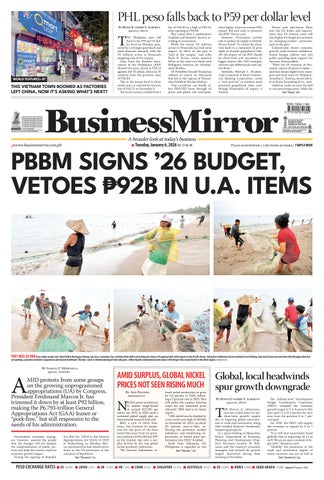
THEY REEL AS ONE Even under steady rain, fisherfolk in Barangay Sabang, San Jose, Camarines Sur, continue their daily catch along the shores of Lagonoy Gulf, which opens to the Pacific Ocean. Using the traditional sinsoro method of net fishing, they haul in barrera and other fish through collective net-pulling, a practice rooted in cooperation and shared livelihood. The day’s catch is divided among all who take part, reflecting the community-based nature of fishing in this coastal town in the Bicol region. BERNARD TESTA
A
By Samuel P. Medenilla @sam_medenilla
MID protests from some groups on the growing unprogrammed appropriations (UA) by Congress, President Ferdinand Marcos Jr. has trimmed it down by at least P92 billion, making the P6.793-trillion General Appropriations Act (GAA) leaner or “pork-free,” but still responsive to the needs of his administration. Government economic managers, however, assured the people that the changes will not hamper the implementation of public services and help the country reach its economic growth targets. During the signing of Republic
Act (RA) No. 12314 or the General Appropriations Act (GAA) of 2026 in Malacañang on Monday, Marcos announced he had vetoed seven items in the UA provisions of the said piece of legislation. See “Budget,” A2
AMID SURPLUS, GLOBAL NICKEL PRICES NOT SEEN RISING MUCH By Ada Pelonia
N
@adapelonia
ICKEL prices are forecast to remain range-bound at around $15,500 per metric ton (MT) in 2026 amid a sustained global supply glut, an international research firm said. BMI, a unit of Fitch Solutions, has lowered its projection for the price of the base metal this year from its previous outlook of $16,000 per MT, as the market tips into a surplus driven by the top global nickel producer, Indonesia. “We forecast Indonesian re-
fined nickel production to grow by 9.8 percent in 2026, following a 9 percent rise in 2025. This will widen the surplus, limiting scope for any sustained price rebound,” BMI said in its latest report. “LME nickel stocks climbed to a new multi‑year high of 243.6kt on December 16, 2025, up about 50 percent year‑to‑date, reflecting the persistent market imbalance and reinforcing expectations of muted price performance into 2026,” it added. Aside from Indonesia, the Philippines is regarded as one See “Nickel,” A2
Global, local headwinds spur growth downgrade By Reine Juvierre S. Alberto
T
@reine_alberto
HE Marcos Jr. administration has scaled down its medium-term growth targets due to lingering global uncertainties in trade and investment, along with residual domestic headwinds, tempering prospects. In a press briefing at Malacañan Palace, Department of Economy, Planning and Development (DepDev) Secretary Arsenio M. Balisacan said the country’s economic managers had revised the growth targets downward during their meeting in December.
The Cabinet-level Development Budget Coordination Committee (DBCC) trimmed the economic growth target to 5 to 6 percent this year and 5.5 to 6.5 percent for next year from the previous 6 to 7 percent goal. For 2028, the DBCC still targets the economy to expand by 6 to 7 percent. “It is still that uncertainty faced globally that is impacting on us as well. We are an open economy to begin with,” Balisacan said. “Globally, the pessimism in the trade and investment regime of many countries was not as bad as See “Growth,” A9
PESO EXCHANGE RATES n US 58.8740 n JAPAN 0.3757 n UK 79.3033 n HK 7.5569 n CHINA 8.4252 n SINGAPORE 45.7914 n AUSTRALIA 39.3337 n EU 69.0415 n KOREA 0.0408 n SAUDI ARABIA 15.6985 Source: BSP (January 5, 2026)
News
BusinessMirror
A2 Tuesday, January 6, 2026
’26 budget signing signals better food production—DA By Ada Pelonia
Agriculture Secretary Francisco Tiu Laurel Jr. said the increased outlay, especially for infrastructure, farming support and postharvest facilities, could enhance productivity, reduce losses, and stabilize supply. He added that investments in farm-to-market roads (FMRs), irriga-
tion systems, storage, and cold chain facilities remain critical to raising farmer incomes while keeping consumer prices stable. However, the DA chief raised a caveat that the real impact will depend on the final details of the General Appropriations Act (GAA), which still
need careful review. “I haven’t seen the actual GAA in its entirety, so it’s difficult to comment on all the details,” Tiu Laurel said. “We’re happy that the budget has finally been released, but we still need to review what the final version entails.” Earlier, the DA received additional funding earmarked for its programs from the canceled flood control projects. This came from the House of Representatives, which realigned the P255 billion originally allotted for flood control projects of the Department of Public Works and Highways (DPWH). The budget for FMRs has been doubled to P33 billion, while the Rice Competitiveness Enhancement Fund (RCEF) has been tripled to P30 billion. A P20-billion allocation will also fund the new Animal Industry Competitiveness Act. Tiu Laurel stressed that proper scrutiny should be observed to ensure
Nickel…
donesia, and Japan. The research firm, however, noted that certain factors could present a downside risk to global refined nickel production that could “partially offset” the surplus and support prices. “Persistent policy turbulence in
Indonesia presents the risk of weaker-than-expected domestic growth. Through 2025, the government rolled out stringent measures to speed the shift to higher‑value downstream production and reinforce a firmer floor under global prices.” Citing reports, BMI noted that
T
@adapelonia
HE Department of Agriculture (DA) said the signing of the P6.79trillion national budget for 2026, with higher allocation for the farm sector, signals a boost for food production, rural development, and long-term food security.
Continued from A1
the top nickel ore producers in the world. Mining firms ship nickel ore to various countries like China, In-
funds reach farmers, fisherfolk, and other stakeholders across the value chain. He added that public spending should translate into tangible benefits on the ground, and not remain on paper. The DA chief also highlighted the importance of aligning budget priorities with ongoing reforms, including modernization, climate resilience, and food security. Postharvest support remains a key focus, addressing losses from insufficient storage and logistics, Tiu Laurel said. “The 2026 budget is expected to help the sector withstand climate risks, market volatility, and supply disruptions while supporting a more competitive and sustainable Philippine agriculture.”
Indonesia plans to cut its 2026 nickel mining quota, thus “setting the stage” for continued constraints this year. The research firm added: “Weak global prices combined with Indonesia’s structural cost advantage continue to squeeze producers elsewhere, driving widespread closures and project suspensions in recent years—a trend set to continue into 2026.” With these factors, the BMI said it expects prices to “remain subdued” but better supported than the previous downcycles, “with the surplus widening at a more modest pace in 2026 than in recent years.” Furthermore, the firm noted that stronger demand could help buoy quotations for the base metal, propelled mainly by China. “We expect global nickel demand growth to accelerate to 5.4 percent in 2026 from 3.6 percent in 2025, helped by improving macroeconomic conditions, solid consumption in sectors aligned with the net-zero transition, and stable growth in the stainless steel market,” the BMI said. The research firm said China will remain the primary driver of demand growth in 2026, as it did in the previous year. It added that the country’s stainless-steel output proved resilient in 2024, up by 7.5 percent annually to 39.4 million metric tons (MMT) from 36.7 MMT in 2023. BMI said momentum has carried into 2025, which could likely extend into this year. “Ongoing stainless steel momentum will bolster primary nickel demand, driven by a shift toward higher-end manufacturing, resilient finished‑goods exports, and policy‑led industry upgrading.”
Forum…
Continued from A12
from December 15 to New Year’s Eve, with tourists drawn to its cool weather, festive lights, and seasonal sound-and-light shows. “The strength of domestic tourism in the Philippines remains a driving force of our travel industry. The Christmas holidays once again showed how Filipinos continue to explore and support our own destinations,” said Frasco. “From ridge to reef, cities to heritage towns, domestic travel helps communities recover and thrive, boosts the economy, deepens national pride, and supports more equitable tourism development across our regions,” she added.
www.businessmirror.com.ph
Budget…
Continued from A1
“To ensure that public funds are expended in clear service of national interests, I vetoed several items of appropriations with their purposes and corresponding Special Provisions under the UA, totaling almost P92.5 billion,” he said. The Bicameral Conference Committee allocated P243 billion for unprogrammed appropriations under the 2026 GAA. Budget watchdogs have opposed the large amounts of unprogrammed appropriations in the GAA since they claimed it is misused by lawmakers. The latest GAA is facing greater scrutiny compared to those from previous years after the chief executive said in his fourth State of the Nation Address (SONA) that he will veto it if it contained provisions, which are not aligned with the 2026 National Expenditure Program.
Critical juncture
MARCOS said the passage of the 2026 GAA comes at a critical juncture of his administration as it pushed for the implementation of its mediumterm development plan and “on the cusp of sweeping reforms in politics and in governance.” “The 2026 National Budget shall sustain our momentum in education reform, in health protection, in food security, in social security, and in job creation,” he said. “We will prioritize social services that enhance the quality of life of every Filipino, safeguard the welfare of all sectors, and foster human capital development,” he added. Under the 2026 GAA, education got the highest allocation— amounting to over P1.34 trillion. The Marcos administration will also be spending P448.125 billion for health, P297.102 billion for agriculture, and P270.189 billion for social services this year. The allocation for health, he said, will include the P129.8 billion for the Philippine Health Insurance Corporation (PhiHealth). Of this amount, P60 billion was directed by the Supreme Court to be returned to the state insurer after it was transferred to the national treasury. Department of Economy, Planning, and Development (DEPDev) Secretary Arsenio M. Balisacan said the newly passed 2026 GAA will support the country in achieving its 5 to 6 percent economic growth target this year.
Responsible fund utilization
MARCOS has vowed to make utilization of the 2026 GAA more transparent and compliant with the law after he flagged several provisions of the national budget last year. This prompted him to veto almost P200 billion worth of unprogrammed appropriations of the 2025 GAA, which were mostly lodged by lawmakers in the budget of the Department of Public Works and Highways. Programs under the UA get funding when the government exceeds its revenue collection targets or secures the needed grants or foreign funds for them. Marcos said he will no longer allow UA to be “misused or treated as a backdoor for discretionary spending.” “Its utilization is provided with safeguards and is only available when clearly defined triggers and tests are met and will be released only after careful validation,” he said. The chief executive said they will now also strictly enforce the law barring politicians from participating in the distribution of any financial aid to ensure such aid reaches its intended beneficiaries without patronage. RA 12314 also greatly reduced the budget allocation for Congress to P38.6 billion from P50 billion last year amid reports that lawmakers and Cabinet members allegedly receive excessive bonuses.
Vetoed items
MARCOS said these reforms were necessary after he initiated the investigation on flood control projects anomalies last year, which exposed widespread corruption in the government resulting in several public protests. “And so as we enter this year, let
us take this opportunity to start moving forward with difficult but needed reforms in governance to rebuild the trust in us, to strengthen accountability, and deliver an honest and effective government to the Filipinos,” Marcos said. To address public outrage on UAs, Marcos decided to reduce its allocations in RA 12314 to its “absolute bare minimum.” “This shall be at a level lowest since 2019,” he said. According to the Department of Budget and Management, the following amounts were vetoed from the UA provisions of the 2026 GAA: P6.90 billion budgetary support for Government-Owned and/or Controlled Corporations (GOCC); P14.62 million revenue shares of the local government units from previous years; and P2 billion for the Insurance of the Government Assets and Interests. The list also includes P4.32 billion Fiscal Support Arrearages for Comprehensive Automotive Resurgence Strategy (CARS) as well as the P250 million for the Revitalizing the Automotive Industry for Competitiveness Enhancement (RACE) Program. CARS and its updated version, RACE, are programs of the Department of Trade and Industry, which aims to promote local car assembly. The biggest of the vetoed amount was the P43.25 billion for the payment of Personnel Services (PS) Requirements, which was flagged by the ACT Teachers Party-list for supposedly being done to accommodate LGU initiatives. The reclassification was also condemned by the Public Services Labor Independent Confederation (PSLINK) since it puts the benefits of public servants at risk of being unfunded.
Retained UAs
DEPARTMENT of Budget and Management (DBM) Acting Secretary Rolando U. Toledo assured the P43.25 billion for PS were already included in the budget of the concerned government agencies. “It is mandatory to settle those... because those are already earned already as their benefits, so, that should be put in the proper place which is already programmed in the specific agency budget,” Toledo said in a press briefing in Malacañang on Monday. Acting Executive Secretary Ralph G. Recto said only three UA items remain in the 2026 GAA with a total worth of P150 billion. These are the Support to ForeignAssisted Projects (P97.3 billion); Revised Armed Forces of the Philippines Modernization Program (P50 billion); and Risk Management Program (P3.6 billion). The signing ceremony was initially scheduled last week, but was moved to a latter date to give the President more time to review the provisions of the said piece of legislation. The ratified version of the 2026 GAA was submitted by the Bicameral Conference Committee to the Office of the President on 29 December 2025. The 2026 GAA is the first national budget, wherein the deliberations of the Bicameral Conference Committee were livestreamed as part of government efforts to make the budget-crafting process more transparent.
Budget guidelines
THE signing ceremony was initially scheduled last week to prevent a reenacted 2025 budget this year, which will result in some government programs unfunded. It was moved to a latter date to give the President more time to review the provisions of the said piece of legislation. This resulted in an re-enacted budget until January 4, 2026. “In this regard, the DBM shall consider the expenditures lawfully incurred under the re-enacted budget in formulating its fund release for the guidelines of FY 2026,” Marcos said. The ratified version of the 2026 GAA was submitted by the Bicameral Conference Committee to the Office of the President on December 29, 2025. The 2026 GAA is the first national budget wherein the deliberations of the Bicameral Conference Committee were livestreamed as part of government efforts to make the budgetcrafting process more transparent.
www.businessmirror.com.ph
Tuesday, January 6, 2026
‘The Startup Architect’ By Henry J. Schumacher
Senators welcome GAA signing, House vows oversight By Butch Fernandez @butchfBM
& Jovee Marie N. dela Cruz
I
WOULD like to start 2026 with the successful story of Susanne Klatten, called ‘The Star tup Architect.’ Why? Her success could and should be copied in the Philippines! Here is her story: Entrepreneur Susanne Klatten has created a German ecosystem for entrepreneurship and innovation with UnternehmerTUM. The campus is a model for all of Europe and hopefully also for the Philippines. For a machine room, things at the Munich Urban Colab are remarkably human. In the light-filled rooms, students, enthusiastic about founding companies, meet to work together on refining their projects. They seek advice from successful businesses. Innovations and new business models are discussed. On the terrace, in one of the many coffee kitchens, or in the restaurant “Flash Gordon”—everywhere, conversations revolve around “the next big thing.” The initiative, which the German entrepreneur launched more than 20 years ago, has developed into a veritable startup machine. A machine that has produced more than 1,000 new companies since 2002. And today, with its 17,000 participants each year and a wide variety of courses annually, it generates more young companies than any other tech incubator. Her mission: “I want to strengthen people in their abilities—to create fertile ground on which new things can grow.” Susanne Klatten embodies an
@joveemarie
S entrepreneurial mindset that combines economic responsibility with social commitment. With UnternehmerTUM, she has created a leading center for innovation and entrepreneurship that sustainably shapes the entrepreneurial spirit in Europe. She sees herself as an enabler— and invested around €200,000 (12 million Pesos) in start-up capital, In the meantime, the five-person team that loitered outside lecture halls in the early 2000s, handing out flyers for business plan workshops, has grown into a major operation: With around €50 million (3 billion Pesos) in annual revenue, more than 500 employees, and impressive productivity, the hip machine in Munich produces two start-ups every week. Twenty-two professionals from corporations and start-ups—many of whom now have their own UnternehmerTUM biographies— contribute their experience, and not infrequently their money as well, when they become enthusiastic about an idea. See “Startup,” A9
A3
EN. Erwin Tulfo on Monday lauded President Marcos’ veto of P92.5 billion worth of projects under the unprogrammed appropriations even as he welcomed the signing of the P6.793-trillion budget for fiscal year 2026. “We welcome President Marcos’ signing of the 2026 General Appropriations Act, which we believe is the most transparent budget law in the recent history,” Tulfo said in a statement. “This is what we need, a budget that will restore the public’s trust to the government. We are grateful that the President heeded our call to limit the use of unprogrammed appropriations and vetoed P92.5 billion wor th of projects lodged under this budgetary mechanism,” he added. Tulfo, who serves as vice chairman of the Senate Committee on Finance, earlier questioned the bicameral conference committee’s retention of P243 billion in unprogrammed appropriations under the final version of the 2026 budget bill, warning that such funds could be susceptible to misuse. Tulfo had previously pointed out that these unprogrammed funds were linked in the ghost flood control projects and other questionable infrastructure programs. Executive Secretary Ralph Recto said among the items included in the P92.5 billion vetoed items in unprogrammed funds is the P80.8 billion “lump sum” for the Strengthening Assistance for Government Infrastructure and Social Programs (Sagip). “President Marcos’ decision to veto several
items under the unprogrammed funds is just a step toward full and real accountability,” Tulfo said. The neophyte senator then underscored that passing the 2026 Budget signals the start of their oversight functions, saying: “While the Senate and House of Representatives were able to push for transparency features such as accessible budget portals and live streaming of the Bicam for this year’s budget, we carry the huge responsibility to ensure that every single peso is for the benefit of the Filipino. We will be on the lookout on how every project will be accomplished so there will be no more unfinished or substandard projects in the future. This is only the beginning of a genunie reform in the government.”
Education programs
SEN. Paolo Benigno Aquino IV welcomed the signing of the 2026 national budget into law, saying it ensures that vital education programs, such as the construction of classrooms and the implementation of the school-based feeding program, will be adequately funded and properly implemented. “The Filipino youth are winners in the approved 2026 national budget. Through this, we can now fund and implement properly the vital programs that will boost and strengthen the education sector,” Aquino, chairperson of the Senate Committee on Basic Education, said partly in Filipino. “There are funds to build classrooms, a bigger budget for the school-based feeding program and free college, and other vital support for learners to ensure they can study better,” he added. The P1.34-trillion education budget—the largest in the country’s history—allocates P68 billion for the
construction of new classrooms and P25.6 billion for the expansion of the SchoolBased Feeding Program. The budget also earmarks P67 billion for the implementation of Republic Act 10931, or the Free College Law. In addition, it adopts Aquino’s proposal for the allocation of P500 million under the Maintenance and Other Operating Expenses (MOOE) of the Higher Education Development Program, specifically allotted for financial support for Related Learning Experience (RLE) requirements of students in allied health sciences programs. Students set to benefit from this funding include those in allied health sciences programs, such as Nursing, Medical Technology/Medical Laboratory Science, Pharmacy, Physical Therapy, Occupational Therapy, Respiratory Therapy, Radiologic Technology, Midwifery, Nutrition and Dietetics, Speech-Language Pathology, Human Biology/Pre-Med Allied Programs, Dentistry, Biochemistry, and Psychology.
Speaker vows strict oversight
FOLLOWING the enactment of the P6.793trillion 2026 General Appropriations Act (GAA), the House of Representatives leadership on Monday vowed to enforce strict congressional oversight to ensure that public funds are spent lawfully, efficiently, and with zero tolerance for corruption. Speaker Faustino G. Dy III welcomed the newly signed budget as a genuine “People’s Budget,” stressing that Congress’ role does not end with its passage. “There will be zero tolerance for corruption. No leakages, no shortcuts, and no excuses. The people’s money must be used for the benefit of the public,” he said. “The signing of the budget is not the
end of our work. This is just the beginning. It is the start of oversight. Congress will make sure every peso is spent exactly as approved,” Dy added. Dy described the 2026 GAA as an inclusive, transparent, and accountable spending program that prioritizes the needs of Filipinos and reflects the administration’s commitment to ensure that public funds directly benefit the people. “This is the People’s Budget. It is a budget that is open, accountable, and focused on improving lives—creating jobs, strengthening education, expanding health care, and ensuring food security,” Dy said. “This reflects the President’s clear direction that public funds must be used responsibly and felt by the people,” he said. The Speaker said the 2026 budget delivers tangible gains across key social sectors, with substantial investments in education, health, and social protection, while maintaining fiscal discipline to safeguard the country’s financial stability. Par ty-list Rep. Rodolfo “Ompong” Ordanes of Senior Citizen also welcomed the budget signing, emphasizing that the President’s veto and conditional approvals demonstrate responsiveness to the needs of vulnerable sectors. “The veto of nearly P92.5 billion is a positive step toward restoring public trust in government. I also welcome the conditional approval of budget items, including those for senior citizens,” Ordanes said. He underscored that the safeguards put in place will help ensure that funds intended for seniors and other vulnerable groups are implemented properly and free from political manipulation. See “GAA,” A9
Tuesday, January 6, 2026
A4
www.businessmirror.com.ph
Cops arrest retired general Poquiz on sedition raps By Rex Anthony Naval
R
ETIRED military general Romeo Poquiz was arrested on charges of inciting to sedition on Monday. In a press briefing in Camp Crame, the National Police (PNP) acting Chief Lt. Gen. Jose Melencio Nartatez Jr., said Poquiz was arrested upon his arrival at the Ninoy Aquino International Airport, Terminal 3 in Pasay City from Bangkok, Thailand. Poquiz has a standing arrest warrant issued by Branch 77 of the Quezon City Regional Trial Court on December 5, 2025, for
inciting to sedition, a case which stemmed from his earlier call for the Armed Forces to rise against the government during anticorruption rallies in November last year. Poquiz’s lawyers criticized the police over the arrest, but Nartatez said the legal process was observed during the implementation of the warrant. “The case was investigated and pieces of evidence were referred and forwarded to the prosecution, and the court found probable cause. This was a result of the work of the prosecution service and now, he will be tried. That’s the process, there’s nothing
personal,” he said. Poquiz, meanwhile, said the police force will follow due process and enforce the law “without fear or favor.” Poquiz underwent booking procedures in Camp Crame after his arrest and is expected to be presented to the court that issued the arrest warrant. The court set a bail of P48,000 for Poquiz’s temporary liberty, according to his legal counsel Ferdinand Topacio. “Mariin naming kinukundena ni retired general Virgilio Garcia na isa ring tumatayo bilang abogado ni General Poquiz ang
paglabag sa karapatan ng aming kliyente [I and retired general Virgilio Garcia, who is also acting as the lawyer of General Poquiz strongly condemn the violation of our client’s rights]. Kanina, sa airport [Earlier, at the airport], repeatedly, we demanded that the police respect our rights as lawyers to confer with our client. Pero, hindi kami pinagbigyan. Biglang itinakbo dito [But, we were not granted. Suddenly, he was taken here in a hurry]. We will make the people responsible to account for the violation of the rights of our client,” Topacio told reporters in a brief interview at Camp Crame.
Singson asks AFP’s Brawner: Speak out on corruption By Jovee Marie N. dela Cruz @joveemarie
F
ORMER Ilocos Sur governor Luis “Chavit” Singson on Monday called on the Armed Forces (AFP) Chief of Staff, Gen. Romeo Brawner Jr. to publicly take a stand against what he described as “massive and systemic corruption” undermining the country. In an open letter to Brawner, which he read in a news conference, Singson said he was writing “not as a political figure, but as a Filipino” who has witnessed wars, coups, dictatorships, and revolutions, warning that the Philippines is once again facing national collapse—not due to foreign aggression, but because of internal decay. Singson, who is known to have close ties with China, said: “The enemy is not foreign. The enemy is inside our own home,” arguing that corruption, not China, poses the gravest threat to the nation. He criticized what he described as an overemphasis on external security threats, particularly tensions involving China and Taiwan, while domestic problems worsened. “How can China be the problem when it is not China stealing billions from our national budget?” Singson asked, adding that economic hardship faced by ordinary Filipinos is the result of “greed and incompetence,” not foreign interference. Singson quickly denied claims that foreign powers, particularly China, are
behind the country’s current problems. “China is not behind this. I have not spoken to anyone from China,” he said, stressing that the crisis is homegrown. In his letter, Singson urged Brawner to make a public declaration against graft and corruption, stressing that such a move would not violate the Constitution nor undermine civilian authority. “Today, silence is no longer neutral. Silence is taking sides,” he said. Avoiding legal complications like a criminal complaint for sedition, Singson said: “At a time like this, your role becomes critical. I am not asking you to violate the Constitution. I am not asking you to remove the President. What I ask is far simpler and far braver: announce your stand against graft and corruption in a public place,” he said. Singson warned that history would judge military leaders harshly if they failed to act, asking where the AFP leadership would be remembered to have stood “when the nation was drowning in corruption.” In the carefully managed news conference, the former governor also floated the idea of a “one-time, big-time rally,” saying he is reaching out to religious organizations and various groups opposed to corruption. He said plans are being considered for amarch to Malacañang, although no specific date has been set. Singson, who is known for his close ties with the Dutertes, also mentioned the
possibility of a snap election but clarified that he remains neutral and does not support any particular political faction. He said he places his trust in the Supreme Court and religious groups to help determine what kind of government the country should have moving forward. At the same time, Singson denied allegations that he profited from a land deal or misused public funds, dismissing the graft and plunder complaints filed against him as “baseless, malicious, and politically motivated.” The complaints were lodged before the Office of the Ombudsman by Warriors Ti Narvacan, Inc., an organization based in Ilocos Sur, that advocates good governance and public accountability.
Palace: No let up in flood control investigations
MALACAÑANG said President Marcos will not stop any investigation on the alleged anomalous flood control projects in his home province in Ilocos Norte. Palace Press Office Claire Castro issued the statement after former Singson called out the administration for its supposed failure to look into the matter. “ I nve s t i g ate w h at n e e d s to b e investigated, that’s the President’s order,” Castro said in Filipino. Last month, the Palace already said it is open to conducting lifestyle checks
for Ilocos Norte Rep. Ferdinand Alexander Ferdinand Marcos III and other members of the first family to disprove their involvement in public works irregularities. A report by the Philippine Center for Investigative Journalism (PCIJ) tagged the district of the lawmaker among the main beneficiaries of the allocable funds from the Department of Public Works and Highways (DPWH) from 2022 to 2025. The young Marcos has gone to Independent Commission for Infrastructure (ICI) to explain his side on the matter on December 4, 2025. Singson claimed the President only launched his campaign against anomalous flood control projects to make himself appear like a “hero,” while also being involved in corruption. Castro denied the said claims of Singson saying the Chief Executive was only performing his mandate. “The President is not being heroic, but rather it is his obligation to clean up this government for the people. Because of the President’s fight against corruption that affects many of them, they are trying to taint the President’s achievements and plans,” she said in Filipino. As to Singson’s challenge to have a debate with Marcos on government corruption, Castro said the President would rather focus on actions rather than engaging with such provocation. With Samuel P. Medenilla
Navy’s expansion on track
A
RANKING Nav y (PN) official on Monday said the service’s fleet expansion is going well with the acquisition and commissioning of major surface combatants that has bolstered its defensive capabilities. The PN spokesperson for the West Philippine Sea (WPS), Rear Adm. Roy Vincent Trinidad, was referring to the commissioning of the two Miguel Malvarclass guided missile frigates and Acero-class fast-attack interdiction craft last year. He said acquisition of these floating assets showcases the PN’s ongoing fleet expansion. Trinidad earlier said the arrival of the Miguel Malvar-class frigates in PN service will add to the “capital ships of the Navy that [are] capable of patrolling all the way up to our EEZ [exclusive economic
zone] and even beyond.” He said these vessels are the most modern in the PN to date. The BRP Miguel Malvar (FFG-06) was commissioned last May 20 along with the BRP Albert Majini (PG-909) at Naval Operating Base Subic in Zambales. Commissioning of these two ships coincided with the PN’s 127th founding anniversary. Meanwhile, the BRP Diego Silang (FFG07) was commissioned in the facility on Dec. 2 last year. The Miguel Malvar- class guidedmissile frigate displaces 3,200 gross tons and it is armed with a 76mm Oto Melara main gun, C-Star-sur face -to-sur face missiles and Blue Shark anti-submarine torpedoes. It is capable of speeds up to 28 knots.
However, the Criminal Investigation and Detection Group-National Capital Region (CIDG-NCR) director, Col. John Guiagui told reporters that Topacio and the other lawyers were not at the airport when Poquiz arrived as his flight arrived earlier that scheduled. The plane came in from Thailand t 8:11 a.m. Although it estimated time of arrival was 8.30 a.m., Guiagui said, adding, “we read him his Miranda Rights. We informed him of the warrant of arrest for inciting to sedition, which was issued by the Quezon City Regional Trial Court 77.” “They [lawyers] were the ones who were not
Cops on alert for protest actions at US Embassy
T
HE acting National Police (PNP) Chief, Lt. Gen. Jose Melencio Nartatez, on Monday said police units are now closely monitoring the United States Embassy in Manila and other critical areas for possible protests against US military operations in Venezuela. Nartatez, in a statement, said PNP units are now on standby to monitor potential demonstrations at sensitive locations and ensure that they remain orderly and peaceful as he stressed that public safety remains the PNP’s top priority. “We are prepared for any protest action and similar activities. Our police units, especially in Metro Manila and other urban areas, are monitoring the situation in their respective areas and ready to respond to any eventuality,” he added. The US military launched a large-scale military operation against Venezuela on January 3, involving airstrikes and ground action that resulted in the arrest of President Nicolás Maduro and
@jonlmayuga
and commissioned in 2020 and 2021. Meanwhile, BRP Albert Majini, the eighth Acero-class FAIC-M, is the first locally assembled missile-capable patrol vessel in the country. It is part of a nine-ship order from Israel Shipyards Ltd; the contract was signed in February 2021. These ships displace 95 gross tons and have a speed of 40 knots and are armed with automatic cannons and machine guns. Four out the eight ships in service are armed with the Spike NLOS (Non-Line-of-Sight) missiles. Named after Medal of Valor awardee Ensign Albert Majini, the ship honors his gallantry during anti-piracy operations in Basilan in 1980. BRP Albert Majini is built for rapid interdiction and coastal operations under the PN’s Littoral Combat Force. PNA
his wife on drug-trafficking and terrorism charges filed against them in the US. Maduro and his wife, Cilia Flores, are now detained in a Drug Enforcement Agency facility in New York, awaiting trial. Nartatez has instructed all local police units, especially the Manila Police District and the National Capital Region Police Office, to remain vigilant and maintain close coordination with local government units and barangay officials to monitor the security situation in strategic locations. Intelligence units have also been tasked to monitor social media and public forums for any potential protest plans or security threats. A senior official at the PNP National Headquarters, Camp Rafael T. Crame, Quezon City, expressed surprise over the anti-US reaction of local activists, saying that the Venezuelans, as proven by photographs posted on social media, erupted in celebration following Maduro’s arrest. Rex Anthony Naval
Mayon still restive, Caap warns pilots By Jonathan L. Mayuga
It is also the first ship class in the PN to be equipped with a vertical launch system (VLS) capable of firing surface-to-air missiles that can neutralize air threats. VLS is an advanced system for storing and firing missiles aboard naval vessels. The VLS system mounted in the BRP Miguel Malvar and BRP Diego Silang has 16 tubes and is optimized for surface-to-air engagements. The Department of National Defense, then under Secretary Delfin Lorenzana, and South Korean shipbuilder HD Hyundai Heavy Industries (HD HHI) signed the P28-billion contrac t for the Miguel Malvar-class guided-missile frigates on Dec. 28, 2021. The ships were acquired from HD HHI like its predecessor, the two Jose Rizal-class guided missile frigates that were delivered
in the area. They arrived late. Actually, I asked General Poquiz’s liaison officer for his lawyer because they are not around during that time.” “The plane was already there, General Poquiz has arrived, we had to go up to serve the warrant.” POQUIZ posted P48,000 bail soon after he was presented by the National Police Criminal Investigation and Detection to Branch 77 of the RTC in Quezon City, which ordered his arrest. Judge Rodrigo Pascua Jr. issued Poquiz’s release order soon after he posted the bail for his temporary liberty.
T
HE Philippine Institute of Volcanology and Seismology h a s a d v i s e d a f f e c te d l o c a l governments around restive Mayon Volcano to remain vigilant and be prepared for emergency evacuation as it maintained the alert level at Alert Level 2, indicating an increasing-moderate level of unrest. This as the Civil Aviation Authority of the Philippines extended for another 24 hours ending at 9:00 a.m. Tuesday morning its Notice to Airmen (Notam) covering flights in the vicinity of Mayon Volcano and Kanlaon Volcano, with vertical limits from the surface up to 11,000 feet. The Notam advised pilots to avoid flying close to the two volcanos. Phivolcs Director Teresito Bacolcol said the agency recorded 43 rockfall events at Mayon Volcano from 12 a.m. Jan. 1 to 12 a.m. Jan. 2, slightly lower than the 47 events recorded from Dec. 31, 2025, to Jan. 1. The latest alert status came following an increased rockfall event caused by the upward movement of hot material inside the volcano, which destabilizes the summit
dome and older lava deposits. Because of Mayon’s steep slopes, these materials easily break off, resulting in rockfall events, Bacolcol said. Such unrest could lead to increased rockfalls and pyroclastic density currents, but for now, Phivolcs said increasing the alert level by another notch is not likely. Nevertheless, Phivolcs advised local governments of areas around the volcano to prepare communities within the so-called “hazard zone” for subsequent evacuation in case unrest suddenly escalates and the alert level is further raised. Civil aviation authorities must also advise pilots to avoid flying close to the volcano’s summit as ash and ballistic fragments from any sudden eruption can be hazardous to aircraft. In its Notam, Caap “strongly” cautioned pilots against flying near the volcanos, as volcanic ash from possible sudden phreatic eruptions poses a serious hazard to aircraft safety. Caap said it continues to closely coordinate with relevant government agencies and reminds all air operators to strictly comply with all issued Notams.
Tuesday, January 6, 2026
Boracay Water expands sewer network as demand increases By Jonathan L. Mayuga @jonlmayuga
T
O meet the increasing wastewater management needs driven by continuous development in Boracay, Boracay Water has expanded its sewer network coverage in Barangays Balabag and portions of Barangay Yapak on Boracay Island. The project adheres to Republic Act 9275, also known as the Philippine Clean Water Act, and Presidential Decree No. 856, also referred to as the Sanitation Code of the Philippines. Additionally, it supports the Local Government of Malay’s Municipal Ordinance No. 550, which mandates sewer connection within 100 meters of an available sewer network. As a result of this expansion, sewer coverage on Boracay Island increased from 61% to 67%, significantly improving the volume of wastewater treated. Also, through Boracay Water’s free sewer connection program Project Monsoon, 230 households or accounts, representing approximately 1,150 individuals, have connected to the sewer system, ensuring proper wastewater disposal and treatment. The project also enabled Boracay Water to
accommodate wastewater flows from Yapak and Balabag, achieving a remarkable 493% increase in connected accounts, from 30 accounts in December 2024 to 178 in October 2025. This milestone underscores Boracay Water’s dedication to supporting sustainable tourism and safeguarding the island’s natural resources. “Boracay Water remains steadfast in its mission to provide effective water and wastewater services while protecting the island’s natural beauty and ensuring long-term sustainability,” said Joanna Intas, Acting General Manager of Boracay Water. “By expanding our sewer network, we not only help maintain the pristine condition of Boracay for tourism but also provide customers with the assurance that their wastewater is properly treated in our sewer treatment plants. This means cleaner surroundings, improved public health, and a safer environment for residents and visitors alike,” she added. Boracay Water is an operating unit of Manila Water Non-East Zone subsidiary Manila Water Philippine Ventures and a concessionaire of the Tourism Infrastructure and Enterprise Zone Authority.
All safe as Sunlight Air turboprop suffers nose gear tire deflation in Siquijor landing By Nonie Reyes @Nonielonlon
A
N AT75 Turboprop aircraft with registry number RP-C6683 operated by Sunlight Air experienced a nose landing gear tire deflation upon landing at Siquijor Airport from Mactan, Civil Aviation Authority of the Philippines (CAAP) said. The aircraft deviated from the runway centerline and came to a stop on the runway. All passengers and crew are safe, and no injuries were reported.
CA AP dispatched medical team to ensure that all passengers are safe due to the incident reported at Siquijor Airport January 5. “We have activated the standard airport safety and recovery procedures. The incident is now under assessment in coordination with the airline and relevant aviation authorities.” said CAAP Director General Retired Lt. Gen. Raul del Rosario C A A P rem a i ns com m itted to upholding the highest standards of aviation safety to protect passengers at all times.
DAR distributes 2,298 land titles in Eastern Visayas
T
HE Department of Agrarian Reform (DAR) has distributed a total of 2,298 individual land titles to 2,396 agrarian reform beneficiaries in Samar and Northern Samar. The distribution held at the Samar State University (SSU) in Catabalogan City was led by DAR Assistant Secretary for Special Concerns Office Rodolfo Castil Jr., who represented DAR Agrarian Reform Secretary Conrado M. Estrella III Castil said the distribution reinforces farmers’ ownership of the land they till and strengthens their livelihoods. The awarded titles were electronically generated under the Support to Parcelization of Lands for Individual Titling (SPLIT) Project, which fast-tracks land ownership and provides farmers with clear, legally recognized titles. In his message, Castil emphasized the importance of valuing land ownership and fulfilling the responsibilities that come with it. “Let us value what the government has given us and never forget our responsibilities. That is the only thing the government and those who worked hard to make this possible ask in return,” he said. DAR Eastern Visayas Regional Director, Atty. Robert Anthony Yu explained that holding distribution activities in the provinces reflects Secretary Estrella’s directive to bring government services closer to the people, ensuring faster and more accessible delivery of agrarian reform benefits. Of the total ARBs who received titles, 1,829
beneficiaries came from Samar, while 567 were from Northern Samar. The e-titles cover an aggregate area of 4,863 hectares of agricultural land, providing farmers with stronger tenure security, access to credit, and greater opportunities to invest in farm productivity. For many ARBs, the distribution marked the end of long years of uncertainty. Conrada Agte, 71, an ARB from Lope de Vega, Northern Samar, became emotional upon receiving her individual title after more than 30 years. “Thank you for finally giving me this document. Thank you so much,” she said. Another ARB, Rolando Danday, 42, a father of three from Majaba Island, Catbalogan City, described the land title as a long-awaited blessing. “This is a beautiful Christmas gift from the government. We have waited for this for a very long time,” he shared. Meanwhile, Atty. Jana Dumaliang, Regional Director of the Land Registration Authority-Registry of Deeds in Region 8, reaffirmed the agency’s full support to President Ferdinand R. Marcos Jr. and the DAR, noting that their office continues to render overtime work to ensure the timely issuance of e-titles. Yu added that the provision of land ownership to landless farmers contributes to the government’s End Local Communist Armed Conflict (ELCAC) initiative by addressing the roots of rural poverty and promoting inclusive and sustainable development in the countryside.
Holiday firework injuries fall to 720, marking 15% decrease, says DOH
A
TOTAL of 720 cases of firework-related injuries (FWRIs) were logged from December 21, 2025 to Jan. 5, 2026, the Department of Health (DOH) said on Monday. The DOH said that the cases recorded is 15 percent lower as compared to the 834 injuries in the same period of last year. Most of the injuries were caused by Kwitis, 5-star, Whistle Bomb,
Boga, and Piccolo. Meanwhile, the DOH reminded victims to seek immediate medical treatment and receive a tetanus shot to prevent this serious, potentially fatal, bacterial infection. Proper first aid for any wound, including washing hands and cleaning the injury with soap and water, is crucial. Claudeth Mocon-Ciriaco
A5
Torre takes helm of MMDA, vows to boost public safety, traffic flow By Claudeth Mocon-Ciriaco @claudethmc3
F
ORMER Philippine National Police chief and now Metropolitan Manila Development Authority (MMDA) General Manager Nicolas Torre III will lead initiatives related to public safety, flood control, traffic management and solid waste management in the National Capital Region, agency’s Chairman Romando Artes said on Monday. Torre will also serve as the spokesperson of MMDA. The MMDA welcomed Torre during its flag raising ceremony as its new general manager who committed to apply his extensive experience from the police force to his new phase of career in government service. Torre addressed personnel, expressing enthusiasm for joining t he agenc y a nd t ha n ked President Ferdinand Marcos Jr. for the trust in appointing him to MMDA. “I am excited to join the ranks of the people who keep the metropolis moving and keep the metropolis where we all live, dream, work and do business in, as my new career in government service. I do hope
that I will make the contribution expected of me in MMDA,” said Torre. In welcoming Torre, Artes encouraged the agency personnel to extend all support and assistance to him as he will take overall charge of the day-to-day operations of the MMDA under his direct supervision and guidance. “Torre will engage in discussions with Department of Public Works and Highways Secretary Vince Dizon to ensure that MMDA, through him, will be actively involved in all flood control projects in Metro Manila from initial planning stage to completion,” said Artes. The new general manager will also personally lead traffic management and enforcement efforts, as well as clearing operations, on major roads and waterways.
Three ‘Es’
HE also vowed to ensure the implementation of three “Es” of traffic management: engineering , educat ion, a nd enforcement, with the cooperation of stakeholders, to create a safer and more efficient traffic f low in major roads under the jurisdiction of the MMDA.
With Torre’s extensive experience in the police, he will be tasked to strengthen discipline among traffic enforcers and lead a unit that is involved in conducting internal investigation for misconduct and irregularities in the performance of their duties.
Edsa Rehab
ON Sunday, Torre led the inspection of the ongoing rehabilitation of portions of Edsa with DPWH and other concerned agencies. During Edsa rehabilitation, travel speed has remained low as one to two lanes were occupied for the 24-hour Edsa rehabilitation works, resulting in slow vehicle movement. “Since the innermost lanes of portions of Edsa have been repaired, travel along Edsa Busway has been observed faster and smoother,” said Artes. The repairs in other parts of Edsa will continue every 10 p.m. to 4 a.m. starting Monday (Jan.5).
MMDA personnel on Feast of the Black Nazarene
AROUND 1,000 personnel will be deployed by the MMDA for the Traslacion, or the Feast of the Black Nazarene on January 9.
Solon urges swift release of health workers’ pandemic allowance after budget signing By Jovee Marie Dela Cruz @joveemarie
F
OLLOWING the signing of the 2026 General Appropriations Act (GA A), the chairperson of the House Special Committee on Food Security on Monday called on the Department of Budget and Management (DBM) and the Department of Health (DOH) to swiftly release simplified guidelines for the disbursement of the Health Emergency Allowance (HEA) to healthcare workers who served during the COVID-19 pandemic. Albay 3rd District Rep. Raymond Adrian Salceda said the 2026 national budget, signed into law by President Marcos at Malacañang, includes P6.77 billion for Public Health Emergency Benefits and Allowances (PHEBA) for both health and non-healthcare personnel. “Now that the budget is in place, we need the DBM and DOH to act quickly. Our health workers have waited long enough. Perhaps we can simplify the process by accepting sworn affidavits from health workers confirming their eligibility and service,” Salceda said.
Under Salceda’s proposal, unpaid health workers would submit a sworn affidavit attesting to their eligibility, service period, and duties. DOH would validate the claims against available records, while DBM would process payments immediately, with the Commission on Audit (COA) conducting post-audit verification. “The current system is bogged down by documentation requirements that many health facilities simply cannot meet. Many claims remain pending due to missing or inconsistent facility documentation. The affidavit solution is meant to end this cycle of delay,” Salceda explained. Earlier, Salceda filed House Resolution No. 127, directing DBM and DOH to ensure full payment of HEA to all eligible workers, determine unpaid amounts, and include them in the 2026 budget. The resolution also asks for a detailed report on total obligations, payments made, unpaid balances, and funding sources within 30 days. Salceda expressed gratitude to Speaker Ferdinand Martin “Bojie” Dy and House Appropriations Committee Chair Mikaela Angela
Suansing for supporting his resolution and ensuring HEA funding was included in the final budget. “This is a debt we owe. That’s why we should expedite the revised guidelines. Our health workers risked their lives during the pandemic. They served at the front lines, faced heightened risk of infection, extended working hours, and significant physical and mental strain. The least we can do is ensure they receive the benefits they are entitled to under the law—and receive them promptly,” Salceda said. The HEA is mandated under Republic Act No. 11712, signed on 27 April 2022. It provides health workers a monthly allowance during a declared public health emergency, ranging from P3,000 to P9,000, depending on risk exposure. From 2020 to early 2025, DBM has released over P121 billion for PHEBA, including P27.453 billion in July 2024 to cover more than 5 million HEA claims and thousands of sickness and death compensation cases. Despite this, many claims remain pending due to recordkeeping issues.
SSC gets new ₧20-million, student dorm from BARMM By Manuel T. Cayon @awimailbox
D
AVAO CIT Y—The Sulu State College (SSC) of Patikul, Sulu received a surprising gift from the Bangsamoro government, a newly completed two-storey student dormitory, despite the province already dismembered from the autonomous region since last year. The dormitory was worth worth P20 million, and has a roof deck. The BARMM said its gift to the college was only meant to reinforce the region’s efforts to expand education-support infrastructure. It was handed on December 13 over by the Bangsamoro Ministry of Public Works (MPW) through its Sulu First District Engineering Office. Ajan S. Ajijul, district engineer of Sulu 1st DEO, said the project reflects the importance of coordination and partnership in delivering
sustainable, high-quality infrastructure that supports education. “This new dormitory stands as a powerful symbol of our connected commitment and hard work,” he said. SSC President, Prof. Charisma S. Ututalum, emphasized the importance of safe, accessible, and inclusive student housing, noting its role in promoting learning, wellbeing, and student success. Dr. Lora L. Yusi, director of the Office of Institutional Quality Assurance and Governance (OIQAG) of the Commission on Higher Education witnessed the turnover. In the capital city of Jolo, meantime, 52 scholars of the Bangsamoro technicalvocational program in Sulu completed their dressmaking course at the Hadji Butu School of Arts and Trades, marking the final batch of trainees in the province. The training was provided by the Ministr y of Basic, Higher, and Technical Education—Technical Education and Skills
Development (MBHTE-TESD) under its 2025 Bangsamoro Scholarship Program. Vocational School Superintendent II Rosema G. Lukman encouraged the graduates to maximize the skills they gained, saying, “You are the last batch of trainees under BARMM; I hope you apply what you have learned well.” Each graduate received P6,840 in cash allowance, along with a sack of rice and other welfare goods from the Ministry of Social Services and Development (MSSD). Of the 52 completers, 26 are members of the women-led Lindang MultiPurpose Association (LMPA), which signed a memorandum of agreement with MBHTE-TESD in May to empower its members and strengthen their livelihoods through technical-vocational education. LMPA President and graduate Marites Indanan expressed her gratitude to the Bangsamoro Government for the training and continued support.
Torre III said that the Manila police and the Manila city government will also help ensure that the celebration will be smooth and peaceful. Likewise, Torre said, they are closely coordinating with the Philippine National Police for the security plan. “Ang mga pasilidad, imprastraktura katulad ng mga rampa ay tiningnan natin. This is teamwork, a whole-of-government approach... At the end of the day, iisa ang misyon lahat ay nagko-contribute to achieve this mission,” Torre said as he inspected the Quirino Granstand where the traditional “Pahalik” will be held. Torre announced that there will also be some changes in the procession route the procession and details will be posted soon on the MMDA website. “May nakahanda din tayong rerouting, nakahanda” din ang ating mga alternate routes, he said. He also warned those who are planning to disrupt the celebration. “Sa mga gustong gumagawa ng di kaaya aya, wag nyo ng ituloy dahil hindi nga kaaya aya. The government is ready to respond to such,” Torre added.
92 Abu Sayyaf, NPAs surrender to Zambo cops
D
AVAO CITY—The Zamboanga police reported the surrender of an Abu Sayyaf fighter from Sulu and two New People’s Army guerrillas elsewhere in the peninsula adding to the 89 that have previously turned themselves in to the police in the last quarter of the year. The 33-years old male from Patikul, Sulu was the last anti-government combatant to surrender last year in the Zamboanga Peninsula. He brought along his World War 2-vintage M1 Garand when he turned himself to police at the Camp Col. Romeo A. Abendan regional command headquarters in Zamboanga City on December 25. The police said the Abu Sayyaf man has a warrant of arrest for kidnapping and serious illegal detention he allegedly committed in August 28, 2020 in Barangay Su-uh, Panamao, Sulu. He was also tagged number eight wanted person by the Philippine Drug Enforcement Agency. Almost two weeks earlier, on December 16 and December 17, a former New People’s Army fighter and a NPA supporter surrendered to police in Zamboanga del Sur and Zamboanga Sibugay, one of them a 67-year-old man who the Army said was formerly associated with the defunct Guerilla Front Kara of the Western Mindanao Regional Party Committee. He surrendered on December 17 to Lapuyan police station in Barangay Poblacion, Lapuyan, Zamboanga del Sur. The police said a supporter of the NPA also surrendered on December 16 in the municipality of Diplahan, Zamboanga Sibugay. Police said the surrenderee was a female, 59 years old, female and a resident of Barangay Guinoman, Diplahan. The police said female surrenderee told them she had been assigned with non-combat roles, including food preparation and support services. All in all, the Police Regional Office 9 said the three surrenders added up to the 89 former Abu Sayyaf and NPA fighters and supporters who surrendered months earlier. They also yielded their 33 assorted high and low-powered firearms, eight grenades, four rifle grenades, and 113 rounds of assorted ammunition. Manuel T. Cayon
A6
Tuesday, January 6, 2026
TheWorld
Editor: Angel R. Calso
US capture of Maduro divides a changed region, thrilling Trump’s allies and threatening his foes By Isabel Debre & Megan Janetsky
M
The Associated Press
EXICO CITY—In his celebratory news conference on the US capture of Venezuelan strongman leader Nicolás Maduro, President Donald Trump set out an extraordinarily forthright view of the use of US power in Latin America that exposed political divisions from Mexico to Argentina as Trump-friendly leaders rise across the region.
“American dominance in the Western Hemisphere will never be questioned again,” Trump proclaimed just hours before Maduro was perp-walked through the offices of the US Drug Enforcement Administration in New York. The scene marked a stunning culmination of months of escalation in Washington’s confrontation with Caracas that has reawakened memories of a past era of blatant US interventionism in the region. Since assuming off ice less than a year ago—and promptly renaming the Gulf of Mexico as the Gulf of America—Trump has launched boat strikes against alleged drug traffickers in the C a r i b b e a n , ord e re d a n av a l blockade on Venezuelan oil exports and meddled in elections in Honduras and Argentina. Through a combination of tar-
iffs, sanctions and military force, he has pressured Latin American leaders to advance his administration’s goals of combating drug trafficking, halting immigration, securing strategic natural resources and countering the influence of Russia and China. The new, aggressive foreign policy—which Trump now calls the “Donroe Doctrine,” in reference to 19th-century President James Monroe’s belief that the US should dominate its sphere of influence—has carved the hemisphere into allies and foes. “The Trump administration in multiple different ways has been trying to reshape Latin American politics,” said Gimena Sanchez, Andes director for the Washington Office on Latin America, a think tank. “They’re showing their teeth in the whole region.”
Reactions to US raid put regional divisions on display
SATURDAY’S dramatic events— i nc lud i ng Tr u mp’s vow t h at Washington would “run” Venezuela and seize control of its oil sector—galvanized opposite sides of the polarized continent. A rgentine President Jav ier Milei, Trump’s ideological soulmate, character ized one side as supporting “ democracy, the defense of life, freedom and property.” “On the other side,” he added, “are those accomplices of a narcoterrorist and bloody dictatorship that has been a cancer for our region.” Other right-wing leaders in South America similarly seized on Maduro’s ouster to declare their ideological affinity with Trump.
In Ecuador, conservative President Daniel Noboa issued a stern warning for all followers of Hugo Chávez, Maduro’s mentor and the founder of the Bolivarian revolution: “Your structure will completely collapse across the entire continent.” In Chile, where a presidential election last month marked by fears over Venezuelan immigration brought down the leftist government, far-right President-elect José Antonio Kast hailed the US raid as “great news for the region.” But left-wing presidents in Latin America—including Brazil’s Luiz Inácio Lula da Silva, Mexico’s Claudia Sheinbaum, Chile’s Gabriel Boric and Colombia’s Gustavo Petro—expressed grave concerns over what they saw as US bullying. See “Maduro,” A8
TheWorld
www.businessmirror.com.ph
Tuesday, January 6, 2026
A7
Trump says that Ukraine didn’t target Putin residence in drone strike as Kremlin claims By Darlene Superville & Aamer Madhani
A
The Associated Press
BOARD AIR FORCE ONE— President Donald Trump on Sunday told reporters that US officials have determined that Ukraine did not target a residence belonging to Russian President Vladimir Putin in a drone attack last week, disputing Kremlin claims that Trump had initially greeted with deep concern.
Russian Foreign Minister Sergey Lavrov last week said Ukraine launched a wave of drones at Putin’s state residence in the northwestern Novgorod region that the Russian defense systems were able
to defeat. Lavrov also criticized Kyiv for launching the attack at a moment of intensive negotiations to end the war. The allegation came just a day after Ukrainian President Volody-
myr Zelenskyy had traveled to Florida for talks with Trump on the US administration’s still-evolving 20-point plan aimed at ending the war. Zelenskyy quickly denied the Kremlin allegation. Trump said that “something happened nearby” Putin’s residence but that Americans officials didn’t find the Russian president’s residence was targeted. “I don’t believe that strike happened,” Trump told reporters as he traveled back to Washington on Sunday after spending two weeks at his home in Florida. “We don’t believe that happened, now that we’ve been able to check.” Trump addressed the US determination after European officials argued that the Russian claim was nothing more than an effort by Moscow to undermine the peace effort. But Trump, at least initially, had appeared to take the Russian allegations at face value. He told
PRESIDENT Donald Trump departs on Air Force One from Palm Beach International Airport, Sunday, Jan. 4, 2026, in West Palm Beach, Fla. AP/ALEX BRANDON
reporters last Monday that Putin had also raised the matter during a phone he had with the Russian leader earlier that day. And Trump said he was “very angry” about the accusation. By Wednesday, Trump appeared
to be downplaying the Russian claim. He posted a link to a New York Post editorial on his social media platform that raised doubt about the Russian allegation. The editorial lambasted Putin for choosing “lies, hatred, and
death” at a moment that Trump has claimed is “closer than ever before” to moving the two sides to a deal to end the war. The US president has struggled to fulfill a pledge to quickly end the war in Ukraine and has shown irritation with both Zelenskyy and Putin as he tried to mediate an end to a conflict he boasted on the campaign trail that he could end in one day. Both Trump and Zelenskyy said last week they made progress in their talks at Trump’s Mar-a-Lago resort. But Putin has shown little interest in ending the war until all of Russia’s objectives are met, including winning control of all Ukrainian territory in the key industrial Donbas region and imposing severe restrictions on the size of Ukraine’s post-war military and the type of weaponry it can possess. Madhani reported from Washington.
India’s top court denies bail to 2 Muslim activists after 5 years in jail without trial By Sheikh Saaliq The Associated Press
N VENEZUELAN President Nicolas Maduro raises up his closed fists during a news conference at Miraflores presidential palace in Caracas, Venezuela, July 31, 2024, three days after his disputed reelection. AP/MATIAS DELACROIX
After Maduro, who’s next? Trump spurs speculation about his plans for Greenland, Cuba and Colombia By Aamer Madhani The Associated Press
W
ASHINGTON—A day af ter t he aud acious US military operation in Venezuela, President Donald Trump on Sunday renewed his calls for an American takeover of the Danish territory of Greenland for the sake of US security interests and threatened military action on Colombia for facilitating the global sale of cocaine, while his top diplomat declared the communist government in Cuba is “in a lot of trouble.” The comments from Trump and Secretar y of State Marco Rubio after the ouster of Venezuel a’s Nicol ás Madu ro u nderscore that the US administration is serious about taking a more expansive role in the Western Hemisphere. With thinly veiled threats, Trump is rattling hemispheric friends and foes alike, spurring a pointed question around the globe: Who’s next? “It’s so strategic right now. Greenland is covered with Russian and Chinese ships all over the place,” Trump told reporters as he flew back to Washington from his home in Florida. “We need Greenland from the standpoint of national security, and Denmark is not going to be able to do it.” Asked during an inter view with The Atlantic earlier on Sunday what the US-military action
in Venezuela could portend for Greenland, Trump replied: “They are going to have to view it themselves. I really don’t know.” Trump, in his administration’s National Security Strategy published last month, laid out restoring “American preeminence in the Western Hemisphere” as a central guidepost for his second go-around in the White House. Trump has also pointed to the 19th centur y Monroe Doctrine, which rejects European colonialism, as well as the Roosevelt Corollary—a justification invoked by the US in supporting Panama’s secession f rom Colombia, which helped secure the Panama Canal Zone for the US—as he’s made his case for an assertive approach to American neighbors and beyond. Trump has even quipped that some now refer to the fifth US president’s foundational document as the “Don-roe Doctrine.”
Causing unease in Denmark
SATURDAY’S dead-of-night operation by US forces in Caracas and Trump’s comments on Sunday heightened concerns in Denmark, which has jurisdiction over the vast mineral-rich island of Greenland. Danish Prime Minister Mette Frederiksen in a statement that Trump has “no right to annex” the territory. She also reminded See “Speculation,” A9
EW DELHI—India’s Supreme Court on Monday denied bail to two Muslim student activists who have spent years in detention without trial over a conspiracy case linked to one of the country’s deadliest outbreaks of religious violence. Umar K ha lid and Shar jeel Imam were arrested five years ago under India’s harsh state security law and accused of conspiring to incite the communal violence that swept parts of Delhi in February 2020. The riots left 53 people dead, most of them Muslims, and took place amid massive months-long protests against a controversia l 2019 citizenship law that critics said discriminated against Muslims. While bail was granted to the other five accused in the same case, the court noted that Khalid and Imam had a “central role in the conspiracy.” It also said that the delay in their trial was not a sufficient ground for granting them bail. “Umar K halid and Sharjeel Imam stand on a qualitatively different footing as compared to other accused,” the Supreme Court said in its verdict, according to Bar
QASIM RASOOL, father of Umar Khalid, arrives at the Supreme Court for the hearing of the bail plea of his son in New Delhi, India, Monday, Jan. 5, 2026. AP/DINESH JOSHI
and Bench, a legal news website. The two student activists were a leading voice in nationwide protests against the citizenship law, which marked one of the most significant challenges to Prime Minister Narendra Modi’s Hindu nationalist government. Their detention has been widely seen as emblematic of a broader crackdown on dissent under Modi, drawing criticism from rights groups over the use of anti-terror laws against activists and student leaders. In the months following the riots, police charged several activists and organizers, includ-
ing Khalid and Imam, under the Unlawful Activities (Prevention) Act, that in the past was used only to quell violent insurgencies but under Modi has been largely used to silence political opposition. Activists and other dissenters targeted under the law can be held in pretrial detention almost indefinitely, often resulting in years of detention until the completion of trial. Prosecutors representing the Delhi police had strongly opposed Khalid and Imam’s bail request, arguing that the violence was not a spontaneous outbreak but a de-
liberate plot intended to tarnish India’s global image, and that they made provocative speeches and instigated violence. Khalid and Imam’s lawyers argue that there is no evidence linking them to the violence and deny the charges against them. Dozens of other Muslims were also charged in similar cases related to the riots and held under prolonged detention. Some of those cases later unraveled because police were unable to provide evidence linking many detainees to the riots. Last week, eight US lawmakers wrote to India’s ambassador in Washington expressing concern over Khalid’s prolonged pretrial detention. They urged Indian authorities to grant him a fair and timely trial. International human rights groups have also repeatedly urged Khalid and Imam’s release, saying their detention suppresses dissent and breaches fundamental legal protections. Amnesty International in a statement last year said Khalid’s “imprisonment without trial exemplifies derailment of justice” and is “emblematic of a broader pattern of repression faced by those who dare to exercise their rights to freedom of expression.”
Paris court to rule in case involving cyberbullying of Brigitte Macron By Sylvie Corbet The Associated Press
P
ARIS — A Paris court is to rule on Monday in a case involving 10 people accused of cyberbullying French first lady Brigitte Macron by spreading false online claims about her gender and sexuality, allegations her daughter said damaged her health and family life. The defendants, eight men and two women aged 41 to 65, are accused of posting “numerous malicious comments” falsely claiming that President Emmanuel Macron’s wife was born a man and linking the 24-year age gap with her husband to pedophilia. Some
of the posts were viewed tens of thousands of times. Brigitte Macron did not attend the two-day trial in October. Speaking on TF1 national television Sunday, she said she launched legal proceedings to “set an example” in the fight against harassment. Her daughter, Tiphaine Auzière, testified about what she described as the “deterioration” of her mother’s life since the online harassment intensified. “She cannot ignore the horrible things said about her,” Auzière told the court. She said the impact has extended to the entire family, including Macron’s grandchildren. Defendant Delphine Jegousse,
51, who is known as Amandine Roy and describes herself as a medium and an author, is considered to have played a major role in spreading the rumor after she released a four-hour video on her YouTube channel in 2021. The X account of Aurélien Poirson-Atlan, 41, known as Zoé Sagan on social media, was suspended in 2024 after his name was cited in several judicial investigations. Other defendants include an elected official, a teacher and a computer scientist. Several told the court their comments were intended as humor or satire and said they did not understand why they were being prosecuted. They
face up to two years in prison if convicted. The case follows years of conspiracy theories falsely alleging that Brigitte Macron was born under the name Jean-Michel Trogneux, which is actually the name of her brother. The Macrons have also filed a defamation suit in the United States against conservative influencer Candace Owens. The Macrons, who have been married since 2007, first met at the high school where he was a student and she was a teacher. Brigitte Macron, 24 years her husband’s senior, was then called Brigitte Auzière, a married mother of three. Emmanuel Macron, 48, has been France’s president since 2017.
A8
TheWorld
Tuesday, January 6, 2026
www.businessmirror.com.ph
Delcy Rodríguez becomes Venezuela’s interim president after Maduro’s ouster By Megan Janetsky & Isabel Debre
M
The Associated Press
EXICO CITY—As uncertainty simmers in Venezuela, interim President Delcy Rodríguez has taken the place of her ally President Nicolás Maduro, captured by the United States in a nighttime military operation, and offered “to collaborate” with the Trump administration in what could be a seismic shift in relations between the adversary governments. Rodríguez served as Maduro’s vice president since 2018, overseeing much of Venezuela’s oil-dependent economy and its feared intelligence service, and was next in the presidential line of succession. She’s part of a band of senior officials in Maduro’s administration that now appears to control Venezuela, even as US President Donald Trump and other officials say they will pressure the government to fall in line with its vision for the oil-rich nation. On Saturday, Venezuela’s high court ordered her to assume the role of interim president, and the leader was backed by Venezuela’s military.
Ally or adversary
RODRÍGUEZ, a 56-year-old lawyer and politician has had a lengthy career representing the revolution started by the late Hugo Chávez on the world stage. It’s been unclear
Venezuela. . . Continued from A12
Takaichi said “Japan has consistently respected fundamental values and principles such as freedom, democracy and the rule of law.”
Context: US strike, capture of Maduro
THE DFA statement followed a lightning US military strike that captured Maduro and Flores at their residence inside the Ft. Tiuna military installation in Caracas. The two were flown out of Venezuela to face narcoterrorism charges in New York. The operation left Venezuela reeling, with its leadership uncertain and reports of casualties still emerging. Trump declared that Washington would “run”
Maduro. . . Continued from A6
Lula said the raid set “an extremely dangerous precedent.” Sheinbaum warned it “jeopardizes regional stability.” Boric said it “violated an essential pillar of international law.” Petro called it “aggression against the sovereignty of Venezuela and of Latin America.” Trump has previously punished or threatened all four leaders for failing to fall in line with his demands, while boosting and bailing out allies who show loyalty.
The attack recalls a painful history of US intervention
FOR Lula—among the last surv iv ing icons of the so-ca lled “pink tide,” the leftist leaders
surrounded by high-ranking civilian officials and military leaders. Trump warned on Sunday, if Rodríguez didn’t fall in line, “she is going to pay a very big price, probably bigger than Maduro.” He added that he wanted her to provide “total access,” from oil facilities to basic infrastructure like roads, so they can be rebuilt. Trump’s comments also followed Rubio having asserted in TV interviews on Sunday that he didn’t see Rodríguez and her government as “legitimate” because he said the country never held free and fair elections. On Sunday, in statements posted to her Instagram, she took a major shift in tone in a conciliatory message where she said she hoped to build “respectful relations” with Trump. “We invite the US government to collaborate with us on an agenda of cooperation oriented towards shared development within the framework of international law to strengthen lasting community coexistence,” she wrote.
VICE President Delcy Rodriguez, left, smiles at Venezuelan Defense Minister Padrino Lopez, as they take the route that the body of late President Hugo Chavez was transported to his final resting place, during the activities marking the 10th anniversary of Chavez’s death, in Caracas, Venezuela, March 15, 2023. AP/MATIAS DELACROIX
Rodríguez, a spokesperson for the Venezuela Observatory of Rosario University in Bogota, Colombia. “She has a very particular relationship with power,” he said. “She has developed very strong ties with elements of the armed forces and has managed to establish lines of dialogue with them, largely on a transactional basis.”
A LAWYER educated in Britain and France, the interim president and her brother, Jorge Rodríguez, head of the Maduro-controlled National Assembly, have sterling leftist credentials born from tragedy. Their father was a socialist leader who was arrested for his involvement in the kidnapping of American business owner William Niehous in 1976, and later died in police custody. Unlike many in Maduro’s inner circle, the Rodríguez siblings have avoided criminal indictment in the US, though the interim president did face US sanctions during Trump’s first term for her
role in undermining Venezuelan democracy. Rodríguez held a number of lower-level positions under Chávez’s government, but gained prominence working under Maduro to the point of being seen as his successor. She served the economic minister, foreign affairs minister, petroleum minister and others help stabilize Venezuela’s endemically crisis-stricken economy after years of rampant inflation and turmoil. Rodríguez developed strong ties with Republicans in the oil industry and on Wall Street who balked at the notion of US-led regime change. The interim president also presided over an assembly promoted by Maduro in response to street protests in 2017 meant to neutralize the opposition-majority legislature. She enjoys a close relationship with the military, which has long acted as the arbiter of political disputes in Venezuela, said Ronal
SENATORS Hontiveros and Marcos, as well as party-list Akbayan, have added their voice to lawmakers denouncing “the recent unprovoked strike by the United States against Venezuela,” which Hontiveros said “constitutes a grave violation of international law.” In a statement on Monday, Hontiveros said,” I strongly condemn this act of aggression, the oil-backed interests behind it, and the new world order it portends.” She added: “Not only has this
action jeopardized the lives of Venezuelans, who have long endured the oppression of their own dictator; it has also placed other nations at risk of invasion and violence from foreign powers that may wish to abuse their might for their own interests.” According to Hontiveros, “No country should unilaterally attack an independent state. No country should be allowed to “run” a sovereign nation. This principle must hold true for the United States and for every nation that still values a rules-based international order.” She expressed concern over the far-reaching consequences of this action for the entire world, particularly for the Philippines, whose territories and resources are increasingly vulnerable to China’s expansive claims and ambitions.” Separately, Senator Marcos
also expressed grave concern over America’s actions, but said she was not surprised because the United States had done similar invasions before. She cited the experience of her own family, when, she recalled, the US government flew the family of her dictator father, Ferdinand Marcos Sr., out of Manila to Guam and eventually Hawaii, in the 1986 People Power Revolution. Meanwhile, Akbayan Party condemned “in the strongest possible terms the Trump regime’s unilateral and blatant military attack on Venezuela, including the removal of its top leader.” This act , said Akbayan, “constitutes a direct assault on Venezuela’s sovereignty and on the people’s right to self-determination, and is a clear violation of the United Nations Charter and international law.”
This violation is further compounded by Trump’s declaration that his regime will now “run” Venezuela and seize control of its oil reserves, added Akbayan. “Such pronouncements amount to nothing less than a total invasion of a sovereign nation-state and the plunder of its resources.” Akbayan said, “We are not unfamiliar with the allegations of corruption, malgovernance, authoritarianism, economic hardship, and human rights abuses under Nicolás Maduro. These concerns are not without basis. Nevertheless, effecting change in Venezuela, and determining the means by which such change occurs, is ultimately a decision for the sovereign Venezuelan people to make. It is not for the United States, or any external power, to dictate the future of another nation.” With Butch Fernandez
who dominated Latin American politics from the turn of the 21st century—Trump’s military action in Venezuela “recalls the worst moments of interference in the politics of Latin America.” Those moments range from American troops occupying Central American and Caribbean nations to promote the interests of US companies like Chiquita in the early 1900s to Washington supporting repressive military dictatorships in Argentina, Brazil, Chile, Paraguay and Uruguay to fend off Soviet inf luence in the 1970s. The historical echoes in Maduro’s downfall fueled not only harsh condemnations and street protests among Trump’s left-wing opponents but also uneasy responses from some of his close allies.
Usually effusive in his support for Trump, President Nayib Bukele was oddly quiet in El Salvador, a nation still scarred by a brutal civil war between a repressive US-allied government and leftist guerillas. He posted a meme mocking Maduro after his capture Saturday, but expressed none of the jubilation seen from regional counterparts. In Bolivia, where old antiAmerican dogmas die hard due to memories of the bloody US-backed war on drugs, new conservative President Rodrigo Paz praised Maduro’s removal insomuch as it fulfilled “the true popular will” of Venezuelans who tried to vote the autocrat out of office in a 2024 election widely seen as fraudulent. “Bolivia reaffirms that the way out for Venezuela is to respect the vote,” Paz said.
His message didn’t age well. Hours later, Trump announced he would work with Maduro’s loyalist vice president, Delcy Rodríguez, rather than the opposition that prevailed in the 2024 election. “The Trump administration, it appears at this point, is making decisions about the democratic future of Venezuela without referring back to the democratic result,” said Kevin Whitaker, former deputy chief of mission for the State Department in Caracas. When asked Sunday about when Venezuela will hold democratic elections, Trump responded: “I think we’re looking more at getting it fixed.”
on Venezuela extends its broader crusade to assemble a column of allied—or at least acquiescent—governments in Latin America, sailing with the political winds blowing in much of the region. Recent presidential elections from Chile to Honduras have elevated tough, Trump-like leaders who oppose immigration, prioritize security and promise a return to better, bygone eras free of globalization and “wokeness.” “The president is going to be looking for allied and partner nations in the hemisphere who share his kind of broader ideological affinity,” said A lexander Gray, a senior fellow at the Atlantic Council, a Washington research institute. Those who don’t share that ideology were put on notice this
if the leader would warm up to the Trump administration or follow the same adversarial line as her predecessor. Her rise to become interim leader of the South American country came as a surprise on Saturday morning, when Trump announced that Secretary of State Marco Rubio had been in communication with Rodríguez and that the Venezuelan leader was “gracious” and would work with the American government. Rubio said Rodríguez was someone the administration could work with, unlike Maduro. But in a televised address, Rodríguez gave no indication that she would cooperate with Trump, referring to his government as “extremists” and maintaining that Maduro was Venezuela’s rightful leader. “What is being done to Venezuela is an atrocity that violates international law,” Rodríguez said, Venezuela until a transition of power could take place, though details remain unclear. Venezuelan Vice President Delcy Rodríguez rejected the U.S. action, calling it “an atrocity that violates international law” and demanding Maduro’s release.
‘Violation’ of international law—senators
Rise to interim president
As the right rises, Trump puts enemies on notice
THE Trump administration’s attack
Future in power
IT’S unclear how long Rodríguez will hold power, or how closely she will work with the Trump administration. Geoff Ramsey, a senior nonresident fellow at the Atlantic Council, a Washington research institute, said Rodríguez’s initially firm tone with the Trump administration may have been an attempt to “save face.” Others have noted that Maduro’s capture required some level of collaboration within the Venezuelan government. See “Delcy,” A9
FPI. . . Continued from A12
As such, FPI stressed anew the importance of initiatives like Tatak Pinoy, the Philippines’s new industrial strategy under Republic Act 11981, which provides the roadmap. “By investing in innovation, skills, and industrial upgrading, Tatak Pinoy can elevate the country’s manufacturing complexity and competitiveness—ensuring that growth is not only cyclical but enduring, inclusive, and proudly Filipino,” FPI said. Lee pointed out that the rebound in December is more than just a number. She highlighted: “It is a signal that Philippine manufacturing can recover quickly when demand stabilizes.” “We are optimistic for this year 2026, banking on the expansion and implementation of real reforms that affect businesses, together with the strengthening of initiatives like Tatak Pinoy that can build long term resilience for the country’s manufacturing base,” the FPI chairwoman also noted.
Peso. . . Continued from A1
peso could further weaken, Ravelas said. Remittances could also be at risk, and global market jitters might hit exports and investments. “The smart move now? Build fuel buffers, fast-track renewables and prepare targeted subsidies. Businesses should lock in energy contracts and hedge currency exposure early,” Ravelas added.
‘Lower oil prices could mildly support peso’
IN a commentary, Japanese bank MUFG Global Markets Research said the peso could draw mild support from lower global oil prices in 2026, following the recent US military action in Venezuela. “The initial implications for Asia’s markets probably include a bias for oil prices to head lower over time, which could be positive at the margin for larger oil importers in Asia such as KRW, THB, PHP and INR,” MUFG Senior Currency Analyst Michael Wan said. Since the Philippines is a large oil importer, lower oil prices would be marginally positive for the peso, as it reduces import costs and inflation pressures. “With oil markets already expected to be in a meaningful surplus in 2026, this could add further pressure for oil prices to head lower, even as there is uncertainty around whether and how quickly Venezuela may be able to ramp up oil production and also regime stability,” Wan said. Currency and rates markets in Asia will move more from convergence to divergence, with local factors such as macro stability, stimulus, reforms and domestic output gaps playing a more important role in determining foreign exchange outcomes, Wan added. weekend. Tr u mp sa id Cuba’s Communist government “looks like it’s ready to fall.” He slammed Sheinbaum’s failure to root out Mex ican car tels, say ing that “something’s going to have to be done with Mexico.” He repeated a l legat ions t hat Petro “ l i kes mak ing cocaine” and war ned that “he’s not going to be doing it very long.” “We’re in the business of having countries around us that are viable and successful, where the oil is allowed to really come out,” he told reporters Sunday on Air Force One. “It’s our hemisphere.” DeBre reported from Buenos Aires, Argentina. Associated Press writers Maria Verza in Mexico City and Darlene Superville aboard Air Force One contributed to this report.
Economy
www.businessmirror.com.ph
GAA. . . Continued from A3
Criticize
MEMBERS of the Makabayan bloc in the House slammed the budget’s signing, saying it continues to fuel the pork barrel system, patronage politics, and entrenched corruption. In a joint statement, Party-list Reps. Antonio Tinio of ACT Teachers, Sarah Jane Elago of Gabriela, and Renee Louise Co of Kabataan said that the President’s veto of P92.5 billion in unprogrammed appropriations was “nothing but a token gesture,” leaving billions in pork barrel funds untouched. By allowing the Department of Public Works and Highways (DPWH) “allocables” to remain, the lawmakers said, Marcos has guaranteed the continuation of a corrupt system involving lawmakers, DPWH officials, and private contractors in kickbacks, overpricing, and ghost projects. The “allocables” system enables members of Congress to choose infrastructure projects in their districts, implemented by the DPWH at inflated costs and questionable quality—a modern form of pork barrel legitimized through the national budget. “The President’s refusal to reform this system reveals his true priority: maintaining Malacañang’s control over Congress through the distribution of billions in infrastructure funds,” the bloc said. The lawmakers also criticized the Local Government Support Fund (LGSF), which totals P73.2 billion, including P15.33 billion from the Calamity Fund for disaster rehabilitation. According to them, these allocations serve as political tools to reward allies and punish critics rather than genuinely support local governments. Band-aid assistance programs meant to address poverty and unemployment— such as P63.9 billion for the Assistance to Individuals in Crisis Situations (AICS), P51.6 billion for the Maharlika Fund Interventions Program (Maifip), and P22.4 billion for Tupad—were also criticized for promoting vote-buying and political patronage rather than addressing long-term social needs. Even the Presidential Assistance to Farmers and Fisherfolk, described by the lawmakers as “soft pork,” was deemed an insult to the agricultural sector, as it fails to address systemic issues such as the Rice Liberalization Law, import controls, and genuine agrarian reform.
Tuesday, January 6, 2026
A9
Group bares adverse effect of RE projects By Jonathan L. Mayuga
T
@jonlmayuga
HE Pambansang Lakas ng Kilusang Mamamalakaya ng Pilipinas (Pamalakaya) has called on the Department of Environment and Natural Resources (DENR) to review various renewable energy (RE) projects for their potential threat to the environment, particularly to marine and aquatic resources.
Traditional fishing grounds and coastal communities of tens of thousands of fishing and coastal families are threatened by RE projects allegedly monopolized by giant foreign and local investors, the group said. “The DENR should reconsider granting environmental permits to RE projects that have been facing opposition from the local communities and environmentalists. A transition to clean energy should not trample socio-economic rights of the fisherfolk and coastal communities, Pamalakaya National Chairperson Ferdnando Hicap said” in a statement. Hicap, a former AnakPawis party-list congressman, said the shift to renewable energy should not lead to privatization and corporatization of communal fishing grounds, which stand to be affected by these projects.
DOTr completes Edsa Busway rehab
T
“ T he underly ing questions about these renewable energy projects are who controls them, for who are they, and at what cost?” Hicap asked. Pamalakaya said big foreign and local energy corporations will monopolize these projects. “We do not give any illusion that these companies will ever consider their impacts on the communities and natural resources,” Hicap stressed. The Department of Energy (DOE) has granted permits to at least 1, 319 RE projects, of which 39 percent or 517 are solar energy projects. Among the RE projects to be built in coastal communities where tens of thousands of fishing families live include the: n 23,307-hectare offshore wind farm in San Miguel Bay, Camarines Sur;
Startup. . . Continued from A3
With UVC Partners, the organization now even has its ow n venture capital investor in-house. “UnternehmerTUM is a collaboration, an ecosystem,” s ay s K l at te n . A n e cos y ste m whose companies raised more than €2 billion in private venture capital last year. Major names such as the mobility provider Flix, the aerospace company Isar Aerospace, the software company Celonis, and the AI firm Konux all originated there. Many unicorn founders learned their craft and how to “think big” there. The Financial Times named the initiative ‘Europe’s leading start-up hub for the second time.’ All of this—entirely in line with the founder’s vision—has been conceived entrepreneurially. And it has been so successful that the German government wants to expand the model, having designated
n 2,000-megawatt Buhawind Offshore Wind Farm by the Danish company in Ilocos Norte; n 2,000-hectare offshore Floating Solar Farm in Laguna de Bay; and n 1,200-megawatt Guimaras Strait Offshore Solar Wind Farm in Panay and Negros Islands; n 2,510-megawatt Quezon North Wind Farm The fishers’ group said that in Laguna province, over 8,000 fishermen and more than 2,000 individuals involved in the aquaculture sector will be adversely affected by the construction of the f loating solar power project. In addition, around 6,500 fishermen from the towns of Burgos, Pagudpud, Bangui, and Pasuquin in Ilocos Norte, will lose their traditional fishing grounds to the offshore wind farms.
ten start-up factories nationwide a few months ago to carry Susanne Klatten’s TUM model across the country. Susanne Klatten, who has invested a three-digit million euro sum in the talent forge since its launch, explains her commitment in clear terms: she sees herself as an entrepreneur with responsibility: “For me, taking responsibility means finding answers—for the benefit of everyone.” And she is far from finished with this work. “Sustainability is thinking about the future.” My big question: Can we find an entrepreneur in the Philippines who is willing to copy the strategy of Klatten’s initiative here? My big answer: YES. A few names of successful investors in this country are floating in my mind already. Susanne Klatten would certainly be delighted to assist the model in the Philippines. Let’s go!!! I am waiting for the first positive responses; contact me at hjschumacher@gmail.com.
HE government has completed rehabilitation work on the Epifanio de los Santos Avenue (Edsa) Busway’s dedicated inner lane, with the exclusive bus corridor from Roxas Boulevard to Orense now fully operational following asphalt overlay repairs. Transportation Secretary Giovanni Lopez said the rehabilitation works were finished within their original timeline in compliance with the executive directive to expedite improvements ahead of the return of commuters to wrk and school on Monday. “Nagpapasalamat tayo sa DPWH sa pamumuno ni Secretary [Vivencio] Dizon dahil mabilis nilang natapos
itong rehabilitation works sa busway lane. Saktong-sakto kasi back to school at back to work na karamihan ng mga pasahero, kaya tuloy-tuloy na ang mabilis at mas convenient nilang biyahe gamit ang busway,” Lopez said. He said the completion of the asphalt overlay on both northbound and southbound sections has resulted in smoother rides and faster travel times. Lopez reiterated that the inner busway lane remains strictly reserved for authorized passenger buses, with private vehicles prohibited from using the dedicated corridor. “Bawal pong dumaan ang private vehicles sa Edsa busway. Iyan po ang paulitulit nating paalala. Laging nakabantay ang mga tauhan
natin sa SAICT [Special Action and Intelligence Committee for Transportation] para hulihin ang mga private vehicles na dadaan sa busway, at tuloy-tuloy din ang MMDA [Metropolitan Manila Development Authority] sa pagpapatupad ng No Contact Apprehension Policy,” he said. MMDA Chairman Don Artes is coordinating with Lopez and Dizon on the larger Edsa Rehabilitation project, which officials are targeting to complete within several months. Repair works on other sections of Edsa will continue on a limited schedule, from 10 p.m. To 4:00 a.m. daily, to minimize disruption to traffic during peak hours.
Venezuela’s constitution requires an election within 30 days whenever the president becomes “permanently unavailable” to serve. Reasons listed include death, resignation, removal from office or “abandonment” of duties as declared by the National Assembly.
That electoral timeline was rigorously followed when Maduro’s predecessor, Chavez, died of cancer in 2013. However, the loyalist Supreme Court, in its decision Saturday, cited another provision of the charter in declaring Maduro’s absence a “temporary” one.
In such a scenario, there is no election requirement. Instead, the vice president, an unelected position, takes over for up to 90 days—a period that can be extended to six months with a vote of the National Assembly. In handing temporary power
to Rodríguez, the Supreme Court made no mention of the 180-day time limit, leading some to speculate she could try to remain in power even longer as she seeks to unite the disparate factions of the ruling socialist party while shielding it from what would certainly be
a stiff electoral challenge.
we thought it was last year, with the surprise sharp increases in tariffs initially by the US,” Balisacan added. Although economic growth in the first half of the year is expected to be “still quite not as rosy” as the government would want it to be, Balisacan said developments from
2025 will be felt in a “diminishing effect.” “There are favorable forces that we are seeing moving forward, and so we do expect that the broad economy will grow sufficiently strong, especially toward the second half of the year,” Balisacan said. Moreover, governance reforms, as reflected in the budget and in various offices, will also drive growth in the second semester of
2026 onwards, Balisacan added. What has been driving growth over the past years is household consumption, accounting for nearly three-fourths of GDP, Balisan said, while the services sector has been the main contributor to the supply side of the economy. Consumption is also expected to recover this year due to rising employment, steady remittances and a rebound in consumer confidence,
Balisacan added. This will be further boosted by low inflation in 2026, below the government’s 2 to 4 percent target, as well as declining interest rates, with the Bangko Sentral ng Pilipinas expected to continue easing. “We are realizing what we want to happen and that is a growth that is not just fast but is more inclusive,” Balisacan said. “The focus on health, education,
social protection, job creation, that will tremendously improve inclusivity. And if you can improve inclusivity, you can have faster poverty reduction even without substantially raising growth,” he added. While the Philippines recorded faster growth in some years, it was not associated with fast poverty reduction because it is exclusive growth and benefited on ly a sm a l l se c t ion of t he
population, Balisacan said. “I think the budget that we have passed—and we hope that this kind of budget will continue in future budgets—reflects the desire to have inclusivity as part of our lens when we look at economic development,” Balisacan added. President Ferdinand R. Marcos Jr. signed into law the P6.793trillion 2026 national budget on Monday.
Speculation. . .
Social media posting angers Danes
of staff Stephen Miller. During his presidential transition and in the early months of his return to the White House, Trump repeatedly called for US jurisdiction over Greenland, and has pointedly not ruled out military force to take control of the mineral-rich, strategically located Arctic island that belongs to an ally. The issue had largely drifted out of the headlines in recent months. Then Trump put the spotlight back on Greenland less than two weeks ago when he said he would appoint Republican Gov. Jeff Landry as his special envoy to Greenland. The Louisiana governor said in his volunteer position he would help Trump “make Greenland a part of the US.”
most important allies and trading partners, as Rubio issued a new stern warning to the Cuban government. US-Cuba relations have been hostile since the 1959 Cuban revolution. Rubio, in an appearance on NBC’s “Meet the Press,” said Cuban officials were with Maduro in Venezuela ahead of his capture. “It was Cubans that guarded Maduro,” Rubio said. “He was not guarded by Venezuelan bodyguards. He had Cuban bodyguards.” The secretary of state added that Cuban bodyguards were also in charge of “internal intelligence” in Maduro’s government, including “who spies on who inside, to make sure there are no traitors.” The Cuban government said in a statement read on state television on Sunday evening that 32 officers were killed in the US
military operation. Trump said that the Cuban economy, battered by years of a US embargo, is in tatters and will slide further now with the ouster of Maduro, who provided the Caribbean island subsidized oil. “It’s going down,” Trump said of Cuba. “It’s going down for the count.”
volvement in the global drug trade. Colombia is considered the epicenter of the world’s cocaine trade. Trump began his monthslong pressure campaign on Maduro by ordering dozens of lethal strikes on alleged drug smuggling boats launched from Venezuela in the Caribbean. He eventually expanded the operations to also target suspected vessels in the eastern Pacific that came from Colombia. The US in September also added Colombia, the top recipient of American assistance in the region, to a list of nations failing to cooperate in the drug war for the first time in almost 30 years. The designation led to a slashing of US assistance to the country.
Delcy. . . Continued from A8
“She can’t exactly expect to score points with her revolutionary peers if she presents herself as a patsy for US interests,” Ramsey said.
Growth. . . Continued from A1
Continued from A7
Trump that Denmark already provides the United States, a fellow member of NATO, broad access to Greenland through existing security agreements. “I would therefore strongly urge the US to stop threatening a historically close ally and another country and people who have made it very clear that they are not for sale,” Frederiksen said. Denmark on Sunday also signed onto a European Union statement underscoring that “the right of the Venezuelan people to determine their future must be respected” as Trump has vowed to “run” Venezuela and pressed the acting president, Delcy Rodriguez, to get in line.
TRUMP on Sunday mocked Denmark’s efforts at boosting Greenland’s national security posture, saying the Danes have added “one more dog sled” to the Arctic territory’s arsenal. Greenlanders and Danes were further rankled by a social media post following the raid by a former Trump administration official turned podcaster, Katie Miller. The post shows an illustrated map of Greenland in the colors of the Stars and Stripes accompanied by the caption: “SOON.” “And yes, we expect full respect for the territorial integrity of the Kingdom of Denmark,” Amb. Jesper Møller Sørensen, Denmark’s chief envoy to Washington, said in a post responding to Miller, who is married to Trump’s influential deputy chief
A stern warning to Cuba
MEANWHILE, concern is simmering in Cuba, one of Venezuela’s
Lorenz S. Marasigan
Warning delivered to Colombia
TRUMP, as he made his way back to Washington on Sunday evening, also put Venezuela’s neighbor, Colombia, and its leftist president, Gustavo Petro, on notice. Trump in a back-and-forth with reporters said Colombia is “run by a sick man who likes making cocaine and selling it to the United States.” The Trump administration imposed sanctions in October on Petro, his family and a member of his government over accusations of in-
Janetsky reported from Mexico City and Debre reported from Buenos Aires, Argentina. Associated Press writers Joshua Goodman in Miami, Darlene Superville aboard Air Force One and Jorge Rueda in Caracas, Venezuela, contributed to this report.
AP writers Andrea Rodriguez in Havana, Cuba,andDarleneSupervilletravelingaboard Air Force One contributed reporting.
A10 Tuesday, January 6, 2026 • Editor: Angel R. Calso
Opinion BusinessMirror
www.news.businessmirror@gmail.com
editorial
Unlocking capital: PHL bets on 99-year land leases to attract foreign investment
T
HE recent policy shift in the Philippines, allowing foreign investors to secure land leases for up to 99 years, heralds a new era for the country’s economic landscape. As reported by Gulf News, this legislative change, enshrined in Republic Act 12252, signals the Philippines’ determination to compete effectively within the dynamic Southeast Asian market and draw in muchneeded foreign capital. (Read the BusinessMirror story: “Investor-friendly land-lease law seen as a shot in the arm for FDIs,” January 3, 2026). Traditionally, foreign investment in the Philippines has been hampered by restrictive property laws, primarily the 1987 Constitution’s prohibition against foreign land ownership. However, the advent of long-term leases represents a judicious compromise—one that enhances investor confidence while adhering to constitutional safeguards. This pivotal reform is not just about numbers; it is about a shift in mindset—a welcoming embrace of foreign investment as a catalyst for sustainable growth. With this extended lease term, foreign investors are now afforded the security necessary to make capital-intensive investments across various sectors like energy, transportation, and particularly agriculture. The substantial boost in investment certainty and financing avenues is particularly promising, as it allows businesses to secure long-term commitments that align well with their operational needs. Analysts suggest that this reform stands to benefit sectors that require significant capital investment, such as manufacturing and renewable energy projects, which are essential for the Philippines’ economic evolution toward an upper-middle income country. Moreover, this law’s flexibility—permitting lease transfers and collateral use—further enhances its attractiveness to investors, providing them with the agility necessary to navigate the volatile economic climate. By enabling a diverse array of projects, including tourism and eco-zones, the measure also positions the Philippines as a viable competitor against its Asean neighbors, which traditionally have been more open to foreign direct investment. Importantly, the policy is poised to catalyze job creation and spur regional development. Business groups have lauded the initiative for promoting inclusive growth, steering foreign capital towards productive sectors rather than speculative land hoarding. This aligns with the broader goal of fostering economic resilience, ensuring that investments translate into tangible benefits for the people. While the challenges of global investment trends remain, this legislative change is a commendable step forward. It indicates a willingness to adapt to international standards and emphasizes a strategic approach to economic reforms. As the Philippines stands on the cusp of potential economic boom, the implications of these long-term land leases underscore the delicate balance between attracting foreign investment and maintaining national sovereignty. The recent reforms mark a crucial turning point that could redefine the Philippine economy. By fostering an environment conducive to foreign direct investment without compromising national interests, the country is poised to unlock a wealth of opportunities. The road ahead, while promising, will require concerted efforts from both the government and the private sector to harness the full potential of this new legal framework. The time has come for the Philippines to capitalize on this momentum, transforming its economic landscape for generations to come.
Since 2005
BusinessMirror A broader look at today’s business ✝ Ambassador Antonio L. Cabangon Chua Founder Publisher Editor in Chief Associate Editor News Editor Senior Editors
T. Anthony C. Cabangon Lourdes M. Fernandez Jennifer A. Ng Vittorio V. Vitug Lorenzo M. Lomibao Jr., Gerard S. Ramos Lyn B. Resurreccion, Dennis D. Estopace Angel R. Calso, Dionisio L. Pelayo
Online Editor
Ruben M. Cruz Jr.
Creative Director Chief Photographer
Eduardo A. Davad Nonilon G. Reyes
Chairman of the Board President Advertising Sales Manager Group Circulation Manager
D. Edgard A. Cabangon Benjamin V. Ramos Aldwin Maralit Tolosa Rolando M. Manangan
BusinessMirror is published daily by the Philippine Business Daily Mirror Publishing, Inc., with offices on the 3rd floor of Dominga Building III 2113 Chino Roces Avenue corner De La Rosa Street, Makati City, Philippines. Tel. Nos. (Editorial) 817-9467; 813-0725. Fax line: 813-7025. (Advertising Sales) 893-2019; 817-1351, 817-2807. (Circulation) 893-1662; 814-0134 to 36. E-mail: news.businessmirror@gmail.com
www.businessmirror.com.ph
Printed by BROWN MADONNA Press, Inc.–Sun Valley Drive KM-15, South Superhighway, Parañaque, Metro Manila MEMBER OF
Publishers Association of the Philippines Inc.
My best 2026 advice John Mangun
OUTSIDE THE BOX
E
PICTETUS, a Greek Stoic philosopher born into slavery before becoming a mentor to emperors, argued that the central task of life is knowing what we can control and what we cannot. This is not a slogan for self-help posters. It is a hard-edged framework, and in 2026 it may be one of the most useful ways to think clearly about the Philippine economy.
The idea later found its way into the ‘Serenity Prayer’, but Epictetus put it more bluntly: “Make the best use of what is in your power and take the rest as it happens.” In a market flooded with forecasts, hot takes, and confident predictions that rarely age well, this distinction matters. A lot. We waste enormous energy reacting to things that are outside our influence. Currency moves, global interest rates, geopolitical shocks. Acting as if anxiety alone might bend these forces in our favor only clouds judgment. Stoicism, applied properly, is not emotional detachment. It is mental prioritization. Start with the obvious externals. The United States Federal Reserve remains the anchor of global monetary conditions. Through the latter months of 2025, it signaled caution on rate cuts, and the Bangko Sentral ng Pilipinas had little choice but to follow
carefully. This is the familiar script: Manila waits for Washington to blink. No amount of commentary, anger, or optimism changes that reality. The peso’s movement against the US dollar falls into the same category. It creates pain for importers and relief for families supported by overseas Filipino workers. But for most households and investors, it is not a lever you can pull. Losing sleep over it produces stress, not results. Where Stoicism becomes useful is in redirecting attention inward. While we cannot control global rates, we can influence domestic discipline. Both the BSP and the Asian Development Bank are projecting inflation in the 3+ percent range for 2026. That is not accidental. It reflects tighter monetary policy, restrained fiscal behavior, and a willingness to absorb short-term discomfort to avoid longterm damage.
This is what prudence looks like in economic terms. It is not panic spending when prices rise, nor reckless borrowing when rates eventually fall. For households, it means prioritizing essentials, resisting lifestyle inflation, and building even a modest buffer against shocks. For businesses, it means conserving cash, avoiding overexpansion, and focusing on operational efficiency rather than speculative moves. There is a local cultural parallel that deserves a more careful reading. “Bahala na” is often dismissed as lazy fatalism by outsiders. In practice, it is actually closer to a culturally rooted form of Stoicism. It is the realization that while you cannot control the typhoon, you can control the strength of your roof. Acceptance is not passivity; it is realism. Investors in the Philippine Stock Exchange have had little reason to feel inspired. The index has spent years searching for a catalyst that never quite arrives. Yet the internal picture is more stable than the headlines suggest. Growth in 2026 is projected at around 5.6 percent, placing the Philippines among the stronger performers in Southeast Asia, even as global growth slows compared to 2025. Context matters. Many if not most of the companies listed on the exchange are run by management teams that have endured every boom and bust since the 1980s. Their strength is not brilliance in timing markets, but survival through disci-
Blow to China from loss of Venezuela oil blunted by hoard at sea By Rong Wei Neo
T
HE shock intervention by the United States in Venezuela will likely choke oil flows to China, although the short-term impact will be softened by large volumes of sanctioned crude being stored at sea.
China is the major buyer of crude from the South American country, but that trade now looks in jeopardy after the seizure of Venezuelan leader Nicolas Maduro over the weekend. President Donald Trump said the US would run the country and American companies would rebuild its oil industry and sell a “large amount” to global buyers, including current customers and new ones, without specifically mentioning China. Venezuelan shipments made up only 4 percent of China’s oil imports last year, but the South American nation provides a unique type of sludgy, high-sulfur crude that’s used to produce bitumen, which is vital for construction and road building. The oil is also deeply discounted, making
it popular with China’s independent refiners, known as teapots. While the future of Venezuela and its oil sector is still very murky, a hoard of sanctioned crude in floating storage will cushion Chinese buyers in the coming months. Almost 82 million barrels is currently on tankers in waters off China and Malaysia, according to data intelligence firm Kpler. More than a quarter is Venezuelan and the rest is Iranian, it said. Bitumen futures traded in Shanghai jumped on Monday, but were still not far above a four-year low reached last month, reflecting the ample short-term supplies. Separately, the market is also watching Chinese demand for fuel oil, a possible alternative to Venezuelan crude.
Before Maduro’s capture, the US imposed a partial blockade of vessels calling at Venezuela. Trump said at a press conference on Saturday that the sanctions on the country’s oil industry would remain in place. It’s unclear how easy it will be for China to buy any unsold Venezuelan cargoes that have already loaded, due to issues surrounding payment and ownership of the crude. Venezuela has the world’s largest proven crude reserves, but production has fallen sharply over the last decade and now accounts for less than 1 percent of global supply. US sanctions on state producer Petroleos de Venezuela SA saw most nations—apart from China—shun the country’s oil, although Chevron Corp. was allowed to keep operating in Venezuela. Chinese oil majors Sinopec and China National Petroleum Corp. also have legacy claims to develop Venezuelan oil reserves, Morgan Stanley said in a note that cited Wood Mackenzie Ltd. However, Trump’s pledge
pline. They cut costs when needed, protect balance sheets, and wait when waiting is the rational move. For households, the recurring stress points remain fuel, electricity, and food. These are driven largely by global forces. What is also within control is how government responds. Targeted subsidies, efficient public transport investment, and energy planning matter far more than slogans. In the Stoic sense, justice means fulfilling duty to the community. In 2026, that means demanding that the national budget be spent transparently and competently, justifying the taxes collected from Filipinos. As the year unfolds, the noise will not stop. The peso will move. Markets will worry. Commentators will warn of crises that rarely arrive in the way predicted. The temptation will be to react to every signal. A better question is not when the global economy will finally calm down, but whether we have the internal discipline to function well even if it does not. Prudence in spending, restraint in borrowing, patience in investing, and insistence on accountable governance are not exciting ideas. They are effective ones. “If you can keep your head when all about you are losing theirs…” It remains good advice. Not because it sounds noble, but because it works. E-mail me at mangun@gmail.com. Follow me on Twitter @mangunonmarkets. PSE stock-market information and technical analysis provided by AAA Southeast Equities Inc.
that US companies would rebuild the country’s oil industry raise major doubts over whether the Chinese firms will have any role to play.
On the wire
CHINA’S services activity expanded at a slower pace in December, according to a private survey, despite signs the economy ended the year on a high. China said it’s “deeply shocked” by the US’s military strikes on Venezuela and its capture of President Nicolas Maduro. China “strongly condemns the US’s blatant use of force against a sovereign state and action against its president,” a Foreign Ministry spokesperson said in a statement late Saturday. President Donald Trump’s capture of Venezuelan leader Nicolas Maduro sparked widespread discussion on Chinese social media, with many users saying the operation offered a template for how Beijing could handle tensions with Taiwan. Bloomberg
Opinion BusinessMirror
www.news.businessmirror@gmail.com
Maduro ouster leaves Cuban regime without a benefactor
Expanded de minimis benefits and what employers must know
By Jim Wyss
H
OURS after the US military whisked Nicolás Maduro away from Caracas, Cuban President Miguel Díaz-Canel said his people should be prepared to “give their blood, even their lives” to defend Venezuela and the Cuban revolution. But even that might not be enough.
With Maduro now awaiting trial in New York, Cuba is left without its principal global ally as its economy careens deeper into the abyss. For decades, Venezuela provided the communist-run island with the bulk of its fuel and financing in exchange for Cuban doctors, teachers and security personnel. Without those programs, the island’s already devastating energy woes will worsen and its shortages of food, medicine and basic goods will become even more pronounced. “They’ve been left without a godfather, a benefactor that has been paying their bills, and they’re totally bankrupt,” said Emilio Morales, president of the Miami-based Havana Consulting Group. “How are they going to survive?” During a meeting of Cuba’s legislature last month, officials painted a grim economic picture as they placed blame for the current crisis on long-running US sanctions. But declining shipments of Venezuelan crude are also a factor. Cuba needs approximately 100,000 barrels of oil per day to function but produces just twofifths of that, according Jorge Piñon, a researcher at the University of Texas Energy Institute who tracks fuel shipments to the island. A decade ago, Venezuela provided enough to fully meet Cuban demand. But by Piñon’s last count, Caracas was sending just 35,000 barrels a day before Donald Trump’s administration started seizing oil tankers last month. The lack of fuel is leading to massive, economy-crushing blackouts in Cuba. Agricultural production and tourism to the island are also at their lowest levels in decades. More than 2 million people—about a fifth of the island’s inhabitants—don’t have reliable drinking water. As a result of the crisis, Cuba’s population has collapsed 15 percent over the last decade. The government expects to lose another 20 percent of its people by 2050. The signs of strain are everywhere, from garbage going uncollected to empty shelves and soaring rates of mosquito-borne disease in a nation that used to hold up its health sector as a global model. On Saturday, Trump suggested the regime in Havana was so weak that military force wouldn’t be needed to usher in change. “Cuba is going to fall of its own volition,” the US president told the New York Post. He also told the outlet that “many Cubans lost their lives” during the raid in Venezuela. In a statement on Sunday night, DíazCanel confirmed that 32 Cuban soldiers and interior ministry agents were killed. Led by Secretary of State Marco Rubio—born in Florida to Cuban parents—Washington has nonetheless been ratcheting up pressure on Havana. Speaking alongside Trump on Saturday, Rubio said Cuba’s leaders should be “concerned” by Maduro’s removal. “The Cuban government is a huge problem,” Rubio said Sunday on NBC’s Meet the Press. Though he declined to indicate whether the US would target Havana next, he added: “I don’t think it’s any mystery that we are not big fans of the Cuban regime who, by the way, are the ones that were propping up Maduro.” Key to Washington’s strategy will be keeping other nations from filling the Venezuelan funding gap. While Mexico, Russia and Iran
During a meeting of Cuba’s legislature last month, officials painted a grim economic picture as they placed blame for the current crisis on long-running US sanctions. But declining shipments of Venezuelan crude are also a factor. have, at times, provided Cuba with fuel, it hasn’t been enough to keep the economy running. Mexico shipments dwindled to about 7,000 barrels a day last year, according to Piñon, down from as much as 22,000 barrels in in 2024. In addition to having to negotiate security and trade issues with Trump, President Claudia Sheinbaum is facing domestic pressure to be more transparent about her government’s energy shipments to Cuba. Díaz-Canel has “no allies in the hemisphere that will risk what are already fragile ties with Washington over Cuba,” said Ricardo Herrero, executive director of the Cuba Study Group, citing Mexico, Brazil and Colombia. “And it’s hard to imagine Russia, China or anyone else will come to the rescue.” Even if Cuba can find a fuel supplier, it’s unlikely to receive the same sweetheart deals that Caracas provided. Any new savior would have to take on Cuba as a credit risk and Washington as a political foe. “It appears Cuba has no options,” Herrero said. “Their economy will be pulverized.” To be sure, the Cuban regime has shown remarkable tenacity in the past, prompting some analysts to caution against seeing Venezuela as a make-or-break ally. “In theory there are other solutions that Cuba could pursue with other partners around the world that would compensate for Venezuela to some degree,” said Andres Pertierra, a Cuban-American historian who lived on the island for much of 2024 and is completing a dissertation on regime durability. Piñon, however, can’t think of any other nation willing to barter with the Cubans for fuel. So he wonders if the US, despite Rubio’s bellicosity, will allow Venezuela to keep supplying oil in the short term. “Nobody wants a failed Cuban state,” he said. It’s also unknown how a postMaduro government in Caracas will treat Cuba. Trump has said Vice President Delcy Rodriguez is now in charge, and though she is a staunch ally of the ousted socialist leader, she isn’t viewed as being as sympathetic to the regime in Havana as her predecessor. Should ties be completely severed, it’s hard to quantify the damage that will done to Cuba’s leadership, according to Morales. “It’s not just the lack of fuel, but the lack of money, their loss of influence, their loss of control over third parties,” the Havana Consulting Group president said. “They’ve never suffered a blow like this. It’s devastating.” Though Cuba has long defied the odds—surviving multiple US attempts to kill or oust its leadership since the 1959 revolution, plus weathering a decade of pain after the collapse of the Soviet Union in 1980s—the path ahead is becoming increasingly narrow. The island “is in its darkest period in the last 65 years,” Herrero said. “There’s no telling how it will come out on the other end.” Bloomberg
Tuesday, January 6, 2026 A11
Atty. Rodel C. Unciano
TAX LAW FOR BUSINESS
A
S we look ahead to the new year, significant developments in the tax treatment of de minimis benefits have been issued by the Bureau of Internal Revenue (BIR) under Revenue Regulations 29-2025. These changes are particularly relevant for employers, human resource professionals, and employees alike, as they directly affect compensation planning, payroll processing, and year-end tax compliance.
De minimis benefits are compensation benefits or perks of relatively small value provided by employers to employees on account of employer-employee employment relationship. Pursuant to the Tax Code and existing regulations, these benefits are exempt from income tax, withholding tax on compensation, and fringe benefit tax, making them a useful tool for enhancing employee compensation packages without additional tax burdens. As to what constitutes de minimis benefits is not specifically defined in the Tax Code. But the Tax Code authorizes the Secretary of Finance to promulgate, upon the recommendation of the Commissioner of Internal Revenue, such rules and regulations as are necessary to carry out efficiently and fairly the tax exemption provisions of the Tax Code, taking into account the peculiar nature and special need of the trade, business, or profession of the employer. And since the enactment of the Tax Code, several regulations have been issued
defining what constitutes de minimis benefits and setting forth the limits for tax exemption purposes. To recall, in February last year, the BIR amended the de minimis provisions in RR No. 2-98 to increase the ceiling on uniform and clothing allowances from P6,000 to P7,000 per year. It also expanded the definition of employee achievement awards to include cash and gift certificates, in addition to tangible personal property, provided they are given under an established written plan and do not discriminate in favor of highly compensated employees. And only last December, as we concluded year 2025, the BIR issued a broader update further increasing the ceilings for several de minimis benefits effective today, January 6, 2026. Among the key revisions are: n Monetized unused vacation leave credits for private employees now tax-exempt up to 12 days per year. n Uniform and clothing allowance ceiling raised to P8,000
De minimis benefits are compensation benefits or perks of relatively small value provided by employers to employees on account of employer-employee employment relationship. Pursuant to the Tax Code and existing regulations, these benefits are exempt from income tax, withholding tax on compensation, and fringe benefit tax, making them a useful tool for enhancing employee compensation packages without additional tax burdens. annually. n Medical cash allowance for dependents increased to P2,000 per employee per semester (or P333 per month). n Rice subsidy tax-exempt up to P2,500 per month or the equivalent value in rice. n Actual medical assistance (e.g., routine consultations, maternity support, executive check-ups) is now tax-exempt up to P12,000 per year. n Laundry allowance ceiling increased to P400 per month. n Employee achievement awards —including cash, gift certificates, or tangible property—are exempt up to P12,000 per year, subject to certain conditions. n Christmas and major anniversary gifts are tax-exempt up to P6,000 per employee per year. n Daily meal allowances for overtime or night shifts not exceeding 30 percent of the minimum wage are also non-taxable. n Benefits under collective bar-
Venezuelan oil faces long road to strong recovery, analysts say By Yongchang Chin
A
FTER the US’s stunning capture of Venezuelan President Nicolás Maduro over the weekend, the focus is turning to how quickly the country with the world’s largest proven crude reserves can raise output.
Venezuela could raise production to 2.5 million barrels per day over the next decade, up from the current level of 0.8 million, according to analysts at JPMorgan Chase & Co. In the short term, it’s unclear how much oil Venezuela will be able to export due to the political transition and whether flows to China will continue. And while President Donald Trump has said US companies will spend billions of dollars to rebuild the country’s energy infrastructure over the longer term, there are big doubts about whether the oil majors will want to invest in what is a very uncertain environment. Here’s what analysts are saying about Venezuela:
JPMorgan Chase & Co.
“A REGIME change in Venezuela would immediately represent one of the largest upside risks to the global oil supply outlook for 2026–2027 and beyond,” analysts Natasha Kaneva and Lyuba Savinova wrote in a report. The country could raise production to 1.3 million-1.4 million barrels a day within two years with a political transition and potentially reach 2.5 million over the next decade, up from about 0.8 million at present, they said. However, the transition itself could potentially trigger a short, sharp shock, with production temporarily falling by as much as 50 percent due to disruptions across the facilities of Petroleos de Venezuela SA, the nation’s state oil company. Combined oil reserves from Venezuela, Guyana and the US could give the US about 30 percent of global oil reserves if consolidated under its influence, and the shift could give
the US greater influence over oil markets, potentially keeping prices within historically lower ranges, they added.
RBC Capital Markets
“THERE will undoubtedly be a segment of the market that will embrace a ‘Mission Accomplished’ narrative and will pencil-in an easy glide path back to 3 million barrels a day of production,” analysts including Helima Croft said in a note, adding that full sanctions relief could unlock several hundred thousand barrels a day in the next 12 months assuming an orderly transition of power. However, “the situation at the time of writing remains very fluid, but we continue to caution market observers that it will be a long road back for the country,” they said.
Capital Economics
“IN theory, Venezuela could again become a major producer: it still claims to hold the world’s largest proven oil reserves,” Chief Economist Neil Shearing said in a note. “But theory and reality diverge sharply. If nothing else, geopolitical alignments in Venezuela remain unclear in the wake of Maduro’s capture,” he said. Even if output were to rise to levels seen a decade ago, around 3 million barrels a day, that would only add about 2 percent to global oil supply, Shearing said.
Goldman Sachs
BRENT oil prices could average $2 a barrel higher than Goldman Sachs Group Inc.’s base-case forecast of $56 a barrel for Brent this year if Venezuelan crude production falls by 400,000 barrels a day by year-end,
gaining agreements (CBAs) and productivity incentives up to P12,000 per employee annually. With the effectivity of RR 292025, it is a good timing for companies to begin reviewing their compensation packages and payroll systems and policies to align with the updated thresholds. Pursuant to the Tax Code and existing rules, all other benefits given by employers to employees which are not considered as “de minimis” may become taxable, unless considered as part of other benefits which is subject to tax in excess of the prescribed ceiling which currently stands at P90,000 per annum. The BIR’s recent expansion of de minimis benefit ceilings is a welcome development in response to rising cost of basic commodities and other economic conditions besetting every Filipino worker. For employers, these changes offer practical ways to enhance employee remuneration packages without adding tax burden to both employer and employees. As the 2026 tax year commences, proper planning of employees’ compensation packages will allow businesses to fully leverage these reforms while avoiding unintended tax exposures. The author is a partner of Du-Baladad and Associates Law Offices (BDB Law) (www.bdblaw. com.ph). The article is for general information only and is not intended, nor should be construed as a substitute for tax, legal, or financial advice on any specific matter. Applicability of this article to any actual or particular tax or legal issue should be supported, therefore, by a professional study or advice. If you have any comments or questions concerning the article, you may e-mail the author at rodel.unciano@ bdblaw.com.ph or call 8403-2001 local 380.
Given Venezuelan crude is heavy and sulfur-rich, only refineries in the US and some in China can process the oil, Rasmussen said, adding that a potential loss of this type of oil is not particularly problematic for the global market.
“However, there is no panacea here. Questions will remain over political stability in Venezuela,” he said. “It’s hard to see the likes of ExxonMobil and ConocoPhillips return quickly after leaving in 2007 following nationalization, without guarantees of political stability.”
analysts including Daan Struyven said in a note. Or, they could be $2 lower if output rises by that amount. “Along with recent Russia and US production beats, potentially higher long-run Venezuela production further increases the downside risks to our oil price forecast for 2027 and beyond,” Goldman said. “We estimate $4 a barrel of downside to 2030 oil prices in a scenario where Venezuela crude production rises to 2 million barrels a day in 2030,” compared with 900,000 barrels a day in the bank’s earlier base case.
Center on Global Energy Policy at Columbia University
Global Risk Management
A LIMITED market reaction is likely as there’s ample oil supply globally, said Chief Analyst Arne Lohmann Rasmussen. “Venezuela is known for having the world’s largest proven oil reserves, exceeding 300 billion barrels,” he said in a note. “However, reserves are one thing, production another. Venezuela’s oil production today is around 1 million barrels per day.” Given Venezuelan crude is heavy and sulfur-rich, only refineries in the US and some in China can process the oil, Rasmussen said, adding that a potential loss of this type of oil is not particularly problematic for the global market.
Westpac Banking
“WE can see a situation where Venezuelan production rises 300,000 to 500,000 barrels a day over the next 12 to 18 months” as operations ramp up, said Robert Rennie, head of commodity and carbon research. In the longer term, Venezuelan production could approach 3 million barrels a day like in the mid-2000s if political stability develops.
“RAMPING up oil production will require truly massive investments which would need to be borne entirely by private oil investors,” given the foreign-currency shortages, debt overhang and the loss of the country’s technical capacity, Luisa Palacios, an adjunct senior research scholar, wrote in a note. Attracting these investments requires an overhaul of Venezuela’s institutional and legal framework, as well as dramatic improvements in safety and environmental standards, she said. “A trustworthy government could increase oil production to 2019 pre-sanctions levels of 1.5 to 2 million barrels a day within a two-year horizon.” International operators that are still present in the country, such as Chevron Corp., Eni SpA and Repsol SA, could boost spending within their existing licenses, operating below capacity, she said.
Rystad Energy
VENEZUELA’S oil infrastructure needs a significant investment boost in order to ramp up output over five to eight years, Jorge León, head of geopolitical analysis at the consultancy, said in a Bloomberg Television interview. “In order for Venezuela to unlock its vast potential, 300 billion barrels of oil, there is a need for a stable government to attract international investment,” he said. Still, low prices and political instability mean international oil companies are “extremely cautious” about investing, he added. With assistance from Weilun Soon, Rong Wei Neo and Nicholas Lua/ Bloomberg
2nd Front Page BusinessMirror
A12 Tuesday, January 6, 2026
www.businessmirror.com.ph
BEYOND PROSECUTION, GOVT FPI lists 3 crucial strategies MUST PURSUE REFORMS–PCCI for PHL manufacturing in ’26 By Andrea E. San Juan
T
By Andrea E. San Juan @andreasanjuan
O sustain the momentum of Philippine manufacturing this year, the government must strengthen defenses against climate disruptions, diversify beyond food and electronics, and expand into midcomplexity industries such as machinery and chemicals, according to the Federation of Philippine Industries (FPI). “For policymakers, the message is clear: December’s rebound is a welcome sign of resilience and a foundation to build upon. To sustain this momentum, the sector must strengthen its defenses against climate disruptions, diversify beyond its current reliance on food and electronics, and expand into midcomplexity industries such as machinery and chemicals,” FPI Chairwoman Elizabeth H. Lee said in a statement on Monday. Lee said this after the Philippine
Manufacturing Purchasing Managers’ Index (PMI) bounced back in December 2025, climbing to 50.2 after November’s four-year low of 47.4. The FPI chairwoman pointed out that holiday seasonality was not the main factor since PMI is seasonally adjusted, adding: “So the December rebound reflects genuine stabilization rather than Christmas restocking.” She noted that the rebound reflected in December shows that the majority of manufacturers saw “stabilization” after November’s sharp
contraction. The umbrella organization of manufacturers and producers in the Philippines explained that the improvement in the manufacturing sector was driven by several factors. For one, operations normalized after typhoon disruptions in November, which had “severely hampered” production and deliveries. “New orders grew for the first time since August, ending a threemonth contraction and signaling firmer domestic demand. Firms also cautiously resumed purchasing activity, anticipating future output growth despite lingering supply chain challenges. Importantly, the rebound was domestically led; as export orders remained subdued at the close of 2025,” FPI said. As the PMI shows the country is back in positive territory which Lee called a “clear sign of resilience,” the FPI chairwoman underscored: “The challenge and opportunity now is to turn this recovery into lasting industrial strength by investing in innovation, diversification, and resilience.” Looking ahead, FPI underscored that export growth in 2026 could provide a “stronger external tailwind,” particularly in electronics, which account for nearly half of
Philippine exports. FPI also noted that if this is realized, this export momentum will help sustain PMI readings above 50, signaling broader expansion in the manufacturing sector. The business group warned that sustained growth in 2026 will depend on: Resilience against climate disruptions, and supply chain shocks; Diversification of manufacturing, moving beyond the current dual structure of food processing (nearly half of domestic share) and electronics (nearly half of exports), and Strengthening “mid complexity industries” such as machinery, chemicals, and wood products to reduce volatility and broaden employment opportunities. FPI also took note that the Philippines’s manufacturing sector contributes about 15.7 percent of the Gross Domestic Product (GDP), “well below” Asean’s figure of between 22 and 27 percent range. “This underperformance highlights the urgency of Tatak Pinoy reforms to diversify and deepen industrial capacity, ensuring manufacturing becomes a stronger engine of national growth,” the business group pointed out. See “FPI,” A8
T
HE Philippine Chamber of Commerce and Industry (PCCI) is urging the Marcos administration to undertake decisive action through procedural and policy reforms that go beyond prosecution to address the systemic corruption and abuses in government, as corruption has already “indirectly” affected business operations in the country. In an interview, newly-installed PCCI President Ferdinand “Perry” Ferrer said that corrective measures have to be “institutionalized” to prevent the massive abuse in power and stealing of peoples’ money from happening again. “While corrective measures in budgeting and accountability are underway, there has to be policy changes that should stop corruption in government,” Ferrer said, adding that these measures must go beyond putting people in jail and bringing them to courts. He also noted that corruption has indirectly affected enterprises’ operations. “We continue to run our businesses as resilient and as cautious as possible, but our people, the people in the operations, have really been affected and dismayed over this massive corruption issue that has, at times, affected their productivity and ultimately, our
overall operations,” Ferrer added. He stressed the billions of pesos lost to corruption could have been channeled to better the country’s digital connectivity and infrastructure, which in turn could improve the Philippines’ position as an investment destination. “The future is digital. Our MSMEs, which comprise 97 percent of businesses in the country, are not reliably connected to the internet. We need to ensure they are connected and can use e-commerce faster and efficiently. If we improve their economic standing, the country improves,” he noted. However, PCCI noted in its statement that Ferrer clarified that cybersecurity is another concern that the government and private sector must work on to ensure that MSMEs can operate safely and efficiently in the digital space. Moreover, Ferrer said that digitalization is also vital in improving the ease of doing business, providing transparency and efficiency, reducing human intervention, and aligning with global best practices. “Starting a business is easy and simple but sustaining operations remains difficult due to regulatory inconsistencies. But there is a spark of hope at the end of the tunnel. There are agencies pushing hard for simplification,” he added.
Cebu prepares for Asean Tourism Forum as PHL takes chair By Ma. Stella F. Arnaldo Special to the BusinessMirror
P
BUSINESSMAN and former Ilocos Sur governor Luis “Chavit” Singson speaks during a press conference at Club Filipino in San Juan City on Monday, January 5, 2026, where he criticized what he described as widespread corruption under the administration of President Ferdinand Marcos Jr. Story in A4 Nation. NONOY LACZA
PHL urges respect for intl law in Venezuela case By Malou Talosig-Bartolome
T
HE Philippine government stopped short of condemning its treaty ally, the United States, for conducting a military strike in Venezuela that led to the capture of President Nicolás Maduro and his wife, Cilia Flores. In a statement, the Department of Foreign Affairs (DFA) said it views with “concern the evolving events in Venezuela and its consequential impact on peace and stability in the region as well as on the rules-based international order.” “While acknowledging the United States’ underlying security considerations, the Philippines
stresses the relevant principles of international law, including the independence and sovereign equality of states, the peaceful resolution of disputes, the prohibition against the threat or use of force, and non-interference in the domestic affairs of sovereign states,” the DFA added. Relatedly, more Philippine lawmakers joined the denunciation of America’s actions in Venezuela, the latest being Senators Risa Hontiveros, Imee Marcos and the Akbayan party-list. The Philippines has long positioned itself as a champion of international law, citing its arbitration victory against China in the South China Sea as a cornerstone of its
foreign policy.
Global reactions
THE United Nations Charter prohibits the “use of force” against the territorial integrity or political independence of any state. UN Secretary-General António Guterres, through his spokesperson, said he was “deeply concerned that the rules of international law have not been respected” and “deeply alarmed” by the strikes, warning they set a “dangerous precedent.” Among US allies, only Israeli Prime Minister Benjamin Netanyahu openly congratulated President Donald Trump for his “bold and historic leadership on behalf of
freedom and justice.” Other allies responded with caution. European Commission President Ursula von der Leyen said: “We stand by the people of Venezuela and support a peaceful and democratic transition. Any solution must respect international law and the UN Charter.” Australian Prime Minister Anthony Albanese urged a diplomatic solution to prevent escalation. Canada’s Foreign Minister Anita Anand said, “Canada calls on all parties to respect international law and we stand by the people of Venezuela and their desire to live in a peaceful and democratic society.” Japan’s Prime Minister Sanae See “Venezuela,” A8
REPARATIONS are under way for key meetings of the Association of the Southeast Asian Nations (Asean), which the Philippines will be chairing and hosting beginning this month in Cebu. In a news statement, the Department of Tourism (DOT) said it has been working closely with the province of Cebu and other national government agencies to ensure that the Asean events go off without a hitch. In particular, the DOT is spearheading preparations for the 45th Asean Tourism Forum (ATF) from January 28 to 31, guided by the theme, “Navigating Our Future, Together.” The agency added that it is coordinating with the Cebu City Tourism Commission especially on the featured cultural and heritage activities for delegates. DOT’s office in the Central Visayas has also started implementing Project Harana (Hosting Asean with Readiness, Agility, Nationalism, and Authenticity), a comprehensive intersectoral program aimed at preparing volunteers, tour guides, tourist drivers, students, faculty members, and event organizers for ATF 2026. The initiative integrates the Filipino Brand of Service Excellence (FBSE), refresher courses for DOTaccredited tour guides, seminars for tourist drivers as frontline workers, and modular training on reception protocol, safety, site management, and destination interpretation. Along with the scheduled Tourism Ministers’ meetings, the ATF 2026 also features the Asean Travel Exchange (Travex), a business platform designed for Asean buyers and sellers to connect with each other and explore a diverse range of destination products and services. Travex will be held at the just completed Mactan Expo Center, owned by Megaworld Corp. Pre- and post-conference tours will also be made available ATF delegates, to acquaint them with the various activities that may be enjoyed by tourists in the province’s
popular destinations. “As we prepare for the Asean Tourism Forum 2026, we are confident in the Philippines’ readiness to welcome our neighbors with excellence and warmth,” said Tourism Secretary Christina Garcia Frasco. “Through this milestone event, we aim to showcase the Filipino brand of hospitality while strengthening regional cooperation and building a resilient, competitive tourism industry for the future,” she added. The DOT has been trying to attract more foreign tourists to Cebu, from which Frasco hails. Like the rest of the Philippines, the province has yet to recover to its prepandemic arrivals.
Domestic travel surges during holidays
DATA from the Cebu provincial office showed tourist arrivals reached some 1.2 million in the first half of 2025, of whom 975,366 were domestic travelers and 214,062 were foreign tourists. In 2024, it attracted 1.42 million tourists; 824,115 were domestic travelers and 596,905 were foreign nationals. As this developed, domestic tourism surged over the long Christmas break last year, despite common complaints by the public of the high cost of traveling locally, compared to vacationing abroad. The DOT said Boracay Island was the most popular holiday destination from December 15 to 28, with 118,745 tourists. This included cruise ship passengers aboard the Star Navigator and Norwegian Sun, which made multiple port calls in the country. Cebu City came in second with 102,124 visitors, while Panglao Island in Bohol received 62,240 tourists, which Frasco noted “reflected sustained domestic travel to Central Visayas despite the region having faced a series of natural calamities earlier in 2025.” In the Cordillera Administrative Region, Baguio City, a favorite destination especially for new year festivities, in received 117,137 visitors See “Forum,” A2
Companies BusinessMirror
Editor: Jennifer A. Ng
Tuesday, January 6, 2026
B1
shares jump IKEA battles Amazon, Temu TSMC most since April ‘25 as market shifts bring pain
A
S the first snow fell in November over Älmhult, the small Swedish town where IKEA was born in the 1940s, managers of the world’s biggest furniture retailer from across the globe gathered for its annual summit on products, prices and priorities. Beneath the bonhomie under the warm glow of Scandinavian lamps and the corporate talk of “togetherness” was a sense of urgency. The iconic global brand with its familiar blue-and-yellow logo is traversing one of the toughest periods of its more than 80-year history: flat sales, soaring timber costs and brutal competition from online marketplaces like Amazon. com, Temu and Shein. Profit at Inter IKEA, its worldwide franchiser, plunged 26 percent in the year ended August 31 after it cut prices to stay competitive. “Consumers want price, convenience and speed, and they’re more than ready to change stores to get it,” said Clarisse Magnin, a senior partner leading the consumer and retail sector at the consulting firm McKinsey & Co. “Marketplaces are changing the game. They massify sourcing, logistics and customer reach. Even the biggest incumbents have to reckon with that scale.” Inside IK EA, which helped spawn an almost $20 billion glob-
al flat-pack furniture industry, it has prompted some soul searching. The maker of the much-loved Billy bookcases and products with hard-to-pronounce, consonantrich names like Fyrkantig and Ödmjuk is on its third iteration of “the biggest transformation in IKEA history.” To work on the latest chapter of that metamorphosis, it has named for the first time in its history non-Swedes to helm its two main entities—Inter IKEA, owner of the brand and the supply chain, and Ingka Group, which operates most of its stores. “We are amazingly good when things go well; now we need to work on being very resistant and responsive for when things don’t go as planned,” Jakub Jankowski, the new chief executive officer of Inter IKEA, said in an interview when he was appointed in September. The 49-yearold Polish national, a company veteran, took charge on January 1. Being private—with one of the world’s most intricate ownership structures — IKEA has more room
to maneuver than most global retailers. It’s shielded from quarterly disclosures and can reinvest profits rather than pay out dividends, something that helped it absorb shocks like the 1970s oil crisis, the 2008 recession and the pandemic. But now, the convergence of sluggish housing markets, tariffs, weak spending and fast-moving online rivals reshaping the market is raising the question of whether the brand’s long-term cushion, even after its sweeping transformation, will be enough to keep it growing. “They will need to continue developing their ability to meet customers where they want to be met,” said Sara Rosengren, a professor at the Stockholm School of Economics’ Center for Retailing. “There’s low-cost competition coming in, and this affects retail in general. For IKEA, competition also comes from platform actors such as Amazon as well as direct-to-consumer furniture brands with more niche offerings and different price points that IKEA has not traditionally focused on.” The brand’s overhaul is largely focused on broadening product offers, bringing stores closer to customers and speedier deliveries. After decades of opening outlets on the outskirts of big cities and then expanding into urban centers from New York to Paris, it recently piloted a new format dubbed “Lada,” the word for a barn in Swedish, for towns of about 100,000 to 200,000 people. It’s also expanding online services, while a new hybrid model is ensuring that large stores serve both as
showrooms and logistics hubs. “The store will always remain the backbone of the IKEA experience in an omni-channel world,” Juvencio Maeztu, the 57-year-old Spaniard who last year took over as Ingka’s new CEO, said in an interview. Maeztu and his Inter IKEA counterpart plan to push for aggressive pricing, strict cost discipline and the scaling up of the omni-channel model as they take on digital marketplaces like Temu and Shein, which are expanding into home goods and furniture and bringing intense price competition. Online specialists including Wayfair and platforms like Amazon have also raised expectations for convenience and delivery speed. “In the US, Wayfair and Amazon are obvious competitors,” Fredrika Inger, who leads IKEA’s global range and design operations, said in an interview. “Competition is growing from marketplaces like Temu and from supermarkets adding home lines. It’s good pressure that makes us better.” Another crunch point is securing a reliable supply of its biggest raw material — wood. After sanctions cut off Russian and Belarusian timber, IKEA doubled down in central and eastern Europe. Ingka Investments, the group’s asset arm, now owns more than 330,000 hectares of forests. In October, it put down €720 million ($844 million) for forest land in Latvia and Estonia, its biggest such acquisition. Continued on B2
PPA: Passenger traffic hits record By Lorenz S. Marasigan @lorenzmarasigan
T
HE Philippine Ports Authority (PPA) recorded its highest-ever passenger volume during the recent holiday season, with over 6 million travelers passing through ports nationwide. Data from the PPA showed that 6.10 million passengers traveled through Philippine ports during the period of December 15, 2025 to January 5 as of 12 noon, a 29-percent increase from the 4.74 million passengers recorded during the same period last year. The latest figure also represents a 39.6-percent jump from the 4.37 million passengers who traveled during the De-
cember 15, 2023 to January 5, 2024 period. The PPA identified the top five Port Management Offices (PMOs) in terms of passenger traffic during the holiday period. Leading the list was PMO Panay/Guimaras, followed by PMO Batangas, PMO Mindoro, PMO Bohol, and PMO Negros Oriental/Siquijor. Last month, PPA said it is “optimistic” it will surpass its revenue target of P28 billion for 2025, with collections as of October 30 already reaching P24.97 billion. Santiago told reporters in a press briefing that the agency remains “on track” to surpass its goal by yearend, despite natural calamities that damaged several port facilities throughout the year.
He said the port authority will shift focus in 2026 to rehabilitation and repair of damaged infrastructure rather than new port developments. The agency has recorded significant damage to port facilities from recent typhoons and earthquakes, though Santiago did not provide specific figures on repair costs or the number of affected facilities. Santiago noted that the additional revenue from the tariff increases will help fund the repair initiatives. The agency approved a 20-percent increase in cargo handling charges for Manila North Harbor Port Inc.—10 percent starting January 1, and another 10 percent starting July 1.
Samsung unveils new supersized, color-rich TVs
S
AMSUNG Electronics Co. unveiled its 2026 home theater lineup, aiming to cement its position as the leading TV maker amid intensifying competition and what it described as a shift toward jumbo televisions. The company’s latest LCD-based 4K televisions make use of new display backlighting technology to reproduce a wider range of colors than previous models could manage, it said in a statement Sunday. Samsung is also debuting its next series of high-end OLED TVs as it continues chipping away at LG Electronics Inc.’s position as the leading global brand in that category, which offers deeper blacks and punchier contrast than LCDs. Some of Samsung’s new televisions are larger than what was once considered standard, with a few measuring around or above 100 inches. “Super big screens continue to be the fastest-growing TV segment and the market is expected to double in 2026,” the company told reporters last month ahead of Sunday’s announcement. Samsung unveiled the lineup at an event in Las Vegas for the CES technology confer-
SAMSUNG illustrates the difference between backlight display technologies at CES 2026. PHOTOGRAPHER: CHRIS WELCH/BLOOMBERG
ence, where most major TV makers will also be showing off their next-generation products this week. The South Korean company already revealed a portion of its CES lineup
late last month, including new Wi-Fi-enabled speakers with bold designs that set up the brand to compete more directly with Sonos Inc. Bloomberg News
TSMC helped lead a broad charge in Asian tech stocks Monday as investors plow more cash into the AI theme despite concerns of overheating. PHOTOGRAPHER: REBECCA NOBLE/BLOOMBERG
T
A I WA N Semiconductor Manufacturing Co. shares climbed by the most since April, as the world’s largest contract chipmaker rides a continued wave of optimism over artificial intelligence demand into the new year. Shares of the key supplier to Nvidia Corp. and Apple Inc. jumped as much as 6.9 percent to touch a new record high in Taipei. That came after Goldman Sachs Group Inc. raised its TSMC price target 35 percent to NT$2,330, citing expectations of another year of solid growth. TSMC helped lead a broad charge in Asian tech stocks Monday as investors plow more cash into the AI theme despite concerns of overheating. The sector was once again the biggest boost to regional equities as fear of missing out on further gains overcame concerns of short-term volatility in the wake of US strikes against Venezuela. “We view AI as a multi-year growth engine for TSMC,” Goldman analysts including Bruce Lu wrote in a report. Lu notes the company’s profit margins are improving, even as he projects it will spend $150 billion over the next three years to increase capacity. Among other chip stocks, South Korea’s Samsung Electronics Co. ex-
tended gains to a fifth-straight session. The memory maker is expected to report preliminary results later this week that will provide further clues on whether earnings justify the sector’s big gains. Elsewhere, shares of Japanese equipment makers Tokyo Electron Ltd. and Advantest Corp. advanced more than 7 percent each Monday. Chinese chip stocks gained after the nation’s integrated circuit investment fund raised its stake in Semiconductor Manufacturing International Corp., and DeepSeek flagged a more efficient approach to training AI. TSMC helped drive Taiwan’s Taiex up more than 3 percent to a record of over 30,000, a level that “seemed almost impossible” until recently, according to Juan Chinghwa, Taiwan’s deputy finance minister. Still, given the chipmaker’s dominance there are “hopes for a more balanced structure,” he told lawmakers Monday. The Hsinchu-based firm’s shares surged 44 percent in 2025, pushing its market value above $1 trillion for the first time. That reflects increased investor confidence in its central position amid the AI boom, with many of the world’s chip companies relying on its foundry services. Bloomberg News
B2
Companies BusinessMirror
Tuesday, January 6, 2026
BOI: Local auto makers will still get CARS incentives
T
By Andrea E. San Juan
@andreasanjuan
HE Board of investments (BOI) has assured investors that it will identify a mechanism that will ensure the payment of obligation under the Comprehensive Automotive Resurgence Strategy (CARS) program. The agency made the statement after President Ferdinand Marcos Jr. on Monday vetoed several items under unprogrammed appropriations in the 2026 budget which includes fiscal support arrearages under the said scheme. “We fully respect the decision of the President. We understand the context of his overall decision on Unprogrammed Appropriations,” BOI Managing Head Ceferino S. Rodolfo said in a statement on Monday. “And to our investors, we firmly assure that we are already working with other agencies, principally the DBM [Department of Budget and Management], in identifying a mechanism to ensure payment of CARS arrearages especially as these
had been based on validated delivery of performance commitments and on a robust and transparent inter-agency process of vetting claims against the CARS program.” In a separate statement on Monday, Senator Sherwin Gatchalian clarified that the inclusion of the Revitalizing the Automotive Industry for Competitiveness Enhancement (R ACE) Program under the unprogrammed appropriations (UA) is for “book-entry purposes” only. “Similar to the CARS program, it is a non-cash item that merely provides the legal basis for the DTI-BOI to issue tax payment certificates. Walang aktuwal na pondong inilalabas dito,” he said. In 2015, the late president Presi-
dent Benigno S. Aquino III issued Executive Order (EO) No. 182 providing for the CARS program. A statement by the Presidential Communications Office in June 2015 said the order is aimed at improving the automotive industry to boost the manufacturing capability of the overall industrial sector, spur the growth of small and medium enterprises (SMEs), and create more jobs. Section 10 of EO 182 listed the requirements for participants in the CARS program to be entitled to two kinds of fiscal support during the enrolled Model Life up to a maximum of 6 years. One is the Fixed Investment Support (FIS) and the other is the Production Volume Incentive (PVI). To be eligible for PVI, participants must manufacture at least 50 percent of the assembly by weight in the case of Body Shell Assembly; manufacture of major components of the assemblies in the case of Large Parts Assemblies; exceeds 100,000 units in production volume and attained of other conditions that the BOI has imposed at the time of the registration. The PVI sets production volume for parts and vehicles. The fiscal support will come in the form of
tax-payment certificates. Program participants can use the certificates in offsetting their tax and duty obligations to the government, specifically excise tax, income tax, import duties and value-added tax. To be eligible for FIS, meanwhile, the participating car makers (PCMs) were required to bring in new investments in the manufacture of parts and/or establishment of Shared Testing Facility; delivery of parts to the PCM within the prescribed period as stipulated by the BOI; introduction of the enrolled Model to the market using the parts manufactured under the CARS Program, among others. The CARS program gave participating automakers six years to reach the minimum volume target sales of 200,000 domestically produced automobiles for each of the enrolled car types in order to qualify for incentives. Mitsubishi enrolled the Mirage G4 while Toyota enrolled its Vios model in the incentives program. Meanwhile, the RACE program is the new program which aims to provide incentives to local car manufacturers but this has not been implemented (See: https://businessmirror.com.ph/2025/02/19/new-perksplan-for-car-makers-out-soon/).
IKEA battles Amazon, Temu as market shifts bring pain Continued on B2
That has brought environmental scrutiny. Greenpeace and other organizations criticize the brand for sourcing wood from sensitive areas, including Romania’s Carpathians, although IKEA denies those claims. While it set a goal to halve emissions between 2016 and 2030, environmental groups question that target. The brand was recently nominated for “Sweden’s Greenwash Prize” for talking about sustainability while maintaining high sales volumes. For all its challenges, IKEA remains a global behemoth with 808 outlets, about 222,000 employees and annual retail sales of €44.6 billion. Its stores continue to draw people, with visits edging up 1.8 percent in its most recent fiscal year to about 915 million. E-commerce now accounts for 28 percent of sales, and the retailer is ranked highly in several global consumer surveys. It is also one of a handful of companies from Sweden— a nation with a population of just over 10 million—to be a household name across the globe, alongside Electrolux, Spotify and H&M. As it has grown, IKEA has perfected what’s known as the Gruen effect. Named after Austrian-American architect Victor Gruen, a pioneer in shopping-mall designs in the US, it’s a phenomenon that causes people to make impulse purchases, forgetting their original reason for entering a store. IKEA’s huge, maze-like, windowless stores with piped music and bright lights put shoppers in a retailtherapy mode, prompting them to toss into their trolleys things they never knew they needed. That may not have been what Ingvar Kamprad set out to do when he founded IKEA in 1943 at the age of 17, using money given to him by his father for doing well in school. Kamprad started his mail-order compa ny by selling goods like pens and wallets before turning to furniture in 1948. When the costs and damage
rates of transporting furniture became a problem, he adopted a flatpack and self assembly formula, taking that model overseas. In the 1980s, Kamprad put in place an intricate ownership structure to make IKEA takeover-proof and ensure it was built to last. Instead of a listed parent or a family trust, he built a web of foundations and holding entities—each with clear social or operational mandates. At the time of his death in 2018, he was ranked No. 8 on the Bloomberg Billionaires Index, thanks to his retail fortune valued at $58.7 billion. But the foundation structure meant his wealth was dissipated when he died, with his heirs denied direct control of the firm. The family remains involved through oversight and culture rather than ownership. Kamprad’s sons— Peter, Jonas and Mathias—act as the custodians of their father’s legacy, holding board positions across the IKEA empire. The foundation structure helped IKEA weather the shock of the pandemic, which closed hundreds of stores, snarled supply chains and exposed the fragility of its just-in-time logistics. Then came a costly exit from Russia, tariffs, and soaring material costs. Executives chose to cut prices to protect affordability — the company’s defining promise — even as profits shrank. As the brand traverses troubled waters now, IKEA’s ownership organization is once again providing it an edge. “The foundation structure—low gearing, reinvestment, no dividend pressure—gives IKEA flexibility,” said Charles Allen, a Bloomberg Intelligence analyst. “It can lower prices, take a hit on margins, and still think in 10-year cycles. Few companies operate on such thin margins and still generate that level of cash flow.” For IKEA’s new generation of leaders, stepping into the structure means following the guidelines in Kamprad’s 1970s “Testament of a Furniture Dealer”— a nine-point manifesto. Maeztu and Jankowski describe their mission as shortening supply chains, expanding circular models like furniture buybacks and repairs, and developing smaller, more flexible formats. “That means being affordable, digital and sustainable—but also staying true to who we are,” Maeztu said. At IKEA’s bright and functional design
center in Älmhult, which creates every item sold in its stores globally, Inger, the design chief, is optimistic. “In many markets our share is still
MUTUAL FUNDS
small,” she said. “We can grow by being more accessible in big stores, small formats, web, and social, while staying unique and relevant.” Bloomberg News
Jannuary 5, 2026
NAV ONE YEARTHREE YEAR FIVE YEAR Y-T-D PER SHARE RETURN* RETURN STOCK FUNDS PRIMARILY INVESTED IN PESO SECURITIES (SHARES) ALFM GROWTH FUND, INC. -A216.94 -1.54% 0.82% -1.08% -1.13% 1.01% ATRAM ALPHA OPPORTUNITY FUND, INC. -A 2.1951 20.02% 16.56% 10.42% 6.62% 1.94% ATRAM PHILIPPINE EQUITY OPPORTUNITY FUND, INC. -A 2.8851 -3.77% -0.85% -1.8% -2.21%0.84% CLIMBS SHARE CAPITAL EQUITY INVESTMENT FUND CORP. -A 0.7662 3.23% 3.23% -1.04% N.A1.69% FIRST METRO CONSUMER FUND, INC. -A 0.5629 -11.76% -5.76% -5.48% N.A 1.5% FIRST METRO SAVE AND LEARN EQUITY FUND, INC. -A 4.4262 -5.21% -2.29% -2.36% -1.65% 0.99% FIRST METRO SAVE AND LEARN PHILIPPINE INDEX FUND, INC. -A 0.6508 -6.44% -3.17% -3.2% N.A1.17% MBG EQUITY INVESTMENT FUND, INC. -A 89.56 24.93% 5.73% -2.59% N.A 1.04% PAMI EQUITY INDEX FUND, INC. -A 41.941 -4.39% -1.73% -2.34% -0.94% 1.18% PHILAM STRATEGIC GROWTH FUND, INC. -A 455.6 -1.88% 0.3% -1.55% -0.91% 1% PHILEQUITY DIVIDEND YIELD FUND, INC. -A 1.5737 12.34% 9.3% 5.97% 3.12% 1.27% PHILEQUITY FUND, INC. -A34.8302 -1.09% 0.86% -0.12% 0.46% 0.88% PHILEQUITY MSCI PHILIPPINE INDEX FUND, INC. -A 0.8974 0.57% 1.03% -0.5% N.A 0.37% PHILEQUITY PSE INDEX FUND, INC. -A 4.5299 -2.56% -0.5% -1.27% -0.01% 1.11% PHILIPPINE STOCK INDEX FUND CORP. -A 745.08 -3.56% -0.92% -1.61% -0.22% 1.16% SOLDIVO STRATEGIC GROWTH FUND, INC. -A 0.7084 -1.13% 1.16% -0.49% -1.75% 0.53% SUN LIFE PROSPERITY PHILIPPINE EQUITY FUND, INC. -A 3.2497 -7.56% -1.91% -2.33% -1.45%1% SUN LIFE PROSPERITY PHILIPPINE STOCK INDEX FUND, INC. -A 0.8354 -4.54% -1.4% -2.01% -0.49%1.16% UNITED FUND, INC. -A3.37386.74% 2.19% 0.15% 0.82% 3.64% PRIMARILY INVESTED IN PESO SECURITIES (UNITS) COL EQUITY INDEX UNITIZED MUTUAL FUND, INC. -A 1.0472 -3.53% -1.03% N.A N.A 1.15% COL STRATEGIC GROWTH EQUITY UNITIZED MUTUAL FUND, INC. -A 1.0599 0.2% N.A N.A N.A 1.42% PHILEQUITY ALPHA ONE FUND, INC. -A 0.9637 -7.19% -3.7% -2.65% N.A 1.63% PHILIPPINE STOCK INDEX FUND CORP. -A 898.71 -4.24% -1.15% N.A N.A 1.16% EXCHANGE TRADED FUND (SHARES) FIRST METRO PHIL. EQUITY EXCHANGE TRADED FUND, INC. -A,C 101 -4.35% -0.8% -1.41% 0.25%0.77% PRIMARILY INVESTED IN FOREIGN CURRENCY SECURITIES (SHARES) ATRAM ASIAPLUS EQUITY FUND, INC. -B $1.0231 22.12% 5.85% -3.19% 1.4% 1.12% SUN LIFE PROSPERITY WORLD VOYAGER FUND, INC. -A $2.2168 15.02% 15.79% 5.69% N.A -0.07% BALANCED FUNDS PRIMARILY INVESTED IN PESO SECURITIES (SHARES) 0.81% 0.56% -1.23% ATRAM PHILIPPINE BALANCED FUND, INC. -A 2.1563 0.22% 0.5% ATRAM UNICAPITAL DIVERSIFIED GROWTH FUND, INC. -A 1.6433 5.1% 3.5% -0.41% -0.41%0.18% FIRST METRO SAVE AND LEARN BALANCED FUND, INC. -A 2.4813 -1.64% -0.76% -1.25% -0.74%0.72% FIRST METRO SAVE AND LEARN F.O.C.C.U.S. DYNAMIC FUND, INC. -A 0.2337 6.96% 6.24% 3.19% N.A1.39% NCM MUTUAL FUND OF THE PHILS., INC. -A,1 N.S N.S N.S N.S N.S N.S PAMI HORIZON FUND, INC. -A3.8161 3.12% 3.2% 0.06% 0.82% 0.56% PHILAM FUND, INC. -A16.1186-0.31% 1.83% -1.07% 0.18% 0.54% SOLIDARITAS FUND, INC. -A2.1154 0.2% 1.76% 0.1% 0.63% 0.45% SUN LIFE OF CANADA PROSPERITY BALANCED FUND, INC. -A 3.4468 -1.61% 0.73% -0.83% -0.27%0.17% SUN LIFE PROSPERITY DYNAMIC FUND, INC. -A 0.9141 -1.67% 0.94% 0.45% -0.03% 0.19% PRIMARILY INVESTED IN PESO SECURITIES (UNITS) SUN LIFE PROSPERITY ACHIEVER FUND 2028, INC. -A 0.9815 1.82% 2.31% -0.88% N.A 0.26% SUN LIFE PROSPERITY ACHIEVER FUND 2038, INC. -A 0.8502 -1.33% 0.05% -2.3% N.A 0.83% SUN LIFE PROSPERITY ACHIEVER FUND 2048, INC. -A 0.8201 -2.85% -0.66% -2.68% N.A 0.97% PRIMARILY INVESTED IN FOREIGN CURRENCY SECURITIES (SHARES) COCOLIFE DOLLAR FUND BUILDER, INC. -A $0.03423 6.6% 2.06% -2.64% -0.34% -0.23% PAMI ASIA BALANCED FUND, INC. -B $1.2152 10.43% 1.11% 3.21% 24.69% 0.96% SUN LIFE PROSPERITY DOLLAR ADVANTAGE FUND, INC. -A $5.3239 12.2% 11.32% 3.29% 5.53%-0.03% SUN LIFE PROSPERITY DOLLAR WELLSPRING FUND, INC. -A $1.1811 8.62% 6.59% 0.18% N.A-0.05% BOND FUNDS PRIMARILY INVESTED IN PESO SECURITIES (SHARES) ALFM PESO BOND FUND, INC. -A419.9 4.18% 3.59% 2.5% 2.68% 0.05% ATRAM CORPORATE BOND FUND, INC. -A 1.9588 2.74% 1.43% 0.6% 0.35% 0.04% COCOLIFE FIXED INCOME FUND, INC. -A 3.5815 3.28% 3.6% 2.18% 3.5% 0.01% EKKLESIA MUTUAL FUND, INC. -A 2.4553 3.9% 4.14% 1.34% 1.91% 0.06% FIRST METRO SAVE AND LEARN FIXED INCOME FUND, INC. -A 2.5693 3.19% 2.44% 0.93% 1.55%-0.01% PHILAM BOND FUND, INC. -A4.6104 3.88% 3.41% -0.1% 1.55% 0.07% PHILAM MANAGED INCOME FUND, INC. -A 1.5218 4.91% 4.83% 2.86% 2.79% 0.04% PHILEQUITY PESO BOND FUND, INC. -A 4.314 3.71% 3.74% 1.51% 2.38% -0.04% SOLDIVO BOND FUND, INC. -A1.1208 4.12% 3.27% 1.46% 2.11% 0% SUN LIFE OF CANADA PROSPERITY BOND FUND, INC. -A 3.5517 3.88% 4.07% 2.06% 2.95% 0.01% SUN LIFE PROSPERITY GS FUND, INC. -A 1.8853 3.74% 3.59% 1.44% 2.35% 0.01% PRIMARILY INVESTED IN FOREIGN CURRENCY SECURITIES (SHARES) $528.99 ALFM DOLLAR BOND FUND, INC. -A 3.64% 3.26% 1.78% 2.37% 0.05% ALFM EURO BOND FUND, INC. -AЄ223.65 2.1% 2.18% 0.4% 0.82% -0.01% ATRAM TOTAL RETURN DOLLAR BOND FUND, INC. -B $1.0747 3.75% 2.12% -3.44% -0.18% -0.04% FIRST METRO SAVE AND LEARN DOLLAR BOND FUND, INC. -A $0.0265 6% 3.79% -0.08% 0.87%0% PAMI GLOBAL BOND FUND, INC. -B $1.0595 22.9% 7.21% -0.62% 0.1% 0.02% PHILAM DOLLAR BOND FUND, INC. -A $2.4803 7.06% 4.56% -0.47% 1.63% 0.06% PHILEQUITY DOLLAR INCOME FUND, INC. -A $0.0644305 3.53% 2.45% 0.64% 1.51% 0.03% SUN LIFE PROSPERITY DOLLAR ABUNDANCE FUND, INC. -A $2.9255 6.74% 2.4% -2.01% 0.3%-0.12% MONEY MARKET FUNDS PRIMARILY INVESTED IN PESO SECURITIES (SHARES) AIB MONEY MARKET MUTUAL FUND, INC. -A 1.1665 3.06% N.A N.A N.A 0.05% ALFM MONEY MARKET FUND, INC. -A 148.9 4.51% 3.76% 2.78% 2.69% 0.13% FIRST METRO SAVE AND LEARN MONEY MARKET FUND, INC. -A 1.1979 3.88% 3.71% 2.71% N.A0.07% SUN LIFE PROSPERITY PESO STARTER FUND, INC. -A 1.4818 3.92% 3.44% 2.7% 2.66% 0.06% PRIMARILY INVESTED IN PESO SECURITIES (UNITS) ALFM MONEY MARKET FUND, INC. -A 113.97 4.34% 4.28% N.A N.A 0.1% PRIMARILY INVESTED IN FOREIGN CURRENCY SECURITIES (SHARES) SUN LIFE PROSPERITY DOLLAR STARTER FUND, INC. -A $1.1767 3.07% 3.21% 2.25% N.A 0.05% FEEDER FUNDS PRIMARILY INVESTED IN PESO SECURITIES (UNITS) ALFM GLOBAL MULTI-ASSET INCOME FUND, INC. -A 46.1066 3.58% 2.04% N.A N.A 0% SUN LIFE PROSPERITY WORLD EQUITY INDEX FEEDER FUND, INC. -A 2.166 22.48% 20.67% 13.89% N.A0.06% SUN LIFE PROSPERITY WORLD INCOME FUND, INC. -A 1.1153 5.42% N.A N.A N.A 0.56% PRIMARILY INVESTED IN FOREIGN CURRENCY SECURITIES (UNITS)
www.businessmirror.com.ph
PSE STOCK QUOTATIONS
Net Foreign Bid Ask Open High Low Close Volume Value Trade (Peso) Stocks Buy (Sell) FINANCIALS
ASIA UNITED BDO UNIBANK BANK COMMERCE BANK PH ISLANDS CHINABANK CITYSTATE BANK EAST WEST BANK METROBANK PBCOM PHIL NATL BANK PSBANK RCBC SECURITY BANK UNION BANK BRIGHT KINDLE COL FINANCIAL DOMINION HLDG FERRONOUX HLDG MEDCO HLDG MANULIFE NTL REINSURANCE PHIL STOCK EXCH SUN LIFE VANTAGE
39.2 139.5 9.18 118.1 59.9 15.42 11.8 69.85 16.72 57 55.3 25.9 67 26.9 0.58 1.39 1.35 4.5 0.1 1,900 0.75 213 3,400 0.92
39.3 140 9.2 119 60 16.9 11.82 70.4 16.88 57.6 57.5 26 67.05 26.95 0.63 1.4 1.44 4.8 0.102 2,010 0.77 215 3,524 0.95
39.1 137.5 9.2 117.1 58.5 15.34 11.6 69.5 16.74 55.75 55 25.8 67 26.9 0.65 1.42 1.39 4.8 0.1 2,010 0.77 208.8 3,450 0.94
39.3 140.1 9.24 119.9 60.25 15.42 11.84 70.9 16.74 57.9 57.55 25.9 67.75 27 0.65 1.43 1.45 4.8 0.106 2,010 0.77 215 3,524 0.96
38.7 137.2 9.08 117.1 58.5 15.34 11.6 69.5 16.74 55.75 55 25.8 67 26.7 0.59 1.4 1.3 4.8 0.1 1,880 0.75 208.8 3,450 0.91
39.3 139.5 9.18 118.1 59.9 15.42 11.82 69.85 16.74 57.6 57.5 25.9 67.05 26.9 0.63 1.4 1.35 4.8 0.102 2,010 0.77 213 3,524 0.95
50,900 6,048,850 25,600 1,897,230 594,340 4,300 141,300 3,736,040 500 713,160 1,750 21,500 534,830 79,100 9,000 45,000 140,000 1,000 830,000 15 348,000 20,740 430 371,000
1,995,930 843,526,287 235,049 225,263,467 35,619,973.50 66,250 1,662,458 262,579,749 8,370 40,856,849 97,540 554,760 35,947,361 2,126,115 5,480 63,050 189,680 4,800 83,800 29,500 261,410 4,403,508 1,487,470 345,800
308,580 276,094,836 11,636,292 -8,193,170.50 701,504 75,559,386.50 1,823,972.50 74,655 19,185,474 -1,644,500 -39,230 11,700 -1,000 9,400 2,161,198 1,227,400 -
INDUSTRIAL ACEN CORP 3.07 3.08 2.91 3.12 2.91 3.07 42,724,000 131,049,350 -2,373,940 ALSONS CONS 0.48 0.49 0.47 0.485 0.47 0.485 450,000 213,500 0.82 0.85 0.81 0.82 239,000 198,400 0.85 0.85 ALTERNERGY HLDG ABOITIZ POWER 43.9 43.95 43.75 44 43.5 43.95 357,900 15,713,775 3,085,235 RASLAG 0.85 0.85 0.83 0.81 0.81 0.82 78,000 65,640 39,480 BASIC ENERGY 0.124 0.127 0.122 0.128 0.122 0.127 6,380,000 799,470 4.32 4.5 4.3 4.59 4.16 4.5 1,569,000 6,755,360 386,740 CITICORE RE 18 18.08 18.18 18.2 17.84 18 732,300 13,190,038 -2,479,090 FIRST GEN FIRST PHIL HLDG 77.5 78 78 78 77.5 77.5 8,740 680,651.50 -223,771.50 3.65 3.94 3.94 3.97 12,000 47,310 -7,910 JOLLIVILLE HLDG 3.97 3.97 585 585.5 575 587 575 585 186,430 108,978,665 -8,761,690 MERALCO MANILA WATER 41.9 42 41.9 42.1 41.35 42 2,507,900 105,114,490 -4,011,550 MAYNILAD 135,292,984 17.34 17.36 17.28 17.7 17.28 17.36 7,765,200 38,926,548 2.49 2.5 2.49 2.5 2.48 2.49 458,000 1,139,790 -59,760 PETRON 13.14 13.24 13.3 13.3 13.1 13.2 14,700 194,070 PRYCE CORP REPOWER ENERGY 6.75 6.75 6.32 6.75 6.75 6.75 200 1,350 29.1 29.2 29.4 29.6 29 29.1 1,011,100 29,642,835 -3,493,075 SEMIRARA MINING 17.16 17.18 16.94 17.24 16.94 17.18 3,706,900 63,298,230 -11,860,256 SYNERGY GRID SHELL PILIPINAS 6.59 6.78 6.84 6.84 6.57 6.78 694,200 4,694,130 -1,692,259 SPC POWER 10.36 10.5 10.04 10.6 10.04 10.5 684,700 6,966,534 1,135,068 1.22 1.23 1.16 1.24 1.16 1.22 30,055,000 36,358,080 8,657,100 SP NEW ENERGY 1.57 1.58 1.59 1.6 1.55 1.58 1,677,000 2,638,550 -302,180 TOP LINE VIVANT 21.85 19 19.44 19.44 19.44 19.44 100 1,944 0.55 0.54 0.57 0.54 0.56 172,000 95,810 0.56 AGRINURTURE AXELUM 2.26 2.3 2.3 2.26 2.26 30,000 68,360 2.31 CNTRL AZUCARERA 9.71 10.18 10.16 10.16 10.16 10.16 100 1,016 40 40 CENTURY FOOD 38.95 38.85 38.85 38.95 1,047,800 41,125,805 9,108,615 4.6 4.73 4.74 4.74 4.56 4.6 50,000 231,270 DEL MONTE DNL INDUS 3.93 3.94 3.98 4.06 3.9 3.93 4,680,000 18,539,190 -4,274,720 EMPERADOR 16.24 16.04 16.16 15.98 15.98 16.04 2,312,000 37,058,986 991,152.00 SMC FOODANDBEV 55.7 55.7 54.9 55.3 54.3 55.7 109,990 6,080,486.50 -3,123,826.50 0.6 0.59 0.59 0.61 879,000 527,200 17,400 FIGARO GROUP 0.61 0.61 ALLIANCE SELECT 0.375 0.38 0.375 0.375 0.375 0.375 50,000 18,750 0.65 0.65 FRUITAS HLDG 0.64 0.64 0.63 0.65 31,000 20,040 297.6 300 294 300.2 290.8 300 79,250 23,603,102 -11,877,768 GINEBRA 183.4 183.5 183.8 185.4 182 183.4 877,250 -3,689,951 JOLLIBEE 160,860,684 KEEPERS HLDG 2.45 2.47 2.45 2.49 2.41 2.45 2,571,000 6,328,570 -3,636,700 LIBERTY FLOUR 34 34 33.95 34 33.8 34 3,600 122,380 17,000 2.35 2.4 2.44 2.44 2.35 2.35 7,000 16,540 MAXS GROUP MG HLDG 0.063 0.063 0.062 0.058 0.058 0.063 230,000 13,880 MONDE NISSIN 5.9 5.97 5.86 6.02 5.85 5.9 4,277,700 25,471,639 -8,648,974 6.98 6.99 6.99 6.99 6.98 6.98 14,200 99,123 SHAKEYS PIZZA ROXAS AND CO 2.55 2.6 2.55 2.6 2.55 2.56 70,000 179,910 RFM CORP 4.86 4.88 4.88 4.9 4.82 4.86 690,000 3,361,150 -1,445,420 SWIFT FOODS 0.049 0.05 0.05 0.05 0.049 0.049 110,000 5,480 70.55 70.65 67.7 71.15 67.7 70.55 1,476,990 103,903,962.50 -16,055,057.50 UNIV ROBINA VITARICH 0.55 0.55 0.54 0.54 0.54 0.55 47,000 25,720 ATN HLDG A 0.495 0.54 0.495 0.495 0.495 0.495 40,000 19,800 46.1 52.9 52.9 52.9 10 529 52.9 52.9 CONCRETE B CONCREAT HLDG 1.07 1.08 1.09 1.09 1.06 1.06 215,000 234,050 -11,990 EEI CORP 2.68 2.69 2.79 2.79 2.67 2.69 38,000 102,160 -72,650 MEGAWIDE 3.06 3.05 2.95 3.1 2.94 3.05 732,000 2,205,790 -151,150 15.5 13.5 13.5 16.6 6,300 96,180 PHINMA 16.6 16.6 SUPERCITY 20.45 20.45 20.45 20.45 20.45 3,600 73,620 TKC METALS 0.355 0.395 0.35 0.4 0.35 0.355 180,000 67,050 1.64 1.64 1.64 1.68 38,000 63,720 3,280 1.68 1.68 CROWN ASIA 1.02 1.06 1.01 1.07 33,000 35,240 EUROMED 1.07 1.07 MABUHAY VINYL 4.95 5.17 4.96 4.96 4.95 4.95 5,000 24,780 13.94 CONCEPCION 13.64 13.78 13.94 13.78 13.78 16,700 231,004 0.174 0.178 0.181 0.175 0.18 530,000 94,800 0.183 GREENERGY INTEGRATED MICR 3.86 3.88 3.9 3.9 3.8 3.86 524,000 2,007,800 -256,490 IONICS 1.06 1.05 1.04 1.07 1.04 1.06 753,000 795,360 115,280 10.74 11 10.7 11.1 10.7 6,700 72,874 PANASONIC 10.76 CIRTEK HLDG 0.65 0.66 0.64 0.65 0.63 0.65 458,000 293,630 STENIEL 2.18 2.1 2.15 2.16 2.02 2.1 75,000 155,900
HOLDING & FRIMS
ABACORE CAPITAL 0.315 0.32 0.29 0.32 0.29 0.315 27,970,000 8,611,050 419,100.00 ASIABEST GROUP 18.02 19 19.1 19.2 18.5 19 2,400 45,334 483.2 484.6 473.6 492.6 471.2 484.6 345,820 167,989,080 29,711,812 AYALA CORP 29 29.1 28.4 29.55 28.4 29.1 4,369,100 127,220,595 13,497,905 ABOITIZ EQUITY ALLIANCE GLOBAL 7.96 7.97 8.25 8.28 7.94 7.96 2,546,000 20,444,990 -4,055,889 ANSCOR 14.54 14.52 14.58 14.58 13.6 14.52 23,100 335,418 0.76 0.77 0.71 0.77 0.7 0.76 1,465,000 1,087,540 59,150 ANGLO PHIL HLDG 7.24 7.25 7.13 7.36 7.13 7.24 1,180,400 8,569,146 3,377,306 COSCO CAPITAL DMCI HLDG 10.6 27,230,232 10.52 10.68 10.76 10.52 10.52 2,562,700 -7,088 2.32 2.61 2.26 2.26 2.26 2.26 3,000 6,780 FJ PRINCE A GT CAPITAL 598 605 612 612 598 598 74,800 45,288,845 5,311,010 HOUSE OF INV 4.6 4.87 4.8 4.8 4.8 4.8 6,000 28,800 JG SUMMIT 24.45 24.5 24.7 24.8 24.4 24.5 1,508,600 37,123,280 9,986,710 0.33 0.34 0.35 0.325 0.325 290,000 97,650 LODESTAR 0.355 LOPEZ HLDG 3.9 3.78 3.78 3.9 480,000 1,843,480 -613,960 3.91 3.91 LT GROUP 14.84 15.04 14.76 15.1 14.76 14.84 4,699,100 70,126,576 -7,565,218 1 1.09 1 1 1 1 5,000 5,000 PACIFICA HLDG PRIME MEDIA 1.17 1.28 1.2 1.2 1.18 1.18 5,000 5,940 SOLID GROUP 1.34 1.36 1.31 1.35 1.27 1.31 504,000 678,310 39,150 SM INVESTMENTS 711 716 717 740.5 711 711 503,390 364,230,030 -68,613,830 83.4 84.7 85 85.8 83.4 83.4 262,900 22,281,385.50 -1,025,418 SAN MIGUEL CORP 56.75 60.45 60.9 60.9 60.45 60.45 220 13,389 TOP FRONTIER ZEUS HLDG 0.067 0.072 0.067 0.067 0.067 0.067 10,000 670 PROPERTY ARTHALAND CORP 0.415 0.425 0.415 0.415 0.415 0.415 50,000 20,750 ANCHOR LAND 4.48 4.48 3.88 4.48 4.48 4.48 6,000 26,880 22.4 22.45 22.55 22.85 22.45 22.45 7,656,100 172,763,390 -26,570,095 AYALA LAND 1.32 1.34 1.34 1.34 1.32 1.32 104,000 138,570 -71,770 AYALA LAND LOG ALTUS PROP 8.42 8.5 8.4 8.42 8.4 8.42 1,700 14,312 0.41 0.41 ARANETA PROP 0.405 0.41 0.405 0.41 270,000 109,900 43.95 44 43.55 44.3 43.55 44 1,210,400 53,296,435 12,603,935 AREIT RT 0.95 0.97 0.93 0.95 0.93 0.95 431,000 404,040 A BROWN CITYLAND DEVT 0.61 0.61 0.58 0.58 0.58 0.61 99,000 57,450 0.073 0.078 0.073 0.073 0.072 0.073 590,000 43,000 CROWN EQUITIES CEB LANDMASTERS 2.4 2.34 2.34 2.4 732,000 1,742,140 293,250 2.41 2.41 CENTURY PROP 0.68 0.69 0.69 0.7 0.68 0.69 817,000 563,430 -2,070 CITICORE RT 3.56 3.57 3.58 3.61 3.56 3.57 4,769,000 17,081,780 -286,370 9.12 9.2 9.2 9.1 9.17 82,500 753,475 7,338 DOUBLEDRAGON 9.17 1.02 1.03 1.01 1.02 8,438,000 8,620,510 5,100 DDMP RT 1.03 1.03 DM WENCESLAO 5.2 5.2 4.8 5 5 5.2 84,100 420,520 -3,500 0.105 0.106 0.104 0.107 0.104 0.106 1,960,000 206,710 9,540 EMPIRE EAST 3.05 3.06 3.09 3.09 3.05 3.06 772,000 2,362,700 -1,251,060 FILINVEST RT FILINVEST LAND 0.8 0.8 0.79 0.78 0.77 0.8 2,269,000 1,784,990 77,420 GLOBAL ESTATE 0.73 0.73 0.72 0.73 0.72 0.72 1,083,000 779,810 -16,560 1,007 1,117 1,049 1,140 1,049 1,118 330 361,460 GOLDEN MV PHIL INFRADEV 0.32 0.32 0.32 0.33 30,000 9,800 0.33 0.33 CITY AND LAND 0.52 0.53 0.52 0.52 0.52 0.52 30,000 15,600 2,600 2.12 2.11 2.1 2.12 24,989,000 53,058,340 13,810,120 MEGAWORLD 2.14 2.14 0.91 0.92 0.88 0.92 0.87 0.92 98,989,000 90,144,190 1,709,970 MRC ALLIED MREIT RT 14.08 14.1 13.98 14.14 13.96 14.1 1,807,700 25,462,382 4,565,876 PRMIERE HORIZON 0.24 0.242 0.239 0.242 0.234 0.242 2,010,000 477,300 -9,560 0.3 0.305 0.3 0.3 0.3 0.3 20,000 6,000 PHIL ESTATES PHIL RACING 5.1 7.2 7 7 6.6 6.6 2,000 13,360 PREMIERE RT 1.03 1.03 1.02 1.02 1 1.02 673,000 684,170 -93,840 PRIMEX CORP 1.19 1.3 1.17 1.29 1.17 1.29 5,000 6,240 8.02 8.03 7.98 8.05 7.98 8.03 14,092,400 113,230,162 62,943,237 RL COMM RT 16.46 16.46 ROBINSONS LAND 16.4 16.46 16.32 16.4 1,318,400 21,625,862 11,951,276.00 PHIL REALTY 0.108 0.109 0.11 0.11 0.11 0.11 20,000 2,200 1.85 1.9 1.9 1.84 1.85 575,000 1,066,110 79,550 1.87 ROCKWELL 3.56 3.62 3.53 3.61 3.48 3.6 275,000 980,840 -110,510 SHANG PROP STA LUCIA LAND 2.41 2.55 2.6 2.6 2.6 2.6 2,000 5,200 SM PRIME HLDG 23.3 23.4 23.4 23.5 23.15 23.3 7,735,800 180,373,495 6,999,990 0.182 0.249 0.182 0.182 0.182 0.182 30,000 5,460 SOC RESOURCES VISTAMALLS 1.22 1.2 1.21 1.22 1.22 1.22 16,000 19,520 SUNTRUST RESORT 0.71 0.72 0.72 0.74 0.66 0.72 968,000 683,900 -9,980 106.8 133.7 133.5 133.5 133.8 20 2,673 UNIHOLDINGS 133.8 VISTA LAND 1.24 1.25 1.25 1.33 1.21 1.24 4,482,000 5,673,830 -878,300 VISTAREIT RT 1.39 1.4 1.43 1.45 1.35 1.39 963,000 1,339,560 -483,850 SERVICES ABS CBN 4.41 4.43 4.32 4.42 4.32 4.41 308,000 1,352,700 GMA NETWORK 5.55 5.55 5.52 5.45 5.45 5.55 421,000 2,311,272 0.167 0.171 0.175 0.175 0.171 0.171 20,000 3,460 MANILA BULLETIN MLA BRDCASTING 7.04 7.97 7.04 7.1 7.04 7.1 4,600 32,408 DITO CME HLDG 0.75 0.76 0.72 0.77 0.72 0.76 30,618,000 22,946,120 1,752,320 GLOBE TELECOM 1,581 1,600 1,600 1,616 1,581 1,581 25,730 41,006,215 -3,303,205 1,260 1,261 1,246 1,263 1,246 1,260 73,900 92,925,370 -22,005,080 PLDT 0.0054 0.0055 0.0051 0.0054 0.005 0.0054 293,000,000 1,509,200 5,400 APOLLO GLOBAL CONVERGE 15.44 14.76 14.78 15.44 14.76 14.76 6,564,100 97,812,360 -24,932,486 0.81 0.79 0.79 0.83 25,000 20,470 -3,320 DFNN INC 0.83 0.83 2.55 3.3 3.15 3.3 3.15 3.3 7,000 22,470 EASYCALL ISLAND INFO 0.123 0.126 0.124 0.127 0.123 0.123 300,000 37,440 0.72 0.72 NOW CORP 0.7 0.7 0.69 0.72 1,194,000 845,160 36,210 0.131 0.132 0.131 0.133 280,000 36,970 TRANSPACIFIC BR 0.133 0.133 ASIAN TERMINALS 34.5 34.65 34.5 34.6 34.5 34.5 87,100 3,006,660 408,300 CHELSEA 0.96 0.94 0.95 0.95 0.94 0.94 21,000 19,950 32.95 32.25 32.2 33.2 108,500 3,577,205 1,708,645 33.2 33.2 CEBU AIR 570.5 573 556 582 556 570.5 1,144,730 653,920,855 -56,942,860 INTL CONTAINER LBC EXPRESS 8.73 8.73 8.1 8.73 8.1 8.1 600 5,175 LORENZO SHIPPNG 0.61 0.63 0.61 0.61 0.61 0.61 3,000 1,830 4.5 4.44 4.55 4.44 4.54 393,000 1,765,400 865,750 4.54 MACROASIA 3.8 3.85 3.8 3.8 3.79 3.8 116,000 440,790 -421,800 PAL HLDG HARBOR STAR 0.6 0.6 0.55 0.6 0.6 0.6 5,000 3,000 0.039 0.04 0.04 0.042 0.04 0.04 2,200,000 88,400 BOULEVARD HLDG DISCOVERY WORLD 1 1.05 1.08 1.08 1 1.05 318,000 323,350 193,160 GRAND PLAZA 5.79 7.62 5.79 6 5.79 6 1,000 5,895 PH RESORTS GRP 0.136 0.14 0.143 0.143 0.136 0.136 600,000 84,340 -21,150.00 0.41 0.41 0.41 0.41 0.41 50,000 20,500 WATERFRONT 0.435 CENTRO ESCOLAR 15.9 15.98 15.72 16.48 15.72 15.98 11,900 190,228 IPEOPLE 6.26 5.96 6.2 6.26 6.26 6.26 600 3,756 -1,878 STI HLDG 1.43 1.43 1.42 1.42 1.4 1.43 1,691,000 2,396,300 190,360 1.31 1.32 1.31 1.31 245,000 324,340 BELLE CORP 1.36 1.36 BLOOMBERRY 63,734,450 2.69 2.7 2.6 2.77 2.6 2.7 23,662,000 -15,477,800 PACIFIC ONLINE 1.71 1.75 1.77 1.77 1.7 1.71 54,000 92,230 -1,830 16.58 16.6 16.42 16.8 16.2 16.58 6,246,600 103,134,740 1,344,588 DIGIPLUS 6.26 6.27 6.4 6.21 6.26 1,227,200 7,695,757 -447,914.00 PHILWEB 6.29 ALLDAY 0.035 0.036 0.035 0.036 0.034 0.035 23,800,000 835,400 9 9 BERJAYA 6.62 9 9 9 100 900 0.265 0.27 0.255 0.28 0.255 0.27 5,290,000 1,393,750 340,100 ALLHOME METRO RETAIL 1.12 1.15 1.15 1.17 1.11 1.15 71,000 80,020 3,210.00 PUREGOLD 39.35 39 38.45 39.45 38.4 39 1,070,700 41,803,650 3,053,985 33.5 33.65 33.1 33.5 418,800 14,047,120 -2,570,765 ROBINSONS RTL 33.8 33.8 37 37.5 37.6 37.85 37 37 555,700 20,891,790 -1,118,205 PHIL SEVEN CORP SSI GROUP 2.57 2.62 2.55 2.58 2.55 2.58 28,000 71,590 4,950 UPSON INTL CORP 0.7 0.71 0.71 0.71 0.69 0.7 70,000 49,290 10,500 6.88 6.89 6.92 6.92 6.85 6.89 2,327,700 16,053,906 -6,433,282 WILCON DEPOT APC GROUP 0.108 0.11 0.112 0.112 0.108 0.109 460,000 50,200 0.26 0.26 MEDILINES 0.25 0.26 0.26 0.26 50,000 13,000 2.55 2.62 2.62 2.65 11,000 28,900 -2,620 2.65 2.65 PAXYS 1.54 1.8 1.8 1.78 1.78 3,000 5,360 PHILCOMSAT 1.72 MINING & OIL 2.15 ATOK 2.01 2.12 2.1 2.09 2.09 59,000 126,390 -2,100 12.64 12.7 12.58 12.88 12.58 12.64 5,484,200 69,707,198 -2,345,668 APEX MINING 6.68 6.69 6.5 6.68 6.5 6.68 2,001,500 13,188,605 -3,637,012 ATLAS MINING BENGUET A 5.15 5.15 5.13 5.13 5.11 5.15 347,100 1,782,196 BENGUET B 4.85 5.3 4.8 4.8 4.8 4.8 400 1,920 2.29 2.36 2.45 2.45 2.41 2.41 4,000 9,730 7,310 CENTURY PEAK 5.03 5.04 5.4 5.44 5.02 5.04 46,900 241,105 5,040 DIZON MINES EC VULCAN 0.28 0.285 0.27 0.285 0.27 0.285 80,000 22,300 1.48 1.46 1.42 1.58 6,070,000 9,171,360 4,971,050 1.58 1.58 FERRONICKEL 0.087 0.089 0.089 0.09 550,000 49,280 GEOGRACE 0.09 0.09 LEPANTO A 0.192 0.193 0.183 0.192 0.181 0.192 46,770,000 8,803,150 LEPANTO B 0.188 0.195 0.183 0.19 0.183 0.19 230,000 42,860 0.0072 0.0074 0.0071 0.0073 0.0071 0.0073 15,000,000 109,000 MANILA MINING A MANILA MINING B 0.0072 0.0075 0.0078 0.0078 0.0073 0.0073 7,000,000 51,600 MARCVENTURES 0.73 0.72 0.73 0.74 0.71 0.72 1,744,000 1,267,270 30,660 0.315 0.355 0.315 0.315 0.32 60,000 19,150 -12,800 NIHAO 0.335 4.29 4.32 4.24 4.39 4.15 4.32 14,936,000 64,145,440 18,398,640 NICKEL ASIA OCEANAGOLD 13,253,610.00 35.65 35.7 34.3 36 34.3 35.65 1,051,500 37,513,155 ORNTL PENINSULA 0.375 0.39 0.39 0.39 0.39 0.39 20,000 7,800 10.08 10.1 10 10.26 9.96 10.1 3,654,700 36,796,105 4,250,362 PX MINING 0.0055 0.0056 0.0055 0.0055 0.0054 0.0055 10,000,000 54,800 -10,800 UNITED PARAGON ENEX ENERGY 3.34 3.44 3.46 3.46 3.3 3.45 14,000 46,660 -310 0.011 0.012 0.011 0.012 0.011 0.012 33,300,000 388,100 ORNTL PETROL A ORNTL PETROL B 0.011 0.012 0.012 0.012 0.011 0.011 200,000 2,300 PHILODRILL 0.0088 0.0088 0.0087 0.0088 0.0086 0.0086 8,000,000 70,000 -52,800 PXP ENERGY 2.45 2.48 2.4 2.49 2.4 2.48 351,000 858,170 161,200 PREFFERED ACEN PREF A 1,010 1,015 1,010 1,010 1,010 1,010 885 893,850 ACEN PREF B 1,065 1,070 1,070 1,070 1,065 1,065 580 618,300 2,510 2,540 2,500 2,520 2,500 2,510 210 527,050 AC PREF AR ALCO PREF D 476.2 493 493 493 493 493 30 14,790 CEB PREF 35.45 35.45 34.6 34 34 35.45 9,200 320,630 CLI PREF A1 986 1,039 1,000 1,000 1,000 1,000 50 50,000 1,020 1,068 1,067 1,068 1,067 1,068 285 304,370 CLI PREF A2 CPG PREF B 100.2 103 100.2 100.2 100.2 100.2 70 7,014 DD PREF 96 96.4 96.45 96.45 96 96 8,410 810,388 97 97.2 98.5 98.5 97.2 97.2 12,810 1,247,263 EEI PREF B FDC PREF B 1,004 1,020 1,010 1,020 1,010 1,020 20 20,250 JFC PREF B 970 994 993 993 993 993 10 9,930 MWIDE PREF 6B 100.2 102.9 100.2 102.9 100.2 102.9 50,500 5,061,450 103 104.3 102.6 102.6 102.6 102.6 1,120 114,912 MWIDE PREF 6C MWIDE PREF 7A 100.3 100.4 105 100.3 100.3 1,340 136,790 -1,050 MWIDE PREF 7B 104.1 105 105 105 105 105 610 64,050 1,000 1,008 1,000 1,008 1,000 1,008 50 50,280 PCOR PREF 3B PCOR PREF 4A 982 1,005 1,005 1,005 1,005 1,005 5 5,025 PCOR PREF 4B 995 1,000 1,000 1,000 1,000 1,000 95 95,000 PCOR PREF 4C 1,005 1,009 1,005 1,009 1,005 1,009 160 161,380 1,000 1,200 1,000 1,001 1,000 1,001 55 55,005 PCOR PREF 4D SMC PREF 2I 75.1 75.15 75.15 75.15 75.1 75.1 820 61,588 SMC PREF 2L 79 79.1 79.1 79.1 79.1 79.1 60 4,746 80.05 80.8 80.05 80.05 80.05 80.05 50 4,002.50 SMC PREF 2N SMC PREF 2O 79.55 81.4 81.45 81.45 81 81 970 78,802 810 SMC PREF 2P 75 77 77 77 77 77 50 3,850 SMC PREF 2Q 73.85 77.3 77.3 77.3 77.3 77.3 200 15,460 75.1 77.5 76 76 75.05 75.1 1,180 88,788.50 -51,238.50 SMC PREF 2S 78.55 79.5 79.5 79.5 79.5 79.5 10,000 795,000 SMC PREF 2T SMC PREF 2U 76.7 76.8 76.7 76.8 76.7 76.8 3,150 241,672 -51,456 TECH PREF B2C 12.5 13 12.2 13 12.2 13 7,700 99,620 8.3 8.4 8.3 8.38 8.26 8.3 10,200 84,736 TECH PREF B2D VLL PREF 2A 90 91.8 90 91.85 90 91.8 200 18,331 -11,919 VLL PREF 2B 90.9 91.65 90 91.7 90 91.65 7,730 707,237.50 -
PHIL. DEPOSITARY RECEIPTS GMA HLDG PDR
WARRANTS
AGI WARRANT
5.29 5.32 5.29 5.29 5.28 5.29 3,300 17,431 1.11
ALFM GLOBAL MULTI-ASSET INCOME FUND, INC. -A $0.814 2.3% 0.59% -3.84% N.A SMALL, MEDIUM & EMERGING -0.22% BALAI FRUITAS 0.33 HAUS TALK 1.06 A - NAVPS AS OF THE PREVIOUS BANKING DAY. B - NAVPS AS OF TWO BANKING DAYS AGO. C - LISTED IN THE PSE. 0.88 ITALPINAS 1 - EFFECTIVE OCTOBER 1, 2025, ITS FUND MANAGEMENT IS WITH BPI WEALTH. 1.19 KEPWEALTH LFM PROP 0.039 * THE FIRST TRANCHE (CORPORATE DEBT FUND 1) OF THE ATRAM UNITIZED CORPORATE DEBT VEHICLE, INC. MAKATI FINANCE 1.51 MATURED ON MAY 25, 2025. 0.405 MERRYMART XURPAS 0.25
“While we endeavor to keep the information accurate, the Philippine Investment Funds Association (PIFA) and its members make no warranties as to the correctness of the newspaper’s publication and assume no liability or responsibility for any error or omissions. You may visit http://www.pifa.com.ph to see the latest NAVPS/NAVPU.”
Jannuary 5, 2026
NEXGEN ENERGY
3.12
1.13
1.16
1.1
1.11
2,246,000
2,494,310
-
0.345 1.09 0.91 1.36 0.04 1.89 0.41 0.26 3.15
0.33 1.06 0.88 1.19 0.041 0.405 0.26 3.18
0.34 1.1 0.91 1.19 0.041 0.41 0.26 3.18
0.325 1.02 0.84 1.19 0.039 0.405 0.25 3.06
0.33 1.1 0.88 1.19 0.039 0.41 0.25 3.15
330,000 199,000 92,000 4,000 500,000 120,000 350,000 8,000
108,000 206,990 80,940 4,760 19,900 48,750 87,900 25,230
-150 51,940 14,010 -
EXHANGE TRADE FUNDS FIRST METRO ETF
102
-
1.13
102.2
100.5 102.2 100.5 102.2 16,370 1,663,309 923,154
www.news.businessmirror@gmail.com
Banking&Finance BusinessMirror
Editor: Dennis D. Estopace • Tuesday, January 6, 2026
B3
Overwhelming demand prompts T-bills upsize
T
By Reine Juvierre Alberto
@reine_alberto
HE Bureau of the Treasury (BTr) kicked off this year’s domestic borrowing program by upsizing its award of Treasury bills (T-bills) and raising a total of P34.2 billion.
The auction committee received last Monday combined bids amounting to P103.1 billion, or four times oversubscribed its initial offering of P27 billion. Due to overwhelming demand, the Treasury increased the volume
of short-term government IOUs it awarded, doubling the accepted noncompetitive bids for the 91- and 182day securities to P7.2 billion each. Particularly, the Treasury upsized its award of 91-day T-bills to P12.6 billion from the programmed P9 bil-
lion after bids reached P36.235 billion, or four times the offer. The 91-day tenor fetched an average rate of 4.755 percent, up by 2.4 basis points from the previous 4.731 percent yield. Rates ranged from a low of 4.690 percent to as high as 4.780 percent. Likewise, the government generated P12.6 billion by selling 182-day debt papers as demand hit P41.150 billion, or 4.5 times oversubscribed the P9-billion program. The 182-day T-bills’ average rate dipped to 4.895 percent, lower by 0.8 basis points from 4.903 percent. The Treasury saw the yields varying from 4.830 percent to 4.923 percent. Meanwhile, the 364-day T-bills’ average yield stood at 4.937 percent, higher by 1.3 basis points from 4.924
Don’t set a financial goal; Set a financial identity
E
VERY January, you may find yourself writing financial goals with the same hopeful determination as the year before. Save a certain amount. Pay off a debt. Build an emergency fund. Spend less. Earn more. The list changes slightly each year, but the pattern is familiar. For a while, the motivation is strong. You feel ready to transform your finances. Then the weeks pass. Work becomes demanding. Family obligations increase. Unexpected expenses appear. The goals that once felt clear begin to blur, and the momentum fades. If this cycle feels familiar, it may be because of one overlooked truth: goals change your outcomes, but they don’t change who you are. And if your identity stays the same, your habits tend to return to their defaults. This is why financial change often fails. Not because your goals are wrong, but because goals alone rarely shift your behavior. There is a more sustainable approach: instead of deciding what you want to achieve, decide who you want to become.
Why goals don’t hold up in real life
GOALS are outcome-based. They tell you where you want to go, but they don’t change the way you see yourself or the way you naturally act. A goal can say, “I will save P20,000 this year,” but it cannot influence your daily decisions unless you already identify as someone who saves consistently. Goals depend on motivation, and motivation is fragile. It fluctuates with mood, stress, obligations, and energy. When motivation dips, goals lose their anchor. Identity, on the other hand, is stable. When you believe something about yourself, you act in alignment with that belief even when conditions aren’t perfect. This is why reframing your financial life around identity, not goals, creates deeper change.
Identity shapes behavior more than willpower
THINK of two people trying to save money. The first says, “I need to save money this year.” The second says, “I’m the kind of person who saves before spending.” These sentences may look similar, but they come from entirely different places. The first is a target. The second is an identity. When you see yourself as the kind of person who saves before spending, every financial moment becomes an opportunity to confirm that identity. You don’t rely on willpower. You rely on consistency with who you believe you are. Identity-driven behavior is subtle but powerful. You make decisions that align with the person you say you are. You build habits because they reinforce your sense of self. You break old patterns because they no longer feel like “you.” This is the difference between temporary discipline and lasting change.
Your current money identity may be the real obstacle
IF you feel stuck financially, it’s often because your identity hasn’t caught up with the goals you keep setting. You may want to save more, but still think of yourself as someone who is “bad at money.” You may want to invest, but still view investing as something complicated or intimidating. You may want to stop relying on debt, but still see debt as a normal part of survival. You may want stability, but still think of yourself as someone who will “always struggle.” These identities shape your behavior even when you try to resist them. You act according to who you believe you are, not who you hope to become.
Changing your financial outcomes begins with changing the story you hold about yourself.
percent previously, with an accepted range rate of 4.875 percent to 4.995 percent. The government securities attracted P30.715 billion in tenders, or 3.4 times the P9-billion offer. Compared to the secondary benchmark rates, average rates of all three tenors came in below the Philippine Bloomberg Valuation (PHP BVAL) rates, which stood at 4.854 percent for three months, 4.976 percent for six months and 5.037 percent for one year. According to Michael L. Ricafort, chief economist at Rizal Commercial Banking Corp. (ECBC), the T-bill auction yields edged slightly higher as investors demanded higher returns despite strong market appetite. Ricafort added that the slight
T
HE Bangko Sentral ng Pilipinas (BSP) announced last Monday that it has reached a compromise agreement with the closed AMA Rural Bank of Mandaluyong Inc. (AMA Bank) to safeguard the interests of the bank’s depositors and clients. A statement by the central bank read that the BSP has “mutually and amicably resolved all disputes” with AMA Bank and has fully and comprehensively agreed to enter into an agreement. This is to safeguard the interests of the depositors and clients of the bank, which was prohibited by the BSP’s Monetary Board from doing business in the Philippines since 2019, the statement read.
The shift that changes everything
IMAGINE entering the new year not with a list of targets, but with a version of yourself you want to step into: “I’m the kind of person who prepares for the future.” “I’m the kind of person who lives within my means.” “I’m the kind of person who learns from my mistakes.” “I’m the kind of person who builds stability slowly and steadily.” These statements don’t rely on perfect months or flawless execution. They hold up in uncertainty. They allow for human imperfection. They provide direction in a world where plans often change. Financial goals shape results. Financial identity shapes the path and the person walking it. If you want lasting change, start with the part of your financial life that matters most: who you believe you are becoming. Janice Sabitsana is a Registered Financial Planner of RFP Philippines. The views and opinions expressed herein are those of the author and do not necessarily represent the BusinessMirror. To learn more about personal financial planning, attend the 114th RFP program this January. E-mail info@rfp.ph or visit rfp.ph to learn more about the program.
Under the compromise agreement between the BSP and AMA Bank, the latter shall continue to be under the regulatory jurisdiction of the central bank for the purpose of ensuring its implementation. As such, the BSP instructed depositors and clients of AMA Bank to submit their claims for payment and to direct all inquiries to the bank. The central bank has ordered the Philippine Deposit Insurance Corp. (PDIC) to proceed with the takeover and liquidation of AMA Bank. BSP and PDIC officials were cited for indirect contempt by the Court of Appeals (CA) on June 2024 for their alleged failure to comply with the CA’s order in 2020 to reopen the bank and
restore its assets. AMA Bank is a 13-unit rural bank with its head office located at 311, Shaw Boulevard, Barangay Hagdang Bato Libis, Mandaluyong City. It has a dozen branches located in the following areas: Pasig City; Baguio City; San Fernando City, La Union; Tuguegarao City, Cagayan; Baliuag, Bulacan; San Fernando, Pampanga; Bacoor, Cavite; Cainta and Morong in Rizal; Calamba City and San Pablo City in Laguna; and, Palo, Leyte. Latest available records show AMA Bank has 8,434 deposit accounts with total deposit liabilities of P1.4 billion, of which 92.06 percent or P1.3 billion are insured deposits. Reine Juvierre S. Alberto
VALUABLE BRAND
This undated photo courtesy of BDO Unibank Inc. shows Brand Finance Consultancy (Singapore) Pte Ltd Managing Director Alex Haigh (left) presenting the certificate of recognition to Lorah L. Sy, BDO Singapore’s Senior Vice President and Chief Executive, as Karis S. Napa, BDO Singapore’s Senior Vice President for Commercial Banking, joins on stage. BDO is the sole Philippine bank ranked among the top 10 most valuable banking brands in Asean, as recognized by Brand Finance at the Asia Brand Gala 2025 in Singapore. According to Haigh, BDO’s “consistent performance and strong reputation are testament to its ability to align brand strength with business results—pillars that continue to reinforce its leadership in the Philippine banking industry.” CREDIT: BDO UNIBANK INC.
Scam Watch official named in global list By Lorenz S. Marasigan @lorenzmarasigan
Becoming the person your financial life needs
FINANCIAL planning often focuses on what you need to do. But a more transformative question is: Who do you need to become? Do you want to be someone who saves before spending? Someone who pays attention to their numbers? Someone who sets boundaries around money? Someone who prioritizes long-term stability over short-term impulse? Someone who chooses clarity instead of avoidance? When you choose an identity, your habits begin to shape themselves around it. Not through discipline, but through alignment. Progress becomes less about force and more about consistency.
trol projects also boosted market sentiment, Ricafort added. This year the government seeks to raise a total of P2.682 trillion, up by 3.15 percent from last year’s P2.6 trillion financing program. Of the amount, P2.054 trillion will come from domestic sources, while P627.104 billion will be extended by foreign financiers. In the first month of a new year, the government plans to borrow P108 billion from the tender of Tbills and up to P160 billion from the sale of long-dated Treasury bonds. The government’s outstanding debt stood at P17.562 trillion by the end of October, as the weaker peso against the US dollar weighed on its obligations despite scaling down on foreign borrowings.
BSP reaches deal with closed rural bank
Identity creates systems that survive difficulty
EVERY financial plan looks good when life is calm. Real progress is tested during the difficult weeks— when bills pile up, stress rises, or emergencies happen. A goal says, “Stick to the plan.” Identity says, “This is who I am, even now.” Identity-driven systems are more resilient because they do not depend on ideal conditions. They adapt. They stretch. They absorb imperfections without collapsing. They remind you of your longterm direction even when the short-term landscape is messy. When you identify as someone who honors commitments, you revisit your budget even after missing a week. When you identify as someone who is careful with debt, you think twice before swiping. When you identify as someone who saves, you find ways to protect even a small amount. Identity carries you through the seasons when goals alone would fail.
increase in yields reflects investors’ “wait-and-see” tack on the United States’ attack in the Venezuela interior over the weekend. The recent US military action and a stronger greenback lifted caution in global and local markets, while global crude oil prices remained relatively low, providing some support to the peso and domestic liquidity conditions, Ricafort added. At home, dovish hints by the Bangko Sentral ng Pilipinas (BSP) of another potential rate cut this year if economic recovery takes longer than expected shaped expectations for future yields. Progress on anti-corruption measures, the Anti-Dynasty bill, the proposed “Cadena” law and judicial processes for anomalous flood con-
T
HE co-founder of the Scam Watch Pilipinas organization has been named to the Money Awareness and Inclusion Awards (MAIA) global “Top 50 Change Makers 2025” list for his work in combating online scams through public education and cross-sector collaboration. Jocel de Guzman is the only Filipino and one of six Asians recognized in this year’s cohort, which honors individuals advancing financial literacy, inclusion, and consumer protection worldwide. The Singapore-based MAIA campaign cited de Guzman for developing
the Scam Watch’s “Anti-Scam Quad Model,” a framework that combines behavioral change initiatives, volunteer mobilization, institutional cooperation, and technology-enabled reporting to address online fraud as a shared responsibility. “This acknowledgment belongs to Scam Watch Pilipinas volunteers, partners, media practitioners, policymakers, and ordinary Filipinos who believe online scams should not be treated as an unavoidable part of digital life,” De Guzman said. The recognition could help expand adoption of the “Quad Model” and deepen collaboration with government agencies and communities, he added. The “Quad Model” integrates public
awareness campaigns with volunteer watcher programs, cross-sector partnerships involving government and private entities, and technology platforms for reporting suspicious activity. Founded by de Guzman and Art Samaniego in 2023, Scam Watch Pilipinas has expanded from digital advocacy to on-ground community training through its Scam Watch’s “On-The-Go” program with local governments. Samaniego, to note, was linked to hacking incidents in 2024. Last year, the Scam Watch’s “OnThe-Go” program helped establish 1326 as the National Anti-Scam Hotline and expanded reporting channels through “eGovPH eReport” and “Scam Vault PH.”
Sovereign funds push into tech as assets rise
S
OVEREIGN wealth funds globally amassed a record $15 trillion in assets under management in a year when many deepened their technology investments and profited from buoyant markets, according to a new report by Global SWF. Overall, sovereign owned investors ploughed about $15 billion into AI-related investments in 2025, the data firm said. Middle East sovereign wealth funds led on digital investments, with Abu Dhabi ’s Mubadala Investment Co., Kuwait Investment Authority and Qatar Investment Authority among the biggest investors. The Middle East continues to be a hotspot for sovereign wealth fund
riches. The main seven Gulf wealth funds accounted for 43% of all capital invested by state owned investors globally at $126 billion, a historical maximum. In particular, Saudi Arabi’s Public Investment Fund was the single largest dealmaker of 2025 by commiting $36.2 billion. Still, the PIF’s participation in the acquisition of Electronic Arts Inc. made up the bulk of that figure. Stripping out that deal, Abu Dhabi’s Mubadala was the most active sovereign wealth fund, investing a record $32.7 billion over 40 transactions, according to the report. Sovereign investors—a term that encompasses other entities such as public pension funds—grew their
might in 2025 amid a market of strong returns for investors across fixed income, public equities, real estate and infrastructure, according to Global SWF. The US stands out with $13.2 trillion in assets under management by state owned investors, followed by China with $8.2 trillion and the United Arab Emirates at $2.9 trillion. Overall, the number one destination for state owned investments, by some margin, was the US, attracting some $131.8 billion in 2025 compared with $68.9 billion a year earlier, the report said. Investments into China by sovereign owned investors fell to $4.3 billion from $10.3 billion in 2024. Bloomberg
B4
Tuesday, January 6, 2026 • Editor: Gerard S. Ramos
Art
BusinessMirror
businessmirror.lifestyle@gmail.com • www.businessmirror.com.ph
TODAY’S HOROSCOPE
MOONLIGHT (left), Carlo Magno, mixed media on canvas, 18”x18”; Miliflores, Carlo Magno, mixed media on canvas, 18”x18”
By Eugenia Last
CELEBRITIES BORN ON THIS DAY: Kate McKinnon, 42; Julie Chen, 56; Gabrielle Reece, 56; Rowan Atkinson, 71. HAPPY BIRTHDAY: Emotional spontaneity will cost you this year. Think twice before you make a move. Keep your finances in order and live within your means. Focus on self-improvement and nurturing meaningful relationships. Fair assessments, equal rights and discipline will help you maintain a healthy and happy lifestyle and relationships. Diversity and innovative ideas will help you reach your aspirations. Practice makes perfect; trust your instincts. Your numbers are 7, 12, 22, 26, 33, 35, 48.
ARIES (March 21-April 19): Authenticity will help you bring about much-needed change. Invest more time, money and patience in self-improvement, paying down debt and striving to reach your life goals. An opportunity is within reach, but it’s up to you to set things ablaze. Stop talking and start doing. Don’t let someone step in and take over. Finish what you start. 3 stars
TAURUS (April 20-May 20): Keep up with technology and the latest upgrades in your field of service. Whether you are pursuing knowledge, working hard to earn a living or are retired, it’s important not to lose sight of the advancements happening around you. Be inquisitive, stay in touch and be the glue in your circle of friends and family. ★★★★★
GEMINI (May 21-June 20): You may crave change, but before initiating a bold move, consider the consequences. Emotions will lead you down the wrong path, offering less than you anticipate with little recourse. Take the road to greater financial, emotional and long-term security, and you will discover alternative options that provide peace of mind. ★★
How the bold Carlo Magno stays true to his art
CANCER (June 21-July 22): Take the plunge and adjust whatever isn’t living up to your expectations. Set standards that make you feel proud and can help you reach your target, no matter what that might be. Procrastinating will lead to depression, not to mention criticism. Refuse to let opportunities pass you by when a little effort is your ticket to success. ★★★★
T
HERE are artists who push boundaries—and then there’s Carlo Magno. The 40-year career of the renowned artist features an oeuvre that is expansive as it is exemplary. From his early depictions of baroque churches and other periodic structures, the iconic Love Bus that defined a generation, and his later abstract pursuits, Magno has time and again showcased his artistic prowess that translates in
every experiment and exploration. The key, he said, is having a foundation. “Nakaka-limit ‘yung isa lang ginagawa bilang artist at pag nangyari ‘yun, hindi na ako masaya,” he said. “Kaya wala akong pinipili ke-abstract o realism; basta ang importante, may foundation.” When asked about his, Magno came up with a quick answer: “Realism talaga.” The idea shines in the veteran’s recently concluded solo exhibition at Galerie Joaquin Rockwell, titled Beyond the Muse. A collection of 40 pieces, Magno anchored his works on female subjects, a portrayal of the modern Filipina in traditional garb, infused with abstract elements all around. Magno turned the idea of the Filipina as a passive character on its head. He framed them as multidimensional protagonists, driven by ambition, colored with emotions. They are strong, passionate and self-assured. In Song to Remember, a woman plays a violin with grace and intensity, the world melting around her.
Meanwhile, Munting Maya shows another person examining a bird perched on her gentle fingers. In Moonlight, a woman has her chin up and her gaze long, examining a celestial body in the distance. Magno juxtaposes the softness of her subject’s faces with the sea of colors and textures in the background. The artist also noted the deliberate decision to isolate his subjects. There’s only one person in the frame every time, which, somehow, reflects his character. “Kung very sociable ako, palagay ko maraming tao ‘yan, maraming figures,” said the elusive artist, laughing. “Pero, lahat sila solitary, lahat may emosyon, at lahat OK lang.” The dispositions are only hinted at through subtle tells, Magno said, as he wanted to deviate from exaggerated actions. He believes it’s more believable and more relatable that way. Outside his latest painting collection, Magno is already working at other ventures, including resin
CONTINUED ON B5
IDENTITY, CHOICE AND CONFLICT: A JOURNEY OF SELF-DISCOVERY AT ‘SKULLPANDA CAGE-UNCAGE SINGAPORE’ BEING “caged” is perhaps our most familiar state of reality—we are limited by the boundaries around us, whether they are self-imposed or social constructs. Yet, even as we yearn for freedom, we find ourselves constantly drawn back to the safe and familiar. This liminal space created by the possibilities and dilemma of choice is explored in SkullPanda Cage-Uncage Singapore, an immersive and thought-provoking showcase that encourages visitors to examine their sense of self through the deeper narrative behind the popular SkullPanda character. The showcase runs at the National Museum of Singapore until February 22, 2026. Presented by POP Mart in collaboration with the character’s creator, Chinese artist Xiong Miao, and in partnership with the
National Museum of Singapore and the Singapore Tourism Board, SkullPanda Cage-Uncage Singapore presents a visual journey that delves into the tensions between containment and release that exist within our decisions. Through creative spatial design and unique visual language, the showcase is a space for contemplation, where visitors are invited to stand with SkullPanda, and confront how our choices are shaped by the multiple layers of our identity: as an individual, a part of a larger community, and more. “I’m truly excited and honoured to present SkullPanda’s work outside of China for the first time through the immersive showcase SkullPanda Cage–Uncage. Singapore, with its unique charm— balancing tradition with innovation, structure
with creativity—is a truly fitting venue for an exhibition that explores the tension between contrasting ideas and perspectives,” said Chinese artist Xiong Miao, creator of the original SkullPanda character series. While Singapore’s National Museum presents the shared narratives that have shaped the nation, SkullPanda Cage-Uncage Singapore turns the lens inward, inviting visitors to examine the personal choices, contradictions, and conflicts that shape their own stories and identities. Through this selfreflective meditation, the museum creates a space for introspection that deepens one’s understanding of self. The showcase also continues the museum’s exploration of the enduring appeal of contemporary collectible culture. The presentations represent the museum’s commitment to examining
contemporary Singapore culture through fresh perspectives and unique experiences, creating new pathways to engage diverse audiences. Showcase-exclusive merchandise will be available for purchase at the Gallery Theatre retail zone to ticket holders only and is subject to eligibility and purchase limitations. Additional POP Mart merchandise can be purchased at the POP Mart Pop-Up store at the museum’s Longer Concourse, which is open to the general public. Both Early All Access and Standard All Access tickets are available for sale. An exclusive SkullPanda Cage_x005F_xfffe_Uncage Singapore gift will be given to the first 4,500 visitors to the showcase. More information can be found at tinyurl. com/y7bjpp43.
LEO (July 23-Aug. 22): Be a leader, and put your energy and effort into something that will benefit you. Refuse to get wrapped up in someone else’s dreams or to be talked into something you don’t want or need. Broaden your awareness, interests and skills, and choose to do things that motivate you to look, do and be your best. ★★★
VIRGO (Aug. 23-Sept. 22): Step up and make a difference. Your insight and ability to find solutions will give you the edge you need in competitive situations. Invest more time in events that offer a platform to push your values, skills and agenda to those who can bankroll or help you achieve your goal. ★★★
LIBRA (Sept. 23-Oct. 22): Take a moment to regroup. Consider what’s doable and what isn’t. Keep a close watch, note what others are doing and put your energy where it matters most. Consider what you need to know or learn in order to do your best job. Efficiency, along with durability, will ensure you finish what you start on time and without flaws. ★★★
SCORPIO (Oct. 23-Nov. 21): A level head and an open mind will help you navigate your way through sticky situations. Use intelligence, facts and proper protocol to avoid stepping out of line or letting your emotions spill over where they don’t belong. Time and money are essential, and wasting either will put you in a precarious position. ★★
SAGITTARIUS (Nov. 22-Dec. 21): Buyer beware. Trust yourself, not what others tell you. Say no to those offering the impossible or making empty promises. Put more onus on reading, researching and redesigning how you want to live your life. Taking on a minimalist lifestyle will ease your mind and give you more time to do what you enjoy most. ★★★★★
CAPRICORN (Dec. 22-Jan. 19): Take pride in what you do. Sticking to the basics and a set budget are necessary if you want to get ahead. Challenge yourself first before questioning others. Go out of your way to discover obscure alternatives that can save you time and money. It’s up to you to create opportunity. Romance looks promising. ★★★
AQUARIUS (Jan. 20-Feb. 18): Dream on, but when it comes to enforcing change, you’re best to take a wait-and-see approach. Keep tabs on meaningful relationships, and do your best to lend a hand to those who need a little help from a friend. Your gestures will buy favors when you are in need yourself. ★★★
PISCES (Feb. 19-March 20): Be careful at functions that mix business with pleasure. The key to maintaining your position and reputation is to be thankful, accommodating and kind. Social and networking events require thought and consideration for the people you encounter throughout the day. ★★★ BIRTHDAY BABY: You are bold, tireless and proactive. You are helpful and watchful.
‘whoops!’ BY RICH FEELY
The Universal Crossword • Edited by David Steinberg/Anna Gundlach/Jared Goudsmit/Andrian Johnson/Taylor Johnson ACROSS 1 Authentic 5 Amenities at some luxury hotels 9 Stop 14 Stone in La La Land” 15 Daddy 16 Screen legend Sophia 17 “Could turn out well!” 19 Started a poker pot 20 In one go 21 Plea at sea 23 Weekend Update NBC show 24 Carnival attractions 25 F- and others, in chemistry class 26 George ___, 1975 cast member of 23-Across 27 “How ___ look?” 28 Pieces of headwear that resemble pails 31 Shaved 25-Down treat 34 Three and five, but not four 35 Woody Guthrie’s son 36 Installed, as carpeting 37 Gives lip to 40 Treacherous snakes
44 Martini request 46 It’s found in a vein 47 Roth ___ 48 Normal distribution’s center 49 Pockets on kebab plates 51 New Deal pres. 52 Bark sound 53 Publicly hold accountable 55 Like a Windows error that generates the “blue screen of death” 57 “My bad”...or a hint to a two-line arrangement within each pair of starred clues’ answers 59 Chopin composition 60 It’s worth 100 cents 61 Improvised jazz style 62 Seized cars, briefly 63 Judge to be 64 Nickname for Theresa DOWN 1 What loyalty points are redeemed for 2 Happiness, e.g. 3 Medium for a sports talk show 4 Cafe drink 5 Unwanted messages
6 Pureed meat spread 7 Taxing mo. 8 Agrees to something 9 Student excursion 10 Extended stretch? 11 Attempt to sell a fake masterpiece 12 (Additional details below) 13 Eternal 18 Pronoun found in “franchises” 22 Cocktail ratio amount 25 See 31-Across 28 Provide support to 29 Game with +2 cards 30 It can be tanned to make leather 32 Word after “car” or “body” 33 Pale beer varieties 36 Article in Toulouse 37 Cleaning products brand with mops and dusters 38 When to set your DVR for 39 Turn on, as an engine 40 Violate one of the 10 Commandments, say 41 Never 42 Distressing experiences
43 Ends of Italian sonnets 45 Drifted aloft 49 Texter’s polite request 50 “You beat me today” 53 ___ Bears 54 Tiniest amount of an element 56 Hullabaloo 58 Shade
Solution to today’s puzzle:
www.businessmirror.com.ph • businessmirror.lifestyle@gmail.com
Show BusinessMirror
Editor: Gerard S. Ramos • Tuesday, January 6, 2026
Sharon Cuneta turns 60 GMA Network rolls out powerful stories, world-class entertainment in 2026 TOUTED as the country’s leading media company, GMA Network ushers in 2026 with a dynamic collection of fresh, original programs and must-watch movies. Featuring highly engaging storytelling and the finest Filipino talent, the lineup showcases world-class entertainment that audiences wouldn’t want to miss. Kicking off the new year is GMA’s primetime slate of action-packed stories, intriguing dramas, and popular fanfavorite programs. Dingdong Dantes headlines The Master Cutter, a pulsepounding action series that explores the life of a humble tailor secretly living a double life. The series features a powerhouse cast led by Paolo Contis, Max Collins, Jo Berry, Shuvee Etrata, Charlie Flemming, awarded child star Sienna Stevens. The adrenaline continues with Never Say Die, which marks the first on-screen pairing of Jillian Ward and David Licauco. The action-drama series unfolds in a world where truth is dangerous, justice comes at a price, and there's only one vow worth keeping: Never. Say. Die. The series also stars Jisoo, Raheel Bhyria, Angelu de Leon, and Raymart Santiago. Meanwhile, intrigue and mystery take the spotlight in The Secrets of Hotel 88, a gripping mystery drama featuring the stars from the first Pinoy Big Brother: Celebrity Collab Edition, including Mika Salamanca and Brent Manalo, AZ Martinez, Ralph de Leon, River Joseph, Klarisse De Guzman, Esnyr, Xyriel Manabat, Josh Ford, Kira Balinger, Dustin Yu, Bianca de Vera, and Will Ashley. The series delves into blood ties being tested, and what happens when long-buried truths begin to surface. Completing GMA primetime lineup are the medical drama Code Gray, bannered by Alden Richards; Hari ng Tondo, with Ruru Madrid; plus Firewall and Whispers from Heaven. Fans can also look forward to more of Encantadia Chronicles: Sang’gre. Meanwhile, GMA’s afternoon offerings also heat up 2026 with emotionally charged drama filled with intrigue, romance, unexpected twists, and unforgettable moments. House of Lies marks the return of Beauty Gonzalez and Kris Bernal, alongside Martin del Rosario and Mike Tan. This intense drama pits two women, shaped by trauma and survival, in a battle fueled by betrayal, family secrets, and a life-or-death struggle. Immense talent and long-lost dreams come together in the drama Born to Shine. GMA singers Zephanie, Olive May, and leading man Michael Sager navigate the world of music, entertainment and rivalry, all while trying to make their dreams come true as the next P-Pop idol. Apoy sa Dugo stars Elle Villanueva and Derrick Monasterio with Ashley Ortega. The psychological drama thriller explores the story of two women involved in an intense, destructive sibling rivalry rooted in betrayal. Rounding up the GMA afternoon slate is A Mother’s Tale. The drama follows the intertwined lives of two women whose contrasting approaches to motherhood lead to deep, emotional conflicts and heartbreak, which can only be healed by selfless, unconditional love. Besides its plethro of comedic offerings for the new year, GMA Network also elevates Filipino storytelling with original, world-class films debuting in 2026. Leading the slate is 58th, an animated documentary film produced by GMA Public Affairs and GMA Pictures, and directed by awardwinning filmmaker Carl Joseph Papa. The film pays tribute to the victims of the Maguindanao massacre, which remains one of the darkest chapters in Philippine history, and highlights the story of Reynaldo “Bebot” Momay, the 58th victim of the massacre. In collaboration with Twenty Manila, GMA Pictures brings to the big screen Ella Arcangel, an animated film adaptation of a young girl who battles men and mythical monsters in the city, based on the acclaimed 2017 comic book series by Julius Villanueva and directed by National Book Awardee Mervin Malonzo. GMA Pictures joins forces with Mentorque Productions for the horror feature Huwag Kang Titingin. The film stars Sofia Pablo, Allen Ansay, Marco Masa, Michael Sager, Sean Lucas, Kira Balinger, Josh Ford, Anthony Constantino, Charlie Fleming, Shuvee Etrata, and Sherilyn Reyes, under the helm of director Frasco Mortiz and written/creatively produced by Ays De Guzman. As GMA Network wraps up its milestone celebration of its 75th anniversary in 2025, it surges into 2026 with an expansive, exciting slate of programs comprised of powerful originals, returning favorites, and top-notch global content. More news and updates can be found at www. gmanetwork.com.
T
URNING 60 signals the beginning of a transformative phase in a person’s life, one that is no longer so much about physical prowess or societal expectations, but something fueled by the wealth of knowledge and vast experiences accumulated over the years. The Philippines’ megastar Sharon Cuneta turns 60 today, and this new chapter in her colorful life is a celebration of resilience and wisdom and many more possibilities ahead. Armed with the knowledge of what truly matters, and powered by a desire for self-fulfilment, Sharon might not be aware that she is actively redefining aging—and inspiring many. As an artist, she has reached that level of only committing to projects that she feels can give her true satisfaction and unbridled happiness. She is happy and content just being a politician’s wife without any insatiable desire to complicate her life by getting into the much smeared and smudged world of Philippine politics. She continues to play her best role as a mother to her four very independent children who will probably have families of their own sooner than before she is ready to be a granny. And there is no doubt Sharon definitely looks more radiant now, back to her size 6 body frame, which for many years was a big struggle for the megastar. Last year, Sharon was ecstatic to share this: “For the first time in 20 years, I was able to shop for clothes again that I actually wanted to wear. And I continue to give myself a pat on the back every time I’d try out on clothes for my new wardrobe, and they fit wonderfully. More importantly, I feel good, and feeling good about yourself opens up a lot of other positive emotions that give me so much joy, you know, the priceless kind of joy.” Truth be told, her success in losing weight wasn’t a quick fix. It was achieved through an arduous, gradual and long term process that involved tailored nutrition plans and treatments like those specially created for by her friends from The Aivee Clinic. And Sharon was never more focused and disciplined in trying to reach her target personal goals. For sure, a wonderful artist and a more amazing
person like Sharon will realize that a most precious gift of entering this new decade is the freedom to claim all of her talents and dysfunctions with the diminishing constraints of worrying about the expectation of everything around her—people, social media, the industry, and the crazy world of show business where she grew into. Sharon will realize that the days of navigating her illustrious life based on her environment’s judgments and expectations can now be put behind her, and her personal contentment and fulfilment would start to take precedence because she has the power to do so. Sharon told me some years ago that she is happiest when she travels overseas with her family and her small circle who matter because she can be her most natural self and she does not draw attention. “Traveling, when it’s not work-related, especially to quaint and not so touristy places, with my family
and my dearest and closest friends are rare, but these make up the most memorable experiences I’ve had, and I truly treasure them.” Like Sharon, I also celebrated 60 very recently and I am slowly sensing that profound peace that comes with understanding that our worth is not tied to our achievements or how we are perceived by others. And that it is very much possible to no longer crave validation, because we can find satisfaction on our ability to just be ourselves, embracing what is, without judgment, approval, or comparison. For Sharon, and many of us who just turned 60, becoming a senior citizen symbolizes the onset of the next decade that is brimming with wonderful changes, newfound freedoms, and the exciting prospect of embarking on new adventures. Cheers to 60, Sharon, and may you continue to live the life you love.
HOLLYWOOD STARTS 2026 WITH ‘AVATAR: FIRE AND ASH’ NO. 1, AS JAMES CAMERON’S SCI-FI EPIC CROSSES $1B
NEW YORK—Hollywood kicked off 2026 with Avatar: Fire and Ash atop the box office for the third straight week and with hopes for a blockbuster-filled year after a disappointing 2025. In three weeks of release, Fire and Ash has cleared $1 billion worldwide. The third chapter in James Cameron’s Pandora epic collected $40 million over its third weekend in North American theaters, according to studio estimates on Sunday. Fire and Ash is doing its biggest business overseas; it’s grossed $777.1 million internationally thus far. The Walt Disney Co. on Sunday trumped the $1 billion milestone as “cementing another monumental achievement for James Cameron’s groundbreaking franchise.” But over the holidays, it wasn’t just about the weekend ticket sales. The whole week was a lucrative one for Hollywood, with most schools still out. What drove ticket sales, beyond Avatar? Sydney Sweeney, Timothée Chalamet and Zootopia 2. The most sustained success over the holiday collider in theaters belonged to a movie that opened all the way back in November. Yet Disney’s Zootopia 2 has had remarkable staying power. It landed in second place with $19 million, dipping a mere 4 percent from the previous weekend. The animated sequel has amassed $1.59 billion in six weeks. That makes Zootopia 2 Disney’s second highest grossing animated movie ever, trailing only 2019’s photorealistic The Lion King ($1.66 billion). The Housemaid, the twisty thriller starring Sweeney and Amanda Seyfried, also emerged as a holiday-season hit for Lionsgate. It collected $14.9
million over the weekend, giving it $75.7 million domestically over three weeks. It dipped only 3 percent from last weekend. Internationally, The Housemaid, which cost a modest $35 million to make, has added $57.3 million. Just as Sweeney’s star power is propelling The Housemaid, so is Chalamet’s with Marty Supreme. The A24 release also held well in its third weekend, grossing an estimated $12.6 million. After two weeks of wide release, Josh Safdie’s frenetic table tennis tale has grossed $56 million in North America, passing the director’s previous film, Uncut Gems ($50 million worldwide). Just about everything playing in theaters saw small drops from the previous weekend. Sony’s action comedy Anaconda, starring Jack Black and Paul Rudd, dipped 31 percent to collect $10 million in second weekend. Focus Features’ Song Sung Blue dropped only 17 percent in its second weekend with $5.9 million. The Hugh Jackman-Kate Hudson Neil Diamond cover band movie has earned $25 million domestically. With Avatar: Fire and Ash and a wide variety of smaller hits, Hollywood started 2026 strongly. Overall sales were up 26.5 percent from the same weekend in 2025, according to data firm Comscore. The movie industry is coming off a poor 2025, where domestic moviegoing continued to slide. US and Canada ticket sales in 2025 amounted to $8.9 billion, a 2 percent increase from the year earlier, according to Comscore, but about 20 percent below pre-pandemic levels. That slight improvement was notably less than anticipated and was also boosted by higher ticket prices. Actual tickets sold declined from more than 800 million in 2024 to around 780 million in 2025. The industry is now awaiting a potentially seismic shift with Warner Bros., one of the most theatricalfriendly studios, agreeing to sell to Netflix. That $83 billion deal awaits regulatory approval. Yet studios are cautiously optimistic 2026 could be the best box-office year of the decade. A release slate filled with marquee franchises, including new Toy Story, Avengers, Spider-Man, Super Mario Bros and Dune movies, has raised hopes of a turnaround. AP
How the bold Carlo Magno stays true to his art Continued from B4 sculptures. His eyes gleamed with enthusiasm as he discussed the process, as if he were new to the field and not an accomplished figure with four decades of experience under his belt. It turns out that alongside realism, Magno also has enthusiasm as a foundation of his art. nnn THE National Commission for Culture and the Arts (NCCA) continues its calendar tradition with the release of the 2026 edition. This time, it commemorates the 100 years of Art Deco in the Philippines, coinciding with the global celebration of the architectural style and highlighting its beauty and enduring impact on the country’s landscapes. Titled A Century of Art Deco in the Philippines, the calendar features 12 notable structures— one for each month—around the country that demonstrate how Art Deco influenced civic buildings, educational institutions, residences, and cultural landmarks across the archipelago during the 20th century. The calendar was conceptualized and designed by journalist, filmmaker and cultural researcher Roel Hoang Manipon, who also wrote the texts and took many of the photographs featured in the publication. The 2026 NCCA Calendar serves not only as a timekeeping tool but also as an accessible cultural reference—inviting Filipinos to rediscover how Art Deco helped shape the Philippine built environment and its aspirations for modernity.
B5
B6 Tuesday, January 6, 2026
MGEN’s ‘Handog sa Pasko’ brings holiday cheer to over 6,300 beneficiaries nationwide
M
eralco PowerGen Corporation (MGEN) has completed the mobilization of over P3.2 million worth of assistance through its annual “Handog sa Pasko ng MGEN” (HAPAG) initiative, supporting community activities and the distribution of Noche Buena gift packs in time for the holiday season. This year, HAPAG reached more than 6,300 beneficiaries in communities surrounding MGEN’s power plants nationwide, nearly doubling last year’s reach. The initiative was carried out through MGEN’s thermal and renewable energy subsidiaries, reflecting its collective commitment to supporting host communities across its diversified portfolio. The program covered 44 municipalities, engaging host communities and partner stakeholders. Through HAPAG, MGEN aims to share the spirit of the season with families while strengthening long-standing
Sharing the season — MGEN volunteers bring holiday gifts to beneficiaries in Cebu. relationships with the communities where it operates. “HAPAG reflects MGEN’s commitment to being a responsible partner to our host communities. As our portfolio grows, we remain mindful that progress should be shared – and this initiative is one way we express our gratitude and support to our
neighbors where we operate,” said MGEN President and CEO Emmanuel V. Rubio. Beyond the holiday season, MGEN continues to advance initiatives that promote inclusive growth and community development, reinforcing its mission of powering a better tomorrow – together with the communities it serves.
Kenny Rogers Roasters expands its Eat Healthy Everyday lineup with new healthy plates
K
ENNY Rogers Roasters begins 2026 with a stronger focus on encouraging guests to eat healthy so they can feel better every day. The brand expands its Healthy Plates lineup to offer nutritious choices that remain comforting and delicious. The original four plates — the Classic Healthy Plate, High Fiber Meal, High Protein Meal, and Low Calorie Meal — were developed to help customers meet their daily nutrition needs while still enjoying the flavors they love. Beginning January 1, three new plates join the lineup so guests can enjoy these new additions alongside the brand’s trusted favorites, all certified by SGS Philippines to ensure quality and nutritional value. All Healthy Plates from Kenny Rogers Roasters are assessed using the Recommended Energy and Nutrient Intake (REI/RNI) guidelines. These standards help show how much of your daily nutritional needs a meal can support. Instead of focusing on the numbers, customers can simply take it as a
reminder that each healthy plate provides meaningful benefits like more protein, more fiber, or fewer calories depending on what their body needs. Leading the collection is the Classic Healthy Plate, with quarter roasted chicken served with mixed fruits, kani and mango salad, a muffin, and a drink. With 70 grams of protein, this plate helps cover 98 percent of your recommended daily protein needs, making it both filling and energizing. Returning to the lineup are three customer favorites: High Fiber Meal with roasted chicken, corn and carrots, Caesar salad, and a drink. It offers 35 grams of dietary fiber, giving you 138 percent fiber for the day to support healthy digestion and longer lasting fullness. High Protein Meal featuring roasted chicken, Caesar salad, rice, and a drink. It provides 58 grams of protein, helping meet 94 percent of your daily protein requirement for strength and steady energy. Low Calorie Meal, a grilled fish plate served with steamed vegetables and a drink,
with only 417 kilocalories. This gives diners a lighter option while still fulfilling essential nutrient needs. This year introduces three new additions crafted for specific lifestyle needs: Low Sugar Meal with grilled salmon, lemon butter sauce, steamed vegetables, Cobb salad with ranch dressing, and a drink. With zero grams of sugar, it supports balanced energy without spikes. Low Carb Meal featuring striploin steak with pepper gravy, coleslaw, kani and mango salad, and a drink. With only 24 grams of carbohydrates, it fits well for guests managing their carb intake while still supporting daily nutritional needs. Breakfast Healthy Plate, available in select stores only, offering roasted chicken with gravy, Caesar salad, scrambled eggs, steamed vegetables, and a drink. With 61 grams of protein, it delivers most of your recommended daily protein intake right at the start of the day. The expanded Healthy Plates lineup supports the brand’s I Love Me Better campaign, which encourages customers to choose meals that make them feel energized, confident, and cared for. Frederick Siy, CEO and President of Kenny Rogers Roasters Philippines, says the launch is part of a growing commitment to being deliciously healthy every day. “We want our guests to enjoy food that satisfies their cravings and supports their personal wellbeing. These Healthy Plates were created to make loving yourself through better eating both simple and enjoyable.” With vibrant flavors and nutrition backed by SGS Philippines, the refreshed Healthy Plates collection offers diners more ways to enjoy meals that fit their goals and uplift their day. The full Healthy Plates lineup is available nationwide starting January 1, with the Breakfast Healthy Plate offered in selected stores.
Mang Inasal thankful for all-time high 57 awards in 2025
M
ANG INASAL, the Philippines’ Grill Expert, capped 2025 thankful for the support of its customers and content creation partners who have enabled the Brand to garner 57 recognitions from local and international award-giving bodies. Among these are citations from the International Business Awards, Campaign Asia-Pacific, Marketing Excellence Awards, ASEAN PR Excellence Awards, and Asia Pacific Stevie Awards. In the local scene, apart from the Anvil Awards from the Public Relations Society of the Philippines and the Philippine Quill from the International Association of Business Communicators, Mang Inasal bagged its very first Asia-Pacific Tambuli Awards for the Love the Flavors, Love the Philippines campaign. “We are deeply grateful for the continued support of our customers and various partners who have validated Mang Inasal’s Ihaw-SARAP and UnliSAYA brand positioning,” Mang Inasal president Mike V. Castro said. “These inspire us to keep on coming up with innovative ways to continually satisfy our various stakeholders.” Want more Mang Inasal exclusives NOW? Visit www.manginasal.ph for the latest news, https://manginasaldelivery.com.ph for delivery deals, and follow Mang Inasal on social media for more Ihaw-Sarap and Unli-Saya updates!
Mang Inasal’s partnership with the Department of Tourism, Love the Flavors, Love the Philippines campaign, bags six awards in 2025.
Chunnel & Channel Realty Annual Awards Night to honor industry leaders, partners, community impact champions
O
N January 23, 2026, Chunnel & Channel Realty Marketing & Development Corp. will host its Annual Awards Night at The Bellevue Manila, Alabang, bringing together leaders from real estate, business, government, media, and the creative industries to recognize excellence, leadership, and meaningful contributions to community development. Held in collaboration with Golden Icons, the awards night will honor individuals and organizations whose leadership, influence, and service have helped advance industry growth while contributing to nation-building and social responsibility. The event reflects Chunnel & Channel Realty’s commitment to recognizing not only business achievement, but also purpose-driven leadership and collaboration. A key highlight of the evening is the recognition of partners, supporters, and changemakers who have extended their time, expertise, influence, and resources to support initiatives aligned with community upliftment, public service, health and wellness, education, and inclusive development, many of which are carried out through Golden Icons’ Corporate Social Responsibility (CSR) programs. The program will also acknowledge influencers and content creators who have responsibly used their platforms to inspire positive change, promote humanitarian causes, and encourage civic engagement. Among those to be recognized are Daniel Matsunaga, Alessandro Muhlach, Laarni Lozada, Maria Gianna Margarita Llanes, Raymond Gorospe, Diana Menezes, and Katrina Anne Jonson. During the same evening, Chunnel & Channel Realty will recognize its Top VP for sales (Donald Porcincula, Gelona Ybanez, and Rey Andro Rivas), sales directors, sales managers, sales agents, salespersons and partner brokers for their outstanding performance, leadership, and significant contributions to the company’s continued growth. The Annual Awards Night will also confer honors on distinguished leaders from diplomacy, government, business, and public
service, including Consul Enunina Mangio, President of the Philippine Chamber of Commerce and Industry (PCCI); Dr. Sergio Ortiz-Luis, Jr., President of the Employers Confederation of the Philippines (ECOP); Edgard Cabangon of the ALC Group of Companies; DivinaLaw, legal counsel for Golden Icons and one of the Philippines’ leading law firms; and Reyes Tacandong & Co., one of the country’s fastest-growing professional services and audit firms known for delivering high-quality financial, tax, advisory, and business solutions nationwide. The Chunnel & Channel Realty Annual Awards Night serves as a platform to strengthen partnerships across sectors, celebrate excellence with integrity, and affirm the company’s belief that sustainable success is achieved when business growth is aligned with social impact. Through this annual gathering, Chunnel & Channel Realty continues to position itself not only as a real estate and development firm, but as an organization committed to leadership, collaboration, and meaningful recognition that drives long-term value for communities and stakeholders alike.
Jeffrey Evora, WRCM President and COO, together with barangay officials and community leaders.
Good fortune is in the season of giving at Winford Resort & Casino Manila
C
ELEBRATING the Pasko in Full Bloom, Winford Resort & Casino Manila (WRCM) continues to pay it forward to the community this holiday season by sponsoring Christmas baskets for 600 households in the Sta. Cruz area and donating 150 Besties of Joy plush toys in partnership with SM City San Lazaro and SM Cares. As a cherished tradition launched in 2017, Winford Manila partners with neighboring barangays for a gift-giving activity for select, underprivileged residents of the community. The “Christmasaya sa Winford,” held last December 18, 2025 at Winford Ballroom, gathers community and leaders, stakeholders, and WRCM employees for a day of holiday cheers and festivity. Jeffrey Evora, Winford Manila’s President and COO, expressed his gratitude to the residents of nearby communities. “We hope that Winford Manila’s simple Christmas Gift will bring joy and smiles to each of you present here today. In our own ways, we want to make sure that your Pasko will always be in full bloom.” Evora thanked the community for supporting the integrated resort since it first opened doors in 2017. This 2025, Winford Manila partnered with SM Cares and SM City San Lazaro for their annual Buy-One-Donate-One initiative.
With every purchase of the Bestie of Joy, you get to keep one plush toy while the other is donated to a child in need through a chosen charity or foundation. Last December 26, Winford Manila and SM City San Lazaro turned over 150 pieces of Besties of Joy plush toys to Precious Heritage Ministries Foundation, Inc., a Manilabased, non-stock, non-profit and charitable organization in the Philippines established to help the orphaned, abandoned, and neglected children and families in NCR and Region IV-A. Through the Besties of Joy initiative of SM Cares and SM City San Lazaro, Winford Manila extended its joyful and meaningful experiences that reach beyond the integrated resort and bringing positive impact to the community. Winford Manila, through its corporate social responsibility arm Winford Manila Foundation, Inc., champions and supports community initiatives. Just last April, Winford Manila awarded Caritas Manila a P4 million grant to support the Youth Servant Leadership and Education Program (YSLEP), with the first P1 million tranche already released on April 28, 2025. The remaining amount will be disbursed annually to ensure continuous and structured support for the scholars under the program.
World Features
www.businessmirror.com.ph • Editor: Angel R. Calso
BusinessMirror
Tuesday, January 6, 2026
B7
This Vietnam town boomed as factories left China, now it’s asking what’s next? By Aniruddha Ghosal & Chan Ho-Him
B
AP Business Writers
AC NINH, Vietnam—The transformation of Vietnam’s Bac Ninh is evident in the signs above its shops and the spicy Chinese and Korean dishes on its tables.
zOnce known for its rice fields and the love duets of its centuriesold Quan Ho folk songs, the city just north of Hanoi has become one of Vietnam’s busiest factory zones, reflecting a surge of investment, hastened by President Donald Trump’s tariff hikes, that are reshaping the region. The economy has profited from friction between Washington and Beijing as factories shifted out of China, joining earlier waves of foreign investment by the Japanese and South Koreans that have made Vietnam a global manufacturing hub. But rising labor costs, worker shortages and inadequate infrastructure are exposing the limits to its rapid rise. With rivals like Indonesia and the Philippines competing hard for new projects, Vietnam is trying to climb into higher-value manufacturing and expand export markets to maintain that momentum. That effort is evident in Bac Ninh.
Vietnam is building more capacity
TRADITIONALLY a center for artisans, Bac Ninh’s first boom began around 2008 when Samsung built its first phone factory there, turning Vietnam into its largest offshore manufacturing base. Now, Chinese companies are pouring in as they diversify their factory locations to skirt US tariffs and other trade restrictions. After Hanoi and Beijing normalized ties
in the 1990s, inflows of Chinese investment began to pick up as Chinese firms in places like Bac Ninh tapped Vietnam’s electronics supply chain, labor force and supportive local governments, often aided by Chinese-speaking intermediaries who smooth paperwork and logistics. But Vietnam is too small to replace China, whose economy is 40 times larger, as the world’s factory floor. To try to keep up, its leaders are building new infrastructure, including a highway to the Chinese border that has cut travel time by more than an hour. A railway will connect Hanoi to Haiphong—Vietnam’s largest seaport—and then the border town of Lao Cai. On Dec. 19, Bac Ninh broke ground on the expansion of an industrial zone for high-tech manufacturing, including electronics, pharmaceuticals and clean energy. It’s part of a synchronized nationwide push in which Vietnam launched 234 major projects worth more than $129 billion just weeks before a pivotal National Party Congress in January, when leaders will decide the country’s political leadership and economic direction.
The China factor collides with reality
IN Bac Ninh’s downtown, a convenience store bears the name Tmall, after Alibaba’s flagship online marketplace. Signs in Chinese
advertise services for investors. Chinese–Vietnamese language schools have opened to help locals and Chinese to learn each others’ languages. But as Chinese companies compete for the best labor and other resources, costs are rising for the “China plus one” strategy of moving factories out of China to other locations, for example, Apple’s shift into India. “It is becoming difficult to recruit workers,” said Peng, who works at a telecoms equipment company that moved from China’s southern technology hub of Shenzhen. He gave only one name because he was not authorized to speak to the media. Labor costs have jumped 10%– 15% since 2024, he said, “And we expect them to keep rising.” Vietnam still need technology, equipment and expertise from China, which had created “the best manufacturing ecosystem,” said Jacob Rothman, co-founder and CEO of China-based Velong Enterprises, which makes grill tools and kitchen gadgets and has shifted some production to Southeast Asian countries including Cambodia and Vietnam. Supply chains and manufacturers in China have benefited from decades of government support, large-scale investment and its huge population, Rothman said. “You can’t recreate that overnight.” Brian Bourke, global chief commercial officer at US-based SEKO Logistics, said while factories making footwear, furniture and technology are still relocating to Vietnam, it lags China in infrastructure and logistics capabilities. Some of those limits are surfacing in boomtowns like Bac Ninh, where firms are trying to lure workers with higher wages and bonuses, a box of instant noodles on their first day and bus fares if they commute from another city, according to state media.
ture making to India, not wanting to “put all their eggs in Vietnam,” Bourke said. Countries like Indonesia and the Philippines, which missed the early gains Vietnam captured, are promoting themselves as alternative manufacturing bases. In the Philippines, a new law allows foreign investors to lease private land for up to 99 years to attract long-term commercial and industrial investment.
Vietnam as a ‘tiger economy’
TWO Vietnamese girls come out of a Vietnamese convenience store with signboard including Chinese characters in downtown Bac Ninh, Vietnam, Nov. 3, 2025. AP/VINCENT THIAN
Vietnam faces competition from its neighbors
FEW countries have benefitted more from Trump’s trade war than Vietnam, whose biggest export market is still the US. In 2024, Vietnam ran a $123.5 billion surplus with the US, the third largest behind China and Mexico. That irked Trump, who threatened a 46% import tax on Vietnamese goods before settling on 20%. The two countries are still working toward a deal to keep most tariffs at 20%. Vietnam has offered broad preferential access for US products, the White House said in October. So far, it has largely absorbed the tariffs, running a trade surplus of $121.6 billion in January-November 2025. The agreement in October by Trump and Chinese leader Xi Jinping to a year-long trade truce and lower average tariffs on Chinese exports to the US to about 47% helped ease some concerns. But persisting uncertainty over tar-
iffs and other trade restrictions means companies aren’t just trying to shift factories out of China but to spread them across several countries, said Frederic Neumann, chief Asia economist at HSBC. Even with lower US tariffs on China, the calculus still favors moving to Southeast Asia where manufacturing inefficiencies add only about 10% in cost. But while large corporations can shift production easily, smaller firms may struggle to fit a new factory with expensive equipment. “(The) race to move outside of China is still happening, and it’s accelerating,” Rothman said. Vietnam is still attracting ample foreign investment. Cumulative foreign investment topped $28.5 billion as of September, up 15% from last year. But scrutiny of Vietnam’s role as a hub for tariffdodging transshipments has some manufacturers hedging their bets. One of SEKO Logistics’ customers has shifted some of its furni-
VIETNAM has a goal of becoming rich by 2045. It aims to become Asia’s next “tiger economy,” following export powerhouses like South Korea and Taiwan by shifting from low-cost assembly work to manufacture higher-value products like electronics and clean energy equipment. It’s offering incentives like tax breaks on imported machinery and discounted rents to help factory suppliers upgrade and modernize. About a third still use non-automated equipment and only about 10% use robots on their production lines. The country also is trying to reduce its dependence on the US market by expanding exports to the Middle East, Latin America, Africa and India. Overseas trade offices have been asked to share market intelligence and promote products made in Vietnam. Vietnam knows that rising costs and tougher competition will test how far it—and places like Bac Ninh—can climb. Announcing hundreds of projects in December, Prime Minister Pham Minh Chinh framed the sta kes: Vietnam must “reach far into the ocean, delve deep underground and soar high into space.” Chan reported from Hong Kong. Associated Press researcher Yu Bing in Beijing contributed.
‘Here we go again’: A war powers expert on why the Venezuela operation follows a familiar script By Naomi Schalit
A
MERICANS woke up on Jan. 3, 2025, to blaring headlines: “US CAPTURES MADURO, TRUMP SAYS,” declared The New York Times, using all capital letters. The US had mounted an overnight military raid in Venezuela that immediately raised questions of procedure and legality. Prime among them was what role Congress had— or should have had—in the operation. The Conversation Politics editor Naomi Schalit interviewed political scientist Sarah Burns, author of the book “The Politics of War Powers” and an expert at Rochester Institute of Technology on the historical struggle between Congress and US presidents over who has the power to authorize military action.
Is this a war?
I WOULDN’T call it a war. This is regime change, and whether or not it has a positive impact on the United States, whether or not it has a positive impact on Venezuela, I think the likelihood is very low for both of those things being true.
How does Congress see its role in terms of military action initiated by the United States?
CONGRESS has been, in my view, incredibly supine. But that’s not just my word. Having said that, it is true that Congress—in the House, predominantly—tried to pass a war powers act recently, saying that President Donald Trump was not allowed to do any action against Venezuela, and that failed on very close votes.
So you see some effort on the part of Congress to assert itself in the realm of war. But it failed predominantly on party lines, with Democrats saying we really don’t want to go into Venezuela. We really don’t want to have this action. Republicans predominantly were suppor ting the president and whatever it happens to be that he would like to do. Moderate Republicans and Republicans who are in less safe districts were and are more likely to at least stand up a little bit to the president, but there’s a very small number of them. So there may be an institutional role for Congress, a constitutional role, a role that has been confirmed by legal opinion, but politics takes over in Congress when it comes to asserting its power in this realm? That’s a perfect way of putting it. They have a legal, constitutional, one might even say moral, responsibility to assert themselves as a branch, right? This is from Federalist 51 where James Madison says “Ambition must be made to counteract ambition.” So it should be that as a branch, they assert themselves against the president and say, “We have a role here.” In the 1940s, presidential scholar Edward Corwin said that in the realm of foreign policy, it is an invitation for Congress and the president to struggle. So it should be that Congress and the president are struggling against each other to assert, “I’m in charge.” “No, I’m in charge.” “No, I’m in charge,” in an effort to create a balance between the two branches and between the two things that each of the branches does well. What you want from Congress is slow deliberation and
a variety of opinions. What you want from the president is energy and dispatch. So certainly, if we have an attack like 9/11, you would want the president to be able to act quickly. And you know, conversely, in situations like the questions around what the US is doing in Venezuela, you want slow deliberation because there is no emergency that requires energy and dispatch and speed. So the president shouldn’t be entirely in the driver’s seat here, and Congress should very much be trying very hard to restrain him.
What power does Congress have to restrain him?
THEY have to pass legislation. They aren’t particularly well suited right now to passing legislation, so effectively there is not a very clear way for them to restrain the president. One of the things that members of Congress have attempted to do several times, with very little positive impact, is go to the courts and say, “Can you restrain the president?” And political scientist Jasmine Farrier has written that the courts have regularly said to members of Congress: “You have the power to stop the president, and you are ineffective at that. And so if you want to stop the president, you shouldn’t turn to us. You should work together to create legislation that would restrain the president.”
What would such legislation do? Cut off money for troops? Is it finger-wagging, or is it something really concrete?
THERE are a few different tiers. Joint
resolutions are finger-wagging. They just say, “Bad, Mr. President, don’t do that.” But they have no effect in law. The War Powers Resolution, first passed in 1973, is a legitimate way of trying to restrain the president. Congress intended to say to presidents, “You cannot start a war and continue a war without our authorization.” But what they said instead was “You could have a small war or a short war—of 60 to 90 days—without our authorization, and then you have to tell us about it.” That just sort of said to presidents the opposite of what they intended. So, President Barack Obama took advantage of that with the military engagement in Libya, as well as Trump in his first administration. This is not a partisan issue. It’s not Republican presidents who do it. It’s not Democratic presidents who do it. It’s every president since the War Powers Resolution was passed, and the only time that Congress has drawn down troops or drawn down money was the Vietnam War. Other than that disastrous war, we have not seen Congress willing to put themselves on the politically negative side, which is taking money away from the troops. Because if you take away money right now, they’re going to be harmed.
What is the War Powers Resolution?
THE War Powers Resolution from 1973, also known as the War Powers Act, was Congress—during the Vietnam War— saying definitively to President Richard
Nixon, “You have overstepped your bounds.” They had explicitly said in law, you cannot go into Cambodia. And Nixon went into Cambodia. So that was their way of trying to reassert themselves very aggressively; as I mentioned before, it didn’t work effectively. It worked insofar as presidents don’t unilaterally start wars that are large scale, the way that World War II was large scale. But they do have these smaller actions at varying levels. Then we get to 9/11 and we see the 2001 authorization for the use of military force, and the 2002 authorization for the use of military force. The 2001 law authorized going after anyone in al-Qaida and associated with 9/11. The 2002 authorization was directly related to Iraq, saying “There is a problem with Iraq, we have to do something.” Both of them were extremely vague and broad, and that’s why we’ve seen four presidents, including Trump, using the 2001 and 2002 authorizations to carry out all sorts of operations that had very little to do with Saddam Hussein or al-Qaida. In 2021, senators Mike Lee, Bernie Sanders and Chris Murphy collectively got together and tried to create a national security document that would restrain presidential unilateralism. It was a good effort on the part of members of Congress from a variety of different ideological views to attempt to restrain the president. It did not even sort-of pass—it barely got out on the floor. Since that time, we haven’t seen a lot
of efforts from members of Congress. They haven’t really reasserted themselves since the war in Korea, which began in 1950. It’s very clear that ambition is no longer checking ambition the way that it was meant to by the founders.
When you woke up this morning and saw the news, what was your first thought?
HERE we go again. This is not a Republican or a Democratic issue. Lots of presidents have made this error, which is that they think if you do this smaller-scale action, you are going to get a positive result for the nation, for the region, for international stability. And very rarely is that the case. This article is republished from The Conversation under a Creative Commons license. Sarah Burns is an Associate Professor of Political Science at Rochester Institute of Technology. Her research examines the intersection of political liberalization and American constitutional development with an eye toward policy implications for democratization across the globe. She has written on war powers, American foreign policy, democratic peace theory, elections, and Montesquieu’s constitutionalism. Her forthcoming book, The Politics of War Powers, examines the theoretical and historical development of war powers. She demonstrates how the constitutional system creates an invitation to struggle that the political branches increasingly ignore.
Sports BusinessMirror
B8 Tuesday, January 6, 2026
www.businessmirror.com.ph
Cone: Happy to bag Game 1 By Josef T. Ramos
H
EAD coach Tim Cone admitted Barangay Ginebra San Miguel was lucky enough to win Game 1 of their semifinal series against San Miguel Beer in the Philippine Basketball Association Philippine Cup on Sunday night at the Smart Araneta Coliseum. “We are just happy that we pulled off this one,” said Cone on the Gin Kings’ 99-90 victory for a headstart in the best-of-seven series, adding “despite June Mar [Fajardo] having a big game.” GINEBRA head coach Tim Cone says they’re lucky to escape with the Game 1 victory despite June Mar Fajardo’s monster numbers for San Miguel Beer. PBA PHOTOS
10 many-time MVP work harder. “We obviously played a tag team on him and they did their best,” Cone said. “It is physically hard to guard a guy that big and strong and both Japeth and Norbert were exhausted just guarding the single guy.” Aguilar finished with seven points, six rebounds and two assists and Torres eight points and four rebounds. They committed five fouls each. “Less touch as much as possible for June Mar,” said Torres, a former De La Salle stalwart. “We need early contact or put a body on him. We must not let him get the offensive rebound too.” “We have to try because it is going to be tough, he will come back stronger for sure,” he added. Fajardo vowed
for a fight back in Game 2 set at 5:30 p.m. Wednesday also at the Big Dome. “It’s still a long series, and we will come back,” he said. “We will see what adjustments we must do through our game reviews. It is not over yet.” RJ Abarrientos remained a go-to guy for the Gin Kings and scattered seven of his 23 points in the fourth quarter where they outscored the Beermen, 27-17. Scottie Thompson added 22 points and Ralph Cu had 13 points for Ginebra. San Miguel Beer and Ginebra battled in the semifinals of the same conference in Season 49 with the Beermen losing to opener but sent the series to the full route before emerging winner. TNT beat Meralco, 100-95, in Game 1 also last Sunday.
Eala tandem with Jovic advance in Auckland
Long before Alex, Marissa weaved racket wonders
T
By Troi Santos
I
N November 1978 on the grass courts of Kooyong Lawn Tennis Club in Melbourne, the Philippine women’s tennis team reached a stage few from Southeast Asia had entered. The Federation Cup main draw was the highest level of national team competition at the time and it offered no room for inexperience or distance. Matches were played on grass, against unfamiliar opponents, under conditions that favored countries with deeper systems. At the center of that team was Marissa Dizon Sanchez, the country’s leading women’s player through much of the 1970s. Sanchez did not arrive in Australia with expectations attached, she arrived as the national champion, carrying responsibility in a program with limited resources and little international exposure. The Philippines lost the tie, 1–2, to Indonesia. On paper, it was brief. The appearance itself was not. Kooyong in that period demanded balance, control and patience. Grass exposed weaknesses quickly. Sanchez played singles against Indonesia’s Lita Sugiarto, then partnered Gladys Imperial in doubles. The Filipinas faced opponents with more consistent international competition behind them. They did not concede effort. Points were long. Games were worked for. There was no touring schedule waiting after the Federation Cup. No system designed to carry momentum forward. For players like Sanchez, reaching the main draw was not a step along a path. It was the highest level available. That shaped how she played. Sanchez relied on consistency. She extended rallies. She forced opponents to hit one more ball. Power was secondary. Staying in the point mattered more. By the late 1970s, Sanchez had established herself domestically. She won national opens, collegiate titles and regional tournaments. She competed in the Asian Games and Southeast Asian Games against
Fajardo had monster numbers of 27 points and 23 rebounds in 40 minutes of action in the loss. “Credit to June Mar, that’s how good he is and that’s how good he’s been,” Cone said. “So amazing, man.” Despite being unstoppable, Cone said Fajardo wasn’t in his comfort zone all game long as he had his unsung heroes— 6-foot-6 Norbert Torres and 6-foot9 Japeth Aguilar— make the 6-foot-
MARISSA DIZON SANCHEZ never left the sport she loved most long after retiring. SANCHEZ FAMILY PHOTO
players from countries already investing in structured development. Her game was built on repetition and control. It held up because it did not depend on conditions. She later said the years she had spent on the court mattered more than anything else. More than four decades later, Philippine women’s tennis again appeared regularly on the international schedule through Alex Eala. Eala’s junior Grand Slam results and entry into the professional ranks reflected a level of access and support unavailable to earlier generations. Her presence on tour did not mark a beginning, but a return to spaces Philippine players had reached before under different conditions. Federation Cup records list names and scores. They do not show the context. Players returned home immediately after representing their country. There was no extended support. Training resumed under the same constraints. They also do not show what followed. Sanchez retired in her early 30s. The decision was not driven by a single loss or injury. It came after years of carrying competitive re-
HE youth pairing of Alexandra Eala of the Philippines and Iva Jovic of the US was off to a strong start in the Auckland Open, defeating veterans Venus Williams and Elina Svitolina, 7-6 (7), 6-1, on Monday in New Zealand. The 20-year-old Eala, gold medalist in the Southeast Asian Games in December, and Jovic, an 18-year-old Women’s Tennis Association Tour winner, advanced to the quarterfinals at the ASB Centre in Parnell. The 35-year-old Williams owns 14 Grand Slam doubles crowns, while the 31-year-old Ukrainian Svitolina has two career doubles titles. Eala and Jovic next take on either Asia Muhammad of the US and home bet Erin Routliffe or Jesika Maleckova of Czechia and Renata Zarazua of Mexico in the $283,347 hardcourt event. In singles play, third seed Jovic defeated Gabriela Knutson of Czechia, 4-6, 6-1, 6-0. Francesca Jones of Britain stunned second seed Emma Navarro of the US, 7-5, 2-6, 6-4. Other matches in the women’s doubles Round of 16 saw Maia Lums-
sponsibility without relief. She returned to Angeles City and began coaching at the Angeles City Tennis Club. She worked with children as young as seven. Selection was based on discipline, patience and willingness to train. She remained there. Despite winning more than a hundred trophies, Sanchez did not leave the sport financially secure. She continued to coach. She stayed on court. She corrected footwork. She repeated drills. She kept standards consistent. Philippine women’s tennis has rarely returned to the Federation Cup main draw since. The 1978 appearance remains a reference point. The Federation Cup is the women’s equivalent of the David Cup and is now known as the Billy Jean King Cup. Marissa Dizon Sanchez passed away on January 4, 2026. She had carried Philippine women’s tennis into the Federation Cup main draw in 1978 and spent the rest of her life making sure the game stayed active at the local level.
ALEX EALA is in her elements Down Under. AP den of Britain and Isabelle Haverlag of the Netherlands defeat Laura Pigossi and Ingrid Martins of Brazil, 6-2, 6-7 (1), 12-10. Magda Linette of Poland and Shuko Aoyama of Japan beat Sabrina Santamaria of the US and Qianhui Tang of China, 6-3, 7-5. Xu Yifan and Zhaoxuan Yang of China eased past Monique Barry and Elyse Tse of New Zealand, 6-0, 6-1.
Sara Bejlek of Czechia defeated Panna Udvardy of Hungary, 7-5, 6-1, to also advance in singles. Sofia Costoulas of Belgium overcame Whitney Osuigwe of the US, 6-4, 3-6, 6-1. Seventh seed Wang Xinyu of China shook off a sluggish start to beat Caty McNally of the US, 2-6, 6-3, 7-5. Kaitlin Quevedo of Spain downed eight seed Peyton Stearns of the US, 6-2, 7-5. Sinja Kraus defeated Julia Grabher, 6-3, 6-3, in an all-Austrian match.
PHILIPPINE Sports Commission chairman Patrick “Patò” Gregorio calls the event “the real thrill” as the world’s best longboarders compete on the flawless waves of Monalisa Point in San Juan. PSC AND WSL PHOTOS
La Union hosts world longboard qualifying event
T
HE Philippines welcomes the new year with a first-of-itskindLong board International Qualifying event—the La Union International Pro—set January 20 to 24 off Urbiztondo Beach. The La Union International Pro is expected to attract one of the biggest international fields of any World Surf League (WSL) longboard event in history with nothing less than a direct pathway to the 2026 WSL Longboard Tour at stake. “This new format is about creating more access and opportunities to longboarders from all WSL regions,” said Will HaydenSmith, WSL Longboard Tour Director. “We know there are incredible longboarders in every corner of the world who deserve the chance to compete on the biggest stage.” Philippine Sports Commission (PSC) chairman Patrick “Patò” Gregorio described the La Union International Pro a “real thrill” and is excited to see the fruits of the country’s sports tourism campaign which he heads through the National Sports Tourism Inter-Agency Committee that President Ferdinand R. Marcos Jr. himself created. “It will be a real thrill to host an exciting new event,” Gregoriosaid. “The event will bring together the world’s best longboarders, men and women alike, to compete on the flawless waves of Monalisa Point in San Juan.” Four direct tickets to the WSL Longboard World Tour are at stake in La Union, which boasts of a rich surf culture and world-class waves for perfect backdrop for the landmark competition. “Our Filipino surfing athletes will surely be preparing to show off world-class skill and homegrown heart on home waters,” Gregorio said. “We are excited to deepen our partnership with WSL as the Philippines continues to grow its presence on the global surfing map.” The field will be open to all WSL LQS surfers globally with a seeding formula based on the of the Challenger Series.
The 2026 ASB Classic
T
HE ASB Classic traditionally attracts a mix of veterans, top-50 players and rising talents aiming to build momentum ahead of the first Grand Slam of the year. The top seeds form a strong core and likely to control the draw, but Alex Eala’s form and Serena Williams’s experience add intrigue early on. For fans looking at value or surprise runs, watch matches involving veterans capable of elevating their game and younger players riding momentum. Multiple former world top-10 players are confirmed, providing deep competition.
Many top players use this event to fine-tune games before the Australian Open. Seeds and matchups will offer clearer predictions once but expect tight early rounds and potential upsets due to players experimenting tactically early in the season. The ASB Classic is a crucial lead-in event for the Australian Open which players often use it to adjust to hard courts and match intensity, bolster confidence with wins and rhythm, and test tactical changes or fitness after the offseason. Higher-ranked players aim for momentum without overplaying, balancing effort with rest. Lower-ranked entrants or qualifiers often treat this event as a major chance for ranking points and stature. The 2026 ASB Classic stands out as a high-quality opening to the 2026 tennis season. With a mix of established stars, exciting young talents, and compelling local storylines, the tournament is poised for competitive matches and meaningful performances that could shape expectations for the upcoming Australian Open.