Low tariffs, nutrition goals anchor food insecurity fight
By Jasper Emmanuel Y. Arcalas @jearcalas
THE Marcos Jr. administration seeks to eliminate severe food insecurity in the Philippines starting next year through various mechanisms that include lowering of tariffs on key commodities in the short-term period.
T he Philippine Development Plan (PDP) 2023-2028 revealed that the national government targets to increase the country’s food security level in the next six years from the baseline score of 59.3.
food insecurity in the country starting this year and would remain zero until 2028. The country’s food security in 2021 stood at 2 percent.
T he PDP also showed that moderate to severe food insecurity, estimated at 33.4 percent in 2021, would continuously decline over the next six years until it falls to 24.4 percent by 2028.
ing access of consumers to affordable, safe, and nutritious food; and [c] improving nutrition across all ages,” the PDP 2023-2028 read.
Such strategies will help reduce food insecurity and end hunger by providing accessible and affordable safe and nutritious food for all Filipinos, at all times,” it added.
and fisheries productivity and resilience,” it said.
The interventions to be pursued include the [a] diversification of production to maximize the use of resources; [b] consolidation and clustering of farms to take advantage of economies of scale; and [c] adoption of improved technologies to modernize the sector,” it added.
XI WARNS OF TOUGH COVID-19 FIGHT, ACKNOWLEDGES DIVISIONS
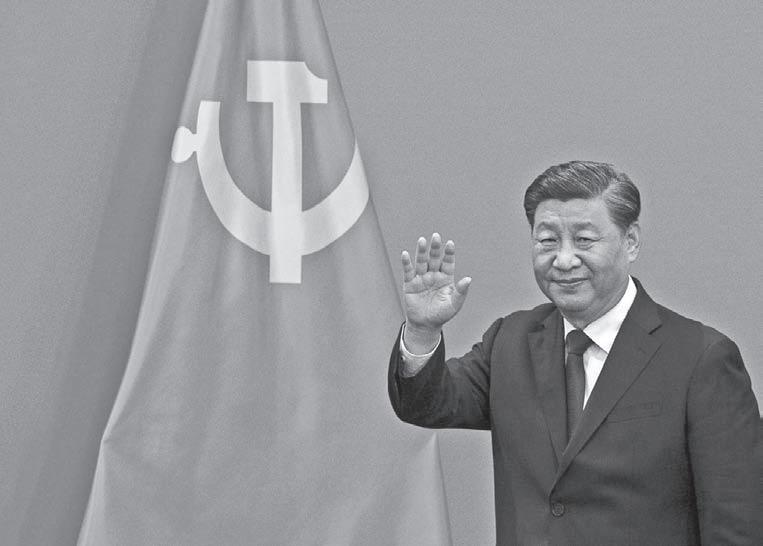
IN CHINA
I n fact, the economic blueprint indicated that the government would eradicate severe
To ensure food security and proper nutrition of Filipino families and their members, concerted efforts of the government, private sector, and other stakeholders will be geared toward [a] attaining sufficient and stable supply of food commodities; [b] expand -
Part of the measures of the government to achieve lower food insecurity in the country is ensuring sufficient and stable supply of food commodities, based on the PDP.
“ Achieving sufficient and stable food supply requires intensified interventions to enhance agriculture
T he PDP stipulated that the government would continue to reduce tariffs on key commodities as a “temporary” and “short-term” measure to diversify the food supply of the country through imports.
Airport fiasco: Big probe begins
By Lorenz S. Marasigan @lorenzmarasigan
HE Department of Transportation (DOTr) said on Monday an oversight office under the Civil Aviation Authority of the Philippines (CAAP) will lead the investigation on the technical issues that temporarily paralyzed flights to and from the Philippines’ main gateway on Sunday.

I n a separate development, Malacañan Palace assured the public that a “thorough investigation” is now being conducted on the New Year’s Day aviation fiasco following a technical issue involving the radar frequency.
I n a statement, the transport department said the CAAP “Aerodrome and Air Navigation Safety Oversight Office [AANSOO] will be tasked to investigate the incident.”
“AANSOO is an existing office.

Part of the function of CAAP is to also act as regulator and oversight for air navigation and air traffic
services,” the agency said. T he office is composed of CAAP technical personnel such as aerodrome engineers, electrical and communication engineers, air traffic controllers, pilots, and a lawyer.

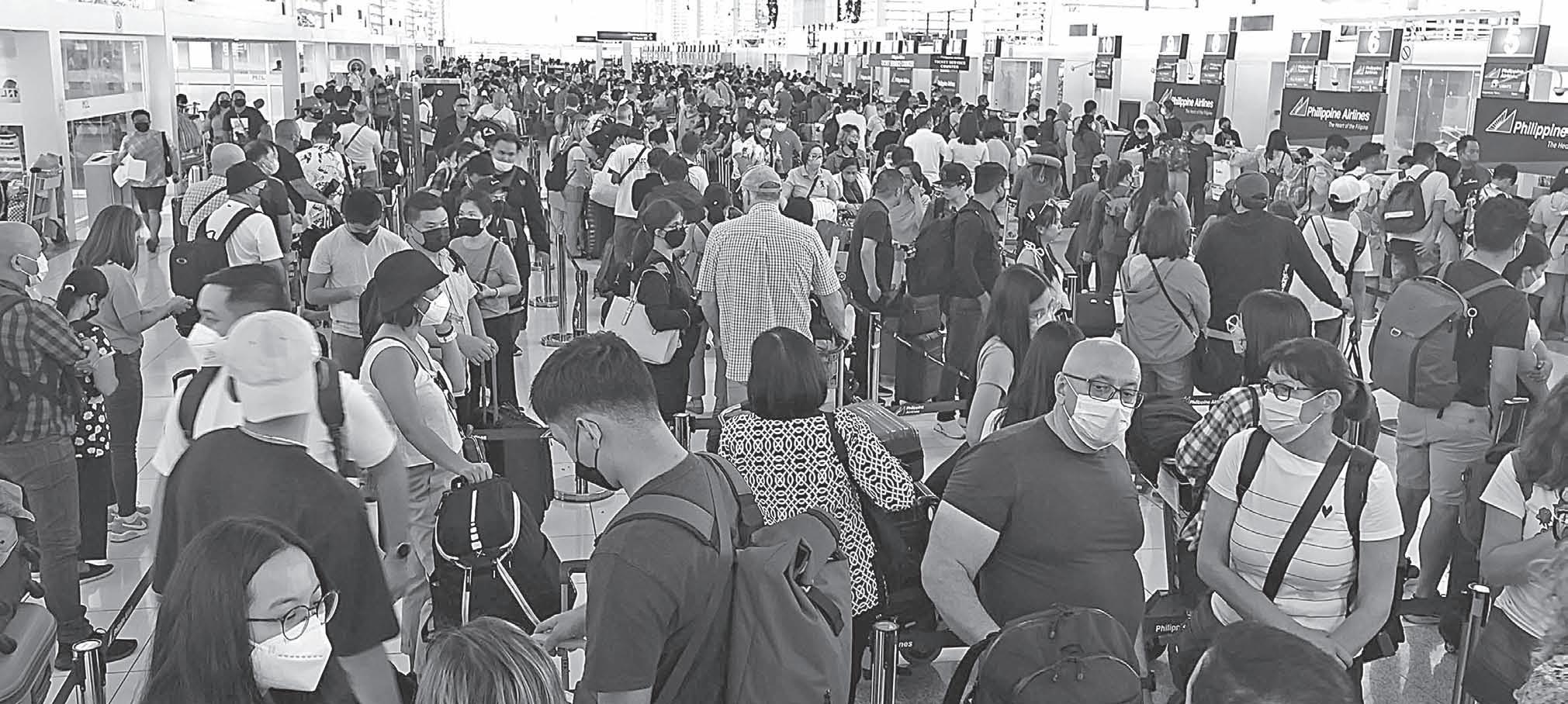
O n Sunday, a total of 282 flights were “either delayed, canceled or diverted to other regional airports affecting around 56,000 passengers in Naia,” due to a technical issue related to the Communications, Navigation, and Surveillance/Air Traffic Management (CNS/ATM) System.
AMID AVIATION MESS, DOT ANNOUNCES 2.65-M FOREIGN TOURISTS IN ‘22
THE Philippines received 2.65 million foreign tourists from February to December 31, 2022, exceeding the 2-millon low-end target of the Department of Tourism (DOT) under its reformulated tourism plan for the last two years of the Duterte administration.
I n a news statement, the DOT also said the Philippines
earned US$3.68 billion (P209 billion) in foreign visitor receipts since the country reopened to international travelers on February 10. This also exceeded the low-end inbound revenue target of P83 billion, and was just 11 percent off the high-end target of P231 billion, under the reformulated
FIRB clears extension till Jan 31. of RBE paper transfer registration
By Andrea E. San Juan
THE Fiscal Incentives Review

Board (FIRB) said it has allowed the extension until January 31, 2023 of the paper transfer registration of existing registered business enterprises (RBEs) in the IT and Business Process Management (IT-BPM) sector to the Board of Investments (BOI).
F IRB Resolution No. 033-22, released last December 23, 2022, states that “there is an urgent need to extend the December 31,2022 deadline to give full effect to the intent behind the provisions of FIRB Resolution No. 026-22 to allow affected RBEs in the IT-BPM sector to adopt, on a long-term basis, flexible work arrangements without adverse effects on their tax incentives.”
F IRB is the interagency government body given the authority to grant tax incentives to RBEs.

F urther, the FIRB said the affected RBEs that have already registered with the BOI may already adopt up to 100 percent work from home (WFH) arrangement without loss of incentives upon completion of their registration with the said investment promotion agency. The government body also noted that these RBEs shall not be required to post bond pursuant to the Department of Trade and Industry (DTI) Memorandum Circular (MC) 22-19
“Provided that RBEs in the ITBPM sector that will opt to register with the BOI pursuant to this Resolution from January 1 to 31, 2023, will not be required to post a bond for all equipment and other assets that will be brought outside the economic or freeport zone until they secure the Tax Exemption Indorsement for all their equipment and other assets from the DOF Revenue Office or 31 March 2023, whichever
T
w P25.00 nationwide | 2 sections 18 pages | BusinessMirror ROTARY CLUB OF MANILA JOURNALISM AWARDS 2006 National Newspaper of the Year 2011 National Newspaper of the Year 2013 Business Newspaper of the Year 2017 Business Newspaper of the Year 2019 Business Newspaper of the Year 2021 Pro Patria Award PHILIPPINE STATISTICS AUTHORITY 2018 Data Champion EJAP JOURNALISM AWARDS BUSINESS NEWS SOURCE OF THE YEAR (2017, 2018, 2019, 2020, 2021) DEPARTMENT OF SCIENCE AND TECHNOLOGY 2018 BANTOG MEDIA AWARDS n Tuesday, January 3, 2023 Vol. 18 No. 80
See “Aviation mess,” A2 See “Airport fiasco,” A2 PESO EXCHANGE RATES n US 56.1200 n JAPAN 0.4174 n UK 67.4394 n HK 7.1996 n CHINA 8.0372 n SINGAPORE 41.5796 n AUSTRALIA 37.8024 n EU 59.5545 n KOREA 0.0441 n SAUDI ARABIA 14.9335 Source: BSP (December 29, 2022)
See “Low tariffs,” A2
PASSENGERS wait for updates on their canceled flights from the New Year’s Day technical glitch that affected 65,000 passengers at the Ninoy Aquino International Airport. The Manila International Airport Authority (MIAA) said flight operations at the premier NAIA Terminals are expected to be fully normalized either Wednesday or Thursday. NONIE REYES
THE WORLD ›› A6 See “FIRB,” A10
A COMMERCIAL plane prepares to land at the Ninoy Aquino International Airport in Pasay City on January 2, 2023. The Department of Tourism reported higher foreign tourist arrivals for 2022 the day after technical glitches brought the NAIA terminals to a halt. NONIE REYES
Palace halts PhilHealth hike in premium rate, income cap
By Jovee Marie N. dela Cruz @joveemarie
PRESIDENT Ferdinand Marcos Jr. has ordered the Philippine Health Insurance Corporation (PhilHealth) to suspend the increase of premium contribution rates and income ceiling for 2023, the executive secretary said.
In a memorandum order released on Monday, Executive Secretary Lucas Bersamin said the Presi -
dent ordered the suspension of the scheduled increase of the premium rate from 4 percent to 4.5 percent
Airport fiasco...
According to the DOTr: “The incident that resulted in the loss of power in the system was due to a problem in the system’s electrical network, with its uninterruptible power supply (UPS), which is to be used as backup power supply, also failing (sic). The main cause of the power supply problem is still being determined and is subject for investigation.”
A ccording to the transport department, the CNS/ATM System is a P10.8-billion project financed by the Japan International Cooperation Agency (Jica) that was completed in October 2017.
It provides various computeraided safety measures in Air Traffic
Control (ATC), and enhances safety through reduction of controller/pilot workloads and human errors.
T he new ATM System introduced Air Traffic Flow Management (ATFM) and Air Space Management (ASM) functions, which optimize the use of airport capacity and the efficient use of airspace, hence minimizing delays and allowing more flexible and user-preferred air-route selection. The system commenced comprehensive operations on July 26, 2019.
CAAP recognizes that the system is already behind when it was first used in 2019 and has made recommendations to the President
this year.
A ccording to Bersamin, Marcos also ordered the suspension of the hike in salary ceiling from P80,000 to P90,000.
This refers to the scheduled increase of the premium rate from 4 percent to 4.5 percent and income ceiling from P80,000 to P90,000 for calendar year 2023 under Section 10 of the Universal Health Carte Act,” Bersamin said.
In light of the prevailing socioeconomic challenges brought about by the Covid-19 pandemic,
on improving the country’s air traffic management system,” the statement read.
T he Philippine Air Traffic Management Center (ATMC), which houses the equipment to the system, resumed normal operations at 5:50 p.m. on Sunday.
D espite the resumption of normal operations, some flights on Tuesday were still canceled or moved to a latter date.
Palace: Thorough probe
IN a short message to reporters, Press Secretary OIC-Usec. Cheloy Garafil said “a thorough investigation is being conducted by appropriate agencies.”
F lights were either delayed, canceled or diverted to other regional airports affecting thousands of
and to provide financial relief to our countrymen amidst these difficult times, please be informed that the President has directed the PhilHealth to suspend the abovementioned increase in premium rate an income ceiling for 2023, subject to applicable laws, rules and regulations,” he added.
T he memorandum order was addressed to Department of Health Officer In Charge Maria Rosario Vergeire and PhilHealth acting President and CEO Emmanuel Ledesma Jr.
passengers in Naia. M eanwhile, Manila International Airport Authority (MIAA) general manager Cesar Chiong said flight operations at the premier NAIA Terminals are expected to be fully normalized either Wednesday or Thursday, as efforts to return to normalcy swiftly began in the late afternoon of January 1.
T his, following the restoration of the Manila air traffic management system as a result of aviation authorities having successfully resolved the power outage problem that affected flights to, from and within the Philippines on Sunday, January 1.
A s of this writing, asked if flight operations have fully normalized, Chiong said: “Halos [almost],” and added, speaking partly in Filipino, “but there were a few flights that were canceled due to operational requirements of the airlines. The flights are all so full, so it was hard to accommodate those people whose flights were canceled.”
C hiong apologized for the inconvenience caused by the disruption and thanked the passengers for their understanding, with an assurance that everything is continuously being done to hasten the return to full normal operations.
Philippine Airlines (PAL) spokesperson Ma. Cielo Villaluna said that the total number of affected passengers from their end was 24,000 while the total number of affected flights was placed at 244, comprising 60 percent of the airline’s total scheduled flights on Sunday. Cancellations covered the period midmorning (past 10 a.m.) up to 5 p.m.
V illaluna explained that it will take some time to fully restore normal schedules “as we reposition aircraft that had been held back or diverted to other airports and adjust flight timings based on revised clearances in coordination with the local authorities.”
I n addition to some delays caused by these adjustments, Villaluna said PAL has had to cancel some flights for January 2, 2023 as it continues to closely coordinate with the aviation authorities on the adjustment of flight schedules and clearances, as the authorities work to resolve the temporary problem.
S imilarly, Cebu Pacific (CEB) Corporate Communications Manager Romina Yasmin Aguirre said that CEB continues to review its operations following the technical glitch in the ATMS of CAAP.
A guirre added that consequently, CEB has canceled additional flights and is still working on the recovery of its network and normalizing its operations.
A irAsia Philippines deputy spokesperson Carlo Carongoy said they are implementing additional flight adjustments through a recovery flight on January 3, 2023, “as we strive to normalize the operations in all of our airport destinations.”
“Guests are advised to regularly check registered SMS and email for preflight notifications on flight adjustments. This is beyond our control but AirAsia is working closely with government and airport authorities until we fully resolve the situation,” he added. With Nonilon Reyes
Aviation mess...
National Tourism Development Plan (NTDP) for 2021-2022. Both visitor arrivals and receipts were still lower than the prepandemic levels of 8.26 million foreign tourists and $9.3-billion (P521 billion) inbound revenue in 2019.
Bold prediction
IN her year-end briefing, Tourism Secretary Christina Garcia Frasco boldly predicted a rise in international tourists to 4.8 million in 2023. The DOT, however, has yet to finalize the NTDP for 2022-2028.
O f the total visitor arrivals last year, 628,445 were overseas Filipinos, while foreigners reached some 2.03 million. The DOT issued its news statement at 11:26 pm on Monday, just as the government regained full control of its air traffic management system. Transportation Secretary Jaime J. Bautista said in a news briefing late Monday, some 65,000 passengers were affected by the system glitch caused first by a power outage, then a power surge.
‘Anywhere except the Philippines’
MIGGY (not her real name) was traveling back to Manila from Singapore on Monday morning, but was stuck in the citystate due to the system shutdown in Manila. She was supposed to be on the same flight with several foreigners who were headed to Boracay Island. “But when it [system shutdown] happened, they rebooked to ‘anywhere except the Philippines.’” Miggy used Singapore Airlines for her outbound and inbound flights from and to Manila, so their flights were just merely rescheduled, while local carriers like Philippine Airlines (PAL) and Cebu Pacific cancelled their flights on Monday.
I n the case of travel veteran Bob Zozobrado, he said he bought promo economy fare tickets for his six family members through a travel agency, for a Cebu-Manila flight on Monday. “But the travel agency [told] me I have to pay P9,000-plus, if I want to be confirmed on the 5:45 a.m. flight on Wednesday. The airline said the promo rate allocation is full so if I want confirmation, I should pay the higher fare. Why won’t the airline
Low tariffs...
“ To assess the necessity of such measures, the government shall proactively monitor and enhance supply-demand forecasting of key commodities [e.g., rice, meat, fish, vegetables, and sugar] to anticipate possible shortages,” it said.
T he national government would establish an “anticipatory mechanism” that would “facilitate the timely implementation of appropriate measures to enhance domestic supply and forestall the sudden or sharp uptick in domestic food prices.”
T he BusinessMirror earlier reported that the Philippines ranked 67th in the Global Food Security Index (GFSI) 2022, trailing behind half of its Asian peers as the country scored low in terms of food availability and adaptability to the impacts of climate change. (Related story: https:// businessmirror .com.ph/2022/09/22/ phl-trails-asian-peers-in-foodsecurity-index)
T he GFSI index showed that the Philippines, which had an overall food security score of 59.3, placed 67th out of 113 countries included in the index by Economist Impact and Corteva Science.
I n the Asia-Pacific region, the Philippines ranked 13th out of 23 countries, behind Azerbaijan and Thailand. The GFSI index showed that the Philippines had a better food security score than
accomodate all those ticketed on the promo fares? It’s not our fault that the flight was cancelled. I find that unfair.”
H owever, PAL spokesperson Cielo Villaluna told the BusinessMirror that in the case of force majeur when neither the passenger nor the airline is at fault for the flight cancellation, “passengers don’t have to pay a rebooking fee nor a fare difference, not unless they will rebook in a different cabin class, say from economy to business class. Even travel agencies are covered by this rule.”
F rasco, for her part, said its ground personnel were activated as soon as the air traffic problem manifested. “DOT staff stationed at the airports continue to provide information and assistance to tourists. At the same time, tourists are also advised to constantly monitor updates primarily on their flight schedules through the official social media platforms and websites of the Department of Transportation and airlines.”
US, SoKor still top markets
THE agency, she added, had been in “close coordination” with relevant government offices and stakeholders “monitoring the situation of tourists across the country , who were affected by flight diversions, delays, or cancellations.”
M eanwhile, DOT data showed the top source markets for tourists last year were: the United States (505,089); South Korea (428,014); Australia (137,974); Canada (121,413); the United Kingdom (101,034); Japan (99,557); Singapore (53,448); India (51,542); Malaysia (46,805); and China (39,627). A government source explained, while outbound leisure travel has been mostly prohibited by Beijing except to Macau or Hong Kong, Chinese arrivals in the Philippines last year may have received special permits to travel.
A n estimated 5.23 million tourism-related jobs were generated last year, while11,989 tourism enterprises were accredited by the DOT as of December 29, 2022. A total of 25,770 tourism stakeholders have also been trained.
Ma. Stella F. Arnaldo
India (58.9), which placed 14th, and three Southeast Asian neighbors—Myanmar (57.6), Cambodia (55.7) and Laos (53.1).
T he GFSI index measures four aspects of a country’s food security, namely, food affordability, availability, quality and safety, and sustainability and adaptation.
T he Philippines scored 71.5 in terms of food affordability, 55.2 in terms of availability, 65.3 in terms of quality and safety and 41.8 in terms of sustainability and adaptation.
B ased on the 2021 Expanded National Nutrition Survey (ENNS), the prevalence of food insecurity nationwide was at 33.4 percent representing those who reduced their food consumption or skipped meals and 2 percent of this represent those who went on no food for one day or more. (Related story: https:// businessmirror com.ph/2022/11/15/surveyyoung-filipinos-suffer-foodinsecurity)
T he BusinessMirror earlier reported that over 75 million Filipinos are unable to purchase healthy food, and experts warned that the rising food costs may make it more difficult for consumers to access nutritious food. (Related story: https:// businessmirror .com.ph/2022/07/11/7-in10-filipinos-cant-afford-nutritious-food-sofi-2022/)

www.businessmirror.com.ph Tuesday, January 3, 2023 A2 News
BusinessMirror
Continued
A1
from
Continued from A1
Continued from A1
DepEd: Shear line rains, flooding ruin 36 schools
By Claudeth Mocon-Ciriaco @claudethmc3
SOME P363.50 million may be needed to rehabilitate schools damaged by shear line rains and flooding in some parts of Visayas and Mindanao over the Christmas weekend, an official of the Department of Education (DepEd) said on Monday.
D epEd Spokesperson Michael Tan Poa said, there were 36 schools that sustained infrastructure damage in Mindanao with 25, in Region 10 (Northern Mindanao), Caraga with 10, and one in Zamboanga Peninsula.
We are still verifying the number of schools currently being used as evacuation centers. The figure is probably lower today, [January 2],” Poa said citing that as of December 30, 50 schools are still being used as evacuation centers.
Under DepEd Order No. 37 issued by Vice President and DepEd Secretary Sara Duterte, schools may be used as immediate evacuation sites in times of calamities but not for more than 15 days.
Poa, meanwhile, said that the DepEd has received no reports of learners who died or went missing due to flooding.
However, eight learners were reported to have sustained injuries, while 2,548 learners were reported to have been displaced.
Senators slam Naia flight service failure, warn incident may impact PHL tourism
By Butch Fernandez @butchfBM
stressed, “Airport authorities must attend to the needs of stranded passengers at all affected airports and ensure their safety and convenience until normal airport operations are restored.
The public, particularly affected passengers, should also be apprised of the latest situation and should be made aware of new flight schedules,” he emphasized.
pact beyond managing incoming and outgoing flights,” Gatchalian noted, stressing that the Marcos government “must do everything in its power to ensure that this doesn’t happen again given the impact it would have on affected passengers and the negative impression that it would have on our foreign visitors.”
communications, radar, radio, and Internet, which has shut Philippine air space for hours.
Una sa lahat, buti na lamang at walang nangyaring anumang aksidente... but what happened last Sunday is scary and terrifying, and anyone who has plans of traveling to the Philippines this year may have second thoughts of visiting,” noted Binay, who chairs the Senate Committee on Tourism.
T he senator reminded that the Philippines would be hosting several international events in 2023, including the much-awaited 2023 FIBA World Cup. “As we open up our tourism, hindi na dapat maulit ang nangyari. Sadly, we just hogged the headlines in every news channel and newspaper abroad.”
How do we guarantee a unique high-value experience to our foreign guests if we don’t address, find solutions and fix our broken public transport system?” she asked, adding: “That’s why I am appealing to the DBM [Department of Budget and
Management] to help in sourcing the needed funds for CAAP [Civil Aviation Authority of the Philippines] para maumpisahan na ang pag -upgrade at pag-augment ng mga system at equipment sa ating mga airport. Kung ‘di natin mapopondohan, wala talagang mangyayari. The bigger picture is fixing our public transport problem for the benefit of all,” Binay noted.
Who’s accountable?
SEN. Sherwin Gatchalian, for his part, goaded airport authorities to ensure the safety and convenience of thousands of stranded plane passengers affected by technical navigation issues, including a power outage situation, causing cancellation and diversion of nearly three hundred incoming and outgoing flights on the first day of the year.
Taking up the cudgels for inconvenienced travelers, the senator
Gabriela presses for a ‘fair’ probe into Plaza-Chua murder case in Davao City
THE women’s group Gabriela has called on authorities to thoroughly investigate the killing of businesswoman Yvonne Plaza-Chua as it flagged social media reports alleging that an Army general may have been allegedly involved in the murder case.
Gabriela feared that Chua’s case could be whitewashed following social media claims that a star-ranked officer and a commander of an Army brigade may be allegedly involved in the killing.
The military official is reportedly a former chief of the Presidential Security Group during the term of former President Rodrigo R. Duterte.
“Nakikiramay ang Gabriela sa pamilya at mga kaibigan ni Ms. Yvonne Chua. Kailangan ang ma -
busisi at patas na imbestigasyon sa kaso lalo na’t isang mataas na opisyal ng gobyerno ang nasasangkot,” the group said through its secretary general, Clarice Palce.
Chua, 38, was shot dead in front of her rented house at the Green Meadows Subdivision in Barangay Tugbok, Davao City last week by one of two suspects on board a motorcycle.
While the Davao City Police said that it was looking into two possible motives, Gabriela noted that no less than Chua herself shared in social media post photos of her injuries inflicted by the military official, whom she claimed had also allegedly threatened her.
The physical assault, the women’s group said, had happened days before Chua’s murder.
“A few days before her murder,
model and entrepreneur Yvonne Chua shared in her Facebook page some pictures of herself injured…[by a] former close-in security [of ex-President Duterte] and he was part of the Presidential Security Group,” Gabriela said.
Aside from calling for a thorough and impartial investigation, Palce urged authorities to give protection to the family of Chua as evidence “pointing to the suspect” is being presented.
Kagaya ng lagi naming sinasabi sa lahat ng biktima ng VAW [violence against women], bukas ang pinto ng Gabriela sa pamilya at mga kaibigan ni Ms. Chua kung nais nilang idulog ang kaso nito. Gayundin, kami ay nananawagan ng hustiya, maayos at walang bahid ng pagpanig ang binuong Task Force Yvonne para sa imbestigasyon ng kaso ni Ms. Chua,” Palce also said. Rene Acosta
Gatchalian reminded, “airport authorities should be made accountable for this incident,” noting hordes of airport passengers were stranded not just at Naia but also at various points of departure within and outside the country.
I n a news statement, the senator recalled that the Manila International Airport Authority (MIAA) had said “flight operations have already been partially restored as of 4 p.m. of January 1,” even as the senator reminded that the incident was “likely to cause a domino effect and adversely affect other flights scheduled in the next few hours.”
T he lawmaker lamented, “It is unfortunate to see a crisis-like situation such as this at Naia at a time when demand for air travel in the country has just been restored to normal levels,” after the lifting of travel restrictions imposed at the height of the Covid-19 pandemic.
The impact
“AIRPORT operations have an im-
Binay lamented that the incident has left a big setback in the government’s effort to promote the Philippines. “Airport service quality and passenger satisfaction have a great impact on Philippine tourism. ’Yung nangyari sa Naia makes it hard for us to promote traveling to the Philippines when a service attribute has failed. I hope we learn something from this experience and past experiences, and have well-trained airport and airline personnel ready to handle these kinds of extra-ordinary cases, and manage certain amount of chaos to temper an unpleasant situation,” Binay said.
Bothersome, concerning glitch
THE senator added that it is about time to conduct a full audit of all navigational and communications equipment installed in all airports in the country.
According to Binay, the air navigation glitch that stranded thousands of holiday travelers is quite bothersome and concerning. The said technical glitch has result in the loss of power supply, critical navigational
“Imagine, several hours of inconvenience and unproductive waiting for passengers...inconvenience to PWDs and senior citizens, losses to tourism and business. This is not the first time that this occurred—there were similar incidents that happened in 2016 and 2018. Our airports, being critical facilities, should have a reliable backup system to handle these kinds of extra-ordinary and emergency situations. What happened on Sunday clearly demonstrates how vulnerable we are, and with either a hardware or software glitch, we can all be crippled,” Binay pointed out.
S he added that that the Department of Transportation (DOTr), Office of Transport Security, CAAP, MIAA, Mactan Cebu International Airport and the Luzon International Premiere Airport Development Corp. management likewise need to start identifying current and potential hazards related to airport operations.
“Sana matulungan ng DBM si DOTr Secretary Bautista na mahanapan ng pondo ang kailangang upgrade at equipment ng CAAP for this year. Kailangan na natin itong maumpisahan ngayong taon, kaya importante na makahanap ang Executive Department ng funding source para agad na nating mabigyan ng solusyon ito,” Binay said.
SC junks ex-Pagcor chief’s plea for dismissal of graft raps pending before Sandiganbayan
By Joel R. San Juan @jrsanjuan1573
THE Supreme Court (SC) has denied the plea of former Philippine Amusement and Gaming Corporation (Pagcor) chairman Efraim Genuino seeking the immediate dismissal of the 18 counts of graft and malversation charges filed against him involving the agency’s grant of financial assistances to different entities from 2004 to 2009 amounting to almost P160 million. I n a seven-page resolution, the Court’s Second Division affirmed the resolutions issued by the Sandiganbayan on July 9, 2021 and September 1, 2021 denying Genuino’s motion to file demurrer to evidence and his subsequent mo -
tion for reconsideration.
T he motion sought the dismissal of the case against him on the ground of insufficiency of evidence presented by the prosecution.
T he case stemmed following Genuino’s grant of financial support to Batang Iwas Droga Foundation Inc. (BIDA Foundation) and Batang Iwas Droga Production (BIDA Production), as part of its corporate social responsibility projects.
For the said disbursements, Genuino together with other Pagcor executives, were charged with 18 counts of violation of Section 3 (e) of Republic Act No. 3019 and another 18 counts of malversation.
I n seeking the reversal of the Sandiganbayan’s dismissal of his motion for demurrer to evidence,
Genuino argued that the anti-graft court gravely abused its discretion when it denied his motion despite lack of sufficient evidence to establish his guilt.
He also claimed that his constitutional rights to due process and presumption of innocence are deemed to have been violated.
G enuino insisted that all the transactions subject of the criminal cases were duly approved by the board as a collegial body.
However, the SC held that Section 23 of Rule 119 of the Rules of Criminal Procedure expressly prohibits the filing of a certiorari petition against the denial of one’s motion for leave of court to file a demurrer to evidence until judgment has been rendered in the main case.
Ople: Migrant workers’ dept ready for challenges in 2023
By Jovee Marie N. Dela Cruz @joveemarie
WITH the expected establishment this 2023 of the Virology and Vaccine Institute of the Philippines (VVIP), a lawmaker on Monday said the Executive department had already set aside an initial P669.3 million for the VVIP’s fivehectare research and development (R&D) projects and facilities at the New Clark City (NCC) in Tarlac.
CamSur Rep. LRay Villafuerte said the establishment of the VVIP as the country’s premier research and development (R&D) institute on all kinds of viruses and viral diseases in humans, animals and plants is contained in the consolidated House Bill (HB) No. 6452, which the bigger chamber had approved by a 216-0 vote with no abstention.
V illafuerte, who is president of the National Unity Party (NUP), said the speedy approval of this consolidated bill was assured because, on top of the VIP bill’s inclusion in the common legislative agenda (CLA) of Malacañang and the bicameral Congress, the Executive department had already set aside an initial P669.3

million plus a 5-hectare lot for its research and development (R&D) projects and facilities at the New Clark City (NCC) in Tarlac.
“ The VIP is expected to be up sooner than later following its inclusion among the 30 priority bills in the CLA that was drawn up by President Marcos with Senate President Migz [Juan Miguel Zubiri] and Speaker Martin [Romualdez] during the first LEDAC [Legislative Executive Development Advisory Council] meeting convened last October 10,” Villafuerte said.
T he House-passed HB 6452 had consolidated 42 similar bills, including HB 10 that was principally authored by four lawmakers led by Speaker Martin Romualdez, and HB 308 that was introduced by Villafuerte and three fellow lawmakers from CamSur.
R omualdez’s fellow HB 10 authors were Senior Deputy Majority Leader Ferdinand Alexander Marcos and Tingog Sinirangan Reps. Yedda Romualdez and Jude Acidre, while HB 308 was introduced by the NUP president with CamSur Reps. Miguel Luis Villafuerte and Tsuyoshi Anthony Horibata, and Bicol Saro Rep. Nicolas Enciso VIII.
AMID expected global headwinds in 2023, the newlycreated Department of Migrant Workers (DMW) is “ready to serve overseas Filipino workers [OFW],” Migrant Workers Secretary Maria Susana “Toots” V. Ople said over the weekend.
The DMW is ready to fulfill its mandate” this year, Ople assured President Ferdinand R. Marcos Jr. last Sunday. She also affirmed that the Department is “ready to fulfill its mandate as the primary government agency tasked with protecting the rights and welfare of OFWs and their families.”
Personally coveying her assurance, Ople vowed: “Pangako po, Mr. President, gagawin namin sa DMW at ng OWWA [Overseas Workers Welfare Administration] ang lahat para alagaan at ipaglaban ang ating mga OFWs at ang kanilang mga pamilya. Dahil iyan po ang inyong mahigpit na tagubilin sa amin. At dahil tunay po namin silang minamahal at ginagalang. [I promise, Mr. President, the DMW and OWWA will do everything to take care of and fight for our OFWs and their families because that is your strict instruction to us and because we truly love
and respect them.]”
O ple spoke during the “Pamaskong Handog Para sa Pamilyang OFW” event of the DMW at the Malacañang Palace hosted by the President.
T he event also marked the first anniversary of the creation of the DMW. Former President Rodrigo Duterte signed Republic Act 11641 creating the DMW late December 2021.
In delivering her opening remarks, Ople reported to Marcos the significant milestones achieved by the DMW since her appointment this year.
T hese include 766,290 OFWs who
were able to get decent jobs abroad through the DMW from July to December, while 6,341 distressed OFWs were able to return home during the same period.
Moreover, she said in Filipino that the OWWA will continue to provide livelihood assistance and scholarships to the families of OFWs (“Patuloy pa rin po ang pabibigay natin ng livelihood assistance at scholarships sa mga pamilyang OFWs.”). She noted that as of November 2022, the OWWA already has 16,000 scholars.
At the same time, Ople thanked Marcos and Congress “for giving
the DMW its first full year budget in 2023, allowing the department to create 16 new regional offices and four Migrant Workers Offices [MWO], formerly known as Philippine Overseas Labor Offices, or POLOs.” This, she projects, would bring DMW services directly to OFWs and their families.
O ple said that also present at the Palace event were some 200 children of OFWs, their parents and guardians, noting that among those who participated were Education and Livelihood Assistance Program (ELAP) scholars Gabriel Cedrik de Vera Caburnay, John Robison Navas, and Shaira Mae Concepcion. ELAP scholars are children or dependents of deceased OFWs who were OWWA members.
She noted that Caburnay is a second-year college student taking up Bachelor of Marine Transportation studies at the Philippine Maritime Institute Colleges (PMIC), while Navas is a Bachelor of Science in Computer Engineering student at the Jose Rizal University. Concepcion is on her sophomore year as a Bachelor of Science in Hospitality Management student at the National University. Butch Fernandez
www.businessmirror.com.ph Editor: Vittorio V. Vitug • Tuesday, January 3, 2023 A3 BusinessMirror The
Nation
SEN. Nancy Binay bewailed the recent air traffic system glitch at the Ninoy Aquino International Airport (Naia) terminals that crippled international and domestic flight operations on Sunday.
DEPARTMENT of Migrant Workers Secretary Susan “Toots” Ople PNA FILE PHOTO
CamSur lawmaker sees smooth launch of virology, vax institute
BusinessMirror

USDA hikes PHL corn import outlook to 1 MMT for market year 2022-2023
By Jasper Emmanuel Y. Arcalas @jearcalas
Estimated Indonesian corn exports to the Philippines for the current marketing year are from 200,000 MT to 250,000 MT,” the USDA-FAS Manila said.
T he Office of the Press Secretary earlier announced that the administration of President Ferdinand R. Marcos Jr. would extend the lower tariff rates on pork, corn, rice, and coal until the end of the year to ease accelerating inflation.
tive Order 171 ordered the reduction of corn tariffs.
T he USDA-FAS Manila estimated that total corn feed consumption of the Philippines would reach 6.9 MMT, 100,000 MT higher than the previous market year because of the extension of lower tariffs and anticipated competitive future price quotes.
By Jovee Marie N. Dela Cruz @joveemarie
MORE than 1.6 million students have benefited from the government’s fuel subsidy and Libreng Sakay programs, the government said on Monday.
In a news statement, the Office of the Press Secretary (OPS) said the national government’s fuel subsidy and Libreng Sakay programs were carried out to cushion the effect of oil price hikes on the transport sector and commuters.
year, such as the Energy Efficiency and Conservation (EEC) program and also assisted distribution utilities to rationalize power supply sources.
A lso, the OPS said the Department of Energy (DOE) carried out the Government Energy Management Program (GEMP), which mandated all government agencies to save at least 10 percent on the consumption of electricity and fuel through the adoption of energy conservation measures.
In its latest projections, the United States Department of AgricultureForeign Agricultural Service in Manila (USDA-FAS) estimated that corn imports in the current market year would be two-thirds over the previous market year’s 600,000 MT.
T he Philippines’s current market year for corn is from July 2022 to June 2023.
FAS Manila estimates MY 2022/23 corn imports at 1 million,
up by 300,000 MT from USDA Official because of the extension of lower tariffs through 2023, as well as competitive Asean corn price quotes,” the USDA-FAS Manila said in its Global Agricultural Information Network (GAIN) report.
T he international agency noted that Indonesia has “expressed interest” in exporting corn to the Philippines due to low domestic demand in the former.
T he USDA-FAS Manila pointed out that applications for corn imports through the Bureau of Plant Industry (BPI) have more than doubled to 627,871 MT from 298,831 MT.
Meanwhile, approved sanitary and phytosanitary import clearances for corn imports rose by 83 percent to 367 from 201 during the July to September period, the USDA-FAS Manila added.
This is attributed to the passage of Executive Order No. 171, Series of 2022, which feed millers have taken advantage of,” it said. Execu-
“Corn is still the preferred feed ingredient, especially for broilers and layers when available,” it added.
In terms of production, the country’s corn output would fall to 7.9 MMT from 8.344 MMT due to lower fertilizer applications because of higher prices of the planting input, according to the USDA-FAS Manila.
“ While farm-gate prices have become attractive for corn farmers, this was tempered by the high production costs [of which fertilizer is a major factor]. As with rice, FAS Manila believes that there is a reduction in corn production [as opposed to Philippine government data],” it said.
price hike
TO ensure responsiveness and accessibility to the public, the administration of President Ferdinand R. Marcos Jr. has vowed to transform government services in 2023.
Its year-end report, the Palace, in a news statement, reiterated that improving bureaucratic efficiency is contained in the administration’s 8-Point Socioeconomic Agenda in the near term, putting a premium on digitalizing, harmonizing, and standardizing government data.
In 2023, the government shall remain steadfast and continue to pursue streamlining initiatives to ensure the delivery of efficient government services to the people and fight corruption by eradicating all forms of red tape,” the administration said.
T hese include the strengthening of the TradeNet, a one-stop online shop aimed to reduce processing time and harmonize the permitting procedures involved in import and export in the country, the Palace said.
It added that the Anti-Red Tape Authority (ARTA), in coordination with other government agencies, would pursue the National Policy on Regulatory Management System (NPRMS), which provides a common framework for good regulatory practices, and enforcement and compliance strategies.
T he government said it also plans to advance NPRMS components such as the Philippine Business Regulations Information System (PBRIS) to provide stakeholders and government agencies access to proposed and existing government regulations and avoid overlapping.
It will also push the Anti-Red Tape Electronic Management Information System (ARTEMIS) to provide a live database and mapping of all government services indicated in the Citizen’s Charter.
I n addition, Philippine Good Regulatory Principles (PGRP) will be implemented to promote proportionate, consistent, accountable, and targeted regulations through an effective dialogue between regulators and entities.
A lso, the Department of Trade and Industry (DTI) will pursue the implementation of a proposed executive order creating the Green Lane for Strategic Investments aimed at creating a more favorable business ecosystem.
I n line with local government units’ (LGU) devolution of functions, the national government will scale up its assistance to local governments through needs-based and targeted interventions, such as the Growth Equity Fund.
To optimize the government’s Information and Communications Technology (ICT) resources, the government will continue to develop and implement interoperable systems that will further implement seamless sharing of data sources, such as the Philippine Identification System and electronic Business Permits and Licensing Service (eBPLS).
T he administration will also address the fragmentation of the justice system through the implementation of the National Justice Information System and Middleware Exchange Platform.
On budget reforms, the Department of Budget and Management (DBM) will focus on rolling out digital systems that will promote prudent fiscal management and improve budget reliability.
T his will be done through the enactment of the Progressive Budgeting for Better and Modernized Governance Bill, developing and implementing the Budget and Treasury Management System, and pursuing the National Government Rightsizing Program. Jovee Marie N. Dela Cruz
By Lenie Lectura @llectura
HEFTY oil price increases greeted motorists today after oil firms announced Monday that they will implement this year’s first oil price adjustment.
I n separate advisories, the oil companies said they would increase gasoline prices by P2.90 per liter, diesel by P2.10 per liter and kerosene by P3.05 per liter.
Seaoil, Petron, Shell, PTT Philippines, Phoenix Petroleum, Total, Caltex, Unioil said they will adjust their
DHSUD
By Cai U. Ordinario @caiordinario
THE Department of Human Settlements and Urban Development (DHSUD) expects to start the construction of various housing projects under the Pambansang Pabahay Para sa Pilipino Program in the first semester of the year.
DHSUD Secretary Jose Rizalino Acuzar said the actual construction of mid and high-rise buildings that are part of the Pambansang Pabahay program may take up to two years.
“I am optimistic that we can start with the construction of the projects with complete documentary and legal requirements in a few months,” Acuzar said. “And we expect to go full blast within the year.”
Since its launching in September or a few weeks after Acuzar took the helm at DHSUD, the Pambansang Pabahay Para sa Pilipino Program has already attracted interest from 47 local government units with the signing of memoranda of understanding with the department.
Of the 47 LGUs from Luzon, Visayas and Mindanao, 12 had already broken ground for their housing projects. The President led the latest groundbreaking ceremony in Palayan City last December 21.
T he flagship housing program also got the backing of several government financial institutions (GFIs) like the Home Development Mutual Fund or Pag-IBIG Fund, which allocated P250 billion for the program; the Land Bank of the Philippines, the Government Service Insurance System, the Development Bank of the Philippines and the Social Security System.
prices at 6 a.m. of Tuesday, January 3. Cleanfuel, meanwhile, will increase prices at 4:01 p.m.
T he last price adjustment for 2022 was a rollback of P0.20 per liter for diesel and a price hike of P0.95 and P0.50 per liter for gasoline and kerosene, respectively.
T hese resulted to the year-to-date total adjustments to stand at a net increase of P14.90/liter for gasoline, P27.30/liter for diesel, and P21.30/ liter for kerosene.
Oil firms adjust their prices every week to reflect movements in the world oil market.
Citing the administration’s yearend report, the OPS said the Department of Budget and Management (DBM) facilitated the timely release of funding to sustain the ongoing implementation of the fuel subsidy program for public utility vehicles (PUVs) and the Libreng Sakay Program of the Department of Transportation (DOTr).
T he OPS added that President Ferdinand R. Marcos Jr. also directed the DOTr to continue the implementation of the Libreng Sakay for Students Program in LRT 2, which benefited an estimated 1.6 million students from August 22 to November 5 this year.
In addition, under the Oplan Balik Eskwela program of the MRT 3 and the Philippine National Railways (PNR), a total of 143,290 students were given a 20-percent fare discount.
T he government’s Service Contracting Program (SCP) also provided compensation to operators and drivers whose livelihoods were affected by the Covid-19 pandemic and the increase in oil prices.
From April to July 2022, 19,194 PUV drivers were contracted to operate 16,832 PUV units on 921 routes across the country, the OPS quoting the report, added. As of December 23, 2022, 751 Public Utility Bus units operated by 87 companies are servicing the Edsa Busway.
To reduce energy costs, the OPS said the Marcos government implemented concrete steps since July this
A s of December 13, it added that 19 percent of government entities are compliant with the GEMP, resulting in savings equivalent to P285 million.
T he Energy Regulatory Commission (ERC) also suspended the collection of the Feed-in Tariff (FiT) from December 2022 to February 2023 to ease inflation pressure on electricity consumers.
T he FiT is a uniform charge imposed on all on-grid electricity consumers for the development and promotion of renewable energy in the country.
T he ERC and DOE have been conducting a Power Supply Agreement (PSA) Caravan since November 2022 aimed at assisting distribution utilities (DUs) and electric cooperatives (ECs) in rationalizing and optimizing their power supply sources.
O ther government measures include the continued implementation of targeted subsidies to mitigate the impact of increasing fuel and electricity prices.
A s a result of DOE’s negotiation with oil companies for a fuel discount program, participating gasoline station outlets offered a fuel discount of P1 to P4 per liter.
On October 28, 2022, the ERC, DOE, and the Department of Social Welfare and Development (DSWD) signed the Implementing Rules and Regulations (IRR) of RA No. 11552, extending the lifeline subsidy among qualified marginalized electricity users to another 30 years and expanded the beneficiaries to Pantawid Pamilyang Pilipino Program (4Ps) members.
Let’s create change in 2023!
rates of public sector corruption have weaker democratic institutions, depriving citizens of political and human rights.
In 2022, people lost patience and took to the streets to demand that their governments serve public interest. We may see more protests in 2023 if political leaders don’t take urgent steps to eradicate corruption and make their countries a livable place for all citizens.
Advanced economies to end complicity in corruption abroad
By Henry J. Schumacher
IHOPE you got well into the New Year!
A llow me to focus on two topics as we create change in 2023: Remove Corruption and Be Creative!
A s we are heading into 2023, it’s time to reflect on how corruption eats away at things we all care about, from fundamental human rights to socioeconomic equality and environmental protection.
A round the world, corruption made headlines, sparked demonstrations and toppled governments in what should be a wake-up call for leaders to follow through on their commitments and make good on old promises as well as new, meaningful resolutions.
To give all of us some inspiration, here are four anti-corruption wishes we should have for us, the local and international community and our planet for 2023:
People power to transform countries
CORRUPTION is continually deepening the crisis of democracy in many parts of the world. Research shows that countries with higher
STRONG measures are needed by relatively “clean” countries that often enable cross-border corruption by maintaining loopholes and failing to prosecute foreign bribery by corporations. This has consequences for societies all over the globe.
Ending corporate secrecy and reining in banks and financial intermediaries of dirty deals must be among our top priorities for 2023.
Climate action to be free from corruption
WHERE corruption goes unchecked, this has devastating consequences for the environment, too. We need climate action to create a better future for us and our children. Let’s initiate these changes in 2023.
Health care in 2023–hopefully free from corruption
CORRUPTION does not stop when health is at stake. Making health services and supplies by government and the private sector free from corruption can only be achieved if adequate safeguards are built into supply chains.
L et’s look to the New Year with hope and create room for
anti-corruption progresses to accelerate, and some negative trends to reverse.
L et me conclude with a note of caution. There is risk in exposing people involved in corruption. Work in a group rather than alone.
A nd remember: the youth deserve an end to corruption. Young people are not just our future. They are key to creating a just, peaceful and prosperous world right now— here and abroad!
Finally, let’s be Creative in 2023: I would like to see this as a motto for the future, understanding that progress requires free space, and can hurt.
Without creative ideas no innovation, without innovation no progress. The key words are “creative explosion” or “creative confidence.” Real creativity challenges the status quo.
If you want to be creative you have to accept the power of change, as Creativity is war; all new developments create enemies that will fight to maintain the status quo;
C reativity is anarchy; developers of ideas want to be heard without taking traditional hierarchies seriously;

Creativity needs free space as “inventors” will need time and resources to develop new “products.”
Creativity is our greatest human asset. Beyond the personal joy of creative expression, creative thinking and problem-solving are key drivers of economic growth. Even though plenty of people may not think of themselves as “creatives,” please accept that everyone has the ability to think creatively.
Feedback to the two topics for 2023 would be appreciated; you can contact me at hjschumacher59@gmail.com
A4
www.businessmirror.com.ph
Tuesday, January 3, 2023 •
Economy
Editor: Vittorio V. Vitug
THE country’s corn imports in market year 2022-2023 could reach 1 million metric tons (MMT) on the back of the extension of lower tariffs on the commodity and anticipated easing of global prices.
Libreng Sakay program benefits more than 1.6 million students
‘Big time’ fuel pump
greets motorists at start of ’23
Palace vows to pursue digital shift in govt services this year
readies construction of housing projects in ’23
By Andrea E. San Juan
FOLLOWING the glitch that halted all air travel within Philippine airspace on Sunday, January 1, Go Negosyo founder Jose Maria A. Concepcion III is suggesting the revival of a 2018 proposal forming a consortium to modernize the Ninoy Aquino International Airport (Naia).
Naia is strategically located and any improvements made here will redound to so many benefits to the country,” said Concepcion in a news statement issued on Monday.
T he Go Negosyo founder said the “inefficiencies” in the country’s main international airport translate to big losses in business and are felt throughout the country. With this, Concepcion believes that the private sector can contribute if it’s only allowed to participate.
According to the statement issued by Go Negosyo, under the consortium’s proposal, it promised that Naia will have a 20 percent increase in efficiency, pushing it to become a world-class gateway at par with the world’s best airports. In addition, there were no government guarantees, and no moratorium on the construction of another major airport.
In 2018,the consortium’s unsolicited proposal was recommended for approval by the Department of Transportation [DOTr] to the Manila International Airport Authority, the primary government agency for the project. By August that year, the consortium secured from the Philippine government an original proponent
status for its plan to rehabilitate the Naia; it was approved by the [National Economic and Development Authority] Neda board in November 2019,” the Go Negosyo statement read.
According to Go Negosyo, the consortium comprised some of the country’s biggest conglomerates, namely, Aboitiz InfraCapital Inc., AC Infrastructure Holdings Corp., Alliance Global Group Inc., Asia’s Emerging Dragon Corp., Filinvest Development Corp., JG Summit Holdings Inc. and Metro Pacific Investments Corp.
Concepcion, who was responsible for forming the consortium, recalled the idea for the consortium was first “put forward” a year before, in 2017.
All of the conglomerates were interested in seeing the project push through,” said Concepcion, adding that it would have been good for their respective businesses, such as in air travel, real estate or retail.
We were all in agreement that connectivity is important, and even the tycoons who were not formally part of the group pitched in to see how they can help,” he said.
Having seen how badly key systems in our air transportation system need to be modernized, and how severely any glitch can affect the whole country, I hope that this time, we can revive this proposal and see it through,” Concepcion added.
Flight operations at the Naia were temporarily halted after the gateway experienced some “technical issue involving the radar frequency” at the Air Traffic Management Center of the Civil Aviation Authority of the Philippines (CAAP) on Sunday.
Concepcion revives consortium proposal for Naia rehabilitation Villafuerte:
By Jovee Marie N. Dela Cruz @joveemarie
THE decision by President Ferdinand R. Marcos Jr. to ease Covid-19 protocols and reopen the country to tourists and investors in the first semester of his presidency has begun generating more foreign direct investments (FDI) and putting our economy on the mend, hence keeping it on its upward trajectory this 2023 despite an impending global recession, CamSur Rep. and National Unity Party (NUP) President LRay F. Villafuerte said.
“ The most remarkable feat of President [Ferdinand] Marcos [Jr.] thus far comprise his decisive moves on the public health and economic fronts that sent a loud and clear message to the world that the Philippines has reopened fully for business on his watch despite the lingering Covid-19 pandemic,” Villafuerte was quoted in a statement as saying.
“Complementing such initiatives were the President’s aggressive pitch in his overseas trips for the Philippines as an Asian business hub with investor-friendly policies plus a young and dynamic labor force,” he added.
T he Joint Foreign Chambers of the Philippines has claimed that FDI inflows would reach $128 billion by the end of 2030.
V illafuerte said these have led to $23.6 billion worth of investment pledges that will for sure energize domestic economic activity in 2023, create a lot of jobs and “improve the living standards of many of our people.”
T he lawmaker expressed confidence that the Marcos administration can keep the Philippines on highgrowth mode in 2023 and onwards partly because of the President’s apt decision to sustain the unprecedented level of mega investments of the past administration in public infrastructure, “considering that infra spending has the highest multiplier effect on the economy.”
Back in business
CITING a Department of Budget and Management (DBM) report, Villafuerte said the Marcos government has allocated an amount equivalent to 5 percent to 6 percent of gross domestic
product (GDP) to spend on infrastructure and other capital outlay projects.
Proof of the continued high infrastructure spending under the Marcos administration was that completed infrastructure projects went up by 39.3 percent in September alone as National Government (NG) expenditures for this sector plus other capital outlay projects rose to P99.1 billion in September from the year-ago’s P71.2billion disbursements, he said.
Villafuerte added that “the Chief Executive’s bold one-two move to issue Executive Order [EO] 3 lifting the mandatory use of facemasks outdoors and, later, EO 7 relaxing the masking mandate indoors along with easing the Covid-19 tests and other strict health protocols for inbound travelers had delivered the message that the Philippines was back in business after reopening its doors wide to tourists and investors alike.”
T he former CamSur governor said that the Chief Executive “has transformed himself into the country’s topmost salesman in his overseas trips over the July-December period by making a consistent, vigorous pitch for investments.”
Estimates by the National Economic and Development Authority (Neda) and private analysts have put GDP growth at 6 percent to 7 percent this year, on the back of sustained domestic consumption and investments, Villafuerte said.
Tourism receipts
AS a result of the relaxed Covid-19 health protocols, Villafuerte said the Department of Tourism (DOT) reported that the number of visitor arrivals soared to 2.46 million by November 2022, or nearly 45 percent higher than the original target of 1.7 million, and expected to hit 2.5 million by endDecember—from just 164,000 international visitors in 2021.
Tourism receipts consequently went up to P149 billion from the 2.46 million tourists, hence living up to the Chief Executive’s perception—as he mentioned in his speech before the Philippine Tourism Industry Convergence Reception (PTICR) at the SMX Convention Center last October—of this industry becoming one of the potential drivers of the country’s economic transformation
DOE presents 9 priorities to ensure power supply sufficiency during ‘critical’ periods
By Lenie Lectura @llectura
to reduce the Universal Charge for Missionary Electrification (UCME), the DOE said.
A lso in the list is to strengthen the implementation and enhancement of CSP (Competitive Selection Process) policy for distribution utilities (DUs) and electric cooperatives (ECs).
A nother priority is to implement the Total Electrification Project in partnership with the National Electrification Administration (NEA) and National Power Corporation (NPC).
O n top of its list is the pursuit of contingency measures and activities to ensure energy supply during “critical” periods, which include summer.
It said it will ensure that committed power projects, transmission line facilities, and Liquefied Natural Gas (LNG) infrastructure, among others, are completed and delivered on time. The critical transmission projects are the Mindanao-Visayas Interconnection Project (MVIP), the Cebu-Negros-Panay Backbone Project, and the Hermosa-San Jose Transmission Line in Bataan that will support the entry of around 711.54 megawatts (MW) of additional RE capacity and 1,120 MW battery energy storage system (BESS) in the Luzon grid.
Towards the first half of 2023, the DOE will continue to keep a tight watch on the commercial operation of LNG facilities that will complement the Malampaya resource. As of December 2022, six applications for
LNG import terminal projects were already approved.
T he Linseed Field Corporation and the FGEN LNG Corporation are expected to become operational by March and June 2023, respectively. These LNG projects will supply the existing anchor markets of the Malampaya Gas Field to address the impending depletion of the country’s lone domestic source of natural gas.
T he second priority is to update The Philippine Energy Plan to align with the Philippine Development Plan 2023-2028.
T hird on its list is to promote the development and utilization of renewable energy (RE) resources. This can be done with the conduct of the 2nd round of the GEAP (Green Energy Auction Program). Further, the agency will continuously develop essential policy frameworks for emerging RE technologies such as offshore wind and hydrogen.
Hybrid power systems will also be implemented in off-grid areas
In a bid to address the delays and improve the slow pace of DUs’ compliance on competitive power supply contracting, the DOE shall reassess previous policy issuances and the promulgation of a more refined CSP policy.
A s such, the necessary power supply contracting mechanisms will be in place, enhancing the efficiency and effectiveness of the policy. Similarly, the Department will swiftly push to strengthen its implementation to institutionalize transparency and good governance in the awarding of power supply contracts,” it said.
T he DOE’s list also includes the crafting of the National Total Electrification Roadmap (NTER) through the implementation of Microgrid Systems Act.
A s of June 2022, electrification at the household level in the country stood at 95.8 percent. Luzon recorded the highest electrification at 98.8 percent followed by the Visayas at 97.2 percent. Mindanao’s household electrification registered at 87.1 percent.
Seventh in the list is to formulate a Nuclear Power Roadmap, in partnership with the private sector, International Atomic Energy Agency (IAEA), experts and stakeholders.
T he existing Nuclear Power Roadmap will be updated to guide both the Nuclear Energy Program Implementing Organization (NEPIO) and the Nuclear Energy Program InterAgency Committee (NEP-IAC) in the implementation of activities to address the challenges of the nuclear energy program.
T he DOE will also formulate the Energy Resiliency Roadmap and Action Plan and Energy Resilience Scorecard and Assessment to set the course and direction for the sector towards achieving a higher level of resiliency to disasters.
L ast in the list is the implementation of the Reserve Market and Wholesale Electricity Spot Market (WESM) Mindanao. The Ancillary Services (AS) policy mentions the establishment of a reserve market wherein there is co-optimization of energy and reserves in the WESM. Just recently, the DOE has declared the target commercial operation date of WESM Mindanao on January 26, 2023.
under his presidency.
Prior to the issuance of EOs 3 and 7, Villafuerte had said that the easing of anti-Covid health protocols “would attract more tourists and boost Philippine tourism, which is integral to the country’s quick and robust recovery from the global economic and health crises wrought by the once-in-a-century pandemic.”
T he best argument that the President and his economic managers had made the right steps in driving an economic turnaround on his watch, said Villafuerte, was the Asian Development Bank (ADB)’s forecast upgrade that our economy would grow 7.4 percent in 2022, from its lower forecast in September of 6.5 percent, on the belief of ADB Philippines country director Kelly Bird of “a strong underlying growth momentum and resilience” that was “expected to continue in 2023, with GDP growth converging towards its longer-term growth rate of about 6 percent.”
Big achievement
VILLAFUERTE said the numerous forecasts for the Philippines to remain on high-growth mode in 2023 was a big achievement for the Marcos administration, as international experts like the British consultancy Centre for Economics and Business Research (CEBR) see the world as heading to a recession amid contractions among many economies that will be forced to continue raising borrowing costs to fight still-elevated inflation and pull down prices to more comfortable levels.
T he International Monetary Fund (IMF) earlier predicted that over a third of the world’s economies would suffer economic contractions, with a 25 percent possibility that the global GDP would grow in 2023 by less than 2 percent.
A combination of higher prices and interest rates, continued coronavirus lockdowns in China and geopolitical risks like Russia’s invasion of Ukraine could exacerbate global supply chain disruptions and slow down the growth of the world economy, said Villafuerte.
But thanks to the correct policies of the President and his economic managers, experts believe that the Philippines has been shielded from
an impending slowdown of the global economy and, even better, is projected to remain as one of the fastest-growing economies, if not the fastest-growing economy, in the region this 2023,” he said.
He noted that the New York-based credit rater Moody’s Investors Service projected the Philippines to record the fastest GDP growth in the Asia-Pacific region in 2023 at 6.4 percent, followed by Vietnam (6.1 percent), China (5.1 percent), Indonesia (4.7 percent) and Thailand (3.9 percent).
Second fastest THE Maybank Investment Banking Group predicted GDP expansion of the Philippines to become the second fastest (after Vietnam) in the region and above the average of the ASEAN-5 (Association of Southeast Asian Nations) for both 2022 and 2023.
S&P Global Ratings said in a report that domestically led economies like the Philippines, India and Indonesia are likely to raise the average growth rate in the Asia-Pacific region because of strong consumption.
In their November Market Call report, the First Metro Investment Corp. and University of Asia and the Pacific (FMIC-UA&P) saw our GDP growing by 7.4 percent mainly because of strong third-quarter growth and record employment levels.
According to the Philippine Statistics Authority (PSA), the employment rate improved by 95.5 percent to 47.11 million jobs in October 2022, or up from 43.82 million a year ago or an increase of about 3.2 million jobs.
T he unemployment rate also went down by 4.5 percent to 2.24 million Filipinos from the 3.5 million unemployed in October 2021, said the PSA.
It said this unemployment rate last October was back to the prepandemic level of 4.5 percent in October 2019.
T he Department of Trade and Industry (DTI) has reported that excluding President Marcos’ trip to Belgium in December to attend the Asean-EU Commemorative Summit in Brussels, his slew of top-level meetings with business groups and investors in Indonesia, Singapore, the United States, Cambodia and Thailand yielded combined investment pledges of $23.6 billion.
PHL to ‘actively seek’ EU GSP+ exemptions for garments sector
By Andrea E. San Juan
THE government will “actively seek” exemptions for European Union Generalized Scheme of Preferences-Plus (EU GSP+) as rules of origin requirements of the EU hampers the local garments sector’s utilization of the special incentive arrangement, according to the Philippine Development Plan 2023-2028.
“ The double transformation rules of origin requirements of the European Union [EU] hampers the local garments sector’s utilization of the highly advantageous EU Generalised Scheme of Preferences+ [EU GSP+],” the PDP 2023-2028 document read.
T he government said this puts the competitive position of local manufacturers at risk.
H ence, the government said it will “actively seek derogations for EU GSP+ and similar mechanisms [e.g., cumulation], pursue liberal rules of origin for products of interest, and seek inclusion of export pillars in zero tariffs product liberalization of countries’ FTAs.”
According to a document published by the European Union in November 2020, double transformation requires that two stages of production take place in a free trade area region.
Meanwhile, the same document states that under cumulation rules, contracting parties to a preferential trade agreement or beneficiary countries under the GSP schemes may source non-originating raw materials or components from specified countries and count them as originating.
Trade Secretary Alfredo E. Pascual said in October that the unilateral trade arrangement “not only strengthens the bilateral economic relations of the EU
and the Philippines but it also promotes socioeconomic development in the country.”
T he GSP+ allows the duty-free entry of over 6,000 products from the Philippines to the EU, on the condition that the government upholds 27 international conventions on human rights, labor, environment and climate action and good governance.
T he Department of Trade and Industry (DTI) noted that the Philippines recorded its “highest utilization rate” in EU GSP+ at 76 percent.
H owever, the EU has been vocal in their criticism against the Philippines due to its alleged human-rights violations and suppression of freedom. Compliance with international convention on human rights, labor, environment, and good governance is a “major criteria” for a beneficiary of EU-GSP+.
T he GSP+ took effect in 2014 and allowed the country to raise the value of exports to the EU from 5.3 billion euros that year to 7.77 billion euros in 2021.
In October this year, the DTI said the government is trying to negotiate for the extension of the trade privilege, which is set to expire in December 2023.
A lso in October, Marites Jocson-Agoncillo, executive director of Confederation of Wearable Exporters of the Philippines (CONWEP) stressed that the wearables export sector needs “trade preferences programs” to be able to “survive competitiveness.”
S he also stressed that “because with these trade preferences programs, we will be able to entice investors.”
Jocson-Agoncillo earlier said that being part of trade agreements can make the sector “vertically integrated” and will enable it to put more value in its exports to its major market.
www.businessmirror.com.ph Tuesday, January 3, 2023 A5 BusinessMirror News
THE Department of Energy (DOE) has outlined nine priorities for this year that are aligned with the administration’s strategy.
Easing of Covid curbs generate more FDIs
Xi warns of tough Covid-19 fight, acknowledges divisions in China
PRESIDENT
In a New Year’s address on Saturday, Xi said the country is in a new phase of Covid control and has adapted after following a sciencebased and targeted approach. The day before, he said the nation’s strategy had been “optimized” to protect people’s lives and minimize economic costs.
The government on Dec. 7 took definitive easing steps from its harsh zero-tolerance approach to containing Covid, which had included snap lockdowns, frequent mass testing and largely closed borders. Xi had repeatedly defended the strategy despite mounting economic costs, including as late as mid-October.

But on Saturday, the Chinese leader addressed the hardships endured by the nation’s people during strict lockdowns, as well as in the rapid spread of Covid.
“Since Covid-19 struck, we have put the people first and put life first all along,” Xi said. “With extraordinary efforts, we have prevailed over unprecedented difficulties and challenges, and it has not been an easy journey for anyone. We have now entered a new phase of Covid response where tough challenges remain.”
The president had been touting his achievements in October, when he secured a third term in power at a Communist Party congress. Yet little more than a month later, his government faced the most widespread protests in decades as public anger over his Covid Zero
strategy boiled over.
Without directly referring to the protests, Xi said in his speech that it’s “only natural” for the country’s 1.4 billion people to have different concerns and views on some issues. “What matters is that we build consensus through communication and consultation,” he said.
On top of repeated Covid outbreaks, China’s economy in 2022 muddled through a persistent property market slump, sluggish consumer demand and waning overseas appetite for its goods.
Xi’s televised broadcast came after data earlier in the day showed economic activity in December contracting the most from the previous month since February 2020.
Home sales continued to slump in December, while reports due this week are forecast to show a further squeeze in the manufacturing and services sectors.
While analysts forecast growth slowed to 3 percent in 2022, Xi said China’s gross domestic product exceeded 120 trillion yuan ($17.4 trillion) last year, suggesting the economy expanded at least 4.4 percent.
“The Chinese economy enjoys great resilience, tremendous potential and great vitality,” Xi said.
“The fundamentals sustaining its long-term growth have remained strong.”
Economists see an increasing possibility for a faster and stronger rebound later in 2023. After the
likely slow start in the Januaryto-March period, growth is projected to pick up to 4.8 percent for the year, according to the median estimate of economists surveyed by Bloomberg.
“It is actually hard for analysts to provide a reasonable forecast given the virus uncertainties over the past month,” Guotai Junan International’s chief economist Hao Zhou said in a note on Saturday, referring to December’s manufacturing PMI data. “We reckon investors to look beyond these sentiment figures and pay attention to the highfrequency economic activity data that would provide a gauge of post-pandemic recovery.”
Currently, China says it has thousands of new cases a day. But the government’s top health authority estimated as many as 248 million people, or nearly 18 percent of the population, likely contracted the virus in the first 20 days of December. The result has been overwhelmed hospital emergency rooms and crematoriums.

The nation could see as many as 25,000 deaths a day from Covid-19 in January, according to Airfinity Ltd., a London-based research firm that focuses on predictive health analytics.
‘Light of hope’
“LET’S make an extra effort to pull through, as perseverance and solidarity mean victory,” Xi said on the
virus battle, adding the “light of hope is right in front of us.”
Xi is betting an economic rebound this year will help the nation through the shock, with officials vowing at a recent meeting of the 24-member Politburo to revive consumption and support the private sector.
China’s central bank on Friday pledged to support domestic demand and maintain “effective” growth of credit. Monetary policy “will focus on stabilizing growth, employment and prices, as well as supporting the expansion of domestic demand,” the People’s Bank of China said.
The PBOC reiterated it will provide stronger backing to the real economy, keep prices basically stable and step up targeted stimulus for key areas and industries damaged by the pandemic. It also said it would meet the property industry’s reasonable financing needs, and push forward mergers and acquisitions in the sector.
“Given surging infections, the economy is in for a rough time in the next few months before the reopening boost starts to kick in—likely in late February or March after the initial wave has crested,” said David Qu of Bloomberg Economics. “The data reinforce our view that further policy support will be forthcoming, with the People’s Bank of China likely to cut rates” in the first quarter help stabilize the economy, he said. With assistance from Zhang Dingmin and Yujing Liu/Bloomberg.
UN official meets Taliban deputy premier over women NGO ban
KABUL, Afghanistan—A senior UN official in Afghanistan met on Sunday the deputy prime minister of the Taliban-led government to discuss a ban on women working for nongovernmental groups that Afghan authorities have announced in a series of measures rolling back women’s rights.
The decision by the Taliban government to bar women from NGO work has prompted major international aid agencies to suspend operations in the country.
The ban has raised fears that people will be deprived of food, education, healthcare and other critical services, as over half of Afghanistan’s population needs urgent humanitarian assistance.
Aid agencies have warned the ban will have catastrophic consequences and “hundreds and thousands” of Afghans will die because of the Taliban decision.
The deputy head of the UN Mission in Afghanistan, Potzel Markus, met Maulvi Abdul Salam Hanafi in the capital Kabul to discuss the ban, as well as other measures including barring women from universities.
“Banning women from working in non-governmental organizations, denying girls and women from education and training,
harms millions of people in Afghanistan and prevents the delivery of vital aid to Afghan men, women, and children,” the UN mission said.
Potzel is the latest UN official to meet the Taliban’s leadership amid mounting international concern over the curtailing of women’s freedoms in Afghanistan.
Last Monday, the acting head of the UN mission Ramiz Alakbarov
met Economy Minister Qari Din Mohammed Hanif.
Hanif issued the NGO ban on December 24, allegedly because women weren’t wearing the Islamic headscarf, or hijab, correctly. He said any organization found not complying with the order will have its license revoked.
Aid agencies have been providing essential services and support in the face of a worsening humani -
tarian crisis in Afghanistan.
The Taliban takeover in 2021, as US and Nato forces were in the final weeks of their pullout after 20 years of war, sent Afghanistan’s economy into a tailspin and transformed the country, driving millions into poverty and hunger. Foreign aid stopped almost overnight.
Sanctions on the Taliban rulers, including a halt on bank transfers and the freezing of billions in Afghanistan’s foreign assets have already restricted access to global institutions. Funds from aid agencies helped prop up the country’s aid-dependent economy before the Taliban takeover.
UN aid chief Martin Griffiths is due to visit Afghanistan to discuss the ban.
Potzel’s meeting with Hanafi came as a UN survey showed that a third of NGOs headed by women in Afghanistan have been forced to stop 70 percent of their activities due to the ban and around a third have stopped all their activities.
The UN Women’s Department said 86 percent of the 151 organizations surveyed have either stopped or are functioning partially.
It also said the lack of women in the distribution of aid has had a significant impact on the Afghan population.
South Korea asks US for greater role in managing nuclear weapons
By Sangmi Cha
SOUTH Korean President Yoon Suk Yeol said his government is in talks with the US on taking a more active role in managing nuclear weapons on the Korean Peninsula, which would mark a significant shift in a decades-old policy among American allies to deter North Korea.
“While the nuclear weapons belong to the US, intel sharing, planning, and training should be done jointly,” Yoon told South Korea’s Chosun Ilbo newspaper in an interview published on Monday. “The US’s stance is quite positive,” he added, telling the newspaper that the policy should be conducted under the concept of “joint planning and joint exercise.” South Korea’s presidential office confirmed the remarks.
Yoon said the strategy of “nuclear umbrella” or “extended deterrence” is no longer reassuring for the public now that North Korea has developed nuclear weapons and a range of missiles to deliver them. Since taking power last May, Yoon has sought to put South Korea on a path of overwhelming military strength against North Korea, which has launched scores of missiles in defiance of United Nations resolutions and is preparing for another nuclear test.
In September, South Korea and the US agreed to cooperate more closely in their first formal talks on extended deterrence in about four years. The two sides agreed to “explore avenues to enhance alliance strategic readiness through improved information sharing, training, and exercises, as they relate to nuclear and non-nuclear
threats, including better use of table-top exercises,” according to a US statement at the time.
The US Embassy in Seoul didn’t immediately respond to a request for comment on Monday, a public holiday in South Korea.
Over the weekend, North Korean leader Kim Jong Un pledged to increase his nuclear arsenal in 2023 to stifle US and South Korean hostile acts following a nearly weeklong party meeting. He left almost no opening for a return to long-stalled disarmament talks, calling instead for an “exponential increase” of his nuclear arsenal.
North Korea fired three shortrange ballistic missiles on the last day of the year and then launched one more a few hours after the new year started in a defiant show of force that could set the tone for a further ratcheting up of tensions. Last week, Kim’s regime sent five drones across the border into South Korea, temporarily disrupting flights at major airports.
With little threat of new sanctions and plans already afoot to further develop weapons including drones, submarines and missiles, Kim has been honing his ability to deliver a credible nuclear strike against the US and its allies, such as South Korea and Japan.
The North Korea leader has raised tension to levels not seen in years by firing off more than 70 ballistic missiles in 2022, lowering his guardrails for the use of nuclear weapons and saying he sees no need to going back to the bargaining table for talks on winding back his nuclear arsenal in return for relief from sanctions that have largely cut the nation off from the world economy. Bloomberg News
Japan’s emperor greets crowd at palace after Covid hiatus
By Yuri Kageyama The Associated Press
TOKYO—Japan’s Emperor Naruhito and his family waved to throngs of New Year’s well-wishers from the balcony at the Imperial Palace on Monday in the return of a celebration halted for the past two years by the pandemic.
Naruhito offered prayers for people’s happiness and world peace in the appearance Monday beside his wife, Empress Masako, and their daughter.
Princess Aiko, who turned 21 in December, was appearing in her first New Year’s public greeting. Legal adulthood is 20 in Japan and a condition for taking part in some events featuring the emperor’s family.
Also standing by was Emperor Emeritus Akihito, who abdicated in favor of his son in 2019, and his wife, Empress Emerita Michiko.
Naruhito noted the past few years had been filled with hardships brought on by the pandemic.
“These must have been hard times for many of you,” he told the crowd below, many waving small Japanese flags.

For the last two years, the emperor skipped the public greeting and instead sent video messages. Only those who applied and were selected in advance were allowed in the Imperial Palace grounds this year because of pandemic restrictions on large crowds.
In September, Naruhito made his first trip abroad since the pandemic and since he ascended to the Chrysanthemum Throne, to attend the state funeral of Britain’s Queen Elizabeth II.
Naruhito studied at Oxford University and plays Western classical music, and his family has built close relations with British royalty.
The emperor does not have political power but carries symbolic significance for Japan, and he is generally welcomed adoringly by Japanese people when he attends cultural events and makes other public appearances.
BusinessMirror Tuesday, January 3, 2023 A6
The
Editor: Angel R. Calso • www.businessmirror.com.ph
World
Xi Jinping said tough challenges remain in China’s fight against Covid-19 and acknowledged divisions in society that led to rare spontaneous protests, after weeks of silence on a virus policy pivot that’s infected hundreds of millions and delivered a severe blow to economic activity.
PRESIDENT Xi Jinping said the country is in a new phase of Covid control. BLOOMBERG
JAPAN’S Emperor Naruhito, Empress Masako, center, and Princess Aiko wave during the New Year’s appearance by the Japanese royal family at the Imperial Palace in Tokyo on Monday, January 2, 2023. TOMOHIRO OHSUMI/POOL PHOTO VIA AP
A SAVE the Children midwife provides Zarmina, 25, who is five months pregnant, with a prenatal check-up in Jawzjan province in northern Afghanistan on October 2, 2022. A senior UN official in Afghanistan met the deputy prime minister of the Taliban-led government to discuss a ban on women working for non-governmental groups. Save the Children is one of the major aid agencies that suspended its operations in Afghanistan after the ban was announced. SAVE THE CHILDREN VIA AP
Israeli missile strikes put Damascus airport out of service
By Albert Aji & Bassem Mroue The Associated Press
BEIRUT—Israel’s military fired missiles toward the international airport of Syria’s capital early Monday, putting it out of service and killing two soldiers and wounding two others, the Syrian army said.
The attack, the second in seven months to put the Damascus International Airport out of service, caused material damage in a nearby area, the army said, without giving further details.
Israel has targeted airports and ports in government-held parts of Syria in an apparent attempt to prevent arms shipments from Iran to militant groups backed by Tehran, including Lebanon’s Hezbollah.
An opposition war monitor reported the Israeli strikes hit the airport as well as an arms depot close to the facility south of Damascus. The Britain-based Syrian Observatory for Human Rights said four people were killed in the strike.
There was no comment from Israel.
On June 10, Israeli airstrikes that struck Damascus Interna -
tional Airport caused significant damage to infrastructure and runways. It reopened two weeks later after repairs.

In September, Israeli airstrikes hit the international airport of the northern city of Aleppo, Syria’s largest and once commercial center, also putting it out of service for days.
In late 2021, Israeli warplanes fired missiles that struck the port of Latakia hitting containers and igniting a huge fire.
Israel has carried out hundreds of strikes on targets inside government-controlled parts of Syria in recent years, but rarely acknowledges or discusses such operations.
Israel has acknowledged, however, that it targets bases of Iranallied militant groups, such as Lebanon’s Hezbollah, which has sent thousands of fighters to support Syrian President Bashar Assad’s forces.
Thousands of Iran-backed fighters have joined Syria’s 11year civil war and helped tip the balance of power in Assad’s favor.
Israel says an Iranian presence on its northern frontier is a red line that justifies its strikes on facilities and weapons inside Syria.
Turkey, Syria, Russia to hold new talks on civil war and terrorism
By Ercan Ersoy
FOREIGN ministers from Russia, Syria and Turkey will meet in the second half of January after last week holding the highest-level gathering since the Syrian civil war erupted in 2011.
Turkish Foreign Minister Mevlut Cavusoglu said late on Saturday that he had a telephone conversation with his Russian counterpart Sergei Lavrov to discuss the timing and venue of the next meeting, according to state-run Anadolu news agency. The stepped-up diplomacy comes after a recent rapprochement between Turkey and its southern neighbor.
Turkish Defense Minister Hulusi Akar and his Syrian counterpart Ali Mahmoud Abbas held talks in Moscow on Wednesday hosted by Russian Defense Minister Sergei Shoigu. The Turkish and Syrian intelligence chiefs also took part. The discussions focused on the civil war and collaboration against “all terrorist groups” in the Middle East state, Turkey said, in a thinlyveiled reference to Kurdish militias in Syria. Russia’s Defense Ministry said in a statement that the meeting focused on combating “extremist groups on Syrian territory.”
The meeting could be held in Moscow or in another country, Anadolu cited Cavusoglu as saying. The sides need to explore if there will be a higher-level meeting in future, he said.
Turkey has lately indicated that it was preparing to put aside hostilities with neighboring Syria, where Turkish officials fear the emergence of a budding Kurdish state backed by the US government. Frustrated by Washington’s refusal to end military assistance to Kurdish militia in Syria, Turkish President Recep Tayyip Erdogan is seeking to resolve the matter through other brokers in the conflict.
Russian President Vladimir Putin ordered his military to intervene in support of Syrian President Bashar al Assad in 2015, helping to tip the balance in the civil war in favor of the regime. Russian troops have continued to support Syria’s army, even as Putin and Erdogan have joined with Iran to try to broker an agreement to end the conflict.
For months, Erdogan has threatened to unleash a new military offensive to expand a Turkish buffer zone inside Syria and push the Kurdish YPG and PYD groups away from their shared border. Those plans triggered criticism from the US, which said a unilateral Turkish action would undermine operations against Islamic State, carried out jointly with groups that include the YPG.
Turkey regards the YPG as an extension of Kurdish separatist group PKK that it fights at home. The US and the European Union both consider the PKK to be a terrorist organization, just as Turkey does. Bloomberg News
Brazil’s Lula sworn in, vows accountability and rebuilding
By Mauricio Savarese & Carla Bridi The Associated Press
BRASILIA, Brazil—Brazil’s Luiz Inácio Lula da Silva was sworn in as president on Sunday, and in his first address expressed optimism about plans to rebuild while pledging that members of outgoing Jair Bolsonaro’s administration will be held to account.
Lula is assuming office for the third time after thwarting farright incumbent Bolsonaro’s reelection bid. His return to power marks the culmination of a political comeback that is thrilling supporters and enraging opponents in a fiercely polarized nation.
“Our message to Brazil is one of hope and reconstruction,” Lula said in a speech in Congress’ Lower House after signing the document that formally instates him as president. “The great edifice of rights, sovereignty and development that this nation built has been systematically demolished in recent years. To re-erect this edifice, we are going to direct all our efforts.”
Sunday afternoon in Brasilia’s main esplanade, the party was on. Tens of thousands of supporters decked out in the red of Lula’s Workers’ Party cheered after his swearing in.
They celebrated when the president said he would send a report about the prior administration to all lawmakers and judicial authorities, revoke Bolsonaro’s “criminal decrees” that loosened gun control, and hold the prior administration responsible for its denialism in the face of the Covid-19 pandemic.
“We do not carry any spirit of revenge against those who sought to subjugate the nation to their personal and ideological designs, but we are going to ensure the rule of law,” Lula said, without mentioning Bolsonaro by name. “Those who erred will answer for their errors, with broad rights to their defense within the due legal process.”
Lula’s presidency is unlikely to be like his previous two mandates, coming after the tightest presidential race in more than three decades in Brazil and resistance to his taking office by some of his opponents, political analysts say.
The leftist defeated Bolsonaro in the October 30 vote by less than 2 percentage points. For months, Bolsonaro had sown doubts about
the reliability of Brazil’s electronic vote and his loyal supporters were loath to accept the loss.
Many have gathered outside military barracks since, questioning results and pleading with the armed forces to prevent Lula from taking office.
His most die-hard backers resorted to what some authorities and incoming members of Lula’s administration labeled acts of “terrorism” – which had prompted security concerns about inauguration day events.

Lula will have to navigate more challenging economic conditions than he enjoyed in his first two terms, when the global commodities boom proved a windfall for Brazil.
At the time, his administration’s flagship welfare program helped lift tens of millions of impoverished people into the middle class. He left office with a personal approval rating of 83%.
In the intervening years, Brazil’s economy plunged into two deep recessions—first, during the tenure of his handpicked successor, and then during the pandemic—and ordinary Brazilians suffered greatly.
Lula has said his priorities are fighting poverty, and investing in education and health. He has also said he will bring illegal deforestation of the Amazon to a halt. He sought support from political moderates to form a broad front and defeat Bolsonaro, and then tapped some of them to serve in his Cabinet.
In his first act as president Sunday, Lula signed a decree to tighten gun control and set a 30-day deadline for the comptroller-general’s office to evaluate various Bolsonaro decrees that placed official information under seal for 100 years. He also signed a decree that guaranteed a monthly stipend for poor families, and reestablished the mostly Norway-financed Amazon fund for sustainable development in the rainforest.
Claúdio Arantes, a 68-yearold pensioner, carried an old Lula campaign flag on his way to the esplanade. The lifelong Lula supporter attended his 2003 inauguration, and agreed that this time feels different.
“Back then, he could talk about Brazil being united. Now it is divided and won’t heal soon,” Arantes said. “I trust his intelligence to make this national unity administration work so we never have a Bolsonaro again.”
Given the nation’s political fault lines, it is highly unlikely Lula ever reattains the popularity he once enjoyed, or even sees his approval rating rise above 50%, said Maurício Santoro, a political science professor at Rio de Janeiro’s State University.
Furthermore, Santoro said, the credibility of Lula and his Workers’ Party were assailed by a sprawling corruption investigation. Party officials were jailed, including Lula—whose convictions were later annulled on procedural grounds. The Supreme Court then ruled that the judge presiding over the case had colluded with prosecutors to secure a conviction.
Lula and his supporters have maintained he was railroaded. Others were willing to look past possible malfeasance as a means to unseat Bolsonaro and bring the nation back together.
“I always wanted to go the inauguration, I didn’t think I would have a chance to see Lula there after he was jailed,” said Tamires Valente, 43, a marketing professional from Brasilia. “I am very emotional, Lula deserves this.”
But Bolsonaro’s backers refuse to accept someone they view as a criminal returning to the highest office. And with tensions running hot, a series of events has prompted fear that violence could erupt on inauguration day.
On December 12, dozens of peo -
ple tried to invade a federal police building in Brasilia, and burned cars and buses in other areas of the city. Then on Christmas Eve, police arrested a 54-year-old man who admitted to making a bomb that was found on a fuel truck headed to Brasilia’s airport.
He had been camped outside Brasilia’s army headquarters with hundreds of other Bolsonaro supporters since November 12. He told police he was ready for war against communism, and planned the attack with people he had met at the protests, according to excerpts of his deposition released by local media.
Bolsonaro finally condemned the bomb plot in a Dec. 30 farewell address on social media, hours before flying to the US. His absence on inauguration day marks a break with tradition.
Instead of Bolsonaro, a group representing diverse segments of society performed the role of presenting Lula with the presidential sash to Lula atop the ramp of the presidential palace. Across the sea of people standing before the palace, supporters stretched a massive Brazilian flag over their heads.
Speaking to the crowd, Lula listed shortfalls in government funds that will affect the Brazilian people. He said that, according to the transition team’s report on Bolsonaro’s government, textbooks haven’t been printed for public schools, there are insufficient free medications and Covid-19 vaccines, the threat looms of federal universities shutting down, and civil defense authorities cannot work to prevent disasters.
“Who pays the price for this blackout is, once again, the Brazilian people,” he said, and was promptly met by a chant from the crowd: “No amnesty! No amnesty! No amnesty!”
Democrat Kathy Hochul sworn in as elected New York governor
By Maysoon Khan The Associated Press/Report For America
ALBANY, N.Y.—New York
Governor Kathy Hochul was sworn in for her first elected term on Sunday, making history as the first woman elected to the position in the state.
The Democrat, launching her term as the 57th governor of New York, said her goals were to increase public safety and to make the state more affordable.
“Right now there are some fights we have to take on,” Hochul said after taking the oath of office at the Empire State Plaza Convention Center in Albany.
“First we must and will make our streets safer.”
Hochul also called for making the state more affordable, citing the high cost of living. Also sworn in Sunday was Lt. Gov. Antonio Delgado.
A native of Buffalo, Hochul, 64, defeated Republican congressman Lee Zeldin, an ally of Donald Trump, in November’s election to win the office that she took over in 2021 when former Gov. Andrew Cuomo resigned.
A former congresswoman, she served as Cuomo’s lieutenant governor before taking over in August 2021 and has tried to cast herself as a fresh start from Cuomo. He
resigned amid sexual harassment allegations, which he denies.
New York Democratic US Sen. Chuck Schumer described her November victory as “breaking the glass ceiling.”
During her time as governor, New York passed some of the strictest gun laws in the nation, some of which are experiencing court challenges.
Delgado, a former Democratic US representative who identifies as Afro-Latino, took over the position as lieutenant governor in May after Brian Benjamin resigned, and said he couldn’t “wait to get down to business” of “transparent” and “accountable” government.
New York Attorney General Letitia A. James, 64, also took oath Sunday for her second elected term in the position. She made history in 2018 as the first woman elected as the state’s attorney general and the first Black person to serve in the role.
“Four years ago I made a commitment to make this office a force of justice. I promise to fight for all New Yorkers, regardless of your political affiliation,” James, of Brooklyn, said.
Comptroller Thomas DiNapoli was sworn in for his fourth term.
“We continue to live in a time of unprecedented challenge of evil and economic uncertainty. But we New Yorkers are resilient,” he said.
BusinessMirror Tuesday, January 3, 2023 A7 The
www.businessmirror.com.ph
World
A P writer Diane Jeantet contributed from Rio de Janeiro.
LUIZ INACIO LULA DA SILVA arrives to the Planalto Palace with a group representing diverse segments of society after he was sworn in as new president in Brasilia, Brazil on Sunday, January 1, 2023. AP/ERALDO PERES
THIS photo released on June 12, 2022 by the Syrian official news agency SANA shows a damaged portion of the Damascus International Airport, which was hit by an Israeli airstrike on June 10, in Damascus, Syria. Israel’s military fired missiles toward the international airport of the capital Damascus early Monday, January 2, 2023, putting it out of service, the Syrian army said. SANA VIA AP
editorialGiving learners a chance to win in the global stage

The Covid-19 pandemic taught us that digital is going to have an even bigger place in our lives in the future.
As the lockdowns required people to stay at home, online learning has emerged as the closest substitute for traditional classroom learning. The online experiment in the country, however, highlighted not only the economic divide between high and low income households (poor families lack mobile devices for online learning), but also exposed the country’s digital divide, especially in rural areas that have no Internet connection.
Vice President and Education Secretary Sara Duterte recently lauded San Juan City for the successful implementation of its Free Fiber Optic Internet and Learning Management System. After her inspection of Pinaglabanan Elementary School’s Free Wi-Fi Program with San Juan Mayor Francis Zamora on December 13, Duterte said she wants the DepEd to replicate the city’s achievement of 1:1 teacher and student-gadget ratio in public schools.
“That is the dream of the Department of Education for all our schools, but for now, our direction is mixed,” she said, explaining that some schools do not have the capacity to have stable Internet connection because of the lack of infrastructure in their areas.
Senator Sherwin Gatchalian pressed concerned government agencies to fast-track the installation of free Wi-Fi connections in all public schools nationwide, as suggested by the DepEd secretary. In filing Senate Bill 383, known as the Digital Transformation in Basic Education Act, Gatchalian noted that five years after the enactment of the Free Internet Access in Public Places Act (Republic Act 10929), the Free Public Wi-Fi Dashboard revealed only 860 or 1.8 percent of the country’s 47,421 public schools have free public Wi-Fi as of September 2, 2022 (Read, “Free Internet access in all public schools nationwide pressed,” in the BusinessMirror, December 26, 2022).
Gatchalian, chairman of the Senate Committee on Basic Education, reminded everyone how the Covid-19 pandemic highlighted the digital divide, which mostly affected learners in poorer households. He noted that based on a 2021 survey by the World Bank on low-income households, only 40 percent have access to the Internet, adding that the same survey also revealed that 95.5 percent of these households used paper-based learning modules and materials.

“If we revisit the lessons from the pandemic, we will see that technology is a vital part of education, especially in the middle of a crisis. Part of our efforts to stabilize the education sector is to ensure that every school has free Internet in order to deliver quality education,” the senator said.
Gatchalian reminded concerned authorities that the Digital Transformation in Basic Education Act also seeks to accelerate the building of the national infrastructure for Information and Communications Technology (ICT), adding that the proposed measure will mandate the National Telecommunications Commission to identify locations for the construction of telecommunications tower sites, while “missionary areas that remain unconnected, unserved, or underserved will be prioritized.”
Gatchalian’s bill also aims to strengthen the ICT capacity of all schools to implement online learning. “To boost the basic education sector towards the Fourth Industrial Revolution, the Department of Science and Technology will work together with the Department of Education and the Department of Information and Communications Technology on the use of science, technology, and innovation to improve traditional teaching and learning processes,” he said.
During the pandemic, countries without sufficient ICT infrastructure and well-resourced digital learning systems suffered the greatest education disruptions and learning losses, according to Unesco.
It would do well for the government to accelerate the building of national infrastructure that would allow the deployment of free Wi-Fi connections in all public schools nationwide. Only by harnessing the full potential of digital technologies can we give our learners a better chance to strongly compete in the global arena.
2023: An auspicious year
THE EnTrEprEnEur
LeT me greet you a happy New Year! as we start 2023 on an auspicious note. May this year be kind and favorable to all Filipinos here and abroad.
After the tough challenges of the past three years that made us stronger and better prepared, we are in for some respite. We could not of course totally put down our guard just yet, as we still have to fully overcome the health crisis.
We counted many blessings in the past year, including our resilience that enabled us to surmount the pandemic and the price instability that jolted many nations. The Philippines emerged as one of the fastestgrowing economies in the world in 2022, with an average growth of 7.7 percent in the first three quarters.
The common assumption is that we are poised to sustain this growth in 2023, and I believe we have the capability to attain a gross domestic product expansion of 6 percent to 7 percent, in line with the government’s target.
Businesses have a positive outlook, with the Philippine Stock Exchange expecting a bullish run, given the healthy lineup of planned initial public offerings this year, the improving economy and the recovery of the peso against the US dollar.
Those in the travel and tourism sector are equally buoyant, with hotel and airline bookings showing a substantial rebound. Restaurants are full again—it was actually dif-
ficult to get reservations on buffet establishments during the holidays.
The Department of Tourism reported that international visitors are back, with arrivals reaching 2.46 million in the first 11 months of 2022. These visitors infused P149 billion worth of tourism receipts into the local economy.
The DOT sees arrivals increasing further to a range of 3 million to 4 million in 2023, which is a good number considering the very low base we are coming from. The Philippines in 2021 received just 164,000 international visitors. The DOT plans to reintroduce the Philippines as a premiere tourist destination, which I think we fully deserve, given the world-class beaches and dive spots spread across the country.
Other sectors of the economy are equally bullish on this year’s prospects. They include the real estate sector, which banks on the sustained expansion of the business process outsourcing industry, the entry of more foreign investors and the recovery of residential demand, thanks to the government’s renewed focus on housing program.
Major banks are highly stable after posting double-digit growth in loans and deposits in 2022 despite the high-interest regime. Retail is
We counted many blessings in the past year, including our resilience that enabled us to surmount the pandemic and the price instability that jolted many nations. The Philippines emerged as one of the fastest-growing economies in the world in 2022, with an average growth of 7.7 percent in the first three quarters.
also on the mend, as shown by the impressive mall traffic during the holidays. Manufacturing remains in good shape, while the services sector continues to expand. Overall, consumer spending is steadily improving and will continue to fuel the growth of the economy this year.
The consumption on the demand side and services on the supply side contributed largely to the economy’s recovery, with the help of looser restrictions on establishments for food and leisure, transportation facilities, tourist destinations and face-to-face school activities.
The government, which will work on a record budget of P5.268 trillion this year, is more equipped than ever to support the economic expansion in 2023. It adopted a new six-year economic blueprint called the Philippine Development Plan (PDP) 20232028 that aims to reinvigorate job creation, accelerate poverty reduction and steer the economy back on the high-growth path.
From what I understand, the sixyear plan will address short-term, medium-term and long-term challenges. Among the urgent issues that it identified are the protection of people’s purchasing power, mitigation of the socioeconomic scarring in human capital and ensuring that vulnerable population segments are
given targeted assistance.

The medium-term plan focuses on strategies upgrading mobility and connectivity infrastructure, securing energy and water supplies for industries, and creating an enabling regulatory environment for the participation and expansion of the private sector as an engine of growth, high-quality job creation and innovation.
For the long-term, the plan aims to bring the economy back to its highgrowth path so that it will attain a high-income status within the next two decades, hopefully.
Specifically, the government hopes to achieve an annual real GDP growth of 6 percent to 7 percent in 2023 and 6.5 percent to 8.0 percent from 2024 to 2028, while keeping inflation within 2.5 percent to 4.5 percent in 2023 and 2.0 percent to 4 percent over the next five years.
Other concrete targets are the lowering of unemployment rate to as low as 4 percent by 2028 and reduction in poverty incidence from 18.1 percent in 2021 to as low as 8.8 percent by 2028. These are big goals that other upper middle-income and advanced economies have realized. Hopefully, we will also become an upper middleincome country by 2024 or 2025.
I am sure the plan contains specific strategies and programs that will put these targets into action beginning 2023 amid the more favorable environment. We have many reasons to be optimistic this year, and I believe we are highly capable of achieving these goals for our family, our community and our nation. Again to our readers, I wish all of us a prosperous New Year!
For comments, send e-mail to mbv_secretariat@vistaland.com.ph or visit www.mannyvillar.com.ph

Ukraine faces grim start to 2023 after fresh Russian attacks
By Renata Brito | The Associated Press
KYIV, Ukraine—Ukrainians faced a grim start to 2023 as Sunday brought more Russian missile and drone attacks following a blistering New Year’s eve assault that killed at least three civilians across the country, authorities reported.
Air raid sirens sounded in the capital shortly after midnight, followed by a barrage of missiles that interrupted the small celebrations residents held at home due to wartime curfews. Ukrainian officials alleged Moscow was deliberately targeting civilians along with critical infrastructure to create a climate of fear and destroy morale during the long winter months.
In a video address Sunday night, President Volodymyr Zelenskyy praised his citizens’ “sense of unity, of authenticity, of life itself.” The Russians, he said, “will not take away a
single year from Ukraine. They will not take away our independence. We will not give them anything.”
Ukrainian forces in the air and on the ground shot down 45 Iranian-made explosive drones fired by Russia on Saturday night and before dawn Sunday, Zelenskyy said.
Another strike at noon Sunday in the southern Zaporizhzhia region killed one person, according to the head of the regional military administration, Alexander Starukh. But Kyiv was largely quiet, and people there on New Year’s Day savored the snippets of peace.
“Of course it was hard to celebrate fully because we understand that our soldiers can’t be with their family,” Evheniya Shulzhenko said while sitting with her husband on a park bench overlooking the city.
But a “really powerful” New Year’s Eve speech by Zelenskyy lifted her spirits and made her proud to be Ukrainian, Shulzhenko said. She recently moved to Kyiv after living in Bakhmut and Kharkiv, two cities that have experienced some of the heaviest fighting of the war.
Multiple blasts rocked the capital and other areas of Ukraine on Saturday and through the night, wounding dozens. An AP photographer at the scene of an explosion in Kyiv saw a woman’s body as her husband and son stood nearby.
Ukraine’s largest university, the Taras Shevchenko National University in Kyiv, reported significant
damage to its buildings and campus. Mayor Vitali Klitschko said two schools were damaged, including a kindergarten.
The strikes came 36 hours after widespread missile attacks Russia launched Thursday to damage energy infrastructure facilities. Saturday’s unusually quick follow-up alarmed Ukrainian officials. Russia has carried out airstrikes on Ukrainian power and water supplies almost weekly since October, increasing the suffering of Ukrainians, while its ground forces struggle to hold ground and advance.
Nighttime shelling in parts of the southern city of Kherson killed one person and blew out hundreds of windows in a children’s hospital, according to deputy presidential chief of staff Kyrylo Tymoshenko. Ukrainian forces reclaimed the city
www.news.businessmirror@gmail.com
Tuesday, January 3, 2023 •
Opinion BusinessMirror A8
Editor: Angel R. Calso
Manny B. Villar
See “Ukraine,” A9 BusinessMirror A broader look at today’s business Publisher Editor in Chief Associate Editor News Editor Senior Editors Online Editor Creative Director Chief Photographer Chairman of the Board President Advertising Sales Manager Group Circulation Manager T. Anthony C. Cabangon Lourdes M. Fernandez Jennifer A. Ng Vittorio V. Vitug Lorenzo M. Lomibao Jr., Gerard S. Ramos Lyn B. Resurreccion, Dennis D. Estopace Angel R. Calso Ruben M. Cruz Jr. Eduardo A. Davad Nonilon G. Reyes D. Edgard A. Cabangon Benjamin V. Ramos Aldwin Maralit Tolosa Rolando M. Manangan BusinessMirror is published daily by the Philippine Business Daily Mirror Publishing, Inc., with offices on the 3rd floor of Dominga Building III 2113 Chino Roces Avenue corner De La Rosa Street, Makati City, Philippines. Tel. Nos. (Editorial) 817-9467; 813-0725. Fax line: 813-7025. (Advertising Sales) 893-2019; 817-1351, 817-2807. (Circulation) 893-1662; 814-0134 to 36. E-mail: news.businessmirror@gmail.com www.news.businessmirror@gmail.com Printed by brown madonna Press, Inc.–Sun Valley Drive KM-15, South Superhighway, Parañaque, Metro Manila Ambassador Antonio L. Cabangon Chua Founder Since 2005 ✝ MEMBER OF
Benedict death paves way for protocols to guide future popes
By Nicole Winfield | The Associated Press
VATICAN CITY—There was no tolling of the bells of St. Peter’s Basilica, no solemn announcement by a Vatican monsignor to the faithful in the square. A fisherman’s ring did not get smashed and the diplomatic corps were not mobilized to send official delegations to Rome.
The death of Pope Emeritus Benedict XVI passed in an entirely unpapal-like manner Saturday, with a two-sentence announcement from the Vatican press office, making clear once and for all that Benedict stopped being pope a decade ago. The rituals of his passing were less like the ones of a pontiff, monarch or Vicar of Christ on Earth and more akin to those of a retired bishop, even if he will be buried in the red vestments of a pope.
In a way it was fitting, and drove home that the new chapter in the history of the Catholic Church that Benedict began writing in 2013 when he became the first pope in 600 years to resign had ended, and that it’s now up to Pope Francis to follow up with how future popes might retire.
Will Francis issue new protocols to regulate the office of a retired pope, after Benedict largely winged it on the fly? Will he feel more free to consider his own retirement, now that the main impediment to resignation—having two emeritus popes at the same time—has been removed? How does a reigning pope celebrate the funeral of a retired one?
“I think that his death will open problems, not close problems,” said Massimo Franco, the author of “The Monastery,” a book about Benedict’s revolutionary retirement.
According to preliminary information released by the Vatican, Benedict’s funeral Thursday in St. Peter’s Square seems designed to be low-key, in keeping with his wishes for “simplicity” but also making clear that his status as an emeritus does not merit a pomp-filled papal sendoff.
When John Paul II died in 2005, presidents, prime ministers and kings from more than 100 countries attended the funeral presided over by none other than Cardinal Joseph Ratzinger, who would become Benedict XVI after his election as pope 10 days later.
For Benedict’s funeral, the Vatican only invited Italy and Germany to send official delegations, and advised foreign embassies that any other leaders who wished to attend could do so but only in their “private capacity.” Benedict’s body will lie in state in St. Peter’s Basilica starting Monday, but the three-day window for the faithful to pay their respects suggests a limited outpouring is expected. After John Paul’s death, an estimated 2 million people lined up for four days and nights to say a final farewell, with some camping out on the cobblestones. Italian security officials estimate some 60,000 people could attend the funeral, a fraction of the 300,000 who packed the piazza and surrounding streets in 2005.
Francis, for his part, offered a first word of tribute Saturday during his New Year’s Eve homily, after having paid his respects Saturday morning immediately after Benedict died with a visit to the converted monastery where his predecessor lived. Francis praised Benedict’s nobility and faithful prayers in his final years, but otherwise stuck to a previously prepared homily about the need for kindness and dialogue in today’s world.
Francis will have the final word on Thursday, when he eulogizes Benedict, whom he has praised for his courage in “opening the door” to letting other popes retire.
But Francis himself has said protocols are needed to guide future papal retirements, saying the situation had worked out well enough in Benedict’s case because he was “saintly and discreet.” The death of Benedict now removes the key obstacle to any new law or procedures that could never be promulgated
while he was still alive.
While a future pope could change any decree Francis issues, canonists, cardinals and even rank-and-file Catholics have argued new norms are needed because Benedict’s decisions in retirement impacted his successor from the very start.
From the title he chose (pope emeritus) to the cassock he wore (white) to the occasional public comments he made (on sex abuse and priestly celibacy), even Benedict’s supporters felt his choices left too much doubt about who was really in charge, especially for those Catholics nostalgic for his doctrinaire papacy.
Throughout Benedict’s 10-year retirement, many traditionalists continued to consider Benedict a point of reference, and some even refused to respect the legitimacy of Francis as pope.
“I am convinced that the most appropriate ways will be found so as not to engender confusion in the people of God, even though this doesn’t seem to me to be the right time for proclamations and clarifications,” Geraldina Boni, a professor of canon law at the University of Bologna, said. Thanks to Benedict’s “meekness and discretion,” and Francis’ “strong and affable temperament,” any possible rivalry was avoided, she said. But that may not be case in the future.
The work to clarify how things would work the next time there is both a sitting and a retired pope has already started. A team of canon lawyers launched a crowd-sourcing initiative in 2021 to craft a new church law to govern how a retired pope lives out his final years.
The project, explained at progettocanonicosederomana.com, includes proposals on everything from his title to his dress, pension and activities to make sure they “don’t interfere directly or indirectly” with his successor’s governance.
According to the draft proposals, which were the subject of an academic conference in October, a future retired pope should be referred to as the “bishop emeritus of Rome” not a “pope emeritus.” While he could still wear the white cassock of the papacy, his fisherman’s ring must be destroyed, as Benedict’s was in 2013, and his insignia must remove “all symbols of his Petrine jurisdiction.”
He should promote the unity of the church but cannot participate in any meetings of bishops or cardinals, and should consult the reigning pope before publishing anything on the doctrine and life of the church, social questions “or anything that can be considered as competing opinions with the pontifical magisterium.”
“There was a time when we were accused of having imprudently chosen a theme that was too controversial,” given Benedict was still alive, said Boni, who spearheaded the initiative. “On the contrary, the need for norms covering a pope who resigned has been affirmed repeatedly by high-level church figures.”
While it’s unclear if the proposals will be taken up by the Vatican, Francis regardless will find it easier to resign himself and to regulate the process for future popes since Benedict took the first step.
“We have to get used to the idea that popes will live long lives and that, in the end just like my grandfather or your grandfather and everyone’s grandfathers, they can’t continue,” Luis Badilla, who runs the popular Vatican blog Il Sismografo, said. “But they are still part of the family, and this is something beautiful. It gives us a normal church, not a martian or other-worldly one.” Trisha Thomas contributed.
Proposed rules to ease payment of taxes
taxpayers outside of the medium and large classifications.
fulvio D. Dawilan
Tax Law for Business
The New Year brings us lots of hopes. In the area of tax legislation, there are a number of bills pending in the legislative mills that are worthy of consideration and support. These include the previous administration’s unfinished portion of its Comprehensive Tax Reform Program. In addition, the current administration is adding its own reforms.
As we begin the new year, we reflect on the significance of these bills and how they will help reform our tax system. Certainly, most of these bills deserve to be realized into law. But for purposes of this article, let me limit it to the Ease of Paying Taxes Act, as it is the only bill that proposes changes on the compliance and administration aspects of our national tax system, by simplifying tax compliance procedures and modernizing tax administration. The bill, if passed into law, would have the effect of promoting ease and encouraging compliance on the part of the taxpayers and improving efficiency in tax administration.
The proposed law includes changes in at least three areas: classification of taxpayers, simplification of venue and mode for the filing and paying of national internal revenue taxes, and uniformity on the timing for the recognition of value-added Tax (VAT) for both sales of goods and services.
In so far as the classification of taxpayers is concerned, the current system does not provide for differences in the compliance obligations of taxpayers, regardless of how large or how small a taxpayer is. The currently imposed differences—for
example, on the obligation of top withholding agent versus a non-top withholding agent and the option to avail of the 8 percent tax versus the usual taxes—are not the classifications that would have impact on the compliance and tax administration.
The House version of the bill seeks to establish reasonable criteria for classifying taxpayers, considering many factors, such as the taxpayer’s capacity to comply with tax rules and regulations, the amount and types of taxes being paid, the gross sales and/or receipts of the taxpayer, inflation, volume of business, wage and employment levels, and similar other economic and financial considerations. The bill allows the Secretary of Finance to classify taxpayers into large and medium taxpayers and introduce additional classifications of taxpayers as may be necessary and reasonable to achieve better service and tax administration and service efficiency.
Certainly, there are differences in the capacities of taxpayers in relation to their compliance. A reasonable classification should distinguish the extent of reporting obligations and regularity of filing and payment by taxpayers. A very simple process may also be separately required for
Another important change proposed by the bill is the removal of specific venues for the filing of tax returns and payment of taxes. The current rules require taxpayers to file and pay taxes with authorized agent banks and other collection offices located within specific jurisdictions. Filing or payment outside the prescribed venue results in the imposition of a significant amount of surcharge.
The proposed bill seeks to change this rule by removing the requirement to file and pay within specific jurisdictions. This will allow taxpayers to pay within any area, even outside his residence, place of registration or place of business.
In relation to this, there are some sectors that, while not opposed to the change, are pushing for retaining the venue prescribed under the current rules for specific types of taxes. They argue that the returns and the payment of the corresponding taxes for these types of taxes should be confined in specific areas for proper administration. I personally believe that there is no convincing reason to make a distinction or special rule for those types of taxes. The monitoring of filing and payment and the crediting to the proper district offices of tax payments can be done with ease with the use of technologies. If it can be done for most of the types of taxes, certainly, it can also be done for these specific types of taxes proposed to be excluded from the general rule.
The third significant change is the proposal to change the tax base, and effectively the timing for the recognition of output tax and input tax for the sale of services. The timing for the recognition of output tax and input for sale/purchase of services, which is presently based on receipts/ payments, is being harmonized with
the timing in the recognition of output tax/input tax on sale/purchase of goods/properties, which is based on gross selling price.
There should indeed be uniformity for the recognition of output tax/ input tax for all types of transactions, whether these involve sales/purchases of goods or services. The present rule usually causes confusion, both on the part of the taxpayers and on the part of tax administration. The harmonization of the timing in the recognition of VAT for all types of sales, whether these involve sales of goods or sales of services, would help promote proper compliance.
There are, however, reasons (I will be discussing these in subsequent column) why the current rule for services is different from those applied for the sale of goods. There are peculiarities in the sale of services —the reasons why the present rules should be retained. I believe that in harmonizing the rules, the rules for sale/purchase of goods should follow the current rules for services— recognition of output tax/input tax upon receipt/payment—instead of the other way around.
Overall, this piece of legislation is a great initiative to further enhance compliance of our tax laws and at the same time promote efficiency in the tax administration. This deserves to be passed into law. Happy New Year!
The author is the Managing Partner of DuBaladad and Associates Law Offices (BDB Law), a member-firm of WTS Global.
The article is for general information only and is not intended, nor should be construed as a substitute for tax, legal or financial advice on any specific matter. Applicability of this article to any actual or particular tax or legal issue should be supported therefore by a professional study or advice. If you have any comments or questions concerning the article, you may e-mail the author at fulvio.dawilan@ bdblaw.com.ph or call 8403-2001 loc 310.
Biden’s New Year pitch focuses on benefits of bipartisanship
By Darlene Superville The Associated Press
CHRISTIANSTED, US Virgin Islands—President Joe Biden and top administration officials will open a new year of divided government by fanning out across the country to talk about how the economy is benefiting from his work with Democrats and Republicans.
As part of the pitch, Biden and Senate Republican leader Mitch McConnell will make a rare joint appearance in McConnell’s home state of Kentucky on Wednesday to highlight nearly $1 trillion in infrastructure spending that lawmakers approved on a bipartisan basis in 2021.
The Democratic president will also be joined by a bipartisan group of elected officials when he visits the Kentucky side of the Cincinnati area, including Sen. Sherrod Brown, D-Ohio, Democratic Gov. Andy Beshear of Kentucky and Republican Gov. Mike DeWine of Ohio, the White House said.
Biden’s bipartisanship blitz was announced two days before Republicans retake control of the House from Democrats on Tuesday following GOP gains in the November elections. The shift ends unified political
Ukraine.
in November after Russia’s forces withdrew across the Dnieper River, which bisects the Kherson region.
When shells hit the children’s hospital on Saturday night, surgeons were operating on a 13-year-old boy who was seriously wounded in a nearby village that evening, Kherson Gov. Yaroslav Yanushevych said. The boy was transferred in serious condition to a hospital about 99 kilometers (62 miles) away in Mykolaiv.
Elsewhere, a 22-year-old woman died of wounds from a Saturday rocket attack Saturday in the eastern town of Khmelnytskyi, the city’s mayor said.
control of Congress by Democrats and complicates Biden’s future legislative agenda. Democrats will remain in charge in the Senate.
Before he departed Washington for vacation at the end of last year, Biden appealed for less partisanship, saying he hoped everyone will see each other “not as Democrats or Republicans, not as members of ‘Team Red’ or ‘Team Blue,’ but as who we really are, fellow Americans.”
The president’s trip appeared tied to a recent announcement by Kentucky and Ohio that they will receive more than $1.63 billion in federal grants to help build a new Ohio River bridge near Cincinnati and improve the existing overloaded span there, a heavily used freight route linking the Midwest and the South.
Congestion at the Brent Spence Bridge on Interstates 75 and 71 has for years been a frustrating bottleneck on a key shipping corridor and a symbol of the nation’s growing infrastructure needs. Officials say the bridge was built in the 1960s to carry around 80,000 vehicles a day but has seen double that traffic load on its narrow lanes, leading the Federal Highway Administration to declare it functionally obsolete.
The planned project covers about
Instead of New Year’s fireworks, Oleksander Dugyn said he and his friends and family in Kyiv watched the sparks caused by Ukrainian air defense forces countering Russian attacks. “We already know the sound of rockets, we know the moment they fly, we know the sound of drones. The sound is like the roar of a moped,” said Dugin, who was strolling with his family in the park. “We hold on the best we can.”
While Russia’s bombardments have left many Ukrainians without heating and electricity due to damage or controlled blackouts meant to preserve the remaining power supply, Ukraine’s state-owned grid operator said Sunday there would be no restrictions on electricity use for one day.
“The power industry is doing
8 miles (12 kilometers) and includes improvements to the bridge and some connecting roads and construction of a companion span nearby. Both states coordinated to request funding under the nearly $1 trillion bipartisan infrastructure deal signed in 2021 by Biden, who had highlighted the project as the legislation moved through Congress.
McConnell said the companion bridge “will be one of the bill’s crowning accomplishments.”
DeWine said both states have been discussing the project for almost two decades “and now, we can finally move beyond the talk and get to work.”
Officials hope to break ground later this year and complete much of the work by 2029.
Biden’s visit could also provide a political boost to Beshear, who is seeking reelection this year in his overwhelmingly Republican state.
In a December 2022 interview with The Associated Press, Beshear gave a mixed review of Biden’s job performance. Biden had joined Beshear to tour tornado- and flood-stricken regions of Kentucky last year.
“There are things that I think have been done well, and there are things that I wish would have been
everything possible to ensure that the New Year’s holiday is with light, without restrictions,” utility company Ukrenergo said.
It said businesses and industry had cut back to allow the additional electricity for households.
Zelenskyy, in his nightly address, thanked utility workers for helping to keep the lights on during the latest assault. “It is very important how all Ukrainians recharged their inner energy this New Year’s Eve,” he said.
In separate tweets Sunday, the Ukrainian leader also reminded the European Union of his country’s wish to join the EU. He thanked the Czech Republic and congratulated Sweden, which just exchanged the EU’s rotating presidency, for their help in securing progress for Ukraine’s bid.
done better,” Beshear said of Biden. Other top administration officials will also help promote Biden’s economic policies this week.
In Chicago on Wednesday, Vice President Kamala Harris will discuss “how the President’s economic plan is rebuilding our infrastructure, creating good-paying jobs – jobs that don’t require a four-year degree, and revitalizing communities left behind,” the White House said in its announcement.
Transportation Secretary Pete Buttigieg was delivering the same message in New London, Connecticut, also on Wednesday.
Mitch Landrieu, the White House official tasked with promoting infrastructure spending, will join soonto-be former House Speaker Nancy Pelosi on Thursday in San Francisco, which she represents in Congress. Biden was scheduled to return to the White House on Monday after spending nearly a week with family on St. Croix in the US Virgin Islands.
The president opened New Year’s Day on Sunday by watching the first sunrise of 2023 and attending Mass at Holy Cross Catholic Church in Christiansted, where he has attended religious services during his past visits to the island.
Meanwhile, Nato Secretary-General Jens Stoltenberg said the Western military alliance’s 30 members need to “ramp up” arms production in the coming months both to maintain their own stockpiles and to keep supplying Ukraine with the weapons it needs to fend off Russia.
The war in Ukraine, now in its 11th month, is consuming an “enormous amount” of munitions, Stoltenberg told BBC Radio 4’s “The World This Weekend” in an interview that aired Sunday.
“It is a core responsibility for Nato to ensure that we have the stocks, the supplies, the weapons in place to ensure our own deterrence and defense, but also to be able to continue to provide support to Ukraine for the long haul,” he said.
Tuesday, January 3, 2023 Opinion A9 BusinessMirror www.news.businessmirror@gmail.com
Continued
A8
. .
from
CERTIFY NAIA FIASCO AS ‘SAFETY’ ISSUE TO HAVE TRAVELERS REIMBURSED’
HOUSE Ways and Means
Chairman Joey Sarte
Salceda is asking the Civil Aviation Authority of the Philippines (CAAP) to certify the air traffic management system power issue which caused dozens of flights in the country to be cancelled as a “safety reason” for flight cancellations, to allow passengers with cancelled flights to be eligible for full reimbursement should they choose to avail themselves of the option.
“ It’s the least that the DOTr and the CAAP can do, at this point,” Salceda said.
U nder the DOTC-DTI Joint Administrative Order No. 1 s. 2012, “In case the air carrier cancels the flight because of force majeure, safety and/or security reasons, as certified by the Civil Aviation Authority of the Philippines, a passenger shall have the right to be reimbursed for the full value of the fare.”
Salceda said that “because this is clearly the fault of the government and not of the airlines, many passengers are unable to avail of basic compensation and accommodation packages such as free hotel rooms.”
“ The JAO apparently does not have a provision for when it’s clearly the fault of the administrative agencies. So, the least the CAAP can do is certify this event as a safety reason for cancellation, so that the reimbursement mechanism can be set into motion.”
Amend Air Passenger Bill of Rights
SALCEDA added that this systemwide issue, “which is bad enough as it is, and terrible considering the rush to get back to work after the Holidays, should never happen again. I don’t think JAO 1 took it into account, either.”
“ So, I am asking my friend Secretary Bautista to look into how the CAAP can compensate passengers hassled by these delays,” he said.
Passengers pay a terminal fee, and airlines pay fees to the CAAP. They failed both sectors, in this case. And there’s real financial damage to both passengers and airlines as a result of this failure,” he added.
A ccording to Salceda, there is a clear need to update or change policies to reflect what passengers are entitled to when the government is at fault.
“ There’s also a need to see whether the failure could have been avoided had the CAAP complied faithfully with, say, the State Safety Program for air operations,” he said.
But beyond these policy changes, we need to hold some people accountable, too – so this never happens again. I mean, I can’t say this is force majeure. You can foresee power outages. You can foresee surges in air traffic. Someone was at fault here,” Salceda added. Jovee Marie N. Dela Cruz
MIF could venture into infra development solutions–lawmaker
High wages, huge demand to drain PHL of more HCWs
By Cai U. Ordinario @caiordinario
abroad. This may adversely affect access to, and quality of health care in the country,” it added.
I n order to create more opportunities locally for HCWs, the government intends to allow local government units to increase their investments on health personnel.
T his will be done through the adjustment of the Personnel Services cap in the Local Government Code. The adjustment can be financed given the increase in the resources of local government units (LGUs), thanks to the Mandanas-Garcia Ruling and the Universal Health Care (UHC) Law.
2020 baseline of 69.63 years old for males and 75.91 years old for females.
T he government also aims to reduce the country’s maternal mortality ratio per 100,000 live births from the 144 maternal deaths per 100,000 ratio in 2020. This year, the number is expected to decline to 87 deaths per 100,000 live births; 84 deaths in 2024; 81 deaths in 2025; 78 deaths in 2026; 76 deaths in 2027; and 74 deaths in 2028.
T his is despite the deployment cap of 7,500 on healthcare workers per year. This cap was the relaxed version of the ban imposed during the pandemic to prevent the country from experiencing any shortage in health workers.
Based on government estimates, nurses employed by private facilities earn an average of P17,000 while those employed in government hospitals earn an average of P35,000. However, salaries of
nurses in the United States average P275,000.
Demand for HCW has been amplified by the pandemic, especially in advanced economies with aging populations. This translates into a huge wage differential,” the PDP stated.
“ The wage offer in advanced economies is expected to increase with the growing demand for health care, making it more attractive for Filipino health workers to go
T he government considers the Philippine Health Insurance Corporation (PhilHealth) and other national agencies as crucial to the implementation of UHC Law.

At the national level, sustainable financing arrangements in support of UHC will be pursued and both available and emerging financing opportunities will be maximized,” the PDP stated.
Part of the targets of the administration in the medium term is to increase the life expectancy of males to 71.14 years old and females to 77.42 years old from the
T he administration also aims to reduce neonatal mortality rate per 1,000 live births from the 15 deaths per 1,000 live births recorded in 2022. The PDP would have this reduced to 10.54 deaths per 1,000 in 2023; 9.96 deaths in 2024; 9.38 deaths in 2025; 8.81 deaths in 2026; 8.23 deaths in 2027; and 7.65 deaths in 2028.
Per the PDP, infant mortality per 1,000 live births will also be decreased from the 22 per 1,000 in 2022. This will be cut to 15.83 infant deaths per 1,000 live births in 2023; 14.97 infant deaths in 2024; 14.11 infant deaths in 2025; 13.25 infant deaths in 2026; 12.38 infant deaths in 2027; and 11.52 infant deaths in 2028.
I
NSTEAD of merely holding passive assets such as fixed-income instruments, equities and bonds, the planned state-run Maharlika Investment Fund (MIF) could venture into infrastructure development solutions, according to a lawmaker.
Surigao del Sur Rep. Johnny Pimentel, a vice chairperson of the House Committee on Good Government and Public Accountability, said Maharlika may target infrastructure development solutions to boost trade and create jobs.
If we look at Indonesia, they are actually using their newly established sovereign wealth fund to attract private partners that can coinvest in developing highly productive infrastructure assets,” Pimentel said in a statement on Monday.
“ New railways, toll expressways and airports create more jobs that benefit low-income Filipino families. They also expand the markets for small and medium-sized enterprises that comprise 99 percent of all registered businesses in the country,” Pimentel said.
B esides improving the mobility of people and goods, these projects also provide recurring revenue streams from train fares, toll levies, terminal fees as well as leasing and retail opportunities, according to Pimentel.
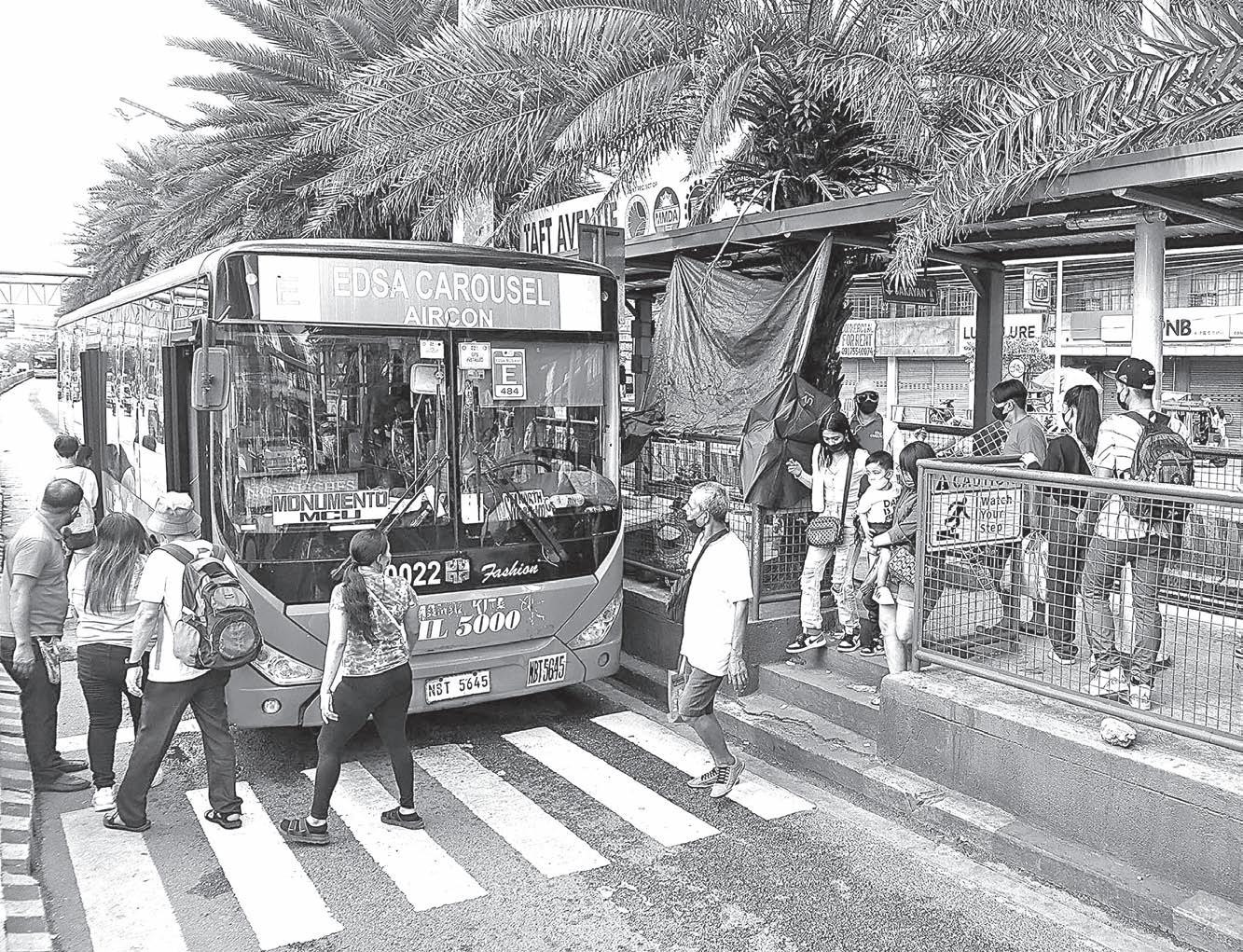
“ In fact, some of the largest Filipino private conglomerates have found it gainful to embark on tollways and rail transit systems, while others are going into aviation,” Pimentel said,
referring to the likes of San Miguel Corp., Metro Pacific Investments Corp. and Aboitiz Equity Ventures Inc.
I n December, the House of Representatives passed on third and final reading the bill seeking to establish the MIF as the Philippines’ first sovereign wealth fund.
We are confident the Senate will pass the bill after giving it a fair hearing and putting in further improvements,” Pimentel said.
P resident Ferdinand Marcos Jr. had earlier certified the bill as urgent.
Under House Bill No. 6608, the MIF may invest in a wide range of real and financial assets to generate long-term social wealth savings and to fuel national economic development.
T he MIF’s permissible investments include joint ventures and infrastructure projects.
A t least 25 percent of the net profits of the Maharlika Investment Corp. – the entity that will manage the MIF – would be remitted to the national treasury “to be earmarked for social welfare projects.”
Under Section 43 of the approved HB 6608, all documents of the MIF and the Maharlika Investment Corporation—the independent body created to manage the fund—shall be open, available, and accessible to the public.
Nearly 50 countries around the world have established sovereign wealth funds, many of which are funded by surplus government revenues or reserves. Jovee Marie N. Dela Cruz
have already been final and that others may not be interested to transfer.”
DOH tallies 74 fireworks-related injuries
is earlier,” the FIRB Resolution read.
T he FIRB noted in the resolution that only about 40 percent of the affected RBEs made it to submitting their transfer requirements on time while some 640 RBEs have not yet submitted theirs.
Trade Undersecretary and BOI Managing Head Ceferino S. Rodolfo said at a virtual media briefing last December 16 that the BOI will work closely with the IT and Business Process Association of the Philippines. He also noted that “the number might
T he BOI managing head earlier said the investment promotion agency is coordinating with Philippine Economic Zone Authority (PEZA) and the FIRB to carry out the process of the paper-transfer registration.
P ursuant to PEZA MC 2022-070, PEZA initially set an earlier deadline of December 16,2022 to ensure that PEZA will have sufficient time to review applications before they endorse it to the BOI. (Full story here: https:// businessmirror com.ph/2022/12/15/peza-vowsto-meet-deadline-for-submissionof-rbe-applications/)
By Claudeth S. Mocon-Ciriaco @claudethmc3
THE Department of Health (DOH) recorded a total of 74 fireworks-related injuries (FWRI) as of January 1, 2023.
A ccording to the DOH, the total number of cases recorded is 211, higher by 16 percent as compared to the 182 cases recorded in
the same period last year from Dec. 21,2021 to Jan. 2, 2022.
E arlier, the DOH said that males aged 10-14 years old were the most affected group.
T he hand and eye were the most affected anatomic areas which can lead to permanent disability.
B oth Boga, which is illegal, and kwitis considered as legal fireworks have caused injuries.
A10 Tuesday, January 3, 2023
THE “huge wage differential” and the high demand for healthcare workers (HCW) due to aging populations could cost the Philippines more of its healthcare professionals in the medium term, according to the Philippine Development Plan (PDP).
END OF FREE RIDES An Edsa Carousel bus is seen on Edsa near Taft Avenue. The busway, which has been rendering free service to the public for almost two years in the middle of the pandemic, will no longer offer free rides, the Department of Transportation has announced. ROY DOMINGO
FIRB... Continued from A1
NGCP seeks nod to recover typhoon-related expenses
By Lenie Lectura @llectura
The National Grid Corporation of the Philippines (NGCP) is asking regulators to recover P177.27 million which it spent for the repair, restoration and rehabilitation of transmission assets and facilities damaged by Typhoon Odette in Visayas and Mindanao in December 2021.
“nGcP seeks to immediately recover the actual expenses incurred for the repair and restoration of the damaged transmission assets and facilities damaged by FMe ty phoon odette required significant capital infusion, the recovery of which
should be allowed immediately in order to avoid any financial strain in the operation of nGcP and to allow the continuous provision of transmission services to the grid customers,” the grid operator said in its 10-page application filed with
the energy regulatory commission (erc)
t h e amount consists of P83,368,402.99 in in Force Majeure events (FMe) capital expenditures (capex),P48,514,284.35 FMe operational expenses (opex) and P45,391,600.93 in net fixed asset value of the transmission facilities (nFAV).
if approved, additional network charges for lu zon and Mindanao will be collected starting January until December 2027, or until such time that the amounts incurred are fully recovered.
in particular, nGcP proposed to collect P2.5119 per kilowatt hour (kWh) in 2023, P0.4249 per kWh in 2024, P0.3780 per kWh in 2025, P0.3466 per kWh in 2026, and P0.3214 per kWh in 2027 in Visayas.
For Mindanao, collection will amount to P0.2512 per kWh for 2023.
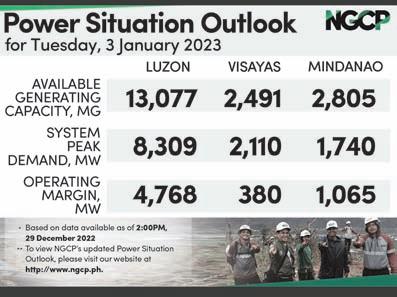
n G c P asked the e rc that it immediately grant provisional authority to implement and bill the FM pass through amounts to Visayas and Mindanao customers starting the billing month of January 2023 to December 2027, or until such time that the amounts incurred are fully recovered, it said in its application.
t he timely implementation of the FM pass-through amounts will allow an even spread of the increases in tariffs from the initial implementation of the recovery of the cost, it added.
nGcP is a Filipino-led, privately owned company in charge of operating, maintaining, and developing the country’s power grid, led by majority shareholders and Vice c hairman of the Board Henry Sy, Jr. and co -Vice chairman robert coyiuto Jr. it is the sole operating asset of Synergy Grid and Development Philippines inc.
SMEs urged to adopt e-invoicing
Electronic invoicing (einvoicing) can bring many benefits to companies, giving them the means to adapt to the different requirements of traditional and digital trade worldwide, according to business experts.
e - invoicing has several potential benefits particularly for small and medium enterprises (SM e s), lu isa Scarcella of the international c hamber of commerce (icc) said in a statement issued by the Philippine ex porters confederation inc. (Philexport).
it can shorten processing cycles including payments of accounts receivable and tax recovery. it can also cut transaction costs, improve tax data management and enforcement, provide real-time control over movement of goods, support the modernization of the economy, and make it easier for companies to operate on a global scale.
e -invoicing can help both multinational companies and SMes alike, but more so for the latter, who “don’t have the capacity and means to adapt to the different requirements around the world,” the executive said.
Scarcella gave her presentation at a recent forum on accelerating trade digitalization that was organized by the United nations economic and
Social c ommission for Asia and the Pacific (eSc A P), in cooperation with the Asian Development Bank and icc
invoices are one of the most important documents for trade, providing a basis for payment and business management as well as for trade control and regulatory compliance.
Andre Hoddevik, secretary general of o penPeppol A iSBl , at the same event said e-invoices can improve tax, business and trade services. einvoicing is crucial for the future of the global trading system, which is why governments and companies are starting to embrace it to deliver increased efficiency, accuracy and reliability in cross-border transactions.
However, connecting isolated digital systems remains a key constraint, and as more countries create their own e-invoicing frameworks, there’s the risk that they would enact country-specific and technical standards that ultimately act as a barrier to digital trade.
Such constraints make it harder and more expensive for companies, especially SMes, to sell to and support customers in multiple markets.
t he potential of electronic invoicing in facilitating cross-border commerce will not be unlocked if the implementation of e-invoicing per-
sists with the current level of diversity of approach among jurisdictions and law enforcement,” Hoddevik said in the same statement issued by Philexport.
He added: “ it is essential that electronic invoices be recognized and trusted by both private sector and government agencies. And in the case of international trade, that trust needs to extend across borders.”
What is needed is a consistent legal, administrative, and technological global framework and the adoption of invoicing into the broader digitalization strategies of public administrations and businesses alike, he said.
t here needs to be common/coordinated rules and technical standards and processes to enable the interoperable interpretation of the invoice in digital form.”
t he good news is that one such framework is now available through Peppol, a key interoperability framework now being used in many countries, Hoddevik said.
Peppol used to stand for “Paneuropean Public Procurement online,” but this name was dropped in 2018 and changed to just Peppol.
now Peppol is the name of the interoperability framework, while
MAc AU S casinos posted their worst year since 2004 as c hina’s strict cov id Zero policies wrought havoc on the gambling hub, though a recent loosening of pandemic curbs is fueling optimism about a long-awaited revival in the year ahead.
t h e Gaming i n spection and c o ordination Bureau said Sunday that gross gaming revenue in December fell 56 percent from a year earlier to 3.48 billion patacas ($433 million), slightly below the median estimate of a 57-percent decline, according to analysts surveyed by Bloomberg.
t h at took revenue for the full year to 42.2 billion patacas, down 51 percent from 2021 and far short of the pre-pandemic level of 292 billion patacas in 2019. Still, analysts predict a rebound in 2023, with a median estimate of 195 percent growth.
Key insights
n Gaming revenue has been declining since March as virus outbreaks and lockdowns in c hina— Macau’s biggest source of visitors— led to a tightening of outbound travel, and a crackdown on cross-border gambling saw tougher rules around issuing visas. revenue plunged to a record low in July, when the city was
hit by a major flareup that saw casinos shut for almost two weeks and prompted the mainland to suspend quarantine-free travel.
n Short-term headwinds remain after china’s abrupt U-turn on covid Zero in December sparked a record wave of infections in both the mainland and Macau. Disruptions are set to drag on casinos until the lunar
o penPeppol is the name of the organization.
Peppol integrates business processes by standardizing the way information is structured and exchanged.
established in 2012, o penPeppol is a member-driven nonprofit and democratic association set up as an Association internationale Sans But lucratif (A iSBl) under Belgian law.
o u r members come from the public and private sectors, with membership continuously increasing as new members join from all around the world,” Hoddevik said.
As of november 2022, there are 18 countries with Peppol authorities, 42 countries with o penPeppol members, 500 o penPeppol members and over 723,000 receivers in the network.
Hoddevik said Japan’s Digital Agency joined Peppol as a new authority in october 2021 and in october 2022 announced the availability of its Peppol invoice specifications for use by accredited service providers.
A new Peppol authority was likewise established in Finland this year, while india has three service providers joining o penPeppol this year.
“We are hopeful that Malaysia will become a Peppol authority in the near future as well,” he said.
More new and existing franchising brands are expanding their market reach in ca nada to meet the growing demand for certified halal products not just from Muslims but also from those looking for healthy and safe products, according to the Philippine ex porters confederation inc. (Philexport).
in a statement it issued recently, Philexport quoted nasser Deeb, cofounder and chief executive officer of t he ex po Hut ca nada, as saying that ca nada’s demand for halal products is increasing.
“With the growing success of international halal fast food, more large chains should take note and expand their halal offerings in canada. Besides, what business can’t afford (is) not to target a projected trilliondollar market,” Deeb said during a national halal conference.
He said halal franchising is another area of the halal industry that has witnessed significant growth in recent years in ca nada, driven by both the local and international brands.
Deeb said expenditure on halal food was estimated at $2 billion in 2019, and the market is poised for growth driven by increasing demand for halal food among ca nadian Muslims.
t he current c a nadian Muslim
population is about 1.9 million, increasing at roughly 15 percent annually and projected to reach 3 million by 2030 with the influx of immigrants, particularly from the Muslim countries, he said.
“ today, some local stores report halal sales increasing by as much as 80 percent. Various products are even found in major retail outlets such as Food Basics, costco, l oblaws and Wal-Mart and the list continues to grow. Some carry 90 percent of their food products that is halal certified, such as Adonis and iqbal Foods.”
He said ca nada is also a modest exporter of halal meat and poultry products to the organization of isl amic cooperation.
citing a news and insights platform, Deeb said export revenues have been increasing “so there is a growth story in progress and given the quality of c a nadian produce, there is certainly an export opportunity for their halal sector.”
He said over 1,400 certified halal products can be found in canada and more products are introduced to the market on an annual basis.
t he ca nadian Food inspection Agency requires halal businesses to carry a label with prescribed information, including guidance on the use of statements and claims applied to halal food labels, he added.
new Year holidays in late-January, according to Bloomberg intelligence analyst Angela Hanlee.
n But the mainland’s reopening in January, and Macau’s own moves to scrap quarantine for overseas arrivals, paves the way for a major rebound for casinos in 2023. investors are bullish on the sector, pushing casino stocks to their best annual performance since 2017 on optimism about c hina’s reopening.
*casinos also face brighter prospects over the longer-term. All six current operators were recently granted new licenses for 10 years, with the decision removing a major uncertainty that had hung over the sector for much of the past year.

A Bloomberg intelligence index of Macau casino operators jumped 35.5 percent in December, boosted by the reopening news. t he benchmark Hang Seng index rose 6 percent in the same month. Bloomberg News
CH i n A e v ergrande Group delayed releasing a muchanticipated restructuring plan again, missing a self-imposed deadline and disappointing creditors seeking to salvage investments.
t he world’s most indebted developer has yet to announce its offshore debt-restructuring plans, falling short on its promise to do so by the end of 2022. evergrande didn’t immediately respond to a request seeking comment during non-business hours.
With about 1.97 trillion yuan ($286 billion) of liabilities, the company is facing a winding-up lawsuit in Hong Kong, while sitting at the heart of a property crisis that’s triggered a flurry of defaults and caused home construction halts across the country.

evergrande’s fate has broader implications for c hina’s $58 trillion financial system, and could send ripples across banks, trusts and millions of home owners. it would likely
be among the country’s biggest-ever restructuring efforts. t he sheer size has left investors worried that any collapse may spark financial contagion and curb growth in the world’s second-largest economy, which depends on the housing market for about a quarter of gross domestic product.
t he company previously failed to come up with a “preliminary restructuring plan” it promised by the end of July. it met with an adhoc group of its dollar bondholders in early December to formally discuss a proposal, Bloomberg reported earlier.
it expected to receive support from offshore creditors by the end of February or early March, the developer’s legal representative said during a winding-up hearing in late november. evergrande was urged by the judge of winding-up case to present “something more concrete” during the next hearing on March 20. Bloomberg
BusinessMirror Editor: Jennifer A. Ng Companies B1 Tuesday, January 3, 2023
News
Macau casinos seek brighter outlook after worst year since 2004
brands must expand halal offerings in Canada’ Evergrande misses proposal deadline GaminG chips sit next to cards on a poker table during the Global Gaming Expo asia (G2E asia) in macau, China, on Tuesday, may 21, 2019. PhotograPher: Paul Yeung/BloomBerg PEoPlE ride tricycles past the China Evergrande Group Royal Peak residential development in Beijing, China, on Friday, July 29, 2022. BloomBerg news
‘Franchise
Banking&Finance
BSP taps bankers to promote cybersecurity
By Cai U. Ordinario @caiordinario
THE Bangko Sentral ng Pilipinas (BSP) has partnered with the Bankers Association of the Philippines (BAP) and the Bank Marketing Association of the Philippines (BMAP) to fight cybercrime through the “Check-Protect-Report” (CPR) information drive to foster cyber hygiene among Filipinos.
The “Check” is about being careful when sharing information as legitimate banks and financial institutions (FIs) will only ask for personal data when they are contacted
by their clients.
The “Protect,” meanwhile, means safeguarding and not sharing personal data to senders of random text messages or emails, while “Report”
US Treasury market logs record annual loss in ’22
enjoins financial consumers to urgently inform their banks or FIs about suspicious transactions.
“Amid the rise in digital transactions, the ‘CPR’ campaign encapsulates what we encourage the public to cultivate as a habit. It is expected to enhance financial consumer welfare, further strengthen confidence in the use of electronic payments and, therefore, promote growth,” BSP Governor Felipe M. Medalla was quoted in a statement as saying.
“Bolstering public trust in the payment system is supportive of the BSP’s goals under the ‘Digital Payments Transformation Roadmap,’ which aims to digitize half of the volume of retail payments and onboard 70 percent of Filipino adults to the formal financial system by 2023,” he added.
BSP said the communication campaign aims to equip Filipino finan-
cial consumers with the information needed to protect themselves against online scams.
It also underscores that cyber security is a shared responsibility among financial regulators, industry participants, and financial consumers.
“Our strong collaboration with the BSP and BMAP complements the BAP’s #Cybersafe campaign by providing a platform to keep the banking public abreast and empowered with the knowledge of the ever-evolving schemes of cybercriminals,” said BAP President Antonio C. Moncupa.
More vulnerable MONCUPA further said that “as proponents of safe and efficient banking practices, the banking industry continuously works closely with the regulators, legislators and law enforcement agencies to effectively
curtail fraud and the proliferation of cybercrimes.”
“Central to this goal is the protection of the banking public’s hard-earned funds which can only be achieved with the joint effort by the financial institutions, government agencies and the customers themselves,” he added.
BMAP President Mai G. Sangalang expressed the association is pleased to partner with the BSP and BAP in the campaign toward raising consumer awareness and vigilance against cybercrime.
“Cyber criminals have evolved and reinvented scams that are becoming more complex and harder to detect. Further, a social media savvy population makes the country more vulnerable to cyberattacks and fraud incidents,” Sangalang said. “With this, we call on the public to always be vigilant, practice due diligence, and to not be complacent when it
comes to cybersecurity.”
Based on the Philippine Development Plan (PDP), the BSP will continue to use regulatory technology (RegTech) to fight cybercrimes and benefit financial sector firms and supervising agencies. This strategy is expected to improve regulatory compliance as well as help the private sector pursue greater digitalization and improve the design and delivery of innovative financial products and services.
RegTech aims to provide efficient and effective public and private sector solutions to prevent fraud, money laundering, and terrorist financing; and streamline prudential reporting. It can also be used to conduct effective creditworthiness assessments and provide a more efficient, timely, and accurate manner of meeting reportorial and compliance requirements, among others.
Fiscal authorities issue tax rules for Bangsamoro region
By Manuel T. Cayon @awimailbox Mindanao Bureau Chief

DAVAO CITY—The Intergovernmental Fiscal Policy Board (IFPB) has approved a resolution on the taxable elements in the Bangsamoro region, such as capital gains tax, documentary stamp tax and estate tax as well as the sharing arrangement of revenues between the latter and the national government.
The IFPB is one of the economic and financial bodies jointly created by the region and the national government to thresh out issues on revenue collection and the protocols on revenue sharing. Members of the IFPB approved the resolution in its meeting in Davao City last month, its fourth so far.
released by the Bangsamoro Information Office did not give details on the implementation of the taxable elements as well as the sharing arrangement. The BIO only issued a statement quoting Department of Finance Secretary Benjamin e D iokno who expressed optimism about the success of the Bangsamoro government’s undertakings for the fiscal year.
The BIO said the approved resolution “is according to Section 9, Article XII of the Bangsamoro Organic Law, which sets the implementation of sharing of revenues from the collection of taxes, where the taxable elements are both situated within and outside of the Bangsamoro territorial jurisdiction.”
Steady support
putation of the annual block grant for the Bangsamoro Autonomous Region in Muslim Mindanao, taxstudy group deliverables and the participation of the Bangsamoro government in the Al-Amanah Islamic Investment Bank of the Philippines.
Minister of Finance and Budget and Management Ubaida Pacasem expressed gratitude to the IFPB members and the National Government for the “steady support to the Bangsamoro Government.”
“Thus, the IFPB-Bangsamoro Government is with you in achieving your 10-point agenda for economic renewal and long-term growth, most especially fiscal discipline and transparent and efficient governance,” Pacasem said.
in Barmm since the passage of the Bangsamoro Organic Law and the continuous economic achievements “have made us all hope for a better Bangsamoro in the near future.”
Other Barmm officials present at the meeting were Minister of Trade, Investments and Tourism Abu Amri Taddik, Bangsamoro Planning and Development Authority Deputy Director-General Amil Abubakar and Bangsamoro Finance Director Sittie Amirah Pendatun.
The US Treasury market notched a record annual loss in 2022, fueled by inflation pressures that prompted the Federal Reserve to hike its overnight benchmark by more than four percentage points.

Yields peaked in October or November, then retreated as inflation gauges began to show moderation and Fed officials slowed the pace of policy tightening. The yield curve inverted, with rates for 5-year notes first exceeding those for 30-year securities in March, while the gap between two- and 10-year yields also flipped.
Ultimately, these inversions reached historic extremes, signifying that investors expect high shortterm yields to do economic damage. The inversion of the two- to 10-year curve hit as much as 85.2 basis points on Dec. 7, before ending the year at around 56 basis points. The five-year premium over the 30-year rate at one point reached as much as 46.8 basis points.
For 2023, many US interest-rate strategists expect Treasuries will extend their recent rally, dragging yields lower and steepening the curve in the second half of the year so long as labor-market conditions soften and inflation ebbs further.
The Bloomberg US Treasury Index returned -12.5 percent, its second straight full-year loss and the biggest in its four-decade history; the worst months for the index were in September (-3.45 percent), March (-3.11 percent) and April (-3.10 percent); the 1Q loss of 5.58 percent was the biggest on record for a single quarter.
Yields climbed as the likely course of the Fed’s policy rate was continuously reassessed, both before and after the central bank began hiking rates.
In January, swap contracts referencing Fed meeting dates priced in four quarter-point rate increases over the course of the year.
The central bank’s first move took place in March, when officials lifted the benchmark range to 0.25 percent-0.5 percent, a quarter point above where it had been.
By April, half-point increases were priced in for the subsequent four meetings.
In June, when the Fed did its first three-quarter-point rate increase since 1994, the market had begun to price in a drop in rates from the eventual peak.
By December, when Fed policy makers published new forecasts with a median of 5.125 percent for the funds rate in 2023, market-implied expectations for eventual peak had declined to under 5 percent from highs around 5.25 percent.
Russia’s invasion of Ukraine in February arrested the selloff temporarily, but it resumed as the price of crude oil jumped to the highest level in more than a decade, presaging higher gasoline prices; agricultural commodity costs also soared.
By the end of the year, commodity prices had broadly returned to February levels, with oil and gasoline futures reaching year-to-date lows in December.
US inflation accelerated in the first half, with the Consumer Price Index peaking at 9.1 percent year-onyear in June, ebbing to 7.1 percent by November; core inflation peaked at 6.6 percent in September and eased to 6 percent.
Five-year inflation expectations implied by yields on Treasury inflation-protected securities peaked in March at more than 3.7 percent, and retreated to about 2.38 percent by year-end.
During the second half of the year, Treasury yields were propelled past their June highs as UK and eurozone yields began to soar, reflecting elevated expectations for where central banks in those economies might need to take their policy rates.
In September, proposed tax cuts by a new British government caused a moonshot in UK yields that also hurt sovereign bonds globally until the plan was withdrawn and there was another leadership change.
Treasuries also were buffeted by surprise moves during the second half of the year by the Bank of Canada—which did a bigger-thanexpected 100bp hike in July and a smaller-than-expected 50bp increase in October—and the Bank of Japan, which widened the trading band for 10-year yields in December, sparking a selloff in Japanese government bonds. Bloomberg News
The communication dispatch
T he IFPB also discussed the com-
According to Pacasem, also a lawyer, the economic growth they see
The IFPB is composed of the officials of the National Government and the Bangsamoro government. The members from the National Government include Diokno, Budget and Management Secretary Amenah Pangandaman and National e conomic and Development Authority Undersecretary Carlos Bernardo Abad Santos.
Four silly reasons why people don’t invest
COGNITIV e dissonance is a term in psychology where an individual experiences discomfort because they hold contradictory beliefs, ideas or values at the same time.
It’s the guilt you feel when you eat junk food after you promised to yourself that you’ll start making healthy food choices. Or when you take personal calls at work even though you know it’s against company policy.
To reduce the dissonance; that is, to make you feel less guilty about the situation, you try to justify your behavior.
After eating that junk food, you’ll say that it’s just one time and you’ll run an extra 15 minutes next time at the gym to burn it off. Or you’ll justify that it wasn’t your fault that your friend called you at work and, besides, you’re a good employee and a few minutes of personal time will not affect the quality of your work.
Interestingly, cognitive dissonance happens often when it comes
to money habits. For example, most people believe that saving money is good. But ironically, not everyone has cash savings. People would rationalize this by claiming that their salary is just too low and they’ll just start saving when they get a salary increase.
When it comes to investing, a lot of people will also say that it’s very important to invest. But you guessed it: not everyone invests. how do people rationalize this behavior? Through these four silly reasons.
n “I don’t know how to invest.”
I’m sure that, years ago, you did not know how to use a computer. But you learned it eventually in school, through self-study or with the help
of a friend.
It’s foolish to say that you don’t invest because you don’t know how to, when there are a lot of websites you can visit, books you can read, seminars you can attend and people whom you can learn from.
n “I don’t have time to learn and invest.”
You are reading this article, so you actually have the time to learn.
More harshly, if you have time to watch television, then you definitely have time, but you probably just don’t want to. Additionally, did you know that investing in the stock market only takes a few minutes of your time? It’s just like paying your bills actually.
n “I don’t have money to invest.”
A lot of investments today only requires P1,000 to start. The minimum investment in some mutual fund companies is just P5,000. That’s really not a lot of money given that you can afford to eat out or watch a movie every so often.
The real problem here is your spending priority. Cut back on your unnecessary spending to create an investment fund.
n “I want to enjoy my money.”
I agree that you should enjoy your money because you worked hard for it. But more importantly, it doesn’t have to be a choice and you can do both. You only need to save and invest a portion of your income, then after your necessary expenses you can spend what’s left however way you want.
Moreover, realize that when you invest, you’ll eventually have more money in the future that will allow you to enjoy life better. Keep this in mind…a little sacrifice on your spending today means having a lot more choices to enjoy your life tomorrow.
Fitz Villafuerte is a registered financial planner of RFP Philippines. To learn more about personalfinancial planning, attend the 99th RFP program this January 2023. To inquire, e-mail info@rfp.ph or text at 0917-6248110.

Deutsche Bank, JPMorgan fight to dismiss class action suits
De U TSC h e Bank AG and JPMorgan Chase & Co. have asked a federal court to throw out lawsuits filed by Jeffrey epstein’s victims accusing the banks of enabling the late pedophile’s sex trafficking network.
In motions to dismiss the class action suits, lawyers for Deutsche Bank said the claims did not “come close to adequately alleging” that the bank, which provided banking services to epstein between 2013 and 2018, was part of his sexual abuse ring.
“All of the plantiff’s claims are deficient and none can be maintained,” the motion, filed on Friday, states.
The victims filed legal action against JPMorgan and Deutsche
Bank in November, alleging epstein’s sex trafficking enterprise could not have “existed or flourished” without the complicity of the banks.
e p stein was charged with sex trafficking in 2019 but found dead in his prison cell in New York weeks later. h i s former girlfriend, Ghislaine Maxwell, was convicted of similar charges last December. During her trial, a JPMorgan banker testified that e p stein wired her $31 million, money prosecutors characterized as Maxwell’s payment for procuring young girls for the financier.
In the current civil case, epstein’s victims accused JPMorgan of “financially benefiting from participating”
in epstein’s sex trafficking through providing financial support from 1998 to August 2013. Deutsche Bank was accused of knowing it would earn millions of dollars from its relationship with epstein.
The suits, filed separately in federal court in Manhattan, are seeking unspecified damages for violations of sex trafficking and racketeering laws and the newly-enacted New York Adult Survivor’s Act.
Lawyers for Deutsche Bank argue the victims’ complaint provides no factual allegation that the bank knew or should have known about epstein’s sex trafficking. Rather the bank was providing “routine banking services to a client, nothing more.”
The complaint also “plainly established that it was epstein’s conduct that was the direct cause” of the victims’ injuries, not the bank, according to Deutsche Bank.
JPMorgan’s motion was similar and requested that the court dismiss all claims. Both banks stated they ended their relationship with epstein after The Miami herald published in 2018 allegations about the financier’s abuse of young women and teenagers.
JPMorgan’s lawyers wrote in their motion that the survivor, who filed the class action suit, was entitled to justice but that the claim was directed at the wrong party and so is “legally meritless.”
BusinessMirror
• Tuesday, January 3, 2023 B3 www.news.businessmirror@gmail.com
Editor: Dennis D. Estopace
Bloomberg News
perSonal finance
fitz Gerard Villafuerte
This Friday, December 20, 2022, photo shows people walking past the Marriner s Eccles Federal Reserve building in Washington, D.C. BloomBerg News
Silverlens opens new year with art showcases
multi-award-winning film sound designer and multidisciplinary artist born in Bacolod will present a large installation involving sound, light and scent elements. the concept revolves around ideas on memory, expounded using early cinematic systems and a video piece using AI-generated animation.

t’s a loaded combination of exhibitions and art fair showcases around these parts and the world that silverlens opens the new year.
Kicking off the gallery’s 2023 offerings is a group exhibition in silverlens New York, titled State of Flux. Organized by independent curator Jeanette Bisschops, the show presents the works of Meriem Bennani, Nicholas Grafia, Josh Kline, and Pow Martinez. the exhibition will also see the US performance debut of Grafia and long-time collaborator Mikołaj Sobczak on February 10 and 11.
According to the gallery, State of Flux “examines shapeshifting and humor as protective adaptations to geopolitics and the perils of contemporary existence.” Bennani, a Morocco-born artist who lives in the US, will present for the first time in New York the second of her pseudodocumentary series about a fictitious island run by the American military complex. Figures transcend bounds in the paintings of Nicholas Grafia, while Kline is set to offer never-before-shown sculptures centered on the social-political breakdown in America. Lastly, Martinez, fresh from his successful solo at silverlens Manila, will feature new works of his lewd cavemen, blow-up dolls and more. State of Flux will run from January 12 to March 4 at silverlens New York, the gallery’s new Us outpost launched in September 2022.
At its Manila space, silverlens will begin the year with twin solos, featuring Corinne de san Jose and Mark Andy Garcia. In Lazy Projectors, De san Jose explores the malleability of history by “mixing timelines and mediums in one space.” the

Opposite the showcase is Garcia’s Chasing Sunsets to be presented is a collection of new works that continue to tackle the “spiritual geographies of quiet pastoral landscapes rendered in intricate layers and gestural brushstroke.” Garcia has established an ant0-trend, painterly style that is distinctively his own, anchored on storytelling. Since 2008, he has chronicled and presented his life through paintings, from detailing his life as an overseas contract worker in saudi Arabia to dealing with the emotional anguish over the passing of his father. De san Jose’s Lazy Projectors and Garcia’s Chasing Sunsets will be on view at silverlens Manila on Chino Roces Avenue in Makati City, from January 14 to February 11.

Rounding up Silverlens’s slate of offerings for the first quarter of 2023 are presentations for three art fairs: SEA Focus, Art Fair Philippines and Art Dubai.
The gallery returns to SEA Focus in Singapore with a two-part presentation and a special exhibition featuring the late Filipina American artist Pacita Abad. For the first half of the showcase from January 5 to 9, silverlens will be presenting drawings by Pio Abad from his Notes on Decomposition series, along with a painting by Patricia Perez Eustaquio. Concluding the presentation from January 10 to 15 are self-portraits by Wawi Navarroza and a new tikar (mat) from Yee I-Lann’s Tukad Kad Sequence
For the country’s biggest contemporary art showcase, Art Fair Philippines, which runs from February 16 to 19, Silverlens will be mounting concurrent presentations onsite and in its gallery space, featuring a smorgasbord of nearly 50 artists. silvelens’ participating artists for next month’s Art Fair Philippines include Pacita Abad, Pio Abad, Martha Atienza, Santiago Bose, Frank Callaghan, James Clar, Nicole Coson, Chati Coronel, Corinne De san Jose, Patricia Eustaquio, Dina Gadia, Gregory Halili and Mit Jai Inn, among others. Gallery artists
Wawi Navarroza and Pow Martinez will likewise be part of the “special Exhibitions” section of the fair. then, for March’s Art Dubai, silverlens will be presenting new miniature paintings on capiz shells by Gregory Halili in the fair’s Bawwaba section. Bawabba, which means gateway in Arabic, features artworks made in the past year, or specifically for Art Dubai.
Acccording to Halili, he has “always been interested in nature and its relationship with humanity. these miniature paintings for Art Dubai tackle such issue. What at first may look like simple, beautiful works of butterflies and moths are actually a commentary on the complex, fragile state of environment and the unpredictable future.”
The 16th edition of Art Dubai runs from March 1 to 5 at Madinat Jumeirah in Dubai.
More information is available at www. silverlensgalleries.com. n
Blessed with beautiful babies
Continued from B5
Gino de la Peña and stephanie Henares also received their early Christmas gift last November—a bouncing baby girl they named Natalie Elle. Henares, the daughter of Ronnie and Ida Henares, married de la Peña six years ago. the baby is an answered prayer for the couple.
Rita Daniela gave birth three days before Christmas to her baby boy she named Juan Andres. She wrote her first love letter to her son she nicknamed Uno—“Hi, my son. You’re the greatest Christmas gift that God has given me. You’re such a blessing to us. Your Tatay and I are so joyful to have you. Can’t believe I’m celebrating Christmas this way... with you.”
It will surely be a happy, busy and joyful new year for everyone. Cheers!
Today’s Horoscope
By Eugenia Last
CELEBRITIES BORN ON THIS DAY: Eli Manning, 42; Danica McKellar, 48; Mel Gibson, 67; Victoria Principal, 73.
HAppY BIRTHDAY: Go out of your way to be helpful this year, and opportunities will come your way. A positive attitude will lead to social invitations that will encourage meaningful relationships with people who share your concerns, enthusiasm and hobbies. Expand your interests to focus on health and fitness, and prioritize looking and feeling your best. Romance is in the stars. Your numbers are 4, 12, 22, 24, 31, 44, 49.
aARIES (March 21-April 19): By participating, you’ll make a connection that offers a unique approach to something you want to pursue. Put more effort into presenting who you are, what you can do and what you expect. HHHH


bTAURUS (April 20-May 20): Take a moment to clarify what you want and the approach you plan to take to reach your objective. Verify information and make the necessary changes as you progress. Dress for the part if you want to make a good impression. Make things happen. HHH
cGEMINI (May 21-June 20): A tight schedule will help you avoid trouble while accomplishing your goal. Listen attentively, or you’ll misinterpret what’s said. Hard work will pay off and lead to rewards. HHH
dCANCER (June 21-July 22): Simplify how you do things and free up enough time to relax with someone you want to get to know better. Sharing ideas will change your plans and the outcome of a work-related situation. HHH
eLEO (July 23-Aug. 22): The conversations you have will encourage you to participate in something that promotes networking and picking up additional skills. An energetic, hands-on approach will invite compliments and exciting offers. HHHH
fVIRGO (Aug. 23-Sept. 22): Don’t get angry; get moving. Look at your options and choose to do something that sparks your interest or can change your outlook regarding prospects and possibilities. Flaunt what you have to offer, and you’ll raise interest and increase your options. HH
g
LIBRA (Sept. 23-Oct. 22): Refuse to lose sight of your objective. Don’t bend the rules to suit someone else’s needs. Put your physical effort into personal gain, good health and protecting yourself from being taken for granted. HHHHH
h
SCORpIO (Oct. 23-Nov. 21): Consider what will make the most significant difference in your life and concentrate on heading down that path. Refuse to let others limit what you can accomplish. Speak up and present the changes you plan to make. HHH
iSAGITTARIUS (Nov. 22-Dec. 21): Your enthusiasm will encourage others to accommodate you. Paint a vivid picture, and doors will open. Self-improvement will boost your chance to make a statement and seal a deal. Don’t underestimate the power of persuasion. HHH
jCApRICORN (Dec. 22-Jan. 19): Pay attention to detail and make personal changes that add to your convenience and ease stress. Plan a trip or sign up for an event that helps you comprehend what’s possible and how it can improve your life. HHH
kAQUARIUS (Jan. 20-Feb. 18): Dress up, implement plans with someone you enjoy spending time with and ask questions that will clear up any misunderstanding or uncertainty you face. A chance to do something nice for someone you love will have a positive impact on your relationship.
HHHHH
lpISCES (Feb. 19-March 20): Selfimprovement projects will pay off. Someone will scrutinize how you take care of your physical and emotional well-being. Do what you can, but don’t let what others say deter you from following your heart and doing what’s best for you. Romance is favored. HH
BIRTHDAY BABY: You are playful, energetic and astute. You are original and intelligent.
H: Avoid conflicts; work behind the scenes. HH: You can accomplish, but don’t rely on others. HHH: Focus and you’ll reach your goals. HHHH: Aim high; start new projects. HHHHH: Nothing can stop you; go for gold.
B4 Art Tuesday, January 3, 2023 • Editor: Gerard S. Ramos
BusinessMirror
www.businessmirror.com.ph
z
ACROSS 1 Ripped 5 Cherry and crimson, e.g. 9 Doesn’t eat 14 “Hi, sailor!” 15 Beige relative 16 Brightened 17 Exhibit 1: Program lines for a Babylonian legal app. Written in cuneiform text. 20 Most common crime in the US 21 Treble woodwind 22 “Shoot!” 23 Pause fillers 25 Goo made from coal, say 27 Exhibit 2: Cumbersome mobile devices used by Moses to record important messages. 35 Everyone 36 Spider-Man director Sam 37 Outpouring 39 Muscular snake 40 Facial feature in some pirate names 42 Vehicle with sliding doors 43 Rolls made with rice 46 2000s TV series set in SoCal 48 Assist 49 Exhibit 3: Early doomsurfing shown in video recreations. An epic flood was trending. 52 ___-for-profit 53 Natural light source 54 Birdcall 57 Revise for publication 61 Cats’ cries 65 Exhibit 4: Monument to a structure that tried to connect to the cloud. 68 Prepared to shoot a goal 69 Frozen yogurt holder 70 Start over on 71 They enforce mob rule 72 Had in mind? 73 Early puzzle video game DOWN 1 Social sensitivity 2 “I know! Pick me!” 3 Got carried away by? 4 Beautiful sight 5 Official with a whistle 6 Repeat after me? 7 Dull in color 8 Wrestling in a dohyo 9 Winter ailment 10 Plane delivery 11 Pulsar or nova, e.g. 12 Bass brass 13 Roasting skewer 18 Significant ___ (partner) 19 New York baseball team 24 Stick a fork in 26 @ signs 27 Indent keys 28 Audibly 29 Affected by ennui 30 Cinco + dos 31 Nebraska tribe or city 32 Dismisses from a job 33 Like an armada 34 Digital sales 38 They can be split or spliced 41 Medics 44 Perform a surfing feat involving the feet 45 Words of affirmation? 47 Piece of bread? 50 Simmer in anger 51 Tough type of pushup 54 Doe’s mate 55 Mississippi tributary 56 Sub captain in Verne novels 58 Ship surface 59 “Five” or “flat” follower 60 Verbal revealer of attitude 62 Be a good dog 63 Gets hitched 64 Coin opening 66 Vision experts’ degs. 67 Scarcely any ‘tech museum’ BY DENNIS NULLET The Universal Crossword/Edited by David
Solution to today’s puzzle: ❶ Untitled Corinne de San Jose ❷ empty Space in Between (detail) Mark Andy Garcia
Steinberg
I
❶ ❷
ViCkY MoRAles
journAlists on cour AGe, wisdoM And truth in storytellinG
FOR more than three decades, GMA Public Affairs has been at the forefront of producing stories that not only touch Filipinos’ lives but also effect change.
Vicky Morales, Susan Enriquez, Doc Ferds Recio and Doc Nielsen Donato, Emil Sumangil, and Kim Atienza proudly wear the Tatak Public Affairs badge. Their work, and to an extent their lives, revolve around the tenets of courage, wisdom and truth.
ADVOCATING THe GOOD
AWARD-WINNING broadcast journalist Vicky Morales believes that for a show or a story to have a positive impact, there should be fairness, heart, truth and social relevance. “Dapat kumpleto ’yung apat na elemento na ’yun,” she says. The “Journalist with a Heart,” Vicky has witnessed first-hand how GMA Public Affairs upholds these elements. “I’m very proud to be part of Public Affairs dahil alam ko ang work ethic dito, I know the hard work that goes with it. I’ve experienced that since day one.”

She adds that she is able to inspire people to actually do good and not just be good. Her longrunning show Wish Ko Lang is a perfect example of this. The drama anthology, which celebrated its 20th anniversary recently, continues to spread positivity to its featured case studies as well as the audience.
“The greater value of Wish Ko Lang is touching the audience and planting a seed in them, making them feel that they want to do good,” she shares.
Radiating with good vibes as well is Good News Kasama si Vicky Morales, a show that has been featuring travel destinations, food spots, and must-try activities to reenergize one’s self.
“People want to be able to feel that there is goodness in the world. People want positive content. People long for good news. [They want to] push change-makers to the right directions,” she adds.
CONNeCTING peOpLe
STORIES of ordinary people become extraordinary when these inspire many. Veteran broadcast journalist Susan Enriquez believes it is essential to tell their stories truthfully because this way, the audience gets connected not only to the narrative but to the people from whom the story originated.
And to connect with people is what Susan is good at, thus she is fondly called “Kumare ng Bayan.” Her ability to relate to the audience is probably one of the reasons why her shows I Juander and Pera Paraan have been going strong.
For more than a decade already, I Juander has featured stories that satisfy Filipinos’ inherent curiosity about their identity and culture while making them relevant to the present world.

Pera Paraan, on the other hand, is a show that was conceptualized at the height of the pandemic. It continues to offer practical tips on handling household finances and earning additional income in the new normal.
INSTIGATING CHANGe
FOR Wildlife Warriors Doc Ferds Recio and Doc Nielsen Donato, their work means facing the challenges and the consequences that come their way in producing stories, especially about the environment and wildlife.
“Hindi basta-basta umuurong sa mga hamon ng storya. Matapang na tinatalakay ang mga isyu, in our case issue ng environment, wildlife,” says Doc Ferds, who together with Doc Nielsen, hosts the environment and wildlife show Born to Be Wild
Now on its 15th year, Born to Be Wild has changed the public’s view on the environment and wildlife— an achievement Doc Ferds and Doc Nielsen are most proud of. “Pag lumabas ka sa kalsada, nakikita nila Born to be Wild, alam nila na you are protecting nature—dun pa lang, ’yun na ang biggest achievement na nagawa ng show at tayo as hosts,” shares Doc Nielsen.
“We were given a platform to instigate change, to educate people about wildlife, by showcasing the current status of our environment—and mabago ’yung paniniwala na meron tayo,” says Doc Ferds. “Halimbawa, kapag nakakita ng bayawak, kakainin; sawa, papatayin; lahat ng ahas makamandag. ’Yung mga first few years namin sa Born to Be Wild, pag nakakakita kami ng ahas, patay na. Ngayon, buhay na.”
Vicky, Susan, Doc Ferds, Doc Nielsen, along with Emil Sumangil and Kim Atienza, join Jessica Soho, Kara David, Maki Pulido, Drew Arellano, and Atom Araullo in upholding the ethos of GMA Public Affairs.
Spanning three decades of blazing the trail in producing compelling stories, GMA Public Affairs has instilled its unique brand in every Filipino.
‘Trailblazer’: Barbara Walters mourned as broadcasting icon
NEW YORK—Reaction poured in from the worlds of journalism, politics, sports and entertainment following the death of TV news pioneer and Barbara Walters. She died Friday at her home in New York at age 93. An intrepid interviewer, anchor and program host, she led the way as the first woman to become a TV news superstar.
“Without Barbara Walters there wouldn’t have been me—nor any other woman you see on evening, morning, and daily news. She was indeed a Trailblazer. I did my very first television audition with her in mind the whole time. Grateful that she was such a powerful and gracious role model. Grateful to have known her. Grateful to have followed in her Light.”—Oprah Winfrey, television icon

“Barbara Walters was the OG of female broadcasters. She was just as comfortable interviewing world leaders as she was Oscar winners and she had to fight like hell for every interview. I deeply admired her and she was incredibly supportive through the years.... As I wrote in my book, she liked to say we were similar in that neither of us was particularly glamorous. I never quite knew how to take that, although being in Barbara’s mold was nothing but a compliment.”—Katie Couric, journalist, former Today cohost and network news anchor.
“Barbara was a true legend, a pioneer not just for women in journalism but for journalism itself. She was a one-of-a-kind reporter who landed many of the most important interviews of our time, from heads of state to the biggest celebrities and sports icons. I had the pleasure of calling Barbara a colleague for more than three decades, but more importantly, I was able to call her a dear friend. She will be missed by all of us at The Walt Disney Company, and we send our deepest condolences to her daughter, Jacqueline.”
Bob Iger, chief executive officer of The Walt Disney Company
“I owe Barbara Walters more than I could ever repay. Rest well sister...mother...friend...colleague... mentor.”—Star Jones, an original cohost on The View
“The Legend. The Blueprint. The Greatest. Rest in Peace Barbara Walters.”—Tamron Hall, broadcast journalist and television talk show host
“I knew barbara for over half of my life. we met in the spring of 1998, in the midst of the starr investigation; i was 24. i remarked that this was the first time i’d ever been in serious trouble. i’d basically been a good kid—got good grades, didn’t do drugs, never shoplifted etc. without missing a beat barbara said: monica, next time shoplift.”
Monica Lewinsky, who was interviewed by
Walters in 1999
“Barbara Walters was a true trailblazer. Forever grateful for her stellar example and for her friendship. Sending condolences to her daughter and family.” Robin Roberts, Good Morning America anchor
“The world of journalism has lost a pillar of professionalism, courage, and integrity. Barbara Walters was a trailblazer and a true pro. She outworked, out-thought, and out-hustled her competitors. She left the world the better for it. She will be deeply missed. RIP.”—Dan Rather, former CBS anchor
“Barbara Walters never flinched when questioning the world’s most powerful people. She held them accountable. She cared about the truth and she made us care, too. Fortunately, she inspired many other
Blessed with beautiful babies
journalists to be just as unrelenting. We are all better off because of her.”—Kareem Abdul-Jabbar, NBA Hall of Famer
“Pioneering TV news broadcaster Barbara Walters has died. A true trailblazer, she was the 1st woman anchor on the evening news. And I was privileged to know her. When she interviewed me, it was clear she did her homework. She was always prepared. May she rest in power.”—Billie Jean King, tennis champion
“So often we toss around the words icon, legend, trailblazer—but Barbara Walters was all of these. And perhaps, above all else, Barbara Walters was brave. She paved the way for so many—we learned from her—and remain in awe of her to this day. RIP, Barbara.”—David Muir, anchor of ABC World News Tonight. AP
CELEBRITY moms and dads will have their hearts and hands full this new year. There was a baby boom of sorts in la-la-land in 2022, and these personalities celebrated their first-ever Christmas and New Year’s Day with their new bundles of joy.

Angelica Panganiban’s precious Amila Sabine is going on 4 months and the actress said that last Christmas was the best ever.
“It was my first-ever Christmas as a mother and that will always be special. My fiancé Gregg (Homan) and I call her Bean and our daughter is learning new things as she grows. She reacts, smiles and even makes faces when we communicate with her. Bean is our focus, our world and everything, including work, has to be set aside for the meantime because our baby is our topmost priority.”
Entertainment news presenter Iya Villania and her husband Drew Arellano welcomed their fourth child Astro Phoenix last June and she shared that their growing family gives her a lot of joy. “He’s our fourth but the discovery about babies and toddlers and parenting never stops. Our Christmas was a riot, a happy and wacky one!”
GMA artists Jennylyn Mercado and Dennis Trillo are also very happy with the new addition in their family. Their daughter Dylan turned exactly 8 months on Christmas Day and the holidays couldn’t be happier. Trillo has a 15-year-old son named Calix Andreas with former beauty queen Carlene Aguilar, while Mercado has a 14-year-old son with now retired actor Patrick Garcia.
Twenty twenty-two
Power belter and occasional actress Angeline Quinto also gave birth last year to her and her nonshowbiz fiancé’s baby boy Sylvio. The couple was engaged last September and are planning a simple wedding this coming year.
Joey Marquez’s darling beauty queen daughter Wynwyn Marquez also had her first child last year. The baby has three names: Luna Teresita Rayn and she is now 8 months old. “My apo is our family’s little princess and everybody adores her. She brings so much happiness to my life and I am a very proud lolo!”
Joey told us recently when we spoke to him.
Comedienne Kitkat gave birth to her daughter Uno Asher last August and she described her being a mom as a most wonderful blessing. “My daughter completes me. My husband Walby (Favia) and I waited and prayed for her and she is God’s most precious gift to us. This Christmas is our happiest ever!
Our happiness is now on a different level,” Kitkat enthused.
Rocco Nacino also became a first-time dad last October when his wife Melissa Gohing gave birth to their son Ezren Raffaello.
“Our son gives us many reasons to smile every day. We are thankful for the most precious gift we have received, and we vow to be the best parents for our son,” said Nacino.
became extra special for character actor Smokey Manaloto, who became a father for the first time at 51. “Kiko is the biggest blessing of my life, the best Christmas gift I received four months in advance. In fact, we found out that my wife was pregnant during the Christmas holidays of 2021.”
Continued on B4
• Tuesday, January 3, 2023 B5 Show BusinessMirror www.businessmirror.com.ph
Editor: Gerard S. Ramos
CloCkwise: Angelica Panganiban with Bean, Dennis Trillo and Jennylyn Mercado with Dylan, Gino de la Peña with Natalie elle, wynwyn Marquez with luna, smokey Manaloto with kiko, kitkat with Uno, and Rocco Nacino with ezren.
GMA
DBP gives go signal for solar power firm credit line for energy project
STATE-OWNED Development Bank of the Philippines (DBP) has granted a P254-million credit assistance to a renewable energy firm, as the bank ramps up efforts to spur additional investments in the energy sector amidst rising demand, a top official said.
DBP President and Chief Executive Officer Emmanuel G. Herbosa said the loan to Upgrade Energy Philippines, Inc. (UEP) which was made under its Energy Efficiency Savings (E2SAVE) Program is a testament to DBP’s unwavering support to the national government’s call for developing the country’s renewable energy resources.

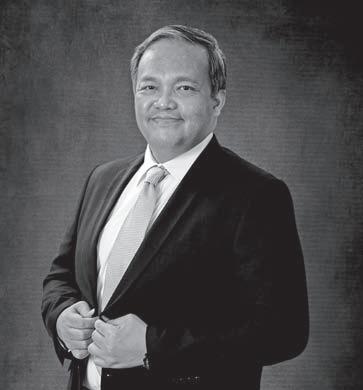

“DBP remains to be at the forefront of funding initiatives aimed at protecting the planet. We are looking to work with more development partners towards ensuring a more sustainable future for the next generations,” Herbosa said.
DBP is the eighth largest bank in the country in terms of assets and provides credit support to four strategic sectors of the economy – infrastructure and logistics; micro, small and medium enterprises; environment; social services and community development.
UEP is an engineering, procurement and construction contractor offering renewable energy and energy efficiency technology solutions to various industries in the country to help them reduce their
energy consumption.
DBP Senior Vice President and Head of Lending Program and Management Group Carolyn I. Olfindo said the credit line would be used to partially finance the capital expenditure, construction, and installation of a 1,500kW rooftop solar power plant project which will be under a Photovoltaic Installation Lease Agreement with the UEP.
She said the arrangement with UEP would be maximized under the DBP E2SAVE Program, which is designed to help public and private institutions
improve their productivity by harnessing available new technologies in the market for their energy efficiency and renewable energy projects while allowing loan repayment based on electricity savings to make investment affordable to end-users.
“As of September 2022, DBP has approved 10 accounts under the E2SAVE program with a total loan amount of P947-million,” Olfindo said. “DBP will continue to actively seek more partners for the program to further promote the development of energy efficiency projects in the country.”
Veteran Sons & Daughters re-elect Deputy Speaker, TUCP Rep. Raymond Mendoza as National President
VFP SDAI was created to defend the rights and interests of Filipino Veterans, including their widows and orphans. Today, it aims to instill patriotism and love of country among its members and the public as exemplified by their veteran parents who fought for freedom and democracy. It also aims to provide assistance in business and livelihood training for its members.
“Our immediate aim right now is to revive the membership of the SDAI which was affected by the pandemic. Now that events and activities are returning to pre-pandemic levels, we can now not only resume but expand our program and projects,” said Mendoza.
HONOR Philippines is ready to dominate 2023
DUBBED as a magical comeback, HONOR officially set foot in the Philippine market again in August 2022 and has been unstoppable since then, launching a tablet, two smartwatches, and six mobile phones in just a span of four months.
To excite HONOR fans, the leading global smart devices provider teased that 2023 will be a very busy year for them with more launches, events, and exciting treats for consumers.
“2022 is just the beginning for HONOR Philippines and we are taking the brand to even greater heights come 2023. We have a very solid lineup for the whole year and you definitely don’t want to miss what we will be bringing from the HONOR ecosystem.” said HONOR Philippines Vice President for Marketing Stephen Cheng. “The expansion of our markets and channel partners is in the works already, and we will stay committed to focusing on creating innovations for everyone. For us, there’s really no way to go but up.”
Since the relaunch, HONOR has opened and established more than 600 stores composed of kiosks and multi-brand stores. In fact, HONOR is now present at 17 dealers: Abenson, Cellboy, EC Panda, MemoXpress, Octagon, Present, Rules, Silicon Valley, Globe, Lazada, Shopee, and Kimstore.
HONOR indicated an increase of 366 percent in its manpower since its launch to augment the workforce for the company. Now, in three months’ time, HONOR currently has at least 1,000 employees including promoters to cater to newly opened stores in the country.
HONOR recently hinted the launch of its highly-anticipated foldable flagship HONOR Magic Vs, and while fans patiently wait for it, here’s a rundown of what HONOR has launched so far.
HONOR 70 5G
HONOR 70 5G carries the industry’s first 54MP IMX800 Super Sensing Main Camera, bringing users incredible enhancements in smartphone photography. It also takes pride in the revolutionary Solo Cut Mode, an innovation enabling users to simultaneously produce a group video and a portrait vlog that spotlights a specific person.
#BestVloggingPhone HONOR 70 5G is equipped with a 4800mAh large-capacity battery supported by high performance 66W HONOR SuperCharge power brick. The screen of HONOR 70 5G supports 1.07 billion colors, 100 percent DCI-P3 and HDR 10+, bringing users vivid colors in sharp
and crisp detail. Available in Midnight Black, Titanium Silver, and Emerald Green, you can get the HONOR 70 5G for P26,990.
HONOR X Series

HONOR X6, X7, X8, and X9 boast of SuperCharge feature for all-day connectivity and productivity. The series also offers big screens, providing better display, most especially the HONOR X9 which has 90hz refresh rate and 94 percent screen-to-body ratio. The X series brings promising camera features for mobile photography and videography.
HONOR X6 and X7 have a 50 and 48MP main camera respectively while both HONOR X8 and HONOR X9 have 64MP. All are packed with wide and macro lenses and bokeh effect.
Available in Midnight Black and Titanium Silver, the HONOR X6 is priced at P7,490 while HONOR X7 and X8 is at P9,990 and P12,990 respectively. The HONOR X9 debuted at P14,990 in Midnight Black and Ocean Blue colors.
HONOR Magic4 Pro
THE Power of Magic. HONOR Magic4 Pro introduces one of the most powerful and versatile camera systems on an HONOR smartphone to date: 50MP Wide Camera with customized 7P Lens, 50MP UltraWide Camera, 64MP Periscope Telephoto Camera, a Flicker Sensor, and an additional brand-new custom-made image processor.
Powered by the Qualcomm Snapdragon 8 Gen 1 5G Mobile Platform, the HONOR Magic4 Pro delivers blazing fast performance and incredible battery efficiency across all typical usage scenarios. The 6.81-inch next-generation LTPO Display delivers fluid, vibrant visuals with support for adaptive refresh rate to help users conserve battery.
Available in Black and Cyan, the HONOR Magic4 Pro is priced at P52,990.
You can buy HONOR products and catch amazing deals at any HONOR kiosks and partner stores nationwide or online at Shopee (https://bit.ly/HONORPHShopee), Lazada (https://bit.ly/HONORPHLaz) and TikTok Shop (https://bit.ly/ HONORTikTokShop).
BRIA Homes Digos, Kidapawan end 2022 on a high note with upgraded product line
THE
Mendoza
Villa-Real
Founded in 1988, the VFP-SDAI is a non-stock, non-profit, non-sectarian corporation and is an auxiliary unit of the Veterans Federation of the Philippines (VFP). It is the National Association of direct descendants of Filipino Veterans from across all regions of the country.
“During the pandemic, our activities were severely limited. Nonetheless, we were still able to pass R.A. 11597 or the revised charter of Philippine Veterans Bank (PVB), effectively increasing the Bank’s authorized capital from P100 million to P10 billion, and now allows other veterans to own PVB shares as defined by the law. This includes postwar veterans such as Korean & Vietnam War veterans as well as retirees of the Armed Forces of the Philippines (AFP).”
Kids with Cancer and their families receive the gift of happiness

Project hosted a Christmas celebration for
with
from the National Children’s Hospital Hematology ward.
The kids were welcomed with a sumptuous buffet of their favorite snacks and treats in Sambo Kojin. After lunch, they were invited to Toy Kingdom. The kids were initially asked for a Christmas wishlist which Toy Kingdom granted and each child left with an armful of gifts. The celebration continued at the SM ice-skating rink. The kids, who had never ice-skated before, had a blast gliding around the rink, with big smiles and lots of laughter.
It was a day of joy and hope for these kids with cancer, and the event organizers, volunteers, and partners that helped make it happen deserve a huge round of applause. The organizers expressed their thanks to the generosity
THE
The Bettina xE offers more generous space with its flexible and well-configured “two lots, one house” notion, which appeals to home seekers with expanding interests. On the other hand, BRIA’s Elena and Elyana house and lot units are actually upgraded editions which tout exterior enhancements such as their own fences and gates and a finely finished front pavement. These improvements lend “curb appeal” to the home, which entices buyers even before they enter it.
To up the ante, the interiors of the Elena xE model boast superior finishing: bedroom partitions, ceramic floor tiles in common living areas, tiled walls in the toilet and bath, a dual flush water closet, a telephone shower, and a bidet.
While “less is more” makes sense for people with minimalist aesthetic, savvy homeowners and property investors appreciate the higher value proposition upgrading brings to the equation.
Thus, when BRIA Homes decided to make the Elena xE model available in its Mindanao projects, it did so with much fanfare. Last
December 10, BRIA Homes held the grand launch of these upscaled product lines in their Digos, Davao del Sur and Kidapawan, Northern Cotabato developments.
Led by BRIA South Mindanao Division Head Ester Lomoya, the fun event kicked off with a motorcade around Digos City, followed by entertainment fare and wine toasting that excited sellers, property brokers, and potential clients were treated to.

All guests at the launch affirmed how BRIA Homes’ beautiful new house models fit right in with the stunning vista surrounding Digos and Kidapawan. The majestic Mt. Apo, the highest peak in the Philippines, dominates the landscape in these two cities. One side of the mountain can be accessed from Digos City, specifically from the village of Kapatagan. The Kapatagan-Kidapawan trail usually takes three to four days for hikers and trekkers to hurdle on their way to the summit. Meantime, they can indulge in the spectacular views.
Digos is also home to the beautiful Dawis Beach with its awe-inspiring scenery and pristine clear waters where families can recharge with a day trip or camp out for the night.
BRIA Homes Digos and Kidapawan offer its residents multipurpose halls suitable for social gatherings, covered basketball courts, children’s playgrounds, and wideopen green spaces that invite leisurely strolls with the family.
Apart from ensuring warm, welcoming communities, all BRIA developments come with perimeter fences, guarded entrances and exits, 24/7 CCTV coverage, and solar lights that illuminate the village streets and other common areas.
Interested homebuyers can check out the projects they want through BRIA’s 360 Virtual Tours in www.bria.com.ph and inquire online through BRIA’s Facebook page at www.facebook.com/BriaHomesIncOfficial. They can also reserve a house online through https://www.bria.com.ph/online-reservation/
Tuesday, January 3, 2023 B6
PHOTO shows DBP Executive Vice President Paul D. Lazaro (second from right) and UEP President and Chief Executive Officer Ruth Yu-Owen (third from left) during the signing of loan agreement between the two institutions. Also present during the signing are (from left) DBP Assistant Vice President Christian Joseph D. Presa, DBP First Vice President Jeane Adamos and UEP Chairman Rufino Bomasang.
Veterans Federation of the Philippines Sons and Daughters Association, Inc. (VFP-SDAI) recently re-elected Deputy Speaker and TUCP Party Representative Raymond Democrito Mendoza as its National President and Veterans Bank’s FVP Miguel Angelo VillaReal, as its National Executive Vice-President during its recently held National Assembly.
is the son of Labor Leader and WWII veteran Democrito T. Mendoza.
is the grandson of former
Education Undersecretary Andres C. Clemente, also a WWII veteran who saw action in the Visayas as 2nd Lieutenant in the first Battalion, Infantry, 61st Division of the Philippine Army.
VETERAN Bank’s FVP Miguel Angelo Villa-Real
DEPUTY House Speaker and TUCP Party
Rep. Raymond Democrito Mendoza
SPECIAL Achievers and Mbrace
kids
cancer
and kindness of sponsors and event partners Hans Sy of SM, Martin Sy, SM Cares, SM Megamall, Toy Kingdom, and
SM Skating rink for giving these children and their families a special day that will never be forgotten.
year 2022 saw leading property developer BRIA Homes on a roll as it presented the xE series, their upgraded product line from the Bettina and Elena/ Elyana home models.
LEADING property developer BRIA Homes the xE series, their upgraded product line from the Bettina and Elena/ Elyana home models.
www.businessmirror.com.ph • Editor: Angel R. Calso
‘Lord, I love you’: Aide recounts last words of Pope Emeritus Benedict XVI
By Frances D’emilio The Associated Press
VATICAN CITY—Pope
Emeritus Benedict XVI’s last words were “Lord, I love you,” his longtime secretary said Sunday, quoting a nurse who helped care for the 95-year-old former pontiff in his final hours.
Archbishop Georg Gaenswein, a German prelate who lived in the Vatican monastery where Benedict took up residence after his 2013 retirement, said the nurse recounted hearing Benedict utter those words at about 3 a.m. Saturday. The retired pope died later that morning.
“Benedict XVI, with a faint voice but in a very distinct way, said in Italian, ‘Lord, I love you,’’’ Gaenswein told the Vatican’s official media, adding that it happened when the aides tending to Benedict were changing shifts.
“I wasn’t there in that moment,
but the nurse a little later recounted it,’’ the archbishop said. “They were his last comprehensible words, because afterwards, he wasn’t able to express himself any more.”
Gaenswein did not identify the male nurse who shared the information.
Earlier, the Vatican said that Pope Francis went to pay his respects immediately after Gaenswein called to inform him of Benedict’s death shortly after 9:30 a.m. Saturday Vatican spokesman Matteo Bruni said Francis stayed in Benedict’s monastery for quite some time before returning to his
By Laura Davison & Ben Steverman
DONALD Trump’s tax returns show how the former president used a range of write-offs in the US tax code to pay little or no federal income tax, according to six years of records released Friday by a House panel.
The returns, which include his personal and business filings from 2015 to 2020, are the first complete look into Trump’s tax records for the years he was running for office and in the White House. The release comes just days before Democrats relinquish their House majority, which will end much of their ability to investigate him.
The documents, which have been the subject of litigation for more than three years, shed light on the sources of the former president’s earnings and the taxes he paid—or didn’t.
In 2020, Trump paid nothing in federal personal income tax. He also reported large losses at his businesses in multiple years thanks to favorable deductions that allowed him to minimize his tax bills. Congress’s nonpartisan tax experts have said some of those deductions warrant more scrutiny.
The release on the Friday before New Year’s weekend failed to land any immediate knockout blow Democrats were seeking as Trump seeks another term in the White House.
“ We don’t have any smoking gun,” said Sam Brunson, a law professor at Loyola University in Chicago.
Yet even some of the most sophisticated tax specialists won’t immediately be able to tell if Trump followed the law, experts said, because tax returns don’t automatically include some of the underlying documentation that the Internal Revenue Service can request in an audit. Auditors can get a much deeper understanding because they get to see the calculations that back up a number on a return, said Jo Anna Fellon, a tax partner at accounting firm Marcum.
“This is just the tip of the iceberg,” Fellon said. “I’m not sure we’ll ever get the full picture.”
Court fight
TRUMP, who fought in court to block the release, said in a statement Friday that the documents show how “proudly successful” he has been as a businessman and touted his wide-ranging use of the tax code, including “depreciation and various other tax deductions as an incentive for creating thousands of jobs and magnificent structures and enterprises.”
The returns don’t show employment levels so it’s unclear if Trump used the tax savings to hire more workers. Tax returns are also intended
to report income—not total wealth—so the documents don’t reveal Trump’s net worth. Even business returns only report the purchase price for an asset such as a building, not the valuation.
“Businesses are supposed to be in the business of making money. If they’re constantly losing money, it begs the question of whether they’re real businesses,” said Kevin J. Brady, a vice president and certified financial planner at Wealthspire Advisors based in New York. “It could all be legitimate, but it needs to be looked at.”
The Democratic-controlled House Ways and Means Committee released the returns Friday as part of their investigation into the IRS’s presidential audit program, which found that the agency had failed to examine Trump’s tax returns while in office, as has been done with previous presidents. A report last week summarized Trump’s tax filings and flagged dozens of potential audit triggers that the IRS didn’t pursue.
Trump’s use of business losses to minimize his tax bill is legal as long as he didn’t underreport earnings or inflate the size of the deductions, which can only be determined from a comprehensive audit.
Trump paid no taxes in 2020, reporting losses at dozens of properties and holding companies. The coronavirus pandemic almost certainly played a role. An Irish golf resort he owned reported a 69 percent plunge in revenue in 2020.
Some properties still made money. Losses of $65.9 million at a variety of entities were offset by $54.5 million in gains at others.
More details
THE returns also give more insight into how Trump was affected by his 2017 tax overhaul, which included breaks and expanded write-offs for some top earners.
His businesses benefited from more generous write-offs for the interest on loans, as well as large deductions for equipment. Trump personally benefited from lower rates and a near elimination of the alternative minimum tax, a feature that prohibited many wealthy taxpayers from taking too many credits and deductions. With the change, Trump could claim more write-offs.
Yet some features of Trump’s signature law also hurt him. For example, in 2019, his return says, he paid $8.4 million in state and local taxes, but could only claim $10,000 under his tax law. The following year was similar: $8.5 million paid but subject to the $10,000 cap.
With assistance from Steven T. Dennis and Chris Cioffi/Bloomberg.
residence in a hotel located across the Vatican Gardens.
During New Year’s Day remarks on Sunday, Francis prayed for his predecessor’s passage to heaven and expressed thanks for Benedict’s lifetime of service to the church.
Francis departed briefly from reading his homily during a morning Mass at St. Peter’s Basilica to pray aloud for Benedict.
“Today we entrust to our Blessed Mother our beloved Pope
Emeritus Benedict XVI, so that she may accompany him in his passage from this world to God,” he said.
The basilica is set to host Benedict’s coffin for three days of viewing that start Monday.

Rome Prefect Bruno Frattasi, an Interior Ministry official, told Italian state TV that “no fewer than 25,000, 30,000” mourners were expected to file past the coffin on Monday.
On Sunday, Benedict’s body
lay on a burgundy-colored bier in the chapel of the monastery where he had lived during his nearly decade-long retirement. He was dressed in a miter, the headgear of a bishop, and a red cloak-like vestment.
A rosary was placed in his hand. Behind him, visible in photos released by the Vatican, were the chapel’s altar and a decorated Christmas tree.
Francis remembered Benedict again later Sunday while addressing thousands of people in St. Peter’s Square. He told the crowd that “in these hours, we invoke her intercession, in particular for Pope Emeritus Benedict XVI, who, yesterday morning, left this world.”
“Let us unite all together, with one heart and one soul, in giving thanks to God for the gift of this faithful servant of the Gospel and of the church,’’ Francis said, speaking from a window of the Apostolic Palace to pilgrims and tourists below.
The square will be the setting for Benedict’s funeral led by Francis on Thursday morning. The service will be a simple one, the Vatican has said, in keeping with the wishes of Benedict. Be -
fore he was elected pope in 2005, Benedict was a German cardinal who served as the Church’s guardian of doctrinal orthodoxy.
In recent years, Francis hailed Benedict’s stunning decision to become the first pope to resign in 600 years and has made clear he’d consider such a step as an option for himself.
Hobbled by knee pain, Francis, 86, on Sunday arrived in the basilica in a wheelchair and took his place in a chair for the Mass, which was being celebrated by the Vatican’s secretary of state.
Francis, who has repeatedly decried the war in Ukraine and its devastation, recalled those who are victims of war, passing the year-end holidays in darkness, cold and fear.
“At the beginning of this year, we need hope, just as the Earth needs rain,” Francis said in his homily.
While addressing the faithful in St. Peter’s Square, the pope cited the “intolerable” war in Ukraine, which began more than 10 months ago, and conflicts in other places in the world.
Yet, Francis said, “let us not lose hope” that peace will prevail. Nicole Winfield contributed from the Vatican.
Shielded by Russia and China, Myanmar becomes more brutal
WHEN Myanmar carried out the death penalty for the first time in three decades by executing four activists in July, China and Russia stayed silent while the US and its allies condemned the junta. Now the regime is on the verge of doing it again.
Seven university students were sentenced to death in November by a secretive military court for their alleged involvement in the shooting of a retired military officer, and their punishment could come any time.
They’re among more than 130 people put on death row since the junta seized control in a coup on February 1, 2021 and deposed former leader Aung San Suu Kyi, whose jail term has now been extended to 33 years.
The military has used increasingly brutal tactics to subdue its enemies—even as it further entrenches Myanmar as a pariah state abroad. A rare United Nations Security Council resolution last month called for an end to violence and the release of all political prisoners.
But with China, Russia and India abstaining from the UN vote, it’s unlikely to have much effect, while the junta sees regimes from Iran to North Korea defying international sanctions and testing the will of world powers.
“With India on your side, with China not your enemy—a bit upset with what’s happened, but clearly not out to get Myanmar, with Russia as a strong backer, the world’s looked like a comfortable enough place,” said Richard Horsey, senior Myanmar adviser with the International Crisis Group.
Western sanctions targeting the coup leaders and related business entities, as well as an investor exodus, have harmed
the junta’s finances. But while it presides over an economy in disarray, it retains control of vast economic interests, including lucrative natural gas exports.
Myanmar’s armed groups, meanwhile, remain divided, with different factions fighting across the country. International support has been elusive, with Western aid heading to Ukraine, and diplomatic efforts ineffective.
Major General Zaw Min Tun, lead spokesman for Myanmar’s ruling State Administration Council, did not respond to requests to comment.
“The junta places little value on international consensus or external pressure,” said Hunter Marston, an adjunct research fellow at La Trobe University in Melbourne who has followed developments in Southeast Asia since 2007. “It’s clearly cratered the economy and sees little reason to change course so long as no country is sending in troops to stop it.”
Solid ties
THE looming executions point to a regime unable to see beyond immediate challenges as it struggles to hold territory against supporters of Suu Kyi and ethnic armed groups. While the junta oversees key cities, it’s retained stable control of just 17 percent of the country’s total land area, according to a group of Myanmar experts.
It’s increasingly turned to air strikes to try and secure ground. In October, the US and European nations accused it of inflicting “extraordinary harm” on civilians after killing more than 60 people in an air attack on a concert organized by ethnic rebels.
The regime has also failed to stabilize an economy that contracted 18 percent last year and is now seeing soaring inflation, a weakening currency and shrinking foreign-currency
reserves. Myanmar approved foreign investment worth just $1.46 billion in the first eight months in 2022, a 56.4 percent year-on-year decline.
That’s where China and Russia have become significantly important to the junta.
China remains Myanmar’s largest trading partner, and continues to play a key part in its economic development.
When China’s Foreign Minister Wang Yi visited Myanmar earlier this year he said the relationship remained “rock solid and unbreakable,” and praised cooperation on projects such as the China-Myanmar Economic Corridor.
What isn’t clear is how much of this work is progressing.
Government data on foreign investment show less than $100 million coming from China so far, with Singapore topping the list of foreign investors.
Military chief Min Aung Hlaing has increasingly turned to Russia for support, visiting the country at least twice in 2022 and hailing Vladimir Putin as the “leader of the world.”
The two sides have since inked several economic pacts in an effort to bolster ties.
Russia’s Ambassador to Myanmar, Nikolay Listopadov, told Bloomberg News sanctions and international pressure will only lead to a worsening of the crisis. He said Russia “never gets involved in domestic affairs” but supports the release of political prisoners and dialog among all stakeholders.
With Russia and China continuing to show support, Myanmar’s military will see little reason to back down from a level of brutality that has surpassed that of previous regimes.
“China and Russia only care about their business rather than human rights and democracy,”
said Soe Thura Tun, the shadow National Unity Government’s Minister of Electricity and Energy. “They discussed with the junta to ensure they become early birds for profit-making projects in the long term.”
Deposed leader Suu Kyi, 77, has seen her jail term extended to 33 years after the conclusion of an 18-month long series of trials. A special court recently found her guilty of five charges of corruption during her time in government, adding 7 more years to her sentence.
Since the coup that toppled Suu Kyi’s government, and led to the deaths of more than 2,600 people, the US has led efforts to punish the regime. But it is wary of measures that could harm the nation’s 55 million population, and the Western response has largely been confined to humanitarian assistance, targeted financial sanctions and working with Myanmar’s neighbors in Southeast Asia to pressure the junta.
America’s biggest security partners in the region, including Australia, have refused to impose sanctions, choosing instead to keep lines of communication open. Japan retains strong business links, while India has known ties to the junta. In November, Myanmar released four foreign prisoners, including Suu Kyi’s former adviser—Australian economist Sean Turnell, and a Japanese filmmaker, as part of an amnesty.
“That’s probably something that we see as being the end result of diplomatic efforts by those governments,” said Moe Thuzar, a fellow at Singapore’s ISEAS-Yusof Ishak Institute.
“But the death sentences that have been passed are on Burmese nationals so we need to be aware of that as well.”
BusinessMirror Tuesday, January 3, 2023 B7 World
Features
POPE Francis holds a Mass for the solemnity of St. Mary at the beginning of the New Year, in St. Peter’s Basilica at the Vatican on Sunday, January 1, 2023. Pope Emeritus Benedict XVI, the German theologian who will be remembered as the first pope in 600 years to resign, has died, the Vatican announced Saturday. He was 95. AP/ANDREW MEDICHINI
Bloomberg News
Released Trump tax returns show how write-offs shrank what he owed to IRS
Baltazar, Gozum, 2 others added to ‘Strong’ team
JUSTINE BALTAZAR and Will Gozum were added to the roster of Strong Group-Philippines that will see action in the Dubai 2023 International Championship set January 27 to February 5.
Team owner Jacob Lao was elated with the inclusion of the two tested players.
They’re all winners in their own ways and their experience will surely help the team for them.” Lao said. “But I’m very excited for all of them because it’s a rare opportunity for these players to further grow and learn a new style of play internationally.”
They’re all very talented individuals who can complement and play specific roles that the team needs,” he added.
B J Andrade and Inand Fornillos were also added to the team, that includes former Golden State Warriors player Nick Young, ex-San Miguel Beer import Renaldo Balkman, naturalized player and former Ateneo center Ange Kouame and Filipino-American guard Sedrick Barefield.
Coach Charles Tiu said the Dubai event will give Baltazar the opportunity to prove his worth after a forgettable stint with the Hiroshima Dragonflies in the Japan B.League.
“ Balti [Baltazar] is going to be big for us, he wasn’t given much of a chance in Japan but the kid is a great player and I plan to use him as a big wing and power forward,” Tiu said. “But of course it all remains to be seen on how it will look when we start practicing.”
G ozum is no stranger to Tiu’s coaching style having played under him at the College of Saint Benilde.
Ronaldo move to Saudi club end of career in elite soccer
LESS than two weeks after his great rival Lionel Messi lifted the World Cup, Cristiano Ronaldo has completed a move to Saudi Arabian club Al Nassr and likely signaled the end of his career in elite club soccer.
I n agreeing a contract until 2025, the five-time Ballon d’Or winner has ended speculation about his future after having his contract terminated by Manchester United last month.

I am fortunate that I have won everything I set out to win in European football and feel now that this is the right moment to share my experience in Asia,” Ronaldo said.
A l Nassr described the deal as “history in the making,” however, it is likely to raise questions about Ronaldo’s ambition at this stage of his career.
W hile Messi finally won the one major trophy that had evaded the two men widely regarded as the greatest players of their generation, after leading Argentina to the World Cup in Qatar, Ronaldo will be playing outside of top level European soccer for the first time in his career.
Media reports have claimed the 37-year-old Portugal international could earn up to $200 million a year from the move, but he will miss out on the chance to extend his record as the all-time leading scorer in the Champions League with his record currently standing at 140 goals.
M essi is on 129 goals in the competition.
Ronaldo is also unlikely to add to his Ballon d’Or collection—the trophy
PELÉ. SANTOS, BRAZIL.
SANTOS, Brazil—Pelé. Santos, Brazil.
Over decades, adoring fans around the world mailed thousands of letters, postcards and packages to the sports legend without his address or full name.
A lmost without fail, they reached the office of Edson Arantes do Nascimento in the port city he made famous.
Santos was founded by the Portuguese in January 1546. It hosts Latin America’s biggest port, which feeds the Sao Paulo area and exports the country’s agricultural commodities to the planet.
O nly after a 15-year-old sensation started scoring goals for the city’s team did Santos, a city of about 430,000 residents today, become a household name. The
awarded to the best player in the world.
Me anwhile, Messi will be among the favorites to win that trophy for an eighth time this year after his World Cup triumph.
He also has the chance to win the Champions League with Paris SaintGermain, having lifted European club soccer’s biggest prize on four occasions with Barcelona.
R onaldo won the Champions League five times during spells with United and Real Madrid.
S ix months ago Ronaldo wanted to join a team playing in the Champions League after United failed to qualify for this season’s competition.
However, a move never materialized, with the most serious interest in him coming from an unnamed Saudi Arabian club.
It is not known what other serious offers were made after he became a free agent last month, but the move to Al Nassr represents a significant step down compared to the level he has operated at throughout his career.
Still it is a major coup for soccer in the Middle East and will add to the debate over Saudi Arabia’s attempts to use socalled “sportswashing” to improve its reputation internationally after its sovereign wealth fund led a buyout of Premier League club Newcastle United last year. AP
Brazilian great, who died Thursday at 82 after fighting cancer, played there from 1956 to 1974.
There’s a Santos before Pelé and another after him,” said Serginho Chulapa, Brazil’s striker in the 1982 World Cup and a local hero with more than 100 goals for the club. “He put both the city and club on the map. Before him, people came to work at the port and go to the beach.”
C hulapa had four spells at Santos FC as a player, all during the 1980s. Since retirement he has worked at the club in different capacities, some of them alongside Pelé.
“ Santos is not in a metropolis like Sao Paulo, we have to work with less money. And Pelé made this club gigantic since he started playing,” Chulapa said. “Santos had its peak with him.”
Pelé gave Santos two Copa
Libertadores titles and two Intercontinental Cup titles against Benfica and AC Milan, as it beat some of the best rivals around the world. The Brazilian great won 26 titles at the club.
S ome of Brazil’s top politicians, including President Luiz Inácio Lula da Silva, have lived in the coastal city. But one of Santos’s main touristic attractions is the Pelé Museum. It lies in the renovated area of the Casaroes do Valongo, close to the city port. It opened in 2014 and hosts tens of thousands of tourists. Many are like Gisela Claudia, 65, who arrived on a cruise ship to spend New Year’s Eve in the city.
It is my first time in Santos. And I only came in this cruise because my husband wanted to see the city of Pelé,” Claudia said.
He is lost somewhere in the
museum,” she said. “There are other beaches on this trip that are more beautiful than this. But none of them have this history of the greatest player.”
The museum features some of Pelé’s remaining memorabilia: boots, trophies, medals, shirts.
Santos has become a popular destination for New Year’s Eve, especially among residents of Sao Paulo, who grew fond of its clubs, beaches and a few private islands where parties take place. But the local club’s Vila Belmiro stadium, where Pelé’s funeral will take place on Monday, remains one of the city’s main tourist attractions.
The last time Santos consistently filled its arena’s 16,000 seats was between 2009 and 2013, when striker Neymar played there.
S antos FC is also home to other
HK COACH GOORJIAN: WE’RE NOT PLAYING DEEP INTO OUR BENCH
By Josef Ramos
Andrew Nicholson
ANADIAN
has been amazing for the Hong Kong Bay Area Dragons. But their coach, Brian Goorjian, isn’t totally happy about the certified National Basketball Association veteran doing so much for the Dragons and playing most, if not all 48 minutes each time.

“We rely very much on Nicholson, and Nicholson played every minute until the game’s over,” Goorjian said. “We’re not playing too deep into the bench.”
The mobile big man who scores with a flourish from inside and out has been flashing legitimate NBA form in the Philippine Basketball Association Commissioner’s Cup. lthough shackled in one hand in Game 1 of the Finals series the Barangay Ginebra San Miguel Gin Kings won, 96-81, he still finished with 27 points and 12 rebounds. n Game 2 which the Dragons dominated with impunity, Nicholson rings around all guards thrown at him and made with 30 points and 15 rebounds for a 99-82 victory that tied the best-of-seven series at 1-1.
H is averages of 28.5 points and 13.5 rebounds in both games certainly are pluses for the Dragons, who go for a 2-1 lead over the home team in Game 3 set at 5:45 p.m. Wednesday at the Mall of Asia Arena in Pasay City.
A week-long New Year’s break relieved the aches from both sides and Goorjian—who spent the entire holiday season with his players in Manila—is just too happy with that break from battle.
The seven-day rest somehow is beneficial especially to Nicholson,” said Goorjian, whose most recent success on the global stage was coaching Australia to the bronze medal at the Tokyo Olympics in 2021.
The Dragons have been sweating it out in practice at the Kerry’s Sports Gym at the Shangrila Fort BGC as Goorjian expects a strong rebound from Tim Cone and the Gin Kings— the die-hard Ginebra fans included.
“ I’m loving the battle. It’s just respect and it’s really an enjoyable tough game of good basketball,” he said. “I hope the fans like it and I know they want their team to win, but I hope they are enjoying the series.”
G oorjian said Ginebra import Justin Brownlee—who’s averaging
Teen prodigy Wembanyama living up to potential
PARIS—French teen prodigy
Victor Wembanyama
embellished his fast-growing reputation when he became the youngest MVP in the French league’s All-Star game.
The 18-year-old Wembanyama finished with 27 points, 12 rebounds and four assists on Thursday night
as the All-Star France team won, 136-128, against the All-Star World team—an annual contest between French and non-French players in the French league’s LNB.
T he 7-foot-3 Wembanyama is considered the likely top pick in the 2023 National Basketball Association (NBA) draft next
June and is a near-certainty to be the first top-five draft pick from France.

I n the two months since his jaw-dropping performances in two exhibition games in Las Vegas , “Wembamania” has swept France with sold-out games whenever he plays for Paris-based Metropolitan 92.
W embanyama is leading the French league with averages of
renowned players, most of them coming from its academy long after Pelé had retired. The list includes Rodrygo, Elano, Zé Roberto, Giovanni, Robinho, Diego and Gabriel Barbosa.
Pelé’s death is expected to change many names around Santos. The first is expected to be the port, which will be renamed King Pelé Port, the incoming federal administration has decided.
A rchitect Maria Tereza Myre Dores, one of Pelé’s closest friends and his neighbor in the final years of his life in the neighboring city of Guaruja, says Santos the club and Santos the city will never be the same.
He was Santos. He loved the city, loved the club. And he made both better and bigger,” Myre Dores said.
“ I still remember the afternoons he spent in his office signing letters and shirts for people everywhere. One by one and sending them back, even those that only came with those three words; Pelé, Santos, Brazil,” the architect said. “Without him, Santos is less Santos.” AP

30 points, 12 rebounds and 4.5 assists in in the series—is marked for the rest of the series.
But he said the other Gin Kings— season MVP Scottie Thompson, Japeth Aguilar, Jamie Malonzo, Stanley Pringle and LA Tenorio— could step up as well.
22.9 points and 9.6 rebounds per game. And those are his final numbers as an 18-year-old. He turns 19 on Jan. 4, 2023.
He hit a purple patch from early November to early December with a streak of four consecutive 30-ormore-point games.
W embanyama’s international career got off to a good start and he is 2-0 with Olympic silver medalist France, with 39 points scored and 13 rebounds in those two games.
France plays Lithuania and the Czech Republic in February.
Sports BusinessMirror B8 | Tuesday, January 3, 2023 mirror_sports@yahoo.com.ph Editor: Jun Lomibao
A STREET vendor hangs Pelé T-shirts
in
AP
outside the Vila Belmiro Stadium, home of the Santos Football Club,
Santos, Brazil.
THE 7-foot-3 Victor Wembanyama is considered the likely top pick in the 2023 National Basketball Association draft next June and is a near-certainty to be the first top-five draft pick from France. AP
AP
SAUDI ARABIAN club Al Nassr describes the deal as “history in the making,” however, it is likely to raise questions about Cristiano Ronaldo’s ambition
THE Dragons head coach Brian Goorjian wants more contributions from his other players.
