AN economist-lawmaker has expressed confidence that the Philippines will compete with Vietnam and India for the fastest-growing major economy in Asia-Pacific.
House Ways and Means Chairman Joey Sarte Salceda said he is optimistic about the country’s growth prospects under President Ferdinand R. Marcos Jr.
T he lawmaker sees inflation easing next year, and the jobs numbers, which now exceed pre-pandemic levels, will improve further.
The sense of gloom from some projections does not come from Philippine fundamentals but from
expectations of global economic slowdown. I’m much more confident about the Philippine outlook,” Salceda said.
I n particular, Salceda says he is seeing signs that the country’s private sector “is starting to accumulate economic muscle.”
“ The most recent official manufacturing numbers showed that the fastest growth rate was in manufacture of machinery and equipment except electrical. The sector posted the highest annual growth rate of 76.4 percent in October 2022. That tells you that more businesses are preparing to make more things,” he added.
Salceda noted the country’s electronics and semiconductor manufacturing sector is now operating
at an improving capacity.
“ Latest manufacturing figures showed that the industry division with highest average capacity utilization for October 2022 was manufacture of computer, electronic and optical products. That’s our top export sector. So, I am optimistic about growth in that sector,” he said.
If we can keep the momentum, I think we are in the race for fastestgrowing major Asian economy in 2023,” he added.

Competition with India, Vietnam SALCEDA , however, said the country “must set its sights on being more attractive to investors than Vietnam or India are in the key growth areas of services, especially BPO, and tech-
nological manufacturing.”
Salceda is particularly concerned about “the surge in relocation of semiconductor manufacturing companies from China and towards more US-friendly countries.”
U nder the Biden administration’s CHIPS Act, US companies are subjected to a 10-year ban prohibiting them from producing chips more advanced than 28-nanometers in China and Russia if they are awarded subsidies under the law.


“Companies will look at other countries where they can make chips and still benefit from US incentives. For those involved in assembly, they will look at India, Vietnam, and the Philippines as candidate locations,” he added.
economy off to slow start in ‘23
 By Cai U. Ordinario @caiordinario
De La Salle University economist Maria Ella Oplas told BusinessMirror over the weekend that while the first quarter is usually the weakest period for the economy, it will be challenging this year.
C hina’s recovery is expected to drive up oil prices anew and make it difficult for net oil importers like the Philippines to prevent the higher costs from seeping into local inflation and pulling down GDP growth.
“ It’s going to be a challenging slow start for us in terms of growth,” Oplas said. “I fear that with the reopening of China will come higher international oil prices which we cannot control because our demand is too small to affect the world market price.”
O plas said the post-holiday period is usually greeted with low inflation and weak GDP growth because of the lack of demand in the economy.
B ut this time around, while demand dies down after a festive Christmas and New Year celebration, high inflation is expected to continue because of China’s recovery.
“ Manufacturers (are) holding back on their production because of the rising cost of production plus people are really not buying,” Oplas added.
FOR ALL ITS BAD RAP, ‘CRACKER SECTOR GAINS TO PEOPLE CITED
By Andrea E. San Juan
THE latest New Year’s Eve revelry has once more drawn fresh calls for banning fireworks and firecrackers altogether, but industry players assert this is a misguided move.
W hile it is highly regulated, the fireworks and firecracker industry also touts its “trickledown” effect benefiting small merchants.
T he firecracker and fireworks industry contributes to the economy since its business model is not discriminatory as to who can sell these products. Although fireworks and firecrackers are seasonal, the

president of one of the country’s fireworks associations said small merchants usually gain from the network they are able to establish because of selling these products.
D rawing the line between fireworks and firecrackers in terms of definition, firecrackers are small explosive devices designed to make loud noise while fireworks are explosive pyrotechnic devices that make a display of lights and noise.
‘Yung trickle-down effect ng industry namin napakalaki. Minsan, tatanungin ako gaano karami ba talaga ang nasa industriya nyo?
Nearly 300 flights disrupted at Naia
By Lorenz S. Marasigan @lorenzmarasigan & Nonie Reyes
THERESE DELA PAZ was looking forward to spending time with her relatives in Iloilo on New Year’s Day. With her were her husband and their one-year-old daughter.
From San Mateo, Rizal, the Dela Paz family was at the Ninoy Aquino International Airport (Naia) two hours prior to their flight. They were excited to see their relatives after a year of just talking over their mobile phones.

H owever, their excitement turned to horror after learning that their flight had been cancelled. Flight operations at the Naia were temporarily halted on New Year’s Day after the gateway

experienced some “technical issue involving the radar frequency” at the Air Traffic Management Center (ATMC) of the Civil Aviation Authority of the Philippines (Caap) on Sunday.
“ When we arrived at the airport, we were shocked that there were a lot of people in the check-in area. We were able to check in for our flight to Iloilo after 30 minutes. However, 45 minutes before our boarding time, we had yet to know our assigned gate. The airline then announced that they are expecting delays due to some system outage problem,” Dela Paz, a 30-year-old freelancer, said.
T heir flight bound for Iloilo was supposed to leave Manila at 1:10 p.m. Announcements from the airport’s public address system were made at 1:30 p.m.
We thought it was just select flights that were cancelled. At around 2 p.m. we were told that our flight was included in the cancellation,” she said.
T he Dela Paz family is just one of the tens of thousands of passengers affected by the technical issue at Naia on Sunday.
282 flights affected
AS of 4 p.m., a total of 282 flights were “either delayed, cancelled or diverted to other regional airports affecting around 56,000 passengers in Naia,” according to the Manila International Airport Authority (Miaa).
M iaa immediately implemented its crisis management protocols after learning of the radar frequency problem.
Jovee Marie N. dela Cruz
By
@joveemarie
THE Philippine economy is in for a slow start this year, especially with China recovering and increasing their demand for oil in 2023, according to local economists.
w P25.00 nationwide | 2 sections 18 pages | BusinessMirror ROTARY CLUB OF MANILA JOURNALISM AWARDS 2006 National Newspaper of the Year 2011 National Newspaper of the Year 2013 Business Newspaper of the Year 2017 Business Newspaper of the Year 2019 Business Newspaper of the Year 2021 Pro Patria Award PHILIPPINE STATISTICS AUTHORITY 2018 Data Champion EJAP JOURNALISM AWARDS BUSINESS NEWS SOURCE OF THE YEAR (2017, 2018, 2019, 2020, 2021) DEPARTMENT OF SCIENCE AND TECHNOLOGY 2018 BANTOG MEDIA AWARDS n Monday, January 2, 2023 Vol. 18 No. 79 PHL
Continued on A4 Continued on A4 PESO EXCHANGE RATES n US 56.1200 n JAPAN 0.4174 n UK 67.4394 n HK 7.1996 n CHINA 8.0372 n SINGAPORE 41.5796 n AUSTRALIA 37.8024 n EU 59.5545 n KOREA 0.0441 n SAUDI ARABIA 14.9335 Source: BSP (December 29, 2022)
PHL can join fastest-growing economies’ club HOW PUTIN’S WAR AND SMALL ISLANDS ARE ACCELERATING THE GLOBAL SHIFT TO CLEAN ENERGY, AND WHAT TO WATCH FOR IN 2023 EXPLAINER »B4
it was announced that
to
the air
the Philippines on Sunday, January 1, 2023.
See “Cracker sector,” A2 See “300 flights,” A2
PASSENGERS fill the departure area of the Ninoy Aquino International Airport
after
flights
and from Manila are on hold due to technical issues at
navigation facilities of the Civil Aviation Authority of
Story below. NONIE REYES
‘RCEP to boost PHL goal of stronger ties with China’
By Andrea E. San Juan
Regional Comprehensive
“ The long history of business relations between our two countries, the cooperation in the Belt & Road, and now RCEP will facilitate the further growth and deepening of our bilateral business relations,” Trade Secretary Alfredo E. Pascual said in a recent statement.
Pascual said RCEP will be part of the topics to be discussed during President Ferdinand “Bongbong” R. Marcos Jr.’s visit to China from January 3 to 5.
As Chinese companies pursue opportunities in RCEP, those looking to diversify their business locations to sustain and enhance regional competitive -
ness can consider the Philippines a complementary location,” Pascual noted, adding that the Philippines can also be an alternative hub for their production and service facilities.
T he Trade chief also noted that with RCEP participating countries making “significant” commitments under the services trade, the Philippines can leverage this as another area for increased bilateral collaboration.
As Chinese companies pursue ‘going out’ strategies, we can partner while providing support through Philippine talent as a strategic resource. In particular, tech -
Medium-term...Continued from A10
nological, soft, and people skills will be critical in the services and digital industries,” Pascual said.
Pascual linked this to the country’s track record in supporting the global operations of companies. He said the Philippines’s workforce’s strong customer service orientation also makes the Philippines an “ideal” location for services for getting in touch with customers globally.
W ith the eventual participation of the Philippines in RCEP, Pascual said they see the regional trade pact boosting the Philippines’s strategic advantage for investments such as being able to enjoy wider sourcing of raw materials from 14 countries, including China, and export processed products from the Philippines to the RCEP parties.
RCEP is a free trade agreement (FTA) among Asean countries and their trading partners Australia, China, Japan, New Zealand and South Korea. Touted as the world’s largest trade pact, RCEP represents 30 percent of the global gross domestic product (GDP).
I n 2021, the Trade department said China is the Philippines’s top trade partner, with total trade valued at $38.35 billion. Meanwhile, China is also the Philippines’s sec -
These 19 infrastructure issues include: the national position which marks the long-term commitment of
ond largest export market ($11.55 billion) and a leading import source ($26.8 billion).
“ With current trade figures, we also hope to achieve a more balanced level of trade through, among others, further market access to agricultural commodities,” Pascual noted.
C iting the Export Potential Assessment (EPA) undertaken by the International Trade Centre (ITC), Pascual said the Philippines has an opportunity to expand exports to China by an additional $14.1 billion in the next few years given the size of the Chinese market and the “supply capabilities” of the Philippines.
P ascual said the President’s visit to China will pave the way for strengthening the Philippines’s trade and investment relations including building on the country’s “export gains.”
I n fact, Pascual listed the sectors with the most “considerable” export potential to China which include: electronic equipment, electrical machinery; metals; optical products, watches, and medical instruments; fruits; motor vehicle parts; processed or preserved food products; fish and shellfish, among others.
the country to nuclear energy; nuclear safety; management which pertains to having leadership and management systems for the nuclear program; funding and financing; and the legal framework or laws and plans that allow the use of nuclear energy.
T he list also includes safeguards in terms of international standards when it comes to nuclear energy use; regulatory framework; radiation protection which pertains to the creation of radiation protection programs; electrical grid requirements; human resources development; stakeholder involvement; site and supporting facilities; and environmental protection.
Other issues include emergency planning; nuclear security which pertains to requirements and recommendations from previous reviews; nuclear fuel cycle; radioactive waste management; industrial involvement; and procurement.
As a demonstration of understanding the commitment involved in nuclear energy development, the positive national position adopted by the Duterte administration may have to be confirmed and reinforced by the Marcos Jr. administration by issuing a fresh mandate to the NEP-IAC and setting new targets and timetable for the Phase 1 requirements that remain unaddressed,” Navarro said.

T he country also needs to ratify international legal instruments it signed. These include the 1994 Convention on Nuclear Safety and 1998 Joint Convention on the Safety of Spent Fuel Management and on the Safety of Radioactive Waste Management.
T he list also includes the 1998 Protocol to Amend the Vienna Convention on Civil Liability for Nuclear Damage Philippines; 1998 Convention on the Supplementary Compensation for Nuclear Damage; and the 1998 Joint Protocol Relating to the Application of Vienna Convention and Paris Convention.
Updated versions of RA 2067 or the Science Act of 1958 and RA 5207 or the Atomic Energy Regulatory and Liability Act of 1968 must also be enacted.
T he Science Act mandates the research on and development of the peaceful uses of nuclear energy while the Atomic Energy Regulatory and Liability Act provides the licensing and regulatory procedures for using nuclear energy.
“ These laws no longer respond to the needs of the times given the evolution of international standards on safety and security, as shaped by technological advances and rigorousness in safeguards after major nuclear accidents,” Navarro said.
A part from nuclear, the PDP also advocates the entry of more renewables to address intermittency problems as well as the liberation of foreign ownership of renewable energy generation.
Per the PDP, the government will revisit the Implementing Rules and Regulations of the RE Act and remove the nationality requirement imposed on businesses engaged in the exploration, development, and utilization of inexhaustible energy resources. Cai U. Ordinario
Cracker sector...
Tinatanong ko pabalik sa kanila, may kilala ka bang kamag anak o kaibigan na nagtitinda ng paputok? Halos lahat sila sasabihin sakin mayroon [The trickle down effect of our industry is huge. Sometimes I’m asked, how many are really in your industry? And I ask them back, do you have a relative or friend who sells firecrackers? And most of them say they have],” Joven Ong, President of Philippine Fireworks Association (PFA) and CEO of Dragon Fireworks told the BusinessMirror in a recent phone interview just before the New Year.
O ng also noted the compounded effect of engaging in firecracker and fireworks businesses. He underscored the importance of establishing connections with customers.
“Ang maganda kasi sa paputok at pailaw, kunwari ikaw naisipan mo magtinda next year, kung nakabenta ka kasi, taon taon tatawagan ka nung binentahan mo, kunwari meron ka na base, kunwari nakabenta ka ng 20,000 sabihin natin kumita ka ng isa o dalawang libo. Malaking bagay sa mga tao yun. Next year yung binentahan mo ng 20,000 tumatawag na sayo. Now you grow your sales into 50,000 or maybe 100,000 lahat sila taon-taon tumatawag na sayo,” Ong said.
[What’s good about this business is that, if for example you thought of selling firecrackers and fireworks this year, every year the ones you sold to will regularly call you. For instance, if you sold P20,000 worth of the stuff, and you earn one or two thousand pesos, that’s a big deal for many. Next year, the ones you sold the 20,000 to will start calling you. Now you grow your sales into 50,000 or maybe 100,000, all of them will call you year after year].”
W ith this, Ong expressed hope that the government will realize the economic benefits the industry provides to a lot of people to the extent that the size of the industry is not quantifiable—may it be those who rely on the industry for extra income or those who plan to become dealers or part of the fireworks and firecrackers industry.
“Eto ang industriya na masasabi ko marami natutulungan taon taon kaya lagi ko pinapakiusapan ang gobyerno na maawa sila dahil yung trickle down effect nito sa economy sa mga tao, malaki maraming natutulungan. Pag tinanong ako ilan ba? Basta mahina ang 300,000, mga 500,000 baka meron pa,” Ong stressed.
[This is one industry that helps so many every year, that’s why I always ask government to have pity because the trickle-down effect benefits so many. When I’m asked, ‘how many really [are helped]?’ I know that 300,000 is a modest estimate, it could even be 500,000].
Supply chain woes
MEANWHILE , Ong stressed that just like any other industry, the “wheel of industry” was disrupted by the Covid-19 pandemic. He illustrated the supply chain problem that slowed down the production of the fireworks industry.
He said, partly in Filipino, that the “shortage this year was [so huge]” because of the pandemic. “I see that most manufacturers, [the same thing happened to them]…We were ordering chemicals supposedly late last year para magamit namin January pa lang [so we can start using them starting January].”
However, he added, “the deliveries came in March, April so one-fourth [of our] production was cut,” Ong said.
He stressed that the industry’s capability to produce was cut down by
a quarter. In fact, he noted, that the industry is trying hard to keep up with production but it’s no longer feasible.
He explained that during the pandemic, other countries had lockdowns and factories laid off workers because demand was drastically cut. Then, when they decided to start ordering again, such orders were coming simultaneously from all over the world, and factories were hard-pressed to call back workers. “So ‘ yung chemicals at finished products ng buong mundo medyo naantala [the chemicals and finished products for the entire world were stalled],” Ong said.
O ng said 2022 “was really stressful.” He said the industry may be willing to produce but it cannot cater to the demands of consumers because of the supply chain issues.
T he PFA president stressed that as manufacturers of fireworks, they are affected by the pent-up demand coming alongside supply chain disruption brought by the pandemic.
T hat’s why, Ong said, “I keep telling the government if you support this industry, you’ll be able to generate plenty of jobs just in the manufacturing alone of the fireworks…if this industry becomes an export-oriented industry in the future.”
I n fact, he illustrated the case of one small town in China, which he said used to directly employ 500,000 people for the manufacturing of fireworks. He said the Philippines should likewise be encouraging industries that are labor-intensive just so the country can generate jobs.
‘Highly-regulated industry’
DEEMED as a highly regulated industry, the firecracker businesses are bearing the brunt of stringent rules. In contrast, Ong said fireworks or pyrotechnic manufacturers are actually “doing well” this time because a firework is a value-added product. Republic Act (RA) No. 7183 which was passed in 1992, listed the types of firecrackers and pyrotechnic devices allowed in the country. The said law also noted regulations to control their manufacture, sale, distribution and use.
A s the president of PFA, Ong said that while they are the “most regulated industry” in the world, not only in the Philippines, it’s only right to regulate their products because fireworks contain exclusive ingredients.
However, he said the government should zero in on actively campaigning for pyrotechnics instead of “banning everything,” so long as the fireworks bear the Philippine Standard (PS) mark.
L ast week, the Department of Trade and Industry (DTI) released a list of DTI-certified brands of fireworks. According to the Trade department, the list contains only PS-Licensed companies as RA 7183 prohibits the importation of finished firecrackers and fireworks.
T he brands included in DTI’s list are: Dragon Fireworks, Diamond, LF Fireworks, Pegasus, Phoenix, Double L, Nation, LLF Andy’s Fireworks, Pyro Kreations, Yangco Fireworks, Star Light, A. Santiago Fireworks, and 4SURE Fireworks.
“As president of PFA, we’ve always batted for the PS mark. Kasi hindi pwede kahit sino magtinda lang, mamaya palpak ‘yung ginagawa niya binenta niya, ‘yung taong bumili nasaktan. Ang sinasabi namin sa consumers , wag ka na bumili kung walang PS mark ‘ yan [We can’t have just anybody selling; they might sell substandard ones and the buyer gets hurt. We always advise consumers not to buy without the PS mark],” Ong said.
Airline operators on the other hand have initiated their respective contingency measures to mitigate the effect of the situation on their passengers.
T he rights of passengers under the Air Passenger Bill of Rights (APBR) shall be upheld under the circumstances, according to Miaa.
C ebu Pacific, Philippine Airlines, and AirAsia Philippines separately announced that they are providing free rebooking for the affected passengers. They also said they are providing passengers with meals, drinks, and, for some, hotel accommodations.
We started rebooking our flights at 2:09 p.m., and we finished at 4:08 p.m.,” Dela Paz lamented.
Partially restored AT 5 p.m., the Department of Trans -
portation (DOTr) announced that the Miaa and Caap have partially restored the air traffic management system at the Naia.
Naia started accepting inbound flights at 4:30 p.m.
“ The glitch which affected the entire Philippines is a developing situation that is continuously being monitored by Miaa and the Airport Operators Council,” the Miaa said.
For Dela Paz, what was supposed to be an enjoyable New Year’s Day turned out to be a disaster that is not one for the books.
“ It’s a very tiring experience. It is one thing to have our flight cancelled, it is another thing to have our flight rebooked. The queue was so long that it took us two hours to finish and we have a toddler with us. We were also not offered meals and accommodation, contrary to what the airlines said,” Dela Paz said.
BusinessMirror www.businessmirror.com.ph Monday, January 2, 2023 A2 News
Continued
A1 300
Continued
A1
from
flights...
from
THE
Economic Partnership (RCEP) will support the Philippines’s goal of seeking a “more robust and beneficial” partnership with China, according to the Department of Trade and Industry (DTI).
By Joel R. San Juan @jrsanjuan1573
THE Bureau of Immigration (BI) yesterday assured it is ready to implement possible travel restrictions for passengers coming in from China in light of reports of another Covid-19 surge in the said country.
However, BI Commissioner Norman G. Tansingco said the agency would have to wait for directives from the Department of Health, the Inter-Agency Task Force (IATF) and the Office of the President.
“While we have not received any directive yet about it, we are ready at
any time to implement any such measures that the government deems appropriate to prevent another surge in the Philippines,” Tansingco said.
It can be recalled that at the height of the pandemic, the BI implemented country-specific travel bans to prevent the entry of certain Covid-19 variants.
For the year 2022, the Bureau recorded a total of 30,002 Chinese tourists in the country, which is only 0.48 percent of the 6.1 million total arrivals recorded by the BI.
Tansingco noted that Chinese nationals used to take the second-highest spot in the number of arrivals in the country, next to South Koreans.
NDRRMC: Damage to agri from shear line hits ₧243M
By Rene Acosta @reneacostaBM
THE flooding caused by intense rains spawned by the shear line continued to wreak havoc in the area of agriculture where the recorded damage is continuing to increase.
Based on the report of the National Disaster Risk Reduction and Management Council (NDRRMC) issued
last Sunday, at least P243,029,508worth of crops and other agricultural products have been damaged.
I n the area of infrastructure, where at least nine roads and three bridges still remained impassable, at least P1,137,605,000-worth of projects were also damaged.
T he shear line, which dumped heavy rains in parts of Luzon, the Visayas and Mindanao before Christmas, was attributed to the death of
49 people.
O f the number, 25 were from Northern Mindanao; eight from Bicol region and four each from Eastern Visayas, Zamboanga Peninsula, and Davao Region; three from the Caraga region; and, one from the Mimaropa region.
T he NDRRMC said that 22 people were missing while 16 others were injured.
T he shear line affected at least
New year revelry leaves behind heaps of holiday trash in metropolis–group
By Manuel T. Cayon @awimailbox Mindanao Bureau Chief
DAVAO CITY—Davao de Oro province graduated a total of 87 drug offenders in two batches of reformatory and rehabilitation program in the second semester.
T he latest batch of 29 persons received last December 28 their certificate of completion and for livelihood skill.
These 29 were among some 62 former illegal drug offenders; 33 dropped out, “some were arrested, tested positive for illegal drugs, or passed away as a result of accidents, shootings, and other tragedies,” the provincial information office said.
Their certificate of completion would prove “that they have changed and no longer use illegal drugs,” Governor Dorothy Montejo-Gonzaga said in a statement read for her by Executive Assistant III Nick Consencino.
The provincial governor said the reformed drug offenders should acknowledge “the significance of continuing to abstain and stay away from illegal drugs and setting an example for those people who are still in the situation to also reintegrate into the society.”
Davao de Oro Assistant Provincial Health Officer Dr. Mary Cyril G. Pasaol urged the reformed drug offenders “to avoid the people contributing to the triggers for them to go back to the dangerous deeds.”
Pasaol said government “is always willing to help in improving their quality of life.”
The information office said one Alyas Karen spoke of her experience and expressed gratitude “for the support provided to change their outlook on life, enabling them to return to the folds of the community and no longer use illegal drugs.”
Aside from the certificate of completion, the 29 former drug offenders each received a Tesda certificate on mushroom-making as well as 25 kilos of rice assistance and an emergency kit.
Earlier, 58 others graduated their rehabilitation program that started in July. They belonged to the first batch of 60, of which two dropped out.
The province began their rehabilitation program for drug users and peddlers on December 19, 2019.
The rehabilitation program is a 6-month community-based treatment for plea bargaining cases and the program includes rehabilitation, reformation and reintegration, through structured activities and sessions including psychosocial interventions, restoring family relationships, spiritual guidance and counseling, the information office added.
By Jonathan L. Mayuga @jonlmayuga
THE New Year revelry in Metro Manila left behind heaps of mixed holiday trash dotting the streets to the dismay of a local waste and pollution watchdog campaigning for zero waste and a toxic-free society.
T he Ecowaste Coalition said that based on ocular monitoring, mounds of garbage consisting of food waste, disposable beverages and food containers and trash from the joyful gatherings and parties, including firecracker and firework debris, were seen in many places, especially in highly-populated residential neighborhoods.
Streets not designated by the authorities as a firecracker zone were also found strewn with burnt firecrackers, the group said.
According to EcoWaste, in market areas in Manila, Pasay and Quezon Cities, large amounts of abandoned mixed waste from last-minute shopping sprees last Saturday were observed, These include corrugated boxes, polystyrene fruit containers, plastic and wooden fruit crates, rotten fruits, vegetable scraps and other organics and lots of plastic packaging materials.
Throw-away culture
THE group said that in Tabora Street and M. de Santos Street in Binondo, Manila—where dozens of street vendors ply their trade—a backhoe loader was used to shovel the massive garbage to a compactor truck.
Some of the sweepers and waste collectors have to work in the early hours of New Year’s Day to remove garbage from the streets before people wake up,” EcoWaste Coalition Zero Waste Campaigner Jove Benosa was quoted in a statement as saying.
According to figures obtained from the website of the National Solid Waste Management Commis-
sion (NSWMC), Metro Manila’s projected waste generation in 2022 was 3.6 million tons per year. For 2023, it is projected to reach 3.7 million tons. Based on government estimates, food and organic discards constitute 52 percent of Metro Manila’s waste, 41 percent are recyclables and 7 percent are residuals.
“The mixed garbage piled up along roads and sidewalks is a stark reminder of the need to step up current efforts at all levels to counter the throw-away culture with a sustainable lifestyle that will, among other things, respect and care for Mother Earth, conserve resources, safeguard human health and, of course, prevent and reduce trash,” Benosa added.
He noted that Philippine “society cannot continue depleting the
earth’s diminishing resources and churning out waste with little or no regard to their consequences.”
Possible future BENOSA urges for Filipinos to “learn and celebrate how zero waste strategies can help us cut back on what we dispose of, turn waste into resources and promote green jobs without incineration while reducing the emission of dangerous pollutants such as dioxins, greenhouse gases and heavy metals.” This as the national and international zero waste month is observed this January.
“To prevent and reduce waste, manufacturers need to switch to sustainable business practices such as by adopting eco-design and ex-
tending their responsibility to what they make throughout the product life cycle, including managing the waste,” Benosa said.
He added that waste could be prevented and reduced if local government units improve the implementation of the basic provisions of Republic Act 9003 (Ecological Solid Waste Management Act), especially the need to enforce waste separation at source and set up Materials Recovery Facilities (MRFs).
“To prevent and reduce waste, we, the people, should consume with health and the environment in mind, shun single-use plastics, sort out our discards and make reuse, repair, recycling and composting a habit,” he concluded. “A zero waste and toxicsfree future is possible.”
141,115 families or 553,983 people in Regions 4B, 5, 6, 7, 8, 9, 10 and 11 and in the BARMM. The effects of the shear line also led to the displacement of 14,223 families or 51,450 individuals.
Of the number of displaced families, 3,232 or 10,147 people have remained housed in government-run evacuation centers. The combination of intense rains and flooding also damaged 4,511 houses, NDRRMC data revealed.
THE Philippine National Police said on Sunday that the New Year’s Eve celebration and the first hours of the year 2023 were relatively peaceful, with only three New Year revelry-related incidents recorded, Police Colonel Redrico A. Maranan confirmed on Sunday.
Maranan, who is also PNP Public Information Office Acting Chief, said the celebration from December 31, 2022, to January 1, 2023, was “resoundingly” safer compared to previous years except for two incidents of indiscriminate firing without victims that were reported in Iloilo and Quezon City involving one civilian and a member of Philippine Coast Guard (PCG). Both were arrested by police.
Maranan said there was only one reported victim of stray bullet, with the victim from Iloilo City.
“We assure that appropriate charges will be filed against those individuals who violated the law against indiscriminate firing. We have been constantly reminding our gun owners/holders to be responsible at all times in using their firearms and not to harm innocent people,” Maranan quoted PNP Chief Gen. Rodolfo S. Azurin Jr. as saying.
Azurin said the isolated cases were significantly minimal since the majority of the country still experienced a relatively peaceful New Year. He added the next step is to coordinate with the Department of Health to gather data on firecrackerrelated injuries.
Police records showed that from December 16 up to 31, 2022, about 23 people were arrested due to illegal possession, use and sale of firecrackers.
Azurin said the full alert status along with the heightened deployment of policemen have made the country generally peaceful in welcoming the new year.
Rene Acosta
Barmm prioritizes former ‘shahids’ in housing project in special area
DAVAO CITY—The Bangsamoro government has prioritized in its housing projects the families of “shahids” former Moro combatants who died in armed battles against the government.

T he Bangsamoro Information Office said the Ministry of Human Settlements and Development (MHSD), the housing arm of the Bangsamoro government, has two projects in the barangays of Midsayap, North Cotabato, both of which now belonged to the Bangsamoro Autonomous Region in Muslim Mindanao.
The information office said the
By Jovee Marie N. Dela Cruz @joveemarie
THE decision by President Ferdinand R. Marcos Jr. to ease Covid-19 protocols and reopen the
so-called martyrs of war, or those who either fought with the Moro National Liberation Front (MNLF) or its breakaway faction, the Moro Islamic Liberation Front (MILF), would be considered as beneficiaries in the housing resettlement project of the MHSD.
The MHSD has constructed since November 50 housing units in Barangay Nabalawag and another 50 units in Barangay Kapinpilan, both in the Midsayap town cluster of Barmm’s Special Geographic Area (SGA).
MHSD Director General Esmael Ebrahim said during the groundbreaking ceremony last November
country to tourists and investors in the first semester of his presidency has begun generating more foreign direct investments (FDIs) and putting our economy on the mend, hence keeping it on its upward trajectory this 2023
30 that the families of the late mujahideen, or fighters, in the area “who have been deprived of decent shelters over the years will be prioritized as beneficiaries.”
“The beneficiaries would be profiled with assistance from the local government units (LGUs) and will be selected based on strict guidelines to ensure that title, land and house would be given to the most qualified and in need,” Ebrahim said.
The MHSD housing projects were funded under the General Appropriations Act of the Bangsamoro (GAAB) 2022, Chief of Planning and Design
despite an impending global recession, CamSur Rep. and National Unity Party (NUP) President LRay F. Villafuerte said.
“ The most remarkable feat of President Marcos thus far comprise his decisive moves on the public health and
Division Zainodin Buisan said. Buisan, an engineer, unveiled the housing design as a one-storey residential building with a 49-square meter floor area and two bedrooms.
As of last month, the MHSD has 250 housing units under construction in the SGA.
The SGA are the 67 barangays of several North Cotabato towns with dominant Moro population who opted to be included in the Barmm. The residents voted for inclusion during the ratification of the Bangsamoro Organic Law (BOL) in 2019. The SGA was also noted for the periodic displacement of residents
economic fronts that sent a loud and clear message to the world that the Philippines has reopened fully for business on his watch despite the lingering Covid-19 pandemic,” Villafuerte was quoted in a statement as saying.
due to sporadic armed conflict between MNLF or MILF fighters and government soldiers in the 1970s and 1980s.
Member of the Parliament Mohammad Kelie Antao, a staunch peace advocate and former administrator of SGA, identified MHSD’s Resettlement Project as “one of these necessities of the Bangsamoro.”
“Di nengka ma aden so peace umengka seka mismo na dikena peaceful e mind nengka,” Antao said in the Maguindanaon dialect on a Facebook post. [You can’t have peace if you don’t have a peaceful mind]. Manuel T. Cayon
“Complementing such initiatives were the President’s aggressive pitch in his overseas trips for the Philippines as an Asian business hub with investorfriendly policies plus a young and dynamic labor force,” he added.
www.businessmirror.com.ph
• Monday, January 2, 2023 A3 BusinessMirror
Editor: Vittorio V. Vitug
The Nation
THIS Sunday, January 1, 2023, photo shows people at the Rizal Park in Manila where most Filipino families traditionally spend the first day of a New Year through picnics. ROY DOMINGO
BI ready to apply restrictions on passengers from China 87 drug users graduate rehab in Davao de Oro PNP records 3 New Year revelry-related incidents
Easing of Covid-19 protocols generated more FDIs–solon
BusinessMirror

Govt awards renewables service contracts with 9.2-GW capacity
By Samuel P. Medenilla @sam_medenilla
THE government has awarded 41 renewable energy (RE) service contracts with a potential capacity of 9.2 gigawatts (GW) in the last six months in its “aggressive” bid to reduce the country’s carbon emissions, according to Malacañang.
C iting the year-end report of the Department of Energy (DOE), the Office of the Press Secretary (OPS) disclosed the contracts were awarded between July and December last year.
T he bulk or 6.2 GW of the said
power will come from offshore wind (OSW) service contracts.
More RE contracts are expected to be signed this year after the DOE increased the annual percentage of Renewable Portfolio Standards (RPS)—the share of RE in the elec-
2022 imports of non-alcoholic beverages seen hitting $120M
By Jasper Emmanuel Y. Arcalas @jearcalas
THE country’s imports of non-alcoholic beverages (NABs) in 2022, which includes sodas, milk teas and juices, could have expanded by a fourth to $120 million with the reopening of the economy.
I n a report, the United States Department of Agriculture Foreign Agricultural Service in Manila (USDA-FAS Manila) estimated that the country’s demand for NABs grew last year as the hospitality and food service sectors recovered from the Covid-19 pandemic.
“The demand for non-alcoholic beverages is set to rise as the hospitality and foodservice sectors recover from Covid-19 pandemic restrictions,” USDA-FAS Manila said in its Global Agricultural Information Network (Gain) report.
“Traders forecast exports of NAB to the Philippines in 2022 will climb to $120 million, up 25 percent yearon-year,” it added. The Philippines imported $96-million worth of NABs in 2021.
“Continued growth in imported non-alcoholic beverage consumption is underscored by the country’s young, fast growing, and highly urbanized population, and the still relatively low consumption,” the USDA-FAS Manila said while noting that imported NABs account for less than two percent of total NAB con-
sumption in the country.
Thailand is the Philippines’s top supplier of NABs, accounting for 36 percent of the market share, followed by the United States at 12 percent, according to the USDA-FAS Manila.
The Philippines also imports NABs from China, South Korea, Belgium and Indonesia.
“Exports from these countries account for almost 80 percent of total NAB exported to the Philippines in 2021,” the USDA-FAS Manila said.
The top imported NAB products include the following brands: Blue Diamond Almond Breeze; Dutch Mill; MineShine; Mogu Mogu; Redbull; Vitamilk; A&W; Arizona; Blue Isle; Canada Dry; Dr. Pepper; and, Monster, among others.
The USDA-FAS Manila said the United States exports of NAB to the Philippines in 2022 were projected to expand by 20 percent to $13.6 million from $11.4 million in 2021.
“Prospects for growth are exceptionally bright due to the strong presence of US brands and a general preference among consumers for US food and beverage products,” the USDA-FAS Manila said.
Overall, the Philippines’s top consumed NAB are carbonated drinks led by Coca-Cola followed by Mountain Dew, Royal Tru Orange, Sprite, Pepsi and RC Cola. The top juices consumed in the country are under the following brands: Del Monte; Zest-O; Tropicana; and, Minute Maid.
tricity sold by power utilities—for on-grid areas from 1 percent to 2.52 percent beginning 2023.
Other measures, which are meant to mainstream the use of renewable energy in the country are DOE’s preferential dispatch of all RE-generating units in the Wholesale Electricity Spot Market (WESM) and the increase in the percentage share of foreign capital in RE projects from 40 percent to 100 percent.
According to Malacañang, the DOE was also able to issue 18 Certificates of Award to the winning bidders of the first Green Energy Auction Program (GEAP), with an aggregate capacity of 1,866.93 megawatts (MW).
It is scheduled to hold a second GEAP, which is meant to promote investments in renewables, in June.
In a collaboration with the Energy
Regulatory Commission (ERC), the DOE will also come out with a new policy and framework for emerging RE technologies, including OSW, waste-to-energy, expanded rooftop solar program, as well as ocean and tidal stream energy.
Likewise, it partnered with the RE development program of the National Power Corp. (NPC) such as the hybridization of diesel generating facilities.
According to Malacañang, the DOE is also eyeing the use of nuclear energy to reduce the country’s use of traditional sources of power such as coal and oil.
The said measures are meant to help the government reach its goal of increasing the percentage of RE in the country’s power generation mix to 35 percent by 2030 and 50 percent by 2040.
PHL Devt Plan targets MNCs’ investment in pharma sector
THE Philippine Development Plan 2023-2028 has included a program to attract leading multinational companies (MNCs) to invest in the local pharmaceutical sector and help it become self-sufficient.
T his was reflected in the Health and Life Science (HLS) cluster, one of several clusters that are expected to abet the country’s pursuit of industrialization.
T he HLS cluster aims to make the Philippines self-sufficient in pharmaceuticals, medical devices, healthcare services, digital health products and services. The latter includes personal health wellness technology products, therapeutic systems addressing chronic diseases, telemedicine solutions, and artificial intelligence (AI)-assisted diagnoses.
The PDP stressed that the HLS cluster plays a “strategic” role in opening income-generating opportunities for the country especially after a health crisis caused the global economic distress.
“The pharmaceutical sector will attract leading multinational companies while promoting the domestic suppliers’ network,” the PDP 20232028 read.
The Plan stressed that the pharmaceutical manufacturers have shown resilience, growing at 5.8 percent in 2019 to 2020 despite the lockdowns.
Last November, Philippine Pharmaceutical Manufacturers Association (PPMA) President Higinio P.
Porte Jr. said the local pharmaceutical industry is doubling down on making the industry competitive locally. It is also eyeing to increase its supply to the Department of Health (DOH).
Porte said that time that the pandemic paved the way for the Philippines to realize the need to boost the manufacturing of local pharmaceuticals. He also noted that the country lost supply amid the pandemic when India, one of the countries the Philippines is importing Active Pharmaceutical Ingredients (APIs) from, stopped exporting as it grappled with a deadly Covid surge. This caused disruptions in supply to the Philippines.
Economies of scale
ACCORDING to Porte, the Philippines imports 68 percent of pharmaceuticals, majority of which come from China, India, and European countries.
He added that the imported APIs include “excipients,” which he described as ingredients that render tablets thicker, thinner or more adhesive.
A s for the contents of pharmaceuticals that are being produced locally, he said “the only local [ingredient] used here is sugar, which has been having its own problems in the past few months.”
O ther local raw materials are alcohol and herbal pharmaceutical material like lagundi and sambong “But the rest of the synthetics are all imported. We don’t have local manufacturing of API.” Andrea San Juan
PHL can join fastest-growing economies’ club
“Our edge will be that we make the metals—such as nickel, copper, and gold—abound in the country. So, if we can integrate mining, refining, and fabrication in the country, we will have a very important advantage over India and Vietnam in this area,” he said.
Salceda thus urged the country’s investment promotion authorities to be more “aggressive” in selling the country’s merits as a manufacturing destination.
India has a very strong ‘Make in
India’ campaign and policy. Vietnam has made significant strides in attracting FDI due to their early successes in fighting Covid-19. We have to make our own mark,” he said.
Services sector competition
SALCEDA added that the country is “playing defense” in the BPO sector competition.
“ On the services sector front, our strategy is expansionary defense. What I mean by that is, we keep our advantages, such as a very
flexible tax incentives regime for the BPO sector, strong command of English and one of the highest college enrollment rates in Asia,” said the solon.
“ Thanks to the Universal Access to Quality Tertiary Education Law, we significantly edge Vietnam and India in college enrollment. We are at 35.52 percent, India is at 27.1 percent, and Vietnam is 28.64 percent. But again, we are playing defense. We need to keep improving, and we need to expand college enrollment further.
PHL economy off to slow start in ’23
er imports from the Philippines.
told this newspaper that the reopening of China will mean cheap -
However, the gains from cheaper imports will only be offset by the higher oil prices. Lanzona said the overall impact of the reopening of China is “generally negative” for the Philippines.
He said apart from the impact of oil prices on local inflation, the reopening of China also means the chance of the Philippines to attract investments leaving Beijing.
“ Without China’s full operations, there is a chance of reviving our manufacturing and trade sectors as other countries can probably shift their investments to us, instead of China,” Lanzona said.
The Philippines needs to focus on its service sector and its adaptation of new technology in order to survive this,” he added.
On the upside, Managing Director of eManagement for Business and
That depends on strong primary and secondary education,” he said.
Salceda, meanwhile, urged Education Secretary and Vice President Sara Duterte and the Commission on Higher Education to craft a comprehensive strategy to minimize drop out rates and really bridge learners to college.
Salceda also hopes that “college and technical-vocational education will see more integration. Not everyone will be white collar. And that’s alright. An economy needs trades just as much.”
Govt includes red onions in price-monitoring setup
By Andrea San Juan
RED onions are now included in the basket of goods that the Department of Trade and Industry (DTI) would monitor to assist the Department of Agriculture (DA) in keeping the price of the commodity stable, the DTI announced over the weekend.
Trade Secretary Alfredo E. Pascual said two days before a new year they are calling on sellers “to keep prices within the suggested retail prices (SRP).”
We are exerting every effort to ensure that prices of basic necessities and prime commodities are within reach of Filipino consumers,” Pascual said.
T he DTI said its price monitoring for red onion is in response to Circular 12 issued by the DA and dated December 29, 2022. The circular places an SRP of P250 per kilogram of red onion in public markets.
Evangelista told reporters he met with stakeholders Wednesday last week.
“Based on our meeting with the stakeholders, our recommendation was to implement an SRP of P250 per kilo. This will be effective until the first week of January,” he said partly in Filipino. “After that, we will meet again since there will be an expected harvest so we will look into how to bring the cost even lower.”
The DA official said last Thursday that the farm-gate price contributed to the rise in prices of red onions in wet markets. Evangelista added that farm-gate price reached P460, resulting to prices of red onion in markets shooting up to around P600 per kilo to P720 per kilo.
Trade Undersecretary for Consumer Protection Group (CPG) Ruth B. Castelo said in a radio
interview last Saturday that the memorandum circular issued by Padilla instructs DTI to only monitor prices. Castelo said enforcement would be under the purview of the DA.
Through monitoring, we will assist in finding out the prices even in the smallest of stores,” she added.
“We can help in that aspect but the enforcement will be conducted by the DA.”
R epublic Act 7581 (Price Act) provides that the DA has jurisdiction over agricultural crops, fish and other marine products, fresh meat, fresh poultry and dairy products, fertilizers, and other farm inputs.
Evangelista highlighted the role of the DTI in keeping the prices of goods stable. The DA official recalled a time wherein the Trade department assisted the DA when the latter had an issue with the price of pork.
Meanwhile, Castelo explained that the the word “suggested” in the “SRP” provision means that the price given by the manufacturer should also be the same price on the goods sold by the retailer.
“If the price varies—if the price is higher than what the manufacturer provided, the retailer shall not sell because they know that DTI will inquire. We will issue a letter of inquiry (LOI) to scrutinize why the price offered by the retailer is different from the SRP,” Castelo said.
The Trade undersecretary also noted that in these instances, the DTI looks into profiteering, wherein the price of a product has increased by 10 percent compared to the previous month.
Castelo said the same mechanic applies to the DA if the agency only decides to strictly enforce the P250 SRP.
Wider social protection mantle for
in PDP
In 2020, without the Social Amelioration Program (SAP) grants, some 66.09 percent of the bottom 40 percent of households were covered by SP programs. With the SAP, this coverage increased to 91.05 percent.
In the same year, SP coverage for all Philippine households was at 73.14 percent without the SAP and 90.69 percent with the SAP.
Meanwhile, in a recently published research, Senior Research Fellow Michael R.M. Abrigo of the Philippine Institute for Development Studies (PIDS), as well as Research Analysts Katha Ma-i Estopace, Zhandra C. Tam, and Kean Norbie F. Alicante, found that public transfers are good investments.
In a study spanning seven decades of government transfers, the researchers said the rates of return on these investments made by the government matched market interest rates.
Across generations, Generation Z or those born in the 2000s and 2010s, are expected to be the “clear winners” in terms of labor income relative to the government transfers they received.
“ Each cohort expects to gain at least the equivalent of 2.4 percent of lifetime labor income, reaching upwards of 10 percent for generation Z cohorts, from the public transfer system,” the researchers said.
“ Under our maintained modest growth assumption, the generation Z cohorts are the apparent overall winners of the public transfer system when net flows are normalized against expected lifetime labor income regardless of the discount factor we apply,” they added.
H owever, given the decline in birth rates, the researchers said the government must find other ways to finance these transfers. The researchers warned that there are “lifetime fiscal deficits in key programs, particularly social health insurance and old-age pension” which must be addressed.
“Identifying an optimal path that respects fiscal sustainability and generational fairness concerns in a dynamic social, economic and demographic environment should be an explicit government priority,” they added.
Marketing Services Jonathan Ravelas said China’s reopening would be good for ASEAN tourism, including in the Philippines.
Based on data from the Philippine Statistics Authority (PSA), inbound tourists from China account for 5.9 percent of total inbound visitors in the Philippines in 2020.
However, if more tourists from China will arrive in the country, Ravelas said this could also increase
consumption thereby increasing demand and, subsequently, inflation. “ Tourism and consumption (will) benefit as a result (of) the reopening but could also fuel additional demand for oil keeping prices elevated. Thus keeping inflation quite elevated,” Ravelas said.
Based on the 2023 to 2028 Philippine Development Plan (PDP), the country’s GDP is expected to post a growth of 6 to 7 percent. This target
has already been scaled down because of recession fears in many economies.
T he administration also aims to keep headline and food inflation within 2.5 to 4.5 percent this year before reaching the 2 to 4 percent target starting in 2024.
I n the January to November 2022 period, the average headline inflation was at 5.6 percent while food inflation was at 5.7 percent for all households.
A4
www.businessmirror.com.ph
Monday, January 2, 2023 • Editor: Vittorio V. Vitug
Economy
A teneo de Manila University economist Leonardo Lanzona Jr.
Cai U. Ordinario
continued
from a1
continued
from a1
continued from a10
OFW, seniors, poor households
Agriculture/Commodities
Govt mulling over MAV scheme for sugar imports
By Jasper Emmanuel Y. Arcalas @jearcalas
THE Department of Agriculture (DA) is still contemplating the most efficient way of bringing in the additional sugar imports that will help temper local retail prices.
A griculture Undersecretary Mercedita A. Sombilla told the BusinessMirror that the DA is still scrutinizing the “merits” of opening the minimum access volume (MAV) for sugar to import the
much-needed additional supply.
Sombilla also said the agency is currently estimating the sugar required by the country for this year. We are studying the merits of opening MAV versus sugar order and how much we need. [We are] still estimating what is needed for [this] year.”
Philippine Institute for Development Studies senior research fellow Roehlano M. Briones said importation through a Sugar Order (SO), which the government has been doing for the past two
decades, would be “much easier” than utilizing the MAV.
For one, imports under MAV are slapped with a 50-percent tariff, except if the sugar comes from Asean member-states, which need to pay only a 5-percent tariff on the commodity.
Briones noted that Thailand is the country’s top supplier of sugar and issuing a new SO would facilitate the entry of additional supplies more efficiently.
T he only probable reason that the MAV would be a better option
than an import program through an SO is if Thailand is still harvesting sugarcane and its domestic supply is not enough to allow it to export.
“ Maybe Thailand’s supply is nearly depleted. It will prioritize its domestic requirements first before exporting.”
I f Thailand is unable to export sugar, the Philippines’s best option is to import the sweetener via MAV from Brazil and Australia, Briones said.
A few weeks ago, President Marcos
PhilMech to focus on distribution of rice processing facilities until 2024
THE Philippine Center for Postharvest Development and Mechanization said it will focus on providing rice millers and other postharvest facilities to farmer-beneficiaries during the remaining years of the rice competitiveness enhancement fund (RCEF).
PhilMech said it will fast-track the distribution of rice processing systems (RPS) to improve the rice sector’s productivity as part of its mandate under the rice trade liberalization (RTL) law.
“As of the end of 2022, PhilMech has completed a total of seven RPS, and has set the construction of another 17 RPS. Remaining targets are set for post-qualification and rebidding activities,” the attached agency of the Department of Agriculture said in a statement.
PhilMech said the remaining three years of the RCEF mechanization component would be focused on the distribution of RPS to reduce postharvest losses in the rice sector.
T he agency noted that the first three years of the RCEF mechanization component focused on the distribution of production and harvesting technologies, such as tractors, tillers, transplanters and combined harvesters, among others.
“ The next three years of the RCEFMechanization Program, or from 2022 to 2024, should be focused on the distribution of postharvest technologies for drying and milling palay (unmilled rice) also to qualified farmers’ organization and LGUs [lo -
cal government units],” PhilMech’s Supervising Science Research Specialist at the Facility Management and Field Operations Division Engr. May Ville B. Castro said.
“ This will make the rice farmers actively participate in the rice value chain, enabling them to sell milled rice at the wholesale or retail level.”

PhilMech said it has three types of RPS under its mechanization programs that vary depending on the capacity of the rice mills.
T he RPS-1 is a multi-pass rice mill with a capacity of 1.5 metric tons per hour and two units of recirculating
dryer with a capacity of 6 metric tons, which is worth P17.5 million.
T he P61.7-million RPS 2, meanwhile, has a 2- to 3-metric ton per hour capacity with two units of recirculating dryer with a capacity of 12 metric tons.
L astly, the RPS 3 has a capacity of 4 to 5 metric tons per hour with two units of recirculating dryer with a capacity of 12 metric tons. It costs about P72.6 million.
“ To date, seven sets of RPS 1 were already delivered and installed. Another 15 sets of RPS 1 and two sets of RPS 2 are due for delivery and
construction,” PhilMech said.
Post-qualification of 14 sets of RPS 2 and five sets of RPS 3 are ongoing. And lastly, for rebidding are 24 sets of RPS 1 and four units of RPS 2.”
Under the RTL law or Republic Act 11203, the annual guaranteed P10billion RCEF program was created which would run for six years from 2019 to 2024. Under the law, half of the RCEF funds or P5 billion will be directly managed by the PhilMech for the distribution of free machinery to eligible rice farmers and cooperativebeneficiaries. Jasper Emmanuel Y. Arcalas
Jr. has ordered the DA to fast-track the importation of 64,050 metric tons (MT) of refined sugar through the MAV mechanism to further “stabilize” sugar prices that have remained elevated.
In a memorandum order (MO) dated December 20, Senior Agriculture Undersecretary Domingo F. Panganiban said Marcos, who is concurrently the agriculture chief, is “concerned” about the “very high” inflation rate of sugar.
H e noted that the annual inflation rate of sugars, confection -
ery and desserts in November reached 38 percent.
“Concerned about this very high inflation rate, President Ferdinand R. Marcos Jr., Secretary of the Department of Agriculture, has ordered the Department to take action to stabilize sugar prices,” Panganiban said in MO 77 addressed to Jocelyn A. Salvador, the OIC Executive Director of the MAV Secretariat (Related story: https://businessmirror.com.ph/2022/12/22/government-to-tap-mav-schemefor-sugar-imports/).
DAR turns over ₧8.67-M farm inputs, equipment to Pangasinan ARBOs
By Jonathan L. Mayuga @jonlmayuga
THE Department of Agrarian Reform (DAR) announced that it has turned over P8.67 million worth of farm inputs, machinery, and equipment to 18 different agrarian reform beneficiaries’ organizations (ARBOs) based in Pangasinan.
DAR Secretary Conrado Estrella III, a former 6th District Representative of Pangasinan, led the turn-over rites last December 28, 2022, at the Robert Estrella Sr. Memorial Stadium.
T he distribution was made possible through various DAR projects that aim to boost the capacity of farmers with small landholdings to sustain farming activities and increase their income. These are the Climate Resilient Farm Productivity Support (CRFPS), the Enhanced Partnership Against Hunger and Poverty (EPAHP), and the Linking Smallholder Farmers to Market and Microfinance (LinkSFarMM).
“ This activity is our way of bringing government services closer to the farmers. This is also in support of the goal of President Ferdinand R. Marcos Jr. to improve the lives of the farmers through the provision of various support services,” Estrella said in a statement.
He said the farm machines will benefit a total of 640 agrarian
reform beneficiary (ARB) members of the 18 ARBOs in sustaining the agricultural productivity of the lands awarded to them.
Six ARBOs from Umingan, Sta. Barbara, Alaminos, Bani, Bautista, and Bayambang received P2.1 million worth of support services from LinkSFarMM which includes two pick-up trucks and 336 bags of fertilizers.
Under CRFPS, 11 ARBOs received a cultivator, a harvester, a reaper, 10 engine pumps, 27 engine pumps, and 14 hand tractors. They also received 250 packs of assorted vegetable seeds and 50 bags of fertilizers. The support services package is worth P6.2 million.
From EPHAP, the Gualsic Agriculture Cooperative of Alcala received P321,840 worth of support services which include 2 motorcycles with carriers and 33 bags of fertilizers.
The farm implements would make farming easier and faster. It will also help improve their yield and increase their income,” Estrella said.
T he CRFPS, EPAHP, and LinkSFarMM are geared toward building the resiliency of agrarian reform communities nationwide. It aims to enhance and sustain the agricultural productivity of farmers’ organizations, by providing farm machinery and livelihood activities to uplift the lives of its members.
Indonesia will export less palm oil to keep supplies at home UN conference concludes with ‘historic’ biodiversity deal
INDONESIA , the world’s biggest palm oil producer, is set to export less of the commodity overseas as it tightens a policy requiring companies to keep more supply at home. Prices jumped more than 2 percent.
T he government will cut the amount producers can export to six times the domestic sales requirement, down from eight times currently, according to Budi Santoso, director general of foreign trade at the trade ministry. The change will take effect from Jan. 1, he said by text message last Friday.
T he policy—known as the domestic market obligation—requires palm oil exporters to sell a portion of their supply to the domestic market before they can receive a permit to export.
It was implemented in late May this year following the lifting of Indonesia’s palm oil export ban, a move which shocked global markets as it sparked fears of worsening food inflation.
T he government wants to ensure ample domestic supply during the Ramadan and Eid holidays in April as production will be seasonally weaker in the first quarter, said Firman Hidayat, an official at the coordinating ministry for maritime affairs and investment, which is involved in the decision making.
Indonesia will also impose a higher biodiesel blending mandate in
2023, which will increase domestic consumption of palm oil. “We don’t want domestic supply to be reduced and risk an increase in local prices,” Hidayat said.
T he move to tighten exports lifted palm oil prices in Kuala Lumpur, which hosts the world’s benchmark futures contract, as it should encourage Malaysia, the second-biggest exporter, to boost shipments. Futures climbed 2.2 percent to close at 4,178 ringgit ($949) a ton on December 30, the highest level in a month.
T he latest policy would further restrict supply just as Indonesia is planning to increase the use of palm oil in biofuels, said Gnanasekar Thiagarajan, head of trading and hedging strategies at Kaleesuwari Intercontinental. He sees prospects for higher prices in the first quarter of 2023.
Despite surging about 9 percent last week, palm oil futures posted the first annual decline in four years. Prices retreated 11 percent in 2022, after more than doubling in the previous three years, including a jump of 30 percent in 2021 alone.
The average price of crude palm oil in Malaysia is expected to fall by another 25 percent in 2023 due to higher local output and increased availability of other major vegetable oils, according to the Malaysian Palm Oil Board. Bloomberg News
THE community of the world’s nations adopted a landmark framework to support global biodiversity last December 19, and the agreement contains significant contributions from the Food and Agriculture Organization of the United Nations (FAO), committed to make sure that the needs and impacts of agrifood systems are given due consideration.
T he Kunming-Montreal Global Biodiversity Framework was approved at the UN Biodiversity Conference COP15 summit after marathon negotiations at the headquarters of the Convention on Biological Diversity (CBD), the multilateral treaty tasked with the conservation of biological diversity and the sustainable use of its components.
T he document explicates the four goals and 23 targets for 2030 adopted, which include a pledge to protect 30 percent of the Earth’s lands, oceans, coastal areas and inland waters, to repurpose $500 billion in annual government subsidies so that they provide incentives rather than trigger harm for biodiversity goals, and to create a Special Trust Fund under the aegis of the Global Environment Facility (GEF) to support implementation of the new Framework.
The COP15 summit was a success as a framework for the future
was agreed,” said FAO Deputy Director-General Maria Helena Semedo, who headed FAO’s delegation at the summit and is responsible for the Natural Resources and Sustainable Production stream at the UN agency. “Now we have measurable objectives and dedicated financial mechanisms, which is a big step forward.”
H ailed by UN Secretary-General António Guterres as the outline of a “peace pact with nature”, the framework culminates years of multifaceted work by FAO, which at the COP13 in 2016 was mandated to develop and manage a biodiversity mainstreaming platform to foster dialogue between the environment sector, often focused on conservation, and the agricultural sectors, whose function of feeding the world inevitably has a large impact on the world’s natural resources.
FAO distributed a white paper to COP15 delegations and the organization’s experts were repeatedly asked for technical inputs during the justconcluded CBD negotiations.
FAO and partners also hosted a series of side events to highlight specific topics. These included the importance of mountain areas, of forest ecosystem restoration, of the role and knowledge of Indigenous Peoples, of the roles of wild meat and sustainable wildlife management,
of pollinators, fisheries, of assuring that finance flows are consistent with nature-positive pathways, and of the prospects for evidence-based bioeconomy opportunities to contribute to and accelerate global biodiversity mainstreaming.
At COP15 FAO also launched the Global Soil Biodiversity Observatory (GLOSOB), which aims to deepen knowledge about the critical functions of what Semedo calls the biodiversity “that we do not see”. Only a tiny fraction of soil organisms have been identified to date, and the GLOSOB observatory offers an urgent opportunity for countries and their farmers large and small —to contribute to measuring and monitoring what is happening on the level where food begins.
Sustainable utilization
WHILE many biodiversity conservation advocates have long favored expanding protected areas, FAO champions a view where many of these areas are critical for the food security and cultural integrity of the world’s peoples, underscoring the importance of managing multiple goals in a holistic way.
M oreover, as more than a third of the Earth’s surface is devoted to agriculture, and biodiversity itself comprises crop varieties and livestock breeds as well as microorganisms in the soil, agrifood
systems are essential parts of an effective and efficient approach to protecting global biodiversity. A wealth of evidence suggests that assuring sustainable utilization is often a more fruitful path than rigid protection.
S o while agrifood production must be made more sustainable, conservation must also be sustainable.
“ It is important to grasp that while agrifood systems can reduce biodiversity, ultimately they depend on it, so there is a lot of room for mutual and symbiotic benefits,” said FAO’s Semedo.
“Any solution to stop and reverse biodiversity loss will require agrifood system transformation, and the Global Biodiversity Framework will not succeed without the engagement of the food and agriculture sectors,” said Frederic Castell, Senior Natural Resources Officer and leader of FAO’s work on biodiversity mainstreaming. Agrifood systems are central to around half the targets of the new Framework, he added.
Target 10 of the Framework captures the spirit of that point.
Promises and challenges
THE Kunming-Montreal Global Biodiversity Framework contains numerous specific elements that have been driving FAO’s work and will add new tasks.
www.businessmirror.com.ph Editor: Jennifer A. Ng • Monday, January 2, 2023 A5
BusinessMirror
FRESHLY harvested rice in the Philippines is shown in this file photo. BLOOMBERG NEWS
More countries tighten Covid measures for China travelers
China may be reopening, allowing its 1.4 billion people to come and go largely without restrictions, but just as it is, more and more countries are tightening measures for travelers from the world’s secondbiggest economy, concerned the tsunami of virus cases there may spawn new Covid variants.
In early December, China did away with almost all domestic Covid restrictions in one fell swoop. That’s seen the virus run wild and unchecked through its population, with almost 37 million people possibly having been infected on a single day in late December.
From Jan. 8, China will also scrap its quarantine requirement for inbound travelers, a step that’s seen as making it more likely for people to travel abroad after almost three years of total isolation.
While China has been the world’s biggest source of outbound tourists pre-pandemic and will likely reclaim that title soon, other countries are now becoming wary that the return of travelers from China could spark a Covid resurgence in their own populations.
Here’s a list of what new measures nations are imposing.
Australia Passengers departing mainland China, Hong Kong and Macau will require a negative Covid test taken within 48 hours before traveling to a u stralia. The temporary measure, which will start Jan. 5, has been put in place because of a “lack of comprehensive information” about the situation in China, Health Minister Mark Butler said su nday.
“The decision to implement these temporary measures has been made out of an abundance of caution, taking into account the dynamic and evolving situation in China and the potential for new variants to emerge in an environment of high transmission,” the minister said in a statement.
Canada
Travelers entering Canada from mainland China, Hong Kong or Macau aged two years and older will need to provide evidence of a negative PC r Covid test or rapid antigen test. People who tested positive more than 10 days before their flight but no more than 90 days can provide the airline with documentation of their prior infection, in place of a negative test result.
The government’s actions are guided by prudence and are part of necessary steps to keep Canadians safe in the face of the pandemic, said the country’s minister of health Jean-Yves Duclos, according to a government statement.
The measures will be in place for 30 days and will be reassessed as more data becomes available.
Morocco Moro CC o is halting entry to all travelers coming from China regardless of their nationality to avoid a “new wave of contaminations” in the country, according to a government statement.
The action stands as the harshest so far out of the places that have introduced rules for travelers from China. Most of these countries require Covid testing, while Japan has restricted direct flights from mainland China to designated airports in the country.
United Kingdom T H e UK has introduced a requirement for negative Covid tests for all travelers arriving from China, according to a government travel advice. From Jan. 5, anyone traveling to e n gland from mainland China on direct flights will be asked to take a pre-departure Covid test, to be checked by airlines before departure.
France
Passengers traveling to France from China must present a negative Covid test before boarding flights. French authorities will also randomly test people arriving from China at Charles de g aulle a i rport in Paris starting on s u nday, government officials said. g e netic sequencing will be done on positive samples in order to spot potential new variants. The French government also advised people to delay any non-essential travel to China.

spain
Passengers arriving from China will need to submit to a Covid test or prove that their Covid vaccinations are up to date by providing a digital certificate, Carolina Darias, s pain’s health minister, said at a news conference in Madrid on Friday.
s pain’s principal concern is the potential emergence of new Covid variants in China, Darias added.
s o uth Korea
s oUTH K orea will require travelers to take Covid tests before and after they arrive from China, Prime Minister Han Duk-soo said Friday. Korea will also limit short-term visa
issuance until the end of January and suspend any increases in flights from China.
In addition, all flights from China will be required to arrive at Incheon International a i rport for the efficient management of inbound travelers.
s outh Korea has asked its citizens to try to minimize travel to China, according to a statement from Korea Disease Control and Prevention a ge ncy.
Malaysia MalaY s I a is working to improve its digital management system to track individuals who have a positive Covid test result. Positive cases will be given a home surveillance order and a release order digitally.
The country will also test wastewater samples from all flights from China in addition to fever screening for all international arrivals, including from China.
italy
I Ta lY h as introduced a mandatory rapid Covid-19 test for all passengers entering the country from China, according to a health ministry statement. The new measure also applies to passengers in transit.
The first e uropean nation to be hit hard by Covid in early 2020, Italy is also urging other countries in the region to adopt a collective testing agreement, given they’re part of the open-border s c hengen a rea.
The move came after authorities in Milan earlier said that almost half of the passengers on two flights from China tested positive for the virus. Most weren’t showing any symptoms.
e uropean health officials on Thursday called the extra screenings and restrictions on travelers from China unjustified, however. e uropeans now have high levels of protection against Covid and health systems on the continent are equipped to handle infections, they said.
United st ates
T H e U s will require airline passengers coming from China to show a
negative Covid-19 test result, regardless of their nationality or vaccination status, from Jan. 5.
Travelers who were also in the country 10 days prior to their departure to the U s will have to show either a negative PC r or antigen test, federal health officials said Wednesday. The requirement also applies to travelers from Hong Kong and Macau.
Passengers who tested positive more than 10 days before traveling can provide documentation and proof of recovery from Covid in lieu of a negative test result. a i rlines will need to confirm the negative Covid test or documentation of recovery prior to boarding any flight to the U s
Taiwan
PeoPle who travel from mainland China to Taiwan during January will be subject to PC r testing upon arrival, according to the Taiwan Centers for Disease Control. Those who test positive will need to serve a five-day home quarantine.
Japan
T H e Japanese government put in place emergency Covid measures from Dec. 30 to tighten restrictions on travel from China. a uthorities now require travelers from mainland China and those who were there within seven days to conduct a Covid test upon arrival, and to quarantine for a week if they test positive.
The country on Thursday reversed its restriction that limited access to certain airports for direct flights from Hong Kong and Macau, on condition passengers have no travel history to mainland China within seven days. r e strictions for direct flights from China will remain.
i ndia
In DI a s aid late Thursday that it will now make a PC r test mandatory for people coming in from China, Hong Kong, Japan, s o uth Korea, s i ngapore and Thailand as of Jan. 1. With assistance from Dong Lyu, John Lauerman, Kelly Gilblom and Linda Lew / Bloomberg.
Taiwan leader urges China to resume bilateral talks
By Debby Wu
Taiwanese President Tsai i ng-wen urged Beijing to resume talks with Taipei to help maintain stability in the region in the face of renewed threats by Beijing to use force against Taiwan.
“ war i s never an option for solving a problem,” Tsai said in her n e w Year’s speech on s u nday. “Only by boosting stable development in the region together through dialogue an d collaboration can we bring security and happiness to more people.”
i t s the common responsibilities of the two sides across the Taiwan s t rait to maintain
stability in the region,” she said.
Tsai said Taiwan is willing to help China deal with increasing Covid cases in the country, and she hopes that people on the two sides of the Taiwan s t rait can resume exchanges in an orderly manner this year.
C hina cut off senior-level talks with Taiwan after Tsai came into power in 2016. Beijing views Tsai as a pro-independence figure who opposes its claim over Taiwan.
B eijing has been aggressively ramping up pressure on Taiwan on the military f ront over the past few months since U s H ouse s p eaker n an cy Pelosi visited Taipei in a u gust, leading to growing concern
among stakeholders in the region, including w a shington. Chinese officials also continue to threaten to invade Taiwan to prevent the democratic, self-ruling island’s formal independence.
O n Dec. 21, a Chinese fighter plane flew within 20 feet (6 meters) of a U s a ir Force reconnaissance aircraft over the s o uth China s ea i n what the U s i n do-Pacific Command called “an unsafe maneuver.”
On Friday, China Ministry of Defense spokesman Tan Kefei again threatened invasion of Taiwan, just days after Beijing put o n its biggest display of military might since it held unprecedented exercises around Tai -
wan following Pelosi’s trip, with some 71 C hinese warplanes flying near the island. On s u nday, Tsai said Chinese military maneuvers do not help with stability in the Taiwan s t rait.
Tsai announced on Tuesday that her government is extending compulsory military s ervice for men to one year from the current four months starting in 2024, a signal t o Beijing and w a shington that it is serious about defending itself.
To help boost Taiwan’s defense, U s lawmakers recently passed a $1.7 trillion spending bill that included $2 billion in weapons f unding for Taiwan. Bloomberg News
Kim Jong Un orders ‘exponential’ expansion of north’s nuke arsenal
By Hyung-Jin Kim The Associated Press
seo U l s ou th Korea— n or th Korean leader
Kim Jong Un ordered the “exponential” expansion of his country’s nuclear arsenal and the development of a new, more powerful intercontinental ballistic missile, state media reported on s unday, after he entered 2023 with another weapons test following a record number of missile firings l ast year.
Kim’s moves are in line with the broad direction of his nuclear weapons development p rogram as he has repeatedly vowed to boost both the quality and quantity of his arsenal. s om e experts said Kim will likely continue a provocative run of weapons tests this year before he would ultimately try to use his enlarged arsenal to wrest concessions like sanctions relief in future dealings w ith his rivals.
“They are now keen on isolating and stifling [n o rth Korea], unprecedented in human h istory,” Kim said at a recently ended ruling party meeting, according to the official Korean C entral n e ws a g ency. “The prevailing situation calls for making redoubled efforts to overwhelmingly beef up the military muscle to thoroughly guarantee the sovereignty, security and fundamental interests of [the country].”
K im accused s o uth Korea of being “hell-bent on imprudent and dangerous arms buildup” and openly trumpeting its preparations for war with n o rth Korea. That, Kim said, highlights the need to massproduce battlefield tactical nuclear weapons and calls for “an exponential increase of the country’s nuclear arsenal,” KC n a said.
Kim also set forth a task to develop another ICBM system “whose main mission is quick nuclear counterstrike,” KC n a s aid, without elaborating.
Kim accused the United s t ates of frequently deploying nuclear strike means in s o uth Korea, boosting trilateral military cooperation with s o uth Korea and Japan and pushing to establish a naT o - like regional military bloc.
Tactical nuclear weapons and a military reconnaissance satellite are among an array of weapons systems that Kim has vowed to introduce in recent years. o t her weapons he wants include a multi-warhead missile, a more agile solid-fueled ICBM, an underwater-launched nuclear missile and a hypersonic weapon.
o utside worries about n o rth Korea’s nuclear program have grown since the n or th last year approved a new law that authorized the preemptive use of nuclear weapons in a broad range of situations and openly threatened to use its nuclear weapons first.
During his speech at the party meeting, Kim reiterated that threat.
“(Kim’s report) made clear that our nuclear force considers it as the first mission to deter war and safeguard peace and stability. However, if it fails to deter, it will carry out the second mission, which will not be fo r defense,” KC n a said.
The n o rth’s increasing nuclear threats have prompted t he United s t ates and s o uth Korea to expand their regular exercises and strengthen a t rilateral security cooperation involving Japan. The U s military has warned any nuclear a ttack by n o rth Korea against the United s t ates or its allies
and partners “will result in the end of that regime.
“It was during his 2018 n e w Year’s speech that [Kim] first ordered the mass production of warheads and ballistic missiles, and he’s doubling down o n that quantitative expansion goal in the coming year,” said a n kit Panda, an expert with the Carnegie e n dowment for International Peace.
Panda said the reference to a new ICBM appears to concern a solid-propellant system. “We should expect to see larger, solid propellant missiles tested soon,” he said.
l a st month, n or th Korea said Kim supervised the test of a “high-thrust solid-fuel motor” for a new strategic weapon. e x perts say the weapon refers to a solid-fueled ICBM, which can be launched more quickly than a liquid-fueled ICBM because the fuel in solid-propellant rockets is already loaded i nside. a l l of n o rth Korea’s previously tested ICBMs use liquid propellants.
e a rlier s u nday, s o uth Korea’s military detected the missile launch from the n o rth’s capital region. The Joint Chiefs of s t aff said in a statement the missile traveled about 400 kilometers (250 miles) before falling into the water between the K orean Peninsula and Japan.
The Joint Chiefs of s t aff called the launch “a grave provocation” that hurts peace and s ecurity on the Korean Peninsula and around the world. It s aid s o uth Korea closely monitors n o rth Korean moves in coordination with the United s t ates and maintains a readiness to overwhelmingly deal w ith any provocations.
The U s Indo-Pacific Command said in a statement that t he launch highlights “the destabilizing impact” of n o rth Korea’s unlawful weapons programs. It said U s commitments to defend s o uth Korea and Japan “remain ironclad.”
n or th Korea test-fired more than 70 missiles last year. The n o rth’s testing spree indicated the country is likely emboldened by its advancing nuclear p rogram, though whether the country has functioning nuclear missiles remains a source of ou tside debate.
o n s a turday, n o rth Korea fired three short-range ballistic missiles toward its eastern w aters.
n or th Korea’s state media confirmed s unday that the country conducted the testfirings of its super-large multiple rocket launcher to test t he weapon’s capability. KC n a s aid three shells fired from the launcher on s a turday accurately hit an island target off the c ountry’s eastern coast. It said n or th Korea fired another shell from the launcher toward its eastern waters s unday.
Kim Jong Un said the rocket launcher put all of s o uth Korea within striking distance and is capable of carrying a tactical nuclear warhead, according t o KC n a o u tside experts categorize the weapons fired from the launcher as ballistic missiles because of their trajectories, ranges and other characteristics.
T he n o rth’s missile launch for a second straight day came after s o uth Korea on Friday conducted a rocket test related to its plan to establish spacebased surveillance to better monitor n o rth Korea. o n F riday, s o uth Korea’s military said it test-launched a solid-fueled rocket, a type of a space launch vehicle that it plans to use to put its first spy satellite into orbit in coming years.
A6 Editor: Angel R.
The World BusinessMirror Monday, January 2, 2023
Calso
Chinese travelers line up at an airport’s check-in counter. While China has been the world’s biggest source of outbound tourists pre-pandemic and will likely reclaim that title soon, other countries are now becoming wary that the return of travelers from China could spark a Covid resurgence in their own populations.
BlO OMB erg PHOTO
Highlights from the life of Pope Emeritus Benedict XVi
By The Associated Press
VATICAN CITY—Pope
Emeritus Benedict XVI, the first pope in 600 years to resign, has died. Here are highlights from his life.
April 16, 1927: Born Joseph Alois Ratzinger in Marktl am Inn, Germany, youngest of three children to Joseph and Maria Ratzinger.
1943-1945: Assistant in Germany’s anti-aircraft defense and i nfantry soldier; imprisoned in 1945 in American POW camp in Neu-Ulm.
June 29, 1951: Ordained along with brother Georg Ratzinger in Freising.
1969-1977: Professor at University of Regensburg.
M arch 25, 1977: Named archbishop of Munich and Freising. June 27, 1977: Made a cardinal by Pope Paul VI.
N ov. 25, 1981: Named prefect of the Congregation for the D octrine of the Faith by Pope John Paul II; takes up post in March 1982.
April 2, 2005: Pope John Paul II dies.
April 8, 2005: As dean of the College of Cardinals, Ratzinger presides over John Paul’s f uneral.
April 19, 2005: Elected 265th pope in one of the fastest conclaves in history. Choosing name B enedict XVI, he says he is merely a “simple, humble worker in t he vineyard of the Lord.”
April 24, 2005: Installed as pope with Mass.
Aug. 18-21, 2005: First foreign trip, to World Youth Day i n Cologne, Germany.
Sept. 24, 2005: Meets with dissident theologian Hans Kung at papal summer residence.
Dec. 25, 2005: First encyclical “God is Love” signed. Released Jan. 25, 2006.
May 28, 2006: During trip to Poland, visits Auschwitz concentration camp.
S ept. 12, 2006: During visit to Germany, delivers speech at University of Regensburg that enrages Muslims; quoting a Byzantine emperor who characterized some of the teachings of t he Prophet Muhammad as “evil and inhuman,” particularly “his command to spread by the sword the faith.”
April 16, 2007: First volume of “Jesus of Nazareth” completed on his 80th birthday. Released April 13.
May 27, 2007: Signs letter to China’s Catholics, urging them to unite under his authority. Published June 30.
July 7, 2007: Removes restrictions on celebrating the old L atin Mass in major gesture to traditional Catholics.
April 20, 2008: During visit to United States, prays for victims of Sept. 11, 2001 attacks a t ground zero.
July 19, 2008: During visit to Australia for World Youth Day, meets with victims of priestly sex abuse and during a Mass apologizes for their suffering.
Jan. 21, 2009: Lifts excommunication of Holocaust-denying Bishop Richard Williamson a nd three other ultra-traditionalist bishops of Society of St. P ius X, igniting outrage. Decree released Jan. 24.
March 10, 2009: Acknowledges Vatican mistakes in Williamson affair, says Vatican must make better use of Internet to prevent future controversies.
Letter released March 12.
March 17, 2009: En route to Cameroon, tells reporters aboard papal plane that condoms are not the solution to A IDS and can make problem worse, prompting widespread criticism.
May 11, 2009: During visit to the Holy Land, lays wreath
at Yad Vashem memorial in Jerusalem, says Holocaust victims “ lost their lives but they will never lose their names.”
June 29, 2009: Third encyclical “Charity in Truth” signed. R eleased July 7, 2009.
July 17, 2009: Breaks right wrist in late-night fall at summer vacation home.
O ct. 20, 2009: Vatican announces pope is making it easier for Anglicans to convert en m asse to Catholicism.
March 19, 2010: Rebukes Irish bishops for “grave errors of judgment” in handling clerical sex abuse but makes no mention of Vatican responsibility in l etter to Irish faithful. Released March 20.
May 1, 2010: Orders major overhaul of Legion of Christ after Vatican investigation determines founder was a fraud.
S ept. 16-19, 2010: During first state visit by a pope to Britain, meets with Queen Elizabeth I I, Archbishop of Canterbury Rowan Williams and beatifies Anglican convert John Henry Newman.
Nov. 20, 2010: Revises controversial condom-AIDS comments in book and says male p rostitutes who use condoms may be taking a first step toward a more responsible sexuality.
March 2, 2011: Issues sweeping exoneration of Jews for the d eath of Christ in “Jesus of Nazareth-Part II.” Book released March 10.
May 1, 2011: Beatifies John Paul II before 1.5 million people.
June 28, 2011: Tweets for the first time, announcing launch of Vatican news information portal.
Oct. 6, 2012 Pope’s former butler is convicted on charges he stole the pontiff’s private letters and leaked them to a journalist.
Feb. 11, 2013: Reveals in Latin that he is stepping down Feb. 2 8 during a meeting of Vatican cardinals, surprising even his closest collaborators.
Feb. 28, 2013: Departs Vatican City in a helicopter bound fo r Castel Gandolfo, where he begins his final journey as a “simple pilgrim.”
March 23, 2013: Receives Pope Francis for lunch at Castel Gandolfo; the two men pray s ide-by-side and Francis insists “We are brothers.”
April 28, 2014: Joins Francis on altar to canonize St. John Paul II and St. John XXIII, the first time a reigning and retired pope celebrate Mass together.
April 11, 2019: In an essay, blames the clergy sex abuse scandal on the sexual revolution of the 1960s and an absence of God.
January, 2020: Contributes to a book reaffirming celibacy for priests at a time when Francis was considering an exception, sparking calls for rules governing future “popes emeritus.”
June 18, 2020: Travels to Germany to visit his ailing brother, t he Rev. Georg Ratzinger, who dies two weeks later, on July 1. July 16, 2021: Has his signature relaxation of restrictions o n celebration of old Latin Mass reversed by Pope Francis.
Jan. 21, 2022: Is faulted for his handling of four sex abuse cases while bishop of Munich in the 1970s and 1980s by independent report commissioned b y German church.
Feb. 8, 2022: Asks forgiveness for any “grievous faults” i n handling of Munich priests, but denies personal or specific wrongdoing.
Dec. 28, 2022: Pope Francis announces Benedict is “very ill,” asks for special prayers and visits him at his home.
D ec. 31, 2022: Benedict dies at 9:34 a.m. at his home in the Vatican Gardens at age 95.
Russia intensifies missile attacks as Ukrainians return for holiday
By Renata Brito & Hanna Arhirova The Associated Press
Some Ukrainians defied the danger, however, to return to the country to reunite with families for the holidays.
Ukrainian officials claimed Russia was now deliberately targeting civilians, seeking to create a climate of fear to see out the year grimly and usher in a bloody 2023.
First lady Olena Zelenska expressed outrage that such massive missile attacks could come just before New Year’s Eve celebrations.

“Ruining lives of others is a disgusting habit of our neighbors,” she said.
The blasts also came at an unusually quickened rhythm, one that alarmed officials just 36 hours after Russia launched a barrage of missiles on Thursday to damage energy infrastructure facilities.
Ukrainian Foreign Minister Dmytro Kuleba highlighted the harsh civilian toll of this latest off ensive—that “this time, Russia’s mass missile attack is deliberately targeting residential areas, not even the energy infrastructure.”
The deadly blast in the Ukrainian capital occurred among the multi-story residential buildings of the Solomianskyi district.

An AP photographer at the scene of the explosions saw the body of a dead woman as her husband and son stood nearby. Among the injured taken to hospital was an older woman. Kyiv Mayor Vitali Klitschko said two schools were also damaged, including a kindergarten.
Various residential buildings and civilian infrastructure were damaged in Kyiv on Saturday afternoon as part of massive attacks spanning the country. A top official in the president’s office, Kyrylo Tymoshenko, published photos and video of a partially collapsed sixstory hotel in Kyiv. Klitschko said
a Japanese journalist was among those injured in the capital.
Russia launched 20 cruise missiles over Ukraine on Saturday afternoon, of which Ukrainian forces shot down 12, according to Ukrainian military chief Gen. Valerii Zaluzhnyi.
Ukrainian President Volodymyr Zelenskyy published a video address shortly after Russia launched the New Year’s Eve cruise missiles over Ukraine saying that Russian President Vladimir Putin is “hiding behind the military, behind missiles, behind the walls of his residences and palaces.” Addressing the Russians, he added that “no one in the world will forgive you for this. Ukraine will not forgive.”
At least four civilians were wounded in the Khmelnytskyi province of western Ukraine, according to regional Gov. Serhii Hamalii. Six people were wounded in the southern region of Mykolaiv. Mykolaiv Gov. Vitalii Kim said that the Russians were targeting civilians more directly than just by attacking infrastructure as in the past.
“In many cities residential areas, hotels, just roads and garages are affected,” he wrote on Telegram.
In Zaporizhzhia region, as a result of a missile attack, two houses were destroyed, and around eight damaged. Four people were also wounded, among them a pregnant woman and a 14-year-old girl, said regional Gov. Oleksandr Starukh.
Even though Russia’s 10-month war rumbles on with no end in sight, for some families the New Year is nevertheless a chance to reunite, however briefly, after months apart.
At Kyiv’s central railway station on Saturday morning, Mykyta, still
in his uniform, gripped a bouquet of pink roses tightly as he waited on platform 9 for his wife Valeriia to arrive from Poland. He hadn’t seen her in six months.
“It actually was really tough, you know, to wait so long,” he told The Associated Press after hugging and kissing Valeriia.
Nearby, another soldier, Vasyl Khomko, 42, joyously met his daughter Yana and wife Galyna who have been living in Slovakia due to the war, but returned to Kyiv to spend New Year’s Eve together.
Back in February, fathers, husbands and sons had to stay behind as their wives, mothers and daughters boarded trains with small children seeking safety outside the country. Scenes of tearful goodbyes seared television screens and front pages of newspaper across the world.
But on the last day of the year marked by the brutal war, many returned to the capital to spend New Year’s Eve with their loved ones, despite the ongoing Russian attacks.
As Russian attacks continue to target power supplies leaving millions without electricity, no big celebrations are expected and a curfew will be in place as the clock rings in the new year. But for most Ukrainians being together with their families is a luxury.
Valeriia first sought refuge from the conflict in Spain but lat -
er moved to Poland. Asked what their New Year’s Eve plans were, she answered simply: “Just to be together.”
The couple declined not to share their family name for security reasons as Mykyta has been fighting on the front lines in both southern and eastern Ukraine.
On platform 8, another young couple reunited. University student Arseniia Kolomiiets, 23, has been living in Italy. Despite longing to see her boyfriend Daniel Liashchenko in Kyiv, Kolomiiets was scared of Russian missiles and drone attacks.
“He was like, ‘Please come! Please come! Please come!’” she recalled. “I decided that (being) scared is one part, but being with beloved ones on the holidays is the most important part. So, I overcome my fear and here I am now.”
Although they have no electricity at home, Liashchenko said they were looking forward to welcoming 2023 together with his family and their cat.
Natalya Kontonenko had traveled from Finland. It was the first time she had seen her brother Serhii Kontonenko since the full-scale invasion began on Feb. 24. Serhii and other relatives traveled from Mykolaiv to Kyiv to meet Natalya. “We are not concerned about the electricity, because we are together and that I think is the most important,” he said.
Croatia rings in New Year as full-fledged EU member
By Sabina Niksic The Associated Press
ZAGREB, Croatia—At the stroke of midnight on Saturday, Croatia switched to the shared European currency, the euro, and removed dozens of border checkpoints to join the world’s largest passport-free travel area.
It marked a fresh start for the small Balkan nation of 4 million people that captured international attention three decades ago as the site of a brutal war that left nearly a quarter of its economy in ruins.
Joining Europe’s ID-check-free Schengen zone means Croats will now be among almost 420 million people who are free to roam its 27 member countries without passports for work or leisure.
Adopting the euro will likewise offer Croatia the benefits stemming from deeper financial ties with the currency’s 19 other users and with the European Central Bank. It will also make traveling and doing business easier, removing the hassle of currency exchange for Croats going abroad and for tens of thousands of tourists who visit their country each year for work or to enjoy its stunning Adriatic coastline.
As revelers around Croatia took to the streets to ring in the New Year, the country’s interior minister, Davor Bozinovic, was at the Bregana border crossing with Slovenia to wish the best of luck to the last travelers to have their passports checked there.
Slovenia has been a part of the Schengen
zone and tasked with safeguarding its external frontier since 2007.
Now, the task will be taken over by Croatia, which will continue to apply strict border controls on its eastern borders with non-EU neighbors Bosnia, Serbia and Montenegro.
“We opened our doors to borderless Europe. This goes beyond eliminating border controls, it is the final affirmation of our European identity,” Bozinovic said after watching the ramps at the Bregana border crossing being lifted for the final time in the company of his Slovenian
counterpart Sanja Ajanovic-Hovnik.
Stipica Mandic, a 72-year-old professional driver, shared the sentiment and said the freedom of movement without long waits at border crossings was his personal dream and the reason why he left a New Year’s Eve party at his home and drove 20 kilometers (12.4 miles) to Bregana to see it come true.
“I spent years of my life waiting at border checkpoints, so I came here tonight to witness this moment, the moment after which I will wait no more,” he said.
At about the same time, shortly after midnight, Croatia’s finance minister and central bank governor walked to an ATM in the capital, Zagreb, to withdraw euro banknotes and symbolically relegate Croatia’s old national currency, the kuna, to history.
Croatia joined the EU in 2013, but to adopt the euro the country had to fulfill a set of strict economic conditions, including having a stable exchange rate, controlled inflation and sound public spending.
The Croatian kuna and the euro will be in dual use for cash payments for only 14 days, but as people shop post-holiday in January they will receive only euros in change.
The New Year’s Eve developments were described by many Croats as proof their country has completed a difficult journey to the European mainstream 31 years after it fought a war for independence from Serb-dominated Yugoslavia in which 20,000 people were killed and hundreds of thousands displaced.
“We used to dream about this and I am happy that we lived to see it happen,” said Zlatko Leko, a resident of the port city of Split in the country’s south. “I hope this means we are finally a part of Europe.”
Elenmari Pletikos-Solon in Zagreb agreed: “We have already been a part of Europe, but dismantling the borders and switching to the euro is the final confirmation that we are fully integrated” with the European Union.
“I am truly happy. It will make many things in our life much easier,” she added.
The World BusinessMirror Monday, January 2, 2023 A7 www.businessmirror.com.ph
KYIV, Ukraine—Multiple blasts rocked Kyiv and other areas of Ukraine on Saturday, killing at least one person and wounding 14 others, in a sign that the pace of Russia attacks had picked up before New Year’s.
Croatia’s Minister of interior Davor Bozinovic, left, pushes a button to lift the barrier at the Bregana border crossing between Croatia and slovenia, accompanied by slovenian counterpart sanja ajanovic Hovnik, early sunday, Jan. 1, 2023. More than nine years after Croatia became the European Union’s newest member, it is switching to the EU’s common currency, the euro, and joining Europe’s passport-free travel schengen area. AP P H oTo/DAR ko B ANDIC
an emergency worker walks in front of a damaged hotel following a russian attack in Kyiv, Ukraine on saturday, Dec. 31, 2022. AP P H oTo/F EL IPE DAN A
editorial
Onion prices make poor Filipinos cry
Dubai is not an agricultural Emirate state, although the rising demand for premium organic foods in Dubai has recently increased the scope for agricultural business there for vegetable crops like tomatoes, cabbage, eggplant, squash, and cauliflower. as of December 30, 2022, Filipinos in Dubai reported that they can buy one kilo of onions for the equivalent of P31.
The Philippines is an agricultural country. As of December 30, 2022, consumers in Divisoria market, supposedly the place where one can buy cheaper goods, complained that the price for a kilo of onions has skyrocketed to P600.
What is happening to bulb onions in the country is also happening to sugar and other food products. This is not the best way for Filipinos to welcome 2023. Rising food prices will result in related items becoming more expensive. If the people’s access to food and other basic products becomes limited as a consequence of high inflation, the nation’s food security will be compromised.
The late President Ferdinand E. Marcos understood the dynamics of the Philippine market system, where middlemen and big traders can potentially control the country’s agricultural produce. That’s why he made it his priority to establish the Food Terminal Inc. in 1968 for the purpose of stabilizing prices of commodities through an efficient agricultural marketing system, particularly in Metro Manila.

FTI sought to restructure the country’s agricultural sector by establishing a food consolidation center. The company’s major activities include warehousing, food processing, research and quality control, marketing services, and trading.
In November 2012, the Philippine government announced the sale of 74 hectares of the 120-hectare FTI property to Ayala Land Inc. for P24.3 billion. The area became Arca South, an integrated mixed-use development that features residential blocks, office buildings, and commercial areas. The remaining 46 hectares are still owned by FTI. Proceeds from the sale of the 74-hectare property were pledged to the programs of the Department of Agriculture and the Department of Agrarian Reform.
In a Facebook post, former Agriculture head Manny Piñol said there’s a need to reactivate the FTI, which is now under the National Grains Authority. His fourpoint proposal: 1) Identify the basic food commodities that contribute largely to food inflation (he cited five: Rice, fish, meat, vegetables and fruits). 2) Establish FTI buying stations and cold storage facilities in the country’s agricultural production areas by using existing NFA buying stations and just adding stand-alone cold storage facilities. 3) Engage farmers, fishermen and local producers by giving them a quota of the volume of specific commodities that FTI will buy with a guaranteed price. 4) Open FTI food outlets in the urban centers, especially Metro Manila, Metro Cebu, Metro Davao and Baguio City, which will sell the goods consolidated from the FTI Buying Stations all over the country at prices with a minimal mark up to cover the operational costs and ethical profit to keep FTI viable. Hindsight has the power of clarity. Although Piñol may have disappointed the Filipino consumers himself during his DA stint, he did establish the TienDA program, which sold agriculture products in Metro Manila and Baguio City at farm gate prices. This marketing strategy sought to lower food prices by eliminating layers of middlemen in the supply chain, consequently increasing farmers’ and fisherfolk’s income and providing them market opportunities.

To address the soaring prices of onion, the Department of Agriculture issued an administrative circular on December 29 increasing the suggested retail price of red onions to P250 per kilogram. The new SRP will remain in place until the first week of January 2023, after which the price will be evaluated in another stakeholders’ consultation.

The Federation of Free Farmers Cooperatives Incorporated has urged the government to look beyond setting a suggested retail price to address skyrocketing red onion prices. “Setting an SRP will not solve the problem. Traders will not follow it, and the DA will not be able to enforce it,” said Raul Montemayor, FFFCI national manager. He said the DA should focus on increasing local production while also curbing profiteering and price manipulation in the market.
It would do well for the government to look not merely at the immediate but at the longer effects of economic policies affecting farmers and consumers. The challenge is how to transform Philippine agriculture into a dynamic, high-growth industry to strengthen the country’s food security and help create a vibrant rural economy.
8 new habits for 2023
RISING SUN
WE’vE been through so many lists and have actually tried to do many of these as well, but allow me to share 10 exciting habits that you may or may have not considered before. it’s the perfect time to list down your resolutions if you feel like having a list this year, and i hope you’ll consider including some of the following.
Pause for breath. Pausing is a great habit—when you’re about to say a harsh word or do something drastic, take a breath. The act of inhaling and exhaling is akin to resetting our minds so we may start afresh. Find opportunities to help. This is one of the secrets to receiving blessings because what we offer to others, in sincerity, return to us tenfold or even more. So set up that gifting fund or assign a cabinet for giveaways and presents.
Allocate an hour for learning every day. Learn something new: a foreign language, a new skill, how to play an instrument, cooking an exotic dish, and so on. If you don’t have a lot of time, make it 30 minutes in the morning and evening.
Consistently practice gratitude. It’s another secret to receiving blessings. When we are grateful for the numerous things we receive every day, we tend to attract more of the same. There is a daily gratitude prac-
Clean your mind daily. In the same way that we clean our external body and our internal system by eating clean and healthy food and drinking pure water, it is important to clean our mind every morning and every night through silence, mindfulness, prayer, devotion, or meditation—call it whatever name you want; it’s the practice that’s important.
tice called Santosha 108 Blessings; you can look it up online.
Pay yourself a compliment every day, especially on rough days and also because no one else may do it for you. Sometimes, only you know what you’ve accomplished in a day and so it makes sense to appreciate yourself for even the smallest things you did. There are days when simply surviving is a feat in itself.
Clean your mind daily. In the same way that we clean our external body and our internal system by eating
clean and healthy food and drinking pure water, it is important to clean our mind every morning and every night through silence, mindfulness, prayer, devotion, or meditation— call it whatever name you want; it’s the practice that’s important.
Curate a power breakfast that will answer your personal needs.
Figure out what your body lacks to be healthy and make sure that you include these in your breakfast buffet. For example, which vitamin deficiencies do you have? Are you lacking in fiber or water? Do you need more plants in your diet? Put some of these in your morning meal so you’ll get the specific nourishment you need to have a powerful day.
Finally, try to avoid keeping up with others and stop comparing achievements, possessions, etc. All of us have our own challenges and these are the things that people don’t talk about on social media. It’s best to focus on our own development and be happy for other people’s wins, too!
Here’s hoping that 2023 will bring more blessings to all of us. Happy New Year!
Pope Francis grateful for ‘noble’ Benedict and his prayers
By Frances D’emilio & Giada Zampano | The Associated Press

vaTiCaN CiTY—Hours after the death Saturday of Pope Emeritus benedict Xvi, Pope Francis praised his “noble” predecessor and expressed gratitude for his life of faith and prayers, especially those offered in the nearly 10 years since the shy churchman dramatically became the first pontiff in centuries to retire from the papacy.
In his first public comments about Benedict since the Vatican announced his midmorning death in the monastery where the former pontiff lived out his last years, Francis spoke of his feelings over the passing, adding to tributes that poured in for his predecessor throughout the day.
During his homily at a New Year’s Eve Vespers service in St. Peter’s Basilica, Francis said “thoughts go spontaneously to the very dear Pope Emeritus Benedict XVI, who this morning left us.”
“With deep feeling, we recall his person, so noble, so gentle,’’ Francis said. “And we feel in the heart so much gratitude: gratitude to God for having given him to the Church and to the world,” the pope said. “Gratitude to him, for all the good he did, and above all for his witness of faith and of prayer, especially in these last years of withdrawn life.
“Only God knows the value and the strength of his intercession, of his sacrifices offered for the good of the Church,’’ Francis said softly.
Earlier, the Vatican said Benedict will have the simple funeral he wanted, when Francis on Thursday morning will celebrate Mass in St. Peter’s Square.
The 95-year-old Benedict died
Saturday morning in the Vatican monastery where he had resided since shortly after shocking the world by retiring in 2013. Benedict had been frail for years, and the Vatican three days earlier had said Benedict’s health was worsening.
Within minutes of the announcement, words of praise and fond remembrance were offered by world leaders and religious figures, including US President Joe Biden, the archbishop of Canterbury, and Jewish advocates.
“Jill and I join Catholics around the world, and so many others, in mourning the passing of Pope Emeritus Benedict XVI,” Biden said in a written statement. “I had the privilege of spending time with Pope Benedict at the Vatican in 2011 and will always remember his generosity and welcome as well as our meaningful conversation.
Biden also recalled Benedict’s 2008 visit to the White House, saying the then pontiff had remarked that ‘“the need for global solidarity is as urgent as ever, if all people are to live in a way worthy of their dignity.’”
Vatican spokesman Matteo Bruni said of the funeral that “following the desire of the pope emeritus, [it] will be carried out in the sign of simplic-
ity.” Benedict spent two more years in papal retirement than in the actual papacy, which had begun in 2005. Benedict died in the austere Vatican monastery where he had resided since shortly after retiring.
While pope, Benedict was head of state, since the Vatican is an independent city state. But with no such role at the time of his death, the Vatican’s funeral details reflected a scaling back of pomp and protocol.
Only official delegations from Italy and Benedict’s native Germany were invited to the funeral.
With Benedict out of the public’s eye for nearly a decade, the turnout of the faithful for the outdoor funeral was also expected to be reduced, certainly compared to the outpouring of faithful for the last funeral of a reigning pope—St. John Paul II in 2005.
Starting on Monday morning, the faithful will be able to file by his body in St. Peter’s Basilica, and viewing will also be held on Tuesday and Wednesday.
In a striking contrast to the statements of sorrow over Benedict’s death, hundreds of tourists in St. Peter’s Square rushed to catch a glimpse of Francis, as an aide pushed his wheelchair so he could view the lifesized creche scene and pray silently in front of it, in a Vatican tradition.
Tourists and Romans snapped photos and screamed in delight, and the Swiss Guard band played “Silent Night” as the pope, who has a knee ligament problem, rolled by.
Hours earlier, by e-mail and broadcast, the Holy See announced that Benedict had died. “This is Vatican Radio. We are interrupting our
regular transmissions to announce with grief and emotion that the Pope Emeritus has returned to the home of his father.”
Benedict “prayed in silence, as one should do,” said Fabrizio Giambrone, a tourist from Sicily who recalled the late pontiff as a “very good person” who lacked the “charisma” of his predecessor, St. John Paul II, and of his successor, Pope Francis.
While the bells of St. Peter’s Basilica didn’t toll to mark the death announcement, in the somber air in the small Bavarian town where Ratzinger was born in 1927, church bells tolled solemnly at St. Oswald Church in Marktl am Inn, a German town near the Austrian border.
In Krakow, one of Poland’s oldest and biggest church bells that is used to mark events of national significance, the Sigismund Bell, tolled at noon.
Poland is a heavily Roman Catholic country where a conservative government is in power. President Andrzej Duda tweeted that Benedict’s teachings served as a “guidepost among the many winding and deceptive paths of the contemporary world.”
The American Jewish Committee in a statement from New York praised Benedict for having “continued the path of reconciliation and friendship with world Jewry blazed by his predecessor, John Paul II.” The organization noted that the German-born Catholic church leader had “paid homage in Auschwitz” to the victims of the Holocaust and had made an official visit to Israel.
www.news.businessmirror@gmail.com Monday, January 2, 2023 • Editor: Angel R. Calso Opinion BusinessMirror A8
Atty. Jose Ferdinand M. Rojas II
See
A9 BusinessMirror A broader look at today’s business Publisher Editor in Chief Associate Editor News Editor Senior Editors Online Editor Creative Director Chief Photographer Chairman of the Board President Advertising Sales Manager Group Circulation Manager T. Anthony C. Cabangon Lourdes M. Fernandez Jennifer A. Ng Vittorio V. Vitug Lorenzo M. Lomibao Jr., Gerard S. Ramos Lyn B. Resurreccion, Dennis D. Estopace Angel R. Calso Ruben M. Cruz Jr. Eduardo A. Davad Nonilon G. Reyes D. Edgard A. Cabangon Benjamin V. Ramos Aldwin Maralit Tolosa Rolando M. Manangan BusinessMirror is published daily by the Philippine Business Daily Mirror Publishing, Inc., with offices on the 3rd floor of Dominga Building III 2113 Chino Roces Avenue corner De La Rosa Street, Makati City, Philippines. Tel. Nos. (Editorial) 817-9467; 813-0725. Fax line: 813-7025.
Sales)
to 36. E-mail: news.businessmirror@gmail.com
Printed by brown madonna Press, Inc.–Sun Valley Drive KM-15, South Superhighway, Parañaque, Metro Manila Ambassador Antonio L. Cabangon Chua Founder Since 2005 ✝ MEMBER OF
“Pope,”
(Advertising
893-2019; 817-1351, 817-2807. (Circulation) 893-1662; 814-0134
www.news.businessmirror@gmail.com
Receipts for sale
Best ‘change’, promise!
Joel L. Tan-Torres


DEBIT CREDIT
ThE recent weeks before the close of the year 2022 had several newspaper accounts disclosing the discovery by government authorities of the nefarious sale of fake official receipts by scheming entities. National Bureau of Investigation and Bureau of Internal revenue (BIr) agents raided several establishments possessing printed documents, including official receipts, invoices, and other business documents. Apparently, these printed fake documents were being sold by the printers of these papers to business enterprises attempting to evade the payment of taxes and customs duties by padding up their deductible expenses and value-added tax credits.
Newspaper accounts revealed that these illegal activities were being conducted in such establishments as condominiums, including one in Eastwood City, and printing presses.
BIR officials estimate that the losses arising from these activities amount to billions of pesos of foregone tax collections.
This should be a cause for concern for our tax-collecting bureaus and the business community. The tax revenues being lost due to these practices represent a significant amount that should have been part of the government coffers to support the public expenditure requirements. This also shows the extent that some businesses will resort to in order to cut back on their payment of taxes. These entities can very well be capable of pursuing other irregular activities, including the conduct of unfair business competition and even deceiving their customers who may be buying their sub-standard products and services.
Apparently, this practice of selling fake receipts and invoices has been in place for some time already. A random search on the Internet for information on the sale of official receipts indicates that these irregularities have been happening not only in the Philippines but also in other countries.
In 2011, a BIR press release disclosed that it had filed tax evasion charges against Gammon Metal Products Inc. (Gammon), a dulyregistered domestic corporation engaged in the manufacture of metal, plastic, electrical and industrial products. The BIR discovered that Gammon had fabricated its claimed purchase receipts from certain suppliers. It was verified that these suppliers did not file any tax returns, or were non-existent entities. As a result, BIR filed tax fraud charges against Gammon for its failure to “substantiate purchases from simulated transactions with sham companies that resulted in over-claim of VAT input taxes, and thus, substantial under-declarations of taxable income.” The BIR computed that tax deficiency assessments of over P1.7 trillion were due from Gammon.
Newspaper accounts revealed that these illegal activities were being conducted in such establishments as condominiums, including one in Eastwood City, and printing presses. BIR officials estimate that the losses arising from these activities amount to billions of pesos of foregone tax collections.
Information from the Internet also indicates that these practices of selling official receipts to defraud the government of tax revenues also have happened in Australia, the United Kingdom, and China.
Government authorities should be vigilant that this selling of receipts crime is mitigated. The BIR has several digital tools and technology to deter and detect these practices. Its Reconciliation of Listings for Enforcement makes use of third-party information that the BIR receives to counter-check the veracity of claimed receipts and expenses of taxpayers.
The BIR launched the Electronic Invoicing/Receipting System in July 2022, which requires taxpayers to issue digital receipts instead of the manually issued invoices. I just hope that the cases filed against Gammon and other similar cases will soon result in the conviction of the perpetrators.
The Certified Public Accountant external auditors also have their stake and responsibility in combatting the receipts for sale practice. Though it is difficult for CPAs to detect a well-orchestrated fraud in business transactions, the external auditors should exercise more diligence and effort in assessing these risks.
In the end, we all wish that the crime of receipts for sale does not pay.
Joel L. Tan-Torres was the former Dean of the University of the Philippines Virata School of Business. Previously, he was the Commissioner of the Bureau of Internal Revenue, the chairman of the Professional Regulatory Board of Accountancy, and partner of Reyes Tacandong & Co. and the SyCip Gorres and Velayo & Co. He is a Certified Public Accountant who garnered No. 1 in the CPA Board Examination of May 1979. He is now back to his tax practice with his firm JL2T Consulting. He can be contacted at joeltantorress@yahoo.com
many LGBTQ+ people, DeBernardo said, while noting that his organization was praying for the repose of Benedict’s soul.
Praise for Benedict’s religious devotion came from the archbishop of Canterbury, Justin Welby. “In his life and ministry, Pope Benedict XVI directed people to Christ,” the Anglican leader tweeted.
Dubbed “God’s Rottweiller” for his fierce defense of Catholic teaching in the decades that he led the Vatican doctrinal orthodoxy office, Benedict was viewed less enthusiastically by some for his stance on homosexuality and against women’s desire to break with the church’s ban on female priests.
Francis DeBernardo, executive director of the US-based New Ways Ministry, which advocates for LGBTQ+ Catholics noted that Ratzinger in 1986 helped shape a document that called homosexual orientation as “an objective disorder” and cited his involvement with a 1994 Catechism describing sexual activity between people of the same gender as “acts of grave depravity.”
“Those documents caused—and still cause—grave pastoral harm” to
Francis has used his papacy to try to set a less judgmental tone against gay Catholics.
While hailing Benedict’s “profound example of humility and willingness to overturn tradition” by resigning, advocates for opening up the priesthood to women expressed dismay over his refusal to embrace their aims.
“His relentless pursuit to stifle the movement for women’s ordination revealed a man unwilling or unable to engage with the urgent needs of the church today,” said Kate McElwee, executive director of the Women’s Ordination Conference.
Nicola Zolezzi, 58, on vacation from Genoa, Italy, with his family, said he was sorry to learn of Benedict’s death.
“Maybe he wasn’t that close to the people like Francis or John Paul II, but I think he was a good person and carried out his role well,” he said. Paolo Santalucia in Vatican City, Monika Scislowska in Warsaw, Poland, and Geir Moulson in Berlin, contributed to this story.
Siegfred Bueno Mison, Esq.
THE PATRIOT
EvEry New year allows us to reflect upon the achievements of the past year while redirecting our efforts towards the future. I think it is more of a psychological tendency for people to make promises, targets, and goals at each starting point. In the corporate setting, budgets are prepared and subsequently approved a few days before the end of the year and implemented at the start of another. Key performance indicators (KPI) are measured at the end of the year and recalibrated at the start of another. Necessarily, changes are a common theme whenever there can be a fresh start. Of course, the more common New year’s resolutions at the start of every year are more on the diet or workout variety side considering how the holiday celebrations can make us all eat more than usual.
In the same vein, promises are usually made upon the press of the “refresh” button for every new term in public office. For instance, in his inaugural address at the start of his six-year term, President Bongbong Marcos said, among others—“And I listened to your voices who are calling for unity, unity and unity. We will go further together than against each other, pushing forward not pulling each other back out of fear, out of a misplaced sense of weakness.” In contrast, in his inaugural address in 2017, former US President Donald Trump said, “When you open your heart to patriotism, there is no room for prejudice…We must speak our minds openly, debate our disagree-
ments, but always pursue solidarity.” Interestingly, both presidents promised solidarity or unity since the intense election campaign that preceded their “refresh” button evidently divided the people—Red vs Pink in the Philippines, Red vs Blue in the United States.
Unity is a big word yet often used in any setting that requires teamwork—corporate leadership, team sports, family gatherings, to name a few. I am not a Trump fan, but I admired how he correlated unity with the Bible, by saying “how good and pleasant it is when God’s people live together in unity.” As God loving people, it should be easier for Filipinos (and Americans) to be united
since a significant majority believes in God’s Word. If only the majority truly imbibe the most basic biblical principle of loving God and loving others as yourself, then there is no need for PBBM to remind the people about being united. Filipinos could be better off looking at their similarities when it comes to their belief in God and obedience to His commands, instead of looking at political differences. Unfortunately, pessimists and pragmatists would immediately shoot down such an idea and consider it a pipe dream.
But if we were to believe His best change promise to us—“Everything is possible for one who believes” (Mark 9:23), then we should never give up. Filipino believers need to change their mindset and reorient their thoughts and ways of thinking. Our Almighty God, implored by Filipinos in the 1987 Constitution, never intended His followers to live according to the world’s system of doing things. Jesus taught those who call on Him to believe in Him.
“Stay Calm, Have Faith,” in millennial language, has a biblical counterpart —“And without faith it is impossible to please God, because anyone who comes to him must believe that he exists and that he rewards those who earnestly seek him.” (Hebrews 11:6)
Instead of the usual change in diet or increase in physical exercises to improve our health in 2023, believers can commit to rebuild their spiritual muscles by having greater faith in action! Faith comes by hearing the Word of God—reading the Bible, at-
tending church services, and praying incessantly! This 2023, some of my colleagues have already committed to read the Bible daily (10 verses at least) while others promised to devote the first five minutes of each day in deep prayer. These faith exercises can be some of the best “change promises” every Filipino believer can do at the start of the year. Living a life of faith does not come overnight, nor should we expect “Mission Accomplished” by the end of 2023, but if we commit to know Him more and consistently apply the Word to every circumstance that come our way, change will come, most definitely.
In the Bible, His best change promise was restated as—“Nothing is impossible with God” (Matthew 19:26). With His mighty power He can do anything, yet in our walk towards Him, we are required not only to trust and believe, but also to obey and put into action what Jesus taught us. The country, regardless of leadership, will be united if every Filipino’s heart, head, and hands are united toward doing what is pleasing to Him.
A former infantry and intelligence officer in the Army, Siegfred Mison showcased his servant leadership philosophy in organizations such as the Integrated Bar of the Philippines, Malcolm Law Offices, Infogix Inc., University of the East, Bureau of Immigration, and Philippine Airlines. He is a graduate of West Point in New York, Ateneo Law School, and University of Southern California. A corporate lawyer by profession, he is an inspirational teacher and a Spirit-filled writer with a mission.
For questions and comments, please e-mail me at sbmison@gmail.com.
Ukraine conflict casts shadow on Russia as it enters 2023
By Jim Heintz | The Associated Press
MOSCOW—russian President vladimir Putin’s New year’s address to the nation usually is rather anodyne and backed with a soothing view of a snowy Kremlin. This year, with soldiers in the background, he lashed out at the West and Ukraine.
The conflict in Ukraine cast a long shadow as Russia entered 2023. Cities curtailed festivities and fireworks. Moscow announced special performances for soldiers’ children featuring the Russian equivalent of Santa Claus. An exiled Russian news outlet unearthed a video of Volodymyr Zelenskyy, now the Ukrainian president despised by the Kremlin, telling jokes on a Russian state television station’s New Year’s show just a decade ago.
Putin, in a nine-minute video shown on TV as each Russian time zone region counted down the final minutes of 2022 on Saturday, denounced the West for aggression and accused the countries of trying to use the conflict in Ukraine to undermine Russia.
“It was a year of difficult, necessary decisions, the most important steps toward gaining full sovereignty of Russia and powerful consolidation
of our society,” he said, echoing his repeated contention that Moscow had no choice but to send troops into Ukraine because it threatened Russia’s security.
“The West lied about peace, but was preparing for aggression, and today it admits it openly, no longer embarrassed. And they cynically use Ukraine and its people to weaken and split Russia,” Putin said. “We have never allowed anyone and will not allow anyone to do this.”
The Kremlin has muzzled any criticism of its actions in Ukraine, shut independent media outlets and criminalized the spread of any information that differs from the official view—including diverging from calling the campaign a special military operation. But the government has faced increasingly vocal criticism from Russian hardliners, who have denounced the president as weak and indecisive and called for ramping up
strikes on Ukraine.
Russia has justified the conflict by saying that Ukraine persecuted Russian speakers in the eastern Donbas region, which had been partly under the control of Russian-backed separatists since 2014. Ukraine and the West say these accusations are untrue.
“For years, the Western elites hypocritically assured all of us of their peaceful intentions, including the resolution of the most difficult conflict in the Donbas,” Putin said.
Western countries have imposed wide sanctions against Russia, and many foreign companies pulled out of the country or froze operations after Moscow sent troops into Ukraine.
“This year, a real sanctions war was declared on us. Those who started it expected the complete destruction of our industry, finances, and transport. This did not happen, because together we created a reliable margin of safety,” Putin said.
Despite such reassurances, New Year’s celebrations this year were toned down, with the usual fireworks and concert on Red Square canceled.
Some of Moscow’s elaborate holiday lighting displays made cryptic reference to the conflict. At the entrance
to Gorky Park stand large lighted letters of V, Z and O—symbols that the Russian military have used from the first days of the military operation to identify themselves.
“Will it make me a patriot and go to the front against my Slavic brothers? No, it will not,” park visitor Vladimir Ivaniy said. Moscow also announced plans to hold special pageant performances for the children of soldiers serving in Ukraine.
The Russian news outlet Meduza, declared a foreign agent in Russia and which now operates from Latvia, on Saturday posted a video of Zelenskyy, who was a hugely popular comedian before becoming Ukraine’s president in 2019, performing in a New Year’s Day show on Russian state television in 2013.
Zelenskyy jokes that the inexpensive sparkling wine Sovietskoe Shampanskoye, a popular tipple on New Year’s, is in the record books as a paradox because “the drink exists but the country doesn’t.”
Adding to the irony, the show’s host was Maxim Galkin, a comedian who fled the country in 2022 after criticizing the military operation in Ukraine. Elise Morton contributed to this report from London
Chief justice: Judges’ safety ‘essential’ to court system
By Jessica Gresko Associated Press
WASHINGTON—With security threats to Supreme Court justices still fresh memories, Chief Justice John Roberts on Saturday praised programs that protect judges, saying that “we must support judges by ensuring their safety.”
Roberts and other conservative Supreme Court justices were the subject of protests, some at their homes, after the May leak of the court’s decision that ultimately stripped away constitutional protections for abortion. Justice Samuel Alito has said that the leak made conservative justices “targets for assassination.”
And in June, a man carrying a gun, knife and zip ties was arrested near Justice Brett Kavanaugh’s house after threatening to kill the justice, whose vote was key to overturning the court’s Roe v. Wade decision.
Roberts, writing in an annual year-end report about the federal
judiciary, did not specifically mention the abortion decision, but the case and the reaction to it seemed clearly on his mind.
“Judicial opinions speak for themselves, and there is no obligation in our free country to agree with them. Indeed, we judges frequently dissent—sometimes strongly—from our colleagues’ opinions, and we explain why in public writings about the cases before us,” Roberts wrote.
Polls following the abortion decision show public trust in the court is at historic lows. And two of Roberts’ liberal colleagues who dissented in the abortion case, Justices Elena Kagan and Sonia Sotomayor, have said the court needs to be concerned about overturning precedent and appearing political.
After the leak and threat to Kavanaugh, lawmakers passed legislation increasing security protection for the justices and their families. Separately, in December, lawmakers passed legislation protecting the personal information of federal judges
including their addresses.
The law is named for the son of US District Judge Esther Salas, 20-yearold Daniel Anderl, who was killed at the family’s New Jersey home by a man who previously had a case before her. Roberts thanked members of Congress “who are attending to judicial security needs.” And he said programs that protect judges are “essential to run a system of courts.”
In writing about judicial security, Roberts told the story of Judge Ronald N. Davies, who in September 1957 ordered the integration of Little Rock Central High School in Arkansas. Davies’ decision followed the Supreme Court’s Brown v. Board of Education ruling that segregated schools were unconstitutional and rejected Arkansas Gov. Orval Faubus’ attempt to stop school integration.
Davies “was physically threatened for following the law,” but the judge was “uncowed,” Roberts said.
“A judicial system cannot and should not live in fear. The events of Little Rock teach about the im-
portance of rule by law instead of by mob,” he wrote.
Roberts noted that officials are currently working to replicate the courtroom Davies presided over in 1957. Roberts said the judge’s bench used by Davies and other artifacts from the courtroom have been preserved and will be installed in the re-created courtroom in a federal courthouse in Little Rock “so that these important artifacts will be used to hold court once again.”
Before that happens, however, the judge’s bench will be on display as part of an exhibit at the Supreme Court beginning in the fall and for the next several years, he said.
“The exhibit will introduce visitors to how the system of federal courts works, to the history of racial segregation and desegregation in our country, and to Thurgood Marshall’s towering contributions as an advocate,” Roberts said. Marshall, who argued Brown v. Board of Education, became the Supreme Court’s first Black justice in 1967.
Monday, January 2, 2023 Opinion A9
www.news.businessmirror@gmail.com
BusinessMirror
Pope . . . continued from A8
MEDIUM-TERM PLAN INCLUDES NUKE OPTION IN ENERGY MIX
THE national government aims to explore the option to include nuclear energy in the country’s energy mix in the medium term, according to the recently crafted Philippine Development Plan (PDP).
B ased on the 2023-2028 PDP, this was based on Executive Order 164 released by the Duterte administration, adopting a national position toward a nuclear energy program.
However, the Marcos administration first intends to conduct “rigorous scientific studies” before it allows investments in nuclear power plants.
The government, through DOE [Department of Energy], will also endeavor to make these scientific studies and actions to be taken transparently, consistent with the guidelines of the International Atomic Energy Agency and accepted by the public,” the PDP stated.
DOE will closely work with Congress and the Department of Science and Technology in crafting the legal and regulatory framework for nuclear energy,” it added.
T he PDP also stated these efforts will include the drafting of the Comprehensive Atomic Energy Regulatory Framework. This will help create a nuclear
regulatory body.
I n her recently published research, Philippine Institute for Development Studies (PIDS) Senior Research Fellow Adoracion Navarro said nuclear energy remained a “promising option” for the country.
However, she noted that a government’s decision to tap this energy resource is a longterm commitment and must be put in consideration from the time frame of 100 years.
Deciding to use nuclear energy is a long-term commitment and one that should consider a time frame of 100 years from construction to decommissioning and waste disposal or storage,” Navarro said.
Thus, it would do well for the Philippines to follow the IAEA’s Milestones Approach and for every government administration to be consistent in seeking progress through this approach,” she added.
19 infra issues IN order to go nuclear, Navarro said, the government needs to resolve 19 infrastructure issues. These issues should be considered in every phase of the IAEA’s Milestones Approach.
See “Medium-term,” A2
social protection
THE government intends to increase and improve social protection (SP) coverage in the country to include Overseas Filipino Workers (OFWs), seniors, and more poor households, according to the Philippine Development Plan (PDP).
T his will be done by creating an integrated social protection system that seeks to establish a standard menu of programs that will address individual and lifecycle risks; economic risks; natura, climateinduced, and human-induced hazards; and governance and political risks.
B ased on the PDP, the government intends to increase its total expenditures on social protection programs as a percentage of GDP to 3.13 percent this year; 3.55 percent next year; 3.98 percent in 2025; 4.49 percent, 2026; 4.83 percent, 2027; and 5.25 percent, 2028. The 2021 baseline is 2.7 percent.
“ There is a need to continue addressing recurrent and new risks facing vulnerable sectors and poor households. Several marginalized and vulnerable sectors need greater access to a variety of SP programs,” the PDP stated. “While the Philippine SP system has programs that can address various risks, access to these programs is largely uneven.”
B ased on the PDP, the government intends to increase to 100 percent the coverage of families with social insurance this year and maintain this level of coverage in the medium term.
T he government also aims to increase social protection coverage of poor households with members 18 years old and below who are 4Ps beneficiaries. The 2019 baseline is 64.52 percent.
T his year, the target is to increase coverage to 67.5 percent; it is 71 percent in 2024; 74.5 percent, 2025; 78 percent, 2026; 81.5 percent, 2027; and 85 percent, 2028.
T he targets also aim to increase the percentage of senior citizens receiving pension to 62.98 percent in
2023; 63.74 percent in 2024; 64.2 percent, 2025; 65.41 percent, 2026; 65.84 percent, 2027; and 66.53 percent, 2028. The 2021 baseline is 60.27 percent.
T he government also plans to increase the percentage of documented Overseas Filipinos to total Overseas Filipinos covered by SP programs from the 88.9-percent baseline in 2021. However, no specific targets were set in the PDP between 2023 and 2028.
T he Marcos administration also intends to increase the percentage of the economically active population contributing to the Social Security System (SSS) from the baseline of 37 percent in 2021.
T he government intends to increase this coverage to between 39 and 40 percent this year; 40 to 41 percent in 2024 and 2025; 41 to 42 percent in 2026 and 2027; and 42 to 43 percent in 2028.
The PDP 2023–2028 aims for the country’s economic transformation toward a prosperous, inclusive, and resilient society. To this end, implementing a rationalized and integrated social protection system will be a key strategy,” the PDP stated.
B ased on the PDP, the poorest 40 percent of Filipinos received less from the government’s SP program compared to all households. It took a pandemic for the SP coverage of the poorest to exceed the transfers received by all households.
D ata from the merged Labor Force Survey–Annual Poverty Indicator Survey (LFS–APIS) showed that households in the bottom 40 percent of the income distribution consistently registered lower SP coverage in 2017, 2019, and 2020 than for all households.
I n 2017 and 2019, the SP coverage of the bottom 40 percent of households were at 57.29 percent and 61.79 percent, respectively. However, the coverage for all households was higher at 65.78 percent in 2017 and 72.85 percent in 2018.
NG looks to more green jobs to cut unemployment to 5%
By Cai U. Ordinario @caiordinario
2027; and between 8.8 to 9 percent. The baseline was at 18.1 in 2021.
G ood jobs are expected to increase the country’s Gross national income per capita to $4,130 to $4,203 this year and to $4,454 to $4,592 in 2024, which will mark the country’s entry into Upper Middle Income Country (UMIC) status.
T he GNI per capita of the Philippines was at $3,640 in 2021, placing it as a low middle income country with a GNI per capita of between $1,086 and $4,255.
income country status by 2025.”
Efforts to decrease unemployment and increase incomes is to create green jobs over the medium term, according to the PDP. The government considers this as a key employment generation strategy.
T he government plans to create a database of green jobs and implement the Green Jobs Human Resource Development Plan.
T he administration is looking to bring down unemployment to 4.4 to 4.7 percent in 2024; 4.8 to 5.1 percent in 2025; and 4 to 5 percent between 2026 and 2028.
T his year, the government aims to bring down unemployment to 5.3 to 6.4 percent. In the January to October 2022 period, unemployment averaged 5.4 percent.
Although unemployment is nearing prepandemic levels in 2022 at 5.7 percent, there is much room to improve the quality, productivity, and stability of employment,” the PDP stated.
By 2028, the target unemployment rate is within 4–5 percent, and the percentage of wage and salary workers in private establishments
to total employed is within 53–55 percent,” it added.
T he government also aims to increase the percentage of wage and salary workers in private establishments to total employed from the average of 49.6 percent in the January to October 2022 period.
T his year, the administration aims to increase wage and salary workers in private establishments to total employed to 50.3 to 50.7 percent; 50.9 to 51.5 percent in 2024; 51.4 to 52.4 percent in 2025; 51.9 to 53.3 percent in 2026; 52.5 to 54.1 percent in 2027; and 53 to 55 percent in 2028.
T his will help reduce poverty to 16 to 16.4 percent this year; 12.9 to 13.2 in 2025; 10 to 10.3 percent in

B ased on the World Bank’s classification, UMICs are economies with a GNI per capita of between $4,256 and $13,205.
T he government intends to increase the country’s per capita income to $4,814 to $4,920 in 2025; $5,256 to $5,563 in 2026; $5,645 to $6,056 in 2027; and $6,044 to $6,571 in 2028.
While navigating external headwinds, the country will rebuild the losses from the pandemic and invest in improving areas where deep weaknesses were apparent in the pandemic response,” the PDP stated. “This development agenda aims to get the Philippines back on track toward achieving upper middle-
T hese efforts also include intensifying the integration and mainstreaming of green competencies in Technical and Vocational Education and Training (TVET) and education programs.
T he government also plans to ensure the stability of the economy; adequate investments in green sectors; feasibility of creating green ecozones; and sustainability of human capital investments.
I n terms of safety nets, the government will provide adequate levels of social protection to address the just transition of unskilled workers to green jobs.
As economies become more involved in greening processes and structures, those who belong to brown occupations may need assistance transitioning to other occupations,” the PDP stated.
Export financing schemes stymie sector growth—PDP
THE government aims to resolve constraints to export competitiveness including reviewing the “efficacy” of existing financing facilities to lower exporters’ costs, according to the Philippine Development Plan 2023-2028.
T he Plan, published on Saturday, noted public export financing schemes are “fragmented, insufficient, or inadequately communicated.”
“ Despite available financing facilities from the Development Bank of the Philippines, Land Bank of the Philippines, and the Small Business Corporation, a number of Philippine traders still resort to private financing,” the PDP 20232028 document read.
However, the Plan stressed that private financing carries higher costs and adds to the exporters’ cost disadvantage relative to their foreign competitors.
I n fact, the PDP noted that all of the country’s direct regional competitors offer such facilities. For instance, the Export-Import Bank of Thailand, Export Credit Agency in Malaysia, Indonesia EXIM Bank, Export Credit Agency, and Export Credit-Vietnam Development Bank, which are all state-owned.
W ith this, the Plan noted that the lack of “buffers” to bridge finance their transactions often leads to “undue burden” that impacts their production capacities.
A nother export issue that the government will look into is the country’s high-cost business environment due to high electricity costs and logistics cost relative to other Asean countries. The Plan noted that these costs must not be further weighed down by unnecessary regulatory costs.
T herefore, the PDP said the government will ensure “tight col -
laboration” with local government units (LGUs), adding that this will be a “special focus” of the Anti-Red Tape Authority (ARTA).
Moreover, the government said it will ensure “stricter timeframe” for resolving exporters’ issues to reduce exporters’ costs; the full implementation of the TradeNet platform; and “institutionalization” of a dedicated unit to oversee the implementation of the National Single Window.
T he government said in the PDP that it will also review, identify, and recommend the removal of regulatory measures that have become “irrelevant, trade-restrictive, and costly or burdensome” in doing business.
A s for increasing the market presence of Philippine goods and services, the government said it will “capacitate” exporters to increase their online presence and make use
of digital platforms.
T he digital platforms that could be leveraged, the PDP noted, include the ASEAN-wide Self-Certification Scheme; Asean Single Window; Asean Solutions for Investments, Services and Trade; Philippine National Trade Repository; and Asean Trade Repository.
A ccording to the PDP, providing real-time market information is a “critical assistance” for the country’s exporters.
The Tradeline Philippines will be revamped and given more resources to enable the platform to identify emerging products and market opportunities; better capture information on local suppliers and their capabilities; and create a dedicated space for market information sharing to and from trade and agricultural attaches, and diplomatic posts,” the PDP 2023-2028 document read.
A10 Monday, January 2, 2023 Continued on A4
THE national government aims to bring down unemployment to below 5 percent starting in 2024, according to the recently released Philippine Development Plan (PDP).
Wider
mantle for OFW, seniors, poor households in PDP
REMEMBERING A POPE A portrait of Pope Benedict XVI is seen inside the Church of Christ chapel at the Manila Cathedral in Intramuros on Sunday, January 1, 2023. Pope Benedict XVI (Joseph Aloisius Ratzinger), the first German pope in almost 500 years, and the first pope to resign in 600 years, died on Saturday, just before the new year. During his papacy, Benedict XVI advocated a return to fundamental Christian values to counter the rising secularization of many Western countries. ROY DOMINGO
WESM in Mindanao to start operations this month–DOE
By Lenie Lectura @llectura
One of the reasons cited was the Mindanao-Visayas interconnection (MV iP) project that has yet to be completed.
“
t he DOE hereby declares January 26, 2023 as the COD [commercial operations date] of the WESM in Mindanao. For this purpose, the scheduling and dispatch of capacities in Mindanao shall be based on the schedules generated by the iMO [independent Market Operator] in accordance with the WESM rules and the relevant market manuals, and as otherwise provided herein,” DOE Circular no. 2022-12-0039 stated.
Energy Secretary Raphael Lotilla signed the circular on December 23, 2022. it was made public over the weekend.
t he DOE earlier published a draft department circular proposing to declare the commercial operations of the WESM in Mindanao on December 26, 2021. it did not push through, and the launch date was previously moved to June last year, which also did not happen.
t he same DOE circular indicated that the P52-billion interconnection project is expected to be completed by March. t he agency stressed that the commercial operation of the project necessitates the implementation of WESM in Mindanao to allow the efficient transfer and settlement of electricity exchanges through the Mindanao-Visayas i nterconnection.
t hrough the MV iP, the Mindanao grid will be linked to the Visayas grid via an HVDC system with a 450-megawatt initial capacity.
t he commercial operation of WESM Mindanao and the MV i P is expected to improve the reliability of electric power supply not only in the Mindanao grid but also in the Luzon and Visayas Grids,” the DOE said.
As of november last year, there were 69 out of the 100 expected participants in Mindanao that have completed registration in the WESM. t he DOE said the remaining requirements of the unregistered participants would not impede the commercial operations of the WESM in Mindanao. t he agency has given them until January 15 to be registered.
t he WESM is the country’s trading floor of electricity. it is a centralized venue for buyers and sellers to trade electricity as a commodity, where prices are based on actual demand and supply. t hrough it, power generation companies can sell their excess capacities not covered by contracts, while customers can also buy additional capacities on top of their contracts.
WESM started commercial operations in the Luzon grid in June 2006 and in December 2010 in the Visayas grid.
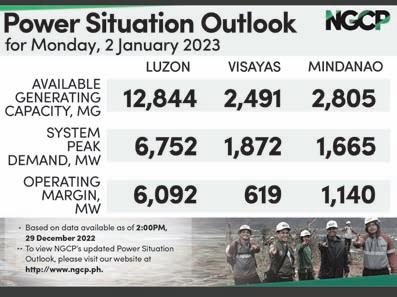
ALECO secures power from SMC
Aunit of San Miguel Global Power (SMGP) will supply electricity to debt-ridden Albay Electric Cooperative (ALECO), the power generation arm of San Miguel Corp. (SMC) said.
Masinloc Power Partners Co. Ltd (MPPCL), owner and operator of the 1,000-MW Masinloc Power Plant, agreed to supply ALECO’s full power requirements for 12 months. t his after SMC, national Electrification Administration (nE A), and ALECO signed the emergency power supply agreement (EPSA).
n E A sought the help of SMC President Ramon S. Ang to prevent ALECO’s imminent disconnection from the grid, following a failure to secure emergency power supply contracts with other firms due to the cooperative’s credit issues.
ALECO has pending legal issues with another SMGP firm, Albay Power Energy Corp. (APEC), which includes unpaid claims and advances
amounting to P5 billion, related to their terminated concession agreement. Following the termination, ALECO sought the intervention of the nE A, which took over the distribution business of ALECO in a fiduciary capacity as provided for under its charter.
n E A Administrator Antonio Mariano Almeda expressed gratitude to SMC for agreeing to come to ALECO’s rescue, by committing to provide it power supply. He also cited the Department of Energy (DOE) for its support for the agreement.
“Since we became involved, our goal was always to ensure continuous power supply to ALECO customers, despite the cooperative’s troubles. While no emergency power contracts could be finalized with the other generation firms, SMC and RSA did not hesitate to help when we approached them,” Almeda said. “We will continue to work with all stakeholders to help make this supply agreement
MERC k & Co. notched its best yearly gain in more than two decades, making it the top-performing drugmaker in the S&P 500 in 2022 as investors rewarded the company for strong earnings and upbeat clinical trial data.
t he stock has gained 45 percent in 2022 and is trading near a record high level as the maker of the blockbuster cancer drug k e ytruda and HPV vaccine Gardasil got a boost from the company’s solid earnings results. it s Covid-19 therapy Lagevrio brought in billions of revenue, and China recently approved the antiviral for emergency use.
“Merck really went from strength to strength over the course of 2022,” Barclays analyst Carter Gould, who holds an overweight rating on the stock, said in an interview.
Merck has also benefited from positive clinical updates. i n December, a trial showed k e ytruda with Moderna i nc.’s cancer vaccine reduced melanoma deaths and in October a late-stage trial of sotatercept, an investigational therapy for pulmonary arterial hypertension, met the main goal.
TESLA i n c. is expected to announce record quarterly deliveries in early January but that may not be enough to satisfy investors as the electric-vehicle leader grapples with inflation, rising interest rates, crimped production in China and concerns about softening demand.
i n an effort to clear inventory, te sla offered a rare $7,500 discount to customers in the un ited States who took delivery of a new Model 3 or Model y at the end of the year, along with 10,000 miles of free Supercharging. t he i n flation Reduction Act, or i R A, will restore up to $7,500 in federal tax credits for certain EVs starting January 1.
Deliveries are one of the most closely watched metrics by investors eager to see if te sla can maintain its rapid growth. Global fourth-quarter deliveries could reach 420,760 vehicles, according to 16 analysts surveyed by Bloomberg. t h at estimate, which doesn’t include some of the more recent analyst projections, exceeds the record 343,830 cars delivered in the third quarter.
te sla is the world’s dominant
work for the benefit of consumers.”
Earlier, the independent Electricity Market Operator of the Philippines (iEMOP), independent market operator of the Wholesale Electricity Spot Market (WESM), had raised concerns over the recent massive power purchases made by ALECO.
iEMOP was seeking credit support for ALECO’s purchases, in view of its historical credit standing.
t he EPSA would enable ALECO to prevent any further credit concerns with iEMOP, which could compromise energy security in the area.
t h is power supply agreement is not for-profit, and is primarily in consideration of the welfare of the people of Albay, who would have otherwise been disconnected from the grid. While SMGP has pending legal issues with ALECO which we are pursuing, we are still very much concerned about the welfare of the people of Albay,” said Ang.
Ang has given the nE A and the
DOE full assurance of SMGP’s support in providing the entire power requirements of those in ALECO’s franchise area.
Apart from assuring continuous electricity supply, SMGP also said that the applicable tariff rate under the power supply agreement is competitively priced, based on the prevailing conditions in the fuel commodities markets and the credit standing of ALECO.
in the interest of ALECO consumers, SMGP went further by providing consumer protection against fuel price risks by capping its monthly tariff rates at P10/kwh for the first half of the 12-month supply term, while allowing further reduction in the monthly tariff rates for the remainder of the term.
t he EPSA is subject to the approval of the Energy Regulatory Commission, which will be secured by the parties, with the full support of nE A and the DOE. Lenie Lectura
By VG Cabuag @villygc
PROPER t y developer Ayala Land inc. (ALi) said its sustainability roadmap received notable scores last year from various international groups which recognized the company’s environment, social and governance (ESG) efforts.

Ayala Land said its latest achievement is a B rating for water management given by the CDP, or the Carbon Disclosure Project, the highest rating for the Philippines. Another Ayala firm, Manila Water Co. inc., got the same rating. As the only Philippine member with leadership rating since 2020, Ayala Land said it also maintained its A- rating on the CDP Score Report on Climate Change, which is higher than Asia’s regional average of C. t his puts the company on a par with other Asian entities, such as Singapore’s City Developments Ltd., Japan’s Hulic Co Ltd. and Mitsubishi Estate Company Ltd.
t he CDP is a global non-profit that runs the world’s environmental disclosure system for investors, companies, cities and governments to assess and manage their environmental impact and is considered the gold standard in corporate environment reporting.
Also last year, S&P Global ranked Ayala Land within the 96th percentile, which is an improved score from 2021. t his puts the company’s sustainability performance at the top 4 percent within the real estate industry, simultaneously making them the highest ranked company in the country.
t he company said it retained its Dow Jones Sustainability indices (DJSi) membership for the 9th year, while still being the only Philippine member. t he DJSi tracks the world’s largest companies’ sustainability initiatives by analyzing corporate economic, environmental, and social performances.
Meanwhile, Ayala Land’s Sustainalytics standing remains at “low risk,” with its score of 16.9, an improvement from the previous year’s 17.3. Similarly, Ayala Land retained its MSCi rating of BB.
“With today’s focus on sustainability, circular economy, and going green, industries usually put emphasis on looking forward and creating a better world than we found it. t he scores that ALi received were not achieved overnight. Forwarding sustainable development not only within the organization but in the country is an ambitious goal, and reaching its 2022 achievement of exceeding controllable carbon targets was 5 years in the making,” the company said.
“We will be clearly defining our year-on-year targets so that we can measure and reach our 2030 carbon reduction and 2050 net Zero goals. to achieve this, we will be working in partnership with our suppliers and customers to ensure that our initiatives are in line with our business goals,” company president and CEO Bernard Vincent O. Dy said.
Ayala Land made bolder commitments of reducing and removing 100 percent of controllable emissions within the group by 2030, and reaching net zero emissions by 2050.
seller of electric vehicles and is well positioned to take advantage of some of the i R A’s tax credits for battery cell manufacturing and locally assembled EVs. But in order to meet its goal to grow deliveries by 50 percent annually over several years—an objective tesla warned it will fall just short of in 2022—tesla will likely make compromises when it comes to gross margins. te sla has cut prices across its lineup in China and scheduled down time at its plant in Shanghai.
i n vestors are signaling skepticism. te sla shares plunged 65 percent in 2022, more than triple the 19 percent decline in the S&P 500 i ndex.
i n April, CEO Elon Musk said te sla would produce more than 1.5 million vehicles in 2022. t he company made 929,910 cars through the first three quarters, so it would need to crank out more than 570,000 vehicles to meet that goal.
i n the third quarter, production exceeded deliveries by more than 22,000 vehicles, a gap that likely continued in the fourth quarter with cars still in transit.
Ben k a llo, an analyst at Robert
W. Baird, reduced his estimates for fourth-quarter and 2023 deliveries in a note this week “to account for the reported slowdown in production and a weakening macro environment.” k a llo, who has an outperform rating on te sla shares, expects the automaker to report deliveries of 378,262 for the quarter.
“ i ’m worried about the general economic environment,” said k a llo on Bloomberg te levision t hursday. “Do people have the wallets to pay for $60,000 cars? t h at’s what the market is worried about too.”
tesla’s Model 3 sedans and Model y sport utility vehicles account for the vast majority of sales. t he company will report the global delivery and production totals within three days of the quarter’s end.
t he Austin, te xas-based company has a long history of going all-out at the end of the quarter, with te sla employees from across the company pitching in to help hand over cars to customers. On the last earnings call, Chief Financial Officer Zachary k i rkhorn said that one-third of the quarter’s deliveries happened in the final two weeks of the third quarter. Bloomberg News
Initi A L public offerings (iPOs) in the united States nose-dived from an all-time high, and even a late pickup in follow-on offerings couldn’t erase their worst showing in almost three decades.
As 2022 fizzled to a close, 214 companies have priced iPOs to raise a combined $21.8 billion, not including secondary shares sold by investors in those listings, according to data compiled by Bloomberg. t hat compared with almost $335 billion in primary shares sold in 1,091 iPOs on uS exchanges in 2021.
t he buy side is starved for new places to allocate dollars in general, because the iPO market and to a lesser extent the follow-on market’s been very tough,” Zach Dombrowski, head of consumer ECM at William Blair, said in an interview.
Gone were mega iPOs by growthstage juggernauts like Rivian Automotive inc., quashed by market volatility, poor returns and inflation, as well as the collateral damage of war and pandemic. instead, small blankcheck firms and research-phase bio-
tech and pharmaceutical startups accounted for most of the listings, shrinking the size of share sales to a third of $309 million average in 2021.
Follow-on offerings of primary shares by companies raising capital also declined overall but less precipitously, to $48 billion from $143 billion in 2021. t hat was still the lowest mark since $35 billion in 1995. t hose offerings, about half as many as the previous year, were driven in part by companies moving quickly to capitalize on ephemeral market upticks.
t he average size of follow-on offerings also slipped, to an average of $106 million from $156 million in 2021, the data show. t hat reflects smaller public companies needing cash in a tough year, while typically lacking both the reserves of larger corporations as well as access to the private capital that fuels pre-iPO startups.
Most of the capital raised in iPOs in 2022 was in the first quarter. in contrast, follow-on offerings held steady, hitting their highest mark in the fourth quarter.
BusinessMirror Editor: Jennifer A. Ng Companies B1 Monday, January 2, 2023
Bloomberg News
News
Bloomberg
The Department of energy (DOe) has finally declared the start of the commercial operations of the wholesale electricity spot market (WeSM) in Mindanao more than 5 years after it was launched.
Tesla poised for delivery record Merck rallies to best year since 1995 ‘Ayala Land ESG efforts get high marks in 2022’ Brutal year smashes share sales in IPOs
Photo shows Crossroads, Ayala Land’s newest 83-hectare estate in Plaridel, Bulacan. From www.ayalaland.com.ph
Banking&Finance
Perspectives The day after
IN today’s alarming reality, adequate ransomware response and recovery programs should be embraced as crucial business enablers. Improvising when an organization’s operational technology (OT) and critical operations are engulfed in a deadly firestorm is likely not the answer. Operational technology (OT) involves the use of hardware and software to control industrial equipment. OT security is becoming vital today as OT is integrated with IT to create IT/OT convergence.
In the case of a large oil pipeline system, a major ransomware attack caused a shutdown of operations for almost one week and led to fuel shortages. The attack—the result of a single compromised password—focused on the pipeline’s IT systems, but the OT systems that transport oil was not directly targeted. The attackers stole data and infected the IT network with ransomware and to prevent it from spreading to the OT, the pipeline was shut down.
Ransomware attacks, which spread across the network and encrypt data, are soaring worldwide. The decryption of business data can be almost impossible amid today’s increasingly sophisticated ransomware attacks, during which attackers typically demand a ransom payment in bitcoins to release a key for data decryption. The organization under attack must either pay to regain access to its data or hope to recover the data in some other way, such as via backup applications.
As ransomware attacks skyrocket, ransoms could cost businesses a total of $265 billion by 2031, according to Cybersecurity Ventures, which predicts costs will rise by 30 percent annually over the next 10 years.
Effectively managing an attack is critical to address the initial impact on operations and costs, and to help minimize a recovery that may involve days or weeks of limited capabilities and interrupted customer services. Businesses need to prepare not only for an attack response but for rapid recovery—and this is particularly critical in the OT domain, where physical processes are typically involved. While many businesses are racing to enhance prevention and response programs, they also need appropriate recovery capabilities.
Recovery measures to restore operations quickly require a precise assessment to determine that the initial underlying threat has been eliminated. This is no small task amid the immediate need for response measures that include shutting down internal systems and key elements of the business network, along with rushed policy changes. It’s also crucial that the complex path back to normal operations includes key changes to security. The response and recovery process under these typical conditions can create remarkably complex challenges.
OT recovery readiness—being prepared for anything
WHEN there’s a disaster, production outage, ransomware attack, or other events, you need to get your OT and production processes back online quickly. That means always being ready for anything. And given the constant change in today’s OT environments, ransomware readiness can’t
be something you address quarterly or annually. Readiness should be a daily focus.
The constantly growing and changing scope of threats should always be taken into account. It’s not only about on-premises systems, but also IT and OT systems and their connected OT components such as the control system and programmable logic controllers (PLCs).
You need the capabilities to recover modern and old production systems, virtual machines (VMs), containers, programmable logic controllers (PLCs), and applications from anywhere in a modern hybrid IT/OT architecture. The cloud has also become part of today’s modern systems or OT infrastructures and these platforms also need to be considered.
This complexity clearly shows that one-size-fits-all approaches are usually unsuitable for OT and production sites at this point. To be prepared for an emergency, the following key points of recovery readiness should be achieved to restore operations within a reasonable time frame:
n First, be aware of all your critical assets for IT and OT and their dependencies on each other. Also, maintain up-to-date vulnerability reports from your critical systems and assess them regularly. Without this kind of information, we believe that recovery in a tolerable time frame is impossible.
n Define recovery objectives when recovering from a disruption. For example, the recovery capability should prioritize human and environmental safety before restarting the OT operation that was impaired by the cybersecurity event.
n Develop a site disaster-recovery plan (DRP) and business continuity plan (BCP), or both, to prepare the IT and OT organization to respond appropriately to significant disruption during a cybersecurity incident. IT and OT must not be considered separately but together (IT/OT convergence goal).
n Establish backup systems and processes to back up the relevant (critical) OT systems’ state (legacy systems, Windows/Un ix, PLCs, virtual systems, etc.), data, configuration files, and programs to support timely recovery to a stable state.
n Create awareness of threats (not only for IT), train your OT employees, simulate the worst-case scenario, and learn from your findings.
If you have not yet implemented these points, you should do so as soon as possible given the current and constantly increasing OT threat environment. We recommend focusing on your critical OT systems in the first wave of recovery readiness, followed by the medium critical and less critical in waves two and three.
The excerpt was taken from the KPMG Thought Leadership publication: https://home.kpmg/xx/en/ home/insights/2022/12/the-day-after.html.
© 2022 KPMG Intl. Ltd. is a private English company limited by guarantee.

R.G. Manabat & Co., a Philippine partnership and a member-firm of the KPMG global organization of independent member-firms affiliated with KPMG Intl. Ltd. All rights reserved.
This article is for general information purposes only and should not be considered professional advice to a specific issue or entity. The views and opinions expressed herein are those of the author and do not necessarily represent the BusinessMirror, KPMG International or KPMG in the Philippines.
Govt eyes taxing self-employed, luxury items in 5-year devt plan
By Cai U. Ordinario @caiordinario
THE Marcos administration aims to expand tax coverage in the medium term, according to the recently released 2023-2028 Philippine Development Plan (PDP).
The national government aims to strengthen and expand the tax program to self-employed Filipinos and on luxury items as well as digital transactions, among others.
The PDP said this can be done through tax mapping by aligning government information technology and data infrastructure to allow the sharing of information related to taxation.
“All individuals registered with government corporations, such as [the] Philippine Health Insurance Corp. [PhilHealth] and Social Security System [SSS], can be part of the Bureau of Internal Revenue [BIR] database,” the PDP continued.
The PDP also said that taxing digital transactions, however, would require a review of tax rules to “broaden the concept of ‘permanent establishment’” as well as evaluate the formula for profit allocation.
The government said this will require digital platforms for firms as well as non-resident firms doing business in the Philippines to register with the BIR and collect value-added tax (VAT) from their sales.
Review exemptions
THE administration also intends to review exemptions and preferential treatment provided by tax laws. This includes zero rating of goods and the remaining exemptions in the Tax Code.
“Different forms of income, such as dividends, royalties, capital gains from stock transactions and interest income, are subject to different tax rates. Neutral taxation of all capital income can minimize avoidance and progressively strengthen revenue mobilization,” the PDP stated.
The government will also broaden the coverage of goods subject to excise tax such as those imposed on non-essential articles such as jewelry, perfume, yachts and other vehicles intended for sports.
These items, the PDP stated, are slapped with a 20-percent tax on their wholesale price or the value of importation. By including these in the list of goods covered by excise taxes, the government “would improve the progressivity of the indirect tax system.”
The government will also consider the inclusion in the list of non-essential goods to be slapped with an excise
tax on other motor vehicles, such as motorcycles and pick-up trucks.
“The success of this measure will depend on the formulation of effective criteria to determine nonessential commodities. To this end, estimates of the price elasticities of the demand for goods can provide helpful information,” the PDP stated.
Financial sector
MEANWHILE, the government aims to simplify the taxation of the financial sector. Under the Passive Income and Financial Intermediary Taxation bill, a single rate of 15 percent will be imposed on interest income, dividends and capital gains.
The government said the uniformity of the taxation of banks, quasibanks and certain non-bank financial intermediaries will be possible under a 5 percent gross receipts tax.
The administration said the taxation of insurance services, such as pre-need, pension, life and health maintenance organization insurance, will be made uniform at 2 percent of the premium.
The tax on Initial Public Offering and the Documentary Stamp Tax on specific transactions will also be removed to support capital market development.
Further, the government intends to make better use of benefit taxation. A journal article written by economist James R. Hines Jr. defined benefit taxation as “a system in which individuals are taxed according to the benefits they receive from public expenditures.”
“The amount of user charges will then be reviewed to ensure that
citizens properly value the services the government provides and that the government can at least recover production and delivery costs,” the PDP said.
“A subsidy component for the poor will be part of the program to address equity concerns. Moreover, an incentive system for government agencies that collect the fees will be devised,” it added.
Consumer spending
EARLIER, a fresh round of income tax cuts would drive consumer spending as it expands Filipinos’ purchasing power and remains as the backbone of the country’s economic expansion in 2023.
Michael Gerard D. Enriquez, President and Chief Investment Officer of Sun Life Investment Management and Trust Corp. (SLIMTC), explained the Train law (Republic Act 10963) on income tax cut kicks in starting January 2023 and “hopefully, that provides additional spending power to the consumers.”
Under RA 10963 or the “Tax Reform for Acceleration and Inclusion” law, Filipinos earning P250,000 and above annually would experience a fresh round of income-tax reductions.
According to Enriquez, this reduction in taxes would fuel growth in consumer spending, which hasn’t been fazed despite higher inflation. The SLIMTC expects the average inflation rate next year to decelerate to around 4.5 percent. But Enriquez emphasized that the accelerating increase in prices of goods has yet to peak some time in the first quarter.
TrAin law expected to raise workers’ take-home pay
By Jovee Marie N. dela Cruz @joveemarie
ORDINARY Filipino workers will increase their take home income this New Year due to a lower personal income tax (PIT) under the Tax Reform for Acceleration and Inclusion, or “TR AIN,” law (Republic Act 10963), the chairman of the House Committee on Ways and Means said.
“A 13.5-month bonus” is how Rep. Joey Sarte Salceda describes the cuts to the personal income tax rates effective this year.
“The Train Law PIT cut will be equivalent to around 5 percent in gross income in added take home pay,” Salceda said. “That’s around half a month’s worth of additional disposable income.”
The new annual income tax rates will reduce taxes by around 5 percent for those earning between P250,000 and P2 million. Individuals with taxable income above P2 million but not greater than P8 million will see a 2 percent decrease in personal income tax. Income below P250,000 will still be exempt from PIT.
“It will increase disposable income for Filipino families by around P32
billion by our emerging estimates. That will boost consumer spending and also leave some room for savings for home ownership,” Salceda added.
According to the lawmaker, the cut will also cushion workers from the impact of the 1 percentage point increase in SSS contributions and the 0.5 percentage point increase in Philhealth premiums.
“Take home is still up 3.5 percentage points more or less,” Salceda said.
US-PH tax treaty
SALCEDA also said that freelancers with US employers can benefit from the reduced personal income tax rates under the TR AIN Law if the US-Philippine Income Tax Convention can be implemented with an automatic exchange of information mechanism. “The TR AIN Law will massively benefit US-employed Pinoy freelancers, if the rates can be implemented,” he said. The US implements a 30 percent withholding tax on income derived from the US by foreign citizens abroad. This, Salceda explains, includes online influencers working through US companies such as Youtube Inc.
“From 30 percent, their taxes go down to around 15 percent if the Phil-
ippines’ reduced rates are imposed on them instead. That’s a two-month bonus,” the lawmaker explained.
Salceda added that the Philippine Senate needs to ratify the Multilateral Convention on Mutual Administrative Assistance in Tax Matters (MCMAAT) so that tax authorities of
the US and the Philippines can implement the tax treaty better, allowing both countries to impose the proper rates on their nationals.
He said he hopes the Senate realizes this “and finally ratifies the convention in the ninth year since we signed it.”
PhilHealth asks SC to reverse ruling on ₧83.06-M gifts, allowances flagged by COA
By Joel R. San Juan @jrsanjuan1573
THE Philippine Health Insurance Corp. (PhilHealth) has asked the Supreme Court (SC) to reverse its decision affirming the notice of disallowances (NDs) issued by the Commission on Audit (COA) that covers the P83.06 million that PhilHealth allotted for educational assistance allowances (EAAs) and birthday gifts to its officials and employees in 2014.
Contrary to the SC ruling which was made public last December 9, 2022, Executive Vice President and Chief Operating Officer Eli Dino D. Santos said the allowances were legal.
“We maintain, however, that those allowances were given in good faith, above board, not extravagant and, most of all, well deserved by the hardworking officers and employees of the state-insurer,” Santos said.
The lawyer added that Philhealth filed its motion for reconsideration of the SC decision last December 20, 2022, and assured that it would heed the Court’s decision once the case is decided with finality.
But the Philhealth official noted that the agency has already discontinued the subject allowances after receipt of the NDs issued by the COA.
No fiscal autonomy
THE subsequent benefits given to
the employees, according to Santos, have since been aligned with those prescribed under the Salary Standardization Law IV and now with the Compensation and Position Classification System (CPCS) issued by the Governance Commission for Government-Owned and Controlled Corporations (GCG).
“We assure the public that PhilHealth is prudent in administering its funds, and ensure that meeting our financial obligations, especially the payment of benefit claims, is always our top priority,” he said.
In its decision issued in 2018 and affirmed in 2019, COA said that while selected government entities are exempt from the application of the
Salary Standardization Law (SSL), PhilHealth’s law under Republic Act (RA) 7875 does not contain the same express exemption.
Furthermore, the COA said PhilHealth’s power to fix the compensation of its personnel as provided under Section 16 (n) of its charter, does not expressly grant fiscal autonomy to the agency.
Even if PhilHealth was allowed by its charter to have its own position and composition plans, it would still be required to report to the President through the Department of Budget and Management (DBM).
Equal pay, work
THE COA also ruled that the EAAs
and birthday gifts do not fall under Collective Negotiation Agreement (CNA) incentives. These incentives are given for productivity and costsaving efforts by a government agency.
“The granting of benefits and allowances by virtue of the resolutions passed by PhilHealth in the exercise of its fiscal autonomy, no matter how long practiced, if done in violation of existing rules and regulations, is still considered unauthorized and should be disallowed,” it said.

In affirming COA’s ruling, the SC declared that PhilHealth has not been given a blanket authority to determine the compensation of its personnel. The issue on Phil-
Health’s claim of fiscal autonomy, according to the SC, has long been settled in its 2016 decision in PhilHealth v. COA.
“At this point, there should no longer be any question that PhilHealth is not exempted from the application of the SSL. Its power to fix personnel compensation is limited and ‘must necessarily yield to the state policy of ‘equal pay for equal work,’” the SC said.
“Thus, any disbursement or allowances and other forms of employee compensation must conform with prevailing rules and regulations issued by the President of the Philippines and/or the [DBM],” it added.
BusinessMirror
• Monday, January 2, 2023 B3 www.news.businessmirror@gmail.com
Editor: Dennis D. Estopace
NEW ATM This Monday, December 12, 2022, photo shows Pamplona Vice Mayor Arnie Angelica S. Fernandez (fourth from left) and Land Bank of the Philippines Northern Luzon Branches Group Head, Senior Vice President Maria Belma T. Turla (fifth from left) led the inauguration of the LandBank offsite ATM located at the Municipal Hall of Pamplona, Cagayan. They are joined by members of the Sangguniang Bayan, local officials and other LandBank officers. The new LandBank ATM will serve customers in all 18 barangays in the Municipality, which includes government employees, private citizens and beneficiaries of Conditional and Unconditional Cash Transfer programs. CREDIT: LanD Bank of ThE PhILIPPInEs
Explainer
How Putin’s war and small islands are accelerating the global shift to clean energy, and what to watch for in 2023
By Rachel Kyte Tufts University The Conversation
The year 2022 was a tough one for the growing number of people living in food insecurity and energy poverty around the world, and the beginning of 2023 is looking bleak.
Russia’s war on Ukraine, one of the world’s largest grain and fertilizer feedstock suppliers, tightened global food and energy supplies, which in turn helped spur inflation.
Drought, exacerbated in some places by warring groups blocking food aid, pushed parts of the Horn of Africa toward famine. Extreme weather disasters have left trails of destruction with mounting costs on nearly every continent. More countries found themselves in debt distress.
But below the surface of almost weekly bad news, significant changes are underway that have the potential to create a more sustainable world—one in which humanity can tackle climate change, species extinction and food and energy insecurity.
I’ve been involved in international sustainable development for most of my career and now teach climate diplomacy. Here’s how two key systems that drive the world’s economy—energy and finance—are starting to shift toward sustainability and what to watch for in 2023.
Ramping up renewable energy growth

RU s s I A n P resident Vladimir Putin’s war on Ukraine has reverberated through Europe and spread to other countries that have long been dependent on the region for natural gas. But while oil-produc -
ing countries and gas lobbyists are arguing for more drilling, global energy investments reflect a quickening transition to cleaner energy.
Call it the Putin effect—Russia’s war is speeding up the global shift away from fossil fuels.
In December, the International Energy Agency published two important reports that point to the future of renewable energy.
First, the IEA revised its projection of renewable energy growth upward by 30%. It now expects the world to install as much solar and wind power in the next five years as it installed in the past 50 years.
The second report showed that energy use is becoming more efficient globally, with efficiency increasing by about 2% per year.
As energy analyst Kingsmill Bond at the energy research group RMI noted, the two reports together suggest that fossil fuel demand may have peaked. While some low-income countries have been eager for deals to tap their fossil fuel resources, the IEA warns that new fossil fuel production risks becoming stranded, or uneconomic, in the next 20 years.
The main obstacles to the exponential growth in renewable energy, IEA points out, are antiquated energy policy frameworks, regulations and subsidies written at a time when energy systems, pricing and utilities were all geared toward fossil fuels.
Look in 2023 for reforms, including countries wrestling with how to permit smart grids and new transmission lines and finding ways to reward consumers for efficiency and clean energy generation.
The year 2023 will also see more focus on developing talent for the clean energy infrastructure buildout. In the U s , t he recently passed Inflation Reduction Act and the Bipartisan Infrastructure Law will pour hundreds of billions of dollars into clean energy and technology. Europe’s REPowerEU commitments will also boost investment. However, concerns about “buy American” rules within the new U s climate laws and an EU plan to launch a carbon border adjustment tax are raising fears that nationalism in trade policy could harm the speed of green growth.
Fixing international climate finance

T H E second system to watch for reform in 2023 is international finance. It’s also crucial to how low-income countries develop
their energy systems, build resilience and recover from climate disasters.
Wealthy nations haven’t moved the energy transition forward quickly enough or provided enough support for emerging markets and developing countries to leapfrog inefficient fossil-fueled energy systems. Debt is ballooning in low-income countries, and climate change and disasters like the devastating flooding in Pakistan wipe out growth and add costs.
Barbados Prime Minister Mia Mottley has brought together international financial institutions with think tanks and philanthropists to push for changes.
Countries like Mottley’s have been frustrated that the current international financial system— primarily the International Monetary Fund and the multilateral development banks, including the World Bank—haven’t adapted to the growing climate challenges.
Mottley’s Bridgetown Initiative proposes a new approach. It calls for countries’ vulnerability to be measured by climate impact,
and for funds to be made available on that basis, rather than income. It also urges more risk-taking by the development banks to leverage private investment in vulnerable countries, including climate debt swaps.
The Bridgetown Initiative also calls for countries to reflow their IMF s pecial Drawing Rights—a reserve available to IMF members—into a proposed fund that vulnerable countries could then use to build resilience to climate change. A working group established by the G-20 points out that the “easiest” trillion dollars to access for urgent climate response is that already in the system.
In early 2023, Mottley and French President Emmanuel Macron, with others, will drive a process to examine the possible measures to improve the current system before the annual meetings of the World Bank and the IMF in April, and then at a June summit called by France.
Watch in 2023 to see if this is the year the G-7 and the G-20 rekindle their global economic
Watch small nations’ leadership in 2023
In 2023, expect to see small nations increasingly push for global transformation, led by the V-20— the finance ministers of the countries most vulnerable to climate change.
In addition to the Bridgetown Initiative, Barbados has suggested a way to pool new funds working off the model of an oil spill damage fund at the International Maritime Organization. In the IMO fund, big oil importers pay in, and the fund pays out in the event of a spill. Barbados supports creating a similar fund to help countries when a climate event costs more than 5% of a country’s GDP.
This model is potentially a way to pool funds from a levy on the windfall profits of energy companies that saw their profits soar in 2022 while billions of people around the world suffered from energy price inflation.
Finally, the breakthrough agreement on biodiversity reached in December 2022 provides more promise for 2023. Countries agreed to conserve 30% of the world’s biodiversity and restore 30% of the world’s degraded lands. The funding—a $30 billion fund by 2030—remains to be found, but the plan clarifies the task ahead and nature’s place in it. And we can hope 2023 is a year when signs of peace in our war against nature break out.
This article is republished from The Conversation under a Creative Commons license. Read the original article here: https://theconversation.com/ how-putins-war-and-small-islands-are-accelerating-the-globalshift-to-clean-energy-and-whatto-watch-for-in-2023-196925.
B4 www.businessmirror.com.ph BusinessMirror Monday, January 2, 2023
leadership roles. Their members are the largest owners of the international financial institutions, and also the largest emitters of carbon dioxide on the planet. India will lead the G-20 in 2023, followed by Brazil in 2024. Their leadership will be critical.
to meet its
BeaC
hgo eR s walk near wind turbines along the coast of Pingtan in southern China's Fujian province, on august 6, 2022. China announced ambitious schemes to enable the country
2030 clean energy goals five years ahead of schedule. AP/Ng H AN g uAN
s o laR panels on germany's biggest floating photovoltaic plant produce energy under a blue sky on a lake in haltern, germany, May 3, 2022. germany, a strong advocate of clean energy, turned to coal and oil to address its short term power needs. AP/M A r ti N M eiss N er
AvOid HOlidAY Skin STReSS
EvERYTHING S coming up merry and bright for the new year, with the holiday season marked by inperson gatherings and reunions with family, friends, and colleagues. As festive as the season is, it’s also stressful and hectic.
We’ve been juggling more tasks and errands than we usually do, decorating our homes while finishing up end-of-the-year reports, and (finally!) catching up with friends. And all those sleepless nights and hours spent working overtime, holiday shopping and gift wrapping can show on you, especially on your skin.
Cult fave J-beauty brand Hada Labo helps you pvercome holiday skin and look your best in the new year despite the stress. The brand sells out a bottle of face lotion every five seconds and offers two of its most famous product lines here in the country.
Gokujyun Hydrating Lotion Rich is Hada Labo’s flagship product that’s updated with an enhanced formulation. It contains five types of hyaluronic acid to deeply hydrate the skin, replenish optimum moisture, create a moisture-locking shield to prevent moisture loss, and enhance absorption of other skincare ingredients. This formula also has the world’s first fermented hyaluronic acid that significantly improves its barrier function even more. The Gokujyun line also offers the Gokujyun Hydrating Light Lotion that has the same hydrating formula as the former, just lighter for oily or combination skin.
Shirojyun Premium Whitening Lotion, on the other hand, is best for those who have dull, tired skin. Apart from Hada Labo’s signature hyaluronic acid formula, it also contains brightening ingredients to give you that crystal bright glow. It’s infused with Alpha Arbutin, Niacinamide, and vitamin C to brighten and even out skin tone. Alpha Arbutin can prevent skin pigmentation, dark spots, and freckles. It’s a natural antioxidant and skin brightener that reduces melanin formation in an effective and safer way. Niacinamide is known for helping protect skin from environmental stressors like Uv rays and pollution, while vitamin C can help exfoliate the skin to reveal a brighter complexion.
Carry that new mochi-mochi skin-care routine into the new year, as the J-beauty skin-care brand is treating shoppers to some exclusive promos and freebies with every purchase of Hada Labo products at The SM Store’s Beauty Section in SM City North Edsa until January 11, 2023. Hada Labo face lotions and other products are also available at Watsons and Zalora, and through the official Mentholatum store on Lazada and Shopee.
For the love of inawl
TMaguindanaon. But the love for the intricate and colorful fabric was revitalized by the beloved “Ina ng Bangsamoro,” Bai Sandra Sema.
“Inawl was handed down to us by our ancestors. It became part of our heritage, culture and identity,” Bai Sandra said. “Let’s continue to preserve, promote and expand its reach. The best is yet to come. Insha Allah.”
Bai Sandra spearheaded the Inawl Fashion Show was held on December 17 as part of the week-long celebration of the Shariff Kabunsuan Festival 2022 in Cotabato City, the “City of Cultural Charms,” and the capital of the Bangsamoro Autonomous Region in Muslim Mindanao (BARMM).


The glittering gala was attended by the top officials of Cotabato City headed by Mayor Bruce Matabalao, BARMM senior minister Abdulraof Macacua representing BARMM chief minister Al Haj Ahod Ebrahim, minister of Interior and Local Government Naguib Sinarimbo, minister of Labor and Employment Muslimin Sema, Ministry of Trade, Investments and Tourism director general Rosslaine Alonto-Sinarimbo, Tourism undersecretary Myra Abubakar and assistant secretary Rica Bueno, tourism consultant Nilo Agustin, and MITTBARMM’s Mustapha Ala Jr.
“Mayor Matabalao and the City Tourism Council will continue to host programs that will promote not only the city but the whole BARMM Region. We know that the time is now and the opportunity is here,” said Bai Sandra Sema, a former representative of the First District of Maguindanao and Cotabato City who is now at the helm of the tourism council.
Wearing an F-Statement by: Ellah Signature Inaul
Beauty lessons learned from TikTok
lipstick, the most famous one being Pillow Talk, costs over P1,000 but TikTokers presented them with more affordable dupes.
Couture using her own old inawl fabric in her favorite color of stunning pink, Bai Sandra enlisted the city’s leading designers for her advocacy. Is inawl a rebranding of inaul?
“Actually it’s just the spelling that’s different. It is popularly spelled ‘inaul’ but then I think with this new project, it was decided to be spelled as inawl for identity purposes,” explained designer Wilfred Yee, who also directed the show. He showed Chinoiserie, Hispanic, Hindu, American and Malay themes which “showcase the versatility and beauty of our handwoven inawl.”
Melissa Ajaddi Chin of Fely’s House of Fashion featured outfits for formal affairs: “In our increasingly digitized world, preserving the Maguindanaoan culture is more important now than ever. Laborious and difficult to master, the art of weaving perfectly encapsulates the tenacity, diligence and skill of the designs.”

Akmad Kari Jr. of House of Kari’s “Shibuya” explored the endless possibilities of inawl as streetwear: “Aesthetics, functionality and wearability are the major keys in this collection. Streetwear can be a melting pot of diverse influences, cultures,
her special day, that magical moment when she walks down the aisle. Weddings are always looked forward to and making it extraordinary is featuring the handwoven inawl, which gives a nostalgic feel.”
Marc Gernan’s menswear incorporated Lumban, Lagina embroidery: intertwining the hand-woven inawl and the Barong Tagalog to make an impact as makabayan, makatao at maka-Bangsamoro. Joy Puro Abayon’s “Maguindanao Royalties” highlighted the modern and traditional royalty fashion which is distinct to the “People of the Flooded Plains.”

The region’s foremost fashion purveyor, Pepe Quitco presented a sensational Filipiniana collection.
“Using inawl will definitely set you apart and different from using commercial fabric because of the distinct ethnic patterns and vibrant colors used by the weavers,” explained the well-respected designer.
“Inawl should be properly lined, using soft lining or fusing to achieve a bit of stiffness that we want the fabric to fall or flow. It also needs extra care in handling.”
Inawl can be quite challenging to work with, as designers have found out. But perhaps a collaboration with the Department of Science and TechnologyPhilippine Textile Research Institute could address some of these sewing issues.


“We would like to push inawl to become a national fabric,” said the fabric’s fiercest believer, Bai Sandra Sema. “If we are to talk about unity, if we are to talk about solidarity, then the Philippines must acknowledge inawl as the national fabric.” n
Anyway, here are some things I learned from my favorite TikTok content creators:
ONE of the things that changed in the 2022 beauty landscape was that it wasn’t enough for an influencer to say, for instance, that this lipstick was good. They had to try the lipstick, test it by eating and drinking, film the process, and upload the video on social media, usually TikTok.
In just a few months, many beauty TikTokers became Internet superstars because unlike traditional influencers, they were ready to “dirty” their hands and faces by actually trying out makeup and skin-care products.
Thanks or no thanks to TikTok, many beauty products were sold out in 2022. I have been looking for the Revlon Super Lustrous Glass Shine Lipstick in Rum Raisin for a while but no thanks to TikTok, it’s not available online or offline in the Philippines.
The new “It Girls” aren’t Eurasian beauties. They’re regular people who just happen to be better looking than most of us. But they’re still very relatable.
And you know what? Many of the beauty tips they share work, even when the content is branded.
Another thing I love about TikTok is that highend beauty brands like Charlotte Tilbury and Estee Lauder are no longer considered out of reach of the average beauty enthusiast. Yes, a Charlotte Tilbury
In the past, I remember asking during the live of two famous makeup artists about possible dupes to a Dior Beauty powder, and one of them snapped and replied with words that still embarrass me to this day. The other makeup artist, bless her, is very kind and would never act like that. Things like this don’t happen on TikTok. Even the content creators who come from wealthy families reply politely when asked. Because these TikTokers worked hard to get to where they are, they value their followers and treat them with respect. I’m not saying that every TikTok content creator treats their followers with respect but most of those I follow certainly do.
Beauty TikTok is responsible for making many brands and products famous. Clinique Almost Lipstick in Black Honey is not new but Filipino creator Marj Maroket helped revive people’s interest it. It got to a point where Black Honey was sold out worldwide.
Issy and Co. is a Filipino beauty brand that used to have a celebrity endorser but it only really took off when TikTokers fell in love with the Active Skin Tint.

There are so many Filipino beauty brands that became famous on TikTok and that’s good, right?
During the pandemic, these brands grew because people were stuck at home.
Rosmar is not just the nickname of a person. It is also a very popular brand of soaps and skin-care products on TikTok. The brand’s owner, Rosmar Tan, is very popular on the platform. Rosmar’s Kagayaku Whitening Soap is one of the most popular beauty products on TikTok.

Paulash is also a popular beauty brand on the platform. It is known for its false eyelashes. Most beauty creators worth knowing swear by this brand.
n There are different blush placements for what you want to achieve. For example, if you are looking for a natural blush, you can start on the middle of your cheek and go downward because that’s how you blush when you work-out.
n When you use cream products, always set them with a powder equivalent. Cream or liquid blush should be set with a powder blush.
n Morena girls like me can make pale lipsticks work by lining their lips with a dark lip liner and topping that with a gloss. By the way, I attribute the revival of lip gloss’ popularity to TikTok.
n Lip oils are more moisturizing than regular lip balms. I learned that applying lip oil before you do your makeup will help your lipstick glide on smoothly.
n Misting your face with a finishing spray after every layer (for example, you apply foundation and then spray; follow with concealer and then spray again) will help your makeup look natural.
n The difference between setting and finishing sprays is that the former helps keep your makeup stay in place while the latter gives you a dewy and more natural-looking finish.
n A bronzer doesn’t just make your cheeks look sculpted or your nose smaller. It also gives your makeup more dimension, especially if it is matte.
n The Charlotte Tilbury Flawless Filter is not a foundation but an illuminating primer. If you have good skin, you can top this with a powder and you’re good to go.
n Prepping your skin properly (prepping meaning a proper skin-care routine) before makeup will help you avoid cakiness and help products to last longer on your face.
B5 Style Editor: Gerard S. Ramos • Monday, January 2, 2023 www.businessmirror.com.ph BusinessMirror
FROM left: Pepe Quitco, Melissa Ajaddi Chin of Fely’s House of Fashion, Wilfred Yee and Bai Sandra Sema (ISRAEL UNGKAKAY FACEBOOK) INAWL FASHION SHOW PHOTOGRAPHED BY TEDDY PELAEZ
@ClARA SlAYS is a Singaporean beauty content creator on TikTok whose content has generated over 7 million likes
People’s Network GM elected member of the ABU Administrative Council
NETWORK General Manager Julio Castillo, Jr. of the People’s Television Network, Inc. (PTNI) has been elected as the new member of the AsiaPacific Broadcasting Union (ABU) Administrative Council. The election was held during the 59th ABU General Assembly and Associated Meetings in New Delhi, India, last November 2022.
Established in 1964 as a nonprofit, non-government, nonpolitical, and professional association of broadcasters and broadcast media organizations, ABU has become the biggest broadcasting union in the world with over 250 members in over 70 countries across four continents.
The ABU Administrative Council serves as the Union’s Board of Directors. It is composed of 17 Full Members. Additional Members are elected by the members at the annual General Assembly for a three-year term. The Council meets twice a year to develop ABU’s policies, review the Union’s finances, and discuss the issues being faced by the Union.
PTNI will serve in the ABU Administrative Council for a period of three years starting January 2023. Castillo is envisioned to bring to the Council his extensive knowledge in the fields of education, business, sales and marketing, public relations, management, policy development and planning.
PTNI’s election as Council member is seen to benefit the Network as the body is expected to continue its promotion of the collective interests of television and radio broadcasters as well as key industry players, and facilitate international media cooperation.
As the government television network, PTNI’s active involvement in the ABU and its Council is seen to further strengthen its important role
in the information dissemination of the laudable priority programs of the administration of President Ferdinand R. Marcos.
Smart Communications welcomes returning OFWs home with special Christmas food treats, giveaways’
CHRISTMAS is a season of homecoming, especially for overseas Filipinos who have been unable to fly back to the Philippines during the height of the COVID-19 pandemic. To celebrate this special homecoming, PLDT wireless unit Smart Communications, Inc. (Smart) is bringing back the traditional “grand salubong” and welcoming our kababayans home with some holiday treats.
On December 22, Smart set up stations at the Ninoy Aquino International Airport Terminal 1 where arriving Filipinos were able to choose a gift from under the Christmas tree or enter the Christmas raffle for special giveaways.
Returning Filipinos also enjoyed local delicacies that they may have missed – tasty bibingka, sapin-sapin, and hot
chocolate to warmly welcome them home.
“We are excited to welcome our kababayans home, especially after the tough two years that we have experienced due to the global pandemic. Aside from providing the fastest mobile network for when they stay in the country during their vacation, we hope that through this simple gesture, we’re able to uplift their spirits this Christmas,” said Chito M. Franco III, VP & Head of National Key Accounts & Partnerships at PLDT and Smart.
Smart also gave away locally made parols to level up the holiday cheer, and care kits containing face masks, sanitizers, and pouches to help keep them safe as they spend their vacation with loved ones.

“Mabuhay to our OFWs! Christmas celebrations become more meaningful when we are reconnected with our families
and loved ones. We want to thank you for making us part of your lives all these years. We commit to bringing closer ties through meaningful connections anytime, anywhere. Welcome home, from your PLDT and Smart family,” said Jac Bocalan, VP and Trade Marketing Head at PLDT and Smart.
Aside from taking care of the overseas Filipino community, Smart also empowers the digital and connectivity needs of Filipinos with the fastest mobile network in the country.
Smart’s wireless network was recently recognized by Ookla as the Philippines' Fastest and Best Mobile Network in its latest report covering the first two quarters of 2022. The Best Mobile Network citation has only been given by Ookla to approximately 20 mobile operators in the world, with Smart being the first and only Philippine mobile operator to clinch the award since Speedtest started in 2017. To earn this citation, a mobile operator must lead in two crucial Ookla Speedtest AwardsTM categories, namely Fastest Mobile Network and Best Mobile Coverage, within the same test period. Smart is also the fastest mobile network for Apple, Samsung, and Android devices, based on Ookla’s analysis of Speedtest Intelligence® data for Q3 2022.
As of end-September, Smart had deployed 77,200 base stations nationwide, including 7,300 5G base stations and close to 40,000 4G/LTE base stations. Smart’s network covers about 97% of the population with 3G, LTE, and 5G.
Supporting Smart's network is PLDT's fiber network, the country's most extensive fiber infrastructure. As of end-September, PLDT had expanded its total fiber footprint to about 1.09 million kilometers, consisting of over 231,000 kilometers of international fiber and almost 860,000 kilometers of domestic fiber.
IT’S that time of the year when we bring out our glittering decorations and festive lights for the holiday season. Aside from that, many continue to wrack their brains trying to figure out the best gift to give to loved ones during the most important season of the year.
Don’t worry because Borough Lasik Center has got the best and most precious holiday gift this season—the gift of sight.
This year, Borough Lasik Center is offering its end-of-year promo for Lasik procedures at a low price of only P60,000. If you’re about to get additional money like your 13th month pay, now is the time to have your eyes checked and find out how the outstanding Lasik procedure at Borough Lasik Center can help change the way you see things—literally.

If you’re 18 to 45 years old, or what Borough Lasik Center calls the Lasik group composed mostly of young professionals and active people, there’s nothing wrong in having your eyes checked so you can see things clearly.
For the Borough Lasik Center yearend promo, Borough Lasik Center accepts straight payment options, either through cash, GCash, direct bank transfer, or even through debit cards.
If you’re looking at making a good investment this year, consider a Lasik procedure for your eyes, especially if you are beginning to experience any form of discomfort and difficulty in seeing things like before, especially for those who use their eyes at work for long periods of time, says Dr. Ches Heredia, Chief Executive Officer of Borough Lasik Center in Manila.
He said that our eyes are one of the most important parts of our body and it needs to be checked in terms of visual acuity. “If you think it needs to be corrected already, our
doctors at Borough Lasik Center can help you determine how it can be done, and you’ll be surprised at the outcome because at Borough, you get the same level of quality for your Lasik procedure at a fraction of the cost,” he added.
The best gift of the season is the gift of sight. And you can get this at Borough Lasik Center. Want to know how? Visit Borough Lasik Center located at the Wellness Zone of SM Mall of Asia, Pasay City. The Borough Lasik Center is also in Davao City, located at Door 8 & 9, JJ’s Commune, Loyola Street, Barrio Obrero, Bajada, J.P. Laurel Avenue, Davao City. Clinic hours are from Monday to Friday, 9 a.m. to 4 p.m., and Saturday and Sunday, from 10 a.m. to 1 p.m. Chat via Call (02) 8502-1088 or 0917-7072306 for appointments. Clients in Davao may call (+632) 917-7110705 for appointments.
For more details, just go to the Borough Lasik Center Facebook page (www.facebook. com/boroughsight.ph) or Instagram (@ boroughsight.ph). You can also email through info@boroughsight.com or go to https://www. boroughsight.com.ph.
Holiday Season 2022: Families are together again for a Holiday Feast with Conti's Delectable Delights
delights feature a wide range of flavorful, festive, and filling dishes that satisfy various tastes.
THE holiday season this year promises to be sweeter than it was in the last two years. And with Conti’s Bakeshop and Restaurant, it can be as delightful as or even more delightful than the holiday season during the pre-pandemic era.

With all restrictions now lifted, everyone can finally have the most anticipated return to celebrating the most blessed of occasions together with the entire family: a return to creating more memories and a meaningful holiday season with the reconnection, the laughter, the sharing, the excitement, the bonding, the fun, the love.
And just like in the good ol’ days, families can once again fully partake in the great food that has been the star of the media noche table in many Filipino households.
For popular homegrown food brand Conti’s, those stellar gastronomic holiday
Seafood lovers will find their mouths watering from Conti’s’ Baked Salmon, served with fresh side salad of greens in season. For chicken lovers, it’s a guaranteed love at first sight when they meet Conti’s’ classic Chicken Ala Kiev sitting on the Christmas table. Fans of more Asian cuisine would definitely warm to the traditional fave Garlic Sotanghon. For an even more hearty celebration, the Roast Beef in Mushroom Sauce is a perfect addition to the menu. Enjoy the slices of beef that melts in your mouth with creamy mushroom sauce. And to add more holiday cheer to your table, don't miss the Christmas specials: Porchetta, Chicken Relleno, and Ham Roll.
Conti’s wants Pinoys to end the year with a bang and make this Christmas a fitting, delectable, and memorable return to the holiday season traditions together with the entire family the way they used to be, the way they’re supposed to be. After two years, we now have the freedom to do so. Embrace it and relish it together with Conti’s and make new holiday memories you and your loved ones will cherish for years to come.
For a taste of the delights that await you in Conti’s this holiday season, watch this special video of real-life scenes from our stores captured by our cameras on our Facebook page ( https://fb.watch/hqFlTVOxfz/).
DBP bags regional award for energy efficiency program
STATE-OWNED
DBP President and Chief Executive Officer Emmanuel G. Herbosa said that the Bank’s Energy Efficiency Savings Financing Program (E2SAVE) was awarded a Plaque of Merit under the Environmental Development category of the annual Association of Development Financing Institutions in Asia and the Pacific (ADFIAP) Development Awards held in Pasay City.
“We are truly grateful and honored to be a recipient of this citation for our development efforts under the DBP E2SAVE program,” Herbosa said. “This recognition from the ADFIAP is an attestation of the Bank’s continuing efforts for the unimpeded delivery of financial services to further drive economic growth.”
DBP is the eighth largest bank in the country in terms of assets and provides credit support to four strategic sectors of the economy – infrastructure and logistics; micro, small and medium enterprises; environment; social services and community development.
The DBP E2SAVE Program is designed to help public and private institutions improve
their productivity by harnessing available new technologies in the market for their energy efficiency and renewable energy (for own use) projects. It also allows loan repayment based on electricity savings to make investment affordable to end-users.
The ADFIAP Development Awards is an annual program that honors member institutions that have undertaken or assisted projects that created a development impact in categories such as environment, small and medium enterprises, infrastructure, technology, trade, local economy, corporate governance, and corporate social responsibility.
Herbosa said that the DBP E2SAVE program empowers its development partners to actively contribute to the region-wide effort of bolstering local capacity for climate change adaptation and mitigation.
As of September 2022, DBP has approved 10 accounts under the E2SAVE program with a total loan amount of P947-million.
“As a longstanding partner of the ADFIAP in its mission for sustainable development, DBP will continue to develop relevant and responsive programs that will positively impact the lives of our fellow Filipinos, especially those who are most in need of development financing interventions,” Herbosa said.
Monday, January 2, 2023 B6
Development Bank of the Philippines (DBP) was recognized by an international association of development banks and financial institutions for its efforts to promote energy efficiency in the country, a top official said.
EMBRACE a memorable return to the holiday traditions the way they used to be together with Conti’s Bakeshop and Restaurant
ABU Secretary General Dr. Javad Mottaghi congratulates newly elected Administrative Council member Dr. Julio Castillo of People’s Television Network, Inc. (PTNI) Network General Manager during the Asia Pacific Broadcasting Union General Assembly in New Delhi, India recently. The event was attended by about 250 members representing 70 countries.
As the holiday season draws to a close, gift yourself with the gift of sight and get your eyes checked
BusinessMirror
The coronavirus chronicles: MeeTing MaTTers in 2023
PR Matters
By Millie F. Dizon
MANILA, PHILIPPINES—
The recently concluded General Assembly 2022, organized by the Philippine Junior Marketing Association (PJMA), was a grand celebration that gathered together previous member schools, while also recognizing new member and affiliate schools across the country.
THE New Year is the best time to start new things that will enhance both your work and your life.
One way, says David Finkel, in an article It’s Time to Step Up Your Meeting Skills in Inc.com is to improve on the way we communicate during meetings.

After all, we all spend a lot of time in virtual meetings these days, and if you are like most leaders you could always do a better job of making your meetings more engaging and hands-on for everyone involved. Because the only thing worse than being stuck in a meeting is being stuck in a meeting that drags on for far too long and is hard to follow. Here, he shares some tips and tricks on how to step up your virtual meeting skills to grow your busi -
Celebrating 36 years of marketing excellence with the theme, “The Spark of Wit and Breakthroughs,” the General Assembly focused on imparting business and marketing students with knowledge on how they can prepare to enter the corporate world, succeed in the field they choose, and find their own spark in a dynamic industry.
As the largest studentled marketing organization, PJMA honored the affiliates and collaborated with the federation members for the Academic Year 2022-2023 through the General Assembly. The annual conference highlighted the mission, vision, and objectives of PJMA and the recognition of all member schools across the nation.
ness faster.
n t hink rock concert
Think about a virtual meeting as a rock concert, says Finkel. “I’m not saying you should have pyrotechnics going off in the background of your Zoom call, but I do think it’s really important that you give your virtual meetings a great deal of thought and create a plan and an agenda”, he says. This means, be clear on what the purpose is of the meeting, and make sure that there is an actual reason for the meeting. Why are we getting these people together for these 10 minutes or two hours to meet? What’s the purpose of the meeting? Why did you invite the people that you did? If everyone is taking time out of their busy day to attend your meeting, make sure it is a good use of everyone's time.
The conference hosted three talks that emphasized establishing the path toward great success as a marketing student. The gathering got off to a marvelous start as keynote speaker and Head of Talent Acquisition of the Primer Group of Companies, Ms. Christie Aura Marie Ilano, highlighted authenticity and uniqueness in her talk, “Beaming the Path to Self-Branding.”
The virtual space filled with energy and excitement continued in full flow with an insightful talk from Mr. Romualdo A. Romualdo, MBA, RME, college instructor from the University of Santo Tomas on identifying the impact of knowing one’s objectives and strategies for their company through his talk, “Crafting
n s t art with a hook
Once you start the meeting, you want to get people involved in it. Finkel says he would start with a question like “Hey, everyone, jot down two victories that you've seen for the company in the two weeks since we last met.” Give everyone 30 seconds. That is his way of pulling their attention into the call.
n t h en get into the meat
Once they are hooked in, it's time to get to the meat of the meeting. It’s important to remember that everyone’s time is valuable, so don’t be afraid to jump right in with this part.
It's also important Finkel says, to remember that less is more when it comes to meetings. Don't try to cover 17 things. Cover a few things that matter to the most people. You
Top-notch Marketing Papers and Strategies.” Mr. Javier Crisostomo M. Gamboa, director for corporate planning and finance of Wildflour Bakery + Cafe Corp further shared how opportunities build our experiences through his talk on the “Right Plug to a Strong Web of Opportunities.”
Apart from its spectacular list of talks, the 36th General Assembly’s virtual Job Fair is remarkably elevated as PJMA partners with MetroCity AI Inc., a recruitment automation platform that employs artificial intelligence and asynchronous interview videos to improve application and screening processes. The virtual Job Fair is opening its doors until January 6.
Another highlight was the
shouldn't waste a meeting covering trivial things. That should be covered with an email or project update. Meetings are for substantive things that actually matter.
n c lose strong When you're done with the meeting, make sure you recap the decisions and the action steps that come out of the meeting. And end by going around the virtual room one more time with a new question.
This could be something like “Everyone take 40 seconds and jot down your major takeaway from today’s meeting.” Or maybe you say: “Hey, everyone take 60 seconds and write down the two specific steps that you’re going to commit to take before the next time we get together.”
When the meeting is over, don't forget the recap. This could be
performances of an alternative rock band, Love Me, Marie, folk pop duo, Letrang Norte, and indie rock band, Clubs. The virtual crowd stayed on for the performances of these rising artists, and they certainly didn’t disappoint with voices that captivated hearts.
As a cherry on top, attendees got to enjoy fun games starting from PIC-A-SUCCESS, wherein participants got a chance to recreate their role models in the business industry through a photo; Success in Jumbled, wherein participants guessed key business personality names in jumbled letters; and They Can, so I Can, wherein attendees shared their answer to what keep them going through
an email or a project update, but you want someone to summarize: Here are the decisions we made, here are the action steps, who’s owning them, by when they’re going to get done, and how they're going to close the loop.
PR Matters is a roundtable column by members of the local chapter of the United Kingdom-based International Public Relations Association (Ipra), the world’s premier association for senior professionals around the world. Millie Dizon, the senior vice president for Marketing and Communications of SM, is the former local chairman.

We are devoting a special column each month to answer the reader’s questions about public relations. Please send your comments and questions to askipraphil@gmail.com.

their Instagram stories.
This year, the General Assembly unleashed the inner spark that every business and marketing student has with the help of Ms. Tricia Mae Mercado, vice president for memberships and project head of the conference.
“This year’s General Assembly highlighted the junior marketer’s journey to wisdom and breakthroughs. Their own spark helps them create such breakthroughs and ignite their aspirations to move forward and be the best versions of themselves. This will be the year of discovering the spark in each of us,” she shared.
To learn more about PJMA, follow its social media pages on Facebook, Instagram, Twitter, and LinkedIn.
TIRACHARDZ FREEPIK.COM
www.businessmirror.com.ph
Marketing
Phili PPin e Junior Marketing a s sociation honors M e M be r schools with 36th g e neral a s se M bly
Monday, January 2, 2023 B7
Busy 2023 for Olympic gymnast Yulo
of things happened—sweet, joyful, bitter, painful and extreme—and there were goals I reached and some I didn’t. But what’s important was the lesson I have learned.”
Yulo was spectacular in last May’s Hanoi SEA Games where he won gold medals in the all-around, floor exercise, rings, vault and horizontal bars, and got silver in team and parallel bars.
Amores gets new lease on career with Zamboanga Valientes in ABL
CONTROVERSIAL John Amores found a new home just months after he was banned from the collegiate league for an unruly behavior that turned out as one of the worse Philippine basketball had in 2022.

A mores was named to the 14-man lineup of the Zamboanga Valientes for the Asean Basketball League (ABL) Invitational 2023 Season 11 that kicks off Monday in Singapore.
The former Jose Rizal University player who was banned for the previous season by the National Collegiate Athletic Association (NCAA) joined former NCAA star James Kwekwetei, ex-national team member Kemark Carino, JR Cawaling and imports Antonio Hester, Will Deng and Ryan Smith.
Valientes’s homegrown includes Rudy Lingganay, Jeff Bernardo, Das Esa, Gino Jumao-as, Jojo Belorio and Zamboanga City’s Denver Cadiz, perhaps the most exciting 5-foot-4 point guard, the shortest to play in the league.
This is his chance for redemption and we’re hoping Amores will give his best,” Zamboanga Valientes team owner Junnie Navarro said. “And this is a good opportunity for every Zamboanga player to excel.”
The Zamboanga Valientes, founded in 2006, are the first Philippine city to represent the country in the ABL. They started in the National Basketball Conference Preseason, MVBA Christmas Cup and Liga Pilipinas in 2008.

The team—founded by the late Lando Navarro—won titles in the NBA Philippines 3x3 in 2011, National Basketball League Christmas Hustle in Canberra and Champions League Basketball 3x3 both in Australia.
The Cory and Junnie Navarro coowned team with MLV Accounting’s Mike Venezuela, takes on Louvre Indonesia team on Wednesday, Saigon Heat on Friday, Matrix Malaysia on Saturday and home team Singapore Slingers on Sunday.
The team flew to Singapore on New Year Day Sunday.
NEW YORK—Pelé was remembered for a life beyond the field, for transcending the sport of soccer and becoming perhaps the most wellknown person on Earth.
Before Pelé, ’10’ was just a number,” current Brazil forward Neymar wrote following the soccer great’s death Thursday at age of 82. That line, beautiful, is incomplete. I would say that before Pelé soccer was just a sport. Pelé changed everything. He transformed soccer into art, entertainment. He gave voice to the poor, to the Black and above all he gave Brazil visibility.
Soccer and Brazil elevated their standing thanks to the King! He is gone, but his magic will endure.”
Pelé scored 12 goals in 14 World Cup matches and is the only threetime world champion, winning titles in 1958, 1962 and 1970. His death was especially impactful for generations of
Brazilian players who idolized him.
“It
roller-coaster ride,” Yulo said of his 2022 season. “A lot
He was similarly dominant at the Asian championships in Doha last June with victories in the vault, floor exercise and parallel bars and silver in the all-around.


But he couldn’t repeat as champion at the Liverpool world championships where he settled for silver in vault and bronze in parallel bars—he was world champion in floor exercise in 2019 and vault in 2021.
F irst up for Yulo is the Artistic Gymnastics World Cup in Cottbus, Germany, from February 23 to 26,
PELÉ GONE, BUT MAGIC ENDURES
Today Brazil waves goodbye to one of its most illustrious children,” wrote Romario, a 1994 World Cup champion who used Pelé›s full name in his post. «Edson Arantes do Nascimento made the world bow to his talent and took Brazilian soccer to the altar of gods. Throughout his life, Pelé inspired generations of athletes and deserves every tribute.”
R onaldo, who led Brazil to a fifth World Cup title in 2002, described Pelé as “Unique. Genius. Skilled. Creative. Perfect. Unmatched.”
“ What a privilege to come after you, my friend,” Ronaldo wrote. “Your talent is a school through which every player should go. Your legacy transcends generations. And that is the way you will continue to live.”
Pelé was a revered sports figure to a level probably not comparable to any athlete other than Muhammad Ali. As comfortable mingling with heads of states and celebrities as he
was evading defenders, Pelé made an impact in capitals across continents.
As one of the most recognizable athletes in the world, he understood the power of sports to bring people together,” former US President Barack Obama wrote.
P resident Joe Biden tweeted : “For a sport that brings the world together like no other, Pelé’s rise from humble beginnings to soccer legend is a story of what is possible.”
Pelé’s greatest impact was in Brazil, a unifying figure celebrated during the 2014 World Cup.


“ I saw Pelé play, live, at Pacaembu and Morumbi (stadiums),” former Brazil President and current President-elect Luiz Inácio Lula da Silva wrote . “Play, no. I saw Pelé give a show. Because when he got the ball he always did something special, which often ended in a goal.... Few Brazilians took the name of our country as far as he did. As different from
Portuguese as one’s language was, foreigners from the four corners of the planet soon found a way to pronounce the magic word: ‘Pelé.’”
For a half-century, people who knew the name of only one soccer player knew Pelé.
He made people dream and continued to do that with generations and generations of lovers of our sport,” France coach Didier Deschamps said in a statement. “Who, as a child, didn’t dream of being Pelé?... Pelé was the alliance of beauty and efficiency. His talent and his list of achievements will stay engraved in our minds forever.”
F rench soccer star Kylian Mbappé tied Pelé for sixth in career World Cup goals with a hat trick in this month’s loss to Argentina in the final. Four years ago, Mbappé became only the second teenager— after Pelé—to score a goal in a World Cup final.
“ The king of football has left
Comm’s Cup Finals series boils down to discipline–Coach Tim
By Josef Ramos
disciplined team, but we have to live up to that and take it to another level to have a chance to beat this team [Dragons] over seven games,” Cone told BusinessMirror on New Year’s Day just before the Gin Kings returned to practice.
The best-of-seven Finals is tied at 1-1 after the Dragons displayed discipline and composure in Game 2, 96-81, last Wednesday at the Mall of Asia Arena. The visitors appeared to have groped for form in taking a 99-82 loss in Game 1.
The Gin Kings only took a day’s break from practice on New Year’s Eve and, according to Cone, everyone on the team can’t wait to return to action in Game 3 scheduled at 5:45 p.m. on Wednesday at the Mall of Asia Arena.
“ Everybody was mad about themselves in practice after that Game 2 loss,” Cone said.
A fter LA Tenorio’s breakout game of 22 points in Game 1, Songwei Zhu took his turn for stardom in Game 2 and bounced back with 25 points after making only 12 points in the Finals opener.
Tenorio, on the other hand, went 3 of 11 for a “measly” eight points on Wednesday night.
Cone said neither import Justin Brownlee nor his Dragons counterpart Andrew Nicholson
dictated the results of Game 2.
He said is boiled down to discipline.
They are a very disciplined team and they showed in Game 2 how disciplined they are in defense,” Cone said. “So we have to master discipline and we just have to play a lot better—we have to give a second look on
second leg in Doha from March 1 to 4, third leg in Baku, Azerbaijan, from March 9 to 12 and fourth leg in Cairo, Egypt, from April 27 to 30.
A ll four legs offer qualifying points for the September 30 to October 8 world championships in Antwerp, Belgium, where the top eight gymnasts in the all-around will qualify for Paris.
The Cambodia SEA Games from May 5 to 17 and the Hangzhou Asian Games from September 23 to October 8 also tops Yulo’s calendar.
Y ulo was in town in December to receive the Gymnastics Association of the Philippines (GAP-KG MVP Award—alongside GAP president Cynthia Carrion-Norton was awarded as the Most Outstanding National Sports Association Leader Award.
It also marked the first time since 1990 that Yulo celebrated Christmas Day and New Year’s Eve with his family in Leveriza, Pasay City. He flies back to Tokyo on Tuesday. Josef Ramos
us but his legacy will never be forgotten,” Mbappé wrote Pelé not only filled football stadiums with exhilaration but he filled hearts and homes with hope and the knowledge that adversity was surmountable,” South African President Cyril Ramaphosa said in a statement Friday. “His endurance and impact on the field of play inspired the resilience with which Pelé worked for peace and justice globally.”

W hen Pelé’s condition worsened last month during the World Cup in Qatar, get well messages were flashed on the sides of buildings in Doha. The English Football Association lit Wembley Stadium’s arch in Brazil’s colors on Wednesday night. FIFA, soccer’s governing body, changed its website’s homepage to photos of Pelé with a black background.
“ Pelé did things that no other player would even dream of,” FIFA president Gianni Infantino wrote. “The sight of him punching the air in celebration is one of the most iconic in our sport, and is etched into our history. In fact, because televised football was still in his infancy at the time, we only saw small glimpses of what he was capable of.”

W hen Pelé played for the New York Cosmos of the North American Soccer League from 1975-77, he helped spark soccer’s rise in the United States, leading to the nation hosting the World Cup in 1994.
Pelé was truly a remarkable figure—on and off the field,” said FIFA Council member Sunil Gulati, a former US Soccer Federation president. “The world has lost a once in a lifetime sportsman who leaves an extraordinary legacy.” AP
what they’re doing.”
Season Most Valuable Player Scottie Thompson said they remain optimistic of their chances but admitted that they have to adjust for Game 3.
This is a series so we have to adjust and we’re still optimistic about the game plan of our coaches,” said Thompson, a leading contender for the Best Player of the Conference.
Thompson is averaging 11.5 points, six rebounds and four assists in two games of the championships series.
Bye 2022, hello 2023
THE year 2022 was an eventful year in my life.
I was able to do a lot more feeding sorties for the homeless. That is one of the best things I have ever done. It’s a different form of fulfillment—something I have been doing for the past 24 years of my life. And next year, we will continue.
I got to put out some records Alert Level The album, the Jerks on 45, and Then & Now from Betrayed. That fulfilled a long-time dream that certainly checked off a thing or two on my Bucket List. And this is just the tip of the iceberg as 2023 promises to be even bigger.
Noel of Mutilated Noise and Bong of Plaka Express were
huge partners in this.
W hile I worked as a label and artist and repertoire manager before, I was never actually involved in the process of remastering, creating album art and putting them out. This time, I got to do all of that.
A nd am so thankful for my friendship with Rob and Tasha Tuazon of Backspacer Records. We did some stuff together last year and this year will be even bigger.
I got to attend a big numbered UFC event (UFC 280) and even met and interviewed some of the top mixed martial arts fighters. And that was arguably the best UFC event of the year. This year, among all the MMA fighters I interviewed and wrote about… Clay Guida was the best because we discussed topics outside combat sports and we bonded over music.
I got to work on a new sports documentary featuring Mark Striegl. I conceptualized and wrote the documentary that was aired on Premier Sports/TapGo TV with each of the three parts averaging more than 70,000 views. In fact, UFC’s Jon Anik spoke about it on a live broadcast as well. How cool is that?
Plus, I got to witness another Ateneo Blue Eagles championship. Whew. At least we ended the year on a good note (after losing in the finals of Season 84).
I was asked to host the first-ever over the board chess competition of the Professional Chess Association of the Philippines (PCAP) at Estancia Mall in Pasig City. It has been
two years now that I have been helping out PCAP and I am happy and proud of that relationship. Much thanks to former Games and Amusements chairman Baham Mitra for that.
Speaking of hosting, I also got to host the concert of alternative rock band Orange & Lemons at the Teatrino in Greenhills where the band unveiled its fourth album, La Bulaqueña. A year or two before the pandemic hit, I also emceed their reunion show at 70s Bistro and an impromptu show at the World’s End. I also handled the press conference of Ebe Dancel for the launch of his EP Habangbuhay. That was something I was happy to do.
I fi nally got to watch Guns N’ Roses. I also began covering in earnest the live music at Tago Jazz Café.
Speaking of live music, I got to watch a rehearsal of the Eraserheads for their Huling El Bimbo 2022 concert—the concert to end 2022 on a high note.
I h ad seen the Heads from their Ultra days to Aloha Milkyway. Never saw them after that. And Huling El Bimbo is probably their best show so far.
I got to interview some top footballers in Steven Gerrard, Michael Owen, Hugo Lloris, Dirk Kuyt, Diogo Jota, Jordan Pickford, Aymeric Laporte, Rodri and others. Speaking with Gerrard, Owen, Jota and Kuyt was the biggest thrill as I am a long time Liverpool fan.
I a lso got to interview Jaime Fabregas, Joel Torre and Golden State Warriors hype man Franco Finn on my podcast.
M usic-wise, I got to interview (and write stories about) English City pop band Prep, Pierre Bouvier of Canadian pop punk band Simple Plan, rising K-Pop band Cravity, Fil-British rocker Beabadoobee and English pop star Calum Scott.
T he launch for the Xavier Homegrown book was held in April of that year. My latest book was out and outside the Ateneo Five-peat book and the Gilas 11 Days in August book, this was a superb album launch. Super thanks to the Xavier community.
I a lso celebrated my 16th year writing for BusinessMirror (plus my 10th year writing for Philstar and abs-cbnnews (I also previously worked with Studio 23). Writing a weekly column (and more) for this newspaper has been a dream and honor for me.

A nd.. my writing classes continued all the way to about November. I began teaching in June of 2020 and more than two years later, it’s still going on strong with a new batch set to begin this first week of January.
T here are some other really great things that happened this 2022 but I am not at liberty to talk about… for now. Later this year.
A s a final word to 2022 and the Man Above who blessed me so…thank you. I am so thankful, greatly appreciative, and grateful.
Hoping for an even better 2023.
Now if the war in Ukraine will end…
Sports BusinessMirror B8 Monday, January 2, 2023 mirror_sports@yahoo.com.ph
Editor: Jun Lomibao
HEAD Coach Tim Cone wanted his Barangay Ginebra San Miguel Gin Kings to match—or better, surpass—the Hongkong Bay Area Dragons’ discipline if they want the Philippine Basketball Association Commissioner’s Cup trophy to remain on home soil. We’ve always been known as a pretty
JOHN AMORES (standing, ninth from left) is all smiles as he joins the team photo with (standing, from left) coaches Bobodick de los Santos and Paolo Romero, Henry Arthur, Antonio Hester, Will Deng, Ryan Smith, Kemark Cariño, JR Cawaling, Marvin Frayres, Coach RJ Argamino and Jerom Ferrer, and (seated, from left) Rudy Lingganay, Denver Cadiz, Job Alcantara, Jeff Bernardo, Gino Jumao-as and Coach Oca Rebollos
GINEBRA Head Coach Tim Cone wants his wards to match, or surpass, their opponents’ discipline in Game 3.
TWO-TIME world champion Carlos Yulo will compete in four Artistic Gymnastics World Cup legs inside a threemonth swing and has calendared the Cambodia 32nd Southeast Asian Games in May and the Hangzhou 19th Asian Games in September.
A busy year for the 22-year-old Yulo who shoots for the medal he missed in his Olympics debut in Tokyo in 2021 with his focus zeroing in on next year’s Olympics in Paris.
was a
CARLOS YULO’S calendar this year is packed with major international competitions. AP
PELÉ, or Edson Arantes do Nascimento, is remembered for transcending soccer around world. AP
