
WTO WARNS: GLOBAL ECONOMY IS WEIGHED DOWN BY WAR, UNCERTAINTY AND INSTABILITY WORLD | A9

Govt BusinessMirror ROTARY CLUB OF MANILA JOURNALISM AWARDS 2006 National Newspaper of the Year 2011 National Newspaper of the Year 2013 Business Newspaper of the Year 2017 Business Newspaper of the Year 2019 Business Newspaper of the Year 2021 Pro Patria Award PHILIPPINE STATISTICS AUTHORITY 2018 Data Champion
By Reine Juvierre S. Alberto
INANCE Secretary Ralph G.
FRecto said on Monday that the government will finalize by next month the third tranche of the loan agreement worth P55.7 billion for the Metro Manila Subway Project.
The Japan International Cooperation Agency (JICA) will provide funding worth JPY150 billion for the third tranche of the loan agreement for the first underground railway project in the Philippines.
According to the Department of Finance (DOF), the fourth and fifth tranches, with a combined worth of P151.1 billion or JPY 406.6 billion, are “still under discussion.”
“The DOF is fully committed
to securing the funding for this project. We aim to finalize the loan agreement for the third tranche of financing by March 2024,” Recto said during the media briefing with the Department of Transportation (DOTr).
The subway project is currently supported by two active agreements with JICA.
The first tranche, worth about P38.8 billion or JPY104.5 billion was signed last March 2018, has a 94.4 percent disbursement rate.
The second tranche, meanwhile, was signed in February 2022. The loan agreement was worth P94.1 billion or JPY 253.3 billion with a 29.9 percent disbursement rate.
Overall, financing for the first subway project stands at P188.6 billion.
Tuesday, February 27, 2024 Vol. 19 No. 135
Under the terms and conditions of the loan agreements from JICA, the interest rates for both the first and second tranches of the loan are set at 0.10 percent per annum for nonconsulting services and 0.01 percent per annum for consulting services.
Each loan has a maturity
The
519,000 commuters everyday.
Transportation Secretary Jaime Bautista said the subway project’s completion status is at 40 percent.
The subway can start its possible
partial operations in one segment from Valenzuela to Ortigas in 2028, he added.
Recto said the project will spur job and employment opportunities which will generate 5,469 jobs for both skilled and unskilled workers.
“An effective and efficient mass transportation system is indispensable for achieving inclusive growth.
And yet, for far too long, our people in the economy have suffered tremendous losses from the scourge of traffic congestion,” Recto said. He cited a study from JICA that traffic congestion in Metro Manila alone costs the Philippine economy at least P3.5 billion per day.
sections

‘LIFT RESTRICTIONS ON PHL CRITICAL SECTORS’
By Andrea E. San Juan @andreasanjuan & Jovee Marie N. dela Cruz @joveemarie
IFTING foreign equity restrictions on critical sectors,
as public utilities, education, mass media and advertising, will create more jobs and enable them to contribute to the country’s economic progress, according to the National Economic and Development Authority
Socioeconomic Planning Secretary Arsenio M. Balisacan said in his opening statement during a committee hearing at the House of Representatives on Monday that the Constitution must be updated to prepare the country for the future.
“President Marcos has given his directive: the Constitution must be updated to meet the daunting challenges of the present and prepare us for the uncertainties and complexities of the future,” said Balisacan.
He said opening up public utilities to foreign investment will improve the quality and affordability of services, such as energy
and water distribution, and offer viable options to address the financing gaps in the infrastructure sector.
“In the education sector, this initiative will ensure that Filipinos can access global knowledge, skills, and technology that can nurture a culture of innovation, positioning the Philippines as a competitive hub for knowledge exchange in the region,” he said.
In this era of globalization, Balisacan said allowing foreign investment in mass media will enable local media professionals to increase their global presence.
See “Lift,” A
THE Philippines called for stronger sustainable trade and development initiatives to address climate change at the 13th World Trade Organization (WTO) Ministerial Conference (MC13).
During the second ministerial meeting with the Coalition of Trade Ministers on Climate, Trade Secretary Alfredo E. Pascual told the group, “We believe that the work of the Coalition complements the existing work at the WTO on trade and sustainable development.”
Pascual welcomed talks on transfer of goods and technolo-
to secure additional funding for subway project EJAP JOURNALISM AWARDS BUSINESS NEWS SOURCE OF THE YEAR 2017, 2018, 2019, 2020, 2021 DEPARTMENT OF SCIENCE AND TECHNOLOGY 2018 BANTOG MEDIA AWARDS UNWIND UNDERGROUND After a day of hustle, a moment of relaxation awaits. Originally known as the Quiapo Underpass and established in the 1960s, it stands as the pioneering pedestrian underpass in the Philippines. Nestled in the heart of this historic passage in Quiapo, Manila, weary passersby find solace in instant massages and reflexology services from a quaint massage parlor. BERNARDTESTA

‘GREEN TRADE INITIATIVES KEY TO HITTING CLIMATE TARGETS’
gies that support climate adaptation and mitigation before MC13, the top decision-making body of the WTO.
“In line with this, we must also ensure a fair and just transition towards achieving our climate goals so that no one will be left behind,” he said in a statement.
“As one of the most climatevulnerable countries in the world, the Philippines applauds the coalition’s commitment to support developing and least developed countries, and small vulnerable economies in their trade and climate strategies,” he added.
Bill defining maritime zones of PHL gets nod of Senate
By Butch Fernandez @butchfBM
VOTING 23-0-0, the Senate on Monday voted on third and final reading to approve the measure defining the Philippines’s maritime zones, advancing its status as a member of the international community’s rules-based system under the 1982
described as the constitution for the oceans, “promotes and highlights the importance of having rules-based order in maritime governance and allocates maritime zones to coastal and archipelagic states,” Tolentino explained when he first filed SB 2492.
“The Philippines signed Unclos in 1982 and ratified it in 1984. This however, does not automatically transform Unclos as domestic law; Congress has an obligation to harmonize local legislation with international law. See “Bill,” A

United Convention on the Law of the Sea (Unclos). Senate Bill (SB) 2492, or An Act Declaring the Maritime Zones Under the Jurisdiction of the Republic of the Philippines, was principally authored by Sen. Francis “Tol” N. Tolentino, considered a veteran in international law. The Philippine Maritime Zones Act was crafted primarily in consideration of the “missing link” between the country’s ratification of the Unclos in 1984 and its failure to harmonize local legislation with relevant international law. Unclos,
PESO EXCHANGE RATES US 55.8520 JAPAN 0.3711 UK 70.8315 HK 7.1389 CHINA 7.7623 SINGAPORE 41.5844 AUSTRALIA 36.6668 EU 60.4430 KOREA 0.0420 SAUDI ARABIA 14.8930 Source: BSP (February 26, 2024)
w P. nationwide |
pages |
of 40
tranche, according
period
years, including a 12-year grace period for the first tranche and a 13-year grace period for the second
to the DOF.
Metro Manila Subway Project is set to be completed in 2029. It is equipped with a 17-station subway line which is seen to benefit
The subway project, Recto added, will allow the country to save about P2.5 billion. See “Green,” A
L
such
(Neda).
EU carbon tariff will have limited impact on climate change–ADB
INITIATIVES aimed at curbing carbon emissions in trade in goods should be extended to other regions outside of the European Union, particularly Asia, according a study conducted by the Asian Development Bank (ADB).
“The fragmented nature of carbon pricing initiatives in terms of sectors and regions covered, including CBAM [carbon border adjustment mechanism], can only partially limit carbon leakage,” said ADB Chief Economist Albert Park. “To significantly reduce carbon emissions globally, while also making sure climate efforts are more effective and sustainable, carbon pricing initiatives need to be extended to other regions outside the EU, especially Asia,” he added. In a statement it issued on Mon-
As a law-abiding member of the international community, the Philippines has the task to define the maritime zones and align them with measurements outlined by the Convention.”
day, the multilateral development bank said EU import charges on “carbon-intensive” products are expected to have a limited impact on climate change and only a “modest negative effect” on economies in Asia and the Pacific.
Set to go into force in 2026, ADB noted that the CBAM of the EU will impose import charges on products, such as steel, cement, and electricity, based on the carbon dioxide emissions embedded in their production.
ADB noted that the charges are
The Philippine government, Tolentino noted, already carried out these key steps to harmonize local law with international law: adopting the regime of islands under Article 121 of that convention for the Kalayaan Island Group and Bajo De Masinloc and enacting the Archipelagic Baselines of the Philippines Act through Republic Act
aimed at curbing “carbon leakage,” the result of polluters moving production from countries with “stringent” regulations or high carbon prices to those with less stringent regulations or lower prices.
According to the Asian Economic Integration Report (AEIR) 2024 which was released on Monday, CBAM is likely to reduce global carbon emissions by less than 0.2 percent relative to an emissions trading scheme with a carbon price of 100 euros ($108) per metric ton and no carbon tariff, statistical modeling showed.
“At the same time, the charges may reduce global exports to the EU by around 0.4 percent and Asia’s exports to the EU by around 1.1 percent, while negatively affecting the output of some manufacturers within the EU,” the report read.
The report noted that Asian subregions with higher shares of carbon-intensive exports to Europe, particularly Central and West Asia, would be more negatively affected by CBAM and the EU’s emissions
(RA) 9522,14 years ago.
“Hence, the next logical step for us is to clearly define our maritime zones. The Maritime Zones bill’s primary objective is to declare the Philippines’s maritime zones based on the standards set by Unclos, clarify the geographical extent of the Philippine maritime domain, and at the same time, clarify the
trading system.
Given the expected distributional impacts, especially on developing economies in Asia, the report said there is a need for “proper” incentive mechanisms to encourage widespread adoption of carbon pricing.
As carbon emissions from Asia are growing faster than in other regions, the report recommended measures to decarbonize international trade and global value chains.
“Among the recommendations are implementing targeted policies that encourage trade in climatefriendly products and services; supporting environmental regulations and standards; facilitating the transfer of green technologies; and supporting governments and international institutions in promoting green infrastructure and investments,” ADB said.
The report also called for global cooperation to develop “universally accepted” accounting frameworks that can “effectively” track emissions planted in products and services. Andrea E. San Juan
legal powers that the Philippines may exercise over.”
At Monday’s plenary session, Tolentino thanked his colleagues for their invaluable support and approval of the measure which he said, “marks a significant milestone not only for our legislative body but for our nation as a whole.”
Among the senators who thanked Tolentino in turn was Sen. Robin Padilla, who said SB 2492 gives hope to Filipino Muslims that their claim on Sabah remains alive.
“I just want to laud our comrade [Sen. Tolentino] because with his proposal, your Muslim brothers have been revived, because RA 9522 was too quiet regarding our claim in Sabah. With this new proposal, Section 2 of RA 5446 came to life. This is something we will never forget because it is true that in your heart there is a place for Muslims,” Padilla said in Filipino. Section 2 of RA 5446 states “the definition of the baselines of the territorial sea of the Philippine Archipelago as provided in this Act is without prejudice to the delineation of the baselines of the territorial sea around the territory of Sabah, situated in North Borneo, over which the Republic of the Philippines has acquired dominion and sovereignty.”
Tolentino also thanked the legislative staff who reviewed and refined every aspect of the bill, ensuring that it upholds the principles of sovereignty, environmental sustainability and maritime security. “Your diligence and attention to details have played a pivotal role in shaping a law that will safeguard our maritime interests for generations to come.”
“It is a privilege and an honor to serve our nation and I am committed to ensuring that the Philippine Maritime Zones Law will continue to serve as a cornerstone of our maritime policy, protecting our sovereignty, promoting sustainable development and securing our future prosperity,” he added.
By delineating and underscoring the Philippines’s maritime zones and boundaries, Tolentino said in the bill’s explanatory note, the Maritime Zones Law “can act as foundational policy that addresses various institutional roadblocks, advances our national interest in terms of the protection, maximization, and sustainability of the marine resources, provides guidance on the rights and entitlements of the Philippines on different maritime zones, and can be utilized to further the goals of other relevant maritime laws of the Philippines.”
“More importantly, this will allow the industry to modernize, expand markets, and keep pace with international trends,” he added.
As for advertising, he said foreign investment will introduce new ideas, technologies, and best practices that can enhance the effectiveness and reinvigorate the creative excellence of the Philippine advertising industry.
Aside from the Neda, the Department of Finance (DOF), the Bangko Sentral ng Pilipinas (BSP) and the Department of Trade and Industry (DTI) also expressed support for the proposed economic amendments to the 1987 Philippine Constitution “to achieve rapid and inclusive economic growth.”
The DTI noted that restrictions on foreign direct investments (FDI) in these sectors are enshrined directly in the Constitution rather than in an investment law or sectoral legislation.
“Increased investments expand the economy and create jobs. Access to world-class education and research facilities nurture a culture of innovation, entrepreneurship and creativity among Filipino students, teachers, and researchers,” the DTI said in a statement read by Trade Assistant Secretary Agaton O. Uvero.
“Allowing for foreign participation in mass media allows more convergence of media, information technology and telecommunication industries. Collaboration with global counterparts enriches local expertise, refines skills, and positions the Philippines as a hub for creative excellence in advertising,” he added.
Finance Undersecretary Zeno Ronald Abenoja said the DOF also proposed the outright deletion of foreign restrictions in education, mass media, and advertising due to the need for a policy environment “adaptable to current realities.”
Abenoja proposed the insertion of the phrase “unless otherwise provided by law” to allow Congress flexibility in enacting laws for public utilities and resource exploration. The DOF viewed these amendments as part of a broader package aimed at enhancing FDI.
“This will also send a clear signal to the international community that the Philippines is open for business, making way for foreign investments. As a result, liberal foreign ownership rules would
The Department of Trade and Industry (DTI) noted that the Philippines is a founding member of the Trade Ministers on Climate, which was established in 2023.
During the Second Ministerial meeting of the Coalition of Trade Ministers on Climate which happened on the sidelines of the MC13, the ministers presented a “menu of voluntary actions” to pursue commitments in support of the global response to climate crisis.
One of the actions outlined in the said document highlighted the need to “support developing countries, particularly the most vulnerable, including least developed countries, small island developing states, and landlocked developing countries.”
The ministers noted this can be done through “trade-related technical assistance, capacity building and Aid for Trade to engage in international settings and foster joint activities that support their efforts and recognize their needs, including those of small, vulnerable economies, to develop trade and climate strategies and policies, that support climate adaptation and a fair and just transitions toward climate-resilient development.”
They also said there is need to “continue to break silos by fostering joint and inclusive Ministerial-level dialogue between trade, climate and finance Ministers.”
The ministers said governments must engage in good regulatory
stimulate economic productivity, growth, employment generation, and healthy competition. Hence, it would be beneficial to delete references to preferential treatment of Filipino citizens in the aforementioned fields, as currently provided in the Constitution,” he added.
‘Complementary strategy’
BALISACAN said, however, that amending the Constitution is not a panacea for all of the country’s economic woes.
“To be sure, this initiative will not solve all our economic ills. Amending these economic provisions is one complementary strategy to unlock the country’s economic potential,” he said.
“Let me emphasize that we only reap the benefits I mentioned if we also address the other problems involving energy costs, inadequate connectivity infrastructure, slow bureaucratic processes, inconsistent local and national regulations, and highly concerning learning poverty and malnutrition,” he added.
Balisacan said a policy environment promoting openness to foreign investment can exert more significant pressure on the government to urgently address the complex challenges he mentioned.
“I urge our legislators to proceed with deliberation and prudence in considering these amendments. Let us work together to ensure that any of the changes we make are not only responsive to the needs of our time but also serve as the foundation for a more prosperous, resilient, and inclusive future for all Filipinos,” he said.
As a member of the academic community and student of Philippine economic development, Balisacan said he witnessed how the Philippines missed “several chances” to attract FDIs, technological know-how, and managerial talent that it needs to raise its productivity and competitiveness.
“Though we have made significant progress, our neighbors have proceeded at a far more desirable pace. We must catch up, not be held back by uncompetitive markets dominated by a few players, expensive inputs that result in higher prices for end-consumers, and incomplete value chains that prevent us from producing more technologically complex goods and services,” he added.
practices and international standards setting to help decarbonization efforts, including on the methods to measure embodied carbon content in internationally traded goods.
The coalition also said there is a need to explore how trade can further help climate action by identifying “synergies” between the work of various multilateral, plurilateral, regional and bilateral trade initiatives that work on facilitating dissemination, accessibility and uptake of goods, services and technologies that support climate mitigation and adaptation.
During the said meeting, the coalition welcomed new members— Morocco, Fiji and Papua New Guinea.
The co-leads of the coalition are Ecuador, European Union, Kenya and New Zealand, according to its website.
The group also called on all members of the WTO to accept the Agreement on Fisheries Subsidies, underscoring the “critical role” of sustainable practices in trade.
“Accordingly, on the eve of MC13, we underline the importance of making the WTO more responsive to global environmental challenges. We call for ambitious, concrete and forward-looking commitments in the WTO Ministerial Declaration on how trade, trade policy and the WTO can support the global response to the climate crisis, bearing in mind sustainable development,” it said. Andrea E. San Juan
Continued from A BusinessMirror www.businessmirror.com.ph Tuesday, February 27, 2024 A2 News Lift...Continued from A1 Green...
Bill...
Continued from A1
Study places Mindoro oil spill damage to environment, livelihood
By Jonathan L. Mayuga @jonlmayuga
AMANILA-based think tank released on Monday a report estimating the Mindoro oil spill due to the extensive damage it wrought to the environment and livelihood of affected fisherfolk.
The Center for Energy, Ecology, and Development (CEED) said that based on the study the damage to the environment is around P40.1 billion, while socio-economic losses amount to P1.1 billion.
In April last year, the Department of Environment and Natural Resources (DENR) said early estimates put the environmental damage from the Oriental Mindoro oil spill at P7 billion. The amount was based on the initial calculation of “what could be exposed by way of coral reefs, seagrasses, mangroves, and fisheries.”
“Catastrophic oil spills like the one in the Verde Island Passage are deadly, costly, and can forever change sensitive ecosystems. The oil spill has also impoverished the people not just of Mindoro but other surrounding communities that depend on the resources of VIP for their survival,” CEEDExecutive Director Gerry Atanes said in a statement.
“The P41.2 billion figure is the approximation of the incalculable human and ecological costs of this tragedy, costs that will continue as we can no longer restore what has been lost,” he said.
at ₧41.2B
The report’s findings are 800 percent higher compared to government figures, as official assessments failed to include significant implications for affected communities and ecosystems.
“The government has yet to produce a comprehensive study detailing the full extent of the impact of the oil spill on the environment and livelihood. This delay not only undermines transparency and accountability but also hampers efforts to address the immediate and long-term needs of affected populations. In the absence of timely and accurate data, the VIP remains a silent victim without any protection afforded to it,” said Arances.
Arances added that in quantifying the monetary value of environmental losses, the study serves as a wake-up call, highlighting the true cost of environmental degradation and the urgent need for accountability.
Father Edwin Gariguez, Lead Convenor of Protect VIP, a coalition advocating for the protection of the VIP, lamented the reforms that have gone unaddressed a year later.
“As long as the VIP is not legally protected under the Expanded National Integrated Protected Areas System, the Verde Island Passage will never be safe. One year is ample time for meaningful progress towards protecting the VIP and ensuring its preservation for future generations, a time which the government did not use properly,” said Gariguez.
PHL and UK eye closer tie up in defense, investment
THEUnited Kingdom (UK) has expressed its willingness to support the ongoing Revised Armed Forces of the Philippines Modernization Program (RAFPMP) and have British investors explore joint ventures with the Filipino business sector aligned with this project.
This was expressed by UK Prime Minister’s Trade Envoy to the Philippines Richard Graham during a courtesy call with Department of National Defense (DND) Secretary Gilberto C. Teodoro Jr. last February 19.
“Both sides expressed interest in exploring joint ventures with British investors and other forms of cooperation to support the RAFPMP,” DND spokesperson Arsenio Andolong said in a statement over the weekend.
Aside from this, the discussion focused on shared security challenges, including the South China Sea, and potential avenues for collaboration in defense and investment.
“Secretary Teodoro emphasized the importance of the recently signed Philippines-UK Memorandum of Understanding on Defense Cooperation and the ongoing strengthening of the bilateral defense relationship. He likewise highlighted the RAFPMP’s priorities, including addressing past project gaps, enhancing command and control capabilities, building domain awareness, and developing area denial capabilities,” Andolong noted.
Meanwhile, Graham echoed UK’s desire for closer defense ties with the Philippines, citing current global climate and geopolitical concerns. He reaffirmed UK’s commitment to collaborating with allies and partners under the “Protect, Align, and Engage” framework outlined in the 2023
AFP strikes major blow vs NPA, terror remnants
By Rex Anthony Naval
THE Armed Forces of the Philippines (AFP) on Sunday night announced that it has a dealt major blow to New People’s Army (NPA) and Dawlah IslamiyaMaute Group (DI-MG) remnants during a series of operations in Visayas and Mindanao from February 18 to 24.
In a statement, AFP chief Gen. Romeo Brawner Jr. said these series of operations “successfully targeted and eliminated key leaders and members of communist and local terrorist groups.”
“With their leaders and networks dismantled, our enemies stand weakened and exposed. To the remaining terrorists, the only options left for you now are to surrender or perish,” he added.
Brawner also commended troops in the field for their successes and their bravery in fulfilling their missions. “I commend our courageous troops who remain steadfast in defending our peace. You are our nation’s heroes. With every victory, we edge nearer to our mission. Rest assured that the AFP will not falter until peace reigns in our country,” he stressed.
On February 24, troops from the 49th Infantry Battalion clashed with NPA rebels in Barangay Salvacion, Pio Duran, Albay, seizing various weapons and personal belongings.
Also, combined forces of the 47th Infantry Battalion, 302nd Brigade, and police forces engaged remnants of the Communist Party of the Philippines-NPA Bohol Party Committee in Bilar, Bohol, led by Domingo Compoc alias “Silong” on February 23. This resulted in the death of
How to summon Quiboloy for grilling? House official invokes ‘respect’ for legislative process
By Jovee Marie N. Dela Cruz @joveemarie
ADEPUTY speaker on Monday emphasized the importance of “respecting” the processes of both the House of Representatives and the Senate, stressing that Congress has the right to issue subpoenas against televangelist Apollo Quiboloy.
Integrated Review Refresh, the UK’s national security and international strategy document.
Accompanying Graham were UK Ambassador to the the Philippines Laure Beaufils, Country Director for Trade and Investment Dr. James Thackery, and British Defence Attaché to the Philippines Group Captain Bea Walcot.
As this developed, a Royal Navy (RN) delegation from the offshore patrol vessel, HMS Spey, visited the Philippine Navy (PN) headquarters at Naval Station Jose Andrada, Roxas Boulevard, Manila last February 22.
The RN delegation was headed by HMS Spey’s commanding officer Commander Paul Caddy.
“The Chief of Fleet Staff, Captain Lued Lincuna, received the RN delegation whose visit translates to the furtherance of maritime cooperation between the two navies,” PN spokesperson Commander John Percie Alcos said.
During the meeting, the two officials reaffirmed both navies’ commitment to sustaining collaboration and strengthening ties that is vital to the conduct of future bilateral training activities, and the ongoing modernization efforts of the PN.
“Captain Lincuna conveyed the PN’s gratitude to the RN for their steadfast support, and emphasized the importance of engagements like this in fostering enduring partnership and mutual understanding between the two nations,” Alcos said.
HMS Spey is currently docked in Manila, giving its crew the opportunity to foster goodwill, interaction, and interoperability with their Filipino counterparts through shipboard tour, friendly games, and passing exercise.
Anthony Naval
Deputy Speaker David Suarez urged the public to respect the legislative procedures, highlighting that committees have the prerogative to invite resource persons for the enactment of proper legislation.
No extradition request
THEDepartment of Justice (DOJ), meanwhile, said there is still no request from the US government for the extradition of Quiboloy three years after he was indicted by a US federal grand jury with sex trafficking.
At a news briefing, Justice
Secretary Jesus Crispin Remulla said even if an extradition request is made against Quiboloy, this will have to be first coursed through the Department of Foreign Affairs (DFA) which, in turn, will refer it to the Department of Justice (DOJ).
“On Quiboloy, we have an extradition treaty with the US and all of this talk will really depend if there will be an extradition request from the US government. So far, there’s no extradition request,” Remulla said.
Remulla added that the justice department is coordinating with the DFA on the issue.
“I think we need to respect the legislative processes of both the Senate and the House. It is the prerogative of the committees to determine and to invite resource persons so that proper legislation can be enacted,” Suarez said at a news conference Monday.
This statement came as Quiboloy continues to refuse to
participate in congressional hearings, with some senators supporting his stance, suggesting any charges against him should follow legal channels.
Isabela Rep. Faustino Dy, meanwhile, encouraged Quiboloy to attend the hearings if he has nothing to hide, emphasizing the clarity it could bring to the legislative process.
The Senate Committee on Women, Children, Family Relations, and Gender Equality is currently investigating allegations against Quiboloy within his congregation at the Kingdom of Jesus Christ (KOJC), while the House Committee on Legislative Franchises is deliberating on revoking the franchise of Swara Sug Media Corporation, operating as Sonshine Media Network International (SMNI), due to alleged serious violations.
Suarez pointed out that attendance is essential for Qui-
Compoc and four other NPA insurgents.
On the same day, the 29th and 30th Infantry Battalions neutralized one NPA member and captured firearms and ammunition during an encounter in Cabadbaran City, Agusan Del Norte.
Likewise, the 502nd Infantry Brigade encountered remaining members of the Cagayan Valley Regional Committee in Gonzaga, Cagayan, resulting in the death of another insurgent.
Meanwhile, on February 21, operating troops of the 79th Infantry Battalion engaged members of the defunct Northern Negros Front in Escalante City, Negros Occidental, neutralizing three rebels and recovering various weapons.
And on February 18, three terrorist members of the DI-MG led by alias Mas’Od were killed in an operation by the 44th Infantry Battalion to hunt down terrorists behind the Mindanao State University (MSU) bombing that transpired last December. 3.
The AFP lost six troopers in the clash. So far, the military were able to neutralize at least 18 DI-MG members, including alias “Engineer” who masterminded the attack in MSU.
boloy, especially regarding the changes in SMNI ownership and the alleged violations, ensuring that the Committee on Franchise understands the issues comprehensively.
The House panel, chaired by Parañaque City 2nd District Rep. Gus Tambunting, has summoned Quiboloy to testify at the hearing scheduled for March 12. The subpoena reminds Quiboloy of the potential consequences if he fails to comply.
The hearing stemmed from a series of alleged violations by SMNI, including the dissemination of fake news, involvement in red-tagging, and serious corporate offenses.
The subpoena, signed by Speaker Ferdinand Martin G. Romualdez, Tambunting, and House Secretary General Reginald Velasco, serves as a reminder to Quiboloy that his “failure to comply with this order will compel the Committee to resort to Section 11 of the Rules of Procedure Governing Inquiries in Aid of Legislation of the House of Representatives, granting the power of contempt.”
Remulla: Separate prison facility for Muslim inmates doable but…
Jd o ne this, then all o ther religi o ns might ask f o r a separate jail facility Just running o ur o wn jails n o w is hard en o ugh; o ur budget is n o t always sufficient It’s very difficult if y o u think ab o ut it,” the justice chief stressed The creati o n o f a separate pris o n facility was pr o p o sed by Presidential A dviser o n Muslim A ffairs A lmarim C Tillah, t o B ureau o f C o rrecti o ns ( B uC o r) D irect o r General Greg o ri o Pi o P
Catapang Jr during their meeting last week This initiative, acc o rding t o Tillah, c o uld significantly benefit Muslim P D Ls, particularly in the preservati o n o f Muslim culture even inside the penal instituti o ns He als o claimed that there are many advantages o f having a separate pris o n f o r Muslim P D Ls, such as better pris o n management, pro tecti o n and safety o f P D Ls by minimizing risk o f vi o lence and c o nflict and m o st especially the preservati o n o culture o f Muslim P D Ls Tillah cited several Muslim practices, suchasfiveprayersdaily,pro perpreparati o n and serving o f Halal meals and fasting f o r
o ne m o nth with different meals during R amadan B ased o n B uC o r data, there are 2 803 Muslim P D Ls ar o und the c o untry Out o f
Robin apologizes to Migz, Nancy, Senate officials over ‘IV drip’ issue
Sand th o se in the instituti o n,” he said in his letter t o Zubiri In a separate letter t o B inay, Padilla reiterated, “Wewillneverknowinglydishonor the instituti o n and what it stands fo r “Yo u can rest assured we will f o ll o w the rules o f the Upper Chamber,” he added in his letter t o B inay Earlier, S en Padilla sent letters t o D r R enat o D G S is o n,
A3 Tuesday, February 27, 2024
By Joel R. San Juan @jrsanjuan1573
U S TICE S ecretary Jesus Crispin R emulla raised his c o ncerns o ver the pr o p o sal made by the Office o f the Presidential A dviser o n Muslim A ffairs t o create a separate pris o n facility f o r Muslim pers o ns deprived o f liberty (P D L) A t a news briefing, R emulla said that while the pr o p o sal is d o able, there are o ther issues that need t o be c o nsidered, particularly budget all o cati o n “It can be d o ne The same way that we have c o urts that practice S haria law B ut it has t o be discussed c o mprehensively ,” R emulla said R emulla raised the p o ssibility that o ther religi o us gr o ups w o uld als o ask f o r their o wn pris o n facility if the pr o p o sal were t o be granted “The m o ment that we’ve
2 803 Muslim P D Ls, 1, 039 are c o nfined at the New B ilibid Pris o n (N B P), 66 1 in D ava o Pris o n and Penal Farm, 6 47 in S ablayan Pris o n and Penal Farm, 20 7 in C o rrecti o nal Instituti o n o r Wo men, 1 35 in Iwahig Pris o n and Penal Farm, 8 7 in S an R am o n Pris o n and Penal Farm and 2 7 in Leyte R egi o nal Pris o n Catapang als o discl o sed a t o tal o f 65 7 Muslim P D Ls have already been released fr o m detenti o n under the present administrati o n
Rex
Butch Fernandez @butchfBM
By
EN Ro binh oo d “ Ro bin” C Padilla o n M o nday ap o l o gized t o o fficials o f the S enate o ver an incident inv o lving his wife Mariel T Padilla inside his S enate o ffice last week His ap o o gy came a day after Mariel herself ap o l o gized t o the S enate and the public o ver her s o cial media p o st sh o wing her receiving her glutathi o ne drip inside his o ffice when she went there t o sh o w supp o rt f o r a bill he sp o ns o red S he clarified th o ugh that she g o t a“Vitamin C drip”fr o m a nurse in her husband’s o ffice because she was rushing t o catch up with the sessi o n where the bill was o n the agenda On M o nday Padilla extended his ap o o gies t o S enate President Juan Miguel “Migz”Zubiri and S en Ma L o urdes“Nancy” B inay o ver the “IV drip” issue in his o ffice In letters sent t o Zubiri and B inay, Padilla reiterated he regrets the issue that inv o lved his wife B inay, chair o f the ethics c o mmittee, had earlier signaled she might c o nduct an investigati o n int o the matter “I wish t o extend my sincere ap o l o gies if this has caused c o ncern f o r the S enate leadership, o ur c o lleagues,
direct o r o f the S enate’s Medical and D ental B ureau; and ( R et ) Lt Gen Ro bert o T A ncan, the S enate sergeant-at-arms “I w o uld never think o f vi o lating the S enate’s security pr o t o c o ls, much less disrespecting o ur instituti o n,” Padilla said in his letter t o A ncan “I wish t o emphasize that my wife had n o intenti o n o f disregarding the rules and regulati o ns o f the S enate Medical B ureau,” he said in his letter t o S is o n On S unday, Mrs Padilla als o ap o o gized to the public and to the S enate over the issue involvinganIVdripin S en Padilla’s office She als o clarified that the drip was Vitamin C and glutathione Marielpostedherphoto onsocial media but too k it d own after being bashed
PBBM signs Tatak Pinoy, expanded benefits for centenarians into law
PRESIDENT Ferdinand R. Marcos Jr. on Monday signed into law Republic Act (RA) 11981, or the Tatak Pinoy Act, and RA 11982, or Amendments to Centenarian Act.
During a ceremony in Malacañang, the Chief Executive said the Tatak Pinoy Act would foster greater cooperation between the government and the private sector in promoting and diversifying local goods and services so they can be globally competitive.
“Tatak Pinoy is more than a branding exercise as it is about incubating and incentivizing great products that deserve to carry the ‘Made in the Philippines’ trademark,” Marcos said.
“It is about creating products and services of the highest quality because Tatak Pinoy is also about excellence, and as a seal of great workmanship, it must only be applied to those that meet these high standards, and as such, we shall give preference and priority to our products,” he added. RA 11981 establishes a Tatak Pinoy Council to craft a multi-year strategy to help revolutionize human resources, infrastructure, technology and innovation, investments, and sound financial management. It also mandates the Philippine government to prioritize Filipino products and services in government procurement for a decade.
Greater global recognition TRADE and Industry officials said the signing of the Tatak Pinoy Act into law will enable Philippine industries to manufacture a “broader range of higher quality and sophisticated” products and help them elevate their position in the global value chain.
“We are confident that this legislation will bolster our ongoing programs, propelling industries towards greater global recognition and success. It underscores our commitment to implement measures that enhance the competitiveness of our local industries, ensuring that the world gets to experience what the Philippines has to offer,” said Department of Trade and Industry Secretary Alfredo E. Pascual.
The DTI, in a statement, also said the Tatak Pinoy measure “lies at the core of our nation’s industrialization strategy,” underscoring that the law, which it described as “transformative legislation” centers on promoting “industrial excellence, embracing innovation, and navigating contemporary challenges.”
Significant lead
SPEAKER Ferdinand Martin G. Romualdez said the


PRESIDENT Ferdinand R. Marcos Jr. signs into law Republic Act 11981, or the Tatak Pinoy Act, and RA 11982, granting benefits to octogenarians and nonagenarians at Malacañan Palace’s Ceremonial Hall on Monday, February 26, 2024. Through the expanded Centenarian Act, senior citizens aged 80, 85, 90 and 95, whether residing in the Philippines or abroad, will receive P10,000 cash incentive every age milestone and will
new law would strengthen the Philippine-made products and services sector.
Romualdez described the Tatak Pinoy Act, for which he is one of the principal authors, as “a significant leap forward in fortifying our local industries and highlighting Philippine-made products on the global stage.”
“The President’s vision for a dynamic and competitive local market is evident in this legislation, aimed at stimulating economic growth and fostering opportunities for our indigenous businesses,” added the Speaker.
Expanded coverage ALSO signed into law were the Amendments to Centenarian Act, which expanded government benefits to cover Filipino octogenarians and nonagenarians.
RA 19982 will provide Filipinos, who will reach the milestone years of 80, 85, 90, and 95 financial aid and other benefits.
“Under the new law, Filipinos, upon reaching the age of 80, shall receive a cash gift of P10,000 and every five years thereafter, and upon reaching the age of 85, 90, and until 95. We do, after all, stand on the shoulders of these giants,” Marcos said.
“But they deserve more than cash in an envelope. What they should get is a support infrastructure that every society owes to its greying population,” he added.
Latest data from the Philippine Statistics Authority (PSA) showed there are 950,000 Filipinos, who are considered octogenarians (80s) and nonagenarians (90s).
Marcos thanked members of the House of Representatives and the Senate for successfully passing both legislation.
“It proves once again the tenet that bicameralism was designed to bring together the brilliance of two


bodies through compromise,” the President said.
The Magna Carta for Seafarers was initially also scheduled to be signed last Monday, but its signing was deferred by the President, according to Presidential Communications Secretary Cheloy V. Garafil.
She said the bill, which would have codified legislation for the protection of Filipino seafarers, is under review.
House leaders, for their part, said that the signing of Tatak Pinoy Act into law is expected to empower Filipino enterprises and drive sustainable economic development.
The Tatak Pinoy Act establishes the Tatak Pilipino Council, tasked with formulating, financing, and implementing the Tatak Pinoy Strategy to diversify production and promote high-quality Philippinemade products.
The legislation focuses on industrialization, employment generation, private sector partnerships, improvement of local enterprises, and support for disadvantaged sectors, including the urban poor, subsistence farmers, indigenous communities, and micro, small, and medium-sized enterprises (MSMEs).
“The enactment of the Tatak Pinoy Act marks a significant milestone in our efforts to empower Filipino enterprises and drive sustainable economic development. Together, we will harness the potential of our workforce and propel our nation towards greater prosperity,” said the House chief.
The speaker also lauded the signing of RA 11982, or An Act Granting Benefits to Filipino Octogenarians and Nonagenarians, aimed at uplifting the elderly population.
Romualdez said the new law provides a P10,000 cash gift to Filipinos upon reaching ages 80, 85, 90, and 95, while instituting an Elderly Data Management System.
This legislation extends the coverage of RA 10868, or the Centenarians Act, which grants a P100,000 cash gift to those reaching 100 years old.
According to the Speaker, RA 11982 embodies the Marcos administration’s profound acknowledgment of the invaluable contributions and sacrifices of the elderly demographic.
This law also bestows essential benefits and privileges upon Filipino citizens aged 80 years and above, guaranteeing their access to quality healthcare, social services, and other forms of assistance conducive to a dignified and comfortable livelihood during their twilight years.
“Our esteemed elderly citizens have dedicated their lives to the betterment of our nation, and it is our solemn duty to ensure they receive the care and support befitting their legacy,” Romualdez pointed out.
“RA 11982 stands as a testament to our unwavering commitment to honoring their indelible contributions and safeguarding their well-being,” he added. Jovee Marie N. Dela Cruz


Curiosity matters! People in your business need to be curious!


 By Henry Schumacher
AS an adaptive trait, curiosity draws us to seek information and new experiences. It’s how we learn about ourselves, others, and the world. However, research shows our degree and focus of curiosity can even vary a lot. Curiosity differs between people, it evolves within one same person over the course of their lifespan, and it can even fluctuate throughout the day. Let’s look at a few reasons why curiosity matters:
1 Forming connections between ideas. Instead of thinking about the world in a linear way, curious minds think in maps. They practice networked thinking and combinational creativity, and find delight when discovering an unexpected connection between two ideas. Their mind is a garden and the world a giant playground where ideas can seed their imagination.
2 Asking questions. For curious minds, every interaction is an opportunity to learn. Exchanging good questions is one of their favorite modes of communication. They not only ask questions to others during conversations, but also to themselves when consuming content.
3 Exploring new interests. Because the world is full of potential curiosity attractors, curious minds have many interests which may not always overlap.
4 Learning in public. Although it can be scary, curious minds make it a point to admit when they don’t know. Instead of trying to be the expert in the room, they consider themselves lifelong learners. They are willing to be wrong. And they generously share what they learned with fellow curious minds.
5 Challenging the default. Anything that seems obvious on the surface can become a topic of investigation for curious minds. They
wonder about the reality of default definitions and test their assumptions through experimentation.
6 Listening with compassion. Because they want to deeply understand the world and others around them, curious minds tend to be empathetic. They try to listen without judgment and to embody the words of Thích Nh t H nh: “If we cannot listen mindfully, we cannot practice right speech. No matter what we say, it will not be mindful, because we’ll be speaking only our own ideas and not in response to the other person.”
7 Approaching difficult experiences with self-compassion. Any thought or emotion can be the seed of self-discovery for curious minds. Even without knowing the scientific terms for these habits, they practice metacognition to interrogate the thoughts that arise in their mind and interoception to understand the sensations that arise in their body. They do not try to suppress these signals, but treat them as a helpful source of information.
8 Welcoming the unpredictable. For curious minds, the fact that the world keeps on changing is a feature, not a bug. They believe that their response determines how much disruptions affect them, and they choose to respond with curiosity. They surf with chaos to not only survive, but to thrive in chaotic times.
Curiosity has many benefits—it keeps you young, it helps you learn, and it foster better relationships. Injecting a little bit of curiosity into your life goes a long way.
The good news is, anyone can (re) learn to be more systematically curious in all areas of their lives. Although some studies indicate that curiosity may have a genetic component (DRD4-7R has been dubbed the “wanderlust gene”), most researchers agree that curiosity can be nurtured.
A first step is to go through the eight habits listed above and ask yourself: how habitual are these practices in my daily life? What is one habit I can start building today to nurture my curiosity?
Enjoy this excursion in curiosity.
As mentioned earlier, you need people in your organization that practice curiosity; that will keep your business ahead of the competition.
Your feedback will be of interest; contact me at hjschumacher59@ gmail.com


A4 www.businessmirror.com.ph Tuesday, February 27, 2024
Economy
upon reaching 100 years old. SCREENSHOTFROM RTVM
still receive P100,000
House eyeing to send proposed Charter revisions to Comelec before Holy Week
By Jovee Marie N. Dela Cruz @joveemarie
ASENIOR leader of the House of Representatives announced Monday the lower chamber’s intention to forward approved economic Charter amendments to the Commission on Elections (Comelec) before the Holy Week recess next month, reiterating that these amendments exclusively target economic provisions.
Mandaluyong City Rep. Neptali Gonzales II said that if both the House and the Senate approve the amendment proposals, they would be sent to the Comelec for scheduling a plebiscite instead of being submitted to the Office of the President. He stressed the President has no participation in the process of amending the Constitution.
Exact replica
GONZALES said House leaders made it a point to have Resolution of Both Houses (RBH) No. 7 as an “exact replica” of RBH No. 6 pending in the Senate to hasten the process of considering and approving the proposed amendments.
Gonzales, citing news reports, said senators have promised President Ferdinand R. Marcos Jr. that they would approve RBH No. 6, the Senate’s version of economic Charter reform proposals, before Holy Week.
“What the House did is to
synchronize so that if there’s an agreement before the Lenten break, we will both have it—if the Senate approves their version and we approve ours with the necessary votes—then we can send it to the Comelec. This way, Comelec can now schedule a plebiscite,” he added. Gonzales also said RBH No. 7 would go through the normal process of legislation, like a bill or proposed law. “This is similar to the deliberation of a regular bill. It undergoes three readings. It’s also the same, except this involves the amendment of the Constitution. Normally, it is referred to the committee on constitutional amendment, but nothing prevents the House from exercising its discretion to constitute a committee of the whole so that everyone can participate,” he said.
Gonzales said after the Committee of the Whole House deliberations are completed, RBH No. 7 will be referred to the plenary,
SAYING the use of cyanide on Philippine coral reefs is a form of “environmental terrorism,”Senator Francis Tolentino on Monday pushed for a Senate investigation into the alleged practice—initially blamed on Chinese parties—of cyanide use on the waters of Bajo de Masinloc.
At a news briefing, Tolentino said he had filed Resolution 938 seeking an investigation in aid of legislation into the reported alleged cyanide fishing in Bajo de Masinloc, a rich fishing ground in Zambales province.
The reported damage to Philippine coral reefs as a result of Chinese activities is bad enough, he said, but cyanide use is more appalling; it is “environmental terrorism that destroys our marine resources through the use of cyanide.”
In pushing for an investigation to ferret out the responsible parties for prosecution and demand for compensation, Tolentino said, “We can invoke several international agreements” and listed: The United Nations Convention on the Law of the Sea (Unclos);
Convention on Biological Diversity which the Philippines signed on June 12, 1992, and ratified in 1993; it was also signed by China in 1992; Convention on International Trade in Endangered Species (CITES) of wild flora and fauna, to which the Philippines became a party in 1998; and The Philippine Fisheries Code.
According to Tolentino, the case that the Philippines can mount over the cyanide damage may be lodged with the International Tribunal on the Law of the Sea (ITLOS).
Asked how a full investigation can proceed if the“foreign”parties suspected of perpetrating the cyanide fishing will not participate, Tolentino cited “precedents” that were pursued, and which resulted in imposition of damage on the culprits: the case filed by Germany against the United States; the case filed by the US against Canada over a smelting plant; and the case won by Hungary against Slovakia in the pollution of the Danube River.
According toTolentino, a recent report had put the damage to Philippine coral reefs at 21,000 acres. Butch Fernandez
where final voting will take place.
He added that he does not expect any amendment or change to be introduced in RBH No. 7 because the House has decided to make the resolution a “mirror” of the Senate’s RBH No. 7 to foreclose any disagreement among senators and House members, and any delay in the approval of the proposed economic Charter reforms.
The Congress is expected to take a Lenten break starting March 23 to April 28.
Economy over politics FOR his part, Speaker Ferdinand Martin G. Romualdez emphasized the economic focus of the proposed amendments during the plenarylike Committee of the Whole House deliberations on economic amendment proposals in RBH No. 7.
Romualdez clarified that the amendments aim to create a favorable environment for businesses, job creation, and economic growth.
He stressed that the House’s objective is purely economic and not political.
“Our mission is clear to all of us now. Change some economic provisions that hinder the entry of businesses from other countries. These businesses will create jobs and stimulate our economy,” Romualdez said.
“This is our only objective: economy, not politics,” he told his colleagues as he opened the plenary-like Committee of the Whole House deliberations on economic amendment proposals contained in RBH No. 7.
To dispel doubts about political motivations, Romualdez stated that the House would adopt all three proposed amendments from the Senate version (Resolution of Both Houses No. 6) in RBH No. 7.
In toto
HE stressed that Congress is solely addressing economic provisions that need adjustment, ensuring there is nothing in RBH 7 concerning political provisions.
“Now, to dispel doubts that the efforts of the House of Representatives in pushing for the amendment of the economic provisions of the Constitution are politically motivated, we are adopting all three proposed amendments of the Senate version of Resolution of Both Houses No. 6, in toto,” he said.
He was referring to the resolution introduced in the Senate by Senate President Juan Miguel Zubiri and Senators Loren Legarda and Juan Edgardo Angara.
The House version, RBH No. 7, is authored by Senior Deputy Speaker Aurelio Gonzales Jr. and other House leaders.
“This should assure the public that Congress is only touching on the economic provisions that need to adapt to changing times. There is absolutely nothing in RBH 7 that hovers on any political provision of the Constitution,” Romualdez said.
He said the economic Charter reforms the House is pushing for aim “to create an environment ripe with opportunities where jobs are plentiful, education is world-class, and the fruits of progress are shared by everyone.”
“To do this, we need to break barriers that hold us back. We must pave the way to cross over an era of prosperity, innovation, and inclusivity,” he said.
‘Great leap forward’ ROMUALDEZ called on the Filipino people “to support this great leap forward.”
He said constitutional amend-
ment proposals are “a matter of utmost national concern that will impact not just the present citizens of our great nation, but also the generations to come.”
“The times are changing. We need to adapt if we are to become more competitive globally, invite technological advancement, and provide a more conducive economic platform where people have wider opportunities for growth. We should do it now, lest we risk lagging behind the rest of the world when it comes to economic development and productivity,” Romualdez said.
“The Filipino people need this change. We owe it to our constituents and the generations to come. We have to make this happen now more than ever,” he said.
Romualdez urged the Filipino people to support the amendments, emphasizing the national impact on present and future citizens.
“Reforming the provisions of the Constitution on foreign equity ownership in corporations, including those that operate public services, would further open up the Philippine market, and attract significantly bigger foreign direct investments,” he said.
He said more investments could lead to cheaper and more reliable power and electricity, cheaper and faster internet service, and a better and more modern transport system.
“With better infrastructure, we would be able to encourage more investments, both foreign and domestic, that would create more high-quality jobs for our people,” he said. He added that the restrictive economic provisions also affect education.
“Currently, ownership of educational institutions is limited to Filipino citizens and corporations
SBy Butch Fernandez @butchfBM
ENATOR Sherwin Gatchalian urged drugstores and other retailers of pharmaceuticals to implement as soon as possible the exemption from value-added tax (VAT) of specific medicines for the benefit of consumers.
At the same time, he computed that “a total of 22 medicines were added to the existing list of over 2,000 VAT-exempt
MALACAÑANG on Monday of-
ficially announced the appointment of Jose Moises Salonga, a former assistant secretary of the Office of the President (OP) under the Office of the Executive Secretary, as the new administrator of the Local Water Utilities Administration (LWUA).
President Ferdinand R. Marcos Jr. designated Salonga to his new post on February 19, 2024 replacing Vicente Homer Revil as head of LWUA.
The Palace made the announcement after Salonga’s appointment was disclosed by the Cebu City government over the weekend. It did not disclose the reason for the change in the LWUA leadership.
drugs designed for the prevention and management of diabetes, hypertension, cancer, high cholesterol, mental illnesses, tuberculosis, and kidney diseases, as well as medicines and medical devices specifically used for the prevention and treatment of Covid-19.”
“Given the high prices of basic commodities, it is important that affordable medicines are made available to those who have existing medical conditions. Dapat itong maipatupad sa lalong madal-
The local government of Cebu lauded the change of leadership of LWUA, which it said would help address its concerns on the composition of the board
ing panahon para sa kapakinabangan ng ating mga mamamayan, lalo na ang mga may sakit,” Gatchalian said. The senator made the call after the Bureau of Internal Revenue (BIR) issued Revenue Memorandum Circular No. 17, series of 2024, containing the list of additional medicines to be covered by VAT exemption as provided by Republic Act 10963 or the Tax Reform for Acceleration and Inclusion (TRAIN) Act, of which Gatchalian is a co-author. The
with 60 percent Filipino ownership. The control and administration of educational institutions are currently reserved to Filipinos exclusively,”
Romualdez said.
He cited the testimonies of experts and economists who claimed the Philippines has the most stringent restrictions on foreign direct investments (FDI) in higher education, compared to neighboring countries, such as Malaysia, Vietnam, and Singapore, which all allow 100 percent FDI in higher education, while Thailand allows FDI up to 50 percent and Indonesia up to 49 percent.
He said a number of studies also suggest that Filipinos are lagging behind in terms of education, with the country spending less than the recommended six percent of the national budget on education.
Regarding the advertising industry, the speaker highlighted the unnecessary restriction limiting foreign equity participation to 30 percent, considering the limitless nature of advertising. Formalizing foreign participation would lead to productive partnerships.
The proposed economic amendments aim to provide policymakers with more flexibility in economic policies, allowing healthy competition for foreign investments by removing constitutional restrictions and enabling Congress to set terms and conditions for vital economic sectors.
Romualdez stressed the importance of the Committee of the Whole House deliberations, suggesting the invitation of experts, resource persons, and stakeholders from various fields.
He emphasized the cautious approach to touching on fundamental reforms, ensuring a thorough examination of this legislative measure.
VAT exemption for these medicines is also stipulated in Republic Act No. 11534, or the Corporate Recovery and Tax Incentives for Enterprises (CREATE) Act.
In the same vein, Gatchalian also urged the consuming public to remain vigilant and ensure that they are paying the discounted rates for medicines listed, The VAT exemption for these medicines took effect on Feb.ruary 19. “Kailangang maging alerto ang publiko sa presyo ng mga gamot na kanilang binibili. Dapat makita ang VAT exemption sa resibo ng biniling gamot,” he emphasized as the lawmaker particularly mentioned senior citizens, persons with disabilities, and those with existing medical conditions.
Petroleum firms roll back fuel prices at the pump
News www.businessmirror.com.ph | Editor: Vittorio V. Vitug Tuesday, February 27, 2024 A5 BusinessMirror
By Lenie Lectura @llectura
L firms announced Monday a rollback in pump prices this week. Gasoline prices will go down by P0.70 per liter. The reduction per liter for diese and kerosene are P0.95 and P1.10, respectively. T he downward price adjustment takes effect at 6 a.m. of Tuesday, February 27 This was announced by Petron, Shell, Ca tex, Tota , Unioi PTT Phoenix, and Seaoi For Cleanfue the price cut is effective at 12:01 a.m. Last week, oi companies imp emented a per liter increase in the price of gasoline, diesel and kerosene by P1.60, P1.10 and P1.05, respectively. Year-to-date adjustment of gasoline, diese and kerosene stands at a net increase of P6.15/liter, P5.40/liter and P1.50/liter, respectively. Oil firms adjust pump prices every week to reflect movements in the wor d oi market. The local oil industry uses Mean of Platts Singapore (MOPS), which is the dai y average of all trading transactions between buyer and seller of petroleum products as assessed and summarized by Standard and Poor’s Platts, a Singapore-based market wire service.
of directors (BOD) of its Metropolitan Cebu Water District (MCWD). Salonga allegedly blocked the attempt of Cebu City Mayor Michael “Mike” Lopez Rama to change the members of the MCWD-BOD. LWUA is a government-owned and -controlled corporation (GOCC) mandated by law to promote and oversee the development of provincial and municipal water supply systems outside of Metro Manila. Aside from his stint in the OP, Salonga also served in the Anti-Illegal Drugs Special Operations Task Force of the Philippine National Police, the National Power Corp., Land Bank of the Philippines (LBP), First Farmers’ Rural Bank of Batangas Inc., Philippine Associated Smelting and Refining Corp., PNOC-Renewable Corp., First Cabanatuan Renewable Ventures Inc., Emergence Management and Consulting Corp., as well as the local government of Quezon City. He obtained his degree in Economics and law at the Ateneo de Manila University. He also took a masteral degree in Public Safety Administration at the Philippine Public Safety College. Samuel P. Medenilla.
Drug stores, retailers urged to implement VAT exemption for specific meds ASAP Tolentino pushes probe of cyanide use damage on Bajo de Masinloc Marcos names new LWUA administrator
Continued from A12 Meanwhile, two PDAs for native hydrogen exploration adjacent to the northern portion of the Zamba es Ophiolite Complex and the western portion of Centra Luzon were also offered. PDA-PH-1 in the provinces of Zambales and Pangasinan covers an estimated 134,096 hectares. PDA-PH-2 a so in Zambales and Pangasinan covers an estimated 96,439 hectares. Ophiolite belts S E V E RAL studies revea ed that native hydrogen forms primari y in two major geo l ogic environments. These inc l ude Precambrian crysta ll ine shie l ds and serpentinized u l tramafic rocks within l and-based ophio l ites, the atter of which is abundant in the Phi l ippines. The Philippines has nine ophiolite be ts, several of which showcased gas seeps. Of these areas, the Zambales Ophio ite Complex is deemed to be the most promising location for native hydrogen exploration, being home to serpentinized ultramafic rocks. Energy Undersecretary Alessandro Sa es said the DOE will select app icants who can demonstrate a good understanding of the possible resource potential of these areas and will carry out a work program that will efficient y map and test the potential App icants must have experience from exp oration and field development in similar areas and the necessary risk capital and financia capabi ity to exp ore and develop. Companies may already submit their Petroleum Service Contract (PSC) app ication within the prescribed 180-day application period, while Coa Operating Contract (COC) app ications may be submitted within the 60-day app ication period following the pub ication of the PDAs. The issuance of notices of qualification for BARMM COCs and BARMM PSCs will be announced on July 24 and November 21, respectively. The Notices of Qual fications for development and production of petro eum, and hydrogen exp oration will be announced on September 24. “We are very pleased that known oil and gas exploration and production players in Asia, North America, and Europe, including loca players, have come to this event and disp ayed a keen interest in evaluating our country’s petroleum potentia ,” Sales said. I encourage you to further evaluate these petroleum potentia s. We have the best contractual terms to offer that could match and compete with other countries,” he added. Present during the aunch are Undersecretary Leo Angelo Larcia of the Department of Budget and Management (DBM) and Director Genera Mohajirin Ali of the Bangsamoro Development and Planning Authority, who represented DBM Secretary Amenah Pangandaman; Minister Mohagher Iqbal of the Bangsamoro Ministry of Basic, Higher and Technical Education; DOE Secretary Raphae Lotilla and Minister Akmad Brahim of the Bangsamoro Ministry of Environment. 50 local, foreign firms keen on BARMM gas resources

ESTABLISHMENT / ADDRESS No. NAME OF FOREIGN NATIONAL POSITION AND BRIEF DESCRIPTION QUALIFICATION AND SALARY RANGE ESTABLISHMENT / ADDRESS No. NAME OF FOREIGN NATIONAL , POSITION AND BRIEF DESCRIPTION QUALIFICATION AND SALARY RANGE BusinessMirror A6 www.businessmirror.com.ph Tuesday, February 27, 2024 ESTABLISHMENT / ADDRESS No. NAME OF FOREIGN NATIONAL , POSITION AND BRIEF DESCRIPTION QUALIFICATION AND SALARY RANGE 21TH CONSTRUCTION DEVELOPMENT CORPORATION Ground Floor, No.28 Lot 12 Blk 94, R. Papa Ave. Cor. P. Garcia St. Phase 6, Afpovai, Western Bicutan, City Of Taguig 1. LI, LIHUA Facilities Manager Brief Job Description: Provide outstanding and exceptional customer service. Basic Qualification: Can speak Chinese Mandarin fluently. Salary Range: Php 30,000 - Php 59,999 ANOC99 CORPORATION 5/f To 10/f Ayala Malls Manila Bay Building D., Macapagal Blvd. Cor. Aseana Street, Tambo, City Of Parañaque 2. PENG, QINGHUA Chinese Customer Service Representative Brief Job Description: Managing incoming calls and customer service inquiries. Basic Qualification: Able to speak, read, and write Chinese language. Salary Range: Php 30,000 - Php 59,999 3. XIAO, YUANLU Chinese Customer Service Representative Brief Job Description: Managing incoming calls and customer service inquires. Basic Qualification: Able to speak, read and write in Chinese language. Salary Range: Php 30,000 - Php 59,999 4. YIN, QING Chinese Customer Service Representative Brief Job Description: Managing incoming calls and customer service inquiries. Basic Qualification: Able to speak, read and write Chinese language. Salary Range: Php 30,000 - Php 59,999 5. SERLY AGUSTANIA Indonesian Customer Service Representative Brief Job Description: Managing incoming calls and customer service inquiries. Basic Qualification: Able to speak, read, and write Chinese and Vietnamese language. Salary Range: Php 30,000 - Php 59,999 6. KEVIN LEE KWAI LUONG Malaysian Customer Service Representative Brief Job Description: Managing incoming calls and customer service inquiries. Basic Qualification: Able to speak, read and write Malaysian language. Salary Range: Php 30,000 - Php 59,999 7. HA, CHI THAN Vietnamese Customer Service Representative Brief Job Description: Managing incoming calls and customer service inquiries. Basic Qualification: Able to speak, read and write Vietnamese language. Salary Range: Php 30,000 - Php 59,999 8. LE HOANG TAN Vietnamese Customer Service Representative Brief Job Description: Managing incoming calls and customer service inquiries. Basic Qualification: Able to speak, read and write Vietnamese language. Salary Range: Php 30,000 - Php 59,999 9. NGO, HA DONG Vietnamese Customer Service Representative Brief Job Description: Managing incoming calls and customer service inquiries. Basic Qualification: Able to speak, read and write Vietnamese language. Salary Range: Php 30,000 - Php 59,999 10. NGUYEN THI HUONG Vietnamese Customer Service Representative Brief Job Description: Managing incoming calls and customer service inquiries. Basic Qualification: Able to speak, read and write Vietnamese language. Salary Range: Php 30,000 - Php 59,999 11. PHAN, VAN VUONG Vietnamese Customer Service Representative Brief Job Description: Managing incoming calls and customer service inquiries. Basic Qualification: Able to speak, read and write Vietnamese language. Salary Range: Php 30,000 - Php 59,999 12. VO THANH NHAN Vietnamese Customer Service Representative Brief Job Description: Managing incoming calls and customer service inquiries. Basic Qualification: Able to speak, read, and write Chinese and Vietnamese language. Salary Range: Php 30,000 - Php 59,999 13. VO, MINH VUONG Vietnamese Customer Service Representative Brief Job Description: Managing incoming calls and customer service inquiries. Basic Qualification: Able to speak, read, and write Chinese and Vietnamese language. Salary Range: Php 30,000 - Php 59,999 ASIA SOCIETY FOR SOCIAL IMPROVEMENT AND SUSTAINABLE TRANSFORMATION, INC. 8/f Montepino Bldg., 138 Amorsolo Cor. Adelantado & Gamboa Sts., San Lorenzo, City Of Makati 14. RAMANATHAN, JAGANNATH Project Management Lead Brief Job Description: Responsible for providing leadership and strategic direction to all members of the project management office. Basic Qualification: Demonstrated success in project implementation; At least 5 years of experience in project management and similar work. Salary Range: Php 90,000 - Php 149,999 BDO UNIBANK, INC. Unit G-1, G/f Bdo Towers Paseo, 8741 Paseo De Roxas, Bel-air, City Of Makati 15. WATANABE, EISUKE Deputy Desk Head Brief Job Description: Responsible for leading the marketing of prospective clients and the relationship management of existing clients in the Japan desk. Basic Qualification: At least 15 years of extensive knowledge of Japanese & Philippine financial markets. Outstanding & collaborative communication and sound interpersonal competencies. Salary Range: Php 500,000 and above BVI (PHILIPPINES) CORPORATION 40/f Pbcom Tower, 6795 Ayala Ave. Cor. V.a. Rufino St., Bel-air, City Of Makati 16. RAUL ALEXANDER, DOMINGUEZ ARGUETA Technical Commissioning Lead Brief Job Description: Provides oversight of all mechanical systems commissioning and startup activities in accordance with the project schedule and startup budget; provides direction and guidance to commissioning engineers to ensure that equipment/piping/system are started up correctly and safely. Basic Qualification: Bachelor’s Degree in Engineering from a recognized accredited program; 20 years of experience in mechanical startup/commissioning/ operation activities, with at least 10 years of experience in power generation industry. Salary Range: Php 500,000 and above DEUTSCHE KNOWLEDGE SERVICES PTE LTD. Four/neo Building 31st St. Corner 4th Avenue, E Square, Zone Crescent Park West, Bonifacio Global City, Fort Bonifacio, City Of Taguig 17. IYER, GAYATHRI RAJAGOPAL Assistant Vice President Brief Job Description: Produce relevant MI reports that are needed in the review and assessment of trades and determine if the transacted process corresponds to market price levels within specified thresholds using predetermined methodologies. Basic Qualification: Solid knowledge of financial markets products (Credit, Rates, FX, Equities, and derivatives), as well as an understanding of trading strategies, market dynamics, regulatory environment and proven leadership & decisionsmaking skills. Salary Range: Php 500,000 and above DEXIN INTERNATIONAL IMPORT AND EXPORT CORP. 534, Tomas Mapua St., Barangay 298, Santa Cruz, City Of Manila 18. ZHANG, YALING Chinese Cargo Office Agent Brief Job Description: Prepare airline and custom documentation. Basic Qualification: Knowledgeable in Chinese documentation. Salary Range: Php 30,000 - Php 59,999 DITO TELECOMMUNITY CORPORATION 11/f Udenna Tower, Rizal Drive Cor. 4th Ave., Bonifacio Global City, Fort Bonifacio, City Of Taguig 19. SHI, LEI Chief Financial Advisor Brief Job Description: Generates and implement efficient and technical sourcing and category financial strategies, technological acquisitions and alternatives collaborations and ventures Basic Qualification: 10 years of experience in the telecommunication industry. Salary Range: Php 500,000 and above EASYTECH SUPPORT INC. 9-11/f, 14/f Capella Bldg., Asean Drive Filinvest, Alabang, City Of Muntinlupa 20. CHAIYAJUK, SUREEPORN Foreign Language Customer Service Representative Brief Job Description: Maintains customer records by updating account information. Basic Qualification: Excellent in foreign language. Salary Range: Php 30,000 Php 59,999 GIGA INFORMATION TECHNOLOGY AND SOFTWARE DEVELOPMENT INC. 31/f Pbcom Tower 6795 Ayala Ave., Cor. V.a. Rufino St., Bel-air, City Of Makati 21. SU, PINGHUI Chinese Account Specialist Brief Job Description: Prepares work to be processed by gathering, sorting, organizing and recording data information and documents. Basic Qualification: Exceptional ability to provide technical support and resolve queries. Salary Range: Php 60,000 Php 89,999 22. WANG, FEIYAN Chinese Account Specialist Brief Job Description: Prepares work to be processed by gathering, sorting, organizing and recording data information and documents. Basic Qualification: Exceptional ability to provide technical support and resolve queries. Salary Range: Php 60,000 Php 89,999 23. HUANG, ZHICAN Chinese Customer Service Representative Brief Job Description: Manage large amount of incoming calls. Basic Qualification: Exceptional ability to provide technical support and resolve queries. Salary Range: Php 60,000 Php 89,999 24. SHI, LIQUAN Chinese Customer Service Representative Brief Job Description: Manage large amount of incoming calls. Basic Qualification: Exceptional ability to provide technical support and resolve queries. Salary Range: Php 60,000 Php 89,999 25. CHARLES RIVALDO PANDAPOTAN Indonesian Account Specialist Brief Job Description: Accounting hardware and software installations. Basic Qualification: Exceptional ability to provide technical support and resolve queries. Salary Range: Php 60,000 Php 89,999 26. RIOFANDI WIJAYA Indonesian Account Specialist Brief Job Description: Accounting hardware and software installations. Basic Qualification: Exceptional ability to provide technical support and resolve queries. Salary Range: Php 60,000 Php 89,999 27. CAHYA RAWITA WIJAYA Indonesian Quality Control Brief Job Description: Maintaining hardware and software installations. Basic Qualification: Exceptional ability to provide technical support and resolve queries. Salary Range: Php 60,000 Php 89,999 28. JUAN CELO Indonesian Quality Control Brief Job Description: Controlling hardware and software installation. Basic Qualification: Exceptional ability to provide technical support and resolve queries. Salary Range: Php 60,000 Php 89,999 29. TRIMYSIA Indonesian Quality Control Brief Job Description: Controlling hardware and software installations. Basic Qualification: Exceptional ability to provide technical support and resolve queries. Salary Range: Php 60,000 Php 89,999 30. ANDRE CHANDRA Indonesian Trainer Brief Job Description: Supervises the training activities in the company. Basic Qualification: Exceptional ability to provide technical support and resolve queries. Salary Range: Php 30,000 Php 59,999 GOODYIELDS SERVICES INC. Unit Ug-08 Ug/f Cityland 10 Tower 2, 154 H.v. Dela Costa Cor. Valero Sts., Bel-air, City Of Makati 31. JIANG, XIAOLEI Mandarin Admin Officer Brief Job Description: Performs administrative and office support for activities for multiple supervisors. Extensive software skills, Internet research abilities and strong communication skills are required. Basic Qualification: College graduate. Computer proficiency. Fluent in mandarin, Cantonese and Taiwanese language. Excellent interpersonal and communication skills. At least 1-year experience related to the job applying. Salary Range: Php 30,000 Php 59,999
ESTABLISHMENT / ADDRESS No. NAME OF FOREIGN NATIONAL , POSITION AND BRIEF DESCRIPTION QUALIFICATION AND SALARY RANGE ESTABLISHMENT / ADDRESS No. NAME OF FOREIGN NATIONAL , POSITION AND BRIEF DESCRIPTION QUALIFICATION AND SALARY RANGE ESTABLISHMENT / ADDRESS No. NAME OF FOREIGN NATIONAL , POSITION AND BRIEF DESCRIPTION QUALIFICATION AND SALARY RANGE BusinessMirror A7 www.businessmirror.com.ph Tuesday, February 27, 2024 HUAWEI TECHNOLOGIES PHILS. INC. 53/f Pbcom Tower, 6795 Ayala Ave., Cor., V.a. Rufino St., Bel-air, City Of Makati 32. WANG, YANHENG Project Manager for Globe Cloud Migration Brief Job Description: Manage the entire project lifecycle, ensuring successful delivery of cloud solutions, from initial to closure. Basic Qualification: Proficient in speaking reading and writing in Mandarin. Salary Range: Php 150,000 - Php 499,999 HYPERPUSH MEDIA INC. 15/f Unit 06 Mg Tower Ii, Shaw Boulevard, Hagdang Bato Libis, City Of Mandaluyong 33. VI VAN THANG Marketing Executive Brief Job Description: Conducting research and analyzing data to identify and define audiences. Compiling, distributing and presenting ideas, information and strategies. Basic Qualification: College Graduate. With at least 3 years of professional working experience in digital marketing or any related field. Salary Range: Php 30,000 - Php 59,999 HYUNDAI ENGINEERING & CONSTRUCTION CO., LTD. Unit 803 8th Floor, The Bonifacio Prime, Lot 14 Block 2 Mckinley Business Park, Bonifacio Global City, Fort Bonifacio, City Of Taguig 34. JEON, SEUNGHO Construction Manager Brief Job Description: Review work progress on a daily basis of all Construction Project planning process works. Prepare internal and external reports pertaining to job status. Basic Qualification: Bachelor’s Degree. With a minimum of (10) years of experience in railway constructions. With good leadership and managing skills, strong work ethics, familiar in budgeting and keen understanding of industry specific terminology, rules and regulations. Salary Range: Php 60,000 - Php 89,999 35. KIM, BADA Construction Manager Brief Job Description: Manage and ensure that the project is constructed and documented in accordance to the contract documents. Manage and ensure the quality of the construction standards and the use of proper construction techniques. Basic Qualification: College graduate. With at least 10 years of work experience in the railway construction industry. Salary Range: Php 60,000 - Php 89,999 IDEAL FOCUS SERVICES INC. 24/f Pbcom Tower, 6795 Ayala Ave. Cor. V.a. Rufino, Bel-air, City Of Makati 36. CHEAH WEN PIN Malaysian Customer Service Supervisor Brief Job Description: Maintain a safe, secure and legal environment while developing personal growth opportunities. Basic Qualification: Proficient in Malaysian language. Salary Range: Php 60,000 - Php 89,999 ISCALE SOLUTIONS, INC. 27/f & 28/f The Enterprise Tower 2, 6766 Ayala Ave. Cor. Paseo De Roxas, San Lorenzo, City Of Makati 37. DE GIRAUD D’AGAY, PHILIPPINE ISABELLE MARIE International Business Development Manager Brief Job Description: Develop and execute a comprehensive business development strategy to drive growth revenue. Basic Qualification: More than 6 years of experience in related fields. Salary Range: Php 90,000 - Php 149,999 LCSC (LUO CITY SPA CLUB) INC. Sm Moa Complex, By The Bay, Barangay 76, Pasay City 38. TANG, YUHONG Therapist Trainer Brief Job Description: Ensure that the high standard of Traditional Chinese Massage is being maintained throughout the spa. Teach advanced modalities and protocols. Schedule protocol training and evaluate therapist. Basic Qualification: College Graduate. With at least 7 years of relevant work experience in the similar field. Proficient in Chinese-Mandarin and English languages. Salary Range: Php 60,000 - Php 89,999 39. CHEN, LINYI Wellness Program Manager Brief Job Description: Monitoring of well program performance metrics, conducting of wellness program audits, program workshops and training to supervisors and team leaders. Basic Qualification: College Graduate. With at least 2 years of industry related experience in a similar capacity. Proficient in ChineseMandarin and English languages. Salary Range: Php 60,000 - Php 89,999 OCEAN AND FOUNTAIN PARK PHILIPPINES, INC. The Boardwalk Behind Quirino Grandstand, Luneta 072, Barangay 666, Ermita, City Of Manila 40. PUAH KIM AUN Hotel Resident Manager Brief Job Description: Oversee all aspects of hotel, including front desk, housekeeping, engineering, security, gym, maintenance and MOP food and beverage division. Implement, maintain and monitor operational standards and procedures to ensure a seamless guest experience, attaining objectives and ensure service standards are within set standards. Basic Qualification: College Graduate. With at least 10 years of work related experience in a similar position. Salary Range: Php 60,000 - Php 89,999 REGANOSA SERVICIOS S. L. U. (REGANOSA SERVICIOS PHILIPPINE BRANCH) Level 40, Pbcom Tower, 6795 Ayala Ave. Cor. V.a. Rufino St., Bel-air, City Of Makati 41. PRESMANES SERRANO, JAVIER O&m Advisor Brief Job Description: Implementation of training plans and capacity building programs from client’s personnel, with special focus on field operations. Basic Qualification: College Graduate. With at least 2 years of work experience in a similar position. Salary Range: Php 150,000 - Php 499,999 RIDGE OUTSOURCING SERVICES INC. 46/f Pbcom Tower, 6795 Ayala Ave. Cor. V.a. Rufino St., Bel-air, City Of Makati 42. MIN MIN CHAN NYEIN Marketing Specialist Brief Job Description: General sales leads. Basic Qualification: Foreign language speaking. Salary Range: Php 30,000 - Php 59,999 43. BE, THI HONG VAN Vietnamese Customer Service Representative Brief Job Description: Manage large amount of incoming calls. Basic Qualification: Foreign language speaking. Salary Range: Php 30,000 - Php 59,999 44. DIEP CAM VAN Vietnamese Customer Service Representative Brief Job Description: Manage large amount of incoming calls. Basic Qualification: Foreign language speaking. Salary Range: Php 30,000 - Php 59,999 45. HOANG THI HOAI Vietnamese Customer Service Representative Brief Job Description: Manage large amount of incoming calls. Basic Qualification: Foreign language speaking. Salary Range: Php 30,000 - Php 59,999 46. NGAN XUAN BAO Vietnamese Customer Service Representative Brief Job Description: Manage large amount of incoming calls. Basic Qualification: Foreign language speaking. Salary Range: Php 30,000 - Php 59,999 47. VONG HO PHUONG DAI Vietnamese Customer Service Representative Brief Job Description: Manage large amount of incoming calls. Basic Qualification: Foreign language speaking. Salary Range: Php 30,000 - Php 59,999 48. VONG KY PHUNG Vietnamese Customer Service Representative Brief Job Description: Manage large amount of incoming calls. Basic Qualification: Foreign language speaking. Salary Range: Php 30,000 - Php 59,999 RUNTO TECHNOLOGY INC. Unit 2601, And 2602 26th Floor One World Place, 32nd Street, Bonifacio Global City, Fort Bonifacio, City Of Taguig 49. TANG, CHUAN Regional Sales Head Brief Job Description: Achieve regional sales operational objectives by contributing regional sales information. Basic Qualification: Impressive leadership, communication and presentation skills. Salary Range: Php 30,000 - Php 59,999 50. ZHU, MINGDONG Regional Sales Head Brief Job Description: Achieve regional sales operational objectives by contributing regional sales information. Basic Qualification: Impressive leadership, communication and presentation skills. Salary Range: Php 30,000 - Php 59,999 TIAN XIA TECHNOLOGIES INTERNATIONAL, INC. 6/f Filinvest Cyberzone Bldg. B, Superblock A Central Business Park 1 Bay City St., Barangay 76, Pasay City 51. CHONG LI XUAN Malaysian It Specialist Brief Job Description: Manages daily operations of the IT department. Basic Qualification: At least 19 years old. Ability to speak write and communicate in their respective language. Salary Range: Php 30,000 - Php 59,999 52. DUANGKHAI, THANIDA Thai Marketing Specialist Brief Job Description: Manages daily operations of the IT department. Basic Qualification: At least 19 years old. Ability to speak write and communicate in their respective language. Salary Range: Php 30,000 - Php 59,999 53. NGO, HA THANH NGAN Vietnamese Marketing Specialist Brief Job Description: Manages daily operations of the IT department. Basic Qualification: At least 19 yrs. old, Ability to speak write and communicate in their respective language. Salary Range: Php 30,000 - Php 59,999 54. NGUYEN THI THU HUONG Vietnamese Marketing Specialist Brief Job Description: Manages daily operations of the IT department. Basic Qualification: At least 19 yrs. old Ability to speak write and communicate in their respective language. Salary Range: Php 30,000 - Php 59,999 VICTORY 88 GROUP LTD INC. 8/f, Land Bay Plaza Bldg., D-macapagal Ave. Moa Complex, Barangay 76, Pasay City 55. AELEN GUSTI RANDA Indonesian Customer Service Representative Brief Job Description: Proficient in reading speaking and writing in Bahasa and English. Basic Qualification: Attracts potential customer by answering product and service question. Salary Range: Php 30,000 - Php 59,999 56. DENNY SETYAWAN Indonesian Customer Service Representative Brief Job Description: Proficient in reading speaking and writing in Bahasa and English. Basic Qualification: Attracts potential customer by answering product and service question. Salary Range: Php 30,000 - Php 59,999 57. GERALDO YOSUA MANAYANG Indonesian Customer Service Representative Brief Job Description: Proficient in reading speaking and writing in Bahasa and English. Basic Qualification: Attracts potential customer by answering product and service question. Salary Range: Php 30,000 - Php 59,999 58. IQRA MAULANA Indonesian Customer Service Representative Brief Job Description: Proficient in reading speaking and writing in Bahasa and English. Basic Qualification: Attracts potential customer by answering product and service question. Salary Range: Php 30,000 - Php 59,999 59. IRFAN ARDIANSYAH Indonesian Customer Service Representative Brief Job Description: Proficient in reading speaking and writing in Bahasa and English. Basic Qualification: Attracts potential customer by answering product and service question. Salary Range: Php 30,000 - Php 59,999 60. JIMMY PRATAMA Indonesian Customer Service Representative Brief Job Description: Proficient in reading speaking and writing in Bahasa and English. Basic Qualification: Attracts potential customer by answering product and service question. Salary Range: Php 30,000 - Php 59,999 61. JOHAN GUNAWAN Indonesian Customer Service Representative Brief Job Description: Proficient in reading, speaking and writing in Bahasa and English. Basic Qualification: Attracts potential customer by answering product and service question. Salary Range: Php 30,000 - Php 59,999 62. JON SEN Indonesian Customer Service Representative Brief Job Description: Proficient in reading speaking and writing in Bahasa and English. Basic Qualification: Attracts potential customer by answering product and service question. Salary Range: Php 30,000 - Php 59,999 63. JOSHUA CHRISTIAN KAUMBUR Indonesian Customer Service Representative Brief Job Description: Proficient in reading speaking and writing in Bahasa and English. Basic Qualification: Attracts potential customer by answering product and service question. Salary Range: Php 30,000 - Php 59,999 64. LAURENTCIA Indonesian Customer Service Representative Brief Job Description: Proficient in reading speaking and writing in Bahasa and English. Basic Qualification: Attracts potential customer by answering product and service question. Salary Range: Php 30,000 - Php 59,999 65. LEMUEL LAYEZAR Indonesian Customer Service Representative Brief Job Description: Proficient in reading speaking and writing in Bahasa and English. Basic Qualification: Attracts potential customer by answering product and service question. Salary Range: Php 30,000 - Php 59,999 66. LUEWIS IDO HARRISON Indonesian Customer Service Representative Brief Job Description: Proficient in reading speaking and writing in Bahasa and English. Basic Qualification: Attracts potential customer by answering product and service question. Salary Range: Php 30,000 - Php 59,999 67. MARCO YUDHISTIRA ALMADJIN HUWAE Indonesian Customer Service Representative Brief Job Description: Proficient in reading speaking and writing in Bahasa and English. Basic Qualification: Attracts potential customer by answering product and service question. Salary Range: Php 30,000 - Php 59,999 68. MICHAEL MAURICE MANGGALA Indonesian Customer Service Representative Brief Job Description: Proficient in reading speaking and writing in Bahasa and English. Basic Qualification: Attracts potential customer by answering product and service question. Salary Range: Php 30,000 - Php 59,999

ESTABLISHMENT / ADDRESS No. NAME OF FOREIGN NATIONAL , POSITION AND BRIEF DESCRIPTION QUALIFICATION AND SALARY RANGE ESTABLISHMENT / ADDRESS No. NAME OF FOREIGN NATIONAL , POSITION AND BRIEF DESCRIPTION QUALIFICATION AND SALARY RANGE ESTABLISHMENT / ADDRESS No. NAME OF FOREIGN NATIONAL , POSITION AND BRIEF DESCRIPTION QUALIFICATION AND SALARY RANGE BusinessMirror A6 www.businessmirror.com.ph Tuesday, February 27, 2024 69. OLIVER FERDINAND KAINDE Indonesian Customer Service Representative Brief Job Description: Proficient in reading speaking and writing in Bahasa and English. Basic Qualification: Attracts potential customer by answering product and service question. Salary Range: Php 30,000 - Php 59,999 70. RAFIE KURNIAWAN Indonesian Customer Service Representative Brief Job Description: Proficient in reading speaking and writing in Bahasa and English. Basic Qualification: Attracts potential customer by answering product and service question. Salary Range: Php 30,000 - Php 59,999 71. RUDOLOF NOVALDI WUYSANG Indonesian Customer Service Representative Brief Job Description: Proficient in reading, speaking and writing in Bahasa and English. Basic Qualification: Attracts potential customer by answering product and service question. Salary Range: Php 30,000 - Php 59,999 72. RYAN YUSUF SANUSI Indonesian Customer Service Representative Brief Job Description: Proficient in reading speaking and writing in Bahasa and English. Basic Qualification: Attracts potential customer by answering product and service question. Salary Range: Php 30,000 - Php 59,999 73. SENEN Indonesian Customer Service Representative Brief Job Description: Proficient in reading, speaking and writing in Bahasa and English Basic Qualification: Attracts potential customer by answering product and service question. Salary Range: Php 30,000 - Php 59,999 74. TOMSON KEMILAU Indonesian Customer Service Representative Brief Job Description: Proficient in reading speaking and writing in Bahasa and English. Basic Qualification: Attracts potential customer by answering product and service question. Salary Range: Php 30,000 - Php 59,999 75. YESI WULANDARI Indonesian Customer Service Representative Brief Job Description: Proficient in reading speaking and writing in Bahasa and English. Basic Qualification: Attracts potential customer by answering product and service question. Salary Range: Php 30,000 - Php 59,999 76. YUDA PRATAMA Indonesian Customer Service Representative Brief Job Description: Proficient in reading speaking and writing in Bahasa and English. Basic Qualification: Attracts potential customer by answering product and service question. Salary Range: Php 30,000 - Php 59,999 WISHLAND SOFTWARE TECHNOLOGY INC. 28/f Techzone Condo Corp., 213 Buendia Ave., San Antonio, City Of Makati 77. XIAO, XINGWU Chinese Language - Data Analyst Brief Job Description: Collect, organize, interpret and analyzing using statistical techniques. Basic Qualification: Proficient speaking in Mandarin language. Salary Range: Php 30,000 - Php 59,999 78. LIU, BIAO Chinese Language Marketing Staff Brief Job Description: Conduct marketing activities. Create promotion of products services offered by the company and track their success. Basic Qualification: Proficient speaking in Mandarin language. Salary Range: Php 30,000 - Php 59,999 79. LIU, LIN Chinese Language Marketing Staff Brief Job Description: Conduct marketing activities. Create promotion of products and services offered by the company and track their success. Basic Qualification: Proficient speaking in Mandarin language. Salary Range: Php 30,000 - Php 59,999 80. LIU, XIAOFENG Chinese Language Marketing Staff Brief Job Description: Conduct marketing activities. Create promotion of products and services offered by the company and track their success Basic Qualification: Proficient speaking in Mandarin language. Salary Range: Php 30,000 - Php 59,999 81. MA, QIAO Chinese Language Marketing Staff Brief Job Description: Conducting marketing activities. Create promotion of products and services offered by the company and track their success. Basic Qualification: Proficient speaking in Mandarin language. Salary Range: Php 30,000 - Php 59,999 82. MAO, BINBIN Chinese Language Marketing Staff Brief Job Description: Conduct marketing activities. Create promotion of products services offered by the company and track their success. Basic Qualification: Proficient speaking in Mandarin language. Salary Range: Php 30,000 - Php 59,999 83. NIAN, QINGBAO Chinese Language Marketing Staff Brief Job Description: Conduct marketing activities. Create promotion of products services offered by the company and track their success. Basic Qualification: Proficient speaking in Mandarin language. Salary Range: Php 30,000 - Php 59,999 84. RAO, ZONGXIN Chinese Language Marketing Staff Brief Job Description: Conduct marketing activities. Create promotion of products services offered by the company and track their success. Basic Qualification: Proficient speaking in Mandarin language. Salary Range: Php 30,000 - Php 59,999 85. TENG, PENG Chinese Language Marketing Staff Brief Job Description: Conduct marketing activities. Create promotion of products services offered by the company and track their success. Basic Qualification: Proficient speaking in Mandarin language. Salary Range: Php 30,000 - Php 59,999 86. WAN, CHAO Chinese Language Marketing Staff Brief Job Description: Conduct marketing activities. Create promotion of products services offered by the company and track their success. Basic Qualification: Proficient speaking in Mandarin language. Salary Range: Php 30,000 - Php 59,999 87. WAN, JILI Chinese Language Marketing Staff Brief Job Description: Conduct marketing activities. Create promotion of products services offered by the company and track their success. Basic Qualification: Proficient speaking in Mandarin language. Salary Range: Php 30,000 - Php 59,999 88. WANG, KUN Chinese Language Marketing Staff Brief Job Description: Conduct marketing activities. Create promotion of products and services offered by the company and track their success. Basic Qualification: Proficient speaking in Mandarin language. Salary Range: Php 30,000 - Php 59,999 89. WANG, SHUJUAN Chinese Language Marketing Staff Brief Job Description: Conduct marketing activities. Create promotion of products and services offered by the company and track their success. Basic Qualification: Proficient speaking in Mandarin language. Salary Range: Php 30,000 - Php 59,999 90. WEN, HAO Chinese Language Marketing Staff Brief Job Description: Conduct marketing activities. Create promotion of products and services offered by the company and track their success. Basic Qualification: Proficient speaking in Mandarin language. Salary Range: Php 30,000 - Php 59,999 91. WU, CHIXING Chinese Language Marketing Staff Brief Job Description: Conduct marketing activities. Create promotion of products and services offered by the company and track their success. Basic Qualification: Proficient speaking in Mandarin language. Salary Range: Php 30,000 - Php 59,999 92. WU, WENXIN Chinese Language Marketing Staff Brief Job Description: Conduct marketing activities. Create promotion of products and services offered by the company and track their success. Basic Qualification: Proficient speaking in Mandarin language. Salary Range: Php 30,000 - Php 59,999 93. WU, YULUN Chinese Language Marketing Staff Brief Job Description: Conduct marketing activities. Create promotion of products and services offered by the company and track their success. Basic Qualification: Proficient speaking in Mandarin language. Salary Range: Php 30,000 - Php 59,999 94. XIA, HAONAN Chinese Language Marketing Staff Brief Job Description: Conduct marketing activities. Create promotion of products and services offered by the company and track their success. Basic Qualification: Proficient speaking in Mandarin language. Salary Range: Php 30,000 - Php 59,999 95. XIE, YUHANG Chinese Language Marketing Staff Brief Job Description: Conduct marketing activities. Create promotion of products and services offered by the company and track their success. Basic Qualification: Proficient speaking in Mandarin language. Salary Range: Php 30,000 - Php 59,999 96. YAN, ZHIWEI Chinese Language Marketing Staff Brief Job Description: Conduct marketing activities. Create promotion of products and services offered by the company and track their success. Basic Qualification: Proficient speaking in Mandarin language. Salary Range: Php 30,000 - Php 59,999 97. YANG, HAIFENG Chinese Language Marketing Staff Brief Job Description: Conduct marketing activities, Create promotion of products and services offered by the company, and track their success. Basic Qualification: Proficient speaking in Mandarin language. Salary Range: Php 30,000 - Php 59,999 98. YANG, SHIHOU Chinese Language Marketing Staff Brief Job Description: Conduct marketing activities, create promotion of products and services offered by the company, and track their success. Basic Qualification: Proficient speaking in Mandarin language. Salary Range: Php 30,000 - Php 59,999 99. YANG, SHIXIANG Chinese Language Marketing Staff Brief Job Description: Conduct marketing activities, create promotion of products and services offered by the company, and track their success. Basic Qualification: Proficient speaking in Mandarin language. Salary Range: Php 30,000 - Php 59,999 100. YE, WEIHENG Chinese Language Marketing Staff Brief Job Description: Conduct marketing activities, create promotion of products and services offered by the company, and track their success. Basic Qualification: Proficient speaking in Mandarin language. Salary Range: Php 30,000 - Php 59,999 101. YI, YANJIE Chinese Language Marketing Staff Brief Job Description: Conduct marketing activities, create promotion of products and services offered by the company, and track their success. Basic Qualification: Proficient speaking in Mandarin language. Salary Range: Php 30,000 - Php 59,999 102. ZHANG, MENG Chinese Language Marketing Staff Brief Job Description: Conduct marketing activities, create promotion of products and services offered by the company, and track their success. Basic Qualification: Proficient speaking in Mandarin language. Salary Range: Php 30,000 - Php 59,999 103. ZHANG, MINGJIA Chinese Language Marketing Staff Brief Job Description: Conduct marketing activities, create promotion of products and services offered by the company, and track their success. Basic Qualification: Proficient speaking in Mandarin language. Salary Range: Php 30,000 - Php 59,999 104. ZHONG, CHENGYING Chinese Language Marketing Staff Brief Job Description: Conduct marketing activities, create promotion of products and services offered by the company, and track their success. Basic Qualification: Proficient speaking in Mandarin language. Salary Range: Php 30,000 - Php 59,999 105. ZHOU, RONGJIN Chinese Language Marketing Staff Brief Job Description: Conduct marketing activities, create promotion of products and services offered by the company, and track their success. Basic Qualification: Proficient speaking in Mandarin language. Salary Range: Php 30,000 - Php 59,999 YTO EXPRESS (PHILIPPINES) TECHNOLOGY GROUP CORPORATION Unit 2501 The Finance Centre, 26th Street Corner 9th Avenue, Fort Bonifacio, City Of Taguig 106. HAN, ZHENGYIN It Technical Support Specialist Brief Job Description: Performs analytical, technical, and administrative work in the planning and installation of new existing personal devices and workstations. Basic Qualification: Some basic education and training requirements may include a Bachelor’s Degree in Computer Science, information systems or a related field. Salary Range: Php 30,000 - Php 59,999 107. HONG, WEITANG It Technical Support Specialist Brief Job Description: Performs analytical, technical, and administrative work in the planning and installation of new and existing personal devices and workstations Basic Qualification: Some basic education and training requirements may include a Bachelor’s Degree in Computer Science, information systems or a related field. Salary Range: Php 30,000 - Php 59,999 108. SHI, HUA It Technical Support Specialist Brief Job Description: Performs analytical, technical, and administrative work in the planning and installation of new existing personal devices and workstations Basic Qualification: Some basic education and training requirements may include a Bachelor’s Degree in Computer Science, information systems or a related field. Salary Range: Php 30,000 - Php 59,999 YUKI SERVICE CORP. Unit 1206, 12th Floor Trade And Financial Tower, 7th Avenue And 32nd Street Bgc, Fort Bonifacio, City Of Taguig 109. ZHAO, ZIZHENG Production Supervisor Brief Job Description: Creates and revises systems and procedures by analyzing operating practices, record-keeping systems, forms of control, and budgetary and personnel requirements, and implementing change. Basic Qualification: Can speak, write, type in Mandarin language. Salary Range: Php 30,000 - Php 59,999 *Date Generated: Feb 26, 2024 TOP DRAW ANIMATION, INC., should have been read as VICE PRESIDENT AND CHIEF OPERATING OFFICE and not as published. Any person in the Philippines who is competent, able and willing to perform the services for
WTO warns: Global economy is weighed down by war, uncertainty and instability
By Jon Gambrell The Associated Press
ABU DHABI, United Arab Emirates—The head of the World Trade Organization warned on Monday that war, uncertainty and instability are weighing down the global economy and urged the bloc to embrace reform as elections across nearly half the world’s population could bring new challenges.
WTO Director-General Ngozi Okonjo-Iweala sought to offer some praise for her organization as it held its biennial meeting in the United Arab Emirates, even as it faces pressure from the United States and other nations. But she was blunt about the risks ahead, as higher prices for
food, energy and other essentials sting people’s pockets, “fueling political frustration.”
“People everywhere are feeling anxious about the future and this will be felt at the ballot box this year,” she said.
None are perhaps more critical for the WTO than the US presidential

election on November 5.
Running again is former President Donald Trump, who threatened to withdraw the US from the WTO and repeatedly levied tariffs—taxes on imported goods— on perceived friends and foes alike. A Trump win could again
roil global trade.
Okonjo-Iweala did not mention Trump by name, but offered a warning about attacks against multilaterism.
“The multilateral trading system, which I term a global public good since it was created 75
31,000 Ukrainian troops killed since the start of Russia’s full-scale invasion, Zelenskyy says
KYIV, Ukraine—Ukrainian President Volodymyr Zelenskyy said Sunday that 31,000 Ukrainian soldiers have been killed in action in the two years since Russia launched its full-scale invasion.
Zelenskyy said that the number was far lower than estimates given by Russian President Vladimir Putin’s government.
“31,000 Ukrainian military personnel have been killed in this war. Not 300,000, not 150,000, not whatever Putin and his deceitful circle have been lying about. But nevertheless, each of these losses is a great sacrifice for us”, Zelenskyy said at the “Ukraine: Year 2024” forum in Kyiv.
The Ukrainian leader said that he wouldn’t disclose the number of troops that were wounded or missing. He also said that “tens of thousands of civilians” had

been killed in occupied areas of Ukraine, but said that no exact figures would be available until the war was over.
“We don’t know how many of our civilians they killed. We don’t,” he said.
It’s the first time that Kyiv has confirmed the number of its losses since the start of Russia’s full-scale war on February 24, 2022.
Russia has provided few official casualty figures. The most recent data from the Defense
Ministry, published in January 2023, pointed to just over 6,000 deaths, although reports from US and UK officials put that number significantly higher.
A US intelligence report declassified in mid-December 2023 estimated that 315,000 Russian troops had been killed or wounded in Ukraine. If accurate, the figure would represent 87% of the roughly 360,000 troops Russia had before the war, according to the report.
Independent Russian news outlet Mediazona said Saturday that about 75,000 Russian men died in 2022 and 2023 fighting in the war.
A joint investigation published by Mediazona and Meduza, another independent Russian news site, indicates that the rate of Russia’s losses in Ukraine is not slowing and that Moscow is losing about 120 men a day. AP
years ago, continues to be misconstrued by some quarters and undermined,” she said.
But even if President Joe Biden is re-elected, the United States has deep reservations over the WTO. The US under the past three administrations has blocked appointments to its appeals court, and it’s no longer operating. Washington says the WTO judges have overstepped their authority too often in ruling on cases.
The US also has criticized China for still describing itself as a developing country as it did when it joined the WTO in 2001. Washington, Europe and others say that Beijing improperly hampers access to emerging industries and steals or pressures foreign companies to hand over technology. The US also says China floods world markets with cheap steel, aluminum and other products.
The WTO’s 164 member nations will discuss a deal to ban subsidies that contribute to overfishing, extending a pause on taxes on digital media such as movies and video games, and agricultural issues while meeting
this week in the Emirati capital of Abu Dhabi.
But headwinds remain for the organization and the world’s economy, particularly as the recovery from the coronavirus pandemic remains uneven across nations.
Okonjo-Iweala made no mention of Israel’s war on Hamas in the Gaza Strip, though she noted the ongoing disruptions to shipping caused by Yemen’s Houthi rebels in the Red Sea over the conflict.
“Shipping disruptions in vital waterways like the Red Sea and the Panama Canal are a new source of delays and inflationary pressure,” she said.
WTO is also hampered by its voting format, with major decisions requiring consensus— meaning countries must actively vote in favor for proposals to take effect.
“If we thought the world looked tough in mid-2022, when we were slowly emerging from the pandemic and the war in Ukraine had shaken food and energy security, we are in an even-tougher place today,” Okonjo-Iweala said.
At least 15 Catholic worshippers were killed in an attack during a service in Burkina Faso
By Chinedu Asadu The Associated Press
ABUJA, Nigeria—At least 15 Catholic worshippers were killed in a Burkina Faso village on Sunday when gunmen attacked a community as they gathered for prayers in the country’s conflict-hit northern region, church officials said. The violence in the village of Essakane was a “terrorist attack” that left 12 of the Catholic faithful dead at the scene, while three others died later as they were being treated for their wounds, according to a statement issued by Abbot Jean-Pierre Sawadogo, vicargeneral of the Catholic Diocese of Dori, where the attack happened.
No further details were provided about the attack, which no group claimed responsibility for.
But suspicion fell on jihadis who have frequently attacked remote communities and security forces, especially in the northern region.
“In this painful circumstance, we invite you to pray for the rest
in God for those who have died in faith, for the healing of the wounded and...for the conversion of those who continue to sow death and desolation in our country,” Sawadogo said in a statement.
About half of Burkina Faso is outside government control as jihadi groups have ravaged the country for years. Fighters have killed thousands and displaced more than 2 million people, further threatening the stability of the country that had two coups in 2022.
The country’s junta has struggled to restore peace in violence hot spots since the first coup in January 2022, the number of people killed by jihadis has nearly tripled compared with the 18 previous months, according to a report by the Africa Center for Strategic Studies in August.
In addition to the junta’s limited capacity, the security situation also has been worsened by the country’s porous borders with Mali and Niger, both of which are also run by juntas and which also struggle with security crises.
SBy Hyung-Jin Kim The Associated Press
EOUL, South Korea—South Korea’s government gave striking young doctors four days to report back to work, saying Monday that they won’t be punished if they return by the deadline but will face indictments and suspensions of medical licenses if they don’t.
About 9,000 medical interns and residents have stayed off the job since early last week to protest a government plan to increase medical school admissions by about 65 percent. The walkouts have severely hurt the operations of their hospitals, with numerous cancellations of surgeries and other treatments.
Government officials say adding more doctors is necessary to deal with South Korea’s rapidly aging
population. The country’s current doctor-to-patient ratio is among the lowest in the developed world.
The strikers say universities can’t handle so many new students and argue the plan would not resolve a chronic shortage of doctors in some key but lowpaying areas like pediatrics and emergency departments.
Vice Health Minister Park Minsoo said during a televised briefing Monday that the government won’t seek any disciplinary action against striking doctors if they return to work by Thursday.
“We want them to return to work by the end of this month, Feb. 29. If they return to the hospitals they had left by then, we won’t hold them responsible” for any damages caused by their walkouts, Park said.
But he said those who don’t meet the deadline will be punished with a minimum three-month suspension
of their medical licenses and face further legal steps such as investigations and possible indictments.
Under South Korea’s medical law, the government can issue back-to-work orders to doctors and other medical personnel when it sees grave risks to public health. Refusing to abide by such an order can bring up to three years in prison or 30 million won ($22,480) in fines, along with revocation of medical licenses.
There are about 13,000 medical interns and residents in South Korea, most of them working and training at 100 hospitals. They typically assist senior doctors during surgeries and deal with inpatients. They represent about 30 percent to 40 percent of total doctors at some major hospitals.
The Korea Medical Association, which represents about 140,000 doctors in South Korea, has said
it supports the striking doctors, but hasn’t determined whether to join the trainee doctors’ walkouts. Senior doctors have held a series of rallies voicing opposition to the government’s plan.
Earlier this month, the government announced universities would admit 2,000 more medical students starting next year, from the current 3,058. The government says it aims to add up to 10,000 doctors by 2035.
A public survey said about 80 percent of South Koreans back the government plan. Critics suspect doctors, one of the best-paid professions in South Korea, oppose the recruitment plan because they worry they would face greater competition and lower income.
Striking doctors have said they worry doctors faced with increased competition would engage in overtreatment, burdening public medical expenses.
The World www.businessmirror.com.ph • Editor: Angel R. Calso BusinessMirror Tuesday, February 27, 2024 A9
Trade Organization Director-General Ngozi Okonjo-Iweala speaks at a WTO summit in Abu Dhabi, United Arab Emirates on Monday, February 26, 2024. The World Trade Organization opened its biennial meeting Monday in the United Arab Emirates as the bloc faces pressure from the United States and other nations ahead of a year of consequential elections around the globe. AP/ ONGAMBRELL
WORLD
AP/EVGENIY
UKRAINIAN President Volodymyr Zelenskyy answers media questions during his press conference in Kyiv, Ukraine on Sunday, February 25, 2024.
MALOLETKA
S. Korea warns young doctors may have licenses suspended if they’re not back at work by Thursday In water-stressed Singapore, a search for new solutions to keep taps f lowing By Victoria Milko & David Goldman The Associated Press S INGA PO RE—A crack o thunder b oo ms as d o zens o f screens in a lo cked o ffice f l ash bet w een i v e v ide o o f cars sp l ashing thro ugh wet ro ads, drains sapping the streets dry, and reser vo irs c oll ecting the preci o us rain w ater acr o ss the tr o pica l is and o f S ingap o re . A team o f g ov ernment emp lo yees intent y m o nit o rs the w ater, w hich w i ll be c oll ected and purified f o r use by the c o untry ’s six mi ll o n residents “ We make use o f rea l- time data t o manage the st o rm w ater,” H arry S eah deputy chief executi v e o f o perati o ns at P UB, S ingap o re s N ati o na l Water A gency, says w ith a smi l e w hi l e standing in fr o nt o f the screens “All o f this w ater w ll g o t o the marina and reser vo irs .” T he r oo m is part o f S ingap o re s cutting - edge w ater management system that c o mbines techn olo gy dip lo macy and c o mmunity in volv ement t o he l p o ne o f the m o st w ater - stressed nati o ns in the wo r d secure its w ater future . T he c o untry s inn ov ati o ns ha v e attracted the attenti o n o f o ther w ater - scarce nati o ns seeking s ol uti o ns A sma ll city - state is and lo cated in So utheast A sia S ingap o re is o ne o f the m o st dense y p o pu l ated co untries o n the p anet. I n recent decades the island has also transformed int o a m o dern internati o na l business hub w ith a rapid l y de v e lo ping ec o n o my. T he b oo m has caused the c o untry s w ater c o nsumpti o n t o increase by ov er t w e lv e times since the nati o n s independence fr o m Ma aysia in 1965, and the ec o n o my is o n y expected t o keep gr ow ing With n o natura l w ater res o urces the c o untry has re ied o n imp o rting w ater fr o m neighb o ring Ma l aysia v ia a series o dea l s a llow ing inexpensi v e purchase o f w ater dra w n fr o m the c o untry ’s Jo h o r R v er B ut the dea l is set t o expire in 2061, w ith uncertainty ov er its rene w a l. Fo r years Ma l aysian p ol iticians ha v e targeted the water dea l, sparking p ol itica tensi o ns w ith S ingap o re T he Ma l aysian g overnment has c aimed the price at w hich S ingap o re purchases w ater set decades ag o— is too low and sh o u l d be reneg o tiated while the Singaporean government argues its treatment and resa l e o f the water to Ma l aysia is d o ne at a genero us price
Editor: Angel R. Calso
editorial
UN: Climate change and food insecurity threaten global peace
CLIMATE change and food insecurity are intertwined challenges that have far-reaching implications for global peace and security. The consequences of climate change, such as rising temperatures, extreme weather events, and changing rainfall patterns, directly impact food production systems, leading to decreased agricultural yields, disrupted supply chains, and increased food prices. These effects are particularly devastating in vulnerable regions where communities heavily rely on agriculture for their livelihoods and sustenance.
From the Associated Press: United Nations Secretar y-General Antonio Guterres recently warned that climate chaos and food crises are increasing threats to global peace, telling a high-level UN meeting that climate disasters imperil food production and “empty bellies fuel unrest.” (Read the story in BusinessMirror: “UN chief warns climate disasters and food crises threaten global peace: ‘Empty bellies fuel unrest,’” February 14, 2024). Guterres emphasized that climate disasters are jeopardizing food production worldwide, leading to empty bellies and fueling unrest. The devastating relationship between hunger and conflict is evident in numerous regions around the world. In war-torn areas like Gaza, Syria, and Myanmar millions of people suffer from chronic hunger, exacerbating the instability and miser y caused by ongoing conflicts. The consequences of climate change and conflict are intertwined, creating a vicious cycle that per petuates human suffering.
Simon Stiell, the United Nations climate chief, cited the urgent need for immediate and sustained action to mitigate climate change and build resilience. With one in 10 people already experiencing chronic hunger the situation will only worsen if climate change continues unabated. Greenhouse gas emissions must be reduced, and measures to adapt to a changing climate must be implemented promptly.
The United Nations Security Council, as the world’s most powerful body responsible for international peace and security, has a crucial role to play in addressing these pressing issues. Regular updates on climate security risks should be requested, acknowledging that the problem will not simply disappear The council must recognize the intricate connection between climate change, conflict, and food security and take meaningful steps to address them collectively.
Beth Bechdol, deputy director of the UN Food and Agriculture Organization, said there’s clear evidence that climate change increases the risks and drivers of conflict and instability. Disputes over land and water resources are intensified by changing climatic conditions, leading to tensions between herders and farmers, as seen in West and Central Africa. The impact of climate change extends beyond livestock to crop production, fishing, and forestr y, all of which are essential for food security.
It is crucial for the international community to prioritize agriculture as a key solution to the growing threats posed by climate change, conflict, and their impact on food security. Sustainable agricultural practices, investment in resilient farming systems, and the empowerment of small-scale farmers are vital steps in building a more food-secure and climate-resilient world.
The impact of climate change and food insecurity on international peace and security cannot be ignored. These issues are intricately linked to the rule of law, democracy, and governance, as highlighted by President Mohamed Irfaan Ali of Guyana. The international community must recognize that addressing climate change and food crises is not only a matter of environmental concern but also a fundamental necessity for achieving global peace and stability.
The warnings issued by the United Nations leadership regarding climate change, conflict, and food insecurity demand immediate attention and action. The scarcity of food resources and the resulting hunger and malnutrition can destabilize societies and fuel conflicts. The international community, particularly the UN Security Council, must prioritize these interconnected challenges and work together to mitigate climate change, address food crises, and build a more peaceful and sustainable future for the eight billion people on the planet.
BusinessMirror A broader look at today’s business Publisher Editor in Chief Associate Editor News Editor Senior Editors Online Editor Creative Director Chief Photographer Chairman of the Board President Advertising Sales Manager Group Circulation Manager T. Anthony C. Cabangon Lourdes M. Fernandez Jennifer A. Ng Vittorio V. Vitug Lorenzo M. Lomibao Jr., Gerard S. Ramos Lyn B. Resurreccion, Dennis D. Estopace Angel R. Calso Ruben M. Cruz Jr. Eduardo A. Davad Nonilon G. Reyes D. Edgard A. Cabangon Benjamin V. Ramos Aldwin Maralit Tolosa Rolando M. Manangan BusinessMirror is published daily by the Philippine Business Daily Mirror Publishing, Inc., with offices on the 3rd floor of Dominga Building III 2113 Chino Roces Avenue corner De La Rosa Street, Makati City, Philippines. Tel. Nos. (Editorial) 817-9467; 813-0725. Fax line: 813-7025. (Advertising Sales) 893-2019; 817-1351, 817-2807. (Circulation) 893-1662; 814-0134 to 36. E-mail: news.businessmirror@gmail.com www.news.businessmirror@gmail.com Printed by BROWN MADONNA Press, Inc.–Sun Valley Drive KM-15, South Superhighway, Parañaque, Metro Manila Ambassador Antonio L. Cabangon Chua Founder Since 2005 MEMBER OF


www.news.businessmirror@gmail.com

Understanding humans and the stock market

 TJohn Mangun
OUTSIDE THE BOX
HERE is one particular person on social media who often says something that confirms my belief that he is one of the most ignorant and foolish individuals on the planet, completely lacking self-awareness.
But it is my fault, not his, that I carr y this negative opinion.
Robert Greene is an American author of books on strategy, power, and seduction having written seven international bestsellers. Published in 1998, his “The 48 Laws of Power” is one of those books that people love to hate, not unlike Niccolo Machiavelli ’s “The Prince.” You know much of it makes sense, but you do not want to accept it.
One “48 Laws of Power” idea is that you should “never put too much trust in friends and learn how to use enemies. Friends are likely to be envious and betray you The best thing is to hire your enemy, as they will tr y to prove they are trustworthy.”
Further, “get others to do the work for you but always take the credit.”
Greene’s sixth book, The Laws of Human Nature, was released in 2018.
From one reviewer: “The book examines people’s conscious and unconscious drives, motivations, and cognitive biases. The new book is about all your flaws and how to turn them around.”
From other reviews: “In life, we’ll i nev itably come ac ross d i ff ic u lt people who make us feel frustrated, upset, confused or helpless. How can you understand human behav ior, make sense of others and your own emotions/actions?”
W hy is all this important? “The 18 laws of human nature help us understand why humans behave the way we do. The insights will help you to become a better judge of character, manage your thought patterns, empathize with others, and motivate/ influence them more effectively.”
The First Law has been repeatedly offered as a secret to stock market
profits: “Law Of Irrationality: Master Your Emotional Self.” Greene postulates that we are driven by irrational emotions. People are irrational. Remember the market “greed” and “fear idea? He speaks of being aware of inflaming factors or “ high-grade irrationality” when sudden gains/ losses bring extreme optimism or pessimism.
If you are often having bouts of extreme optimism or pessimism, it may be a sign of (a) Bipolar disorder or (b) Extreme emotional immaturity. See a health care professional, grow up, or stay away from the stock market. Nu mber si x also appl ies i n t he stock ma rket and i s somet hi ng t h at I h ave spoken of many t i mes. T hi s i s t he “Law of S hor tsig htedness” or t h at people a re bad at long-ter m t hi nk i ng. We often tend to overreact to present c irc u mstances and ignore wh at w i ll h appen i n t he f ut ure. But it also appl ies to h av i ng wh at I call a hi storical perspect ive. If you cannot see things in the context of the past, you will not be able to equally put things in perspective of what might happen in the future. That is another reason why I am focused on cycles and patterns that put the world and situations in context. For stock traders, if you cannot see historical support and price resistance levels, you are
being shortsighted and that is not desirable.
Perhaps the “Law of Conformity” is the one that can be both critically important to personal sur vival and highly damag ing and difficu lt to control. This law states that people tend to confor m to the opinions and behaviors of those around them rather than thinking for themselves. We want to believe that we have unlimited free will, but we are molded to conform to groupthink and behavior How do we know when to go with herd and when to make our own path?
The reason that it is my fault that my social media contact is so annoying to me is that he wears a mask (the Law of Role Playing) that fits the rigid conformity of his group, which I do not want to be a part of. It is much better to live and let live. Stock market investors want to conform to be part of the “Traders Group.” Here is a suggestion. The horse runs the race but the jockey “runs” the horse. In the average horse race a good jockey contributes and is worth about 50 to 75 percent of the winner in the race. For the market, think like the jockey” and not like a “trader.”
E-mail me at mangun@gmail.com Follow me on Twitter @mangunonmarkets. PSE stock-market information and technical analysis provided by AAA Southeast Equities Inc.
Mapping a strategic path: Economic reforms and transformation in the Philippines
By Henry Go
IN the wake of the 1986 Edsa People Power Revolution and the subsequent enactment of the 1987 Constitution, the Philippines embarked on a journey of political and economic reform. These events were expected to position the country prominently within the Asean community. However, the Philippines now faces the challenge of a staggering debt exceeding P10 trillion.
As a private citizen reflecting on our economy’s state and concerned about its future growth, urgent and genuine reforms are imperative. The Philippines must undertake strategic fundamental adjustments to align itself with the rest of Asean and secure a prosperous future. Navigating towards economic prosperity requires a strategic approach, including robust economic policies, political stability, an independent foreign policy focused on economic diplomacy, and active private sector engagement in national development planning and implementation.
carefully structured and presented,
have the potential to attract robust
and dynamic f uture.
Streamlining regulations and reducing bureaucratic hurdles are also crucial priorities. Red tape ser ves as a potent source of corruption and a major hindrance for businesses, espec i ally for foreigners seek i ng to relocate their operations to the Philippines. Improving the business environment through streamlined regulations will not only attract more investments but also create a larger tax base, thereby fostering economic growth and job creation.
Education plays a pivotal role in nation-building by equipping the youth with academic knowledge, values formation, and moral character It should nurture creative and imaginative minds, develop strong communication skills, and impart analytical skills. The curriculum should be future-focused and technologyoriented, cultivating a diverse range of talents and abilities. This approach ensures that the youth are prepared to face tomorrow’s challenges with resilience, adaptability, and a sense of pur pose.
Tuesday, February 27, 2024
Opinion BusinessMirror A10
foreign
nomic
create
enhance access to ser
tourism nationwide.
and
active private
ment
is crucial
promoting
transparency,
relevance, ensuring that
projects align with the needs of the people
the business community, leading to sustainable growth and development. Political
is crucial
attracting both local
foreign investments in the Philippines.
stability must be
by the maturity of government
and a commitment to good
nance
A cornerstone of the Philippines’ economic growth is its commitment to sound economic policies, prioritizing fiscal responsibility and prudent macroeconomic management. Initiatives like the “Build Better More” (BBM) infrastructure program, if incentivized
investments, stimulate eco-
activity,
jobs, and
vices and
Additionally, allowing
engaging
sector participation in national develop-
planning and implementation
for
inclusivity,
and
policies and
and
stability
for
and
This
complemented
officials
gover-
and transparency to ensure a fair and
business environment. Another significant element that must be critically considered is maintaining an independent foreign policy focused on economic diplomacy, which can help attract investment by fostering mutually beneficial relationships with neighboring countries and beyond, further enhancing the countr y’s economic prospects.
A c rit ical component of economic transfor mation is the strateg ic adoption of AI. Implementing a comprehensive AI prog ram can revolutionize supply chains, production, d istribution, marketing, and consumer convenience, igniting eff iciency and competitiveness across all sectors. T his initiative not only promises to drive innovation but also enhance competitiveness and productivity, thereby propelling the nation’s economic g rowth Additionally, prov iding incentives to businesses and industries to re-tool, retrain, and upsk ill their employees can ensure that the adaptation of AI w ill not resu lt in increased unemployment but rather in enhanced sk ills and innovativeness. As businesses and industries embrace the potential of AI, the Philippines can look for ward to a more prosperous
In conclu sion, for t he Phi l ippines to propel its economy forwa rd and en h ance t he qu al ity of See “Mapping,” A
Netanyahu says a ceasefire deal would only delay ‘somewhat’ an Israeli military offensive in Rafah
By Tia Goldenberg, Wafaa Shurafa & Samy Magdy The A ssociated Press
TEL AVIV, Israel—An Israeli military offensive in Gaza’s southernmost city of Rafah could be “delayed somewhat” if a deal is reached for a weekslong cease-fire between Israel and Hamas, Prime Minister Benjamin Netanyahu said Sunday, and claimed that total victory in the territory would come within weeks once the offensive begins.
Netanyahu confirmed to CBS that a deal is in the works, with no details. Talks resumed Sunday in Qatar at the specialist level, Egypt’s staterun Al Qahera TV reported, citing an Egyptian official as saying discussions would follow in Cairo with the aim of achieving the cease-fire and release of dozens of hostages held in Gaza as well as Palestinians imprisoned by Israel.
Meanwhile, Israel is nearing the approval of plans to expand its offensive against the Hamas militant group to Rafah on the Gaza-Egypt border where more than half the besieged territory’s population of 2.3 million have sought refuge. Humanitarian groups warn of a catastrophe. Rafah is Gaza’s main entr y point for aid. The US and other allies say Israel must avoid harming civilians.
Netanyahu has said he will convene the Cabinet this week to approve operational plans that include the evacuation of civilians to elsewhere in Gaza.
“Once we begin the Rafah operation, the intense phase of the fighting is weeks away from completion. Not months,” Netanyahu told CBS. “”If we don’t have a deal, we’ll do it anyway.” He said four of the six remaining Hamas battalions are concentrated in Rafah US national security adviser Jake Sullivan told NBC that President Joe Biden hadn’t been briefed on the Rafah plan. “We believe that this operation should not go for ward until or unless we see (a plan to protect civilians),” Sullivan said.
Early Monday, Netanyahu’s office said the army had presented to the War Cabinet its “operational plan” for Rafah as well as plans to evacuate civilians from the battle zones. It gave no further details.
His office also said the War Cabinet had approved a plan to deliver humanitarian aid safely into Gaza.
United Nations agencies and aid groups say the hostilities, the Israeli military’s refusal to facilitate deliveries and the breakdown of order inside Gaza make it increasingly difficult to get vital aid to much of the coastal enclave. In some chaotic scenes, crowds of desperate Palestinians have surrounded deliver y trucks and stolen the supplies off them.
Heavy fighting continued in parts of northern Gaza, the first target of the offensive, where the destruction is staggering.
“We’re trapped, unable to move because of the heavy bombardment,” said Gaza City resident Ayman Abu Awad. He said that starving residents have been forced to eat animal fodder and search for food in demolished buildings. In nearby Jabaliya, market vendor Um Ayad showed off a leafy weed that people pick from the harsh dr y soil and eat.
“We have to feed the children. They keep screaming they want food. We cannot find food. We don’t know what to do,” she said. Philippe Lazzarini commissioner general of the U.N. agency for Palestinians, said it has not been able to deliver food to northern Gaza since Jan. 23 adding on X formerly Twitter, that “our calls to send food aid have been denied.” Israel said that 245 trucks of aid entered Gaza on Sunday less than half the amount that entered daily before the war
Details of the proposed deal
A SENIOR official from Egypt, which along with Qatar is a mediator between Israel and Hamas, has said the draft cease-fire deal includes the release of up to 40 women and older hostages in return for up to 300 Palestinian prisoners, mostly women, minors and older people.
The official, speaking on condition of anonymity to discuss the negotiations, said the proposed sixweek pause in fighting would include allowing hundreds of trucks to bring desperately needed aid into Gaza ever y day, including the north He said both sides agreed to continue negotiations during the pause for further releases and a permanent cease-fire.
Negotiators face an unofficial deadline of the start of the Muslim holy month of Ramadan around March 10, a period that often sees heightened Israeli-Palestinian tensions.
Hamas says it has not been involved in the latest proposal developed by the United States, Egypt and Qatar, but the reported outline largely matches its earlier proposal for the first phase of a truce. Wafaa Shurafa reported from Rafah, Gaza Strip, and Samy Magdy from Cairo.
Foreign corporations and individuals: Basic taxation rules
 Fulvio D. Dawilan

TAX LAW FOR BUSINESS
ARECENT issuance supposedly clarified the taxation of crossborder services, referring to a Supreme Court decision as a basis. A number of experts had already expressed their views on the matter. I need not dwell on that circular and the decision on which it is based, as I believe the discussions already made on the issue are sufficient. More importantly, our laws and jurisprudence provide sufficient rules to be followed. So let me provide a basic guide on the income taxation of foreign individuals and corporations in this country, especially on the source of taxable income.
That is almost a universal rule. And based on its domestic laws, the Philippines follows the same system. A deviation from this rule is a disregard of this universal rule and our own laws.
The wordings of our tax laws are in fact ver y explicit. An alien individual, whether considered resident or not of the Philippines, is taxable only on income derived from sources w ithin the Philippines. Similarly, a foreign cor poration, whether engaged or not in trade or business in the Philippines, is taxable only on income derived from sources within the Philippines. Incidentally, this had been the rule since our first tax law was crafted more than a centur y ago. There had been modifications but the basic principles remain unchanged up to the present Tax Code. Certainly, there are deviations from this rule, but those are exceptions rather than the general rule.
Clearly then, our tax authority can impose tax on the income of foreign individuals and cor porations only if the income is derived from sources within the countr y. Since the source
of income is an essential element in the taxation of income of foreign cor porations and individuals, there is a need to identify the source of the income before including or excluding them from the coverage of taxation. And our tax law is not wanting it that respect—as it supplies the rules for classifying income as to its source.
Specifically, Section 42 of the current Tax Code defines the different types of income that are considered derived from sources within and from without the Philippines. One needs to refer to that provision for guidance when in doubt as to the source. Specific rules are provided for interests, dividends, ser vices, rentals and royalties, sale of real properties and sale of personal properties. Zeroing in on the ser v ices, the related income shall be considered derived f rom sources w it hin t he Phi l ippines if t he ser v ice is perfor med in the Philippines. On the ot her h and, i ncome for ser v ices per for med w ithout the Philippines shall be considered income derived from sources w ithout the Philippines. Jurisprudence had also repeatedly emphasized and made clear that the place of per for mance of the ser v ice is the source of income. It follows that for ser vices rendered in the
Countries impose income taxes on foreign individuals and entities only on income derived by these individuals and entities within the borders of the country imposing the tax. That is almost a universal rule. And based on its domestic laws, the Philippines follows the same system. A deviation from this rule is a disregard of this universal rule and our own laws.
Philippines, the related ser v ice fee is income from sources w ithin the Philippines, regardless of the residence of the payor the place where the contract for ser v ices was made or the place of payment. On the other hand, the income from ser v ices rendered outside t he Phi l ippines is considered income from sources outside the Philippines. T hus, in deter mining the taxability of a ser vice income, we refer solely to the place where the ser vice is actually rendered. The basic and general rule therefor is: income from ser vices shall be considered derived from sources within the Philippines if the service is performed in the Philippines and taxable in this countr y. Income for ser vices performed without the Philippines shall be considered income derived from sources without the Philippines and not taxable in this countr y. Unless a specific law provides a different scheme for the taxation of an income or transaction, this rule should govern. For the traditional types of services, the place of performance can be easily determined. It is simply where the ser vice provider physically does the ser vice. Surely, there are types of transactions where there is difficulty in the determination of the place of performance, and precedents are still scarce. And perhaps, for some types of ser vices, a number of factors may need to be considered. But certainly, the residence of the payor the place
where the payment is made, or the source of payment affect the taxation of ser vice fees. The place where the ser vice contract is entered into wouldn’t also matter And neither shou ld t he deter minat ion of t he source of the income depend on the place where the recipient of the service resides or does its business.
In fact, even for dig ital ser v ices or those ser v ices availed electronically where t he ident if icat ion of the place of per for mance used to be a challenge, t here are emerging applicable precedents. In fact, our own tax authority had issued ru lings holding that if the ser vers, websites and other related facilities are located outside the countr y, the income generated from the activ ity shou ld be treated as sourced from outside the Philippines and therefore not taxable in the Philippines. T his applies even if the user is based in the Philippines. Now, t he quest ion many a re ask ing—shou ld they impose f inal w it hhold i ng tax on i ncome payments to non-residents? My answer:
Stick to the basic ru le. As long as it can be suff iciently established that the ser v ice is rendered outside the Philippines, the f inal w ithholding tax shou ld not apply. If the ser v ice is rendered here, then as a ru le, the payor shou ld impose the applicable f inal w ithholding tax. In the case of the latter if there is an applicable tax treaty, the exemption or preferential tax rates prov ided in such treaty may also apply.
The author is the Managing Partner of DuBaladad and Associates Law Offices (BDB Law), a member-firm of WTS Global. The article is for general information only and is not intended, nor should be construed as a substitute for tax, legal or financial advice on any specific matter. Applicability of this article to any actual or particular tax or legal issue should be supported therefore by a professional study or advice. If you have any comments or questions concerning the article, you may e-mail the author at fulvio.dawi an@ bdblaw.com ph or call 8403-2001 loc 310.
South Korea unveils corporate value-boosting plan to replicate Japan
Ssaid Seol Yongjin, an analyst at SK Securities Co. “Investors expected specific incentives to be announced today but now the government said those details will be disclosed later this year.” Korean stocks had rallied over the past month amid a drumbeat of government commentar y on the reform measures, with President Yoon Suk Yeol determined to end the so called “Korea Discount” phenomenon of local shares. Firms with low valuation as measured by the priceto-book ratio had seen particularly strong gains.
Global investors had been keenly awaiting the valuation-boosting initiatives on bets that they will lead to better corporate governance practices in Asia’s fourth-largest economy. The hoped-for outcome was for a sustained market rally that’s similar to the one in Japan after Korea’s neighbor ushered in changes to improve management practices.
The Tokyo Stock Exchange’s decision to name companies with poor shareholder returns was a key factor in spurring structural changes in the market and the Nikkei 225’s rally that sur passed its 1989 peak. Foreigners turned sellers of Kospi shares on a net basis on Monday after having added 10.5 trillion won ($7.9 billion) in the year through last week—more than any other Asian emerging countries. Financial and auto stocks were the biggest losers during morning trading.
“There are no specific ways on how the government would make companies follow the measures to improve their cor porate value so there is a selloff on disappointment,” says A hn Young jun, an analyst at Hana Securities.
Some market watchers, including Wongmo Kang at Exome Asset Management LLC in New York, were hoping the government would push companies to actively cancel treasury shares—whose outstanding volume tends to weigh on valuation.
Yet some money managers rema ined optimistic t hat w it h t he government taking the initiative, positive changes in cor porate behavior will ensue and support the stock market over the long term.
“If Japan is any guide, let’s bear in mind that the governance reform
Shortage of oil tankers at hand as Red Sea attacks divert trade
started in the initial stage of the Abenomics with the Governance Code, and the revision of the Company Act,” said Frank Benzimra, head of Asia equity strategy at Societe Generale SA. “We cannot assume that meaningful changes would happen in days, weeks or months.”
Companies’ boards of directors should play a key role in preparing and implementing mid- to long-term improvement plans every year, the FSC said. They will be encouraged to voluntarily disclose their plans on their websites and on the Korea Exchange. Korea Exchange also will publish major financial indicators of listed firms by sectors, including priceto-book ratio and return on equity. The exchange operator will establish a department and an advisor y board to support the program. The financial regulator also said it will revise the stewardship code to ensure that pension funds and others consider companies’ value-up efforts when making investment decisions.
“There is no compulsoriness in the measures,” said James Lim, senior research analyst at Dalton Investments. “There isn’t much discussion about revising the commercial laws to prevent controlling shareholders from hurting minority shareholders.” With assistance from John Cheng and Abhishek Vishnoi /Bloomberg
instead of through the Red Sea and
Suez Canal, a burgeoning dark fleet means that many ships are only available to certain customers. Shipping is notoriously boom and bust. In 2020, when oil traders were stashing oil at sea on any vessel they could find, average earnings surged to about $100,000 a day, before ensuing production cuts from the Organization of Petroleum Exporting Countries and allies led to a multiyear plunge. With assistance from Serene Cheong and John Deane / Bloomberg
By Youkyung Lee
OUTH Korea’s much-hyped plan to push companies
improve management and corporate governance disappointed investors with a lack of enforcement and concrete details. Compan ies w it h management practices that prioritize shareholder returns will be given “bold incentives” and tax benefits under the “Cor porate Value-up Program,” the Financial Ser vices Commission said in a statement Monday. The guidelines for the program will be finalized in June, the financial regulator said. The nation will also introduce the “Korea Value-up Index” in the third qu a r ter—sim i la r to Japan’s JPX Prime 150 Index and composed of best-practicing companies—that will be used by pension funds and other institutional investors as a benchmark. New exchange-traded funds will be able to track the index, the FSC said. W hile welcoming the initiatives as a step in the right direction, most investors said they would have liked to see forceful steps to address corporate practices that favor controlling stakeholders—often the founding families—over smaller shareholders. T he benchmark Kospi Index slipped as the unveiled measures largely relied on voluntar y efforts by companies rather than mandating any change. “The disappointment comes from the fact that companies are not required to take any actions in the short term,”
to
Tuesday, February 27, 2024 Opinion A11 BusinessMirror www.news.businessmirror@gmail.com
Sharon Cho & Alex Longley LONGSTANDING wa r n i ngs from the oil tanker industr y that too few of the ships are being built are coming back to haunt the market after Houthi attacks on commercial shipping caused widespread diversions in global petroleum trades. Just two new supertankers are due to join the fleet in 2024—the fewest add it ions i n almost four decades and about 90% below the yearly average this millennium. But after owners increasingly started to shun the southern Red Sea, the lack of new capacity is starting to bite: rates have seen spikes, and voyage durations are going up. Rates had been held in check last year as Opec and its allies kept oil off the market. At the same time, a wider energy transition is meant do away w ith fossil fuels—dimming the industr y’s outlook in the longer term. But increased avoidance of the southern Red Sea is adding to the duration of trades that had already become elongated due to Russia’s war in Ukraine. “T he impact of the diversions can be seen ever y day in shipping in general and I would say crude oil and product tanker shipping” specifically, Alexander Saverys, chief executive officer of Euronav NV, one of the largest pureplay owners, said on an earnings call earlier this month
with few new deliveries and an aging fleet, the outlook for tankers is “ver y positive.” W hile other commercial vessels—especially container ships—started to avoid the Red Sea soon after the attacks started in November, oil and fuel tankers were slower to steer clear That all changed last month, after US and UK forces bombed Yemen in an effort to quell the incidents. However the militar y inter ventions didn’t stop the Houthis and instead have led to many of the world’s top tanker owners staying away. “The situation is tight in the tanker market, in particular for crude oil tankers,” said Enrico Paglia, research manager at Banchero Costa, a shipping ser vices firm. It “will be even tighter in the future.” T he tanker shortage comes as the efficiency of the global fleet is faltering. In addition to many vessels sailing around southern Africa
By
Combined
income
foreign individuals and entities
on income derived by these individuals and entities within the borders of the countr
imposing
Countries impose
taxes on
only
y
the tax.
l ife for its c it i zens, it must emba rk on a comprehensive and st rateg ic ove rh a u l. T hi s t r ansfo r mat i on demands a m u lt i -d i mens i onal st r ategy, i ncl u d i ng cont i n u o u s i nf r ast ru ct ur e en h ancements, reg u lator y simpl if icat ion to fac i l itate business operat ions, and t he c reat ion of an env ironment t h at nur t ures i nnovat ion and ent repreneurship. Fur t her more, tackl ing income d ispa rity, advanc ing ed u cat i on, emb r ac i ng tec h nolog ical prog ress, and en h anc i ng healt hca re a re essent i al elements for fostering inclusive g rowt h By capital i zing on its st rengt hs and proact i vely add ress i ng its c h allenges, t he Phi l ippines can ac hieve susta ined econom ic advancement and establ ish itself as a sign if icant global econom ic player Mapping. . . Continued from A
Tion f rom t he auct ion of shor t-ter m gover nment sec urit ies. Last week, the 91-day T-bills were pa r t ially awa rded, allowing t he gover nment to ra ise a total of P14.5 bi ll ion. “Resu lts were m i xed in today’s Treasur y bi lls auct ion as t he Auct ion Comm ittee dec ided to f u lly awa rd bids for t he 91- and 364-day T-bi lls whi le partially awarding the 182-day sec urit ies,” t he Treasur y sa id in a statement. Data f r om t h e Tr eas ur y showed t hat only t he 182-day T-bi lls auct ion was not oversubscribed, w it h total offers reac hing P4.8 bi ll ion, sl ightly below the P5-bi llion auctioned amount.
T he auction remained oversubscribed overall w ith total tenders reaching 2.4 times the programmed amount or about P30.4 billion, according to the Treasur y. Auction results showed that t he 364-day T-bi lls received t he most bids w it h a total offer of P15.240 bi ll ion followed by t he 182-day T-bi lls at P12.410 bi ll ion total bids.
T he 91-day T-bi lls fetc hed a total offer of P8.115 bi ll ion f rom investors.
T he ave r age r ate for t he
91-day T-bi lls settled at 5.710 percent w it h a range of 5.674 percent to 5.725 percent.
T he 182-day T-bi lls saw its y ield averag ing 5.971 percent.
T he gover nment security rates were between 5.925 percent and 5.999 percent. Investors’ average rate for the 364-day T-bills, meanwhile, was at 6.085 percent w ith a y ield range of 6.050 percent to 6.096 percent.
R i zal Commerc ial Bank ing Cor p. (RCBC) Chief Economist Mic hael L. R icafor t sa id t he pa r t ial awa rd of t he 182-day T-bi lls was due to higher bid y ields t hat were rejected. T his, R icafor t sa id, is “one of t he reasons for higher T-bi ll y ields, espec ially over t he past two weeks.”
He added t he T-bi ll average auction y ields were mostly sl ightly higher for t he 10t h straight week, similar to the latest slight week-on-week increase in the comparable shortter m PHP BVAL y ields after the record high retail Treasur y bond (RTB) i ss u ance w hic h reached P584.86 billion.
“T-bi ll y ields also cont inue to go up sl ightly after lower odds of [US Federal Reser ve] rate c uts priced in by t he ma rkets i n 2024 am id caut iou s stance by most Fed off ic ials recently in mak ing sure t hat US inflation is mov ing towards t he Fed’s 2 percent ta rget,” he sa id.
He added that the T-bills auction y ields are again unusually higher” compared to the shortter m PHP BVAL y ields, but still below the comparable Bangko Sentral ng Pilipinas’ short-term interest rates.
of 14,856 hecta res. Meanwhi le, for t he 3 PDAs for pet roleu m explorat ion, PDA-BP-1 encompasses Cotabato C ity and t he prov i nces of Lanao del Sur Mag uindanao del Nor te and Mag ui ndanao del Nor te. T he a rea covers 229,240 hecta res and i s sit u ated i n t he Cotabato Basi n. Pet roleu m explorat ion i n t he basi n dates back to t he presence of oi l i n a water well d ri lled i n Dat u Pi ang, Mag ui ndanao del Sur i n 1916. A total of 14 wells h ave been d ri lled i n t he a rea, 10 of whic h h ad oi l and gas shows. PDA-BP -2 and PDA-BP - 3 a re both situated in the Sulu Sea Basin w ith areas of 780,000 hectares and 532,083 hectares, respectively. To date, si x wells have been dri lled w ithin PDA- BP-2, of which three are gas discoveries, and one w ith oil and gas shows. On the other hand, seven wells were drilled within PDABP-3 of which four had gas shows, and one had oil and gas shows. Fo r t h e 2024 Phi l i pp i ne b i d rou nd, two PDAs i n Nor t hwest
Palawan and Sout her n Cebu a re offered for t he development and product ion of pet roleu m.
T he Offshore Nor ther n Palawan or PDA-DP-1, which is 60 kilometers off t he nor t her n coast of Busu anga Island, covers 100,000 hecta res. It includes f ive wells, whic h led to t he d iscover y of
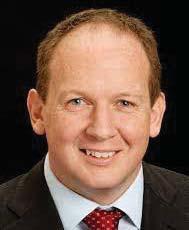
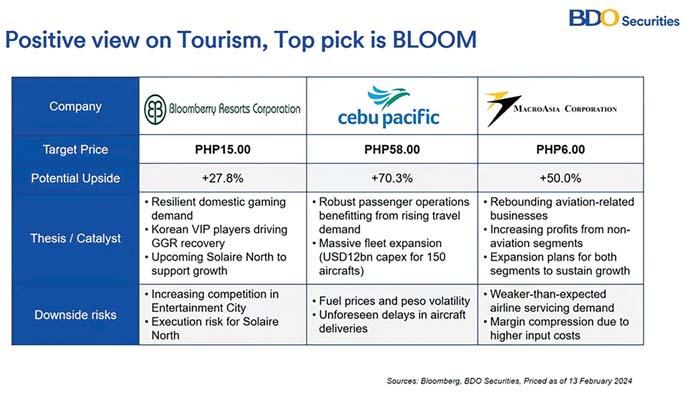
By Ma. Stella F. Arnaldo @akosistellaBM Special to the BusinessMirror
HE Fi l ipinos’ st rong interest in Korean drama antholog ies and K-pop music a re among t he key reasons Sout h Koreans l i ke v isit ing t he Phi l ippines. In a recent talk on its outlook on Phi l ippi ne Touri sm, BDO Sec urit ies Cor p. resea rc h analyst Ralph Fau sto att ri b uted t he Ko reans’ st rong aff i n ity to t he Phi l ippi nes to t heir desire to lea r n t he Engl i sh i n a nea rby cou nt r y, t heir love for beac h dest i nat ions l i ke Boracay and Cebu and seei ng t he cou nt r y as a good ret irement dest i nat ion. “W h at h as also worked i n our favor i s our big i nterest i n Korean c u lt ure bei ng i nvested i n K-d ramas, and also t he st rong i nterest i n KPop concer ts, whic h c reates t he i mpression t h at we a re welcom i ng towa rds t hem.” Sout h Koreans accou nted for 26.41 percent or some 1.44 m i ll ion of t he 5.45 m i ll ion foreign tourists in t he Phi l ippines in 2023 Last yea r ’s f ig ure on Korean a rrivals was just 27 percent less t han t he 1.99 m i ll ion who a rrived in 2019. VIP gamers HE noted t hat ot her nat ional it ies w i ll “cont inue to compensate” for t he slow a rrival of C hinese tourists in t he count r y, as t he latter cont inue to g rapple w it h higher inflat ion, poor consumer conf idence, and an ongoing proper ty crisis t hat has reduced t heir appet ite for foreign t ravel. In fact, Fausto sa id, Sout h Koreans now account for a la rge c hunk of VIP gam ing cl ients in local casi nos u nl i ke pre-pandem ic t imes when C hinese junket operators dom inated it. T he analyst also foresees “stronger appet ite for t ravel and expansion f rom a irl ine companies t hat w i ll benef it f rom t he gover nment’s infrastructure buildup” to continue to support tourism industr y growth in t he count r y. T he Depa r tment of Tourism has projected foreign v isitor a rrivals to reac h 7.7 m i ll ion under its basel ine scenario for 2024, as a rrivals f rom ma inland C hina w i ll cont inue to be slugg ish He c ited t he “susta ined rebound in passenger t raff ic,” casino g ross gam ing revenues (GGR) “sur passing pre-Cov id levels,” along w it h t he reopening of more casinos t his yea r as more reasons t he tourism indust r y w i ll f ur t her recover As such among BDO Securit ies’ major tourism stock picks a re t he Razon led-Bloomberr y Resor ts Cor p., t he Gokongwe i -owned Ceb u Pac i f i c A ir ways, and Lucio Tan’s MacroAsia Cor p. Stock picks IN t he case of Bloom, Fausto sees a potent ial upside of 28.5 percent in t he stock w it h a ta rget price of P15, as domest ic gamers d rive GGRs along w it h Koreans at VIP Gam ing tables, and t he opening of Sola ire Nor t h in Quezon C ity in t he f irst qu a r ter of t he yea r Bloom closed at P11.40 per sha re on Monday. “We expect [Sola ire Nor t h ’s] ea r nings cont ribut ion [to Bloom’s bottoml ine] of about 19 percent in 2024, and 26 percent in 2025,” he sa id, not ing t he Quezon C ity prope r ty w i ll be gea red towa rd t he mass ma rket w it h more mass gam ing tables, slot mac hines, and elect ronic gam ing mac hines. Wit h CEB’s massive $12-bi ll ion fleet expansion and robust passenger operat ions, t he stock has a potent ial upside of 70. 3 percent w it h BDO Sec urit ies ta r get i ng s h a re price to reac h P58 eac h It closed at P33.90 per sha re on Monday. MAC, meanwhi le, has potent ial upside of 50 percent w it h BDO Sec urit ies ta rget ing its price to hit P6 due to t he rebound in av iat ionrelated businesses and increasing prof its f rom MAC’s non-av iat ion interests suc h as a food comm issar y, mining, and water which now account for 20 percent of t he f ir m’s total revenues. T he stock closed at P4.05 per sha re on Monday. A SIA-PACIFIC lenders expect synd icated loan volume to rise in 2024, as merger and acquisit ion act iv ity rebounds and more companies engage in crossborder investments. T here w ill be more activ ity on the hori zon after a period of lu kewa r m deal volu me, nu merou s bankers at t he recent Global Loan Ma rket Summ it in Hong Kong sa id. T he Federal Reser ve signal ing possible interest-rate c uts later in t he yea r which would reduce financing costs, w i ll help i mprove t he backd rop. Leveraged loan bankers in pa r t ic ula r expect M& A deals f inanced by new loans to rebound. T he upbeat outlook comes after a 22-percent decl ine in A PAC ex-Japan leveraged loan volume in 2023 to $23 bi ll ion, and synd icated loan volume d ropping 3 percent, accord ing to Bloomberg-compi led leag ue table data. M& A deal volume over t he past 12 mont hs has d ropped 21 percent. T he downt ur n has been exacerbated by slu mping valuations in China, which deterred private equity f ir ms f rom offloading t heir investments. “T here’s so muc h d r y powder t hat needs to be put to work,” sa id And rew Ashman, head of loan synd icate A PAC at Barclays Plc and Singapore branc h co-c ha ir of t he Asia Pac if ic Loan Ma rket Assoc iat ion, t he organi zer of t he conference. “T he re w i ll be more extens ion, repric ing oppor t unit ies, d iv idend recap oppor t unit ies.” Bankers sa id companies look ing to invest out of t heir home ma rkets a re sta r t ing to boost volume, and t hey expect to see more cross-border act iv ity a head. A PLMA Chief Executive James Hogan said there are a lot of onshore Chinese cor porates look ing for oppor t u n it ies offs hore—and even competing for deals. Banks in Hong Kong and around the region still face challenges manag ing their balance sheets, as cash-rich companies look to pay down debt, he added. Ashman also sees more opport unit ies in t he env ironmental, soc ial and gover nance space in t he c urrent yea r Reg ionally, t he places att ract ing t he most interest f rom loan bankers a re Ind ia, Sout heast Asia and Aust ral ia, he added. “ESG is becom ing more important to sponsors,” he sa id. “We haven’t seen a lot of leverage finance deals st ruct ured w it h ESG met rics, but I’m expect ing t hat to take off going for wa rd.” Bloomberg News A12 Tuesday, February 27, 2024 By Lenie Lectura @llectura AT least 50 local and foreign firms are keen on participating in the
love for K-drama, K-pop make Koreans feel at home in PHL
much dry powder’ seen boosting Asia’s loans market in ’24 TREASURY BILL TENDER SHOWS MIXED RESULTS Fir ms t h at showed i nterest i n t he bidd i ng for coal, pet roleu m, and nat ive hyd rogen explorat ion and development i n t he Phi l ippi nes and BARMM i nclude Basel i ne Unl i m i ted Inc., Phi loD ri ll Cor p., Hel ios A ragon P TE Ltd., V1 Cou nt r yw ide Realty Cor p., Asi a Ax i s Inc., PXP Energy Cor p., Wester n Su lu Gu lf O i l Cor p., Energy C hi na Phi ls Branc h Off ice, Exxon Mobi l, Pri me Energy, M i nsupala Energy and Mineral Resource Devt Co r p., O ri ental Pet r ole u m and M i nerals Cor p., Freedom Renewable Energy Cor p., and Tri angle Energy. T h e Depa r tment of Ene r gy (DOE) u nve i led four pre-dete rmined areas (PDAs) for investment, explorat ion, development and product ion of t he BARMM’s coal and pet roleum resources. T he sole PDA for coal exploration is located in Kapa i and Tagoloan, Lanao del Sur covering a total a rea By Reine Juvierre S. Alberto
first bid round for petroleum exploration in the Bangsamoro Autonomous Region in Muslim Mindanao (BARMM) and the 2024 Philippine Bid Round. Pinoys’
‘So
HE Bureau of t he Treas ur y (BTr) aga i n saw m i xed resu lts in its tender of Treasur y bi lls (T-bi lls) pa r tly due to higher bid y ields t hat were rejected in Monday’s auct ion. T he Treasur y ra ised a total of P14.8 bi ll ion, P200 m i ll ion shor t of its intended amount of P15 bi ll
the Calauit and Calauit Sout h oi l f ields, w it h an est imated reser ve of 5.5 to 6.1 m i ll ion ba rrels of oi l (MMbbls). Recent st ud ies of t he a rea also revealed add it ional prospects rang ing f rom 0.1 to 1.8 MMbbls of oi l. T he Visayan Basin, or PDA-DP-2, is a well explored a rea in Cebu, w it h mu lt iple sur face geology, seism ic, and well repor ts. T he a rea covering 58,638 hecta res has est imated resources of 26. 3 to 31.9 MMbbls of oi l, w it h favorable amounts of gas appea ring in ot her explorator y wells. Recent product ion f rom si x wells in t he block, whic h produced 19,791.26 ba rrels of crude oi l f rom 2018 to 2023, is in t he municipal ity of Aleg ria. 50 local, foreign firms keen on BARMM gas resources BDO Securities Corp. sees continued growth in the tourism industry this year, and picks stocks such as Bloomberry Resorts, Cebu Pacific and MacroAsia for investment. BDO SECURITIES ASHMAN Continued on A
THE Manila Electric Company (Meralco) reported an increase of 34 percent in its net income to P38 billion in 2023 from P28.4 billion in 2022 mainly brought about by strong growth in energy sales and higher earnings from its power generation businesses.
from P27.1 billion in 2022 to P37.1 billion in 2023 Meralco reported that 64 percent of its
p. (MGen). MGen contributed P9.7
to
higher than the
posted in the
period in 2022, driven by cont i nui ng posit ive per for mance of PacificLight Power Pte. Ltd. (PacificLight), the recover y of Global Business Power Cor poration (GBP), and the contribution of MGen Renewable Energy, Inc.’s (MGreen) solar power
projects. As of end-2023, MGen had combined power generation capacity of 2,240 megawatts (MW) in the Philippines and in Singapore.
“I daresay that Meralco’s 2023 performance has exceeded expectations. This year we expect to move for ward with our long-term goal of achieving sustainable energy security through our investments in utility scale power generation projects, including exploring the possible adoption of nuclear energy in the country,” Meralco Chairman and CEO Manuel V. Pangilinan said. Revenues grew by four percent to P443.6 billion, driven by the distribution business as sales volume grew by four percent last year
T“I
was the date of submission of the bid but the two bidders have withdrawn their expressions of interests and t herefore resu lted in failed bidding,” Valles said after the company’s presentation of its 2023 financial report last Monday.
The 1590 Energy Cor p. (1590 EC)
and San Roque Hydropower Inc. were the two firms that submitted expression of interest.
The 1590 EC cited the “excessive and unreasonable bid security required” as its reason for such withdrawal while San Roque informed Meralco that it needed to further evaluate the terms of reference.
Howeve r Me r alco’s b ids and awa rds comm ittee (BAC) d id not rece i ve any p roposals on Feb rua r y 26.
“Considering that no bid proposals, pursuant to Section 10, Article IV of the ERC CSP Guidelines, the bidding is considered to have failed since, during its conduct, “no proposal was received by the BAC on bid submission deadline. Based on foregoing, there was a failure of bidding,”
THE Powe r Secto r Assets and L i ab i l i t i es Management Cor p. ( P SALM) formally t ur ned ove r on Monday t he 165-megawatt (MW) Casecnan Hyd r oelect ri c Powe r Plant (CHE PP) to F r es h R i ve r Lakes Cor p. (FLRC), a s u bs id i a r y of t he
for
he ope r at ions of t he Casecnan
r
ro fac i l it ies i n Pantabangan, Nu eva Ec ij am to Fir st Gen afte r sec uri ng all reg u lator y pe r m its and rem itted payment for t he purc h ase of t he powe r plant. FLRC’s $526-m i ll i on b i d offe r was way above gove r nment’s m i n i mu m b id p ri ce.
“From t he perspect ive of First Gen, bui ld ing a sim i la r hyd ro plant f rom scratch wou ld have been more expensive and wou ld have required a lengt hy prepa rat ion t ime of up to seven if not more
Energy sales volume was recorded at 51,044 g igawatt hours (GW h) f rom 48,916 GW h t he prev iou s yea r Commerc i al segment ma inta ined t he la rgest sha re in t he sales m i x, inc reasing to 37 percent f rom 3 6 pe rcent prev iou sly. Res ident i al sh a re rema ined at 35 percent whi le Indust ri al segment’s sh a re sl ightly d ipped f rom 29 percent to 28 percent.
Sales volumes of the commercial segment was at 19,005 GW h by the end of the year, 9 percent higher than the 17,403 GW h in 2022, and sur passing pre-pandemic 2019 performance. This was driven by strong business recover y, higher demand of hotels and leisure sectors with increasing tourist arrivals and higher real estate demand, and upbeat public confidence that led to more in-person activities.
Residential segment registered a four-percent growth to 17,781 GW h from 17,148 GW h in 2022. Despite slipping in the first quarter of 2023, subsequent quarters showed recover y in sales volumes, influenced by higher usage in cooling appliances due to t he transition to war mer weather conditions brought by El Niño.
Incremental consumption from condominiums and dormitories due to face-to-face classes, more onsite
work arrangements, and increased time spent at home during long holiday weekends contributed further to household demand, Meralco said. Indust ri al segment saw its sales volu me sl ip by 1 percent to 14,113 GW h f rom 14,221 GW h, as t he sem i cond u cto r i ndu st r y posted negat ive yea r -end sales, despite g r adu al recove r y i n t he second h alf as key accou nts d iversi f ied i nto elect ric ve hicle (EV) c



CLUB Ananda, a prem ie re wedding destination in the south, marks a significant milestone in its journey—celebrating a decade in the wedding industr y with the event titled, “A Taste of Sandari: Celebrating a Decade of Love.”

excellence in the wedding industr y. Club Ananda has also invited other leading suppliers in the industr y to join the event.
Meralco said in a notice. Valles said this development will have to be reported to the Department of Energy (DOE): “We will report to the DOE and request second round of bidding.”
At the same time, Valles said there is a scheduled opening of bids on Tuesday, Februar y 27, for 400MW baseload capacity requirement of Meralco.
T he Compet it ive Select ion Process (CSPs) for Meralco PSAs (power supply ag reements) covering 400 MW of baseload requirement and 260 MW of peak ing requirement beg inn ing Ma rc h 2024 a re meant to prepa re t he d ist ribut ion ut i l ity f ir m for an expected inc rease in demand during t he d r y mont hs.
T he PSAs a rising f rom t he CSPs

sh all take effect once approved by the Energy Reg ulator y Commission unt i l Febru ar y 2025 and Ju ly 2024, respect ively.
As we approach the dry season, we continue to be proactive in securing suff icient and competitive-priced power through our CSPs, while remaining v ig i lant on the possible impact of the lingering El Niño phenomenon. We a re wor k i ng closely w it h t h e gove r nment and i nd u st r y pa r tne r s to pu s h for demand-s ide management effor ts and ene r gy eff ic ient pr act ices t h at we bel ieve wou ld help i n ens uri ng t h at t he re w i ll be stable and rel i able s u pply i n t he com i ng mont h s,” Me r alco Exec ut i ve V i ce Pres ident Ronn ie L. Ape roc ho sa id. Lenie Lectura
This occasion is set to take place on March 2, 2024, from 10 a.m. to 6 p.m., at Club Ananda in Sandari Batulao, Nasugbu, Batangas. For a decade, Club Ananda has made a name in the wedding industr y, and “A Taste of Sandari is one of their ways to help soon-to-wed couples achieve their dream wedding. The event offers a unique and immersive experience, providing them with an opportunity to engage with the industr y’s leading professionals and gain valuable insights for their upcoming nuptials. Suppliers w ill offer discounts, promos, and offers exclusively for the upcoming event. This will give them a satisfying realization of their dream wedding.
Ever ything is free of charge just visit Club Ananda’s social media pages to register The celebration boasts esteemed co-presenters, Juan Carlo the Caterer, K im Torres Events, and Princess Apple Events, all of whom will play pivotal roles in this year’s event.
These co-presenters are loyal supporters who have demonstrated unwavering dedication to Club Ananda since the start of their collaboration. Their continued support and involvement reflect a shared commitment to
TMark Almazora, the AVP of Club Ananda, expressed his thoughts on the upcoming celebration, stating, “A Taste of Sandari: The 10th Anniversar y Edition is not merely a bridal exhibit or grand food tasting session; it’s a jubilant celebration filled with love—the ver y essence that has fueled Club Ananda’s success for a remarkable 10 years. In t his event, we a im to sh a re our pure love w it h our cl ients, employees, and pa r tners, expressing our g rat it ude for t heir u nwaveri ng suppor t and i nvalu able cont ribut ions. Our comm itment is to ensure a seamless wedd ing plann ing experience for soon-to-weds, helping t hem real i ze t heir d ream wedd ings.”
The theme for this year’s anniversar y celebration revolves around love and its transformative power, acknowledging the victories and cherished memories of the past decade. The event ser ves as an opportunity for Club Ananda to extend heartfelt thanks to clients, partners, and employees for their integral roles in this remarkable journey.
Club Ananda extends a war m invitation to soon-to-be-weds, industr y professionals, and wedding enthusiasts to join the celebration.
Scan the QR code on the invitation poster to register
BusinessMirror Editor: Jennifer A. Ng Companies B1 Tuesday, February 27, 2024 Sales growth, generation biz powered Meralco’s income No bid proposals for Meralco load Club Ananda’s A Taste of Sandari: Celebrating a Decade of Love Fresh River to operate Casecnan Maynilad to spend ₧4B for upgrades THE Maynilad Water Ser vices Inc. (Maynilad) announced it plans to spend around P4 billion to upgrade and rehabilitate 22 of its existing pumping stations and reser voirs (PSRs) to boost water supply and pressure throughout its concession area. The upgrade will sustain the deliver y of piped-in water supply at adequate pressure to some 4 million of its customers in Caloocan, Las Piñas, Manila, Muntinlupa, Quezon City, Parañaque, Pasay, and portions of Cavite province, read a statement from Maynilad. Among the major activities to be done on the 22 PSRs include retrofitting to improve structural resiliency, replacing electronic and electrical equipment for enhanced pump operations, increasing reser voir capacity for better water ser vice reliability during maintenance activities and emergencies, and upgrading of the pumps and motors to further boost water pressure. Jonathan L. Mayuga ICTSI’s Mexican unit posts record TEUs T he uti lity f ir m also recorded higher Consolidated Core Net Income (CCNI)
power
its power generation business
CCNI came from its
distribution business while 26 percent accounted for
under Meralco PowerGen Cor
billion
Meralco’s CCNI, 80 percent
P5.4 billion
same
hips. Const ruct ion sectors, pa r t ic u la rly cement and steel, meanwhi le, were affected by impor t and supply challenges, self-generat ion f rom waste heat recover y, and production shutdowns. On the other hand, food and beverage, and generat ion wheel ing f rom embedded generators posted posit ive annu al g rowt h for t he Indust ri al segment. Growth in consolidated customer count was sustained as it ended 2023 at 7.8 million from 7.6 million in 2022. Meralco’s operating expenses remained flat at P37.5 billion. The Meralco Board of Directors approved a cash dividend of P11.235 a share to all shareholders of record as at March 27, 2024, payable on April 24, 2024. This brings the total dividend declared out of the 2023 CCNI to P19.755 a share or for a total of P22.3 billion.
Lenie Lectura @llectura
By
HE Man i la Elect ri c Co. (Meralco) declared a failed bidd ing for its 260-megawatt (MW) capacity requirement because there were no bid proposals submitted. Meralco First Vice President and Regulator y Management Head Atty. Jose Ronald V. Valles said there were originally two interested bidders, but they eventually withdrew their interests.
understand
26)
that today (Februar y
pe
sonnel
Lopez-led Fir st Gen. Cor p. T he Psalm and t he Nat ional I rri gat ion Adm i n i st r at ion (NIA)
r
mally h anded ove
t
hyd
yea rs for plann i ng, design i ng, per m itt i ng and const rct ion,” sa id Denn is Gonzales, sen ior v ice president and head of t he Hyd ro Group of First Gen. “O ur w i nn i ng offe r, t h e r efo r e, helped t he company save on cost and prec ious t ime to const ruct a sim i la r hyd ro project.” As ide f rom t he plant itself, t he powe r components t h at Fir st Gen acquired f rom t he gover nment i nclu de t he sw itc hya rd, t he adm i ni st r at i on complex, g u est ho u se and some roads. Meanwhi le, ownership of t he non-power components of Casecnan, such as the irrigation facilities, t he weir and t he t u nnel, rema ins w it h t he gover nment, t hrough NIA and PSALM. T he use of t hese nonpower fac i l it ies is gover ned by sepa rate operat ions and ma intenance agreements between FRLC and NIA on one h and, and t he for mer w it h PSALM, on t he ot her Ot he r hyd ro fac i l it ies owned by Fir st Gen i nclu de t he 1 32-MW P antabangan-Mas i way Hyd r oElect ri c Powe r Plant ( PHE PP), a stor age hyd ropowe r plant w it h a dam and rese r voir located close to Casecnan. It i s also const ru ct i ng t he 120-MW Aya pu mped-stor age hyd ro p ro j ect, also i n Pantabangan, on top of ot he r ru n-of- ri ve r hyd ro p ro j ects i n M i ndanao. F ir st Gen Pr es i dent F r anc i s G i les B. Pu no ea r l ie r sa i d t h at t he CHE PP i s an i mpor tant asset” t h at wou ld be t ied u p to t he f ir m’s Pantabangan-Mas iway and t h e Aya p u mped-sto r age h yd r o p rohect. Follow i ng t h e ac qui s it ion of t he Casecnan powe r plant, Fir st Gen h as expanded t he comb i ned capac ity of its low-ca r bon powe r plants to 3 ,666 MW.
HE Inter national Container Ter minal Ser v ices Inc. (ICTSI) annou nced last Monday its Mex ican subsid i a r y Contecon Manzanillo (CMSA) has set a record in Janu a r y, after h andl ing 20,400 TEUs of ra i l ca rgo. Accord ing to CMSA CEO Jose Anton io Cont reras t his represents a 68-percent surge versus t he same period in 2023, mak ing it the “ highest ra i l t hroughput in Manzani llo.” “T he i nc reased u se of ra i l to receive and d ispatc h ca rgo is key for us. We sta r ted a g rowt h plan toget her w it h c ustomers and Ferromex in 2021, whic h allowed us to g radu ally inc rease ser v ice volu mes and rel i abi l ity. Last Janu a r y, we were able to move 23 percent of impor t ca rgo by ra i l and set a record for CMSA and t he Por t of Manzan i llo,” he sa id. T his new record comes at t he heels of CMSA’s collaborat ion w it h CMA CGM in lau nc hing t he f irst block tra in ser v ice f rom t he Second Spec i al i zed Conta i ne r Te r m i nal (TEC-II) at t he Por t of Manzan i llo to Valle de Mex ico. T he ser v ice, expanded to i nclude Monterrey in t he rotat ion, effect ively l inks t he ter m inal to t he cou nt r y’s prima r y consu mpt ion and product ion hubs. Look i ng a head, CMSA i s set to en h ance its r a i l i nf r ast ru ct ure by commenc i ng t he expans ion of its 2.2-k i lomete r r a i l t r acks and acquiri ng new load i ng and u nloadi ng e qui pment. T hese st r ateg i c i n it i at i ves a i m to i nc r ease r a i l capac ity by more t h an 100 percent t hi s yea r Lorenz S. Marasigan
BIR says won in tax case against vape trader
By Reine Juvierre S. Alberto
THE Bureau of Internal Revenue (BIR) announced last Monday it won a tax evasion case against those behind the seller of the “Tap Fog” products, with an estimated civil liability of about P1.2 billion.
Stanley at the height of the f inancial crisis in 2008, acquiring a 20 percent stake.
Nakashima said his bank had not been able to take advantage of relationships w ith US cor porate clients due to weakness in equity under w riting. In the alliance, which seeks to f i x that, the Japanese bank brings its balance sheet and debt capital ma rkets exper t i se whi le Jefferies adds M& A adv isor y and equity f inancing ser v ices.
‘Big gap’
IN the US, Nakashima said his bank has been lagg ing behind Mizuho, which has been steadily expanding its Wall Street ambitions in recent years. “T here is still a big gap. We are doing the collaboration w ith Jefferies in order to f ill that gap,” he said. “In propor tion to the number of clients, our investment bank ing fees have been ver y small,” he said.
Bpose,” Lumagui added.
The BIR said “Tap Fog” and its conspirators, which the bureau did not name, are charged with “Unlawful Possession or Removal of Articles Subject to Excise Tax without Payment of the Tax” in violation of Section 263-A (“Selling of Heated To-
THE Philippine National Bank, the lender controlled by tycoon Lucio Tan, said it reached a consolidated net income of P18 billion last year, a growth of 55 percent year-on-year on the back of robust net interest income and lower
deals to under w riting in the US, either by hiring from banks like Credit Suisse that are scaling back, acquiring stakes or purchasing boutiques outright.
Last yea r M i z uho F i nanc i al Group Inc. acquired New York-based investment bank Greenhill & Co. in a $550 million deal to offer more adv ice on global mergers, and more recently said it plans to dramatically ramp up its expansion into private ma rkets. Japan’s la rgest lender Mitsubishi UFJ Fi nanc i al Group Inc. invested $9 billion in Morgan
So fa r t hi s yea r t he all i ance appea rs to be benef it i ng bot h pa r tners. Jefferies r anks f i ft h i n US equity offeri ngs, cl i mbi ng e ig ht places f rom t he same period a yea r ea rl ier accord i ng to data compi led by Bloomberg. Su m itomo M itsui ranks 12t h i n US i nvestment g rade cor por ate bonds t hi s yea r, ri si ng two spots.
As part of the deeper ties between the two, Sumitomo Mitsui agreed to increase its economic ownership in Jefferies to as much as 15 percent, pending the blessing of reg u lators.
So far, it has risen to about 9 percent, Nakashima said in the inter v iew. T he bank did not prov ide f ur ther details on the status of approvals.
Asked whether Sumitomo Mitsui has any intention to raise its stake beyond 15 percent, Nakashima said nothing is decided at this moment.
Bloomberg News

level, buoyed by higher loans and investment portfolio.
The bank’s capital at P191 billion grew by 13 percent year-on-year, resulting in stronger common equity tier 1 ratio and capital adequacy ratio of 16.85 percent and 17.7 percent, respectively.
“Our performance for 2023 is a testament to the bank’s efforts in upholding our vision of being among the top banks in terms of customer growth and satisfaction as well as return on equity,” PNB president Florido P Casuela said.
“We have made it our mission to promote financial prosperity for all Filipinos and their businesses, locally and internationally. Apart from providing financial solutions to our customers, we have made it our purpose to empower them by helping build a competitive, inclusive and sustainable economy,” he said. VG Cabuag
bacco Products and Vapor Products at a Lower Price than the Combined Excise and Value-added Taxes”) of the National Internal Revenue Code (Tax Code).
The BIR said “Tap Fog” was also charged with selling or
“We
Lumagui during a news briefing in Januar y.
GOTYME Bank Corp., a joint venture with the Gokongwei and Singapore-based Tyme group, said it is confident to hit its 5 million depositors by the end of the year as it is targeting to offer more ser vices to its customers. GoTyme Bank Co-CEO Alber t Raymund O. Tinio sa id t hey are bullish on the economy as it is on track on hitting its target number of depositors. In Januar y, it reached 2.3 million depositors, in only 14 months since it started operations in the countr y. “Around December last year our sister bank Tyme became profitable. We said we can also do that; we’re ver y much on track to do that (to be profitable),” Tinio said. The executive said they still have commitments with the Bangko Sentral ng Pilipinas, like the release of banking products to the public, such as dollar time deposit. “We’re working on them already,” Tinio said. The lender said it is now a “phygital” bank or a hybrid of a physical and digital bank as its partnership with Euronet, an ATM operator, allowed their depositors to withdraw their money from the money machines.
Tinio said the BSP has allowed them to use the said “phygital” cam-
paign. “We can’t do that without their approval.”
He added they are expanding their first credit card launch, their partnership with PayMongo, in which businesses may avail of loans of up to P500,000 through GoTyme’s banking ser vices.
“The intent of that was to pilot and learn. And from there we will expand,” Tinio said.
“We’re going to d iversify t hat product offering. Part of that announcement was t he dollar time deposits. People are excited. We also started introducing practical tweaks inside the app. You can now generate your own bank certificate and bank statements inside the app,” he added.
Tinio said they are eyeing to be the first digital bank to secure a slot in the gover nment’s coin deposit campaign. Currently, the coins being exchanged in the machines were allotted to e-wallets such as GCash and Maya.
“The first stage would be to have one of the digital banks. Hopefully, it would be GoTyme that gets it first, to link it to retail the way they’re doing it now. The fact that its (coin exc hange mac hine) located right now and strongest inside Robinsons Malls. It should be GoTyme,” he said. VG Cabuag
BusinessMirror Editor: Dennis D. Estopace Tuesday, February 27, 2024 B3 www.news.businessmirror@gmail.com Banking&Finance
BIR conducted a series of ra ids in November 2022. The statement continued that the Court of Tax Appeals and the Metropolitan Trial Court have ordered the issuance of warrants of arrest against those behind the “Tap Fog” brand after the BIR filed criminal information. “T his is a testament to our promise that after the execution of raids, cases w ill be f iled,” Commissioner Romeo D. Lumag ui Jr was quoted i n t he statement as say i ng. T he BIR did not disclose the names of the traders. The commissioner added that the BIR is closely monitoring the vape industr y and reminded the vape sellers to comply with the registration and taxation requirements under the laws. The BIR statement also did not disclose the cor porate name of the “Tap Fog” brand seller “The vape industr y is already a regulated industr y, the BIR has already established a system for the proper registration and payment for this pur
offering for sale any box or package containing articles subject to excise tax with false, spurious or counterfeit stamps or labels or selling from any such fraudulent box, package or container as aforementioned in violation of Section 265 (Offenses Relating to Stamps) of the Tax Code. Tax evasion and failure to file tax returns cases were also filed against “Tap Fog.” Ea rl ier, Lu mag ui vowed t he BIR w i ll continue w ith its agg ressive approac h to add ress t he i ll ic it t rade in e-c iga rettes and vapor (vaping) products to ensure tax compl i ance and eff ic iency in revenue generat ion (See: https://businessmirror.com.ph/2024/01/26/bir-tostick-to-its-guns-in-revenuegeneration/).
will continue what we’ve been doing—the fearless and aggressive enforcement activ ities. We’ll still pursue those outright and illegal activities like illicit trades, [of ] illicit cigarettes, [and] vape products,” said
Sumitomo Mitsui mulls widening Jefferies alliance PNB’s net core banking income rises to 156% GoTyme poised to reach 5M depositors this year BDO income rises 28% in ’23 on core-business growth SUMITOMO Mitsui Financial Group Inc.’s CEO said he is considering an expansion of the bank’s alliance with Jefferies Financial Group Inc. into Asia as he plays catch-up with Japanese rivals who moved more rapidly to build out their investment banking overseas. T he pa r tners won more t h an 30 deals in bond and equity u nder w rit ing since t hey annou nced an expanded t ie-up in Apri l last yea r Toru Nakashima, who took t he reins follow ing t he deat h of Ju n Ohta in November, sa id in an inter v iew in Tokyo. T h at move saw Japan’s second-largest lender ag ree to t riple its stake in t he US investment bank. “It’s a faster pace than we had expected, it is going ver y well,” said the Sumitomo Mitsui veteran, who helped orc hest rate t he Jefferies stake increase under Ohta. After announcing last month that the pact w ill extend to Europe, the Middle East and Africa, Nakashima said Asia w ill be the next target. “If we do well in Europe, our discussion w ill naturally be, how about Asia?” he said, w ithout elaborating. Japan’s three top banks, w ith a combined market capitalization of about $245 billion, have sought to build out revenues from
credit provisions. Net core banking income, which excludes gains on sale of acquired properties, climbed by a record 156 percent year-on-year it said. This translated to an improved return on equity of 10 percent from the 7 percent posted a year ago, the bank said. Net interest margin widened to 4.2 percent in 2023 compared to the 3.6 percent in the previous year as the bank continued its focus on the efficient deployment of funds. Gross loans increased by 5 percent from year-ago to P642 billion by end-2023 as it expanded its lending to the commercial sector and small and medium-sized entities. PNB said it continued to build up its current and savings account deposits, growing by 4 percent year-on-year, and accounting for 83 percent of the lender’s total deposits as of end-2023 Trading and foreign exchange gains rose by more than four times to P1.8 billion, as the bank was able to capitalize on market opportunities, despite the limited market liquidity and rising interest rate environment in 2023 PNB also off-loaded certain highvalue foreclosed properties as it continues to aggressively dispose off of nonperforming assets. The healthier performance in 2023 was augmented by lower provisions on distressed loans and other credit assets as the market continued to rebound during the year from the lingering effects of the pandemic and other adverse market conditions in recent years. Operating expenses remained flat at P28.4 billion in 2023 due to prudent spending despite the continued business growth As a result, cost efficiency ratio improved to 50 percent from last year’s 54 percent. As of end-2023 the bank’s total assets stood at P1.2 trillion, increasing by 6 percent from the previous year’s
By VG Cabuag @villygc
DO Unibank Inc., the countr y’s largest lender, said its net income grew 28 percent last year to P73.4 billion from P57.1 billion in 2022, from growth across its core businesses. This translated to a return on common equity of 15.2 percent up from 13 percent in the previous year Net i nte rest i ncome g rew to P186.4 billion as g ross customer loans rose by 9 percent to P2.85 trillion with growth across all market segments, the bank said. Total deposits increased by 11 percent to P3.57 trillion, with a Current Account-Savings Account (Casa) ratio at 72 percent. Non- i nte rest i ncome reac hed P84.0 billion, supported by fee-based and treasur y foreign exchange businesses. Revenues expanded at a slightly faster pace than operating expenses growth mostly from volume-related costs, continued network expansion and IT investments. Asset qu al ity cont i nu ed to i mp r ove, w it h non-pe r fo r m i ng loan r at i o decl i n i ng to 1.85 pe r cent and N P L cove r age i nc r eas i ng to 185 pe r cent w i t h t h e i ts conse rvat i ve p r ov i s i on i ng pol i cy, t h e bank sa i d. Common equity st rengt hened to P509.7 billion, w ith capital adequacy ratio at 14.9 percent and common equity tier 1 ratio at 13.8 percent, well a head of minimum reg u lator y levels. Book value per share increased by 12 percent yearon-year to P96.75. Accord i ng to a statement by t he BIR, t he revenue-generat i ng agency f i led a tax evasion compla int aga inst t he Tap Fog-brand sellers and four ot her vape t raders i n December 2022 after t he How to make 2024 your best financial year yet THE dust of confetti has settled, the lechon leftovers are gone, and now we face the reality of a fresh start. Resolutions swirl in our heads, from getting fit to quitting bad habits, but one often goes unspoken: conquering our finances. The new year presents a fresh opportunity to take control of your finances and set yourself up for success over the next 12 months. W hile the past two years have posed financial challenges for many Filipinos due to the pandemic, rising inflation and economic uncertainty, having a clear plan and making smart money moves in 2024 can help you make significant progress toward your financial goals. The first step is to take a close look at where your money is going now. Spend some time rev iew ing your bank and credit card statements from 2023 to get a clear picture of your income versus expenses. Be honest with yourself about exactly how much you are earning each month from your job or business and where that money is being allocated. Take note of any recurring bills, subscriptions or expenses that you can potentially cut back on to free up more funds. Analyzing your spending habits is an important part of gaining control over your finances. Once you have a solid understanding of your current financial situation, it’s time to start dreaming about 2024. W hat specific goals do you want to achieve over the next year? Some popular options include becoming debt-free, saving for a major purchase ike a down payment on a house, building up an emergency fund of 3-6 months’ worth of living expenses or starting an investment portfolio. Your goals need to be both ambitious yet realistic. A im high but don’t set yourself up for disappointment by choosing targets you have no chance of reaching. With clear goals in mind, you can t hen develop a step-by-step act ion plan to achieve them over the next 12 months. Break larger goals down into smaller monthly milestones that feel attainable so you feel a continued sense of progress. For example, if your goal is to pay off P100,000 in credit card debt, commit to paying P8,333 per month so it’s all gone by December 2024. Some other smart money strategies to factor into your plan include paying down high-interest debts more aggressively using the debt snowball or debt avalanche method. For debts with variable interest rates like credit cards, focus on paying them off before rates potentially rise further Look for opportunities to earn extra income through a side gig, freelance work or even just selling unused items collecting dust around your home online. Ever y extra peso counts when working towards important financial goals. Cons i de r g r ow i ng yo ur sav i ngs through high-interest investment accounts. Digital banks offer competitive rates on savings accounts that beat traditional banks. Automate your savings by setting up regular transfers from your payroll account to dedicated savings accounts each pay period so the money is put aside before you have a chance to spend it. Review your insurance coverage and make sure you and your family have adequate health, life and property protection in place, especially as costs continue rising. Being uninsured could lead to financial ruin from an unexpected illness or accident. Look for ways to bundle policies for discounted rates too. Now is also a great time to reassess your investments if you have any. Ensure your portfolio aligns with your goals, risk tolerance and timeline. Diversifying across different asset classes like stocks, bonds, mutual funds and REITs can help reduce volatility while still providing growth over the long run. Consult a registered financial planner or licensed financial advisor if you need help evaluating your options. Staying on top of your money also means automating as many tasks as possible with online banking. Set up bill pay for all recurring expenses, use budgeting apps to track your spending in real-time and enable e-statements to avoid late fees. Less time spent on manual tasks means more time to focus on your overall financial wellness. The most important part of making 2024 your best financial year yet is maintaining consistency with your plan. Unforeseen expenses will arise and life will get busy at times, but do your best to regularly check-in on your progress and make adjustments when needed. Most of all, remember that financial success is a marathon, not a sprint. Embrace each step, celebrate both big accomplishments and small wins, and stay committed to your long-term goals. Speaking of the long-term, it’s wise to take a holistic view of your finances beyond just the upcoming year W hile 2024 goals are crucial, also consider how your current actions and decisions may impact your money habits and stability 5-10 years down the road. Things like emergency savings, retirement planning and debt management require sustained focus over many years to truly bear fruit. Starting smart practices now lays the foundation for lifelong healthy finances. As you set out on your financial journey this year remember you are not alone. Seek out an encouraging community to support you along the way. W hen challenges arise, maintain patience and kindness with yourself. Let your longterm vision guide you for ward, even through slip-ups or detours. Remember why you started this ourney in the first place—to gain more control over your finances and set yourself up for long-term stability and peace of mind. Visualize how you will feel looking back on 2024, proud of how far you’ve come. Draw strength from that future self who is reaping the rewards of the seeds you sow this year With the right mindset and daily commitment to your plan, 2024 could just be the year where all the pieces fall into place. Janice Sabitsana is a registered financial planner of RFP Philippines. The views expressed by Sabitsana in this column do not necessarily reflect those of the BusinessMirror. To learn more about financial planning, attend the 106th RFP program this March 2024. Please e-mail info@rfp ph or visit https://www.rfp ph for details.

CELEBRITIES BORN ON THIS
DAY: Jenny Boyd, 33; Josh Groban,
43; Rozonda “Chilli” Thomas, 53; Donal Logue, 58.

HAPPY BIRTHDAY: A resourceful approach to using your skills, gifts and experience will help you expand your knowledge and qualifications. Be receptive, but don’t make changes based on hearsay. Ask your best friend if you want to make wise decisions. Use your ingenuity to achieve goals that are dedicated to self-improvement and building solid relationships. Your numbers are 9, 13, 23, 25, 31, 36, 44.
ARIES (March 21-April 19): Call someone you trust to give you hands-on help. A physical outlet will relieve tension and give you time to assess a situation or decision you must make. Address a partnership issue that has the potential to improve your lifestyle. Let your actions speak for you.
TAURUS (April 20-May 20): Indecisiveness will plague you. Think matters through before you act. Observation, listening and firsthand information are your best plans of attack. Anger and disappointment become problematic if you give someone a chance to interfere.
GEMINI (May 21-June 20): Learn all you can before you start something new. Check your sources for validity first. Time is on your side, and doubt is your warning sign to sit tight. Maintain integrity, and abide by the rules and regulations to avoid penalties. Protect against illness.
CANCER (June 21-July 22): Control your emotions. Put your energy into learning something exciting or taking a step in a direction that gives your creative side free rein to explore the possibilities. Don’t let your attachment to someone lead to poor financial decisions.
LEO (July 23-Aug. 22): Share your thoughts and feelings instead of letting others choose. It’s OK to take a pass or look in a different direction. Assess your situation and adjust to suit your needs. Don’t waste time worrying about the decisions others make. Do your own thing.

artist Anna Vergel
MRS sits at a corner table of Sandtrap Bar in Manila Golf & Country Club.
Her view covers the sprawling freeway, a verdant oasis in the bustling metro, girdled by It’s only been a little over a year since Vergel decided to play the sport her family has enjoyed for
up almost every day, as golf reignited her competitive spirit, while giving her the mental and physical space
“If I cannot swing my brush upward in my old small studio, then I can fully swing my golf club upward here on the golf course,” the light-hearted artist says, laughing.
EXCELLENCE IN ARTS AND ATHLETICS
NOT counting group shows here and there, it has been half a decade since Vergel starred in a solo exhibition. Her last was a massive 75-piece showcase that lit up the Edsa Shangri-La Hotel in 2018. Among the featured pieces were assorted sizes of the artist’s acclaimed Venus Stones series, which pop out in veridical textures and saccharine hues.
art forms and styles, from painting to sculpture, from
Visual Communications program of the UP College of Fine Arts, Vergel has always had a curious mind and a winning spirit, which she credits to her family.
Her father Philip was one of the pioneers of the Design Center of the Philippines and enjoyed extreme sports. Meanwhile, her mom worked in advertising and was more of a freehand artist. Together, they raised children that loved arts and sports, with Anna’s sister into shot-put and her brothers practicing mixed martial arts.
For her part, Anna was one of the pioneer triathletes in the UAAP, representing UP. She exceled in the pool and on the tracks, devoting herself to the art of pushing one’s self to the limit. That mindset stuck with her, which is why her the reason why she fell in love with golf instantly and deeply.
“I wish I started sooner,” she said. “I like the feeling of hitting the ball with good contact and accuracy that results in good alignment and distance. I like the feeling of winning, the feeling of having a healthy body, of being able to do lots of activities.”
Vergel pointed out that her role as an athlete and commitment to excellence. Being talented in both ways, wielding either the paintbrush or the golf club. Vergel’s push-forward approach also cultivated a growth mindset that brought her places in the art industry.
Her creations have been featured in several publications alongside the greats, including National Artists Napoleon Abueva, Botong Francisco, and Jose Joya, among others. In 2016, Vergel received the Distinguished Artist in the Field of Visual Arts in Painting award by Consul Helen Ong and Jaime Laya from the Society of Cultural Enrichment, an organization dedicated to conserving, promoting and developing Philippine culture and arts. The esteemed

Cayabyab, Lisa Macuja- Elizalde, Ramon Orlina
Singapore.
THE DRAGON REIMAGINED
WHILE Vergel intended to follow up her grand 2018
getting ready to return to the solo exhibition spotlight with a freer schedule. For one, she said, the demands of motherhood are not as stringent anymore, as her kids enter early adulthood.
Vergel looks to mount her comeback solo—her sixth total one-man show—in the fourth quarter of this year, somewhere close to home in Bonifacio Global City. The show is nowhere as sizeable as the last, she added, with only 20-some pieces to be presented, including sculptures and painted-on dresses made from canvas. “I’m getting back to rhythm,” Vergel added. to pay homage to the mythical creature in her return solo show, titled Fortuitous Basilisk. Through uniform 14” x 18” oil paintings and other pieces, Vergel portrays the dragon not as monstrous, but motherly, humanizing the subject by projecting on it her own experiences.
In particular, Vergel depicts the dragon as pregnant, rendering it vulnerable yet still allpowerful in its majestic appearance. The expanded belly enlarges the scales, glowing in gradient green against a striking red background.
But what does the gravid dragon bear in these in a strong dragon egg, or is its state merely ascribed to the creature in Chinese beliefs?
While it is the dragon in her paintings that’s pregnant, it is actually Vergel’s upcoming show that’s giving birth, as the artist feels reborn in her return to top-billing solo exhibitions.
VIRGO (Aug. 23-Sept. 22): Don’t spend on things you don’t need. Pay attention to how you look and feel. Start an exercise regimen or update your appearance. A new look will boost your confidence and give you a fresh start. Address partnership ground rules before agreeing to participate.
LIBRA (Sept. 23-Oct. 22): Participation will lift you and motivate you to make positive adjustments at home and to your lifestyle. Although change is warranted, a budget will be necessary if you wish to maintain your status quo. Update your image.
SCORPIO (Oct. 23-Nov. 21): A premature change will leave you in limbo. Map out your course of action before you make a move. A situation at home will require patience, discipline and a well-thought-out plan.
SAGITTARIUS (Nov. 22-Dec. 21): Don’t give someone the freedom to decide for you. Stay in control, set high standards and live within your means. Let your actions speak for you, and you’ll avoid getting into a dispute with someone trying to dismantle your plans. Follow your heart.
CAPRICORN (Dec. 22-Jan. 19): Updates will influence the outcome of something you are working toward. Before you move forward, check the information you have on file and adjust costs or interest rates. Don’t take shortcuts that can lead to miscalculations.
AQUARIUS (Jan. 20-Feb. 18): Deal with important matters first. Set a budget and stick to your plans. Don’t let outside influences tempt you to get involved in something that isn’t in your best interest. Take the
PISCES (Feb. 19-March 20): Tidy

February 27, 2024 • Editor: Gerard S. Ramos www.businessmirror.com.ph
BusinessMirror ACROSS 1 Past the deadline 5 “Just the opposite,” nonverbally 9 “The ___ is up!” 12 It might read “Happy Birthday!” 14 Soccer star Sullivan 15 Mountain lion 16 Feline that enjoys the yard, say 18 “And make it snappy!” 19 To the ___ degree 20 Pesticide in a 1972 EPA ban 21 Whistler in the kitchen 23 Appear that way 25 Having three dimensions 27 DEN and SEA, for two 30 Sauce made with chocolate and chiles 32 Taproom selections 33 Genre for Common and Noname 34 “Not in a million years!” 35 “2 funny” 36 Atlanta university 38 Mature, like fine wine 39 Sleeveless top, for short 40 Atlas pages 41 Scarce 45 Get clean, with “up” 46 ___ crackers (s’mores ingredients) 50 The Price Is Right game 51 Like Alan Turing and Alvin Ailey 52 Veiled promise? 53 Curtain holders 54 Crafty press agent, or a hint to the word scrambled in each starred clue’s answer 58 Hockey Hall of Famer Willie 59 Voice actress Strong of Rugrats 60 Brazilian dance 61 More, in Spanish 62 Crunchy BBQ side dish 63 Skin treatment at a spa DOWN 1 Detroit NFL team 2 Like sharp pain 3 Give to the church 4 The Low ___ Theory (A Tribe Called Quest album) 5 Bump on a toad 6 LLC relative 7 Confidentiality contract, for short 8 Give them a break! 9 The smallest amount 10 “You have my attention” 11 Look gobsmacked 13 Of the highest level, informally 15 Backyard cookout spot 17 Wrestling room stench 22 “...you get the gist”: Abbr. 24 Stallion or rooster 25 ___ Islands (country in Oceania) 26 Early tourney round 28 Buckingham ___ 29 Secret stealer 30 Particularly large plants 31 Declares invalid 34 “Pass” 36 Early life forms? 37 Poet Angelou 39 Emceeing partners 42 Tightly packed 43 Vowelless cluck 44 “Zounds!” 47 “Another card, please” 48 Pueblo brick 49 Word before “compass” or “duty”
Teen’s big dance 51 Chew like a beaver 55 Buddy 56 Savings plan letters 57 Mushroom part that may be stuffed Solution to today’s puzzle:
B4 Tuesday,
Art
50
creative
launch
the most sense.
initiative, be
and
what’s affordable and makes
plan and budget, and prepare to turn your objective into a reality. Source the cost and adjust your plans to avoid debt. When dealing with authority figures, partners and institutions, keep your emotions in check.
BABY: You are passionate, prominent and protective. You are alluring and insistent. TODAY’S HOROSCOPE By Eugenia Last BY ADRIAN JOHNSON The Universal Crossword • Edited by David Steinberg/Anna Gundlach/Adrian Johnson/Jared Goudsmit Anna Vergel RS on her comeback solo, loving golf, and staying competitive A LOOK at some of the artworks to be featured in Anna Vergel RS’ upcoming comeback solo slated later this year, titled Fortuitous Basilisk. It’s going to be the multidisciplinary artist’s sixth solo and the first one in over five years.
up,
BIRTHDAY

‘Oppenheimer,’ Lily Gladstone win at 30th Screen Actors Guild Awards
The Associated Press
OPPENHEIMER continued to steamroll through Hollywood’s awards season on Saturday, winning the top prize, for outstanding cast, along with awards for Cillian Murphy and Robert Downey Jr., at the 30th Screen Actors Guild Awards.
As the Academy Awards draw closer, Christopher Nolan’s blockbuster biopic—already a winner at the Golden Globes and the BAFTAs—has increasingly one of the most telling Oscar predictors, will only add to the momentum for Oppenheimer, the lead Academy Awards nominee with 13 nods.
of such ceremonies. There were no ads. Profanity was permitted. (“Don’t say anything you wouldn’t say in front of Oprah,” said Idris Elba.) And winners were host Tan France—sometimes awkwardly, sometimes charmingly.
The SAG Awards don’t always signify Oscar (The Trial of the Chicago 7 and Black Panther) lost at the Academy Awards. But in the past two years, all four acting winners—have corresponded with the

ONE guy’s showbiz career that really looks on the upswing is Kelvin Miranda’s. His decision to agree being comanaged by Tyronne Escalante and Sparkle, the management arm of GMA Network, is certainly working well.
At this time, his hands are full. Work has started for the fantasy series Sang’gre, and many are saying that this might possibly be Miranda’s biggest television break. Sang’gre is the latest narrative in the popular Encantadia chronicles and Miranda is taking Sang’gre named Adamus, who is the keeper and protector of the water gem.
“I am so thrilled when I was told I will be the Sang’gre, a term that has been held by beautiful women of power and substance in the past. I am fully aware that all eyes will be on me when the series starts airing, that is why I am preparing myself so I can make a mark on the TV landscape with this new character,” he told us early this year. Our sources from the network have told us that Sang’gre will be shot this year but the airing won’t happen until next year so the creators can make sure there’s enough time for the meticulous post
eventual Oscar winners, including the ensembles for Everything Everywhere All at Once and CODA preview in two of the closest contests: best actor and best actress.
The night’s most thrilling win went to Lily Gladstone for female actor in a leading role in Martin Scorsese’s Killers of the Flower Moon No category has been more hotly contested, with analysts evenly split between Gladstone and Emma Stone for Poor Things.
But Gladstone won on Saturday and the crowd erupted. Stone, too, stood and vigorously applauded. More is riding on Gladstone than perhaps any other Native Americans.
Murphy and Paul Giamatti (The Holdovers) have also has now won at the SAGs, the BAFTAs and Globes, suggesting he has the clear edge heading into the Academy Awards.
Downey Jr. and Da’Vine Joy Randolph each won for their supporting performances, likewise solidifying their status as Oscar favorites.
Randolph’s performance in Alexander Payne’s The Holdovers has been a breakthrough role for the Academy Award.
“To every actor out there still waiting in the wings for their chance, let me tell you: Your life can change in a day,” Randolph said. “It’s not a question of if but when. Keep going.”
production requirements needed for the series to be of
The followers of Miranda are happy that while waiting for Sang’gre, they will get to see Miranda in the second season of the comedy action series Walang Matigas na Pulis sa Matinik na Misis politician Bong Revilla.
“This early in my career, I want to explore every facet of acting. Being immersed in comedy will allow me to improve my timing and to think fast, especially when improvisation is necessary. Many think that comedy is easy but it’s actually challenging because not every one is cut out for it. That is why I am thankful I was invited to be part of this series,” he shared.
We saw Miranda again a few days ago and he told us that he has a new movie, titled , which opens in select cinemas on February 28.
“We shot this movie more than three years ago, not really privy to what truly caused the delay and the big screen,” he said. has Miranda and Beauty Gonzales in the
Loving Miss Bridgette, aired during the pandemic. Playing important supporting roles in the movie directed by Adolfo Alix Jr. are Teejay Marquez, Devon Seron, Juan Carlos Galano, and Tart Carlos.
Miranda added, “Beauty and I have this chemistry, and we work very well together. I hope this movie makes some money so the producers will not tire people can have work.”
telecast rights to the SAG Awards in early 2023. turned host, too. “Personally, I can’t wait to get home and have
night’s de facto emcee. The TV awards went largely to the same shows that have cleaned up at the Emmys and Golden Globes: The Bear (best comedy series ensemble, Jeremy Allen White, Ayo Edebiri ); Beef (Ali Wong, Steven Yeun); and the cast of Succession One exception was Pedro Pascal, who won best male actor in a drama series for The Last of Us over a trio of Succession stars. “This is wrong for a number of reasons,” said a visibly stunned Pascal. “I’m a little bit drunk. I thought I could get drunk.”
Barbra Streisand held the audience in rapt attention while accepting a lifetime achievement award, presented by Jennifer Aniston and Bradley Cooper. “I remember dreaming of being an actress as a teenager sitting in my bed in Brooklyn with a crush,” Marlon Brando. Streisand also took a moment to celebrate the Jewish pioneers of Hollywood. “Now I dream of a world where such prejudice is a thing of the past,” she said.

admitting that he had many uncredited portrayals, to one of the more promising leading men onscreen today, there certainly is no stopping Kelvin Miranda now as he ascends

GMA ANTI-PIRACY CAMPAIGN
REACH WIDENS
BROADCAST media company GMA Network continues the drive against digital piracy by unveiling a new set of video and radio plugs. Featuring Bisaya-speaking GMA artists and a fresh roster of other talents addressing audiences in Filipino, these new plugs are part of the network’s “Stream Responsibly, Fight Piracy” campaign.
Starring in the video and radio plugs are Bisaya-speaking GMA stars Manilyn Reynes from the multi-awarded family
sitcom Pepito Manaloto, Richard Yap of the top-rating family
drama Abot-Kamay na Pangarap, and Jessica Villarubin of the noontime musical variety show All-Out Sundays.
In the 30-second radio plugs, available to listeners in Cebu, Davao, Cagayan de Oro, and General Santos City in South Cotabato, the artists address audiences in Bisaya. They caution against downloading content from suspicious streaming sites and also outline the risks involved in doing so, namely the possibility of having personal, sensitive data compromised and malware that can harm electronic devices.
The anti-piracy videos starring Manilyn, Richard, and Jessica can also be seen across GMA Regional TV and GMA’s international channels.
Producing materials that are more localized is part of GMA’s efforts to bring its anti-piracy drive to more audiences, while also emphasizing the importance of accessing entertainment and other information from legitimate online streaming services and platforms. These new videos and radio plugs, launched in January 26, are also a continuation of the network’s collaboration with the Intellectual Property Office of the Philippines (IPOPHL).
“Content creation is the lifeblood of GMA Network,” says Joseph T. Francia, first vice president of GMA International, on behalf of the GMA Anti-piracy Committee. “With the challenges we and the rest of the creative industry are facing against online piracy, it is vital that we don’t just work with each other. We must reach out to audiences too, communicate to them not just the effects of piracy but also the risks when they download content illegally.”
In taking the anti-piracy drive across the different regions of the country, GMA hopes to raise more awareness among their viewers.
“As a media company, GMA’s duty is not just to provide accurate and timely information,” says Oliver B. Amoroso, GMA Network senior vice president and head of GMA Integrated News, Regional TV, and Synergy.
Other GMA talents contributing their voices to the radio campaign are Jasmine Curtis-Smith, Rayver Cruz, and Martin del Rosario of the GMA Prime program Asawa ng Asawa Ko. In the plug, they explain in Filipino what digital piracy is and how downloading and streaming content from pirate sites could make them complicit in the crime.
Also lending their voices in the radio plugs are Gabby Concepcion, Beauty Gonzalez, and Carla Abellana of the suspense drama Stolen Life.
Newly-appointed Anti-Piracy Ambassador Ruru Madrid also has a new radio plug in the “Stream Responsibly, Fight Piracy” campaign. The actor, joined by Black Rider costars Yassi Pressman and Matteo Guidicelli, encourages listeners to support the creative industry by watching programs only from legitimate platforms.
More information can be found at www.gmanetwork.com.
B5 Editor: Gerard S. Ramos • Tuesday, February 27, 2024
Show BusinessMirror
entertainment. From someone who started as a bit player,
to the top, one step at a time.
www.businessmirror.com.ph
FROM left: Richard Yap, Jessica Villarubin and Manilyn Reynes
LILY GLADSTONE accepts the award for outstanding performance by a female actor in a leading role for Killers of the Flower Moon. CILLIAN MURPHY accepts the award for outstanding performance by a male actor in a leading role for Oppenheimer BARBARA STREISAND accepts the life achievement award during the 30th annual Screen Actors Guild Awards. PEDRO PASCAL accepts the award for outstanding performance by a male actor in a drama series for The Last of Us. PHOTOS BY AP Kelvin Miranda continues his ascent to the top
MIRANDA
KELVIN











and determinati o n pr o pe ll ing themse lv es t o heights bey o nd the c o nstraints o f the past t ca ll s f o r a ne w kind o f c o urage pr o mpting F l ipin o s t o ask themse lv es , “How can I rise ab ov e my current circumstances and bec o me the best v ersi o n o f myse l f ?”B y c o ntinu o us y h o ning o ur ski ll s wethe underd o
the
o t o n l y
On paper
dds may
against
o u but it
inside that determines the true ad v antage
and that
hat L amang ang
apang
“LAMANG ang May Tapang” Campaign of Ginebra San Miguel exemplifies the grit, perseverance and the unwavering determination of Filipinos that helps them rise above many challenges. wo rk harder and be better at his craft . T his hard wo rk and dedicati o n pa v ed the w ay o r him t o be o ne o f the m o st s o ught - after basketba ll cagers in the c o untry t o day T h o mps o n has wo n se v en P BA champi o nships t wo F ina s M V Ps , t wo B est P l ayer o f the Co nference awards and o ne S eas o n MV P award f o r the B arangay G inebra G in K ings , a testament t o his ne v er - say - die spirit . H is atest feat , being an integra l part o the Men s Phi l ippine B asketba ll team that wo n g ol d and ending a 61- year dr o ught during the recent A sian G ames is a testament t o h ow far S c o ttie has c o me T his success w as e v en magnified by the fact the N ati o na l team s r o ad t o the g ol d meda w ent thr o ugh the hea v l y fa vo red Chinese N ati o na basketba ll team o n their h o me s o i l. F l ipin o rapper N ik Makin o is a s o featured in the campaign . H e q uit his day j o b as part o f the cre w o f a p o pu l ar st o re in the U nited S tates t o pursue his aspirati o n o being a rapper in the Phi ippines in 2020. U nf o rtunate l y, the pandemic hit , resu l ting in him lo sing numer o us gigs and o pp o rtunities How e v er this situati o n pa v ed the w ay f o r him t o w rite the n ow- p o pu l ar hit s o ng “ M oo n ,”w hich n ow has m o re than 72 mi ll i o n streams Furtherm o re N ik is a l s o kn ow n f o r his hard wo rk in the Phi ippine music scene bec o ming a v ira sensati o n w ith hit s o ngs “Lexi ” and “N eneng B,” w hich garnered 95 mi ll o n streams as o f t o day Their o urneys, marked by s weat and determinati o n ser v e as an anthem f o r e v ery F i l ipin o daring t o dream big, pr ov ing that strength l ies n o t in pri v l ege but in the ind o mitab l e w i ll and c o urage t o rise ab ov e G inebra S an Migue l co ntinues to set the standard f o r res o nant ad v ertising campaigns c o nsistent y dra w ing inspirati o n fr o m the F i l ipin o s ’ sentiments R ecent y at the 45 th Cath ol ic Mass Media Aw ards “I ba ang N giti N gayo n”wo n the B est B randed TV AD. Other a w ard -w inning campaigns o f GS M I inc l ude “Tapang na Tunay,” “B ag o ng Tapang,” and “H anggang sa H u l ing Patak ng B ag o ng Tapang.” GS M I is the pr o ducer o f G inebra S an Migue l, the wo r l d s l argest - se ll ing gin , acc o rding t o the eading g lo ba drinks o urna l D rinks I nternati o na l. GS M I’s o ther q ua ity disti ll ed spirits inc l ude GS M Bl ue L ight G in GS M Bl ue M o jit o, GS M Bl ue Margarita GS M Bl ue G in Po me lo, G inebra S an Migue Premium G in , 1834 Premium D isti ll ed G in , A nt o n ov Vo dka Añ ej o Gol d R um , G & T Ul tra l ight S pirit D rink (G in & Tea ), Primera L ight B randy, and the Phi l ippines ’ n o. 1 Chinese Wine Vin o K u afu
un w a v ering trust o n se f, o thers and the c o untry We ha v e w eathered the st o rm and o und brighter smi es Now, w ith L amang ang May Tapang, w e w i ll a lw ays rise ab ov e cha ll enges n o t just t o sur v v e but t o thri v e .” T he ne wl y l aunched ad v ertisement features inspiring st o ries o f F ipin o s w h o dare t o emerge fr o m ad v ersities and create a better future f o r themse lv es and their fami ies One st o ry features the narrati v e o f a fisherman w h o taught himse h ow t o fish t o pr ov ide f o r his fami y after his father g o t sick . T heir e v eryday cha ll enge o f pr o tecting their fishing territ o ry fr o m bigger c o mmercia fishing v esse l s he ps sustain the l i v e l ih oo d o their fe llow fishermen and their fami ies . A n o ther st o ry high l ights a lov ing m o ther w h o t oo k o n mu tip l e j o bs as a de v ery ser v ice pr ov ider, regard ess o f the risks and dangers t o fund her s o
C L El ectr o nics a l eading c o nsumer e l ectr o nics brand and the wo r l d s t o p t wo TV brand rene w s its enduring partnership w ith o ne o f the c o untry ’s m o st be lov ed ce l ebrities and the m o st inf uentia l end o rser, K athryn B ernard o, as their brand end o rser “I just rene wed my c o ntract w ith TC L El ectro nics s o am v ery excited w ith the partnership that w e’ll be d o ing this year,”B
ernardTC L c o ntinues t o stri v e harder t o de v e lo p and r oll o ut inn ov ati v e pr o ducts t o up l ift the F l ipin o ifesty e A s f o r TC L, the executi v es ha v e a ll praises f o r the 27- year -ol d actress in he l ping the brand t o set the trai l as a eader in the industry “ We are v ery thri ll ed t o ha v e K athryn o nce again as o ur brand end o rser. S he emb o dies the c o mpany s v isi o n t o pr ov ide pr o ducts that inspire and emp ow er pe o p e t o pursue greatness in their l i v es ,” Cheng said K athryn w i ll be head l ining upc o ming campaigns o r TC L pr o ducts such as TV s , Washing Machines , A ir C o nditi o ners and R efrigerat o rs “ We are p l anning f o r a lo t o f things f o r B ernard o f o r this partnership and w e are v ery happy t o ha v e her o nb o ard o nce again . S he s a perfect match f o r TC L. S he has bec o me an inspirati o n f o r a lo t o f pe o p e J ust ike TC L’s brand message she a l s o stri v es t o ‘I nspire G reatness ’ that is w hy a lo t o f pe o p
B6 Tuesday, February 27, 2024 www.businessmirror.com.ph NE WPO RT Wo r l d R es o rts w ith the supp o rt o the Phi ippine A musement and G aming Co rp o rati o n ( PAG CO R), recent l y made a gener o us c o ntributi o n t o the Phi l ippine N ati o na Pol ice ( P N P ) by e q uipping its f o rce w ith ne w patrol m o t o rcyc es , as w e ll as fue l and maintenance funds T he ne wl y ac q uired assets am o unting t o P 10 mi ll i o n w i ll be used t o enhance patr oll ing eff o rts and increase p ol ice v isibi l ity in the PasayPara ñ a q ue area “T his is part o f a bigger pr o ject t o gether w ith o ur industry c o unterparts in the E ntertainment City t o e q uip o ur lo ca l p ol ice f o rce s o they can better ser v e and pr o tect o ur c o mmunities , especia ll y in NEWPORT WORLD RESORTS TURNS OVER P10M WORTH OF DONATIONS TO PNP THE ceremonial turnover and blessing held on Wednesday, February 21, gathered, from left, Newport World Resorts Chief Security Officer and ECEMI Security Committee Chairman Ret. Police Brigadier General Jose Erwin Villacorte, Newport World Resorts Foundation Inc. Executive Director Atty. Walter Mactal, Newport World Resorts Chief Operating Officer Hakan Dagtas, PAGCOR Gaming Licensing and Development Department Assistant Vice President Ma. Vina Claudette P. Oca, Newport World Resorts President and CEO Kingson Sian, PNP Chief Gen. Benjamin Acorda Jr., NCR Police Office Regional Director Police Brigadier General Reynaldo Medoza Tamondong, and PNP Southern Police District Director Police Brigadier General Mark Pespes. the Pasay - Parana q ue area We are h o n o red t o d o o ur share ,” N e w p o rt Wo r d R es o rts President and C E O K ings o n S ian n o ted N e w p o rt Wo r l d R es o rts handed ov er 18 units o f Ho nda C B500F big bikes and pr ov ided additi o na funds t o c ov er its fue l and maintenance expenses T he patr ol v ehic l es are intended t o ramp up the o perati o na capacities o f the P N P particu l ar l y in Pasay City and Para ñ a q ue City w here the integrated res o rts ’ c o mmunity is lo cated “T his d o nati o n signifies m o re than the mere transfer o f materia res o urces. I t represents a ro bust a ll iance bet w een the pri v ate sect o r represented by N e w p o rt Wo r l d R es o rts Fo undati o n I nc ., the gaming industry under the Phi ippine A musement and G aming C o rp o rati o n and the Phi ippine N ati o na Pol ice ,” P N P Chief G en . B enjamin A c o rda J r shared T he partnership w ith P N P w as initiated thr o ugh PAG CO R w ith funding supp o rt fr o m N e w p o rt W o r l d R es o rts Fo undati o n I nc exemp l ifying their shared c o mmitment t o ad v ancing safety and security w ithin the integrated res o rts c o mmunity U nder PAG CO R’s nati o n - bui l ding mandate a ll Phi ippine integrated res o rt casin o icensees are re q uired t o estab l ish a f o undati o n t o fund v ari o us pr o grams o n c o rp o rate s o cia resp o nsibi ity Fo r m o re inf o rmati o n o n N e w p o rt Wo r l d R es o rts v isit www.newportworldresorts com and f ollow @newportworldre sorts o n Faceb oo k and nstagram and @ n w res o rts o n Tw itter.w THE GIGABIT FIBER EXPERIENCE. PLDT Chairman and CEO Manuel V. Pangilinan leads the country’s first demo of the ultra-fast Gigabit Fiber internet in a smart home in Forbes Park, Makati City. PLDT Home’s new Gigabit Fiber plans deliver up to 10 Gbps speeds – 100 times faster than the current average broadband speed in the country. Joining MVP in demonstrating the power and speeds of the Gigabit fiber internet to the media are, from left, PLDT FVP and Head of Group Corporate Communications Cathy Yang, PLDT SVP and Head of Consumer Business Home Jeremiah de la Cruz, and PLDT SVP and Head of Network Butch Jimenez.
T 190 years , G inebra S an Migue l I nc has bec o me a part o f the F ipin o traditi o n a c o mpani o n a champi o n o f v a l ues and a cata l yst f o r p o siti v e change I n a wo r d o f f l eeting trends , G inebra S an Migue l remains a c o nstant ref l ecti o n o f F i ipin o idea l s and aspirati o ns and a pr o mise t o a lw ays stand by the pe o p l e’s side , o ne t o ast , o ne b o tt l e , and o ne “ tagay ” at a time I n its l atest campaign G inebra S an Migue l inspires F ipin o s t o capita ize o n indi v idua ta lents
n
ov erc o me pers o na l cha ll enges but a l s o c o ntribute t o the nati o n s c oll ecti v e pr o gress J ust bef o re the ne w year, G inebra S an Migue l un v ei ed “L amang ang May Tapang ” thr o ugh p o pu ar digita l p atf o rms Faceb oo k and Yo utube T he campaign f o cuses o n the c o urage
the nati o n
pr o gress in ov erc o ming cha
enges
ipin o
sti ll
o us difficu ties
ec o n o mic cha ll enges
A n s educati o n B y capita izing o n their ta l ents ski ll s and stro ng determinati o n , they prov ided m o re f o r their fami l y, aspiring f o r a brighter t o m o rr ow bey o nd making ends meet A n o ther inspiring st o ry inc l udes B arangay G inebra G in K ings p ayer S c o ttie T h o mps o n w h o se basketba ll o urney pr ov es that hard wo rk pays o ff S c o ttie o nce a y o ungster dreaming o f p l aying f o r the P BA, faced initia l cha ll enges but , thr o ugh perse v erance , earned his p l ace in Co ach T im Co ne s r o tati o n I n fact during his r oo kie year at the U niv ersity o f Perpetua l H e l p Coll ege S c o ttie did n o t ha v e much p l aying time , w hich fue l ed his dri v e t o
t o rise ab ov e circumstances and stri ve f o r a better future . D espite
s
ll
F i l
s
face v ari
and
“
y o u may be
g
o
be
y
s w hat s
,
s w
May T
is a ll ab o ut ,” says G inebra S an Migue nc Marketing Manager Ro n M ol ina “F i l ipin o s ha v e de v e lo ped bag o ng tapang and that
Ginebra San Miguel Unveils ‘Lamang ang May Tapang’ Campaign
o enthused during the c o ntract signing sessi o n he l d at her studi o. T he partnership w as sea l ed at B aked S tudi o s l ast F ebruary 6, 2024. Present at the c o ntract signing w ere Lo ya Cheng, TC L P H Chief E xecuti v e Officer ( C E O ) ; S hae X ia ol ing Yu Marketing H
and Jo seph Cernitchez , B rand Manager T his partnership is tru l
wo rk w e wo u l d g o t o my parent s r oo m just t o b o nd and w atch o ur fa vo rite sh ow s and cart oo ns .” S he c o ntinued “I didn t expect that o ne day m ov e f o r w ard t o 2023 w hen first became their brand end o rser that s w hy I’m s o gratefu and it s a l s o a humb l ing experience f o r me because I gre w up w ith TC L and n ow, they re o ffering o ther pr o ducts pa l ike A ir Co nditi o ner Washing Machine , and R efrigerat o rs I t s a s o m o re interesting because they ha v e m o re o ffers o n TV s w ith a lo t o m o de l s / o pti o ns and s o much m o re . So nakakatu w a na nag gr ow din yung brand kasabay k o.” Al igning w ith TC L’s brand message o f “I nspire G reatness ,” B ernard o’s o urney o n bec o ming the m o st - s o ught - after actress in the Phi ippines has bec o me an inspirati o n t o a lo t o f pe o p l e S he has bec o me a perfect emb o diment o f emp ow erment and ambiti o n that c o ntinues t o ll uminate and inspire m o re . L ike w ise ,
l e a s o aspire t o be successfu l ike her,” said Yu “I’m loo king f o r w ard t o a lo t o f exciting l aunches f o r TC L pr o ducts I’m a l s o gratefu l that w e ha v e partnered o nce again Fo r s o me o ne w h o ha v e gr ow n up and lov ed TC L e v er since as a kid , it s such a happy fee ing t o be part o f their biggest campaigns this year,” B ernard o testified TC L El ectr o nics is a l s o set t o l aunch its ne w est air c o nditi o ner m o de l in a fe w w eeks L ike w ise ,TC L has a grow ing ist o inn ov ati ve c o nsumer e ectro nic pr o ducts fr o m TV s and smart app l iances such as Washing Machines A ir Co nditi o ners R efrigerat o rs , and A ir Purifiers . T he c o mpany str o ng l y uph ol ds its pr o mise t o c o ntinue t o I nspire G reatness f o r m o re F l ipin o s Kathryn Bernardo renews her contract as TCL brand endorser IN the photo are, from left, TCL Marketing Head Shae Xiaoling Yu, TCL PH Chief Executive Officer Loyal Cheng, TCL Brand Endorser Kathryn Bernardo and TCL Brand Manager Joseph Cernitchez T P T OP Chicken , kn ow n f o r premium q ua ity p o u l try that is safe , sustainab l e , and tasty, intr o duces E asy and Tasty Chicken To cin o. T his ne w additi o n t o T ip -To p s r o ster o f pr o ducts is set t o e e v ate a ll- day dining f o r F i ipin o s w ith 100 percent chicken meat n o added preser v ati v es and n o artificia l c olo ring Glo ba ll y, pe o p l e are c o nsuming m o re chicken than e v er bef o re because it is an ec o n o mic and nutriti o us pr o tein o pti o n that tastes g oo d T he same is ref ected lo ca ll y, w ith rep o rts fr o m the Phi l ippine D epartment o f A gricu l ture ref l ecting h ow chicken meat has gained p o pu l arity faster than o ther meats due t o its aff o rdabi l ity low er fat c o ntent and cu l tura acceptabi ity I n meeting the needs o f the lo ca market , T ipTo p has been capturing F ipin o taste buds since 2021 w ith its f l a vo rfu l o fferings gi v ing c o nsumers hea l thier and safer o pti o ns bey o nd the usua l. T he brand o ffers q ua l ity ch o ice cuts o f drumstick , w ings breast thigh , and w h ol e chicken pr o ducts E asy and Tasty is the marinated pr o duct ine o f the ch o ice cuts meant t o make preparing mea l s easier and m o re c o n v enient f o r th o se o n - the - g o o r are ne w t o the kitchen T ip -To p is a c o nsumer brand by C -Jo y Po u l try Meats Pr o ducti o n , nc a o int v enture bet w een Cargi ll Phi l ippines and Joll ibee Foo ds C o rp o rati o n B ui ding o n Cargi ll Phi l ippines ’ 75- year egacy o f exce ll ence , T ip -To p o ffers c o nsumers yet an o ther a ternati v e t o traditi o na t o cin o, free fr o m artificia c olo rs and sa l itre With its signature s w eet - sa vo ry a vo r and tender texture , the E asy and Tasty Chicken To cin o pr o mises t o redefine the breakfast stap l e and spark cu l inary creati v ity am o ng c o nsumers “A t C -Jo y w e are c o mmitted t o c o ntinu o us l y inn ov ating t o meet the changing demands o f o ur cust o mers . T ip -To p s Chicken To cin o del i v ers b o th c o n v enience and f l a vo r in e v ery pack carefu ll y crafted w ith unc o mpr o mising q ua ity. A s the ne w est additi o n t o o ur pr o duct l ine a lo ngside fa vo rites ike o ur Crispy & Tasty Chicken N uggets and o ur chicken Ch o ice Cuts o ur c o mmitment is t o c o ntinua ll y pi o neer hea l thy, tasty and c o n v enient o pti o ns ensuring that F ipin o c o nsumers a lw ays ha v e an easy ch o ice w ith T ip -To p ,” said Mija D ar ene Cu - Cachaper o, President and C E O o f C -Jo y Made w ith 100 percent chicken meat , T ip -To p pr o ducts are pr o duced and packed o n the same day, ensuring freshness and q ua ity w ith e v ery purchase Whether f o r breakfast unch o r dinner, T ip -To p a llow s c o nsumers t o create de l ici o us mea s in just 15 minutes ref ecting C -Jo y s dedicati o n t o pr ov iding fami l ies w ith easy - t o- prepare safe and q ua l ity pr o ducts w ith o ut c o mpr o mising o n nutriti o n o r taste T he brand s success is r oo ted in its str o ng c o mmitment t o safety and sustainabi l ity, w hich are centra l t o its o perati o ns Fo cusing o n pe o p efirst practices C -Jo y ensures the w e fare o f its emp lo yees and the c o mmunities it ser v es . F r o m stringent safety pr o t o c ol s t o adhering t o anima l w e fare standards it sets the benchmark f o r ethica l and sustainab l e practices in the industry Meet the Newest Classic: Tip-Top Chicken Tocino
T
ead;
y a match made f o r K athryn as she v i v id l y remembers her chi l dh oo d days w ith their TC L TV and the b o nding m o ments w ith her fami l y H a v ing gr ow n up w ith the TC L brand . “I wo u l d remember that big gray b o x w a l a pang smart TV dati and ang ganda ng mem o ries k o w ith that TC L TV because e v ery night after I finish my h o me
As the Ukraine war enters third year, Putin waits for Western support for Kyiv to wither
By The Associated Press
WHEN the invasion of Ukraine began in February 2022, some analysts predicted it might take as few as three days for Russian forces to capture the capital of Kyiv.
With the war now entering its third year, Russian President Vladimir Putin seems to be trying to turn that initial failure to his advantage—by biding his time and waiting for Western support for Ukraine to wither while Moscow maintains its steady military pressure along the front line.
Putin’s longer timeline still has its downside, with the conflict taking a heavy toll on Russia by draining its economic and military resources and fueling social tensions even as the death of imprisoned Russian opposition leader Alexei Navalny serves as a chilling reminder of the Kremlin’s ruthless crackdown on dissent.
Putin has repeatedly signaled a desire to negotiate an end to the fighting but warned that Russia will hold onto its gains. Earlier this month, he used an interview with former Fox News host Tucker Carlson to urge the United States to push its “satellite” Ukraine into peace talks, declaring that “sooner or later, we will come to an agreement.”
Some recent developments have fed the Kremlin’s optimism.
Aid for Ukraine remains stuck in the US Congress while NATO allies have struggled to fill the gap following Ukraine’s underperforming counteroffensive last summer. Ukrainian President Volodymyr Zelenskyy’s decision to dismiss his popular military chief, Gen. Valerii Zaluzhnyi, disappointed many in the country and worried its Western allies.
And Donald Trump, who has
repeatedly claimed that he would negotiate a quick deal to end the war if elected, recently spooked NATO by saying he could allow Russia to expand its aggression in Europe if alliance members fail to increase their defense spending.
Tatiana Stanovaya of the Carnegie Russia Eurasia Center said a possible Trump return to the White House would serve Putin’s goals.
“He sees Trump as a figure likely to wreak destruction and believes the consequences of a second Trump presidency would be to weaken the West and deprive Ukraine of the support it needs,”
Stanovaya said in a commentary.
As the Kremlin watches for more signs of crumbling Western support for Ukraine, Russian forces captured the eastern stronghold of Avdiivka over the weekend after a fierce battle in which Ukrainian forces reported an increasingly desperate shortage of munitions.
The seizure set the stage for a potential Russian push deeper into Ukraine-held territory.
“While no large-scale offensive is currently taking place, Russian units are tasked with conducting smaller tactical attacks that at minimum inflict steady losses on Ukraine and allow Russian forces to seize and hold positions,” said Jack Watling and Nick Reynolds of the Royal United Services Institute. “In this way, the Russians are maintaining a consistent pressure on a number of points.”
Amid the fierce battles in the east, Russia also has sought to

cripple Ukraine’s defense industries with a steady series of strikes. It has used long-range cruise and ballistic missiles as well as Iranian-made Shahed drones to saturate and overwhelm Ukrainian air defenses that are experiencing a growing shortage of munitions.
“In terms of Russian industry’s capacity to support ongoing operations, Russia has significantly mobilized its defense industry, increasing shifts and expanding production lines at existing facilities as well as bringing previously mothballed plants back online,” Watling and Reynolds said. “This has led to significant increases in production output.”
They also note that Russian arms industries continue to depend on Western-supplied components, arguing that tighter enforcement of sanctions could disrupt this.
Some Moscow analysts acknowledge, however, that the Russian military is facing multiple challenges.
Retired Gen. Yuri Baluyevsky, the former chief of the military’s General Staff, admitted that Ukrainian air defenses has effectively barred Russian warplanes from Ukrainian airspace and often make it risky for them to operate
even over Russian-controlled territory. Baluyevsky said in a recent article that Western-supplied artillery are superior to Russian systems.
Western officials and analysts note that while the 1,500-kilometer (930-mile) front line has remained largely static with neither side making significant gains, Ukrainian forces have launched bold missile and drone attacks deep behind the line of contact, raising the costs for the Kremlin and challenging Putin’s attempts to pretend that life in Russia is largely unaffected by the war.
Ukraine has launched audacious attacks on oil terminals and refineries deep inside Russia, as well as its naval and air assets in the Black Sea region, in a painful blow to Moscow’s military capability.
That includes the sinking of two Russian amphibious assault ships and a missile boat along with strikes on air bases in Crimea that knocked out radar facilities and destroyed warplanes. Last month, Ukrainian troops downed a Russian early warning and control aircraft over the Sea of Azov and badly damaged a flying command post—some of Moscow’s most precious intelligence assets.
Western officials praised the efficiency of Ukrainian attacks, noting Kyiv has smartly used its limited resources to rout far more numerous Russian forces and destroy about 20 percent of the Black Sea Fleet, effectively ending Moscow’s maritime dominance there.
The UK Ministry of Defense said in a recent intelligence update that Ukraine’s successes forced the Russian navy to sharply limit operations in the western Black Sea, allowing Kyiv to expand its agricultural exports despite Moscow’s withdrawal from a deal brokered by Turkey and the UN that guaranteed safe shipment of Ukrainian grain.
Putin, who is all but certain to win another six-year term in the March 15-17 presidential election, has sought to consolidate public support by casting the conflict as a fight against the expansionist West that has armed Ukraine in a bid to weaken Russia. Even though he claims the public overwhelmingly supports what the Kremlin calls its “special military operation” in Ukraine, new cracks have emerged in the country’s tightly controlled political system.
Thousands of Russians lined up in freezing temperatures in many cities to sign petitions supporting the candidacy of Boris Nadezhdin, a liberal politician who made ending the war his chief campaign pledge. While Nadezhdin was eventually barred from the ballot by election officials who tossed out many signatures as invalid, the massive show of opposition sympathies clearly embarrassed the Kremlin.
In another sign of anti-war sentiments, wives of some soldiers recruited during a hasty and widely unpopular partial mobilization in fall 2022 demanded their discharge from service.
But Putin has continued to project total control: Police arrested hundreds simply for laying flowers in tribute to Navalny, whose death dealt a devastating blow to the already fractured opposition.
Adding to the Kremlin’s problems, protesters clashed with police in the province of Bashkortostan last month following the conviction and sentencing of a local activist. The protest, driven by tensions between indigenous Bashkir people and ethnic Russians, raised the specter of new cultural and nationalist divisions.
Last summer, Putin faced perhaps the most serious challenge in his nearly quarter-century rule when mercenary chief Yevgeny Prigozhin ordered his private military company to march on Moscow to oust top military leaders. The brief mutiny ended with a deal envisioning the mercenaries moving to Russian ally Belarus, and Prigozhin died in a suspicious plane crash two months later that was widely seen as the Kremlin’s revenge.
His death shored up Putin’s authority and cemented loyalty among the elite, but the episode showed the fragility of Kremlin power.
Despite challenges, Russia’s vast economic and military potential gives Putin the ability for a protracted war.
Kremlin spokesman Dmitry Peskov says the conflict has taken longer than expected because of Western intervention. “The special military operation may last for somewhat longer, but this can’t change the course of things,” he said.
Mark Galeotti, head of the Mayak Intelligence consultancy, said in a recent podcast that “there is no obvious resistance to Putin” because of “a strongly established and pervasive police state there to protect him.”
“So on the one level, we shouldn’t anticipate that predictable levels of pressure are likely to bring this regime down at any particular point,” Galeotti said. “But on the other hand, we also have to acknowledge that its capacity to respond to crises, to the unexpected, has been strikingly diminished.”
A year after Jimmy Carter entered hospice care, advocates hope his endurance drives awareness
By Bill Barrow
Au l d f o rg o future h o spita l stays and enter end -o f -l ife care at h o me in P ains President Carter c o ntinues t o be at
h o me w ith his fami y,” the statement said “T he fami l y is p eased that his decisi o n l ast year t o enter h o spice care has sparked s o many fami l y discussi o ns acr o ss the c o untry o n an imp o rtant subject .” To be c ear the fami l y has n o t c o nfirmed w hether J immy Carter remains in h o spice care o r has been discharged , as s o metimes happens w hen e v en a frai patient s hea th stabi l izes H ere is a loo k at h o spice and the Carters circumstances :
Hospice serves everyone, even the rich and powerful MO LLIE GURIAN is v ice president o f Leading A ge , a nati o na net wo rk o f m o re than 5,000 n o npr o fit e l der - care agencies S he described h o spice as “ h ol istic care f o r s o me o ne w h o is trying t o v e the end o their ife as fu ll y as p o ssib e” but n o lo nger seeks a cure f o r a termina l c o nditi o n Ho spice o ffers mu l tip l e practiti o ners f o r each patient : nurses , physicians and s o cia l- ser v ice pr o fessi o na s l ike chap l ains
o re rapid l y t o hea v y drugs l ike m o rphine that e iminate q ua ity o f ife
Jimmy Carter still offering lessons GURIAN said the US hea l th care system and A merican s o ciety t oo o ften see just t wo ch o ices f o r s o me o ne w ith a gra v e diagn o sis : fighting ” o r “gi v ing up.” “Ho spice is n o t gi v ing up,” she said ,
BusinessMirror Tuesday, February 27, 2024 www.businessmirror.com.ph • Editor: Angel R. Calso B7 World Features
PUTNIK,KREMLIN POOL PHOTO VIAAP
The Associated Press
RUSSIAN President Vladimir Putin gestures while speaking at a news conference following a meeting of the State Council at the Kremlin in Moscow, Russia on December 22, 2022. Putin, who is all but certain to win another six-year term in the March 15-17 presidential election, has sought to consolidate public support by casting the conflict as a fight against the expansionist West that has armed Ukraine in a bid to weaken Russia.
SERGEIGUNEYEV,S
TLANTA—S ince J immy Carter entered h o spice care at his h o me in So uth G e o rgia o ne year ag o, the f o rmer US president has ce l ebrated his 99 th birthday enj o yed tributes t o his egacy and lo st his w ife o f 77 years Ro sa ynn Carter w h o died in Nov ember, ab o ut six m o nths after the Carter fami l y disc lo sed her dementia diagn o sis i ved o n l y a fe w days under h o spice super v isi o n , w ith her frai l husband at her bedside E xperts o n end -o f -l ife care say the Carters different paths sh ow the range o f an o ft - misunderst oo d ser v ice T h o se ad vo cates c o mmend the Carter fami y f o r dem o nstrating the rea l ities o f aging dementia and death .They express h o pe that the attenti o n spurs m o re A mericans t o seek o ut ser v ices intended t o he l p patients and fami l ies in the l atter stages o f l ife “I t s been massi v e t o ha v e the Carters be s o pub l ic ,” said A nge l a Nov as chief medica o fficer f o r the Ho spice Fo undati o n o f A merica based in Washingt o n . “I t has shed h o spice in a ne w ight , and it s raised q uesti o ns ” f o r pe o p l e t o l earn m o re T he Carter fami l y re l eased a statement ahead o f S unday the o ne - year anni v ersary o f their ann o uncement that the 39 th president wo
and secu l ar grief c o unse lo rs Ho me h o spice features in - h o me v isits but n o t r o und - thec lo ck o r e v en fu ll- shift care nitia l e l igibi l ity re q uires a physician s certificati o n o f a termina l c o nditi o n , w ith the expectati o n that a pers o n w ll n o t l i v e lo nger than six m o nths; there are a l s o disease - specific parameters Fo r - pr o fit businesses o r n o npr o fit agencies typica ll y pr ov ide the care and emp lo y the pr ov iders Medicare pays th o se agencies a per - day rate f o r each patient T here are f o ur l e v e l s o f care and dai l y rates T he c o ncept w as de v e lo ped after Wo r l d War II and has been part o f the Medicare pro gram since the ear y 1980 s Pri v ate insurance p l ans a s o typica ll y c ov er h o spice I n 2021, s o me 1.7 mi ll i o n Medicare beneficiaries enr oll ed in h o spice at a taxpayer c o st o f $23.1 bi ll o n , acc o rding t o the federa Medicare Payment A d v is o ry C o mmissi o n ( MedPA C ). Al m o st ha f o f Medicare patients w h o died that year did s o under h o spice care Hospice is more than the ‘morphine myth’ H O S P C E can e l icit images o f “s o me o ne d o ped up and bedridden ,” but it is n o t “ just pr ov iding en o ugh m o rphine t o make it thr o ugh the end ,” G urian said I ndeed , patients gi v e up curati v e treatments and many medicines Cancer patients n o lo nger recei v e radiati o n o r chem o therapy T h o se w ith l ate - stage Al zheimer s , Parkins o n s o r an o ther degenerati v e neurolo gica disease typica ll y ditch ch ol ester ol and b loo d pressure medicati o n and e v entua ll y drugs that regu l ate their acute c o nditi o n B ut Nov as and G urian said treatment is case - by - case . So me agencies might a llow s o me o ne w ith end - stage kidney disease t o get dia l ysis o r take regu at o ry medicati o n They simp y ha ve t o abs o rb the c o st, because Medicare a l m o st certain y d o es n o t pay separate l y f o r th o se treatments F urther, h o spice d o es n o t necessari y mean f o rg o ing treatments f o r certain c o mp icati o ns that threaten c o mf o rt : antibi o tics f o r a urinary tract infecti o n o r infected bed s o res , f o r examp e . T hat said patients o r fami ies may f o rg o such treatments especia ll y in cases o f end - stage neur olo gica disease Chip Carter o ne o f J immy and Ro sa l ynn Carter s f o ur chi l dren c o nfirmed t o T he Washingt o n P o st that his m o ther w as suffering fr o m a se v ere urinary tract infecti o n at the time o f her h o spice admissi o n and death . I n th o se cases , Nov as exp l ained patients are administered pain management drugs Jimmy Carter’s endurance is not unusual IN 2021, the a verage stay o f h o spice patients w h o died w as 92 days , MedPA C ca l cu l ated The median w as 17 days ab o ut t wo weeks lo nger than the time bet w een w hen the Carters ’ ann o unced the f o rmer first ady had entered h o spice and w hen she died A b o ut 10 percent o f enr oll ees w h o die in h o spice care stayed m o re than 264 days E xtended cases dri v e a maj o rity o f c o sts I n 2021, $13.6 bi ll i o n o f the ov era ll $23 bi ll i o n paid w as f o r stays exceeding 180 days bef o re death Of that $5 bi ll o n w as f o r stays lo nger than a year Patients are s o metimes discharged fr o m h o spice if their c o nditi o n stabi l izes , especia ll y if they ha v e reached the sixm o nth mark in the pr o gram . I n 2021, 17.2 percent o f the patients w ere discharged T he MedPA C rep o rt t o C o ngress n o ted that o r - pr o fit agencies ha v e higher a v erage ength o stays than n o npr o fits and added that v ing patients discharge rates raise q uesti o ns ab o ut admissi o n standards Nov as o ffered exp l anati o ns . S he said h o spice has seen an uptick in patients w ith dementia c o nditi o ns in w hich “ a patient can w ax and w ane o r m o nths o r e v en years .” A n o ther fact o r —o ne she said c o u l d exp l ain J immy Carter s endurance is sheer grit “ We cann o t measure the human spirit ,” she said With many c o nditi o ns ,“s o meb o dy w h ow ants t o be here is g o ing t o stick aro und o r a w hi l e .” Advocates want changes and expansion M EDI C ARE d o es n o t inc l ude a lo ng - term care insurance pr ov isi o n , s o mething that L eading A ge and o ther ad vo cates argue the US needs , especia ll y as the B aby Boo mer generati o n ages T hat kind o f care , she said , wo u d he l p patients and fami l ies abs o rb significant burdens o f care that h o spita l s d o n o t prov ide and that h o spice d o es n o t c ov er —o r at east sh o u d n o t c ov er A lo ng - term care benefit f o r examp e c o u l d bec o me a m o re c o mm o n r o ute o f insured care in s o me dementia cases L egis l ati o n has been intr o duced in C o ngress in recent sessi o ns t o create a lo ng - term care p an under Medicare . B ut it is p ol itica ll y difficu t , if n o t imp o ssib l e , because it ca ll s f o r an increase in payr oll taxes t o finance a ne w benefit S eparate y G urian said L eading A ge wo u l d l ike C o ngress t o increase h o spice payments structures s o m o re agencies might admit patients and sti ll c ov er certain treatments they n ow typica ll y f o rg o. Fo r examp l e , she said s o me cancer patients c o u l d ratchet d ow n cancer treatments as part o f pain management rather than gi v e up treatment a t o gether and ad v ance m
e v en if it means “accepting o ur m o rta l ity.” Novas said J immy Carter has proven th o se distincti o ns w ith his pub ic ann o uncements and , in Nov ember, his determinati o n t o attend Ro sa l ynn Carter s funera l, physica ll y diminished , rec l ined in a w hee chair, his l egs c ov ered in a b l anket “T hat w as such an imp o rtant m o ment ,” Nov as said f o r the wo r l d t o “see w hat 99 loo ks l ike ,” e v en f o r a o rmer president .“H e sti ll has l ess o ns f o r us. I think , o n s o me e ve l, he must be a w are o f w hat he’s d o ing Ho spice is just a partner in that o urney B ut it s his o urney.”
There will be no exceptions.”
Romeo Jaraula scored a 36-hole three-under-par 141 total playing at Del Monte in the middle two rounds.
Being the best scorer of the team— and the tournament for all intents and purposes—he naturally deserves to be seeded.
“No,” was Velez’s curt reply when asked if Jaraula will be a cinch next year. “We will all go through that process so we can see who the best players for the tournament are.”
Velez also talked with much pride after the Bukidnon-based squad finally won the big one. It took them six years, or since he and Ondoy Mondilla turned 55 and became eligible.
“While we also hold a four-round qualifying, I am very proud of the fact that we at Del Monte have never recruited any player coming from the outside,” he said. “All of our players are homegrown. I don’t know how many teams do that.”
The Del Monte win took the spotlight away from the LuisitaCanlubang rivalry, much in the
Nakajima targets another top finish in PGT Q-School
INTERNATIONAL contenders are gearing up for a four-day showdown with local hopefuls all vying for Philippine Golf Tour (PGT) cards in the Qualifying School set March 5 to 8 at the South Pacific Golf and Leisure Estates in Davao City. Toru Nakajima steps up his preparations at Manila Southwoods as he seeks another top finish in the eliminations set in the south for the first time.
Nakajima previously asserted his dominance in the PGT Q-School at Eagle Ridge in General Trias in Cavite in 2015 and topped the 2016 eliminations at Royal Northwoods in San Rafael, Bulacan. Despite winning a PGT leg at Wack Wack in 2013 and competing in the Philippine Masters at Villamor last year, where he finished tied for 25th, Nakajima lost his card after skipping the subsequent tournaments.
He’s eager to make a comeback as he leads 37 other players from Korea, Malaysia, Australia, Thailand and the US.
The foreign lineup includes American Riley Keagle and Kolin Wheeler, as well as amateurs Drew Proctor and Ryan Ku.
Also in the mix are Australians Nathan Park and Peter Stojanovski, Koreans Minwoo Kim and Tae Soo Kim, Malaysians Dhakshin Manirajan and Kiishan Tharmalingam, and Japanese Ueda Daiki and Kei Matsuoka.
But they face stiff competition from a group of local contenders, all primed up for the challenge of securing one of the Top 30 slots. Notable local amateurs in contention are Aidric Chan, Lanz Uy, Luigi Wong and Ryan Monsalve, along with Enzo Fregil, Marc Lu, Vince Lusterio Jr., Tom Marcelo, Francis Mendez, Edmar Salvador Jr., Niño Soberano, Airon Sorino, Sean Ty and Michael Uy.
Leading the roster of local pros are Kristoffer Arevalo, Josh Jorge, Leandro Bagtas, Jonas Magcalayo, Ivan Monsalve, Enrico Gallardo, Edward Reyes and Carlos Packing, along with seasoned campaigners Rufino Bayron, Anthony Fernando, Elmer Saban and Mhark Fernando.
same way in 2004 when, in the Regular Men’s Championship, Velez spearheaded a team that broke the stranglehold of the Sugar Barons.
Del Monte has three Championship division titles, counting the 2011 edition in the Men’s—which Velez was also a part of. Velez knows that all of those titles have come on home soil, and that, he said, will be the mission of those who will qualify to the team next year.
“Of course, the target would be to repeat,” he said. “Wherever the Interclub will be held next year. We also want to shed that label that we are only good when the event is held [in Cagayan de Oro and Bukidnon].”
The 75th staging of the PAL Interclub is supported by diamond sponsors Mastercard and Asian Journal. Platinum sponsors include Airbus, Primax Broadcasting Network and Araw Hospitality while gold sponsors are Tanduay and Asia Brewery.
Joining the event as silver sponsors are ABS-CBN Global, Radio Mindanao Network and Philippine National Bank. Visa is a minor sponsor while Must Glow is joining as a donor.
THE victorio











Marcial takes on veteran Thai in 5th pro fight at Ninoy stadium
TBy Josef Ramos
OKYO—Tokyo Olympics bronze medalist Eumir Felix Marcial will be pitted against a veteran Thailand opponent in his fifth professional fight before a home crowd at the Ninoy Aquino Stadium on March 23.
Sean Gibbons, president of Marcial’s handler MP Promotions, said here on Monday that Marcial’s fight with slugger Thoedsak Sinam, who hails from Pathum Thani, Thailand, will be a homecoming of sorts for his ward who has already qualified for the Paris Olympics in July.
“This is going to be a homecoming fight because Eumir never fought as a pro before Filipino fans,” Gibbons
said. “It’s a warmup that will set the tone for his Paris campaign.”
“This is for the people,” said Gibbons, adding the fight will “showcase his boxing skills and not to send him to war.”
Marcial, 28, has gone 4-0 won-lost winning half of them by knockout since turning pro in 2020.
He last fought at the Hangzhou Asian Games where he clinched silver to grab the ticket to Paris, but has not fought as a pro since February last year at the Alamodome in San Antonio, Texas, where he beat Argentinian Ricardo Ruben Villalba by technical knockout in the second round of their scheduled eight-round bout.
Sinam is also 28 years old, also a
Road Warriors send Ganuelas-Rosser to Bossing in 3 player, draft pick trade
Ganuelas-Rosser,
ATRADE proposal involving NLEX’s Brandon GanuelasRosser and two players from Blackwater and a future draft pick was submitted to the Philippine Basketball Association (PBA) Monday. In the proposed transaction, NLE X will return randon GanuelasRosser to Blackwater in exchange for Ato Ular, Yousef Taha and the Bossing’s first round pick in the Season 51 Rookie Draft.
Ganuelas-Rosser joined the Road Warriors in September 19, 2022, after a three-team trade that included the TNT Tropang Giga.
“We extend our heartfelt gratitude to Brandon for his unwavering dedication and contributions during his three remarkable conferences with NLE X ,” said NLE X Road Warriors team governor Ronald Dulatre. “His time as a Road Warrior will forever be cherished, and we wish him the best of luck with his next team,” Dulatre said. “Brandon will always hold a special place in the NLE X family.”
muay practitioner and is three inches shorter that Marcial at 5-foot-8. But the Thai has fought 36 times as a professional and won 23 of them, 19 via knockout.
They will be fighting eight rounds as super middleweights. Marcial is training in Las Vegas under coach Kay Koroma, who trained former unified world super featherweight champion, undefeated Shakur Stevenson (21-0 with 10 knockouts), a Rio 2016 Olympics silver medalist who turned pro in 2017 and held the World Boxing Council and World Boxing Organization super featherweight belts and the World Boxing Council lightweight championship only last November.
“He [Marcial] has an amazing training and sparring sessions in the US with coach Kay,” Gibbons said. “We have to remember that we’re not going to send him to war just yet, but to showcase his skills for the people. After the fight, Eumir will return to the US to train for Paris.”
2 lopsided victories baby steps–Cone
THE Philippines beat Hong Kong and Chinese-Taipei by a mile in the first window of the FIBA Asia Cup 2025 qualifiers but head coach Tim Cone prefers to call the success “baby steps.”
“This 2-0 start is great, but it’s just a [little] baby step on the way,” said Cone after Gilas Pilipinas routed the Taiwanese, 106-53, on Sunday at the PhilSports Arena in Pasig City.
“We didn’t make a lot of bigger strides and the next game we’ll play is Latvia which is a top 10, and Georgia,” he added.
The Philippines will vie in the Olympic Qualifying Tournament from July 2 to 7 in Riga where the host country is favored as world No. 8 and the other team in the group, Georgia, is as formidable with its No. 23 ranking.
The Philippines, No. 38 in the world, also has Brazil, Cameroon and Montenegro playing in another group in Riga.
“Can we get to that level?” asked Cone, whose wards flew to Hong Kong to also clobber their hosts, 9464, last Wednesday, Cone said he needs one more
game to put his pieces solidly together in preparation for the more onerous matches ahead.
“It feels like an ending because we don’t play again for three, four or five months,” he said. “We wish to have one more game like next week or a couple of days so we can keep this team together but that’s something we can’t control.”
Justin Brownlee had another splendid showing of 26 points, 13 rebounds, five assists and two blocks against Chinese-Taipei, while seven-foot-three Kai Sotto was also worthy on the floor with 18 points, 10 rebounds, five assists and three blocks.
Gilas rushed to a 26-13 lead and never calmed down en route to a commanding 82-41 advantage to wrap up the one-sided victory and join New Zealand with an unbeaten record in Group B of the qualifiers.
But it’s back to their mother clubs for Sotto and Dwight Ramos in the Japanese B. League and the rest of Cone’s team will be in their respective training camps for the Philippine Basketball Association which resumes next week. Josef Ramos

Criterium race to f lag off in iconic Sacobia Bridge
Sports BusinessMirror B8 TUESDAY, FEBRUARY 27, 2024 mirror_sports@yahoo.com.ph Editor: Jun Lomibao Unique splash in swim worlds Associated Press photographer Lee Jin-man captures a unique splash by Spain’s Car es Coll Marti in the men’s 200-meter breaststroke heat at the Wor d Aquatics Championships in Doha with an underwater camera. Lee uses appropriate shutter speed and his custom wh te balance sett ngs and the result is the most optimal combination of the white balance n and out of the water and color that enhanced the swimmer s movement. Del Monte’s winning formula DEL MONTE broke through as a Philippine Airlines (PAL) Championship division titlist in the Seniors division on Sunday and Yoyong Velez, the lawyer-turned-team builder, vowed that they will stick to the formula that gave them glory. And that is that no one from this champion team will have a sure slot for next year. Not even Velez himself. “We’ve always done that and don’t intend to veer away from that formula,” Velez said after the celebrations had died down at Pueblo de Oro in Cagayan de Oro City. “All those who represent Del Monte [in the Interclub] will have to go through qualifying.
g ceremo
y.
ph
cap
e e
ne Air ines director David Ong (center) Vice President for Corporate Affairs Josen Perez de Tagle (second from right) and AVP Brands Marketing Lance Howard Uyking right) ROY DOM NGO
us De Monte team are honored during the formal awardin
n
In
oto are from eft) Romeo Jaraula, Billy Adag, Roroy Miñoza, team
tain Yoyong V
z Jun Magham l Ondoy Mondilla, Crispin Aparilla and Ernesto Apas with Ph lippi
BMX freesty
nationa
s set B M X Freestyle action gets going March 22 to 24 at the Tagaytay City BM X Park and Combat Gym with the PhilCycling National Championships in Park and Flatland. Organized by the PhilCycling headed by Philippine Olympic Committee (POC) President, Tagaytay City Mayor Abraham “Bambol” Tolentino, the national championships will help determine the composition of the national team for 2024. Competitions will be in the Men and Women Elite categories both for Park and Freestyle. There will also be the age categories—Men and Women Open and Junior (Birth Year: 2007-2017) for both disciplines. The championships are presented by the POC, Philippine Sports Commission and the City of Tagaytay. For inquiries and registration, contact PhilCycling Deputy SecretaryGeneral through philcycling.offroad@ gmail.com, through the registration link https://bit.ly/bmxfreestylereg2024 or https://www facebook.com/philcycling Deadline of registration is on March 15.
le
l
HE Go For Gold Criterium Race Series 1 kicks off Sunday at the iconic Sacobia Bridge in Clark, Pampanga. Riders from the nation’s top teams and budding cyclists are bracing themselves in the high-velocity, one-day race on the orange-painted bridge as a rare opportunity to prove their worth. Aside from the seasoned riders in the men’s and women’s under-23 and elite, the closed road course of 1.6 kilometers could be the launch pad of future talents in both men and women youth and junior categories. “We want to organize safe and well run races in order to elevate the sport of cycling in the Philippines and use it as a talent identification,’’ Go For Gold founder Jeremy Go said. The race is supported by Go For Gold, Scratchit, Magene, SPN Cycle, Booster C Energy Shot, Hytera and NLEX-SCTEX with the Integrated Cycling Federation of the PhilippinesPhilCycling, Bases Conversion and Development Authority and Clark Development Corporation as partners. Also raring to pedal in blinding speed on the out and back racecourse, entries in the men’s 30-39 and 40-up are expected to balloon prior to race day along with the manager category. The men under-23 and elite will race for 45 minutes plus three laps while the women’s side will ride for 40 minutes before sprinting in the final three laps. Riders in the women youth will race for 15 minutes plus two laps,
who played 28 games with the Road Warriors, averaged 8.4 points and 3.6 rebounds in the recent Commissioner’s Cup. NLE X will get two big men to bolster its frontline in Ular and Taha. Ular, who stands at 6-foot-5, hails from Tarlac City and was a member of the Season 47 All-Rookie Team. The 6-foot-8 Taha is a 12-year PBA veteran. women and men junior in 30 minutes plus three laps, men youth in 25 minutes plus three laps, men 30-39 and 40-up in 30 minutes plus three laps and manager category in 20 minutes plus two laps. According to Go For Gold project director Ednalyn Hualda, professional squads have begun enlisting for the race where the 21man Go For Gold cycling team will be one of the teams to watch. “This is a three-leg race with the succeeding races being penciled in Cebu hopefully in July and in Mindanao either in September or October,’’ Hualda said. ORU NAKAJIMA hopes to return t l t ur.
HEAD coach T m Cone wants his team to p ay more games to ge so id y together.
