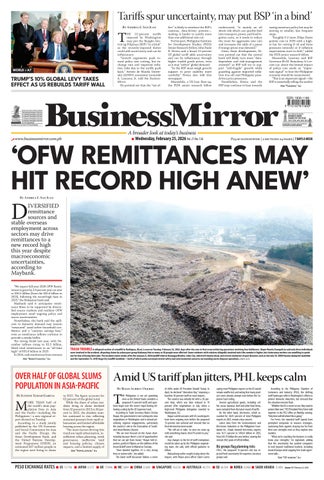
remittance sources and stable overseas employment across sectors may drive remittances to a new record high this year despite macroeconomic uncertainties, according to Maybank.
“We expect full-year 2026 OFW Remittances to grow by 2.8 percent year-on-year to $36.5 billion [from the $35.6 billion in 2025], following the record-high base in 2025,” the Malaysian bank said. Maybank said it anticipates remittance flows to be supported by diversified source markets and resilient OFW employment amid ongoing policy and macro uncertainties.
Nonetheless, the bank said the spillover to domestic demand may remain “measured” amid softer household confidence and a “cautious savings bias,” even as remittance inflows continue to provide a steady buffer. The strong finish last year, with December inflows rising to $3.5 billion, lifted total remittances to an “all-time high” of $35.6 billion in 2025. In 2024, cash remittances from overseas
By Justine Xyrah Garcia
MORE THAN half of the world’s slum population lives in Asia and the Pacific—including the Philippines—a new regional report showed on Tuesday. According to a study jointly published by the UN Economic and Social Commission for Asia and the Pacific (Escap), the Asian Development Bank, and the United Nations Development Programme (UNDP), an estimated 697 million people in the region were living in slums
By Andrea E. San Juan
THE 15-percent tariffs imposed by Washington may put the Bangko Sentral ng Pilipinas (BSP) “in a bind” as the recently-imposed duties could add uncertainty and can be inflationary.
“Growth arguments push toward policy rate cutting, but exchange rate and imported inflation risks due to the tariffs push back,” Ateneo de Manila University (ADMU) economist Leonardo A. Lanzona Jr. told the BusinessMirror
He pointed out that the “net ef -
fect” is likely to reinforce the BSP’s cautious, data-driven posture— making it harder to justify more than one additional rate cut.
For his part, Philippine Institute for Development Studies (PIDS) Senior Research Fellow John Paolo R. Rivera said a broad 15-percent US global tariff adds uncertainty and can be inflationary through higher traded goods prices, even as it may “soften” global demand.
“So the BSP must weigh growth support vs price stability more carefully,” Rivera also told this newspaper.
Meanwhile, a US-Iran flare-up, the PIDS senior research fellow
underscored, “is mainly an oil shock risk which can quickly feed into transport, power, and food logistics costs, so it tends to reduce the room for aggressive rate cuts and increases the odds of a pause if energy prices stay elevated.”
Given these developments, Rivera pointed out that the central bank will likely turn more “datadependent and risk-management oriented” as BSP will try to support “still-fragile” growth while guarding against imported inflation (via oil) and Philippine pesodriven price pressures.
Nonetheless, Rivera said the BSP may continue to lean towards
easing monetary policy but may be moving in smaller, less frequent steps.
“Roughly 0-2 more 25bps [basis points] cuts in 2026 with a higher bar for cutting if oil and forex pressures intensify or if inflation expectations start to drift,” added the PIDS senior research fellow.
Meanwhile, Lanzona said BSP Governor Eli M. Remolona Jr.’s recent cue about the limited impact of policy cuts sends an “important signal” to how the Philippine economy should be maneuvered.
“This is an important signal—the BSP is essentially telling the market
in 2022. The figure accounts for 62 percent of the global total. While the share of urban residents living in slums declined from 32 percent in 2013 to 30 percent in 2022, the absolute number continued to rise, reflecting sustained pressure from rapid urbanization and limited affordable housing across the region.
“The main factors driving this trend are rapid urbanization, insufficient urban planning, weak governance, ineffective land and housing policies, climate impacts, and a limited supply of
By Bless Aubrey Ogerio
THE Philippines is not yet panicking even as the United States considers a proposed 15-percent tariff, and questions linger over the move’s legal footing following a ruling by the US Supreme Court.
According to Trade Secretary Maria Cristina Roque, the government is not rushing into new negotiations in Washington and is instead prioritizing regional engagements, particularly the country’s role in the Association of Southeast Asian Nations (Asean).
“We are now focused on the Asean chairmanship because there’s a lot of opportunities that we can get from Asean,” Roque told reporters, partly in Filipino, on the sidelines of the Asean kickoff event in Makati on Tuesday.
“Once bonded together, it’s a very strong force to reckon with,” she added.
The latest tariff discussion follows a series
of shifts under US President Donald Trump. In April, he declared “Liberation Day,” imposing a baseline 10-percent tariff on most imports.
The country was initially hit with a 20-percent duty, which was later reduced to 19 percent after negotiations in July, when a high-level Philippine delegation traveled to Washington, D.C.
Roque said discussions with US counterparts have been ongoing even before the proposed 15-percent rate surfaced and stressed that no final decision has been made.
“We still are in talks. So once we come up with something clearer, then I’ll send it to you,” she said. Any changes to the list of tariff exemptions would be taken up by the Philippine negotiating team, she said, with official guidance to follow.
Malacañang earlier sought to play down the impact, with Palace press officer Claire Castro
saying most Philippine exports to the US would remain unaffected, and noting that many products were already exempt even before the Supreme Court ruling.
Several agricultural goods, including coffee, cocoa, bananas, beef and other food items, were excluded from the latest round of tariffs.
On the other hand, electronics, which accounted for 58.81 percent of total Philippine exports in 2025, remain a key concern.
Latest data from the Semiconductor and Electronics Industries in the Philippines Foundation Inc. (Seipi) showed electronics exports rose 16.11 percent to $49.64 billion in 2025, from $42.75 billion the year before, nearing the revised 2022 peak of $49.66 billion.
Biz groups flag planning risks STILL, the proposed 15-percent rate has injected fresh uncertainty for exporters, business groups said.
According to the Philippine Chamber of Commerce and Industry (PCCI), the shifting tariff landscape reflects Washington’s efforts to protect domestic industries, but stressed that the situation remains fluid.
“Whether the US is correct or not, they want to
By Andrea E. San Juan
Mayor Ronnie Evangelista said only three individuals
ICC told: ‘Bato’ key player in deadly…
spreadsheet was later crossed out in red—a mark witnesses confirmed meant the target had been killed.
Similarly, Ozamiz Mayor Reynaldo Parojinog was publicly threatened by Duterte in a televised speech and was murdered, along with several family members, in July 2017. Jeremy argued these cases showed how Duterte’s public threats and dela Rosa’s orders translated directly into killings.
The prosecution stressed that financial targeting poor communities, and Project HVT incentives fueled the violence.
“Consistent with the Davao model of killing, rewards were also paid when a high-value target was neutralized, meaning killed,” Jeremy told the judges.
These payments were provided outside the official police budget.
Jeremy also highlighted Duterte’s repeated assurances to police and military officers that they would face no consequences.
In a September 2016 speech, Duterte declared: “For as long as I am the president, nobody, but nobody, no military man or policeman, will go to prison, because they performed.” He added: “Kill, whether or not your target pulls a gun…and I will protect you.”
UK investment platform targets PHL infra, energy
By Bless Aubrey Ogerio @blessogerio
THE United Kingdom is deep -
ening its economic engagement with the Philippines through an expanded investment platform aimed at channeling capital and technical support into infrastructure, clean energy and other climaterelated sectors, as both sides seek to scale bankable projects and attract private investors.
The UK-Philippines Growth and Investment Partnerships Plus (GIP+) brings together UK-backed financing institutions, risk-sharing tools and technical expertise to support project development and improve investment readiness in the Philippine market.
UK Minister for the Indo-Pacific Seema Malhotra said the Philippines’ economic growth and demand for infrastructure make it a natural des-
Tariffs…
Continued from A1
that monetary easing is reaching its practical limits, and that structural and fiscal policy must carry more of the re-
tination for British capital and knowhow, particularly in sectors aligned with sustainability goals.
“The Philippines’s strong growth and dynamic economy make it a perfect match for British investment and technical expertise,” Malhotra said.
She cited UK-backed investments such as Citicore Renewables, which has supported clean energy development in the country.
Moreover, the minister explained how the partnership is intended to mobilize capital and deploy UK expertise in ways that generate jobs, strengthen supply chains and deliver long-term benefits for both countries.
From an investor’s perspective, British International Investment (BII) Managing Director and Head of Asia Srini Nagarajan said the country offers a growing pipeline of opportunities, especially in infrastructure and climate-focused projects.
covery burden,” added Lanzona. The BSP Monetary Board announced Thursday that it has reduced the Target Reverse Repurchase (RRP) Rate by 25 basis points to 4.25 percent. The interest rates on the overnight deposit and lending facilities were adjusted to 3.75 percent and 4.75
“The Philippines has strong fundamentals and a growing pipeline of investable opportunities, particularly in infrastructure, clean energy, and other climate-related sectors,” Nagarajan said.
In addition, he said the platform allows partners to help scale projects and draw in private capital.
Yet, risk mitigation and project preparation remain key challenges in infrastructure financing, according to the Private Infrastructure Development Group (PIDG).
Nishant Kumar, PIDG’s Head of Coverage for Asia and GuarantCo managing director, said aligning strong institutions with well-prepared projects is critical to unlocking private investment.
“Mobilizing private investment for infrastructure requires strong institutions, well-prepared projects, and trusted partnerships,”
percent, respectively.
The central bank has cut rates nine times since August 2024, for a total 225 basis points, thus reducing the policy rate from 6.50 percent to 4.25 percent.
Remolona said on Friday that interest rates alone can’t do the trick.
US tariff…
For the part of the Philippine Exporters Confederation (Philexport), the lack of clarity is a bigger concern than the rate itself.
Philexport president Sergio Ortiz-Luis Jr. said a 15-percent tariff could disrupt supply chains and buyer decisions, especially if current exemptions are lifted.
“At least we were more comfortable with
Remittances…
Filipinos amounted to $34.5 billion, up 3 percent from the $33.49 billion recorded in 2023.
Maybank said a weaker Peso against the US dollar should continue to support foreign exchange (FX) translation gains, while benign inflation conditions help preserve recipients’ purchasing power.
The Malaysian bank said external conditions remained broadly supportive, with the global composite (purchasing managers’ index) PMI at 52.5 in January 2026, underpinned by steady services and manufacturing.
“The steady PMI readings [are] suggesting continued resilience in key labor markets. Thus, diversified remittance sources and stable overseas employment across sectors should help cushion flows against global and policy uncertainties in 2026, sustaining moderate but steady growth,” said Maybank.
Philippine Institute for Development Studies (PIDS) Senior Research Fellow John Paolo Rivera said last week that the growth in cash remittances in December 2025 could be attributed to seasonal holiday inflows, “steady deployment” of OFWs abroad particularly in healthcare, maritime, and service sectors and the continued recovery of host economies in the US, Middle East, and parts of Asia.
Rivera also pointed to the rela-
Kumar said.
Financing support is also expected to come from UK Export Finance (UKEF), which offers guarantees and risk-sharing solutions to help bring large projects to market.
For his part, UKEF chief executive Tim Reid said up to £5 billion in export financing is available to support Philippine priorities, including transport infrastructure and clean energy.
Meanwhile, MOBILIST said deeper capital markets are essential to sustaining long-term investment flows.
The UK-PH GIP+ builds on earlier cooperation launched in 2023 and is positioned as a long-term platform to improve project preparation, reduce investment risks and support the Philippines’s infrastructure and climate transition agenda.
“It needs help from other things. We have very limited tools in monetary policy. Basically, we have tools on the demand side and we are supposed to focus on inflation. So it’s not clear how much more we can do,” the BSP governor emphasized last week.
the 10 because basically we will still be competitive,” Ortiz-Luis said on the sidelines of the PCCI event on Monday afternoon. “Now, we are uncertain again.”
He noted that the 150-day window before congressional approval is required in the US makes planning difficult for exporters, with electronics and agricultural shipments potentially affected if zero-tariff arrangements lapse. Ortiz-Luis urged Philippine trade negotiators to keep pushing for broader trade agreements, and to remind Washington of the long-standing alliance between the two countries.
tively weaker Philippine peso as a booster of cash remittances, explaining that the softer local currency encouraged higher remittance conversions, while digital transfer channels made sending money faster and more convenient.
“Remittances remain a key stabilizer for the Philippine economy, supporting household consumption, cushioning external shocks, and helping sustain domestic demand despite slower growth and global uncertainties,” added Rivera.
Rizal Commercial Banking Corp. (RCBC) chief economist Michael L. Ricafort explained that growth in cash remittances in December 2025 could be attributed to some Overseas Filipino Workers (OFWs) increasing remittances and conversion to pesos in December 2025 before the 1-percent tax on OFW remittances from the US took effect in 2026.
Jonathan L. Ravelas, senior adviser at Reyes Tacandong & Co., for his part, earlier explained that while December’s “surge” reflects yearend bonuses and holiday spending, “The bigger story is resilience—overseas Filipino employment held up well despite global uncertainty.”
Ravelas pointed out the main risk ahead is the proposed US remittance tax. He said: “It won’t derail flows overnight, but higher costs could slow formal transfers and weigh on momentum over time,” underscoring the importance that while remittances remain a strong tailwind, “We can’t take them for granted.” (See:https:// businessmirror.com. ph/2026/02/17/proposed-remittance-taxin-us-cited-as-risk/) According to the Bangko Sentral ng Pilipinas (BSP), the United States remained the top source of cash remittances to the Philippines in 2025, followed by Singapore and Saudi Arabia.
affordable housing,” the study noted. In the Philippines, inequality within cities remains evident. The report showed that Filipino households identified as being “furthest behind” are twice as likely to live in slums compared with the average urban household. The disparity is clear in access to services. Only 30.6 percent of slum households in the country had bank accounts in 2022, compared with 43.5 percent in non-slum communities. Clean fuel access reached 72.7 percent in slum areas, trailing the 90.5 percent recorded elsewhere. Electricity coverage stood at 94.4 percent in slums versus 98.9 percent outside them, while basic sanitation reached 95.6 percent compared with 99.8 percent. The report did not provide comparable Philippine data for clean water and internet access in the slum and non-slum breakdown.
Beyond housing, the study flagged structural pressures that compound inequality.
More than 65 percent of urban workers in Asia and the Pacific remain in informal employment, often without stable income or social protection. At the same time, over 2.3 billion people in the region are exposed to unsafe air quality, accounting for two-thirds of global premature deaths linked to air pollution.
To address these disparities, the report called for community-led slum upgrading, integrated housing and infrastructure planning, and expanded “last-mile” access to basic services.
It also urged governments to extend social protection to informal workers, strengthen urban resilience through better land-use planning and nature-based solutions, and mobilize stronger governance, financing and partnerships to support inclusive and sustainable urban development.
“Achieving this requires effective governance, innovative financing, the smart use of technology, robust data and monitoring systems, and regional cooperation. Guided by the commitment to “leave no one behind” and “leave no place behind,” coordinated actions can transform the region and its cities into hubs of inclusion, innovation, resilience and prosperity for all,” the report also said.
PHL commitment
DEPARTMENT of the Interior and Local Government (DILG) Undersecretary Marlo L. Iringan said the Philippine government is adopting a “multi-dimensional approach” to address inequalities within and between urban areas. Representing the Philippines at the 13th Asia-Pacific Forum on Sustainable Development in Bangkok, Iringan said the government is heavily focused on strengthening local governments to ensure that reforms are felt at the grassroots level.
“We are strengthening their capabilities to integrate disaster risk reduction and climate change adaptation into land use and development planning, while promoting participatory governance, fiscal resilience, and data-driven urban management,” he said.
Iringan also emphasized that financing transformative urban action requires innovation. He said the government is expanding public-private partnerships, mobilizing climate finance and boosting local fiscal capacity to ensure investments reach vulnerable communities and secondary cities, not just major metropolitan areas.
He added that the Philippines will continue to be an active global partner in strengthening cooperation across the Asia-Pacific region.
“Our shared urban challenges demand shared solutions. As we move forward to 2030, the Philippines reaffirms its commitment to transformative and coordinated action so that our cities become spaces of opportunity, dignity, and resilience for all,” he said.
DOE presents nuclear licensing roadmap
By Lenie Lectura @llectura
THE Department of Energy (DOE) has completed the licensing and permitting flowchart for nuclear power plant projects, bringing the country a step closer to achieving its nuclear energy goals.
An end-to-end licensing framework was formulated during a whole-day focus group discussion on Harmonizing Nuclear Power Plant Licensing last week, the agency said on Tuesday.
Led by Energy Undersecretary Rowena Cristina L. Guevara, Finance Undersecretary Catherine
L. Fong and Philippine Nuclear Research Institute Director Carlo A. Arcilla, the discussion gathered over a hundred stakeholders from the private sector, academia and 24 government agencies under the Nuclear Energy Program Inter-Agency Committee (NEP-IAC).
NEP-IAC Secretariat head
and Energy Director Patrick T. Aquino outlined the regulatory pathway for new power projects, which spans seven major phases requiring sequential and parallel approvals.
These include business registration and foundational permits that form part of the first phase; environmental clearances and nuclear siting requirements, second phase; licensing by the Philippine Atomic Energy Regulatory Authority (PhilAtom) to construct or secure a provisional permit, third phase; energy sector-specific approvals and licenses, fourth phase; operational and support registrations and permits, fifth phase; construction monitoring and oversight, sixth phase; and finally, licensing for operation, testing and commissioning, seventh phase.
“We are not merely exploring a new source of power; we are architecting a sustainable,
Pact aims to tighten oversight of
By Bless Aubrey Ogerio
ABROADER effort to tight -
en oversight of public works projects and the use of national funds was formalized on Tuesday with a partnership bringing together the private sector, government, Church-based groups and local leaders.
The agreement, marked by the signing of the Implementing Rules (IRR) and a revised Memorandum of Cooperation, links the Philippine Chamber of Commerce and Industry (PCCI), the Department of Public Works and Highways, Mayors for Good Governance, and Caritas Philippines in a joint framework aimed at strengthening transparency and public accountability in infrastructure
spending.
Under the arrangement, PCCI represents the private sector, whose members play a role in economic activity and, by extension, have a stake in how public funds are allocated and spent.
For the Department of Public Works and Highways, the pact opens its projects to broader scrutiny, marking what officials said is a shift toward radical transparency.
“Transparency is the best disinfectant, and today, we are putting that into practice,” Public Works Secretary Vivencio Dizon said. Dizon added that the initiative reflects the government’s vision to ensure that public funds are spent as intended.
The coalition also includes
high-growth future for the Filipino people. This vision’s fulfillment will not materialize solely by the technology we choose or by the power plants we build. It rests on the strength, clarity and predictability of the regulatory foundation,” Guevara said.
The collective goal of industry stakeholders is to strengthen the whole-of-society approach for nuclear power operation that will serve both the safety of citizens and the efficiency of the energy sector, Guevara added.
Aquino emphasized the need to align all processes with global safety benchmarks. “We must ensure that every nuclear power plant project in our country meets the rigorous standards required for its safe and secure operation, in adherence to International Atomic Energy Agency [IAEA] requirements,” he said.
The government hopes to present the NEP-IAC-validated
public works
Mayors for Good Governance (M4GG), which has been pushing for the participation of dioceses in monitoring government programs, particularly infrastructure projects that directly affect local communities.
The Church component of the partnership is anchored by Caritas Philippines, which said it will mobilize its extensive grassroots network to provide both moral and on-the-ground oversight.
“The signing of this IRR is the formalization of a sacred trust,” Caritas Philippines executive director Fr. Carmelo Caluag.
Caluag said integrating the diocesan network with the technical expertise of civil society and private-sector groups creates a system designed to limit opportunities for
flowchart to prospective nuclear power project proponents who wish to invest in the Philippines, alongside relevant policies and investment incentives.
The government aims to begin accepting nuclear power plant license applications by this year, 2026, to stay on track with its 2032 target of integrating nuclear energy into Philippine energy mix.
Implementation will be carried out through the PhilAtom, which was created to oversee the safe, secure and peaceful uses of nuclear energy and radiation sources under Republic Act 12305 or the Philippine National Nuclear Energy Safety Act, signed by President Ferdinand R. Marcos Jr. in September last year.
At the same time, the Philippines is working closely with the IAEA and other nuclear-embarking countries to strengthen technical capabilities and regulatory preparedness. The DOE-led
wrongdoing.
“We are ensuring that the ‘People Power Movement’ is not just a sentiment, but a structured, nationwide safeguard for our nation’s resources,” the priest added.
Caritas Philippines, in a statement, said it said that this collaboration marks a departure from a system that relies heavily on audits after projects are completed, toward one that emphasizes prevention by involving the public from the outset.
It added that the parties’ shared approach is intended to stop irregularities before they occur rather than addressing their consequences later on.
“This is our choice. This is our power. This is the People’s Power,” the Caritas statement read.
PhilSA boosts environmental protection in Palawan, Tubbataha
TBy Jonathan L. Mayuga @jonlmayuga
HE Philippine Space Agency (PhilSA) has formalized strategic partnerships with the Palawan Council for Sustainable Development (PCSD) and the Tubbataha Management Office (TMO) to enhance the use of space science, technology, and applications in Palawan, the country’s foremost ecological frontier.
The partnerships aim to create maps to boost environmental protection, sustainable development, and evidence-based policymaking in the province, including the world-famous Tubbataha Reefs, a protected area, and a United Nations Educational, Scientific and Cultural Organization (Unesco) World Heritage and Association of Southeast Asian Nations (Asean) Heritage site (AHP).
The agreements were signed
in Puerto Princesa City through separate five-year Memoranda of Agreement (MOA) at the PCSD Building with PCSD Executive Director Teodoro Matta, TMO Protected Area Superintendent Angelique Songco, and PhilSA Director General Gay Jane P. Perez, represented by Space Information Infrastructure Bureau (SIIB) Director Ariel C. Blanco. Under the MOA with PCSD, PhilSA will generate land use, land cover (LULC), and benthic (marine habitat) maps, which are useful in monitoring environmental health and assessing damage when necessary. On its part, PCSD will help validate the maps generated by PhilSA using data on the ground. The partnership builds upon the successful conduct of the PhilSA Integrated Network for Space-Enabled Actions or Pinas Workshop in Palawan in 2022, which laid the groundwork for
strengthened cooperation in the region.
Launched in October 2022, Pinas is an active network of local governments (LGUs), institutions, and individuals working toward sustainability using space data.
Workshops have been held in Iloilo City, Palawan, Ilocos Region, Aklan, Mindoro, Davao, Zamboanga, Cebu, Bataan, Bulacan, and Bukidnon.
In a separate MOA, PhilSA and the Tubbataha Management Office also formalized their collaboration to conduct benthic-marine habitat and bathymetry mapping to help in the science-based management of the Tubbataha Reefs Natural Park, which is considered a cradle for marine biodiversity.
The agreements include capacity-building efforts to enable PCSD and TMO personnel to effectively utilize space-borne data for environmental habitat monitoring and management beyond the duration
Apeco to build ₧38.6-M ready-for-fit-out facility
THE Aurora Pacific Economic Zone and Freeport Authority (Apeco) will construct a P38.62-million ready-for-fit-out commercial building as part of efforts to expand the ecozone’s capacity to accommodate investors and locator enterprises.
The project, dubbed Ready-forFit-Out (RFFO) Building Phase 1, will rise within the Apeco Corporate Campus in sitio Motyong, barangay Esteves, Casiguran, Que -
zon. Construction is targeted to be completed within 300 calendar days from the issuance of the Notice to Proceed.
Apeco said the facility is intended to shorten business setup timelines by offering office spaces that are structurally complete and ready for interior customization, allowing firms to begin operations more quickly.
“The construction of our readyfor-fit-out office units reflects
Apeco’s commitment to creating a business environment where investors can immediately establish and grow their operations,” said Gene Angel Ferrer, Apeco business development and marketing manager and a member of its Bids and Awards Committee.
“By providing modern, accessible spaces within Apeco, we are strengthening our ability to attract new enterprises, generate employment, and stimulate sus -
of the partnership.
Parallel to the MOA signing, PhilSA also conducted PINAS Symposiums at Western Philippines University (WPU) and Palawan State University (PSU), and field surveys in Balabac, Palawan to collect ground-truth or validation data for mapping initiatives.
Activities included drone image acquisition for high-resolution mapping of benthic areas, crops, and land cover; and underwater video and echosounder tows. The data gathered will create more accurate seagrass, coral, forest, and crop maps to support agriculture and sustainable development planning.
Through these partnerships, PhilSA continues to advance the integration of space-enabled solutions in environmental conservation efforts, reinforcing its commitment to sustainable development and science-based governance in the Philippines.
tained economic activity for Aurora and the surrounding region,” Ferrer added.
Interested bidders may secure bidding documents from February 13 to March 10, upon payment of a non-refundable fee of P25,000. A pre-bid conference is scheduled on February 26, while submission of bids for the RFFO project is due on or before March 10.
NEP-IAC have also held a series of multistakeholder workshops addressing priority issues identified by the IAEA.
“By finalizing this harmonized licensing roadmap, we are sending a clear signal that the Philippines is preparing for nuclear energy with discipline and foresight. Our commitment is straightforward: strong safety oversight, predictable processes, and transparent public engagement, so that when proponents are ready to invest, government is ready to evaluate, regulate, and deliver our 2032 target responsibly,” DOE Secretary Sharon Garin said.
The 2032-2050 Philippine Energy Plan envisions a more diverse energy mix and a phased entry of nuclear energy in the country’s power generation mix, beginning with 1,200 MW of capacity, with operations targeted to commence by 2032, increasing to 2,400 MW by 2035, and 4,800 MW by 2050.
PHL mulls building public infra stack
By Lorenz S. Marasigan @lorenzmarasigan
THE Philippines is looking to build its own digital public infrastructure stack inspired by India’s nationally integrated technology framework, Information and Communications Technology Secretary Henry Aguda said.
Aguda floated the concept during the AI Impact Summit 2026 in India, where he engaged fellow ministers and global technology leaders on AI deployment, workforce development, and cross-border innovation.
“If India has India Stack, the Philippines will build its own stack anchored on Digital Bayanihan,” Aguda said. “Bayanihan has always meant community effort. In the digital age, it must mean shared infrastructure, shared opportunity, and shared intelligence.”
India Stack refers to a set of open application programming interfaces (APIs) that allow governments, businesses, and developers to utilize the country’s digital infrastructure—covering identity, payments, and data exchange – to build scalable solutions.
The Philippines’ proposed counterpart would draw from that model while being shaped around local conditions and priorities.
Aguda tied the Digital Bayanihan concept to President Marcos’ directive to center artificial intelligence in the country’s digital
transformation agenda, as well as the Philippine AI+ Masterplan. The summit, hosted by India’s Ministry of Electronics and Information Technology, brought together policymakers and technology leaders to advance cooperation on AI governance, sustainable infrastructure, and inclusive growth.
The DICT co-chaired the summit’s Human Capital Working Group, advancing three proposals that were adopted in the meeting’s final outcomes: scaling government-led AI literacy platforms, mobilizing private sector leadership in AI executive bootcamps, and establishing AI observatories to monitor the technology’s impact on employment.
On the summit’s sidelines, the DICT also secured bilateral engagements with the Indian government and institutions, allowing for joint AI and cybersecurity training, semiconductor workforce development, and mutual recognition of digital certifications. Furthermore, Oman offered to host up to 20 startups per Association of Southeast Asian Nations (Asean) member state for three years.
“As directed by President Marcos, we are not merely adopting AI, we are building the ecosystem that will allow Filipinos to lead in it,” Aguda said. “Our engagements in India bring home concrete opportunities that will power inclusive growth for the Philippines.”
Lotilla backs measure creating Water Resource Department
THE Department of Environment and Natural Resources (DENR) has backed the passage of House Bill 6789 that creates the Department of Water Resources (DWR).
The House of Representatives recently passed on third and final reading the proposed measure, which the DENR described as a landmark reform that will finally unify and modernize the country’s fragmented water governance system. The measure is one of the priority bills endorsed by the Legislative-Executive Development Advisory Council (Ledac), following President Marcos’s directive to accelerate key reforms this year.
Its elevation to the national priority agenda reflects a growing consensus that water security is now a core driver of governance reform, climate resilience, and long-term economic stability.
“The mandate of the President is clear, and we will continue to push for reforms aligned with his agenda,” Environment Secretary Raphael Lotilla said in a statement.
“The advancement of the Water Resources bill to the Senate, together with key environmental measures such as the Waste Treatment Technology bill and the Blue Economy bill, underscores DENR’s continuing effort to strengthen
A4 Wednesday, February 25, 2026
Immigration nabs 2 Chinese impostors
TBy Joel R. San Juan @jrsanjuan1573
HE Bureau of Immigration
(BI) has arrested two Chinese men who were posing as Filipinos and using illegally obtained government-issued documents in separate operations last week.
The two were identified as Zhi Ling Guan, 47, and Guo Jinjin, 48.
BI Intelligence operatives captured Zhi on February 20 upon verification and coordination with law enforcement partners in Batangas.
Zhi, BI said, was using the aliases Shi Nengyuan and Mike Sy. He was found to have misrepresented himself as a Filipino citizen and to have used Philippine-issued identification documents to support his false claim, according to the BI Intelligence chief, Fortunato Manahan Jr.
“Our verification confirmed that the individual was operating under multiple identities and had secured Philippine documents under an assumed Filipino name,” Manahan said.
Zhi’s arrest was carried out based on the information and confirmation provided by the Intelligence Service, Armed Forces (Isafp) and the Land Transportation Office (LTO).
Bill strengthens, professionalizes political parties
By Jovee Marie N. dela Cruz @joveemarie
Authorities also uncovered that the Zhi had allegedly used Philippine passports to travel internationally while falsely claiming Filipino citizenship.
The BI stressed that fraudulently claiming Philippine citizenship is a serious violation of immigration laws and an affront to national sovereignty.
“Philippine citizenship is not a commodity that can be fabricated or acquired through deception. Any foreign national who falsely claims to be Filipino and manipulates our systems to secure official documents will face arrest, detention, and deportation,” Viado said at a press briefing.
He emphasized that the Bureau remains firm in its mandate to safeguard the country’s borders and protect the integrity of national records.
Biometric checks and interagency verification established that the fingerprints appearing in identification documents under the name “Mike Sy” matched those of Zhi Ling Guan, a Chinese national.
Prior to Zhi’s arrest, Immigration agents arrested Guo on February 17, based on intelligence information showing that Guo was operating several businesses in Panglao, Bohol, using Filipino “dummies” or nominees to circumvent constitutional restrictions on foreign ownership.
BI Fugitive Search Unit (FSU)
Chief Rendel Ryan Sy said Guo was arrested on Alona Beach Road, Purok 7, barangay Tawala, Panglao, Bohol.
Authorities also discovered that Guo was in possession of a Professional Driver’s License issued by the Land Transportation Office (LTO) identifying him as a Filipino citizen, despite official immigration records confirming that he is a Chinese national.
BI records show that Guo last entered the Philippines in 2018 under a Special Resident Retiree’s Visa (SRRV).
While he has no active derogatory record in the BI database,
verification with the LTO confirmed that he holds a professional driver’s license valid until February 2032, indicating Filipino citizenship—a representation that directly contradicts his immigration status.
The discrepancy, according to the BI, suggests that falsified or misrepresented documents may have been submitted to secure government-issued identification.
“Acquiring government identification by falsely claiming Filipino citizenship is not a minor technical violation—it is a direct affront to our sovereignty and our laws,” Viado said.
“If you fabricate your identity to do business, acquire privileges, or blend into our communities, it is already a violation and expect that you will face the necessary sanctions,” he added.
Guo is currently being held at the BI’s holding facility while facing the deportation charge filed against him.
Military on red alert for Edsa rites, rallies
By Rex Anthony Naval
MILITARY forces are now on red alert in preparation for the 40th Anniversary of People Power Revolt on Wednesday, as well as protest actions against corruption scheduled on the same day, the Armed Forces announced on Tuesday. In a press briefing, the AFP spokesperson Col. Francel Margaret Padilla, said this footing is a standard readiness measure to ensure troops and resources are on ready should the PNP require assistance.
When red alert is declared, all personnel are required to be at their posts at all times and all leaves and furloughs are cancelled.
“As early as 21 February, we have already raised our status to Red Alert. So, that means, our troops are on standby for any eventuality,” she added.
The National Police (PNP), meanwhile, has finalized its security plan for the anniversary of the Epifanio delos Santos Avenue (Edsa) People Power Revolution and the Trillion Peso March. This, even as the PNP has not monitored any security threat to the gathering where tens of thousands of people are expected to attend.
“There are no verified intelligence reports confirming any security threat but we will not lower our guard by maintaining high level of alertness to prevent
infiltration of individuals who may intend to disrupt a peaceful assembly,” Gen. Jose Melencio Nartatez Jr., PNP chief, said in a statement on Tuesday.
Nartatez said the goal is “to make sure that all of the planned activities will be peaceful and orderly.”
In Metro Manila, the National Capital Region Police Office will deploy over 13,000 officers to secure the Edsa Shrine and the People Power Monument in Quezon City, as well as other key areas.
Nartatez ordered Police Regional Offices nationwide to raise alert levels and apply calibrated security measures.
He told unit commanders to enforce maximum tolerance and
coordinate closely with local governments and organizers.
He also directed regional chiefs to activate intelligence teams to monitor agitators and misinformation, and to keep deployments visible but nonintrusive.
“We are anticipating the presence of multiple groups with opposing views. While we respect their right to peaceful assembly, our primary responsibility is to ensure public safety,” Nartatez said.
Church and civil society groups have scheduled activities on February 25 to mark the revolution’s 40th anniversary, as well as the anti-corruption Trillion Peso March.
Polluted Abacan River in Angeles City exhibits signs of recovery
By Ashley Manabat
ANGELES CITY—SOME 250 volunteers joined a cleanup drive along the Abacan River in Barangay Balibago during the weekend, as organizers pointed to early signs of ecological recovery
in one of Angeles City’s most polluted waterways.
“There’s a lot of birds in the river,” said Criselle Alejandro, president of Balibago Waterworks.
“And if there are birds in the river, that means there’s fish. And when there’s fish in the river, the river’s
healthier. So that’s a good sign.”
The activity marked the eighth river rehabilitation effort spearheaded by Balibago Waterworks together with the Abacan River and Angeles Watershed Advocacy Council (ARAW-ACI), Nagkakaisang Guardians, and the Angeles City government.
Angeles City Councilors Maricel Morales, JC Aguas, Mitch Bonifacio and Alex Indiongco took part in the cleanup, along with students from the Philippine College of Criminology and representatives from private sector groups.
Despite visible improvements, Alejandro said sustaining progress remains a challenge, stressing the need for stronger education campaigns to deter illegal dumping.
“It’s frustrating to clean it up and then see bags of trash return the next day,” Alejandro said. “The solution is really for households along the river not to throw their trash.”
She added that the company’s corporate social responsibility team regularly conducts awareness drives in riverside barangays. However, pollution extends beyond solid waste.
“Education campaigns are really important. It is frustrating to clean it up and then the next day bags of trash come back,” Alejandro said. “The solution is really for the households along the river not to throw their trash.”
Wastewater from drainage canals continues to contaminate the river which highlights the need for proper septic tanks and regular desludging under the city’s septage management program, Alejandro said.
Alejandro also linked river rehabilitation to upstream conservation and noted that tree-planting initiatives under Araw-ACI help protect water sources and regulate runoff into the river system.
LAWMAKERS from the Liberal Party have filed a measure seeking to strengthen and professionalize political parties, positioning them as genuine engines of national development and good governance in the Philippines.
Through House Bill 7914, or the proposed Political Party System Reform Act filed Monday, Partylist Rep. Leila de Lima of Mamamayang Liberal, along with fellow LP lawmakers, aims to transform political parties into stable, programdriven, and accountable institutions rather than patronage-based groups centered on personalities and political convenience.
Co-authors include Reps. Adrian Michael Amatong of Zamboanga del Norte, Arlene Bag-ao of Dinagat Islands, Jaime Fresnedi of Muntinlupa City, Cielo Krisel Lagman of Albay, and Alfonso V. Umali Jr. of Oriental Mindoro.
The bill emphasizes that while political parties are essential to a healthy democracy, they remain among the country’s weakest institutions owing to the absence of a comprehensive legal framework governing their organization and operations. Without such a framework, the measure notes, parties remain heavily reliant on private funding and vulnerable to undue influence and corruption.
To address these structural weaknesses, the bill outlines reforms that would establish clear standards for the registration and accreditation of national political parties, require
internal democracy and ethical governance, encourage the formation of party think tanks, and institutionalize transparent, merit-based processes for selecting candidates.
The measure also proposes the creation of a State Subsidy Fund to support qualified political parties. Access to public funding would be subject to strict reporting, auditing, and performance monitoring requirements to ensure accountability and transparency.
In addition, the bill introduces penalties for political turncoatism— defined as switching party affiliation within one year before or after an election—in an effort to curb opportunistic party switching.
LP lawmakers said that political opportunism undermines integrity and accountability in public service. By reinforcing political parties as pillars of democracy, they said, the measure seeks to strengthen transparency, promote meaningful political participation, and restore public trust in the electoral process.
“Political opportunism and turncoatism should never be encouraged, much less tolerated, as they undermine the values of honor, integrity, and accountability essential to public service,” the bill’s explanatory said.
“By strengthening political parties as pillars of democracy, this measure advances constitutional principles of transparency, accountability, and meaningful political participation, and reinforces public trust in the political and electoral process,” it added.
www.businessmirror.com.ph
NBI files cyber libel, other charges against vlogger
TBy Joel R. San Juan @jrsanjuan1573
medical records of the President on his social media account.
HE National Bureau of Investigation (NBI) has lodged a complaint before the Department of Justice (NBI) against well-known vlogger Jack Argota for cyber libel and unlawful use of means of publication for allegedly spreading false information concerning President Marcos’ medical condition.
The complaint against Argota was filed a week after the NBI filed a similar complaint against former newsman Yumang Sonza, also known as Jay Sonza and prominent YouTuber Jeffrey Luces Celiz, also known as Ka Eric Celiz.
Prior to the filing of the complaint, the NBI subpoenaed Argota to shed light on the the allegations that he posted fake
Argota admitted that he merely lifted the copy of the fake medical record from various social media pages.
The NBI has yet to provide a copy of the complaint that it filed before the DOJ against Argota. Sonza and Celis were charged before the DOJ with violation of Section 4(c)(4) of Republic Act 10175, also known as the Cybercrime Prevention Act of 2012 and for the Unlawful Use of Means of Publication under Article 154 of the Revised Penal Code, in relation to Section 6 of the Cybercrime Prevention Act.
They were accused of being the primary sources of the false medical records of the President which they posted on their respective social media accounts.
Switzerland updates tariffs on processed farm products
S4Ps needs more than cash to break poverty cycle–study
By Justine Xyrah Garcia
CASH transfers like the Pantawid Pamilyang Pilipino Program (4Ps) are necessary but not enough to break the intergenerational cycle of poverty, according to a new study by the Philippine Institute for Development Studies (PIDS).
The PIDS found that participation in the 4Ps does not significantly influence the occupations children aim to pursue or the income level associated with those career goals, despite the program’s documented gains in school enrollment and attendance.
Using data from nearly 10,000 children aged 10 to 25, the researchers compared households
just below and just above the program’s poverty eligibility threshold.
The results showed no measurable difference between beneficiaries and non-beneficiaries in the likelihood of aiming for professional, service or higher-earning occupations.
“If the program keeps children in school longer but does
not expand their sense of what occupations are possible or desirable, its ability to break poverty cycles may still be limited,” the study said.
Nearly half of the children surveyed aim for professional careers such as teaching, nursing or engineering, while a significant share prefer service-related jobs. These patterns, however, are broadly similar regardless of program participation.
Instead, parental expectations emerged as the strongest predictor of children’s career direction.
Children whose parents envisioned professional futures for them were substantially more likely to pursue similar paths, an effect that outweighed program participation or household income.
“Poor children maintain ambitious career aspirations despite their circumstances, suggesting poverty has not entirely constrained their sense of possibility.
However, the difficulty of expanding these aspirations through cash transfers highlights how aspiration formation appears strongly shaped by family contexts,” PIDS said.
Based on the findings, the researchers recommended strengthening Family Development Sessions and Youth Development Sessions under 4Ps to include structured career guidance, labor market information and exposure to diverse industries. They also proposed building partnerships that connect youth to employers and professionals to better align educational gains with actual economic opportunities.
“Education and health investments create the foundation for advancement, but they must be complemented by interventions that help youth envision better futures and understand how to reach them,” they added.
By Ada Pelonia @adapelonia
WITZERLAND has updated its tariffs on processed farm products based on a routine measure to shield its domestic industries against cheaper imports, a move that could affect the margins of Philippine exporters.
The Department of Trade and Industry–Export Marketing Bureau (DTI-EMB) recently issued an advisory for Philippine exporters regarding Berne’s move to update its duty rates as a price compensation measure on processed agricultural goods, effective February 1, 2026. Such adjustment follows Switzerland’s routine pricing update and covers items classified in several Harmonized System (HS) codes, including: yoghurt and dairy spreads (Chapter 4); margarine (Chapter 15); sugar confectionery (Chapter 17).
Chocolate and other food preparations containing cocoa (Chapter 18); pastrycooks’ products and preparations of cereals, flour, starch, or milk (Chapter 19); and preparations of vegetables, fruit, nuts, or other parts of plants (Chapter 20) are also included.
“It will also reflect changes in the cost of key ingredients such as milk, grains, fresh potatoes, vegetable fats and sugar, which could affect export pricing to the Swiss market,” the DTI-EMB said.
“Exporters are encouraged to coordinate closely with their
importers to ensure compliance with the newly imposed duty rates for Switzerland.”
In its notification to the European Free Trade Association (Efta), Switzerland said its agricultural policy aims to produce ample domestic output of important basic farm goods.
Higher production costs in the country, however, place its domestic producers of processed agricultural products at a disadvantage against cheaper imports of raw materials.
“As the price for the agricultural raw materials in a processed product constitutes an important part of the final price for that product, these producers are put at a competitive disadvantage compared to competitors in countries where these materials can be sourced at lower prices.”
As such, the European nation applies price compensation measures to promote competitive conditions for its domestic producers.
“[This aims to] equalise the difference between the domestic and the world market prices for the raw materials incorporated in processed agricultural goods,” Switzerland said.
“This ensures the domestic food processing industry a level playing field to compete with foreign companies on the domestic market.”
The DTI-EMB said the updated rates and corresponding notification are available on the Efta website.
Senate tackles bill strengthening, modernizing defense institutions
Continued from A4 Polluted. .
Continued from A4
Balibago Barangay Chairman Joseph Ponce said the village holds weekly and monthly cleanups, including declogging, grass cutting, and debris removal, but acknowledged enforcement gaps.
“I hope my fellow barangay chairmen will be strict with constituents, especially those living along the Abacan River,” Ponce said.
He added that the barangay collects trash from riverside households to prevent dumping and has proposed installing trash trap nets at barangay boundaries to
Continued from A3
Separately,
pinpoint waste sources and stop debris from flowing downstream.
“We have definitely seen improvement,” Ponce said.
Morales, a lifelong Angeles City resident, said long-term success depends on behavioral change. She recalled playing along the river as a child and hopes to see it restored.
“It’s saddening to see some trash already embedded in the soil,” she said. “We need to take to heart the love for our environment.”
While solid waste and wastewater issues persist, organizers said growing volunteer participation and the return of fish and bird life signal steady, if gradual, progress in restoring one of the city’s key waterways.
an approved budget of P40.42 million.
There was also the supply, delivery and installation of two 62-kVA generator sets worth P8 million.
The bidding deadline for these projects is likewise set on March 10. Bless Aubrey Ogerio
THE Senate on Tuesday began deliberations on measures aimed at strengthening and modernizing the country’s defense institutions to address evolving security threats.
During the public hearing of the Senate Committee on National Defense and Security, Peace, Unification and Reconciliation, Sen. Loren Legarda said reforms must ensure that the Department of National Defense (DND) and the Armed Forces (AFP) are equipped to respond to emerging challenges, including cyber intrusions, disinformation operations and gray-zone tactics.
“We need a Department of National Defense that can respond to the future, with the professional civilian capability, legal authority, and funding tools to do its job well. We also need an Armed Forces that is not burdened by outdated planning cycles and bureaucratic constraints,
Continued from A3
policy frameworks for resource governance,” Lotilla said.
By strengthening water policy, improving allocation systems, and ensuring reliable supply for agriculture, industry, and rapidly growing urban centers, the bill is expected to support sustained economic growth and shield communities from intensifying climate-related risks.
Water governance in the Philippines currently involves multiple agencies and local governments operating under sectorspecific mandates. Aside from DENR through the Water Resoures Management Office, the National Water Resources Board, the Department of Public Works and Highways, the Department of Agriculture, the Local Water Utilities Administration, the Metropolitan Waterworks and Sewerage System, and various local governments perform vital functions within their respective
but is able to adapt swiftly to rapidly evolving technologies,” Legarda, who graduated from the National Defense College when she was still in her 30s, said.
Among those discussed was the proposed DND Transformation Act, which seeks to transform the DND into an agile, modern, and proactive institution that provides strategic direction and support to its attached agencies, including the AFP.
The measure seeks to clarify the powers of the DND and the Defense Secretary and introduce organizational reforms such as the establishment of sub-national offices, the creation of a Corps of National Defense Specialists, continuing professional development mechanisms, and strengthened protection of sensitive information.
“Our duty today must be approached with precision: strengthen the DND,
jurisdictions, resulting in overlapping responsibilities and challenges in coordination, planning, policy formulation, resource allocation, and data systems.
House Bill 6789 seeks to address these institutional complexities by creating a Cabinet-level authority responsible for national water policy, planning, allocation, and conservation. By consolidating fragmented functions and strengthening coordination across sectors, the measure positions water security as a strategic component of national development and advances a whole-of-government approach to collaboration among national agencies, local governments, and sectoral stakeholders.
Among others, House Bill 6789 envisions the proposed department undertaking key functions such as:
n Formulating and implementing a National Water Resources Management Plan
n Strengthening river basin–based planning and governance
n Integrating flood and
modernize the AFP, and honor those who served, so we can better secure our nation,” Legarda added. The committee examined proposals to strengthen the implementation of the Revised AFP Modernization Program to ensure modernization efforts are consistent, capabilitydriven, and responsive to evolving threats.
Defense Assistant Secretary Katherine Lingan told senators that institutional expansion is necessary to enable the DND to carry out its mandate.
“The organization of the Department is being envision to be expanded and enhanced to ensure its ability to answer threats -current and forthcoming- makes the organization able to do that,” Lingan said.
She said the department manages about a hundred billion worth of assets while catering to a clientele of more than one million nationwide.
PNA
drought risk management into national planning
n Protecting watersheds and aquatic ecosystems
n Consolidating national water data and information systems
n Promoting equitable allocation across sectors
n Supporting universal access to water supply and sanitation services
n Enhancing coordination with LGUs, stakeholders, and private partners
The measure advances key policy principles central to DENR’s governance framework, including ecosystem sustainability, public participation, data-driven governance, and the delivery of tangible benefits to communities through improved service reliability and resilience.
former head of the Archdiocese of Manila is to provide an opportunity for those who may want to pay their respects to the Cardinal, who is recognized as one of the main personalities in the 1986 peaceful uprising.
“On February 25, 2026, the 40th Anniversary of the Edsa People Power Revolution, we will open to the public the crypt of the Manila Cathedral for those who may want to pay their respects to Jaime L. Cardinal Sin, our former archbishop, who played a major part in the restoration of our democracy in 1986,” it said.
“May our love for country be manifested in our continued pursuit of truth, justice, and peace,” the Manila Cathedral said in a social media post.
On the night of February 22, 1986, Cardinal Sin called on the people through Radio Veritas to go to Edsa and support the military officers led by then Defense Minister Juan Ponce Enrile and Lt. Gen. Fidel V. Ramos who were holed out at Camps Emilio Aguinaldo and Rafael T. Crame. This call was the spark for a four-day historic gathering of the people on Edsa, where thousands of Filipinos confronted soldiers and tanks with prayer and the Rosary.
Cardinal Sin succumbed to a lingering illness in 2005 and is currently resting in the crypt of the Manila Cathedral in Intramuros, Manila. PNA
The reform comes at a time when the country’s water resources are under mounting pressure –from recurring supply shortages in major urban centers to severe flooding and increasingly complex management issues across river basins.
These overlapping challenges have highlighted the need for a unified institutional framework capable of addressing water issues in a coordinated, science based, and forward-looking manner. With its approval by the House of Representatives, House Bill 6789 has been transmitted to the Senate for deliberation, marking a key step in the legislative process toward establishing a dedicated Department of Water Resources. The measure’s progress signals growing momentum behind efforts to modernize the country’s water governance system and strengthen national resilience in the face of climatedriven risks.
“We recognize that the challenges surrounding water are interconnected and evolving; therefore, strengthening governance structures today is a necessary investment in safeguarding communities, ecosystems, and national development over the long term,” Lotilla said.
Cardinal Sin. . .
A6 Wednesday, February 25, 2026
Editor: Angel R. Calso
China blacklists 20 Japanese firms, tightens export controls in escalation after Takaichi election win
By Josh Xiao, Stephen Stapczynski & Nectar Gan
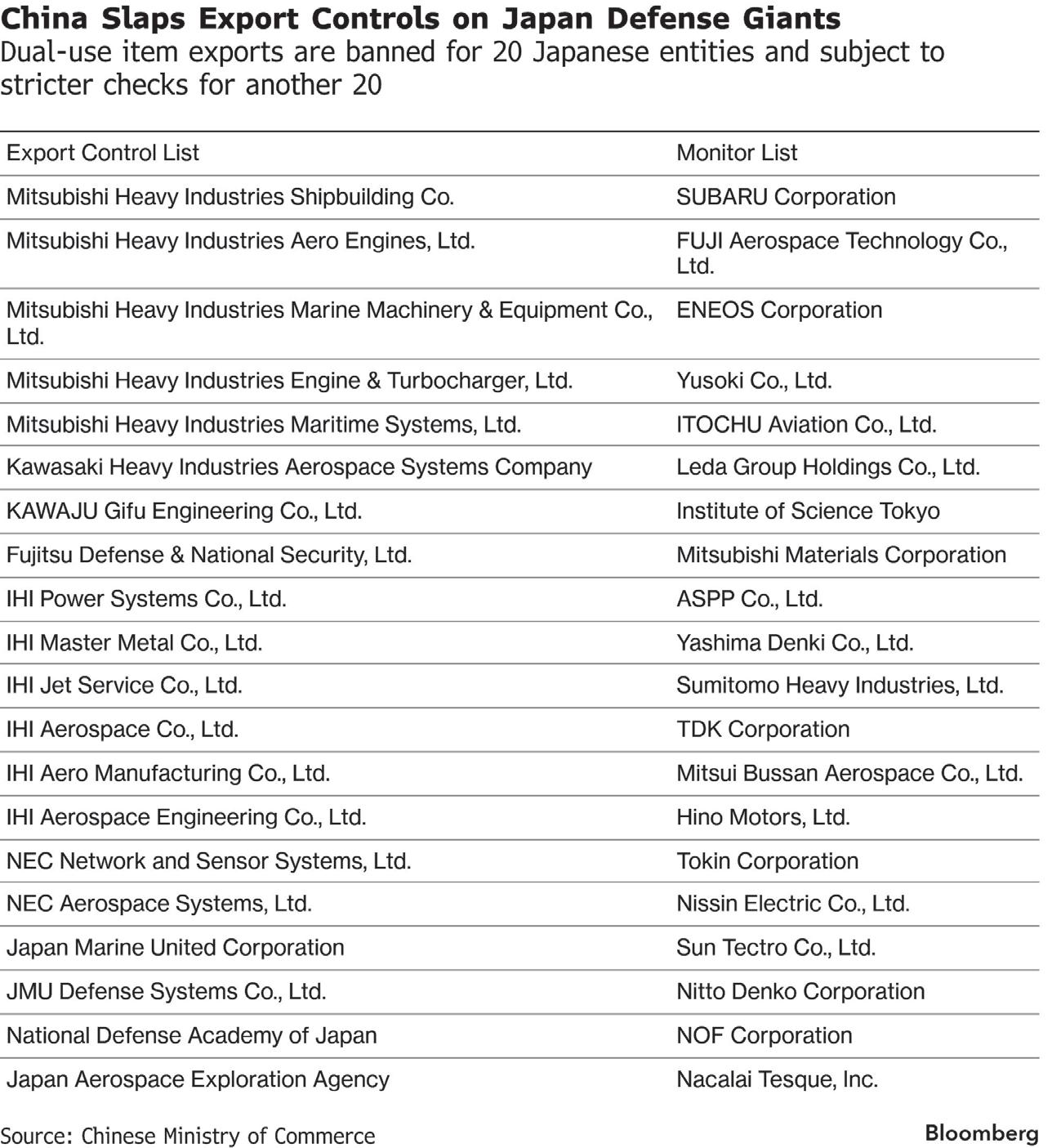
CHINA blacklisted 20 Japanese entities and tightened scrutiny on a raft of other firms, signaling Beijing’s pressure campaign on Tokyo isn’t slowing even after Prime Minister Sanae Takaichi’s recent landslide victory.
The Ministry of Commerce added companies including affiliates of Mitsubishi Heavy Industries to an export control list effective immediately, according to a Tuesday statement. The move marks the first time Japanese firms
were added to the list since its January 2025 debut.
In another measure, Beijing placed an additional 20 entities, including Subaru and Mitsubishi Materials Corp., on a monitor list. While not an outright ban, this status subjects exporters to stricter checks when they apply for a license to export dualuse items, which refer to goods with both civilian and military applications.
“China is clearly not letting up the pressure in spite of the Japanese PM’s landslide results,” said Dylan Loh, associate professor at Nanyang Technological University. “This serves a dual use whereby they can restrict alleged militarization and also deal a blow to these companies directly.”
The measures come on the heels of a broader ban announced earlier this year blocking exports to Japan with any military use, although the use of the monitor list for the first time signals an expansion of the scope of targets for further export control.
The news triggered a selloff in Tokyo’s defense and heavy machinery sectors, with Mitsubishi Heavy shares reversing gains to drop as much as 3.6%. Kawasaki Heavy and IHI Corp. extended losses to fall more than 5%.
Subaru shares extended declines to as much as 4.6% after the Chinese announcement.
Sumitomo Heavy Industries shares briefly erased their morning gains before rising again in the afternoon session.
The curbs mark the latest escalation in a dispute over comments on Taiwan by
Takaichi last year, when she suggested Tokyo could deploy its military if China uses force to try and seize Taiwan. Takaichi has refused to withdraw her comments on the island democracy, which China claims as its own territory.
Beijing said the latest moves seek to deter Japan’s remilitarization and nuclear ambitions. The ministry added that law-abiding Japanese entities have no cause for concern, though Takaichi’s calls for higher defense spending have rankled China.
The measures are Beijing’s first punitive actions after Takaichi won a resounding victory in a snap election earlier this month, securing a clear mandate for her policy agenda including a more assertive stance on foreign policy.
After Takaichi emerged with a historic majority, some Japanese officials were hopeful China would have little choice but to soften its tone on Tokyo.
The latest curbs suggest Beijing doesn’t intend to back down, unless Takaichi retracts her comments—a scenario that is politically impossible for her at home.
Beijing’s two-tiered approach allows it to better differentiate between known military contractors and those suspected of enhancing Japan’s military strength.
For firms on the export control list, the designation prohibits exporters from supplying them with dual-use items. It also bars overseas entities from providing the companies with dual-use technology that originated in China.
While the blacklist functions as a total ban, the monitor list imposes stricter scrutiny on firms like TDK Corp. and Hino Motors. For these companies, exporters must now provide documented proof of civilian end-use to clear the heightened licensing hurdles.
Under the monitoring rules, exporters cannot apply for general licenses for these firms. They must submit risk assessment reports and written pledges that goods will not be used to enhance Japan’s military capabilities, according to a Commerce Ministry statement.
Kazuto Suzuki, director of the Tokyo-based Institute of Geoeconomics, said the move was an attempt to send a political signal to Japan and likely wouldn’t lead to much disruption for Japanese companies.
“It’s about optics,” he said. “So long as companies send end-user certificates then they should still be able to get materials if they are not coming from the defense sector.”
China’s dual-use export control list features more than 800 items, ranging from rare
earths, chemicals, electronics and sensors to equipment and technologies used in shipping and aerospace.
Mitsubishi Heavy is one of Japan’s largest machine manufacturers, ranging from equipment for aircrafts, engines power plants and maritime systems. It has previously pinpointed China as a key market for the sale of gas turbines and engines, and is one of its major hubs for servicing equipment.
The company is also pushing ahead with developing nextgeneration nuclear energy technology.
Japan relied on China for around 70% of its rare earth imports as of 2024, according to the Japan Organization for Metals and Energy Security. That was more than a decade after China had wielded the materials as a weapon against Tokyo during a 2010 territorial dispute. At that time, the Chinese move wreaked havoc across Japan’s manufacturing industry. With assistance from Alice French, James Mayger and Alastair Gale/ Bloomberg
SANAE TAKAICHI in Tokyo on Feb. 24. KIYOSHI OTA/BLOOMBERG
Bloomberg Mayors Challenge winners use AI and resident input to improve city services
By Glenn Gamboa AP Business Writer
THE winners of this year’s Bloomberg Philanthropies Mayors Challenge created innovative projects to improve their cities’ core services—many using some combination of artificial intelligence and the wisdom of their residents.
That’s what South Bend, Indiana, Mayor James Mueller did with his initiative that uses AI to interpret data about residents, like a family falling behind on paying its water bill, and to help offer them services and support that could prevent larger issues.
“Technology is not necessarily good or bad—it’s how it’s used and how you protect against abuses,” said Mueller, a Democrat who has been mayor since 2020. “We’re trying to use cutting edge tools to deliver city services in a proactive way that meets our residents’ needs.”
The 24 winners announced Tuesday range from Boise, Idaho, where they are using geothermal energy to lower residents’ heating bills, to Beira, Mozambique, where they are relocating fishermen and their families from flood-prone coastal homes to safer inland houses. Each will receive $1 million to implement the program, as well as support from Bloomberg Philanthropies experts to help the new initiative succeed.
The hope, says former New York City Mayor Michael R. Bloomberg, founder of Bloomberg Philanthropies and Bloomberg L.P., is that successful programs from Mayors Challenge winners can be used in other cities.
“The most effective city halls are bold, creative, and proactive in solving problems and meeting residents’ needs—and we launched the Mayors Challenge to help more of them succeed,” Bloomberg said in a statement.
James Anderson, head of government innovation programs at Bloomberg Philanthropies, said many of this year’s winners are integrating AI technology into their work in sophisticated ways, bringing municipal governments closer to the residents they serve.
“Testing and learning and adapting new ideas don’t generally get funded with public dollars,” Anderson said. “It is up to philanthropy to support experimentation.”
Vico Sotto, mayor of Pasig City in the Philippines, said becoming one of this year’s Mayors Challenge winners will speed up his project to build floating parks in the Pasig River that will become new community space
and reduce flooding threats in the area. Without the support of Bloomberg Philanthropies, Sotto said the initiative wouldn’t be able to start for another year or two.
“The government doesn’t have a great reputation when it comes to maintaining infrastructure,” Sotto said. “So we will be creating a governance council, including people who live in the area, so definitely they’re not going to abandon these parks. They’re going to take care of them because they’re using them as well.”
In Lafayette, Louisiana, the cityparish had the opposite problem. Lafayette wanted to update parts of its sewer system, but because some parts were on homeowners’ property the city wasn’t allowed to pay for it.
Mayor-President Monique Blanco Boulet said the Mayors Challenge encouraged her administration to figure out a solution that will now allow Lafayette to make the repairs and, as a result, encourage development in the city. The plan was also named a Mayors Challenge winner.
“Bloomberg Philanthropies, the staff, Michael Bloomberg—all of them—have such a global impact in ways that most people will never know,” said Boulet, a Republican elected in 2023. “They bring in a level of capacity and give you the space to really be creative and to come up with solutions that can change lives.”
South Bend’s Mueller said that the Mayors Challenge comes at a time when more and more global problems need to be solved at a local level.
“Trust in government is at an alltime low, but local governments consistently perform better in surveys about trust from their residents,” Mueller said. “It is critical for us to maintain that level of trust with our residents and build it even further. So that’s why we’re always looking at innovative ways of doing things better and making the city a better place to live.”
The winners of the 2026 Bloomberg Philanthropies Mayors Challenge are: As-Salt, Jordan; Barcelona, Spain; Beira, Mozambique; Belfast, Northern Ireland; Benin City, Nigeria; Boise, Idaho, United States; Budapest, Hungary; Cape Town, South Africa; Cartagena, Colombia; Fez, Morocco; Fukuoka, Japan; Ghaziabad, India; Ghent, Belgium; Kanifing, The Gambia; Lafayette, Louisiana, United States; Medellín, Colombia; Netanya, Israel; Pasig, Philippines; Rio de Janeiro, Brazil; South Bend, Indiana, United States; Surabaya, Indonesia; Toronto, Canada; Turku, Finland; Visakhapatnam, India.
Trump’s 10% global levy takes effect as US rebuilds tariff wall
By Catherine Lucey
DONALD Trump’s new 10% global tariffs went into effect on Tuesday, kicking off a White House effort to preserve the president’s trade agenda after the Supreme Court struck down his original sweeping duties.
The president signed an executive order last Friday authorizing the 10% import tax just hours after the ruling. He subsequently threatened to raise the number to 15%, but Trump did not officially issue a directive to increase the rate by Tuesday at 12:01 a.m. Washington time when the 10% levy went into effect.
The White House is working on a formal order that will increase the global tariff rate to 15%, according to an administration official. The timeline for implementing that higher levy has not been finalized, said the official, who spoke on the condition of anonymity to discuss private matters.
The lack of clarity from Washington has spawned confusion around the globe about Trump’s tariff agenda. Countries and corporations are poring over existing trade agreements to determine how they’d fare under Trump’s latest threats. Major trading partners, including the European Union and India, have abruptly halted ongoing trade negotiations amid the uncertainty.
Trump is applying the 10% baseline levy under Section 122 of the 1974 Trade Act, which allows the president to impose the charge for 150 days without congressional approval. He turned to this approach after the court ruled he violated an emergency-powers law by using it to enact his so-called “reciprocal” tariffs on goods from countries worldwide.
The order preserved some exemptions, including for goods compliant with the North American trade pact between the US, Canada and Mexico as well as an exception for some agricultural
goods that existed under Trump’s invalidated levies.
The average effective US tariff rate will settle around 10.2% including those exemptions, down from 13.6% before the court decision, according to a Bloomberg Economics analysis. Under a 15% global levy, that effective rate would be about 12%, according to the study.
Trump’s team has said tariffs will remain central to his trade policy, reiterating plans to launch a series of investigations on accelerated timelines that allow him to unilaterally impose duties—all with the goal of rebuilding the tariff regime the court ruling effectively destroyed.
None of the authorities the White House has identified—such as Section 301 and Section 232— are as flexible as the emergency powers Trump had previously used to wield leverage against trading partners.
The administration is preparing to launch investigations into the impact of importing a spate of industrial goods—including batteries, cast iron and iron fittings, electrical grid and telecom equipment, plastic piping and some chemicals—on the basis of national security concerns.
The probes, which haven’t yet been officially announced, are a precursor to new tariffs, but could take months to conclude.
As they respond to the justices’ decision, administration officials have urged trading partners to uphold deals they’ve negotiated with the US over the last year.
“We want them to understand these deals are going to be good deals,” US Trade Representative Jamieson Greer said on CBS’s Face
Trade, Ukraine and new world order are top concerns on German leader’s visit to China
By Ken Moritsugu & Geir Moulson
The Associated Press
BEIJING—The first official trip to China by German Chancellor Friedrich Merz comes as his country’s manufacturers face increasing pressure from Chinese competitors and as US President Donald Trump shakes up a post-World War II global order that Europe has long depended on.
Merz is set to arrive Wednesday for a two-day visit, the latest in a parade of world leaders to visit Beijing ahead of a trip by Trump in about five weeks.
Besides Germany’s growing trade deficit with China, Merz is expected to raise Chinese backing for Russia’s position in the war in Ukraine, though no change from the Chinese side is foreseen.
China is seeking support from other nations to push back against Trump’s challenges to international rules and organizations, but Merz has signaled wariness about China’s view of a 21st century order. Success may be measured by finding small ways to cooperate despite differences on major issues.
“As the world’s second and third largest economies, sound China–Germany relations
serve the interests of both sides and meet the expectations of the international community,” Chinese Foreign Ministry spokesperson Mao Ning said Tuesday. She added that “the Ukraine crisis is not and should not become an issue between China and Europe.” China says it has “an objective and impartial position,” which puts it at odds with Germany and much of Europe.
German imports from China rise while exports to China fall MERZ opens his trip with talks Wednesday with China’s Premier Li Qiang and top leader Xi Jinping, whose reduced international travel means foreign leaders must travel to Beijing if they want to meet him. On Thursday, the German chancellor plans to visit a Mercedes-Benz facility and travel to Hangzhou, a high-tech city that is home to e-commerce giant Alibaba and leading robot developer Unitree Robotics. He is bringing a delegation of business leaders looking to expand sales. China has long been an important market for Germany, a major exporter of manufactured goods. But advances by Chinese companies in recent years have turned them into formidable competitors, notably in the automobile industry, where new electric vehicle makers
are challenging Volkswagen and other leading brands.
Last year’s foreign trade figures underlined concern over the imbalance in economic ties. German imports from China rose 8.8% to 170.6 billion euros ($201 billion), helping Chinese manufacturers offset a decline in US imports because of Trump’s tariffs. Meanwhile, German exports to China fell 9.7% to 81.3 billion euros.
The growing imbalance has stepped up longstanding German demands that China reduce its trade barriers and open its markets further to foreign competitors.
Merz says Germany should have no illusions about China
MERZ’S visit follows French President Emmanuel Macron in December and the leaders of Ireland, South Korea, Canada, Finland and Britain last month.
In an address to the German parliament in January, Merz said Europe needs to “learn the language of power politics” to assert itself in a changing world and become stronger economically and militarily. The emerging world order also opens opportunities for Europe, he said, as democracies with open and growing markets “seek what we have to offer them, namely partnerships on the
basis of mutual respect, trust and reliability.”
He also said recently that Germany should have no illusions about China, which he said “asserts the claim to define a new multilateral order according to its own rules.”
Shortly after this week’s China trip, Merz plans to make his second visit to Washington since taking office in May.
While some countries—notably Canada and the U.K.—seek to repair ties with China, Germany’s goal is to maintain a relationship that has become more complicated in recent years.
Germany still recognizes China as a vital economic partner but now also sees it as a competitor. The government, in what has become known as de-risking, has sought to reduce the country’s dependence on China as an export market and for strategic products such as rare earths, which are widely used in the automotive, tech and defense industries.
On a visit to Beijing in December, German Foreign Minister Johann Wadephul discussed his government’s concerns over Chinese government subsidies to targeted industries, the manufacturing overcapacity that has boosted exports, restrictions on the export of rare earths and the Russia-Ukraine war.
Moulson reported from Berlin.
the Nation on Sunday. “We’re going to stand by them. We expect our partners to stand by them.”
That argument proved less than reassuring to some major economies. The European Union froze ratification of its agreement with the US on Monday until Trump firms up his latest tariff plans. In New Delhi, officials cited similar reasons for India postponing talks in the US this week on finalizing an interim trade deal.
PRESIDENT Donald Trump speaks before he signs a presidential memorandum imposing tariffs and investment restrictions on China in the Diplomatic Reception Room of the White House, March 22, 2018, in Washington. AP/EVAN VUCCI
A8 Wednesday, February 25, 2026 | www.businessmirror.com.ph
EDSA People
Yellow Confetti and Ironies: Revisiting the 1986 People Power Revolution
Forty years later, the 1986 People Power Revolution stands as a turning point in Philippine history— a movement fueled by economic hardship, political oppression, and the courage of everyday Filipinos.
By Joel C. Paredes
WHEN Ferdinand Marcos
Sr. declared victory in the November 1985 snap elections, Malacañang believed the storm had passed. Months of state propaganda had painted Corazon Aquino as a political novice—a “mere housewife” pitted against a seasoned strongman.
Yet, the discredited regime’s triumph was hollow. Reports of widespread vote-buying, intimidation, and ballot box theft cast a shadow over the results. By February 9, 1986, computer technicians staged a dramatic walkout from the Comelec count, protesting manipulated outcomes and exposing the regime’s desperation to cling to power.
Mrs. Aquino refused to accept the Election Tribunal’s official tally. She called for civil disobedience, urging the people to boycott businesses, media, and banks tied to the regime. Her leadership galvanized the mainstream opposition, especially after the assassination of her husband, Benigno “Ninoy” Aquino, in 1983—a tragedy many attributed to Mr. Marcos.
By February, the nation’s pulse was reaching a breaking point, with the public’s patience stretched thin.
The 1986 People Power Revolution, which took place forty years ago, was more than a reaction to electoral injustice—it was also driven by the severe economic hardship that gripped the Philippines after twenty-one years of rule under Mr. Marcos Sr. Economic Hardship and Lost Opportunity
President Marcos Sr. had once
promised to transform the Philippines from a “nation of ningascogon” to a nation of achievers. Instead, the country faced mounting debt and entrenched cronyism. By the mid-1980s, the Philippines was dubbed the “Sick Man of Asia.” National debt had ballooned to US$26 billion, and the economy shrank by over 7% for two consecutive years—the worst recession in its history. Prices for basic goods soared, pushing poverty rates to nearly 60%.
Economists warned that Third World nations failing to achieve rapid growth by the late 1970s risked stagnation, suggesting that if a country missed its “economic take-off,” it could be permanently left behind. While South Korea and Singapore advanced, the Philippines—burdened by debt and crony capitalism—missed its opportunity.
The assassination of Ninoy Aquino also shattered investor confidence, and the debt-driven growth of the 1970s was over. Mr. Marcos found his country officially broke.
The Unlikely Alliance
On February 22, 1986, Defense Minister Juan Ponce Enrile and Police General Fidel Ramos broke from the regime, seeking refuge
in Camps Aguinaldo and Crame. Cardinal Jaime Sin’s broadcast on Radio Veritas rallied millions, forming human barricades along EDSA. The iconic image of nuns offering rosaries to tank commanders became a symbol of the four-day People Power.
Overnight, Enrile and Ramos—once architects of martial law—were hailed as heroes for dismantling it.
Mrs. Aquino, in Cebu City for a civil disobedience rally, was sheltered by Carmelite nuns after news of the uprising. She returned the next morning to Manila, insisting on civilian leadership and rejecting military rule, galvanizing the masses.
Economic decline had forced an alliance between traditional business leaders and the opposition. The Makati Business Club
and financial elites, frustrated by crony monopolies, turned Ayala Avenue into a sea of yellow confetti.
At EDSA, yellow became the color of resistance, a tradition that began when supporters of her husband, Benigno “Ninoy” Aquino, decided to welcome him by tying yellow ribbons on the streets and posts. This gesture was inspired by the song “Tie a Yellow Ribbon Round the Old Oak Tree,” popularized by American pop singer Tony Orlando.
Following Ninoy’s death, yellow ribbons and confetti became widespread symbols of defiance and resistance against the Marcos regime. It emerged as a symbol of protest, with Mrs. Aquino, who was often seen wearing yellow outfits, adopting it as her signature election campaign color.
For the political left and longterm opposition who joined the EDSA protest, the People Power Revolution was not an “overnight miracle,” but rather the culmination of years of struggle—marked by grassroots activism, underground movements, and steadfast resistance to torture and exile.
It was definitely not just a four-day military mutiny or American intervention, even if it was US President Ronald Reagan, through Senator Paul Laxalt, who advised Mr. Marcos to step down, leading to the regime’s exit and Mrs. Aquino’s inauguration.
Pahayagang Malaya, widely known then as part of the “mosquito press,” was among the few independent media outlets that courageously reported on the events as they unfolded. On February 25, 1986, it was Malaya that broke the news of Ferdinand Marcos Sr. and his family being airlifted to Hawaii from Malacañang Palace.
With mainstream media tightly controlled by the government, Filipinos turned to Malaya for reliable updates, trusting it to reveal the truth behind the downfall of the regime.
During Mr. Marcos’s mar-
tial law era, an estimated 70,000 people were imprisoned without formal charges. Those detained included political opponents, student activists, journalists, labor leaders, and church workers.
Reports also indicate that more than 3,200 individuals were killed by military and police forces, many falling victim to “salvaging”—a term used for summary executions carried out by rogue law enforcement officers. Systematic and severe torture of detainees became a notorious hallmark of this period.
From Marcos cronies to old, new oligarchs
The legacy of EDSA has always been rooted in the people’s refusal to be sidelined. While opposition politicians, generals, and business leaders played roles, it was the ordinary Filipinos who provided the genuine “power.”
But as Winston Churchill said, “history is written by the victors,” and 1986 was no exception. Many political bystanders became democracy champions, and the old regime’s cronies were replaced by a new “elite technocracy.”
Corporate leaders transitioned from boardrooms to government, allowing private interests to influence state policy. Through “privatization,” many government-owned corporations—previously seized from Marcos cronies—were sold back to pre-martial law elites. These traditional oligarchs regained power by presenting their interests as “free-market reforms,” shaping economic policies that favored large-scale private enterprise, often at the expense of land reform and labor rights.
While the boardrooms of Makati provided the new technocrats, the provinces provided the “ balimbing s.” Coined after the multi-sided starfruit, these political turncoats – many of whom were former Marcos loyalists and warlords—managed to squeeze themselves into the Aquino coalition. This eventually established a
recurring cycle, a regime change that replaces the top leadership, but leaves the opportunistic machinery of the “ balimbing s” intact.
Despite their long-standing service, most individuals who worked under the Marcos bureaucracy were stigmatized and frequently treated as political outcasts. Many were replaced by new bureaucrats and government workers, even though numerous former employees were simply part of the established career service.
The transition was complicated and often harsh, as new elites rose to power and old interests resurfaced.
The Reluctant Hero
Through it all, Corazon Aquino stood as a reluctant hero, embodying the hope of a nation determined to reclaim its future. Despite the complexities of the post-EDSA revolution era, Mrs. Aquino—often seen as modest—demonstrated remarkable resilience and emerged as the central figure in this pivotal chapter in that era.
In a time dominated by strongmen, she embodied a unique form of strength, uniting business leaders and ordinary citizens while facing a series of attempted military coups against her administration. Stepping into that void of a politically damaged nation, she showed that her presidency was not by personal ambition, but by a sense of duty that many came to see as her destiny.
In one of her speeches during the years I was covering her presidency, she declared, “the price of liberty is eternal vigilance because the hunger for tyranny is never satisfied.’”
“We triumphed over tyranny before; tyranny cannot triumph over us again – not while we are many, vigilant and united,” she emphasized.
Forty years later, the 1986 People Power Revolution stands as a turning point in Philippine history—a movement fueled by economic hardship, political oppression, and the courage of everyday Filipinos.
With the masses at the frontlines, the collaboration between business leaders, political opposition, and grassroots activists succeeded in toppling a dictatorship and ushered in a new, if fragile, democracy.
The country’s political landscape later underwent significant changes, but for those around the world who witnessed this momentous event, it was an enduring example of how the resilience of Filipinos can inspire all who cherish freedom.
• Joel C. Paredes, BusinessMirror Senior Special Correspondent, has over four decades experience in journalism, serving in both local and foreign media, and was Chief of Reporters of the Joe Burgos-era
Changing colors. At the EDSA Shrine, where Our Lady of EDSA stands, buntings in festive colors decorate the area in celebration of the 40th anniversary of EDSA People Power. PHOTOS BY BERNARD TESTA
People Power@40
BusinessMirror Special Feature
THE UNFINISHED STORY OF EDSA: A GEN Z PERSPECTIVE ON DEMOCRACY
We don’t need to replicate 1986 in form, but to uphold its principle in substance, to refuse silence when public trust is betrayed, to demand transparency when projects fail.
By John Eiron R. Francisco
I USED to think the EDSA People Power Revolution was a finished story. When I first encountered it in fifth grade, EDSA existed inside the pages of a textbook. It was summarized into structured paragraphs and accompanied by black-and-white photographs.
To me, EDSA was not yet the busy highway filled with traffic and advertisements. It was an image frozen in time: civilians standing unarmed before soldiers and tanks, nuns praying with rosaries in their hands, ordinary citizens forming a human barricade against something larger and more dangerous than themselves.
Yes, I did not witness the events of February 22 to 25, 1986. I was born years after more than two million Filipinos gathered along EDSA. I did not hear the tension in their voices or feel the fear of standing defenseless before armed men. But even as a child, I sensed something deeper beneath the summary. Those who gathered along EDSA did not know how it would end. They did not have the comfort of hindsight. They stood there without guarantees. What they had was a shared conviction that remaining silent would cost more than speaking out.
Our teacher explained why it happened. Many Filipinos were already tired of the Marcos dictatorship. In 1972, President Ferdinand Marcos Sr. declared Martial Law, saying it was needed to control violence and threats in the country. But over time, Martial Law led to arrests, censorship, and abuse of power. Many people lost their freedom, and fear became part of daily life.
In 1983, opposition leader Benigno “Ninoy” Aquino Jr. was assassinated when he returned to the Philippines from exile. He had been one of the strongest critics of the Marcos administration. His death shocked the nation
and angered many Filipinos. It became a turning point. More people began speaking out and joining protests. In 1986, Marcos called for a snap election against Corazon “Cory” Aquino, Ninoy’s widow. The official results declared Marcos the winner, but many believed the election was rigged. Reports of cheating spread. Even some election workers walked out in protest. Soon after, key military officials withdrew their support from Marcos. Church leaders called on the public to protect them. Through Radio Veritas, Cardinal Jaime Sin urged people to gather along EDSA. Thousands came. Then hundreds of thousands. Eventually, more than two million civilians stood along the highway, not with weapons, but with prayers, food, and courage. After four days, Marcos left the coun-
try. Cory Aquino became president. And what started as a protest became known as the EDSA People Power Revolution.
That was the story I learned in school. We underlined names. We memorized dates. There were no viral clips to replay the moment, no social media debates reshaping the narrative. There was just the book. And the book made it seem complete. The dictator had fallen. The people had won. The country had been restored.
Yet, in my young mind, I assumed history behaved itself. It stayed in the past where it belonged. EDSA felt like proof that the worst chapter had already ended. And since it was presented that way, I assumed it was finished. I was wrong.
Now at 25, living independently and seeing the country through a more critical lens,
I understand that EDSA was not an ending. It was a reset. It reopened democratic space. It restored the right to speak, to question, to organize, to criticize. It reminded Filipinos that power ultimately comes from the people.
But democracy does not sustain itself simply because it exists. It requires participation. It demands vigilance. It depends on citizens who are willing to stay informed and hold leaders accountable.
Sometimes I ask myself what kind of Philippines we would have today if those millions had chosen to stay home. If fear had stopped them. The freedoms I now use, to write, to criticize, to express opinions, exist because they refused to remain silent. My generation is living inside the space they opened and fought to protect.
But I came to realize that the problems did not disappear with the “fall of a dictator.”
Today, corruption remains visible. Flood control projects fail when heavy rains come, revealing not just poor construction but misplaced priorities. School buildings remain unfinished, while students endure overcrowded classrooms and unsafe learning spaces. Some children are deprived of opportunities because the system meant to support them is weak or neglected.
We have also seen periods where power was exercised without accountability. Thousands lost their lives during the drug war campaign under the Duterte administration, raising serious concerns about human rights and due process.
Public funds are still questioned. Promises of reform are often replaced by political convenience. Accountability moves slowly, and sometimes it feels incomplete.
At my age, politics no longer feels distant or theoretical. I experience it in daily life. I pay rent. I sit in traffic made worse by poor urban
planning. I adjust my budget because of inflation. When infrastructure fails, it is not just a headline; it becomes a flooded street, a delayed salary, and a disrupted routine.
And when medical assistance falls short, the consequences are even more serious; lives are lost, not because solutions are impossible, but because systems fail to deliver them.
Democracy, I have learned, does not guarantee good governance. It can weaken quietly. It erodes when corruption becomes routine, when misinformation spreads unchecked, and when citizens grow too tired or distracted to engage.
They say history repeats itself, but I believe it doesn’t return in the exact same form. It changes. It adapts.
Today, we are not confronted by tanks lining a highway. Instead, we face something less visible but equally powerful: misinformation spreading quickly online, historical narratives being revised, and political campaigns focused more on personality than policy.
When was younger, information came from one textbook. Now, it arrives constantly from social media posts, short videos, comment sections, and opinion threads. The challenge is no longer access to information. The challenge is determining what is accurate, what is misleading, and what is deliberately manipulated.
The arena of engagement has shifted. Instead of physical barricades, there are digital spaces where ideas compete. Falsehoods can spread as quickly as facts. Memory can be reshaped by repetition.
Yet I believe my generation carries the same underlying spirit that moved those who
gathered in 1986. We are often described as outspoken and willing to engage in public discussions. Our methods may look different, but engagement remains necessary.
Participation today may not always be a dramatic protest. It might be voting carefully. Reading beyond headlines. Asking uncomfortable questions. Calling out misinformation. Refusing to normalize corruption. Demanding better infrastructure, better policies, and better accountability.
The people who stood in 1986 did not guarantee us a perfect country. What they gave us was a chance, a framework, a reset. What we do with that chance is our responsibility.
For my generation, we don’t need to replicate 1986 in form, but to uphold its principle in substance, to refuse silence when public trust is betrayed, to demand transparency when projects fail. To protect when it is distorted, to remember that freedom once secured can still be weakened by apathy. Silence is a choice, and so is participation. The two million who gathered decades ago made theirs. Now, quietly and steadily, it is our turn to make ours.
As grew older, I stopped seeing EDSA as a faraway event locked inside a history book. I began to understand it as a reminder that democracy is never truly complete. It has to be lived and exercised every day. It is something we are responsible for safeguarding. Democracy is not a one-time victory that secures itself forever; it requires constant practice. And the freedoms once won can still weaken if we fail to value and protect them.
EDSA People Power Revolution: What lessons it teaches us today
Through these diverse testaments from different walks of life, a singular point emerges: the story of the People Power Revolution is still very much alive.
By Vincent Peter Rivera
HE EDSA People Power Revo -
Tlution remains a cornerstone of Philippine history—a testament to the regained freedom of hundreds of thousands of Filipinos who staged a nonviolent protest to end the 14-year dictatorship of former President Ferdinand Marcos Sr. However, as 40 years have passed, the collective memory of the event has begun to slip from the grasp of today’s people. Many who stood on the front lines have since passed away or grown old, while newer generations must rely on second-hand accounts of a revolution they never saw.
Amidst this shifting demographic, one must ask: what is the significance of “People Power” to the Filipino masses today? The passage of time has not dimmed the significance of the revolution; instead, it has refocused it. For the post-EDSA generation, the event serves as a foundational lesson in the power of civil society. .
Symbol of unity and responsibility
Cedrick Rea, a 25-year-old marketing assistant from BusinessMirror Advertising, views the uprising as a powerful reminder that ordinary citizens possess the inherent ability to steer the nation’s trajectory.
To him, it is a living representation of courage, democracy, and collective strength.
“For me, EDSA is not just a historical event—it is a symbol of unity and responsibility. It reminds us that power does not only belong to those in government, but also to the people,” Rea shared. “When leaders take advantage of public funds, engage in corruption, or fail to serve the nation with integrity, citizens have the right and responsibility to demand transparency and justice.”
Despite not witnessing the 1986 protests firsthand, Rea believes the revolution’s spirit is more relevant than ever in an era where misinformation and political division are rampant. He contends that the revolution offers a timeless blueprint: that systemic change remains possible so long as the populace stays informed and committed to protecting the fragile threads of democracy.
Possibilities for transformation
This sentiment of hope as a necessity is echoed by those who use their art as a form of resistance. Cooky Chua, the iconic lead singer of Color It Red and a dedicated activist, views EDSA as proof that a peaceful path to democratic change is not just a dream, but a proven reality. Para sa akin, ang EDSA ay simbolo na posible ang pagbabago—na may boses ang taumbayan at kayang makamit ang demokrasya sa mapayapang paraan,” Chua explained.
At the same time, as a parent, she sees maintaining this belief as an act of parental love and mental
survival, stating, “Bilang magulang, mahalagang maniwala ako dito dahil pangarap kong maranasan ni Waki ang isang Pilipinas na maunlad, masagana, ligtas, at tahimik.”
By holding onto the memory of a united populace, she finds the strength to continue advocating for a Philippines that is secure and prosperous for the next generation, ensuring that her son inherits a nation that listens to its people.
Reminder of vigilance, moral courage
The fragility of these hard-won freedoms is a recurring theme for singer-songwriter Trina Belamide. She views the revolution as a cautionary tale about the nature of power and the ease with which it can be overextended.
“The EDSA People Power remains meaningful to me because it reminds us all that democracy depends on citizens who are willing to speak up when power is abused,” Belamide noted. “The experience of martial law under Ferdinand Marcos showed how fragile freedoms can be, and current global tensions continue to underscore that lesson.”
To her, EDSA is a reminder that vigilance, participation, and moral courage are essential in the Filipino consciousness, marking the boundary where silence must end, and action must begin.
However, for some, the current political landscape brings a sense of historical irony. Jing Ordoña, a
tour guide and travel writer who has transitioned from a “martial law baby” to a senior citizen, reflects on the cyclical nature of Philippine leadership.
Witnessing the revolution come full circle with the return of the Marcos family to Malacañang, he questions if the original sacrifice is still being honored.
“From dictator to dictator’s son after forty years, is the Filipino still worth dying for? Ninoy Aquino made this iconic quotation as a call to action and a supreme sacrifice,” Ordoña mused. “Millions of Filipinos risked their lives and made the ultimate sacrifice... and now it has come full circle with the dictator’s son back at the helm.”
Despite the political shifts, Ordoña’s personal resolve remains
unshaken. He views his life’s journey—from student leader to his current role—as a continuous thread of resistance. For him, the “spirit of EDSA” is not simply a memento but a persistent flame that fuels his ongoing fight against any form of dictatorial rule.
Presence over fear
The reach of the revolution extended far beyond the capital, touching lives in the provinces and shaping the perspectives of future industry leaders. Cleofe Albiso, Managing Director of Megaworld Hotels & Resorts, remembers the stories of EDSA reaching her in Cebu. To her, the revolution was an act of “presence over fear.”
“Growing up in Cebu, the EDSA Revolution was always told to me
as a story of courage without violence—a moment when ordinary Filipinos stood together and quietly reminded the world that power ultimately rests in the hands of citizens,” Albiso recalled. “From where I stood, far from Manila yet deeply connected to it, EDSA did not feel distant. It felt human.”
Now, as a leader in the tourism sector and a mother in 2026, Albiso views the legacy of People Power as a factor in national morale and international perception. She argues that the confidence a nation has in its own systems is visible to the world, influencing everything from social stability to the warmth of a hotel’s service.
“True power is not exercised only in extraordinary moments. It is practiced quietly in everyday accountability, in choosing dialogue over division, and in building institutions that are inclusive and equitable,” Albiso added.
“People Power was never meant to be a moment; it was meant to be a mindset—a mindset we nurture within our networks and circles of influence, and intentionally pass on to our children,” he concluded.
Through these diverse testaments from different walks of life, a singular point emerges: the story of the People Power Revolution is still very much alive. While this historic event may have a different context to every Filipino, the bottom line remains the same—it is, and will always be, a story of freedom.
Workers clean the base of the People Power Monument, which features images of soldiers, nuns, priests, soldiers, and ordinary citizens who rallied for democracy along EDSA in 1986.
Moving forward. For the post-EDSA generation, the event serves as a foundational lesson in the power of civil society.
A10 Wednesday, February 25, 2026
Ousted S. Korean president appeals life sentence for martial law decree
By Kim Tong-Hyung The Associated Press
SEOUL, South Korea—South Korea’s jailed former president, Yoon Suk Yeol, has appealed his life sentence for rebellion over his brief imposition of martial law in December 2024, his lawyers said Tuesday.
The conservative leader, who faces multiple trials over his power grab, expressed defiance following his conviction at the Seoul Central District Court last week. He called the decision illogical, said his actions were “solely for the sake of the nation and our people,” and accused the judge of being biased against him.
In a text message, Yoon’s lawyers said they aimed to address the supposed “errors in fact-finding and misinterpretations of the law” contained in last Thursday’s ruling. The case will now be sent to a specialized panel at a Seoul High Court established under a law passed in December to handle cases involving rebellion, treason and foreign subversion.
“We will never be silent about what we view as an excessive indictment by a special prosecutor, the contradictory judgment rendered by the lower court based on that premise, and its political circumstances,” Yoon’s legal team said.
Yoon’s martial law decree, announced late at night on Dec. 3, 2024, lasted about six hours until a quorum of lawmakers broke through a blockade of heavily armed soldiers and police at the National Assembly. They then voted to overturn it, forcing his Cabinet to lift the measure.
Yoon was suspended from office on Dec. 14, 2024, after being impeached by the liberal-led legislature and was formally removed by the Constitutional Court in April 2025. He was re-arrested in July and now faces eight criminal trials over the martial law debacle and other allegations, with the rebellion charge carrying the heaviest punishment. Though brief, Yoon’s martial law decree triggered the country’s most severe political crisis in decades, paralyzing politics and high-level diplomacy and rattling financial markets. The turmoil eased only after his liberal rival Lee Jae Myung won an early presidential election last June.
Yoon has claimed that his martial law decree was a legal and necessary act of governance against liberals controlling the legislature, portraying them as “anti-state” forces paralyzing state affairs by impeaching high-level officials, cutting his budgets and obstructing his agenda.
But the Seoul Central District Court said Yoon’s actions amounted
to orchestrating a rebellion, ruling that he mobilized troops and police in an unlawful bid to seize the legislature, arrest political opponents and establish unchecked rule for a “considerable time.”
A special prosecutor who investigated Yoon’s rebellion charges had sought the death penalty, saying he deserved the harshest punishment under the law given the threat his actions posed to the country’s democracy. Following last week’s ruling, Jang Woo-sung, a member of the special prosecutor’s investigation team, hinted that they intended to appeal, saying they had unspecified “reservations” about some of the court’s factual findings and the severity of the sentence.
South Korea has not executed a death-row inmate since 1997, in what is widely seen as a de facto moratorium on capital punishment and popular calls for its abolition.
Yoon is the first former South Korean president to receive a life sentence since late military dictator Chun Doo-hwan, who was sentenced to death in 1996 for his 1979 coup, a bloody 1980 crackdown on prodemocracy protesters in Gwangju that left more than 200 people dead or missing, and corruption. The Supreme Court later reduced Chun’s sentence to life imprisonment, and he was released in late 1997 under a special presidential pardon.
Trump. . .
Continued from A7 Trump on Monday threatened even higher tariffs on partners that “play games” with their existing agreements.
European Central Bank President Christine Lagarde said on Face the Nation that it’s “critically important” for global trade to “have clarity” from the US
Soldiers keep up clash with cartel gunmen after Mexico’s military killed top drug lord
By Megan Janetsky & María Verza The Associated Press
TAPALPA, Mexico—A day after the Mexican army killed the country’s most powerful drug lord, the picturesque town where it happened was a study in contrasts.
Children whose classes had been suspended by the outbreak of violence played in cobblestone streets and tourist shops were open on Tapalpa’s main plaza Monday. But gunshots also rang out, and just outside the town a dead man lay on the road next to a Jeep sprayed with bullets.
Meanwhile, heavily armed Mexican security forces kept up their battle with cartel gunmen following the killing that sparked a surge in violence and put the country on edge. Cartel fighters continued to block roads as smoke rose on the outskirts of the town in the state of Jalisco.
More than 70 people died in the attempt to capture Nemesio Oseguera Cervantes and the aftermath, authorities said Monday. Known as “El Mencho,” he was the notorious leader of the Jalisco New Generation Cartel, one of the most powerful criminal organizations in Mexico.
The body count taken by security officials included security forces, suspected cartel members and others. Officials did not offer details, and the circumstances of most of the deaths were unclear.
Fast-growing cartel
OSEGUERA CERVANTES was the boss of one of the fastest-growing criminal networks in Mexico, known for trafficking fentanyl, methamphetamine and cocaine to the United States and staging brazen attacks
administration.
Trump’s threat to raise the global baseline to 15% has also rattled some traditional allies that cut deals with Trump. The UK negotiated a 10% rate with the administration last year and the higher level could create a less favorable situation for its exporters.
Meanwhile, other more adversarial nations including China may find their hand strengthened in negotiations with Trump now that
against Mexican government officials. The organization responded to his death with widespread violence, including erecting more than 250 roadblocks across 20 states and setting fire to vehicles.
The capo died after a shootout with the Mexican military on Sunday. Mexican Defense Secretary Gen. Ricardo Trevilla said Monday that authorities had tracked one of his romantic partners to his hideout in Tapalpa.
The cartel leader and two bodyguards fled into a wooded area where they were seriously wounded in a firefight. They were taken into custody and died on the way to Mexico City, Trevilla said.
In a different location in Jalisco, soldiers killed another high-ranking cartel member who Trevilla said was coordinating violence and offering more than $1,000 for every soldier killed.
Mexican authorities reported that 25 members of the Mexican National Guard were killed in six separate attacks, while some 30 criminal suspects were killed in Jalisco, and four others in the neighboring state of Michoacan. Also killed were a prison guard and an agent from the state prosecutor’s office.
The White House confirmed that the US provided intelligence support to the operation to capture the cartel leader and applauded Mexico’s army for taking down a man who was one of the most wanted criminals in both countries.
Violence surges in Jalisco
MEXICO hoped the death of the world’s biggest fentanyl traffickers would ease Trump administration pressure to do more against the cartels, but many people were anxious as they waited to see the powerful cartel’s reaction.
his emergency powers have been curtailed. The US president is set to visit Beijing late next month for a highly anticipated meeting with his counterpart, Xi Jinping.
The tariffs took effect hours before Trump is expected to deliver his State of the Union address to Congress, which will be attended by Democrats and some Republicans who have opposed elements of his trade policy.
The prime-time speech is ex -
As the threat of more violence loomed, several Mexican states canceled school Monday, while local and foreign governments warned their citizens to stay inside.
Steve Perkins, 57, had been visiting Puerto Vallarta with his wife and friends. The couple was scheduled to return to Broken Arrow, Oklahoma, on Monday when their flight was canceled.
Perkins said he and his wife were having coffee on the terrace of their hotel room in downtown when they heard rounds of explosions and gunshots, and saw smoke billowing over the city around 8:30 a.m.
“The entire downtown in the bay was just covered in thick black smoke, pretty scary,” Perkins said. “And then at one point, we heard screams. We heard a lot of screams...So then we started getting really worried.”
Perkins and his wife traded out their flip-flops for running shoes in case “we needed to make a run for it.”
“My wife called our kids to tell them goodbye if we were never gonna see them again,” Perkins said. The US Embassy said via X that its personnel in eight cities and in the state of Michoacan would shelter in place and work remotely Monday. It warned US citizens in many parts of Mexico to do the same.
Many fear what comes next IN Guadalajara, the state capital, some ventured out into the streets to work and buy supplies, a notable change from Sunday, when Mexico’s second-largest city was almost completely shut down as fearful residents stayed home.
See “Mexico,” A11
pected to focus on his economic agenda as Republicans try to land on a midterms message for an electorate frustrated by the cost of living. The public is souring on Trump’s trade policies and increasingly sees them as driving prices higher, polls show. A Washington Post/ABC/Ipsos survey found that 64% of Americans disapproved of Trump’s handling of tariffs, compared with 34% who approved. Bloomberg News
Panama to occupy canal ports after top court scraps CK Hutchison deal
By Michael McDonald
PANAMANIAN President José Raul Mulino ordered the temporary occupation of two ports run by a unit of CK Hutchison Holdings Ltd. following a top court’s ruling against the firm’s concession, escalating a dispute that has become a proxy battle between the US and China in Latin America.
Mulino said in a speech Monday that the administration and operation of the two ports on the strategic Panama Canal will revert to the country’s National Maritime Authority to guarantee the facilities’ “uninterrupted, safe and efficient operation.”
The occupation applies to movable equipment at the ports and “does not imply the definitive loss of ownership rights,” Mulino said. The state will return the property, including cranes, to its owners “when the determining reason for the occupation ceases,” he added. Panama will pay corresponding compensation, unless the equipment is sold to a new party, he said.
CK Hutchison said it considers Panama’s takeover of the two ports, and the court’s earlier ruling, unlawful. The country “is responsible for harm and damage caused by the confiscatory actions it has taken,” the company said in an e-mailed statement on Tuesday.
Its subsidiary Panama Ports Company ceased all operations at the Balboa and Cristobal terminals on Monday as Panamanian representatives “arrived without invitation” and informed the company’s employees the concessions granted to the unit no longer existed, according to the statement.
CK Hutchison’s Hong Kong-listed shares slid as much as 2.2% during Tuesday morning trading.
‘Back foot’
THE conglomerate founded by Hong Kong billionaire Li Ka-shing has resisted Panamanian authorities’ attempt to revoke its right to operate the two ports. Panama’s latest decision adds fresh uncertainty into long-gestating talks over Li’s deal to sell 43 global facilities to a consortium backed by US investment firm BlackRock Inc.
The deal has become a proxy for the US-China rivalry, and is one of the company’s most geopolitically complex yet. Announced in March last year, it could net CK Hutchison more than $19 billion in cash if completed. As talks drag on, parties involved have been considering ways to move the discussions forward—including splitting the assets into separate parcels with different ownership structures—Bloomberg has reported.
“The remaining ports will, eventually, be sold. But not anytime soon. Not when CKH is on the back foot,” said David Blennerhassett, an analyst at Quiddity Advisors.
To win Beijing’s approval, CK Hutchison also earlier invited state-owned China Cosco Shipping Corp. to join the buyer consortium.
Panama’s maritime authority has signed contracts with APM Terminals, a division of AP Moller-Maersk, and Switzerland-based MSC Mediterranean Shipping Company, to operate the ports in the interim, Mulino said Monday.
The government will begin an open tender process and award concessions to operate the ports to two separate firms, he said. The equipment at the ports will be valued in order to determine next steps, he said.
Earlier this month, CK Hutchison warned Maersk of legal action should the Nordic company’s terminal unit try to take over operations at the two ports.
Panama’s top court struck down CK Hutchison’s concession to operate the ports in January, a decision that was praised by Washington but angered China—which retaliated by halting talks over new projects in Panama. The country’s Comptroller General had announced an audit of the concession in January 2025, a week before Donald Trump’s inauguration. With assistance from Charlotte Yang and Filipe Pacheco/Bloomberg
Wednesday, February 25, 2026 A11 Mexico. . .
Continued from A10
More than 1,000 people were stuck overnight in Guadalajara’s zoo, where they slept in buses. Families were left stranded, unable to return home to nearby states like Zacatecas and Michoacan, said Luis Soto Rendón, the zoo’s director.
“We decided to let people stay inside the zoo for their safety,” Soto said. “We have everyone from small children to senior citizens.”
José Luis Ramírez, a 54-year-old therapist, was in a long line of people waiting outside a pharmacy, one of the few businesses that were open Monday in Guadalajara. Families were buying food, medicine, water, diapers and baby formula, from pharmacists through a chained door.
It was Ramírez’s first time leaving the house since the violence erupted.
“We have to not think scared, but be cool-headed, like they say, and take things as they come,” he said.
Those who had to work carefully made their way across the city.
Irma Hernández, a 43-year-old hotel security guard in Guadalajara, normally takes public transportation to her job, but buses were not running, and she had no way to cross the city. Her bosses organized a private car to pick her up. Her family, she said, was staying at home, too scared to leave.
“I am worried because I don’t know how to get home if something happens,” she said.
Trump has pressed Mexico to fight fentanyl
US President Donald Trump has demanded Mexico do more to fight the smuggling of fentanyl, threatening to impose more tariffs or take unilateral military action if the country does not show results.
The US State Department had offered a reward of up to $15 million for information leading to the arrest of El Mencho. The Jalisco New Generation Cartel began operating around 2009.
In February 2025, the Trump administration designated the cartel as a foreign terrorist organization. It has been one of the most aggressive cartels in its attacks on the military—including on helicopters—and is a pioneer in launching explosives from drones and installing mines.
Verza reported from Mexico City. Associated Press writers Fabiola Sánchez in Mexico City and Juan Lozano in Houston also contributed to this report.
Wednesday, February 25, 2026
Marcos deploys ₧63B to reverse failed irrigation devolution, reclaims national role
By Samuel P. Medenilla @sam_medenilla
WITH a P63-billion budget for irrigation this year, the national government will play a bigger role in the development of communal irrigation systems to help reverse their deterioration after they were handled by local government units (LGU), according to President Ferdinand Marcos.
The Chief Executive made the commitment during the open forum after the 2026 National Irrigation Administration-National Confederation of Irrigators Association (NIANCIA) in Diliman, Quezon City last Tuesday. Marcos said the implementation of the devolution of the communal irrigation systems
under Executive Order (EO) No. 138 in 2021, which he said was supposed to help reduce the expenses of the Department of Agriculture, was not “very effective” in doing so.
Under the devolution scheme, the management of the said communal irrigation systems was transferred from the national government to LGUs and irrigators associations.
Marcos noted LGUs and irrigators associations with insufficient resources were not able to maintain or improve their existing communal irrigation systems.
“The installation of canals, the rehabilitation of damaged [irrigations], since the devolution, has resulted in reducing instead of increasing the irrigated lands of the Philippines,” he said in Filipino.
Dwindling irrigable land
BASED on data from the NIA, the country’s estimated farmland covered by communal irrigation systems was at 737,402.32 hectares (Ha) in 2021. It rose to 744,023.45 Ha in the following year before it dropped to 740,596.60 Ha in 2023, and 735,705.86 in 2024.
Marcos attributed the decline to the failure of irrigators associations to fix damaged irrigation systems and build new irrigation systems.
“That’s why told the NIA and I told them, no one will complain if we rehabilitate local irrigation systems and install a new irrigation system,” he said.
Until Congress can amend the Local Government Code so the management of agricultural initiatives can be returned to
the national government from LGUs, Marcos assured that his administration will provide funding and technical support for rehabilitating and building new irrigation systems through his EO No. 69.
EO 69 reverted the supervision of NIA to the Office of the President from the DA.
“That’s what I use to give orders, instructions to the NIA, to the Department of Agriculture, while we wait for the law [amending the Local Government Code],” Marcos said.
Timely support
DURING the forum, Marcos also address the concern of an irrigator from Mindanao on the delayed released of farm inputs, which he blamed on the previous “centralized| procurement system.
To address the matter, he said he ordered the DA to distribute non-perishable farm inputs such as pesticides and fertilizers even before the start of the planting season.
In the case of perishable seedlings, he said he wants the creation of more seedling production facilities to make its distribution to farmers faster.
Marcos also assured that the government will institutionalize its support to farmers to help them reduce their production costs through mechanization and farmland consolidation, crop processing, as well as contract farming.
Angara calls for stronger private sector ties to fast-track education reforms via PPPs
By Claudeth Mocon-Ciriaco
@claudethmc3
EMPHASIZING the importance of the socio-economic impact of projects to fast-track critical education reforms, Education Secretary Juan Edgardo “Sonny” Angara on Tuesday called for stronger partnership with the private sector during the Association of Southeast Asian Nations (ASEAN) Editors and Economic Opinion Leaders Forum 2026 held at the Fairmont Hotel in Makati City. Angara highlighted the essential role of Public-Private Partnerships (PPPs) in leveraging private investments and expertise to address infrastructure and learning gaps.
through the PPP for School Infrastructure Program III (PSIP III).
“This administration has clearly set very clear signals that they want to work in the private sector and that they need the private sector. And I think another change that President [Ferdinand ] Marcos [Jr.] has initiated is that we want human development and human infrastructure at the core of the PPPs, not just physical development, not just building structures,” Angara said. With a total project cost of P105.7 billion, DepEd is set to construct more than 16,000 new classrooms in high-need areas nationwide
The initiative forms part of the Marcos administration’s push to modernize school infrastructure and close critical learning gaps.
Under a Build-Lease-and-Transfer (BLT) modality, private partners will finance and construct the classrooms, ensuring on-time delivery and proper maintenance throughout the concession period. Payments will be made through availability payments sourced from DepEd’s annual budget.
To further accelerate implementation, the issued Presidential Directive PBBM-2025-1355
on January 21, 2025, directing DepEd, the Department of Economy, Planning, and Development (DEPDev), and the PPP Center to establish a Green Lane for education PPPs. The directive shortened approval, bidding, and review periods by an average of two months per project stage.
“Ang kagandahan kasi sa PPP, bulto bulto na yung build niya, hundreds if not thousands. You need a big type of solution to solve a big problem,” he noted.
Angara also emphasized that PPP undertakings should be assessed not only by whether the project was delivered on time and within budget, but by whether it creates jobs, develops skills,
PASIG City is one of 24 city hall winners from 20 countries in the Bloomberg Philanthropies 2025–2026 Mayors Challenge, recognized for its innovative approach to enhancing essential services for its constituents.
Likewise, Pasig City will receive $1 million as
well as operational support and additional funding for dedicated staff to scale its tested innovation to co-design floating parks with residents and create more community spaces that reconnect Pasigueños to the historic Pasig River. The sixth Challenge awards municipalities that have proposed and tested the best
breakthrough ideas to bolster essential services at scale.
“Through the Bloomberg Philanthropies Mayors Challenge, the city government of Pasig will address the lack of open, usable spaces through floating parks along our historical river. But more than building new or floating parks, we want to do this in a way that models participatory governance. We want Pasigueños to be involved—from designing, building, and managing or operating these parks, and not just
mere visitors of the parks,” said Mayor Victor Ma. Regis “Vico” Nubla Sotto.
As one of the winners, Sotto said, the Pasig City Team is looking forward to being able to connect and get inputs from a larger community of experts through the Bloomberg Philanthropies’ network.
“In particular, we are eager to improve how we do things in the City Government, how we plan for projects, and how we can further get inputs from our stakeholders to
NIA Administrator Eduardo G. Guillen said they were able to assist in organizing 450 new farm cooperatives to make it easier for the government to extend its assistance to farmers. He said 150 of them were given their rice processing system. For 2026, Marcos said the government has allocated P300 billion for its agriculture spending. He said it will be used for producing seedlings, building, farm-to-market roads, post-harvest facilities, cold-storage facilities, fertilizer procurement and other programs which will benefit farmers. He said the newly launched NIA Command Center, which makes use of satellite and artificial intelligence technology, to monitor the weather, status of farmlands, to provide timely irrigation support to farmers.
fosters innovation, and improves quality of life.
The ASEAN Editors and Economic Opinion Leaders Forum 2026 served as kick-off for the ASEAN 2026 business and investment initiatives under the Philippines’ Chairship.
The event brought together editors, economic opinion leaders, policymakers, and business leaders to align the Philippines’ trade and investment priorities with the country’s Priority Economic Deliverables for ASEAN 2026.
The forum is organized by the ASEAN Philippines 2026 Committee on Business and Investment Promotion (CBIP) led by the Department of Trade and Industry (DTI).
Pasig City wins Bloomberg Mayors Challenge, awarded $1 million to co-design floating parks along Pasig River
make the LGU’s development programs more sustainable and fruitful,” he said.
The 24 winning city halls represent 20 countries and serve over 35 million residents.
Together, they reflect the significant role municipalities play in tackling complex public service challenges—and the ingenuity that animates local governments across the globe.
Selected from more than 630 applications, and the prototypes developed by 50 cities during the finalist phase, when each pressure-tested core hypotheses with residents, the winners were chosen for their ideas’ novelty, potential impact, and strength of implementation plans. They include: As-Salt, Jordan; Barcelona, Spain; Beira, Mozambique; Belfast, United Kingdom; Benin City, Nigeria; Boise, United States; Budapest, Hungary; Cape Town, South Africa; Cartagena, Colombia; Fez, Morocco; Fukuoka, Japan; Ghaziabad, India; Ghent, Belgium; Kanifing, The Gambia; Lafayette, United States; Medellín, Colombia; Netanya, Israel; Pasig, Philippines; Rio de Janeiro, Brazil; South Bend, United States; Surabaya, Indonesia; Toronto, Canada; Turku, Finland; and Visakhapatnam, India.
“The most effective city halls are bold, creative, and proactive in solving problems and meeting residents’ needs—and we launched the Mayors Challenge to help more of them succeed....We look forward to supporting this year’s 24 winners as they bring their innovative projects to life—and to seeing their ideas spread to more cities around the world,” said Michael R. Bloomberg, founder of Bloomberg Philanthropies and Bloomberg L.P., and threeterm mayor of New York City.
Now, the city government said, Pasig City will have the resources to execute and expand its Mayors Challenge-winning program.
Over the coming weeks and months, Pasig City will begin work to finalize the design and begin construction of the floating parks and riverside easements; continue consulting with the communities to form a Governance Council for Parks, building on the insights from the previous workshops with them during the prototyping phase; and working with the private sector to increase the impact of this project.
The 2025—2026 Mayors Challenge was launched by Mike Bloomberg in October 2024 at Bloomberg CityLab in Mexico City.
More than 630 cities applied. In July 2025, 200 municipal chiefs from the 50 finalist cities—including top officials from Pasig City— gathered at Bloomberg Philanthropies’ Ideas Camp in Bogotá to hone their concepts with experts and peers.
As a finalist, Pasig City received $50,000 and technical guidance to prototype its idea locally.
As part of the ongoing Mayors Challenge program, Pasig City will continue to use these innovation practices to implement the Bloomberg Philanthropies-supported intervention.
Claudeth Mocon-Ciriaco
“All of this will help our farmers and irrigators have the right information to protect their crops and their communities,” Marcos said.
Ranking PHL Navy official says there is no Chinese base in Scarborough Shoal
THERE is no Chinese military base in Scarborough Shoal (also known as Bajo de Masinloc) in the West Philippine Sea (WPS), a ranking naval official said on Tuesday.
“Our monitoring (only) is that the presence of the PLAN (People’s Liberation Army Navy), the Chinese Coast Guard and the Maritime Militia in Scarborough is there. We have not monitored any construction on Scarborough Shoal,” Philippine Navy (PN) spokesperson for the WPS Rear Admiral Roy Vincent Trinidad said in a press briefing. This is reaction to reports claiming that China has already established a military in the Scarborough Shoal. Relatedly, Trinidad also said that reports that China has installed or deployed missiles in the waterway could be attributed to the presence of PLAN warships which are known to be armed with such weapon systems.
“It is safe to assume that warships would have (been) armed with different missiles. So missiles aboard warships. Not inside the shoal but on board the ships,” the PN official said. Also, on the US plan to deploy more advanced missile systems in the Philippines, Trinidad said the Armed Forces of the Philippines (AFP) strongly welcomes such a move as it would allow its personnel to train more with modern weapons systems.
“The AFP welcomes every opportunity to be able to train with modern weapons. That includes missile systems. This is a great stop gap, a great filler while awaiting our modernization program,” he added. Trinidad did not give details on what these US weapon systems will be, adding that they don’t go into operational details for security reasons.
“We don’t go into operational details. Rest assured, we welcome this move as it will allow the AFP to be able to train with modern weaponry,” he noted. Rex Anthony Naval
₧4B for SUCs will build more facilities, increase enrollment, and provide upgrade
MORE classrooms, more facilities, and more opportunities for deserving students—this is the goal of Sherwin “Win” Gatchalian, who has earmarked P4 billion in the 2026 national budget to build and upgrade facilities in 114 State Universities and Colleges (SUCs). According to the chair of the Senate Committee on Finance, the senator the allocation will enable SUCs to expand their enrollment capacity. He noted that limited capacity has forced SUCs to turn away qualified students despite meeting admission requirements, reminding that “Analysis by the senator’s office showed that, due to capacity issues, 168,493 students were denied admission despite being qualified for enrollment. Data submitted by 62 SUCs also revealed that 32 have exceeded their capacity, and 11 of these SUCs have already reached 100 percent occupancy.
Moreover, Gatchalian recalled: “Bagama’t
Marcos: I’m looking for ‘like-minded’ 2028 successor to ensure political stability, protect economic reforms
PRESIDENT Ferdinand Marcos has announced he has started looking for his potential “like-minded” successor, who he will endorse at the proper time, to help ensure the country’s “political stability” and the preservation of his economic structural reforms.
This despite the earlier statements from the Malacañang that the Chief Executive is yet to engage in any preparations for the 2028 elections after Vice President Sara Duterte announced her presidential bid last week.
“Well, we have some people that we are talking [to], in mind. Many of them actually,” Marcos said during the Association of Southeast Asian Nations (ASEAN) Editors and Economic Opinion Leaders Forum Fireside Chat in Makati last Tuesday.
The President did not directly answer when asked by host of the event, broadcast journalist Ferderico M. Hizon, if he was considering someone among his Cabinet, a local official, or someone from Congress among his potential successor.
Marcos replied by saying that it is hard to convince someone who has not been involved in politics to run as president.
“It happens, but it’s not that easy, especially in the highly political atmosphere that we have here in the Philippines,” he said.
“So, you look at people in government and you see who is doing well, who is doing— who is exceptional. And we have, I’m glad to say, exceptional people in government,” he added.
He said it will take some time before he will officially announce the candidate, who he will back in the 2028 presidential race.
“The timing is everything,” Marcos said.
Economics and nation-building WHEN asked about what characteristics the country’s next top leader should possess, Marcos said he or she should understand economics or listen to the people have “some training on it.”
“That’s the life of the person who understands how to create jobs, who understands how to keep the inflation rate down, who understands how to make food supply a given, something that you can assume,” he said.
He noted how he prioritized economics issues, which he addressed during his weekly meetings with members of the Private Sector Advisory Council.
Prioritizing the economy, the President said, is a must so the country can attract more investors, which can help finance the social side of governance.
“We cannot afford the social side if we’re not doing well on the business side, on the commercial, on the private, on the revenue side, let’s just put it that way,” Marcos said.
The next President, Marcos said, should also be a nation-builder to ensure the country’s continuous development.
“People who actually love the Philippines and love Filipinos and want to make things better,” he said.
Like-minded
MARCOS stressed the importance of maintaining political stability and his structural reforms to sustain the country’s economic growth.
“If we do not elect a like-minded president in 2028, all of these [economic gains] will just go by the wayside,” Marcos said.
He noted the policy of his administration to engage with “non-traditional” trade partners such as the European Union, Latin America, and Canada has helped maintain the country’s economic stability amid geopolitical upheavals abroad such as the war in Ukraine, and the conflict at the Gaza Strip.
This, he said, was complemented by his administration’s initiatives to make the country more business-friendly through digitalization of government transactions and processes to cut red tape, as well as passing laws such as the Corporate Recovery and Tax Incentives for Enterprises to Maximize Opportunities for Reinvigorating the Economy (Create More) Act, which provides tax breaks to qualified businesses.
The list of 19 priority sectors, which includes agriculture, healthcare, mining, and education, to be prioritized by his administration provides a sense of certainty and predictability to businesses, according to Marcos.
The Philippines’ hosting of the ASEAN Summit this year, he said, will provide it the opportunity to push for initiatives that will accelerate the country and regional bloc’s economic development.
He said he wants to boost intra-trade in ASEAN since it will translate to numerous business opportunities for its members making the region once again a “global economic driver.”
“I came upon a statistic where the business, the commerce, the trade that ASEAN does is only 23 percent. I think that’s the number, about 23 percent intra-trade. The rest of the 77 percent is outside of ASEAN, countries going outside of ASEAN,” Marcos said.
“If we could develop that intra-trade within ASEAN. think that would serve a great, great purpose. And we’re moving in that direction,” he added. Samuel P. Medenilla
First Lady leads ‘LAB for All’ caravan in Subic
By Henry Empeño
SUBIC BAY FREEPORT—First Lady
Louise “Liza” Araneta-Marcos led the Bagong Pilipinas “LAB for All” Caravan here on Tuesday to bring primary health care services to residents from underserved communities and vulnerable groups around the Subic Bay Freeport. LAB for All, which stands for “Laboratoryo, Konsulta, at Gamot Para sa Lahat,” was launched in May 2023 as a government initiative to bring comprehensive health services nationwide, with onsite assistance from government agencies and private support groups.
Accompanied by Department of Health (DOH) Secretary Teodoro Herbosa, Mrs. Marcos directed the multi-agency effort that also involved primary agencies like the Department of Social Welfare and Development (DSWD), Department of Agriculture (DA), Technical Education and Skills Development Authority (TESDA), Department of Human Settlements and Urban Development (DHSUD), Overseas Workers Welfare Administration (OWWA), and Philippine Health Insurance Corporation (PhilHealth). The medical mission, Mrs. Marcos said, highlighted the government’s commitment to bring services directly to the people, as well as the need for public-private partnership in providing adequate health care.
About 1,500 patients from the nearby communities of Olongapo City, Subic, Cas -
House Justice panel sets March 2–4 hearings on 4 impeachment complaints against VP Sara
By Jovee Marie N. Dela Cruz @joveemarie
THE House Committee on Justice will start hearings on four impeachment complaints against Vice President Sara Z. Duterte from March 2 to 4, focusing first on whether the petitions meet the required standards of form and substance.
House Committee on Justice Chairperson Gerville R. Luistro said the committee intends to proceed with deliberations even during the House recess if necessary.
“The four impeachment complaints against the vice president have already been referred to the justice committee. We are considering starting the justice committee’s deliberations on March 2, March 3, and March 4—that is Monday, Tuesday, and Wednesday—at least for the purpose of determining sufficiency in form and substance,” Luistro told reporters in an ambush interview.
“So initially, I would like to say that we are inclined to continue the hearing even during the recess,” she said. “If we reach that point regarding the recess, yes, we will continue our
deliberations even during the House’s recess.”
Although all four complaints will be heard in a single impeachment proceeding, they will not be physically consolidated at the outset. Consolidation will only occur if the committee finds probable cause.
“If the determination of sufficiency in form is completed on March 2, then we will move on to sufficiency in substance the following day. But if it is not completed, we can continue the deliberations on the succeeding day,” she added.
Luistro said the panel could not begin this week as it needed time to reproduce the complaints and distribute copies to all committee members.
She outlined a five-step process: determine sufficiency in form and substance, allow the respondent 10 days to answer if both standards are met, permit replies and rejoinders, conduct formal hearings, and finally vote on probable cause. Deliberations will be conducted per complaint and per ground, but voting will be based on each complaint as a whole.
“For clarity, we say ‘consolidation’ because
we will be deliberating on the four impeachment complaints in one impeachment proceeding. But as to the physical consolidation, that will happen only after we have determined the existence of probable cause,” she explained.
She noted that proceedings may take longer than previous impeachment reviews due to the number of complaints and grounds involved. Some allegations overlap, but each ground will still be discussed individually. The duration of the process, she said, ultimately depends on whether the complaints pass the initial thresholds.
“So if one complaint has five grounds, we will be asking the justice members to make their comment and manifestation per ground. So if there are five grounds for four impeachment complaints, that will be a total of 20 grounds to be discussed,” Luistro said.
“Although, I wish to advance as well that there are grounds that were repeated or the same grounds that were raised in the other impeachment complaints,” she said.
The first impeachment complaint, filed
House panels OK bill to legalize medical cannabis, emphasizing strict regulations and patient access
THE House Committee on Dangerous Drugs and the House Committee on Health on Tuesday approved a consolidated bill seeking to legalize medical cannabis.
The legislation, deliberated during a hearing co-chaired by Bukidnon Rep. Jonathan Keith Flores and Batanes Rep. Ciriaco Gato Jr., aims to provide compassionate access to medical cannabis, expand research into its medicinal properties, and establish a regulatory framework governing patient access, authorized use, and penalties for prohibited acts.
Flores, chairperson of the House Committee on Dangerous Drugs, emphasized that the measure is strictly limited to medical purposes.
“We’re trying to slowly open up not just our eyes but also our minds to cannabis on this issue. That’s why we’re limiting it to medical cannabis on these bills,” Flores said.
FPJ partylist Rep. Brian Poe, a member of the House Committee on Health, clarified that the bill is not meant to facilitate the entry of illegal operators but to encourage reputable pharmaceutical companies to invest in the industry under a proper regulatory framework.
“We’re bringing in the proper people with the proper credentials, and we have an agency in coordination with the proper authorities to make sure that we aren’t facilitating drug lords in the entry into this industry,” Poe said.
Government agencies expressed support while stressing the need for strict safeguards. The Dangerous Drugs Board said the bill aligns with the agency’s mandate to balance the national drug control policy and access to essential medications.
The board said the only limitation under the current legal framework is Republic Act No. 9165, which still classifies
cannabis as a dangerous drug and does not allow medical or recreational use.
The Philippine Drug Enforcement Agency (PDEA) echoed support but underscored the importance of strong regulatory mechanisms, including a prescription monitoring system and a medical cannabis research and development fund.
The Philippine National Police also expressed support, emphasizing that medical cannabis use must be confined to compassionate treatment and scientific research, under strict oversight by a central medical cannabis office under the Department of Health.
Despite growing legislative support, UP Manila National Institutes of Health opposed the measure, calling for strengthened compassionate use programs limited to research settings, investment in local studies, and avoidance of new regulatory bodies or cultivation programs.
Jovee Marie N. Dela Cruz
DOLE declares Feb. 25 EDSA anniversary an ordinary workday; ‘no work, no pay’ applies
Wtillejos, San Marcelino and San Antonio in Zambales, as well as Morong, Hermosa, and Dinalupihan towns in Bataan trooped to the Subic Bay Exhibition and Convention Center (SBECC) here to avail of free consultation and medical services.
These included 300 employees of the Subic Bay Metropolitan Authority.
The services offered by various agencies and private healthcare providers included electrocardiogram and heart checkup, X-ray, eye checkup, dental services, pap smear test, e-health diagnostic services, as well as minor surgery like excision and incision biopsy.
Medical distributors like Synetcom Philippines, meanwhile, gave away medicines and vitamin supplements to residents.
Aside from providing medical services, government agencies also set up booths at the SBECC to assist caravan beneficiaries through various support programs.
The DA, through its Agricultural Training Institute in Central Luzon, provided information on its Agri Extension on Wheels program; OWWA addressed queries from OFWs and their families, and distributed program checks; while the Senate Public Assistance Office (SPAO) gave 50 guarantee letters for medical and social assistance services under its Senate Assist program.
This was the second time for a LAB for All Caravan to be held in Subic. The first one held here in May 2024 also benefitted some 1,500 patients from communities near Subic Bay.
ORKERS who plan to commemorate the EDSA People Power anniversary with a day off may need to check with their employers first, as the Department of Labor and Employment (DOLE) clarified that February 25 will be treated as an ordinary working day for pay purposes.
In Labor Advisory No. 01, Series of 2026, DOLE said wages for February 25, declared a special working day, shall follow the rules
for a regular workday.
“It shall be considered as an ordinary working day for the purpose of payment of wages and wage-related benefits,” the advisory read.
This means employees who report for work are entitled to their full daily wage for the first eight hours—equivalent to 100 percent of their basic pay, with no additional holiday premium.
If an employee works beyond eight
hours, the overtime rate applies. Employers must pay an additional 25 percent of the employee’s hourly rate for every hour of overtime work.
If the employee does not report for work, the “no work, no pay” principle applies, unless there is a favorable company policy, practice, or collective bargaining agreement (CBA) granting payment on a special day.wDOLE urged employers and employees to be guided accordingly. Justine Xyrah Garcia
DILG files formal charges vs 12 regional BFP officials
By Jonathan L. Mayuga @jonlmayuga
THE Department of the Interior and Local Government (DILG) filed formal charges against 12 regional Bureau of Fire Protection (BFP) officials linked to an alleged “slot-for-sale” scheme and other irregularities that have allegedly persisted within the institution for decades. The BFP is an attached agency of the DILG.
“For the last 20 years, ganito ang sistema sa BFP, wala lang pumapansin. Enough is enough. We have to break the culture of corruption inside the BFP,” DILG Secretary Jonvic Remulla said during a press conference Tuesday morning at the Quezon City Reception House in New Manila.
According to the DILG Secretary, corruption within the BFP has evolved into an estimated P15-billion-a-year enterprise, driven by illegal recruitment practices, compromised fire safety inspections, the forced sale and refilling of fire extinguish -
ers, and allegations that some business owners were required to pay fees before firefighting services were fully extended.
The DILG said 11 BFP officers were found administratively liable for their involvement in a slot-for-sale scheme, where applicants allegedly paid between P400,000 and P800,000 for a single position. Four of those charged are from BFP Region 8, six from Region 10, and one from Region 1. Another officer from Region 4A was implicated in irregular fire safety inspections and questionable activities involving the supply and refilling of fire extinguishers.
The distribution of cases across multiple regions, the Department said, points to a systemic problem rather than isolated misconduct.
“Umpisa palang po ito. Hinihikayat namin ang lahat ng mga nag-apply sa BFP na lumabas at magsabi ng totoo. Ang mga bata, nag-aaply pa lang sa BFP, naghahangadngtrabaho.Umpisapalang korapsiyonna,kayakorapsiyonnapataas,”
on February 2 by members of the Makabayan Coalition, was endorsed by Party-list Representatives Antonio Tinio (ACT), Sarah Jane Elago (Gabriela), and Renee Co (Kabataan). The second complaint, filed the same day by progressive organizations and civil society groups, was endorsed by Reps. Leila de Lima (Mamamayang Liberal) and Perci Cendaña (Akbayan).
The third complaint, filed on February 9 by private citizens—including clergy, civil society leaders, and legal practitioners—was also endorsed by De Lima. The fourth complaint, submitted last week by Atty. Nathaniel G. Cabrera, endorsed by House Human Rights Chairman Bienvenido Abante Jr. and Deputy Speaker Francisco Paolo Ortega V, alleges that the vice president failed to fully disclose assets in her SALNs and may have accumulated wealth disproportionate to her income.
Under the Constitution, the vice president may be removed for culpable violation of the Constitution, treason, bribery, graft and corruption, other high crimes, or betrayal of public trust.
Manila Water announces commissioning of Pinugay Septage Treatment Plant in Antipolo
MANILA Water announced on Tuesday that it has started commissioning the newly built Pinugay Septage Treatment Plant (SpTP) in Barangay San Jose, Antipolo City as part of its continuing program to strengthen wastewater services across the East Zone. The project aims to improve the quality of treated wastewater and significantly reduce the pollution load that enters natural waterways. This effort supports the company’s commitment to environmental sustainability and public health protection.
Remulla said. He also clarified that accountability efforts have now reached the highest levels of leadership. He said charges will be filed and the process for selecting a new BFP chief is now underway, with the recommendation for appointment already elevated to the Office of the President for action.
So far, the DILG has received 40 complaints related to the BFP slot-for-sale scheme. Twenty-one of these have already been referred to the Philippine National Police Criminal Investigation and Detection Group (PNP-CIDG), while the remaining complaints are undergoing verification and coordination with complainants.
The DILG said the crackdown reflects a decisive shift toward accountability in public safety institutions, with more cases expected as witnesses come forward. The Department emphasized that restoring trust in the BFP will require sustained enforcement, leadership reform, and an end to practices that have long burdened the public.
Situated on an approximately 2,050 - square - meter property along Pinugay Road, the facility is equipped with advanced wastewater treatment systems. These include septage acceptance tanks, grease storage tanks, a dewatering system, a membraneaerated biofilm reactor, and a disinfection facility. These components work together to stabilize and treat collected septage, remove harmful pathogens, and ensure safe and compliant wastewater processing. The plant has a maximum treatment capacity of 100 cubic meters per day and is expected to serve more than 143,600 residents in the municipalities of Baras, Teresa, Cardona, Jala-Jala, and Morong. The Pinugay SpTP, costing more than P141 million, has also contributed to the local economy with the creation of jobs during the construction phase, the company said. It will continue to support employment and economic opportunities during the facility’s commissioning and subsequent full operations.
“We value the strong partnership we have with the local government in delivering essential services. Every new facility allows us to help improve community health, protect the environment, and support local livelihood while ensuring reliable and sustainable sanitation services for East Zone customers,” said Jeric Sevilla, Manila Water’s Communication Affairs Group Director Through infrastructure investments such as the Pinugay Septage Treatment Plant, Manila Water continues to strengthen sustainable wastewater management, environmental stewardship, and the delivery of reliable sanitation services in the East Zone. Jonathan L. Mayuga
Uncertain times: How global oil tensions affect our food security
COUNTRIES dependent on imported oil, including the Philippines, are now feeling the impact of escalating tensions between the United States and Iran. While the two nations are thousands of miles away from the Philippines, their conflict is threatening to upend not only the efforts of the government to hasten economic growth but also disrupt global trade. Even before Iran could decide if it would retaliate, importing countries have seen spikes in oil prices.
For a country that relies on other nations for its oil needs, the development abroad is worrisome not only to transport providers and manufacturers, but also to planters and agribusinesses. (See, “Geopolitical risks are high on experts’ radar,” in the BusinessMirror , February 24, 2026). Aside from the fact that fertilizer prices track the price of imported petroleum products, more expensive inputs mean more expensive food. Higher food prices would accelerate inflation, particularly if bottlenecks and problems in the agricultural supply chain are not addressed.
The Philippines is just one of the countries that rely on imported oil and inputs. Even food-exporting nations like Brazil and even Vietnam rely on other countries for petroleum products and other inputs. However, more expensive oil is a double whammy for the Philippines, which needs imported fertilizer and buys food from other countries that also have to factor in costly inputs in pricing their commodities.
It is true that the Philippines is hostage to the whims of oil-exporting countries and has no control over the behavior of warmongers. There is nothing our own policymakers can do if politicians abroad want to strike foes or if natural disasters destroy crops in other countries. Certainly, our own decision-makers cannot be blamed for “acts of God” and developments that do not fall within their purview.
However, policymakers can do something about the food situation, particularly since the Philippines is located in an area where crops that it usually imports can grow in abundance. Despite improvements in the production of staples like rice, the Philippines continues to import it in huge quantities, and vegetables that are also found in the country tend to be displaced by those coming from abroad. Our farmers remain unable to properly plan their production so that they will not be held hostage by middlemen and traders who earn huge sums without breaking a sweat.
While there is nothing the Philippines can do about the oil resources of exporting nations, it can correct the imbalance in its food trade by improving the productivity of its farms. The country needs to feed more than 110 million citizens, which would need three meals a day, assuming they are not in the so-called bottom 30 of the population or the poor who spend a huge part of their income for food. The Philippines is a viable market where local planters can sell their produce, yet it continues to rely heavily on imports to plug supply shortfalls.
This reliance on food imports has proven to be costly, particularly in times of unrest in other parts of the world like Ukraine. Russia’s attack on Ukraine caused spikes in commodity prices, which caused inflation to accelerate in import-dependent countries like the Philippines. The crisis in the Middle East, however, will not only result in volatile commodity prices, but it could also trigger surges in the price of services like logistics, a development that would make imports more expensive.
2005
Ambassador Antonio L. Cabangon Chua
T. Anthony C. Cabangon
Lourdes M. Fernandez
Jennifer A. Ng Vittorio V. Vitug
Lorenzo M. Lomibao Jr., Gerard S. Ramos Lyn B. Resurreccion, Dennis D. Estopace Angel R. Calso, Dionisio L. Pelayo Ruben M. Cruz Jr.
Eduardo A. Davad Nonilon G. Reyes
D. Edgard A. Cabangon Benjamin V. Ramos
Aldwin Maralit Tolosa
Rolando M. Manangan
BusinessMirror is published daily by the Philippine Business Daily Mirror Publishing, Inc., with offices on the 3rd floor of Dominga Building III 2113 Chino Roces Avenue corner De La Rosa Street, Makati City, Philippines. Tel. Nos. (Editorial) 817-9467; 813-0725. Fax line: 813-7025. (Advertising Sales) 893-2019; 817-1351, 817-2807. (Circulation) 893-1662; 814-0134 to 36. E-mail: news.businessmirror@gmail.com www.businessmirror.com.ph
Subway progress
IMark Villar
THE BUILDER
T is unfortunate that our commuters in the capital region cannot see the physical progress for the P488.5-billion Metro Manila Subway Project.
Much of the construction work in the subway project is underground, except for the 17 rail stations that will be partly visible on the ground when the rail network is completed.
But the construction of the subway project, billed as the Philippines’ “Crown Jewel” of mass transit system, is progressing and our Filipino commuters will be the first to experience the ride when all the work is done.
The government estimates its completion and full operation by 2032, or possibly by the last quarter of 2031, for the entire stretch of the project from Valenzuela all the way to the Ninoy Aquino International Airport (NAIA).
President Ferdinand Marcos Jr. and the Department of Transportation recently broke ground for two underground stations of the Metro Manila Subway Project in Taguig City.
The underground stations are the Kalayaan Avenue Station, located beneath 11th Avenue and Uptown
Powering the
AOpen Parking, and the BGC Station along McKinley Parkway in between Serendra and Market! Market!
From these stations alone, one can see the future convenience for thousands of commuters and employees working in Bonifacio Global City (BGC) in Taguig City.
The Metro Manila Subway will cut across eight cities stretching from Valenzuela City to FTI-Bicutan in Parañaque City with a spur line to NAIA Terminal 3 in Pasay City.
The 33-kilometer, 17-station rail line aims to cut travel time between Quezon City and NAIA in Pasay City from the present one hour and 10 minutes to just 35 minutes. Once operational, the underground railway system can service up to 500,000 passengers daily.
The government, in fairness, has been transparent about the work progress of the subway projects.
The Department of Transportation (DOTr) plans to hold a demonstration run of the Metro Ma -
By Leovy Ramirez
RECENT report from the International Monetary Fund (IMF) has raised an alarm regarding the Philippines’ ambition for a cleaner energy mix, highlighting a surprising barrier: a significant workforce deficit.
Blessed with some of the world’s best natural renewable energy resources such as wind, solar, tidal, and geothermal, the country aims to reach a 35 percent share of renewable energy in the power generation mix by 2030 and 50 percent by 2040. As it stands, the transition to clean energy is not constrained anymore by ambition or policy targets, but by human capital.
Citing data from the Department of Labor and Employment (DOLE), the IMF report details that roughly 75 percent of renewable energy companies struggle to recruit workers with technical knowledge, skills, and credentials in engineering, construction, and project development. Without people to implement, manage, and operate renewable energy projects, even well-financed solar and wind endeavors risk stalling.
The IMF calls this shortage of
skilled professionals and technical personnel “the biggest hurdle to deploying renewable energy projects” in the Philippines. Compounding the challenge, our training systems are outdated and fragmented, often failing to respond to market needs because trainers themselves often lack exposure to rapidly evolving technologies.
It is precisely in this context that the Future Renewable Energy Engineering (FREE) scholarship program of the People of Asia for Climate Solutions (PACS) was initiated. With the belief that more than infrastructure, it is people who power the energy transition, the Manilabased climate advocacy group PACS has been sending Filipino high school graduates to study renewable energy engineering in China, where the clean energy sector alone contributed over $2 trillion to the
nila Subway by the first quarter of 2028 as part of efforts to finish the country’s first underground rail system.
DOTr Acting Secretary Giovanni Lopez said in a radio interview the demo run would cover the subway’s initial section in northern Metro Manila, stretching from East Valenzuela to Quirino Avenue.
The demo run is different from testing and commissioning. The train coaches under this phase will operate along the rail tracks from the East Valenzuela subway depot all the way to Quirino Station in Quezon City.
The Metro Manila Subway Project (MMSP) broke ground in 2019. Once completed, the MMSP will feature 17 stations and a 30.34-hectare depot that will also house the Philippine Railway Institute.
The project involves building a 33-kilometer railway line connecting Valenzuela City to Pasay City, with a spur line leading to NAIA Terminal 3.
The 17 stations under the MMSP are Valenzuela, Quirino Highway, Tandang Sora, North Avenue, Quezon Avenue, East Avenue, Anonas, Katipunan (Camp Aguinaldo), Ortigas Avenue, Shaw Boulevard, Kalayaan Avenue, Bonifacio Global City, Lawton East, Senate-DepEd, NAIA Terminal 3, FTI, and Bicutan.
We should be patient on this mega project—it is moving, Per the DOTr, the construction progress stood at around 26 percent as of November 2025.
country’s GDP last year. Empowered with language training, travel support, and scholarships, 22 students from Leyte and Nueva Ecija are currently studying wind power and solar power, combining hands-on classroom learning with direct exposure to actual project operations through internships at renewable energy companies. They train alongside Chinese classmates, building early professional networks with future industry partners.
These young Filipinos are gaining both academic foundations and practical technical insights urgently needed by the country’s clean energy sector. In 2026, the first batch will be graduating. They will return to their communities as skilled multilingual technicians and engineers ready to accelerate project deployment, strengthen technical training systems, improve workflows, and support community resilience economically, environmentally, and socially.
Still, the Philippines’ renewable energy ambitions require far more than a handful of well-trained scholars. A 2025 study by the International Labor Organization (ILO)
As in many major infrastructure projects, the subway rail has encountered right of way (ROW) issues. The DOTr has vowed to resolve the remaining ROW issues by the second quarter of 2026.
The agency as of last month has already acquired 90.76 percent of the required right-of-way properties for the subway’s construction. The subway project in essence will complete the country’s railway loop in and around Metro Manila. It is designed to integrate with other rail systems: the Light Rail Transit Line 1 (LRT-1), Metro Rail Transit Line 3 (MRT-3) and Metro Rail Transit Line 7 (MRT-7) through the Common Station; the Light Rail Transit Line 2 (LRT-2) at Anonas Station; and a physical connection to the North-South Commuter Railway Extension (NSCR-Ex) at the FTI and Bicutan stations.
The subway project, when completed and fully operational, is a national pride. It is government’s best gift to our weary commuters, who have been patient with the current traffic jams and other transportation challenges.
I am confident our commuters will be rewarded when the subway project is fully operational. There is progress in the construction phase and the overall economy will benefit from this game-changing project.
For feedback e-mail to senatormarkvillar@ gmail.com or visit our web site: https://markvillar. com.ph
projects that the Philippines will need around 350,000 additional skilled workers by 2030 to deliver renewable energy projects already in the pipeline. In response, PACS has also started organizing study tours that bring Filipino solar professionals and entrepreneurs to Chinese companies to enhance technical expertise in photovoltaic (PV) technologies while fostering long-term collaboration.
“The workshop we had in Baoding is a very pivotal moment in terms of how we want to push and to really emphasize the importance of renewable energy in the Philippines. We aim to enhance ourselves in terms of how we train, how we advocate, and how we represent renewable energy in the Philippines,” said Richmond Reyes, an alumnus of the program and president of EcoSolutions Philippines. Most importantly, such capacitybuilding must increasingly happen within the country, closer to home and aligned with local renewable energy needs. Philippine universities must also expand renewable energy programs in their curricula See “Powering,” A15
Mexico details how it took out its most-wanted cartel chief
By Alex Vasquez
MEXICO’S government laid out details of how it located the country’s most-wanted drug kingpin, stressing that US security agents didn’t actively participate in President Claudia Sheinbaum’s most direct confrontation with the cartels yet.
The most valuable information about Nemesio Oseguera Cervantes—the leader of the Jalisco New Generation Cartel known as “El Mencho,” who was killed Sunday—came from tracking a lover, according to Sheinbaum’s top soldier.
After the cartel leader’s location was identified, a fierce confrontation ensued, Defense Minister Ricardo Trevilla Trejo told reporters Monday, speaking alongside Sheinbaum and her security chief. Oseguera managed to escape with his bodyguards to a wooded area, holding long weapons that included two rocket launchers.
The criminals were then surrounded by Mexican special forces and seriously wounded. While being transported to a hospital nearby, Oseguera died and his body was taken to Mexico City for security reasons.
Sheinbaum, wearing all black, stressed that while Washington provided some intelligence that helped locate the drug kingpin, Mexico conducted the raid on its own. “It is very important to note,” the president said, “that all operations are carried out by federal forces. There is no involvement by US forces, but rather a significant exchange of information.”
The CIA was instrumental in removing Oseguera by providing relevant intelligence to Mexican partners, according to a person familiar with the matter.
Nearly three dozen criminals were killed in the operation and violence that flared across the country afterward, Security Minister Omar García Harfuch said. The National Guard lost 25 of its members, and one civilian was slain.
Fallout from Sunday’s raid rattled markets, with the transport sector hit particularly hard given roadblocks and flight cancellations.
The Mexican peso fell as much as 0.5% before trimming losses on Monday, dropping more than any of its emerging-market peers. Five- and 10-year credit default swaps climbed while Mexican stocks tracked by the Mexbol index slumped over 1 percent, led by losses in airport operators Grupo Aeroportuario del Surest and Grupo Aeroportuario del Pacifico. Airline carrier Controladora Vuela Compania de Aviacion, known as Volaris, fell 7.2%, the most in 10 months amid doubled trading volume. The $2.6 billion iShares MSCI Mexico ETF fell 1.9 percent, the biggest intraday drop in two weeks.
“The scale and high visibility of the violence that followed the government’s killing of cartel leader ‘El Mencho’ could weigh on consumer and investor confidence as well as Mexico’s asset prices in the near term,” said Jimena Zúñiga, Bloomberg Latin America geoeconomics analyst.
Taking out Oseguera, however, is a huge political success for Sheinbaum, who has faced immense pressure from President Donald Trump over national security and the flow of drugs, with her US counterpart offering many times to use American military might to combat Mexico’s cartels. US drones fly over Mexican territory and
last year Navy ships patrolled close to Mexico’s territorial waters.
Oseguera rose to prominence after helping found the Jalisco Cartel, known by its Spanish initials CJNG, around 2009. The US had set its sights on him and the group, which over the last decade has become one of the most powerful cartels in Mexico.
“On February 20, a trusted associate of one of Oseguera’s romantic partners was located, who transferred her to a location in Tapalpa, Jalisco,” Trevilla said. “On February 21, information was obtained that ‘El Mencho’ was staying at that location.”
About 80 percent of the weapons used by the cartels were US-made, the defense minister added.
While US officials praised Oseguera demise on Sunday as a key victory, Trump kept up the pressure on Sheinbaum. The president, posting on social media Monday morning, said Mexico “must step up their effort on Cartels and Drugs!”
CJNG traffics drugs to Australia, Canada, Europe, Africa and South America, according to the US National Counterterrorism Center. The Treasury Department says the group has diversified its business from drugs alone and is now profiting from illicit activities including fuel theft and crude-oil smuggling.
After the raid to capture Oseguera, criminal groups burned cars and trucks to block roads in different areas of Jalisco and several other states. There were also clashes between gangs and the authorities, while convenience stores, pharmacies and banks were burned.
One of the cartel chief’s closest allies, Hugo Macías Ureña, known as “El Tuli,” began organizing roadblocks in Jalisco as well as attacks on convenience stores, Trevilla said. Members of the Mexican army located him and also killed him.
There were a total of 85 roadblocks organized by criminal groups in response to Oseguera’s killing on Sunday, García Harfuch said. But the security minister said that by Monday there were none left and the country was returning to normal.
Sheinbaum said that Mexico was now peaceful and that all commercial flights are expected to resume by Tuesday. “The country is in calm, and most importantly, we are working,” she said.
But experts warned that violence could flare again amid a power vacuum within the cartel.
“El Mencho has been the biggest prize for many years,” said Vanda Felbab-Brown, senior fellow at the Washington-based Brookings Institution. It’s unclear if the cartel has a succession plan and whether it will be able to hold onto its prominence under a new leader, she added.
“There’s a tremendous amount of unpredictability,” Felbab-Brown said.
“But no doubt this is a big earthquake to the criminal landscape in Mexico, in Latin America and the rest of the world.” With assistance from Maya Averbuch, Michael O’Boyle, Carolina Wilson, John Harney and Natalia Drozdiak/Bloomberg
After Supreme Court rebuke, Democrats call for government to refund billions in Trump tariff money
By Josh Boak | The Associated Press
WASHINGTON—A trio of Senate Democrats is calling for the government to start refunding roughly $175 billion in tariff revenues that the Supreme Court ruled were collected because of an illegal set of orders by President Donald Trump.
Sens. Ron Wyden of Oregon, Ed Markey of Massachusetts and Jeanne Shaheen of New Hampshire are unveiling a bill on Monday that would require US Customs and Border Protection to issue refunds over the course of 180 days and pay interest on the refunded amount.
The measure would prioritize refunds to small businesses and encourages importers, wholesalers and large companies to pass the refunds on to their customers.
“Trump’s illegal tax scheme has already done lasting damage to American families, small businesses and manufacturers who have been hammered by wave after wave of new Trump tariffs,” said Wyden, stressing that the “crucial first step” to fixing the problem begins with “putting money back in the pockets of small businesses and manufacturers as soon as possible.”
The bill is unlikely to become law, but it reveals how Democrats are starting to apply public pressure on a Trump administration that
has shown little interest in trying to return tariff revenues after the Supreme Court announced its 6-3 ruling on Friday.
Because of the ruling, going into November’s midterm elections for control of Congress, Democrats have begun telling the public that Trump illegally raised taxes and now refuses to repay the money back to the American people.
Shaheen said that repairing any of the damage caused by the tariffs in the form of higher prices starts with “President Trump refunding the illegally collected tariff taxes that Americans were forced to pay.” Markey stressed that small business tend to have “little to no resources” and a “refund process can be extremely difficult and time consuming” for companies.
The Trump administration has asserted that its hands are tied, because any refunds should be the responsibility of further litigation in court.
Asked if Trump thought Congress should play a role in providing
refunds, White House spokesman Kush Desai said: “President Trump used tariffs to actually deliver where Democrats could only talk, so naturally Democrats are rolling up their sleeves to undermine President Trump and the American people –pathetic but unsurprising.”
The Democrats’ message could put Republicans on the defensive as they try to explain why the government isn’t proactively seeking to return the money. GOP lawmakers had planned to try to preserve their House and Senate majorities by running on the income tax cuts that Trump signed into law last year, saying that tax refunds this year would help families.
Treasury Secretary Scott Bessent told CNN on Sunday that it’s “bad framing” to raise the question of refunds because the Supreme Court ruling did not address the issue. The administration’s position is that any refunds will be decided by lawsuits winding their way through the legal system, rather than by a president who has repeatedly stressed to voters that he has the ability to act with speed and resolve.
“It is not up to the administration — it is up to the lower court,” Bessent said, stressing that rather than offer any guidance he would “wait” for a court opinion on refunds.
Trump has defended his use of the 1977 International Emergency Economic Powers Act to impose broad tariffs on almost every US trading partner, saying that his ability to levy taxes on imports had helped to end military conflicts, bring in new federal revenues and apply pressure for negotiating trade frameworks.
The University of Pennsylvania’s Penn Wharton Budget Model released estimates that the refunds would total $175 billion. That’s the equivalent of an average of $1,300 per US household. But determining how to structure reimbursements would be tricky, as the costs of the tariffs flowed through the economy in the form of customers paying the taxes directly as well as importers passing along the cost either indirectly or absorbing them.
The president has previously claimed that refunds would drive up US government debt and hurt the economy. On Friday, he told reporters at a briefing that the refund process could be finished after he leaves the White House.
“I guess it has to get litigated for the next two years,” Trump said, later amending his timeline by saying: “We’ll end up being in court for the next five years.”
Trump eyes new trade probes to revive tariffs after court defeat
By Jeff Mason & Mackenzie Hawkins
THE US is readying a spate of additional national security investigations that would enable President Donald Trump to impose new tariffs, as the administration seeks to rebuild his global tariff regime in the wake of last week’s Supreme Court ruling that struck down the country-specific emergency levies he imposed last year.
The administration is preparing plans to launch investigations into the impact of imports on batteries, cast iron and iron fittings, electrical grid equipment, telecom equipment, plastics and plastic piping, and industrial chemicals, according to a person familiar with the plans granted anonymity to detail internal deliberations. The probes under Section 232 of the Trade Expansion Act of 1962 were first reported by the Wall Street Journal; the provision allows the president to impose levies based on national security concerns. Any new tariffs would come as Trump has already moved to impose a global tariff in the wake of the Supreme Court decision. The administration announced that a 10 percent levy would be imposed beginning Tuesday morning, which Trump subsequently threatened to increase to 15 percent.
The president can likely only keep those tariffs in place for five months, and Trump indicated he’d use that time to prepare other import taxes that could help, in aggregate, replace the levies struck down by the courts. Tariffs justified by Section 232 authority are seen as more legally viable, and the president has already used the legal provision to place levies on metals and autos during his second term. US Trade Representative Jamieson Greer said last week Trump would also look to initiate probes under Section 301 of the Trade Act of 1974 — which is designed to counter discriminatory actions by trading partners—as he sought to rebuild his tariff program.
Those inquiries are expected to cover “most major trading partners” and include “areas of concern such as industrial excess capacity, forced labor, pharmaceutical pricing practices, discrimination against US technol-
Those inquiries are expected to cover “most major trading partners” and include “areas of concern such as industrial excess capacity, forced labor, pharmaceutical pricing practices, discrimination against US technology companies and digital goods and services, digital services taxes, ocean pollution, and practices related to the trade in seafood, rice, and other products,” Greer said in a statement. The investigations are expected to conclude on an “accelerated” timeline.
ogy companies and digital goods and services, digital services taxes, ocean pollution, and practices related to the trade in seafood, rice, and other products,” Greer said in a statement.
The investigations are expected to conclude on an “accelerated” timeline.
Earlier Monday, Trump threatened higher tariffs on goods from countries that “play games” with their existing US trade agreements following the Supreme Court’s decision quashing his global duties.
“Any Country that wants to ‘play games’ with the ridiculous supreme
court decision, especially those that have ‘Ripped Off’ the U.S.A. for years, and even decades, will be met with a much higher Tariff, and worse, than that which they just recently agreed to. BUYER BEWARE!!!” Trump posted Monday on social media.
The administration has sought to move quickly on the replacement tariffs in a bid to keep deals intact with US trading partners in the wake of the court’s ruling, which undercut his ability to set tariff rates using an emergency law. ºThe European Union on Monday froze the ratification process for its agreement with the Trump administration. Officials in the European Parliament said they want to seek clarity on Trump’s tariff program before moving forward. China, Japan, South Korea and the UK are among other major trading partners that negotiated trade pacts with the US. The White House did not immediately respond when asked if Trump’s post was aimed specifically at the EU.
Trump’s post is the latest sign he’s digging in on his plan to unilaterally impose broad tariffs on products entering the US market. But after the court’s decision, he has less flexibility to do so. With assistance from Josh Wingrove/Bloomberg
Saudi wealth fund unit to plow more money into private credit
By Christine Burke
AUNIT of Saudi Arabia’s Public Investment Fund plans to start funneling more money into private credit, joining other Gulf entities in looking beyond the upheaval roiling parts of the industry overseas.
Jada Fund of Funds—a PIF subsidiary—recently struck a deal to invest with India-based venture debt firm Stride Ventures to help drive capital into the economy, according to Jada Chief Executive Bandr Alhomaly. Stride aims to deploy $200 million into the kingdom in the next two years.
In recent months, the private credit market in the US has come under increased scrutiny over valuations and quality of lending. New York-based Blue Owl Capital Inc. recently shut the gates on one of its funds, fueling a decline in its shares and a drop in other stocks with investments in the space.
The Jada tie-up shows how many Gulf entities continue to bet on private credit, with some executives noting the asset class is
still too young in the Middle East to generate widespread concern around risk.
Jada’s Alhomaly said that while the pool of players in private credit is growing, the Saudi market is still nascent and will likely see more regulation as it grows in size.
“Private credit remains significantly untapped in the Saudi market compared to the rest of the world so we really want to increase our allocation,” Alhomaly said in an interview, adding that its focus is on investing in funds that do deals in the kingdom. “It’s a priority asset class for us.”
Launched in 2018 with about $1 billion in capital from the PIF, Jada has deployed almost $600 million across some 50 funds, according to Alhomaly. Its mandate involves de -
More players in the Gulf are looking to capitalize on new private credit deals sprouting from the need for alternative financing. The $580 billion Qatar Investment Authority is investing in a private credit firm run by former Goldman Sachs Group Inc. partners. In Abu Dhabi, Mubadala Investment Co. has been a prolific backer of private credit.
veloping the private capital ecosystem, while advancing the sovereign wealth fund’s agenda to drive Crown Prince Mohammed bin Salman’s economic diversification plan. Jada has in the past focused on venture capital and private equity, with a goal of driving funding to small- to medium-sized enterprises. It will continue to focus on financing SMEs through private credit as Saudi banks slow lending growth, Alhomaly
while Jada-backed Ruya Partners is tapping investors for $400 million.
“The
challenges
for private capital investment.” Bloomberg
Wednesday, February 25, 2026
2nd Front
BusinessMirror
ICC TOLD: ‘BATO’ KEY PLAYER IN DEADLY DUTERTE DRUG WAR
By Malou Talosig-Bartolome
INSIDER witnesses told the International Criminal Court (ICC) that former President Rodrigo Duterte’s list of drug suspects was effectively a kill list, directing police operations to eliminate alleged drug personalities.
“If you are in the list, you will be the subject for police operations. And most of the time, the people on the list are killed. So basically, the PRRD list is a dead list,” one witness testified.
Prosecutor Edward Jeremy presented the evidence on the second day of the ICC Pre-Trial Chamber I’s confirmation of charges hearing in The Hague, Netherlands.
He argued that the spreadsheet categorized targets from street pushers to government officials, with rewards paid when individuals were “neutralized.”
Jeremy also emphasized that former Philippine National Police (PNP) Chief Ronald “Bato” dela Rosa, played a central role in operationalizing Duterte’s campaign promise.
On July 1, 2016—the first full day of Duterte’s presidency—dela Rosa issued Command Memorandum Circular 16 -2016,
which launched Project Double Barrel.
The directive ordered police to pursue the “neutralization of illegal drug personalities.” Insider witnesses clarified that within Philippine law enforcement, “neutralize” meant “to kill.”
One insider explained: “They used the word neutralize to emphasize the kill order of President Duterte, because that is the promise of President Duterte, even before the campaign.”
Project Double Barrel had two prongs: Tokhang operations targeting alleged high-value drug personalities.
Witnesses testified that Tokhang deliberately focused on the poor, who lacked the means to file complaints.
“The ones we had to do Tokhang on had to be poor,” one witness said.
Prosecutors linked the PRRD list and dela Rosa’s directive to specific killings.
Albuera, Leyte Mayor Rolando Espinosa Sr. surrendered directly to dela Rosa in August 2016 after Duterte publicly gave him 24 hours to yield.
Three months later, Espinosa was murdered inside his jail cell.
His photo on the PRRD
DOF’s Go: PHL must create new markets to trade with
By Reine Juvierre S. Alberto
AFTERthe US Supreme Court struck down President Donald Trump’s reciprocal tariffs, Finance Secretary Frederick D. Go said the Philippines is in a “good spot,” but needs to create new markets to trade with.
“So far, the majority of our semiconductors are exempted and the majority of our key agricultural exports are exempted. So, I’d say we’re in a good spot,” Go told reporters on the sidelines of the Asean Editors and Economic Opinion Leaders Forum on Tuesday.
This comes after the US Supreme Court ruled that Trump exceeded his authority by using a federal emergency-powers law to enforce his reciprocal tariffs globally.
Trump has slapped a 20-percent reciprocal tariff on Philippine exports, but it was brought down to 19 percent after the Philippines negotiated with the United States.
However, after the US Supreme
Court’s ruling, Trump imposed a 10-percent global tariff on foreign goods, which he then raised to 15 percent.
“Trump’s tariff flip-flops don’t derail the Philippine recovery, but they definitely make it more difficult and more uneven,” Jonathan L. Ravelas, senior adviser at Reyes Tacandong & Co., said.
When US trade policy keeps changing, companies delay investments, slow hiring and hold back expansion.
“This is not a recovery killer, but it is a momentum risk,” Ravelas said.
“The good news is we’re not the most exposed economy—remittances are strong, domestic consumption is holding up, and services remain re-
silient,” Ravelas said.
What matters more this year, he added, are policy stability, faster project execution, and maintaining high investor confidence.
Amid these developments, Go said the Philippines remains in close coordination with the United States Trade Representative regarding tariff issues.
Negotiations with the United States about reciprocal tariffs made it clear for the government to open new markets, said Go, who led the tariff talks last year, together with the Department of Trade and Industry.
“The Philippines sits at the center of Indo-Pacific trade flows and global shipping routes, making the region a critical hub in supply chain redesign and diversification,” Go said in his keynote speech during the forum.
Positioned close to major markets and sea lanes, the Philippines is a strong base for regional operations, logistics, and distributed product networks, Go said.
To capitalize on these opportunities, Go said the Philippines is stepping up efforts to conclude more trade and investment agreements for industries to grow.
Aside from these, the government is also aligning its investment policies to support highimpact industries, including the extraction and processing of green metals, renewable energy, electric vehicle components, consumer-focused light manufacturing, smart agro-industries, outsourced semiconductor assembly, the creative sector, and digital and telecommunications infrastructure.
“In order for us to remain competitive, we have to be able to upskill, to develop manufacturing,” Robert Dan J. Roces told reporters on Tuesday.
“[The Philippines is] not necessarily a winner,” Roces said, when asked about the 15-percent blanket tariffs then imposed by Trump, “but it’s not going to be a very big adjustment for us.”
As the Philippines assumes the chairmanship of Asean this year, Go said the country will work to strengthen regional economic cooperation and raise investor confidence across member states.
“The Philippines is not only open for business—it is prepared for longterm partnership within a fast-growing regional bloc,” Go said.
Editor: Jennifer A. Ng
Maynilad sets aside ₧30B for capital spending plan
By VG Cabuag @villygc
WEST Zone concessionaire
Maynilad Water Services Inc. said it has allotted some P30 billion in capital expenditures (capex) for this year.
The said capex is 11 percent higher than last year’s P26.9 billion in actual spending, the company said.
Ramoncito S. Fernandez, the company’s president and CEO, said its capex budget for this year is on a par with last year’s amount which was spent on building more water supply facilities, network upgrades and sewerage infrastructure, and also reducing its non-revenue wa-
ter (NRW).
He said the company is spending some P5 billion to P6 billion per year to reduce its NRW to 25 percent by 2027 and to 20 percent by 2030, the international benchmark for nonrevenue water, or those lost from leakages.
Last year, the company’s NRW reached 34.9 percent, down from 39.9 percent in 2024.
“In this current business plan that we have, we have an approved capex of P160 billion plus. So, there is room to go higher than P30 billion (in annual capex). It will still be a combination of water, improving our resiliency in water, and then expansion in our waste water treatment,” Fernandez said.
He said the company may tap the market in the next few months for its fundraising activities. However, the company has yet to decide whether to take in loans from banks, float bonds or go to the equities market.
Fernandez said the proceeds from its initial public offering of about P34 billion is not enough to support its operations and investments.
Last year, Maynilad its net income rose by 19 percent to P15.21 billion from the P12.78 billion recorded in 2024.
Consolidated revenues increased by 9 percent to P36.6 billion from P33.5 billion in 2024, driven by approved tariff adjustments and stable billed connections.
The company said its NRW reduction initiatives last year recovered approximately 256 million liters per day of water, which is equivalent to an operation of a single water treatment plant.
“2025 marked strong consolidated financial performance alongside meaningful service improvements,” Fernandez said. “We remain focused on disciplined capital allocation, operational efficiency, and long-term value creation while fulfilling our service obligations.”
He said billed volume increase could reach 2 percent this year, mainly on expansion areas within its concession.
Qatar firm wants to invest $3B in PHL
By Bless Aubrey Ogerio @blessogerio
AQATAR-based investment company is planning to invest as much as $3 billion in the Philippines, targeting projects in energy, technology, tourism, agriculture and transportation.
JTA International Investment Holding, a global investment firm headquartered in Doha, said it sees the Philippines as a long-term investment destination with its growth prospects and improving business environment.
“We view the Philippines as a highly attractive investment destination due to its young and skilled workforce, improving infrastructure, and pro-business economic reforms,” Amir Ali Salemi, the company’s chief executive, said.
“These planned investments reflect our long-term commitment to contributing to the Philippines economic development while delivering sustainable value for our stakeholders.”
An initial phase is expected to begin in the third quarter of 2026, subject to regulatory approvals and final project evaluations.
JTA clarified during a press briefing on Tuesday that the figure remains “indicative” and could still change depending on project readiness and partnership arrangements. So far, the firm said it is already committed to around $1.5 billion, with additional projects under review that could push the total higher.
For his part, Salemi said JTA typically invests between €10 million and €500 million per project
and prefers to enter as a co-investor, taking a 40 percent to 60 percent stake alongside local or international partners.
Regarding the timeline for securing partners, Salemi said it would depend on market conditions and project complexity. However, he expressed confidence that the process could move quickly with support from Philippine stakeholders.
JTA said it aims to start at least one project as early as the last quarter of the year, provided documentation is completed promptly.
The company also said it plans to work closely with national and local government units, regulators and local partners as projects move forward.
JTA currently has operations and investments in more than 50 countries worldwide.
SM Prime to open Cebu Arena in June
SM Prime Holdings Inc. on Tuesday said it is set to open SM Seaside Cebu Arena, the largest of its kind and the first purposebuilt multipurpose indoor arena in Cebu, in June.
Located within South Coast City, an integrated estate developed by SM Prime in Cebu, the arena has a building footprint of about 1.6 hectares and a total gross floor area of roughly 7.4 hectares.
Ahead of its opening, SM Seaside Cebu Arena is in talks with concert promoters, sports federations, family entertainment producers and corporate event organizers to book the venue, signaling strong early interest and a healthy pipeline of events.
“By building a venue of this scale in Cebu, we are strengthening the Visayas as a destination for international events, domestic tourism and long-term investment,” SM Prime President Jeffrey C. Lim said.
The said facility is bigger than the SM Mall of Asia Arena. The seating capacity is 16,000 versus MOA of about 15,000 and pool capacity is up to about 25,000 versus 20,000 in MOA arena.
“So there’s also a difference in terms of design where the Cebu Arena is more like box shape, but both venues follow international standards,” Lim said.
‘PSE index may end 2026 at 6,800 points’
STOCK broker Unicapital Securities Inc. still sees the benchmark Philippine Stock Exchange index (PSEi) closing above the 6,000-point level, saying it adopted a “constructive stance” on its targets.
The broker said it projects the PSEi to end the year at the 6,800-point level, still a 12- percent upside from end2025 level of 6,052.92 points.
Wendy Estacio-Cruz, head of research at Unicapital, said the main index is currently trading at around 10 times price-to-earnings ratio, below its 10-year average of 16.4 times and is lagging behind its peers.
“Unicapital views this valuation gap as a reflection of cautious sentiment rather than structural deterioration, presenting a meaningful opportunity for investors as earnings momentum strengthens. With valuations well below its peers, Unicapital expects growing scope for a rotation into the PSEi on a compelling risk-reward basis,” Cruz said.
“Our strategy for 2026 is defensive yet opportunistic,” he added. “We are prioritizing balance sheet strength and earnings visibility while maintaining selective exposure to structural growth themes. This allows investors to remain resilient while participating in the country’s medium-term recovery.”
Unicapital projects the country’s economy as measured by gross domestic product, to recover to 5.2 percent
this year. This rebound is primarily supported by the resumption of public infrastructure spending and improved policy execution, it said. The ongoing governance reforms aimed at enhancing transparency are expected to play a crucial role in restoring investor confidence, it added. Tracking the past year’s revenues from business process outsourcing sector, its revenues is still around 8 percent of the country’s GDP.
“So that’s still the main driver of recovery for consumption in the Philippines.”
As inflation rate remains manageable, this environment provides the Bangko Sentral ng Pilipinas some room to support domestic demand. Dennis D. Lapid, officer-in-charge of the monetary policy sub-sector of the central bank, underscored the BSP’s efforts in ensuring appropriate monetary policy settings. This is part of its continued pursuit of price stability in an evolving environment.
“Our forecasts indicate a slight uptick in inflation this year largely due to supply-side actors,” Lapid said. “While these price pressures are likely to be temporary, they nonetheless require continued vigilance owing to possible spillover effects.”
The PSEi closed on Tuesday at 6,547.98 points, gaining 59.47 points from the previous day’s close. VG Cabuag
Lim said the Seaside Cebu arena will allow Visayas and Mindanao audiences to be able to actually access large-scale events without going to Manila.
A SkyBridge will link the arena to SMX Convention Center Cebu and SM Seaside City Cebu to ensure efficient visitor circulation, comfort and accessibility.
“There is a lot of excitement and anticipation for this project because Cebuanos have long supported live concerts, and having a
“It is fully equipped to host foreign concert tours and major sporting events just like what we had in the MoA Arena, like the NBA, the recent FIVN games the volleyball game so it’s of international standard.”
large-capacity venue in Cebu makes these events more accessible without the added cost of traveling to Manila,” Lim said.
SM Seaside Cebu Arena builds on SM Prime’s experience operating the SM Mall of Asia Arena in Metro Manila, which hosted its first public event in 2012 with a two-night Born This Way Ball concert by Lady Gaga. Since then, MOA Arena has established itself as a premier venue for world-class sporting events, including the NBA Global Games, the FIBA Basketball World Cup, and the FIVB Men’s Volleyball World Championships. VG Cabuag
ARTIST'S perspective of the SM Seaside Cebu Arena. PHOTO FROM WWW.SMPRIME.COM
Entrepreneur
www.businessmirror.com.ph
TikTok
grassroots creators
TIKTOK Shop has crowned the winner of its first creator reality show and live selling competition, “Live to Shine.” The milestone underscores TikTok Shop’s commitment to empowering grassroots creators through education, mentorship, and new income opportunities in social commerce.
Equipping creators for success THE program comes amid the growing Philippine creative economy, which contributed P1.94 trillion to the country’s gross domestic product (GDP) in 2024 and employed over 7.5 million people (Philippine Statistics Authority), highlighting the opportunities available for creators and grassroots entrepreneurs in the digital economy.
Live to Shine brought together contestants from across the Philippines and challenged them through a series of online content and live selling competitions, equipping them with practical live selling skills, hands-on training, and mentorship from established TikTok Shop creators.
Participants were ranked based on performance, with the Top 16 advancing to an intensive training phase. The finalists were divided into four teams and mentored by top TikTok Shop creators Daddy Louie (@louiejaybaloc), Dani Barretto (@danibarrettop), Iwa Moto (@ iam_iwa), and Miss Dioza (@allaboutdioza), undergoing guided coaching sessions, practical selling exercises, and collaborative challenges designed to simulate real-world live selling.
During this phase, contestants also learned essential skills for success in social commerce, including product storytelling, audience engagement, and effective use of TikTok Shop’s features to maximize sales and reach.
“Live to Shine was built to go beyond competition. It’s about equipping creators with the right skills, confidence, and support system so they can turn live selling into a sustainable source of income,” said Franco Aligaen, Marketing Lead, TikTok Shop Philippines. “By combining education, mentorship, and real selling experiences, we’re helping grassroots creators take meaningful steps toward economic empowerment.”
A community-driven creator journey
FOLLOWING the training phase, the Top 16 advanced to the final round, where they competed in team-based and individual live selling challenges streamed on TikTok Shop. These challenges tested their ability to tell compelling stories, engage live audiences, and adapt in real time.
Team Miss Dioza emerged as the topperforming group, with each member receiving P500,000 in cash prizes. The team included Grand Champion Adima Isnaji Balaman (@mommyhustler8), Anne Jeline Mendoza (@recosbyaj_ ), Gene Gulapa Salvador (@engeneer0213), and
DTI
THE Department of Trade and Industry (DTI), through the Bureau of Small and Medium Enterprise Development (BSMED), conducted the National Dissemination Seminar on the ASEAN SME Policy Index (ASPI) 2024 to help strengthen policies and programs for micro, small, and medium enterprises (MSMEs) in the Philippines, held on February 11, 2026 at Holiday Inn in Makati City. The seminar convened officials of the MSMED Council, national government agencies, local stakeholders, private sector representatives, and development partners. Representatives from the
THE Department of Environment and Natural Resources (DENR) has endorsed a proposal to expand a successful Enhanced National Greening Program (E-NGP_ project for sweet jackfruit by an additional 600 hectares in two towns in Palawan Province as a strategy for ecosystem restoration, food security, livelihood diversification, and inclusive rural development.
Krizia Marcelo (@sulittipidtipsph). Team Louiejay placed second, followed by Team Dani and Team Iwa.
“Hindi naging madali ang journey namin, pero pinatunayan ng team na kapag may disiplina, puso, at tiwala sa sarili, kakayanin. Hindi lang ito tungkol sa panalo; tungkol ito sa paghubog ng mga creator na handang lumaban at mangarap,” said Miss Dioza of her winning team. (“Our journey was not easy, but the team proved that with discipline, heart, and self-belief, anything is possible. This wasn’t just about winning; it was about shaping creators who are ready to grow and pursue their dreams.”)
The program was made possible with support from key partners, including Ovialand, which awarded the winner a house and lot worth P5 million. Other prizes included:
n Top 1 Team —P500,000 per member
n Top 2 Team—P300,000 per member
n Top 3 Team—P250,000 per member
n Top 4 Team—P200,000 per member
The competition was also powered by Globe Telecom, The Loop, and TM Star Digital Solutions, helping provide the tools that enabled Filipino creators to showcase their talent and grow their businesses.
A life-changing win and a new beginning
AMONG the standout stories from Live to Shine was that of Adima Isnaji Balaman (@mommyhustler8), a full-time housewife and single mother who was named Grand Champion. During the competition, Balaman was navigating significant personal challenges, including housing uncertainty for her family. Her win marked a turning point in both her creator journey and personal life.
Sa buong journey ko sa Live to Shine, maraming araw na gusto ko nang sumuko. Pero sa bawat hirap, mas nanaig ang pangarap ko para sa mga anak ko, at labis ang pasasalamat ko sa TikTok Shop sa pagbibigay ng pagkakataon na ipakita hindi lang ang galing sa pagbebenta, kundi pati kwento at puso sa likod nito. Maraming salamat rin sa aking mentors at sa buong team na nagtiwala sa amin at nagbigay ng gabay,” said Balaman. (“Throughout my Live to Shine journey, there were days I wanted to give up. But my dreams for my children always pushed me forward. I am deeply grateful to TikTok Shop for giving me the opportunity not just to showcase my selling skills, but also the story and heart behind it. Thanks also to my mentors and the entire team for believing in us and guiding us along the way.”) Through Live to Shine, TikTok Shop continues to strengthen its commitment to creator education, community-building, and inclusive economic opportunities, empowering more Filipinos to build sustainable livelihoods through live selling and social commerce.
Organisation for Economic Co-operation and Development (OECD) and the ASEAN Secretariat also participated in the activity. In line with the strategic direction of DTI Secretary Ma. Cristina Roque to advance MSME development, Regional Operations Group Undersecretary Blesila Lantayona emphasized the importance of evidence-based policymaking and stronger regional cooperation to improve MSME policies. “The ASPI is one of the most beneficial tools we have today. It allows us to see where we stand, not in isolation, but within the ASEAN region. It highlights
The DENR believes that the continued progress of the Abuyog Sweet Langka Plantation underscores the far-reaching significance of community-led reforestation initiatives.
As the project enters its final phase, it stands as a model for sustainable landscape restoration and a testament to the power of collaboration between government agencies, local communities, and Indigenous groups.
The Abuyog Sweet Langka Plantation Project in Palawan has posted major milestones in its third year, and newly submitted field reports confirmed a strong seedling survival and sustained socio-environmental benefits for local and Indigenous Peoples’ (IPs) communities.
Based on the latest Inspection and Acceptance Committee (IAC) report of the Community Environ-
ment and Natural Resources Office (CENRO) Quezon, the 1,300-hectare plantation established in 2024 has achieved an impressive 90 percent seedling survival rate. The area, planted with 130,000 Abuyog Sweet Langka seedlings and implemented by eight People’s Organizations, demonstrates consistent field performance and effective community stewardship.
The plantation is a demonstration of how the NGP has transitioned into a more strategic, investment-led phase that is the ENGP, consistent with President Marcos’ key policy directive on focusing on private sector participation, climate resilience, and generation of revenues and job creation using the country’s natural assets.
The Abuyog Sweet Langka, also called the EVIARC Sweet Jackfruit, is
Give them a taste of victory
ACCORDING to John Maxwell’s Law of Victory: “A leader will find a way for the team to win.” Indeed, the sales leader’s role is to lead the team to victory. And whatever the endeavor’s results may be, at the end of the day, it is incumbent for the sales leader to point out the concrete positives—whether It’s about a winning moment or a learning opportunity.
This is most important when leading people who are very new in the sales profession or in the industry that they’re in. While they may possess the basic ingredient to succeed in sales, their initial tenacity to hit the goal may eventually turn sour if they keep missing the mark. Hence you need to give them a taste of victory. Doing so will keep the momentum high, reduce burnout and make their sales journey truly rewarding. Here are three things that you can
strengths, gaps, and areas for reform. More importantly, it helps us move away from assumptions and toward evidencebased decisions,” said Usec. Lantayona. Key presentations on the ASPI 2024 were delivered by Mr. Max Bulakovskiy and Mr. Hans Koger of the OECD. They discussed how the index serves as a tool for identifying policy gaps, improving national strategies, and aligning country priorities with ASEAN goals to enhance MSME growth and competitiveness. The seminar also included policy discussions on SME Greening and SME Digitalization, where international experts shared best practices on promoting
do to set them up for victory.
Set up ‘small’ wins
THERE is an old proverb that asks “How do you eat an elephant?” This is a metaphor on problem-solving which suggests that in order to successfully tackle seemingly overwhelming obstacles, you need to consistently break them down into small, manageable tasks. In other words, to eat an elephant, bite and chew one piece at a time. This is applicable for sales leadership. In order to set up small wins, break your sales objective into several mini-targets by structuring your goals using a series of doable, clearly defined and time-based milestones. These may include meeting deadlines, finishing tasks, setting appointments, generating reports, and getting a “yes” from a client. Always use specific, measurable, ambitious, realistic and time-
environmentally sustainable businesses and encouraging the use of digital technologies among MSMEs. Participants discussed practical measures that may be applied in the Philippine setting.
The activity concluded with closing remarks from Mr. Ea Hai Khov of the ASEAN Secretariat, who reaffirmed ASEAN’s support for member states in promoting inclusive, sustainable, and innovation-driven MSME development. The full ASEAN SME Policy Index 2024 report is available at: https://asean.org/book/sme-policyindex-asean-2024-enabling-sustainablegrowth-and-digitalisation.
a special jackfruit variety from Abuyog, Leyte known for its very sweet taste and firm, almost crunchy flesh. The variety is sweeter than most jackfruits and was developed at the Department of Agriculture (DA) Eastern Visayas Agricultural Research Center (EVIARC), Visayas State University, and DA Region 8. This variety does not only offer great flavor—it also helps reduce soil erosion, supports food security, and provides a healthier alternative to processed sweets because of its natural sweetness. Easy to grow in home gardens and small farms, the Abuyog Sweet Langka shows strong commercial promise, with fruits usually ready for harvest in just three to four years, making it a practical and rewarding choice for Filipino growers.
The Abuyog Sweet Langka initiative represents a strategic component of the DENR’s efforts to restore degraded landscapes while strengthening forest-based livelihoods. Beyond tree planting, the project directly supports the long-term development of a high-value commodity that has significant potential for agro-enter-
bound (SMART) objectives. After all, greatness begins with a small win, and success is built through a series of such victories. As Gary Hamel, the management guru behind Strategos likes to put it, “Win small, win early, win often.”
Celebrate small wins
ALWAYS remember that small wins are building blocks for future successes. As the Chinese proverb says, “a journey of a thousand miles starts with a single step.” Hence, each step or small win is worthy of celebration. Doing so will boost morale and intensify the team’s confidence and motivation to go for the larger goal. But how do you celebrate small wins? Always acknowledge progress and reinforce positive habits. For starters, continually recognize the wins and congratulate the team for doing a good job, while showing how this accomplishment will help push towards the bigger goal. Note that it feels good when small wins are celebrated. You see, such successes release dopamine— the mind’s “rewards and motivation” center that influences moods, memory, focus and motor control. This means that every time you celebrate success, the team’s confidence and focus to achieve the goal increases. Clearly, celebration builds momentum. And momentum is every sales leaders’ best friend.
prise and market expansion. From 2024 to 2026, an estimated P44 million has been invested in the project, benefiting residents of the Municipality of Rizal, particularly IP communities in Barangays Panalingan, Taburi, and Latud. Local partners continue to gain stable employment and income opportunities through nursery operations, plantation care, and site protection activities—reinforcing long-term community participation in environmental management. The project is strongly supported by Congressman Jose Chaves Alvarez, who was instrumental in helping the Department to champion the ENGP and secure funding for environmental initiatives throughout Palawan. Such direct involvement serves as a manifestation of the shared national-local commitment to preserving the province’s unique natural landscape, ensuring that essential resources are strategically directed toward the long-term protection of Palawan’s diverse ecosystems.
Create a culture of winning AS a sales leader, it helps if you keep a “wins” journal where you track the team’s successes comprised of winnings and learnings. Regularly share this with your team and relate it with the overall sales objective. Doing so will allow them a unique vantage point on victory. And as you consistently set them up for small wins and celebrate such successes, your team’s habit for winning will begin to take shape. Based on combined findings from by Dr. Maxwell Maltz in 1960 and Phillippa Lally in 2009, it takes at least 21 to 66 days to form habits. Hence, you need to keep setting up those small wins for a little more than two months in order to inculcate the habit of winning. But in order to transform your team towards a lifestyle of winning, get them to practice the habit for another 30 days. This repetitive behavior wires the mind to strengthen neural pathways, thus making the “wins” habits easier and automatic. This will also push the old habits out, and give room for new ones. But ultimately, culture can only be profoundly shaped by the sales leader—the team’s role model
Vittorio V. Vitug
TIKTOK Shop creators Iwa Moto, Dani Barretto, Daddy Louie, and Miss Dioza with their teams during the training phase of Live to Shine, guiding participants through practical live selling exercises and coaching sessions.
Top DBP exec rejects push for merger with LandBank
By Reine Juvierre Alberto @reine_alberto
THE top executive of the Development Bank of the Philippines (DBP) rejected the idea of a merger with the Land Bank of the Philippines (LandBank).
On the sidelines of the “Asean Editors and Economic Opinion Leaders Forum” last Tuesday, DBP President and CEO Michael O. de Jesus told reporters the proposed merger “doesn’t make sense.”
The two banks have different mandates,” de Jesus said noting that a merger only “makes sense” if the aim is to strengthen the capital of both banks. “Putting the two together will not make it any stronger.”
De Jesus’s statement came after the DBP reported an increase in
its non-performing loans (NPLs). Some pundits also put forward that a DBP-Landbank merger is not a “rescue plan” but a “necessary modernization.”
Latest data from DBP showed its gross NPL ratio improved to 7.05 percent in 2025 from 7.68 percent in 2024.
De Jesus argued that while DBP’s NPLs increased, this is fully reserved.
“It [higher NPL] won’t bring the bank down,” he told reporters.
To illustrate, de Jesus said if the
How People Power Revolution reshaped Philippine economy
AS we commemorate the 40th anniversary of the Edsa People Power Revolution, celebrations across the nation reflect on those four glorious days that inspired nonviolent democratic movements worldwide and became a defining moment in Philippine history. The uprising’s legacy continues to influence debates on reform, governance, and inclusive growth four decades later.
In February 1986, millions gathered along Edsa and other major cities—forcing a peaceful transition of power that ended the 20-year rule of Ferdinand E. Marcos Sr. The ascendance of Corazon “Cory” Aquino to the presidency marked more than a political reset; it triggered a structural economic pivot whose effects are still visible today.
Back then, the economy was emerging from its worst crisis since World War II. Gross domestic product (GDP) had shrunk sharply in 1984-1985 amid a debt default, crony monopolies, and capital flight. The early post-Edsa years focused on restoring the country’s macroeconomic credibility by restructuring foreign debt, liberalizing trade, dismantling monopolies tied to the Marcos regime, and rebuilding investor confidence.
GDP growth rebounded between 1987 and 1989. Despite political instability brought about by at least seven military coup attempts, the overall momentum shifted from contraction to recovery. Just as crucial was the restoration of constitutional rule. A free press, orderly elections, the revival of Congress, and an independent judiciary were key ingredients for transparency and longterm economic development.
The reform momentum carried into the next decade, although it was slowed down by the Luzon earthquake in July 1990 and the Mount Pinatubo eruption in June 1991. Tariff reductions and privatization of state assets deepened the economy’s integration into the global markets. The Ramos administration’s drive to deregulate the telecommunications and banking industries accelerated foreign direct investment and infrastructure expansion.
However, the Asian Financial Crisis of 1997 tested the post-Edsa model. Though hit by currency depreciation and capital outflows, the Philippines avoided systemic collapse unlike some of our neighboring countries. Structural reforms from the late 1980s softened the blow—particularly the more flexible exchange rate and stronger financial oversight.
At the turn of the millennium, remittances from overseas Filipino workers and a growing business process outsourcing industry became new growth pillars. Despite political upheavals during the first decade of the 21st century, democratic continuity reassured the domestic and international markets that institutional rules would endure beyond personalities.
By the early 2010s, improved fiscal
discipline and anti-corruption campaigns helped the Philippines achieve investment-grade credit ratings for the first time ever. Tourism grew, infrastructure spending expanded, and GDP growth averaged between 6 percent to 7 percent for several years. Unfortunately, the Covid-19 pandemic triggered the country’s deepest postwar GDP decline in 2020. Yet recovery was relatively quick, fueled by digitalization, remittance resilience, and fiscal stimulus. By the mid-2020s, renewable energy investments, a young labor force, and infra modernization continued to support medium-term prospects.
Forty years after Edsa, the Philippine economy is larger and more diversified as well as broader in terms of global integration. Per capita income has multiplied several times over, while poverty incidence has dropped substantially from its peak in 1985.
Edsa’s economic legacy is defined not by a single boom period but by institutional reset. The dismantling of crony monopolies opened space for competitive enterprise, as democratic accountability improved fiscal transparency and independent technocrats regained credibility in the international business community.
Those who say Edsa is a failure should realize that a revolution can open doors but cannot walk through it for the citizenry. The 1986 revolt was an episode of collective moral clarity; sustaining it requires consistent civic participation, institutional strengthening, and historical literacy across generations. It’s not the Filipino people who failed EDSA either, but the ruling political dynasties that captured its gains. Economic inequality limited democratic agency, while reform coalitions fragmented and historical revisionism set in.
An important lesson for Filipinos of current generations is that political legitimacy and economic performance are intertwined. Markets respond not only to policies but more significantly, to trust in institutions. For the Philippines, Edsa marked the point when that trust began to be rebuilt after being eroded in the final years of authoritarian rule.
Joseph Gamboa is the chief finance officer of
for
director of
DBP has P1 million in bad loans, P1 million is also provisioned.
“As a developmental bank, we take more risks. Sometimes we enter into deals because we serve as a catalyst,” de Jesus explained. “We take a little bit more risk.”
“We are strong. The bank is very strong, very safe,” he added.
Meanwhile, LandBank President and CEO Lynette V. Ortiz demurred when asked about the proposal.
“I don’t know anything about that,” Ortiz told reporters at the same event on February 24. “We don’t know anything about how that will proceed.”
Ortiz said the bank will merely follow the direction from its board, chaired by Finance Secretary Frederick D. Go.
The proposal to combine the two state-run banks was pushed by former Finance Secretary Benjamin E. Diokno citing the need to eliminate redundancy, reduce inefficiency in operations and create a more resilient bank.
However, former Finance chief Ralph G. Recto said the country is “better off with the two of them” as it needs two government depository banks whose mandates are “totally different” from each other.
The DBP is mandated to provide banking services to serve the medium- and long-term needs of agricultural and industrial enterprises, particularly in the countryside, and preferably for small and mediumscale enterprises.
Its net income declined to P4.28 billion in 2025, down by 39.76 percent from P7.105 billion in 2024.
Meanwhile, LandBank prioritizes small farmers and fishers, micro and small enterprises, agri- and aquaprojects of local government units and state-run corporations, as well as communications, transportation, housing, education, health care, environment-related projects, tourism, and utilities.
LandBank’s net income rose by 24 percent to P43.98 billion in 2025 from P35.46 billion in 2024.
TP344.47 billion in 2025, driven by its insurance revenues and investment returns.
The GSIS announced last Tuesday its income rose by 6.4 percent from P323.75 billion in 2024.
According to the state-run pension fund manager, the bulk of revenues came from social insurance income, which amounted to P212.17 billion, followed by higher total premium income from general insurance worth P11.39 billion.
Meanwhile, investment income from financial assets reached P76.55 billion, “strengthening the fund’s capacity to
Since
“We have to be competitive and to be competitive we must be able to differentiate ourselves and compete with the private lending institutions,” Veloso told reporters last week.
With about 70 percent of GSIS’s assets invested in government se -
curities and fixed-income instruments, Veloso said the GSIS expects revaluation gains from the recent rate cut by the Monetary Board of the Bangko Sentral ng Pilipinas (BSP).
The MB delivered a 25-basis point rate cut last February 19, bringing the key policy rate to 4.25 percent, in line with market expectations.
“Our gains in government securities will increase because we bought those at higher rates,” Veloso noted. “We will always focus on how we can grow and find better loan products for our members.”
GSIS data showed its net earnings from operations also totaled P137.74 billion in 2025.
“Every peso in this fund belongs to a government worker who expects it to be there when they retire or when their family needs it,” Veloso was quoted as saying in a statement.
He added that the GSIS paid out more last year in benefits than the year before while growing its assets by over P148 billion.
GSIS’s total assets stood at P1.96 trillion in 2024, up by 8.2 percent year-on-year from P1.81 trillion.
Hotels warn travel tax repeal to hurt local tourism
By Ma. Stella F. Arnaldo Special to the BusinessMirror
THE recovery of the domestic tourism sector will likely be imperiled with the abolition of the travel tax, as this will encourage more Filipinos to travel abroad instead.
This was the opinion of the Philippine Hotel Owners Association (PHOA) after the House Committee on Tourism on Monday voted for the scrapping of the travel tax, which is seen as a burden on Filipinos who want to travel to other countries either for study, work, or leisure. Every Filipino who travels abroad pays a mandatory fee of P1,620 if riding in economy class, or P2,700 for firstclass passage.
“We should be focusing on inbound and not outbound tourism. We do not want to encourage overseas spending that boosts the economies of our neighbors. Instead, we should support our own hotels, resorts, and other tourism establishments and help our local workers,” said PHOA President Arthur M. Lopez.
“We should not be subsidizing a ‘bon voyage’ at the expense of our own backyard. Before we cut the cord, we need a dialogue that prioritizes Philippine jobs over foreign spend-
Ting,” Lopez said. He warned of the “significant potential repercussions” on the local hospitality industry, and other tourism businesses, as “the government is shifting the focus on promoting overseas travel.” PHOA counts over 200 major hotels and resorts among its members.
A recent report showed that the hospitality industry overall, is still not earning enough revenues, even though many properties have increased their room rates. (See, “Higher room rates fail to lift 2025 hotel revenues,” in the BusinessMirror , Feb. 17, 2026)
Despite the travel tax, 7.7 million Filipinos traveled abroad last year, up 11.6 percent, year on year, and dwarfing the barely 6 million foreign visitor arrivals.
The group described the abolition of the travel tax as an “ill-timed move that will limit the support necessary to sustain the steady growth of our accommodation industry. The association asserts that a concrete, comprehensive replacement plan must be finalized before any talk of abolition begins.”
During Monday’s hearing of the Committee on Tourism chaired by Romblon Rep. Eleandro Jesus F. Madrona, testimonies were heard
from representatives of the Tourism Infrastructure and Enterprise Zone Authority (Tieza), the Commission on Higher Education (CHEd), and the National Commission for Culture and the Arts (NCCA) on the impact of the travel tax abolition on their projects.
Infra, scholars, artists affected TIEZA Chief Operating Officer Mark T. Lapid said in Filipino that the “travel tax is essential to make the Philippines a competitive tourist destination” through the various tourism infrastructure projects it helps construct. The latter makes it possible for businesses to decide to invest in various tourist destinations. Under the law, the Tieza is allocated 50 percent of the travel taxes it collects. (See “Tourism competitiveness at risk in travel tax junking,” in the BusinessMirror , Feb. 23, 2026)
In the CHEd’s case, financial assistance for deserving college students and post-graduate work for teachers will be affected. The taxes, 40 percent of which goes to CHED, also funds the upgrade of laboratory facilities and research grants. CHEd Chairman Shirley C. Agrupis said 5.4 million students in over 1,900 colleges and universities will be impacted by the move.
For her part, NCCA Deputy Director Marichu Tellano said, “Without the travel tax, all the grants for the artists and different organizations will be gone.” These taxes, of which the agency receives P600 million to P700 million a year, also funds the restoration and operation of the Manila Metropolitan Theater, as well as the maintenance and operation of Unesco World Heritage sites in the country.
During Monday’s hearing, Committee on Appropriations chair Rep. Mikaela Angela B. Suansing (First District, Nueva Ecjia) assured that a substitute bill will be “structured” to ensure that those funds will remain available without the three government agencies having to request for these during the annual budget proposals in Congress. “Given the criticality of the funds, we will work together to ensure that those funds will remain available…and will be responsive to the needs of the different government agencies.” The substitute bill go to the Ways and Means Committee, then the Appropriations Committee before being endorsed to the Plenary of House lawmakers for approval. But Malacañang had earlier targeted that the measure will be approved by June.
HE Bureau of the Treasury (BTr) borrowed a total of P35 billion through its dual-tranche Treasury bond (T-bond) offering, with yields ending mixed amid varying investor appetite.
On Tuesday, the auction committee fully awarded the re-issued 3-year and 25-year tenors after total tenders reached P66.447 billion.
For the 3-year tenor, the Treasury accepted P25 billion out of the P46.256 billion in bids, resulting in a bid-to-cover ratio of 1.9 times.
The average rate for the 3-year tenor settled at 5.296 percent, down by 2.8 basis points from 5.324 percent recorded last month.
Awarded rates ranged from a low of 5.265 percent to as high as 5.308 percent.
Compared to the secondary benchmark rate for the same tenor, the debt papers’ average yield is lower than the 5.351 percent for the same tenor.
According to Michael L. Ricafort, chief economist at Rizal Commercial Banking Corp., the decline in yields reflected recent policy easing of the Monetary Board of the Bangko Sentral ng Pilipinas after inflation remained amid weaker economic growth.
The 3-year T-bonds had a coupon rate of 3.750 percent, and a remaining life of two years and five months.
Meanwhile, the 25-year T-bonds fetched an average rate of 6.577 percent, up by 6.7 basis points from the 6.510 percent posted last October 2025.
Investors’ asking yields were ranged from 6.5 percent to 6.6 percent.
The average yield of the 25-year tenor was slightly below the secondary market rate at 6.581 percent.
Ricafort said yields on longer-dated securities increased due to market hesitancy toward long-end tenors.
Investors are pricing in uncertainties that affect their long-term expectations, such as geopolitical tensions between the United States and Iran and relatively higher long-end bond yields in some developed countries, Ricafort said.
The 20-year US Treasury yield also hovered at around 4.65 percent, after the recent bond sell off in Japan and in other European countries and less dovish signals from some US Federal Reserve officials recently.
The 25-year T-bonds was fully awarded at P10 billion, as tenders amounted to P20.2 billion, or twice the original offer.
In February, the Treasury generated a total of P115 billion through its regular T-bonds auction, while it also raised P297.94 billion via its 10-year fixed-rate treasury notes.
In March, the Treasury is set to borrow up to P200 billion by re-issuing T-bonds.
A total of P2.682 trillion will be raised by the Treasury this year as part of its financing program to fund the government’s projects and priorities. The government’s outstanding debt stood at a record high of P17.707 trillion as of end-2025. Reine Juvierre S. Alberto
By Lorenz S. Marasigan @lorenzmarasigan
COMMUTERS riding select Delta NeoSolutions Inc. (DNS) point-to-point (P2P) buses in Metro Manila can now pay fares using their Mastercard cards through a tap-and-go system.
According to Mastercard International Inc. Philippines Country Manager Jason Crasto, passengers can tap physical cards or use compatible digital wallets on NFC-enabled Android smartphones at the point of boarding.
The system runs on an open-loop fare collection platform developed by NTT Data Services Philippines Inc.
The first route to carry the feature connects UP Town Center in Quezon City and One Ayala in Makati City, with DNS CEO Steeve Mago saying the company plans to roll out the capability across more of its P2P bus lines.
“Collaborating with financial players like Mastercard, which has an extensive payments network and reliable security solutions, supports DNS in its mission to modernize bus operations and make land transport more efficient and seamless for Filipinos,” Mago was quoted in a statement issued by Mastercard as saying.
DNS P2P buses serve workers, students, and commuters traveling between Metro Manila and nearby provinces daily, the statement added.
The DNS rollout follows earlier contactless payment deployments on the Bonifacio Global City bus network and Metro Rail Transit (MRT) Line 3, extending Mastercard’s footprint in Philippine public transit.
Reine Juvierre S. Alberto
FINEX FREE ENTERPRISE
Joseph Araneta Gamboa
Image
Aim for meaning not just medals
TOYS, PAINTINGS ON WORLD’S RAPID URBANIZATION FEATURED IN EXHIBIT
EMERGING visual artist Jadon Kilayko returns to his surrealist background as he examines the rapid urbanization everywhere in his solo exhibition SERO. The upcoming event features a collection of his recent works, including 10 art toys and 11 paintings of acrylic on canvas. These encapsulate and showcase the young talent’s personal observations of the ongoing development both in cities and provinces.
Born in 2004 with roots from Bacolod, the self-taught contemporary visual artist’s pieces revolve on pop surrealism infused with abstraction, and delve into themes of introspection and reminiscence. “The word ‘sero’ comes from ‘tapasero’, the Hiligaynon and Ilonggo term for sugarcane cutters in Negros,” Kilayko explained.
“As a proud son of the island, I try to ensure that most, if not all, of my works carry traces of my lived experience and the Negrense culture,” he added.
Deeply retrospective and curious, his creations reflect the movement of change—ever-evolving, yet grounded. His encounters as an artist and designer narrate the themes of his obras, as his gaze renders new perspectives into the imperfectly perfect essence of existence. Thus, he explores the profound notion of what it truly means to be human.
SERO likewise serves as a moment of reflection for the artist—a necessary pause to look back on the growth, and to wonder where else these can take him.
In this exhibition, the Industrial Design student from the De La Salle-College of Saint Benilde (DLS-CSB) likewise invites viewers to adopt a more child-like and whimsical point of view while observing the environment around them.
Despite embarking on his artistic journey a mere five years ago, Kilayko has already held three solo exhibitions: PDA (2021) at the Grey Room, Art District and Unknown (2022) at the B17 Art Space, both in Bacolod City, and Where/ Saan/Diin (2025) at the Ysobel Art Gallery in Taguig City. He has likewise participated in over 30 group shows and fairs across Bacolod, Cebu, Manila and Bangkok.
SERO is available on view from now to March 7, 2026 at Ysobel Art Gallery on the 2nd Floor Shops at Serendra, 11th Avenue, Bonifacio Global City, Taguig City.
YOU are taught early on that goals should be clear, measurable and impressive. You are taught to “earn this amount,” “lose this weight,” or “reach for that title.” These are outcome-based goals and they dominate how success is usually defined. They look motivating on paper but often feel exhausting in real life. You may hit the target and still feel empty, or miss the target and feel like a failure. That quiet discomfort is often a sign that the goal was never fully aligned with who you are and how you want to live.
Values-based goals start from a different place. Instead of asking what you want to achieve, you ask how you want to live. Values are qualities of action and describe how you want to show up, rather than what you want to collect. Honesty, curiosity, kindness, growth, patience, courage and balance are examples of values. But note also that they are not boxes to check off but directions you can return to again and again no matter what season you are in.
On the other hand, outcome-based goals focus on a finish line. Values-based goals focus on the path. When your goal is outcome-based, your motivation depends on results you cannot fully control. When your goal is values-based, your motivation is renewed every time you act in alignment. This shift reduces burnout and increases consistency because progress is no longer all or nothing.
Consider a common example related to health. An outcome-based goal might be to lose a certain number of pounds in a few months. A values-based goal might be to live in a way that respects your body. That value can show up through movement that you enjoy, meals that nourish you, and rest that you protect. Some weeks, the scale may move. Some weeks, it may not. Either way, you are still living the value and that creates a sense of steadiness rather than frustration.
The same applies to work. An outcome-based goal might be to get promoted within a year. A valuesbased goal might be to grow through meaningful contribution and learning. You may still aim for the promotion but your daily focus shifts to how you work rather than only what you get. You ask questions,
to clarify your values. This does not require a perfect list. Begin by noticing moments when you feel proud, fulfilled, or at peace. Ask yourself what quality you were expressing in those moments. It might be generosity, focus, courage, or presence. You can also notice moments of irritation or regret. Often these point to values that were ignored or compromised. Once you identify a few core values, translate each one into small daily behaviors. If you value connection, you might choose to listen without multitasking when someone speaks. If you value growth, you might read a few pages each day or ask for feedback. If you value balance, you might set a clear end to your workday more often than not. These actions are measurable in the sense that you can notice whether you did them, yet they are not dependent on external validation. You can still use outcomes but you treat them as markers rather than masters. Outcomes become feedback, not identity. They tell you what is working and what needs adjustment but they do not define your worth
Rewrite the goal so it reflects that value. Then ask what you can do this week that expresses it. Keep the action small enough that it feels doable even on an ordinary day. Values-based goals also help during uncertainty. When circumstances change and plans fall apart, outcomes may no longer be realistic. Values remain available. You can practice patience in delay, integrity in pressure, and compassion in difficulty. This gives you a sense of control even when your choices are limited. Setting values-based goals does not mean you stop wanting results. It means you stop postponing meaning until after you succeed. You allow the way you live each day to count. Over time, results often follow but even when they do not, you are not left empty-handed. When your goals reflect your values, you do not need constant motivation. You need reminders. You come back to what matters, adjust when you drift, and begin again without drama. That is a quieter definition of success but it is also a more sustainable one.
The Year of the Fire Horse 2026 needs support tools to help maintain balance
By Dinna Chan Vasquez
FOLLOWING her recent forecast on how the the Year of the Fire Horse will be impacting the different signs in the Chinese zodiac, feng shui master Marites Allen now cites traditional practices such as the mindful use of wearable feng shui charms and amulets from her own brand, Frigga Charmed Life. These charms and amulets are support tools to help maintain balance amid intense and fast-moving energies.
“Fire Horse years move fast. People need daily, monthly, and annual guidance to
stay aligned, grounded, and protected as energies shift,” she said.
Allen’s famous Feng Shui Almanac, Planner, and Horoscope Astrology books are designed as ongoing companions rather than one-time forecasts.
The Feng Shui Almanac gives readers daily references for auspicious and inauspicious dates, energy changes, and timing considerations based on classical feng shui and Chinese metaphysics. This allows followers and Feng Shui patrons to plan important activities with greater awareness.
The Feng Shui Planner translates
metaphysical principles into everyday structure to help people align their schedules, goals, and personal intentions with the prevailing energies of the year.
“In high-energy cycles like the Fire Horse year, this structured approach supports mental clarity, emotional balance, and disciplined action, reducing the risk of impulsive decisions or burnout,” said Allen.
Marites Allen’s Horoscope Astrology books further extend this guidance by offering detailed forecasts for all 12 Chinese Zodiac signs.
The books explain how annual, monthly, and cyclical influences may affect
Social media can be addictive even for adults, but there are ways to cut back
SOCIAL media addiction has been compared to casinos, opioids and cigarettes.
While there’s some debate among experts about the line between overuse and addiction, and whether social media can cause the latter, there is no doubt that many people feel like they can’t escape the pull of Instagram, TikTok, Snapchat and other platforms. The companies that designed your favorite apps have an incentive to keep you glued to them so they can serve up ads that make them billions of dollars in revenue. Resisting the pull of the endless scroll, the dopamine hits from short-form videos, and the ego boost and validation that come from likes and positive interactions, can seem like an unfair fight.
Much of the concern around social media addiction has focused on children. But adults are also susceptible to using social media so much that it starts affecting their day-to-day lives.
RECOGNIZING SIGNS OF COMPULSIVE USE
DR. Anna Lembke, a psychiatrist and the medical director of addiction medicine at Stanford University’s School of Medicine, defines addiction as “the continued compulsive use of a substance or behavior despite harm to self or others.”
Social media addiction is not recognized as an official disorder in the Diagnostic and Statistical Manual of Mental Disorders, which is the standard
reference psychiatrists and other mental health practitioners use to assess and treat patients. That’s partly because there is no widespread consensus on what constitutes social media addiction and whether underlying mental health issues contribute to problematic use.
But just because there is no official agreement on the issue doesn’t mean excessive social media use can’t be harmful, some experts say. “For me, the biggest signpost is how does the person feel about the ‘amount,’ and how viewing it makes them feel,” said Dr. Laurel Williams, professor of psychiatry and behavioral sciences at Baylor College of Medicine.
“If what they discover is they view it so much that they are missing out on other things they may enjoy or things that they need to attend to, this is problematic use. Additionally, if you leave feeling overwhelmed, drained, sad, anxious, angry regularly, this use is not good for you.”
In other words, is your use of social media affecting other parts of your life? Are you putting off chores, work, hobbies or time with friends and family? Have you tried to cut back your time but realized you were unable to? Do you feel bad about your social media use? Ofir Turel, a professor of information systems management at the University of Melbourne who has studied social media use for years, said there was “no agreement” over the term social media addiction, and
he doesn’t “expect agreement soon.” NONINVASIVE TIPS TO REDUCE SOCIAL MEDIA USE BEFORE setting limits on scrolling, it’s helpful to understand how social media feeds and advertising work to draw in users, Williams said. “Think of social media as a company trying to get you to stay with them and buy something—have the mindset that this is information that I don’t need to act on and may not be true,” she added. “Get alternate sources of information. Always understand that the more you see something, anyone can start to believe it is true.”
Ian A. Anderson, a postdoctoral scholar at California Institute of Technology, suggests making small, meaningful changes to stop you from opening your social media app of choice. Moving the app’s place on your phone or turning off notifications are “light touch interventions,” but more involved options, like not bringing your phone into the bedroom or other places where you tend to use it, could also help, Anderson said. Tech tools can also help to cut back on tech overuse. Both iPhones and Android devices have onboard controls to help regulate screen time. The downside is that the limits aren’t hard to get around. It’s more of a nudge than a red line that you can’t cross. If you try to open an app with a limit, you’ll get a screen menu offering one more minute, a
areas such as career, wealth, health and relationships.
“By understanding their personal zodiac dynamics, readers are better equipped to anticipate challenges, recognize opportunities, and respond thoughtfully rather than reactively,” said Allen.
n To shop Frigga online for the Feng Shui Almanac, Planner and Horoscope Astrology book, go to www.frigga.com.ph (Philippines and Asia), www.frigga.co.uk (UK and Europe), and www.frigga-usa.com (USA and Canada). They are also available on Lazada and Shopee.
reminder after 15 minutes, or to completely ignore it.
IF A LIGHT TOUCH DOESN’T WORK
IF a light touch isn’t working, more drastic steps might be necessary. Some users swear by turning their phones to gray-scale to make it less appealing to dopamine-seeking brains. On iPhones, adjust the color filter in your settings. For Android, turn on Bedtime Mode or tweak the color correction setting. Downgrading to a simpler phone, such as an oldschool flip phone, could also help curb social media compulsions.
Some startups, figuring that people might prefer a tangible barrier, offer hardware solutions that introduce physical friction between you and an app. Unpluq, for instance, is a yellow tag that you have to hold up to your phone in order to access blocked apps.
If all else fails, it may be a good idea to look for deeper reasons for feeling addicted to social media. Maybe it’s a symptom of underlying problems like anxiety, stress, loneliness, depression or low selfesteem. If you think that’s the case, it could be worth exploring therapy that is becoming more widely available. “For people struggling to stay away—see if you can get a friend group to collaborate with you on it. Make it a group effort. Just don’t post about it! The more spaces become phone free, the more we may see a lessened desire to be ‘on,’” Williams said. AP
CONTEMPORARY visual artist and Benilde Industrial Design student
Jadon Kilayko
ANO Ini I by Jadon Kilayko, 2025, Acrylic on canvas, 12x12 inches
NEC wins five awards at Newsweek AI Impact APAC & EMEA Awards
NEC Corporation has won five awards at the Newsweek AI Impact APAC & EMEA Awards, which recognize organizations for the practical and responsible use of artificial intelligence in addressing business and operational challenges.
With digital transformation accelerating across transport, public services, and enterprise in the Philippines, NEC said the recognition underscores the growing importance of trusted and secure AI systems in building resilient digital infrastructure.
Ma. Sherlyn Omalin, President of NEC Philippines, Inc., said the awards reflect the company’s commitment to deploying AI that delivers real-world impact at the local level.
“These awards affirm NEC’s ability to deliver AI that is not only powerful, but also secure and trustworthy,” Omalin said. “By applying these technologies locally, we aim to help build smarter, more resilient systems that support Filipino communities and enterprises.”
NEC received recognition across five categories for a range of AI-driven initiatives. In the AI Brand & Retail category for Best Outcomes in Marketing and Creative, the company was cited for “The Taste of Life Created by Brewers and AI – Agentic AI x Craft Beer.” The project involved a collaboration with Coedo Brewery of Kyodo Shoji Co., Ltd., combining the expertise of beer artisans with NEC’s proprietary AI core technology, NEC cotomi, to analyze lifestyle and values data across multiple generations and generate new craft beer recipes through dialogue-based AI.
In the same AI Brand & Retail
category, NEC was also recognized for Best Outcomes in Product Development and Innovation for its AI-Powered New Product Demand Forecasting Solution. The solution applies proprietary AI to improve demand forecasts for new products where historical data is limited, helping align stakeholders and support data-driven decision-making during product development.
For Extraordinary Impact in AI Innovation under the Most Innovative AI Technology or Service category, NEC was honored for its Negotiation AI, which automates delivery date and quantity negotiations traditionally handled by humans. By deriving optimal and mutually acceptable conditions for procurement, the technology demonstrated significant improvements in operational efficiency during a proof-of-concept conducted within NEC Group operations.
NEC also received recognition for Extraordinary Impact in AI Transparency or Responsibility for its work addressing large language model (LLM) hallucinations. The
company developed AI tools—including a Quality Checker, LLM Explainer, and Fact Checker—to verify outputs and enhance the safety and reliability of generative AI. The tools are compatible with both NEC cotomi and Microsoft Azure OpenAI Service, enabling broader enterprise adoption.
In the AI Workplace category for Best Outcomes in Leadership and Succession Planning, NEC was cited for its “Client Zero” approach, under which the company serves as the first adopter of its own AI solutions. The initiative includes the use of AI-enabled management dashboards that integrate actual performance data with predictive insights, supporting faster decision-making and proactive management.
NEC said it will continue to advance research and development in safe and secure AI, with the aim of supporting customer transformation and addressing evolving business challenges across markets, including the Philippines.
Coins.ph launches College Bitcoin Builder
COINS .ph, the Philippines’ pioneering BSP-regulated digital asset exchange and one of the fastest-growing mobile wallet platforms, is changing the game for students with the launch of the “Coins College Bitcoin Builder.” This new four-year financial education program is a groundbreaking initiative designed to teach college students the foundational principles of holding Bitcoin (BTC).
The program, the first of its kind in the Philippines, focuses on discipline, consistency, and a “Buy and Hold” mastery mindset.
BTC is often described as “digital gold” because there is a fixed limit of 21 million units, meaning no more can ever be created. This limited supply is commonly discussed as a factor in how people think about value over time.
While BTC’s price can fluctuate, its history shows that disciplined long-term holding has coincided with increased adoption against a limited supply. Over the past four years, BTC recorded a 222 percent increase, in contrast to the Philippine peso’s approximately 13 percent decline in purchasing power over the same period.
The Coins College Bitcoin Builder is
designed to guide students through a four-year journey rewarding patience and dedication.
Key features of the program include: The Matched Reward Incentive: Coins. ph instantly matches a student’s initial deposit of P100 in BTC with an additional P100 in BTC rewards, added straight to a dedicated Builder Wallet. This matching is capped at P100 per year for four years.
Focus on the Long Game: The matched rewards are locked for the full four-year period, encouraging students to embrace a long-term holding strategy.
Anti-Trading Philosophy: To build a long-term holding habit and avoid speculation, the dedicated Builder Wallet disables trading. Participants are encouraged to focus on patience and discipline
The BTC vs. PHP Story: The program teaches students why long-term holders view BTC as a superior store of value compared to traditional cash savings, which historically lose purchasing power due to inflation.
“We believe good financial habits are best learned early, and it’s about
First BEBIG LINAC launched in Tuguegarao City, Cagayan
ST . Paul Tuguegarao Hospital was the venue for the formal launch and unveiling of the first BEBIG SAGISTAR LINAC medical linear accelerator held last January 23, 2026.
The launch introduced the first LINAC or Linear Accelerator in the Philippines under the BEBIG brand, in partnership with POCC (Philippine Oncology Center Corp.), bringing advanced radiation therapy capability to Cagayan Valley, and expanding access to cancer treatment ahead of metropolitan centers in the region.
With the installation of the SAGISTAR LINAC at St. Paul of Tuguegarao Hospital, BEBIG Medical Philippines positions itself as a committed partner to Philippine healthcare, affirming its goal to provide precise, efficient, accessible and sustainable radiation therapy in Tuguegarao, as it forges close collaboration with more hospitals, clinicians, healthcare specialists across the country, towards high-quality cancer treatment within reach of more Filipinos.
BEBIG other medical sites: Germany, China, Singapore, India and U.S.A.
Campus journalists urged to be like Del Pilar
CAMPUS journalists can contribute to the fight against the proliferation of fake news in the age of social media by upholding responsible journalism at all times.
direction and dedication, not capital.
The Coins College Bitcoin Builder is more than a rewards program, it’s a mindset,” said Wei Zhou, CEO of Coins.ph. “Just as a college student dedicates four years to earning a degree, this program teaches them to dedicate four years to building their financial foundation. When they graduate, they’ll have achieved mastery of the time-tested strategy of long-term holding, setting them up for a more financially resilient future.”
The program is currently open to Filipino college or vocational students aged 18 and above who are currently enrolled in a CHED-recognized college or university, or a TESDA-accredited vocational or technical school.
The 4-Step Builder Journey:
1. Enroll: Eligible students sign up and get a dedicated Builder Wallet on the Coins.ph platform.
2. Get Matched: Students make their first P100 BTC deposit and instantly receive a P100 BTC match from Coins.ph.
3. Stay Disciplined: Students continue to hold, with the option to make additional deposits yearly to receive the annual P100 BTC match.
4. Graduate & Unlock: After four years, all matched rewards are fully unlocked, celebrating the student’s discipline and providing them with a solid financial foundation.
Participants may withdraw their original deposits at any time; however, any withdrawal made will result in immediate exit from the program and forfeiture of all matched rewards, which are only available after completion of the four-year program period.
The Coins College Bitcoin Builder leverages the status of Coins.ph as a BSP-licensed virtual asset exchange, assuring students that they are learning and building their future on a secure and compliant platform.
To reserve a slot for the Coins College Bitcoin Builder, visit https://www.coins. ph/en-ph/bitcoin-builder-program
Veteran journalists Diego Cagahastan, Nestor Cuartero, Lito Cinco and Sherrie Ann Torres urged close to 80 participants to the “Usapang Plaridel: Campus Journalism Lecture Series 2” at the New Era High School in Tandang Sora Ave., Quezon City to bring the valuable lessons they learned from the classroom to the newsroom. They should strive to become responsible journalists like Marcelo H. Del Pilar, the “Father of Philippine journalism” himself, and other respected newsmen who came after him.
The four Samahang Plaridel lecturers said the fight against fake news should start from these young and aspiring journalists, who will someday take their rightful places in the newsroom.
Cagahastan also talked about editorial/ news writing, Cuartero discussed feature writing, Cinco tackled sportswriting and Torres shared her knowledge in radio/TV broadcasting. Jonathan Gesmundo of Market Monitor
also gave a lecture on the life of Del Pilar and his writings at La Solidaridad under the pen name Plaridel.
Samahang Plaridel president Evelyn Quiroz and New Era principal Gina L. Obierna agreed that the whole day campus journalism lecture is a big help, especially to students aspiring to become journalists. Quiroz later presented a plaque of appreciation to Obierna and New Era High School and certificates of participation to all student-journalists, assisted by Samahang Plaridel project director Ed Andaya and Weng Ocfemia.
The Usapang Plaridel Campus Journalism Lecture Series will continue ad the J.P. Laurel High School in Gagalangin, Tondo on March 12, 2026.
Public and private high schools and universities interested to be part of the Usapang Plaridel: Campis Journalism Lecture Series are advised to get in touch with Andaya or Nelly Lumbacan at the Samahang Plaridel Office located at the 2/F, Royal Bay Terrace Condominium, UN Avenue cor. Cordata Street, Ermita, Manila or call 835 40434 or email at apjsamahangplaridel@gmail.com.
Symphony Homes offers practical house and lot options for OFWs, growing families
WHEN choosing your future home, accessibility and practicality are two of the most essential factors that future owners must consider, especially so if you’re an overseas Filipino worker (OFWs) or someone who’s just starting your own family. These two home buyer profiles are at crucial stages of their lives where every decision will have its long-term effect on their lives, so careful and detailed planning is inevitable.
Just recently, Mabalacat City Mayor Geld Aquino and Department of Public Works and Highways (DPWH) Secretary Vince Dizon, in a meeting, reported the approval of the DPWH’s road connection of the Mabalacat Atlu Bola Bypass Road to the Northern Luzon Expressway (NLEX) Sta. Ines Exit.
This significant development allows a smoother route toward key areas in
Mabalacat including the corridor that leads straight to Symphony Homes Mabalacat. Likewise, this progressive move supports the future of the community, enabling families to save time, reduce stress and fewer compromises, whether commuting, visiting family or balancing work and home.
Owning your dream home is now within reach. Thanks to Symphony Homes’ clear and guided process, from requirements to documentation. Even when you are overseas, you are assured that everything is well-coordinated with our professional team to assist you in securing and acquiring your dream house and lot. This gives our future homeowners peace of mind which is also as valuable as the house itself.
SMDC’s Symphony Homes is more than just a house and lot. It offers community amenities which are not commonly found in many house and lot developments. It has a gym, co-working space, game room as well as green lanes and pocket parks that provide healthier, safer, more walkable, and more family-friendly space. Most importantly, Symphony Homes gives buyers what they’re really looking for: a practical way to own land, a community that supports family life, and the comfort of knowing that every payment brings you closer to a home that’s truly yours.
The ribbon cutting was witnessed by key executives, namely Sr. Ma. Celeste Rivas SPC SPHTI, BEBIG Medical GmbH CEO George Chan, BEBIG Philippines President Rafael Peter Fernando, POCC Managing Director Miguel Lanzona III
Association of Philippine Journalists-Samahang Plaridel president Evelyn Quiroz (fourth from left) presents a plaque of appreciation to New Era High School principal Gina l. Obierna during the “Usapang Plaridel: Campus Journalism Lecture Series 2” last February 20, 2026. Also in photo are, from left to right, Gina Mape, Nelly Lumbaca, Ed Andaya Weng Ocfemia, Sherrie Ann Torres and Cristy Pisco
Editor: Tet Andolong
BusinessMirror
MEGAWIDE RAISES THE BAR IN
SOCIALIZED HOUSING PROGRAM
By Rizal Raoul S. Reyes @brownindio
MEGAWIDE Construction Corp. (Megawide) is determined to become major player in the country’s socialized housing program. In partnership with Pag-IBIG Fund to deliver more than 7,000 housing units in Dasmariñas, Cavite, under the Expanded 4PH over the next two years, the company is upgrading the standard of the socialized housing program under the President Ferdinand Marcos Jr. administration.
“The creation of the new Expanded 4PH Program by DHSUD and with Pag-IBIG Fund will change the perception of how we view our socialized housing…we are implementing World-Class prefabricated system, comparable to any of the First-World country, like in Germany or Japan, as you can see on this facility,” Megawide Chairman and CEO Edgar Saavedra said.
“This will give a chance for our common Filipino homebuyers to own decent houses that are comparable or even better than any of the top developments in the country at an affordable price. Of course, this is coupled with affordable home loans under the 4PH program being offered by PagIBIG,” adds Saavedra.
Meanwhile, Pag-IBIG Fund CEO Marilene Acosta explains: “This is
where the important role of the Pag IBIG Fund comes in. In line with our mandate to deliver sustainable financing for socialized housing in our country, we support projects like this, to speed up construction, make construction more efficient, and deliver premium and quality housing that is affordable and within reach of our fellow Filipinos,” says Acosta. On February 16, Megawide hosted the Department of Human Settlements and Urban Development’s (DHSUD’s) 7th year anniversary in its mega-precast facility in Taytay, Rizal. President Ferdinand Marcos, Jr. was the event’s Guest of Honor, with attendance from DHSUD led by Secretary Jose Ramon P. Aliling, Home Development Mutual Fund (HDMF or Pag-IBIG Fund) leadership headed by CEO Marilene C. Acosta,and other
housing agencies, like the National Housing Authority, Social Housing Finance Corporation, and National Home Mortgage Finance Corporation—together with Expanded Pambansang Pabahay Para sa Pilipino (4PH) beneficiaries.
“Our visit to this pre-cast plant is a step towards building homes in our country using modern technology. Here we witnessed a very important process that will speed up the production of housing units…and our goal is for every Filipino to have a safe, decent, and affordable home,” President Marcos explains.
The collaboration between DHSUD and Megawide was a product of policy reform, engineering and modernization, and financial innovation, with the Pag-IBIG Fund partnership serving as a catalyst and enabler to accelerate the construction and rollout of premium quality and affordable housing units under the government’s Expanded 4PH.
Further, Megawide revealed its long-term aspiration to build
Keeping an eye on Ortigas Center’s redefined skyline
ONE of Metro Manila’s two original central business districts, Ortigas Center is a minicity that has quite reinvented itself in recent years. Its transformation, especially in the last couple of decades, is nothing short of remarkable. Once part of the sprawling “Hacienda de Mandaloyon” that spans the present-day cities of San Juan, Mandaluyong, Quezon City, and Pasig, Ortigas Center mirrors the development history of the Makati CBD: from a virtual wasteland to one of Metro Manila’s most important real estate markets. And like Makati, Ortigas Center is a thriving community where its residents fully enjoy a live-work-play-learn lifestyle. Over the past few years we have seen the evolution of Ortigas Center’s skyline, with new office and residential towers giving discerning office tenants and residential investors more options. These projects raised the property profile of Ortigas Center, making it a preferred business address.
Evolving office landscape
AS of end 2025, total office stock in Ortigas Center reached 2.2 million sq meters, the third largest Metro Manila office submarket, next to Makati CBD and Fort Bonifacio. Ortigas Center was also one of the three submarkets that recorded a drop in vacancy, from 12.8 percent in 2024 to 10.6 percent in 2025. Meanwhile, headline rates in the business district range from P650-P1,000 per sqm/mo in 2025, up from P650-P900 per sqm/mo in 2021.
Notable buildings
a fully connected, convenient environment for professionals. Orient Square combines premium design, advanced operations, and a prestigious address, making it a top choice for corporate, BPO, and tech companies in one of Metro Manila’s leading commercial hubs.
Upcoming supply
100,000 housing units in the next five years to help address the housing needs with speed, consistency, and First World quality. “Because of this, our company will be expanding another facility bigger and more sophisticated to support our commitment in delivering the 100,000 houses within five years, about half
of them will be (launched) in the next three years,” Saavedra added.
Pag-IBIG Fund also encouraged other players to participate in the program. “We will also support and provide incentives to developers who are here today who can deliver the most quality and affordable housing, especially those near their employment and economic centers in the next two years,” Acosta added. Saavedra also believes this program will attract more players, “…like private developers who will participate, once they see it’s working transparently and professionally, eventually, making the prices of the houses in the real estate more affordable.”
A huge challenge ahead
AS of early 2026, the Philippines' housing crisis remains a central economic and social issue. According to the Department of Human Settlements and Urban Development (DHSUD) and independent researchers, that as of March 2025, the housing backlog was estimated at 8.25 million
units. Without significant intervention, this could swell to 11.2 million by 2030 and potentially reach 22 million by 2040 (according to UN-Habitat projections cited by the Senate).
A comprehensive analysis published in early 2025 suggests that eliminating the backlog within five years would require an investment of approximately P8.93 trillion (roughly $151.81 billion).
As of February 2026, the administration reported building or financing over 423,000 housing units since July 2022.
Department of Economy, Planning, and Development Social Development (DepDev) OIC-Chief Economic Development Specialist Kevin Godoy called for the urgent creation of a national rental housing program.
“We’re the only country in Southeast Asia that does not have a national program on public rental,” he stressed, noting how local governments have been left to experiment with rental solutions on their own in the absence of a national framework.
Camella
redefines
multigenerational
From 2021 to 2025, Colliers recorded the delivery of 360,300 sq meters of new office space in Ortigas Center. Among the new office towers completed during the period include SM Mega Tower, Corporate Finance Plaza, Glas Tower, Eagle Cement Building and Exchange Square Center.
COLLIERS expects limited new supply in Ortigas Center from 2026 to 2030. Over the next five years, only The Galleon is expected to be added to the supply pipeline. The office tower will have 60,000 sq meters of leasable area and will be completed by the fourth quarter of 2026.
Traditional firms dominate Ortigas deals
SITUATED right at the corner of Doña Julia Vargas and ADB Avenues is The Podium West Tower, a 48-story development by SM Keppel Land and the BDO Group. Sitting right atop The Podium Mall, this iconic tower is an Ortigas Center landmark and has been certified with a LEED Gold Mark (Core & Shell) and awarded provisional Green Mark Gold Award by the Building and Construction Authority of Singapore. Another notable Ortigas Center office development is Jollibee Tower, a joint venture project between DoubleDragon Corporation and Jollibee Foods Corp. This Grade A building offers a gross leasable space of over 54,000 square meters with a secured Leadership in Energy and Environmental Design (LEED) Gold certification, in line with DoubleDragon’s core values in promoting sustainable developments through green technology. Orient Square is a 38 - story office tower located along ADB Avenue in Pasig City. Engineered for operational excellence, it offers Grade - A office spaces equipped with highspeed elevators, centralized systems, and advanced infrastructure to ensure seamless business performance and maximum tenant productivity. The building’s modern curtainwall facade and superior construction quality reflect its status as a premier address, while integrated retail and dining amenities create
IN 2025, Ortigas Center cornered 82,000 sq metres of office space deals, nearly 10 percent of the total transactions in the capital region. Traditional firms accounted for more than half of the closed deals in Ortigas Center, followed by third-party outsourcing (3POs) and shared services firms. Among the notable deals recorded during the period were spaces taken up by the Office of the Presidential Adviser on Peace, Reconciliation and Unity (OPAPRU), Everise, Vertiv, LGO Connects, ResourcePro, iSupport Worldwide and EMAPTA.
Exciting residential developments and opportunities will be discussed next week.
living with its new home series
AS the residential market matures, housing preferences are increasingly informed by long-term usability and adaptability.
Premium living today is no longer defined by scale or scope, but by the capacity to support multiple life stages under one roof. In response to this shift, Camella is showcasing its latest home series to address the growing demand for multigenerational living.
Positioned for Filipinos seeking expansive living spaces and greater value, the new offerings reflect the growing importance of homes as longterm family assets. Through planning and flexible configurations, its house-and-lot offerings are designed to remain relevant across generations.
A market-led approach
THE new Camella house models, named Fiona, Giana, and Hera, offer floor areas from 140 to 170 square meters on lot sizes starting at 130 square meters. These dimensions enable families to allocate distinct spaces for different generations while maintaining common areas that support interaction and routine.
Living and dining layouts are designed for flexibility, accommodating everyday living and family events. Kitchens, with provisions for auxil -
iary preparation and cooking areas, recognize the social role of shared meals in Filipino households. Outdoor features such as balconies, patios, and two-vehicle carports extend usable space while accommodating practical needs.
The logic behind the home offerings is anchored in a modern reality: multigenerational living is no longer peripheral—it is becoming central to Philippine housw ing demand. While deeply rooted in family culture, this living arrangement has gained traction amid rising property values, urban density, and evolving economics.
Data from the Philippine Institute for Development Studies (PIDS) indicate that extended households increased from 25 percent in 1990 to 29 percent in 2020, while nuclear homes declined from 71 percent to 61 percent during the same period. This structural change reflects how families are adapting—choosing to live together across generations to share resources, strengthen support systems, and secure long-term stability.
Bangko Sentral ng Pilipinas data show residential property rising by as much as 6.5 percent year-on-year as of 2022. In this built environment, multigenerational living offers a pragmatic advantage: it enables families to
access locations and treat real estate as an investment and inheritance.
Housing as continuity, not compromise AS Filipinos prioritize longevity over transience, residential choices are shaped by this desire. Through the new home series, Camella positions itself at the intersection of tradition and foresight, serving a market that prioritizes both permanence and practicality. These homes are crafted to meet demand while remaining resilient and responsive over decades of family and community life.
A home for generations
CAMELLA is the flagship brand of the Philippines’ largest integrated property developer, Vista Land, providing 1,250 beautifully designed communities across 49 provinces and 147 key cities and municipalities. Camella, the leading and preferred housing brand with the widest geographic reach, builds thriving communities that embody innovation and progress, with family and community life at their center, creating a legacy of value for generations to come. Know more about the new Camella home series. Visit www.camella.com.ph and follow @CamellaOfficial.
ARTIST rendering of Salitran
AN artist rendering of kitchen
ARTIST rendering of Paliparam
NOranza topped the Men
category, Francisco
Under-23 and Monton,
of the
was
by the PhilCycling, headed by
Olympic Committee
Abraham “Bambol” Tolentino. Edson Corbadora and Ronnilan Quita completed the Men’s Elite podium of the event raced over a 2.2-km circuit that started and finished at Tagaytay City’s Praying Hands Momument, with Marvin Mandac and Mark Alex Baruelo finishing 1-2 in the Under-23 race. National team mainstays Maritoni Krog and Phoebe Salazar wound up behind Monton in the race presented by Standard Insurance, MVP Sports Foundation and the Philippine Sports Commission and supported by Tagaytay City Mayor Brent Tolentino and the Tagaytay CT Velodrome. Rayven Joy Valdez, Althea Campana and Angeline Elvira reigned supreme in Women’s Under-23 of the race also backed by Excellent Noodles and 7-Eleven Philippines. The Junior races saw CJ Cabreros, Kylle Flores and Piolo Calimlim completing the Men’s podium and Maria Louisse Criselle Alejado, Althea Nicole Coronado and Eloiza Pajarito winning the Women’s contest. The other winners were in the Youth categories were: Men (12-13)— Mark Terrence Orcino, Ren Axcel Pecson and Johnzoe Canasa; (Women 14-15) Allaeza Mae Gulmatico, Alessandra Nicole Paras and Princess Jaydee Pancho; and Men (1415) Jannshen Sta. Juana, Jyohan Toledo and Louie Jerome Murillo and (Women). Also to be contested are the Individual Time Trial and Individual Road Race events starting Tuesday until Friday.
APacquiao-Mayweather II
FIERCE battle looms in the mango capital as the country’s top triathletes prepare to defend home turf against a crack international contingent in the inaugural 5150 Triathlon Guimaras firing off March 8. With athletes from 12 countries in the early list, the Olympic-distance race promises a high-octane duel of power, speed and stamina in the newest stop of the global Ironman circuit.
“The 5150 Triathlon represents excellence, discipline and perseverance—values that are deeply ingrained in the character
The two most prominent boxers of their generation will meet again 11 years after Floyd Mayweather beat Manny Pacquiao by decision in a fight that didn’t live up to the decade of hype preceding it.
LOS ANGELES— Floyd Mayweather and Manny Pacquiao have agreed to a rematch of their landmark 2015 bout. Their second fight will be held September 19 in Las Vegas, the boxing icons announced Monday. The rematch, which will be streamed on Netflix, will be the first boxing event to be held at Sphere, the immersive event venue east of the Strip.
Mayweather, who turns 49 years old on Tuesday, announced his intention last week to end his nine-year retirement from competitive boxing.
The 47-year-old Pacquiao ended
of the Guimarasnons,” Guimaras Governor Lucille Nava said. “As part of our broader strategy, Guimaras is positioning itself as a premier sports destination, and hosting high-caliber events is central to that vision.” Registration is ongoing via ironman.com. For more information on the Ironman brand and global event series, visit www.ironman.com Organized by Sunrise Events Inc., the race marks a milestone not only for the province but for the continued surge of triathlon in a nation that has produced champions in regional competitions, including the Southeast Asian Games.
his own four-year retirement last year, and he is scheduled to meet Ruslan Provodnikov on April 18 in the second bout of his comeback.
Mayweather and Pacquiao didn’t announce a weight class or length for their second bout.
The two most prominent boxers of their generation will meet again 11 years after Mayweather beat Pacquiao by decision in a fight that didn’t live up to the decade of hype preceding it.
The bout’s promoters claimed it was still the most profitable fight in history, setting pay-per-view records and attracting worldwide attention.
“I already fought and beat Manny once,” Mayweather said in a statement.
“This time will be the same result.”
Pacquiao later revealed he fought with a shoulder injury because he didn’t want
to postpone such an important event and he was unable to apply his usual offensive pressure to Mayweather, who employed his usual defense-first strategy while easing to victory.
“The fans have waited long enough— they deserve this rematch,” Pacquiao said. “I want Floyd to live with the one loss on his professional record and always remember who gave it to him.”
The fighters’ first meeting happened more than a half-decade after fans first began to clamor for an obvious matchup between two similarly-sized greats.
Both sides blamed the other for the delay at times, but Mayweather always asserted he would fight whoever he wanted, whenever he wanted—leading many fans to believe Mayweather
waited to accept the bout until he felt age had taken a bit of sting out of Pacquiao’s famously vicious punches. Both fighters are now much more than a decade removed from their primes, but Mayweather and Pacquiao remain two of the biggest names in boxing.
After Mayweather beat Conor McGregor in 2017 and retired with a 50-0 record, he spent much of his 40s competing in lucrative boxing “exhibitions” against YouTubers and fringe competitors while largely maintaining his lavish lifestyle outside the ring.
He is currently in legal disputes with multiple alleged creditors over issues ranging from unpaid rent on a Manhattan apartment to outstanding jewelry bills.
The Philippine Sports Commission, meanwhile, continues its commitment to developing elite and grassroots sports by supporting the Filipino Elite category of the event, also backed by the Tourism Infrastructure and Enterprise Zone Authority and the National Sports Tourism-Interagency Council. Adding spice to the race weekend is the Sunrise Sprint (S2) Guimaras—a 750-meter swim, 20-km bike and 5-km run—designed for newcomers and speedsters seeking a fast, furious test without the full Olympic-distance grind.
Mayweather has announced another exhibition against 59-year-old Mike Tyson this spring, although the bout still doesn’t have a location or date. AP
the first and most important thing—it’s putting that USA across my chest and representing where I come from,” he said. Durant is averaging 25.9 points per game on 50.7 percent shooting in his 18th NBA season. AP
Eala has amply recharged her batteries as she dives shortly into the so-called “Sunshine Swing” in the United States.
The Indian Wells Open alone will put Eala anew alongside the world’s greats as the event is considered the fifth Grand Slam in women’s tennis. Let’s pray Ealamania will flourish forevermore. The prize money in the Indian Wells event is, indeed, so huge ($9.7-million total pot), with the winner pocketing $1,201,125 and the runner-up $638,750,
Pickleball in Davao Kosmas head of operations Richard Bachmann (second from right) announces the Pickleball Champions League Asia Rising Stars U19 Sectional Tournament in Davao City recently at the Acacia Hotel in Davao
RONALD ORANZA reigns supreme in the criterium event in Tagaytay City.