

By Andrea E. San Juan @andreasanjuan

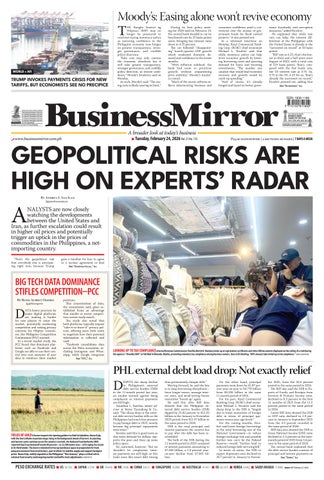
By Andrea E. San Juan @andreasanjuan
are now closely watching the developments between the United States and Iran, as further escalation could result in higher oil prices and potentially trigger an uptick in the prices of commodities in the Philippines, a netimporting country.
in the Philippine economy now hinges on greater transparency, stronger governance, and credible policy direction.
“Rate cuts may only contain the economic slowdown but it will take greater transparency, stronger governance, and credible policy direction, to restore confidence,” Moody’s Analytics said on Monday.
As such, Moody’s said: “The easing cycle is likely nearing its limit.”
During its first policy meeting for 2026 held on February 19, the central bank decided to cut its benchmark rate by 25 basis points anew, bringing key interest rates down to 4.25 percent.
The cut followed “disappointing” fourth-quarter GDP growth which weakened domestic demand and confidence in the recent months.
“With inflation subdued, the bank had room to prioritize growth without jeopardizing price stability,” Moody’s Analytics noted.
“Much of the recent softness reflects deteriorating business and
consumer confidence amid a controversy over the misuse of government funds for flood control projects,” it also pointed out.
In a televised interview on Monday, Rizal Commercial Banking Corp. (RCBC) chief economist Michael L. Ricafort said that while monetary policy can help drive economic growth by lowering borrowing costs and spurring demand for loans and boosting investments, “The number one catalyst that would lead economic recovery and growth would be catch-up spending.”
“And of course, it’s already hinged and based on better gover -
nance standards, anti-corruption measures,” added Ricafort. He explained that while rate cuts can help, the interest differential of the Philippines with the United States is already at the “narrowest on record” at 50 basis points.
“BSP rate at 4.25, that’s the lowest in three and a half years since August of 2022, with a total cuts of 225 basis points. That’s, compared with the Fed funds rate, the US interest rate at 3.75. So, 3.75 in the US, 4.25 for us. That’s already the narrowest on record,” Ricafort pointed out, adding that



By Bless Aubrey Ogerio @blessogerio
DATA-heavy practices by major digital platforms are making it harder for new players to enter the market, potentially weakening competition and raising privacy concerns for Filipino consumers, the Philippine Competition Commission (PCC) warned. In a recent market study, the PCC found that dominant platforms such as Facebook and Google are able to use their control over vast amounts of user data to reinforce their market positions.
This concentration of data, the commission said, gives established firms an advantage that smaller or newer competitors cannot easily match.
The study also noted that both platforms typically impose “take-it-or-leave-it” privacy policies, offering users little room to negotiate how their personal information is collected and used.
“Facebook consolidates data across the Meta ecosystem, including Instagram and WhatsApp, while Google integrates


DESPITE the sharp decline in Philippines’s external debt service burden (DSB) in the 11-month period last year, an analyst warned against being complacent as interest payments are still high.
Jonathan L. Ravelas, senior adviser at Reyes Tacandong & Co., said: “The sharp drop in the external debt service burden tells us the Philippines had much less pressure to pay foreign debt in 2025, mainly because big principal repayments were lower.”
Ravelas said this is good news as this eases demand for dollars, supports the peso and frees up some policy space.
He cautioned, however: “But we shouldn’t be complacent: interest payments are still high, so this looks more like smart debt timing
than permanently cheaper debt.”
Moving forward, he said the key is to keep borrowing disciplined— favor longer tenors, manage interest costs, and avoid letting future maturities “bunch up” again.
He said this after BSP data showed that the Philippine external debt service burden (DSB) dipped by 22.82 percent to $12.02 billion in the January to November 2025 period, from $15.57 billion in the same period in 2024.
DSB is the total principal and interest payments the country has to pay after the debt has been rescheduled.
The bulk of the DSB during the 11-month period in 2025 consisted of interest payments amounting to $7.248 billion, a 1.6-percent yearon-year decline from $7.365 billion.
On the other hand, principal payments went down by 41.87 percent year-on-year to $4.770 billion from $8.206 billion in the same 11-month period of 2024.
For his part, Rizal Commercial Banking Corp. (RCBC) chief economist Michael L. Ricafort said the sharp drop in the DSB is “largely due to lower maturities of foreign debt in terms of principal payments versus year-ago levels.”
For the coming months, Ricafort said lower foreign borrowings in the total borrowing mix of the National Government—to reduce foreign exchange risk and possible further rate cut/s by the Federal Reserve—would “further lead to reduced foreign debt servicing bill.” In terms of ratios, the DSB to export shipments ratio declined to 20.7 percent in January to Novem-
ber 2025, from the 30.6 percent posted in the same period in 2024. The BSP also said the DSB to Exports of Goods, and Receipts from Services & Primary Income ratio, declined to 8.3 percent in the first 11 months of 2025 from the 11.5 percent posted in the same period in 2024. Latest BSP data showed the DSB to GDP ratio declined to 2.9 percent in
on resolving ease of doing business issues and investing aggressively in talent development.”
The concerns echoed issues raised by IBPAP during a media roundtable in January, where the group said it is pushing for an end-to-end talent strategy to move the sector toward highervalue services.
Based on IBPAP estimates, regulatory friction and cost differentials could raise operating expenses by 15 to 20 percent compared with competing markets.
The IT-BPM industry employs around 1.9 million Filipinos, contributes 8.2 percent to gross domestic product, and is projected to generate about $42 billion in revenues by end-2026.
The sector also supports significant employment outside Metro Manila, with more than 250,000 workers in the Visayas and expanding hubs in Mindanao.
However, IBPAP noted that projected government-funded artificial intelligence training programs for 2026 are expected to cover only about 68,000 learners, which is just a fraction of the sector’s workforce.
The group said the industry remains on track to meet its Roadmap 2028 target of $60 billion in revenues, with 40 percent of future growth expected to come from regional locations, provided structural and regulatory constraints are addressed.
IBPAP said the same pressure points raised before the Senate will be central to discussions at its first annual membership meeting for 2026, scheduled on March 4, which is expected to draw more than 400 member companies.
By Justine Xyrah Garcia
THEPhilippines needs to further improve its death registration system to close the remaining gap in unrecorded deaths, the UN Economic and Social Commission for Asia and the Pacific (Escap) said on Monday.
Latest data from Escap showed that 89.2 percent of deaths in the Philippines were registered in 2023, equivalent to 680,479 registered deaths out of an estimated 763,161 total deaths. This leaves around 82,682 deaths unregistered during the year.
The country’s performance is slightly above the Asia-Pacific regional average of 88.8 percent, which corresponds to 29.71 million registered deaths out of 33.44 million total deaths, leaving roughly 3.7 million unregistered across the region.
It also outperforms the South-East Asia subregional average of 73.3 percent, where about 3.28 million deaths were registered out of 4.48 million estimated deaths, leaving nearly 1.2 million unrecorded in 2023.
Despite this, Escap Statistician Tanja B. Sejersen said there is still room for improvement.
“I think that we need to limit the barriers to registration. We need to make it very, very easy. In several cases, people would have to go back and forth to the offices. There’s a lot of waiting time,” Sejersen said in a forum.
She said both direct and indirect costs, including transportation and time lost from work, can discourage families from completing the registration process.
Escap tracks death registration as part of Sustainable Development Goal (SDG) Indicator 17.19.2, which calls on countries to strengthen statistical capacity, including achieving at least 80 percent completeness in

death registration by 2030.
The UN body noted that when deaths are not registered, individuals effectively become invisible in official records.
This can lead to gaps in mortality data, affect national planning and resource allocation, and create difficulties for families who need legal documentation to access services and benefits.
For the Philippines, Sejersen said the goverment should reduce documentary requirements and minimize physical interaction with government offices where possible.
Automation can help, but she cautioned against assuming that digitalization alone will solve systemic bottlenecks.
Instead, the statistician recommended “business process mapping,” a method that reviews each step of a country’s registration
system to identify inefficiencies and simplify procedures.
“Mobile registration campaigns and so on can be helpful, but if they’re not structurally implemented, if it’s not an ongoing effort, then it’s not going to be an ongoing impact,” Sejersen also said.
In the Philippines, a death must be registered within 30 days from the date of death.
If registration is filed beyond this period, it is considered late registration and is subject to additional documentary requirements.
These include a certificate of burial or cremation issued by the cemetery or crematorium, a certificate of service from the funeral parlor, and a negative certification from the Philippine Statistics Authority confirming that no prior death record exists.
this is also being managed since, “We haven’t really gotten narrower than that.”
Aside from catch-up spending, Ricafort said the country should also focus on fiscal expansion to prime the economy.
“Through fiscal policy also, fiscal expansion, as long as it’s allowed by the fiscal space available. So, yeah, true, there may be some limits already on monetary policy, but they do help because that’s a policy priority. It’s all coordinated,” added Ricafort.
BSP Governor Eli M. Remolona Jr. expressed concern, a day after the Monetary Board delivered another quarter-point rate cut, that too much focus is now being placed on interest rates as the solution to boost economic activity.
“Yes, that is a concern. Interest rates can’t do the trick. It needs help from other things,” the BSP governor said in a recent televised interview.
“We feel that we’re at the point where monetary policy cannot do much more. But, as I said, things are very uncertain. We have to crunch the numbers some more,” Remolona underscored.
The seven-man Monetary Board’s decision last Thursday is anchored on the hope that the quarter-point rate cut “may actually help to restore confidence, boost investment and consumption.” Andrea E. San Juan
with the US. So it’s less than two weeks’ time. So there’s that risk that the US would intervene and attack Iran. And there’s that risk because Iran is a major oil producer in terms of production and reserves, and also the Strait of Hormuz,” RCBC chief economist Michael Ricafort said in a televised interview on Monday.
“There’s that risk of blockade because about a quarter of the world’s oil passes through that, especially in a bigger share for oil that’s being sold and transported to Asia. So, yeah, that’s the risk. If there would be war or conflict between the US and Iran, and, of course, the proxies, and that would include countries like Israel,” added Ricafort.
RCBC’s chief economist pointed out that any risk of escalation would lead to higher oil prices, and higher oil prices would lead to higher inflation.
“We will all feel that,” Ricafort emphasized.
Ricafort also stressed that the geopolitical tension which could lead to the spike in oil prices tops the list of the external factors that go beyond the Philippine economy’s control.
“As far as external factors, the exogenous factors that are beyond our control, the geopolitical risk factor, that’s number one. Of course, there are other risk factors, like a few weeks ago, like Venezuela. We also have Greenland. And also, of course, the US is also fighting terrorists in other areas, like in Syria, Nigeria, in Yemen. So, yeah, those are things beyond our control,” he said.
In a separate interview, Sun Life Investment Management and Trust Corporation President Michael Enriquez said: “I think what externally...what we’re really watching out closely is this US-Iran deal that is happening. It might escalate into something worse. So hopefully not. That is something that will trigger... that’s why we’ve been seeing oil prices starting to go up again.”
“That would have a more direct effect on the Philippines in terms of oil inflation that would trigger again some uncertainty on the economy’s recovery,” added Enriquez.
Enriquez underscored that among the developments in the global arena, he is more wary of the geopolitical conflicts which could push up oil prices rather than the recent imposition of the 15-percent across-the-board tariffs on the United States’s trading partners.
“Based on the first time that Trump announced the tariffs for the global partners, the Philippines really was not affected that much because we all know that we’re not really an export-oriented country. I think what we really consider more on the sentiment side is how global markets react to this, because anything that will happen to global markets, the local equity market continues to react,” Enriquez pointed out.
In a recent commentary, BMI— a unit of Fitch Solutions—noted that based on its oil scenario analysis, “We have flagged potential disruptions in the Straits of Hormuz that may result in oil prices spikes to varying degrees. Should such disruptions escalate, this will push up inflation and constrain BSP’s room to ease further.”
Inflation forecast
IT is worth noting that the Bangko Sentral ng Pilipinas (BSP), in its first policy meeting for 2026 held on Thurday, had raised its average inflation forecast for 2026 to 3.6 percent from the 3.2-percent forecast set in the December 2025 policy meeting.
For 2027, the BSP forecasts inflation to average at 3.2 percent, compared to the 3-percent forecast it set in the Monetary Board meeting in December 2025.
BSP Governor Eli M. Remolona Jr. earlier said he would worry when inflation goes up beyond 3 percent.
Analysts previously explained to this newspaper that disruptions and worse, the closure of Strait of Hormuz, one of the most critical chokepoints in global trade and a “vital” oil and gas route of Asian countries, can be “catastrophic” for the Philippines.
(See: https://businessmirror. com.ph/2025/06/24/strait-ofhormuz-closure-will-be-catastrophic-philexport/)
Ateneo De Manila University (ADMU) economist Leonardo Lanzona had earlier explained that the closure of the strait will lead to a “perceptible increase in oil prices.”
“The cost of imports, including oil itself. Overall, global trade will slow down so even exports will decrease,” Lanzona told this paper.
De La Salle University (DLSU) economist Maria Ella Oplas for her part also explained the effect of the escalating tensions in the Middle East on prices of goods and services.
“The urgent issue is of course the effect on prices. It will affect the cost of factors of production, therefore prices of goods and services. It’s really a domino effect,” Oplas told this newspaper.
data from Gmail, Maps, YouTube, and other services,” the PCC study read.
According to the PCC, this consolidated data is used to fine-tune advertising targeting and improve the relevance of content, search results, and recommendations.
An online survey cited in the study showed that many consumers tend to overlook the downsides of extensive data collection, monitoring, and third-party data sharing. The PCC attributed this to the limited alternatives available and the platforms’ deep integration into everyday digital activities, from communication to navigation and entertainment.
The commission also examined how competition policy intersects with data privacy, particularly in areas such as data portability and interoperability.
“Data portability pertains to the ability of users to transfer their data easily between platforms, while interoperability refers to the capacity of different systems to work seamlessly together,” it said.
Although these mechanisms can promote competition, the PCC cautioned that they may also increase the risk of data misuse or breaches if not properly regulated.
Cross-border data flows further complicate oversight, the study said, as global digital platforms operate across jurisdictions with differing data protection rules, making enforcement more challenging.
To address these issues, the PCC recommended integrating data privacy considerations more closely into competition assessments and exploring legislative updates to ensure that existing competition frameworks remain relevant in the digital economy.

By Jovee Marie N. Dela Cruz | @joveemarie
THE Makabayan bloc and Akbayan party-list group on Monday filed two separate resolutions at the House of Representatives urging the government to rejoin the International Criminal Court (ICC), citing the need to strengthen accountability mechanisms and uphold international human-rights obligations.
humanity and related offenses.
Lawmakers emphasized the country’s long-standing commitment to international cooperation through its membership in the United Nations and its adherence to key human rights instruments.
The resolution references findings by former ICC Prosecutor Fatou Bensouda, who concluded there was a reasonable basis to believe crimes against humanity—specifically murder—were committed in connection with anti-drug operations between July 1, 2016, and March 17, 2019.
confidence in legal institutions, and strengthen international partnerships rooted in the rule of law and human rights.
It further states that widespread calls from civil society groups, faith-based organizations, and victims’ families highlight the urgency of restoring accountability mechanisms and addressing alleged extra-judicial killings.
The measure urges the national government to take the necessary steps toward re-acceding to the Rome Statute and formally rejoining the ICC, framing the move as consistent with the country’s constitutional mandate to uphold human dignity and human rights.
Lawmakers described the tribunal as a “vital mechanism” for ensuring justice when national systems are unable or unwilling to prosecute grave international crimes.
The measure noted that the ICC maintains jurisdiction over alleged crimes committed in the Philippines
The filing of the two resolutions coincides with the ICC’s commencement of the confirmation-of-charges hearing involving former President Rodrigo Duterte. In filing House Resolution 809, Party-list Reps. Renee Louise Co of Kabataan, Antonio Tinio lof ACT Teachers and Sarah Jane Elago of Gabriela underscored the ICC’s role as the world’s first permanent international court tasked with prosecuting individuals for genocide, crimes against humanity, war crimes, and crimes of aggression.
By Jonathan L. Mayuga @jonlmayuga
THE body of one of three missing waste-pickers has been recovered at ground zero of the collapsed portion of the garbage heap in the 13-hectare Green Leap Sanitary Landfill, formerly the Rizal Provincial Sanitary Landfill in barangay San Isidro, Montalban, Rizal. Mark delos Reyes, lawyer for International Solid Waste Integrated Management Specialist, Inc. (Iswims), which operates the landfill, said the search and rescue for the two other missing persons is still ongoing with the hope of finding them alive.
Information coming from the local government indicate that three persons were reported missing by their families after a portion of the garbage heap collapsed around 2:00 p.m. on Friday.
“Based on that number, we are looking for two remaining missing persons,” he said.
On Sunday, the Department of Environment and Natural Resources–Environmental Management Bureau (DENREMB) ordered stabilization measures.
It also ordered the operator of the landfill to provide a detailed action plan and daily project status reports on retrieval and rehabilitation activities, and immediately conduct waste compaction and daily soil covering.
The DENR also ordered the operator to control heavy equipment movement and restrict access to high-risk zones and implement slope stabilization, and maintain regular site inspections.
The DENR said it has also deployed a team to conduct an on-site investigation to assess the extent of the erosion and to verify reports of missing persons.
Informal waste recyclers
THE fatality and two others, delos Reyes said, are wastepickers or informal waste recyclers, who were at the site when the collapse happened.
He said there are are no houses or shanties inside the facility, which are secured and off limits to unauthorized personnel.
“We don’t want to say they are dead at this point. We are hoping that they are still alive,” he said.
He also branded as baseless a report by the urban poor group Kadamay that 50 people, reported missing, could have been buried underneath tons of trash.
He said three buldozers of the company that were in operation swept down the mountain of garbage.
Offlimits
DE LOS REYES said the three wastepickers
Scould have entered the facility clandestinely, because wastepickers are not allowed to enter the facility.
“We are looking at the possibility that they climbed or sneaked into the perimeter fence and were able to enter the facility,” he said.
Delos Reyes added that the company is taking full responsibility and is open to any investigation.
“We have already received a notice from the DENR, and we are willing to cooperate,” he said.
Delos Reyes added that the landfill’s operation is unhampered, saying that the portion of the garbage heap that collapsed was cordoned off and declared off-limits while stabilization is ongoing. The landfill receives tons of garbage from Metro Manila and nearby areas daily, and shutting down the entire facility will potentially cause environmental and health problems to affected localities, but sanitary landfills, as well as open dumps that continue to operate in other areas in the country, are often swarmed by informal waste recyclers or waste pickers.
He maintained that the garbage slide was an accident, maintaining that the incident happened while the personnel manning the facility, including the personnel operating the heavy equipment, were under normal day-to-day operation.
“We are not turning our backs on the families of the victims, and we are open to talks with the family and the LGU as to how we can help them,” he said.
Mayor seeks DENR probe MAYOR Ronnie Evangelista of Montalban in a separate statement, said concerned offices are continuously working with the private operator of the landfill in monitoring the situation. “We call upon the Department of Environment and Natural Resources to also conduct an investigation on the situation since this is a matter of national concern,” he said.
Meanwhile, Rizal Gov. Nini Ynares clarified that the landfill, despite its name, is privately owned and operated, and is not under the provincial government’s management.
She also requested Environment Secretary Raphael P.M. Lotilla to conduct an immediate investigation “to ascertain the facts and determine any potential environmental and public safety implications arising therefrom, including any reported or possible injury, missing person or loss of life resulting from the said incident.”
Ynares asked for an assessment and remedial measures, and demanded that the private sanitary landfill operator prevent further risks to the communities and environment.
during the period it was a State Party to the Rome Statute from November 1, 2011, to March 17, 2019, despite the country’s subsequent withdrawal.
It also cited constitutional provisions affirming the State’s duty to protect human dignity and human rights, as well as Republic Act 9851, which allows Philippine authorities to defer to international tribunals in prosecuting crimes against
The Philippines withdrew from the ICC in 2018 under then-President Rodrigo Duterte, a move criticized by human-rights advocates as undermining accountability. The resolution argues that withdrawal does not extinguish obligations tied to alleged crimes committed while the country was a member.
According to the resolution, rejoining the ICC would signal the Philippines’ commitment to justice, reinforce public
“The ICC serves as a court of last resort, activated only when domestic mechanisms are unable or unwilling to genuinely investigate and prosecute, making it a vital recourse for victims when national justice systems fall short or are compromised,” the bloc said.
“Rejoining the ICC would send a clear and strong message that the Philippines honors its international
obligations, respects the sanctity of life, and is committed to breaking the cycle of impunity and state violence,” the Makabayan bloc added. Rep. Perci Cendaña, together with fellow Akbayan Partylist lawmakers Rep. Chel Diokno and Rep. Dadah Kiram Ismula, as well as Dinagat Islands Rep. Kaka Bag-ao, also filed House Resolution 811 urging the Philippines to re-accede to the Rome Statute of the International Criminal Court. Cendaña said that returning to the ICC would signal solidarity with victims of extrajudicial killings (EJKs) during the Duterte administration. He added that rejoining the ICC would serve as a strong deterrent against future human rights abuses.
“We cannot allow the return to a tokhang presidency that will belittle human rights, murder children, torture, and dehumanize our people. We must not allow this nightmare of human rights abuses in our country to happen again,” he added.
By Malou Talosig-Bartolome @maloutalosig
SENIOR officials of the Association of Southeast Asian Nations (Asean) and China will meet again this week in Singapore for a new round of negotiations on a long-awaited Code of Conduct (COC) in the South China Sea.
Rogelio Villanueva Jr., Foreign Affairs spokesman on maritime affairs, confirmed that the talks will take place in Singapore, marking the second consecutive month of discussions since foreign ministers agreed to negotiate monthly.
The accelerated schedule aims to meet the leaders’ target of finalizing
the text within the year.
The Philippines, as this year’s Asean chairman, is steering the process.
“As chairman of Asean, the Philippines has committed to pursue the momentum in the negotiations for a substantive and effective Code of Conduct,” Villanueva said during a news conference late last week.
“We are prepared to facilitate more meetings. In coordination with Asean member states and China, we are holding monthly face-to-face sessions to maximize opportunities for dialogue.”
The January meeting was overshadowed by a public spat between Coast Guard (PCG) Commo. Jay Tarriela and the Chinese Embassy in Manila.
In a letter to Sen. Anna Theresia Hontiveros, Foreign Affairs Secretary Maria Theresa Lazaro stressed that while debate is welcome, it must be conducted in a “sober manner.” The DFA also asked the Senate Foreign Relations Committee chairman, Sen. Erwin Tulfo, to provide “diplomatic space” as the Philippines leads Asean negotiations. Villanueva declined to disclose whether contentious issues were resolved in January, but emphasized: “Asean member states and China are committed to push the negotiations forward.”
ABy Butch Fernandez @butchfBM
NY potential talks with the Chinese Embassy are not tantamount to surrendering anything—much less bowing to anyone, Senate President Pro Tempore Panfilo M. Lacson said.
Lacson emphasized in a radio interview that the prospective talks—which he suggested after Chinese Ambassador to the Philippines Jing Quan expressed willingness to talk with Philipine leaders to ease the word war on the West Philippine Sea issue—will focus not on contentious issues such as ownership of the disputed
areas, but on establishing clear lines of communication between the two sides. Lacson, meanwhile, lauded Sen. Erwin Tulfo for his own initiative to meet with embassy officials as the new chairman of the Senate Foreign Relations Committee, calling it “a move in the right direction” and “commendable.” He said Tulfo may report to the all-senators’ caucus the result of his 11 a.m. meeting, as the caucus is scheduled at 1:30 p.m Monday.
Wala tayong sinusuko at hindi tayo yumuyuko. Gusto lang natin maiwasan ang maaanghang na palitan ng salita through social media. Mas maganda ang direktang pag-uusap [We are not surrendering anything and we are not bowing to

n Legality – Will the COC be legally binding? n Definition of terms– How will parties interpret and apply “selfrestraint”?
n Enforcement mechanisms – What measures will ensure compliance?
n Role of external powers – How will non-Asean actors be engaged?
n Linkage to the 2002 Declaration on the Conduct of Parties (DOC) – How will the DOC connect to the new COC? The next round of talks may tackle position papers submitted by Asean foreign ministers last month.
Officials said ASEAN and China remain locked on several “milestone” issues: n Geographic scope – Will the code apply to China’s “ninedash line” or respective Exclusive Economic Zones (EEZs)?
Lacson: We are not giving up, surrendering anything
anyone],” adding,” [We simply want to prevent misunderstanding and fiery exchanges on social media, by talking to each other directly],” Lacson said.
“We might find a middle ground for communications. But the talks do not mean we are bowing to China or giving them our territory just to end the discussion,” he added, partly in Filipino. “It is better to be clear on this: We are not surrendering anything and we are bowing to no one.”
Meanwhile, Lacson said that before engaging the Chinese Embassy, senators themselves must ensure clear communication among one another, noting that it does not reflect well when Filipinos engage in heated exchanges with fellow Filipinos over the issue. He said he cannot imagine any parliament in the world where lawmakers fight each other over their own country’s territory. Hindi ba napakapangit noon? I cannot imagine maski anong parliament sa buong mundo na nangyayari ito, nagkakapikunan ang mambabatas at ang usapin sino ang nagmamayari ng
Tparliament in the world where lawmakers fight over territory that we know belongs to the Philippines or is in our exclusive economic zone],” he said.
HE Navy (PN) will christen and commission two brand-new ships—an offshore patrol vessel (OPV) and a fast attack interdiction craft (Faic), at Naval Operating Base-Subic in Zambales on Tuesday. In an advisory, the Navy said these ships are the recently delivered offshore patrol vessel (OPV) BRP Rajah Sulayman (PS-20) and the Faic BRP Audrey Bañares (PG-910). BRP Rajah Sulayman is the first of the six OPVs contracted from South Korean shipbuilder, HD Hyundai Heavy Industries (HHI), while BRP Audrey Bañares is the last ship out of the nine acquired from Israeli Shipyards Limited. Christening and commissioning ceremonies will be held at Quay 7 of Naval Operating Base-Subic. BRP Rajah Sulayman was launched at the HD HHI shipyard in Ulsan, South Korea, on June 11, 2025 and arrived in the Philippines on January 17. BRP Rajah Sulayman is the
By Rex Anthony Naval
By Jonathan L. Mayuga @jonlmayuga
BUSINESSMEN, and even small market vendors, involved in the illegal manufacture or production, sale, and distribution of tobacco products, will be charged with a non-bailable case of economic sabotage, Interior Secretary Juanito Victor Remulla said.
Remulla issued the warning as the crackdown on the illegal tobacco network in the country is being implemented, with raids on distributors’ and manufacturers’ facilities in markets nationwide.
By Lenie Lectura @llectura
OIL companies announced Monday that pump prices are increasing this week, the seventh straight week for gasoline and the fifth for diesel and kerosene.
In separate announcements, oil companies said they will hike gasoline products by P0.60 per liter. Diesel and kerosene will each go up by P1.20 per liter.
The new pump prices will take effect at 6:00 a.m. on Tuesday, February 24, for Seaoil, Caltex, Shell, Petron, PTT, Unioil, and Total while, Cleanfuel will adjust its prices at 4:01 p.m. Since the start of the year the net increase for gasoline stood at P4.80; P8.20 for diesel; and P6.20 for kerosene.
Oil companies adjust their pump prices every week to reflect movements in the world oil market.
The Department of Energy (DOE) said geopolitical tensions, supply expectations, inventory movements, and market sentiment are the reasons for this week’s price hike. It cited the following:
n Escalating US–Iran tensions in which Iran carried out naval drills in the Strait of Hormuz, including joint exercises with Russia and China.
n Ongoing Russia–Ukraine conflict.
n Drawdown in US Oil Inventory by 9.01 million barrels to 419.82 million barrels in the week ended February 13.
“The DOE assures the public that it is closely monitoring global oil market conditions and coordinating with relevant agencies to ensure petroleum prices remain fair, reasonable, and compliant with existing regulations. The Department also reiterates its commitment to ensuring the quality and correct quantity of petroleum products in the market,” it said.
Selected fuel stations continue to offer discounts for public utility vehicles ranging from P0.50 to P3.00, along with loyalty discounts for private motorists.
“Sa lahat ng palengke sa Pilipinas, pakiusap po, tumigil na kayo sa distribution nito [illegal cigarettes]. Kapag kayo ay maabutan namin, non-bailable ang magiging charge laban sa inyo,” Remulla warned.
In a news conference in Tanza, Cavite, Remulla said illegal tobacco peddlers have one week to dispose of the illegal goods they sell and halt distributions before operations against peddlers begin.
The DILG, a member agency of the AntiAgricultural Economic Sabotage Council, reiterated that individuals involved in the sale and distribution of smuggled agricultural products are subject to severe penalties under the Republic Act 12022, or the Anti-Agricultural Sabotage Act.
This warning came after the Department conducted a scoping analysis to identify the middlemen in the proliferation of illegal tobacco in local markets, the palengkes nationwide: Ang distribution niyan didiretso sa distributor, dadalhin sa palengke papuntang sari-sari store. Iyon po ang ecosystem ng illegal tobacco.”
Remulla reiterated that sarisari stores engaged in illegal tobacco sales will be shut down only after receiving a minimum penalty, while distributors
will face non-bailable cases. “Pagdating sa mga distributors, manufacturers, non-bailable, to the full extent of the law, didiinan talaga namin sila,” he said.
He explained the grave economic damage caused by illegal tobacco: “Nababawasan ang buwis para sa kapwa nating Pilipino. Ang pondo na para sana Department of Health, Philippine General Hospital, at lahat ng mga government hospitals.”
The DILG Chief shared that, with ongoing operations, the cost of locally produced tobacco in the provinces of Ilocos and Pangasinan increased, aiding farmers and the local industry. With this progress, Remulla is optimistic that 80 to 90 percent of the illegal cigarette trade in the country will be wiped out in the next three months.
THE National Police (PNP) is now coordinating with the Bureau of Customs (BOC) and other government agencies regarding the disposal of the multi-billion pesos worth of smuggled and illegally-
manufactured cigarettes it has helped in confiscating in the last few weeks.
Gen. Jose Melencio Nartatez Jr., National Police chief, in a statement on Monday, said the move is part of the measures to ensure the integrity of the anti-cigarette smuggling operations.
“These confiscated cigarettes must be disposed of properly in the soonest possible time to prevent any speculation and eventually maintain the integrity of the aggressive police operations against this illegal product,” he added.
Nartatez said commanders of police operating units have specific instructions to turn over to the BOC, Bureau of Internal Revenue (BIR) or any appropriate government agency all smuggled and illegally-manufactured cigarettes in the soonest possible time.
He also emphasized the importance of keeping all the records of the police operations and monitoring of the confiscated products.
Nartatez earlier lauded the good
working relationship among the PNP, BOC and BIR in the conduct of anticigarette smuggling operations in the past weeks, adding that informationsharing and operational cooperation are maintained among the agencies. As part of the nationwide crackdown, the PNP is calling on citizens to act as the “eyes and ears” of the police.
Nartatez assured the public that reporting can be done safely and effectively without fear of retaliation. He also advised the public that when reporting, the public should provide the exact location and, if possible, the brand of the illegal cigarettes being sold. On February 19, a joint inter-agency operation in Barangay Sahud-Ulan, Tanza, Cavite led to the seizure of P200 million worth of illegally manufactured cigarettes. Authorities discovered that a warehouse declared as a storage facility for canned goods was being used to manufacture, store, and distribute counterfeit cigarettes. With Rex Anthony Naval
By Henry J. Schumacher
FAR from the stuff of science fiction, AI has moved from the exclusive regimes of theoretical mathematics and advanced hardware to an everyday aspect of life. Over the last several years of exponentially accelerating development and proliferation, our needs and requirements for mature AI systems have begun to crystallize.
Trust is not an internal quality of an AI system like accuracy, or even fairness. Instead, it’s a characteristic of the human-machine relationship formed with an AI system. No AI system can come off the shelf with trust baked in. Instead, trust needs to be established between an AI user and the system, which must be dominated by humans!!!
The highest bar for AI trust can be summed up in the following question:
What would it take for you to trust an AI system with your life?
FOSTERING trust in AI systems is the great obstacle to bringing into reality

transformative AI technologies like autonomous vehicles or the large-scale integration of machine intelligence into medicine. To neglect the need for AI trust is also to downplay the influence of the AI systems already embedded in our everyday financial and industrial processes, along with the increasing interweaving of our socioeconomic health and algorithmic decision-making.
The path to the responsible use of AI has been paved by industries as diverse as aviation, nuclear power, and biomedicine. What we’ve learned from their approaches to accountability, risk,
seeks safeguards on remittances of OFWs
By Jovee Marie N. Dela Cruz @joveemarie
WITH remittances functioning as a daily survival fund for many homes, the chairman of the House Committee on Overseas Workers Affairs is urging swift safeguards to ensure the money sent by overseas Filipinos reaches families without erosion from fees and charges. Ahead of the first 2026 hearing on Tuesday, the House Committee on Overseas Workers Affairs chairman, Party-list Rep. Bryan Revilla of Agimat, pressed for action on the proposed OFW Remittance Protection Act. He cited data from the Bangko Sentral showing that about 95 pecent of remittances are spent on food and

essential household needs—evidence that these funds are not symbolic gestures but a core lifeline for millions.
The call comes as new international costs emerge. A 1 percent federal tax in the United States on certain cash-based international transfers took effect on January 1, 2026. While bank and digital remittances are exempt, workers who rely on cash instruments may still feel the impact. Given that the US accounts for roughly 40 percent of remittance inflows to the Philippines, even small deductions can translate into reduced food budgets, school payments, and daily expenses.
Revilla’s proposal seeks a systemwide shield for remittances by capping excessive fees, enforcing transparency in exchange rates and charges, penalizing abusive practices by financial institutions, and expanding free financial education for workers and their families.
“OFW remittances are more than economic statistics. They put food on the table, pay for children’s tuition, and cover everyday expenses. When there are cuts, livelihoods are immediately affected,” he added.
Revilla underscored that while the State continues to pursue long-term solutions to domestic job creation, migrant work remains a present reality for millions of Filipinos—making income protection an immediate national responsibility.
The lawmaker said the Tuesday hearing will focus on building durable protections that prevent both unexpected foreign levies and unfair domestic costs from shrinking what families receive.
and benefit, forms the foundation of a framework for trusted AI. The challenge now is to translate those guiding principles and aspirations into implementation, and make it accessible, reproducible, and achievable for all who engage with the design and use of AI systems. This is a tall order but far from an insurmountable obstacle.
What do we mean by “Dimensions of Trust”?
WE trust an AI system in three main categories:
1. Trust in the performance of our AI-machine learning model.
2. Trust in the operations of our AI system.
3. Trust in the ethics of our workflow, both to design the AI system and how it is used to inform your business process.
It’s worth acknowledging that trust in an AI system varies from user to user. Trust signals refer to the indicators you can seek out in order to assess the quality of a given AI system along each of these dimensions.
By Lorenz S. Marasigan @lorenzmarasigan
THE Department of Public Works and Highways (DPWH) is requesting P300 million in the 2027 national budget to construct a permanent replacement for the Bridge of Promise in Batangas City, a structure that has stood as a temporary crossing for 17 years despite being intended only as a short-term fix.
Public Works Secretary Vivencio Dizon has ordered the construction of a stronger, more durable bridge to replace the existing structure, which connects barangay Kumintang Ibaba and barangay Gulod Labac, and has
But trust signals are not unique to AI—it’s something that we all use to evaluate even human-to-human connections.
THINK about what kinds of trust signals you intentionally seek out when meeting a new business partner. It will vary person to person, but we all recognize that eye contact is important, especially as a sign that someone is paying attention to you while you speak. For some people, a firm handshake is meaningful, and for others, punctuality is vital; a minute late is a sign of thoughtlessness or disrespect. Reflective language is a powerful way to signal that you are listening. To complicate things, think about how trust signals change when evaluating a new acquaintance as a potential friend compared to a business partner.
How does this relate to an AI system?
DEPENDING on its use, an AI system might be comparable to any of these human relationships. An AI that is embedded in your personal banking is one that you need to be able to trust like a business advisor. An AI system that is
powering the recommendation algorithm for your streaming television service needs to be trustworthy like a friend who shares your genre interests and knows your taste. A diagnostic algorithm must meet the credentials and criteria you would ask of a medical specialist in the field, and be as open and transparent to your questions, doubts, and concerns. The trust signals available from an AI system are not eye contact or a diploma on the wall, but they serve the same need. Metrics, visualizations, certifications, and tools can enable you to evaluate your system and prove to yourself that it is trustworthy.
In conclusion: YES, AI is part of our future, but it is essential to understand the need for its ethical deployment. It is to be understood also that HUMANS need to manage AI and see to it that AI does not drive the performance of the organization in the wrong direction. I look forward to your views on this topic; contact me at hjschumacher59@ gmail.com
Continued from A3
begun showing signs of deterioration. “Ang tawag nila dito is ‘pansamantagal’ meaning, it’s supposed to be temporary, pero inabot na ng 17 years. 2009 noong ginawa ito,” Dizon said. Beyond its age, the bridge can no longer accommodate heavy trucks, forcing freight vehicles to take lengthy detours.
“ Umiikot pa ng one to 1.5 hours ang heavy trucks instead na dumaan dito,” Dizon added. Dizon said the proposed permanent structure would also be expanded from two lanes to four, significantly improving traffic flow along the corridor. In 2009, the Public Works
Continued from A3
department built a temporary bridge to replace the original structure, which collapsed in October that year at the height of a typhoon. Fatalities were reported and authorities rushed to build the temporary crossing given its role in linking communities and facilitating commerce in the area, with the Batangas International Port located just a few kilometers away. The bridge sits near the Minor Basilica of the Immaculate Conception and serves as a vital artery for residents and goods moving through one of Calabarzon (Cavite, Laguna, Batangas, Rizal and Quezon)’s busiest urban centers.
1,600 to graduate 4Ps this year in Tawi Tawi
By Manuel T. Cayon @awimailbox

DAVAO CITY—The country’s southwesternmost island province of Tawi-Tawi has golden feather of achievement on its wings: some 1,690 families are expected to graduate from the government’s cash dole out dependency by the end of the year, and almost 500 of them already gotten their graduation rites last week.
The Bangsamoro Ministry of Social Services and Development’s (MSSD) Tawi-Tawi 4Ps Provincial Operations Office announced it held several graduation ceremonies for 466 households in four municipalities who “have achieved self-sufficient status and formally exited the Pantawid Pamilyang Pilipino Program [4Ps] after completing the program’s seven-year cycle.”
See “Tawi-tawi,” A14
By Jovee Marie Dela Cruz @joveemarie
THE House of Representatives on Monday officially referred four verified impeachment complaints against Vice President Sara Duterte to the Committee on Justice, which also triggers a one-year bar on filing new cases.
With all four complaints now pending, the House must determine whether the allegations, particularly those involving Statement of Assets, Liabilities, and Net Worth (SALN) disclosures and unexplained wealth, meet the constitutional threshold for impeachment under Article XI of the 1987 Constitution.
Whatever decision the justice committee reaches, it is required to submit a committee report to the plenary within 60 session days, noting that suspended sessions are not counted as separate session days.
Environmental group reaffirms commitment to Sapangbato watershed on founder’s anniversary
By Ashley J. Manabat
ANGELES CITY—Environmental advocates and Aeta community members gathered on February 21 at the Angeles City watershed in Barangay Sapangbato to mark the first death anniversary of Renato “Abong” Tayag Jr. and renew the reforestation campaign he began more than two decades ago.
Tayag, an environmental advocate, died February 18, 2025. For nearly 20 years, he led rehabilitation efforts in the Sapangbato watershed, promoting a model that paired tree planting with long-term community stewardship rather than one-time planting drives.
Since 2019, organizers said about 75,000 trees which are a mix of bamboo, fruit-bearing, and native forest species have been planted in the watershed. With sustained care from Aeta partners, the program has recorded a 60 to 70 percent survival rate of the planted trees.
“That is already a high percentage,” said Minerva Arceo, one of the board of directors of Abacan River and Angeles Watershed Advisory Council (ARAW-ACI).
The commemoration, organized by ARAW-ACI and the Tayag family, focused on sustaining that model.
At least 22 Aeta caretakers and their families now tend thousands of planted trees, de-weeding and watering them, particularly during the dry season.
“This program is to remember my dad,” said Abe Tayag, his son, in an interview. “He passed away a year ago, so it’s to recognize what he started at the watershed here in Sapangbato.”
Unlike short-term planting drives, Tayag’s program required caretakers to monitor trees for at least three years to ensure survival.
“If you plant a tree, they won’t just survive after planting. You need someone to take care of them,” Abe said.
“My dad’s plan was to have someone take care of the plants for at least three years.”
Sponsors support the initiative by paying caretakers P5 per surviving plant each month, up from P3 per plant between 2021 and 2024. ARAW-ACI maintains an inventory system to track survival rates and monitor progress, Abe said.
Sponsors include Converge ICT Solutions, Pampanga Press Club, Porac Bank, Scrubbed.Net, Holy Family Batch ’80, the Philippine Academy of Family Physicians, Jocson College, Rotary Club of Angeles Kuliat, De La Salle Alumni Association Pampanga, Balibago Waterworks, Angeles City Water District, KDL Manufacturing, Trellis Restaurant and Brightwoods School.
Alongside the anniversary rites, organizers held a feeding program and gift-giving activity for Aeta families who serve as land stewards under ARAW-ACI’s adopt-a-watershed rehabilitation program.
However, caretakers said financial support from the city government has lapsed.
Henry Pan, an Aeta caretaker, said food subsidies previously provided by the Angeles City government stopped in July 2025.
Pan said they used to receive monthly food subsidies ranging from P3,000 to P8,000 through the city’s Environment and Natural Resources Office beginning in 2022.
“Makisabikungmayapkangmayor naibalikdalakarengkatutubongmag manage keng watershed keng tanaman. Ita mu, ibalik da la sana. Maglinis, mag clearing, mananam la po,” Pan said. Mylene Pan, also a caretaker, said families supplement their needs by selling harvested fruits such as guyabano, bananas, and atis.
“[May] one month P8,000, the rest P3,000 ang subsidy. Nagbebentakami nganinamgabungaparasapang araw-arawnapanggastos.Guyabano, saging, atis,” Mylene Pan said.
Despite funding uncertainties, Abe said he intends to continue his father’s advocacy through ARAW-ACI, with support from the De La Salle University Alumni Association Pampanga. Since 2009, the alumni group has backed watershed initiatives, with fundraising events such as the Animo Run allocating proceeds to the rehabilitation effort.
“We continue what they have started, which is to ensure we plant and take care of the trees,” Abe said. “As a family and as part of the group with ARAW-ACI, I plan on continuing my dad’s legacy.”
Deputy Speaker Paolo Ortega V of La Union, one of the sponsors of the complaints, expressed confidence on Monday that the fourth impeachment complaint against Duterte will withstand scrutiny at the committee level, saying a full deliberation process allows lawmakers to thoroughly examine the allegations and exercise due diligence.
“I’m even more confident now because it will be reviewed at the committee level. It will be discussed and debated, and different viewpoints from legislators will be heard. I’m confident it can still secure the necessary votes,” Ortega said in an ambush interview.
The first verified complaint was filed by members of the Makabayan Coalition and endorsed by party-list representatives Antonio Tinio, Sarah Jane Elago, and Renee Louise Co. A second complaint filed by progressive groups and civil society leaders
was endorsed by De Lima and Akbayan Rep. Perci Cendaña.
The complaints outline five articles of impeachment, including allegations of betrayal of public trust, culpable violation of the Constitution, graft and corruption, bribery, and other high crimes. Among the grounds cited are alleged misuse and malversation of confidential funds, alleged distribution of monetary gifts related to procurement in the Department of Education, alleged unexplained wealth and incomplete asset disclosures, and alleged involvement in serious criminal offenses.
The third impeachment complaint, endorsed also by De Lima, against Duterte invokes grounds including culpable violation of the Constitution, betrayal of public trust, plunder, malversation, bribery, corruption, and other high crimes.
The fourth complaint accuses Duterte of failing to fully disclose assets in her
SALNs, amassing wealth disproportionate to her lawful income, and violating the Constitution. It seeks a forensic review of bank accounts, property transfers, and financial records, citing alleged irregular confidential fund disbursements of at least
P612.5 million covering both the Office of the Vice President (OVP) and the Department of Education (DepEd).
The allegations include culpable violation of the Constitution, betrayal of public trust, graft and corruption, bribery, and other high crimes. Central to the complaint are claims that certain assets, bank accounts, cash holdings, and property transactions were either omitted or understated in Duterte’s SALNs. The fourth verified complaint, filed by Atty. Nathaniel G. Cabrera was endorsed by Manila Rep. Benny Abante and Deputy Speaker Paolo Ortega V. Under the Constitution, the Vice President may be removed from office for culpable
violation of the Constitution, treason, bribery, graft and corruption, other high crimes, or betrayal of public trust. Ortega said moving the complaint through the committee route is preferable, especially given past legal controversies surrounding impeachment procedures. “It’s better not to take shortcuts. We’ve had Supreme Court issues before, and this is the proper route. Even the president’s impeachment went through the committee,” he said. He added that the complaint is currently with the Speaker’s office, with next steps likely to be determined once House leadership convenes. Ortega expressed confidence that the House Committee on Justice would handle the matter without political intimidation, provided the record is properly presented and debated.
SC suspends judge for 6 months for failing to disclose pending terrorism financing case before appointment
TBy Joel R. San Juan @jrsanjuan1573
HE Supreme Court (SC) has imposed a six-month suspension from the service without pay against a trial court judge in Catbalogan City, Samar for serious dishonesty after he failed to declare his pending criminal case for financing terrorism prior to his appointment in the judiciary in September 2024.
In a ruling penned by Chief Justice Alexander Gesmundo, the Court en banc also warned Judge Alfonso M. Cinco IV, presiding judge of the Regional Trial Court of Catbalogan City, Samar, Branch 29 that a repetition of the same act will be dealt with more severely.
The Court also reminded prospective appointees to the judiciary of their continuing obligation to promptly inform the Judicial and Bar Council (JBC), and the Office of the President (OP) of any matter within their knowledge, that may affect their fitness for judicial office, from the time of their application until their appointment.
Cinco’s suspension stemmed from the administrative complaint for serious dishonesty and the commission of a crime involving moral turpitude lodged against him by the Office of the Court of Administrator.
The complaint accused Cinco of taking his oath of office as a trial court judge without informing the Court of his pending criminal case for violation of Republic Act No. 10168, otherwise known as “The Terrorism Financing Prevention Act of 2012.”
DAVAO CITY—The autonomous region in Mindanao opened up the annual Ramadhan trade fair last week at the Bangsamoro Government Center in Cotabato City to coincide with the Muslims’ observance of fasting month of Ramadhan.
The trade fair opened on February 16 to transform the government center “into a vibrant marketplace that showcases locally made products and provides Micro, Small and Medium Enterprises [MSMEs] with expanded market opportunities during the holy month,” the Bangsamoro Information Office said.
The Ministry of Trade, Investments
The case was filed after he submitted his application but prior to his appointment as a trial court judge.
Based on the records, Cinco was indicted by the Department of Justice (DOJ)on May 10, 2024, or three months before he received his appointment as judge on August 30, 2024, but did not disclose to the JBC or OP that there was a criminal case filed against him. Cinco made it to the JBC’s shortlist of qualified applicants which was transmitted to the OP on August 2, 2023.
The judge was charged for violation of Republic Act No. 10168 in his capacity as council member of the Community Empowerment Resources Network (CERNET) which was accused of providing funds to the South-Eastern Front of the New People’s Army (NPA).
At present, the criminal case against Judge Cinco remains pending before Branch 74, RTC, Cebu City.
In a resolution issued on October 1, 2024, the Court en banc directed Cinco to show cause why no disciplinary action should be taken against him for his failure to report the criminal case.
Complying with the Court’s directive, the judge apologized for failing to disclose to the proper agencies the filing of the criminal case against him. He claimed he was busy discharging his duties as city prosecutor at that time and it did not occur to him that he had to make a report on the matter.
Cinco further claimed that he became preoccupied with the tasks of filing his counter-affidavit and preparing his petition for review while also attending to his duties
and Tourism (MTIT) said the fair features a wide range of halal food and delicacies, handcrafted items, and locally developed innovations that reflect the culture and creativity of the region.
The trade fair is expected to draw residents, shoppers, and visitors, while also serving as a venue for networking among business owners and stakeholders supporting MSME development in the region.
MTIT Minister Farserina Mohammad encouraged the public to visit the fair “and experience the shared spirit of the Holy Month of Ramadhan grounded in faith, unity, and generosity.”
as city prosecutor and prosecutor-trainer. He also argued that the evidence in the criminal case did not meet the threshold of prima facie evidence with reasonable certainty of conviction, and that he was not yet a CERNET officer when the crime was committed.
In its report submitted to the Court the Judicial Integrity Board (JIB) recommended that Cinco be found liable for serious dishonesty but not for the commission of a crime involving moral turpitude.
The Court affirmed the JIB’s finding, noting that Cinco cannot be held liable for the crime involving moral turpitude due to lack of evidence.
“As it stands, there is no judgment of conviction yet against Judge Cinco. Thus, there is no proof that he indeed committed the crime charged. The requirement of proving an accused’s guilt by proof beyond reasonable doubt in criminal cases is rooted in the presumption of innocence accorded to all by no less than the Constitution,” the Court said.
“The mere finding of probable cause by the DOJ and the subsequent filing of the Information in Court does not ipso facto create substantial evidence to hold Judge Cinco administratively liable in this case,” it added.
The Court, however, stressed that its finding is without prejudice to the eventual findings of the trial court in the criminal case.
However, the Court held that Cinco is liable for serious dishonesty for deliberately failing to inform the JBC of the criminal case
“ Nawa’y magsilbing liwanag ang darating na Ramadhan sa ating mga puso magdala ng kapayapaan, pagpapala, at masaganangkabuhayansabawattahanan,” Mohammad said.
This year’s fair brings together a total of 60 entrepreneurs to present their unique and delicious products and services to the Bangsamoro public.
One of the exhibitors, Allan Deveza Chozas, owner of Gahzi Food House, praised the initiative, noting that it offers entrepreneurs additional income opportunities while allowing them to showcase their products.
filed against him after his application and prior to his appointment.
The SC noted that as early as August 10, 2023, when he received the subpoena from the DOJ, Cinco was already aware that a criminal complaint was filed against him. It added that on May 10, 2024, a criminal information was filed against him, and, on May 14, 2024, he even posted bail.
“Thus, even before the release of his appointment on August 30, 2024, he was already bound by his undertaking to inform the JBC of such development,” the SC said. The SC added that Cinco proceeded to take his oath of office on September 2, 2024, still without disclosing the pending criminal case.
Under Rule 140, Section 17(1) of the Rules of Court, sanctions for one found guilty of a serious charge may include dismissal from service, suspension from office not exceeding one year, or payment of a fine not exceeding P200,000.
In imposing a six-month suspension against Cinco, the Court said took into consideration several mitigating circumstances in his favor such as his being a first-time offender, his untainted record as a prosecutor, and the lack of bad faith in his failure to disclose the criminal case against him.
“Taken together, these mitigating circumstances, particularly, long government service, first offense, and the absence of bad faith, may justify a less severe penalty than would otherwise be imposed for failure to disclose a matter material to one’s qualification for judicial office,” the Court said.
“This is our first time participating in the trade fair, and we want to increase awareness of our products. We also hope to learn from the other exhibitors,” he said.
BARMM Interim Chief Minister Abdulraof Macacua emphasized the significance of the trade fair, saying “through this fair, our entrepreneurs gain access to wider markets, our local products find stronger recognition, and our communities come together to prepare for Ramadhan”.
“This trade fair highlights the strength of our MSMEs the entrepreneurs who create jobs, and keep our local economy alive,” Macacua said. Manuel T. Cayon

Editor: Angel R. Calso
By Shawn Donnan & María Paula Mijares Torres
WITH his move to impose new global tariffs, US President Donald Trump isn’t just trying to repair a trade policy dismantled by a Supreme Court rebuke. He’s also declaring the world’s largest economy is facing a profound balanceof-payments crisis.
The potential problem for Trump and his administration with that argument: Many economists—and financial markets so far—don’t see the US teetering on any such precipice. That means his latest import taxes seem likely to lead to yet another legal challenge


and more uncertainty for trading partners, companies, consumers and investors.
To roll out a tariff of 10%— which Trump later raised to 15%—to replace those the court invalidated in its landmark ruling on Friday, Trump invoked Section 122 of the Trade Act of 1974. The statute allows US presidents to impose duties for up to 150 days “in situations of fundamental international payments problems.” Those include “large and serious United States balance-of-payments deficits” and an “imminent and significant depreciation of the dollar.”
Treasury Secretary Scott Bessent, in interviews with CNN and Fox News on Sunday, said the new tariffs would be temporary, ensure

that revenues continue to flow to the Treasury and eventually be replaced by ones under separate


authorities that “have withstood more than 4,000 challenges since the president’s first term.”
Short-term ‘bridge’
“WE’LL see what Congress does, but the 122 is likely a five-month bridge during which studies on Section 232 tariffs and Section 301s are done,” Bessent told CNN, referring to other tariff authorities that require investigations before being implemented. “So this is more of a bridge than a permanent facility.”
To Fox News, he added that Section 122 is “a very robust authority.” Bessent didn’t say that the new tariffs were necessary to address a particular payments crisis. The Treasury did not respond Sunday to a request for additional comment.


By Brian K. Sullivan, Isabelle Lee & Mary Hui
APOWERFUL winter storm has isolated New York City and hobbled transport networks, threatening to be among its worst on record, with 41 million people across the US East Coast facing blizzard conditions.
This is a “potentially crippling storm” for a lot of areas across the Northeast, said Brian Hurley, a senior branch forecaster at the Weather Prediction Center. For New York City, Long Island, New Jersey, most of Rhode Island and
eastern Massachusetts, it has the potential to bring extreme impacts, topping the five-step scale used by the agency to predict winter systems.
Heavy snowfall, combined with high winds could lead to cascading



travel delays on the ground and in the air, as well as power outages that will likely spread across the Mid-Atlantic and Northeast.
US natural gas futures jumped as much as 6.8%, with the colder weather set to boost demand for heating.
“Blizzard conditions are expected and will make travel treacherous and potentially life-threatening,” the New York branch of the US National Weather Service said in a notice late Sunday.
New York City may get more than 20 inches (51 centimeters) of snow, with the worst expected overnight Sunday, according to the National Weather Service. Anything more than 14.8 inches in 24 hours would rank in the top-10 storms for the city. The most New York got in a day was 27.3 inches on Jan. 23, 2016.
“These are blizzard conditions,” Mayor Zohran Mamdani said on Sunday, adding that some areas may see as much as 28 inches of snow. “New York City has not faced a storm of this scale in the last decade. We have activated additional high-water rescue teams should flooding grow dire.”
Mamdani announced that highways, bridges and streets into New

York would close at 9 p.m. on Sunday, with schools staying shut on Monday. Meanwhile, train and bus services have been crimped by the threat of more than 18to-20 inches of snow falling from roughly Philadelphia to Maine.
Over 10,000 flights canceled
OVER 10,000 flights into and around the US were canceled through Tuesday—most of them originating or terminating in New York, Boston and Philadelphia, according to data from FlightAware. Delta Air Lines Inc. said it


The dollar and US stock futures both fell on Monday amid the renewed uncertainty over Trump’s trade policy. An executive order Trump signed Friday announcing the new import taxes pointed to the US trade deficit and other financial flows as evidence of “large and serious” balance-ofpayments deficits.
Among the things Trump identified was a net international investment position—the difference between US investments abroad and foreign investments in the US—that is now $26 trillion in the red. What he didn’t mention was that his use of levies to force US and foreign companies to invest more in the US would lead to that number ballooning further. Or that in its latest report in January on the position, the US Bureau of Economic Analysis pointed to the soaring valuations on US equities markets that Trump has hailed as a vote of confidence in the US as a major cause of the increase in the US’s negative investment position.
Dollar resilience
expects to suspend operations at New York’s LaGuardia, John F. Kennedy International airports and Boston Logan International Airport into Tuesday.
“No one is going into or out of New York City,” said Frank Pereira, a senior branch forecaster at the Weather Prediction Center. “New Jersey, Long Island, New York City and southern New England will take the brunt of the heaviest snowfall.”
Winds will gust to nearly 50 miles (80 kilometers) per hour in New York City and 70 mph along the coast. Philadelphia may get 16 inches of snow, while Boston is forecast to see as much as 20 inches, the National Weather Service said. Washington was expected to get 3 inches.
The weather is forecast to “rapidly deteriorate” into Sunday night as snowfall intensifies and brings white out conditions, the agency’s New York branch said.
THE issue most economists see is that despite the president’s proclamation, there’s no evidence the US isn’t able to pay its bills or meet the obligations it has to international investors. If there was, financial markets would be selling off American assets and the dollar would be collapsing amid a loss of confidence in the US economy and the most dominant reserve currency.
“Wearing my (former) IMF hat I will say that the US does not have a fundamental international payments problem,” Gita Gopinath, the former first deputy managing director of the International Monetary Fund, wrote in a social media post Sunday. In an e-mail to Bloomberg News on Sunday, she added that “150-day tariffs will do little to durably reduce trade deficits. It will mainly result in another round of volatile trade numbers as importers try to time their purchases to avoid tariffs.”
Jay Shambaugh, who occupied the top international job at the US Treasury during the Biden administration, said in an interview there was no evidence the US was facing any balance-of-payments crisis despite Trump’s proclamation. “That would be a situation where not


By Sam Mcneil & Sylvie Corbet
The Associated Press
BRUSSELS—The European Union’s latest sanctions package targeting Russia’s shadow fleet and energy revenues is being blocked by Hungary, the bloc’s top diplomat said Monday.
EU foreign policy chief Kaja Kallas said the bloc’s 27 foreign ministers gathering in Brussels would likely not agree on the 20th package of sanctions which it hoped to pass ahead of the fourth anniversary Tuesday of Russia’s all-out invasion of Ukraine.
“I think there is not going to be progress regarding this today,” Kallas said before a regular meeting of the EU’s foreign ministers in Brussels where discussion of the 20th sanctions package was planned.
The meeting came after Hungary threatened over the weekend to block the EU sanctions plans and to obstruct a 90-billion-euro loan for Ukraine until Russian oil deliveries to Hungary resume. Russian oil shipments to Hungary and Slovakia have been interrupted since Jan. 27 after what Ukrainian officials say were Russian drone attacks that damaged the Druzhba pipeline, which carries Russian crude across Ukrainian territory and into Central
Europe. That has led to rising tensions between Budapest and Kyiv.
Hungarian Prime Minister Viktor Orbán doubled down Monday on his unsubstantiated allegation that Ukraine was deliberately holding back shipments of Russian oil, and accused Kyiv of seeking to topple his government.
In a post on social media, Orbán referred to the oil supply disruptions as a “Ukrainian oil blockade” led by President Volodymyr Zelenskyy.
“We have given President Zelenskyy firm and proportionate responses,” Orbán wrote. “He, too, must understand: by attacking Hungary, he can only lose.”
For the sanctions to pass, the 27-nation bloc needs to reach a unanimous decision.
Kallas said that efforts would also continue Monday to advance the EU’s 90-billion-euro loan to Ukraine.
Hungary’s looming election hangs over EU talks FACING a crucial election in
less than two months, Orbán has launched an aggressive antiUkraine campaign and accused the opposition Tisza party, which leads in most polls, of conspiring with the EU and Ukraine to install what he called Monday a “pro-Ukraine government aligned with Brussels and Kyiv.”
Poland’s Foreign Minister Radosław Sikorsk said he believed Hungary’s surprise announcement Sunday could really be about Hungarian Prime Minister Victor Orbán’s fierce fight to hold onto power.
“I would have expected a much greater feeling of solidarity from Hungary for Ukraine,” he said in Brussels. “The ruling party managed to create a climate of hostility towards the victim of aggression. And then it is now trying to exploit that in the general election. It’s quite shocking.”
Nearly every country in Europe has significantly reduced or entirely ceased Russian energy imports since Moscow launched its fullscale war in Ukraine on Feb. 24,
2022. Yet Hungary and Slovakia, both EU and NATO members, have maintained and even increased supplies of Russian oil and gas, and received a temporary exemption from an EU policy prohibiting imports of Russian oil.
Other Europeans urge solidarity with Ukraine
“Tomorrow we are entering the fifth year of the war,” said Latvian foreign minister Baiba Braže ahead of the meeting. “We are fully committed both to the 20th sanctions package including maritime and maritime services ban, but also political commitment, economic commitment, military commitment to support European values.”
German Foreign Minister Johann Wadephul said he was “astonished by the Hungarian position.”
“I don’t think it is right if Hungary betrays its own fight for freedom and European sovereignty,” Wadephul told reporters in Brussels, alluding to Hungary’s role in the fall of communism in Europe in 1989. “So we will once again come
to the Hungarians with our arguments, in Budapest but of course also here in Brussels, for them to reconsider their position.”
“The German position is very clear: we must now show strength, we must support Ukraine sustainably, and we must do exactly what we did last year too: continue to raise the pressure on Russia,” Wadephul said, adding that he is sure the EU will agree on a 20th sanctions package “at the end of the day.”
Also on the line is a major 90-billion-euro ($106-billion) EU loan to Ukraine meant to help Kyiv meet its military and economic needs for the next two years.
“We must release that. We must find an agreement between the member states because Ukraine needs this money heavily,” said Margus Tsahkna, the foreign minister of Estonia.
Corbet reported from Paris. Associated Press writers Justin Spike in Budapest and Geir Moulson in Berlin contributed to this report.
By Ellen Milligan
AFTER boasting for months about its preferential trade deal with US President Donald Trump, the UK is at risk of becoming the biggest loser in the aftermath of the Supreme Court’s decision to strike down his global tariffs.
Britain had enjoyed a relatively lower reciprocal tariff rate at 10% compared with other countries—giving it a competitive advantage—but Trump’s promise to reimpose the levies at 15% for all nations means businesses may now face even higher duties. The UK will see the largest increase as a result, followed by Italy and Singapore, according to Global Trade Alert, while Brazil, China and India stand to benefit the most.
“At the moment, we have no clarity on whether the 10% tariff agreed will be honored—but until and unless the US gives a steer, we’ve got to assume it’s 15%,” said Sam Lowe, a trade specialist at strategic advisory firm Flint Global in London. UK officials are now anxiously trying to persuade the US administration to exempt it from the higher rate. The British Chambers of Commerce estimates that it will raise the cost on UK exports to the US by as much as £3 billion ($4 billion) and will impact 40,000 British companies.

for Denmark and Greenland.
Fraser Smeaton, the co-founder of MorphCostumes, a fancy-dress business which trades goods into the US, said the new tariff rates announced by Trump were the latest development in a “rollercoaster year.”
“We’ve had an awful lot of upheaval and uncertainty we’ve had to deal with,” Smeaton said on BBC radio on Monday. “What we would really like is just the certainty and the ability to forecast what we’re going to have to pay going forward, because that’s what’s making our business really difficult at the moment.”
Trump’s new tariff regime, imposed under Section 122 of the 1974 Trade Act, can apply for a maximum of 150 days unless Congress extends it. The tariff exemption on steel, pharmaceuticals and automotives—which was previously agreed between the UK and US—is expected to remain in place, giving Britain continued preferential status on those key sectors.
“Under any scenario, we expect our privileged trading position with the US to continue,” a government spokesperson said. Still, businesses exporting
“We are having conversations at the highest levels to make sure that what we regard as being in our national interest is heard loud and clear with our American counterparts,” cabinet minister Bridget Phillipson told Sky News on Sunday. She acknowledged the “uncertainty it does cause” for UK businesses.
other products to the US—from scotch whisky to toys—will “now face a higher tariff, equivalent to what the EU was facing before,” said Crawford Falconer, Britain’s former top trade negotiator. “It would appear on face of it that Australia and the UK have been most negatively affected: there will be a desire to get clarity and indeed get it lowered.” Australia was also subject to the 10% rate before the Supreme Court ruling.
The UK has already expended significant diplomatic capital to extract preferential treatment from the White House. And last month, Prime Minister Keir Starmer helped persuade Trump to walk back his threat to impose higher tariffs on Europe in retaliation for the continent’s support
The so-called “special relationship” between Britain and the US was strained further last week when Trump lashed out against the UK’s deal to hand over sovereignty of the Chagos Islands to Mauritius. That appeared again in retaliation for Britain holding off on giving him permission to use the archipelago’s Diego Garcia military base for a possible strike on Iran.
Trump and his team are also likely to be distracted by the setback to the tariff regime, which due to lower rates now set to apply to countries like India and Indonesia, means the US has “lost quite a bit of tariff revenue,” said Falconer.
“They will be spending the next five months finding other ways to plug the gaps,” Falconer said. “To try to get time with the US to fix the UK’s particular problem will be rather difficult.” With assistance from Joe Mayes/Bloomberg

www.businessmirror.com.ph
By Megan Janetsky & Fabiola Sánchez The Associated Press
GUADALAJARA, Mexico—
School was canceled in several Mexican states and local and foreign governments alike warned their citizens to stay inside, as widespread violence erupted following the army’s killing of the powerful leader of the Jalisco New Generation Cartel.
Nemesio Rubén Oseguera Cervantes, known as “El Mencho” was the boss of one of the fastest-growing criminal networks in Mexico, notorious for trafficking fentanyl, methamphetamine and cocaine to the United States and staging brazen attacks against government officials who challenged it. He was killed during a shootout in his home state of Jalisco as the Mexican military attempted to capture him. Cartel members responded with violence across the country, blocking roads and setting fire to vehicles.
President Claudia Sheinbaum urged calm and authorities announced late Sunday they had cleared most of the more than 250 cartel roadblocks across 20 states. The White House confirmed that the US provided intelligence support to the operation to capture the cartel leader and applauded Mexico’s army for taking down a man who was one of the most wanted criminals in both countries.
Mexico hoped the death of the world’s biggest fentanyl traffickers would ease Trump administration pressure to do more against the cartels, but many remained hunkered down and on edge as they waited to see the powerful cartel’s reaction.
Many fear more violence
GUADALAJARA , the capital of Jalisco state and Mexico’s secondlargest city, was almost completely shut down on Sunday as fearful residents stayed home.
Passengers arriving to the city’s international airport Sunday night were told it was operating with limited personnel because of the burst of violence.
Jacinta Murcia, a 64-year-old nutrition products vendor, was among those nervously walking
late Sunday night through the airport, where earlier in the day travelers sprinted and ducked behind chairs fearing violence.
Most flights into the city were suspended on Sunday. Murcia anxiously scrolled through news stories on social media showing the face of “El Mencho” and sent messages to her children, who were tracking her location as she tried to travel across the city to her house after dark.
“My plan today leaving the airport is to see if there are any taxis, but I’m scared of everything. That there are blockades, that there’s a curfew, that something could happen,” she said. “I’m all alone.”
Authorities in Jalisco, Michoacan and Guanajuato reported at least 14 other people killed Sunday, including seven National Guard troops.
Videos circulating on social media showed tourists in Puerto Vallarta walking on the beach with smoke rising in the distance.
In another part of the airport a group of elderly Mexicans gathered, discussing how to get home.
“We better all go together,” one said. “Go with God.”
A blow against a cartel could be a diplomatic coup
DAVID MORA , Mexico analyst for International Crisis Group, said the capture and outburst of violence marks a point of inflection in Sheinbaum’s push to crack down on cartels and relieve US pressures.
US President Donald Trump has demanded Mexico do more to fight the smuggling of the often-deadly drug fentanyl, threatening to impose more tariffs or take unilateral military action if the country does not show results.
There were early signs that Mexico’s efforts were well received by the United States.


US Amb. Ron Johnson recog -
nized the success of the Mexican armed forces and their sacrifice in a statement late Sunday. He added that “under the leadership of President Trump and President Sheinbaum, bilateral cooperation has reached unprecedented levels.”
But it may also pave the way for more violence as rival criminal groups take advantage of the blow dealt to the CJNG, Mora said.
“This might be a moment in which those other groups see that the cartel is weakened and want to seize the opportunity for them to expand control and to gain control over Cartel Jalisco in those states,” he said.
“Ever since President Sheinbaum has been in power, the army has been way more confrontational, combative against criminal groups in Mexico,” Mora said. “This is signaling to the US that if we keep cooperating, sharing intelligence, Mexico can do it, we don’t need US troops on Mexican soil.”
‘El Mencho’ was a major target OSEGUERA CERVANTES , who was wounded in the operation to capture him Sunday in Tapalpa, Jalisco, about a two-hour drive southwest of Guadalajara, died while being flown to Mexico City, the Defense Department said in a statement.
During the operation, troops came under fire and killed four people at the location. Three more people, including Oseguera Cervantes, were wounded and later died, the statement said.
White House Press Secretary Karoline Leavitt said via X that the US government provided intelligence
support for the operation. “’El Mencho’ was a top target for the Mexican and United States government as one of the top traffickers of fentanyl into our homeland,” she wrote. She commended Mexico’s military for its work.
The US State Department had offered a reward of up to $15 million for information leading to the arrest of El Mencho. The Jalisco New Generation Cartel is one of the most powerful and fastest growing criminal organizations in Mexico and began operating around 2009.
In February 2025, the Trump administration designated the cartel as a foreign terrorist organization.
Sheinbaum has criticized the “kingpin” strategy of previous administrations that took out cartel leaders, only to trigger explosions of violence as cartels fractured. While she has remained popular in Mexico, security is a persistent concern and since US President Donald Trump took office a year ago, she has been under tremendous pressure to show results against drug trafficking.
The Jalisco cartel has been one of the most aggressive cartels in its attacks on the military—including on helicopters—and is a pioneer in launching explosives from drones and installing mines. In 2020, it carried out a spectacular assassination attempt with grenades and high-powered rifles in the heart of Mexico City against the then head of the capital’s police force and now federal security secretary.
Sánchez reported from Mexico City. Associated Press writer María Verza contributed to this report.

Continued from A5
“The Justice Committee, under Congresswoman Jinky Luistro, has shown how committees can handle matters fairly. As long as the facts are laid out and thoroughly discussed at the committee level, due diligence will be observed,” he said.
Ortega also stressed the importance of scrutinizing financial records for transparency and accountability, noting that key testimonies—such as that of Ramil Madriaga—lend weight to the allegations.
“When it comes to transparency, whether it’s SALN declarations, properties, or bank accounts, these issues deserve scrutiny. There’s even testimony that points to possible wrongdoing, making this examination crucial,” he said.
Asked if seeking bank records could set a precedent, Ortega said the matter should be considered through committee debate and deliberation, always prioritizing the public interest and standards of accountability.
Ortega noted that the fourth complaint closely mirrors a previous filing from the 19th Congress, but the Madriaga testimony strengthens the case.
“The complaint is very similar to the 19th Congress filing, except for the Madriaga testimony, which reinforces the allegations,” he said.
Ortega also criticized Duterte for not addressing the allegations sooner, calling it a missed opportunity that worsened her political position.
“She had all of the time, she had the platform, she had the position to defend herself, but she chose to be quiet about it and just turn her back,” Ortega said.
Continued from A5
Social Welfare Officer Shalyn MustafaSakkam said mass graduation ceremonies the MSSD organized were held in late January and early February across four municipalities. Of the 466 graduates, 202 were from Simunul, 92 from Sibutu, 78 from South Ubian, and 94 from Panglima Sugala.
During the ceremonies, beneficiaries received certificates of recognition along with five kilograms of rice, fertilizer assistance and cash incentives from various partner government agencies and the local government of Tawi-Tawi.
The exiting households are now classified under Status 14 and Level 3, indicating that they have reached a level of self-sufficiency marked by improved living conditions and stable, sustainable sources of income, the MSSD said.
Provincial 4Ps Link Pramashaira Astarani-Frayna encouraged the graduates to continue striving beyond the program.
“As you move forward, remember that this is just the beginning. Keep pushing boundaries, chasing dreams, and inspiring others,” she said.
She also assured sustained support even after program completion. “We couldn’t be prouder. Keep shining and making your families, communities and country proud. We’ll continue to support and monitor you even after the program,” she added.
She said the local government units and partner agencies have expressed commitment to provide continued opportunities and priority assistance to ensure that exit beneficiaries do not slip back into poverty.
The MSSD said 1,690 beneficiaries across the province are scheduled to exit the program this year, with graduation rites for the remaining six municipalities set after R Manuel T. Cayon amadhan.
Tawi-Tawi has 20,635 active 4Ps beneficiaries who receive monitoring and guidance to ensure compliance with health, education, nutrition, and family development session requirements, it said It said the 4Ps is a national antipoverty initiative implemented by MSSD in Bangsamoro region in collaboration with local government units to help low-income households improve their living conditions through conditional cash grants tied to social development goals.
Continued from A12
enough money is flowing into the country to balance all the things where money is flowing out of the country,” Shambaugh said.
But that’s not the case with financial flows into the country balancing the trade deficit. If it wasn’t true, that would be evident in a dollar “depreciating rapidly because nobody wanted to put money into the US to cover the things that are going out,” Shambaugh said. Mark Sobel, another former senior Treasury official, said the entire premise was based on an antiquated view of the US economy and an artifact of the long-dead Bretton Woods regime of fixed exchange rates and the gold standard. He also argued that Trump has the wrong targets in his sights.
“The president should be far more concerned about the fiscal outlook. Many estimates point to our fiscal deficits averaging 6% of GDP annually over the next decade, before subsequently going much higher,” Sobel said. “That is a lot of Treasury issuance for global markets to digest and could push interest rates much higher.”
The last time a US president imposed tariffs to address balance-of-payments concerns was in 1971 when Richard Nixon introduced a 10% duty that lasted for just a few months and was meant to force other nations into renegotiating fixed foreign exchange rates and address an overvalued dollar. The fundamental payments problem faced by the US then was that the US didn’t hold enough gold in its reserves to match the value of the dollar and speculators were starting to attack the currency.
Section 122 was actually part of a law passed by Congress in response to Nixon’s tariffs and to ensure that future presidents would have boundaries on their use.
There are economists who argue that the Trump administration is partially justified in invoking the Section 122 provision.
Brad Setser, a former US Treasury and trade official now at the Council on Foreign Relations, said the US’s current-account deficit now around 3%-4% of gross domestic product was significant enough to merit the “large and serious” definition.
‘Big’ deficit BUT whether the US faced “‘fundamental international payments problems’ is a harder question,” he wrote in a series of social media posts Sunday. “The deficit is big,” Setser said. But portfolio inflows into the US in 2025 remained strong enough to fund a $500 billion external deficit, he said, “and the dollar is currently quite strong.”
Some trade experts argue Trump’s invocation of a balance-of-payments crisis to impose tariffs could lead to the US or other countries to report the measures to the World Trade Organization, which could lead to the IMF getting involved and being asked to adjudicate whether the US faces a crisis that justifies the use of tariffs.
Trump’s latest tariffs and his reason for them could also end up back before the Supreme Court.
“It’s not clear to me that he’s met the conditions” of Section 122 or that the reasons for the statute even exist since the US abandoned the gold standard, said Jennifer Hillman, a former top US trade lawyer and judge now at Georgetown University’s law school.
She said such a case would be less clearcut than the challenge Trump lost on Friday, in which the Supreme Court found that the original 1977 statute he used didn’t even mention the word tariff.
Neal Katyal, the prominent lawyer who argued the case against Trump’s global tariffs before the Supreme Court, pointed out over the weekend that one issue the president could face if his new tariffs are challenged is that his own lawyers argued Section 122 wasn’t appropriate for them.
“Nor does (Section 122) have any obvious application here, where the concerns the president identified in declaring an emergency arise from trade deficits, which are conceptually distinct from balance-ofpayments deficits,” administration lawyers wrote in a filing last year.
That may be moot, Setser argued.
While he said he was sure the justification for Trump’s tariffs would end up before the courts, “more importantly, I don’t think litigation over the meaning of a fundamental payments problem and a balance-ofpayments deficit will be sorted in 150 days,” he wrote. “So my bet is that the clock on the tariffs will expire” before the courts rule. Bloomberg News
By Lorenz S. Marasigan @lorenzmarasigan
THE Maritime Industry Authority
(Marina) has conducted intensive ship compliance validation and monitoring operations in Region 10 as part of a nationwide maritime safety crackdown
following a recent tragedy in January.
In a media advisory, Marina said technical personnel from its Regional Office in Northern Mindanao led the inspections, scrutinizing eight vessels from major shipping companies for compliance with prevailing safety, security, and operational standards.
THE Bureau of Animal Industry (BAI)
is ramping up efforts to digitize the processing of shipping permits and fast-track their issuance.
Aside from improving the country’s biosecurity system to prevent the entry of transboundary diseases, BAI Director Christian Daquigan said they are also working on digitalizing the agency’s system.
“We are also fixing our system because our current target for innovation is the digitalization of BAI,” Daquigan said in a radio interview on Monday.
He noted that their online shipping permit has been digitalized, but the agency will release another version, “where all our processes will be fully digitalized.”
Meanwhile, among the agency’s improvements was the upgrade of animal health laboratories under the “Resilient Philippines” project.
“With improved laboratories, we can test more quickly and determine what disease has struck at a faster rate. With this, we can take faster action to prevent its spread and eradicate it,” Daquigan said.
Despite this, the BAI chief said challenges continue to persist, such as when some raisers refuse to report any signs of illness from their livestock.
“I’ve said this before, but we need to come
together as one to eradicate the disease,” he said. “They can report this to us or to our partners like the local governments, since they’re also there to help.”
Furthermore, Daquigan said the agency will also launch an online system called the Animal Disease Information Reporting System or ADIR, which industry players from the domestic livestock industry can download for faster reporting.
In 2024, the Philippines secured a $24.9 million grant from The Pandemic Fund set to boost the country’s health systems. (See: https://businessmirror.com. ph/2024/10/30/pandemic-fund-grants24-9-m-loan-to-phl/)
FAO Representative in the Philippines
Lionel Dabbadie said the grant under the project would strengthen disease surveillance and early warning systems while also strengthening laboratory networks and cross-sectoral collaboration.
Dabbadie said the project marked a pivotal step in “fully implementing” the One Health approach in the country, a framework that recognizes the interconnectedness of human, animal, and environmental health.
“It is crucial because diseases don’t respect borders—whether geographical, species, or ecological,” he said. Ada Pelonia
Protecting ‘Army’ and ‘A-tin’ on Kiko’s priority as tougher bill vs ticket scams, scalpers takes shape
By Butch Fernandez @butchfBM
HEAD of scheduled blockbuster
Aconcerts by foreign and local artists, scalpers and scammers are already preparing to exploit the public’s thirst for tickets, Senator Francis Pangilinan warned on Monday, as his committee opened hearings on a bill imposing tough penalties on such criminals.
The anti-ticket scalping act, though not listed among the priority legislations by the Legislative Executive Development Advisory Council (Ledac), nonetheless bears urgency, the senator said, because of the Filipino fans’ robust participation in the concert scene.
“This early, more than a year before the arrival of BTS, and two months before the concert of SB19, the Army and the A’tin [pronounced as “eighteen”] are scrambling for tickets— and the scalpers and scammers and their syndicates are exploiting this,” Pangilinan, chairman of the Senate Justice committee, said.
He said Monday’s committee hearing, which had four bills on its agenda, was meant to advocate for consumer rights laws with more teeth “in order to stop the fraud, make the culprits accountable, and allow the fans and consumers, and the viewing public, and audience, to enjoy” the performance of their idols.
These include Asian Marine Transport Corporation, Philstone Shipping Corporation, and St. Benedict Ocean Shipping Corp.
Marina said the activity was part of its continuing campaign to ensure the safety, comfort, and protection of the riding public on every voyage.
APROPOSED bridge project and the concreting of a farm-to-market road in General Nakar, Quezon will benefit over 6,600 residents, including Agrarian Reform Beneficiaries (ARBs).
The Department of Agrarian Reform (DAR) said the proposed P75 million Idyang Bridge project and farm-to-market road in Barangay Umiray will make travel safer, and transport of farm products easier, greatly improving livelihood opportunities in the remote barangay.
For years, farmers and residents have faced difficulty and danger crossing the river, especially during heavy rains, slowing down the delivery of crops and limiting access to markets, schools, and essential services.
The proposed 60-meter Idyang Bridge will provide a safer and more reliable connection, helping farmers transport their harvests faster and reducing travel risks for families and the entire community.
DAR Regional Director Cupido Gerry D. Asuncion, together with Provincial Agrarian Reform Program Officer II Karolina Erika A. Buted, led the inspection of the proposed bridge and farm-to-market road projects, emphasizing their importance in improving daily life for farmers and residents.
“This bridge will make a real difference in the lives of our farmers and the community. It will allow them to travel safely, bring their products to market more easily, and access more opportunities to improve
The operations come amid heightened scrutiny of the domestic shipping industry following the sinking of MV Trisha Kerstin 3 on January 26, approximately 2.75 nautical miles northeast of Baluk-Baluk Island in Basilan, which claimed 52 lives in one of the country’s deadliest recent maritime disasters.
their income,” Asuncion said.
Alongside the bridge project, the concreting of the 4.5-kilometer Sitio Idyang–Lapdok–Campo FMR will further support local farmers by making it easier and faster to transport coconut, rice, bananas, and root crops to nearby towns and even to the provinces of Aurora and Nueva Ecija.
With better roads and bridge access, farmers can reduce transportation costs, prevent spoilage of their produce, and reach more buyers—helping increase their earnings and strengthen the local agricultural economy.
The farm-to-market road project, valued at P67.5 million, will support farming activities across 2,022 hectares of agrarian reform areas, benefiting both ARBs and the wider community. It also ensures that residents have improved access to basic services, education, and emergency assistance.
DAR officials, together with representatives from the Local Government Unit of General Nakar, the Philippine Army, and DAR support offices, conducted the joint inspection to ensure the projects will directly address the needs of farmers and residents.
Once completed, the bridge and road projects are expected to bring lasting benefits—not only by improving mobility, but also by opening more opportunities for growth, income, and a better quality of life for ARBs and the entire community.
Jonathan L. Mayuga
Court labels continued detention of Discaya as ‘serious deprivation of liberty’ amid Senate contempt case
THE Regional Trial Court (RTC) of Pasay City has branded as a “serious deprivation of liberty”the continued detention of private contractor Pacifico Discaya II after he was cited in contempt by the Senate Blue Ribbon Committee (SBRC) during a hearing on the flood control scandal last September 18.
non-attendance or a preferential scheduling conflict—was a matter the committee was entitled to inquire into,” the court explained.
Initial findings from a 15-day investigation by the Philippine Coast Guard and Marina pointed to overloading and crew incompetence as potential causes of the tragedy.
“A pre-war approach to the demands of modern times—from transnational crime, human trafficking, to digital fraud and visa abuse” will not suffice, Pangilinan stressed. Meanwhile, the joint congressional commission on justice reform is necessary, he said, to allow policy makers and leaders to address the glaring gaps that were surfaced in the thorough review of the 2026 national budget, notably the half a million cases pending before various courts in the Philippines.
Also distressing was the finding that some cases take up to 40 years to be resolved; some Sandiganbayan cases that took 20 years, not to mention the appeals lodged before the supreme court. Pending before all courts, from the municipal trial court up to the SC, are 659,051 cases, excluding those before the Sandigan.
Monday’s hearing also tackled- the Philippine civil registration and vital statistics act; the modernization of the Bureau of Immigration; the joint congressional commission on justice reform. The first two measures were included in the Ledac priority measures. The Philippine civil registration and vital statistics act is meant to streamline the gathering and recording of data pertaining to birth, death and marriage—a system found to have gaping loopholes in recent years with the discovery of syndicates, with cohorts in government, that can fix the birth certificates on aliens. The most glaring case was that of dismissed Bamban, Tarlac mayor Alice Guo, who was found in Senate inquiries and investigation by the NBI to be a Chinese citizen. Strong policies begin with reliable and accurate data, Pangilinan said in his opening remarks at the committee hearing. “On such correct information rests the planning, budgeting processes, and the delivery of public service.”The basic rights of children—in their name, identification and history also rest on an efficient civil registry system, added the senatorThe Immigration Act of 1940 is also outdated, and the immigration bureau needs to be brought up to the demands of the 21st century, said Pangilinan.
However, in a 22-page ruling, issued by Pasay RTC Branch 297 Presiding Judge August L. Tan, the trial court denied Discaya’s petition to nullify SBRC’s order which cited him in contempt and directed his arrest and detention.
The trial court held that Discaya failed to prove that his detention was unlawful, unconstitutional, and done with grave abuse of discretion.
The RTC did not give merit to Discaya’s claim that his right to due process was violated by the SBRC in citing him in contempt for allegedly testifying falsely with regard to the reasons for his wife’s Cezarah “Sarah” Discaya’s absence during the September 18, 2025 hearing of the committee.
During the said hearing, Discaya cited his wife’s medical condition for her absence which contradicted the latter’s written explanation sent to the committee.
In the said letter, Sarah cited a prior employee meeting scheduled before she received the Senate’s invitation as reason for her absence.
“The Blue Ribbon Committee possesses inherent authority, as an incident of the Senate’s power to conduct inquiries in aid of legislation, to cite a resource person in contempt for contumacious conduct—including the giving of false or evasive testimony,” the court said.
“The committee’s conclusion that petitioner’s testimony was false or evasive was neither capricious, whimsical, nor arbitrary,” it added.
The RTC also did not give weight to Discaya’s argument that his wife’s absence was irrelevant to the flood control inquiry being conducted by the SBRC.
It noted that Sarah was named resource person who had executed the joint sworn statement with the petition containing revelations about alleged corruption in flood control projects.
“Her presence at the 18 September 2025 hearing was directly relevant to the committee’s inquiry. It follows the reasons for her absence—whether a genuine medical emergency that might justify
Likewise, the Court said Discaya failed to substantiate his claim that his continued detention violates Section 1, Article II of the 1987 Constitution, which guarantees that “no person shall be deprived of life, liberty, or property, without due process of law.” It stressed that the SBRC adhered to the safeguards provided under the Constitution such as the inquiries must be in aid of legislation; in accordance with duly published rules of procedure; and the rights of persons appearing in must be respected.
“In the present case, all three constitutional safeguards are satisfied,” the decision read.
Furthermore, the trial court said Discaya’s continued detention is still justified considering that the inquiry has yet to be terminated.
However, the court observed that Discaya has been detained now for several months which can be considered as a “serious deprivation of liberty.
It noted that the petitioner came forward as a resource person to expose alleged systemic corruption in the flood control projects, thus, should be treated with “fairness, courtesy, and respect.”
Likewise, the trial court said Discaya’s motion for reconsideration of the contempt order which was filed on the same day it was issued by the SBRC remains unresolved until now.
“Those who cooperate with legislative inquiries and shed light on governmental misconduct perform a valuable service to the nation and deserve to be treated with fairness, courtesy, and respect,” the court said.
“The Blue Ribbon Committee and the Senate are reminded of their constitutional duty to ensure that the contempt power serves his legitimate purpose—the order conduct of a legislative inquiry in aid of legislation—and not a convenient mechanism for executive law enforcement,” it added.
Thus, the court said the SBRC should act on Discaya’s MR“with dispatch.”Discaya’s wife is undergoing trial before a Cebu court for graft and malversation charges In connection with the P96.5 million “ghost” infrastructure project in Davao Occidental.
She is currently detained at the Lapu-Lapu City Jail pending the court’s resolution of the case. Joel R. San Juan
Duterte supporters rally at Supreme Court, present 160,000+ signatures for quick resolution of habeas corpus petitions
SDuterte’s supporters belonging to the United People’s Initiative and other groups first gathered at the Liwasang Bonifacio in Manila before holding a motorcade to the SC.
Upon arrival at the Court’s premises, the group submitted a letter containing more than 160,000 signatures calling for the justices to immediately act on the pending petitions for writ of habeas corpus filed on behalf of the former President. “We fully recognize the weight of your
UPPORTERS of former President Rodrigo Duterte on Monday held a peaceful rally outside the Supreme Court (SC) urging its 15 magistrates to immediately resolve all pending petitions filed before it seeking to compel the government to secure his release from the jurisdiction of the International Criminal Court (ICC) in The Hague, Netherlands. The rally was held hours before the ICC conduct its confirmation of charges proceedings in connection with the crimes against humanity case lodged against Duterte for the killings that happened during his administration’s all-out war campaign against illegal drugs
responsibility and the need to carefully deliberate on each matter in accordance with the Constitution and existing laws,” the letter said.
“Nevertheless, we respectfully appeal for a prompt, clear, and just resolution of these cases.
The trust of the people in our institutions rests upon transparency, accountability, and the timely issuance of decisions,” it added.
Among the petitions pending before the SC are the habeas corpus petitions filed by Duterte’s children, Davao City Rep. Paolo “Polong” Duterte, Davao City Mayor Sebastian “Baste” and Veronica “Kitty” Duterte The Duterte siblings have asked the Court to facilitate the return of their father, from The Hague, Netherlands where he has been detained for 11 months. Duterte’s camp and Senator Ronald Dela Rosa have also asked the SC to prohibit the Philippine government from cooperating with the ICC and Interpol. When asked how the SC would treat the signatures submitted by Duterte’s supporters, SC spokesperson, lawyer Camille Sue Mae Ting said: “Let us wait for the SC’s action.” Joel R. San Juan
Following the tragedy, the DOTr directed Marina to conduct a comprehensive audit of the seaworthiness of domestic vessels nationwide.
Marina said it aims to intensify seaworthiness checks across all domestic routes.
The probe found that rolling cargoes such as trucks and motorcycles did not pass through the weighing bridge at the port, leaving no official record of their actual weight.

THE statistics paint a grim picture: the Philippines languishes with a critical doctor shortage, averaging a mere 5 to 7 physicians per 10,000 citizens—far below the World Health Organization’s minimum standard of 10. This deficit creates a significant divide that affects millions, especially those in impoverished rural areas, preventing access to essential healthcare services.
Amid this disheartening landscape, the Cebu provincial government’s ambitious Medical Scholarship Program stands out as more than just positive news; it represents a strategic hope and a potential blueprint for national healing. (Read the BusinessMirror story: “Cebu launches fully funded medical scholarship to address doctor shortage,” February 20, 2026).
Governor Pamela Baricuatro’s initiative to fund scholarships for aspiring doctors at the CNU-VSMMC College of Medicine addresses the healthcare crisis at its roots.
First, it seeks to break the poverty barrier that impacts 14 million Filipino families. For many of these families, medical school seems like an unattainable dream. By providing free tuition and allowances, this initiative removes financial obstacles. It specifically targets “poor but deserving” students, particularly from underserved municipalities, ensuring that talent is not lost due to economic constraints. This approach is framed not as charity but as an investment in human potential, which is vital for provincial well-being.
Second, the choice of the government-run CNU-VSMMC College of Medicine is essential to this initiative. Modeled after the successful UP-PGH, it combines rigorous academic training at CNU with vital clinical experience at VSMMC. The college’s founding mission focuses on producing doctors for underserved communities, which aligns seamlessly with the scholarship’s objectives. This initiative is not merely about generating doctors; it aims to cultivate physicians who have a strong sense of duty towards the province’s most vulnerable populations.
Third, a critical aspect of the program is the mandatory 10-year return service in government hospitals. This requirement transforms the scholarship from a simple educational grant into a binding covenant, ensuring that graduates will serve communities identified as most in need by Cebu. This strategy directly addresses the maldistribution affecting the national healthcare system, guaranteeing that the province’s investment leads to tangible local benefits. Finally, the program’s scope extends beyond just producing doctors. The simultaneous reinstatement of the Family Medicine residency program at district and provincial hospitals is a strategic move. It establishes a clear pathway for graduates to undergo specialized training within the provincial system, further integrating them into local healthcare delivery.
While the initial intake of 50 students per year (40 funded by the province) may seem modest against the national deficit, its focused nature is its strength. Prioritizing local, economically disadvantaged students ensures graduates are more likely to understand and commit to serving their home communities. The high retention rate and clear structure promise a steady, reliable stream of physicians—up to 200 within four years—all contractually bound to serve the province.
Cebu’s program is more than just a scholarship; it’s a comprehensive, province-led healthcare strategy. It recognizes that solving the doctor shortage requires more than just training citizens; it demands dismantling financial barriers, targeting recruitment strategically, providing high-quality, relevant education, and mandating service where it’s desperately needed. Governor Baricuatro rightly calls it a “long-term healthcare manpower plan.”
The challenge now is twofold. First, Cebu must sustain this commitment, ensuring stable funding, expanding facilities as planned, and rigorously monitoring outcomes. Second, and perhaps more importantly, this model demands national attention. Other provinces, and the national government itself, should study Cebu’s integrated approach. Replicating its core principles—provincial funding targeting local underprivileged students, partnerships with dedicated government medical schools, and ironclad return service agreements—could be the powerful solution the country requires to effectively address its chronic shortage of doctors.


TJohn Mangun
HE physical sports you enjoy to participate in can offer insight into your character. Generally, for both individual and team formats, there are two categories. One group is “easy to learn and hard to master” and the other is “hard to learn and easy to master.”
Golf lets you swing a club on Day 1. You will still be working on that swing 20 years later. While decades ago I used to play golf often, I never had the patience to get good enough not to be an embarrassment to the game.
Learning to “pop up” on a surfboard with a wave under you is incredibly difficult and frustrating. But once you master the timing, you move from “struggling” to “competent” very fast. Hard to learn and easy to master.
The Philippine stock market sits firmly in the first category, and pretending otherwise costs investors fortunes they will never recover. The PSE website explains how to buy shares. YouTube offers endless tutorials on technical indicators. Within a week, you can understand the mechanics. But understanding the process and making consistent money are not the same thing. Investors consistently lose money in the stock market. It is not for lack
of information. We are drowning in data. It is not for lack of access; anyone with a smartphone can open a trading account in 20 minutes. What separates basic understanding from consistent profitability is ruthless discipline that most investors will never develop.
There are five techniques that govern successful trading. They sound boring and maybe that is why few traders follow them.
Buy only the strongest stocks when the market itself is strong. Too many investors do the opposite. They buy gambling stocks (BLOOM) because they fell 70 percent and look cheap. They buy property developers (ALI/MEG) on the way down because real estate always recovers, except when it does not. When your stock rises and the PSEi rises, you have the wind. When the index is weak, even Ayala Land cannot catch a good bid.
Price and volume patterns tell
Angel R. Calso, Dionisio L. Pelayo Ruben M. Cruz Jr.
Eduardo A. Davad Nonilon G. Reyes
D. Edgard A. Cabangon Benjamin V. Ramos Aldwin Maralit Tolosa Rolando M. Manangan
BusinessMirror


The PSEi is not a charity, and it certainly is not a playground for the “hopeful.” While you wait for a miracle or a government that finally understands global capital flows, the market will continue to chew up the undisciplined.
you what investors are doing with actual money, not what companies say in press releases. A “higher-thanthe-price” book value means nothing unless the company intends to sell its assets and close its business.
If a stock’s chart looks messy, if volume spikes randomly, if support levels mean nothing, walk away. If the trading pattern is confusing, it will cost you money.
Risk management is the only thing between you and a blown-up account. You cannot control whether a trade wins but you can control how much you lose. Program your stop loss on the price support level and set the stop before you enter. When the price breaks it, sell now not later.
The best entry price is the breakout when volume surges and the price clears resistance. This is not complicated. Chasing stocks already up 30 percent is bad because you are late and chasing is expensive.
Most traders sell winners after a quick gain and hold losers until they become “long-term” investments. Cut anything down seven to eight percent because that number works since beyond it, your brain starts ne-
By Atty. Ernesto N. Dayao
UNDER the CREATE MORE Act (Corporate Recovery and Tax Incentives for Enterprises to Maximize Opportunities for Reinvigorating the Economy), local sales of goods and services by Registered Business Enterprises (RBEs) are subject to 12 percent VAT, regardless of their income tax incentives regime and location. The rule applies to all RBEs, both export enterprises (REEs) and domestic market enterprises (DMEs). Local sales cover sales to DMEs or non-RBEs, regardless of whether the sale occurs within the freeport or economic zones. The law further provided that the liability to pay and remit the VAT to the government rests with the buyer of the goods or services.
Revenue Regulations (RR) No. 9-2025 was thereafter issued, prescribing the rules on the remittance of the 12 percent VAT. In particular, under the said RR, in business-tobusiness (B2B) transactions involving the supply or delivery of goods or services to persons engaged in business in the Philippines, the buyer will pay the VAT using BIR payment/ remittance forms. As a rule, the RBEseller would still report and subject the sales to VAT in the tax returns but shall thereafter credit against
To the buyers of goods and services from the RBEs, this new rule means that they need to determine if the RBE-sellers are export enterprises or DMEs, and if the RBEs are DMEs, the buyer needs to check further if they are high-value or not.
its output tax the input VAT paid by the buyer. The filing and payment of VAT is made either on a per transaction or monthly basis, depending on whether the sale involves sale of goods or sale of services, and depending further on the registration and tax regime of the RBE. This procedure deviates from the usual manner of paying VAT due on regular transactions. Normally, it is the seller that directly pays and
gotiating. You start believing stories that the company has a new project or management is buying shares. None of that matters when the price is falling.
Making money in this environment is not about being the smartest person in the room. It is about being the one who refuses to play a losing hand.
These rules are straightforward. Straightforward and easy are completely different things.
The PSEi trades at 2013 levels, down from a 9,000 high in 2018 and going nowhere. Volume is thin because nobody believes the rally. A handful of stocks are doing all the work. Foreign money is sitting out because they have better options in Vietnam, in Thailand, in markets where governments do not change their minds about mining or tax policy every 18 months. The PSEi is not a charity, and it certainly is not a playground for the “hopeful.” While you wait for a miracle or a government that finally understands global capital flows, the market will continue to chew up the undisciplined.
The exit door is always open. It is up to you whether you walk through it with your capital intact or wait until the market pushes you through it without a centavo.
E-mail me at mangun@gmail.com. Follow me on Twitter @mangunonmarkets. PSE stock-market information and technical analysis provided by AAA Southeast Equities Inc.
remits the VAT to the government. Further, this scheme has put the Domestic Market Enterprises (DMEs) at a disadvantage compared to other RBEs and other VAT taxpayers in general. To recall, unlike in the case of REEs, most, if not all, of the sales of DMEs are local, and are thus subject to 12 percent tax. The purchases of these DMEs are also subject to 12 percent input tax. Unlike the REEs, not all DMEs are entitled to VAT exemption on importations and VAT zero-rating on their local purchases of goods and services. Only the high-value DMEs enjoy these VAT incentives on their purchases. Since the VAT on the DMEs’ local sales is paid by the buyer, the DMEs are therefore left with no output taxes from which they can offset the input taxes paid on their pur-
integrity, and loyalty—three virtues that have withstood the test of time
Speech delivered by Senate President Pro Tempore Panfilo “Ping” Lacson at the Philippine Military Academy Alumni Homecoming on Feb. 21, 2026
GREETINGS…. The Chief of Staff, Armed Forces of the Philippines, General Romeo Brawner Jr., the Chief of the Philippine National Police, Police General Jose Melencio Nartatez, the PMA Superintendent Vice Admiral Caesar Bernard Valencia, my fellow cavaliers and alumni of our most revered institution, the Philippine Military Academy, members of the host classes for this year, the Cadet Corps AFP, all the Kaydet girls present especially, my beautiful wife Alice, and—pardon my arrogance—the best and snappiest class, at least for this year’s alumni homecoming—the Matatag Class of 1971—a pleasant, nostalgic morning to all.
It is an honor to stand behind this podium once more with great pride in this memory-filled Borromeo Field as a Cavalier among Cavaliers as I did when I was also your guest of honor and speaker exactly 12 years ago.
I can still remember when I applied for admission into the Academy in mid-1966. On that day, of the 5,457 young hopefuls seeking entry into the PMA, after the written examination, followed by the two-week rigorous medical, neuro-psychiatric and physical tests, only 148 survived to enter the gates of Fort del Pilar for the first time on April 1, 1967—on to this same field where we are now— shocked, confused and very puzzled —while we kept asking ourselves probably the same question—where is the much talked about glory and glamor in this doggone place?
Fast forward to February 28, 1971, a batch of 109 First Class cadets were declared graduates, one posthumously—and commissioned as regular officers of the Armed Forces of the Philippines, later known as the Matatag Class of 1971.
To the present corps of cadets standing in formation before us, there is a wide gap between your class and mine. It is a great divide of time and technology.
Our young cavaliers were born into the age of Viber, WhatsApp, Telegram, Facebook, Instagram, and X. We were born into the era of postmandelivered snail-paced mails and inkstained love letters. The Academy now has a curriculum for AI, cyber warfare, and combat drones. What we remember are the anemic classroom walls, Garand rifle shooting practices and grenade—throwing exercises among others, including late nights and EI’s, especially for those who were slow in numbers and technical subjects, studying for extra-challenging engineering subjects during our yearling and cow years. Yet, despite the decades that sepa-
rate us, there is an unbreakable bond that collapses these years. There is a shared experience that bridges each and every class that keeps extending the long gray line, year after year.
It is the trinity of our being: Courage, Integrity, Loyalty—the three words that have never faded with the passage of time.
Within the halls of Fort del Pilar, these words have always had names, faces, and stories to tell. Allow me then to tell you some of the many storied past through our fellow PMA’ers who lived and died while others continue to live by the Academy motto.
Courage BY the very nature of the life a cadet is forged to live, “Courage” could not have been placed anywhere else but first. Simply put: before a soldier can lead others, he/she must first learn to face fear—and choose duty over it.
One such courageous cavalier whose name is etched not only in stone, but in blood and sacrifice is Conrado D. Yap, from the Class of 1943—whose life and death were shaped by war.
In fact, he was part of the class that graduated ahead of schedule due to the outbreak of World War II in late 1941.
Years later, Captain Yap was one of the 1,367 Filipino troops composing the 10th Battalion Combat Team of the Philippine Expeditionary Forces who were sent to Korea as part of the United Nations Command forces.
In the cold, early hours of April 23, 1951, Captain Yap led a counterattack at the Battle of Yultong in North Korea. While holding his ground to rescue fallen comrades, and standing firm against overwhelming enemy forces, he chose duty over survival. He was killed in action on that fateful day.
This gallantry makes Captain Conrado Yap the most decorated Filipino soldier of the Korean War,
against their input taxes.
chases. Their input taxes accumulate. Neither can they refund these accumulated input taxes since, as previously mentioned, almost all their sales are local sales which are not zero-rated, but rather subject to the 12 percent VAT.
The implementation of RR No. 9-2025 has also likewise become challenging. As mentioned, the reporting and remittance of VAT depends on a lot of factors. The payment can be made each time a transaction occurs. This means that the buyer shall file the respective BIR form/ return to remit the VAT every time a transaction occurs. If the transaction is made in bulk and covered by several invoices, the buyer must file multiple BIR forms/returns to comply with the rule. Thankfully, to address these issues, the BIR released RR No. 1-2026 as a remedial measure.
RR No. 1-2026 changed the manner of payment of the VAT due on the local sales of DMEs that are not qualified to enjoy the VAT incentives (i.e., non-high-value DMEs). The local sales of these DMEs shall no longer be subject to the buyer’s payment and remittance of VAT. Instead, the DME-seller shall directly file and pay the corresponding VAT to the BIR as a regular VAT taxpayer. The BIR deemed it necessary to revert the burden of remitting the VAT on the transactions to the seller. This will restore the DMEs’ output VAT liability, which can then be offset
having been recognized by our own country, South Korea, and the United States.
Then there’s the other form of courage—one that doesn’t require a battlefield.
Take, for example, a young man from my own class, our Mistah and living pride of Matatag Class of 1971, Retired Navy Captain Archilles A. Almario.
In January 1970, then Cadet 2nd Class Almario turned our traditional holiday season break into a defining moment of valor.
It happened in the streets of Arlegui, Quiapo, where structures stood wall-to-wall, some dating back to prewar years. Archie heard the roar of a building engulfed in flames.
Without a moment’s hesitation, he charged into the raging inferno, guided only by the desperate cries of children trapped inside. One by one, he pulled eight young lives from the brink of certain, fiery death.
For this extraordinary gallantry, Archie became the first cadet in history to receive the Bronze Cross Medal. His merit serves as a profound reminder: he did not wait for a commission or a rank to become a hero. He already embodied the Academy’s breed of courage—one that requires no command when in the service of others.
Of course we will never forget then First Class Cadet Alfonso Aviles, the pride of Pudang Kalis Class of 2013.
While in Manila to serve as a proctor for the PMA entrance examination, he went beyond the call of duty and placed his life on the line. In August 2012, at the corner of Regalado Street and Commonwealth Avenue in Quezon City, he displayed extraordinary courage and bravery when he attempted to disarm an armed robber inside a passenger jeepney, choosing to protect innocent civilians over his own safety.
Even after sustaining gunshot wounds, he prevented the deadly heist from being carried out. For this act of valor, he was awarded the Bronze Cross Medal. Sadly, fate denied him the chance to march with his classmates on graduation day. To this day, Cadet Aviles is remembered with deep respect as the “best Marine we never had.”
IF courage pushes us to move forward, loyalty is an invisible chain that teaches us why we stay or even
To the buyers of goods and services from the RBEs, this new rule means that they need to determine if the RBE-sellers are export enterprises or DMEs, and if the RBEs are DMEs, the buyer needs to check further if they are high-value or not.
Under RR No. 1-2026, the filing and payment of the VAT on B2B local sales of goods by RBEs was made simpler. Under the new regulations, if the shipment of the goods purchased in the ecozone or freeport is in bulk (e.g., delivered through a single container truck) and is covered by several invoices, the buyer may now opt to pay the VAT due thereon in a single payment. The payment form covering the payment of all the invoices together with the list of all the invoices covered shall be presented prior to the release of the goods. This is a good improvement since this will ease the administrative burden on the buyer’s part. Hopefully, with these new rules in place, compliance would be made easier on the part of both the buyers and sellers.
The author is a Senior Associate II of DuBaladad and Associates (BDB Law) (www.bdblaw. com.ph).
The article is for general information only and is not intended, nor should be construed as a substitute for tax, legal, or financial advice on any specific matter. Applicability of this article to any actual or particular tax or legal issue should be supported, therefore, by a professional study or advice. If you have any comments or questions concerning the article, you may e-mail the author at ernesto.dayao@ bdblaw.com.ph or call 8403-2001 local 340.
go back from safety to the line of fire to save a fellow soldier or others we do not even know from Adam.
In August 2008, loyalty took the form of a combatant and intelligence officer, a son of the long gray line from Bigkis Lahi Class of 1990. What should have been a quiet dawn was shattered by gunfire and flames as the Moro Islamic Liberation Front attacked soldiers and civilians alike. Among the lives violently taken by the rebels was that of Lt. Col. Angel Benitez, an army officer who once dared dream of becoming the Chief of the armed forces.
Lt. Col. Angel’s team did their best to fight their way out. They had gone to safety—but decided to return to save the civilians still under attack.
But, as we were taught in the Academy, loyalty does not abandon, and it does not turn away when others are in danger. His final words to his superiors: “Sir, na-corner na kami,” followed by a deafening silence.
Indeed, in the crucibles of combat, loyalty is no longer a word spoken in lectures, nor engraved on walls. It becomes action.
So it was for Captain Rommel Sandoval of Siklab Laya Class of 2005.
It was in the longest and most intense urban combat in Philippine history, in 2017, the siege of Marawi City in particular, where a fellow Cavalier showed what loyalty to one’s men truly demands.
As the battle between government security forces and the Islamic State–affiliated militants raged in September 2017, the 11th Scout Ranger Company, led by Captain Rommel Sandoval, was clearing a five-storey commercial complex when one of his soldiers, Corporal Jayson Mante, was pinned down under relentless enemy fire inside the said militant stronghold.
Refusing to leave his soldier, Captain Sandoval, together with Private First Class Sherwin Canapi, crawled over Corporal Mante through an alternate route as they tried to pull him up to safety.
The recovered body of Captain Sandoval, with bullets lodged in his chest meant for Corporal Mante, proved with unmistakable clarity that he lived by the words he would often tell his men: “Walang Iwanan.”
Up to their final breaths, Lt. Col. Benitez and Capt. Sandoval understood loyalty as the Academy teaches it—standing their ground with their men as well as fellow Filipinos they swore to serve and protect, faithful
to the mission, and true to the nation they swore to defend, even in the face of death.
Courage and loyalty—two out of three values that stand equally in the hearts of every Cavalier.
Yet if I may speak candidly, between you and me, I have always held the third one closest to my heart and above the rest. And that is,
Integrity
CAVALIER JOSE CRISOL , of Class
1942, the former Deputy Minister of Defense for Home Defense, captured its gravity when he said: “Strike out integrity and a cadet or any man for that matter will be wretch, a scum of the lowest stratum of society, an abominable creature who is a living dead.”
Integrity is also a story of strong conviction and steady leadership— as in the case of former Chief Philippine Constabulary, AFP Chief of Staff and Secretary of National Defense General Renato de Villa. So is his Deputy Chief PC Brigadier General Fidel Singson. Both are members of Class 1957. Their legacy is defined by formidable, quiet strength. During their time as Chief and Deputy Chief of the Philippine Constabulary respectively, - while I served in the PC/INP Anti-Carnapping Task Force—I witnessed firsthand how all the members of our task force as well as those who had the opportunity to serve directly under them simply toe the line in practicing and internalizing integrity—not out of fear, but out of self-pride and dignity driven by a profound, earned respect for these two officers and gentlemen.
Throughout their journeys— from the halls of PMA to the summits of their military careers, their names have been highly regarded. Such reputation is earned by their professional and personal integrity, they who consistently upheld the highest ethical standards and unrelenting respect for the rule of law.
If the test of courage and loyalty transpires during times of danger, integrity is tested in positions of power and influence, especially when no one is looking.
But my most unforgettable memory of a raw display of INTEGRITY is one not from a graduate of the Philippine Military Academy.
Let me tell you the story that transpired not in the halls of our Academy nor from the battlefield, but from a modest home several decades ago.
By Malcolm Scott
IN a swift reversal of fortunes, countries that had been hardest hit by US President Donald Trump’s tariffs have emerged as the biggest winners from the Supreme Court’s decision to strike down his emergency levies.
China, India and Brazil are among those now seeing lower tariff rates for shipments to the US after the court ruled Trump’s use of the International Emergency Economic Powers Act to impose duties was illegal. While Trump subsequently announced plans for a 15 percent global rate, Bloomberg Economics calculated that would mean an average effective tariff rate of around 12 percent—the lowest since his “Liberation Day” tariffs were released in April.
For Asia, Morgan Stanley economists say the weighted average tariff rate will fall to 17 percent from 20 percent, with average levies on goods from China declining to 24 percent from 32 percent. Relief may be temporary as the Trump administration seeks to impose sectoral and economy-specific duties to rebuild its tariff regime. Still, “the peak level of uncertainty on tariffs and trade tensions has passed,” Morgan Stanley economists led by Chetan Ahya wrote in a note.
The new across-the-board levy
effectively resets the playing field for America’s trade partners. For the likes of China, which also saw a 10 percent fentanyl tariff scrapped by the courts, exports now face less punitive rates. Losers include economies including the UK and Australia that had negotiated lower levies of 10 percent under the old “reciprocal” framework.
The dollar and futures on the S&P 500 slid on Monday as uncertainty over trade policy damped sentiment. Chinese stocks in Hong Kong rallied.
Senior US officials are pressing partners including the European Union and Japan to stick to commitments they made in earlier negotiations. They also sought continuity in the oneyear truce with China, with Trump planning to soon visit Beijing for a meeting with President Xi Jinping. China, in the midst of a long holiday, has yet to officially comment on the Supreme Court decision.
“We want to make sure that China is complying with its part
One ordinary afternoon, two young brothers both in the elementary or primary grade—the older one was in grade 4, the younger, in grade 2—were walking home from their school. Just before exiting their school’s wooden gate, something shiny on the dusty ground caught their attention. It was a onecentavo coin.
Upon reaching home, the older brother was excited to report to his mother his find. In my generation, take note that one centavo was not at all worthless. In those days, five centavos could already buy us a warm cup of “arroz caldo”—enough to fill one’s stomach for breakfast or merienda—which meant that even one centavo carried real value. To the young siblings’ surprise, their mother, instead of commending the two before keeping the coin, admonished them with such strong and firm words—“siguradong hindi makakatulog ngayong gabi kung sino man ang may-ari ng pera na iyan. Kaya, bukas na bukas din, pagpasok ninyo sa iskwela ay ipagtanong at hanapin ninyong pilit ang nagmamay-ari niyan at isauli sa kanya dahil hindi sa inyo iyan.” The lesson behind this short story is this—Integrity may not necessarily be taught and learned in the Academy or any like-minded institution. The strongest foundation of integrity is best initiated at home, and even better - by the power of genuine example displayed by parents. Many graduates and alumni return each year to pay tribute to our Alma Mater with heads held high with pride that we have remained faithful to the values instilled in us by the Academy.
Everything else may change, but our allegiance to our Academy motto remains etched in our hearts even as we are constantly reminded by the lyric of our Alma Mater song—“May thy sons ever be men of Integrity, Courage and Loyalty…” By the way, the woman in my short story with raw, yet unquestionable integrity who admonished her young sons to return the one-centavo coin to its rightful owner was my mother—my constant reminder to adhere to my personal credo: “What is right must be kept right; what is wrong must be set right.” Ang nakakatandang kapatid na Grade 4 pupil ay ang aking Kuya Ely; at ako po ang kanyang nakababatang kapatid na Grade 2 pupil. Mabuhay ang Philippine Military Academy! Mabuhay po tayong lahat!
China, India and Brazil are among those now seeing lower tariff rates for shipments to the US after the court ruled Trump’s use of the International Emergency Economic Powers Act to impose duties was illegal. While Trump subsequently announced plans for a 15 percent global rate, Bloomberg Economics calculated that would mean an average effective tariff rate of around 12 percent—the lowest since his “Liberation Day” tariffs were released in April.
of the deal,” US Trade Representative Jamieson Greer told Fox News Sunday. “So that means they continue to buy the products they said they would buy.” Canada and Mexico had also faced fentanyl-related levies, so they win out as those no longer apply. If exemptions under the USMexico-Canada (USMCA) trade agreement remain in place, they’ll emerge in a “very favorable position,” BE analysts Nicole GortonCaratelli, Chris Kennedy and Maeva Cousin wrote in a note.
The new 15 percent levy leaves countries with the earlier 10 percent rate worse off, with Australia and the UK in that position. Mean-
time, those that previously had what was then a competitive 15 percent level applied on their exports—such as Japan—have now seen that advantage stripped away. Even as the court ruling adds a fresh layer of uncertainty, analysts are pointing to the resilience of global commerce over the past year and the relatively minor shift in the overall average tariff rate to suggest the near-term effects may prove limited.
Economists at Goldman Sachs Group Inc. including David Mericle estimate that the combination of the Supreme Court ruling and the newly announced Section 122 tariff will reduce the increase in the effective tariff rate since the start of 2025 from just over 10 percentage points to 9 percentage points.
“Imports from countries that will experience meaningful tariff reductions from the latest policy changes are likely to pick up in coming months,” the economists wrote. “But the impact on GDP should be largely offset by increased inventory accumulation and consumption, reduced imports from other countries through which trade had been rerouted, and small reductions in imports from countries whose tariff rate has risen.” With assistance from Swati Pandey/Bloomberg
Tuesday, February 24, 2026
By Justine Xyrah Garcia
CENTRAL Luzon is expected to lead industrial expansion over the next three years, with about 930 hectares of new industrial supply projected for delivery from 2026 to 2028, according to Colliers Philippines on Monday.
The projected pipeline represents nearly 80 percent of the almost 1,200 hectares of new industrial space set to be completed in Central and Southern Luzon during the period.
The expansion comes as warehouse vacancy in Central Luzon rose to 23 percent in the second half of 2025 from 16.5 percent in the first half, which Colliers attributed to the “substantial delivery of new industrial supply.”
In contrast, vacancy in the CaviteLaguna-Batangas (CALABA) corridor declined to 11.4 percent from 16.9 percent over the same period.
Despite the elevated vacancy, Colliers said Central Luzon remains a viable industrial location outside the CALABA corridor, citing its skilled manpower and improving infrastructure.
The consultancy noted that higher-value manufacturers are seen gravitating toward Central Luzon, particularly in Pampanga, Tarlac, Bulacan and Bataan.
“In our opinion, the completion of significant industrial supply in Central Luzon should provide opportunities for manufacturers and locators
to haggle for more competitive lease rates,” the consultancy firm noted. From 2026 to 2028, Southern Luzon is projected to receive about 240 hectares of new supply, significantly lower than Central Luzon’s pipeline.
Colliers said foreign manufacturing investments are expected to remain a key driver of industrial demand.
Citing data from the Philippine Statistics Authority (PSA), approved foreign pledges for manufacturing reached P81.4 billion in 2025, although this was 35 percent lower year on year.
The firm said improvements in investor sentiment could support more sustainable industrial expansion moving forward.
“Colliers sees more higher-value manufacturers likely gravitating towards Central Luzon. For instance, [Food & Beverage] companies Coca Cola and Ajinomoto took up almost 60 hectares of industrial space in Aboitiz InfraCapital’s TARI Estate in Tarlac,” it noted.
Colliers encouraged developers to build more Philippine Economic Zone Authority (PEZA)-accredited warehouses in the region, particularly in Clark in Pampanga and New Clark City in Tarlac, given their proximity to the Clark International Airport. It also recommended modernizing warehouses to meet the requirements of logistics and ecommerce firms.
By Lenie Lectura
THE Department of Energy
(DOE) on Monday released a new policy that introduced a unified categorization of power generation resources meant to enhance the sufficiency of generation and ensure the adequacy and reliability of electric power supply across the grid and distribution systems.
DC2026-02-0005 classifies system requirements into three load categories—baseload, mid-merit, and peaking—with indicative technology for each.
Baseload refers to the continuous and minimum amount of electric power delivered or required to run continuously at a steady rate. It includes firm renewable energy (RE) sources and conventional technologies, in the following order—nuclear, new and emerging technologies capable of providing baseload requirements, coal co-firing, and conventional coal.
Mid-merit, which refers to the variable portion of demand that falls between the baseload and peaking requirements, occurring for a significant number of hours annually. It requires power sources
that can adjust their output to follow demand changes throughout the day, which includes: hybrid RE systems; flexible technologies in the following order: gas fired power plants using indigenous natural gas, gas fired power plants using blended natural gas, gas fired power plants using non-indigenous natural gas, hydro, and other highly flexible power plants capable of rapidly adjusting its output; and medium to long duration energy storage technologies.
Peaking which refers to the highest levels of demand occurring for relatively short durations, typically a few hundred hours annually, requiring rapid response to sudden and sharp increases in demand. This includes fast-start RE technologies; short-duration energy storage technologies; and fast-start conventional technologies.
Overall, this approach will balance the country’s portfolio of generation technologies, strengthen power system reliability, and advance the energy transition.
The policy recognizes that a reliable power system requires a deliberate mix of resources that can supply electricity continuously,

By Bless Aubrey Ogerio
THE country’s position as a global Information Technology and Business Process Management (IT-BPM) hub will depend less on past gains and more on swift policy fixes, the Information Technology and Business Process Association of the Philippines said (IBPAP) said. The industry group made the statement following the filing of Senate Resolution 253 by Senator Bam Aquino and the subsequent public hearing convened by the Senate Committee on Science and Tech-
nology to examine challenges confronting the IT-BPM sector.
“This industry helped build a new Filipino middle class,” IBPAP chief operating officer Celeste Ilagan said. “With clear policies and decisive action, the Philippines can remain a global leader in IT-BPM.” IBPAP said the hearing, also attended by Senator Risa Hontiveros, addressed long-standing concerns raised by the industry, including the rising sophistication of cybercrime, declining ease of doing business, burdensome compliance requirements, and increasing operating costs.
The group also flagged delays in the rollout of government-funded upskilling and reskilling programs under the Technical Education and Skills Development Authority.
On the other hand, the association separately warned that investor confidence may be undermined by the continued imposition of local taxes, fees, and charges by some local government units despite exemptions granted to registered business enterprises under the CREATE MORE law.
It also cited inconsistent business permitting requirements, including additional documentation imposed
on employees.
Further adding to uncertainty, IBPAP pointed to the uneven implementation of Bureau of Internal Revenue Memorandum Circular 052024, which in some areas subjects certain cross-border services to a 25 percent final withholding tax and a 12 percent value-added tax.
Large and inconsistent tax assessments, the group said, create further unpredictability for investors.
“The IT-BPM sector is a critical driver of national growth,” Ilagan said. “Investor confidence depends
adjust output as demand changes throughout the day, and respond rapidly during peak periods, while also providing ancillary services needed to maintain grid stability, DOE Secretary Sharon Garin emphasized.
“Reliability is non-negotiable, even as we accelerate the energy transition. This policy provides a systematic approach for matching the right technologies to the right system needs—baseload, midmerit, and peaking, so that electricity remains secure and affordable while we increase renewable energy integration and reduce dependence on imported fuels,” said Garin.
To support the optimal energy mix, the DOE emphasized that distribution utilities (DUs) shall consider the load categorization in their Distribution Development Plans (DDPs), particularly in the Power Supply Procurement Plans (PSPPs), to ensure that procurement decisions reflect system requirements for adequacy, flexibility, and reliability, especially as demand patterns evolve and the grid integrates higher shares of variable renewable energy.
The DOE also encouraged Generation Companies (GenCos) and energy
resource developers to align proposed power projects with generation mix requirements and to take into account the load categories in project planning, development timelines, and technology selection.
Sought for comment, the Philippine Independent Power Producers Association Inc. (PIPPA) is fully supportive of the DOE in this endeavor. “PIPPA has long emphasized the need for a balanced mix of resources to achieve a reliable power system. There is a need to balance all our generation technologies to ensure that we have efficient, reliable, and secure sources of power throughout the country. So under the new DC prescribing for an optimal energy mix, we generators support the DOE and will align our proposed power projects with this generation mix requirements,” said PIPPA president Atty. Anne Escoro Montelibano via Viber.
By establishing a unified categorization of generation resources, the DOE seeks to improve sector-wide planning consistency, reduce operational risk, and enable an orderly transition toward a cleaner, more resilient, and more self-sufficient energy future.
By Malou Talosig-Bartolome
THE International Criminal Court (ICC)
Pre-Trial Chamber opened hearings Monday in The Hague to determine whether former Philippine President Rodrigo Roa Duterte should face trial on charges of crimes against humanity for murder — without the Filipino strongman in attendance.
Prosecutors presented evidence of systematic killings, victims’ counsel recounted harrowing accounts of the drug war, and Duterte’s defense sought to shut down the case as politically motivated and built on selective proof.
The case arises from Duterte’s anti-narcotics campaign, which intensified during his tenure as mayor of Davao City and continued throughout his presidency from 2016 to 2022.
Presiding Judge Iulia Antoanella Motoc reminded that the chamber’s role during the confirmation of charges hearing is not to decide guilt or innocence, but to assess whether the prosecution’s evidence meets the threshold for confirmation of charges.
Prosecutors: Systematic campaign of killings
ICC Deputy Prosecutor Mame Mandiaye Niang told judges that the 78 murders and attempted murders charged are “merely a fraction” of the overall criminality of Duterte’s war on drugs, which left thousands dead.
The prosecution outlined three sets of charges: killings by the Davao Death Squad while Duterte was mayor, nationwide “highvalue target” killings during his presidency, and barangay “clearance operations” that claimed dozens of lives. Evidence included insider testimony from police officers, government documents, and Duterte’s own speeches endorsing violence.
‘Virus of impunity’ REPRESENTING families of nearly 500 victims, lawyer Joel Butuyan described how ordinary Filipinos were killed in their homes, on the streets, or while surrendering—leaving families destitute, children scarred, and communities traumatized.
He told judges that the killings created a “virus of impunity” infecting Philippine society, and only a trial could inoculate the public with the “truth vaccine” of witness testimonies and evidence.
Butuyan recalled one incident where three men were summarily executed, with neighbors horrified as one victim—still alive—was thrown from a window and left to bleed to death.
He urged the court to confirm the charges, likening the case to the Nuremberg and Tokyo
trials, and framed it as a defense of the supreme human right — the right to life. “Truth is the antidote to the virus of impunity,” he said. Butuyan stressed that the trial would serve as a “tremendous teaching opportunity” for Philippine security forces, exposing how police were turned into “executioners and assassins” under Duterte’s command. He warned that Duterte’s bloody rule left as many as 30,000 killed, 300,000 arbitrarily imprisoned, and countless victims of torture and sexual assault, and that the 78 charges represent only a fraction of the suffering.
Defense: Hyperbole, not orders to kill DEFENSE lawyer Nicholas Kaufman immediately countered, reminding the chamber that cases must be decided “on the basis of evidence, not political demagoguery, nor a desire to effect regime change.”
He accused the prosecution and victims’ lawyers of relying on rhetoric and sensational accounts rather than proof.
Kaufman argued that Duterte’s blunt style and hyperbole reflected sincerity and popularity, not criminal intent.
He claimed the defense had identified 35 speeches contradicting the prosecution’s narrative, compared to 20 cited by prosecutors, and insisted that Duterte’s language was aimed at instilling fear and obedience, not ordering killings. “His rhetoric was calculated to arouse fear and inculcate respect for the law. Nothing more, nothing less,” Kaufman said. He alleged that the ICC investigation was politically motivated, citing a covertly recorded phone call suggesting President Ferdinand Marcos Jr. covertly funneled witnesses to the court to “neutralize Duterte’s legacy.” Kaufman also accused ICC Prosecutor Karim Khan of bias, saying he pursued a “one-track crusade” against Duterte. Kaufamn portrayed Duterte as a law-andorder leader who transformed Davao City into one of the “safest cities in the world” and was repeatedly reelected for his uncompromising stance.
He argued that narcotics-related violence afflicts many countries and that deaths would have risen regardless of Duterte’s policies.
Kaufman concluded: “It’s not enough to state that since the former president made those extremely inflammatory statements and deaths occurred, that he must, as a matter of course, be criminally responsible.”
He urged judges to dismiss what he called “grievously misplaced and politically motivated charges” and allow “Tatay Digong” to return to his family and to the Filipino people.
Editor: Jennifer A. Ng

By VG Cabuag @villygc
FILINVEST Land Inc. (FLI) in Monday said its attributable income last year reached P4.17 billion, flat compared with the P4.16 billion recorded in 2024, due to elevated interest rates, more selective homebuyer behavior and structural shifts in the office sector.
Revenues reached P25.89 billion, up by 6 percent from the previous P24.44 billion.
Retail leasing revenues rose 10 percent to P2.78 billion, driven by an improvement in occupancy to 80 percent up from 72 percent in 2024. Enhanced tenant curation, stronger consumer activity, and the entry of leading national and international brands, such as MUJI, I Belong, Paeng’s, KKV, HeyDay Café and new dining concepts at
Festival Mall, helped lift traffic and optimize the tenant mix across FLI’s 258,017 square meter retail footprint.
Real estate revenues, meanwhile, rose 6 percent to P16.27 billion from the P15.39 billion recorded in 2024. Residential revenues reached P15.92 billion while industrial lot sales hit P357 million.
“Elevated borrowing costs required homebuyers to be more selective, yet demand stayed re -
silient in the affordable and midincome segments, particularly for ready - for - occupancy units in regional growth areas,” the company said.
“FLI responded by focusing on ready-for-occupancy turnover, accelerating horizontal development and maintaining pragmatic financing structures aligned with buyer preferences.”
The company said such trend will continue to expand in 2026 as the residential market gradually stabilizes.
Revenues from rental and related services across the portfolio improved 5 percent to P8.25 billion, supported by retail recovery and stable office demand. Asset enhancement initiatives, improved tenant diversification and a disciplined approach to estate management helped underpin consistent performance.
“These strategies will remain central as FLI deepens its recurring income base and reinforces estate vibrancy moving into 2026.”
The office business posted P4.84
By Bless Aubrey Ogerio @blessogerio

THE Philippine Competi -
tion Commission (PCC) has given its nod to a proposed joint venture involving healthcare and investment firms, saying it found no overlap or competitive conflicts among the parties.
On Monday, the PCC announced that its Mergers and Acquisitions Office (MAO) on January 8 approved the collaboration between GCMC Holdings Inc. (GCMC), Navegar II (Singapore) Pte. Ltd.,
and LeapFrog Emerging Consumer Fund IV LP, following a Phase 1 review.
GCMC operates hospitals, diagnostic services, and distributes pharmaceuticals and medical equipment across the Philippines.
Navegar II Singapore is a private equity firm with diverse investments in Philippine businesses, while LeapFrog focuses on highimpact healthcare and financial services investments in global growth markets.
“GCMC and Navegar II operate in distinct, non-overlapping mar -
ket segments, while Leucadendron, as an investment holding company, currently has no operations in the Philippines,” the antitrust agency said in a statement.
The commission added that the transaction does not affect market positions or competitive dynamics in any relevant sector.
The PCC is tasked with reviewing mergers, acquisitions, and joint ventures, including cross-border investments and strategic partnerships, to ensure they do not hinder competition or disrupt critical industries in the country.
more collaborations in the future.
Duty Free Philippines Corp. (DFPC) announced that it recently opened a new store at the Ninoy Aquino International Airport (Naia) Terminal 3 as part of its modernization strategy.
Unlike traditional airport retail spaces tucked deep inside restricted zones, the new store is positioned for easier access, allowing travelers and accompanying family members to drop by without the usual rush.
The new store is located between Bays 6 and 7.
“Duty Free Philippines has always been part of the Filipino homecoming story. With this new Terminal 3 store, we are ensuring that the joy of choosing pasalubong--even at the last minute--remains part of that shared airport experience.”

billion in leasing revenues, also flat compared with the previous year’s P4.81 billion. The company has 421,611 square meters of occupied gross leasable area across FLI’s real estate investment trust (REIT) and non - REIT portfolios.
The company said it will continue positioning its office offerings around flexibility, cost efficiency and operational quality, attributes increasingly prioritized by occupiers refining their long-term space strategies.
The industrial segment delivered P412 million in revenues, composed of P357 million in industrial lot sales and P55 million in recurring ready-built factory rentals.
The company’s industrial parks in Calamba, Laguna and New Clark City in Tarlac attracted both domestic and international locators.
“FLI will further activate its industrial platform in 2026 through additional ready-built formats, improved locator services, and deeper development within strategic regional corridors.”
TBy Lenie Lectura @llectura
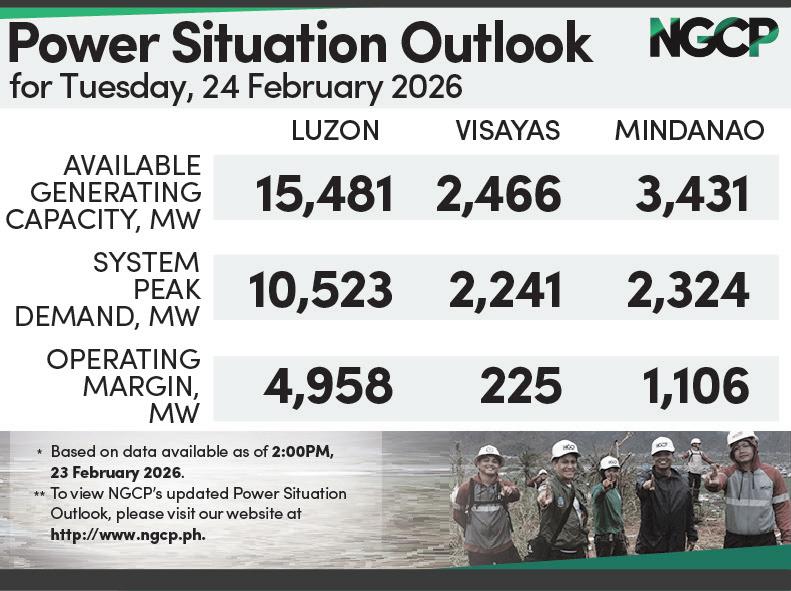
HE Wind Energy Developers Association of the Philippines, Inc. (WEDAP) said the newly-established P11 per kilowatt hour (kWh) price cap for offshore wind (OSW) projects are “feasible enough” to attract serious investors.
“WEDAP believes that the rate may be sufficient to attract credible bidders for GEA5,” it said in a statement on Monday.
It noted that the Green Energy Auction Reserve (GEAR) price for OSW is lower than the initial rates of €0.08–0.11/kWh set by countries such as Denmark in the 1990s, and €0.13–0.15/kWh in the United Kingdom in the early 2000s (both about P14-P15/kWh in 2026 terms), and in the case of the UK, plus ownership of the renewable energy certificates.
A similar range of initial rates were given by Japan in 2014 and Taiwan in 2017. Still, the group lauded the Energy Regulatory Commission (ERC) of its balancing act meant to provide the lowest possible reserve price that investors would believe will support 20-year projects.
Similar to the start of the Feedin Tariff in the Philippines in 2011,
the rates started higher than the consumer is accustomed to, and with the establishment of the local supply chain and expertise, these rates have reduced by nearly half in the case of onshore wind and more than half for ground-mounted solar, the group pointed out.
“We expect a similar track for offshore wind. According to the Global Wind Energy Council (GWEC), offshore wind cost reductions are not driven by technology alone but by policy clarity, auction stability, and visible long-term pipelines,” it said. In the UK, the levelized cost of electricity fell from around $294 per megawatt hour (MWh), or P17/kWh, in 2014, to roughly $112/MWh, or P7.5/kWh, by 2024.
“We likewise appreciate the ERC’s consideration of the one-time indexation mechanism, which cushions foreign exchange and inflation risks, strengthens bankability, and maintains price stability for consumers,” the group added. The GEAR price serves as the maximum price in pesos per kWh that will be used as the basis for bid offers during the auction. The amount is higher than the preliminary rate of P10.3859/kWh earlier released by the ERC.
Continued on B2
New Naia Infra Corp. Deputy Head for Commercial Aileen Tan welcomed the opening, describing Duty Free Philippines as a key partner in the airport’s ongoing modernization efforts.
“We are proud and happy that DFPC is part of NNIC’s modernization journey,” adding that the organization looks forward to strengthening the partnership and pursuing
The branch carries a carefully curated selection of liquor, wines, chocolates, and cigarettes while maintaining the Duty Free Philippines quality that customers have come to expect. Beyond the product categories themselves, the offerings are distinct from those typically found in the domestic market. The store features travel retail exclusives, especially bundled sets, and a wide range of gift-with-purchase promotions not usually available in regular grocery chains.
The new Terminal 3 branch marks just one phase of a wider expansion roadmap. Upcoming projects include new stores at the arrival areas of Terminals 1 and 3--a clear signal of DFPC’s commitment to upgrading its retail concepts and widening access in major travel hubs across the country.
The new Duty Free Philippines Terminal 3 store opening was led by DFPC Chief Operating Officer Patrick Joel M. Cinco, together with Deputy Chief Operating Officer for Operations Richard S. Clarin, Deputy Chief Operating Officer for Finance and Administration Leofredo J. Martinez and Marketing Head Jake B. Liwanag.
“As air travel continues to rebound and more Filipinos return to the skies, Duty Free Philippines is making sure one thing remains constant: the familiar joy of finding the perfect pasalubong.”


By Reine Juvierre Alberto @reine_alberto
TAXES collected in January by the Bureau of Internal Revenue (BIR) was a modest year-onyear increase as the agency attempts to improve compliance by business owners on tax regulations.
During a BIR event
Revenue Commissioner Charlito Martin R. Mendoza told reporters that the agency raised
AS we stepped into 2026, many of us are thinking about resolutions. We talk about improving our health, advancing in our careers, or spending more quality time with family. But one area that often gets overlooked is our finances.
Money is not everything; but how we manage it can shape our peace of mind, our family’s future, and even our ability to give back. If you want to approach the year with confidence, here are five simple principles to guide you.
The first principle is to go back to budgeting. It sounds basic, but budgeting is the foundation of financial health.
Take a clear look at your income and expenses. Separate the essentials from the extras and identify areas where you might be overspending without realizing it. Once you know where your money is going, you can make better choices.
Budgeting is not about restriction. It is about clarity. When you see your finances laid out, you can plan for the things that matter most. You can decide what to spend, what to save, and what to invest. A well-prepared budget gives you control rather than letting money control you.
The second principle is to prioritize savings. There is a saying in personal finance to “pay yourself first” and it works.
Build an emergency fund that can cover at least three to six months of expenses. Life is unpredictable, and having a safety net gives you peace of mind. Once you have a secure emergency fund, think about medium-term savings goals such as a vacation, home improvements, or your children’s education.
Savings is not just about security. It gives you freedom to make choices and reduces stress. When money is set aside, you can focus on your work and family without constantly worrying about the unexpected.
The third principle is to invest for growth. Inflation and rising costs mean that saving alone may not be enough. Investing allows your money to work for you.
Whether you choose stocks, mutual funds, real estate, or a mix of assets, the key is to start early and be consistent. Even small amounts can grow significantly over time thanks to compounding. Investing also teaches discipline and patience. It is not a get-rich-quick scheme, but a way to secure your future and create opportunities.
Before you invest, understand your risk tolerance and choose investments that fit your goals.
The fourth principle is to align finances with your family. Money is often a source of tension in households. Differences


in spending habits or priorities can lead to misunderstandings and stress.
Sit down with your spouse or family members and discuss goals, expectations, and financial responsibilities. When everyone is on the same page, it becomes easier to save, invest, and spend wisely. Shared financial goals create shared responsibility and harmony. It also strengthens your relationships because money becomes a tool for supporting your family’s dreams rather than a source of conflict.
The fifth principle is to leave room for provision from the Lord. While planning, saving, and investing are essential, it is equally important to recognize that ultimate provision comes from God.
Give generously, seek wisdom, and trust that your needs will be met. A portion of what you earn is not just for yourself. It can be used to bless others, support ministries, or serve those in need. Stewardship is not only about money management. It is about living a life that reflects gratitude, faith, and responsibility.
When we acknowledge God’s provision, we approach finances with a sense of purpose and trust rather than fear.
2026 is a fresh start. With clear budgeting, disciplined saving, thoughtful investing, family alignment, and trust in God’s provision, you can face the year with confidence.
These principles are simple but powerful. They do not require complex financial strategies, only intention, consistency, and faith. By following them, you are not just managing money. You are building a foundation for a life of peace, generosity, and fulfillment.
Your finances are a reflection of your priorities. When you plan well, save wisely, invest thoughtfully, communicate openly with your family, and leave room for God’s provision, you create stability and opportunity. This year, let money be a tool that serves you, your loved ones, and the greater good. Step into 2026 prepared, confident, and aligned with both your financial goals and your values.
Karlo Biglang-awa is a Registered Financial Planner of RFP Philippines. His views do not necessarily reflect those of the B usinessM irror s . To learn more about personal financial planning, attend the 115th RFP program this March 2026. E-mail info@rfp.ph or visit rfp.ph to learn more about the program.
around P358 billion in revenues as of end-January.
The amount, which is still subject to reconciliation according to Mendoza, is a tad higher by about 0.8 percent from the P355.096 billion collected in the same month a year ago.
Nonetheless, the BIR chief remains optimistic that the economy, projected by the country’s economic managers to expand by 5 percent to 6 percent, will drive its collections this year.
“It [our efforts] will translate to higher [value-added tax], excise [tax], income tax, and then of course, our digitalization initiatives, real-time,
near-time monitoring [will] prevent revenue leakages,” Mendoza said. “Hopefully, this year, the infrastructure projects of the government will accelerate and will be able to help increase the revenues collected by the BIR,” he added. Mendoza led the BIR’s nationwide simultaneous friendly tax compliance verification drive beginning at 168 Mall in Manila on February 23. This year, the BIR’s revenue target is set at P3.579 trillion, 11.8 percent higher than last year’s P3.219 trillion goal.
‘Friendly CHAT’ ALSO last Monday, BIR person -
nel had a “friendly CHAT,” which the agency dubbed as a “Counsel, Help, Assist Taxpayers” initiative to encourage voluntary compliance.
Mendoza said they expect this initiative will not just boost revenue collection but also make business owners, particularly micro-sized, small-scale and medium-sized enterprises, become more tax compliant.
“[Compliance] is what we’re really after,” he said.
THE net income of pre-need companies rose by half to P7.96 billion last year despite stricter regulatory oversight and fewer licensed firms, according to the Insurance Commission (IC).
The latest data from the IC showed that the total net income of the preneed industry jumped by 54.50 percent last year from P5.15 billion in 2024. The increase was ushered by growth in total premium income hit 5.73 percent to P23.94 billion from P22.64 billion the previous year.
“Strengthened regulatory oversight has positively impacted the industry’s growth by restoring the trust and confidence of both consumers and investors, ensuring a more
secure and transparent market environment,” Insurance Commissioner Reynaldo A. Regalado was quoted in a statement as saying.
Pre-need firms sold a total of 895,679 plans last year, up by 28.02 percent from the 699,621 plans sold a year earlier. Life and memorial plans accounted for 99.84 percent of the total sales.
The sector likewise recorded a double-digit growth of 21.04 percent in total net worth, reaching P33.87 billion at the end of 2025, despite tighter regulatory oversight that resulted in a decrease in licensed companies.
Meanwhile, retained earnings increased by 39.57 percent and accounted for 73.48 percent of total net
By VG Cabuag @villygc
THE Securities and Exchange Commis-
sion has not only fined Myloan Lending Investors Inc. but also ordered the company to stop its abusive practices in collecting payments.
According to the SEC, the lending firm is employing humiliating, coercive or thirdparty pressure tactics.
In an order dated February 18, the SEC Financing and Lending Companies Department found Myloan Lending administratively liable for a second violation of SEC Memorandum Circular (MC) 18 (series of 2019), in relation to Republic Act 11765, or the “Financial Products and Services Consumer Protection” law.
MC 18 prohibits abusive and unscrupulous debt collection practices, which include the use of threats, intimidation or coercion, contacting persons in the borrower’s contact list other than the guarantors or co-makers, and use of obscenities, insults or profane language, among others.
The company was directed to pay an administrative fine of P50,000 for its second violation of MC 18, alongside a warning that a further violation of the rule will be
While many tax transactions are now done online, Mendoza stressed the importance of occasional faceto-face interaction with taxpayers.
“[This is] not only to teach them, but also for us to better understand the business and their recourse,” Mendoza added.
During the visits, regional offices guided businesses on proper registration, issuance of receipts, record-keeping and filing and payment obligations, while also addressing taxpayer concerns and clarifying compliance requirements.
Mendoza and BIR employees conducted field visits at 168 Mall and spoke directly with business owners to encourage compliance rather than intimidation.
worth, “[reflecting] the industry’s improved profitability and enhanced financial stability,” the IC said.
“As the data show, the pre-need industry continues a solid upward path - strengthening its financial position, maintaining profitability, and enhancing its capacity to meet future obligations,” Regalago said.
Moreover, the industry maintained its growth momentum, with total assets climbing by 8.19 percent to P178.20 billion in 2025 from P164.71 billion in 2024. This expansion was driven primarily by investments in trust funds, which grew by 9.64 percent and now represent 85.92 percent of total assets.
Total liabilities, meanwhile,
dealt with more severely and may result in heavier penalties, including suspension or revocation of its certificate of authority.
The case stemmed from a complaint filed by a borrower who claimed that he experienced improper loan collection practices from Myloan Lending’s collection agents due to delayed payments.
Such messages contained shaming language, threats to contact emergency contacts and employers, as well as statements indicating persistent third-party contact, among others, according to the SEC.
“These are not neutral reminders. They are coercive communications designed to pressure payment through humiliation and reputational exposure,” the SEC said in its order.
“Even assuming [the borrower’s] delinquency, such a circumstance does not vest [the company] with a license to employ humiliation, harassment, or the specter of third-party exposure as instruments of coercion. Delinquency may justify reasonable collection efforts; it does not justify abuse,” the regulator added.
Still, the SEC directed the borrower to settle outstanding obligations with Myloan Lending, in accordance with loan agreements.
Marcos vows ‘transparent, unbiased’ LGSF distribution
Pamounted to P144.33 billion, primarily due to pre-need reserves, which comprised 91.27 percent of overall liabilities. In addition, the sector also recorded a P16.03-billion surplus over required reserves, up by 62.62 percent from its 2024 level, with trust fund investments remaining more than adequate to cover all pre-need reserves, including benefits payable.
“The overall performance of the industry reflects a positive outlook and strong growth prospects in the market. This is a foundation we aim to build upon in 2026 and in the succeeding years,” Regalado said through the statement.
YIELDS of short-term government securities further fell across the board for the seventh straight week, following the central bank’s reduction in its key policy rates.
During Monday’s auction, average interest rates of the 91- day, 182- day and 364-day tenor Treasury bills (T-bills) fell below the previous auction rates and current secondary market levels.
The decline came after the Monetary Board (MB) of the Bangko Sentral ng Pilipinas (BSP) delivered a 25-basis point rate cut last week, bringing the key policy interest rate to 4.25 percent, as well as the week-on-week decline in secondary benchmark rates, said Michael L. Ricafort, chief economist at Rizal Commercial Banking Corp.
“The BSP gave less hawkish signals by dropping the previous statement that [it] may be near the end of its monetary easing cycle,” Ricafort added.
Awarded rates were as low as 4.204 percent to as high as 4.264 percent.
The offer was four times oversubscribed as P36.350 billion was tendered for the tenor. Meanwhile, the rate for the 182-day T-bills declined to 4.357 percent, down by 7.6 basis points from 4.433 percent last week. Yields ranged from 4.288 percent to 4.357 percent.
The IOUs were similarly swamped by tenders amounting to P35.260 billion, or 3.9 times the P9 billion offering. As for 364-day T-bills, the rate fell by 1.1 basis points to 4.501 percent from 4.512 percent in the previous auction.
By Samuel P. Medenilla @sam_medenilla
RESIDENT Ferdinand R. Marcos Jr.
has vowed an unbiased, transparent and faster distribution of the P58-billion enhanced Local Government Support Fund (LGSF) this year for public services at the grassroots level amid growing “political noise” for the upcoming 2028 polls.
The chief executive made the statement during he so-called “LGU (local government unit) Day” when he met with local officials, who will benefit from the launch of the “Sa Bagong Pilipinas, Bawat Bayan Makikinabang (Under the New Philippines, every Town will Benefit)” initiative and the second batch of Memorandum of Agreement (MOA) signings between the Department of Education (DepEd) with some cities for the agency’s classroom building program in Malacañang last Monday.
“We had the governors and the city mayors here to explain the program where LGSF will be given to–we have increased the program of the LGSF to make it more responsive and more appropriate to the needs of
LGUs,” Marcos said during the MOA signing ceremony. The first batch of MOAs, which will cover the construction of 4,000 new classrooms, was signed by DepEd earlier this month. The MOAs aims to address the classroom gap, which rose to 165,000, according to DepEd.
LGSF gaps
MARCOS highlighted the importance of the LGSF and how its implementation were previously riddled with problems, including the numerous requirements LGUs must submit to avail of it.
The LGSF is a mechanism which allows the national government to provide additional budget to LGU in delivering basic services to their constituents.
“It is undeniable that sometimes, the process [for the LGSF availability] is difficult and slow—sometimes the request gets lost—especially in small and remote LGUs. It is surprising that the request gets lost. Why is that?,” he said in Filipino during the launch of LGSF reforms.
“So I ordered [concerned agencies] to focus on these problems,” he added.
T-bill yields also continued to ease after the Bureau of the Treasury’s auction committee raised nearly P300 billion from its issuance of jumbo 10-year debt notes last week, Ricafort added.
Total tenders from investors aggregated to P96.820 billion, or 3.6 times oversubscribed the initial P27 billion offering.
Strong demand encouraged the auction committee to double the accepted noncompetitive bids across all tenors to P7.2 billion each.
As such, the government generated a total of P37.8 billion, P10.8 billion more than what it intended to borrow.
The Treasury raised P12.6 billion from each tenor, above the programmed P9 billion.
Yields drop
THE average rate for 91-day T-bills was lower by 11 basis points to 4.240 percent from 4.350 percent a week earlier.
The tenor attracted as much as P25.210 billion in bids, or 2.8 times the program. The T-bills fetched lower average rates than the secondary market benchmark rates. The Philippine Bloomberg Valuation (PHP BVAL) rates are 4.432 percent for the three-month, 4.544 percent for the six-month and 4.595 percent for the oneyear tenors.
Funds raised THE Treasury raised a total of P151.2 billion via T-bills this February, more than the P108 billion it intended to borrow, as the BTr upsized the award of debt papers.
The decision to upsize the award is supported by market expectations of the BSP lowering the key policy rate amid slower economic growth and stable inflation.
The Treasury aims to borrow a total of P2.682 trillion this year and will follow a 77:23 borrowing mix in favor of domestic sources. The government’s outstanding debt reached P17.707 trillion as of end2025, up 10.32 percent from P16.051 trillion in end-2024. Reine Juvierre S.

THE Metropolitan Theater (MET), in collaboration with the Order of National Artists, kicked off its National Artist Exhibit Series for the year with a presentation honoring Kidlat Tahimik.
Titled Portraits of a National Artist as Kultur Warrior the exhibition features works inspired by and dedicated to the revered filmmaker. The show runs until February 28 at the Metropolitan Theater Gallery in Manila in celebration of National Arts Month.
“Nawa’y magsilbing paanyaya ang eksibit na ito na patuloy nating ipaglaban at ipagdiwang ang ating kultura— nang may tapang, pagkamalikhain, at pagmamalaki,” said National Commission for Culture and the Arts (NCCA) deputy executive director for operations Bernan Joseph R. Corpuz during the exhibit opening on February 11, which Kidlat Tahimik attended.
Born Eric Oteyza de Guia and often called Tatay Kidlat, the 83-year-old is tagged as the “Father of Independent Cinema.” Some of Kidlat Tahimik’s most celebrated films—Mababangong Bangungot (Perfumed Nightmares), Turumba, and Balikbayan #1: Memories of Overdevelopment Redux III, to name a few—examine the tension between indigenous Filipino culture and Western imperialism.
It’s a story close to the artist’s heart as a passionate champion of indigenous identity and decolonization. Kidlat Tahimik attempted to earn a master’s degree in Business Administration at the Wharton School of the University of Pennsylvania, before returning home and opening his eyes to the challenges faced by the Igorots. The community has struggled for cultural

autonomy in the face of continued colonial influence in modern times. He then began telling stories through films from the local point of view, highlighting the beauty of Filipino culture, while critiquing what he calls a “neocolonial state” of people’s everyday lives. He considers his debut film, Mababangong Bangungot (Perfumed Nightmares), the death of “Eric Oteyza de Guia” and the birth of “Kidlat Tahimik.”
In his tribute showcase at the MET, presented was a remarkable 50-year visual narrative through portraits created by various artists. Kidlat Tahimik has been a compelling muse to portrait artists, caricaturists, photographers, and fellow cultural workers long before his conferment as National Artist. He is known for his distinct “crazy-artist” persona— from his wispy goatee and dreadlocks to his impish smile often seen behind his iconic Bamboo Camera
(Kapwa-Kamera na Kawayan ni Kidlat, or K.K.K.K.), which inspired generations of creatives across disciplines.
Among the featured works are a 1973 art-school painting by his late wife, Katrin de Guia; a 1983 editorial cartoon by Nonoy Marcelo; and photographs from the 1990s by cinematographer Boy Yñiguez. There are woodworks as well by Ifugao carver Chris Atiwon; documentary shots by Tommy Hafalla; and even recent playful sketches by his grandchildren.
Together, these pieces depict the evolving image of an octogenarian culture-warrior whose advocacy remains firm and strong. The collection, according to the NCCA, “reflects not only artistic interpretations but also deep reverence for a mentor whose work continues to challenge cultural colonialism and celebrate Filipino identity, particularly from the Cordillera.”
FOR decades, Philippine postcards have served as visual records and souvenirs—mementos that provided glimpses into our rich Filipino culture. Iconic landmarks and heritage sites, national symbols, such as the sampaguita and the Barong Tagalog, and scenes from vibrant fiestas have illustrated these tangible tokens to encapsulate and share the Filipino values of faith, family and community.
In the digital age, wherein social media has extensively transformed snail mail into instant messages, selfies and e-cards, the Benilde Fashion Museum (BFM) brings forth its advocacy to keep the cherished tradition alive.
In line with its mission to study, preserve and exhibit Philippine fashion heritage through the works of esteemed Filipino designers, BFM introduces a collection of postcards which feature selected ternos, the Philippine national dress defined by its distinctive “butterfly” sleeves.
The set of 15 postcards captures the creative visions of fashion designers whose renowned creations found home in BFM’s growing selection of nearly a thousand pieces. It spotlights the obras of Philippine National Artists for Fashion Design Ramon Valera and Salvacion Lim-Higgins, as well
as fashion innovators, such as Pitoy Moreno, Ben Farrales, Aureo Alonzo, and Christian Espiritu.
“Their works reveal evolving silhouettes, innovation in garment construction, textile manipulation, and embellishment techniques, reflecting global influences and Filipino craftsmanship,” BFM director arch. Gerry Torres explained. “The pieces represented underscore the versatility of the terno, which lends itself to endless design exploration while retaining its distinct cultural identity,” he added.
Established by the De La Salle-College of Saint Benilde (DLS-CSB) in 2024, the BFM documents the evolution of Philippine couture, celebrates the valuable contributions of designers and artisans, and serves as an educational resource for students, researchers, and the broader public.
“The museum was conceived following the donation of a 350-piece collection from the family of Ben Farrales, a seminal figure in Philippine fashion, after his passing in 2021,” Torres recalled.
“With continued generous donations from individuals, families, and partner institutions, the collection has expanded and today numbers nearly a thousand artifacts, representing


a significant resource for the study of Filipino fashion,” he added. “Central to the museum’s mission is the conservation of its collection through science-based policies and practice.”
The BFM will be housed in the former Lopez Apartments, designed by Architect Fernando Ocampo, built in 1938 for Vice President Fernando Lopez. The Art Deco structure has served various capacities throughout its history, including embassies, private residences, offices. For a time, it was the site of Instituto Cervantes, before its acquisition by the college.
Following its renovation, the four-and-a-half-story building will accommodate galleries, conservation laboratories, archives, a fashion design library, a multimedia lecture room, a café, a museum shop, offices, and storage facilities. With this set of postcards, the museum wishes to share a peek of the collection, while it underscores the need to preserve our fashion heritage through the works of our foremost fashion designers.
The postcard set is on sale for P500. To order, contact www.facebook.com/benildefashionmuseum or www. instagram.com/benildefashionmuseum.
is all it takes to make the world a better place. Something you do or someone you meet will encourage you to pursue a path that you find uplifting. ★★★★
VIRGO (Aug. 23-Sept. 22): Don’t let your emotions stop you from doing what’s
LIBRA (Sept. 23-Oct. 22): Set a budget and stick to it. You’ll have more willpower than usual, so set your sights high, and don’t stop until the results satisfy you. Rely on your intuition when dealing with domestic issues or choosing a course of action that can change your professional direction or location. ★★★★★
SCORPIO (Oct. 23-Nov. 21): Hunker down and tidy up loose ends before heading out into a social setting. Having a clear head and less stress will enable you to present the best version of yourself to those you want to impress. Let your charm, knowledge and experience open doors to new friendships, possibilities and prospects. Love and romance are on the rise. 3 stars
SAGITTARIUS (Nov. 22-Dec. 21): Use your imagination, and rearrange your space to add to your convenience or to prompt you to improve your lifestyle, fitness or financial position. Bringing in additional income by doing something you enjoy or by selling items you no longer need or use will be liberating and encourage you to invest more time and effort in personal happiness. ★★★
CAPRICORN (Dec. 22-Jan. 19): It’s


GMA EARNS 5TH TV STATION OF THE YEAR TITLE, MAJOR AWARDS AT 2026 PLATINUM STALLION NATIONAL MEDIA AWARDS
MARKING another milestone in its broadcasting legacy, GMA Network was named TV Station of the Year for the fifth time at the 2026 Platinum Stallion National Media Awards.
The network further received other major awards across TV, regional broadcasting and radio, highlighting GMA’s wide reach and consistent delivery of trusted content nationwide.
The network’s flagship newscast 24 Oras was once again named Best TV News Program. Meanwhile, veteran broadcast journalist and State of the Nation anchor Atom Araullo was hailed as Male News Anchor of the Year.
GMA’s extensive reach across the country was also recognized, with GMA Regional TV being named Regional TV Network of the Year for the 9th consecutive time. Solidifying its excellence on the airwaves, Super Radyo DZBB maintained its leadership position, winning AM Radio Station of the Year. Underscoring the network’s excellence in impactful storytelling, its public affairs programs likewise earned top distinctions. GMA Public Affairs’ top-rating and multiawarded program Kapuso Mo, Jessica Soho took home the award for Best News Magazine Program, while the country’s most-awarded documentary program I-Witness was recognized as the Best Documentary TV Show. Moreover, the country’s longest-running morning show Unang Hirit was named Best Morning Show.
Wish Ko Lang was celebrated as Best Public Service Program, while its host, Vicky Morales, won Best Public Service Program Host. Further cementing its leadership in the entertainment industry, the GMA Entertainment Group showcased its creative excellence by garnering numerous accolades. The action-packed drama series Mga Batang Riles triumphed as Best Primetime Drama Series, with its lead star Miguel Tanfelix earning the distinguished TV Actor of the Year award.
The iconic fantasy series Encantadia Chronicles: Sang’gre also brought in several trophies. Rhian Ramos was honored as TV Actress of the Year, while her co-stars Kelvin Miranda and Angel Guardian were recognized as Best Primetime Drama Series Actor and Actress, respectively. GMA Synergy sportscaster Martin Javier was celebrated as Best TV Sports Program Host.
Capping off the network’s diverse wins, Sparkle artist Will Ashley took home the Best Film Actor award for Bar Boys: After School, and the popular daily program It’s Showtime won once again, awarded as Best Noontime Show. Established in 2015, the Platinum Stallion National Media Awards by the Trinity University of Asia recognizes individuals and institutions for their contributions to the industry that inspire the Trinitarian community. The awarding ceremonies was held on February 18 at the Trinity University of Asia University Theater.
Oscars will bring back last year’s acting winners—Saldaña, Culkin, Madison and Brody—to present
LOS ANGELES—The Oscars are reuniting last year’s acting winners for next month’s ceremony. The Academy of Motion Picture Arts and Sciences announced on Thursday that best actor winners Adrien Brody and Mikey Madison and supporting actor winners Kieran Culkin and Zoe Saldaña will present trophies at the 98th annual Academy Awards. The actors are the first presenters announced for the March 15 ceremony, which will be hosted by Conan O’Brien. The show will air live on ABC beginning at 7 pm Eastern/4 pm Pacific. Last year’s show saw Saldaña, Madison and Culkin become first-time Oscar winners. Brody won his second best actor trophy, for his role in The Brutalist. Sinners is this year’s leading nominee, breaking the record for most nominations by a single film with 16. The Oscars frequently have the previous year’s winners present Oscar trophies in the acting categories. Who’s nominated for an Oscar this year? This year’s nominees for best actress are Jessie Buckley for Hamnet, Rose Byrne for If I Had Legs I’d Kick You, Renate Reinsve for Sentimental Value, Emma Stone for Bugonia and Kate Hudson for Song Sung Blue. The best actor nominees are Timothée Chalamet for Marty Supreme, Leonardo DiCaprio for One Battle After Another, Ethan Hawke for Blue Moon, Michael B. Jordan for Sinners, and Wagner Moura for The Secret Agent. In the supporting actor categories, the nominees are Jacob Elordi for Frankenstein, Sean Penn and Benicio del Toro for One Battle After Another, Stellan Skarsgård for and Delroy Lindo for Sinners. The supporting actress nominees are Elle Fanning and Inga Ibsdotter Lilleaas for Sentimental Value, Amy Madigan for Weapons, Wunmi Mosaku for Sinners, and Teyana Taylor for One Battle After Another AP

GROWING number of feature films are
Anow portraying the experiences of older adulthood. Modern cinema is witnessing some kind of a shift with older actors, moving from supporting roles to central characters and complex leads, almost redefining what is it to age on the big screen.
Older actors are no longer just playing stereotypes—the sympathetic mother, the cruel mother-in-law, the understanding auntie, the old maid eldest next of kin—but are now central to storytelling, bringing authority, experience, assertiveness and trust to their roles.
Boots Anson-Roa Rodrigo is elated that at 81, she accepted an offer to act in a very special movie and share lead status with her friend Charo SantosConcio.
The film is Brillante Mendoza’s Until She Remembers, about two women who reconnected after fate led them to separate paths, and continued a love that has defied memory, time, society, and norms.
“When I learned about the offer, the actors and director I will be with, I immediately agreed. And when the role was explained, and the character started sinking in, I have to admit that I had a rush of emotions, because it is an out-of-the-box role, something I’ve never played lengthily in my decades as an actor. But after the emotions simmered, I thought to myself, I’ve been there, done that, and this prized, rare, once-in-a-lifetime role comes along, so why not?”
Boots added, “My role is beautiful. My character is complex yet calm, vulnerable yet resilient. The role has quietly been sitting on my list of roles I wish to play, and it is definitely unlike any that I have portrayed in my five decades as an actor!”
Another iconic actress that has a new movie is Ai-
Ai de als Alas, who has been in the industry for almost four decades now.
Ai-Ai and funny man Empoy headline the MiVida Productions’ initial offering Batang Paco, marketed as a heartwarming action comedy movie about family relationships.
“The sole purpose of the movie is to entertain. We do not have any wishful thinking to be noticed and praised by critics, because it is very clear that the story is meant to make the moviegoer happy, and hopefully the audience will be able to relate to our characters and their normal lives.” Ai-Ai said in jest.
She shared that she is happy that as a senior citizen, and after the very colorful roller coaster journey in both her personal and showbiz lives, she is still actively acting for film and being offered projects in many platforms.
“I am grateful that writers continue to create interesting lead characters for actors in my age bracket, and that actors like me continue to give life to
IT was a battle of the holdovers at the North American box office this weekend, with the family friendly film GOAT edging out the R-rated Wuthering Heights Sony Pictures Animation’s GOAT took in $17 million, while Warner Bros.’ Wuthering Heights earned $14.2 million, according to studio estimates on Sunday. Both films are in their second weekend.
Overall, it was a quiet weekend at movie theaters around the country, with new offerings all opening under $10 million. Those results applied to the faithbased sequel I Can Only Imagine 2, the Glen Powell black comedy How to Make a Killing and the horror film Psycho Killer, which currently has a zero percent rating on Rotten Tomatoes. One bright spot in theaters was Baz Luhrmann’s immersive documentary EPiC: Elvis Presley in Concert, which earned $3.3 million from only 325 locations in its limited IMAX release. That film expands to nationwide distribution on February 27. “These somewhat slower weekends can be a land of opportunity,” said Paul Dergarabedian, the head of marketplace trends for Comscore. GOAT dropped a slim 38 percent in its second weekend in theaters, which the studio attributed to positive word-of-mouth. The Stephen Curryproduced movie, about a small goat with big sports dreams (voiced by Stranger Things’ Caleb McLaughlin) has made over $58.3 million. Globally, its running total is at $102.3 million.

these characters to the best and the most realistic way we can!” She recalled that she also started from the bottom, receiving three thousand as talent fee for her first acting role on film.
“I can say that I tirelessly worked my way up, and not all projects were handed to me on a silver platter. My life as a celebrity is an open book, and many know that there were bumps along the way, and many instances where the rising was more exhausting than the falling. But I’m glad that I never quit, and that I am learning so much about self-love these past few
GHOSTFACE RETURNS FOR SIDNEY’S DAUGHTER. ‘SCREAM 7’ COMES TO PHL CINEMAS ON FEBRUARY 25
GO behind-the-scenes with Neve Campbell and Isabel May as they discuss the relationship between Sidney and her daughter, Tatum—and how Sidney’s past comes back to haunt them both—in this new featurette for Scream 7. The latest film in the cult favorite franchise is directed by co-creator and co-writer Kevin Williamson, and also stars Courteney Cox, Anna Camp, Joel McHale, Mckenna Grace, Ethan Embry and Mark Consuelos. Watch the “Like Mother, Like Daughter” featurette on youtu. be/BaaXZ1fLqQo.
In Scream 7, when a new Ghostface killer emerges in the quiet town where Sidney Prescott (Campbell) has built a new life, her darkest fears are realized as her daughter (May) becomes the next target. Determined to protect her family, Sidney must face the horrors of her past to put an end to the bloodshed once and for all. Get ready for a bloody good time when Scream 7 slashes its way into cinemas on February 25.
months. I’m happy, too, that my children continue to inspire me to move forward in my search for fulfilment and happiness.”
Movies have long been a big part of the vast societal mirror in which we see ourselves. As such, we can expect to see in them how our culture perceives and positions the core of living as we reach our senior years.
That is why we are glad when we learn about senior actors being cast in movies and getting major roles like the ones being given to Boots Anson RoaRodrigo and Ai-Ai de las Alas.


Wuthering Heights meanwhile fell 57 percent from its opening last weekend, bringing its domestic total to $60 million. Internationally it added another $26.3 million, pushing its global total to $151.7 million against an $80 million production budget. The movie’s top international market continues to be the UK, where it has made $22.5 million alone. Third place for the weekend went to Lionsgate and Kingdom Story’s I Can Only Imagine 2, a follow-up to the 2018 Dennis Quaid movie that made $86 million against a $7 million budget. The sequel opened with $8 million, a far cry from the first film’s $17 million launch, though that was in line with expectations. It did score a rare “A+” CinemaScore. Amazon and MGM’s Crime 101 fell 59 percent in its second weekend, bringing in $5.8 million to take
fourth place. The Chris Hemsworth and Mark Ruffalo heist thriller has now made $24.7 million against a reported $90 million budget. Send Help rounded out the top five with $4.5 million. How to Make a Killing landed in sixth place with $3.6 million. A24 released the StudioCanal movie in 1,600 North American theaters. The film, loosely inspired by Kind Hearts and Coronets, stars Powell as a man who, in a quest to acquire a $28 billion inheritance, decides to kill off his family members. Directed by John Patton Ford (Emily the Criminal), How to Make a Killing was not well-received by critics: it’s sitting at a “rotten” 47 percent on Rotten Tomatoes. Psycho Killer, released by 20th Century Studios, fared much worse and opened outside of the top 10. The horror-thriller written by Andrew Kevin Walker (Seven) and directed by Gavin Polone (a notable television and film producer in his directorial debut) tanked in its first weekend in theaters with $1.6 million in ticket sales from 1,110 theaters. Audiences were not any happier with it than critics; according to PostTrak, only 31 percent of ticket buyers would “definitely recommend” it. The year’s box office is running about 5 percent ahead of last year and Dergarabedian expects things will start to pick up when Scream 7 opens next weekend.
“It’s been a kind of rollercoaster ride at the box office,” he said. AP
Coins.ph, the leading digital asset exchange in the Philippines, has entered the new year with unprecedented momentum, reporting a massive 327 percent growth based on its most recently available spot trading data.
The exchange recorded a landmark November performance of $500 million, a nearly fourfold increase from the $117 million recorded in the same month of 2024.
Coins’ growth trajectory further reached a new peak last week, with the platform hitting an all-time high of $50 million in daily spot trading volume.
The Coins.ph Spot Trade feature is a professional-grade order-book exchange designed for users who want more control, lower fees, and advanced tools compared to standard retail “Buy/Sell” or “Convert” options. It allows you to trade cryptocurrencies directly with other users at prices determined by market supply and demand.
The primary driver of this explosive spot trading growth is the rapid evolution of stablecoins from speculative assets into essential financial infrastructure.
Stablecoins like USDT and USDC, digital assets pegged 1:1 to traditional currencies such as the US Dollar, have emerged as a critical digital bridge for the Philippine economy, where remittances reached $38.3 billion at the end of 2024.
By offering a faster and more transparent method for cross-border payments than traditional banking rails, stablecoins are now the preferred vehicle for corporate payouts, contractor payments, and supplier disbursements.
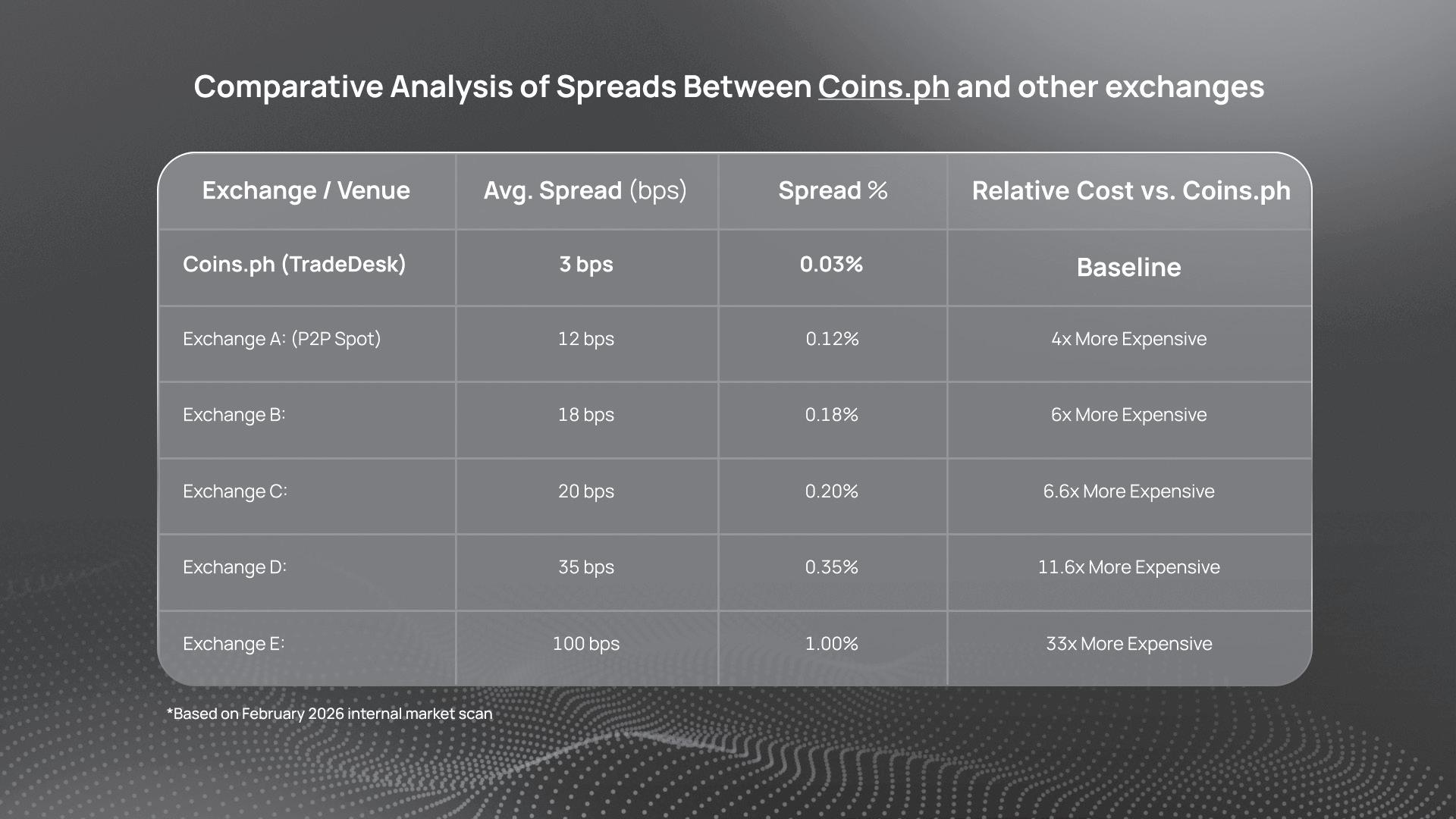
“These spot trading milestones are a testament to the critical role stablecoins are playing in modernizing Philippine finance,” stated Wei Zhou, CEO of Coins.ph. “It signals a strong market appetite for efficient, regulated digital asset trading, especially for our USDT-PHP and USDC-PHP pairs. We anticipate this robust demand will define the trajectory for Coins.ph and the broader digital asset market throughout 2026.”
Coins.ph is also enjoying strong trading volumes for its OTC Desk, the exchange’s specialized over-the-counter (OTC) trading service designed specifically for high-networth individuals (HNWIs) and institutional clients who need to execute large-scale transactions without impacting the broader market. The OTC Desk offers deep liquidity, zero slippage, and personalized support for transactions exceeding P1,000,000, ensuring price stability even for the largest market movements.
Central to this strong performance is the spread, the difference between the buy and sell price, which Coins.ph has reduced to an industry-low three basis points (bps), which is far lower than 12 to 35 bps offered
by other exchanges. By narrowing this transaction friction, the platform ensures that high-volume traders retain significantly more value compared to other regional and global exchanges.
To sustain the strong stablecoin trading momentum, Coins.ph is leveraging its recent integration into the Circle Payments Network, enabling near-instant, compliant peso settlements across over 120 domestic banks and e-wallets.
To build deeper awareness of these realworld applications, Coins.ph is actively conducting educational campaigns and roadshows in key cities nationwide. These initiatives aim to help Filipinos harness stablecoins for more efficient, low-cost financial activities.
Ready to trade at scale? For institutionalsized liquidity and unrivaled pricing, contact the Coins.ph TradeDesk team directly at otcdesk_ph@coins.ph or fill out our interest form here: https://www.coins.ph/enph/tradedesk#form.
For more information on professional trading tools, visit the official Coins.ph Trading Help Center.
Electrifying enterprises: ACMobility launches ChargeFleet to simplify charging for business fleets
AAyala’s mobility arm and the leading provider of electric vehicle (EV) charging solutions and infrastructure in the Philippines, continues to expand its electrification services in the country with
face operational challenges, particularly around fragmented payment systems, reimbursement delays, and limited visibility over charging usage. ChargeFleet addresses these gaps by introducing a centralized, shareable digital wallet that allows fleet managers to allocate and monitor charging credits across multiple drivers through a single platform. Transitioning to the ChargeFleet system is a seamless process designed for long-term usage and easy deployment across any organization. Once integrated, ACMobility assigns the charging credits to the client’s fleet manager who can then distribute these to multiple drivers. The drivers will be able to see and use their assigned credits using ACMobility’s partner app Evro.
“Our main goal has always been to build a comprehensive EV ecosystem that serves every type of driver,” says Carla Buencamino, Head of Mobility

Infrastructure at ACMobility. “With this new offering, we hope to address a critical gap for our enterprise clients - transport groups and corporate fleets who require a professional management platform. This reinforces our commitment to providing the infrastructure and innovations necessary to lead the transition toward an electrified future.” Looking ahead, ACMobility will continue to enhance the ChargeFleet experience with exclusive value-added perks integrated through their partner app Evro and Power on Wheels, their mobile EV Charging Station (EVCS). These upcoming features underscore ACMobility’s

Tcommitment to providing a future-proof support system for the evolving needs of their customers’ businesses. ACMobility invites corporate partners to experience immediate gains in operational transparency. ChargeFleet is available as a prepaid product through the online ChargeFleet Store, where users can buy offers with GCash or credit card. No application process is required to avail of ChargeFleet offers.
To learn more about ACMobility’s EV Services or integrate existing fleets into ACMobility ChargeFleet, visit https://www. acmobility.ph/driving-electric/businesses-partners/fleetcharging or email corporatesales@acmobility.ph.
by scaling up its Sagip CPR (Hands-Only CPR) advocacy through backto-back training rollouts nationwide. Dubbed as “Pintig ng Pinas,” the initiative features training sessions across Metro Manila, Central Luzon, Bicol, Visayas, and Mindanao. Hands-Only CPR focuses on continuous chest compressions that help maintain blood circulation during cardiac arrest until professional medical help arrives. This approach is particularly recommended for cardiac emergencies and has gained wider adoption in recent years, as it does not require mouth-to-mouth resuscitation. It is said that doing proper CPR on a person undergoing cardiac arrest is essential in the first four minutes, before professional help can arrive.
Training activities began in early February in Nabua, Camarines Sur; Polangui, Albay; Malabon; Iloilo; Roxas City in Capiz; and Bulacan. The rollout continues with scheduled sessions on Feb. 14 in General Santos City, Feb. 20 in Tarlac and North Cotabato, Feb. 22 in Antique, Feb. 23 in Marikina,

LAST January 24, 2026, BEBIG Medical Philippines formally opened its headquarters in Quezon City. This is a significant milestone in cancer care in the country, affirming BEBIG’s longterm commitment to advancing precise, efficient, sustainable and affordable radiation therapy nationwide.
The launch highlights the introduction of the SAGISTAR LINAC medical linear accelerator (Linac) in the Philippines under the BEBIG brand.
Beyond clinical advantage, the SAGISTAR LINAC, BEBIG’s flagship medical linear accelerator system offers benefits to both hospital management and key decision makers, underscoring reliable performance, scalable technology, efficient workflows and comprehensive service support, all critical factors in providing high-value medical investment.
The SAGISTAR LINAC System installation in the Philippines marks BEBIG’S first Linac under its own brand, further establishing the company’s longstanding presence in the radiotherapy landscape.
BEBIG Medical Philippines is a company dedicated to advancing cancer care through cutting edge radiation therapy solutions, linear accelerators, brachytherapy systems, and quality assurance tools. The company supports healthcare institutions by delivering accurate, accessible, sustainable oncology
care across the country. The recent launch of BEBIG Medical Philippines marks the beginning of a broader roadmap in cancer care advancement in the nation.
From treatment delivery to quality assurance, from clinicians to hospital administrators, BEBIG aims to support every aspect of cancer care. The company aims to deepen partnerships and provide end-to-end support, as it envisions to expand its presence with stronger local engagement.
The medical linear accelerator or LINAC machine is used to treat cancer by delivering high-energy X-rays directly to the tumors. These beams are shaped and directed with high precision to destroy cancer cells while minimizing exposure to the surrounding healthy tissue.
The SAGISTAR LINAC is designed to support modern radiotherapy techniques, strongly focusing on treatment accuracy, operational efficiency and patient safety, allowing hospitals to deliver accessible world-class cancer treatment, closer to where patients live. The SAGISTAR LINAC technology thus significantly reinforces BEBIG’s ability to serve the community, gaining access to advanced radiotherapy treatment without travelling far.
BEBIG Medical Philippines is located at 2/F MHI Building, No. 2-A New York St., Immaculate Concepcion, Quezon City, Metro Manila, Philippines.

Feb. 24 in PITX, Parañaque, Feb.27 in Pangasinan, and Feb.28 in Aklan. Students of Malabon City National Science and Mathematics High School undergo Hands-Only CPR training during the Sagip-CPR session conducted by Bell-Kenz Pharma Inc. on February 8, 2026.
In partnership with the Department of Transportation (DOTr), Bell-Kenz Pharma advances Sagip CPR to the frontlines, strengthening emergency response efforts and empowering transport frontliners with lifesaving skills.
“Being a Kaagapay sa Kalusugan means we go beyond providing medicines; we help build preparedness,” said Dr. Luis Raymond T. Go, Medical Director of Bell-Kenz Pharma. “In a cardiac emergency, the
medical emergencies can occur without warning.
“Preparedness becomes real when it’s built into everyday life,” Dr. Go added.
By Yuras Karmanau The Associated Press
TALLINN, Estonia—Even now, safely in her new home of Estonia, Inna Vnukova says she can’t purge the terrifying memory of living under Russian occupation in eastern Ukraine early in the war and her family’s harrowing escape.
They hid in a damp basement for days in their village of Kudriashivka after Russia’s full-scale invasion in February 2022. In the streets, soldiers waving machine guns bullied residents, set up checkpoints and looted homes. There was constant shelling.
“Everyone was very scared and afraid to go outside,” Vnukova told The Associated Press, with troops seeking out Ukrainian sympathizers and civil servants like her and her husband, Oleksii Vnukov.
In mid-March, she decided that she and her 16-year-old son, Zhenya, would flee the village with her brother’s family, even though it meant leaving her husband behind temporarily. They took a risky trip by car to nearby Starobilsk, waving a white sheet amid mortar fire.
“We had already said our goodbyes to life, cursing this Russian world,” said Vnukova, 42. “I’ve been trying to forget this nightmare for four years, but I can’t.”
Many Ukrainians like Vnukova fled the invading forces. Those who stayed risked being detained—or worse—as Russian forces eventually took control of about 20% of the country and its estimated 3 million to 5 million people.
A new, Russian life in the seized regions AFTER four years of war, life in shattered cities like Mariupol and villages like Kudriashivka remains difficult, with residents facing problems with housing, water, power, heat and health care. Even President Vladimir Putin has acknowledged they have “many truly pressing, urgent problems.”
In the illegally annexed regions of Donetsk, Luhansk, Kherson and Zaporizhzhia, Russian citizenship, language and culture is forced on residents, including in school lessons and textbooks. By spring 2025, some 3.5 million people in the four regions had been given
Russian passports—a requirement to receive vital services like health care.
Some in the regions say they live in fear of being accused of sympathizing with Ukraine. Many have been imprisoned, beaten and killed, according to human rights activists.
Oleksii Vnukov, a court security officer, stayed behind in the village for nearly two weeks. Russian soldiers twice threatened to kill him, including an instance where he and a friend were dragged off the street by soldiers. But he survived and soon also escaped the village.
The family traveled through Russia before making it to Estonia, where Inna works in a printing house and Oleksii, 43, is an electrician.
“All life is leaving the occupied territories,” Vnukov said. “The people there aren’t living, they’re just surviving.”
Mykhailo Savva of the Center for Civil Liberties in Ukraine said the Russian military’s practice of wielding “systemic and total control” in the regions continues today.
“Even though a significant number of socially active people have already been detained, Russian special services continue to identify disloyal Ukrainians, extract confessions, and continue to detain people,” Savva said. “Residents face such practices as document checks, mass searches, and denunciations on a daily basis.”
Human rights groups say Russian authorities used “filtration camps” to identify potentially disloyal individuals, as well as anyone who worked for the government, helped the Ukrainian army or had relatives in the military, along with journalists, teachers, scientists and politicians.
Stanislav Shkuta, 25, who lived in occupied Nova Kakhovka in the Kherson region, said he narrowly escaped arrest several times before
reaching Ukrainian-controlled territory in 2023. He recalled being on a bus that was stopped by Russian soldiers.
“It was horrific. Men and women were asked to strip to the waist to see if they had Ukrainian tattoos,” said Shkuta, who now lives in Estonia. “I turned white with fear, wondering if I’d cleared everything on my phone.”
He said his friends who stayed in Nova Kakhovka say life has worsened, with suspected Ukrainian sympathizers stopped on the street or in surprise door-to-door inspections.
“Today, my friends complain that life there has become impossible,” he said.
Russia established a “vast network of secret and official detention centers where tens of thousands of Ukrainian civilians” are held indefinitely without charge, said Oleksandra Matviichuk, head of the Nobel Peace Prize-winning Center for Civil Liberties.
“Everyone knows that if you end up in the basement, your life is worth nothing,” she said.
Russian officials have refused to comment on past allegations by U.N. human rights officials that it tortures civilians and prisoners of war.
About 16,000 civilians have been detained illegally, but that number could be much higher because many are held incommunicado, said Ukrainian Human Rights Ombudsman Dmytro Lubinets.
A U.N. report released last summer said that between July 2024 and June 2025, it spoke to 57 civilians who were detained in the occupied regions, and that 52 of them told of severe beatings, electric shocks, sexual violence, degradation and threats of violence.
One particularly famous case is that of Ukrainian journalist Victoria Roshchyna, 27, who disappeared in 2023 while reporting near the Zaporizhzhia Nuclear Power Plant and died in Russian custody. When her body was handed over to Ukraine in 2025, it bore signs of torture, with some of her organs removed, a prosecutor said.
“Russia uses terror in the occupied territories to physically eliminate active people working in certain fields: teachers, children’s writers, musicians, mayors, journalists, environmentalists. It also intimidates the passive majority,” Matviichuk says.
Destruction in Mariupol
AT the start of the war, Russian forces besieged Mariupol before the port city fell in May 2022.

The Russian bombing of the Donetsk Academic Regional Drama Theater on March 16 of that year killed close to 600 people in and around the building, an AP investigation found, in the single deadliest known attack against civilians in the war.
Most of the city’s population of about a half-million fled but many hid in basements, said a former actor who huddled for months with his parents, saying they were nearly killed by the Russian bombing.
The former actor, now in Estonia, spoke on condition of anonymity to not endanger his 76-year-old parents, still in Mariupol. They had to take Russian citizenship to get medical care, as well as a one-time payment equivalent to $1,300 per person as compensation for their destroyed home, he said.
As in other occupied cities, Russification is taking place in Mariupol, changing street names, teaching Moscow-approved curriculum in schools, using Russian phone and TV networks and putting the city in Moscow’s time zone.
“But even today, the threat of death has not gone away. Only those who have Russian passports can survive,” the former actor said, adding that his parents have asked him not to send postcards in Ukrainian because “it could be dangerous.”
Putin “openly states that there is no Ukrainian language, no Ukrainian culture, no Ukrainian nation. And in the occupied territories, these words are turning into terrible practice,” Matviichuk said.
But not everyone opposes the Russian takeover in Mariupol.
The former actor says half of the members of his old troupe now
support the Kremlin and believe Kyiv “provoked the war.”
Housing is a sore point in Mariupol, where the population is about half of what it was before 2022.
New apartment blocks rose from the ruins, but rather than going to those who lost their homes, they are sold to Russian newcomers.
Some who lost their homes have made video appeals to Putin. “You said we ‘don’t abandon our own.’
Do we not count as your own?” said one resident at a mass rally.
At least 12,191 apartments in Mariupol were added to a list of purportedly “ownerless” and abandoned flats to be expropriated in the first half of 2025. Thousands more are being seized elsewhere.
Moscow is encouraging Russian citizens to move to the occupied regions, offering a range of benefits. Teachers, doctors and cultural workers are promised salary supplements if they commit to living there for five years.
Crumbling infrastructure and a shortage of doctors
YEARS of war and neglect have saddled many occupied cities in eastern Ukraine with serious problems in supplying heat, electricity and water.
The northeastern city of Sievierodonetsk suffered significant destruction before falling to Russia in June 2022. Once home to 140,000 people, only 45,000 remain, mostly elderly or disabled.
Only one ambulance crew serves the whole city, and doctors and other health workers rotate in from Russian regions like Perm to work at its hospital, said a 67-yearold former engineer who spoke on condition of anonymity for fear of retribution.
But she still supports “the great work Putin is doing,” because she
was born and raised in the former Soviet Union.
In Alchevsk, a city in the Luhansk region, over half the homes have been without heat for two bitterly cold months. Five warming stations have been set up and utility companies said over 60% of municipal heating networks are in poor shape, without funds for repairs.
Even a pro-Moscow politician, Oleg Tsaryov, has accused authorities of freezing “an entire city.” When the heating system failed in 2006, he noted on social media that Ukrainian authorities “and the entire country stepped in to help and completely replaced the faulty equipment.” But after the Russian takeover, officials had “contrived to repeat this Armageddon scenario all over again,” he added.
In the Donetsk region, water trucks fill barrels outside apartment blocks—but they freeze solid in winter, said a resident who spoke on condition of anonymity because she feared repercussions.
“There’s constant squabbling over water,” she said, adding that lines to get the precious resource are “insane,” and people who are away at work often miss the trucks’ arrival.
Donetsk residents wrote an appeal for Putin to intervene in what has become “a humanitarian and environmental catastrophe.” Putin last year acknowledged the plight in the four regions.
“I know how difficult it is now for the residents of the liberated cities and towns. There are many truly pressing, urgent problems,” he said, marking the third anniversary of incorporating those areas into Russia. He cited the need for reliable water supplies and access to health care, among other issues, and said he has launched a “largescale socioeconomic development program” for the regions.
Meanwhile, Inna Vnukova is building a new life in Estonia: She and Oleksii now have a 1-yearold daughter, Alisa. Their son is now 20.
Only about 150 people—including the couple’s parents—remain in the village that once was home to 800, Vnukova said, adding that she would like to show her daughter the family’s native Luhansk region someday.
“We’ve been dreaming of returning for four years, but we increasingly wonder—what will we see there?” she asked.
Katie Marie Davies in Manchester, England, contributed.
India takes steps to control $5 trillion derivatives surge as regulators enforce measures to reduce excessive risk
By Chiranjivi Chakraborty, Shruti Srivastava & Ranjani Raghavan
I N the autumn of 2024, a senior Indian securities regulator stood before a room full of money managers and foreign investors with an unusual message: India did not want to be the world’s largest derivatives market.
“This is a crown we don’t wish to wear,” Ashwani Bhatia, then a board member of the Securities and Exchange Board of India said at an event in Mumbai. The authorities raised the ante 10 days ago, when the Reserve Bank of India curbed lending to stock brokers and proprietary traders. The move targeted the leverage that fueled explosive growth in the derivatives market, where average daily notional turnover reached $5.2 trillion by the end of 2025. The drumbeat of tightening measures and the crackdown on Jane Street Group’s
trading practices since Bhatia’s remarks are now threatening to curb volumes and the ambitions of high-frequency trading firms. There is growing urgency in New Delhi after the RBI warned that excessive leverage may spark a market shock threatening household finances, according to people familiar with the matter. Retail traders lost $33 billion in derivatives in the four years through March 2025, a SEBI study found. Finance ministry officials have fielded complaints from families nursing losses and are concerned that some of last year’s tax breaks and welfare aid may have been used for speculative trades, the people said. Jane Street, Citadel Securities, Jump Trading and Optiver have all beefed up local operations in recent years alongside a bevy of hedge funds, attracted in part by the nation’s options market. Spokespeople for SEBI, the finance ministry and the RBI didn’t respond to requests for comment.
The measures are taking a toll. Volume fell last year for the first time since 2016, after peaking at more than 150 billion contracts. Some high-frequency trading houses are discussing scaling back investments, according to people with knowledge of the matter, in a market that drew global attention after Jane Street disclosed $1 billion in profits two years ago.
“I have not seen regulators in India move with as much precision,” said Varun Khandelwal, founder of Gurugram-based Bullero Capital, a proprietary trading shop.
“These firms will still trade in India, but they are definitely shy of committing too much capital.”
The new limits on broker lending, following the government’s Feb. 1 tax hike on equity derivatives, add to sweeping restrictions introduced in late 2024 to cool a boom that made India a global options hub. Together, these measures risk making the country less of a priority for global players,
executives at high-frequency trading firms said, asking not to be named because the discussions are private.
For regulators, that may be an acceptable cost. The central bank framed its curbs on broker loans as a safeguard for bank balance sheets during a period of global volatility. Officials fear that in a sharp downturn, losses could spill beyond trading accounts into household budgets, amplified by credit lines and unsecured personal loans.
Household debt stood at about 41% of gross domestic product as of March 31, 2025, according to RBI data. Nearly a quarter of household financial assets are now held in stocks and mutual funds, the data show.
“The losses borne by individuals had become comparable to total net inflows into equity mutual funds,” said Ananth Narayan, the former director at SEBI who led the high-profile probe into Jane Street’s trades in India. “A significant amount of household savings that could have gone into long-term
capital formation was instead lost in shortterm speculative activity.” The US firm has denied any wrongdoing.
Since the pandemic, more than 100 million investors have entered India’s $5.2 trillion equity market, many drawn by stories of quick gains from options bets.
Opening an account takes minutes, credit requires little paperwork, and the Unified Payments Interface has grown into a channel for small-ticket loans. Buy-nowpay-later products further blur the line between spending and borrowing. Much of that money flows into shortterm options—among the market’s most volatile instruments. The hope is that they’ll generate quick gains with limited upfront cash, but they often leave retail traders with losses. By making leverage costlier and raising taxes, authorities
By Josef Ramos
NO less than Manuel V. Pangilinan acknowledged the Tour of Luzon’s legacy that was carved and nurtured from its fabled past and underscored how the country’s summer spectacle on two wheels could pedal the country into the sports country in Asia.
“If Singapore is aspiring to be the entertainment capital of Asia, why do not we aspire to be the sports country in Asia with this Tour of Luzon,” said Pangilinan as he graced the launch of the Tour’s 2026 edition dubbed “A Heritage in Motion.”
“Sports is a huge magnet for tourism as what we saw last year when we hosted the [FIVB] men’s volleyball world championship,” added Pangilinan as he also expressed support to the sports tourism campaign of Philippine Sports Commission chairman Patrick Gregorio.
The Tour, Pangilinan said, grew up watching the glory years of the race, which returns for its second edition from April 29 to May 13 in a 14-stage— eight more than last year’s “Great Revival” extravaganza covering five regions—Southern Tagalog, Central Luzon, Cagayan Valley, Ilocos Region and the Cordillera Autonomous regions—practically 80-percent of the Luzon island.
“I grew up watching Tour of Luzon many decades ago and it was extremely popular then during our time,” said the chairman of the MVP Group. “I am incredibly happy and proud to see its return.”
The MVP Group is again bankrolling the Tour through the Metro Pacific Tollways Corp., or MPTC with Pangilinan declaring significant partnerships from several of his business organization’s sister companies.
With Pangilinan and Gregorio in the well-attended launch at Meralco’s Lighthouse along Ortigas were Tour of Luzon Chief Organizer and CEO Arrey A. Perez, MPTC President and CEO Gilbert Sta. Maria, Race Director Jun Lomibao and Philippine Institute of Sports Director Pearl Managuelod.
“We are very thankful to MVP,
Arrey Perez, and to Sir Gilbert Sta. Maria, the MPTC president, for keeping their support to Tour of Luzon,” said Gregorio, the man behind the return of the Tour last year.
“Remember this is not just only a comeback story but also a nation building. So, let us thank MVP for helping us in our sports tourism,” he added.
A total of P12 million cash prizes will be at stake in the Tour with the individual or general classification champion banking P1 million and the general or overall team winner bringing home P2 million, almost double those of the prizes last year.
A total of 20 teams with seven cyclists each are vying in the Tour that starts April 29 with Stage 1 from CaSoBe in Calatagan to Tagaytay, Stage 2 from Clark to New Clark City (team time trial), Stage 3 from Clark to Palayan City, Stage 4 to Bayombong, Stage 5 to Tuegegarao, Stage 6 from Gattaran to Pagudpud, Stage 7 for the Pagudpud-Pagudpud individual time trial, Stage 8 from Pagudpud to last year’s kick off Paoay, Stage 9 from Laoag to Candon City, Stage 10 for the Candon City criterium, Stage 11 from Candon City to San Juan in La Union, Stage 12 from Agoo to atop Daang Kalikasan in Mangatarem, Stage 13 for the Lingayen-Binmaley-Lingayen ITT along the baywalk and the queen stage Stage 14 from Lingayen to Camp John Hay in Baguio City. Twenty teams of seven riders
each will race in the Tour.
Perez also announced the partnership between the Tour of Luzon and La Vuelta España.
“La Vuelta Espana is organized by the same organizer of Tour de France. They are here to evaluate us and help us improve the race,” Perez said. “They are here to teach us and share their knowledge to us as the organizer of biggest cycling race in the world.”
‘A new kind of Winter Games’
International Olympic Committee president Kirsty Coventry waves the Olympic flag during the closing ceremony of the 2026 Winter Olympics, in Verona, Italy, Sunday. In declaring the Games over, Coventry told local organizers that they “delivered a new kind of winter games and you set a new, very high standard for the future.” The next Winter Games will be held in neighboring France, which received the Olympic flag in the official handover earlier in the ceremony. AP


ASJ LIM reaffirmed his place atop Philippine tennis after beating perennial rival Eric Jed Olivarez, 6-3, 7-5, to capture the Philippine Tennis Association (Philta) Men’s Masters Top 8 crown Sunday night. The P160,000 winner’s purse was a fitting reward for Lim, 26, who remains the man to beat in Philippine tennis. Olivarez, who has repeatedly pushed Lim to the brink in major finals, settled for the P80,000 runner-up prize. Nilo Ledama claimed third place with a win over Fritz Verdad and earned P50,000 in the tournament held in honor of Rep. Eric Olivarez.
In pool play, both finalists stamped their class. Lim swept past Nilo Ledama, John Kendrick Bona and Noel Salupado, while Olivarez dominated Vicente Anasta, Joven Ronard and Verdad to secure the first two semifinal berths. Ledama and Verdad advanced to the semifinals but fell to the superior form and big-match poise of Olivarez and Lim in the crossover matches.
Lim stormed to a 3-0 lead, only for Olivarez to claw back with three straight games of his own. But just when the momentum appeared to shift, Lim raised his level and held serve in the seventh game, then broke Olivarez after a tense deuce battle in the eighth before sealing the set with a love hold. The second set was even tighter—a back-and-forth chess match that could have swung either way. They traded serves through the
court coverage and fearless
play—he raced to a 0-40 lead and secured the crucial break for a 6-5 edge.

AN MIGUEL Beer named 6-foot-11 role player and rim protector Marcus Lee as its import for the Philippine Basketball Association Commissioner’s Cup Season 50 that starts March 11, according to team manager Gee Abanilla.
“He arrived already,” Abanilla told the BusinessMirror on Monday of the former University of Kentucky center who is known for his hustle, rebounding, shot blocking prowess that led Tasmania Jackjumpers to the 2023 to 2024 National Basketball League (NBL) in Australia.
Averaging 6.8 points, 5.5 rebounds, 1.2 assists and 1.1 blocks per game, Lee is the personal choice of head coach Leo Austria, noting that the Beermen have all the shooters available and what they need is someone who could defend.
“We already have many scorers and we need somebody who can get the ball for us, play defense,” Abanilla sais. “We have CJ Perez, June Mar Fajardo, Don Trollano, Marcio Lassiter and Jericho Cruz who can score for us.”
Also in town are Converge’s 7-foot import Kylor Kelley, Macau Black Bears’ alternating imports 7-foot-6 Sam Deguara and 6-foot-7 Tony Mitchell, defending champion TNT Tropang 5G’s Bol Manute Bol, Terrafirma’s 7-foot Mubasha Ali, Blackwater’s

Age just a number for sports patron, polo master Romero
AT 52, most athletes were already done with their careers and content at looking back, telling and telling their past glories to their grandchildren and friends alike.
But not for former House Deputy Speaker and sports patron Mikee Romero, who is also a Philippine Air Force reservist.
His body and his mind continue to crave the thrill and adrenaline of the competition, and before he knew it, he found himself in the middle of the field, under the scorching sun, taking on the world’s best polo players.
6-foot-10 Daniel Chefu and Rain or Shine’s 6-foot9 Jaylen Johnson. Already practicing with their respective teams are Magnolia’s 6-foot-10 Terrell Brown Soares, Phoenix’s 6-foot-10 James Dickey, NLEX’s 6-foot-10 Cady Lalanne and Barangay Ginebra San Miguel’s 6-foot-5 Justin Brownlee. Titan Ultra is still looking for an import. Josef Ramos
Life starts at 50 as they say. But for Romero, the urge to test his limits and expand his boundaries even at that age led to his rise in the world polo rankings. And the pursuit all began in the prestigious series Gauntlet of Polo in Wellington, Florida last year. It was a great year, indeed. Romero steered GlobalPortPassion For Polo to a semifinal finish in the CV Whitney Cup, a runner-up
showing in the USPA Bronze Cup, and a quarterfinal appearance in the US Open Polo Championship—the crown jewel of American polo.
“It is unheard of and unbelievable to become a world-class athlete at this later stage of my life,” Romero said. “Especially in such a very demanding sport.” And demanding it is like driving a Formula1 car. Polo is widely considered one of the most physically demanding sports, requiring elite conditioning, balance, endurance, and mental focus as they navigate with their horses and execute precise plays. One mistake may result in injury.
Romero became the first Filipino to break into the Top 25 of the World Polo Tour amateur rankings, and remains the highest-ranked Southeast Asian player on the list.


MARCUS LEE is a role player. COURTESY AAP


These accomplishments elevated not only Romero’s personal standing but also the global profile of Philippine polo. No wonder he was given a special citation by the Philippine Sportswriters Association during its annual Awards Night at the Diamond Hotel.
His accomplishment in the highly competitive level just proved that excellence isn’t bound by age. Romero did not set out to defy time. He just refused to be defined by it. With his PSA award, Romero is certainly going for another first in the sport widely known as “Sport of Kings.”