Revived, revised and reconsidered across decades on Broadway, it has resisted the comfort of nostalgia. The musical endures not as a museum piece but as a work that remains unsettled, its achievements inseparable from its blind spots, its moral clarity entangled with the hierarchies it cannot fully see. It is remembered, argued with and returned to, often uneasily.
CLOCK TICKING IN RACE
TO ENSURE TIKTOK SAFETY
Wildly popular platform sets stronger limits for minor accounts
By John Eiron R. Francisco
AS concern mounted over the impact of social media on minors, TikTok on Thursday outlined strengthened teen safety measures in the Philippines, including age-based restrictions, default privacy settings, screen-time limits and parental supervision tools.
Yves Gonzalez, Head of Public Policy for the Philippines at TikTok, said during the launch of the #ThinkTwice Troop in Bonifacio Global City, Taguig, that the safeguards are designed to ensure teens’ experiences on the platform are “developmentally suitable,” while helping parents better guide their children’s online activity.
“We believe that digital experiences, especially for teens, should offer joy, entertainment, connection and enrichment,” Gonzalez said. “Safety is a key ingredient for teens to thrive and continues to be our number one priority.”
He said the platform has rolled out around 50 preset teen safety features. Among these, teen accounts under 16 are unable to send or receive direct messages, are not eligible to have their content recommended on the “For You” feed, and can only allow friends to comment on their videos.
Accounts of users under 18, he added, are set to private by default, have a 60-minute daily screen-time limit activated automatically, and are not allowed to host livestreams.
Gonzalez said TikTok is also strengthening parental supervision through its Family Pairing feature, which allows parents to view who their teens follow, who follows them, and which accounts have been blocked.
The feature also enables parents to schedule “time away” from the app during school hours, meals and bedtime, and provides a report alert function that allows teens to notify a trusted adult when reporting harmful content.
He added that the platform has introduced enhanced controls for the “For You” feed, giving users more transparency and customization options. These include smart keyword filtering that allows users to block specific words, phrases, topics or hashtags, as well as content management tools that enable teens to adjust content preferences.
Gonzalez also cited the rollout of “Time and Well-Being,” a dedicated space designed to help users build balanced digital habits. The feature includes an affirmation journal with more than 120 affirmation cards for setting daily intentions, a soothing sound generator offering rain, wave and white noise audio for relaxation, and guided breathing exercises aimed at promoting mindfulness.
However, when asked by BusinessMirror about the reality of shared devices in many Filipino households, Gonzalez acknowledged that determining the actual user of an account can be complex.
“In that scenario, the question is: who is the real user?” he said.
Gonzalez explained that the platform does not rely solely on the age declared in an account. Instead, the platform uses internal signals, including viewing and content-creation patterns to assess whether an account may be operated by a minor.
“If an account holder claims to be 18 but our systems determine otherwise, we impose the appropriate security safeguards,” he said.
He added that if the platform determines that a user is below the minimum age requirement,
the account may be terminated for violating platform policy, although users may appeal if an account is wrongly flagged.
Globally, from July to September 2025, the platform said it removed 22,226,542 accounts suspected of belonging to users under the age of 13.
During the same period, the platform reported that 91 percent of content found to be in violation of its policies was detected and removed using automated technologies. It also said 99.3 percent of violating content was taken down proactively, or before being reported by users.
In addition, TikTok reported that 94.8 percent of content that breached its rules was removed within 24 hours.
‘Low reporting, high online risk’ DATA from Unicef Philippines show that children are spending
Jan Carla Faustino, and Ruzzel Clemeno. The creative team is led by director Paolo O’Hara, with Daniel Bartolome as musical director and the UST Symphony Orchestra providing live accompaniment. Prof. Pacis serves as vocal coach and lead nurse. The wider company includes Seane Maglalang, Paul David, Vincent Sumo, Jared Aquino, Gab Burguete, Jino Asas, John Joseph, Ruzzel Clemeno, Heizel Pablo, Carla Nagana, Andrea De Belen, Jave Pachejo, Alison Marco, Carmeli Cordero, Alexa Bacal, Paula Santos, Aiko Takagi, Jemaica Tabalbag, and Iris Mendoza. ARTWORK BY JIM MARPA
CLOCK TICKING IN RACE TO ENSURE TIKTOK SAFETY
increasing amounts of time online, exposing them to both opportunities and risks. In 2021, an estimated two million Filipino children were subjected to online sexual abuse and exploitation.
Unicef reported that children have encountered grooming attempts and received offers of money or gifts in exchange for sexual acts, while some were threatened or blackmailed. Despite available reporting channels, disclosure remains limited. Only zero to 4 percent of victims reported incidents, and just zero to 3 percent knew how to report cases to authorities or helplines.
Further findings indicate that 44 percent of children do not know where to seek help if they or a friend experience online abuse or harassment. Half of surveyed children said they accepted friend requests from individuals they had never met in person, and 13 percent eventually met those online contacts offline.
Hazel Bitaña, deputy regional executive director of Child Rights Coalition Asia, said discussions with young people reveal that many can sense when something feels unsafe online but struggle with reporting mechanisms.
She said children are aware of risks but face barriers in seeking help, citing victim-blaming and unclear reporting pathways as key concerns.
“They want a low-barrier reporting mechanism,” Bitaña said, adding that young people also want feedback after filing complaints so they understand whether action was taken.
Beyond reporting systems, she noted that children are seeking greater inclusion in conversations involving government, platforms and parents, expressing a desire to “have a seat at the decision-making table.”
At the same time, Bitaña said many young people view online spaces as venues for identity and expression, describing them as places where they can share thoughts “without being judged.”
‘Strong laws, weak enforcement’ CLAIRE LAISON, director of the child rights desk of the Ateneo Human Rights Center, said the Philippines already has strong laws addressing online child protection, including the Anti-Online Sexual Abuse or Exploitation of Children Act and the Anti-Child Sexual Abuse or Exploitation Materials Act. However, she said “the problem is the implementation.”
Laison said the law holds content creators, social media companies and internet service providers accountable, particularly when abuse extends beyond online platforms.
“That’s how we institutionalize protecting children,” she said.
She emphasized that safeguarding minors cannot depend solely on app features, children’s digital skills or parental guidance. Instead, she said the government must ensure that systems and infrastructure are effectively in place.
“This is where the government comes in, that they have to create the platform or the framework, the systems in place” Laison said.
She added that broader digital safeguards, including limiting access to harmful websites and strengthening coordination among agencies and schools, are necessary to make protection measures effective.
Multisectoral approach BITAÑA, meanwhile, said part of the challenge remains the limited awareness among parents and educators about the tools already available, noting that digital literacy efforts must address both knowledge gaps and the realities within households.
She said it becomes difficult
when tools exist but families and adults do not have the capacity, habits, or “tool set” to use them effectively, particularly when social norms and gender norms shape how parent-child relationships operate.
She pointed to power dynamics within households, noting that family pairing tools, for example, require open conversation between adults and young people, mutual understanding, and agreement on rules that both sides can follow.
Bitaña also raised the need to strengthen prevention, saying safety measures should not focus only on response after harm occurs.
She said prevention efforts contribute to “future-proofing” systems and mechanisms, particularly as online risks evolve.
Asked whether the core issue lies in parental guidance, Bitaña said parents play a role, but responsibility cannot stop there. She said the community and broader systems also shape how children experience online harm and whether they feel safe enough to seek help.
She cited economic pressures and expectations placed on young people at home, noting that some children face responsibilities after school and may have limited support.
She also pointed to victimblaming as a major barrier in online child sexual exploitation and abuse, emphasizing that families should not be treated as the sole
cause of the problem.
“You cannot blame the parents only. I think what we’re highlighting also in this conversation is the multisectoral approach,” Bitaña said.
“The private sector, the platforms are accountable, the governments are accountable, children are trying to do their part to report, but the parents and teachers, and us, civil society organizations as well, we have roles to play,” Bitaña added.
However, Mona Magno-Veluz, widely known online as “MightyMagulang,” acknowledged that parents may at times contribute to the problem.
Veluz said some parents create content featuring their children in ways that compromise their privacy and undermine protections that should otherwise be in place.
She stressed that digital education should extend beyond monitoring children’s screen time.
“I agree that education is necessary, not just to control the usage of their children, but also for them to get educated on how they would portray their children online,” Veluz said.
Stay aware online and offline
MEANWHILE , Riyan Portuguez, a content creator and registered psychometrician, recommended practicing mindfulness both online and offline as a way to manage digital consumption.
Portuguez said mindfulness
online involves being aware of one’s emotional and physical reactions to content encountered on social media.
She encouraged users to reflect on how certain posts make them feel, whether they experience discomfort, exhaustion, authenticity or insecurity, and adjust their online habits accordingly.
“When you encounter content, how does it feel?” she said, suggesting that users reconsider what they follow, like or engage with if their energy feels depleted.
She added that mindfulness offline is equally important, urging users to assess their realworld connections and physical environment. Portuguez noted that some individuals may turn to social media due to a lack of safe spaces or support systems offline, but emphasized the importance of maintaining genuine human relationships.
She shared that as a psychologist navigating increasingly AI-saturated content online, she became more conscious of the need for real human interaction.
“The more we’re saturated with AI, the more I want real connection,” she said. According to Portuguez, practicing mindfulness means paying attention to one’s thoughts and bodily responses, allowing individuals to stay grounded and connected to themselves in both digital and physical spaces.
UST Conservatory of Music stages ‘South Pacific’ at 80
When Richard Rodgers and Oscar Hammerstein II premiered the show, they were already reshaping Broadway form, integrating story and song so that character and theme carried musical weight. This work went further. It placed romance beside a direct confrontation with racial prejudice, articulated most plainly in “You’ve Got to Be Carefully Taught,” whose blunt insistence that intolerance is learned nearly derailed the production even as it became a commercial triumph.
Time did not dissolve the work’s contradictions. What once seemed daring has come to look partial. What once read as generous can now appear conditional. Revivals have increasingly resisted smoothing over imbalance. They allow silence to remain audible.
The musical draws from James A. Michener’s Tales of the South Pacific , based on his experience as a United States naval officer during World War II. Rodgers and Hammerstein shaped two interlocking narratives. One follows Ensign Nellie Forbush, an American nurse who falls in love with Emile de Becque, a French planter whose children of mixed race force her to confront beliefs she has never examined. The other traces Lt. Joseph Cable’s relationship with Liat, a young islander introduced through Bloody Mary within a structure defined by exchange and inequality.
The asymmetry is structural. Nellie is granted interior struggle and the possibility of moral reckoning. Liat is not. Her silence is not incidental; it is embedded. Contemporary stagings increasingly permit that imbalance to stand without consolation.
In the Philippines, that imbalance registers differently.
World War II is not abstract history here. Manila was occupied, devastated and rebuilt within American military and political presence. The power arrangements embedded in South Pacific , who moves freely, who waits, who decides, feel less symbolic than familiar.
Staged in Manila, the musical closes distance. The Pacific is no longer filtered through Broadway geography or postwar American memory. The assumptions beneath the work, about benevolence, authority and hierarchy, are harder to treat as backdrop when performed in a city shaped by those histories. Setting becomes structure.
This context neither redeems nor condemns the musical. It clarifies it.
That clarity is shaped by the institution presenting it.
Founded in 1945, the UST Conservatory of Music formalized postwar music education within a Dominican university established in 1611. Its early curriculum emphasized Western classical repertoire and choral discipline, reflecting both Catholic institutional tradition and American pedagogical influence. Over decades, that foundation expanded into orchestral and operatic training while retaining a stable core.
Under its current dean, Sandy Iñigo Chua, a musicologist trained at the University of the Philippines whose research examines musical transculturation and colonial modernity, the conservatory has approached canonical Western works not as neutral inheritances but as historically absorbed materials.
The canon is not preserved intact. It is placed in dialogue.
Seen this way, South Pacific is less an anniversary gesture than an examination.
Ciara Sotto appears as Nellie Forbush, drawing on formal
training at the conservatory and extensive stage experience. Her approach resists sentimentality, allowing Nellie’s hesitation to unfold without theatrical excess. Jose Vera Perez, as Emile de Becque, brings the composure of a seasoned classical performer. His authority is vocal, measured and unhurried. That steadiness underscores both Emile’s moral conviction and his insulation from consequence.
Erika Salas, as Liat, carries the burden of the role’s quiet. The silence remains. Nenen Espina’s Bloody Mary navigates survival within unequal systems without caricature, while Sean Nolasco’s Lt. Cable arrives at clarity too late, as written. Vocal preparation by Ronan H. Ferrer and direction by Paolo O’Hara emphasize balance over display, supported by Daniel Bartolome and the UST Symphony Orchestra in full orchestral form. Rodgers and Hammerstein offer little tolerance for indulgence. When pushed for spectacle, the score hardens. When handled with restraint, it opens.
For students, the production functions as pedagogy as much as performance. Precision precedes emotion. Structure carries meaning. What distinguishes a serious staging of South Pacific is not novelty but acknowledgment, of what the musical confronts and of what it reproduces. It condemns prejudice even as it cannot fully escape the hierarchies that shaped it. Allowing that contradiction to remain visible is not failure. It is honesty.
When the curtain rises in Manila, the production will not reenact Broadway history. It will relocate it. Placed back into the Pacific, the work’s assumptions sharpen, and its unresolved questions grow harder to defer.
The musical remains unsettled. That may be its enduring value.
Continued from A1
Editor: Angel R. Calso
The World
Sunday, February 22, 2026
Electric vehicle sales boom as Ethiopia bans importation of fossil-fuel vehicles
BBy Fasika Tadesse & Akshat Rathi
ETHELHEM Eshetie gave up driving her taxi two years ago. The rising cost of gas and the spare parts needed to keep her old car on the road meant that she couldn’t earn enough to make ends meet. “It was no longer worth it,” she said. Six months later, though, she was back on the road, this time in a brand new BenBen E-Star, an electric vehicle made by the Chinese carmaker Chang’an.
Unlike the second and thirdhand vehicles that make up most of the traffic in Addis Ababa, the EV is new, reliable, and relatively affordable to run. “I like the car’s comfort, its air conditioning system,” she said. “And not having to go to the repair shop regularly.”
In 2024, the Ethiopian government banned the import of fossil fuel-powered vehicles and slashed tariffs on their electric equivalents. It was a policy driven less by the country’s climate ambitions and more by fiscal pressures. For years, subsidizing gasoline for consumers has been a major drag on Ethiopia’s budget, costing the state billions of dollars over the past decade. The country defaulted on its sovereign bonds in 2023 after rising interest rates drove up the costs of servicing its debts, and it received a $3.4 billion bailout from the International Monetary Fund the following year.
In the two years since the ban on internal combustion engine vehicles, EV adoption has grown from less than 1% to nearly 6% of all of the vehicles on the road in the country—according to the government’s own figures—some way above the global average of 4%.
“The Ethiopia story is fascinating,” said Colin McKerracher, head of clean transport at BloombergNEF. “What you’re seeing in places that don’t make a lot of vehicles of any type, they’re saying: ‘Well, look, if I’m going to import the cars anyway, then I’d rather import less oil. We may as well import the one that cleans up local air quality and is cheaper to buy.’”
For decades, Ethiopia’s high import tariffs on vehicles put new car ownership out of the reach of most of the country’s population. Per capita gross domestic product is only about $1,000, and even by the standards of low-income countries, it has among the lowest car ownership rates. At 13 vehicles per 1,000 people, it’s a fraction of the African average of 73. With few cars manufactured in the country, the vast majority are imported, and most are bought used.
The government’s import policy has upended the market. In parallel, tariffs for EVs were dropped to 15% for completed cars, 5% for parts and semi-assembled vehicles, and zero for “fully knocked down”—vehicles shipped in parts and assembled locally. That has made new EVs cost-competitive with old gasoline cars.
At one of Hallel Cars’ showrooms in central Addis Ababa, a Seagull hatchback made by the Chinese carmaker BYD sells for 3.6 million Ethiopian birr ($23,000), while a BYD subcompact SUV Yuan Up costs 4.9 million Ethiopian birr. Before the import ban, a secondhand compact Suzuki Dzire gasoline sedan cost more than 4.2 million birr.
“The majority of our customers are those making the switch from fuel cars to EVs,” said Moges Negash, Hallel Cars’ sales and marketing manager.
Hallel sells Toyota, Honda and Citroën EVs too, but models from BYD—which last year surpassed Tesla as the world’s biggest seller of EVs—dominate its showroom. Other dealerships around the city sell Chang’an vehicles, as well as those from Volkswagen and the Vietnamese manufacturer VinFast.
Although the price tag is still relatively high for a country where incomes are low, middle class consumers find it easier to get credit to buy new EVs than they did for secondhand gas-powered ones, which banks often wouldn’t lend against.
“Banks are reluctant to provide consumer credit for purchase of vehicles that have an uncertain fate,” said Abdulmenan Mohammed, a financial analyst based in London who covers Ethiopian banks. “EVs are a new technology and increasingly being used in the country, so it’s a better opportunity for banks to provide credit.”
For the government, the growth in EV sales is a vindication of its import policy, which in turn has been made possible by its investments in electricity infrastructure. The Grand Ethiopian Renaissance dam, completed in 2025 at a cost of $5 billion, produces 5,150 megawatts of power. Combined with other generating assets, including wind farms and solar, the country has excess generation capacity, which it sells to neighboring Kenya, Tanzania and Djibouti.
The price of delivering power to Ethiopian customers is about $0.10 per kWh, which is about half that of neighboring countries, and considerably less than the US average of $0.18 per kWh. Many Ethiopian consumers pay significantly less than that, due to consumptionbased subsidies on electricity.
“Our transition to EVs is aimed at ensuring our energy sovereignty,” said Bareo Hassen Bareo, Ethiopia’s state minister for transport and logistics. “As a net importer of fuel, we are affected by global supply and price fluctuations. In contrast, EVs use electricity, which we produce locally and can price ourselves.”
The majority of the Renaissance dam’s financing came from Ethiopian banks, though China provided two tranches of loans in 2013 and 2019 worth a combined $3 billion toward electrical equipment and transmission lines that carry the dam’s power to major cities. The support wasn’t explicitly designed to help build markets for EVs, but China has become a global leader in exporting low-carbon energy technologies, from power generation through to vehicles.
“China is a leading nation in EV adoption and technology, particularly in battery advancements, making collaboration with China ideal for us,” Bareo said. “However, we are also open to working with any country.”
Chinese companies are also heavily involved in Ethiopia’s nascent EV manufacturing business, which the government hopes will grow on the back of its import tariffs and other support mechanisms.
At a plant at Sheger City, about 40 kilometers from the capital, workers at Belayneh Kindie Group’s factory installed a battery in a 15seat minibus before sending it out for a test drive. On the factory floor, three dozen vehicles were lined up in various stages of completion, with workers installing their seats, floors, and windows. Before the finished minibuses—which are
commonly used as shared taxis in Ethiopian cities—are sent to customers, they are checked by engineers. That day the inspection involved staff of the Nanjing Golden Dragon Bus, the Chinese EV company that designed and produced the parts for the vehicles.
BKG Manufacturing launched in 2018 assembling fossil fuel-powered cars. Now it assembles electric vehicles in most categories, keeping fossil fuel engines only for heavyduty trucks. To test the demand, the company imported some electric cars, “and the market reaction was incredible,” Besufekad Shewaye, the company’s chief executive officer, said. “As a result, we decided to establish assembly plants.”
BKG already has two factories and has acquired land for a third, he said. The company’s biggest customer is the Addis Ababa City Administration, which has purchased 150 minibuses and 100 large buses as part of a government policy to use investments in electric public transport to support manufacturers.
“I estimate the potential market for gig worker two-wheelers is between 150,000 and 200,000 units once the ecosystem matures over the next 10-15 years,” Yuma Sasaki, founder of Addis Ababa-based electric two-wheeler startup Dodai, said. Sasaki spent two years convincing government officials that the vehicles were safe and cheap. He said his company has now assembled and sold more than 1,800 Chinese electric bikes.
There are now 17 EV assembly plants in Ethiopia, according to Bareo, and the government aims to have 60 by 2030.
The market is too small for fullscale manufacturing plants “but assembling EVs is a huge value add,” says Adam Ward, co-lead of the International Energy Agency’s Africa investment portfolio. “So even if Ethiopia doesn’t manufacture everything from scratch, just assembling is great for the country’s economy.”
Manufacturing in Ethiopia is challenging. As of 2023, the sector contributed less than 7% of the country’s gross domestic product, with a difficult regulatory environment and a high cost of capital constraining its growth. And although the pace of EV adoption has been high, it’s come from a low base. There are only 1.7 million vehicles in Ethiopia, for a population of 130 million.
The figures on Ethiopia’s EV penetration of more than 100,000 vehicles come from the government, and independent sources are rare. The US International Trade Organization put the figure at 30,000 before the fuel-powered vehicle ban was brought in.
“Ethiopia had a distorted car market and there was a huge suppressed demand among the few who could afford to buy cars,” said Rose Mutiso, science adviser at the Energy for Growth Hub, a thinktank. “That’s why the policy change has led to such a surge in EV sales, but I don’t think the pace of sales can be sustained.”
While the charging network is growing, it’s a long way from what’s needed. The government has mandated that all fuel stations and car showrooms must have EV chargers, which Bareo said has led to 500 being installed, mostly in Addis Ababa, where the majority of EVs have been sold. However, the capital alone needs 1,000 chargers, he said, which is why the government
has put out new requirements for new housing developments, parks and hotels to deploy chargers too.
The vast majority of existing chargers still take between four to six hours to fully replenish an EV battery, and there are only a handful of fast chargers that can charge the battery in as little as 30 minutes in the country. Ethio Telecom has deployed three fast and ultra-fast charging stations in Addis Ababa, each equipped with 16 charging ports, while TotalEnergies is integrating EV charging points into its gas stations throughout
the city.
Despite Ethiopia’s success in building generation capacity, access to electricity is patchy outside the capital. World Bank figures show that only 55% of the population has access to electricity, though people in big cities have near universal access. That means it could be hard to sustain a broader transition to EVs, according to a 2025 report by the Energy for Growth Hub.
“Only two African countries have built a substantial car manufacturing industry: South Africa and Morocco,” said Mutiso of En -
ergy for Growth Hub. “So Ethiopia has to right-size its ambition on EV manufacturing and focus on highvalue assembling.”
Those ambitions remain high. Ethiopia—which will host the United Nations’ annual climate summit COP32 in 2027—has made increasing the rate of electrification in transport a key part of its most recent climate plan, which was submitted in 2025. It aims to reach 500,000 EVs by 2032. In the previous plan submitted in 2021, there were only two mentions of electric vehicles in the entire document.
For the early adopters who have made the switch to EVs already, there is a growing community. Bethlehem, the taxi driver, has become more than just a user, and is now a bona fide EV influencer, using her 180,000-follower TikTok account and a Telegram channel with 3,000 members to evangelize for electric vehicles. “When people see me driving an electric vehicle, they often stop and honk their horns to ask for details,” she said. With assistance from Chunying Zhang/Bloomberg
China’s drone exports to Russia use new route through Thailand
By Antony Sguazzin, & Lin & Pathom Sangwongwanich
ON the 30th floor of the Chartered Square building in downtown Bangkok, the lowkey office of Skyhub Technologies Ltd. serves as a nexus for a burgeoning and contentious trade.
The space, rented out by a serviced office provider, is visited only rarely by the company’s sole director and occasionally by Chinese nationals, according to building staff who asked not to be identified speaking about clients. No contact number is listed on its online registration documents. No one was available during a visit by Bloomberg News in late January.
Despite the appearance of inactivity, this is a busy conduit for advanced drones. Trade documents show that Skyhub Technologies is Thailand’s second-biggest importer of unmanned aerial vehicles from China. Where they go from there isn’t recorded, even though the bulk of drones imported into the country are re-exported to Russia—a perfectly legal trade.
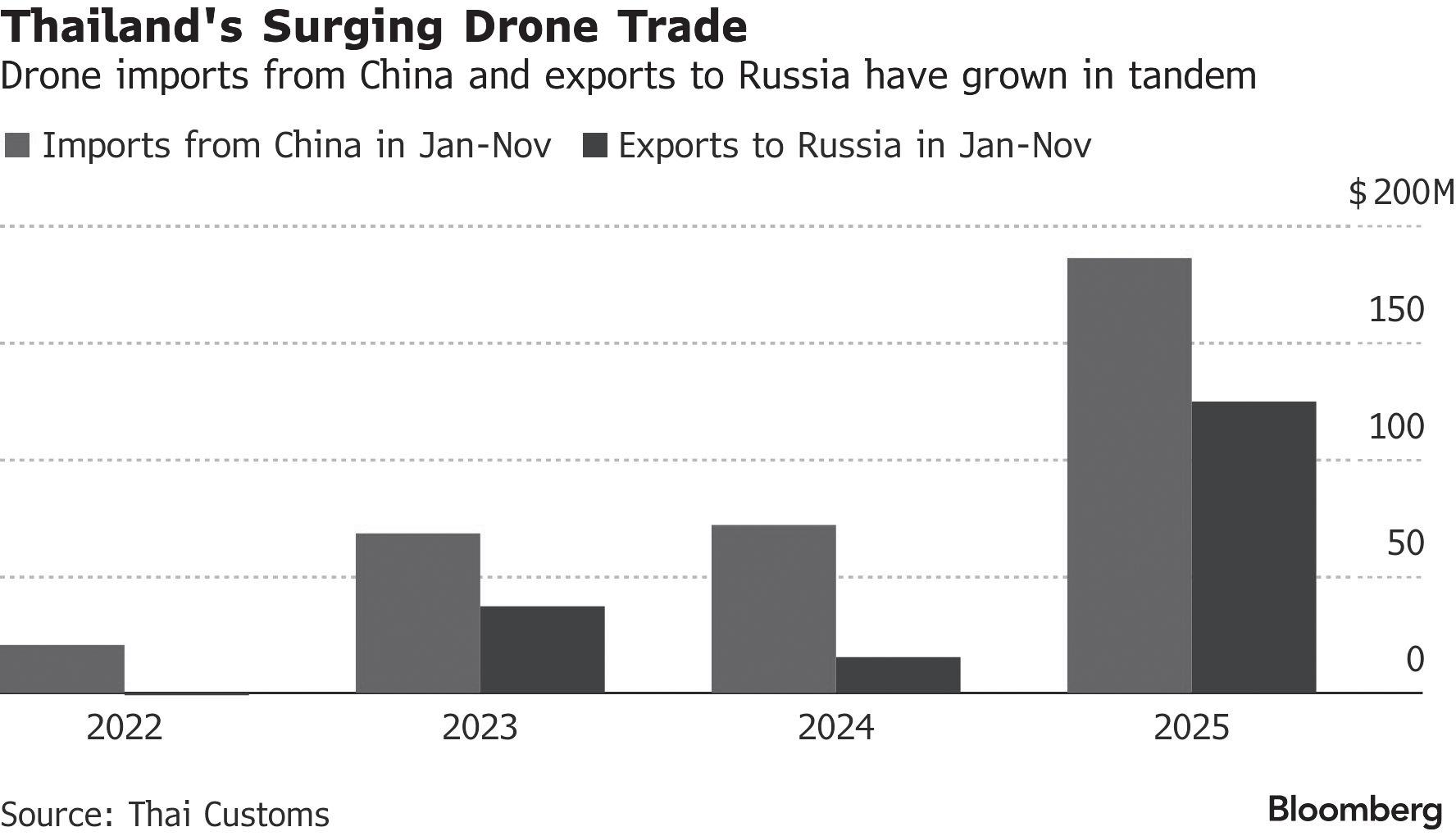
Thailand has so far largely escaped notice as a route to Russia. Yet an analysis of official Thai trade data shows that Thailand’s exports of drones to Russia have surged since 2022, when President Vladimir Putin ordered the full-scale invasion of Ukraine, closely mirrored by a rise in imports of those goods by Thailand from China. That trend has been noticed by Ukrainian officials, a person familiar with the situation said. Beijing says that it does not aid Russia militarily. However, Chinese-made technology is routinely found on the battlefield in Ukraine, where first-person view drones that allow pilots to remotely monitor events in real time have reshaped the face of modern warfare.
The US’s Department of State declined to comment on the shipments through Thailand. But a spokesperson said that China has been supporting Russia’s war effort and accounts for about 80% of so-called dual use parts—a term for equipment with a potential military application—that Russia uses in the conflict.
“South East Asia is as a region definitely one to watch,” said Maria Shagina, Berlin-based senior research fellow for economic sanctions, standards and strategy at the International Institute for Strategic Studies. “The countries may change but the methods do not: Rerouting via third countries using shell companies.”
In the 11 months to the end of November 2025, Russia imported $125 million of drones from Thailand, 88% of Thailand’s total UAV exports and eight times what it bought the previous year. In the same period, China shipped $186 million of drones to the southeast Asian nation, accounting for almost all drone exports to Thailand.
In 2022, Thailand exported less than $1 million worth of drones, with none going to Russia, the government trade data shows.
Exports of Chinese drones from Thailand are within the legal framework, Phantong Loykulnanta, director general of Thailand’s customs department, said in an interview. Declaration of usage when drones are imported from
China isn’t mandatory, he added.
“We are ready to act, but a law has to be in place first,” Phantong said. The Commerce Ministry’s Foreign Trade Department is looking into the issue, he said.
Russia is subject to multiple rounds of international sanctions due to its war on Ukraine, and while most sanctioned goods— usually dual-use—enter via China and Hong Kong, according to EU and US sanctions notices, Moscow has looked to use transshipment routes to get around European restrictions.
South East Asia emerged as an important conduit last year, after western governments exposed and took action on earlier routes via countries including the United Arab Emirates and Kazakhstan.
In October, the European Union sanctioned two Thailand-based firms for their support of Russia’s military. The Thai government hasn’t commented on those bans.
The rise in shipments via Thailand shows just how hard it has been for western authorities to curb Russia’s access to both arms and dual-use technology.
In 2024, Bloomberg reported that India was being used as a conduit to channel US-made servers containing Nvidia Corp. chips to Russia, and in October it emerged that South African-made drone parts were ending up in Russian unmanned aircraft used to attack Ukraine. Russia is meanwhile buying missiles from Tehran, as Irandesigned Shahed 136 drones are assembled in Russia.
“The war of attrition is a battle of resources,” Shagina at the IISS said of the conflict in Ukraine.
“Russia is scaling up.”
Skyhub Technologies initially worked in the geology sector, according to its registration documents, and is now listed as a car rental firm. It imported $25 million of drones in 2025, according to documents compiled by Big Trade Data, a trade intelligence platform specialized in shipment-level data.
Skyhub Technologies’ imports came from Autel Robotics, one of China’s major drone manufacturers, the data showed. Trade documents show the shipments included 976 drones bearing the same model code as Autel’s EVO Max 4T, which costs
about $9,000 apiece, according to Autel’s website. Last year Russian company Aero HIT wrote to the defense ministry in Moscow seeking financial assistance to localize production of the EVO Max 4T, originally designed for civilian use but which it said had proven highly effective in combat, according to a copy of the letter obtained by Bloomberg. Autel said in an emailed statement at the time it hadn’t partnered with Aero HIT and was unaware of the proposal.
Autel, in a response to queries about its relationship with Skyhub Technologies, said that it is unable to discuss clients due to confidentiality but has an “economic sanctions compliance system that aligns with international standards.” It said its drones are designed for civilian use and are equipped with a “no-fly geofencing system” that would prevent flight in the conflict area between Russia and Ukraine.
Skyhub Technologies has made no public statements about its drone imports.
Another company based on Bangkok’s outskirts, China Thai Corp., appears to be playing an even bigger role in the drone trade. It imported $144 million of drones to Thailand from China in the first 11 months of 2025, according to trade data. During that time, in October, the company was sanctioned by the UK for supplying technology to Russia’s military.
China Thai’s involvement in the supply of equipment to Russia dates back to at least 2023, when trade data shows it worked as a freight forwarder for a shipment of Apple Inc. iPhones worth $2 million bound for Russia’s OOO Atlas, an electronics firm sanctioned by the EU the following year. Also in 2023, Nikkei reported that OOO Atlas bought $2.5 million worth of semiconductors from a Hong Kong company called DEXP International Limited, another EUsanctioned company, which was the seller of the iPhone shipment handled by China Thai.
DEXP and Atlas didn’t respond to e-mailed queries.
China Thai’s annual revenue surged from a token amount of around 14,000 baht ($450) from
2020 through 2022, to 17.8 million baht in 2023, then 25.3 million baht in 2024, financial statements from Thailand’s companies registry show.
The firm, located 10 minutes away from Bangkok’s main international airport on the edge of a cargo storage area, is now being rebranded as Lanto Global Logistics, signage at the site showed when Bloomberg visited on Feb. 11. A staff member, speaking to Bloomberg, said executives were aware of queries sent earlier but didn’t want to comment. She said the site provides logistics for customer orders, adding that staff are aware that the company has been sanctioned.
While Thailand’s overall trade relations with Russia are limited, with just $2.3 billion in two-way business recorded last year, economic, cultural and political links are growing. Those date back to 1897 when royal ties led to formal diplomatic relations being established, a first for a Southeast Asian nation with Russia.
Last year, a record 1.9 million Russians visited Thailand. In the first quarter of 2025, Russians bought the equivalent of more than $30 million-worth of Thai properties, ranking only behind buyers from China and Myanmar.
By late 2023, a third of expatriate residents on the Thai resort island of Phuket were Russian, according to Ian Storey, author of Putin’s Russia and Southeast Asia: The Kremlin’s Pivot to Asia and The Impact of the Russia Ukraine War.
Moscow is in the process of opening a so-called Russia House in Thailand—a cultural and language center—and is offering fully-paid scholarships to Thai students, according to the Russian embassy in Bangkok.
Even as Putin’s all-out war on Ukraine approaches its fifth year, the Thai focus is on “encouraging Russian visitors to come and spend their holidays in Thailand and to invest in the country,” said Storey. “Thailand has been much more concerned about strengthening economic ties with Russia.” With assistance from Alberto Nardelli, Arijit Ghosh, Thomas Kutty Abraham, Suttinee Yuvejwattana and Eric Martin/Bloomberg
K-cafes take London by storm: A new wave of Korean culture blending food and design
By Joel Hart
KPop Demon Hunters. BTS. Kimchi. For the past dozen years a cultural force known as hallyu (“Korean wave”) has engulfed the world. What began as a modest export of South Korean soap operas to other parts of East Asia in the late ’90s (Hallyu 1.0) metamorphosed into a transnational obsession with K-pop, K-dramas and Korean cinema, skin care, fashion and food.
In its latest soft-power incarnation, the wave is manifesting in London’s Korean cafes, where high-concept design meets casual, gochujang-laced dishes and innovative hot drinks. The model has proven popular, fueled by TikTok and the appeal of all-day hangouts that invite frequent visits. These places aren’t exact replicas of their Seoul counterparts; instead, they’ve got their own identity, subtly influenced by their owners’ experiences in the UK.
In December, Tokkia opened in Covent Garden as London’s first Korean-style matcha house, specializing in green tea lattes and Korean salt bread. What distinguishes it from Japanese matcha places is its playful lack of ceremony.
The intimate space has three terra-cotta hued marble matcha stations, decorated with dried bunny tails, an ornamental grass, that’s been tied with knotted straws. (“Tokkia” roughly translates to “Hey, bunny” in Korean, a nod to owner Sooji Im’s two pet rabbits.) An Instagram post documenting the making of a persimmon matcha latte quickly garnered thousands of likes. “It’s just been kind of crazy,” Im says.
Also new in London are Angel Dabang, where the specialties are dabang coffee (made creamy with condensed milk) and kkwabaegi (twisted doughnuts), and Look Left by Yugu, which focuses on mugwort lattes and Korean fusion plates. Both spots draw crowds, and Angel Dabang is already looking to relocate to a bigger space.
Im tells me the Korean cafe trend isn’t new to the UK. It’s been active for a few years, cemented by the arrival of Bunsik, the street food chain serving Korean corn dogs that opened in the capital in spring 2021 and quickly went viral. Other popular, affordable snacks include tteokbokki (chewy cylindrical rice cakes). Bunsik now occupies seven sites in London and can be found farther afield in Manchester and Bristol.
Another of London’s foundational Korean cafes is Compose Coffee shop, an outpost of the South Korean chain that launched in 2014 in Busan and now has more than 2,600 shops across the country. It opened in central London, next to the National Gallery, in Spring 2024.
Now renamed First Korean Cafe M, the shop beckons with a bright yellow awning and specialties like mozzarella coin bread (a thick, melted-cheese-filled round waffle), egg-drop sandwiches and bulgogi avocado toast. There’s also the shaved ice dessert bingsoo and Korean brews like dalgona latte, a whipped instant coffee dolloped over milk, which got social-media-famous during the pandemic. The rising profile of Korean food and drinks hasn’t happened in a vacuum. In 2009, the South Korean government initiated a gastro-diplomacy campaign. “Global Hansik” was created by the South Korean Ministry of Food, Agriculture, Forestry, and Fisheries to raise the profile of Korean food abroad and make it one of the world’s top five cuisines by 2017, built on the success of the first hallyu. It followed a blueprint created by Thailand—which, in 2002, launched a $15 million program to expand the country’s culinary profile—and invested 50 billion won (more than $32.2 million at the time) in restaurant promotion, chef training and overseas marketing.
In the UK, that trickled down to independent, family-run restaurants that became occasional dinner spots for Londoners. The rapid expansion and social media reach of Bunsik has spurned a fresh influx of casual Korean eateries, as cafes represent a shift to mass, replicable all-day businesses that customers return to almost daily.
The Korean casual food and drink trend is part of a broader shift in British consumption patterns too. In her latest book, All Consuming: Why We Eat the Way We Eat Now, food writer Ruby Tandoh points out how in 2010, London opened its first bubble tea shop, and now a dozen others are within a 10-minute walk of her favorite place. The subsequent appetite for what’s known as “QQ texture”—a dense bounciness like firm mochi, that also manifests as tteokbokki and the noodle soup sujebi—positioned bubble tea as “a genuine challenge to the supremacy of coffee shops,” she writes. “It’s a generational shift.” It’s ascendency is also indicative of a wider, more multifaceted cultural shift in which Bunsik is able to quickly expand. The emerging K-cafe subculture isn’t mere brand expansion, but rather different models sprouting up.
Angel Dabang is a minuscule cafe with traditional Korean furniture. Named after old-style coffee houses known as dabangs, the shop sells green tea from Boseong and Jeju Island, dabang-style coffee (laced with condensed milk), misugaru (a hot roasted grain drink), and ssangwhacha, a flavorful herbal tea made from medicinal roots and herbs like cinnamon, ginger, jujube and licorice.
There’s a modestly priced rotating menu of bunsik (casual Korean comfort food), from sandwiches filled with fried chicken, bulgogi or egg for £4.50 to £5.50 ($6 to $7.40) to the heartier tteokbokki topped with sausage roll, mozzarella or gimmari (deep-fried seaweed rolls) for £9.50. For dessert, the kkwabaegi have flavors like cinnamon sugar, injeolmi (roasted bean powder) and matcha chocolate cream.
Co-owner Ben Kim says they get a lot of locals as well as Koreans from around the UK. Kim opened London’s Din Tai Fung before launching his business with partner Joseph Ahn. The British public’s greater familiarity with Korean culture and flavors has “opened up an entire new segment, including the cafes,” Kim says. “Korean food and beverage people know how to capture an authentic kind of flavor, and they know how to adapt to the market.”
Look Left by Yugu, which opened in October in London Fields, is a case in point. In November 2024, fashion designer Seulbi Oh launched a boutique, where she sometimes served matcha to customers. But the beverage was so popular, she renovated the space and added food service as the main feature. “Many of the Korean customers say it’s like Seoul,” she says.
Named after the Korean city where Oh was born, Look Left by Yugu focuses on matcha and what she calls “Korean-fusion food.” At brunch there’s kimchi and sweet potato cheese toasties, then black sesame tiramisu. “If you go to the Korean restaurants in London, all of them are serving the same food,” she says.
To introduce customers to new flavors, she’s been serving mugwort (sook) lattes, made from the earthy and grassy herb. Their popularity has been boosted by Korean food influencer Rollin Lee, whose Instagram posts have expanded the audience beyond Koreans.
While Look Left by Yugu offers a substantial savory menu alongside teas, Tokkia’s menu is, like the matcha houses of Seoul, simpler. You can order Korean matcha or hojicha—the tea is nuttier with less umami than the Japanese counterpart—or a seasonal special such as the viral persimmon matcha or peanut hojicha. There’s also Korean salt bread: a savory, buttery pastry that emerged from the Japanese shio pan. Before she opened Tokkia, Im had a Korean specialty tea house, Be-oom, that she closed last year. She believes her new spot meets the moment: “It’s more appealing to the masses instead of a very niche crowd of people.” At the same time, she knows that the landscape will keep evolving. In her native country, “everything changes so quickly, especially the cafe culture,” she says. “Koreans are very sensitive to trends.”
That cultural agility is one reason the world is obsessed with just about everything from Korea. And why, before long, you’ll probably be drinking a mugwort latte with your salt bread—if you aren’t already. Bloomberg News
A PHARMACY sign in various languages including Russian in Phuket, Thailand, in 2023. BLOOMBERG PHOTO
Engineered algae removes microplastics from water
By Manuel T. Cayon
DAVAO CITY—A university professor grew a new kind of algae in wastewater to see how it thrives and turns true to form and expectation to remove microplastics— the less than 5 mm of plastics that escape detection by naked eye—from its water environment.
The University of Missouri posted on its website on February 1 that Prof. Susie Dai has used genetic engineering “to create a new kind of algae that grows in wastewater and can turn microplastics into biomass that is easy to collect and remove.”
“A University of Missouri researcher is pioneering an innovative solution to remove tiny bits of plastic pollution from our water. Mizzou’s [University of Missouri] Susie Dai recently applied a revolutionary strain of algae toward capturing and removing harmful microplastics from polluted water,” the university’s Engineering division said.
It said that the effort was “driven by a mission to improve the world for
both wildlife and humans, [and] Dai also aims to repurpose the collected microplastics into safe, bioplastic products. such as composite plastic films.”
Philippines’ microplastic pollution
DAI’S research may help solve the dangerous level of microplastics pollution in the country found in air, water, and food, posing growing health concerns, studies report. The particles can disrupt hormones, potentially causing reproductive issues, metabolic disorders, and respiratory problems. Microplastics have even been detected in human blood, suggesting long-term health
risks, ResilientPH said.
Studies on Laguna Lake have revealed widespread contamination, with particles from single-use plastics and disposable masks entering human bodies through ingestion and inhalation, said online ResilientPH.
With plastics being the major sources of microplastics, the presence of the small particles in the Philippines is not unexpected—because the country is the world’s top source of plastic waste with 356,371 metric tons in the oceans annually, said the Sustainability Online in November 2025.
Meanwhile, the World Bank estimates that the Philippines use an overwhelming 163 million pieces of sachets per day, with a staggering 2.3 million tons of plastic waste generated in the country annually.
Genetic engineering
“
MICROPLASTICS are pollutants found almost everywhere in the environment, such as in ponds, lakes, rivers, wastewater and the fish that we consume,” said Dai, a professor in the Department of Chemical and Biomedical Engineering, and principal investigator at the Bond Life Sciences Center.
A BS Chemistry graduate from Fudan University in Shanghai, China, Dai said that currently “most wastewater treatment plants can
only remove large particles of plastic, but microplastics are so small that they slip through and end up in drinking water, polluting the environment and harming ecosystems.”
She used genetic engineering to create a new kind of algae that produces a volatile natural oil called limonene, the same chemical that gives oranges their refreshing scent, the online Mizzou Engineering said.
The university described limonene as one that makes the new algae water-repellent.
“Because microplastics are also water-repellent, the two come together like magnets when they meet in water, forming clumps that sink to the bottom and create a solid layer of biomass that is easy to collect and remove,” it said.
The specially engineered algae can grow in wastewater, feeding on excess nutrients and cleaning the water as it grows, the post said.
“By removing the microplastics, cleaning the wastewater and eventually using the removed microplastics
The greatest risk of AI in higher education isn’t cheating—it’s the erosion of learning itself
PUBLIC debate about artificial intelligence (AI) in higher education has largely orbited a familiar worry: cheating. Will students use chatbots to write essays? Can instructors tell? Should universities ban the tech? Embrace it?
These concerns are understandable. But focusing so much on cheating misses the larger transformation already underway, one that extends far beyond student misconduct and even the classroom.
Universities are adopting AI across many areas of institutional life. Some uses are largely invisible, like systems that help allocate resources, flag “atrisk” students, optimize course scheduling or automate routine administrative decisions. Other uses are more noticeable.
Students use AI tools to summarize and study, instructors use them to build assignments and syllabuses and researchers use them to write code, scan literature and compress hours of tedious work into minutes.
People may use AI to cheat or skip out on work assignments.
Moral implications of pervasive AI engagement
BUT the many uses of AI in higher education, and the changes they portend, beg a much deeper question: As machines become more capable of doing the labor of research and learning, what happens to higher education? What purpose does the university serve?
Over the past eight years, we’ve been studying the moral implications of pervasive engagement with AI as part of a joint research project between the Applied Ethics Center at University of Massachusetts Boston and the Institute for Ethics and Emerging Technologies.
In a recent white paper, we argue that as AI systems become more autonomous, the ethical stakes of AI use in higher ed rise, as do its potential consequences.
As these technologies become better at producing knowledge work—designing classes, writing papers, suggesting experiments and summarizing difficult texts—they don’t just make universities more productive. They risk hollowing out the ecosystem of learning and mentorship upon which these institutions are built, and on which they depend.
Nonautonomous AI
CONSIDER three kinds of AI systems and their respective impacts on university life: > AI-powered software is already be -
ing used throughout higher education in admissions review, purchasing, academic advising and institutional risk assessment.
These are considered “nonautonomous” systems because they automate tasks, but a person is “in the loop” and using these systems as tools.
> These technologies can pose a risk to students’ privacy and data security. They also can be biased. And they often lack sufficient transparency to determine the sources of these problems.
Who has access to student data? How are “risk scores” generated? How do we prevent systems from reproducing inequities or treating certain students as problems to be managed?
> These questions are serious, but they are not conceptually new, at least within the field of computer science.
Universities typically have compliance offices, institutional review boards and governance mechanisms that are designed to help address or mitigate these risks, even if they sometimes fall short of these objectives.
Hybrid AI
HYBRID systems encompass a range of tools, including AI-assisted tutoring chatbots, personalized feedback tools and automated writing support.
They often rely on generative AI technologies, especially large language models. While human users set the overall goals, the intermediate steps the system takes to meet them are often not specified.
Hybrid systems are increasingly shaping day-to-day academic work. Students use them as writing companions, tutors, brainstorming partners and ondemand explainers.
Faculty use them to generate rubrics, draft lectures and design syllabuses. Researchers use them to summarize papers, comment on drafts, design experiments and generate code.
This is where the “cheating” conversation belongs.
With students and faculty alike increasingly leaning on technology for help, it is reasonable to wonder what kinds of learning might get lost along the way.
But hybrid systems also raise more complex ethical questions.
One has to do with transparency. AI chatbots offer natural-language interfaces that make it hard to tell when you’re interacting with a human and when you’re interacting with an automated agent.
That can be alienating and distracting for those who interact with them.
A student reviewing material for a test
should be able to tell if they are talking with their teaching assistant or with a robot.
A student reading feedback on a term paper needs to know whether it was written by their instructor. Anything less than complete transparency in such cases will be alienating to everyone involved and will shift the focus of academic interactions from learning to the means or the technology of learning.
University of Pittsburgh researchers have shown that these dynamics bring forth feelings of uncertainty, anxiety and distrust for students. These are problematic outcomes.
A second ethical question relates to accountability and intellectual credit.
If an instructor uses AI to draft an assignment and a student uses AI to draft a response, who is doing the evaluating, and what exactly is being evaluated?
If feedback is partly machine-generated, who is responsible when it misleads, discourages or embeds hidden assumptions?
And when AI contributes substantially to research synthesis or writing, universities will need clearer norms around authorship and responsibility—not only for students, but also for faculty.
Finally, there is the critical question of cognitive offloading. AI can reduce drudgery, and that’s not inherently bad. But it can also shift users away from the parts of learning that build competence, such as generating ideas, struggling through confusion, revising a clumsy draft and learning to spot one’s own mistakes.
Autonomous agents
THE most consequential changes may come with systems that look less like assistants and more like agents.
While truly autonomous technologies remain aspirational, the dream
of a researcher “in a box”—an agentic AI system that can perform studies on its own—is becoming increasingly realistic.
Agentic tools are anticipated to “free up time” for work that focuses on more human capacities like empathy and problem-solving.
In teaching, this may mean that faculty may still teach in the headline sense, but more of the day-to-day labor of instruction can be handed off to systems optimized for efficiency and scale.
Similarly, in research, the trajectory points toward systems that can increasingly automate the research cycle. In some domains, that already looks like robotic laboratories that run continuously, automate large portions of experimentation and even select new tests based on prior results.
At first glance, this may sound like a welcome boost to productivity. But universities are not information factories; they are systems of practice.
They rely on a pipeline of graduate students and early-career academics who learn to teach and research by participating in that same work.
If autonomous agents absorb more of the “routine” responsibilities that historically served as on-ramps into academic life, the university may keep producing courses and publications while quietly thinning the opportunity structures that sustain expertise over time.
The same dynamic applies to undergraduates, albeit in a different register. When AI systems can supply explanations, drafts, solutions and study plans on demand, the temptation is to offload the most challenging parts of learning.
To the industry that is pushing AI into universities, it may seem as if this type of work is “inefficient” and that students will be better off letting a machine handle it.
to create bioplastic products for good, we can tackle three issues with one approach,” Dai said.
Integrate in wastewater treatment plants
“WHILE our research is still in the early stages, our eventual goal is to integrate this new process into existing wastewater treatment plants so cities can clean their water more effectively and reduce pollution while creating useful products at the same time,” she explained.
Dai hoped to build bigger versions of her bioreactors “going forward that could be adopted for wastewater treatment and other pollutant removal purposes.”
Her lab is growing algae in large tank bioreactors. It has built a 100-liter bioreactor named “Shrek” to process industrial flue gas to help clean air pollution.
Dai hopes to build bigger versions of Shrek that could be adapted for wastewater treatment and other pollutant removal purposes.
Dai’s study “Remediation and upcycling of microplastics by algae” was published in Nature Communications,” she said.
Dai’s study was also announced on the “Biotech Updates” section of International Service for the Acquisition of Agri-biotech Applications Inc.’s website.
DOST to launch central hub for AI
But it is the very nature of that struggle that builds durable understanding.
Cognitive psychology has shown that students grow intellectually through doing the work of drafting, revising, failing, trying again, grappling with confusion and revising weak arguments. This is the work of learning how to learn.
Taken together, these developments suggest that the greatest risk posed by automation in higher education is not simply the replacement of particular tasks by machines—but the erosion of the broader ecosystem of practice that has long sustained teaching, research and learning.
An uncomfortable inflection point SO what purpose do universities serve in a world in which knowledge work is increasingly automated?
One possible answer treats the university primarily as an engine for producing credentials and knowledge.
There, the core question is output: Are students graduating with degrees? Are papers and discoveries being generated? If autonomous systems can deliver those outputs more efficiently, then the institution has every reason to adopt them.
But another answer treats the university as something more than an output machine, acknowledging that the value of higher education lies partly in the ecosystem itself.
This model assigns intrinsic value to the pipeline of opportunities through which novices become experts, the mentorship structures through which judgment and responsibility are cultivated, and the educational design that encourages productive struggle rather than optimizing it away.
Here, what matters is not only whether knowledge and degrees are produced, but how they are produced and what kinds of people, capacities and communities are formed in the process.
In this version, the university is meant to serve as no less than an ecosystem that reliably forms human expertise and judgment.
In a world where knowledge work itself is increasingly automated, we think universities must ask what higher education owes its students, its early-career scholars and the society it serves. The answers will determine not only how AI is adopted, but also what the modern university becomes.
Nir Eisikovits and Jacob Burley, University of Massachusetts Boston, The Conversation (CC) via AP
THE Department of Science and Technology (DOST) will launch the National Artificial Intelligence Center for Research and Innovation (NAICRI) on February 26 consolidating years of fragmented AI research, computing infrastructure, and capacity-building efforts in a single, permanent national institution.
The event will bring together senior government officials, leaders from Congress, academe, industry, development partners, and international collaborators. It will feature a showcase of operational AI platforms and tools developed by DOST.
DOST Secretary Renato U. Solidum said: “NAICRI will serve as the Philippines’ central hub for AI research, advanced computing, and innovation—designed to provide continuity, coordination, and governance beyond individual projects and funding cycles. The launch positions the Center as the institutional backbone for the National AI Strategy for the Philippines [NAIS-PH].”
For over a decade, Filipino scientists and engineers have been steadily building the country’s AI capabilities—from high-performance computing and weather forecasting systems to pandemic response platforms and agricultural research tools.
Yet these efforts, though technically strong, have often operated in silos, shaped by individual projects, short-term funding cycles, or the work of specific teams rather than a sustained, coordinated strategy.
NAICRI aims to bring these capabilities into a coherent institutional framework, the Center ensures that functional systems become enduring national assets—well-governed, scalable, and accessible beyond Metro Manila..
NAICRI is not starting from scratch. It will showcase AI infrastructure, platforms and tools already operational at DOST-Advanced Science and Technology Institute, including: COARE, the national supercomputing facility that has powered pandemic surveillance (FASSSTER), rice genome sequencing with International Rice Research Institute, climate modeling, and hazard mapping—with GPU utilization increasing 54 percent since 2020 and more than doubling in the past year alone. Preginet, the country’s research and education network connecting academic, government, and research institutions to global research networks.
Naira (Nexus for AI Research and Applications), a national AI-as-a-Service hub that consolidates access to computing resources, AI models, and deployment tools for government agencies, researchers, and MSMEs.
Dimer (Democratized Intelligent Model Exchange Repository), a shared AI model repository where homegrown models for agriculture, disaster detection, and traffic analysis can be built once and deployed across agencies. Itanong, a natural language interface that lets users search complex organizational data using everyday language—including queries in Filipino—demonstrating what democratizing access to information looks like in practice.
PROF. Susie Dai of the University of Missouri at her laboratory
PHOTO SOURCE: ABBIE LANKITUS|UNIVERSITY OF MISSOURI
A6 Sunday, February 22, 2026
Faith Sunday
‘Moral fatigue’ threatens nation, CBCP prexy says ahead of
EDSA anniversary
FOUR decades after the EDSA People Power Revolution, the head of the Catholic Bishops’ Conference of the Philippines (CBCP) warned on Thursday that Filipinos face a new threat he called “moral fatigue.”
Archbishop Gilbert Garcera, CBCP president, delivered the warning in his homily during the fourth day of the novena Mass marking EDSA’s 40th anniversary at the National Shrine of Mary, Queen of Peace in Quezon City.
“The greatest danger today is not only historical distortion, but moral fatigue,” Garcera said, urging citizens to actively safeguard freedom and truth.
He explained that moral fatigue arises when freedom is remembered only as a memory, faith becomes devotion without courage, and peace is sought without justice.
“When freedom is treated merely as a memory and not a duty, the spirit of EDSA slowly dies,” Garcera said, recalling the lessons of 1986 peaceful event that led to the
ouster of the Marcos dictatorship.
Reflecting on the February uprising, when millions of Filipinos gathered at EDSA to protest the dictatorship, he pointed out that
the movement was sustained not only by collective action but by prayer, with rosaries in hand and hymns in the air.
The archbishop drew parallels to today, urging Filipinos to confront modern challenges with the same courage, responsibility, and moral conviction that shaped the People Power Revolution.
“Freedom has a cost. Peace has a price. Faith demands responsibility,” he said.
Garcera also called on the Church to remain a prophetic voice—“not comfortable, not silent, but faithful”—and warned that staying silent in the face of injustice is complicity, not holiness.
“As a people and as a Church, may we once again choose—just as we did 40 years ago—faith with courage, freedom with responsibility, and peace founded on justice,” he said. CBCP News
Bishop to lawmakers: Corruption is ‘spiritual decay’
ACATHOLIC bishop urged lawmakers on Ash Wednesday to confront corruption, calling it a form of “spiritual decay that steals from classrooms, hospitals and the poor.”
Speaking during Mass at the House of Representatives, Bishop Raul Dael of Tandag said corruption is not merely a legal issue but a moral and spiritual failure that harms the vulnerable citizens and weakens public trust.
“Corruption is not only illegal; it is a spiritual decay, a sin against God,” Dael said.
“It [hurts] the poor first. It steals from classrooms, from hospitals, from social services, from communities waiting for relief,” he added.
The bishop urged lawmakers to see public office as a “vocation” centered on service, sacrifice and accountability, rather than personal gain or political advantage. He said ethical leadership requires integrity in both public actions and private decisions, particularly when choices are made beyond cameras and public attention.
Pope Leo: Lenten ashes carry ‘the weight of a world that is ablaze’
ROME—Pope Leo XIV led the traditional Ash Wednesday penitential procession on Rome’s Aventine Hill on February 18, walking with clergy and faithful to the Basilica of Santa Sabina, where he celebrated Mass marking the start of Lent.
Reflecting on the meaning of the ashes traditionally imposed on the heads of the faithful, Leo recalled a 1966 catechesis by St. Paul VI, who described the public celebration of the rite as a “severe and striking penitential ceremony” and as “a realistic pedagogy,” intended to cut through modern illusions and widespread pessimism that can reduce life to “the metaphysics of the absurd and of nothingness.”
digital environments people inhabit.
“Naturally, sin is always personal, but it takes shape in the real and virtual contexts of life… and often within real economic, cultural, political, and even religious ‘structures of sin,’” he said. Against idolatry, he added, Scripture calls Christians to dare to be free and to rediscover freedom through “an exodus, a journey,” rather than remaining “paralyzed, rigid, or complacent.”
The pope also pointed to what he described as a renewed attentiveness among young people to Ash Wednesday’s call to accountability.
“How tragic it is when a vocation meant to serve the common good becomes entangled in massive corruption,” Dael said.
“How contradictory it is to fast and pray publicly while privately
“In Lent, we examine not our image, but our heart,” Dael said, stressing the importance of conscience and moral responsibility in governance. Dael called on lawmakers to work collaboratively, saying unity guided by truth and justice can gradually address corruption and reduce poverty. He warned that corruption erodes institutions, drains public resources and deepens inequality, affecting ordinary Filipinos who rely on public services and government services.
manipulating public funds, distorting justice or ignoring the cries of the poor,” he added.
The bishop echoed Pope Francis, who has described politics as a noble vocation and one of the highest forms of charity when pursued for the common good.
“When politics is lived as a vocation, it becomes service. It becomes a sacrifice. It becomes an act of charity toward the entire nation,” he said.
Dael also addressed legislative staff and support personnel, emphasizing their unseen but essential contributions to policymaking and the daily function of government.
He said institutions depend on teamwork, discipline and shared responsibility, urging mutual respect among lawmakers, employees and workers.
“Leadership is never solitary. Authority is never self-generated. You lead because many support you. You stand because many people are at your back and uphold you,” the bishop said.
Roy Lagarde/CBCP News
Displaced Gaza family observing Ramadan under fragile ceasefire
KHAN YOUNIS, Gaza Strip—Waleed al Zamli longingly recalled the joys and traditions of the first day of Ramadan before the Israel-Hamas war had drastically altered his life: Lanterns for the children. Sweets. Special dishes.
“Before the war, we would greet it with happiness,” the father of 11 said, speaking from Muwasi, an area crowded with tents sheltering Palestinians who were forced by the Israeli military offensive to flee their homes. Not anymore, he said.
It saddens and pains him that he’s unable to provide for his family, which now ekes out an existence in displacement. Al Zamli lost his job after the shop where he had worked was destroyed, he said. So, for the first Ramadan “iftar,” the fast-breaking meal, his wife picked up meals Wednesday from a charity kitchen that the family has heavily depended on. She made soup to go with it.
“This year, there’s no happiness,” al Zamli said.
Hardships, losses dampen Ramadan’s spirit for many RAMADAN arrived in Gaza under a fragile ceasefire deal, but many Palestinians there say the month’s typically festive spirit is eluding them as they grapple with the hardships of their daily lives and the grief and losses of the war.
Some of these difficulties were on
display at the charity kitchen where dozens crowded, many with their arms outstretched as they vied for a spot and held empty pots. They included children, women and elderly people.
During Ramadan, observant Muslims fast daily from dawn to sunset. It’s a time for increased worship, religious reflection and charity. In normal circumstances, the month often brings families and friends together to break their fast in joyous gatherings. But circumstances in Gaza are far from normal.
Israel’s military offensive has killed more than 72,000 Palestinians, according to Gaza’s Health Ministry, and caused widespread
destruction and displaced most of the territory’s residents.
Israel launched the offensive after Hamasled militants killed some 1,200 people, mostly civilians, and took another 251 hostage in their attack on October 7, 2023.
For al Zamli, the biggest challenge this Ramadan is providing food for his family. He said he’s received limited aid. Foods, like meat and poultry, are more expensive than their prewar prices, he said, and with no income many items are beyond his reach.
“The children want to feel happy like other people’s children, to get dressed and to eat something clean and special,” he said. The financial strain can be especially
amplified during Ramadan, he said. Typically, many shoppers throng to markets to stock up on food staples and buy decor and other supplies.
Food can play a central role as the daily fasting gives way to nourishing, and for some elaborate, iftar meals. Muslims also eat a predawn meal known as “suhoor” to nurture their bodies ahead of the fast.
As Gaza residents visited markets this week, some lamented how economic woes cast a pall on the month.
Ramadan decorations among the ruins STILL , amid the struggles, some in the Gaza Strip have worked to bring a taste of the month’s festivities—for example, hanging strands of Ramadan decorations among the ruins.
At their displacement camp, al Zamli’s children played with empty soda cans fashioned to look like Ramadan lanterns.
The October 10 US-brokered ceasefire deal attempted to halt more than two years of war between Israel and Hamas. While the heaviest fighting has subsided, the ceasefire has seen almost daily Israeli fire.
Israeli forces have carried out repeated airstrikes and frequently fire on Palestinians near military-held zones, killing more than 600 Palestinians, according to Gaza health officials. Wafaa Shurafa And Mariam Fam/ Associated Press
“Today, we can recognize that his words were prophetic as we perceive in the ashes imposed on us the weight of a world that is ablaze, of entire cities destroyed by war,” Leo said.
He said that devastation is echoed in “the ashes of international law and justice among peoples,” “the ashes of entire ecosystems and harmony among peoples,” “the ashes of critical thinking and ancient local wisdom,” and “the ashes of that sense of the sacred that dwells in every creature.”
In the same homily, the pope urged Catholics to treat Lent as a time when the Church is renewed as a true community, even as modern society finds it harder to come together in communion.
Leo stressed that sin is never only private because it shapes and is shaped by the real and
“Young people especially understand clearly that it is possible to live a just lifestyle, and that there should be accountability for wrongdoings in the Church and in the world,” he said.
He urged Catholics to “start where we can, with those who are around us,” and to embrace “the missionary significance of Lent” for “the many restless people of goodwill” seeking genuine renewal.
The pope also highlighted the ancient Roman tradition of the Lenten station churches, which begins each year with Santa Sabina. “The ancient Roman tradition of the Lenten ‘stationes’—which begins today with the first station—is instructive,” he said, noting that it points both to moving, as pilgrims, and to pausing—“statio”—at the memories of the martyrs on which Rome’s basilicas were built.
Marco Mancini/EWTN News via CBCP News
Lenten pilgrimage to Negros Occ. set on March 12-16
ONPROFIT Catholic pilgrimage apostolate Green Faith Travels brings pilgrims to the province of Negros Occidental to pray in 16 churches and visit museums, historical landmarks, and heritage sites, from March 12 to 16. The Lenten pilgrimage titled “A Carmelite Journey: Lenten Pilgrimage to Bacolod, Negros Occidental,” with Rev. Fr. Reynante Miguel Azul Lavado of the Order of Discalced Carmelites as pilgrimage chaplain. will be highlighted by a one-day retreat at the Our Lady’s Hill Carmelite Center of Spirituality in Bago City. The pilgrimage will cover the dioceses of San Carlos (Northern Negros Occidental), Kabankalan (southern Negros Occidental), and Bacolod (Central Negros Occidental).
In the Diocese of Bacolod, pilgrims will pray will pray at San Diego de Alcala ProCathedral in Silay City; and in Talisay City, at San Nicholas de Tolentino Parish and Diocesan Shrine of San Vicente Ferrer; St. James the Greater Church; and Our Lady of Medjugorje, the first replica church in Asia and the third in the world of the original church in Bosnia and Herzegovina.
In Bacolod City, pilgrims will pray at Carmel of St. Joseph and St. Thérèse of the Child Jesus (Carmelite monastery); Queen of Peace ParishRedemptorist; San Sebastian Cathedral; Sacred Heart Shrine and Seminary; San Antonio Abad Parish; Our Lady of Peace and Good Voyage
Parish and the grotto of St. Padre Pio; and St. Ezekiel Moreno Monastery and Reliquarium. They will also pray at Talan-awon ni Maria of the Marian Missionaries of the Holy Cross in Murcia; St. John the Baptist Parish in Bago City; and Santa Maria Magdalena Parish in Hinigaran. In the Diocese of San Carlos, pilgrims will pray at San Carlos Borromeo Cathedral, and in the Diocese of Kabankalan, at St. Francis Xavier
ARCHBISHOP Gilbert Garcera, Catholic Bishops’ Conference of the Philippines president, delivers his homily during Mass at the EDSA Shrine in Quezon City on February 19. CBCP NEWS
BISHOP Raul Dael presides over the Ash Wednesday Mass at the House of Representatives in Quezon City on Feb. 18, 2026. PHOTO FROM THE DIOCESE OF TANDAG
POPE Leo XIV presides over Ash Wednesday Mass at the Basilica of Saint Sabina in Rome on February 18. VATICAN MEDIA
Asean Champions of Biodiversity Media Category 2014
Editor: Lyn Resurreccion
Biodiversity Sunday
On Nipah virus: ‘Conservation better than cure’
By Jonathan L. Mayuga
THE Department of Environment and Natural Resources (DENR), through its Environmental Law Enforcement and Protection Service (ELEPS), swooped down on a residential area in Rosario, Batangas, early this month.
The DENR-ELEPS, in close coordination with the DENR Biodiversity Management Bureau (DENR-BMB) and the Philippine National Police Maritime Group-Batangas, recovered several protected species.
The operation came after reports that several wildlife specimens without permits were being kept by a private individual, a serious violation of Republic Act 9147, or the Wildlife Resources Conservation and Protection Act.
Illegal trade of native, exotic species
THE joint team retrieved five saltwater crocodiles, seven long-tailed macaques, three Asian box turtles, one reticulated python, and one Burmese python.
The recovered wildlife were transported to an accredited DENR Wildlife Rescue and Conservation Park in Majayjay, Laguna, where they were turned over for proper care, assessment, and rehabilitation in accordance with wildlife management protocols.
The recovery of the endangered species is proof of the persistent and rampant illegal wildlife trade happening in the Philippines. Nipah virus
THE operation came at a time when wildlife conservation experts have been fretting about the danger of spreading deadly zoonotic diseases, or those that can transfer from animals to humans, possibly leading to a catastrophic outbreak of deadly diseases, such as Covid-19, and of late, the Nipah virus.
Concerns on the presence of the virus in the Philippines, and a possible another pandemic, recently increased with the infection outbreaks among humans in India in January.
Some Nipah virus-infected humans appear to be without symptoms, but some experience fever, headache or confusion, and coughs or breathing difficulty.
As no vaccine exists, the World Health
Organization (WHO) says treatment against the virus focuses on intensive supportive care for respiratory and neurological symptoms, with strict infection control measures in hospitals.
It also advised measures, such as humans’ reduced exposure to wildlife, healthcare precautions, and the observance of hygiene procedures.
However, since the WHO classifies Nipah as a priority pathogen due to its high mortality rate of 40 percent to 75 percent, and potential for pandemic, it is focusing on research for vaccine and therapeutic development.
Fruit bats, habitat destruction, and virus dilemma
DR. Theresa Mundita S. Lim, an international biodiversity expert, said that once again that “we are facing a serious disease whose origins can be traced to wildlife.”
“The recent outbreak in India is not the world’s first encounter with the Nipah virus,” Lim said.
Southeast Asia has experienced the virus’ outbreaks before it was first detected in the region in the late 1990s, and the Philippines itself recorded cases in 2014, explained Lim, a former DENR-BMB director and Asean Centre for Biodiversity (ACB) executive director, told the Business Mirror via Messenger on February 10.
According to Lim, a licensed veterinarian, science has clearly established that fruit bats are the natural reservoir of the virus.
This means that managing the health of bat populations—as well as protecting the habitats where they roost and feed—is essential in minimizing contact and reducing the risk of the virus’ transmission to humans and domestic animals.
She said current measures—such as monitoring travelers at points of entry and ensuring prompt detection and reporting in health facilities—are important and commendable.
However, these alone do not complete the picture of effective prevention. Fruit bats naturally prefer intact forest ecosystems.
“When [their] habitats are degraded or lost, bats are forced to move closer to agricultural areas and human settlements, increasing the likelihood of spillover events,” Lim explained.
fingerlings at the spillway of La Mesa Ecopark in Quezon City.
Manila Water, BFAR-NCR lead dispersal of fingerlings in La Mesa
THE Bureau of Fisheries and Aquatic Resources-National Capital Region (BFAR-NCR), in partnership with Manila Water Co.’s social development arm, Manila Water Foundation (MWF), held a dispersal of 70,000 fingerlings at the spillway of La Mesa Ecopark in Quezon City. The event was part of the MWF’s 21st anniversary celebration and in support to BFAR’s Balik Sigla sa Ilog at Lawa (Basil) Program.
The Basil program seeks to restore vitality to rivers and lakes and encourage communities to maintain clean waterways where aquatic life can flourish.
Prior to the dispersal, BFAR-NCR specialists conducted a technical assessment of the spillway to evaluate its suitability as
“Continuous efforts to protect and restore bat habitats and to prevent the unnecessary removal of wildlife from their natural environments can significantly reduce the risk of emerging zoonotic diseases. Disturbing wildlife and ecosystems can allow dormant viruses to cross species barriers and become more virulent [‘spillover’],” she further warned.
Ultimately, preventing diseases like Nipah is not only about keeping viruses from entering borders—it is also about protecting the biodiversity in our own backyard, she said.
“A strong integrated and transdisciplinary approach that links human health, wild animal and domestic health, as well as ecosystem health, remains our best defense against emerging and re-emerging zoonotic diseases,” Lim pointed out.
Lessons from Covid-19
ACB Director Jerome Montemayor has warned in a recent news statement about Covid-19 and the threat of yet another deadly virus, the Nipah, which could lead to another pandemic.
“It was only five years ago when our
the shared mission of BFAR-NCR and Manila Water Foundation in protecting aquatic ecosystems.
“Today, we celebrate not just twentyone years of service of MWF, but twentyone years of their impact on the community and the environment. This shared commitment reflects the heart of our BASIL Program.… Its goal is clear: to restore life to our rivers and lakes,” she said.
The fingerlings dispersal symbolizes the continuing collaboration between BFAR-NCR and Manila Water Foundation in safeguarding waterways, promoting environmental stewardship, and empowering communities to participate in ecological conservation efforts across the region.
The water tributaries surrounding the La Mesa Dam contribute to the quality and reliability of this major water basin that serves the East Zone of Metro Manila.
Introducing fingerlings into a well - assessed, suitable spillwayn helps strengthen the ecological balance of the area, enhance biodiversity, and support natural nutrient cycling.
a growth environment for the fingerlings. The assessment found that the area’s water quality and ecological conditions were conducive to supporting healthy fish development.
Before the fingerlings were released into the spillway, BASIL Program Alternate Focal Person Jethro Emmanuel Baltar delivered a short learning session on fish biology, emphasizing the importance of understanding the life cycle of fish to sustain biodiversity.
He shared that within four months, the fingerlings are expected to reach maturity, allowing La Mesa Ecopark visitors to enjoy recreational fishing activities as part of the park’s environmental programs.
In her message, BFAR-NCR Regional Director Dr. Noemi Lanzuela underscored
Healthy fish populations contribute to cleaner, more stable water systems, which in turn help protect the overall quality of the watershed and the dam.
The activity also promotes environmental awareness among park visitors, reinforcing community involvement in safeguarding vital water resources.
The event was graced by Lanzuela; Nonie Enolva, BFAR-NCR Fisheries Management Regulatory, Enforcement, and Support Services Division chief; and Gemma Cedro, Basil Program Focal Person.
Blessille Par, MWF Environment Programs and Ecopark Operations Department head, and Chris Murphy Amparo, La Mesa Ecopark Operations Section head welcomed the guests.
generation faced the challenge of the Covid-19 global pandemic. After the first case in the Asean region was documented on 13 January 2020, the lives of millions of people in the region and the world were never the same,” Montemayor said.
He cited the difficulties people endured, such as travel restrictions, mandatory wearing of face masks and face shields from 2020 to 2023.
“A worldwide recession resulted from the slowing global economy, the decline in investment, and the disruption of supply chains,” he said.
Citing the report “Asean Rapid Assessment: The Impact of Covid-19 on Livelihoods across Asean,” Montemayor said the World Bank shared that economies, like most Asean member states, that are most dependent on global trade, tourism, remittances, and commodity exports were hit the hardest.
“This does not even consider the toll it has taken on the health and lives of millions, especially the poor and vulnerable. A lot of people lost their jobs, lives, and even the time to grieve. It is a grim situation that no one would ever want to experience twice
in their lifetime,” he said.
Viruses jump from animals to humans ACCORDING to Montemayor, studies estimate that more than 60 percent of current human infectious diseases and at least 75 percent of newly emerging infectious diseases are zoonotic, or originating from vertebrate animals and jump to humans.
Like Covid-19, Ebola virus, and Avian Influenza, Nipah is zoonotic. Fruit bats from the Pteropodidae family are its natural hosts.
Infected bats do not appear to be “sick,” but they can directly transmit the virus to other animals, like bats, pigs, dogs, cats, goats, sheep or horses.
The Nipah virus can likewise be spread from person to person, through close, direct contact with an infected person’s bodily fluids (such as saliva, urine, or respiratory droplets).
In addition to contaminated product consumption, pathogen spillovers stem from increased direct exposure of humans to wildlife.
“This happens because of deforestation,
habitat loss, encroachment, and market trade,” he said.
According to Montemayor, climate change is another factor contributing to the emergence of these zoonotic diseases. Disease vectors or transmitters that previously could not survive in the cold are now able to thrive in warmer climates.
Nature’s solution
MONTEMAYOR said nature itself provides solutions that can mitigate the risk of the spread of virus.
Citing one of the ACB’s flagship initiatives, the Asean Heritage Parks Programme, he said Centre facilitates coordination among the AHP managers, and conducts different capacity-building initiatives to enhance the management and conservation skills of protected area workers.
Meanwhile, through the Asean Green Initiative, ACB aims to plant at least 10 million native trees across the Asean member states in 10 years, in line with the UN Decade on Ecosystem Restoration.
In addition, the Asean Flyway Network offers a regional platform for collaboration to ensure the survival of migratory birds and the conservation of their habitats.
Conservation is better than cure THE ACB’s work on mainstreaming biodiversity and advancing the roles of the environment sector in the Asean One Health Joint Plan of Action emphasizes how conservation is better than cure, Montemayor pointed out.
“By integrating ecosystem and wildlife surveillance into public health risk assessments and advising on land use and environmental impact processes to reduce human-wildlife contact, we could provide a holistic approach to mitigate zoonotic outbreaks. These upstream measures— habitat protection and restoration, market hygiene, and participatory land-use planning—will help in reducing spillover risks,” he explained.
Lastly, he said that in the face of emerging threats such as the Nipah Virus and other zoonotic diseases, it is important to act fast and explore the best measures that we can take to prevent another pandemic. Nature itself offers the solution, but we also have to do our part in preventing another global health crisis.
Study: Warming world increases days prone to fires around the globe
WASHINGTON—The number of days when the weather gets hot, dry and windy—ideal to spark extreme wildfires—has nearly tripled in the past 45 years across the globe, with the trend increasing even higher in the Americas, a new study shows.
And more than half of that increase is caused by human-caused climate change, researchers calculated.
What this means is that as the world warms, more places across the globe are prone to go up in flames at the same time because of increasingly synchronous fire weather, which is when multiple places have the right conditions to go up in smoke.
Countries may not have enough resources to put out all the fires popping up and help won’t be as likely to come from neighbors busy with their own flames, according to the authors of a study in Wednesday’s Science Advances.
In 1979 and for the following 15 years, the world averaged 22 synchronous fire weather days a year for flames that stayed within large global regions, the study found.
In 2023 and 2024, it was up to more than 60 days a year.
“These sorts of changes that we have seen increase the likelihood in a lot of areas that there will be fires that are going to be very challenging to suppress,” said study co-author John Abatzoglou, a fire scientist at the University of California, Merced.
The researchers didn’t look at actual fires, but the weather conditions: warm, with strong winds and dry air and ground.
“It increases the likelihood of widespread fire outbreaks, but the weather is
one dimension,” said study lead author Cong Yin, a fire researcher at University of California, Merced.
The other big ingredients to fires are oxygen, fuel—such as trees and brush, and ignition such as lightning or arson or human accidents.
This study is important because extreme fire weather is the primary—but not only—factor in increasing fire impacts across the globe, said fire scientist Mike Flannigan of Thompson Rivers University in Canada, who wasn’t part of the study.
And it’s also important because regions that used to have fire seasons at different times and could share resources are now overlapping, he said.
Abatzoglou said: “And that’s where things begin to break.”
More than 60 percent of the global increase in synchronous fire weather days can be attributed to climate change from the
burning of coal, oil and natural gas, Yin said. He and his colleagues know this because they used computer simulations to compare what’s happened in the last 45 years to a fictional world without the increased greenhouse gases from burning fossil fuels. The continental United States, from 1979 to 1988, averaged 7.7 synchronous fire weather days a year. But in the last 10 years that average was up to 38 days a year, according to Yin.
But that is nothing compared to the southern half of South America. That region averaged 5.5 synchronous fire weather days a year from 1979 to 1988; over the last decade, that’s risen to 70.6 days a year, including 118 days in 2023. Of 14 global regions, only Southeast Asia saw a decrease in synchronous fire weather, probably because it is getting more humid there, Yin said.
Seth Borenstein, Ap Science Writer
A FIREFIGHTER monitors flames caused by the Hughes Fire along Castaic Lake in Castaic, California, on
THE Bureau of Fisheries and Aquatic Resources-National Capital Region, together with Manila Water Company’s Manila Water Foundation, conduct a dispersal of 70,000
BATS inside a cave PHOTO BY ARTURO DE VERA JR., ASEAN CENTRE FOR BIODIVERSITY
A8
PSA Executive of the Year
THERE are words that don’t just inspire—they awaken something in us:
“ Kaya naman pala . These words are powerful, because they reveal a very important realization: that we have what it takes to be bigger than ourselves now.
Hope is a hard word under present circumstances. Good news is scarce. There is so much cynicism, anxiety, and dissatisfaction. But every time a Filipino athlete steps onto the podium, something shifts. Every time we host the world with excellence and integrity, something heals. Every time we celebrate another win together, we surprise ourselves.
Kaya naman pala!
That is my dream for Philippine
Russian skating dynasty drops duds in Milan
ILAN—A
Mhigh-risk jump, a fall, gasps from the crowd. That’s how Russia’s domination of Olympic women’s figure skating ended.
Adeliia Petrosian came to Milan as one of the few leading medal contenders on the 13-strong “individual neutral athlete” delegation of Russians competing without the country’s flag and symbols. Starting the day
Barrios’s champ, but Garcia reaps attention
LAS VEGAS—Mario Barrios, for the second fight in a row, is the World Boxing Council (WBC) welterweight champion, but arguably not the main attraction.
Manny Pacquiao overshadowed Barrios in their fight last July and even nearly beat him before the heavily pro-Pacman crowd.
Now, Barrios goes against Ryan Garcia on Saturday night, a talented boxer with a strong social media following who over the past three years has been suspended, expelled, arrested and involved in lawsuits.
Barrios said he isn’t bothered so much attention is on Garcia.
“I know I’m the champion for a reason,” Barrios said. “I know everything I’ve been doing in the gym. Every time I get in there, I leave it all in there. That’s exactly what I’m looking forward to this Saturday.”
Both boxers have something to prove.
Barrios (29-2-2) was fortunate to escape with a majority draw over Pacquiao despite being a heavy favorite. He finished strong in an otherwise underwhelming performance. Two judges scored that fight a draw and one awarded the 30-year-old from San Antonio a 115-113 win.
Now, Barrios is the underdog to Garcia (24-2), listed at -225 at BetMGM Sportsbook.
At 27, the Southern Californian could be entering his prime, and a win over Barrios would not only give him the WBC belt, but at least temporarily put his recent history on the back burner. And what a recent history.
n Garcia attempted to get out of his contract in June 2023 with his promoter, but Golden Boy Promotions filed a lawsuit against the boxer to enforce the deal. The lawsuit was eventually dismissed and Garcia remains under Golden Boy management.
Comeback ‘Kim’
n He knocked Devin Haney down three times in April 2024 to win by majority decision, only to have the fight ruled a no contest after Garcia tested positive for performance-enhancing drugs. The New York State Athletic Commission suspended Garcia for a year, forced him to forfeit the $1 million he made off the fight and fined him $10,000.
n Garcia was arrested in June 2024 after allegedly damaging a Beverly Hills, California, hotel room. The charge was later dropped.
n The WBC expelled Garcia in July 2024 after he uttered racial slurs against Black people and disparaged Muslims during a livestream on social media. That expulsion was lifted last November.
n Fanmio, an entertainment platform, sued Garcia and Golden Boy in March 2025 after the boxer pulled out of a December 2024 pay-per-view fight over a wrist injury.
Garcia was soft-spoken at Thursday’s news conference, and even beamed when talking about again working under his dad, Henry, who is his trainer.
He has used other trainers in recent fights, including Joe Goosen, who will be in Barrios’ corner. Garcia refused to bite when Goosen said Barrios mentioned that his opponent doesn’t know what’s coming.
“It feels good to be back with my dad,” Garcia said. “Technically, we are undefeated together, and we’re going to
continue the streak.
“For this championship, I feel like it’s going to make my dad’s life. Of course, it means a lot for me. I’m going to hold it with honor and
pride and be the best champion I possibly can inside and outside the ring. I think I’m ready now to do that as a person and a fighter.”
Two other titles also are on the line. IBF super lightweight champion Richardson Hitchins (20-0) faces Oscar Duarte (30-2-1), and WBA super lightweight champ Gary Antuanne Russell (18-1) goes against Andy Hiraoka (24-0). AP
fifth in the standings, Petrosian’s medal hopes rested on her not-so-secret weapon, quadruple jumps which no one else in the event could perform.
Petrosian planned two, fell on the first quad toeloop and thought she’d like to “get up and leave quickly,” she said.
The 18-year-old skater didn’t risk a second quad attempt.
Petrosian said returning to Russia would be “mentally hard” and that she blamed herself.
“Right now I’m just a bit ashamed for myself, the federation, the coaches, the spectators that it turned out like that,” she added. Gold medal streak ends
point of discussion at the Milan Cortina Games, especially when a Ukrainian was excluded from competing over his plans to compete in a helmet bearing pictures of Ukrainian athletes and coaches who have been killed.
Russia’s Olympic future?
ADELIIA PETROSIAN said she hopes to be back at the next Olympics. Her skate came amid a gradual loosening of restrictions on Russian athletes in international sports.
Athletes from Russia and its ally Belarus are set to compete with their
ADELIIA PETROSIAN was sixth, while Alysa Liu won a historic gold for the US. It was the first time since 2010 that a Russian skater didn’t win the women’s gold.
There were no medals of any kind in figure skating at these Olympics for the sport’s longtime superpower, which had only two competitors.
The “individual neutral athlete” delegation has one medal after Nikita Filippov’s silver in a new sport, ski mountaineering, earlier Thursday. He said it was “hard” to see other athletes able to compete in their countries’ colors.
Russia hasn’t competed under its own flag at any Olympics since 2016, first over doping issues, then International Olympic Committee (IOC) restrictions imposed during Russia’s war in Ukraine.
Still, the IOC’s approach to the conflict has been a constant
national flags and anthems at next month›s Paralympics for the first time since 2022. The International Olympic Committee has recommended similar steps for Russian youth athletes since December.
Ukraine’s sports minister Matvii Bidnyi told The Associated Press this month that any change to Russia’s Olympic status would be “irresponsible” and appear to condone Russia’s invasion as the war’s fourth anniversary approaches.
His emphatic win, in combination with the general dislike for Garcia Stateside made him a legend. Injury and insurance policy IN 2012, while still an active member of the PGA Tour, Kim suffered an Achilles injury. While it could sideline him for a number of months, it was by no means career-ending. What was curious was that unknown to most people at that time, Kim took out a huge
probably did the math and chose to get paid. Not that different to players who jumped ship to LIV, in my
Asked what she thought about her fans in the crowd being unable to fly Russian flags—barred from the Games under the IOC’s neutral athlete rules—and about a potential Russian return to the Olympics, Petrosian opted simply to praise her fans.
“I heard everything they were shouting, how our Russian-speaking spectators supported me,” Petrosian said. “Of course it’s pleasant.”
Knight’s last gold medal
A LAST Olympic goal for Hilary Knight, a gold medal-winning overtime one for Megan Keller, and the Americans cemented their reputation as one of the most dominant women’s hockey teams to take the ice.
After romping through their first six outings at the Milan Cortina Games , the US overcame the final test by rallying to beat Canada and
opinion. Your body, your career, your choice. What followed though was a downward spiral of alcohol and substance abuse, depression and suicidal tendencies. Whatever took AK down that path, whether the end of his golfing life, the sudden influx of cash, regretting wrong decisions, family issues, personality disorders or a combination of all of those, Kim’s story was tragic. He would wallow in this path for over a decade and wasn’t heard from until 2024.
LIV comes to the rescue
IN 2024, rumors of an Anthony Kim comeback began. He apparently got sober and wanted to give golf another shot. He was no longer the young, swashbuckling kid who strutted the fairways like a top-5 player. He was pushing 40, zero competitive rounds for 12 years and looked like a tired, disfigured version of his old self.
Fortunately, LIV Golf took a chance on AK, offered him a slot and made a little noise for themselves. Many doubted and thought Kim would make a fool of himself—he did. He began his LIV journey by finishing almost dead last and got himself booted out of the league by playing poorly the entire season.
While there were a few flashes of brilliance, he just was too old, too beaten up, to keep his slot. To his credit, he never lost hope and rolled his sleeves up and got to work.
LIV Adelaide 2026
LIV’s 2026 didn’t start well. They lost Brooks Koepka. They
earn its third gold medal with a 2-1 win before the weekend.
“This team’s got so much resolve. Never quit. Always ready to fight and go to battle,” Knight said. “It’s just a testament to the preparation of our group and the love that we have in that room, and the way we found a way to get the job done at the end of the night.” Knight, appearing in her fifth and final Olympics, forced overtime by tipping in Laila Edwards’ shot with 2:04 left in regulation—and with goalie Aerin Frankel pulled for an extra attacker. The goal was her 15th and 33rd point of her Olympic career, setting US records for both categories. The sides were playing 3-on3 to finish a game where fans alternated chants of “USA! and “Ca-na-da!” Keller secured the win on a backhander 4:07 into overtime, breaking up the left wing and pushing past Claire Thompson, driving to the net and beating Ann-Renee Desbiens over her right pad to spark an emotional and teary-eyed celebration. “I’m lost for words,” Keller said. “This is an incredible feeling. I love these girls so much. This group deserves it.” AP
lost Patrick Reed. They had to reformat and shifted from 54 holes to the standard 72. Things weren’t on the up until the final round of LIV Adelaide.
LIV’s biggest stars Jon Rahm and Bryson DeChambeau were tied after 54 holes in Adelaide. That was great news. Kim, who almost missed the tournament due to visa processing issues was a few shots back. Good story. What no one expected was a final round flurry from Kim that
ADELIIA PETROSIAN of the Individual Neutral Athletes falls during the women’s figure skating free program in Milan on Thursday. AP
—PHILIPPINE Sports Commission Chairman “Pató” Gregorio after receiving his Executive of the Year for 2025 award from the Philippine Sportswriters Association on February 16, 2023, at the Diamond Manila Hotel.
FIRST it was against Hall of Famer Manny Pacquiao, now, Mario Barrios’s experiencing the same against Ryan Garcia. AP
sports: to build a proud nation. Let sports restore our pride as a people.”
GASPING FOR A BREATHER?
Whether it’s a mini-sabbatical or an adult gap year, more people are taking extended work breaks
FEBRUARY 22, 2026 | soundstrip.businessmirror@gmail.com
ROCK NEVER AGES
Not when it’s from Wolfgang
Story and photos by Jill
Tan Radovan
GenX-ers and elder millennials—some with their kids in tow—flooded New Frontier Theater on February 7 to witness the reunion of the remaining members of seminal Pinoy heavy metal rock band Wolfgang.
Longtime fans who grew up blasting “Wolfgang,” “Semenelin,” “Wurm,” and “Serve in Silence” on cassette tapes stood shoulder to shoulder with those who discovered the band through hand-me-down CDs and YouTube rabbit holes. I brought my own daughter to the show, introducing her to the band I adored when I was her age and the music that defined my youth. People arrived in trickles, filling up the venue with a crowd eager to see the power lineup composed of vocalist Basti Artadi, guitarist Manuel Legarda, and drummer Wolf Gemora play live together again after so many years. Marco Cuneta, who has played for Artadi and Razorback, filled in for former bassist Mon Legaspi, who passed away in 2022. The crowd went wild—and this is an
Publisher :
T. Anthony C. Cabangon
Lourdes M. Fernandez
Editor-In-Chief :
Concept :
Aldwin M. Tolosa
Y2Z Editor :
SoundStrip Editor : Group Creative Director : Graphic Designers :
Jt Nisay
Edwin P. Sallan
Eduardo A. Davad
Niggel Figueroa
Chow Jarlego
Contributing Writers :
Tony M. Maghirang
Rick Olivares
Jingo Zapata
Reine Juvierre S. Alberto
John Eiron R. Francisco
Patrick Villanueva
Ana Zoe V. Davad
Justine Xyrah Garcia
Ginger Franz S. Ocampo
Trixzy Leigh Bonotan
Bless Aubrey Ogerio
Photographers :
Bernard P. Testa
Nonie Reyes
Y2Z & SOUNDSTRIP are published and distributed free every Sunday by the Philippine Business Daily Mirror Publishing Inc. as a project of the
The Philippine Business Mirror Publishing, Inc., with offices on the 3rd Floor of Dominga Building III 2113 Chino Roces Avenue corner
Dela Rosa Street, Makati City, Philippines. Tel. Nos. (Editorial) 817-9467; 813-0725. Fax line: 813-7025
Advertising Sales: 893-2019; 817-1351,817-2807. Circulation: 893-1662; 814-0134 to 36. www.businessmirror.com.ph
understatement—when Artadi stepped on stage wearing a wig reminiscent of his ‘90s rockstar hairdo to kick off the set with “Natutulog Kong Mundo.”
Basti had taken off his long curly hairpiece by the time the band fired up the audience with “Arise,” the first track from the Wolfgang’s eponymous debut album. The first part of the set was a triptych, and “Center of the Sun” completed it.
Mindful of the age range of the people watching, in jest, Basti remarked, “Now I’m supposed to check on everybody’s backs. How is everybody’s backs?” This was met with good-natured laughter and a few snickers here and there; ultimately, a subliminal confirmation of Basti’s assumption.
The next song was a slow, brooding one, this time from the album “Serve in Silence.”
I lost my heart today but that’s okay/’Cause now I am a man who has no heart.
“A Tonic Reprise” leans into rock ballad territory, away from the band’s heavier hard sound into something more melodic, restrained, and introspective.
Manuel then segued to a winding guitar solo that fans are too familiar with, and Basti added verses that kept the mood melancholy before the tempo accelerated and the singing became more aggressive. The sea of black shirts swelled once more, as if moved by a strong current. “Atomica” brought the crowd back into a lively frenzy, and “Left Alone” sustained it.
“Beast” and “Bought and Sold,” both from the 1996 album “Semenelin,” followed, keeping the momentum.
Artadi was ever the ideal frontman, with the powerful voice that won him the Vocalist of the Year trophy at the NU Rock Awards and a body language seemingly fueled by Legarda’s virtuosic guitar playing and Gemora’s heart-pounding drum solos.
Tribute to Mon Legaspi
Mon was the last to join the band. There were other bassists before him, but he was probably the one who felt right. It was only fitting that a tribute be held in his honor during the reunion.
A video clip of him skillfully delivering bass chops
was shown on the LED screens on stage. The crowd fell silent, save for a few cheers and whistles.
Perhaps it was sadness, or something resembling grief. Although most of the people there may not have known Legaspi personally, he was, after all, part of the brand they grew up–and grew old–with. He, along with Artadi, Gemora, and Legarda, practically helped raise an entire generation of men and women with a steady diet of rock music and no-nonsense stage credo.
Artadi credited the late Legaspi for having written the words for “Hiwaga,” and “Anino,” which both speak of the latter’s depth as a lyricist. The band played both songs, followed by “Cast of Clowns,” which prompted the crowd to sing in unison throughout almost the entire song.
And through most of the rest of the songs, “from “Ilang Alon ang Dala” to “What Grows in Your Garden” to “Hell Looks” to “Tulisan” to the encore, people sang, sometimes jumped and hurled their bodies in ways their bodies would allow, and hung on to every word from Artadi—probably as well as every frame of concert memory their hippocampus could encode and their neocortex, store.
Basti never forgot to share the spotlight with his bandmates: Manuel, who unleashed beautiful riffs all throughout and even sang a few lines of “New Mother Nature;” Wolf, who stood on his drum throne to the delight of fans and gave away drum sticks at the end of the show; and Marco, their bassist for the night. The band dedicated “Man ‘98” to former Razorback drummer Brian Velasco, who died due to tragic circumstances in 2019.
In the early ‘90s,“Darkness Fell” made Wolfgang a radio staple and fodder for phone-in requests. Over thirty years old, it’s a classic at this point; yet it still urges listeners to stop and listen and savor the sentiment that comes with it—especially when played live.
“No Falter” proved to be an apt prelude to the next song, which was responsible for delivering Wolfgang to the masses: “Halik ni Hudas.”
“Halik ni Hudas” is a powerful song that stands out for its riff-centric structure, pounding, driving rhythm, poetic yet dark metaphorical narrative, and Artadi’s emotionally charged vocals punctuated by gritty, almost confrontational passages. Its other power lies in reincarnating the younger selves of the mostly middle-aged audience, who practically sang it in its entirety.
Next: a riveting, moving performance of “Mata ng Diyos,” another brilliant Wolfgang anthem. Unlike standard verse–chorus rock songs, it moves through multiple sections, including tensionbuilding intros, soaring choruses, and intricate bridges. It keeps you engaged as it escalates and winds down, making you ponder on its spiritual, philosophical, and existential themes. It just… hits different, and hits hard.
After “Mata ng Diyos,” it felt like an encore was next. A computer-generated video of ocean waves pre-empted the band’s performance of “As Oceans,” which was followed by a charged finale of another signature Wolfgang track: “Weightless.”
By performing again that night, Wolfgang proved that no amount of gray hair—or lack of hair, thereof— can diminish the band’s tenacity as performers. The band is as tight as ever; Legarda, Artadi, and Gemora’s longstanding talent, chemistry, and precision persist, and Cuneta’s delivery complements them.
The lights and visuals were striking additions, but not so distracting as to overshadow the gods performing some of the boldest and most imaginative musical arrangements in Pinoy rock on stage, creating yet another historic moment.
What unfolded wasn’t nostalgia frozen in time, but a living, breathing testament to how Wolfgang’s brand of rock continues to resonate across age groups.
In that shared space where heads nodded in unison, fists raised during guitar breaks, and parents and children mouthed the same lyrics, generational lines blurred. The music became common ground. Not because it was designed to unite different eras, but because it was honest enough to transcend them.
Part of Wolfgang’s cross-generational pull lies in the band’s sonic DNA: brooding riffs, muscular rhythms, and melodies that are as anthemic as they are introspective. The angst that once captured the restlessness of ’90s youth still mirrors the anxieties of today: identity, resistance, longing, survival.
The experience was communal, but it was also personal. Wolf wasn’t exaggerating when he said in a previous interview that the concert would make grown men cry. Women, too.
Wolfgang
WHAT WILL TIME TELL?
Jordan Astra’s music might know
Story by Bless Aubrey Ogerio
CLOSING a trilogy isn’t about tying every thread neatly or forcing a conclusion. Sometimes, it’s about leaving space for reflection, letting the music breathe, and trusting that time will reveal its own answer.
That’s the philosophy guiding Indonesian-Canadian artist Jordan Astra in the third installment of his music trilogy, Time Will Tell, released last September under Mind of a Genius Records.
The album completes a three-year journey that began with Man From East in 2023, inspired by the artist’s move from Melbourne to Toronto and the parallel migration story of his Indonesian father. Both journeys, he says, were about starting anew amid uncertainty.
“After that, I set a goal to create a trilogy,” Jordan told Soundstrip in an exclusive interview. “Every year, I wanted to release a new project.”
The second installment, Far Deeper, explored the leap of faith that comes with uncertainty, or the sinking feeling of letting go and trusting the unknown. It also marked his first collaboration with Mind of a Genius, a turning point in his career.
Time Will Tell was his final chapter. “The
big question that kept coming to me was, ‘What happens next?’ And the only answer I could find was, Time Will Tell,” he said.
Cohesion over quantity
THE nine-track album features “Risk It All,” “Honey,” “Famous,” “Good Love” (feat. Nonso Amadi), “Outside Looking In,” “Driving Me Wild,” “See What I See,” “Questions” (feat. Justin Nozuka), and “Safest Place” (feat. Yuna). Themes of love, doubt, ambition, and emotional vulnerability thread throughout.
Jordan described the album’s mood as “poolside meets speakeasy,” a space where sound and atmosphere meet. Roughly 20 tracks were cut from the final lineup, he says, simply because they didn’t fit the project’s world.
“It could have been nine, could have been 20,” he explained. “It was all about what sounds cohesive together. If you listen to it for the first time, start to finish, does
it feel cohesive?
And that's always been a big thing for me. So, regardless of how many songs, I got to nine.”
Ending with Safest Place was intentional, as across his trilogy, each project closes with an R&B ballad. “For me, I always love creating a structure of a project that takes you through a journey, starts a little bit slower, works its way up, high energy, and then kind of brings it down to a conclusion,” he said. “Like any great story, it needs its ebbs and flows.”
Collaborating with Yuna on the closing track felt like the perfect culmination of the trilogy. “It just aligned,” he said. “That’s why it became the last song.”
Looking ahead, Jordan also aims to strengthen his post-production process, noting that refining those details is key to realizing his vision fully.
Sticking to the signature JORDAN traces his growth to his 2018 debut, which he describes as “release therapy,” a period of exploring sound and process. Today, he says, he has confidence in his signature style: uptempo R&B and funk blended with soul and pop.
His progress is visible. He was named one of NXNE's Top 40 Artists to Watch in 2022, and his global momentum shows no signs of slowing. Streaming data highlights his reach in Southeast Asian cities such as Bangkok (#1) and Jakarta (#4), where his sound continues to resonate.
“I really wanted to have that confidence moving forward that I'm going to be Canada's next, you know, great pop star,” he said.
His next project, slated for mid-2026, will lean into disco, R&B, and upbeat funk, continuing the bridge between pop sensibilities and his musical identity. Moreover, although the project has no
title yet, it is slated to be released by July or August this year.
“I love to see my music and hear my music in golden hours, you know, when the sun is setting, going into the night and beautiful restaurants, you know, that's the lifestyle that I live. And that's just where I want my music to be as well,” he added.
Beyond studio
OUTSIDE of music, Jordan’s focus is clear: family and health. “I have a beautiful wife and I have a great family in Canada and Australia. And I'm just working towards taking care of my health and taking care of my family through music. And that's really just been the prime focus for me.”
On the other hand, for aspiring musicians, he advised persistence and authenticity. “The key is to keep showing up,” he said.
He added, “Stay passionate, stay obsessed, be proud of who you are and where you come from, and try to incorporate that into your music.”
Drawing inspiration from others is fine, he added, but identity must remain central. “So never be afraid of where you come from and represent it.”
Jordan Astra
GASPING FOR A BREATHER?
Whether it’s a mini-sabbatical or an adult gap year, more people are taking extended work breaks
By Colleen Newvine
The Associated Press
If you daydream about getting a break from work, you might picture a long weekend getaway. Some people dare to imagine something bigger.
Mini-sabbaticals. Adult gap years. Micro-retirement. Extended career breaks go by many names and take many forms, from using the time between jobs to explore, or taking an employer-approved leave, to becoming a digital nomad or saving up for a monthslong adventure. Creating space for a reset, whether mental, physical or spiritual, is the common thread.
Cost, personal responsibilities and fears of being judged by colleagues, friends and family members are some of the obstacles that prevent people from hitting pause on their work lives and setting out in search of new perspectives, according to sabbatical experts and people who have taken sabbaticals.
No longer just for academics AMERICAN attitudes toward taking time off are different from the ones in much of Europe, where free time and rest are prioritized, said Kira Schrabram, an assistant professor of management at the University of Washington’s business school, who studies meaningful and sustainable work. In the European Union, workers are entitled by law to at least 20 days of paid vacation a year.
But more companies are allowing weeks or months of paid or unpaid leave as a way to retain valued employees, according to Schrabram. Seven years ago, she brought her experience researching burnout to the Sabbatical Project, an initiative founded by Harvard Business School Senior Lecturer DJ DiDonna that promotes sabbaticals as “a sacred human ritual” to which more people should have access.
Schrabram, DiDonna and University of Notre Dame Professor Emeritus Matt Bloom interviewed 50 U.S. professionals who took an extended break from non-academic jobs. From the responses, they identified three types of sabbaticals: working holidays that involved pursuing a passion project; “free dives” that combined exciting adventures with periods of rest; and quests undertaken by burnedout people who engaged in life-changing explorations once they had recovered sufficiently.
MORE companies are allowing weeks or months of paid or unpaid leave as a way to retain valued employees, according to Kira Schrabram, an assistant professor of management at the University of Washington’s business school, who studies meaningful and sustainable work. AP
More than half of the interview subjects self-funded their hiatuses. In an article for the Harvard Business Review, the researchers made a case for sabbaticals as a tool employers could use to recruit, keep and foster talented workers. But since extended paid leaves are not common, “we’re really pushing back on the idea that a sabbatical needs to be sponsored by an employer,” Schrabram said of the Sabbatical Project, which created a network of coaches and mentors to encourage the sabbatical-curious.
Leading by example
ROSHIDA DOWE was 39 years old and working as a corporate lawyer in California when she got laid off in 2018. Instead of seeking a new job right away, she decided to spend a year traveling. She also worked as an online career-break coach.
Dowe and Stephanie Perry, a former pharmacy technician who also took a gap year to travel and found a calling in coaching, co-founded ExodUS Summit, a virtual conference for Black women to talk about taking a sabbatical or moving abroad. Speakers at the event discuss both practical considerations like finances, safety and health care, and more philosophical topics like the value of rest and breaking free of intergenerational trauma.
Showcasing women who set off to see the world is powerful because “a lot of us aren’t open to possibilities we haven’t been shown before,” said Dowe, who moved to Mexico City as part of her own reinvention.
“When I coach women who are looking to take a sabbatical, the main thing they’re looking for is permission,” she said.
For Perry, a 2014 vacation in Brazil served as a catalyst for when she met people staying in her hostel who were traveling for months, not days. She researched budget travel and found people making it work on $40 a day.
Prior to that, “I thought for sure people
who traveled long term were all trust fund babies,” she said.
Funding the dream COST is a common obstacle for people considering a break. There are creative ways around that, said Perry, who has legal residency in Mexico and an apartment in Bogota, Colombia.
“Housesitting is the reason I can work very little and travel a lot,” she said.
Perry, who has a YouTube channel where she posts videos about traveling or becoming an expat as a Black American, raises money through her subscribers to sponsor Black women on sabbaticals.
When Ashley Graham took a break from her work at a nonprofit in Washington, D.C., she mapped out a road trip that
“We talk about money breathing. Sometimes it’s inhaling, sometimes it’s exhaling,” Anderson, who has experienced the benefits of a sabbatical reboot herself, said. “Often we find that people do have money saved, but they’re afraid to spend it.”
“The question of ‘What is enough?’ is really difficult,” she added.
Can everyone afford to take a month or more without a paycheck? Of course not. But for those who have built up a nest egg, “the cost is actually less than you might assume,” she said.
Risks and rewards
ARTISTS Eric Rewitzer and Annie Galvin put two employees in charge of their San Francisco gallery in 2018 to spend the summer in France and Ireland.
“It was terrifying,” said Rewitzer, who described himself as having been a workaholic and control freak. “It was a huge exercise in trust.”
When they returned to San Francisco, Rewitzer saw the city differently. He felt his life had been out of balance—too much work and too little time in nature.
That shift in perspective led the couple to buy what they thought would be a weekend home in the Sierra Nevada. It turned into their full-time home when they shut down their gallery during the COVID-19 pandemic.
“It all comes back to that same place of being willing to take chances,” Rewitzer said.
A way of life
TAKING a break from college to be a ski
‘Can everyone afford to take a month or more without a paycheck? Of course not. But for those who have built up a nest egg, the cost is actually less than you might assume.’
included visiting friends with whom she could stay for free.
“It was a great way to connect with my past life,” said Graham, who subsequently relocated to New Orleans after loving the city during her sabbatical travels.
Taylor Anderson, is a certified financial planner based in Vancouver, Washington, specializes in helping clients plan for sabbaticals. She said many of the same principles apply to saving up for one as they do to saving for retirement. Both require financial discipline as well as a willingness to recognize when it’s safe to spend.
bum in Vail, Colorado, set Gregory Du Bois on a path of taking mini-sabbaticals throughout his corporate IT career. Each time he took a new job, he negotiated for extended time off, explaining to his managers that to perform at his best, he needed breaks to recharge.
“It’s such a way of life that I almost don’t think of it as sabbaticals,” said Du Bois, who retired from tech and began working as a life coach in Sedona, Arizona. “For me, it’s a spiritual regeneration.”
n Cover photo by kaboompics.com on Pexels.com
Wine Dine&
LaMeza sets the table for Filipino excellence at Grand Westside Hotel
By Anne Ruth Dela Cruz
Photos by Bernard Testa
IF there is one piece of furniture that has witnessed the ups and downs of family life, it is the table, specifically, the dinner table. It is the heartbeat of the home, a grounding force that brings family members together to pause, converse, and reconnect amid the rush of daily life.
This spirit of gathering is exactly what LaMeza, the specialty Filipino restaurant of Grand Westside Hotel, hopes to capture. Grand Westside Hotel is currently the largest hotel in the Philippines, with 1,500 rooms, and is the 13th property under Megaworld Hotels & Resorts (MHR). At LaMeza, dishes are crafted with passion and authenticity, turning every meal into a celebration of Filipino culinary artistry.
“The table is more than just a piece of furniture at home. If there’s one furniture that would know all the stories of the family, it’s the table. It records all the discussions. It’s part of how a family embraces heritage and culture and that is always done with food and how you share it,” said Chef Panky Lopez, MHR Corporate Chef and the main curator of LaMeza.
The idea for LaMeza was conceived in 2022 during MHR’s first culinary conference. It was there that MHR Managing Director Cleofe Albiso gave the chefs across its properties a platform to create new dishes, specifically Filipino dishes.
“That happened just after Covid. There came a point when all the chefs were a bit bored with having to come up with packed meals, packed creativity. It was a big limitation to their creativity,” Chef Panky shared.
Among several suggested names for the restaurant, LaMeza emerged as the winner. With the concept finalized, the next question was where to launch it.
For Chef Panky and Chef Christopher Lugtu, Executive Chef of Grand Westside Hotel, the answer was clear.
“Grand Westside Hotel is MHR’s biggest property with 1,500 keys and should be the first to have
this specialty restaurant. MHR is a homegrown brand, and LaMeza is a Filipino restaurant, they go together,” said Chef Chris.
The perfect stage
ACCORDING to Charlene Go Co, MHR’s Head of Marketing Innovation, Grand Westside provided the perfect stage to showcase the brand’s heritage.
“With the upcoming transition of Grand Westside Hotel into the world’s largest Mövenpick, we are proudly placing Filipino flavors on a global stage. La Meza will serve as our culinary ambassador, showcasing our heritage to Accor’s international audience and the vast ALL – Accor Live Limitless loyalty community - allowing us to give the world a different take yet a familiar flavor of the Philippines” Co said.
The restaurant itself reflects modern cozy elegance, a concept that, according to Co, is still evolving.
“We wanted to position it as a premium casual dining restaurant. It fills the gap between fine dining and casual dining. We want it to feel warm, not intimidating like traditional fine dining,” added Chef Panky.
Menu rooted in heritage
WHEN conceptualizing the menu, Chef Panky explained that a set of guidelines was prepared to ensure core items would be consistent across properties. However, creative freedom remains central.
“A big part of the menu will rely on the regional personality of the Executive Chef. We always give creative freedom to chefs from different properties. There are guidelines in terms of ingredients and alignment, but the execution and methodology, that’s
Chef Chris,” he said.
Born and raised in Cagayan de Oro, Chef Chris infused the menu with flavors from Mindanao. Among his highlights is the Pork Belly Humba, his favorite dish which is made with pork belly, banana blossom, and fried banana.
“The majority of MHR chefs are Western-trained. So our approach is to use Western techniques while highlighting Filipino flavors and ingredients in interpreting each dish,” Chef Chris explained.
Chef Panky added, “That’s part of being a chef — being playful with textures and ingredients. But we also stay rooted in what experience the dish gives us.”
One of Chef Panky’s personal favorites is the Native Steak and Eggs, made with Signature Bukidnon Wagyu ribeye, tapa marinade, sunny-side-up eggs, and atchara.
“Chef Chris calls it tapa because it’s well-marinated. The cut is very Western, but the approach is distinctly Filipino,” he said.
The LaMeza experience
THE LaMeza menu offers a wide range of dishes that may tempt even the most disciplined diner. Begin with Bar Nibbles such as Adobo Mushroom Croquettes and Bangus Sisig in lumpia tarts, a crowd favorite.
For Small Plates, think modern Filipino tapas designed for sharing. A must-try is the Beef Sinigang Skewers, featuring local Wagyu ribeye glazed in tamarind reduction with creamy taro purée, delivering all the signature sourness of sinigang without the soup.
Other standouts include Chori Sliders and Ensaladang Talong with smoked catfish flakes. Soup lovers will appreciate the comforting Suam na Mais and Linutik na Kalabasa.
For Shared Plates, LaMeza’s signature offerings, guests can savor Lapu-Lapu Agridulce, Lamb Shank Caldereta, and Bukidnon Wagyu Adobo Ribs, best paired with Bagoong Rice, Aligue Rice, or Sampaguita Pilaf.
Dessert is equally indulgent:
Bibingka Brûlée, Champorado Tart with candied cashew tuyo, and Ube Langka Turon. The beverage program is thoughtfully curated as well. In partnership with Emperador, LaMeza offers Emperador Light and Pomelo Tonic and Emperador Light Gin and Lemongrass Collins. Nonalcoholic options include Lemongrass-Ginger Iced Tea and Banana Saba and Cashew Milk Drink.
A concept still growing
DESPITE its strong debut, Chef Panky emphasizes that LaMeza remains a work in progress. MHR avoids a “cookie-cutter” approach across properties. While there are non-negotiable structural elements such as portion standards and responsible sourcing aligned with Megaworld’s advocacy for mindful travel and stays, each property retains its personality.
Chef Panky also envisions LaMeza evolving to include an elabo -
rate bar program that complements the extensive menu and further showcases Emperador products. Plans are underway to expand the LaMeza concept to other properties, though details remain in development.
Ultimately, however, Chef Panky believes guests should remember one thing above all else: the service.
“The consistency and personality of the food will depend on the chef of each property in the future. But service is just as important. It should make you feel at home, warm,” he said.
“And a big part of that comes from our service teammates. They are part of the story of the food. They share it the way it is meant to be experienced.”
Anne Ruth Dela Cruz
The entrance to LaMeza
Lapu-Lapu Agridulce
Pork Belly Humba
Native Steak and Eggs
Aligue Rice
Linutik na Kalabasa Beef Sinigang Skewer
Bibingka Brulee
Bangus Sisig in Lumpia Tarts
Chori Sliders
Lamb Shank Caldereta
Bukidnon Wagyu Adobo Ribs
Bagoong Rice
LaMeza’s beverages, from left, Lemongrass-Ginger Iced Tea, Emperador Light and PomeloTonic, Emperadro Light Ginger and Lemongrass Collins and Banana Saba and Cashew Milk Drink
Chef Panky Lopez, Corporate Chef of Megaworld Hotels & Resorts, and Executive Chef Chris Lugtu, Executive Chef of Grand Westside Hotel
February 22, 2026
Wine Dine&
Casual fine dining in Siargao
WHO says you can’t dine in style in an island setting? In Siargao, that and almost every kind of dining adventure is very much possible.
More than just the Surfing Capital of the Philippines, Siargao has become a sought after tourist spot teeming with resorts, restaurants and bars.
Boasting of local and international cuisine and a vibrant nightlife that are both reminiscent of Bali, Indonesia and yes, Makati’s Poblacion, it’s no surprise that the teardrop-shaped island hosted its very first Siargao Food & Wine Festival last year.
During my visit to Siargao during the festival, I was able to discover two things. One, the island is now even more accessible to everyone. Philippine Airlines offers the most choices. Aside
from its already popular ManilaSiargao route, the flag carrier also flies to Siargao via Clark and Cebu, improving connectivity for travelers headed in that direction.
Two, since I haven’t visited here in around 10 years, I was quite surprised by the numerous dining options available in this island, especially in the sought after General Luna area. While there are bars and restaurants for just about all classes of diners including the budget and not-so-budget conscious. Among those I visited, there are three stops that stood out the most.
Lyma Purok 5, Tourism Road, General Luna www.lymasiargao.com
A fairly new “brunch and dine” restaurant that opened only last year, it boasts of “sustainability
in every flavor.” The name “lyma” refers to “lima,” the vernacular of number five which represents the place’s guiding values of craftsmanship, creativity, community, hospitality and yes, sustainability.
Its casual slash fine dining ambiance is reminiscent of the upscale restaurants in Bali that I also visited last year. The fusion cuisine of longtime Siargao mainstay Chef Marc Silvestre Carbó blends French, Spanish and Asian influences. A must try here is Chef Marc’s Catch of the Day served in two variants, as ceviche with coconut leche de tigre, kamote, crispy corn, cilantro, yellow sweet chili, lemon, chips; and as main course with wild garlic meuniére, capers, mojo verde, fondant potatoes, siargao seaweed, crispy leeks. Either way, it tastes so
delicious I forgot to ask what kind of fish was that night’s catch of the day. In any case, you also can’t go wrong with appetizers like Lyma Burrata which consists of buffalo burrata, moringa green pesto, tomato confit, parma ham, tomato jam, basil coulis and the 36-hour slow cooked beef cheeks in red wine juice and garnished with potato and buttered beans. Delicioso!
Lamari Tourism Road, Catangnan, General Luna www.lamarisiargao.com
Also along the popular General Luna strip is Lamari, a bar and resto that is actually part of the resort hotel with the same name. Whether or not you’re a guest at the hotel or simply here to chill, relax and partake of good food and drinks, Lamari is the ideal place to
hang out with its spacious al fresco dining area, island-vibe bamboo façade further punctuated by its poolside spot.
Most of its menu fare are popular dishes given a unique “Lamari” twist, which essentially means it’s the way they’re prepared that make them really stand out. Among the must-try dishes include the Grilled Tuna Steak with beurre blanc sauce and charred green beans; the Spaghetti Al Gamberi with creamy tomato sauce, sautéed shrimp, garlic, and olive oil; and Gambas Al Ajillo shrimps cooked in a perfect balance of garlic and extra virgin olive oil.
Equally impressive is its more extensive beverage menu consisting of local artisan brews along with more popular imported spirits, wines by the glass or bottles, cocktails like Margarita
and Lamari G&T, tea and nonalcoholic drinks.
Wild Catangnan Backroad, General Luna www.wildsiargao.ph Wild, as its name suggests, promises a more adventurous and elevated dining experience that celebrates Filipino flavors, ingredients and culture. Chef Andrew Malarky (best known for his stint at Dos Mestizos in Boracay) and Jove Schrottman of Rude Boys Hospitality have joined forces to bring a “playful yet purposeful” menu offering specifically designed for long tables.
There are large plates of Porchetta or Vegetable Kare-Kare, Wild Pork Adobo, Fried Daing na Bangus, Kitayama Wagyu Burger and the piece de resistance in my book, Kitayama A4 Wagyu Flank Steak served with salsa verde, bistek onions, fried potatoes and kangkong salad.
For smaller groups, there are small plates of Crispy Porchetta Bao Buns, Beef Salpicao and Ensaladang Suha, among others. Also a must-try is the Champolava Cake. Served with a scoop of homemade condensed milk ice cream, this rich champorado lava cake is topped with powdered milk, rice crispies, and a playful twist of believe it or not, danggit.
Wild also boasts of also an equally extensive selection of wine and cocktails to pair along with your choice of lunch or dinner fare. Lyma, Lamari and Wild are just three reasons why anyone should embark on a unique culinary adventure here in Siargao. Make this your choice of destination this summer.
Lamari
Lyma
Wine Dine&
A Taste of Laoag and Baguio
WELCOME the festive season of February in Laoag City and Baguio City – and SM malls invite you to taste the celebrations. At SM City Laoag, the Pamulinawen Festival comes alive with vibrant youth energy, as local flavors turn every visit into an adventure.
Across both regions, there’s no better way to enjoy the season than through the flavors of
n Homegrown Dining at SM City Baguio this Panagbenga James Wright Café serves carefully curated coffee and specialty beverages. Its cozy and inviting atmosphere make it an ideal place for coffee lovers to enjoy a relaxing break or meet with friends while taking in the city’s cool mountain vibe.
Vizco’s is renowned for its cakes and pastries that celebrate mile-
n Pamulinawen Flavors at SM City Laoag
Amian Coffee PH brings the warmth of home to every cup, offering locally sourced coffee beans in a cozy nook that features a distinctive view of the mall's iconic garlic chandelier. With the head chef’s inventive Ilocano twist on global flavors, the café strives to deliver world-class coffee and cuisine, all while evoking the comforting taste of home.
Old Soul Bar X Beans offers a laid-back vibe with light interiors inspired by Vigan’s Calle Crisologo. Their crowd favorites, like the Bagnet Longanisa Pizza, Poqui Poqui ala Old Soul, and Pesto Pasta Longanisa, take
the flavors of Ilocos to the next level.
CA Chinese delivers satisfying Filipino-Chinese dishes to the Ilocanos. Its wide selection of hearty meals makes it a reliable choice for quick lunches or family gatherings.
Yugo Japanese Fusion Teppan and Sushi Bar adds a distinctive flair to the lineup, serving creative Japanese dishes that offer a flavorful dining experience for those looking to try something different.
Sam’s Sugarcane celebrates Ilocos Norte’s sugarcane heritage with freshly pressed juice straight from local farms. Mall-goers enjoy the re-
stones and everyday joys alike. Its offerings are a must-try for anyone visiting Baguio, whether for birthdays, special occasions, or simply to indulge in sweet treats.
Hill Station Bistro brings together timeless dishes in a setting that reflects Baguio’s culinary heritage. Its blend of tradition and familiar flavors has made it a cornerstone of the city’s dining scene, offering guests both comfort and quality.
freshing taste of local produce, with a variety of fruit juices offered daily.
Lanie’s Empanada brings the flavors of Batac City (home of the iconic Ilocos empanada) right to the mall. Crispy empanadas filled with green papaya, mung beans, egg, and your choice of longganisa or bagnet deliver an authentic taste of tradition, while cheesy variants offer a modern twist. To warm up your February, locals and tourists alike also flock to enjoy a bowl of savory Ilocos miki, perfect for the cool breeze.
Happy Ribs is a homegrown, affordable rib spot in Ilocos, known for its
Sizzling Plate delivers sizzling favorites with bold and flavorful meals. Its approachable menu and casual dining environment make it ideal for diners seeking hearty and satisfying options that capture local tastes.
Baguio Country Club is known for its delicious cakes, freshly brewed coffee, and its iconic raisin bread. It continues to be a favorite among mall-goers and visitors looking for light bites, sweet treats, or a relaxing coffee break
while exploring SM City Baguio. HOY! House of Yogurt Lover offers more than refreshing yogurtbased treats and desserts. It also serves hearty meals, including local favorites like Pinikpikan, making it a versatile spot for both light indulgences and traditional Baguio flavors.
L’Atelier du Grain brings artisan breads and pastries to SM City Baguio. Each item is crafted with care and precision, reflecting European-
tender, flavorful ribs. They also offer a variety of dishes, making it a great choice for families and groups to feast.
Kookee House continues its legacy as part of Ilokano celebrations. This premier bakeshop with decades of presence in the province offers a wide range of cakes and pastries. Adjacent to the Transport Hub, this sweet corner is an ideal place to pick up pasalubong for loved ones.
Leigh’s Cakeshop is the perfect final stop to satisfy any craving for your sweet tooth: from classic favorites like strawberry, carrot, and lemon cakes to mango float and coffee. Sunday, February 22,
inspired baking techniques combined with local sensibilities for quality and flavor.
Pizza Volante serves Italianinspired pizzas and comfort dishes made for sharing. With its casual and friendly dining atmosphere, it has become a favorite for groups and families seeking Italian flavors in Baguio.
Il Padrino specializes in cakes and freshly brewed coffee. It is perfect for
satisfying a sweet tooth or picking up pasalubong for friends and family.
From the lively Pamulinawen Festival at SM City Laoag, where Ilocano flavors and local culture take the spotlight, to the colorful blooms of Panagbenga at SM City Baguio, the season is best enjoyed while discovering new sights and flavors. Gala to the max as you explore festival finds, savor local favorites, and soak in the shared joy that makes both celebrations truly memorable.
And at SM City Baguio, Panagbenga blooms featuring homegrown tenants serving the best of the city’s culinary pride.
home.
n Old Soul Pesto Pasta Longanisa, Poqui Poqui ala Old Soul, Bagnet Longanisa Pizza
n Yugo Japanese Fusion Teppan and Sushi Bar, SM Foodcourt, Second Level
n Amian’s Gabriela Fire Inasal, Longanisa Pasta, and Kahel
n Sam’s Sugarcane, Foodcourt, Second Level n Happy Ribs, Lower Ground
n Vizco’s signature strawberry desserts where every bite tastes like Baguio.
n Leigh’s
n Savory meals at CA Chinese
HOY! House
Yogurt Lover, Lower Ground, Northwing
Il Padrino, Upper Basement
n James Wright Café
n Lanie’s Empanada, Foodcourt, Second Leve
n Kookee House, Upper Ground
n Pizza Volante, Second Level
n L’Atelier du Grain, Second Level
Why RIBCHON Deserves a Spot on Your Tagaytay Food Map
By Anne Ruth Dela Cruz
WHEN Filipinos head to Tagaytay, it is often for a quick weekend escape— to enjoy the cool weather, scenic views, and comforting meals that have become part of the experience. For many, dining choices instinctively lead to familiar favorites such as Balay Dako, Breakfast at Antonio’s, or Bag of Beans Café and Restaurant, establishments that have long defined Tagaytay’s food scene.
But beyond these well-known names lies a different kind of culinary discovery. Tucked along Mahogany Avenue is RIBCHON, a casual Filipino restaurant that offers a fresh take on comfort food, proving that Tagaytay still has new flavors and stories waiting to be uncovered.
RIBCHON, short for ribs of the lechon, opened its doors in April 2017 with a vision shared by its founders: husband-and-wife team Jose Ramon “Hamm” and Lucy Katipunan, together with their partner and executive chef, Tristan Bayani.
Heart of the menu
INSPIRED by Texas-style barbecue smokehouses known for their melt-in-your-mouth briskets and ribs, the team set out to localize the concept by putting Filipino lechon at the heart of the menu. Rather than competing with traditional lechon houses, RIBCHON zeroed in on what many consider the most
coveted part of the lechon—the ribs—which eventually became the restaurant’s signature offering.
In an interview, Hamm described RIBCHON as the couple’s passion project, one they pursued while continuing their corporate careers. He even likened the restaurant to their youngest child. The couple has two daughters, aged 15 and 13.
“I love to eat. I love to cook. So I guess it’s a passion that I always wanted to try out as a business. In fact, I was given the name Hamm because I love to eat,” he said. “And I have to give credit to my wife Lucy, who said I was always full of ideas and that I should just do it.”
Smoke meat
ONCE he decided to pursue the project, the next step was deciding what to serve. It was the book
“Franklin Barbecue: A Meat-Smoking Manifesto” by Aaron Franklin and Jordan Mackay that made Hamm realize he wanted to “smoke meat for a living” but with a Filipino twist. And what could be more Filipino than lechon? Hamm attested that the best lechon can be found in the Philippines.
“I asked myself if I wanted to open my own lechon place. But there are already so many in the country. So how do I differentiate?” he said.
“When I eat lechon, I usually start with the skin, and after that, I go for the ribs. That’s why the restaurant is called RIBCHON—we use the ribs of the lechon, and I also wanted to
open my own smokehouse.”
To bring the concept to life, Hamm tapped Chef Tristan Bayani, former Executive Chef of Splendido Tagaytay Hotel and Country Club. Hamm and Lucy had held their wedding reception at Splendido in 2009, where Chef Tristan helped them curate a sit-down dinner for 300 guests.
“My parents told me that if we were going to make our visitors travel and dress up, we couldn’t just make them line up at a buffet—we had to aim for a sit-down affair,” Hamm recalled. “Splendido didn’t have the capacity for a 300-guest sit-down dinner at the time, so we spoke to Chef Tristan, and he said he could do it.”
Years later, Hamm reconnected
with Chef Tristan, shared his ideas, and discussed plans to open RIBCHON. After extensive research and development, the restaurant finally opened, with Chef Tristan taking charge of the kitchen.
Cholesterol-ridden food
HAMM also recalled how Lucy’s father initially reacted to the menu, remarking that they would be promoting an unhealthy lifestyle with “all the greasy, fatty, cholesterolridden items.”
“I talked to Lucy about it and said that everything should be eaten in moderation,” Hamm said. “That later became Lamon Moderately, the restaurant’s tagline.”
RIBCHON recently hosted a media lunch where guests were treated to a curated spread of the restaurant’s originals, classics, and
new menu offerings—reflecting the brand’s playful yet thoughtful approach to Filipino food.
Standout dishes included Baby Back Baboy Ribs made with housecrafted tanglad oil, Beer BBQ Ribs glazed with Red Horse beer–infused barbecue sauce, and Ribchon Baka—smoked beef belly rubbed with local kapeng barako. Comfortforward dishes such as Ribsinigang, Crispy Tadyang with Gotong Batangas, Monggo sa Bulalo, and Lechon Mami rounded out the barbecue experience.
Guests also sampled RIBCHON’s well-loved classics, including Okoy Bites, Batangas Bulalo, Kansi, Crispy Dinakdakan, and Poqui Poqui, as well as indulgent desserts like Bibingka Cheesecake and
Love That Lasts: Choosing Mindful Gifts This Love Month
By Anne Ruth Dela Cruz
CHOCOLATES may melt and flowers may fade, but the most meaningful expressions of love are the ones that linger—woven into daily routines, shared meals, and quiet moments at home. This Love Month, it’s time to rethink how we celebrate the people closest to our hearts and choose gifts that last beyond the season.
to support local artisans and environmentally responsible practices.
A romantic meal at home becomes even more special when paired with timeless serve ware.
The Masflex Wooden Charcuterie Board is perfect for intimate dinners, yet practical enough for everyday use. Durable and easy to maintain, it’s a gift that continues to be part of shared moments long after Valentine’s Day.
Beyond the table, love is also felt through the senses. After a long day, comforting scents can instantly transform a home into a sanctuary. The Bright Ideas Reed Diffuser Set gently fills living spaces with calming fragrances, each piece carefully handcrafted by local artisans, bringing tranquility while celebrating Filipino creativity.
Ube Ganache. New offerings—such as the visually striking Ribchon Tower, a generous surf-and-turf platter, and Sisig Puso ng Saging— were also introduced.
Chef Tristan makes it a point to develop new menu items every quarter. Their latest creation, the Bulalo Steak Pie, is something Hamm hopes will eventually become as iconic as the Tagaytay buko pie.
Sous vide Guests raved about the tenderness of the ribs. According to Hamm, the secret lies in the sous vide cooking method, a precise technique where food is vacuum-sealed and cooked in a water bath at a low, consistent temperature for an extended period.
“The ribs are not cooked directly in water because the flavor will be lost, and the meat will turn mushy,” Hamm explained. “If you notice, there’s still a bite to it—and that’s our preference.”
As RIBCHON approaches its ninth anniversary this April, Hamm and Lucy share that they are now ready to expand through a food truck, which will feature ribs on the menu and a commissary.
“We want everyone to know that it’s worth the drive to come to RIBCHON—to enjoy four-star food, three-star prices, and fivestar service,” Hamm said.
RIBCHON is located along Mahogany Avenue, Tagaytay City. It is open from Monday to Friday, 10 am to 10 pm, and Saturday to Sunday, 8 am to 10 pm.
In Filipino homes, love is often found in the details: a thoughtfully set table, a familiar scent that welcomes you after a long day, or a meal prepared with care. These everyday rituals are usually nurtured by homemakers and loved ones who turn ordinary spaces into places of comfort. Honoring them calls for gifts that are equally thoughtful, items that reflect intention, sustainability, and care for both people and the planet.
For those who appreciate both form and function, the Kea Charcuterie Board with Metal Handles offers an ergonomic design crafted from sustainably sourced acacia wood. Its warm, natural tones complement any table setting, while its sturdy, scratch-resistant surface ensures longevity, making it a thoughtful addition to any home.
At SM Store, SM Home encourages Filipinos to embrace mindful gifting through its Green Finds collection, home essentials designed not only to delight recipients, but also
Equally refined is the Kea Oval Tray with Leather, accented with subtle leather details for a premium feel. Designed for everyday living, it blends beauty and durability, elevating simple family meals, quiet coffee breaks, or intimate gatherings into meaningful experiences.
For a warmer, more intimate ambiance, the Bright Ideas Candle with Jar offers a soft glow and soothing scent. More than just décor, it’s an intentional gift that uplifts both the recipient and the communities behind its creation.
Together, these thoughtfully curated pieces from SM Home’s Green Finds go beyond traditional Love Month gifting. They invite us to slow down, be more intentional, and choose presents that respect the environment, support local makers, and truly honor the people who make our homes feel whole.
This Love Month, let your gifts say more. Choose items that last, stories that matter, and expressions of love that are mindful, meaningful, and made to endure.