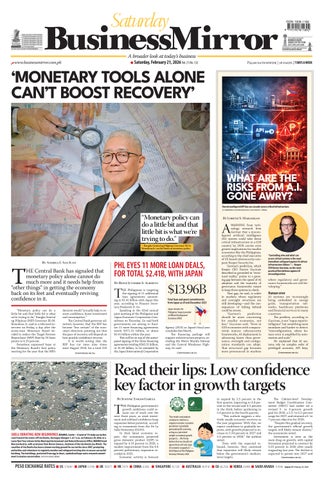

‘MONETARY TOOLS ALONE
BOOST RECOVERY’
By Andrea E. San Juan
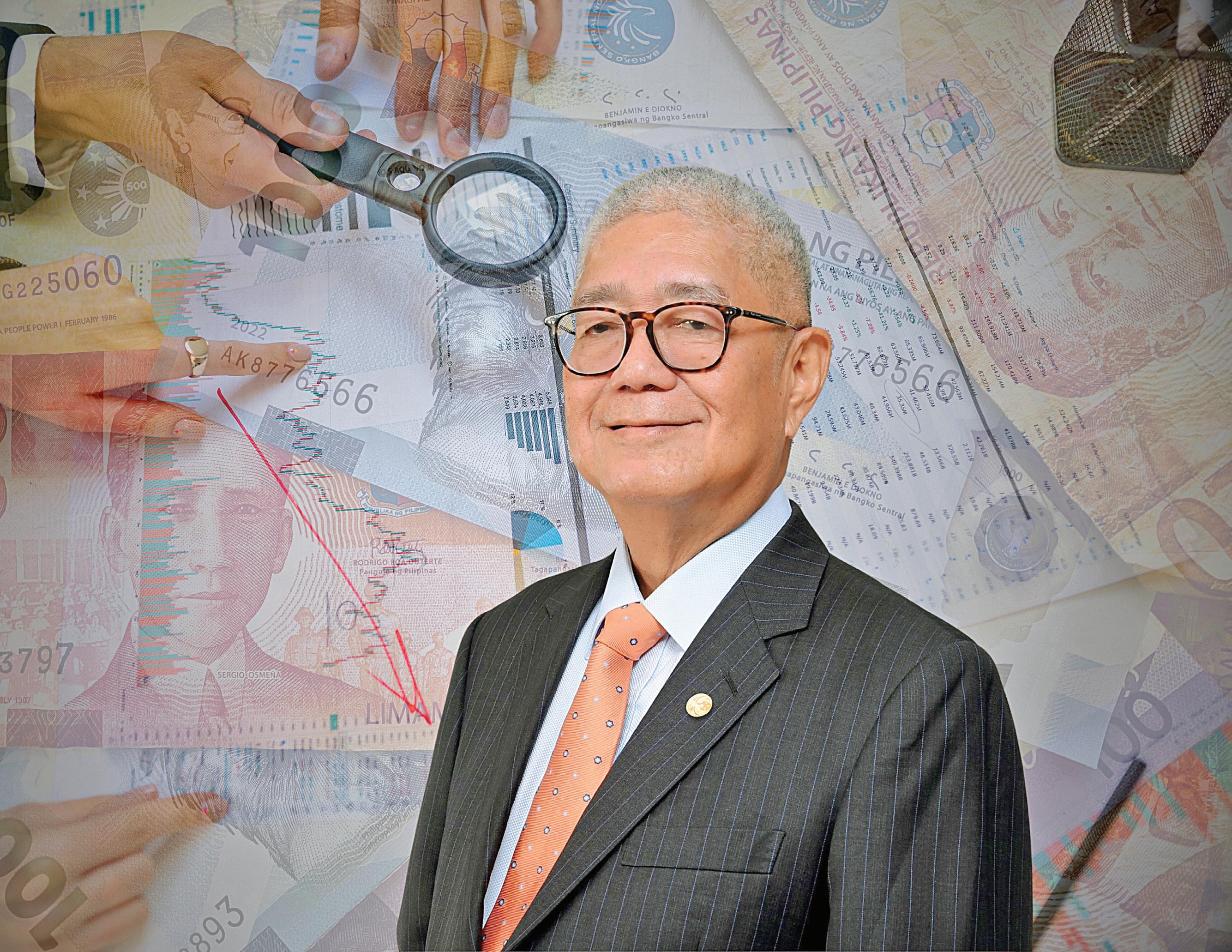
THE Central Bank has signaled that monetary policy alone cannot do much more and it needs help from “other things” in getting the economy back on its feet and eventually reviving confidence in it.
“Monetary policy can do a little bit and that little bit is what we’re trying to do,” Bangko Sentral ng Pilipinas (BSP) Governor Eli M. Remolona Jr. said in a televised interview on Friday, a day after the seven-man Monetary Board decided to reduce the Target Reverse Repurchase (RRP) Rate by 25 basis points to 4.25 percent.




“Monetary policy can do a little bit and that little bit is what we’re trying to do.”
PHL EYES 11 MORE LOAN DEALS, FOR TOTAL $2.41B, WITH JAPAN
By Reine Juvierre S. Alberto
THE Philippines is targeting the signing of 11 additional loan agreements amounting to $2.41 billion with Japan this year, according to Finance Secretary Frederick D. Go.
By Lorenz S. Marasigan
AWARNING from technology research firm
Gartner that a misconfigured artificial intelligence (AI) system could take down critical infrastructure in a G20 country by 2028 carries even greater implications for smaller economies like the Philippines, according to the chief executive of US-based cybersecurity company Keeper Security Inc. Gartner’s prediction, which Keeper CEO Darren Guccione described as grounded in “structural reality,” points to a growing gap between the speed of AI adoption and the maturity of governance frameworks meant to keep those systems in check.

Total loan and grant commitments from Japan as of end-December 2025
The Central Bank governor admitted, however, that the BSP has become “less certain” of the economy’s direction, pointing out that the pace of recovery will depend on how quickly confidence returns.
It is worth noting that the BSP has cut rates nine times since August 2024, for a total 225
Remolona expressed hope at the Monetary Board’s first policy meeting for the year that the MB’s decision would “actually help to restore confidence, boost investment and consumption.”

Speaking at the 42nd annual joint meeting of the Philippine and Japan Economic Cooperation Committees on Thursday, Go said both governments are aiming to finalize 11 more financing agreements worth ¥371.31 billion, or about $2.41 billion within the year.
This will be on top of the anticipated signing of the three financing agreements totaling ¥243.31 billion, or $1.58 billion, to be extended by the Japan International Cooperation
Japan remains the Philippines’ largest provider of Official Development Assistance (ODA) $13.96B

Agency (JICA) as Japan’s fiscal year concludes this March.
The financing package will support infrastructure projects, including the Metro Manila Subway and the Central Mindanao Highway, Go said.
That gap, he said, is wider in markets where regulatory and oversight structures are still developing—and the consequences of falling behind could be severe.
“Gartner’s prediction should be more concerning for smaller economies, not less,” Guccione said. “Even in G20 economies with comparatively mature cybersecurity frameworks, AI deployment is advancing faster than governance, oversight and configuration standards can adapt. That structural gap becomes more pronounced in markets
where regulatory and governance frameworks are still developing.”
Human error AI systems are increasingly being embedded in energy grids, transportation networks, healthcare platforms and financial services in many countries.
The problem, according to Guccione, is not “rogue superintelligence” but something more mundane and harder to detect: “misconfiguration, where human error is amplified by automation and scale.”
He explained that AI systems rely on complex webs of privileged accounts, API keys,
By Justine Xyrah Garcia
HE Philippine government’s growth ambitions could remain out of reach over the next three years, as weak investment and subdued confidence keep expansion below potential, according to economists from the De La Salle University (DLSU). In their latest economic report, the economists projected gross domestic product (GDP) to expand by 4.19 percent in 2026, a modest improvement from the 4.4 percent preliminary expansion recorded in 2025. Economic activity is forecast


to expand by 2.5 percent in the first quarter, improving to 3.8 percent in the second and 4.5 percent in the third, before quickening to 5.9 percent in the fourth quarter.
“This outlook suggests a relatively steady economic recovery as the year progresses. With this, we expect conditions to gradually improve, with growth projected to increase to 5.34 percent in 2027 and 5.3 percent in 2028,” the authors noted.
Even with the expected rebound, however, they cautioned that expansion will likely remain below the government’s mediumterm targets.
The Cabinet-level Development Budget Coordination Committee (DBCC) had earlier set a revised 5- to 6-percent growth goal for 2026, a 5.5- to 6.5-percent range for 2027, and retained a 6- to 7-percent objective for 2028.
“Despite this gradual recovery, the government’s official growth targets will likely remain elusive,” the economists noted. Investment is seen as the main drag on growth, with capital formation projected to contract by 9.25 percent in 2026 after nearly stagnating last year. The decline is expected to persist into 2027 and
—Bangko Sentral ng Pilipinas Governor Eli M. Remolona Jr., on the limits of monetary policy
‘MONETARY TOOLS ALONE CAN’T BOOST RECOVERY’
Continued from A1
basis points (bps)—thus reducing the policy rate from 6.50 percent to 4.25 percent. (See: https://businessmirror.com.ph/2026/02/20/ declining-confidence-spurs-25-bpsrate-cut/)
A day after the monetary policy meeting of the BSP, however, Remolona underscored in a televised interview that the Central Bank’s tools and models can only do so much in helping uplift the economy.
The BSP governor divulged this when he was quizzed if he’s wary that the public has now shifted its focus on interest rates as the solution amid the slow expansion of the economy.
“Yes, that is a concern. Interest rates can’t do the trick. It needs help from other things,” Remolona said.
“We have very limited tools in monetary policy. Basically, we have tools on the demand side and we are supposed to focus on inflation. So it’s not clear how much more we can do,” he further emphasized.
Remolona, who heads the BSP which has the primary mandate of maintaining price stability, also pointed out that the Central Bank will “collect more data and then decide what can we do that will be helpful without sacrificing our mandate about inflation.”
But when asked if the BSP would ease further on the monetary
side if fiscal support disappoints, Remolona said: “We are at the point where monetary policy cannot do much more. As I said, things are very uncertain. We have to crunch the numbers some more.”
Beyond models:
‘Evidence of credible reforms’
THESE concerns were aired by the BSP governor as he underscored the importance of confidence in spurring economic growth.
“Confidence affects growth, but growth also affects confidence. So, we were trying to do something on the growth side in an effort to bring some confidence back. And we hope that works. We don’t really know when confidence will come back. We think it will take a few more months when it comes back, when it will come back in strength,” Remolona said.
The BSP governor said the Central Bank’s models may say confidence will come back soon, adding: “But that’s just our models.”
As such, he stressed the need for “credible reforms” to steer confidence back into the economy.
“As we’ve said in the past, we need credible reforms, evidence of credible reforms. At the same time, we need a little bit more growth. Because if you’re trying to invest, why would you invest if growth is not going up? So, we need both. We need growth and we need confidence. Exactly a two-way street,” Remolona underscored.
WHAT ARE THE RISKS FROM AI GONE AWRY?
Continued from A1
service identities, automation scripts and third-party integrations.
And when those identities are poorly governed, over-permissioned or left unmonitored, they introduce what he calls “systemic fragility”—vulnerabilities that do not announce themselves but quietly accumulate until a single failure cascades across an entire infrastructure environment.
“AI does not eliminate risk—it accelerates it when guardrails are weak,” he said, noting that the proliferation of non-human identities is central to that risk.
Non-human identities include service accounts, API keys, automation tokens and AI agents.
Guccione said these machine identities already “outnumber” human users in many infrastructure environments today, and unlike employees, they are rarely offboarded, reviewed or stripped of unnecessary access.
“These identities often operate with persistent privileges and limited oversight. A single compromised credential or flawed model deployment pipeline can cascade across interconnected infrastructure environments,” he said.
Why the PHL faces heightened exposure FOR the Philippines, the concern takes on added urgency as the

country accelerates its digital infrastructure buildout.
The government’s push to expand national connectivity, the rapid rollout of digital government services, and the growing adoption of cloud-based platforms across both public and private sectors have all expanded the surface area that needs to be protected.
Guccione said the risk is not that the Philippines will encounter more sophisticated AI failures than larger economies, but that it may encounter more “preventable ones.”
“When AI systems are integrated into operational technology without enforceable identity controls, configuration discipline and executive oversight, misconfiguration becomes more likely and more difficult to detect early. Fragmented accountability across regulators, operators and vendors further compounds that exposure,” he said.
The country’s reliance on foreign and third-party technology providers and managed service partners adds another layer of exposure.
Much of the critical infrastructure in Southeast Asia, including the Philippines, depends on foreign technology vendors, cloud platforms and managed service partners.
Each of those integrations introduces additional service accounts, API keys and remote access pathways—and with them, additional points of potential misconfiguration.
“Misconfiguration risk scales with complexity,” Guiccone said. “The challenge is not simply technical vulnerability, but fragmented accountability across vendors, operators and jurisdictions. When no single entity has full visibility and control over privileged access, misconfiguration risk becomes systemic rather than isolated.”
In cross-border technology environments, regulatory expectations may also differ between the vendor’s home jurisdiction and the country where the infrastructure operates.
That mismatch in accountability, Guccione warned, can leave critical systems without meaningful oversight at precisely the points where oversight matters most.
Governance must precede acceleration GUCCIONE said smaller economies like the Philippines need not replicate the European Union’s comprehensive regulatory architecture immediately, but noted that “foundational controls” must be established before automation scales any further.
“Critical infrastructure operators should maintain accurate inventories of both human and non-human identities. Least-privilege access should be enforced by default across IT and operational environments,” he said.
He added that AI-driven actions must be auditable, with clear logs showing what systems were accessed, what permissions were used and what outcomes were produced.
“Governance must precede acceleration,” he said. “Automation must not scale faster than the capacity to govern it.”
He emphasized that “executive accountability is equally important,” arguing that AI governance should sit at board level, not solely within IT departments.
“Even in the absence of comprehensive AI legislation, regulators can require demonstrable access controls, override mechanisms and incident reporting,” he said.
“AI governance cannot remain a technical conversation,” he said. “It must be treated as a national resilience issue.”
He added that safe override mechanisms — the ability for human operators to intervene and correct AI-driven decisions in operational technology environments — are only effective when the identity systems underlying those overrides are themselves secure.
An override pathway that can be accessed by a poorly governed service account or a compromised API key offers little real protection.
Start with visibility FOR the Philippines specifically, Guccione said the most practical and immediate first step is establishing visibility — a complete, accurate picture of every privileged account operating across an organization’s IT, cloud and operational technology environments.
“Many organizations cannot confidently answer how many service accounts, API keys or automation tokens have standing access to sensitive systems,” he said. “Without that baseline, governance discussions remain theoretical.”
Once that inventory is in place, Guccione recommended enforcing least-privilege access and eliminating standing administrative rights wherever possible.
Privileges, he said, should be time-bound, task-specific and continuously monitored. He noted that this does not require large capital investment in new AI security tools — it requires “disciplined identity governance” applied consistently.
“In resource-constrained environments, strengthening access control delivers the highest resilience return per dollar spent,” he said. “Misconfiguration becomes catastrophic when excessive privilege meets automation. Controlling who and what can access critical systems is the most immediate safeguard against AI-driven infrastructure failure.”
Read their lips: Low confidence key factor in growth targets
2028, with further contractions of 5.83 percent and 6.85 percent, respectively.
“This is an alarming situation that needs to be addressed through appropriate policy reforms that improve firm productivity and business confidence,” the authors said.
Household consumption, which accounts for the bulk of economic activity, is projected to grow by 4.81 percent in 2026 after expanding by 4.6 percent in 2025.
Spending is expected to hover around the 4 percent range in the first three quarters before rising to 6.6 percent in the fourth quarter.
Growth is forecast to reach 4.95 percent in 2027 before moderating to 4.53 percent in 2028.
Government spending, meanwhile, is seen providing support.
Fiscal expenditure is forecast to expand by 10.88 percent in 2026, with quarterly growth strengthening from 6 percent in the first quarter to double-digit rates in the succeeding quarters, peaking at 13.6 percent in the fourth quarter.
Double-digit growth is expected to be sustained at 13.06 percent in 2027 and 12.73 percent in 2028. Despite these offsets, the economists maintained that persistent economic pessimism is weighing on overall growth prospects.
“Our results and analysis continue to reinforce a singular narrative: economic pessimism is gradually permeating the economy, acting as a persistent weight on national growth prospects.... We firmly believe that we should not ignore these tell-tale signs of economic stagnation,” they noted.
Earlier, Finance Secretary
pines’s largest provider of Official Development Assistance (ODA), with total loan and grant commitments reaching $13.96 billion, or 33.54 percent of the Philippines’ total ODA portfolio, as of end-December 2025.
“All these figures speak volumes. They reflect trust in the Philippines’ economic direction, confidence in our institutions, and a shared belief in long-term partnership,” Go said.
Frederick D. Go played down concerns over the recent growth slowdown, saying the country’s macroeconomic fundamentals remain strong and supportive of a return to faster expansion this year.
(See: https://businessmirror.com. ph/2026/01/31/not-the-end-of-theworld-govt-to-ramp-up-spendingamid-anemic-2025-growth-of-4-4/).
The DLSU economists, however, argued that subdued confidence—rather than fundamentals—remains the main constraint on growth.
“Without a swift resolution of corruption scandals, the implementation of good governance measures, and long-overdue reforms focused on industrial support and ease of doing business, we predict that economic expansion will remain constrained within the 4 percent to 5 percent range,” they said.
“This reflects continued alignment between our infrastructure priorities and Japan’s development support,” the Finance secretary said. Two weeks ago, Go said the Philippines also signed the Exchange of Notes for the Proposed Second Supplemental Loan of the Metro Rail Transit Line 3 Rehabilitation Project. Since the start of the Marcos Jr. administration, the Philippines has signed 12 loan agreements with Japan amounting to ¥910.38 billion, or $5.92 billion. Japan remains the PhilipPHL EYES 11 MORE LOAN DEALS, FOR TOTAL $2.41B, WITH JAPAN
The Finance chief assured Japanese and Philippine business leaders that the country’s economic fundamentals remain solid, even with the “extraordinary challeng-
es” in the second half of 2025. Go reiterated the government’s commitment to structural reforms that enhance ease of doing business, promote public-private partnerships and create a more predictable and competitive investment environment.
“Japan has been a steadfast partner in our past. It is a strategic partner in our present. It will remain an indispensable partner in our future,” he said.
The annual meeting was joined by the Philippines-Japan Economic Cooperation Committee and Japan-Philippines Economic Cooperation Committee.
www.businessmirror.com.ph
Over half of local trade among regions relies on road transport
By Justine Xyrah Garcia
THE country’s domestic trade reached 9.85 million tons in the fourth quarter of 2025, with road transport emerging as the dominant mode of moving goods across regions, according to the Philippine Statistics Authority (PSA).
The PSA said road shipments accounted for 5.41 million tons, or 54.9 percent of total domestic trade volume during the period. Water transport handled 4.44 million tons, equivalent to 45 percent of total volume, while air shipments accounted for just 0.1 percent, or 5.67 thousand tons.
The latest domestic trade figure was higher than the 6.58 million tons recorded in the same quarter in 2024.
The larger total reflects the inclusion of road transport data beginning in the first quarter of 2025. In previous years, the Domestic Trade Statistics covered only water and air transport,
meaning, the 2024 figure did not account for goods moved by road. Even as the expanded coverage lifted the overall volume, shipments by water, however, declined on an annual basis.
The volume of goods transported by water fell 32.5 percent to 4.44 million tons in the fourth quarter of 2025 from 6.57 million tons in the same quarter in 2024.
Air cargo, likewise, dropped 13.3 percent to 5.67 thousand tons, from 6.54 thousand tons a year earlier.
In terms of value, total domestic trade amounted to P562.76 billion in the fourth quarter.
Road transport, likewise, accounted for the largest share at 57.6 percent, or P324.36 billion. Water shipments were valued at P238.04 billion, while air transport accounted for P0.363 billion.
Calabarzon (Region IVA) emerged as the country’s main source of goods
See “Road,” A4
A3 Saturday, February 21, 2026

DBP seals ₧3.5-B loan for priority projects in Bicol
By Reine Juvierre S. Alberto
STATE-RUN Development Bank of the Philippines (DBP) inked a P3.5-billion term loan facility to help finance priority development projects in the Bicol region.
In a statement on Friday, DBP President and Chief Executive Officer Michael O. de Jesus said the bank entered into a loan agreement with the Provincial Government of Camarines Sur under its Assistance for Economic and Social Development (Asenso) for LGUs Financing Program.
The loan facility will bankroll a total of 112 construction projects in Camarines Sur, covering healthcare centers, hospitals, school buildings, roads and agricultural facilities, according to de Jesus. He said the projects are expected to strengthen public service delivery and improve access
to essential infrastructure, particularly in rural and underserved communities.
“DBP takes pride in assisting the Camarines Sur provincial government in projects that will improve the lives of Camarinenses—from strengthening infrastructure and improving healthcare delivery, to fostering education and expanding access to essential social services and livelihood opportunities,” de Jesus was quoted as saying.
DBP is also eyeing to forge other similar partnerships with LGUs, de Jesus added, as the bank “continues to recognize and fully support initiatives that seek to maintain or even accelerate the momentum in local development while ensuring that communities continue to thrive and evolve.”
As of end-November 2025, DBP has approved more than P165 billion in loans for 451 borrowers under the Asenso program.
“We hope to expand in scope and scale the assistance we provide to our LGU partners,” de Jesus said.
Camarines Sur, a first-class province with a population of more than 2 million people, has an economy anchored on tourism, agriculture, fishery, livestock and forestry.
DBP is the ninth largest bank in the country in terms of assets and provides credit support to four priority sectors of the economy, including infrastructure and logistics; micro, small and medium enterprises; the environment; and social services and community development.
Palace confident infra projects moving well after backlog eased
SEVERAL public works are now moving at full steam ahead and are expected to be completed in the coming months
after President Ferdinand Marcos Jr. ordered the Department of Public Works and Highways (DPWH) to address its backlogs.
This, as the Marcos administration is trying to keep the country’s economic growth target on track following its derailment
last year when DPWH started vetting its public works more closely
See “Palace,” A4

Abolish or retain? ICI report review expected to be done by next week
By Samuel P. Medenilla
MALACAÑANG said the review of the accomplishment report of the Independent Commission for Infrastructure (ICI) is expected to be completed by next week.
“Well, we’ll probably find out by February, as far as I know,”
Palace Press Officer Claire Castro said in Filipino in a press briefing on Friday when asked about
the timeline for the completion of the review.
“But I’m not saying that this will be the signal for what the President’s decision will be [on the
status of ICI],” she added.
ICI submitted its 1,000-page report to the Palace earlier this month as mandated by Executive Order (EO) No. 94, which created it.
Marcos created the ICI to collect pieces of evidence related to hundreds of anomalous flood control projects.
Castro said President Ferdinand Marcos Jr., who tasked the Office of the Executive Secretary (OES) to review the report, has already read it. The outcome of the review is deemed crucial to the President’s final determination on whether to retain or
abolish the ICI. She said the ICI should continue to do its work, while waiting for the President’s decision on the matter.
Last month, Marcos said the task of the ICI is already “coming to an end” and that it only needs to settle “one or two loose ends” even if the Department of Public Works and Highways (DPWH) said there are still 416 flood control projects. DPWH said it is targeting to complete the audit by the first quarter of 2025.
On Thursday, former Supreme Court (SC) Justice Andres B. Reyes Jr., the only remaining member of
the three-man ICI, said he wants to continue the campaign against public works irregularities.
ICI has been requesting for the appointment of new commissioners following the resignation of two of its commissioners last year: SGV & Co. country managing partner Rossana A. Fajardo and former Department of Public Works and Highways (DPWH) Secretary Rogelio “Babes” L. Singson.
The fact-finding panel said it needs the new appointments to have a quorum so it can resume acting on the pieces of evidence gathered by the Philippine National Police.
BOC secures conviction of 3 men in ₧998-M drug smuggling case
By Reine Juvierre S. Alberto
THE Bureau of Customs (BOC) has secured the conviction of three individuals involved in a P998-million drug smuggling case.
In a statement on Friday, the BOC said the Regional Trial Court of Manila on December 9, 2025, found Muktasil Abundol
Assimudin, Emmanuel Paulo Delos Reyes Landicho, and George Sim Fernandez guilty beyond reasonable doubt.
This is for their violation of Section 1401(g) in relation to Section 118(g) of Republic Act No. 10863, otherwise known as the Customs Modernization and Tariff Act.
The court sentenced each of the accused to reclusion perpetua and
imposed a fine of P50 million.
The case stemmed from the seizure of about 146.81 kilograms of illegal drugs, valued at P998.31 million, which arrived at the Manila International Container Port in January 2019.
Customs Commissioner Ariel F. Nepomuceno said the court’s decision demonstrated the effectiveness of the bureau’s enforcement
and legal processes.
“The conviction of those behind this massive drug shipment demonstrates that our enforcement and legal processes are working. We will continue to pursue every case until justice is fully upheld,” Nepomuceno said.
Mayor suspends classes, advises residents after Kanlaon erupts
CANLAON City Mayor Jose Chubasco “Batchuk” Cardenas has issued a memorandum suspending classes in the entire city due to the moderately explosive eruption of the Kanlaon Volcano.
In a copy of his memorandum, Cardenas indicated that the suspension covers both public and private schools.
The local chief executive urged parents to prepare go bags for their families containing drinking water, ready-to-eat food, medicines, face masks, important documents, flashlights, batteries, and other necessary supplies in anticipation for possible escalation of volcanic activity.
Meanwhile, in the province of Negros Occidental, there were reports of “light” ashfall observed in at least 3 barangays in Bago City, 5 barangays in La Carlota City and 10 barangays in the town of Pontevedra, 2 barangays in La Castellana town,17 barangays in Hinigaran town, 2 barangays in Valladolid, and one barangay in Moises Padilla town.
“This victory reaffirms the Bureau’s steadfast commitment to safeguarding the nation while ensuring due process and adherence to the law,” it added.
In 2025, the BOC conducted a total of 143 seizures of dangerous drugs, with an estimated value of P5.630 billion.
The BOC said it continues to enhance its legal and enforcement mechanisms to ensure that cases are diligently pursued until conviction.
Now 97% complete, Cebu BTR may start operations in March
By Carmel Pedroza
CEBU CITY—The Department of Transportation
(DOTr) is targeting March 2026 for the initial operations of the Cebu Bus Rapid Transit (BRT) system, with Package 1 of the project now 97 percent complete.
DOTr Secretary Giovanni Lopez said in an interview on Friday, Feb. 20, that the agency is “tying the loose ends” to reach full completion of the first package before opening the system to the public.
“We’re now at 97 percent. We’re just addressing the remaining 3 percent—essentially punch listing—to ensure that the entire project is in accordance with its program of work,” Lopez told reporters.
The Cebu BRT is funded by a World Bank loan of P28.78 billion.
It being a foreign-assisted project, the DOTr must strictly comply with international standards and procedures, Lopez said.
“We have to be very stringent. Since this is foreign-assisted, we
need to make sure everything is compliant before we fully operate,” he added.
Dry run before full operations BEFORE commercial operations begin, the DOTr will conduct a dry run to ensure smooth and efficient service once the system becomes fully operational.
“We will do a dry run prior to the opening. Once operational, we want to make sure that everything runs smoothly,” Lopez said.
Package 1 of the project, which costs P990 million, covers a 2.38-kilometer segment running from the Cebu South Bus Terminal to the Cebu Provincial Capitol via Osmeña Boulevard. It is designed to operate independently from the succeeding packages.
This means the initial stations and busways can already function even as other components of the project are still under development.
The Cebu BRT was originally scheduled to be fully operational by the second quarter of 2025, but delays pushed back the timeline.
the fourth quarter, recording the highest outflow value at P193.43 billion, or 34.4 percent of total

PPP for Second Phase?
LOPEZ admitted that project delays may make it difficult to complete the entire BRT system before the World Bank loan deadline in September 2026.
“We met with the World Bank and acknowledged that the project was delayed. There were changes in the procurement committee, and we have since expedited all processes,” he said.
Given the time constraints, the DOTr is now studying the possibility of implementing the remaining portions of the project through a public-private partnership (PPP).
“As much as we want to rely on the General Appropriations Act, sometimes we have to look for other avenues and explore alternative means. One of the contingencies being studied is a PPP arrangement,” Lopez explained.
Under this setup, interested private parties may not only handle operations and maintenance, but also help complete the remaining civil works.
The DOTr is set to conduct market sounding and feasibility studies before proceeding to bidding to
outbound trade. It also posted the largest outflow volume at 3.37 million tons.
The National Capital Region (NCR) followed in outbound trade with shipments valued at P115.51 billion, while Northern Mindanao (Region X) accounted for P51.90 billion
ensure clarity and avoid confusion among stakeholders.
“We have to finish it. The bidding process will follow after market sounding and feasibility studies so everything will be clear,” Lopez said.
Capitol Station
MEANWHILE , the proposed Capitol Station remains under discussion.
Transportation Undersecretary Steve Pastor said the DOTr is coordinating with the World Bank, which prefers the station to be located along the road median in line with international BRT standards.
However, existing resolutions and an ordinance passed by the Cebu Provincial Board prohibit the construction of structures on the road median fronting the Cebu Provincial Capitol, citing heritage preservation and aesthetic concerns around the Capitol grounds.
The Capitol building and its immediate surroundings have long been considered a heritage zone.
Provincial officials earlier expressed concern that placing a BRT station at the median could affect
On the receiving end, NCR emerged as the top destination for goods, registering the highest inflow value at P149.83 billion, equivalent to 26.6 percent of total inflows.
Region IV-A followed with P83.12 billion, while Region X recorded P46.38 billion.
Continued from A3
after inivestigations revealed many flood control projects were substandard or non-existent.
In his recent report to the chief executive, the DPWH Secretary Vivencio “Vince” B. Dizon reported the progress on some of his agency’s ongoing projects, including the temporary bridge connector for Cabagan–Santa Maria Bridge
and Isabela. The “under-designed” bridge collapsed last year due to overloading.
“According to the agency, the construction of the project is 89-percent complete and it is targeted to open in March for light vehicles,” Palace Press Officer Claire Castro said in a press briefing on Friday, citing a DPWH report.
The Presidential Communications Office (PCO) undersecretary also reported that the EDSA Rehabilitation Phase I will be completed
the historical and visual integrity of the area.
Because of this, the provincial government enacted a measure disallowing permanent structures in the median area, effectively affecting the original design of the BRT Capitol Station.
The National Historical Commission of the Philippines (NHCP) has since reached out to the Cebu Provincial Government through a letter addressed to Governor Pamela Baricuatro to help resolve the matter.
The NHCP has sought the provincial government’s position on whether the station may be placed at the median, consistent with international BRT practice, or relocated to the side of the road as an alternative.
Baricuatro said she is set to meet with members of the Sangguniang Panlalawigan to come up with a unified stand on the issue.
“If we get the go signal, we can start. It’s not necessarily the exact same spot—options have been presented to the provincial government. The DOTr is ready to implement,” Pastor said.
At trade balance—which measures the gap between outbound and inbound trade—Calabarzon posted the largest surplus at P110.31 billion, indicating it shipped out significantly more goods than it received.
In contrast, NCR recorded the largest deficit at P34.32 billion.
within the first half of the year.
“The EDSA Rehabilitation Phase I is 49.4 percent complete and is expected to be completed by June this year,” she said.
Dizon also gave updates on the makeshift bridge in Sitio Akliyan, Bongabong in Oriental Mindoro, the Apalit section of the MacArthur Highway-Buhang Flyover in Jaro, Iloilo; and the ongoing repairs of the Maharlika Highway sections in Gumaca, Quezon, Samar, and Guinobatan, Albay.
Sulfuric smell also reached some barangays in Bago City, La Carlota City, and Moises Padilla town, according to a report by the Negros Occidental Operations Center.
Urging residents to remain calm but vigilant, Mayor Cardenas on Wednesday assured the public that emergency teams are on standby following a moderately explosive eruption at Kanlaon Volcano situated in Negros Island.
“Palihog magpabiling kalmado ug i-assess ang inyong kahimtang sa inyong lugar (Please remain calm and assess your situation in your area),” Cardenas said, emphasizing that rescue vehicles have been positioned at the Pasayaw Grounds and Emergency Response Teams are on alert for any possible evacuation.
The mayor advised residents who feel their areas are no longer safe to proceed immediately to the nearest designated pick-up points or to the safest available location.
The Philippine Institute of Volcanology and Seismology (Phivolcs) reported that a moderately explosive eruption occurred at the volcano’s summit crater at 4:39 p.m. on February 19, 2026, lasting about two minutes based on seismic records.
Phivolcs said the eruption generated a dark gray plume that rose approximately 2,000 meters above the crater before drifting southwest.
Pyroclastic density currents (PDCs) were also observed descending the southern and southwestern upper slopes within one kilometer of the summit crater, as recorded by IP cameras of the Kanlaon Volcano Network. Alert Level 2 remains in effect over Kanlaon Volcano.
Authorities reiterated that entry into the four-kilometer-radius Permanent Danger Zone (PDZ) is strictly prohibited due to the risk of sudden eruptions and hazardous volcanic flows.
Cardenas posted emergency hotlines that residents needing assistance may contact:
GLOBE/TM: 0953 857 7606
SMART: 0929 498 9021
DITO: 0991 391 1959
“Magpabiling alerto mga Ka-Salta ug safety first (Stay alert and safe first),” the mayor added. Carmel Pedroza
He also reported the completion of the Bukidnon-Davao Road repair works in January and the sinkhole in Kennon Road this month.
“The government is working hard to complete the country’s infrastructure projects as soon as possible because for the President, if the work is done quickly and properly [on the said public works], people will feel the benefits of public projects faster,” Castro said, speaking in Filipino. Samuel P. Medenilla
By Claudeth Mocon-Ciriaco
THE National Council on Disability Affairs (NCDA) will coordinate with the Department of Trade and Industry (DTI), relevant regulatory bodies, and the local government of San Fernando City to review business practices. This follows a recent incident at a Starbucks branch in San Fernando City, Pampanga, where an 8-year-old child with autism was reportedly asked to eat lunch outside the coffee shop due to the “no outside food” policy.
The NCDA expresses deep concern and reminds ev eryone that Republic Act No. 7277, or the Magna Carta for Persons with Disabilities, as amended by Republic Act No. 9442, guarantees equal opportunity, access, and protection against discrimination for persons with disabilities. Denial of reasonable accommodation, even if unintentional, undermines both the spirit and letter of this law.
TimeOur LRT-1 launches workforce diversity program for PWDs
By Raymond Carl Dela Cruz
the NCDA stressed that such policies must never result in discrimination, exclusion, or undue hardship for persons with disabilities—especially children whose medical and developmental conditions require reasonable accommodation.
“We emphasize that reasonable accommodation is not special treatment. It’s a legal obligation and a social responsibility. Inclusion requires flexibility, awareness, and compassion,” the NCDA said. They noted previous concerns raised about accessibility and accommodation practices in commercial establishments, adding, “This highlights the urgent need for systematic disability awareness and sensitivity training for frontline personnel in the private sector.”

To address this, NCDA continues to conduct yearround disability sensitivity and inclusion training for government agencies, mall operators, commercial establishments, and frontline service providers.
“Children on the autism spectrum often have medically and developmentally established food selectivity and sensory sensitivities. These are not mere preferences but clinically recognized needs. Enforcing rigid commercial policies without considering disability-related requirements creates barriers that the law seeks to dismantle,” the NCDA statement read.
The NCDA will also determine how DTI and concerned LGU agencies may align with disability inclusion standards and reasonable accommodation principles.
An 8-year-old autistic child was made to eat lunch on the pavement outside a Starbucks branch in a mall in San Fernando City, Pampanga, after the staff of the popular coffeeshop chain allegedly refused to accommodate his needs, sparking questions about how businesses treat customers with disabilities.
The incident was posted by the mother, Lea Organa, on Facebook and went viral on social media.
Organa, a registered PWD and a Gestalt Language Processor, claimed that she and her son Eli, were “kicked out” of Starbucks, SM Pampanga.
Organa said that a security personnel approached them and told them of the “no outside food policy.” She then disclosed the condition of her son, but to no avail.
While businesses have the right to implement operational policies,
They also called on Starbucks Philippines and other business entities to actively participate in structured training programs to ensure their policies and staff responses are fully compliant with disability laws and inclusive service standards.
In partnership with the Department of Social Welfare and Development (DSWD) and SM Cares, NCDA recently supported the establishment of the first Sensory-Friendly Space at SM Mall of Asia—an initiative designed to assist individuals with autism, sensory processing disorders, and anxiety. This model demonstrates that inclusive environments are both feasible and beneficial to the broader community.
The recent incident serves as a reminder that compliance with disability rights laws is not optional, NCDA said. It is an essential component of responsible business practice and nation-building.
“The NCDA remains committed to working collaboratively with government regulators, local government units, and the private sector to ensure that public spaces—including restaurants and coffee shops— are safe, accessible, and welcoming for all Filipinos,” the NCDA said, adding that inclusion is not an act of charity, but a matter of “rights, dignity, and justice.”
BusinessMirror has reached out to Starbucks and SM Mall for their official statements.
Bill aims to include vulnerable sectors in absentee voting
By Leonel Abasola
in vulnerable situations in the local absentee voting. Senate Bill No. 1075 seek to allow senior citizens, persons with disabilities (PWDs), internally displaced persons (IDPs), pregnant women, health workers on duty, and even repatriated overseas workers to cast their ballots ahead of Election Day, or in specially designated accessible venues.
“It is the right of every Filipino, except those barred by law, to cast their vote. This right cannot be removed because of age, health and class standing,” Estrada said in a statement. He said that while Republic Act 10366 already authorizes the Commission on Elections (Comelec) to establish accessible polling places exclusively for senior citizens and PWDs, many voters from vulnerable sectors have remained disenfranchised.
Under SB 1075, qualified voters from
vulnerable sectors may avail themselves of local absentee voting for at least two days within the week prior to Election Day, which shall be held in accessible establishments designated by the Comelec.
The bill also authorizes the establishment of Emergency Accessible Polling Places in residences, hospitals, quarantine facilities, jails, IDP areas, and other locations where voters may find it difficult to go to regular polling centers.
The bill further sets clearer and more comprehensive standards for accessible polling places, including the installation of ramps and railings, availability of wheelchairs, adequate lighting and ventilation, lists of candidates in Braille, and the presence of sign language interpreters. It also provides for transportation or shuttle services to help vulnerable voters reach polling sites.
To ensure effective implementation, the bill authorizes the creation of a Vulnerable Sectors Office within the Comelec, which shall oversee programs and services for these groups. PNA
MANILA—The Light Rail Manila Corp. (LRMC) on Wednesday rolled out a workforce inclusivity program for persons with disabilities (PWD) that aims to hire persons with special needs as part of the Light Rail Transit Line 1 (LRT-1) station workforce.
In a statement, the LRMC said the program, dubbed “Project PWD: Promoting Workforce Diversity,” will deploy PWDs as station service aides with the goal of providing gainful employment opportunities for these individuals.
Under the program, station service aides will be engaged in parttime employment of four hours a day for a duration of less than five months.
“By empowering these individuals to take on vital roles as ambulant ticket sellers, LRMC is creating a platform where unique skills contribute directly to the community,” it said.

It added the additional workforce will also optimize the LRT-1’s operational efficiency by having additional frontline support and reducing ticket queues, allowing for faster and more comfortable commutes during peak hours.
LRMC President and Chief Executive Officer Enrico Benipayo said the program is a testament to the LRMC’s belief that a diverse workforce is a key driver in providing better service to passengers while creating opportunities for PWDs.
“At LRMC, we are proud to lead the way in ensuring equal opportunities for all, regardless of their

IRECENTLY saw my friend N.
to discuss a business that we’re planning to pursue together. We met not at a cafe or restaurant but at the lobby of a hospital. I thought he was sick but it turns out he was there to stay by his wife’s side who had been severely coughing because of water in her lungs.
N. used to be called a “live wire” for his dynamic personality. In another life, he was a busy stage, TV, and film actor and director, and he used to hop here and there, always involved in various projects. Now he lives a quiet life, having decided to devote his remaining years at home to tend to the needs of his wife, who, like him, is 90 years old and shows symptoms of early stage dementia.
Halfway around the world in California, my wife’s brother M. reported that just three weeks ago, his wife had a stroke. She’s now out of the hospital but she is stuck at home. She is advised strongly not to exert herself physically. She’s so weak; just a few steps and she becomes breathless. Her condition is so iffy, she is now like a “ticking time bomb” as her doctors said to her. Needless to say, my brother-inlaw needs to stay by her side 24/7. All they can do now is spend each day inside the big two-story house that has been their prized possession, their badge of pride, a testimonial to their success as Filipino immigrants. The ironic thing is that my sis-in-law cannot even walk upstairs anymore as it would strain and tire her, which could trigger another stroke. She can only move about on the ground floor but in a limited way.
spine, which prevents him from leaving the premises of his home. However, she also has a chronic heart condition and has a pacemaker implanted in her chest.
As fate would have it, more and more senior couples I know are getting stuck at home, taking care of each other, with one spouse immobilized by chronic heart conditions, severe knee problems, cancer, serious diabetes, and dementia, and other common health conditions that debilitate elderly men and women. This is why I felt moved to write this think piece.

I wish I could say “there but for the grace of God go I.” But I’m not exempted. My own spouse is afflicted with severe arthritis of the knees, which limits her mobility. She’s in pain most of the time, alleviated by medications. She also has Coronary Heart Disease and the Covid pandemic weakened her lungs. She walks on two canes and when we need to go out, I and my daughter take turns pushing her on her wheelchair. Every three months or so, I drive her to the clinics of her three doctors and every week we go to the drug stores for her medicines. Tending to her needs is now central to my life.
physical abilities. By integrating persons with special needs into our frontline operations, we are not only addressing operational bottlenecks but also fostering a culture of dignity and empowerment,” Benipayo said. The rollout follows the signing of a memorandum of agreement between LRMC and the city government of Manila, led by Mayor Isko Moreno, Manila Public Employment Service Office acting Manager John Hiroshi Umeda Jr., and Benipayo.
happens to you, but how you react to it that matters.” This is echoed by Victor Frankl, the famous holocaust Viktor later became a neurologist, psychologist, and author of “Man’s Search for Meaning,” widely regarded as one of the most influential books of our time. He wrote: “It’s not what life does to you that matters, it’s what you do with what life does to you.”
The best native word I think that corresponds to it is “tugon,” which means response or answer to a call.
One can choose a “tugon” that is negative by refusing to accept a given situation and simmer with feelings of frustration and rage. Many spouses have done that, especially husbands who give up and file divorce or legal separation from their long-suffering sick wives to escape the ordeal.
Meanwhile, the LRMC said LRT1 operations were unaffected after a man jumped from the Fernando Poe Jr. Station platform into the street below.
An LRMC security and safety team and local authorities immediately responded to the site.
“The male individual was unfortunately pronounced dead on-site due to the impact of the fall,” it said. The LRMC is cooperating with the authorities in their investigation into the incident. PNA
ing,” but an enlarged and broadened strong emotion. Thus, authentic meaningful compassion means feeling and sharing not only the same agony but also the moments of happiness with the person you are caring for. Your pain is my pain, your sorrow is my sorrow and your joy is my joy. Servant Spousehood means being a person for the other, yet at the same time it goes both ways. It is a service to care for oneself, a call to develop our respective inner strengths and become better persons. As St. Paul tells us, it is when we are weak or burdened that we become strongest.

Yet thinking about it, why should a spouse shirk from it? This is what we signed up for when we made our marriage vows 40, 50, or 60 years ago. It’s a summon to make good on our signature affixed on the wedding contract, which, among another things, states: “...in sickness and in health, for better or for worse...” If I remember right, the only escape clause in that contract is: “...till death do us part.”
The better response is to embrace wholeheartedly what is now before us. We can choose to transform our “tugon” as a call, a measure of our love for one another, an invitation to deepen that love even more.
That said, however, pure physical effort can only take you so far as the designated care giver. It cannot be sustained. The response needs to be elevated to a higher level.
I imagine my brotherin-law must be asking how is he supposed to cope with being stuck at home with his wife for maybe the rest of their lives? He may be ill-prepared for this task, and may also have health concerns. He needs now to transform himself to being an adept caregiver. He needs to develop patience and learn to listen, to hear the words that my sick sister-in-law speaks, and learn to discern her body language and actions. At the same time, this situation affects them both. They need to work together as a team to learn how to adapt and cope with this new normal. They need to realize what they have is something powerful and nothing can take it away from them: the freedom to control their own inner-life, because, they alone decide how to respond to even the most appalling conditions.
Outside Metro Manila, my wife’s cousin is taking care of her husband who has a chronic problem with his
Life has a way of throwing unexpected twists along the way. It often happens when one is busy making other plans, or looking elsewhere. Take the case of a former schoolmate now in his 70s. One moment, he was enjoying a cruise with his wife, then she felt pain in her lower back, and they both find out she had late-stage pancreatic cancer and in two weeks, she was gone. That was quick, but for others, it’s a long-term trial.
But then the Roman philosopher Epictetus said: “It’s not what
I call it Servant Spousehood. This is akin to the concept of Servant Leadership.
While Servant Leadership puts the primary emphasis on the wellbeing and empowerment of employees, Servant Spousehood is fueled by the desire to serve by putting the needs of the beloved partner first.
The heartbeat of both Servant Leadership and Servant Spousehood is compassion, not in the sense of pity or mercy. Far from it. It is the kind of passion that’s not limited to its original meaning of “suffer-
Facing uncertainty, they can only turn to their inner resources, to prayer and the realm of the spiritual, to find meaning in the test that has suddenly and unexpectedly descended on them in the midst of their contented life.
But in the process, they will realize that never have they been closer together as now. Caring for one’s spouse, simply being present at a time when
need

GMA Network rebrands
app to GMA Play

THE GMA Network App is now known as GMA Play. GMA Network said in a press release that this will “take digital entertainment to the next level.”
The GMA Play goal is to bring content closer to viewers. GMA Play’s content includes news and programs. Another exciting development is that viewers can now easily access programs like Encantadia Chronicles: Sang’gre, Never Say Die, favorites such as Pulang Araw, Maria Clara at Ibarra, Voltes V: Legacy, documentaries, movies, Asianovelas, fun, exclusive content, and many more.
GMA Play is designed for the convenience of users of mobile devices while also curating entertainment according to their preferences, said the network.
GMA Play’s lineup includes drama, romance, comedy, fantasy, news, and documentaries, beloved Asianovelas, and a selection of local and foreign movies. The platform gives audiences the flexibility to enjoy GMA content across devices, whether on smartphones, smart TVs with Google TV, or via www. gmanetwork.com/gmaplay
Current users of the GMA Network app can simply update the app to access GMA Play. Otherwise, you can download the app from the App Store and Google Play. You may log in using your Kapuso account or Facebook.
According to the Nielsen Television Audience Measurement (TAM) data for January to December 2025, GMA retained its position as the No. 1 channel in the Philippines, with a net reach of 86.2 percent or almost 62 million viewers in Total Philippines. Along with GTV, I Heart Movies, and Heart of Asia, GMA had a net reach of 87.5 percent or about 63 million viewers. GMA programs led the Top 30 most-watched list in Total Philippines based on aggregate ratings, accounting for 27 entries. Leading all programs was Kapuso Mo, Jessica Soho, which ranked No. 1 nationwide. The flagship newscast 24 Oras was in second place. Other top-rating GMA shows included Encantadia Chronicles: Sang’gre, The Voice Kids, The Clash 2025, Tolome! Walang Matigas na Pulis sa Matinik na Misis, Lolong: Bayani ng Bayan/Lolong: Pangil ng Maynila, Stars

on the Floor, Pepito Manaloto: Tuloy Ang Kuwento, Magpakailanman, Mga Batang Riles, and BBL Gang/ BG 30 Batang Bubble Ako
GMA also sustained its digital dominance in 2025, ranking as the top Southeast Asian content creator for 23 months in the Entertainment and Media Category based on data from Tubular Labs.
From January to December 2025, GMA Network’s official online platforms published content that generated high viewership among netizens.
As of December 31, 2025, official GMA Network creator properties have tallied over 74.4 billion video views: 35.1 billion on Facebook, 26.3 billion on TikTok, 10.4 billion on YouTube, and 2.6 billion on Instagram.
Meanwhile, GMA Integrated News gave the most comprehensive coverage across all platforms of the 2025 midterm elections via Eleksyon 2025: The GMA Integrated News Coverage. Also part of the network’s Eleksyon 2025 initiatives was GMA Public Affairs
By Patrick Villanueva
GAMERS rejoice because the latest State of Play from Sony’s PlayStation confirmed lots of new titles, sequels, and a big remake of a childhood favorite trilogy.
First, 2025 Game of the Year nominee Death Stranding 2: On The Beach will be coming to PC. A sequel to the beloved game with the same title, Hideo Kojima’s game will follow the story of Sam, Fragile and Higgs in the post-apocalyptic world, 11 months after the events of the first title, in his journey to save humanity from extinction. Dead or Alive 6 returns with “Dead or Alive
6: Last Round,” with new upgrades to its photo mode and bringing back characters previously released as downloadable content. In their announcement, they also mentioned that they are currently in development for a new game for their 30th anniversary.
Follow the story of a young James Bond in his early days with the action-packed and thrilling game 007 First Light. To be published by IO Interactive,

and GMA Integrated News’ “Tanong ng Bayan: The GMA Senatorial Face-Off 2025,” a senatorial debate hosted by Jessica Soho. Online, the platform also led competitors in video viewership and engagement, according to data from Tubular Labs and Hootsuite Analytics. It recorded over 18.5 billion video views across Facebook (6.6 billion), TikTok (9.9 billion), and YouTube (2 billion). In comparison, News5 registered 9.33 billion views, while ABS-CBN News recorded 7.3 billion views during the same period. GMA also led on Facebook with 467.5 million engagements.
GMA Radio stations maintained their leadership in Mega Manila, according to AGB Nielsen data for the full year 2025. Super Radyo DZBB 594 recorded a 44.5 percent audience share, while Barangay LS 97.1 Forever! posted a 47.6 percent audience share. Beyond Mega Manila, GMA Radio stations were also No. 1 among listeners. In Q3 of 2025, Barangay FM 93.5 led in Dagupan with a 59.2 percent audience share.
the game will tell the story inspired by novels and short stories by Ian Flemming, this time with Bond’s origin story of earning his “licence to kill.”
Next on the action genre, fan favorite legendary assassin John Wick will be coming to PS5 as well. While there is nothing much of gameplay revealed, especially since it is still in development, fans are excited to see Keanu Reeves reprise the role in this upcoming game.
Konami’s nightmare fuel survival horror game
Silent Hill: Townfall will follow Simon Ordell as he is “called back to the island of St. Amelia to ‘put things right.’” Here, he meets a heavy fog that forces him to go deeper, leading him to “discover fragments of a past rising to the surface.”
And last of the big updates comes from God of War. Here, they announced that the beloved trilogy that followed Kratos’ journey of being a vengeful god against Greek gods is set for a remake. To add, they also announced their new 2D platformer game God of War Sons of Sparta that will tell the story of a young Kratos. God of War Sons of Sparta is available for play today, released on February 12, 2026.
Those are just a few of the biggest titles announced on PlayStation’s State of Play. Other titles such as Marvel Tokon: Fighting Souls, Castlevania: Belmont’s Curse, Metal Gear Solid: Master Collection Vol. 2, Star Wars: Galactic Racer, Yakoh Shinobi Ops, Pragmata, Rayman: 30th Anniversary Edition, and plenty of others were also presented in this showcase.
And so, 2026 will be a big year for gaming for PlayStation fans. From action to horror, and moreso story-driven games, gamers will have a long list of titles to be added to their library.
X users decry Grok’s medical capabilities; advise not to upload health records
ANOTHER fight against the violation of privacy is being fought, this time with X (formerly known as Twitter) users advising fellow users to not trust and avoid uploading medical records in the platform’s AI model Grok.
Just last month, X owner and billionaire Elon Musk encouraged users to utilize Grok by uploading X-ray or MRI images to the AI so it could help “analyze” what could potentially be a health problem for the user and give medical diagnosis.
With his continuous push for users to use this technology, he recently shared another X user’s post where it highlighted Grok 4.20’s “insanely good and quick” capability at analyzing blood tests. Elon doubled down by saying you can use Grok as a “second opinion” for your diagnosis.
However, X users advised against this solution, citing potential risks of violating the user’s data privacy and the technology’s limitation on actual physical medical work that could instead lead to more casualties.
Ironically, however, a user with the handle @ kristofcreative said even Grok advised against doing so, upholding that it remains risky of data breaches or potential leaks. “OPSEC Concerns: Uploading medical data risks exposure via breaches, hacks, or leaks, potentially enabling identity theft, blackmail, or targeted attacks,” Kristof said, citing what Grok answered him.
Meanwhile, another user who goes by the name @ EddyConsult cited a different reason against it, claiming medical work is far needed and more reliable as opposed to simply believing in Grok.
“This above looks great but not very great as more work needs to be done. Grok has never practiced medicine physically but has data on medical topics....Making patients upload their medical data to Grok seeking for second opinion will only lead to casualties for some patients as it isn’t that easy as not all patients know the right questions to ask Grok or understand what Grok did interpret based on medical terminologies and studies,” Eddy said. Eddy elaborated that Grok “could not handle this question very well professionally as we doctors would do, instead it was fast to recommend paracetamol and other pain relievers and later stated persons should contact their doctors,” when he tried asking Grok about a diagnosis for headaches and sleepless nights, followed by what drug he should take.
PATRICK VILLANUEVA
By Rizal Raoul Reyes
entrepreneur and
Ann Cuisia recently delivered a clear message during the Pandesal in Quezon on taxation emphasizing that the Philippines does not lack technology—it lacks political will. Cuisia, the founder and CEO of Traxion Tech, argued that the country’s revenue problem is not simply about compliance but about system design. “Fragmented agencies, manual processes, and high levels of discretion create an environment where inefficiencies—and corruption risks—thrive,” she said.
“When discretion is high, corruption risk is high,” she added. The Philippines’ tax-to-GDP ratio stood at 17.8% in 2023—below the Asia-Pacific average and far from Organization for Economic Co-operation and Development (OECD) levels.
Cuisia said the gap represents lost funding for classrooms, hospitals, flood control, and public services. While collection has improved in recent years, Cuisia stressed that the country is still not collecting what it should, given the size of its economy.
The solution, she argued, is not endless audits or heavier pressure on small taxpayers. Rather, she said it is digital transformation at scale.
Cuisia cited examples from countries that have modernized their systems. Brazil implemented realtime electronic invoicing that significantly reduced VAT leakages. Italy tracks and publicly reports its compliance gaps. Singapore processes GST refunds seamlessly at airports—a simple demonstration of how digital systems can improve both efficiency and trust.
She said the common thread involves capturing transactions at the source, reducing reliance on after-thefact audits, and designing systems that make cheating difficult, not just illegal.
“These systems don’t negotiate. They don’t get tired. They don’t give special treatment,” she noted.
One of her strongest points was that enforcement must “touch the right base, not the easiest target.” Currently, salaried employees and licensed professionals bear a large share of personal income tax collections, while enforcement against large, high-risk entities remains uneven.
See “Decisive Leadership,” A7
From discs to digital: A new way to revisit the PC games that made us

THERE was a time when every game we played existed as something we physically kept. It took on many forms, from cartridges and floppy disks to CDs and DVDs.
Back in my gaming era, I had a friend named Stanley who ran a small gaming shop in Manila. He knew I reviewed games and every time I visited, he’d send me home with a stack of new PC/PlayStation 2 titles to try. Sometimes five. Sometimes 10. Each visit felt like leaving with more than just discs. I was bringing home entire worlds, each one waiting patiently for its turn. Over time, those worlds accumulated, just as the discs did. What started as a small collection eventually filled two cabinets. Five hundred forty-three games in total. I know the exact number because I counted them again recently, tracing the cases one by one, remembering the nights they carried me somewhere else. Each disc represented hours of attention, learning mechanics, discovering stories, and slowly mastering systems that revealed themselves over time.
Then I noticed the damage.
Termites had quietly found their way in and had eaten most, if not all, of the covers and paper guides. The cases were damaged, and most discs could no longer be saved. Years of collecting, reduced to trash. I had no choice but to let them go.
Throwing away those gaming discs wasn’t about the money. It was the realization that some of those worlds were now out of reach.
THE GAMES THAT STAYED WITH US
WHAT made most of those games memorable wasn’t just their stories, but how they taught us to think differently.
Games like Half-Life and Half-Life 2 trusted players to observe their surroundings and solve problems without constant instruction. Strategy titles like Age of Empires II and Civilization demanded patience and foresight, rewarding players who understood the long-term impact of their decisions. Cooperative games like Left 4 Dead 2 built awareness, teaching players to move together and respond to unpredictable situations. Creative worlds like Terraria encouraged experimentation, allowing players to shape their environment instead of simply reacting to it. These games didn’t rely on spectacle alone.
They gave players agency, rewarding attention and persistence.
Whether it’s building a civilization across centuries in Civilization VI, managing every tactical detail of a football club in Football Manager 2024, or commanding vast armies in Total War: WARHAMMER III, strategy and simulation games continue to reward careful planning and long-term thinking. Action-driven titles like Elden Ring, Dark Souls III, and Devil May Cry 5 challenge players to learn through repetition, developing skill and awareness through experience rather than shortcuts.
Multiplayer experiences add another layer entirely. Games like It Takes Two, Overcooked! 2, and Among Us emphasize coordination and shared problem-solving, transforming gaming into a social experience that strengthens communication and teamwork. Even sports and driving simulations like Forza Horizon 5, NBA 2K25, and Assetto Corsa recreate real-world mechanics with precision, offering immersion that brings us the closest we can get to rough roads or the hardcourt. These games endure because they respect the player’s intelligence. They don’t rush you. They invite you to stay, and there are fewer toxic communities.
BRINGING THE LIBRARY HOME
AS lifestyles have changed, gaming has naturally settled into the home environment. It is no longer confined to arcades, computer shops, or physical collections. It has become part of everyday living— something you can return to after work, share with family on weekends, or explore at your own pace.
PLDT Home Life—IGV Game Pass builds on this shift by integrating a gaming library directly into the fiber-powered home experience. Through its partnership with IGVault, PLDT Home Life gives subscribers access to over 200 PC games spanning multiple genres, from strategy and simulation to action and creative play.
Rather than managing physical copies or separate platforms, subscribers can explore a wide catalog of games in one place, supported by a reliable fiber connection designed for smooth and stable performance.
This makes it easier to revisit familiar titles that shaped earlier gaming experiences, or discover newer ones without the limitations that once came with hardware, storage, or physical availability.
BUILT FOR THE CONNECTED HOME
A STABLE fiber connection plays an essential role in making this possible. Fast speeds, consistent performance, and dependable connectivity allow games to be downloaded, launched, and played without interruption. Gaming becomes part of a larger ecosystem where streaming, productivity, and entertainment coexist naturally.
In many homes today, gaming exists alongside remote work, online learning, and digital entertainment. The same connection supporting video calls and streaming platforms also supports gaming worlds that players can enter at any time.

Within PLDT Home Life, gaming fits alongside other digital services designed to enhance everyday living at home. What makes modern gaming meaningful isn’t just technological advancement, but continuity. The ability to return to a familiar game after days, months, or even years and continue where you left off carries the same sense of immersion it always did. The act of learning mechanics, adapting to challenges, and gradually improving remains unchanged.
Gaming still offers the same opportunities to explore, to experiment, and to grow. The difference is that you no longer have to keep those physical discs. They are maintained and made available through systems designed to ensure consistency and reliability, allowing players to focus on what has always mattered most: the experience of playing itself.
HOW TO ACCESS THE IGV GAME PASS
PLDT Home Fiber subscribers can unlock the IGV Game Pass through two simple options under the PLDT Home Life ecosystem: For existing subscribers, all you need is to upgrade with a Speed Add-on to receive a complimentary 12-month IGV Game Pass, along with faster speeds and enhanced connectivity.
On the other hand, new subscribers need to
Infinix NOTE Edge debuts as first smartphone powered by MediaTek Dimensity
AN innovation-driven brand known for cuttingedge technology, bold design, and outstanding performance, Infinix is expanding its portfolio with the new Infinix NOTE Edge, branded as the King of Edge that represents the peak of performance and style for Gen Z. The device becomes the world’s first smartphone to adopt the new MediaTek Dimensity 7100, marking another milestone in Infinix’s partnership with MediaTek as the brand continues its mission to democratize technology.
By delivering a brand-new system-on-a-chip platform alongside the debut of Infinix’s first in-house Android 16-based operating system, the Infinix NOTE Edge signals a major expansion of its premium-accessible smartphone lineup, bringing flagship-level innovation to a new generation of users.
The world’s first smartphone with the MediaTek Dimensity 7100, Infinix NOTE Edge offers a true 5G experience engineered to remain accessible at 4G-level pricing, bringing nextgeneration connectivity into everyday use rather than limiting it to flagship devices.
MediaTek and Infinix have jointly introduced an exclusive optimization for areas with poor reception to deliver a smoother, more reliable mobile experience across real-world usage scenarios. Enhancements target high-
density environments, reducing lag and improving video playback in crowded spaces by up to 30%, while additional tuning for weak-signal areas such as subways, factories, and rural locations enables faster loading, more stable live streaming, and lower gaming latency.
Powered by a high-performance processor in its class, this device delivers a seamless multitasking experience. The device supports up to 90 FPS in popular mobile games, ensuring smooth multiplayer battle gameplay, responsive multitasking, and consistent performance across entertainment and
7100
photography, all while maintaining thermal stability during extended use.
Powering the Infinix NOTE Edge is the XOS 16, which introduces a refreshed UX/UI designed to feel lighter, smoother, and more responsive in everyday use. For the first time, Glow Space natural light elements are integrated into the interface design system, through light-sensitive edges and gradual blur transitions, bringing a sense of motion and vitality to every icon, character, and animation, and creating a visually immersive experience.

By introducing both the MediaTek Dimensity 7100 and XOS 16 together, NOTE Edge establishes a rare level of coordination between hardware and software in the mid-range category. This dualplatform evolution enables measurable gains in power efficiency, sustained performance, UX/UI refinement and is powered by Google on Android, building strong momentum ahead of the device’s official launch on February 24, 2026.
To mark its arrival, Infinix is rolling out The King of Edge Raffle Promo, giving customers the chance to win extraordinary rewards including a trip for two to Chongqing, China; GT Book laptops, or concert tickets to see Seventeen live at the Philippine Arena. More information can be found at the official Infinix Facebook page and https:// ph.infinixmobility.com.
avail of PLDT Home Fiber Plan 1299 and up, which includes access to the IGV Game Pass—bringing a wide library of PC games directly into your home.
After activation, subscribers will receive an IGV voucher code via SMS and email. The code can be redeemed at igvault.ph, allowing users to begin downloading and playing games through supported platforms such as Steam and IGV Game Room.
From January 27 to March 31, 2026, new PLDT Home Fiber subscribers can also take advantage of exclusive discounts on selected gaming devices through the Next Upgrade Shop. This limited-time gaming bundle allows subscribers to level up their home setup with special offers on items such as gaming consoles, controllers, monitors, headsets, and other PC gaming essentials.
The discs may be gone, but the games we love will never be lost because it no longer depend on shelves or storage space. It exists within the systems that support it, ready whenever you choose to return.
With PLDT Home Life—IGV Game Pass, those worlds are once again part of the home—accessible, preserved, and waiting. To learn more about PLDT Home Life—IGV Game Pass, visit pldthome.com/ unligaming. For additional digital lifestyle services and device upgrades, visit pldthome.com/life.
Decisive leadership...
Continued from A6
Cuisia proposed mandatory digital compliance for large corporations, including certified electronic invoicing systems with secure logs, time stamping, real-time transmission, and audit trails. Big companies, meanwhile, should drive massive transaction volumes. Cuisia added a major reform at that level would yield far greater results than squeezing micro and small enterprises.
She also expressed support for structural reform through the creation of a National Revenue Authority— integrating internal revenue and customs into a unified, professionally managed institution with fiscal autonomy, performance-based compensation, and risk-based auditing. Professionalization and competitive pay, she argued, reduce corruption incentives.
On the global front, Cuisia urged the Philippines to adopt the 15% global minimum corporate tax framework, warning that delays could cost the country billions in potential revenue from large multinationals operating locally. Nonetheless, Cuisia said it is beyond tax reform.
She noted the tools already exist—electronic invoicing, AI, blockchain, integrated data systems. “What remains is decisive leadership. Without political will, reform will remain rhetoric,” she pointed out. For Cuisia, the time for incremental change has passed. The Philippines must modernize its revenue system not only to collect taxes more efficiently, but to restore trust, strengthen institutions, and unlock economic growth.
Asean Foundation releases digital outlook and AI readiness research
New regional studies provide evidence on AI adoption, digital readiness, and governance gaps
ASEAN Foundation, supported by Google.org, has officially launched the Asean Digital Outlook and the first look at the AI Ready Asean Research at the “AI Ready Asean: 3rd Regional Policy Convention” in Manila.
Developed jointly with the Asean Digital Senior Officials’ Meeting, the outlook aligns closely with regional digital governance priorities, offering a perspective on Southeast Asia’s digital maturity, infrastructure progress, and institutional preparedness.
Together with the AI Ready Asean Research, it builds on the progress of the AI Ready Asean program, which has already reached more than 5 million beneficiaries upskilled in artificial intelligence literacy. It has enabled over 100,000 learners to complete in-depth AI training, and empowered more than 3,000 Master Trainers across the region.
According to the organizers, these efforts “come at a time of rapid change, as digitalization and AI are reshaping Asean’s economies, education systems, and public services at unprecedented speed.” With a population exceeding 660 million people—with nearly onethird under the age of 20—the region’s ability to adopt AI responsibly will play a decisive role in shaping future skills development, employment opportunities, and social inclusion.
At the same time, the region’s digital economy is projected to grow from $300 billion to $1 trillion by 2030, creating immense potential alongside increasingly complex risks. As AI adoption accelerates across sectors, the need for inclusive, responsible, and wellgoverned use of the technology has become an urgent priority for governments, institutions, and communities across the region.
The two studies respond directly to this urgency by shifting the focus beyond access and adoption toward a clearer understanding of readiness,
governance, and long-term impact.
“Across ASEAN, we are seeing AI use grow faster than our systems’ ability to guide it,” said ASEAN Foundation executive director Dr. Piti Srisangnam. “These studies move the conversation beyond whether AI is being used, to whether our institutions, educators, and communities are truly prepared. Evidence like this is essential to designing policies that protect trust, strengthen skills, and ensure AI benefits people, not just economies.”
Broader assessment
THE Asean Digital Outlook provides a broader regional assessment of digital and AI infrastructure, governance, and cybersecurity readiness across the bloc’s member states. While several countries have made progress in bolstering digital infrastructure, the study points to uneven levels of digital maturity and institutional capacity across the region. Persistent gaps in digital skills, public trust, cybersecurity preparedness, and responsible tech use underscore the limitations of fragmented national approaches.
On the other hand, the AI Ready Asean Research assesses AI readiness across member states, focusing on education communities and examining students, educators, and parents as key actors shaping the technology’s adoption, understanding, and governance, with no community and schools left behind.
The findings reveal a consistent gap between high levels of AI usage and actual readiness, particularly in AI literacy, ethical understanding, and institutional support. While students often emerge as early adopters of AI tools, educators and parents face great -
across member states

er barriers related to confidence, guidance, and access to structured training.
“Our responsibility now is to ensure that our students use AI confidently and ethically, enabling them to stay ahead in their learning journey,” President Ferdinand R. Marcos Jr. said at the Department of Education’s launch of “Project AGAP.AI.” “Technology cannot replace discipline. It cannot replace effort. It cannot replace the habit of showing up prepared and ready to learn. It cannot replace hard work.”
AI in education BASED on the findings, 83.40 percent of students and 73.07 percent of educators reportedly used generative AI models across education communities in the Philippines. Student-led experimentation with the technology is evident in AI-enabled writing and paraphrasing tools, with 75.95 percent of students using the tool compared with 42.21 percent of educators.
Despite high adoption, fewer than half of educators express strong confidence in institutional AI policies and governance frameworks.
“The Philippines is rolling out decisive reforms to integrate AI into basic education. These include the ‘AI Ready Asean Philippines Training Programme’ for learners, teachers, and parents, led by the Asean Foundation with support from Google.org ,” explained Education Secretary Edgardo
“Sonny” Angara. “In parallel, we are piloting classroom AI tools developed by our own Education Center for AI Research [or ECAIR], and co-developing a national AI curriculum with the Massachusetts Institute of Technology and Day of AI. Through initiatives like AI Ready Asean Philippines, we are shaping regional dialogue to ensure that AI adoption across Asean is ethical, responsible, and equitable.”
Taken together, findings from both studies show that across the region, AI and digital adoption is advancing faster than institutional, ethical, and community readiness. Students are the most active users of AI tools, while educators and parents report lower confidence and literacy.
At the same time, growing risks, including online scams, deepfake-enabled fraud, misinformation, and data breaches, are undermining trust in digital systems and reinforcing the need for stronger governance frameworks.
With the launch of the two key documents—the research and the outlook—Asean Foundation contributes data-driven insights to support informed policy dialogue on digital and AI transformation across the region. The studies are intended to serve as key references for policymakers, educators, and development partners in designing interventions that strengthen digital literacy, institutional readiness, and inclusive growth.
43rd Natl Book Awards’ official list of winners out
THE National Book Development Board (NBDB) and the Filipino Critics Circle (FCC) recently announced the 30 winning titles in the 43rd Annual National Book Awards (NBA), recognizing this cycle’s most outstanding locally published books across diverse genres and languages. Of 385 titles submitted across 30 categories, written in Filipino, English, Hiligaynon, and Kinaraya, 139 were selected as finalists. The final 30 winners represent the best-written and best-designed titles in their respective genres spanning fiction and nonfiction categories including poetry, graphic novels and comics, translation, science, philosophy, history, humor, sports and lifestyle, spirituality and theology, art, food, design, journalism, and business. The 43rd NBA winners are the following:
Literary Division
BEST novel in English: Isabela by Kaisa Aquino (Ateneo de Manila University Press); Best novel in Filipino: Antimarcos by Khavn (ADMU University Press); National Artist Cirilo F. Bautista Prize for Best Book of Short Fiction in English: Sojourner, Settler, Seer by Charlson Ong (Milflores Publishing Inc.); Gerardo P. Cabochan Prize for Best Book of Short Fiction in Filipino: “Tatlong Proposisyon ng Puting Hangin ” by Luna Sicat Cleto (Isang Balangay Media Productions); Pablo A. Tan Prize for Best Book of Nonfiction Prose in English:
Weaving Basey: A Poet's History of Home by Dinah Roma (Katig Writers Network Inc.); Best Book of Nonfiction Prose in Filipino: “ Tokhang at Iba Pang Nanlabang Sanaysay ” by Vim Nadera (University of the Philippines Press); Best Anthology in English: Mapping New Stars: A Sourcebook on Philippine Speculative Fiction by Gabriela Lee, Anna Felicia Sanchez, and Sydney Paige Guerrero (editors) (UP Press); Best Anthology in Filipino: “ Ragasa: Apat na Dekada ng Pagsulong ng mga Kuwentistang Katha” by Rolando B. Tolentino, Romulo P. Baquiran Jr., Honorio Bartolome de Dios, and Francine Y. Medina (editors) (UP Press); Best Book of Literary Criticism or Cultural Studies: Ang Bayang Panitikan: Ang Pagtatanghal ng Kabanalan sa Pakil, Laguna” by Jerry C. Respeto (ADMU Press); Best Book of Literary History: Collected Essays I: Philippine Theater History and Genres by Nicanor G. Tiongson (ADMU Press); Best Book on Media Studies: Disconnected Media and Other Essays by Clodualdo del Mundo Jr. (De La Salle University Publishing House); Philippine Literary Arts Council Prize for Best Book of Poetry in English: With Decade by Austere Rex Gamao (Grana-PH Book Publishing); Victorio C. Valledor Prize for Best Book of Poetry in Filipino: “Landas sa Ilang” by Ronald Araña Atilano (Linangan sa Imahen, Retorika, at Anyo (LIRA) Inc.); Best Graphic Novel and Comics in English: Lucia Dreaming by Lucia Asul (Adarna House); Best Graphic Novel and Comics in Filipino: “Elipsis” by author
Ran Manansala and illustrator Jose T. Gamboa (Istorya Studios Inc.); Best Translated Book: Doña Perfecta by author Benito Pérez Galdós and translator Wystan de la Peña (ADMU Press); Best Book on Drama and Film: Natal/ National: Three Plays by Guelan VarelaLuarca (Guelan Varela-Luarca Milflores Publishing Inc.); and the Best Book of Poetry in Hiligaynon and Kinaray-A: Humadapnon (Ginlawan) Sugidanon (Epics) of Panay Book 8, Volume 4 by researchers Alicia P. Magos and Anna Razel L. Ramirez; translation by Alicia Magos and Team Chanter: Federico “Tuohan” Caballero (UP Press).
Non-Literary Division
ALFONSO T. ONGPIN Prize for Best Book on Art: Haegue Yang: The Cone of Concern by Magdalen Chua, Joselina Cruz, Esther Lu, Leilani Lynch, Daisy Nam, Padmapani Perez, Haegue Yang, and June Yap (De La Salle-College of Saint Benilde Inc.); Elfren S. Cruz Prize For Best Book in the Social Sciences: More Mindanawon than We Admit: History, Culture, and Identity in the Philippine South by Jhoanna Lynn B. Cruz (Vibal Foundation); Best Book in Philosophy: Towards a Mindanawon/Lumad Philosophy: The Filipino Philosophy of Brother Karl Gaspar, CSsR by Jerry D. Imbong (Aletheia Printing and Publishing House); John C. Kaw Prize for Best Book on History: Typhoons: Climate, Society, and History in the Philippines by James Francis Warren (ADMU Press); Best Book on Humor, Sports, and Lifestyle: The Call to Lead: Ignatian Wisdom
and The Journey of Leading by Jake de Guzman (ADMU Press); Best Book on Business: Covering Nanay: The Philippine Microinsurance Journey by Dr. Jaime Aristotle Alip, Lorenzo O. Chan Jr, and Pia Benitez Yupangco (The Bookmark Inc.); Best Book on Food: Secret Kitchens of Samar (Volumes 1 to 5) by Clang Garcia (Province of Samar); Best Book in Science: Birds of Subic Bay by Vinz Pascua (Birds in Focus Inc.); Best Book in Spirituality and Theology: Discipleship For Today’s Filipino: “Ang Calling Ng Christian Para Sa Bayan” by Rico Villanueva and Jayeel Cornelio (OMF Literature Inc.); Best Book on Professions: The Road To Peace: Crafting the Bangsamoro Organic Law by Juan Miguel F. Zubiri (Juan Miguel F. Zubiri); and the Hilarion and Esther Vibal Prize for Best Book in Journalism: Carabeef Lengua by Jose F. Lacaba (UP Press).
Design
Editor: Mike Policarpio

DLSU is top Philippine private university in business, economics
E LA SALLE UNIVERSITY
D(DLSU) is the country’s top-ranked private higher educational institution or HEI in Business and Economics, ranking 1,001+ in the 2026 Times Higher Education (THE) World University Rankings by Subject.
For Ramon V. Del Rosario College of Business dean Dr. Reynaldo Bautista Jr., the recognition is a reminder for the academic community to continue striving for higher standards, innovate, and help uplift the quality of business education within DLSU and across the Philippines.
Meanwhile, Carlos L. Tiu School of Economics dean Dr. Arlene Inocencio echoed Dr. Bautista’s statement, and mentioned that the achievement is a result of the dedication and shared commitment of the whole CLTSOE com -
munity, which is instrumental in advancing the university’s growing global presence.
DLSU is also the No. 1 university in the Philippines in five fields of study: Arts and Humanities (601–800), Education Studies (401–500), Engineering (1,251+), Psychology (401–500), and Social Sciences (801–1000) in the said rankings.
The university was also ranked in other subjects: Computer Science (1,001+) and Physical Sciences (1,251+).
The subject rankings apply the same rigorous performance indicators as the overall World University Rankings, but have been adjusted to suit the specific field. For more information, visit https://www.timeshighereducation. com/world-university-rankings/bysubject.
BEST Book Design: “ Matayog na Puno :” The Life and Art of Hugo C. Yonzon, Jr. Designer: Paula Yonzon (Yonzon Associates Inc.) Co-administered by the NBDB and the FCC, the National Book Awards recognizes outstanding print titles for their literary merit, design excellence, and contributions to Philippine literature and scholarship. The awards celebrate works that enrich literacy across the country, particularly among young Filipinos. The awarding ceremony will be held on March 14, 2026 at the Philippine Book Festival, Megatrade Hall, SM Megamall in Mandaluyong City. UST hosts yearly painting

THE University of Santo Tomas Museum will hold the 2026 On-the-Spot Painting Competition (OTSPC) on Saturday, February 28 at the UST Benavides Garden.
Colleges and universities in and around Metro Manila are invited to send up to 25 fine arts students to compete in the oldest student art competition of its kind.
Registration will take place from 7:30 a.m. to 10 a.m. The competition will run from 8:30 a.m. to 3:30 p.m. This will be followed by awarding ceremonies, with the exhibit opening will be held at 6 p.m. within the UST Plaza Mayor. The winning works will be on exhibit at the UST Museum until March 27, 2026.
Centering on “Philippine Festivities: Painting the Spirit of Filipino Celebrations,” the theme invites young artists to explore and interpret the spirit behind Filipino celebrations, going beyond vibrant visuals to reveal their deeper social and cultural significance. For the university, Philippine festivities offer a pause from the ordinariness of daily life, creating moments where communities come together to celebrate, reflect, and reconnect with shared values and
traditions. Through painting, students are encouraged to express how these celebrations foster joy, faith, resilience, and unity, ultimately strengthening communal bonds and inspiring collective responsibility.
Works should reflect how the said festivities not only honor heritage, but also lead to a more compassionate, collaborative, and harmonious community working together toward a better society.
With a legacy dating back to March 12, 1941, the UST Annual OTSPC has showcased the talents of generations of artists including those of Vicente Manansala, Ricarte Puruganan, Galo Ocampo and Arsenio Capili. Over the years, the competition has become one of the most anticipated campus activities among fine arts students in Metro Manila and nearby areas. Several student winners of the contest are now celebrated names in the contemporary art scene; among them Ronald Ventura, Ivan Roxas, CJ Tañedo, Thomas Daquioag, Mark Salvatus, and
ASEAN Foundation executive director Dr. Piti Srisangnam (left) and AI Ready Asean project manager Diera Gala Paksi
Tourism Editor: Edwin P. Sallan
THE GREAT HARBIN EXPERIENCE
Back to the Ice City of China
Story and
by Veronica Baluyut-Jimenez
ICONSIDER myself a tropical ani -
mal. I love the warmth of the sun
on my skin, white sandy beaches, and light, summery outfits. So when former Senator Nikki Coseteng said, “Let’s go to Harbin!” I had mixed emotions. You see, I had been to Harbin—the so-called Ice City in China— over 12 years ago. It was negative 17 degrees when we were there, and I remember that I couldn’t even remove my gloves for one minute to take a picture with my cellphone. My fingers felt like they would turn into icicles immediately.
But then I pondered further and wondered what new and interesting places I might discover, especially considering how China has made significant strides in technology and development in recent years. I soon realized that I didn’t want to miss out on this opportunity. So I took up the challenge.
Our travel agent secured a group visa for us without requiring an appearance at the Chinese Embassy. We simply submitted photos of our passports and recent digital passport pictures. Our group—a mix of 17 media practitioners and lawyers—together with our organizer, Senator Nikki Coseteng, flew to Harbin via China Eastern, with a layover in Shanghai Pudong. After arriving, we went straight to a cotton clothing store to gear up for the freezing negative 25 degrees. We had to buy waterproof ski pants, thick underpants, heavyduty non-slip snow boots, woolen socks, bulky gloves to go over woolen gloves, and a parka. These were on top of the double thermal underwear we were already wearing to stay insulated. With five layers of clothing, I still felt the need to stick heat pads all over my body—inside my pockets and in my shoes. My creed was “better safe than sorry.
St. Sophia Cathedral
Our first night included a visit to the landmark St. Sophia Cathedral, an Eastern Orthodox church built over a hundred years ago by Russians following the Russo-Japanese War.



This brick Byzantine architectural monument has been converted into a museum housing a substantial collection of mosaics and frescoes from the 11th century.
The cathedral also serves as an iconic backdrop for photo shoots, with young men and women in borrowed period costumes bravely enduring the icy temperatures to capture moments frozen in time. The ancient onion-domed cathedral, its cinematic atmosphere, the grand and colorful costumes, and the magical night combined to create a splendid fairytale photo—certainly a memento worthy of showing off. I was truly tempted to rent a costume myself but thought better of it. Without all my layers of clothing, I knew I wouldn’t last even a minute before turning into a human icicle. Back to being a kid again AT the Yabuli Ski Resort, we literally went “dashing through the snow in a one horse open sleigh,” and I felt like a child again. The resort, located


some 110 miles southeast of Harbin in Heilongjiang, reminded me of scenes from the movie Dr. Zhivago. This is China’s largest ski destination and was the venue for recent ski competitions of the Asian Winter Games. While we didn’t ski, we took a cable car to the top of the mountain to enjoy a panoramic view of the 1,500-meter ski slopes. I slipped further into childhood nostalgia during our visit to the Yaxue Shili Gallery, an outdoor museum and snow activity resort. I initially felt a tinge of fear when we were told we would be riding a snowmobile, followed by an inflatable tube ride pulled by a tractor. The energetic Senator Coseteng, on the other hand, was thrilled and even volunteered to drive the snowmobile herself. She wasn’t allowed to, so she and I squeezed in with the driver on one snowmobile. During both rides, I suddenly became fearless and weightless, fully immersed in the thrill. The cold wind on my face didn’t bother me at all—it was pure, unadulterated fun, without a care in the world.
BEYOND THE POSTCARDS Exploring Australia’s Gold Coast
Story & photos by Nicole Paler
AUSTRALIA is often introduced through its iconic Opera House gleaming over Sydney Harbour, or Melbourne’s art scene. But my trip there took me a bit further up north to Gold Coast, Queensland, which offered sunlit coastlines, sprawling adventure parks, and experiences that invited us to move and explore at your own pace.
Gold Coast, on the surface, is with highrise towers that face an unbroken stretch of beach. It has quite a number of theme parks catered for family and friends, and Surfers Paradise which combines nature with the urban scene harmoniously.
I’ve been here twice, and the place always offered experience-driven leisure. Both trips, my entryway was Brisbane Airport and I stayed with my family in their home; just a couple of minutes drive to Surfers Paradise. The arrangement is similar to an Airbnb setup, which gave me a glimpse of everyday life in Gold Coast.
For travelers who prefer budget-friendly stays, there are plenty of accessible options, including Surf Inn Hostel in Surfer’s Paradise for backpackers who want to be at the center of nightlife, Boulevard North Holiday Apartments which feature full kitchens, laundry facilities and balconies with awesome beach views at a midrange price, or Sun Bird Beach Resort, a 4 star hotel which both offer comfortable rooms within walking distance of the beach.
On my first trip, I made time for Gold Coast’s marquee attractions, beginning with Warner Bros. Movie World. It’s a playground for thrill-seekers, with high-octane rides that draw inspiration from iconic films and characters like The Joker and Superman for starters, and food there also leans into cinematic nostalgia. I also visited Sea World Gold Coast, which focused on expansive marine biodiversity, as it is located within Queensland, home to the world-renowned Great Barrier Reef. It offered insight into the region’s rich ocean biodiversity, letting guests encounter manta rays, dolphins, and seals firsthand.
We also spent time in Surfers Paradise, where wide shorelines met lively streets lined with weekend markets, relaxed cafés, different shops and familiar places for activities like Timezone arcade (which originated in the same country). It was here that I truly fell in love with this corner of Australia.
For my trip back during the holiday season, we got to explore more of what and where the locals usually do and go, like movie nights at Westfield Mall, and other places that offered a more physical form of entertainment. Area 51 in Underwood, is where children could burn off energy in a space designed for exploration. You can do obstacle courses and wall climb,or jump within their trampoline park that offers a safer kind of adventure. Parents were free to wander, and snap photos from the sidelines or chill at the café, where dumplings,
pizzas, sweets, and ice cream can be found to energize everyone after.
We also did the Treetop Challenge at Thunderbird Park, about a 40-minute drive from Gold Coast into Mount Tamborine. It felt like a culmination of what we had done at Area 51, only this time set against sweeping treetop views and fresh mountain air. It was genuinely fun to be suspended among the trees and high ropes, where we moved through different levels of obstacle courses that demanded balance and grit, and pulled our attention away from screens and schedules. The course is self-paced, and their equipment geared for safety so there is no pressure to rush. The park also provided small pouches for essentials such as water or camera gear.
We brought our Akaso 360 Action camera to capture everything, the views and the climb, without worry of missing any important detail, and reframed everything after seamlessly on our HONOR X9d, that’s also built for durability and adventure.
There’s other activities too, from fossicking for quartz to mini golf and pickleball, and if you want to stay, there are family lodges and camping sites to glamping tents, making it easy to turn a day trip into an overnight retreat in Mount Tamborine.
On Christmas Day, most shops and malls fall quiet, and the people either stay home with family or head to the beach, as it is the summer season in December there.
We spent ours at Khoundavong Park, Biggera Waters, where Christmas morning
us. I had a grand time playing a giant interactive harp, gliding down a long ice slide, and enjoying a shower of snowflakes inside a domed tunnel. The freezing temperatures didn’t bother us as we marveled at the massive ice structures—astonishingly built in just 15 days.
At the Sun Island International Snow Sculpture Art Expo, more than 260 intricate snow sculptures are spread across 1.5 million square

A SNOW TOWN FAIRYLAND
Deep in the forestlands of Heilongjiang lies a small village famous for its thick, powdery snow that blankets trees and houses, forming shapes resembling mushrooms and cakes. At night, the wooden structures—mostly shops and restaurants lining Snow Town’s Main Street—are illuminated in various colors, beautifully contrasting with the white snow and evoking scenes straight out of Christmas postcards.
A taste of Russia HARBIN sits near the Russian border and is often called the “Oriental Moscow.” The city hosts the annual China-Russia Expo, and the Volga Manor is the place to visit if you want a taste of Russian culture in China. This 600,000-square-meter theme park was developed to recreate Russian influences in architecture, the arts, and cuisine.
There is a replica of the Russian Orthodox St. Nicholas Church, with
icons and paintings of the Blessed Virgin Mary, St. Nicholas, and other saints adorning its walls. The Petrov Palace—a reconstruction inspired by the 16th-century Moscow Baroquestyle Novodevichy Convent—serves as an exhibition hall for art and paintings, as well as a venue for events. The hall brought to mind the grand costume balls hosted by Emperor Nicholas II at the Winter Palace in Russia.
The Vodka Palace Museum proudly displays a wide range of flavored Russian vodkas. A dungeon converted into a bar serves cocktails in glasses made entirely of ice. About a kilometer away is a restaurant offering a buffet of Russian dishes.
Ice and Snow World
IT was breathtaking to behold the spectacular ice sculptures at the Ice and Snow World, one of the largest ice and snow theme parks in the world. Colorfully illuminated castles, bridges, slides, towers, and interactive ice structures stretched endlessly before


was spent on the beach under open skies, children along the shoreline and everyone just chilling. By New Year’s Eve, the mood is more festive. We spent it at the stretch of coast in Broadwater Parklands, and I expect other places around Australia like this were filled with concerts and food parks, everyone gathered by the shore, waiting for fireworks to light the sky. Brisbane is closer than
WE entered the Siberian Tiger Park aboard a safari-style bus, excited to feed this legendary animal—re
nowned as the most powerful tiger on earth. It was thrilling to get so close to this massive carnivore and place a chunk of beef into its mouth. The park is home to about a thousand Siberian tigers, along with lions and rare hybrids known as ligers roaming freely within the grounds.
Senator Nikki observed how remarkable China’s transformation has been—turning what was once an inhospitable, ice-covered landscape into a winter wonderland that now attracts travelers from around the world. In 2025 alone, China welcomed 82 million foreign tourists. In contrast, tourist arrivals in the Philippines that year reached only 6.48 million. She reflected that the Philippines is a tropical paradise with immense potential, “if only…”
As our plane flew over the wintry horizon, we bid farewell to Harbin, grateful for an unforgettable experience. In a land easily dismissed as too cold and too harsh, imagination triumphed over limitation. Winter itself became an opportunity. Harbin is a place where winter is not merely endured but celebrated. And as Senator Nikki Coseteng succinctly puts it, “Nothing is truly barren when human creativity, courage, and political will decide otherwise.”


photos
MUSHROOM-LIKE snow covered trees in a little village inside the National Forest Park at China Snow Town. CHINA Snow Town during the daytime is a picturesque marvel.
Castle in Volga Manor is a venue for cultural shows and exhibits.
A10 Saturday, February 21, 2026
Editor: Angel R. Calso
Indonesia’s president reaches trade deal with US while in Washington for Trump’s Board of Peace
By Didi Tang, Niniek Karmini & Aniruddha Ghosal The Associated Press
WASHINGTON—The White House announced a reciprocal trade agreement with Indonesia on Thursday while President Prabowo Subianto was in Washington to attend the first meeting of President Donald Trump’s Board of Peace.
Under the agreement, Southeast Asia’s largest economy will eliminate tariffs for 99% of American goods while the US will maintain tariffs on most Indonesian
goods at 19%, the White House said. That is the same rate the US has set for Cambodia and Malaysia. Indonesia also agreed to address non-tariff barriers to US
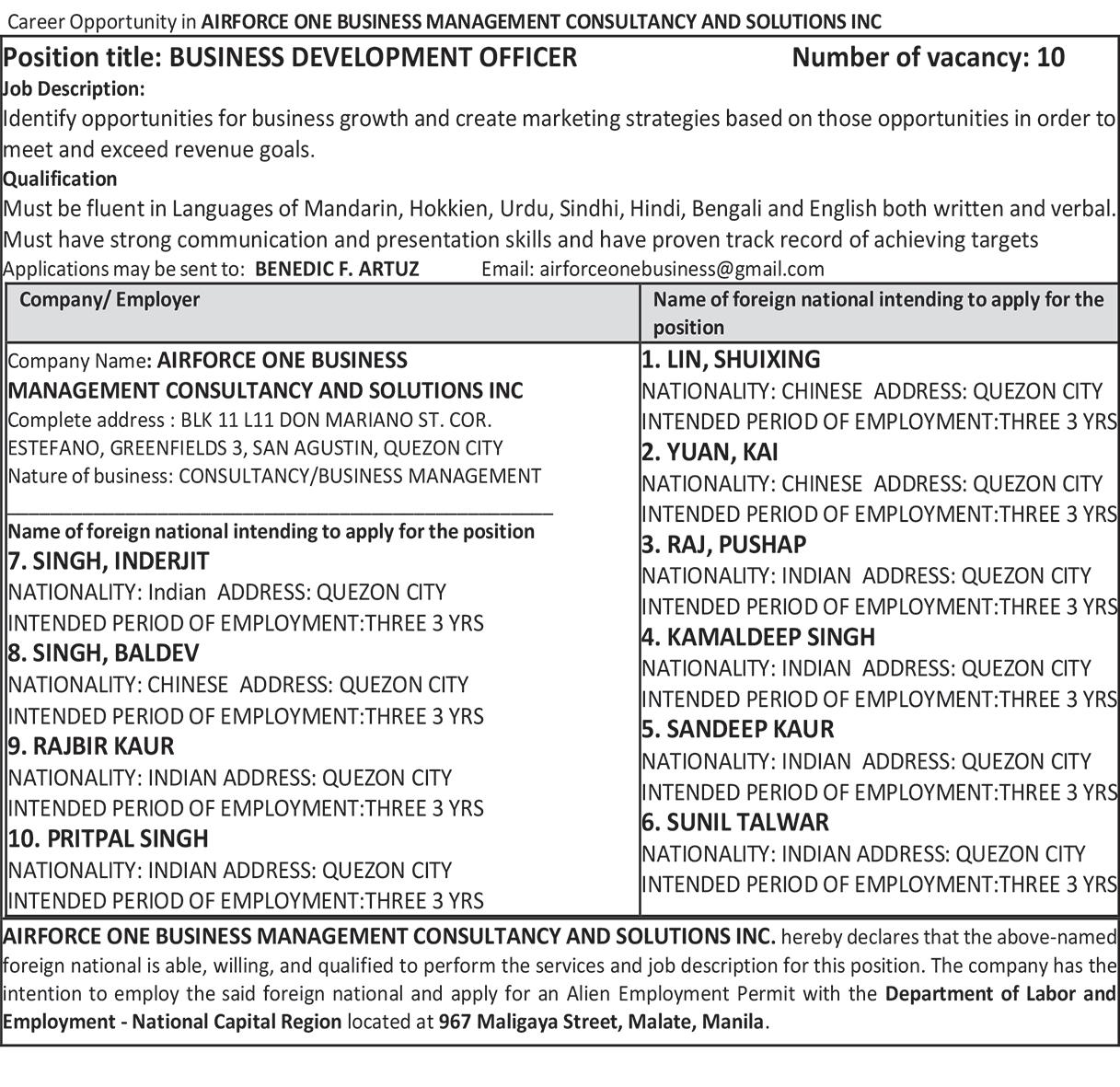



goods and to remove restrictions on exports to the US for critical minerals and other industrial commodities, the White House said.
Indonesian and US companies also reached 11 deals this week worth $38.4 billion, including purchases of US soybeans, corn, cotton and wheat, cooperation in critical minerals and oil field recovery, and joint ventures in computer chips.
“We have negotiated very intensively over the last few months, and I think we have reached solid understandings on many issues,” Prabowo told business executives Wednesday at the US Chamber of Commerce.
A White House statement called it a “great deal” and said it “will help both countries to strengthen economic security, promote economic growth, and thereby continuously lead to global prosperity.”
The agreement was later signed by US Trade Representative Jamieson Greer and his Indonesian counterpart, Airlangga Hartarto.
Hartarto told a news conference from Washington that both governments cast the agreement as marking the start of a “new golden age” in bilateral economic
ties and Indonesia will introduce measures designed to keep trade flows secure and prevent misuse of sensitive goods.
Indonesia’s pledge for Gaza stabilization force
THE agreement was announced the same day that Prabowo, leader of the world’s most populous Muslim country, reiterated his pledge at the Board of Peace meeting to send 8,000 troops or “more if necessary” for an international stabilization force in Gaza.
Indonesia was among the first to make a firm commitment to a critical element of Trump’s postwar Gaza reconstruction plan.
“President Prabowo of Indonesia, thank you very much,” Trump said at the Board of Peace meeting. “It’s a big country you have, and you do a great job.”
Prabowo praised Trump in return. “We are very optimistic with the leadership of President Trump, this vision of real peace will be achieved,” Prabowo said. “There will be problems, but we will prevail.”
See “Trump,” A14


India joins US-led initiative to build secure technology supply chains
By Rajesh Roy The Associated Press
NEW
DELHI—India joined a US-led initiative to strengthen technology cooperation among strategic allies in a move Friday that underscores the nations’ warming ties after a brief strain over New Delhi’s unabated purchase of discounted Russian oil.
The decision aligns India closely with Washington’s efforts to build secure supply chains for semiconductors, advanced manufacturing and critical technologies at a time geopolitical competition with China is intensifying. It also signals a reset in relations following friction over energy trade and tariffs.
Nations that have joined the Pax Silica framework include Japan, South Korea, the U.K. and Israel.
“Pax Silica will be a group of nations that believe technology should empower free people and free markets. India’s entry into Pax Silica isn’t just symbolic. Its strategic, its essential,” US Ambassador Sergio Gor said in a speech preceding the agreement signing.
Pax Silica is aimed at strengthening cooperation among partner countries on semiconductor design, fabrication, research and supply chain resilience. The initiative seeks to reduce dependence on Chinadominated manufacturing hubs while promoting trusted production networks across democracies and strategic allies.
The development at the artificial intelligence summit in New Delhi comes weeks after India and the US reached an interim trade framework to reduce tariffs and grant greater access to each other’s markets, easing tensions that had threatened to slow bilateral momentum.
President Donald Trump announced earlier this month that the US would lower reciprocal import tariffs on India from 25% to 18% and also remove the additional 25% levy imposed earlier for buying Russian crude after Indian Prime Minister Narendra Modi agreed to stop it. India had ramped up Russian oil imports after Moscow’s invasion of Ukraine in 2022, drawing criticism from western partners even as New Delhi defended the purchases as necessary to manage inflation and protect its consumers.
India’s entry into Pax Silica, combined with trade concessions, marks a strategic convergence that extends beyond commerce into long-term technology and security cooperation, reinforcing India’s role as a key US partner in the Indo-Pacific.
“From the trade deal to Pax Silica to defense cooperation, the potential for our two nations to work together is truly limitless,” Gor said.


PRESIDENT Donald Trump stands with other World leaders before a Board of Peace meeting at the US Institute of Peace, Thursday, Feb. 19, 2026, in Washington. AP/MARK SCHIEFELBEIN
Saudi Arabia may have uranium enrichment under proposed deal with US, arms control experts warn
By Jon Gambrell The Associated Press
DUBAI, United Arab Emir -
ates—Saudi Arabia could have some form of uranium enrichment within the kingdom under a proposed nuclear deal with the United States, congressional documents and an arms control group suggest, raising proliferation concerns as an atomic standoff between Iran and America continues.
US Presidents Donald Trump and Joe Biden both tried to reach a nuclear deal with the kingdom to share American technology. Nonproliferation experts warn any spinning centrifuges within Saudi Arabia could open the door to a possible weapons program for the kingdom, something its assertive crown prince has suggested he could pursue if Tehran obtains an atomic bomb.
Already, Saudi Arabia and nuclear-armed Pakistan signed a mutual defense pact last year after Israel launched an attack on Qatar targeting Hamas officials. Pakistan’s defense minister then said his nation’s nuclear program “will be made available” to Saudi Arabia if needed, something seen as a warning for Israel, long believed to be the Middle East’s only nuclear-armed state.
“Nuclear cooperation can be a positive mechanism for upholding nonproliferation norms and increasing transparency, but the devil is in the details,” wrote Kelsey Davenport, the director for nonproliferation policy at the Washington-based Arms Control Association.
The documents raise “concerns that the Trump administration has not carefully considered the proliferation risks posed by its proposed nuclear cooperation agreement with Saudi Arabia or the precedent this agreement may set.”
Saudi Arabia did not immediately respond to questions Friday from The Associated Press
Congressional report outlines possible deal
THE congressional document, also seen by the AP, shows the Trump administration aims to reach 20 nuclear business deals with nations around the world, including Saudi Arabia. The deal with Saudi Arabia could be worth billions of dollars, it adds.
The document contends that
Trump warns of ‘bad things’ if Iran doesn’t make a deal; 2nd US carrier nears Mideast
By Jon Gambrell The Associated Press
DUBAI, United Arab Emirates— Iran held annual military drills with Russia on Thursday as a second American aircraft carrier drew closer to the Middle East, with both the United States and Iran signaling they are prepared for war if talks on Tehran’s nuclear program fizzle out.
President Donald Trump said Thursday he believes 10 to 15 days is “enough time” for Iran to reach a deal. But the talks have been deadlocked for years, and Iran has refused to discuss wider US and Israeli demands that it scales back its missile program and sever ties to armed groups. Indirect talks held in recent weeks made little visible progress, and one or both sides could be buying time for final war preparations.
Iran’s theocracy is more vulnerable than ever following 12 days of Israeli and US strikes on its nuclear sites and military last year, as well as mass protests in January that were violently suppressed.
In a letter to the U.N. Security Council on Thursday, Amir Saeid Iravani, the Iranian ambassador to the U.N., said that while Iran does not seek “tension or war and will not initiate a war,” any US aggression will be responded to “decisively and proportionately.”
“In such circumstances, all bases, facilities, and assets of the hostile force in the region would constitute legitimate targets in the context of Iran’s defensive response,” Iravani said.
Earlier this week, Iran conducted a drill that involved livefire in the Strait of Hormuz, the narrow opening of the Persian Gulf through which a fifth of the world’s traded oil passes.
Tensions are also rising inside Iran, as mourners hold ceremonies honoring slain protesters 40 days after their killing by security forces. Some gatherings have seen anti-government chants despite threats from authorities.
Trump again threatens Iran
THE movements of additional American warships and airplanes, with the USS Gerald R. Ford aircraft carrier near the mouth of the Mediterranean Sea, don’t guarantee a US strike on Iran—but they bolster Trump’s ability to carry out one should he choose to do so.

He has so far held off on striking Iran after setting red lines over the killing of peaceful protesters and mass executions, while reengaging in nuclear talks that were disrupted by the war in June.
Iran has agreed to draw up a written proposal to address US concerns raised during this week’s indirect nuclear talks in Geneva, according to a senior US official who was not authorized to comment publicly and spoke on the condition of anonymity.
The official said top national security officials gathered Wednesday to discuss Iran, and were briefed that the “full forces” needed to carry out potential military action are expected to be in place by mid-March. The official did not provide a timeline for when Iran is expected to deliver its written response.
“It’s proven to be, over the years, not easy to make a meaningful deal with Iran, and we have to make a meaningful deal. Otherwise, bad things happen,” Trump said Thursday.
With the US military presence in the region mounting, one senior regional government official said he has stressed to Iranian officials in private conversations that Trump has proven that his rhetoric should be taken at face value and that he’s serious about his threat to carry out a strike if Iran doesn’t offer adequate concessions.
The official, who spoke on the condition of anonymity to discuss delicate diplomatic conversations, said he has advised the Iranians to look to how Trump has dealt with other international issues and draw lessons on how it should move forward.
The official added that he’s made to case to the Trump administration it could draw concessions from Iran in the near-term if it focuses on nuclear issues and leaves the push on Tehran to scale back its ballistic missile program and support for proxy group for later.
The official also said that Trump ordering a limited strike aimed at pressuring Iran could backfire and lead to Supreme Leader Ali Khamenei withdrawing Iran from the talks.
Growing international concern
POLISH Prime Minister Donald Tusk urged his nation’s citizens to immediately leave Iran as “within a few, a dozen, or even a few dozen hours, the possibility of evacuation will be out of the question.” He did not elaborate, and the Polish Embassy in Tehran did not appear to be drawing down its staff.
The German military said that it had moved “a mid-two-digit number of non-mission critical personnel” out of a base in north -


ern Iraq because of the current situation in the region and in line with its partners’ actions. It said that some troops remain to help keep the multinational camp running in Irbil, where they train Iraqi forces.
“This week, another 50 US combat aircraft—F-35s, F-22s, and F16s—were ordered to the region, supplementing the hundreds deployed to bases in the Arab Gulf states,” the New York-based Soufan Center think tank wrote. “The deployments reinforce Trump’s threat—restated on a nearly daily basis—to proceed with a major air and missile campaign on the regime if talks fail.”
Iran holds drill with Russia IRANIAN forces and Russian sailors conducted the annual drills in the Gulf of Oman and the Indian Ocean aimed at “upgrading operational coordination as well as exchange of military experiences,” Iran’s state-run IRNA news agency reported.
Footage released by Iran showed members of the paramilitary Revolutionary Guard’s naval special forces board a vessel in the exercise. Those forces are believed to have been used in the past to seize vessels in key international waterways. Iran also issued a rocketfire warning to pilots in the region, suggesting it planned to launch anti-ship missiles in the exercise.
It would likely take more than a week for the Ford to be off the coast of Iran.
Netanyahu warns Iran ISRAEL is making its own preparations for possible Iranian missile strikes in response to any US action.
“We are prepared for any scenario,” Israeli Prime Minister Benjamin Netanyahu said Thursday, adding that if Iran attacks Israel, “they will experience a response they cannot even imagine.” Netanyahu, who met with Trump last week, has long pushed for tougher US action against Iran and says any deal should not only end its nuclear program but curb its missile arsenal and force it to cut ties with militant groups like Hamas and Hezbollah. Iran has said the current talks should only focus on its nuclear program, and that it hasn’t been enriching uranium since the US and Israeli strikes last summer. Trump said at the time that the strikes had “obliterated” Iran’s nuclear sites, but the exact damage is unknown as Tehran has barred international inspectors. Iran has always insisted its nuclear program is peaceful. The US and others suspect it is aimed at eventually developing weapons. Israel is widely believed to have nuclear weapons but has neither confirmed nor denied that.
Meanwhile, tracking data showed the Ford off the coast of Morocco in the Atlantic Ocean midday Wednesday, meaning the carrier could transit through Gibraltar and potentially station in the eastern Mediterranean with its supporting guided-missile destroyers.

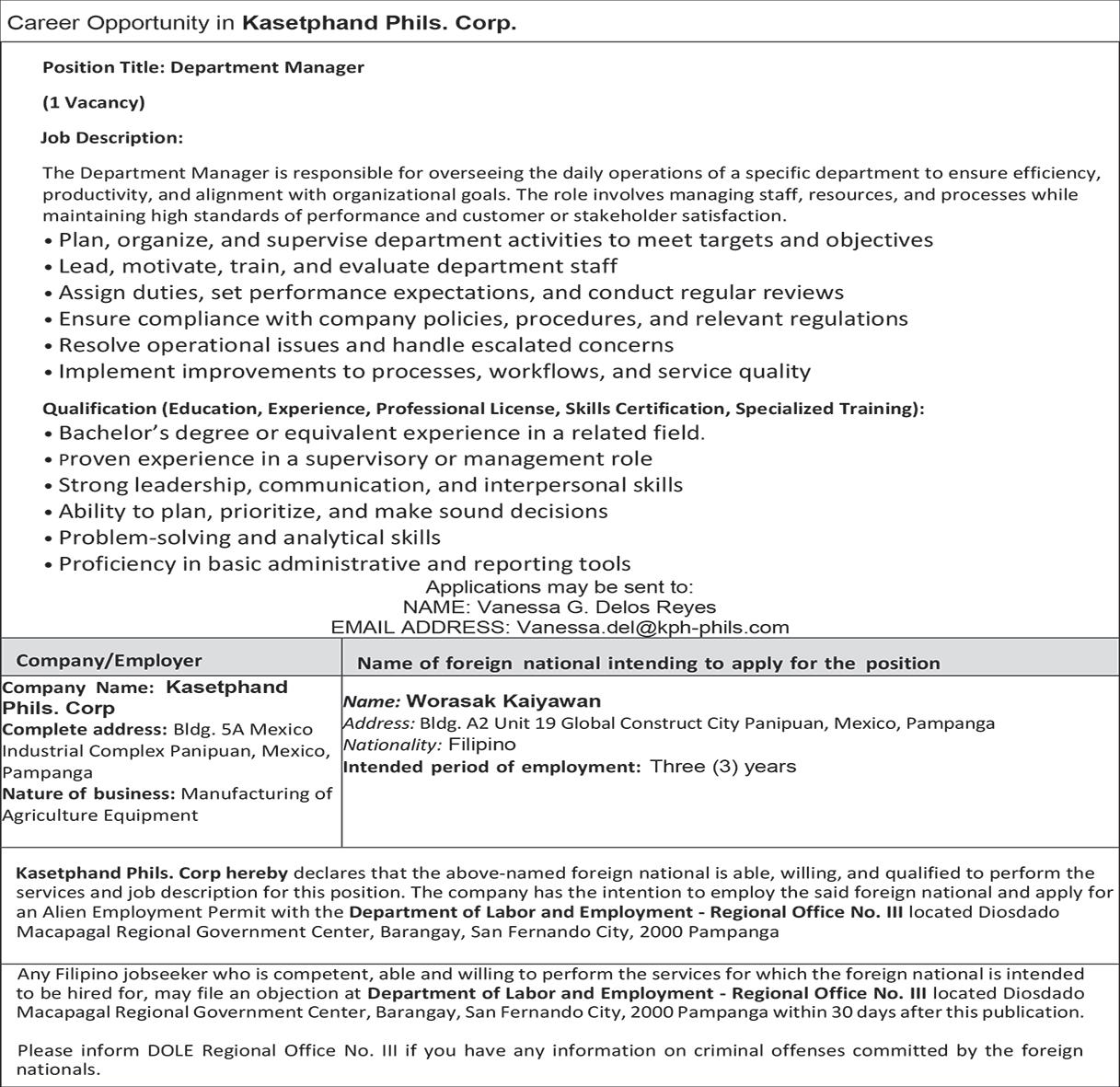
The Associated Press writers Nasser Karimi in Tehran, Iran; Claudia Ciobanu in Warsaw, Poland; Geir Moulson in Berlin; Farnoush Amiri in New York; and Aamer Madhani and Michelle Price in Washington, contributed to this report.
A12 Saturday, February 21, 2026
Israeli settlers kill 19-year-old Palestinian American, officials and witnesses say
By Imad Isseid & Melanie Lidman The Associated Press
MUKHMAS, West Bank— Israeli settlers in the occupied West Bank shot and killed a Palestinian American man during an attack on a village, the Palestinian Health Ministry and a witness said Thursday.
Raed Abu Ali, a resident of Mukhmas, said a group of settlers came to the village Wednesday afternoon where they attacked a farmer, prompting clashes after residents intervened. Israeli forces later arrived, and during the violence armed settlers killed 19-year-old Nasrallah Abu Siyam and injured several others.
Abu Ali said that the army shot tear gas, sound grenades and live ammunition. Israel’s military acknowledged using what it called “riot dispersal methods” after receiving reports of Palestinians throwing rocks but denied that its forces fired during the clashes.
“When the settlers saw the army, they were encouraged and started shooting live bullets,” Abu Ali said. He added that they clubbed those injured with sticks after they had fallen to the ground.
The Palestinian Ministry of Health confirmed Abu Siyam’s death from critical wounds sustained Wednesday afternoon near the village east of Ramallah.
Abu Siyam’s killing is the latest in a surge in violence in the occupied West Bank. Israeli forces and
settlers killed 240 Palestinians last year, according to the United Nations Office for the Coordination of Humanitarian Affairs. Palestinians killed 17 Israelis over the same period, six of whom were soldiers. The Palestinian Authority’s Wall and Settlement Resistance Commission said Abu Siyam was the first Palestinian killed by settlers in 2026.
Mukhmas and its surrounding area—most of which lies under Israeli civil and military administration—have become a hot spot for settler attacks, including arson and assaults, as well as the construction of outposts that Israeli law considers illegal.
The Israeli military said late Wednesday that unnamed suspects shot at Palestinians, who were later evacuated for medical treatment. It did not say whether any were arrested.
Abu Siyam’s mother told The Associated Press that he was an American citizen, making him the second Palestinian American person to be killed by Israeli settlers in less than a year.
A US embassy spokesperson
said they “condemn this violence.” Palestinians and rights groups say authorities routinely fail to prosecute settlers or hold them accountable for violence.
UN says Israel’s acts in West Bank may be ethnic cleansing THE U.N. human rights office on Thursday accused Israel of war crimes and said practices that displace Palestinians and alter the demographic composition of the occupied West Bank “raise concerns over ethnic cleansing.”
The Office of the High Commissioner for Human Rights, citing findings collected November 2024 to October 2025, said Israel was engaged in “concerted and accelerating effort to consolidate annexation” while maintaining a system “to maintain oppression and domination of Palestinians.”
Residents of Palestinian villages and herding communities have been increasingly displaced as Israeli settlements and outposts expand. Since the start of the Israel–Hamas war, the Israeli rights group B’Tselem says about 45 Palestinian communities have been emptied out completely amid Israeli demolition orders and settler attacks.
Additionally, the office said Israeli military operations in the northern West Bank “employed means and methods designed for warfare” including lethal airstrikes and forcibly transferring civilians from their homes. It also said Israel “forbade” residents from returning to their homes in northern West Bank refugee camps. The operation, which Israel said was aimed against militants, displaced tens of thousands of Palestinians.

The report also accused Palestinian security forces of using unnecessary lethal force in the same areas, killing at least eight people, and noted that the Palestinian Authority had engaged in “intimidation, detention and ill-treatment of journalists, human rights defenders and other individuals deemed critical of its rule.”
Neither Israel’s Foreign Ministry nor the Palestinian Authority responded to requests for comment. Israel has repeatedly accused the U.N. rights office of anti-Israel bias.
Last year, the U.N. human rights monitor warned of what it called “an unfolding genocide in Gaza” with “conditions of life increasingly incompatible with (Palestinians’) continued existence.” Their report on Thursday also warned of demographic shifts in Gaza raising concerns of ethnic cleansing.
Report finds imprisoned
Palestinian journalists were tortured
THE Committee to Protect Journalists said that dozens of Palestinian journalists who were detained in Israel during the war in Gaza experienced conditions including physical assaults, forced stress positions, sensory deprivation, sexual violence and medical neglect.
CPJ documented the detention of at least 94 Palestinian journalists and one media worker during the war, from the West Bank, Gaza and Israel Thirty are still in custody, CPJ said.
Half of the journalists, the report found, were never charged with a crime and were held under Israel’s administrative detention system, which allows for suspects deemed security risks to be held for six months and can be renewed indefinitely.
Israel’s prison services did not
immediately respond to a request for comment about the report, but rejected a similar report in January about conditions for Palestinian prisoners as “false allegations,” contending it operates lawfully, is subject to oversight and reviews complaints.
UN development chief says removing Gaza rubble will take 7 years
THE vast destruction across Gaza will take at least seven years just to remove the rubble, according to the United Nations Development Program.
Alexander De Croo, the former Belgian prime minister who just returned from Gaza, said that the UNDP had removed just 0.5% of the rubble and people in Gaza are experiencing “the worst living conditions that I have ever seen.”
De Croo said 90% of Gaza’s 2.2 million people live in “very, very rudimentary tents” in the middle of the rubble, which poses health dangers and a danger from exploding weapons. He said UNDP has been able to build 500 improved housing units, and has 4,000 more that are ready, but estimates the true need is 200,000 to 300,000 units. The units are meant to be used temporarily while reconstruction takes place. He called on Israel to expand access for goods and items needed for reconstruction and the private sector to begin development.
Lidman reported from Tel Aviv, Israel. Associated Press writers Edith Lederer at the United Nations, Sam Metz in Jerusalem and Natalie Melzer in Nahariya, Israel contributed to this report.
Former South Korean president remains defiant following rebellion life sentence
SBy Kim Tong-Hyung The Associated Press
EOUL, South Korea—Oust -
ed South Korean President
Yoon Suk Yeol on Friday remained defiant in his first reaction to a life sentence for rebellion handed down by a Seoul court the previous day. In a statement released by his lawyers, Yoon maintained that his abrupt and short-lived declaration of martial law in December 2024 was done “solely for the sake of the nation and our people,” and dismissed the Seoul Central District Court as biased against him.
Yoon, who was removed from office amid a political crisis set off by his unsuccessful power grab, has long rejected the eight criminal cases brought against him for what prosecutors described as a coup attempt and other allegations. He barricaded himself in the presidential residence for weeks, stonewalled investigators following his arrest, and skipped court dates, while clashing with witnesses when he did appear. In handing down his verdict on rebellion charges on Thursday, Judge Jee Kui-youn of the Seoul court said that Yoon has shown

“no sign of apology for the staggering social costs incurred by the emergency martial law” and that he “refused to appear in court without any justifiable reason” several times.
Conservative supporters of the former president, who rallied near the court for hours ahead of the verdict, expressed disappointment and anger after it was announced, while his opponents cheered in nearby streets, the two groups separated by hundreds of police officers. There were no major clashes.
Yoon’s statement rejected the verdict as illegitimate.
“In a situation where the independence of the judiciary cannot be guaranteed and a verdict based on law and conscience is difficult to expect, I feel deep skepticism whether it would be meaningful to continue a legal battle through an appeal,” said Yoon, 65, who has been jailed since last July.
Yoo Jeong-hwa, one of Yoon’s lawyers, said Yoon was “merely expressing his current state of mind” and was not indicating an intention to waive his right to appeal. Yoon has seven days to appeal Thursday’s sentence.
In his statement, Yoon expressed sympathy to the families

of soldiers, police officials and public servants facing investigations or indictment in connection with his martial law decree, saying he feels responsible for their suffering. But he also assured his supporters “our fight is not over.”
The court found Yoon guilty of orchestrating a rebellion by mobilizing military and police forces in an illegal bid to seize the liberal-led legislature, arrest political opponents and establish unchecked rule for an indefinite period. Yoon has described his authoritarian push as necessary to counter the oppositioncontrolled legislature, which he
portrayed as made up of “antistate” forces.
Yoon could also face an appeal brought by an independent counsel, who asked the court to sentence him to death and have the right to ask a higher court to change the sentence. Jang Woosung, a member of the investigation team, told reporters after the ruling that the team has “reservations” regarding the court’s factual findings and the severity of the sentence.
The Seoul court also convicted and sentenced five former mili -
See “South Korea,” A14

POSTERS with the name and picture of Palestinian-American Nasrallah Muhammad Jamal Abu Siyam, 19, who according to the Palestinian Health Ministry was shot by settlers on Wednesday night, are seen during his funeral in the West Bank village of Mukhmas, east of Ramallah, Thursday, Feb. 19, 2026. AP/NASSER NASSER
Saudi. . .
Continued from A11
reaching a deal with the kingdom “will advance the national security interests of the United States, breaking with the failed policies of inaction and indecision that our competitors have capitalized on to disadvantage American industry and diminish the United States standing globally in this critical sector.” China, France, Russia and South Korea are among the leading nations that sell nuclear power plant technology abroad.
The draft deal would see America and Saudi Arabia enter safeguard deals with the International Atomic Energy Agency, the United Nations’ nuclear watchdog. That would include oversight of the “most proliferation-sensitive areas of potential nuclear cooperation,” it added. It listed enrichment, fuel fabrication and reprocessing as potential areas.
The IAEA, based in Vienna, did not immediately respond to questions. Saudi Arabia is a member state to the IAEA, which promotes peaceful nuclear work but also inspects nations to ensure they don’t have clandestine atomic weapons programs.
“This suggests that once the bilateral safeguards agreement is in place, it will open the door for Saudi Arabia to acquire uranium enrichment technology or capabilities—possibly even from the United States,” Davenport wrote. “Even with restrictions and limits, it seems likely that Saudi Arabia will have a path to some type of uranium enrichment or access to knowledge about enrichment.”
Enrichment isn’t an automatic path to a nuclear weapon—a nation also must master other steps including the use of synchronized high explosives, for instance. But it does open the door to weaponization, which has fueled the concerns of the West over Iran’s program.
The United Arab Emirates, a neighbor to Saudi Arabia, signed what is referred to as a “123 agreement” with the US to build its Barakah nuclear power plant with South Korean assistance. But the UAE did so without seeking enrichment, something nonproliferation experts have held up as the “gold standard” for nations wanting atomic power.
Saudi-US proposal comes amid Iran tensions
THE push for a Saudi-US deal comes as Trump threatens military action against Iran if it doesn’t reach a deal over its nuclear program. The Trump military push follows nationwide protests in Iran that saw its theocratic government launch a bloody crackdown on dissent that killed thousands and saw tens of thousands more reportedly detained. In Iran’s case, it long has insisted its nuclear enrichment program is peaceful. However, the West and the IAEA say Iran had an organized military nuclear program up until 2003. Tehran also had been enriching uranium up to 60% purity, a short, technical step from weapons-grade levels of 90%—making it the only country in the world to do so without a weapons program.
Iranian diplomats long have pointed to 86-year-old Supreme Leader Ayatollah Ali Khamenei’s comments as a binding fatwa, or religious edict, that Iran won’t build an atomic bomb. However, Iranian officials increasingly have made the threat they could seek the bomb as tensions have risen with the US.
Saudi Crown Prince Mohammed bin Salman, the kingdom’s day-to-day ruler, has said if Iran obtains the bomb, “we will have to get one.”
Venezuela approves amnesty that could release hundreds of political prisoners
By Regina Garcia Cano The Associated Press
CARACAS, Venezuela—
Venezuela’s acting president on Thursday signed into law an amnesty bill that could lead to the release of politicians, activists, lawyers and many others, effectively acknowledging that the government has held hundreds of people in prison for political motivations.
The approval marks a reversal for authorities in the South American nation, who for decades have denied holding any political prisoners. It is the latest policy reversal following last month’s stunning US military raid in the country’s capital, Caracas, to capture thenPresident Nicolás Maduro.
The measure is expected to benefit opposition members, activists, human rights defenders, journalists and many others who were targeted by the ruling party over the past 27 years. But families hoping for the release of their loved ones — some of whom have been gathered outside detention facilities for weeks—say that act -
ing President Delcy Rodríguez has failed to deliver on earlier promises to release prisoners.
In the days after Maduro’s Jan. 3 capture, Rodríguez’s government announced it would release a significant number of prisoners. However, relatives and human rights watchdogs have criticized the slow pace of releases and the restrictive conditions under which many have been placed after leaving prison.
The new law was not a prerequisite for the government to free prisoners, but families held out hope that it could speed up releases. Some gathered outside detention facilities in Caracas grew
impatient as hopes of immediate releases were disappointed Thursday night, retreating to their tents as Christian music played from a loudspeaker.
Venezuela-based prisoners’ rights group Foro Penal has tallied 448 releases since Jan. 8. The group estimates that more than 600 people are still in custody for political reasons.
Rodríguez, who proposed the bill late last month, signed the measure into law shortly after it was approved by the country’s legislature.
She said during the signing that it showed that the country’s political leaders were “letting go of a little intolerance and opening new avenues for politics in Venezuela.”
The bill’s purpose is to grant people “a general and full amnesty for crimes or offenses committed” during specific periods since 1999 that were marked by politicallydriven conflicts in Venezuela, including “acts of politically motivated violence” in the context of the 2024 presidential election. The aftermath of that election led to protests and the arrest of more than 2,000 people, including minors.
The debate over the bill was suspended last week after lawmakers were unable to agree on some issues, including whether people who left the country to avoid detention can be granted amnesty,
and laid bare the resistance from some ruling-party loyalists to seeing opposition members granted relief. Lawmakers on Thursday overcame the disagreement by allowing those abroad to have a lawyer seek amnesty on their behalf instead of forcing them to return to Venezuela to request the relief in person.
Once someone abroad has filed a request for amnesty, the law shields them from arrest when they return to the country to appear in court for a ruling on their request.
“It’s not perfect, but it is undoubtedly a great step forward for the reconciliation of Venezuela,” opposition lawmaker Nora Bracho said in the debate. “It will undoubtedly alleviate the suffering of many Venezuelans.”
People convicted of human rights violations, war crimes, murder, drug trafficking and corruption do not qualify for amnesty, nor do people “who are being prosecuted or may be prosecuted or convicted for promoting, instigating, soliciting, invoking, favoring, facilitating, financing, or participating in armed or forceful actions against” Venezuela “by foreign states, corporations or individuals.” That could leave out members of the opposition who have supported Trump’s policy toward Venezuela.
General amnesty has long been
a central demand of Venezuela’s opposition and human rights organizations, but they have viewed the proposal with cautious optimism and raised several concerns about eligibility and implementation.
The law was criticized Thursday by some members of the opposition, including Pedro Urruchurtu, international relations director for opposition leader and Nobel Peace Prize laurate María Corina Machado.
Urruchurtu has lived in exile since May, when he and other Machado staffers left the Argentine diplomatic compound in Caracas, where they had sheltered for more than a year to avoid arrest. He rejected the law’s requirement that exiles return to Venezuela and appear in court.
“A true amnesty doesn’t require laws, but rather will, something that is lacking in this discussion,” Urruchurtu said on X. “It is not only an invalid and illegitimate law, but also a trap to buy time and revictimize those persecuted.”
Some relatives of prisoners called on Trump to pressure Venezuela’s government into freeing their loved ones.
“From the beginning, they have been liars, deceivers and mockers,” Marielis Guzmán said of Venezuelan authorities while standing outside a prison in Caracas on Thursday. “What the Venezuelan state has done is abuse its power.”
Former Prince Andrew arrested, held for hours on suspicion of misconduct over ties to Epstein
By Danica Kirka The Associated Press
LONDON—The former Prince Andrew was arrested and held for hours by
British police Thursday on suspicion of misconduct in public office related to his links to Jeffrey Epstein, an extraordinary move in a country where authorities once sought to shield the royal family from embarrassment.
It was the first time in nearly four centuries that a senior British royal was placed under arrest, and it underscored how deference to the monarchy has eroded in recent years.
King Charles III, whose late mother lived by the motto “never complain, never explain,” took the unusual step of issuing a statement on the arrest of his brother, now known as Andrew Mountbatten-Windsor.
“Let me state clearly: the law must take its course,’’ the king said. “As this process continues, it would not be right for me to comment further on this matter.’’
The Thames Valley Police force said Mountbatten-Windsor was released Thursday evening, about 11 hours after he was detained at his home in eastern England. He was photographed in a car
leaving the police station near the royal Sandringham estate.
Police said he was released under investigation, meaning he has neither been charged nor exonerated.
The police force, which covers areas west of London, including MountbattenWindsor’s former home, said Thursday that a man in his 60s from Norfolk had been arrested and was in custody. Police did not identify the suspect, in line with standard procedures in Britain.
Mountbatten-Windsor, 66, moved to the king’s private estate in Norfolk after he was evicted from his longtime home near Windsor Castle earlier this month.
Police previously said they were “assessing” reports that Mountbatten-Windsor sent trade information to Epstein, a wealthy investor and convicted sex offender, in 2010, when the former prince was Britain’s special envoy for international trade. Correspondence between the two men was released by the US Justice Department late last month along with millions of pages of documents from the American investigation into Epstein.
“Following a thorough assessment, we have now opened an investigation into this allegation of misconduct in public office,’’ Assistant Chief Constable Oliver Wright said in a statement.
Survivors push for more accountability
POLICE searched Mountbatten-Windsor’s Sandringham home and his former residence at Royal Lodge in Windsor.
Earlier in the day, pictures circulated online that appeared to show unmarked police cars at Wood Farm, MountbattenWindsor’s home at Sandringham, with plainclothes officers gathering outside.
Mountbatten-Windsor has consistently denied any wrongdoing in his association with Epstein.
The allegations being investigated Thursday are separate from those made by Virginia Giuffre, who claimed she was trafficked to Britain to have sex with the prince in 2001, when she was just 17. Giuffre died by suicide last year.
Still, Giuffre’s sister-in-law Amanda Roberts said that she was overjoyed when she got a phone call at 3 a.m. telling her the news of the arrest. But those feelings of elation were quickly complicated by the realization that she couldn’t share the feelings of “vindication” with Giuffre.
“We can’t tell her how much we love her, and that everything that she was doing is not in vain,” Roberts added tearfully.
Sky Roberts, Giuffre’s brother, added that he thinks his sister would be celebrating the

small victory along with them if she was still alive, but would be pushing for more accountability in both the United Kingdom and the United States based on the files.
“We need to unmask the co-conspirators
and potential perpetrators. And then we need to see indictments,” Amanda Roberts said.

Tariffs paid by midsize US companies tripled last year, a JPMorganChase Institute study shows
By Josh Boak The Associated Press
WASHINGTON—Tariffs paid by midsize US businesses tripled over the course of past year, new research tied to one of America’s leading banks showed on Thursday—more evidence that President Donald Trump ‘s push to charge higher taxes on imports is causing economic disruption.
The additional taxes have meant that companies that employ a combined 48 million people in the US—the kinds of businesses that Trump had promised to re vive—have had to find ways to ab sorb the new expense, by passing it along to customers in the form of higher prices, employing fewer workers or accepting lower profits.
tariffs, but may be small enough to quickly change supply chains to minimize exposure to the tax increases. The companies tended to have revenues between $10 mil lion and $1 billion with fewer than 500 employees, a category known as “middle market.”
The analysis suggests that the Trump administration’s goal of becoming less directly reliant on Chinese manufacturers has been occurring. Payments to China by these companies were 20% below their October 2024 levels, but it’s unclear whether that means China is simply routing its goods through other countries or if supply chains have moved.

seen in the history of the Federal Reserve system. The people as sociated with this paper should presumably be disciplined.”
Trump increased the average tariff rate to 13% from 2.6% last year, according to the New York Fed researchers. He declared that tariffs on some items such as steel, kitchen cabinets and bathroom vanities were in the national secu rity interest of the country. He also declared an economic emergency to bypass Congress and impose a baseline tax on goods from much of the world in April 2025 at an event he called “Liberation Day.”
The research does not say how the additional costs are flowing through the economy, but it indi cates that tariffs are being paid by US companies. The study is part of a growing body of economic analyses that counter the admin istration’s claims that foreigners pay the tariffs.
The JPMorganChase Insti tute report used payments data to look at businesses that might lack the pricing power of large multinational companies to offset
“That’s a big change in their cost of doing business,” said Chi Mac, business research director of the JPMorganChase Institute, which published the analysis Thursday. “We also see some indications that they may be shifting away from transacting with China and maybe toward some other regions in Asia.”
The authors of the analysis emphasized in an interview that companies are still adjusting to the tariffs and said they plan to continue studying the issue.
White House spokesman Kush Desai called the analysis “point less” and said it didn’t “change the fact that President Trump was right.” The study showed that US companies are paying tariffs that the president had previously claimed would be paid by foreign entities.
Trump defended his tariffs dur ing a trip to Georgia on Thursday while touring Coosa Steel, a com pany involved in steel processing and distribution. The president
said he couldn’t believe the Su preme Court would soon decide on the legality of some of his tariffs, given his belief that the taxes were helping US manufacturers.
“The tariffs are the greatest thing to happen to this country,” Trump said.
The president imposed a series of tariffs last year for the osten sible goal of reducing the US trade imbalance with other countries, so that America was no longer im porting more than it exports. But trade data published Thursday by the Census Bureau showed that the trade deficit climbed last year by $25.5 billion to $1.24 trillion. The
Defiance echoes in Tehran: Iranians protest amid fear, grief following deadly crackdown
By Amir-Hussein Radjy & Kareem Chehayeb
Press
The Associated
CAIRO—Standing on her balcony in the Iranian capital, Tehran, the teacher shouted out into the darkness, “Death to the dictator!” and “Death to the murderer, Khamenei!” on a recent night, joining the slogans coming from windows and rooftops around her relatively affluent neighborhood.
A few voices in the darkness responded with slogans in support of Iran’s 47-year-old Islamic Republic.
“Shut up! Choke on it!” her neighbors shouted back, drowning out the progovernment voices, the teacher recounted to The Associated Press, speaking on condition of anonymity for her safety.
Iranians across the country are still reeling with shock, grief and fear after massive nationwide protests were crushed by the deadliest crackdown ever seen under the rule of the 86-year-old Supreme Leader Ali Khamenei. Thousands were killed and tens of thousands are believed to have been arrested.
Continued from A13
A ‘spectacular fall from grace’
THIS is the most spectacular fall from grace for a member of the royal family in modern times,” said Craig Prescott, a royal expert at Royal Holloway, University of London, who compared it in severity to the crisis sparked by Edward VIII’s abdication to marry American divorcee Wallis Simpson.
“And it may not be over yet,’’ Prescott added.
Thursday’s arrest came a day after the National Police Chiefs’ Council said it had created a group to assist forces across the U.K. that are assessing whether Epstein and his associates committed crimes in Britain. In addition to the concerns about Mountbatten-Windsor ‘s correspondence, documents released by the US suggest Epstein may have used his private jet to traffic women to and from Britain.
US President Donald Trump said the arrest was “a shame” and “very sad.”
“I think it’s so bad for the royal family,” he told reporters in Washington.
The documents also rocked British
But a vein of defiance persists. A seething anger at Iran’s rulers is evident in videos shared on social media and in conversations with protesters. At the same time, three protesters reached by the AP also expressed futility over what can be done after hundreds of thousands braved taking to the streets only to be met with overwhelming violence. The protesters all spoke on condition of anonymity, fearing retribution or arrest.
Adding to the uncertainty is the United States’ threat to strike Iran. The US has positioned warships and fighter jets nearby even as it holds negotiations with Iran over its nuclear program.
The defiance appears in the shouting of slogans from windows and rooftops at night, a ritual displayed in past waves of protests.
It is also evident at memorial gatherings for those killed 40 days earlier. Such commemorations—known as the “chehelom,” Persian for “the 40th”—are traditionally held by families for anyone who has died. But in times of unrest, chehelom can have a political dimension.
politics. Prime Minister Keir Starmer had to fight off questions about his judgment after the papers revealed that Peter Mandelson, the man he appointed ambassador to the US, had a longer and closer relationship with Epstein than was previously disclosed.
London’s Metropolitan Police Service has said it is investigating allegations of misconduct in public office related to Mandelson’s own correspondence with Epstein. Mandelson was fired as ambassador to the US in September. But it is Mountbatten-Windsor’s relationship with Epstein that brought the scandal to the doors of Buckingham Palace and threatened to undermine support for the monarchy.
Last royal arrest was in the 1640s THE last time a senior British royal was arrested was almost 400 years ago during the reign of King Charles I that saw a growing power struggle between the crown and Parliament.
After the king attempted to arrest lawmakers in the House of Commons in 1642, hostilities erupted into the English Civil War, which ended with victory for the parliamentary forces of Oliver Cromwell.
Commemorations
turn to protests THIS week marks 40 days since Jan. 8 and 9, the deadliest days of the crackdown, and multiple videos circulating online show 40-day ceremonies in towns and cities around Iran. Some appear to have drawn hundreds of people, who often break into anti-government chants.
Often they are festive, with friends and loved ones of the slain protester singing and throwing flowers—a rejection of the solemn atmosphere encouraged by the state at official ceremonies. Most avoid calling the dead “shaheed,” or “martyr,” a term with Islamic religious connotations. Instead, they use the term, “javid nam,” a Persian phrase meaning, “Long live the name.”
Videos posted this week and verified by the AP showed a crowd of hundreds at the main cemetery in the small western Iranian town of Abdanan, chanting, “Death to Khamenei” and pumping their fists at the chehelom of Alireza Seydi, a 16-year-old boy killed on Jan. 8. The videos show security forces firing from an armored vehicle, raising clouds of what
Charles I was arrested, tried, convicted of high treason and beheaded in 1649.
Concerns about Mountbatten-Windsor’s links to Epstein have dogged the royal family for more than a decade.
The late Queen Elizabeth II forced her second son to give up royal duties and end his charitable work in 2019 after he tried to explain away his friendship with Epstein during a catastrophic interview with the BBC.
But as concern mounted about what the Epstein files might reveal, the king moved aggressively to insulate the royal family from the fallout.
Since October, Charles has stripped his younger brother of the right to be called prince, forced him to move out of the royal estate he occupied for more than 20 years and issued a public statement supporting the women and girls abused by Epstein.
Last week, the palace said it was ready to cooperate with police investigating Mountbatten-Windsor.
Charles was forced to act after Mountbatten-Windsor’s correspondence with Epstein torpedoed the former prince’s claims that he severed ties with the financier after Epstein’s 2008
appeared to be tear gas, sending men and women running.
During the 1979 Islamic Revolution that toppled the shah and brought the Islamic Republic to power, 40-day memorials for slain protesters often turned into rallies that security forces tried to crush, causing new deaths—which then would be marked 40 days later with new protests.
Postings on social media have reported security forces trying to restrict people from attending some chehelom ceremonies.
“For every person killed, a thousand more stand behind him,” a crowd of several hundred chanted Tuesday while gathered in the eastern city of Mashhad for the chehelom of Hamid Mahdavi, according to a video verified by the AP. When a few police officers harassed some people commemorating Mahdavi, a fireman shot to death in January protests, the crowd shouted, “Shameless! Shameless!”
Chehayeb reported from Beirut. Associated Press writer Lee Keath in Cairo contributed to this report.
conviction for soliciting a minor for prostitution.
Instead, e-mails between the two men show Epstein offering to arrange a date between Mountbatten-Windsor and a young Russian woman in 2010, and the then-prince inviting Epstein to dinner at Buckingham Palace.
Additional correspondence appears to show Mountbatten-Windsor sending Epstein reports from a two-week tour of Southeast Asia that he undertook in 2010 as Britain’s trade envoy. Police did not release details of Mountbatten-Windsor’s questioning at a small-town police station in Aylsham, near Sandringham.
Danny Shaw, an expert on law enforcement in the U.K., told the BBC that the former prince would likely be placed in “a cell in a custody suite” with just “a bed and a toilet,” where he will wait until his police interview.
“There’ll be no special treatment for him,” Shaw said.
The Associated Press
president on Wednesday posted on social media that he expected there would be a trade surplus “during this year.”
The Trump administration has been adamant that the tariffs are a boon for the economy, businesses, and workers. Kevin Hassett, direc tor of the White House National Economic Council, lashed out on Wednesday at research by the New York Federal Reserve showing that nearly 90% of the burden for Trump’s tariffs fell on US compa nies and consumers.
“The paper is an embarrass ment,” Hassett told CNBC. “It’s, I think, the worst paper I’ve ever
Trump. . .
Continued from A10
Cambodia and Vietnam are the two other Southeast Asian coun tries that joined the board, which was originally envisioned as over seeing the Gaza ceasefire but has taken shape with wider ambitions to broker other global conflicts.
Their leaders also came to Wash ington for the inaugural meeting.
Cambodia has already inked a trade deal with the US, while Vietnam has reached a framework agreement.
Critical minerals play into Indonesia deal
INDONESIAN companies agreed this week to buy 1 million tons of soybeans, 1.6 million tons of corn and 93,000 tons of cotton from the US. They also pledged to buy up to 5 million tons of US wheat by 2030.
The countries agreed to coop erate on critical minerals, though details were not immediately available.
Washington is seeking Indone sia’s agreement to lift restrictions on critical mineral exports, which the Trump administration argues could safeguard US manufacturers from supply‑chain disruptions. The administration has sought to defend against China’s strangle hold on the key elements needed for everything from fighter jets to smartphones.
At the Chamber of Commerce
South Korea. . .
Continued from A12
tary and police officials involved in enforcing Yoon’s martial law decree. They included ex Defense Minister Kim Yong Hyun, who received a 30 year jail term for his central role in planning the measure, mobilizing the military and instructing military coun terintelligence officials to arrest key politicians, including current liberal President Lee Jae Myung. Kim has appealed. Jang Dong hyuk, leader of the
The high rates provoked a fi nancial market panic, prompting Trump to walk back his rates and then engage in talks with multiple countries that led to a set of new trade frameworks. The Supreme Court is expected to rule soon on whether Trump surpassed his le gal authority by declaring an eco nomic emergency.
Trump was elected in 2024 on his promise to tame inflation, but his tariffs have contributed to voter frustration over affordabil ity. While inflation has not spiked during Trump’s term thus far, hiring slowed sharply and a team of academic economists estimate that consumer prices were roughly 0.8 percentage points higher than they would otherwise be.
event, Prabowo said Indonesia can serve as a “bridge” and “honest broker” between great powers, ap parently referring to the US China competition.
Vietnam’s leader makes first visit to the US since being reelected AT the Board of Peace meeting, Trump called Vietnam “incredible as a country and as a force” and told leader To Lam that it was “a really great honor to have you.” Lam’s visit to the US is his first since he was reelected as the head of Vietnam’s ruling Commu nist Party last month. Typically, China is an initial stop in a nod to the countries’ ideological ties and Beijing’s status as Vietnam’s largest trading partner. Lam did visit China in August 2024 be fore traveling to the US during his first term.
Analysts say Lam’s visit to the US before traveling to Beijing this time around is a notable shift in sequencing. Hanoi describes its foreign policy as independent and balanced among major powers. Trade negotiations between Vietnam and the United States are ongoing following the Trump ad ministration levying 20% tariffs on Vietnamese exports. The latest, sixth round of talks concluded in early February.
Karmini reported from Jakarta, Indonesia, and Ghosal from Hanoi, Vietnam.
conservative People Power Party, said at a news conference Friday that the court failed to present a convincing case that Yoon’s mar tial law amounted to rebellion and, referring to a possible appeal, stressed that “the right to be pre sumed innocent applies to every one without exception.”
Yoon’s martial law decree, an nounced late at night on Dec. 3, 2024, lasted about six hours, af ter a quorum of lawmakers broke through a military blockade and unanimously voted to overturn it, forcing his Cabinet to lift the measure.
Writer Michelle L. Price in Washington contributed to this report.
PRESIDENT Donald Trump visits Coosa Steel Corporation in Rome, Ga., Thursday, Feb. 19, 2026.

‘PHL will always qualify athletes to Winter Games’
MILAN, Italy—Philippine Olympic Committee (POC) president Abraham Tolentino, this early, has guaranteed the country’s continued participation at the Winter Olympics.
“It’s a continuing process and we at the POC will not stop,” said Tolentino from Manila, over the phone, as the 25th staging of the Winter Olympics entered its closing days.
As of Thursday, 89 of the 116 medals staked in 16 sports and among 92 nations have been contested heading to Sunday’s closing ceremony in the historic town of Verona. Tolentino, fully in charge of the Philippine representation here, hailed the two athletes that represented the Philippines—alpine skiers Francis Ceccarelli and Tallulah Proulx.
“It’s very difficult to qualify for the Winter Olympics because it’s not just one qualifying [event] but rankings,” said Tolentino, also the cycling chief back home.
“You need to earn the points and how do you do that? You compete and compete and compete,” he added.
Proulx, who is based in Utah, and Ceccarelli, who lives in Tuscany, worked very hard to get here and give their best in their Winter Olympics debut.
They competed in the giant slalom and slalom events of alpine skiing, and booked decent finishes when a lot of skiers, even from the host country, crashed out of the competition.
Proulx is only 17, and Ceccarelli, 22.
“Tallulah is only 17 and the gold winner in her first event is 35. So, he’ll get better,” he said. “It’s the same with Francis.”
Philippine Sports Commission chairman Patrick Gregorio said the agency will continue to work hand in hand with the POC to guarantee continuity.
“We want to see our flag at the Winter Olympics,” said Gregorio, adding that representation is very important in an event where athletes from around the globe are eager to qualify.
“And here is our country qualifying athletes and being represented,” Gregorio said. “We have four years to make this ‘Wow’ in 2030 [Winter Olympics in France].”
The Philippines made its debut at the Winter Olympics in 1972 in Sapporo, Japan, becoming the first tropical nation and from Southeast Asia to do so.
This is the fourth straight Winter Olympics where the Philippines fielded entries but has yet to win any medal and the POC president said work continues.
“This is the Olympics, the global stage,” Tolentino said. POC Media
Will Olympics bid farewell to toughest winter sports?

TESERO, Italy—Nordic goodbye?
It could be the last Olympics for a sport that mixes the grace of ski jumping with the grind of crosscountry skiing.
Nordic combined events at the Milan Cortina Games ended Thursday and the International Olympic Committee (IOC) is considering scrapping it from future Games because of a small TV audience and podium positions dominated by a tiny group of nations.
As if to illustrate that point, Norway took gold in all three events—including Thursday’s men’s team sprint—and the same countries stood on the podium at all three Nordic combined events at these Winter Games.
“Hopefully these three events have been fun to watch and I think it has been a lot of nations fighting for their medals,” Jen Luraas Oftebro, who won three golds, said after sharing the win with teammate Andreas Skoglund. “Hopefully the IOC will see the value in that.” Nordic combined was invented some 150 years ago when a Norwegian crown prince seeking glory as a champion paired the two disciplines he excelled at.
The contest opens with a daredevil ski jump to determine the starting order for a lung-busting cross-country ski race.
“Nordic combined is such a beautiful sport and I think it deserves much more popularity because I think the races are really, really fun to watch and the athletes are doing amazing,” said Jan Vytrval, a Czech competitor. “It deserves much more than to be deleted from the Olympics.”
The sport has been included since the first Winter Games in 1924, but it is the only winter sport that doesn’t include women—female athletes who compete on the World Cup tour and
Former Kings, Queens kick off Milo Marathon’s 50th anniversary

in world championships have lobbied hard to change that. But their fate is tied to the larger sport.
The IOC has previously put off a decision on the sport’s future but will revisit the question after the Games wrap up Sunday.
“If it stays, it’s for both,” said Lasse Ottesen, the Nordic combined director of the International Ski Federation. “It makes no sense to say, ‘Yes, we’re just going to have the Nordic combined men in or, yes, we’re going to take the men out and we’re going to throw the women in.’ I mean why would anyone do that in these times?”
Ottesen said FIS had exceeded requirements the IOC set out in 2022, increasing the competition in the women’s sport and building media interest globally. While audience

Sheena shoots down birds Letran’s Sheena Sarie shows some bravado during the Lady Knights’ 26-24, 20-25, 25-17, 25-21 victory over the Mapua Lady Cardinals in National Collegiate Athletic Association 101 women’s volleyball action on Friday at the San Andres Sports Complex in Manila. Letran remains undefeated in eight matches, while Mapua falls to 3-5. NCAA PHOTO
numbers grew slightly over each of the last three Olympics, he conceded it was not as much as FIS expected.
Two of the three events—the men’s individual normal hill jump and large hill ski jump competitions that were each followed by 10 kilometer ski races—sold out all 4,500 tickets allocated and 90 percent of the team event tickets were sold, Ottesen said. But, he added, the cross-country venue has twice that capacity, so it “looks a little bit thinner.”
FIS President Johan Eliasch attended the February 11 normal hill event with IOC President Kirsty Coventry to try to showcase the excitement that two disciplines generate.
IOC member Ingmar de Vos, a member of the committee reviewing the fate of the sport, attended the large hill event.
The IOC also is reviewing the fate of parallel giant slalom snowboarding to make sure it meets the goal of being balanced, youth-focused and cost-efficient.
If either sport is removed, it would go the way of tug-of-war, polo and croquet—all once featured around the turn of the 20th century. AP

3,000 athletes from 100 nations vie in Karate One Youth League
ABy Josef Ramos
GIANT field of 3,000 athletes will converge in the country at the SM Mall of Asia Arena in Pasay City as the country hosts for the first time the Karate One Youth League from May 14 to 17.
“This is the first time that we are hosting this global event,” Lim said in a press conference at the Lanson Place MOA on Friday. “We have hosted the Asian championships and Asian Cadets and now, we have the Youth League—we can really develop our youth at the grassroots level.”
Philippine Olympic Committee (POC) president Abraham Tolentino and Philippine Sports Commission (PSC) chairman Patrick Gregorio joined Lim in announcing the event.
Lim said there will be 34 categories—16 to 17-years old junior, 14-15 and 11-12 cadet both in kata and kumite.
Lim said the tournament will determine the next batch of young members of the national pool of Karate Pilipinas, which he heads.
“We only have a few players in the senior level,” said Lim, referring to Jaime Lim—2019 Manila and 2023 Cambodia Southeast Asian Games gold medalist—and Junna Tsukii—2019 SEA Games and 2021 World Games champion—who are now retired.
“We need to develop younger ones who can follow their footsteps,” he said.
Tolentino declared his all-out support to karate, one of the sports
where Filipinos can excel on the global stage.
“This tournament that we are going to host will help not only our karate athletes to improve but also our sports tourism because we are expecting more than 3000 athletes,” he said. “It serves as a pathway to the development of future elite athletes.”
The event is sanctioned by the World Karate Federation and also draws 500 international and local officials from a hundred countries. The turnout exceeds the last edition hosted by Saudi Arabia in Fujaiah only early this month with 2,200 athletes from 93 countries participating.
Interestingly, despite the World Karate Federation-sanctioned annual competitions’ magnitude, it is staged six times a year with Harare (Zimbabwe) hosting in March 26 to 29, Porec (Croatia) July 2 to 5, Guadalajara (Mexico) September 17 to 20 and Venice (Italy) December 10 to 13. Gregorio said that hosting events featuring grassroots and elite competitions boosts the country’s sports tourism.
“We are just doing the right thing just like Saudi Arabia which hosted various sporting events since last year like basketball and recently karate to promote their country’s tourism,” he said.” What important is to sustain the grassroots and elite development of our sports.” With them were SM MOA executive Arnel Gonzales and Milo sports head Carlo Sampan.
series aims to give school children a fun and meaningful entry into the sport.
There will be a total of 25 Champ Runs this year, which, in addition to the 15 scheduled marathon legs and other community runs, bring the total number of races that Milo is mounting to 50—the most number in its long history. “Fifty
every family who chose to be active together, and every Filipino who took the first step towards a healthier life through the marathon,” he added.
NORWAY’S Jens Luraas Oftebro (from right), Finland’s Eero Hirvonen and Austria’s Johannes Lamparter compete in the nordic combined team sprint in Tesero, Italy, Thursday. AP
PHILIPPINE Olympic Committee president Abraham Tolentino’s confidence is always that high. POC PHOTO
61ST ANVIL AWARDS: PUSHING PAST TIME, REDEFINING EXCELLENCE
The winners spanned a wide spectrum, proving that purposeful

EVERY year, the Anvil Awards offer a fresh opportunity to champion and recognize the country’s outstanding communicators.
This year’s ceremony stood apart from its predecessors; it didn’t just mark the legacy made over time, but signaled a new horizon beyond a minute.
Presented by the Public Relations Society of the Philippines (PRSP), the Anvil Awards are widely regarded as the “Oscars” of Philippine public relations and remain the highest symbol of excellence in the industry.
For over six decades, the Anvil has served as a benchmark for outstanding PR programs and tools. These programs don’t just broadcast messages. They actively shape public opinion and drive meaningful change across the archipelago.
Under the theme, “The 61st Second: Pushing Past Possibilities,” this year’s awards explored the dual nature of time as both a friend and a foe. In the fast-paced world of communication, this theme stands out. The concept challenges practitioners to look beyond the standard sixty-second minute. It asserts that the most impactful stories are those that continue to resonate long after the clock runs out.
With 178 participating institutions—a significant jump from previous years— this year’s turnout, according to Ana Pista, APR, Chair of the 61st Anvil Awards, highlighted the true essence of every recognition: the unseen hard work and efforts of every PR practitioner.
“Behind every submission you see tonight is a process that demanded patience, discipline, and heart,” Pista said. “Tonight, we are not just celebrating campaigns or tools. We are celebrating an industry that refuses to stand still — an industry that continues to learn, to serve, and to become stronger, year after year.”
Under a thorough “threetiered judging process” and meticulous audit of SGV & Co., the awards night upholds utmost integrity by focusing on “data-driven insights and strategic clarity.”
Triumphants at 61st ANVIL Awards
Last January 28, 2026, the 61st ANVIL Awards “Gabi ng Parangal”
at Solaire Resort North proved exactly why it remains the industry’s gold standard. The evening’s atmosphere was set early with the symbolic Banging of the Anvil, led this year by award-winning journalist Jessica Soho.
Jollibee Group clinched the coveted Company of the Year award and the night’s highest program distinction, the Grand Anvil, in partnership with Stratworks.
In the category of PR Tools, Security Bank Corporation stood out among the other entries, bagging the Platinum Anvil for its 2024 Integrated Report. The work was cited for its “clarity, transparency, and its ability to turn complex corporate data into a compelling narrative of service.”
Meanwhile, Brandplay rose above agencies after being named Agency of the Year, demonstrating its creative agility in an industry that operates at a relentless pace.
One of the night’s most dominant performances came from the Manila Electric Company (Meralco). Verified as a top finalist for Company of the Year, the power giant solidified its communications leadership by clinching a staggering 20 Anvil trophies (5 Gold and 15 Silver) alongside its affiliates, One Meralco Foundation and Meralco PowerGen. Their winning initiatives spanned a wide spectrum: from “Manong Joe’s” media literacy campaign to groundbreaking renewable energy advocacy— proving that purposeful storytelling is vital even in the most technical of industries.
As the gala drew to a close, the atmosphere transitioned from celebration to anticipation. While the 61st Anvil Awards honored the milestones of the past year, it also signaled the start of a new chapter for the industry. With the transition to the 62nd year under the incoming leadership of Norman Agatep, the PR community looks forward to a future of continued innovation and ethical storytelling.

EXEMPLIFYING purposeful storytelling of impactful initiatives, Manuel V. Pangilinan- led Manila Electric Company (Meralco) has once set the benchmark for communications excellence as it clinched multiple recognitions and emerged as a finalist for the Company of the Year at the recently concluded 61st Anvil Awards.
Alongside One Meralco Foundation (OMF), Meralco PowerGen Corporation (MGEN) and Meralco Power Academy (MPA), the company took home 20 Anvils in recognition of its exceptional public relations (PR) programs and tools that effectively engaged and served its diverse stakeholders.
Meralco’s campaign on reliable service communications, effective utilization of digital platform, media & information literacy and electrification program merited five (5) Gold Anvils.
“Tulung-tulong para sa mas Ligtas na Kinabukasan: Meralco's Communications Campaign to Combat Illegal Service Connection” won a gold trophy for its proactive public information drive to address illegal service connection commonly known as “jumpers” and power pilferage. This core public safety program, which is implemented in partnership with law enforcement agencies and local government units, utilizes traditional and digital media to heighten awareness on what Meralco is doing to address illegal acts and promote safety of the communities that the company serves.
“From Fake News to Fact: Strengthening Public Discernment with Manong Joe” also earned a Gold Anvil for the campaign that advances media literacy nationwide through the social media platforms of Manong Joe – Meralco’s Spokesperson with an ultimate aim to contribute to a more informed and digitally discerning Filipino public. Guided by data-driven insights and Meralco’s humanized communication approach, the campaign produced targeted and accessible content that addressed widespread misinformation.
“Through the Rain: How Meralco Newsroom Powered PR on Meralco's Readiness and Response
During the July 2025 Habagat Onslaught” snagged another gold award as it showcased Meralco Newsroom transformed social media into the company’s front line of public engagement and crisis storytelling. It also amplified PR reach, cemented trust, and showcased Meralco’s readiness and compassion when communities needed it most.
Another Gold Anvil was bestowed on “The Next 25: Meralco's Commitment to Nation-Building, Sustainable Growth, and Power Innovation” which highlighted the company’s proactive campaign to secure its legislative franchise renewal. The campaign strategically positioned Meralco as a nation-building partner essential to energy security and economic growth.
OMF’s “From Sun to Safe Water: Water Access Electrification in South Cotabato” completed the gold haul as it was recognized for energizing the community’s water system and improving the distribution of water to households through solar technology.
One Meralco’s programs promoting cybersecurity, internal audit, animal welfare advocacy, renewable energy advancement and corporate social responsibility amassed 15 Silver Anvils.
“E-lluminating the Media through Meralco Newsroom Omnichannels: Expanding the Digital


Reach of Meralco’s Communications Program for its Monthly Rates Adjustment” was recognized for enabling a fast and effective distribution of information regarding Meralco’s rate adjustments, ensuring that the media receive real-time and accurate information and increased transparency and accessibility of information for the public. Meanwhile, “Restoring Trust: How Credible Channels Renewed Public Confidence in Meralco” highlighted Meralco’s successful collaboration with reputable companies and entities to frame just narratives and reshape how the public perceive Meralco.
Meralco’s newly launched “Wavemaker Community Program: Empowering Educators for a Safer Digital Future in Schools” also won a Silver Anvil for demonstrating the company's commitment to championing cyber security awareness by empowering educators with the knowledge to safely navigate the digital landscape; while “Sparking Internal Audit Literacy: A Professional & Student Exchange Forum” was honored for raising awareness about internal audit, bridging the gap between the academe and the professional world.
MPA, the educational arm of Meralco also won for its summer internship program- “Meralco PowerCamp – Illuminating a Just Energy Transition” for providing an intensive learning experience for the students by strengthening their leadership skills and expanding their technical expertise.
The power distributor’s “Energizing Minds:
Meralco's Journey Toward Nuclear Energy Leadership” showcased its integrated nuclear communications campaign combining education, thought leadership, and stakeholder engagement, positioning the company at the forefront of the nation’s nuclear discourse.
Another advocacy that the company has been pursuing that won a Silver Anvil was the “Paw-ering Compassion: Meralco's CATropa Animal Welfare Program” that addresses the growing population of community animals within company facilities that has evolved into a company-wide, community-driven movement.
MGEN, the power generation arm of Meralco also took home multiple accolades for their innovation in renewable energy. “ MTerra Solar Groundbreaking Ceremony” positioned the project as a transformational milestone in the Phil-

ippines’ clean energy transition, while “A Global Breakthrough in Sustainable Energy: MTerra Solar, the world's largest solar integrated and battery
Ultimately, the awards night leaves an idea to ponder: the “61st second” serves as a symbol of the
push
every
required

Islands, Palawan also
The PRSP Board with award-winning journalist Jessica Soho: From left, Franz De La Fuente; Andy Saracho, APR; Maria Luisa Paragas-Sebastian, APR; Jessica Soho; Ana Ruby Pista, APR; Abigail L. Ho-Torres, APR; Steve Michael Moore; Mikey De Quiros, APR; and Norman Agatep, APR.
Jessica Soho formally bangs the symbolic anvil, marking the opening of the Gabi ng Parangal