MAKE IT MINE: BETTER DAYS AHEAD?
By Jonathan L. Mayuga
No less than the Department of Trade and Industry (DTI) said the country can be a “vital partner” for mining, not only as an exporter of raw ores like nickel and copper but as a processor and producer of semifinished and finished products, underscoring that mineral processing is crucial given the country’s resources of green metals—referring to nickel, copper and cobalt.

The country’s top trade official said these minerals can be used for downstream industries such as electric vehicle (EV) battery manufacturing, hyper-scale data centers, and renewable energy projects.
Positive pronouncements

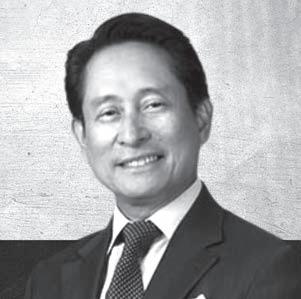
MICHAEL TOLEDO, chairman of the Chamber of Mines of the Philippines (COMP), in particular, welcomes the pronouncements of the DTI chief, Department of Finance (DOF) Secretary Benjamin Diokno, and Department of Environment and Natural Resources (DENR) Secretary Maria Antonia Yulo-Loyzaga.
Recent pronouncements of government regulators under the Marcos administration recognize mining as a potential source of sustained economic growth, says Toledo.
Indeed, he said the concerns of the minerals sector are multifaceted and can be better addressed through the close coordination of various government departments and agencies, and not the DENR alone.
“It would be good to see this co -

ordination work continue through the Mining Industry Coordinating Council (MICC), this time not only to assess and review the compliance of mining operations with existing laws and regulations but, equally important, to deal with the challenges confronting the mining industry and to enable it to achieve its full potential in a responsible, sustainable manner,” says Toledo.
He noted that Secretaries Pascual and Diokno in particular underscored the benefit of mobilizing investments for mine development.
They reflect the Marcos administration’s broad-minded view
on our industry. They also come on the heels of the removal of mining policy roadblocks—notably the ban on open-pit mining and the moratorium on new mining projects—in 2021 after a terribly restrictive regulatory environment that began in 2012. Clearly, these developments are timely. The government needs all the help it can get in these unsettling times as we continue to experience the ill effects on the global economy of the Covid-19 pandemic and the Ukraine crisis,” said Toledo.
According to Toledo, the Philippine Mining Act of 1995 is considered by many industry experts to be one of the most advanced mining laws in the world.

“It holds the distinction of being one, if not the only one, of the mining legislations in the world that has built-in provisions for the protection of the rights of indigenous peoples. Its social and environmental provisions are comparable to measures formulated in industrialized nations. This law is supported by many other environmental, social and governance laws, rules and regulations that are fully responsive to the needs of the times,” he pointed out.
Toledo said the industry fully supports Secretary Loyzaga’s initiatives to consult various stakeholders, including mining, as part of her efforts to achieve the sustainable use of the country’s natural wealth.
“ We have said time and again that what is needed is to increase the capability of government, both national and local—and the political will—to fully implement the provisions of the Mining Act.
Mining’s huge potential
TOLEDO noted that the Philippines is richly endowed with mineral resources, with nickel and nickel products that were produced in 2021 having an estimated value of over P89 billion; and copper, more than P17 billion. As such, he said, the potential for the Philippines to be a major min -
erals processor can be huge.
For downstream processing to be economically viable, however, the right kind of investors who will be willing to put up extremely expensive facilities to process the type of mineral ores that we have is needed.
Our investment environment, therefore, should be attractive and competitive—comparable with, if not better than, other mining jurisdictions with equally rich mineral resources. “ We can learn from Indonesia’s experience in transitioning to downstream processing and take stock of our situation vis-àvis theirs. For nickel, a roadmap can be drawn similar to the one the government did for copper. The roadmap could provide our policymakers, industry players, potential investors, and all mining stakeholders the guide from where we can build our strengths and address our weaknesses as we move along,” said Toledo.
Stable business environment
TOLEDO said COMP has never wavered in advocating for a business environment that is both stable and predictable for both current and potential investors in a way that investments are protected and constantly ensure a fair return to all stakeholders.

Only in such an environment will we be able to develop and encourage investments in mining and in minerals processing. We shall continue this thrust, fully aware of— and always striving to meet, even exceed—the expectations of society on the impact of our operations on the environment and our gracious host communities,” he said.
According to Toledo, the existence of 7 mineral processing plants (4 gold, 2 nickel, 1 copper) in the Philippines proves that we have the technical capability to become a major mineral processor.
Filipino miners in direct and related fields here and abroad have a proven and demonstrated track record in expertise, professionalism, adaptability and capacity to
absorb new and emerging technologies,” he said.
To truly revitalize the country’s mining industry—which includes attracting investments in mining and encouraging the building of enormously expensive mineral processing facilities and manufacturing plants for electric vehicles and for renewable power projects—the industry needs full government support in terms of stable mining and investment policies that do not change midstream, lower power costs, infrastructure, harmonized local and national laws. Moreover, he said it also calls for a fiscal regime that considers the Philippines’s competitiveness vis-à-vis other mining jurisdictions, and incentives.
“As mentioned earlier, all these require close coordination between and among government departments and agencies. The scope and magnitude of these concerns also require the support and cooperation of the executive and legislative branches of government, as well as of the national and local government units,” he explained.
Fight illegal mining
ACCORDING to Toledo, the government should intensify the campaign against illegal mining operations, which he blamed for the industry’s negative image, explaining why COMP continues to prod the government to take a tougher stance against illegal mining activities, particularly unregulated small-scale mining (SSM).

Illegal SSM does not employ the same stringent safety practices required of legitimate large-scale mining operators. We thus applaud President Ferdinand R. Marcos Jr.’s recent order for the DENR to strengthen its regulatory powers on small-scale mining so the government can provide miners with social protection plus skills training and even financial incentives for their operations,” he said.
Toledo said COMP looks forward to further full and meaningful consultations with the govern-
ment, and to working closely with both legislators and executive officials so that, ultimately, the country will see more investments in mining coming to our shores, to help unlock the industry’s huge economic potential.
Increase mining benefits
ANTI-MINING groups likewise endorse the idea of increasing the benefits from mining by discouraging the wholesale export of raw minerals.
“In general, ATM welcomes the idea that mineral processing is being considered by the Department of Trade and Industry to increase the benefits from mining and possibly contribute to an energy transition as a response to climate-change impacts. This is, after all, part of a set of strategies that must be explored for proper minerals management, that includes the option of keeping the minerals on the ground if it is more costly to extract them,” said Jaybee Garganera, national coordinator of ATM.
However, he counsels the government to ensure that such a track does not remain myopic and imbalanced in its long-term goal to make minerals play a key role in the country’s industrialization while complying with the rigorous framework of sustainable development.
Our alliance believes that the Philippine government must first ensure that we have a clear definition of a ‘just energy transition’ and what are the contribution and roles of Philippine minerals towards this. This means that mining is part of a system that will ensure that everyone benefits from the production and deployment of renewable energy, without harming the environment and communities that are hosting or providing the raw materials for RE technologies.”
Garganera draws attention to the inspiring comment of Earth Justice in 2021 that “we cannot justly move to a clean energy future at the cost of harming people or the environment.”
PESO EXCHANGE RATES n US 55.2170 n JAPAN 0.4123 n UK 66.2604 n HK 7.0351 n CHINA 8.0550 n SINGAPORE 41.3301 n AUSTRALIA 37.9672 n EU 58.9276 n KOREA 0.0428 n SAUDI ARABIA 14.7222 Source BSP (February 17, 2023) Continued on A2 A
EJAP JOURNALISM AWARDS BUSINESS NEWS SOURCE OF THE YEAR (2017, 2018, 2019, 2020, 2021) DEPARTMENT OF SCIENCE AND TECHNOLOGY 2018 BANTOG MEDIA AWARDS ROTARY CLUB OF MANILA JOURNALISM AWARDS 2006 National Newspaper of the Year 2011 National Newspaper of the Year 2013 Business Newspaper of the Year 2017 Business Newspaper of the Year 2019 Business Newspaper of the Year 2021 Pro Patria Award PHILIPPINE STATISTICS AUTHORITY 2018 Data Champion
broader look at today’s business
DREAMSTIME.COM
AS the country struggles to recover from the adverse economic impact of the global pandemic, the big players in the country’s mining industry are optimistic of better days ahead with the recent pronouncements of support for mining by the government.
www.businessmirror.com.ph n Sunday, February 19, 2023 Vol. 18 No. 127 P25.00 nationwide | 2 sections 12 pages | 7 DAYS A WEEK
This law is supported by
other environmental, social and governance laws, rules and regulations
to
of
TOLEDO: “[The Philippine Mining Act of 1995] holds the distinction of being one, if not the only one, of the mining legislations in the world that has built-in provisions for the protection of the rights of indigenous peoples. Its social and environmental provisions are comparable to measures formulated
in industrialized nations.
many
that are fully responsive
the needs
the times.”
Big players welcome policy pronouncements in support of mining, but stakeholders insist touted reforms must be seriously pursued
Growing India clout prompts US, Europe to ignore Modi crackdown
By Bibhudatta Pradhan and Muneeza Naqvi
Bloomberg News
JUST hours after Indian tax authorities searched the BBC’s offices on Tuesday, Prime Minister Narendra Modi held phone calls with Joe Biden and Emmanuel Macron touting record orders of 470 planes by Air India Ltd.
The juxtaposition, intentional or not, marked a vivid demonstration of Modi’s success at leveraging India’s geopolitical position and economic promise to maintain good relations with the US and its allies even as his government becomes bolder in cracking down on dissent at home.
The BBC probe, which continued on Wednesday, came weeks after the British broadcaster aired a documentary examining Modi’s role in deadly 2002 riots in his home state of Gujarat. Although the government sought to frame the move as unrelated to the documentary, his Bharatiya Janata Party (BJP) held a news conference the same day in which a representative called the BBC “the most corrupt corporation in the world.”
India is a country which gives an opportunity to every organization and individual as long as you are willing to abide by the constitution of the country and you don’t have a hidden agenda,” BJP spokesperson Gaurav Bhatia told reporters. “As long as you don’t spew venom.”
From ‘free’ to ‘partly free’ THE pressure on the BBC represents an escalation of Modi’s efforts over the past decade to snuff out dissent. In 2021, the Washington-based group Freedom House downgraded India to “partly free” from “free” due to discriminatory policies against Muslims and increased harassment of journalists, civil-society groups and other government critics—a characteriza-
INDIAN Prime Minister Narendra Modi BLOOMBERG tion that Modi’s government has rebutted.
Even so, Modi has faced few consequences from foreign investors or governments like the US that regularly criticize China over human rights. He’s been touting India as the “mother of democracy” while preparing to host world lead-
ers at the Group of 20 leaders summit later this year.
One major reason is that India’s geopolitical importance to the US and its allies has only increased as American policy makers seek to thwart Beijing’s rise, with an increased focus on the Quad grouping that also includes Japan and Australia. India also remains one of the fastest expanding economies at a time of sluggish growth around the globe.
The world certainly isn’t about to turn on Modi or India,” said Michael Kugelman, director of the South Asia Institute at the Washington-based Wilson Center. “On the contrary, most of the international community continues to view India as a strategic player and key trade and investment partner.”
Modi’s erosion of democratic institutions and appeals to the Hindu majority since he took power in 2014 has only entrenched his power. His party is leading in opinion polls ahead of a national election next year that could see him win a third term in office.
Big market player
GLOBAL funds pumped more than $11 billion into India’s stock market in the second half of 2022, putting its gauges among the world’s top performers last year as the MSCI AC World Index sank nearly 20 percent. A top Goldman Sachs Group Inc. executive said this month the New York-based bank is investing more client money in India and developed markets in AsiaPacific as interest in China cools.
The Adani factor STILL, signs of trouble are evident, leading to some outflows this year.
India has been rocked in recent weeks after US-based Hindenburg Research accused billionaire Gautam Adani of fraud and market manipulation, wiping out more than $130 billion in market value at one of the country’s biggest conglomerates. Adani, who is seen as close to Modi, refuted the allegations and stoked nationalism in a 413-page rebuttal by his flagship company.
“ This is not merely an unwarranted attack on any specific company but a calculated attack on India, the independence, integrity and quality of Indian institutions, and the growth story and ambition of India,” Adani said in its response.
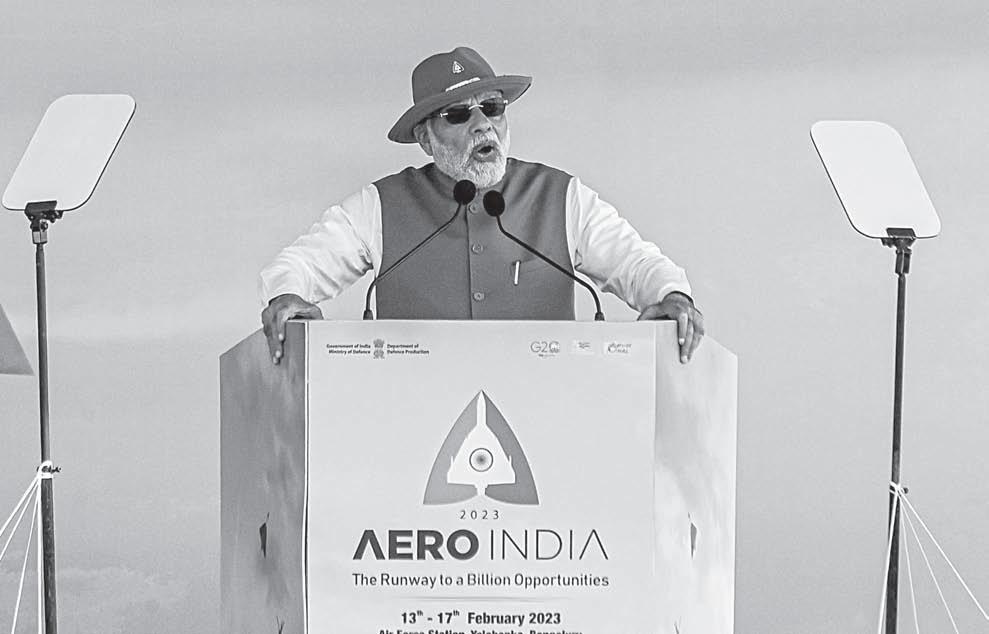
K ey opposition politicians, who have struggled to compete against Modi’s well-funded election machine, sought to highlight links between the prime minister and Adani to try and make up ground in the polls. Modi has maintained a careful silence on both the Adani crisis and on the BBC documentary, floating above the fray as underlings and supporters defend him and go on the offensive.
India is on the rise, but sinister designs are there to set afloat a narrative,” said Vice President Jagdeep Dhankhar. “We cannot allow free fall of doctored narratives to run down our growth story.”
Creating a new narrative?
A FORMER Indian foreign secretary this week argued that the government should look to boot out some reporters who work with overseas media outlets.
“Foreign journalists especially can’t and must not interfere in the domestic politics of another coun-
try,” Kanwal Sibal said in a television debate about the BBC raid. “And if they do they are liable to be expelled. Freedom of expression right can’t be invoked.”
The reaction shows that Modi’s government is seeking to create a “nationalist battle” in which he protects the population against outside enemies, according to Mohan Guruswamy, a former Finance Ministry official.
“He is trying to create a new narrative that foreigners are against you,” Guruswamy said.
“These are bad for India’s image as a democracy and as an alternative to China.”
The BBC documentary India: The Modi Question struck at an issue that has stained Modi’s political career. In the 2002 sectarian violence, more than 1,000 people—mostly Muslims—were killed after a train carrying Hindu pilgrims was burned allegedly by a Muslim mob.
Human-rights groups blamed Modi for doing little to stop the violence, allegations that were denied by him and later dismissed by India’s Supreme Court.
W hen the film was aired in the UK in January—its broadcast was restricted in India—the country’s Ministry of External Affairs called it “propaganda.” India’s government also asked social media giants Twitter Inc. and Alphabet Inc.’s YouTube to take down videos and tweets about the film.
“ The bias, lack of objectivity, a continuing colonial mindset is blatantly visible,” Arindam Bagchi, a spokesman for India’s Foreign Ministry, told reporters last month.
Before his election win in 2014, the US had denied Modi a visa over his alleged role in the Gujarat riots. After the BBC tax probe this week, State Department spokesman Ned Price referred reporters to India’s government for more details while making a “general point” about the benefits of press freedom.
‘He’ll be fine’
THAT’S more than what the British government offered. As of Wednesday, Prime Minister Rishi Sunak’s administration hadn’t commented on the BBC probe, which came as India announced the next round of UK trade talks.
Several weeks ago, UK Foreign Secretary James Cleverly noted the BBC was independent and called India “an incredibly important international partner.” Modi will overcome this moment politically at home just as he has so many other blows,” said Kugelman from the Wilson Center. “He is just too popular, and the opposition too weak, for any of this to damage him politically. He’ll be fine.”
Make it mine: Better days ahead?
Continued from A1
Circular economy, sustainable consumption
ACCORDING to Garganera, ATM believes that any discussion about additional extraction of transition minerals should be informed by the principles of the circular economy and sustainable material consumption.
“ We believe that any initiative on ‘transition minerals’ can benefit from a general framework that we shouldn’t open up more mines in the Philippines to simply respond to the growing energy demands, especially of developed countries and the Asian giant economies such as China and India. We must prioritize a robust and expanded cost-benefit analysis (CBA) appli-
cable to directly affected host communities, the local governments, and the nation as a whole. And this CBA must factor in the environmental, social, cultural and human-rights cost of mining,” he explained.
According to Garganera, it doesn’t make sense that the Philippines is prioritizing an industry (mining) that merely contributes 1 percent of the GDP but threatens the other combined 14-17 percent of GDP from agriculture, forestry, and tourism—this, especially in the context of climate change and extreme weather events.

Any policy reform in mining should adequately address the question, ‘Who benefits from this, both during the mine life and the generation after the mine is closed
down?’” he pointed out.
ATM suggested that DTI, DOF and the DENR put in place policy reforms, particularly in operationalizing what the mining industry claims as responsible mining, before any expansion of mineral processing and additional mining projects for transition minerals.
“Right now, the Alternative Minerals Management Bill (AMMB) that has been languishing in Congress is the most comprehensive legislative proposal that should be prioritized,” he said.
Finally, we emphasize the general call of environmental defenders—“for this just transition to happen, we cannot allow more sacrifice zones in the name of mining, to provide the raw materials for renewable and clean energy,” he ended.
NewsSunday BusinessMirror www.businessmirror.com.ph Sunday, February 19, 2023 A2
could reap billions from Biden’s EV bill
By Wilfried Eckl-Dorna, Ewa Krukowska & Tom Mackenzie
NORTHVOLT AB joined European companies putting policy makers on notice about the allure of US green tech incentives, calling tax credits tucked in President Joe Biden’s Inflation Reduction Act impossible to ignore.
The supplier of batteries to Volkswagen AG and BMW AG highlighted the tax credits included in the law that cover about 30 percent of cell manufacturers’ operating costs. If the Swedish startup producing batteries in its home country were to start work now on building a similar-size factory in North America, it would be in line for about $8 billion of tax credits by the end of the decade.
“It is clearly driving the investments now in a very rapid pace,” Northvolt Chief Executive Officer Peter Carlsson said of the IRA in an interview with Bloomberg Television airing Tuesday. “Unfortunately, there is a risk that these investments are a little bit taking the momentum out of Europe.”
The comments echo those of CEOs from Siemens Energy AG and Volvo AB, who last week lauded the US subsidy framework—which includes roughly $500 billion in new spending and benefits—for having a clear 10-year funding window for tax breaks that can be implemented immediately. Companies have largely bristled at the EU plan, which is based on a cumbersome application process and draws on money that was already pledged through various green transition programs.
As the contours of Biden’s IRA sharpen, European Union leaders have done little to soothe industry’s concerns. At a closely watched summit in Brussels last week, leaders dialed down earlier rhetoric on plans to loosen state-aid rules because it would disadvantage smaller EU states with smaller budgets. Instead, the bloc pledged to focus on improving its own policies to make European companies more competitive with the US and China.
It will be weeks, if not months, before details of any new EU measures emerge, and then national governments will need to draw up rules for implementing them. In total, the EU has more than €380 billion ($414 billion) of joint funds committed for the green transition through 2030.
“Unfortunately, concrete measures for greater competitiveness are still a long way off,” said the BDI, Germany’s biggest industry association. “Attractive framework conditions for business and investment are the be-all and end-all. Companies need more speed and less detailed regulation.”
Speaking this month on a call with reporters, Siemens Energy CEO Christian Bruch said the biggest problem with the EU programs isn’t the size of subsidies but the speed of implementation and a lack of predictability for financing plans.
“A major problem that’s holding industry back is that we need better possibilities to plan and implement,” Bruch said.
The IRA supports companies scaling up a range of technologies— solar, wind, hydrogen—by providing funding for critical raw materials as well as financing for operating expenditures. The law makes funding available at a fixed amount per product, reducing the risk of expanding production. And by offering funds in the form of tax breaks, they become available immediately.
The EU’s framework is seen as geared more toward research and development than the commercialization of technology. While the bloc has binding climate and clean-energy targets in place, applying for funds could take months or years—a slower process that adds upfront risk for companies.
At the same time, the lack of clarity around the EU plan is drawing criticism. Denmark chastised policy makers for drafting rules so convoluted that they had to stop issuing wind-power permits.
“More projects are now up for debate in the United States,” Bruch said. “A couple of months ago, the situation was reverse; there were more projects underway in Europe.”
The same observations are rippling through the automotive industry.
“If nothing happens in Europe, we will have to think about where we’re going to put the initial investments to scale up capacity for some of the technologies in the value chain,” Volvo CEO Martin Lundstedt said in an interview this month.
Volvo is developing trucks running on batteries, hydrogen and renewable fuels and is in the process of ramping up related infrastructure. Together with Daimler Truck AG and Volkswagen’s Traton, the Swedish company is planning to spend €500 million in the next years to install at least 1,700 chargers in Europe for heavy-duty vehicles.
Under the IRA, the US would cover $45 per kilowatt-hour of a battery’s production costs—aid that “will definitely change the equation for customers,” and potentially also for Volvo, Lundstedt said.
Northvolt sees demand for electric vehicles “moving rapidly upward” in North America, and supply chains—including makers of cells, electrodes and separators—also are shifting to the US. While the company hasn’t committed to building a plant in the US yet, it’s hinted that it may postpone a factory in Germany in favor of one in North America. With the current incentive imbalance, “it is basically impossible to operate in the North American market from anywhere else,” Carlsson said.
The extent to which European companies are prepared to shift investment plans to the US is still unclear. Industry is signaling a lot is on the line, though some observers are preaching caution.
“We don’t have to move at light speed,” said Arne Holzhausen, a senior economist at Allianz SE. “We need to move with the utmost thinking and precision and not think we just have to match the US billions.”
Danish Prime Minister Mette Frederiksen offered industry a glimmer of hope on the process. After meeting Friday with European Commission President Ursula von der Leyen, the prime minister said EU policy makers understood the need to act fast so the Nordic country can again start handling applications for new offshore wind parks.
With assistance from Rafaela Lindeberg and William Wilkes/Bloomberg
China-based worker steals data for advanced chips production
By Jordan Robertson & Cagan Koc
ACHINA-BASED former employee of ASML Holding NV—a critical cog in the global semiconductor industry—stole data from a software system that the corporation uses to store technical information about its machinery.
The breach occurred in a repository that includes details of the lithography systems critical to producing some of the world’s most advanced chips, said people with knowledge of the situation. It was the first glimpse at the nature of the theft disclosed earlier Wednesday by ASML, which said a former worker in China had stolen confidential information but didn’t elaborate on what kind of data were taken.
The data came from a so-called product life cycle management program known as Teamcenter, said the people, who asked not to be identified because the information isn’t public. The tool is used internally, they said.
Teamcenter serves as a shared storehouse of technical information that allows different groups of employees to collaborate and manage their product development, according to the website of Siemens, which supplies the software. It allows for “common access to a single repository of all product-related knowledge, data and processes,” according to the web site.
ASML declined to comment beyond the statement it issued earlier on Wednesday, in which the company said it didn’t believe the theft was material to its business. Siemens didn’t immediately respond to a request for comment.

This is the second such breach that ASML has linked to China in less than a year and comes as the US is pressuring other nations including the Netherlands to help keep China’s chipmaking abilities from advancing. Tensions are already high after an alleged Chinese spy balloon hovered over US airspace before being shot down. Secretary of State Antony Blinken called off a trip to Beijing—but was considering a meeting with China’s top diplomat in Germany this week, people familiar with the matter said.
Earlier on Wednesday, China’s Foreign Ministry spokesman Wang Wenbin said he wasn’t aware of ASML’s accusation that a former Chinese employee had misappropriated data.
The Dutch technology company, which makes machines needed to produce high-end chips used in everything from electric vehicles to military gear, has initiated an internal investigation and tightened security controls after discovering the most recent incident. It said on Wednesday that export controls may have been violated, exposing the company to a potential regulatory backlash. The company’s position as a crucial part of the supply chain for technology that makes the fastest, most powerful chips, has made it a target. Last year,
ASML, which employs about 1,500 people in China, accused a Beijing-based firm of potentially stealing trade secrets in a theft that dates back years.
ASML’s most recent data breach involved technological information but not hardware and was carried out by a male employee in the last couple months, according to another person familiar with the details. Authorities in the US have been notified, said the person, who asked not to be identified because the investigation is ongoing. A spokesman for the Commerce Department declined to comment.
In January, the Netherlands and Japan agreed to join the US in restricting exports of some advanced chipmaking machinery to China. President Joe Biden’s administration has said it’s essential for the US and its allies to block Beijing from acquiring technologies that could threaten global security.
Dutch Trade Minister Liesje Schreinemacher said in a statement that it’s “very worrying that such a large and reputable company is affected by economic espionage.”
It’s unclear whether the exemployee who stole the data had any connections to authorities in China or elsewhere. ASML, which is restricted from selling its most-
advanced machines to China, said in its annual report that the theft isn’t material to its business. The Veldhoven-based company is one of the few producers of the machines needed to make mid- to high-range semiconductors. It’s the only manufacturer of lithography systems needed to shrink and then print patterns of transistors onto silicon wafers, which are then sliced into individual chips. A single machine can be the size of a bus and cost roughly $170 million.
Chief Executive Officer Peter Wennink has warned that China will ultimately develop its own domestic alternatives if it can’t buy from the West. China is ASML’s third-biggest market after Taiwan and South Korea. ASML and its peers sell their equipment to chipmakers such as Intel Corp. and Taiwan Semiconductor Manufacturing Co., which supply companies like Apple Inc. and Nvidia Corp.
ASML has previously accused Dongfang Jingyuan Electron Ltd. of obtaining ASML’s technology and transferring it to China. That technology was secured in a sometimes audacious fashion: One engineer was accused of stealing all 2 million lines of source code for critical ASML software and then sharing part of it with employees at Dongfang and a related company in the US, according to transcripts of the proceedings. Bloomberg News
US launches global initiative on responsible AI military use
By Mike Corder The Associated Press
THE HAGUE, Netherlands—
The United States launched an initiative Thursday promoting international cooperation on the responsible use of artificial intelligence and autonomous weapons by militaries, seeking to impose order on an emerging technology that has the potential to change the way war is waged.
“As a rapidly changing technology, we have an obligation to create strong norms of responsible behavior concerning military uses of AI and in a way that keeps in mind that applications of AI by militaries will undoubtedly change in the coming years,” said Bonnie Jenkins, the State Department’s undersecretary for arms control and international security.
She said the US political declaration, which contains non-legally binding guidelines outlining best practices for responsible military use of AI, “can be a focal point for international cooperation.”
Jenkins launched the declaration at the end of a two-day conference in The Hague that took on additional urgency as advances in drone technology amid the Russia’s war in Ukraine have accelerated a trend that could soon bring the world’s first fully autonomous
fighting robots to the battlefield.
The US declaration has 12 points, including that military uses of AI are consistent with international law, and that states “maintain human control and involvement for all actions critical to informing and executing sovereign decisions concerning nuclear weapons employment.”
Zachary Kallenborn, a George Mason University weapons innovation analyst who attended the Hague conference, said the US move to take its approach to the international stage “recognizes that there are these concerns about autonomous weapons. That is significant in and of itself.”
Kallenborn said it was also important that Washington included
a call for human control over nuclear weapons “because when it comes to autonomous weapons risk, I think that is easily the highest risk you possibly have.”
Underscoring the sense of international urgency around AI and autonomous weapons, 60 nations, including the US and China, issued a call for action at the Hague conference urging broad cooperation in the development and responsible military use of artificial intelligence.
“We are in time to mitigate risks and to prevent AI from spiraling out of control, and we are in time to prevent AI from taking us to a place we simply don’t want to be,”
Dutch Foreign Minister Wopke Hoekstra said.
The call to action issued in the
Netherlands underscored “the importance of ensuring appropriate safeguards and human oversight of the use of AI systems, bearing in mind human limitations due to constraints in time and capacities.”
The participating nations also invited countries “to develop national frameworks, strategies and principles on responsible AI in the military domain.”
Military analysts and artificial intelligence researchers say the longer the nearly year-long war in Ukraine lasts, the more likely it becomes that drones will be used to identify, select and attack targets without help from humans.

Ukraine’s digital transformation minister, Mykhailo Fedorov, told The Associated Press in a recent interview that fully autonomous killer drones are “a logical and inevitable next step” in weapons development. He said Ukraine has been doing “a lot of R&D in this direction.”
Ukraine already has semi-autonomous attack drones and counter-drone weapons endowed with AI. Russia also claims to possess AI weaponry, though the claims are unproven. But there are no confirmed instances of a nation putting into combat robots that have killed entirely on their own.
Sunday, February 19, 2023 www.businessmirror.com.ph • Editor: Angel R. Calso A3 The World BusinessMirror
ASML Chief Executive Officer Peter Wennink has warned that China will ultimately develop its own domestic alternatives if it can’t buy from the West. BLOOMBERG
VW, BMW battery supplier
UKRAINIAN soldiers check the situation by using a drone in Bakhmut, Donetsk region, Ukraine on February 12, 2023. AP/LIBKOS
BusinessMirror A4 www.businessmirror.com.ph Sunday, February 19, 2023
DOST-supported stroke rehabilitation Agapay device gets Singapore patent
THE Filipino invention, Agapay, a robotic device for upper extremity rehabilitation of stroke and injured patients received a patent from Singapore, its first international patent, last January, said the Department of Science and Technology (DOST) in a news release.
The Agapay project was implemented by the De La Salle University-Institute of Biomedical Engineering and Health Technologies (DLSU-IBEHT) with support from the DOST-Philippine Council for Health Research and Development (DOST-PCHRD).
The application for the invention patent in Singapore was filed in May 2021 with the support from the DOST-Technology Application and Promotion Institute.
The Agapay Exoskeleton, or an external skeleton that supports and protects a human or animal’s body, is a 3D-printed wearable robot that is biomimetically designed to account for all the movements of the upper limbs, the DLSU web site said.
The robotic device provides a safe, comfortable and user-friendly experience during therapy exercises. It seeks to aid the motor rehabilitation and physical therapy of stroke and injured patients.
The latest prototype of the device is activated using high-power direct-current motors attached to an adjustable and lightweight frame and is fused with a real-time biofeedback system that records neuromuscular activity.
The design enables the technology to be cost-effective and efficient, the DOST said.
A real-time biofeedback system is integrated to record neuromuscular activity using surface electromyography, the DLSU said.
The device can also perform active and passive motion exercises through gamification, or adding game mechanics, using integrated haptics, or technology that stimulates the senses of touch and motion, and a graphical user interface.
After successfully completing its first
phase of product design and prototyping, the Agapay project commenced its second phase in December 2017, conducting safety testing and preclinical trials until December 2018, and eventually held clinical trials and manufacturing for its third and fourth phases, respectively, the DLSU said.
An “interdisciplinary effort,” it involved disciplines from the Manufacturing Engineering and Management Department, Electronics and Communications Department and the Physics Department of DLSU.
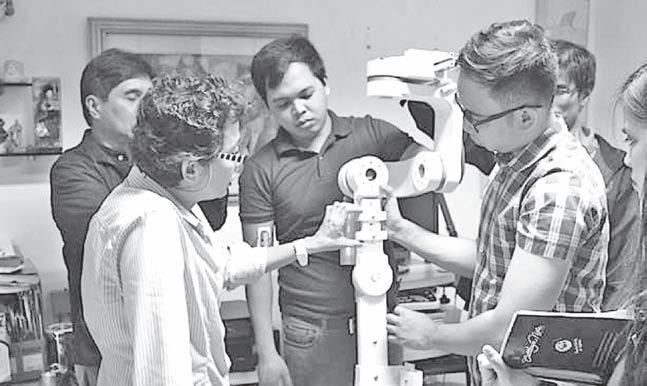
“It was also linked to medical practitioners to ensure the clinical significance of the device. The team included medical doctors from the Department of Rehabilitation Medicine from the University of the Philippines-Philippine General Hospital,” the DLSU website said.
The DLSU said the team also performed “observership sessions” in different stroke rehab centers in the Philippines, such as: DLSU Medical Center Dasmariñas, Chong Hua Hospital, Cebu Doctor’s Hospital and Perpetual Succour Hospital.
Currently, there are no robotic exoskeletons being manufactured in the country. The development of this device will provide an alternative and affordable option for Filipino patients, and could set a standard for robotic rehabilitation technologies in the country, the DOST said.
“The patent from Singapore is a step closer to commercializing Filipino-made technologies in the international setting,” DOST-PCHRD Executive Director Dr. Jaime Montoya said.
“This development is also a testament to how our own researchers are capable of generating technologies that are responsive to the needs of our communities, and at par with international standards,” Montoya added.
The project team is now looking for potential industry partners to manufacture the device. Interested parties may contact Dr. Renann Baldovino, Agapay Project Leader, through DLSU-IBEHT.
DOST introduces sustainable ‘Silyang Pinoy’ for school use
ASUSTAINABLE and competitive material may soon replace wood and plastic as school furniture. This was the result of Department of Science and Technology (DOST) research in developing school tables and chairs from engineered bamboo.
Aptly called Silyang Pinoy, the school furniture will be mainly produced using engineered bamboo or e-bamboo, and other raw materials.
The chairs and tables will be multifunctional wherein they can easily be transformed into other furniture. This is especially useful in the country where schools are usually converted into evacuation centers during disasters.
“The Silyang Pinoy is an important development in providing quality furniture in primary and secondary public schools in the country,” said Science Secretary Renato U. Solidum Jr.
“Our country’s geographic location situates us in the pathway of destructive typhoons. This furniture technology will support our educational school system and, at the same time, be a sturdier furniture for evacuees who seek shelter in schools during disasters,” Solidum added.
E-bamboo is made by binding together fibers, particles, strips or slats of bamboo with the right adhesive.
Used worldwide to make attractive panels, floors, furniture and handicrafts, e-bamboo is often stronger and less prone to warping than its equivalent solid woods.
BusinessMirror
Biotechnology offers options for local livestock industry
By Clement Dionglay Special to the BusinessMirror
FROM July to September 2022,
the total hog production in the Philippines increased to 436.68 thousand metric tons from 418.07 thousand metric tons in the same quarter of 2021, according to the Philippine Statistics Authority.
The increase of 18.61 metric tons is equivalent to an annual growth rate of 4.5 percent, a significant increase from the 17.8 percent decline in 2021.
Despite the increase in total hog production in the country, the livestock industry is still facing several challenges, said Dr. Marvin Villanueva, chief of the Livestock Biotechnology Center and National R&D Coordinator of the Philippine Carabao Center (PCC).

Villanueva gave the statement during a recent webinar organized by International Service for the Acquisition of Agri-biotech Applications Inc., Winrock International and the United States Department of Agriculture BSafe Project.
The challenges include transboundary animal diseases, or the highly contagious or transmissible epidemic diseases, such as African swine fever (ASF) and avian flu; high costs of farm inputs, such as imported feed ingredients; lack of new breeding animals; and the travel restrictions brought by the Covid-19 pandemic.
ASF affects the country’s pork supply and will continue without an effective vaccine.
Animal biotechnology
LIVESTOCK farmers have long been improving their herds, using enhanced animal husbandry practices and available modern technologies, such as artificial insemination, embryo transfer and in-vitro fertilization.
Through biotechnology, scientists and farmers can enhance livestock breeding and produce improved herds.
In recent years, animal biotechnology advancements helped improve food, such as eggs, milk and meat.
Villanueva cited several benefits of animal biotechnology in attaining food sufficiency and security.
They included the response to climate change, disease-resilient or -resistant animals, increased income for livestock producers, doubled food production to meet demands, proper animal management, and rapid diag -
Through the project, the DOST-Forest Products Research and Development Institute (DOST-FPRDI) targets to comply with the price set by the Department of Education (DepEd) to be able to compete with school furnitures in the market.
Currently, the DepEd spends at least P116,000 for 1-table-1-chair sets for 45 students.
“The Institute has long realized the potential of bamboo and the need to mainstream its use to support the local industry. One of the most economically important non-timber forest products, bamboo has excellent properties that make it an ideal substitute to wood for furniture, handicrafts, construction material and chemical products,” explained DOST-FPRDI Director Romulo T. Aggangan.
He added,“Supporting bamboo production not only provides economic opportunities for local bamboo farmers and e-bamboo producers; it also helps address the country’s wood supply problems.”
As efforts pour in to develop technologies for e-bamboo production and promote its use, bamboo growers and users can look forward to better business opportunities in the years to come. The “Design and Development of Multifunctional School Furniture” project, led by Engr. Edward Paul Marasigan, is funded by the Philippine Council for Agriculture, Aquatic, and Natural Resources Research and Development. Apple Jean C. Martin- de Leon/S&T Media Service
nosis and disease surveillance.
Animal biotechnology includes livestock, poultry, fish, insects, companion animals and laboratory animals.
A genetically modified (GM) animal is one whose genetic material was altered by adding, changing, or removing specific DNA sequences.
Genetic modification in animals is done to introduce a new trait or change specific animal characteristics, such as disease resistance.
GM animals are developed using two methods—transgenesis or cisgenesis. This involves the transfer of genes, and the deletion of genetic information.
Villanueva said that a transgenic animal is developed with the deliberate modification of its genome, the genetic makeup of an organism responsible for inherited traits or characteristics.
Modern animal biotechnology has a wide range of applications not only in agriculture but also in medicine.
New breeding innovations pushes PHL livestock R&D TOOLS in improving animals and livestock continue to advance. One of these tools is gene editing, particularly CRISPR-Cas9.
CRISPR, or Clustered Regularly Interspaced Short Palindromic Repeats, is a powerful gene-editing technique that works like a biological version of a word processing program’s “find and replace” function.
It has been applied to important crops and is currently being used in human and animal health.
Villanueva then discussed how they adopted the somatic cell nuclear
transfer technology to complement other existing reproductive tools for buffaloes at PCC.
They are currently developing and optimizing a system for cloning through somatic cell nuclear transfer in water buffalo.
Villanueva announced that buffalo clone embryos had been successfully produced in-vitro, or outside the buffalo’s body or in a test tube.
He shared that the PCC is working to improve the genetic traits of Philippine carabaos to produce better sires.
Through its Carabao Development Program, thousands of dairy farmers in the Philippines have benefited from technologies, such as artificial insemination and the use of riverine bulls for natural mating to produce quality crossbreds.
Other GM, gene-edited animals
VILLANUEVA also shared different applications and uses of GM and geneedited animals, including Oxitec’s GM mosquitoes to prevent the proliferation of female mosquitoes and stop the spread of diseases such as malaria, dengue fever, chikungunya, and Zika.
Another is the genome-edited PRLR-SLICK cattle with short, slick-hair coat to better withstand hot weather; African swine fever vaccine that will be on a field trial in the country; and the Roslin Institute’s engineered porcine reproductive and respiratory syndromeresistant pigs; and gene-edited bird flu resistant chicken.
Regulatory policy for GM animals
WITH guidelines for GM crops and
products already in place, the Bureau of Animal Industry Biotechnology Team initiated the establishment of guidelines for GM animals and animal products.
Similar to the Joint Department Circular for plant and plant products, the proposed procedures for animals and animal products involve the five Departments of Science and Technology, Agriculture, Environment and Natural Resources, Health, and the Interior and Local Government.
The proposed guidelines apply to GM fisheries and other aquatic resources, domesticated animals and biological products used for animal husbandry or veterinary purposes.
They also apply to biological agents used for biocontrol derived from modern biotechnology and containing novel combinations of genetic materials.
The Circular does not cover gene-edited products that do not contain novel combinations of genetic materials.
Other insights, needs to improve local livestock industry WHILE the Philippines still lacks a genetic program for animal biotechnology, the PCC’s Livestock Biotechnology Center has a research program to create stocks to continue propagating water buffaloes. However, funds are needed to support and expand the program.
The Livestock Biotechnology Center has not yet fully adopted the use of modern biotechnology for research. Still, it is currently partnering with animal science research experts in the country to conduct capability-building activities for researchers through the support of the Department of Agriculture.
The training will allow their researchers to learn basic and advanced modern biotech applications in anticipation of the implementation of the country’s animal biotechnology guidelines.
Thus, Villanueva urged a harmonious collaboration among key stakeholders, including government agencies, state universities and colleges, local government units and the private sector, to support animal biotechnology research.
C lement Dionglay is with ISAAA Inc.’s Global Knowledge Center on Crop Biotechnology.
Can mined-out areas be green again?
YES , mined-out areas can still be rehabilitated through the government’s Greening Minedout Areas in the Philippines (GMAP) program that adopted bioremediation, the Department of Science and Technology said in a news release.
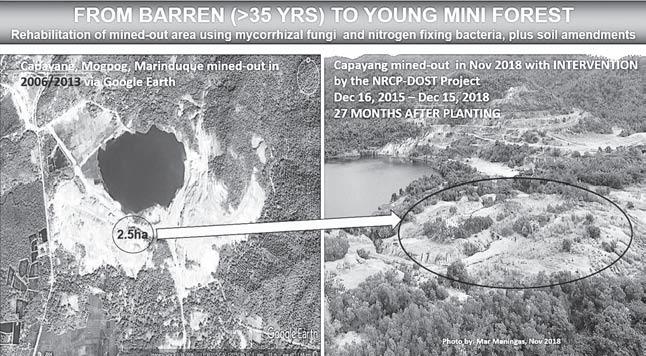
Led by Dr. Nelly Aggangan from the University of the Philippines, Los Baños, the program successfully developed microbial-based protocol that can effectively rehabilitate unproductive mine tailing areas in the Philippines, converting barren lands into mini forests.
GMAP makes use of live microbes and plants as biological solutions to clean up and rehabilitate stressed environment such as mined out or mine tailing areas. Mined-out areas are devoid of plants due to many factors from living and not living organisms. One of them is the presence of residual heavy metals in mining waste.
“Bioremediation is the cleaning of contaminated soil with microbes, enhancing carbon capture and reducing heavy metals contamination to surrounding communities” Aggangan explained.
The first phase of GMAP program was done in 2015-2018 in a copper gold mined-out and mine tailing dumpsite in Marinduque.
The protocol developed in Marinduque is now being adopted by the lo -
cal government units and being replicated in Surigao, the second phase of the program.
The GMAP in Surigao del Norte which is expected to end this year aims to test the effectiveness of Marinduque bioremediation protocol by assessing Marinduque isolates potency in rehabilitating gold and nickel areas. It also looked for microbes in Surigao that can help in bioremediation.
“We are expecting that the Marinduque isolates will work also in Surigao. If that is the case, we can also introduce the Marinduque isolates in all mined-out areas in the Philippines,” Aggangan explained.
The researchers developed two trademarked products: microbial-based
fertilizers Mykovam, a soil-based mycorrhizal inoculant, and Mykorich, a sand-based mycorrhizal inoculant.
These developed inoculants give way to symbiosis, meaning, there is a give and take relationship between plants and the fungus.
With symbiosis, fungi derive nutrients from the soil, while the plants give out carbohydrates, and this increases the population of microbes.
Aggangan clarified the difference between the traditional fertilizer and the inoculants. The former is quite expensive, easily runs out and can even end up polluting the ecosystem, while the latter can only be applied once and lasts for a longer period.
“If you always apply fertilizer it
causes the soil to be acidic. While the microbes make the acidic soil neutral that make the plants have thick foliage. When the soil is acidic, the plants could die or become stunted,” Aggangan pointed out in Filipino the advantages of inoculants.
Inoculants cause plants to grow bigger, taller and have more developed roots. Inoculated plants take out more nickel contaminants from the soil. As contaminants are drawn in by plants, the soil is cleaned from toxic materials.
Despite the success of the first phase of the program, and the initial success of the second phase, Aggangan appeals to the mining companies to cooperate and allow them to conduct their research in their mining sites because her team’s previous experience was quite a challenge.
“I cannot do this alone, Please help me. Especially those in mined-out areas, please help us so we can help train you in doing this good program,” she appealed partly in Filipino.
GMAP program is under the “Sustainable Communities,” the top priority program of the National Integrated Basic Research Agenda of the Harmonized National Research Agenda 20172022 of the Department of Science and Technology-National Research Council of the

A5 Science Sunday www.businessmirror.com.ph • Editor:
Lyn Resurreccion
Sunday, February 19, 2023
A HERD of purebred buffaloes KNOWLEDGE AND MANAGEMENT DIVISION, PCC PHOTO
Geraldine BulaonDucusin/S&T Media Service
Philippines.
MEMBERS of the DLSU Agapay project team are checking the 3D-printed robotic device that will aid motor rehabilitation and physical therapy of stroke and injured patients. PHOTO FROM DLSU.EDU.PH
PHOTO
grabbed from the PowerPoint presentation of GMAP. DOST PHOTO
Pastors: ChatGPT-written sermons will have no soul
NEW YORK—Among sermon writers, there is fascination— and unease—over the fast-expanding abilities of artificialintelligence (AI) chatbots. For now, the evolving consensus among clergy is this: Yes, they can write a passably competent sermon. But no, they can’t replicate the passion of actual preaching.
“Those are the things that bring us together,” the rabbi concluded.
Rachael Keefe, pastor of Living Table United Church of Christ in Minneapolis, undertook an experiment similar to Franklin’s. She posted a brief essay in her online Pastoral Notes in January, addressing how to attend to one’s mental health amid the stresses of the holiday season.
It was pleasant, but somewhat bland, and at the end, Keefe revealed that it was written by ChatGPT, not by herself.
“While the facts are correct, there’s something deeper missing,” she wrote. “AI cannot understand community and inclusivity and how important these things are in creating church.”
Several congregation members responded.
“It’s not terrible, but yes, I agree. Rather generic and a little bit eerie,” wrote Douglas Federhart. “I like what you write a lot more. It comes from an actually living being, with a great brain and a compassionate, beating heart.”
Todd Brewer, a New Testament scholar and managing editor of the Christian website Mockingbird, wrote in December about an experiment of his own—asking ChatGPT to write a Christmas sermon for him.
He was specific, requesting a sermon “based upon Luke’s birth narrative, with quotations from Karl Barth, Martin Luther, Irenaeus of Lyon, and Barack Obama.”
been with Jesus,” Glenn added. “AI will always have to—literally— take someone else’s words for it... it won’t ever be a sermon that will convince anyone to come and follow Jesus.”
Also weighing in with an online essay was the Rev. Russell Moore, formerly head of the Southern Baptist Convention’s public policy division and now editor-in-chief of the evangelical magazine Christianity Today.
He confided to his readers that his first sermon, delivered at age 12, was a well-intentioned mess.
“Preaching needs someone who knows the text and can convey that to the people—but it’s not just about transmitting information,” Moore wrote. “When we listen to the Word preached, we are hearing not just a word about God but a word from God.”
“Such life-altering news needs to be delivered by a human, in person,” he added. “A chatbot can research. A chatbot can write. Perhaps a chatbot can even orate. But a chatbot can’t preach.”
The Southern Baptist department formerly led by Moore— the Ethics and Religious Liberty Commission—has been monitoring AI developments for several years under the direction of Jason Thacker, its chairman of research in technology ethics.
He shares the view that “wise, virtuous pastors” won’t let new technology deter them from personal immersion in sermonwriting.
Benedict XVI describes ‘Protestantization’ of the Eucharist in posthumous publication
ROME—In a 2018 essay published after his death, Pope Benedict XVI said a Protestant-like understanding of the Eucharist and strong calls for intercommunion are often found together.
Commenting on the current situation of eucharistic life in the Catholic Church, the pope emeritus said: “One process of great impact is the almost complete disappearance of the sacrament of penance.”
There is also the understanding of Communion as merely “a supper,” he added. “In such a situation of a very advanced Protestantization of the understanding of the Eucharist, intercommunion appears natural.”
Benedict’s essay on the Eucharist is part of a series of texts the pope emeritus wrote after his resignation in 2013. The essays, letters, and reflections have been collected into a single volume, “What Is Christianity?,” which was published in Italian last month.
According to Vatican journalist Sandro Magister, Benedict XVI had arranged for the writings to be published after his death.
The Italian magazine L’Espresso published an excerpt of one of the essays, a 17-page text on “the meaning of Communion,” which was finished in June 2018, when the Church in Germany was debating intercommunion: whether Protestant spouses of Catholics could receive the Eucharist at Mass.
In his essay, Benedict recalled other moments in Germany’s history when there were calls for intercommunion and said that today, sometimes those same calls are based more on outside forces than on the desire for unity in Christ.
“It lacks a soul—I don’t know how else to say it,” said Hershael York, a pastor in Kentucky who also is dean of the school of theology and a professor of Christian preaching at The Southern Baptist Theological Seminary.
Sermons are meant to be the core of a worship service—and often are faith leaders’ best weekly shot at grabbing their congregation’s attention to impart theological and moral guidance.
Lazy pastors might be tempted to use AI for this purpose, York said, “but not the great shepherds, the ones who love preaching, who love their people.”
A rabbi in New York, Joshua Franklin, recently told his congregation at the Jewish Center of the Hamptons that he was going to deliver a plagiarized sermon— dealing with such issues as trust, vulnerability and forgiveness.

Upon finishing, he asked the worshippers to guess who wrote it. When they appeared stumped, he revealed that the writer was Chat Generative Pre-trained Transformer (ChatGPT), responding to his request to write a 1,000-word sermon related to that week’s lesson from the Torah.
“Now, you’re clapping—I’m deathly afraid,” Franklin said when several congregants applauded. “I thought truck drivers were going to go long before the rabbi, in terms of losing our positions to artificial intelligence.”
“ChatGPT might be really great at sounding intelligent, but the question is, can it be empathetic? And that, not yet at least, it can’t,” added Franklin.
He said AI has yet to develop compassion and love, and is unable to build community and relationships.
Brewer wrote that he was “not prepared” when ChatGPT responded with a creation that met his criteria and “is better than several Christmas sermons I’ve heard over the years.”
“The AI even seems to understand what makes the birth of Jesus genuinely good news,” Brewer added. Yet the ChatGPT sermon “lacks any human warmth,” he wrote. “The preaching of Artificial Intelligence can’t convincingly sympathize with the human plight.”
In Brentwood, Tennessee, Mike Glenn, senior pastor for 32 years at Brentwood Baptist Church, wrote a blog post in January after a computer-savvy assistant joked that Glenn could be replaced by an AI machine.
“I’m not buying it,” Glenn wrote. “AI will never be able to preach a decent sermon. Why? Because the gospel is more than words. It’s the evidence of a changed life.”
“When listening to a sermon, what a congregation is looking for is evidence that the pastor has
“But I also can see it being used in unhelpful or unethical ways,” he added.
“Some young pastors may become overly reliant on these machines … and not see the imperfections of these tools,” Thacker told The Associated Press.
“Many pastors are overworked, exhausted, filled with anxiety... One can see why a pastor might say, ‘I can’t do everything I’m supposed to do,’ and start passing ideas off as their own,” he added.
Hershael York, the Kentucky pastor and professor, said some of the greatest sermons contain elements of anguish.
“Artificial intelligence can imitate that to some level. But I don’t think it can ever give any kind of a sense of suffering, grief, sorrow, the same way that a human being can,” he said.
“It comes from deep within the heart and the soul—that’s what the great preachers have, and I don’t think you can get that by proxy,” he pointed out.
David Crary Ap National Writer
Cardinal Tagle: Small acts of kindness can change society

CHRISTIANS are called to counter evil with kindness and it can be the smallest thing, said Cardinal Luis Antonio Tagle.
Speaking during Mass at the Sta. Maria Goretti Parish Church in Manila’s Paco district, he said that kindness doesn’t have to be a grand gesture “but let us do it God’s way.”
“We should not allow evil and wickedness to kill all hope and all goodness that we have,” Tagle said in his homily. “We start with small acts of goodness.”
“We may not be able to solve all the problems in the world… but let us do it the way Jesus did through little acts of goodness, by being a person that will try to
bring creation or humanity back to goodness,” he said.

The pro-prefect of the Vatican’s Dicastery for Evangelization was currently in Manila to preside over the episcopal ordination of Bishop-elect Pablito Tagura of the Vicar Apostolic of San Jose in Occidental Mindoro on February 17.
The cardinal also pointed out that spreading kindness has the power to change lives for the better.
He added that small things, when joined together, can be an amazing force of good.
“Let us not add to the chaos and violence in the world. Let us not add to the wounds of the world,” he said.
“Especially during the years of the war, in the evangelical camp a division developed between the Third Reich and what were called the ‘deutsche Christen,’ Christian-Germans, on one side, and the ‘bekennende Kirche,’ the confessing Church, on the other,” he explained.
The split led to a new accord between evangelical Christians and the Catholic Church, he said.
“One result was a push in favor of common eucharistic Communion between the confessions. In this situation there grew the desire for a single body of the Lord that today, however, risks losing its strong religious foundation and, in an externalized Church, is determined more by political and social forces than by the interior search for the Lord,” he explained.
The pope emeritus described another time, shortly after the reunification of Germany, when a eucharistic act, drinking from the chalice, was used “as an essentially political act in which the unity of all Germans became manifest.”

“Thinking back on it, still today I feel anew with great force the estrangement of faith that came from this. And when presidents of the Federal Republic of Germany, who at the same time were presidents of the synods of their Church, have regularly called aloud for interconfessional eucharistic Communion, I see how the demand for a common loaf and chalice may serve other purposes,” he said.
Benedict XVI also noted a growing support, starting from Protestant exegesis, for the opinion that Jesus’ meals with sinners prepared the way for the Last Supper, in which he instituted the Eucharist.
It is argued that the Last Supper, then, is only understood on the basis of Jesus’ other meals in the New Testament, “but [it] is not so,” he said.
“The offering of the body and blood of Jesus Christ has no direct connection with the meals with sinners,” the pope emeritus explained, adding that “Jesus celebrated Passover with his family, that is to say with the apostles, who had become his new family.”
“Thus he complied with a precept according to which pilgrims who went to Jerusalem could join together in companies called ‘chaburot,’” he said. “The Christians continued this tradition. They are his ‘chaburah,’ his family, which he has formed from his company of pilgrims who travel the road of the Gospel along with him through the land of history.”
“Thus celebrating the Eucharist in the ancient Church was from the beginning linked to the community of believers and with this to strict conditions of access,” he said.
Benedict, in the essay, also comments on the language used by Catholics and Protestants.
“In the ecclesial communities arising from the Reformation, the celebrations of the sacrament are called ‘Supper,’” he said.
“In the Catholic Church the celebration of the sacrament of the body and blood of Christ is called ‘Eucharist.’ This is not a casual, purely linguistic distinction. In the distinction of the denominations there is manifested instead a profound difference tied to the understanding of the sacrament itself.”
Hannah Brockhaus/Catholic News Agency
Faith Sunday A6 Sunday, February 19, 2023 Editor: Lyn Resurreccion • www.businessmirror.com.ph
A 2018 file photo of Pope Benedict XVI during Mass at the World Youth Day in Sydney, Australia. VATICAN MEDIA
via AP
CBCP News CARDINAL Luis Antonio Tagle during Mass at the Sta. Maria Goretti Parish Church in Manila’s Paco district on February 14. SCREEN GRAB/PCNE FACEBOOK PAGE
RABBI JOSHUA FRANKLIN stands inside the sanctuary at the Jewish Center of the Hamptons in East Hampton, New York, on February 10. Franklin experimented writing a sermon for his congregation using artificial intelligence software Chat GPT, and concluded that AI can’t replace the work of human faith leaders. AP/ROBERT BUMSTED
Biodiversity Sunday
Editor: Lyn Resurreccion

Biodiversity in a glass
By Jonathan L. Mayuga
SCIENTIFIC studies on the marine resources in Panaon Island showed a healthy biodiversity and declared its corals as one of the world's priority reefs that will highly likely withstand the devastating impacts of climate change.
Rich marine biodiversity sustains S. Leyte fisherfolk
PINTUYAN, Southern Leyte—The day hasn’t dawned yet but 45-year-old Ery Cordova already paddles his fishing boat, not to catch fish but to look for their water’s constant visitors—the whale sharks.
When he spots a sliver of whale sharks, he paddles back to their community in Barangay Sonok so that tourists and tour guides are alerted and organize a fleet of bancas to the site.
For the last 18 years, whale shark watching in this town has sustained tourism—with visitors mostly coming from Europe—and provided alternative livelihood to the fisherfolk like Cordova.
As a spotter for whale sharks, he earns P300 for three hours while the tourists are interacting with other sea creatures.
Fisherfolk in the community formed themselves into an association in 2005, the Kapulungan sa Son-okanon Alang sa Kalamboam (Association of Sok-okanon for Progress). They assigned members as spotters and tour guides to support the thenfledgling whale shark watching tourism.
Cordova said that based on a tagging on whale sharks done by the nongovernment Large Marine Vertebrates Research Institute Philippines (Lamave) before the devastation of Supertyphoon Odette (international code Rai) occurred, over 400 whale sharks were monitored to have frequently come to the waters here.
The income as a spotter is not stable but this brings money to our family. We can no longer rely on our coconut because everything was destroyed by Odette. We have not even received planting materials for the replacement of our felled coconuts,” he said.
Cordova says he now relies on his small vegetable garden and fishing on the municipal waters of Pintuyan for the food of the family.
Protecting the biodiversity
SOUTHERN Leyte Second District Rep. Christopherson Yap knows by heart the rich biodiversity of the waters of Panaon Island, the southernmost part of Southern Leyte that covers the towns of Pintuyan, Liloan, San Francisco and San Ricardo.
When the sessions in Congress are on break, Yap would roam around the different municipalities and huddle with fishermen, many of whom he addresses on a first name basis.
“I gr ew up seeing them. The waters here were my playground where would swim or dive. I have seen those whale sharks, sea turtles, colorful fishes and those large corals,” he said.
Yap and Southern Leyte First District Rep. Luz Mercado filed separate bills that seek to declare Panaon Island as a protected seascape under the Expanded National Integrated Protected Areas System (E-Nipas) Act, and enhance efforts to safeguard the island’s coral reefs and threatened and endangered species.
Sen. Cynthia Villar, chairman of the Senate Committee on Environment and Natural Resources, also filed Senate Bill 1690 for the inclusion of Panaon Island as a marine protected area under E-Nipas Act.
In filing SB 1690, titled “Panaon Island Protected Seascape Act of 2023,” Villar said that despite the presence of extensive coral reefs and vibrant fish communities, the biomass of commercially important species shows signs of overfishing and other human-induced environmental threats.
The Sangguniang Bayan of the four municipalities earlier this year passed their respective resolutions expressing support for the establishment of Panaon Island as a protected seascape under the E-Nipas law.
The four municipalities have their own local ordinances designating part of their respective municipal waters as protected area.
Yap said declaring Panaon Island as a marine protected area will ensure that the future generations will still be able to enjoy the diverse marine flora and fauna that are still present today.
He said that once the bill is passed into law, there will be a special body to protect the area which will deter commercial vessels from encroaching in municipal waters and keep its prized reefs from destruction.
The international advocacy group Oceana, in a study, said the coral reefs in Panaon Island are among the priority reefs that will highly likely withstand the devastating impacts of climate change.
In a position paper submitted to Congress, Oceana said that Panaon Island is one of the 50 priority reefs globally identified by a group of scientists in a study commissioned by Bloomberg Philanthropies.
In 2020, the international advocacy group Oceana partnered with the province of Southern Leyte, Southern Leyte State University and the four municipalities on Panaon Island in the conduct of an expedition around it to assess its coastal habitats and fisheries.
“Our studies show that coral reefs around the island had some of the highest live hard coral cover in the country, with greater than 44 percent hard coral cover while none were found to have less than 22 percent hard coral cover,” Oceana said.
The group said reef-associated fish communities at the different reef areas around Panaon Island were found to have “moderate richness and very high abundance.”

During the expedition, Oceana also noted a total of 19 mangrove species including two species listed in the International Union for Conservation of Nature’s Red List of vulnerable and near-threatened species.
As for seagrasses, there were eight seagrass species, which constitutes 42 percent of the seagrass species found in the Philippines,” the group added.
“ With the establishment of Panaon Island as a 61,251-hectare marine protected area, the Philippines can contribute to the international commitments under the Convention on Biological Diversity, Paris Agreement and other multilateral environmental agreements. At present, the Philippines’s marine protected areas constitute 3.1 million hectares, which is only 1.4 percent of our territorial waters under national law,” Oceana said.
WHEN I was a small boy, my friends and I used to collect red and black ants, even wasps and earthworms. We put them inside empty bottles or jars half-filled with soil or sand and some stones.
We also caught lizards using miniature snares of a string tied to the end of a single piece of a broom stick.
We then make a miniature lake by digging into the soil and putting water in it to mimic an inland water body which we covered with broken pieces of glass that we found around.
To keep the lizards alive, we fed them with their favorite—what else, but flies—which we also caught with a transparent plastic bag from the trash bins.
That little hobby has a name, which is gaining popularity among “serious” hobbyists nowadays.
‘Riums’ what?
BEFORE you get confused by the name and its definition, let us just keep it simple.
Aquariums, terrariums and vivariums are basically glass containers with plants and small animals in them.
An aquarium, of course, has fish in it; a vivarium has an animal, usually, a reptile, either snake or lizard, or an insect, most likely a spider; while a terrarium has plants, sometimes, with small bugs, too.
Scientists often maintain a vivarium to observe a specific species of anima.
Like scientists, many are now fixed on “observing” the wonders of nature and the aesthetics of plants and animals no matter how small inside these glass receptacles they keep beside their bed, their man-cave or the living room.
If you look closely, they are miniature ecosystems with living organisms in it—or biodiversity in a glass.
Moss and terrarium
IN recent years, terrariums is gaining popularity, putting the lowly moss that is commonly used in the ecosystem in the spotlight.
Asean Centre for Biodiversity Executive Director Theresa Mundita S. Lim said mosses are classified under Phylum Bryophyta of the Plant Kingdom.
“They are nonvascular flowerless plants that cluster together as dense green carpets in damp or moist locales,” she said.
There are six classes with over 12,000 species and the Philippines has around 500 of the species, told the BusinessMirror via Messenger on February 15.
Ecosystem functions
ACCORDING to Lim, a former director of the Biodiversity Management Bureau of the Department of Environment and Natural Resources, mosses act like sponges that cling to moisture with their capillary spaces.

“They soak up rainwater, regulate moisture in the soil and maintain humidity in their surroundings. Their natural role allows the support of plant growth around them,” she said.
“Mosses have an important role in the improvement of an ecosystem. They are among the first organisms that occupy a disturbed or degraded area. The aforementioned niche they occupy allows new plants to thrive in these types of areas,” Lim added.
Sunrise industry
FOR a young businessman like Froilan N. Aloro, terrariums or making terrariums, is fast becoming a sunrise industry in the Philippines.
At 38, the registered nurse, who works as an operations manager of a US-based healthcare company, is the founder and owner of Terraplantae Gardening Services.
The company, which he started in 2020 at the height of the pandemic, is
the first to commercialize terrarium in the Philippines, including moss and miniature ferns.

Terraplantae also fathered the Terrarium Series as a naming convention for the designs in the Philippines and the Ugly Mossarium Series, its first, is still a highly in-demand design collection.
Terraplantae provides a wide range of services, from customized terrariums, terrarium supplies, terrarium-making workshops, true living walls, moss frames and walls, and indoor garden setting up and design.
Valentines hit TERRAPLANTAE , though still a young business, is showing its potential, Aloro said in an interview on February 14 via Zoom.
For one, surviving and peaking during the worst of the pandemic, Terraplantae is still busy as a bee providing customers with various services.
Although the last year already saw the “plantito” and “plantita” fad slowly fading from the scene with the easing of the community quarantine, Aloro said his “small business” continues to flourish.
“In fact, just this Valentine’s Day, the orders kept coming,” he told the BusinessMirror , adding that small terrariums are good gift ideas to loved ones for all occasions.
Huge potential
HE said he believes the terrarium industry has huge potential in the Philippines, because enterprising Filipino, with a little inspiration, can make their own terrarium from materials that can be abundantly found around them.
“Even those living in urban areas will not have a problem looking for moss or materials to use,” he explained.
The company’s mantra is helping build communities and take part in its social responsibilities.
More importantly, Terraplantae said it does business by sourcing only from sustainable materials and limiting wastes through its effort to use as little nonbiodegradable materials.
“I know there are mossy forests and I’ve been to one, but we don’t gather materials from mossy forests. It’s illegal,” he said.
Dry aquarium
WHAT really is a terrarium? Gregg Yan,
an environmentalist and a hobbyist, said: “For many people, a fish-filled aquarium is the way to go. A terrarium, on the other hand, is like a dry aquarium, housing terrestrial or swamp plants and animals like frogs, newts, salamanders, turtles, insects and snakes,” he told the BusinessMirror via e-mail on February 14.
Yan, also an explorer and wildlife photographer, is no stranger to keeping plants and animals.
A columnist for a popular pet magazine as well as numerous international agriculture and conservation platforms, Yan recalled one of his most memorable terrariums.
“Cricketopia was a tiny rescue home for crickets originally destined to be bought by other hobbyists and fed to predators like arowanas and iguanas,” he explained.
Search and rescue
“I HAVE a tendency to try to rescue animals that are destined to be eaten. Even today, when I pass through local markets, I would sometimes buy a snail or two to spare them from the chopping block. Luckily, many of those animals are still alive today,” he said.
Yan’s terrarium not only lit up a corner of their house. The chirping crickets filled their home with the sound of nature, especially at night.
“Cricketopia made sleeping in a condominium sound like sleeping in the forest,” he laughs.
Everything in his Cricketopia was sourced sustainably.
“The crickets were rescued from a pet store; the plants I ‘secretly borrowed’ from my mom’s display in our house’s plastic plants [please don’t tell my mom]; the mushrooms came from a growing kit; and the pieces of bark came from rotting stumps in our bakuran [yard],” he said.

Learning from observation
MERELY observing how the ecosystem works inside an aquarium, vivarium or terrarium can help people learn about nature and the environment.
This is the reason why Terraplantae is providing lectures and training to the young and old alike, including school children, Aloro said.
“We can look back at what we do when we are young, while the young can learn at how things work inside a terrarium,” he explained in Filipino.
He added that a terrarium is like a miniature world or the earth that can be viewed through the glass.
For his part, Yan said that keeping aquaria and terrariums can teach many people how the environment works.
“If you think about it, a healthy aquarium or terrarium is a microcosm of Planet Earth,” he said.
Yan explained: “By closely observing and understanding how light and nutrients sustain plants, how animals graze on these plants, how other animals eat these grazers, and how waste in the form of feces, dead bodies, or uneaten food is broken down by fungi and bacteria, you’ll get a general idea of how interconnected life is on this planet and how removing one group can wreak havoc on the entire system.”
Threats to ecosystems?

TERRARIUMS, like aquariums, offer no serious threat to the ecosystem, as long as they are done sustainably.

Lim said: “It depends on how much they collect and where they are collecting it from.”
She explained that just like all biological resources, “they can reproduce and propagate in the natural habitat for as long as they are not over-collected to the point of endangerment and extinction, and their habitat and ecosystems, which they are a part of, remain healthy and intact.
“The key is a sustainable collection based on scientific data and information. Thus, safeguards should be in place to make sure we promote a more responsible industry for terrarium enthusiasts,” she said.
For his part, Yan appeals to hobbyists never to release their pets in the wild.
“Too many plants and animals have become invasive when a few wellmeaning hobbyists and farmers set them loose in their home countries.
Just look at the most popular plants and animals around your barangay or subdivision: maya birds, cane toads, guppies, janitor fish, American cockroaches, and even Indian mango trees that aren’t native to the Philippines. The dangers of introducing invasive species are real and can be prevented by us hobbyists.”
“With properly kept terrariums, the joys of enjoying nature’s beauty and understanding the intricacy of its natural processes can be enjoyed by all Pinoys,” Yan said.
A7
Sunday, February 19, 2023
BusinessMirror
Asean Champions of Biodiversity Media Category 2014
GONZALO ARAUJO, LAMAVE PHOTO
CLOSE ups of Gregg Yan’s Cricketopia with cricket and mushroom. PHOTOS FROM GREGG YAN, BEST ALTERNATIVES
TERRARIUMS in bottles PHOTOS FROM FROILAN N. ALORO, TERRAPLANTAE
Ming
Japan—Yao
KAWASAKI,
graced marquees for a decade in the National Basketball Association, spurring basketball’s growing popularity in China.
Table tennis needs the inverse: an eye-catching outsider to get the focus off China. Hugo Calderano fits the profile.
H e’s from Brazil—table tennis is largely invisible there—has beaten many of China’s top players, and speaks seven languages including Chinese; a player to broaden the game’s appeal.
“ It’s still probably one of the biggest issues we have out there we have to tackle,” said Steve Dainton, the CEO of the International Table Tennis Federation (ITTF), the sport’s world governing body.
He described China’s domination of the game as a situation that has “lived with us for quite a while.”

“ I kind of feel Hugo is a part of this change, and it’s been very positive—specifically about China,” Dainton added.
C alderano is No. 5 in the sport’s ranking—he reached No. 3 a year ago—and he’s beaten many of the top Chinese including No. 1 Fan Zhendong.
“ If I’m hitting my shots, I have a great chance of winning, even against the best Chinese,” he told The Associated Press in an interview.
C alderano grew up Rio de Janeiro, his coach and support team are French, and he lives in Germany. He speaks Portuguese, English, French, Spanish and German—and “can communicate” in Italian and, of course, Chinese.
Playing this month in Japan he was asked if he’s trying to add an eighth language.
Not at the moment,” he replied.
He has a very unusual profile,” Calderano’s coach Jean-Rene Mounie said. “We joke that Hugo is a bit like a guy from Ethiopia or Congo competing in skiing.”
C hinese players have won 90 percent of table tennis’s Olympic gold medals, and it’s the country’s unofficial pastime. Men have won six of the last seven Olympic gold medals in singles, and the women have won every singles gold since the sport was introduced into the Summer Games in 1988.


C hina and table tennis have been synonymous since “Ping-Pong Diplomacy” opened relations between the United States and China just over 50 years ago.
However, China didn’t invent it. That was 19th century England, where the parlor game was known as “whiff whaff” and played across dining tables with wine corks fashioned into balls. Books or cigar boxes were the “net” and stiff place mats were possibly the first rackets or paddles.
D ainton wants China to sacrifice some its medal dominance, focusing instead on international development, sharing expertise, and financial profits.
“ They are so technically advanced and most of the world doesn’t have the knowledge,” he
Brazilian beats Chinese at their own game: table tennis
said. “Now it’s time for them to share the knowledge.”
A n Australian who speaks Chinese, Dainton said he’s talked about Chinese supremacy in the sport with Liu Guoliang, the president of the Chinese Table Tennis Association and a two-time Olympic gold medalist.
He [Liu] is very keen on developing international stars because, even for China, it’s important the sport stays relevant and strong outside China,” Dainton said.
Mounie has coached Calderano for a decade and describes his game as playing “stronger, faster, and closer.”
It’s my nature as a person and an athlete to be very aggressive all the time. I want to impose my game and dominate my opponent,” Calderano said.
Table tennis exists in two worlds.
There’s the recreational, mass participation game. And there’s the elite version followed across Asia and hotbeds in Europe; lightning strokes, fidgeting players, and a small table to magnify the speed.
Calderano varies the attack. One serve—a high-toss that goes 10 feet up—is followed by a very low one. He crouches almost below the table’s edge to begin the serve and, like many players, continually rubs the table to remove imaginary debris. A sweaty hand gets dried in a corner by the net.
Hugo is the strongest player in the world,” French player Simon Gauzy told the sports newspaper L’Equipe. “He is hyper-aggressive all the time. When it works, it’s unstoppable.”
C alderano’s dexterity goes beyond table tennis and languages. He has a personal record of solving the Rubik’s cube in 5.61 seconds, which is just two seconds off what’s listed as the world-record by the World Cube Association.
H is father and mother—Marcos Calderano and Elisa Borges, both teachers—got him started at a local club. He left Rio at 14 to train near Sao Paulo, moved at 16 to France and, after a few years back in Brazil to treat an injury, moved to Germany.
Hugo has the ambition to be on the top of the world, and that means beating the Chinese because they are the best,” Mounie said. “The emotion he puts in his game is very special, always trying to impose his game.”
C alderano described China’s top four players as a cut above.
Then they have many other players who are just a level below who are also strong and very dangerous but don’t have the consistency of the top guys,” he said.
Dainton, the CEO, said he expects the Chinese to again sweep gold in next year’s Olympics in Paris. But he can dream. Calderano reached the final 16 at Rio in 2016, and made the quarterfinals at the Tokyo Olympics.
We need those magical moments where there are some surprises,” he said. “Yes of course, if we had an American, a Canadian— I’ll say an Australian—that would be a massive, massive story.”
O r a Brazilian. AP
GENEVA—FIFA had reserves of almost $4 billion after a financially successful 2022 World Cup in Qatar, and booming hospitality and ticket sales at the 2026 tournament in North America are expected to add billions to the income of soccer’s international governing body.
FIFA detailed “exceptionally robust” finances in its 2022 annual report late Tuesday that saw the annual bonus of President Gianni Infantino rise by 620,000 Swiss francs ($673,000).
H is pre-tax base salary and bonus package totaled 3.6 million Swiss francs ($3.9 million) plus more FIFApaid expenses and benefits.
At the World Cup in November, FIFA announced record revenue of almost $7.6 billion for the four-year commercial cycle through 2022 that is mostly earned by the men’s World Cup.
FIFA said its reserves stood at $3.97 billion at year’s end compared with $1.6 billion through 2021.
FIFA’s financial position remains exceptionally robust and sustainable with a substantial cash base and sufficient reserves,” soccer’s world body said in the report.

The $11 billion income conservatively forecast in December for the next four years is fueled by using mostly National Football League (NFL) stadiums for an expanded 48-team World Cup in 2026 that will be co-hosted by the United States, Canada and Mexico.
Using home stadiums of the Dallas Cowboys, Los Angeles Rams and the Super Bowl champion Kansas City Chiefs plus other NFL venues has driven FIFA’s expected revenue of $3.1 billion in hospitality and ticket sales across the next four years.
FIFA said it got a combined $929 million in Qatar from ticket sales for the 64 games and a hospitality program that was sold in 2011—for a rights fee and profit share adding up to $243 million—to long-time World Cup partner MATCH.
Hospitality sales [will be] largely driven by the strategic model in operation, which has moved away from the rights fee model, under which FIFA’s hospitality services were outsourced,” FIFA said in the annual report. Operational costs of $638 million are foreseen for the 2026 hospitality program.
T he 2026 World Cup is expected to far exceed the tournament record attendance of nearly 3.6 million set at the United States-hosted 1994 edition, which included 52 games in
FIFA RESERVES PEGGED AT $4B
a 24-team format.
With 48 teams in North America in 2026, FIFA previously agreed an 80-game schedule but Infantino said in Qatar that decision will be reviewed. A format of 104 games is possible.
FIFA also forecast big increases in broadcast rights and sponsorships sales through 2026.
Pointing to “North American time zones offering favorable coverage across the globe...plus an expanded match schedule,” FIFA forecast total broadcast revenue of $4.26 billion through 2026, rising by nearly $1 billion from the 2019-22 period. That new total is equal to one year of TV and sponsor money for Europe’s Champions League. Marketing revenue is set to rise from $1.8 billion to almost $2.7 billion, though only a few deals such as CocaCola and Adidas currently extend beyond the Qatar tournament.
F IFA said its $11 billion total revenue estimate did not include the Club World Cup that is set to re-launch in 2025 with a 32-team tournament. Infantino previously valued that event at $3 billion per edition.
Spending is also set to rise sharply through 2026, with FIFA again conservatively budgeting for a $100 million profit over four years.
FIFA’s projected costs are $3.84 billion for the 2026 World Cup and $435 million on the Women’s World Cup that starts in July in Australia and New Zealand.
Spending on the 2026 men’s event includes a total of $896 million on prize money for the 48 teams plus payments to clubs for releasing their players to national-team duty. Clubs worldwide received a total of $209 million from the 2022 World Cup, calculated at a daily rate per player.
Selma Star emerges victorious in BPI Wealth 7th Busuanga Cup
CDC completes P21.9-M bike lane project

THE Clark Development Corporation (CDC) through its Construction Management Division (CMD) has recently completed a 7-kilometer bike lane project amounting to P21.9 million in the Clark Freeport. The inbound and outbound bike lanes are 2 meters wide for an equivalent 12,922 square meters area. They were built along MA Roxas Highway.
A ccording to CDC-CMD Manager Engr. Leoncio L. Tan, the completion of the bike lane project is vital for Clark which was launched as a “BikerFriendly Zone” in June 3 last year.
The importance of this project is for us to complete the bike path loop to and from the major gates in
this Freeport such as the main gate, Mabalacat gate and the Friendship gate,” Tan said.
Tan said that the project’s Phase 4 was completed last January 31 and there are plans to include a bike path in the proposed widening of the ClarkMabalacat-Angeles or CMAR road.
Safety barriers or bollards secure the bike lanes. Phase 1 of the bike lane project was completed in 2019 and Phase 2 in February 2021.
The CDC also completed two bikerelated projects—Biker’s Pit Stop and Cross Country Trail—last year. They have quickly become a favorite destination of professional and leisure bikers.
C DC President and CEO Atty. Agnes VST Devanadera said the state-owned firm is geared toward becoming a world-class freeport zone “where connectivity is one of the priorities under her administration.”
FIFA also will pay $2.25 billion in development funds across its 211 member federation—which get at least $2 million per year—the six continental confederations and regional soccer bodies.
A f urther $660 million is available in a Football Development Fund to nurture the game “in all its forms and at all levels,” the report said.
Committing to spend tens of millions on communications such as websites and phone apps, FIFA said it had “lived up to its role as the main source of information for football lovers everywhere.”
S pending of $367 million on governance and administration personnel is expected over the next four years. Some staff, in areas such as marketing and legal departments, are expected to work in North America rather than FIFA’s home city Zurich.
FIFA said its CEO-like secretary general Fatma Samoura got a salary and bonus package of 1.9 million Swiss francs ($2.06 million) last year, including a bonus that doubled to
600,000 Swiss francs ($650,000).
W ith so much cash at hand, FIFA makes short-term loans to Swiss public authorities through an online platform matching investors to borrowers. Those third-party loans amounted to $737 million on December 31, FIFA said. AP
FIFA details “exceptionally robust” finances in its 2022 annual report that saw the annual bonus of President Gianni Infantino rise by 620,000 Swiss francs ($673,000). AP
THE Bank of the Philippine Islands—through its asset management and trust arm BPI Wealth—again ventured into lifestyle sports by being the title presenter of the recent Seventh BPI Busuanga Cup won by a tenacious Selma Star crew.
Formerly known as the BPI Asset Management and Trust Corporation, BPI Wealth is the country’s largest standalone trust corporation which administers over P850 billion in assets, serving individual and institutional investors with a full suite of innovative local and global investment solutions.
In line with our 2023 campaign #LiveYourBestLife, we are encouraging individuals to embrace the life experiences they deserve while engaging in activities that promote appreciation and preservation of our marine resources,” BPI Wealth president and CEO Maria Theresa Marcial said.
M arcial skippered S/Y Isabelle, champion of the Cruising Class category.
“ We are happy to support the Philippine Inter-Island Sailing Federation and the sailing community in their efforts to grow the sport of yacht racing in the country,” Marcial added.

Selma Star crew, captained by veteran sailor Jun Avecilla, topped the IRC class to dominate this year’s BPI Busuanga Cup, Palawan’s premiere yachting event.
Th e regatta’s first leg was the 144-nautical mile Busuanga Race from Punta Fuego Yacht Club in Nasugbu, Batangas, to Black Island in Busuanga where Selma Star placed second to team Bellatrix which took line-honors and first place with an elapsed time of 28 hours and 22 seconds.
T he Cup’s second leg was the Commodore Doni Altura Memorial Race where Selma Star’s precision sailing lifted them to take the overall trophy.
Coming in at close second was Hurricane Hunter, a First 40 CR 2,45 boat helmed by Albert Altura, son of the celebrated yachtsman who became Manila Yacht Club commodore and Philippine Sailing Association president.
R ounding up the winning circle at third in the International Rating Certificate (IRC) class was Porcelanosa-sponsored Belatrix, skippered by Jun Villanueva.
The award-winning Ice 52 yacht won the Cup’s 2020 edition and also bagged top honors in the recent Punta Fuego Regatta held this January.
I n the Ocean Multihull Class, Carino helmed by Monchu Garcia took overall honors, followed by Poco Loco of David Sutton. Both sailboats are Leopard catamarans measuring 40 and 45 feet, respectively.
It was a close race at the Cruiser Class which was topped by Papaya
2, a Sun Odyssey 42 of veteran Hobie sailor Rene Ticzon. Winning runnersup honors were Captain Napoleon, an Oceanis 41 of Greek Capt. Napoleon Paterakis, and Neptunus III, a Janneau Voyager 12.5 based at the Puerto Galera Yacht Club and skippered by Richard McGonegal.
The race was followed by the Busuanga Rally & Safari where participants sailed to Calaiut Safari Park, and did a dugong run to swim with the marine mammal.
A s part of its social responsibility, the Cup participants also donated to the Busuanga Health Center for the purchase of medical equipment and supplies for the community.
Sports BusinessMirror A8 SundAy, FebruAry 19, 2023 mirror_sports@yahoo.com.ph Editor:
Jun Lomibao
BRAZIL’S Hugo Calderano competes against Hibiki Tazoe during a world table tennis tournament match Sunday in Kawasaki, Japan. AP
BOLLARDS or safety barriers protect the bike lane along MA Roxas Highway.
BPI Busuanga Cup 2023 chairman Monchu Garcia, Spanish clipper sailor Jeronimo Santos Gonzales, Hans Woldring of Ikapati, Philippine Inter-island Sailing Foundation chairman Jerry Rollin, Club Punta Fuego general manager Edgar Krohn, Hurricane Hunter skipper Albert Altura and Tutu Tango owners Roman Azanza and Geronimo Begre.
Tips for Talking abouT money as a couple


BusinessMirror February 19, 2023
LIBERATING ENCORE
The Ransom Collective reunite for a well-received one night stand
AT the peak of The Ransom Collective’s popularity, indie-folk was a big thing in the music scene. But it wasn’t all hype. The Ransom Collective has proven its mettle as a band not only through its huge following and the release of a well-curated debut album.
Close to 10 years after the band’s formation, The Ransom Collective, during its reunion concert last February 4, has proven that it is as—if not more—amazing on stage as it was when it first won that band competition may years ago.

It’s a six-piece band, so there’s definitely a lot going on. You have your usual guitarist (Kian Ransom), bassist (Leah Halili), and drummer (Redd Claudio), plus a keyboardist (Lily Gonzales), percussionist (Jermaine Choa Peck) and violinist (Muriel Gonzales).
The thing about listening to TRC’s music is that there are so many layers to go through, and each layer allows you to experience a different sensation, or emotion, even. The layers merge into one beautiful whole that takes the listener to a beautiful place, or a memory. Each song is crafted in a way that allows the members of the band to participate in every arrangement, but this dynamic
is even more evident when they perform live.
It always feels like you’re running barefoot into a meadow, diving headfirst into an adventure. Folk, country, pop music elements coming together at an easy pace, flowing effortlessly to please your ears. Even if the lyrics are about something painful, as what you can hear in the song “Something Better,” you welcome the opportunity to reminisce a painful experience because the song creates a scenic painting out of your burning memory and makes it look pretty. You revisit the experience, but this time with rose-colored glasses.
The sound of Kian’s gentle, calming voice, blending seamlessly with the guitar, bass and drum tracks, would probably suffice if it was not The Ransom Collective performing on stage.
But then there’s also Lily, with her quiet charm, standing on the other side of the stage and plugging
in notes to create every full-bodied melody and colorful rhythmic patterns. And Jermain, generating so much when she pounds on those skins, prances around the stage with that tambourine and creates magical quirks with a glockenspiel (correct me if I am wrong). It’s infectious—everyone on stage and in the audience catches it. And then there’s Muriel, always a vision with her violin, hitting every crescendo with the stroke of her wand.

They looked absolutely stunning that night. It wasn’t just the colorful neon makeup or the sassy outfits. Each of them stood out as they stroked or pounded their instruments, and belted out poignant lyrics. Maybe, it was the fact that they had been waiting to perform together—and for a show this big—for so long, that they offered more than expected to deliver an outstanding performance.
Gone was the hint of uncertainty on their faces when they performed during Wanderland; in its place was an air of assurance and pride knowing how hard you’ve worked and how much you have achieved over the years. Also, there was gratitude—tons of it. Jermaine profusely thanked the crowd, repeatedly.
“Sobrang maraming salamat sa pagpunta niyo. Sobrang naappreciate namin na nandito kayo,” she said, in various iterations.
Muriel and Leah are no longer based in the Philippines and it’s
been a while since the band had a complete original lineup, but the forces of the universe conspired to make this happen. Gabi Na Naman Productions, Backspacer Records, and 123 Block have again outdone themselves in producing topnotch shows people crave and can actually go to.
Folk-pop artist Syd Hartha, indie-rock favorite Cheats, and math rock genius Gabba shared the stage with The Ransom Collective that night. Other young artists, such as Zild and Moon Cairo Peralta— who plays drums for Nobody’s Home, Ely Buendia and enamori— were part of the audience.
From the moment TRC’s members started chanting “Woah, oh, oh, oh, woah…” to kickstart their set with the groundbreaking hit “Fools”; to the time they filled the venue with melancholy while playing “Hither”; surprised the crowd with “3AM,” their latest single; and the moment the opening notes for “Settled,” came through the speakers, signaling a happy sendoff to the audience with such a liberating encore, The Ransom Collective proved once again their stature as capable and talented— albeit young—artist and performers. They took the crowd on scenic ride with a 14-song setlist, and what an experience it was for everyone. They deserve the spot in the hearts of fans they hold so dearly, and moreover, their place of acclaim in the local music scene.
soundstrip.businessmirror@gmail.com | FEBRUARY 19, 2023 3 BUSINESS MUSIC
Text and Photos By Jill Tan Radovan
THE Ransom Collective
TIME ON THEIR SIDE
HEY JUNE! on their ‘natural flow’ of evolving
By Patrick V. Miguel
BEFORE they formed as a band, HEY JUNE! members had their own individual lives apart. Nonetheless, emerging from the COVID-19 pandemic, their shared love for music is what formed them to be together.
the band name, Earl shared that their shared love for The Beatles inspired it. HEY JUNE! Was inspired by the 1960s British band’s famous song “Hey Jude,” replacing “Jude” with “June” because they were formed in June.
More than that, Earl shared, “Lahat napagkasunduan na Hey June kasi catchy nga siya and maiksi din.”
Publisher :
Editor-In-Chief :
Concept :
Y2Z Editor :

SoundStrip Editor :
Group Creative Director :
Graphic Designers :
Contributing Writers :
Columnists :
Photographers :
Y2Z & SOUNDSTRIP
Lourdes M. Fernandez
Aldwin M. Tolosa
Jt Nisay
Edwin P. Sallan
Eduardo A. Davad
Niggel Figueroa
Anabelle O. Flores
Tony M. Maghirang, Rick Olivares, Leony Garcia, Patrick Miguel
Kaye VillagomezLosorata
Annie S. Alejo
Bernard P. Testa
Nonie Reyes
The Philippine Business Mirror Publishing, Inc., with offices on the 3rd Floor of Dominga
Building III 2113 Chino Roces Avenue corner
Dela Rosa Street, Makati City, Philippines.
Tel. Nos. (Editorial) 817-9467; 813-0725.
Fax line: 813-7025
Advertising Sales: 893-2019; 817-1351,817-2807.
Circulation: 893-1662; 814-0134 to 36. www.businessmirror.com.ph
Most of them were just regular students, particularly vocalist Earl Paglinawan, drums Aci Fodra and Coey Ballesteros (bass and back-up vocals). But even as a student, they were already inclined to music. Coey shared that she did guitar covers on Youtube, Aci was playing pipes. Their first meet as a band was on Zoom, practically because it was during the peak of the pandemic and two members of the band were residing in the province. Once they decided
to meet in-person, Earl said it was no longer ‘awkward’ and chemistry was formed.
“Before kami nag-meet ng personal, nag start kami sa mga Zoom meetings [and] doon na kami nag-uusap usap, then nagkita na kami personal, hindi na siya awkward kasi nagkausap na kami sa call… doon na nabuo ‘yung chemistry ng samahan,” Earl narrated.
Aci said, “Naging close kami kaagad.”
When it came to deciding
As of writing, HEY JUNE! has yet to release that much music. They only have four at the moment, nonetheless, they have already established a name in the scene. HEY JUNE! even got to perform in this year’s UP Fair.
They’re worth looking out for as a band because it seems like they have more on their sleeves to put out in the world.
“Bata kami so makulit pa yung utak namin in terms sa kung anong gusto naming tunog, kung ano yung gusto naming i-achieve,” said Jim Mase (vocals, guitars, and synth)
He added, “Pero all we do know is we tried to aim it as of now to what we really want as a band, which is yung parang rock vibe so kaya as of now yung trip lang talaga namin.”
Jim said each of them all came from different music influences, but still learns how to collaborate together creatively. Even so, they are all fans of Eraserheads and dream of collaborating with them in the future.

Their latest release is their single ORASAN, a song about life, death, and everything inbetween.

“The song revolves around the fact that we hold nothing in this world we live in. Accepting the natural flow that we experience in our lives and being happy by living life to the fullest is what we can do,” HEY JUNE! said in a press release.
According to the band, they want to make the listeners appreciate living and see life as a “precious thing.”
ORASAN is available on all music-streaming platforms
BusinessMirror YOUR MUSIC FEBRUARY 19, 2023 | soundstrip.businessmirror@gmail.com 2
T. Anthony C. Cabangon
are published and distributed free every Sunday by the Philippine Business Daily Mirror Publishing Inc. as a project of the
Tips for talking about money as a couple
by adriana Morga The Associated Press
NeW yOrK
Talking about finances with
Money problems are one of the most common reasons couples separate, said Emily Simonian, head of clinical learning at Thriveworks, a mental health company. In more than 20 years as a financial adviser, Howard Dvorkin, chairman of Debt. com, has had plenty of couples approach him with money issues that eventually lead them to break up.
“You should talk about money, lifestyle, goals and dreams,” he said. “Because [money] affects your dreams, and if you go into a relationship with debt, your dreams may be altered.” If you’ve been wanting to approach this with your partner but you’re not sure how, here are some recommendations from experts:
Have an open conversation
Dvork In recommends having a conver-
sation about your finances as early as possible. That doesn’t mean you must disclose everything at once, as money conversations can evolve as your relationship does.
For Anna Avery, 31, conversations about money with her boyfriend, Austin, moved in baby steps. First, they opened up about the financial struggles they both faced as freelancers. Then, they talked about their styles of budgeting and, as their relationship progressed, made plans to start saving for a house.
“[We had] honest and vulnerable transparency about how we feel about money and how we grew up with money,” said Avery, a publicist based in San Antonio.

If you wait too long to talk about money, you could be unpleasantly surprised to find that your significant other has a lot of debt or irresponsible spending habits, Dvorkin said. “You can’t continually avoid the subject because it eventually comes out anyway,” he said. “And sometimes it comes out in a bad way.”
Set expectations
Don’t surprise your partner with questions about their finances. r ather, set a time and day to talk and prepare a list of topics, said ol le Lind, founder of the budgeting app Buddy.
“Don’t ambush your partner, maybe say
something like ‘Hey, on Sunday evening, can we go through our savings and set up some goals for the upcoming year?’” Lind said.
Having a list of discussion topics can help you stay on track and not get overwhelmed. Lind also advised that couples approach conversations without judgement about each other’s spending habits.
Learn about each other’s relationship with money
PEoPLE ’S spending habits can be associated with the way they were raised, for example, if their parents got in debt, were big investors or never had credit cards. For couples to start setting financial goals, they must understand each other’s back-
encing bankruptcy or accumulating a large amount of debt. This trauma can cause people to be scared and feel ashamed when talking about money.
Having a conversation about how your parents handled money and what they taught you about financial habits can make you feel vulnerable, but it’s important to do.
Avery and her boyfriend both grew up in low-income Latino households where money was never talked about.
“I had a full lack of education around money,” Avery said. “All I knew was that it was scarce.”

As their relationship progressed, Avery and her boyfriend realized their life
grounds, said Caleb Silver, editor in chief of Investopedia.
Money conversations can be even more complicated for those who have experienced financial trauma, which can be caused by living through a hard financial circumstance such as your parents experi-
priorities were aligned. They both wanted to own a home and save money to support their parents in the future. Having similar goals motivated them to be transparent about their money.
COVER
PHOTO BY cottonbro studio/pexels.com
Three ways to make managing money an act of self-love
WHo said that February is only about spending a moment with your significant other?
In time for va lentine’s/single awareness season, your all-in-one digital bank, Maya, serves a timely reminder that self-love deserves equal attention and celebration.
Maya shows that one way of embracing an empowered you is by taking hold of your financial well-being. By breaking the mold in the banking scene, the country’s #1 digital bank and top-rated finance app makes money management easier through just one app, helping you become more financially confident.
Here, we break down three ways on how to foster self-love through Maya’s exciting deals and promos designed to give you more ways of having mastery over your own money.
Personalize with love
tHE best way to give yourself that much deserved love is taking care of yourself, including achieving financial freedom and being prepared in times of emergency. With Maya, you can start saving by opening Personal Goals at Maya Savings
and enjoy up to 6 percent p.a.
Maya allows you to create as many as five goals simultaneously and have each goal personalized with your own preferred name and set it up for 180 days. The 6 percent p.a. guaranteed interest will definitely give you a serious boost with your money with deposits up to P1 Million.
Another way to personalize with Maya is by using your name and creating your unique @username when sending or receiving money. The first to bring this new, game-changing feature to the Philippines, Maya allows users to keep your personal data private, such as their account name and mobile number.
Pick a store, any store
You deserve all your heart’s desires this season of love and beyond. With Maya, you can shop for what you want with the best deals and discounts.
For instance, you get a cashback when you pay with Maya at r obinsons until April 15. new users can get up to P200 cashback upon completing a transaction via Maya Qr with a minimum spend of P1,000, while existing users get up P150.
If you scan to pay via Maya Qr at SM Store until March 31 with a minimum spend of P1,000, you get one raffle entry for a chance to win exciting prizes. This includes P3,000 Maya Credits, Apple Airpods Pro 2, and Apple iPhone 14. Eyeing a relaxing staycation? If you book now at Agoda until March 14, you will receive a 7 percent discount sitewide by paying with Maya at checkout and using the promo code “MAYA7JA n ”
You also get the best deals by paying with Maya at Flowerstore, Boozy, Edamama, Google Play, Codashop, Aipaz, Bills
Pay, PLDt, MetroMart, Booking.com, Qatar Airways, and Mobile Protect.
Spread the value of self-love StAY connected with close friends and family here and abroad by loading with any network using Maya.
You can get 5 percent cashback (P25) for every P500 accumulated load spend until February 28. If you are a Smart or t nt subscriber, you receive 20 percent cashback at a maximum of P50 per user.
Completely free to download and register, Maya packs a feature-rich money app, an inclusive digital bank, and everything else you need to manage your money— save, borrow, spend, invest and more, right from your smartphone.
Maya’s digital banking services are powered by Maya Bank, Inc., a digital bank supervised by the BSP. Deposits are insured by the Philippine Deposit Insurance Corporation (PDIC) for up to P500,000 per depositor. to learn more, visit maya.ph and mayabank.ph. Follow Maya at @mayaiseverything on Facebook, Instagram, Youtube, and ti ktok and mayaofficialph on tw itter.
BusinessMirror February 19, 2023 4
your significant other is a key element of a healthy relationship.
“You should talk about money, lifestyle, goals and dreams,” said Emily Simonian, head of clinical learning at Thriveworks, a mental health company.
