food and oil price shocks are weakening the effectiveness of interest rate transmission, the Organization for Economic Co-operation and Development (OECD) said, as it urged the Bangko Sentral ng Pilipinas (BSP) to strengthen its monetary policy framework.
In its Economic Survey and Action Plan of the Philippines, the OECD said frequent supply shocks—such as higher food and oil prices, and natural disasters— pose challenges to the conduct of monetary policy.
“Monetary policy cannot effectively counteract supply shocks, but repeated supply shocks nonetheless require central bank attention,” OECD said. “The BSP would need to react by tightening monetary policy, although this would depress domestic demand at a time when economic activity is already weakened by the adverse supply shock.”
By Ma. Stella F. Arnaldo
Special
Bto the BusinessMirror
ETTER air connectivity will not just encourage more tourists from Israel to visit the Philippines, but also diversify the types of visitors.
In an interview with the BusinessMirror, Yoav Golan, Business Development Manager of Flyeast Philippines said, “I really hope the direct flights between Israel and the Philippines will happen…because it will open the door to people who couldn’t come because they don’t do connecting flights like families and
their children, and companies who do incentive tours. This will also increase the market definitely especially for Filipinos going there [for Holy Land tours].”
This developed as Israel’s flag carrier El Al announced in early February thrice-weekly nonstop flights to Hanoi, Seoul, and Manila from Tel Aviv, although it had yet to say when exactly the flights to Manila will start. Philippine Airlines had previously announced plans to fly direct between Manila and Tel Aviv twice a week starting October 2021, but the route failed to materialize.
monetary easing.
In its latest forecast, Metropolitan Bank & Trust Co. (Metrobank) said the Bangko Sentral ng Pilipinas (BSP) could reduce the key policy rate by 25 basis points to 4.25 percent, as softer economic conditions outweigh nearterm inflation concerns.
Metrobank said economic growth “moderated sharply” in the fourth quarter of 2025, with
GDP expanding by 3 percent, bringing full-year growth to 4.4 percent.
It attributed the slowdown to weaker household spending and muted private investment, both of which remain critical drivers of the Philippine economy.
“Household expenditure continues to face headwinds, and this softness in domestic demand strengthens the case for monetary easing,” Metrobank said in its latest market outlook published on Wealth Insights. “A timely rate cut could provide the necessary support to reinvigorate growth momentum.”
While economic activity is expected to gain traction in the second half of 2026, Metrobank noted that near-term vulnerabilities warrant a “proactive response” from the BSP.
BSP Governor Eli M. Remolona Jr. recently signaled that the monetary easing cycle may not be nearing its end yet, as the seven-member Monetary Board continues is scrutinize various data points. (See: https://businessmirror.com.ph/2026/02/12/ bsp-signals-easing-may-notend-yet/).
Remolona said the Monetary Board prioritizes inflation data
over growth figures. “If we succeed with inflation, it should help growth.” Meanwhile, Metrobank said inflation remains manageable despite a slight uptick at the start of the year. Consumer prices rose to 2 percent in January from 1.8 percent in December, driven largely by higher utility costs, even as food inflation continued to ease. Metrobank expects inflation to edge higher toward the lower end of the central bank’s 2 to 4 percent target range this year due to base effects, although the
CUSTOMS authorities are stepping up efforts to improve overall port operations, following industry players’ complaints of rising yard congestion and slow container turnover.
The Bureau of Customs (BOC) said on Sunday that it convened a stakeholders’ meeting last Friday at the Manila International Container Port (MICP) to come up with immediate and long-term solutions to address port utilization issues.
According to the BOC, stakeholders raised operational concerns and offered suggestions on how the bureau can further support the industry in identifying practical and sustainable approaches to reduce yard utilization pressures.
Discussions centered on the need for closer coordination, data-driven strategies and responsive policies to ensure faster cargo movement while optimizing efficiency across the supply chain.
Among the immediate potential solutions included reassessing actual yard capacity, reviewing the buildup of idle containers and improving systems for real-time monitoring of space utilization.
Customs officials said they are studying possible adjustments to operations, regulations and digital systems to better match evolving industry needs.
Customs Commissioner Ariel F. Nepomuceno ordered concerned offices to conduct further studies and review existing systems and benchmark global best prac -
tices to identify ways to boost efficiency while protecting revenue collection.
MICP also presented trends in yard utilization rates covering 2024, 2025, and 2026 during the meeting, outlining key variables affecting operational capacity, cargo dwell time, vessel traffic volume and overall port efficiency.
The data showed evolving operational demands and the factors influencing yard management, particularly during peak seasons.
Nepomuceno told BusinessMirror earlier that despite the month of January being a lean season, congestion persisted as the ports became clogged in December last year. (See: https://businessmirror.com.ph/2026/02/11/boc-
to-meet-stakeholders-to-tackle-port-congestion/).
This is also on top of the early shipment of Chinese exporters, anticipating the Chinese New Year.
As of February 13, the overall yard utilization rate at MICP is at 84.23 percent, while it’s at 86.62 percent in the Port of Manila. Both the BOC and industry groups agreed to sustain dialogue and collaboration to address bottlenecks, align strategies and support smoother trade flows. The BOC said the meeting is the first of a series of consultations and will continue to hold regular engagements with industry partners to strengthen coordination and improve overall port operations. Reine Juvierre S. Alberto
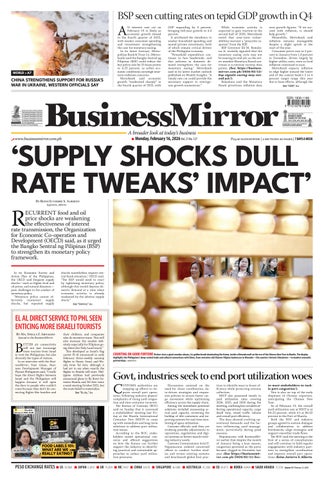
COUNTING ON GOOD FORTUNE Visitors view a giant wooden abacus, its golden beads dominating the frame, inside a Binondo mall on the eve of the Chinese New Year in Manila. The display highlights the Philippines’s deep-rooted trade and cultural connections with China, from centuries-old Chinese-Filipino businesses in Binondo—the country’s historic Chinatown—to modern economic partnerships. NONIE REYES
BSP seen cutting rates on tepid GDP growth in Q4
resumption of rice imports may help contain price pressures.
“With inflation firmly within the target range, the BSP retains room to recalibrate policy in favor of growth,” Metrobank said. Moreover, a 25-basis-point cut would narrow the interest rate gap between the Philippines and the United States to about 50 basis points, raising potential risks to capital flows and currency stability.
However, Metrobank said currency movements are likely to be driven more by business and consumer sentiment rather than rate differentials alone.
Further easing also remains possible as early as April if inflation stays subdued, although sustained increases in rental and utility costs could limit additional rate cuts, it added.
“While supporting growth is the immediate priority, the BSP will continue to balance price stability and financial market considerations in the months ahead.”
Reine Juvierre S. Alberto
Strong consumer spending to lift growth this year—BMI
By Bless Aubrey Ogerio @blessogerio
DOMESTIC
consumption will continue to provide the strongest support for the country’s economic growth even as weaker external demand could weigh on overall output this year, according to BMI.
BMI, a Fitch Solutions company, projected that Philippine economy will expand by 5.2 percent year-onyear in 2026, below the government’s 6 percent to 7 percent target but higher than the 4.4 percent recorded in 2025.
Private final consumption expenditure, a measure of household spending, is forecast to rise by 4.8 percent.
“Consumer purchasing power will expand, supported by stable economic growth and a still-tight labor market facilitating real wage growth,” BMI said in its report. “Key risks to this outlook include elevated sticky inflation, lower remittances and high debt levels.”
For inflation, it is expected to rise slightly, averaging 3.1 percent in 2026, within the Bangko Sentral ng Pilipinas’ target range of 2 to 4 percent.
Latest data from the Philippine Statistics Authority showed that inflation reached 2 percent in January, up from 1.8 percent in December 2025. This marked the highest monthly rate in 11 months, since February 2025’s 2.1 percent.
BMI noted that while nominal income growth is expected to keep pace with rising prices, prolonged inflation, particularly in food, will require households to allocate more of their income toward essential goods.
The agency also highlighted improving labor market conditions, noting that the country has experienced strong employment growth since the pandemic.
The country’s labor market remained stable in 2025, with unemployment at 4.2 percent—or 2.14 million people—still within the government’s target, the Department of Labor and Employment said recently.
The unemployment rate is projected to decline further to 4.2 percent in 2026, supported by government measures such as the Enterprise Productivity Act, the Apprenticeship Bill and the Lifelong Learning Bill.
“The Philippine government was supportive of local labor markets, which resulted in a tightening that pushed up nominal wages,” BMI said, adding that these initiatives are designed to enhance employability, attract investment, and accelerate infrastructure development.
However, BMI noted the recent increases in agricultural unemployment due to reduced activity and cautioned that a slowdown in government programs could affect longer-term labor improvements.
Changes in weather patterns were also cited as a potential mitigating factor for agricultural employment.
Over the medium-term to 2030, BMI expects real household earnings to grow by an average of 5.3 percent per year, accounting for a projected average inflation of 3.1 percent. Household purchasing power in 2026 is expected to be 18.2 percent higher than in 2019, supporting ongoing growth in consumer spending.
“This dynamic will be the key driver behind our consumer spending forecast for the Philippines over the year,” the report said, noting that rising consumption will provide support to the retail sector.
BMI also observed that households are likely to remain cautious in their spending patterns.
Consumers are expected to favor essential services over durable goods and to increasingly seek value-oriented options.
“Therefore, consumers will seek out value-oriented options and will become increasingly selective in their purchasing decisions throughout 2026,” the report read.
Data from the Department of Tourism (DOT) showed a 53.6 percent year-on-year increase in tourists from Israel in 2025 to 24,583. Filipinos traveling to Israel, on the other hand, grew 5.83 percent, yoy, to 8,896 last year, fueled by work and Holy Land tours. Published reports show that hotspot destinations for Israeli tourists include Palawan, Bohol, Boracay, Banaue, Cebu, and Siargao.
‘Survivor’ and safety GOLAN attributed the increasing popularity of the Philippines to, among others, the reality show “Survivor (Israel)” which has filmed its last six seasons in different parts of the Philippines. “It has given lots of buzz [about the country],” he said. He added that the opening of direct flights to the Philippines from the Middle East, especially after the pandemic, has also made the country more accessible to Israelis. He also said that “many Israelis have already discovered the Philippines as a safe destination. Safety, of course, plays a role when Israelis go to a destination.” Historically, the Philippines has provided safe haven to Jewish refugees fleeing Nazi persecution from 1934 to 1941. In many parts of Europe, however, pro-Palestinian sentiment has risen due to Israel’s Hamas counter-attacks in Gaza, resulting in some Israeli nationals being denied service in restaurants, merchandise stores, or harassed in cruise ship ports. Anti-Jewish sentiment also rose briefly in Siargao when plans for a Jewish community center were learned.
disputes while the WTO appellate body remains inactive.
“So, if someone, let’s say, breaches those rules or that set of
While the BSP’s inflationtargeting framework has been largely effective, the OECD noted that repeated price shocks have reduced the impact of policy rate adjustments on market interest rates and borrowing costs.
The repo market, for one, could be developed further to strengthen the pass-through of the policy rate to funding costs, according to OECD.
It recommended adopting more standardized legal frameworks, improving liquidity and expanding participation in repo transactions to fund managers and trust entities to help deepen domestic money markets and reduce reliance on foreign exchange swaps.
The OECD also urged reforms at the Credit Information Corporation (CIC), such as improving information on borrowers and enhancing the completeness and accuracy of the data by complementing it with information from utility companies and online shopping platforms.
Bank lending rates, which are crucial for monetary policy transmission, rose only about half as much as policy rates during the last tightening cycle, according to OECD.
It attributed the weak passthrough partly to the interbank market’s heavy reliance on for-
rules, then there has to be some mechanism to resolve that. That is the most important part,” he said.
eign exchange swap transactions, which link domestic funding conditions to US dollar markets and add volatility to interest rates.
High credit risk premiums, especially in household lending, also dilute the effect of changes in funding costs on borrowing rates, the OECD said.
The OECD said that without stronger financial market infrastructure and better credit data, monetary policy will remain less effective in responding to inflation pressures and economic slowdowns.
In addition, improving monetary policy communication, such as explaining when inflation will be allowed to temporarily overshoot the target following extreme weather events, could be an alternative to tightening monetary policy to respond to adverse supply shocks.
“Given that supply conditions are outside the central banks’ control and that tightening monetary conditions to bring demand in line with temporarily lower supply can reduce output more than necessary, efficient management of inflation expectations is crucial to deal with supply shocks,” OECD said.
The BSP could also lengthen the horizon of all surveys by adding 5-year forecasts on top of the forecast over the next year to distinguish the anchoring of inflation expectations more clearly from short-term inflation expectations, it added.
After operating in the Philippines for the past 12 years, Golan, who is also Vice President for Internal Affairs of the Israel Chamber of Commerce in the Philippines said, “We’ve seen in the past year a really big increase of all kinds of Israelis coming here. Luxury and lowbudget [travelers], and families as well.” His company handles freely independent travelers, groups (incentive tours), also FIT (freely independent travelers), and honeymooners.
Pinoy friendliness, hospitality HE underscored that Israelis are also aware of the innate hospitality of Filipinos due to the caregivers who help their seniors, “and when they travel here, they see the hospitality, and they tell their friends. Word-of-mouth is the one of the best advertising [for the Philippines].”
During the Hamas terrorist attack on Israeli towns near the Gaza border in October 2023, many Filipino caregivers risked their lives to protect their vulnerable employees, as they waited for rescue from Israeli forces.
Golan stressed the “friendliness” of the Philippines that many hotels and resorts in its tourist destinations—“even fivestar hotels” have been “open to amend something in the [dining] menu, special requests, especially, [bringing in] kosher food from outside, which is a very unusual request…. In other Asian countries, this is almost impossible to do…. They don’t want this headache of special requests.”
Some hotels impose a “reasonable” corkage fee, he explained, while others provide a meeting room “for free” so the tourists can be allowed to pray and eat their own food there, apart from the regular customers at the main dining outlets.
Golan said he hopes to expand more offerings to his clients and is eyeing new destinations such as Siquijor, Negros Oriental, and Camiguin.
Legislator to China: Do not use Pinoy workers as pawns
By Jovee Marie N. dela Cruz @joveemarie
LAWMAKER condemned what
Ahe described as veiled economic threats from the Chinese Embassy, warning that Filipino workers should “never become targets for reprisal” amid escalating tensions over sovereignty.
Party-list Rep. Perci Cendaña of Akbayan said he was alarmed by recent statements from embassy officials suggesting that deteriorating diplomatic relations could jeopardize millions of jobs in the Philippines. He argued that such remarks went beyond routine diplomatic responses and amounted to pressure on the country’s economy and national security.
“Such utterances are not a warning but a veiled threat against our country’s economy and national security,” he said, adding that
Navy frigate debuts in India exercise
THE Navy (PN) on Sunday said that the guided missile frigate, BRP Miguel Malvar (FFG-06) and the contingent aboard the ship, had arrived at Visakhapatnam, India, to participate in the Third Indian Navy International Fleet Review (IFR) and Multilateral Naval Exercise (Milan 2026).
Both events are hosted by the Indian Navy.
The IFR is set for February 18 while MILAN 2026 is set for the last week of February.
“This marks the first time the PN is participating in a naval exercise held in India and the first foreign mission for FFG-06, promoting Philippine maritime diplomacy and regional cooperation,” it added.
The ship and its company left the country on February 5 and arrived in India on the 14th.
“During the harbor phase, the PN contingent will engage in scheduled activities, including multinational maritime operations, professional exchanges, and an International Maritime Seminar involving Chiefs of Navy, senior leaders, scholars, and practitioners.
Highlight of the event is BRP Miguel Malvar’s participation in the Third International Fleet Review with the President of the Government of India, Honorable Droupadi Murmu, as the reviewing officer, bringing together naval forces from friendly countries to showcase capabilities and commitment to collective maritime security and cooperation. Cultural programs, sports activities, and ship visits are also planned as part of the engagement,” the PN statement said.
Naval Task Group-80.5 will also participate in the sea phase of Milan 2026, which will include tactical maneuvers, communication drills, and maritime security operations to enhance coordination and interoperability among participating navies.
“BRP Miguel Malvar’s deployment represents a historic milestone for the Philippine Navy, reflecting its expanding role in international naval diplomacy. The PN’s participation in both IFR and Milan 2026 places the Philippines together with major maritime partners in a forum designed to promote peace, maritime stability, and cooperative security in the Indo-Pacific region,” the PN added. Rex Anthony Naval
BI bares arrest of ‘Chinese spy’
economic leverage should not be used as a tool in political disputes. He also raised concern over what he described as continuing harassment of Filipino fishermen in the West Philippine Sea.
“It is worrying that official representatives of the Chinese government would casually use threats as if economic hostage-taking was a valid recourse in diplomatic disputes,” he added.
“It’s disheartening that our fishermen are already being bullied in the West Philippine Sea, and now China is threatening the entire country as well,” Cendaña said. Cendaña called on Beijing to retract the statements and urged the Philippine government to adopt safeguards to protect the national economy from possible retaliation. He also pressed authorities to ensure the safety of Filipinos residing in China and its special administrative regions,
Macau and Hong Kong, citing past incidents in which Filipino nationals were detained during diplomatic disputes.
The lawmaker referenced a 2011 trade restriction imposed by Beijing on Philippine bananas and pineapples following a standoff at Bajo de Masinloc, also known internationally as Scarborough Shoal.
“We hope the Chinese Embassy will walk back its statement and refrain from such talks. Such threats, however, are not new.
In 2011, it banned the entry of Philippine bananas and pineapples in retaliation for a standoff in Bajo de Masinloc,” said Cendaña.
Last Friday, Ji Lingpeng, spokesperson of the Chinese Embassy, defended the mission’s response to recent actions by Filipino legislators, including proposals critical of China and calls to declare Chinese diplomats persona non grata.
Quoting remarks attributed to Senate
President Vicenter Sotto III about political provocation, Ji questioned the authority and motives of lawmakers pushing for tougher diplomatic measures.
He warned that any serious downgrade in bilateral relations could result in significant job losses and accused some politicians of grandstanding on sensitive foreign policy matters.
“Any serious damage to diplomatic relations, including downgrading of those relations, would cost millions of jobs. Are these senators prepared to personally compensate those for their lost incomes? Or is grandstanding easier when someone else pays the price? ” Ji said.
The Senate has adopted Resolution No. 256 condemning statements by the Chinese Embassy in Manila that criticized Philippine officials and institutions for defending national sovereignty and maritime rights.
Lacson: Senators facing charges in ICC should have chance to access legal remedies
SENS. Ronald dela Rosa and Christopher Lawrence Go, named by the International Criminal Court (ICC) as ‘co-perpetrators’ in former President Rodrigo Duterte’s war on drugs, should have all chances to avail themselves of legal remedies, Senate President Pro Tempore Panfilo M. Lacson said. Lacson also said that Philippine courts must be respected in whatever course of action the ICC may take regarding the two senators.
“I think they should have the chance to avail of all legal options because our local courts and processes must be respected. If there is an arrest warrant from the ICC or a foreign court, it should go through our local court, which will issue a corresponding order to implement the foreign entity’s arrest warrant,” Lacson said in a mix of English
and Filipino in an interview on dwIZ, when asked if the two should have the chance to avail of all legal remedies.
The Senate, he added, will discuss possible options on what course of action to take, including possible assistance to extend to dela Rosa and Go.
Lacson said Senate President Vicente Sotto III may call a caucus and consult the senators. The minority led by Sen. Alan Peter Cayetano will also call a meeting in what to do, especially in helping Dela Rosa and Go, both members of the minority, according to Sen. Robinhood Padilla.
In a separate dwIZ interview also on Saturday, Padilla said he quickly sought out Cayetano when he learned of the news that the ICC had tagged Go and dela Rosa as co-perpetrators.
Dela Rosa, the first to be named National
Police chief when Duterte became president in 2016, was the chief enforcer of the bloody war on drugs, which ran for three years until 2019. Go, special assistant to the President, was named in some accounts as the one who handled the funds for “rewards” given to those who carried out the campaign.
Meanwhile, Lacson said it is still too early for now to come up with a more detailed set of options for their two peers, because the ICC has not issued a bill of particulars indicating the charges and penalties the two senators may face.
“The Senate’s lawyers will study possible courses of action to take, given the circumstances,” he said.
“On the part of the senators, we’ll discuss the matter, if the senators decide to extend help. We’ll cross the bridge when we get there,” he added. Butch Fernandez
Presence of Filipino seafarers on Russian vessels worries Tulfo
THE safety of more than 24 Filipino seafarers currently on the crews of Russian ships is the urgent agenda at a meeting this week between the Senate Foreign Relations committee chairman, Sen. Erwin Tulfo, and officials from the Department of Foreign Affairs (DFA) and the Department of Migrant Workers (DMW).
The meeting follows reports that these seafarers may be at risk of being caught in the crossfire of the Russia-Ukraine war. “We want to determine the specific steps the DFA and DMW are taking to ensure the safety and security of these seafarers,” Tulfo stated. The data regarding the number of Filipino seamen was shared by Ukrainian Ambassador Yuliia Fediv during a courtesy call with the senator last week.
Tulfo emphasized the need to verify the employment status of the affected Filipinos.
“I want the DMW to find out if these seamen were direct hires or if they were deployed through local manning agencies,” the lawmaker said.
He further clarified the legal implications of their employment: “If they were deployed through a manning agency, that company holds responsibility for their welfare should anything happen to them. However, if they were direct hires, we can appeal for them to return home immediately, as their lives are in grave danger.”
At the same diplomatic visit, Tulfo also urged Fediv to allow Raymon Santos Gumangan, a Filipino prisoner of war (POW) in Ukraine, to communicate with his family in the Philippines, even if only via telephone. Gumangan was reportedly captured by Ukrainian forces while serving under the Russian military. This is despite accounts
from his family that he had originally secured employment as a ‘logistics truck driver’ through an online job portal, only to find himself entangled in the conflict upon arrival.
Fediv committed to facilitate a way for Gumangan to reach his family. The Ukrainian envoy also assured the senator that Gumangan is being treated humanely in accordance with the Geneva Convention relative to the Treatment of Prisoners of War.
The case of the two dozen seafarers is but the latest in the continuing efforts of government to prevent jobseekers from falling prey to human traffickers who could recruit them for ostensibly good-paying, legitimate jobs, but they end up as unwilling members of scamming syndicates in Indochina, or as mercenaries in foreign conflicts.
Butch Fernandez
PNP to deploy 11.5K cops to secure ‘Trillion Peso March’
TTSenators’ dialogue with Chinese embassy on WPS issues eyed
By Butch Fernandez @butchfBM
TAKING heart from the expression by Chinese Ambassador to the Philippines Jing Quan of a willingness to sit down with Philippine leaders to ease the word war between Chinese diplomats and Philippine officials, Senate President Pro Tempore Panfilo Lacson said at the weekend he is open to initiating a dialogue between the Senate and the Chinese Embassy.
Describing Jing’s statement as a “pleasant surprise,” Lacson told dwIZ radio he will propose to Senate President Vicente Sotto III that the Senate invite the Chinese diplomats to a meeting or a dialogue.
“I will suggest to the Senate President that the dialogue include at least members of the Senate majority. The minority can send their representatives to take part,” he said in a mix of English and Filipino.
“To me, that’s a good opening we should consider and we should grab the opportunity to initiate such talks. We can meet at the Senate, or the embassy grounds, or a neutral area. It would be good to sit down and discuss what needs to be discussed. After all, we have diplomatic ties with China. We even have a One China Policy,” he added.
It would be better, Lacson noted, that Sen. Francis Pangilinan—sponsor of a Senate resolution condemning the Chinese embassy’s
recent remarks against Philippine lawmakers and public officials—join the dialogue, along with Sen. Anna Theresia Hontiveros.
The newly installed chairman of the Senate Foreign Relations committee, Sen. Erwin Tulfo, could also take part in the meeting, he added.
“It would be better to meet face to face, because it would be more cordial and professional—instead of debating the issue in the Senate session hall,” Lacson said in the dwIZ interview. “The ambassador has said ‘let’s talk.’ That’s an open invitation and a good opening to discuss things in a cordial, professional and diplomatic atmosphere.”
“Jing was quoted as saying earlier this week that the Chinese side ‘always advocates dialogue,’ adding, ‘Let’s sit down. Let’s talk. Let’s find ways to manage differences.’”
His remarks followed the Senate’s adoption of a resolution condemning the Chinese Embassy in Manila’s remarks criticizing Philippine officials who asserted maritime rights in the West Philippine Sea. The embassy played down the significance of such resolution, saying senators may adopt so many resolutions and it wouldn’t change anything, inviting more acerbic remarks from senators.
But on Saturday, Lacson said, “We may have our disagreements regarding territory, but we can at least agree on how to handle the situation through discourse.”
‘Sinaloa drug cartel member’ walks free
THE Court of Appeals (CA) has ordered the Bureau of Immigration (BI) to immediately release alleged Sinaloa drug cartel member Gregory Johann Haas from its custody, declaring that his continued detention is illegal.
In a 19-page decision, the CA’s Eleventh Division affirmed the December 16, 2024 order issued by the Branch 267 of the Regional Trial Court I Taguig City which granted the petition for habeas corpus filed by Haas’ Filipino mother Soledad Tolentino Haas.
“The Director of the Bureau of Immigration is hereby directed to cause the immediate release of Gregor Johann Haas and to inform this Court, within five days from notice of this decision, the action taken thereon,” the CA said in a decision issued on February 5, 2026.
Alternatively, if Gregor Johann Haas is not under the direct custody of the Office of the Director, the obligation to immediately release him and to report compliance shall devolve upon the officer, unit, or division of the Bureau of Immigration that has, or last exercised, custody over his person,” it added.
Haas has been in the custody of the BI since his arrest in May 2024 in Cebu by immigration operatives in coordination with the United States Drug Enforcement Agency and the Philippine Naval Intelligence and Security Group.
rules of procedure.
It noted that Haas’ arrest stemmed from a request from the Indonesian authorities to have him deported for a crime he allegedly committed in Indonesia.
As a result of the said request, he was charged with violating immigration laws, a summary deportation was issued, and a red notice was published against him which led to his arrest.
However, the CA said Haas detention through an arrest pursuant to a mission order violates his basic constitutional rights under Section 1, Article III of the Philippine Constitution which states: “No person shall be deprived of life, liberty, or property without due process of law, not shall any person shall be denied the equal protection of the laws…” This applies, according to the CA, both in judicial and administrative proceedings. For administrative arrest such as in the case of Haas, the CA held that the deprivation of the right of the person arrested is only provisional, aimed at suppressing the imminent danger that the person arrested might pose to society. Thus, the CA stressed that the person arrested must be formally charged within a reasonable time.
Likewise, to prove the constitutionality of the arrest, a verified notice must be submitted to the nearest RTC for the issuance of an order of commitment.
By Joel R. San Juan @jrsanjuan1573
HE Bureau of Immigration on Sunday announced the arrest of an alleged Chinese fighter jet pilot who reportedly enrolled in an aviation school to be able to take aerial pictures of the Iba Airport and surroundings in Zambales. The suspect was identified as Boldbaatar Bold-Erdene, 30, a Mongolian national and graduating pilot student of the All Asia Aviation Academy. Bold-Erden was arrested by the operatives of the BI in coordination with the Armed Forces (AFP) and other law enforcement and intelligence agencies on February 12 at the aviation school located at Lipay Dingin, Iba, Zambales
“Spy,”
HE National Police (PNP) on Sunday announced that some 11,500 policemen will be deployed to secure participants in the so-called “Trillion Peso March” and its related activities scheduled from February 22 to 25. Gen. Jose Melencio Nartatez
Jr., National Police chief, in a statement, called for coordination and preparedness as the police beefs up its readiness for these large-scale public gatherings which are expected to gather around 50,000 participants.
“We are committed to proactive, visible, and responsive policing during
these events. Safety is our top priority so we are calling on all organizers to coordinate and cooperate with the PNP,” he said in a mix of Filipino and English.
To further strengthen coordination,
Nartatez orders manhunt vs. killers of former beauty queen, coop exec
THE National Police (PNP) Chief, Gen. Jose Melencio Nartatez Jr., on Sunday ordered a full-scale manhunt against the gunmen behind the fatal shooting of a former beauty queen in Isabela and a director of an electric cooperative in Oriental Mindoro. “Strong words of condemnation against these cowardly attacks are not enough, we will focus on identifying and arresting all those involved in these two killings in the interest of justice and the rule of law,” Nartatez said. In Isabela, former Ms. Philippines-Earth runner up and now school teacher Lullete Jane Ramilo-de Guzman was inside her car with her children when a gunman shot her
in barangay Cabaritan in San Manuel town. Meanwhile, in Oriental Mindoro, Antonio M. Mendeja, a director of the Oriental Mindoro Electric Cooperative, was on a brief stop to check on his vehicle in Pinamalayan town, when a still unidentified gunman shot him. Nartatez said he had already ordered the directors of Police Regional Offices 2 and 4B to look deeper into the two cases to determine the motive and subsequently lead to the identification and arrest of those responsible.
He also directed all police commanders to further intensify the conduct of crime prevention measures that include establishments of checkpoints, police visibility
and strategic deployment of personnel under the Enhanced Managing Police Operation. These measures, he said, must be complemented with aggressive operations against loose firearms and accounting for wanted persons, whom he said, are usually repeat law offenders.
Such crime prevention measures are among the best ways to deny criminal elements the opportunity to strike as they ensure immediate response and certainty of arrest. Nartatez also urged anybody with relevant information on the two incidents to assist in the conduct of the investigation. Rex Anthony Naval
Based on the BI’s records, Haas arrived in the country on August 15, 2023 using a passport issued by the Australian government which identified him as an Australian citizen.
On February 13, 2024, the National Narcotics Board of the Republic of Indonesia requested from the BI the deportation of Haas for being a person wanted in Indonesia for drug trafficking.
This prompted the bureau to issue a charge sheet for deportation order against Haas for violating the terms of his entry into the country, being a fugitive from justice and that his presence in the country poses a risk to public interest.
Soledad then sought the release of her son through a petition for a writ of habeas corpus before the RTC in Taguig.
She argued that since Haas was born to a Filipino mother and is therefore a naturalborn Filipino citizen, thus, he cannot be the subject of deportation proceedings.
She also denied accusations that her son is a drug lord and wanted by Indonesian authorities for drug trafficking.
The CA held that the filing of charge sheet and the issuance of the summary deportation proceedings order observed the
In the case of Haas, the CA noted that no deportation proceedings have been initiated since his arrest two years ago. It also noted that no notice and commitment order has been issued by a trial court to warrant his detention at the BI’s facility.
Furthermore, the CA pointed out that the Embassy of the Republic of Indonesia has not followed up on the case of Haas since it sent a letter to the BI on August 19, 2025, stating that its government is processing his extradition.
“However, there is no record to date showing that the said extradition proceeding has already been commenced,” the CA said. The appellate court also said that the August 19, 2025 letter from the Indonesian embassy came after Interpol had already lifted the Red Notice against Haas.
“Notwithstanding these developments, Gregor is left in continued confinement, in violation of his basic constitutional right to liberty. While the Bureau’s power to issue warrants or effect warrantless arrests
A4 Monday, February 16, 2026 www.businessmirror.com.ph
Customs told: Explain use of intel funds
By Jovee Marie N. dela Cruz @joveemarie
ALEADER of the House of Representatives has pressed the Bureau of Customs to explain how its intelligence funds are being used, as the House Committee on Ways and Means investigates the country’s multi-billion-peso cigarette smuggling trade.
would need to verify details of the intelligence fund, noting he would oversee it for the first time this year. BOC Commissioner Ariel Nepomuceno did not attend the hearing allegedly due to a prior commitment.
Chua underscored that lawmakers—particularly those from Mindanao—operate without intelligence funds yet still observe the scale of illicit tobacco distribution on the ground, raising concerns about how effectively the BOC deploys its resources.
former BOC-Customs Intelligence and Investigation Service Director Thomas Narcise and former BOC CIIS Field Station Chief-Port of Manila Paul Oliver Pacunayen.
Earlier, lawmakers—including Cagayan de Oro Rep. Rufus Rodriguez and the House Committee on Ways and Means chairman, Rep. Miro Quimbo of Marikina—called out the BOC for its unpreparedness in facing the committee’s hearing on cigarette smuggling, which is the key agency tasked to combat the illicit activities.
Low income, marginalized families get easier access to power subsidies
PRESIDENT Marcos announced over the weekend that lowincome and marginalized families now have easier access to electricity subsidies.
receive a 100 percent discount. Lowincome households not enrolled in 4Ps but below the poverty threshold and with minimal electricity use may also apply for the subsidy.
Sinaloa.
Continued from A4
stems from the police power of the State to restrain and regulate the use of liberty and property for the general welfare, such right is not unlimited as it should not be utilized to violate constitutionally guaranteed rights of a person,” the CA said.
“In this regard, the Court finds the grant of the petition for habeas corpus in order,” it added.
In addition, the CA said based on the evidence on record, Haas is a natural- born Filipino citizen, which confirms the findings that his detention is illegal.
“There is no denying that Soledad did not renounce her Philippine citizenship and remained a Filipino even after she married her foreign husband in 1977 and gave birth to Gregor in 1978. Consequently, Gregor is a natural-born Filipino citizen for having been born to a Filipino mother, under the governing 1973 Philippine Constitution…,” the CA explained.
While Haas became an Australian citizen by naturalization in 1986, the CA said he took the Oath of Allegiance to the Philippines pursuant to Republic Act 9225, or the Citizenship Retention and Re-acquisition Act of 2003, the final act that confers Philippine citizenship.
“Thus, having established Gregor’s Philippine citizenship...the Court holds that the Bureau has no jurisdiction to deport Gregor, as he is not an alien but a natural-born Filipino citizen,” the CA declared. Joel R. San Juan
Continued from A4
BI said he was arrested for being an undesirable alien who poses a risk to public interest and safety.
Official intelligence information indicate that Bold-Erden graduated as a jet fighter pilot, with suspected affiliation to the Chinese government.
During flight exercises, Bold-Erden reportedly conducted aerial photography of Iba Airport and the nearby Palauig River area, approximately five nautical miles from the airport.
The Bureau emphasized that foreign nationals found to be engaging in activities inconsistent with their visa status, especially those with potential national security implications, will face immediate action.
“The Philippines will not allow its institutions, including civilian training facilities, to be used for activities that may compromise national security,” the Bureau stated. “Our immigration laws are clear— foreign nationals must strictly adhere to the conditions of their stay.”
Following his arrest, Bold-Erden was transported to the BI Main Office in Manila for booking, medical examination, and biometric processing. He was subsequently transferred to the Bureau of Immigration Warden Facility pending deportation proceedings. With Henry Empeño
BOC Deputy Commissioner for Intelligence Romeo Allan Rosales recently told lawmakers that he
Manila Rep. Joel Chua, chairman of the Committee on Good Government and Public Accountability, questioned why illicit cigarettes remain widely available—even in small neighborhood stores—despite the bureau’s access to confidential funds intended to support surveillance and enforcement operations.
“In fact, Congressman Zia [Adiong of Lanao del Sur] said that these can be bought over the counter from small neighborhood stores, and yet, we don’t know what’s happening,” the Manila lawmaker added.
The committee is expected to continue examining potential links between customs personnel and smuggling operations, following complaints involving
Quimbo described the worsening illicit tobacco trade as “the new Pogo,” referring to the now-banned Philippine Offshore Gaming Operations.
From December 2025 to February 2026, Quimbo said authorities conducted seven major operations that seized 782.1 million contraband cigarette sticks, equivalent to P1.84 billion in foregone revenues.
Group warns vs ‘toxic’ Lucky Charms
By Jonathan L. Mayuga @jonlmayuga
AWASTE and pollution watchdog warned the public on Sunday against buying lucky charm bracelets with metallic components, because there is a big chance that they contain toxic chemicals.
The group issued the warning as tens of thousands head to Binondo, Manila and other Chinatowns across the country to buy tikoy (glutinous rice cake) and other Chinese New Year favorites.
Luck seekers often look for items to activate good luck, health, and fortune to usher in the Year of the Fire Horse, which is associated with immense energy, passion, and a burning drive for success.
To show the health risks of some luck activators, the group purchased 22 bracelets sold for P35 to P150 each from sellers in Binondo, Quiapo, and Santa Cruz districts and screened them for heavy metals, particularly cadmium, using an X-Ray Fluorescence (XRF) analyzer.
The Pi Yao (aka Pi Xiu) and other metallic charms, including a unicorn (a mythical animal resembling a horned horse), of the bracelets were found laden with high levels of cadmium.
Of the 22 lucky charm bracelets purchased and analyzed, nine were found to contain Pi Yao and other auspicious symbols with cadmium levels exceeding 100 ppm, the European Union’s limit for cadmium in jewelry.
Of these nine bracelets, seven had metallic components with cadmium above 100,000 ppm. The other two had cadmium levels of 2,170 ppm and 4,257 ppm respectively.
The presence of cadmium in the nine bracelets indicates that some jewelry manufacturers use this highly toxic metal to add mass and weight to the product and achieve a lustrous finish. On the other hand, the absence of cadmium in the 13 bracelets shows that it can be replaced with non-toxic materials.
The World Health Organization (WHO) has listed cadmium among the 10 chemicals or groups of chemicals of major public health concern. It has recommended the “elimination of use of cadmium in products such as toys, jewelry, and plastics” as one of the interventions to reduce cadmium releases and occupational and environmental exposure.
According to the WHO, “cadmium exerts toxic effects on the kidneys as well as the skeletal and respiratory systems [and] is classified as a human carcinogen.”
While swallowing jewelry poses the highest risk of cadmium exposure, chronic exposure may occur through habitual oral contact. Children can absorb the metal by chewing, sucking, or mouthing these items. Because children under six frequently put objects (and their hands) in their mouths, they are at a higher risk.
To address this threat to public health, the EcoWaste Coalition called for a comprehensive review of existing regulations to fix the loopholes that allow high-cadmium jewelry to enter the local market.
Since ordinary consumers cannot visually distinguish safe metallic components from those containing cadmium, the group pushed for mandatory labeling that details chemical ingredients and potential health or ecological risks.
These actions, the EcoWaste Coalition said, “will help advance the Filipino people’s right to health, as guaranteed by the Constitution, as well as promote the Global Framework on Chemicals - For a Planet Free of Harm from Chemicals and Waste,” which aims “to prevent or, where prevention is not feasible, minimize harm from chemicals and waste to protect the environment and human health, including that of vulnerable groups and workers.”
NFA eyes auction of old stocks at regional level
clogged,” he added.
TMarcos said the application process for the Net-Metering Program has been streamlined, enabling households to install solar panels and sell excess power to the grid more quickly.
“Simply put, the rules are clearer and the process is faster. This administration will continue to work hard and hand in hand with the private sector in crafting processes, policies that make electricity accessible, affordable, and reliable,” Marcos said during the ‘Collective Response to Presidential Commitments In the Energy Sector’ on Saturday.
The President also welcomed the collaboration between the government and key stakeholders, including the Manila Electric Company (Meralco), to expand electrification, increase capacity, and reduce electricity costs.
Marcos noted that the Lifeline Rate Subsidy Program (LRSP), which assists low-income households struggling to pay full electricity costs, has long been underutilized owing to complex requirements. As of November 2025, only about 334,000 consumers were registered—roughly 11 percent of the approximately three million beneficiaries of the Pantawid Pamilyang Pilipino Program (4Ps).
He announced that beginning this month, all 4Ps beneficiaries will be automatically registered in the LRSP in coordination with distribution utilities.
“This month, together with the distribution utilities or DUs, we will implement the automatic registration of all 4Ps beneficiaries under the LRSP,” said Marcos.
“This is the kind of government we are building. Filipinos should not have to chase assistance—assistance should reach them,” he said.
Under the revised lifeline consumption threshold, 4Ps beneficiaries consuming 50 kilowatthours (kWh) or less per month will
The President shared that although the Net-Metering Program has existed for over a decade, unclear rules and limited capacity among electric cooperatives previously made the application process difficult. The program allows households and businesses to install renewable energy systems, such as solar panels, and sell surplus electricity back to the grid— reducing bills while supporting the power supply.
“Now, after sitting down with the Department of Energy and the ERC [Energy Regulatory Commission], we have found a way to make it easier for our people to participate in the NetMetering program,” the Chief Executive announced.
After consultations with the Department of Energy and the Energy Regulatory Commission, the government identified measures to make participation easier.
To speed up applications, the DOE, Department of the Interior and Local Government, and Department of Public Works and Highways signed a Joint Memorandum Circular requiring local government units to use standardized forms and comply with mandated processing timelines. The ERC also directed distribution utilities to complete interconnection within 20 working days after accepting a letter of interest.
The President recognized Meralco’s continued support in advancing national energy goals—from expanding renewable capacity through large-scale solar and battery storage to electrifying remote communities and supporting net-metering and lifeline rate initiatives.
He encouraged Filipinos to take full advantage of these programs to help secure a more stable and sustainable future for their families.
Jovee Marie N. dela Cruz
DAR, NCIP secure FPIC for livelihood projects in Tabuk City
By Ada Pelonia @adapelonia
HE National Food Authority (NFA)
wants to bring the auction of aging rice stocks down to the regional level to expedite bidding.
NFA Administrator Larry Lacson said the grains agency has outlined adjustments to the terms of reference (TOR) that may apply to the next auction round in early April, pending approval from the NFA Council.
“The TOR is being adjusted, since it’s necessary based on our previous auctions [...] we’re considering lowering the [minimum] volume of offer and bringing the auction process down to the regional level,” Lacson recently told reporters.
“For faster and more efficient [process], the auction should be brought to the regional level since the central [office] gets
Continued from A4
Nartatez said they will conduct a coordination conference this coming week in line with the processing of permits and finalization of operational plans with event organizers.
Nartatez also urged the public to cooperate with authorities to ensure the peaceful conduct of the activities. Police deployment for the event will
Under the current TOR, the minimum acceptable quantity or volume of offer should be 5,000 50-kilo bags per lot, with Lacson citing stakeholders’ suggestion to bring it to around 3,000 bags instead. However, he did not disclose the final volume for the threshold.
The grains agency offered 737,339 bags or 36,866 metric tons (MT) of its aging rice stocks for the February auction.
Despite the adjustments, the NFA chief said the floor prices remain within the P22 to P25 per kilo range.
Meanwhile, Lacson also mentioned that the private sector is more keen on the aging rice trade despite the resumption of imports amid delays in rice arrivals.
“We think more stakeholders in the private sector have become interested in the auction now,” he said.
be led by the Quezon City Police District with 2,642 personnel followed by the Manila Police District with 2,438, Southern Police District with 2,322, Northern Police District with 1,056, and Eastern Police District 1,000. These forces will be reinforced by personnel from the Regional Headquarters with 700, Regional Intelligence Division with 73, Regional Mobile Force Battalion with 558, and Special Action Force with 77. Support units will also be mobilized to ensure full operational readiness,
“We’ve also discussed within the department that the timing of the import was slightly delayed, which triggered the retail price to inch up. So, many of our local traders or the private sector need supplies.”
The NFA posted a notice on its website on February 5, inviting the public to participate in the tender for over 36,000 MT of aging rice with a total transaction value of P912.43 million.
Interested bidders should tender a 10-percent bond of the total price offer, which will be deducted from the overall payment of the winning bidder. The opening of the auction tenders will be on February 20, according to the NFA.
The auction is open to interested farmers’ organizations, cooperatives, or groups and private individuals or entities engaged in the grains business, including processing, wholesaling, and retailing.
including the Regional Communications and Electronics Unit with 45, Regional Highway Patrol Unit with 24, Regional Explosive Ordnance Disposal and Canine Unit with 103, and the Regional Medical and Dental Unit with 10. In total, the combined initial deployment will reach 11,498 personnel. This comprehensive security coverage is expected to ensure effective crowd management, traffic control, emergency response, and public safety monitoring throughout the scheduled events.
THE Department of Agrarian Reform (DAR) and the National Commission on Indigenous Peoples (NCIP) have secured Free, Prior, and Informed Consent (FPIC), which could pave the way for more livelihood opportunities and climate-resilient farms in Tabuk City, Kalinga.
The consultation was held within the ancestral domain of Biga, covering barangay Amlao, Suyang, and parts of barangay Balawag (Paligato), to ensure that tribesmen or indigenous peoples (IPs) have a clear voice in projects that will directly affect their communities.
Some 70 participants—tribal elders, Indigenous Peoples Mandatory Representatives (IPMRs), women and youth leaders, barangay officials, and residents—gathered to discuss and gave their consent to the proposed Value Chain Innovation for Sustainable Transformation in Agrarian Reform Communities (Vista) Project.
Funded by the International Fund for Agricultural Development (Ifad), the sixyear Vista Project is designed to create sustainable sources of income for farmers while protecting the environment. It will support reforestation and agroforestry, including the planting of high-value crops such as coffee and cacao, helping farmers increase earnings, strengthen food security, and build climate-resilient farms.
The project also ensures that women and youth are active partners, opening more opportunities for families to earn and grow
together. Most importantly, the project will only move forward with the free and informed approval of the IP communities through the FPIC process.
NCIP officials explained the FPIC procedures, emphasizing the protection of IP rights and the importance of documenting community decisions through a Resolution of Consent and a Memorandum of Agreement.
Barangay Chairman John Wansi of Suyang stressed that consultations like this are vital to ensure that development respects culture, land rights, and community welfare.
“We thank the DAR and NCIP for listening to our people and consulting us first before any project is implemented in our ancestral lands,” Wansi said.
During the open forum, residents raised concerns about land eligibility, farm-tomarket access roads, boundary issues, and the inclusion of remote farms. These were clarified by DAR and NCIP representatives, and validation teams were deployed to assess the proposed areas.
The activity supports the directive of Agrarian Reform Secretary Conrado M. Estrella III to promote people-centered, rights-based, and sustainable development for rural and Indigenous communities. With this FPIC process, the groundwork is now set for livelihoods that protect the land, respect culture, and improve the quality of life of IP farmers in Tabuk City. Jonathan L. Mayuga
Govt upbeat on biosecurity plan for bananas
TBy Ada Pelonia @adapelonia
HE Bureau of Plant Industry (BPI), an attached agency of the Department of Agriculture (DA), is optimistic that the Philippines’ proposed alternative biosecurity measures for banana shipments would hurdle the initial scrutiny of the Australian government.
Canberra is currently evaluating a request from the Philippines to review alternative biosecurity measures that will facilitate market access for local bananas.
BPI Director Gerald Glenn Panganiban said that while the Australian government is open to receiving bananas from the Philippines, the trade should still be backed by science.
“I can’t say whether we’ll [secure market access] a month or two from now, but the good thing is we’re always moving forward and progressing,” he recently told reporters.
Panganiban said the alternative biosecurity
measures include pushing for a “holistic way” to sanitize local plantations through the Philippine Good Agricultural Practices (PhilGAP).
He added that the country has also intensified the testing of residue levels before sending farm goods to foreign markets.
“The [Australian counterpart] was supposed to visit the Philippines last year to [check these practices], but they couldn’t due to certain difficulties,” Panganiban said, adding that the schedule of the visit remains “uncertain.”
“The ball is no longer in our court, since the technical information is already in
America’s vanishing cattle herd drives 15% price hikes for beef
WHILE US inflation has cooled from its pandemic-era peak, prices at grocery store meat counters are skyrocketing with no relief in sight.
Beef costs have risen faster than most other items in the consumer price index, with the broad beef and veal category up 15 percent over the past year as of January. Uncooked ground beef reached a fresh record after soaring by the most since June 2020 in government data released Friday.
The gains are a standout from the rest of the consumer grocery basket where things have broadly improved. Chicken prices rose only by 1.1 percent in the past 12 months, while milk was little changed.
The blame game for what’s behind the beef price surge has pressured the White House to respond. US President Donald Trump has vowed to increase competition in beef processing and boosted Argentinian beef import quotas to ease supply.
But it’s not that simple: The US cattle herd has shrunk in recent years to the smallest since the early 1950s because droughts and higher production costs, including elevated interest rates, have made raising the animals more expensive.
While the cattle industry is cyclical, the current contraction has lasted longer than expected because there’s a lot more money to be made selling animals for slaughter while very young rather than keeping them to expand herds.
At current levels, any expansion in the US herd would at the earliest make it to the retail counter in 2028, keeping beef prices elevated for longer, said Don Close, a senior animal protein analyst at Terrain Ag.
The ongoing cattle shortage has been a boon for ranchers, particularly the socalled cow-calf producers at the start of the supply chain who sell young animals to other ranchers. “In my opinion, you should be profitable right now as a cow-calf operation,” said Brandi Buzzard, a rancher in Kansas.
But even they see their conditions as precarious. Oklahoma-based Kacie Scherler, a fifth-generation rancher, says she’s being squeezed by an inflationary environment, with costs for equipment, repairs and land rent all soaring in tandem.
“It actually feels extremely fragile,” said Scherler, who with her husband Zach Abney runs a 5,000-acre cow-and-calf enterprise.
“So even though cattle are worth more than they have ever been, it costs a lot more to stay in business.” Meanwhile, the US has halted ship -
Australia. They’re coming here to verify the information we submitted.”
According to the Department of Agriculture, Fisheries and Forestry (DAFF) of Australia, Australian representatives will undertake a technical visit to the Philippines in early 2026.
“On this visit, we will gather information on Philippine commercial production, pest
‘Lifting
ments of live cattle from Mexico after the reemergence of the New World screwworm, a deadly parasite.
Imports from South American countries are slated to benefit consumers, but those supplies go primarily into ground beef and don’t mark a quick fix for the cattle shortages.
Further down the supply chain, former Army Ranger Patrick Montgomery, who runs KC Cattle Company, located outside Kansas City, Missouri, has been stung by high prices. He sold a large swathe of his herd last year to replenish the genetic bloodlines but soaring costs since means he hasn’t been able to replenish them.
To illustrate his point, Montgomery reckons that a so-called bottle calf (one that was reared by bottle) would likely have fetched somewhere between $200 and $500 at market five years ago. Now, those animals can cost as much as $1,500 as buyers hoover up calves to fatten them for slaughter.
“The entirety of the beef and cattle market is a wreck,” said Montgomery, who grows cattle that produce Wagyu beef used in products including Wagyu beef hot dogs.
“To put it simply, there are no cattle left in America. That may sound like hyperbole, but the numbers are historically tight.”
The average wholesale value of choice beef in 2025 was up 16 percent from the prior year, according to the US Department of Agriculture. Even meatpacker giants like Tyson Foods Inc. are feeling the strain. The firm’s beef business has posted consecutive quarterly losses since the start of 2024.
While beef burger prices won’t alter the broader trajectory for inflation or the outlook for the Federal Reserve’s monetary policy, they illustrate the remnants of persistent price pressure that have lingered years after households were burned by the worst outbreak of inflation in four decades in the wake of the pandemic. The industry also shows how high borrowing costs exacerbate pressures throughout a supply chain, with consumers eventually picking up the tab.
Fed policymakers held interest rates steady last month after three straight cuts to close out 2025 as some officials continue to warn that inflation remains above the central bank’s 2-percent target.
“Pockets of higher food inflation are a very observable input into consumers’ inflation expectations and will remain a thorny political issue over the coming year,” according to Megan Fisher of Capital Economics. Bloomberg News
Tmanagement, and export practices,” DAFF said.
“If the assessment finds that the biosecurity risk can be managed to achieve Australia’s ALOP [appropriate level of protection], we must complete several further steps before trade could start.”
Such steps include verifying that the Philippines can meet any recommended
risk management measures, developing import conditions, and publishing import conditions in its Biosecurity Import Conditions system.
With the assessment being “complex,” DAFF noted that the full process could take “several years” to complete.
Last year, the Philippines requested the consideration of an additional Cavendish
cultivar and an additional export province that were not considered in its 2008 assessment (See: https:// businessmirror.com.ph/2025/10/15/ australia-reviews-phl-bid-to-wipe-outbanana-pests/).
DAFF said it will consider this request at the same time as the assessment of the Philippines’s alternative measures to manage Moko, black Sigatoka, and banana freckle, which Manila submitted in 2018.
The three pathogens of concern were identified to pose a quarantine risk under Australia’s 2008 import risk analysis report, which required stringent risk management procedures before allowing trade. Such measures included areas of low pest prevalence in combination with commercial production practices such as fungicide spray, visual inspection, and trash minimization.
However, DAFF noted that its proposed risk management measures were never finalized with the Philippines due to costs and technical challenges, thus restricting trade.
Currently, Australia does not allow inbound shipments of fresh bananas from any market.
ban on Dutch poultry to keep meat prices in check’
HE re-entry of poultry shipments from the Netherlands would prevent spikes in the prices of Philippine meat products, according to local meat processors.
The meat processors issued the pronouncement after the Philippines lifted the temporary ban it slapped on poultry products from the European nation following the forging of a regionalization agreement between the government and the Netherlands.
Philippine Association of Meat Processors Inc. (Pampi) Director Jet Ambalada said the resumption of poultry imports from the Netherlands would help stabilize prices of meat
products.
“The Netherlands will also help, especially since it’s a big producer of mechanically deboned meat [MDM],” Ambalada said. Chicken MDM is a key raw material for manufacturing canned meats and hot dogs.
The Department of Agriculture (DA) issued Department Circular (DC) 5, which restored market access for birds and their products, including poultry meat, dayold chicks, eggs, and semen, provided they originate from designated disease-free zones.
The DA issued the circular following a technical review by the Bureau of Animal Industry (BAI), which assessed the Dutch government’s public
health controls and outbreak management.
The BAI concluded that the Netherlands maintains sufficient veterinary oversight and has implemented measures that result in a low risk of disease transmission.
Under a regionalization agreement, trade restrictions would only be limited to specifically affected areas rather than impose a country-wide ban.
Meanwhile, all import transactions will proceed under agreed terms and conditions and existing DA rules and regulations.
“Regionalization is a smart, science-driven safeguard that allows us to protect Philippine poultry while honoring
our trade commitments,” Agriculture Secretary Francisco Tiu Laurel Jr. said.
“After rigorous evaluation, we are confident that the Netherlands’ veterinary controls and containment measures effectively mitigate the risks of HPAI from accredited zones.”
While the resumption of shipments from the Netherlands was a welcome development, Ambalada called on the government to also ink a regionalization agreement for poultry and pork with Germany. The Pampi official noted that German pork has “good” meat-to-bone ratio.
“What we urgently need is the regionalization agreement with Germany, both for poultry and pork.” Ada Pelonia
Senate bill seeks to create blue economy framework
SBy Butch Fernandez @butchfBM
ENATORS were prodded to fast-track the passage of a so-called Blue Economy Act, as part of the race to protect the country’s marine ecosystem and biodiversity, which encompasses the livelihoods of millions of Filipino fisherfolk in coastal areas.
Senator Francis Pangilinan filed Senate Bill (SB) No. 1840, or the Blue Economy Act, to improve the sustainable development of the country’s maritime resources.
Filed last February 11, the measure aims “to improve coordination, direct investments toward sustainable [marine] activities.”
It also wants to “ensure that economic gains from the marine and maritime
domain are sustained without undermining ocean health that supports long-term growth for current and future generations of Filipinos.”
Under SB 1840, a Blue Economy Council will be established to formulate an integrated strategy that will help in strengthening, growing, and sustaining the Philippines’ blue economy.
The council will be tasked to form the Blue Economy Framework—a development model that will define the roadmap “for a diversified and sustainable ocean economy in a manner that provides long-term economic and social benefits while building resilience to climate change and without compromising the safety of our marine ecosystems.”
The measure likewise underscores the role of the government’s financial and
regulatory institutions, such as the Bangko Sentral ng Pilipinas, the Securities and Exchange Commission, the Land Bank of the Philippines, and the Development Bank of the Philippines, in encouraging investments by providing an enabling regulatory environment, and by providing credit to businesses engaged in sustainable ocean-based or ocean-related activities.
Pangilinan, who chairs the Senate Committee on Agriculture, Food and Agrarian Reform, stressed the importance of the fisheries sector and ocean-based industries in ensuring food security and supporting the national economy.
“The Philippines is a maritime nation. Our seas are not only a source of food but also of livelihood, culture, and national identity,” he said. “We
must ensure that economic activities in our marine ecosystems are sustainable, science-based, and inclusive.”
The country’s fisheries output slid by 2.51 percent to 3.96 million metric tons (MMT) in 2025, the lowest level in over two decades, according to the Philippine Statistics Authority (PSA). Figures from the PSA showed that the total volume of fisheries production last year fell from the 4.06 MMT recorded in 2024. Historical data indicated that the latest figure was the lowest level of fisheries output since the 3.93 MMT recorded in 2004. Three out of the four subsectors posted contractions, with the inland municipal fisheries being the only subsector that rose on an annual basis, based on PSA data.
Editor: Angel R. Calso
China strengthens support for Russia’s war in Ukraine, Western officials say
By Alex Wickham, Alberto Nardelli & Colum Murphy
CHINA increased its support for Russia’s war in Ukraine in 2025 and is likely to deepen cooperation with Moscow further this year, Western officials said, casting doubt on efforts by European leaders to improve relations with Beijing.
President Xi Jinping has become more assertive and confident in supporting Russia’s Vladimir Putin, and attempts by the Europeans to persuade their Chinese counterparts to help end the war have become more challenging over the past year, the officials said.
Russia’s war in Ukraine wouldn’t be able to continue without ongoing Chinese support, particularly the export of dual-use components and critical minerals used in Russian drone production, the officials said. They described Beijing as the key facilitator of the war.
“China could call Vladimir Putin and end this war tomorrow,” US Ambassador to NATO Matthew Whitaker said during a panel late Friday at the Munich Security Conference. “This war is being completely enabled by China.”
The private assessments, shared with Bloomberg on condition of anonymity, are more pessimistic than most Western leaders’ public statements on China’s role in the RussiaUkraine war.
On Saturday, Foreign Minister Wang Yi gave an address to the Munich conference in which he reiterated his country’s position on Ukraine, saying China is not a party that’s directly involved and “doesn’t have the final say” on any political settlement. Instead, Beijing was continuing to press for peace talks.
“China will, in our own way, give our full support for the peace process,” Wang said.
In a meeting with Wang at the conference, German Chancellor Friedrich Merz said Berlin expects Beijing to use its influence over Russia and push Moscow towards ending its war in Ukraine, according to people familiar with the talks.
German Defense Minister Boris Pistorius also called out China for supporting Russia in its war against Ukraine.
China has sought to maintain cordial relations with Ukraine despite its refusal to condemn Putin’s action in the conflict. Wang told Sybiha that Xi “actively supports peace talks,” according to the official Xinhua News Agency.
“China never stirs up trouble or takes advantage of situations for its gain, nor accepts shifting blame or shirking responsibility,” the Chinese Foreign Ministry said in a statement.
Distracting and dividing the West CHINESE officials may have initially been concerned by the economic impact of Russia’s war but they have since come to the view that it benefits Beijing because it means Europe is focused on Ukraine rather than Asia, and relations between Europe and the US have become strained, the people said.
“These frank reflections on China’s integral role in providing the materials that support Russia’s war machine beg the question of how sustainable it is to keep up the pretense that China can be a trusted or serious trading partner for the UK,” said Sam Goodman, a senior policy director at the China Strategic Risks Institute.
European leaders have overlooked their misgivings about China’s role in prolonging the war to improve relations with Beijing in
“Moscow is not acting alone. It is pursuing its revisionist agenda by cooperating with China, Iran, and North Korea,” Pistorius told an audience in Munich on Saturday. “It is trying to use international fora such as BRICS and turn them into antiWestern blocs.” Wang also met with Ukrainian Foreign Minister Andrii Sybiha.
the face of trade tensions with US President Donald Trump. French President Emmanuel Macron and British Prime Minister Keir Starmer visited China for meetings with Xi in recent weeks, while German Chancellor Friedrich Merz is due in Beijing later this month. Trump is also expected to meet Xi in China in April. European leaders have argued that only by engaging with Xi can they hope to influence his position on security issues. Still, they have also used their visits to Beijing to pursue closer trade ties.
China has helped blunt the effects of Western sanctions since the earliest days of the war, buying Russian oil and selling dual-use goods to its neighbor. A Bloomberg News investigation last year reported how Moscow had capitalized on its friendly ties with Beijing to skirt Western sanctions and acquire the know-how and capability to build drones to attack Ukraine. Trade between the two sides has increased to $253 billion in 2024 from $152 billion in 2021. Over that period, Russia rose to China’s fifthlargest trading partner from its 10th. China and Russia have a long and complicated relationship, drifting from allies to bitter rivals during the Cold War before Xi came to power in 2012 and struck up a personal relationship with Putin. While the Western officials said suspicions lingered between Beijing and Moscow, they assessed that their incentives to work together outweighed their differences.
Still, Wang reaffirmed China’s view that “the legitimate security concerns of all countries should be taken seriously,” a reference to Russia’s claims that it has been forced to counter NATO expansion on its Western flank.
With assistance from Michael Nienaber/Bloomberg
Iranian security use dragnet spanning the entire country to arrest protesters
By Amir-Hussein Radjy The Associated Press
CAIRO—The Iranian security agents came at 2 a.m., pulling up in a halfdozen cars outside the home of the Nakhii family. They woke up the sleeping sisters, Nyusha and Mona, and forced them to give the passwords for their phones. Then they took the two away.
The women were accused of participating in the nationwide protests that shook Iran a week earlier, a friend of the pair told The Associated Press, speaking on condition of anonymity for her security as she described the Jan. 16 arrests.
Such arrests have been happening for weeks following the government crackdown last month that crushed the protests calling for the end of the country’s theocratic rule. Reports of raids on homes and workplaces have come from major cities and rural towns alike, revealing a dragnet that has touched large swaths of Iranian society. University students, doctors, lawyers, teachers, actors, business owners, athletes and filmmakers have been swept up, as well as reformist figures close to President Masoud Pezeshkian.
They are often held incommunicado for days or weeks and prevented from contacting family members or lawyers, according to activists monitoring the arrests. That has left desperate relatives searching for their loved ones.
The US-based Human Rights Activists News Agency has put the number of arrests at more than 50,000. The AP has been unable to verify the figure. Tracking the detainees has been difficult since Iranian authorities imposed an internet blackout, and reports leak out only with difficulty.
Other activist groups outside Iran have also been working to document the sweeps.
“Authorities continue to identify people and detain them,” said Shiva Nazarahari, an organizer with one of those groups, the Committee for Monitoring the Status of Detained Protesters. So far, the committee has verified the names of more than 2,200 people who were arrested, using direct reports from families and a network of contacts on the ground. The arrestees include 107 university students, 82 children as young as 13, as well as 19 lawyers and 106 doctors. Nazarahari said authorities have been
reviewing municipal street cameras, store surveillance cameras and drone footage to track people who participated in the protests to their homes or places of work, where they are arrested.
Held for weeks with no contact THE protests began in late December, triggered by anger over spiraling prices, and quickly spread across the country. They peaked on Jan. 8 and 9, when hundreds of thousands of people in more than 190 cities and towns across the country took to the streets. Security forces responded by unleashing unprecedented violence. The Human Rights Activists News Agency has so far counted more than 7,000 dead and says the true number is far higher. Iran’s government offered its only death toll on Jan. 21, saying 3,117 people were killed. The theocracy has undercounted or not reported fatalities from past unrest. Gholamhossein Mohseni Ejehi, a hardline cleric who heads Iran’s judiciary, became the face of the crackdown, labeling protesters “terrorists” and calling for fast-tracked punishments.
“Iranian,”
Monday, February 16, 2026 A8
Crown prince urges the world to stand with the people of Iran as 250,000 rally in Munich
By Stanislav Hodina The Associated Press
MUNICH—About 250,000 people demonstrated on Saturday against Iran’s government on the sidelines of a gathering of world leaders in Germany, police said, answering a call from Iran ‘s exiled Crown Prince Reza Pahlavi for cranked-up international pressure on Tehran.
Banging drums and chanting for regime change, the giant and boisterous rally in Munich was part of what Pahlavi described as a “global day of action” to support Iranians in the wake of deadly nationwide protests. He also called for demonstrations in Los Angeles and Toronto. Police said in a post on X that the number of protesters reached some 250,000, more than the organizers had expected.
“Change, change, regime change” the huge crowd chanted, waving greenwhite-and-red flags with lion and sun emblems. Iran used that flag before its 1979 Islamic Revolution that toppled the Pahlavi dynasty.
At a news conference, Pahlavi warned of more deaths in Iran if “democracies stand by and watch” following Iran’s deadly crackdown on protesters last month.
“We gather at an hour of profound peril to ask: Will the world stand with the people of Iran?” he asked. He added that the survival of Iran’s government “sends a clear signal to every bully: kill enough people and you stay in power.”
An estimated 350,000 people marched on the streets of Toronto as part of the Global Day of Action Rally, Toronto Police spokesperson Laura Brabant said.
At the Munich rally, demonstrators sported “Make Iran Great Again” red caps, mimicking the MAGA caps worn by US President Donald Trump ‘s supporters. Among those sporting the caps was US Sen. Lindsey Graham, a Republican from South Carolina who gave a speech to the crowd during which he was photographed holding up the headwear.
Many at the rally waved placards showing Pahlavi, some that called him a king. The son of Iran’s deposed shah has been in exile for nearly 50 years but is trying to position himself as a player in Iran’s future. The crowd chanted “Pahlavi for Iran,” and “democracy for Iran” as drums and cymbals sounded. “We have huge hopes and (are) looking forward that the regime is going to change hopefully,” said Daniyal Mohtashamian, a demonstrator who
traveled from Zurich, in Switzerland, to speak for protesters inside Iran who faced repression.
“There is an Internet blackout, and their voices are not going outside of Iran,” he said.
About 500 protesters also rallied outside the presidential palace in Nicosia, Cyprus, with many holding up banners with slogans against Iran’s government and in favor of Pahlavi.
The US-based Human Rights Activists News Agency says at least 7,005 people were killed in last month’s protests, including 214 government forces. It has been accurate in counting deaths during previous rounds of unrest in Iran and relies on a network of activists inside Iran to verify deaths.
Iran’s government offered its only death toll on Jan. 21, saying 3,117 people were killed. Iran’s theocracy in the past has undercounted or not reported fatalities from past unrest.
The Associated Press has been un -
able to independently assess the death toll, given authorities have disrupted Internet access and international calls in Iran.
Iranian leaders are facing renewed pressure from Trump, who has threatened US military action. Trump wants Iran to further scale back its nuclear program. He suggested Friday that regime change in Iran “would be the best thing that could happen.”
Iran was also the focus of protests in Munich on Friday, the opening day of an annual security conference in the city gathering European leaders and global security figures. Supporters of the Iranian opposition group People’s Mujahedeen Organization of Iran, also known as the Mujahedeen-e-Khalq, demonstrated.
Associated Press writer Cedar Attanasio contributed reporting from Seattle. Associated Press journalists John Leicester in Paris and Geir Moulson in Berlin also contributed.
Russia poisoned Alexei Navalny with dart frog toxin, European nations say
By Jill Lawless The Associated Press
ONDON—Russian opposition
Lleader Alexei Navalny was poisoned by the Kremlin with a rare and lethal toxin found in the skin of poison dart frogs, five European countries said Saturday.
The foreign ministries of the U.K., France, Germany, Sweden and the Netherlands said analysis in European labs of samples taken from Navalny’s body “conclusively confirmed the presence of epibatidine.” The neurotoxin secreted by dart frogs in South America is not found naturally in Russia, they said.
A joint statement said: “Russia had the means, motive and opportunity to administer this poison.”
The five countries said they were reporting Russia to the Organization for the Prohibition of Chemical Weapons for a breach of the Chemical Weapons Convention. There was no immediate comment from the organization.
Navalny, who crusaded against official corruption and staged massive anti-Kremlin protests as President Vladimir Putin’s fiercest foe, died in an Arctic penal colony on Feb. 16, 2024, while serving a 19-year sentence that
Continued from A7
Since then, “detentions have been very widespread because it’s like a whole suffocation of society,” said one protester, reached by the AP in Gohardasht, a middle-class area outside the Iranian capital. He said two of his relatives and three of his brother’s friends were killed in the first days of the crackdown, as well as several neighbors. The protester spoke on condition of anonymity for fear of being targeted by authorities.
The Nakhii sisters, 25-year-old Nyusha and 37-year-old Mona, were first taken to Tehran’s notorious Evin prison,
he believed to be politically motivated.
“Russia saw Navalny as a threat,” British Foreign Secretary Yvette Cooper said. “By using this form of poison, the Russian state demonstrated the despicable tools it has at its disposal and the overwhelming fear it has of political opposition.”
French Foreign Minister Jean-Noël Barrot wrote on X that the poisoning of Navalny shows “that Vladimir Putin is prepared to use biological weapons against his own people in order to remain in power.”
The European nations’ assessment came as Navalny’s widow, Yulia Navalnaya, attended the Munich Security Conference in Germany, and just before the second anniversary of Navalny’s death.
She said last year that two independent labs had found that her husband was poisoned shortly before he died. She has repeatedly blamed Putin for her husband’s death. Russian officials have vehemently denied the accusation.
Navalnaya said Saturday that she had been “certain from the first day” that her husband had been poisoned, “but now there is proof.”
“Putin killed Alexei with chemical weapon,” she wrote. She said Putin was “a murderer” who “must be held
where they were allowed to contact their parents, their friend said. Later, she said, they were moved to Qarchak, a women’s prison on the outskirts of Tehran where rights groups reported conditions that included overcrowding and lack of hygiene even before the crackdown.
Other people whose arrests were documented by the detainees committee have disappeared into the prisons. The family of Abolfazl Jazbi has not heard from him since his Jan. 15 arrest at a factory in the southern city of Isfahan. Jazbi suffers from a severe blood disorder that requires medication, according to the committee. Atila Sultanpour, 45, has not been heard from since he was taken from his home in Tehran on Jan. 29 by security agents who beat him severely, according to Dadban, a group of Iranian lawyers
accountable.”
Russian authorities said that the politician became ill after a walk and died from natural causes.
Epibatidine is found naturally in dart frogs in the wild, and can also be manufactured in a lab, which European scientists suspect was the case with the substance used on Navalny. It works on the body in a similar way to nerve agents, causing shortness of breath, convulsions, seizures, a slowed heart rate and ultimately death.
European officials said they had a high degree of confidence in the assessment that Navalny died from epibatidine poisoning. Asked why the results had taken so long, German Foreign Minister Johann Wadephul said that it had been “a complicated process.”
Wadephul said “no one but Putin’s henchmen will be able to say in detail what happened on Feb. 16, 2024, in the Russian penal colony. But it is clear that Russian authorities had the possibility, the motive and the means to administer the poison to Navalny.”
Navalny was the target of an earlier poisoning in 2020, with a nerve agent in an attack he blamed on the Kremlin, which always denied involvement. His family and allies fought to have him flown to Germany for treatment and recovery. Five months later, he
based abroad who are also documenting detentions.
Authorities have also moved to suspend bank accounts, block SIM cards and confiscate the property of protesters’ relatives or people who publicly express support for them, said Musa Barzin, an attorney with Dadban, citing reports from families.
In past crackdowns on protests, authorities sometimes adhered to a veneer of due process and rule of law, but not this time, Barzin said. Authorities are increasingly denying detainees access to legal counsel and often holding them for days or weeks before allowing any phone calls to family.
Lawyers representing arrested protesters also have faced court summons and detention, according to Dadban.
“The following of the law is in the worst situation it has ever been,” Barzin said.
Bangladesh’s Tarique Rahman pledges to work for democracy after landslide victory in election
By Sheikh Saaliq & Julhas Alam The Associated Press
DHAKA, Bangladesh—Bangladesh’s incoming leader said Saturday that he would work to build a more democratic country, overcoming challenges related to weak institutions after his party secured an election victory.
Tarique Rahman’s Bangladesh Nationalist Party won a majority in Thursday’s election in the 350-member Parliament. An 11-member alliance led by the Jamaat-e-Islami party, the country’s largest Islamist party, is poised to form the opposition.
It was the first election since the ouster of former Prime Minister Sheikh Hasina in a mass uprising in 2024. An interim government headed by Nobel Peace Prize laureate Muhammad Yunus oversaw the largely peaceful election. The voting marked a significant political shift in the South Asian nation of more than 170 million people.
The new government is expected to take the oath in days.
In his first press meeting in the capital, Dhaka, Rahman said that his
Four
returned to Russia, where he was immediately arrested and imprisoned for the last three years of his life.
The U.K. has accused Russia of repeatedly flouting international bans on chemical and biological weapons. It accuses the Kremlin of carrying out a 2018 attack in the English city of Salisbury that targeted a former Russian intelligence officer, Sergei Skripal, with the nerve agent Novichok. Skripal and his daughter became seriously ill, and a British woman, Dawn Sturgess, died after she came across a discarded bottle with traces of the nerve agent.
A British inquiry concluded that the attack “must have been authorized at the highest level, by President Putin.”
The Kremlin has denied involvement. Russia also denied poisoning Alexander Litvinenko, a former Russian agent turned Kremlin critic who died in London in 2006, after ingesting the radioactive isotope polonium-210. A British inquiry concluded that two Russian agents killed Litvinenko, and Putin had “probably approved” the operation.
Associated Press writers John Leicester in Paris, Mike Corder in The Hague and Philipp Jenne in Munich contributed to this report.
Signs of defiance continue DESPITE the crackdown, many civic groups continue to issue defiant statements.
The Writers’ Association of Iran, an independent group with a long tradition of dissent, issued a statement describing the protests as an uprising against “47 years of systemic corruption and discrimination.”
It also announced that two of its members had been detained, including a member of its secretariat.
A national council representing schoolteachers urged families to speak out about detained children and students. “Do not fear the threats of security forces. Refer to independent counsel. Make your children’s names public,” it said in a statement.
A spokesman for the council said Sunday that it has documented the deaths of at least 200 minors who were killed in the crackdown.
priorities would be to improve law and order and handle a fragile economy.
“We are about to begin our journey in a situation marked by a fragile economy left behind by the authoritarian regime, weakened constitutional and statutory institutions, and a deteriorating law and order situation,” he told reporters.
Rahman, son of former Prime Minister Khaleda Zia, who died in December, also urged unity, promising that he would not undermine the country.
“To ensure that no evil force can reestablish autocracy in the country, and to ensure that the nation is not turned into a subservient state, we must remain united and uphold the will of the people,” he said.
The BNP is one of the country’s longstanding political forces alongside Hasina’s now-banned Awami League party. Hasina has been accused of increasingly becoming authoritarian during her 15-year rule. In recent years, the BNP refused to take part in the election under Hasina. She has been in exile in India since her ouster and has been convicted of crimes against humanity involving hundreds of deaths during the weekslong uprising.
new astronauts arrive at the International Space Station to replace NASA’s evacuated crew
CBy Marcia Dunn AP Aerospace Writer
APE CANAVERAL, Fla.—The International Space Station
returned to full strength with Saturday’s arrival of four new astronauts to replace colleagues who bailed early because of health concerns.
SpaceX delivered the US, French and Russian astronauts a day after launching them from Cape Canaveral.
Last month’s medical evacuation was NASA’s first in 65 years of human spaceflight. One of four astronauts launched by SpaceX last summer suffered what officials described as a serious health issue, prompting their hasty return. That left only three crew members to keep the place running— one American and two Russians— prompting NASA to pause spacewalks and trim research.
Moving in for eight to nine months are NASA’s Jessica Meir and Jack Hathaway, France’s Sophie Adenot and Russia’s Andrei Fedyaev. Meir, a marine biologist, and Fedyaev, a former
That figure is up several dozen from the count just days before.
“Every day we tell ourselves this is the last list,” Mohammad Habibi wrote on X. “But the next morning, new names arrive again.”
military pilot, have lived up there before. During her first station visit in 2019, Meir took part in the first allfemale spacewalk. Adenot, a military helicopter pilot, is only the second French woman to fly in space. Hathaway is a captain in the US Navy.
“Bonjour!” Adenot called out once the capsule docked to the space station 277 miles (446 kilometers) up. A couple of hours later, the hatches swung open and the seven space travelers hugged and exchanged exuberant high-fives. “Let’s get rolling,” Meir said.
NASA has refused to divulge the identity of the astronaut who fell ill in orbit on Jan. 7 or explain what happened, citing medical privacy. The ailing astronaut and three others returned to Earth more than a month sooner than planned. They spent their first night back on Earth at the hospital before returning to Houston. The space agency said it did not alter its preflight medical checks for their replacements.
Bar associations and medical groups have also spoken out, including Iran’s statesanctioned doctors council, which called on authorities to stop harassing medical staff. Anger over the bloodshed now adds to the bitterness over the economy, which has been hollowed out by decades of sanctions, corruption and mismanagement. The value of the currency has plunged, and inflation has climbed to record levels. The Iranian government has announced gestures such as launching a new coupon program for essential goods. Labor and trade groups, including a national retirees syndicate, have issued statements condemning the economic and political crisis. Meanwhile, US President Donald
IN this image from video provided by NASA, foreground from left, Russian Andrei Fedyaev, Americans Jack Hathaway and Jessica Meir and France’s Sophie Adenot, gather with, background from left, Russian Sergey Kud-Sverchkov, American Christopher Williams and Russian Sergei Mikayev, after a new crew entered the International Space Station on Saturday, Feb. 14, 2026. NASA VIA AP
SUPPORTERS of Iran’s exiled Crown Prince Reza Pahlavi attend a demonstration during the Munich Security Conference in Munich, Germany, Saturday, Feb. 14, 2026. AP PHOTO/EBRAHIM NOROOZI
Bank of England on high alert as inflation and jobs data loom
By Philip Aldrick & Craig Stirling
THE Bank of England will watch a slew of data closely in the coming days after a knife-edge decision to keep interest rates steady on concerns that inflation is still uncomfortably high.
A packed week for observers of the UK economy runs through labor market numbers and consumer price statistics, and concludes with public finance and retail sales reports.
Wednesday’s inflation report will take the spotlight, not least because it’s the final reading for a deeply divided BOE before its next decision in March. Policymakers this month split 5-4 to hold, keeping their rate at a level that, along with the US Federal Reserve’s upper bound, is the highest among the Group of Seven.
Consumer-price growth is predicted by the BOE to recede to its 2% goal by April, yet for now is still well above that. Officials anticipate the January data to show inflation at 2.9%, while the median forecast of economists is 3%. Those at Pantheon Macroeconomics and Investec see higher-than-expected shop prices and hotel costs keeping the rate elevated.
Policymakers will also look for broad evidence that disinflation is under way, with the jobs report on Tuesday another key data point. Evidence that the labor market has continued to weaken would reassure officials that price pressures are receding.
“Concerns about soft jobs demand have become more prominent for the central bank and we expect two rate cuts this year,” said Bloomberg economists Dan Hanson and Ana Andrade.
Pay growth is on a downward trend: Investec expects private sector regular wage increases to have slowed to 3.4% in December from 3.6% in November and 3.9% a month earlier.
Unemployment has risen to 5.1%, a neardecade high excluding the pandemic, and may keep rising. Separate tax data show 184,000 jobs have been lost over the past 12 months.
The numbers will feed into a taut debate at the BOE. Comments over the past few days highlighted the rift between policymakers, with chief economist Huw Pill arguing that rates are a little too low, while Deputy Governor Sarah Breeden predicted a quarter-point cut by the end of April.
In an interview published this weekend with the Telegraph, Catherine Mann—an external MPC member among the five to back a BOE hold this month—said the UK economy is “sluggish” and “tepid,” with consumers “scarred” by high inflation and spending less as a result. Elsewhere, global purchasing manager indexes, inflation data from Japan to Canada, and Anna Breman’s first decision as New Zealand’s central bank governor will draw attention. US and Canada
IN the US, the government will issue its first estimate of gross domestic product for the fourth quarter, a period that included the longest-ever federal government shutdown. The latest report card on the economy, due Friday, is projected to show growth cooled to a still-solid 3% annualized pace after expanding in the prior quarter at the quickest rate in two years.
Consumers probably remained the economy’s primary driver despite grumbling about
the cost of living and anxiety over job prospects.
Economists surveyed by Bloomberg anticipate personal spending rose at a 2.6% pace during the period.
Business spending on equipment also likely contributed to economic activity in the fourth quarter, though not to the extent it did in the previous three-month period, according to the Atlanta Fed’s GDPNow forecast.
The Bureau of Economic Analysis on Friday will also release figures on December personal spending and incomes, as well as the Fed’s preferred inflation gauge. Economists will play close attention to real disposable income, which has been weak recently, for clues on the potential trajectory of consumer spending.
On Wednesday, economists will parse December durable goods data for hints of momentum in capital spending. In addition, the Fed’s industrial production report may show a solid advance in factory output at the start of the year that would add to evidence of a nascent recovery in manufacturing.
Wednesday afternoon, the Fed releases minutes of its January policy meeting, at which central bankers kept interest rates unchanged after three straight reductions at the tail end of 2025.
Bloomberg’s week ahead IN Canada, the headline inflation rate, currently 2.4%, may have edged higher in January due to a base-year distortion from last year’s sales tax holiday. Otherwise, price pressures remain muted, and the Bank of Canada expects inflation to hover near its 2% target through 2026.
The December merchandise trade release will give the first full-year view of how Trump’s trade war has battered and reshaped Canadian exports. January existing home-sales data are expected to show prices continuing to drift lower as US tariffs stoke economic uncertainty.
Asia
THE week opens with Japan’s fourth-quarter GDP, which will offer the clearest read yet on whether the economy regained traction late last year.
The report lands alongside a suite of detail on prices and activity at a time when markets are increasingly alert to signs that Japan’s reflation story is broadening beyond imported inflation.
Thailand will also publish fourth-quarter GDP figures on Monday. New Zealand releases card spending data, which provide an insight into private demand, while India has its jobs report and wholesale prices.
On Tuesday, the Reserve Bank of Australia publishes minutes of its Feb. 3 policy decision, when it became the first major central bank to hike borrowing costs this year. Later in the week, Australia has two key labor market indicators—wages and employment—both crucial for rate expectations.
On Wednesday, the Reserve Bank of New Zealand, under new Governor Breman, is expected to leave borrowing costs unchanged. It’ll be her inaugural policy meeting there, having started a five-year term in December. Breman is scheduled to deliver her first major speech on Friday in Christchurch.
Staying with central banks, the Philippines and Indonesia announce rate decisions on Thursday.
Japan is back in the spotlight later in the week, with trade data, producer prices and wage figures providing further clues on the balance between external demand and domestic cost pressures. National CPI numbers for January on Friday are expected to slow while staying near the central bank’s target.
India rounds out the week with PMI data, offering a timely read on whether growth in services and manufacturing is holding up.
Europe, Middle East, Africa
EURO-ZONE finance ministers on Monday will discuss how to promote the use of the single currency in issuance and transactions, advancing their priority of strengthening its global role.
Among data in the region, industrial production on Monday and PMIs on Friday may be highlights, with the latter offering a more timely glimpse of the state of company activity halfway through the first quarter.
European Central Bank officials scheduled to speak include Bundesbank President Joachim Nagel on Monday and Executive Board member Isabel Schnabel on Wednesday.
Bank of France chief Francois Villeroy de Galhau, who announced his resignation to run a charity for troubled youngsters, will testify the same day in the National Assembly. He’s likely to be quizzed on the timing of a move that will allow President Emmanuel Macron rather than his successor as head of state to appoint the next governor.
In Switzerland, GDP numbers on Monday will be a highlight, with economists predicting a snapback in the fourth quarter from contraction in the prior three months caused by Trump’s outsized tariffs on the country.
Further afield, data due Wednesday are expected to show South Africa’s inflation eased to 3.4% in January from 3.6%. Reserve Bank Governor Lesetja Kganyago has said price growth has likely peaked and should “slow from here.”
Romania’s central bank on Tuesday is expected to leave its rate unchanged at 6.5%, awaiting more evidence that inflation is slowing. Officials will also release new inflation forecasts.
In Namibia the following day, policymakers are forecast to hold their rate at 6.5%, mirroring South Africa’s decision last month to stand pat. That’s because the arid southwest African nation pegs its currency to the rand.
And on Thursday, Rwanda may lift borrowing costs to rein in inflation that’s running at its highest level since late 2023.
Latin America
THE Carnival season thins out the region’s usual schedule as a number of countries celebrate on Monday and Tuesday.
Colombia, which won’t be off, will post fourth-quarter output on Monday as well as December GDP-proxy data.
The economy likely won’t match the third quarter’s 3.6% year-on-year pace, though the early consensus still sees a strong finish to 2025. Analysts surveyed by Bloomberg anticipate growth accelerating for a second year in 2025, and again in 2026.
There’s not a lot on Mexico’s plate, but the highlight—minutes of Banxico’s Feb. 5 meeting—is eagerly anticipated.
The decision to snap a 12-meeting, 400 basis-point easing cycle was unanimous, and elements of the accompanying statement suggested policymakers could get comfortable staying at the current 7% for an extended spell.
Brazil’s GDP-proxy data for December may show LatAm’s No. 1 economy flirting with stall speed amid double-digit borrowing costs and tapped out consumers. The early consensus sees a negative monthly print, which could flatline the quarterly output result.
December output figures are also on tap from Peru, where activity may have rebounded at year-end following a sluggish November. Low interest rates coupled with government spending and historically elevated prices for metals may see growth of 3% or better for a third straight year in 2026.
With assistance from Swati Pandey, Laura Dhillon Kane, Vince Golle, Monique Vanek, Robert Jameson and Mark Evans /Bloomberg
Rich world’s growing civil unrest comes with insurance headache
ABy Gautam Naik & Frances Schwartzkopff
CATEGORY of insurance risk that hardly existed a little over a decade ago has morphed into a meaningful source of losses for the industry. Claims tied to SRCC—strikes, riots and civil commotion—are emerging as a growing headache for insurers as episodes of unrest increasingly lead to the destruction of property in Western democracies. Howden Re estimates that insured losses related to SRCC soared from negligible levels in 2013 to more than $8 billion between 2020 and 2024. SRCC losses are prone to huge swings between years, with single events often changing the landscape significantly. After relatively few claims globally in 2025, Howden Re told Bloomberg it’s now expecting the US to see a clear increase in SRCC losses this year.
“We live in a time of heightened risk,” said David Flandro, head of industry analysis and strategic advisory at Howden Re. And the flare-ups making news headlines in the US are “clearly indicative of a
broader trend,” he said.
Civil unrest is on the rise globally, a development that has coincided with a measurable increase in levels of inequality and polarization in some of the world’s richest countries. In most Western nations, for example, the majority of citizens no longer expect to see any growth in generational wealth, according to the Pew Research Center.
Rising political division is adding to SRCC risks in both Europe and the US, according to Verisk Maplecroft. However, the sharpest increase in protest sizes is taking place in the US, Verisk said in December.
When it comes to ranking countries with the greatest SRCC risk, the US is the No. 1 Western democracy and sits at No. 5 overall, putting it ahead of Pakistan, Bangladesh and India, according to firstquarter data provided by Verisk Maplecroft. France ranks seventh. SRCC models take into account not just the risk of unrest, but also the cost of replacing property that’s damaged.
“It’s fair to say that the SRCC risk landscape has fundamentally changed,” said Torbjorn Soltvedt, associate director of political violence at Verisk. SRCC coverage is generally bolted on to other
insurance policies, though there’s evidence that the rise in such risks is prompting companies to start seeking specific cover. At the same time, Howden Re said already back in 2023 that insurers were starting to charge “significant additional premiums” for SRCC coverage, with retail assets among the most affected.
Over two-thirds of multinational corporations already use political risk modeling tools, a trend Howden Re says is rising. And in 2024, Lloyd’s of London—the 338-year-old insurance market—assigned SRCC risk its own code. In 2025, Verisk released its first SRCC catastrophe model, focused on the US market.
A changing US IN the US, several data-tracking services show that the number of political protests is on the rise. Meanwhile, perceptions of the US are changing, says Stephen M. Davis, senior fellow at Harvard Law School’s program on corporate governance and co-founder of the United Nations’ Principles for Responsible Investment. Viewing the US as a “safe haven is a thing of the
AI risk dominates conference calls as investors dump stocks
By Michael Msika & Nick Heubeck
IN what’s turning out to be a great quarter for corporate earnings growth, company executives and investors alike are focused on something else entirely: the threat from artificial intelligence.
Mentions of AI disruption on management calls almost doubled compared to the previous quarter, a Bloomberg News analysis of transcripts shows. While the technology hasn’t yet noticeably reduced earnings estimates, investors aren’t waiting around and instead are selling any company perceived to be at risk.
Last week, commercial real estate company CBRE Group Inc. published better-than-expected earnings. In a call with analysts following the results, its chief executive officer said it’s possible AI will reduce demand for office space in the long term. The comments sparked a 20% selloff in the stock over two days.
“As usual, markets shoot first and ask questions later,” said Roberto Scholtes, head of strategy at Singular Bank. “Investors have decided to place the burden of proof on companies that will continue to be hammered until they conclusively prove that they will be among the winners, so there is no rush to jump into these troubled waters.”
The threat is overshadowing powerful growth. Fourth-quarter earnings for companies in the S&P 500 are increasing 12% from a year ago, better than the 8.4% expected at the start of the season. More than 75% of companies have reported positive surprises, above average, according to Bloomberg Intelligence data.
Yet markets have been stuck in neutral, with the S&P 500 bouncing between 6,500 and almost 7,000 since early September, first because investors were worried that Big Tech companies were spending too much on AI, and now because the technology threatens earnings.
Over the past year, investors have been sorting the potential AI winners from the losers across the globe. Media, software and staffing stocks, seen as the most likely businesses to suffer, have already been affected. This year, and especially over the past week, the trend has broadened, with financial, professional services and even logistics companies hit. In Asia, meanwhile, benchmark indexes set fresh record highs last week thanks to the heavy weighting of companies such as Taiwan Semiconductor Manufacturing Co. and SK Hynix Inc. that make the figurative picks and shovels for AI. Baskets of stocks at risk from AI compiled by UBS Group AG have plunged 40% to 50% in the past year. In the US, they include Salesforce Inc., Unity Software Inc. and ServiceNow Inc., while in Europe, they include London Stock Exchange Group Plc, WPP Plc, Wolters Kluwer NV and Capgemini SE.
past,” he said. That’s because there’s a “policy volatility that now exists,” which can be seen “internally as well as externally.”
It’s a sentiment that’s been playing out in markets, as some institutional investors in Europe look for ways to reduce their exposure to the US.
For insurers, calculating reliable loss risks is proving hard to model and Soltvedt notes that protests don’t always lead to property damage.
For example in Minnesota, where Immigration and Customs Enforcement officers killed two US citizens, protesters have conducted themselves in a way that’s resulted in “limited direct impacts on commercial property or private property so far,” he said.
The Trump administration is now retreating from its immigration-enforcement blitz in Minnesota, pulling back after more than two months of operations.
But given the overall pace of growth in SRCC, the probability that a single event might result in more than $5 billion of losses can no longer be ignored, according to Verisk Maplecroft. In some areas, SRCC loss risks may even exceed those brought on by natural catastrophes, it said. Bloomberg
“The trend is clear: If it’s digital, it’s vulnerable,” said Jean-Edwin Rhea, a fund manager at Sunny Asset Management. “From a stock market perspective, the physical world offers more near-term certainty than the digital space.” Corporate executives last week tried to play up the benefits they’re getting from using AI in their businesses, rather than the threat it poses. Travel company Expedia Group Inc., for example, talked about how it’s using AI to build products. RELX Plc, the UK company that owns the LexisNexis legal and news databases, said it already offers tools to help clients extract and analyze information. And data company Zillow Group Inc. said the residential real estate market it works in is tough to disrupt with AI in part because it’s deeply local.
Plenty of Wall Street analysts say the selloff has gone too far, and some stocks have seen a rebound this month. Still, short sellers are circling some of these companies, especially in Europe, with surging short interest for components of a UBS basket of European stocks most at risk from AI disruption.
Shares out on loan as a percentage of free float—an
COMMUTERS pass the Bank of England (BOE) in the City of London, UK. PHOTOGRAPHER: JOSE SARMENTO MATOS/BLOOMBERG
Classroom leasing: A welcome Band-Aid on a bleeding wound
THE Department of Education’s recent rollout of the Classroom Leasing Initiative in Pila, Laguna is a practical and long-overdue move—but it falls far short of what is truly needed. Education Secretary Sonny Angara, flanked by local partners, inaugurated the first leased facility: a refurbished former private school now serving as an annex to Don Manuel Rivera Memorial Integrated National High School. Senior high students can finally escape crushing congestion, shift schedules, and substandard conditions. (Read the BusinessMirror story: “DepEd launches classroom leasing initiative to alleviate overcrowding in public schools,” February 9, 2026).
DepEd calls it a “stopgap” aligned with President Marcos’ directive—immediate relief while nationwide construction continues. The situation is critical and deteriorating. The country is dealing with an alarming backlog of 165,443 classrooms. Approximately 51,000 outdated classrooms are at risk of being condemned by 2028. If progress continues at the current rate, it could take 30 to 55 years and require hundreds of billions of pesos to bridge this gap.
Regions like Calabarzon and Metro Manila suffer the worst overcrowding, forcing multi-shift classes that shorten learning time, exhaust teachers, and shortchange millions of learners. Leasing idle private facilities, partnering with LGUs, and repurposing spaces offer quick wins. It decongests schools today without waiting for concrete to cure.
DepEd plans to replicate this in other high-need areas is smart politics and smart policy in the short term. But let’s be brutally clear: leasing is not a solution—it’s triage. It treats symptoms while the disease festers. Permanent classrooms remain the only sustainable fix.
Construction targets—26,000 new classrooms in 2026, PPP projects like PSIP 3 for 16,000+ more—are ambitious yet dwarfed by the deficit. Funding delays, bureaucracy, disasters, and population growth keep outpacing progress. Our children deserve more than borrowed space in someone else’s building. They deserve safe, modern, permanent learning environments that support full-day instruction, labs, libraries, and dignity—not patchwork annexes as a perpetual crutch.
It would do well for the Marcos administration to accelerate funding and streamline procurement so that classrooms materialize faster than promised. There’s also a need to institutionalize LGU-national partnerships via laws like the proposed Classroom-Building Acceleration Program Act. While renting a space is a short-term solution, authorities must reject any temptation to normalize leasing as the new normal. DepEd correctly calls it a “stopgap,” and must be treated strictly as bridge financing to permanent infrastructure.
Secretary Angara’s pilot in Laguna demonstrates that creative partnerships can provide rapid relief. The true challenge lies in our ability to scale these efforts aggressively while effectively addressing the existing backlog. Anything less condemns another generation to overcrowded, compromised education. Time is not on our side. The 165,000 missing classrooms are not statistics— they are stolen futures.
Leasing underutilized private buildings helps alleviate congestion in schools immediately. While it’s a practical approach, it serves only as a temporary fix. Permanent, safe, modern classrooms are the only long-term answer. Our students don’t deserve borrowed classrooms forever.
A Fire Horse year
ERISING SUN
XPERTS see the Year of the Fire Horse as a fast and unstable year for the world economy, where the Philippines can still grow, but only if we stay careful and in control.
For now, the numbers for the Philippines look fairly good. Regional and global bodies expect our economy to grow by around 5 to 5.3 percent in 2026, mostly because of local spending. That would still make us one of the fastest-growing countries in Southeast Asia.
Government officials are selling this as a comeback year. After a weak 4.4 percent growth in 2025, affected by a corruption scandal that slowed projects and hurt confidence, they are now promising at least 5 percent growth in 2026. Lenders agree that
T. Anthony C. Cabangon
Lourdes M. Fernandez
Jennifer A. Ng Vittorio V. Vitug
Lorenzo M. Lomibao Jr., Gerard S. Ramos
Lyn B. Resurreccion, Dennis D. Estopace
Angel R. Calso, Dionisio L. Pelayo
Ruben M. Cruz Jr.
Eduardo A. Davad
Nonilon G. Reyes
D. Edgard A. Cabangon Benjamin V. Ramos
Aldwin Maralit Tolosa
Rolando M. Manangan
BusinessMirror is published daily by the Philippine Business Daily Mirror Publishing, Inc., with offices on the 3rd floor of Dominga Building III 2113 Chino Roces
817-2807. (Circulation) 893-1662; 814-0134 to 36. E-mail: news.businessmirror@gmail.com www.businessmirror.com.ph
Ainflation is more under control, but they also say we still have not returned to our pre-pandemic state.
We asked Resti Santiago (Hatubig/Feng Shui for Filipinos) for his take on the Year of the Fire Horse.
“It’s a highly volatile year,” he said. “To succeed, speed and accuracy are king. This isn’t the time for complacency—it’s time to get competitive. Grab opportunities as they come, because situations change fast.”
He points to AI and technology as game-changers that can make all the difference.
PROMOTION letter signed in Malacañang and a filed case reopened at the Ombudsman’s office may seem unrelated. In truth, they are chapters of the same reform story: government that moves forward—and government that draws lines.
Real reform does not shout. It advances quietly, structurally, in ways that change how ordinary people plan their lives.
The past week offered a different kind of headline: not drama, but movement. In the classroom, in the rice market, and in the long-delayed dream of secure shelter, the Marcos administration is pushing reforms that aim to reduce the one thing Filipinos know too well: waiting without certainty. They were small wins that the government crafted.
On February 6, President Ferdinand R. Marcos Jr. witnessed the oath-taking of 2,915 newly promoted teachers and school leaders in the NCR. The Department of Education described it as part of a fast-tracked effort to fix long-delayed career progression—using both promotions from natural vacancies and reclassification under the Expanded Career Progression (ECP) framework. The official breakdown was 2,186
through natural vacancies and 729 through ECP reclassification.
In classrooms, rice markets, housing sites—and now in oversight corridors—something less theatrical but more consequential is unfolding: the slow repair of systems.
More than 16,000 teachers are moving up under the Career Progression System. For decades, many retired at Teacher I, competent yet stalled. A promotion today is not cosmetic. It raises income, restores dignity, and signals that merit can outrun inertia.
Rice policy, too, is shifting from reaction to calibration. The Department of Agriculture’s Technical Working Group on importation does not promise miracles. It promises discipline—structured timing, managed supply, fewer panic decisions. Stability over spectacle.
In housing, Certificates of Entitlement under the expanded 4PH program convert waiting into legal-
Economic experts, meanwhile, are really saying three main things. First, local spending—Filipinos buying goods, remittances from abroad, and government projects—will again keep the economy going, so businesses that rely on consumer demand still have opportunities. Second, we can no longer depend only on cheap labor and BPO work, because AI is already changing many jobs all over the world. Third, bad governance has a clear price: every scandal that delays a road, bridge, or train line later shows up as slower growth, fewer jobs, and higher borrowing costs.
So yes, the big - picture forecast matters, but what will truly shape how Filipinos fare in 2026 is whether we invest in skills, insist on honest and competent leadership, and support infrastructure that can withstand climate risks instead of believing in short - term political tricks.
Traditional feng shui advice for the Fire Horse year actually matches what cautious economists are saying: there will be many chances, but this
is a year for planning, patience, and avoiding rash decisions. Santiago continues: “We are now in Period 9, symbolized by the Li Gua trigram, which in turn is symbolized by the sun. Each period lasts 20 years, and this is the second year we are in that period. What’s significant for the Year of the Fire Horse is that this year will affect how the rest of the period will go. Knowing the themes that will define this decade and the next is one of the keys to success. People want more substance that can transform their lives; fakes must go. Fire is also about spirituality and mental health; products and services that deal with authentic spirituality and practices that address mental health issues will do well. On a bigger scale, technology, cryptocurrency, and AI will dominate business and dictate the new economy or the new world order.”
You can use this link to join Resti Santiago’s webinar on how to thrive in the volatile year of the Fire Horse: https://forms.gle/FxC1BVFJvBJZFZta8
ity. Paper becomes protection. In Occidental Mindoro, actual socialized housing units now stand where uncertainty once lingered.
These are small wins. But small wins cannot endure in a system that leaks.
That is where the Ombudsman’s push to clear backlogs enters the frame. Ombudsman Boying Remulla has said it plainly: corruption is fueled by money, and where consequence is uncertain, temptation grows. Backlogs blur deterrence. Markets discount blurred signals. Investors price in ambiguity. Communities pay in broken roads and failed flood control.
Clearing cases, strengthening prosecution, reducing procedural drift—these are small wins, too. Each resolved complaint restores clarity. Each enforced ruling hardens the perimeter around public funds. And Remulla has his sights on these challenges.
Remulla has been in overdrive.
Appointed only in November 2025, he inherited a substantial caseload. Institutional bottlenecks, evidentiary requirements, and procedural safeguards inevitably slow proceedings. Yet the broader economic implication is clear: timely resolution is itself a public good.
Of course, Remulla is aware that speed must not mean recklessness.
It requires building capacity—investigative resources, legal expertise, streamlined processes, and clear timelines—to ensure meritorious
cases move forward while weak ones are dismissed promptly. Both outcomes serve governance. Both reduce ambiguity.
In this undertaking, Remulla deserves both institutional backing and public support. Strengthening accountability mechanisms is rarely politically convenient. It unsettles entrenched interests and tests alliances. But reform of this scale cannot rest on one office alone. It requires adequate funding, professional staff, inter-agency cooperation, and sustained civic vigilance. If the Ombudsman’s office can reduce the backlog, clarify liabilities, successfully prosecute cases where evidence warrants, and demonstrate that public funds are subject to consistent scrutiny, the dividends extend beyond courtrooms: more investments that translate into more jobs and an economic revival for the country. Remulla’s small wins will be reflected in stronger investor confidence, fairer competition, and communities that finally see durable infrastructure where promises once stood. Ultimately, governance gaps carry measurable economic costs. Closing them is not simply a legal duty. It is a national development strategy. For the Philippines, clearing the backlog is not just about accountability, it is about restoring confidence in institutions, revitalizing local economies, and ensuring that the
Atty. Jose Ferdinand M. Rojas II
LITO GAGNI
Iran’s Internet goes dark as US agencies spar on VPN funding
By Magdalena Del Valle & Eric Martin
US agencies are struggling to find the best method to fund additional software for millions of Iranian civilians to get around their government’s strict Internet censors, amid a surge in demand over weeks of domestic unrest.
The State Department, US senators from both parties, and other US agencies have advocated for funding virtual private networks and anti-censorship technology programs that would allow about a quarter of the people in Iran to access the Internet without the Islamic Regime’s restrictions.
But the offices involved can’t seem to agree on the best way to get $10 million to the Open Technology Fund, which finances programs to circumvent online censorship worldwide and has seen demand for VPNs in Iran rise to 25 million from the 7.5 million that it’s resourced to support. Without a resolution, some Iranians may not be able to safely get online in the coming weeks.
“We need these funds yesterday,” said Laura Cunningham, president of the Open Technology Fund. “If we don’t have these resources immediately, we will be forced to make difficult decisions about cutting off millions of VPN users in Iran as soon as next week.”
Since 2022, OTF has been receiving State Department funds consistently through the same mechanism, with State providing money to the US Agency for Global Media, which in turn gives it to OTF, Cunningham said. The process typically takes one or two weeks. Deputy CEO of USAGM and Trump ally, Kari Lake, suggests that the traditional method “would take months,” and proposes that OTF use funds from its own budget to support the additional VPNs, according to a Feb. 5 letter to Republican Senator Lindsey Graham seen by Bloomberg.
This solution, however, is “not viable,” according to a February 10 reply from Graham and fellow Republican Senator James Lankford also seen by Bloomberg. The letter explains that advancing $10 million to the organization’s yearly appropriation is “not surge funding” and would take away from other VPN support that OTF provides in China, Cuba and Russia.
“We are working hand-in-glove with
the State Department to deliver on President Trump’s priorities,” USAGM’s Lake said in a statement.
“Support is on the way to ensure a steady flow of information—as fast as possible—through VPNs and a variety of other mechanisms,” Lake added. “We will continue working tirelessly to deliver in this historic moment despite the Iranian regime’s suppression.”
The State Department echoed the need to help Iranians access information and to “have a voice despite the regime’s attempts to silence them,” according to a statement. “We are expanding these capabilities and working with international partners to share the costs of that expansion.”
Zack Cooper, OTF’s board chair, rejected the Lake’s explanation. “The State Department immediately found $10 million for OTF to support VPN users in Iran,” he said in a statement. “If USAGM wanted OTF to have these additional resources to support VPN users in Iran, we would.”
President Donald Trump has repeatedly cheered on protesters who began challenging Tehran’s clerical leadership late last year, and said on Friday that regime change would be “the best thing that could happen” to Iran.
Democratic Senators Jacky Rosen and Cory Booker joined forces with Graham and Lankford in late January, penning a letter to Secretary of State Marco Rubio that emphasized the importance of funding the software.
“Without the continuous operation of Internet freedom programming carried out by the State Department and Open Technology Fund, millions of Iranians will lose their last secure window and voice to the outside world,” according to the Jan. 28 letter seen by Bloomberg.
Because of US sanctions on Iran, civilians can’t pay for these services themselves so nonprofits like the OTF fund the technology that they can use for free.
Without VPNs to enable secure, uncensored Internet usage, Cunningham argues that Iranians risk being persecuted by the government, which has imposed an extremely aggressive censorship apparatus around the country.
The VPNs also help hide people’s IP addresses, making it safer to use Starlink terminals that Elon Musk has set up to help Iranians access the Internet when the regime has turned it off. Bloomberg
Am I The Great Pretender?
SSiegfred Bueno Mison, Esq.
THE PATRIOT
ENATOR Rodante Marcoleta is a seasoned legislator who is not a stranger to verbal tussles in any public fora, having been part of Congress and its various committees for several terms. Perhaps not too many people know that he also hosted a TV show aside from being a lawyer. Words and their possible double meanings therefore are nothing new to Marcoleta.
As any other lawyer would know, statutory construction is a process of determining the true meaning, intention, and application of laws. These rules of interpretation to clarify the legislative intent in the words used in the written law are just as applicable in interpreting words spoken by any person, Marcoleta included.
In several subsequent interviews, Marcoleta further explained the words he earlier suggested that the Philippines should give up the Kalayaan Island Group (KIG) in Palawan in a previous Senate hearing.
Reacting to such words, Atty. Jay Batongbacal of the Institute for Maritime Affairs and Law of the Sea of the UP Law Center described Marcoleta’s remarks as dangerous to national security.
Most words, spoken or written, in any language can be subject to ambiguity depending on the communicator and the recipient. Interpreting words correctly thus requires determining the intention of the speaker as well as the context on how they were used. The word “give up” simply means to surrender or abandon one’s rights. Marcoleta cannot deny the fact that he literally said “give up na natin ang KIG” (Kalayaan Island Group).
Under heavy criticism, Marcoleta explained that such words were taken out of context, saying that he merely uttered the word “give up” for the sake of drawing a map of the West Philippine Sea. By itself, the words “give up” are not pleasant to the ears of any person trying to assert the sovereign rights of the Philippines in KIG.
Unfortunately, further confusion
Gagni. . .
Continued from A10
next generation inherits a system capable of protecting public resources. Look back and the pattern be-
came from the senators themselves and self-proclaimed political analysts when they tried to argue from different factual and legal bases—international law vs. domestic law; law covering the land vs. maritime law; terra nullius (land without owner) in support of doctrine of discovery vs. land transfer from a previous owner. To the protagonists of their respective positions, they are adamant that the other is a traitor. Opposing sides have drawn their lines, which can further complicate the already complicated situation in the battle of narratives among us, when the supposed conflict ought to be between the governments of the Philippines and China. One fact is true in these things, Filipinos are physically present and the Philippine flag hovers in some of the islands in KIG, particularly Pag-Asa Island. Another fact is that there can be Filipinos, particularly in government, who will claim that they love this country but with little or no patriotism in their hearts and minds. They are wolves in sheep’s clothing who can be called the Great Pretenders.
In Biblical history, the Pharisees and the Sadducees were considered as wolves in sheep’s clothing, as in false teachers. They appear to know the law but do not understand its true meaning. They were fixated on the text or the rules, not on their rationale or purpose. The Bible tells us, “But there were also false prophets among the people, just as there will be false teachers among you. They will secretly introduce destructive heresies, even denying the sovereign Lord who bought them—bringing swift
comes clearer. Promotions without accountability risk patronage. Rice stability without oversight risks manipulation. Housing security without enforcement risks capture. Structural reform must be matched by struc-
Beyond the numbers in tax collections and targets
ILast part
N the earlier parts of this series, I discussed that the Bureau of Internal Revenue (BIR) or Bureau of Customs (BOC) “meeting” or “missing” their tax targets is never purely technical. They shape fiscal credibility and budgetary capacity, influence institutional morale, and determine whether the government can fund its programs. But the deeper lesson lies in how targets are set, revised, and ultimately interpreted—particularly when viewed through the lens of the Republic Act No. 9335 or the Attrition Law.
In practice, the Attrition Law’s reward-and-penalty system has been activated unevenly, with the most visible penalty actions historically appearing in the BOC rather than the BIR. In the mid-2000s, media accounts noted that the BIR avoided “attrition axe” outcomes in some years because no district office breached the 7.5 percent shortfall threshold, even when the agency as a whole missed its national goal. In 2009, BOC recorded cases of dismissals of personnel under the law. A BOC official release in November 2023 states that the Board approved the allocation and distribution of rewards and incentives tied to BOC’s 2018 excess revenue performance, after completion of prerequisites, highlighting that reward processing can occur years after the perfor-
mance year. In the case of the BIR, the 2024 experience is a textbook case of how “targets” of the BIR can move—and why that matters legally and for the agency’s performance measurement relative to the Attrition Law. Public accounts indicate that the BIR began 2024 with an internal collection objective of P3.055 trillion, reflected in Revenue Memorandum Order (RMO) 11-2024 (March 13, 2024). This was later revised to P3.046751 trillion under RMO 292024 (July 22, 2024), a figure linked to a Development Budget Coordinating Committee (DBCC)-approved goal. Thereafter, reports state that the DBCC recalibrated the revenue goal downward to P2.848 trillion during its 187th and 188th meetings (March 22 and June 27, 2024).
This later DBCC-revised goal was not mirrored by a corresponding RMO — though sources argued an RMO is not legally required so long as the bureau follows the DBCC-approved benchmark. This ladder of targets (P3.055T to P3.046T and finally to P2.848T) underscores why “excess collections” can be celebrated in headlines yet still invite a harder governance question: excess over which target, and under what authority?
That question matters because the Rewards and Incentives Fund is triggered only when collections exceed the legally relevant revenue target, and when triggered, 15 percent of the excess accrues to the Fund, with the allocation and release governed by the agency’s Revenue Performance Evaluation Board under its rules. Whether the Board will treat a 2024 “excess” as incentive-eligible depends on its determination of the controlling benchmark and the computation of “excess” under the law’s definition—an issue that becomes more sensitive when year-end performance is measured against a later-revised goal rather than the original program.
The DBCC revised downward its projected economic growth for 2024 to six to seven percent from its earlier assumption of 6.5 percent to 7.5 percent due to global trade disruptions and geopolitical tensions.
By December of 2024, the DBCC further trimmed its economic projection for the country last year to six to 6.5 percent due to slower than expected third quarter economic performance. The Philippines’s final
destruction on themselves. Many will follow their depraved conduct and will bring the way of truth into disrepute.”
(2 Peter 2:1-2).
Fast forward to today, there are wolves who look tame as sheep but they are in fact predators. I have seen church groups, some even in huge number, share God’s Word purposely to get more financial contributions. I was taught by my pastormentor that anything that contradicts Scripture or denies the Bible’s authority comes from a wolf in sheep clothing. Pastor Albert taught me that the truth can only be found in the Bible, which is the foundation of faith of believers.
One biblical doctrine that can be used to detect false preachers is found in Matthew 7:20-21, when Jesus said— “Yes, just as you can identify a tree by its fruit, so you can identify people by their actions. Not everyone who calls out to me, ‘Lord! Lord!’ will enter the Kingdom of Heaven. Only those who actually do the will of my Father in heaven will enter.” Not everyone who has publicly proclaimed that they have accepted Jesus as their Lord and Savior will have eternal life. Not everyone who goes to church and prays regularly will enter heaven. The Bible tells us that these believers must still do and follow the will of God (as in trust and surrender), which can only come from a sincere belief in the Almighty God.
Mere acceptance of such gracious gift offered by God through His Son who died on the cross appears to be enough in most cases. Some preachers and believers have taken Ephesians 2:8-9 quite literally and in isolation, when it said, “For it is by grace you have been saved, through faith—and this is not from yourselves, it is the gift of God—not by works, so that no one can boast.” While salvation begins and largely depends on “believing,” it is the “doing” or the fruits of such belief that reveal the intention of the believer.
Believers who proclaim they are saved by God’s grace but justify their continued sinful ways are Great Pretenders. When people accept Jesus Christ as their Lord and Savior, they do not become sinless but they ought to sin less due to the work of the Holy Spirit in themselves.
People who claim to be followers of Jesus must have a conviction to accept Biblical truths which can be seen in their con-
tural discipline.
President Marcos’s small wins widen pathways; Ombudsman Remulla’s play draws boundaries. Together, they produce something rarer than applause: predictability.
gross domestic product growth for 2024 was 5.6 percent, according to the Philippine Statistics Authority. The reduction in macroeconomic growth forecasts and other parameters used for tax target setting led to the downgrading of the BIR collection goal.
BIR officials also pointed out that the earlier P3-trillion collection target for 2024 factored in the projected passage of new tax measures such as the mining fiscal regime and excise taxes on single-use plastics and junk food. Most of these tax measures did not materialize in 2024. Furthermore, the value-added tax on digital service providers was passed in October 2024, but already too late for the BIR to implement it for the rest of the year.
Precisely for this reason, it would be a constructive initiative for BIR Commissioner Carlito Mendoza to pursue clarity and closure on the incentive question to institutionalize a credible and clear performance-and-morale mechanism whose proceeds can be transparently directed toward better tax administration: modernization and personnel welfare. Calculating 15 percent of BIR’s excess collections of P2.7 billion for 2024, under the assumption that the BIR exceeded the last revised goal of P2.848 trillion, would translate into a P405 million reward for the BIR and its personnel. This amount will go a long way in uplifting the state of the BIR infrastructure and facilities requirements, and employees’ compensation and financial benefits.
duct. With a renewed mind, believers understand that since Christ is seen by others through their conduct, they serve as good ambassadors beyond mere spoken or written words.
A genuine belief requires authenticity. Authenticity needs proof and the best proof is seen in action and not just words. After all, the tongue can be tamed either way, to build or destroy. Anyone in government who declares that he or she loves the Philippines and will defend the Constitution, as provided in their respective oaths of office, are not automatically patriots who truly love this country and its people. They can sing the national anthem with great fervor or patronize locally made products, but if they do not have a servant mindset, as in country first, or better, God first among all things, they are Great Pretenders. Patriots do not have to die for their country as in the case of Andres Bonifacio and Jose Rizal. Patriots can include people in government who do not abuse their power, as in free from corruption. Patriots are those who simply follow the law, traffic rules for instance. Patriotic acts can be seen in everyday living, beyond sheer words, like being respectful to others.
Applying the rules of interpretation, which can be used in construing the words of the law of the land and of the Lord, false patriots and false preachers will be exposed in time. Whenever they look at the mirror and ask—“am I the great pretender,” they know in their hearts the answer. Words are the roots; deeds are the fruits—how they perform their duties and what they do outside the public eye, but, more importantly, how they apply the law in their daily lives.
Siegfred has a diversified set of education and experiences which has made him a game changer and a servant leader in organizations. His professional degrees came from the United States Military Academy at West Point in New York, Ateneo Law School, and University of Southern California, Los Angeles, USA. His corporate experiences include stints as general counsel for the country’s flag carrier, a food exporter with manufacturing plants in Davao and in Laguna, and a sports distributor company. Siegfred is a former soldier and a lawyer by profession, a teacher and inspirational speaker by passion, and a book author and a writer with a mission.
And in a country long accustomed to waiting—for rank, for price relief, for justice—predictability is not small at all. It is the architecture of durable progress. Small wins. Hard lines. That is how systems mature.
Beyond domestic debates, tax performance also feeds into how the Philippines is assessed by international institutions such as the International Monetary Fund (IMF) and the World Bank. These bodies focus less on political narratives and more on consistency between projections, outcomes, and explanations.
In IMF consultations and World Bank diagnostics, several indicators are especially critical: namely, tax effort, revenue buoyancy, and tax effort efficiency. Persistent gaps between targets and outcomes can raise concerns about fiscal sustainability and debt dynamics. Conversely, stable and predictable revenue performance—especially when achieved through structural improvements rather than one-off enforcement— strengthens investor confidence and policy credibility.
Multilateral institutions do not judge press releases. They judge coherence. Frequent revisions without transparent explanation, or celebratory narratives that do not align with fiscal assumptions, can create doubts even when final numbers technically meet revised goals.
Several lessons emerge from these recurring debates on targets and collections.
First, clarity matters. The public and stakeholders must know which target is being used as the benchmark—original projections or the final DBCC-approved goal.
Second, transparency protects institutions. Explaining why and how targets were set and subsequently revised reduces suspicion and pre-
vents performance debates from becoming political.
Third, performance is multidimensional. Sustainable tax administration depends not only on numbers collected but on systems enhancement, compliance culture upgrading, and policy and strategic coherence. Tax collection performance sits at the intersection of administration, budgeting, politics, and international credibility. Targets determine not only whether a revenue agency can claim success, but whether the government can fund its programs and maintain investor confidence. In the end, the most meaningful measure of tax performance is not whether a target was exceeded or missed. It is whether the tax system is becoming more predictable, more transparent, and more trustworthy. Without that foundation, even impressive numbers will not be enough.
Let us observe how the dynamics of tax collection performance measurement will proceed for the P3.58 trillion goal of the BIR and the P1.003 trillion target of the BOC for
Joel L. Tan-Torres
Monday, February 16, 2026
2nd Front
BusinessMirror
‘APPELLATE BODY OF WTO KEY TO STABILIZING GLOBAL TRADE’
By Bless Aubrey Ogerio @blessogerio
THE country renewed its call for the restoration of the World Trade Organization’s (WTO) appellate body, citing the importance of a functioning dispute settlement mechanism for a rules-based global trading system.
Trade undersecretary Allan Gepty said the appellate body, often described as the “jewel of the WTO,” is essential to ensuring that trade rules are effectively enforced.
“That’s why it’s called the jewel of the WTO—the appellate body—it’s because we’re operating under certain rules,” Gepty told reporters on Thursday on the sidelines of a joint economic briefing with foreign business chambers in Makati City.
Last year, President Ferdinand Marcos Jr. called for the full restoration of the WTO’s dispute settlement powers during a dialogue at the APEC Economic Leaders’ Meeting in South Korea, citing the need to stabilize global trade.
Moreover, an August report by BusinessMirror noted that the dispute settlement organization’s appellate body has been effectively “crippled,” as the United States has reportedly
been blocking the appointment of new judges, leaving the body without a quorum.
In April, US President Donald Trump launched Liberation Day, imposing a minimum 10-percent tariff on most imports.
The Philippines, initially hit with a 20-percent duty, negotiated concessions with the US that lowered the rate to 19 percent by July.
In the same month, 39 WTO members, including the Philippines, affirmed their commitment to a “rules-based, transparent and inclusive” trading system amid rising protectionism and unfair trade practices.
They pledged to explore innovative measures to restore a fully functioning Dispute Settlement System.
“We recommit ourselves to abide by the WTO’s binding rules, which have provided certainty and predictability for businesses, built trust and confidence among consumers, and underpinned the growth of international trade and development,” the joint statement read.
Gepty noted that the Philippines has joined the Multi-Party Interim Appeal Arbitration Arrangement (MPIA) as an alternative platform to address trade
DOE: Coal operating deal of Semirara up for auction
By Lenie Lectura @llectura
THEDepartment of Energy (DOE) has decided to bid out the coal operating contract (COC) of Semirara Mining and Power Corp. (SMPC), ahead of the 2027 expiry.
“Our direction is to have it auctioned off,” said DOE Secretary Sharon Garin.
The agency’s decision was backed by the legal assistance of the justice department. Also, Garin said, SMPC has been informed about it.
“We’ve mentioned it to [SMPC] and it’s been actually discussed also with DOJ [Department of Justice]. We’ve gotten already the opinion and we’ll follow the opinion. There cannot be a renewal. We will respect the opinion of DOJ on this. They said we cannot renew,” said the energy chief.
The bidding will be carried out within the year. “It should be within the year… We must prepare a few
years before the expiration,” added Garin.
SMPC sought a 13-year extension beyond 2027, citing remaining potential resources as a governmentowned and -controlled corporation (GOCC) contractor. Historically, the National Development Company (NDC) held shares in SMPC.
The company operates the Semirara coal mine under the 50-year COC NO. 5, which was supposed to expire in July 2012. However, the government extended the contract by 15 years or until July 2027. Of the 50-year COC, SMPC said the mine was operated by NDC for 13 years.
SMPC, the largest coal producer
DA to probe drop in farmgate prices of red onions
By Ada Pelonia
THE Department of Agriculture (DA) will investigate the decline in the farmgate prices of red onions, saying that imported stocks should only plug the supply gap. The DA made this pronouncement after receiving complaints that imported onions were accumulating in cold storage facilities across Central Luzon, thus dragging down farmgate prices of the crop.
Data from the Bureau of Plant Industry (BPI) showed that as of February 13, around 82 percent of cold storage warehouses held 4,454.09 metric tons (MT) of red onions and 5,271.15 MT of yellow onions, nearly all of which are imported.
At an average warehouse price of P30.36 per kilo for red onions, the DA said inventories are projected to last until February 19 for red onions and until March 15 for yellow onions.
While this might suggest an oversupply, the agency assures the public that this only anticipates the seasonal uptick in local harvests set to peak between March and April. Around 8,000 MT of red onions are covered by sanitary and phytosanitary import clearances (SPSICs) valid until February 15 and should arrive before local harvest peaks, the DA said.
BPI said that even if all remaining shipments arrive within the month, imported red onion stocks would likely last until March 6, just
as harvest starts to peak. Old stocks held by private cold storage, however, should also be accounted for, if any. Beyond this date, the DA expects supply to improve with favorable weather conditions.
Estimated local output from onion-producing municipalities shows that red onion production from the first quarter stood at only 9,325.14 MT. Yellow onion, however, posted a low output at 1,645.25 MT for the quarter.
Outlying provinces known for traditional onion varieties could add to local supply availability to meet daily consumption, but are not expected to further dampen prices, the DA said.
“The numbers show that current stocks from imports are not over -
whelming the market but merely plugging a supply gap,” Agriculture Secretary Francisco Tiu Laurel Jr. said.
“That said, we are taking a closer look at why onion prices are falling at this time of the year, as claimed by farmers.”
Given the supply trend analysis, the DA chief urged farmers to maximize available cold storage provided by the agency to store their onions to prolong shelf-life and time their releases when market prices have improved to avoid flooding supply channels.
The agency said it will also inspect cold storage facilities, particularly those it provided to farmers, to ensure sufficient space and proper utilization.
in the Philippines and the only power company that operates its own fuel source, will not be barred from participating in the bidding.
“Yes, they are qualified. If you’ve been to Semirara it’s such a complicated engineering project. The advantage is they [SMPC] already know what to do, they have the equipment, and they have experience. It’s not about who offers the lowest, we want to find the most qualified,” Garin said.
The DOE is evaluating if the law allows foreign firms to participate in the COC auction. “I think to a certain degree they might but there’s a limitation stated in the constitution,” she said.
The Consunji-led firm’s net income from January to September last year declined by 37 percent to P9.89 billion from P15.7 billion recorded a year earlier. The total coal shipments during the period went up by 5 percent to a record-high of 12.9 million metric tons (MMT) from 12.3 MMT. Coal production also climbed 15 percent to 15.1 MMT from 13.1 MMT. However, the average selling price weakened by 19 percent to P2,325 per metric ton (MT) against the previous P2,864 per MT. The power business accounted for 57 percent of SMPC’s profit in the period, with coal operations providing the remaining 43 percent.
DTI: Mineral processing, infra projects will drive BOI investment approvals
By Bless Aubrey Ogerio @blessogerio
MINERAL processing, infrastructure—including digital infrastructure—and high-value manufacturing will drive the Board of Investments (BOI) investment registrations which could reach P1 trillion this year, the Department of Trade and Industry (DTI) said.
According to DTI Secretary Cristina Roque, who also chairs the BOI, this marks a change from the past three years, when renewable energy (RE) projects accounted for the bulk of approvals.
“RE projects typically have very high capital costs, especially offshore wind power projects,” Roque said in a statement released by the trade agency.
“These typically have lower investment costs per project than RE, we are [therefore] targeting a lower BOI registration this year,” she added.
Last year, the BOI approved P1.56 trillion in investments, the second-highest in its 58-year history, with the National Capital Region attracting P383.71 billion.
In January, BOI managing head Ceferino Rodolfo said the agency is prioritizing sector-specific interventions.
For mining and mineral pro -
cessing, the focus will be on fiscal regimes, permitting processes, and non-China supply chains. For renewable energy, the agency will ensure that previously approved projects reach commercial operations and improve the ease of doing business. Roque also expressed confidence that the Philippine Economic Zone Authority (PEZA) will surpass its P300-billion investment target this year, driven by manufacturing, ecozone development and IT-BPM services.
“Best bets for FDI [foreign direct investment] country sources include Japan, United States, United Kingdom, South Korea, Singapore, China and Taiwan,” she said.
Since 2022, approved investments of PEZA grew by an average of 23 percent a year.
FARMERS FEEL PRICE SQUEEZE Cecilia Dela Peña, 52,
DTI Secretary Cristina Roque
Editor: Jennifer A. Ng
B1 Monday, February 16, 2026
MGen unit to export solar to grid Globe: Connectivity
By Lenie Lectura @llectura
THE first phase of the world’s largest integrated solar and batter energy storage facility—the Mterra Solar project—is now connected to the Luzon grid and will soon export 85 megawatts (MW) to the grid.
The project consists of 1,288 megawatt direct current (MWdc) of installed solar photovoltaic (PV) capacity as of end-January 2026, making it the largest solar installation in the Philippines to date. In parallel, already installed are 622 battery energy storage system units; set to be the largest Bess facility in the Philippines once fully operational.
The Meralco PowerGen Corp. (MGEN), through its affiliate Terra Solar Philippines Inc. (MTerra Solar), has successfully completed last February 12 Phase 1 of the project’s initial grid synchronization, energization, and cut-in of its 500-kilovolt (kV) substation along the Nagsaag–San Jose 500-kV Line 2. The latter is a critical infrastructure component supporting the project’s grid integration.
Following the initial grid synchronization and energization milestone, MTerra Solar will have 250 megawatts alternating current (MWac) of solar capacity and 112.5 megawatt hour (MWhr) of battery energy storage capacity targeted to be ready by the end
of the month. During this period, the project is set to begin exporting 85 MW of constant power to the grid in close coordination with the National Grid Corp. of the Philippines (NGCP).
The latter activity aims to demonstrate MTerra Solar’s stability and reliability as an integrated renewable energy and energy storage system. This is in preparation for a ramp up in its capacity in the following months.
All of these developments are being delivered in less than 15 months since groundbreaking.
“We are on the right track not just in delivering scale, but in proving that we can operate this project safely and reliably. And after a milestone like this, the message is clear: anything is possible from hereon. We now move forward with confidence – continuing to expand capacity, push innovation, and deliver clean energy for Filipinos,” MGEN Renewables and MTerra Solar President Dennis B. Jordan was quoted as saying in a statement.
Energy Secretary Sharon S. Garin,
who was present during the grid synchronization and energization event, said this development represents a major step in strengthening the country’s renewable energy pipeline.
“The initial grid synchronization of MTerra Solar—led by MGEN and Actis—represents a meaningful step towards our transition to a cleaner and more energy resilient Philippines. This power plant alone—once completed— will be producing power for 10 percent of Luzon,” Garin added.
Department of Energy Undersecretary Rowena Cristina L. Guevara, likewise, lauded the ambitious project.
“Once synchronization is completed, the plant can begin supplying firm and dependable capacity through the combination of solar power and battery energy storage – another first for the country. Your commitment to adapting forward-looking solutions reflects the proactive leadership needed to meet the rising electricity demand, especially during summer months,” said Guevara.
Actis also reaffirmed the global significance of the project, noting how MTerra Solar is gaining attention from the international energy community.
Actis LLP Managing Director Barry Lynch said that “no matter where I go in the world, everyone wants to talk about the MTerra Solar project – whether it’s in Brazil, India, or Japan.”
“The whole energy industry globally is watching this project. We are very grateful to be part of the team that is delivering this,” Lynch added
Actis is a UK-based investment firm that completed in March last year its
acquisition of a 40-percent stake in MTerra Solar, with the deal providing a $600-million capital boost for the P200-billion project.
MTerra Solar continues to work closely with the NGCP to ensure seamless integration with the grid. As a significant addition to the country’s expanding renewable energy capacity, the project is coordinated with NGCP to help maintain grid stability as more solar power comes online.
“As the system operator and transmission network provider, NGCP recognizes todays energization as a key infrastructure readiness milestone,” said NGCP Head of Transmission Planning Redi Allan Remoroza.
MTerra Solar’s Phase 2 construction has also begun, marked by the project’s first pile installation, as it continues to progress toward full completion.
As development progresses through its phases, MTerra Solar is expected to become the world’s largest integrated solar PV and battery energy storage facility once fully completed – reinforcing MGEN’s commitment to delivering cleaner and more reliable energy aligned with the Philippines’s renewable energy targets of 35 percent by 2030 and 50 percent by 2040.
MGEN President Emmanuel V. Rubio said this milestone marks the beginning of a larger phased buildout, adding that the “energization is not the finish line; it is the start of a bigger journey that will expand our capacity, broaden our impact, and demonstrate that the Philippines can lead in delivering renewable energy at scale.”
is PHL’s ‘fifth utility’
GLOBE Telecom Inc. has called for “practical policy reforms” that would enable more efficient telecommunications infrastructure development and deliver more reliable internet services for Filipinos.
Globe President and CEO Carl Raymond R. Cruz said connectivity should be treated as the country’s “fifth utility”—alongside water, electricity, sanitation, and transport—given its direct influence on work, learning, livelihood, and participation in the digital economy.
He emphasized that the policy must shift to enable inclusive, long-term strategic investments that support the country’s digital connectivity roadmap.
“Filipinos deserve more than access, they deserve quality,” he said. “Connectivity shouldn’t be a luxury. It’s the backbone of how people work, learn, and live today.”
Cruz stressed that the telecommunications industry relies heavily on investments and capital expenditures to deliver services, and that government and industry must collaborate to ensure investments are protected and industry gains translate to real benefits for customers in terms of universal access, reliable service, and affordability.
He said Globe is driving digital inclusion by transforming neighborhood businesses—such as sarisari stores, auto repair shops, and small logistics providers—into active digital touchpoints that offer basic connectivity and digital services within their communities. The approach helps close access gaps while creating new livelihood opportunities, particularly in areas where formal infrastructure and digital access remain limited. The model is supported by a national distribution system involving larger small and medium enterprise (SME) partners, subdealers, and community-level agents, allowing Globe to embed small businesses into a scalable supply chain that supports both digital adoption and local economic resilience. Cruz added that Globe supports the Konektadong Pinoy Act, citing improvements in the law’s implementing rules and regulations that address its earlier concerns around security, infrastructure protection, and fair competition. The law opens the country’s data transmission market to new entrants by removing the congressional franchise requirement, aiming to expand access and encourage investment in underserved areas.
Food Labels 101: Reading food labels to understand them matters, advises nutritionist
By Francine Medina
Every day, we make food choices—in the kitchen, at the grocery, and even on the go. But how often do we really pause to understand what’s written on food labels?
In the latest episode of “Freshly Brewed,” BusinessMirror’s weekly digital show, Arlene Rebong-Reario, president of the Philippine Association of Nutrition, Inc., sits down with BusinessMirror Macroeconomy reporter Justine Xyrah Garcia to discuss the importance of reading food labels.
“Food labels alone should be able to provide you with a lot of information, which will help you take better care of your health,” noted Reario, who has four decades of experience working in public health and nutrition programs across the country.
“Unfortunately, a lot of Filipinos don’t have that habit yet. As a nutritionist, I would read labels first and see if it confirms what I want to buy and what I want to feed my family.” According to Reario, the National Nutrition Council and the Department of Health have long encouraged the public to use food labels to make better, more informed choices to help Filipinos achieve their health goals.
However, the concept of nutrition itself remains unclear for many. “When you deal with the local leaders at
different levels, people mainly think of feeding programs when it comes to nutrition. Even on the household level, I think many Filipinos also don’t have the adequate income to buy what would give their families better health. They’re more concerned about the price and how much money they spend. They think of the food first and better nutrition comes later,” she said.
The tendency, she added, is to focus primarily on satisfying hunger not because Filipinos don’t want nutrition but because they cannot always afford it.
Still, Reario is seeing hope among the younger generation, who are becoming more conscious of what they eat. “Actually, a lot of the young people think of it another way: ‘I have this amount of money, how can it help me achieve better weight, better health?’ So now we have the younger people and even the middle income who are becoming more conscious about their health.”
Basic knowledge
Getting into the habit starts early,
explained Reario. It begins as early as kindergarten, when children are taught the basic “grow, go, and glow” foods and continues at home.
“Parents need to teach children to look at labels once they’re able to read,” she said. Many people tend to focus only on the expiration date, rather than the ingredients and nutritional content.
“Again, it goes back to strengthening the nutritional knowledge of Filipinos. You have to actually know what you’re eating and not just abate your hunger. Otherwise, you might end up eating a lot of food, which could become harmful to your body because you don’t understand what the food contributes to your diet,” Reario said.
“People need to be educated, especially the mothers. They need to read the labels to maximize their food income and provide the best for their families.”
What to look for Food labeling in the Philippines is guided by Department of Health regulations issued in 2014 and the Consumer Act of
the Philippines of 1992.
“The first thing you need to find out is the nutrition facts and if they conform with government regulations on mandatory labeling. It has to include all the ingredients. Labeling is mandatory.”
She cited peanuts as an ingredient that contains allergens that could trigger reactions. “You need to know the ingredients. You also need to know the name and address of the manufacturer. My golden rule is, if you can’t understand the label, then don’t buy it.”
The key, said Reario, is mindful eating. “You need to be conscious about what you eat. Many people tend to skip breakfast for a number of reasons— maybe they had a late night or have no time to grab breakfast, which is an important meal. So I would suggest just taking something light and eating better later in the morning.”
Ensuring the accuracy of food labels falls under the mandate of the Food and Drug Administration (FDA), the government agency tasked with protecting public health by ensuring the safety, efficacy, purity, and quality of food, drugs, cosmetics, household
products, and more.
“The FDA looks at these claims and issues the license. If there’s no FDA approval, then better think twice about it, even if it’s imported. If it doesn’t have a license from the FDA, then it’s not allowed to be sold in the country. It hasn’t gone through the processes that attest to the product claims.”
Food labels also enlighten consumers about what’s really in packaged food.
“Not all packaged products are bad,” Reario noted. Pili and other nuts, for instance, are good snack foods.
Chocolates with nuts provide iron and calcium. Labels also indicate how many pieces of snack foods are sufficient for one serving.
“If you’re a mom, you need to serve a variety of food. You can’t serve the same thing over and over again. Otherwise, your children will get tired of eating those foods,” she said.
Choosing what foods to serve, she emphasized, requires nutrition education or literacy. Consumers need to familiarize themselves with the nutrients in fresh or processed foods.
For easy reference, Reario cited
Pinggang Pinoy (“Filipino Plate”), a visual food guide from the Food and Nutrition Research Institute–Department of Science and Technology (FNRI-DOST). The plate model shows the ideal proportions of food groups for healthy, balanced meals : ½ of plate with fruits and vegetables, ¼ of plate with protein sources (such as fish, meat, beans), and the last ¼ of the plate with carbohydrates (rice, bread, or tubers).
“So, half of the plate shouldn’t be filled with rice, which has been the habit of many Filipinos. It should be filled with vegetables and fruits,” Reario added. She also encourages factoring in time to read labels when doing the grocery or shopping at the market. “Take the time to research what ingredients are good for you.”
Pushing awareness
Food manufacturers are also helping push nutrition awareness by implementing voluntary frontof-pack labels. Commending this development, Reario said that placing information upfront gives even the busiest consumers no excuse not to read nutrition facts before taking a product off the shelf. That’s why it is important that front-of-pack labels provide clear information that supports education of consumers. While nutrition information is abundant online—often from foreign sources—Reario also encourages Filipinos to follow local guidelines.
“And go for locally-sourced ingredients as well,” she said.
Reario concluded with this simple advice:
“I hope people would look at nutrition facts because it will help you a lot in having better health, better nutrition. And given the short time that you have, it can help you understand what it can do to you.
“Go to websites of various food companies and agencies such as the National Nutrition Council and the Philippine Association of Nutrition. They will help you a lot in figuring out how to eat healthy and be nourished.”
Arlene Reario, President of the Philippine Association of Nutrition
Arlene Reario, President of the Philippine Association of Nutrition, talks about nutrition facts and food labels with Justine Xyrah Garcia, BusinessMirror's Macroeconomy reporter.
Banking&Finance
Scrapping travel tax seen increasing govt income
By Jovee Marie N. dela Cruz @joveemarie
THE chairman of the House Committee on Ways and Means said last Sunday that scrapping the travel tax could see losses in the short term but boost the Philippines government’s annual income in the long term.
In a radio interview, Rep. Romero Federico “Miro” S. Quimbo explained that while the government would initially lose about P7.5 billion annually from scrapping the tax. However, Quimbo said higher economic activity would increase income tax collections to around P22 billion.
“It’s really a no-brainer,” he said. The proposal, House Bill 7443, has also been included in the Common Legislative Agenda of the Legislative-Executive Development Advisory Council.
Filed by Majority Leader Ferdinand Alexander “Sandro” A. Marcos, HB 7443 wants to remove the current levy of P1,620 for economy-class passengers and P2,700 for those flying first-class.
Quimbo said eliminating the tax would lower airfare costs and allow more Filipinos to travel abroad, boosting revenues for travel agencies and airlines. He noted that fares to popular destinations such as Singapore and Bangkok could drop by
about 20 percent.
He also pointed out that the Philippines is now the only country in the Association of Southeast Asian Nations that still imposes a tax on outbound travel.
While acknowledging possible short-term revenue losses, Quimbo said increased collections over the next 18 months would more than offset them.
He explained that the travel tax was originally imposed during the time of Ferdinand E. Marcos Sr., when overseas travel was largely limited to wealthy Filipinos. Today, he said, the tax has become an unnecessary barrier to travel.
Funds from travel tax previously allocated for tourism infrastructure, education-related travel, and cultural programs are already covered under the General Appropriations Act, he added, describing the tax as outdated.
Quimbo said the House aims to pass the measure before the June break so it can be transmitted to the Senate. He also emphasized that under the Constitution, tax measures must originate from the House of Representatives of the Philippines.
“From any angle, this tax is clearly outdated,” said Quimbo. The lawmaker added that he is “very, very sure” that HB 7443 will be sent to the Senate before the first regular session ends in June.
BPI IN TIME This undated photo courtesy of the Bank of the Philippine Islands shows an interior of one of the lender’s branch. BPI announced it led the pack of Philippine firms named by time magazine and the Statista website as among “Asia-Pacific’s Best Companies of 2026,” emerging as the only one from the country to make it to the top 10. The annual ranking evaluates 500 of the region’s leading companies using three key metrics: employee satisfaction, revenue growth, and environmental, social, and governance performance. CREDIT: BANK OF THE PHILIPPINE ISLANDS
Debt investors worried amid battle for AI power
DEBT investors are worried that the biggest tech companies will keep borrowing until it hurts in the battle to develop the most powerful artificial intelligence.
That fear is breathing new life into the market for credit derivatives, where banks, investors and others can protect themselves against borrowers larding on too much debt and becoming less able to pay their obligations. Credit derivatives tied to single companies didn’t exist on many high-grade Big Tech issuers a year ago, and are now some of the most actively traded US contracts in the market outside of the financial sector, according to Depository Trust & Clearing Corp.
While contracts on Oracle Corp. have been active for months, in recent weeks, trading on Meta Platforms Inc., the parent of Facebook, and Alphabet Inc. has become much more active, the data shows. Contracts tied to about $895 million of Alphabet debt are outstanding, after netting out opposite trades, while around $687 million is tied to Meta debt. With artificial intelligence investments expected to cost more than $3 trillion, much of which will be funded with debt, hedging demand can only grow, according to investors. Some of the richest tech companies in the world are rapidly turning into some of the most indebted.
“This hyperscaler thing is just so
SSS CEO says reforms drove net income growth in 2025
By Reine Juvierre Alberto @reine_alberto
THE net income of the Social Security System (SSS) jumped nearly 60 percent in 2025, while its reserve fund breached the P1-trillion mark, according to the Department of Finance (DOF).
The DOF reported that the staterun pension fund’s net income rose by 58.4 percent to P142.97 billion in 2025 from P90.25 billion in 2024.
The SSS, likewise, grew its reserve funds, composed of member contributions for their benefits and earnings from investments, beyond P1 trillion in 2025.
BIR
TSSS President and CEO Robert Joseph M. de Claro attributed the improved performance to long-term reforms designed to protect members’ contributions and maintain the fund’s actuarial soundness, as well as to sustained fiscal discipline and improved fund governance.
“This performance reflects pru-
extends deadlines
AXPAYERS in Lanao del Norte have until February 27 to file returns, pay taxes, and submit documents after Internal Revenue Commissioner Charlito Martin R. Mendoza issued Revenue Memorandum Circular 012-2026,
The order cited the widespread flooding caused by Tropical Storm “Basyang” as the basis for the change in the schedule. The circular covers
Tginormous and there’s so much more to come that it really begs the question of ‘do you want to really be nakedly exposed here?’,” said Gregory Peters, co-chief investment officer at PGIM Fixed Income. Credit derivatives indexes, which offer broad default protection against a group of index members, aren’t enough, he said.
Six dealers quoted Alphabet CDS at the end of 2025 compared with one last July, while the number of Amazon.com Inc. CDS dealers rose to five, from three, DTCC data show. Some providers even offer baskets of hyperscalers’ CDS, mirroring baskets of cash bonds that are rapidly being developed.
Activity among hyperscalers really picked up in the fall when news around the debt requirements of these companies became front and center. A Wall Street dealer said his trading desk is able to regularly quote markets of $20 million to $50 million for a lot of these names, which didn’t even trade a year ago.
For now, hyperscalers are having little trouble financing their plans in the debt market. Alphabet’s $32 billion debt sale in three currencies this week drew orders for many times more that amount within 24 hours. The technology company successfully sold 100-year bonds, an astonishing move in an industry where businesses can rapidly become obsolete. Bloomberg
dent stewardship of members’ contributions, strengthened governance, and our continuing commitment to deliver secure and sustainable benefits—today and for generations to come,” de Claro said.
In 2025, SSS disbursed P304.94 billion in pensions and benefits to 5.66 million members across the country. Loan releases, meanwhile, reached P61.11 billion, providing financial assistance to workers and their families.
SSS’ total assets also increased to P1.26 trillion, up 22.1 percent from P1.03 trillion in 2024.
In addition, SSS implemented its first-ever annual pension increase in 2025, providing retirement and disability pensions a 10 percent increase from 2025 to 2027 and survivor pensions a 5 percent increase. The pension reform is expected to boost pensioners’ household con-
sumption and contribute to overall economic growth, the DOF said. The SSS lowered interest rates on key loan facilities from 10 percent to 8 percent to further ease borrowing costs.
Moreover, the Pension Loan Program was expanded to cover survivor pensioners, extending benefits to an additional 1.2 million members. The SSS continues to offer accessible credit support through programs such as the Calamity Loan, Emergency Loan and the upcoming Micro Loan Program, which is scheduled to launch in March 2025. The pension fund’s financial performance is considered by the DOF as an “important milestone” that guarantees the ability of the SSS to fulfill future benefit obligations, improves its capacity to withstand demographic pressures and strengthens its resilience against economic shocks.
for Lanao del Norte taxpayers
taxpayers under the Revenue District Office 101 in Lanao del Norte.
“This circular is being issued in order to provide relief to taxpayers, taking into account the Sangguniang Panlungsod of Iligan City Resolution No. 26-101 dated February 6, 2026, which declared Iligan City under a State of Calamity,” Mendoza said.
The Bureau of Internal Revenue
HE Japan International Cooperation Agency (JICA) announced it is providing a JPY1.7billion grant (approximately P652 million) to support the establishment of a modern “rice processing system,” or RPS, in Cauayan City, Isabela.
According to JICA, the grant agreement is expected to be formalized by Agriculture Secretary Francisco Tiu Laurel Jr. and JICA Chief Representative Baba Takashi during a signing ceremony on February 16 in Quezon City.
Extended under Japan’s Economic and Social Development program, the grant will be implemented in partnership with the Department of Agriculture (DA) through the National Food Authority (NFA).
The NFA is primarily mandated to procure palay (unhusked rice) exclusively from local farmers, maintain rice buffer stocks, and play a central role in ensuring the country’s food security, particularly during emergencies and supply disruptions. The grant aims to reduce rice losses and improve farmer incomes in one of the country’s largest rice-producing provinces.
Government studies estimate that around 16 percent of rice is lost during post-harvest handling,
TBy VG Cabuag @villygc
HE Ayala Corp. has warned the public against online accounts using the name of retail business Spinneys in a jobs-for-investment scam.
The unauthorized use of the Spinneys brand in fake online pages have come to light following the United Arab Emiratesbased company’s earlier announcement of its expansion in the Philippines in partnership with Ayala.
ACX Holdings Corp., the retail arm of Ayala, and Spinneys Fresh Food Industries , Dubai LLC, are set to open 12 stores across Metro Manila beginning the fourth quarter this year.
Under the joint venture, Spinneys will open its first locations at Ayala Malls U.P. Town Center in Quezon City and San Antonio Plaza Arcade in Makati. These stores will serve as key anchors for Ayala Malls, offering differentiated, premium grocery retail that complements the broader mall experience.
In the latest fraud scheme, however, individuals pretending to be recruiters were offering fake job vacancies in Spinneys Philippines.
(BIR) noted that flooding resulted in significant damage to business establishments, government offices and key infrastructure, disrupting normal economic activity.
These disruptions, the bureau said, limited taxpayers’ ability to access accounting records and meet statutory filing deadlines.
A complete list of covered tax forms, returns and documentary re -
with drying and milling accounting for the largest share. In Cauayan City, one of the top 3 riceproducing municipalities in Isabela, limited access to modern postharvest facilities has constrained farmers’ earnings and reduced NFA’s ability to purchase palay during peak harvest seasons.
This grant aligns with the DA’s priority to modernize rice postharvest and storage systems in the country through the provision of advanced postharvest equipment, including mechanical grain dryers, multi-stage rice mill, and grain silos at NFA Cauayan.
The Philippine government will provide counterpart support for the construction of a warehouse that will house this equipment, as well as other essential infrastructure, utilities, and personnel.
The project is expected to directly benefit at least 5,000 individual rice farmers in Cauayan City and nearby munici-
They entice victims to apply through quick and easy hiring once they join as Spinneys Philippines members for an initial investment.
Under what they called basic plan, these fraudsters require an investment of P8,000 or about 500 AED, promising daily interest of 0.5 percent with capital release within 150 days and automatic dividends.
A more expensive standard plan costs 2,500 AED or about 40,000, with a return of 0.7 percent daily and 120 days of capital release.
“These offers are fraudulent. Ayala is not associated with, nor does it endorse, individuals behind fake pages orchestrating these illegal activities. We have initiated steps to take down these scam pages,” the company said in a statement.
“We only share updates about our Spinneys partnership on our official channels,” it said.
“We call on the public to be wary of online offers using names of reputable companies in fraudulent schemes. Do not engage these pages, provide personal information, or invest in schemes that appear too good to be true,” Ayala said.
quirements is detailed in the circular. Taxpayers who will file returns, pay taxes and submit requirements within the extended period will not be subjected to the imposition of penalties, surcharges and interest. Further, if the extended due dates fall on a holiday or non-working day, the filings and payments may be made on the next working day.
palities through increased participation in NFA procurement programs.
“This modern RPS will strengthen NFA’s mandate to maintain adequate rice buffer stocks, while reducing postharvest losses and improving grain quality. Ultimately, the grant aims to contribute to a food-secure and resilient Philippines, with empowered and prosperous farmers,” Takashi was quoted in a statement that Jica issued over the weekend.
Reine Juvierre S. Alberto
POWER PLAY: Who should pay for AI’s electric appetite?
By Marc Levy The Associated Press
AS outrage spreads over energyhungry data centers, politicians from President Donald Trump to local lawmakers have found rare bipartisan agreement over insisting that tech companies—and not regular people—must foot the bill for the exorbitant amount of electricity required for artificial intelligence.
But that might be where the agreement ends.
The price of powering data centers has become deeply intertwined with concerns over the cost of living, a dominant issue in the upcoming midterm elections that will determine control of Congress and governors’ offices.
Some efforts to address the challenge may be coming too late, with energy costs on the rise. And even though tech giants are pledging to pay their “fair share,” there’s little consensus on what that means.
“‘Fair share’ is a pretty squishy term, and so it’s something that the industry likes to say because ‘fair’ can mean different things to different people,” said Ari Peskoe, who directs the Electricity Law Initiative at Harvard University.
It’s a shift from last year, when states worked to woo massive data center projects and Trump directed his administration to do everything it could to get them electricity. Now there’s a backlash as towns fight data center projects and some utilities’ electricity bills have risen quickly.
Anger over the issue has already had electoral consequences, with Democrats ousting two Republicans from Georgia’s utility regulatory commission in November.
“Voters are already connecting the experience of these facilities with their electricity costs and they’re going to increasingly want to know how government is going to navigate that,” said Christopher Borick, a pollster and director of the Muhlenberg College Institute of Public Opinion.
Energy race stokes concerns
DATA centers are sprouting across the U.S., as tech giants scramble to meet worldwide demand for chatbots and other generative AI products that require large amounts of computing power to train and operate.
The buildings look like giant warehouses, some dwarfing the footprints of factories and stadiums. Some need more power than a small city, more than any utility has ever supplied to a single user, setting off a race to build more power plants.
The demand for electricity can have a ripple effect that raises prices for everyone else. For example, if utilities build more power plants or transmission lines to serve them, the cost can be spread across all ratepayers.
Concerns have dovetailed with broader questions about the cost of living, as well as fears about the
powerful influence of tech companies and the impact of artificial intelligence.
Trump continues to embrace artificial intelligence as a top economic and national security priority, although he seemed to acknowledge the backlash last month by posting on social media that data centers “must ‘pay their own way.’”
At other times, he has brushed concerns aside, declaring that tech giants are building their own power plants, and Energy Secretary Chris Wright contends that data centers don’t inflate electricity bills—disputing what consumer advocates and independent analysts say.
States moving to regulate
SOME states and utilities have started to identify ways to get data centers to pay for their costs.
They’ve required tech companies to buy electricity in longterm contracts, pay for the power plants and transmission upgrades they need and make big down payments in case they go belly-up or decide later they don’t need as much electricity.
But it might be more complicated than that. Those rules can’t fix the short-term problem of ravenous demand for electricity that is outpacing the speed of power plant construction, analysts say.
“What do you do when Big Tech, because of the very profitable nature of these data centers, can
simply outbid grandma for power in the short run?” Abe Silverman, a former utility regulatory lawyer and an energy researcher at Johns Hopkins University. “That is, I think, going to be the real challenge.”
Some consumer advocates say tech companies’ fair share should also include the rising cost of electricity, grid equipment or natural gas that’s driven by their demand.
In Oregon, which passed a law to protect smaller ratepayers from data centers’ power costs, a consumer advocacy group is jousting with the state’s largest utility, Portland General Electric, over its plan on how to do that. Meanwhile, consumer advocates in various states—including Indiana, Georgia and Missouri— are warning that utilities could foist the cost of data center-driven buildouts onto regular ratepayers there.
Pushback from lawmakers, governors UTILITIES have pledged to ensure electric rates are fair. But in some places it may be too late.
For instance, in the mid-Atlantic grid territory from New Jersey to Illinois, consumer advocates and analysts have pegged billions of dollars in rate increases hitting the bills of regular Americans on data center demand.
Legislation, meanwhile, is flooding into Congress and statehouses to regulate data centers.
Democrats’ bills in Congress await Republican cosponsors, while lawmakers in a number of states are floating moratoriums on new data centers, drafting rules for regulators to shield regular ratepayers and targeting data center tax breaks and utility profits.
Governors—including some who worked to recruit data centers to their states—are increasingly talking tough.
Arizona Gov. Katie Hobbs, a Democrat running for reelec -
tion this year, wants to impose a penny-a-gallon water fee on data centers and get rid of the sales tax exemption there that most states offer data centers. She called it a $38 million “corporate handout.”
“It’s time we make the booming data center industry work for the people of our state, rather than the other way around,” she said in her state-of-the-state address.
Blame for rising energy costs
ENERGY costs are projected to keep rising in 2026.
Republicans in Washington are pointing the finger at liberal state energy policies that favor renewable energy, suggesting they have driven up transmission costs and frayed supply by blocking fossil fuels.
“Americans are not paying higher prices because of data centers. There’s a perception there, and I get the perception, but it’s not actually true,” said Wright, Trump’s energy secretary, at a news conference earlier this month.
The struggle to assign blame was on display last week at a four-hour U.S. House subcommittee hearing with members of the Federal Energy Regulatory Commission.
Republicans encouraged FERC members to speed up natural gas pipeline construction while Democrats defended renewable energy and urged FERC to limit utility profits and protect residential ratepayers from data center costs.
FERC’s chair, Laura Swett, told Rep. Greg Landsman, D-Ohio, that she believes data center operators are willing to cover their costs and understand that it’s important to have community support.
“That’s not been our experience,” Landsman responded, saying projects in his district are getting tax breaks, sidestepping community opposition and costing people money. “Ultimately, I think we have to get to a place where they pay everything.”
A DATA center owned by Amazon Web Services, front right, is under construction next to the Susquehanna nuclear power plant in Berwick, Pa., Jan. 14, 2025. AP/TED SHAFFREY
Skincare bundles for 2026 glowup from Dermorepubliq
TOP local skincare brand Dermorepubliq has on offer skincare bundles featuring their bestselling formulations. These sets are well-curated, beginnerfriendly, and great for anyone who prefers visible results without stretching their budget. They also make perfect additions to any gift guide roundup covering accessible skincare picks.
Here are some of the Dermorepubliq bundles on tap.
VITAMIN C & 1% RETINOL MORNING + NIGHT SET (SENSITIVE SKIN) | P798.00
Best for: The friend who wants brighter, smoother, wellrested skin
A simple, complete morning-to-night routine, this set pairs two powerhouse actives: 15% Vitamin C + E + Ferulic serum that brightens and evens out tone for daytime, and 1% Retinol which helps repair and renew skin at night. It targets dullness, uneven tone, early signs of aging, and acne without overwhelming sensitive skin.
ADVANCED ACNE AND OIL CONTROL KIT
P1,146
Best for: Anyone dealing with breakouts
This four-step routine removes the guesswork for the acne-prone. It has Niacinamide face bar, 2% BHA toner, 10% Niacinamide + HA serum, and a 7-Oil spot treatment. It unclogs pores, controls excess oil, calms inflammation, and helps shrink stubborn blemishes.
ADVANCED CLARIFYING AND BRIGHTENING KIT | P1,366
Best for: Anyone with acne-prone skin who also want glow
A complete clarifying and brightening routine featuring a gentle cleanser, Ultra Whitening Toner, a Niacinamide + Tranexamic Acid + Alpha Arbutin serum, and the brand’s signature 7-Oil spot treatment. It clears breakouts and fades dark marks while giving skin a more even, radiant look.
HYDRATION KIT | P1,227
Best for: Anyone with dry, stressed-out, or barrierdamaged skin
A hydrating set featuring a soothing Aloe + Snail toner, a HA + Snail serum for moisture layering, and a Ceramide cream to strengthen the skin barrier. It’s the kind of gift that feels universally useful.
With more Filipinos embracing skincare, Dermorepubliq’s bundles are thoughtfully curated, affordable, and built around ingredients many Filipino users already love, making them great picks for those looking at 2026 with a definite glowup. You can find Dermorepubliq kiosks in SM Fairview, Riverbanks Center, SM City Masinag, SM City Tanza, and SM City Sta. Mesa, plus online stores at https://dermorepubliq. com/, Shopee, Lazada and TikTok.
S a fashion designer, Francis Libiran enjoys one of the most flourishing careers in the Philippines.
Besides dressing the country’s most beautiful and accomplished women and men, and representing Pinoy pizzazz in shows abroad, Libiran has also made uniforms for our national athletes in international competitions.
Ever evolving as a creative, Libiran is following the trend among global style brands of venturing into home decorating, furniture and homeware. Because as Livingetc. com asked: Could the Final Fashion Flex be Interiors?
The luxury clothing brands that have expanded into home lines include Ralph Lauren Home, Saint Laurent’s Rive Droite, Armani/Casa, Versace Home, Gucci Décor, and Maison Dior.
Now, the “fashion-ification’ of interiors comes to the Philippines via the Francis Libiran 2026 Collection with Our Home, “a trusted name in modern furniture and home décor, known for its contemporary designs, competitive pricing, and curated shopping experience.”
On January 27 at Our Home SM Megamall, Libiran presented his second home collection, “an elegant intersection of couture and architecture,” an expanded home range for living rooms, bedrooms and any space that needs a sartorial touch from the celebrated designer.
The pieces were showcased in a sensuous way by male and female models clad in Libiran’s intimate-wear designs, gliding towards the furniture on display in slinky slip dresses and sexy sleepwear. The scintillating presentation was directed by Ariel Lozada, assisted by Marcel Isip.
“[My home collection] allows me to showcase my creativity not just in fashion but in crafting spaces that embody beauty and meaning. A true Filipino home is not merely defined by its structure but by the warmth and cultural touches that reflect our heritage and the love shared by the family within,” said Libiran in a statement.
Showcasing a cohesive design language, the collection, as per the brochure, includes sofas (contemporary silhouettes with refined detailing that balance comfort and sophistication), carpets (signature patterns translated into plush textures that ground and elevate living spaces), curtains (flowing textiles with bespoke motifs that bring harmony and architectural softness to interiors), Cushion covers (statement fabrics and exclusive designs that add depth, texture, and visual interest), bedframes
WHEN GRWM Cosmetics first released its Milk Tints, I thought that they should have released mini versions and they finally did in 2025. A Mini Milk Tint is more portable and also cost-effective since you can buy more minis to try different shades instead of one or two full-size ones. My favorite Milk Tint shades are Coconut, Pomelo, Souffle, and Milk Tea. I like that Milk Tint is easy to use and long-lasting. GRWM Cosmetics recently released the Milkshake Collection, “a love letter to the blurred, dreamy aesthetics of Douyin and K-beauty.” The 12 items in the collection are Mini Milk Tints! The new shades, including the special limited-edition
OVER 270 style innovations sashayed along the runway during their debut at the highly anticipated 10th anniversary showcase of Sinulid held at the PNB Financial Center in Pasay City.
Themed “Awanggan”, the annual culminating event exhibited the honed knowledge, craftsmanship and skills of the graduating Fashion Design and Merchandising (FDM) class of the De La Salle-College of Saint Benilde School of Environment and Design. Derived from the words awan (zero) and hanggan (limit), Awanggan is an archaic Tagalog term which means limitless. Once only used in the context of science and mathematics, it now finds new meaning in design as a framework for imagining boundless alternate futures through the lens of fashion.
This year’s edition, which celebrated not only a decade of excellence but also the 30th anniversary of the Benilde FDM Program, gathered a total of 91 next-gen artists who
with Francis Libiran
(sculptural forms and thoughtful proportions that anchor the bedroom with quiet luxury), and bed linens (premium fabrics finished with Libiran-designed embroideries for hotel-inspired comfort at home).
An architecture graduate from the University of Santo Tomas, Libiran’s home pieces are a direct translation of his mastery of structure, pattern and proportion, as well as his signature precision, couture inclinations and understated elegance.
This collaboration, rooted in design accessibility, offers homeowners both functional and enduring furniture and furnishings, promising to “balance beauty with purpose—
Purple Yam, are in nudes and pastels. The shades are Creamsicle (light warm muted pink), Strawberry Milk (light warm coral pink,), Petite Medium (warm rosy pink), Beau Light (cool milky pink), Muffin Medium (neutral dusty mauve pink), Parfait Light (neutral nude pink), Jelly Bean (medium warm dusty peach), Juju Light (warm milky peach), Bubble Tea (medium neutral dusty peach), Blush Berry (medium cool
transformed the runway into a platform for design innovation, disruption and dialogue. Each student-designer explored their personal relationship with the body—both as a subject and a medium, and how it occupies, challenges, or redefines space, time and identity.
A culmination of years of rigorous training in design and business strategy, each piece in the show depicted how the next generation of visionaries push imaginative boundaries and thrive in the evolving global fashion industry.
The event closed with special citations to promising graduands, including Aniann Maurel Bonotano (Yahay), Mabyn Faith De Vera (4Three), Rainer Joshua Dysanco
Amanda
Garcia
Armor Paradox), and
Ashanti Nicole
Over 90 meticulously handpicked looks from the debut collections now grace the digital exhibition. To view the collection, visit benilde.edu.ph/sinulid/.
designed not only to be admired, but to be lived in.”
“With this expanded collection, we continue to bring exclusive designer pieces closer to more homes. Supported by our valued vendor partners—including Kings Carpet, Salem, Telas de Mercato, and Canadian—we are proud to champion design-forward collections that inspire beautiful, meaningful spaces,” stated Roy C. Tan, Our Home business unit head and senior vice president.
The Francis Libiran for Our Home 2026 Collection is now available in all Our Home stores nationwide. You can also shop online: https://ourhome.ph/pages/francis-libiran-collection.
The colors are very youthful. If you’re warm-toned, Bubble Tea and Juju Light would be your best bets. GRWM made it easy for beauty enthusiasts by putting warm, cool, or neutral in the color descriptions. You can also combine colors to come out with new shades or tone down those that are too bright. I think Bubble Tea would be good for this.
Milk Tint, by the way, is a multi-use product for the cheeks, lips, and lids.
The long-lasting Milk Tint formula has ingredients that “soothe and hydrate as you wear them.” These include Japanese Camellia Seed Oil, Grapeseed Oil, and Panthenol.
They’re very easy to use, even for newbies. If you’re new at makeup, you know one of the most difficult things is blending liquid or cream blush that’s overly pigmented. Milk Tints have just the right amount of pigment for a soft-focus look. I hope that one day, GRWM would make a powder blush version of its best-selling Milk Tints.
The Mini Milk Tint Milkshake Collection is available on all GRWM Cosmetics online selling platforms and stores nationwide.
(Race Reverie),
Antonette
(Hypervision),
Medes (LRTW), Jillian Ngo (The
Mishika Sasakura (Class Dismissed).
DERMOREPUBLIQ Advanced Clarifying and Brightening Kit
FROM the Queer Purgatorio Collection of Benilde Fashion Design and Merchandising student Derek Belista
AboitizPower genco is Navotas’ top real property taxpayer for 9th straight year
Therma Mobile, Inc., a subsidiary of Aboitiz Power Corporation (AboitizPower), was recognized as the number one taxpayer of real property tax in Navotas City for the ninth consecutive year, while also tallying at the 11th spot for local business tax.
The award was presented by Navotas City Mayor John Rey Tiangco and Vice Mayor Tito Sanchez to AboitizPower’s Transition Business Group Regional Chief Operating Officer Lito Morta and Assistant Vice President for Corporate Services Lou Deligencia during the 119th Navotas Day Celebration.
“Your contribution is more than just a tax,” said Tiangco, citing how it will help fund social programs and projects, including improvements to the Navotas City Hospital. “It is a symbol of hope and a solid foundation that paves the way for a more prosperous future for every Navoteño. Thank you for your continued support to our City.”
during the 119th Navotas Day Celebration.
Morta expressed gratitude for the continued recognition, acknowledging the company’s obligations as a responsible corporate citizen and its role in economic growth and social development.
Therma Mobile operates four bargemounted oil-fired power plants located at the Navotas Fishport in Manila,
Be ready for a transformational
leadership journey with Maxwell Leadership Philippines
LEADERSHIP is the most essential component in steering an organization to the right direction; often regarded to guide and motivate a group of people with vision toward a common goal. However, some businesses tend to sway and falter somewhere along the way, resulting in either inadequacy, inconsistency, or even exhaustion.
The pursuit of achieving leadership in the most relevant and effective way is where Maxwell Leadership comes in, through values-based leadership that provides powerful and positive change for your organization.
As one of the globe’s most recognized leadership authorities, Maxwell Leadership is the world’s premier leadership, coaching, and corporate training brand.
Run by a team of internationally recognized thoughtleaders, including the world’s most influential leadership expert John C. Maxwell himself, they share time-tested proprietary leadership principles.
With almost four decades of growing leaders around the world through millions of books sold and practical leadership principles used by everyday people, major corporations, and national governments alike, this iconic global organization has now come to our shores through Maxwell Leadership Philippines (MLPH).
serving as an ancillary service provider with 241 megawatts of installed capacity. The company also exercises its corporate social responsibility to Navotas City through medical missions, livelihood programs, education programs, and support during times of calamity.
Suzuki Auto Bataan opens, driving progress, mobility in Bataan
SUZUKI Philippines Incorporated (SPH), in partnership with Greensun Automotive Enterprises, Inc under Laus Group of Companies, proudly announces the grand opening of Suzuki Auto Bataan, further expanding the brand’s footprint in Central Luzon and strengthening accessibility for customers in the rapidly growing province of Bataan.
The momentous occasion was graced by the presence and support of local government leaders, including Bataan Governor Jose Enrique S. Garcia III and Hermosa, Bataan Mayor Anne Inton, whose participation underscored the dealership’s role in contributing to the province’s continued economic growth and mobility development.
Strategically located along Bataan Provincial Highway, Barangay Culis, Hermosa City, Suzuki Auto Bataan is a full-service 3S dealership designed to deliver Suzuki’s complete customer experience, from vehicle sales to dependable aftersales support. The newly opened facility features a modern showroom capable of displaying up to five vehicles and is equipped with seven service bays, ensuring efficient and reliable service for customers in Bataan and nearby areas.
During the opening program, Suzuki Philippines Director and General Manager Norihide Takei emphasized the importance of strong dealer partnerships in Suzuki’s continued growth, noting that “this dealership is a clear reflection of our brand promise, “By Your Side,” made possible through strong partnerships and the trust of our customers.”
Lisset Laus-Velasco, Chairman and CEO of Laus Group of Companies, highlighted the dealership’s local impact, stating, “This dealership brings greater
In the photo are, from left, Paul A. Laus, President, Laus Group of Companies; Yukio Sato, After-Sales Service and Marine Division General Manager, SPH; Hermosa, Bataan Mayor Anne Inton; Bataan Governor Jose Enrique S. Garcia III; Lisset Laus-Velasco, Chairman and CEO, Laus Group of Companies; Norihide Takei, Director and General Manager, Automobile Division, SPH; Dior A. Laus, FVP and Executive Director, Laus Group of Companies; Carisa A. Laus, Executive Director, Laus Group of Companies; and Froilan Dytianquin, Auto Group Managing Director, Laus Group of Companies.
convenience and accessibility to the people of Bataan and nearby towns. With Suzuki’s compact, fuel-efficient, and latest hybrid models, supported by our dedicated Laus Blue team, we are here to deliver an exceptional customer experience, while creating meaningful connections and opportunities for the local community. We remain committed to providing the best care for our customers in
Dialogue must be the new currency for the
FOR decades, global economic leadership has been defined by efficiency, productivity, and unilateral action, metrics that prioritize output over nuance.
Yet today, as the world fragments into trade blocs and tariff wars, that model is showing its limit.
Entering mid-January, US President Donald Trump “threatened’ to impose 25 percent tariffs on nations doing business with Iran, a stark example of coercion replacing conversation. Such moves risk escalating confrontation, forcing nations into reactive positions and eroding the trust upon which stable commerce depends.
In contrast, regional bodies like ASEAN have consistently advocated for dialogue amid rising protectionism, underscoring a pivotal choice facing leaders everywhere: to impose or to engage. Even then, the ongoing conflict between Thailand and Cambodia is unprecedented.
This divergence is not merely a trade policy dispute; it is a symptom of a deeper crisis in how we communicate, negotiate, and lead. This approach has delivered impressive growth, including in emerging economies like the Philippines, where expansion has been driven by services, digitalization, and a globally competitive workforce.
However, growth has come at a human cost: declining trust and communication gaps have left leadership disconnected from their people.
But this isn’t only a corporate problem. The same deficit shows up in our societies, our politics, and even between nations. We talk past one another, optimize for winning, and then wonder why cooperation feels impossible.
In the Philippines, where social cohesion is vital to resilience, this erosion of dialogue carries real consequences. Globally, the issue is not a lack of intelligence or capability,
but a failure to listen, understand, and lead with empathy. Against this backdrop, the World Economic Forum’s Davos 2026 theme, “A Spirit of Dialogue,” is especially relevant. Dialogue is no longer a soft ideal; it is a strategic necessity for economic resilience, social stability, and long-term trust. Our fixation on economic output has made us confuse expansion with evolution. Growth without humanity may look impressive on paper, but it leaves behind a deficit no balance sheet can record: the absence of listening. This gap has widened the divide between leaders and employees.
Younger generations prioritize purpose, fairness, and wellbeing, but many institutions still undervalue empathy, making progress feel brittle.
Organizational patterns reflect broader societal trends: when dialogue is insufficient, mistrust and rivalry emerge, impeding inclusive growth. This runs counter to peoplecentered principles such as the ASEAN Socio-Cultural CommunityBlueprint,whichemphasizesdignity,participation, and shared well-being. Organizations and societies thrive not because they speak louder, but because they listen better. Growth is often measured by revenue, productivity, and GDP. These metrics matter, but don’t show how well we support those driving production. Growth should reflect not only what we build, but what we become. If progress does not make people more capable, secure, and connected, we have scaled systems without strengthening society.
A sustainable approach evaluates growth by its impact on human well-being, using mechanisms such as a Growth
Quotient (GQ) to measure whether expansion improves lives, strengthens communities, and embeds fairness. Leaders must move beyond one-way reporting and create genuine feedback mechanisms where people can speak and be heard.
Bataan and beyond.”
Adding to the focus on service excellence, Yukio Sato, After Sales and Marine Division General Manager of Suzuki Philippines, remarked, “The opening of Suzuki Auto Bataan is an important milestone, not only for sales, but more importantly for service and after-sales support for Suzuki customers in this area. At Suzuki, we believe that customer satisfaction is built through reliable service, genuine parts and accessories, and a strong commitment to caring for customers throughout their ownership journey. This dealership is well-positioned to deliver the quality service experience that Suzuki owners expect and deserve.”
With its official opening, Suzuki Auto Bataan now fully welcomes customers to explore Suzuki’s latest vehicle lineup, avail of test drives, and experience the brand’s renowned fuel efficiency, durability, and practicality firsthand. The dealership aims to support the growing mobility needs of the province by providing accessible, high-quality automotive solutions backed by Suzuki’s trusted aftersales service.
The opening of Suzuki Auto Bataan represents a significant step in Suzuki Philippines’ long-term growth strategy, reinforcing its nationwide dealer network, deepening its presence in key provincial markets, and delivering reliable mobility solutions and exceptional customer experiences to more Filipino communities.
For more information, you may visit https://auto. suzuki.com.ph. For daily updates on Suzuki, please like Suzuki Auto PH’s Facebook page at https://www. facebook.com/SuzukiAutoPH, follow them on Twitter at https://twitter.com/SuzukiAutoPH and Instagram at @ suzukiautoph.
future economy
Trust cannot be automated; it must be earned through dialogue. Growth should uplift people and nurture well-being rather than just maximize productivity and profitability.
The ASEAN Community Vision reflects this wisdom, prioritizing shared well-being alongside economic progress and investing in human foundations: learning, curiosity, character, and dignity. Skills can be trained; trust must be earned, and it is built when people feel heard.
As organizations in the Philippines accelerate AI adoption, a new imbalance is emerging. Machines grow faster and smarter, but human judgment, ethics, and emotional awareness struggle to keep pace.
Without oversight, technology risks amplifying existing biases and automating yesterday’s prejudices. AI excels at data but lacks moral reasoning. Authentic intelligence, rooted in empathy and ethics, must guide its use, ensuring technology aligns with human values.
Dialogue is the bridge between the two. Without it, AI can become a megaphone for power, accelerating decisions without reflection. Leaders who integrate ethical oversight understand that innovation without reflection leads to repetition rather than progress. Workforce development must balance digital skills with ethical awareness. Responsible innovation requires systems that allow employees, customers, and communities to question, contest, and contribute before technology shapes policy and culture.
World Economic Forum President Borge Brende has rightly stated that “dialogue is not a luxury, it is a necessity.”
Yet, as critics question the relevance of a rules-based order, the fundamental choice becomes clear: will we manage this era of upheaval through imposition or through understanding?
Led at the helm by its president Edric Mendoza and chief executive officer Blue Avelino, the team behind MLPH aims to create Filipino leaders with a defined mission and vision recognizing that “we are people of value, who add value to people, who in turn add value to others,” and “to transform the Philippines, one leader at a time,” respectively.
Its premier engagement to date, the first Maxwell Leadership Philippines Summit is happening soon. Supported by pre-summit virtual events in 2025, the live main event is going to be held on February 18, 2026 at Marquis Events Place, BGC in Taguig City.
From global voices to homegrown trailblazers, the Maxwell Leadership Philippines Summit 2026 brings together international experts and Philippine leaders united by one mission - to champion values-based leadership for national transformation.
Highly esteemed speakers, panelists, and transformational leaders, include Chris Robinson, EVP for Entrepreneurial Solutions - Maxwell Leadership Global; Craig Ratliff, EVP-Global Expansion - Maxwell Leadership Global; Edric Mendoza, President - Maxwell Leadership PH; Blue Avelino, CEO - Maxwell Leadership PH; Karen Davila, award-winning Filipino Journalist; Rep. Roman Romulo, Chairperson - House Committee on Basic Education; Quezon City Vice Mayor Gian Sotto; Dr. Tony Leachon, physician and health reform advocate; Cecilio Pedro, Founder and CEO - Lamoiyan Corporation; Joy Mendoza, author and content creator; Bishop Noel Pantoja, Chairman - PCEC; Ardy Roberto, Author, CoFounder, Salt & Light Ventures and Inspire Leadership; Minette Carag, Philippine Tribe President and Maxwell Leadership Certified Team Member; Jonathan Engalla, Maxwell Certified Team Member & DISC Consultant; and Ritessh Bhattia, Maxwell Certified Team Member. Key learnings will circumspect “Transforming the Nation, One Leader at a Time,” revolving around the concepts of Me, You, and We Leadership, investing in yourself so you can lead others better, leading with others in mind, and winning and leading together completing the cycle. MLPH also stresses the need for continued learning
and growth for leaders. With 40,000+ Maxwell Leadership® Certified Consultants in more than 160 countries, these influential changemakers multiply the leadership capacity of those around them, exponentially increasing their collective ability to change the world for the better. Don’t miss this opportunity to gain groundbreaking insights and transformative strategies to expand your influence, lead with conviction, and create lasting impact in your sphere of leadership. Be part of this historic movement by securing your seat today through the website: https://maxwellleadership.com.ph/ MLPHSummit
The regular rate of Php 7,490 is inclusive of Full Summit Seat Access, Lunch, Conference Kit, AM & PM Snacks, and Digital Pass for on-demand pre-summit webinars. Corporate group bundles are also available. Reserve here: https://go.maxwellleadership.com/ phsummitcorporaterat
The summit is presented by IAM Worldwide and copresented by United Asia Automotive Group Inc. (UAAGI); with major sponsor Seaoil; official advocacy partner World Vision Philippines; official gourmet partner Luka’s Butter Steaks, official media partners Manila Standard and BusinessMirror; official marketing partners GIPDEX, ITD Worldwide, and DigitalCircles; official digital media partner NegoSentral; and official merchandise partner Worship Generation.
Equip yourself with all the tools and support you need to lead powerful, positive change based on people, philosophy, performance, and potential! Be part of this historical milestone at the inaugural Maxwell Leadership Philippines Summit, a highly anticipated event championing values-based leadership grounded in the timeless principles of the world’s #1 leadership expert, John Maxwell.
Doctor calls for preventive health checks
DR. Allen M. Quirit is a physician in the field of Internal Medicine whose professional career is marked by clinical excellence, academic engagement, and an unwavering commitment to patient welfare. As an adult disease specialist, Dr. Quirit has earned the respect of colleagues and patients alike for his comprehensive, methodical, and compassionate approach to the diagnosis and management of adult medical conditions.
Currently affiliated with World Citi Medical Center, Dr. Quirit is actively involved in providing high-quality medical care across a broad range of internal medicine cases. His clinical practice encompasses the evaluation, treatment, and long-term management of both acute and chronic illnesses, including cardiovascular disorders, metabolic and endocrine diseases, infectious conditions, and complex multisystem ailments. Known for his attention to detail and diagnostic precision, Dr. Quirit consistently applies evidence-based medical principles to ensure accurate diagnoses and effective therapeutic outcomes.
Central to Dr. Quirit’s medical philosophy is a strong emphasis on preventive healthcare and patient education. He advocates for early detection, risk stratification, and lifestyle-based interventions as critical components of disease prevention and long-term health maintenance. Through comprehensive consultations and individualized treatment plans, he empowers patients to actively participate in their healthcare decisions, fostering informed, sustainable, and patient-centered care.
In addition to his clinical responsibilities, Dr. Quirit has contributed to the advancement of medical knowledge through his involvement in medical research and scholarly case reporting. His academic work has focused particularly on infectious diseases and the study of diagnostic markers, areas of significant importance in modern internal medicine. These contributions have helped enhance clinical understanding, refine diagnostic methodologies, and support evidence-driven decisionmaking among medical practitioners.
Dr. Quirit’s commitment to professional development is reflected in his continued engagement with current medical literature, clinical guidelines, and emerging diagnostic technologies. He maintains a strong
collaborative relationship with fellow physicians, subspecialists, and allied healthcare professionals, ensuring coordinated and multidisciplinary care for patients with complex medical needs.
Recognized by his hospital affiliations for his professional integrity, ethical practice, and dedication to service, Dr. Quirit upholds the highest standards of medical conduct. His approach to medicine reflects not only technical competence but also a deep sense of responsibility toward patient dignity, safety, and wellbeing. Through years of clinical service, academic contribution, and patient advocacy, Dr. Quirit has established himself as a trusted medical professional and a respected figure in the field of Internal Medicine. His career exemplifies a balance of scientific rigor, compassionate care, and lifelong learning, qualities that continue to contribute meaningfully to the advancement of healthcare and the betterment of patient outcomes in the Philippines.
Therma Mobile, represented by AboitizPower Transition Business Group AVP for Corporate Services Lou Jason Deligencia (1st from left), receives a token of recognition from Navotas City Mayor John Rey Tiangco (3rd from left)
AI and media relations with a bot
AS a public relations professional, we are all aware of how challenging it is to ask for a correction. In the good old days, we would contact a reporter or editor. And it is rectified very quickly.
But not anymore, at a time when we have to contend with AI-generated articles.
“We now live in a world where we have to ask robots for a correction,” says Sean O’Leary, Senior Vice President at Susan Davis International in an article in prnewsonline.com.
A former newspaper reporter, he was keenly aware that “99.9 percent of all errors are not intentional. Maybe the reporter spelled a name wrong or a number incorrect, or missed a word or two from a quote.”
To highlight his frustration, he shares with us his experience in an article The PR Struggle to Fix AI-Generated News Errors.
At the end of 2024, one of his clients from a publicly traded company issued an important press release after trading hours that had a material impact on their business.
“It was—to be clear—very good news,” he recalls. “Unfortunately, the excitement completely dissipated when an AIgenerated article from a Wall Street news site read completely wrong.”
Within minutes, the client found themselves in a defensive
ASEAN FOUNDATION
UNVEILS REGIONAL DIGITAL OUTLOOK AND FIRST AI READINESS FINDINGS
MANILA, PHILIPPINES—
ASEAN Foundation, supported by Google.org, officially launched today the ASEAN Digital Outlook and the first look of AI Ready ASEAN Research and at the AI Ready ASEAN: 3rd Regional Policy Convening in Manila, the Philippines.
Developed jointly with the ASEAN Digital Senior Officials’ Meeting (ADGSOM), the ASEAN Digital Outlook aligns closely with ASEAN-wide digital governance priorities, offering a regional perspective on digital maturity, infrastructure development, and institutional preparedness. Together with the AI Ready ASEAN Research, it builds on the progress of the AI Ready ASEAN programme, which has already reached more than 5 million beneficiaries upskilled in AI literacy, enabled over 100,000
posture. That’s because a human editor did not mess up- it was an AI bot. And due to the bot’s creation speed, it was one of the first stories that made it to Google News about the announcement, adding to the client’s displeasure.
The role of a PR professional in this situation was not as simple.
As he navigated media relations with a bot, O’Leary was aghast to find out “there was no reporter to contact and no editor listed.”
Regardless, the story needed to be corrected and the client became rightfully upset. After all, why was a negative story showing up in Google News about a positive announcement?
The nightmare continues. Outreach to general emails and
learners to complete in-depth AI training, and empowered more than 3,000 Master Trainers across the region. These efforts come at a time of rapid change. Digitalisation and artificial intelligence are reshaping ASEAN’s economies, education systems, and public services at unprecedented speed. With a population exceeding 660 million people, nearly one-third of whom are under the age of 20, the region’s ability to adopt AI responsibly will play a decisive role in shaping future skills development, employment opportunities, and social inclusion. At the same time, ASEAN’s digital economy is projected to grow from USD 300 billion to USD 1 trillion by 2030, creating immense potential alongside increasingly complex risks. As AI adoption accelerates across sectors, the need for inclusive, responsible, and well-governed AI use has become an urgent priority for governments, institutions, and communities across the region. The two studies respond directly to this urgency by shifting the focus beyond access and adoption toward a clearer understanding of readi -
ness, governance, and longterm impact.
“Across ASEAN, we are seeing AI use grow faster than our systems’ ability to guide it,” said Dr. Piti Srisangnam, Executive Director of the ASEAN Foundation. “These studies move the conversation beyond whether AI is being used to whether our institutions, educators, and communities are truly prepared. Evidence like this is essential to designing policies that protect trust, strengthen skills, and ensure AI benefits people, not just economies.”
The ASEAN Digital Outlook provides a broader regional assessment of digital and AI infrastructure, governance, and cybersecurity readiness across ASEAN Member States. While several countries have made progress in strengthening digital infrastructure, the study points to uneven levels of digital maturity and institutional capacity across the region. Persistent gaps in digital skills, public trust, cybersecurity preparedness, and responsible technology use underscore the limitations of fragmented national approaches.
On the other hand, the AI
phone numbers led to nowhere except automated replies and voicemails.
As a last resort “we contacted the site’s Help section for paid members. For the first time, the automated response included a human being’s name. Of course, this human being’s email promptly returned an ‘out of office’ response.”
The next morning, a full 18 hours after, a completely human finally responded and said, “The story was under review.” But there was nothing to review, as the story was clearly wrong and needed to be taken down.
After several more outbound emails (with, as O’Leary says it, some colorful language included), the site finally removed the
Ready ASEAN Research assesses AI readiness across ten ASEAN Member States, focusing on education communities and examining students, educators, and parents as key actors shaping how AI is adopted, understood, and governed. The findings reveal a consistent gap between high levels of AI usage and actual readiness, particularly in AI literacy, ethical understanding, and institutional support. While students often emerge as early adopters of AI tools, educators and parents face greater barriers related to confidence, guidance, and access to structured training.
Our responsibility now is to ensure that our students use AI confidently and ethically, enabling them to stay ahead in their learning journey,” said President Ferdinand R. Marcos Jr. during the launch of the Department of Education’s Project AGAP.AI. “Technology cannot replace discipline. It cannot replace effort. It cannot replace the habit of showing up prepared and ready to learn. It cannot replace hard work.”
Based on the findings, 83.40 percent of students and 73.07 percent of educators
incorrect story—24 hours after it was initially posted.
Lessons on dealing with AI News
WITH his frustrating experience, O’Leary shares with us three pieces of advice:
n Make sure the headlines— particularly for publicly listed companies—are written in a clear, concise manner.
n Pay close attention to media monitoring, immediately after a press release goes out. That is when the majority of AI bots do their work, because their competitive advantage is speed.
n Most importantly, level with executives in advance about AIgenerated articles and what this means for business. It’s vital to
reportedly used generative AI models across education communities in The Philippines. Student-led experimentation with AI is evident in the use of AI-enabled writing and paraphrasing tools, with 75.95 percent of students using the tool compared with 42.21 percent of educators. Despite high adoption, fewer than half of educators express strong confidence in institutional AI policies and governance frameworks.
“The Philippines is rolling out decisive reforms to integrate AI into basic education. These include the AI Ready ASEAN Philippines Training Programme for learners, teachers, and parents, led by the ASEAN Foundation with support from Google.org. In parallel, we are piloting classroom AI tools developed by our own Education Center for AI Research (ECAIR) and codeveloping a national AI curriculum with the Massachusetts Institute of Technology and Day of AI. Through initiatives like AI Ready ASEAN Philippines, we are shaping regional dialogue to ensure that AI adoption across ASEAN is ethical, responsible, and equi -
make executives know what to expect with AI-generated news and how you’re preparing for it.
PR Matters is a roundtable column by members of the local chapter of the United Kingdombased International Public Relations Association (IPRA), the world’s premier association for senior professionals around the world. Millie Dizon, the Senior Vice President for Marketing and Communications of SM, is the former local chair.
We are devoting a special column each month to answer the reader’s questions about public relations. Please send your comments and questions to askipraphil@gmail.com.
table.” said Sonny Angara, Secretary of the Department of Education of the Philippines. Taken together, the findings from both studies show that across ASEAN, AI and digital adoption is advancing faster than institutional, ethical, and community readiness. Students are the most active users of AI tools, while educators and parents report lower confidence and literacy. At the same time, growing risks, including online scams, deepfake-enabled fraud, misinformation, and data breaches, are undermining trust in digital systems and reinforcing the need for stronger governance frameworks. Through the launch of the AI Ready ASEAN Research and the ASEAN Digital Outlook, ASEAN Foundation contributes data-driven insights to support informed policy dialogue on digital and AI transformation across the region. The studies are intended to serve as key references for policymakers, educators, and development partners in designing interventions that strengthen digital literacy, institutional readiness, and inclusive growth
I
B8 Monday, February 16, 2026
BUDS BUDDIN came out firing as National University, relying on a small offensive core, downed University of Santo Tomas, 25-22, 29-27, 25-19, on Sunday to start its bid for a sixth straight title in the University Athletic Association of the Philippines Season 88 men’s volleyball tournament at the SM Mall of Asia Arena.
The Bulldogs joined University of the Philippines, Far Eastern University and Adamson University as early winners.
NU raced to a 13-5 lead in the third behind Buddin, Leo Ordiales and Jade Disquitado.
The Golden Spikers had brief bursts of fight, but the Bulldogs never let up. Ordiales and Peng Taguibolos sparked a crucial 3-0 run, turning a tight 20-16 lead into a commanding seven-point advantage.
JonCriz Ayco pierced through the Bulldogs’ blockers, and Jan Macam followed with a booming ace that sparked a late 3-1 rally for UST in an attempt to force a fourth set.
But Kris Hernandez’s service sailed into the net, sealing the win for NU in an hour and 27 minutes.
“Even though we had shortcomings in offense and receiving, we were able to control them with our blocking. That’s what we always want to happen, to be able to control the blocks,” said Bulldogs coach Dante Alinsunurin as his team finished with 12 blocks.
“And even if we can’t make a lot of blocks, as long as we play good defense.
Bulldogs’ small offensive core too strong for Tigers
IJohnson claims dunk title as Dame bags 3-point crown
NGLEWOOD, California—Keshad
Johnson of the Miami Heat won the Slam Dunk contest at NBA All-Star Saturday, overcoming perfect scores by San Antonio rookie Carter Bryant on his first dunk in the final round. For his final dunk, Johnson started behind the judges’ table, took off from the free throw line and threw down a one-handed windmill jam. His first dunk earned a slightly higher score for a between-the-legs move.
Bryant earned the contest’s highest score for his first dunk in the final. He bounced the ball in front of him, caught it between his legs and dunked with his right hand, earning perfect 50.0 marks from all five judges. But Bryant struggled on his second dunk. He missed his first two tries, pausing to talk to Vince Carter in between. He attempted bouncing the ball off the glass and throwing down a reverse but it rolled around the rim and out. He
settled for a less flashy but successful dunk on his third and final attempt.
It wasn’t enough, giving the NBA a new slam dunk champion in Johnson. He accepted the trophy from Hall of Famer Julius Erving after shaking hands with all of the judges.
“All the kids out there, keep dreaming, anything can happen,” Johnson said. “I just came out here and showed people.”
If there’d been a dance contest, Johnson would have won that, too. He came dancing onto the court, smiling all the way, and danced after claiming the title.
Three-time dunk winner Mac McClung—currently on a two-way contract with the Chicago Bulls—didn’t participate. He was the only competitor in history to have a perfect contest, scoring 50s from every judge on all of his dunks last year in San Francisco.
It was a four-man field for the fifth consecutive year, with Jaxson Hayes
Rising above the hate
“You
The performance was really good even if there were still mistakes,” he added. Only five players scored for NU, but it was more than enough.
Buddin finished with 16 points on 11 attacks, three kill blocks, and two aces, while also contributing eight excellent receptions.
Ordiales,
of the Lakers and Jase Richardson of Orlando joining Johnson and Bryant. But Hayes and Richardson didn’t advance to the final.
In the first round, Johnson brought out rapper E-40. After missing on his first try, he leapt over E-40’s bowed head and slammed the ball down while keeping his left hand behind his head. Judging the contest were Erving, fellow Hall of Famer Dominique Wilkins, Dwight Howard, Corey Maggette and Brent Barry.
Dame wins
DAMIAN LILLARD isn’t playing this season. He still scored big anyway, winning the 3-point contest over Devin Booker.
Lillard tied Larry Bird and Craig Hodges with his third title, most in the contest’s history. Defending champion Tyler Herro of the Miami Heat didn’t compete.
Lillard scored 30 points in the final round, edging Booker, who got hot early but tailed off and finished with 27. Booker of the Phoenix Suns was the champion in 2018.
FRANCIS CECCARRELLI completes two solid runs on the technically demanding course. AP
Ceccarelli stint in Italy marks another step in PHL’s Winter Olympics journey
FBy Josef T. Ramos
RANCIS CECCARELLI hit more than a personal milestone as he reinforced the growing belief that the Philippines can make a meaningful mark in the Winter Olympics.
The 22-year-old Ceccarrelli, from Quezon City and now based in Italy, placed No. 54 among 84 participants with an overall time of two minutes and 48.23 seconds in the men’s giant slalom event of 2026 Milano Cortina Winter Olympic Games at the Stelvio Ski Center in Italy. That was 23.23 seconds off the gold medalist Lucas Pinheiro, who clocked 2:25 to give Brazil its first gold medal in the Winter Olympics. The silver went to 2022 Beijing Winter Games winner Marco Odermatt (2:25.58) and Loic Meillard (2:26.17), both from Sweden. Ceccarrelli clocked 1:27.35 in the morning run and did better at 1:20.97 in the afternoon session as snow fell hard. A dozen entries were listed as DNFs (did not finish), among them three from the host country, and one each from Germany, France, Norway and the United States. Philippine Olympic Committee (POC)
“I was praying for his downfall,” Lillard said.
Charlotte Hornets standout rookie Kon Knueppel finished third with 17 points, wrinkling his nose at the result.
Lillard won his first title in 2023 while playing for the Portland Trail Blazers. He won it again the following year with Milwaukee. He’s not playing for the Blazers while rehabbing from a torn left Achilles tendon. Still, he told the NBA he’d suit up for the contest if he needed.
“That’s all I do it for, keep adding to my legacy,” he said.
Booker was the top scorer after the first round with 30 points. Knueppel and Lillard were tied for second with 27.
Lillard fired away in the final, with the The Wall section of fans at the Los Angeles Clippers’ Intuit Dome holding up red umbrellas in a sign he was making it rain.
“You just got to let the ball fly, trust your instincts as a shooter, and you can’t get ruffled when someone else gets hot,” Lillard said.
Eliminated after the first round were Donovan Mitchell, Tyrese Maxey, Norman Powell, Jamal Murray and Bobby Portis Jr. AP
President Abraham “Bambol” Tolentino praised
Ceccarelli’s performance.
“The Filipino people are so proud to see Francis finish the race and we are hoping he does well in his second event,” Tolentino told the BusinessMirror on Sunday by phone. Ceccarrelli, , adopted by an Italian parents when he was eight, competes in the men’s slalom event on Monday.
“His performance was absolutely great since he grew up here and he trained here the rest of his life. We are so impressed that he improved his performance at the last Harbin Asian Winter Games last February 2025 where he did not finish his performance,” Tolentino added. Donghyun Jung of Korea placed 33rd with a 2:35.41 clocking, Thomas Kaan Onol Lang of Turkey was No. 49 (2:44.50) followed byu Uzbekistan’s Medet Nazarov (2:46.89) and Kazakhstan’s Rostislav Khokhlov (2:47.72).
Other Asians in the event were Liu Xiaochen of China, Harutyun Harutyunyan of Armenia, Fabian Wiest of Thailand, Mohammad Kiyadarbandsari of Iran, Timur Shakirov of Kyrgyzstan, Fayik Abdi of Saudi Arabia and Adrian Yung of Hong Kong.
“We believe he will improve more in his upcoming overseas competitions, and we are hoping for more athletes like him in the next winter games to come,” Tolentino said.
At Olympic villages, an early shortage of condoms
ILAN—On Valentine’s Day at the Milan Cortina Olympics, a renewed supply of free condoms for the
villages was promised by the organizers after going short during the week.
“We can confirm that condom supplies in the Olympic Villages were temporarily depleted due to higher-than-anticipated demand,” the Italian organizing committee said in a statement Saturday. “Additional supplies are being delivered and will be distributed across all villages between today and Monday.”
Providing condoms for athletes
While
Early
My
advice that I still carry and teach to others to this day: “There is no such thing as an ideal job. Because people are different, have their own goals or agendas, or skill level, it doesn’t mean the workplace will be smooth. You will have to learn to work your way around problems, work with difficult people, or face challenges that you will encounter for the rest of your life.”
So, I set about changing people’s minds because of my work. I changed my attitude about work, and people no matter how difficult. And eventually, I left work not because of a hostile environment, misogyny, or racism,
has been a gift from organizers— and a constant fascination to the world—for decades.
While 300,000 condoms were provided for more than 10,500 athletes at the 2024 Paris Summer Games, the original stock was much lower for these Winter Games.
“I think 10,000 have been used, 2,800 athletes—you can go figure, as they say,” International Olympic Committee spokesman Mark Adams said Saturday. “It clearly shows that Valentine’s Day is in full swing in the village.” Reports of no condoms in week one of the games followed an absence of plush toys of the official mascots, Milo and Tina, in the opening days. They proved more popular than expected in the official Olympics merchandise stores. AP
but because of better opportunities. The racists I worked with eventually came around and remain close confidants to this day. Not everyone of course. But I never left because of real or perceived hurts. That brings to mind a Malaysian proverb I came across in the
KESHAD JOHNSON rules the four-man dunk contest. AP
BUDS BUDDIN shows the way as the Bulldogs take a thrilling straight-sets win. UAAP PHOTO