
THE LAST ADVANTAGE AI CAN’T REPLACE

By John Eiron R. Francisco
“B
E more human.” As artificial intelligence (AI) rapidly reshapes how people work, communicate, create, and make decisions, experts say “human connection, emotional depth,
and responsible authenticity” are becoming more critical than ever.





While AI accelerates efficiency, they argue that it cannot replace trust, meaning, and genuine relationships, qualities that increasingly set brands and organizations apart.
Speaking at SpeakersCon 2026, which drew nearly a thousand participants on Wednesday in Makati City, globally acclaimed author Mark Schaefer said that as AI becomes ubiquitous, “humanity becomes a luxury.”
As more companies automate processes and interactions, Schaefer noted that maintaining human presence and judgment can become a key differentiator.
“The most human company wins,” he said, stressing that being human does not mean rejecting technology altogether. Instead, he explained that companies can use AI for tasks it does best, freeing people to focus on compassion, empathy, and meaningful customer relationships, the very elements machines cannot replicate.
Schaefer illustrated this by recounting a conversation with technology analyst Shelly Palmer, who has been blogging daily for 15 years, following the release of ChatGPT.
Palmer, he said, was initially alarmed after the tool generated a blog post in his voice in seconds, making him feel “80 percent replaced.”
Yet, Schaefer pointed out, the remaining 20 percent—Palmer’s personal brand, built through years of consistent work, credibility, and trust—remains beyond AI’s reach.
“We still need human beings. To help us navigate the truth. And if you have the presence, the authority, and the reputation in your industry, they’ll turn to you,” he said.
He emphasized, “In the world of AI, this is the last defense we have left that AI can’t touch . . . personal brand.”
Schaefer explained that a personal brand is shaped by how others perceive an individual through everyday interactions. Qualities such as reliability, competence, and generosity, he said, accumulate over time, amplifying a person’s credibility, au-
and professional presence.
Selling through trust BEYOND personal branding, Schaefer said trust is also reshaping marketing itself, as personal recommendations




Wheels of time in Yunnan
ATRIP to China’s Yunnan Province is like stepping into a living timeline. As the gateway to the Ancient Tea Horse Road—a key route of the Silk Road—Yunnan has played a major role in shaping Chinese history. But for me, this landlocked province in southwest China was a “bucket list” destination, inspired in my youth by stories of Chairman Mao Zedong and the Red Army’s legendary Long March. The memory of their braving the jagged peaks of the Cangshan Mountains is now part of history, with few traces remaining, replaced by the lively atmosphere of Dali’s Old Town. Dali has also served as a commercial crossroads for centuries. Today, tourism has revived the town, keeping its legacy as a center of culture and trade, and hardly about the epic journey of the Red Army which eventually took over China in 1949. Where they once struggled, modern engineering now prevails. Mountain drives that were once arduous are now effortless, thanks to high-speed trains. The modern pivot YUNNAN’S transformation extends beyond tourism. For business travelers and investors, the province maintains its old standing of being a strategic hub for economic integration, bordering Myanmar,



Text and Photos by Joel C. Paredes
thority,
increasingly
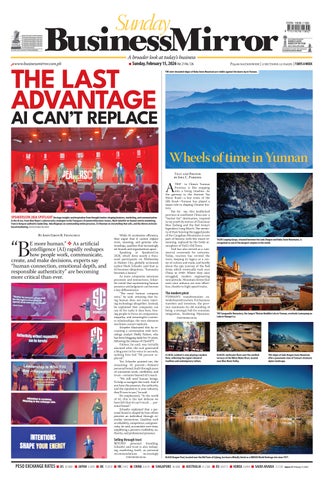
SPEAKERSCON 2026 SPOTLIGHT Onstage insights and inspiration from thought leaders shaping business, marketing, and communication in the AI era. From Alan Reyes’s cybersecurity strategies to Ida Tiongson’s AI-powered business visions, Mark Schaefer on human-centric marketing, Francis Kong on authentic leadership, Inka Magnaye on commanding online presence, Eri Neeman on storytelling that sells, and Kia Abrera on brainbased marketing. PHOTOS BY MIKE POLICARPIO
THE mist-shrouded ridges of Haba Snow Mountain are visible against the dawn sky in Yunnan.
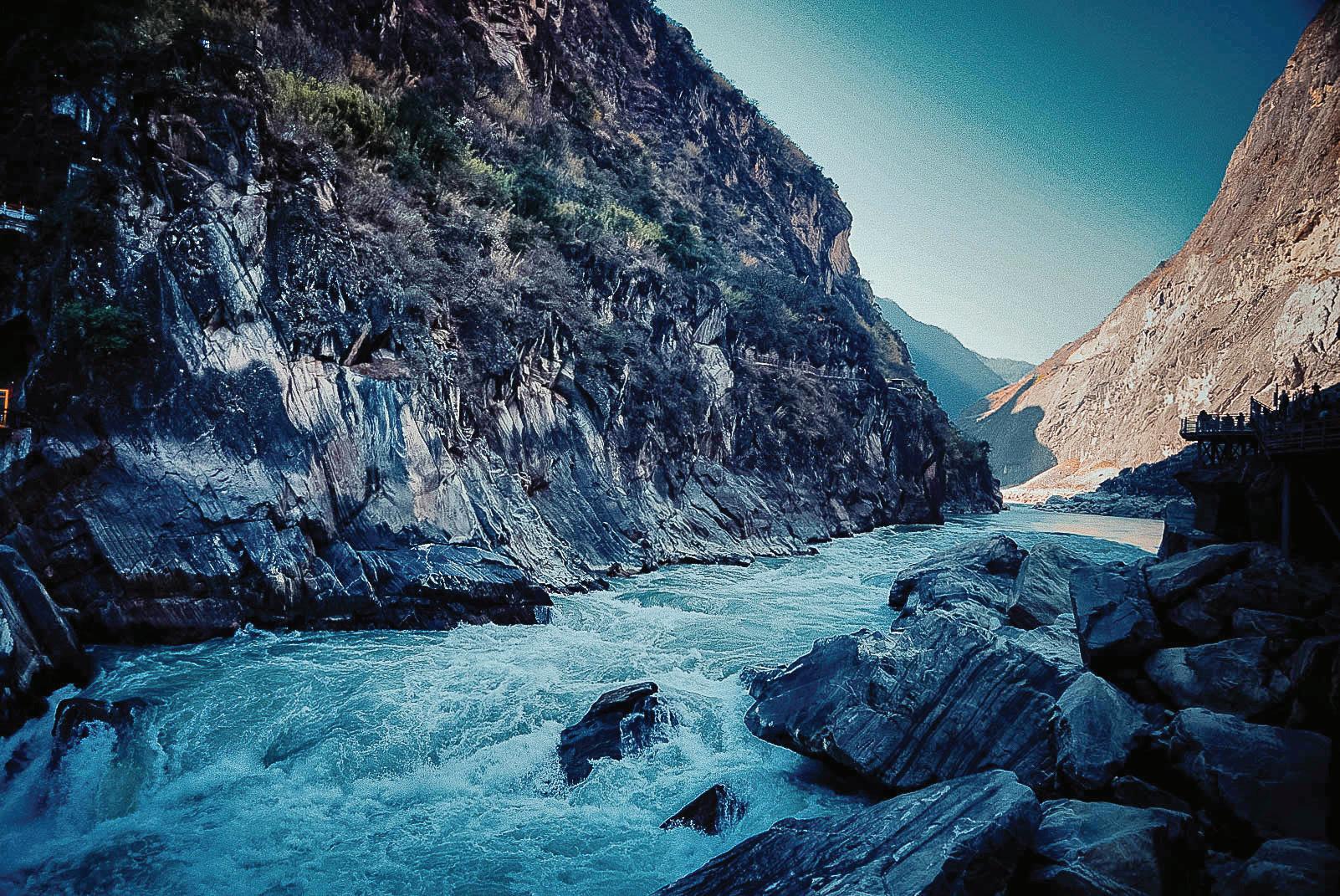
TIGER Leaping Gorge, situated between the Jade Dragon and Haba Snow Mountains, is recognized as one of the deepest canyons in the world.
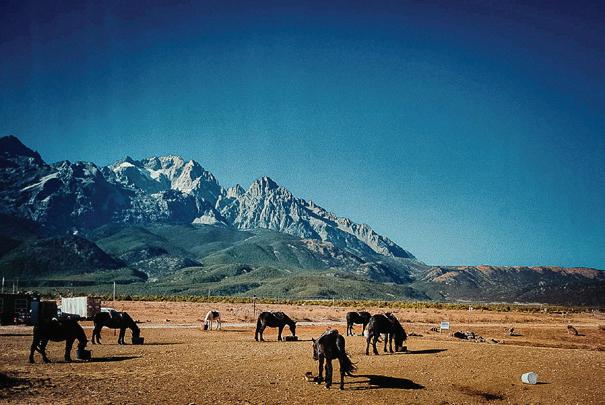
THE ridges of Jade Dragon Snow Mountain offer a panoramic view of Yunnan’s dramatic alpine landscape.
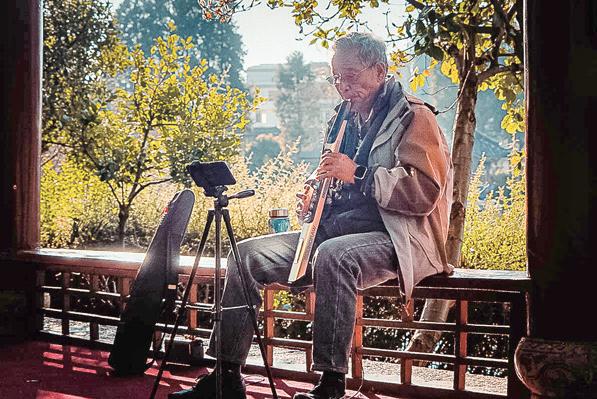
A LOCAL resident is seen playing a modern flute, reflecting the region’s blend of tradition and contemporary culture.
GLACIAL meltwater flows over the calcified terraces of the White Water River, located near Blue Moon Valley.
THE Songzanlin Monastery, the largest Tibetan Buddhist site in Yunnan, overlooks Lamuyangcuo Lake in Shangri-La.
BLACK Dragon Pool, located near the Old Town of Lijiang, has been officially listed as a UNESCO World Heritage site since 1977.
The last advantage AI can’t replace
prove more persuasive than traditional advertising.
Citing data from the Gallup Organization, a management consulting firm, he noted that 92 percent of adults are more likely to believe information shared by friends than what they see in online ads.
“When a friend tells me, I’m going to do it,” Schaefer said, adding that “the customer is the marketer,” which he described as “the most powerful form of marketing and advertising you will ever have.”
He said two-thirds of sales now come from outside traditional marketing efforts, underscoring the need to create experiences “so great, so interesting, so worthy” that people want to share them.
Emotional connections, he noted, have shifted from products to people. “The personal brand was the brand,” he said.
To encourage organic sharing, Schaefer outlined three essential elements of effective storytelling: authenticity, interest, and relevance. Stories, he said, must be genuine for people to believe and pass them on, engaging enough to be discussed in everyday conversations, and tailored to the different reasons customers choose to buy.
“Everything you do, every interaction you have in your company, every email, every meeting, every complaint, be more human,” he emphasized.
‘Back to humanity’ ECHOING this perspective, Ida
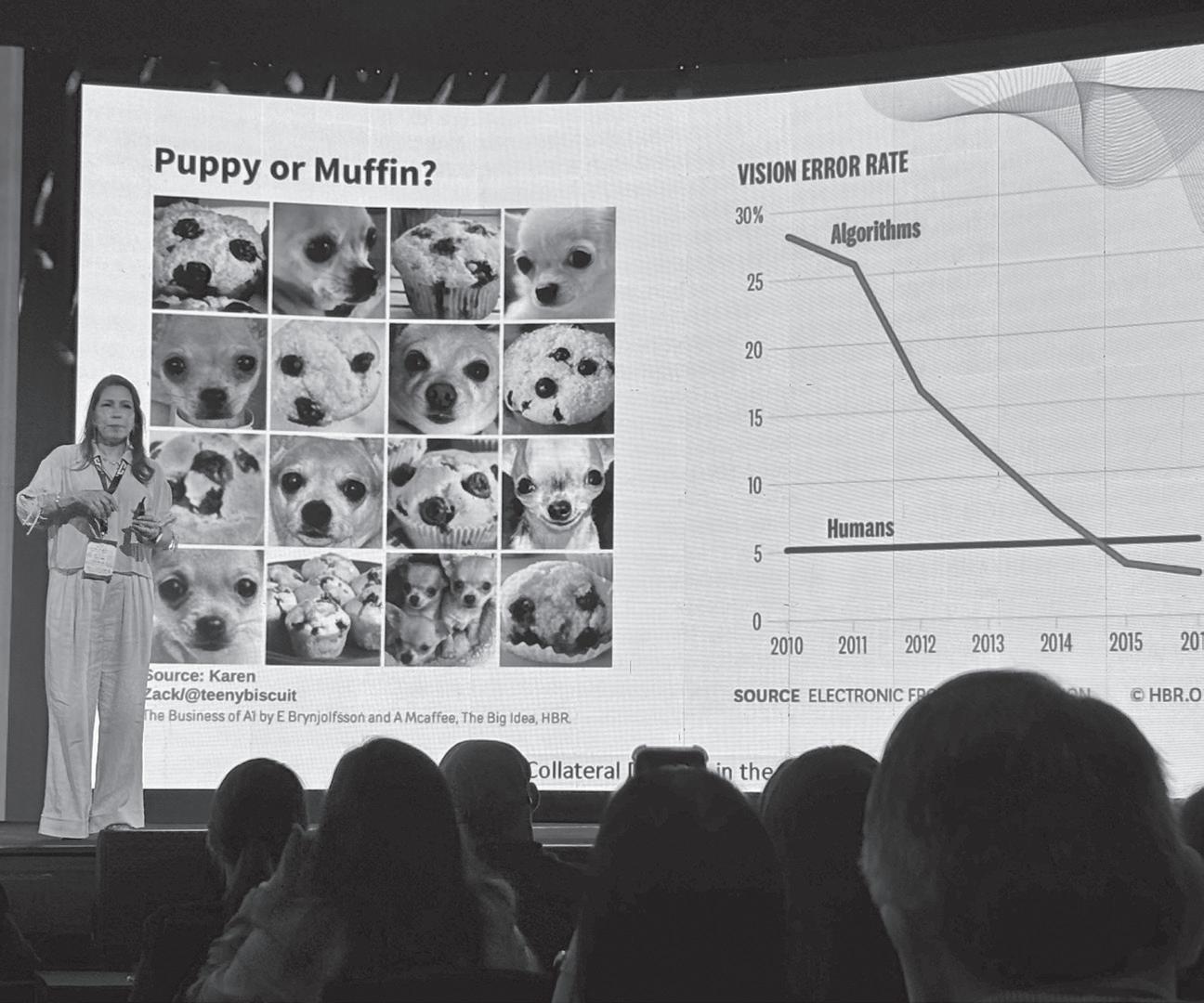

Ceniza Tiongson, a digital advocate and one of the event’s speakers, acknowledged that AI continues to advance rapidly while becoming easier to use, even for those who do not consider themselves tech-savvy.
At the same time, she warned that these advances have blurred the line between what is real and what is fabricated.
Citing findings from the Alan Turing Institute in the United Kingdom, Tiongson said that as of June last year, even machines
can no longer reliably determine whether an image or video is fake.
“That’s dangerous,” she said, warning of the growing risks posed by manipulated content.
Addressing questions on future business opportunities, Tiongson referenced a World Economic Forum exercise in which 30 leading economists were asked about their hopes for the world by 2030. None, she noted, envisioned a future dominated by AI.
Instead, the responses cen-
tered on clean air, safe and inclusive cities, equality, poverty reduction, and peace—priorities aligned with the United Nations’ Sustainable Development Goals.
“In short, it’s back to humanity,” she added.
Tiongson said businesses that serve the greater good have a clear advantage, noting that those aligned with the needs of humanity are more likely to endure. Such organizations, she said, could be “one out of the five that will survive.”
“Your creativity knows no bounds in the digital world, and AI is a powerful partner,” she said. “Believe you can, and you’re halfway there.”
AI-fueled attacks AT the same event, cyber expert Alan Reyes, chief executive offi-
cer of Hexcore Labs Philippines, warned that cyberattacks and AIdriven misinformation now rank among the world’s most serious global risks.
Citing the World Economic Forum’s 2024–2025 Global Risks Report, Reyes said two of the top five risks are linked to these threats, which he noted are already contributing to societal polarization and political unrest.
Reyes said organizations and individuals become more attractive targets as they accumulate more digital assets, stressing the need to reduce potential points of entry for attackers.
He urged companies to limit their “attack surface” by minimizing exposure and strengthening control over digital systems.
He explained that an attack
surface refers to the total set of digital assets that can be targeted, including social media accounts, employee access, applications, payment gateways, websites, emails, and online banking platforms, all of which can be exploited through various cyberattack methods.
“The more digital assets you have, the larger or the bigger target you are,” Reyes said.
In a sideline interview with BusinessMirror, Reyes said phishing remains the most underestimated cyber risk among Philippine businesses, despite having persisted for years. He noted that while the tactic itself is not new, artificial intelligence has made phishing attacks more convincing and personalized.
“Phishing attacks are enhanced because of AI, but it’s still phishing,” Reyes said, adding that it remains the most common attack method affecting both the general public and corporate organizations.
He said phishing activity typically escalates in the fourth quarter, particularly during major sales periods such as the holiday season, when online transactions increase.
“When there are more sales, we see the threat vectors rising,” he said.
Reyes acknowledged that cybersecurity awareness has improved in recent years, including within government, but said more needs to be done to keep pace with evolving threats. “Awareness has caught up,” he said. “But we can still do more.” He added that senior executives and business owners are increasingly targeted through impersonation, identity theft, and so-called VIP phishing schemes, where attackers exploit executive credentials to deceive organizations.
Reyes advised high-profile individuals to invest in brand and digital asset protection to mitigate these risks.
Wheels of time in Yunnan
Laos, and Vietnam, as well as the Chinese regions of Tibet, Sichuan, Guizhou, and Guangxi to the north.
The new railway has reduced travel time from Kunming to the Tibetan highlands of Shangri-La to under five hours, making it easier for the Diqing Tibetan Autonomous Prefecture to export minerals and agricultural products to neighboring Southeast Asia.
By connecting Unesco sites like Dali and Lijiang directly to Shangri-La, the government has created a “Golden Tourism Corridor,” highlighting the rich heritage of the Naxi and Tibetan peoples and shifting the local economy toward high-end services.
Yunnan’s capital city Kunming, now known as the “City of Eternal Spring” for its mild climate, stands as a symbol of Yunnan’s future. Once remote, Kunming was used by communist rebels as a strategic diversion from Kuomintang troops, allowing them to escape north via the Jingsha River crossings.
Today, Kunming has emerged as one of China’s economic and geopolitical centers, reflecting government’s push for urban “socialist modernization.”
Inclusive tourism
YUNNAN’S tourism is notably inclusive. The region primarily caters to domestic travelers, as seen in Chinese-language billboards and brochures. Local guides often claim that Yunnan’s natural wonders are as impressive—or even superior—to famous international sites, promoting local tourism in the countryside.
Lixiangbay Holiday Town in Dali’s Haidong Town is a prime example. Marketed as the “Santorini
of Yunnan,” this 3,700-acre resort features white-walled Mediterranean-style architecture, positioning to local tourists Yunnan’s offerings as “world-class.”
Another highlight is the Stone Forest, or Shilin, a Unesco Heritage site which boast 270-million-yearold karst formations. While Stonehenge in the UK is renowned, the locals claim that Yunnan’s Stone Forest features thousands of similar structures, showcasing China’s unique natural heritage.
Promoting heritage
YUNNAN is more than just a province—it is a living museum where history and stunning landscapes converge. The journey begins in the shadows of the treacherous Cangshan Mountain with its 19-peak range, where the Red Army once struggled, along the scenic Erhai highland lake.
In Dali, once the capital of the Nanzhao and Dali kingdoms, mysticism abounds. The whitewashed walls of the Bai people reflect a heritage older than China’s unification, which today is being capitalized on by current leaders to develop the city through white structures.
Traveling north, Lijiang remains a maze of cobblestone streets and canals, set against the Jade Dragon Snow Mountain, dreaded for its high-altitude crossing with its peaks over 4,000 meters. It is remembered as a key obstacle in the Red Army’s retreat from the Nationalist forces, resulting in high casualties that defined the epic journey.
It is also in Lijiang that Dongba shamans can still be found using the world’s last living pictographic script of the Naxi indigenous people to communicate with nature’s spirits.
Approaching the Tibetan bor-
der, the landscape becomes a fortress of rock and ice—the legendary setting of the Long March. In 1935, the Red Army braved the depths of Tiger Leaping Gorge, one of the world’s deepest river canyons, now a premier trekking destination in Southwest China, with its dramatic scenery between Jade Dragon Snow Mountain and Haba Snow Mountain.
A managed utopia CROSSING into Shangri-La (formerly Zhongdian), one encounters the Songzanlin Monastery, known as the “Little Potala Palace.” This site reflects enduring Buddhist faith, with mysticism woven into daily life—even as religious practice is shaped by state control. The name “Shangri-La” itself is the result of a state-led rebranding, inspired by James Hilton’s novel Lost Horizon, which introduced in the 1930s the concept of a peaceful Tibetan utopia—a synonym for paradise and a tranquil escape from chaos.
Standing at the gates of Songzanlin Monastery, it is evident that while the revered 14th Dalai Lama’s departure in 1959 marked the end of an era, the arrival of high-speed rail connecting to Southeast Asia signals the beginning of a new one. Yunnan’s evolution demonstrates that the Middle Kingdom is no longer looking inward. instead, China is now positioning itself as a springboard into the Asean economy. The wheels of time are turning—and moving— faster than ever.
Still I wonder, what became of the once much-heralded Long March—now thrown into the archives of history,
for
and
left
scholars
dreamers to rediscover and appreciate. Continued
MARK SCHAEFER urged attendees to embrace humanity as the key differentiator in the age of AI. In his session, “Audacious: How Humans Win in an AI Marketing World,” he stressed that personal brands, trust, and authentic connections cannot be replicated by technology, noting, “The most human company wins.” MIKE POLICARPIO
IDA TIONGSON urged businesses to prioritize humanity amid AI advances, warning that manipulated content and digital risks are rising. She emphasized, “Your creativity knows no bounds in the digital world, and AI is a powerful partner. Believe you can, and you’re halfway there,” reminding attendees that trust, empathy, and purpose remain the ultimate differentiators. MIKE POLICARPIO
Editor: Angel R. Calso
Sunday, February 15, 2026 A3

As ICE expands, an AP review of crimes committed by agents shows how their powers can be abused
By Ryan J. Foley The Associated Press
INVESTIGATORS said one immigration enforcement official got away with physically assaulting his girlfriend for years. Another admitted he repeatedly sexually abused a woman in his custody. A third is charged with taking bribes to remove detention orders on people targeted for deportation.
At least two dozen US Immigration and Customs Enforcement employees and contractors have been charged with crimes since 2020, and their documented wrongdoing includes patterns of physical and sexual abuse, corruption and other abuses of authority, a review by The Associated Press found.
While most of the cases happened before Congress voted last year to give ICE $75 billion to hire more agents and detain more people, experts say these kinds of crimes could accelerate given the sheer volume of new employees and their empowerment to use aggressive tactics to arrest and deport people.
The Trump administration has emboldened agents by arguing they have “absolute immunity” for their actions on duty and by weakening oversight. One judge recently suggested that ICE was developing a troubling culture of lawlessness, while experts have questioned whether job applicants are getting enough vetting and training.
“Once a person is hired, brought on, goes through the training and they are not the right person, it is difficult to get rid of them and there will be a price to be paid later down the road by everyone,” said Gil Kerlikowske, who served as commissioner of US Customs and Border Protection from 2014 to 2017.
Almost every law enforcement agency contends with bad employees and crimes related to domestic violence and substance abuse are long-standing problems in the field. But ICE’s rapid growth
and mission to deport millions are unprecedented, and the AP review found that the immense power that officers exercise over vulnerable populations can lead to abuses.
Department of Homeland Security Assistant Secretary Tricia McLaughlin said that wrongdoing was not widespread in the agency, and that ICE “takes allegations of misconduct by its employees extremely seriously.” She said that most new hires had already worked for other law enforcement agencies, and that their backgrounds were thoroughly vetted.
“America can be proud of the professionalism our officers bring to the job day-in and day-out,” she said.
ICE misconduct could become a ‘countrywide phenomenon’
ICE announced last month that it had more than doubled in size to 22,000 employees in less than one year.
Kerlikowske said ICE agents are particularly “vulnerable to unnecessary use of force issues,” given that they often conduct enforcement operations in public while facing protests. With the number of ICE detainees nearly doubling since last year to 70,000, employees and contractors responsible for overseeing them are also facing challenging conditions that can provide more opportunities for misconduct.
The Border Patrol doubled in size to more than 20,000 agents from 2004 to 2011—six years longer than ICE took. It was embarrassed by a wave of corruption, abuse and other misconduct by some of the new hires. Kerlikowske
recalled cases of agents who accepted bribes to let cars carrying drugs enter the US or who became involved in human trafficking.
He and others say ICE is poised to see similar problems that will likely be broader in scope, with less oversight and accountability.
“The corruption and the abuse and the misconduct was largely confined in the prior instance to along the border and interactions with immigrants and border state residents. With ICE, this is going to be a countrywide phenomenon as they pull in so many people who are attracted to this mission,” said David Bier, director of immigration studies at the Cato Institute, a libertarian think tank.
Bier, who has helped publicize some of the recent arrests and other alleged misconduct by ICE agents, said he has been struck by the “remarkable array of different offenses and charges that we’ve seen.”
AP’s review examined public records involving cases of ICE employees and contractors who have been arrested since 2020, including at least 17 who have been convicted and six others who are awaiting trial. Nine have been charged in the last year, including an agent cited last month for assaulting a protester near Chicago while off-duty.
Some of the most serious crimes were committed by veteran ICE employees and supervisors rather than rookies.
While federal officials have justified ICE’s aggression, the behavior of agents is drawing scrutiny from cellphone-wielding observers and prosecutors in Democraticled jurisdictions. Local agencies are looking into last month’s fatal shootings in Minneapolis of protesters Renee Good and Alex Pretti by federal agents, as well as the killing of Keith Porter by an offduty ICE agent in Los Angeles on New Year’s Eve.
Arrests have made local headlines AROUND the country, the cases have attracted unwelcome headlines for ICE, which has spent millions of dollars publicizing the criminal rap sheets of those they arrest as the “worst of the worst.”
Among them: THE assistant ICE field office

supervisor in Cincinnati, Samuel Saxon, a 20-year ICE veteran, has been jailed since his arrest in December on charges that he attempted to strangle his girlfriend.
Saxon had abused the woman for years, fracturing her hip and nose and causing internal bleeding, a judge found in a ruling ordering him detained pending trial. “The defendant is a volatile and violent individual,” the judge wrote of Saxon, whose attorneys didn’t return a message seeking comment. ICE said he is considered absent without leave.
“I’m ICE, boys,” an ICE employment eligibility auditor told police in Minnesota in November when he was arrested in a sting as he went to meet a person he thought was a 17-year-old prostitute. Alexander Back, 41, has pleaded not guilty to attempted enticement of a minor. ICE said Back is on administrative leave while the agency investigates.
When officers in suburban Chicago found a man passed out in a crashed car in October, they were surprised to discover the driver was an ICE officer who had recently completed his shift at a detention center and had his government firearm in the vehicle. They arrested Guillermo Diaz-Torres for driving under the influence. He’s pleaded not guilty and has been put on administrative duty pending an investigation.
After an ICE officer in Florida was stopped for driving drunk with his two children in the car in August, he tried to get out of charges by pointing to his law enforcement and military service. When that failed, he demanded to know whether one of
the deputies arresting him was Haitian and threatened to check the man’s immigration status, body camera video shows.
“I’ll run him once I get out of here and if he’s not legit, ooh, he’s taking a ride back to Haiti,” Scott Deiseroth warned during the arrest.
Deiseroth, who was sentenced to probation and community service, is on administrative leave pending the outcome of an internal investigation. “He did something stupid. He owned up to it,” said his attorney, Michael Catalano. “He’s very sorry about the whole thing.”
Several cases involve force and abuse
THE AP’s review found a pattern of charges involving ICE employees and contractors who mistreated vulnerable people in their care.
A former top official at an ICE contract facility in Texas was sentenced to probation on Feb. 4 after acknowledging he grabbed a handcuffed detainee by the neck and slammed him into a wall last year. Prosecutors had downgraded the charge from a felony to a misdemeanor.
In December, an ICE contractor pleaded guilty to sexually abusing a detainee at a detention facility in Louisiana. Prosecutors said the man had sexual encounters with a Nicaraguan national over a five-month period in 2025 as he instructed other detainees to act as lookouts.
Outside Chicago, an off-duty ICE agent has been charged with misdemeanor battery for throwing to the ground a 68-year-old protester who was filming him at a gas station in December. McLaughlin has said the agent acted in selfdefense.
Other charges cited corruption
ANOTHER pattern that emerged in AP’s review involved ICE officials charged with abusing their power for financial gain.
An ICE deportation officer in Houston was indicted last summer on charges that he repeatedly accepted cash bribes from bail bondsmen in exchange for removing detainers ICE had placed on their clients targeting them for deportation.
ICE said the officer was “indefinitely suspended” in May 2024, before his arrest one year later. He has pleaded not guilty to seven counts of accepting bribes and was released from custody while awaiting trial.
Prosecutors say a former supervisor in ICE’s New York City office provided confidential information about people’s immigration statuses to acquaintances and made an arrest in exchange for gifts and other gain. He was arrested in November 2024, has pleaded not guilty and is awaiting trial.
Two Utah-based ICE investigators were sentenced to prison last year for a scheme in which they made hundreds of thousands of dollars stealing synthetic drugs known as “bath salts” from government custody and selling them through government informants. ICE officials used badges to try to avoid consequences THE wrongdoing often included the use of ICE resources and credentials to try to avoid arrest or receive favorable treatment.
In 2022, ICE supervisor Koby Williams was arrested in a sting by police in Othello, Washington, while going to a hotel room to meet who he thought was a 13-year-old girl he’d arranged to pay for sex.
Williams had driven his government vehicle, which was filled with cash, alcohol, pills and Viagra, and was carrying his ICE badge and loaded government firearm. The 22-year ICE veteran offered a rationale that turned out to be a lie: that he was there to “rescue” the girl as part of a human trafficking investigation. Williams is serving prison time for what prosecutors called a “reprehensible” abuse of power. “With a duty to protect and serve,” they wrote, “defendant sought to exploit and victimize.”
Sudanese doctor recounts harrowing escape from Darfur city under rebel bombardment
CBy Samy Magdy
The Associated Press
AIRO —Dr. Mohamed Ibrahim dashed from building to building, desperate for places to hide. He ran through streets littered with bodies. Around him, the capital of Sudan’s North Darfur province lay enveloped in smoke and fire. Explosions, shelling and gunfire thundered from every direction.
After 18 months of battling, paramilitary fighters had overrun el-Fasher, the Sudanese army’s only remaining stronghold in the Darfur region. Ibrahim, who fled the city’s last functioning hospital with a colleague, said he feared he would not live to see the sun go down.
“All around we saw people running and falling to the ground in front of us,” the 28-year-old physician told The Associated Press, recounting the assault that began Oct. 26 and lasted three days.
“We moved from house to house,
from wall to wall under non-stop bombardment. Bullets were flying from all directions.”
Three months later, the brutality inflicted by the militant Rapid Support Forces is only now becoming clear. United Nations officials say thousands of civilians were killed but have no precise death toll. They say only 40% of the city’s 260,000 residents managed to flee the onslaught alive, thousands of whom were wounded. The fate of the rest remains unknown.
The violence, including mass killings, turned el-Fasher into a “massive crime scene,” U.N. officials and independent observers said. When a humanitarian team finally gained access in late December, they found the city largely deserted, with few signs of life.
A Doctors Without Borders team that visited this month described it as a “ghost town” largely emptied of the people who once lived there.
Nazhat Shameem Khan, deputy prosecutor of the International Criminal Court, said war crimes
and crimes against humanity were committed in el-Fasher “as a culmination of the city’s siege by the Rapid Support Forces.”
“The picture that’s emerging is appalling,” she told the U.N. Security Council last week, adding that “organized, widespread mass criminality” has been used “to assert control.”
With el-Fasher cut off, details of the attack remain scarce. Speaking with the AP from the town of Tawila, about 70 kilometers (43 miles) from the defeated capital, Ibrahim provided a rare, detailed first-person account.
As fighters swarmed in, they opened fire on civilians scrambling over walls and hiding in trenches in a vain effort to escape, while mowing down others with vehicles, Ibrahim said. Seeing so many killed felt like he was running toward his own death.
“It was a despicable feeling,” he said. “How can el-Fasher fall? Is it over? I saw people running in terror. … It was like judgment day.”
The Rapid Support Forces didn’t respond to phone calls and emails from the AP with detailed questions about the brutal attack and Ibrahim’s account. RSF commander Gen. Mohammed Hamdan Dagalo acknowledged abuses by his fighters but disputed the scale of atrocities.
Prelude to the assault
WHEN the military toppled Sudan’s civilian-led government in a 2021 coup, it counted the Rapid Support Forces—descended from the country’s notorious Janjaweed militias—as its ally.
But the army and militants quickly became rivals. By late October, they’d fought fiercely for over two years in Darfur, already infamous for genocide and other atrocities in the early 2000s.
The army’s last stronghold was strategically-located el-Fasher. But the RSF, accused by the Biden administration of carrying out genocide in the ongoing war, had the city surrounded. As paramili -
tary forces tightened the noose, residents pressed into a small area on the city’s western side.
Civilians were forced to eat animal fodder as food gave out, Ibrahim said. His family fled after their home was shelled in April, wounding his mother. But with few health workers left, Ibrahim stayed, working at the Saudi Maternity Hospital as the RSF closed in.
The Saudi-financed hospital was el-Fasher’s last functioning medical center. But months of RSF shelling and drone strikes had driven away most of its staff, leaving just 11 doctors.
“We worked endless shifts and supplies dwindled to nothing,” Ibrahim said.
He was treating patients around 5 a.m. on Oct. 26 when shelling intensified. Civilians sheltering near the hospital began fleeing toward a nearby military base.
“People were running in every direction,” he said. “It was obvious that the city was falling.”
Searching for a way out AROUND 7 a.m., he and another doctor decided to flee, setting out on foot for the army base about 1.5 kilometers (a mile) away. An hour later, RSF fighters attacked the hospital, killing a nurse and wounding three others. Two days later, the militants stormed the facility again, killing at least 460 people and abducting six health workers, according to the World Health Organization. Ibrahim and his colleague darted from house to house, passing four corpses and many wounded civilians, before reaching a dormitory at the University of el-Fasher. Thirty minutes later, RSF artillery began pounding the area. Separated from his colleague, Ibrahim sprinted across an open area where “anything could happen to you—‚a drone strike, a vehicle ramming over you, or RSF chasing you,” he said.
IN this screengrab made from body camera footage provided by the Othello, Wash., Police Department, police officers arrest US Immigration and Customs Enforcement supervisor Koby Williams in July 2022 during an underage sex sting operation. OTHELLO POLICE DEPARTMENT VIA AP
Sunday, February 15, 2026
Putin’s war jolts Europe into survival mode, from German factories to NATO’s front lines
By Alan Crawford, Petra Sorge, Andrea Palasciano & Arne Delfs
INDUSTRIAL chemicals have been produced on the banks of the River Elbe outside the city of Wittenberg for more than a century, from the Kaiser era through wars, Communism and the chaotic collapse of East Germany.
Then came Russia’s full-scale assault on Ukraine and a crisis without parallel for SKW Stickstoffwerke Piesteritz GmbH, which traces its pedigree in producing specialized chemicals for agriculture and industry back to 1915.
The loss of access to Russian natural gas meant a dramatic increase in costs for energy-intensive industries across Europe, from chemicals makers to autos and machinery. The government in Berlin has made inroads finding replacements since cutting off fossil-fuel imports from Russia following the 2022 invasion, yet the consequences are still playing out for companies like SKW Piesteritz, Germany’s biggest producer of ammonia and urea.
“It is no longer a question of profit margins or cuts in investment,” said Chairman Petr Cingr. “It is simply a matter of the survival.”
Vladimir Putin’s all-out invasion of Feb. 24, 2022, has devastated Ukrainian cities, claimed hundreds of thousands of lives and forced more than 10 million people to flee their homes – almost 7 million of them abroad.
The effects of the largest land war on the continent since World War II have spilled beyond Ukraine’s borders and caused an era-defining shock to Europe’s economy, politics and societies. The conflict is raising existential concerns over Europe’s ability to resist or coexist with an aggressive Russia under Putin, and its state of readiness if he isn’t stopped in Ukraine.
“We must be prepared for the scale of war our grandparents and great-grandparents endured,” NATO Secretary General Mark Rutte warned in a December speech.
The dilemma for the continent’s leaders is made all the more acute by President Donald Trump’s antipathy toward Europe, casting doubt on US security guarantees and even stirring fears of military intervention to seize control of Greenland
Continued from A3
He moved between buildings to another dormitory. Hiding inside an empty water tank, he heard the screams of people chased by gunmen amid two hours of nonstop shelling.
When the bombardment slowed, he headed to the university’s medical school, jumping from roof to roof to avoid being seen. He found a broken wall behind the school’s morgue and took cover for nearly an hour. By then it was noon and RSF fighters rampaged across el-Fasher.
Ibrahim ran past 25 to 30 more dead before finally reaching the army base around 4 p.m. and reuniting with his coworker.
Thousands, mostly women, children or older people, were taking refuge there.
Many sheltered in trenches; scores were injured and bleeding. Ibrahim used clothing
from NATO partner Denmark. That sense of transatlantic rupture is accentuated by US pressure on Kyiv to halt the conflict on terms that look favorable to the aggressor, while Europe is consigned to the sidelines.
The result is a set of war-induced shocks that show the international order “is currently being demolished with a wrecking ball,”
Wolfgang Ischinger, chairman of the annual Munich Security Conference, told reporters on Monday as he presented the program for this year’s event on Feb. 12-15.
It’s a particularly precarious moment for Europe. Squeezed between an unreliable US and a China that’s vying with Washington for technological and military supremacy, Europe’s collective response to the war in Ukraine has become a test of the continent’s ability to shape decisions affecting its own fate.
“It’s become clear that Europe doesn’t really have a lot of geopolitical power in his world,” Anna Rosenberg, Amundi Investment Institute’s head of geopolitics, told Bloomberg Television.
“Because in this kind of multipolar world, what counts is that you have military might, ideally in the form of nuclear weapons, that you have the natural resources that someone else depends on – food, energy, rare earths, for example –and that you have a lot of partnerships.” Only in the latter category is Europe strong, she said.
The message has struck home, seen most visibly in NATO members’ decision in June to agree to Trump’s demand that they spend 5% of gross domestic product on defense. Assuaging NATO’s dominant player was undoubtedly one motive for that decision, but it was also an acknowledgement of the urgent need to rebuild militaries that were allowed to languish after the Cold War’s end.
“The biggest change has been that Europe has woken up and shifted into defense mode across a broad front,” said Henna Virkkunen, European Union Executive
scraps to dress wounds, stabilizing one man’s broken wrist with a sling made from a shirt.
The road out AROUND 8 p.m., Ibrahim and about 200 others, mostly women and children, left the base for Tawila, a town swelled by the influx of tens of thousands fleeing the fighting. Guides led the way under a bright moon.
When they heard trucks, or spotted fighters on camels in the distance, they dropped to the ground. When threats passed, they continued on. Eventually the group reached a trench the militants built on the outskirts of el-Fasher to tighten the blockade. They helped each other scale the 3-meter-high (10-foot-high) trench. But when the group reached a second and then a third trench, some struggled and turned back. Their fate remains unknown.
At the last trench, those ahead of
Vice-President for Tech Sovereignty, Security and Democracy, noting the shift is all the more remarkable because the EU was created as a peace project.
With intelligence agencies publicly assessing that Moscow could launch an attack on a NATO member within five years or less, Virkkunen’s native Finland and neighbor Sweden abandoned nonaligned status to join the alliance in 2023 and 2024 respectively. That’s turned the Baltic Sea into a NATO-dominated theater and ensured that seven of the eight Arctic nations are members. The UK and Norway, both non-EU nations, have drawn closer to Europe in their shared stance against Russia.
Even as Putin dismisses the idea that he is seeking direct confrontation with the West as “hysteria,” regular cyberattacks, drone intrusions and arson attempts attest to Moscow’s willingness to engage in hybrid warfare to unsettle civilian populations.
The war in Ukraine is reshaping multiple aspects of European policy accordingly. One government official complained that EU finance chiefs have been compelled to become experts in defense so that they can recognize military terms and understand procurement rules in order to responsibly agree on some sizeable outlays.
Moral authority in the EU has accrued to eastern members like Poland and the Baltic states that long warned of Putin’s intentions. Enlargement is back on the 27-nation bloc’s agenda, with Ukraine and fellow former Soviet state Moldova offered a path to membership. And while cracks have appeared with leaders more friendly to Putin in the likes of Hungary and Slovakia, the bloc has managed to maintain unity to introduce multiple rounds of sanctions on Russia and aid for Kyiv.
Many changes seem irrevocable. China’s refusal to condemn Putin has been a stumbling block too far for the EU, which is reassessing its relations with Beijing.
Before the war, Russia was by far Europe’s top external supplier of both oil and natural gas. Those flows have been heavily reduced or diverted elsewhere, at the cost of significant economic fallout, and replaced by a mix of alternative suppliers and new infrastructure. The upshot is a trade relationship that survived the Cold War is not going to snap back overnight— and may never return to its preinvasion state.
Spool back to late 2021, and it came as a shock to NATO when then-US Director of National Intelligence Avril Haines briefed
Ibrahim came under fire as they climbed out. Ibrahim and his colleague lay flat in the trench until the shooting subsided.
Finally, around 1 a.m., they ventured into the darkness. Five from the group lay dead, with many others wounded.
‘You’re doctors. You have money.’
The survivors walked for hours toward Tawila. Around noon on Oct. 27, they were stopped by RSF fighters on motorcycles and trucks mounted with weapons.
Encircling the group, the militants fatally shot two men and took the doctors and others captive. The fighters separated Ibrahim, his colleague and three others, chained them to motorcycles and forced them to sprint behind.
At an RSF-controlled village, fighters chained the prisoners to trees and interrogated them. At first Ibrahim and his friend told them they were ordinary civilians.
“I didn’t want to tell them I was a doctor, because they exploited doctors,” he said.
the alliance, making clear for the first time that Russia aimed to take Kyiv.
“I remember listening to this and [it] feeling like a punch in the gut,” recalled Oana Lungescu, NATO spokesperson at the time and now a distinguished fellow at the London-based Royal United Services Institute. NATO decided then on the unprecedented step of declassifying intelligence to provide details of the Russian forces amassed on Ukraine’s borders and call on Moscow to step back from the brink.
Those efforts to deter Putin continued up to the last minute, with a NATO-Russia council called for Jan. 21, 2022. The Russians turned up with maps on which NATO member states were not marked as such. Those present wondered whether it was a mistake or a deliberate attempt to destabilize, Lungescu said. The answer came the following month.
She sees two main lessons: Despite being the world’s biggest country in territorial terms, Russia “remains an imperial expansive project.” The second: “Russia is not invincible; the Ukrainians have shown that.”
Ukraine has also shown the changed nature of modern warfare, reminding militaries of the need for tanks and artillery before pioneering the use of cheap firstperson vision, or FPV, drones to dominate the battlefield. In today’s drone wars, the front line is a “kill zone” patrolled from above, while combat units are supplied by remotely operated tracked vehicles that take away the dead and injured.
Ukraine has become a real-time testing ground for new military technologies, an increasing number of which are now domestically produced, while European defense companies like KNDS NV, Leonardo SpA, and Diehl BGT Defence GmbH can’t supply their products fast enough.
Where resources were once
“But my friend admitted he was a doctor, so I had to.”
That evening the fighters met with a commander, Brig. Gen. Al-Fateh Abdulla Idris, who has been identified in videos executing unarmed captives.
Ibrahim and his colleague were brought out in chains then taken back to the village, where the fighters demanded ransom for their release.
“They said, ‘You are doctors. You have money. The organizations give you money, a lot of money,’” he said.
The fighters handed them a cellphone to call their families for ransom. At first, the gunmen demanded $20,000 each. Ibrahim was so stunned by the amount that he laughed, and the fighters beat him with their rifles.
“My entire family don’t have that,” he told them.
After hours of abuse, the militants asked Ibrahim how much he could pay. When he offered $500, they “started
scarce and government orders small, “now the challenges are about how fast and massive your production is,” said Camille Grand, secretary general of ASD, the European defense industry’s main trade association and a former NATO assistant secretary general. NATO has refocused on its founding remit of collective defense, he said, even as the US casts doubt on its Article 5 commitments and makes clear that Europe is responsible for its own security.
“If we believe that Europe and NATO could be tested by Russia in a post-ceasefire Ukraine, the message from Washington to Europeans is: `You are the first respondents,’” said Grand. “Europeans have to deliver the cavalry.”
A foretaste came early in 2025, when the US withheld weaponry and intelligence after the infamous Oval Office clash with Ukrainian President Volodymyr Zelenskyy. Washington later relented, though Europe is now paying for US equipment delivered to Kyiv.
Trump’s subsequent determination to impose a peace deal and rehabilitate Russia, as codified in his administration’s eye-popping National Security Strategy, looks to many in Europe like a permanent breach of the transatlantic bond.
“What we once called the normative West no longer exists in this form,” German Chancellor Friedrich Merz said in December—a significant statement for someone who grew up under the US security umbrella that formed the bulwark against the Soviet bloc. It speaks to the depth of the rupture, but also points to the paradox of Germany’s role as perhaps Europe’s best hope of a sovereign future.
While the world’s No. 3 economy, Germany’s export-oriented, auto industry-heavy economic model has been shown to be uncompetitive, overly beholden to China, and vulnerable in an age of a receding multilateral order. Merz and his coalition are strong on
beating me again,” he said. “They said we will be killed.”
The fighters turned to Ibrahim’s friend, repeating the demands and beatings.
Ibrahim said his colleague eventually agreed to $8,000 each—‚an enormous sum in a country where the average monthly salary is $30 to $50.
“I almost hit him. … didn’t trust them to let us go,” Ibrahim said. With little choice, Ibrahim called his family. After they transferred the money, the fighters separated the doctors, keeping them blindfolded. Eventually, they were moved to vehicles filled with fighters who told them they were being taken to Tawila. Instead, they were dropped off in an RSF-controlled area, prompting fears they would be recaptured. When they spotted fighters, the doctors hid in the brush. They emerged an hour later, spotted tracks of horse-drawn carts and began following them.
support for Ukraine but weak domestically: unpopular, and trailing the far-right nationalist—and Kremlin-friendly—Alternative for Germany party in some polls. For all the wobbles, Berlin’s determination to rearm is real: Hardly a day goes by without a new military order announced by the government or its industry partners. Lawmakers approved a record number of arms contracts under a €50 billion spending splurge in December. Voluntary military service is returning, with the prospect of conscription if enough young people don’t fill the ranks. Rheinmetall AG’s share price has soared more than 1,600% in the past four years. Berlin is “creating massive military muscle,” said Amundi’s Rosenberg, helping Europe as it does so. Growing global relevance is not universally welcomed at home, however. With Berlin now NATO’s No. 2 spender after the US, the AfD has a ready appeal to those voters in the former East Germany more predisposed to Moscow than Washington. In the former West, German militarization runs into residual pacifist sentiment that peaked during protests against the stationing of US missiles in the 1980s. Given Germany’s wartime history of atrocities, Merz’s suggestion that the Bundeswehr could help secure a demilitarized zone in Ukraine was shocking to many. Foreign Minister Johann Wadephul has reached back further, evoking Germany’s post-World War I experience to explain Berlin’s opposition to a bad peace deal for Ukraine. In 1918, Germany was made to cede territory and pay reparations under the punitive terms of the Versailles treaty, contributing to the rise of the National Socialists under Adolf Hitler. Wadephul cited the parallels in a December meeting with his Chinese counterpart, Wang Yi, when asked why Ukraine couldn’t just hand over Donetsk to Russia to resolve the war. For Ischinger, a former German ambassador to the US, past convictions of eternal peace in Europe with Russia as a partner have been exposed as “massive illusions.” With Germany spending big on rearming, Europe is on the road to becoming “a meaningful and substantial military actor,” he told Bloomberg Television. That isn’t just a contrast with the time before Russia’s invasion of Ukraine, Ischinger said: “It’s a massive change from what we had over the last 30 years.” With assistance from Kirsi Heikel, Alaric Nightingale, Rachel Morison, Francine Lacqua, Agnieszka Barteczko, Julian Lee and Michael Nienaber/Bloomberg
Alive but haunted THREE hours later, they spotted the flag of the Sudan Liberation Army-Abdul Wahid, a rebel group not involved in fighting between the RSF and government troops. The rebels allowed them entry. They were met by a Sudanese-American Physicians Association team, which provides care for those fleeing el-Fasher, then continued on.
When they finally reached Tawila, Ibrahim was reunited with survivors, including another Saudi hospital physician. The man said he had seen video of the doctors’ capture on Facebook and was sure they had been killed.
“He embraced me and we both wept,” Ibrahim said. “He didn’t imagine I was still alive. It was a miracle.”
Sudanese. . .
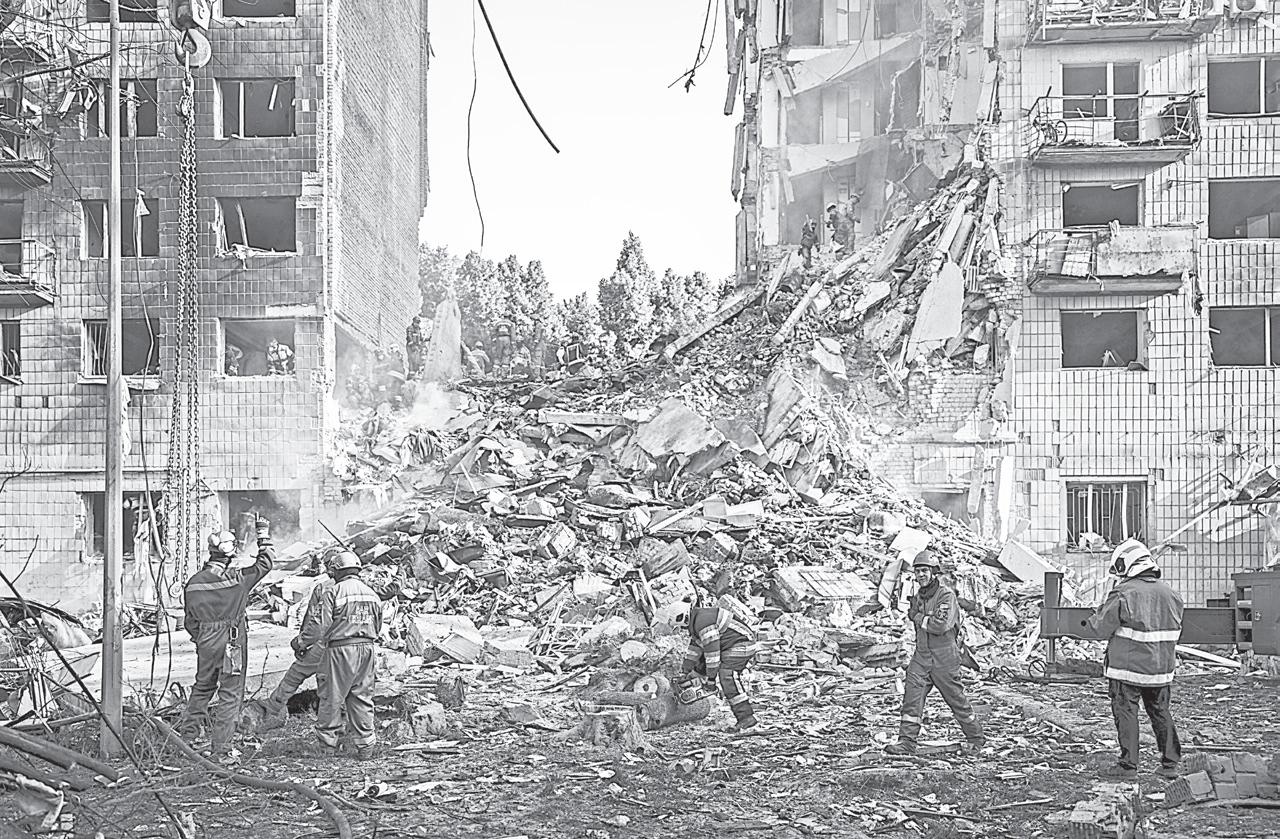
RESCUE services search for victims under wreckage after an air strike on a residential building in Kyiv. (PHOTOGRAPHER: ANDREW KRAVCHENKO/BLOOMBERG)

Trump’s EPA revokes scientific finding that underpinned US fight vs climate change
WASHINGTON—The Trump administration on Thursday revoked a scientific finding that long has been the central basis for US action to regulate greenhouse gas emissions and fight climate change, the most aggressive move by the Republican president to roll back climate regulations.
The rule finalized by the Environmental Protection Agency (EPA) rescinds a 2009 government declaration known as the endangerment finding that determined that carbon dioxide and other greenhouse gases threaten public health and welfare.
The Obama-era finding is the legal underpinning of nearly all climate regulations under the Clean Air Act for motor vehicles, power plants and other pollution sources that are heating the planet.
The repeal eliminates all greenhouse gas emissions standards for cars and trucks and could unleash a broader undoing of climate regulations on stationary sources—such as power plants and oil and gas facilities, experts say.
Legal challenges are near certain.
President Donald Trump called the move “the single largest deregulatory action in American history, by far,” while EPA Administrator Lee Zeldin called the endangerment finding “the Holy Grail of federal regulatory overreach.” Trump called the endangerment finding “one of the greatest scams in
history,” claiming falsely that it “had no basis in fact” or law.
“On the contrary, over the generations, fossil fuels have saved millions of lives and lifted billions of people out of poverty all over the world,” Trump said at a White House ceremony—although scientists across the globe agree that carbon dioxide and other greenhouse gases are driving catastrophic heat waves and storms, droughts and sea level rise.
Environmental groups described the move as the single biggest attack in US history against federal authority to address climate change. Evidence backing up the endangerment finding has only grown stronger in the 17 years since it was approved, they said.
“This action will only lead to more climate pollution, and that will lead to higher costs and real harms for American families,” said Fred Krupp, president of Environmental Defense Fund, adding that the consequences would be felt on Americans’ health, property values, water supply and more.
The EPA also said it will propose a two-year delay to a Biden-era rule restricting greenhouse gas emissions by cars and light trucks.
And the agency will end incentives for automakers who install automatic start-stop ignition systems in their vehicles. The device is intended to reduce emissions, but Zeldin said “everyone hates” it.
Zeldin, a former Republican congressman who was tapped by Trump


PRESIDENT Donald Trump speaks during an event with Environmental Protection Agency Director Lee Zeldin announcing that the EPA will no longer regulate greenhouse gases, in the Roosevelt Room of the White House, on February 12.
to lead EPA last year, has criticized his predecessors in Democratic administrations, saying that in the name of tackling climate change, they were “willing to bankrupt the country.”
The endangerment finding “led to trillions of dollars in regulations that strangled entire sectors of the United States economy, including the American auto industry,” Zeldin said.
“The Obama and Biden administrations used it to steamroll into existence a left-wing wish list of costly climate policies, electric vehicle mandates and other requirements that assaulted consumer choice and
UP study: Extreme waves hurled fossil coral boulders to Ilocos coastline
SEEING large boulders—some weighing as much as a large truck—scattered along the rocky coastline of Pasuquin, Ilocos Norte, make people wonder how they ended up there.
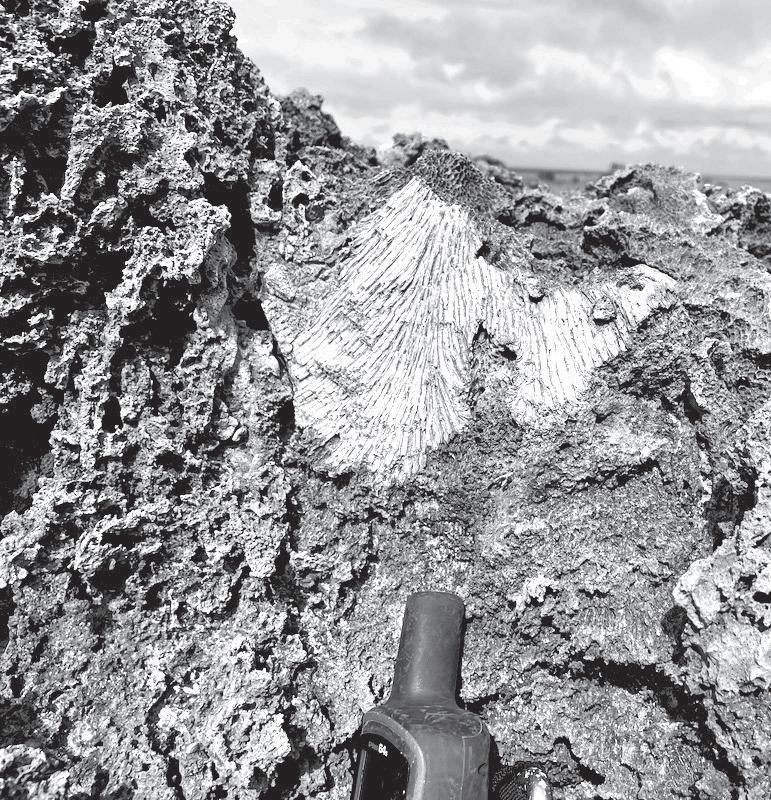
The enormous boulders—which sit on an uplifted reef platform far from the sea—are not random. It turns out that they are fragments of an ancient coral reef that were torn from the reef and hurled inland by extreme waves, University of the Philippines-Diliman College of Science’s National Institute of Geological Sciences (UPD-CS NIGS) experts found.
The unusual sight piqued the curiosity of geologists from the university, said a UPD-CS NIGS news release.
Edrian Tubalado, Dr. Noelynna Ramos, Lyndon Nawanao Jr., Ace Matthew Cantillep, Alec Benjamin Ramirez, and Jelian Reyes of the Geomorphology and Active Tectonics Research Laboratory of UPD-CS NIGS, investigated 198 large, carbonate boulders in Barangays Davila and Dilavo in Pasuquin, Ilocos Norte.
With them were Dr. Kathrine Maxwell of the Leibniz Centre for Tropical Marine Research in Germany, Dr. Shou-Yeh Gong of the National Museum of Natural Science in Taiwan, Dr. Tsai-Luen Yu of the National Academy of Marine Research in Taiwan, and Dr. Chuan-Chou Shen of National Taiwan University.
“The boulders were primarily composed of fossil corals and can be called coastal carbonate boulders,” Tubalado said. “We measured its size, weight, and location, and used specialized dating techniques to determine the ages of the coral components.
These ages tell us when the coral boulders were transported out from the seawater
onto the coast,” he pointed out. By analyzing the boulders, Tubalado and his team can reconstruct past extreme wave events—powerful waves such as tsunamis or intense storms that are capable of moving massive boulders and reshaping coastlines—that struck Pasuquin, estimate their intensity, and determine when they occurred.
This information can help coastal communities prepare for similar events in the future.
The coastal boulders provide a longterm record of extreme wave events.
“Unlike sand or smaller sediments that get washed away or redistributed by relatively weaker waves, these massive boulders stay put once deposited unless another similarly rare and extreme wave moves them. This means that these boulders can potentially preserve the evidence of extreme events over hundreds or thousands of years,” Tubalado explained.
The size and weight of the 31-ton boulder documented in the study reveal just how powerful the waves must have been to move them to shore.
In regions like the Philippines, where written records cover only a few centuries, boulder deposits help fill gaps in historical records, offering a much longer perspective on coastal hazards, the authors explained.
The study helps establish worst-case scenarios by identifying past extreme wave events, providing communities with evidence-based estimates of potential wave heights—up to around 4 meters or higher in extreme cases in Pasuquin.
The study called the attention of coastal communities to be prepared for possible hazards of extreme waves.
It said that understanding that the coastline has been struck by multiple extreme wave events allows local governments and communities to improve hazard preparedness through appropriate evacuation plans, building codes, and resilient coastal infrastructure.
“Our spatial analysis showed that certain areas are more prone to boulder deposition and damage. For example, areas with embayments, or coastal indentations, and steeper nearshore slopes experienced more intense wave energy. This helps identify which areas face the greatest risk,” Tubalado said.
“As climate change potentially increases the intensity of tropical cyclones, understanding the historical baseline of extreme wave events becomes even more critical for predicting future risks and helping coastal communities adapt accordingly,” he added.
Their study, titled “Extreme wave events inferred from large subaerial carbonate boulders on a rocky coast in Pasuquin, Ilocos Norte, Philippines,” was published in Marine Geology, a journal focused on marine geological processes.
The research was partially supported by the Department of Science and Technology-funded project, “Investigation and Numerical Modeling of Philippine Tsunamis Based on Historical, Geomorphological, and Geological Evidence of Past Earthquakes.” Dating of fossil corals in the HighPrecision Mass Spectrometry and Environment Change Laboratory, National Taiwan University, was supported by the National Science and Technology Council, Higher Education Sprout Project of the Ministry of Education, Taiwan, and National Taiwan University Core Consortiums Project.
affordability,” he added.
The endangerment finding and the regulations based on it “didn’t just regulate emissions, it regulated and targeted the American dream. And now the endangerment finding is hereby eliminated,” Zeldin said.
Supreme Court has upheld the endangerment finding
THE Supreme Court ruled in a 2007 case that planet-warming greenhouse gases, caused by the burning of oil and other fossil fuels, are air pollutants under the Clean Air Act.
Since the high court’s decision, in a
case known as Massachusetts v. EPA, courts have uniformly rejected legal challenges to the endangerment finding, including a 2023 decision by the US Court of Appeals for the District of Columbia Circuit.
The endangerment finding is widely considered the legal foundation that underpins a series of regulations intended to protect against threats made increasingly severe by climate change.
That includes deadly floods, extreme heat waves, catastrophic wildfires and other natural disasters in the United States and around the world.
Gina McCarthy, a former EPA administrator who served as White House climate adviser in the Biden administration, called the Trump administration’s actions reckless.
“This EPA would rather spend its time in court working for the fossil fuel industry than protecting us from pollution and the escalating impacts of climate change,” she said.
Former President Barack Obama said on X that repeal of the endangerment finding will make Americans “less safe, less healthy and less able to fight climate change—all so the fossil fuel industry can make even more money.”
Dr. Lisa Patel, a pediatrician and executive director of the Medical Society Consortium on Climate and Health, said Trump’s action “prioritizes the profits of big oil and gas companies and polluters over clean
air and water” and children’s health.
“As a result of this repeal, I’m going to see more sick kids come into the Emergency Department having asthma attacks and more babies born prematurely,” she said in a statement.
“My colleagues will see more heart attacks and cancer in their patients.”
David Doniger, a climate expert at the Natural Resources Defense Council, said Trump and Zeldin are trying to use repeal of the finding as a “kill shot’’ that would allow the administration to make nearly all climate regulations invalid.
The repeal could erase current limits on greenhouse gas pollution from cars, factories, power plants and other sources and could hinder future administrations from imposing rules to address global warming. The EPA action follows an executive order from Trump that directed the agency to submit a report on “the legality and continuing applicability” of the endangerment finding. Conservatives and some congressional Republicans have long sought to undo what they consider overly restrictive and economically damaging rules to limit greenhouse gases that cause global warming.
Withdrawing the endangerment finding “is the most important step taken by the Trump administration so far to return to energy and economic sanity,” said Myron Ebell, a conservative activist who has questioned the science behind climate change.
Report: Women remain underrepresented in scientific orgs

WOMEN account for a growing share of the global scientific workforce (31.1 percent of researchers worldwide in 2022, according to Unesco). However, they remain underrepresented in the organizations that shape scientific recognition, leadership, and decision-making.
A global report released on February 11 by the International Science Council, the InterAcademy Partnership, and the Standing Committee for Gender Equality in Science, finds that the women representation within scientific academies and international scientific unions continues to lag behind the composition of the wider scientific community.
February 11 was the annual International Day of Women and Girls in Science.
Scientific academies and international scientific unions play an important role in shaping scientific agendas and norms, recognizing scientific excellence, and advising policymakers. Through these functions, they strongly influence whose expertise is visible and whose voices shape science, the report says.
Persistent underrepresentation within these bodies raises questions about inclusiveness, legitimacy, and the effective identification and use of scientific talent.
The report, “Toward gender equality in scientific organizations: assessment and recommendations,”presents the most comprehensive global assessment to date of gender equality in scientific organizations.
Drawing on institutional data from more than 130 academies and international scientific unions, alongside responses from nearly 600 scientists worldwide, the study analyzes patterns of representation, participation, and leadership of women scientists based on data collected in 2025.
What the evidence shows
SINCE the first report in 2015, women’s representation has increased modestly on average, but progress has been uneven, the report says.
“Women remain underrepresented in leadership roles, governing bodies, and
systems of recognition, such as senior positions and awards,” it says.
In national academies, women represent on average 19 percent of members in 2025, up from 12 percent in 2015, and 16 percent in 2020 (second report), with wide variation across institutions (from less than 5 percent to nearly 40 percent).
Underrepresentation is more pronounced in senior leadership: among 50 national academies, only 20 percent currently have a woman president, a modest increase from 17 percent in 2015 and unchanged since 2020.
In international scientific unions, overall representation largely reflects disciplinary gender composition, while women’s representation in leadership is comparatively higher, at around 40 percent across unions.
These gaps cannot be explained by pipeline effects alone. Instead, institutional processes matter.
Gender gaps in representation do not primarily result from explicit restrictions on eligibility. Most scientific organizations report formally open and merit-based procedures.
However, nomination practices, selection norms, and reliance on informal networks continue to shape who is identified, encouraged, and put forward.
As a result, women remain underrepresented in nomination pools relative to their presence among eligible scientists.
Many organizations have introduced initiatives or policy statements aimed at improving gender equality. However, these measures are often limited in scope, focusing on awareness or encouragement rather than changes to core organizational processes.
These measures are also in great majority not supported by dedicated resources, clear mandates, or embedded governance structures, and thus have further limited impact, the report says.
Lived experience behind the data
RESPONSES from the individual survey of scientists illustrate how these patterns are experienced in practice. Women who join scientific organizations participate at levels
comparable to men, but this does not translate into comparable progression or recognition.
Women are three times more likely to report barriers to advancement—including missed opportunities linked to care responsibilities.
Across disciplines and organizational settings, women are also significantly (4.5 times) more likely than men to report experiences of harassment and microaggressions, and to express lower levels of trust in the transparency of selection processes and in mechanisms for reporting and addressing misconduct.
An earlier pilot study had documented strategies women use to navigate these environments, including focused engagement at the international level, reliance on women networks, and advocacy—compensating individually for institutional gaps rather than benefiting from systemic support.
From diagnosis to action RATHER than proposing fixed targets, the report identifies a set of institutional levers that can support fairer participation, leadership, and recognition. These include reforms to nomination and selection processes, improved collection and use of gender-disaggregated data, and stronger monitoring and evaluation practices. The report also highlights good practices from scientific organizations, where changes to formal rules and structures have supported more sustained progress. Taken together, the findings point to a structural challenge rather than a lack of qualified women.
Scientific organizations remain shaped by long-standing practices that influence who is nominated, selected, recognized, and heard. By documenting these mechanisms across institutions and disciplines, the report provides a robust evidence base to support more transparent, accountable, and inclusive organizational practices.
Addressing gender gaps in scientific leadership is not a matter of symbolism, but of institutional effectiveness, legitimacy, and the responsible use of scientific expertise in a complex global context.
PANORAMIC photo of the boulders. PHOTOS CREDIT TO TUBALADO ET. AL., 2026 CORAL component of a boulder.
THE scientists, experts and employees of the Philippine Nuclear Research Institute of the Department of Science and Technology celebrate the International Day of Women and Girl in Science on the Institute’s grounds on February 11. DOST-PNRI FACEBOOK PHOTO
A6 Sunday, February 15, 2026

CBCP official sees Lent, Ramadan as chance for interreligious peace

THE simultaneous start of Ramadan and the Lenten season this year presents a rare opportunity for Muslims and Christians to strengthen interfaith solidarity and work for peace, a Catholic Bishops’ Conference of the Philippines (CBCP) official said.
PAX Christi International.
He said both Ramadan and Lent emphasize fasting, generosity and compassion for the poor, underscoring that faith must transform both the heart and social action.
“Fasting opens our eyes to suffering and enlarges our compassion,” Bagaforo said. “Love of God is proven in love of neighbors, especially the poor and the forgotten.”
neighbor) Lenten program as an example of lived fraternity in the country, describing it as more than charity.
He said the program promotes a way of seeing others as kapwa, or shared humanity, and links prayer and sacrifice to service for communities affected by poverty, conflict, disasters and ecological harm.
Editor: Lyn Resurreccion • www.businessmirror.com.ph
Why are there 47,000 Christian denominations when there is one God?
A call to listen, study, and verify Scripture
By Sheryll Casanova-Alhambra
IN a world overflowing with opinions and interpretations— amplified daily by social media—the Word of God, which believers hold as the ultimate truth, often becomes entangled in countless and sometimes conflicting perspectives. Over the course of the Bible’s long, often-cited 6,000-year history, this has led to a wide spectrum of teachings and understandings of the Holy Scripture.
Today, this diversity is reflected in the estimated 47,000 Christian denominations worldwide, that is projected to reach 67,000 by 2050, according to data cited from the Center for the Study of Global Christianity.
These figures speak only to Christianity and do not yet account for the many other major world religions. Within this vast religious landscape stands the Shincheonji Church of Jesus, The Temple of the Tabernacle of the Testimony—a church founded 44 years ago, which continues to draw attention for its distinct approach to Bible study and teaching.
Despite being relatively young, Shincheonji has faced significant scrutiny, criticism, and persecution, not only in South Korea, where it was founded, but also in many countries where it has established a presence.
In an era when artificial intelligence, deepfakes, and rapidly spreading online narratives can quickly influence public opinion, one principle remains unchanged—truth is not established by repetition or popularity, but by careful examination.
For believers of all denominations, this raises an important question: are teachings accepted simply because they are familiar, or because they truly align with what is written in the Bible?
Bishop Jose Colin Bagaforo, chairman of the CBCP Episcopal Commission on Inter-Religious Dialogue, said the shared February 18 start of the two sacred seasons is “a grace” that invites believers to prayer, repentance and concrete action for peace, justice and care for the environment. Lent and Ramadan are movable days. This year, the 40-day Lent starts on Ash Wednesday on February 18 and will end on Easter Sunday on April 5, while the 30day Ramadan ends on Eid al Fitr on March 19.
The Kidapawan bishop also pointed to shared Christian and Muslim teachings on stewardship of the environment, warning that ecological destruction undermines peace itself.
He said harm to forests, water and land reflects broken relationships not only with nature but also with one another.
“In a world marked by violence and division, this moment calls us not only to pray for peace, but to live it and work for it,” said Bagaforo, who is also co-president of global Catholic peace movement
“Caring for our common home is therefore an essential work of peace,” Bagaforo said.
He also cited the Church’s Alay Kapwa (offering of oneself to one’s
“[It is] a way of seeing the other as kapwa—one who shares our humanity and our future,” he said.
Bagaforo urged interreligious communities and civil society groups to pray and work together, saying peace cannot be achieved through force or fear.
“True peace is not built by weapons,” the prelate added. “It is built through trust, justice, dialogue, and shared responsibility.”
“Let us respond together to the wounds of our world. These are sacred tasks. These are works of peace,” he also said.
Pope elevates Angeles City church as Pampanga’s first minor basilica
OPE Leo XIV has elevated
PHoly Rosary Parish Church in Angeles City to a minor basilica, the first in the Archdiocese of San Fernando.
The elevation was granted through a decree dated January 21, 2026, from the Dicastery for Divine Worship and the Discipline of the Sacraments, following a formal petition by the archdiocese. Archbishop Florentino Lavarias of San Fernando submitted the petition last year, citing the parish’s strong liturgical life and long-standing Marian devotion.
The decree was received on February 10, at the Apostolic Nunciature in Manila by parish priest Fr. Manuel Sta. Maria, along with other priests serving the parish.
Sta. Maria said the honor reflects a deep devotion to the Blessed Mother shared not only by parishioners but by the wider

Kapampangan community.
“This honor given to us is not only a testament to the Angeleños’ devotion to the Blessed Mother, but the Kapampangan’s faith as
well,” Sta. Maria said.
The parish said the elevation coincides this year with several significant historical milestones for both the church and the city.
These include the 380th anniversary of the Battle of La Naval, the 230th anniversary of the founding of Barrio Culiat—later known as Balen Culiat and now Angeles City—and the 140th anniversary of the first Mass celebrated in Pisamban Maragul.
A minor basilica is a church granted special status by the pope in recognition of its historical significance, strong liturgical life and importance as a center of worship.
Such churches are given particular privileges, including the right to display the papal symbols of the crossed keys and the conopaeum, or ceremonial umbrella, and are expected to model exemplary liturgical practices.
Church officials said a solemn declaration of the parish’s new status, making it the 30th minor basilica in the Philippines, will be announced soon. CBCP News
More often than not, an individual’s religion is something they did not consciously choose; it is inherited, much like citizenship determined by the family or place into which one is born. If parents happen to be Catholic, a child is baptized and raised Catholic. Likewise, if parents are Protestant, the child is naturally raised within that belief and tradition.
What we have heard, seen, and practiced since childhood often becomes our personal “truth.”
But, God has a way of awakening the human spirit for you to find His truth—the real truth. When the spirit becomes hungry and thirsty, it begins to move and seek. Just as we once depended on our parents to give us food for our physical bodies, our spirit seeks the Father in heaven to receive spiritual nourishment—the Word of God. Do you have any unanswered questions that have lingered in your mind about your faith or the Scriptures for a long time? Are there vague statements in the Bible that you long to understand more clearly? It is often during these moments that the spirit urges us to listen more closely to the Word and search for the truth.
Across social media, disagreements among Christians often escalate into accusations, labels, and condemnation. Shincheonji has not been exempt from such criticism and has faced harsh judgments and misunderstandings in various countries. Yet these conflicts highlight a deeper issue within modern Christianity—the tendency to reject without listening, and to judge without verifying.
Many believers are well-read and deeply committed to their faith, yet Scripture itself consistently encourages discernment. The Bible calls believers to “test everything” and to examine the Scriptures carefully.
Shincheonji states that it has always been open to anyone who wishes to hear its teachings. The church expresses a desire for people to understand God’s Word correctly and to live according to it.
This conviction explains why, despite criticism and persecution, its members continue to open opportunities for Bible study through Zion Christian Mission Center (ZCMC), its theology arm, which operates numerous branches nationwide.
ZCMC has also developed a Bible study application—the ZCMC SPS, available on both the Play Store and the App Store to be able to offer more options to spread the word of our one true God.
Yes, one true God, but why do we have 47,000 Christian denominations? This is one more reason why Shincheonji invites believers of all denominations to listen, examine, and verify teachings through the Bible itself, through ZCMC.
Shincheonji maintains that its purpose is not to divide, but to share God’s love and encourage people to seek truth through Scripture.
Sheryll C. Alhambra, a former full-time reporter, now a freelance journalist and entrepreneur, is a member of the Shincheonji Church of Jesus, The Temple of the Tabernacle of the Testimony. In 2021, she studied at and graduated from Zion Christian Mission Center and has since been actively involved in ministry work.
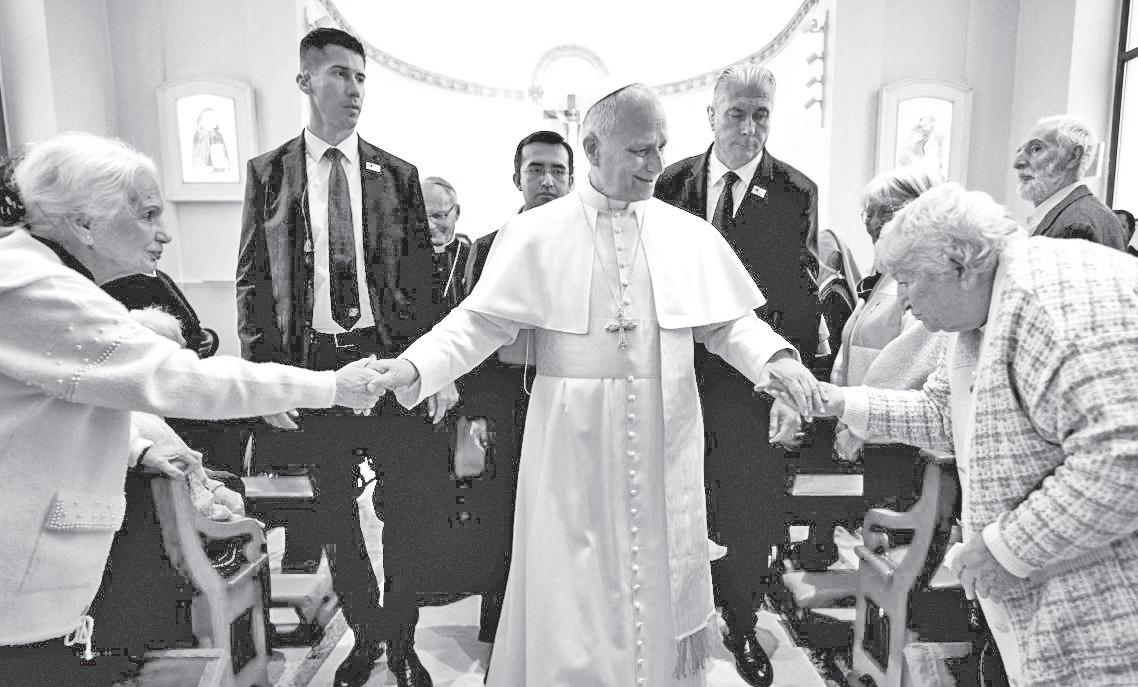
‘I will not forget you’: Pope Leo’s theme for 6th World Day of Grandparents and Elderly
‘Iwill not forget you” (Isaiah 49:15) is the theme chosen by Pope Leo XIV for the sixth World Day of Grandparents and the Elderly, which this year will take place on July 26.
According to a February 10 statement from the Dicastery for the Laity, the Family, and Life, the verse chosen by the Holy Father “is meant to emphasize how God’s love for every person never fails, not even in the frailty of old age.”
Taken from the book of
the prophet Isaiah, the theme also aims to be “a message of comfort and hope for all grandparents and the elderly,” especially those who live alone or feel forgotten. The Vatican dicastery emphasized that it is also an invitation to families and ecclesial communities not to forget the elderly and to recognize in them “a precious presence and a blessing.” World Grandparents’ Day was instituted by Pope Francis
in 2021 and is celebrated every fourth Sunday of July. It is an opportunity to show the elderly the closeness of the Church and to value their contribution to families and communities.
This year, the date coincides with the feast of Sts. Joachim and Anne, the maternal grandparents of Jesus Christ, on July 26, and the Holy Father invited everyone to celebrate the day with a Eucharistic liturgy in the cathedral church of their diocese.
The Dicastery for the Laity, the Family, and Life also urged particular Churches and ecclesial communities throughout the world to find ways to celebrate the day in their own local contexts.
Pope Leo XIV celebrated his first World Day of Grandparents in July 2025, an occasion on which he encouraged the faithful to participate in the “revolution” of care for the elderly. Almudena Martínez-Bordiú/ Ewtn News Via Cbcp News
CATHOLIC

Editor: Lyn Resurreccion

Navigating the risky environmental advocacy in PHL
By Jonathan L. Mayuga
AGROUP of civil society organiza -
tions launched the Environmental Human Rights Defenders’ (EHRD) Guide Against Abusive Lawsuits in the Philippines at the Commission on Human Rights in Quezon City, on February 4. The Guide, published by the Community Legal Help and Public Interest Centre (CHelp), Nuclear Free Bataan Movement, 350 Pilipinas, and Global Climate Legal Defense, aims to provide valuable tips to avoid, if not lessen, the legal risks of fighting for the environment, and the socio-economic impacts of destructive development.
Fighting for the environment is at times a risky business. You could either end up in jail, facing harassment suits, or worse, end up dead.
The Philippines is one of the world’s deadliest countries for environmental defenders. Environmental activists and even government employees have fallen victim to various means of “silencing” environmental advocacy.
Environmental heroes KILLINGS of environmental advocates go unnoticed. The group Global Witness recorded 306 killings and long-term disappearances between 2012 and 2024. Kaliksan-People’s Network for the Environment reported at least 328 individuals killed between 2001 and 2022.
Meanwhile, the Department of Environment and Natural Resources said its employees who are doing their jobs are also targeted by environmental criminals. Since 1987 the DENR claimed that more than 60 of its personnel have been killed while performing their duties to protect the environment.
Other defenders, meanwhile, suffer being harassed through a barrage of legal cases, landing them in jail or suffering the consequences of financial burden associated with court litigation.
Escalating environmental challenges THE Philippines faces rapidly escalating environmental challenges that are becoming more severe due to unbridled development,
the aggravating ocean plastic pollution, and the worst impacts of climate change.
Citing the massive land reclamation in Manila Bay, the groups said the activities are “swallowing fishing grounds, drowning communities in floods, and stripping the coast of its natural defenses.”
Experts have warned against the irreversible impacts of altering natural landscapes. In the case of land reclamation, the coastal and marine environment is destroyed, which could lead to biodiversity loss, eventually affecting the income and livelihood of those dependent on nature’s bounty.
“What was once a lifeline for fisherfolk is now a battleground of survival, as livelihoods vanish and ecosystems collapse.
Families along Cavite, Navotas, and Parañaque are left asking: Will progress cost us the very bay that sustains us?” proponents of the EHRD Guide said.
Meanwhile, families living near Bataan coal power plants face the daily cost of “progress”, air and noise pollution, rising illnesses, vanishing livelihoods, and landscapes scarred beyond repair. They ask the question: How much more must communities sacrifice for coal’s fleeting power?
Under siege
ENVIRONMENTAL Human Rights Defenders, who are the frontline guardians of the environment, are criminalized, harassed, and even killed.
According to the Guide, in the Philippines, those who step forward as EHRDs—whether fisherfolk, farmers, indigenous leaders, activists, lawyers, or journalists—often face retaliation through Strategic Lawsuits Against Public Participation (SLAPPs).
To address this, the Supreme Court introduced the 2010 Rules of Procedure for Environmental Cases, which provide specific safeguards against SLAPP suits.
Under the rules, defendants can raise SLAPP as a defense, triggering an expedited process: plaintiffs must prove within five days that their case is legitimate, and courts are required to resolve the matter within 30 days.
Harassment suits
ENVIRONMENTAL lawyer Gloria Estenzo-

Ramos said SLAPP is used not just against environmental defenders but also against dedicated enforcers who are implementing environmental laws.
Fortunately, Estenzo-Ramos said there are at least three national laws that frown upon SLAPP: Clean Air Act of 199, Ecological Solid Waste Management Act of 2000, and the Amended Fisheries Code.
“The harassment suit is meant to create chilling effect and instill fear on targeted persons,” Estenzo-Ramos said, as she shared that a lawsuit filed against her by the governor of Cebu province was recently dismissed by the court.
“The three laws and the Rules of Procedure for Environmental Cases provide that SLAPP should be dismissed if proven that it is meant to harass and stifle actions to protect the environment,” Estenzo Ramos said.
However, she said it is essential to capacitate the judges, prosecutors, lawyers, the enforcers and advocates to understand and apply, or for the respondent to avail of the remedy either at the prosecutor level or at the lower court. This could have the harassment cases dismissed by proving that the actions initiated by the enforcers/ advocates to protect the environment/ enforce the laws triggered the response of the complainant by filing SLAPP against the former.

Pulhin feted for 40 years service in forestry, PHL climate resilience
THE Climate Change Commission (CCC) honored the contributions of Dr. Juan M. Pulhin, a leading climate and forestry expert in the country, during his retirement ceremony at the University of the Philippines Los Baños (UPLB) in Laguna, said CCC in a news release. Pulhin’s career spans decades of service in research, policy, and education.
He served as a professor and former Dean of the UPLB College of Forestry and Natural Resources, and led pioneering initiatives that bridged science, policy, and practice, advancing climate mitigation and adaptation efforts in the Philippines.
He also served as a member of the National Panel of Technical Experts (NPTE) of the CCC. Through the NPTE, Pulhin provided technical guidance to the Philippine government on climate-related concerns, supporting the development of science- and
evidence-based strategies across national and local programs.
He likewise played a key role in the formulation of the Philippines’ National Adaptation Plan (NAP), serving from 2023 to 2024 as a member of the NAP Consultative Group of Experts and contributing strategic and scientific inputs to strengthen the country’s long-term climate resilience.
CCC Vice Chairperson and Executive Director Robert E.A. Borje expressed his profound gratitude to Pulhin for helping shape the country’s climate goals and strengthening the link between science and people-centered climate action.
“Dr. Pulhin, you have taught us that climate action, at its heart, is about people. About dignity. About responsibility that extends beyond our own time. You built bridges between academe and government, between global climate discourse
and Filipino realities, and between the data and human consequences.”
Pulhin has retired after more than 40 years of exemplary service, commitment, and dedication to the country, leaving behind a legacy that continues to guide climate action through the institutions he strengthened and the students and professionals he mentored.
Also present at the celebration were Pulhin’s colleagues, former professors, and long-time partners in climate action, who joined the CCC in honoring a career that helped shape the country’s climate science and policy landscape.
The CCC is the lead policy-making body of the government tasked to coordinate, monitor and evaluate government programs and ensure mainstreaming of climate change in national, local, and sectoral development
a
Enduring SLAPP
THREE ERRDs shared their hardships because of SLAPP. Jawo Jayme, a queer climate activist from 350 Pilipinas, lost three days of work every month since he was charged almost a year ago.
He faced mounting financial burdens and the weight of a criminal case, compounded by a gruelling 10-hour journey to Calauag, Quezon province, where the criminal cases were filed.
From the Nuclear Free Bataan Movement, Fatty Villanueva recounted the suffocating reality of coal ash and noise pollution from a nearby coal-fired power plant, the demolition of her coastal home, and the fear and distress she endured.
Fortunately, with C-Help’s free legal assistance, the two criminal charges against her were finally dismissed in February 2025.
Meanwhile, Ma. Kristina Laguitan, a working single mother from Limay, also in Bataan, her house was disrupted when it had to make way for a propylene pipeline running under her house.
After becoming a vocal critic against coal, she was arrested in front of her child on the basis of four cyberlibel cases. She was grateful for the legal support by C-Help.
Unmonitored
IN the Philippines, there is no dedicated government body or centralized registry
monitoring SLAPPs. Because of this, any “count” of cases locally remains speculative, and there is also the “camouflage” challenge.
A SLAPP suit rarely identifies itself as one. They often masquerade as legitimate civil or criminal complaints—libel, grave coercion, or even simple injunctions. Because they are “cloaked” in standard legal procedure, determining where a valid legal claim ends and an abusive tactic begins is often a matter of perspective.
“What is undeniably clear, even to the most skeptical observer, is that a growing number of legal cases involve individuals and groups raising concerns about environmental problems. Whether these cases are ‘abusive’ is a point of intense legal debate,” the groups pointed out.
In essence, the “fingerprints” of SLAPPs are not found in the final judgments of the court, but in the chilling effect they leave on public discourse, they said.
While there is no exact tally of these suits, the pattern of arrests and litigation surrounding environmental disputes suggests that the courtroom has become a primary, and often lopsided, arena for environmental policy.
A practical guide
THE EHRD Guide offers a practical reference for navigating the Supreme Court’s Rules of Procedure for Environmental Cases, with a focus on protections against SLAPPs.
It explains how defenders can use existing remedies, such as raising a SLAPP defense or invoking the Writ of Kalikasan, to challenge abusive suits early in the judicial process.
By simplifying complex procedures into clear steps, the guide equips environmental advocates, especially those in grassroots communities, with the knowledge to better recognize, respond to, and resist retaliatory litigation.
“Courageous advocacy should never be met with legal intimidation. This Guide informs defenders of their rights and equips them to stand firm,” said lawyer Zelda Soriano, the Guide’s lead author, and C-Help founder and executive director.
The 80-page Guide also provides practical advice for avoiding abusive lawsuits. It outlines how to conduct legal risk assessments
and manage potential threats, offers clear do’s and don’ts for rallies and demonstrations, explains the responsibilities of police and security personnel during such events, and teaches how to recognize and challenge unlawful arrests and searches.
It likewise includes guidelines to help EHRD organizations remain compliant with legal requirements.
A human rights issue
THE launching of the ERD Guide coincided with the country’s hosting of the Asean Summit this year, wherein governments are expected to demonstrate how regional commitments, such as the Asean Declaration on the Right to a Safe, Clean, Healthy and Sustainable Environment, are being translated into practice. The declaration affirmed that environmental protection is inseparable from human rights. The EHRD Guide provides a practical framework to help states and institutions move beyond broad commitments and toward concrete measures that safeguard defenders.
According to the groups, protecting environmental defenders is not only about ensuring the safety of individuals but about upholding the collective right of communities to live in a safe, healthy, and sustainable environment, as their security is directly linked to the survival of ecosystems and to the broader struggle against climate change.
The Asean Declaration sets the principle, while the EHRD Guide offers the tools and pathways to implement it.
Orly Mercado, former senator, Defense secretary, and now chairman of the C-Help Board of Trustees, said that those responsible for national security and peace and order must operate within clear guardrails and remain accountable under the law. Mercado emphasized that this understanding must be shared not only with environmental defenders but also with the police and military.
He added partly in Filipino: “It is important that we can bring this to the next step: [by] making this more available. If this is going to be a handbook for policemen, for government agents, or prosecutors, let it be. To demonstrate that democratic institutions are alive.
Ecuador’s ancient forest the last stand for tiny hummingbird facing extinction
YANACOCHA RESERVE, Ecuador—Deep in the Ecuadorian Andes, an ancient forest stands as a final sanctuary against the encroachment of human activity.
It is the Yanacocha Reserve, the last refuge for the black-breasted puffleg (Eriocnemis nigrivestis), a tiny hummingbird teetering on the edge of extinction.
Measuring just 9 centimeters (3.5 inches), this emblematic bird of Quito is one of the most threatened species on the planet.
According to the International Union for Conservation of Nature, its global population has dwindled to between 150 and 200 birds.
Founded 25 years ago by the Jocotoco Foundation, the Yanacocha Reserve has become a centerpiece for Andean biodiversity.
“We realized we were conserving an entire ecosystem, not just one species,” conservationist Paola Villalba told The Associated Press.
The bird is easily identified by the striking white “trousers” of feathers around its legs, which contrast sharply with its deep, metallic black chest and bronze-green wings.
Despite its beauty, its survival is at risk as high-altitude forests are cleared for grazing and agriculture.
Shirley Farinango, of the Birds and Conservation Foundation, notes that the pressure is most intense because the puffleg occupies a narrow ecological niche between 3,000 and 3,500 meters (9,800 and 11,400 feet) above sea level. This specific elevation, she said, is “prime territory” to be converted to agricultural land.
On the slopes of the Pichincha volcano, 45 kilometers (27 miles) northwest of Quito, conservationists are now racing to restore this cloud-shrouded forest.
For the “smallest fairies” of the Andes, these dense trees are more than just a habitat—they are their last stand. Cesar Olmos And Gonzalo Solano/Associated Press
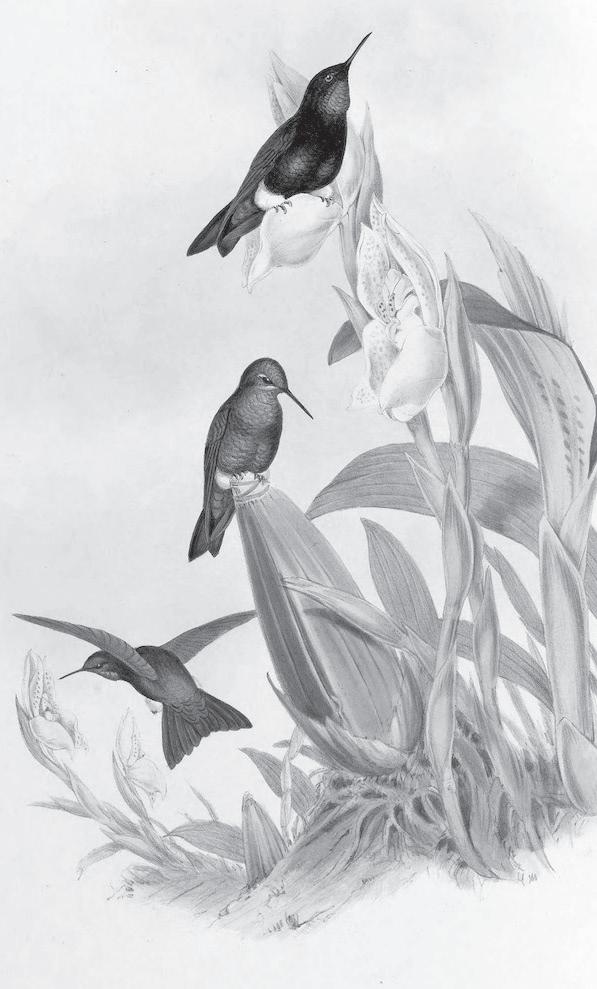
plans towards
climate-resilient and climate-smart Philippines.
Climate Change Commission (CCC) fetes climate science and forestry expert Dr. Juan M. Pulhin (sixth from left, front) for his retirement. The celebration is attended by CCC Vice Chairperson and Executive Director Robert E.A. Borje, University of the Philippines (UPLB) Chancellor Dr Jose Camacho, UPLB College of Forestry and Natural Resources (CFNR) Dean Marlo D. Mendoza, former UPLB CFNR dean Rex Victor O. Cruz, and Dr. Rafael D. Guerrero, former executive director of the now defunct Philippine Council for Aquatic and Marine Research and Development, and many others. CCC PHOTO
A8 Sunday, February 15, 2026


ORTINA D’AMPEZZO, Italy—
CThe pair of animals chosen as mascots of the Olympic and Paralympic Winter Games are stoats— weasel-like creatures that are at risk because of climate change.
One of them is brown and the other is white, because in cold climates, the tiny animals’ fur changes from brown to white for winter, to blend in with the landscape. However, stoats are increasingly turning white before there is any snow on the ground, leaving them vulnerable to predators—their snow-white coats amid dirt and rocks is like a target on their backs for sharp-eyed raptors. Olympic organizers haven’t talked about that, at least not so far.
They say the mascots are meant to welcome people and communicate that these Games are infused with Italian spirit.
The white stoat mascot is Tina— short for Cortina, after Cortina d’Ampezzo, one of the two cities hosting the Winter Olympics. Her younger, darker-furred brother, Milo— after the city of Milan—was born without one paw and is the mascot for the Paralympics in March. Their images are on magnets, bags and pins. But since stores sold out in the Games’ first days, it’s been nearly impossible to find a plush toy of the stoat siblings in Milan and Cortina d’Ampezzo. Still, every medalist receives a toy on the podium, though, which means they stay in the public eye. And a costumed Tina is a regular at competition venues, spreading joy, greeting giddy spectators and posing for photos.
Embodying the “dynamic Italian spirit”
Marco Granata, a doctoral student who researches stoats at the University of
BusinessMirror
mirror_sports@yahoo.com.ph
Machines have a lot of power, but human touch still matters
COTTSDALE, Arizona—For
those worried robots are about to take over Major League Baseball (MLB), Colorado Rockies manager Warren Schaeffer has some experience with the Automated Ball/Strike system that’s coming to stadiums this summer. Yes, the machines have a lot of power. But the human touch still matters.
“I’ve seen challenges lost in the first inning,” Schaeffer said. “That’s not good. Emotion is a big key to this.” The ABS system made a cameo last year in big league spring training and was greeted with a mix of curiousity, excitement, disdain and uncertainty. Now that it’s here for regular-season games in 2026 , the novelty is quickly giving way to strategy.
MLB gave a presentation on the ABS process Thursday at Cactus League Media Day in Arizona. Joe Martinez, the sport’s vice president of on-field strategy, said a survey taken by the league found
Mango Tee turned sour: All that for a trophy?
Turin in Italy, thinks the organizers are missing out on an opportunity to educate people a bit more and help this animal.
“It’s ironic because everyone now is talking about stoats, looking for stoats, but no one knows about real stoats, mostly because the Olympic committee didn’t inform the population about it,” he told The Associated Press.
The Olympics’ website describes stoats as naturally curious—animals that “love sports and the outdoor life but they also want to have fun. They represent the contemporary, vibrant and dynamic Italian spirit.”
Raffaella Paniè leads the branding for the 2026 Milan Cortina Games and oversaw the mascot’s creation, crowdsourced from young Italian students.
She told the AP she doesn’t think talking about the implications of climate change is within the scope of the organizing committee. There were so many options for messaging, and the committee needed a focus, she added.
They put a lot of effort into making the mascots very friendly. “That’s how the mascot comes to life really, makes it very special, more than what it is as an animal,” she said.
“We are organizing a sport event so we need to promote the culture of the country,” she added.
When asked by the AP in Milan on Thursday why no one is talking about the stoat and climate change, Olympic Games Executive Director Christophe Dubi said: “I’m glad you raised it and we should include that in our narrative.”
If the mascot speaks to the changing environment, and that message can be conveyed to the younger generation, “let’s use it,” Dubi also said. Needing “the right wardrobe” to avoid predators. AP

AS the season for big club tournaments begins, the golf community is again faced with an unsavory incident and the revelry that should have been the 38th Mango Tee, Alabang Country Club’s annual member-guest tournament, was ruined by a couple of teams who seemingly submitted overly generous handicaps.
The Alabang Country Club’s Board of Directors were still decent enough to choose their words and called the incident a case of “highly unusual and statistically improbable submitted scores.”
Just last year, during Manila Golf’s Golden Tee memberguest, an incident of dishonesty resulted in the expulsion of a member. It seems that some entitled golfers refuse to learn their lessons and would like the rest of the golfing community believe that they simply played unusually excellent rounds.
During the recent Mango Tee, the Overall Net Champions had one player shoot 16-under par. On one day. The 24-handicapper shot a gross 80, or 16 shots better than his “normal” probable score.
In the second team, the net runners-up, one of the players who carried an 11 handicap shot even par on day one, and two over on day two, 20-under for two days, from one player.
These “improbabilities” were just too glaring for the participants to let pass.
During the awarding ceremonies, when the net winners were announced, resounding boos drowned out the background music and the hosts’ voices. That the winning teams had members from political dynasties didn’t provide any comfort either.
Incidents like these happen pretty regularly. Despite attempts of tournament organizers and handicapping bodies to ensure fairness in assessing players’ abilities, ultimately, it is down to the players themselves. There’s only so much the clubs and the handicapping bodies can do if the players intentionally submit high scores to pad their handicaps in preparation for big tournaments.
For most golfers, the question would be: why do it at all?
Would you risk your reputation for momentary applause and a piece of wood, metal or glass which will just gather dust on a table? Is a trophy worth the question mark beside your name for the rest of your golfing life?
For some, it would seem so. Either that, or they have been so used to getting their way, they forgot that they cannot fool all the people, all the time.
The decision by Alabang Country Club was swift: the top two teams must return the trophies. They
of Ronin Leviste/Darren Flores or Ronin’s father, Mark Leviste. One member from the runners-up, LRay Villafuerte in a radio interview, denied any wrongdoing. Even more, Villafuerte has stated that only Leviste’s team submitted an unbelievable score. He also apparently made accusations against the Levistes and pushed their removal from the club.
This incident may take a while to resolve. The powerful families involved will surely not take this sitting down. But the damage has been done. A prestigious event that took so many months of preparation and effort now boils down to a bad memory from a few participants who felt entitled.
Will ACCI go all the way and apply the heaviest penalties like Manila Golf had done last year? Only time will tell. But what is more important is for the golfing community to unite and find a way to stop incidents like these from happening.
As I said earlier, handicaps are highly dependent on the players submitting correct scores religiously. But golf clubs also have a role, as does local golf’s governing body.
Stricter monitoring, mandatory submission of scorecards for all rounds will all help make handicaps more representative of players’ true skill level. But cheaters will always find ways. They can intentionally submit high scores by actually playing bad months before big tournaments. We also need to find solutions to cases like these.
During the online discussions in local golf groups, a comment by accomplished amateur and Luisita Golf GM Jeric Hechanova seemed like a good way to go forward.
Jeric suggests that net scores should be capped at -4 per day. In case of ties, lower handicaps prevail. He also suggested that in order to make handicaps more accurate, under par rounds during big tournaments should be entered multiple times and according to how low the scores are.
If a player shoots 10-under for a tournament round, his/ her score should be entered into the handicapping system 10 times. If he/she scores 9-under, that net 63 should be entered 9 times, and so on. By doing this, the player’s handicap will reflect his “improvement” and prevent further “sandbagging” in future tournaments. If a player’s handicap decreases significantly, it would be impossible for him/her to repeat shooting in the low 60s net again.
What is meant to be a game of integrity has sadly come down to finding ways to deter cheating. But golf will always be above these entitled players. They can fool themselves but they can’t fool us forever.

or “very negative” effect on the game. As a refresher, here’s how the system works: Stadiums are outfitted with cameras that track each pitch and judge whether it crossed home plate within the strike zone.
Human umpires call every pitch, but each team has the ability to challenge two calls per game. Teams that burn their challenges get one additional challenge in each extra inning. A team retains its challenge if successful, similar to the regulations for video reviews, which were first used for home run calls in August 2008 and then widely expanded to many calls for the 2014 season
Only a batter, pitcher or catcher may challenge a call, signaling by tapping one hand on a helmet or cap, and assistance from the dugout is not allowed. A challenge must be made within two seconds, and the graphic of the pitch and strike zone is shown on the scoreboard and broadcast feed. The umpire then announces the updated count.
Schaeffer, who was managing at Albuquerque when ABS debuted in Triple-A in 2022, said it’s important that teams develop a coherent strategy on how to deploy challenges. He added that “15 guys will have 15 different opinions” on how to use it, but the most important aspect is everyone is on the same page.
“We still have to have a lot of conversations behind closed doors, so that we’re putting our players in the best position to succeed,” the manager added.
Multiple MLB managers and GMs said Thursday that catchers will probably have the most leeway to challenge because they’ve got the best view of the baseball. AP

AN Olympic mascot dances near the finish line of an alpine ski women’s downhill training in Cortina d’Ampezzo, Italy. AP
They’re soaring The US’s Nathan Pare (13), France’s Jonas Chollet (4) and France’s Loan Bozzolo (5) compete during the men’s snowboard cross finals at the 2026 Winter Olympics in Livigno, Italy, Thursday. AP


FEBRUARY 15, 2026 | soundstrip.businessmirror@gmail.com
FINDING REST IN THE NOISE
Gab Cabangon sleeps easy with ‘Kama’
Story by Bless Aubrey Ogerio
IN a world that runs on exhaustion, rest often feels like something you earn rather than something you need.
For Filipino singer-songwriter Gab Cabangon, that tension between pressure and pause sits at the heart of his new single, “Kama.”
Released after a period of intense work and personal reflection, “Kama” is a soulful guitar-pop track about finding relief at the end of a long day.
Written by Gab himself, the song treats rest not as an indulgence but as a necessity in a culture that rarely slows down.
“I’m doing good. I’m tired, but I’m good,” Gab told SoundStrip when asked how he’s been lately. “I guess I could say I’m fortunate—doing better.”
The months leading up to the release were busy, marked by overlapping work commitments and the familiar anxiety that comes with putting out new music.
“It’s been very busy with work, and at the same time, I’m going through all the anxieties of

Publisher :
T. Anthony C. Cabangon
Editor-In-Chief :
Lourdes M. Fernandez
Aldwin M. Tolosa
Concept :

Y2Z Editor : SoundStrip Editor : Group Creative Director : Graphic Designers :
Jt Nisay
Edwin P. Sallan
Eduardo A. Davad
Niggel Figueroa
Chow Jarlego
Contributing Writers :
Tony M. Maghirang
Rick Olivares
Jingo Zapata
Reine Juvierre S. Alberto
John Eiron R. Francisco
Patrick Villanueva
Ana Zoe V. Davad
Justine Xyrah Garcia
Ginger Franz S. Ocampo
Trixzy Leigh Bonotan
Bless Aubrey Ogerio
Photographers :
Bernard P. Testa
Nonie Reyes
Y2Z & SOUNDSTRIP are published and distributed free every Sunday by the Philippine Business Daily Mirror Publishing Inc. as a project of the
The Philippine Business Mirror Publishing, Inc., with offices on the 3rd Floor of Dominga Building III 2113 Chino Roces Avenue corner
Dela Rosa Street, Makati City, Philippines. Tel. Nos. (Editorial) 817-9467; 813-0725. Fax line: 813-7025
Advertising Sales: 893-2019; 817-1351,817-2807.
Circulation: 893-1662; 814-0134 to 36. www.businessmirror.com.ph
releasing another single,” he said. “I think that’s unavoidable for anybody who releases music.”
That pressure is not unfamiliar to him. As the son of folk singer Noel Cabangon, expectations, spoken or otherwise, have long hovered over his career.
“I would be lying if I said it doesn’t affect me,” Gab admitted. “Of course, it would be nice sometimes to be recognized more for my own work, and not necessarily because of my dad.”
Still, he has learned to make peace with it. “We both play the guitar, we both sing. I can’t really blame people for comparing us,” he said, laughing. “We both wear glasses too.”
With “Kama,” Gab sounds less preoccupied with proving something, more focused on saying what he needs to say.
When rest becomes the message
GAB said that “Kama” stands apart from much of his earlier work. “This is the one song that really veered away from the original vision people might have of my music,” he said. “When you hear it, it’s not usually what I’m known for.”
Produced by Gab alongside David Lina, with mixing by Shadiel Chan and mastering by Jan Fuertez, the track leans into bedroom pop and R&B textures. It steps away from his traditionally stripped-down acoustic sound while keeping the warmth and intimacy that have long defined his songwriting.

“I wrote it as an exercise to declutter and de-stress,” Gab said. “This is the song where I collaborated with the most people.”
Musically, the song draws influence from tracks like Kumot by Solace Out the Door, Tulog Na by Sugarfree, and Janice by Dilaw.
“I’m usually known for very singer-songwriter, acoustic guitar vibes,” he explained. “This one has more city-pop and R&B influences.”
The track began with David laying down a beat built around sampled percussion. From there, the two decided to explore unfamiliar territory. “I’m not known as a city-pop R&B guy. But I was curious about how people would react,” the Pieces act said.
Despite the shift, Gab insists the song still feels personal. “Even if it’s different, it’s still me,” he said. “The singersongwriter part is still there.”
“Kama” features backing vocals from vydd and Kyla Miel Camerong of Solace Out the Door, with additional harmonies from Gab’s wife, Angeli. Trumpet and flugelhorn parts by Gabriel Lazaro add depth to the arrangement, rounding out the track’s softer, more layered sound.
Building, not chasing
WHILE releasing “Kama” marks an important moment, Gab is clear that mainstream success is not the primary goal. “It’s just a bonus for me if we reach that,” he said. “Why not, right?”
For now, his focus remains on expanding his
personal catalog and continuing to make music that feels honest. “It’s really about broadening my body of work,” he said.
He is also eager to collaborate more to learn and stretch creatively. Opportunities abroad are also not off the table, but the budding singer sees them as secondary to building a strong foundation at home.
“I like reflecting through my songs,” he said. “It doesn’t always have to be romantic. I just like reflecting about life in general.”
Gigs, growth, staying grounded
THE release of “Kama” will be supported by a mini bar and café tour across Metro Manila.
It already has a scheduled performances on February 13 at UNWND Boutique Hotel in Makati, February 28 at Cappo Coffee in Quezon City, and March 14 at Backdoor Maginhawa. Ticket details and updates are available on Gab’s Instagram page.
Beyond the tour, Gab continues to book regular gigs and hinted at an upcoming collaboration he is not yet ready to announce. “This is not my only song for 2026,” he teased.
Asked what advice he would give young artists, Gab emphasized learning over recognition. “Constantly learn before thinking about fame,” he said. “And always love your culture.”
He also stressed the importance of understanding the business side of music. “Learning isn’t just about the creative part,” he said. “If you want to do this professionally, you have to learn the backend too. It helps you navigate the industry, and it protects you from being exploited.”
Gab Cabangon

MODERN SOUL
Samm Henshaw stays on the move in Manila debut
Story and photos by Zoe Davad
Concerts. You’ve heard of them. Big, noisy spectacles that attract crowds in the thousands, turning the constricted space of an arena into a sonic volcano.
These events are often sold to us as feats of scale: fireworks timed to the beat, LED screens the size of buildings, crowds so large they blur into a single, roaring mass. But every so often, a show reminds you that music’s most potent magic doesn’t require spectacle—only presence. British-Nigerian singer Samm Henshaw’s longawaited Manila debut last February 3 at the packed, intimate Teatrino in Greenhills was a masterclass in this sorcery.
Who is Samm Henshaw?
For the uninitiated, Samm Henshaw’s work sits comfortably at the crossroads of modern soul and R&B with tracks that are somehow both timeless and fresh. He first gained wider attention with his 2017 EP The Sound Experiment, followed by The World Is Mine (2019), a project that introduced his gift for writing songs that sound joyous on the surface while quietly wrestling with doubt, ambition, and belief. His 2022 debut album, Untidy Soul, expanded that emotional palette, leaning into funkier arrangements and more explicit conversations about mental health, money, and self-worth.
What sets Henshaw apart is his voice— elastic, conversational, capable of leaping from a hushed confession to a full-bodied belt in the space of a bar—and his grounding in gospel traditions, which give his songs a natural calland-response quality. These are tracks designed not just to be heard, but to be shared.
The Teatrino, with a capacity in the low hundreds, proved to be the ideal vessel for that kind of exchange. There was no pit nor barricade. The atmosphere was set not by bombast, but by comfort. The stage was warmly lit, centered
around Henshaw and his impeccable live band, that provided a rich, almost entirely live soundscape that breathed new life into his work. While the low-end thrum of the sound mixing occasionally threatened to muddy Henshaw’s vocals, the instrumental synergy was overall outstanding.
Songs Built For Communal Feeling
Henshaw took the stage not as a distant star, but as your most talented friend who decided to grab the mic at a legendary karaoke party. His conversational tone was disarming. Between songs, he’d offer simple, frequent check-ins: “You all good? You still having a good time?”
This approachability melted away any residual shyness in the crowd, unlocking the famous Filipino propensity for uninhibited sing-alongs. As Henshaw launched into his set, starting with the soul-stirring “Wait Forever,” it became clear his songbook is tailor-made for the Filipino palate. These are modern “hugot” anthems—songs of yearning, faith, and heartache—crafted for communal belting.
Early highlights included a tender, keyboardled rendition of “How Does It Feel” and the buoyant “Stay on the Move.” Henshaw introduced “Sun and Moon” as one of his personal favorites, and its gentle, affectionate melody washed over the audience, many of whom sang along as if they’d lived with the song for years.
Before “Still Broke,” he grinned and said, “You sound gorgeous, Manila,” after the crowd sang back every word of the previous chorus. For “Broke,” a raw anthem of financial and emotional strain, he set the stage: “Specifically this song, this is where you guys can really express yourselves vocally.”
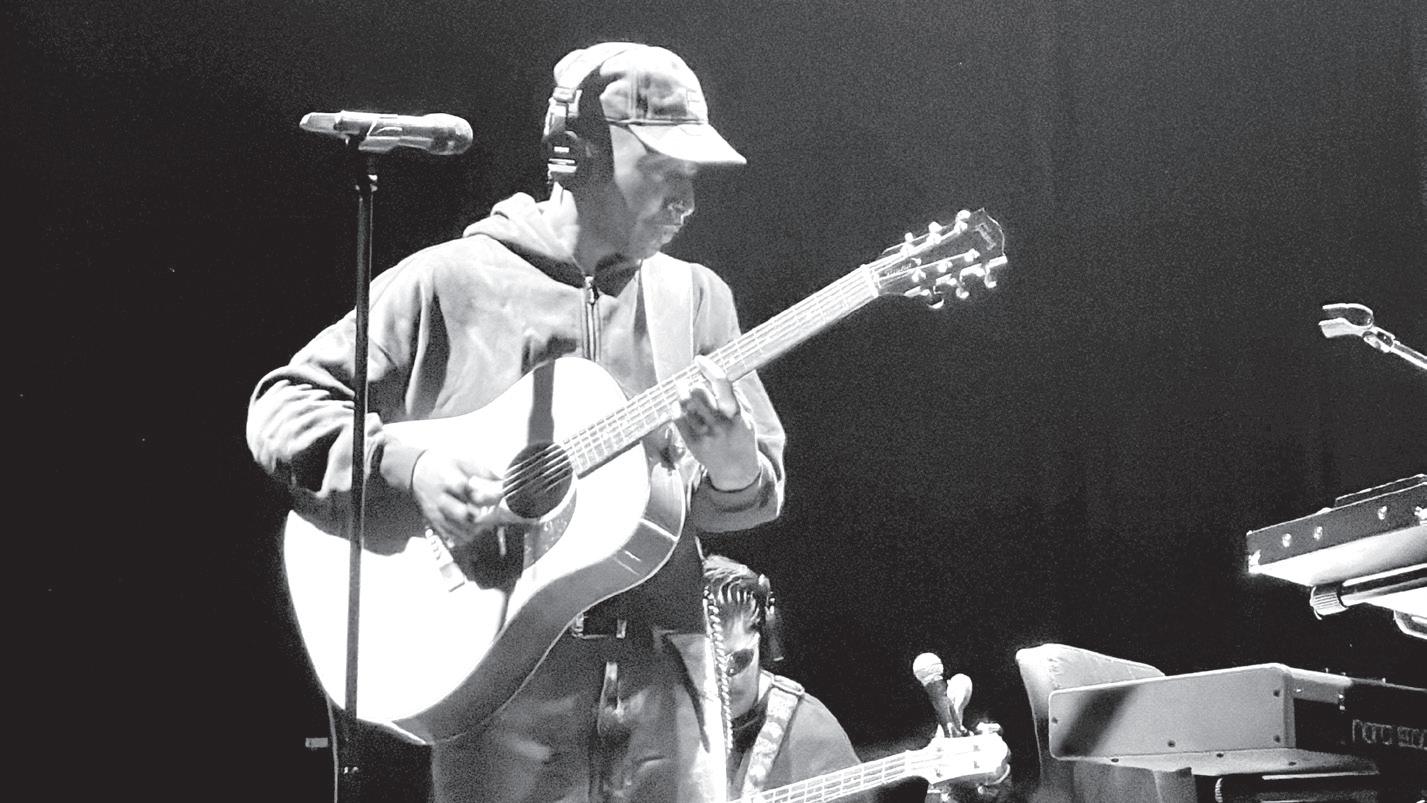

Throughout the night, Henshaw’s vocal runs and ad-libs felt less like rehearsed flourishes and more like spontaneous responses to the room. On tracks like “Grow” and “Troubled Ones,” that improvisational energy gave the songs new life, pushing them beyond their recorded versions and into something looser, more joyful, and more human.
The main set closed on a high with the jubilant “Hair Down,” an alt-soul that celebrates letting go of self-consciousness, and “Get Back,” a newer track that hints at the direction of his upcoming work—soulful, nostalgic, and almost ethereal in its production. “Bless you all,” Henshaw said sincerely. “I hope we see each other very soon.”
Unrelenting screams for an encore shook the room for a solid minute, made even louder by the darkness, punctuated by heartfelt shouts of “We love you!”
“I love you guys too,” Henshaw confessed. “I
never do this. I don’t like encores. Think they’re stupid. But I love you guys, you guys are amazing.” What followed felt less like a formal encore and more like a gift. He reached back into his catalog for “Doubt,” a deep cut he said he hadn’t played in years, its themes of uncertainty and self-questioning landing with renewed weight in an intimate room. He ended with “Sweet Joy,” a fitting closer that distilled the night’s emotional arc: faith without preachiness, joy without denial of struggle.
Samm Henshaw’s Manila concert wasn’t just a display of his considerable talent as a singer and bandleader; it was a celebration of the unique, participatory energy of a Filipino crowd. Though Henshaw came to sing songs and have a good time, he also proved once again that the deepest connections are often forged in the coziest rooms, with a mic, a mighty voice, and a thousand friends singing right back.

Henshaw opens the night with a soft strumming of the guitar. | Photos by Zoe Davad
At the keys, Henshaw slowed the night, letting every chord linger.
Henshaw delivered soaring runs and soft confessions in the same breath.
Why some women choose ‘Galentines’ over Valentines
AND HOW THEY MIGHT CELEBRATE
By Alicia Rancilio
The Associated Press
Christie O’Sullivan of Trinity, Florida, has spent 21 Valentine’s Days with her husband, but her favorite celebration was one spent with a girlfriend before she got married.
They took the day off work, got massages, and went out for cocktails and a fancy dinner.
“For me, it was 10 out of 10. That whole day was intentional,” said O’Sullivan. She remembers it as empowering “on a day that’s usually filled with pressure to be in a relationship, or sadness because I wasn’t currently in one.”
“Galentine’s Day” became a pop culture phenomenon with a 2010 episode of the TV comedy Parks and Recreation that celebrated female friendships around Valentine’s Day. Amy Poehler’s character, Leslie Knope, gathered her gal pals on February 13.
“What’s Galentine’s Day? Oh, it’s only the best day of the year,” said Knope.
Honoring female friendships can happen any day of the year, of course. Whether on February 13 or another day, here are some ways to create a fun-filled experience:

Making it a party
CHELA Pappaccioli of Franklin Lakes, New Jersey, has been hosting a Galentine’s Day bash at her home for the last three years. She has a bartender and a DJ hired, and this year invited 45 of her nearest and dearest. So far, she has 34 confirmations, and is assembling gift bags for her guests to take home. There are no men allowed “unless the bartender happens to be male.”
The event may be extravagant, but Pappaccioli says it’s worth it.
“It’s an escape to just be with your girls, be silly, do something fun and just focus on the friendships you’ve created and enjoying each other’s company,” she says.
Learning how to do something new
LIZ Momblanco of Berkley, Michigan, who describes herself as a “serial hobbyist,” invites her friends to take classes like
cookie and cake decorating, calligraphy and stained glass.
“I enjoy learning something new and having a shared experience,” said Momblanco, who has attended day retreats for women that offer activities like floral arranging, yoga or a cold plunge.
Marney Wolf, who runs the retreat company Luna Wolf, says providing an opportunity for art and creativity builds community.
“It bonds you, whether it’s the smallest thing or really deep. You watch these grown women turn into almost like a childlike kindergarten response like, ‘Oh my gosh! Good job! You’re so talented!’ That little lift is the easiest thing to do,” she said.
Filling a Valentine’s void
WOLF takes care to schedule Galentine’s-themed retreats near Valentine’s Day because some women don’t have someone to spend February 14 with.
“I know it can be a really lonely time for people and I think some take it for granted,” she says.
Pappaccioli said a couple of divorced friends come to her party, and “even if you’re married it can be depressing because your husband may not be doing what you want or your boyfriend may not support you in the way you want,” she says.
“It’s nice to know that you don’t need that. You can still celebrate the holiday, but turn it around a little bit and celebrate the relationships you want to.”
Creating different kinds of bonds
GALENTINE’S Day get-togethers can forge new friendships. And spending quality time with a friend provides an opportunity to put the phone away, avoid distractions and build memories.
O’Sullivan is a social media strategist for businesses but appreciates that her bestie Valentine’s Day was without cellphones. “We could be fully present — no photos, no texts, no nothing,” she says.
“So while that means there’s no actual record of that day occurring, it also means the details became a core memory without it.”
Some celebrate Galentine’s Day by just going out for coffee or playing cards. You might go with a group of women friends to a play or museum, or take a hike or a workout class. Other ideas include thrift store shopping, country line dancing, roller skating, karaoke, junk journaling, and getting manicures and pedicures. n Cover photo by Yan Krukau on Pexels.com
200 love letters found in a Nashville home tell the story of a couple’s courtship during WWII
HIGHLIGHTS from a trove of more than 200 love letters that tell the story of a couple’s courtship and marriage during World War II are now on display digitally through the Nashville Public Library, offering an intimate picture of love during wartime.
The letters by William Raymond Whittaker and Jane Dean were found in a Nashville home that had belonged to Jane and her siblings. They were donated in 2016 to the Metro Nashville Archives.
Whittaker, who went by Ray, was from New Rochelle, New York. He moved to the Tennessee capital to attend the historically Black Meharry Medical College, according to the library’s metropolitan archivist, Kelley Sirko. That’s where he met and dated Jane, another student at the college. The pair lost touch when Ray left Nashville. In the summer of 1942 he was drafted into the Army. Stationed at Fort Huachuca in Arizona, he decided to reestablish contact with Jane, who was then working as a medical lab technician at Vanderbilt University.
A ‘pleasant and sad surprise’ The library doesn’t have Ray’s first letter to Jane, but it does

have her reply. She greets him somewhat formally as “Dear Wm R.”
“It sure was a pleasant and sad surprise to hear from you,” she writes on July 30, 1942. “Pleasant because you will always hold a place in my heart and its nice to know you think of me once in a while. Sad be -
cause you are in the armed forces—maybe I shouldn’t say that but war is so uncertain, however I’m proud to know that you are doing your bit for your country.”
Jane then goes on to list—perhaps as a hint?—a string of mutual acquaintances who have gotten married recently, noting those who have had children or are rumored to be having children. She signs off, “Write, wire or call me real soon—Lovingly Jane.”
A story told in letters
“ YOU can’t help but smile when you read through these letters,” Sirko said. “You really can’t. And this was just such an intimate look at two regular people during a really complicated time in our history.”
Sirko said Nashville archivists have not been able to locate any living relatives of Ray and Jane, so most of what they know about them is from the letters. The couple did not have any children, according to an obituary for Ray, who died in Nashville in 1989. The donation also included a few photographs and Ray’s patch from the historically Black fraternity Alpha Phi Alpha.
Beyond a love story, the collection gives “this in-the-

moment perspective of ... what it’s like just navigating certain racial issues, certain gender issues, their work, the life of a soldier, all of these things,” Sirko said. That’s why the archivists wanted to make it more accessible to the public.
A ‘darling husband’
SOON Ray wins Jane over, and they are married on Nov. 7 in Birmingham.
In a letter from Nov. 9, Jane addresses Ray as “my darling husband.” She is rapturous about the marriage but sad that the couple has to remain apart for now. She has already returned to her job and family in Nashville while he has returned to the Army base.
“It’s a wonderful thing to have such a sweet and lovely husband. Darling you’ll never know how much I love you. The only regret is that we didn’t marry years ago... As it is now things are so uncertain and we are not together but such a few happy hours. But maybe this old war will soon be over and we can be together for always.”
She concludes, “Darling be sweet and write to me soon. I want a letter from my husband. Remember I’ll always love you. Always—from Your Wife” AP
A MAN walks holding flowers and balloons on Valentine’s Day 2025 in New York. AP
IN this digital scan of an undated photo provided by The Nashville Public Library, William Raymond Whittaker (left) and his wife Jane Dean Whittaker stand for a photo in Nashville, Tennessee. AP