


Non-NCR-centric, attuned to global and local trends, developers excitedly follow the tracks of an awakening industrial sector.

By John Eiron R. Francisco
WHILE some people are losing sleep over a glut in condominium units, the Philippine industrial sector, once considered a “sleeping giant,” is now on the cusp of a major awakening in 2025, signalling a boon to developers, according to a real estate experts.
PRIME Philippines Founder and CEO Jettson Yu said at a property market briefing this week that the industry has undergone a transformation, with developers adapting to higher interest rates and making strategic moves in the market. He described 2024 as a period of “recalibration” for many developers that allows them to adjust to financial conditions and position themselves for growth. Th is recalibration has already yielded positive results, with the sector maintaining an impressive 90-percent occupancy rate for the third consecutive year and closing 2024 with a remarkable 97 percent occupancy, Yu said.
This is the year the giant is about to awaken,” Yu said, empha-
sizing the growing momentum in the industrial sector. In 2024, the Philippines’s total warehouse supply grew by 4 percent in 2024, reaching 37.6 million square meters. Key areas such as Laguna, Batangas, and Cebu saw significant supply increases, with Batangas—home to new developments from companies like Aboitiz and Ayala—experiencing the lowest occupancy rate due to an influx of new industrial parks.
No longer NCR-centric YU also pointed out a shift in locators’ preferences, as vacancy rates in Metro Manila and its surrounding areas slightly increased. The demand for Grade A facilities has surged, driven by companies seek-

THE INDUSTRIAL SECTOR’S AWAKENING IN 2025: “This is the year the giant is about to awaken.”—Jettson Yu (PRIME Philippines Founder and
ing operational efficiency. Many companies have relocated from Grade C warehouses, with one major retailer moving from Metro Manila to Calabarzon in 2024 to access Grade A spaces.
The demand for Grade A warehouses continues to rise, as these facilities offer key features like loading bays and are more sustainable and efficient. Yu noted that companies are increasingly opting for such spaces, with DHL recently opening a new warehouse in Santa Rosa, Laguna, and DSV expanding to Silang, Cavite.
The trend toward high-quality facilities has also contributed to a 6.19-percent increase in average rental rates for industrial spaces that reflects the ongoing demand for Grade A properties.

“We continue to see strong demand for commercial spaces, particularly for drive-thru stores, standalone outlets, and leasable lots.”—Sondi Tuazon (PRIME Philippines retail team)
Industrial space demand YU projected that the demand for industrial spaces in the country will surge over the next decade. By 2035, an additional 50 million square meters of industrial space will be needed, with current growth being just the beginning.
The 50 million projection is from a conservative to optimistic view,” he said.
He attributed much of this movement to the logistics sector, which has been expanding over the past three to four years. The pandemic accelerated decentralization, prompting many people to relocate from Metro Manila to provincial hubs like Cebu and Davao, where remote and permanent job opportunities have emerged.

ON THE GOVERNMENT’S TAX REFORM INITIATIVES TO BOOST
Th is shift, Yu explained, was facilitated by the decentralization programs of the past three administrations, which prioritized infrastructure development and connectivity between key cities and provinces. This, in turn, has fueled new real-estate developments and townships in these areas.
Strategic positioning has become increasingly important for logistics companies. With the Philippines’s archipelagic nature— home to over 7,000 islands—Yu emphasized the need for companies to strategically place their hubs, from main facilities to lastmile hubs, to efficiently serve their markets.
Beyond logistics, manufacturing is another key driver behind

ON THE BSP’S ROLE IN ECONOMIC STABILITY: “At the BSP, we are focused on ensuring a stable macroeconomic environment, particularly through
provides a more predictable environment for business planners.”— Zeno Ronald Abenoja, Assistant Governor for the Monetary
Subsector at the Bangko Sentral ng Pilipinas
the demand for industrial space. Yu noted that the Philippines missed a major opportunity during the “China Plus One” trend in 2020 and 2021, when companies sought to diversify their operations beyond China. Out of 10 companies that expanded manufacturing outside China, only one or two chose the Philippines,” Yu said. The majority opted for Vietnam, Malaysia, and Indonesia, with Vietnam capturing six out of ten of these businesses. Growth drivers HOWEVER , Yu is optimistic about the future. “In the next 10 years,
we’re seeing a big demand coming from now,” Yu said. Industrial space demand has already shown significant growth, doubling from the first to the second half of 2024, reaching 1.37 million square meters. The demand is driven by logistics, wholesale, retail and manufacturing companies, and is expected to continue in the coming years.
A sked about the impact of global trade adjustments and the demand for manufacturing space in the country, Yu said the ongoing geopolitical shifts, particularly the tariffs imposed by the United States under the second Trump administration, have had a direct effect on trade. While the Philippines has not been significantly impacted, the neighboring regions of the United States have felt the repercussions. According to Yu, as long as the Philippines maintains strategic and careful policies, especially in terms of investment, the manufacturing sector in the country will continue to thrive.
He noted that in 2025, interest from companies looking to expand their manufacturing facilities in the Philippines has already been manifest. However, these expansions are primarily focused on secondary manufacturing hubs rather than major ones, as companies seek to diversify and mitigate potential risks.
A nother major factor fueling the industrial sector’s growth is the increasing demand for data centers. With the rapid rise of artificial intelligence and digital services, more data centers are needed to support expanding operations,
Yu explained.
He noted that while the United States has over 6,000 data centers and Australia has around 2,000, the Philippines currently has fewer than 30. A typical data center, he added, requires an ideal land area of approximately 1.5 to 3 hectares.
Yu revealed that many data center companies are already in the pipeline, with the increasing focus on data privacy laws leading countries, including the Philippines, to localize and house their own data.
He also shared that the total development cost to meet the 50 million square meters of industrial space could reach approximately P1.5 trillion, with a rough estimate of P30,000 per square meter.
“By 2035, the Philippines’s major backbone of the economy will be coming from the industrial sector,” Yu added.
‘Adapt or lose out’
MEANWHILE, the country’s office sector remains steady in 2024, despite the exit of Philippine Offshore Gaming Operators (POGOs), according to Yu. While concerns over the POGO exodus initially raised uncertainties, the office market has shown resilience, with government offices taking up vacated spaces.
Yu highlighted that the national office occupancy rate stands at approximately 79 percent, with certain cities experiencing a surge beyond 90 percent due to limited supply. “In Davao City, for instance, a major BPO expansion covering nearly 10,000 square meters has pushed the occupancy rate to over 95 percent,” Yu noted.
Govt offices fill in vacancies
IN Metro Manila, the areas directly affected by the POGO departures have largely been occupied by government offices. However, Yu emphasized that these movements are not signs of primary expansions but rather relocations and consolidations. “Government agencies like NBI, DILG and DTI moved from older buildings to newer office spaces, aligning with the ongoing ‘flight to quality’ trend,” he explained.
The office space in Quezon City stands at 2.0 million square meters, showing a year-on-year growth of 6.6 percent. The occupancy rate is 83.9 percent, with a slight increase of 0.3 percent compared to the previous year. In Ortigas Business District, office supply totals 2.9 million square meters, with a year-on-year growth of 1.4 percent, and an occupancy rate of 90.5 percent, reflecting a 2.1-percent increase.
Bonifacio Global City also has 2.9 million square meters of office space, with a growth rate of 2.4 percent year-on-year, and an occupancy rate of 90.6 percent, showing a 0.5-percent increase. Meanwhile, the Makati Central Business District has the largest office supply at 3.5 million square meters, with no growth compared to last year, but the occupancy rate is at 92.3 percent, marking a 0.4-percent rise. In Muntinlupa, the office supply stands at 842,300 sqm, showing no year-onyear growth, while the occupancy rate is 75.3 percent, reflecting a decline of 1.7 percent compared to the previous year.


L ooking ahead to 2025, Yu anticipates a growing demand for office spaces, with metro cities expected to see a 3-percent growth. A significant portion of this demand will be concentrated in Makati City and Quezon City, particularly driven by small and medium-sized Business Process Outsourcing (BPO) firms. Notably, Indian BPO companies have started to expand into the Philippines, attracted by rising labor costs and rental expenses in India’s major business districts, like Mumbai.
The Philippines continues to be a stronghold in the BPO sector. Talent acquisition and retention remain key challenges, as employees frequently move between companies offering better benefits,” Yu observed.
E xperts have said that to attract more BPOs and offshoring businesses to the Philippines, it’s crucial to adapt to their specific needs.
‘Retail resilience’ MOREOVER, it is reported that the retail sector in the country continues to show resilience and strong growth potential, according to Sondi Tuazon of the Prime Philippines retail team. In 2023, the firm successfully brokered a major lease deal, securing around 22,000 square meters of prime retail space for key tenants.
The food and beverage (F&B) industry remains a dominant force in retail expansion. Despite some fluctuations in the spending outlook, the overall trend remains positive, with continued consumer interest in diverse dining experiences. The sector’s growth is largely driven by the expanding middle class and the country’s young, experience-driven demographics.
“ We continue to see strong demand for commercial spaces, particularly for drive-thru stores, standalone outlets, and leasable lots, with a mix of small and medium enterprises (SMEs), established brands, and emerging players entering the market,” Tuazon noted.
He also added that the retail landscape is also experiencing heightened competition between
of residential properties, particularly benefiting foreign investors. Previously, land ownership was restricted, limiting growth in the real-estate sector. With the new provision, foreigners can now own land, with 5 percent allocated for residential use and another 5 percent for mixed-use development.
Perez explained, “This reform is expected to attract more investors and foster inclusive urban development, particularly in emerging business districts like New Clark City.” Department of Finance Undersecretary Domini Velasquez then outlined several legislative reforms aimed at enhancing the Philippines’s investment climate. These include the Foreign Investment Long-Term Lease Act, which extends lease periods for foreign investors from 50 years to 99 years, encouraging long-term commitments.
Additionally, the CREATE MORE Act aims to boost the country’s competitiveness by extending income tax holidays, increasing investment deductibles, and streamlining local taxation. A 2-percent flat local tax will also simplify the previously fragmented tax system for businesses.
Velasquez further highlighted government initiatives promoting manufacturing, BPOs and data centers, with incentives such as zero percent VAT on exports for companies operating in eco-zones. She also noted the proposed revisions to the Mining Act, which will streamline taxation and encourage local processing of minerals, following the successful model of Indonesia. Moreover, the Right of Way Act aims to accelerate infrastructure projects, supporting the government’s target of 5-6 percent infrastructure spending relative to GDP.
traditional stores and discount retailers. Convenience stores are evolving to meet urban dwellers’ fast-paced lifestyles by offering ready-to-eat meals, healthier options, and additional services like ATMs and payment kiosks.
A t the same time, discount retail chains, which initially started in provincial areas, are now rapidly expanding into Metro Manila. These budget-friendly stores focus on affordability and accessibility, catering to costconscious consumers.
W hile e-commerce has significantly influenced consumer shopping habits, physical stores remain essential in the Philippine retail market. Instead of replacing traditional retail, e-commerce has created a synergy between digital and physical shopping experiences.
“Consumers still prefer the instore experience of seeing and testing products, while online shopping provides convenience through free delivery, discounts, and promo deals,” Tuazon explained.
To stay competitive, retailers must integrate both physical and digital platforms, ensuring a seamless shopping experience, he said. Striking the right balance between these channels will be crucial for sustained success that allows businesses to optimize the customer journey and enhance overall engagement.
“As the retail sector continues to evolve, businesses that adapt to consumer preferences and leverage both online and offline strategies are expected to thrive in the growing Philippine market,” Tuazon said.
Key economic shifts for PHL MEANWHILE, experts from various sectors are forecasting key economic shifts that will shape the future of industries and investments in the Philippines. During a panel discussion on the 2025 property market outlook, Mary Grace Perez, BCDA Vice President of Business Development Department, highlighted the groundbreaking impact of Senate Bill 2647, which recently passed on third and final reading. The bill now allows full ownership
Th is, Velasquez said, will stimulate private-sector growth and improve connectivity.
Global megatrends
Meanwhile, Bangko Sentral ng Pilipinas (BSP) Assistant Governor for the Monetary Policy Subsector, Zeno Ronald Abenoja, also identified three major global megatrends that will influence businesses in the years ahead.
First, he noted the pressing issue of climate change, emphasizing that the Philippines remains one of the most vulnerable countries to climate risks. He stressed that businesses must adapt and integrate sustainable practices to mitigate disruptions.
Second, technological transformation and AI are reshaping industries. Abenoja highlighted the need for companies to embrace automation, digital banking, and IT innovations to stay competitive. The BSP, he said, is actively promoting digital financial services and fintech development to support this transformation. Th ird, he highlighted the impact of demographic shifts and evolving consumer preferences.
“In the Philippines, this may not seem immediately urgent given our young population, but the preferences of this new generation have likely changed significantly, and we must be ready to adapt to these shifts in our population’s composition,” Abenoja said. He further noted, “At the BSP, we are focused on ensuring a stable macroeconomic environment, particularly through stable inflation, which will provide a more predictable environment for business planners. This stability helps investors make long-term and medium-term decisions and can also encourage a low and stable interest rate environment moving forward.”
A benoja added that the BSP is also strongly pushing the digitalization of the economy, especially in the financial sector. “We have supported the creation of digital banks and are encouraging the financial sector to expand access to digital financial services,” he said.

WBy Aamer Madhani & Zeke Miller
The Associated Press
Donald Trump promised voters an administration that wouldn’t waste precious American lives and taxpayer treasure on far-off wars and nation building.
But just weeks into his second go-around in the White House, the Republican leader laid out plans to use American might to “take over” and reconstruct Gaza, threatened to reclaim US control of the Panama Canal and floated the idea that the US could buy Greenland from Denmark, which has shown no interest in parting with the island.
The rhetorical shift from America First to America Everywhere is leaving even some of his allies slack-jawed—and wondering if he’s really serious.
“The pursuit for peace should be that of the Israelis and the Palestinians,” a flummoxed Sen. Rand Paul, the Kentucky Republican and Trump ally, posted Wednesday on social media. “I thought we voted for America First. We have no business contemplating yet another occupation to doom our treasure and spill our soldiers’ blood.”
of State Marco Rubio, and his press secretary, Karoline Leavitt, edged away from Trump’s suggestion that Gazans would be relocated “permanently.”
Rubio said Trump’s proposal to take “ownership” of Gaza and redevelop the area should be seen as a “generous” offer.
“It was not meant as a hostile move,” Rubio said during his visit to Guatemala. “It was meant as ... a very generous move.”
Rubio added that the moment was “akin to a natural disaster.”
People won’t be able to live in Gaza for years to come because there are unexploded munitions, debris and rubble.

Is Trump’s imperialist talk just meant to appear tough on the world stage? Is he merely trying to give Israeli Prime Minister Benjamin Netanyahu cover with far-right members of his governing coalition who oppose moving forward with the second phase of the ceasefire deal with Hamas? Is the Gaza takeover proposal a land grab by a president who sees the world through the prism of a New York real estate developer? Or is it, possibly, a bit of all of the above?
Whatever the answer, Trump’s play on Gaza has perplexed Washington—and the world—as they try to make sense of the president’s foreign policy doctrine.
Trump advisers try to temper concerns THE president’s advisers sought Wednesday to temper concerns about his plans for the territory, just a day after Trump shocked the world with his call for a “world-class” American rehab of Gaza that would take place after relocating Palestinians to neighboring Arab nations. Both his top diplomat, Secretary
The president’s shocking declaration Tuesday that he wants to remove roughly 1.8 million Palestinians from Gaza and redevelop the war-scarred territory into the “Riviera of the Middle East” with “long-term” American ownership raises anew questions about the direction of Trump’s foreign policy during his norm-breaking second term.
“In the interim, obviously people are going to have to live somewhere while you’re rebuilding it,” he said.
Trump would not rule out the possibility of US troops being deployed to carry out his plan.
But Leavitt downplayed the prospects that Trump’s plan would come with a cost to American taxpayers or that Trump would deploy US forces.
“It’s been made very clear to the president that the United States needs to be involved in this rebuilding effort, to ensure stability in the region for all people,” Leavitt told reporters at the White House. “But that does not mean boots on the ground in Gaza. It does not mean American taxpayers will be funding this effort.”
The White House has yet to explain under what authority Trump could carry his Gaza proposal. Nor has the administration clarified how Trump would get around stiff opposition to any relocation of Gaza’s population from Arab allies, including Egypt and Jordan, that he expects to
take in Palestinians.
Still, they insist that Trump is just looking for an answer to the generational strife between Israelis and Palestinians that’s convulsed the region for decades and foiled many of his White House predecessors.
“Insanity is doing the same thing over and over again and expecting different results,” Leavitt said. “President Trump is an outside-of-the-box thinker and a visionary leader who solves problems that many others, especially in this city, claim are unsolvable.”
Democrats criticize expansionist talk
THE expansionist talk in Gaza is playing out as Trump has begun an effort to shut down the US Agency for International Development, the federal agency that provides crucial aid that funds education and fights starvation, epidemics and poverty overseas. Trump sees it as a poster child of government waste and advancement of liberal
social programs. That split screen has galled some of Trump’s Democratic detractors.
Sen. Chris Coons, D-Del., called Trump’s Gaza proposal “offensive and insane and dangerous and foolish.” Even worse, he said, it “risks the rest of the world thinking that we are an unbalanced and unreliable partner because our president makes insane proposals.”
Coons added that it was particularly infuriating that Trump floated the idea at a moment when he is also insisting that USAID be dismantled in the name of fighting government waste.
“Why on earth would we abandon decades of well-established humanitarian programs around the world, and now launch into one of the world’s greatest humanitarian challenges?” Coons said.
Mideast allies reject moving displaced Palestinians in Gaza TRUMP’S push was roundly
rejected Wednesday by European and Middle East allies, including those he’s calling on to take in hundreds of thousands of Palestinians who have been left homeless by the war. The Arab League, the 22-member regional grouping, said the proposal “represents a recipe for instability.” British Prime Minister Keir Starmer said displaced Palestinians in Gaza “must be allowed home.” German Foreign Minister Annalena Baerbock said displacement of the Palestinian civilian population from Gaza would be “unacceptable” and “against international law.”
Sen. Lindsey Graham, a Trump ally, said “the idea of Americans going in on the ground in Gaza is a nonstarter for every senator.”
“So, I would suggest we go back to what we’ve been trying to do, which is destroy Hamas and find a way for the Arab world to take over Gaza and the West Bank, in a fashion that would lead to a Palestinian state that Israel can live with,” Graham said. But even as his Gaza proposal was panned, Trump continued to insist that it has widespread support.
“Everybody loves it,” Trump said in a brief exchange with reporters.
And Netanyahu reiterated his praise, telling Fox News’ Sean Hannity: “It’s a remarkable idea and I think it should be really pursued. Examined, pursued and done, because I think it will create a different future for everyone.”
The Associated Press writers Jill Lawless in London, Matthew Lee in Guatemala City, Guatemala, and Farnoush Amiri and Stephen Groves in Washington contributed to this report.
By Lucy White & Irina Anghel
PRIME Minister Keir Starmer had hoped to spend Monday marking a new milestone in the UK’s much-promised reset with the European Union five years after Brexit. Instead, he received a dramatic reminder of how much harder that will be with Donald Trump back in the White House.
As Starmer attended a European leaders meeting in Brussels, Trump approved—and then suspended—tariffs of as much as 25 percent on goods from Canada and Mexico, and vowed to subject Europe to similar treatment soon. The UK would probably be spared for now, the US president said: “That one can be worked out.”
The reprieve highlights how the UK’s divorce from Europe could finally bring some benefits, even if it remains at the mercy of a “special relationship” that has been onesided for decades. It also undercuts Starmer’s campaign promise to rebuild relations with Brussels, given that the Labour leader rose to political prominence campaigning against Brexit.
Now, Trump, who often praises Brexit and once held out the prospect of a US-UK trade deal, is driving the wedge in deeper. At some point soon, he may force the famously cautious Starmer to pick a side.
“The government has a choice and it has to weigh up: does it want to stick close to the US, or stick close to the EU?” said Paul Dales, chief UK economist at Capital Economics. “My hunch is that the gov -
ernment will try and do both and probably fail to do both—I think that’s the risk.”
Starmer’s difficulty was clear in his briefing with North Atlantic Treaty Organization Secretary General Mark Rutte on Monday afternoon, where they had hoped to emphasize the UK’s commitment to European defense, particularly support for Ukraine. But both men repeatedly avoided saying whether Trump was seeking to split US allies with his tariff threats and demands for greater control over Greenland, a selfruled territory of fellow NATO member, Denmark.
Canada’s top envoy to the UK warned on Monday that Trump wouldn’t stop with his country, which shares King Charles III as a head of state. “You could be next,” Canadian High Commissioner Ralph Goodale said of the UK and continental Europe during an appearance on British broadcaster LBC.
While the US is the UK’s biggest individual trading partner, taking in £179 billion ($222 billion) of British goods and services a year, the EU market is almost double that at £348 billion. The closer the Labour government aligns the British economy with the EU’s—as it promised to do in July’s election—the less room it has for maneuver to accommodate US demands on trade.
“Both of these relations are very important to us, we’re not choosing between them,” Starmer told reporters ahead of the first meeting between a British prime minister and EU leaders since Brexit.
“We don’t see it as an either-or.”
Even while Starmer was settling into his meeting with Rutte, investors were getting a lesson in Trump’s capacity to throw rivals off balance. Trump announced a one-month delay on tariffs on Mexican goods. Mexican President Claudia Sheinbaum had agreed to send 10,000 National Guard officers to the border to help stem the flow of fentanyl and migration into the US.
Trump later confirmed a similar 30-day pause with Canada, as well.
That’s the sort of negotiation that Starmer could soon face, despite Trump’s latest overture to the “very nice” British prime minister. “UK is out of line, but I’m sure that one, I think that one can be worked out. But the European Union is, it’s an atrocity,” he said.
One reason Britain’s exports to the US are out of Trump’s line of fire is because American figures suggest the US had a physical goods trade surplus with Britain of about $10 billion in 2023. UK figures, by contrast, suggest that Britain enjoys a small surplus. That compares to the sprawling surplus in excess of $200 billion enjoyed by the EU in its trade with the US.
“We have got a fair-and-balanced trading relationship,” Starmer’s spokesman, Dave Pares, told reporters in London on Monday. “It benefits both sides of the Atlantic and we look forward to building on that.”
Although British officials have privately expressed relief at Trump’s warm words, they’re concerned that maintaining calm could come at a cost. UK officials
are war-gaming hypothetical scenarios in which the Trump administration ends up threatening the UK with tariffs unless it complies with US demands in future, according to people familiar with the discussions.
One scenario envisaged is that Trump tries to pressure the UK into stopping imports of Chinese electrical vehicles. If that were to happen, Starmer would have to choose between upsetting Beijing, with which he is pursuing a thaw, or face the prospect of entering Trump’s sights for tariffs. In that situation, the UK would likely have little choice but to submit to US demands, an official said. China has retaliated against Trump’s opening tariffs by slapping levies on some American goods.
For now, Starmer’s administration has held firm on refusing to loosen food standards, a key US demand in past trade talks. During a call with Trump last week, Starmer emphasized the leaders’ shared support for deregulation.
There’s also the prospect of alienating EU member states when trying to avoid confrontation with Trump. Already, Starmer has faced some domestic criticism for his silence in the face of US tariffs on Canada, and his hesitance to back Denmark in its row with Trump. The premier will host Danish counterpart Mette Frederiksen for dinner in London on Tuesday evening, a meeting that will add pressure on Starmer to speak out about Trump’s threats on Greenland.
“It seems like the UK is trying
to appease him in some way, but sooner or later there will be some difficult policy conversations, a request for us to align on something,” said Anna Jerzewska, founder of consultancy Trade & Borders.
“Here’s where the UK would need to take a stand.”
Trump’s about-turns on Monday shows how quickly he can change stance. Bloomberg Economics estimates that if Trump imposed 20 percent tariffs on the UK, growth this year could come in at 0.4 percent rather than 1.1 percent.
That would be a blow to Starmer and Chancellor of the Exchequer Rachel Reeves, who see generating economic growth as the key to being able to deliver on their wider electoral promises around living standards and public services.
With the British economy stagnating, they’re pushing a menu of
infrastructure spending and deregulation alongside the pursuit of closer economic ties with the US and EU.
At the EU dinner on Monday, Starmer continued his drive for closer ties, seeking to persuade his counterparts to accelerate talks for a UK-EU defense pact, spanning cooperation on the development of military technology, troop mobility across Europe, protection of critical infrastructure and defense production. If forced to choose between allies, it’s the reset that’s likely to win out.
“It’s in the UK’s interest when it comes to Trump to say very little, when they do say something to look for opportunities to say something positive, and to otherwise keep its head down,” said Sam Lowe, a partner at Flint Global. With assistance from Alex Wickham, Ellen Milligan, Caroline Alexander and Sanne Wass/Bloomberg

By Kimberlee Kruesi The Associated Press
THE Trump administration’s decision to close the US Agency for International Development has drawn widespread criticism from congressional Democrats and raised questions and concern about the influence billionaire ally Elon Musk wields over the federal government.
The United States is by far the world’s largest source of foreign assistance, although several European countries allocate a much bigger share of their budgets to aid.
USAID funds projects in some 120 countries aimed at fighting epidemics, educating children, providing clean water and supporting other areas of development.
The stop-work order has upended many of those projects, and has seen nurses laid off and clinics closed in more than 25 countries where two-thirds of all child deaths occur globally, said Janeen Madan Keller, policy fellow and deputy director of global health policy at the Center for Global Development.
Here is a look at USAID’s impact around the world:
Protecting the Amazon rainforest and fighting cocaine in South America
USAID has been critical in providing humanitarian assistance in Colombia, conservation efforts in the Brazilian Amazon and coca eradication in Peru. Recent USAID money has also supported emergency humanitarian aid to more than 2.8 million Venezuelans who fled economic crisis.
In 2024 alone, the agency transferred some $45 million to the U.N. World Food Program, mostly to assist Venezuelans.
In Brazil, USAID’s largest initiative is the Partnership for the Conservation of Amazon Biodi -
versity, which focuses on conservation and improving livelihoods for Indigenous peoples and other rainforest communities.
Over in Peru, part of USAID’s $135 million funding in 2024 was dedicated to financing cocaineproduction alternatives such as coffee and cacao. The humanitarian agency has been seeking to curb production of the drug since the early 1980s.
Disease response, girls’ education and free school lunches in Africa LAST year, the US gave the subSaharan region more than $6.5 billion in humanitarian assistance. But since Trump’s announcement, HIV patients in Africa found locked doors at clinics funded by an acclaimed US program that helped rein in the global AIDS epidemic.
Known as one of the world’s most successful foreign aid program, the President’s Emergency Plan for AIDS Relief, or PEPFAR, has been credited with saving more than 25 million lives, largely in Africa.
“The world is baffled,” said Aaron Motsoaledi, the health minister of South Africa, the country with the largest number of people living with HIV, after the US freeze on aid.
Motsoaledi says the US funds nearly 20 percent of the $2.3 billion needed each year to run South Africa’s HIV/AIDS program through PEPFAR, and now the big -
gest response to a single disease in history is under threat.
Halting US aid also could have a dire impact on the humanitarian situation in eastern Congo, where American aid funds access to food, water, electricity and basic health care for 4.6 million people displaced by years of conflict. European nations are discussing increasing aid, but a European diplomat told the AP that will not make up for the loss of the US, the country’s largest donor.
In Ghana, the Chemonics International development group said it’s pulling logistics for programs in maternal and child health, malaria response and HIV.
Education programs have been halted in Mali, a conflict-battered West African nation where USAID has become the country’s main humanitarian partner after others left following a 2021 coup.
In civil-war-torn Sudan, which is grappling with cholera, malaria and measles, the aid freeze means 600,000 people will be at risk of catching and spreading those diseases, said an official who spoke on condition of anonymity because they were not authorized to speak publicly on the matter.
Countering Russian influence USAID supports governance and media projects in countries where Russia exerts a large influence, such as Georgia and Armenia. Last year, it sharply increased support for programs in Armenia as the government of Prime Minister Nikol Pashinyan has sought to reduce links with Russia and strengthen ties with the United States and the European Union. The aid freeze means several independent broadcasters have been forced to cut some of their programs.
Boris Navasardian, president of the Yerevan Press Club, said independent media “could face a forced choice – end their existence or seek sponsorship from political parties or big business.”
Hospitals in war-ravaged Syria DOCTORS of the World Turkey says it has been forced to lay off

300 staff and shutter 12 field hospitals it runs across northern Syria, a region devastated by years of war and a huge 2023 earthquake. Hakan Bilgin, the organization’s president, said it relies on USAID for 60 percent of its funding and has had to cut its daily consultations from 5,000 to 500.
“As a medical organization providing life-saving services, you’re basically saying, ‘Close all the clinics, stop all your doctors, and you’re not providing services to women, children, and the elderly,” Bilgin said.
Bilgin said the impact on northern Syria, where millions rely on outside medical aid, could be catastrophic.
“The real impact is bigger than we can measure right now,” he said in the group’s Istanbul office, surrounded by half-unpacked boxes and worried colleagues.
Support for marginalized communities from the Balkans to Uganda IN Kosovo, which has received more than $1 billion from USAID since 1999, women’s groups fear the impact of losing American funding for gender and diversity-related projects in the conservative country.
“This might leave women’s groups stranded and unsupported,” said Ariana Qosaj Mustafa of the Kosovo Women’s Network.
Emina Bosnjak of the Sarajevo Open Center said USAID promotes awareness of discrimina -
tion, violence and hate speech, and marginalized groups would suffer if that stops.
“Stronger narratives that stand against human rights and stand against democracy and rule of law will actually become more visible,” she said.
A non-profit organization supporting LGBTQ people in Uganda also feels under threat. Pius Kennedy, a program officer with the Kampala-based nonprofit Africa Queer Network, said he and five other permanent employees had been ordered by USAID to stop work.
He said the funding freeze could erase years of gains made in protecting sexual minorities in Uganda, one of more than 30 African countries where homosexuality is criminalized.
“We would always look at the United States as something that we would always run to in case you are facing a number of insecurities in the country,” Kennedy said—but that may no longer be the case.
Support for media in Myanmar and mine clearance in Cambodia
THE freeze of foreign assistance from USAID includes $39 million for rights, democracy, and media in Myanmar, whose military seized power from the elected government of Aung San Suu Kyi in 2021, a human rights group said Thursday.
The group Human Rights Myanmar said the frozen funds “are vital
for organizations challenging military rule and promoting democracy, which advance US interests by upholding American values and countering China’s authoritarian influence.”
Myanmar’s military government is the most repressive in Southeast Asia, clamping down on free media, imprisoning thousands of nonviolent critics and political rivals and carrying out a brutal war against pro-democracy resistance forces, heedless of civilian casualties.
The US has also frozen funding for landmine removal in Cambodia. In an illustration of the geopolitics of foreign aid, China has stepped in to fill the gap. Beijing and Washington vie for influence in Southeast Asia, with China gaining ground in the past decade.
Heng Ratana, director-general of Cambodian Mines Action Center said China has released $4.4 million to support continuing demining operations in seven Cambodian provinces. Days earlier, he had said demining programs in eight other provinces that were funded by the United States had to stop.
Wartime help in Ukraine US funding in Ukraine has helped to pay for fuel for evacuation vehicles, salaries for aid workers, legal and psychological support, and tickets to help evacuees reach safer locations.
That includes the cost of using a concert hall in eastern Ukraine as a temporary center for civilians fleeing the relentless Russian bombardment. That shelter is now in peril because 60 percent of the costs—equivalent of $7,000 a month to run—were being covered by the US.
Ukrainian President Volodymyr Zelenskyy says his government expects $300 million to $400 million in aid to be cut. Most of that was for the energy sector that has been targeted by Russia.
Jill Lawless in London and Associated Press writers around the world contributed to this story.
By Ali Swenson & Chris Megerian
WThe Associated Press
ASHINGTON—The emergence of X owner Elon Musk as the most influential figure around President Donald Trump has created an extraordinary dynamic—a White House adviser who’s using one of the world’s most powerful information platforms to sell the government’s talking points while intimidating its detractors.

Musk isn’t bound to all the same ethics and financial disclosures as some other federal workers because he is classified as a special government employee. Trump earlier this week dismissed concerns about Musk’s conflicts of interest, saying, “Where we think there’s a conflict or there’s a problem, we won’t let him go near it.”
Yet for the world’s richest man to singlehandedly control the levers of one of the most influential online communication channels while holding an office in the White House complex is “unthinkable” in our current system of government, said Steven Levitsky, a political scientist at Harvard University and the author of “How Democracies Die.”
In recent days, Musk has used X to promote Trump’s positions to his 215 million followers, attack an agency he’s trying to shut down as “evil” and claim a Treasury employee who resigned under pressure over payment system access committed a crime. His use of the social media platform he owns has become both a cudgel and a megaphone for the Republican administration at a time that his power to shape the electorate’s perspective is only growing, as more Americans turn to social media and influencers to get their news.
“This is a combination of economic, media and political power that I believe has never been seen before in any democracy on Earth,” he said. Requests for comment from Musk’s special commission, the Department of Government Efficiency, and X were not returned.
A foot in two powerful worlds
THE close link between Musk’s X account and Trump’s administration has been criticized not only because it gives Trump an unusually large mouthpiece. Musk’s ownership of X also could give him financial incentive to use
his own platform instead of other pathways to disseminate the most urgent and vital government information.
In the first two weeks of Trump’s term, Musk has used his long-held celebrity cachet to amplify the president’s talking points on California’s wildfires, federal spending, Cabinet picks and more to his enormous following. He used X to criticize and intimidate those who spoke out against his far-reaching takeover of government agencies as the head of DOGE.
He also held a livestream on X featuring entrepreneur Vivek Ramaswamy and two Republican senators to discuss DOGE’s work, inviting users to listen in live. Twelve hours later, DOGE posted it to Facebook for nonX-users to hear the recording.
Trump’s stake in the much smaller social platform Truth Social—which he transferred last year into a revocable trust of which he is the sole beneficiary—is another example of such a consolidation of power.
Musk insists his X postings about DOGE and other government business are to benefit the public, as a transparency measure. Supporters say he deserves credit for sharing his unfiltered thoughts and strategies, and they view his style as a breath of fresh air after years of government obfuscation.
He has pledged that DOGE, tasked with slashing federal spending, will post all its actions online—though its official government website is currently blank, with only the tagline, “The people voted for major reform.”
A mouthpiece for Trump’s narratives
SINCE it became clear Musk would join the administration, he has repeatedly amplified Trump’s narratives on X, where the platform’s owner is the most followed user and is reportedly often recommended as a new user’s first account to follow.
Sometimes those narratives include misleading information. After wildfires blazed through Los Angeles last month, Musk shared another user’s post declaring that “TRUMP UNLEASHES CALIFORNIA’S WATER” while “BIDEN AND NEWSOM LET WILDFIRES BURN.”
The Army Corps of Engineers did start releasing large flows of water from two California reservoirs on Friday and continued to do so through the weekend, the Los Angeles Times reported. But that federally controlled water flows to farmland in California’s crop-rich Central Valley, not the Los Angeles County neighborhoods coping with the aftermath of last month’s deadly fires. It also was released at a time it was not needed by farmers.
In December, before Trump took office, Musk helped him temporarily sink a government funding deal, whipping up outrage with a torrent of X posts attacking the legislation for what he described as excessive spending.
More recently, Musk has taken to X to advance DOGE’s efforts to shut down the US Agency for International Development, or
USAID, posting Sunday to label the agency as “evil” and a “criminal organization.”
Intimidation and a lack of transparency
MUSK also has used the platform to insinuate that others may have committed crimes. It’s finger-pointing that, from Musk’s office adjacent to the West Wing, could be seen as having the approval of the administration and thus the Justice Department.
The day after the Treasury Department’s acting deputy secretary, David Lebryk, resigned under pressure over payment system access, Musk posted that Lebryk had committed “crime on a scale that makes the mafia look like preschoolers stealing cookies.” It’s unclear what law, if any, could have been broken.
At least one Trump-appointed prosecutor seems ready to listen to tips that come from Musk’s platform. Interim US Attorney Ed Martin recently thanked an anonymous pro-Trump X account when it recommended he “look into” another user who posted criticizing DOGE.
On Monday, Musk posted that he had “deleted” 18F, a government agency that worked on technology projects such as the IRS’ Direct File program. The news, which was not shared elsewhere, led to confusion about whether Direct File is still available to taxpayers, but the free filing program is still available, at least for the coming tax season.
Critics say that instead of complete
transparency, Musk is showing only what he wants to reveal about the commission he leads. The X owner has suspended the accounts of some X users who posted the names of his DOGE team members. And many details of the commission’s work have been left vague as it has rapidly taken control of agency databases, slashed costs and gained access to the US Treasury payment system without congressional approval.
Blurring the line between government and personal interests
MUSK’S influence in the Trump administration comes as other CEOs who run the world’s biggest social media companies have shown deference to the president and even changed policies to align with his worldview. Meta CEO Mark Zuckerberg, Google CEO Sundar Pichai and TikTok CEO Shou Zi Chew all attended Trump’s inauguration. Zuckerberg, whom Trump threatened to imprison last year, recently shifted his platforms’ policies to do away with factchecking and echoed Trump’s concerns that the government harassed social media companies to “censor” lawful speech. Meanwhile, TikTok’s future in the US depends on the app finding new ownership. Trump has taken a lead role in brokering that deal and suggested the government might explore an ownership stake. Swenson reported from New York.


By John Eiron R. Francisco
WITH millions of tons of clothing produced globally, there is now enough to clothe six generations of humans, yet much of it goes to waste, according to an industry expert.
Director Dr. Julius L. Leano Jr. of the Department of Science and Technology’s Philippine Textile Research Institute (DOST-PTRI) said that textile production has surged from 58 million tons in 2000 to approximately 109 million tons in 2020, with projections estimating a rise to 145 million tons by 2030.
Yet, despite the abundance of textiles, a significant portion of the materials produced ends up in landfills or incinerators.
”It’s not just about production… I’m building the point because we’re going toward asking everyone as well to shift not just our way of producing but our way of consuming,” Leano said in a DOST-PTRI news release.
In response to this issue, the DOST, through PTRI, has partnered with popular Philippine fashion brand Bayo Manila Inc. under its Collaborative Research and Development to Leverage Philippine
Economy (Cradle) program.
This collaboration led to the launch of the Textile Revitalized (TexRev) project, which seeks to transform post-industrial textile waste into high-quality, sustainable yarns—offering an eco-friendly alternative to virgin textiles.
Bayo Manila generates approximately 16 tons of textile waste annually. Experts warn that without an effective system in place, a significant portion of this waste goes unused, posing both an environmental concern and a missed economic opportunity.
As Bayo Co-CEO Anna Lagon said: “Through our commitment to the UN Global Compact…and collaborations with PTRI, we are proving that a homegrown Filipino fashion brand can be a leader in circular fashion, making an impact both locally and globally. We believe that the future of fashion is truly circular.”
The TexRev process begins with the collection and sorting of textile waste based on color and material type. The sorted fabrics are then cut and shredded into fibers, which undergo quality testing. Through a process called carding, impurities are removed before the fibers are spun into yarn. To


enhance strength and durability, the yarn is blended with virgin materials and tested for performance.
The final yarns are woven into fabric and treated with finishing processes—such as dyeing, water repellency, and antimicrobial coatings, making them suitable for sustainable fashion and home textiles.
Despite the potential of sustainable fashion, global consumer behavior remains a major challenge. The modern fashion industry promotes rapid consumption, with consumers buying more clothes and wearing them for shorter periods, discarding garments as quickly as trends change, the DOST-PTRI said.
The United Nations Environment Programme reports that fast fashion is one of the world’s most polluting industries. It is the second-largest consumer of water and accounts for 10 percent of global carbon emissions—exceeding the combined emissions of all international flights and maritime shipping. Yet, many consumers remain unaware of its environmental toll.
As sustainable initiatives like TexRev gain momentum, experts stress the need for collective action. Shifting toward circular
fashion, adopting eco-friendly materials, and promoting conscious consumer choices will be crucial in reducing the fashion industry’s environmental footprint and fostering a more sustainable future.
According to DOST-PTRI, TexRev is more than just a recycling initiative—it serves as a key driver of the circular economy, ensuring that textile waste is repurposed rather than discarded.
By significantly reducing water and energy consumption compared to virgin fiber production, TexRev offers fashion and textile brands a viable alternative to traditional manufacturing, paving the way for a more sustainable future in fashion.
BUILDING on its commitment to sustainability, DOST-PTRI is also driving innovation in the local footwear industry.
As part of the Philippine Tropical Fabrics Month celebration, themed Weaving Circularity, the agency recently launched the 10th Filipino Footwear Design Competition (FFDC)—a platform to showcase Filipino creativity and promote eco-conscious shoe production.


According to DOST-PTRI, while the Philippine footwear industry may not currently hold the same level of international recognition and scale as before, it is set for a resurgence.
This revival is driven by the global push for sustainability and innovative design. By integrating sustainable textile technologies into footwear production, the industry can produce eco-friendly shoes that meet the growing demand for sustainable and uniquely local designs.
As the lead agency advancing both the textile and footwear industries, DOST-PTRI has been at the forefront of innovation.
In 2022, the agency introduced the Shoes and Footwear Accessories R&D Towards Omnibus Solutions (Safatos) program, which leverages computer-aided tools and digitalization to modernize footwear and textile manufacturing.
“Through the Safatos Program, textile-based innovations have been developed, such as the reengineering of handloom woven textiles to meet the requirements for footwear applications and the creation of woven uppers using bamboo and banana textile fibers,” the agency said.

THE presence of microplastics in various ecosystems like rivers, coastal waters, and air due to mismanaged plastic wastes has been a long-standing issue in the country and globally.
Jeron Bet B. Tejano, one of the researchers from Mindanao State University-Iligan Institute of Technology (MSU-IIT), said microplastics in road dust pose potential health risks, particularly to vulnerable groups, such as children, the elderly, and individuals with respiratory conditions.
The study titled, “Urban Road Deposition of Microplastics in Iligan City,” published in the Philippine Journal of Science in 2024, pioneered in quantifying and characterizing microplastics, especially from road dust in an urban setting, according to a Department of Science and Technology (DOST) news release.
“Since RDMPs [road dust microplastics] can become airborne and be inhaled, they may contribute to respiratory inflammation, lung ir -
ritation, and other health complications. Some microplastics also contain toxic additives or can absorb harmful pollutants, further increasing health risks,” Tejano said in an interview. Tejano is a MS Environmental Science student at MSU-IIT and is supported by a scholarship from DOST through the Accelerated Science and Technology Human Resource Development Program. He pointed out that while more studies are needed to fully understand the long-term effects, the presence of RDMPs in urban environments is a growing concern that needs attention. The three sampling stations in the study were Barangays Tibanga, Poblacion, and Palao in Iligan City, Lanao del Norte.
According to the research team, the sampling stations were “strategically selected” near the city center to represent areas with high human activity. The selection was based on traffic density, commercial and residential buildings, and the level of pedestrian movement.
The road dust from each quadrat, or small frame, was then collected and filtrated using the sieving method, which was categorized according to particle size.
“The samples were then digested in a solution and filtrated using a vacuum system in a secured laboratory. The suspected road dust MPs [RDMPs] were isolated through microscopy analysis, with their maximum dimension measured. Each suspected RDMP was then analyzed using Fourier Transform Infrared Spectrometry Analysis to confirm their polymer types,” the study said.
According to Tejano, the sampling process required strict contamination control to ensure that the microplastics identified were genuinely from road dust and not from external sources, making it challenging for the team to conduct the study.
“One of this study’s limitations, however, is that we could only assume that these materials originate from fibers in textiles
and industrial materials, tire abrasions, brakes, and other road elements,” it added.
Findings showed that the polymer types are mostly polyester at 58.3 percent; followed by ethylene propylene at 25 percent; ethylene vinyl acetate, at 8.3 percent percent; and polyacrylamide, also at 8.3 percent.
The study was the first in the country to provide direct evidence of microplastics in road dust. The findings strongly indicate the need for further studies in both urban and rural areas of the Philippines.
“Given the varying levels of urbanization, industrial activity, and traffic density across regions, additional studies would help establish a more comprehensive understanding of RDMP pollution. Expanding research to other cities would also provide valuable data for policy development and mitigation strategies,” Tejano added.
While reducing road dust microplastic pollution is challenging due to the continuous surge in plastic
production, researchers suggest that there are ways to mitigate its impact.
Tejano is mentored by Dr. Hernando P. Bacosa, a professor of environmental science at MSU-IIT.
Bacosa’s research team investigates the contamination of the environment by inorganic and organic pollutants and the potential health risks of these contaminants.
The professor said one approach is improving road and tire materials to minimize microplastic shedding from vehicular wear and tear.
Strengthening waste management systems can also help prevent plastic litter from breaking down into microplastics, while regulatory measures on certain plastic products can limit sources of road dust microplastics.
The Philippine Journal of Science is the oldest scientific peerreviewed journal in the country, published regularly by the DOSTScience and Technology Information Institute. Claire Bernadette A. Mondares/S&T Media Service
Now in its 10th year, the FFDC is a collaborative effort with the Philippine Footwear Federation Inc., the Department of Trade and Industry-National Capital Region Office, and DOST-PTRI. This year’s competition will gather design submissions from participants, with a pre-judging round to shortlist entries for the next phase.
Semi-finalists will have the opportunity to prototype their designs in partnership with local footwear manufacturers, transforming their concepts into actual footwear. The final judging will assess the finished prototypes, with designers presenting their creations to a panel of judges. Beyond the P50,000 cash prize, the winners of the FFDC will also earn the chance to represent the Philippines at the International Footwear Design Competition in Guangzhou, China. Entries can be submitted until February 16.
With projects like TexRev and FFDC, DOST-PTRI continues to push for a more sustainable and innovative future for the Philippine textile and footwear industries to ensure that local creativity thrives while minimizing environmental impact.
Ping Lacson to govt: Provide bigger R&D budget to boost digitalization efforts
FBy Butch Fernandez
OR the government’s digitalization efforts to succeed and benefit the people, it needs to provide more funds for research and development (R&D) in the national budget, former senator Panfilo “Ping” Lacson said on Thursday.
L acson said government agencies must use homegrown R&D to develop solutions, and go beyond “googling” for equipment and technologies imported from abroad.
When we scrutinize the national budget, I noticed that R&D accounts for only 0.4 percent,” Lacson laments.
“How can we become self-reliant when we are so dependent on imports?” he asked in a radio interview.
“Isn’t it better to have homegrown solutions? We must bolster our research,” he added.
L acson, who noted other countries allot at least 10 percent of their budget to R&D, said R&D can be the key to President Ferdinand Marcos Jr.’s push for digitalization.
E arlier, the president noted digitalization can help minimize the avenues of corruption as government transactions become more transparent.
More importantly, Lacson said digitalization through homegrown R&D would benefit Filipinos and Philippine entities instead of foreign companies.
“ How can we become self-sufficient if we resort to importing? We would be enriching other countries, and we won’t become selfsufficient,” he said.
A6 Sunday, February 9 , 2025

By CBCP News
‘UPHOLD the truth and ensure that justice prevails.”
This was the appeal of some Catholic bishops who form the organization of Caritas Philippines after more than twothirds of members of the House of Representatives signed on Wednesday the complaint that impeached Vice President Sara Duterte over serious breach of the Constitution, corruption, among others.
Duterte will face trial before the Senate after 215 of the 306 members of the House of Representatives—exceeding the one-third vote threshold of 102—backed the impeachment complaint.

BISHOP
justice prevails,” Bagaforo said.
While he acknowledged that no leader should be beyond scrutiny, Bagaforo emphasized that governance must always serve the common good.
“We must not let political divisions overshadow our primary concern: the welfare of our people,” Bagaforo said.
Caritas also reiterated its commitment to promoting ethical leadership and participatory democracy.
“We call on the faithful and all sectors of society to remain vigilant, prayerful, and actively engaged in protecting our democratic principles,” Bagaforo added.
Editor: Lyn Resurreccion • www.businessmirror.com.ph

AThe nation’s second highest official has denied the allegations and claimed the impeachment plot is part of a broader plan to politically destroy her family.
Philippines, urged lawmakers to prioritize public welfare as the impeachment moves forward.
Bishop Jose Colin Bagaforo of Kidapawan, president of Caritas
“We call on all public officials to uphold the truth and ensure that
This Valentine’s Day, try loving-kindness
MOST people love love, but not everyone loves Valentine’s Day. When it was first invented in the 1300s in medieval Europe, this holiday was a celebration of romantic love, the coming of spring and the freedom to choose a partner, rather than having one chosen for you.
Today that ancient and optimistic message remains but is often buried under a pile of consumer goods—chocolates, cards, stuffed animals, plastic toys, expensive dinners and roses that cost so much more than you think.
The archetypical image of this holiday is Cupid shooting a person with an arrow that makes them go mad with physical desire.
Yet love is one of the richest and most diverse human emotions. There are many ways to experience love—so this holiday, as a scholar of mindfulness and communication, I encourage you to try out a practice of “metta,” or loving-kindness.
What is loving-kindness?
LOVING-KINDNESS , or metta, is the type of love praised and practiced by Buddhists around the world, and it is very different from romantic love. It is described as “limitless” and “unbounded” love.
In the ancient Pali language, the word “metta” has two root meanings. The first is “gentle,” in the sense of a gentle spring rain that falls on young plants without discrimination. The second is “friend.”
A metta friend is a true friend— someone who is always there for you without fail and without demanding anything in exchange, or someone who supports you when you’re in pain and who is happy for you when you’re happy, without a tinge of jealousy.
Metta is a kind of love that is offered without any expectation of return. It is not reciprocal or conditional. It does not discriminate between us and them, or worthy and unworthy.
To practice metta meditation is to give the rarest gift: a gift that does not demand a return.
The Buddha describes how to practice this love in an early discourse called the “Karaniya Metta Sutta.”
A group of monks approach the Buddha complaining about the spirits living in the forest causing nearby villagers to suffer. The Buddha advises against fighting or driving them away.
Instead, he encourages practicing boundless love toward them, wishing them happiness, peace and ease.
The monks do as recommended, practicing loving-kindness meditation for several weeks. Over time, noticing how happy the monks became, the spirits began to practice loving-kindness, too, because they also wanted to be happy.
The practice changed the spirits’ behavior, and they stopped harassing the villagers.
How to practice loving-kindness IN the fifth century, a Sri Lankan monk named Buddhaghosa composed an important meditation text called the Visuddhimagga, or “The Path of Purification.”
This text is sacred to Theravada Buddhists.
Buddhaghosa provides instructions for how to practice lovingkindness meditation. Contemporary teachers adapt and modify these instructions.
However, the general format of this meditation tends to be consistent.
Loving-kindness meditation begins with a practice of mindfulness in order to calm the mind and body and to remember to come back to the now.
Next, this meditation involves softly reciting several traditional phrases and visualizing an audience who will receive loving-kindness as these words are spoken.
The phrases are:
n May I/you/they/we be filled by loving-kindness n May I/you/they/we be safe from inner and outer dangers.
n May I/you/they/we be well in body and mind.
n May I/you/they/we be at ease and happy.
Traditionally, the meditation starts with yourself—the pronoun will be “I.” Then, the meditation involves picturing a beloved person—and it does not even have to be a person; it can be a pet or an animal—

“As we navigate this critical period, let us work together to build a society that upholds truth, justice, and the dignity of every Filipino,” he said. CBCP News
and directing loving-kindness to them.
The pronoun in the meditation will change to “you.”
After this, the meditation involves directing loving-kindness to a wider circle of friends and loved ones—the pronoun will change to “they.”
Finally, the meditation involves gradually including more and more people in your well wishes: the folks in your community and town, people everywhere, animals and all living beings, and the whole Earth, and the pronoun will change to “we.”
Many versions of this meditation invite practitioners to express metta for people who have caused them difficulty, including to someone seen to be an “opponent.”
However, teachers, including the Zen master, poet and peace activist Thich Nhat Hanh, recommend practicing this type of metta meditation only once you are well established in directing loving-kindness at yourself and those you are close to.
Why practice loving-kindness meditation?
CLINICAL research shows that loving-kindness meditation has a positive effect on mental health. It could help lessen anxiety and depression, increase life satisfaction and improve self-acceptance; it could also reduce self-criticism.
There is also evidence that loving-kindness meditation increases a sense of connection. Practicing it could increase happiness while strengthening feelings of kinship with all living beings, a few of the benefits of metta meditation described by the Buddha in the Karaniya Metta Sutta.
So if you’re feeling disconnected from others, ill at ease or just disenchanted with a holiday that has become overrun by capitalism on this Valentine’s Day, you might consider trying loving-kindness meditation. Jeremy David Engels, Penn State/The Conversation (CC) via AP
PRIEST from the Philippines made history by becoming the first Filipino bishop in Australia.
About 3,000 people filled the pews of St. Patrick’s Cathedral in Melbourne on February 1 for the consecration of Bishop Rene Ramirez, who hails from Gapan City, Nueva Ecija province. Ramirez was ordained alongside Vietnamese-born Bishop Thinh Nguyen. Both will serve as auxiliary bishops for the Archdiocese of Melbourne.
Archbishop Peter Comensoli of Melbourne was the principal consecrator, joined by co-consecrators Bishop Gregory Bennet of Sale and Bishop Shane Mackinlay of Sandhurst.
Cardinal Mykola Bychok of the Ukrainian Eparchy of Sts. Peter and Paul in Melbourne also concelebrated at the Mass, along with Apostolic Nuncio to Australia Archbishop Charles Balvo, three other archbishops, and 29 bishops
More than 200 priests from across Australia, Rome, the Philippines, the United States and Vietnam also joined the celebration, according to the archdiocese.
In his homily, Archbishop Comensoli reflected on the deep responsibility of episcopal ministry, describing it as “first and foremost a gift from God, to be fanned into a flame.”
He reminded the new bishops that their role is to be “a witness to the Lord in his death and resurrection” and called it a call to holiness, urging them to be “willing heralds, faithful apostles, and sound teachers.”
Addressing Bishop Ramirez and Bishop Nguyen directly, Archbishop Comensoli encouraged them to embrace their new roles with confidence and faith, despite the challenges they would face.
“The marks of death we each carry—of sin, doubt, despondency, tiredness, fearfulness—are, in Christ, transfigured marks of life—of grace, hope, trust, faith, confidence. In Christ, in his death-defying love, servitude gives way to friendship, and burden gives way to joy,” he added.
At the close of the ceremony, Ramirez admitted to feeling apprehensive about his new role, saying he was “fully aware of our limitations and shortcomings.”
“However, the courage to accept this calling comes from our complete reliance on God’s love and our trust in His plan, which may still be unfolding for us,” he said.
“We aim to embody compassion, understanding, and dedication as we serve our communities with humility and grace,” Ramirez added.
Pope Francis appointed Ramirez and Nguyen as auxiliary bishops of Melbourne on November 8, 2024. The Melbourne archdiocese, the largest in Oceania, now has four auxiliary bishops, including Martin Ashe and Tony Ireland.
Ramirez was ordained priest for the Rogationists of the Heart of Jesus in 1985 and served in various roles for his congregation in the Philippines until he moved to Rome in 2003 to complete his Licentiate studies in Spirituality and earn a Diploma in Social Communications from the Pontifical Gregorian University.
Upon returning to the Philippines in 2006, he held several key roles, including as spiritual director at Rogationist Seminary College in Parañaque City and superior of St. Hannibal Rogate Center in Parañaque until his assignment in Australia in 2015.
In Australia, Ramirez became the pastor of Holy Family Parish in October 2015, overseeing the Catholic communities of West Footscray, Maidstone and Braybrook within the Melbourne archdiocese.
In November 2023, he was assigned by his congregation to establish a new presence in the Diocese of Sandhurst as the parish priest of St. Mel’s Parish in Shepparton South and St. Malachy’s Parish in Nagambie.
In January 2024, he was tasked by the Bishop of Sandhurst to be the supervising priest in Rushworth, which includes four Mass centers.
where she currently works as a professor. She joined the Vatican Curia as an official in the former Congregation for the Evangelization of Peoples. This appointment follows others the
pontiff has made to increase the profile of women in leadership positions in the Catholic Church. Sister Brambilla was a former superior general in Italy of the Consolata Missionaries. She currently heads the dicastery for Institutes of Consecrated Life and Societies of Apostolic Life together with Cardinal Ángel Fernández Artime, who has been named pro-prefect. In 2022, Pope Francis confirmed the nun Alessandra Smerilli as prefect and under -
secretary of the Dicastery for Promoting Integral Human Development, a position she shares with Cardinal Michael Czerny. Both had already been interim directors of this body since January 1 following the departure of Cardinal Peter Turkson. Since 2016 the Vatican Museums have also been headed by a woman, Barbara Jatta, and in 2015 the pope appointed Mariella Enoc head of the Bambino Gesù Children’s Hospital. Victoria Cardiel/Catholic News Agency

Asean Champions of Biodiversity Media Category 2014
Editor: Lyn Resurreccion

By Jonathan L. Mayuga
VARIOUS institutions underscored the need to protect and conserve the precious and essential wetlands ecosystems during the World Wetlands Day (WWD) 2025.
Leading the country’s celebration of WWD 2025 with the theme “Protecting Wetlands for Our Common Future” at the Sibugay Wetland Nature Reserve in Zamboanga Sibugay, was the Department of Environment and Natural Resources-Biodiversity Management Bureau (DENR-BMB)
The national celebration was highlighted with a ceremonial tree-planting and awarding of the certificate as a Wetland of International Importance, or Ramsar Site certificate, to the provincial government of Zamboanga Sibugay.
The DENR-BMB also held the Dalaw Turo, or teaching visit, in wetlands and Sibugay Wetland and Nature Reserve for junior high-school students.
Intergenerational responsibility
THIS year’s celebration theme underscores the intergenerational responsibility of safeguarding our wetlands, said Dr. Theresa Mundita S. Lim, an international biodiversity expert and advocate.
A former executive director at the Asean Centre for Biodiversity (ACB), Lim said wetlands are vital ecosystems; they do not only ensure a sustainable water supply but also act as natural buffers against flooding and sea-level rise, absorbing excess water during heavy rains.
“Wetlands are home to diverse wildlife, providing crucial habitats and watering areas for migratory birds and supporting aquatic and semi-aquatic plant species, such as nipa ,” “ bakong ,” and “sago,” the key resources for community livelihoods, traditional industries, and potential pharmaceutical discoveries,” she told the BusinessMirror on February 5. Lim was also a former director at the DENR-BMB.
Thailand wetland is 63rd Asean Heritage Park
FOR its part, as the ACB promotes wetlands conservation mainly through the Asean Heritage Parks (AHP) Programme, the Asean Flyway Network and in its participation in the World Coastal Forum, it celebrated the WWD 2025 with the designation of Thailand’s Bang Pu Nature Education

Centre as the 63rd AHP.
The Bang Pu Nature Education Centre, located along the East AsianAustralasian Flyway, hosts almost 25,000 migratory waterbird sightings, including rare species that are Endangered from 2018 to 2020, said ACB Acting Executive Director Clarissa C. Arida.
She pointed out that the world is losing wetlands at an alarming rate— three times faster than forests—making them the world’s most threatened ecosystem.
Citing Wetlands International findings, she said one-third of the world’s wetlands have been lost over the past 50 years.
Rapid population growth, urbanization, unsustainable production and consumption, and the increasingly complex impacts of climate change threaten these critically important ecosystems.
Precious and essential WETLANDS are special ecosystems considered to be both precious and essential, highly interconnected and biodiverse, according to the DENR-BMB. Wetlands are defined by the Ramsar Convention as areas of marsh, fen, peatland, or water, whether natural or artificial, permanent, or temporary, with water that is static or flowing, fresh, brackish, or salt, including areas of marine water the depth of which at low tide does not exceed six meters.
It includes a wide variety of inland habitats—such as marshes, peatlands, floodplains, rivers and lakes, and coastal areas such as saltmarshes, mangroves, intertidal mudflats, seagrass beds, coral reefs, and other
marine areas as well as human-made wetlands like dams, reservoirs, rice paddies and wastewater treatment ponds, and lagoons.
Wetlands matter OFTEN dismissed as a mere wasteland, wetlands are, to the contrary, very important, according to Joyse Se, Ramsar Communication, Education and Public Awareness Philippine focal person, told the BusinessMirror via Messenger on February 5.
“Wetlands provide sustenance. It provides fresh water and food for consumption for both humans and animals. Wetlands supply almost all our freshwater. They are also known as the ‘Kidneys of the Earth,’” she pointed out.
She said by supporting an intricate tapestry of life, wetlands support biodiversity.
“Wetland biodiversity provides food, clean water, medicines, and livelihood. Several threatened and endemic species only thrive in wetlands habitats and nowhere else,” she said.
Key to human survival
ACB’s Arida said that far from being a wasteland, wetlands provide essential services for human survival.
“These ecosystems provide food and livelihood sources, protect and improve water quality, and provide habitat and breeding grounds for fish, birds, and other wildlife, including many threatened and endangered species,” she said.
Even in the face of the worst impacts of climate change, she said wetlands reduce disaster risks by acting as a natural flood control, shielding communities from loss of life and property.
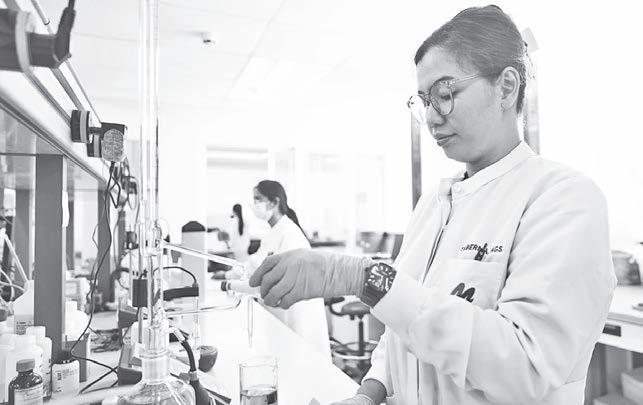
Green-level certification.
“ This achievement affirms Maynilad’s environmental stewardship and operational excellence,” said Atty. Roel S. Espiritu, Maynilad’s chief sustainability officer.
“We hope this inspires other laboratories to integrate sustainable practices, contributing to a greener and more resilient future.”
Maynilad WATERLab continues to advance its sustainability efforts, with plans to further enhance efficiency, reduce emissions from sampling activities, and incorporate electric vehicles into its fleet by 2025.

“Wetlands are also called the most effective carbon sinks on Earth. They play a significant role in stabilizing greenhouse gas emissions, proving their value as a natural way to cope with climate change. Wetlands perform all these functions and offer all these benefits and more at no cost,” she said.
Vast and wide ACCORDING to Arida, there are almost 2 million square kilometers of lakes, rivers, freshwater swamps, marshes, streams, and other inland waters and wetlands in Southeast Asia.
The ACB helps safeguard this wealth through its flagship programs and projects that provide capacity development, enhanced protected area management, ecosystem restoration, biodiversity mainstreaming, policy support, and adoption of frameworks.
Asean Member States and the ACB continuously promote wetlands conservation mainly through the AHP Programme, the Asean Flyway Network, and its participation in the World Coastal Forum—a global event to facilitate national and international efforts to protect coastal ecosystems through science-based solutions.
Under threat
THE DENR-BMB agreed with the ACB information wetlands are among the most threatened ecosystems with a rate of loss of three times faster than forests.
Infilling and drainage for conversion to agriculture and urban settlements pose significant threats to wetlands.
“Wetland species face risks of ex -
tinction. According to the Ramsar Convention on Wetlands, one in three freshwater species and 25 percent of all wetland species face extinction from wetland decline,” the DENRBMB said in its media release in time for the celebration of WWD 2025.
International commitment
THE Philippines is a contracting party to the Ramsar Convention, or the Convention on Wetlands, that was signed and adopted by 172 countries.
As a contracting party, the Philippines is committed to the conservation and wise, sustainable use of wetlands in the country.
Presidential Proclamation 74 series of 1999 signed by former President Joseph Ejercito Estrada declared that February 2 of every year as National Wetlands Day.
Ramsar sites in the Philippines
THERE are currently 10 Ramsar sites in the Philippines, including the Sibugay Wetland Reserve, which was designated only on January 8, 2024.
The others are the Olango Island Wildlife Sanctuary; Naujan National Park; Agusan Marsh Wildlife Sanctuary; Tubbataha Reefs Natural Park; Las Piñas-Parañaque Wetland Park; Puerto Princesa Subterranean River National Park; Negros Occidental Coastal Wetlands Conservation Area; Sasmuan Pampanga Coastal Welland; and Del Carmen Mangrove Reserve in Siargao Island Protected Landscape and Seascape.
The Philippine government has implemented various efforts to ensure the wise use of wetlands, aligned with the Ramsar Convention’s principles.
These efforts aim to conserve wet -
lands while supporting their sustainable use for the benefit of people and biodiversity, including policy frameworks and strategies, such as the proposed National Wetland Conservation Act, the Inland Wetland Conservation Program, and the Coastal and Marine Ecosystem Management Program to guide the conservation, and protection, and wise use of wetlands, the Philippine biodiversity Strategy and Action Plan, and National Action Plan on Peatland which is aligned to the Asean Peatland Management Strategy.
Awareness, capacity building
THE Philippines also actively pursues activities to address awareness and capacity building for wetland managers, including DENR personnel, local government units and communities, and schools; continous updating of wetland inventory and assessment and monitoring to document wetland resources and their ecological status; facilitating the designation and management of Ramsar Sites, and ensuring that each wetland management plan is integrated into a broader plan including the Philippine Development Plan. At the DENR level, the agency emphasizes the collaboration and integration of efforts among government agencies, local government units, civil society, private sectors, academic institutions, and communities to achieve sustainable and effective wetland conservation. What does losing wetlands mean? LIM said losing wetlands means losing the many benefits these all-important ecosystems provide to communities.
“The disappearance of wetland habitats will disrupt bird migration patterns, increasing interactions with domestic animals and humans, which may heighten the risk of emerging diseases. Moreover, the loss of wetland vegetation could reduce the availability of raw materials essential for developing climate-resilient crops,” she said.
“As we celebrate World Wetlands Day, let us recognize wetlands as indispensable to both biodiversity and human well-being. Their protection must be integrated into development planning, ensuring a sustainable future for generations to come. Our future—and that of our children— depends on the health of our wetlands and how responsibly we manage their resources,” Lim pointed out.
SECURITY Bank Corp., in collaboration with Oceanus Conservation, and Communities for Nature, launched Project MITHI: A Resilient Futures initiative on January 22.
By leading in green laboratory practices, Maynilad reinforces its commitment to environmental sustainability and responsible water management.
Ma ynilad is the largest private water concessionaire of Metropolitan Waterworks and Sewerage System (MWSS) in the Philippines in terms of customer base.
WATERLab began its sustainability journey in May 2024, introducing measures such as flow-limiting faucets, LED lighting, and inverter air-conditioning to reduce water and electricity consumption.
laboratory, WATERLab, earn the “My Green Lab Certification”—the globally recognized gold standard for sustainable laboratory practices. Recognized by the United Nations’ Race to Zero campaign towards a zero-carbon future, this certification highlights WATERLab’s commitment to environmentally responsible operations, said Maynilad in a news release. My Green Lab, a leading non-profit organization promoting sustainability in the scientific community, awarded this distinction to Maynilad’s central laboratory, which monitors water and wastewater quality, after the facility implemented water conservation, energy efficiency, and eco-friendly practices.
It also eliminated single-use plastics, transitioned to reusable glassware, and prioritized eco-friendly suppliers— earning a 97 percent score, the highest Maynilad WATERLab becomes first in PHL to earn prestigious My Green Lab Certification
Its service area includes the cities of Manila (all but portions of San Andres and Sta. Ana), Quezon City (west of San Juan River, West Avenue, EDSA, Congressional, Mindanao Avenue, the northern part starting from the Districts of Holy Spirit and Batasan Hills), Makati (west of South Super Highway), Caloocan, Pasay, Parañaque, Las Piñas, Muntinlupa, Valenzuela, Navotas, and Malabon, all in Metro Manila.
It also services the cities of Cavite, Bacoor, and Imus, and the municipalities of Kawit, Noveleta, and Rosario, in Cavite province.
Project MITHI—which stands for Mangrove-based Initiatives for Thriving Habitats and Inclusive Communities— is designed to rehabilitate mangrove ecosystems, champion wildlife conservation research, and enhance the resilience and self-reliance of local communities during its inaugural year, said Security Bank in a news release.
This significant collaboration is set to empower three coastal communities, two in La Union and one in Southern Negros, building on their existing partnerships with Oceanus Conservation. Additionally, it aims to support livelihoods, benefitting both local communities and the environment.
“Project MITHI is more than just an environmental program. It’s also a collaborative partnership to empower and enable communities to become active stakeholders in conservation through habitat restoration and the promotion of tourism and other livelihood opportunities.” said Nikki Lizares, vice president and sustainability head of Security Bank.
“By engaging with these communities, we hope to champion and amplify the voices, wisdom, and leadership of those vulnerable few who are most impacted by the climate crisis,” Lizares said.
Present during the event were EVP Eduardo Olbes and chief financial officer and Sustainability Committee chairman of Security Bank; Rhoda Phillips, chairman and founder of Communities for Nature; and Camille Rivera, director and co-founder of Oceanus Conservation. Oceanus
Conservation’s board members, project team, local government unit representatives, and a community leader from Aringay, La Union, were also present. Following the launch, Oceanus Conservation and Communities for Nature will visit the sites at Aringay, La Union, and Bais City, Negros Oriental, to engage with partner communities and introduce the new project. The project also aims to restore and protect mangrove ecosystems by rehabilitating unproductive fishponds; enable communities through community-led mangrove and wildlife ecotourism and conservation; educate and inspire communities to protect, conserve, and regenerate ecosystems through immersive learning climate solutions workshops, and citizen science;
EW YORK—If you tune into the “Puppy Bowl” on Sunday, you›ll likely see a key person’s influence— even if you don’t actually see her.
V ictoria Schade is a dog trainer and novelist who’s the show’s lead puppy trainer and wrangler. She’s the one making sure the shelter pups have a conflict-free contest and that they’re captured at their most adorable—all from off-camera.
It is Schade who gets the puppies to look up during the “The Star-Spangled Banner” or run through a tunnel to get to the field for the starting lineups. She’s on the lookout for possible conflicts or nervous dogs. My responsibilities include ensuring puppy happiness and safety during gameplay,” she says. “So if there’s any moment where a puppy looks like they’re overwhelmed or they just need a break, I’ll step out and give them a little break on the sideline.” Schade has been working with the doggies on the Animal Planet show for 19 years and is believed to be the longest serving member of the “Puppy Bowl” crew. She also works the kitten halftime show and calls filming both her favorite week of the year.
I think she is one of the most dedicated, hardest working people out there in the business,” says “Puppy Bowl” referee Dan Schachner, now in his 14th year. “She doesn’t ever seem to run out of energy. She never says no to a request and there’s always brightness and sunshine from her with every step.” Schade has coached hundreds of dogs over the years but never adopted one from the show—until now. She took home Boris—known on the show as Mr. Pickles—from Dallas Dog rescue. “I saw star quality. So this was the year,” she says. Treats and funny noises for pups EARLY on, Victoria Schade was responsible for recruiting and selecting the puppies, a task now that leans on animal rescue groups and shelters throughout the country. These days, she’s the lead trainer.


A8 SundAy, FebruAry
mirror_sports@yahoo.com.ph Editor: Jun Lomibao
If you’re seeing the puppy looking up at the camera, I’m typically right there with the treat,” she says. “It’s a lot of treats and funny noises. And that does the trick.”
Th is year, Schade is stepping out from the sidelines and joining Schachner on camera for an hour-long pre-game kickoff show, which features a doggie combine and a draft. Other show highlights include segments with Dan Smyers, from superstar country duo Dan + Shay, and Kansas City Chiefs defensive tackle Derrick Nnadi. Schade has developed some very special animal-related skills over the years, including anticipating when one of the players needs to relieve itself.
One of my ‘Puppy Bowl’ skills is reading butts. So I know when a puppy is going to go to the bathroom and I’ll typically say like, ‘Watch out in the 20-yard-line, we’re going to have a deposit’ and everyone’s ready to go with that cleanup.”
T he “Puppy Bowl” made its debut as counter-programming to the Super Bowl in 2005. Dogs score touchdowns on a gridiron carpet when they cross the goal line—any goal line—with a toy in their mouth.
T he show is really just an excuse to spend time watching adorable, clumsy pups play with chew toys, wag their tails furiously and lick the camera. A deeper reason is to encourage animal adoption.
According to the ASPCA, approximately 390,000 shelter dogs are euthanized each year and 2 million shelter dogs are adopted.
M ost of the puppies are usually adopted by airtime, since the show was filmed in the fall. But the point is to show that animals just like the ones on the show can be found at any shelter at any time.
Th is year’s three-hour television event this year will feature 142 rescue puppies from 80 shelters across 40 states—and one from Nicaragua, a Chihuahua-German shepherd. There will be 11 special needs dogs. That’s the most amount we’ve ever had,” says Schachner. “Look out for Jolene, who is a pitbull mix that’s in a wheelchair. Look out for a three-legged Boston terrier from New York City. And my personal favorite, is Sprinkle, who is a blind and deaf Aussie. So it’s just incredible to watch them play.”
The inaugural “Puppy Bowl” was watched by nearly 6 million viewers. Last year, 12.6 million viewers tuned in. In comparison, this year’s Golden Globes attracted 9.3 million.
The skate park underscores growing international interest in developing Iraq’s sports infrastructure, particularly for activities beyond the country’s traditional focus on soccer.
BAGHDAD—Car bombs and militant attacks are no longer a daily concern in the streets of Baghdad as they were in the chaotic years after the fall of Saddam Hussein or at the height of the battle to push back the Islamic State group. But while violence has decreased, many young Iraqis say their opportunities remain limited.
B aghdad, a city of nearly 9 million, has seen some efforts to restore public parks and cultural spaces, but urban planning has largely overlooked youth-focused projects.
Th at may be starting to change.
The capital inaugurated its first skate park recently at a ceremony attended by foreign diplomats, sports officials and young athletes, in what many hope will be the beginning of a drive to build more spaces for
THE Parañaque Chapter of the Philippine Dental Association (PDA) will hold a golf tournament for a cause dubbed “Ngiti” Golfest on March 13 at the Splendido Golf Resort in Tagaytay City. The event aims to raise funds for free corrective surgery for children born with cleft lip or palate.
Tournament organizer Dr. Lana Marie Sollano said the one-day tournament aims to shine a spotlight on the need for transforming the lives—one smile at a time for those children born with cleft lip or palate, whose lives will be freed from the stigma and limitations associated with the congenital abnormality.
D ata from the Philippine
Statistics Association reveal that the incidence of such birth defects in the country is 1.97 per 1,000 live births.
“Just imagine a world where a child’s smile is not a source of pain, but a source of joy,” Sollano said.
“Imagine a world where every child, regardless of circumstance, has the opportunity to live a full and vibrant life, free from the stigma and limitations associated with cleft lip or palate. This vision is within our grasp, but it requires your compassion and support.”
This is why we call this project ‘Ngiti’ although it goes beyond just allowing the children affected not just to smile but to have a better chance in their life’s journey,” she added.

recreation and creative expression.
“ I have been waiting for this moment for five years,” said Mohammed Al-Qadi, 19, one of the park’s first visitors on Saturday.
A l-Qadi, like many skateboarders in Baghdad, used to practice in public spaces such as Al-Zawraa Park and Abu Nawas Street, where skaters were often chased off by authorities, risked colliding with cars and faced safety risks due to uneven terrain and lack of designated areas. Before, we were often forced to move or got injured because there were no proper places for us,” he said.
“Now, we have a safe space, and I hope this is just the beginning.”
T he facility, located within the Ministry of Youth and Sports complex near Al-Shaab International Stadium, was completed in three weeks with support from the German and French embassies.
The project underscores growing international interest in developing Iraq’s sports infrastructure, particularly for activities beyond the country’s traditional focus on soccer.
A l-Qadi and other enthusiasts are now pushing for the formation of a national skating federation that could pave the way for participation in international competitions, including the Olympics.
“ We have 25 male and female skaters now, but with this park, that number will definitely grow,” Al-Qadi said.
The skate park also sparked enthusiasm among female skaters, despite lingering societal resistance to girls participating in the sport seen as rough and sometimes dangerous.
“I hope to compete internationally now that we finally have a place to train,” said Rusul Azim, 23, who attended the opening in sportswear and a hijab.

THE US Open became the first major to publish a direct pathway for LIV Golf players by announcing a new exemption category that awards one spot to the leading player from among the top three at LIV’s halfway point this year. The next exemption category will include one spot this year from the May 19 standings in LIV. Starting with the 2026 US Open, the US Golf Association (USGA) will take the leading player in the final 2025 individual standings, along with the leading player from the May 18, 2026, list. I n each case, the exemption goes to the leading player not already exempt, and the player must be among the top three in the standings. The other majors have not turned away players from the Saudi-backed LIV Golf League. The Masters has invited
Joaquin Niemann each of the last two years, though Augusta National based that on his international play. The PGA Championship has invited LIV players based on their world ranking, and for 2024 at Valhalla it invited Talor Gooch, who had won three times on LIV the previous year.
B ut the PGA of America does not have specific criteria, lumping LIV players and others into “special invitations.” Niemann and Sergio Garcia already have received PGA invitations this year. F or this year’s US Open, an exemption from qualifying will be given “the top player who is not otherwise exempt and in the top three” of the LIV individual standings as of May 19. T hat could mean no one
Skating remains far less popular in Iraq than soccer and other mainstream sports, but Azim said she believes the new facility will encourage more young people—especially women—to take up the activity. Z ainab Nabil, 27, also came to the opening of the park despite the fact that her family disapproves of her skating.
“ I am here to show that women belong in this sport too,” she said, adding, “I hope there will be separate days for women and men, so more girls feel comfortable joining.” F or now, the skate park stands as a small but significant step toward providing Iraq’s youth with a place of their own. Many hope it will be the first of many.
“ We need more places like this— safe spaces where young people can be active, express themselves, and dream of something bigger,” Al-Qadi said. AP


Single women, rich millennials to fuel luxury real estate this 2025
FEBRUARY 09, 2025 | soundstrip.businessmirror@gmail.com
By Ica Hontiveros-Cheng
AFTER my online interview with Manila soul band ‘Juan Pablo Dream’ - who are releasing a vinyl for their 20th anniversary, I was scrolling through lead vocalist Bing Austria’s Instagram feed, and on it I saw a photo of his NU Rock Award for Keyboardist of the year, which was given in 1997. I gasped. I was ten years old when he was given this award.


Publisher :
T. Anthony C. Cabangon
Lourdes M. Fernandez
Editor-In-Chief :
Concept :
Aldwin M. Tolosa
Y2Z Editor :
SoundStrip Editor : Group Creative Director : Graphic Designers :
Jt Nisay
Edwin P. Sallan
Eduardo A. Davad
Niggel Figueroa
Anabelle O. Flores
Contributing Writers :
Tony M. Maghirang
Rick Olivares
Jill Tan Radovan
Reine Juvierre S. Alberto
John Eiron R. Francisco
Pocholo Concepcion
Francine Y. Medina
Justine Xyrah Garcia
Bea Rollo
Trixzy Leigh Bonotan
Bless Aubrey Ogerio
Photographers :
Bernard P. Testa
Nonie Reyes
Y2Z & SOUNDSTRIP are published and distributed free every Sunday by the Philippine Business Daily Mirror Publishing Inc. as a project of the
The Philippine Business Mirror Publishing, Inc., with offices on the 3rd Floor of Dominga Building III 2113 Chino Roces Avenue corner
Dela Rosa Street, Makati City, Philippines. Tel. Nos. (Editorial) 817-9467; 813-0725. Fax line: 813-7025
Advertising Sales: 893-2019; 817-1351,817-2807.
Circulation: 893-1662; 814-0134 to 36. www.businessmirror.com.ph
So yes, there is a generation and genre gap between the band and I, being a millennial who gravitates to pop-rock the jump to 60’s soul was a bit of a stretch. But if there’s one thing that I learned is to never say never when it comes to discovering new music (no matter the generation or genre).
Before our interview I took a quick listen on Spotify and listened to ‘Nice Place’ which I instantly fell in love with, its infectious riffs, thick bass lines, and energetic trumpets brought me to that nice place, the song left such an impression on me that I just had to ask if there was an actual nice place or if the song was based on a place.
I’m going to the nice place
BING Austria who wrote the song answered: “The Nice Place is in each one of us, (nasa puso ng bawat isa), it is whatever we want it to be. When you are in the ‘nice place’ you are in the right zone, everything is perfect, all the good vibes are there, there is no need to overthink.
And indeed listening to the band talk of the days when they were still active in the music scene, playing gigs, even closing for the NU Rock awards in 2009 you can tell that playing soul music together was each other’s “nice place.”
The story of a band
TO be released under indie record label Eikon Records, the vinyl release will include songs from the band’s two albums. “I was asked by the band to choose which songs will be included in the vinyl release.” Rick Olivares of Eikon Records said, “The band had asked me to choose which songs were going to be included and in what order they should be in”. “It should not be about what were my favorite songs,” Olivares continued, “it should tell the story of the band. If I were to tell the story of Juan Pablo Dream, which songs would I pick? I thought that they should be fun, danceable, and it should hit you in the heart and the hips.”

Even after the band’s disbandment in 2011 they talked about not missing a beat (pun intended) when they got together to shoot the cover of their upcoming vinyl release ‘When We Were Kids’ for their 20th anniversary, which was actually what got everyone in the zoom call in the first place.
During the shoot the band came dressed to the nines in sixties ensemble, which has always been a part of their showmanship, performing in mod attire, they would even go out of their way to shop (in ukay stores) and have their outfits tailored 60s style!
WHILE doing my research on the band, I came across an article in 2009, Austria said: “Walang gumagawa ng soul these days (No one makes soul music these days)”. When I asked him if he still feels the same now, sixteen years later he became excited talking about how bands these days have that hint of 60s soul in them. And you just have to look at acts like ‘Lola Amour’, ‘Cup of Joe’, and ‘Dilaw’ to see that the soul movement is very much alive today.
Juan Pablo Dream member Bianca Holganza says that our band is ‘Nostalgia for Nostalgia’ and doing this project is like going through a portal. “We’re really excited to be taking everybody through this portal, this new dimension, a new dimension of a good time.”
LIKE the geek that I was, I asked the band about the line: “A soul for a soul” from Avengers Endgame, since we’ve been
talking a lot about soul music, the phrase came to me. I asked if they believed that you have to “give a soul, to take a soul” - of course in this case we were talking about music and not Infinity Stones. To which, Aurelio Castro replied: “If it’s a question of ‘A Soul for a soul’ in terms of sacrifice, then yes definitely, because whatever you give to your music, has to come from somewhere.” Alex Dumlao agreed saying: “Just the commitment alone, to the band, to the music, to the culture, that’s just how it is.
Castro added: “You really have to make sacrifices, like whatever time I spend with my band and music, that’s less time with my family. But I make it a point that when I’m doing music, I give it my 100% but when I get home to my family, then I’m with them 100%.”
Whatever part of themselves, a part of their souls that the band has given, this vinyl release has been giving back, as of this writing, more copies of the vinyl will be made available as the initial pressing is already sold out and there is a continuous demand. Plans for a listening party, a vinyl launch, and even a homecoming in Bulacan are in the works.
Lotte Agraviador added “You can’t perform soul music without soul. When you give it your all you don’t expect anything back. If your audience gets it, if they love it, they get a piece of my soul.”
And I think that’s beautiful, I am certain that for every copy of this well thought of vinyl there are pieces of the band’s soul in it. For sure their love, commitment and sacrifice for the music will be there for you to hear and feel, not just in your heart but in your hips as well.
Singer-songwriter may be today’s equivalent of David
of Bread
TJ Monterde has been hovering in my consciousness these past few days.
The 35-year-old Cagayan de Oro-born singer-songwriter’s three-night concert on Feb. 1-3 at Smart Araneta Coliseum, all sold out (!), was astounding news. Nobody has done that in recent memory. It’s the kind of historic achievement that demanded scrutiny. Who the hell is this guy and why is he so popular?
“Husband ni KZ Tandingan,” my wife told me. “Mas magaling pa nga ata si TJ kaysa kay KZ e.”
I had to look for my review of a 2023 concert in which KZ mentioned a song which she wrote for TJ. So, that’s him.
On first listen to TJ’s 2024 album, Sariling Mundo, my initial impression was, why do most of today’s music artists, male and female, have identical singing styles?
No kidding. TJ’s voice and style seem no different from the other hot stars — and I don’t have to name them, just go figure to get my drift.
More so the women.
BUT in both cases, their voices have a peculiar enunciation and somber tone which stand out particularly in their sad songs.
Is this a generational thing — like when Pearl Jam burst into the scene in the ’90s and everybody sang like Eddie Vedder?
But that became a minor thing when I heard the eight tracks in Sariling Mundo Damn, this TJ is a good composer.
The title track captures the sense of escape that lovers often think of when they’re together. The lyrics float the idea of leaving cares behind and engaging in flights of fancy — never mind that, in reality, this can mean, for instance, lying down on the grass and staring at the sky:
“Pansamantalang limutin ang ating kasalukuyan
Kapit ka lang sa akin, libutin natin ang mga bituin…”
There are hints of world-weariness despite being youthful, though this may also mean having a healthy dose of skepticism:
“’Dun na muna tayo sa sarili nating mundo
Kung sa’n ’di magulo, pag-ibig ang nagpapatakbo
Tayo ay lilipad, lahat ay matutupad…”
The music is fine as well, especially the playful notes of the pianist. Da who?
Easily the album’s standout is “Palagi,” a sweet ballad which has a duet version with KZ on TJ’s Spotify page.
But the solo one in the album, also on Spotify, is worth repeating for its LSS chorus: “Ngunit sa huling palagi, babalik pa rin sa yakap mo / Hanggang sa huling palagi, pipiliin kong maging sa ’yo…”
’Scuse me for the tito reference, but I think TJ is today’s equivalent of David Gates of Bread fame in the 1970s— not the voice, but the gift of drawing listeners to the beautiful hook in his songs’ lyrics.
“Palagi” is a simple pop tune, just another story of a couple’s ups and downs, but whose refrain can melt the hardest of hearts.
The other tracks share similarities in their play of images. For example, in “ Buong Gabi ,” the guy asks his girl to take an all-night trip in their imagination, with the sky as a kind of movie screen: “Puwede bang suyurin natin ang kalawakan?”
And then, in “Sandali,” which is about an ex-couple, the guy pleads for the girl to spend precious time with him even for a short while: “Kahit isang gabi… ilang minuto lang naman ang aking hinihingi…”
This album is full of heartbreaking lines, couched in melancholy music. The last track, “Huling Luha,” delivers the coup de grace: “Magkawak nga’ng ating mga kamay, ngunit isa na lang ang mahigpit…”
To ask why do people like to hear sad songs is like trying to find out why lovers hurt each other.
In any case, here’s TJ pouring his heart out on Facebook after his milestone concert:
“Sa aking nagiisang Palagi, KZ. Kinakanta na ng lahat ’to, pero sa yo pa rin ’to, ikaw si Palagi. Thank you for the inspiration. I can’t imagine life without you, hirap na hirap ako ’pag wala ka. Mahal na mahal kita.
“AAAAAAAAAAAHHH! SOLD OUT ARANETA CONCERT!
“Hindi ko alam kung mauulit ko pa ’tong mga concert na ganito or hindi na, si Lord lang nakakaalam, ang alam ko, binigay ko ang buong puso ko sa tatlong gabing yun





— at nasulit ko siya.

“Buti na lang, buti na lang talaga di ka sumuko, Teej.”
“WORTH THE WAIT.
“Mga bituin [his fans], again, thank you for making this simple songwriter’s
dreams come true. Thank you for making my stories — your stories. Patuloy po akong mangangarap, patuloy po akong magsusulat. “THANK YOU, LORD! LAHAT MATUTUPAD.”
By James Tarmy Bloomberg
THE world’s highend housing market is poised to settle into a comfortable rhythm, according to Sotheby’s International Realty’s 2025 Luxury Outlook report.
“I don’t think we’re predicting real estate to decrease in value in 2025, but the rate of appreciation might be slowing,” says Bradley Nelson, the company’s chief marketing officer, who spearheaded the report. “After we did this survey of our top agents on a global basis, doing more interviews than we can count, these sales folks on the front line say it feels like a more stable market, with more balanced conditions,” albeit with strong currents beneath the placid surface.
The world’s rich, first of all, are on the move. The Sotheby’s International Realty’s (SIR) report cites another one by Henley & Partners, which anticipates 135,000 high-net-worth individuals migrating to new countries in 2025, up from 128,000 in 2024. The biggest beneficiary seems to be the United Arab Emirates, which welcomed a recordbreaking 6,700 new high-net-worth residents in 2024, with more set to follow.
“It’s a wealth magnet,” Nelson says, “with people coming from the UK and Europe and elsewhere.” He cites tax incentives, golden visas and the lifestyle of certain UAE destinations—Dubai in particular—as draws. There, branded residences are particularly sought-after. “These homes can easily command premiums upward of 25 percent for roughly the same size and quality as their unbranded counterparts,” says Chris Whitehead, managing partner, Dubai Sotheby’s International Realty, in the report.
Conversely, while the US had the second-highest inflow of rich homebuyers last year, it saw the lowest level of international buyer purchases since 2009, SIR says. Between April 2023 and March 2024, these buyers acquired just 54,300 homes totaling $42 billion. Compare that to 2017, when foreign buyer activity amounted to $153 billion for 284,500 units.
Still, Nelson says, “there were some very expensive purchases made by that audience, so I still think that it is a critical component of the buyer pool for the truly super prime real estate.”

Within the US, the vast destruction of the recent Los Angeles wildfires which destroyed some 12,000 structures, many of which were pricey singlefamily homes, isn’t expected to have an immediate impact.
“The LA fires are devastating, particularly when you think of a personal and human level,” says Nelson. “In terms of how long it will take to show up in the real estate market, it is a little too soon to tell. The majority of families right now that have been displaced are really looking for near-term solutions.”
In the year ahead, there could be an uptick of foreign activity across the country. “In general, more stable inventory levels probably makes buying more attractive,” Nelson continues, “just think of the practicalities of someone purchasing in the United States that lives in a different country. If things are selling in a matter of hours or days, it’s kind of impossible to even get here to look at a piece of new inventory.”
THE people doing the buying have also changed. As millennial buyers enter luxury markets in increasing numbers, this younger generation is behaving differently than its predecessors. “Their priorities are really driven by a kind of lifestyle-first mentality,” Nelson says.
In practical terms, Nelson says that brokers around the world are seeing a younger generation gravitate towards aesthetically pleasing, historic proper -
ties, often driven by pop-cultural touchstones.
In Italy, the report cites “The White Lotus Effect,” quoting Diletta Giorgolo Spinolo, head of residential, Italy Sotheby’s International Realty, who says that immediately after the HBO show’s second season aired, which featured scenes in gorgeous historic Italian villas, “we had twice as many American and British buyers looking there.” It could be, she speculates, that “younger people understand that owning a piece of history is a status symbol. TV shows are definitely shaping their perceptions of what luxury is.”
properties purchased by people under 55 used financing from parents. Paloma Pérez Bravo, CEO of VIVA Sotheby’s International Realty in Spain, says she’s witnessed this phenomenon. “People throughout the Latin world, from Mexico, Venezuela and Miami, are happy for their adult children to study or start a company in Madrid,” she says.
Meanwhile, the gender makeup of homebuyers is also changing. Nelson cites a report from the National Association of Realtors that found that in 1981, 11 percent of homebuyers were women;
‘The world’s rich are on the move.’
Not only do these younger buyers want different things, Nelson continues, they’re buying them in very different ways than previous generations. “Today we have some agents that are generating 75 percent to 90 percent of their sales volume off of Instagram,” he continues. “It’s just a startling transition of how client relationships cement themselves compared to five years ago.”
THE luxury buyer might be changing, but the money, the report posits, seems to be coming from the same place as ever: Even the richest buyers are still asking their parents for help.
SIR’s outlook references a report from UK financial services firm Legal & General that found that 42 percent of UK

couples made up 73 percent of the buyer pool. In 2024, 20 percent were women and 62 percent were couples.
“Single female buyers have confidence and a desire to purchase real estate outside of their romantic relationships,” Nelson says. “They certainly see the opportunity that it presents from a wealth creation standpoint.” It’s not just emancipated younger women doing the buying. It’s also “older single women who are downsizing and moving into homes that are more tailored to their needs,” the SIR report says.
“This report,” Nelson concludes, “is driven mostly by demographic changes, more than anything else. That really became apparent to us.”
n Cover and inside photos by Alex P on Pexels.com