


By Cai U. Ordinario
THE handwriting on the wall. Philippine officials are keenly reading this in 2025, when the uncertainties of the past year are expected to linger, and headwinds threaten every single source of growth and progress. To make sure its bag of options can respond to any single source of peril, the government is looking to expand the country’s horizons not just in trade, but also in its sources of investments and financing.
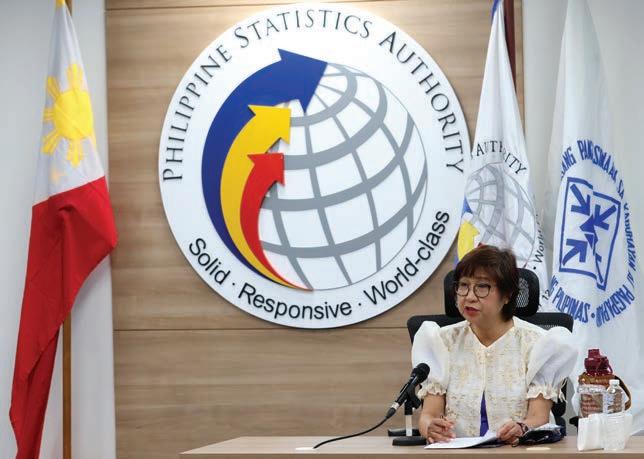
The Philippines is veering away from multilateralism and intends to pursue more bilateral and regional free-trade agreements (FTAs) moving forward, according to the National Economic and Development Authority (Neda).
In a briefing on Thursday, Neda Undersecretary for Planning and Policy Rosemarie G. Edillon said the Philippines is looking to cast a wider net to secure more bilateral engagements and FTAs with nontraditional partners in the hope of expanding its markets and forging new trade partnerships.
Edillon said after the ratification of the Philippines-Korea FTA and the progress achieved in the FTA negotiations with the United Arab Emirates (UAE), the public can expect more FTAs to surface from the pipeline.
“ We are looking to come up with many more of these regional FTAs. Because we have seen the thrust, the tendency is really moving away from multilateralism, it’s really veering toward regional or even bilateral trade agreements. So yes, we will be pursuing that,” Edillon said.
Edillon said the government intends to leverage and maximize the recently forged Philippines-South Korea FTA and increase investments in post-harvest facilities for bananas and other tropical fruits. She added that the Luzon Economic Corridor partnership with the United States and Japan will also help support infrastructure development and market access.
The government, she said, is also exploring easing visa requirements and actively participating in initiatives such as the proposed Asean common visa policy to en-

hance visitor inflows.
On another front, negotiations between 27-member bloc European Union and Philippines are expected to deliver “well and fast” as talks are set to resume on February 10 in Manila, according to the EU ambassador to the Philippines.
A first round for negotiations took place in October 2024, a second round will be hosted here in Manila, mid-February. So the second round is foreseen from the 10th to the 14th of February. So it’s four full days of work,” EU Ambassador to the Philippines Massimo Santoro said at the recent 9th Joint Economic Briefing.
The EU envoy’s optimism on the progress of the talks for an FTA rests on the fact that the Philippines is “only the sixth economic partner of the European Union among Asean countries.” We can do more. We can do more considering the potential and the size of the Philippine market and the resources of the country,” Santoro underscored.
The EU ambassador said the objective of the free-trade deal is to bring bilateral economic ties between the EU and the Philippines to a “new higher level.”
Through the FTA, we aim at facilitating not only merchandise trade, but also trade in services and to create more incentives for investment,” said Santoro.
In 2023, the EU was the Philippines’ 5th largest trading partner, 6th export market and 6th import source.
Philippine exports to EU amounted to $8.37 billion, while imports from the 27-member bloc reached $7.79 billion.
In 2023, the top Philippine ex-

The Philippines is veering away from multilateralism and intends to pursue more bilateral and regional free-trade agreements (FTAs), according to Neda. This, while casting a wider net for other sources of investments and financing.
ports to the EU were electronics, semiconductors, coconut oil and tuna.
On the sidelines of another event, Undersecretary Ceferino Rodolfo told reporters that he’s been prodding the EU side to fast-track the talks for the free-trade deal because, he said: “If you look at the interest of the US and EU, they are really on agricultural products.”
Elaborating, he said that for the Philippines, this is a matter of “diversifying our import sources for these products.”
But for them they are really competing head-on when it comes to agricultural products on geographical indications such as the Parmesan cheese,” added Rodolfo.
A s defined by the World Intellectual Property Organization (WIPO), geographical indication (GI) is a sign used on products that have a specific geographical origin and possess qualities or a reputation that are due to that origin.
In order to function as a GI, a sign must identify a product as originating in a given place.
Development aid APART from trade and tourism, the Philippine government is also expanding its horizons when it comes to Official Development Assistance (ODA) sources.
Edillon said amid the freeze imposed by the United States government on its ODA to various countries, the Philippines has not received any communication from its counterparts from the US government regarding this.
Currently, Edillon said, the country’s other development part-
ners continue to extend ODA grants and loans to the Philippines. Nonetheless, the Philippines is already preparing for the eventuality that these ODA funds will dry up.
We’re being faithful to our borrowing program, to our fiscal program. So hindi rin naman talaga basta-basta [it’s not something that can be shrugged off], but just to say that we are also preparing for the eventuality that these ODA funds will dry up,” Edillon said.
One of the ways that funds are being raised is through Public Partnership Projects (PPPs). Edillon said PPPs have become a good source of development financing for the country and have already been reflected on the country’s economic performance.
Based on the latest GDP numbers released by the Philippine Statistics Authority (PSA), Gross Fixed Capital Formation and Gross Value Added in Construction showed that General government only posted single-digit growth in the last two quarters of 2024.
Based on the data, General government growth slowed to 4.9 percent in the fourth quarter of 2024 and 3.7 percent in the third quarter of 2024 from the 14.9 percent posted in the last quarter of 2023 and 27.3 percent posted in the third quarter of 2023.
“Another factor there is that we have a number of infrastructure that is being done with PPP, so if it’s PPP it’s not included in General government,” Edillon said, partly in Filipino. “We still want to spend on infrastructure but as I said, spending is different from the sources of the financing.”
Flagship projects
BASED on the latest data from Neda, majority of the seven infrastructure flagship projects (IFPs) that have been completed as of 2024 were financed through ODA, while the others were funded by the national budget.
The completed IFPs financed through ODA were the Arterial Road Bypass Project Phase III (Plaridel Bypass) and the Flood Risk Improvement and Management Project for Cagayan de Oro River (FRIMP-CDOR).
The list also includes the Integrated Disaster Risk Reduction and Climate Change Adaptation

(IDRR-CCA) Measures in the LowLying Areas of Pampanga Bay Project; Panguil Bay Bridge; and the Samar Pacific Coastal Road Project.
The two other completed IFPs that were financed through the national budget were the PasigMarikina River Channel Improvement Project, Phase V and the Surallah-T’Boli-San Jose Road, South Cotabato.
The seven completed IFPs had a combined total project cost of P43 billion and were composed of projects implemented by the Department of Public Works and Highways. With earlier reports by Andrea E. San Juan

By Gao Yuan and Vlad Savov Bloomberg
THE success of DeepSeek’s new AI model points to how China might eventually achieve an even bigger technological breakthrough in the face of US export curbs: Producing its own cutting-edge chips.
A s tech leaders and politicians marvel at DeepSeek’s apparent ability to build an innovative AI model without spending nearly as much as rivals in the US, a development that roiled markets on Monday, the question now is how exactly the Hangzhou-founded company pulled it off—and what it means for American efforts to stay ahead of China in the tech race.
W hile much remains unclear, such as the exact chips DeepSeek used and whether it has enough on hand to further develop its AI models, its success highlights some of China’s key advantages. The country has a deep pool of highly skilled software engineers, a vast domestic market and government support in the form of subsidies as well as funding for research institutes. It also has a pressing necessity to find a way
to do more with fewer resources. China has an obvious advantage in IT talent, both in terms of the sheer number and labor cost,” said Liu Xu, a research fellow at the National Strategy Institute of Tsinghua University, which is helping to spearhead China’s AI push. “The biggest resource for China is the country’s vast demand—as one of the world’s most populous nations and as a gigantic manufacturing hub.” In many ways, DeepSeek is an example of China at its best. From Tencent Holdings Ltd.’s WeChat to ByteDance Ltd.’s TikTok, Chinese developers have crafted worldleading apps for consumers, pioneering new modes of communication and ecommerce along the way. DeepSeek’s R1 model is now set to challenge similar products from OpenAI, Alphabet Inc.’s Google


and Meta Platforms Inc.
C hina, however, is still playing catchup in the hardware space—the main focus of US export controls in recent years. The US has banned China from buying the most advanced AI chips from Nvidia Corp. and Advanced Micro Devices Inc. It has also blocked President Xi Jinping’s government from obtaining ASML Holding NV’s extreme ultraviolet lithography (EUV) machines, which are essential to producing high-end chips.
X i has poured billions of dollars into making a breakthrough in advanced semiconductors, part of his wider Made in China 2025 push to make the nation a leader in emerging technologies. Research by Bloomberg Economics and Bloomberg Intelligence shows that the broader effort has largely been a success, pushing China’s manufacturing prowess to historic heights as the nation becomes dominant in producing goods like electric vehicles, batteries and solar panels.
A lthough Chinese companies such as Huawei Technologies Co. have made progress in producing AI chips, as of now those parts are less powerful than the ones produced by Nvidia. And the lack of access to high-end chips, particularly after the Biden administration tightened trade controls, still poses a major hurdle to China’s development.
In 2023, Huawei introduced a smartphone with a 7-nanometer chip—something the US thought was unfeasible for Chinese firms to manufacture with less-advanced chipmaking technology. Yet while that phone was hailed as a breakthrough—and spurred patriotic memes on social media as its release coincided with then-Commerce Secretary Gina Raimondo’s visit to the country—since then the firm has struggled to make advancements toward 5nm chips, while rivals like Apple Inc. and Samsung Electronics Co. have moved on to 3nm.
It remains uncertain if DeepSeek, which released its new model just as Donald Trump was inaugurated, will be able to continue accessing the high-end chips that led to its current product. Liang Wenfeng, the company’s 40-yearold founder, has cited US export controls as a hindrance to the com-
‘Bunch
of talented 22-year-olds without access to the world’s best chips, without access to Nvidia chips, seem to have created something that’s even better than even the best companies in the Western world have done.” Tony Haymet, Australian government’s incoming chief scientist
pany’s future growth.
On Monday, President Trump said DeepSeek’s R1 release “should be a wake-up call for our industries that we need to be laser-focused on competing to win.” He also lauded the model as a “positive development” that could allow for less expensive AI advancements across the board.
W hile DeepSeek’s advance is positive for China’s economic transition away from property toward high-tech growth drivers, it may also spur American lawmakers to redouble efforts to stop the nation from getting the most advanced technology. The same data security concerns that led legislators to take action against TikTok may also lead to similar action against DeepSeek.
Michelle Giuda, chief executive officer at the Krach Institute for Tech Diplomacy at Purdue, told Bloomberg TV that it was essential for the US to maintain “a really strong defense” with tighter export controls. At the same time, she added, the US needs to catch up with China in producing talented engineers if it’s going to stay ahead in the tech race.
Engineers needed “IT’S a game changer in the sense that all we should do is double down American efforts to move faster, smarter, and maybe more cheaply on how we innovate in artificial intelligence,” she said, adding that China graduated more than twice as many engineers as the US in 2020. “Unless we have the engineers to build and design the data centers, to design more advanced AI, we are not gonna be able to be the world capital of AI.” For now, it looks like China re -
mains several generations behind in chipmaking equipment. Beijing recently advised state-linked organizations to use a new homemade lithography machine with a resolution of 65nm or better—far from the 8nm resolution of ASML’s best machines. Still, China recently publicized a patent application from Shanghai Micro Electronics Equipment Group Co., known as SMEE, for an EUV lithography machine—which, if it came to market, would be the only one in the world to compete with those produced by ASML.
Other Chinese companies are also making progress despite US export controls. Canada-based consultancy TechInsights said in fresh research that chipmaker ChangXin Memory Technologies Inc. has demonstrated advanced manufacturing techniques that haven’t previously been seen on the Chinese market, while Yangtze Memory Technologies Co. has also become more competitive against the industry leaders.
A fter DeepSeek’s revelation, China has shown it has the potential to continue surprising the world with even bigger breakthroughs.
Bunch of talented 22-yearolds without access to the world’s best chips, without access to Nvidia chips, seem to have created something that’s even better than even the best companies in the Western world have done,” Tony Haymet, the Australian government’s incoming chief scientist, told reporters on Tuesday in Canberra.
It shows you how disruptive technology can be,” he added. “And how quickly things can happen.” With assistance from Yian Lee, Ben Westcott and Newley Purnell / Bloomberg

By Akshat Rathi, Ewa Krukowska & Alfred Cang
THE second time President Donald Trump put the US on the path to quit the Paris Agreement, defenders of the international climate order barely stirred in protest. European Commission President Ursula von der Leyen said Europe will “stay the course” on climate action, UK Prime Minister Keir Starmer declined to criticize Trump, and Brazil President Luiz Inácio Lula da Silva waited more than a week before calling it “a step backward for human civilization.”
It was one of Trump’s very first acts in his second term, and one of the least surprising. “The whole movie we’ve seen before is playing again, but just at a higher speed,” said David Victor, a professor of innovation and public policy at the University of California at San Diego who closely tracks global climate diplomacy.
The movie might be the same— but it’s playing in a different theater now and to a friendlier crowd. Inflation and threats to energy security have eroded the political strength of climate-forward leaders and emboldened Trumpian populists around the world.
Countries and companies that once set decadal goals and made bold statements about saving the world now face the prospect of missing those 2030 targets by big margins. US and Canadian banks have rushed to exit corporate climate alliances, even as their European counterparts remain. Only one in four global environmental meetings organized by the United Nations last year resulted in a major deal. And the billions of dollars that the US provided in climate finance to developing countries under President Joe Biden are set to go away, which kneecaps the ability of poor countries to deploy clean energy at a time of high interest rates.
The Paris deal is a voluntary commitment from all countries to keep warming “well below” 2C
above pre-industrial levels. With the planet’s average temperature in 2024 breaching 1.5C for the first time and most countries not on course to meet their climate commitments, there are serious questions whether the global momentum to tackle climate change can sustain a second Trump assault. Brazil will host the next United Nations climate conference, COP30, in November, and the US departure plan will “temper the cheers of the 10th anniversary of the Paris Agreement,” said Jos Delbeke, a professor at the European University Institute. The withdrawal from the Paris deal won’t officially go into effect until January 27, 2026. (Former New York Mayor Michael Bloomberg will help cover the gap in US financial obligations; Bloomberg is the founder and majority owner of Bloomberg LP, the parent company of Bloomberg News.)
The US, the biggest historical emitter of planet-heating gases, has never been the world’s most enthusiastic climate champion. But its hostility at a time of high urgency has diplomats worried. All countries are expected to submit new climate targets for 2035 to the UN within weeks, and developing countries are adamant that their rich counterparts, which have polluted far more, give much more climate funding. That was the crux of debate at COP29 in Azerbaijan last November, where delegates
fought before reaching a deal to triple climate finance to $300 billion by 2030.
“If it was difficult to get $300 billion with the US negotiating and committed to having policies to combat climate change, it will certainly be more difficult now,” said Andre Correa do Lago, the Brazilian diplomat recently named president of COP30.
“If we don’t do something strong, these COPs will be demoralized,” Lula told journalists on Thursday.
Under Biden, the US became the world’s largest producer of oil and gas, putting it in a strong economic position at the start of 2025. That’s made it easier for Trump to assert himself on the world stage with confidence and to court new allies, including Argentinian President Javier Milei and Italian Prime Minister Giorgia Meloni. Milei has reportedly considered following Trump out of the Paris pact, though doing so could jeopardize its trade agreements with the European Union, and a Russian business group has urged President Vladimir Putin to leave.
Meanwhile, climate-forward leaders are finding things difficult. Canadian Prime Minister Justin Trudeau is on his way out. French President Emmanuel Macron and German Chancellor Olaf Scholz face political headwinds on the back of a cost-ofliving crisis. In the UK and China, stagnating economic growth is pushing leaders to opt for carbonintensive projects.
Regardless of their political choices, all countries face a greater onslaught from climatedriven extreme weather events.
Reinsurer Aon estimated economic losses from catastrophes in 2024 reached $368 billion, a sharp increase from 2016, when they were $216 billion. Before he’d been back in office a full week, Trump visited Los Angeles to see the destruction left behind by fires that scientists confirmed were made 35% more likely because of climate change.
Many climate advocates are hoping that opposition to Trumpian anti-climate leaders will grow.
“We have to stand up,” said Laurence Tubiana, chief executive of the European Climate Foundation and an architect of the Paris Agreement. “We should not be frightened by Trump’s menace.”

Europe, China and Brazil are expected to fill the void Trump has created in international climate diplomacy. But if that process should falter, the global energy transition isn’t reliant solely on what governments do.
The greatest hope for climate action is in economic forces. In 2016, global investments in the energy transition stood at $426 billion, with the vast majority going to government-subsidized solar and wind power, according to energy research firm BloombergNEF. Since then, investments have grown fivefold, to $2.1 trillion in 2024. They also cover a much wider range of sectors, according to a BNEF report published Thursday.
“Some of the largest economies are going to set ambitious climate goals even without the US,” said Albert Cheung, deputy chief executive of BNEF. “But with the proviso that it has to be economically beneficial and rational for their people.”
The world has entered a new phase in the energy transition.
Before the Paris Agreement was signed, pushing for climate targets was seen as having to sacrifice economic growth for a greater good, limiting how far even rich countries could go. After Paris sent a market signal, the transition entered a phase of opportunity that saw rapid rise in valuation for climate tech companies. Under Biden, the US passed laws that injected hundreds of billions of dollars into the transition.
Now countries are in competition mode: “So suddenly now there’s a pie,” said Cheung, “and countries are looking at each other and going, ‘OK, well how much of that pie can we capture?’”
On that front, China is ahead with a huge lead. Last year, it spent
more on the energy transition than the US, the European Union and the UK combined.
With protectionism on the rise, “the biggest challenge in global climate work may not be that countries around the world are unwilling to develop the green economy,” said Li Shuo, director of the China Climate Hub at the Asia Society Policy Institute. National limitations may become the bigger factor, he said, especially since few nations can scale up like China.
BNEF’s Cheung sees momentum continuing behind renewable energy, batteries, electric cars and grids regardless of government policies. But less mature markets for hydrogen, carbon capture, low-carbon heat and green industries will struggle if governments pull away their support en masse.
The physical threats of climate change are starting to erode the bottom line of many companies, which isn’t something they can ignore. Many observers expect global companies facing backlash to continue quietly acting on climate change—something that’s being called “greenhushing.”
“What’s changed since Trump took office is that for US business there is much more fear of the spotlight,” said Helen Clarkson, chief executive of the Climate Group, which acts as an umbrella group for corporate initiatives. “They just don’t want to put their heads up above the parapet.”
The US retreat from the green race under Trump creates opportunities for others to invest in climate technologies that even China hasn’t cracked yet, said Michal Orlowski, deputy chief executive of Polish power producer Tauron, specifically calling out opportunities in hydrogen production. “There are certainly threats but
there are also some opportunities for Europe,” he said. “Either we wake up now and bet on the right technologies, or we stay as a tourist destination.” If there’s a two-track energy transition for mature and less mature technologies, there is a similar divide among countries. Developing countries get a small fraction of global energy transition spending. That’s where the diplomacy framework under UN-led COP meetings plays a crucial role. It gives developing and climatevulnerable countries a platform to shame rich countries and pressure them to live up to their promises.
“Given that the world’s largest economy has clearly decided to deviate from the path of combating climate change, COP becomes even more necessary in this adverse context,” said Brazil’s Correa do Lago. Before the official US exit from the Paris Agreement, Trump’s team could play COP spoiler in Brazil just as it tried to do during his first term, when negotiators used the forum to push against more climate finance while urging support for fossil fuels. The COP president could ignore US objections in formal plenaries — potentially gaveling down meetings and agreements without the representatives’ input. But it’s more likely that the US presence in Brazil will help provide cover to laggard countries, bolstering efforts by Saudi Arabia and other oil producers to undermine past commitments to transition away from oil, gas and coal.
While moves by one president or prime minister can certainly slow down action, they are unlikely to reverse a lot of the progress that’s been made. Before the Paris Agreement was signed, it was still “absolutely feasible” that the world could warm as much as 5C, said Diana Urge-Vorsatz, vice chair of the Intergovernmental Panel on Climate Change. That would be a catastrophic level of warming, sinking many island nations and major coastal cities, causing widespread hunger and malnutrition and eradicating coral reefs and countless species.
“The world has been taken off the worst climate pathways,” she said. “Now that’s almost out of the picture, unless something goes very wrong in the climate system itself.” With assistance from Jennifer A Dlouhy, Zahra Hirji, Simone
John Ainger, Lou Del Bello and Mythili Rao/ Bloomberg
By Abby Sewell & Omar Albam
The Associated Press
DAMASCUS, Syria—The Syrian factions that toppled President Bashar Assad last month named an Islamist former rebel leader as the country’s interim president on Wednesday in a push to project a united front as they face the monumental task of rebuilding Syria after nearly 14 years of civil war.
The former insurgents also threw out Syria’s constitution, adopted under Assad, saying a new charter would be drafted soon. The appointment of Ahmad al-Sharaa, who was once aligned with al-Qaida, as Syria’s president “in the transitional phase” came after a meeting of the former insurgent factions in Damascus, the Syrian capital.
The announcement was made by the spokesperson for Syria’s new, de facto government’s military operations sector, Col. Hassan Abdul Ghani, the state-run SANA news agency said. The exact mechanism under which the factions selected al-Sharra as interim president was not clear.
Formerly known as Abu Mohammed alGolani, al-Sharaa is the head of Hayat Tahrir al-Sham, which led the lightning offensive that toppled Assad in early December. The group was once affiliated with al-Qaida but has since denounced its former ties. In recent years, al-Sharaa has sought to cast himself as a champion of pluralism and tolerance and promised to protect the rights of women and religious minorities.
The United States had previously placed a $10 million bounty on al-Sharaa but canceled it last month after a US delegation visited Damascus and met with him. Top US
diplomat for the Middle East, Barbara Leaf said after the meeting that al-Sharaa came across as “pragmatic.”
Speaking at Wednesday’s meeting, al-Sharaa, who was in military uniform, stressed the “heavy task and a great responsibility” that Syria’s new rulers face.
“If the victor is arrogant after his victory and forgets the favor of Allah upon him, it will lead him to tyranny,” he said, according to a video released hours later.
Among the priorities for rebuilding Syria, he said, will be “filling the power vacuum legitimately and legally” and “maintaining civil peace by seeking transitional justice and preventing revenge attacks” in the wake of Assad’s disastrous reign.
Syrians took to the streets in Damascus and elsewhere to celebrate the announcement, honking car horns and in
some cases firing in the air. Many expressed support for al-Sharaa.
“This person is someone who is intelligent and has a good understanding and he was the leader of the battle that freed Syria,” said Abdallah al-Sweid, who was among those celebrating at Umayyad Square in Damascus. “He is someone who deserves to be president.”
Others—even those who had rejoiced at Assad’s ouster—appeared critical of the way the appointment was made and the lack of clarity on next steps.
“The problem is not in the decisions. The problem is in the timing, the previous promises and the confusion,” said Mohammad Salim Alkhateb, an official with the National Coalition of Syrian Revolution and Opposition Forces—a group formed by members of the opposition to Assad in exile.
Qatar was the first to react to al-Sharaa’s
appointment, which had been expected, saying it welcomed decisions aimed at “enhancing consensus and unity among all Syrian parties.” The statement added that this should help pave the way for a “peaceful transfer of power through a comprehensive political process.”
Western nations, although they have moved to restore ties with Damascus after Assad was overthrown, are still somewhat circumspect about Syria’s new Islamist rulers.
Abdul Ghani, the spokesman, also announced Wednesday that Syria’s constitution—adopted in 2012, under Assad’s rule—was annulled. He said
al-Sharaa would be authorized to form a temporary legislative council until a new constitution is drafted.
All the armed factions in the country would be disbanded, Abdul Ghani said, and would be absorbed into state institutions.
Since Assad’s fall, HTS has become the de facto ruling party and has set up an interim government largely composed of officials from the local government it previously ran in rebel-held Idlib province. The interim authorities have promised they would launch an inclusive process to set up a new government and constitution, including convening a national dialogue conference and invite Syria’s different communities, though no date has been set.
As the former Syrian army collapsed with Assad’s downfall, al-Sharaa has called for creation of a new unified national army and security forces, but questions have loomed over how the interim administration can bring together a patchwork of former rebel groups, each with their own leaders and ideology.
Sewell reported from Beirut.
By Lebawit Lily Girma
IN 2005, Aziz Abu Sarah—a Palestinian then living in east Jerusalem—met with a Jewish friend who was visiting Israel from the US. Although it was the tail end of his tour, his friend hadn’t met any Muslims or Arabs on his trip, and he was harboring anti-Palestinian views. “He was so one-sided, even though he knew me,” says Abu Sarah. It was a revelation that planted the seed for Mejdi Tours, a tour operator intended to bridge the divide between two at-odds populations in a country the size of New Jersey.
It would take four years, and the collaboration of Jewish-American co-founder Scott Cooper, to create the company, at the heart of which is a “dual narrative” philosophy, meaning that each tour group is guided by a pair of locals who represent opposing religious, cultural, political or ethnic perspectives. For years, Mejdi ran more than 300 annual trips to Israel that took this approach. But after the Hamas attacks of October 7, 2023, the company’s business all but ground to a halt. The founders—both former employees of the Jimmy and Rosalynn Carter School for Peace and Conflict Resolution—have since been mostly focused on global speaking engagements, online workshops and virtual tours, “as well as both online and in-person meetings for our guides’ community to discuss current events and explore ways to support each other,” Abu Sarah says.
While this has been a slow period for travel to Israel, the team at Mejdi has not been resting. Instead, it’s been planning and activating exciting next steps in its efforts to scale dual-narrative
travel to other parts of the world, including South Africa, Rwanda, the United Arab Emirates and the Balkans.
Mejdi’s first dual-narrative tour in Uzbekistan includes meeting a Russian immigrant and a local Uzbek who talk about the complicated relationship between the two countries, in addition to taking tours of spice markets and traditional teahouses. The first departure sold out in two days; additional nine-night departures are now being offered for October 2025 and May 2026 (from $2,995 per person). And in October, a new, 10-night itinerary called South Africa—A Journey of Transformation and Reconciliation will focus on the history of apartheid as told by guides and residents of various racial backgrounds; guests will also go on a safari game drive and a sunset trip to Table Mountain (from $4,995 per person). Cooper and Abu Sarah are not alone in their approach to educational tourism in the Middle East—or in their newfound desire to scale it globally. Another such outfit is the 11-year-old Pomegranate Travel, which has a similar focus
on tourism-for-peace in Israel and is now expanding to Saudi Arabia and beyond.
Take Pomegranate’s 10-person group tour of Morocco (from $9,270 per person) in April 2025, which will take guests to the country’s key historic and cultural cities of Rabat, Fez, Ouarzazate and Marrakech. The itinerary includes plenty of the usual fun sightseeing: a visit to Casablanca’s enormous Hassan II Mosque, cooking workshops in Fez and ATV rides across Erg Chebbi’s desert dunes. But it also includes visits to the Jewish quarters of Marrakech and Fez—where some 250,000 Jews were corralled after periods of forced expulsion from other parts of the country—and meetings with Muslim preservationists who maintain now-abandoned sites of Jewish significance in order to honor the country’s history.
“It’s really impactful when Jewish people see Arab Muslims caring about Jewish culture in an Arab Muslim land,” explains Pomegranate founder Hannah Blustin, who herself is Jewish, as are most of her customers. “Right now, that really matters; there’s so much misunderstanding and fear.”
More tours like this are coming online throughout the year. In April and September, Mejdi is taking groups to the Balkans, with both Serbian and Bosnian guides, to hear from war refugees and members of the Sufi community. There will also be wine tastings in the historic hillside town of Počitelj and a few leisurely days in Croatia’s Elaphiti Islands nearby. And Pomegranate is soon to begin trips to Saudi Arabia, with a focus on the evolution of women’s rights and roles in society.
Resuming tours in postwar Israel
SOME travelers, Abu Sarah says, have been undeterred by the current situation in Israel and have continued to plans trips in Mejdi’s home turf. “We’re hosting a few groups who are well aware of the current restrictions, seeking tours that go beyond the headlines.” Blustin agrees. Business was scarce throughout most of 2024, she says, but inquiries started to accelerate after the UK advisory against travel to Israel was low -
ered in December; according to the Israeli Ministry of Tourism, international arrivals picked up 44% in December compared to the same period the year before. The current ceasefire is helping, too.
“If this ceasefire turns into a more permanent agreement and travel restrictions in the West Bank ease, we expect a significant return of travelers,” Abu Sarah says. But even so, things won’t be exactly as they were before. On their Israel trips before October 7, Mejdi’s staffers, both Palestinian Arabs and Israeli Jews, would take guests—mostly interfaith Americans—to tour Al-Aqsa Mosque, meet the families of Holocaust survivors, lunch with a Christian family and talk to Israeli settlers in the West Bank. They also visited Dheisheh refugee camp in the West Bank to learn about the Nakba, a term referring to the flight and forced resettlement of some 700,000 Palestinians after the state of Israel’s creation in 1948, and toured kibbutzim in Israel’s border communities.
Having two tour guides of different perspectives on every trip also encouraged participation and led to frank conversations, Abu Sarah says, with guests emboldened to ask questions they may not
have felt comfortable articulating elsewhere. Among the queries Mejdi fielded most frequently: Is Islam a religion of violence? Why can’t Palestinians just move to a different country? Did the Holocaust really happen? When trips do resume in 2025, Mejdi and Pomegranate will have to be prepared to deal with steeper challenges and more dangerous misconceptions, with social media having fueled countless false narratives. In the US alone, those types of theories were behind more than 10,000 antisemitic incidents between October 7, 2023, and Sept. 24, 2024, according to the AntiDefamation League—a spike of more than 200% year over year. Similarly, a record 8,061 anti-Muslim bias complaints were filed with the Council on American-Islamic Relations in 2023, the highest in its 30-year history.
To address the evolving situation, Abu Sarah says Mejdi is already updating its itineraries to reflect the events of the past 15 months. That means incorporating relevant experiences and speakers, including those who will join from Gaza via Zoom, as well as from Jewish communities in the “Gaza envelope,” or parts of Israel close to the border with Gaza.
Both Mejdi and Pomegranate have remained in contact with their guides, keeping at least some of them on staff. But finding and training new ones may be harder than it once was, Abu Sarah says. “There’s definitely a growing opposition to joint work in the region—more anger and even hate,” he concedes. But he remains hopeful. Despite the growing resentment, he says, “we continue to collaborate with dozens of organizations in both Israel and the West Bank that are committed to peace-building.” Fortunately, he says, “There is also a rising number of individuals who recognize that without Israelis and Palestinians working together, we will keep returning to the same point of war.”
And it’s not just the staff, it’s also the guests who have the potential to become some of the world’s most thoughtful advocates, he adds.
“Travelers have more power to impact the world than diplomats,” Abu Sarah says. “With over 1.5 billion people traveling internationally this year, the potential to foster a more peaceful world is immense—travel transforms both visitors and hosts, making us all citizen-diplomats and storytellers.” Bloomberg News
By Jon Gambrell The Associated Press
DUBAI, United Arab Emirates— Skyscraper-studded Dubai has been on a hot streak for the last five years—and some residents are starting to feel burned.
The city-state has seen record-breaking real estate transactions and as more and more people come to live there, and its state-owned airline Emirates is booking record earnings. But all that growth comes with strains for the city’s population. Traffic feels worse than ever on Dubai’s roads. The price of housing continues to spike even with new real estate projects being announced almost daily. Caught in the middle are both its Emirati citizens and the vast population of foreigners who power its economy—sparking rare public expressions of concern.
“Dubai is on steroids but affordability risks are increasing,” warned Hasnain Malik in a starkly titled report he wrote for the global data firm Tellimer, where he’s a managing director.
Skyrocketing housing prices
UNDER Dubai’s current plans, the city aims
to have 5.8 million residents by 2040, adding more than half its current estimated population in just 15 years. Since 1980, its population has already soared from around 255,000 to around 3.8 million. Real estate lit the fire in Dubai’s growth in 2002, when the desert sheikdom began allowing foreigners to own property. After sharp falls during both the 2008-2009 financial crisis and Dubai’s brief coronavirus lockdown, prices have been soaring. Today, average prices per square foot are at all-time highs, according to Property Monitor. Rental prices increased as much as 20 percent in key neighborhoods last year, with further rises likely this year, with some residents moving to communities further out in the desert, the real estate firm Engel & Völkers said.
Jammed roads EVEN before the boom, some people who worked in Dubai chose to live in the neighboring emirate of Sharjah, some 20 kilometers (12 miles) north of the city’s downtown, or further away. Some 1 million commuters from other emirates jam the 12lane Sheikh Zayed Road that runs through the center of the city and other highways every day, as studies suggest that as many
as four out of five employees drive to work alone.
That traffic has only intensified with Dubai’s new arrivals.
While the rest of the world saw as much as a 4 percent increase in the number of registered vehicles in the last two years, the city’s Road and Transportation Authority says there’s been a 10 percent increase in the number of vehicles.
So many vehicles have been registered that the city has had to make license plates longer.
And while the city keeps building new flyovers and other road improvements, more cars are coming from more directions than ever before.
“Dubai is very attractive, more and more people are coming,” said Thomas Edelmann, the founder and managing director of RoadSafetyUAE, which advocates about traffic issues. “I think it’s easier to get people quickly to come to Dubai and to convince them about Dubai, than to build a new intersection or a new highway.”
Boom concerns also raised by Emiratis CONGESTION has got so bad that it’s driving even prominent Emiratis to break their
customary silence on public affairs.
Habib Al Mulla, a prominent Emirati lawyer, wrote on the social platform X in December that while authorities were working on congestion, the problem demanded “a set of immediate and long-term mechanisms.” He followed up by publishing an opinion piece twice mentioning “congestion” as being among “pressing issues” for global cities like Dubai.
While phrased in mild language, Al Mulla’s comments represented rare public criticism in the United Arab Emirates, where speech is tightly controlled by criminal law and social norms favor raising issues at a “majlis”—a semiprivate setting convened by a traditional ruler.
“The concentration of wealth and opportunities created in global cities may cause income inequality that pushes out lower-income residents,” Al Mulla warned in the English-language Khaleej Times newspaper on Jan. 15.
“The problem becomes acute when the wealth and opportunities remain inaccessible to segments of the national population who witness the city’s allure being seized by outsiders. This may carry significant social risks, if not mitigated.”
Then there’s demographic concerns
as the Emirati share of the population dwindles. While the number of citizens isn’t public, a back-of-the-envelope, informal calculation shared for years by experts suggests Emirati citizens represent around 10 percent of the country’s overall population of more than 9 million people, a number that’s likely falling as foreigners rush in.
In December, sermon scripts issued for the Dec. 13 Friday’s prayers directly touched on the duty of having more children.
“Increasing offspring is both a religious obligation and a national responsibility, as it contributes to the protection and sustainability of nations,” the sermon read, according to a transcript issued by the federal government’s General Authority of Islamic Affairs and Endowments.
Dubai also plans 3,300 kilometers (2,050 miles) of new pedestrian paths, although during Dubai’s summer months pedestrians have to contend with high humidity and heat of around 45 degrees Celsius (113 degrees Fahrenheit).
“In the coming years, residents of Dubai will be able to move around by walking, cycling, its extensive network of roads and bridges, the Metro and its new lines, water taxis, or flying taxis on specific air routes,” Sheikh Mohammed said on X in December.
A search for high-tech solutions FOR Dubai’s autocratic government, overseen by ruler Sheikh Mohammed bin Rashid Al Maktoum, possible solutions to the grinding traffic have ranged from the practical to the fanciful. The government in recent months has repeatedly encouraged companies to allow more remote work options, including in a report released in November that also suggested staggered and flexible working hours. Adding as many as five remote workdays a month, along with the other steps, “can reduce morning peak travel time across Dubai by 30 percent,” the study stated. Dubai’s road toll system, known as Salik, has added gates to charge drivers more and will institute surge pricing at the end of the month. Dubai’s Metro, which boasts the world’s longest self-driving rail line, will also grow beyond its broadly north-south routes in a nearly $5 billion expansion. Then there’s the flying taxi project. Since 2017, Dubai has been announcing plans for airborne cabs in the city. A first “vertiport” is being built by Dubai International Airport with the aim of offering the service from next year.

EVERY year, the Department of Science and Technology-Science Education Institute (DOST-SEI) recognizes outstanding students with the Youth Excellence in Science (YES) Awards.

This recognition signifies DOST’s high regard for excellence in the field of science, technology, engineering, and mathematics (STEM). This also serves as their badge of honor as their generation’s emerging STEM leaders and advocates, said DOST-SEI in a news release.
For over 17 years, DOST-SEI’s aspiration has been clear: to build generations of learners who will champion the pursuit of scientific excellence in the country.
This is exactly what the YES medals stand for: a symbol of inspiration to achieve the Filipino youth’s great potential and dreams.
In his speech, DOST-SEI Director Jayeel S. Cornelio expressed this same aspiration: “Through
this event, we hope to build the next generation of scientists who are committed to the welfare of the nation...While you are winning medals around the world, remember to serve this nation to show the world that the Philippines can be great again.”
Furthermore, he emphasized that more than intellectual excellence, the Filipino youth should put value in their virtue and moral excellence.
For him, “Intelligence is useless if not used beyond one’s gain and self-recognition. Instead, intelligence is more meaningful if used to make a difference.”
Expanding community IN 2024, a record-feat of 2,504
young Filipino geniuses from various regions in the country were conferred the YES medals. This marks an impressive 18.45 percent increase from 2023’s 2,115 awardees, DOST-SEI said.
This is the only the second time that there are more than 2,000 recipients since the recognition rights began in 2007.
The regional distribution of the 2024 YES Awards recipients is as follows: National Capital Region—922; Calabarzon—297; Central Luzon—174; Bicol—158; Central Visayas—158; Ilocos—123; Western Visayas—112; Northern Mindanao—92; Davao—87; Mimaropa—71; Cagayan Valley—70; Zamboanga Peninsula—52; Eastern Visayas—51; Cordillera—49; Caraga—44; and Soccsksargen—44.
Given this number, for the first time, DOST-SEI hosted three successive awarding ceremonies to recognize and celebrate the Filipino youth’s great feat in the international STEM scene. The ceremonies were conducted in Tacloban (Region VIII), Benguet (Region II), and Cagayan de Oro (Region X) in June, August, and November 2024, respectively.
The awardees’ parents and guardians, members of the science community the academe, and the Institute’s valued partners from local STEM competitions joined the celebrations.
The annual celebration of the YES Awards forwards one vision: to call the Filipino youth to serve the nation through science and technology. It emphasizes public service that goes beyond mere recognition and moves people to action. More than this, the YES medals are the recipient’s lasting reminder of humility before excellence.
US children fall further behind in reading, make little improvement in math on natl exam
WASHINGTON—America’s children have continued to lose ground on reading skills in the wake of the Covid-19 pandemic and have made little improvement in math, according to the latest results of an exam known as the nation’s report card.
The findings are yet another setback for US schools and reflect the myriad challenges that have upended education, from pandemic school closures to a youth mental health crisis and high rates of chronic absenteeism.
The national exam results also show growing inequality: While the highestperforming students have started to regain lost ground, lower-performing students are falling further behind.
Given every two years to a sample of America’s children, the National Assessment of Educational Progress is considered one of the best gauges of the academic progress of the US school system.
The most recent exam was administered in early 2024 in every state, testing fourthand eighth-grade students on math and reading.
“The news is not good,” said Peggy Carr, commissioner of the National Center for Education Statistics, which oversees the assessment. “We are not seeing the progress we need to regain the ground our students lost during the pandemic.”
Among the few bright spots was an improvement in fourth grade math, where the average score ticked up 2 points on a scale of 500.
It’s still 3 points lower than the 2019 pre-pandemic average, yet some states and districts made significant strides, including in Washington, D.C., where the average score increased 10 points.
For the most part, however, American schools have not yet begun to make progress.
Growing numbers of students lack basic reading skills
THE average math score for eighth grade
students was unchanged from 2022, while reading scores fell 2 points at both grade levels.
One-third of eighth grade students scored below “basic” in reading, more than ever in the history of the assessment.
Students are considered below basic if they are missing fundamental skills.
For example, eighth grade students who scored below basic in reading were typically unable to make a simple inference about a character’s motivation after reading a short story, and some were unable to identify that the word “industrious” means “to be hard working.”
Especially alarming to officials was the divide between higher- and lowerperforming students, which has grown wider than ever. Students with the highest scores outperformed their peers from two years ago, making up some ground lost during the pandemic.
But the lowest performers are scoring even lower, falling further behind.
It was most pronounced in eighth grade math: While the top 10 percent of students saw their scores increased by 3 points, the lowest 10 percent decreased by 6 points.
That could reflect investments by families in high-performing students’ recovery from the pandemic.
“Families that had the resources, they hired extra tutors, they got extra support to build on what was going on in the classroom,” said Eric Mackey, superintendent of education in Alabama. “Families that either could not afford that or didn’t have the opportunity or resources for that continued to struggle.”
Drop in scores continues a postpandemic slide
THE latest setbacks follow a historic postpandemic backslide in 2022. In that year’s exam, student achievement fell across both subjects and grade levels, in some cases by unprecedented levels.



This round of testing again featured students whose lives were disrupted by the pandemic. When Covid hit in 2020, the fourth graders were in kindergarten. The eighth graders were in fourth grade.
But Carr said poor results can no longer be blamed solely on the pandemic, warning the nation’s education system faces “complex challenges.”
A survey done alongside the exam found in 2022 that fewer young students were reading for enjoyment, which is linked to lower reading scores. New survey results found students who are often absent from class—a persistent problem nationwide— are struggling the most.
The results provide fresh fuel for a national debate over the impact of pandemic school closures, though they’re unlikely to add clarity. Some studies have found that longer closures led to bigger academic setbacks. Those slower to reopen were often in urban and Democratic-led areas, while more rural and Republican-led areas were quicker.
The new results don’t show a “direct link” on the topic, Carr said, though she said students clearly do better when they’re in school.
Among the states that saw reading scores fall in 2024 are Florida and Arizona, which were among the first to return to the classroom during the pandemic. Some big school systems that had longer closures made strides in fourth grade math, including Los Angeles and New York City.
The success of big urban districts—14 of which saw notable improvement in fourth-grade math when the nation overall saw only minor gains—can be credited to academic recovery efforts funded by federal money, said Ray Hart, executive director of the Council of Great City Schools. Investing in efforts like intensive tutoring programs and curriculum updates is “really proving to make a difference,” he said. Collin Binkley, Ap Education Writer
SCIENCE Secretary Renato U. Solidum Jr. met with his Thai counterpart, Minister Supamas Isarabhakdi of the Ministry of Higher Education, Science, Research and Innovation (MHESI) during a scientific visit in Thailand.
The bilateral meeting between DOST and MHESI on January 22 affirmed both party’s commitment in continuing and further expanding the close Science, Technology, and Innovation (STI) relations between the Philippines and Thailand for the mutual benefit of the two countries, said DOST in a news release.
Solidum shared about the Department of Science and Technology’s (DOST) goals and undertakings anchored on its four strategic pillars of human well-being promotion; wealth creation; wealth protection; and sustainability.
For her part, Isarabhakdi mentioned that Thailand’s current focus is on frontier research and high-skilled manpower development on health science, artificial intelligence, electronic vehicles, semiconductors, energy, nuclear fusion, and space technology.
“I am also pleased to support our research agencies in exploring additional key areas of cooperation with your agencies that benefit both our countries and regional development,” she added.
At the same time, the Philippine Council for Agriculture, Aquatic, and Natural Resources Research and Development (DOST-PCAARRD) and the Thailand Institute of Scientific and Technological Research (TISTR)
signed a memorandum of agreement (MOA) on January 21.
The MOA aims to promote cooperation on organic fertilizer production; tissue culture, varietal improvement and selection; plant pest management; and postharvest technologies.
“This agreement is a clear manifestation of our commitment to further strengthen and expand STI cooperation between the Philippines and Thailand. Specifically, this agreement promotes collaborative activities on agriculture, which is a priority and strength of both countries,” said Solidum, witnessing the signing ceremony with MHESI Permanent Secretary Prof. Dr. Supachai Pathumnakul.
A Working Group Meeting on STI between the two parties was also conducted wherein DOST agencies and their Thai counterparts agreed on the details of their collaborations.
The DOST delegation also visited various Thai STI agencies, such as National Science and Technology Development Agency, Thailand Institute of Nuclear Technology, Synchrotron Light Research Institute, and TISTR. Solidum is joined in the scientific visit by Undersecretary for R&D Leah Buendia, PCAARRD Executive Director Reynaldo Ebora, PCIEERD Executive Director Enrico Paringit, ASTI Director Franz de Leon, ITDI Director Annabelle Briones, PHIVOLCS Director Teresito Bacolcol, PNRI Deputy Director Vallerie Samson, PCHRD’s Marianne Laya, and OUSECRD-ITCU’s Ms. Mary Rose Anne Almazan.
Vice Consul and Third Secretary Susan Sabado and Economic Assistant Attaché Joan Arcero from the Philippine Embassy in Bangkok also formed part of the Philippine delegation.
They are in the areas of: innovative agriculture, medical science, food processing and nanotechnology, synchrotron utilization and applications, landslide prediction, high performance computing and artificial intelligence, and talent development and mobility specifically on quantum technologies and advanced materials.

A6 Sunday, February 2, 2025

By Jim Gomez
MANILA, Philippines—A
United States-based watchdog on Wednesday launched an online database on more than 80 Roman Catholic priests who have been accused of sexually abusing minors in the Philippines and said the silence of Filipino bishops on the crimes amounted to a cover-up.
The Philippines is the thirdlargest Roman Catholic nation in the world, and public discussions of sexual assaults by members of the clergy, who are revered especially in rural regions, has long been generally muted.
None of the 82 members of the clergy, including seven bishops, who have been included in the new online database on clergy sexual abuses by the
group BishopAccountability.org had been convicted in any Philippine court.
The database featured their faces, names and details of their alleged sexual assaults on minors, some of which dated back more than two decades ago. The nonprofit said that it had also set up such online databases on Catholic clergy abuses in the US, Argentina, Chile and Ireland.

Anne Barrett Doyle, a director of BishopAccountability.org, said that the long silence of bishops in the Philippines encouraged such sexual assaults by members of the clergy. She asked Philippine prosecutors to investigate church officials, who failed to report abuses.
“Philippine bishops feel entitled to their silence. They feel entitled to withhold information about sexual violence toward minors. They feel entitled to defend accused priests,” Doyle said at a news conference in Manila.
“What we hope to achieve is raise awareness,” she said. “Secrecy only benefits the perpetrators. Secrecy equals complicity.”
Cardinal Pablo Virgilio David, a Philippine church leader, said that the Catholic Bishops Conference of the Philippines has set up an office to safeguard minors and vulnerable adults and report complaints to the Vatican.
“Our mandate from Rome is to take the issue of accountability very seriously, especially those related to alleged abuse cases involving priests,” David said, without elaborating.

“The external mechanisms that have forced accountability by Catholic bishops elsewhere—litigation by victims, probes of church entities by prosecutors, inquiries by government commissions and substantial investigations by local news media—have occurred
little or not at all in the world’s third largest Catholic country,” BishopAccountability.org said of the Philippines.
Some of the members of the clergy included in the database have been cleared of charges and allowed to return to church work
and ministry, regaining close access to potential victims, the nonprofit, which has been tracking the sexual abuse crisis haunting the Roman Catholic Church since the group’s founding in 2003, said with alarm.
The names of priests and other clerics included in the database were collected from news reports, publicly filed court documents and church pronouncements, the group said, and added that the list of 82 clerics linked to sexual abuses in the Philippines may just be “the tip of the iceberg.” Gemma Hickey, a victim of clergy sexual abuse who spoke at the news conference in Manila, said that victims suffer long after they have been assaulted.
“It’s survivors that serve a life sentence. Many of the priests who have abused us get to carry on with their lives. They don’t face jail time. Some of them retire, move on with their lives, move on even to other careers and escape under the radar,” Hickey said.
“But survivors are trapped in a prison of memory,” Hickey said. AP
SBy Butch Fernandez
offices and establishments.
Since the filing of the bill, it was heard publicly by the Committee on Cultural Communities and Muslim Affairs.
EN . Risa Hontiveros recently handed over a copy of Senate Resolution 1247 to Cardinal Pablo Virgilio “Ambo” David, congratulating and commending his appointment as the 10th Roman Catholic cardinal from the Philippines, at the San Roque Cathedral in Caloocan City.
David, recognized as a leading voice against inhumane government policies that violate human rights, has worked closely with Hontiveros in advocating for justice and human dignity, particularly for impoverished communities affected by the war on drugs in Caloocan, Navotas and Malabon. Sen. Hontiveros meets Card. David
EN . Mark Villar pushes for mandatory Muslim prayer rooms in public offices and establishments as he filed Senate Bill 2288, or the Act Mandating the Establishment of Muslim Prayer Rooms in all Public Offices and Establishments.
The measure mandates all public offices and establishments nationwide to designate and set up at least one Muslim prayer room within their respective premises.
The provision and maintenance of Muslim prayer rooms also falls as the responsibility of the public
Villar, as the bill’s principal author, expressed his gratitude for the opportunity to push for the bill before the committee and the invited resource persons from the Muslim Community.
“It is my honor to be a catalyst of change for our Muslim brothers and sisters. The Islamic faith mandates our Muslim brothers and sisters to pray five times each day. As such, this representation filed Senate Bill 2288, or the Act Mandating the Establishment
of Muslim Prayer Rooms in all Public Offices and Establishments, to guarantee them prayer rooms where they can perform their prayers in a quiet, dry, and clean place,” Villar said in his statement.
Villar cited the lack of proper spaces for Filipino Muslims: “As a largely Catholic country, I believe that while our Constitution guarantees the free exercise and enjoyment of religious professions, without discrimination or preference, there is still a gap that needs to be fulfilled in providing the proper avenue for other religions to exercise their faith in public spaces.”
“Bukod po sa pagbibigay ng prayer rooms para sa ating mga kapatid na Muslim, isang malaking hakbang po para sa ating Muslim-friendly campaign ang pagkakaroon ng sapat na prayer rooms sa mga public offices at establishments na magagamit ng mga turista na bumibisita dito sa ating bansa —therefore, driving the tourism market,” he further said.
“I believe that our Muslim brothers and sisters deserve sufficient space to practice their faith and I am glad to provide that springboard for the Muslims to practice their religious rights,” Villar said in his message.
Bishop Budde continues a long tradition of Christian leaders ‘speaking truth to power’
EPISCOPAL Bishop Mariann Edgar Budde’s sermon on January 21, in which she appealed to President Donald Trump to have mercy toward groups frightened by his position on immigrants and LGBTQ+ people—especially children—drew reactions from both sides of the aisle.
In a post on his social networking site, Truth Social, Trump called her comments “nasty in tone” and remarked that she “brought her church into the World of politics in a very ungracious way.”
“She and her church owe the public an apology!” he posted. Several conservatives criticized her sermon, while many progressives saw her as “speaking truth to power.”
As a specialist in medieval Christianity, I was not surprised by the bishop’s words, as I know that Christian history is full of examples of people who have spoken out, unafraid to risk official censure, or even death.
Early voices EVEN in the early centuries of Christianity, followers of Jesus Christ’s teachings could be outspoken toward political leaders.
For example, in the first-century Gospels, John the Baptist, a contemporary of Jesus, confronts the ruler of Galilee, Herod Antipas, for marrying his brother’s
wife—a practice forbidden in the Hebrew scriptures. For that, John the Baptist was ultimately beheaded. In a prayer later called the “Magnificat,” Mary, the mother of Jesus, praises the glory and power of God who casts down the mighty and raises the lowly. In recent interpretations, these words have been understood as a call for those in authority to act more justly.
In the late fourth century—a time when Christianity had been made the official religion of the Roman Empire—a respected civil official named Ambrose became bishop of the imperial city of Milan in northern Italy. He became well known for his preaching and theological treatises.
However, after imperial troops massacred innocent civilians in the Greek city of Thessaloniki, Ambrose reproached Emperor Theodosius and refused to admit him to church for worship until he did public penance for their deaths. Ambrose’s writings on scripture and heresy, as well as his hymns, had a profound influence on Western Christian theology; since his death, he has been venerated as a saint.
In the early sixth century, the Christian Roman senator and philosopher Boethius served as an official in the Roman court of the Germanic king of Italy, Theodoric.
A respected figure for his learning and personal integrity, Boethius was imprisoned on false charges after defending others from accusations by corrupt court officials acting out of greed or ambition.
During his time in prison, he wrote a philosophical volume about the nature of what is true good—“On the Consolation of Philosophy”—that is studied even today. Boethius, who was executed in 524, is venerated as a saint and martyr in parts of Italy.
Thomas Becket and St. Catherine
ONE of the most famous examples of a medieval bishop speaking truth to power is that of Thomas Becket, former chancellor— that is, senior minister—of England in the 12th century. On becoming archbishop of Canterbury, Becket resigned his secular office and opposed the efforts of King Henry II to bring the church under royal control.
After living in exile in France for a time, Becket returned to England and was assassinated by some of Henry’s knights. The king later did public penance for this at Becket’s tomb in Canterbury. Soon after, Becket was canonized a saint.
Another influential saint was the 14thcentury Italian mystic and writer Catherine of Siena.
Because of the increasing power of the
kings of France, the popes had moved their residence and offices from Rome to Avignon, on the French border. They remained there for most of the century, even though this Avignon papacy increased tensions in western Europee.
Many Christian clerics and secular rulers in western Europe believed that the popes needed to return to Rome, to distance papal authority from French influence.
Catherine herself even traveled to Avignon and stayed there for months, writing letters urging Pope Gregory XI to return to Rome and restore peace to Italy and the church—a goal the pope finally fulfilled in 1377.
Leaders speak up across denominations
THE Reformation era of the 16th and early 17th centuries led to the splitting of Western Christianity into several different denominations. However, many Christian leaders across denominations continued to raise their voices for justice. One important and ongoing voice is that of the Religious Society of Friends, or Quakers. Early leaders, like Margaret Fell and George Fox, wrote letters to King Charles II of England in the mid-17th century, defending their beliefs, including pacifism, in the face of persecution.
In the 18th century, based on their belief in the equality of all human beings, Quaker leaders spoke in favor of the abolition of slavery in both the United Kingdom and the United States.
In fact, it was Bayard Rustin, a Black Quaker, who coined the phrase “to speak truth to power” in the mid-20th century. He adhered to the Quaker commitment to nonviolence in social activism and was active for decades in the American Civil Rights Movement.
During the Montgomery bus boycott in the mid-1950s, he met and began working with Martin Luther King Jr., who was an ordained Baptist minister.
In Germany, leaders from various Christian denominations have also united to speak truth to power. During the rise of the Nazis in the 1930s, several pastors and theologians joined forces to resist the influence of Nazi doctrine over German Protestant churches. Their statement, the Barmen Declaration, emphasized that Christians were answerable to God, not the state. The leaders—the Confessing Church— continued to resist Nazi attempts to create a German Church.
Desmond Tutu and other leaders CHRISTIANS on other continents, too,
continued this vocal tradition. Óscar Romero, the Roman Catholic archbishop of San Salvador, preached radio sermons criticizing the government and army for violence and oppression of the poor in El Salvador during a national civil war.
As a result, he was assassinated while celebrating Mass in 1980. Romero was canonized a saint by Pope Francis in 2018.
In South Africa, the Anglican bishop Desmond Tutu, archbishop of Cape Town, spent much of his active ministry condemning the violence of apartheid in his native country.
After the end of the apartheid regime, Tutu also served as chair of the Truth and Reconciliation Commission, which was established to investigate acts of violence committed both by government forces and violent activists.
Before his death in 2021, Tutu continued to speak out against other international acts of oppression. He won the Nobel Peace Prize in 1984.
For some, Bishop Budde’s words might seem radical, rude, inappropriate or offensive. But she did not speak in isolation; she is surrounded by a cloud of witnesses in the Christian tradition of speaking truth to power. Joanne M. Pierce, College of the Holy Cross/The Conversation (CC) via AP

Editor: Lyn Resurreccion





By Jonathan L. Mayuga
WORLD-CLASS scuba
Adiving destination due to its proximity to the Verde Island Passage, the municipality of Mabini in Batangas province boasts of waters teeming with marine life.
Hard and soft corals, colorful schools of fish, nudis or sea slugs, and lots of Instagrammable underwater inhabitants have been recorded and documented in Mabini over the years.
To further enhance its reputation as a world-class scuba diving site, a group of diving enthusiasts—Anilao Underwater Shoot Fest, and the municipality of Mabini—have organized the Mabini Shoot Fest. It likewise aims to showcase the town’s underwater world and capture it through photographs.
“The Anilao Underwater Shoot Fest aims to immortalize the beauty our waters have to offer, both in film and photography. This is hopefully an annual event that will attract more tourists to our town, create more jobs and [other livelihood] opportunities for the diving community,” said the organizers of the event.
Why Anilao?
A THREE-HOUR drive from Manila, Anilao is renowned for its
rich marine biodiversity, making it a premier destination for divers and marine enthusiasts.
Often mistaken for a town, Anilao is one of the coastal barangays in the municipality of Mabini.
Even earlier, Anilao has been famous not only for divers but also for various recreational activities, including water sports because of its crystal-clear waters and beaches.
Birthplace of scuba diving in PHL ANILAO is considered the birthplace of scuba diving in the Philippines, because of its calm waters, making it a popular choice for local and foreign divers. It boasts of some of the best dive spots in the world. There is “TwinRocks,” a great site for macro and wide-angle underwater photography for spots teeming with soft corals, schools of jacks, small fish and jawfish.
But if one loves a little adventure and thrill, “Beatrice” is the perfect diving spot. It has strong currents, a profusion of swarming anthias, and is suitable for wide-angle shots.
“Kirby’s Rock,” meanwhile, is known for its beautiful wall of marine life, and a good number of macro photography subjects.
Rich biodiversity ITS proximity to the Verde Island
Passage (VIP), declared by scientists as the center of the center of shorefish diversity in the world, makes Anilao rich with marine biodiversity.
It boasts of vibrant coral reefs with a wide variety of hard and soft corals that provide habitat and food for numerous marine species.
Ivan Manzanares, one of the organizers of the Shoot Fest, told the BusinessMirror in a telephone interview on January 28 that Anilao is teeming with wildlife—including corals because it is the recipient of coral recruits being swept by the tide from Verde Island Passage.
“The corals from [VIP] are swept and deposited in Anilao, that is why it is also rich in coral species,” he explained partly in Filipino. It is home to over 300 species of fish, including clownfish, angelfish, butterflyfish, and parrotfish.
Macro marine life, sea turtles FAMOUS for its macro marine life, Anilao continues to attract underwater photographers.
Nudibranchs, seahorses, pipefish, and various species of shrimp and crabs have been recorded in these parts.
Green sea and hawksbill turtles are also common, along with different species of rays, such as the spotted eagle ray and the
blue-spotted stingray.
The area is also rich in invertebrates, including octopuses, squids, and a variety of mollusks and echinoderms like starfish and sea urchins.
The organizers of the Anilao Underwater Shoot Fest say that because of its rich biodiversity and awesome selection of marine life, it is incumbent upon them to preserve and promote Anilao, in particular, and Mabini waters, in general.
This is while protecting and conserving the area’s natural beauty and treasure through information, education, and communication in the form of photography and short films.
Post covid-tourism woes TOURISM in Anilao suffered during the pandemic. Despite the lifting of the community lockdowns in 2021, tourism in many areas in the country has yet to fully recover, including Anilao, Manzanares said.
Manzanares told the BusinessMirror that besides showcasing the rich marine biodiversity of Mabini, they want to document the rarest species in Anilao and to promote tourism and scuba diving in the area.
“This is precisely the reason why we organized the shoot fest,” Manzanares, a scuba diver himself, said partly in Filipino.
WHEN people think of wildlife trade, they often picture smugglers sneaking in rare and endangered species from far-off countries. Yet most wildlife trade is actually legal, and the United States is one of the world’s biggest wildlife importers.
New research that we and a team of colleagues published in the Proceedings of the National Academy of Sciences shows that, over the last 22 years, people in the US legally imported nearly 2.85 billion individual animals representing almost 30,000 species.
Some of these wild animals become pets, such as reptiles, spiders, clownfish, chimpanzees and even tigers. Thousands end up in zoos and aquariums, where many species on display come directly from the wild.
Medical research uses macaque monkeys and imports up to 39,000 of them every year.
The fashion trade imports around 1 million to 2 million crocodile skins every year. Hunting trophies are also included in wildlife.
The largest number of imported species are birds—4,985 different species are imported each year, led by Muscovy ducks, with over 6 million imported.
Reptiles are next, with 3,048 species, led by iguanas and royal pythons. These largely become pets.
Not all wildlife are wild
WE found that just over half of the animals imported into the US come
from the wild.
Capturing wildlife to sell to exporters can be an important income source for rural communities around the world, especially in Africa.
However, wild imported species can also spread diseases or parasites or become invasive.
In fact, these risks are so worrying that many imported animals are classed as “injurious wildlife” due to their potential role in transmitting diseases to native species.
Captive breeding has played an increasingly dominant role in recent years as a way to limit the impact on wild populations and to try to reduce disease spread.
However over half the individual animals from most groups of species, such as amphibians or mammals, still come from the wild, and there is no data on the impact of the wildlife trade on most wild populations.
Trade may pose a particular risk when species are already rare or have small ranges. Where studies have been done, the wild populations of traded species decreased by an average of 62 percent across the periods monitored. Sustainable wildlife trade is possible, but it relies on careful monitoring to balance wild harvest and captive breeding.
Data is thin in many ways FOR most species in the wildlife trade, there is still a lot that remains unknown, including
even the number of species traded.
With so many species and shipments, wildlife inspectors are overwhelmed. Trade data may not include the full species name for groups like butterflies or fish. The values in many customs databases are reported by companies but never verified.
In our study, we relied on the US Fish and Wildlife Service’s Law Enforcement Management Information System, a wildlife import-export data collection system.
However, few countries collate and release data in such a standardized way; meaning that for the majority of species legally traded around the world there is no available data.
For example, millions of Tokay geckos are imported as pets and for medicine, and are often reported to be bred in captivity. However, investigators cannot confirm that they weren’t actually caught in the wild.
Why tracking the wildlife trade is important
BIODIVERSITY has a great number of economic and ecological benefits. There are also risks to importing wildlife.
Understanding the many species and number of animals entering the country, and whether they were once wild or farmed, is important, because imported wildlife can cause health and ecological problems.
Wildlife can spread diseases to humans and to other animals. Wildcaught monkeys imported for medical research may carry diseases, including
ones of particular risk to humans. Those with diseases are more likely to be wild than captive-bred.
Species that aren’t native to the US may also escape or be released into the wild. Invasive species can cause billions of dollars in damage by consuming and outcompeting native wildlife and spreading diseases.
We believe better data on the wildlife trade could be used to set management goals, such as harvest quotas or no-take policies for those species in their country of origin.
What’s next
THE researchers involved in this study come from institutes around the world and are all interested in improving data systems for wildlife trade.
Some of us focus on how e-commerce platforms, such as Etsy and Instagram, have become hotspots of wildlife trade and can be challenging to monitor without automation.
Esty announced in 2024 that it would remove listings of endangered or threatened species. Others build tools to help wildlife inspectors process the large number of shipments in real time. Many of us examine the problems imported species cause when they become invasive.
In the age of machine learning, artificial intelligence and big data, it’s possible to better understand the wildlife trade. Consumers can help by buying less, and making informed decisions. Michael Tlusty, UMass Boston/The Conversation (CC) via AP
He said projects, such as coral propagation, is common in Mabini and nearby areas to further enhance the health of the coastal and marine ecosystem in Batangas province, and help the community benefit from tourism.
“Of course, we will use the photos and the short films through social media to promote Anilao and lure more tourists to come to Anilao,” he said.
Threats and challenges
DANNY OCAMPO , a scuba diver and an acclaimed underwater photographer, for his part, told the BusinessMirror that Anilao faces numerous challenges.
“[There are] well-meaning projects that are not properly planned and not guided by science, or even [lack in] participation of or coordination with the concerned authorities and stakeholders,” he said on January 29 via Messenger.
Another challenge, he said, is the uncontrolled buildup in the uplands and shoreline leading to siltation and destruction of coastal areas and ecosystems.
He added the indiscriminate anchoring, but thanked the Mabini local government and a student, Kenzo, and his Buoyanihan Project, for installing new mooring buoys.
Ocampo noted that the latest Supreme Court decision that would eventually allow commercial fish -
ing in municipal waters is a new threat to coastal and marine ecosystems, including that of Anilao and the entire town of Mabini.
Shoot fest category, criteria THE Anilao Underwater Shoot Fest categories include Macro, Nudi, Fish, Black Water/Bonfire, and a Special Category for Short Film.
Judging the competition are Ram Yoro, a scuba instructor, tech diver, and multi-published underwater photographer; Mike Bartick, a published, award-winning photographer, writer, international speaker, and photography pro at Crystal Blue Resort; and Ocampo.
The criteria for judging are: 50 percent—composition, sharpness, and exposure; 30 percent—originality of the beautiful underwater image;10 percent—art; and 10 percent—behavior or the subjects’ undisturbed natural behavior and natural habitat.
The organizers, staff, and judges are not allowed to join the competition.
All images and videos should be taken during the competition within the Mabini area only. A special date was assigned for the participants upon registration.
Sixty entries have been submitted for judging and the winners for each of the categories was set to be announced on February 1.
WASHINGTON—Two-thirds of animal and plant populations are declining in genetic diversity, which makes it harder to adapt to environmental changes, according to research published on Wednesday.
Long before a species goes extinct, the population becomes smaller and more fragmented, shrinking the number of potential mates and therefore genetic mixing. This leaves a species more vulnerable to future threats such as disease.
“A surprisingly trend was that we saw genetic diversity declining even among” many species that aren’t considered at risk, said co-author Catherine Grueber, a conservation biologist at the University of Sydney.
Researchers examined data for 628 species studied between 1985 and 2019. The greatest losses in genetic variation were seen in birds and mammals.
The findings were published in the journal Nature.
“When a species has different genetic solutions, it’s better able to deal with changes,” said David Nogués-Bravo at the University of Copenhagen, who was not involved in the study.
If a new disease spreads through a population or climate change alters summer rainfall, some individuals will fare better than others, in part because of their genes.
Higher genetic diversity also means there’s a greater chance of a species’ survival.
Conservation efforts to connect isolated

populations—basically expanding the dating pool for a particular species—can help maintain or even restore genetic diversity.
Florida panthers are an endangered species that have steadily lost habitat to freeways and urban sprawl. By the mid-1990s, the remaining big cats in southern Florida showed clear signs of inbreeding—with kinked tails and low sperm counts in males.
Biologists brought eight female panthers from Texas to Florida. Twenty years later, the number of Florida panthers in the wild has grown significantly and genetic diversity increased.
“Isolated populations suffer,” said Duke University ecologist Stuart Pimm, who was not part of the research. “The solution is to reconnect them.” Christina Larson/Ap Science Writer
mirror_sports@yahoo.com.ph

It is a quirky process set by the International Olympic Committee to decide its first contested presidential election since 2013, and to find a successor for Thomas Bach who has reached the limit of 12 years in office.
Ldoors, seven candidates hoping to lead the International Olympic Committee (IOC) made key pitches to about 100 voters in perhaps the most elusive and opaque election in world sports. T he only set-piece campaign event before the March 20 poll in Greece let each candidate speak for 15 minutes only to IOC members who include royal family members and former heads of government plus sports officials and former athletes.
T he speeches were not broadcast and the audience could not take phones or devices into the room. Nor could voters ask questions of their seven colleagues competing for perhaps the most influential job in sports, and one that increasingly has a role in real world politics.
It is a quirky process set by the IOC to decide its first contested presidential election since 2013, and to find a successor for Thomas Bach who has reached the limit of 12 years in office.
If I was the president I think I’d be a little more flexible,” said Prince Feisal al Hussein of Jordan during a 10-minute news conference each candidate was allowed at IOC headquarters. “The world has a right to know who is running and what they stand for.”
The candidates also include two Olympic gold medalists, Sebastian Coe and Kirsty Coventry, and the son of a former IOC president, Juan Antonio Samaranch Jr.
Four are presidents of Olympic sports bodies: Johan Eliasch from skiing, David Lappartient from cycling, and Morinari Watanabe from gymnastics. Coe also leads World Athletics, organized the 2012 London
RIYADH, Saudi Arabia— Neymar’s move from Al-Hilal to Brazilian club Santos means the Saudi Pro League has lost one of its most high-profile players.
T he Brazilian attacker was among the global stars who transferred to Saudi clubs in 2023 when Cristiano Ronaldo joined AlNassr and Karim Benzema left Real Madrid for Al-Ittihad.
B ut unlike the latter two, Neymar was injured too often to make much of an impact in the desert kingdom after his €90 million ($94 million) transfer from Paris Saint-Germain. He played just seven games before Al-Hilal released him this week by mutual consent.
A nalysts say his exit is not likely to have a big impact on the Saudi league’s international standing as long as other big names remain. “ Neymar’s departure does not damage the brand. If the other stars start leaving then it is different, but that does not look like it’s happening,” said Sasi Kumar, a former Singapore international and founder of Spainbased sports investment company 28 Ventures. “He went there, got injured
Aand the timing was unfortunate. I am sure Hilal and other clubs will go and make more signings, as the ambitions are still there.”
O nce one of the world’s top players, Neymar spent much of his time in Saudi Arabia sidelined by an ACL injury from playing for Brazil in October 2023. He didn’t make a big impression but could never show his real quality because of the injuries,” said Roel Coumans, a former assistant coach with Saudi Arabia and head coach of three clubs in the country. “It was bad luck as he is a player that suited Al-Hilal’s attacking style and a pleasure to watch.” Coumans agreed with Al-Hilal boss Jorge Jesus, who said on Monday that the league leader and defending champion would not struggle without Neymar.

Olympics, and is widely viewed as the most qualified candidate.
Th ree are members of the Bach-chaired IOC executive board: Samaranch, Prince Feisal and Coventry, the sports minister of Zimbabwe who would be the first woman to lead the Olympic movement in its 130-year history. She has been regarded as Bach’s preferred choice.
I think he’s being very fair to all of us,” Coventry said when asked about the perception that she is
Oscar-winning actress Michelle Yeoh. Few details were known about the mood of IOC members. “I felt very good in the room,” said Samaranch, adding it was “an impossible question” to know how his time on stage compared to others.
T he winner on March 20 will formally take office in June after a three-month transition period with Bach, a German lawyer and 1976 Olympics gold medalist in fencing whose presidential style is widely seen as micro-managing. The appetite for change is stronger than I thought it probably would be,” Coe said this week. He and Samaranch have promised to give back decision-making roles to members including more choice to pick Olympic host cities. e next IOC president will have a diplomatic role working with US President Donald Trump’s administration ahead of the 2028 ey challenges ahead include the impact of climate change on the global

NEYMAR played just seven games before Al-Hilal released him by mutual consent. AP
Hotawi said ending the contract was right for all parties.
Hilal is a big club that can’t be patient with a player who can’t perform at the level he was known for,” AlHotawi said. “It is a strong indicator that the league is no picnic.”
“ They are still a massive team in Asia whether Neymar is there or not,” Coumans said.
A l-Hilal fans are disappointed to see the 32-year-old Brazilian go, but Riyadh-based supporter Ayman Al-

sports calendar, gender issues in sports, when and how to bring Russia back fully into the Olympic Games, and signing a new US broadcast deal. Longtime partner NBC’s deal expires after the 2032 Brisbane Olympics and has been a foundation of Olympic revenue, which was $7.6 billion in the 2021-24 Olympic cycle.
The IOC is looking toward picking a host for the 2036 Olympics, with India and Qatar in the mix, that could require moving the Summer Games from its established July-August place.
Perhaps the most eye-catching new proposal is from Watanabe, for future Summer Games to be a rolling, 24-hour production with 10 sports in each of five countries, one from each continent.
In my opinion many people want revolution,” said the Japanese candidate, who is a likely outsider in the race, “they are waiting for innovation.”
O ther ideas for the world’s athletes include Coe’s wish to extend track and field’s payment of cash prizes for Olympic medalists and Samaranch suggesting to relax strict broadcast rights rules that would let athletes use video of their own performances on social media. AP
T he therapeutic properties of the Dead Sea itself are a significant highlight of the marathon. The Dead Sea’s salt concentration and mineral-rich waters have numerous health benefits.
Runners can enjoy a post-race recovery by floating in the buoyant waters or indulging in a revitalizing mud bath, which is renowned for its ability to promote skin health and soothe muscle soreness.
T he Dead Sea Marathon has developed from the foundations of the old Ein Gedi Race, which for over 30 years hosted tens of thousands of runners.
The Ein Gedi race was an anchor point in the annual race schedule of amateurs and professionals from all over the country who were addicted to the magical and quiet landscape.
A s a continuation of the commemoration to that race, at the end of the half marathon, an event will be held in memory of Tomer and Giora Ron, young members of Kibbutz Ein Gedi.
The Dead Sea Marathon is a one-ofa-kind event that combines the thrill of running with the incredible beauty and therapeutic benefits of the Dead Sea region,” organizers said. “We are excited to invite Filipino runners to experience this extraordinary race.” They added: “It’s an unforgettable journey that merges sports with wellness, and we look forward to seeing more Filipino participants join us in this global event.” AP
Ford back to top level endurance racing in 2027

R eal Madrid’s Vinicius Junior and Liverpool’s Mohamed Salah have been names thrown about in speculation about possible replacements for Al-Hilal before it participates in the Club World Cup in the United States in June. The club hasn’t commented.
[Al-Hilal] have lots of ambitions and want world stars and they need to do so if they want to become a top five or six league in the world,” Kumar said. AP


Here’s a guide to the different styles
FEBRUARY 2, 2025 | soundstrip.businessmirror@gmail.com



Publisher :
T. Anthony C. Cabangon
Lourdes M. Fernandez
Editor-In-Chief :
Concept :
Aldwin M. Tolosa
Y2Z Editor :
SoundStrip Editor :
Group Creative Director : Graphic Designers :
Jt Nisay
Edwin P. Sallan
Eduardo A. Davad
Niggel Figueroa
Anabelle O. Flores
Contributing Writers :
Tony M. Maghirang
Rick Olivares
Jill Tan Radovan
Reine Juvierre S. Alberto
John Eiron R. Francisco
Pocholo Concepcion
Francine Y. Medina
Justine Xyrah Garcia
Bea Rollo
Trixzy Leigh Bonotan
Bless Aubrey Ogerio
Photographers :
Bernard P. Testa
Nonie Reyes
Y2Z & SOUNDSTRIP are published and distributed free every Sunday by the Philippine Business Daily Mirror Publishing Inc. as a project of the


BARBIE Almalbis has a new album, Not That Kind of Girl, and it sounds quite unlike her previous releases, though she has kept her rock ’n’ roll leanings in most tracks.
Large!; Deceased’s Never Rest in Peace; R.D.A.’s Brave United in Trust; and the compilations Rescue Ladders & Human Barricade (followed by Fatal Response, 3rd Bombardment, 4th Order), Brave New World Live!, and Philippines: Where Do We Go From Here?
Kitchie Nadal, on the other hand, has been inactive for a long time after getting married in 2015 and having kids, though she staged her 20th anniversary concert in June 2024.
These two singer-songwriters are performing in a repeat of the show Tanaw on Feb. 9 at the Newport Performing Arts Theater, along with four other women artists, Aia de Leon (former lead singer of Imago), Hannah Romawac (Session Road), Acel Bisa (Moonstar 88), and Lougee Basabas (Mojofly).
Potit Mangali (vocals) — his high school buddies at St. James Academy in Malabon.
The band recorded an album, New Move for Error, released in 1984 on Dyna, where another music industry figure, Dodong Viray, was then art director.
Tanchanco pursued his passion for punk by publishing a fanzine, Herald X, with Viray handling its DIY layout, and then-Jingle Magazine writer and now-SoundStrip editor Edwin Sallan managing content.
By the late ’80s, as Filipino alternative music was about to break out, Tanchanco was managing Introvoys, which, along with Ethnic Faces, Deans December, Under Blue Skies, and Violent Playground, comprised the album 10 of Another Kind.
Though Introvoys was considered lightweight among the other young rock groups at the time, its guitarist, Ira Cruz, would later on join Passage and, more importantly, Bamboo and Kapatid.
The Philippine Business Mirror Publishing, Inc., with offices on the 3rd Floor of Dominga Building III 2113 Chino Roces Avenue corner Dela Rosa Street, Makati City, Philippines. Tel. Nos. (Editorial) 817-9467; 813-0725. Fax line: 813-7025
Advertising Sales: 893-2019; 817-1351,817-2807.
Circulation: 893-1662; 814-0134 to 36. www.businessmirror.com.ph
Barbie and Kitchie share a common bond — at the peak of their respective careers, they had the same manager, Tommy Tanchanco.
The story of Tanchanco’s involvement in the music scene is interesting. In the early 1980s, heavily influenced by punk rock, he learned to play guitar and formed a band, Third World Chaos, with Fer Solver (drums), Manny Pascual (bass), and
Simultaneously, Tanchanco ran his own indie record label, Twisted Red Cross, which released virtually the best albums of Pinoy punk: Dead Ends’ Complaints, Second Coming, and Damned Nation; Urban Bandits’ Independence Day; Wuds’ Arms Talk; Betrayed’s self-titled debut; George Imbecile and the Idiots’ Fascinating World of Garbage; I.O.V.’s Another Destructive Century; Philippine Violators’ At
Tanchanco would also move on and manage Hungry Young Poets and Barbie’s Cradle — two bands Almalbis fronted before she went solo — as well as Nadal, and Rocksteddy.
It takes a good manager to handle several artists, and Tanchanco proved his mettle.
But while he was busy with talent management, he also maintained a day job in sales at ABS-CBN. He must be good, too, in time management. In any case, he has not lost touch with the music scene. Heck, even his kids play in their own band.
By Bless Aubrey Ogerio
WHETHER it’s a toxic relationship, a draining habit, or an environment that no longer feels right, sometimes there are ties that simply aren’t worth mending.
Julia Michaels makes this crystal clear with her playful single, ‘Scissors,’ offering the perfect soundtrack for cutting—not crafting—through negativity and embracing self-worth.
Released on January 11, ‘Scissors’ stands out with its bossa novainspired rhythm, complemented by light percussion, smooth guitar licks, and a laid-back tempo, all of which lend a breezy, carefree vibe.
Despite the gravity of letting go, Julia told Soundstrip that she didn’t find it difficult to make the song feel liberating rather than heavy.
“It came together quickly,” she said. “Once I was in the studio, I had written it alone and I started humming. I had ‘scissors’ as the lyric, and then I was piecing together the lyrics for the course.”
Produced with The Monsters & Strangerz and John Ryan, the Grammy-nominated singer continued, “I was like, ‘I have this really silly, cute course. Is this anything?’ And they’re like, ‘Yeah, let’s try it.’”

Shearing the layers FOR Julia, ‘Scissors’ isn’t about one specific person. Rather, it’s the product of years of selfreflection.
“Through past experiences, you know, you learn what you want in your life, what you don’t want in your life, what you’re willing to settle for, what you’re not,” she explained.
Julia Michaels’ ‘Scissors’ reminds us when to cut loose

Starting her career at 16 as a songwriter, Julia’s breakthrough came with her 2017 debut single, “Issues.”
At 31, she reflects with clarity. “With age, obviously, comes growth, evolution, and maturity. There are just some people where you’re like, ‘Oh, you’re really toxic and I shouldn’t be around you,’” she shared.
Being the type to say, “If you want to leave, you can leave” as she claimed, the rising star wants everyone to understand that love doesn’t stop just because someone walks away.
“I think it is a funny way of saying ‘let go of bad energy.’ It’s okay. If people leave, the world still turns. That’s totally fine, it’s just fun, and don’t take it too seriously. I think we kind of need that right now.”


COLLABORATING with American country singer Maren Morris was a perfect pairing for Julia—two bold personalities channeling their shared organic energy into a powerful connection.
The twist? It was pure coincidence.
“Actually, we had written ‘Cut’ together (Released on June 2024). She asked me if I wanted to sing that with her,” the chart-topping performer recalled. “Funny enough, I had written ‘Scissors,’ which was a completely different concept. I also had sent it to her… she just loved it so much.”
Their chemistry went beyond music. “We’re both very satirical and dark and silly. I just thought we could do this song together and be really playful and fun with it,” she explained.
The playful dynamic between Julia and Maren also translated into the surrealist-inspired music video for ‘Scissors.’ The video blends quirky, fun visuals with a subtle dark edge, with bright, bold colors and oversized scissors as symbolic props.
“When I sent her the music video treatment, she was just so into it and so excited about it,” Julia said. “Getting to make the video with her was just so fun. We had a blast.”
Trimming the path ahead THE future remains fluid, but one thing is clear: Julia is committed to
releasing music that aligns with her authentic vision.
“I don’t know if I’m going to make an album. I don’t know if I’m going to keep releasing singles,” she said. “I’m kind of putting out music as I feel it, as it comes, and getting to be able to create a visual world for them to live in is just been awesome.”
Touring and live performances are also on her radar. “I hope to tour these songs, and I hope to eventually potentially make an album out of them when I’m ready.”
Despite the uncertainty about her next project, Julia’s desire to bring ‘Scissors’ to life through a live experience is palpable. “Not right now, but we’re definitely talking about it.”
“We’re getting back into rehearsals for the first time, which is so fun. I definitely feel a bit rusty, but I have always been an all or nothing kind of person, I’m either not gonna do it, or I’m gonna give everybody a show—a capital S capital H capital O-W— because my fans deserve that.”
While not currently working with anyone, she keeps the door open for potential future partnerships with artists she admires. “There’s so many people that I love as artists. Lola Young, I think is so sick. SZA I love.”
In the meantime, ‘Scissors’ serves as a stepping stone in Julia’s journey of shedding the old to make space for the new.
Here’s a guide to the different styles
By Albert Stumm
The Associated Press
To some people, the word “yoga” evokes ritualistic chanting, long breaths and slow movement. To others, it means contorting your body into ever more complicated positions until sweat drips onto the mat.
In reality, it can be both—with a lot of variation in between. It depends on the teacher, who could be trained in several of numerous yoga styles: hatha, vinyasa, Iyengar, ashtanga, yin and more.
Though all styles involve poses (asanas), they differ in significant ways. Even classes within the same style can range from calming to vigorous. So what is the best type of class for a beginner?
“The best is the one that works for you,” said Tim Senesi, who has been teaching yoga in Orange County,
‘Though all styles involve poses, they differ in significant ways.’
California, for 22 years. “There are many different paths leading toward the same aim.”
Here’s a primer on some of the most popular styles, followed by a big caveat.
The hatha/yin yoga styles
T HE term “yoga,” derived from the Sanskrit for “union,” actually encompasses an entire discipline that includes movement, meditation and lifestyle. Hatha, meaning “force,” technically is any kind of yoga class involving asanas. If you’ve ever heard of a sun salutation, for instance, that is a foundational sequence of 12 asanas that begin many types of classes.

When it comes to classes listed as hatha, however, they generally are gentler with more focus on breathing exercises (pranayama). Poses are held for a few breaths and students usually move more slowly.
Hatha can be good for beginners who are looking to relax while improving flexibility and balance. Another style, yin, is even more focused on recovery by working to stretch the muscles’ connective tissue. Students hold poses for 5 minutes or more, allowing the body to settle into a pose rather than pushing it.
The vinyasa/ashtanga styles
A mOrE vigorous, flowing form of yoga, vinyasa coordinates movement with breath over a progression of asanas. Some higher-level vinyasa classes move at a pace of one movement per breath.
Often, they will be called Flow or Power classes. They can be appropriate for people who are more athletic, but teachers still recommend that those students start with a beginner level.
“I wouldn’t really encourage them to start in a higher level vinyasa flow class because they’re not going to have the foundation to move safely through that,” said Anne Van Valkenburg of Lanai, Hawaii, who has been training yoga teachers in a blend of styles for
18 years.
Another style, ashtanga, is similar except that it involves a set series of poses that students repeat day after day, often going at their own pace. As students get stronger, they advance to a higher series with more challenging poses, something akin to belt levels in martial arts.
T HIS style involves the same poses as vinyasa but classes usually move at a slower pace—although they are not necessarily easier. The focus is more on precisely aligning parts of the body
The caveat about choosing yoga styles
T HESE days, most teachers blend various styles in their classes, and many classes aren’t billed with these terms. The few words describing the class should give you an idea of what to expect, but don’t be afraid to ask questions at the studio or reach out to individual teachers.
Ideally, seek out a beginner series, but if you can’t find one that’s right, don’t worry. most teachers are happy to have beginners in their classes and will make accommodations. most of all, commit to trying a
‘The best is the one that works for you,’ said yoga instructor Tim Senesi. ‘There are many different paths leading toward the same aim.’
through small adjustments. Poses are held for longer and students rely more often on props including cushions, blocks or straps.
Iyengar is particularly good for people recovering from injuries, or for people who are already active but want to get the foundation of yoga before moving into different styles.

few classes until you find the style or teacher that resonates with you.
“I feel sad when someone tries yoga once or twice and they’re like, ‘Eh, I don’t like it,’” Van Valkenburg said.
“There’s just so much out there that you might be missing something that’s super beneficial for your life.”
n Cover photo by Elina Fairytale on Pexels.com

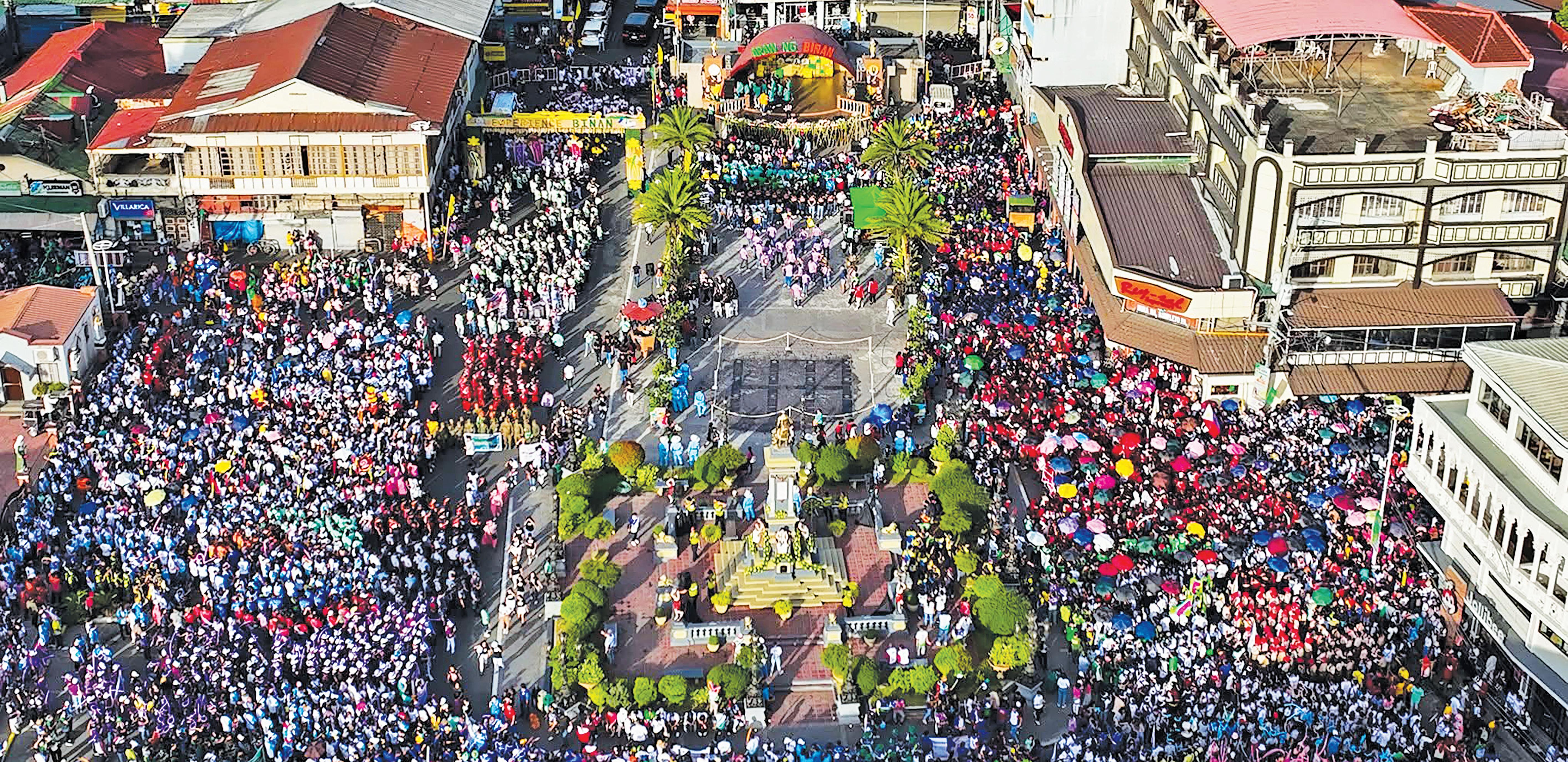
Biñan’s remarkable achievements since becoming a city and the bravery and perseverance of its people are the highlight of the city’s milestone.
By John Eiron R. Francisco
AS Biñan celebrates three monumental milestones on February 2 to 4 this year—the 15th anniversary of its cityhood, the 80th Liberation Day and 278th Founding Commemoration—the city government is set to honor the unsung heroes driving its growth its people.
In a time when many of the city’s advancements are marked by impressive infrastructure and development, City Mayor Walfredo “Arman” Dimaguila Jr. reminded everyone that it is the dedication and resilience of the Biñanense that is fueling its success.
“Biñan will never be Biñan if it does not recognize its people,” Dimaguila told the BusinessMir-
ror, emphasizing the importance of a community that has not only witnessed transformation but has been the cornerstone of every milestone achieved.
Having thrived for over 15 years since its cityhood and marking the 80th anniversary of its Liberation this year, Biñan has learned the importance of celebrating its progress with pride and purpose. Dimaguila



acknowledges that as the city continues to evolve, its celebrations must also adapt.
“Embracing innovation is key to keeping these celebrations relevant, fresh, and meaningful for future generations,” he said.
This notion is echoed by


Vice Mayor Angelo B. Alonte, who believes that the annual “Araw ng Biñan” (Biñan Day) celebrations should evolve in ways that are both inclusive and reflective of the city’s rich history and modern identity.
Alonte observed that the festivities have always been
While the February 5 observance had become a local tradition, veterans and historians have worked to correct the record in order to give the appropriate recognition to the soldiers and residents who contributed to Biñan’s liberation.
By Sigrid Anne D. Carreon
FOR years, the liberation of Biñan, Lagu-
na from Japanese forces has been commemorated every February 5. However, historical records and veteran accounts point to February 3, 1945, as the correct date of liberation. This was validated by the National Historical Commission of the Philippines (NHCP) in 2016 after a requested review from the Biñan City Culture, History, Arts and Tourism Office (BCHATO).
On February 3, 1945, the Hunters ROTC Guerrillas succeeded in driving out the Japanese soldiers occupying the town. This day marked the end of almost three years of Japanese occupation, during which Biñan, like many towns in the Philippines, endured hardships, including forced

vibrant and are envisioned to deepen community engagement and ensure that everyone feels a connection to the city’s milestones and heritage.
“This year’s activities aim to strengthen the bond among residents and foster a deeper connection to our shared history,” he explained.
‘Isang Biñan 1580’
The three-day event is aptly titled “Araw ng Biñan, Isang Biñan [Biñan Day, One Biñan] 1580,” a special tribute to Biñan’s 15th Cityhood Anniversary (February 2), 80th Liberation Day (February 3), and 278th Founding Commemoration (February 4). The city’s chief executive captured the spirit of the celebration, saying, “Kapag sama-sama tayong lilingon sa nakaraan, isang Biñan din tayong tutungo sa hinaharap.”
[When we look back together, we move forward as one Biñan.]
This year’s theme, “Tagumpay at Kagitingan” (Triumph and Valor), was carefully chosen to highlight Biñan’s remarkable achievements since becoming a city and the bravery and perseverance of its people.
Dimaguila said that without the Biñanense’s commitment, the community would lack the strong governance necessary to protect and effectively manage the resources entrusted to it.
“Napakalaki kasi ng kontribusyon ng mga tao sa sustainable development ng isang komunidad,” Dimaguila said. [The contributions of the people are immense in driving the sustainable development of a community.]
Similarly, Alonte underscored the significance of citizen involvement, pointing out that “these milestones are not just dates— they represent the identity and
serves as a reminder of the resilience and courage of Biñan’s people during one of the darkest chapters of their history. This change in commemoration offers a chance to reflect more accurately on the events of the past and ensures that future generations will understand the true significance of the town’s liberation.
Biñan Congresswoman Len Alonte initiated the passage of Republic Act 11442, an Act declaring February 3 of every
as

The initiative not only honors the accomplishments of these modern-day heroes but also ensures that their stories will inspire future generations.
By John Eiron R. Francisco
BIÑAN CITY, LAGUNA – The city government unveils a series of historical markers on Sunday, February 2, to honor individuals and organizations whose contributions have significantly shaped the city’s history and culture.
Since 2018, the city has held the tradition of honoring the life and accomplishments of exemplary residents by creating markers in their name.
City of Biñan Tourism and Cultural Affairs Officer Dr. BJ Borja told the BusinessMirror the significance of posthumous recognition in ensuring that these individuals’ legacies are preserved and their contributions continue to be acknowledged, even if they are no longer around to witness the tribute.
These markers, Borja said, celebrate the lasting legacies of those who have excelled in various fields, including public service, sports, education, healthcare, and cultural development, both within Biñan and beyond.
He further highlighted that this initiative not only honors their accomplishments but also ensures that their stories will inspire future generations.The ceremony celebrated five recipients, each representing diverse fields of public service, sports, education, and cultural development.
Honorees of the Local Historical Markers





Francisco Garcia Almeda
A pioneering sports leader and cycling advocate, Francisco Garcia Almeda made remarkable contributions to Philippine sports. He served as the first president of the Philippine Amateur Cycling Association (1974) and became the first Filipino president of the Asian Cycling Federation (1980–1986). Almeda further elevated the country’s stature in the international sports arena as the first Filipino elected member of the Executive Committee of the International Amateur Cycling Federation (1982–1993).
His influence extended beyond sports as he actively contributed to various community organizations and national government agencies, leaving a lasting impact on public service and sports development.
Antonia Reyes Gonzalez
Known as the first woman councilor and vice mayor of Biñan, Gonzalez was honored for her pioneering efforts in public service. She founded the Biñan Puericulture Center, which became the town’s primary health services hub, providing free medical care and medicines to the community. At a time when there were few women in her field, Gonzalez’ compassion and resilience amid challenges has transformed her into a model of hope and strength among women in the field of public health service and leadership.
The Limaco Siblings: Rogelio and Pura
The Limaco siblings were celebrated for their significant contributions to Biñan’s development and their service to the community. Pura Ligaya Limaco was recognized for her transformative role in education and healthcare, having established the Biñan Doctors’ Hospital in 1974 and Biñan College (now Saint Michael’s College of Laguna) in 1975. Her efforts have shaped the town’s progress in these critical sectors. Rogelio Ligaya Limaco, a wartime hero and former mayor during the Japanese Occupation, is revered as the “Local Hero of Biñan.” He sacrificed his life to protect his fellow townspeople from Japanese repression. His heroism is commemorated every September 16 as “Rogelio Limaco Day” through Municipal Resolution No. 390-2002.
Dr. Jose de Guzman Tamayo
A renowned philanthropist and medical practitioner, Dr. Tamayo is celebrated for his significant contributions to healthcare and education. He founded the University of Perpetual Help System Laguna and the UPH-DJGT Medical University in 1976, institutions that continue to serve as pillars of education and healthcare. His legacy lives on through his commitment to service and the community’s well-being.
Biñan Youth Performance Council (YPC)
Founded on August 5, 2005, the YPC has sparked several artistic and cultural breakthroughs in Biñan. Now celebrating it's 20th anniversary, The official performing arts group for Theatre Arts under the Biñan City Centre for Performing Arts (BCPA), YPC collaborates with the City Government and the Cultural Center of the Philippines to enhance cultural programs and initiatives. Through its performances and programs, YPC has helped elevate Biñan’s cultural identity and artistic excellence.
Biñan City honors the triumphs of its people and the valor that continues to define its community.
By John Eiron R. Francisco
HE City Government of Bi-
Tñan broadened and strengthened its celebration of this year's Biñan Day by honoring individuals and leaders whose stories of ‘triumph and valor’ have become hallmarks of the city’s identity.
Dr. BJ Borja, Biñan’s Tourism and Cultural Affairs Officer, explained that the event was not just a conventional awards ceremony but a tribute to individuals who have lived with courage and a commitment to helping others.
Through the “Gabi ng Tagumpay: Pagkilala sa mga Kuwentong Kagitingan ng mga Biñanense,” held at the Biñan City Hall, it recognized seven honorees whose extraordinary journeys embody the theme of this year’s Biñan Day: “Triumph and Valor.”
City Mayor Walfredo "Arman" Dimaguila Jr. stated that each recipient’s journey symbolizes overcoming adversity, rising above challenges, and making a lasting impact—whether in education, where knowledge is shared; in fishing, where sustainable practices are promoted; in agriculture, where food security is safeguarded; or in medicine, where lives are saved and transformed.
In celebrating these individuals, Dimaguila said that the city government, through this event, honored the triumphs of its people and the valor that continues to define the community. Through their inspiring stories, these heroes have proven that with courage and commitment, one can truly change the world around them.
Stories of Triumph and Valor n Vernan S. Magundayao: A Champion of Fisherfolk and the Environment
For over a decade, Vernan S. Magundayao has been a staunch advocate for Biñan’s artisan fishermen, tirelessly working to improve their livelihoods and promote sustainable fishing practices in Laguna de Bay.
As President of the Fisheries and Aquatic Resources Management Council (FARMC) since 2012, Magundayao has fostered unity among fisherfolk, built strong partnerships, and implemented programs that balance economic growth with environmental sustainability. His leadership has not only uplifted Biñan’s fishing community but also ensured the protection of Laguna de Bay for future generations.
n Dr. Rito A. Camigla, Jr.: Transforming Lives Through Education and Charity
From a young boy thrust into the role of breadwinner at just 12, Dr. Rito A. Camigla, Jr. rose above life’s adversities to become a beacon of hope for underprivileged youth. As an educator at Trimex Colleges, he inspires students with his passion for learning and a deep commitment to service.
Dr. Camigla established scholarships such as the Trimex Trojan Warriors and Sinagkawan programs to support financially struggling students. His dedication to education and philanthropy has transformed countless lives, earning him respect as both a mentor and a changemaker in the community.
n John Dery G. Tanael: Pioneering Youth Leadership in Barangay Poblacion
At just 21, John Dery G. Tanael, or JD, has redefined youth leadership in Biñan. As SK Chairperson of Barangay Poblacion, he turned one of the city’s least-funded barangays
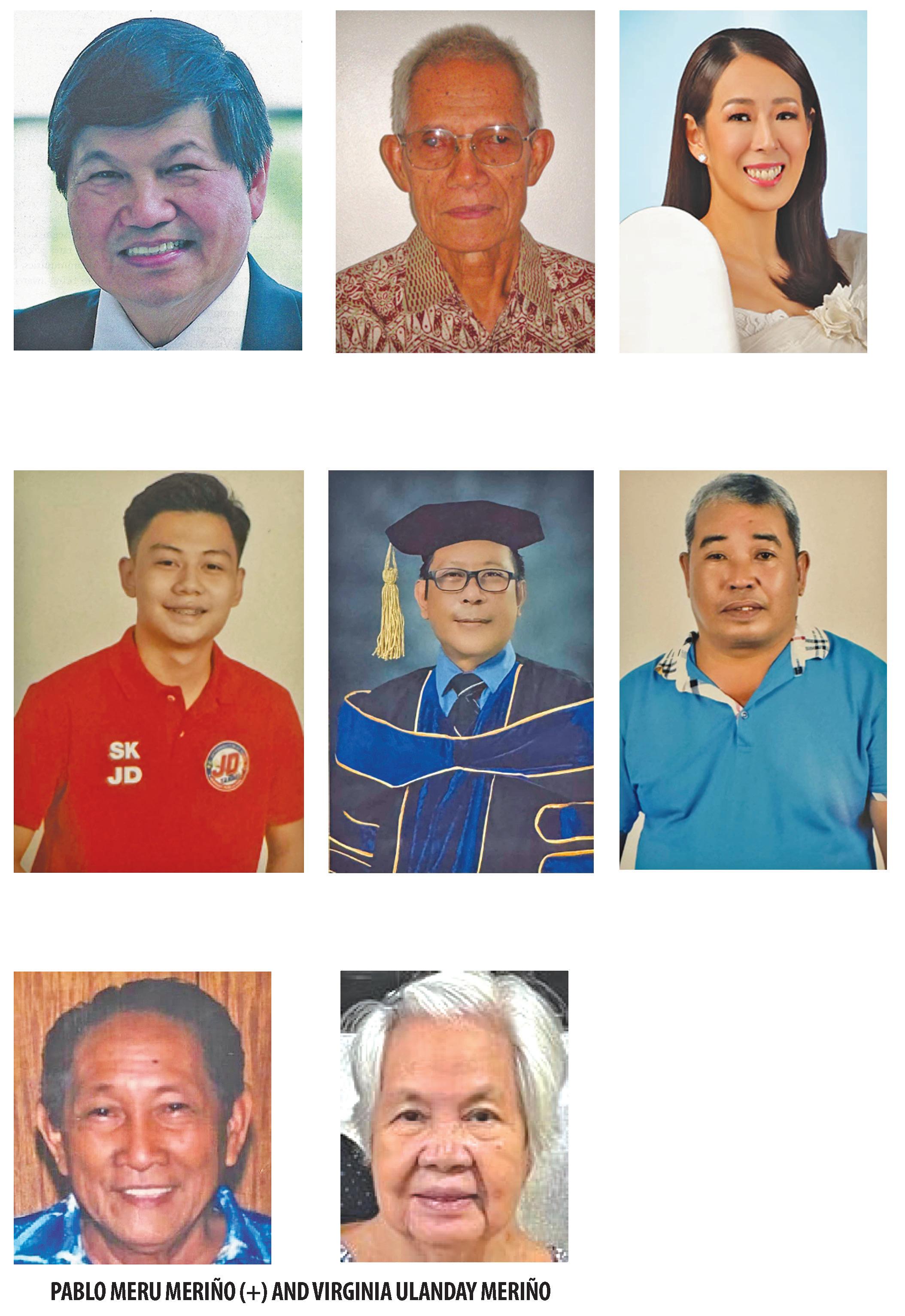
into a shining example of progress. With the guiding principle “Limited Resources? Think! Unlimited Possibilities,” JD implemented 168 sustainable projects in a single year, including the establishment of an SK Hall and Library. His innovative approach and determination earned him the title of Top 4 Most Outstanding SK Leader, proving that age is no barrier to meaningful impact.
n Meriño Family’s Commitment to Community and Education
Pablo “Pabling” Meriño and Virginia “Niña” Meriño played a pivotal role in Biñan’s development through their vision, generosity, and commitment to the community. In the early 1980s, they established the Meriño Compound (now known as San Agustin Village) and Silmer Village in Brgy. San Francisco provides affordable housing to low- and middle-income families. Their passion for education further drove them to donate land in Silmer Village, which later became the site of the Biñan City Science High School. This initiative
was made possible through their partnership with Mayor Arman Dimaguila and the local homeowners' association. The Meriños' selflessness and dedication to community-building have left a lasting legacy to continue to inspire the people of Biñan with their contributions to education, progress, and hope for future generations.
Natatanging Biñanense Awardees
n Dr. Jorge M. Garcia: A Heart Surgeon Who Saved Thousands Globally recognized for his groundbreaking contributions to cardiothoracic surgery, Dr. Jorge M. Garcia has performed over 15,000 heart surgeries worldwide, including 4,000 in the Philippines.
Dr. Garcia’s pioneering work includes establishing cardiac surgery programs in Washington, D.C., and the Philippines, as well as performing the country’s first heart transplant. As the founder of Asian Hospital and Medical Center, he has made world-class healthcare accessible to Filipinos, leaving a legacy of hope and healing.
and sharing his expertise to ensure a sustainable future for agriculture. n Hon. Marlyn B. Alonte-Naguiat: A Trailblazer for Women and Marginalized Groups
Breaking barriers and redefining leadership, Hon. Marlyn B. AlonteNaguiat made history as Biñan’s first woman mayor and its youngest, serving from 2007 to 2016. During her tenure, she spearheaded the cityhood of Biñan in 2010, and implemented progressive environmental policies, including the city’s plastic-free initiative.
Serving Biñan non-stop since 1998, and now on her last term as Biñan’s Congresswoman, she continues her advocacy for women’s empowerment, children’s education, and LGBTQ rights, championing legislation that uplifts marginalized communities.
The city mayor said that their stories serve as a beacon of hope and a reminder that greatness is not defined by individual success but by the impact one has on the lives of others. While the city government reaffirmed its commitment to fostering a culture of resilience, innovation, and service to ensure that the
of
and
on
Good governance and a united community is vital in the city’s sustained progress.
By John Eiron R. Francisco
BIÑAN, described as a city that brings life to its people, culture, and history— it also remains deeply grounded on its rich heritage while fostering growth and progress to ensure that its residents have the opportunities to succeed.
Historically, Biñan holds a special place in the heart of the nation as the second home of Dr. Jose Rizal, the country’s national hero. It was here that Rizal received part of his early education, and walking through its streets today, one can still feel the echoes of the past—students’ laughter, the wisdom of teachers, and the quiet determination of a young boy who would go on to change the course of history.
Yet, it is not just a city defined by its past. It has also embraced progress and innovation, evolving into a thriving and dynamic community. Even before achieving cityhood, it was already one of the richest municipalities in the Philippines. This progress was solidified in 2010 when Biñan officially became an independent component city through Republic Act 9740. The momentum continued in 2015 when it was declared the Lone Congressional District of Biñan, the first in Laguna—further strengthening its role in regional development.
Biñan’s remarkable growth and development can be attributed to its dedicated leadership. Under the governance of Mayor Walfredo “Arman” Dimaguila Jr., Vice Mayor Angelo “Gel” Alonte, the city has flourished



through proactive policies, comprehensive programs, and significant infrastructure investments. Their initiatives span key sectors such as healthcare, education, cultural preservation, and social welfare to ensure that progress benefits every Biñanense.
This commitment to good governance has earned Biñan the prestigious Seal of Good Lo-


cal Governance (SGLG) Award from the Department of the Interior and Local Government (DILG)—a recognition the city has received since 2017. The SGLG, the highest distinction given by the DILG, signifies excellence in governance including the financial administration and sustainability; disaster preparedness; social protection and sensitivity; health compliance

and responsiveness; sustainable education; business-friendliness and competitiveness; safety, and peace and order; environmental management; tourism, heritage development, culture and arts; and youth development.
Mayor Dimaguila, Vice Mayor Alonte, and other city officials formally accepted the award at the SGLG Awarding Ceremony on December 10, 2024 at the
Manila Hotel. This repeated achievement is believed to be a representation to the city’s strong leadership and the seamless coordination of its local government departments.
According to the City’s Local Government Operations Officer (CLGOO)—who has worked with other award-winning LGUs in Laguna—Biñan has consistently met and even exceeded the stan-
dards required for good governance, proving that its leaders do not work for recognition but to truly serve their people.
Beyond prestige, the SGLG Award also comes with financial incentives, which the city reinvests into its programs and services to ensure continued development and sustainability.
Among Biñan’s most progressive initiatives is its rehabilitation and reintegration program for former drug dependents housed at the “Balay Silangan” facility. The local government collaborates with businesses, commercial establishments, and the Public Employment and Service Office (PESO) to provide employment opportunities for Balay Silangan graduates.
Further strengthening this effort, Mayor Dimaguila issued an executive order requiring all contractors operating in the city to allocate 10 percent of their workforce to rehabilitated individuals. This policy is said to reflect Biñan’s commitment to breaking the stigma surrounding former drug dependents and providing them with a fresh start in life.
Moreover, for the city’s chief executive, Biñan’s consistent recognition through the SGLG Awards is more than just an accolade—it is a benchmark for future leaders to uphold and improve upon.
Through dynamic leadership and the collective efforts of its citizens, the city continues to flourish, proving that with strong governance and a united community, progress is inevitable. Here, life is not just about existing—it is about growing, creating, and thriving.
With these accolades, Biñan is positioned to further enhance its reputation as a dynamic tourism destination, attracting more visitors while staying true to its cultural roots.
By Charles Francis M. De Castro
THE City of Biñan seals its remarkable mark in the Philippine tourism sector by winning the regional honors at the prestigious Philippine Tourism AwardsCALABARZON last December in two major categories: Tourism Destination of the Year and Living Cultures Destination of the Year.
The double recognition highlights the city’s outstanding efforts in promoting both tourism and the preservation of its rich cultural heritage. The Philippine Tourism Awards (PTA) is the highest and most prestigious citation in Philippine Tourism. The PTA is a recognition program of the Philippine Department of Tourism that seeks to honor industry players and LGUs who have demonstrated excellence in the development and promotion of the country’s tourism sector.
Tourism Destination of the Year
Biñan’s win in the Tourism Destination of the Year category is a testament to its growing appeal as a vibrant urban hub that balances historical landmarks, natural attractions, and modern developments. The city has become a go-to destination for tourists seeking both relaxation and adventure, thanks to its accessible location, diverse attractions, and commitment to enhancing the visitor experience.

Among Biñan’s key tourist draws are its historical sites, such as the Historic Alberto Mansion, School of Rizal Site and Museum, Sentrong Pangkultura ng Biñan, and newer attractions, including the Plaza Rizal, sports and recreational centers, food hubs and eco-tourism spots. Local officials have focused on improving infrastructure, public services, and sustainable tourism practices, making the City of Biñan a place where both local residents and visitors can enjoy an enriched and seamless experience.
Equally significant is Biñan’s recognition as the Living Cultures Destination of the Year, which celebrates the city’s dedication to preserving and promoting its rich cultural heritage. Biñan is home to a variety of cultural traditions, and the city has worked hard to make sure these customs remain a living part of its identity. Through local festivals, art and cultural workshops, and community-based tourism programs, the city has kept its traditions alive while providing educational and immersive experiences for visitors.
The city’s commitment to showcasing its history and cultural legacy not only enhances tourism but
also strengthens the sense of pride among its residents. Events like the Araw ng Biñan (February 2-4) and Puto Latik Festival (May 15-23) showcase the city’s vibrant arts, crafts, and performances.
A Vision for Sustainable Tourism
Both awards underscore Biñan’s holistic approach to tourism - one that combines development with the preservation of its cultural and environmental assets. Local officials are committed to ensuring that tourism growth continues to be sustainable, fostering responsible tourism practices and collaborating with local communities to protect Biñan’s unique heritage. With these accolades, Biñan
at the Philippine Tourism Awards regional level not only brings pride to its residents but also serves as an inspiration to other cities looking to strike a balance between modern growth and cultural preservation.

With these major developments, Biñan is poised to become a model for modern urban growth, balancing the needs of its community while fostering innovation and progress.
By James Kent C. Torres
THE City of Biñan in the P rovince of Laguna is set to become a hub for improved healthcare, arts, and education with the introduction of a major legacy projects that will bring significant advancements to the city’s infrastructure. These ambitious developments, brainchild of the Dimaguila-Alonte dynamic tandem, will include a new hospital, a state-of-the-art theater, and a cutting-edge science high school, all aimed at enhancing the quality of life for the residents and fostering growth in various sectors.
Biñan City Hospital: A Boost to Healthcare Services
While there is already an existing hospital in the city, this new facility serves as an expansion, offering more extensive services and is expected to provide worldclass medical care to the residents of Biñan and nearby towns.
The new hospital is expected to provide world-class medical services to the residents of Biñan and nearby towns. With the growing population in the area, the need for more accessible healthcare facilities has become more pressing. The hospital will
feature modern equipment, specialized healthcare departments, and a team of expert professionals, ensuring that patients receive top-notch care. It will feature modern and spacious patient care facilities. There will be an additional 170 hospital beds, an Intensive Care Unit (ICU), a Neonatal Intensive Care Unit (NICU), and advanced diagnostic and surgical facilities. Within the hospital complex, a Dialysis Center, a project of Cong. Len Alonte will also revitalize the services in the city. This new hospital aims to address the increasing demand for medical services, improve emergency response times, and reduce the burden on existing healthcare institutions. In addition, it will create numerous jobs and opportunities for healthcare workers, contributing to the local economy. Meanwhile, the old hospital building will be converted into a fully operational birthing center.
Biñan’s cultural landscape will also see a transformation with the development of a new theater. This venue is designed to
Continued from C1
shared legacy of the city.”
“When every individual takes part, whether by attending, volunteering, or simply reflecting, it fosters a sense of unity and pride,” Alonte explained.
“It’s an opportunity to educate the younger generation about the sacrifices and successes that shaped the city they call home,” he added.
Cultural pride unveiled
According to City of Biñan Tourism and Cultural Affairs Officer Dr. BJ Borja, organizing the events for this year’s celebration was not overly challenging, despite the packed schedule and the numerous meaningful activities they wanted to incorporate into the three-day event.
“This year is more of a showcase,” Borja said.
The carefully planned activities, he explained, were designed not only to entertain but also to celebrate the city’s growth, with events that resonated with its rich history and community values. With a jam-packed agenda, the city government aimed to create a celebration that would connect with all sectors of the community and leave a memorable impact on its people.
On February 2, the celebration kicks off with a Grand People’s Parade. The parade will be followed by the inauguration of the Biñan Elevated Parking Facility at Brgy. Poblacion. The project is a key development
aimed at easing the city’s growing traffic congestion and promoting greater mobility.
The “Photo Biñan Exhibit” at the Sentrong Pangkultura ng Biñan, which is in partnership with JCI Biñan, features the theme “One Biñan” and chronicles the city’s evolution.
Cultural activities continue with the inauguration of the Biñan City Center for Performing Arts with National Artist Ryan Cayabyab as guest of honor. The theater's official sound chime was composed and performed by Maestro Cayabyab. Meanwhile, the 8th Biñan National Choral Festival will feature 13 talented finalists.
The day culminates with the unveiling of local historical markers honoring outstanding citizens.
In the evening, “Gabi ng Tagumpay” (Night of Triumph), a ceremony honoring the bravery and heroism of the people of Biñan, will recognize individuals who have made remarkable contributions to their community.
The Cultural Night at Plaza Rizal, a showcase of artistic talents presented in collaboration with the Biñan City Centre for Performing Arts, will concurrently take place with the “Gabi ng Tagumpay.”
Honoring the past, building the future
On February 3, the second day of the festivities, Biñan will commemorate its 80th Liberation Day, a celebration dedicated to remembering the sacrifices


host various performances, from local plays and concerts to international productions, offering a platform for artists to showcase their talents. Designed with architecture inspired by the past with future-ready and innovative technology with 500 seats, led wall cyclorama, fly systems, rehearsal and exhibit spaces, a cinematheque, and different music and dance rooms. The theater will sure enhance the city’s cultural appeal, attracting tourists and encouraging local artistic expression.
This initiative aims to bring a new era of arts and culture to the city’s artistic landscape, that will preserve and promote the
made by the city’s heroes.
The day’s events will begin with a Ceremonial March from Carmona to Biñan. This will be followed by a Marching Drill and Exhibition, where participants will reenact the victorious entry of the liberators. The commemoration will recognize the heroic efforts of the Hunters ROTC Guerrillas, a renowned World War II resistance group that liberated Biñan from Japanese forces on February 3, 1945.
The “Pasasalamat sa mga Beteranong Biñanense” (Thanksgiving to Biñan’s Veterans) ceremony at the Heroes Memorial Hall will honor the contributions of the city’s veterans in securing freedom for future generations. The brave veterans have all passed on but through their surviving families, they continue to be honored by the city during Liberation Day.
Meanwhile, “Celebration of Life: A Historical Journey” will feature art works by Mamarag that highlight Biñan’s history.
The 5th Biñan Drum and Lyre Band Competition will bring youthful energy to the celebration, while the Art in Public Spaces: Wall Mural Competition at the Biñan Football Field Complex will turn public areas into colorful representations of the city’s identity.
The city’s commitment to public service will also be reflected with the inauguration of key facilities, such as Canlalay Elementary School, Biñan City Hospital, and the City Legislative Building.
Later in the day, the “Panunumpa ng Tagumpay at Kagitingan” (Oath of Triumph
very best of local artistry, talents, and culture. It will also serve as a space for educational programs, community events, and cultural exchanges, contributing to the enrichment of Biñan’s social fabric. Furthermore, the theater is positioned to strengthen the programs of the Biñan as Cultural Center of the Philippines (CCP) Regional Arts Center.
Biñan City Science and Technology High School: Fostering Innovation and Excellence Education is another focal point of these legacy projects. The new science school in Biñan aims to nurture the next gen-
and Valor) ceremony at the Biñan People Center will gather youth organizations, encouraging them to actively contribute to shaping the future of the city. The evening will conclude with Tanghal Tula: Spoken Word Poetry Contest, followed by the lively '1580: The Concert' at Plaza Rizal, featuring special celebrity guests headlined by Dilaw Band, David Licauco, Jessa Zaragoza, Rufa Mae Quinto, Arci Muñoz, David Young, Iyah Mina, Shaira Moro, and many others.
‘New foundations, new beginnings, and a tribute to tradition’
On the final day of the festival, Biñan will honor its 278th Founding Commemoration, marking another chapter in its long and storied history.
The day will be packed with inauguration ceremonies, focusing on initiatives that promote inclusivity and support for all residents, such as the opening of the Dela Paz National High School, Senior Citizens Center, and PWD Center.
Public service likewise remains at the forefront of the celebrations, with the "Serbisyong Arman Caravan" at the Ospital ng Biñan and the "Tatak Gel and Alagang Len Caravan" at the Ospital ng Biñan and the Tatak Gel and Alagang Len Caravan at the Town Proper, both bringing essential services closer to the communities.
The “Dedikasyon at Aksyon Caravan” will also take place in Brgy. Vicente, reinforcing the commitment of the local government to serving its people.
In the afternoon, groundbreaking ceremonies will contin-
eration of scientists, engineers, and innovators. Equipped with modern laboratories, research facilities, and experienced faculty, the school will provide students with an unparalleled learning experience in the fields of science, technology, engineering, and mathematics (STEM). The school features solar-powered rooms and amenities: 21st-century-designed classrooms and offices, a school library, school auditorium, elevator, Mathematics laboratory, Speech Laboratory, and Science laboratories - all poised to make an impact in society, a school armed with different arsenals that will boost student’s
ue at Biñan Integrated National High School's new building and Santo Niño Elementary School. Inaugurations will also be held at Soro-Soro Elementary School and Biñan Science High School's new building in Brgy. San Francisco, followed by groundbreaking ceremonies at Brent Town Village and Biñan Residences Santo Tomas. Additionally, the inauguration of Malaban Dalampasigan High School, the groundbreaking of Ilaya Malaban Elementary School, and the inauguration of the Villa Aguila Housing Project will take place. All these initiatives are part of Biñan’s ongoing efforts to enhance infrastructure and services for its residents.
The afternoon will feature the screening of two acclaimed Metro Manila Film Festival 2025 entries, "And the Breadwinner Is..." and "Isang Himala," at Southwoods Mall. In the evening, the 7th Biñan Folk Dance Festival will take place, themed Dance of Yesteryears: Cordillera Dance.
‘Biñan eyes smart, sustainable future’
In line with these meaningful celebrations are its leaders shared vision of “Biñan as a smart, sustainable, and inclusive city.” Alonte emphasized, “Urbanization will be guided by strategic planning that prioritizes green spaces, efficient public transport, and resilient infrastructure.”
He added, “Our city should become a hub of economic opportunities, driven by technology, innovation, and a vibrant business environment. Dimaguila, on the other
knowledge and passion for innovation and nation-building.
This initiative is part of a broader effort to improve the country’s education system, especially in fields that are critical to future economic growth. By offering a specialized curriculum that focuses on practical learning and research, the school will help cultivate students who are wellprepared for careers in science and technology.
A Vision for the Future
These legacy projects represent long-term vision for growth and progress. It not only aims to improve the quality of life for residents but also position the city as a leader in healthcare, culture, and education. With these major developments, Biñan is poised to become a model for modern urban growth, balancing the needs of its community while fostering innovation and progress.
As construction for these projects moves forward, the city officials are hopeful that the new hospital, theater, and science school will make Biñan a more vibrant, progressive, and prosperous city for generations to come.
hand, stressed that community welfare will remain a top priority, highlighting the importance of accessible healthcare, quality education, affordable housing, and programs that empower marginalized groups as key elements of the city’s growth. Alonte, who is in his final term as vice mayor and set to run for city mayor, alongside Dimaguila, who is preparing to run for Congress, shared their commitment to ensuring that Biñan’s progress continues for future generations.
“Ensuring continuity requires a solid foundation and visionary planning,” Alonte said, stressing that future developments must be anchored in long-term strategies rather than individual leadership.
He highlighted plans to institutionalize key projects such as the Smart City Development Plan and the Green Energy Transition Ordinance, ensuring these initiatives remain integral to the city’s governance. Alonte likewise underscored the need to invest in leadership development programs, like the GEL Young Leaders and Athletes Academy, to nurture future leaders rooted in public service. “These programs are essential in cultivating the next generation of Biñan’s leaders,” he explained.
While Dimaguila noted that Biñan’s rich history and promising future are intertwined, Alonte added, “It is our collective responsibility to honor the past while building a brighter tomorrow,” they said, reinforcing the idea that Biñan’s legacy is shaped by both its heritage and its forward-thinking plans.