



A bill with the noblest of intentions to ensure universal access to the internet and its blessing has been passed after a bruising battle in Congress, and stakeholders are prepping for the next battleground: the IRR.
By Lorenz S. Marasigan
operators are seeking a bigger role in shaping the implementing rules and regulations (IRR) of the newly enacted Konektadong Pinoy Act, warning that gaps in policy design could undermine both the law’s intent of expanding access and the security of the country’s digital ecosystem.
The law—also known as the Open Access in Data Transmission Act—lapsed into law on August 24, ushering in a framework aimed at streamlining licensing, opening the market to new players, and accelerating investment in internet infrastructure.
The Department of Information and Communications Technology (DICT) targets to finalize the IRR within 60 to 90 days.
Industry leaders say, however, that the IRR will be the true battleground that will determine whether the law delivers on its promise of inclusive connectivity—or inadvertently destabilizes a sector critical to economic growth and security.
“At the very beginning, we don’t have any objections with the noble objectives of the bill. Now that it’s passed into law, obviously, we are here to support it,” Dito Telecommunity Corp. CEO Eric Alberto said in an interview. However, he underscored three key areas that must be addressed in the IRR: sustained infrastructure investment, robust cybersecurity and national security safeguards, and clarity on the obligations imposed on new entrants.
“We would like to request, and we enjoin the other members of the industry, that we take part in the development and crafting of the IRR, so that we protect a number of things,” he said.
On infrastructure, Alberto likened the market to a highway system.
“We are lagging behind countries that we aspire to be in economically. I look at the players as vehicles, but where is the commitment to build more roads? So you’re just putting more vehicles on the road,” he said, stressing that the framework must ensure that new entrants contribute to building out the digital backbone rather than simply riding on existing networks.
On oversight, he said unimpeded entry without government supervision could compromise national security.
“We should not allow unfettered entry without the supervision and oversight of government, particularly with cybercrime, security, data privacy, national security, and the like,” Alberto said. “That should not be neglected.”
This is the most serious issue flagged earlier by the other established telcos. Finally, he flagged fairness.
“We were subjected to stringent hurdles to make sure that we are serious. Not only in being a provider but also in ensuring continued and sustainable digital infrastructure development, including annual taxation. Maybe we’d like to see clarity in those specifics as we go through and thresh out the particulars on the IRR for that bill,” Alberto said.
Dito Chief Revenue Officer Adel Tamano echoed these points, but also emphasized the need to strike a balance. He said the law’s spirit was the same spirit that opened the doors for Dito as the third telco, and opposing it outright would be inconsistent.
“I do not want the IRR to be done in such a way that you are killing the purpose of the law,” Tamano said. “The spirit of Konektadong Pinoy was part of the spirit that allowed us in the industry. We are brought in to increase competition. I think it is hypocritical for me to oppose competition.”
Tamano said the IRR should lower barriers for data transmission industry participants (DTIPs) while ensuring they are not “flyby-nights” with poor security standards.
He added that Konektadong Pinoy could even be positive for DITO’s long-term strategy if smaller players tapped into its network.
“I think Konektadong Pinoy can be very positive business-wise. The framework of Konektadong Pinoy of opening up the telcos, so that smaller players can use our network was our business strategy . . . . If we position ourselves properly to take the opportunity, Konektadong Pinoy can be very positive for you,” Tamano said.
Meanwhile, Globe Telecom Inc. General Counsel Froilan Castelo warned that the law leaves gaps in vetting new entrants, exposing the network to risks.
“Telecommunications networks are the backbone of national security. Yet the law leaves gaps in the vetting of new entrants, heightening the risk that inadequately screened operators may gain access to critical infrastructure,” he said. Particularly concerning, he said, is the two-year grace period before new players are required to secure cybersecurity certification.
“[This] creates a prolonged window for exploitation. This is at odds with the spirit of several existing laws including the Cybercrime Prevention Act, the Data Privacy Act, the Anti-Terrorism Act,


“We




and the Anti-OSAEC/CSAEM Law, all of which require immediate and effective protection of citizens and state systems,” Castelo said.
Spectrum risks Globe also raised alarm over spectrum management, claiming that the law permits unregulated use of spectrum by satellite operators.
“This risks placing the Philippines in breach of its international treaty obligations, and more seriously, invites harmful interference with frequencies used by the country’s defense and disaster-response agencies. Such interference could compromise communications at precisely the moments, during crises and emergencies, when they are needed the most,” he said.
He noted that Globe will engage government and multisectoral stakeholders “to ensure that the law advances its intended goals without compromising security, stability, or consumer welfare.”
Converge ICT Solutions Inc. CEO Dennis Uy said it is “very important to ensure that the right regulatory frameworks are in place, in this case the IRR.”
“The last thing we want is for consumers to suffer from substandard offers. We need strong, clear, and enforceable rules that guarantee an equal playing field,” he said. Similarly, Uy raised concerns about regulatory standards and cybersecurity.
“Regulations should make sure that capitalization is right, manpower is enough, and there is enough capability to serve our consumers. It should not be a case of here today, gone tomorrow. That’s how consumers get victimized by fly-by-night operators,” he said, speaking partly in Filipino.
Meanwhile, PLDT Inc., the country’s largest telco, has not yet issued a detailed position but a company official said it is “awaiting the IRR,” and hinted that the telco was pinning its hopes on a scenario where a well-crafted IRR can mitigate the potential adverse consequences of the new law.
Earlier, PLDT Corporate Secretary Marilyn Victorio-Aquino had warned that the measure grants “so much benefits” to data transmission providers without extending similar obligations to incumbent operators. As telcos seek a seat at the table to help craft the IRR of the law, industry advocates are now “drafting” their proposal, a source said. They have been in a celebratory mode since the bill lapsed into law last week, as they had fought for its passage for nine years and three administrations.
DICT’s vow
DICT Secretary Henry Aguda committed to “ensure that Konektadong Pinoy delivers the objective of universal connectivity in the country and ensure that all Filipinos have affordable and quality access to the internet.”
The DICT and the Department of Economy, Planning and Development (DEPDev) will co-lead the drafting of the IRR no later than the third week of November.
By Henry Empeño Conclusion
IBA, Zambales — With mechanization and use of certified seeds becoming the norm in Philippine agriculture, poor soil fertility, pest and disease problems, and water shortages remain the leading causes of low agricultural productivity— all of which require substantial costs to manage and control.
Philippine Statistics Authority (PSA) data indicate that in 2023, average palay production cost in the country stood at P13.38 per kilogram (kg). Among the 18 regions, Central Visayas posted the highest production expense at P18.70/kg, while the least outlay was recorded in Central Luzon at P11.60/kg. Production costs further increased last year to P14.52/kg, the PSA says, leaving small farmers at twice the disadvantage of high production cost that inhibits further growth.
Here in Iba town, however, the homegrown Palay Partnership Program (PPP) is providing cheaper and readily-accessible alternative farm inputs that allow growers to break this vicious cycle.
CRH and ‘liquid smoke’ AT BCV Farms in the remote Sitio Olpoy of Barangay Amungan, Jomar Angulo, a graduate of agriculture from the President Ramon Magsaysay State University in Botolan, Zambales, and other farm technicians produce natural soil enhancers and spray-on foliar fertilizers from farm wastes and kitchen scraps.
BCV’s “Nutriboy” compost, which enriches the soil, is made from rice hull, a waste product of rice milling, and chicken manure, an ordinary farm by-product. These are mixed on a one-is-to-one ratio and turned into carbon in 24 hours through a process similar to making charcoal.
Angulo says the carbonized
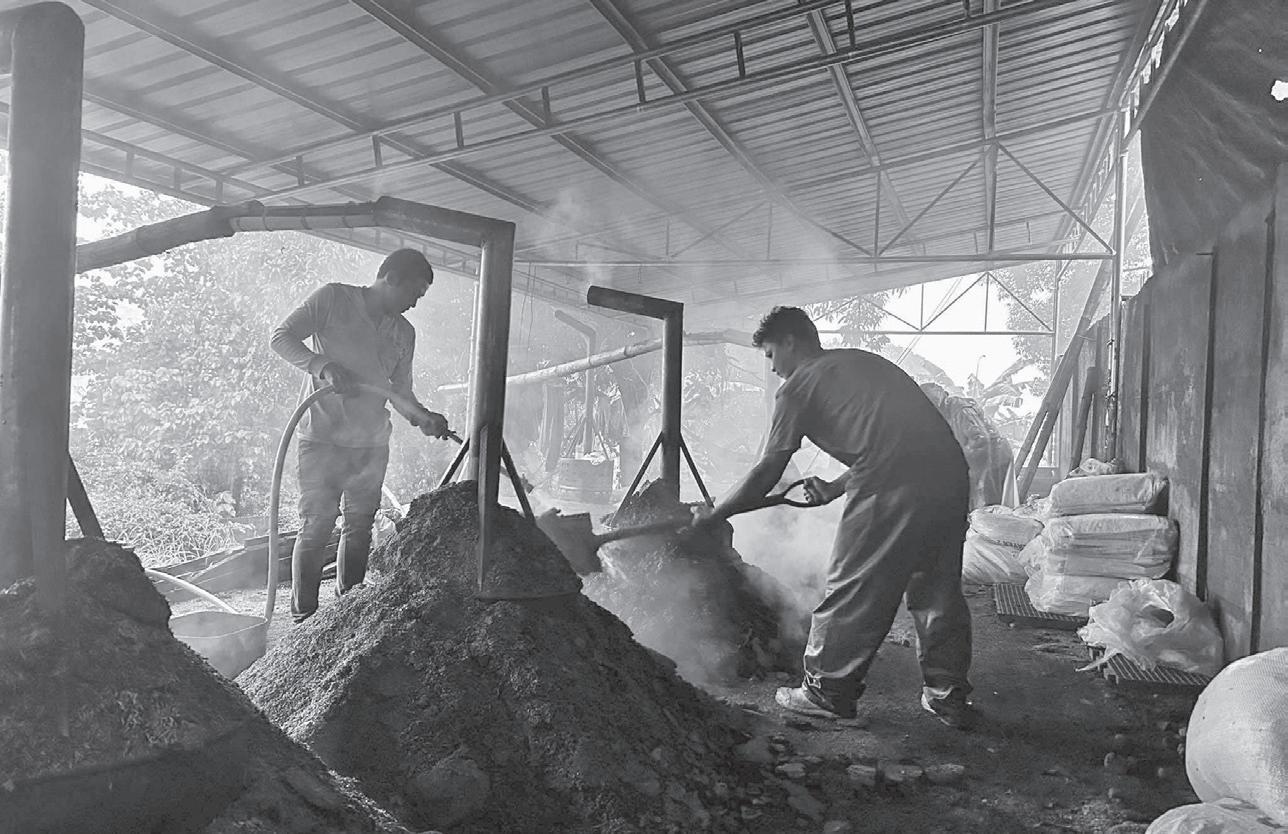



rice hull (CRH) loosens compact soil, helps in water retention, and builds beneficial microorganisms that enhance soil quality. Nitrogen-rich chicken manure, which also contains traces of phosphorus and potassium, meanwhile, makes palay plants greener and more robust.
In carbonizing rice hull, BCV Farms creates another natural product called “liquid smoke” when trapped smoke cools down and condenses to a liquid state. “This is a natural pesticide or insect repellant, which is also environment-friendly,” explains Angulo.
Mixed with water at 10 milliliters for 1 liter of water, “liquid smoke” is used either in fertigation—the application of watersoluble products via an irrigation system—to improve soil quality, or sprayed onto leaves and stems to help repel insects.
Foliar fertilizers
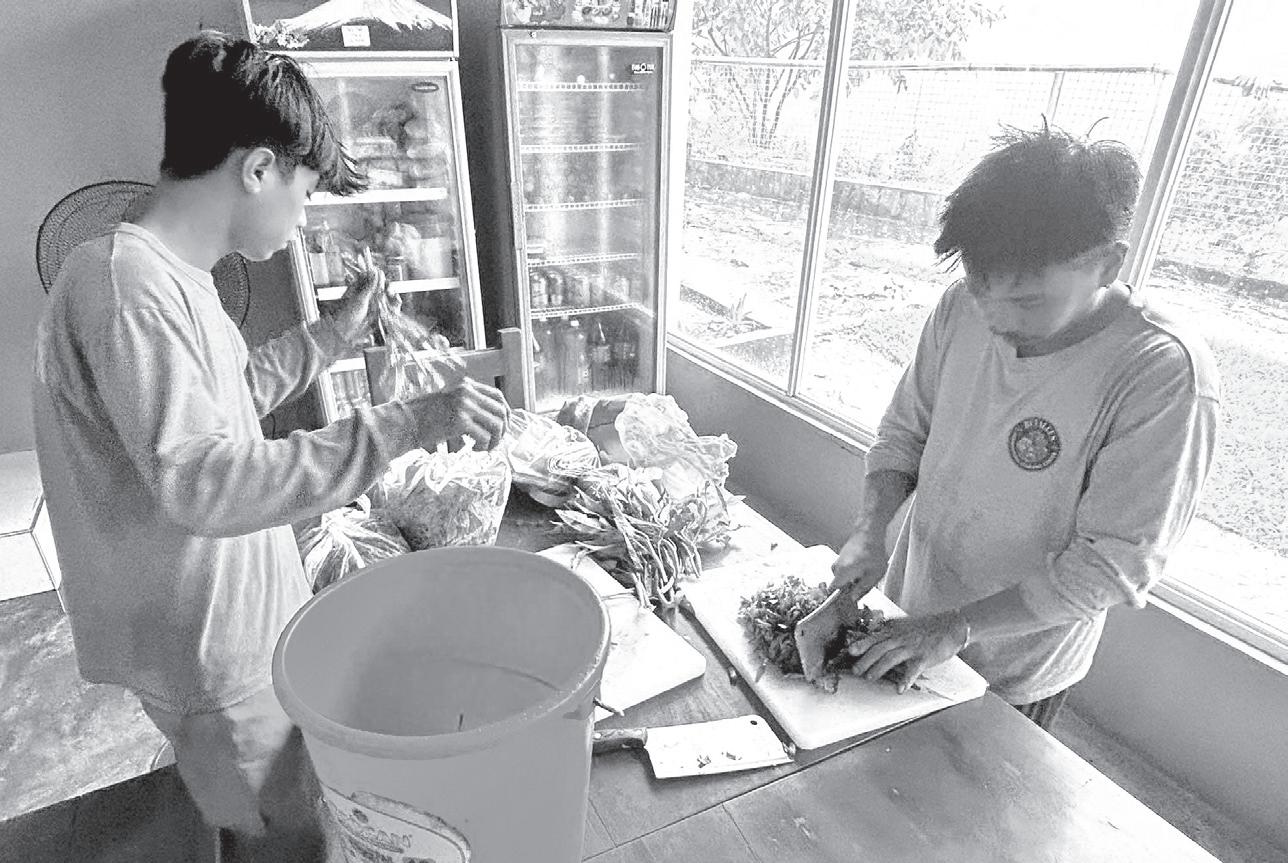
ANGULO and his technical crew also ferment vegetable and fruit extracts to produce three kinds of foliar fertilizers that BCV Farms packages as farm inputs along with compost for the Palay Partnership Program.
The first foliar is named FPJ, short for fermented plant juice. It is made from plant parts like banana and bamboo shoots, or kangkong and camote tops, that naturally exhibit growth spurts. As FPJ contains plant hormones that promote faster growth, it is sprayed on palay during the early growing stage.
The second is called FFJ, or fermented fruit juice extracted from fruits like papaya, mango, and banana. High in potassium content, the FFJ is used during the reproductive stage to produce bigger palay grains.
The third foliar is OHN—oriental herbal nutrients, which is a mix of onion, ginger, garlic, and chili. Consumed by humans for their known antioxidant, antimicrobial and anti-inflammatory properties, these herbs are also natural insecticides, Angulo points out.
The natural ingredients are mixed with molasses and left to ferment for seven days. Strained and cleaned of solids thereafter, the juices are mixed with water—10 milliliters to each liter of water—and they are ready for use as foliar fertilizers.
FARMERS enrolled in the PPP confirm that the natural soil enhancers and foliar supplements provide an inexpensive yet effective regimen of production inputs that are ideal for sustainable farming.
The upside also include accessibility of technology, says BCV Farms owner Boboy Valles, a successful chicken and hog farmer who has made it his personal mission to promote natural farming.
“Our farmers can easily learn best practices in producing compost and foliars, study them first-hand in seminar and trainings we hold periodically at BCV Farms, and then DIY them later on,” Valles says.
He says BCV also gives out pamphlets on natural farming to farmers, students and teachers, and other farm visitors. “We don’t keep production formulas secret; in fact, we’re giving them away so that more people would benefit from them,” adds Valles.
Cost-benefit
ASIDE from conducting trainings on natural farming, BCV Farms establishes model farms among its PPP participants to demonstrate the use of product innovations and farm management systems. Here, farmer-participants attest to the efficacy of natural farming methods and their cost-effectiveness.
PPP records indicate that production cost depends heavily on the quality of soil—whether or not the fields need more enhancers and, consequently, more boosters for plant growth and maintenance.
In the past three cropping seasons, PPP participants ordinarily spent about P9,702 for soil enhancers, and P1,370 for foliar sprays. Including labor and other farm inputs, their average expenses reached just P31,894 per hectare. This is 42.85 percent lower than the national average production cost per hectare of P55,814 in 2023, according to PSA data.
The savings are generated mainly because BCV farm products are farmer-friendly, too. Valles says “Nutriboy” compost costs just P150 per 25-kg bag. In contrast, the Fertilizer and Pesticide Authority reports that as of June 2025, the average retail price of urea fertilizer (46-0-0) in Zambales was at
P1,466 per 50-kg bag, while complete fertilizer (14-14-14) fetched P1,585 per 50-kg bag.
Meanwhile, BCV’s foliar supplements go for just P70 per liter, and “liquid smoke” fetches P20 per liter. The recommended dosage per hectare, Valles adds, is 64 “Nutriboy” bags and about 30 liters of foliars, thus entailing a total cost of only P11,700 per hectare. With PPP’s top producers harvesting palay ranging from 5 to 7 metric tons per hectare, the average cost of inputs translates from just P2.34 to a low P1.67 for each kilo of palay produced.
Farmer-friendly partnership MORE than the low-priced farm inputs, the homegrown PPP system has a farmer-friendly produce buyout scheme that is integrated into the program, says Rodrigo Gabriel, a farmer who serves as PPP community coordinator.
“The partnership begins with validating the existence of the farm, assessing its soil quality and requirements, and confirming the willingness of the farmer to join the program,” explains Gabriel.
From there, Gabriel says BCV hands out cash loans for field preparation, labor, natural fertilizer and foliars, with a loan ceiling of from P30,000 to P35,000 per hectare. Upon harvest, farmers pay the loan back with the fresh palay they just harvested.
According to PSA data, average farmgate prices of dry palay in Zambales was P25.18 per kilo in 2024, but this fell to just P15.91 per kilo in July 2025. The price fluctuations hardly affect PPP participants, stresses Gabriel, because under the PPP, BCV buys fresh palay at an assured price of P20 per kilo. Moreover, after the loaned amount is paid back with fresh play, farmers have the option to sell any excess to BCV or to any other preferred buyer, Gabriel points out. Valles asserts that BCV’s partnership with local farmers has proven that going back to basics with current best practices in chemical-free farming could, in fact, revolutionize the industry and improve the lives of ordinary farmers.
“With the PPP, we intend to win the war for natural farming one hectare at a time, one farmer at a time,” concludes Valles.
Editor: Angel R. Calso
Sunday, August 31, 2025 A3

By Charlotte Hughes-Morgan, Sonja Wind & Lydia Lothman
WHEN the Washington Com -
manders’ quarterback Marcus Mariota landed a last-second touchdown pass to clinch victory against the Dallas Cowboys in January, it’s unlikely devastated Cowboys fans were thinking about turf underlay, or the small Dutch town where it’s made.
Privately-owned TenCate Grass, based in Nijverdal, about two hours’ drive east of Amsterdam, engineers artificial grass for gardens, schools and sports grounds, from municipal facilities to the Cowboys’ AT&T Stadium in Arlington, Texas.
The firm manufactures in 11 countries and distributes turf to customers in more than 60, but around 75% of its sales come from the US. That means it’s exposed to American trade policy, which, since US President Donald Trump took office in January, has been erratic.
On so-called “Liberation Day,” April 2, Trump announced a blanket 20% tariff on EU goods coming into the US. That was dropped to 10% while the parties negotiated—during which time, Trump threatened higher rates of 30% and 50%.
“What’s going to happen? What is going to be the rate? If the rate is this, what do you do then?” chief executive Michael Vogel lamented on a recent tour of the company’s Netherlands headquarters. “Are you willing to accept some of that price increase? Which essentially is what it is—it’s a tax.”
The European Union finally agreed a trade deal with the US in late July, under which most European products sold in the US will be subject to a 15% tariff. That rate has given European businesses some sense of predictability, but there are still many challenges. There are difficult conversations with American customers about pricing, hard choices to be made about where to invest in the short- and long-term—and a lingering uncertainty over whether the US will stick to the deal while Trump is in the White House.
“I can understand why people are yearning for certainty and I can see why they are interpreting this as a form of certainty, but I just don’t think real certainty is going to be available for the next four years,” Dmitry Grozoubinski, senior trade analyst at Aurora Macro Strategies and a former Australian trade negotiator, said. “There is no analytical framework that survives contact with a US trade policy that is significantly tied into one human being and significantly tied into vibes. So I think they have more certainty than they did before, but no one truly has certainty.” TenCate’s business shows how integrated global supply chains are, even in relatively niche markets like artificial turf. The company is big, with $2 billion in annual sales, and has four factories in the US—three in Georgia and one in Tennessee—where it employs around 3,000 people. That means it can shield itself from most of the US tariff impact, but not all of it. Artificial turf needs to perform in all weather conditions, whether it’s being used for lacrosse matches in Boston’s cold winters or American football in a Texas summer. But the polymers that make up the turf tend to shrink and expand with temperature differences. To stop this from happening, TenCate underpins its fields with a complex backing cloth called K 29, which consists of layers of warp-knitted polypropylene. “This backing cloth is critical,” Vogel says, holding up a nondescript piece of white material. “This is the essence. If this is stable, so this doesn’t expand or shrink, then your field will remain stable.”
K 29 is exclusively made in Nijverdal. When Vogel thinks about tariff impact, he’s mostly thinking about how much more it will cost to get the K 29 to factories in America. How much of that increased price can be passed onto customers isn’t clear. The funding for sports pitches comes from a lot of different sources, both public and private, while the landscaping part of the business—which has been expanding quickly as climate change makes natural grass increasingly hard to grow in some parts of the world—is dependent on consumer confidence. A combination of softening demand, combined with tarifffueled price increases, would be particularly concerning for the company.
TenCate is watching “with interest,” the ongoing tension between Canada and the US, Vogel said. The company currently sells into Canada from its US factories. On Aug. 1, Trump increased the tariff rate on some
Canadian goods to 35%; Canada has retaliated with tariffs on a limited range of products. Vogel said he hopes relations between the two countries settle into a “good compromise,” but for now, can only wait and see. Vogel joined TenCate in 2016, and has guided the company through trade disruptions before. In 2020, the Covid-19 pandemic sent shipping container rates skyrocketing. That, Vogel said, was “a wakeup call for all industries all over the world,” that supply chains were vulnerable to geopolitical disruption.
The difference this time is that Covid was a short-term shock. Customers are more willing to absorb the cost of disruption when they know it’s temporary. Tariffs are likely to be in place for a long time, which might prompt US customers to rethink their sourcing.
The EU’s recent tariff deal with the US was greeted with dismay by some European business leaders who warned the deal risks denting Europe’s competitiveness. For Vogel, the certainty, at least, is welcome. “Happy is not the right word, but it’s a relief that we can move on.” As the rate now seems set in stone, he can take the figure into account and take things from there, he says, instead of wondering “is it going to be 50% or 45% or 15% or what is it going to be?”
Nijverdal has been a hub of textile production and innovation for centuries. TenCate started as a textile company in 1704. “The town name Nijverdal is very well known with all our colleagues in the US. Nijverdal is where lots of these developments are actually being done,” Vogel says, surrounded by humming machines and football goalposts in the company’s research and innovation lab.
Outside in the gray Dutch summer, workers are demolishing TenCate’s old Nijverdal factory to make way for a new, larger one, which should be completed next year.
Tariffs aren’t going to convince the company to shift production of K 29 from Europe to the US, Vogel said. The cost of moving production would be enormous, and TenCate wouldn’t be able to replicate the knowledge base it’s built up in the Netherlands. The machines that make the products can be installed pretty much anywhere, but the expertise is hard to find.
When asked which machine in TenCate’s innovation center is the most important, Vogel gestures to an employee, who is deeply engrossed in running some turf samples through a machine. “It’s Colin,” he said. “You can put the machines anywhere, it’s the
people that need to know how to work them.”
In high-tech industries, setting up new manufacturing plants can be expensive, multi-year projects that take decades to pay back. They often rely on tightly-engineered supply chains and highly-skilled workforces. While one of the stated aims of US trade policy is to bring manufacturing jobs to America, the administration’s unconventional approach to negotiations disincentivizes companies from making investments.
The logic that the US has given for its tariffs has shifted depending on the country in focus. The 50% tariff that Trump demanded on Brazilian imports was at least partly motivated by a desire to influence that country’s domestic politics. At times, the government has thrown out eye-wateringly high tariff figures—Trump recently suggested that duties on pharmaceuticals could rise to 250%—which have subsequently been negotiated downwards.
“Nobody’s making decades-long investments on the basis of a policy that changes so fast. You can’t predict it week to week,” Grozoubinski said. “They’re actively telling businesses: ‘Hey, not only might these tariffs be gone six months from now because we are just fundamentally changeable creatures driven by whimsy and caprice, but also we’re actively negotiating—and reducing them is on the table.’”
Christian Erbe is the fifth generation of his family to lead Erbe Elektromedizin GmbH. For 174 years, the company has produced medical devices from its headquarters in Tübingen in southwest Germany.
It’s an archetype of the German Mittelstand—the highly-specialized, small-tomedium sized or family-run manufacturing companies that provide the country’s economic backbone. They make up about 99% of the country’s companies and account for roughly 40% of total exports.
Many companies have been struggling with high energy costs, bureaucracy and weak global demand, and the on-again-off-again dynamic of the US’ tariff policy have made it hard to plan ahead, Erbe said. Around 40% of the company’s sales come from America, and while the US-EU deal in July finally brought certainty, the 15% rate on European goods felt more like defeat. “I’m very disappointed,” Erbe said. “That’s not a level playing field, as they say.”
Quitting the US, which is the world’s largest market for medical technology,
isn’t an option. Since Trump’s Liberation Day in April, Erbe has been weighing how to respond. Rather than relocating existing production from his home country, he decided to expand operations in the US and direct future investments there. Both moves would ultimately shift capital and know-how away from Germany. In other words: “Trump’s plan is working.”
“The new jobs that will be created are more likely to be in the US than in Germany,” Erbe said. “That’s exactly what Trump wants. But we don’t see any other way to survive here in the long term.”
However, expanding in the US is no quick fix. It will take about two years before Erbe can begin producing newly planned surgical instruments at its Arizona facility, with Erbe citing “enormous” documentation requirements for regulatory approval in the medical sector. Until then, the company will try to pass on tariff-related costs to US customers where possible—a move that Erbe expects to emerge as a broader trend, which will lead to “rude awakenings and unrest among the population” in the US.
To pay for the tariffs, Erbe Elektromedizin will need to divert millions of dollars that it would normally have invested in research and development. “We can’t just nod and say ‘OK, no problem, we’ll make a little less profit’,” Erbe said. “We have to make cuts somewhere. And that naturally has an impact on our ability to innovate.”
If other companies in the Mittelstand make similar calculations, it could erode Germany’s position as a high-tech manufacturing hub, said Erbe, who’s also the chairman of the committee for the industrial healthcare economy at the German industry lobby BDI.
“In Germany, we don’t differentiate ourselves by offering the lowest prices. That’s mainly left to our Chinese colleagues,” he said. “Instead, we differentiate ourselves through innovation. And if we are held back because we simply no longer have the financial
resources to continue investing so heavily in this area, then I believe it will become increasingly difficult for us.”
While European countries remain the most important export destinations for Germany’s small- and medium-sized companies, one in six companies does business in the US, which, according to a report by state-owned development bank KfW, is the most important market outside Europe. More than 40% of the over 3,000 firms surveyed expected negative effects from Trump’s policies—and that was in January, before Trump’s tariff announcements.
Not every company has the flexibility to shift production to the US. Moritz Hartenstein, CEO of AKB Antriebstechnik GmbH, a roughly 50-person firm that builds steel gearboxes for rail and food-processing industries, currently sees no way to grow across the Atlantic. The company generates between 10% and 30% of its revenue in the US, and had hoped to grow in the market. But with tariff-related costs—including 50% duties on steel—expansion has stalled. “No US customer is ready to grow with us amid the current uncertainty,” Hartenstein said. “We’re seeing the opposite of what the tariff policy is meant to achieve.”
However, the Mittelstand has typically been good at adapting to changing international circumstances, according to Nadine Kammerlander, a professor at WHU Otto Beisheim School of Management. Family businesses often have relatively simple management structures and can make decisions quickly. “That is a huge advantage in a situation as volatile as the one we are currently in,” she said. “You simply have to exploit this advantage.”
“This situation will separate the wheat from the chaff in the German Mittelstand landscape,” Kammerlander said. “Those who sell products into the US—which is only a fraction—will need to think how they can enter into good partnerships. Others may look at other parts of the world instead, to South America or Asia, for example.”
Europe’s largest private forest owner, SCA, has been turning trees into timber, pulp and paper and other wood products for nearly a century. Based in Sundsvall in central Sweden, the company controls more than 2.5 million hectares of forest across northern Sweden and the Baltics. Eighty percent of everything it produces is exported; 10% of all of its sales go to the US.
“At the start of 2025, the market outlook was very positive,” CEO Ulf Larsson told Bloomberg News in an interview. “But then came Liberation Day, and everything came to a halt.” Wood products were one of the few EU goods that were exempted from the first phase of interim tariffs that followed the Rose Garden event, but pulp and paper were affected. The scale of the levies was significant, but not unexpected, Larsson said, and the company had to respond pragmatically.
“I would say that nothing coming out of the US right now is surprising,” he said. “From a company perspective you can’t just go around and be worried by the tariffs. You have to focus on the things you can control.” During the spring and summer, the tariffs have not only driven up costs but also reshaped market dynamics. While EU wood products were exempt in the tariffs announced on Liberation day, Canadian exports faced restrictions. The reverse was true for pulp and paper. “It caused a skewed competition in the market,” he said. “Of course we would rather have no tariffs at all but if there has to be, we would at least prefer a level playing field.”
It’s clear, Larsson said, that the Trump administration wants sawmills to be built in the southern US, and for operations to relocate from Canada to America. But, he said, that can’t happen quickly. “It’s a long process before you can start production with a new pulp or paper machine, it takes several years.”That means that the main impact of the tariffs in the US will be “significant inflation,” Larsson said. Bloomberg News

By Andy Lin, Rajesh Kumar Singh & Shruti Srivastava
It’s 63C (145F) deep inside
Borosil Renewables Ltd.’s vast manufacturing site in Bharuch, western India, where 1,000 tons of molten glass a day is pressed through glowing furnaces into flawless, paperthin sheets that will eventually form solar panels.
Three female staff stationed on a gantry above one of the sweltering manufacturing lines peer down to scan for the smallest of imperfections, using a long wooden stick topped with an ink-soaked cloth to mark any defects. The workers are an additional layer of defense, adding to checks being made remotely through a bank of cameras.
“We make specialized glass, there’s absolutely no room for error,’’ said Pradeep Kumar Kheruka, the producer’s executive chairman. His company has seen output jump more than five-fold since 2010, adding a focus on renewable energy to the parent firm’s decades of expertise in consumer and laboratory glassware.
India’s economic growth and rapidly accelerating electricity consumption are helping to propel a local solar industry that’s forecast to become second in size
only to China by the mid-2030s, according to BloombergNEF. That dramatic expansion offers one of the most enticing opportunities in the energy sector—a chance to supply abundant domestic demand for clean power, and to build sufficient scale to compete in export markets with currently dominant Chinese suppliers.
It’s a prospect that’s fueling the growth ambitions of Borosil and competitors across the supply chain, from incumbent energy giants like billionaire Mukesh Ambani’s Reliance Industries Ltd. and Tata Power Co. to specialist producers Waaree Energies Ltd. and Premier Energies Ltd., both among India’s wave of recent green technology listings.
“Opportunities for India are massive,’’ said Vinay Rustagi, chief business officer at Hyderabad, India-based Premier Ener -
gies. “Many countries are trying to reduce their imports from China and when they do that, India is the most attractive place.”
Yet to take advantage of the nation’s potential, India’s solar champions face two major hurdles. Not only do they need to overcome trading tensions with the US that threaten to curb sales to the country’s top export market, but the companies must also expand domestic manufacturing capacity while simultaneously limiting reliance on China for raw materials, equipment and expertise.
US tariffs on India’s solar exports will likely rise to 64% by the end of this month and risks pricing manufacturers “out of their largest and most lucrative overseas market,” BNEF analysts including Rohit Gadre said in an Aug. 12 report.
“Many in the industry had felt that the US would pursue a ‘friendshoring’ approach that would benefit India, these US tariffs are a sharp departure,” Gadre said in an interview. Equally, heavy reliance on component imports from China “is a big risk for domestic manufacturers,” he said.
An analysis of trade data by Bloomberg News shows just how difficult a reordering of supply chains could prove. China remains the dominant supplier of almost every item required—including specialized glass, encapsulant film, crystalline silicon wafers and copper ribbon, to fully finished solar cells, and the modules that

cluster those cells together.
For solar glass and aluminum frames, four of India’s main panel producers were each more than 97% dependent on Chinese imports in 2024, while only 2 of 7 leading firms sourced more than half of their manufacturing equipment outside China.
Last year, two Chinese companies accounted for more than half of all manufacturing machinery purchases by India’s 10 largest solar importers. Reliance alone spent roughly $300 million sourcing equipment for a giant plant in Gujarat with a single supplier— Suzhou Maxwell Technologies Co., the trade data show. Jiangsuprovince based Suzhou declined to comment, Reliance didn’t immediately respond to a request for comment.
Waaree works “with a variety of global suppliers to meet immediate needs, while we continue to strengthen our domestic manufacturing capabilities,” Chief Executive Officer Amit Paithankar said.
FS India Solar’s parent company First Solar Inc. declined to comment. Adani Group’s Mundra Solar Energy Ltd., Tata Power and Emmvee Photovoltaic Power didn’t immediately respond to requests for comment.
While progress is being made on localizing the solar supply chain, ReNew Energy Global Plc has slowed plans to invest in solar wafer-making capacity because of a lack of local availability of specialist machinery, Chief Financial Officer Kailash Vaswani said.
India’s success in onshoring more of the supply chain will determine exactly how much the nation can benefit from global solar investment through 2050. That could total $4.8 trillion if the world sticks with economics-led policies, and as much as $6.9 trillion under more aggressive decarbonization efforts to hit net zero by 2050, according to BNEF estimates.
There’s potential for India to add significant numbers of additional jobs in the solar industry, which already employs more than 300,000 people, according to the International Renewable Energy Agency. Development of the sector will also help to drive down the costs of the nation’s electricity, said Rishabh Jain, senior program lead at the Council on Energy, Environment and Water, a New Delhibased think tank.
“Our priority should be to reduce our dependency on China,” CEEW’s Jain said. “There is room even for India to raise its ambition for clean energy deployment.”
Prime Minister Narendra Modi’s government—which aims to have 500 gigawatts of clean energy capacity by 2030, roughly double the current total—has had some, albeit limited, impact with policies aimed at stimulating the domestic solar sector. A total of 22 gigawatts of new renewables capacity was added in the first half of 2025, a record volume and 56% more than a year earlier, according to
the Central Electricity Authority. Import duties of 40% on solar modules and 25% on solar cells were imposed in 2022. Project developers must also use modules supplied only by a governmentapproved list of manufacturers.
While India’s module imports totaled about 20 gigawatts in 2024—85% of which were from China—the total plunged after the rule was brought back into force last April, following a year of relaxation to ease a module supply crunch.
Module production has grown twelve-fold since early 2021 and solar cell manufacturing capacity more than doubled in the past year, government data shows.
A crucial next task is to ensure India is producing sufficient quantities of solar cells—which would enable local firms to assemble more finished modules and panels. An approved cell supplier list is scheduled to kick in from June 2026, though that deadline could be dependent on the continued rapid expansion of local plants and the ability of domestic producers to lower costs.
For now, China-made modules remain cheaper than domestic products even after a 40% import tax is applied, though costs of India-made equipment fell almost a third last year and are expected to continue to decline as the local industry builds scale.
The US is India’s dominant export market, and was the destination for 97% of module shipments in the first half. India’s manufacturers have had ambitions of rapidly lifting those volumes, and capitalizing on US wariness about China’s dominance of clean technology.
Yet the strategy faces a fresh challenge from President Donald Trump’s trade policies. Trump on Aug. 6 threatened to double tariffs on India to 50% by next week as a result of the nation’s purchases of Russian oil, and when combined with an existing 14% levy on solar imports it will mean manufacturers face more punitive terms than some rivals.
US solar companies too, are raising objections to the prospect of increased flows of Indiamade products. The Alliance for American Solar Manufacturing and Trade, which includes First Solar, Mission Solar Energy and Qcells, in July filed trade petitions against India, Indonesia and Laos, alleging illegal practices by largely Chinese-owned companies operating in those countries. The group has called for antidumping duties of 213.96% to be imposed on India.
The US Department of Commerce—which in April set new duties as high as 3,521% on solar imports from four Southeast Asian countries—has launched an investigation. While there is likely to be a short-term negative hit, “we are hopeful that over a period of time these markets will remain open to us,” Premier Energies’ Rustagi said. “India is in a strong position

to supply solar panels and other clean tech equipment to the US and other markets.”
An additional barrier for solar firms outside China has been the No. 2 economy’s grip on supply of manufacturing equipment, and particularly the appliances used at vital stages of the production process. That’s creating further risks for Indian producers, with China already showing a willingness to restrict the flows of some specialized appliances or expertise in competitive sectors.
“They’re not sharing that right now with the rest of the world,” ReNew’s Vaswani said. “They would like to obviously retain that part of the value within the country.”
Apple Inc.’s main assembly partner Foxconn Technology Group has faced curbs on equipment imports to India, amid a wider drive by authorities in Beijing to curb technology transfers and to prevent the development of rival supply chains overseas, people familiar with the matter said earlier this year. In July, Foxconn asked hundreds of Chinese engineers and technicians to return home from its iPhone factories in India, according to people with knowledge of the details.
Talks this week in New Delhi between Modi and Chinese Foreign Minister Wang Yi, along with the Indian leader’s pending visit to China, have raised some expectations for a thawing of restrictions.
India is gradually building up capacity across the solar supply chain, and will continue to add import restrictions and other measures to foster local manufacturing—potentially including domestic manufacturing requirements for solar projects, according to government officials, who requested anonymity to discuss private policy plans.
In February, Finance Minister Nirmala Sitharaman outlined a broader national manufacturing mission with an aim to bolster India’s export competitiveness. While fine details of the policies are still being developed, solar equipment is being considered among potential priorities, some of the officials said. India’s Ministry of New and Renewable Energy didn’t immediately respond to a request for comment.
“Every country has to decide their path for energy security and India has clarity on that, it is taking steps to become self-reliant,” Waaree’s Paithankar said in an interview.
Investors too are showing increasing enthusiasm over India’s green prospects. Solar projects attracted a record $14.2 billion of investment in India last year, according to data compiled by BNEF. Waaree, Premier Energies and Acme Solar Holdings Ltd. were among firms that led a flurry of clean energy-related initial public offerings in 2024, while Rayzon Solar, Juniper Green Energy and Emmvee have all filed documents to prepare for a new raft of listings.
At Borosil’s plant in Bharuch, Kheruka explains the facility uses mainly equipment from Europe, though crucial glass tempering machinery was imported from China. The company in May confirmed plans to add 600 tons a day of additional capacity.
The producer has pressed India’s government to continue to support the development of local supply chains and insists greater self-sufficiency in the solar sector is an achievable goal.
“We’re making satellites—this is nothing, it’s not rocket science,” Kheruka said. “China has absolutely nothing that’s unique to them.” With assistance from Ishika Mookerjee, Lou Del Bello and Adrian Leung/Bloomberg

By Bless Aubrey Ogerio
LOILO CITY—Artificial intelli-
Igence (AI) is no longer a distant concept; it is shaping the way Filipinos live, work, and interact with technology.
This message resonated throughout the AI Festival, held from August 11 to 13 at the Iloilo Convention Center, where government officials, researchers, startups and students gathered to explore how AI can serve communities.
The festival, spearheaded by the Department of Science and Technology (DOST), brought together innovators and thought leaders under the theme “Coding a Better Future: Responsible AI for Cities and Communities.”
The three-day event featured a national AI Hackathon, a technical conference, research forums, an AI-themed film festival called SineAI, and a technology expo showcasing practical AI applications.
Science Secretary Renato Solidum Jr., in his keynote address, shared the National AI Strategy for the Philippines, which identifies five strategic pillars: infrastructure, workforce, innovation,
ethics, and policy.
“By 2028, we envision AI driving inclusive innovation, stronger governance, empowered communities, and globally competitive industries for a sustainable, techenabled future,” Solidum said.
Since 2017, the DOST has invested P2.3 billion in 113 AI-related research and development projects.
For his part, DOST Undersecretary Sancho Mabborang highlighted the importance of building regional AI ecosystems.
“AI is no longer a future concept,” he said. “It is transforming how we live, work, and prepare for tomorrow’s challenges.”
Practical initiatives
A RANGE of AI projects was shown to address pressing challenges and improve accessibility to services.
For instance, DOST Talino.AI is a user-friendly platform that helps citizens navigate DOST programs, simplifying access to government services and ensuring information reaches more communities efficiently.
In energy management, SmartGrid.AI—developed through a partnership between Iloilo Science and Technology University
and MORE Electric and Power Corp.—uses AI to optimize electricity distribution, reduce wastage, and maintain a stable power supply for homes and businesses.
Moreover, the AI-Ready Asean Training Program targets youth, educators, and parents across Southeast Asia, aiming to provide AI literacy to 5.5 million individuals.
The initiative seeks to prepare communities to actively and responsibly participate in the growing AI-driven economy.
Another key project, the AWS AI Innovation Sandbox, a collaboration between DOST and Amazon Web Services, provides researchers and developers with cloud-based infrastructure.
The platform allows innovators to design, test, and refine AI solutions without the need for costly physical equipment, lowering barriers to experimentation and innovation.
Ocean-saving AI wins Hackathon
THE 2025 AI Hackathon crowned “Haribon” as the champion, an AI-powered early warning system created to combat harmful algal blooms (HABs) in Western Visayas.
The project focused on the sustainable use of ocean resources. It was developed by the team Badminton Girls from West Visayas State University Region VI, composed of Shane Deceda Canabo, Myrrhea Belle Baco Junsay, Kyla Elijah Cayonga Ramiro, Meagelleine Rose Somillo Sionosa and Athena Sorongon Villarin.
Taking the first runner-up spot was “DiaSight,” a clinically grounded AI triage system that predicts the severity of diabetic retinopathy using routine lab results. Moreover, their project centered on improving health outcomes through AI-driven diagnostics.
The team, also from West Visayas State University Region VI, included James Andrew Clarin Dorado, Gio Anthony Anadon Callos, Lance Gabriel Briones Masigon, Jemmar Valentin Padernal and Mary Shanley Cornita Sencil.
The second runner-up was “GabayAni,” an AI-powered chatbot designed to provide smallholder farmers with real-time, localized agricultural guidance.
Developed by the team Hard Engineering Neighbors—Julian Aguil Bilan, Clarence Anthony Gatchalian Bolivar, Frederick
‘Saluyot’ is ‘golden fiber’ for PHL textile industry

THE government’s textile research agency has been searching for fabrics that are both sustainable and stylish.
The Philippine Textile Research Institute (PTRI) is looking at saluyot (jute mallow), a familiar vegetable of Filipino households, for its power to change the textile industry in the Philippines.
Saluyot fibers extracted from its stalks is being developed by the Department of Science and Technology-PTRI (DOST-PTRI) into innovative yarn, said the Science agency in a news release.
Saluyot (Corchorus olitorius)—also called saluyot in Iloko, tagubang in Bisaya, bush okra in English, and more widely called jute—is recognized as the world’s second-largest fiber crop after cotton, with India and Bangladesh leading its production.
In the Philippines, about 692 hectares of land yielded saluyot in Ilocos and Western Visayas in 2006.
Pushing the boundaries of the
textile industry sector, the DOSTPTRI has been pursuing and innovating promising sources of nontraditional fibers.
Natural textile materials are derived from tropical plants—such as agricultural by-products or unconventional textile sources like abaca, banana, pineapple, water hyacinth, maguey, anabo, kenaf, and ramie.
This year, the DOST-PTRI is pushing saluyot fibers.
This is aligned with the 2025 State of the Nation Address of President Ferdinand R. Marcos Jr., who emphasized: “Palalaguin pa natin ang industriya ng Telang Pinoy [We will have the industry of Filipino fabric to grow more],” underscoring the role of the textile industry in creating livelihood, developing innovations, and safeguarding our culture.
Threading communities
THE United Nations General Assembly designated 2009 as the In -

ternational Year of Natural Fibers, aiming to strengthen demand, promote efficient and sustainable industries, and contribute to improving the welfare of fiberproducing farmers, with saluyot being one of the 15 world’s major plant and animal fibers.
With the goal of producing a versatile and sustainable yarn that can be used in clothing and textiles, the DOST-PTRI started developing the blend of lyocell, a man-made fiber, and saluyot fiber.
Saluyot fibers are extracted from its stalks, cleaned and softened, then blended with other fibers in varying ratios. They are tested for quality, undergo finishing processes, and are often handwoven by local weaving communities.
Further developing and producing saluyot fibers will significantly boost the livelihoods of farmers, handloom weavers, spinning mills, fashion designers, and garment producers/retailers. This initiative will boost the
Philippines’ textile exports, which in 2024 reached over $188 million. By cultivating saluyot, the country can carve a stronger presence in the growing global market for natural and eco-friendly fabrics, DOST-PTRI said.
Spinning innovation
ALONGSIDE the booming fashion industry, the textile waste that comes with it is beyond imaginable. Behind the flashy colors, trendy cuts, and timeliness over timelessness is checkout—over 267,000 tons of textile waste are dumped in landfills every year, according to the Solid Waste Management status report.
With saluyot’s durable, breathable, biodegradable, and golden in hue, it is suitable to be transformed into functional and innovative design products.
With a circular economy, making garments from saluyot will be sustainable, as seen by the barong Tagalog made of piña-saluyot fabric handloom woven by La Herminia Piña Weaving and designed by Avel Bacudio.
Beyond garments, the saluyot blended with other fibers can transform into curtains, bedding, linens, or even practical items like ropes and agricultural nets.
“DOST-PTRI’s breakthrough on saluyot fiber moves Telang Pinoy forward, showing how local resources can be transformed into sustainable textiles for the future.” said DOST-PTRI Director Dr. Julius L. Leaño Jr.
In the age of fast fashion, this humble plant emerges as a promising source of textile, a reminder that sometimes the answers to global challenges are planted in our own soil and are nurtured by our own people, Leaño added.
NIVERSITY of the Philippines Diliman (UPD) researchers developed an artificial intelligence (AI) model that links past tropical cyclones (TCs) tracks to recorded rainfall. The AI model uses the same information about Philippine typhoons, but can spot patterns more quickly and efficiently.
This idea was inspired by the fact that the Philippines is often hit by TCs that bring heavy rainfall that can cause floods and landslides—with the patterns of TCs
repeating, said Eunice Jean C. Patron in a news release.
They cited that if a typhoon with a certain amount of rainfall passes through Central Luzon, a similar typhoon that will pass through Central Luzon again in the future is likely to have the same amount and distribution of rainfall.
“Most predictions of TC rainfall rely on dynamic models, which are very difficult to run as they take a lot of computational resources and require high-performance computing,” said Dr. Gerry Bagtasa of
UPD College of Science’s Institute of Environmental Science and Meteorology (UPD-CS IESM). Also in the research is Cris Gino Mesias of the UPD-CS IESM.
Compared to previous models, the AI model developed by Bagtasa and Mesias can run within minutes on a laptop.
“When we assessed the AI model, its predictive skill was comparable to a dynamic model that we regularly use. The AI model had better skills for extreme rainfall from tropical cyclones,” Bagtasa added. He explained that the distance of the
Jibril Lepura Buñag, Kirk Henrich Cambel Gamo, and Jan Floyd Jacoba Vallota, also from West Visayas State University Region VI—the project aimed to make agricultural support more accessible and actionable for farmers across the region.
Champion AI film explores grief, memory
THE 2025 SineAI film hackathon showcased stories that examine the intersection of technology and human emotion, with the top honor going to “Seen” by Likatha, a team from West Visayas State University.
Their short film tells the story of a man reminiscing about his deceased mother, who interacts with an AI chatbot shaped into his idealized vision of her.
For the narrative, it delves into the uncanny valley of AI, where the technology mimics human behavior but cannot fully capture genuine emotion, reflecting the “Slice of Life” genre.
The team members included Janine Megumi Cabangal, Wendi Deocares, John Christian Ledesma, Khrysryl Ardee Mallo and Cathleen Kaye Orio.
The first runner-up, “Taling -
haga by Sandigang Lima from the University of San Agustin, combined fantasy, animation and moral allegory.
Their story follows Binhi, a spirit from the last remaining balete tree, on a mission to restore lost Filipino values while confronting the spirit of colonial greed and modern indifference, Salot.
The film is narrated like a bedtime story and employs AI-synthesized visuals that evolve like a painting. Team members were Jerich James E. Argel, Romer Jhon M. Falalampa, Joshua C. Ferrer, Shayne Patrice D. Mijares and Xavier Jess P. Villanis.
The second runner-up, “Ambahanon sang Indi Makatikab,” by CMD of West Visayas State University, presented a cultural drama rooted in ethnography and oral tradition.
Set in a remote mountain village, the story centers on a mute girl who is the last living descendant of a tribal storykeeper. She faces the challenge of preserving her community’s oral heritage despite her inability to speak.
The team included Cedrick Angelo Rico, Diether Jaye Catolin and Miguel Jacob Artillero.
VILLABA, Leyte—The Climate Change Commission (CCC) joined local chief executives (LCEs) of Leyte’s third District in a science-based roundtable consultation to strengthen climate resilience planning by aligning Local Climate Change Action Plans (LCCAPs) with updated data, tools, and the National Adaptation Plan (NAP).
Organized by the Office of Rep. Anna Victoria Veloso-Tuazon, with technical support from the CCC and input and insights from the University of the Philippines Resilience Institute (UPRI), the session aimed to ensure that local climate plans respond to actual risks on the ground, using tools such as NOAH and HazardHunterPH.
To help local leaders better understand climate impacts, Prof. Mahar Lagmay of UPRI presented the latest climate information for the district, illustrating trends in flooding, drought, storm surge, and rainfall variability through updated data and tools.
An overview of the NAP emphasized the nature-based solutions, resilient infrastructure, water security, and climate-smart agriculture.
The CCC’s update on the compliance status of LCCAPs in the district, noted the need to address implementation gaps and integrate updated climate information into enhanced plans.
Copies of the NAP were presented to the LCEs of the five municipalities in the district to serve as guide of the LGUs for the four climate impact drivers, and to plan the LCCAP, said CCC Vice Chairperson and Executive Director Robert E.A. Borje, partly in Filipino.
“ More than this, it is not a plan only for submit but to implement,” he added.
The NAP underscores inter-agency partnership in developing science- and
forecast models available to equip our disaster managers with more information on impending hazards,” he said.
TC and its duration are the parameters that most influenced the AI model’s rainfall predictions, and these mainly determine who will be affected by heavy rains and how much rain the country will experience.
He cited a typhoon near Batanes would not be expected to cause heavy rains in Mindanao. Slow-moving TCs that spend more time over land also tend to bring more rainfall overall.
“This AI model, admittedly, is not perfect. But it can add to the suite of rainfall
The model can also be updated with fresh data, allowing it to relearn and improve its accuracy. Mesias and Bagtasa clarified that the AI model they developed is different from ChatGPT and Gemini AI models, which are known as large language models (LLMs). Bagtasa emphasized that not all AI systems are the same, making AI literacy an absolute necessity.
“Some AI models, such as those for weather forecasting, can be useful and more efficient than conventional methods. But
evidence-based adaptation actions across sectors affected by climate change.
This is the country’s first NAP developed under the leadership of President Ferdinand R. Marcos Jr. It was completed in under 10 months, positioning the Philippines among the 64 countries, with 60 developing and four developed nations that have submitted a NAP to the United Nations Framework Convention on Climate Change.
The highlight of the activity was a workshop on aligning LCCAPs with actual challenges, which allowed LCEs to review climate risks identified in their respective plans, and assess whether current programs respond to on-the-ground conditions.
Using UPRI’s updated datasets, the groups identified priority risks and presented their findings to the plenary.
The CCC presented the mechanics of the People’s Survival Fund to guide LGUs in preparing adaptation funding proposals, and delivered a session on Nature-based Solutions, highlighting how bamboo corridors, mangrove conservation, and watershed protection already being practiced in the district can be expanded and scaled.
“Science gives us the tools we need, but local leadership turns those tools into action,“ Borje said. “The Commission fully supports the efforts of Representative Veloso-Tuazon and the local chief executives of Leyte in ensuring that climate plans translate into real protection and resilience for their communities.”
The CCC reaffirmed its commitment to work closely with national and local government units to localize the National Adaptation Plan and strengthen climate resilience across the country.
there are also some, like LLMs, that consume so much energy, leading to environmental impacts that are harmful to the planet,” he cautioned.
The study, titled “AI-Based Tropical Cyclone Rainfall Forecasting in the Philippines Using Machine Learning,” is published in Meteorological Applications.
The research was supported by the Department of Science and Technology–Accelerated Science and Technology Human Resource Development Program, and the DOST-Philippine Council for Industry, Energy, and Emerging Technology Research and Development.
A6 Sunday, August 31, 2025

Editor: Lyn Resurreccion • www.businessmirror.com.ph
By Norman Dequia
ACARDINAL has urged Filipino Catholics to confront the “thorns” of society—including environmental destruction and corruption—through faith and the intercession of the Blessed Virgin Mary.
Speaking during the declaration of the Diocesan Shrine and Parish of Our Lady of Aranzazu in Santa Mateo, Rizal, as a national shrine on August 22, Cardinal Luis Antonio Tagle, proprefect of the Dicastery for Evangelization, cited the current social issues as a source of widespread suffering.
“The earth has become like thorns because of human neglect,” Tagle said in his homily, pointing to environmental destruction, irresponsible use of natural resources, and corruption as pressing concerns.
“When responsibility is lost

ATICAN CITY—Blessed
VCarlo Acutis and Blessed Pier Giorgio Frassati, two young Catholics beloved for their vibrant faith and witness to holiness, will be canonized together on September 7.
The date was set during the first ordinary public consistory of cardinals of Pope Leo XIV’s pontificate on June 13 at the Apostolic Palace.
Acutis, who died of leukemia in 2006 at age 15, will become the first millennial to be declared a saint by the Catholic Church.
Carlo Acutis: The first millennial saint ACUTIS, an Italian computercoding teenager who died of cancer in 2006, is known for his great devotion to the real presence of Jesus in the Eucharist. He became the first millennial to be beatified by the Catholic Church in 2020 and is widely popular among Catholics, particularly the youth.
Known for his deep faith and digital savvy, he used his computer-coding skills to draw attention to Eucharistic miracles around the world. His miracles’ exhibit, featuring more than 100 documented miracles involving the Eucharist throughout history, has since traveled to thousands of parishes across five continents.
The Vatican recognized a second miracle attributed to Acutis’ intercession on May 23, 2024. The case involved the healing of 21-year-old Valeria Valverde of Costa Rica, who sustained a serious brain injury in a bicycle accident while studying in Florence in 2022. Valverde was not expected to survive but recovered after her mother prayed for Acutis’ intercession at his tomb in Assisi.
Acutis’ canonization had originally been scheduled for April 27 during the Vatican’s Jubilee of Teenagers. The
ceremony was postponed following the death of Pope Francis on April 21.
Despite the change, thousands of young pilgrims from around the world who had traveled to Rome for Acutis’ canonization attended the late pope’s funeral and the jubilee Mass, which drew an estimated 200,000 people.
Born in London in 1991 and raised in Milan, Acutis attended daily Mass from a young age and was passionate about the real presence of Jesus in the Eucharist.
Shortly after his first Communion at the age of 7, Carlo told his mother: “To always be united to Jesus: This is my life plan.”
Carlo called the Eucharist “my highway to heaven,” and he did all in his power to make the real presence known. His witness inspired his parents to return to practicing the Catholic faith and his Hindu au pair to convert and be baptized.
Many of Carlo’s classmates, friends, and family members testified to the Vatican how he brought them closer to God.
He is remembered for saying, “People who place themselves before the sun get a tan; people who place themselves before the Eucharist become saints.”
Shortly before his death, Acutis offered his suffering from cancer “for the pope and for the Church” and expressed a desire to go “straight to heaven.”
Known as a cheerful and kind child with a love for animals, video games, and technology, Acutis’ life has inspired documentaries, digital evangelization projects, and the founding of schools in his name. His legacy continues to resonate strongly with a new generation of Catholics.
Pier Giorgio Frassati: ‘To the heights’ of holiness FRASSATI , who died at the age
of 24 in 1925, is also beloved by many today for his enthusiastic witness to holiness that reaches “to the heights.”
The young man from the northern Italian city of Turin was an avid mountaineer and Third Order Dominican known for his charitable outreach.
Born on Holy Saturday, April 6, 1901, Frassati was the son of the founder and director of the Italian newspaper La Stampa.
At the age of 17, he joined the St. Vincent de Paul Society and dedicated much of his spare time to taking care of the poor, the homeless, and the sick as well as demobilized servicemen returning from World War I.
Frassati was also involved in the Apostleship of Prayer and Catholic Action. He obtained permission to receive daily Communion.
On a photograph of what would be his last climb, Frassati wrote the phrase “Verso L’Alto,” or “to the heights”—which has become a motto for Catholics inspired by Frassati to strive for the summit of eternal life with Christ.
Frassati died of polio on July 4, 1925. His doctors later speculated that the young man had caught polio while serving the sick.
John Paul II, who beatified Frassati in 1990, called him a “man of the eight beatitudes,” describing him as “entirely immersed in the mystery of God and totally dedicated to the constant service of his neighbor.”
In an unexpected move, the consistory also decided to move the date for Frassati’s canonization, which had been set for August 3 during the Jubilee of Youth.
The canonization Mass for Acutis and Frassati is set in St. Peter’s Square. Courtney Mares/ Catholic News Agency via CBCP News

and greed prevails, the land, seas, and nature are destroyed.
Our work is affected, and society suffers. Yet we must not lose hope, for our Blessed Mother is with us,” he added.
Bishop Ruperto Santos of Antipolo, who concelebrated the Mass, reminded the faithful that being named a national shrine is not just an honor, but a call to deepen devotion and service.
“This is a blessing we must care for. A national shrine is not just a beautiful church but a spiritual beacon. It must be a place of refuge, healing, and encounter with the Lord and our Blessed Mother,” Santos said. He challenged the faithful to live out this mission by making the shrine “a place of prayer, where the poor are welcomed, families are strengthened, and
vocations are nurtured.” The parish of San Mateo was founded by Augustinian missionaries in 1596. Devotion to Our Lady of Aranzazu began in 1716 through Jesuit priest Juan Echazabal, and has since become the patronal devotion of northern Rizal, particularly San Mateo and Rodriguez (formerly Montalban).
In January 2025, the Catholic Bishops’ Conference of the Philippines approved the petition to designate the church as a national shrine. The declaration ceremony was attended by several bishops and clergy, including Bishop Euginus Cañete of Gumaca and Archbishop Marlo Peralta of Nueva Segovia. Catholic News Agency via CBCP News
Conclusion
The priesthood
31. “The priestly ministry is one of sanctification and reconciliation for the building up of the body of Christ in unity” (Jubilee for Priests).
32. “All too often, today’s world offers models of success and prestige that are dubious and short-lived. Do not let yourselves be taken in by them! Look rather to the solid example and apostolic fruitfulness, frequently hidden and unassuming, of those who, with faith and dedication, have spent their lives in service of the Lord and their brothers and sisters. Keep their memory alive by your own example of fidelity” (Jubilee for Priests).
33. “Let us make an effort, then, to turn our differences into a workshop of unity and communion, of fraternity and reconciliation, so that everyone in the Church, each with his or her personal history, may learn to walk side by side” (Mass and blessing of the pallium of the new archbishops).
34. “We should pray for the conversion of the many people, inside and outside the Church, who do not yet recognize the urgent need to care for our common home” (Mass for the Care of Creation).
35. “While it is important that we live our faith in concrete actions and fidelity to our duties, according to each individual’s state and vocation, it is also essential that we do so by starting from meditation on the word of God and by paying attention to what the Spirit suggests to our hearts, reserving, for this purpose, moments of silence, moments of prayer, times in which, silencing noise and distractions, we place ourselves before him and achieve unity within ourselves” (Mass at Albano).
Young people
36. “Dear young people, Jesus is our hope … Aspire to great things, to holiness, wherever you are. Do not settle for less.
You will then see the light of the Gospel growing every day, in you and around you” (Mass for the Jubilee of Young People).
37. “And to young people, I say: ‘Do not be afraid! Accept the invitation of the Church and of Christ the Lord!’” (The pope’s first Regina Caeli).
38. “You are the salt of the earth … You are the light of the world. And today your voices, your enthusiasm, your cries — which are all for Jesus Christ — will be heard to the ends of the earth” (Words of the pope at the inauguration Mass of the Jubilee of Young People).
Hope
39. “Amid life’s trials, our hope is inspired by the firm and reassuring certainty of God’s love, poured into our hearts by the Holy Spirit. That hope does not disappoint” (Message from the World Day of the Poor).
40. “By recognizing that God is our first and only hope, we too pass from fleeting hopes to a lasting hope. Once we desire that God accompany us on the journey of life, material wealth becomes relativized, for we discover the real treasure that we need” (Message from the World Day of the Poor).
41. “In a world darkened by war and injustice, even when all seems lost, migrants and refugees stand as messengers of hope. Their courage and tenacity bear heroic testimony to a faith that sees beyond what our eyes can see and gives them the strength to defy death on the various contemporary migration routes” (World Day of Migrants Message).
Self-giving and love of neighbor
42. “The practice of worship does not automatically lead to being compassionate” (Catechesis at the general audience).
43. “Let us ask the Lord for the gift of understanding where our life is stuck. Let us try to give voice to our desire to be healed” (Catechesis on the healing of the paralytic).
44. “Every gesture of willingness, every gratuitous
act, every forgiveness given in advance, every effort patiently accepted, is a way to prepare a place where God can dwell” (Catechesis on the preparation of the Passover meal).
45. “Be agents of communion, capable of breaking down the logic of division and polarization, of individualism and egocentrism. Center yourselves on Christ, so as to overcome the logic of the world, of fake news, of frivolity, with the beauty and light of truth” (Jubilee of Digital Influencers and Missionaries).
The meaning of life
46. “A very widespread ailment of our time is the fatigue of living: Reality seems to us to be too complex, burdensome, difficult to face. And so we switch off, we fall asleep, in the delusion that, upon waking, things will be different. But reality has to be faced, and together with Jesus, we can do it well” (Catechesis on the woman with hemorrhages and Jairus’ daughter).
47. “It is very important to listen to the voice of the Lord, to listen to it, in this dialogue, and to see where the Lord is calling us towards” (Homily in the Crypt of St. Peter’s Basilica).
48. “At the root of every vocation, God is present, in his mercy and his goodness, as generous as that of a mother” (Homily at the Basilica of St. Paul Outside the Walls).
49. “The fullness of our existence does not depend on what we store up or, as we heard in the Gospel, on what we possess. Rather, fullness has to do with what we joyfully welcome and share” (Mass for the Jubilee of Young People).
50. “I am an Augustinian, a son of St. Augustine, who once said: ‘With you I am a Christian, and for you I am a bishop.’ In this sense, all of us can journey together toward the homeland that God has prepared for us” (First greeting after being elected). Almudena Martínez-Bordiú/Catholic News Agency via CBCP News

Asean Champions of Biodiversity
Editor: Lyn Resurreccion




The 3rd and largest MPA in a small Siquijor municipality
By Jonathan L. Mayuga
THE small municipality of Enrique Villanueva on biodiversityrich waters of Siquijor Island province prides itself of having its third marine protected area when the Bitaug MPA was recently launched. It is the largest MPA in the province and in Western Visayas. Covering nearly 150 hectares of a rich marine ecosystem, Bitaug’s declaration as an MPA is a testament to the power of persistence, strong community leadership, and multi-sectoral collaboration.
It stands as an inspiring model for other coastal municipalities in the province to strengthen marine protection and conservation efforts.
Enrique Villanueva is the least populated municipality on Siquijor, with a population of 6,790 people, according to the 2020 census. Most of its people rely on the bounty of the sea for livelihood.
Diverse marine life
THE Bitaug MPA is the third MPA in Enrique Villanueva. It was established through Municipal Ordinance 385, Series of 2025, in March, but was only launched on June 25. Its declaration as MPA was aimed to conserve marine biodiversity, enhance fish stocks, and safeguard livelihoods in Enrique Villanueva and in Siquijor.
It is also in response to biophysical assessments showing rich marine life, including soft corals, barrel sponges, and sea turtles in the waters of Barangay Bitaug.
Rays and sharks, marine turtles
DEAN Apistar, senior program impact manager of Wildlife Conservation Society (WCS) Philippines, said Bitaug’s declaration
as MPA sets aside a portion of the seas in Siquijor for conservation, to be protected against various threats.
A dive instructor and photographer, Apistar said three of the five marine turtles that occur in the Philippines—the green turtles, Hawksbill turtle, and olive ridley— are found in Enrique Villanueva.
“The idea is for it to be preserved to allow fish to restock,” he told the BusinessMirror partly in Filipino.
He said Enrique Villanueva is also home to rays and sharks, and the establishment of the Bitaug MPA provides added protection to these species.
Stronger protection
IN Siqujor, the biggest threat to marine biodiversity is climate change—such as sea level rise, storm surge and ocean temperature increase, Apistar said.
However, because of the island’s relatively healthy ecosystem—including the vast mangrove forest, coral reefs and seagrass beds—the marine ecosystem is able to recover, and it continues to provide the communities protection against natural calamities.
“Even during coral bleaching events or occurrence of crown of thorns infestation, our corals are able to quickly recover,” he pointed out.
The establishment of the Bitaug MPA aims to ensure stronger protection for the diversity of marine life, particularly the coral reefs and seagrass meadows that host sea turtles, sharks, and commercially important fish, while supporting sustainable livelihoods through ecotourism and fisheries management.
“This momentous event is not just the launching or inauguration of a protected site. It is a powerful step forward in our collective journey toward environmental
sustainability, coastal resilience, and community empowerment, “ explained Peachy Baquilta, assistant extension director of Siquijor State College (SSC).
Strong legal framework and basis
THE declaration of Bitaug MPA as a local MPA came after 18 years of community-led participatory planning and consultations with the support of various agencies.
In Early 2000, researchers and nongovernment organizations (NGOs) had identified Barangay Bitaug and neighboring Bino-ongan as promising sites for marine protection.
However, because of the resistance from Bitaug community at that time, only the declaration of Bino-ongan as MPA pushed through in 2012.
The interest in establishing Bitaug an MPA was renewed in 2017. In 2018, a community perception survey was held, with support from the provincial government and the Coastal Conservation and Education Foundation (CCEF).
In 2020, the Bitaug Barangay Council passed a resolution proposing its 22.25-hectare area an MPA. A subsequent resurvey by the WCS Philippines and CCEF expanded the proposed area to over 200 hectares, of which 149.46 hectares were included in the final ordinance.
Best practices
BETWEEN 2022 and 2023, the ordinance was drafted with technical support from WCS, using best practices from the earlierdeclared Tulapos and Bino-ongan MPAs.
A planning workshop in March 2023 was participated in by barangay leaders and local fisherfolk, followed by a public hearing in June 2023 attended by representatives from all 14 barangays of
Enrique Villanueva.
Their unanimous community support resulted in the passing of the ordinance in February 2025.
Now an MPA, the Bitaug MPA will be managed by a governing body, led by the municipal mayor. It members are representatives from the Office of the Municipal Agriculturist, Sangguniang Bayan (Committee on Agriculture), Municipal Fisheries and Aquatic Resources Management Council, Barangay Integrated Agriculture and Fishies and Aquatic Resources Management Council, Barangay Bitaug Council and the Bitaug Fisherfolk Association (BitFA)
Community at the Helm
AT the heart of the new MPA’s success is the BitFA. The association will lead in daily operations, enforcement, and raising awareness through regular meetings and capacity building supported by various stakeholders.
This include the local government of Enrique Villanueva, SSC, Department of Environment and Natural Resources (DENR), Bureau of Fisheries and Aquatic Resources (BFAR), and WCS.
“We are willing to be of service to this MPA. We hope that WCS [Philippines] and Ma’am Tetet will continue to help us with our needs. This serves as a challenge to my members. Hopefully, in time, we will truly take charge of managing and caring for our MPA. It’s now happening. This is the beginning of what we’ve been dreaming of for almost 18 years,” BitFA President Othello Manos pointed out.
Multi-stakeholder milestone
THE establishment of the Bitaug MPA was the result of close collaboration among multiple partners.
They include the Enrique Villanueva LGU, Barangay Bitaug Council, BitFA, provincial government of Siquijor through the Office of the Provincial Agriculturist, BFAR, CCEF, SSC, WCS Philippines, and the DENR-Provincial Environment and Natural Resources Office (DENR-Penro)
The Bitaug MPA sets an encouraging precedent for the province of Siquijor, where communities and LGUs are called to expand marine protection efforts. With Bitaug now at the forefront, other municipalities have a local example to follow, where environmental conservation and inclusive governance go hand in hand.
“Our marine resources, from the coral reefs and seagrass beds to, eventually, our mangrove forests, are all interconnected and cannot be managed in isolation if we truly aim to improve and conserve our environment for future generations. This is why initiatives like this deserve our full attention and commitment,” explained Kristine Kate Lim, country director of WCS Philippines
Sustaining impact
THE MPA is governed by a clear management framework that includes revenue-sharing from eco-tourism activities, such as swimming, snorkeling, and diving, ensuring that economic benefits are reinvested in conservation and community development.
As the largest marine protected area in Siquijor, the Bitaug MPA is more than a boundary on a map. It is a beacon of hope for ocean health and community resilience.
Teresita Jimenez, the town’s municipal agriculturist and environment officer, is championing the protection and conservation of fishery resources in the
Enrique Villanueva.
She lauded the cooperation of various stakeholders to declare Bitaug Marine Sanctuary as a local MPA.
“It’s proven and tested in several studies, the fish biomass in a marine protected area increases. Here in Siquijor, fishers no longer need to go further out to sea to fish. They’ll just wait for the school of fish outside the MPAs,” Jimenez proudly told the BusinessMirror in a telephone interview on August 27.
Network of MPAs
THE establishment of the Bitaug MPA in Enrique Villanueva complements the two other MPAs in the municipality— Tulapos and Bino-ongan MPAs—thereby establishing a strong network of MPAs in that part of Siquijor.
“The acceptance of various agencies and the communities is very warm. We also have very strong support from [NGOs], with their programs, with the Bitaug being the most recent part of the program,” Jimenez said.
Easier life for fishers DURING amihan season (northeast monsoon) from November to March, Jimenez said fishers are unable to fish because of the danger from rough seas, strong winds, and heavy rains. This means no income, no work, no food on the table for those who are dependent on fishing. Now, she said, the fishing communities in Enrique Villanueva only need to fish near the MPA and wait for the schools of fish that naturally pass.
“We have schools of dalagang bukid [yellowtail fusiliera] and schools of rabbit fish. Last week, we saw more schools of commercially viable fish barracuda,” she said.
ASTUDY found that local tourists’ willingness to pay (WTP) an additional fee for resorts in Calamba City and Los Baños, Laguna, could generate up to P159.2 million which can be used to improve the conservation of the groundwater resources in Mt. Makiling.
In a study titled “Potential Contribution of Tourism for Groundwater Conservation in Mt. Makiling, Philippines,” published in the Philippine Journal of Science (PJS), researchers from the University of the Philippines Los Baños examined the potential benefits of capturing the mean WTP of P75 per visit, for a proposed ordinance requiring a water user fee, said Claire Bernadette A. Mondares in a Department of Science and Technology (DOST) news release.
“While water is generally considered a renewable resource, groundwater is a special case because its recharge rate is variable. It can be as short as days or as long as hundreds of years,” Dr. Margaret M. Calderon said in an interview with the DOST.
“In the case of Los Baños and Calamba, almost all resorts use groundwater, which they pump… for their pools and bathrooms. They do not pay for groundwater based on the volume they consume. This is cheaper than if they source water from the water district, which they will pay on a cubic meter basis,” Calderon explained. Calderon is the leader of a project funded by the Foreign-Assisted and Special Projects Service (FASPS) of the Department of Environment and Natural Resources (DENR).
Using an online contingent valuation (CV) survey, the researchers assessed the tourists’ awareness on water sources in Calamba and Los Baños and their willingness to pay for improved groundwater conservation. Based on the study, a mean WTP of P75 was estimated. The water user fee can serve as an environmental fee that would be charged on top of existing resort entrance fees. The mean WTP was calculated from a model with bid amounts of P0, P10, P20, P30, P40, P50, P60, P70, P80, P100, P120,
P140, P150, P160, P180, and P200 presented to the respondents of the study.
“It represents the amount that visitors are willing to pay to support water conservation efforts and the protection of Mt. Makiling, which supplies the groundwater and is heavily relied upon by the local tourism industry,” explained Dr. Vanessa M. Palma-Torres, one of the researchers.
By multiplying the mean P75 by the three-year average number of resort visitors in Calamba, which has around 2,015,124 visitors per year, and 111,821 visitors per year for Los Banos, resort-based industries can generate up to P151.13 million and P8.39 million annually, respectively.
Under the CV scenario, this fee would be split, with 50 percent allocated to pool water quality maintenance and 50 percent to Mt. Makiling conservation.
Moreover, the team observed that the abundance of hot springs and hot groundwater sources in the area has led to the establishment of numerous resorts in Los
Baños and Calamba City that take advantage of the natural hot water in their swimming pools and baths.
However, the rapid growth in resorts has significantly impacted groundwater resources due to the wasteful use of water by many resorts.
Given the results of the study, researchers encourage local government units (LGUs) of Calamba City and Los Baños to enact policies. The research team has already presented the results of the study to the concerned LGUs and the DENR.
“We strongly encourage the LGUs to adopt and leverage the findings of our study. Our primary goal is to inform local policies through science-based evidence,” Palma-Torres said.
While this study offers important initial insights, “we are also proposing a followup water accounting and policy advocacy initiative. This will enable a more comprehensive understanding of the water system, from source to end-users, and help guide sustainable water management strategies.
Ultimately, we hope to support both water conservation efforts and the long-term protection of Mt. Makiling, the main water source for the area,” she added.
Another study conducted by Calderon’s team examined how resorts in Calamba City and Los Baños use water, and the conservation practices they employ.
In another publication titled “Groundwater Use of the Resort-based Industry in Laguna, Philippines,” researchers found that while most resorts check for leaks as part of their conservation efforts, only a few reuse wastewater from pools for landscaping or treat used pool water for reuse, the DOST news release said.
The researchers also added that many resorts, especially private ones, discharge used pool water directly into the streets, and most of them lack proper filtration or wastewater treatment systems.
“Conserving natural water resources, such as groundwater, is critical not only for human survival but also for the health of
ecosystems that sustain life. As a researcher, I see water not just as a resource to be used, but as part of a larger natural system [like Mt. Makiling] that regulates and renews it,” Palma-Torres said.
She said the most fulfilling part of this study is knowing that its results can help inform local policies with real impact, and it has the potential to change the disconnect between water resource users and managers by providing a clear, evidence-based starting point.
The study appears in the April 2025, volume 154 no.2 issue of PJS, a publication of the DOST, managed by the DOST-Science and Technology Information Institute (STII). The PJS is one of the many initiatives of the Science and Technology department aimed at providing science-based, innovative, and inclusive solutions across four strategic pillars: human well-being, wealth creation,
EW YORK—Taylor
NTownsend is in the spotlight at the US Open as a result of an interaction she wishes never took place.
Townsend said Jelena Ostapenko told her she had “no class” and “no education” during a face-to-face argument after their second-round match Wednesday.
A huge crowd cheered her on in doubles on Thursday and Townsend was set to be front and center in prime time at Arthur Ashe Stadium on Friday night against fifth-seeded Mirra Andreeva.
Going into this Grand Slam, Townsend had nowhere near the star power or the name recognition of fellow Americans Coco Gauff and Jessica Pegula, and she is not even seeded in single’s play.
Yet the 29-year-old who is half of the top-ranked women’s doubles team in the world and was No. 1 as a junior player has become one of the biggest stories of the tournament through no fault of her own.
Still, Townsend hopes the attention around the confrontation and her calling attention to it can be a positive for the US Open and tennis in general.
“If I’m someone who can draw huge crowds into the stadiums as a name that can bring people to come and buy tickets and support the game, then that’s a crown that I’ll gladly wear,” Townsend said. “Whatever that it is, whatever type of attention that it brought, it’s doing the right things, which is bring people to see the sport and bringing people in to support and that’s what it’s all about.”
Townsend, who is Black, and Ostapenko, who is from Latvia, had an intense back and forth after Townsend won in straight sets. When asked if she thought the comments had racial undertones, Townsend said she didn’t take it that way but acknowledged, “That has been a stigma in our community of being ‘not educated’ and all of the things, when it’s the furthest thing from the truth.”
Gauff and Naomi Osaka were among those who publicly came to Townsend’s defense.
Osaka called what Townsend reported Ostapenko saying “one of the worst things you can say to a Black tennis player in a majority white sport.”
external validation that I handled things the right way and that’s what I’m the most proud of and the most happy with. I wasn’t looking for that, and in my answers and when I decided and I spoke and I said what I said I wasn’t looking for those things, but it’s nice to know that I made people proud.”
Townsend reached the third round at the US Open, along with Gauff, Osaka and Pegula, more than a decade after the US Tennis Association decided to hold her out of junior competition over concerns about her fitness.
The organization in 2012 withheld funding her tournament appearances while she focused on getting in better shape.
In the intervening time, she has become dominant in doubles, winning Wimbledon last year and the Australian Open earlier this year with partner Katerina Siniakova, and the pair is the top seed in



Even privately, Townsend said other players came up to her to broach the subject and express their support.
Online, she gained thousands of social media followers.
“It’s cool to know that people see you and people are watching and more than anything,” Townsend said. “I was hoping that it was received a certain type of way, and it was, so it was just
ments, it’s important for me to speak up, not only for myself but for my culture,” Townsend said. “No matter what, no matter what attention comes or whatever, I think it’s about being unapologetically yourself, be happy in who you are and never allow anyone to take you out of your character and who you are as a person.” AP

By Josef Ramos
bantamweight class, Tapales is also preparing himself for a bigger nontitle or title eliminator fight.
He thanked his former Japanese undefeated Inoue for a remarkable training camp.
“Besides having learned new tactical and punching skills, I went to Japan to learn more from those sparring sessions with Inoue,” Tapales said. Inoue defends his crown against erstwhile champion Murodjon Akhmadaliev of Uzbekistan on September 14 in Nagoya.
JC Mananquil of Sanman Promotions said that he’s organizing a fight for Tapales (40-4 win-loss record with 21 knockouts) in October in Manila.
“There is no title fight for the meantime, we must wait because Inoue is holding all the belts,” Mananquil said. “But this is a suitable time for him to improve his skills, and I am very happy that he was Inoue’s sparring partner.”

ORGANIZERS of the Shakey’s Super League (SSL) National Invitationals are looking to continue with its three-leg format in future editions after recording positive receptions from teams and fans.
The league brought collegiate volleyball action to the provinces with stops in Mindanao, Visayas and Luzon.
SSL hit its goal of showcasing local talents right in their own turf against visiting Manila-based teams from the University Athletic Association of the Philippines (UAAP) and the National Collegiate Athletic Association (NCAA) in the short but actionpacked competition.
“The impact of bringing the matches closer to the Filipinos is really different,” league organizer Athletic Events and Sports Management Inc. (ACES) president Dr. Ian Laurel said during the tournament’s third and final leg in Batangas on Friday at the Batangas Country Club (BCC).
that this is how we do it each year, from now on,” he added.
Laurel was joined by ACES director Ariel Paredes, Competition Director Ginio Panganiban, Referee Manager Erwin Cordero, Shakey’s Batangas Group Franchise head Pauline Bondad, Batangas Country Club Even Manager Jong Rivera, BCC Executive Chef Andrew Koh and University of Batangas (UB) Sports Director Christopher Quizon during the Luzon leg’s launch. Far Eastern University, NCAA champion College of Saint Benilde, Letran and host UB are vying for the Batangas Leg crown at the UB Millennium Gym.
Coinciding with its main sponsor’s 50th anniversary, the National Invitationals veered from its usual Manila staging and went on tour.
Its initial stop was in Davao City where National University emerged as
champion after beating University of the Philippines, Notre Dame of Dadiangas University, and the Davao Selection, which was composed of players from Ateneo de Davao University, Holy Cross of Davao College and the University of Mindanao.
Adamson University ruled the Cebu Leg with home team University of San Carlos snatching a runner-up finish.
Ateneo de Manila University and University of Southern Philippines Foundation also participated in the Visayas.
“While in Davao, we already received requests from different LGUs [local government units] and provinces,” Laurel said. “We have one from Palawan, we have one from Cagayan De Oro, we have one from the north, from Ilocos.”
“Then we did Cebu. New ones started to request and already want to talk to us for next year,” he said. “So, I think the impact, when you base it on the impact that we made this year compared to the past two years, is really more impactful and has more meaning.”
lies in its tight layout, strategic bunkering, water hazards that are always in play, and undulating greens that can turn a birdie opportunity into bogey with a single misread. That said, the field is filled with players more than capable of plotting their way through the course.
Three-time Asian Tour winner Que is due for another victory— after sweeping the first two legs at Pradera Verde and Eagle Ridge and finishing runner-up twice, including that gritty battle against Jahns at Caliraya, Que remains the hottest and most consistent player on the circuit.
His veteran savvy and ability to adapt
Veteran campaigner Tony Lascuña is also hungry for a return to the winner’s circle after a string of quiet finishes, while steady contenders like Jhonnel Ababa, Rupert Zaragosa, Fidel Concepcion, Ira Alido and the returning Clyde Mondilla and Reymon Jaraula

“We would strongly recommend


The Batangas Leg kicked off off Friday with a match between Saint Benilde and UB.



UK banks fight for Gen Z customers who shun brand loyalty
AUGUST 31, 2025 | soundstrip.businessmirror@gmail.com
Story by Bless Aubrey Ogerio
JAKE Miller is stepping into the second half of the year like a man with no brakes.
The singer-songwriter has just dropped ‘Balance,’ his fifth studio album, in July — a collection stitched together with fan favorites, such as “How On Earth,” “Only Always” and “A Million Ways To Miss You,” among others.
And now, the tour that follows promises to be more than just a string of live dates. “This will be our biggest tour yet in terms of production,” Jake told SoundStrip in an interview.
With him picking up like someone running through a mental checklist, the artist talked about late nights perfecting lyric videos and big LED screens that will flood the stage in color and motion.
“I'm really excited to not only put on as best of a show as possible musically, but also visually. And just have like a lot of cool graphic designs and videos to accompany all the songs on stage. I think it's going to look really cool,” he said.
The setlist, he hinted, will be a mix of fresh tracks

Publisher :
T. Anthony C. Cabangon
Lourdes M. Fernandez
Editor-In-Chief :
Concept :
Aldwin M. Tolosa
Y2Z Editor :
SoundStrip Editor : Group Creative Director : Graphic Designers :
Jt Nisay
Edwin P. Sallan
Eduardo A. Davad
Niggel Figueroa
Chow Jarlego
Contributing Writers :
Tony M. Maghirang
Rick Olivares
Jill Tan Radovan
Reine Juvierre S. Alberto
John Eiron R. Francisco
Pocholo Concepcion
Francine Y. Medina
Justine Xyrah Garcia
Bea Rollo
Trixzy Leigh Bonotan
Bless Aubrey Ogerio
Photographers :
Bernard P. Testa Nonie Reyes
Y2Z & SOUNDSTRIP are published and distributed free every Sunday by the Philippine Business Daily Mirror Publishing Inc. as a project of the
The Philippine Business Mirror Publishing, Inc., with offices on the 3rd Floor of Dominga Building III 2113 Chino Roces Avenue corner
Dela Rosa Street, Makati City, Philippines. Tel. Nos. (Editorial) 817-9467; 813-0725. Fax line: 813-7025
Advertising Sales: 893-2019; 817-1351,817-2807. Circulation: 893-1662; 814-0134 to 36. www.businessmirror.com.ph
and long-time staples. “I think this will be overall the best show that we've ever put on,” he said. “And I'm really excited to give it to everybody.”
Finally, the Philippines
ON September 25, the tour lands at Teatrino Promenade in San Juan City, which is a debut Philippine stop that’s been years in the making.
The connection between Jake and his Filipino fan base is surprisingly deep for someone who has yet to set foot in the country, given his over 1.17 million monthly Spotify listeners and a 3.5 million-strong social footprint.
Years back, his track “Dazed and Confused” featuring Travie McCoy became the soundtrack to a viral dance challenge, racking up nearly 780,000 videos and cementing the Philippines as his No. 4 market worldwide.
“I’ve never been to the Philippines before, and I’ve always wanted to,” he said. “A couple years ago, one of my songs was blowing up on TikTok. So I quickly met a lot of Filipino influencers and musicians, and a lot of fans were messaging me. Ever since then, I’ve wanted to come.”
The fans, in turn, have been just as persistent. Jake Miller Philippines, the official local fan group, has been busy coordinating meet-ups and pre-show activities.
When it comes to deciding what music to release, Jake said he reads the room—or rather, the comments section.
“When I release a new album or a new song, I love to just kind of look at everybody’s comments and see what they’re saying. That always plays a factor in what kind of music I want to put out next,” he said.
But even with all the metrics and mentions, he circles back to the simplest compass: “Really, I always just make whatever music I’m feeling in the moment and hope that it resonates with people.”


‘Balance’ as a mantra IF ‘Balance’ sounds like an affirmation, it’s because it is.
“Exactly what you just said,” he laughed when asked about balancing fame, creative control, and personal life.
“Whether it’s a personal life or being on the road, I want to make music and tour the world as much as possible,” he added. “But at the same time, I have a

home life that I really love. My wife and I are trying to start a family.”
It’s not a sentiment you often hear from an artist in a touring cycle. But Jake is clear: the grind doesn’t erase the grounding
“Just as I grow up, that’s become a very important topic in my life—trying to balance everything. And I think I’ve done a pretty good job of it. I hope I continue to keep doing a good job.”
After the applause
THE Balance era is still in motion, but Jake already knows the shape of the months ahead. “We’ll probably do singles next,” he said, noting that the recording phase hasn’t even started.
“As soon as I get back from tour, I’m assuming I’ll dive back into the studio and probably put out a couple singles here and there. But I don’t really know what the vibe of the next wave of music will sound like,” he added.
Right now, he’s focused on the here and now, like the rehearsals, the travel, the back-to-back shows. The softer landing will come later.
“My sister’s getting married at the end of the year. Me and my wife are trying to start a family,” he shared. “So when I get back from tour, after putting out this album and touring for two months, I plan to just kind of relax for the last two or three months of the year.”
Still, Jake’s promise to his Filipino fans is anything but laid-back. “Let me know what I should do there, whether it’s food or sightseeing.”
Story by Ica Hontiveros-Cheng
Photos by Paul Cheng
Let’s rewind back to August 2 of this year, when Paul and I were at the Astbury in Makati to cover not one, but two music gigs that were happening at the same time and looking back at it, I can only say that it was nothing but destiny at work since both events were held at the Astbury, and that was the only way that we would be able to cover both events, if they were going to be held at the same venue. How is that even possible? Well, there are actually a number of spaces in the Astbury, so it would be possible to cover more than one event at the same time.
And it seemed that destiny wasn’t done with us for that day as it turns out, the artist who we were tasked to cover, singer-songwriter Denice Lao’s husband (and bass player) Kim, was a former officemate of my husband (and photographer) Paul! Small world eh?
As I settled to watch Denice play, I learned a little bit more about her, for one she is a very personal songwriter who draws from her own joys and pain when writing music. Dressed in yellow to match her vibrant and spunky personality, she was surrounded by family, loved ones, and friends, supporting her in her musical journey.
That musical journey’s next chapter is an exciting collaboration with fellow singer-songwriters Fred Engay, and Rice High with the artists officially releasing their collaboration track LT. Butterfly along with a colorful and playful music video. The release kicked off that day at the Astbury with a live-performance from the artists as well.
It all started with casual jam sessions and exchanging of ideas that evolved into a fullfledged track that was able to capture each artists’ unique voice while blending seamlessly into one cohesive sound. Denice Lao, Fred Engay, and Rise High, all accomplished artists in their own right and coming from different corners of the local music scene all share the same passion and love for honest, heartfelt storytelling, which you can easily hear in their collaboration LT. Butterfly. Together, they unveiled LT. Butterfly last August 2 at the Astbury in Makati for the first time. The launch also marked the firstever collaborative stage performance by the three artists.
The song is a retro pop single that blends warm melodies with thoughtful lyricism, something that you would already expect from talented songwriters such as themselves. LT. Butterfly explores themes of growth, waiting, and becoming, the catchy track invites listeners to pause, reflect, and embrace the truth that “life takes time”, a beautiful message which is significant in this day and age where everything
is instant and everyone seems to be in a hurry.
The single’s launch was not just an ordinary show but it was also a gathering of fans, friends, and fellow musicians celebrating collaboration and community, which are very important for artists to have in order to last in this local music industry.
Official LT. Butterfly merchandise, including tote bags, t-shirts, and stickers were also available on site. Raffle prizes such as an overnight stay at The City Flats and evenexclusive LT. Butterfly cocktails and mocktails crafted by The Astbury Cafe were also given away.
LT. Butterfly is available to stream on all major digital platforms.



By Emily Nicolle & Anna Irrera Bloomberg
JAMIE
SCHMIDT
has opened more than a dozen bank accounts in the past year, taking advantage of a new-customer promotion each time.
So far, the 20-year-old Belfast university student has netted around £2,800 ($3,774) in sign-up bonuses and switching incentives.
“Brand loyalty will get you absolutely nowhere in terms of banking,” said Schmidt, who promotes his strategies on TikTok. A recent video on an account-switching offer from TSB Bank drew more than 300,000 views.
Not that long ago, it would have been much harder for deal-seekers like Schmidt to move their money around so frequently. But a decade of regulations designed to foster competition and technological advances have combined to create a boon for Gen Z and other digital natives—and a headache for financial firms.
Among people in the UK who use digital finance products, a quarter of Gen Z’s teens and twentysomethings now have multiple current accounts (known as “checking” in the US), though they only use one regularly, according to a new survey conducted by Intuit Credit Karma for Bloomberg News. Ahead of their older siblings and parents, they’re the most likely to use separate apps for all their financial needs, rather than consolidate with one provider.
The banks are partially suffering from their own successes. They’ve made it wildly easy to open accounts and offered rewards for doing so. Historically, the cost of luring new customers was more than offset by the opportunities to sell other financial products during a long relationship. Now, banks old and new are working harder than ever to woo a cohort of customers that’s learned loyalty doesn’t always pay.
Last year, Nationwide Building Society began offering £220 in cash and food delivery credits to university students who opened a current account. To promote the initiative, the 140-year-old lender went beyond traditional advertising and took over a fried chicken shop in Shoreditch for a day, bringing on social media stars GK Barry and Harry Pinero to hand out free food, cash prizes and finance tips.
More than 10,000 student accounts were opened during the promotion’s launch period, a 270 percent increase on the prior year. In its annual financial report at the end of May, Nationwide said it had captured more than a quarter of new student

account openings that year.
The trick now is to convince these new customers to use the account they opened. Customers tend to hold ten times more in deposits on average at their primary bank, and generate eight times more fee revenue, according to data collated by financial advisory firm Curinos.
“One of the dynamics that we’re seeing in banking more broadly, but particularly with Gen Z, is the move toward multibanking,” said Stephen Noakes, Nationwide’s director for retail. In addition to the signup perks, Nationwide has a £100 annual incentive for customers who bank with them regularly.
STUDENTS and other young adults are reaping the fruits of a policy that changed when many were still in primary school. In 2013, the UK’s Current Account Switching Service went live, guaranteeing an easy, rapid move from one bank to another. Importantly, the service included the transfer of any stored direct deposit or bill-paying information, eliminating a key barrier.
Ever since, customers have become more transitory. Almost 1.2 million people used the government service to switch their accounts in 2024, according to industry standards group Pay.UK, the second year in a row the number surpassed 1 million. The top feature they sought in switching was improved online or mobile banking, it said.
This is where digital-first financial services firms, including brokerage and crypto apps, have raised expectations. Digital natives have no tolerance for clunky apps or slow load-times, said Martin Sokk, chief executive officer of London-based stock trad-
ing app Lightyear. They’re used to “all the modern apps, which are extremely simple and well taught.”
In response to requests from its Gen Z users, the company added a suite of AIpowered market tools in July that feed users custom data about what’s going on in
“We’ve made a deliberate choice to have a many-app strategy,” said Mark Greenberg, global head of consumer at cryptocurrency exchange Kraken. “Apps that try to do everything for everyone are very hard to use.”
To that end, Kraken now runs six apps, including Krak, a new payments app for both crypto and traditional currencies, and Inky, a lighter trading platform compared to the flagship Kraken app.
Starling Bank, founded the year after the government’s account switching service went into effect, lets users shop for financial products offered by other companies, which they can then connect to their Starling account.
LIKE their legacy competition, new digital banks have begun to offer kids accounts— a tacit acknowledgment that some of their first customers are now old enough to have kids of their own, and that brand loyalty is cemented early.
Revolut offers sub-accounts for kids that parents can control and monitor. It’s also trying to keep those kids as they get older, said Carlo Spada, Revolut’s head of youth products. In July, the firm launched an account for 16- to 17-year-olds that allows them to get direct deposit and hold foreign currency,
“One of the dynamics we’re seeing in banking, particularly with Gen Z, is the move toward multibanking.”
— Stephen Noakes of British mutual financial institution Nationwide Building Society
the market or why a stock might be rising or falling. “That’s in many ways the future,” Sokk said. “You’ll be able to make solutions work for you; you’re not going to interact with the actual infrastructure behind it.”
REFERRAL incentives have also become an effective way to attract Gen Z. Half cite friend and family recommendations as a source of discovery for financial apps, the most of any cohort.
At digital bank Monzo, users who refer a friend can receive £10 for doing so. Recent offers from Revolut, Europe’s largest digital-only bank with 60 million registered customers, have dangled up to £200 for referrals.
Some firms have resigned themselves to the fact that Gen Z might be hard to keep on a single, financial super-app.

and gives them access to budgeting and savings tools. The company’s investing and crypto trading tools are off-limits until they turn 18.
This life cycle approach has intuitive appeal. Faced with so many options, Gen Z is “mercurial with their loyalty,” said Mia McGrath, a 24-year-old Londoner who shares finance tips for young people on TikTok.
For her part, McGrath opened an account at Chase, the digital-only bank offered in the UK by New York’s JPMorgan Chase & Co., to take advantage of a 1 percent cash back offer on nearly all debit card purchases. When Chase reduced the rewards in April, McGrath shifted her spending to her account at NatWest, where she’s banked since childhood.
n Cover photo by Chris Ghinda on Unsplash.
Editor: Anne Ruth Dela Cruz |
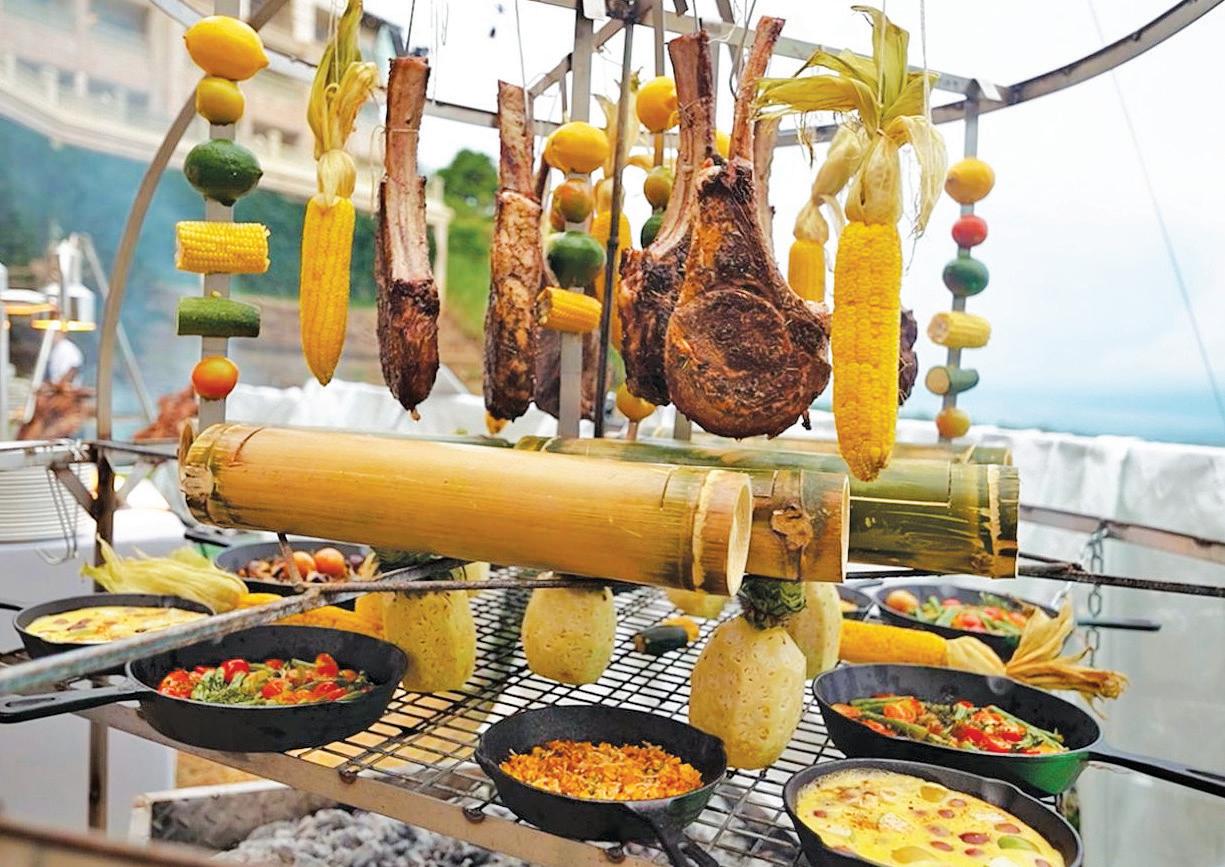
By Anne Ruth Dela Cruz
EVERY year, Megaworld Ho -
tels & Resorts (MHR) gath -
ers its chefs, F&B managers, hygienists, leaders, and general managers from its 14 properties nationwide for its annual Culinary Conference. What began in 2021 as an internal learning and inspiration workshop has now evolved into one of the most anticipated industry gatherings in the group.
This year’s 4th Culinary Conference, held last August 11 to 14, 2025 at Twin Lakes Hotel in Tagaytay, carried the theme “Celebrate Your Roots” and the tagline “Rooted in Tradition, Inspired by Innovation.” The event underscored MHR’s commitment to raising the bar for Filipino hospitality by grounding culinary innovation in heritage and culture.
A mission to champion Filipino chefs
At the heart of the conference was a mission to empower Filipino chefs to showcase their world-class talent.
“We are proud to have a roster of Filipino executive chefs who are making their mark in their own right. It is our mission and challenge to champion these talents, who can produce plates and products at par with international chefs. This is our heritage—our roots that bind us together. Let us create dishes that tell bigger stories than the servings themselves, raising the Filipino flag through culinary,” said Cleofe Albiso, MHR Managing Director.
Albiso emphasized that for MHR, food is more than nourishment—it is storytelling, culture, and identity on a plate.
A response to a difficult past BusinessMirror joined the closing activities, which began with a media huddle with Albiso and guest speaker Chef Nouel Catis Omama-


lin, the Filipino behind the viral Dubai chocolate.
Albiso recalled how the Culinary Conference was first launched in 2021 as a creative response to the difficult pandemic years.
“Can you imagine our chefs cooking packed meals for two years because restaurants were closed? Those years impacted people’s creativity and inspiration. The intent of the conference was to reignite that spark—remind our culinary teams why they fell in love with food in the first place,” she explained.
What started as a necessity has now grown into an annual celebration of heritage and innovation, with MHR’s 14 hotels exchanging best practices, collaborating on concepts, and drawing inspiration
from one another.
A homegrown brand with a Filipino heart
This year’s theme also highlighted MHR’s pride as a wholly Filipinoowned brand.
“The more hotels we open, the more opportunities we create for industry professionals who have worked abroad for decades. We provide them with the chance to come home and still thrive in their craft,” Albiso said.
She pointed out that many MHR leaders and associates once worked overseas and are now returning to the Philippines, bringing with them global expertise. “We decided to put forward homegrown because that is what we are. We are local. And we are proud of it.”

Three years on, Valencia’s keeps serving some of Baguio’s best paellas
Sampaguita branding and the five senses
A key element of this homegrown identity is MHR’s sampaguita branding, a hospitality campaign designed to be experienced through all five senses.
“We are proud that the sampaguita branding can be seen, felt, and remembered. Food and beverage play a huge role here because the sense of taste is deeply ingrained in our Filipino culture,” Albiso said.
The initiative weaves the fragrance, symbolism, and elegance of the sampaguita into MHR’s service touchpoints—from interiors and uniforms to flavors and plating— creating a uniquely Filipino imprint in every guest experience.
Chef Nouel: Giving back to his roots
Highlighting the program was Chef Nouel Catis Omamalin, whose Dubai-based chocolate creation took the internet by storm. Albiso explained that inviting him was a deliberate choice: “It’s not just about the product he created. It’s about his capacity to build a brand and generate influence—qualities we want to celebrate and share with our own people.”
For Chef Nouel, the invitation was personal.
“As a Filipino who has done well globally, I felt the need to reconnect with home. This conference’s theme of going back to your roots resonated with me,” he said.
His talk centered not just on success but also on failures, struggles, and perseverance. “I needed a vessel to re-enter the Philippines and take pride in what I have done—while also passing it on to the future chefs, the culinary experts, the masters,” he said.
At the time of his visit, he was also collaborating with a perfume company to create a fragrance inspired by his character and with Warner Brothers on creative projects. His long-term goal, however, is to partner with MHR in championing Filipino ingredients like pili nuts and ube on the global stage.
“I come back to learn more about what we have and showcase it to the world. We have pili nuts, ube, and spices that can stand proud alongside the best global ingredients,” he said.
A feast of fire and tradition
The Culinary Conference concluded with a spectacular fireside dinner inspired by Antonio Pigafetta’s chronicles of early Philippine cooking traditions.
Guests were treated to a communal feast of meats, seafood, and vegetables cooked over open flames—paying homage to pre-colonial cooking methods.
According to Corporate Chef Franco Martin “Panky” Lope, the finale dinner was “a celebration of our roots, our ingredients, our flavors, and the enduring ways we cook and eat.”
“Long before colonial influences came, our ancestors had a vibrant food culture—roasting meat, steaming in bamboo, simmering in clay pots, and perfecting the art of kinilaw,” he said. “This dinner was a tribute to that ancient tradition, a feast that celebrates the past and honors the present.”
Looking ahead
From its beginnings as a way to reignite creativity, the Culinary Conference has now become an enduring tradition for MHR—one that bridges heritage and modernity, and reinforces the company’s role as a champion of Filipino hospitality and talent.
Next year, the Culinary Conference will be brought to MHR’s properties in Boracay, where the brand hopes to build on the momentum and continue its mission of raising Filipino flavors to new heights.

photos by
SINCE opening along Outlook Drive in Baguio City in 2022, Valencia’s House of Paella has quietly built a reputation for serving some of the most comforting, and confidently executed, Spanish-Filipino dishes in town. It’s a place where regulars come back for paella that’s always served with a crusty bottom, callos that doesn’t shy away from flavor, and coffee that goes beyond the usual brews.
“We wanted a restaurant that reflected the warmth of home, something personal but also solid in its food,” said Richard Valencia, owner of the family-run space.
“People come back not just because of the food but also because we make them feel comfortable, and of course the beautiful view they enjoy when dining.”
The restaurant just marked its third anniversary this July, an achievement Valencia considers it significant, given the challenges

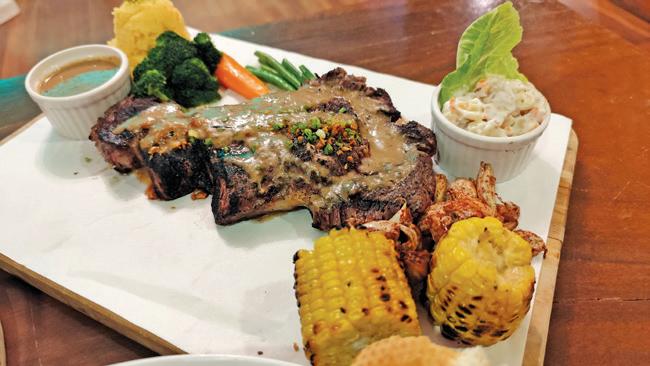
of opening post-pandemic. Today, Valencia’s operates with a clearer sense of identity. While it still offers an all-day café-style menu, the kitchen, now helmed by Chef Manny De Leon, leans confidently into Spanish and Filipino comfort fare, executed with heart and just the right amount of flair.
Line of paellas
Valencia’s lineup of paellas has become its strongest draw. There’s the classic Paella Valenciana, made the traditional way and served in sharing portions, as well as other variations like seafood paella and a vegetarian version.
“What makes ours different is we always make sure there’s ‘socarrat’—that crusty part at the bottom,” said Chef Manny. “You don’t rush it. You let the flavors sit and build.”
But while the paella is a standout, it was the Callos that truly surprised me. The stew, made with tripe and garbanzos, is rich and tomato-forward, yet not overwhelming— perfect with a side of warm bread or rice. Also worth noting are the pizza offerings, particularly the spinach pizza.
“It’s not traditional Spanish, but it’s something people ask for,” Chef Manny added.
“Especially the pizza with longganisa and arugula. We try to play with local ingredients.”
There’s also a strong coffee program, which includes espresso-based drinks, manual brews, and a few offbeat creations. The Strawberry Latte, topped with a whole Baguio strawberry, is as aesthetic as it is refreshing—
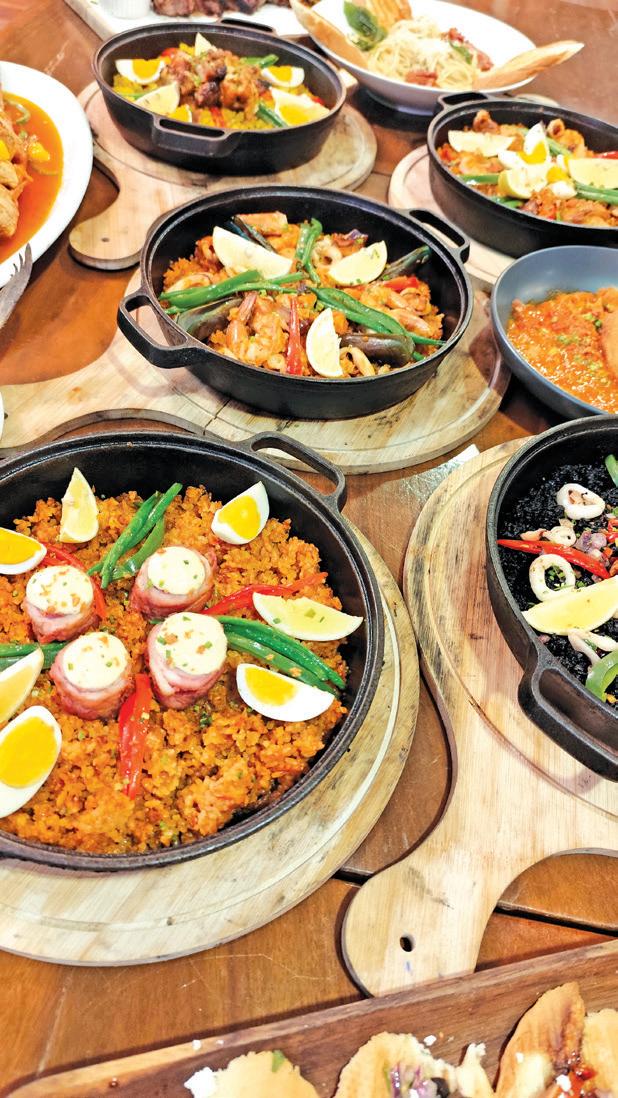


ideal for the city’s cool climate. For those who want a caffeine-free option, Valencia’s offers rice coffee, something the owner says was added for older guests or those avoiding coffee altogether.
“We listen to the feedback of our customers,” said Arnold Jimenez, the general manager. “If someone says they’re looking for something light or diabetic-friendly, we’ll find a way to adjust without compromising the flavor.”
Stollen bread
Dessert-wise, the Stollen Bread, a moist, spiced loaf with nuts
a quiet constant. It’s a restaurant that doesn’t try to shout—but instead, lets its sumptuous dishes and drinks do all the talking.
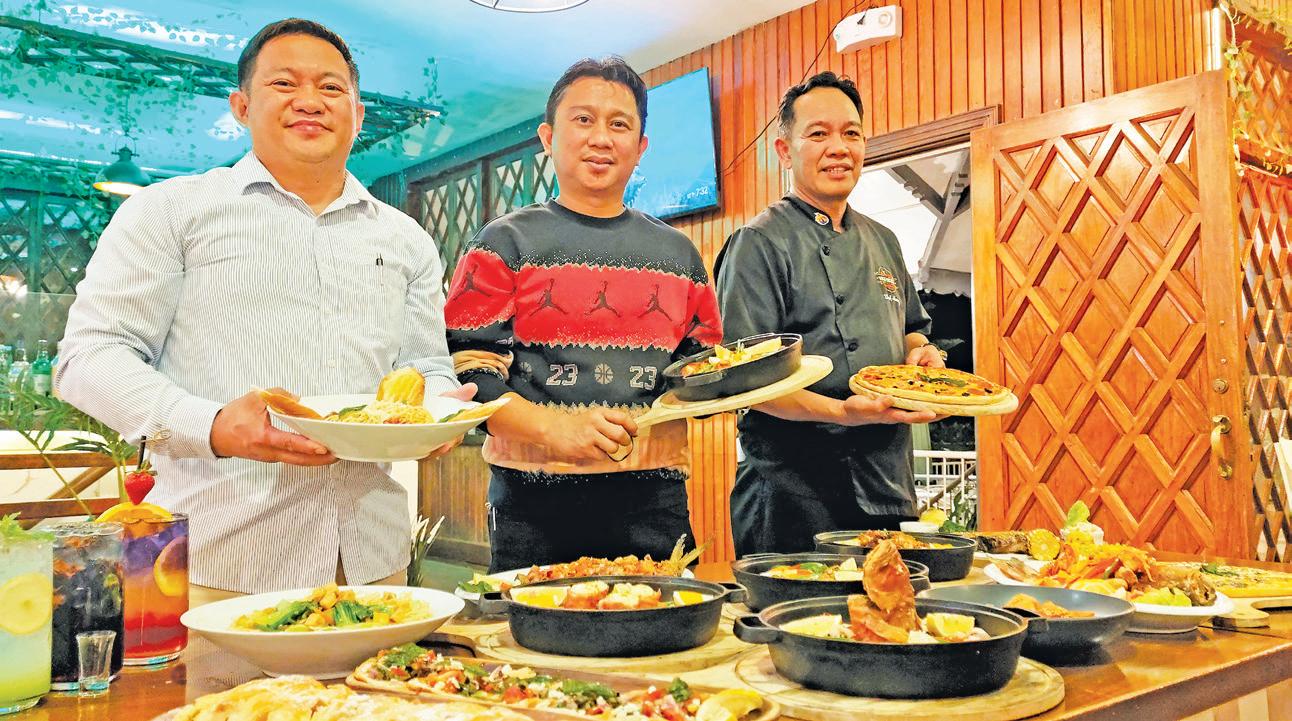

By Rory Visco Contributor
BEING super busy at work made you forget that there’s a dinner party tonight at your abode, a supposedly “gourmet night” but the grocery list to make it possible is as long as a teleserye script.
No worries because Brutal by Wadoughs’ celebrity chef and longtime Clara Olé collaborator Wado Siman proved that “gourmet” can be practically easy-peasy, as long as the pantry is properly packed. Siman concocted a five-course menu using Clara Olé’s ready-to-use sauces, dips, marinades, and spreads, turning familiar products into fasttalking flavor heroes.
It began with “Black Tide,” where squid, feta, and crackly fried pasta were put afloat a bold tide of Clara Olé Pasta Negra brightened
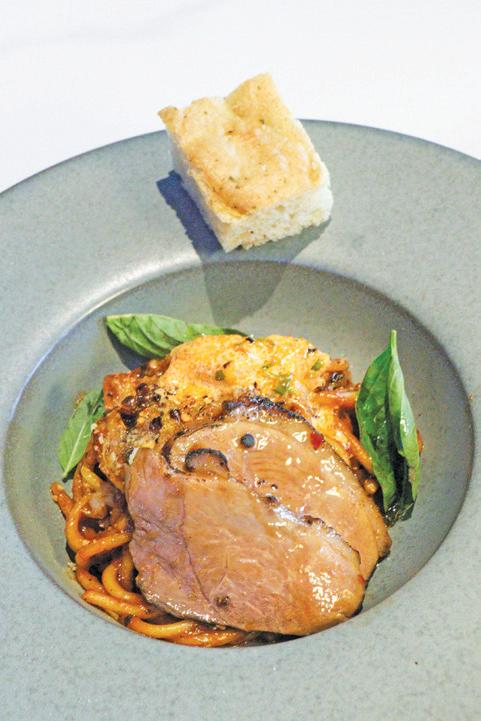
with vinaigrette. It was pure drama over the plate—inky, glossy, and decisive—an easy enough dish home cooks have always dreamt about.
Bite-sized curveball
Playfulness continued with “Not Takoyaki,” a bite-sized curveball where salmon flakes and mashed potato took the place of octopus balls, all inside crisp “pani puri” (a popular Indian street food) shells.
A double whammy of Clara Olé Dip It Good Cheddar Cheese and Crab Flavor Sauce brought creamy, briny depth to this interesting dish. Then the mains came with “Duckgalbi Assassina” with duck meat laid seared and glazed over tomato-kissed pasta, drawing heat and complexity from a trinity of Clara Olé products: Kung Pao Pasta Sauce, Chunky Tomato with Basil Pasta Sauce, and Hickory BBQ Mar-
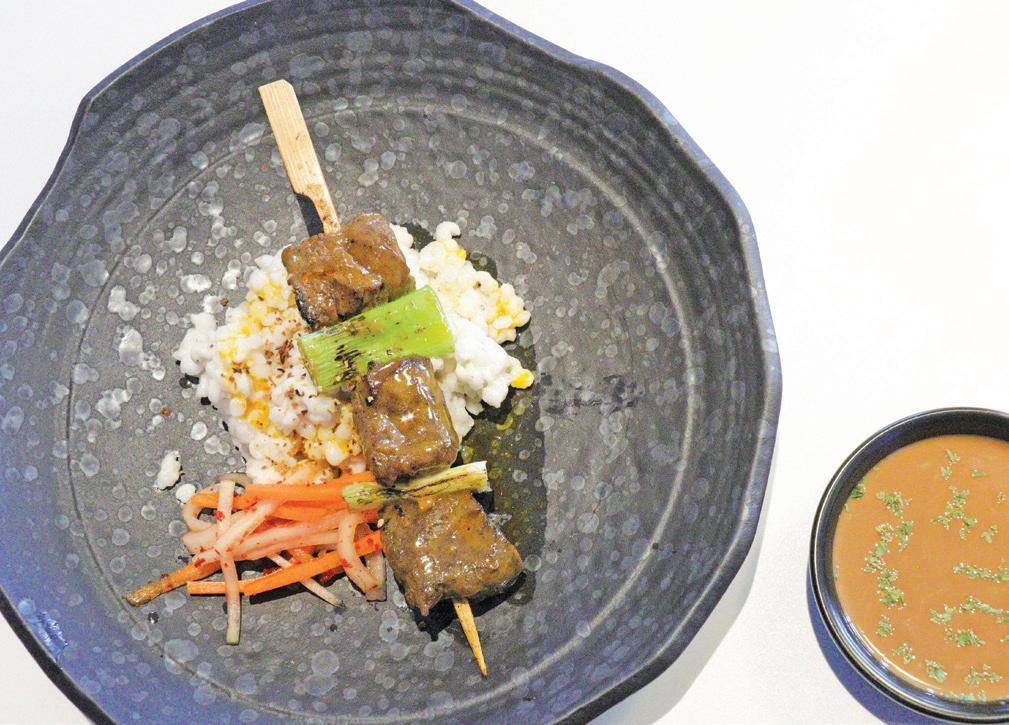

inade. It’s like Seoul meets Naples meets backyard smokehouse. The next plate was “Beef Inasal,” which traded the traditional chicken for tender skewered beef over adlai coconut rice, and Clara Olé’s Asian Dips N’ Dressings and Inasal BBQ Marinade did the trick, where it delivered the familiar inasal tang but with a polished, dinner-party finish.
Dessert, you say? “Peach Mango Nitro” made that perfect pitch using Clara Olé Peach Mango Spread into liquid-nitrogen gelato,
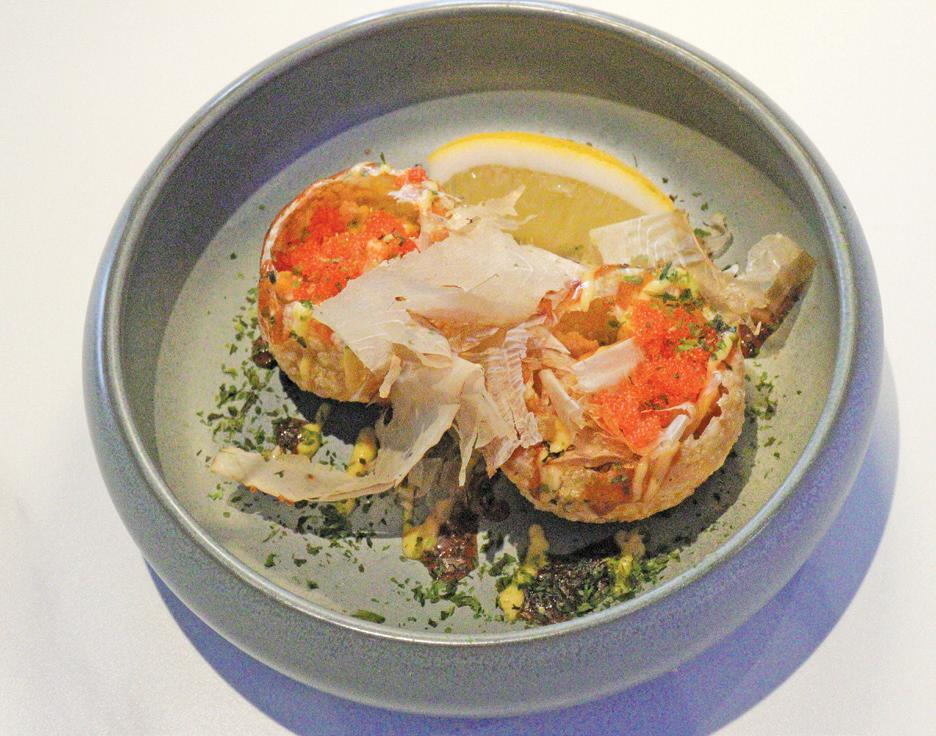
then crowned it with blast-frozen marshmallows and flaky puff pastry. It’s like science class meets merienda, and yes, it tastes as delightful as it sounds. “Cooking gourmet doesn’t have to be intimidating,” Chef Wado said between courses. And that’s the point. For over three decades, Clara Olé has behaved like that extra set of hands every home cook wishes they had—starting with jams and preserves back in 1987, growing into sauces, marinades, dips, dressings, syrups, and more. The brand’s north star is consistent: make good food easier, without dimming a cook’s creativity.
everyday meals
As Clara Olé Brand Manager Esfrey Sia framed it, the collaboration shows how everyday meals can feel special—whether you’re
cooking for one or hosting the barkada. Marketing Manager Cerma De Jesus added: “easy” gourmet at home has a way of pulling families closer. Less time fussing, more time at the table. What makes Chef Wado’s fivecourse menu so convincing is the permission it gives: to mix, match, and improvise. A pasta sauce can do more than hug noodles; it can glaze duck. A dip isn’t just for chips but can bind a filling or finish a skewer. Marinades aren’t married to the grill; they’re shortcuts to complexity wherever you need a flavor nudge. Of course, the company made sure that Clara Olé’s bottles and jars are within easy reach at major supermarkets, groceries, and the brand’s official online stores (including Sysu Food Hub). The label has also stretched well beyond lo-

cal shelves, now present in a
en markets from
Saudi, Qatar, and Egypt. bringing that dependable “For easy cooking, it’s #OléYouNeed!” ethos to Filipino kitchens—in the Philippines and worldwide. So, here’s your invitation to cook like a chef without turning your kitchen into a war zone. Start with what Clara Olé does best—solid, flavorful bases. Who knows? In 20 minutes, you might plate something that looks suspiciously like a restaurant dish. In 39, you’ll be pouring drinks and taking compliments. Marinate, dip, toss, glaze. Repeat as needed. Then take a bow because when it comes to gourmet night, a little bit of creativity and Clara Olé is #OléYouNeed.
HILTON Manila Newport
World Resorts invites diners on a reinvigorated culinary journey as it unveils refreshed offerings across its signature dining outlets. With bold new flavors, immersive stations, and reimagined menus, the hotel delivers an elevated yet approachable experience rooted in guest favorites, seasonal ingredients, and heartfelt service. Dining Reimagined officially launched on July 24, 2025, marking the beginning of this exciting new chapter.
Hua Yuan Brasserie Chinoise: Expanded menu features new dishes from the region
Taking the centerstage is Hua Yuan Brasserie Chinoise, where diners will discover an evolved take on Shanghainese upscale dining. Executive Chinese Chef Kevin Xu reinterprets timeless recipes with refined techniques, presenting all-time favorites such as the Eight-Flavored Shanghai Xiao Long Bao, Braised Lion’s Head Meatball with Baby Abalone, and his Signature Peking Duck – with elevated flavor and flair.
While staying true to its roots, the menu now expands to include a
curated selection of beloved dishes from across the region, including highlights like Cantonese-style Steamed Grouper with Aged Wine and Blue Crab in Spicy Sichuan Broth, among other regional specialties, offering guests a richer and more indulgent taste of Chinese fare.
Kusina Sea Kitchens: Revamped with enhanced live stations and new regional offerings
Meanwhile, Kusina Sea Kitchens, the hotel’s all-day dining restaurant, is transformed with enhanced live stations and a more immersive dining environment. Smokehaus, formerly the Western station, is now a feast for both the eyes and the senses. Featuring rustic brick accents, the revamped station entices with the unmistakable aroma of slowcooked, smoked meats and serves up juicy barbecue cuts and premium carvings fresh off the grill. Seafood Dampa also makes a welcome return, revived by popular demand and now reimagined for the modern palate. Diners can now choose from a bountiful display of fresh, sustainably sourced seafood during dinner, paired with signature sauces such as Alavar, Pa-
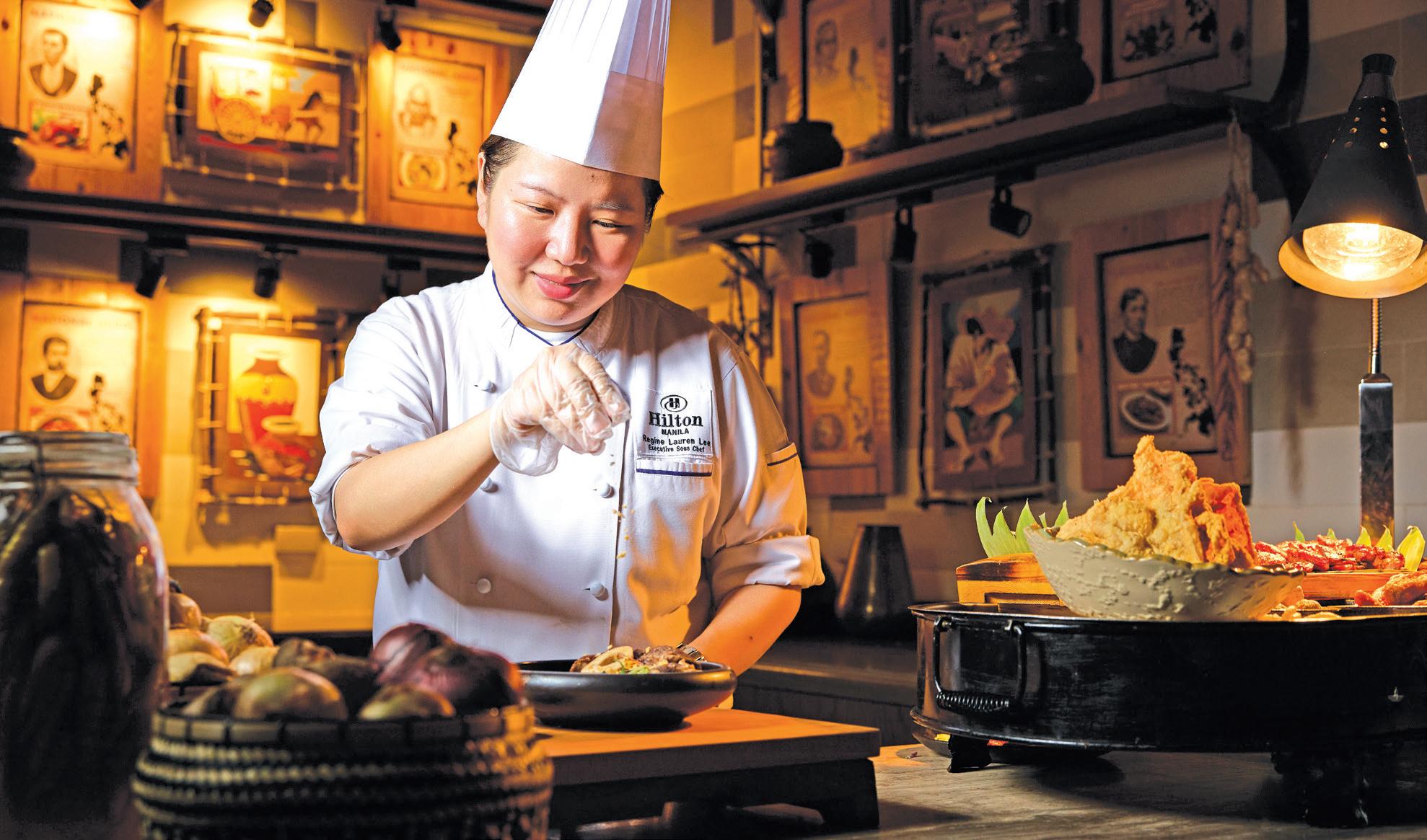
lapa, garlic butter, and cheese. Kusina also introduces a dedicated Indo-Malay section, featuring authentic Malaysian and Indonesian dishes crafted for those who appreciate the depth and complexity of Southeast Asian spices. Together with thoughtfully el-
evated Indian, Filipino, Japanese, Vegetarian, and dessert stations, Kusina presents a globally inspired spread built on premium ingredients and generous flavors.
True to its environmentally responsible ethos, Kusina continues to source directly from farmers in
Atok in Benguet, ensuring freshness while supporting the local communities. The hotel also grows its own herbs via an on-property hydroponic vertical herb garden, part of its Executive Chef Lord Bayaban’s advocacy for farm-forward, responsible cooking.
Subway Philippines rolls out triple cheese sub featuring US cheeses
by
Kenneth M. del Rosario
Contributor


“This relaunch is a celebration of everything our guests have come to love about dining with us – now taken to the next level,” says Gagan Talwar, General Manager of Hilton Manila Newport World Resorts. “From vibrant new stations to elevated classics, we’re excited to offer our guests a richer, more flavorful dining journey each time they dine with us.”
Following the elevated experience and enhanced flavors at Kusina Sea Kitchens, guests can continue to enjoy the same rates—offering generous selections at a compelling price point. The weekend lunch buffet is available at P2,800++ (12 pm to 2:30 pm), while the daily dinner buffet is offered at P3,000++ (5:30 pm to 9:30 pm). Over at Hua Yuan Brasserie Chinoise, open daily from 11:30 am to 10:00 pm, diners may indulge in both ala carte and set menus.
Guests are encouraged to book their tables in advance and be among the first to experience this thoughtfully reimagined culinary offering, where enhanced flavors, warm hospitality, and inspired dining converge. For reservations and inquiries, please contact +632 7239 7788 or email MNLPH_F&Binquiries@hilton.com.
By Anne Ruth Dela Cruz
AT this year’s World Food Expo (WOFEX), one of the country’s biggest food fairs, Spanish pork took center stage as INTERPORC, the Interprofessional Agri-Food Organization of White-Coat Pork, introduced the unique flavors, quality, and traditions of Spain’s pork industry to Filipino consumers.
“What makes Spanish pork different from the rest is our origin and our methods of production,” explained Daniel de Miguel, INTERPORC’s International Director. “We apply the highest standards on animal welfare, food safety, and traceability. These key elements give us high-quality, safe meat.”
It is a standard that has made the Philippines one of Spain’s most important markets. In 2024, the country ranked as the fifth-largest destination for Spanish pork, with over 186,000 tons shipped. While Spain briefly held the position of the Philippines’ top pork sup -

Dgroup launched a month-long promotion at Landers supermarkets, bringing Spanish pork closer to everyday shoppers. Across 15 branches nationwide, consumers can sample different cuts of Spanish pork, discover new recipes, and enjoy tastings.
“This year we are reaching the retail channel because we believe it is essential to connect with consumers,” the director said. “The challenge is to educate the consumer and demonstrate that we are selling safe meat.”
The culinary showcase did not stop there. At the Spain on a Plate event, organized by the Spanish Chamber of Commerce in partnership with Alba’s Restaurant, home of traditional Spanish cuisine in Manila since 1952, guests were treated to dishes that highlighted the versatility of Spanish pork. Some dishes leaned on traditional Spanish recipes, while others infused Filipino flavors.
“Filipino cuisine has such variety, and we love how our pork can be incorporated into
local flavors,” de Miguel shared. His personal pick? “The Sisig Paella. I usually eat paella twice a month back home in Spain, and it was wonderful to try it here alongside Filipino favorites.” Other dishes served included Coca de Berza y AOVE (traditional Catalan flatbread topped with sautéed kale and a delicate drizzle of extra virgin olive oil), Jamón Ibérico Gran Reserva, Mango en Textura y Rúcula Silvestre (a skewer of aged jamón ibérico paired with mango purée and wild arugula for a balance of sweetness and umami), Brocheta de Langostinos con Panceta Ibérica Crujiente (grilled prawn
AVID Jezreel Lizardo Pamplona, popularly known as Chef Dabo, was the featured chef in the fourth installment of “Taste of the Philippines: A Global Journey.” Guevarra’s by Chef Laudico and Nutribullet partnered for this project with the goal of propelling Filipino culinary artistry to exciting new places.
The event, which took place at Guevarra’s in San Juan City, Metro Manila on August 18, 2025, highlighted Chef Dabo’s contributions to Dubai’s multicultural dining landscape.
As the Managing Director, Head Chef, and Co-Founder of Naimas Café & Bistro in Dubai, Chef Dabo brings with him 13 years of culinary experience, honed by his innovative
approach and commitment to quality.
Multiple awards
According to his profile, his expertise in PanAsian, Latin American, and Filipino cuisines have won him multiple awards, including four Gold Medals at the Salon Culinaire Dubai and a PRO Chef 2019 finalist spot. “Dubai is a global dining hub, and Filipino cuisine is so versatile it fits any culture,” says Chef Dabo. “My goal is to make our ingredients as globally recognized as sushi or curry—distinct, respected, and true to their roots.”
The multi-awarded Dubai chef adds, “I
mixed fine-dining techniques with authentic Filipino flavors. Diners in Dubai love something new if it’s done well, and that’s where Filipino cuisine can shine, especially when it’s honest, rooted, and executed with heart.”
Deep admiration Chefs Roland and Jackie Laudico, the visionaries behind Guevarra’s, expressed deep admiration for Chef Dabo and the collaboration.
“It’s been our mission from the start to promote Filipino cuisine both here and abroad,” said Chef Roland Laudico. “We’ve participated in countless food festivals to champion our flavors, but this time, we’re
highlighting world-class chefs working overseas who share our advocacy. It raises awareness in their host countries and, hopefully, draws more people to visit their restaurants.”
Chef Jackie Laudico added, “Working with a Filipino chef based in the Middle East brings a unique perspective, especially since the region has one of the largest overseas Filipino communities. His food reflects his global journey, an experience shared by many Filipino chefs abroad.”
Limited offer
For a limited time at Guevarra’s by Chef Laudico, guests can anticipate a curated menu that reflects Chef Dabo’s culinary philosophy,
honoring heritage while embracing international influences. “Filipino flavors belong to the global stage,” explains the multi-awarded dining guru. “It has always been my personal mission to bring our culture beyond one menu and let it live everywhere.”
Signature creations will feature select Filipino staples reimagined through refined techniques and cross-cultural inspiration, such as Humba-Rum Chicken Empanada, Tiyula Itum Inasal Yakitori, Bistek Saltado, and Shrimp Laing Rebosado with Coconut Wasabi Cream. These delicious creations from Guevarra’s x Chef Dabo will be available as part of the buffet selection starting this month.
similarities are unmistakable — from the use of garlic to the layering of flavors. Yet, as de Miguel pointed out, Filipino cuisine often takes those flavors further: “Here the flavor is more intense, with spices and sauces that we don’t usually use in Spain. It gives the food more character.”
Looking ahead, INTERPORC is also investing in the next generation of Filipino food lovers. Masterclasses in Manila and Cebu have introduced culinary students to Spanish pork, teaching them about cuts, preparation methods, and even the art of carving jamón serrano — “the jewel of our gastronomy.” These efforts, he said, are as much about education as they are about flavor. “We want young people to understand the origin and quality of Spanish pork. If they know where their food comes from, they will appreciate its value.”
From retail tastings to culinary collaborations, INTERPORC’s message is clear: Spanish pork isn’t just about exports and numbers; it’s about bringing safe, sustainable, and flavorful food to Filipino tables.
Guevarra’s is a Filipino themed buffet restaurant that offers a unique dining experience with our classic and homey ambience. Having been built in the 1920s, the vintage interiors of this heritage houseturned-restaurant, along with the private function rooms and spacious garden area make Guevarra’s the perfect place for intimate gatherings, birthdays, baptisms, weddings, and corporate events. The buffet features a feast of both classic and modern Filipino dishes created by Chefs Roland and Jackie Laudico. From their bestselling Angus Beef Tapa and Bellychon to the Grilled Pancit Bam-I and Party Spaghetti, there will surely be a dish for everyone to enjoy—not to mention the whole spread of intricately crafted desserts for the perfect ending to every meal. Takeout and deliveries are available via http://www.guevarras.com
Anne Ruth Dela Cruz
THIS August, SM Makati turned kitchens into playgrounds for creativity as it hosted a month-long celebration of Tefal, the iconic French cookware brand. Known for blending innovation with style, Tefal invited Filipinos to cook smarter, easier, and more joyfully.
For many home cooks, choosing the right cookware is more than just a practical decision—it’s about finding tools that inspire confidence. Digital content creator and mom Diane Francesca De Castro shared that the first things she considers when shopping for cookware are looks and durability.
“I really love Tefal because their aesthetics are really nice. Plus, they look very durable, like the first impression when you see them. I’ve had my Tefal pan for years, and it still looks pristine. They don’t scratch or chip easily, and the heat distribution is consistent, so I can make anything from pasta to adobo or even toast,” she said.
Tefal technology
Diane added that she also appreciates Tefal’s smart features: “They
have an indicator when the pan is hot enough.”
For fellow digital content creator and mom Aliza Apostol-Goco, Tefal is the brand that makes cooking less intimidating. She shared that her husband, Robby, usually takes charge of the kitchen, but she has learned a great deal from him.
“I’ve learned a lot just by watching him and hearing what he looks for: quality, durability, and ease of use. Even if I’m not the one doing the buying, I’ve come to appreciate the value of good cookware. And when I need to hold down the kitchen while he’s away, I stick with brands we already trust like Tefal,” she said.
Even heat Aliza added that Tefal pans “heat evenly, nothing sticks, and cleanup is quick.”

“For someone who juggles a lot in a day, that kind of reliability matters. Their new Tefal with Colors line also brings a little brightness to the kitchen. It’s functional, and it makes every day cooking feel lighter and more fun,” she said. At the heart of Tefal’s success is its pioneering non-stick technology, designed to make every day cooking easier, faster, and healthier. Beyond performance, Tefal products are built to last, combining durability, ergonomic design, and sleek aesthetics.




In-store display Visitors to SM Makati also got to experience a specially curated instore showcase featuring standout color collections like One Pick Pot Pan, So Matcha, Cook & Shine, and Ingenio. Shoppers explored the technology that has made Tefal a household name and saw firsthand how its smart solutions make cooking more creative, efficient, and enjoyable. To make the celebration even sweeter, Tefal offered exclusive deals and promotions throughout August. Shoppers enjoyed discounts ranging from 20 to 40 percent on selected items, along with fun rewards such as the chance to play the Pachinko game for prizes, plus free Delibake items with minimum purchases.

From durable pans that glide with every stir to colorful cookware that brightens any kitchen, Tefal proves that cooking isn’t just a
Sunday, August 31, 2025

By Vincent Peter Rivera
by Bernard Testa
“It takes a village…”


Ithe next generation. Myrna eventually had three children—Danj, Rafael, and Diane Erika—who would inherit this shared passion.

N Cabuyao, Laguna, a culinary landmark stands as a living testament to this old proverb. For many years, it has been constantly serving generations of families with its delicious culinary offerings forged not just from a single person’s dream, but from the collective passion of many hands and hearts. This food place is Hain’s, and its village? It’s a family.
Hain’s is a familiar sight along the Manila South Road or National Highway in Barangay Niugan, a local food hub just a short walk from the Nestlé Philippines factory. For decades, it has stood out by offering a unique twist on classic Filipino cuisine, a style that has kept generations of customers coming back for more.
The restaurant’s name, however, carries a deeper significance than simply being the family’s surname. According to Danj HainPalis, the eldest child in the family, the name perfectly embodies their mission. “‘Hain’ in Tagalog means to serve food or to offer food,” he shared, highlighting the family’s original purpose for putting up the restaurant.
A flavor of home
Inspired by a shared love for cooking and eating, sisters Carmelita B. Hain and Myrna B. Hain-Palis began their passion-filled journey by opening Hain’s in 1985. “It all started from a food business venture between my mother and her sister at Filipro, Inc., now known as Nestlé Philippines,” shared Hain-Palis.
Despite their unrelated professions—Carmelita was a teacher
and Myrna an agricultural scientist—the two decided to pursue their dream of opening a restaurant. Their culinary venture was born from a family-wide love of food, a sentiment shared by everyone, including their brothers.
This shared passion led them to transform their ancestral home—with its stone floors, wooden walls and ceilings, and capiz windows—into a hub for their culinary journey.
The sisters’ entrepreneurial spirit was relentless. They never settled for less, consistently seeking new culinary knowledge beyond their family’s recipes. “Both of them have an entrepreneurial spirit that never settles for less,” Hain-Palis explained, “They even watched Heny Sison and her cooking show before just to improve their recipes, going so far as to enroll in Sison’s cooking classes in Manila.”
Their menu became a testament to this collaborative spirit, as they adopted and perfected recipes from various family members, including cousins, uncles, and aunts.
As Hain’s continued to grow, becoming a favorite among factory workers from the nearby plant and families from neighboring homes, the sisters’ legacy was secured for
The Hain-Palis siblings grew up in the kitchen, absorbing every aspect of the business from an early age.
“We’re ‘ laking kusina’ talaga,” Hain-Palis recalled, “because at a very young age, our parents would bring us to the palengke’ to buy produce for the restaurant.” Later on, all the recipes that Myrna and Carmelita had collected and developed were passed down as heirloom recipes, with Diane Erika Hain Palis-Realista primarily leading the legacy as Hain’s manager.
Presenting the heirlooms Bannered as the “Home of the Best Pancit this Side of Town,” Hain’s began its legacy as a simple pancitan and lomihan. But over the years, the family’s collaborative spirit and their commitment to innovation allowed them to expand their menu with more signature dishes.
“We standardized all the recipes that we collected to ensure a consistent taste and to preserve its authenticity,” Palis-Realista elaborated.
Each dish on Hain’s menu tells a story and is prepared with a unique touch. The All-Veggie Spring



Rolls, filled with a mix of shiitake mushrooms, dried black fungus, jicama, and other vegetables, are wrapped in a Pinoy lumpia wrapper and best enjoyed with a side of vinegar and fried shallots.
Another standout is the “Sisig na Bangus,” a special dish curated by Myrna’s husband using Pangasinan bangus, butter, margarine, calamansi extract, and chili peppers.
Staying true to its core of serving Filipino dishes, Hain’s also has its hearty dish Menudo made from pork kasim, pork liver puree, potatoes, carrots, and bell peppers.
The Soy Chicken is a customer favorite with its unique preparation method. It’s first boiled in a secret seasoning, then fried to perfection. As the family says, “it’s not crispy on the outside yet its flavor reaches even on its bones.”
For those craving a fresh, wholesome meal, the “Lumpiang Ubod (sariwa),” made with a blend of heart of palm, grated coconut meat, ground pork, and various vegetables, is a must-try.
Hain’s has also become synonymous with comfort food, with its Pork Spareribs Sinigang holding a special place in the hearts of longtime customers. As Palis-Realista recalled, “A lot of our customers grew up with our sinigang,” highlighting how this dish has been a constant part of their patrons’ lives.
Other favorites include the perfectly boiled then fried Crispy Pata and the famous Pancit Bihon, a medley of sautéed pork liver, squid balls, and Baguio vegetables, all topped with crispy lechon kawali.
Serving throughgenerations and through Now in its 40th year, Hain’s has served generations of households and individuals, adapting and enduring through various challenges. Its resilience was especially evident during the Covid-19 pandemic, when the restaurant found new ways to connect with its loyal patrons—and reached out to new ones in the process.
“During the Enhanced Community Quarantine (ECQ), we created our Facebook page to still connect to our customers,” said Hain-Palis. “We also established our presence by venturing into food delivery applications.”
Supporting this perspective, Palis-Realista also stated that this new-found path opened a new door for them to better know their customers. “We eventually noticed that by leaning on online food delivery services, our demographics widened—with a younger age group also supporting our restaurant.” When the ECQ was lifted, Hain’s was able to enjoy the best of both worlds, accommodating online orders while also welcoming back loyal customers to its dining room. This success is a testament to the warmth of their service and the taste of home in every delicacy, which enables people to come back for more.
Hain’s has become a true home—for the Hain family and for every person who has shared a meal at its tables. Each dish offers a taste of home and belongingness, transforming customers into an extended family. This, then, is the secret recipe passed down for generations: the welcoming love that seasons every dish and leaves you with the warmth of a family meal.