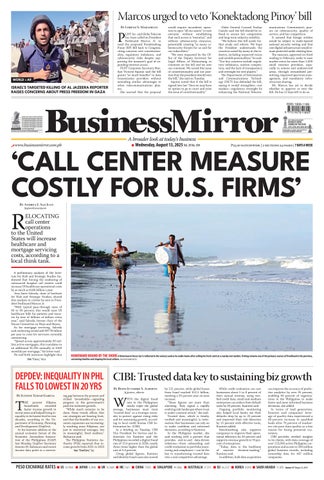
A preliminary analysis of the Institute for Risk and Strategic Studies Inc. showed that forcing the onshoring of outsourced hospital call centers could increase US healthcare operational costs by as much as $166 billion a year.
Joey Sarte Salceda, chair of Institute for Risk and Strategic Studies, shared this analysis in a letter he sent to President Ferdinand Marcos Jr.
“With typical pass-through rates of 60 to 90 percent, this would raise US healthcare bills for patients and insurers by tens of billions of dollars every year,” said Salceda, former chair of the House Committee on Ways and Means. As for mortgage servicing, Salceda said onshoring would add $97.76 billion per year in costs for servicers currently outsourcing.
“Spread across approximately 50 million active mortgages, this translates to an additional $1,955 annually or $163 monthly per mortgage,” his letter read. He said both instances highlight that
By Justine Xyrah Garcia
THE poorest Filipino households recorded faster income growth in recent years and helped bring inequality to its lowest level in two decades, according to the Department of Economy, Planning and Development (DepDev).
In his keynote address at the annual economic forum of the Economic Journalists Association of the Philippines (EJAP) last Monday, DepDev Secretary Arsenio M. Balisacan said recent income data point to a narrow-
By Lorenz S. Marasigan
PLDT Inc. and Globe Telecom Inc. have called on President Ferdinand Marcos Jr. to send the proposed Konektadong Pinoy (KP) Bill back to Congress, citing concerns over constitutionality, regulatory imbalance, and cybersecurity risks despite supporting the measure’s goal of expanding internet access.
PLDT Corporate Secretary Marilyn Victorio-Aquino said the bill grants “so much benefits” to data transmission providers without extending similar advantages to other telecommunications players. She warned that the proposal
would require incumbent operators to open “all our assets” to new entrants without establishing that such access is “essential,” and without cybersecurity clearance, potentially creating “as many cybersecurity threats for us and for our subscribers.”
“We were requested by the Office of the Deputy Secretary for Legal Affairs of Malacañang to comment on the bill and we sent our comment. We raised this issue of constitutionality and our position that the president should veto the bill,” she said on Tuesday. Aquino noted that if the bill is signed into law “then we may have no option to go to court and raise the issue of constitutionality.”
Globe General Counsel Froilan Castelo said the bill should be refined to ensure fair competition and long-term industry stability.
“We believe this bill needs further study and reform. We hope the President understands the concerns raised by many in the industry, including respected voices and notable personalities,” he said.
“Our key concerns include regulatory imbalance, uneven competition, and the lack of transparency and oversight for new players.”
The Department of Information and Communications Technology (DICT) has defended the bill, saying it would strengthen—not weaken—regulatory oversight by enhancing the National Telecommunications Commission’s powers on cybersecurity, quality of service, and fair competition. It assured that foreign entities would be subject to multi-layered national security vetting and that core digital infrastructure would remain protected under existing laws. The measure, approved on third reading in February, seeks to ease market entry for more than 1,000 small internet providers, especially in remote and underserved areas, through streamlined permitting, improved spectrum management, and mandatory infrastructure sharing.
Mr. Marcos has yet to decide whether to approve or veto the bill. He has 12 days left to do so.
ing gap between the poorest and richest households—signaling progress in the government’s push for inclusive growth.
“While much remains to be done, these trends affirm that our strategies are bearing fruit, and that the benefits of our economic expansion are increasingly reaching more Filipinos, not just in statistical averages, but in meaningful, lived realities,” Balisacan said.
The Philippine Statistics Authority (PSA) reported that income growth from 2021 to 2023
By Reine Juvierre S. Alberto @reine_alberto
WITH the digital fraud rate in the Philippines nearly triple the global average, businesses must treat “trusted data” as a strategic necessity to protect against rising risks and for sustaining growth, according to local credit bureau CIBI Information Inc. (CIBI). In a briefing on Tuesday, CIBI Vice President for Service and Industrials Ivy Ramirez said the Philippines recorded a digital fraud rate of 13.4 percent in 2024, nearly three times higher than the global rate of 5.4 percent.
Citing global figures, Ramirez said identity fraud cases also soared
by 121 percent, while global losses from fraud reached $12.5 billion, marking a 25 percent year-on-year increase.
“These figures are more than alarming. They signal a rapidly evolving risk landscape where trust is under constant attack,” she said.
Trusted data, which is timely, verified and meaningful, is information that businesses can rely on to make confident and informed decisions, according to Ramirez.
In the Philippine market, she said working with a partner that provides end-to-end data-driven solutions—from onboarding and credit evaluation to portfolio monitoring and compliance—can be the key to transforming trusted data into a real competitive advantage.
While credit evaluation can cost businesses about 5 to 8 percent of their annual revenue, using verified credit data, small and medium enterprises can reduce their default rates by 30 percent, Ramirez said.
Ongoing portfolio monitoring also helped local banks see their defaults drop by up to 25 percent and improved their risk detection by 15 percent with effective tools, Ramirez added.
Benchmarking also supports companies to improve their operational efficiency by 20 percent and supports revenue growth in 70 percent of enterprises.
“Today, data is the backbone of smarter decision-making,” Ramirez said.
In addition, bulk data acquisition
can improve the accuracy of predictive analytics by over 35 percent, enabling 60 percent of organizations in the Philippines to make faster and more informed business decisions, she added. In terms of lead generation, Ramirez said companies’ leverage of quality data experienced a 40-percent increase in qualified leads after 70 percent of marketers cite poor data quality as a key reason for losing potential customers. CIBI provides verified insights to its clients, with data coverage of over 115,000 active Philippine corporations and access to 500 million global business records, including ownership data for 447 million companies.
By Andrea E. San Juan
HOMEWARD BOUND BY THE SHORE
Palace all set for Congress scrutiny of national budget
By Samuel P. Medenilla & Jovee Marie N. Dela Cruz
MALACAÑANG is ready to present the P6.793-trillion
2026 National Expenditure Program (NEP) to Congress after it was formally presented to President Ferdinand Marcos Jr. by the Department of Budget and Management (DBM) last Tuesday.
It comes almost a month after the Chief Executive approved the 2026 NEP, which has the theme “Agenda for Prosperity: Nurturing Future-Ready Generations to Achieve the Full Potential of the Nation.”
The Presidential Communications Office (PCO) said the proposed national budget next year aims to sustain the gains of the Marcos administration in its priorities under the Philippine Development Plan (PDP) 2023-2028.
The 2026 NEP will focus on enhancing the quality and accessibility of education, healthcare, social protection as well as achieving food security.
“Through the National Budget, we will build a Bagong Pilipinas where every Filipino has the opportunity, support, and resources to thrive and contribute to our shared prosperity,” PCO said in its advisory of the event.
DBM is set to present the 2026 NEP,
which is higher than the P6.326-trillion General Appropriations Act (GAA), to Congress on August 13, 2025.
In his fourth State of the Nation Address (SONA) last week, Marcos said he will veto the 2026 GAA from Congress if its provisions are not “fully aligned” with the 2026 NEP.
The pronouncement drew criticisms from some lawmakers as an attempt by the Executive branch to “usurp” the “power of the purse” of Congress granted by the Constitution.
The Palace later clarified Marcos will only veto the 2026 GAA if lawmakers abuse the said power by making “unauthorized” budget insertions, which are against the public’s interests.
The NEP is the proposed budget of the Executive Department, which will be used by Congress as the basis for crafting the GAA or national budget.
‘Solve mysteries’ AS the House of Representatives is expected to receive the 2026 National Expenditure Program on Wednesday, Deputy Speaker Ronaldo Puno of Antipolo said the 2026 budget process should not commence until the “mysteries” of the 2025 GAA are “fully explained.”
In a news briefing, Puno said the controversial adjustments in the 2025 GAA could not have originated from the House.
“Perhaps because we are already in the budget season, even if this is about the 2025 budget, our party has agreed that we will not start reviewing the 2026 budget until we have full clarity on all the mysteries surrounding the 2025 budget,” he said.
The National Unity Party, led by Puno, is the second largest political party in the House with 44 members, next to Lakas-CMD.
The House of Representatives is targeting to start formal deliberations on the proposed budget on September 1.
Puno expressed full agreement with Senator Panfilo Lacson’s criticism of the realignment of P74 billion in PhilHealth subsidy under the 2025 GAA, calling the move “wrong” and demanding clarity on how the changes occurred.
“I agree 100 percent with Senator Lacson. That was clearly wrong,” he said.
“The House crafted the proposed budget and approved it. If you look at that budget—which is a public document you can get from the secretariat—the PhilHealth budget was not removed. It’s intact,” he added.
Lacson questioned why lawmakers allowed the removal of P74 billion in PhilHealth funding from the 2025 GAA, saying the realignment was illegal because it effectively amended the Sin Tax Law—a special law—through the GAA, which is a general law. The move
left PhilHealth with no subsidy for 2025.
Sen. JV Ejercito confirmed that the allocation was first reduced to P43 billion in the Senate version before being completely scrapped during the bicameral conference committee.
Puno explained that in the House-approved version of the 2025 budget, allocations for PhilHealth as well as the Department of Education (DepEd) remained intact, with DepEd even receiving an increase. The Department of Public Works and Highways (DPWH), on the other hand, saw its budget reduced.
“That’s the version we sent to the Senate. But in the final GAA, the PhilHealth [subsidy] was removed, DepEd’s budget was cut, and the DPWH budget was increased,” Puno said.
“We want to know who made these changes. Who removed the PhilHealth budget? Who reduced the DepEd allocation? And who added funds to the DPWH budget? ” he said.
Of the P194 billion in the 2025 GAA that President Marcos vetoed, P26.065 billion covered projects under the Department of Public Works and Highways (DPWH), while P168.240 billion was lodged under “Unprogrammed Appropriations.”
Also, PCO said the approved 2025 budget for the Department of Education is P737 billion, which is P11 billion lower than its original proposal of P748 billion.
(MAR) and collection of its underrecovery for the years 2016 to 2022, as approved by the Energy Regulatory Commission (ERC).
Other charges, including taxes, similarly registered a total increase of P0.1249 per kWh.
Pass-through charges for generation and transmission are paid by Meralco to the power suppliers and the grid operator, respectively, while taxes, universal charges, and feed-in tariff allowance are all remitted to the government.
Meralco reiterates that its distribution charge, on the other hand, has not moved since the P0.0360 per kWh reduction for a typical residential customer beginning August 2022.
Customers also continue to benefit from the ongoing implementation of the distribution-related true-up adjustment, equivalent to a reduction of P0.2024 per kWh for residential customers.
Meralco, meanwhile, reminded its customers to be vigilant against a circulating text message scam that falsely claims recipients are entitled to a refund and instructs them to click on a malicious link.
The fraudulent messages, sent via SMS spoofing to make them appear
as if these came from a legitimate e-wallet platform, claim there is an “adjustment refund” and contains links to phishing sites.
Meralco Vice President and Head of Corporate Communications Joe R. Zaldarriaga clarified that the company does not process any refunds through e-wallets or third-party platforms. Any official refund transaction is directly credited to the electricity bill of the customer without the need to click on any links.
“Meralco will never ask for your e-wallet account details or initiate refunds through text messages. We urge our customers to remain cautious and to avoid clicking suspicious links or providing any personal or financial information through text or email,” Zaldarriaga said. In addition, the distribution utility reiterated its warning to the public against pilferage of electricity distribution facilities and materials since these can cause accidents and power interruptions. Under Republic Act 7832 or the Anti-Electricity Pilferage Act, theft of electric power transmission materials are crimes punishable with possible imprisonment and fines starting at P50,000.
was highest among the poorest households at 23.5 percent, compared to just 2.2 percent from 2018 to 2021. The richest households, meanwhile, saw their incomes grow by 10 percent after posting -6.2 percent.
Notably, lower- to middle-income households also registered sizable gains of around 16 to 20 percent, outpacing the increases seen among the upper deciles.
Balisacan said this reflects gains in inclusive growth, noting that the Gini index—a measure of income inequality where 0 represents perfect equality and 100 total inequality—also dropped to 39.3 in 2023.
This is the lowest since the World Bank began tracking the measure for the Philippines in 1985, when it stood at 41. The index reached its highest level in 2000 at 47.7 before steadily declining in the 2010s.
While the latest reading is below the 42.3 recorded in 2018 and 40.7 in 2021, it remains higher than the levels of the world’s most equal economies, such as the Slovak Republic (24.1), Slovenia (24.3), and Belarus (24.4).
Balisacan said the figures reflect the steady gains of the economy despite global headwinds, such as geopolitical tensions, climate change, and rapid technological shifts.
He noted that robust growth, an improving labor market, and
that the volume of fisheries production in April to June reached 994,047 metric tons (MT), lower than the 1.02 million metric tons (MMT) in the previous year.
The state statistics agency noted that commercial and marine municipal fisheries production dragged the output in the second quarter, while inland municipal fisheries and aquaculture posted increments in the reference period.
declining poverty across major thresholds have brought the country’s gross national income per capita within reach of the upper middle-income threshold.
“These gains reflect sound macroeconomic management…inflation is easing, the fiscal deficit is narrowing, and our public debt remains manageable. The banking sector is healthy, with nonperforming loans kept in check even amid global shocks,” Balisacan added.
Sustaining gains
FOR former Socioeconomic Planning Secretary Dante B. Canlas, the low Gini index also reflects an improvement in how the gains from economic growth are being shared between labor and capital.
“Looking at income distribution from a functional perspective, that is, wage-profit sharing, the improvement in the Gini index may be traced to rising real wages in the recent period,” Canlas told BusinessMirror
Data from the Bangko Sentral ng Pilipinas (BSP) showed that, using 2018 as the baseline year for computing purchasing power, the average real minimum wage in non-agricultural work in the National Capital Region (NCR) rose to P516.47 in 2024 from P488.85 in 2022.
In regions outside NCR, the average real non-agricultural wage increased to P436.14 from P393.31 over the same period. For agricultural work, real wages in NCR plantations and non-plantations both went up to P473.52 last year from P457.12 in 2022, while those outside NCR grew to P407.98.
Meanwhile, De La Salle University economist Maria Ella Oplas told this newspaper that government aid—or ayuda—may have also helped narrow inequality.
“Through the additional income na the household income
PSA said commercial fisheries production in the period dropped by 10.5 percent to 263,910 MT from 294,950 MT. The subsector’s share accounted for 26.5 percent of the total output. Marine municipal fisheries output shrank by 5.5 percent to 212,070 MT in the second quarter from last year’s 224,350 MT. The subsector constituted 21.3 percent of the total fisheries production, based on PSA data.
gap was bridged compared to before when there was nothing at all,” Oplas said via SMS. She cautioned, however, that this effect may not be sustainable if it relies solely on cash assistance.
“Although, employment and underemployment improved. Meaning there’s source of income but if ayuda alone, it’s not sustainable,” Oplas added.
Data from PSA showed that the country’s average employment rate rose to 95.6 percent in 2023 from 94.6 percent in 2022, and further to 96.2 percent in 2024, while the average unemployment rate fell to 3.8 percent last year from 5.4 percent in 2022.
Impact of Covid IN an interview with BusinessMirror, Ateneo de Manila University economist Leonardo M. Lanzona Jr. offered a more cautious reading of the inequality trend, saying the economic disruptions from the pandemic continue to leave an imprint on income distribution.
“For one, the shock from the Covid-19 pandemic led to a shift in the workforce to less productive sectors and occupations. Employment in wage work has notably decreased and employment in agriculture has risen, particularly affecting youth and the least educated,” he said.
Using different data from the United Nations University World Institute for Development Economics Research (UNU-WIDER) World Income Inequality Database, Lanzona noted that the Gini index in the second half of 2018 was 37.81, and 37.27 in the second half of 2021. The latest reading of 39.09 in 2023, he said, is moving closer to pandemic-period levels rather than returning to the pre-pandemic benchmark. Lanzona said this is partly due to education gaps, noting that with the relatively low share of workers holding tertiary degrees, the premium on college education remains high.
“Additionally, tertiary education tends to deliver much higher returns for rich than poor households, possibly due to differences in school quality or fields of study and employment,” he added.
Marcos to cops: Be decisive, responsive
TBy Samuel P. Medenilla @sam_medenilla
O restore the publics’ trust in the police, President Marcos wants more
“decisive and responsive” action from the National Police (PNP) against new and sophisticated forms of crimes and wrong doing among its ranks.
While Marcos recognized the significant decrease in recent crime incidents, he said the PNP still needs to do more to allay the security-related concerns of the people.
“The challenge now is to ensure that— rain or shine, during ordinary days and more so, in times of crisis—there are people who will be ready to answer our people’s call for help. This is how we rebuild the trust that the police will come no matter what time, no matter what the circumstance is, they will arrive,” Marcos said during the 124th Police Service Anniversary at the Camp Crame in Quezon City last Tuesday.
He cited the successful implementation of the 5-Minute Response Time Strategy of the National Police chief, Gen. Nicolas D. Torre III, which he said helped revitalize the Emergency 911 Hotline of the force. Through prompt police response that is supported by modern equipment including the use of drones, and body-worn cameras as well as other advanced technologies, policemen were able to quickly react to the the commission of crimes.
“Considering this day and age, criminals have mastered new and sophisticated ways to advance their schemes,” Marcos said.
“They abuse modern technologies to cheat, deceive, and victimize. This is what we need to watch out for. This is what we must crack down on,” he added.
Achievements BEFORE the main ceremony of the 124th Police Service Anniversary, Torre
‘Forthwith’ prompts legislator to propose holding of ConCon
By Jovee Marie N. dela Cruz @joveemarie
demonstrated to the President the use of body-worn cameras and drones for the implementation of the 5-Minute Police Response Time.
Marcos also instructed PNP to continue holding accountable its erring members so it can sustain the improvements in its reputation.
“We will continue to investigate and hold these people accountable within the bounds of the law. We do not condone wrongdoing among those who sworn to uphold the law and to protect the citizens of our Republic,” Marcos said. In his speech, Torre disclosed that the force has made significant achievements in bringing down crimes incidents to 177,735 from August 2024 to June 2025 compared to the 192,677 from the same period of previous year.
“This significant decline clearly reflects the effectiveness of our intensified anti-criminality operations, especially our increased police presence across the country,” Torre said.
He also stressed how the “bloodless” campaign against illegal drugs has been succeeding as shown by the arrest of more than 190,568 individuals and the confiscation of illegal drugs valued at approximately P54.6 billion.
Torre said the said initiatives contributed to the result of a new OCTA research survey, which showed that 71 percent of adult Filipinos trust the PNP, while 73 percent were satisfied with its performance.
Marcos has committed to continue providing the necessary support to the PNP so it can improve its public service.
“As the PNP marks another year of service, may you always be reminded that the true measure of your effectiveness is how safe and empowered our people feel under your watch and the trust that they place in the badge that you wear,” he said.
House leaders condemn Chinese bullying at WPS
LEADERS of the House of Representatives on Tuesday urged Beijing to end its aggressive actions in the West Philippine Sea, condemning the latest water cannon attack by a China Coast Guard (CCG) ship against a Philippine Coast Guard (PCG) vessel on Monday.
House Deputy Majority Leader Zia Alonto Adiong urged China to “learn its lesson” and respect international law.
“There is nothing to be gained in claiming a territory belonging to another country and refusing to recognize the ruling of an arbitral tribunal constituted under the United Nations Convention on the Law of the Sea that favored the Philippines, even if many countries acknowledge or support that ruling,” Adiong, who represents Lanao del Norte, said.
“It’s time that Beijing stop its aggressive activities in the West Philippine Sea, from Scarborough Shoal in the north of Zambales and Pangasinan to Ayungin Shoal in the south near Palawan, areas that are far away from China,” he said.
Adiong also appealed to Beijing and its
BSKE reset
By Justine Xyrah Garcia
HE Commission on Elec -
Ttions (Comelec) may need an additional P4 billion if the barangay and Sangguniang Kabataan elections (BSKE) wre moved to next year.
Comelec Chairman George Erwin M. Garcia said that if the BSKE were rescheduled to November 2026, the poll body expects the number of new voters to reach
“disinformation peddlers” to not reverse the narrative of what happened on Monday.
Deputy Speaker Paolo Ortega V, for his part, said the Chinese have become victims of their own aggression.
“They are not supposed to be in Scarborough in the first place. They are intruders there. That area off Zambales and Pangasinan is what is known to our fishermen as Bajo de Masinloc. It is their traditional fishing ground,” Ortega, who represents La Union, said.
China seized Scarborough Shoal in 2012 after a standoff with the PCG and has since harassed Filipino fishermen and Philippine patrol vessels in the area.
Deputy Speaker Jay Khonghun called Monday’s incident “karma manifesting itself.”
“What goes around comes around. Unfortunately for them, they were at the receiving end of their own misdeed,” Khonghun, who represents Zambales. Said.
The three House leaders praised the PCG crew “for acting professionally in the face of provocation from their Chinese counterparts.”
Jovee Marie N. dela Cruz
as many as four million, which would require more election paraphernalia.
Earlier, Garcia said they would only request an additional P3 billion, but this amount has increased, owing to the surge in new registrants.
“If the elections were reset, we will request an additional budget because 2.8 million voters have already been added and this could reach four million if we continue
PROMPTED by the recent clash over the interpretation of the term “forthwith” in impeachment proceedings, a House leader called for the convening of a constitutional convention (ConCon) to remove ambiguous provisions in the 1987 Constitution, clarifying that the proposal will not cover changes to the form of government or the extension of officials’ political terms.
Deputy Speaker Ronaldo Puno who represents Antipolo said the current Charter contains “enduring ambiguities” that create loopholes, trigger political crises, paralyze institutions, weaken the rule of law, and erode public trust.
The latest controversy involves Article XI, Section 3(4), which provides that an impeachment
PCG ship’s flagpole damaged in Chinese vessels’ collision
THE flag pole of a Coast Guard (PCG) ship on a mission at Bajo de Masinloc was damaged by a Chinese warship that figured in a collision with a China Coast Guard vessel.
The PCG’s BRP Suluan was on a resupply and security mission for Filipino fishermen at the Bajo de Masinloc when it was harassed by Chinese Coast Guard ship 3104 and PLAN 164 on Monday.
The CCG vessel attempted to ram BRP Suluan but it was able to get out of the way and CCG 3104 hit PLAN 164 instead.
However, a part of PLAN 164 hit Suluan’s flagpole during the collision.
On Monday, the PCG and the Bureau of Fisheries and Aquatic Resources (Bfar) sent ships to distribute aid to local fishermen in Bajo de Masinloc (Scarborough Shoal) as part of the Kadiwa program.
Several Chinese vessels harassed
complaint endorsed by at least one-third of House members “shall constitute the Articles of Impeachment, and trial by the Senate shall forthwith proceed.”
“Questions here, questions there, changes here, changes there. That’s why there’s this feeling of, ‘Wait a minute, it seems like there’s no accountability anymore.’ All we
talk about is the process, right? We end up arguing not about whether there was wrongdoing or not, but about what the procedure should be and shouldn’t be—which, I believe, was never the real intention of the framers of our Constitution. So let’s fix that so we can put an end to these kinds of uncertainties,” said Puno in a news conference. Puno who served as Interior and Local Government secretary during the Arroyo administration, said there is a need to set specific time frames for impeachment proceedings to avoid ambiguity and unnecessary disputes over constitutional provisions.
Specific time periods
“YOU know, in judicial processes, there are usually specific time periods stated. If you file a case, you have to respond with consent— whatever the requirement is— within seven days...10 days from the filing. Normally, the number of days is clearly indicated. The term ‘forthwith,’ however, doesn’t specify any period,” Puno said. He proposed that future amendments to the 1987 Constitution should explicitly define the time limits for each stage of an impeach -
ment, similar to court procedures.
“For example, if Congress receives a filing, the hearings should start within seven days. That way, if it says seven days, it means seven days—it’s harder to interpret ‘forthwith’ differently,” he added. Puno noted that the lack of precise language in many parts of the Constitution often leads to disputes. He added the ConCon should be tasked with inserting clear deadlines and definitive terms into constitutional provisions to avoid procedural deadlocks.
Other vague provisions
THE lawmaker also identified other vague provisions in Article VIII, Section 8 on the Judicial and Bar Council, which is unclear on bicameral representation in Congress; Article VI, Section 28(4) on tax exemptions, which does not specify whether voting should be joint or separate; Article VII, Section 19 on presidential amnesty, which has fueled debates on whether concurrence should be through joint or separate votes; and Article X,
with registration. We need more funds for additional ballots, precincts, teachers, and election paraphernalia,” Garcia said in Filipino.
“We might request up to P4 billion in additional expenses for the BSKE reset. At present, P11 billion has been allocated to us,” he added, noting that the extra funding is not yet included in the Comelec’s proposed 2026 budget since the
PHL’s mineral reserves now worth ₧480-B
from P232.25 billion in 2023.
TBy Ada Pelonia @adapelonia
HE value of the country’s key mineral reserves grew to over P480 billion last year on the back of higher Class A gold reserves, the Philippine Statistics Authority (PSA) reported.
LTFRB seeks to ensure ‘fair, reasonable’ fare adjustment
By Lorenz S. Marasigan @lorenzmarasigan
THE Land Transportation Franchising and Regulatory Board (LTFRB) said on Tuesday that it is carefully weighing a petition from major transport groups that calls for a P1 provisional fare increase for public utility jeepneys (PUJs), citing rising operational costs.
The petition—filed by Pagkakaisa ng mga Samahan ng Tsuper at Operators ng Pilipinas (Pasang Masda), Alliance of Transport Operators and Drivers Association of the Philippines (Altodap), and the Association of Concerned Transport Organizations (Acto)— seeks the increase in base fares for both traditional and modern jeepneys, along with adjustments on the rate for succeeding kilometers after the distance covered by the minimum fare.
“We are studying the petition in detail to ensure that any fare adjustment is fair, reasonable, and based on solid justification,” LTFRB Chairman Teofilio Guadiz III said.
This petition is part of a series of filings made between August 2023 and March 2025, which include various proposals aimed at addressing the economic pressures faced by jeepney operators.
The key request includes making the P1 provisional fare hike granted in October 2023 permanent and implementing an additional P2
law postponing the polls has not yet been signed.
Garcia also said the procurement of election materials will continue because there are still “many possibilities.”
He assured that the budget remains “intact” and that no funds have been spent yet for procurement since no deliveries have been made.
In terms of the voter list, Garcia said it will not be altered and will continue to include the more than two million who registered
provisional increase. If granted, this would bring the base fare for traditional PUJs to P15 and modern PUJs to P19.
“Our goal is to balance the needs of the riding public and the sustainability of public transport operations,” Guadiz said. He noted that the LTFRB will follow due process, including holding public consultations and hearings, to ensure transparency and participatory fare-setting.
“We will listen to all sides before making a decision. This is part of our mandate to ensure transparent and participatory fare-setting,” he said.
A major factor in the fare increase request is the mounting operational costs faced by jeepney operators, with fuel prices making up the largest portion of these costs.
This week, oil companies announced a rollback in fuel prices, with gasoline dropping by P0.40 per liter, diesel by P1.50, and kerosene by P1.30 per liter.
Despite this, the cost of fuel remains volatile, heavily influencing transportation costs.
However, last week, fuel companies raised fuel prices—gasoline by P1.90 per liter, diesel by P1.20, and kerosene by P1.
Data from the Department of Energy (DOE) showed that as of August 5 year-to-date net increase reached P11.20 per liter for gasoline, P14.25 per liter for diesel, and P3.95 per liter for kerosene.
during the 10-day registration period last week.
“All those who registered are already voters. This will not change. Their registration will not be disregarded,” he said.
Just last week, Malacañang confirmed that the BSKE will be held in 2026 to allow the Comelec to focus on preparations for the first-ever parliamentary elections in the Bangsamoro Autonomous Region in Muslim Mindanao (BARMM).
Meanwhile, Garcia announced that more than half, or 65 percent, of the nearly 2.8 million newly
See “BSKE,” A13
PSA figures indicate that the value of reserves of Class A gold, copper, nickel, and chromite reached P481.45 billion in 2024, up by 4.6 percent from P460.16 billion in the previous year.
The state statistics agency said the total resource rent of the four mineral resources contributed P56.86 billion or 0.22 percent to the country’s gross domestic product (GDP) in 2024.
The country’s class A gold reserves were valued at P213.74
billion in 2024, about 23 percent higher than the P174.15 billion recorded in the previous year.
The PSA noted that the value of Class A copper reserves grew by 13.7 percent year-on-year to P60.38 billion from P53.11 billion.
In addition, Class A chromite reserves more than doubled last year to P1.35 billion from P645.90 million in 2023.
Of the key minerals, the PSA said only Class A nickel reserves declined to P205.97 billion in 2024
In terms of physical assets, stocks of Class A gold reserves dropped to 357,110 kilos last year from 382,330 kilos in the previous year. “The extraction of gold also decreased to 20,110 kg or by 8.0 percent in 2024 from 21,850 kg in 2023,” the PSA said. PSA said class A nickel stocks also grew by 28.6 percent on an annual basis to 612.98 million dry metric tons (DMT) in 2024 from 476.80 million DMT in 2023.
Class A copper reserves went up by nearly 22 percent to 4.02 million metric tons (MMT) in 2024 from 3.30 MMT in the previous year. Furthermore, Class A chromite reserves inched up by 1.2 percent to 66.34 MMT last year, from 65.54 MMT in 2023. “Class A reserves are commercially recoverable mineral resources that are confirmed to be economically viable by a defined development project or operation,” the PSA said.
DA: Pass RTL amendments during dry season harvest
THE Department of Agriculture (DA) wants the proposed amendments to the Rice Tariffication Law (RTL) passed during the dry season harvest.
Agriculture Secretary Francisco Tiu Laurel Jr. is banking on support from Congress to expedite the passage of the proposed revisions to the RTL, which liberalized the importation of the staple grain.
“Our fighting target is to get these proposed amendments to the RTL enacted into law before the start of the harvest season, which begins [in] March next year. If we could convince President Marcos to certify a bill that includes all these amendments as urgent, then
we should get this passed sooner,” Laurel said.
The DA chief recently met with Senator Francis Pangilinan, who chairs the Senate Committee on Agriculture, and outlined the risks facing the country’s rice sector until the RTL is revised.
Among these are the growing threat posed by cheaper and higher-quality imports, shifting consumer preferences, and unregulated importation.
He also noted the “limited” powers of the DA and the National Food Authority (NFA) to stabilize markets, manage buffer stocks, and set a floor price for palay.
“And with this visit of Senator Pangilinan, we are confident we
could secure the backing of the Senate for these amendments that could ensure the modernization of the rice industry and the overall agriculture sector, securing a better future for our hardworking farmers and fishermen,” he added.
For his part, Pangilinan said Laurel’s vision for agriculture aligns with his goal of a foodsecure Philippines and a more prosperous farm, fishery, and livestock sector.
“We don’t only share the same name—we also share the same vision for Philippine agriculture. We have the same priority, especially on the revision of the Rice Tariffication Law,” Pangilinan said.
“We need to fix a lot of things in
the current RTL, as well as improve the provision of direct support and extension services for farmers and fisherfolk, down to the grassroots level,” he added.
Pangilinan also stressed the importance of strengthening cooperatives to improve farm productivity and increase yields.
He underscored that Congress should act quickly, given the limited time of the Marcos administration to implement the reforms that will ensure a better future for stakeholders in the farm sector.
Earlier, Speaker Martin Romualdez filed House Bill 1 or the RICE Act, which encapsulates the revisions sought by the DA.
Ada Pelonia
Candaba mayor to DPWH: Fund viaduct bypass study
By Joel P. Mapiles
CANDABA, Pampanga—
As flooding continues to cripple transport and agriculture in Central Luzon, Candaba Mayor Rene Maglanque urged the Department of Public Works and Highways (DPWH) to prioritize a proposed viaduct bypass road that could transform the region’s connectivity and economic resilience.
In a direct appeal to Public Works Secretary Manuel Bonoan, Maglanque called for the immediate release of P30 million to fund
a feasibility study for the project, which seeks to link Bulacan, Nueva Ecija and Pampanga through an elevated bypass road through the flood-prone Candaba Swamp.
“I appeal to Secretary Bonoan to allocate even just P30 million to begin the feasibility study. This viaduct will ensure vehicles, especially those carrying agricultural products—can pass through Candaba even during floods,” Maglanque said.
The mayor stressed that while the funding request is modest, the potential impact is critical. The viaduct would provide an
all-weather transport corridor, ensuring uninterrupted delivery of goods from Nueva Ecija and Bulacan to key destinations such as Metro Manila, Clark, and Subic.
“This is a small investment for the government, but it will deliver massive returns for farmers, traders, and the entire Central Luzon economy,” he added.
Candaba’s location has long made it a chokepoint during the rainy season, with floodwaters rendering roads impassable and agricultural deliveries delayed or spoiled.
The proposed elevated road
aims to solve this recurring problem with long-term infrastructure. Maglanque stressed that time is of the essence, especially as climate-related flooding becomes more frequent and damaging.
“Our farmers are losing not just crops, but income and opportunity. A viaduct bypass will not only save travel time - it will save livelihoods,” he said. He expressed hope that the national government will take urgent action, so the project can move forward and lay the groundwork for a more connected and disasterresilient Central Luzon.
Iloilo eyes AI integration in startups, agriculture
LOILO CITY—Iloilo Province is preparing to integrate artificial intelligence (AI) and other smart technologies into its startup development and agricultural initiatives.
Vice Gov. Nathalie Ann Debuque said the move will be anchored on the Iloilo Startup Development Ordinance of 2024, which aims to support homegrown startups through collaboration among government, academe and private stakeholders.
“A bigger budget doesn’t necessarily mean a better project,” Debuque said in Filipino on the sidelines of the Department of Science and Technology’s AI Fest on Monday. “It’s just collaboration and aligning our existing programs and projects to integrate AI, innovation and smart technology.”
The ordinance, authored by Iloilo Third District Board Member Jason Gonzales and approved through Resolution 012, institutionalizes community and academe-based startup development in the province.
The Iloilo Province Startup Development Committee (IPSDC) held its first coordination meeting on June 25.
Meanwhile, Debuque said agriculture remains the province’s main economic driver and that AI could be used to help farmers increase the value of their crops.
“We know that sometimes, some farmers—especially the older ones—are reluctant to adopt technology…Why don’t we introduce this new technology to them?” Dubuque said in a mix of Filipino and English.
In April, Provincial Administrator Raul Banias, on behalf of Iloilo Gov. Arthur Defensor Jr., said rice, corn, coffee, cacao and livestock are the commodities prioritized by the Provincial Agriculture Office in implementing strategies such as Smart Agriculture, which uses digital and climate-resilient technologies.
Also, data from the Department of Agriculture showed that Iloilo is the leading source of palay in Western Visayas, accounting for nearly half of the region’s total output.
On one hand, Debuque also noted the potential of AI in governance, citing its use in gathering and analyzing real-time data from barangay service point officers (BSPOs) to guide policy-making and project implementation.
“If you could use AI, if you could use technology for realtime processing and analysis of those data, we could make policies and programs that are relevant and actually based on data,” she said. “It depends on how fast the information reaches policymakers, local chief executives and the governor.” The Local Economic Development and Investment Promotion Center, which serves as the IPSDC Secretariat, will oversee coordination and support for startups under the ordinance’s implementation. In 2023, Iloilo City’s economy grew by 10.5 percent, with its gross domestic product valued at P160.28 billion, according to the Philippine Statistics Authority.
Ciac scores another Unmodified Opinion from COA
LARK FIELD, Pampanga—The Commission on Audit (CoA) has once again issued an “unmodified opinion” to the Clark International Airport Corporation (CIAC), marking the agency’s eighth consecutive year of clean audits from 2017 to 2024.
The CoA’s 2024 Annual Audit Report released on May 16 attributed Ciac’s compliance
to “exceptional financial performance, characterized by its ability to generate revenues that exceeded the revenue targets set by the Governance Commission for Government-Owned or Controlled Corporations (GCG) based on its Performance Scorecard for calendar year (CY) 2024. Notably, Ciac’s contributions through dividend remittances play a pivotal role in providing the government
with the essential funds needed to achieve its socio-economic objectives.”
CiacC President Jojit Alcazar welcomed the recognition from the COA, describing it as “a testament to the fair and transparent presentation of CIAC’s financial position, and a significant outcome of the corporation’s financial management expertise and unwavering commitment
to transparency and good governance.”
The recent audit includes the independent auditor’s report, Ciac’s audited financial statements as of December 31, 2024 and 2023, updates on prior audit recommendations, and a summary of key accounting policies.
Bless Aubrey Ogerio
Angara inaugurates new science museum ‘MindSpark’ as playground for the mind
By Claudeth Mocon-Ciriaco @claudethmc3
EDUCATION Secretary Juan Edgardo
“Sonny” Angara on Tuesday said investing in young minds is an investment in the future, stressing that the nation needs a new science, technology, engineering, and mathematics (STEM) education that sparks change and transforms lives.
“A curious mind is the seed of a promising tomorrow. Our children hold the key to solving the emerging challenges of the future—armed with creativity, resilience, and the power of their innovative thinking,” Angara said as he led the grand opening of MindSpark, the country’s largest science museum, describing it as a “playground for the mind” and challenging students to turn curiosity into innovation that can change lives.
Organized by the Philippine Amusement and Entertainment Corporation, MindSpark aims to serve as an extension of the classroom, providing a stimulating environment for learners of all ages.
The 9,000-square-meter facility at Ayala Malls Manila Bay in Parañaque City features more than 100 interactive exhibits and 30 themed rooms designed to spark curiosity and deepen understanding of STEM.
Angara said MindSpark is for students who love to ask “why” and “how” and likened it to their own “Disneyland.”
He also encouraged teachers to make it a go-to venue for exposure trips, thanking the owners in advance if discounts would be offered to visiting teachers and students.
Angara underscored the potential of young
minds as he cited the story of high school student Eisen Gabriel Francisco, whose team developed an eco-friendly solution to combat the cocolisap pest in Basilan, helping not only farmers but also the country’s economy—all while still in high school.
“Imagine kung may mas marami silang ganitong hands-on at high-tech experiences, bakahindilangcoco-lisapangmalutasnila,baka patitrafficsaEdsa!” Angara quipped.
The museum’s attractions include a giant walkthrough human heart, a real-life hospital laboratory, massive anatomy displays, an insect life cycle in motion, and interactive zones on bubble science, robotics, artificial intelligence, fire safety, engineering design, and gemology.
“Dahil alam nating minsan, ang pinakamaliit na spark—isang simple experiment sa classroom—ay pwedeng maging susunod na Filipino-made invention na magbabago ng mundo,” he added.
He also said that supporting the next Filipino scientists should not be rocket science, noting that the youth need adequate support, the right opportunities, and spaces like MindSpark to develop their creativity and skills.
Samgamuseonakagayanito,binibigyan natinangkabataanngdireksyontungosapagbabago,atngparaanparamag-innovate hindilang sapaaralankundisakomunidad,” he stressed.
The facility is now open to the public, with programs and guided tours available for schools and organizations nationwide.
NBI arrests 2 Malaysian nationals for possession of spying devices
BY JOEL R. SAN JUAN @jrsanjuan1573
HE National Bureau of Investigation (NBI)
Ton Tuesday announced the arrest of two Malaysian nationals for alleged violation of the Republic Act No. 10175 or the Cybercrime Prevention Act of 2012 after they were caught in possession of devices being used for spying activities.
The suspects were identified as Chong Hong Yee and Kim Chui Tan, who were arrested last June 28 in a hotel in Cebu City.
The arrest of Chong and Kim were made after the deputy executive director of the Cybercrime Investigation and Coordination Center (CICC) requested the assistance of NBI-Central Visayas Regional Office (NBI-CEVRO) to look into the alleged distribution and use of illegal transceivers by foreign nationals staying at one of the hotels in the city.
An operation was then conducted by the NBI-CEVRO and CICC operatives on June 28 which led to the arrest of the two Malaysian nationals after they were found in possession of and operating illegal transceivers and sniffing
ATOTAL of 14 agrarian reform beneficiary organizations (ARBOs) from Biliran, Leyte, and Southern Leyte recently completed a two-day leadership and governance skills training held in Tacloban City.
In a statement, the Department of Agrarian Reform – Eastern Visayas said the activity aimed to transform farmer groups into more productive, resilient, and self-sustaining organizations by equipping their leaders with essential skills in effective governance, legal literacy, member engagement, and sustainable, climate-resilient farming practices.
Elsa Veloso, DAR Eastern Visayas Regional Chief Administrative Officer and lead coordinator for Capability Building and Technical Assistance (CBTA) under the Support to Parcelization of Lands for Individual Titling (Project SPLIT), emphasized the critical importance of the initiative.
“We know it’s not easy to become a leader or official of an organization. There are many responsibilities and a lot of things need to be done, especially when there’s a high expectation [from members],” Veloso said. “That’s why we prepared this training to help support and strengthen your leadership and
BCDA, DICT to use Meta’s 2Tbps bandwidth to supercharge Internet access across PHL
SBy Andrea San Juan @andreasanjuan
TATE -run firm Bases Conversion and Development Authority (BCDA) and the Department of Information and Communications Technology (DICT) plan to fully utilize the two terabits per second (Tbps) bandwidth allocation from global technology giant Meta, a move seen to fast-track the implementation of the Philippine government’s National Broadband Plan.
In a statement on Tuesday, BCDA said this initiative builds on the Luzon Bypass Infrastructure (LBI) project, a collaboration among DICT, BCDA, and Meta, which laid out a 240-kilometer fiber corridor connecting Baler, Aurora on the east to San Fernando, La Union on the west.
BCDA constructed the infrastructure, including two cable landing stations, four repeater stations, and terrestrial facilities while DICT oversees its operation.
According to the state-run firm, the corridor is designed to support two additional submarine cable operators.
Currently, DICT is already utilizing 100 gigabits per second (Gbps) of the capacity under the Phase 1 of the National Fiber Backbone project which provides “faster and more affordable” connectivity to government offices, schools and communities.
Meanwhile, the planned activation of the full 2Tbps represents a “20-fold increase” in capacity, enabling nationwide, high-speed connectivity.
BCDA President and CEO Joshua M. Bingcang said: “Now that we have physical infrastructure in place, it’s time to activate its full potential.”
Bingcang added that this collaboration with DICT and Meta is aligned with the government’s push for “digital equity.”
“With this capacity, we can support millions of simultaneous high-speed connections, expand internet access across the country, and power the smart cities and digital industries of the future,” added the BCDA president.
Once integrated, the 2Tbps bandwidth will speed up the rollout of “high-capacity” internet to more government offices, schools,
economic zones, as well as unserved and underserved communities across the country.
“This also bolsters digital infrastructure in BCDA-managed estates such as New Clark City, Clark Freeport Zone, Camp John Hay, and Poro Point Freeport Zone, supporting data-driven industries, smart logistics, and AI-powered public services,” the state-run firm said.
Further, BCDA said the 2Tbps allocation will “form the backbone” of the national broadband network, complementing other major subsea cable projects and local fiber deployments.
BCDA and DICT are currently finalizing technical arrangements, implementation timelines, and the “long-term integration” of the utilization of the 2Tbps bandwidth into the country’s broadband strategy.
In his speech at the National Fiber Backbone (NFB) Phase 1 Grand Launch in April 2024, President Ferdinand R. Marcos explained that spanning 1,245 kilometers, the NFB Phase 1 is composed of 28 nodes from Laoag, Ilocos Norte, down to Roces, Quezon City.
“It will also have an initial 600 Gbps optical spectrum capacity to serve the needs of
the government and communities along the way,” Marcos said.
This means that it will bring high-speed internet access to at least 14 provinces in Northern and Central Luzon, two National Government Data Centers, and four BCDA ecozones.
Moreover, the president said this phase will empower 346 national and local government offices connected to GovNet, boosting their “overall” operational efficiency and generating over P145 million in potential savings annually.
Marcos said this will extend a “digital lifeline” to more than 3,000 Filipinos and different Free Wi-Fi sites, enabling direct internet access for approximately 750,000 beneficiaries in Regions I, III, and in NCR. The President said in his April 2024 speech that the five next phases of the National Fiber Backbone Project will be completed by 2026. According to Marcos, the government’s partners in rolling out the government-owned National Fiber Backbone in the private and public sectors include the BCDA, TransCo, NGCP, and the consortium which was led by Meta.
Malacañang to name lawmakers, officials in probe of defective flood control projects
By Samuel P. Medenilla @sam_medenilla
MALACAÑANG has committed to release the names of government officials or lawmakers, who may be involved in the alleged anomalies related to the flood control projects (FCP) of the Department of Public Works and Highways (DPWH).
devices (IMSI) catcher. Based on the discovery, the NBI said it applied for a warrant to search, seize and examine computer data covering the devices.
A fter securing the cyber warrant, NBI operatives and officers from the CICC, the Department of Information and Communication Technology (DICT), and the National Telecommunications Commission (NTC) proceeded to the hotel on August 8 to secure the devices.
During the seizure, an official of the DICT and a cybercrime investigation from CIC confirmed that the laptops, Raspberry Pis, antennas, and other modular setups were being used as cellular and data sniffers.
They also noted that the strength of the modules and antennas could capture data up to the 5G network.
S ome of the devices would have required prior approval from the NTC prior to usage, according to the NBI.
The NBI said the items will undergo an indepth forensic examination for the purpose of filing a cybercrime case against the two foreign nationals.
management skills.”
Virginia Docallos, an agrarian reform beneficiary (ARB) from Naval, Biliran, and secretary of Pangkaunlarang Kilusan ng tagaCatmon Agrarian Reform Cooperative (PAKITARCO) said the training was a big help in strengthening their cooperative.
“We can now clearly identify the specific roles of each member, which will help us move forward together, not just for the benefit of the organization, but also for our members and our community,” she said.
Riza Barbosa, an ARB from Palo and a member of the Cangumbang Agrarian Reform Cooperative (CARECO), also shared: “I was able to know my rights as a tenant, and I learned the strategies and qualifications needed to be a good leader and member of a cooperative.”
The training forms part of the Project SPLIT’s broader vision — not only to subdivide collective titles to strengthen ARBs’ claim to their awarded lands under the Comprehensive Agrarian Reform Program (CARP), but also to ensure that the assistance extended to the beneficiaries through their ARBOs translates into long-term growth, effective governance, and self-reliance. Jonathan L. Mayuga
Palace Press Officer Claire Castro made the announcement last Tuesday with the start of the site inspections by concerned agencies on the FCPs upon the instructions of President Ferdinand Marcos on August 11, 2025.
“Once the investigation is completed,” she said in a press conference when asked if they will come out with the name of the involved officials.
Senator Panfilo “Ping” Lacson claimed that as much as 60 percent of some public works projects are lost due to corrupt practices, which includes bribes to some lawmakers, while Baguio City Mayor Benjamin Magalong said 67 congressmen are using contractors as fronts to get a cut from FCP budgets.
Castro clarified that DPWH’s role in the audit of the FCPs will be limited to submitting the necessary documents to the Department of Economy, Planning, and Development (DEPDev).
ABy Jonathan L. Mayuga @jonlmayuga
ROUND 200 young people gathered at De La Salle University on Monday to celebrate International Youth Day 2025, highlighting the crucial role of the youth in addressing environmental challenges and promoting sustainable development.
Titled “Mobilize & Ignite Youth Action: Advancing Sustainable Solutions for the Triple Planetary Crisis Through Innovation and Partnership,” the event was organized by the United Nations Industrial Development Organization (UNIDO) Country Office in the Philippines, together with environmental groups Clean Air Asia and BAN Toxics.
“Young people are experiencing firsthand the impacts of the triple planetary crisis of climate change, pollution, and biodiversity loss. Now, more than ever, we need the younger generation, as both inheritors and architects of the future, to be aware and take a decisive position in steering the world toward a more sustainable path through innovative solutions to decouple environmental degradation from economic growth,” Teddy Monroy, UNIDO Country Representative said in a statement.
An interactive social media action zone where participants created content to share their stories, commitments, and calls to action with a wider online audience highlighted the event.
Short videos produced during the event were also entered into an online contest titled “Your Reel, Your Role: Be the Solution!” Showcasing inspiring stories of youth-
Marcos ordered the DEPDev to lead the Regional Project Monitoring Committees to determine if the 9,855 FCPs with a total budget of P545.64 billion from July 2022 to May 2025 exist, operational and effective. He urged local government units (LGU) and the public to assist in the audit by reporting any anomalies related to FCPs in their areas.
The President did not set any specific deadline for DEPDev to finish its audit, but the chief executive wants it to be completed as soon as possible, according to the Presidential Communications Office (PCO) undersecretary “So, what they will do, first of all, is site inspection, recording and then report in consolidation,” Castro said.
Despite the ongoing probe of DPWH performance on its FCPs, Castro said DPWH Secretary Manuel M. Bonoan continues to enjoy the trust and confidence of Marcos.
Marcos has stressed the need to cleanse the government ranks from those who may be involved in the fake or defective FCPs, which were initiated in the last three years.
He first announced the audit in his fourth State of the Nation of Address (SONA) last month after he learning many areas, which were affected by the heavy rains from the southwest monsoon (habagat), as well as
led initiatives creating positive change in their communities highlighted a session that featured two speakers: Mr. Ramyr Angeles, co-founder of Mobility Vision+, a digital solution for smart and sustainable urban mobility; and John Sherwin Felix, a food heritage photographer and researcher who uses social media to raise awareness on food biodiversity and environmental issues.
The participants engaged with the speakers through “Voices Unplugged,” a segment that used digital tools to collect questions and feedback.
Two workshops called ‘Solutions Lab,’ which centered on UNIDO projects funded by the Global Environment Facility (GEF): Accelerating the Adoption and Scale-Up of Electric Mobility for Low-Carbon City Development in the Philippines (e-mobility ASAP) was also held.
The e-mobility ASAP is a project that promotes electric mobility as a key solution for sustainable urban transport, with Clean Air Asia as one of its implementing partners; and the Philippine Healthcare and Mercury Wastes Management Project, implemented by the DENR–Environmental Management Bureau (DENR–EMB), with BAN Toxics serving as the executing partner.
‘Solutions Lab 1: Harnessing the Potential of Youth in Promoting and Advancing E-mobility’ explored how the youth can enter and shape the electric mobility sector through education, research, and career-building opportunities. Featuring inputs from both industry and academe, the workshop highlighted diverse pathways into the sector to equip the participants with the insights and inspiration to take an active role in shaping the future of
tropical cyclones Crising, Dante, and Emong suffered from floods due to defective, collapsed, or non-existent FCPs.
The said observations, Castro said, will now lead to more stringent approval of FCP, especially when it comes to barring blacklisted contractors from future public works.
15 contractors
FOLLOWING President Marcos’ disclosure that 15 contractors allegedly benefited from 20 percent of the total project budget, a leader of the House of Representatives on Tuesday expressed support for an internal probe into reported irregularities in the government’s flood control projects, assuring that the congressional leadership will not allow such anomalies to go unchecked.
In a news conference, Deputy Speaker Ronaldo Puno said the inquiry should begin in Congress, stressing that lawmakers themselves are aware of the identities of those allegedly involved.
He also assured the public that House leadership would not allow implicated members to participate in the probe.
“Because there may be congressmen who could be implicated. I think the investigation should start here in Congress, because it’s
sustainable transport.
“The e-mobility ASAP Project is helping build the country’s workforce for the future, harnessing the potential of electric vehicles to create opportunities for skills development, new professions, and thriving industries. We recognize the leadership and ingenuity of young people as the engineers, technicians, designers, researchers, policymakers, entrepreneurs, and innovators who will shape a cleaner and more sustainable transport future,” said Atty. Glynda Bathan-Baterina, Deputy Executive Director of Clean Air Asia. Solutions Lab 2: Mobilizing Youth for Healthcare Waste Awareness’ empowered participants to dive into the pressing issue of healthcare waste and its impact on both human health and the environment.
The workshop challenged them to think creatively about how to spark public awareness. By the end of the session, participants developed their own key messages and campaign calls, and brought them to life through TikTok-style short videos that reflected their voice, creativity, and commitment to advocacy.
“Healthcare waste management is a growing concern in the country, as improper handling can release hazardous substances that threaten both the environment and public health. Burning healthcare waste, for instance, can release dangerous pollutants like dioxins and furans. The youth, with their creativity and energy, can help raise awareness by informing the public that simple actions like waste segregation and reducing single-use plastics in healthcare facilities, among others, can make a real difference,” said Reynaldo San Juan Jr., BAN
already laid out and clear who is being pointed to as possibly responsible for this. We already know all of that here,” he said.
“But if you’re a congressman and also a contractor, and there’s an investigation involving contractors, you’d probably think twice before getting involved, right? As for us in the House leadership, we won’t allow it. Out of delicadeza, if your name is being mentioned in this issue, maybe it’s best for you to step away from the stage for now and stay on the sidelines. That’s what we will do because we have to first hear the matter out and allow our internal rules and internal discipline to take their course,” Puno added.
Instead of forming an independent investigative body, Puno argued that Congress is better positioned to handle the matter.
“We understand the process… we know the budget process, we know what happened, and we know the numbers,” he explained, adding that the chamber could recommend cases to the Ombudsman if necessary. The deputy speaker also addressed Baguio City Mayor Benjamin Magalong’s statements that some lawmakers use family members or front contractors to secure government projects, even receiving “royalty” payments from these arrangements. With Jovee Marie N. Dela Cruz
Toxics Executive Director. The Solutions Labs also marked the launch of two new youth-focused initiatives: the ‘E-Mobility Idea Competition’ and ‘#GenZeroPh.’ E-mobility Idea Competition THE E-Mobility Idea Competition invites youth aged 18–24 to pitch innovative solutions to accelerate electric mobility in the Philippines. Top entries will be featured at the 2025 Philippine Electric Vehicle Summit, with the grand winner earning a study tour and a presentation slot at the 2026 Better Air Quality Conference in Bangkok, Thailand. “With the Electric Vehicle Incentive Strategy paving the way for a robust local EV industry, we count on our youth to bring the innovation and drive that will sustain this transformation. They are not just future beneficiaries of e-mobility, they are its present-day builders,” said Corazon Halili-Dichosa, Executive Director, Board of Investments. Meanwhile, #GenZeroPh, is a campaign initiative aimed at engaging youth organizations and institutions in leading awareness campaigns and communitybased actions that promote environmental responsibility and nurture a generation of informed, empowered advocates for a toxics-free and waste-free future. The celebration concluded with a youth pact ceremony where participants selected ribbons with corresponding Sustainable Development Goals and tied them to an SDG tree—a symbolic
Eastern Visayas ARBOs undergo management training
Editor: Angel R. Calso
Israel’s targeted killing of Al Jazeera reporter raises concerns about press freedom in Gaza
By David Bauder AP Media Writer
ISRAEL’S targeted killing of an Al Jazeera correspondent in Gaza over the weekend was noteworthy even for a conflict remarkably blood-soaked for journalists, leaving some experts to marvel that any news at all emerges from the territory.
An Al Jazeera executive said Monday that it won’t back down from covering what is going on there and called for news organizations to step up and recruit more journalists. A total of 184 Palestinian journalists and media workers have been killed by Israel in the Gaza war since its start in October 2023, according to the Committee to Protect Journalists. That compares to the 18 journalists and media workers killed so far in the Russia-Ukraine war, CPJ said.
Aside from rare guided tours, Israel has barred international media from covering the 22-month war in Gaza. News organizations instead rely largely on Palestinian Gaza residents and ingenuity to show the world what is happening there. Israel often questions the affiliations and biases of Palestinian journalists but doesn’t permit others in.
“You simply are in awe when stories show up,” said Jane Ferguson, a veteran war correspondent and founder of Noosphere, an independent platform for journalists. She can’t recall a conflict that has been more difficult for reporters to cover, and she’s reported from South Sudan, Syria and Afghanistan.
Correspondent Anas al-Sharif knew he was a target, and left behind a message to be delivered upon his death. He and seven other people—six of them journalists— were killed in an air strike outside of Gaza City’s largest hospital complex on Sunday. Israel swiftly claimed responsibility, saying without producing evidence that al-Sharif had led a Hamas cell. It was a claim the news organization and al-Sharif had denied.
The toll of journalists in Gaza has been high
AGENCE FRANCE-PRESSE , The Associated Press, BBC News and Reuters are among the organizations regularly reporting from Gaza. An Aug. 7 AP dispatch vividly described the hunger faced by many in Gaza: “A single bowl of eggplant stewed in watery tomato juice must sustain Sally Muzhed’s family of six for the day. She calls it moussaka, but it’s a pale echo of the fragrant, layered, meat-and-vegetable dish that once filled Gaza’s kitchens with its aroma.”
Other recent AP reports carried images and text reporting from the aftermath of an Israeli strike on Gaza’s only Catholic church, and a profile of an 18-year-old aspiring doctor now trying to survive sheltered in a tent.
Journalists from The Washington Post and the Guardian recently accompanied a Jordanian relief mission and took images of Gaza from the air, despite some restrictions from Israel. The Guardian’s Lorenzo Tondo wrote: “Seen from the air, Gaza looks like the ruins of an ancient civilization, brought to light after centuries of darkness.”
None of the organizations match the power and immediacy of Al Jazeera, however, in part because their correspondents have been in front of cameras. They’ve also paid the heaviest price: CPJ estimates that 11 journalists and media workers affiliated with AJ have been killed in the Gaza conflict, more than any other single organization.
In a social media post written in June to be sent if he was killed, al-Sharif wrote that “I have lived through pain in all its details, tasted
EU leaders appeal to Trump to defend Europe’s
By Lorne Cook The Associated Press
BRUSSELS—European Union leaders appealed on Tuesday to US President Donald Trump to defend their security interests at a key summit with his Russian counterpart Vladimir Putin later this week over the war in Ukraine.
The Europeans are desperate to exert some influence over a Friday meeting that they have been sidelined from. It remains unclear whether even Ukraine will take part. Trump has said that he wants to see whether Putin is serious about ending the war, now in its fourth year.
But Trump has disappointed US allies in Europe by saying that Ukraine will have to give up some Russian-held territory. He also said that Russia must accept land swaps, although it remains unclear what Putin might be expected to surrender.
The Europeans and Ukraine are wary that Putin, who has waged the biggest land war in Europe since 1945 and used Russia’s energy might to try to cow the EU, might secure favorable concessions and set the outlines of a peace deal without them.
In a statement early on Tuesday, the leaders said that they “welcome the efforts of President Trump towards ending
suffering and loss many times, yet I never once hesitated to convey the truth as it is, without distortion or falsification—so that Allah may bear witness against those who stayed silent.”
In another posting on X on Aug. 10, the day that he was killed, alSharif wrote of the challenges covering the aftermath of one attack. He said he lost his strength and ability to express himself when he arrived at the scene.
“Body parts and blood were all around us, and corpses were scattered on top of each other,” he wrote. “Tell me what words and phrases could help any journalist describe this horrific image. When I told you on air that it was an ‘indescribable scene,’ I was truly helpless in the face of this horrific sight.”
Al Jazeera calls for other news organizations to come forward SALAH NEGM , news director at Al Jazeera English, said Monday it is very difficult to get people in to Gaza. But it is full of educated people and those with training in journalism who can help get stories out. He called on other news organizations to step up.
“We get the news from several sources on the ground in Gaza— not only journalists but also doctors, hospitals, civil servants, aid workers,” Negm said. “A lot of people in Gaza talk to us.”
Many of the journalists working in Gaza are facing the same struggles to find food, for themselves and their families, as the people
security interests at
Russia’s war of aggression against Ukraine.”
But, they underlined, “the path to peace in Ukraine cannot be decided without Ukraine.”
“A just and lasting peace that brings stability and security must respect international law, including the principles of independence, sovereignty, territorial integrity and that international borders must not be changed by force,” they said.
Ukrainian President Volodymyr
they are covering. Noosphere’s Ferguson said she’s never before had to ask a reporter whether she had enough food for herself and her child.
In an interview in May on “Democracy Now!,” 22-year-old journalist Abubaker Abed described the difficult decision he made to leave Gaza to pursue his education in Ireland. Not only was he suffering from malnutrition, he said, but his mother was concerned that his work as a journalist would make him and his family targets.
“If I stayed, I would die,” he said. Jodie Ginsberg, CEO of the Committee to Protect Journalists, said she’s concerned about the implications for journalists in future conflicts if what is happening in Gaza is allowed to continue without international condemnation that has real teeth.
“They’re essentially admitting in public to what amounts to a war crime,” Ginsberg said, “and they can do that because none of the other attacks on journalists have had any consequences. not in this war and not prior. It’s not surprising that it can act with this level of impunity because no international government has really taken it to task.”
Given all that they face, “to me, the most remarkable thing is that journalists are continuing to cover (Gaza) at all,” she said.
Laurie Kellman and Danica Kirk in London, Samy Magdy in Cairo and Sam Metz in Jerusalem contributed to this report. David Bauder writes about the intersection of media and entertainment for the AP.
his war summit with Putin
Zelenskyy has rejected the idea that Ukraine must commit to give up land to secure a ceasefire. Russia holds shaky control over four of the country’s regions, two in the country’s east and two in the south.
European countries fear that Putin will set his sights on one of them next if he wins in Ukraine.
On Monday, Trump repeated that “there’ll be some land swapping going on.”
He said that this would involve “some bad
stuff for both” Ukraine and Russia. His public rehabilitation of Putin—a pariah in most of Europe—has unnerved Ukraine’s backers. Trump was also critical of Zelenskyy, noting that Ukraine’s leader had been in power for the duration of the war and said “nothing happened” during that time. He contrasted that with Putin, who has wielded power unchallenged in Russia for decades.
It’s unclear whether the Europeans were unsettled by Trump’s assertion that he would be traveling to Russia on Friday to meet Putin. The summit is taking place in the US state of Alaska, which was colonized by Russia in the 18th century until Czar Alexander II sold it to the US in
THIS undated recent image, taken from video broadcast by the Qatari-based television station Al Jazeera, shows the network’s Arabic-language Gaza correspondent, Anas al-Sharif, reporting on camera in Gaza. Al-Sharif and four other Al Jazeera staff members were killed by an Israeli drone strike on their tent in Gaza City shortly before midnight on Sunday.
US and China extend trade truce another 90 days, easing tension between world’s largest economies
WBy Paul Wiseman & Didi Tang The Associated Press
ASHINGTON—President
Donald Trump extended a trade truce with China for another 90 days Monday, at least delaying once again a dangerous showdown between the world’s two biggest economies.
Trump posted on his Truth Social platform that he signed the executive order for the extension, and that “all other elements of the Agreement will remain the same.” Beijing at the same time also announced the extension of the tariff pause, according to the Ministry of Commerce.
The previous deadline was set to expire at 12:01 a.m. Tuesday. Had that happened the US could have ratcheted up taxes on Chinese imports from an already high 30%, and Beijing could have responded by raising retaliatory levies on US exports to China.
The pause buys time for the two countries to work out some of their differences, perhaps clearing the way for a summit later this year between Trump and Chinese President Xi Jinping, and it has been welcomed by the US companies doing business with China.
Sean Stein, president of the US-China Business Council, said the extension is “critical” to give the two governments time to negotiate a trade agreement that US businesses hope would improve their market access in China and provide the certainty needed for companies to make medium- and
long-term plans.
“Securing an agreement on fentanyl that leads to a reduction in US tariffs and a rollback of China’s retaliatory measures is acutely needed to restart US agriculture and energy exports,” Stein said.
China said Tuesday it would extend relief to American companies who were placed on an export control list and an unreliable entities list. After Trump initially announced tariffs in April, China restricted exports of dual-use goods to some American companies, while banning others from trading or investing in China.
The Ministry of Commerce said it would stop those restrictions for some companies, while giving others another 90-day extension.
Reaching a pact with China remains unfinished business for Trump, who has already upended the global trading system by slapping double-digit taxes – tariffs –on almost every country on earth.
The European Union, Japan and other trading partners agreed to lopsided trade deals with Trump, accepting once unthinkably US high tariffs (15% on Japanese and EU imports, for instance) to ward off something worse.
Trump’s trade policies have turned the United States from one of the most open economies in the world into a protectionist fortress. The average US tariff has gone from around 2.5% at the start of the year to 18.6%, highest since 1933, according to the Budget Lab at Yale University. But China tested the limits of a US trade policy built around using tariffs as a cudgel to beat concessions out of trading partners. Beijing had a cudgel of its own: cutting off or slowing access to its rare earths minerals and magnets – used in everything from electric vehicles to jet engines.
In June, the two countries reached an agreement to ease tensions. The United States said it would pull back export restrictions on computer chip technology and ethane, a feedstock in petrochemical production. And China agreed to make it easier for US firms to get access to rare earths.
“The US has realized it does not have the upper hand,’’ said Claire Reade, senior counsel at Arnold & Porter and former assistant US trade representative for China affairs.
In May, the US and China had
averted an economic catastrophe by reducing massive tariffs they’d slapped on each other’s products, which had reached as high as 145% against China and 125% against the US.
Those triple-digit tariffs threatened to effectively end trade between the United States and China and caused a frightening sell-off in financial markets. In a May meeting in Geneva they agreed to back off and keep talking: America’s tariffs went back down to a still-high 30% and China’s to 10%.
Having demonstrated their ability to hurt each other, they’ve been talking ever since.
“By overestimating the ability of steep tariffs to induce economic concessions from China, the Trump administration has not only underscored the limits of unilateral US leverage, but also given Beijing grounds for believing that it can indefinitely enjoy the upper hand in subsequent talks with Washington by threatening to curtail rare earth exports,’’ said Ali Wyne, a specialist in US-China relations at the International Crisis Group. “The administration’s desire for a trade détente stems
from the self-inflicted consequences of its earlier hubris.” It’s unclear whether Washington and Beijing can reach a grand bargain over America’s biggest grievances. Among these are lax Chinese protection of intellectual property rights and Beijing’s subsidies and other industrial policies that, the Americans say, give Chinese firms an unfair advantage in world markets and have contributed to a massive US trade deficit with China of $262 billion last year.
Reade doesn’t expect much beyond limited agreements such as the Chinese saying they will buy more American soybeans and promising to do more to stop the flow of chemicals used to make fentanyl and to allow the continued flow of rare-earth magnets. But the tougher issues will likely linger, and “the trade war will continue grinding ahead for years into the future,’’ said Jeff Moon, a former US diplomat and trade official who now runs the China Moon Strategies consultancy.
The Associated Press Staff Writers Josh Boak and Huizhong Wu contributed to this story.
South Korean President Lee to meet Trump in Washington for key talks on trade, defense amid North Korean threats
By Kim Tong-Hyung
The Associated Press
SEOUL, South Korea—South Korea’s new President Lee Jae Myung will travel to Washington later this month to meet with US President Donald Trump, Lee’s office said Tuesday, for talks on trade and defense cooperation in the face of nuclear-armed North Korea and other threats.
Their Aug. 25 summit will follow a July trade deal in which Washington agreed to cut its reciprocal tariff on South Korea to 15% from the initially proposed 25% and to apply the same reduced rate to South Korean cars, the country’s top export to the United States.
South Korea also agreed to purchase $100 billion in US energy and invest $350 billion in the country, and Lee and Trump may discuss how the investment package will be structured and managed. The talks are expected to cover expanding cooperation in key industries such as semiconductors, batteries and shipbuilding, Lee’s spokesperson Kang Yu-jung said.
Lee, a liberal who won an early election in June to replace ousted conservative Yoon Suk Yeol, has made the economy his top priority, aiming to shield the trade-dependent nation from the shocks of Trump’s tariff hikes and his demands
that allies cut reliance on Washington and shoulder more of their own defense costs.
Lee’s meeting with Trump comes amid concerns in Seoul that the Trump administration could shake up the decadesold alliance by demanding higher payments for the US troop presence in South Korea and possibly move to reduce it as Washington shifts more focus on China.
Lee and Trump will discuss strengthening the allies’ defense posture against growing
North Korean threats, and also developing the partnership into a “future-oriented, comprehensive strategic alliance” to address the changing international security and economic environment, according to Kang, who didn’t elaborate on the specific issues to be addressed.
Dating back to his first term, Trump has regularly called for South Korea to pay more for the 28,500 American troops stationed on its soil. Recent comments by key Trump administration officials, including Undersecretary of Defense Elbridge Colby, have also suggested a desire to restructure the alliance, which some experts say could potentially affect the size and role of US forces in South Korea.
Under this approach, South Korea would take a greater role in countering North Korean threats while US forces focus more
See “South Korea,” A12
Meloni seeks to shrink Chinese holdings at key Italian companies
By Donato Paolo Mancini, Alessandra Migliaccio & Daniele Lepido
GIORGIA MELONI’S gov -
ernment is considering plans to curb Chinese investors’ holdings at key companies to avoid potential tensions with the US.
Italy’s efforts would involve firms that are considered strategic, both privately held and statecontrolled, according to people familiar with the matter.
Tiremaker Pirelli & C. SpA, where China’s state-owned Sinochem International Corp. has a 37% holding, is one of the most notable examples of Meloni’s government strategy, said the people, who spoke on the condition of anonymity.
The supplier of tires to Formula 1 auto racing teams has been the subject of a potential sales restriction in the US due to its Chinese ownership, Bloomberg reported earlier, and has sought to curtail the governance role of the investor.
While Sinochem has said its stake in the tiremaker is a longterm investment, Rome is evaluating options that would pressure the Asian investor to sell, the people said.
The Pirelli case is a telling example of the challenges Europe faces as it navigates a new geopolitical landscape. The region, which enthusiastically welcomed Chinese investors in the aftermath of the financial crisis in 2008, is now struggling to de-risk away from China as it tries to protect critical sectors and also stay on the right side of US President Donald Trump.
“Since Trump’s election and the growing unpredictability in transatlantic relations, many EU capitals have begun to reconsider China’s role as a trade partner,” said Beniamino Irdi, a former gov -
ernment official and the head of Highground, an Italian political risk consultancy. “But the balancing act is increasingly precarious.”
Pirelli is just the most extreme of the cases before the Italian government, which would also like to oust Chinese investors from CDP Reti SpA, according to other people familiar with the matter. The firm, with controlling stakes in Italy’s energy grids, is 35% owned by a unit of State Grid Corporation of China, which has two board directors who can influence decisionmaking, the people said.
Another is Ansaldo Energia SpA, one of the world’s biggest producers of power plants. Even if Shanghai Electric has already cut its stake from 40% to 0.5%, the Chinese presence is still blocking it from taking part in some power bids and tenders in the US, a person familiar with the matter said.
There are about 700 Italian companies with Chinese investors, but the government’s attention is focused primarily on large entities in strategic sectors like energy, transport, technology, and finance.
The Italian government, Pirelli, CDP Reti and Ansaldo Energia declined to comment, as did an Italy-based representative for Sinochem.
A spokesperson for Chinese Ministry of Foreign Affairs said that China-Italy investment cooperation is mutually beneficial and should not be interfered with by a third party.
“The Chinese government has always supported Chinese enterprises in international cooperation on the basis of market-based principles, and hopes that Italy will provide a fair, just and nondiscriminatory business environment for Chinese enterprises and effectively safeguard their
See “Meloni,” A12
China urges companies not to use Nvidia H20 chips in new guidance
By Mackenzie Hawkins & Ian King
CHINA has urged local companies to avoid using Nvidia Corp.’s H20 processors, particularly for government-related purposes, complicating the chipmaker’s attempts to recoup billions in lost China revenue as well as the Trump administration’s unprecedented push to turn those sales into a US government windfall.
Over the past few weeks, Chinese authorities have sent notices to a range of firms discouraging use of the less-advanced semiconductors, people familiar with the matter said, asking not to be named discussing sensitive information. The guidance was particularly strong against the use of H20s for any government or national security-related work by state enterprises or private companies, the people said.
In addition to Nvidia, Beijing’s overall push affects AI accelerators from Advanced Micro Devices Inc., one of the people said, though it’s unclear whether any letters specifically mentioned AMD’s MI308 chip. Both companies recently secured Washington’s approval to resume lower-end AI chip sales to China, on the controversial and legally questionable condition that they give the US government a 15% cut of the related revenue. Now, Nvidia and AMD face the challenge that their Chinese customers
are under Beijing’s pressure not to make those purchases.
Some of Beijing’s letters to companies included a series of questions, according to one of the people, such as why they buy Nvidia H20 chips over local alternatives, whether that’s a necessary choice given domestic options, and whether they’ve found any security issues in the Nvidia hardware. The notices coincide with state media reports that cast doubt on the security and reliability of H20 processors. Chinese regulators have raised those concerns directly with Nvidia, which has repeatedly denied that its chips contain such vulnerabilities.
Right now, China’s most stringent chip guidance is limited to sensitive applications, a situation that bears similarities to the way Beijing restricted Tesla Inc. vehicles and Apple Inc. iPhones in certain institutions and locations over security concerns. China’s government also at one
point barred the use of Micron Technology Inc. chips in critical infrastructure.
Still, it’s possible that Beijing may extend its heavier-handed Nvidia and AMD guidance to a wider range of settings, according to one person with direct knowledge of the deliberations, who said that those conversations are in early stages.
AMD declined to comment, while Nvidia said in a statement that “the H20 is not a military product or for government infrastructure.” China has ample supplies of domestic chips, Nvidia said, and “won’t and never has relied on American chips for government operations.”
China’s Ministry of Industry and Information Technology and the Cyberspace Administration of China did not respond to faxed requests for comment on this story, which is based on interviews with more than a half-dozen people familiar with Beijing’s policy discussions. The White House did not respond to a request for comment outside normal business hours.
The Chinese government’s posture could make it more difficult for Nvidia and AMD to sell their hardware into the world’s largest market for semiconductors. It also raises questions about the Trump administration’s explanation for why the US is allowing those exports mere months after effectively banning such sales. Multiple senior US officials have said their policy reversal was part of a trade accord with China, but Beijing has publicly indicated that the resumed H20 shipments were not part of any bilateral deal. China’s recent notices to companies suggest that the Asian country may
not have desired such a concession from Washington in the first place. Beijing’s concerns are twofold. For starters, Chinese officials are worried that Nvidia chips could have location-tracking and remote shutdown capabilities—a suggestion that Nvidia has vehemently denied. Still, Trump officials are actively exploring whether location-tracking could be used to help curtail suspected smuggling of restricted components into China, and lawmakers have introduced a bill that would require location verification for advanced AI chips.
Second, Beijing is intensely focused on developing its domestic chip capabilities, and wants Chinese companies to shift away from Western chips in favor of local offerings. Officials have previously urged Chinese firms to choose domestic semiconductors over Nvidia H20 processors, Bloomberg reported last September, and have introduced energy efficiency standards that the H20 chip does not meet. But Beijing has stopped short of outright banning the hardware, which Nvidia designed specifically for Chinese customers to abide by years of US curbs on sales of advanced chips to the Asian country. The H20 chip has less computational power than Nvidia’s top offerings, but its strong memory bandwidth is quite well suited to the inference stage of AI development, when models recognize patterns and draw conclusions. That’s made it a desirable product to companies like Alibaba Group Holding Ltd. and Tencent Holdings Ltd. in China, where domestic chip champion Huawei
See “Nvidia,” A12
Russia’s oil shipments dip for third week amid tariff threats, upcoming Trump-Putin meeting
By Julian Lee
RUSSIA’S oil shipments nudged down for a third week, but remain comfortably within the range seen so far this year. Threats of additional tariffs are having little immediate impact on flows ahead of a Friday meeting between US President Donald Trump and his Russian counterpart Vladimir Putin. Four-week average crude shipments fell for a third week in the latest data, while seven-day flows rebounded. Seaborne
outsourcing to the Philippines functions as a “cost-control” measure for Americans, not just a “labor arbitrage” for companies.
In his letter to Marcos, Salceda recommended actions that the government can take given the implications of the proposed “Keep Call Centers in America Act of 2025” for the Philippine business process outsourcing (BPO) sector.
Salceda said the bill contains “significant” restrictions on the outsourcing of call center operations by US companies.
These provisions include: mandatory advance notice to the US Department of Labor before relocating call center work overseas; creation of a public list of companies that
cargoes averaged 3.11 million barrels a day in the four weeks to August 10, down by about 3% from a revised 3.21 million barrels a day for the period to August 3, tankertracking data compiled by Bloomberg show. While India’s state-owned refiners have bought some cargoes of crude from nonRussian sources in the face of an additional 25% tariff imposed by President Trump on India’s exports to the US, it will be several weeks before it’s possible to gauge any effect on Russian shipments. Companies may skip spot purchases of
offshore call center jobs, with such companies barred from new US federal grants, loans, and call center contracts for five years.
Citing the bill, he also noted that the measure requires for customer service agents to disclose their location and whether artificial intelligence is being used.
The measure seeks to cover companies with at least 50 full-time employees or equivalent hours in call center work.
With these provisions contained in the bill, Salceda is prodding the government to direct the Philippine Embassy in Washington D.C. to begin “quiet but sustained” lobbying with key US legislators, committee staff, and industry stakeholders.
He said the government should frame the country’s engagement around the direct cost increases to American consumers in “politically sensitive” sectors, such as healthcare and
Concession Agreement fail to articulate any clear explanation, much less a justification, for creating a distinction
Moscow’s crude for October loading—but are awaiting clear government guidance. Any impact on flows will only become clearer when those cargoes load and even then, crude may be put on the water in anticipation of the situation being resolved before they arrive off India. The tariffs are due to come into effect on August 27 and could yet be reversed. Trump has also floated the possibility of additional tariffs on China, though the likelihood of the move was played down by White House trade adviser Peter Navarro. For
mortgage servicing, where the think tank’s research shows “substantial pass-through costs.”
Salceda also urged the government to “mobilize” client companies with major US operations to join the lobbying effort, highlighting their reliance on Philippine services to maintain competitiveness and service quality.
He said the government must coordinate with the IT and Business Process Association of the Philippines (IBPAP) and American Chamber of Commerce of the Philippines to “consolidate” industry data and present a unified position.
An earlier statement released by IBPAP indicated that 70 percent of the Philippine IT and Business Process Management (IT-BPM) industry’s client base originates from the United States.
“Sir, with your approval, the recommended
between regulated and non-regulated fees. The classification is unsupported by substantial distinctions and lacks a
now, the market appears to be discounting any significant disruption to Russian crude exports.
With Trump due to meet with Putin in Alaska to discuss the war in Ukraine on Friday, crude has continued to flow uninterrupted from Russia’s ports. Most shipments from the Pacific end up in China, while a voyage from the Baltic to the west coast of India takes about a month, leaving plenty of time for the additional tariffs on New Delhi to be reversed before the ships start to arrive.
action can be implemented immediately so that we enter the US debate early, from a position of research-backed strength,” Salceda told Marcos.
He furnished copies of the letter to Special Assistant to the President for Investment and Economic Affairs (SAPIEA) Frederick D. Go and Ambassador to the US Jose Manuel DG. Romualdez.
According to the website of US Congress, the proposed Keep Call Centers in America Act of 2025 was introduced in the US Senate on July 29, 2025.
As it is sponsored by both Senator Ruben Gallego (D-Arizona) and Senator Jim Justice (R-West Virgina), Salceda said the bill has bipartisan weight.
“In the US Congress, that kind of coalition makes eventual passage much more likely than most other bills,” he said.
rational basis. It is an arbitrary line-drawing exercise that serves no lawful purpose,” the petitioners argued.
The petitioners also questioned the “unconstitutional delegation” of power to NNIC, allowing it to impose “non-regulated fees” without government oversight or clear standards, and to claim government subsidies under a “Deficit Payment Clause” if its proposed rate hikes are rejected.
Petitioners raised possible competition concerns on NNIC’s control over both NAIA and the P740-billion Bulacan Airport or the New Manila International Airport (NMIA) project which is also being spearheaded by SMC.
“This could lead not only to reduced competition in the aviation sector but also to potential conflicts of interest in rate-setting, service prioritization, and operational strategy,” the petitioners said.
They asked the Court to issue a temporary restraining order to immediately enjoin the implementation of AO No. 1 and the PPP deal pending the resolution of the petition on its merit.
The petitioners, however, emphasized that they are not against the upgrading of NAIA , but merely assailing the lack of transparency and the unjust provisions of the agreement.
“Petitioners are not against development. On the contrary, they welcome any initiative that would elevate the standards of our country’s gateways and critical infrastructure,” they said.
“But progress must never come at the expense of participatory governance. It must never be rushed, cloaked in secrecy, or imposed without due regard to the voice and welfare of the people,” they added.
A similar petition was filed last April before the SC by lawyers Joel Butuyan and Roger Rayel of the Center for International Law and several others.
South Korea.
on China, possibly leaving Seoul to face reduced benefits but increased costs and risks, experts say.
In a meeting with South Korean reporters last week, Gen. Xavier Brunson, commander of US Forces Korea, stressed the need to “modernize” the alliance to address the evolving security environment, including North Korea’s expanding nuclear program, its deepening alignment with Russia, and what he called Chinese threats to a “free and open Indo-Pacific.”
When asked about a potential reduction in US troops in South Korea, Brunson emphasized capabilities over numbers, highlighting advanced systems like fifthgeneration fighters, and also stressed strategic flexibility, citing the recent
Separately, Ukraine has intensified strikes against Russia’s oil refineries.
Rosneft’s Ryazan and Novokuibyshevsk plants were hit in the first days of August, while an attack on the company’s Saratov refinery on Sunday halted crude intake. Lower processing rates should make more crude available for export, but it will take time for the unexpected disruptions at the damaged refineries to show up in shipments. The attacks came as Russia is trying to boost crude processing to meet domestic fuel demand.
Technologies Co. is struggling to produce enough advanced components to meet market demand. By one estimate from Biden officials—who considered but did not implement controls on H20 sales—losing access to that Nvidia chip would make it three to six times more expensive for Chinese companies to run inference on advanced AI models.
“B eijing appears to be using regulatory uncertainty to create a captive market sufficiently sized to absorb Huawei’s supply, while still allowing purchases of H20s to meet actual demands,” said Lennart Heim, an AI-focused researcher at RAND, of China’s push for companies to avoid American AI chips. “This signals that domestic alternatives remain inadequate even as China pressures foreign suppliers.”
P resident Donald Trump on Monday called the H20 chip “obsolete,” saying that China “already has it in a different form.” That echoed previous statements by officials in his administration, who defended the decision
Continued from A11
legitimate rights and interests,” the spokesperson said.
Belt and Road
WASHINGTON has warned Pirelli that its tires carrying cyber sensors could be restricted in the US—a key market—as the country cracks down on software and hardware from Chinese-controlled companies in connected vehicles, fearing data harvesting.
T he Italian government has already resorted to its so-called golden power rule, a legal instrument that allows it to set restrictions on assets deemed strategic.
In 2023, it used the mechanism to curb Sinochem’s influence at Pirelli “with provisions” to protect technology like the cyber sensors. Then, in April this year, at the request of Italian regulators, Pirelli’s board downgraded Sinochem’s governance status, declaring that the Chinese conglomerate no longer has control over the tiremaker. Chinese diplomats have warned that trade relations may be hit if there is no consensual agreement on Pirelli, said people with knowledge of those interactions. China is one of Italy’s biggest trading partners.
Officials in Rome are concerned about relations with China, just a year after Meloni traveled there to smooth things over following Italy’s decision to exit President Xi Jinping’s flagship Belt and Road Initiative, the people said. Italy had been the sole NATO member to
deployment of Patriot air defense systems from South Korea to the Middle East.
“What’s being asked of Korea is to be stronger against DPRK—that we might have the flexibility as we modernize our alliance so that we could go do other things,” Brunson said, using the initials of North Korea’s formal name, the Democratic People’s Republic of Korea.
During his first term, Trump suspended US military exercises with South Korea while pursuing diplomacy with North Korean leader Kim Jong Un. They met three times in 2018 and 2019 but their diplomacy quickly collapsed over disagreements about exchanging the release of US-led sanctions against the North and the North’s steps to wind down its nuclear and missile program.
Kim has since suspended virtually all diplomacy with Washington and Seoul while accelerating the expansion of his
The tracking of crude shipments from Russia’s Pacific ports has become more difficult with an increase in spoofed position signals. This follows a pattern previously seen in the Baltic, the Black Sea and around Murmansk. Bloomberg uses a combination of signals from ships’ automated information systems, port agent reports and satellite imagery to track oil flows. The increased spoofing increases the chance of vessels being missed and may increase the number of historical revisions to data. With assistance from Sherry Su/Bloomberg
to resume H20 exports on the grounds that Huawei already offers comparable chips to the H20. The US should keep the Chinese AI ecosystem reliant on less-advanced American technology for as long as possible, these officials argue, in order to deprive Huawei of the revenue and know-how that would come from a broader customer base. C ommerce Secretary Howard Lutnick and other Trump officials have also claimed that the H20 move was part of a deal to improve American access to Chinese rare-earth minerals—despite the Trump team’s previous assertions that such an arrangement was not on the table. “As the Chinese deliver their magnets, then the H20s will come off,” Lutnick said last month. Treasury Secretary Scott Bessent said in late July that the magnet issue had been “solved.”
The first Nvidia H20 and AMD MI308 licenses arrived a bit over a week after Bessent’s declaration—after Nvidia Chief Executive Officer Jensen Huang met with the president and both companies agreed to share their China revenue with the US government. With assistance from Yanping Li/Bloomberg
join the partnership, angering the US. Although Italy lef t the initiative in 2023, it took Rome months of work to mend ties, a process culminating with a visit by Meloni last summer that Chinese state media deemed a success.
Meloni’s efforts to walk a fine line between Washington and Beijing come as Europe seeks Chinese investment, especially in green-shoot ventures, as a foil against Trump’s tariffs. T he region is, however, being more selective, steering Chinese investments away from critical infrastructure like ports and power grids and toward projects like electric vehicle battery plants that can create jobs and bolster local economies. Once open to investments like the ones in Portuguese utility EDP SA and Greece’s Piraeus Port, European capitals are now wary of Chinese involvement undermining national security and also their relations with Washington.
New investments slowed markedly after 2019 as the European Union turned cautious in the face of an increasingly aggressive China. In the five years to 2025, the EU’s trade deficit with China is set to double, surpassing €400 billion ($466 billion), driven by a wave of subsidized exports in strategic sectors like EVs, batteries, renewables, and chemicals, said Highground’s Irdi.
“It ’s an asymmetric shock, accelerating China’s self-sufficiency while eroding Europe’s industrial base” he said, adding that without some concerted, common action, the region “will continue to drift, divided and reactive.” With assistance from Gabrielle Coppola, Colum Murphy and Chris Miller/Bloomberg
weapons program. His foreign policy priority is now Russia, which he has supplied with weapons and troops to help prolong Russian President Vladimir Putin’s invasion of Ukraine.
Kim’s powerful sister recently dismissed Washington and Seoul’s stated desires to restart diplomacy aimed at defusing the North’s nuclear program, indicating that Pyongyang feels no urgency to resume diplomacy with South Korea and the US anytime soon.
Tensions on the peninsula could rise again later this month, when South Korea and the United States proceed with their annual large-scale combined military exercises, which begin on Aug. 18. North Korea labels the allies’ joint drills as invasion rehearsals and often uses them as a pretext to dial up military demonstrations and weapons tests aimed at advancing its nuclear program.
Meloni. . .
www.businessmirror.com.ph
Ciac. . .
Continued from A4
“In our opinion, the financial statements fairly present, in all material respects, Ciac’s financial position as of December 31, 2024 and 2023, in accordance with Philippine Financial Reporting Standrds [PFRSs],” the report said.
The audit report noted that CoA conducted its review in line with the International Standards of Supreme Audit Institutions (ISSAIs), providing a sound basis for the audit results. As a result, CoA issued an unmodified opinion on the fair presentation of Ciac’s yearend financial statements.
The report also highlighted Ciac’s consistent compliance with
Continued from A4
registered voters are from the youth sector.
“This could also be an indication that they no longer want the current barangay officials, or they want them to stay. Whatever their reasons are, we will honestly tell you this was completely unexpected on the part of the commission. Fortunately, we always find ways,” he added.
Garcia also believes voters’ political maturity is changing, and to account for that shift, the
Republic Act 7656, or the Dividend Law, by regularly declaring and remitting the mandated cash dividends to the National Government through the Bureau of the Treasury.
According to the Commission on Audit, an “unmodified opinion … is issued when the auditor concludes that the financial statements are prepared, in all material respects, in accordance with the applicable financial reporting framework such as the International Public Sector Accounting Standards [Ipsas] and Philippine Financial Reporting Standards. For this purpose, the auditor’s evaluation includes due consideration on quantitative and qualitative materiality established based on the prescribed COA’s audit guidelines.”
commission is exploring the possibility of launching an online platform for voter registration to make the process easier.
Under the proposed e-register system, qualified voters may submit their necessary documents online and then proceed to their local election office only for biometrics capture.
“We are almost sure this will be implemented. However, voters must still go to the local Comelec office for biometrics capture so our registration sites will no longer be crowded with people lining up just to submit forms. This will make the process faster,” Garcia said.
ConCon. . .
Continued from A3
Section 8 on barangay elections, which allows repeated postponements that undermine electoral accountability.
In a privilege speech on Monday night, Puno described a ConCon as “the most prudent, transparent, and participatory mechanism” to correct vague provisions and introduce essential reforms in the Charter.
“Today, I submit to this august chamber that while the provisions of our Constitution are noble in aspiration, certain provisions are marked by ambiguity and procedural deficiency. These deficiencies do not merely complicate interpretation; they obstruct reform, hinder effective governance, and erode public trust,” Puno said.
Puno, said his proposal “is not a call to discard the Constitution. It is a call to complete and correct it,” he added.
Continued from A3
Philippine vessels by using water cannon, performing dangerous maneuvers, and shadowing.
In Manila, the Armed Forces chief of staff, Gen. Romeo Brawner Jr.., called out China for deploying a warhip at the Bajo de Masinloc.
The Philippines and China
The NUP, led by Puno, is the second largest political party in the House with 44 members, next to Lakas-CMD.
Puno stressed that a ConCon, unlike a constituent assembly, would allow delegates—chosen by the people—to focus solely on revising the Charter, free from lawmaking duties, oversight responsibilities, and impeachment concerns.
“Conflict of interest would be avoided, broader representation guaranteed, and the risk of political expediency reduced,” he said.
“Mr. Speaker, I do not stand before this Chamber to prescribe solutions to these complex legal dilemmas. But I do contend, with deep conviction, that the Filipino people deserve a constitution that speaks plainly and very clearly,” Puno said.
“As the supreme law of the land, the Constitution must speak with clarity and force; its provisions must be comprehensible not only to courts and legislators but also
agreed not to send warships to the shoal following a standoff in 2012.
“We followed the agreement, they [China] violated it,” Brawner said.
In addition to harassing BRP Suluan and the Bfar vessel, PLAN 164 also issued a radio challenge to a PCG aircraft heading toward Bajo de Masinloc for a patrol mission.
“This is Chinese Navy warship...
to the citizens whose rights it enshrines,” he added.
Suspicions
PUNO, meanwhile, sought to ease public apprehension over proposals to amend the 1987 Constitution, saying fears are mostly confined to political changes such as abolishing the Senate, changing the form of government, and extending terms of elected officials.
“The suspicion we’re talking about, I think, is only from a few. Some fear the abolition of the Senate; others worry about term extensions to perpetuate people in office. But there’s no suspicion about fixing the economic provisions or territorial provisions. That’s where we have no problem,” Puno said.
“We are coming in here bringing only the proposal for a ConCon. We have no specific amendment in mind. What we want to fix are the vagueness, ambiguities, and outdated provisions in our Charter,” he explained. Under the Constitution, calling for a ConCon requires a joint resolution with a two-thirds vote from both the House and the Senate. This would be followed by an implementing law detailing the number of delegates, their election process, the order of business, and procedural rules. He added that the specifics of the ConCon’s scope and safeguards can be ironed out later, but the immediate priority is to secure Congress’ agreement to call for it.
“Let’s first make a joint resolution to call for a Con-Con, and hopefully the Senate will agree. Only then should we debate the processes to be used once it’s convened,” Puno said.
While acknowledging that term-related amendments naturally alarm those in power, Puno added that his proposal for a ConCon is not anchored on any specific amendment, nor is it meant to alter the country’s form of government.
You are approaching China’s territorial airspace. Follow due course and keep away to avoid misunderstanding,” the Chinese warship crew said as heard over PCG’s radio.
In response, the PCG aircraft told PLAN 164, “This is Philippine Coast Guard BN-2 Islander... You do not possess legal authority to patrol within the Philippine exclusive economic zone.”
The PCG spokesperson for West Philippine Sea, Commo. Jay Tarriela, said PLAN 164 was still in the vicinity of Bajo de Masinloc.
Bajo de Masinloc is located 124 nautical miles off Masinloc, Zambales, and is within the Philippines’ 200-nautical-mile exclusive economic zone (EEZ). It is also referred to as Panatag Shoal or Scarborough Shoal.
Unlocking opportunities: How PHL can emulate Thailand’s OTOP success
AT the height of Covid lockdowns in 2021, the Philippine Statistics Authority (PSA) released the 2020 Census of Population and Housing. The total population of the Philippines as of May 1, 2020 is at 109,035,343. The Philippine population increased by 8,053,906 from 100,981,437 in 2015, which translates to an annual population growth rate (PGR) of 1.63 percent.
By age group, 33.4 million or 30.7 percent were under 15 years of age (young dependents). Persons aged 15 to 64 years or those of working-age or economically active reached 69.4 million. In 2020, the median age was computed at 25.3 years, which indicates that Philippine population is relatively young.
These numbers show that the Philippines is teeming with opportunities for those who want to develop products for the domestic market. While exporting items would mean revenues in dollars, businessmen know the numerous hurdles they would have to face to bring their products to other countries. These difficulties have been compounded by the new tariff policy of the United States, which not only raised export cost, but also introduced more uncertainties in international trade.
However, delivering finished products that could be peddled to the domestic market remains a pipe dream for many aspiring entrepreneurs. For one, they would have to contend with the numerous requirements in setting up their own business and deal with both the national and local governments before they could start operations. That is if they are able to get past the product development stage, which is another source of headache particularly for those who do not have a huge capital.
Thailand, the Philippines’s neighbor in Southeast Asia, has found a way to make it easier to set up agro-based businesses under its One Tambon One Product (OTOP) program. At the turn of the century, poverty reduction and recovery from an acute economic crisis were the major agenda items of Bangkok. In response, the government of Thailand launched the OTOP program by adopting the concept of the One Village One Product movement, which originated in Oita prefecture, Japan, in 1979, according to the Food and Agriculture Organization (FAO) of the United Nations.
FAO noted that despite the implementation of various support measures in the 2000s, rural producers and local communities struggled to take full advantage of local special produce and resources under OTOP in Thailand. Bangkok put in place measures that would strengthen OTOP producers at the grassroots level to enable them to take advantage of economic opportunities using local resources.
Data from FAO indicated that the majority of OTOP products are agrobased and made by small-scale producers. In 2021, a total of 55.9 percent out of the 208,860 products were agro-based products, and 55.4 percent of the 93,414 OTOP producers were community-based occupational groups, followed by individuals (42.9 percent) and small and medium-scale enterprises (1.6 percent).
One of the major factors behind the success of the Thai OTOP is the provision of hands-on entrepreneurial and technical support. This is where research and development (R&D) will play a crucial role particularly in the creation of products that may be sold in the Philippines, which has a relatively young population. The national and local governments should come together and find a way to bolster spending for R&D, particularly in rural areas, to encourage the youth to go into agricultural entrepreneurship.
Disaster preparedness
WMark Villar
THE BUILDER
E’VE seen how recent heavy rains, landslides and extreme weather wreaked havoc on infrastructure, disrupted our way of life and took their toll on the economy.
Disasters caused by forces of nature are becoming the norm in the Philippines, especially during the wet season. We can adapt to climate change and strengthen our resilience to mitigate the risks from disasters. Disaster preparedness is like prevention that is better than the cure, so they say. I discussed climate adaptation here in my previous column and this rings true in reducing disaster risks.
The Climate Change Commission (CCC) has noted how intensified southwest monsoons, or habagat, and the series of recent storms caused widespread flooding, landslides and infrastructure damage across the country.
Climate analytics, per the CCC, signify that the cost of timid response on climate change could reach critical level five years from now.
The agency warned that infrastructure damage could exceed P300 billion, while productivity losses due to extreme heat might surpass P400 billion by 2030.
Business interruptions could cost
the economy P528 billion and relocation-related costs for displaced communities may reach up to P8.9 billion. Resilience and disaster preparedness, thus, are key to minimizing the damage of adverse weather conditions.
It is in this light that we should prevent a repeat of the recent traffic snarl along North Luzon Expressway (NLEX), where thousands of commuters traveling to north of Metro Manila were stranded for hours.
Surrounding rivers and creeks in Valenzuela and Meycauyan overflowed and spilled over to the expressway as a result of water releases from La Mesa Dam that led to flooding in the NLEX Balintawak Cloverleaf, Valenzuela and Meycauayan areas.
The rising floodwaters and ensuing traffic could have been prevented had the nearby waterways been cleared of debris and plastic wastes.
The Metropolitan Manila Development Authority and the local government of Valenzuela City recognized the cause of flooding. MMDA and the Valenzuela government are
By Nao Sano
JAPAN’S Government Pension Investment Fund, one of the world’s largest retirement funds, is about to increase its unusually small staff as the assets it oversees balloon.
GPIF, which managed ¥260 trillion ($1.8 trillion) in assets at the end of June, only has 187 employees, versus 676 at Norway’s Government Pension Fund Global, which oversaw the equivalent of $1.92 trillion at the end of 2024. Similarly, large retirement funds in Canada and California manage less than a third of what GPIF does, but each has more than 2,000 people on payroll.
GPIF’s small staff size stems from its early days after its founding in 2006, when the organization outsourced most of its investments and put a majority of its funds in domestic bonds. Reflecting a global shift by pension plans toward riskier investments to bolster returns, Tokyobased GPIF now earmarks about half
of its funds to Japanese and foreign shares, and it also puts money in alternative assets such as private equity.
“More high-level specialized staffers need to be secured,” said Kazuto Uchida, who was appointed the fund’s president and began his term in April. “As the scope of our operations grows, risk management will also be extremely important,” to monitor various areas such as alternative assets and ESG, he said in an interview.
The organization expects personnel expenses to reach ¥18.2 billion in total during its five-year business plan period that started in April, an 80% increase from the previous halfdecade. Uchida declined to elaborate on how those expenditures will be divided up. He didn’t indicate how
conducting cleanup operations at the Meycauayan River.
The operation to unclog Meycauayan River will go a long way in mitigating flooding along NLEX, the main route that connects Metro Manila to residents of nearby Bulacan and Pampanga provinces.
Commuters and workers returning home to the north of Metro Manila had complained about a sevenhour gridlock on NLEX caused by flooding following the onslaught of storm Crising and the habagat especially in areas near the Valenzuela Interchange and the Paso de Blas entry and exit points.
The river cleanup is not a complex engineering solution to flooding, although infrastructure like mini ponds or dams to store excess rainfall could provide relief in the long run. Authorities could also upgrade bridges and rehabilitate other rivers and creeks that traverse NLEX.
Adapting to storms, floods and disasters, as I wrote in my previous column, is the only way to mitigate the impact of weather disturbances and save lives.
President Ferdinand Marcos Jr. correctly pointed out earlier that local governments must rethink their approach to disaster response—and not treat it as seasonal emergencies but as a permanent threat that demands long-term adaptation.
We can also reduce the impact of disasters by making evacuation centers, health services, education and infrastructure resilient and sustainable to withstand repeat weather events.
Natural disasters have a social cost, too. Frequent school suspensions have put Filipino students at a disadvantage. We should also not forget the dangers faced by our disaster risk reduction workers. This is the reason why I renewed my call to recognize and protect the country’s Public Disaster Risk Reduction and Management Workers (PDRRMWs) through a legislation that seeks to institutionalize their rights, welfare and benefits. Disaster responders, rescuers and volunteers play a crucial role in safeguarding communities during emergencies. The natural disasters and tragedies that we experience are getting worse. There are more and more places that get flooded, and families need to be rescued. We should not forget the heroism of local rescuers, especially those from Caloocan, where teams braved chest-deep waters and dangerous conditions to rescue trapped families and assist flood victims.
During times of disaster, we see how important the work of our PDRRMWs is. But if they are the ones helping us in our times of need, then who will help them? It’s time we recognize the efforts of the PDRRMW and their sacrifices for our countrymen.
Adapting to climate change and preparing for disasters to mitigate the risks should involve everyone. No one should be left behind.
For feedback e-mail to senatormarkvillar@ gmail.com or visit our web site: https://markvillar. com.ph
many new staff may be hired.
Risk management
THE planned staff additions indicate the pressure on GPIF to boost returns to help financially support retirees in one of the world’s fastest aging populations. It’s also considering ways to manage risks as Japan’s markets for assets including bonds turn more volatile due to factors such as higher interest rates and US policy swings.
Retaining qualified employees may pose challenges for the fund.
Salary packages at GPIF tend to be less than those at both domestic and foreign financial firms in Japan, and for equivalent positions at major pension funds abroad.
Remuneration levels at GPIF peak at about ¥16 million, or around $108,000 for managing directors, according to the fund’s data analyzed by Bloomberg. That compares with median pay levels of about $140,000 for similar top non-executive positions at Japanese financial institutions, and
Trump federalizes DC police, deploys national guard to city
By Hadriana Lowenkron & Josh Wingrove
PRESIDENT Donald Trump announced he would take federal control of Washington DC’s police department and deploy 800 National Guard troops there, escalating his push to exert power over the nation’s capital.
Trump on Monday also threatened to insert federal personnel into other cities, including New York and Chicago, if they did not crack down on what he called “out of control” crime.
During a White House news conference, Trump painted a nightmarish picture of a Washington that’s been “overtaken” by “bloodthirsty criminals” and “roving mobs of wild youth” that was at direct odds with statistics showing plummeting crime rates. Violent crimes in the capital reached a 30-year low in 2024, the Justice Department announced weeks before Trump took office in January.
“We’re not going to let it happen anymore,” Trump told reporters.
“We’re going to have a safe, beautiful capital and it’s going to happen very quickly.”
Trump has sought to flex his authority over states, cities and towns run by Democrats since returning to power, arguing their policies have led to rampant crime and homelessness. Leaders there have dismissed those accusations as thinly veiled excuses for the president to seize power.
Earlier this year, Trump deployed the National Guard to quell protests over immigration raids in Los Angeles against the wishes of California Governor Gavin Newsom. A federal court is due to hear arguments on Monday in a lawsuit filed by Newsom alleging Trump broke the law by federalizing the state’s guard.
Trump faces fewer legal curbs on what he can do with Washington, which as a federal district under the US Constitution has limited selfgovernment. He declared a public safety emergency under a provision of DC’s Home Rule Act that allows him to temporarily assume control of the city’s Metropolitan Police Department. It’s not clear how long the arrangement will last.
Attorney General Pam Bondi will oversee the takeover, Trump said, while Drug Enforcement Administration chief Terry Cole will serve as acting MPD head. DC Mayor Muriel Bowser called the move “unsettling and unprecedented” but said she had little legal recourse to challenge it because the city’s Home Rule charter “gives the president the ability to determine the conditions of an emergency.”
“Now, we could contest that, but the authority is pretty broad,” Bowser said at a press conference. MPD Chief Pamela Smith remains in her role and the department’s 3,100 members “work under her direction,” she added.
The National Guard personnel will come from the DC area rather than out of state, according to Army spokesman Col. Dave Butler. It’s unlikely at this point that they will have arrest authority or carry weapons; Guard members are intended to provide logistics and administrative support to law enforcement, Butler said in a statement.
“We will have full, seamless, integrated cooperation at all levels of law enforcement and will deploy officers across the district with an overwhelming presence,” Trump said. Army leadership, which controls the DC National Guard, is working through details regarding what parts of the DC Guard will be deployed as well as whether helicopter surveillance flights will be flown.
Trump made the announcement at a time when he is facing pressure to wind down Russia’s war in Ukraine with a meeting with Vladimir Putin set for Friday. The president is also grappling with sustained criticism from some of his supporters over his administration’s handling of files related to the late disgraced financier Jeffrey Epstein.
The moves come after a former Department of Government Effi-
When govt corruption undermines private sector efforts to plug revenue leakages
FDuring a White House news conference, Trump painted a nightmarish picture of a Washington that’s been “overtaken” by “bloodthirsty criminals” and “roving mobs of wild youth” that was at direct odds with statistics showing plummeting crime rates. Violent crimes in the capital reached a 30-year low in 2024, the Justice Department announced weeks before Trump took office in January.
ciency staffer said he was assaulted in a carjacking attempt earlier this month. The White House subsequently announced that law enforcement officers from more than a dozen agencies—including the Federal Bureau of Investigation, Bureau of Alcohol, Tobacco, Firearms and Explosives and DEA—would deploy across the city for at least a week.
Trump said there would be immediate efforts to target known gangs, drug dealers, and criminal networks. He has previously said it would also look to remove homeless people from the streets and move them to areas outside the capital.
“You want to be able to leave your apartment or your house where you live and feel safe and go into a store to buy a newspaper or buy something, and you don’t have that now,” the president said, flanked by officials including Cole, Bondi and Defense Secretary Pete Hegseth.
The president’s efforts to exert greater control in the capital risks inflaming tensions with the city’s roughly 700,000 residents, who overwhelmingly supported Democrat Kamala Harris in the 2024 election and who have borne the economic brunt of Trump’s efforts to dramatically reduce the federal workforce.
Eleanor Holmes Norton, the city’s non-voting delegate to Congress, called Trump’s move a “historic assault on D.C. home rule” and “a counterproductive, escalatory seizure of D.C.’s resources to use for purposes not supported by D.C. residents.”
The Republican-controlled Congress earlier this year stripped the city of $1 billion from its budget, which local leaders warned would impact city services including law enforcement. A bill to restore the funding has stalled in Congress. Still, Trump depicted Washington as among “the worst places on earth” and said he would consider deploying more National Guard—or even the US military—to the city if he deemed it necessary. Pentagon officials resisted Trump’s attempts to deploy the military during his first term in response to protests stemming from the police killing of George Floyd, a Black man in Minnesota.
Trump previously signed an executive order that makes it easier for states and cities to remove outdoor encampments on federal lands and get people into mental health or addiction treatment, a shift in approach from existing policies that have worked to find housing for homeless people first and then seek treatment opportunities for them.
He also signed an executive order that created a panel to coordinate efforts to improve safety and address graffiti and vandalism in the city.
Dr. Jesus Lim Arranza
MAKE SENSE
OR decades, the Federation of Philippine Industries (FPI) has been waging an unrelenting battle against smuggling and other forms of illicit trade. Its officers and members have devoted time, resources, and expertise to this cause—not for personal gain, but to help the government protect revenues and promote fair competition.
Under existing laws, we are entitled to rewards for the cases we helped build and resolve. Yet we never asked for them. This is a civic duty, not a profit-making venture, and the pursuit of this crusade without letup proves our sincerity and integrity in this difficult fight against smuggling and other illicit trade.
This is why we are deeply disheartened by the flurry of corruption reports that have dominated the news in recent weeks—allegations involving lawmakers, the Department of Public Works and Highways, and other government officials. These stories strike at the heart of the very mission FPI has been advancing: a transparent, rules-based system where public funds and government authority are used to uplift, not exploit, the Filipino people.
Smuggling is more than just an economic crime; it is an act that robs the nation of resources that should have gone to education, infrastructure, and health. FPI has been working with government agencies to plug loopholes and enforce the law, sometimes uncovering schemes so elaborate they can only be dismantled through determined, coordinated action. Yet when corruption is seen “left and right” in the very institutions tasked with enforcement and governance, the fight becomes infinitely harder. It sends a dangerous message—that illicit trade and public theft are tolerated, if not enabled, by those in power.
To be clear, FPI is not blind to the positive developments. In fact, the
group has expressed appreciation for President Ferdinand Marcos Jr., who has taken serious cognizance of its letters and reports. He has directed the relevant agencies to engage with FPI to resolve persistent issues. One striking example is the technical smuggling of palm olein falsely declared as raw material for animal feed compounding—a racket that allegedly bled the government of around P45 billion over several years. After the President intervened, that particular scheme was stopped.
Such decisive action shows what can happen when leadership is responsive and determined. But this progress risks being overshadowed by the steady drip of corruption allegations elsewhere in government. For groups like FPI—working without expectation of personal reward—it is demoralizing to see their painstaking efforts undercut by officials who betray public trust.
Corruption is the smuggler’s best friend. It weakens enforcement, erodes deterrence, and distorts fair competition in the marketplace. It also drives away investors who would otherwise help grow the economy and create jobs. Every illicit shipment that slips through, every padded contract that is signed, is a direct hit on our nation’s capacity to provide for its people.
We need to ensure fair competition in the Philippine market to give our local manufacturers the opportunity to thrive and, hopefully, expand
Smuggling is more than just an economic crime; it is an act that robs the nation of resources that should have gone to education, infrastructure, and health. FPI has been working with government agencies to plug loopholes and enforce the law, sometimes uncovering schemes so elaborate they can only be dismantled through determined, coordinated action. Yet when corruption is seen “left and right” in the very institutions tasked with enforcement and governance, the fight becomes infinitely harder. It sends a dangerous message— that illicit trade and public theft are tolerated, if not enabled, by those in power.
their operations to include the international market. Without a strong domestic base, our local industries will never have a fighting chance to compete globally. This is similar to politics, where candidates have their own bailiwicks, or the so-called baluwarte. Don’t let the smuggled and cheap substandard imported products compete unfairly with locally made goods because this will erode the domestic market, destroying our manufacturers’ chances to flourish locally and internationally.
One example is Motolite, whose globally competitive batteries are doing well in North America and Asia-Pacific because it has a strong domestic base, of course, also mostly due to the fact that Motolite is the most trusted battery brand in the Philippines. Motolite, which directly and indirectly employs about 6,000 Filipinos, rightfully deserves government protection from smuggled and substandard imported batteries, which, subsequently, will also protect the welfare of the motoring public.
The fight against smuggling is, at its core, a fight for the integrity of our institutions. The FPI’s decadeslong record of advocacy proves that
Trump’s trade war with China threatens these key green technologies
By Coco Liu
EVEN with a pause on a hike in US-China tariffs extended to early November, businesses on both sides of the Pacific Ocean are holding their breath. President Donald Trump’s reciprocal tariffs, if imposed, would bleed Chinese exporters. They would also deal a fresh blow to an already troubled US climate tech industry, experts say.
America’s battery installers and developers stand to lose the most, says Antoine Vagneur-Jones, head of trade and supply chains at BloombergNEF. China dominates the export of lithium-ion batteries and battery materials to the US, and supply chains can’t be quickly altered to change that.
Here’s how tariffs would affect batteries and other clean technologies:
Utility batteries
FOR every five lithium-ion batteries the US imported over the first five months of this year, three of them came from China, according to BNEF’s analysis. That share is even higher for lithium iron phosphate batteries, which are widely used by utilities.
made in China already stand at nearly 41 percent. Countries such as South Korea can offer an alternative, but batteries made there are pricier than their Chinese counterparts. Trump has also slapped a 15 percent levy across the board on imports from South Korea, further raising the price for any would-be importers.
Tariffs on utility-scale batteries made in China already stand at nearly 41 percent. Countries such as South Korea can offer an alternative, but batteries made there are pricier than their Chinese counterparts. Trump has also slapped a 15 percent levy across the board on imports from South Korea, further raising the price for any would-be importers.
committed citizens and the private sector can play a vital role in defending the public purse.
I’m happy to say that I have confidence that this advocacy of the FPI will be pursued vigorously, especially with the newly elected officers and members of the FPI Board displaying zeal, vigor, and commitment this early in their term. I served as president and chairman of the organization for many years and now I have somewhat taken a back seat and taken the role of chairman emeritus, ready to provide guidance and advice to the new set of officers while still focusing on my task as the chair of the Anti-Smuggling Committee. My decision to step back a little was spurred by the passing of Evelyn, my wife for six decades, who actually requested me to devote more time to our real estate business and other family matters before she died. In a way, my decision to decline the FPI chairmanship for another term was to honor my commitment to Evelyn. This coming October 8, we will be holding the FPI Business Summit 2025 with the theme “Thriving Through Turbulence: Advancing Manufacturing Resilience and Growth” at the Manila Polo Club. Hundreds of domestic industry leaders and top government officials are expected to attend the summit to exchange inputs and views on how the economy, the local producers, Filipino labor, and the consumers can be insulated from the harmful effects of smuggling, entry of cheap imported substandard products, and other forms of illicit trade. This, again, displays our commitment to protect the state’s coffers from leakages. But the government must meet that commitment with equal integrity. Only then can we hope to win not just the battle against illicit trade, but the larger war for clean, accountable governance.
Dr. Jesus Lim Arranza is the chairman of the Federation of Philippine Industries and Fight Illicit Trade; a broad-based, multisectoral movement intended to protect consumers, safeguard government revenues and shield legitimate industries from the ill effects of smuggling.
you can’t take anything off the table.” Many US climate tech manufacturers would take a hit if Beijing once again weaponizes rare earths. Neodymium magnets, one of the components that are included on China’s export restriction list, for example, are critical for electric vehicle motors. The material is also commonly used in wind turbines.
Long-term effects
Trump administration has largely exempted rare earth imports from tariffs, Beijing introduced export controls in early April on several strategic materials and related products as part of its retaliation to Trump’s reciprocal tariffs.
and
Trump has also sought to influence the city’s cultural life, naming himself chairman of the John F. Kennedy Center for the Performing Arts and threatening the Washington Commanders’ plan to build a new stadium in the city unless the team reverted back to its old name, which is widely considered to be a slur against Native Americans. With assistance from Erik Wasson, Tony Capaccio, Nicole
“This will definitely impact the battery storage market” in the US, says Tom Moerenhout, a professor at Columbia University who studies policy, economics and climate technologies. As battery deployment plays a vital role in helping smooth the intermittent nature of renewable energy, “this will inevitably slow down the energy transition,” Moerenhout says.
Tariffs on utility-scale batteries
While the US has started to develop its domestic battery supply chain, building it out will take time, Vagneur-Jones says. The battery makers that are operating in the US will also be hit by Trump’s trade war, which could weaken their ability to increase production. Companies such as LG Energy Solution and Fluence Energy have invested heavily in expanding their manufacturing capacity, but American-made batteries rely on imported components, including battery cathodes and anodes, many of which are traditionally sourced from China.
Rare earth minerals
CHINA also has a stranglehold on another part of the US clean tech supply chain: rare earths. The Asian nation mines more rare earth minerals than any other country and controls roughly 90 percent of the global refining capacity. While the
The supply chain disruption wreaked havoc on various US industries. Automaker Ford Motor Co., for example, was forced to temporarily shut down one of its factories in May due to the difficulty of obtaining rare-earth magnets, which power everything from seats to audio systems and windshield wipers. It was not until June 11, when the two countries agreed on a new trade framework, that China resumed regular exports of rare earths to US companies. It’s unclear whether the export curb would return if the trade negotiation falls apart.
“Rare earths are a bargaining chip between China and the United States,” says Grant Hauber, a supply chain specialist at the Institute for Energy Economics and Financial Analysis, a think tank. “Because policy decisions have been so erratic,
THIS comes against the backdrop of Trump killing government support for a wide swath of emissions-cutting technologies, with a particular focus on electric vehicles and wind farms. The renewables industry has been taken aback by how widespread the attacks have been, and that’s been reflected in the growing number of project cancellations. In the first half of 2025, companies cancelled, closed or scaled back US-based green projects worth more than $22 billion, according to research group E2. That was before Trump signed a tax law wiping out clean tech incentives and the latest round of tariffs took effect. Trump on Tuesday signed an order extending the trade truce with China for another 90 days, according to a person familiar with the matter. The pact, which saw the US and China agree to reduce tit-for-tat tariff hikes and ease export restrictions on rare earth magnets and certain technologies, had been due to expire after midnight in New York.
Even so, experts worry a prolonged trade negotiation could hurt efforts in the US to advance climate technology. Bloomberg
Wednesday, August 13, 2025
BusinessMirror
Bad loans of PHL banks fall to 3-mo low in June—BSP
By Cai U. Ordinario @caiordinario
THEbad loans ratio of Philippine banks was at a three-month low in June 2025 mainly due to lower interest rates, according to the Bangko Sentral ng Pilipinas (BSP).
BSP data showed that the nonperforming loans (NPLs) ratio reached 3.34 percent in June 2025, the lowest since March 2025 when it was at 3.3 percent.
The NPL ratio of Philippine banks was lower than the 3.38 percent posted in May 2025 but remained higher than the 3.21 percent posted in the same period last year.
“Lower Fed [United States Federal Reserve] and BSP policy rates since the latter part of 2024 reduced interest rate costs and fundamentally improved the ability to pay by some borrowers, thereby partly supported the recent easing of the NPL ratio,” Rizal Commercial Banking Corporation Chief Economist Michael L. Ricafort said.
He said the June NPL ratio is con-
sidered among the lowest in nearly 5 years or since August 2020. It is also “already significantly lower” from the pandemic high of 4.51 percent posted in August 2021 but higher than the pre-pandemic low of 1.73 percent posted in December 2017. Ricafort said the improvement in the NPL could continue if loans continue to grow and firms will not be significantly affected by Trump tariffs.
“If loan growth continues to remain strong to mathematically bring down the NPL ratio and not much adverse effects from Trump’s higher tariffs and trade wars on various borrowers,” he said.
Earlier, BSP Governor Eli M. Remolona Jr. said a reduction in key policy rates remains “on the table” despite the recent increase in the
country’s core inflation rate.
Remolona said core inflation is not expected to reach 3 percent until 2027 while headline inflation is expected to average 2 percent this year.
Last week, the Philippine Statistics Authority (PSA) reported that core inflation remains elevated at 2.3 percent in July. This is faster than the 2.2 percent recorded in June but slower than the 2.9 percent recorded a year ago. (See: https://businessmirror.com. ph/2025/08/06/july-core-inflation-worries-analysts/).
The Monetary Board began reducing key policy rates in August 2024 by 25 basis points to 6.25 percent,
followed by another 25 bps cut in October to 6 percent; and another 25 bps in December to 5.75 percent at the end of 2025.
While the BSP kept interest rates steady in January 2025, by April 2025, the Monetary Board reduced policy rates by 25 bps to 5.5 percent, and by another 25 bps in June to 5.25 percent.
The Monetary Board has three more meetings left in 2025 and industry expectations are pointing toward another policy rate reduction in the next meeting slated for August 28.
HE fish unloading volume contracted in June as weather shocks battered regional ports nationwide, according to the Philippine Fisheries Development Authority (PFDA).
PFDA said the fish unloading volume in the reference month fell by 9.73 percent to 53,492.31 metric tons (MT) from 59,259.88 MT in the previous year.
“The year-on-year decline in fish unloading volume may be attributed to adverse weather conditions, particularly the prolonged northeast monsoon season,” the PFDA told the BusinessMirror
The agency noted that the General Santos Fish Port Complex recorded the largest catch in June at 23,834.831 MT. However, this was lower than the 29,635.67 MT recorded in the same period of the previous year.
Camaligan Fish Port posted the highest volume increase as it surged by over 2,000 percent at 4.58 MT from the previous year’s 0.21 MT.
The PFDA said the sole port in the Visayas–Iloilo Fish Port Complex–managed to supply
ABy Joel R. San Juan @jrsanjuan1573
NOTHER petition assailing the constitutionality of the administrative order (AO) issued by the Manila International Airport Authority (MIAA) that imposes higher fees and charges for the use of the Ninoy Aquino International Airport (NAIA) was filed before the Supreme Court on Tuesday. The petitioners composed of taxpayers, association of overseas Filipino workers (OFWs), present and former employees of Philippine Airlines (PAL), airport employees and various cause-oriented groups, also urged the Court to eventually declare as unconstitutional the March 18, 2024 NAIA Public-Private Partnership (PPP) Concession Agreement with San Miguel Corp.’s (SMC) New NAIA Infra Corp. (NNIC) for the P170.6-billion contract to operate, rehabilitate and upgrade the NAIA terminals.
The agreement has been tagged as the “fastest PPP proposal in Philippine history” after it was approved by the National Economic and Development Authority in June 2023 or 47 days from its submission. It was bidded out on December 27, 2023 and awarded to the NNIC in February 2024 followed by the signing of the concession agreement on March 18 of the same year.
Subsequently, MIAA issued Revised AO No. 1, Series of 2024 adjusting the rates of fees, dues, charges or assessments for the use of properties, facilities, and services of the NAIA.
The petitioners alleged that they were blindsided and excluded from the process leading to the singing and implementation of AO No. 1 and the concession agreement. They contended that the approval of AO No. 1 and the concession agreement violate their right to due process.
AO No. 1, according to the petitioners, will allow the airport operator to charge and collect both regulated and non-regulated fees and charges, and new fees and charges
on both these types although on a staggered basis.
Regulated fees and charges include aeronautical fees and charges, other regulated fees and charges, and miscellaneous regulated fees and charges. While non-regulated fees and charges refer to commercial fees and charges within the NIAA facilities.
The petition added that AO No. 1 was issued without the public hearings required under Batas Pambansa Blg. 325 and the Administrative Code of 1987, and that MIAA, which spearheaded the rate-setting, does not have the legal authority to do so.
“One thing is certain, the public was not afforded reasonable notice or a fair opportunity to participate in the proceedings that led to the approval of the revised fees,” the petitioners said.
“The rate increases will have widespread effects on ordinary Filipinos, overseas workers, and the entire aviation and tourism industry. Thus, judicial intervention is not only warranted—it is imperative,” they added.
Impact on travel cost
LAWYER Christopher Belmonte, counsel for the petitioners, warned that the new charges, from parking fees to passenger service charges, will significantly increase travel costs for millions, especially OFWs and airport employees.
“These hikes will come straight out of the pockets of our OFWs, travelers, and even the very workers who keep NAIA running. And they are not tied to any guaranteed improvement in service. This is privatization without accountability,” Belmonte said.
The petitioners also described AO No. 1 and the concession agreement as “arbitrary and discriminatory”, thus, illegal and unconstitutional.
The MIAA, according to the petitioners, has no legal authority to distinguish between rates that must be regulated and those that should not be regulated.
“In this case, AO No. 1 and the
3,002.89 MT of fish to consumers in June, which was nearly 20 percent higher than the 2,505.30 in 2024.
For its Luzon ports, the agency said the Bulan Fish Port Complex unloaded 2,617.05 MT of fish during the period, while the Lucena Fish Port Complex delivered 1,711.98 MT.
The PFDA noted that the Navotas Fish Port Complex registered a slight decline in its fish unloading volume at 21,418.068 MT due to the lingering effects of the dry spell, such as the rising sea temperatures and lack of rainfall.
Meanwhile, the country’s Mindanao ports—Zamboanga Fish Port Complex and Davao Fish Port Complex—supplied 535.85 MT and 336.53 MT of fish, respectively. These figures were lower than the respective catches last year at 925.995 MT and 1,794.20 MT. The PFDA also said the Sual Fish Port continued to serve its stakeholders, with fish unloading volume in the reference period reaching 30.52 MT. The country’s fisheries output dipped by 2.6 percent in the second quarter, based on data from the Philippine Statistics Authority (PSA). Data from the PSA indicated
PBy Lenie Lectura @llectura
OWER rates this month are going up by P0.6268 per kilowatt hour (kW) to P13.2703 per kWh, equivalent to an increase of P125 in the total electricity bill of residential customers consuming 200 kWh, the Manila Electric Co. (Meralco) announced Tuesday. This month’s increase was brought about by higher generation charges of P0.3749 per kWh primarily due to increases in charges from Independent Power Producers (IPPs) and the Wholesale Electricity Spot Market (WESM). Charges from IPPs rose by P0.9476 per kWh due to the nearly
P2 depreciation of the local currency against the US dollar, marking its weakest level since the start of the year. This affected around 99 percent of IPP costs which were dollar-denominated.
“A major factor pushing up generation costs is the significant depreciation of the peso. There was a very sharp drop from previous month’s P56 to a $1, we have now reached P58 per US dollar.
Many of the costs of generation plants are dollar denominated. Just like the fuel they use, their costs are increasing. Especially in IPP contracts, almost 99 percent are dollar-denominated so any peso depreciation will push up rates,” said Meralco utility econom-
ics head Lawrence Fernandez during a news briefing. In addition, IPPs recorded lower average plant dispatch due to the scheduled maintenance of First Gas-Sta. Rita and First Gas-San Lorenzo from June 30 to July 9 and July 10 to July 14, respectively.
The rate of First Gas-San Lorenzo went up by P0.8570 per kWh to P9.0790 per kWh while that of First Gas-Sta. Rita jumped up by P0.8981 per kWh to P9.5235 per kWh. WESM charges also rose by P0.4582 per kWh due to an almost 400 MW increase in average capacity on outage in the Luzon grid. Tempering the higher IPP and WESM charges was a P0.2604 per kWh reduction in charges from power supply agreements (PSAs) as a result of lower coal and liquified natural gas prices and improved average PSA dispatch. IPPs, WESM, and PSAs accounted
Editor: Jennifer A. Ng
San Miguel income grows 5x in H1 on one-time gains
By Lorenz S. Marasigan @lorenzmarasigan
PLDT Inc. has reduced its capital expenditures (capex) for 2025 by as much as 13 percent thanks to favorable vendor terms and pricing.
In absolute terms, this translates to as much as a P10-billion cut to P63 billion from the earlier capex range of P68 billion to P73 billion.
“This reduction is not due to scaling back on our efforts, rather because of favorable pricing and negotiated terms,” Danny Yu, the company’s CFO, said in a press
conference last Tuesday. PLDT saw its consolidated net income dip 1 percent year-on-year to P18.1 billion in the first half of 2025, as higher revenues were offset by softer telco core earnings. Consolidated service revenues held steady at P97.1 billion, while gross service revenues rose 3 percent to P106.3 billion, driven
largely by a P1.3-billion increase in data and broadband revenues to P82.2 billion, which now account for 85 percent of the total.
By segment, individual wireless revenues stood at P42.3 billion, with mobile data contributing P37.4 billion. Home revenues reached P30.4 billion, of which fiber accounted for P29.5 billion, up 7 percent from last year.
Enterprise revenues were P23.5 billion, led by P17.4 billion from corporate data and ICT services. Expenses reached P81.02 billion, a 2-percent increase from P79.46 the year prior.
Telco core income, excluding gains from asset sales and its fintech arm Maya, fell 4 percent to P17.2 billion, while overall core
income edged up 1 percent to P17.6 billion, buoyed by Maya’s P406-million contribution—a reversal from losses last year.
PLDT Chairman and CEO Manuel V. Pangilinan said that the company may record “flattish” telco core income in 2025, following the results of the first half.
“The full year taken in the round, we should be at least flat to 2024, when we reported telco core income of P35.1 billion. Hopefully better than that, but as of now that is our prognosis,” he said.
Pangilinan noted that the home and enterprise segments should show “green shots” of recovery in the second half of the year.
“The big question mark is wireless,” he said.
SM Prime to add 20K sqm GLA in Megamall
SHOPPING mall operator SM
Prime Holdings Inc. announced last Tuesday it is investing some P7 billion to redevelop SM Megamall, one of the country’s most iconic malls along Edsa in Mandaluyong.
The company said the renovation of the country’s third largest shopping mall, which was first opened in 1991, will be completed in phases between 2027 through 2029.
“The project is designed to elevate the customer experience while embedding long-term sustainability measures across the property,” read a statement the company issued on August 12. Designed by UK-based architec -
REDC’s net income surges 58% in H1
By Lenie Lectura @llectura
THE Repower Energy Development Corp. (REDC), the hydropower arm of Pure Energy Holdings Corp., recorded at end-June this year a net income of P152.2 million, up 58 percent from the same period a year ago.
The growth was mainly due to a 29-percent jump in energy sales volume at 59.77 million kilowatt hours (kWh) during the period, which led to an increase in revenues by 28 percent to P359.61 million from January to June this year.
“Favorable hydro conditions and minimal natural disasters are also factors REDC attributes to their strong first-half performance,” read the company’s statement.
Also, the company said electricity sales and operating overhead expenses remained at the same level kept during the period.
The company expects to maintain its positive momentum until the end of the year. Its Cabanglasan hydropower plant in Bukidnon is on track for commissioning within the current quarter. With this, REDC is hoping to more than double the generation capacity and further boost revenues.
“[The year] 2025 is shaping up to be a banner and transformative year for REDC, proving that efficient operations and dependable hydro resources can power both the community and the company’s strong financial results,” said company president and CEO Eric Roxas.
tural firm Benoy Ltd.—known for developments like “Jewel Changi” in Singapore and “Icon Siam” in Thailand, the new SM Megamall will adopt what it calls “crystal islands” concept, emphasizing “natural light, open flow and organic forms.”
The redevelopment will add 20,000 square meters of gross leasable area and introduce “nature-inspired architecture, improved mobility features and energy-efficient systems.”
The addition of themed retail zones is designed to make the mall more accessible, while encouraging visitors to explore and discov -
er new experiences throughout the expansive complex.
Operational upgrades include a new four-level basement parking facility with over 1,600 slots, expanded walkways and ceilings, and improved circulation through wider corridors and modernized vertical transport.
The redevelopment also includes relocated cinemas, a new Megatrade Hall, a redesigned food court and upgraded common areas and restrooms.
Sustainability features are integral to the redevelopment blueprint, the company said.
A rainwater harvesting system with a 500-cubic-meter capacity will
support water conservation, while upgrades to the mall’s mechanical systems are expected to reduce overall energy consumption.
A roofing system constructed from ethylene tetrafluoroethylene (ETFE) foil, a lightweight and transparent plastic material, will be used to let in natural light and reduce cooling costs.
As with existing areas, LED lighting and sensor-activated escalators will deliver up to 50 percent and 30 percent energy savings, respectively.
Solar panel installations are also under evaluation as part of SM Prime’s broader carbon reduction efforts. VG Cabuag
DMCI Mining unit clinches Palawan deal
THE Berong Nickel Corp., a unit of DMCI Mining Corp., announced having entered into a Mineral Production Sharing Agreement with the Department of Environment and Natural Resources, through the Mines and Geosciences Bureau for its Long Point property in Aborlan, Palawan.
Covering approximately 2,177.34 hectares, the MPSA grants the company the exclusive right to explore, develop and utilize mineral resources within the contract area under the Philippine Mining Act of 1995. Signed last August 8, the company has an initial term of 25 years, renewable for another 25 years, and will take effect upon registration with the MGB.
“The MPSA is not just about resource development. It’s about creating shared value with the people of Palawan through responsible mining,” DMCI Mining President Tulsi Das C. Reyes said through a statement.
“We will work closely with our host communities to ensure development goes hand in hand with environmental stewardship and inclusive growth, guided by the same standards that shaped our operations and ongoing rehabilitation of the Berong mine in Quezon,” Reyes added.
Since 2024, Berong Nickel has invested approximately P1 billion in the Long Point project for fleet expansion, port infrastructure, ongoing exploration activities and preoperating costs.
The Long Point mine holds an Environmental Compliance Certificate for 1 million wet metric tons of annual production capacity, with operations are targeted to start by fourth quarter of 2025.
More than 1,000 jobs will be created under the project, with priority hiring for local indigenous and nearby communities. Several candidates are already in the company’s operators and drivers training program to prepare them for full-time roles once operations begin.
The company’s sustainability track record in Palawan includes its landmark mine rehabilitation pro -
gram in Quezon, Palawan—the first approved Final Mine Rehabilitation and Decommissioning Plan in the MIMAROPA region. Now halfway through its 6-year timeline, the program has rehabilitated more than 106 hectares, planted more than 522,600 native seedlings and over 1 million mangroves and rescued and released nearly 1,700 sea turtles. VG Cabuag
TBy VG Cabuag @villygc
HE San Miguel Corp. reported income for the first half of the year ending June reached P66.8 billion, almost five times from the previous year’s P13.6 billion, crediting the “strong” performance of its food, beverage, infrastructure and power businesses.
According to the conglomerate, income was also boosted by foreign exchange gains and a valuation uplift on its 33-percent residual investment in the Ilijan power facility and facilities of Excellent Energy Resources Inc. (EERI), a subsidiary of San Miguel Global Power Holdings Corp.
Excluding these one-off items, core profit rose 9 percent to P36.7 billion, a statement issued by the company read.
Revenues fell 9 percent to P718.2 billion from P789.02 billion last year, on lower contributions from the power group after the Ilijan and EERI deconsolidation, and softer crude prices in the fuel and oil segment.
“Our first-half results reflect the resilience and adaptability of our diverse portfolio. By staying focused on efficiency, discipline and strategic priorities, we have sustained our growth momentum and continued to contribute to our country’s progress,” San Miguel Chairman and CEO Ramon S. Ang was quoted in a statement as saying.
San Miguel Food and Beverage Inc. reported first half consolidated
Mnet income of P23 billion, up 15 percent from the previous year’s P19.97 billion San Miguel Global Power’s revenues fell 19 percent to P80.1 billion from last year’s P98.94 billion, reflecting the impact of the Ilijan and EERI deconsolidation. The decline was partly cushioned by the full six months contributions of new power facilities, and significant contributions from its battery energy storage systems (BESS) facilities. Core income was higher at P12.6 billion from the previous P7.43 billiom
The company’s cement business, which includes Eagle Cement, Northern Cement and Southern Concrete Industries, generated consolidated net sales of P17.8 billion, down 6 percent from last year. The company said this was due to lower sales volumes and weaker average selling prices.
“The decline was brought about by heightened competition amid the continued influx of imported traded cement, even as market demand also softened,” the company said. Operating income fell 12 percent to P3.5 billion.
SMC Infrastructure registered a 7 percent growth in revenues to P19.9 billion on the back of a continued increase in average daily traffic at all its operating toll roads. Operating income grew 13 percent to to P11.1 billion, supported by effective operational management and cost control, the company said.
Editor: Vittorio V. Vitug
TikTok Shop, Hapinoy extend digital selling education to sari-sari store owners through ‘Unlad Lokal’ training
Tattention and buying motivations? And how do you calibrate each touch points in order to transform it into a powerful magnet for customers. By identifying and highlighting these touch points and making it more accessible for each customer segment, you actually optimize customer experience. In other words, “when you put light to the right touch points, you bring to life genuine customer experience.”
IKTOK Shop and capacitybuilding social enterprise Hapinoy recently launched a community training session aimed at empowering sari-sari store owners, especially women and mothers, to explore digital entrepreneurship through social commerce.
The session welcomed over 40 store owners from the Hapinoy network and offered hands-on training on leveraging TikTok Shop’s tools, such as content creation, affiliate marketing, and livestream commerce, for alternative income.
“TikTok Shop is committed to supporting micro, small, and medium enterprises (MSMEs), who form the backbone of the Philippine economy, through accessible digital tools,” said Franco Aligaen, Marketing Lead, TikTok Shop Philippines.
owners grow their businesses while serving their communities,” said Mark Ruiz, Co-Founder of Hapinoy. “This aligns perfectly with TikTok Shop, which provides a dynamic and accessible platform where our members can expand their businesses.”
Tailored for sari-sari store owners who may be new to digital selling, the session showcased how TikTok Shop
(beauty,
avoid
(assurance),
(convenience), bolster
(wanting the
and social
(best-seller, what others want). Remember, for every sale, there is a corresponding buying motivation, and all we need to do is to observe, ask questions, and listen closely in order to catch or identify the right motivation.
Identify key touch points
ANOTHER principle of customer centricity is to clearly identify customer touch points. Every customer segment has its general journey towards product purchase and loyalty. The key is to discover which among your marketing campaigns, collaterals, actual store layout and displays, and staff members effectively interact with your customers. Which of these caught their
GrowthLab:
By Rizal Raoul S. Reyes @brownindio
IN today’s hyper-competitive world, businesses don’t just need capital or talent to thrive. They need clarity, strategy, and branding. These are exactly what Atty. Charles Bautista set out to deliver when he founded GrowthLab Business Development Services, a consultancy firm that helps entrepreneurs and brands transform ideas into actionable, revenue-driving strategies.
“After working in both government and private sectors, I saw how many promising entrepreneurs struggled with telling their stories. They had passion and extraordinary skills but lacked the strategic communications knowledge to properly tell their stories in a manner that creates results. I knew I could fill that gap,” he shares.
A business born from experience CHARLES isn’t your typical entrepreneur. Before founding GrowthLab, he led marketing operations at the Tourism Promotions Board as the agency’s Deputy Chief Operating Officer for Marketing and Promotions, served as Department Manager for Communications and Creative Services at CITEM (Center for International Trade Expositions and Missions), was the former Online Editor and Digital
Add value to what your customers truly value KNOWING both your customers’ buying motivations and touch points are indeed a great deal. However, how do you create a lasting connection with your target customers? Add value! That’s right, always add value to what they value the most. No matter how much knowledge you possess about products and services, it will not mean much if they don’t feel that you’re adding value. Theodore Roosevelt was spot on when he said that “People don’t care how much you know until they know how much you care.” As you discover their buying motivations and identify their key touch points, amplify their experience by putting more value to the interaction. Connect with them on a personal level but always within professional limits. By the way, to effectively put your customers at front-center of everything that you think and do, you must genuinely love your job. You got this, God bless!
Alexey Rola Cajilig is the Founder, President & CEO of ARCWAY Consultancy Inc., and Senior Vice President & COO of EM-CORE DOTNET Inc. He is a Sales Leadership Coach, Strategic Sales Operations Consultant, Christian Motivational Speaker, Human Ecologist and Author of Life is a Classroom, The Effective Seller, Solving the Sales Puzzle and Practical Market Intelligence. He is also the creator of ARCH Styles, a behavioral and personality assessment & discovery tool. If you have questions and suggestions, you may connect with him at https://www.facebook.com/coachlexey and at https://www.linkedin.com/in/alexey-rola-cajilig.
Manager for Tatler Philippines, and held leadership roles in the FMCG, technology, BPO, and hospitality industries.
Beyond that, he is also a lawyer, now practicing primarily in the areas of intellectual property and estate planning.
The consultancy’s services range from business development support and branding strategy to public relations and content development. What sets GrowthLab apart is its focus on the “storytelling-to-convert” aspect—creating and designing narratives that have personal resonance and generate meaningful interactions that lead to actual business results.
“We’ve been tapped to consult on corporate branding and tourism branding for local government units, create content for top corporations, and now, we’re carving a niche helping social enterprises, events, and startups who deserve to be in the spotlight for their amazing work,” says Charles. “From finding more donors and sponsors to getting publicity and encouraging more people to support their advocacies, it’s important for GrowthLab to tell stories that make an impact.”
GrowthLab currently supports a wide range of clients, including global media companies in partnership with local representatives, social
“Partnering with organizations like Hapinoy allows us to reach more local entrepreneurs and develop more online savvy business owners to thrive in the changing digital landscape.”
The initiative forms part of TikTok Shop’s broader commitment to making e-commerce more inclusive and accessible for everyday Filipinos. It follows the launch of Unlad Lokal, TikTok Shop’s education program for MSMEs in collaboration with the Department of Trade and Industry (DTI), launched in March of this year.
Bringing digital tools to the grassroots
THE training session in partnership with TikTok Shop is part of Hapinoy’s larger mission to help microentrepreneurs grow sustainably through training, financing, and fast-moving consumer goods (FMCG) linkages.
Hapinoy’s existing programs, like Negosyante Club, Hapiskwela, and Hapinoy TV Live, have long supported community innovation. Partnering with TikTok Shop brings that mission into the digital space.
“Our mission at Hapinoy has always been to help sari-sari store
enterprises, franchises, startups and MSMEs, training companies, and advertising agencies.
Marketing, law and journalism: Unlikely but powerful allies
WITH a background spanning marketing, law, and journalism, Charles brings a rare interdisciplinary edge to his business.
“My marketing and journalism background sharpened my strategic communications skills—how to position brands, how to craft messages that resonate. My legal training, on the other hand, ensures that
TikTok Shop works; it was about realizing they could tap into digital opportunities tailored for microentrepreneurs. The hands-on training sparked ideas on how to collaborate with local brands and promote products, particularly those under TikTok Shop’s Buy Local Shop Lo -
can complement their day-to-day operations and open new channels for product discovery and customer engagement. “Live selling and affiliate marketing on TikTok Shop are very convenient for our women entrepreneurs. It’s something they can do from their mobile phones while at home, where their sari-sari stores are usually located. That’s a big help in balancing household and business responsibilities,” added Ruiz.
Confidence, Creativity, and Commerce
FOR many participants, the session was not just about learning how
cal campaign, and tap into TikTok’s dynamic content ecosystem to build their presence.
Jennifer Fernando, a sari-sari store owner and beauty products seller from Quezon City, joined the training with no prior experience in digital selling. “I really wanted to level up,” she said. “Most businesses now are already online. If I want more people to see my store and products, I need to keep up.”
In Valenzuela, Mary Grace Lee saw the program as a way to diversify income. With rising prices and more competition in her area, sales slowed. “Sometimes sales are really
our strategies are compliant and defensible. However, at the end of the day, I am a storyteller at heart. The source of the stories may differ, but everything I do is still anchored in being a professional storyteller,” he explains.
That edge has served GrowthLab well, especially in the Philippines, where intellectual property laws, advertising regulations, and media management can intimidate new business owners.
Starting up isn’t always smooth LIKE any founder, Charles faced early challenges. “The biggest one was credibility. I was stepping out on my own after years in government.
People knew me for my integrity, marketing skills and passion, but
entrepreneurship was a different animal. I had to prove that I could build something sustainable from scratch,” he reflects. The pressure to deliver fast was intense, especially during the early months when he was working alone with no support system. “It forced me to work smarter and build templates, checklists, and review systems. It was a learning curve in scaling myself—not just the business.”
For Charles, entrepreneurship has been a constant process of iteration and humility. “There’s no manual for this. You just keep listening, improving, and moving forward. I’ve made mistakes. But every project, every client, every challenge teaches you something. I found that it’s finding the right mentors and support
slow at the store,” she shared. “Even a small extra income through affiliate links or online sales can go a long way for my family.”
Meanwhile, in Binangonan, sarisari store owner and part-time field researcher Maria Rica Yoshida appreciated how accessible digital selling has become. “As long as you have a phone, internet, and the courage to try, you can already start earning from home,” she said.
“We truly believe that TikTok Shop is a game changer,” said Ruiz. “By expanding sari-sari stores› category and product mix, and providing accessible tools they can use to grow their businesses, TikTok Shop is able to help them earn more for their families,» he added.
For sari-sari store owners, often at the heart of their barangays, platforms like TikTok Shop offer more than just a way to sell. They open doors to creativity, confidence, and connection. By lowering barriers to entry and promoting communitydriven commerce, TikTok Shop is helping reimagine what entrepreneurship can look like in a digital-first world.
As TikTok Shop’s flagship program for MSME empowerment and education, Unlad Lokal follows a learning-to-earning approach, where sellers are not only trained but also provided with post-program mentorship, seller support, and promotional opportunities to help them immediately apply their learnings and see tangible business growth. It will be offered in partnership with various local government units (LGUs) in the coming months.
system that can really help stabilize and scale one’s business. That’s why I’m happy to have become part of Business Networking International (BNI), where I’m surrounded by like-minded and passionate entrepreneurs who support each other.”
Exploring other avenues of storytelling TODAY, GrowthLab is just one avenue of storytelling for this multihyphenate entrepreneur.
Charles is also a DJ performing at bars and events across the Philippines with his moniker DJ CAB and serves as a junior instructor at Sessions Academy, where he graduated from his DJ training. His passion for teaching also extends to his work as a transformational life coach for INNOV8’s Leadership Excellence Achievement Program (LEAP Trilogy), where he coaches executives, business leaders, and budding professionals on how to live their best lives through personal leadership development. As Charles puts it, “I built GrowthLab because I believe in empowered entrepreneurship. When you help people turn ideas into income—and protect them from legal missteps—you don’t just build a business. You build a better economy.” And if his journey is any indication, that better economy starts with one clear plan at a time.
PARTICIPANTS from the Hapinoy network gather after completing TikTok Shop’s community training on content creation, affiliate marketing, and livestream selling.
SARI-SARI store owners from the Hapinoy network attend a TikTok Shop community training session on content creation, affiliate marketing, and livestream selling.
BAUTISTA (left) with Hand and Heart Charity Art Auction with Host Renelyn Tan and Hand and Heart Co Founder Elyse Go.
CHARLES BAUTISTA
Shift to consumer lending seen boosting growth in bank assets
By Cai U. Ordinario @caiordinario
PHILIPPINE bank assets grew 7.7 percent in June 2025, according to the latest data from the Bangko Sentral ng Pilipinas (BSP).
The data showed total assets reached P28.21 trillion in June 2025, higher than the P26.19 trillion posted in June 2024.
The latest figure also showed a 3.5 percent growth over the P27.26 trillion recorded in May 2025.
“The 4.14 percent rise in banks’ net profit to P198.14 billion is driven by strong interest and non-interest income, better expense management and a shift toward consumer lending. Lower rates helped boost loan demand, while asset quality stayed stable,” Jonathan Ravelas, senior adviser at professional services firm Reyes Tacandong & Co. said.
While Ravelas noted the possi-
WHILE Allianz PNB Life (AZPNBL) Insurance Inc. saw its net premium income increase to P18.909 billion in the first half of this year, its net income dropped by 28.59 percent to P412.913 million in the first half of this year.
“[This is] mainly from higher operational expenses to support growth in business and higher income tax,” according to AZPBNL. The insurer’s income in the same period last year was pegged at P578.026 million. Nonetheless, AZPNBL Chief Fi-
briefs
BAP to co-host finance confab
bility that lenders can sustain the growth, such pace could, overall, moderate in the coming months.
“Rate cuts could squeeze margins, so volume-driven lending and efficiency will be key. Watch for how banks manage risk and scale consumer finance,” he added. Meanwhile, part of what could explain the growth in bank assets is “the broader macro-financial environment,” according to Unionbank Chief Economist Ruben Carlo O. Asuncion. Asuncion told the BusinessMirror that the growth of the banking sector, as seen through the increase in their assets, loan portfolios, and investments, reflects improvement
nancial Officer Lukas Cacayan expressed optimism executives can pull off a good year.
“We have ambitious targets for this year and next year. On all fronts, all products,” Cacayan told reporters.
Data provided by the insurer showed its net premium income rose by 14.23 percent to P18.909 billion in the first semester of 2025 from P16.553 billion in the same period a year ago.
AZPNBL credited the growth to single premium sales from the Philippine National Bank (PNB) and an in-
in the liquidity and credit availability in the domestic economy.
“This can enhance the capacity of local affiliates of multinational firms to absorb intercompany loans, which were the main driver of the FDI (Foreign Direct Investment) increase in May,” Asuncion said.
“The robust banking system may have facilitated the channeling of funds from foreign parents to their Philippine subsidiaries, either for operational expansion or financial restructuring,” he added.
However, Asuncion noted that “while this relationship highlights the enabling role of domestic financial institutions, it does not necessarily imply a direct causality between bank asset growth and sustainable FDI inflows.”
In May, Asuncion said, the 21.3 percent year-on-year increase in FDI net inflows in May 2025 was driven by intercompany borrowings—essentially debt instruments from foreign affiliates.
Asuncion told the BusinessMirror that existing multinational firms may have decided to maintain
crease in renewal premiums earned.
This sent AZPNBL’s new business annual premium equivalent (NBAPE) to P2.313 billion in the first half of the year, up by 8.59 percent year-on-year from P2.130 billion, primarily driven by high single premium sales from PNB.
NBAPE is a global standard used in evaluating the sales performance of life insurance companies in the country.
Meanwhile, AZPNBL’s invested assets also grew by 11.21 percent year-on-year to P18.748 billion in
➔ THE Bankers Association of the Philippines announced recently it will be co-hosting banking and finance conference titled “Finance Philippines 2025” on August 14 with Singapore-based TAB Global Pte. Ltd. With the theme “Smarter Banks, Bolder Moves: AI and the Future of Finance,” the conference will convene senior leaders in the banking industry, digital pioneers, and policy experts to examine how artificial intelligence (AI), cloud infrastructure, and decentralized technologies are helping reshape the banking landscape. The agenda is designed to promote continuous knowledge exchange, regulatory foresight, and strategic innovation across the Philippine financial services sector, read the BAP statement.
➔ Manufacturer raises $7M in Series A funding
CAVITE- BASED Nibertex Corp., a deep-tech manufacturing company specializing in PFAS-free waterproof and breathable textile membranes, announced last Friday the successful closure of its $7-million Series A funding round. The round was led by Southeast Asian venture capital firm TNB Aura Evergreen Pte. Ltd. A statement issued by Nibertex on August 8 read that the company will use the funds to expand manufacturing capacity and advance research and development. The company will also spend the fund to accelerate development of membrane applications for industries beyond apparel and scale go-to-market efforts and secure strategic partnerships with global brands.
➔ SECB CSR arm to build school building
THE corporate social responsibility arm of Security Bank Corp. (PSE: SECB), the Security Bank Foundation Inc. announced last Friday that it has partnered with the Jesus V. Del Rosario Foundation Inc. (JVR Foundation) to construct a new two-story, ten-classroom school building at Tarlac National High School—the largest in the province with over 11,000 students. This initiative aims to help address the school’s current shortage of 119 classrooms, read a statement issued by the lender. The partnership was formalized through a signing ceremony on July 7 at the Security Bank Centre in Makati City. The lender did not say how much it will spend for the construction project.
BOND investors betting on a Federal Reserve interest rate cut next month face a potential roadblock: inflation. July’s consumer price index, due on Tuesday, will give traders clues on how President Donald Trump’s tariffs are affecting costs. Economists surveyed by Bloomberg expect the annual core inflation rate to rise to 3 percent, the highest since February.
“The market is looking for further confirmation that changes to trade policy
or expand their operations in the Philippines.
Nonetheless, Asuncion said that while this is a positive signal it does not mean there is an increase in new investor confidence or long-term capital commitments. Only when the growth in FDIs is accompanied by equity capital placements can this growth become sustainable.
“For FDI growth to be sustained, the country must address structural issues such as regulatory predictability, infrastructure gaps, and the ease of doing business, which are critical to attracting fresh capital,” Asuncion said.
Last Monday, the Bangko Sentral ng Pilipinas (BSP) said net FDI inflows contracted 26.9 percent to $3 billion in January-May 2025 from the $4 billion posted in January–May 2024.
This was despite the 21.3-percent growth in net FDI inflows to $586 million in May 2025 from $483 million in May 2024. (See: https://businessmirror.com.ph/2025/08/12/ net-fdi-inflows-decline-by-26-9in-first-5-months-to-3b).
the first semester, from P16.857 billion, due to increased investments in available-for-sale (AFS) bonds.
Data from the Insurance Commission (IC) showed AZPNBL’s assets amounted to P137.773 billion as of end-2024.
Last year, AZPNBL’s premium income reached P32.129 billion, higher by 23.06 percent from P26.107 billion in 2023.
The insurer also booked a net income of P981.583 million in 2024, up by 61.09 percent from P609.302 million in 2023. Reine Juvierre S. Alberto
By VG Cabuag @villygc
THE board of DoubleDragon Corp. has approved the issuance of pesodenominated retail bonds of up to P10.9 billion intended in September.
The paper is set to yield 7.7 percent fixed interest rate with tenors of 3.5 years and 5.5 years. The debt will come from the remaining available unissued from its bond program set and approved by the Securities and Exchange Commission via shelf registration in 2024.
The company said they decided to issue the bond earlier than expected to capitalize on the September issuance window during which the “DD Double-Seven Peso Retail Bond” will be the only debt paper offering in the market.
PhilRatings assigned an issuer credit rating of PRS Aaa (Triple A) to DoubleDragon.
“The pipeline capital initiatives at this stage of DoubleDragon’s growth is intended to further increase its cash position and further strengthen its Balance Sheet—all in line with the DoubleDragon’s goal to become a Tier-1 mature company by this year 2025,” the company said.
According to the company, it has exceeded P100 billion in equity, which makes it one of the few firms in the Philippines with total equity at 12 digit levels.
DoubleDragon’s string of titled investment properties strategically planted in prime locations spread out in Luzon, Visayas, Mindanao and overseas serves as its strong underlying solid foundation, it said.
DoubleDragon considers itself as one of the few companies that was able to organically develop a novel and unique business model and brand in “Hotel101.”
JTI lobbying for tweak in cigarette tax policy
ALLEGING that high tobacco taxes failed to curb public consumption, executives of the local business of JT International SA (JTI) is pushing the Marcos administration to “reform” the state’s cigarette tax policy.
JT International Philippines Inc. Corporate Affairs and Communications Director Shaiful Bahari Mahpar forwarded the company’s belief during a forum last Monday that high taxation does not necessarily translate into better health outcomes.
This is because high taxation causes a decline in the legal consumption and, at the same time, increases the illicit consumption of tobacco products in the Philippines, Mahpar said during the forum organized by the Economic Journalists Association of the Philippines.
“There is a massive loss of government revenue, but there is no change in the overall total consumption in the Philippines,” he added.
According to Mahpar, from a peak of P176 billion in excise tax on cigarettes collected by the government in 2021, they observed a downward trend for three years, as collections only amounted to P134 billion in 2024.
The excise tax rate on cigarettes is set to increase by 5 percent every year under Republic Act No. 11346.
“The impact of this to the tobacco industry is that government revenue has actually come down,” Mahpar averred.
Similarly, the volume of legal cigarettes being sold in the Philippines plummeted by 57 percent, coming from a high of 69 billion sticks in 2020 to 43.8 billion sticks in 2024.
“The illicit operators are actually
winning,” Mahpar said, noting that one out of five packs of cigarettes being sold in the Philippines is illicit cigarettes.
With revenue losses incurred from the illicit tobacco trade, Mahpar said this directly impacts the country’s health services as tobacco taxes are earmarked for the Philippine Health Insurance Corporation (PhilHealth) and other nationwide health programs. These tax leakages represent “massive funding” out of services to the Philippine citizens, Mahpar added.
“The thing that we are worried about as a legitimate industry is that not only does this impact government revenue, not only does it impact the legitimate industry’s profitability, [but] it also increases criminality,” the tobacco firm’s executive said. The smuggling of cigarettes, which Mahpar said is estimated to about more than 6,000 containers coming into the Philippines annually, impacts governance, public order and the government’s ability to collect revenues.
“Profits out of criminal enterprises like this are also used to finance and fund other criminal activities as well,” Mahpar said.
The illicit tobacco trade is further projected to cost the government P240.3 billion in tax leakages over the next years.
The Department of Finance has proposed a tracking and tracing system for the manufacturing, importation, storage, removal, distribution, and sale of tobacco products, cigars, cigarettes, heated tobacco products, vapor products and novel tobacco products to combat tax evasion and protect consumers.
US exchange-traded funds focused on Ether notched their biggest single-day inflow as the second-largest cryptocurrency rallied to its highest level in nearly four years.
The spot Ether ETFs collectively pulled in a little over $1 billion on Monday, according to data compiled by Bloomberg. More than $8.2 billion has flowed into the nine funds so far this year.
Ether has dragged itself out of the doldrums in recent weeks to advance to about $4,300, the highest since December 2021, as investors rotate out of Bitcoin. Bitcoin ETFs in the US have suffered outflows of $502 million since the start of August—even as it hovers within striking distance of an all-time high.
Ether-focused treasury firms have proved a significant source of momentum for the token.
These publicly traded companies take their cue from Michael Saylor’s Strategy, their primary purpose being to create larger and larger digital-asset stockpiles. So-called DATs have so far absorbed over $15 billion worth of Ether, according to data compiled by StrategicEthReserve.xyz.
Entities belonging to Founders Fund and managed by billionaire tech investor Peter Thiel have recently taken stakes in two Ether-focused firms. They hold 9.1 percent of BitMine Immersion Technologies—the largest Ether treasury firm with roughly $5 billion worth of the token—and 7.5 percent of ETHZilla, the newly rebranded biotech company formerly known as 180 Life Sciences Corp. Founders Fund and ETHZilla didn’t immediately respond to requests for comment.
“The proliferation of ETH treasury companies is one of the key reasons behind the renewed interest in ETH,” said Peter Chung, head of research at quantitative trading firm Presto. He also cited the recent passage of stablecoin legislation in the US and Securities and Exchange Commission Chair Paul Atkins’s “Project Crypto” speech to suggest that Ethereum— the blockchain underpinning Ether—“is well positioned to win Wall Street’s mindshare.” Trading at $4,312 as on 8:33 a.m. in London, Ether remains about 11 percent below its November 2021 record of $4,866. Bloomberg
SIGNAGE for Ethereum atop a cryptocurrency store in Hong Kong. PHOTOGRAPHER: LAM
Image
Turning effort into second nature
TRUTH VERSUS ILLUSION IN FREE FILM SCREENINGS THIS AUGUST
THE Museum of Contemporary Art and Design (MCAD, www.mcadmanila.org.ph) presents Simulacra for the month of August.
This is part of MCADxMovingImage, a program which looks at culture, society and politics through the media of the moving image. These include hybrid documentaries and video essays to narrative experiments, filmed performances, and archival audiovisions.
Fatima Manalili, Beall Center for Art + Technology associate director, curated the selection. This threepart screening challenges the ability of a person to distinguish truth from illusion as constructed environments and media blur the line between fact and fiction.
n Ways of Seeing (1972), the first of three, is a mini-series by art critic and novelist John Berger. In this documentary, Berger touches on how one’s understanding of art is never neutral, and challenges traditional norms in visual interpretation and art criticism.
“It deconstructs how images are constructed and used to generate meaning and manipulate viewer interpretation,” Manalili stated.
Ways of Seeing is scheduled for August 27.
n Included in the lineup is The Truman Show (1998), a psychological comedy-drama by director Peter Weir. It follows the life of Truman Burbank, an insurance salesman whose every move is captured by hidden cameras and aired live as a global reality show.
The Truman Show is slated for August 28.
n F for Fake (1973) by director and actor Orson Welles is a docudrama on fraud and fakery. It delves into the lives of painter and art forger Elmyr de Hory and novelist and investigative reporter Clifford Irving—both infamous fakers.
F for Fake is on view on August 29.
Manalili received her BA in Art History from the University of California, Los Angeles, and her MA in Cultural Studies from Claremont Graduate University She has served in a variety of arts administration roles, including being the deputy director at nonprofit Bellas Artes Projects Foundation, head of exhibitions of the Museum of Contemporary Art and Design (MCAD) at the De La Salle-College of Saint Benilde (DLS-CSB), and assistant curator at the Orange County Museum of Art, among others.
MCADxMovingImage: Simulacra is free and open to the public. It will run from 12 nn to 2 pm on its scheduled dates.
The venue will be at the MCAD Multimedia Room, De La Salle-College of Saint Benilde (DLS-CSB) Design + Arts Campus, Dominga Street, Malate, Manila Interested participants can e-mail mcad@benilde. edu.ph.
IMAGINE if the things you struggle to do today could one day feel as natural as brushing your teeth. That is what happens when effort turns into habit. The challenge is that most people wait for the perfect mood or a burst of inspiration before starting something important. It feels exciting to think that one day you will wake up with so much energy and determination. The problem is that motivation is like the weather. It changes often and is impossible to control. Some days you wake up ready to take on the world. Other days you just want to stay in bed. If you depend only on motivation, your progress will always be unpredictable. This is where discipline steps in.
Discipline is the quiet, consistent force that keeps you going even when you do not feel like it. It is not about being strict with yourself in an unpleasant way. It is about creating habits and systems that make it easier to do the right thing than to avoid it. Think of a student preparing for an important exam. If that student studies only when feeling motivated, review sessions will be irregular and cramming will happen at the last minute. On the other hand, if the student schedules a fixed time every evening to study, it becomes part of the routine. Over time, the act of opening the book at 7 pm will feel automatic and natural.
One practical way to build discipline is to focus on systems rather than goals alone. Goals tell you where you want to go but systems are the daily steps that get you there. For instance, wanting to get fit is a goal. Scheduling a 30-minute walk after lunch every day is a system. The walk becomes part of your day regardless of how you feel. You do not wait to feel inspired. You simply follow the plan you have created for yourself.
Another example is saving money. Many people set a goal to save a certain amount by the end of the year. However, if you wait for the urge to save, you may find yourself spending instead. A system that works better is to set up automatic transfers from your main account to your savings account every payday. Once it is automated, the habit does not require willpower. You have removed the need to decide each time, which means you are less likely to skip it when you are tempted to spend.
The key is to make systems so simple and repeatable that they fit into your life without too much friction. Start small and make success easy at the beginning. If you want to read more, begin with 10 minutes before bed instead of aiming for an hour. If you want to exercise regularly, start with short workouts that you can complete easily and gradually increase the intensity. Success in small steps builds
you are trying to learn a language, practicing with a partner on set days will make you less likely to skip. Knowing that someone else is expecting you to show up can be a powerful motivator until your system becomes second nature. You can even track your progress with a calendar or journal to visually remind yourself of your consistency.
It is also important to design your environment in a way that supports your habits. If you want to eat healthier, place fruits and vegetables where you can see them and store unhealthy snacks out of reach.
If you want to write regularly, keep a notebook or laptop ready in a quiet spot. By making the desired action the easiest option, you reduce the need to rely on motivation. You can also remove distractions that compete with your habit. Turning off notifications during your workout time or study hour can protect
UPAA to recognize 64 outstanding alumni at 2025 awards ceremony
THE University of the Philippines Alumni Association (UPAA) will honor 64 exceptional individuals, groups and families at this year’s UPAA Alumni Awards, one of the most prestigious recognitions given to graduates of the University.
These awards celebrate alumni who have shown honor, excellence and service, and who continue to make a positive impact through their leadership, contributions to society, and achievements in their fields—both in the Philippines and abroad.
As UPAA president and alumni regent Robert Lester Aranton remarked: “Beyond professional excellence, we looked for the strength of their leadership, the depth of their service, and the magnitude of their impact. These awardees reflect the very best of what it means to be an Iskolar ng Bayan.”
This year’s roster of honorees includes 47 individual awardees, 3 outstanding UP alumni chapters, 4 recipients of the Presidential Award, and 10 awardees of the Multigenerational Alumni Family Award.
Leading this year’s roster of Outstanding Alumni Awardees is Executive Secretary Lucas P. Bersamin (AB Political Science 1968), the sole recipient of the 2025 UPAA Most Distinguished Alumnus Award. He is being honored for his exemplary contributions to good governance and dedicated public service, most notably as the 25th Chief Justice of the Supreme Court of the Philippines, and in his current role as Executive Secretary—a position often referred to as the “Little President,” reflecting the breadth and gravity of its national responsibility. His enduring commitment to the rule of law and the public good continues to serve as a beacon of integrity and statesmanship for the nation.
There will still be days when you feel unmotivated. This is normal and should not be taken as a sign of failure. Discipline is not about being perfect. It is about showing up more often than not. Each time you follow your system despite feeling tired or distracted, you prove to yourself that you can be trusted to keep commitments. This builds confidence that lasts much longer than a fleeting burst of inspiration. Over time, you may even start to look forward to the routines you once resisted.
The truth is that motivation may start you on the journey, but discipline carries you to the finish line. By building simple systems, starting small, holding yourself accountable, and shaping your environment, you can keep moving forward even when your feelings waver. In time, what once felt like effort will simply become part of who you are. That is how you turn effort into second nature.
The UPAA Lifetime Achievement Awards are given to 5 individuals in 2025: Roberto P. Alingog (BSBA 1971; MBA 1974), Benjamin S. Austria (BSGeo 1965), Jhosep Y. Lopez (ABPolSci 1984 cl; LLB 1988), Jesus Crispin C. Remulla (ABPolSci 1983; LLB 1987), and Rody G. Sy (BS 1969; MD 1974). The UPAA Distinguished Alumni Awards are conferred to Maria Gabriela R. Concepcion, Ma. Lynette Josephine V. Ortiz, Romulo Gerardo S.A. Ramos, Kennedy Nickolai B. Sarmiento and Pablito M. Villegas in Community Empowerment; Paz S. Abad Santos and Abel C. Icatlo in Culture and Arts; Mary Lou F. Aurelio, Johanna Patricia Adevoso-Cañal, Alicia P. Catabay and Elena E. Pernia in Education; Mario A. Aurelio in Environmental Conservation (Geoscience Education);
Robert L. Go, Benjamin Y. So and Jose E. Tapay, Jr. in Entrepreneurship; Constancia Somera-Uy in Gender Equality (Women Empowerment); Jesse Hermogenes T. Andres, Ma. Gladys Cruz-Sta Rita, Linglingay Fonacier-Lacanlale, Amenah F. Pangandaman, Ernesto V. Perez, Angelene Mary QuimpoSale, Gerardo P. Sirios and Patrick Lester N. Ty in Good Governance; William Honorato E. Romero and Grace Aguiling-Dalisay in Human Capital Development; Sha Elijah Dumama-Alba in Peace and Order; Maria Stephanie Fay S. Cagayan, Cary L. Calimlim, Francis B. Daytec, Jr., Ma. Rebecca Maraña-Galvez Tan, Constante I. Palabrica, Yolanda R. Robles, Nathaniel L. Tablante, Jr. and Bernard U. Tansipek in Public Health Promotion; Faustino C. Icatlo, Jr., Danilo C. Lachica and Paolo Antonio S. Silva in Science
and Technology. The UPAA Distinguished Service Award for Alumni Chapters recognizes three chapters this year: the UP Sigma Alpha Sorority Alumnae Association, Inc., UPAA in British Columbia and UPAA Wisconsin Chapter.
The UPAA Distinguished Service Award for an Alumnus and Alumna are given to Atty. Jose Alvin C. Gonzaga, Ms. Elena Vicenta “Jingjing” Villanueva-Romero and Ms. Jesusa R. Wolgamotti. This year’s UPAA Presidential Awardees are Solicitor General Darlene Marie B. Berberabe, Congressman Marquez O. Go, Ambassador Rosario Gonzalez-Manalo and Atty. Rodrigo B. Libunao. The UP Alumni Association likewise honors families whose commitment to the University
spans multiple generations through the UPAA Multigenerational Alumni Family Award. This year, recognized as Four Consecutive Generations Awardees are Ofilada, Palarca, and Reyes-Lapus-Sandoval families, whose legacy of service and scholarship to the University is a testament to their enduring loyalty and deep-rooted connection to the University of the Philippines.
In addition, extended special recognition are the De Guia, Espiritu, Fernando, Flor, Pacia, Pilar, and Reyes families as Three-Generation Awardees. The 2025 UPAA Awards Ceremony will be held on August 16, 2025, at 6 pm at Ang Bahay ng Alumni, UP Diliman. For inquiries, contact 7910-6390 or 09178372098 and look for Jenny.
BENJAMIN AUSTRIA
ROBERTO ALINGOG RODY SY
LUCAS P. BERSAMIN
Vespa to celebrate 80th year with biggest party ever
In 2026, Vespa will turn 80 and will celebrate this milestone in Rome between June 25 and June 28, in what is set to be the biggest party in the history of this legendary brand.
Tens of thousands of Vespa enthusiasts are expected to descend on the city from all over the world, perhaps only natural, given that Vespa was the first to bring together young people from every country across the globe, united by their passion for Vespa and their shared values of beauty, elegance, zest for life and freedom.
Rome, the endlessly beautiful eternal city, has always been a symbol of Italy’s “Dolce Vita” in the collective imagination, and as such, has been selected as the perfect destination to celebrate the 80th anniversary of an icon that has never aged, successfully reinventing itself over time to remain contemporary.
But it won’t just be a party for the most ardent fans: Vespa has a special place in the collective memory too; in everyone’s scrapbooks, and Rome 2026
is shaping up to be an incredible event that will go beyond a simple celebration of the passion for a vehicle that is unique in the world.
Between June 25 and June 28, Rome will play host to four days of partying and events, for Vespa fans and others.
The full program will be revealed next autumn.
Since 1946, Vespa has given the world
an extra gear, spreading like wildfire and uniting entire generations of young people from distant, diverse cultures in a single passion. It has driven cultural, musical and youth trends, accompanying countries and continents in their growth and driving them forwards during periods of economic wealth. Today, Vespa is a global brand which champions the values of technology, style and elegance.
Mercedes-Benz Appoints New Dealer for Cebu Operations
MERCEDES -Benz Philippines announced the appointment of its new dealer for Mercedes-Benz Cebu, effective August 1, 2025. Customers will continue to receive seamless support, with all service commitments, warranties, and aftersales arrangements honored by the new dealer.
As of July 31, 2025, Global Star Motors (GSM) will conclude its sales and aftersales operations for Mercedes-Benz Cebu.
Mercedes-Benz Philippines extends its sincerest gratitude to Global Star Motors (GSM) for a decade of valued partnership.
As a trusted partner, GSM has played a key role in shaping the brand’s footprint in Visayas and Mindanao, delivering premium experiences to its customers and strengthening the brand’s reputation
Bud
across the region.
Starting August 1, 2025, MercedesBenz Cebu’s dealership operations will transition to Autowelt Inc. Its Aftersales Operations will temporarily operate in Vicente Rama Avenue corner Dr. Pablo U. Abella Street, Cebu City. For the sales operations, starting August 5, 2025, a pop-up display will commence in NUSTAR Resort & Casino. Customers may reach out through the following details:
Mercedes-Benz Gateway Cebu
Contact Details and Operating Hours:
Sales: +63 921 935 8574 | Monday to Sunday, 8:00 AM – 5:00 PM
Aftersales: +63 921 935 8577 | Monday to Saturday, 8:00 AM – 5:00 PM
Beginning the new year on a high note, Mercedes-Benz Gateway Cebu will officially
inaugurate its full dealership facility at Ouano Avenue, North Reclamation Area, Mandaue City, Cebu come first quarter of 2026. Adapting Mercedes-Benz’s new brand retail concept, the objective of the new dealer is to elevate the whole consumer journey – from initial inquiry, point of sale, to an overall experience. All these geared towards curating a holistic and luxurious approach of an immersive, meaningful, and personalized customer experience – aligned with the global standards of the Mercedes-Benz brand.
With over two decades of automotive experience, the Gateway Group is one of the largest and most dynamic dealership networks in the Philippines. Known for its strategic expansion and nationwide footprint, Gateway shares our commitment to delivering customer-focused mobility solutions.
Through this new partnership, Mercedes-Benz Philippines is confident that the brand will continue its strong growth, deepen its footprint across Visayas and Mindanao, and ensure that Cebuanos continue to enjoy the MercedesBenz experience defined by craftmanship, innovation, modern luxury and exceptional service.
With a line-up of exciting new products and network expansions planned through 2026, Mercedes-Benz remains fully committed to delivering exceptional mobility experiences that meet the evolving needs of the Filipino customers.
Check out the website today at https:// www.mercedes-benz.ph/ or visit any of the closest Mercedes-Benz dealerships near you.
Embracing Sustainable Pet Care with SM Green Finds, Pet Express
OUR pets are more than just pets; they are part of the family. And in the same way we try to live more sustainably for the sake of our planet, our furry companions or fur babies deserve the same thoughtful care. The good thing is that going green doesn’t mean compromising on quality or convenience—especially with pet essentials that carry the Green Finds badge available at Pet Express.
Sustainable pet care means choosing products and habits that reduce environmental impact. Feeding pets organic food, opting for biodegradable waste bags, using grooming products made with natural ingredients, or selecting toys and accessories made from recycled or eco-friendly materials. It’s about making conscious choices—one paw print at a time.
Pet Express, also present in select SM Stores, is stepping up to support sustainable pet care with a wide selection of eco-friendly options that carry the Green Finds badge. It has natural grooming products that are gentle on your pets and kind to the earth. Check out the Bamboo Ball Pin Brush that is 100 percent eco-friendly and is made of natural bamboo wood.
Let your fur babies try organic and grainfree pet food choices that are healthier and more responsibly sourced. The Aozi brand of pet food is made of pure natural organic ingredients and it comes in different flavors like beef, lamb, beef and liver, chicken and liver, chicken and lamb and liver.
If you happen to be in SM Aura, check out Treatos by the Gram section. It’s a treat bar where customers can mix and match treats from Joey’s Treatos which are dehydrated pet treats.
Fur parents also need to be responsible for cleaning up after their fur babies.
Signature 7 Tofu Green Tea Cat Litter is an eco-friendly cat litter together with M-Pets Bamboo Cat Litter which is made of 100 percent eco-friendly and natural bamboo wood. Earth Rated biodegradable bags which are either unscented or come in lavender scent are made from 65 percent certified post-consumer recycled plastic. Adopting sustainable pet care isn’t about perfection—it’s about progress. Each small step, whether it’s switching to a bamboo pet brush or choosing treats with minimal packaging, adds up to a meaningful impact. With these pet essentials carrying the Green Finds badge at Pet Express, making eco-friendly choices for your pet is easy, accessible, and rewarding. Because caring for your pet and caring for the planet should go hand in paw.
AFTER making waves in New York’s art scene, Filipino multidisciplinary artist Joshua Villena returns to his roots with his highly anticipated first solo exhibition, HOMECOMING: A Solo Exhibition by Joshua Villena. The showcase features a compelling nine-piece painting series, a limited-edition designer toy collectible, and the premiere of the Homecoming apparel capsule collection.
Following a successful launch and exclusive runway presentation on July 29, 2025, HOMECOMING is now open to the public at Nexus Gallery, iACADEMY, Makati City, and will run until August 16, 2025.
Villena, now a New York-based artist and designer, earned his degree in Animation from iAcademy Makati.
Following his international debut at Giani NYC with his first solo exhibition, Arrival of Yeshua, Villena continues his storytelling journey with his first collection of 2025, themed around return, reflection, and reinvention. This time, the story unfolds in Manila—his roots, his starting point, and the place where every mark first mattered. Joshua’s return became a transformative 9-month chapter—marked by introspection, rediscovery, and artistic expansion.
At the center of the exhibit is the major piece titled “HOMECOMING,” a tribute to the way Filipinos celebrate
Expands into The Philippines, Strengthening Its Asia Pacific Presence
Being able to ride alongside bold, ambitious brands like ACMobility and Axelum is a real validation of what we’re building and we couldn't be more excited to build a long term business here” he continued.”
“For me, this launch is both professional and deeply personal,” shared Patricia Malay, General Manager of Bud. “Having spent over two decades working in the Philippines, leading some of the country’s top network agencies, I’ve seen firsthand how much the communications industry has evolved, especially how much talent and potential there is here. At Bud, we believe in building teams that reflect the pulse of the markets we operate in. Kiana’s leadership and local insight are exactly what we need to serve our clients with relevance and ambition. Manila is just getting started and we’re ready to grow with it.”
“I’m proud to be launching Bud Manila and shaping work that’s meaningful, strategic, and fresh. There’s a strong appetite here for communications that move the needle — and I look forward to growing our team, our impact, and the brands we’re entrusted with,” shared Carreon.
and CEO of Bud.
“In her three years already at Bud, Kiana has proven she gets Bud, she gets the market, and we’re lucky to have her at the helm.
Both ACMobility and Axelum’s continued partnership reflects Bud’s strength in delivering tailored communications strategies in the Philippines’ evolving media and business landscape.
“As ACMobility continues to drive innovation and sustainability in the mobility sector, having a communications partner that understands our vision is essential. Bud has consistently delivered strategic and creative work that reflects our ambition and values. We’re excited to continue our partnership as they expand into the Philippines — a move that mirrors our own commitment to growth and excellence across the ACMobility business portfolio,” said Dino Obias, Chief Marketing Officer, ACMobility.
“Bud Communications has been a trusted partner in strengthening Axelum’s corporate reputation and advancing our sustainability initiatives. Their approach goes beyond traditional PR and truly mirrors our commitment to the industry and the communities we serve and operate in. Together, we’ve created impactful experiences for our customers and partners. This aligns with our dedication to setting the highest standards in quality and service in the coconut sector,” Mariam Chan Brimer, Global Marketing Director, Axelum Resources Corp.
Bud’s expansion into the Philippines underscores its longterm vision of building a borderless agency model, tapping into Southeast Asia’s creative and commercial hubs to offer clients regional insights with local execution.
the return of loved ones, not just to a place, but to their origins, heritage, and sense of belonging. Surrounding it are eight more personal works that use familiar travel imagery like airplanes, luggage, passports, and pilot symbols, as metaphors for emotional journeys, capturing the shift from isolation to connection, and from survival to legacy. Before Villena heads back to the United States to continue building his international career, this exhibition serves as a thank-you to the community that raised him, the mentors who believed in him, and the country that remains the heartbeat of his story.
“This show is my way of giving back—to the city that made me dream, to the peers who saw me grow from a child artist to who I am today, and to the nation that gave me my voice”
Kiana Carreon, Account Director for Bud Manila. Patricia Malay, General Manager of Bud
Editor: Tet Andolong
Lobien Realty Group forms partnership with Samsung to promote real-estate development
By Rizal Raoul S. Reyes @brownindio
TECHNOLOGY is playing an increasingly crucial role in the Philippine property sector, a trend that was accelerated by the Covid-19 pandemic. During this time, all activities—from meetings to marketing—shifted online, with many developers promoting properties through virtual tours.
While companies with existing digital platforms had a head start, a large number of businesses realized the power of the internet and made a digital pivot to survive the quarantine.
One of the country’s major real estate consulting firms, Lobien Realty Group (LRG), recently formed a strategic partnership with South Korean technology giant Samsung to promote Philippine real estate development in the global market.
Samsung Electronics Philippines President Min Su Chu noted that the Philippine property sector remains a bright spot in the country’s economy despite challenges like high interest rates. He believes the local market continues to attract a mix of both local and foreign investors because of its favorable value proposition, which
includes competitive pricing and significant discounts. Chu also mentioned that Samsung is enhancing the appeal of residential properties through smart home integration.
The collaboration goes beyond Samsung simply being a provider of consumer electronics. As Chu stated, “At Samsung, we are proud to offer world-class technology that can truly help businesses digitize their operations in an efficient way.”
“This partnership with Lobien Realty Group [LRG] is part of our concrete commitment to support the nation-building agenda of strengthening our various business sectors to continue the country’s momentum of growth, and we are grateful to have partners like LRG that share
LRG
in the same mission and vision.”
Moreover, the collaboration is to broaden initiatives that sup -
Investment in the luxury of privacy
ROXACO Land Corp. officially launched Anya Villas, a rare residential offering of just 17 private luxury villas now available within the lush and secure g rounds of Anya Resort Tagaytay. This highly anticipated launch marks the pinnacle of the Anya brand's vision for refined, intentional living.
H eld at Anya Resort Tagaytay, the invitation-only event gathered high-net-worth individuals, s elect investors, and members of the press for a curated experience of “The Essence of Living Well”— the cornerstone philosophy behind Anya Villas.
Santiago R. Elizalde, President & CEO of Roxaco Land Corp. said, “Anya Villas is not just Phase 3 of our development—it is the culmination of the Anya lifestyle that we have been working on perfecting, which began its journey eight years ago. Anya Villas checks all the boxes: quality time with loved ones and with the self, as well as time to indulge in wellness for the body, mind, a nd spirit, in a setting that is both private and serene. It's the cherry on top of this one of a kind project.”
Crafted for those who seek more than a home, Anya Villas offers a
permanent sanctuary that brings together the very best of privacy, presence, and peace—all just 90 minutes from Metro Manila. Set within Tagaytay's most exclusive address, this limited offering is designed to be a legacy investment for i ndividuals who value both timeless luxury and long-term value.
A sanctuary of rarity:
A lifestyle, fulfilled
THE launch event held at Anya Resort welcomed investors, media, a nd distinguished guests for a fullday immersion into The Essence of Living Well—a curated experience that offered a taste of the Anya Villas lifestyle through guided wellness rituals, sound healing, and p ersonalized moments of stillness and serenity.
Far more than a residential phase, Anya Villas is the culminating expression of the Anya brand—a complete and self-sustaining environment where homeowners enjoy:
n Full membership to the Anya Elite Club
n Privileged access to Anya Resort’s award-winning culinary and w ellness experiences
n Dedicated concierge and full-service villa management for
worry-free living
n Thoughtful design rooted in Filipino craftsmanship and sustainability.
THE day began with a symbolic groundbreaking ceremony led by the executives of Roxaco Land Corp. (RLC) and Roxas & Company, Inc. (Roxas & Co.): Pedro Roxas, Chairman of RLC and Roxas & Co., Edgar A rcos, President and CEO of Roxas & Co. and Director of RLC, Santiago R. Elizalde, President and CEO of RLC and Director of Roxas & Co., John Balbaguio, RLC's Realty Group Head, Mikel Arriet, General Manager of Anya Resort Tagaytay, as well a s Tagaytay city representatives. RLC's Sales Director Jose “Joe” Miguel Escalambre were also present, together with Greener and Partners Properties, Inc.’s Kiko Climent (Managing Director), Sarah C anlas (Principal Architect & Creative Director), and Mark Aguas ( Finance Director) and Terra Solutions Realty Corp.’s Jinggoy Noble (CEO), Alex Batay (COO), Anna Cetin (Investment Specialist), Abegail Melegrito (Sales Support Head), and Angelo Gandia (Brand and Marketing Consultant). The ceremony w as followed by a private lunch at Samira by Chele Gonzalez, Anya’s signature fine dining restaurant.
Now open for private inquiries ANYA Villas is among the most exclusive real estate opportunities in the Philippines today. Designed for ultra-high-net-worth individuals, seasoned investors, top executives, and global citizens seeking a l uxury second home or wellness retreat, this is an invitation into a community unlike any other. Visit anyaresorts.com to learn more.
port businesses and enterprises in the Philippines with Samsung’s technology. By combining LRG’s
market reach and expertise with Samsung’s solutions, the two companies aim to provide strategic and integrated support for businesses looking to scale their growth and digitize their operations.
On her part, LRG CEO Sheila Lobien expressed excitement about the partnership’s potential for growth, given the resilience of the local property sector. “The synergy between Lobien Realty Group and Samsung Philippines holds immense business opportunities, especially in the B2B push of Samsung Philippines. We are very excited,” she said. She hopes the partnership would generate more interest from the Korean business groups
who are planning to expand in the region.
Furthermore, Lobien said working together with Samsung will provide a deeper perspective of market trends, customized for Korean investors, and real estate solutions that are designed to both local and foreign business goals. LRG’s clients are Robinsons, Ayala, SM, Megaworld, Century Properties, The Podium West Tower, BDO, BPI, TATA, Manifesto, Valor, GHD, Shopee, Union Bank of the Philippines. Sun Financial. S&R membership shopping, Security Bank, KLM, Puregold, Ashmore, 2Go group, Sutherland, Bosch, Cruz, Marcelo & Tenefrancia, MIB Capital Corp., Xinyx Semiconductor, East West Ageas, McDonalds, Osaka Gas, Zellis Zus Coffee, among others. This isn’t Samsung’s first foray into the local property sector. The company has already established strategic partnerships with major Philippine real estate developers like Primehomes Real Estate Development Inc. and Rockwell Land.
These collaborations focus on integrating Samsung’s SmartThings ecosystem and other smart home technologies into new residential developments. By preequipping units with Samsung appliances and smart home connectivity, developers can offer more modern, convenient, and energy-efficient living spaces, adding significant value for techsavvy buyers.
A BOLD NEW CHAPTER: SMDC unveils brand refresh and new residential segments
SM Development Corporation (SMDC) enters a transformative new era with the unveiling of its refreshed brand identity a nd the launch of three new residential segments—marking a deeper commitment to building homes that move in step with how Filipinos live, grow, and aspire today.
Following over 100,000 homes turned over across key cities and growth corridors, SMDC is evolving from being a vertical housing b rand into something more encompassing—a platform for good l iving. This brand refresh signals a sharpened vision: one that places real life at the center of design, c ommunity, and access.
“This refresh isn’t just about how we look—it’s about how we listen,” said Jessica Sy, Vice President and Head of Design, Innovation & Strategy at SMDC. “Our n ew segments are shaped by real insight into what today’s Filipino
values—whether it’s ambition, breathing room, or the dream of a first home.”
A more purposeful portfolio
THE three new residential segments offer more tailored, intentional choices for the Filipino ho meowner:
SMDC Heights: High-rise developments in the heart of urban c enters—built for upward momentum, access, and breathtaking perspectives.
SMDC Nature: Mid-rise, lowdensity communities designed around air, space, and wellness. For early nesters, families, and anyone seeking balance within reach.
Designing for what matters MORE than a real estate rebrand, this move is part of a long-term strategy to reshape how communities are designed: more livable, m ore sustainable, more human. From vertical cities by transit lines to walkable neighborhoods anchored by SM malls, SMDC continues to grow its nationwide footprint with purpose.
We’re not just building units— we’re building everyday impact,” said Sy. “Because the good life shouldn’t be aspirational. It should be accessible, grounded, and right where you are.”
To learn more, visit www.smdc. com or call the SMDC Hotline at (02) 8858-0300.
SMDC Symphony Homes: A new house-and-lot line that democratizes suburban living—affordable, accessible, and designed for re al growth. This segmentation allows SMDC to meet people where they are in life—whether they’re starting out, building up, or settling in.
OFFICIALS of Samsung and the Lobien Realty Group (LRG) gather for a photo session after the signing event. From left Jorge Blasco, Samsung senior professional B2B Channel Sales, Ben Kim, Samsung senior professional business manager consumer electronics display solutions, Jasmel Lacosta, Samsung senior professional, head of group consumer electronics-display solutions, Vicente Andal Jr, Samsung integrated B2B head of division,
consumer electronics-AC group, and Jayson Dalino, Samsung
If Saudi was a scare, what about Aussies?
Centeno provides motivation in Chengdu
Tscoring a massive win against host nation China on Tuesday.
T he 26-year-old Centeno, the 2023 world 10-ball champion, beat Spain’s Mayte Ropero, 7-2, and will face Shasha Liu of China, the three-time 9-ball titlist, in the crucial round at 9 a.m. Wednesday.
“I am confident because I have beaten Shasha several times before,” Centeno said shortly after her match. “I will do my best to advance to the finals and take home the gold medal.”
For her part, Liu defeated Soledad Ayala, 7-4, in the quarterfinals.
Centeno and the rest of the Filipino athletes and team officials are supported by the Philippine Olympic Committee, headed by President Abraham “Bambol” Tolentino, and the Philippine Sports Commission.
O ver at the Chengdu
Xindu Xiangcheng Sports Centre, the men’s floorball team demolished China, 14-0, in their classification match for seventh place to close out its campaign on a high note despite its lopsided losses to European teams in previous days.
Kim Rosello registered five goals, while Melvin Mendoza and Simon Larano had three each to punish their continental rivals and move forward to their goal of reclaiming the gold in the Southeast Asian Games set in Thailand, the reigning champion, late this year. We executed well,” said Philippine Floorball president Marco Ortiz. “This is the highest level of competition in the world, and being here is already a win for everyone.”
IANBEAU EDOC bolstered his bid for a finals berth with a composed frontside effort and a strong closing stretch—closing out with back-to-back birdies to salvage a one-under 71—to seize the lead in the boys’ 11-14 division of the International Container Terminal Services Inc. Pradera Verde Junior Philippine Golf Tour Championship in Lubao, Pampanga, on Tuesday. E doc’s late surge came as Race Manhit, who had led for most of the day under scorching conditions at the Pinatubo course of the expansive Pradera Verde Golf and Country Club, stumbled with a final-hole bogey to card a 74. He fell into a tie for second with Jacob Casuga and Vito Sarines. The thrilling finish capped a day-long
By Josef Ramos
THANK God for Justin Brownlee as the Philippines survived Saudi Arabia to live another day in the FIBA Asia Cup.
It was one scary Arabian night on Monday (Tuesday dawn in Manila) as Gilas Pilipinas had to scrape sand to send the game to overtime, 79-79, and run away with the victory, 95-88, and into the quarterfinals.
Waiting for Gilas in the quarterfinals though is Australia, a team which is Asia’s No. 1 and 27 rungs above the Philippines in the world rankings. A team that brings back
in women’s 10-ball of billiards as jiu-jitsu silver medalist Kaila Napolis bids goodbye to her gold medal quest in Chengdu. ROY DOMINGO
The victory could ease up the pressure on the shoulders of the remaining players here, with ju-jitsu 52-kilogram silver medalist Kaila Napolis and Annie Ramirez bidding adieu in the women’s open ne-waza contest early in the day. All is not lost for the Philippine contingent seeking more Chengdu
ugly memories from seven years ago on July 2, 2018, at the Philippine Arena—the brawl. Tim Cone wasn’t the head coach of that team of 2018 and he’ll be playing the Aussies for the first time in international play—interestingly, the Philippines and Australia never faced each other on the basketball court after that brawl.
“It will be his first time for me to coach against the [Australia] Boomers,” Cone said. “This will be my first time and I’m excited about it.”
“For us to beat them, it’s going to be an upset. We know they are pretty much they are the No. 1-seeded team in the tournament,” he added.
The Philippines-Australia game is set at 7 p.m. [Manila time] on Wednesday at Jeddah’s King Abdullah Sports City gym.
The Aussies are coming out unbeaten in three games in Group A with a spinechilling winning average margin of 25.6 points and overall, they are 15-0 two gold medals to their names at the Asia Cup in 2017 to 2022.
Jaylin Galloway is one of four Aussies who’s been scoring big at 20 points per game with
LRT ride for Alas for men’s world championship
LINE 2 of the Light Rail Transit Authority buzzed with activity as Jia Morado-de Guzman led three other members of the Alas Pilipinas Women in drumming up attention toward the FIVB 2025 Men’s World Championship that starts serving exactly a month from Tuesday.
glory with hopes also pinned on sambo, powerlifting and duathlon.
Among the strongest bets is Aislinn Yap, the world No. 1 sambo athlete, who is plunging into action on Thursday.
“I am st ill optimistic that we can still bag a gold,” Chef de Mission Stephen Arapoc said. “It is usually dark before dawn.”
day-to-day after sustaining ankle injuries—Perez in the Saudi game and Oftana in the Iraq match.
scramble for control—not just of the 36-hole tournament, the penultimate leg of the seven-stage Luzon series—but also for valuable ranking points needed to qualify for the North vs. South Elite Junior Finals slated October 7 to 10 at The Country Club in Laguna.
Despite missing the first four legs, Edoc—currently ranked No. 7—remains mathematically in the race for a top four spot, having marked his JPGT debut with a dominant win over Casuga at Riviera two weeks ago, worth 15 points.
Another victory this week would significantly bolster his finals hopes heading to the final leg at Camp John Hay in Baguio next week.
S till, he’ll have to hold off strong contenders in Wednesday’s final round. Sarines, Casuga and Manhit— who are ranked second to fourth behind frontrunner Ryuji Suzuki—are all expected to mount a final-round charge in what’s shaping up to be a down-to-the-wire finish among the rising stars of Philippine golf.
“I wasn’t really doing anything too much, just simple golf,” said Edoc, 13,
reflecting on a round marred by missed putts on unpredictable greens. “I just got lucky with those late birdies.”
To complete a back-to-back title run and stay in finals contention in the series organized by Pilipinas Golf Tournaments Inc., Edoc plans to take a more aggressive approach on the greens.
“They’re not really that fast. I was reading every short. I’ll try to go for every putt tomorrow,” he said.
The Sarines twins, meanwhile, continue to dominate the girls’ 11–14 division with Mona carding a 71 to edge ahead of sister Lisa by one stroke.
T he duo aim to solidify their 1-2 ranking and formalize their stint in the finals.
“This is a rare opportunity for the country, to host a very prestigious event, the world championship,” said Moradode Guzman, the venerated “Kapitana” and “Ate” of the Alas Pilipinas Women during the train ride from Recto to Santolan station of LRT-2, the second of such activity supported by the LRTA and its administrator, Atty. Hernando Cabrera.
With Morado-de Guzman, today’s undisputed setter in Southeast Asia, were libero Dawn Macandili-Catindig and outside hitters Vanie Gandler and Alleiah Malaluan, who gamely interacted with members of the Local Organizing Committee of the FIVB MWCH and the commuting public.
The FIVB MWCH is set September 12 to 28 both at the Smart Araneta Coliseum and SM Mall of Asia with tickets on sale at the website https:// www.philippineswch2025.com/.
“One more month and the Philippines will be on the world volleyball map,” said Philippine National Volleyball Federation president Ramon “Tats” Suzara, who was joined in the LRTA activity by his secretary-general Donaldo Caringal and members of the LOC.
Big-time surfing event in Siargao
Alas Pilipinas Women head coach, Jorge Edson Souza de Brito, rallied support for the world c hampionship saying the 32-nation tournament f eatures the best in the world—he himself has played in the worlds and was a member of the Barcelona 1992 gold medal winning Brazil team.
Unrelenting activities resume at the SM MOA Music Hall from 4 p.m. onwards on Wednesday (August 13) with the “Set Na ‘To! An Electrifying Launch” where official mascots Hataw, Kidlat and Kulog and the world championship trophy will be presented to the public.
THE excitement and charm of Philippine surfing will take centerstage via the Siargao International 6000 Surfing Cup from
95-88 win. “These are the games you dream about and you really look
forward to playing,” said Brownlee, who topscored with 29 points beefed up by three triples while assembling five assists and four rebounds. “Just luckily and happy we can
DESPITE missing the first four legs, Zianbeau
Edoc is in contention for a top four spot.
PRESIDENTIAL son William Vincent Araneta Marcos (fourth from left) grace the forum with (from left) surfing federation president Dr. Jose Raul Canlas, Isabela 5th District Rep. Mike Dy III, Philippine Sports Commission chairman Patrick Gregorio, John Carby and Aurora Lone District Rep. Rommel Angara.
JIA MORADO-DE GUZMAN (right) makes the No. 1 sign on board a specially-designed LRT-2 train with (from left) Philippine National Volleyball Federation (PNVF) secretary-general Donaldo Caringal, Alleiah Malaluan, Vanie Gandler, Dawn Macandili-Catindig, PNVF president Ramon “Tats” Suzara and Alas Women head coach Jorge Edson Souza de Brito. NONIE REYES