
the

this small, near-shore species a day. Overall, the company produces almost three million cans of it a day. Its Batangas plant alone has a production capacity of around 600,000 cans daily.

We and the fishermen really have to work hard every day to bring the fish so we can produce canned sardines in order to feed [the] Filipino people,” MPFI Chief Spiritual and People Officer Mark Tiu-Lim told reporters in a recent briefing.

By the numbers
“Humans have consumed sardines for hundreds of years,” Vice President Sara Z. Duterte said in her message for the recent opening of the Senses of the Sea: The Mega Sardines Museum of the Mega Prime Foods Inc. (MPFI) in Santo Tomas, Batangas. “[It’s] a staple in every Filipino household.”


W hether canned, bottled,
tributed to the country’s agri-fisheries sector. It has supplied not just quality and budget-friendly food to the people, but also generated livelihood to fisherfolk and profits and jobs to manufacturers and their workers.
However, the national output has started to dwindle due to several factors, like illicit, unreported and uncontrolled fishing, as well as climate change and some environmental threats, among others.
ACCORDING to a report published by the Environmental Defense Fund (EDF) Oceans on June 8, the average sardine production in the Philippines topped 358,000 tons from 2018 to 2022.
The Department of Agriculture-Bureau of Fisheries and Aquatic Resources (DA-BFAR) revealed in the first-ever National Sardines Management Plan 2020-2025 that sardines account for about 15 percent of total fish
catch—of which 68 percent come from the commercial fisheries industry, while 32 percent are from the municipal fisheries sector.
Zamboanga Peninsula accounts for the largest sardine production, contributing 60 percent to the national output. Other sardine-producing areas are Bicol, Palawan, the Visayan Sea, Samar, Iloilo, Cebu and Masbate.
MPFI, the maker of Mega Sardines, for instance, has a daily requirement of about 450 tons of


A s one of the biggest producers of canned sardines worldwide, the Philippines generated an average annual value of P10.45 billion from 2018 to 2022, per food advocacy group Tugon Kabuhayan convenor Asis G. Perez.
W hile the domestic preserved sardines market grew by 7.1 percent last year compared to 2021, consumption was relatively flat, based on the IndexBox Platform study released on August 1.
PESO EXCHANGE RATES n US 56.3100 n JAPAN 0.3892 n UK 71.4011 n HK 7.2017 n CHINA 7.8016 n SINGAPORE 41.7544 n AUSTRALIA 36.6916 n EU 61.8509 n KOREA 0.0428 n SAUDI ARABIA 15.0244 Source BSP (August 11, 2023) Continued on A2 A broader look at today’s business EJAP JOURNALISM AWARDS BUSINESS NEWS SOURCE OF THE YEAR (2017, 2018, 2019, 2020, 2021) DEPARTMENT OF SCIENCE AND TECHNOLOGY 2018 BANTOG MEDIA AWARDS ROTARY CLUB OF MANILA JOURNALISM AWARDS 2006 National Newspaper of the Year 2011 National Newspaper of the Year 2013 Business Newspaper of the Year 2017 Business Newspaper of the Year 2019 Business Newspaper of the Year 2021 Pro Patria Award PHILIPPINE STATISTICS AUTHORITY 2018 Data Champion www.businessmirror.com.ph n Sunday, August 13, 2023 Vol. 18 No. 300 P25.00 nationwide | 2 sections 12 pages | 7 DAYS A WEEK
SARDINES are among the precious sea treasures of the Philippines. Their abundance makes them a vital source of healthy and affordable protein, which is not only good for the empty stomach, especially of poor Filipinos, but also for the brain to function well.
dried or smoked, majority of the populace never fail to turn to them as their “comfort food” at all times through thick and thin. No wonder they are a staple in the pantry for regular consumption and even in relief packs given away in case of a disaster or emergency. Since time immemorial, the sardine industry has vastly con-
The ubiquitous canned sardines, a staple in Pinoy households, gets the spotlight in a center showcasing how it ends hunger, feeds
mind.BATANGAS Governor Hermilando I. Mandanas cuts the ceremonial ribbon opening the Senses of the Sea: The Mega Sardines Museum, with Mega Prime Foods officers, including Marvin Tiu Lim, Chief Growth and Development Officer; CEO Michelle Tiu Lim-Chan and founder William Tiu Lim, Department of Tourism Region 4A Director Marites Castro and PAEC President & CEO Lance Tan in their new plant in Santo Tomas, Batangas. MEGA Prime Foods founder William Tiu Lim and wife Marylou
SENSES OF THE SEA: A SARDINES MUSEUM

Looming shortage
OVER time, the volume of sardines fished out of the Philippine waters has declined, with catches at present comparatively just a fraction of their previous levels, mainly due to climate change. Hence, a shortage is highly anticipated in the near future.
In fact, fishing boats in the country now catch only 20 percent to 40 percent of the previous past, Tuna Canners Association of the Philippines Executive Director Francisco J. Buencamino bared in a virtual forum late last year. He attributed this to the tendency of epipelagic fish like sardines to move to safer areas in order to survive amid the changing weather patterns.
With this in mind, he suggested that large-scale fishing activities be allowed in a catch area of 10.1 kilometers from shore and outward, which are identified as municipal waters.
Commercial fishing vessels with a weight of at least 3.1 gross tons are allowed outside the 15-km municipal waters, under the Fisheries Code of 1998. Annually, the fishing season in the Zamboanga Peninsula is closed from December 1 to February 28 to enable the sardines to reproduce.
In his second State of the Nation Address, President Ferdinand R. Marcos Jr. asked Congress to amend the Fisheries Code to ensure sustainable fishing in the country. Nevertheless, small fishermen re -
jected this proposed amendment, saying this will favor only the big fishing companies.
“In terms of our own experience, yes, there’s more fish in between those kilometer-radius. But we’re still waiting for a Sciencebased research from BFAR,” MPFI Chief Technical and Innovations Officer Malcolm Tiu Lim admitted.
Right now, we are strictly monitoring and strictly abiding by the Fisheries Law. So we support the government. We will support the President whatever he thinks…the fisheries need. But I’m sure that, of course, he will also be fair to all businesses and also the consumers. So we trust in his decision,” added MPFI President and CEO Michelle Tiu Lim-Chan.
Feeding the minds
BEYOND its objective to provide food to the Filipino people, MPFI has embarked on another mission to feed people’s minds with the unveiling of its state-of-the-art educational tour facility at its newest manufacturing plant in Santo Tomas, Batangas.
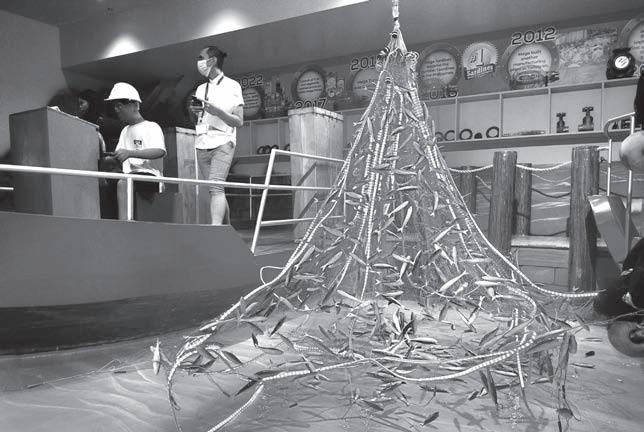
The Senses of the Sea: The Mega Sardines Museum is the first of its kind in a canned seafood manufacturing company that showcases the firm’s unique “Catching-to-Canning” process. This represents the company’s role as a government partner in educating students of all ages by showcasing their best practices and innovations in the canned sardines production that are pivotal in feeding the Filipino nation.
“ We believe that The Mega Sardines Museum offers experiential learnings to the students—lessons of which can become a core memory that simply cannot be found in textbooks and theories,” the president and CEO said.
“ We also hope to demonstrate how important it is for us to be able to produce affordable, nutritious and safely packaged seafood products that are suitable for every member of the Filipino family. It’s our simple contribution to the country’s pursuit of self-sufficiency in food production, as well as to reduce our reliance on imports.”

Housed within MPFI’s newest manufacturing facility in Santo Tomas, Batangas, the 906-squaremeter museum offers the following marine-themed spaces that provide highly interactive and learning experience for its guests and visitors: Briefing Room, Sardine Catching Room, Production Viewing Deck, Mega Fleet of Vessels, Sardines Canning Room, and the Seaside Market.
For MPFI Chief Growth and Development Officer Marvin Tiu Lim, this is an ambitious project such that they partnered with the Philippine Amusement and Entertainment Corp. (PAEC), the biggest creator and operator of indoor interactive tourism and educational attractions in the country.
“It’s a multimillion investment,” he revealed, without citing the exact amount they spent. “Actually, there’s no return on investment because we will not sell tickets. It’s nonprofit. It’s for free care of our [partner] agency, which is the PAEC.”
W hen the museum initially opens on September 1, the top
executive said they will focus on catering first to students as young as Grade 1 to high school levels. “If we can satisfy the total demand for the students, we will definitely open it [to the general public].”
MPFI put up this pioneering attraction with the end goal of stimulating growth in the economy of Batangas province and the rest of the Calabarzon Region (Cavite, Laguna, Rizal and Quezon) as it boosts the tourism landscape that trickles down to jobs generation and development of domestic enterprises.
Seen to attract up to 5,000 guests per month, the tour is bound to boost the local tourism of Santo Tomas, Batangas, with the presence of guests from educational and business institutions taking interest in the process of food production,” Tiu Lim-Chan said.

Batangas Governor Hermilando Mandanas lauded the Tiu family for establishing not only a manufacturing plant but also a new tourism attraction for the province.
He said: “We are very fortunate to have you operate here. The museum is a very concrete evidence or example of what could be done [more here. It’s] now a very bigger part of [our achievements.] The Department of Trade and Industry has already designated Batangas as the ‘Asean Logistics Hub’ and the Department of Agriculture has designated it as the ‘Gateway for the Agro Industrial Business Corridor.’”
For Department of Tourism (DOT)-Calabarzon Regional Director Marites Castro, the Senses of the Sea will help strengthen the province’s constant leadership in the tourism industry. In fact, she revealed to the BusinessMirror that Batangas is now ranked No. 1 when it comes to overnight visi-

tors—reaching 1,258,609—and No. 2 in same-day tourist arrivals at 3,613,656 in the entire Calabarzon Region as of June 2023. With this in mind, MPFI signed a partnership with the Department of Tourism Region IV-A, which elaborates the agency’s endorsement of the museum to be included in the promotions of tourism in Southern Tagalog.
Th rough this collaboration, the museum will be included on the list of must-visit locations in the province and recommended to become part of educational tours for students.
This one-of-a-kind tourist destination in Santo Tomas, Batangas, not only showcases world-class food production processes but also promotes marine conservation and cultural heritage, contributing significantly to the economic growth and development of the entire Calabarzon region,” Castro pointed out.
The ceremonial opening event, likewise, witnessed the official execution of MPFI’s tie-up with PAEC that will help curate and manage the museum. Such collaboration will strengthen their support to the K-to-12 basic education and Matatag Agenda of the Department of Education as well as the DOT’s newest “Love the Philippines” campaign.
“Here in our new plant, we make sure that early on, as young as they are [student-visitors], we can educate them on the humbling process of how to make a sardine can which can feed up to five or six people in a family. It’s only P22, so it’s a really humble product—very affordable that we have to make sure that the future generations really respect and care for it as well,” Marvin Tiu Lim stressed.
NewsSunday BusinessMirror www.businessmirror.com.ph Sunday, August 13, 2023 A2 Continued from A1
Marvin Tiu Lim, Mega Prime Foods Chief Growth and Development Officer; CEO Michelle Tiu Lim-Chan; Batangas Governor Hermilando I. Mandanas; founder William Tiu Lim; Malcolm Tiu Lim, Chief Technical and Innovations Officer; and Michael Tiu Lim, VP for Business Development.
Editor: Angel R. Calso
Tycoon who gave away $750 million sees profit in loans to poor borrowers
By Anto AntonyR Thyagarajan is arguably one of the world’s most idiosyncratic financiers—in no small part because his multibillion-dollar business, the Shriram Group, has thrived in an industry that tripped up countless others around the globe. A pioneer in extending credit to India’s poor for trucks, tractors and other vehicles, Thyagarajan built Shriram into a conglomerate that employs 108,000 people in everything from insurance to stockbroking. Shares of the group’s flagship firm hit a record in July after jumping more than 35 percent this year, four times more than India’s benchmark stock index. Now 86, and settled into an advisory role, Thyagarajan said in a rare interview with Bloomberg News that he entered the industry to prove lending to people without credit histories or regular incomes isn’t as risky as it’s perceived. He insists there’s nothing unusual about his approach to business—or his decision to give away a stake in Shriram now valued at more than $750 million.
“I’m a bit of a leftist,” RT, as he’s known, said in the south Indian city of Chennai, where he founded the group in 1974. “I was never enthusiastic about making life pleasanter for people who already have a good life.” Rather, I “wanted to take away some unpleasantness in the lives of people who are getting into problems.”
Thyagarajan’s career highlights untapped opportunities in the world’s most populous country, as more of its 1.4 billion people strive to enter a growing middle class. Though Prime Minister Narendra Modi’s government has pushed to expand access to India’s banking services, about a
quarter of the nation still doesn’t have access to the formal financial system. And roughly a third of those who do have a bank account never use it, according to the World Bank.
Lending to the poor is a form of socialism, Thyagarajan contends. But by offering a cheaper option than the punitive rates available to the unbanked, he has sought to demonstrate that the business can be safe and profitable. And in doing so, he’s persuaded other companies to bring down borrowing costs.
Now, the industry is big business. India has about 9,400 so-called shadow banks, which mostly offer financial services to people passed over by conventional lenders.

“RT is an outlier,” said Srinivas Balasubramanian, senior partner and head of corporate finance at KPMG India. “Few have sustained and thrived for so long.”
Building an empire INDEED, Thyagarajan stands out in an industry that has been plagued by ethical challenges and is prone to booms and busts—with blowups sometimes threatening the financial system. The most obvious example is the subprime mortgage crisis in the US. More recently, the collapse of a non-bank lender in Mexico last year wiped out billions for investors.
Forging a socialism-inspired lending firm might seem an unexpected career choice for a man who grew up surrounded by servants in a well-to-do farming family in the state of Tamil Nadu. But Thyagarajan said he’s always had an analytical and egalitarian-oriented mind. He studied mathematics at the
undergraduate and master’s level in Chennai before spending three years at the prestigious Indian Statistical Institute in Kolkata.
In 1961, he joined New India Assurance Co., one of India’s largest insurers, starting a spell in finance as a company employee that lasted two decades. It included stints at Vysya Bank, a regional lender, and JB Boda & Co., a reinsurance broker.
Along the way, people in Chennai came to him seeking money to buy used trucks, and he gave them loans from his inheritance. Gradually, that side venture morphed into his life’s main act. At 37, he founded Shriram Chits with friends and relatives.
The unbanked often rely on socalled chit funds, a collective savings scheme where each member deposits a fixed amount every month. The pot is doled out to one investor a month until everyone has received a share. The money is used for farm equipment, school fees or other large purchases.
Over the years, Thyagarajan set up other firms, and Shriram eventually grew into a group of more than 30 companies.
In truck financing, Thyagarajan saw people paying rates as steep as 80 percent because banks wouldn’t deal with them. He concluded that the prevailing thinking was wrong.
“People used to think that because the interest rates were very high, the lending was very risky,” he says. “I realized it was not risky at all.”
This epiphany would define his life. He decided to lend at rates that were still extremely high by global standards, but lower than other options. “Interest rates went from 30
percent-35 percent to 17 percent-18 percent,” he said.
Thyagarajan says his approach wasn’t about charity. It was infused with two key capitalist beliefs. One was the importance of private-sector entrepreneurship; the other, faith in market principles.
That ethos has paid dividends: Shriram collects more than 98 percent of dues on time, filings show. It gets its lending decisions right, the local unit of S&P Ratings says.
More broadly, non-bank financiers like Shriram are crucial for supporting India’s newly banked. They underwrite loans and other products that require skill-sets banks often don’t have, according to Bindu Ananth, co-founder of Dvara Holdings, which backs companies driving financial inclusion.
“Ensuring participation of the poor and marginalized in India’s formal financial system is key to driving the economic growth in a sustainable manner,” Ananth said.
Today, the Shriram Group serves about 23 million customers.
Shriram Finance Ltd., the flagship, has a market value of about $8.5 billion and made about $200 million in profit in the quarter that ended in June. Only one of the 34 analysts tracking the stock recommends selling it.
A different approach
LENDING to the poor can be murky. Exorbitant interest rates routinely lead vulnerable borrowers deeper into debt. In India, loan sharks sometimes resort to heavy-handed debt collection. Consumer protection is especially weak in the microfinance
Vietnam’s richest man poised to briefly triple fortune to $16 billion on EV bet
By Venus Feng, Anders Melin, Manuel Baigorri & Nguyen Kieu GiangTHE fortune of Vietnam’s wealthiest man is poised to soar by as much as $11 billion, vaulting him to the upper ranks of the world’s richest people—for a while, at least.
Pham Nhat Vuong has the paperwork in place to take his electric-vehicle maker VinFast public through a SPAC listing with a blank-check firm founded by casino mogul Lawrence Ho. The deal would give VinFast, a company little known outside Vietnam, an equity value of $23 billion.
Shareholders of Black Spade Acquisition Co. will vote on whether to complete the deal. If it does, it will be the third-largest special purpose acquisition company transaction in history and, on paper, Vuong’s wealth may jump to as much as $16 billion from around $5 billion, according to the Bloomberg Billionaires Index tracking the world’s 500 richest people.
But there are numerous pitfalls to navigate. The pandemic-era blank-check boom has faded and if recent deals are anything to go by, the firm’s equity value may fall soon after it starts trading.
EV companies have a particularly patchy record when it comes to blank-check mergers.
Since June 2020, at least five briefly soared after listing through SPACs, before crashing and burning mountains of investor money. One of them, Lordstown Motors Corp., filed for bankruptcy in June.
VinFast has also been weighed down by operational problems, hobbling its ambition to gain market share in the competitive EV space.
In May, it recalled all the electric sport utility vehicles shipped to the US over a software malfunction. The company also cut some of its US workforce, sales have been modest and its net losses are widening.
Most reviews have been “highly critical of its quality,” said Chris Robinson, a senior director at Lux Research covering automotive and energy transition. “It’s hard to see this organization justifying a proposed $23 billion valuation.”
Those problems have proved costly. In the six years it has been operating, VinFast has taken in $9.3 billion of financing to cover its operating and capital expenditures, much of it coming from Vuong’s other businesses.
Still, the company forecasts sales will reach 45,000 to 50,000 this year and has said it may produce electric pickups, a mini car and other models, if there’s market demand. It started
building a factory in North Carolina last month and Vuong predicts VinFast will break even by the end of 2024.
The company is also optimistic about its equity appraisal for the SPAC listing, saying in a written statement to Bloomberg News that it “expects potential upside” to the valuation.
Noodles venture
FOR his part, Vuong remains financially committed to VinFast, which started making combustion engine cars before focusing on EVs. The Hanoi-born, Moscow-educated businessman and his relatives have plowed in at least $300 million into the venture and he has pledged another $1 billion.
The beginnings of Vuong’s fortune can be traced to Ukraine, where the 55-year-old moved in the early 1990s after studying geoeconomic engineering in Russia. There, he started a venture making instant noodles. It was a big hit, and in 2010 he sold the business to Nestle SA for an undisclosed sum.
Meantime, he had already begun laying the groundwork for a business back in Vietnam—Vingroup JSC. Initially focused on real estate, the group’s operations span resorts, schools, shopping malls and more. The Hanoi-based group had $4.3 billion of revenue in 2022, equivalent to about 1 percent of the
industry, despite its emphasis on lifting up the vulnerable.
Big money backs tiny loans that lead to debt, despair, suicide
ASKED to explain what Shriram does differently, Thyagarajan said the group doesn’t look at credit scores, for instance, because most customers aren’t part of the formal financial system. Instead, staff rely on references from existing customers.
Internally, the company also takes a unique approach to compensation. Thyagarajan has long believed staff are paid too much, even though they get less than market rates. Lower-level employees often earn about 30 percent less than peers. For senior executives, the discount is as much as 50 percent.

“We would give them as much as they need to keep themselves reasonably happy, not euphoric,” Thyagarajan said. “They shouldn’t be encouraged to compare themselves with all people around them. They would have only misery.”
He insists employees are mostly content with this structure. Though pay is less, staff said in interviews that the job comes with more flexibility than at peer firms.
“I value the peace of mind, stability and comfort that this job offers,” said Amol Bowlekar, a branch manager for Shriram Finance in Mumbai, who said he has turned down several higher paying job offers. “The group’s culture is more humane. There is no insane pressure to deliver.”
Living modestly
PART of what makes Shriram’s system fair, staff say, is Thyagarajan’s own willingness to live among the masses. For years, he drove a Hyundai hatchback. And he doesn’t own a mobile phone, which he considers a distraction.
The tycoon gave away all his shareholdings in Shriram companies to a group of employees, transferring them to the Shriram Ownership Trust, which was set up in 2006. The perpetual trust has 44 group executives as beneficiaries. Executives leave when they retire, taking millions of dollars with them.
The total value of the trust’s holding exceeds $750 million and has gone up several-fold in recent years, people familiar with the matter said, asking not to be identified as the information is private.
Less than enamored
country’s gross domestic product.
VinFast was the conglomerate’s first foray into making vehicles. Over the years, the company brought a legion of expatriates with experience from automakers like Ford Motor Co. and General Motors Co. to Vietnam. Many completed only short stints, frustrated by the high tempo and decision-making that boiled down to following every whim of chairman Vuong regardless of costs or time, three former employees told Bloomberg News on the condition of anonymity because they signed non-disclosure agreements. In response, VinFast said as a startup it requires a “certain degree of flexibility at work and execution speed that is not suited to everyone.”
In his three-hour interview with Bloomberg, Thyagarajan said he didn’t need the money then or now— and he ultimately prefers simple pursuits. These days, he spends hours listening to classical music and reading Western business magazines.
In December, Shriram Transport Finance Co. absorbed Shriram Capital Ltd. and Shriram City Union Finance Ltd. in a share-swap deal. Shriram Transport finances trucks, while Shriram City Union funds purchases of consumer goods and motorcycles. Thyagarajan says executives planned this for years, but he wasn’t involved in the details. He no longer has a formal role at the company, but every fortnight, senior managers brief him and seek his advice.
“I have the personality of a consultant,” Thyagarajan says. “I can see things slightly differently. I’m OK with people not accepting my perception and doing things based on their perception. And if it turns out that I was right and they were wrong, which happens most of the time, I am able to communicate with them later on and say I told you so.”

Shriram’s strength is also its weakness, according to Kranthi Bathini, an equity strategist at WealthMills Securities Pvt. in Mumbai. Most customers are non-prime, which means “asset quality and profitability underperformance could come at any point,” he says.
There’s also key-person risk, according to Bathini. With “cultish” founders like Thyagarajan, it’s tough for anyone else to lead.
Lastly, Bathini says, a left-wing mindset isn’t always great for shareholder returns, though they have been fine so far.
Still, Thyagarajan’s record of success is hard to argue with. But he plays down talk that his life is frugal, saying he even occasionally splurges on trips with family to tiger sanctuaries. His one regret isn’t that he gave his wealth away, but how he did it. If he’d realized how profitable Shriram would become, and how much the stock would rise, he would have spread the bounty.
“I did not imagine that so much money was going to be distributed to so few,” he says. “I’m not very happy about it. But it’s OK. I’m not very sad either.” With assistance from Jane Pong/ Bloomberg
THE valuation was set by Black Spade’s board of directors using a multiple of equity value to expected revenue for Lucid Group Inc. The luxury EV-maker was deemed the closest comparable company to VinFast, according to a regulatory filing. Black Spade said it worked with a financial adviser, JonesTrading Institutional Services LLC, but didn’t commission a valuation or fairness opinion from a third party.
Investment bankers, who had earlier worked with the company to prepare a traditional IPO,

said it doesn’t reflect the market conditions or the company’s prospects for profits, according to people familiar with the matter, who asked for anonymity to discuss private matters
Regulatory filings show Vuong will control 99 percent of the combined entity after the merger, partly via shares held by his wife Pham Thu Huong and Vingroup. Casino billionaire Ho and his investment arm, along with a group of other people affiliated with the blank-check firm, will hold some of the remaining shares. With assistance from Bailey Lipschultz and Pei
Sunday, August 13, 2023 A3 The World www.businessmirror.com.ph •
HE built a fortune lending to low-income borrowers
shunned by banks. He paid staff below-market wages and thought they still earned too much. He gave away almost all his wealth to a handful of employees, content with his small house and a $5,000 car.R THYAGARAJAN, founder of Shriram Group, at the company’s office in Chennai. BLOOMBERG PHOTO)
Two years after the fall of Kabul, tens of thousands of Afghans languish in limbo waiting for US visas
By Rahim Faiez & Rebecca Santana The Associated PressAccording to the Taliban, who bar women from most public places, jobs and education, her work was immoral.
So when the Taliban swept into her hometown of Herat in western Afghanistan in August 2021 as the US was pulling out of the country, she and her family fled.
First they tried to get on one of the last American flights out of Kabul. Then they tried to go to Tajikistan but had no visas. Finally in October 2021, after sleeping outside for two nights at the checkpoint into Pakistan among crowds of Afghans fleeing the Taliban, she and her family made it into the neighboring country.
The goal? Resettling in the US via an American government program set up to help Afghans at risk under the Taliban because of their work with the US government, media and aid agencies.
But two years after the US left Afghanistan, Sediqi and tens of thousands of others are still waiting. While there has been some recent progress, processing US visas for Afghans has moved painfully slowly. So far, only a small portion of Afghans has been resettled.
Many of the applicants who fled Afghanistan are running through savings, living in limbo in exile. They worry that the US, which had promised so much, has forgotten them.
“What happens to my children?
What happens to me?” Sediqi asked. “Nobody knows.”
US relied on Afghans
DURING two decades in Afghanistan after its 2001 invasion, the US relied on Afghans helping the US government and military. Afghan journalists went to work at a
growing number of media outlets.
Afghans, often women working in remote areas, were the backbone of aid programs providing everything from food to tutoring.
Since 2009, the US has had a special immigrant visa program to help Afghans like interpreters who worked directly with the US government and the military.
Then, in the waning days of the US presence in the country, the Biden administration created two new programs for refugees, expanding the number of Afghans who could apply to resettle in the US.
The visas, known as P-1 and P-2, are for aid workers, journalists or others who didn’t work directly for the US government but who helped promote goals like democracy and an independent media that put them at risk under the Taliban.

The programs were intended to help people like Enayatullah Omid and his wife—Afghans who helped build the country after the 2001 Taliban ouster and were at “risk due to their US affiliation” once the US withdrew.
In 2011, Omid started a radio station in Baghlan province with the help of the US-based media training nonprofit Internews and funding from the US Agency for International Development. He was the station’s general manager but did everything from reporting on-air to sweeping the floors at night. His wife, Homaira Omid Amiri, also worked at the station and was an activist in the province. When the Taliban entered Baghlan on Aug. 9, 2021, Omid said he did one last thing: He burned documents to keep the Taliban from identifying his staff. Then he and his wife fled.
They stayed at shelters arranged by a committee to protect Afghan journalists until the Taliban shut them down. Internews referred Omid to the US refugee program in the spring of 2022. Told he had to leave Afghanistan for his case to proceed, Omid and his wife went to Pakistan in July 2022.
Even in Pakistan Omid doesn’t feel safe. Worried about the Taliban’s reach, he’s moved three times. There are police raids targeting Afghans whose visas have run out. As he spoke to The Associated Press, he was getting text messages about raids in another Islamabad neighborhood and wondered how much he should tell his already stressed wife.
He said America has a saying: Leave no one behind.
“We want them to do it. It shouldn’t be only a saying for them,” he said.
The lucky ones
THE American airlift in August 2021 carried more than 70,000 Afghans to safety, along with tens of thousands of Americans and citizens of other countries—plane after plane loaded with the lucky ones who managed to make their way through the massive crowds encircling Kabul airport. Most gained entry to the US under a provision known as humanitarian parole.
Many more are still waiting.
There are about 150,000 applicants to the special immigrant visa programs—not including family members. A report by the Association of Wartime Allies said at the current rate it would take 31
years to process them all.
Separately, there are 27,400 Afghans who are in the pipeline for the two refugee programs created in the final days of the US presence in Afghanistan, according to the State Department. That doesn’t include family members, which potentially adds tens of thousands more. But since the US left Afghanistan it’s only admitted 6,862 of these Afghan refugees, mostly P-1 and P-2 visa applicants, according to State Department figures.
In June, US Secretary of State Antony Blinken said the US has relocated about 24,000 Afghans since September 2021, apparently referring to all the resettlement programs combined.
Among the refugee program applicants are about 200 AP employees and their families, as well as staff of other American news organizations still struggling to relocate to the US.
Krish O’Mara Vignarajah, president and CEO of the Lutheran Immigration and Refugee Service, said the US refugee process in general can be agonizingly slow, and waits of as long as 10 years are common. Furthermore, former US President Donald Trump gutted the refugee system, lowering the annual number of accepted refugees to its lowest ever.
Other challenges are unique to Afghan immigrants, said Vignarajah. Many Afghans destroyed documents during the Taliban takeover because they worried about reprisals. Now they need them to prove their case.
“The grim reality is that they’ll likely be waiting for years on end and often in extremely precarious
situations,” Vignarajah said.
In a recent report, the Special Inspector General for Afghanistan Reconstruction, a body created by Congress to oversee government spending in Afghanistan, faulted the various resettlement programs set up for Afghans.
“Bureaucratic dysfunction and understaffing have undermined US promises that these individuals would be protected in a timely manner, putting many thousands of Afghan allies at high risk,” the report said.
It also criticized the lack of transparency surrounding the refugee programs, which it said has left Afghans considering whether to leave their country to await processing without “critical information” they need for such a crucial decision.
In a sign of the confusion surrounding the process, applicants like Omid and his wife were told they had to leave Afghanistan to apply, a costly endeavor involving selling their possessions, going to another country and waiting. They, like many others, ended up in Pakistan—one of the few countries that allows Afghans in—only to discover the US was not processing refugee applications there.
That changed late last month when the State Department said it would begin processing applications in Pakistan.
However, Congress has so far failed to act on a bill that seeks to improve efforts to help Afghans still struggling to get to America.
The State Department declined an AP request for an interview but said in a statement it is committed to processing Afghan refugee visas. In June, Blinken applauded the efforts that have gone into helping Afghans resettle in America but emphasized the work continues.
At the same time, the Biden administration has made progress in recovering from the Trump-era curtailment of the refugee system. The administration raised the cap on refugees admitted to the US to 125,000 a year, compared to Trump’s 15,000 in his final year in office. It’s unlikely the Biden administration will reach the cap this year, but the number of refugees and Afghans admitted is increasing.
Shawn VanDiver, who heads a coalition supporting Afghan resettlement efforts called #AfghanEvac, said he doesn’t agree
with criticism that the refugee programs are a failure.
They have gotten off to a “really slow start and there are vulnerable people that are waiting for this much needed relief,” he said.
“But I also know that ... from my conversations with government, that there is movement happening to push on this.”
The risks were enormous LEFT with little information, Afghans in Pakistan compare what they hear from US officials about their cases in What’s App chat groups that have organized social media protests demanding swifter US action.
“Avoid putting our lives in danger again,” one post read. Pakistan was already home to millions of Afghans who fled decades of conflict when the Taliban returned to power and an estimated 600,000 more surged into the country. While many had valid travel documents, renewing them is a lengthy and costly process. Raids looking for Afghans with expired visas have heightened tensions.
Abdul, who declined to give his surname for fear of arrest because his visa has expired, worked as head of security for an aid group in Afghanistan that specialized in economic help for women. The risks were enormous; three colleagues were killed while he worked there.
One of his last tasks was getting the group’s foreign staff to the airport to escape. The organization stayed open into 2022, when the Taliban detained Abdul for two weeks. After his release, a Taliban member said he could protect his family—if Abdul gave him his daughter in marriage.
Abdul knew it was time to leave. He, his wife and children fled that night to Iran. Late last year, when they were told their referral to one of the refugee programs had been approved, they went to Pakistan. Since then, there’s been no information. Their visas now expired, the family is terrified to leave the house.
“The future is completely dark,” Abdul said. “I’m not afraid to die, I’m just really worried about the future of my children.”
Santana reported from Washington. AP reporters Munir Ahmed in Islamabad a nd Ellen Knickmeyer in Washington contributed.
Indigenous leader inspires Amazon city to grant personhood to endangered river
By Fabiano Maisonnave, Teresa De Miguel & André Penner The Associated PressGUAJARA-MIRIM, BRAZIL—On the banks of the Komi Memem River, the activity never ceases: women go down the embankment from Laje Velho village carrying basins to wash clothing, while men embark in small canoes on hunting and fishing expeditions. At day’s end, it’s the children’s turn to dive into its tea-colored waters.
The river, named Laje in non-Indigenous maps, is vital to the Oro Waram, one of the six subgroups of the Wari’ people, who have inhabited the Western Amazon for centuries. However, this immemorial relationship is under increasing threat. The relentless expansion of soybeans and pastures encroaches on their land, while land-robbers promote illegal deforestation.
To protect themselves, the Wari’ people are resorting to a new strategy: the white man’s law. In June, the municipality of
Guajara-Mirim passed a groundbreaking law proposed by an Indigenous councilman that designates the Komi Memem and its tributaries as living entities with rights, ranging from maintaining their natural flow to having the forest around them protected.
The law comes as representatives of eight South American governments gather Tuesday and Wednesday in Brazil to discuss ways to preserve the Amazon rainforest to help stave off climate change and protect its Indigenous peoples.
The Komi Memem, a tributary of a larger river that’s unprotected, is now the first among hundreds of rivers in the Brazilian Amazon to have a law that grants it personhood status. This is part of a new legislative approach to protect nature that has made inroads in many parts of the world, from New Zealand to Chile.
“We are further organizing ourselves to fend off invaders,” councilman Francisco Oro Waram, the law’s proponent, told The Associated Press. “We can’t fight with arrows; we have to use the laws.”
A teacher by profession, Oro Waram lives with his family in Laje Velho village, a 40-minute drive from downtown GuajaraMirim, mostly on paved highway surrounded by pasture. Right before the village entrance, heavy machinery was preparing soil for soybean crops, which are fast replacing cattle ranching throughout this part of the Amazon in Rondonia state.
“There are many generations to come, so the elders protect the water,” Oro Waram said of the river. “We don’t pollute it or cut the trees that surround it. It is a living being for us.”
Satellite images show the encirclement of the Indigenous Land Igarapé Lage, a green rectangle amid deforestation. This is where Laje Velho is located. In the past decades, the federal government has created six non-continuous Indigenous territories.
One, Rio Negro Ocaia, has been awaiting the federal government’s approval of the expanded boundaries established by an anthropological study 15 years ago.
The Wari’ people lived independently
until the late 1950s and early 1960s and are the largest group of Chapakuran speakers, an isolated language family. In the initial years after contact with outsiders, three out of five Wari’ died from introduced diseases, dwindling to as low as 400 people. The population has increased tenfold since then, but they now occupy less than one-third of their original territory, according to anthropologist Beth Conklin from Vanderbilt University, who has worked with them for nearly four decades.
“The Wari’ value their cosmology and rituals. And all of it centers around promoting human thriving in relationships with the non-human, with the larger world, and the well-being of your people,” Conklin told the AP. “So this law is a 21st century update of these very traditional social, biological, ecological values that are at the center of Wari’ culture.”
The expansion of soy, with heavily pesticide-dependent crops, poses a significant threat to the Komi Memem River. But it is not the only one. Upriver from Laje Velho, an invasion by land-robbers has
blocked the Wari’ people from accessing their essential fishing grounds.
Moreover, the river’s headwaters are located near Guajará-Mirim State Park, a former Wari’ territory. Despite being a protected area, it has been extensively invaded and deforested by land-robbers in the past few years.
Instead of evicting them, the state governor, Marcos Rocha, an ally of the farright former President Jair Bolsonaro, signed a law in 2021 reducing the park’s boundaries to legalize the land grabbing. A judicial order subsequently overruled that law, but the invasion and deforestation have not stopped.
Last February, the river’s tea-colored water turned muddy red, scaring Oro Waram. “I had never seen it in my lifetime,” said the 48-year-old, who blames the episode on rampant illegal deforestation.
The councilman says that due to pollution from cattle farms and soybean crops, his village no longer drinks water directly from the river, as their ancestors did. Instead, they rely on artesian wells.
Sometimes the threat is very direct. On June 6, about 60 armed men invaded Linha 26 village, expelling its inhabitants. They only returned after the Federal Police went to the locale and retook it, according to the Wari’ umbrella organization.
“The loggers entered and divided up the Indigenous land,” Gilmar Oro Nao, vice president of the Oro Wari’ association, told the AP. “They threaten food security. Our relatives have nowhere to fish, the Brazil nut trees were cut down. Today, they have nowhere to draw their survival from.”
Oro Nao said that the Wari’ don’t trust the National Indian Foundation’s local employees. He said there is widespread suspicion that they collaborate with illegal loggers and land-robbers.
The AP sent e-mails to the Indian Foundation, but received no response. The Federal Prosecutor’s Office, whose responsibility includes overseeing Indigenous rights, said it has opened an investigation on the invasions and has been monitoring the situation.
BusinessMirror Sunday, August 13, 2023 A4 www.businessmirror.com.ph The
World
ISLAMABAD—When the Taliban took control of Afghanistan, Shukria Sediqi knew her days in safety were numbered. As a journalist who advocated for women’s rights, she’d visited shelters and safe houses to talk to women who had fled abusive husbands. She went with them to court when they asked for a divorce.AFGHAN refugees hold an indoor rally to demand their US visa to be processed in Islamabad, Pakistan on Friday, July 21, 2023. When the US pulled out of Afghanistan in August 2021, it carried tens of thousands of Afghans to safety. But two years later, many others are still waiting to be resettled. Those are Afghans who helped the war effort by working with the US government and military or Afghan journalists and aid workers whose former work puts them at risk under the Taliban. AP/RAHMAT GUL
PhilSA shares resources to boost capabilities of local industries
By Edwin P. GalvezDOST reveals intl collabs on health at 16th PNHRS Week in Tacloban
SCIENCE Undersecretary for R&D Leah Buendia presented high-impact healthrelated research and development (R&D) initiatives between the Philippines and international countries during the 16th Philippine National Health Research System (PNHRS) Week celebration in Tacloban City on August 8 to 11.

The event was hosted by the Eastern Visayas Health Reseach and Development Consortium (EVHRDC).
Themed “Sustainable Development: Resilience through Health Research,” the event featured the critical role of health research and innovation, particularly in the post-Covid-19 era.
Five bilateral health-related R&D collaborations were cited by Buendia along with other capacity building programs and other international collaborations.
Leading the list was the Newton Agham Program—a collaboration between the Philippines and the United Kingdom in science, research and innovation.
The program completed 12 high-quality R&D projects in the areas of infectious and lifestyle diseases, including the increasing threat of anti-microbial resistance and neglected tropical diseases; diagnostics, e-health systems, and biomedical device development.
Another high-impact collaboration was the Manila Economic Cultural Office and Taipei Economic Cultural Office Joint Research Program.
It served as an avenue for collaboration between Filipino and Taiwanese scientist
and researchers on virology, nutritional genomics, space technology and application for medicine, antimicrobial resistance, among others.
The Philippines also formed a collaboration with the country’s counterpart in India to prioritize virology and applications of artificial intelligence on health.
Since the Philippines is plagued by yearly outbreaks of dengue virus, the viral infection transmitted by mosquitoes that are also vectors of chikungunya and Zika viruses were given focus.
With the lack of vaccines and therapeutic drugs against these arthropod-borne viruses, Philippine and Indian researchers are working on the development of new molecular entities and small molecule inhibitors targeting host and viral proteins.
This is an essential component in drug discovery to address dengue.
Buendia also cited various scholarship programs which include health as a priority area: 1) DOST Newton PhD Program; 2) Leaders in Innovation Fellowship; 3) PhilFrance-DOST Fellowship; and 4) PHC-SFTP Researchers Mobility Program.
“Through collaboration, we are able to build up local capacities and help our young early career scientists and researchers for the next generation of world class men and women of Philippine S&T, “ Buendia said.
“Our country will also be recipients of the collective benefits through the sharing of information and best practices with other countries,” she added. S&T Media Service
E Visayas embarks on 1st biomedical research on birth concerns, dengue
RESEARCHERS from Eastern Visayas lead health research initiatives dedicated to addressing health issues, such as premature birth, low birth weight, and dengue.
Emphasizing the importance of cultivating a vibrant health research community in the region, Eastern Visayas Health Research and Development Consortium (EVHRDC) Chairman Dr. Exuperia Sabalberino showcased two research projects at the Talakayang HeaRT Beat news conference held on August 9 in Tacloban City.
Highlighted in the activity is the first biomedical device research conducted in the region, “Project Buhat [Babies Under Heat Assisted Technology] Kangaroo Mother Assistive Device,” led by Dr. Virginia Ariza of the Holy Infant College.
The project aims to support the implementation of Kangaroo Mother Care (KMC) in more healthcare facilities in Region 8.
It aims to develop a KMC-assistive device that can monitor a premature and low birth-weight newborn’s temperature, provide increased mobility for the newborn, and offer support to both the newborn and the mother.
Currently, the team has developed a device prototype and is now gearing for clinical testing, which will be funded by the EVHRDC.
In her presentation, Sabalberino also shared the project, “Health-seeking Behavior of Dengue Patients and Carers during the
Covid-19 Pandemic in Naval and Kawayan, Biliran,” by Dr. Arlene Supremo of the Biliran Provincial State University.
Noting the decline in dengue reporting during the Covid-19 pandemic, the study examined the health-seeking behavior of dengue patients and their carers in Biliran.
The study revealed that both patients and carers have differing health-seeking behaviors during the three phases of dengue, which is indicative of a low healthcare utilization and poor management of the disease. These results can be used by concerned health institutions for policy development on dengue control and management.
During the open forum, EVHRDC representatives further discussed the status of the two featured research projects.
Questions on the details of the project, utilization and commercialization, as well as the impact of these initiatives in the region arose from the media.
Participants also asked about the other projects in Eastern Visayas supported by the Consortium focusing on mental health, teenage pregnancy, dengue, and more were also discussed.
Around 50 members of the media in Eastern Visayas participated in the Talakayang HeaRT Beat that provides the latest updates on health research in the country. Anchored under this year’s celebration of the PNHRS Week. S&T Media Service
PhilSA director general Joel Joseph S. Marciano Jr. told the BusinessMirror that “space-adjacent companies,” specifically those involved in the semiconductors, electronics, machining and manufacturing industries, can benefit from the agency’s space resources.

“What we have is know-how. More importantly, what our engineers have is love of country. So you want to be able to share this know-how,” Marciano said at the sidelines of the opening program of the first Philippine Space Week celebration on August 8 in Quezon City.
The celebration coincided with the fourth anniversary of the signing of Republic Act 11363, or the Philippine Space Act that created the agency.
According to Marciano, PhilSA can help companies open new markets for their products if they have components that “can be used with more robustness to work in space.”
“Also, quite important [is creating] a new range of high-value capabilities for their engineers,” he said.
He acknowledged the capability of PhilSA personnel to assist these companies, having helped build the country’s satellites or after taking graduate studies and trainings abroad.
“[These] things you learn while doing your master’s degree or PhD, building Diwata-1, Diwata-2, or Maya in Japanese universities. Now you’re back in the country working for PhilSA, the university or DOST [Department of Science and Technology], you pay it forward. You look at local companies here and tell them if you’re building that for Earth. If you do this test, then maybe it can work in space. These are [our] resources,” he explained.
While the Philippines is ready to monetize its space data, Marciano emphasized the need to open up these data first to build capacity, and part of this “heavy lifting” is appreciation for these capabilities and make them more accessible.
Fostering international cooperation MORE than monetization, Marciano explained to BusinessMirror
PhilSA’s role in actively contributing to international cooperation and goodwill through the use of its satellites.
“Other countries come to our aid when we have typhoons and disasters because they have satellites flying over and taking pictures. [They] give [their data] to us, and we process and value-add. But since we also operate a satellite, we can come to [their] aid when they need it,” he said.
These are among the key mandates of PhilSA, which also includes national security and development, hazard management and climate studies, space research and development, and space education and awareness.
Proclamation 302 signed by President Ferdinand R. Marcos Jr. last July 25 declared August 8 to 14 every year as Philippine Space Week.
In his opening message at the event, Marciano explained that the declaration “recognizes the vital role that space science, technology and its applications play in the lives of Filipinos.”
These include the use of satellites and their by-products and services and the advancement of “humankind’s collective scientific knowledge and understanding.”
Value creation from space resources
“WE propose #YamangKalawakan—which literally means space resources or space wealth— to take on a bigger, more figurative and encompassing meaning,” Marciano said as he explained the celebration’s theme.
He said “#YamangKalawakan tungo sa maunlad na kinabukasan” reflects PhilSA’s mission of value creation, which aims to “build and sustain a robust space ecosystem that adds and creates value in space for and from Filipinos, and for the world.”
“To guide us and to frame this mission of creating value, we look at value chains for strategy guidance. A crucial part of this chain are the end-users. That is, those to whom we push, or, more importantly, those who pull on, the space-based capabilities that we
strive to build,” he said.
“Without the end-users or without the utilization,” he explained, “socio-economic benefit from space science technology and applications cannot possibly be had.”

Agreements with five agencies
DURING the event, PhilSA signed agreements with five government institutions to deepen space data acquisition and the use of space science and technology (S&T) applications for value creation.
These agencies include the Department of Budget and Management (DBM), Land Bank of the Philippines (LBP), the Department of Science and Technology-Advanced Science and Technology Institute (DOSTASTI), Mindanao Development Authority (MinDA), the Department of Agriculture-Bureau of Fisheries and Aquatic Resources (DA-BFAR).
DBM Undersecretary and Chief Information Officer Maria Francesca M. del Rosario signed the agreement with PhilSA to implement the “Digital Information for Monitoring and Evaluation” project.
The initiative will improve monitoring of government property or -funded infrastructure projects using data and images from satellites processed and made available by PhilSA, reduce costly on-ground efforts, such as field-based validation activities and ensure the proper use and expenditure of public funds.
D OST-ASTI Chief Science Research Specialist Alvin Retamar and LBP Senior Vice President Elcid Pangilinan signed the agreement for S&T research collaboration on the use of space data and analytics for financial applications.
MinDA Secretary Ma. Belen
S. Acosta signed a collaboration agreement on the use of space assets to promote the socio-economic development in Mindanao.
The collaboration, called PhilSA Integrated Network for Space-enabled Actions towards Sustainability (Pinas) Mindanao, highlights the increasing relevance of geospatial data in local government policy-making, planning and monitoring.
Pinas Mindanao seeks to develop projects in different local government units in Mindanao to advance peace and development, promote best practices in governance and empower communities towards socio-economic inclusion.
DA-BFAR assistant director Isidro Velayo Jr. and DOST-ASTI’s Retamar signed the agreement on the use of space S&T remote sensing, and data science applications to support sustainable fisheries and marine biodiversity conservation.
The collaboration will also utilize space S&T, remote sensing, and data science applications to enhance fisheries management and application.
Tackling air pollution in the country from space, PhilSA signed a Record of Discussion with the Korea International Cooperation Agency on August 2.
This will help strengthen the Philippines’ capacity to monitor the air quality and develop plans and policies to address air pollution.
The agreement seeks to build the Pan-Asia Partnership for Geospatial Air Pollution Information Project and the Pandora Asia Network (Papgapi-PAN) in the country.

Papgapi-PAN is a technologytransfer, data-sharing, capacity-building, and international cooperation initiative on air pollution.
Deadline of entries to Seameo-Japan sustainability awards’ on Aug. 15
SOUTHEAST Asian schools, including those in the Philippines, can vie for this year’s Seameo-Japan Education for Sustainable Development Award.
Held annually since 2021, the award focuses on raising awareness and fostering sustainable practices across Southeast Asia and Japan.
This year’s theme is “Promoting Environmental Education Through Utilizing Renewable Energy.”
All public and private educational levels, from kindergarten to Grade 12, as well as vocational and technical schools, are eligible. Deadline of submission of entries in on August 15. The award is a collaboration of
the Southeast Asian Ministers of Education Organization (Seameo); the Ministry of Education, Culture, Sports, Science and Technology of Japan; and United Nations Educational, Scientific and Cultural Organization Multisectoral Regional Office in Bangkok.
The entry must meet specific criteria, focusing on its relevance to promoting environmental education through renewable energy utilization.
The entry should emphasize the school’s renewable energy program, encompassing education on efficient local energy use, including biomass and using school facilities.
It should also detail the program’s contribution to a more sus -
tainable society and environment.
The entry should also highlight student leadership with teachers, peers, parents and communities, along with full integration of “Environmental Education through Renewable Energy” across the school’s policy, management plan, participatory planning and implementation, and curriculum.
The first prize winner will receive a cash prize of $1,500 and a study tour to Japan of the four to six students and teachers who are involved in planning and implementing the school’s activities.
The second and third prize winners will receive $1,000 and $500, respectively. A special prize of $1,000 from
the Seameo Secretariat will be awarded to the best program carried out in small schools of less than 250 students.
Seameo is an intergovernmental treaty body that has been promoting education, science and culture since 1965. It has 26 specialist institutions located across Southeast Asia.
The Southeast Asian Regional Center for Graduate Study and Research in Agriculture; the Regional Center for Educational Innovation and Technology; and the Regional Centre for Public Health Hospital Administration, Environmental and Occupational Health Philippines are based in the Philippines.
Science Sunday BusinessMirror Sunday, August 13, 2023 www.businessmirror.com.ph • Editor: Lyn Resurreccion A5
THE Philippines may not have a robust space industry yet, but the Philippine Space Agency (PhilSA) will continue to help boost the capabilities of the country’s local industries by sharing its data and knowledge resources.PHILSA Director General Joel Joseph S. Marciano Jr. (FOURTH from left) speaks at the news conference during the launching program of the first Philippine Space Week celebration in Quezon City. He is joined by (from left) DOST-ASTI’s Alvin E. Retamar, LBP SVP Elcid C. Pangilinan, DBM Undersecretary Maria Francesca M. del Rosario, MinDA Secretary Maria Belen S. Acosta, DABFAR Assistant Director Isidro Velayo Jr., PhilSA Deputy DG Gay Jane P. Perez and PhilSA Director Ariel C. Blanco. PHILSA PHOTO Science Undersecretary for R&D Leah Buendia at the 16th Philippine National Health Research System Week celebration in Tacloban City on August 8 to 11. DOST PHOTO DOST-Philippine Council for Health Research and Development Director Jaime Montoya (left) and members of the EVHRDC lead the news conference of Talakayang HeaRT Beat in Tacloban City on August 9. DOST-PCHRD PHOTO
MIRACLE AT FÁTIMA?
WYD pilgrim regains sight after communion at Mass
she had been learning the Braille method for two or three years,” he said.
The prelate also noted that Jimena “had to read the prayer of thanksgiving at Mass that day with the Madrid group” and that, after receiving Communion, she was able to read it without any problem.
The young woman also told the cardinal that they had been praying for “nine days asking the Virgin for her healing.”
This possible miracle has moved hearts and filled with hope all those who have been following the events at WYD, which brought together more than a million young people in the Portuguese capital last week.
Jimena traveled to Lisbon from Madrid with a group from Opus Dei. During the days prior, relatives and acquaintances of the young woman organized a novena to pray to Our Lady of the Snows, whose feast day is commemorated on August 5, the same day she recovered her sight.
For two and a half years, Jimena has suffered a loss of sight due to a myopia problem that left her with a 95 percent vision loss.
On the morning of August 5, when the Holy Father was also praying the rosary at the Fátima
shrine, Jimena received what she herself describes as a “great gift” from the Virgin Mary.
Not long after having recovered her sight, Jimena told the Spanish radio station COPE that she woke up that morning “as I have been getting up for two and a half years, seeing super blurry, very badly.”
She explained that she had gone to Mass with her friends “because we are at WYD and after receiving Communion I began to cry a lot, because it was the last day of the novena and I wanted to be cured and I had very much asked God please [cure me].”
“When I opened my eyes, I could see perfectly,” the young woman continued, “it was overwhelming; very many thanks must be given for the miracle, because I saw the altar, the tabernacle, my
Jaro priest is new vice rector of Pontificio Collegio Filippino
THE Catholic Bishops Conference of the Philippines (CBCP) appointed Fr. Marvin Tabion from the Archdiocese of Jaro as the new vice rector of the Pontificio Collegio Filippino (PCF) in Rome.
Tabios, 45, will be assisting PCF Rector Fr. Gregory Roman Gaston of Manila, the CBCP announced on August 8. He will be responsible for overseeing PCF’s material, personnel, and financial matters.
Tabion replaced Fr. Jose Ray Ragudos, who has held the post
since 2017.
An alumnus of PCF, Tabion recently finished his Licentiate in Leadership and Management from the Pontifical Gregorian University in Rome. PCF, known as Filipino “Home in Rome,” serves as the home for Filipino diocesian priests studying at pontifical universities in Rome.
Established on blessed St. John XXIII in 1961, PCF is currently being run by Bishop Ruperto Santos of Antipolo, chairman of the CBCP Episcopal Commission on the PCF.
Patrick V. Miguel

girlfriends were there, and I could see them perfectly.”
In addition, she said that she was able to read the novena prayer that she was praying and that she still reads “quite well”—she hadn’t forgotten at all how to read.
The young woman said she is “super happy” and thanked all those who were part of the prayer group.
“This has been a test of faith; the Virgin has given me a great gift that I will not forget,” she said.
In an August 6 statement to ACI Prensa, Catholic News Agency’s Spanish-language news partner, Cardinal Juan José Omella, the archbishop of Barcelona and president of the Spanish Bishops’ Conference, referred to the
possible miracle as “a grace from God” during the news conference at the end of WYD held at Eduardo VII park in Lisbon.
The cardinal said he was able to speak with Jimena on a video call and that she explained what happened in a natural and unaffected manner.
“The girl was very excited; she had been blind for a while and
Omella encouraged the faithful to “give thanks to God” and explained that “this doesn’t lead to the cause of beatification for anyone, because the Virgin is already a saint, but it is indeed a grace from God.”
He pointed out that “then the doctors will have to assess it, what it was like, if it existed, if it could be cured or not. But for now for the girl that has been a major event. Let’s say a miracle. She didn’t see and now she sees. Now the doctors will be able to say the rest, but she has gone home seeing. Well, she sees, blessed be God.”
Omella said he was “really struck” by other testimonies that took place during WYD from young people who “have also recovered their interior vision.” Almudena Martínez-Bordiú/Catholic News Agency
Prelate: No celebration of alleged Lipa apparition
 By Patrick V. Miguel
THE Archdiocese of Lipa released a circular recently, stating that there will be no celebration “under any form” of the 75th anniversary this year of the alleged 1948 apparition of Blessed Virgin Mary in Lipa.
“I echo the definitive [Vatican] decision of 1951 that the alleged apparition of the Blessed Virgin Mary at the Carmelite Convent of Lipa does not have a supernatural origin and character,” said Archbishop of Lipa Gilbert Garcera, D.D.
Earlier, Cardinal Luis Ladaria, S.J., the Vatican’s prefect of the Dicastery for the Doctrine of the Faith, advised Filipino bishops against events to mark the 75th anniversary of the supposed apparition.
This lead CBCP president Bishop Pablo Virgilio David to instruct the bishops gathered for the 126th CBCP plenary assembly in Kalibo, Aklan, in July, about the Vatican’s advise.
Although Garcera reiterated the Vatican’s “definite decision” in 1951 that the alleged apparition has “no supernatural origin and character,” he noted that the decision does not prohibit devotion to Mary as
Mediatrix of Grace.
Guidelines
IN the circular, the archdiocese released the following guidelines:
1. Triduum or novena Masses in preparation for the 75th anniversary of the alleged apparition shall not be held at the Carmelite Monastery Church, and in all parish churches and chapels.
2. There shall be no special Masses to commemorate the 75th anniversary of the alleged apparition on September 12, 2023, at the Carmelite Monastery Church, and in all parish churches and chapels.
3. Organized activities celebrating the said anniversary
shall not be conducted inside or outside the Carmelite Monastery Church, or in all parish churches and chapels on September 12 and on any day thereafter.
4. Promotional materials about the 75th anniversary of the alleged apparition may not be posted at the Carmelite Monastery Church, and in all parish churches and chapels.
5. Devotions held on the 12th day of every month which are meant to recall the alleged apparition in Lipa shall not be held at the Carmelite Monastery Church, and in all parish churches and chapels.
6. Celebrations of the anniver -
Pope on health, his ditched peace prayer in Fatima, LGBTQ+ Catholics
ABOARD THE PAPAL PLANE—Pope Francis said recently his recovery from his latest abdominal surgery is going well and stressed that he ditched speeches during his five-day trip to Portugal and spoke off-thecuff not because he was tired or feeling unwell, but to better communicate with young people.
Francis was asked about his health en route home from Lisbon, where he presided over World Youth Day festival. It was his first trip since he was hospitalized in June for nine days following last-minute surgery to repair an abdominal hernia and remove intestinal scar tissue.
The trip, which came during a heat wave that sent temperatures to 40 degrees C in Lisbon, was notable because the 86-year-old pontiff deviated so often from his speeches, homilies

and even prayers, which are usually drafted months in advance and crafted with specific events and audiences in mind.

One of the most notable deviations was a prayer for peace that Francis was supposed to have delivered in the Portuguese shrine of Fatima, which is famous precisely because of its century-old connection to exhortations for peace and Russia’s conversion in the aftermath of World War I.
Given Russia’s ongoing war in Ukraine, a papal peace prayer at Fatima was to have been one of the highlights of Francis’s visit, but also potentially problematic as the Vatican seeks to maintain relations with Moscow and the Russian Orthodox Church, which has strongly supported the Kremlin’s invasion.
Instead of pronouncing the prayer, Francis ad-libbed his speech before the statue of the Madonna and skipped the peace prayer entirely, reciting instead a Hail Mary with young disabled people.
The Vatican later posted part of the prayer on the @Pontifex handle of the platform X, formerly known as Twitter.
Asked why, Francis insisted en route back to Rome that he had prayed silently for peace but didn’t want to give “publicity” to a public prayer.
“I prayed! I prayed! I prayed to the Madonna and I prayed for peace. I didn’t make publicity.
But I prayed. And we have to continually repeat this prayer for peace.”
A Vatican official, speaking on condition he not be named, noted that Francis had originally
wanted to travel to Fatima alone, with just a few gendarmes for a private visit, but relented to a proper visit.
The official denied any ecclesial-diplomatic considerations entered Francis’s decisionmaking, suggesting instead that the omission was part of an attempt to separate Fatima’s mystical-religious value from its Soviet and World War I history.
Francis, meanwhile, said he cut short his other speeches because he realized young people “don’t have a lot of attention” and that he needed to engage them, not lecture them with lengthy, complicated discourses or homilies, he said.
“Homilies can sometimes be torture,” he said. “Bla, bla, bla.”
sary of the alleged apparition under any form shall not be held in succeeding years at the Carmelite Monastery Church, and in all parish churches and chapels.
7. On September 12, the Monastery of Our Lady of Mount Carmel in Lipa will follow its regular schedule with the usual Mass celebrated in the morning.
‘Imitate Mary’s humility’ GARCERA called on devotees to follow Mary’s example of humility, following a Vatican instruction disallowing the 75th anniversary celebration of the alleged Marian apparition in Lipa.
He said that in “filial devotion” to the Vatican, the archdiocese cannot permit any activities for the alleged apparition.
“I acknowledge that this decision may be difficult for many of you, but I trust that, in your love for our Blessed Mother, you will look to her example of humble obedience to the will of God,” Garcera said.
“Recall that our Lord has entrusted the care of the Church to the apostles and to the bishops as their successors; and hear the words of Mary, our Mother, ‘Do whatever he tells you’,” he said. With CBCP News
He said the church must come around to a new idea of homilies that are “brief and with a clear, loving message.”
On his recovery, Francis said he had the abdominal stitches removed, but that he had to wear a protective belt for two to three months to ensure the incision healed well.
“My health is good,” he said.
In other comments, Francis affirmed that he included LGBTQ+ Catholics in his exhortation that “todos, todos, todos” (everyone, everyone, everyone) is welcome in the Catholic Church. The comment became something of a motto for this World Youth Day, reflective of his vision of an inclusive church, welcome to all.

“The church is mother,” he said. “Each of us finds God on his or her own path in the church. And the church is mother, and guides each one on his or her path.”
Nicole Winfield/Associated PressFaith Sunday A6 Sunday, August 13, 2023 Editor: Lyn Resurreccion • www.businessmirror.com.ph
‘I
OPENED my eyes and I could see perfectly,” said Jimena, a 16-year-old Spanish World Youth Day [WYD] pilgrim who said she miraculously recovered her sight after receiving the Eucharist at Fátima, Portugal, during a Mass.PILGRIMS walk on their knees while praying at the Sanctuary of Our Lady of Fátima in Portugal on August 7. ROY LAGARDE/ CBCP NEWS LIPA Archbishop Gilbert Garcera CBCP
NEWS
FR . Marvin Tabion of the Archdiocese of Jaro, is the new vice rector of the Pontificio Collegio Filippino in Rome. CBCP NEWS
POPE Francis meets the journalists during a press conference aboard the airplane directed to Rome, at the end of the 37th World Youth Day in Lisbon on August 6. MAURIZIO BRAMBATTI/POOL PHOTO VIA AP
Biodiversity Sunday
Editor: Lyn ResurreccionPHILIPPINE EAGLE’S IMPORTANT HABITAT
Pasonanca is PHL’s 10th Asean Heritage Park
By Jonathan L. MayugaPhotos by ACB/PaNP
AN important life-support system in Zamboanga City, the Pasonanca Natural Park (PaNP), is a legislated protected area (PA) that is teeming with diverse species of rare plants and animals.
It is one of the 94 PAs legislated under Republic Act 7586. as amended by RA 11038, also known as Expanded National Integrated Protected Areas System Act on June 22, 2018.
With a total land area of 17,493.42 hectares, this haven for native trees and birds is shared by seven barangays of Zamboanga City—Bunguiao, Tolosa, Salaan, Lumayang, Pasonanca, Dulian and Baluno.
Important water source
The PaNP boasts of a watershed area with over 50 perennial springs and streams at the core zone draining downward to the stretch of the Tumaga River.
Four watersheds likewise exist at the buffer zone areas of PaNP, namely the Manicahan, Culianan, Ayala and Malayal.
T he watershed area is the only source of potable water for Zamboanga City. It is managed by the Zamboanga City Water District, that helps protect and conserve the very precious economic resource.
Philippine eagle territory, refugia
AN important bird area and key biodiversity area, the PaNP is home to the critically endangered iconic bird of prey, Philippine eagle, the country’s national bird and one of the largest of its kind in the world in terms of wing span.
T here are around 400 pairs of the Philippine eagle in the wild.
Jason Ibañez, director for Research and Conservation at the Philippine Eagle Foundation, said this could be attributed to the fact that Pasonanca is one of the few remaining tracts of pristine, old-growth lowland forests in the Philippines.
“It is also a v ery important biodiversity and Philippine eagle refugia in the biogeographically unique western Mindanao peninsula,” Ibanez told the B usiness M irror in an interview via Zoom on July 27.
Refugia (singular refugium) are locations which support isolated or relict populations of a once more widespread species.
According to Ibanez, with perhaps three to four Philippine eagle pairs inhabiting

the PaNP, the eagle couples appear to act as sources of new eaglets, which will eventually fly to and re-occupy smaller forest fragments along the peninsula, whose resident eagles could have been lost to shooting, hunting or habitat degradation.
High-quality habitat
“THE PaNP appears to be a high-quality habitat for healthy eagle couples. T he healthy offsprings of these fit eagle pairs, in turn, can provide a ‘rescue effect’ to eagle populations found in lesser quality habitats [sink population] elsewhere along the peninsula,” he explained.
W ith PaNP playing a potentially important role in Philippine eagle and wildlife “source-and-sink” population dynamics on the Zamboanga Peninsula, its “protected status” should be strictly maintained, Ibanez pointed out.
“In order to secure the safe passage of eagles and wildlife migrating from PaNP to other forest fragments, forest ‘corridors and stepping stones’ might be restored and equally protected. Lastly, shooting and hunting of apex forest predators like the Philippine eagle and ecological keystones like hornbills and warty pigs should totally stop,” he added.

Biodiversity rich area
BASED on the biological profile of the PaNP, it is one of the most biologically diverse areas in the Philippines, if not in the entire Asean region.
According to the Asean Centre for Biodiversity (ACB), which implements the Asean Heritage Parks (AHP) Program as one of its flagship programs, the PaNP’s contiguous block of old and secondarygrowth dipterocarp forest covers almost 90 percent of the area.
“ Many of the threatened and restrictedrange species of the Mindanao and Eastern Visayas Endemic Bird Area have been recorded in or near to Pasonanca watershed, including recent records of the threatened Mindanao bleeding-heart, silvery kingfisher, Philippine leafbird and little slaty flycatcher, and Zamboanga bulbul, which is confined to the protected area and a subspecies from Western Mindanao and Basilan,” ACB said, quoting a 2018 report of BirdLife International.

Endangered trees, diverse flora and fauna
PANP is home to the most threatened
DENR unit finds transfer of Mati City’s marine turtle hatchery ‘appropriate’
AUNIT of the Biodiversity Management Bureau (BMB) of the Department of Environment and Natural Resources (DENR) said it found no reason to object to the decision of the local government unit (LGU) to transfer a two-decade-old marine turtle hatchery being run and managed by a community-based group in Mati City, Davao Oriental.
Nermalie M. Lita, chief of the Wildlife Regulation Section of the DENR-BMB, said, “For sound management of the marine hatchery, the transfer of the facility from the Amihan sa Dahican to Menzi Visitor’s Information Center in Dahican is deemed appropriate.”
Lita’s statement was in reaction to a BusinessMirror report and query on the complaints raised by members of Amihan sa Dahican-Balod sa Paglaon Inc, It forms parr of the findings of the DENR, a copy of which was e-mailed to the Business Mirror
The statement added that the Mati LGU has the management jurisdiction over the land, hence, has the authority or jurisdiction over the allocation of the property, taking into consideration environmental and/or conservation concerns “which the LGU Mati observed with due diligence.”
The DENR-BMB unit chief said the LGU conducted stakeholder meetings on the plan and properly communicated with the Amihan on the proposed relocation and construction of a new marine turtle katchery in a better location.
Mark Bacalso, a board member of Amihan, complained that the LGU sent a demolition crew last week and started to demolish the hatchery despite ongoing talks on their stiff
opposition to the plan.
The Amihan members said the 20-year-old hatchery was dismantled allegedly because of the plan to take over their operation, including the community-based ecotourism activities that employ volunteers from the barangay and fund the operation of the hatchery.
DENR officials, led by Undersecretary Jonas
R. Leones and Assistant Secretary Marcial C. Amaro, the concurrent director of the DENRBMB, ordered an immediate investigation when sought for comment by the BusinessMirror.
The DENR-BMB unit said that the investigation established that Amihan is a duly registered organization under the Securities and Exchange Commission, and is a duly accredited nonprofit organization by the City of Mati.
Formerly known as the Amihan Sa Dahican Surf, Skim and Fisherfolks Association, it was a recipient of financial assistance for Ecotourism Development under the Integrated Coastal Resource Management Project CY 2007-12 of DENR Region XI.
It is also acknowledged as a people’s organization partner in biodiversity conservation, particularly on the conservation and protection of marine turtle nests, including the operation of a marine turtle hatchery along the shoreline of Dahican, Mati. However, the probe revealed that the Mati LGU is the lawful and rightful owner of a 3,000-square meter lot at Dahican and the access road for public use.
It was found that the current location of the marine turtle hatchery in Dahican and the observatory tower is within the foreshore area.
premium Philippine native tree species. T his includes the Mindanao narek, yakal magasusu, gisok-gisok, almon, white lauan, kalunti, mayapis, and tanguile—all identified as critically endangered, or on the brink of extinction.
T here is an estimated 15,000 flora species, 50 percent of which are endemic, or species that found only in the Philippines. Around 70 percent to 80 percent of the species are flowering plants, however, 193 are “threatened.”
Meanwhile, a total of 109 of the 192 endemic bird species were recorded in the PaNP.
For land mammals, 24 of the 110 endemic species, and 71 of the 208 endemic species of reptiles are in the Park.
Asean Heritage Park
HAVING been declared an Asean Heritage Park last October 31, 2022, in Bogor, Indonesia, PaNP is the 10th AHP in the Philippines and the 52nd in the region. It will be launched as an AHP on October 22.
According to the ACB, while the nomination process for the PaNP began even before the discovery of the eagle nesting

It added that the marine turtles lay eggs anywhere within the Dahican shoreline, and Amihan members merely transfer the eggs to the existing hatchery.
According to the DENR-BMB officials, the current location of the marine turtle hatchery is intended by the Mati City LGU to be used for public access roads, fishermen’s port and for general usage of the shoreline.
The Mati City officials have already constructed a new turtle hatchery at Menzi Visitors Information Center in Dahican which is more suitable than the existing facility.
The new hatchery is along the shores of Dahican beach to protect the eggs from the vibration in the sand called rhythmic pulsation that affects marine turtle egg incubation and hatchlings emergence.
According to the DENR-BMB, the new hatchery at Menzi is guarded by the LGU and is secured, safe and away from foot traffic caused by human activities compared to the old hatcher.
“Based on the series of interviews from various key personnel from Mati, it does not intend to cease the relationship of the [LGU] and with the Amihan sa Dahican-Balod sa Paglaom Inc. as a partner in the conservation of wildlife,” the DENR-BMB unit head said.
However, it was not clear who will be in charge of the operation of the new hatchery and what will happen to the volunteer workers, who act both as conservation workers and tour guides of Amihan, with the reported plan of the LGU to take over the management of the entire Dahican beach area.
Meanwhile, the existing observatory or watch tower in Amihan, Dahican, will be used by Mati LGU as a monitoring station pursuant to the Dahican Shoreline and Access Road Management Task Force Operations Manual 2023. Jonathan L. Mayuga
sites in 2019, the discovery boosted its candidacy, and it indicated that there is a collective effort from several communities and government authorities in conserving and protecting the precious endemic bird species and vital ecosystems.
As the main supplier of domestic water to more than 300,000 residents, management of PaNP will ensure that these sources are properly sustained,” the ACB said.
In addition, tourism activities, such as bird-watching and trekking, will boost more livelihood options among the locals.
T here are two international birding tour sites in the PaNP—the Baluno Ecological Research and Training Center in Barangay Baluno, and Sitio Canucutan in Upper Pasonanca.
ACB Executive Director Theresa Mundita S. Lim said that as part of the AHP, the recognized parks are expected to maintain the highest standards of managing protected areas to ensure that the very reasons they became AHPs—such as being habitats of iconic species, unique ecological features, source of ecosystem services important for the country and for Asean—will continue to exist and
be sustained.
“ The ACB is, of course, ready to work with the AMS [Asean member states] and dialogue and development partners of Asean in supporting actions to maintain and improve the management effectiveness of AHPs,” Lim said. New challenges ahead ACCORDING to the ACB, protected areas designated as AHPs benefit from the capacity-building support for their key stakeholders.
AHPs, like the 10 others in the Philippines and 52 others in the Asean, are recipients of technical assistance from a network of experts and partners, and through the implementation of research, development programs and projects facilitated by the ACB.
Domiliza Campaner, the Protected Area Superintendent of PaNP, said she’s both “exited” and “apprehensive” about the distinct title accorded to the PaNP.
“Finally, we are now an AHP,” she told the B usiness M irror in an interview on July 26.
While she is excited by the new challenges
in protecting the PaNP, she is also apprehensive because the stakeholders, particularly the communities living in the buffer zones, may think it means tighter rules. According to Campaner, the designation of the PaNP as an AHP compels them to be stricter in enforcing environmental laws.
Stronger protection needed
CAMPANER expressed concern that stronger protection measures is needed, especially against those who harvest forest products like rattan and other economically valuable resources found within the strict protection zone, or the “no-take zone” portion of Pasonanca.
The problem is manageable right now. But if the community will have no alternative source of income, I am afraid of what will happen next,” she said.
T he PaNP’s protection largely depends on the support provided by the so-called Blue Guards of the Zamboanga City Water District. But during the pandemic, the number of the140 Blue Guards was drastically reduced to 45.
She expressed hope that the Zamboanga Water District will rehire the Blue Guards who were laid off during the pandemic, while also hoping to augment its own “Bantay Gubat” through funding support from Congress.
A potential tourist magnet in the Zamboanga Peninsula, among the tourism activities it offers, are trekking, river/ swimming, bird watching, sightseeing, filming/photo shooting and camping.
But with tourism booming, best management practice is a primary requirement, but it will be another big challenge for the protectors of Pasonanca Natural Park.
Scientists: Frozen Antarctica being walloped by climate extremes

EVEN in Antarctica—one of the most remote and desolate places on Earth— scientists say they are finding shattered temperature records and an increase in the size and number of wacky weather events.
The southernmost continent is not isolated from the extreme weather associated with human-caused climate change, according to a new paper in Frontiers in Environmental Science that tries to make a coherent picture of a place that has been a climate change oddball.
Its western end and especially its peninsula have seen dramatic ice sheet melt that threatens massive sea level rises over the next few centuries, while the eastern side has at times gained ice.
One western glacier is melting so fast that scientists have nicknamed it the Doomsday Glacier and there’s an international effort trying to figure out what’s happening to it.
And Antarctic sea ice veered from record high to shocking amounts far lower than ever seen.
What follows if the trend continues, a likely result if humans fail to curb emissions, will be a cascade of consequences from disappearing coastlines to increased global warming hastened by dramatic losses of a major source of sunlight-reflecting ice.
That’s something scientists have long been watching and are even more concerned about now.
“A changing Antarctica is bad news for our planet,” said Martin Siegert, a glaciologist, professor of geosciences at University of Exeter and lead author on the paper.
Siegert said he and his team wanted to understand more about the causes of extreme events, and whether more of those events would happen as a result of burning fossil
A TEAM of international scientists heads to Chile’s station Bernardo O’Higgins in Antarctica, on January 22, 2015. A new study released on August 8, 2023, concludes that Antarctica is already being and will continue to be affected by more frequent and severe extreme weather events, a known byproduct of human-caused climate change. AP/NATACHA PISARENKO
fuels, so the team synthesized research on a wide range of topics including atmosphere and weather patterns, sea ice, land ice and ice shelves and marine and land biology.
The study found climate change extremes are getting worse in a place that once seemed slightly shielded from global warming’s wildness.
The continent “is not a static giant frozen in time,” they said, but instead feels climate change’s wrath and extremes “sporadically and unpredictably.”

Anna Hogg, a co-author on the paper and professor at the University of Leeds, said that their work illustrates complex and connected changes between the ice, ocean and air.
“Once you’ve made a big change, it can then be really hard to sort of turn that around,” she said.
And it’s a change with links to human activity.
“This is indeed a strong signature of climate change,” Helen Fricker, a professor of geophysics with the Scripps Institution of
Oceanography at the University of California, San Diego who was not involved with the study, said in an email. “It’s not good.”
Siegert and Hogg’s team looked at several factors including heat waves, loss of sea ice, collapse of ice shelves and impacts on biodiversity.
Siegert described last year’s heat wave in Antarctica, which brought research station thermometers to a whopping 38 degrees Celsius (70 degrees Fahrenheit) above normal temperatures.
Hogg said that sea ice is at an all time low, a major cause for concern: In the Antarctic, the July average for sea ice extent fell below previous low set in 2022. And ice shelves, which can be the size of several large buildings, are also under threat as they melt and eventually collapse.
Sea ice and ice shelves work like a cork in a bottle, holding back glaciers that would otherwise rush into the ocean. When they disappear, glaciers flow many times faster.
Melina Walling/The Associated Press
A7
Sunday, August 13, 2023
BusinessMirror Asean Champions of Biodiversity Media Category 2014
LUSH forest vegetation with tall dipterocarps characterizes the PaNP, one of the few remaining old-growth forests in Mindanao.
A PHILIPPINE eagle, one of the world’s rarest birds of prey, rests on its nest in the 17,000-hectare PaNP.
A RIVER crossing with a hanging bridge is one of the ecotourism activities at the Pasonanca Natural Park.
NBA & HIP-HOP: INTERTWINED
ROM
M Dot—real name Michael Hankerson—has watched LeBron James and Dwyane Wade to Jimmy Butler nod their heads in pregame layup lines to songs from artists like Drake and Jeezy. He’s seen fans mumble song lyrics between cheers, and rap artists hype up the crowd
during timeouts.
It’s a relationship that began in the late 1970s, early ’80s as hip-hop was taking flight, and so was a new National Basketball Association (NBA) era.
Today, basketball games are like a playground for the sounds of hiphop—the unmistakable music genre infused with rhythmic beats and vivid storytelling.
Just as a movie soundtrack helps viewers follow the action of the narrative through each plot twist, hip-
than $1B in 30 years
PHIL MICKELSON has wagered
more than $1 billion over the last three decades and wanted to place a $400,000 bet on the 2012 Ryder Cup while playing for Team USA, according to a much-anticipated book by renowned gambler Billy Walters.
M ickelson denied ever betting on the Ryder Cup.
While it is well known that I always enjoy a friendly wager on the course, I would never undermine the integrity of the game,” Mickelson said in a statement Thursday.
The stunning betting estimates
Walters provides—from his own detailed record and from what he describes as two reliable sources—are detailed in an excerpt of Walters’ book, “Gambler: Secrets from a Life of Risk.”
The book is scheduled to be available on August 22. The Fire Pit Collective obtained the excerpt.
Walters is widely regarded as America’s most famous gambler who claims to have a winning streak of more than 30 straight years.
He said he ended his betting partnership with Mickelson in 2014.
Two years later, Walters was indicted in an insider trading case that partly involved stock tips prosecutors said he illegally passed to Mickelson.
Mickelson was never charged but had to repay about $1 million he made off a stock deal. Walters was convicted and sentenced to five years in prison. He claims he could have avoided prison if Mickelson had told a “simple truth.”
Walters said he never told Mickelson he had inside information on Dean Foods stock, and he believed that Mickelson could have helped him by testifying.
All Phil had to do was publicly say it. He refused,” Walters wrote. “The outcome cost me my freedom, tens of millions of dollars and a heartbreak I still struggle with daily. While I was in prison, my daughter committed suicide—I still believe I could have saved her if I’d been on the outside.”
Walters said Mickelson told him he had two offshore accounts, and that Mickelson had limits of $400,000 on college games and $400,000 on the National Football League.
He said based on his detailed record and additional records provided by sources, Mickelson’s
gambling between 2010 and 2014 included:
n Betting $110,000 to win $100,000 on 1,115 occasions, and betting $220,000 to win $200,000 on 858 occasions. That alone comes out to just over $311 million.
n Mickelson in 2011 made 3,154 bets for the year and on one day (June 22) he placed 43 bets on Major League Baseball games that resulted in $143,500 in losses.

n He placed 7,065 bets on football, basketball and baseball.
“ Based on our relationship and what I’ve since learned from others, Phil’s gambling losses approached not $40 million as has been previously reported, but much closer to $100 million. In all, he wagered a total of more than $1 billion during the past three decades,” Walters wrote.
“ The only other person I know who surpassed that kind of volume is me.”
I n his statement, Mickelson said he has been open about his gambling addiction. In an interview with Sports Illustrated last year, Mickelson referred to it reaching a point of being “reckless and embarrassing.”
I have previously conveyed my remorse, took responsibility, have gotten help, have been fully committed to therapy that has positively impacted me and I feel good about where I am now,” Mickelson said.
Walters said they met for the first time at the 2006 AT&T Pebble Beach Pro-Am, and formed a betting partnership two years later.
Most stunning to Walters, he writes in the excerpt, was a phone call from the Ryder Cup in 2012 at Medinah. He said Mickelson was so confident he asked Walters to bet $400,000 for him on the US winning.
I could not believe what I was hearing,” Walters wrote. “‘Have you lost your [expletive] mind?’ I told him, ‘Don’t you remember what happened to Pete Rose?’ The former Cincinnati Reds manager was banned from baseball for betting on his own team. ‘You’re seen as a modern-day Arnold Palmer,’ I added. ‘You’d risk all that for this?’ I want no part of it.”
He said Mickelson replied, “Alright, alright.”
I have no idea whether Phil placed the bet elsewhere. Hopefully, he came to his senses,” Walters wrote. AP
hop has done the same for the NBA.
O ver the past five decades, the genre has inserted lyrics, beats and culture into the sport’s DNA. Now, as hip-hop reaches its 50th anniversary, the two are inextricably intertwined.
“ Hip-hop has always been young, fresh, relatable,” M Dot said. “If you were to attend any NBA game, I would go as far as to say it’s probably a third of the music being played.”
O ther sports certainly have been touched by hip-hop culture over the decades. But by nature of sharing the same playgrounds as the musical genre’s birthplace, the kinship with basketball has always been different.
“ I think the relationship between basketball and hip-hop, they seem kind of symbiotic. They both allow for individual expression within a team dynamic,” said Mark Campbell, University of Toronto professor of music and culture.
“What makes them unique is that a lot of times what’s memorable about basketball is not how many wins a team made, but it is about how Dr. J [Julius Erving] went around the rim or how an individual player created poetry in motion.”
M any hip-hop artists and basketball players have lived similar rags-to-riches stories, making for a natural brotherhood on and off the court.
R emnants of that connection have roots in the infant days of the
genre. Sugar Hill Gang’s “Rappers Delight”—the first rap song to appear on Billboard’s Hot 100—linked hardwood to drum machine in 1979 when Big Bank Hank rapped, “So after school, I take a dip in the pool, which is really on the wall/I got a color TV so I can see the Knicks play basketball.”
Kurtis Blow did it again in 1984 with “Basketball,” his lyrical ode to the sport and another of rap’s earliest commercial successes.
Basketball by the middle of the ’80s after the merger with the NBA and with the ABA, is struggling to be a profitable professional sport,” Campbell said. “All it really took was someone like [Michael] Jordan to have the swagger of local b-boys in the neighborhood, to have the swagger of anyone hanging outside, or to pick up the swagger of a Rakim or those guys and put it on a stage where cable television allowed people to see what they couldn’t see in the neighborhoods that they weren’t part of.”
It was the start of a connection that has persisted throughout the decades.
A llen Iverson, when he entered the NBA in 1996, embodied hip-hop culture in everything he did, from his clothes to his corn rows.
W ith stars embracing hip-hop in ways never seen before, it all gave the NBA pause and raised concerns in some circles about the league’s more
conservative corporate sponsors.
Former league Commissioner David Stern instituted a dress code for players who were on the bench in street clothes.
But it was more than a look. The hip-hop/NBA seed had taken hold.
Iverson’s time in the league helped cement an era of NBA players who went from simply consuming hip-hop leisurely and hanging out with its stars, to actually producing their own music.
Iverson, Shaquille O’Neal, Kobe Bryant, Marcus Smart, Damian Lillard and so many others have hiphop albums.
L illard, a seven-time All-Star, is known by his rap persona Dame D.O.L.L.A. in the studio. With four albums to his credit, he often displays his lyrical talent on social media. This past season when a snowstorm left him and his Portland Trail Blazers teammates stranded on the tarmac for seven-plus hours, he used the downtime to pen a quick verse around the ordeal, complete with an impromptu music video shoot.
D rake and J Cole are just a couple big-name hip-hop artists who are deeply involved with NBA teams. Drake has been a global ambassador for his hometown team the Toronto Raptors since 2013 and is often seen on the sidelines interacting with coaches and players. Cole, who played on his high school basketball team, became a minority owner for

the Charlotte Hornets when Michael Jordan sold his majority ownership stake in June.
W hen popular Los Angeles rap artist Nipsey Hussle was killed in 2019, NBA teams and players delivered tributes. The Clippers displayed a jersey with his name on it. It underscores how hip-hop has used the NBA to step outside its urban origins and reach every corner of the country.
O nce derided by mainstream America, the words and contributions of hip-hop artists now impact the masses.
Jay-Z not only bought a minority a stake in the Brooklyn Nets but designed the uniforms. When NBA players, upset over racial injustice and the shooting of a Black man by police in Wisconsin, staged a walkout inside the league’s pandemic bubble in 2020, it was a physical manifestation of the angst pulsating through hip-hop music at that time.
“ There’s no way to overestimate the impact of hip-hop culture,” Campbell said. “It suggests that if the NBA isn’t going to be a home to the kind of excessive styling that’s part of Black or urban culture, that someone else is going to capitalize on it. Fashion brands, dance, all of those elements equally impact how basketball tries to make its money. How it tries to be cool in a sense.” AP
Milo backs DepEd Brigada Eskwela campaign
MILO Philippines has taken an active role in supporting the annual Brigada Eskwela campaign—a nationwide initiative aimed at preparing public schools for the opening of classes.

The campaign kicked off Monday at the Tarlac National High School with no less than Vice President and Department of Education (DepEd) Secretary Sara Z. Duterte leading the ceremony.
A lso present were DepEd Undersecretary and Chief of Staff Michael Wesley Poa and Tarlac Province Governor Susan Yap.
W ith this year’s theme “Bayanihan para sa MATATAG na Paaralan,” the Brigada Eskwela brings together volunteers, parents, teachers,
students and various stakeholders in the community to participate in a week-long effort to clean, repair and prepare public school facilities before the school year begins.
M ilo has always been an advocate for education and youth development. Beyond providing quality nutritious beverages, it has consistently demonstrated its dedication to supporting educational initiatives that help shape the next generation of Filipinos.
M ilo Philippines recognizes that educators play a crucial role in shaping young minds and as part of its support for Brigada Eskwela, the company extended its efforts to empower teachers through workshops, training sessions and motivational talks.
Kyrgios pulled out of US Open, misses all four ’23 majors
NICK KYRGIOS pulled out of the US Open on Thursday, meaning he will have missed all four Grand Slam tournaments the year after reaching his first major final.

Kyrgios has played in just one official singles match all season—a loss in Stuttgart, Germany, in June. Soon after that, he withdrew from Wimbledon, citing a wrist injury.
It was at the All England Club in 2022 that Kyrgios turned in his best run at one of the sport’s four most important events, finishing as the runner-up to Novak Djokovic.
Then, at the US Open a year ago, Kyrgios made his deepest run at Flushing Meadows by making it to the quarterfinals. He eliminated reigning champion and No. 1-seeded Daniil Medvedev in the fourth round, before losing in five sets to Karen Khachanov.
The 28-year-old from Australia began 2023 by sitting out the
Australian Open because of an injured left knee that required arthroscopic surgery. He also missed the French Open. All of the time away has resulted in
Kyrgios dropping in the ATP rankings and he is currently No. 92.
Play begins in the singles main draws at the US Open in New York on August 28. The brackets will be
determined on August 24. The US Tennis Association (USTA) announced Kyrgios’ withdrawal, along with that of Jan-Lennard Struff of Germany. No specific reasons for their absences were immediately given by the USTA.
Two players from Argentina moved into the men’s singles field to replace them: Facundo Diaz Acosta and Diego Schwartzman.
Hours before Kyrgios withdrew from Wimbledon in early July, he was asked at a pre-tournament news conference whether he missed tennis during all of the time away. “ No, I don’t miss the sport at all, to be fair. I was almost dreading coming back a little bit,” he said with the hint of a smile. “But it’s my job.” AP
Sports BusinessMirror A8 | SundAy, AuguSt 13, 2023 mirror_sports@yahoo.com.ph Editor: Jun Lomibao
AP
LIL WAYNE watches the game between the Los Angeles Lakers and Miami Heat on December 13, 2019, in Miami, Toronto Raptors’ Kawhi Leonard holds his MVP trophy while posing with rapper/producer in Toronto on June 17, 2019, and Eminem yells to the crowd before the start of the game between the Detroit Pistons and
Charlotte Hornets on October 18, 2017, in Detroit.
Fhis booth at the corner of the court, Miami Heat disc jockey M Dot
has a front-row look at the harmonious fusion of basketball and music.
Mickelson has wagered moreVICE President and Education Secretary Sara Z. Duterte (center) with (from left) External Partnerships Director Margarita Consolacion Ballesteros, Head of Milo Sports Carlo Sampan and Kevin Carpio of Nestle Corporate Affairs.
NICK KYRGIOS has played in just one official singles match all season—a loss in Stuttgart, Germany, in June. AP


BusinessMirror August 13, 2023
Why global solidarity among the youth is needed for Ukrainian children
NBA & HIP-HOP: INTERTWINED
ROM
M Dot—real name Michael Hankerson—has watched LeBron James and Dwyane Wade to Jimmy Butler nod their heads in pregame layup lines to songs from artists like Drake and Jeezy. He’s seen fans mumble song lyrics between cheers, and rap artists hype up the crowd
during timeouts.
It’s a relationship that began in the late 1970s, early ’80s as hip-hop was taking flight, and so was a new National Basketball Association (NBA) era.
Today, basketball games are like a playground for the sounds of hiphop—the unmistakable music genre infused with rhythmic beats and vivid storytelling.
Just as a movie soundtrack helps viewers follow the action of the narrative through each plot twist, hip-
than $1B in 30 years
PHIL MICKELSON has wagered
more than $1 billion over the last three decades and wanted to place a $400,000 bet on the 2012 Ryder Cup while playing for Team USA, according to a much-anticipated book by renowned gambler Billy Walters.
M ickelson denied ever betting on the Ryder Cup.
While it is well known that I always enjoy a friendly wager on the course, I would never undermine the integrity of the game,” Mickelson said in a statement Thursday.
The stunning betting estimates
Walters provides—from his own detailed record and from what he describes as two reliable sources—are detailed in an excerpt of Walters’ book, “Gambler: Secrets from a Life of Risk.”
The book is scheduled to be available on August 22. The Fire Pit Collective obtained the excerpt.
Walters is widely regarded as America’s most famous gambler who claims to have a winning streak of more than 30 straight years.
He said he ended his betting partnership with Mickelson in 2014.
Two years later, Walters was indicted in an insider trading case that partly involved stock tips prosecutors said he illegally passed to Mickelson.
Mickelson was never charged but had to repay about $1 million he made off a stock deal. Walters was convicted and sentenced to five years in prison. He claims he could have avoided prison if Mickelson had told a “simple truth.”
Walters said he never told Mickelson he had inside information on Dean Foods stock, and he believed that Mickelson could have helped him by testifying.
All Phil had to do was publicly say it. He refused,” Walters wrote. “The outcome cost me my freedom, tens of millions of dollars and a heartbreak I still struggle with daily. While I was in prison, my daughter committed suicide—I still believe I could have saved her if I’d been on the outside.”
Walters said Mickelson told him he had two offshore accounts, and that Mickelson had limits of $400,000 on college games and $400,000 on the National Football League.
He said based on his detailed record and additional records provided by sources, Mickelson’s
gambling between 2010 and 2014 included:
n Betting $110,000 to win $100,000 on 1,115 occasions, and betting $220,000 to win $200,000 on 858 occasions. That alone comes out to just over $311 million.
n Mickelson in 2011 made 3,154 bets for the year and on one day (June 22) he placed 43 bets on Major League Baseball games that resulted in $143,500 in losses.
n He placed 7,065 bets on football, basketball and baseball.
“ Based on our relationship and what I’ve since learned from others, Phil’s gambling losses approached not $40 million as has been previously reported, but much closer to $100 million. In all, he wagered a total of more than $1 billion during the past three decades,” Walters wrote.
“ The only other person I know who surpassed that kind of volume is me.”
I n his statement, Mickelson said he has been open about his gambling addiction. In an interview with Sports Illustrated last year, Mickelson referred to it reaching a point of being “reckless and embarrassing.”
I have previously conveyed my remorse, took responsibility, have gotten help, have been fully committed to therapy that has positively impacted me and I feel good about where I am now,” Mickelson said.
Walters said they met for the first time at the 2006 AT&T Pebble Beach Pro-Am, and formed a betting partnership two years later.
Most stunning to Walters, he writes in the excerpt, was a phone call from the Ryder Cup in 2012 at Medinah. He said Mickelson was so confident he asked Walters to bet $400,000 for him on the US winning.
I could not believe what I was hearing,” Walters wrote. “‘Have you lost your [expletive] mind?’ I told him, ‘Don’t you remember what happened to Pete Rose?’ The former Cincinnati Reds manager was banned from baseball for betting on his own team. ‘You’re seen as a modern-day Arnold Palmer,’ I added. ‘You’d risk all that for this?’ I want no part of it.”
He said Mickelson replied, “Alright, alright.”
I have no idea whether Phil placed the bet elsewhere. Hopefully, he came to his senses,” Walters wrote. AP
hop has done the same for the NBA.
O ver the past five decades, the genre has inserted lyrics, beats and culture into the sport’s DNA. Now, as hip-hop reaches its 50th anniversary, the two are inextricably intertwined.
“ Hip-hop has always been young, fresh, relatable,” M Dot said. “If you were to attend any NBA game, I would go as far as to say it’s probably a third of the music being played.”
O ther sports certainly have been touched by hip-hop culture over the decades. But by nature of sharing the same playgrounds as the musical genre’s birthplace, the kinship with basketball has always been different.
“ I think the relationship between basketball and hip-hop, they seem kind of symbiotic. They both allow for individual expression within a team dynamic,” said Mark Campbell, University of Toronto professor of music and culture.
“What makes them unique is that a lot of times what’s memorable about basketball is not how many wins a team made, but it is about how Dr. J [Julius Erving] went around the rim or how an individual player created poetry in motion.”
M any hip-hop artists and basketball players have lived similar rags-to-riches stories, making for a natural brotherhood on and off the court.
R emnants of that connection have roots in the infant days of the
genre. Sugar Hill Gang’s “Rappers Delight”—the first rap song to appear on Billboard’s Hot 100—linked hardwood to drum machine in 1979 when Big Bank Hank rapped, “So after school, I take a dip in the pool, which is really on the wall/I got a color TV so I can see the Knicks play basketball.”
Kurtis Blow did it again in 1984 with “Basketball,” his lyrical ode to the sport and another of rap’s earliest commercial successes.
Basketball by the middle of the ’80s after the merger with the NBA and with the ABA, is struggling to be a profitable professional sport,” Campbell said. “All it really took was someone like [Michael] Jordan to have the swagger of local b-boys in the neighborhood, to have the swagger of anyone hanging outside, or to pick up the swagger of a Rakim or those guys and put it on a stage where cable television allowed people to see what they couldn’t see in the neighborhoods that they weren’t part of.”
It was the start of a connection that has persisted throughout the decades.
A llen Iverson, when he entered the NBA in 1996, embodied hip-hop culture in everything he did, from his clothes to his corn rows.
W ith stars embracing hip-hop in ways never seen before, it all gave the NBA pause and raised concerns in some circles about the league’s more
conservative corporate sponsors.
Former league Commissioner David Stern instituted a dress code for players who were on the bench in street clothes.
But it was more than a look. The hip-hop/NBA seed had taken hold.
Iverson’s time in the league helped cement an era of NBA players who went from simply consuming hip-hop leisurely and hanging out with its stars, to actually producing their own music.
Iverson, Shaquille O’Neal, Kobe Bryant, Marcus Smart, Damian Lillard and so many others have hiphop albums.
L illard, a seven-time All-Star, is known by his rap persona Dame D.O.L.L.A. in the studio. With four albums to his credit, he often displays his lyrical talent on social media. This past season when a snowstorm left him and his Portland Trail Blazers teammates stranded on the tarmac for seven-plus hours, he used the downtime to pen a quick verse around the ordeal, complete with an impromptu music video shoot.
D rake and J Cole are just a couple big-name hip-hop artists who are deeply involved with NBA teams. Drake has been a global ambassador for his hometown team the Toronto Raptors since 2013 and is often seen on the sidelines interacting with coaches and players. Cole, who played on his high school basketball team, became a minority owner for
the Charlotte Hornets when Michael Jordan sold his majority ownership stake in June.
W hen popular Los Angeles rap artist Nipsey Hussle was killed in 2019, NBA teams and players delivered tributes. The Clippers displayed a jersey with his name on it. It underscores how hip-hop has used the NBA to step outside its urban origins and reach every corner of the country.
O nce derided by mainstream America, the words and contributions of hip-hop artists now impact the masses.
Jay-Z not only bought a minority a stake in the Brooklyn Nets but designed the uniforms. When NBA players, upset over racial injustice and the shooting of a Black man by police in Wisconsin, staged a walkout inside the league’s pandemic bubble in 2020, it was a physical manifestation of the angst pulsating through hip-hop music at that time.
“ There’s no way to overestimate the impact of hip-hop culture,” Campbell said. “It suggests that if the NBA isn’t going to be a home to the kind of excessive styling that’s part of Black or urban culture, that someone else is going to capitalize on it. Fashion brands, dance, all of those elements equally impact how basketball tries to make its money. How it tries to be cool in a sense.” AP
Milo backs DepEd Brigada Eskwela campaign
MILO Philippines has taken an active role in supporting the annual Brigada Eskwela campaign—a nationwide initiative aimed at preparing public schools for the opening of classes.
The campaign kicked off Monday at the Tarlac National High School with no less than Vice President and Department of Education (DepEd) Secretary Sara Z. Duterte leading the ceremony.
A lso present were DepEd Undersecretary and Chief of Staff Michael Wesley Poa and Tarlac Province Governor Susan Yap.
W ith this year’s theme “Bayanihan para sa MATATAG na Paaralan,” the Brigada Eskwela brings together volunteers, parents, teachers,
students and various stakeholders in the community to participate in a week-long effort to clean, repair and prepare public school facilities before the school year begins.
M ilo has always been an advocate for education and youth development. Beyond providing quality nutritious beverages, it has consistently demonstrated its dedication to supporting educational initiatives that help shape the next generation of Filipinos.
M ilo Philippines recognizes that educators play a crucial role in shaping young minds and as part of its support for Brigada Eskwela, the company extended its efforts to empower teachers through workshops, training sessions and motivational talks.
Kyrgios pulled out of US Open, misses all four ’23 majors
NICK KYRGIOS pulled out of the US Open on Thursday, meaning he will have missed all four Grand Slam tournaments the year after reaching his first major final.
Kyrgios has played in just one official singles match all season—a loss in Stuttgart, Germany, in June. Soon after that, he withdrew from Wimbledon, citing a wrist injury.
It was at the All England Club in 2022 that Kyrgios turned in his best run at one of the sport’s four most important events, finishing as the runner-up to Novak Djokovic.
Then, at the US Open a year ago, Kyrgios made his deepest run at Flushing Meadows by making it to the quarterfinals. He eliminated reigning champion and No. 1-seeded Daniil Medvedev in the fourth round, before losing in five sets to Karen Khachanov.
The 28-year-old from Australia began 2023 by sitting out the
Australian Open because of an injured left knee that required arthroscopic surgery. He also missed the French Open. All of the time away has resulted in
Kyrgios dropping in the ATP rankings and he is currently No. 92.
Play begins in the singles main draws at the US Open in New York on August 28. The brackets will be
determined on August 24. The US Tennis Association (USTA) announced Kyrgios’ withdrawal, along with that of Jan-Lennard Struff of Germany. No specific reasons for their absences were immediately given by the USTA.
Two players from Argentina moved into the men’s singles field to replace them: Facundo Diaz Acosta and Diego Schwartzman.
Hours before Kyrgios withdrew from Wimbledon in early July, he was asked at a pre-tournament news conference whether he missed tennis during all of the time away. “ No, I don’t miss the sport at all, to be fair. I was almost dreading coming back a little bit,” he said with the hint of a smile. “But it’s my job.” AP
Sports BusinessMirror A8 | SundAy, AuguSt 13, 2023 mirror_sports@yahoo.com.ph Editor: Jun Lomibao
AP
LIL WAYNE watches the game between the Los Angeles Lakers and Miami Heat on December 13, 2019, in Miami, Toronto Raptors’ Kawhi Leonard holds his MVP trophy while posing with rapper/producer in Toronto on June 17, 2019, and Eminem yells to the crowd before the start of the game between the Detroit Pistons and
Charlotte Hornets on October 18, 2017, in Detroit.
Fhis booth at the corner of the court, Miami Heat disc jockey M Dot
has a front-row look at the harmonious fusion of basketball and music.
Mickelson has wagered moreVICE President and Education Secretary Sara Z. Duterte (center) with (from left) External Partnerships Director Margarita Consolacion Ballesteros, Head of Milo Sports Carlo Sampan and Kevin Carpio of Nestle Corporate Affairs.
NICK KYRGIOS has played in just one official singles match all season—a loss in Stuttgart, Germany, in June. AP
PACO PARK PRESENTS
Himig ng Wika: Konsiyerto ng Orkestrang Pinoy
by Tristan Dyln TanoTHIS year, in celebration of Buwan ng Wikang Pambansa, Paco Park Presents bring you “Himig ng Wika: Konsiyerto ng Orkestrang Pinoy,” a free-admission concert open to everyone. The orchestral concert, brought to you by the Department of Tourism, the National Parks Development Committee, and Sound Experience Manila, will be held this August 18, 2023 in Paco Park and will start at 06:00 PM.
The concert will feature the Lasallian Youth Orchestra (LYO) from the De La Salle University–Manila, led by conductor German de Ramos Jr.
Publisher :
Editor-In-Chief :
Concept :
Y2Z Editor :
SoundStrip Editor :
Group Creative Director :
Graphic Designers :
Contributing Writers :
T. Anthony C. Cabangon
Lourdes M. Fernandez
Aldwin M. Tolosa
Jt Nisay
Edwin P. Sallan
Eduardo A. Davad
Niggel Figueroa
Anabelle O. Flores
Tony M. Maghirang, Rick Olivares, Patrick Miguel
Jill Tan Radovan
Reine Juvierre Alberto
John Eiron R. Francisco
Photographers :
Bernard P. Testa
Nonie Reyes
Y2Z & SOUNDSTRIP are published and distributed free every Sunday by the Philippine Business Daily Mirror Publishing Inc. as a project of the

The Philippine Business Mirror Publishing, Inc., with offices on the 3rd Floor of Dominga
Building III 2113 Chino Roces Avenue corner
Dela Rosa Street, Makati City, Philippines.
Tel. Nos. (Editorial) 817-9467; 813-0725.
Fax line: 813-7025
Advertising Sales: 893-2019; 817-1351,817-2807.
Circulation: 893-1662; 814-0134 to 36. www.businessmirror.com.ph
The Lasallian Youth Orchestra (LYO) is the official orchestra of De La Salle University. Having been standing for more than 30 years, the LYO dedicates itself to fostering the talents of young musicians in pursuit of quality performances while upholding socio-civic advocacies.
The orchestra is no stranger to the spotlight, having performed in a variety of different local and international stages such as the CCP Band and Orchestra Festival at the CCP, the International Jazz Festival in Malaysia, and the Asia Pacific Arts Festival in Singapore.
Comprising the Lasallian Youth Orchestra (LYO) for the event are musicians Gibson Diwa, Isaiah Perez, Nicole Leonardia, Aaron Jardenil, Matthew Manalo, Alfonso Declaro, Gino Tuaño, Kyle Francisco, Michelo Dipasupil, Emil Concepcion, Jon Llamado, Aero Cerezo, Shay Leonard, Jamie Casacop, Joseph Beltrano, Adriel Amogius, and Lorenzo Querol.
German de Ramos, Jr. is a seasoned musician. Starting his musical career at the early age of 11, Ramos honed his craft as he graduated from the UST Conservatory of Music under the mentorship of Mr. Ramirez and Dr. Mendoza of the Philippine Philharmonic Orchestra.
He has performed all around the world, sharing his talents and bringing his music to different countries such as Singapore for the 8th ASEAN Youth Cultural Forum and the Czech Republic for the Fine Arts Camp Europe. Gaining his master’s degree at St. Paul University Manila, he now serves as the Music Director and Resident Conductor of the Lasallian Youth Orchestra (LYO).
In celebration of Buwan ng Wikang Pambansa, a monthlong commemoration of the Philippines’ rich cultural heritage and language, the crowd can expect an evening packed with vibrant performances and sets from the Lasallian Youth Orchestra (LYO).
“Paco Park Presents –Himig ng Wika: Konsiyerto ng Orkestrang Pinoy” is to be hosted by Ms. Lara Atienza at the historic Paco Park on August 18, 2023 starting at 06:00 PM. Don’t miss this Hallmark event.
Paco Park Presents is one of the longest running programs of the agency and a recipient of the Catholic Mass Media Hall of Fame Award for Best Cultural Program in 1988, along with Concert at the Park. The musical soiree was born on February 29, 1980, from the suggestion of Cristoph Jessen – the then press and cultural attaché of the Embassy of the Federal Republic of Germany. His vision is to have an exchange program of artists and ideas that would promote the bonds between the Filipino and German people.

BusinessMirror YOUR MUSIC
| soundstrip.businessmirror@gmail.com 2
AUGUST 13, 2023
FROM TIKTOK TO THE WORLD
Benson Boone reflects on his unlikely path to success
By Reine Juvierre S. AlbertoTHEY say that there’s no such thing as an overnight success. But for 21-yearold breakout artist Benson Boone, what happened when his career suddenly skyrocketed seems too good to be true.
When TikTok became a hit social media platform, Boone said he initially “hated” it.

“I didn’t want to download it. I don’t want to be like one of those guys, so I stayed off it for a while. And then eventually, I downloaded it. I mean, you know, why not?” he told SoundStrip.
He said he started posting “random dumb videos” on the app, and those started to blow up.
Only discovering he could sing three years ago, he hesitated to post videos of him singing. He tried to upload one, but he said he was embarrassed and deleted it right away.
A few months later, Boone finally gave in to a singing trend and went viral on TikTok, where he sang a song while lying down on the floor. His video got five million views overnight, which he didn’t expect would “blow up.”
“It made me really excited because obviously, before TikTok, there’s not really a way to do that. There’s no way to get one of your videos and your voice to five million people overnight. It’s crazy,” the American singersongwriter said.
All his doubts disappeared, and thought to himself, “So I could do this.”
Initially an architecture and interior design student, Boone said he thought that’s what he was going to do for the rest of his life. But more opportunities opened up for him, such as American Idol reaching out for him to audition on the show, which he said was
unexpected.
“I think it was when I quit American Idol and went to write my own music, that’s when I decided that this is what I wanted to do,” he said.
So he did, and it is already taking him to places.
On his first time in the Philippines, Benson Boone said he was honored to serenade his passionate fans at the Venice Piazza in Taguig City last Aug. 5, 2023.
Accompanied by his pianist Chris Potter, Boone started the set with “Before You,” showcasing his emotions through his powerful vocals.
Singing more songs from Pulse, Boone’s sophomore EP, “Sugar Sweet” is a catchy and “sassy song about moving on from someone who treats you like a second option instead of a priority,” Benson said.
His third song was “Little Runaway,” which he wrote for his little sister who struggled with mental health and was followed by the song “For the Last Time,” which is an unreleased melancholic song about a breakup and was dedicated by Boone to a fan present during the show.
Eager to extend his set, Boone covered Sam Smith’s “I’m Not the Only One,” demonstrating his distinct vocal style. The last two songs were from his first EP, Walk Me Home…, which are “Ghost Town,” which was inspired by his friend’s toxic relationship and was Boone’s first entry on
the Billboard Hot 100, and the heartfelt ballad “In the Stars” that Boone wrote to evoke his grief about his grandmother.
“This is a special song to me, and I know it has been to a lot of people, which is incredible. I appreciate the love and support this song has got. This is by far the biggest song and the reason I’m here today,” Benson said before singing “In the Stars” to the crowd.
When asked by SoundStrip about what music fans can expect from him next, he said that he’s been working on his unreleased songs.
Boone is known as a “happy guy who writes sad songs,” but he said there’s a “healthy mix” of upbeat and sad songs to expect in
the future.
“I am consistently writing songs that are very sad or emotional or just have that side and feel to it, but there are definitely a lot more upbeat songs,” he said.
Fans can expect “Laundry,” which Boone revealed is about a man falling in love.
“Love, man, it’s a crazy thing, feeling, and makes you want to do crazy things,” Boone said.
Boone was discovered by Dan Reynolds from the band Imagine Dragons and has earned more than 1.2 billion global streams to date. Despite his young singing career, Boone has proven that his overnight success is no fluke and that we’ll be hearing more from him in the days to come.
soundstrip.businessmirror@gmail.com | AUGUST 13, 2023 3 BUSINESS MUSIC
BENSON Boone Photo by Jude Ng
Why global solidarity among the youth is needed for Ukrainian children
 By Brice Espino
Global CEO for Children of Heroes Charity Fund
By Brice Espino
Global CEO for Children of Heroes Charity Fund

Editor’s note: In celebration of International Youth Day yesterday, August 12, the Children of Heroes Charity Fund shares this op-ed piece by Brice Espino, a 32-year-old Filipino who serves as the Global CEO for the international charity fund.
They bear the heavy burden of this conflict and need utmost attention and care—especially those who have lost one or both parents to the war.
As the media reports more than 500 days of fighting, millions of Ukrainian children were forced to live with the horrors of armed conflict. An estimated 1.5 million of them are at risk of suffering from devastating impact on their mental health and well-being. Of these, many are forced to go on without one or both parents.
Ukrainian soldiers were called to duty, leaving their families behind to protect their homeland. Other parents killed in war were civilians. Indeed, they are all heroes, not only in the eyes of the Ukrainian public, but also in the eyes of their children who are deprived of crucial emotional support and guidance during their formative years.
As a young non-profit organization, we at Children of Heroes (CoH) do what we can to support children in war-torn Ukraine by working on projects like a psychological support camp. It is just one of the many support programs for grieving orphans, a reminder that healing is possible despite cruel realities of war and conflict.

The invasion of Ukraine creates intergenerational trauma that will take decades to recover, and we believe healing is doable with communities of care that we build together. CoH enables donors with the opportunity to extend their hands to these children by providing holistic support that ensures children’s economic, psychological, and emotional well-being well into adulthood. Through our brave Family Helpers, we are able to assess, deliver and monitor urgent and long-term needs to help remaining family members fulfill the challenging but crucial responsibility of raising young individuals forced to live without their mothers or fathers.
CoH believes that collaboration is essential in establishing comprehensive and innovative support systems that are specifically tailored to the needs of

these children. In the pillars of CoH’s assistance programs, we strive to answer to the emergency, educational, psychological and developmental needs of affected children through the help of partner organizations and donors.
The onus to address the loss of education, safe shelter, and socialization is primarily on governments, but it does not exempt us civilians from this duty towards building a better, more sustainable and peaceful world—for the benefit of our own and future generations.
Ultimately, our goal in CoH is to foster a sense of community resilience within Ukraine by approximating normalcy in children’s lives. But we cannot do this by ourselves. What can the youth all over the world do to contribute to the cause of Ukrainian children?
Young people who want to build a
world of justice and diplomacy must make their voices heard and call on their governments to denounce the war, to stand with the children of Ukraine who were robbed not only of their parents but also of their childhood.
We need only to be aware of our own geopolitics in the region to understand how volatile our situation of peace is. Especially for Southeast Asia, the war in Ukraine is not a distant conflict. We
have seen war depicted in history books and movies and now, it’s in the news everywhere. To prevent similar attacks on sovereignty from happening in more countries and to more children, we must work towards active peacekeeping.
Is there anything we can do from where we are? Always. We can join existing initiatives where available. We can leverage technology to amplify messages of peace, contribute to stories of positive change and work with like-minded individuals globally. No help is too small in causes as devastating as war.
Support from young advocates is key to sustaining the ongoing efforts for protecting and empowering Ukrainian children. In celebration of International Youth Day, we call on fellow young people to channel their energies where it is most needed. Together, let’s look after our own—across borders and countries—and be a hero for the children of Ukraine.
n Support the Children of Heroes Charity Fund that helps children who have lost one or both parents as a result of the full-scale invasion of Ukraine by Russia by visiting https:// childrenheroes.org/en/.
GCash molds the next generation of innovators
FOl l OWINg the success of its three-day competition that aimed to shape college students into globally competitive future fintech leaders, gC ash (www.gcash.com), the Philippines’ leading mobile wallet, has announced the top five winning teams for its second Imagn ation innovation challenge.
In line with its vision to boost the massive adoption of financial technology nationwide, this year’s competition gathered 3rd year to 5th year undergraduate students to compete and come up with innovative ideas on how g C ash Jr. can enable the everyday needs and
future aspirations of Filipino youths.

“Empowering young people is crucial to achieve massive adoption of financial technology,” said Martha Sazon, g C ash President & CEO. “The innovation challenge is just the first of many initiatives
that g C ash will invest in pursuit of our financial inclusion vision to make Filipino lives better every day.”
For this year’s competition, nearly 417 young innovators, making up 144 teams from 50 universities nationwide, rose up to the challenge and presented their pitches on how to make g C ash Jr. resonate better with the youth to better address their financial needs. In the end, the top 15 teams who qualified for the 3-day bootcamp were announced.
The g - Katip team topped the competition, taking home Pe60,000 g C ash credits, and an iPad 9th g e n for each
member. Prizes and g C ash credits were given as well to 2nd-placer FinItToWinIt, 3rd-placer Syner g , 4th-placer Cash & Furious, and 5th-placer Finclusivity.
More than just giving an opportunity to turn their innovations into reality, g C ash also gave all top five teams a guaranteed placement into g C ash’s Jumpstart Internship Program to all undergraduate students part of the top 15 teams, an 11-week summer program to help young innovators begin their journey to becoming well-rounded, problem-solvers and fintech leaders in the future.
BusinessMirror August 13, 2023 4
ChildrEn are one of the most vulnerable groups affected by Putin’s attacks on ukraine.Cover Photo by Roberto Hund/pexels.com THe Philippines’ #1 e-wallet announced the winners of its 2nd ImaGNation innovation challenge. Uk R a I NI a N children in CoH rehabilitation camps participate in sports programs, integrated art therapy sessions and therapy sessions with psychologists to help them recover from the effects of war. Photos from: Children of h e roes Charity f u nd
“Is there anything we can do from where we are? Always.”