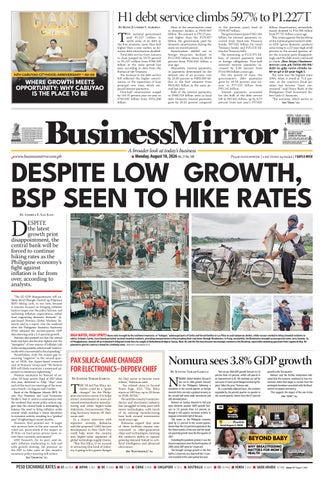
H1 debt service climbs 59.7% to ₧1.227T By Reine Juvierre S. Alberto
T
14TH CABUYAO CITYHOOD ANNIVERSARY
HE national government paid P1.227 trillion to settle some of its debt in the first semester, more than half higher than a year earlier, as domestic debt amortization doubled. Total debt service from January to June jumped by 59.70 percent to P1.227 trillion from P768.109 billion in the same period last year, according to data from the Bureau of the Treasury. The increase in the debt service bill reflected the higher amortization, or the repayment of loan principal over time, which outpaced interest payments. First-half amortization surged by 110.31 percent year-on-year to P743.002 billion from P353.288 billion.
A8-A9
WHERE GROWTH MEETS OPPORTUNITY: WHY CABUYAO IS THE PLACE TO BE
ROTARY CLUB OF MANILA JOURNALISM AWARDS
2006 National Newspaper of the Year 2011 National Newspaper of the Year 2013 Business Newspaper of the Year 2017 Business Newspaper of the Year 2019 Business Newspaper of the Year 2021 Pro Patria Award PHILIPPINE STATISTICS AUTHORITY 2018 Data Champion
Most of the amortization went to domestic lenders at P630.907 billion. The amount is 270.13 percent higher than the P170.457 billion the government paid for domestic amortization during the same six-month period. Amortization shelled out to foreign financiers declined to P112.095 billion, down by 38.69 percent from P182.831 billion a year ago. Meanwhile, interest payments, or payments determined by the interest rate of an account, rose by 16.60 percent to P483.690 billion in the first semester from P414.821 billion in the same period last year. Bulk of the interest payments, or P360.719 billion went to local debt. Domestic interest payments grew by 20.31 percent compared
to the previous year’s level of P299.827 billion. The government spent P242.164 billion for interest payments incurred from fixed-rate Treasury bonds, P87.502 billion for retail Treasury bonds and P25.150 billion for Treasury bills. The remaining, or P122.971 billion, of interest payments went to foreign obligations. First-half external interest payments increased by 6.94 percent from P114.994 billion a year ago. For the month of June, the government’s debt payments grew by 18.54 percent year-onyear to P77.219 billion from P65.141 billion. Interest payments accounted for the bulk of the debt service bill at P62.431 billion, up by 8.73 percent from last year’s P57.420
billion. Amortization, meanwhile, nearly doubled to P14.788 billion from P7.721 billion a year ago. This comes against the backdrop of the national government’s debtto-GDP (gross domestic product) ratio rising to a 22-year-high at 66 percent in the second quarter, after the economy grew disappointingly and the debt stock continued to climb. (See: https://businessmirror.com.ph/2026/08/08/ debt-to-gdp-ratio-climbs-to66-in-q2-a-22-year-high/). The ratio was the highest since 2004, when it stood at 71.6 percent, as the country’s fiscal position has become “more constrained,” said Union Bank of the Philippines Chief Economist Ruben Carlo O. Asuncion. “The economy, which serves as See “Debt,” A2
BusinessMirror A broader look at today’s business
EJAP JOURNALISM AWARDS
BUSINESS NEWS SOURCE OF THE YEAR
(2017, 2018, 2019, 2020, 2021) DEPARTMENT OF SCIENCE AND TECHNOLOGY
2018 BANTOG MEDIA AWARDS
DESPITE LOW GROWTH, BSP SEEN TO HIKE RATES www.businessmirror.com.ph
n
Monday, August 10, 2026 Vol. 21 No. 300
P25.00 nationwide | 2 sections 24 pages | 7 DAYS A WEEK
By Andrea E. San Juan
D
ESPITE the latest growth print disappointment, the central bank will be forced to continue hiking rates as the Philippine economy’s fight against inflation is far from over, according to analysts.
“The Q2 GDP disappointment will unlikely derail [Bangko Sentral ng Pilipinas] BSP’s hiking cycle, in our view, because it remains focused on bringing inflation back to target over the policy horizon and anchoring inflation expectations, rather than supporting domestic demand,” Japan-based Nomura Global Markets Research said in a report over the weekend after the Philippine Statistics Authority (PSA) released the second-quarter GDP data showing only a 2.3-percent growth. Nomura also pointed out that the central bank may have also become vigilant over the “emergence” of new sources of inflation risk in the coming months, which it said “could coincide with a turnaround in fiscal spending.” Nonetheless, with the output gap remaining “negative” in the second quarter of 2026, the Japan-based research unit of Nomura Group said: “We believe BSP will likely maintain a measured approach to monetary tightening.” Nomura maintains its forecast of another 50 basis points (bps) of BSP hikes this year, delivered in 25bp “clips” over each of the next two meetings of the monetary board—in August and October. Bank of the Philippine Islands (BPI) Senior Vice President and Lead Economist Emilio S. Neri Jr. said in a commentary over the weekend that recent policy actions suggest that the central bank is attempting to balance the need to bring inflation under control while avoiding a sharp slowdown in economic activity, resulting in a “gradual pace” of tightening in recent months. However, Neri pointed out: “A larger rate increase later in the year cannot be ruled out, particularly if the impact on El Niño on food prices proves more severe than currently anticipated.” ANZ Research, for its part, said despite inflation moderating in July and with growth slowing, the pressure on the BSP to hike rates at this month’s monetary policy meeting will reduce. See “Growth,” A2
HIGH WATER, HIGH SPIRITS Heavy rains brought by the southwest monsoon, or “habagat,” submerged parts of Cavite and forced families in Las Piñas to seek temporary shelter, while rescuers worked to bring stranded residents to safety. In Kawit, Cavite, Coast Guard personnel assisted stranded residents, providing transportation to those making their way home through floodwaters. In Pasig, meanwhile, the floodwaters brought an unexpected catch. Jerry Saunda, 54, of Pinagbuhatan, showed off an estimated 8-kilogram Cream Dory he caught at Barkadahan Bridge in Taytay, Rizal. He said the fish have become increasingly common in the floodway, reportedly swimming upstream from Laguna de Bay. He planned to give his catch to a friend for a birthday meal. NONIE REYES AND BERNARD TESTA
PAX SILICA: GAME CHANGER FOR ELECTRONICS–DEPDEV CHIEF By Justine Xyrah Garcia
T
HE US-led Pax Silica initiative could be a “game changer” for the Philippine electronics sector if it helps attract investments in more advanced semiconductor manufacturing and other higher-value industries, Socioeconomic Planning Secretary Arsenio M. Balisacan said. In a chance interview with reporters recently, Balisacan said the proposed 1,620-hectare development in New Clark City could help move the country into higher-value segments of global technology supply chains. “This Pax Silica, if we succeed in attracting this kind of industry, is going to be a game changer
for that sector to become more robust,” Balisacan said. See related story in Second Front Page, A13, “Pax Silica starts at 500 has, up to 20 firms in 2028–BCDA.” He said the country’s semiconductor and electronics industry has struggled to keep pace with newer technologies, with much of its existing manufacturing base built around investments made years ago. Balisacan argued that some of these facilities remain concentrated in older-generation chips and technologies, limiting the country’s ability to capture growing demand linked to artificial intelligence and advanced electronics. See “Electronics,” A2
Nomura sees 3.8% GDP growth By Justine Xyrah Garcia
N
OMURA Global Markets Research has cut its 2026 growth forecast for the Philippines following a slowdown in the second quarter, as foreign research firms see only a gradual recovery in the second half amid weak investment and still-elevated prices. Nomura on Sunday lowered its full-year gross domestic product (GDP) growth forecast to 3.8 percent from 4.6 percent, although it still expects economic activity to improve in the latter half of the year. This comes as the Philippine economy grew by 2.3 percent in the second quarter, slower than the 2.8-percent expansion in the first three months of the year and the weakest quarterly growth since the first quarter of 2021. Excluding the pandemic period, it was the slowest expansion since the fourth quarter of 2009, when GDP grew by 1.8 percent. This brought average growth in the first half to 2.6 percent, less than half the 5.4 percent recorded in the same period last year.
“We cut our 2026 GDP growth forecast to 3.8 percent from 4.6 percent, which still pencils in an improvement in H2. We maintain our call for two more 25-basis-point Bangko Sentral ng Pilipinas’ hikes this year,” Nomura said. On a seasonally adjusted basis, the economy expanded by 0.6 percent quarter-on-quarter in the second quarter, slower than the 0.9 percent »B8
growth in the first quarter. Nomura said the further moderation indicated that the economy continued to lose momentum rather than begin to recover from the prolonged slowdown associated with the floodcontrol corruption controversy. “This suggests the impact of the war in Iran See “GDP,” A2
BusinessMirror
BM Freshly Brewed
Aired August 3, 2026
BEYOND BABY DR. JOYCE ESTELA A. JERUS Obstetrician-Gynecologist at Perpetual Help Medical Center–Las Piñas
WHY BREASTFEEDING MATTERS FOR MOM’S HEALTH
ANNE RUTH DELA CRUZ BusinessMirror Health&Fitness Editor
PESO EXCHANGE RATES n US 60.7020 n JAPAN 0.3831 n UK 81.6806 n HK 7.7388 n CHINA 8.9906 n SINGAPORE 47.3015 n AUSTRALIA 42.6614 n EU 69.9469 n KOREA 0.0427 n SAUDI ARABIA 16.1686 Source: BSP (August 7, 2026)
News
BusinessMirror
A2 Monday, August 10, 2026
Forecast…
Continued from A13
the dependence. And guess what? What’s the biggest imported material? Wafers,” Lachica said. Despite the possibility of broader economic growth slowing, Lachica said AI-related demand has yet to reach a peak. “In any new technology, there will be a plateau over time. But I think the AI development is not even there yet. There are still growth opportunities and advancements in technology. The peak is not there yet,” he said.
Pax Silica starts as…
Continued from A13
not part of the Pax Silica site. About water use, the BCDA has estimated that Pax Silica could eventually require between 65 million and 90 million liters of water a day. In its presentation, the agency said the planned water system would rely on surface-water harvesting, storage, treatment and recycling, with the initial system designed for a capacity of up to 135 million liters per day. On the other hand, during the unveiling of a marker for the planned AI hub in New Clark City in May, Bingcang said the government has also rejected proposals that would have placed portions of it outside Philippine jurisdiction. In a televised interview in July, he said Philippine and United States officials were targeting completion of the framework within two to three months, with a possible signing before the end of the year.
www.businessmirror.com.ph
Parañaque spillway revived to help drain Laguna Lake
T
By Mary Jade Jadormio
HE government is reviving the P90billion Parañaque Spillway Project to provide additional drainage for Laguna de Bay as another planned floodcontrol project is expected to divert more water into the lake. The Department of Agriculture (DA) and Laguna Lake Development Authority (LLDA) said the long-delayed project could also improve water circulation, support fisheries production and strengthen the lake’s role as a freshwater source. First proposed in the 1970s, the 10.5-kilometer spillway would run at least 50 meters underground and connect Laguna de Bay to Manila Bay. Construction is expected to take at least a decade once the project begins. LLDA General Manager Leopoldo Parumog said the spillway has become more critical with the planned Manggahan Control Gate Structure, which would divert floodwater from the Marikina River into Laguna de Bay. The Japanese-funded Manggahan
project is designed to divert up to 2,400 cubic meters of floodwater per second to help reduce severe flooding in Metro Manila. That volume is equivalent to about one Olympic-size swimming pool being discharged into the lake every second, according to the DA. While the Manggahan project would reduce flooding along the Marikina River, the additional water could raise Laguna de Bay levels and increase flood risks in lakeshore communities unless more drainage capacity is built. Agriculture Secretary Francisco P. Tiu Laurel Jr. said better water circulation and flood management could also help restore the lake’s ecological condition.
“Laguna de Bay is one of Metro Manila’s most important food baskets and our most affordable source of bangus [milkfish],” Tiu Laurel said. “If we restore the lake’s health by improving water circulation and managing floods better, we can raise fish production, increase fisherfolk incomes, and improve raw water quality, which could eventually help lower water treatment costs for consumers,” he added. The project, however, has faced concerns from residents of Muntinlupa City and Bacoor City over possible displacement and the risk of shifting flood problems from one area to another. Muntinlupa is where the tunnel would draw water from Laguna de Bay, while Bacoor is where excess water would be discharged into Manila Bay. Tiu Laurel said the DA and
LLDA would work with the Department of Public Works and Highways, Department of Environment and Natural Resources, local governments and private stakeholders to address these concerns. “The challenge is to show that this is not simply another floodcontrol project,” he said. “Done right, it is an investment in food security, climate resilience, and longterm water sustainability that will benefit millions of Filipinos.” Maynilad Water Services Inc. already taps Laguna Lake as a raw water source for millions of customers in Metro Manila and Cavite, including Muntinlupa and Bacoor. The DA said improving water circulation and reducing pollution buildup could improve raw water quality and eventually lower treatment costs.
Electronics…
Over a 25-year period, BCDA projects the development to generate P60 billion in lease income, while annual withholding tax collections could reach P68 billion to P75 billion. Its export potential has been estimated at as much as $200 billion annually once fully operational.
Continued from A1
The challenge, he said, is to attract investments that would upgrade the country’s existing manufacturing capabilities and allow it to produce higher-value exports. Balisacan noted that exports have recently grown faster than imports, with electronics and semiconductors accounting for a significant share of outbound shipments. Philippine Statistics Authority (PSA) data showed merchandise exports rose by 24.1 percent to $8.77 billion in June from $7.06 billion a year earlier. Imports increased by 19.6 percent to $13.71 billion from $11.46 billion. Balisacan said the gains from the development should also extend beyond higher export receipts, particularly through the creation of higher-quality jobs and stronger demand for more advanced skills. “This should bring high-quality jobs, this should improve the innovation ecosystem of the country.... If you look at it that way, it’s a positive force for development,” he added. Data from the Bases Conversion and Development Authority (BCDA) estimates that Pax Silica could attract US$70 billion in investments, create 130,000 to 190,000 direct jobs, and generate 500,000 to 800,000 indirect jobs. He added that workers would need to undergo upskilling and reskilling to meet the requirements of more technologically advanced manufacturing activities. The Bases Conversion and Development Authority has estimated that the Pax Silica-linked development could attract as much as $70 billion in investments and generate between 130,000 and 190,000 direct jobs, along with 500,000 to 800,000 indirect jobs.
GDP…
Continued from A1
has likely exacerbated some lingering spillover effects on private sector spending from the sharp fiscal tightening and associated governance concerns, hurting domestic demand overall,” it added.
Infra-led recovery
ANZ Research and Capital Economics likewise expect growth to improve in the coming quarters, although both see constraints to a stronger rebound. ANZ said a recovery in public infrastructure spending beginning in the third quarter could help revive capital formation, which emerged as one of the biggest drags on second-quarter growth. “Steady normalization of public infrastructure spending will be key for a meaning-
Access, sovereignty questions
AMID concerns over how the initiative could affect the country’s natural resources and economic sovereignty, Balisacan said details of the arrangement are still evolving and the public should just “wait for what will happen there.” The country’s chief economist also rejected the idea that industries established under Pax Silica would necessarily direct their output solely to the United States, saying production would form part of a wider global supply chain involving several participating economies. He said the Philippines should instead focus on what it intends to gain from the partnership, particularly investments that would increase the amount of value created domestically. Under that approach, the government would seek investments that upgrade the semiconductor and electronics industry and establish local processing facilities for critical minerals to increase domestic value. “It’s not just about what America or others want us to do. It’s also a question of what we want to bring to the table. That’s why we are very aggressive in pushing for what we want,” he said. Balisacan also maintained that the government would retain control over the types of investments allowed into the country, although attracting higher-value facilities would depend on whether the Philippines could provide a competitive environment for investors.
ful recovery in GDP growth in the upcoming quarters,” ANZ Research said. The Department of Economy, Planning, and Development (DepDev) earlier said it was banking partly on a rebound in infrastructure spending after the Department of Budget and Management began releasing mobilization funds for 2026 projects toward the end of June. The Department of Public Works and Highways also started awarding contracts in June and July, which DepDev expects to support a pickup in public construction beginning in the third quarter and gain momentum in the succeeding months. Capital Economics, meanwhile, expects only a modest improvement after the weak first-half performance. “Growth should improve a little from here, but the recovery will be very gradual. The recent falls in oil prices, if sustained, will help reduce inflation and boost the purchasing power of consumers. But the corruption scandal is unlikely to go away,” it explained.
Growth…
Continued from A1
However, the research unit of the Australiabased bank shared almost the same view as BPI’s lead economist, saying: “We expect inflation to remain elevated over the rest of the year, particularly as El Niño-related supply pressures begin to feed through to food prices.”
Further rate hikes after August ‘less clear-cut’
OTHER analysts stressed, however, that with the low domestic demand, there may no longer be “much room” for the central bank to raise the key interest rate beyond the August rate-setting meeting of the Monetary Board. United Kingdom-based research firm Capital Economics said the “weakness” of the economy is likely to influence the thinking of the central bank as it weighs its next move. “The continued weakness of the economy means the case for further hikes is less clear-cut. But with inflation still well above target, we expect one more 25bps hike at the BSP’s next meeting on 27th August before it calls a halt to its hiking cycle,” Capital Economics noted. Domini S. Velasquez, Group Chief Economist of China Banking Corporation (Chinabank), said in a televised interview that the BSP may deliver “one more hike, especially with the GDP figure now.” “We know that the BSP is an inflation targeter. But sometimes, you know, these supply shocks, monetary policy cannot do anything about it, unless, you know, except anchoring inflation expectations. But in terms of low domestic demand, I don’t think there’s much room to increase. Maybe another last hike this end of August,” Velasquez said. The BSP has raised the key interest rate by a total of 50 basis points since the start of the conflict in the Middle East, delivering two separate quarter-point rate hikes at the Monetary Board’s ratesetting meeting held on April 23 and June 18. These policy actions brought the Target Reverse Repurchase (RRP) Rate to 4.75 percent. During its June 18 meeting, the Monetary Board decided that monetary policy tightening was “warranted” to keep inflation expectations anchored and mitigate the risk of second-round effects. “The measured monetary policy action will also complement fiscal measures in supporting steady consumption and strengthening business sentiment,” the central bank also said in a statement on June 18. On August 7,2026, the Philippine Statistics Authority (PSA) reported that the growth of the Philippine economy in the second quarter eased to 2.3 percent from the 2.8 percent in the first quarter. The latest reading was the slowest since the first quarter of 2021, when the economy contracted by 3.8 percent. Excluding the pandemic period, it was the weakest growth recorded since the fourth quarter of 2009, when gross domestic product (GDP) expanded by 1.8 percent. (See: https://businessmirror.com.ph/2026/08/08/growth-at-23-in-q2-recovery-dims-in-2026/)
H1 debt service climbs…
Continued from A1
the denominator of the ratio, is expanding more slowly than anticipated, making it more difficult to stabilize debt metrics,” Asuncion said. As of end-June, the national government’s outstanding debt was at an all-time high of P19.065 trillion, while GDP expanded by 2.3 percent in the second quarter. This year, the government has programmed P2.005 trillion in debt service payments, consisting of P1.005 trillion in amortization and P950 billion in interest payments.
The research firm said President Marcos’s renewed emphasis on combating corruption in his fifth State of the Nation Address (Sona) suggests that tighter scrutiny surrounding public projects could continue to weigh on investment. It added, however, that continued economic weakness could put pressure on the government to ease the constraints on public investment arising from its anti-corruption drive. Capital Economics expects GDP to grow by around 3 percent this year, while ANZ forecasts a 3.9-percent expansion. The Development Budget Coordination Committee (DBCC) in late June lowered its 2026 growth target to a range of 3.5 to 4.5 percent from 5 to 6 percent, citing weaker-than-expected economic performance following the flood-control controversy and the economic fallout from the Middle East conflict. Growth targets for 2027 to 2030 were likewise reduced to 5 to 6 percent. The previous targets were 5.5 to 6.5 percent for 2027 and 6 to 7 percent for 2028 to 2030.
A4
Monday, August 10, 2026
www.businessmirror.com.ph
Prosecutors waiting for testimony of OVP, DepEd disbursing officers
T
HE prosecution in Vice President Sara Duterte’s impeachment trial is moving to close a critical gap in the confidentialfund money trail by questioning the disbursing officers who personally received the cash and presenting government experts who may challenge the identities and signatures appearing on thousands of acknowledgement receipts.
Gina Acosta and Edward Fajarda, the former special disbursing officers of the Office of the Vice President and Department of Education, respectively, are expected to be treated as hostile witnesses and questioned about where the funds were taken and how they were distributed after their withdrawal from LandBank. The prosecution said their testimony could provide the crucial link between the release of the cash and its subsequent liquidation through acknowledgment receipts, many of which reportedly contain names that could not be matched with official civil registry records. Private prosecutor and House prosecution panel legal spokesperson Benjamin “Jay” Tolosa Jr. said Acosta and Fajarda could be treated as hostile witnesses because their interests are considered adverse to those of the prosecution. “Yes. When you describe someone as a hostile witness, it means that the witness’ interests are adverse to those of the party that called them,” Tolosa said. The hostile-witness classification would allow prosecutors to ask leading questions even though they are the party presenting Acosta and Fajarda before the Senate Impeachment Court. Their expected testimony follows the presentation of evidence from former LandBank officials concerning the withdrawal of confidential funds intended for the OVP and DepEd. Tolosa said the two disbursing officers occupied a crucial position in the fund trail because they were the officials who received the cash after it was withdrawn from the bank. “We should watch out for their testimonies because they were the special disbursing officers. As we may recall from the testimony of the LandBank officer, they were
the ones who received the money,” Tolosa said. The prosecution is seeking to establish the movement of the funds from their release and withdrawal to their alleged distribution and eventual liquidation through acknowledgment receipts and other supporting documents. For prosecutors, the testimony of the disbursing officers could answer a central question in the case: What happened to the cash after it was released to them? “It will be important to hear from them because they were accountable for the funds. After receiving the money, where did they take it, and how did they use it?” Tolosa said. Acosta and Fajarda previously appeared during the House inquiry into the use of confidential funds, where their respective roles as the OVP and DepEd special disbursing officers were identified. Their testimony is expected to be assessed alongside bank records, liquidation documents and Commission on Audit (COA) findings presented under Article I of the impeachment case. Tolosa acknowledged that the ultimate determination of the credibility and evidentiary weight of their testimony would rest with the senator-judges.
COA trail
THE prosecution is also relying on COA Intelligence and Confidential Funds Audit Office Supervising Auditor Celine May Del Campo to continue the audit trail beyond the matters covered by former state auditor Roderick Wamil’s personal knowledge. Both Wamil and Del Campo were subpoenaed by the Senate Impeachment Court as prosecution witnesses under Article I, which covers the alleged misuse and irregular liquidation of P612.5 million in confidential funds assigned
to the OVP and DepEd. Wa m i l test i f ied pr i m a r i ly about the audit stages and documents personally handled before succeeding portions of the audit process were taken over by other auditors. According to Tolosa, Wamil could not answer certain questions regarding notices of disallowance because those developments occurred after the auditor had left the Intelligence and Confidential Fund Audit Office. “There were questions, particularly about the notices of disallowance. Wamil said, ‘I no longer have personal knowledge about that because I had already left.’ Ms. Celine succeeded Wamil, so she will continue that part of the account,” Tolosa explained. Tolosa rejected suggestions that Del Campo’s testimony would merely repeat what Wamil had already told the impeachment court. “Some people may be wondering whether they will say the same things. No, their testimonies are different,” he said. The prosecution considers the distinction significant because the COA process allegedly progressed from audit observations and suspensions to the issuance of notices of disallowance. During the proceedings, Wamil repeatedly limited the testimony to audit developments within the former auditor’s personal knowledge. Del Campo is expected to discuss the succeeding audit actions based on records she handled and events within her direct knowledge. “For the matters that were already outside Wamil’s personal knowledge, Celine will fill in the missing details,” Tolosa said. Del Campo recommended the issuance of notices of disallowance covering P448 million of the P500 million in confidential funds provided to the OVP, according to House prosecutor and Bicol Saro Party-list Rep. Terry Ridon.
Receipts under scrutiny
BEYOND the withdrawal and audit of the funds, the prosecution also intends to examine the identities and signatures appearing on acknowledgment receipts submitted to support the liquidation of confidential expenditures. Ridon said the 845 acknowledgement receipts presented in connection with the OVP’s confidential funds represented only the “tip of the iceberg.” Speaking at the Saturday News Forum in Quezon City, Ridon said witnesses from the Philippine Statistics Authority and the National Bureau of Investigation are expected
to appear in the coming weeks to demonstrate the extent of the alleged irregularities. The PSA witnesses are expected to discuss government civil-registry searches involving people named as confidential-fund recipients. NBI experts, meanwhile, are expected to testify about the handwriting and signatures found on the acknowledgment receipts. Ridon recalled that during the clarificatory hearings conducted by the House Committee on Justice, an NBI handwriting expert found indications that the signatures appearing on numerous acknowledgment receipts may have been written by only one person or a small group of individuals. “The handwriting appeared to indicate that only a small group of people signed these acknowledgement receipts,” Ridon said, recalling the expert’s earlier testimony. He argued that the expected PSA and NBI testimonies could broaden the questions surrounding the confidential funds beyond the amounts already disallowed by state auditors. “Apart from COA’s findings in its two decisions, the entire body of acknowledgement receipts may be called into question in the coming weeks when the PSA and NBI witnesses take the stand,” Ridon said. “The questions will not be limited to the amounts disallowed in the audit. The evidence may show that only one person or a small group of people signed the acknowledgment receipts,” he added. The receipts presented so far allegedly included the names Mary Grace Piattos, Renan Piatos, Andy Lim, Alejandro Pikit, Nova Santos, Mico Harina and Patty Ting as recipients of confidential funds. During the House Committee on Justice hearings, the PSA reported finding no records of the birth, marriage or death of individuals identified as Mary Grace Piattos, Kokoy Villamin and Milky Secuya. The absence of civil-registry records does not by itself establish that a person does not exist. The prosecution, however, is expected to use the PSA results together with handwriting findings, audit records and testimony from the officials who handled the cash to question the reliability of the liquidation documents. “For thousands of acknowledgement receipts, different recipients should have signed them,” Ridon said. “Once the NBI handwriting expert takes the witness stand, the evidence may show that the investigation should not be confined to the amounts disallowed in the audit.”
Senator bats for ₧2,000 monthly allowance for PWDs
A
SENATOR is seeking to provide a P2,000 monthly disability support allowance to persons with disabilities (PWDs) to help cover disabilityrelated costs and other essential expenses. Under Senate Bill 2386, or the National Disability Support Act, qualified PWDs will receive the monthly allowance through a National Disability Support Allowance Program, with the amount subject to periodic adjustments based on inflation to preserve its value over time. “Persons with disabilities face additional and often invisible expenses in their daily lives, including transportation, healthcare, personal assistance, and assistive devices. These are essential not only for survival, but for participation in school, work,
and community life. When these expenses are not addressed, opportunities are limited, poverty is deepened, and exclusion persists,” sen. Bam Aquino said. “This allowance is designed to complement existing social protection programs and empower persons with disabilities to live more independently, pursue education and employment, and participate more actively in society,” he added. The measure proposes a phased implementation of the Disability Support Allowance Program. During the first three years, priority beneficiaries will include children with disabilities and adults with significant disabilities. In the next three years, coverage will be expanded to include persons with moderate disabilities who incur disability-related costs. Ultimately, the program
will cover all eligible persons with disabilities who incur disability-related extra costs. “By strengthening income support, this measure helps ensure that persons with disabilities are not only supported, but empowered to live independently and participate fully in society,” Aquino stressed, adding that empowering persons with disabilities builds a more inclusive and equitable Philippines. To ensure fair and responsive implementation, the measure mandates the creation of a Disability and Needs Assessment System (DNAS), which will determine eligibility based on an individual’s functional limitations, support needs, and barriers to participation rather than income alone. The bill also establishes a Disability Management Information
System (DMIS) linked to existing national databases—including the National ID System, the Philippine Persons with Disabilities Registry, PhilHealth, and community-based monitoring systems—to improve disability data, strengthen policymaking, enhance service delivery, and facilitate the direct payment of benefits to qualified beneficiaries. The Department of Social Welfare and Development (DSWD) will administer the program with support from a Multi-Stakeholder Committee led by the National Council on Disability Affairs (NCDA). “In empowering persons with disabilities, we are not only addressing inequality, but also unlocking potential, strengthening communities, and building a more inclusive and equitable Philippines,” Aquino said. Butch Fernandez
Mercury-laced skin whiteners still available in marketplace despite global ban–group By Jonathan L. Mayuga @jonlmayuga
H
A Z A R DOUS merc u r ylaced skin whiteners are still widely available in the marketplace, threatening people and the planet, a group advocating zero waste and toxic-free society said. The EcoWaste Coalition made this observation ahead of the ninth anniversary of the Minamata Convention on Mercury, which entered into force on August 16, 2017. The treaty, among other provisions, banned the use of mercury in cosmetics, such as skin-lightening products, to protect human health and the environment from the harmful effects of mercury and its compounds. “Our vigilant market monitoring shows the global ban on healthand environmentally-damaging mercury-containing cosmetics is far from being fully enforced,” said Aileen Lucero, National Coordinator, EcoWaste Coalition. “Countries that produce, import, and export mercury-containing cosmetics, as well as ecommerce and social media platforms peddling them, must take strong steps to shut down the illegal manufacturing and sales of these prohibited products.” “Moreover, we must fix colorism, challenge discriminatory beauty standards, uphold inclusivity, lift all skin tones, and promote respect for natural skin to discourage use of chemical whiteners laced with mercury and other hazardous substances,” she added. T he Minamata Convention originally scheduled the global phase-out of the manufacture,
import, and export of mercuryadded cosmetics in 2020. At the fifth Conference of the Parties (COP5), parties agreed to a binding 2025 deadline to eliminate mercury in such products, and removed the previous one part per million (ppm) threshold for mercury content in cosmetics. However, mercury-laced skinlightening products are still being made and sold, even though the 2020 and 2025 phase-out deadlines have passed and health authorities have already flagged some of these items, the EcoWaste Coalition said. To illustrate the persistent problem w ith mercur y-added cosmetics, the EcoWaste Coalition reported it has procured and analyzed 27 contaminated products from January to July 2026, including 22 from Pakistan, two from Taiwan, and one each from China, Indonesia, and Thailand. Of the 27 analyzed products, 15 were manufactured in 2025; four in 2026; three in 2024; two in 2023; and one in 2022 (two products provided no production and/or expiration dates). Using a handheld Olympus Vanta M Series X-Ray Fluorescence (XRF) analyzer, the EcoWaste Coalition detected mercury up to 33,970 ppm in these products marketed to lighten the skin tone, achieve a youthful glow, treat acne, and remove signs of ageing, including age spots, freckles, and wrinkles. Among the mercury-tainted skin-lightening products discovered by the EcoWaste Coalition from January to July 2026 are: See “Mercury,” A12
Parents limited to 20% of child content creators’ earnings–DOLE By Mary Jade Jadormio
F
AMILIES may use only up to 20 percent of the earnings of children working in monetized social media content, while the remaining 80 percent must be reserved for the child, the Department of Labor and Employment (Dole) said. Labor Secretary Francis N. Tolentino said the income safeguards are meant to protect child workers from financial exploitation as existing labor protections are extended to digital platforms. Under current rules, 80 percent of a child worker’s earnings must be placed in savings or a trust
fund for education, health needs or future use. “The amount that may be spent for the family is 20 percent. The remaining 80 percent should be placed in savings or a trust fund for the child’s education, health needs or future use,” Tolentino said. The requirement applies to children below 15 who work or are featured in monetized social media content covered by Labor Advisory 12, Series of 2026. T he adv i sor y covers d ig it a l pl at for ms suc h a s vlogs, livestreams, podcasts and online endorsements. See “Parents,” A12
Pass NCA law soon, Congress urged By Jovee Marie N. dela Cruz @joveemarie
T
HE growing threat of cyberattacks against financial platfor ms, gover nment databases, power systems, transportation networks, and healthcare services has intensified the push in Congress to establish a permanent National Cybersecurity Agency. House Committee on Information and Communications Technology Chairman Migz Villafuerte said the proposed agency would strengthen the country’s ability to prevent and respond to cyberattacks, which now pose risks not only to computers but also to the economy, public services, and the safety of Filipinos. The proposal gained urgency after GCash reported blocking
approximately 6,700 fraudulent merchant accounts connected to “quishing” scams in July. During the same month, the Philippine National Police Anti-Cybercrime Group conducted 6,845 cyber patrol operations and at least 220 digital forensic examinations. Villafuerte expressed optimism about the proposed establishment of the NCSA under the Department of Information and Communications Technology (DICT), following the House of Representatives’ recent approval on second reading of House Bill 423, or the “National Cybersecurity and Critical Information Infrastructure Protection Act of 2026.” The substitute measure was consolidated by a technical working group from 26 cybersecurity- and See “NCA,” A12
Economy Tripartite panel to tackle decade-old electric co-op labor issues formed By Mary Jade Jadormio
L
ONG-RUNNING labor concerns in electric cooperatives will now be handled through a permanent tripartite mechanism after workers, employers and the Department of Labor and Employment (DOLE) agreed to create a sector-specific council. The National Tripartite Industrial Peace Council (NTIPC) approved the establishment of the Electric Cooperative Industry Tripartite Council (ECITC), which will serve as a continuing venue for addressing labor and employment issues in the sector. Labor Secretary Francis N. Tolentino said concerns involving the National Electrification Administration (NEA) and electric cooperative workers have persisted for around a decade. “This matter has been going on for ten years,” Tolentino said in Filipino. The creation of the council followed a recent dialogue between the labor department and NEA over concerns affecting the implementation of collective bargaining agreements (CBAs) in electric cooperatives. Tolentino said discussions should balance the financial condition of cooperatives with the right of workers to organize and negotiate collectively. “NEA has the right to balance its books,
but electric cooperative workers also have the right to form unions and negotiate with them,” he said. The new council will bring together representatives of government, labor and management to discuss sector-wide concerns and seek agreements before disputes escalate. It will also serve as a continuing forum for consultation and consensus-building on labor-management relations, including issues surrounding the implementation of CBAs. The initiative builds on earlier efforts by labor and energy authorities to improve collective bargaining in electric cooperatives, including capacity-building activities for union and management representatives. DOLE and NEA signed an agreement in 2024 aimed at strengthening collective bargaining in the sector, followed by training activities on CBA negotiations and implementation involving the National Conciliation and Mediation Board (NCMB). Tolentino said the tripartite approach is intended to find common ground among parties rather than require one sector to adopt the position of another, as the government seeks to prevent recurring labor disputes while protecting both workers’ rights and the viability of electric cooperatives.
Palawan makes Expedia’s list of hottest islands for ‘26 By Ma. Stella F. Arnaldo
@akosistellaBM Special to the BusinessMirror
P
ALAWAN has landed on a popular global travel search engine’s list of “hot” islands to visit this year. In a post on its website, Expedia ranked Palawan in sixth place on its “2026 Island Hot List: The Next Wave of Trending Islands,” after travel interest grew by 40 percent, year on year (yoy). It is only one of two islands in Southeast Asia that made the list, the other being Phu Quoc in Vietnam, which recorded a 25 percent increase in travel interest, (yoy). This placed the island in ninth place of Expedia’s 10 hot islands this year. The travel engine described Palawan as the “Best for Natural Wonders” and explained why the island was included in the next wave of island destinations: “Palawan continues to rise for its dramatic limestone cliffs, clear waters and pristine ecosystems. It’s a natural fit for travelers chasing awe-inspiring scenery and discovery-led adventure.” Last year, Palawan received some 2.13 million tourists, up 8.12 percent, yoy. According to the Provincial Tourism Office, of the total visitors in 2025, domestic travelers accounted for 52 percent or nearly 1.1 million, a 13.4 percent growth from 2024. Foreign tourists accounted for 48.4 percent of total, having reached 1.03 million, up nearly 25 percent, yoy.
Capital captures chunk of visitors
PALAWAN’S capital of Puerto Princesa welcomed the most number of visitors at 821,504 last year; followed by El Nido at 642,385; Coron at 336,304; and San Vicente at 97,096. No comparative figures were available for 2024. Puerto Princesa may be reached via nonstop flights from airports in Manila, Cebu, Iloilo, and Davao, while its northern destinations such as Coron and El Nido may be accessed via flights from Clark International Airport in Pampanga and Mactan-Cebu International Airport. Local tour operators have warned that the transfer of turboprop flights to Clark will likely reduce the desirability of El Nido as a tourism destination, as they will have to charge additional expenses to foreign tourists for their travel from Manila, where most of the latter land, to Clark in Pampanga. (See, “Tourism braces for move of turboprop flights to Clark,” in the BusinessM irror, Jan. 26, 2026.) The list of hot islands was topped by St. Lucia in the Carribbean region with 125 percent increase in traveler interest on Expedia’s site; followed by Porto Santo, Madeira in Portugal (+85 percent); Praslin, Seychelles (+80 percent); Syros, Greece (+60 percent); and Lofoten Islands, Norway (+50 percent). See “Palawan,” A12
Union seeks safety audit after fatal South Commuter Railway accident
A
CONSTRUCTION workers’ union has called for an urgent safety audit of the South Commuter Railway Project after a Filipino worker died at its Santa Rosa, Laguna segment. The National Union of Building and Construction Workers (NUBCW) said the worker was killed in an accident at the construction site on the morning of Aug. 6, while a Chinese worker was also injured and hospitalized. Initial reports raised questions over the condition, inspection and maintenance of the equipment involved, as well as worker training, supervision and safe access at the site, according to the union. “These circumstances demand an immediate, independent, and transparent investigation,” NUBCW said in a joint statement with the Building and Wood Workers International (BWI). The groups urged the Department of Transportation (DOTr), Department of Labor and Employment (DOLE) and other concerned agencies to investigate the incident and conduct an urgent review of safety conditions at the project. NUBCW also sought accountability beyond those directly involved in the accident, saying authorities should determine responsibility “throughout the chain of responsibility.” The union, however, did not specify the
equipment involved or the circumstances that led to the worker’s death, and no official finding on the cause of the accident has been made public. NUBCW said the worker’s family should immediately receive compensation, assistance and all benefits due, while the injured worker should be provided proper medical care and support. “A worker should never have to die just to earn a living,” the group said. The Santa Rosa segment forms part of the South Commuter Railway Project, the Alabang-Calamba section of the larger NorthSouth Commuter Railway (NSCR). The P73.25-billion South Commuter Railway covers three civil works contract packages involving railway viaducts and elevated stations in Alabang, Muntinlupa, San Pedro, Pacita, Biñan, Santa Rosa, Cabuyao, Banlic and Calamba. Once completed, the section will form part of the 147-kilometer NSCR system connecting Clark, Pampanga to Calamba, Laguna, one of the government’s flagship transportation projects. The Aug. 6 incident places renewed attention on occupational safety at the project as construction continues across several sites in southern Metro Manila and Laguna. Mary Jade Jadormio
Monday, August 10, 2026
A5
Law easing permits, fees for rooftop solar seen to cut demand from grid By Lenie Lectura
A
@llectura
PROPOSED law that removes heavy permits and fees for homes and businesses setting up rooftop solar panels for personal use could trigger a massive drop in electricity demand from the main grid, hurting the profitability of power distribution utilities (DUs). “That has a direct impact on our distribution utilities [DUs], and it affects the market as well. Essentially, instead of market demand increasing, it will shrink; selfgeneration—such as distributed energy resources—will offset the load, meaning that demand won’t register in the market. “The direct market impact is a drop in demand. Similarly, for the DUs, their demand will also decrease,” said Isidro Cacho, Jr., vice president for the trading operations department at the Independent Electricity Market Operator of the Philippines (Iemop). Iemop is operator of the Wholesa le Elect r ic it y Spot Ma rket (WESM), thecountry’s trading floor for electricity. The proposed Sariling Kuryente Act (House Bill 10431) aims to remove unnecessary barriers to rooftop solar panels and BESS to make installation simple, easy, affordable for consumers. The Energy Regulatory Commission (ERC), for its part, will soon release soon a compendium.
“We are fully supportive of these bills. We’re preparing the matrix of comments,” said ERC chairman Francis Saturnino Juan. Likewise, the Department of Energy (DOE) is expected to issue a policy related to the proposed measure.“ There's a new policy that were drafting. There are households that want solar and battery without the intent of selling the excess capacity to the distribution utility,” said DOE Secretary Sharon Garin. The shifting dynamics of selfgeneration are reshaping the energy landscape as consumers install rooftop solar systems to generate their own electricity, ultimately offsetting their reliance on traditional power grids. This puts a strain on DUs as they will likely observe a direct, measurable drop in electricity consumption. Regarding the WESM, Cacho pointed out that the broader energy market will also feel an immediate ripple effect. A portion of the DUs’ power requirements is sourced from WESM. Cacho
explained that energy procurement volumes will experience a noticeable decline as total market demand shrinks. As such, prices could also drop. “Ultimately, a drop in demand will be observed in the market. That is the direct impact. If demand is low, our supply margin increases, which could lead to more competitive pricing and affect price spikes—especially if the impact is significant. “Even with the rise of self-generation, many are now installing rooftop solar systems—five kilowatt [kW], six kW, or 10kW. The direct result is a reduction in market demand, and with that drop in demand, one can expect prices to go down,” he explained. The Iemop has yet to assess actual impact of solar power generation on the WESM rates. “We don’t have specific figures yet; although it is being studied, we haven’t fully quantified it. What we can quantify is the impact of solar power at the grid level. At that level, we observe a significant impact— sometimes even resu lting in negative demand, particularly on weekends or holidays. While the negative pricing is minimal, we do see prices dropping as low as P2,” he said. The Manila Electric Company (Meralco) has recognized the challenge posed by the increasing number of its customers utilizing rooftop solar. Meralco chief operating officer Ronnie Aperocho said the 2.2-percent customer growth does not translate to a higher energy sales volume. “We’re growing by 2.2 percent, but sales are still tempered. It’s because of the fact that of the
new customers that are coming in, 50 percent of them are from the residential segment . . . Some of these new residential customers that we’re energizing also have their own rooftop solar, so that’s really the challenge. The countereffect is from the solar panels that they are putting up,” he said.
Meralco has MSpectrum
ON the other hand, Meralco is targeting the rooftop solar market through its subsidiary, MSpectrum, Inc., by offering fully financed solar installations with no out-of-pocket costs for customers possibly under power supply agreements (PSAs). “But maybe you’re aware also that Meralco is also into solar through our MSpectrum, so that’s why we’re trying to capture that market also by, of course, providing our services. We will be the ones who will install the rooftop solar. We’ll be financing it and then subject to, like a PSA, things like that,” Aperocho said. He acknowledged observations that higher electricity rates have driven residential and commercial customers to adopt energy conservation measures, directly reducing Meralco’s sales. Shopping malls, for instance, have reduced their operating hours, while some steel companies have shut down completely, further hurting energy sales. “But of course, we know that during these times when electr icit y bills are high, energ y conservation efforts on the part of our customers also have a big impact on us. Not only in the residential segment, but even in the commercial,” he said.
New ferry route seen boosting trade, tourism By Carmel Pedroza
The provincial government is also seeking additional shipping routes serving other parts of Aklan as it aims to maximize the province’s position as a gateway between Luzon and the Visayas.
M
ALAY, AKLAN—The launch of a new Batangas-Caticlan ferry service is expected to strengthen the movement of passengers, cargo and goods between Luzon and Western Visayas, while providing a more reliable sea link to one of the country’s major tourism gateways. Lite Shipping Corp. has deployed the newly acquired MV Lite Ferry Twenty on the Batangas City-Caticlan, Malay, Aklan route, adding capacity to the Western Nautical Highway and linking Batangas more directly with Panay Island. The vessel, which can carry up to 578 passengers and 30 units of 12-meter trucks and six cars, is expected to support tourism, local commerce and the movement of goods between Luzon and the Visayas. At the August 7 blessing and inauguration, Jonathan Lim, CEO of Lite Shipping Corp., said the deployment marks the company’s growing presence in the Western Nautical Highway and its effort to provide faster and more dependable connections among major economic and tourism centers. “This deployment is more than just an expansion of load,” Lim said, noting that the new service would provide a sea link between major industry hubs and destinations such as Boracay. Lite Shipping President Lucio Lim Jr. said the company plans to make the BatangasCaticlan service a daily operation. The company intends to deploy a second vessel on the route before the end of August, allowing daily trips between the two destinations. The new vessel is the company’s largest brand-new acquisition to date. Measuring 90 meters in length and with a gross registered tonnage of 3,923 tons, the MV Lite Ferry Twenty is designed to provide greater passenger and cargo capacity on the route. Maritime Industry Authority (Marina) Administrator Sonia Malaluan said the vessel’s
Western, Eastern nautical highways
MV LIGHT FERRY, which can carry up to 578 passengers, 30 12-meter trucks and six cars, is expected to support tourism, local commerce and the movement of goods between Luzon and the Visayas. PHOTO BY CARMEL PEDROZA
deployment would strengthen a key maritime corridor supporting trade and economic activity between Luzon and Western Visayas. She said the vessel’s capacity would allow it to carry passengers and rolling cargo while raising the standards for safety, reliability and comfort in domestic shipping. Marina has granted the vessel pioneering status, recognizing the introduction of an upgraded shipping service on the route. Malaluan said the deployment is consistent with the agency’s push to modernize the domestic shipping fleet and encourage operators to invest in vessels that meet higher standards of safety, efficiency and passenger comfort.
Aklan seeks new BatangasDumaguit route
MOVING forward, Aklan is seeking to expand its maritime connectivity beyond the new Batangas-Caticlan service, with a proposed route that would allow heavy cargo trucks to bypass difficult mountain roads in northern Panay. Aklan 2nd District Rep. Florencio Miraflores said the provincial government plans to ask
Marina and Lite Shipping to consider opening a Batangas-Dumaguit service. Under the proposal, cargo trucks bound for Kalibo and Iloilo could use Dumaguit as an alternative entry point instead of passing through Caticlan and traversing the roughly 70-kilometer road between Caticlan and Kalibo. Miraflores said the proposed route could help address the difficulties faced by heavy trucks traveling through the mountain sections between Caticlan and Kalibo, while reducing congestion and improving road safety. He said the diversion of heavy cargo traffic could also allow the Caticlan-Kalibo highway to function more effectively as a tourism corridor for travelers heading to Boracay from the Kalibo International Airport. “We will be writing a request for your consideration to open the Batangas-Dumaguit route for our heavy cargo trucks in the future,” Miraflores said. He said the proposed route would complement Caticlan’s role as a major gateway for tourism and maritime trade, while providing an alternative logistics corridor for goods moving toward Iloilo and other parts of Panay.
LITE Shipping said its expansion in the Western Nautical Highway forms part of a broader effort to connect the country’s major island groups through a more integrated shipping network. The company currently operates routes across Luzon, Visayas and Mindanao and has been expanding its fleet through the acquisition of new vessels. Lim Jr. said the company has been adding around two higher-class vessels annually in recent years. Aside from the MV Lite Ferry Twenty, another brand-new vessel is scheduled for deployment in September on the San Carlos City-Toledo City route. The company said the additional routes are intended to strengthen links between Panay, Negros, Cebu and other parts of the country, eventually bridging the Western and Eastern Nautical Highways. Lite Shipping, together with its subsidiaries, currently operates 27 roll-on/roll-off passenger ferries serving 36 destinations, according to the company. For Aklan, the arrival of the MV Lite Ferry Twenty represents another step in the development of Caticlan as a strategic gateway not only for Boracay tourism but also for the movement of cargo and passengers between Luzon and the Visayas. Miraflores said the province would continue supporting the operation and would work with port authorities to facilitate the vessel’s operations in Caticlan. The new service, he said, should be viewed as a starting point for further expansion of maritime links that could strengthen commerce, tourism and logistics in Aklan and neighboring provinces.
Editor: Jennifer A. Ng • www.businessmirror.com.ph
Monday, August 10, 2026
A6
PHL bans animal imports from FMD-hit nations
T
By Mary Jade Jadormio
HE Philippines has suspended imports of live animals and selected animal products from seven countries following confirmed outbreaks of foot-and-mouth disease (FMD). The Department of Agriculture (DA) said the restriction covers Azerbaijan, Bahrain, Cyprus, Iraq, Israel, Kuwait and Palestine. Under Department Circular 39 signed by Agriculture Secretary Francisco P. Tiu Laurel Jr., imports of live swine, cattle, water buffaloes and other FMD-susceptible animals from the affected areas are prohibited. T he ban a lso covers f resh
skeletal muscle meat, casings, tallow, hooves, horns and animal semen originating from the seven countries. An official report from the Food and Agriculture Organization of the United Nations confirmed outbreaks of the FMD virus serotype SAT1 in the affected countries. T he c a ses were v a l id ated through laboratory testing in coordination with the World Organiza-
tion for Animal Health’s (WOAH) reference laboratory network. “The Philippines has worked hard to protect its livestock sector from devastating animal diseases. Acting swiftly against emerging risks is essential to safeguarding food security, protecting farmers’ livelihoods and preserving public confidence in our food supply,” the DA chief said. Products classified by WOAH as “safe commodities,” however, may still enter the country subject to strict import requirements. These include ultra-high temperature milk and dairy products, heattreated canned meat, protein meal, gelatin and certain processed hides and leather products. Such products must meet prescribed veterinary certification and processing standards. “We are taking a science-based and precaut ionar y approach. While we remain committed to facilitating safe trade, protecting
BLOOMBERG
the health of our livestock industry must always come first.” FMD is a highly contagious disease affecting cloven-hoofed animals such as cattle, pigs, goats,
DA, Tesda to train, certify urban farming practitioners By Bless Aubrey Ogerio
T
HE Department of Agriculture (DA) and the Technical Education and Skills Development Authority (Tesda) have signed a 5-year agreement to establish a national training and certification program for urban and peri-urban agriculture. The partnership will introduce t he Ur ba n A g r ic u lt u re Production NC II, a new technical-vocational qualification that will set national competency standards, training regulations, curricula and assessment tools for urban farming practitioners. The initiative aims to train and certify urban agriculture
practitioners, trainers, assessors and educators as the government seeks to expand food production in urban areas while creating additional livelihood opportunities. To support the program, the two agencies will establish an Urban Agriculture Technology Demonstration and Training Center at the Tesda Complex in Taguig. Additional learning hubs will also be set up in Tesda regional training centers, DA facilities and selected urban farming sites. The training program will cover modern production methods, including hydroponics, vertical farming, protected cultivation, container gardening, composting and other climate-smart farming technologies.
It will also incorporate food safety, biosafety, phytosanitary standards and good agricultural practices in line with the Food Safety Act of 2013. Tesda Secretary Jose Francisco Benitez said agriculture remains among the agency’s priority sectors for scholarship support. “Through this collaboration with DA, we further strengthen Tesda’s services that will empower Filipinos to get into urban farming, create livelihood out of it, and ultimately contribute to the economy.” The partnership is expected to institutionalize urban and p e r i - u r b a n a g r ic u lt u re a s a technical vocation by providing standardized training and
nationally recognized certification for indiv iduals pursuing food production in urban communities. In addition, Agriculture Secretary Francisco Tiu Laurel Jr. said the initiative builds on the Filipino spirit of community that became especially evident during the Covid-19 pandemic. “I have always believed that Filipinos have a special gift. Give us a small patch of land, a rooftop, a balcony or even a few recycled containers, and before long, someone has turned them into a thriving garden,” the DA chief said. “We are, by nature, nurturers. Today, our task is to match that instinct with knowledge, skills and opportunity.”
DAR turns over rice transplanter to Romblon farmers By Jonathan L. Mayuga @jonlmayuga
T
HE Department of Agrari a n R efor m ( DA R) h a s turned over a P1.5-million mechanical rice transplanter to the San Fernando Agrarian Reform Community Cooperative (SFA RCC), enabl ing ag ra r ia n reform beneficiaries (ARBs) to plant rice more efficiently, reduce production costs, and boost rice productivity. The assistance was provided under DAR’s Climate Resilient Fa r m P r o d u c t i v i t y S u p p o r t Program (CRFPSP) through its Major Crop-Based Block Farm Product iv it y En ha ncement
component, which promotes the adoption of modern farm technologies to improve agricultural efficiency and strengthen food production. DAR formalized the turnover through the signing of a memorandum of agreement (MOA) between the agency, represented by Chief Agrarian Reform Program Officer Cosme Jaime Mendoza, and SFARCC, represented by its general manager R amonito Gubaton. To ensure the efficient and safe use of the equipment, GreenGround Rapid Agri-Business Machineries Corp. Parts and Service Super v isor Michael Sandova l conducted an orientation on the
proper operation, maintenance, and handling of the mechanical transplanter. Provincial Agrarian Reform Program Officer II Rogelio Madarcos said the new farm machine will help farmers embrace modern farming practices while reducing the time, labor, and costs required for rice production. “This mechanical transplanter is more than just a piece of equipment. It is an investment in our farmers’ future. By reducing production costs and speeding up planting operations, our ARBs can become more productive, more competitive, and better prepared to meet the growing demand for food,” Madarcos said.
The mechanical transplanter is expected to accelerate rice planting, improve planting precision, and increase crop yields, helping ARBs boost their incomes and sustain rice production. The assistance forms part of DAR’s continuing commitment to modernize Philippine agriculture by equipping ARBs with climateresilient technologies and farm support services. “The initiative also supports the directive of Agrarian Reform Secretary Conrado M. Estrella III to enhance farmers’ productivity through mechanization and innovative agricultural interventions that contribute to food security and rural development.”
sheep and buffaloes. While it poses no public health risk and is not considered a food safety concern for humans, outbrea k s can d isr upt l ivestoc k
production, ra ise production costs and inf lict heavy losses on farmers. Veterinary quarantine officers have been instructed to stop and confiscate prohibited shipments from the affected economies arriving at Philippine ports. The Philippines was nearly brought to its knees by the devastating FMD outbreak in 1995. It reached epidemic proportions, spreading to 27 provinces and setting the highest number of recorded outbreaks in one year at 1,553. At the peak of its outbreak in 1995, the DA noted that FMD caused an estimated P2 billion in direct losses to the hog sector. The government had to spend hundreds of millions of pesos to bankroll measures that sought to eliminate FMD in commercial and backyard hog farms. It took six years for the Philippines to wipe out the disease and obtain FMD-free without vaccination status from WOAH.
Agri extension services, farm co-ops bills in LEDAC priority list By Butch Fernandez
@butchfBM
F
ARMERS and fisherfolk may soon get timely technical assistance in the use of technologies and climate-smart farming practices with the inclusion of two bills in the priority list of the Legislative-Executive Development Advisory Council (LEDAC), according to the chairman of the Senate agriculture committee. Senator Francis N. Pangilinan said his twin measures—the Agriculture and Fisheries Extension Act and the Agricultural Cooperatives Act—were shortlisted at last week’s Ledac meeting among the measures agreed on by the Executive and Legislative branches as deserving of passage in the Second Regular Session of Congress. Panglinan, who has been pushing for the passage of these two bills since his return to the Senate last year, welcomed their inclusion in the Marcos administration’s priority list. He underscored the urgent need to provide farmers and fisherfolk with stronger institutional support, better access to technology and knowledge, and more effective cooperative structures. “We need to get these bills across the finish line. It’s not enough that the promised support for farmers and fishers remain on paper. They deserve concrete systems and services to ensure such assistance reaches their farms and their fishing grounds,” Pangilinan said, speaking partly in Filipino. The proposed Senate Bill (SB) 1991, or the Agricultural and Fisheries Extension Services Act, seeks to establish a stronger, more responsive, and better-coordinated national extension system that will provide farmers and fisherfolk with timely technical assistance, research-based technologies, climate-smart farming practices, and continuous capacity-building. SB 1990, or the Agricultural Cooperatives Act, will reestablish the Bureau of Agriculture Cooperatives. It aims to strengthen farmers’ and fisherfolk’s capacity to organize themselves and compete effectively. Once capacitated, agricultural cooperatives will have improved access to financing, markets, equipment, and value-adding opportunities. “As it is, our farmers and fishers are not just reeling from soaring production costs; they have also been left behind in terms of new technologies, new farming practices, and new knowledge,” said Pangilinan. “The farmers and fishers of a country that is rich in terms of soil and sea should not be left behind. They hold the dreams of their sector, but public servants must provide the support and opportunities to fulfill these.” The two measures, Pangilinan also said, are closely linked to the country’s long-term food security agenda because a stronger agriculture and fisheries sector will bring down the prices of basic goods and commodities, increasing the buying power of ordinary Filipinos. He expressed readiness to work with his colleagues in the Senate, the House of Representatives, and the Executive to ensure the timely passage of the two measures.
Europe sugar output set for 10-yr low amid tight world supply
E
UROPE’S sugar output is set to fall to the lowest in more than a decade as hot weat her d a mages a n a lready smaller beet crop, tightening global supplies under pressure from a powerful El Niño. Production in the European Union and the UK is set to fall to about 15 million tons, the lowest level since the 2015 season, according to data from S&P Global Energy. A series of heat waves this summer have battered yields for the current season after acreage had already declined for a second straight year as producers curbed output after bumper crops depressed prices. That adds to mounting concerns about a potential worldwide deficit as the El Niño weather
pattern looms over cane production in several key Asian producers including India and Thailand. That fear has seen prices surge in recent weeks. On Friday, white sugar futures in London touched the highest level in a year in intraday trade. Raw sugar in New York is on track to gain more than 7 percent this week. “The lower crop will contribute to deficits in the first and second quarter of next year and that’s already being priced in the market,” said Claudiu Covrig, lead analyst at Covrig Analytics. With exports from Europe missing or at least reduced to a minimum, “prices will go further north.” The European Commission’s MARS crop-monitoring unit last week cut its forecast for EU beet
yield to 76 tons per hectare, down 7 percent from a year earlier, citing unfavorable weather. While that’s near the five-year average, the prolonged heat has eroded any cushion for the crop, potentially pushing the EU to turn into a net importer of the sweetener, StoneX analyst Pedro Antiquera said in a note. The outlook could deteriorate even more as weather forecasts cont i nue to poi nt to above normal temperatures and limited rainfall, worsening already depleted soil moisture levels, according to Marina Malzoni, principal analyst for soft commodities at S&P Global Energy. Covrig Analytics has cut its output forecast for the EU and UK to 14.7 million tons, the lowest
since 2022 when high temperatures hurt output and sent prices soaring. The European Commission expects output in the EU alone to slip to 14.1 million tons. “With acreage continuing to contract, the sugar beet crop has become increasingly vulnerable to yield shocks,” said Malzoni. “Prices are expected to increase in the near term as the supplydemand balance tightens.” That could be a silver lining for European processors after two consecutive bumper harvests when the region was awash with sugar and a price slump squeezed their margins. Sugar prices in the region have risen as much as 9 percent since June, lifting the premium that white sugar futures command
over raw sugar, according to Arnaud Lorioz, chief executive officer of Paris-based brokerage Deepcore. Still, a sustained recovery for processors will require a further reduction in supplies because Europe could still produce a small surplus, Stephan Büttner, chief executive at Austrian sugar producer Agrana, said in an earnings call last month. Impact on the region’s top producers: n Output in France, Europe’s biggest producer, is set to drop by about 13 percent to the lowest in four years, European Commission data showed. The dry weather has caused “significant damage”
to sugar beets and accelerated attacks by weevils, according to the farmers’ group, CGB. n Second-largest beet grower Germany faces an additional threat from the rapid spread of the reed glass-winged leafhopper, a pest linked to a disease that cuts sugar content in beets, according to the local industry association W VZ. n Poland, the European Union’s third-largest sugar producer, is headed for an 18-percent drop in output this year after a smaller planted area and a cold, dry spring curbed beet yields, according to the sugar beet growers’ association KZPBC. Bloomberg News
Editor: Dennis Estopace | www.businessmirror.com
Canada races for deal before tariff inflames feud with US
C
ANADIAN negotiators are trying to secure a deal with the US before 50 percent tariffs on a wide range of goods threatened by President Donald Trump kick in on August 19, while warning of an ugly new phase of the trade dispute if the levies are imposed. After months with little progress, a flurry of high-level meetings has given some Canadian officials optimism for reaching an interim agreement to ease trade tensions across the US-Canada border. That would effectively be a side deal before more substantial talks on the future of the North American trade relationship. But Canadian officials have told their US counterparts that if Trump carries out his 50 percent tariff threat this month, it would severely damage relations. Prime Minister Mark Carney would face strong domestic pressure to retaliate and that may set off a new cycle of escalation, according to people who have been briefed on the talks. The US promised 50 percent tariffs against nearly $20 billion of goods such as beer, plywood, milk, and hockey sticks from its northern neighbor unless Carney acts to end Canada’s countertariffs on US-made autos, trade controls on dairy, and bans on the retail sale of US alcohol imposed by most provinces. The new duties would see the White House use an unprecedented power, Section 338 of the Depression-era Tariff Act. Unlike some of the other tariffs that Trump brought in last year, these new levies wouldn’t include exemptions for goods traded under the terms of the US-Mexico-Canada Agreement, the trade deal the president signed in his first term. Carney’s government aims to use the coming days to finally get to an agreement to lower the Section 232 tariffs the Trump administration has put on foreign-made steel, aluminum, autos and lumber, according to the people with knowledge of the discussions, who spoke on condition of anonymity due to the sensitive negotiations. Canadian officials, led by chief negotiator Janice Charette and Canada-US Trade Minister Dominic LeBlanc, have told US Trade Representative Jamieson Greer and his team they can address the main US irritants if there is meaningful relief on the 232 tariffs, said the people familiar with the talks. But Charette and LeBlanc also warned their US counterparts that Carney will be politically boxed in if Trump goes ahead with the 50 percent tariffs, and unable to control the reactions from provincial leaders and the Canadian public. A poll published in late July by the Angus Reid Institute found broad support by Canadians for retaliation against US trade aggression: 62 percent said the government should respond with its own countertariffs. Many Canadians have spurned US goods and travel after Trump won the 2024 election, imposed tariffs and began talking about making Canada a 51st US state. More tariffs may torpedo Canada’s ability to make future concessions to reach a deal, the people said. It’s unclear whether Trump is willing to offer significant enough tariff relief to satisfy the leaders of Canadian provinces, who have control over the liquor bans along with other measures, such as provincial procurement rules that block US companies from certain kinds of government business. That includes Ontario Premier Doug Ford, Quebec Premier Christine Frechette, and British Columbia Premier David Eby. Although the 232 tariffs are global, they disproportionately hit Canada, whose economy has oriented around trading those goods and commodities with the US. Charette, LeBlanc and Mark Wiseman, Canada’s ambassador to the US, briefed provincial and business leaders on Thursday about the state of the talks, which have intensified since the 50 percent tariff was announced on July 20. “The core message and what we were super happy to hear is that really good progress had been made indicating a path forward for an interim deal,” said Candace Laing, president of the Canadian Chamber of Commerce, who was at one of the briefings. Laing said the Canadian team is prioritizing a deal before Aug. 19, not simply a delay before the 338 tariffs kick in. “There’s a decent level of confidence in the pathway to an interim deal, yet some hesitancy because it has to be approved ultimately in the Oval Office,” Laing said. “If the 338 tariffs actually come into effect, it will reset the trade relationship negotiations in a significant way,” Laing said. Bloomberg
Wait for Hormuz deal drags on as Iran says terms must be met
T
HE wait dragged on for an Iranian deal with Oman on the Strait of Hormuz, with the Islamic Republic warning the US that any pact wouldn’t lead to an immediate reopening of the crucial energy chokepoint. With a deal remaining elusive, the situation in the region stayed volatile. Iranian-backed Houthi rebels on Sunday claimed they’d struck Saudi Aramco’s Jazan oil refinery in the kingdom. Saudi authorities earlier reported a fire at the facility. An agreement on a temporary maritime transit route for ships entering and leaving the Persian Gulf is “very close,” Iranian Foreign Minister Abbas Araghchi said Saturday. Yet Tehran also renewed a list of demands for Washington, suggesting any respite for oil and gas supplies may be limited. “The opening of the strait is subject to other conditions, including compensation for the US’s violations of the Islamabad Agreement,” Araghchi said, referring to a now-lapsed memorandum of understanding signed in June. That lasted less than a month before collapsing over disputes about control of Hormuz. The status of the Strait of Hormuz has become a key factor in the conflict the US and Israel launched on Iran in late February, and it’s unclear how Washington will respond to any agreement. US President Donald Trump has demanded the resumption of open navigation via Hormuz for months, regularly threatening fresh attacks on Iran if it fails to reopen the waterway. Vice President JD Vance on Saturday suggested there’d been recent progress, but it’s not clear if the final result will be satisfactory. The question is whether Iran will be able “to give the things that are necessary for us to be happy, for us to feel like we’ve gotten what we need out of this particular engagement,” he told Fox News. Washington has repeatedly suggested it’s part of negotiations over the management of Hormuz, which Iran disputes. Oman, within whose territorial waters the strait also lies, said talks were progressing in “a positive and constructive atmosphere.” In a post on X, authorities called for a halt on actions in the strait to give space for diplomatic efforts. Besides compensation, Tehran’s demands include that the US lift its naval blockade on Iranian ports, withdraw military forces from around Iran, removes sanctions and releases frozen assets, according to Mohammad Bagher Zolghadr, a hardliner who heads the Supreme National Security Council. Traffic through the chokepoint has been largely blocked since the start of the war, but some ships have continued to ferry cargoes as part of a shuttle program involving US military help. As talks stretch on, shippers attempting to make the crossing face ongoing risks. Abu Dhabi National Oil Co. said missiles targeted one of its vessels while transiting early Saturday, the United Arab Emirates’s state-run WAM news agency reported. The attack caused no injuries and the situation has been brought under control, it added. Three other ships from the UAE’s biggest oil producer were attacked last week. Bloomberg
The World BusinessMirror
Monday, August 10, 2026 A7
US CPI to show inflationary pressures cooling some By Vince Golle & Craig Stirling
P
Bloomberg
RICES paid by US consumers probably inched up marginally last month after falling for the first time in six years, a welcome tempering in recent war-driven inflationary pressures. The closely watched consumer price index is seen rising 0.1 percent in July following a 0.4-percent decline in the prior month, based on the median projection in a Bloomberg survey of economists ahead of Wednesday’s Bureau of Labor Statistics release. Excluding fuel and food, the so-called core measure probably rose 0.2 percent from the previous month. The core CPI is estimated to have risen 2.5 percent from July 2025, the smallest annual increase since February. In the wake of Friday’s weak July jobs report, the moderation in price growth may help alleviate some of the inflation anxiety at the Federal Reserve after three officials dissented on July 29 in favor of raising interest rates. The CPI report is likely to show a cooling of energy-related price pressures that had intensified in the months immediately following the start of the US war with Iran at the end of February. Retail gasoline prices dropped in early July to an almost four-month low before climbing back above $4 a gallon late in the month. The report may also show that airfares eased as jet-fuel costs settled back. The recent pickup in inflation has so far done little to slow the economy. Government figures due on Friday are projected to show steady retail sales growth in July, ex-
Pentagon asks defense firms to boost production of key systems
T
HE Pentagon’s No. 2 official asked major US defense companies to accelerate efforts to produce and deliver key weapons systems amid new concerns about shortages and gaps exacerbated by the Iran war. Steve Feinberg, the deputy secretary of defense, said the department is targeting accelerated or increased procurement for critical programs including wide-area surveillance, air-defense sensors and interceptors, and missile-tracking systems. “Years-long development cycles are not acceptable,” he wrote in an Aug. 5 letter seen by Bloomberg to major defense companies, including Boeing Co., Lockheed Martin Corp. and RTX Corp. “We must dramatically accelerate our program schedules and expand our production capacity now.” The Washington Post reported earlier on the letter. There have been growing warnings about the state of US weapons stockpiles as the US military attacks Iran and repels its drone and missile strikes on American bases in the region. President Donald Trump has denied the US is running low on munitions, saying on Thursday the country has “massive amounts” of them, while warning of punishment for those who say there’s a shortage. Even so, he also said the US has some systems “where it’s a little bit tighter, and we’re getting them in on a daily basis,” although he didn’t provide any details. In his letter, Feinberg focused on needs beyond those related to the Iran war, including satellite communications and next-generation air-defense systems. Another priority is Lockheed Martin’s Next Generation Interceptor, a program aimed at defending the US from intercontinental ballistic missiles. He asked companies to submit their plans by late August “for more aggressive delivery schedules and/or increased production capacity” in the critical programs he identified. Bloomberg
SHOPPERS on Stockton Street in the Chinatown district of San Francisco, California. DAVID PAUL MORRIS/BLOOMBERG tending a period of consumer resiliency. The same day, a University of Michigan survey is seen showing consumer sentiment declined in early August for the first time in three months. Elsewhere, Chinese inflation, UK gross domestic product and monetary decisions from Norway to Australia will among the highlights.
Asia THE week in Asia begins with the release Sunday of July inflation data from China. Consumer inflation is seen slowing a tad to 0.8 percent, the slowest pace
since January, while factory-gate price growth may ease to 3.8 percent. In both cases, energy—not a recovery in domestic demand—will likely be the main driver of the advance, opening the door for fresh policy support from the People’s Bank of China later this year. The Reserve Bank of Australia is expected to hold its key rate steady at 4.35 percent on Tuesday after slightly softer than expected inflation in the second quarter prompted traders to slash bets on another interest rate hike this year. The focus will fall on updated quarterly forecasts, particularly the
outlook for core inflation. India releases its inflation figures for July on Wednesday, with CPI seen holding mostly steady at 4.4 percent on the back of higher food and energy costs. While that reading would be around the fastest since 2024, it would still be well within the Reserve Bank’s 2 percent to 6 percent tolerance ban, supporting the case for another hold when authorities meet in October. Japan unveils PPI figures for July on Thursday after the gauge accelerated a month earlier to the fastest clip in more than three years, as higher petroleum prices amplified costs for plastic and other materials. Elsewhere, Australia releases the NAB business confidence index for July, with the reading having edged closer to 0 after five straight negative readings through June. New Zealand’s manufacturing PMI for June on Friday will probably remain in expansionary territory for a 13th straight month. Taiwan’s revision of second-quarter GDP statistics on Friday will likely confirm that growth remained red-hot owing to continuing demand for AIrelated chips. Other countries releasing revised data for second-quarter GDP include Hong Kong, Malaysia and Singapore. India is scheduled to release trade data in the latter half of the week.
A BusinessMirr
A8
Monday, August 10, 2026 | www.businessmirror.com.ph
14th Cabuyao City
WHERE GROWTH MEETS WHY CABUYAO IS THE
CITY REPRESENTATIVES led by Mayor Dennis Felipe C. Hain and partner institutions formalize agreements aimed at expanding services, education and training opportunities for Cabuyeños.
CABUYAO’S DEVELOPMENT agenda seeks to ensure that the benefits of urban and industrial growth reach ordinary residents.
F
By Justine Zyrah Garcia
OURTEEN years after cityhood, the fast-growing City of Cabuyao is investing in people as much as infrastructure. Home to thousands of registered businesses and major industrial locators, Cabuyao faces the challenge of turning commercial activity into opportunities that reach its growing urban population.
and exhibit, along with the HAIN sa Nayon Cooking Fest, also showcased local creativity and community talent. Beyond the celebrations, Hain’s response to the demands of urban growth has been to combine direct public spending with partnerships involving private providers, national government agencies and educational institutions. The approach starts with helping residents overcome immediate difficulties. It then seeks to give them the education, skills, and livelihood opportunities needed to participate in the city’s economy.
Bringing government closer
A RESIDENT receives assistance at the HAIN Center, which consolidates referrals and support services in one location.
For Mayor Dennis Felipe C. Hain, that means looking beyond the factories, roads and investments that have transformed Cabuyao’s landscape in recent years. Cityhood must also be felt when a family seeks help during an emergency, when a student struggles to remain in school, or when a resident looks for work or tries to start a business. “Bagong Cabuyao is not merely a slogan,” Hain said in a recent interview. “It is a commitment to every Cabuyeño family to provide faster, orderly and honest service.” Cabuyao became a component city of Laguna on August 4, 2012, following the passage of Republic Act 10163 and the ratification of its cityhood. With 365,202 residents across 18 barangays, Cabuyao is now the country’s only component city whose population is classified as entirely urban. That
distinction reflects both the scale of its transformation and the pressure it faces to expand public services alongside economic activity. That urban growth has widened Cabuyao’s economic opportunities, but it has also increased demand for hospitals, classrooms, employment, and social services.
A city shaped by its people
As the city marks its 14th cityhood anniversary, the local government is using the celebration to highlight not only Cabuyao’s progress but also the participation of residents, businesses, and communities in its continuing development. The anniversary activities included a taxpayers’ night, tournaments at the newly renovated badminton and pickleball courts, a bike fun ride, and a fun run that attracted around 4,000 participants. A photography competition
For Hain, the first test of public service comes when residents turn to government during an emergency. A family seeking medical assistance may already be worried about a patient and the cost of treatment. Yet it may still have to secure certifications, identify the appropriate program, and approach several offices before receiving help. Other residents face similar difficulties when dealing with a death in the family, sudden unemployment or damage caused by natural calamities. This was the problem Cabuyao sought to address through its HAIN Centers. “We brought the offices together in one place so people would no longer have to go back and forth,” Hain said. “When they arrive, someone should immediately respond to their needs.” The HAIN (Help and Assistance for Individuals in Need) Center, located near City Hall, serves as the broader one-stop shop. It facilitates medical certifications and referrals, as well as assistance for medicines, burial expenses, unemployment and calamity-related needs. Instead of requiring residents to determine which office should handle their case, the center consolidates assistance and referrals in one location. The HAIN Center inside Cabuyao City Hospital focuses on patients whose PhilHealth benefits and personal resources are insufficient to cover their medical expenses. After evaluation and approval, the LGU may shoulder the remaining medical expenses of qualified patients.
CHIEF OF STAFF Richard C. Hain joins Mayor Hain in inspecting medical equipment at Cabuyao City Hospital as the local government works to expand access to healthcare services.
Chief of Staff Richard C. Hain oversees the coordination and processing of requests coursed through the hospital-based center. The help and health assistance centers respond to different circumstances, but both are part of the same HAIN assistance framework. They were designed around the idea that residents should not have to understand the full government bureaucracy before they can receive help.
Protecting families through healthcare
Mayor Hain also views healthcare as part of the city’s economic development. An illness can keep a worker from earning, force a student to leave school and consume money intended for food, education, or a family business. “Health is wealth,” he said. “Whether you are rich or poor, everything else loses its value if your health is not in order.” Making financial assistance easier to obtain, however, addresses only one part of the problem. The treatment itself must also be available without exhausting either the patient’s finances or the LGU’s resources. For Cabuyao City Hospital Chief Gregorio Fabros, this is where partnerships become important. “You are always limited by the budget. How can you provide the service if you do not have the money?” Fabros said. He cited Cabuyao’s dialysis program, which operates through a public-private partnership. According to Fabros, the pri-
vate partner provides the service, while PhilHealth covers qualified treatments, laboratory procedures, and consumables. The center has operated since 2021 and has 19 dialysis machines. It currently serves around 107 regular patients over three shifts. Those who medically require dialysis three times a week may receive covered sessions throughout the year. During the Covid-19 pandemic, the facility also accepted infected dialysis patients from different parts of Calabarzon. The Department of Health later provided around P10 million in assistance after the center took on these cases. With the existing schedule already full, Cabuyao is considering opening a second dialysis center. The arrangement illustrates how the city tries to make its resources go further. The LGU provides funding where necessary, but it also taps PhilHealth, private expertise and national government support instead of financing every part of a service on its own. Sustaining such arrangements requires both adequate resources and a continuing commitment from the city government.
Investing in people
While healthcare helps prevent illness from pushing a family further behind, education, in the mayor’s view, gives that family a way to move forward. Through the Iskolar ng Bagong Cabuyao program, the city has expanded assistance to students from different circumstances. The scholarship program was ini-
tially limited to academic achievers. Its eligibility criteria have since been expanded to include solo parents attending college, children of solo parents, students with disabilities, and children of persons with disabilities. Scholarship support has also been extended to students who excel in sports, while the city plans to include young people with talent in music, arts, and other fields in the near future. The wider coverage recognizes that students do not all begin from the same position. A solo parent may have to balance school with raising a child. A student with a disability may face additional healthcare, transportation and accessibility expenses. “Education is an investment that does not lose its value,” Mayor Hain said. “The success of a place depends on proper education.” Chief of Staff Hain also noted that a student’s future can be interrupted not by a lack of ability but by a family’s difficulty in paying for transportation, school supplies and other expenses. “A student should not be forced to give up his or her dreams simply because the family cannot afford tuition, transportation, school supplies or other expenses,” he said. Scholarships must therefore follow clear qualifications and proper evaluation. Academic performance matters, but financial need, perseverance, family circumstances and talent should also be considered. “Every student who finishes college has the chance to improve the life of an entire family,” the Chief of Staff added. The expanded scholarship pro-
ror Special Feature
yhood Anniversary
S OPPORTUNITY: E PLACE TO BE CITY MAYOR Dennis Felipe C. Hain, City Vice Mayor Junjun Batalllones, and City Councilor Sonny Aguillo pose after Cabuyao was hailed as one of The Manila Times (TMT) Philippine Model Cities last November 2025.
www.businessmirror.com.ph | Monday, August 10, 2026
MAYOR Hain joins cyclists in the cityhood anniversary bike fun ride, one of several activities that brought residents together for the celebration.
MAYOR Hain meets with residents in a consultation reflecting Cabuyao’s push for accessible and responsive public service.
MAYOR Hain engages residents during a community activity, reflecting the administration’s emphasis on direct public consultation.
ATHLETES COMPETE in a wrestling tournament, highlighting the City of Cabuyao’s improved sports development program for the youth.
YOUNG PARTICIPANTS of Batang Pinoy pose with city officials during the opening ceremonies of Batang Pinoy 2025 held in General Santos City.
THE NEW 28-classroom building at Marinig National High School allows students previously attending in two shifts to report under one schedule.
YOUNG PUPILS gather during a community activity highlighting Cabuyao’s investment in young people and education.
gram served an estimated 5,000 beneficiaries in 2025 and is targeting as many as 10,000 in 2026. Supporting more students has also required Cabuyao to expand the physical space available for learning. At Pamantasan ng Cabuyao, the addition of Bagong Cabuyao Hall has expanded the facilities of the locally funded university. Mayor Hain said the number of students enrolled there has nearly doubled since he took office in 2022. At Marinig National High School, meanwhile, a classroom shortage previously required students to report in two shifts. As part of the cityhood anniversary activities, Cabuyao opened a new building with 28 classrooms. City officials said the additional space now allows students to attend under the same schedule. The local government is also studying the installation of solar panels to reduce the building’s recurring electricity costs. Not every student, however, will follow a university path. Cabuyao also wants technical and vocational education and training (TVET) to remain accessible even though the city does not operate an
institute of its own. Rather than wait until it could build one, Mayor Hain said the city has partnered with more than 30 schools and training institutions in Laguna and Metro Manila. Cabuyeño TVET scholars enroll in courses offered by these institutions, while the city provides transportation from Cabuyao to their training schools and back. The partnerships allow students to use facilities and pursue programs that are not yet available locally. They also help Cabuyao align training with the skills required by industries operating in and around the city. Where Cabuyao lacks the facility, it finds an institution that already has it. The city then tries to remove the next practical barrier by helping students reach the school.
Connecting talent with opportunity
Cabuyao’s economic agenda seeks to create an environment where businesses can invest, expand and generate employment. As of July 2026, the city had 5,664 registered businesses. It is also home to more than 30 companies within the
Light Industry and Science Park, apart from other industrial locators operating across the city. For 2026, the city expects to generate P1.022 billion in locally sourced revenues. Beyond attracting investments, the city aims to connect prepared workers with companies seeking employees while giving residents room to build businesses of their own. For qualified microenterprises, the city has waived the mayor’s permit fee. The measure is intended to encourage sari-sari stores, food sellers, online merchants, repair shops, and homebased entrepreneurs to formalize their operations. A permit fee may be a minor expense for a large company. For a microentrepreneur, however, the same amount could already be used to purchase products, ingredients or tools. “Many of them lack access, information and the capacity to pay. This limits the opportunities available to them, and that is what we want to address,” Mayor Hain said. Chief of Staff Hain also stressed that waiving the permit fee does not relax the rules governing businesses. Qualified microenterprises
must still comply with health, sanitation, fire-safety, zoning and consumer-protection requirements. The city is reducing the financial burden of registration while retaining standards intended to protect the public. “In the long term, this measure can help small businesses grow, create jobs, and contribute more to the local economy. A small business today may become a larger employer and taxpayer in the future,” he added. Broadening participation in the local economy, however, is not limited to microenterprises. Cabuyao is also seeking to make its processes easier for larger companies that can bring capital and employment into the city. Mayor Hain said the city wants to accelerate permit processing while ensuring that requirements remain transparent, predictable and consistently applied. At the same time, Cabuyao is aligning its university and technical-vocational programs with the skills industries require. The relationship works both ways. Companies need qualified workers to operate and expand,
A9
while residents need a clear path toward the jobs being created within their city. Those who choose self-employment likewise need the skills and business environment that will allow a small enterprise to survive and eventually grow. “We need to match what our schools produce with the requirements of investors and industries so that our graduates have jobs waiting for them,” Mayor Hain said. New infrastructure is expected to deepen these connections. The Laguna Lakeshore Road Network includes connecting roads and interchanges in Cabuyao and is designed to improve mobility between Metro Manila and Laguna. Construction of the North-South Commuter Railway is also underway. Once operational, its southern section is expected to strengthen Cabuyao’s connectivity with Metro Manila and other parts of Laguna. The city is also rehabilitating and widening local roads, opening access routes to ease congestion, and strengthening flood control, traffic management and waste management in preparation for fur-
ther urban growth. Taken together, these efforts seek to create a reinforcing cycle. New investments generate employment and expand the city’s resources. Education, training and public services equip residents to fill those jobs or establish businesses. A healthier and better-trained population, in turn, strengthens Cabuyao’s ability to attract and retain investors. The challenge for Cabuyao, as with other fast-growing Philippine cities, is to ensure that investments do not remain confined to business districts or economic reports. They must translate into jobs, incomes, and opportunities that reach households. “By 2031 or 2032, Cabuyao will look very different,” Mayor Hain said. “That is what we are preparing for.” New roads, railways and investments may change Cabuyao’s physical landscape. But the city’s success will ultimately be measured by whether those changes create better lives for the people who call it home. Fourteen years after cityhood, that is the promise behind Cabuyao’s ambition to become the place to be.
A10
Monday, August 10, 2026
BusinessMirror
www.businessmirror.com.ph
www.businessmirror.com.ph
BusinessMirror
Monday, August 10, 2026
A11
News
A12 Monday, August 10, 2026
www.businessmirror.com.ph
Prosecution sees defense ‘delay tactic’ in Sara impeachment trial P
Marcos calls for stronger unity among Southeast Asian nations
By Jovee Marie N. Dela Cruz
T
@joveemarie
HE defense’s refusal to immediately compare thousands of documents with the House prosecution panel is slowing the impeachment trial of Vice President Sara Duterte, whether the delay is intentional or not, a prosecution lawyer said.
House prosecution counsel and spokesperson Benjamin “Jay” Tolosa Jr. said the prosecution had repeatedly sought to arrange the comparison of documents before state auditor Celine May Del Campo returns to the witness stand. “I do not want to judge their intentions or speculate on whether they are deliberately trying to derail or delay the proceedings,” Tolosa said. “But whether it is intentional or not, I think it is clear that this is the result.” Tolosa said the same issue arose during the pretrial conference in June, when more than 4,000 documents related to Article I had to be marked. At the time, he said, the defense rejected the prosecution’s proposal to jointly mark exhibits common to both sides. The prosecution maintains that comparing and authenticating the documents outside the formal hearings would save trial time and prevent lengthy disputes when the records are presented as evidence.
Mercury. . . Continued from A4
From Pakistan: Arayna Papaya Glow Beauty Cream; Arena Gold Beauty Cream; Arena Gold New Fairness Cream for Men; Biocos Beauty Cream with Emergency Whitening Serum and Soap; Bio Gold Papaya Whitening Beauty Cream; Chandni Day & Night Whitening Cream (black packaging); Chandni Whitening Cream Men›s; Due Beauty Cream; Face Fresh Beauty Cream; Fresh & White Beauty Cream; Golden Pearl Beauty Cream with Gluta Serum;
NCA. . . Continued from A4
critical information infrastructure protectionrelated bills discussed by the committee during the First Regular Session. In his sponsorship speech on August 3,
Tolosa said the Senate impeachment court had already given both parties another opportunity to compare their respective documents outside the courtroom. “The message we received from them was that they wanted to do it on the 14th,” he said. According to Tolosa, however, the proposed date would fall after the hearing in which the prosecution intends to use the documents during Del Campo’s testimony. He said the prosecution would inform the presiding officer of the Senate impeachment court about the situation to make clear that it was not responsible for delaying the proceedings. “We will have to inform the presiding officer so that it will be clear that we are not causing the delay,” Tolosa said. “We are genuinely trying to find ways to expedite the proceedings, but this is what is happening.” Disputes over the records have already forced the impeachment court to call recesses so the two Golden Pearl Ultra Glam Beauty Cream; Navia Gluta Bright Beauty Cream; Parley 24K Gold Gleam Beauty Cream; Sativa Beauty Cream; Seven Herbal Beauty Cream; Seven Herbal Ubtan; Super White Anti-Marks Cream; Super White Beauty Cream; Tibet Snow; Yaz Beauty Cream Double White + Vitamin C; and Yaz Gold Beauty Cream Active White + 24K Gold Dust. From Taiwan: Lianibo Whitening Night Cream and Meiduzi Night Cream. From China: Nen Fu Mei Yan Herbage Ruddy Speckle-Removing Cream. Villafuerte told the House that cybersecurity is no longer solely an information and communications technology concern. The country’s growing dependence on digital systems across government, the economy, finance, transportation, healthcare, and energy has transformed cybersecurity into a national security issue.
sides could compare and authenticate documents dur ing the hearings. “We have seen that the senatorjudges were beginning to lose patience because trial time was being wasted,” Tolosa said. The prosecution said it was prepared to present and authenticate each document individually if the parties failed to reach an agreement. It acknowledged, however, that doing so would consume significantly more trial time. The defense has yet to respond to Tolosa’s latest allegations. Meanwhile, House prosecution spokesperson Robert Ace Barbers rejected Duterte’s assertion that “law bending” was taking place during the impeachment trial. Barbers said he was surprised and puzzled by the vice president’s statement and denied that the prosecution had manipulated or disregarded the law in presenting its case. “On behalf of the prosecution team, we vehemently deny that we are engaged in so-called ‘law bending’ in the conduct of the impeachment trial. If we are not engaged in such, then perhaps the Impeachment Court can clarify if it is engaged in such law bending. Maybe it is the court that the VP is referring to,” Barbers said. Barbers maintained that the evidence presented during the trial had not been manufactured by the prosecution. He cited a video related to the grave-threat allegations against Duterte, saying both the prosecution and defense had used the recording and accepted it as evidence. “The video connected to the
grave-threat charge is authentic. It was used by both the prosecution and the defense and was accepted as evidence,” Barbers said. “Who made the threats and is now denying or attempting to justify them? Is that justification among the circumstances recognized under the Revised Penal Code?” he asked. Barbers also said the documents being presented in connection with the confidential and intelligence funds were the same records that the Office of the Vice President had submitted to the Commission on Audit as part of its liquidation. “The documents submitted by the OVP to COA for the liquidation of its confidential and intelligence funds are the same documents being presented by the prosecution. Nothing was fabricated,” he said. The prosecution has used the documents to support allegations of irregularities in the disbursement and liquidation of the confidential funds of the OVP and the Department of Education. Duterte previously served concurrently as vice president and education secretary. Barbers said the defense should instead explain why the OVP and DepEd allegedly failed to submit the proper liquidation documents despite having several lawyers in their employ. “If there was any law bending, perhaps the defense should explain why no proper liquidation was undertaken to prove that the confidential funds had been spent in the manner permitted by law, despite the employment of several lawyers in the OVP and DepEd,” he said.
From Thailand: Berry Plus Extra Whitening Cream.
The Food and Drug Administration (FDA), acting on the reports submitted by the EcoWaste Coalition, had already issued 10 public health warnings against the purchase and use of Arena Gold Beauty Cream, Due Beauty Cream, Face Fresh Beauty Cream, Parley 24K Gold Gleam Beauty Cream, Tibet Snow, Yaz Beauty Cream Double White + Vitamin C, and Yaz Gold Beauty Cream Active White + 24K
Gold Dust from Pakistan; Lianibo Whitening Night Cream and Meiduzi Night Cream from Taiwan, and Rose White & Natural Cream Moisturizer from Indonesia. In addition, the EcoWaste Coalition, during the same period, monitored the illegal sale of skin-lightening products already flagged by the FDA, particularly the five variants of Pakistan-made Goree Beauty Cream, in online shops, social media sites, and in physical stores, particularly in 20 out of 23 local government units in the province of Cavite; Quezon City; and Davao City. The products were flagged due to mercury adulteration and/or lack of required market authorization.
The proposed NCSA aims to establish a whole-of-government approach to cybersecurity, strengthen the country’s response to cyberattacks, set minimum standards for protecting critical information infrastructure, and provide mechanisms for congressional oversight, judicial review, and legal accountability. “The question is no longer whether our country will experience another major cyber attack; the question is whether we are prepared for it when that happens,” Villafuerte said. “And because such a threat has become permanent, our institutional response must also be a permanent one.” He added that the proposed agency would strengthen national coordination, improve incident response, and establish minimum cybersecurity standards for critical information infrastructure. “The question now is no longer whether we will experience another major cyberattack. The question is whether our country will be ready when it happens,” Villafuerte said. “This proposed law will provide a permanent institutional framework to protect our critical systems, strengthen national resilience, and preserve the public’s trust in the digital economy,” he said. According to Villafuerte, cybersecurity is no longer merely a technological issue. It has become a matter of national security, saying, “If the threat is permanent, then our insti-
tutional response must also be permanent.” Villafuerte noted that the country’s economy, financial system, power supply, transportation network, healthcare services, and government service delivery now rely heavily on digital systems. “When these systems are compromised by a cyberattack, it is not only computers that are affected. The economy, public services, and the safety of every Filipino are also placed at risk,” he said. Camarines Sur Rep. Luigi Villafuerte, another author of the bill, said the passage of the cybersecurity measure had become more urgent following President Ferdinand Marcos Jr.’s issuance of Executive Order No. 119. The order updated the government’s data classification framework, which had been in place since 1964, to accelerate the country’s digital transformation while protecting Filipinos from cybersecurity risks. Executive Order No. 119 allows government agencies to adopt cloud technologies and introduces a modern data security framework. It also establishes standardized cybersecurity practices for protecting government information and strengthens the country’s resilience against cyberthreats. The proposal is among the 48 priority measures identified by Marcos for urgent legislative action in coordination with the Legislative-Executive Development Advisory Council.
From Indonesia: Rose White and Natural Cream Moisturizer.
RESIDENT Marcos has called for stronger unity among Southeast Asian nations as global conflicts and emerging disruptions threaten regional stability. “Conflicts beyond our shores, including the situation in the Middle East, remind us that crises affect stability, economies, and communities far beyond where they begin,” said Marcos, marking the 59th Asean Day on Saturday. He stressed that even after conflicts subside, their impact lingers across societies and economies, underscoring the need for collective action among Asean member states. “On this 59th Asean Day, we celebrate not only the founding of our association, we celebrate a promise that has endured for nearly six decades, that in our shared region, dialogue must prevail over division, cooperation over conflict, and solidarity over uncertainty,” he said. The President highlighted that the group’s founding principle of unity remains crucial as the region faces challenges such as climate change, economic uncertainty, geopolitical tensions, and the rapid rise of artificial intelligence. “Asean was built on a simple but powerful truth. Our peoples are safer, stronger, and more prosperous when our nations face the future together,” Marcos said. He noted that Asean has consistently upheld this vision by preserving peace and strengthening economic ties. “Today, we can say with pride that Asean has honored that promise. Together, we have helped preserve peace in our region. We have deepened economic cooperation, expanded opportunities, and strengthened partnerships,” he said. As chairman of the Asean, Marcos said the Philippines has guided the region with “clarity, resolve, and purpose” under the theme “Navigating Our Future Together.” “At the 48th Asean Summit in Cebu, and in the preparatory work leading up to it, Asean acted swiftly, and with resolve. We focused our collective response on three urgent priorities. Energy security, food security, and the safety of Asean nationals amid the situation in the Middle East,” he said. “These priorities reflect Asean’s commitment to cooperation that protects lives, improves livelihoods, and upholds peace, prosperity, and people empowerment,” he added. Marcos emphasized the importance of
BSKE. . . Continued from B8
officials would be considered to have completed one term despite the proposed two-year extension of their tenure. Officials currently serving their third consecutive term would be ineligible to seek the same position in the proposed
Parents. . . Continued from A4
Covered children must also secure a work permit from the appropriate DOLE regional office before engaging in work under the advisory. Their working hours are limited to four hours a day or 20 hours a week, while work beyond 10 p.m. is prohibited. Tolentino said the restrictions are intended to ensure that online work does not interfere with a child’s education, health and welfare.
Palawan. . . Continued from A5
Expedia said it released its “Next Wave” of island destinations after searches for islands gained “global momentum” rising an average of 55 percent, yoy, alongside social media mentions, which were up 20 percent.
Alternatives to the traditional
Now in its second year, “Expedia’s Island Hot List highlights 10 fast-rising islands offering travelers an alternative to traditional hotspots, combining natural beauty, cultural depth, and sometimes better value,” said the online travel platform. In a note on the site, Melanie Fish,Head of Expedia Group Brands Public Relations said, “Islands don’t just satisfy the urge
Asean centrality in maintaining dialogue and stability in the region. “This is why Asean centrality matters. It is how we chart our present and our future. Through Asean-led mechanisms, we provide vital spaces for dialogue, confidence building, and peaceful engagement,” he said. He also pointed to Asean’s growing global significance, noting its economic strength and demographic advantage. “Home to nearly 700 million people and already the world’s fifth largest economy, Asean remains a compelling destination for trade, investment, innovation, and long-term partnership,” Marcos said. The President cited key milestones, including the first year of implementing the Asean Community Vision 2045 and the 50th anniversary of the Treaty of Amity and Cooperation. “We mark the first year of implementation of the Asean Community Vision 2045, our long-term guide toward a more resilient, innovative, dynamic, and people-centered Asean,” he said. “We also celebrate the 50th anniversary of the Treaty of Amity and Cooperation in Southeast Asia, a cornerstone of peace, regional stability, trust, mutual respect, and peaceful coexistence in our region and beyond,” he added. Marcos also welcomed Timor-Leste’s participation as Asean’s 11th member state, calling it a “historic step” in strengthening regional cooperation. “This year, we also proudly welcome Timor-Leste’s full and active participation as Asean’s 11th member state. Today, this historic step strengthens our shared journey and reaffirms our collective commitment to Asean community building,” he said. Looking ahead, Marcos expressed confidence in Asean’s continued unity and progress. “As we look ahead to the 49th Asean Summit and related summits, and to the transition to Singapore as the next chair, we do so with full confidence in Asean’s collective will, in the strength of our valued partnerships, and in our shared commitment to sustained progress and continuity,” he said. He urged member states to renew their commitment to regional cooperation. “On this Asean Day, let us honor how far we have come. More importantly, let us renew our responsibility for what comes next. Let us continue to navigate our future together,” Marcos said.
November 2028 elections. Escudero said the longer term would provide greater stability and continuity in barangay governance while giving officials more time to implement community development programs. The bill’s explanatory note said extending terms could also reduce disruptions caused by frequent elections and allow local officials to focus more on public service instead of electoral cycles. Limited exemptions apply to children working in family enterprises, including cases where family members are involved in producing the content, subject to existing child labor rules. Employers or producers who engage children without the required permit may face fines, imprisonment or possible closure under applicable law. Dole clarified that the advisory does not establish a new child labor standard but expands existing protections for children in traditional media to monetized digital content. to get away, they can also be one of the smartest vacation values, thanks to allinclusive resorts and bundle savings on [our site].” Expedia said the islands were chosen based on the platform’s global flight search data made on its point-of-sale allocation from Sept. 22, 2025, to March 22, 2026, for travel any date in 2026, compared to searches made from Sept. 22, 2024, to March 22, 2025, for travel dates in 2025. The metric on social media mentions covers the period March 10 to June 10, 2026, versus the same period the previous year. Earlier this year, popular UK-based magazine Business Traveller and the acclaimed US travel guide Frommer’s also named Palawan and its islands among their best destinations to go this year. See, “Palawan emerges as PHL’s big tourism draw for 2026,” in the B usiness M irror , Jan. 5, 2026.
www.businessmirror.com.ph
2nd Front Page BusinessMirror
PAX SILICA STARTS AT 500 HAS, UP TO 20 FIRMS IN 2028–BCDA By Bless Aubrey Ogerio
P
AX Silica will start small—at least by its 1,620-hectare footprint—with the first 500 hectares expected to accommodate around 10 to 20 companies beginning in 2028, according to the Bases Conversion and Development Authority (BCDA). BCDA President and Chief Executive Officer Joshua Bingcang said the first phase could take three to five years to develop, with the remaining 1,120 hectares to be built out in succeeding stages. “The first phase, we see around 500 hectares out of the 1,620,” Bingcang told reporters during a briefing in New Clark City on Friday. The project will be developed in three phases, with semiconductor-related industries expected to account for a significant share of activity, given the development’s focus on advanced manufacturing and artificial intelligence (AI). Bingcang said the initial phase is expected to require about $10 billion in investment, primarily for site development. The broader investment estimate of $40 billion to $70 billion, meanwhile, includes facilities and other infrastructure that locators would build within the development. The BCDA projects that the fully developed 1,620-hectare site could generate as much as $200 billion in exports over the long term. Yet, the agency chief clarified that the export and investment projections apply to the full buildout and not to the initial 500-hectare phase.
It also projects that the development could generate between 130,000 and 190,000 direct jobs, with another 500,000 to 800,000 indirect and induced jobs across supporting industries and supply chains. BCDA uses a 30-year horizon in preparing financial models for large-scale developments, meaning the projections cover a significantly longer period than the initial construction phase, Bingcang explained. He added the estimates were based partly on the agency’s experience in developing large infrastructure projects, including Bonifacio Global City and the SubicClark-Tarlac Expressway. “So we now have the figures for the cost per hectare and per square meter,” Bingcang said. The projected investments are expected to come largely from foreign companies that would finance and operate their own facilities, he reiterated. Also, supporting utilities for the development are still being worked on, with facilities and contracts yet to be finalized. Bingcang said companies typically spend about two years planning their projects before construction and operations begin.
Controversies
THE project has faced questions over its impact on land use, water resources and indigenous communities as development in New Clark City expands. BCDA has maintained that the land for the development is government-owned. It also said individuals interviewed in previous reports about alleged displacement were See “Pax Silica,” A2
Monday, August 10, 2026 A13
AI, data centers prompt PHL electronics forecast upgrade
D
By Bless Aubrey Ogerio
EMAND from artificial intelligence (AI) and data centers has prompted the Philippine electronics industry to raise its 2026 growth forecast to as much as 10 percent, according to the Semiconductor and Electronics Industries in the Philippines Foundation Inc. (Seipi).
Seipi President Danilo Lachica said the industry initially expected flat growth this year after electronics exports grew faster than anticipated in 2025. “Initially, the projected growth was flat, but we raised it to 10 percent for 2026. As you know, we started in 2025; we grew by 16 percent. And we were conservative; we said it’s only 5 percent,” Lachica told reporters after the Pax Silica briefing in New Clark City on Friday. “But looking at the performance of the other industries, we upped it to 10 percent,” he added.
Electronics remained the country’s largest export category last year, generating $45.89 billion, equivalent to 54.3 percent of total exports, according to the Philippine Statistics Authority. At a 10-percent growth rate, electronics exports could reach around $53 billion to $54 billion this year, Lachica said. The projected figure would exceed the sector’s previous export peak of about $49.6 billion in 2022. “$53 billion-$54 billion would be the highest. But it’s still far from Vietnam. They have more than
$100 billion,” Lachica said. About 70 percent of Philippine electronics exports are semiconductor-related, he added. Lachica said the expected growth is being supported by demand for equipment and components used in AI systems and data centers, although the country does not currently manufacture AI chips. “It was driven by AI. But, we don’t produce AI chips in the Philippines. However, the support equipment for AI, for data centers, for networking, switching networks, power control, of course, you need those to support your data centers and AI engines,” he explained. “And of course, since AI is still going to grow, data centers are still going to grow, that’s why, automotive electronics, the other stuff, so we’re projecting that,” he added. For Lachica, it remains difficult to isolate the contribution of AI to overall electronics growth as demand is spread across several industries, including telecommunications and power. For the first half of 2026, electronics and semiconductor exports have grown by more than 10 percent, the Seipi chief said, although he declined to give a more precise
figure. Meanwhile, the industry is seeking to increase the Philippines’s share of the global electronics manufacturing services (EMS) market, which Lachica estimated at about 1 percent. The country accounted for around 5 percent of the global semiconductor market in 2025, but its EMS share remains much smaller, he said. “That’s why the industry roadmap is going to be instrumental in growing our EMS share in the global market beyond 1 percent,” Lachica said. On trade, Lachica said Hong Kong remains the Philippines’s biggest export market for electronics, followed by the United States, while China has slipped to third. He noted that electronics shipments to Hong Kong are also reexported to other markets, including the European Union, the US and China. China, meanwhile, remains the Philippines’s largest source of electronics imports, prompting the industry to push for greater local sourcing of production inputs. “We have to strengthen our localization initiative to minimize See “Forecast,” A2
Govt, banks urged: Give legitimate contractors infra projects funding By Jovee Marie N. Dela Cruz
T
WADING FOR TRAFFIC A traffic aide directs motorists through knee-deep floodwaters along Felix Avenue in Pasig City on Sunday as heavy rains from the enhanced southwest monsoon, or habagat, inundate parts of Metro Manila. PAGASA placed Metro Manila under an Orange Rainfall Warning at 2 p.m., warning that flooding remains a threat. The monsoon has brought continued rains across the capital and nearby areas. BERNARD TESTA
DepDev confirms list of ‘re-prioritized’ bills By Justine Xyrah Garcia
T
HE Marcos administration has identified 33 priority measures for passage under its updated legislative agenda, including proposals aimed at strengthening governance and supporting economic growth. The Department of Economy, Planning, and Development (DepDev) confirmed that the measures form part of the reprioritized Common Legislative Agenda (CLA) approved by the Legislative-Executive Development Advisory Council (Ledac) during its fourth meeting under the 20th Congress last week. The reprioritization comes as only two of the 53 measures earlier endorsed by Ledac have been enacted into law a year into the 20th Congress. The meeting, presided over by President Ferdinand Marcos Jr., grouped the priority measures under four areas: governance and anticorruption reforms; economic growth and resilience; energy security and sustainability; and education, health, and social protection.
Among the measures endorsed for priority passage are the proposed Anti-Political Dynasty Law and amendments to the Party-List System Act, which the government said are intended to strengthen accountability and representation in public office. Economic measures, meanwhile, include the proposed Promoting Growth, Revenue, and Equity towards Socioeconomic Sustainability (Progress) bill, which seeks to reduce income taxes to raise workers’ take-home pay and provide tax relief to micro and small enterprises. The council also included the proposed General Tax Amnesty and the abolition of the travel tax in its priority list. DepDev Secretary and Ledac Secretariat Head Arsenio M. Balisacan said the revised legislative agenda was intended to focus on measures that could have a direct impact on households and businesses. “The reprioritized CLA reflects the Administration’s focus on reforms that Filipino families can actually feel in their daily lives: lower costs,
better services, stronger livelihoods, and more opportunities to get ahead,” Balisacan said.
Energy, social measures
SEVERAL energy-related proposals were also included in the agenda, including the amendments to the Electric Power Industry Reform Act (Epira). Under the proposed changes, system loss charges and the corresponding value-added tax (VAT) would no longer be passed on to electricity consumers. The amendments would also seek to strengthen the Energy Regulatory Commission (ERC)’s authority over the power sector, with the government citing the need for stronger competition and greater transparency in electricity pricing. Another priority measure, the proposed Sariling Kuryente Act, would ease requirements for households seeking to install rooftop solar panels and battery storage systems. In the social sector, the government is pushing
for measures addressing malnutrition, classroom shortages, and access to basic education. These include an Expanded National Nutrition Program covering interventions from pregnancy through adolescence, as well as the proposed Classroom-Building Acceleration Program Act and Basic Education Voucher Program Act. Balisacan said the identification of the 33 measures would now require closer coordination between the executive branch and lawmakers to secure their passage. “This is an important moment to build on our economic gains and advance reforms that make our institutions more accountable, our economy more competitive, and public services more responsive,” he also said. Ledac, established under Republic Act 7640, serves as the President’s advisory body on priority policy and legislative matters to support long-term national development. DepDev has served as its principal secretariat since 1992.
HE secretary of the Presidential Legislative Liaison Office (PLLO) on Sunday called on government and private banks to provide adequate financing to legitimate contractors, warning that tighter credit could undermine the gains achieved under the public works reforms by the administration. According to Presidential Legislative Officer and Secretary Joey Sarte Salceda, the infrastructure reforms directed by President Ferdinand R. Marcos Jr. and implemented by Department of Public Works and Highways Secretary Vince Dizon are showing results in several key projectcompletion indicators but warned that declining bank credit to legitimate contractors could eventually undermine these gains. “President Marcos directed a comprehensive cleanup of the public works system, and Secretary Dizon has acted decisively against ghost projects, substandard work and unqualified contractors. The latest DPWH reports indicate improvements in several important categories,” Salceda said. Citing Bangko Sentral ng Pilipinas data, Salceda said that outstanding construction loans declined from P591.6 billion in December 2024 to P477.5 billion in June 2026—a reduction of 19.3 percent. Construction lending also fell by 12.8 percent yearon-year as of June 2026, even as total bank lending for production activities grew by 9.1 percent. “Some legitimate contractors report that bank facilities that previously covered the full or nearly full contract price are now being approved at substantially lower coverage. If a qualified contractor cannot borrow enough to mobilize equipment, purchase materials and begin construction, project completion rates will eventually suffer,” Salceda said. “The direction of the President’s reforms is correct. We are beginning to distinguish legitimate contractors that can deliver from contractors that should never have received public projects in the first place,” Salceda added. He stressed that expanding access to financing for qualified contractors is necessary to sustain the improvements already being recorded under the administration’s infrastructure reforms. Based on DPWH’s Quarterly Physical Report of Operations, the fourth-quarter rate of bridge projects completed in accordance with plans and specifications increased from 79 percent in 2024 to 97 percent in 2025. The comparable rate for network-development projects improved from 78 percent to 82 percent, while projects under the Convergence and Special Support Program improved from 74 percent to 80 percent. Salceda called for a broad, whole-of-govern-
ment response involving the DPWH, Department of Finance, BSP, Development Bank of the Philippines, Land Bank of the Philippines, Philippine Guarantee Corporation, and the construction industry. “The President has already addressed procurement, contractor performance and project monitoring. We must now address the financing side,” he said. Salceda said DBP and LandBank have a crucial role as state financial institutions. He proposed expanding and updating DBP’s Infrastructure Contractor Support Program and LandBank’s contractor-financing facilities, with faster processing for contractors covered by the DPWH’s proposed green lane. Financing may be based on awarded contracts, certified statements of work accomplished, validated progress billings and properly assigned government receivables. Salceda also proposed expanding PhilGuarantee coverage to allow government and private banks to share the credit risk of lending to qualified contractors. “Guarantees are important because we do not want to compel banks to ignore genuine risks. The solution is to reduce those risks through verified receivables, transparent project monitoring and appropriate government guarantees,” he said. Salceda added that the government can maximize the Agriculture, Fisheries, and Rural Development Financing Enhancement Act. Republic Act No. 11901 allows bank lending for the construction and upgrading of farm-to-market roads and other public rural infrastructure benefiting rural communities to be counted toward the mandatory 25-percent agriculture, fisheries, and rural development financing requirement. “DPWH projects involving farm-to-market roads, rural bridges, irrigation support, flood control, drainage, public markets, and similar rural infrastructure should be clearly identified and certified as eligible. Loans to legitimate contractors implementing these projects should then be given a clear route for recognition as bank compliance with the law,” Salceda said. He proposed that the BSP, Agricultural Credit Policy Council, DPWH, DBP and LandBank jointly develop the necessary project-certification and reporting mechanism. “This is consistent with President Marcos’s whole-of-government approach. We clean up procurement, accelerate project implementation, identify legitimate contractors, improve access to financing and protect the banks through verified receivables and guarantees. Every part of government must reinforce the President’s infrastructure reforms,” Salceda said.
A14 Monday, August 10, 2026 • Editor: Angel R. Calso
Opinion BusinessMirror
www.news.businessmirror@gmail.com
editorial
A cheap peso cannot buy competitiveness
F
OR years, the prevailing narrative surrounding the Philippine economy has been fixated on two primary levers: the exchange rate and trade liberalization. The conventional wisdom suggested that a weaker peso was the golden ticket to boosting exports, while opening our markets was the surest path to industrialization. However, Bangko Sentral ng Pilipinas Governor Eli M. Remolona has injected a much-needed dose of reality into this debate, challenging us to confront the structural rot that truly stifles our economic potential. (Read the BusinessMirror story: ‘Licking corruption, better EODB should get priority’, August 3, 2026).
Governor Remolona’s recent pronouncement is a refreshing departure from the monetary tunnel vision that often grips policymakers. By urging the nation to prioritize our Corruption Perception Index and Ease of Doing Business rankings over the fixation on a “stronger peso” or trade deals, he is effectively drawing a line between short-term tactical moves and long-term strategic survival. The Governor is right: we suffer from a “money illusion.” We obsess over the daily fluctuations of the peso against the dollar, believing that a weaker currency is a panacea for our manufacturing ills. Yet, as he astutely pointed out, the exodus of Intel to Penang and our car manufacturers to Thailand had nothing to do with the exchange rate. These were not decisions made on the trading floor; they were decisions made in boardrooms where investors weighed the predictability of the rule of law, the efficiency of logistics, and the integrity of the bureaucracy. The data, or lack thereof, is damning. We are “near the bottom” of the Corruption Perception Index. To foreign investors, we are perceived as a high-risk environment not because of market volatility, but because of red tape and rent-seeking. We are “in the middle of the pack” for Ease of Doing Business, a mediocre ranking that signals to global capital that establishing a foothold in the Philippines will be an exercise in patience and frustration rather than seamless efficiency. The message is clear: Trade liberalization is insufficient. Tariff walls are irrelevant if the cost of corruption and bureaucratic delay is higher than the cost of the tariff itself. Governor Remolona’s statement acknowledges a crucial macroeconomic reality: monetary policy cannot operate in a vacuum. The effectiveness of our monetary tools is fundamentally constrained by the frictions of governance. If the cost of importing raw materials rises due to a weaker peso, as noted by the DTI’s Export Marketing Bureau, the “advantage” of depreciation is eroded. A cheap peso cannot compensate for expensive inefficiency. Furthermore, the De La Salle University economists have correctly identified the path forward. We cannot compete in the global arena by being the cheapest; we must compete by being the best. Currency depreciation is not a “sensible” development strategy. It is a crutch that allows us to avoid the painful, but necessary, work of industrial upgrading. We cannot simply dump more of the same low-value goods into the market; we must diversify and export more complex, knowledge-intensive products. This requires a seismic shift in our national priorities. Governor Remolona has given us the roadmap. The goal is not just a stronger peso, but a stronger institution. The target is not just trade balance, but bureaucratic integrity. The true driver of manufacturing competitiveness is not the exchange rate, but the rate at which we can get things done—ethically, efficiently, and predictably. It is time to stop tinkering with the value of our currency and start transforming the value of our governance. The BSP has sounded the alarm; it is now up to the Executive and Legislative branches to respond. We must dismantle the barriers to entry, crush the culture of “grease money,” and build a bureaucracy that serves, rather than stifles, the entrepreneur. Only then will the Philippines graduate from being a “middle of the pack” economy to a true tiger in the region.
REMOLONA: “We need to prioritize our Corruption Perception Index and Ease of Doing Business rankings over the fixation on a stronger peso.”
The athletes we never see Atty. Jose Ferdinand M. Rojas II
RISING SUN
T
HERE is a version of Alex Eala’s story that never happened: a talented kid plays tennis on a cracked public court, shows promise, then nothing. No academy, no years of travel and coaching before a single peso of prize money comes back. By 19 she’s in a business course, tennis never having paid the bills, and nobody knew there was a story worth telling.
Eala’s own rise has been rightly celebrated as a triumph of talent and hard work, but it should also prompt a harder question, one about the system around her rather than how she got there: how many athletes with the same talent and drive lack a real shot? It’s worth asking whether the country is building a pipeline sturdy enough that talent
alone decides who competes on the world stage. That question sharpens once you look at what the state actually promises athletes who make it through the official system, and what happens to them once the glory fades. Republic Act 10699, passed in 2015, was meant to fix exactly this. An Olympic gold medalist earns P10
✝ Ambassador Antonio L. Cabangon Chua Founder Publisher Editor in Chief Associate Editor News Editor
T. Anthony C. Cabangon Lourdes M. Fernandez Jennifer A. Ng Vittorio V. Vitug
Senior Editors
Lorenzo M. Lomibao Jr., Gerard S. Ramos Lyn B. Resurreccion, Dennis D. Estopace Angel R. Calso, Dionisio L. Pelayo
Online Editor
Ruben M. Cruz Jr.
Creative Director Chief Photographer
Eduardo A. Davad Nonilon G. Reyes
Chairman of the Board President Advertising Sales Manager Group Circulation Manager
D. Edgard A. Cabangon ✝ Benjamin V. Ramos Aldwin Maralit Tolosa Rolando M. Manangan
BusinessMirror is published daily by the Philippine Business Daily Mirror Publishing, Inc., with offices on the 3rd floor of Dominga Building III 2113 Chino Roces Avenue corner De La Rosa Street, Makati City, Philippines. Tel. Nos. (Editorial) 817-9467; 813-0725. Fax line: 813-7025. (Advertising Sales) 893-2019; 817-1351, 817-2807. (Circulation) 893-1662; 814-0134 to 36. E-mail: news.businessmirror@gmail.com
www.businessmirror.com.ph
Printed by BROWN MADONNA Press, Inc.–Sun Valley Drive KM-15, South Superhighway, Parañaque, Metro Manila MEMBER OF
Publishers Association of the Philippines Inc.
ers need to show more urgency in updating the fine print to cover everyone else. Even the benefits untethered to medal count, i.e., a 20 percent discount on transport, hotels, and medicine, have struggled to become real, with athletes publicly asking why merchants weren’t honoring rights already granted them by law. Eala’s rise is a useful mirror, because it happened outside the system RA 10699 governs. She proves what talent plus resources can produce. The law was meant to produce that outcome without the resources, and to take care of athletes who never become global stars but represented the country all the same. If the pride in Eala becomes more than a headline, it should become pressure to fix what RA 10699 quietly fails. The kid on the cracked court is still out there. Whether she gets a real shot depends less on how loudly we celebrate the exception, and more on fixing the rule.
Procurement cannot precede policy: Supreme Court rebukes BFAR in landmark fisheries ruling
Since 2005
BusinessMirror A broader look at today’s business
million and the Gold Medal of Valor; silver and bronze pay less, down through the SEA Games. The law also promises PhilHealth coverage, priority housing, and a functioning retirement system. A decade later, implementation continues to fall short of the promise. A retiring athlete or coach receives a lump sum equal to 25 percent of the cash incentives earned over their career, a percentage of money they have already received. Represent the country for a decade without medaling at the level that triggers a payout, and your retirement benefit is 25 percent of zero. It isn’t a retirement system so much as a bonus structure for winners. Neither the training partner nor the SEA Games veteran who never won a medal is covered by a law built to reward outcomes, not years of service. Then there’s the P30,000 funeral benefit for a national athlete or coach who dies. Modest in 2015, it’s definitely lacking now. Lawmak-
LITO GAGNI
T
HE Supreme Court’s decision striking down Fisheries Administrative Order (FAO) No. 266 deserves attention beyond the fishing industry. The ruling is not merely about vessel monitoring systems or administrative regulations. It quietly affirms a larger principle of governance: public policy must lead public procurement—not the other way around. FAO No. 266 required every commercial fishing vessel to install a Vessel Monitoring System (VMS) transmitting real-time location data to the government. The Bureau of Fisheries and Aquatic Resources (BFAR) argued that the system would help combat illegal, unreported and unregulated fishing. But the High Court struck down the said memorandum after hearing the arguments of both sides. BFAR and the Department of Agriculture are seeking a reconsideration of the Supreme Court ruling basically to check into the fishing activities of commercial fishing vessels. After all, the measure was meant to ensure that commercial fishing vessels do not intrude into fishing waters that small fishers go into as a way to ensure that the said fisherfolk can sustain their livelihood. We understand that during oral arguments, then Solicitor General Menardo Guevarra acknowledged that the VMS could neither detect cyanide fishing nor identify overfishing. The system largely duplicated information
already available through mandatory catch reports, differing mainly in the timing of submission rather than the substance of the data collected. The Court concluded that the regulation failed the constitutional test of reasonableness. Even more troubling, Associate Justice Alfredo Benjamin Caguioa noted that continuous tracking effectively exposed commercially sensitive fishing grounds, encouraging legitimate operators to conceal or misreport locations simply to protect valuable trade information. The Court identified deficiencies in the BFAR order. The regulation exceeded what Republic Act No. 8550 authorized, imposed unequal burdens by focusing almost exclusively on commercial operators while overlooking similar concerns elsewhere, and relied on outdated foreign studies rather than current local evidence. Any one of those findings would have raised legitimate concerns. What emerged during the hearings, however, casts the controversy in a broader light. A BFAR witness
admitted that the agency had already procured the VMS equipment months before the public consultations intended to shape the regulation had even begun. That sequence deserves reflection. In sound governance, the government first identifies a problem, gathers evidence, consults affected stakeholders, formulates policy, and only then acquires the tools needed to implement it. Here, the sequence appeared reversed. The procurement came first. The policy followed. Public consultations became part of the explanation rather than part of the decision-making process. That chronology becomes even more significant when viewed alongside the separate findings of the Office of the Ombudsman. The same P2.1-billion VMS procurement resulted in the criminal indictment of two former BFAR directors and their administrative dismissal after investigators concluded that the contract had become disadvantageous to the government following substantial changes in scope and financing. The Supreme Court was deciding a constitutional question. The Ombudsman was addressing accountability. Taken together, the two proceedings reveal something larger than either case standing alone. They remind us that procurement acquires legitimacy only when it faithfully implements a policy already demonstrated to be necessary, proportionate and supported by evidence. Modern fisheries management requires better information, improved monitoring and effective enforcement. Responsible commercial fishing operators themselves have every interest in
protecting marine resources because their livelihoods depend upon sustainable fish stocks. In a sense, policy should never be written to accommodate a technology already purchased. That distinction matters because public trust is built upon process as much as outcomes. When citizens believe that evidence leads policy and policy leads procurement, confidence in institutions grows. When the order appears reversed, confidence begins to erode. The Supreme Court has now given BFAR an opportunity to begin again. Any future regulation should be grounded in current scientific evidence, meaningful consultation, proportional requirements and clear statutory authority. It should address genuine conservation objectives while recognizing that commercial fishing remains indispensable to the country’s food security. Every unnecessary burden imposed on legitimate operators eventually finds its way into higher costs, reduced supply or diminished investment in an industry that feeds millions of Filipinos every day. There is a larger lesson here. Just as no engineer pours concrete before completing the blueprint, the government should never begin with procurement and search afterward for a policy to justify it. Institutions are strengthened not merely by spending public funds, but by demonstrating that every peso follows a clearly established public purpose. That is how trust is built. And trust, no less than food security itself, remains one of the foundations upon which nation-building quietly depends.
Opinion BusinessMirror
www.news.businessmirror@gmail.com
Monday, August 10, 2026 A15
122 years of nationLearning from Penelope and her suitors Perhaps it is time we became building: Celebrating the more like Penelope, not passive or naive, but patient, discerning, strategic, and faithful. Penelope Siegfred Bueno Mison, Esq. BIR’s journey of reform waited for Odysseus because THE PATRIOT
I DEBIT CREDIT Joel L. Tan-Torres
Conclusion
T
HERE is an irony in tax administration: the government spends enormous resources pursuing taxpayers who do not pay the correct taxes, but periodically offers these same taxpayers an opportunity to wipe their non-compliance slate clean. Tax amnesties have been part of the Philippine tax system for decades. I have encountered many of them from different perspectives— as a tax administrator, tax adviser and consultant, and taxpayer. I have participated, in varying capacities, in the conceptualization and administration of some of these programs and in advising taxpayers considering their availment. This experience has convinced me that tax amnesty can be useful—but too much amnesty can be harmful. Following the 1986 Edsa Revolution, Executive Order No. 41 (1986) granted a tax amnesty covering previously untaxed income and wealth, subject to payment of prescribed amnesty taxes. This was supplemented by other issuances, including EO 64 (1986), as the new government sought both additional revenues and a fresh start for taxpayers. There were other specialized amnesties. Republic Act No. 7498 (1992) granted tax amnesty to persons repatriating foreign currencies and securities to the Philippines. The most significant modern general amnesty was RA 9480, the Tax Amnesty Act of 2007. It covered unpaid national internal revenue taxes for taxable year 2005 and prior years, generally requiring the filing of a Tax Amnesty Return and Statement of Assets, Liabilities and Net Worth and payment of an amnesty tax. Its collection results are instructive. The BIR reported that 20,629 taxpayers paid P5.902 billion under RA 9480— P989.1 million in 2007 and P4.913 billion in 2008. More than a decade later, RA 11213, the Tax Amnesty Act of 2019, was proposed by Congress. This measure proposed for a broad general tax amnesty covering unpaid national internal revenue taxes for 2017 and prior years. President Rodrigo Duterte, however, vetoed the general amnesty provisions because of the absence of safeguards, including relaxation of bank secrecy and mechanisms for exchange of information. Only the Estate Tax Amnesty and the Settlement of Delinquent Accounts measures were passed after the President vetoed the General Tax Amnesty provisions. These amnesty and tax settlement measures were contained in RA 11213 dated February 14, 2019. The tax amnesty for unpaid Estate tax obligations provided for a 6 percent of the value of the estate at the time of death, without penalties for late payment. This provided relief to the heirs of the deceased who were prevented from settling the estate due to the high costs of taxes and other transfer costs prior to this amnesty. On the other hand, Revenue Regulations No. 4-2019 for the settlement of delinquent accounts, qualified taxpayers generally were given the opportunity to pay only 40 percent of basic tax for final and executory assessments, 50 percent for cases with final court judgments, 60 percent for certain pending criminal cases, and 100 percent of basic tax for withholding taxes withheld but not remitted—with interest, surcharges and penalties being waived upon compliance. The program produced meaningful collections. By June 2021, the BIR had collected P13.8 billion from 85,556 taxpayers from the delinquency and estate-tax amnesties. The Department of Finance subsequently reported P14.6 billion in additional collections from RA 11213 for 2019-2021. The Estate Tax Amnesty was subsequently extended—first through RA 11569 in 2021 and again through RA 11956 in 2023, ultimately allowing availment until June 2025. There have likewise been administrative programs that, while technically not legislative general amnesties, offered taxpayers opportunities to settle liabilities on preferential terms. Several of these administrative tax amnesties were offered by the BIR over the past decades of its existence. A number are discussed below: The Compromise Settlement Pro-
gram, based on Section 204 of the Tax Code, permits settlement where there is doubtful validity of an assessment or financial incapacity. In 2008 alone, compromise settlements generated about P3.62 billion. During the pandemic, the BIR introduced the Voluntary Assessment and Payment Program (VAPP) under RR No. 21-2020, covering taxable year 2018 under prescribed conditions. Taxpayers voluntarily paid additional taxes in exchange for defined privileges, providing the government badly needed revenue while giving taxpayers an opportunity to regularize prior declarations. Now another general tax amnesty is on the horizon. In his July 27, 2026 State of the Nation Address, President Ferdinand Marcos Jr. asked Congress to enact tax relief measures, including an amnesty covering unpaid income tax, estate tax, donor’s tax, VAT and corresponding penalties. TI support giving deserving taxpayers a genuine opportunity for a fresh start. But Congress should carefully consider the lessons of our repeated amnesties. Continuous tax amnesties can actually discourage voluntary compliance. A taxpayer who consistently and honestly declares his correct income and pays the proper tax may understandably ask: Why should I faithfully comply every year when others habitually under declare their taxes, wait several years, and eventually settle through another amnesty at substantially reduced cost? Worse, repeated amnesties can create an expectation among chronic noncompliers that another one will eventually arrive. Amnesty then ceases to be an extraordinary opportunity for reform and becomes part of a taxpayer’s taxplanning strategy. That is unfair to the great majority of honest taxpayers. The proposed general amnesty should therefore contain strong postamnesty safeguards. Congress should consider requiring full disclosure of assets and liabilities where appropriate; effective information exchange among government agencies; appropriate access to financial information subject to legal safeguards; permanent digital records of availment; and intensified post-amnesty risk monitoring. Most importantly, a taxpayer who avails of the amnesty but thereafter deliberately returns to substantial underdeclaration or fraudulent noncompliance should face enhanced penalties, priority audit and prosecution, and should not be allowed repeatedly to benefit from future general amnesties. The government should make the bargain unmistakable: We will give you a clean slate—but not an unlimited supply of erasers. After 122 years, the BIR has increasingly powerful tools—TIN-linked databases, RELIEF, eFPS, eBIRForms, electronic invoicing, third-party information, data analytics and eventually artificial intelligence. Amnesty should therefore be accompanied by a credible message that the government now has greater capacity to detect the tax evasion of tomorrow. A successful tax amnesty should not be measured merely by the billions collected during the amnesty period. Its real measure should be whether yesterday’s tax evader becomes tomorrow’s honest taxpayer. Otherwise, another amnesty simply prepares the ground for the next one.
Joel L. Tan-Torres was the former Dean of the University of the Philippines Virata School of Business. Previously, he was the Commissioner of the Bureau of Internal Revenue, the Chairman of the Professional Regulatory Board of Accountancy, and a partner of Reyes Tacandong & Co. and the SyCip Gorres and Velayo & Co. He is a Certified Public Accountant who garnered No. 1 in the CPA Board Examination of May 1979. He is now back to his tax practice with his firm, JL2T Consulting. He can be contacted at joeltantorress@yahoo.com.
N her attempt to expedite the presentation of documentary evidence in the impeachment trial of Vice President Sara Duterte, private prosecutor Lorna Kapunan jokingly remarked that she had yet to watch Odyssey in theaters. She nevertheless offered to rely on the defense’s marked documents, reasoning that, theoretically, both sides were working from the same records.
That amusing exchange led me to think about something more serious. Friends have been talking about how the movie Odyssey has brought Homer’s ancient epic into our national consciousness. Beyond the spectacle and personalities, the story speaks of loyalty, justice, deception, perseverance, and the longing for home. And then there is Penelope. I had almost forgotten her. When I first read Homer’s Odyssey in high school, Odysseus naturally occupied center stage. But Penelope’s story may actually be more relevant to Filipinos today. While Odysseus was away and presumed dead, Penelope was left behind in Ithaca. A group of persistent and opportunistic suitors descended upon her, each seeking to marry her and ultimately gain the power and privileges attached to her household. They pressured her relentlessly, consumed her resources, and behaved as though the throne was theirs for the taking. Penelope refused to surrender. She devised a strategy. She promised to choose a husband after completing a burial shroud for Odysseus’ father. She would weave during the day and secretly undo her work at night. She bought time. More importantly, she refused to be manipulated into making a decision simply because everyone around her demanded one. Perhaps that is precisely what Filipinos need to learn today. We have become a nation perpetually waiting for a political savior. Every election, another candidate appears promising to restore the country, crush corruption, punish the enemies of the people, or make the Philippines great again. We are repeatedly encouraged to believe that one person, with the right surname, political machinery, money, socialmedia army, or populist rhetoric can solve problems that generations of leaders have failed to address. And many Filipinos fall for it. Our political suitors have become increasingly sophisticated. They no longer need to knock on every door. Their messages can be delivered directly into our phones. Troll farms
and paid influencers can manufacture outrage, popularity, enemies, and even consensus disguised as public opinion. Political commentators can conveniently become campaign surrogates while maintaining the appearance of objectivity. And because the electorate is increasingly polarized, facts have become secondary to loyalty. This is where the Penelope analogy becomes disturbingly relevant. Penelope was surrounded by suitors who wanted something from her. So are we, especially during election season. Our political suitors want our votes, loyalty, attention, and sometimes unquestioning obedience. They promise change but often preserve the very system that keeps them in power. Some reinvent themselves every election season. Still others rely on political machinery, family names, money, patronage, or carefully constructed online personas. Yet the voter is not powerless. Penelope did not defeat her suitors by matching their deceit with greater deceit. She did not surrender her judgment simply because she was pressured. She waited, planned, and strategized. And when the time came, the suitors were removed. I am certainly not suggesting that we literally eliminate corrupt politicians in the manner in which Odysseus dealt with the suitors. The democratic equivalent is much simpler: Do not vote for them. One priest once told his congregation: “Take the money, but vote your conscience.” Whether one agrees with that advice or not, the larger principle is that we should never surrender our judgment simply because a politician gives us something. An ayuda lasts for a day or a week. The consequences of electing the wrong leader can last for years. This is where our collective hypocrisy becomes uncomfortable. We complain about corruption while allowing politicians to cultivate dependence. We condemn political dynasties while repeatedly electing the same families. We criticize incompetence but reward politicians who entertain us. We cannot have it both ways. The politician who buys a vote and the
she believed he would return. Christians wait for something far greater. We wait for Christ.
voter who sells it participate in the same transaction. The difference is that the politician keeps the office for several years while the voter is left with the consequences. That is why Penelope’s patience may be more instructive than Odysseus’ heroism. We should stop looking for saviors and start looking for servants. We should stop asking who is popular and start asking who is trustworthy. Most of all, we should stop confusing loyalty to a politician with loyalty to the country. The political class has mastered the art of keeping us distracted. While we argue about which politician is more corrupt, institutions remain weak. While social-media armies battle over who is “DDS,” “Dilawan,” “Marcos loyalist,” “antiMarcos,” or whatever label is fashionable, politicians continue negotiating positions, alliances, contracts, appointments, and political futures. The most dangerous political weapon today is the ability to convince ordinary citizens that their fellow citizens are the enemy. Once we are divided, we become easier to manipulate. Once we are angry, we become easier to control. Once we become obsessed with personalities, we stop examining institutions. Perhaps it is time we learned to say no, just as Penelope did. Waiting is not the same as doing nothing. We need the patience to build institutions, educate voters, hold officials accountable, and defend the truth even when it is inconvenient to our political camp. National transformation does not happen in one election cycle. As a follower of Jesus, I have also learned another kind of patience that comes from knowing that I am not ultimately in control. Whenever I become anxious about the Philippines and its political future, I return to Philippians 4:4-8. Believers often remember verse 6: “Do not be anxious about anything...” But Paul did not begin there. He began with: “Rejoice in the Lord always. I will say it again: Rejoice!” Paul was writing from prison. He was not rejoicing because everything was going well. He was rejoicing because his confidence did not depend on his circumstances. Believers do not rejoice because corruption is acceptable or injustice is tolerable. We rejoice because our ultimate hope is not in a politician, political party, or particular vision of the Philippines. Our hope is in God.
‘Mabuhay ang’ Alex Eala fans! By Troi Santos
Part one
S
PEND a few minutes listening to recent arguments about crowd behavior and you might think chaos in the stands is something new—and that it arrived with Filipino fans.
Some pundits have turned this into a standing sermon about “proper behavior,” delivered as if they own the sport and everyone else is just borrowing it for the day. You do wonder, every so often, who exactly asked for their opinion in the first place. As if, before Alex Eala’s rise, tennis crowds lived in a state of perfect restraint. No mistimed applause. No movement during points. No shouted distractions mid-serve. No partisan noise tipping into disruption. That version of tennis has never existed. There is nothing wrong with reminding spectators about etiquette. Fans should stay quiet while the ball is in play, avoid flash photography, move during changeovers and respect both players. Those traditions exist for good reason. What is harder to ignore is the ten-
nis etiquette hypocrisy that surfaces when similar behavior is described one way in New York or Paris and another way when it comes from Filipinos. The US Open has long been famous for loud, restless night sessions, with crowds widely described as among the noisiest and most partisan in tennis. Players regularly pause their service motions because someone shouted just before contact or moved in their line of sight. Roland Garros crowds are openly partisan and have drawn complaints for whistling, booing and trying to influence momentum. Even Wimbledon—supposedly the sport’s quiet cathedral—has seen players ask umpires to calm spectators who move or call out during points. Davis Cup and Billie Jean King Cup ties often sound more like
Alex Eala’s growing fanbase may still be learning the customs of tennis, but treating Filipino spectators as if they alone need a lesson ignores what happens at tournaments around the world.
football matches than country club exhibitions, complete with drums, chants, flags and relentless home support. Those atmospheres are usually marketed as “electric,” “intimidating,” or “unforgettable.” When Filipino fans bring comparable energy for Eala, the conversation suddenly shifts to “respect” and “proper behavior,” with online critics and pundits casting them as a problem rather than an asset. That difference in tone is the point. It is hard to shake the feeling that some of these self-appointed guardians of “tradition” are less interested in tennis than in engagement. Outrage about “unruly” crowds is a convenient storyline when your business model runs on clips and clicks. Overseas workers and middle-class fans who saved for months just to sit in those seats are recast as villains
Paul continues: “Let your gentleness be evident to all. The Lord is near.” That is difficult advice amid political warfare. When politicians lie, cheat, and steal, we want revenge. But Christian faith calls us to remain faithful without becoming consumed by hatred. Gentleness does not mean weakness or silence. It means refusing to believe that the fate of the country rests entirely on our ability to control every political outcome. Jesus said: “In this world you will have trouble. But take heart! I have overcome the world.” (John 16:33). That may be the greatest antidote to political anxiety. The Philippines will have another political crisis, another scandal, another political dynasty, another army of trolls telling us whom to hate, and another survey telling us who is supposedly unbeatable. As the 2028 elections approach, another politician will appear promising salvation, prosperity, revenge, or some combination of all three. Another generation of Filipinos will be tempted to believe them. Perhaps it is time we became more like Penelope, not passive or naive, but patient, discerning, strategic, and faithful. Penelope waited for Odysseus because she believed he would return. Christians wait for something far greater. We wait for Christ. That perspective changes everything. We can work for our country without pretending that we can save it ourselves. We can fight corruption without becoming corrupt. We can defend truth without surrendering compassion. We can oppose political abuse without allowing anger to consume us. The Philippines does not need another political messiah. It needs citizens who understand that politicians are servants, not saviors. The suitors will keep coming, with money, machinery, slogans, surveys, influencers, trolls, promises, enemies, and manufactured narratives. Let us listen carefully and examine their records. Let us test their promises and refuse to be rushed. And when the time comes, let us exercise the one power no political suitor should ever take from us: our vote. The suitors will keep coming in droves. Let us simply become wise enough not to marry them. Siegfred has a diversified set of education and experiences which has made him a game changer and a servant leader in organizations. His professional degrees came from the United States Military Academy at West Point in New York, Ateneo Law School, and University of Southern California, Los Angeles, USA. His corporate experiences include stints as general counsel for the country’s flag carrier, a food exporter with manufacturing plants in Davao and in Laguna, and a sports distributor company. Siegfred is a former soldier and a lawyer by profession, a teacher and inspirational speaker by passion, and a book author and a writer with a mission.
in somebody else’s content, then told they are the ones who need to learn their place. There is a class bias hiding in plain sight. The same noise that is forgiven—or even fetishized—when it comes from corporate boxes and expensive seats suddenly becomes “uncivilized” when it comes from migrants on day passes and families in the cheap rows. The message is not just “be quiet.” It is “remember this was never really meant for you.” Many of Eala’s supporters are new to live professional tennis. That is exactly what happens when a country produces a groundbreaking athlete: new fans arrive, often from a growing diaspora, and they learn by watching, listening to officials and seeing how the sport works in real time. Some will clap too early. Some will cheer at the wrong moment. Some will stand up without realizing the point is still in progress. None of that is unique to Filipinos. It is simply what happens whenever a sport gains thousands of new followers at once. To be continued
A16 Monday, August 10, 2026 | Editor: Jun Lomibao
Gilas bracketed with China, battles Bahrain first in Asiad CONE
T
By Josef Ramos
HE Philippines opens defense of the Asian Games gold medal against Bahrain but has a tough customer in waiting, China, in Group C of men’s 5x5 basketball action in Aichi. The match is set for September 11—eight days before the Games’ opening ceremony— and on the next day, the Filipinos battle Kazakhstan at the Aichi International Arena. After a day’s rest, the Philippines will contend with China, an arch enemy that has a big score to settle—Gilas Pilipinas eliminated the Chinese right in front of former National Basketball Association star Yao Ming in Hangzhou three years ago. “China will be tough as usual,” national team head coach Tim Cone told BusinessMirror on Sunday. “And the key will be getting to the second round.” Gilas broke the hearts of the Chinese in that 77-76 thriller of a semifinals, a victory that gave the team momentum in beating Jordan, 70-60, that ended the country’s Asian Games gold medal drought since 1962 in Jakarta. Cone called Group C as “tough” and is
BusinessMirror
cautious about Bahrain and Kazakhstan. “We do not know much about Kazakhstan, nut Bahrain has improved through the years,” he said. “It will be a tough group.” Group A is composed of host Japan, South Korea, Saudi Arabia and Indonesia while Group B has Iran, Jordan, Chinese-Taipei and Qatar. The top two teams in each group and the two best third-placed squads in pool play will advance to the knockout quarterfinals. The Samahang Basketbol ng Pilipinas already has a 12-man team— Juan Gomez de Liaño, RJ Abarrientos, Justin Brownlee, Calvin Oftana, Carl Tamayo, Troy Rosario, Ange Kouame, Scottie Thompson, Quentin MilloriaBrown, June Mar Fajardo, Kevin Quiambao and Mike Philips— which the Philippine Olympic Committee already submitted to the Asian Games organizers.
Eala eyes quarters vs Bencic Alex Eala takes on Switzerland’s Belinda Bencic on Monday morning (Manila time) hoping to advance to the quarterfinals of the Women’s Tennis Association 1000 Canadian Open. Eala, 21 and currently ranked No. 28, squares off against the veteran Bencic, who won gold at the Tokyo 2020 Olympics and currently world No. 4. AP
Rosales, Pons, Bagunas share spotlight in first-ever AVC Gala
B
ANGKOK—Sisi RondinaRosales, Bernadeth Pons and Bryan Bagunas shared center stage with the continent’s best and brightest in the first-ever Asian Volleyball Confederation (AVC) Gala at the Seesarin Studio here on Saturday night. The three Philippine stars lifted the Fans’ Choice Beach Volleyball and Men’s Volleyball Player trophies in the Gala organized by AVC president Ramon “Tats” Suzara. “This recognition has driven us to excel more and see what else we can do more for our country,” said Bagunas, a nine-year national team member who was captain of the Alas Pilipinas squad that posted a historic victory at the FIVB men’s world championship the country hosted last year. “We are incredibly happy and proud,” said Bagunas, who was dapper in an Avel Bacudio creation. “This is a great boost to our next competition—the Asian Games. I believe we can win,” said Bagunas, who is presently playing for the Japanese SV League club Osaka Bluteon. “We are thrilled to be here along with Asia’s best,” said Rondina-Rosales, wearing a Filipiniana by Ryan Ablaza, who also designed her gown during her wedding with fellow beach volleyball national Ronniel Rosales. Pons was as grateful for the award. “Grateful for the opportunity and it’s a great feeling when you’re with the best of the best of the sport you love,” Pons said. “Thankful to the AVC, FIVB and sir Tats [Ramon Suzara] for organizing this kind of event and for the fans who recognized us.” Asked about her gown which, like Rondina-Rosales’s, was special mentioned by the hosts: “Secret,” she said with a laugh. “This is a testament of how far we have come after 74 years of the AVC. I am incredibly grateful that we hosted our first ever AVC Gala as we showed respect with one another despite the different cultures, different languages, but we are one family under the AVC banner,” Suzara said. FIVB president Fabio Azevedo was all praises about the Gala.
Sports AFTER an opening loss to defending champion China, world No. 25 Alas Pilipinas has taken down higher-ranked foes in succession, downing No. 8 Mexico before sweeping No. 20 Tunisia at Liceo Particular Mixto San Felipe. VOLLEYBALL WORLD PHOTO
ALAS GIRLS ON A ROLL IN CHILE S By Aldrin Quinto
AN FELIPE, Chile— As Alas Pilipinas takes a step closer to the Round of 16 in the FIVB Volleyball Girls U17 World Championship, the coaching staff is taking measures to prepare the squad for bigger battles ahead. Edwin Leyva and his staff made another calculated gamble, bringing in the second unit as early as the second set and letting them finish it off even after they squandered a huge chunk of the lead built by the starters. Jello Andrea Mauricio came through with the finishing hit to close the set, and Alas Pilipinas went on to beat Tunisia, 27-25, 25-19, 25-16, for its second straight victory on Sunday at Liceo Particular Mixto San Felipe. The Philippines—supported by the Philippine Olympic Committee, Philippine Sports Commission and Asics—improved to 2-1, climbing to second behind only China as the tournament takes a breather on Sunday. Equally important, Leyva said, was getting Megan Hernandez, Taj Teves and Jhenica Sadia time on the floor to get their competitive juices flowing. “We’ve got players who, once
you pull them out, start thinking clearly and get fired up even more,” Leyva said. “And the second unit, meanwhile, tries to prove they belong on the floor and work harder to extend their minutes. In a way, you’re hitting two targets with one stroke.” Team manager and assistant coach Karl Chan said seeing a big lead get whittled away was indeed stressful, but the second unit needed to learn how to fight its way out of the hole. “We could have simply sent back one or two starting wing spikers, but we didn’t doubt that they can get it done. It just took them a little more time,” Chan said. Leyva also said the staff is not surprised the Philippines is now closing in on the next round, with matches against Peru and Venezuela still on schedule. “We really knew this team can make waves here. We can win matches. The only challenge is adjusting. It’s cold, we’re in a different crowd, and some of our girls are new to international competition. “We’ve also reminded them about the fear of underperforming, the selfdoubt that creeps in. That’s part of the growth process.”
Rayco, Olaguir find groove
ALAS Pilipinas is finding its rhythm just as Xyz Rayco and Resty Olaguir are rediscovering their groove.
Key players in the Alas Pilipinas Girls squad that earned the berth in this world meet through the Asian Women’s U16 Championship last year in Jordan, Rayco and OIaguir revived their old connection and pushed the Philippine team to a 2-1 win-loss record. After an opening loss to defending champion China, world No. 25 Alas Pilipinas has taken down higher-ranked foes in succession, downing No. 8 Mexico before sweeping No. 20 Tunisia at Liceo Particular Mixto San Felipe. That put Alas Pilipinas in second spot in Pool B, behind only defending champion China, with two playdates left in the preliminaries. The top four advance to the Round of 16. With Olaguir running the offense, Rayco found the openings that had eluded her in the first two matches. “It feels different when she sets ne the ball, it feels like I can really kill it,” Rayco said. “Of course, I’ll work hard to be able to play my best whoever I share the court with.” The 16-year-old Rayco, top offensive threat in the Asian U16 meet in Jordan, finished with 13 points on 12 attacks and a block, including two of Alas Pilipinas’ final three points to seal the nerve-racking first set. “I’m happy because everyone contributed. I’m also happy with my
game because I was able to show how I really play. I’m satisfied even though I made mistakes because I was able to bounce back and show who I am as a player,” Rayco said. “The past two days, I didn’t feel like I was playing the right way. I felt like I played poorly. My teammates said it was fine, but I wasn’t satisfied, so today I really wanted to bounce back. I’ll keep this going.” Olaguir said she didn’t expect to be fielded with Irish Mahinay running the offense, but the Ateneo setter settled in when Alas hit a shaky stretch in the opening set. “I’m happy I got in and contributed. I think I’m slowly getting back to the way I really play,” Olaguir said. “There are still a lot of things I need to work on. I hope this continues and that I don’t let my emotions get the better of me.” Caera Celis continued her stellar play and wound up as Alas Pilipinas top scorer for the third straight match, delivering 15 points on 13 attacks and two blocks. Sharina Rhyza Lleses came up with 10 points, all from attacks, for the Philippines, which returns to action after the tournament break on Sunday as it battles world No. 6 Peru on Monday and end up pool play against No. 12 Venezuela on Tuesday.
Asian Youth Plus track cycling in Tagaytay in ‘26 SISI RONDINA-ROSALES, Bernadeth Pons and Bryan Bagunas glitter on Bangkok stage. AVC PHOTO
T
AGAYTAY City will host the inaugural Asian Youth Plus Track Championships next year at the Tagaytay CT Velodrome, according to Philippine Olympic Committee (POC) president Abraham “Bambol” Tolentino. The new continental championships for track cyclists aged 16 and below, Tolentino said, was approved during
the Asian Cycling Confederation (ACC) Management Committee Meeting held in Kuala Lumpur over the weekend. “The Asian Youth Plus Track Championships aims to provide a platform to develop young cyclists in the whole of Asia with an expanded scope including Oceania,” Tolentino said. “It will enable young Asian cyclists to compete against
Forged in crucible of tragedy THERE’S that familiar squeak of rubber shoes on wood. The thump of balls on the same hardcourt. And there’s the voices. Of players encouraging one another. Of coaches barking commands. It’s practice of the Ateneo Blue Eagles who are trying to compress in the space of about 50 days what should have been the entire summer in preparation for the upcoming University Athletic Association of the Philippines Men’s Basketball Tournament. However, the similarities end up to a certain point. It is different. Some of the old familiar faces are gone. Banished if not suspended. There are new coaches as well. RJ Jazul and Kerby Raymundo are now there. “Time to start my coaching career,” quipped RJ who recently called it a day on his 15-year Philippine Basketball Association (PBA) career. Like everyone, it’s about endings and beginnings. When Louie Alas was brought into the Ateneo fold three years ago, there was no explicit reason but he as well as many others surmised that they were getting him so they could lure his son, Kieffer, to Loyola Heights. After Letran, the elder Alas told himself that was his last stop as head coach for a college
team. Serving as an assistant or a consultant is fine. But not becoming the head coach. In fact, his family was against it. They know the toll it took on him in Letran. So, he was fine joining the Ateneo coach staff as an assistant. A prayerful and deeply religious man, he asked God for what the reason was. The answer came three years later as a jarring reminder that all things are revealed in His time. In the aftermath of the Dipaculao tragedy, he too was prepared to walk away. One of the Ateneo priests said something that struck a chord in him and made him rethink his position, “How can you leave the kids at this difficult time?” “I was prepared to walk away,” Coach Louie
a broader international field and further raising the standard of competition.” The POC president said the dates of the track championships will be announced soon. The Tagaytay CT velodrome hosted the ACC Track Championships and Para Track Championships last March and will again play venue to two legs of the
related. “But the team just lost their head coach, two players and others. I cannot abandon these kids.” At the same time, a National Collegiate Athletic Association (NCAA) school came calling and offered him the head coach duties in addition to an attractive offer. The question he asked God three years ago was finally answered. He declined the NCA A school’s offer. Dipaculao claimed more than the lives of Divine Adili and Rene Baterbonia. It cost the team its multi-titled head coach, team manager and coaching staff. It also cast a huge pall over the school and a deep division among its constituents, supporters, and alumni that remain as a festering wound to this day. As for the players, during a time when all one had to concern themselves with was school, basketball, and girls, they were all confronted by loss and a deep grief. Not to mention social media hate. One player said that he often finds his inbox with hate mail and death threats. Come UAAP time, they will have to deal with that and more. “I don’t think we can wish it away. We have to learn how to deal with it and just show that we aren’t bad people.” If past teams were formed from victory and glory, this edition of the Blue Eagles is forged from the crucible of tragedy. Teams usually bond over a journey, even a
Track Asia Cup in December. “The new championship[s] will focus primarily on Boys and Girls categories, providing young riders with valuable international competition opportunities at an early stage of their development,” ACC president Dato’ Amarjit Singh Gill said in the confederation’s official statement.
championship. This one is the same but there are mountains to climb. There is a huge target on their backs. Not as a favorite to win a championship, but because many feel they escaped debilitating sanctions. The fact that no one on the current squad left says something about their resilience. That word, according to Coach Louie, should sum up this team. “Add commitment,” said the coach. Almost immediately after the tragedy, opposing teams tried to pry away some of the players. One of the most sought after was Kieffer. But he was dead set on Ateneo for some time. When three UAAP coaches came calling to transfer, he sent back a terse message in capital letters: “NO.” Either he played for the blue and white or would try his luck once more in the United States. While the Blue Eagles are dedicating the upcoming season to their fallen teammates, it will not be only the other schools, they will go up against. There is that intense public scrutiny as well as haters and trolls who insist there was foul play and that they should have sat out the season if not suspended. But they are right here and right now. There is no running away. Only confronting their demons on and off the court. “No one said basketball or even a season is easy,” summed up the coach. “Kaya nga, laban lang. One Big Fight!”
Editor: Jennifer A. Ng
Companies BusinessMirror
Monday, August 10, 2026
B1
Exec: Globe to focus on building ‘resilient’ data centers By Lorenz S. Marasigan @lorenzmarasigan
G
LOBE Telecom Inc. is putting data centers at the core of its infrastructure strategy, positioning its investment in ST Telemedia Global Data Centres (STT GDC Philippines) to capture a domestic market that analysts expect to more than triple within six years. Research and Markets valued the Philippine data center market at $633 million in 2024 and projects it will reach $1.97 billion by 2030, an increase of about 211 percent over the period, or a compound annual growth rate of more than 20 percent.
The forecast tracks a population that ranks among the world’s most digitally engaged, with roughly 97.5 million internet users driving demand for cloud services, streaming, gaming, enterprise applications and artificial intelligence (AI) workloads. For Globe, the investment sits alongside its submarine cable builds as part of the same capital program: physical infrastructure the company argues is now as fundamental to commerce as roads or power plants. “Digital infrastructure works hand in hand with today’s advanced technologies,” Globe President Carl Cruz said. “It enables businesses to
operate, governments to deliver services, and people to stay connected. As demand continues to grow, it’s equally important that we build this infrastructure responsibly so it creates lasting value for businesses, communities, and the country.” Enterprise customers are increasingly buying on reliability metrics rather than raw capacity, according to STT GDC Philippines President and CEO Carlo Malana, pushing operators to invest in redundant power systems, physical and network security, and business continuity provisions on top of compute. “Customers today expect more
than capacity,” Malana said. “They want infrastructure that is reliable, energy efficient, resilient, and designed to support their long-term growth. Those considerations influence every decision we make, from how we design our facilities, to how we operate them every day.” At its Fairview campus, STT GDC Philippines has deployed a closedloop cooling system that recycles water on site, cutting the facility’s draw on municipal supply while supporting denser computing loads. The company also used recycled steel and other lower-carbon materials in construction where specifications allowed.
The operator said its expanding footprint has generated high-value engineering and technical jobs and supported local economic activity, with community programs covering education, livelihood training and shared public spaces. Cruz said Globe expects data centers to take on a larger role as cloud adoption and AI deployment accelerate. “We make sure that we create infrastructure that is resilient, responsible, and ready to support the Philippines for many years to come,” he said. Globe’s net income after tax fell 11 percent to P11 billion in January to
June from P12.4 billion a year earlier, the listed telecommunications firm said in its recent disclosure to the Philippine Stock Exchange. The company attributed the decline mainly to a smaller net gain from the dilution of its stake in Mynt Inc., the parent company of the group behind mobile wallet GCash, compared with the prior year, as well as higher non-operating charges. Core net income, which strips out foreign exchange movements and mark-to-market adjustments, stood at P10.2 billion, down 2 percent yearon-year—a far narrower decline that the company said reflects the underlying health of its operations.
LRMC MAY START BUILDING LRT LAS PIÑAS STATION NEXT YEAR
L
IGHT Rail Manila Corp. (LRMC) is set to start the construction of the Las Piñas station of the Light Rail Transit Line 1 (LRT 1) Cavite Extension Project as early as next year. The Department of Transportation (DOTr) said the Villar Group of Companies has agreed to the government’s three “nonnegotiable conditions” for the donation of two mortgaged lots needed for the site. The concession removes what officials described as the last major obstacle to building the station, the conspicuous gap in the first phase of the Cavite Extension. “This development is good for DOTr, LRMC, LRTA and the Villar Group, but best for the commuting public,” Transportation Secretary Giovanni said, referring to staterun Light Rail Transit Authority (LRTA). “Itong pagkakasundo natin, talagang commuters ang pangunahing makikinabang, at ‘yun naman talaga dapat ang priority natin.” Under the agreement, the property firm will grant the government an unconditional permit to enter, execute a waiver of subrogation in favor of the state, and cancel the mortgage on the parcels to be donated. The terms clear the path for the signing of the Memorandum of Agreement, the Right-of-Way Acquisition Agreement, and the Deed of Donation within the month. “I see that there’s this urgency from the government to provide relief for passengers. And on the part of the Villars there’s a good sign that they’re talking to the grantors in good faith,” LRMC President Enrico Benipayo said. “With this milestone, I think a major hurdle has been finished.”
Of the six parcels of land to be turned over by the Villar Group, two carry mortgage encumbrances that had stalled their transfer to the government. The cancellation of the mortgages will be processed within six months, and that substitute properties have already been identified as collateral replacement to free up the lots for donation. Right-of-way complications over the privately held land forced the government to open the extension’s first segment without the Las Piñas station, requiring passengers in the area to use adjacent stops. “Nagpapasalamat ang DOTr sa Villar Group of Companies dahil sa inyong cooperation para mapabilis natin itong proseso,” Lopez noted. “Ang laging bilin sa atin ng Pangulo, dapat mapakinabangan na ng commuters ‘yung mga transport projects natin sa lalong madaling panahon at resolbahin na rin ang mga dapat ayusin.” Last June, President Ferdinand R. Marcos Jr. ordered the DOTr to immediately resolve the issues delaying the Cavite segment of the project. Marcos instructed DOTr Secretary Giovanni Z. Lopez to coordinate closely with concerned agencies and stakeholders to remove bottlenecks, settle pending issues, and ensure the uninterrupted implementation of the long-delayed project. The LRT-1 Cavite Extension, with a total cost of P64.915 billion, is funded through a hybrid scheme: P17.80 billion in official development assistance from the Japan International Cooperation Agency (JICA), P39.57 billion from private operator LRMC, and P7.55 billion from the national government. Lorenz S. Marasigan
SEC ready to defend policy imposing term limits–Lim By VG Cabuag @villygc
T
HE Securities and Exchange Commission (SEC) has defended the term limits it imposed on broker directors of the Philippine Stock Exchange Inc. (PSE). SEC Memorandum Circular (MC) No. 17 restricts broker-directors to a maximum cumulative term of 10 years at any exchange. “ The commission reiterates that MC 17 was promulgated pursuant to the regulatory powers vested upon it under Republic Act [RA] No. 8799, or the Securities Regulation Code [SRC], as well as Republic Act No. 11232, or the Revised Corporation Code
of the Philippines,” the SEC said in a statement. “Accordingly, the memorandum circular directly advances the commission’s mandate to uphold corporate governance standards, enhance market transparency, and strengthen integrity and accountability in the corporate sector. These are essential toward building a robust, dynamic and world-class Philippine capital market—capable of attracting global investment and driving sustainable economic growth.” Former PSE Chair Ma. Vivian Yuchengco and Eddie Gobing, a director petitioned the Court of Appeals to declare the rule unconstitutional. Yuchengco and Gobing sat on the board for 28 years and 25 years, respectively.
WRITTEN PLEDGE
Paramount Skydance Corp. has agreed to sign contracts with major theater chains guaranteeing that it will release 30 movies a year in cinemas if it acquires Warner Bros. Discovery Inc., according to people familiar with the matter. Paramount has offered three-year agreements to AMC Entertainment Holdings Inc. and Cineworld Group’s Regal Cinemas, the world’s two largest theater chains, requiring it to release the films exclusively in theaters for at least 45 days, according to the people, who asked to not be identified because the agreements are private. Photo shows the Paramount Studios in Los Angeles, California, US, on Sunday, November 9, 2025. PHOTOGRAPHER: ETHAN SWOPE/BLOOMBERG
Calax Meralco: Lower spot prices, New section refund to temper Aug bill begins toll
C
By Lenie Lectura
@llectura
USTOMERS of the Manila Electric Co. (Meralco) may see lower electric bills this month due to the refund approved by the Energy Regulatory Commission (ERC) and the decline in power spot market prices. Iemop reported recently that Wholesale Electricity Spot Market prices declined by 13 percent last month to P8.31 per kilowatt hour (kWh) due to improved market conditions in the Visayas and seasonally lower electricity demand nationwide. “We are hoping that the downward adjustment will bring relief to Meralco customers, especially with the lower overall demand observed in the Luzon grid as earlier reported by IEMOP [Independent Electricity Market Operator of the Philippines],” said Meralco Vice President Agapito R. Zaldarriaga. He was referring to the P9.5-billion refund order that Meralco must implement over a six-month period, equivalent to an average rate of P0.34 per kWh. Residential customers will get a refund of about P0.59 per kWh. “For residential customers, this refund is equivalent to P0.59 per kWh that will be added to the ongoing refund that is already being
implemented by Meralco. We expect that this will be enough to offset other upward adjustments in the August bills, which include the significant increase in reserve market prices to be charged by NGCP [National Grid Corporation of the Philippines], the higher feedin tariff allowance [FIT-All] to be collected from all electricity endusers starting this month, and the ERC-approved collection of passthrough under recoveries,” added Zaldarriaga. After the refund order, the ERC released a decision authorizing Meralco to collect P8.71 billion from consumers to settle pass-through charge discrepancies covering February 2011 to December 2022. Meralco said the end-result will still be a cut in electric bills due to the P9.5-billion refund order that it must implement. This reduction, however, will be smaller due to the ERC collection order. “For a residential customer, the
rate of refund that should be paid by Meralco is P0.58 centavos. But Meralco has a collection of seven centavos. So, it will still add up to a refund of 50 centavos,” said ERC Chairman Francis Saturnino Juan. According to the ERC chief, if a residential customer consumes 200 kWh, they will see a total savings of around P100 on their bill. Meanwhile, Meralco’s electricity sales volume has improved in July. “We have recovered, 6.9 percent growth already for the month of July. And I think that growth will be sustained. And we will be ending this year, with a range of sales growth between 2 to 2.5 percent. That is our forecast,” said Meralco Chief Operating Officer Ronnie Aperocho. Meralco has 8.3 million customers at end-June this year. Last month, the company reported a net income of P26.3 billion in the first half, up 11 percent from the level recorded in the same period a year ago, buoyed by the strong performance of its distribution, generation, and retail electricity businesses. Consolidated core net income at end-June also improved by 3.8 percent to P26.5 billion from P25.5 billion, driven by a 48-percent contribution from the distribution utility and growing power generation earnings. The company said it maintained stability through a “diversified earnings mix and prudent cost management” amid global fuel pressures.
collection
M
OTORISTS using the newest section of the Cavite-Laguna Expressway (Calax) began paying toll fees on Sunday, ending three months of free passage on the 7.88-kilometer stretch linking Silang (Aguinaldo) to Governor’s Drive in General Trias, Cavite. The Toll Regulatory Board (TRB) approved the start of toll collection on Calax Subsection 3 effective August 9, following a grace period that began when the segment opened to traffic on May 4. Motorists traversing the subsection from the Silang (Aguinaldo) Interchange to Governor’s Drive will be charged P35 for Class 1 vehicles, P70 for Class 2, and P106 for Class 3. End-to-end travel from Governor’s Drive to the Greenfield exit in Biñan, Laguna, will cost P117 for Class 1 vehicles, P234 for Class 2, and P351 for Class 3. The three-month toll holiday drew close to 9,000 motorists daily, giving Cavite residents, workers, students, and businesses an alternative to the congested local roads serving the province’s industrial and residential corridors. The start of collection on Subsection 3 brings the tolled length of Calax to 26 kilometers, measured from the Greenfield-Mamplasan entry in Biñan. Lorenz S. Marasigan
B2
Companies BusinessMirror
Monday, August 10, 2026
PSE STOCK QUOTATIONS
August 7, 2026
Net Foreign Stocks Bid Ask Open High Low Close Volume Value Trade (Peso) Buy (Sell) FINANCIALS
ASIA UNITED BDO UNIBANK BANK COMMERCE BANK PH ISLANDS CHINABANK EAST WEST BANK METROBANK PB BANK PHIL NATL BANK PSBANK RCBC SECURITY BANK UNION BANK BRIGHT KINDLE COL FINANCIAL DOMINION HLDG FIRST ABACUS FERRONOUX HLDG FILIPINO FUND MEDCO HLDG MANULIFE NTL REINSURANCE PHIL STOCK EXCH SUN LIFE VANTAGE
48.75 122 10.2 100.5 53.95 11.5 66.05 6.91 62.4 52.5 23.05 68.1 25 0.48 1.33 11.6 0.55 3.9 7.68 0.092 2,500 0.95 203.4 4,800 0.8
49.1 122.5 10.5 101 54 11.52 66.2 6.94 62.5 52.6 23.25 68.2 25.25 0.52 1.35 11.78 0.56 4.26 7.88 0.107 2,550 0.96 205.8 4,876 0.81
48.8 122.8 10.26 100.2 54 11.62 67 6.91 62.5 52.8 23.25 68.3 25 0.5 1.33 8.98 0.56 5.18 7.68 0.103 2,500 0.96 205 4,876 0.8
49.1 123 10.5 101.3 54 11.62 67 6.91 62.65 52.8 23.25 68.3 25.25 0.5 1.33 13.2 0.56 5.6 7.68 0.108 2,500 0.97 205.8 4,876 0.81
48.7 121.1 10 99 53.4 11.48 65.7 6.91 60.1 52.5 23.05 68.05 24.95 0.49 1.33 8.73 0.56 3.61 7.68 0.091 2,500 0.95 203.2 4,876 0.8
48.75 122 10.5 101 54 11.52 66.2 6.91 62.5 52.6 23.05 68.2 25 0.5 1.33 11.6 0.56 3.9 7.68 0.091 2,500 0.95 203.2 4,876 0.8
13,100 3,127,960 232,300 3,812,190 460,090 204,700 2,743,750 100 161,970 3,990 600 36,760 37,700 510,000 10,000 14,592,500 29,000 726,000 4,200 140,000 800 360,000 1,690 10 459,000
639,020 381,867,810 2,376,496 383,544,961 24,821,845 2,360,472 181,652,604 691 10,110,132 210,617 13,910 2,503,199 942,390 254,650 13,300 157,147,399 16,240 3,336,356 32,256 14,320 2,000,000 346,080 347,312 48,760 368,570
24,375 -228,934,170 -209,617,499 12,527,589 -1,143,974 -44,280,735 665,421 -37,972 1,101,494 -20,000 4,900 16,817,610 3,360 1,317 1,987,500 22,424 177,600
INDUSTRIAL ACEN CORP 3.05 3.06 3.05 3.1 3.02 3.05 12,601,000 38,514,630 20,963,170 ALSONS CONS 0.76 0.77 0.69 0.78 0.69 0.76 7,806,000 5,849,450 -4,320 ALTERNERGY HLDG 0.78 0.78 0.77 0.76 0.76 0.78 444,000 339,220 -80,100 ABOITIZ POWER 43.5 43.9 44.3 44.3 43 43.5 312,000 13,520,470 -3,736,840 1.02 1.03 1.03 1.02 1.02 353,000 361,070 -12,290 RASLAG 1.04 0.113 0.114 0.111 0.114 4,210,000 468,170 207,570 BASIC ENERGY 0.114 0.114 4.45 4.41 4.41 4.47 120,000 530,330 -17,710 CITICORE RE 4.47 4.47 19.3 19.38 18.72 19.3 18.54 19.3 1,386,700 26,231,644 4,037,706 FIRST GEN FIRST PHIL HLDG 90.05 91 92.2 92.2 90 90.05 86,560 7,801,601 -45,500 MERALCO 494 494 490 492.4 485 494 245,780 120,592,152 -25,113,000 MANILA WATER 33.85 44,356,665 33.95 34 34.5 34.6 33.95 1,301,900 14,019,170 MAYNILAD 18.84 18.48 18.5 18.78 18.32 18.48 5,642,600 104,267,036 13,499,162 2.33 2.36 2.32 2.36 2.32 2.33 339,000 793,020 6,800 PETRON 3.52 3.59 3.51 3.55 3.5 3.55 19,000 66,570 3,510 PETROENERGY 14.78 15 14.8 15 32,800 489,980 -140,600 PRYCE CORP 15 15 9.08 9.2 9.2 9.22 9.2 9.2 800 7,362 REPOWER ENERGY SEMIRARA MINING 19.96 20 20.3 20.3 19.54 20 3,795,500 74,924,211 21,033,283 SYNERGY GRID 27 27.4 27.2 27.65 26.8 27.4 903,700 24,495,045 6,234,775 SHELL PILIPINAS 9 9 8.84 8.9 8.75 9 689,900 6,126,797 -593,605 SPC POWER 10.1 10.2 10.06 10.24 9.99 10.02 58,200 583,555 -8,698 1.29 1.3 1.3 1.32 1.28 1.3 17,946,000 23,247,790 -2,921,580 SP NEW ENERGY 1.68 1.69 1.62 1.71 1.6 1.69 5,172,000 8,594,080 -2,872,950 TOP LINE 19.22 20.75 20.85 20.1 20.1 400 8,115 VIVANT 20.85 AXELUM 2.89 2.91 2.9 2.89 2.92 642,000 1,865,460 480,310 2.94 BALAI FRUITAS 0.315 -3,150 0.32 0.315 0.315 0.315 0.315 10,000 3,150 CNTRL AZUCARERA 9.6 9.95 9.6 9.6 9.6 9.6 500 4,800 CENTURY FOOD 32.5 32.6 32.2 33 32 32.6 685,900 22,421,075 7,850,560 DEL MONTE 3.94 3.94 3.79 3.94 3.94 3.94 39,000 153,660 -149,720 3.6 3.62 3.58 3.6 1,712,000 6,167,890 17,780 DNL INDUS 3.62 3.62 15.64 15.88 15.88 15.6 15.84 2,223,800 34,968,522 19,315,258 EMPERADOR 15.84 48.6 48.7 48.75 48.75 48.5 48.6 222,100 10,790,260 -9,403,835 SMC FOODANDBEV 0.62 0.63 0.6 0.64 0.59 0.63 2,156,000 1,335,100 294,440 FIGARO GROUP FRUITAS HLDG 0.7 0.7 0.69 0.69 0.67 0.7 1,120,000 776,740 453,230 GINEBRA 251.8 251.8 250.8 251.8 246.6 250.8 7,490 1,872,468 -1,495,568 JOLLIBEE 150.6 150 151.5 152.4 149.2 150.6 337,480 50,888,625 -2,244,075 1.86 1.9 1.9 1.91 1.85 1.9 2,240,000 4,180,970 -176,710 KEEPERS HLDG 22.5 23.3 23 23.4 22.8 23.3 4,600 105,310 LIBERTY FLOUR MAXS GROUP 2.08 2.11 2.08 2.08 34,000 70,960 2.11 2.11 MG HLDG 0.07 0.075 0.07 0.07 0.07 0.07 10,000 700 MONDE NISSIN 7.11 7.22 7.2 7.32 7.11 7.11 4,586,100 33,132,800 138,045 5.87 10,100 SHAKEYS PIZZA 5.98 5.96 5.96 5.86 5.86 59,329 -2,998 ROXAS AND CO 2.25 2.36 2.3 2.3 2.24 2.24 63,000 143,660 2,300 RFM CORP 5.32 5.36 5.32 5.34 5.3 5.32 868,200 4,611,697 -1,592,319 61.6 61.85 60.3 62.65 60.3 61.85 2,942,770 182,058,705 -26,131,422 UNIV ROBINA 0.5 0.51 0.51 0.51 0.5 0.51 111,000 55,540 VITARICH VICTORIAS 1.93 2.14 1.94 1.94 1.94 1,000 1,940 1.94 ATN HLDG B 0.41 0.435 0.415 0.415 0.415 0.415 100,000 41,500 CONCRETE A 51.2 57.95 51.15 51.15 51.15 51.15 20 1,023 CONCREAT HLDG 1.06 1.08 1.06 1.13 1.03 1.06 8,085,000 8,709,920 EEI CORP 1.99 2.08 2 2.16 1.99 1.99 178,000 373,130 -52,770 MEGAWIDE 4.29 4.22 4.27 4.29 4.22 4.27 530,000 2,251,870 24,270 14.94 15 14.94 14.94 14.94 2,200 32,868 PHINMA 14.94 CROWN ASIA 1.84 1.85 1.78 1.84 1.78 1.84 1,273,000 2,315,810 158,880 1.04 1.09 1.04 1.04 1.04 5,000 5,200 1.04 EUROMED CONCEPCION 11.06 11.1 11.26 11.1 11.1 60,300 678,486 608,986 11.28 GREENERGY 0.139 0.139 0.136 0.139 0.135 0.135 570,000 78,010 -5,440 INTEGRATED MICR 6.4 6.43 6.6 6.64 6.33 6.43 1,595,900 10,260,813 -1,471,575 IONICS 1.46 1.45 1.52 1.53 1.4 1.45 2,667,000 3,885,900 -108,420 PANASONIC 7.67 7.33 7.34 7.79 7.33 7.33 89,100 655,321 1.04 1.05 1.14 1.16 1.03 1.05 5,618,000 6,090,660 12,960 CIRTEK HLDG 2 1.99 2.15 1.99 2.15 92,000 184,610 STENIEL 2.14
HOLDING & FRIMS
ABACORE CAPITAL 0.325 0.335 0.355 0.355 0.325 0.335 5,980,000 1,985,450 -405,900 ASIABEST GROUP 52.55 52.6 48.05 53 47.5 52.6 1,975,100 101,542,660 26,489,510 AYALA CORP 494 496 495 496.4 487 494 121,000 59,544,782 15,778,728 ABOITIZ EQUITY 36.2 36.9 36.4 36.9 35.6 36.9 1,591,400 58,056,585 3,532,330 8.83 8.85 8.85 9.01 8.8 8.83 7,563,900 67,811,239 -5,999,518 ALLIANCE GLOBAL 16.9 17 17 17.1 175,800 2,988,870 ANSCOR 17.1 17.1 ANGLO PHIL HLDG 1.8 1.87 1.67 1.92 1.67 1.8 6,715,000 11,871,890 -121,450 8.3 8.34 8.29 8.3 8.22 8.3 65,000 537,032 265,974 COSCO CAPITAL DMCI HLDG 7.26 7.3 7.32 7.45 7.26 7.26 12,457,200 91,214,251 29,104,672 FILINVEST DEV 3.32 3.38 3.3 3.31 3.3 3.31 508,000 1,676,410 -23,100 GT CAPITAL 494 497 490 498.4 488.8 497 57,150 28,335,912 -201,698 HOUSE OF INV 4.65 4.98 4.65 4.65 4.65 4.65 24,000 111,600 22.45 22.55 22.45 22.65 22.4 22.55 305,700 6,894,735 2,350,830 JG SUMMIT 0.33 0.335 0.335 0.35 60,000 20,250 LODESTAR 0.35 0.35 LOPEZ HLDG 6 6.04 5.99 6.08 5.99 6 1,816,700 10,910,299 -135,900 14.68 14.76 14.72 14.8 14.66 14.68 1,099,200 16,178,974 6,449,760 LT GROUP PRIME MEDIA 0.85 0.85 0.78 0.85 0.85 0.85 1,000 850 1.21 1.21 SOLID GROUP 1.15 1.21 1.19 1.21 34,000 40,990 SM INVESTMENTS 593 595 592 598.5 589 593 251,280 149,211,245 10,830,610 SAN MIGUEL CORP 63.8 63.9 63.5 64 63.3 63.8 293,540 18,716,316 11,012,523 53 54 53 53 52.8 53 4,220 222,860 TOP FRONTIER ZEUS HLDG 0.062 0.065 0.062 0.062 0.062 0.062 1,070,000 66,340 PROPERTY ARTHALAND CORP 0.425 0.44 0.425 0.425 0.425 0.425 10,000 4,250 AYALA LAND 16.26 16.26 16.2 15.32 15.28 16.26 18,608,900 296,121,516 70,401,412 AYALA LAND LOG 1.2 1.21 1.23 1.23 1.19 1.21 602,000 723,660 -123,620 ALTUS PROP 11.4 11.4 11.02 11.2 11 11.4 6,100 68,060 7,840 37.65 37.5 37.25 37.75 476,300 17,887,475 -4,532,950 AREIT RT 37.75 37.75 0.7 0.72 0.72 0.73 26,000 18,750 -6,480 A BROWN 0.73 0.73 0.58 0.59 0.58 0.61 931,000 561,110 542,080 CITYLAND DEVT 0.61 0.61 2.19 2.2 2.19 2.2 22,000 48,390 CEB LANDMASTERS 2.2 2.2 CENTURY PROP 0.73 0.73 0.72 0.72 0.71 0.73 4,824,000 3,486,310 -43,200 CITICORE RT 3.38 3.39 3.4 3.41 3.38 3.39 799,000 2,708,350 -315,120 DOUBLEDRAGON 11.98 11.8 11.82 12 11.7 11.98 294,900 3,493,624 -170,732 DDMP RT 1.04 1.04 1.03 1.04 1.03 1.03 981,000 1,014,480 4.9 5.2 5 5 5 5 5,000 25,000 DM WENCESLAO EVERWOODS 0.027 0.028 0.028 0.028 0.028 3,600,000 100,900 -2,800 0.029 0.098 0.1 0.098 0.098 0.097 0.097 370,000 36,070 EMPIRE EAST FILINVEST RT 2.95 2.96 2.95 2.97 2.93 2.96 411,000 1,212,390 -50,170 FILINVEST LAND 0.69 0.7 0.71 0.71 0.69 0.69 1,227,000 858,960 -4,180 GLOBAL ESTATE 0.58 0.61 0.59 0.59 0.58 0.58 98,000 57,640 1.97 JACKSTONES 1.58 2 1.88 1.56 1.85 10,000 16,650 -280 KEPPEL PROP 2.4 2.48 2.47 2.48 2.4 2.4 202,000 484,950 2.21 2.24 2.21 2.21 8,401,000 18,735,400 -4,281,090 2.25 2.25 MEGAWORLD 0.7 0.71 0.72 0.72 0.67 0.71 76,689,000 54,024,550 -6,929,830 MRC ALLIED 14.26 14.28 14.28 14.3 14.24 14.28 410,200 5,857,200 -285,356 MREIT RT 0.15 0.153 0.15 0.15 0.15 0.15 10,000 1,500 PRMIERE HORIZON PREMIERE RT 1.05 1.06 1.07 1.07 1.05 1.06 58,000 61,830 PRIMEX CORP 0.93 0.95 0.93 0.93 0.93 0.93 7,000 6,510 RL COMM RT 7.22 7.28 7.28 7.28 7.17 7.28 982,200 7,105,717 1,461,843 ROBINSONS LAND 16.84 17 17.1 17.1 16.84 16.84 140,800 2,388,252 438,824 0.09 0.097 0.097 0.099 0.089 0.089 170,000 16,520 -4,860 PHIL REALTY 2.91 2.96 3.09 2.9 2.9 775,000 2,305,590 871,700 ROCKWELL 3.09 3.2 3.25 3.27 3.27 3.2 3.25 60,000 195,010 -97,500 SHANG PROP 1.9 2.04 2.05 2.05 2.05 2.05 1,000 2,050 STA LUCIA LAND SM PRIME HLDG 18.2 18.22 18.26 18.26 18.08 18.2 6,572,200 119,284,192 -61,867,508 SUNTRUST RESORT 0.41 0.43 0.42 0.425 0.41 0.41 680,000 279,100 16,250 PTFC REDEV CORP 52.05 55 52.05 52.05 52.05 52.05 2,300 119,715 0.28 0.305 0.28 0.28 0.28 0.28 30,000 8,400 WELLEX INDUS SERVICES ABS CBN 3.47 3.56 3.62 3.64 3.46 3.47 610,000 2,153,400 GMA NETWORK 4.46 4.48 4.47 4.5 4.45 4.45 93,000 414,460 0.182 0.182 MANILA BULLETIN 0.176 0.182 0.182 0.182 10,000 1,820 MLA BRDCASTING 5.11 5.46 5.11 5.11 5.11 5.11 400 2,044 0.73 0.74 0.74 0.74 0.73 0.74 4,580,000 3,356,480 19,860 DITO CME HLDG 1,723 1,725 1,720 1,730 1,702 1,725 49,545 85,121,305 11,659,605 GLOBE TELECOM 1,228 1,220 1,205 1,230 59,460 72,478,045 -1,771,480 PLDT 1,230 1,230 0.0062 0.0063 0.0064 0.0064 0.0061 0.0062 84,000,000 521,300 -93,000 APOLLO GLOBAL 11.04 CONVERGE 10.92 11.02 11 10.8 10.92 6,047,200 66,051,036 33,450,240 DFNN INC 0.66 0.68 0.66 0.66 0.66 0.66 54,000 35,640 0.89 IMPERIAL 0.89 0.9 0.89 0.89 0.89 1,000 890 ISLAND INFO 0.169 0.17 0.158 0.172 0.158 0.169 29,790,000 4,996,970 0.48 0.49 0.49 0.49 110,000 53,900 -9,800 0.49 0.49 NOW CORP 0.115 0.117 0.115 0.116 0.115 0.116 1,170,000 134,810 TRANSPACIFIC BR CHELSEA 0.79 0.8 0.79 0.79 0.79 49,000 38,710 0.79 CEBU AIR 28.8 28.85 28.9 28.9 28.75 28.85 258,500 7,438,745 5,123,395 INTL CONTAINER 999.5 1,000 1,000 1,006 980 1,000 2,020,315 2,011,023,085 100,108,985 MACROASIA 3.82 3.73 3.77 3.74 3.73 3.73 477,000 1,803,650 1,100,410 PAL HLDG 2.15 2.15 2.14 2.15 2.14 2.15 504,000 1,082,920 -593,440 HARBOR STAR 1.05 1.08 1.04 1.07 1 1.07 2,150,000 2,237,520 126,300 1.21 1.43 1.25 1.25 1.2 1.2 152,000 189,900 ACESITE HOTEL BOULEVARD HLDG 0.031 0.031 0.03 0.03 9,200,000 277,400 0.033 0.033 GRAND PLAZA 5.02 5.03 5.03 5.03 100 503 5.03 5.03 WATERFRONT 0.375 0.395 0.39 0.39 0.39 0.39 10,000 3,900 -3,900 CENTRO ESCOLAR 14.5 14.8 15.06 15.08 14.8 14.8 8,600 127,374 7.05 IPEOPLE 6.95 7.2 7.2 7.2 7.2 100 720 1.22 1.22 STI HLDG 1.2 1.22 1.19 1.21 190,000 229,790 -16,940 BELLE CORP 1.17 1.18 1.18 1.19 1.17 1.17 1,092,000 1,281,170 49,560 2.03 2.04 1.99 2.05 1.95 2.03 11,235,000 -1,283,140 BLOOMBERRY 22,584,330 1.8 1.84 1.83 1.84 59,000 108,410 PACIFIC ONLINE 1.84 1.84 DIGIPLUS 10 9.5 10.1 9.49 10.08 8,601,900 85,258,170 25,818,540 10.08 13.36 13.4 13.5 13.12 13.4 2,039,700 27,326,432 -12,219,578 PHILWEB 13.5 METRO RETAIL 1.07 1.08 1.04 1.07 1.04 1.07 207,000 217,140 66,340 PUREGOLD 40.85 40.65 40.75 40.15 40 40.65 995,100 40,313,220 -16,423,130 PHIL SEVEN CORP 32.75 33.5 33.35 33.45 33 33 23,500 776,755 -679,800 2.02 2.05 2.05 2.06 2.02 2.05 708,000 1,453,230 1,254,890 SSI GROUP 0.68 0.69 0.69 0.7 0.69 0.7 4,000 2,790 UPSON INTL CORP WILCON DEPOT 5.9 5.96 5.89 5.98 5.89 5.96 211,300 1,255,477 341,593 0.102 0.113 0.11 0.114 0.103 0.114 160,000 17,970 APC GROUP MEDILINES 0.21 0.22 0.21 0.21 0.21 0.21 40,000 8,400 2.68 PAXYS 2.45 2.42 2.98 2.42 2.68 557,000 1,505,560 MINING & OIL 1.97 ATOK 1.76 1.92 1.97 1.8 1.84 32,000 59,220 APEX MINING 14.82 14.84 14.9 15.12 14.54 14.84 5,449,300 80,475,710 -26,308,604 ATLAS MINING 15.9 15.94 15.14 16.5 15.04 15.9 14,295,100 226,636,166 24,053,474 6.51 6.78 6.79 6.79 6.6 6.6 69,700 462,910 BENGUET A BENGUET B 6.51 6.79 6.79 6.79 300 2,037 6.79 6.79 EC VULCAN 0.285 0.295 0.265 0.315 0.265 0.295 4,730,000 1,373,550 FERRONICKEL 2.1 2.12 2.07 2.07 2.12 2,023,000 4,253,580 -1,594,300 2.13 GEOGRACE 0.085 0.08 0.083 0.084 0.08 0.084 70,000 5,770 LEPANTO A 0.225 0.226 0.228 0.23 0.223 0.226 15,960,000 3,627,240 LEPANTO B 0.225 0.227 0.225 0.229 0.218 0.227 2,160,000 484,570 -74,170 MANILA MINING A 0.0075 0.0078 0.0075 0.0078 0.0075 0.0078 4,000,000 30,700 0.68 0.69 0.68 0.69 0.64 0.69 4,262,000 2,891,130 30,140 MARCVENTURES 0.37 0.36 0.37 0.36 0.37 1,670,000 613,100 -511,000 NIHAO 0.375 4.2 4.22 4.3 4.33 4.09 4.2 11,620,000 48,453,500 -18,970,130 NICKEL ASIA 34.85 35.3 35.3 34.5 34.85 312,900 10,877,030 1,013,580 OCEANAGOLD 34.95 ORNTL PENINSULA 0.47 0.485 0.48 0.49 0.48 0.49 220,000 106,400 PX MINING 9.86 9.96 9.95 10 9.75 9.96 2,253,800 22,424,306 -275,457 UNITED PARAGON 0.0076 0.0076 0.0074 0.0075 0.0074 0.0074 24,000,000 180,800 -37,500 ENEX ENERGY 2.98 3 3.02 3.02 2.96 3 55,000 164,820 18,000 0.013 0.014 0.013 0.013 0.013 0.013 800,000 10,400 ORNTL PETROL A ORNTL PETROL B 0.013 0.014 0.013 0.013 0.013 0.013 300,000 3,900 PHILODRILL 0.0078 0.0079 0.008 0.0079 0.008 35,000,000 279,900 0.0081 PXP ENERGY 2.55 2.59 2.67 2.68 2.55 2.55 276,000 712,810 -59,340 PREFFERED ACEN PREF A 995 1,010 995 995 995 995 500 497,500 99,500 ACEN PREF B 1,045 1,058 1,045 1,050 1,045 1,050 475 497,905 AC PREF AR 2,472 2,490 2,490 2,490 2,490 2,490 10 24,900 AC PREF B4R 1,946 1,965 1,965 1,965 1,950 1,950 1,165 2,272,275 30.1 30.15 30.15 30.15 600 18,090 30.15 30.15 CEB PREF CPG PREF B 98 99 99 99 98 98 2,140 211,560 DD PREF 93.15 93.25 93.15 93.25 93.1 93.25 10,300 959,300 FDC PREF A 901 989 957.5 990 900.5 990 1,570 1,424,760 GLO PREF ANV 1,986 2,000 1,980 1,980 1,980 1,980 30 59,400 GLO PREF BNV 2,000 2,010 2,000 2,000 2,000 2,000 25 50,000 JFC PREF B 982.5 998 981.5 998 981.5 998 1,190 1,168,315 MWIDE PREF 6A 99.1 100 100 100 100 100 1,000 100,000 -82,000 102.5 105 105 105 105 105 130 13,650 MWIDE PREF 6C MWIDE PREF 7B 100 102.8 100 100 100 100 200 20,000 PCOR PREF 4A 975.5 998.5 998.5 998.5 974.5 998.5 2,020 1,968,970 PCOR PREF 4B 989 1,003 1,003 1,003 1,003 1,003 10 10,030 PCOR PREF 4C 971.5 989 989 989 970 970 530 514,840 PCOR PREF 4E 990 999 996 996 995 995 420 417,920 SMC PREF 2O 78.9 78.95 78.95 79 78.95 78.95 1,020 80,579 SMC PREF 2Q 74 74.95 74 74 74 74 5,500 407,000 74.85 78.75 78.75 78.75 74.8 78.75 1,180 90,960 -52,763 SMC PREF 2R 73.5 75 75 75 75 75 30 2,250 SMC PREF 2S SMC PREF 2V 78.5 79.1 79 79.1 78.5 78.5 27,010 2,130,106 SMC PREF 2W 78.6 79 79.8 79.8 78.55 78.55 2,880 228,446 SMC PREF 2X 79.3 80 79.6 80 79.35 80 21,180 1,685,922 TECH PREF B2C 8.99 9 8.99 9 8.99 8.99 1,600 14,386 TOP PREF A1 99.9 100.4 100 100 100 100 140 14,000 TOP PREF A2 101.1 101.9 101 101.9 101 101.9 600 60,618 -
PHIL. DEPOSITARY RECEIPTS
ABS HLDG PDR GMA HLDG PDR
WARRANTS
AGI WARRANT
3.11 4.19
3.26 3.1 3.12 3.1 3.11 31,000 96,340 4.4 -
1.06
SM A L L, M ED I U M & EM E R G IN G CTS GLOBAL HAUS TALK ITALPINAS XURPAS NEXGEN ENERGY
0.355 1.37 0.66 0.177 2.57
1.11
1.11
1.11
1.06
1.06
2,000
2,170
-1,060
0.36 1.4 0.69 0.2 2.7
0.36 1.45 0.67 0.19 2.5
0.36 1.45 0.69 0.22 2.7
0.36 1.35 0.67 0.19 2.5
0.36 1.41 0.69 0.19 2.7
180,000 841,000 21,000 1,150,000 17,000
64,800 1,159,930 14,240 222,380 43,220
-32,200 -6,150 7,280
EXHANGE TRADE FUNDS FIRST METRO ETF
105
-
106
105.6 106 105 106 14,910 1,569,219 1,050
www.businessmirror.com.ph
‘Wafer fab track record key to luring big chipmakers’
T
By Bless Aubrey Ogerio
@blessogerio
HE Philippines may be targeting a wafer fabrication plant in Pax Silica, but it still lacks the workforce, supply chain and track record needed to attract commercial chipmakers, the Semiconductor and Electronics Industries in the Philippines Foundation Inc. (SEIPI) said. SEIPI President Danilo Lachica said the lack of an established wafer fabrication track record could make it difficult for the country to convince major chipmakers to put up commercial facilities locally, particularly in the proposed 1,620-hectare development in New Clark City. “I would love to have a wafer (fabrication facility) in Pax Silica, (but) we’re not ready for that. It needs incremental steps,” Lachica told reporters during a Pax Silica briefing in New Clark City on Friday. “You can’t convince a TSMC [Taiwan Semiconductor Manufacturing Co.] or a TI [Texas Instruments] to build a wafer (fabrication plant) in the Philippines. We don’t have a track record.” The Philippines has an established position in semiconductor as-
sembly, testing and packaging, while its integrated circuit (IC) design industry is also beginning to expand. However, it has yet to develop wafer fabrication, the stage where semiconductor wafers are manufactured before being processed into chips. “Because right now, when you talk to semiconductor companies, it’s just back-end assembly. They’re asking for advanced ATP [assembly, testing and packaging],” Lachica said. “Their impression is that we’re just up to there. They don’t realize our full potential. That’s why we have to show the proof of concept.” Another major hurdle for commercial wafer fabrication would be the power supply, Lachica said, given the large and continuous electricity requirements of such facilities. Yet, he discussed one option to
the authorities. “When I talk to agencies, the one possible solution is what we call SMRs or MMRs-small medium reactors or micro medium reactors. It’s placed next to a high power consumer.” He said placing the reactors near large users could reduce the need for additional transmission infrastructure, while additional modules could be added as electricity requirements increase.
DOST lab
BEFORE the Philippines attempts to attract commercial wafer fabrications, SEIPI is working with the Department of Science and Technology (DOST) on a laboratory-scale facility that would demonstrate the country’s ability to fabricate wafers. In a 2026 funding priorities document from the DOST’s Philippine Council for Industry, Energy, and Emerging Technology Research and Development (PCIEERD), a laboratory-scale wafer fabrication facility is proposed as a project in collaboration with the Department of Trade and Industry (DTI) and SEIPI. The facility is intended to give the Philippines the capability to produce IC design prototypes. The DTI is also expected to conduct a feasibility study to assess the facility’s viability and how its benefits could be maximized.
MUTUAL FUNDS
Lachica said SEIPI hopes to submit the project by next year. “Hopefully, we’ll be able to submit in 2027, and then it will be the proof of concept to show the world that we can make wafer fab.” “Initially, because we can’t do commercial yet. No one will believe us because we don’t have talent, we don’t have supply chain yet. That’s why that’s what we’ll prove in this wafer lab.” Unlike a commercial facility, the laboratory operation would not require major changes to the country’s power system. “The lab scale can work with the existing grid,” he said. A commercial wafer fabrication, however, would require a substantially larger and more stable power supply, raising questions about the ability of renewable energy sources alone to provide the necessary baseload. “But if we’re building a commercial wafer [fabrication], I think we need to consider... It can’t handle renewable energy [RE] because our RE can’t support the base load.” The Bases Conversion and Development Authority has said semiconductor-related industries are expected to account for a significant share of activity in the development, alongside advanced manufacturing and artificial intelligence-related investments. August 7, 2026
NAV ONE YEARTHREE YEAR FIVE YEAR Y-T-D PER SHARE RETURN* RETURN STOCK FUNDS PRIMARILY INVESTED IN PESO SECURITIES (SHARES)
STOCK-MARKET OUTLOOK LAST WEEK
SHARE prices went up, snapping two successive weeks of losses, despite a disappointing second-quarter GDP print. The benchmark Philippine Stock Exchange index gained 53.91 points to close at 6,290.35 points. Investors may have been encouraged by the July inflation print as both headline and core inflation rose at a slower pace. However, Japhet Louis O. Tantiangco, senior research analyst at Philstocks Financials Inc., noted that they remain elevated. “June employment figures, in real terms, have posted an increase both month-on-month and year-on-year. However, our second quarter GDP data has posted slower expansion implying that the local economy continues to lose growth momentum.” Average daily trading reached P5.23 billion, with foreign investors, who cornered 53 percent of the trades, were net sellers at P910.9 million. Other sub-indices ended mixed. The broader All Shares index gained 23.35 points to close at 3,418.40 points, the Financials index lost 14.90 to 1,893.64, the Industrial index rose 80.71 to 8,130.14, the Holding Firms index was down 9.25 to 4,464.63, the Property index fell 19.49 to 1,915.54, the Services index climbed 94.62 to 3,475.23 and the Mining and Oil index soared 1,441.30 to 18,305.30. For the week, losers outnumbered gainers 110 to 103 and 28 shares were unchanged. Top gainers were Dominion Holdings Inc., Ferronoux Holdings Inc., Anglo Philippine Holdings Corp., Paxys Inc., Makati Finance Corp., Atlas Consolidated Mining and Development Corp. and East Coast Vulcan Mining Corp. Top losers, meanwhile, were ENEX Energy Corp., Medco Holdings Inc., Boulevard Holdings Inc., NiHAO Mineral Resources International Inc., Suntrust Resort Holdings Inc., Metro Alliance Holdings and Equities Corp. B shares and MRC Allied Inc.
THIS WEEK
SHARE prices may fall this week as investor sentiment is seen to remain cautious moving forward amid the latest developments between the US and Iran. Tantiangco said the situation between the United States and Iran remains uncertain as the two declare “contradicting narratives.” “The peso has been improving its position against the US dollar but remains weak. Meanwhile, local treasury yields have been easing but still elevated. If both continue in their current direction, then it may give the market a boost.” Broker 2TradeAsia said it expects another rate hike by the Bangko Sentral ng Pilipinas in August, though growth concerns have shifted the balance more toward the status quo. “We expect this tension to show up less as a skipped hike and more as a shorter overall tightening cycle, with BSP moving closer to done after August rather than extending hikes through the fourth quarter as some desks still project.” Tantiangco said chartwise, the local market is currently testing the 10-day exponential moving average and is having a hard time securing position above the said line. Trading range is still seen from 6,150 points to 6,400 points.
STOCK PICKS
PHILSTOCKS said shares of Century Pacific Food Inc. have reached its initial price target, delivering a return of more than 7 percent. Its technical readings showed momentum is not yet aggressive and the short-term moving average has crossed above both medium and long-term averages, a potential golden zone might materialize in the near term if the long term finally penetrates below the 50-day moving average, the broker said. “A successful breakout from the P32.50 trading range suggests the stock may have room for further upside, with P33.65 and P35.04 as the next resistance levels to watch,” it said. Century Pacific shares closed last week at P32.60 apiece. Meanwhile, it advised to trade shares of Jollibee Foods Corp. (JFC), as the stock has rebounded 25 percent from its June 22 low, reflecting improving investor sentiment amid the easing of geopolitical tensions. The company delivered a solid first-quarter performance, with revenues increasing 9 percent year-on-year to P76.5 billion and systemwide sales growing 10.3 percent, supported by an 8-percent growth in the Philippines and 13.5-percent growth in its international business. “JFC also continued to execute its long-term expansion strategy, opening 181 new stores, including 149 international locations, further strengthening its global presence,” the broker said. Jollibee shares closed last week at P150.60 apiece. VG Cabuag
ALFM GROWTH FUND, INC. -A216.85 -2.55% 1.28% 0.54% -2.37% 1.29% ATRAM ALPHA OPPORTUNIT Y FUND, INC. -A 2.2241 5.96% 15.23% 9.97% 4.9% 2.9% ATRAM PHILIPPINE EQUIT Y OPPORTUNIT Y FUND, INC. -A 2.8827 -3.61% -0.31% -0.13% -4.1%1.11% CLIMBS SHARE CAPITAL EQUIT Y INVESTMENT FUND CORP. -A 0.7722 0.85% 4.4% 0.93% N.A5.18% FIRST METRO CONSUMER FUND, INC. -A 0.512 -16.2% -7.5% -6.59% N.A -7.93% FIRST METRO SAVE AND LEARN EQUIT Y FUND, INC. -A 4.3954 -6.44% -1.98% -1.14% -2.32% 0.52% FIRST METRO SAVE AND LEARN PHILIPPINE INDEX FUND, INC. -A 0.6672 -1.8% -1.16% -0.85% N.A3.83% MBG EQUIT Y INVESTMENT FUND, INC. -A 73.75 -10.66% -3.96% -5.3% N.A -17.56% PAMI EQUIT Y INDEX FUND, INC. -A 43.6082 0.42% 0.57% 0.26% -1.99% 5.44% PHILAM STRATEGIC GROWTH FUND, INC. -A 455.4 -2.71% 0.89% 0.06% -2.24% 1.31% PHILEQUIT Y DIVIDEND YIELD FUND, INC. -A 1.6244 7.9% 11.98% 7.78% 2.1% 4.04% PHILEQUIT Y FUND, INC. -A36.9031 3.09% 3.08% 2.56% -0.27% 7.18% PHILEQUIT Y MSCI PHILIPPINE INDEX FUND, INC. -A 0.994 9.36% 5.13% 3.43% N.A 11.97% PHILEQUIT Y PSE INDEX FUND, INC. -A 4.7169 1.34% 1.66% 1.33% -1.08% 5.53% PHILIPPINE STOCK INDEX FUND CORP. -A 776.12 0.94% 1.26% 0.98% -1.31% 5.6% SOLDIVO STRATEGIC GROWTH FUND, INC. -A 0.7152 1.06% 1.62% 1.21% -2.73% 1.87% SUN LIFE PROSPERIT Y PHILIPPINE EQUIT Y FUND, INC. -A 3.2229 -7.44% -1.36% -0.97% -2.85%0.42% SUN LIFE PROSPERIT Y PHILIPPINE STOCK INDEX FUND, INC. -A 0.8702 0.72% 0.85% 0.62% -1.57%5.61% UNITED FUND, INC. -A3.4523-1.38% 3.71% 2.32% -0.3% 5.01% PRIMARILY INVESTED IN PESO SECURITIES (UNITS) COL EQUIT Y INDEX UNITIZED MUTUAL FUND, INC. -A 1.09 0.94% 1.3% N.A N.A 5.53% COL STRATEGIC GROWTH EQUIT Y UNITIZED MUTUAL FUND, INC. -A 1.0765 -1.05% N.A N.A N.A 3.16% PHILEQUIT Y ALPHA ONE FUND, INC. -A 0.9365 -4.19% -3.16% -2.36% N.A -0.83% PHILIPPINE STOCK INDEX FUND CORP. -A 936.47 0.93% 1.05% N.A N.A 5.64% EXCHANGE TRADED FUND (SHARES) FIRST METRO PHIL. EQUIT Y EXCHANGE TRADED FUND, INC. -A,C 105.8936 1.17% 1.53% 1.31% -0.88%5.88% PRIMARILY INVESTED IN FOREIGN CURRENC Y SECURITIES (SHARES) ATRAM ASIAPLUS EQUIT Y FUND, INC. -B $1.238 32.88% 12.41% 0.47% 3.59% 20.84% SUN LIFE PROSPERIT Y WORLD VOYAGER FUND, INC. -A $2.4703 20.19% 15.88% 6.21% 9.18% 11.06% PRIMARILY INVESTED IN FOREIGN CURRENC Y SECURITIES (UNITS) N.A N.A N.A N.A PHILEQUIT Y GLOBAL FUND, INC. -A,2 1.0759 N.A BALANCED FUNDS PRIMARILY INVESTED IN PESO SECURITIES (SHARES) ATRAM PHILIPPINE BALANCED FUND, INC. -A 2.2024 2.31% 0.83% 0.44% -0.86% 2.9% ATRAM UNICAPITAL DIVERSIFIED GROWTH FUND, INC. -A 1.7127 7.06% 5.57% 0.73% -0.8%4.67% FIRST METRO SAVE AND LEARN BALANCED FUND, INC. -A 2.5167 -0.67% 0.11% -0.03% -0.7%2.22% FIRST METRO SAVE AND LEARN F.O.C.C.U.S. DYNAMIC FUND, INC. -A 0.2318 -0.09% 6.46% 4.66% N.A-0.04% NCM MUTUAL FUND OF THE PHILS., INC. -A,1 2.0208 2% 1% 1.16% 0.36% 0.91% PAMI HORIZON FUND, INC. -A3.8035 1.61% 2.94% 1.15% -0.3% 0.36% PHILAM FUND, INC. -A16.0724-1.26% 1.65% -0.01% -0.85% 0.39% SOLIDARITAS FUND, INC. -A2.1379 0.4% 2.12% 1.29% -0.05% 1.79% SUN LIFE OF CANADA PROSPERIT Y BALANCED FUND, INC. -A 3.4488 -2.63% 0.87% 0.14% -1.27%0.74% SUN LIFE PROSPERIT Y DYNAMIC FUND, INC. -A 0.906 -3.33% 0.77% 1.29% -0.95% -0.52% PRIMARILY INVESTED IN PESO SECURITIES (UNITS) BPI WEALTH BUILDER MULTI-ASSET MUTUAL FUND, INC. -A,3 10.7 N.A N.A N.A N.A N.A SUN LIFE PROSPERIT Y ACHIEVER FUND 2028, INC. -A 0.9809 0.55% 1.91% 0.29% N.A 0.21% SUN LIFE PROSPERIT Y ACHIEVER FUND 2038, INC. -A 0.8462 -2.34% 0.36% -0.61% N.A 0.52% -2.94% SUN LIFE PROSPERIT Y ACHIEVER FUND 2048, INC. -A 0.8148 -0.2% -0.97% N.A 0.44% PRIMARILY INVESTED IN FOREIGN CURRENC Y SECURITIES (SHARES) COCOLIFE DOLLAR FUND BUILDER, INC. -A $0.03352 1.98% 1.06% -2.75% -0.71% -2.27% PAMI ASIA BALANCED FUND, INC. -B $1.1644 0.2% 8.4% 0.96% 2.38% -3.77% SUN LIFE PROSPERIT Y DOLLAR ADVANTAGE FUND, INC. -A $5.7069 13.15% 11.65% 3.54% 6.01%6.9% SUN LIFE PROSPERIT Y DOLLAR WELLSPRING FUND, INC. -A $1.2101 5.76% 6.65% 0.3% 2.47% 2.26% BOND FUNDS PRIMARILY INVESTED IN PESO SECURITIES (SHARES) ALFM PESO BOND FUND, INC. -A 423.64 2.66% 3.27% 2.56% 2.5% 0.87% ATRAM CORPORATE BOND FUND, INC. -A 1.9831 2.27% 1.21% 0.57% 0.37% 1.26% COCOLIFE FIXED INCOME FUND, INC. -A 3.6011 1.87% 3.07% 2.16% 3.21% 0.04% EKKLESIA MUTUAL FUND, INC. -A 2.4366 0.89% 3.13% 1.41% 1.31% -0.65% FIRST METRO SAVE AND LEARN FIXED INCOME FUND, INC. -A 2.5069 -1.09% 1.34% 0.48% 1.08%-2.42% PHILAM BOND FUND, INC. -A4.5081 -0.36% 2.71% 0.03% 0.59% -2.21% PHILAM MANAGED INCOME FUND, INC. -A 1.5373 3.03% 4.53% 3.1% 2.91% 1.14% PHILEQUIT Y PESO BOND FUND, INC. -A 4.3138 1.56% 3.04% 1.58% 1.68% 0.02% SOLDIVO BOND FUND, INC. -A1.1285 2.67% 2.86% 1.59% 1.59% 0.71% SUN LIFE OF CANADA PROSPERIT Y BOND FUND, INC. -A 3.4446 -1.73% 2.31% 1.32% 1.72% -2.71% SUN LIFE PROSPERIT Y GS FUND, INC. -A 1.8277 -1.54% 1.97% 0.79% 1.13% -3.01% CORPORATE DEBT VEHICLE (UNITS) ATRAM UNITIZED CORPORATE DEBT FUND 2 -A,5 1.0044 N.A N.A N.A N.A N.A PRIMARILY INVESTED IN FOREIGN CURRENC Y SECURITIES (SHARES) ALFM DOLLAR BOND FUND, INC. -A $532.58 2.13% 2.88% 1.79% 1.97% 0.66% ALFM EURO BOND FUND, INC. -A Є223.14 0.39% 1.82% 0.25% 0.57% -0.29% ATRAM TOTAL RETURN DOLLAR BOND FUND, INC. -B $1.056 -1.61% 0.22% -2.61% -0.62% -1.77% FIRST METRO SAVE AND LEARN DOLLAR BOND FUND, INC. -A $0.0259 -0.77% 2.15% -0.23% 0.31%-2.26% PAMI GLOBAL BOND FUND, INC. -B $1.0467 -1.64% 7.56% -0.3% -0.56% -1.25% PHILAM DOLLAR BOND FUND, INC. -A $2.4313 0.32% 3.07% -0.81% 0.57% -1.96% PHILEQUIT Y DOLLAR INCOME FUND, INC. -A $0.0636343 -0.15% 1.7% 0.18% 1.14% -1.26% SUN LIFE PROSPERIT Y DOLLAR ABUNDANCE FUND, INC. -A $2.8694 -0.13% 1.87% -2.19% -0.7%-2.16% MONEY MARKET FUNDS PRIMARILY INVESTED IN PESO SECURITIES (SHARES) AIB MONEY MARKET MUTUAL FUND, INC. -A 1.1843 2.74% N.A N.A N.A 1.53% ALFM MONEY MARKET FUND, INC. -A 152.26 4.2% 4.07% 3.14% 2.84% 2.28% FIRST METRO SAVE AND LEARN MONEY MARKET FUND, INC. -A 1.2207 3.41% 3.76% 2.98% N.A1.92% SUN LIFE PROSPERIT Y PESO STARTER FUND, INC. -A 1.5117 3.68% 3.57% 2.95% 2.75% 2.04% PRIMARILY INVESTED IN PESO SECURITIES (UNITS) ALFM MONEY MARKET FUND, INC. -A 116.66 4.17% 4.32% N.A N.A 2.38% PRIMARILY INVESTED IN FOREIGN CURRENC Y SECURITIES (SHARES) SUN LIFE PROSPERIT Y DOLLAR STARTER FUND, INC. -A $1.1931 2.55% 3.31% 2.43% N.A 1.43% FEEDER FUNDS PRIMARILY INVESTED IN PESO SECURITIES (UNITS) ALFM GLOBAL MULTI-ASSET INCOME FUND, INC. -A 47.5422 6.24% 3.76% N.A N.A 3.1% MBG ASIA FRONTIER FEEDER UMF, INC. -B,4 1.8147 N.A N.A N.A N.A N.A SUN LIFE PROSPERIT Y WORLD EQUIT Y INDEX FEEDER FUND, INC. -A 2.5192 30.83% 21.54% 13.65% N.A16.09% SUN LIFE PROSPERIT Y WORLD INCOME FUND, INC. -A 1.1839 11.43% N.A N.A N.A 6.11% PRIMARILY INVESTED IN FOREIGN CURRENC Y SECURITIES (UNITS) ALFM GLOBAL MULTI-ASSET INCOME FUND, INC. -A $0.8136 0.74% 1.14% -3.85% N.A 0.44% A - NAVPS AS OF THE PREVIOUS BANKING DAY. B - NAVPS AS OF TWO BANKING DAYS AGO. C - LISTED IN THE PSE. 1 - EFFECTIVE OCTOBER 1, 2025, ITS FUND MANAGEMENT IS WITH BPI WEALTH. 2 - LAUNCH DATE IS FEBRUARY 2, 2026. 3 - LAUNCH DATE IS DECEMBER 18, 2024. MEMBERSHIP WITH PIFA WAS OFFICIALLY APPROVED ON SEPTEMBER 12, 2025. 4 - MEMBERSHIP WITH PIFA WAS OFFICIALLY APPROVED ON MARCH 26, 2026. 5 - LAUNCH DATE IS APRIL 17, 2026, AND IT REPRESENTS THE SECOND TRANCHE OF THE ATRAM UNITIZED CORPORATE DEBT VEHICLE, INC. “While we endeavor to keep the information accurate, the Philippine Investment Funds Association (PIFA) and its members make no
warranties as to the correctness of the newspaper’s publication and assume no liability or responsibility for any error or omissions. You may visit http://www.
pifa.com.ph to see the latest NAVPS/NAVPU.”
www.businessmirror.com.ph
Banking&Finance BusinessMirror
Pag-IBIG: Below 3% loan rate financially unfeasible
T
HE state-run Home Development Mutual (Pag-IBIG) Fund ruled out further cuts to its subsidized socialized housing loan rate amid a slowdown in demand after the Middle East war erupted. Pag-IBIG Fund Chief Executive Officer Marilene C. Acosta told the BusinessMirror that lowering the 3 percent rate further is not feasible as the financial impact will be negative for the fund itself as early as the first year of its implementation. The Fund saw demand for housing loans slow after the US-Iran war escalated, but uptake has started to recover, Acosta told the BusinessMirror. As of July, Pag-IBIG’s housing loan takeouts reached P85 billion, driven by the availability of units under the government’s “Pambansang Pabahay para sa Pilipino Housing,” or 4PH,” program and socialized horizontal housing projects. Pag-IBIG Fund offers a subsidized 3-percent rate for eligible social housing loans under the “Expanded 4PH” program, as well as promotional rates of 4.5 percent for low-cost housing loans and 5.75 percent for mediumcost housing loans until the end of 2026. “[This is] just so our members can still borrow despite the crisis because we have to infuse funds into the economy,” Acosta told the BusinessMirror. The rates are lower than those offered in the market, where housing loan rates can reach as high as 8 percent, she added. However, Acosta said the PagIBIG Fund also needs to carefully
manage its asset allocation to ensure that the returns from its investments can offset the low yields from its lending programs and to provide competitive dividend rates to its members. Around 10 percent of Pag-IBIG members are housing loan borrowers, while the remaining 90 percent are savers, she explained. “It is also incumbent upon us that we give competitive dividend rates higher than the inflation rate. Otherwise, their savings will lose value,” Acosta said. Under its charter, the Fund returns at least 70 percent of its annual net income to members in the form of dividends, which are credited to their savings every year. Pag-IBIG Fund is expecting member savings to reach around P240 billion this year, higher than the P160 billion it collected in 2025, Acosta said. The savings will be deployed across the Fund’s various programs, including short-term loans, housing loans and investments. It has also invested in housing projects that are expected to generate affordable housing units. In the first quarter of 2026, PagIBIG Fund’s net income grew by 11.27 percent to P16.771 billion from P15.072 billion in the same period last year. The Fund’s income from investments jumped by 50.67 percent year-on-year to P3.033 billion from P2.013 billion. Pag-IBIG’s total assets also rose by 3.40 percent to P1.276 trillion as of March 2026 from P1.234 trillion at year-end 2025. Reine Juvierre S. Alberto
LANDBANK LABOR
This August 7, 2026, photo courtesy of the Department of Labor and Employment shows Labor Secretary Francis N. Tolentino, an ex-officio member of the Land Bank of the Philippines, delivering his keynote message during the “Gawad Tanyag Awards” ceremonies held at the LandBank Plaza Hall2026. Tolentino recognized LandBank’s role in expanding access to capital and financial services for businesses, cooperatives, farmers, fisherfolk, and other sectors that generate employment and livelihoods. CREDIT: ORGANIZATION
SC OKs forfeiture rule vs Pogo-linked assets By Joel R. San Juan
T
HE Supreme Court (SC) announced it has approved the “Rule on Civil Forfeiture” of Philippine Offshore Gaming Operator (POGO)-related assets; a rule that takes effect on August 24. The new Rule was promulgated pursuant to Section 15 of Republic Act (RA) 12312, also known as the “Anti-POGO Act of 2025.” The law prohibits the establishment, operation, or conduct of offshore gaming in the country. Section 15 of the law provides that all POGO buildings, facilities, materials, gaming equipment and paraphernalia shall be forfeited in favor of the government. The same provision mandates the SC to formulate rules of procedure governing the civil forfeiture of properties and proceeds related to illegal POGO operations. In line with Section 15, the High Tribunal constituted a technical working group (TWG) chaired by Associate Justice Raul Villanueva. The rules on the civil forfeiture of POGO-related assets drafted by the TWG was approved by the Court en banc on April 15, 2026, but was only released to the public last Sunday.
The Rule covers properties, tools, instruments, or any other assets owned or controlled by POGOs and/or their service providers, such as buildings or other structures or facilities, materials, gaming equipment and paraphernalia. The petition for civil forfeiture should be filed with the regional trial court (RTC) having territorial jurisdiction over the area where the POGO-related assets is located. If a portion of the POGO-related assets is located outside the country, the Rule provides that the petition for civil forfeiture may be filed with the RTC of Manila or with the RTC having jurisdiction over the area where the portion of such POGO-related assets is located in the country. The petition for civil forfeiture should also contain a detailed inventory of the POGO-related assets sought to be forfeited. The Rule, on the other hand, prohibits the forfeiture of POGOrelated assets “from an innocent owner, bona fide purchaser for value, or secured creditor, who establishes that he or she did not know and had no reason to know of the prohibited acts and did not consent to or participate therein.”
Editor: Dennis D. Estopace • Monday, August 10, 2026
B3
Govt abolishing 21 GOCCs for failing to fulfil mandate
T
By Reine Juvierre Alberto
@reine_alberto
HE Governance Commission for Government-Owned and Controlled Corporations (GCG) is winding down 21 state-run firms that no longer effectively fulfill their mandates.
GCG Chairman Marius P. Corpus told the BusinessMirror via a messaging app that the central oversight body is expediting the abolition process for these GOCCs. Of the GOCCs that will close shop, seven are in the agricultural sector, including CDCP Farms Corp., National Agri-Business Corp., Philippine Agricultural Development and Commercial Corp., Philippine Sugar Corp., Quedan & Rural Credit Guarantee Corp., Zamboanga National Agricultural College-Rubber Estate Corp. and Northern Foods Corp. There are also five involved in area development and real estate, such
as the Alabang-Santo Tomas Development Inc., Human Settlements Development Corp., PNOC Development and Management Corp., First Cavite Industrial Estate Inc. and Partido Development Administration. The utilities group includes the following: Panay Railways Inc.; North Luzon Railways Corp.; PNOC Shipping and Transport Corp.; and, Disc Contractors, Builders and General Services Inc. The energy and materials sector accounts for two firms: PNOC Alternative Fuel Corp. and Philippine Forest Corp. The list also includes Technology
Resources Center in the education sector, as well as the AFP-Retirement and Separation Benefits System and Philippine Veterans Investment Development Corp. in the financial sector. While there is no specific number of state-run corporations targeted for closure this year, Corpus told the BusinessMirror that the GCG deactivates these entities first as the abolition process takes time. “The process usually takes a longer period of time because of legal requirements and the tedious liquidation process,” he explained. “What the GCG initially does for a non-performing GOCC is to deactivate its operations to prevent further losses and preserve assets.” GCG data showed that as of endJune, 30 non-operational, inactive or deactivated GOCCs are slated for closure, merger or privatization. Corpus said the GCG can recommend the merger of GOCCs that have redundant functions or the privatization of those whose activities can be best served by the private sector. As of end-June, 11 firms had been dissolved, one had been privatized, three had been merged and one had
been disposed of by the Privatization and Management Office. In an interview over radio last Saturday, Finance Secretary Frederick D. Go said that about 10 percent of the more than 100 GOCCs should be closed to free up public resources for the government’s programs and services. According to Go, the government has provided as of end-June a total of P114.576 billion in subsidies to staterun firms to help them perform their mandated government functions and cover operating expenses. The latter includes salaries and maintenance and other operating expenses. He said that most of the country’s GOCCs remain in good condition, citing their record dividend remittances to the national government. The government expects to collect P147.15 billion in dividends from GOCCs this year, strengthening public finances and helping expand investments in infrastructure, education and healthcare, among others. GOCCs are required to declare and remit at least 50 percent of their annual net earnings as dividends to the national government under Republic Act No. 7656 or the Dividend Law.
Complaints surged alongside wider digital adoption By Andrea E. San Juan
C
ONSUMER complaints filed with the central bank surged by 72.6-percent in 2025 on the back of “greater” public awareness and “wider” adoption of digital platforms, according to the Bangko Sentral ng Pilipinas (BSP). According to the central bank, its consumer assistance unit received and processed over 120,000 new complaints, paling in comparison to the 70,112 complaints lodged with the BSP in 2024. The volume of complaints has risen steadily over the years, from 19,181 in 2021, the BSP added. As explained in the BSP’s 2025 Annual Report, complaints that are not resolved through its consumer
assistance mechanism are elevated to mediation. The report noted that referrals for mediation rose by 48.9 percent from 710 in 2024 to 1,057 in 2025. The BSP handled 1,188 mediation cases, including 131 carried over from the previous year, the report read. Of the 876 concluded cases, 409 were successful, 144 failed, and 323 were terminated for “various reasons.” The central bank explained that “successful” cases refer to those where both parties entered into a settlement agreement, or where matters were sufficiently clarified during mediation, and both parties agreed to terminate the proceedings as successful. Meanwhile, “failed” cases refer
to those where the parties were unable to reach an amicable settlement. As for the cases considered “terminated,” those are discontinued for other reasons, such as a party’s lack of interest in pursuing the mediation or the existence of factual or legal issues that cannot be resolved though mediation, among others, the central bank noted. The BSP pointed out, however, that the mediation success rate declined from 84.4 percent in 2024 to 74 percent in 2025. Success rate, according to BSP, is equivalent to “successful” mediations over total of “successful” and “failed” mediations. “This drop may be attributed to stronger consumer awareness of alternative remedies, such as adjudi-
cation or court action,” the central bank explained. The BSP handled 68 formal complaints, including 12 carried over from 2024. Of these cases, 11 were decided, 20 were dismissed, and 37 remained pending as of December 31, 2025. “These redress mechanisms supported fair, impartial, and orderly resolution of consumer disputes, 83 consistent with the BSP’s mandate under the FCPA,” the BSP said. According to the central bank, the upward trend reflects “greater public awareness of the BSP’s CAM channels, wider adoption of digital platforms, and increased media attention on the FCPA [Financial Consumer Protection Act] and the Afasa [Anti-Financial Account Scamming Act].”
Is having a financial account making life better?—exec
W
HILE formal account ownership in the Philippines has more than doubled over the past decade, many Filipinos “remain underserved” in terms of access to formal savings and credit products, according to Maya Bank Inc. As such, one of the digital bank’s executives pointed out that the country’s financial inclusion progress should be measured beyond the accounts opened or transactions processed. “ The question is no longer simply whether Filipinos have a financial account, but whether that account is making their lives better and more secure,” Maya Head of Corporate Affairs Kristoffer Eduard M. Rada said during the recent Asean Tech
Summit Manila. “The more important test is whether the infrastructure helps people build savings, access affordable credit, grow a business or cope with an emergency,” the official of the digital bank said. According to the digital bank, formal account ownership in the country has “more than doubled” over the past decade, rising from 22 percent in 2015 to around 50 percent in 2025. Despite the significant growth in account ownership, Maya said in its statement: “Many Filipinos still use their accounts mainly for transactions and remain underserved by formal savings and credit products.” Rada said national payment rails, digital identity, improving
credit information and the digital banking framework of the Bangko Sentral ng Pilipinas (BSP) have laid “important foundations.” These systems, however, still need to be “strengthened and sustained,” he asserted. Nonetheless, Rada said, digital payments can help by giving financial institutions a “better understanding” of consumers and businesses with little or no traditional credit history. “Used responsibly and with the proper safeguards, everyday financial activity can provide useful signals about how people and businesses manage money,” a document issued by Maya read. The Asean Tech Summit Manila was held weeks after banks and financial institutions started
slashing digital fund transfer fees. The BSP is hoping the share of digital payments will corner at least 70 percent of total retail transactions by 2028. In July last year, the central bank reported that the share of digital payments to total monthly retail transactions rose to 57.4 percent in terms of volume and 59 percent in terms of value in 2024, data from the BSP showed. Based on the Philippine Development Plan, the baseline—at 30.3 percent in 2021—should increase to 50 percent in 2023; 52 percent to 54 percent in 2024; 54 percent to 58 percent in 2025; 56 percent to 62 percent in 2026; 58 percent to 66 percent in 2027; and 60 percent to 70 percent in 2028. Andrea E. San Juan
Currency defense gets makeover as emerging Asia guards reserves
C
ENTRAL banks in emerging Asia are increasingly finding ways to support their currencies without dipping into foreign-exchange reserves, as recurring Middle East tensions and the prospect of higherfor-longer US interest rates keep policymakers on edge. India has lured nearly $40 billion from its diaspora via high-yield dollar deposits, underpinning a recovery in the rupee from a record low in May.
South Korea’s push to accelerate corporate dollar repatriation has helped the won to its biggest monthly gain since 2022. Indonesia drew $1.6 billion in bond inflows in the last two months as it offered incentives to foreign funds, and Taiwan has also been instructing exporters to sell US dollars at times of currency weakness. The measures broaden the toolkit for policymakers, supplementing traditional tools
such as interest-rate hikes and foreign-exchange intervention that formed the first line of defense after the Mideast conflict sent oil prices soaring. The spike exposed emerging Asia’s heavy reliance on energy imports, making the region one of the weakest pockets of the currency market. While oil prices have since eased on signs the US and Iran are nearing a deal, several Asian currencies still rank among this year’s worst
performers. Still, EM Asia central banks aren’t abandoning traditional defenses. Authorities in the Philippines have raised rates by 50 basis points, and the Bank of Korea last month tightened policy for the first time in three years. MUFG Bank Ltd. is forecasting two more increases by Indonesia and the Philippines, and at least one more hike by the BOK this year. Bloomberg
Explainer BusinessMirror
B4 Monday, August 10, 2026
www.businessmirror.com.ph
THE HORMUZ HIGH STAKES Why Iran sees the vital waterway as its best leverage against Trump
PEOPLE spend time on a beach as commercial vessels are anchored in the Strait of Hormuz off Bandar Abbas, Iran, on Wednesday, August 5, 2026. The strategic waterway remains a key pressure point in the conflict between Iran and the United States. AMIRHOSEIN KHORGOOI/ISNA VIA AP
By Joseph Krauss & Amir-Hussein Radjy
T
The Associated Press
HE Strait of Hormuz is, by some accounts, named for a Zoroastrian deity destined to emerge victorious after a 9,000-year standoff with an adversary. Iran’s leaders feel their own victory is at hand and won’t require the same epic patience. They are betting that military pressure will ultimately force the United States to accept their control over the crucial waterway for global energy—and that time is on their side. They know about the diminishing stockpiles of key U.S. weapons such as advanced missile interceptors. They know the war is deeply unpopular with Americans. They know that as long as the strait is largely closed, the price of gas and other goods will stay high ahead of U.S. congressional elections in November. They know that trying to open it by force would be costly and may require American ground troops. They know their Houthi allies in Yemen could widen the war and disrupt another major trade route. By that logic, U.S. President Donald Trump has no choice but to capitulate. But Iran’s strategy carries risks. Trump points to strikes that have decimated Iran’s top leadership, navy and air force. He alternates between threatening escalation and saying talks are going well. Iran’s own economy has been battered, in part because of a U.S. blockade. Iranians rose up in mass protests just months ago and could do so again.
And Iran’s leaders need only look to how Trump’s “short-term excursion” to the Middle East has bogged down to be reminded that wars rarely turn out as expected.
An evolving deal could give Iran a major win IRAN says it is close to reaching a deal with Oman to manage the strait, which runs between the two countries. But it would be conditioned on the U.S. lifting its blockade, so even if there are no direct negotiations—as Iran says—Trump would have to approve. It’s unclear whether the deal would allow Iran to charge fees. But it would formalize its control over what had been an open international waterway before the war, one that carried a fifth of the world’s traded oil and gas. Abdolreza Davari, an analyst who once advised former President Mahmoud Ahmadinejad, said Iran’s effective control of the strait has given it leverage with the U.S. and regional countries that can help guarantee its security. “More than revenue from the strait, Iran wants to confirm its management and sovereignty over the strait,” he said by phone from Tehran. Formal control over even part of the strait would be a clear win for Iran and a loss for the U.S., which
has yet to accomplish some of its various and shifting goals in the war. It would also deal a blow to global norms on freedom of navigation and set a precedent that much of the world would find disturbing — that nations can shut down trade choke points at will. China, which buys oil from Iran and has influence over it, said as recently as May that “normal and safe passage” through the strait should be restored.
Iran feels time is on its side TO borrow a phrase from Trump’s own theory of geopolitics, Iran believes it holds the cards. “They started the war, but its end was never with them. We always decide for ourselves when it ends,” Mahdi Mohammadi, an adviser to Iran’s chief negotiator, posted on social media. “Iran is going after the
enemy’s defeat — not an agreement.” He said a surprise Iranian attack on Jordan in July “compensated” for a drop in oil prices. That contributed to the collapse of an interim agreement reached in June that had offered significant concessions to Iran, including a U.S. waiver to sell oil internationally and the promise of broader sanctions relief. Iran has repeatedly said the Strait of Hormuz will not go back to being an open waterway, and that it will keep attacking ships trying to transit without its permission. Iran’s joint military command has called it an “unbreakable red line.” “For Iran, the Strait of Hormuz has become a strategic lever for deterrence, maintaining the regional balance of power, and reshaping the security rules in the Persian Gulf,” said Mostafa Najafi, a Tehran-based security analyst.
VEHICLES pass a billboard depicting a crowd celebrating the fall of the Statue of Liberty amid Iranian and Shiite flags at Revolution Square in Tehran, Iran, Monday, August 3, 2026. AP PHOTO/VAHID SALEMI
That poses a major obstacle to ending the war, much less resolving the even more complex, longstanding dispute over Iran’s nuclear program. “The atomic issue, because of the conflict in the Strait of Hormuz, has been pushed to the side, and in reality, that is in Iran’s interests,” said Rahman Ghahremanpour, an Iran-based analyst. Control of the strait would give Iran leverage if the nuclear talks resume, he added.
It’s still a risky gamble THE economic fallout from the war has spread worldwide but is particularly acute in Iran. U.S. and Israeli strikes have pummeled its industrial base. The U.S. blockade has choked off much of its oil exports. Iranians are grappling with triple-digit food inf lation. Trump has repeatedly threatened
major strikes on civilian infrastructure like water and electricity. In December, a currency crisis sparked some of the biggest antigovernment protests in the 47-year history of the Islamic Republic. Authorities responded with a bloody crackdown in which thousands were killed and tens of thousands detained. Many in Iran, including those close to its moderate President Masoud Pezeshkian, fear it may go too far. Mohammad Javad Zarif, who as foreign minister helped negotiate the 2015 nuclear deal, wrote in a recent essay that Iran’s achievements in the war had opened “an exceptional window for diplomacy.” But he warned that if it doesn’t strike a deal soon, then “economic recovery will be difficult, and the possibility of internal unrest or renewed aggression, especially after the U.S. elections, cannot be ruled out.” The war has already been marked by surprises. After the first wave of U.S. and Israeli airstrikes on Feb. 28 killed Iran’s supreme leader and other top officials, Trump suggested it would be over in a matter of weeks. Instead, the conflict has emboldened Iran’s leaders and mobilized their supporters. Tehran is using the strait “to show that it has not been defeated,” Ghahremanpour said. “It can increase its legitimacy at home.” But the strategy could also backfire. Iran’s resilience has limits and there are concerns that an economic crash could trigger unrest. “Iran cannot continue with this strategy forever, and at a certain point, in reality, it has to reach a deal with America,” he said. But Davari said that for now, Iran can withstand the pressure. “It’s unlikely, despite the difficulties of the economic situation, that Iran will retreat from its positions,” he said.
www.businessmirror.com.ph • businessmirror.lifestyle@gmail.com
Style
BusinessMirror
Editor: Gerard S. Ramos • Monday, August 10, 2026
B5
‘Let’s Celebrate Expo 2026’: A fair within a fair MARIA KATRINA LLEGADO, Miss Supranational 2026 PHOTO FROM MISS SUPRANATIONAL
KUTIS by Kei’s founder and chief executive officer Dr. Kei George Rebolledo Rebolledo with the Vossman Blauman Advanced 450 nm Blue Laser PHOTO FROM KUTIS BY KEI
KUTIS BY KEI REOPENS MAKATI CLINIC
KUTIS by Kei Dermatology and Skincare Corp. has reopened its Makati branch. Kutis by Kei’s founder and chief executive officer Dr. Kei George Rebolledo said the renovated branch houses the Vossman Blauman Advanced 450 nm Blue Laser, which is said to be the first unit of its kind available in the Philippines. “The Vossman is the upgraded version of a laser system we’ve been using for quite some time called the Blauman,” said Rebolledo. The Vossman is a German-made laser platform that combines fractional resurfacing, selective photothermal treatment, and bactericidal therapy. It is designed for skin rejuvenation, acne management, and selected benign skin lesion removal. The renovated branch has seven treatment rooms, a consultation room, and a dedicated photo room for documenting patient progress. The interiors are light, airy, and very Filipino. The clinic’s large windows allow natural light to fill the space. The open layout was preserved to create a bright and welcoming atmosphere, while the treatment rooms have softer lighting designed to provide a more relaxing environment. Rebolledo said he commissioned a local Filipino artist to create the paintings and sculptures displayed throughout the clinic, including the large artworks outside the branch and pieces placed inside each treatment room. Many of the Makati clinic’s patients are balikbayans and overseas Filipino workers, said Rebolledo. “Some of them haven’t been home for 10 or even 20 years, so I thought they would appreciate seeing something that reminds them of the Philippines.” The Kutis by Kei Makati branch is on the 3rd Floor of Allianceland Tower Paseo de Roxas corner Dela Rosa Street, Legaspi Village.
WATSONS AUGUST NATIONWIDE SALE
THIS year’s Watsons Nationwide Sale on August 14 to 18 is part of the continuing celebration of AS Watson’s 185th anniversary. All these years, Watsons has been the goto destination when it comes to good deals for makeup, skincare, bodycare, haircare, and health and wellness. So what’s in store for shoppers? Buy 1, take 1 offers, up to 50 percent off, and the chance to earn up to 185 points on purchases especially through participating brands that include Health Aid, Watsons Collection, Belo, MET, Nizoral, Vicks, Novuhair, Vantelin, Tiger Balm, Tolak Angin, Nivea, Ponds, Olay, Garnier, Vaseline, BYS, Dr Gil, Tsubaki, Aveeno Baby, and more. In-store purchases will earn Club and Elite members 50 points for a minimum spend of P1,000, 100 points for a minimum spend of P1,500, and 185 points for every minimum spend worth P2,000. Watsons Club Members get access to the preview sale on August 13. Shoppers can also get photo cards of Watsons brand ambassador SB19. Watsons Club members who make a qualifying online Watsons App or Watsons online purchase will receive a random exclusive SB19 photocard, available in six collectible designs.
C
ONSIDERED the most curated gathering of event suppliers in the country, “Let’s Celebrate Expo 2026” spotlighted the industry stalwarts as well as its rising stars. Held on July 18 and 19 at Space at One Ayala, Makati City, visitors got to meet a meticulously selected mix of established names, emerging and iconic creatives, hotel and destination brands, and food and beverage preferences. “Anyone can organize an expo. Curating is about creating conversations between people, ideas, brands, and destinations. It’s about introducing tomorrow’s talents while celebrating the icons who built the industry,” explained founder and lead curator Marbee Shing-Go. “Let’s Celebrate has never been about gathering the most suppliers. It’s about bringing together the right people. And that philosophy continues to define every edition of Let’s Celebrate.” An innovative concept first introduced by curator ShingGo, the “fair within a fair,” returned this year. It was led by planners Bingo Flores of Sweet Comfort Events and Cat Ebuen of Events Embassy. “Its collaborative showcases with stylists Mc Pascual and Jacq Pascual demonstrated the strength of creative teams, bringing together planners, stylists, photographers, filmmakers, florists, and designers to present celebrations the way they’re truly created—in collaboration,” said Shing-Go.
THE GMT TRIO AND EMERGING TALENTS
THE highlight of the affair was an immersive installation by globally recognized event stylists Gideon Hermosa, Michael Ruiz and Teddy Manuel, who have become a formidable force collectively known as GMT. The trio’s exclusively designed installation was inspired by nature, sustainability, and Filipino craftsmanship, as it offered a glimpse into where celebration design is headed next—without giving away the surprise before visitors see it for themselves. This year’s featured celebration designers presented their individual philosophy, each proving that every celebration could and will reflect a completely unique personality. Celebration design, after all, is never one-size-fits-all. They are May Mañalac of Eye Candy Manila, Anna Winstel of Events Central, Bhem Meijer of Il Fiore Flower Boutique, Miguel Bautista of Miel’s Event Styling, and Alden Raza of Arraza Events.
THE STORYTELLERS
THE event also gathered the “Storytellers Behind the Celebrations,” the most respected names in Philippine wedding photography and filmmaking whose documentary, editorial or cinematic styles bring unique perspectives to preserving life’s most significant moments: Jason Magbanua, who pioneered and helped redefine the Same Day Edit (SDE); Mayad Studios, renowned for its timeless wedding films; Metrophoto, acclaimed for its editorial approach to photography; Nice Print, a favorite and trusted visual storyteller among celebrities; ProudRad, known for its heartfelt, documentarystyle approach; Mico Studios, beloved for its elegant and
emotive imagery; Sherard Yu, whose cinematic eye is shaping contemporary wedding storytelling; and Studio Yanagi, an emerging player gaining steam for its stylish and thoughtful narratives.
FOOD AND BEVERAGE GALORE
IT’S not a Filipino celebration without sumptuous food and unlimited drinks. At Let’s Celebrate, the options are mouth-watering: Cocktail brands Manila Craft and Blackbox Cocktails; The Tastemakers, pioneers of refined zero-proof cocktails: and Diwang, crafted beverages with contemporary Filipino flavors. The bespoke Carmelo’s Steakhouse Catering made its debut at the expo. It brings the culinary heritage of one of the country’s most respected dining institutions, Carmelo’s Steakhouse, which is widely credited with introducing Filipinos to premium Angus beef to weddings and milestone celebrations. Two new names with fresh concepts were also at the expo: The Sundaygrams Café & Cakes, with its enticing pastries and café offerings for intimate occasions; and Molte Grazie, showcasing its appetizing aperitif and grazing experiences.
HOSPITALITY AS DEFINED BY FILIPINOS
FAMED for its “Marry Me at Marriott” fashion spectacles, Marriott International Philippines presented all 13 of its Philippine properties, including The Westin Manila, AC Hotel by Marriott Manila, The Farm at San Benito, Courtyard by Marriott Iloilo, Fairfield by Marriott Cebu Mactan, Four
Points by Sheraton Palawan Puerto Princesa, Four Points by Sheraton Boracay, Manila Marriott Hotel at Newport World Resorts, and Sheraton Manila Hotel at Newport World Resorts. A featured international destination partner was the Spain Tourism Board. Buoyed by its recent triumph at the World Cup, Spain might inspire couples to choose Spain as a wedding destination, as we share similar culture, cuisine, and traditions. For the adventurous and nature-tripper, planner Jomai Arnaiz, together with designers Miguel Bautista and Tiffany de Castro, showcased the charm of mountain celebrations through Itogon Mountain Village, Montesierra, and Danum, Baguio’s artisanal liquor. There’s also the picturesque Hillcreek Gardens in Tagaytay, an integrated destination wedding venue where couples can celebrate from ceremony to after-party and even the next day’s brunch.
A FAIR TO REMEMBER
France Agustin, Trade Hall cluster head, Space at One Ayala; Michael Ruiz, event stylist; Marbee ShingGo and Berg Go, founders of Let’s Celebrate! Expo; Teddy Manuel, luxury event and floral designer; and Chet Ramos, PR manager; Michael Ruiz; Spain Tourism Board; “Marry Me at Marriott” PHOTOS FROM PROUDRAD, RICO CRUZ, ADRIAN ARDIENTE
THE JOY OF DISCOVERY
LET’S Celebrate introduced new talents such as Always in Motion Live, LX Events Pro, 4th Wall, Forscink Lights and Sounds, and Manila Craft. They offered a new concept for the modern after-party. “Let’s Celebrate’s defining ideas have always been about discovery. Alongside industry veterans was a carefully curated group of emerging photographers, filmmakers, designers, stylists, content creators, and creative entrepreneurs—young talents whose work represent the future of celebrations,” shared Shing-Go.
MaArte Fair’s ‘Karnabal’ celebrates Filipino artistry and The Pen’s 50th anniversary By Francine M. Marquez GET ready for a fun and unique shopping experience as MaArte Fair at The Pen happens at The Peninsula Manila from August 13 to 16. Now on its 17th staging, the MaArte Fair is a much-anticipated event for lovers of Philippine-made crafts, clothes, houseware, accessories, and food items. The fair found its home at The Pen in 2017, with a brief hiatus during the pandemic years of 2020 and 2021. This year marks the event’s eighth edition at the five-star hotel. Open to the public, the gathering of artisans widens the appreciation for Filipino artisanal products while visitors enjoy the comforts of a luxury hotel. The unique room-by-room setup adds to the excitement of the experience, giving the feel of visiting a friendly neighborhood block party.
CARNIVAL OF FINE FINDS
THIS year’s theme Karnabal promises to be a whimsical, nostalgic, and contemporary
reimagining of the iconic Manila Carnival—an annual spectacle held from 1908 to 1939 featuring trade fairs, parades and pageantry. It has since become part of Philippine culture and lives on today as the ubiquitous perya. “Karnabal is our way of turning the
fairgrounds into a living tribute to a piece of Filipino history that many younger generations have only heard about in passing,” said Danny C. Jacinto, president of the Museum Foundation of the Philippines (MFPI). “Every exhibitor here is helping us
keep that story—and the artisans who carry it forward—alive for the next generation.” Mariano Garchitorena, The Peninsula Manila’s director of public relations, told BusinessMirror, “Karnabal is a celebration! The year 2026 is our 50th anniversary, so this is part of our celebration of the best and the brightest of Philippine artisans.” Officially opening on September 14, 1976, on the corners of Ayala and Makati Avenues, The Peninsula Manila’s Brutalist architecture, designed by lead architect Gabriel Formoso and consulting firms, is considered an important landmark of Makati City. Its lobby, with the iconic Sunburst sculpture by National Artist Napoleon Abueva above it, has witnessed various social milestones and historical events. On what to expect at MaArte Fair at The Pen this year, Garchitorena summarizes it in three words: “Bigger. This year has the most number of artisan exhibitors at more than 200. “Filipino. MaArte celebrates the
country’s creative identity. “Curated. Not just because the exhibitors are selected, but because every piece on offer reflects a certain level of artistry, craftsmanship, and authenticity. MaArte is about ‘gawa sa kamay,’ not massproduced.” The MaArte Fair is the flagship fundraising event of the Museum Foundation of the Philippines (MFPI), a private non-profit organization committed to promoting and preserving Philippine cultural heritage. A portion of the fair’s proceeds will serve as grants to deserving organizations or individuals engaged in cultural preservation projects. Shoppers can look forward to getting their coveted stash from MaArte mainstays, such as Happy Andrada, PamPinay, A.Mara, and OneWeave, plus new exhibitors Genes & Hails, Locallaé, Lookal by Alixia Marie, Ligaw Travel Accessories, Dermtropics, Mele + Marie, and Fam PH. More information can be found at www.museumfoundationph.org/maarte-fair.
FUN Filipiniana. Outift by PamPinay, right, and bag by Ligaw. PHOTO COURTESY OF MAARTE FAIR.
B6
Monday, August 10, 2026
Hotel101 Madrid reaches 5,000 Booking.com reviews, posts 9.1 rating
L
ess than five months after opening, DoubleDragon Corporation’s 680-room Hotel101 Madrid in Spain has reached the milestone of 5,000 international customer reviews on Booking.com, earning a strong 9.1 out of 10 rating. Since opening in March 2026, Hotel101 Madrid has achieved full occupancy on multiple occasions and is preparing for even higher occupancy levels and stronger room rates ahead of major events in the Spanish capital, including Real Madrid football matches and the city’s inaugural Formula 1 Grand Prix. The hotel’s strong performance reinforces its role as the standardized global prototype for Hotel101 Global, a fully calibrated business model now ready for large-scale international expansion. The milestone also advances DoubleDragon’s long-term vision of expanding Hotel101 to one million uniform hotel rooms across 100 countries,
supporting the company’s goal of building the world’s largest single-brand uniform hotel chain. DoubleDragon has built a diversified portfolio of hard assets across the Philippines while organically developing Hotel101, an asset-light hospitality concept designed for international expansion. The company’s proprietary “Hotel Business in a Box” (HBnB) model is intended to make the brand scalable
across multiple markets worldwide. In 2026, DoubleDragon is set to record its highest number of hotel room openings in a single year, adding a total of 2,229 rooms through Hotel101 Madrid (680 rooms), Hotel101 Davao (519 rooms), Hotel101 Cebu (548 rooms), and Hotel101 Niseko Hokkaido, Japan (482 rooms). The company also expects 2026 to mark the beginning of significant recurring revenues from its portfolio of provincial community malls, industrial warehouses, office properties, and hospitality assets in the Philippines and overseas. Meanwhile, the 518-room Hotel101 Manila and the 606-room Hotel101 Fort continue to post consistently high occupancy levels. Hotel101 made history in 2025 as the first Filipino company with a subsidiary listed on the U.S. Nasdaq. In 2026, it reached another milestone by becoming the first Filipino hotel chain brand to operate overseas. DoubleDragon said the continued expansion of Hotel101 is expected to contribute to U.S. dollar inflows into the Philippine economy as the brand grows its international footprint. As of the latest reporting period, DoubleDragon’s total assets stand at P225.3 billion.
Ajinomoto Philippines supports 1st NDAP Food & Nutripreneurship Summit
In photo are, from left, Lawrence Kyle Dela Cruz, RND Program Chair, NDAP National Board Director for Food Service; APC RND Bea Menorca-De Jesus; APC Director for Marketing, Sales and Public Relations, Mika Makino, APC Food Service Division Corporate Chef Manager, Chef Glenn Dino; Shaylendra Andres, RND NDAP National Vice President; Maria Eloisa Villaraza, RND, MSCN – NDAP Immediate Past President.
A
JINOMOTO Philippines Corporation (APC) recently participated in the first Nutritionist-Dietitians’ Association of the Philippines (NDAP) Food & Nutripreneurship (FUN) Summit held on July 3 to 4, 2026, a landmark event that brought together nutrition professionals, industry leaders, innovators, and aspiring entrepreneurs from across the country. Themed “Fueling Innovation in Food Service by Uniting Nutrition Advocates and Entrepreneurs and Nurturing Sustainable Ventures for Health and Wellness,” the summit served as a platform to exchange insights, discuss emerging trends and issues, as well as strengthen ties with fellow advocates dedicated to shaping the future of nutrition and food service in the Philippines. APC’s registered nutritionist-dietitian, Bea Menorca-de Jesus and Food Service Division Corporate Chef Manager, Glen Dino, led a lunch symposium emphasizing
that increasing vegetable consumption is one of the most impactful strategies to improve the health of people and the planet. Through a quick and fun cooking demo, Chef Dino showed easy to cook vegetable recipes like Chopsuey Salad with CaterServe® Sesame Dressing and Mango Shrimp Salad with AJI-MAYO® Professional Style Mayonnaise. Both featured umami or savory taste to bring out the “linamnam” factor of the vegetable dishes, making them tastier and more palatable. Bea Menorca-de Jesus, highlighted, “The reality we’re seeing from Department of Science and Technology – Food and Nutrition Research Institute data is that there is a gap between nutrition and sustainability in the country now. While millions of Filipinos are not meeting their daily energy needs, household plate waste continues to rise, and vegetables are among the most wasted.” She pointed out that, “Vegetables should
be at the center of this conversation because increasing consumption supports nutritional goals such as providing essential vitamins and minerals, and fiber. At the same time, it contributes to sustainability as plant-based foods have lower environmental footprint.” This message is also at the heart of APC’s flagship nutrition campaign, I Love Veggie-Licious®. Since 2023, APC has been encouraging Filipinos to eat more vegetables, visiting different schools and communities nationwide to spearhead practical nutrition education and cooking demonstrations. The initiative aims to empower families, particularly mothers, with the knowledge and skills to make vegetables a part of their daily meals and develop the habit of eating healthier as aligned with APC’s corporate slogan, Eat Well, Live Well. I Love Veggie-Licious® is one of the major ways APC continues to contribute to the Ajinomoto Group’s 2030 outcomes — help extend the healthy life expectancy of one billion people and to reduce its environmental impact by 50 percent. Likewise, APC continues to support organizations like NDAP, that share the company’s commitment to promoting nutrition, health and sustainability. According to Lawrence Kyle Dela Cruz, RND Program Chair, NDAP National Board Director for Food Service, “NDAP recognizes the value of multisectoral participation in promoting safe, sustainable, and evidencebased public health nutrition education for Filipinos. This event provides a platform for the exchange of knowledge and practices among nutrition professionals, businesses, food service organizations, and other stakeholders in support of shared public health and nutrition goals.”
Art as a lifeline: 30 plus artists rally to fund free workshops for poor kids
C
AN children find excitement outside of the digital screen? Can art calm and excite young minds, and even absorb aggression? More than 30 artists are on a mission to raise funds for free art workshops for poor children, in the hope that this may provide a creative outlet to help quell growing violence among several public school children. The works of national artist nominee Junyee and foremost modern sculptor Julie Lluch, other well-established as well as young, up and coming visual artists will be up for show and for sale at “Journeys,” a fund-raising show organized by Erehwon Art Foundation Inc. in cooperation with Art Lounge Manila (ALM), at the ALM Gallery located at the ground floor of The Podium mall in Mandaluyong City. The show will open on August 19, 2026, at 6 pm, graced by SM Investments Corporation Executive Vice President Lizanne C. Uychaco, herself an artist, and other distinguished art and business personalities. The event will run up to August 30, 2026. Event initiator and Erehwon trustee June P. Dalisay, a well-known art conservator, believes that promoting pleasant artistic experiences can influence positive psycho-social outlooks among the youth. The art works are a vibrant mix of the serene, colorful, thought-provoking, unusual, tongue-in-cheek, and exciting. The artistic media are just as diverse, from acrylic, to oil, assemblage, pen and ink, collage, watercolor, to ecoconscious sculptures. Each piece is the artists’ solitary journey to traverse this challenging and complicated world. In turn, art will lead each child toward their own creative adventure. For more information please contact the Erehwon Art Center at rsamson@ erehwonartcenter.com or 09209129499 viber, whatsapp, call, text/ART LOUNGE MANILA ianbelleza@icloud.com/ 09199901928
Megaworld Hotels & Resorts’ Executive Committee are, from left, Loleth So, Group Commercial Director; Arturo Boncato Jr., Group General Manager; Avinash Menon, Cluster General Manager – Visayas; Jun Justo, Cluster General Manager – NCR+; Cleofe Albiso, Managing Director; Eden Decano, Chief Financial Officer; Divine delos Reyes, Head of People Management and Development; and Sonny Alvaro, Cluster General Manager – Boracay.
Megaworld Hotels & Resorts continues investing in culinary talent as food shapes the future of travel
A
S travelers increasingly seek authentic and immersive experiences, Megaworld Hotels & Resorts (MHR) continues to invest in its food and beverage offerings, recognizing that hotel dining experience has become an essential part of the travel journey and a strategic driver of hotel competitiveness. According to World Food Travel Association, 66 percent of leisure travelers say food and beverages matter more to their travel today than they did five years ago. Bringing together chefs, food and beverage leaders, and culinary professionals from across its 16 properties, the 2026 MHR Food & Beverage Conference in Boracay Newcoast served as a platform to sharpen culinary expertise, strengthen leadership, and elevate dining concepts across the group’s growing portfolio. At a time when many businesses are carefully managing operating costs amid economic uncertainty, Megaworld Hotels & Resorts continues to prioritize investment in its people. The annual F&B Conference reflects the group’s commitment to professional development and innovative practices that elevate both the guest experience and the company’s overall competitiveness. “Today’s travelers don’t simply book a hotel room, they seek meaningful experiences that connect them to the destination. Food has become one of the strongest ways to tell a destination’s story. This is a huge opportunity for Boracay which is now a melting pot of different cuisines. Go around there is a myriad of international flavors all over the island. By investing in our F&B teams and offers, we are creating experiences that inspire guests to explore, return, and recommend our hotels,” Sonny Alvaro, Cluster General Manager – Boracay of Megaworld Hotels & Resorts, said. Industry trends continue to show that food and beverage is no longer viewed as a supporting hotel amenity but as a significant factor influencing guest satisfaction, length of stay, and travel decisions. For Megaworld Hotels & Resorts, this shift presents an opportunity to transform every restaurant
into a showcase of local culture while creating new revenue opportunities across its portfolio. The conference also highlighted MHR’s continued investment in innovation and sustainability. Grand Westside Hotel, the country’s largest hotel, showcased its adoption of Winnow, an AI-powered food waste management system that helps kitchens monitor, measure, and reduce food waste through data-driven insights. The initiative supports both operational efficiency and the group’s broader environmental commitments. Equally important was MHR’s investment in people. Throughout the conference, culinary professionals participated in workshops and leadership sessions focused on innovation, collaboration, kitchen culture, and professional development. The hotel group believes that sustained investment in learning and talent development is critical to maintaining service excellence and preparing its workforce for the evolving demands of hospitality. This year’s MHR F&B Conference culminated with a Food Festival that celebrates the flagship dishes that define the property and destination. The hotel group is building unique food identities that allow every property to stand out. “The MHR Food Festival is our way of celebrating the unique culinary identities of our destinations. We want every property to offer a signature dining experience that guests will remember long after their stay. By showcasing local flavors, elevating culinary craftsmanship, and embracing innovation, we create meaningful experiences that become part of every travel journey,” Franco Martin “Panky” Lopez, Corporate Chef of Megaworld Hotels & Resorts, said. As Megaworld Hotels & Resorts continues to expand its footprint across the Philippines, the company remains committed to strengthening its food & beverage offerings. Food is more than something served during a hotel stay, it is an extension of heritage and culture and one of the reasons travelers choose where to stay.
Mandarin Oriental, Makati hosts inaugural job fair
A
HEAD of its highly anticipated opening in late 2026, Mandarin Oriental, Makati took another significant step towards assembling its founding team, welcoming 384 hospitality professionals to its inaugural Career Fair held in Makati on July 24, 2026. As Mandarin Oriental prepares for its return to the Philippine capital, the Career Fair represented an important milestone in building the team that will bring the brand’s legendary service to life. Throughout the day, candidates from across hotel disciplines participated in interviews and screening sessions with the leadership team. They were also introduced to the culture, values and service philosophy that will define the guest experience at Mandarin Oriental, Makati. Since recruitment commenced in February, the hotel has attracted more than 18,000 applications from across the country, reflecting the strong interest surrounding Mandarin Oriental’s return to the Philippine capital. Following the inaugural Career Fair, recruitment continues across all departments as the hotel prepares to welcome its opening team in the months leading up to its opening. “The enthusiasm demonstrated throughout the Career Fair reflects the calibre of talent attracted by the hotel’s opening and the enduring appeal of the Mandarin Oriental
brand. We are immensely excited to welcome guests to Mandarin Oriental, Makati, and to welcome the colleagues who will bring our legendary service to life. The Philippines is renowned for its genuine warmth and exceptional hospitality, qualities admired the world over. Filipino hospitality professionals possess an innate ability to care for others with sincerity and grace, making them a natural fit for Mandarin Oriental. As Masters of Craft, our colleagues are united by a passion for excellence and a dedication to continually refining their expertise. This philosophy lies at the heart of our culture, reflecting our commitment to nurturing talent, celebrating craftsmanship, and empowering every colleague to excel in their chosen profession,” said Franck Droin, General Manager of Mandarin Oriental, Makati. Building on the success of the inaugural event, Mandarin Oriental, Makati will host two additional Career Fairs in the coming months as it continues to recruit talent for its opening team. Guided by Mandarin Oriental’s Masters of Craft philosophy, the hotel continues to seek individuals whose passion for excellence and dedication to service will shape a new chapter in Manila hospitality. Hospitality professionals interested in becoming part of the hotel’s founding team may learn more about current and upcoming opportunities at careers.mandarinoriental.com.
Marketing IMPACT LEADERSHIP BusinessMirror
www.businessmirror.com.ph
Monday, August 10, 2026 B7
n YOU’RE NOT ALONE:
WELLSPRING MELATONIN TACKLES FILIPINO’S 3AM THOUGHTS IN LATEST CAMPAIGN WITH LERON LERON SINTA
IF you’re reading it at 3AM because your brain has decided it’s the perfect time to ask life’s most random questions, Wellspring Melatonin’s latest campaign is made for you. In its latest campaign, created with indie ad agency Leron Leron Sinta, Wellspring Melatonin shines a light on one of the most relatable bedtime experiences:
the endless stream of random, funny, and completely unnecessary thoughts that seem to appear the moment you’re ready to sleep. In the film, a man lies awake as his mind wanders through a series of random questions you’ve probably asked yourself at least once. “Some people overthink. Some people question their decisions. Whatever your version is, everyone has had a 3 A.M. thought,” shared Cielo Arnisto, Copywriter at Leron Leron Sinta. “We wanted to turn those oddly specific yet universal moments into something people could laugh at and instantly relate to.” Beyond the laughs, the campaign reminds people that they’re not alone. Whether it’s
TIERO | CANVA
I
N today’s rapidly changing business environment, leadership is no longer measured solely by financial performance or operational efficiency. Organizations increasingly recognize the importance of Impact Leadership, a leadership approach focused on creating positive and sustainable results for employees, customers, stakeholders, and society. Impact leaders inspire meaningful change, foster innovation, and ensure that organizational success aligns with broader social and ethical goals. As businesses face challenges such as digital transformation, sustainability demands, and evolving workforce expectations, impact leadership has become a critical factor for long-term success. One of the major trends in impact leadership is the growing emphasis on purpose-driven leadership. Modern employees, especially younger generations, seek organizations that contribute positively to society and provide meaningful work experiences. As a result, leaders are expected to communicate a clear vision that goes beyond profit generation. They must demonstrate commitment to environmental sustainability, diversity and inclusion, corporate social responsibility, and employee well-being. Another emerging trend is the shift toward collaborative and inclusive leadership. Rather than relying on traditional top-down management styles, impact leaders encourage employee participation, value diverse perspectives, and create a culture of shared accountability. The rise of remote and hybrid work models has further accelerated this trend, requiring leaders to build trust, empathy, and engagement across geographically dispersed teams. Technology is also influencing the evolution of impact leadership. Leaders now use data ana-
lytics, artificial intelligence, and digital communication tools to make informed decisions and enhance organizational performance. However, effective impact leaders balance technological advancement with humancentered values. They understand that innovation must serve people and improve outcomes rather than simply increase efficiency. Consequently, emotional intelligence, adaptability, and ethical decision-making have become essential leadership competencies in the modern workplace. The importance of impact leadership within an organization cannot be overstated. First, it helps establish a strong organizational culture. Employees are more motivated and engaged when they see leaders demonstrating integrity, accountability, and a genuine commitment to their development. High levels of employee engagement often lead to improved productivity, lower turnover rates, and greater organizational loyalty. Impact leaders create an environment where individuals feel valued and empowered to contribute their best work. Second, impact leadership drives innovation and organizational growth. By encouraging open communication and collab-
oration, leaders enable employees to share ideas, experiment with new approaches, and solve complex problems creatively. Organizations led by impact-focused leaders are generally more adaptable to change and better equipped to respond to market disruptions. This adaptability is essential for maintaining competitiveness in an increasingly dynamic global economy. There are many examples of impact leadership in action. Satya Nadella, CEO of Microsoft, transformed the company by promoting a “growth mindset” culture centered on learning, collaboration, and innovation. His leadership not only revitalized Microsoft's business performance but also fostered a more inclusive and employee-focused workplace. Another example is Paul Polman, former CEO of Unilever, who championed the Unilever Sustainable Living Plan. Under his leadership, the company integrated sustainability into its business strategy, showing that social responsibility and profitability can coexist. Similarly, Jacinda Ardern, former Prime Minister of New Zealand, demonstrated impact leadership through empathetic communication, decisive crisis management, and people-centered policymak-
ing, earning global recognition for her leadership style. At the organizational level, impact leadership can also be seen in companies that prioritize employee welfare and community engagement. For instance, organizations that invest in mental health programs, flexible work arrangements, and diversity initiatives often experience stronger employee satisfaction and retention. These actions reflect leadership that values both business outcomes and human well-being. Moreover, impact leadership strengthens stakeholder relationships and enhances organizational reputation. Customers, investors, and communities increasingly expect companies to operate responsibly and contribute positively to society. Leaders who prioritize transparency, ethical practices, and social impact build trust and credibility, which can result in stronger customer loyalty and sustainable business growth. On a final note, impact leadership is a vital leadership approach that aligns organizational success with positive societal and human outcomes. Through purpose-driven strategies, inclusive practices, ethical decisionmaking, and a focus on sustain-
replaying an awkward conversation, worrying about tomorrow’s meeting, or questioning the logic of supernatural creatures, almost everyone has experienced late-night thoughts that simply refuse to let them sleep. And when your mind just won’t switch off, Wellspring Melatonin is there to help you get the restful sleep you deserve.
acclaimed filmmaker and producer Quark Henares, who takes on the role of Head of QCinema Industry. Henares will steer a program focused on meaningful dialogue, professional development, and cross-border collaboration—creating opportunities for filmmakers to engage with both local and international industry leaders. “I’m very proud and excited to join the QCinema team. It’s my favorite festival in the region, and over the years I’ve been fortunate to be part of it in different ways— as a sponsor, panelist, juror, and even DJ. Officially joining the team feels like finally being accepted into a club I’ve wanted to be part of for years. We have major plans for this year’s industry program, and I can’t wait to
share them with everyone,” said Henares. QCinema Industry brings together filmmakers, producers, film commissions, government agencies, UNESCO Creative Cities, guilds, cultural institutions, and private-sector partners to exchange ideas, forge connections, and strengthen the future of screen storytelling in the Philippines and across Asia. Among the key additions this year is ScreenQC Talks, a new flagship conversation series that succeeds the Asian Next Wave Film Forum. Named after the QCinema Screen Commission, the platform underscores Quezon City’s commitment to supporting filmmakers beyond the festival circuit through industry development, education, and interna-
n QUARK HENARES TAKES THE
REINS AS QCINEMA INDUSTRY 2026 AS FESTIVAL HEAD
THE QCinema International Film Festival has announced QCinema Industry 2026, its official industry platform, set to run from November 18 to 20 as part of the festival’s broader program from November 14 to 23. Leading this year’s edition is
able value creation, impact leaders help organizations thrive in a complex and evolving world. As leadership expectations continue to shift, organizations that embrace impact leadership will be better positioned to achieve long-term success, foster innovation, empower employees, and create meaningful value for all stakeholders. Given that changes in our workplace is being affected by different factors in all fronts, local companies can rethink and consider their Impact leadership strategies. PR Matters is a roundtable column by members of the local chapter of the United Kingdom-based International Public Relations Association (IPRA), the world’s premier association for senior professionals around the world. Wilford Will Wong is an IPRA member and is currently working as an Undersecretary of the Department of Budget and Management. He carries with him over 20 years of experience in Corporate Communications and Public stakeholder relations. We are devoting a special column each month to answer the reader’s questions about public relations. Please send your comments and questions to askipraphil@gmail.com.
tional exchange. The series will convene filmmakers, producers, executives, and creative leaders to unpack the cultural, technological, creative, and commercial forces reshaping cinema today. The program will also introduce Dokyu Days, a dedicated forum for documentary filmmaking that explores the opportunities, challenges, and evolving realities of nonfiction storytelling. Rounding out the program are masterclasses from acclaimed local and international practitioners, alongside in-depth case studies that pull back the curtain on notable films and productions. Together, they offer practical insights into the creative decisions, production strategies, and industry realities that bring stories from development to screen.
B8
Monday, August 10, 2026
www.businessmirror.com.ph
Storms, habagat kill 6, cause severe floods By Jonathan L. Mayuga @jonlmayuga
A
S flooding brought about by the inclement weather continues to grip low-lying areas in Metro Manila and other areas, Luzon will continue to experience heavy rainfall in the next four days, threatening to cause more flooding, trigger flashfloods and landslides, the Philippine Atmospheric, Geophysical and Astronomical Services Administration (Pagasa) reported. Six people have been confirmed dead as of August 9 due to the combined effects of Tropical Cyclones Luis, Maymay and the enhanced southwest monsoon. The National Disaster Risk Reduction and Management Council (NDRRMC) said that two of the fatalities were
reported in La Trinidad, Benguet due to a landslide, two due to a rockslide in Rodriguez, Rizal, and two in Luna, La Union – one due to drowning and another to electrocution. The inclement weather also injured seven people, including five in Baguio City due to a landslide, one in Kapangan,
Benguet due to a vehicular accident, and one La Trinidad, Benguet due to a landslide. Pagasa said that even though Maymay and Luis are no longer affecting the country’s weather system, the prevailing southwest monsoon will continue to induce rain in Luzon. In its severe weather outlook issued at 6 a.m. on August 9, the weather bureau said Benguet will continue to experience 100 to 200 mm of rain until Monday. Meanwhile, 100 to 200 mm of rain is expected to pour in Ilocos Sur, La Union, Zambales, Bataan, Metro Manila, Rizal, Cavite, Batangas, and Occidental Mindoro until August 10, and La Union, Benguet, Zambales, Bataan and Occidental Mindoro will have 100 to 200 mm of rain until Tuesday. Zambales, Bataan and Occidental Mindoro will also experience heavy rains from Wednesday to Thursday. Under these rainfall conditions, widespread incidents of severe flooding and landslides are expected, the weather bureau said. Other areas in Luzon affected
by the southwest monsoon or habagat will experience possible localized flooding mainly in areas that are urbanized, lowlying, or near rivers. Landslides are also possible in highly susceptible areas, the weather bureau said. So far, the NDRRMC said the inclement weather has affected nearly all of Luzon, affecting 110,000 families or 382,000 people. According to the NDRRMC, the inclement weather has caused floodings that compelled the evacuation of over 2,200 families who are now being provided care inside 86 different evacuation centers. A total of 148 houses were also damaged by flooding, which submerged communities, paralyzed traffic, and damaged roads and other public infrastructure. The NDRRMC said the government has provided P13.21 worth of assistance to the affected families through the Department of Social Welfare and Development (DSWD), concerned local government units and other partners.
‘Escudero BSKE bill for term adjustment’ By Mary Jade Jadormio
T
HE Commission on Elections (Comelec) considers Sen. Francis Escudero’s proposal to move the 2026 barangay and Sangguniang Kabataan elections (BSKE) to 2028 a term adjustment rather than a simple postponement of the polls. Comelec Chairman George Erwin M. Garcia said Congress has the sole authority to determine the term of barangay officials, including whether their tenure should be shortened or extended. “Only Congress has the power to determine the term of barangay officials. It may make the term longer or shorter, and it is also given the discretion to determine the reasons for doing so,” Garcia told the BusinessMirror.
“Because of this, Senator Escudero’s proposal appears to be a term adjustment—from the present four-year term to five years per term—rather than a postponement of the elections,” he added. Garcia said Comelec cannot interfere with Congress’ exercise of that authority. Escudero filed Senate Bill 2387 seeking to increase the term of elected barangay and Sangguniang Kabataan officials from four years to five years. The measure would also move the next regular BSKE from November 2026 to the first Monday of November 2028, with elections to be held every five years thereafter. Under its transitory provision, incumbent barangay See “BSKE,” A12
Dr. Joyce Estela Jerus of PHMC–Las Piñas: ‘Breastfeeding is a family and community effort’
B
host the 13th National Breastfeeding Congress this August. Organized in collaboration with the Philippine Pediatric Society and the Philippine Obstetrical and Gynecological Society, together with the hospital’s Departments of Pediatrics and OBGYN, the congress will feature updates on breastfeeding guidelines, scientific developments, and practical workshops for healthcare professionals. Among its highlights is The Big Latch, a simultaneous breastfeeding activity involving nursing mothers that aims to raise public awareness and celebrate breastfeeding as a shared community responsibility.
By Francine M. Marquez
reastfeeding has long been recognized as the gold standard for infant nutrition. Less widely appreciated, however, is how profoundly it benefits mothers—from supporting postpartum recovery to reducing the risk of chronic illnesses later in life. These benefits took center stage during a recent episode of “Freshly Brewed,” BusinessMirror’s weekly podcast, where Dr. Joyce Estela A. Jerus, an obstetriciangynecologist at Perpetual Help Medical Center– Las Piñas (PHMC-LP), joined BusinessMirror Health and Fitness Editor Anne Ruth Dela Cruz to discuss common breastfeeding misconceptions, maternal health, and the importance of family and community support. “Breastfeeding doesn’t only benefit babies but also mothers, especially after delivery,” Dr. Jerus said. “It helps mothers recover and, later in life, lowers the incidence of conditions such as hypertension and high cholesterol. It also creates a strong bond between the mother and the child.”
Dispelling breastfeeding myths
DESPITE decades of advocacy, misconceptions about breastfeeding continue to discourage many mothers. One of the most common myths, according to Dr. Jerus, is that breastfeeding comes naturally to every woman. “The truth is that breastfeeding is a
learned skill for both the mother and the child,” she explained. “Even during pregnancy, mothers should already discuss breastfeeding with their obstetrician-gynecologist.” She also debunked the belief that women with smaller breasts produce less milk. “Breast size has nothing to do with the capacity to produce milk or the volume,” she emphasized. Another common concern among firsttime mothers is the fear of not producing enough milk immediately after delivery. Dr. Jerus explained that mothers naturally produce colostrum—the nutrient-rich “liquid gold”—immediately after childbirth. Although produced in small amounts, colostrum is sufficient for a newborn’s tiny stomach while providing vital nutrients and antibodies. She added that breastfeeding itself stimulates milk production. “The more the baby breastfeeds, the more the breasts are stimulated to produce milk.”
Preparing before childbirth
DR. Jerus encourages expectant mothers to seek prenatal lactation counseling to better
Expanding access through a human milk bank Dr. Joyce Estela A. Jerus, Obstetrician-Gynecologist at Perpetual Help Medical Center - Las Pinas, speaks with Anne Ruth Dela Cruz, BusinessMirror Health and Fitness Editor, about why breastfeeding matters for mothers as much as it does for babies. understand breastfeeding, manage anxieties, and learn proper positioning and latch techniques before giving birth. “During consultation, we ask mothers about their apprehensions and answer their questions so they become more confident in caring for their newborns.” She explained that while colostrum is already available after birth, mature breast milk generally comes in several days later. Rather than worrying if milk does not immediately flow, she advises mothers to focus first on skin-to-skin contact. “What we call the unang yakap is meant to create that bond. The baby becomes familiar with the mother’s scent, and once breastfeeding begins, the baby’s sucking stimulates the body to produce more milk.” In situations where a mother’s milk supply is temporarily insufficient—particularly for premature or medically fragile newborns— Dr. Jerus said physicians may recommend pasteurized donor human milk obtained from accredited milk banks.
Eating well while breastfeeding
Dr. Joyce Estela A. Jerus, ObstetricianGynecologist at Perpetual Help Medical Center - Las Pinas
Anne Ruth Dela Cruz, BusinessMirror Health and Fitness Editor
BREASTFEEDING requires considerable energy, with exclusive breastfeeding burning approximately 500 to 700 calories daily. To support recovery and milk production, Dr. Jerus encourages mothers to maintain a healthy, balanced diet that includes nutrient-rich foods such as dairy products and vegetables like malunggay. She noted that while lactation cookies may also help some mothers, wholesome, fresh
foods remain the healthier option.
Benefits beyond infancy
BREASTFEEDING offers mothers numerous health benefits beyond nourishing their babies. During nursing, the body releases oxytocin, a hormone that helps the uterus return to its pre-pregnancy size more quickly. “Every time the baby suckles, oxytocin is released, helping the uterus contract.” Because breastfeeding requires significant energy, the body utilizes stored fat and improves glucose metabolism, contributing to better long-term health. “There are lower chances of developing hypertension, and breastfeeding also provides protection against breast cancer,” Dr. Jerus said.
A mother’s emotional journey
WHILE breastfeeding is physically demanding, it is equally an emotional experience. Dr. Jerus noted that many new mothers experience stress and feelings of isolation, particularly when they receive little help at home. “Many moms become depressed because they are not able to ask for help.” She emphasized that breastfeeding should never be viewed as the mother’s sole responsibility. “Breastfeeding should be a family effort, a community effort. If the mother is breastfeeding, it is up to the husband or partner to help with household chores and provide emotional support.”
Encouragement from family members is equally important. “The family should not criticize the mother. They should encourage her,” she said, adding that mothers should also find time for self-care, even through simple activities that allow them to recharge physically and emotionally.
Planning for breastfeeding success
ACCORDING to Dr. Jerus, preparation should begin even before childbirth. Parents should educate themselves about breastfeeding, understand potential challenges, and become familiar with workplace policies that support nursing mothers. She noted that many companies now provide lactation rooms where employees can express breast milk. “This should be separate from their regular break time because the law provides mothers with dedicated time for lactation.” The Breastfeeding Act of 1992 (Republic Act No. 7600) and the Expanded Breastfeeding Promotion Act of 2009 (Republic Act No. 10028) require both public and private employers to establish lactation stations and provide nursing employees with at least 40 minutes of paid lactation break time.
Promoting breastfeeding through education
TO further strengthen breastfeeding advocacy, Perpetual Help Medical Center–Las Piñas will
BEYOND education, PHMC-LP is also expanding breastfeeding support through the establishment of a human milk bank in partnership with the DALTA Jonelta Foundation Inc., the corporate social responsibility arm of the DALTA Group of Companies. The facility will provide safe, pasteurized donor human milk for premature and medically vulnerable newborns whose mothers are temporarily unable to breastfeed. “It is not meant to replace a mother’s own milk but to provide breast milk to babies who need it the most, especially premature infants.” According to Dr. Jerus, the milk bank will become the first of its kind in southern Metro Manila, helping serve patients from Las Piñas and neighboring communities while prioritizing the needs of babies admitted to PHMC-LP.
Education begins before birth
FOR Dr. Jerus, successful breastfeeding starts long before labor begins. “Breastfeeding education should start during pregnancy and not after delivery. This is the best time to ask your OB-GYN about your concerns so that when your baby arrives, you’ll be confident in taking care of your newborn.” As breastfeeding rates continue to face challenges, she believes education, compassionate healthcare, supportive workplaces, and involved families remain the strongest foundations for giving every child the healthiest possible start in life. • Watch the full interview on BusinessMirror’s YouTube channel. Catch new episodes of Freshly Brewed every Monday at 10 a.m. on BusinessMirror’s YouTube channel, Facebook page, and website.