




By Justine Xyrah Garcia
30 percent of households.
The Philippine Statistics Authority (PSA) reported on Wednesday that headline inflation slowed to 6.2 percent in July from 6.4 percent in June, although it remained well above the 0.9 percent recorded in July 2025.
The latest reading extended the downtrend from the 7.2-percent peak in April. Inflation eased to 6.8 percent in May and 6.4 percent in June, bringing the yearto-date average to 5 percent.
The easing, however, was not felt by the poorest households.
Inflation for the bottom 30 percent accelerated to 8.2 percent in July from 8 percent in June, pushing their year-to-date average to 5.9 percent.
Ateneo de Manila University economist Ser Percival K. PeñaReyes said the divergence showed that lower nationwide inflation was not translating into equal relief across income groups.
“What the divergence suggests is inflation is unevenly distributed. The easing in headline inflation is not benefiting all households equally,” Peña-Reyes told the BusinessMirror Peña-Reyes explained that low-income households devote a larger share of their budgets to food, housing, electricity, water and transportation, leaving them more exposed to increases in the prices of basic necessities.
SBy Ada Pelonia @adapelonia
ÃO PAULO, Brazil—Brazil-
ian meat exporters are cautiously optimistic about the prospects of their pork exports to the Philippines, which stepped up its purchases in recent years following the outbreak of African swine fever (ASF) in 2019.
Data from the Brazilian Animal Protein Association (ABPA) showed that producers here shipped 392,902 metric tons (MT) of pork to the Philippines last year, which accounted for more than a quarter of Brazilian pork exports.
The record-high pork shipments from Brazil to the Philippines in 2025 surpassed the
254,331 MT exported by accredited meat plants in 2024. As of June 2026, its pork exports to the country stood at 214,038 MT, up by 32.4 percent from the same period last year.
Despite the uptrend trajectory, ABPA Markets Executive Manager Estevão Carvalho raised a caveat that their pork exports only complement the ASF response of the Philippines, which continues to grapple with the deadly hog disease.
“We’ve observed that the volumes of export from Brazil to the Philippines will inevitably follow the process of local production recovery,” Carvalho told reporters in Portuguese during a press conference here.
By Mary Jade Jadormio
THE Department of Agriculture (DA) said the private sector must take a bigger role in keeping meat supplies stable and containing price pressures as animal diseases and other risks continue to threaten the livestock industry.
Agriculture Secretary Francisco P. Tiu Laurel Jr. cited recurring outbreaks of African swine fever (ASF) and avian influenza, rising production costs, supply-chain disruptions and climate-related risks confronting the sector.
He said meat processors have become critical partners in sustaining food production and maintaining the availability of meat products amid these pressures.
“Despite these obstacles, you have remained resilient, sustaining food production, protecting livelihoods, and ensuring a stable supply of quality food products,” Tiu Laurel said.
DA continues to expand its swine recovery and poultry development programs while strengthening biosecurity protocols, veterinary services and disease-control measures, particularly against ASF. However, according to Tiu Laurel, rebuilding the livestock sector cannot depend solely on government intervention.
“The government cannot accomplish these goals alone. Our progress depends on strong partnerships with industry and other stakeholders,” he said. The agriculture chief urged meat processors to invest in automation, digitalization, traceability systems and smart manufacturing.
He said technology would help improve operational efficiency, strengthen food-safety systems and increase the global competitiveness of local meat processors. Companies were also encouraged to strengthen climate resilience, sustainability and responsible re-

By Andrea E. San Juan
said holding the key interest rate steady “allows the BSP to assess the cumulative effects of past tightening while preserving flexibility.”
For his part, John Paolo Rivera, Philippine Institute for Development Studies (PIDS) Senior Research Fellow, explained to this newspaper that the stronger case to pause and adopt a waitand-see approach would also enable policymakers “to monitor inflation expectations, the peso, and global developments.”
Jonathan L. Ravelas, senior adviser at Reyes Tacandong & Co. said the decline in inflation to 6.2 percent in July is a sign that price pressures are easing, adding that this supports consumer spending.
As such, Ravelas said this gives the central bank “more room to consider policy easing if the trend continues.”
Core inflation above BSP’s 4-percent tolerance ceiling DESPITE easing for the first time since November 2025, analysts pointed out that a 4.2-percent core inflation signals that underlying price pressures have not completely vanished.
As opposed to headline inflation, core inflation excludes volatile food and energy items to show the long-term trend of consumer prices.
“The continued easing is encouraging, but core inflation suggests underlying price pressures remain elevated. BSP may have gained some confidence that inflation is moderating but it is not prudent yet to declare victory,” Rivera explained to this newspaper.
Peña-Reyes said while the easing trend in headline inflation reduces the urgency for additional hikes, core inflation remaining above the BSP’s tolerance ceiling would likely prompt policymakers to “keep interest rates at restrictive levels until there is stronger evidence that underlying inflation is sustainably returning to the 2 to 4 percent target range.”
“Keeping rates unchanged would still represent a restrictive monetary stance, and the BSP could make clear that future decisions will depend on whether inflation continues its path back toward the target range or whether new inflationary pressures emerge,” he also noted.
In event of upside risks... IF new upside risks emerge
makes protecting personal data and financial transactions critical to sustaining trust in the region’s thriving digital economy,” Choon said. He noted that mobile phones are typically not secured to the same standard as personal computers despite becoming the primary gateway to financial, social and professional accounts.
Kaspersky is pushing embedded protection as the response, arguing that security should sit inside the applications consumers already use rather than depend on users installing and maintaining separate security software.
Its Mobile Security software development kit (SDK) allows banks, retailers, government agencies and app developers to build multilayered protection directly into their mobile applications, including anti-phishing and malware detection, secure connectivity, device reputation checks, data protection and detection of remote access tools. The toolkit can also flag financial Trojans, password stealers and phishing malware found on a device.
The company also offers the Who Calls SDK, which embeds caller identification and reputation data into mobile applications to help users screen suspicious numbers, and Safe Web, an agentless network-based product that lets broadband and mobile internet service providers (ISPs) scan user traffic through domain name system (DNS) filtering to block dangerous links before they load.
By Andrea E. San Juan & Samuel P. Medenilla
AFTERinflation eased for the third straight month, the central bank said it will keep an eye on how recent developments will affect inflation and growth.
In a statement late Wednesday afternoon, the Bangko Sentral ng Pilipinas (BSP) said: “The BSP will continue to monitor recent developments and their potential impact on inflation and growth.”
The BSP also noted that it is “prepared to take further monetary action as needed to ensure that inflation returns close to the 3-percent target.”
The central bank said this after yearon-year headline inflation eased further from 6.4 percent in June to 6.2 percent in July, with the lower outturn driven mainly by slower inflation in transport and selected services.
However, the BSP said the average headline inflation for the first seven months of 2026 settled at 5 percent.
“This was above the full-year target of 3-percent and the tolerance range of +/- 1 percentage point,” the central bank said. Inflation in July was also within the
BSP’s forecast range of 5.6 percent to 6.6 percent for the month.
Core inflation, which excludes volatile food and energy items, likewise moderated from 4.4 percent in June to 4.2 percent in July.
By contrast, however, it pointed out that inflation for households with incomes in the lowest 30 percent of the population increased from 8 percent in June to 8.2 percent in July.
Meanwhile, food inflation held steady in July.
“Meat prices continued to decline due to sustained imports and lower farmgate prices. Vegetable inflation also eased amid stable harvests. However, rice inflation picked up, partly due to higher logistics costs,” BSP noted.
In a commentary on Wednesday, United Kingdom (UK)-based Pantheon Macroeconomics explained: “The door

is likely open for the Monetary Board to pause its hiking cycle this month,e specially if we’re right about a likely big disappointment in this week’s Q2 GDP report.”
“Crucially, the post-war resurgence in core inflation appears to have finally peaked, dipping to 4.2 percent from 4.4 percent,” it added.
Palace flags risks from war, El Niño MALACAÑANG welcomed the slowdown in inflation last month, but it remains wary of possible higher cost of living caused by the ongoing tension in the Middle East and El Niño in the coming months.
Palace Press Officer Claire Castro said the government is closely monitoring how both crises can disrupt supply chains and raise prices of basic goods and services.
“If prices of these necessities continue to rise—even while prices of other goods such as fuel or durable consumer products stabilize or fall—the inflation experienced by low-income households can increase even as overall headline inflation declines,” he added.
Based on PSA data, the acceleration in inflation among the bottom 30 percent was driven mainly by rice, for which inflation surged to 19.3 percent in July, the highest since July 2024.
Other major contributors were restaurants, café and the like at 7.7 percent; electricity at 15.7 percent, the highest since March 2023; other pelagic fish at 11 percent; and gasoline at 33.9 percent; Most of these commodities also ranked among the leading contributors to nationwide inflation.
Their impact, however, was heavier on poorer households because food accounts for 51.38 percent of their inflation basket.
PSA said rice alone carries a weight of 17.8 percent in the basket of the bottom 30 percent, nearly double its 8.87 percent share in the basket for all income households.
Manner of purchase compounds problem FORMER Socioeconomic Planning Secretary Dante B. Canlas said the burden is compounded by the way poor households buy basic goods.
With limited cash on hand, Canlas said they often purchase rice and cooking oil in small quantities, which can cost more per unit than buying in bulk.
“The promise of a P20 per kilo of rice for the poor isn’t being delivered for instance. It’s better to design a public food-aid program for them for some commodities,” he told the BusinessMirror
He added that the program should focus on rice and a few other staples that take up a large share of poor households’ budgets.
Not an end yet
MEANWHILE , University of Asia and the Pacific economist Marco C. Agonia warned that the easing in headline inflation should not be mistaken for a return to normal price conditions.
“This may be a small reprieve from previous outsized price pressures, but second-round effects continue to sift through the economy,” Agonia told this newspaper.
PSA data showed that only three of the 13 major commodity groups posted slower inflation in July. Seven recorded faster price
“The geopolitical tensions in the Middle East and the effects of El Niño continue to pose risks to food and energy prices,” Castro said in a statement.
“We welcome these encouraging developments, but we remain vigilant [to new economic challenges],” Castro said.
War in the Middle East broke out last February after the United States and Israel attacked Iran last February and resulted in higher global pump prices.
The Marcos administration mitigated the effects of more expensive petroleum products through its Unified Package for Livelihoods, Industry, Food, and Transport (UPLIFT).
The government is also bracing for the impact of possible dry spells and droughts caused by El Niño, which started in June, on food production.
increases, while three were unchanged.
Inflation accelerated for alcoholic beverages and tobacco to 6 percent from 5.9 percent; housing, water, electricity, gas and other fuels to 8.2 percent from 8.1 percent; and furnishings, household equipment and routine household maintenance to 3.9 percent from 3.7 percent.
Faster increases were also recorded in health at 4.8 percent from 4.6 percent; information and communication at 1.1 percent from 1 percent; recreation, sport and culture at 5.3 percent from 5.2 percent; and personal care and miscellaneous goods and services at 3.8 percent from 3.7 percent.
Peña-Reyes said the figures point to a gradual easing of price pressures rather than a complete return to normal inflation conditions.
Canlas likewise cautioned that the July easing may prove temporary, attributing part of the slowdown to the ceasefire announced between the United States and Iran in June.
“The expectation is for global energy markets to be disrupted if ceasefire talks are switched off and on, rendering the core inflation here volatile,” he added.
Core inflation, which strips out selected volatile food and energy items, eased to 4.2 percent in July from 4.4 percent in June. Both headline and core inflation, however, remained above the Bangko Sentral ng Pilipinas’s 2- to 4-percent target range.
BEYOND geopolitical tensions, economists said weather disruptions could also shape the inflation outlook in the coming months.
Peña-Reyes said the impact would depend on the severity and duration of El Niño or typhoon damage, the timeliness of government intervention, movements in global food prices, and the resilience of transport and market logistics.
He added that limited and short-lived disruptions may cause only a temporary uptick before inflation resumes its downward trend.
“However, if agricultural losses are widespread or repeated over several months, food inflation could become persistent enough to push headline inflation higher again and delay the return to the BSP’s target range,” he also said.
Agonia likewise warned that weather-related shocks remain a major upside risk to the current easing trend.
“If these prove to be damaging enough to supply chains, a return to near-7 percent headline inflation prints may not be farfetched,” he said.
move” would allow the BSP to maintain its inflation-fighting credibility while limiting the impact on growth.
Peña-Reyes concurred with Asuncion, saying that 25 basis points would be the “more proportionate response” as this would “continue the disinflation
who is on the same page as Peña-Reyes and Asuncion, a quarter-point increase would be more appropriate than 50bps, explaining that a “calibrated move” would help anchor inflation expectations while minimizing the impact on economic growth. Even as the increase in the prices of goods and services softened for the third straight month, Asuncion pointed out: “It is too early to conclude that inflation risks have completely disappeared.”
“The BSP will continue to watch core inflation, energy prices, exchange rate movements, food supply conditions, and incoming growth data to determine its next policy move,” added Asuncion. He emphasized that the central bank will likely weigh risks from oil prices, the peso, weather-related supply shocks, and wage adjustments against the latest gross domestic product (GDP) and activity data before deciding. The GDP data for the second quarter of 2026 is set to be released by the Philippine Statistics Authority (PSA) on August 7.
“Markets should focus less on a single inflation print and more on whether the disinflation trend proves sustainable in the coming months,” added Asuncion. Current rate still too low ON the other hand, a bank economist pointed out that despite the lower inflation print, risks remain tilted to the upside and inflation is likely to stay elevated for the remainder of the year.
Emilio S. Neri Jr., Bank of the Philippine Islands (BPI) Senior Vice President and Lead Economist, told this newspaper: “Bottomline, it doesn’t look like we’re out of the woods yet. Inflation is likely to remain elevated. [Reverse Repurchase Rate] RRP at 4.75 percent is still too low.” In a commentary, Neri said the BSP may need to raise its policy rate further in response to a slew of risks which include: “highly uncertain” global oil prices, a potential El Niño, and the recent wage hike.
“The outlook for global oil prices remains highly uncertain given the lack of clarity on when the conflict in the Middle East may be resolved,” Neri said. He added that sustained geopolitical tensions could keep energy prices elevated and continue to feed into domestic inflation.
At the same time, the BPI’s lead economist said a potential El Niño presents another “significant risk” to the inflation outlook.
“The impact on agricultural production and food prices may become more apparent in the fourth quarter of 2026 or the first quarter of 2027 as weather-related disruptions work their way through food supply chains,” added Neri. Further, he said rice prices remain “particularly vulnerable” to adverse weather conditions.
Another risk he cited is the recent wage increases which he said could lead to second-round inflation effects if businesses gradually pass on higher labor costs to consumers through higher prices.
“The Bangko Sentral ng Pilpinas may need to raise its policy rate further in response to these risks,” Neri said.
The BPI’s lead economist pointed out that recent policy actions suggest that the central bank is attempting to balance the need to bring inflation under control while avoiding a sharp slowdown in economic activity, resulting in a gradual pace of tightening in recent months.
Nevertheless, Neri said a larger rate increase later in the year cannot be ruled out, particularly if the impact of El Niño on food prices proves “more severe than currently anticipated.”
He said external factors may also prolong the BSP’s tightening cycle.
For one, Neri said markets continue to monitor the possibility of policy tightening by the US Federal Reserve.
“With US inflation running above the Fed’s 2-percent target for five years already, mounting pressure could eventually compel the Fed to raise its rates,” the BPI lead economist said. Should such a move trigger a sharp depreciation of the Peso and contribute to inflationary pressures, he pointed out that the BSP may respond with a rate hike of its own.
source management as the industry faces a more volatile operating environment.
Tiu Laurel said maintaining high standards of food safety, transparency and accountability would be essential to preserving consumer trust. A resilient meat processing sector could help stabilize supply, moderate prices and maintain access to safe and nutritious protein, according to DA. See “Inflation,” A10
By Mary Jade Jadormio
CANDIDATES in the barangay and Sangguniang Kabataan elections (BSKE) will be required to declare that they will comply with laws prohibiting conflicts of interest once elected, the Commission on Elections (Comelec) said.
T he poll body approved the inclusion of a sworn declaration in the certificate of candidacy (COC) during a referendum and consultation held on July 24.
T he requirement will apply to candidates in the coming BSKE on November 2 and in succeeding electoral exercises, Comelec said.
U nder the declaration, candidates must undertake to follow Republic Acts 3019 and 6713, particularly the prohibition against holding direct or indirect financial interests in businesses, contracts or transactions that may conflict with their official duties.
“ I undertake, once elected, to comply with the provisions on conflict of interest under Republic Acts 3019 and 6713,” the declaration read.
R epublic Act 6713, or the Code of Conduct and Ethical Standards for Public Officials and Employees, defines conflict of interest as a situation in which an official’s business position or financial interests may oppose or affect the proper performance of public duties.
“BSKE,”
By Jovee Marie N. Dela Cruz @joveemarie
THE Senate Impeachment Court has approved subpoenae for two key financial custodians central to the alleged misuse of public funds under Vice President Sara Duterte’s leadership. F ormer Special Disbursing Officers (SDO) Gina Acosta, who
handled disbursements for the Office of the Vice President (OVP), and Eduard Fajarda, who served under the Department of Education (DepEd), have been ordered to appear and testify before the tribunal between August 10 and 12.
I mpeachment Court Presiding Officer Sen. Francis Escudero ordered the issuance of subpoenae ad testificandum and, where necessary, subpoenae duces tecum for Acosta and Fajarda.
H e also ordered subpoenae for Commission on Audit (COA) Intelligence and Confidential Funds Audit Office Supervising Auditor Celine May del Campo and House Legislative Information Resources Management Department Director Marivic Pareja.
D el Campo, who began testifying on Wednesday, is expected to resume her testimony when the trial resumes next week.
T he P612.5 million under review
includes P500 million disbursed to the OVP between late 2022 and late 2023, alongside P112.5 million released to the DepEd during Duterte’s tenure as Education secretary. Previous testimony from Land Bank of the Philippines officials confirmed that Acosta and Fajarda personally encashed the Treasury checks tied to these allocations.
By Butch Fernandez @butchfBM
THERE is an urgent need to update and expand the Commission on Audit’s (COA) rules governing the audit of confidential and intelligence funds (CIF) in order to ensure greater accountability, Senator-Judge Panfilo Lacson said on Wednesday. L acson raised the need to revisit the Joint Memorandum Circular after COA auditor Roderick Wamil said that the agency’s audit of CIF is limited to a document-based compliance audit under current guidelines. Th is means, Lacson stressed, that auditors have no way of determining if
indeed the persons named as recipients of confidential funds truly exist and if they got the funds, and if the funds went for the purpose they were intended.
Lacson, a veteran intelligence officer and investigator before becoming senator, also raised the issue of whether auditors assigned to confidential and intelligence funds should be granted the appropriate security clearance to access classified documents needed for a thorough audit.
“Bakit paper audit lang kayo? Wala kayong physical? Parang bitin ang paggawa ng audit. Paano ninyo malalaman kung legitimate ang pumirma sa acknowledgment receipts kung hindi ninyo inaalam kung meron bang totoong tao na nasa likod ng mga alias na iyan [Why
are you limited to paper audits? Don’t you have physical audits? It seems your current auditing system is lacking. How would you know if the one signing the acknowledgment receipts is a legitimate person if you cannot determine if the person behind the alias is a real person]?” said Lacson during his interjection at the Vice President’s impeachment trial, citing his experience in intelligence operations during his law enforcement career.
“ B aka puwedeng i-rekomenda mo na i -amend ninyo ang inyong Joint Memorandum Circular. Parang bitin. In fairness to the concerned offices or persons na ino-audit, dapat kumpleto ang due process. Kung sa paper lang kayo magrerely sa submission, hindi ninyo inaalam, you
don’t go further than that [You may want to recommend an amendment to your Joint Memorandum Circular. Your current auditing process is lacking. In fairness to the concerned offices or persons being audited, due process must be complete. If you rely on documents only based on your joint memorandum circular, you don’t go beyond that],” he added. Wamil, who served with the COA’s Intelligence and Confidential Fund Audit Office (Icfao) from September 2014 to February 2024, explained that Icfao’s compliance audit is conducted in accordance with the provisions of the Joint Memorandum Circular.
AWASTE and pollution watchdog on Wednesday called on the Ombudsman and the Department of Environment and Natural Resources (DENR) to look into the waste collection and disposal contracts of local governments following Ombudsman Jesus Crisispin Remulla’s public statements on alleged irregularities in LGU garbage collection. The EcoWaste Coalition emphasized that investigating these reported irregularities and fully using the recently re-established Environmental Ombudsman Program are essential steps to identify governance bottlenecks and ensure the genuine enforcement of the Ecological Solid Waste Management Act of 2000 (Republic Act 9003), rather than amending the law with costly Waste-to-Energy (WtE) incineration schemes.
I n his recent radio program, Remulla candidly asserted that garbage contracts have turned into lucrative profit centers for local chief executives across the country. Pinakamalaking negosyo ng lahat ng mayor sa Pilipinas lahat walang exemption, basura ,” Remulla emphasized. He further castigated DENR for severe institutional shortcomings in waste oversight, land titling, and illegal reclamation, stressing an urgent need to curb impunity and strengthen government accountability.

By Bless Aubrey Ogerio
THE Department of Trade and Industry (DTI) said it is maintaining close coordination with the Office of the United States Trade Representative (USTR) as Washington reviews the Philippines’ request to have the 12.5-percent tariff imposed under
Section 301 removed.
Trade Undersecretary Ceferino Rodolfo said Philippine officials have remained in regular contact with the USTR since submitting documents in support of the country’s request for tariff relief. We are in close coordination with the USTR in terms of their evaluation of the JAO [Joint Administrative Order],
with the view of having us removed from the Section 301 tariffs,” Rodolfo said.
In July, the Secretaries of Trade and Industry, of Labor and Employment and of Finance (DOF) signed the JAO setting the rules for the investigation and prohibition of the importation of goods produced wholly or in part through forced labor.
R odolfo said the Philippines sub -
mitted it shortly after it was signed, fol lowed by a formal transmittal letter sent through the Philippine Embassy in Washington. He added that US officials have acknowledged receipt of the submission a nd have continued communicating with Philippine authorities throughout the process.
A lso, he said discussions with the
By Jonathan L. Mayuga @jonlmayuga
HE sustainable forestry invest -
Tment from 2027 to 2052 is projected to generate P38 trillion i n production value, the Department of Environment and Natural Resources (DENR) said on Wednesday.
With this projection, the DENR is bent on unlocking what it described as “long untapped economic potential” by opening sustainable forest lands to responsible climate-smart investments.
The DENR recently issue Administrative Order (DAO) 2026-34 which established a climate-informed system for identifying, evaluating, and promoting forest investment opportunities—a shift aimed at creating more jobs and livelihood opportunities while ensuring that forest conservation and economic growth advance together.
For too long, many of our rural communities have struggled with limited l ivelihood options, even as vast forest lands around them remain underused,” Environment and Natural Resources Secretary Juan Miguel T. Cuna said in a statement.
“ Through this new policy, we are opening suitable forest areas to responsible, climate-smart investments
SWISS investors remain interested in expanding in the Philippines but believe the country needs more visible investment success stories to attract additional businesses, the Swiss ambassador to Manila said. Ambassador Nicolas Brühl said interest from Swiss companies is expected to continue over the coming years, although stronger promotion of successful investments would help raise the Philippines’ profile.
I would say it would go further. There is interest, but we need perhaps more success stories that people really know,” Brühl told reporters on the sidelines of the Swiss Chamber of Commerce of the Philippines business event in Taguig City. A sked what he meant by success stories, Brühl said investors need concrete examples of companies that have established and grown their businesses in the country.
People can see that there is more than just tourism and more than the niceties of this wonderful country. You have great people here, and you can find well-educated people. That would help,” he said.
Switzerland’s merchandise trade with the Philippines reached CHF 513.2 million (about $643 million) in 2024, down 8.7 percent from CHF 562.4 million in 2023,
so that forests become engines of jobs, incomes, and local enterprise.”
The policy bodes well for the call of President Marcos’s directive to create more jobs as it unlocks the economic potential of the country’s forestry sector, which currently contributes only 0.2 percent to the Philippine economy based on forestry and logging activities, according to the Philippine Statistics Authority’s 2025 estimates at constant 2018 prices. We want to show that protecting our forests and growing our economy are not competing goals,” Cuna added. With science-based planning, climate resilience, and strong safeguards, we are creating investment-ready sites that generate real work for Filipino families while ensuring that our forest resources are cared for and sustained for generations.”
Following the issuance of the DAO, DENR-Forest Management Bureau (DENR-FMB) has identified about 1.18 million hectares of Potential Investment Areas (PIAs) that can be developed through Sustainable Forest Land Management Agreements (SFLMAs). Once tenured, these areas are projected to generate about Php4 billion in annual revenue from investments in tree plantations, agroforestry, g razing, ecotourism, renewable energy,
according to the Swiss government’s 2024 Economic Report.
Swiss exports to the Philippines totaled CHF 294.3 million, while imports f rom the Philippines amounted to CHF 218.9 million, resulting in a Swiss trade surplus of CHF 75.4 million. Brühl declined to quantify potential investment growth, citing uncertainty in the global political and economic environment.
“Every day there might be changes,” he said.
“Generally speaking, I see it quite optimistically.”
Lack of awareness
ON
bilateral trade, Brühl said one factor limiting trade is the lack of awareness about the existing free trade agreement between the Philippines and the member states of the European Free Trade Association.
“I think one thing is the distance, but then as well the awareness that we have this free trade agreement. If people knew that better, that would help a lot,” he said.
Fiechter said Swiss exports to the Philippines continue to exceed Philippine exports to Switzerland, driven largely by Swiss pharmaceutical products and industrial machinery.
He said the chamber is encouraging
and other special forest uses.
Agroforestry accounts for the largest share of the identified investment areas, covering more than 550,000 hectares, followed by tree plantations and renewable energy projects. The PIAs are located across all regions of the country except the National Capital Region, with the largest area found in Eastern Visayas (Region VIII) at 196,083.78 hectares, followed by Caraga (Region XIII) with 177,201.18 hectares and the Davao Region (Region XI) with 144,035.25 hectares.
FMB further projects that investments in tree plantations and agroforestry within PIAs could generate about Php38 trillion in projected production value from 2027 to 2052. The projection highlights the long-term potential of sustainable forestry to attract i nvestments, create jobs, and stimulate economic growth while ensuring that Philippine forests continue to provide clean water, biodiversity, climate resilience, and other vital ecosystem services for present and future generations.
Unlike previous approaches that simply identified forest lands for possible development, the new policy requires each investment site to be packaged into a Forest Investment Portfolio Package (FIPP) containing information on its environmental condition, climate
more Filipino companies, particularly processors of agricultural products, to explore the Swiss market.
Switzerland remains the Philippines’ fifth-largest foreign investor by value, according to government data.
For his part, Swiss Chamber of Commerce of the Philippines Chairman Felix Fiechter likewise said Swiss firms continue to view the Philippines positively despite ongoing business challenges.
I’m sure there will be more,” Fiechter said, noting that two Swiss companies are currently establishing operations in the country and in discussions with the Board of Investments (BOI).
F iechter, however, identified the education system as the biggest concern raised by Swiss businesses operating in the country. “The quality, the talent is here. It’s the education—the quality of the education system,” he said.
He said graduates should enter the workforce with the necessary skills instead of relying on companies to provide basic training.
Beyond education, Fiechter said Swiss businesses also want improvements in the ease of doing business. “We all wish that the ease of doing business were better. That’s
risks, business potential, accessibility, land status, and nearby communities. These investment packages will help prospective investors make informed decisions while ensuring that development remains consistent with s ustainable forest management.
Before any site is offered for investment, it must undergo climate, economic, and social assessments to ensure that proposed projects are environmentally sound, economically viable, climateresilient, and socially responsible.
The Order covers open-access production and protection forest lands, as well as suitable areas covered by expired or cancelled tenure instruments that have been assessed for forestry-related development. Existing valid forest tenure instruments remain protected and not affected by the new policy.
To safeguard forest ecosystems, DAO 2026-34 prohibits investment activities that are incompatible with sustainable forest management, including sanitary landfills and housing or s ubdivision developments within forest lands. It also directs the DENR to establish a Forestry Investment Portal and actively promote investment-ready sites through investment forums, trade fairs, exhibitions, digital platforms, and stakeholder engagements.
everywhere around the world, and it’s so here,” he said.
Holcim sale
FIECHTER also dismissed suggestions that Holcim’s planned sale of its Philippine operations to China’s Huaxin Building Materials Ltd. reflects weakening confidence among Swiss investors.
He said the transaction is a commercial decision by a global company and should not be interpreted as a broader signal about the Philippine investment climate. “It’s a pure business decision,” Fiechter said.
Asked whether the sale would affect Swiss businesses in the country, he said employment is expected to continue under the new owner, which acquired the business to operate and expand it rather than shut it down.
“From the Swiss Chamber’s vantage point, it has nothing to do with the Philippines. We don’t have disgruntled members. We all have challenges and frustrations, of course. That’s normal,” he explained.
F iechter added that Holcim has also played an important role in industrial waste recycling through its co-processing operations and said he hopes the new o wner will continue those activities.
Bless Aubrey Ogerio

THE Department of the Interior and Local Government ( DILG) has intensified the real-time monitoring of government-funded projects in local governments (LGUs) through the Subaybayan ang P royektong Bayan (Subay BAYAN) p roject, reinforcing t ransparency and accountability in t he delivery of public service.

USTR had begun even before the JAO was finalized. “Even while we were drafting it, we showed it to them and they gave comments,” Rodolfo said. He added that there is no fixed timetable for the USTR’s review, explaining that submissions are evaluated as they become available rather than through a scheduled review cycle.
R odolfo added that the government has also kept US officials i nformed of recent investment commitments and commercial contracts i nvolving American companies as part of its continuing engagement. T he Philippines has been seeking relief from the 12.5-percent tariff through regulatory measures and continued engagement with US trade authorities.
By Jovee Marie N. Dela Cruz @joveemarie
THE House of Representatives is working to lower rising electricity costs by introducing separate bills to eliminate the 12-percent value-added tax (VAT) on certain electricity fees, like system loss charges and home electricity use, to help consumers right away.
Marikina Rep. Romero Federico Quimbo, Committee on Ways and Means chairman, together with Senior Deputy Speaker Ferdinand Hernandez, has filed House Bill 10602, which seeks to exempt electricity consumers from the 12-percent VAT imposed on recoverable distribution system loss charges appearing on electricity bills.
The measure aims to provide targeted relief by removing VAT only on system loss charges approved by the Energy Regulatory Commission (ERC). The bill proposes an amendment to Section 109 of the National Internal Revenue Code of 1997 to include the exemption of recoverable distribution system loss charges from VAT.
Quimbo explained that system loss represents electricity lost during the delivery of power through the distribution system owing to technical or non-technical factors. He argued that applying VAT to system loss charges effectively taxes consumers for electricity that they did not actually consume.
“Everyone agrees that consumers deserve lower electricity bills. The question is how we provide that relief without unintentionally weakening smaller electric utilities and cooperatives that keep the lights on, particularly in far-flung communities,” Quimbo said.
The proposal comes as discussions continue on House Bill 10430, earlier filed by Speaker Faustino Dy III and Majority Leader Ferdinand
CBy Ashley J. Manabat
LARK FIELD, Pampanga—The Port of Clark exceeded its revenue target for the first half of 2026 while stepping up anti-smuggling operations and expanding digital initiatives a imed at improving customs services.
Th e Bureau of Customs said the Clark port collected P2.765 billion from January to June, surpassing its target by P104.71 million.
The Port of Clark also issued 51 Warrants of Seizure and Detention which covered alleged smuggled goods valued at more than P614 million, the BOC said.
Customs officials attributed the results to reforms under the bureau’s Integrity, Accountability and Modernization (IAM) campaign, as well as partnerships with government agencies and privatesector stakeholders operating at Clark Freeport and Clark International Airport.
A mong the initiatives cited were expanded cargo handling through commercial flights operated by FedEx and UPS, implementation of customs procedures designed to expedite the movement of aircraft maintenance shipments, and the rollout of digital services for importers and brokers.
The Port of Clark has also introduced a digital dashboard to monitor opera-
The DILG said that from 2022 to the present, a total of 80,949 locally funded projects nationwide have been monitored through SubayBAYAN. This online platform allows citizens to track the implementation of projects and see how LGUs utilize public funds. T hese include 17,739 projects funded under the Local Government Support Fund (LGSF) and 63,210 projects financed through the 20 percent L GU Development Fund. Complementing the SubayBAYAN project, the DILG also implements the Full Disclosure Policy (FDP), which requires LGUs to disclose key financial and governance information. The policy strengthens transparency, promotes accountability, and empowers
c itizens to participate more actively in local governance.
A t otal of 1,638 LGUs, or 95 percent nationwide, have complied with the FDP, consisting of 1,419 towns, 142 cities, and 77 provinces. Nearly 37,000 barangays, or 92 percent nationwide, are likewise complying with the policy.
To further strengthen transparency and citizen participation, t he DILG continues to engage civil society organizations (CSOs) in monitoring local government projects. Currently, 50,629 CSOs are accredited with LGUs, while 1,511 CSO Desks have been established to facilitate greater public involvement in governance.
is a straightforward way of
bills today. As Congress continues to fine-tune longer-term reforms, we can already correct one clear inequity: consumers should not be taxed on electricity they never actually consumed,” Quimbo explained.
Q uimbo further emphasized that VAT is a tax imposed whenever value is added to consumption. Since it is not consumed by the consumer, no value is added, and therefore VAT should not be imposed. Our proposal addresses the tax treatment of system loss. Whether broader reforms to the system loss mechanism are eventually adopted is a separate policy discussion. What is clear is that if there is no actual consumption, there should be no VAT,” he added.
Quimbo emphasized that his measure forms part of broader efforts in Congress to provide targeted tax relief to Filipino families without compromising the fiscal sustainability of the government or the operational viability of the country’s power sector.
Every peso saved on an electricity bill matters. This proposal provides meaningful relief to consumers while ensuring that reforms remain practical, balanced, and sustainable,” Quimbo said. H ouse Bill 10602 defines the exempted charge as the portion of electricity sales corresponding to recoverable distribution system osses determined and approved by the ERC under existing laws, rules, and regulations.
tional commitments, QR code-enabled access to customs forms and documentary requirements, and is developing a mobile application that will centralize customs information and online services, according to BOC. Port of Clark District Collector Jairus Reyes said the agency is continuing efforts to streamline customs transactions while strengthening border protection and revenue collection.
This is the kind of service our businesses and economy need. At the Port of Clark, we will continue to uphold integrity, accountability, and modernization to deliver better service while strengthening trade facilitation, border protection, and revenue collection for the Filipino people,” Reyes said. The bureau also said the port has extended weekday processing hours until 7 p.m., maintained weekend and holiday operations, and continued regular consultations with stakeholders. It added t hat the port is working with partner agencies to strengthen anti-drug coordination at Clark International Airport. The Bureau of Customs has been rolling out modernization initiatives across its collection districts as part of efforts to improve trade facilitation, increase revenue collection and strengthen border enforcement.
A s part of the government’s continuing efforts to eliminate corruption, the DILG said it remains committed to strengthen LGU accountability and upholding integrity in public s pending through mechanisms that ensure every peso from the national coffers is used effectively for projects that deliver meaningful benefits.
To recall, in his fifth State of the Nation Address (Sona), President Marcos highlighted the importance of protecting public funds, citing the implementation of mechanisms that have improved government project monitoring, reduced red tape, and helped curb corrupt practices in the bureaucracy. Jonathan L. Mayuga
DISBURSING P17 million in confidential funds through 111 separate transactions in a single day is “unusual,” former Commission on Audit (COA) state auditor Roderick Wamil told the Senate Impeachment Court on Wednesday.
Wamil offered the assessment during Day 13 of Vice President Sara Z. Duterte’s impeachment trial in response to questioning from Senator-judge Francis “Kiko” Pangilinan.
Pangilinan raised the issue while highlighting patterns he observed in the acknowledgment receipts submitted for the Office of the Vice President’s (OVP) initial P125 million in confidential funds, which were reportedly spent between Dec. 21 and Dec. 31, 2022.
“What I noticed here is that all the amounts are round numbers with no uneven figures—acknowledgement receipts for P250,000 or P500,000,” Pangilinan noted, adding that unlike standard commercial receipts, none of the submitted documents contained centavos or irregular amounts.
Pangilinan stated that his review uncovered 111 disbursements dated Dec. 23, 2022, alone.
“One hundred eleven in one day, totaling P17 million. Would you consider that normal—111 disbursements in a single day?” he asked.
Wamil replied that while he did not have the exact data in front of him to independently verify the figure, Joint Circular No. 2015-01 sets no explicit daily cap on the volume of confidential-fund transactions.
When asked if such a volume was regular or irregular, Wamil clarified: “I wouldn’t know. That is unusual, but I wouldn’t know if it qualifies as irregular.”
Pangilinan then brought up a September 2023 meeting where officials from the OVP and the Department of Education (DepEd) asked COA’s Intelligence and Confidential Funds Audit Office (ICFAO) if an “audit query” could be issued instead of an Audit Observation Memorandum (AOM) should any deficiencies be discovered.
Wamil confirmed that ICFAO rejected the request because an audit query is not an authorized audit action under the governing circular.
“Yes, Your Honor, because that was not provided for in our Joint Circular,” he testified.
When asked if granting the request would have violated ICFAO’s
own guidelines, Wamil explained that the requested document was completely unauthorized. “It wasn’t just unsanctioned, Your Honor. It is simply not part of what we issue,” he said.
Pangilinan noted that this explained why ICFAO denied the request and proceeded with issuing the AOM instead. Wamil confirmed that no audit query was issued.
Primarily responsible
IN a separate line of questioning, Wamil emphasized that the head of a government agency holds primary and immediate responsibility for all public funds assigned to that office.
The testimony was elicited by Senator-judge Risa Hontiveros, who asked about the chain of accountability for government funds. Wamil initially identified several key officials involved in managing agency finances: the disbursing officer, the accountant, the treasurer, the project officer, and the head of the agency.
Hontiveros then cited the Government Auditing Code of the Philippines (Presidential Decree 1445), specifically asking: “Under Sections 101 and 102 of this law, is it correct that the head of the agency is primarily and immediately responsible for the agency’s funds?” “Yes,”
Wamil confirmed.
Under Section 101 of PD 1445, any government officer tasked with the possession or custody of public funds is directly accountable for their safekeeping. Section 102 specifies that the agency head carries immediate and primary responsibility for all government funds and property under their jurisdiction.
The law further notes that personnel managing those funds answer directly to the agency head, though the government retains the right to hold either party accountable.
Additionally, Section 103 states that any unlawful expenditure becomes the personal financial liability of the official or employee directly responsible for it.
Earlier in his testimony, Wamil verified Duterte’s signatures on various planning, disbursement, accomplishment, and liquidation documents related to the confidential funds of both the OVP and DepEd. He explained that her signatures served as an official approval, certification, or attestation of the contents within those documents.
Jovee Marie N. Dela Cruz
By Samuel P. Medenilla @sam_medenilla

MALACAÑANG slammed allies of Vice President Sara Duterte for spreading misinformation that Senator Ronald “Bato” Dela Rosa was allegedly arrested last Tuesday to divert public attention from the ongoing impeachment trial in the Senate.
Palace Press Officer Claire Castro made the statement after one of Dela Rosa’s lawyer, James
“Jimmy” Bondoc, and former Presidential spokesperson and now fugitive Harry Roque posted
on social media alluding to Dela Rosa’s supposed arrest.
In a now deleted post, Bondoc said he got word of a “bad news” and hoped it was not true “for the good of the nation,” while Roque made a post, where he said Dela Rosa may have been betrayed amid rumors that the lawmaker was arrested in Mindanao.
The Department of the Interior and Local Government (DILG) later issued a statement denying the said rumors.
Dela Rosa remains in hiding after briefly appearing before the Senate last May as he is faced with an arrest warrant from the International Criminal Court for his role in the bloody war against drugs of the Duterte administration, which claimed the lives of over 6,000 suspects.
Castro expressed suspicion
on the “timing” of the said posts, which came out after a Commission on Audit (COA) auditor testified before the Senate impeachment court last Tuesday that Duterte may have used government confidential funds for personal benefit.
“It is noticeable that the claims being circulated by Atty. Bondoc and Roque regarding Sen. Bato are devoid of substance and context,” Castro said.
“The motive is evident in the diversionary tactic being employed by VP Sara’s allies,” she added. She urged the public not to fall for such deception and to get their information from reliable sources.
“Be discerning...mainstream media remains the primary source to trust for verified news,” Castro said.
THE Department of Migrant Workers (DMW) held consultations with its regional offices this week, during which officials clarified operational guidelines and addressed ongoing issues surrounding the deployment of seasonal workers.
The meeting was held during its Central Office–Regional Office (CO-RO) Consultations in Pasig City last Tuesday, which aims to address bottlenecks in the service delivery, particularly repatriation assistance, as well as welfare reintegration programs, of the agency for overseas Filipino workers (OFW) at the grassroot level.
“Regional offices raised concerns about the growing demand for financial assistance for distressed OFWs and the need for clearer operational guidelines to ensure faster, more uniform processing of assistance nationwide,” DMW said in a statement.
Also discussed in the meeting were issues on seasonal worker deployments, information and education campaigns, and intensified enforcement against illegal recruitment and human trafficking.
DMW took over the regulation of seasonal workers, which was previously managed by local government units, last year after
By Manuel T. Cayon @awimailbox
DAVAO CITY—Town mayors of this eastern Mindanao province have been ordered to assess anew and retrofit government buildings to prevent future damage to earthquakes commonly occurring along the Philippine Trench, the country’s longest earthquake generator running across the eastern side of the Philippine archipelago.
The Philippine Information Agency (PIA) quoted Davao Oriental Governor Nelson Dayanghirang as having ordered his town executives to strengthen their government structures as earthquakes of magnitude upwards of six have been occurring more frequently, with at least two of them occurring in the first half of the year, at magnitude 6.4 in January and magnitude 6.2 in June.
A doublet quake also occurred along the trench in October 10 last year, the stronger one measured at 7.4 in the morning and its other half occurring in the evening at magnitude 6.8.
Dayanghirang ordered the mayors to ensure that government buildings across the province withstand severe ground shaking.
He said the Philippine Institute of Volcanology and Seismology has previously
warned that the Philippine Trench could generate a magnitude 8.2 earthquake. The Philippine Trench includes Segment 6 Fault Line, which stretches to the coastal areas of Davao Oriental.
Dayanghirang said structural recommendations will be discussed in the next round of meeting with the local mayors and engineers.
He also urged them to be strict on approving building permits.
“If we neglect this, the headache will return to us in the future,” he said. Also in the same recent PIA communication dispatch last week, it said Mayor Jason John A. Joyce of Jose Abad Santos (JAS), the southernmost town of Davao Occidental expressed thanks and optimism of the speedy recovery of his municipality from the succession of flash floods and the severe shaking in the area due to its proximity to the epicenter of the country’s strongest earthquake in June.
Joyce said it was the first time several high-ranking national government officials visited the municipality to assess the situation and identify interventions for affected residents. “We are very happy. First time they visited us and addressed the needs of residents,” he said.
Among the visitors were Social Welfare and Development Secretary Rex Gatchalian, Public Works and Highways Secretary Vince
Dizon, Education Secretary Sonny Angara, and Cabinet Secretary Benhur Abalos. They disclosed they were instructed to accelerate recovery efforts in the municipality.
Joyce said the DPWH assured it will rehabilitate damaged roads and construct new road networks to improve access to remote and previously inaccessible communities. The DepEd also committed to rebuilding damaged schools and constructing new school buildings in areas identified as safe from geologic hazards.
Assessments from the municipal government and DepEd Davao Occidental showed that 39 schools and 405 classrooms sustained damage from the recent disasters.
The DSWD also assured residents of continued delivery of relief goods and financial assistance to displaced families, while the local government was identifying permanent relocation sites for affected residents’ houses. The DSWD Field Office XI distributed financial assistance under the Assistance to Individuals in Crisis Situation (AICS) program to 437 displaced individuals from 164 families staying at the evacuation center in Sitio Kalanasan, Barangay Sugal.
Joyce said that Cabinet Secretary Abalos pledged assistance in acquiring relocation sites and facilitating housing projects for families who can no longer return to their former communities.
receiving reports of exploitation of Filipinos covered by such programs in South Korea.
To help improve the services of its regional offices, DMW said it will prioritize capacity building for personnel and increasing staffing support for high-volume regional offices.
During the meeting DMW
Assistant Secretary Jerome A. Alcantara also recognized the achievements of DMW’s 17 regional offices.
“We want to recognize all the achievements you had in the past year and the past few years. It’s not easy, I always say it’s not easy, this is our job. We have built something from the ground up,” Alcantara said in Filipino.
DMW was among the recently created government agencies. It was established in 2022 by Republic Act No. 11641 to handle matters related to the overseas deployment of Filipino workers. The said mandate was previously handled by the Department of Labor and Employment.

By Jovee Marie N. Dela Cruz @joveemarie & Henry L. Empeño
THE Department of Social Welfare and Development (DSWD) has placed its disaster response teams on heightened alert as Tropical Cyclone (TC) “Maymay” affects parts of Northern Luzon, assuring the public that sufficient food supplies and emergency resources are ready for families who may need assistance.
According to Tropical Cyclone Bulletin No. 4 released by the Department of Science and Technology–Philippine Atmospheric, Geophysical and Astronomical Services Administration (DOSTPAGASA) at 8:00 AM on Wednesday, Tropical Cyclone Wind Signal No. 2 has been raised over Ilocos Sur, La Union, Abra, Pangasinan, Mountain Province, and Benguet. Meanwhile, Signal No. 1 remains hoisted over several areas in Regions 1, 2, 3, and the Cordillera Administrative Region (CAR).
DOST-PAGASA also warned that the enhanced southwest monsoon or habagat continues to affect
DAVAO CITY—A strong earthquake struck off shore the southern tip of the Davao Region, in Davao Occidental province, almost two months from the country’s strongest earthquake that occurred in the adjacent province.
Initially estimated at magnitude 7.1 the final adjusted measurement by the Philippine Institute of Volcanology and Seismology was magnitude 6.4 occurring 45 kilometers southwest of Balut Island, Davao Occidental. It happened at 12.34 p.m.
It has a depth of 38 kms and was tectonic in origin.
It shook the areas around the southen part of Davao Occidental and eastern part of Sarangani Province at intensity 5. No report of damage was immediately reported. This is the third time earthquakes of magnitude 6 and upwards hit the southern part of Mindanao. Also, the country’s strongest quake measured at magnitude 7.8 occurred offshore the town of Maasim, Sarangani, near the waters of Davao Occidental. Manuel T. Cayon
large parts of the country, bringing moderate to heavy rainfall over Metro Manila, Luzon, Visayas, and some areas in Mindanao. Authorities cautioned that persistent rains may trigger flooding and landslides in vulnerable communities.
Assistant Secretary Irene Dumlao of the DSWD Disaster Response Management Group (DRMG) said the agency has intensified coordination with local government units (LGUs) and partner organizations to ensure rapid assistance deployment whenever necessary.
“We are continuously monitoring the movement of Tropical Cyclone Maymay and the ongoing
effects of the southwest monsoon [habagat] in various parts of our country. Our disaster response teams, along with other personnel from our Central Office and Field Offices nationwide, are already on alert to immediately provide necessary assistance to families who may be affected by heavy rains, flooding, and other hazards caused by the bad weather,” said Dumlao, the DSWD spokesperson.
Based on the latest Disaster Response Operations Monitoring, Information and Communication (DROMIC) report as of 6:00 AM Wednesday, the DSWD has nearly 5 million family food packs (FFPs) strategically stored in disaster resource centers, regional warehouses, and other supply hubs nationwide.
The agency also reported having adequate stocks of ready-to-eat food (RTEF) boxes, food and nonfood items (FNFIs), and a P1.66billion Quick Response Fund (QRF) at the DSWD Central Office to support immediate relief operations.
“President Marcos Jr.’s directive to the DSWD is to ensure that the assistance we extend to our fellow countrymen affected by various disasters is fast and sufficient. That is why the DSWD is ensuring that we have adequate prepositioned goods in various warehouses across the country. We currently have around 4.9 million family food packs in our stockpile,”
Dumlao said.
“So we can see that the DSWD does not only prepare when disasters happen. Every day, we produce food packs so we can easily respond to the needs of our affected countrymen,” she added. She said that disaster readiness is a continuous effort, noting that the DSWD regularly produces and replenishes food packs even outside emergency situations to strengthen its ability to respond during calamities.
The DSWD reminded the public to rely on official weather updates from DOST-PAGASA and advisories from their respective LGUs. Residents in affected areas were urged to remain vigilant and take precautionary measures against possible hazards brought by TC Maymay and the enhanced southwest monsoon.
59 families evacuate flooded areas in N. Zambales FIFTY-nine families, composed of 172 individuals, fled flooded areas in three northern Zambales towns starting Tuesday, August 4, as the former Tropical Depression (TD) Luis interacted with the southwest monsoon (habagat) and whipped up torrential rains that inundated riverine areas.
Rolex Estella, head of the Zambales Provincial Disaster Risk-Reduction and Management Office (PDRRMO), told BusinessMirror that most of the evacuees are from
Sta. Cruz, the northernmost town in the province, where 39 families composed of 120 individuals fled their homes in the villages of San Fernando and Canaynayan.
The rest are from Candelaria town, with 18 families and 46 individuals, and Palauig, which recorded two affected families composed of six persons.
A total on Wednesday, August 5, a total of 53 families are still in evacuation centers here while six others are staying with relatives, Estella said.
At the height of heavy downpour on Wednesday, personnel from the Candelaria Fire Station (CFS), assisted by the 1st Provincial Mobile Force Company of the Zambales Provincial Police Office, rescued four families stranded at Sitio Tagor in Barangay Malabon.
Photos released by the CFS showed their personnel in waistdeep waters at Tagor to rescue residents, as well as livestock.
The responders also helped residents bring essential belongings to higher ground.
All 13 municipalities in Zambales, as well as Olongapo City, have suspended classes on Wednesday in all levels at both public and private schools in the province due to heavy rains and isolated floodings in low-lying areas.
Government work suspension
THE provincial government also announced on Wednesday afternoon the suspension of work in government offices starting at 3:00 pm in accordance with Memorandum Circular No. 121 from the Office of the President, which covered the provinces of Abra, Ilocos Sur, La Union, Benguet, Pangasinan, and Zambales, as well as the National Capital Region.
The circular, issued under the recommendation of the National Disaster Risk Reduction and Management Council, however directed agencies delivering basic and health services, disaster preparedness and response, and other vital services to continue operations and render necessary services. It also left the localized cancellation of classes in other areas to the discretion of local chief executives, and the suspension of work in private companies and offices to their respective heads. The Zambales PDRRMO said it is closely monitoring coastal and riverine areas, including flood plains, as Tropical Storm Maymay (international name Kujira) entered the Philippine Area of Responsibility on Wednesday and is expected to barrel through Northern Luzon.
DOST-PAGASA has placed Zambales on Yellow Warning Level as of 2:00 pm on Wednesday, along with Bataan, Pampanga, Bulacan, Cavite, and parts of Metro Manila, Rizal, Laguna, and Batangas.
By Claudeth Mocon-Ciriaco @claudethmc3
VICE President Sara Duterte’s defense team on Wednesday opposed to the prosecution’s motion for judicial notice during the 13th day of the impeachment trial, arguing that the records House Committee on Justice (HCOJ) and Good Government and Public Accountability contain contested allegations regarding the misuse and liquidation of confidential funds. By opposing, defense counsel Kristine Ferrer also argued that the documents and records must be proven through evidence rather than assumed as fact, noting that they do not know if the video are “spliced” or “edited.” Ferrer furthered that they must be allowed to cross-examine witnesses to verify the authenticity, completeness, and accuracy of the transcripts (TSNs), video recordings, and committee reports presented by the prosecution.
“The Constitution explicitly guarantees the respondent’s right to ensure that these pieces of evidence have not been altered, edited or modified to fit the prosecution’s narrative of Article 1,” Ferrer said.
The defense reiterated that the respondent challenged the HCOJ

proceedings before the Supreme Court (SC), labeling them as a “fishing expedition” and an unauthorized “mini-trial” conducted without proper jurisdiction.
“Consequently the respondent declined to participate in this proceedings, maintaining that the HOR [House of Representatives] COJ lacks the jurisdiction to conduct these trials,” Ferrer said, citing that under Article 9 Section 3 Paragraph
6 of the Constitution, “the respondent submits that exclusive power and authority is vested solely with the Senate.”
The defense also maintained that the motion is an attempt by the prosecution to bypass the standard presentation of evidence in an impeachment trial.
Presiding Officer Francis “Chiz” G. Escudero, however, granted the request for judicial notice on “cer -

tain” House quad-comm records, transcripts, and reports.
But Escudero clarified that it is limited only to the “factual” existence of the hearings.
In a press briefing after Wednesday’s trial adjourned, defense spokesperson Michael Poa said they respect the decision of to grant the judicial notice.
Kami niri-respeto namin anuman ang ruling ng impeachment court, whether in favor for us or not. We will comply with the ruling of the impeachment court, but the exact wording we will have to see it pa. Tomorrow, we have to check the journal but what was stated by the presiding officer ay may mga limitations naman na imposed doon sa judicial notice,” Poa said.
“The impeachment court made a ruling so no need to belabor the point,” Poa added.


Editor: Dennis Estopace
THE Emerging Africa and Asia Infrastructure Fund (EAAIF) has agreed to deploy $82.8 million for telecommunication towers in the Democratic Republic of Congo and a pan-African fiber-optic network, as the continent increases digital infrastructure.
The EAAIF will provide a $50-million loan to Liquid Intelligent Technologies as part of a $450 million restructuring and expansion package. The funding is for optimization of Liquid’s capital structure and maintenance of its
J110,000 km (68,350-mile) fiber network across 25 countries, it said in a statement.
Eastcastle Infrastructure Ltd. is receiving $32.8 million as part of $179 million in funding to widen its tower network in the
Democratic Republic of Congo to 1,800 from 1,072. The country has a mobile internet penetration rate of 17%, and tower density is among the lowest globally at one tower per 15,000–20,000 people compared to one for 600 in the US, according to the EAAIF.
“These parallel investments highlight [the] EAAIF’s strategic focus on de-risking and scaling the physical and digital networks that underpin the continent’s rapidly growing digital economy,” it said.
The EAAIF is on track to provide project financing exceeding $200 million this year. In 2025 it signed nine transactions with a combined value of $253 million. The fund targets investing more than $1 billion in infrastructure
nominal wages rise again, backing case for
By Erica Yokoyama
Bloomberg
APANESE wage growth remained firm on the back of solid corporate earnings and a tight labor market, bolstering the case for another Bank of Japan interest rate hike in coming months.
Nominal wages climbed 3.4 percent in June from a year earlier, following a revised 3.3-percent increase in May, the labor ministry reported last Wednesday.
The reading matched the median estimate in a Bloomberg survey of economists and extended the run of gains exceeding 3 percent to five months, the longest such streak in 34 years.
Base pay also advanced 3.4 percent, while a more stable measure—which strips
out bonuses and overtime and sampling distortions—rose 2.9 percent for full-time workers. Real wages—adjusted for inflation excluding rents—gained 1.6 percent, marking a sixth straight month of gains, the longest streak since 2021. Not excluding rents, real wages gained 1.7 percent.
Japanese firms’ current profits rose more than expected year on year in the threemonth period through March, extending gains for a sixth quarter, giving companies more capacity to raise wages as they also contend with a tight labor market.
“The results reflect the outcome of the robust spring wage negotiations and confirm that wage-hike momentum is being maintained,” said Kento Minami, senior economist at Daiwa Securities.
Steady wage gains will likely help keep
the BOJ on track for another rate hike no later than December—and possibly much sooner. The central bank left its policy rate unchanged last week while signaling a move as early as September remains on the table. The government’s coordinated currency intervention with the US to support the yen last Friday has further reinforced expectations of an earlier policy move.
Governor Kazuo Ueda struck a broadly hawkish tone at his post-decision press conference, warning that upside risks to prices have intensified and inflation surprises are becoming more costly as the underlying trend moves closer to the 2 percent target the BOJ adopted more than 13 years ago.
In its latest outlook report, the bank said nominal wages are likely to continue rising at around the current pace, supported by

by 2028.
Most EAAIF funding goes to renewable energy, telecommunications, transport and logistics infrastructure, according to Roland Janssens, managing director at London- and Johannesburg-listed Ninety One Plc, which manages the fund.
The fund has done some financings this year and expects to do more in the region, Janssens said in an interview. Some of those are in eastern Africa and EAAIF hopes to do something more in Kenya and other African nations, he said.
The EAAIF is a unit of Private Infrastructure Development Group and has a committed loan portfolio of $1.6 billion, invested in 25 countries and 10 infrastructure sectors. Bloomberg News
a persistently tight labor market and this year’s favorable wage talks results. More than 70 percent of companies planning to dole out pay hikes cited retaining and recruiting workers as a key motivation, according to a Teikoku Databank survey released earlier this year.
Industries that saw large gains in total cash earnings in June included the financial and insurance industry and academic
Dry bulk shipping rates hit 3-week high on typhoon




A10 Thursday, August 6, 2026
APOTENTIAL US ban on Chinese data center components risks straining the countries’ fragile trade truce, but is unlikely to hurt China’s export engine.
The restrictions under Washington’s consideration would target optical transceivers—components that transmit data at high speeds within and between data centers. China exported $61.6 million of the products to the US in June, accounting for 8.7 percent of its worldwide shipments but only a fraction of its overall exports, limiting the wider economic impact of any restrictions.
The US was previously the biggest destination for Chinese transceivers, but shipments have fallen sharply since President Donald Trump returned to the White House last year. Malaysia, where investment in data centers has surged, has taken its place, receiving $260 million of Chinese optical-transceiver exports that month.
That shift illustrates how Chinese companies may be able to cushion the impact of US curbs by selling into other fast-growing markets. Overseas shipments of optical transceivers rose 27 percent in the first half of 2026 from a year earlier.
The Federal Communications Commission is drafting an order to ban Chinese-made data center components, Bloomberg reported Tuesday, citing a
person familiar with the matter. Reuters reported earlier that the government agency was considering barring imports of new models of Chinese optical transceivers.
Chinese optical-equipment stocks slid on Wednesday, with Zhongji Innolight Co. falling as much as 14 percent in Shenzhen before paring the decline. US, European and Japanese suppliers rallied, suggesting investors expect the proposed restrictions to hurt Chinese companies while benefiting overseas rivals.
Still, a ban would have a limited effect on China’s fast-growing AI-related exports, which accounted for nearly 23 percent of its overall shipments last year, according to Vicky Zhou, Greater China economist at Australia and New Zealand Banking Group Ltd.
Other major AI-related products, including chips and computers, may face less threat from US bans because Chinese companies mainly produce lower-end models sold in Southeast Asia, Zhou said. The products contributed to nearly half of China’s export growth earlier this year.
“The trend of US stepping up restrictions on Chinese AI is very clear,
from semiconductors to AI services and now hardware,” Zhou said. But “China’s AI exports will continue to be solid, supported by higher prices.”
The official newspaper of China’s ruling Communist Party warned Wednesday of countermeasures against widening US technology curbs, adding a fresh source of strain to the countries’ fragile trade truce.
In a commentary, the People’s Daily accused the US of “unilateral bullying” over the FCC’s announcement last week that it would tighten restrictions on some foreign-made robots and power inverters, sectors in which China is a dominant manufacturer.
While the newspaper didn’t mention the proposed restrictions on data center components, its warning underscored the potential for Washington’s expanding campaign against Chinese technology to complicate efforts by Trump and Xi Jinping to stabilize relations before the Chinese leader’s expected US visit next month.
“The US measures, under the pretext of ‘non-discrimination’ or ‘national security,’ are in essence discriminatory treatment and suppression targeting Chinese enterprises and products,” the newspaper said. The commentary was credited to Zhong Sheng, a Chinese homonym for “Voice of China” that’s often used to convey Beijing’s views on foreign policy.
A ban would reinforce the US and China’s decoupling in AI development, as industries await the upcoming AI-focused dialogue between the two countries scheduled in September.
Chinese suppliers control more than half of the high-speed transceiver market, leaving major cloudcomputing companies with few nearterm alternatives and potentially softening the proposed policy, according to Bloomberg Intelligence analyst Sean Chen.
Chinese companies may also be able to circumvent the restrictions by shipping products through factories in Southeast Asia, depending on how the FCC defines a Chinese optical transceiver, Chen said.
The FCC is also considering other steps to prevent blacklisted Chinabased companies from connecting to US networks, the House Select Committee on China said in a Tuesday report. The committee found that regulatory gaps had allowed three Chinese telecommunications companies barred from directly connecting to US networks to retain links to America’s internet infrastructure.
The People’s Daily listed earlier FCC actions targeting Chinese telecommunications and video-surveillance equipment, drones and routers, describing them as part of an effort to suppress Chinese technology and contain the country’s industrial development.
“This move by the US side runs counter to the current momentum of stabilization and improvement in China-US relations,” the newspaper said, citing the May summit in Beijing between Xi and Trump. “If the US side is bent on going its own way, China will take resolute countermeasures.”
Bloomberg News
By Sakura Murakami & Erica Yokoyama Bloomberg News
JAPANESE Prime Minister Sanae Takaichi’s cabinet approved a plan to temporarily cut the sales tax on food for two years, in a move aimed at easing pressure on households that is also fueling concerns over Japan’s fiscal health. The cabinet approved the plan Wednesday after the ruling Liberal Democratic Party’s General Council rubber-stamped it earlier in the day. Takaichi aims to cut the sales tax on food and non-alcoholic beverages to 1 percent from the current 8 percent starting in April. The plan will now advance to parliament, where it is expected to be passed into law later this year, even as the specifics over how it will be funded remain unclear.
“So, it’s a little difficult for us to predict what exactly will happen with the volume, because we understand that from the moment
“We approved the plan unanimously,” General Council chief Haruko Arimura said following the earlier LDP meeting, adding that the unanimous agreement was based on the understanding that there were concerns over funding and they hoped to see further clarity from the government on how it would be paid for.
Despite being relatively popular with the broader public, the plan to suspend the sales tax for two years has given rise to concerns over how the government plans to fill an over ¥4 trillion ($25.4 billion) hole in annual revenue. The government also plans to provide cash handouts to lower-income households, effectively reducing their food sales tax burden to 1 percent, at an additional cost of about ¥600 billion.
In her announcement of the plan last week, Takaichi repeated her commitment to pay for
the Philippines start to be able to control ASF and resume its production, this number will naturally adjust,” he added. Carvalho noted that the Philippines is yet to control and return its pork output to pre-ASF levels, based on the latest information they gathered from the Philippine market.

the tax cut without issuing extra bonds so as to secure market confidence, but remained vague on how exactly it could be funded. It appears she is expecting to find savings in the current government budget through a review of tax incentives and subsidies, or other nontax revenues, as part of a larger overhaul of the way the government compiles its budget.
“Two years from now, I will take full responsibility for ensuring that the tax rate is restored to its original level,” she said as she announced her plan.
Qualms over how to pay for the tax cut have been heard not just from markets, but also from the opposition and even within Takaichi’s own party—a marked difference from earlier this year during a snap election campaign, when almost all of the parties campaigned on a tax cut.
After consolidating her power in that
As such, he said pork shipments are crucial to help temper retail prices of the protein source for Filipino consumers.
“Therefore, we understand that imports should be maintained at these current levels,” Carvalho said.
Figures from the Philippine Statistics Authority (PSA) showed that livestock production rebounded to P60.74 billion in January to March 2026, from the P57.81 billion posted in the previous year.
While industry sources said the domestic hog industry’s full recovery from the lingering effects of ASF to “take time,” they expect the
election with a historic mandate, Takaichi tasked a cross-party group with hashing out the details of the tax cut. But the group ultimately failed to reach a consensus after some members maintained that cash handouts instead of tax cuts were a better way to counter inflation.
Takaichi then took it upon herself to announce the plan and push it through.
The tax cut has been framed as an interim measure that would tide households over until the establishment of a refundable tax credit system—what Takaichi has called “the centerpiece” of her agenda for reform of taxation. That system would alleviate the tax burden on and provide cash hand-outs to lower income families in correlation with their income, and is set to come fully into effect from April 2029 when the tax cut expires.
livestock sector to improve this year while gradually rebuilding production.
Agriculture officials are also betting on government interventions to boost local pork output, which includes budget allocation for repopulation efforts and the inoculation of pigs against ASF.
Government data showed that under controlled vaccination, the Philippines has administered 499,008 out of the 500,000 doses procured across 54 farms as of June 19.
There are active ASF cases in 21 barangays across 17 provinces as of mid-July, based on a government report.
SOUTH Korean police searched Starbucks Korea’s headquarters in Seoul on Wednesday as part of an investigation into a marketing campaign that has become one of the country’s biggest recent corporate public-relations crises.
The raid by the Seoul Metropolitan Police Agency came months after the coffee chain’s “Tank Day” promotion was accused of insulting victims of South Korea’s democracy movement, sparking boycott calls, condemnation from South Korean President Lee Jae Myung, and forcing executives to apologize.
The Shinsegae Group, which owns a controlling stake in Starbucks Korea, confirmed the raid took place, without giving details. Calls to the Seoul Metropolitan Police Agency went unanswered.
The controversy erupted in May, when Starbucks Korea offered promotional discounts on its large-size “Tank” tumbler collection. The launch coincided with the anniversary of the Gwangju uprising on May 18, 1980, when South Korea’s then-military junta deployed soldiers in tanks to crush a protest in the southern city, killing hundreds.
The Yonhap News reported that the raid was connected to
a defamation complaint filed by a civic group against Shinsegae Group Chairman Chung Yongjin, for allegedly insulting the victims and their bereaved family members. Chung has issued multiple public apologies after the promotional campaign.
South Korea is Starbucks’ largest market outside of the US and China. The incident underscored the delicate political and cultural balance consumer brands face in one of Asia’s most historically sensitive markets.
In the aftermath of the controversy, the company’s local chief executive officer was fired, and US-based Starbucks Corp. issued a statement calling the campaign “unacceptable”.
Starbucks Korea has sought to rebuild trust through an unusually sweeping response. It shut all of its more than 2,000 stores early for mandatory history and socialsensitivity training, the first nationwide early closure since the chain entered South Korea in 1999. Shinsegae executives, including Chung, also took part in separate education sessions.
Shinsegae’s supermarket chain E-Mart Inc. owns a 67.5% stake in Starbucks Korea, with the remainder owned by Singapore’s sovereign wealth fund. Bloomberg News
Australia doubles down on data centers using RE
AUSTRALIA’S federal government will press on with a nationwide push to ensure new data centers use renewable energy, pledging to pass laws despite opposition to the move from some regional administrations.
Prime Minister Anthony Albanese announced the plan last month, with the federal government getting agreement from six of the eight state and territory governments. Despite the lack of unanimity, Energy Minister Chris Bowen said last Wednesday he would be looking to pass laws to enforce the requirement.
“While I always prefer to work with my state and territory colleagues, the Commonwealth will not be standing by and letting a race to the bottom of states falling over themselves to attract data centers at the cost of household bills, reliability or emissions,” Bowen said, referring to the federal government.
Australia is in the middle of a massive build-out of data centers, with huge new investments helping support the economy. However, like in the US and other countries, that boom is causing rising community concern about how they will be powered and where the water to cool them will come from.
“We will use all the power available to the Commonwealth, including Commonwealth legislation, to ensure that Australian households and Australian energy reliability is put first, even if some states have different ideas,” Bowen said. States would not be able to water down
Government response
For his part, Socioeconomic Planning
Secretary Arsenio M. Balisacan said the government still has work to do even as inflation moves in the right direction.
“We will continue advancing measures to keep essential goods affordable while creating more opportunities for a better
the national standard, he added. The federal, state and territory energy ministers met virtually last month to discuss the initiative, when Queensland state and the Northern Territory opposed most measures, including the introduction of a national set of regulations, according to a federal government statement at the time.
“We look forward to discussing the Queensland approach at National Cabinet,” state Treasurer and Energy Minister David Janetzki said in a statement on Wednesday. “Queensland’s Energy Roadmap is delivering a marketled approach, and we will not force uneconomic investment into the system that will ultimately flow through to higher prices for households and businesses.”
Australia is among a growing number of countries trying to regulate artificial intelligence without stifling innovation, while also ensuring adequate power supplies for the energy-hungry data centers that underpin the technology. Data centers use 2 percent of all national electricity consumption, according to the regulator, which forecasts that this will rise to 6 percent in 2030, according to Bowen.
“Data centers are welcome if they bring their own additional renewable energy,” he said. Albanese will announce more details soon, but the federal government is already working on rules to ensure that the cost of connecting centers to the power grid will not be passed to households, Bowen said. Bloomberg News
quality of life,” Balisacan said. Near-term interventions include fuel subsidies for public utility vehicle drivers, with P2.09 billion of the P2.5-billion program already disbursed as of July 24, alongside P356.1 million in separate fuel assistance. Balisacan said the government is also expanding post-harvest facilities, seed and fertilizer distribution, and support for drought-affected farmers to reduce crop losses and strengthen the domestic rice supply.
By Mary Jade Jadormio
THE record second-quarter palay harvest gives the government additional room to prepare for the expected impact of El Niño in the coming months, the Department of Agriculture (DA) said.
Palay production rose by 5.7 percent to 4.63 million metric tons (MMT) in April to June, the highest second-quarter output since comparable records began in 1987, according to the Philippine Statistics Authority (PSA).
The increase was driven mainly by a 6.5-percent expansion in harvested area to a record 1.04 million hectares.
Average yield, however, slipped by 0.7 percent to 4.47 metric tons (MT) per hectare
from 4.50 MT a year earlier.
Agriculture Secretary Francisco P. Tiu Laurel Jr. said the agency is applying lessons from the 2024 El Niño by shifting from crisis response to early preparation. “Food security means being proactive. We must keep farmers planting despite higher costs and the threat of El Niño,” he said. The strong second-quarter harvest helped offset weaker production in the first three
months of the year, keeping first-semester output at around 9 million metric tons, according to DA.
To secure supply ahead of the 2027 dry-season harvest, the agency said it would keep the current rice import policy instead of suspending arrivals during the main harvest season.
Rice import arrivals reached 3.5 million metric tons as of August 2, while the National Food Authority (NFA) was directed to procure about 500,000 MT of palay during the wet-season harvest.
NFA said it will buy wet palay at a minimum of P21 per kilogram and dry palay at P25 to P27 per kilogram, backed by a procurement budget that may reach P20 billion this year.
PSA said Tuesday that paddy rice output may decline by 13.3 percent year-on-year to 3.25 MMT in the third quarter as the estimated harvest area will
shrink by 15.2 percent.
Based on standing crops as of July 1, palay production from July to September is seen falling below 3.75 MMT recorded in the same period last year.
PSA said harvest area during the period will likely be smaller at 777,291 hectares compared with the previous year’s 916,773 hectares.
The DA said unmilled rice production could decline by 700,000 MT if a strong El Niño materializes this year.
Agriculture Assistant Secretary Arnel de Mesa said Philippine rice output could settle at a range of 18.6 MMT to 18.8 MMT by yearend if fertilizer and pump prices will continue to rise.
De Mesa cited a revised outlook from the National Rice Program, which initially projected an output of 20.28 MMT for this year prior to the price shocks.
By VG Cabuag @Villygc
SAN Miguel Food and Beverage Inc. (SMFB) said its net income fell 4 percent to P22.1 billion in the first half from the previous year’s P22.96 billion as costly commodities, slower economic growth and geopolitical disruptions weighed on consumer spending.
Revenues for the period managed to grow a slim 2 percent to P205.3 billion from the previous P201.2 billion, led by the continued growth of its food business.
“Our business remained resilient through the first half of the year, supported by the strength of our operations and the hard work of our teams across the businesses,” company
By Jonathan L. Mayuga @jonlmayuga
Dchairman Ramon S. Ang said.
“We are managing our costs carefully, adding capacity where demand is growing, and keeping our brands within reach.”
Revenues of San Miguel Foods rose 5 percent to P99.3 billion from the previous year’s P94.37 billion, driven by its feeds segment and sustained demand for branded products, including Magnolia dairy and coffee products, Purefoods luncheon meats.
Operating income increased 2 percent to P8.8 billion from the previous year’s P8.64 billion, while net income rose 8 percent to P6.4 billion from P5.99 billion.
San Miguel Brewery Inc. remained the company’s largest earnings contributor. Its revenues slipped 1 percent to P73.7 billion from the previous
P74.58 billion as consumers became more selective with discretionary spending amid elevated inflation and a weaker peso.
Domestic beer revenue was flat at P66 billion, as a price adjustment earlier in the year to offset higher excise taxes helped cushion softer volumes.
International operations posted revenues of $128.5 million, lower than a year earlier, as shipping disruptions in the Middle East affected deliveries to the region.
The company’s operating income fell 11 percent to P14.4 billion from the previous P16.21 billion, while net income declined 12 percent to P11.4 billion from the previous P12.98 billion.
Ginebra San Miguel Inc.’s
revenue was almost flat at P32.3 billion from the previous year’s P32.23 billion as higher pricing offset softer volumes.
Profitability improved despite the lower volumes, with operating income rising 8 percent to P5.4 billion from the previous P4.95 billion and net income increasing 3 percent to P4.4 billion from P4.24 billion.
The company expects consumer demand to remain under pressure in the near term, but said its marketleading brands and stronger financial position leave it well placed to manage the current environment.
SMFB said it will continue investing in capacity, operations and its supply chain while maintaining cost discipline to support longer-term growth.

Malaysia seeks to shield farmland from AI and chipmaking booms
MALAYSIA is working with state governments to protect farmland from industrial and real estate expansion as the explosive growth in data centers and chip manufacturing intensifies competition for land.
The Southeast Asian nation has already set aside about 25,000 hectares through the Permanent Food Production Zones program, which will help protect land from encroachment by industries, said Chan Foong Hin, deputy minister of agriculture and food security. That’s nearly 5 percent of Malaysia’s farmland, excluding palm oil and rubber plantations.
The ministry plans to propose expanding the area of protected arable land, he added, declining to specify by how much, or when the proposal would go to the cabinet.
“We hope to maintain a certain percentage,” Chan said in an interview in Putrajaya, Malaysia’s administrative capital. “Especially, the current producing area should remain protected.”
Billions of dollars have flowed into data centers in Malaysia in recent years, with HSBC Holdings Plc estimating total investments amount to almost 18 percent of the country’s gross domestic product. The Southeast Asian nation has also emerged as a hub for manufacturing artificial intelligence hardware, ranking among the world’s four largest net exporters.
The breakneck growth has lured even the country’s palm oil giants into hosting server and solar farms on some of the vast tracts of land they control.
There is growing “competition between industry and agricultural activities,” Chan said, adding that the state and local governments see data centers as more profitable or more advanced than agriculture. “That’s the dilemma.”
Land use is administered by local authorities and the federal government plans to align policies across states to strengthen food security while remaining attractive to industry, Chan said.
Urbanization is adding to the pressure on agricultural production. The sector’s share of Malaysia’s economy and employment has steadily declined over the past two decades, World Bank data show, sparking concerns about food security. Frequent global supply chain and climate disruptions have only heightened those worries.
Land for livestock farming in particular has shrunk nearly 50 percent since 2017, pressured by infrastructure and urban growth as well as non-food crops, according to a statement by Agriculture and Food Security Minister Mohamad Sabu in March. Malaysia’s farmland is dwarfed by plantations, mainly palm oil and rubber, which are mostly controlled by large companies. Bloomberg News
DAR will extend more support to former rebels, ARBs in Bohol
EPARTMENT of Agrarian Reform (DAR) Secretary Conrado Estrella III has vowed to continue providing agricultural support services to agrarian reform beneficiaries (ARBs) belonging to the Trinidad Talibon Integrated Farmers Association Inc. (TTIFA Inc.).
Out of TTIFA’s 278 members, 195 are women. Aside from farming, TTIFA’s primary enterprise focuses on credit and lending, providing financial services that support the economic activities and farm machinery services to its members and other non-members in the community as a whole. What makes this group is unique is that nearly half, or a total of 106, are rebel returnees. They are former NPA rebels who surrendered to end decades of armed struggle and uncertainty and became land transfer beneficiaries under the Comprehensive Agrarian Reform Program (CARP).
As former rebels who returned to the fold of the law, they are now reintegrated with other members of the group based in the town of San Vicente, Trinidad, in the Province of Bohol.
Along with key officials of DAR Central Visayas, led by Regional Director Melvin
C. Silvestre, Estrella gamely shared meals and stories with the former rebels during his surprise visit last July 29, assuring them of government assistance and support to make their land productive.
TTIFA members are rice and corn farmers. During the dialogue, they appealed to the DAR chief to further develop their farm-to-market road--a 5-kilometer rough road leading to the concrete road as this will allow them to bring their produce to the market faster, safer, and hassle-free.
The DAR chief’s visit paved the way for the members of TTIFA to directly relay the dayto-day challenges of farming in a remote or hard-to-reach area such as their community.
Living in peace and harmony
THE former rebel members of the group said they are now living a peaceful life, enjoying their small farm, with the support of the government, as members of TTFIA, according to Christopher Villamor.
“They are receiving various support from the government, from the DENR [Department of Environment and Natural Resources], DA [Department of Agriculture], and especially from the DAR,” he told the BusinessMirror in a telephone interview.

In line with DAR’s commitment to strengthening ARBOs, TTIFA has received substantial institutional and production support.
The association was provided with a 4-wheel drive farm tractor in 2022 worth P1 million and is currently benefiting from the ongoing construction of a nursery and training center, with a combined investment of approximately P1.5 million, to enhance its agricultural productivity and operational efficiency.
In addition, TTIFA has actively participated in various DAR-facilitated capabilitybuilding interventions through different trainings. These initiatives have strengthened the association’s governance,
financial management, organizational systems, and overall operational capacity, positioning it for sustained growth and improved service delivery to its members.
More support
DURING the dialogue, Estrella assured the members of TTFIA support through the provision of farm equipment, agricultural inputs, and other assistance to improve their livelihoods and strengthen their organization.
Today, TTIFA Inc. also receives assistance from its municipal and provincial local government units, helping its members improve farm productivity and build more sustainable sources of income. Jenett Oporto, Bohol
Provincial Agrarian Reform Office (PARO) chief, said the former rebel’s outlook changed as government initiatives, particularly those under the National Task Force to End Local Communist Armed Conflict (NTF-ELCAC), began reaching their community and bringing more tangible benefits to their community.
It was in 2020 when the group formally organized TTIFA. Two years later, they started receiving assistance from the DAR in the form of farm machinery and equipment, support inputs, and financial aid for fertilizer.
“Since then, the organization has continued to grow with the support of the Department and its partner agencies,” said Oporto.
‘Morale booster’
SHE said the visit of DAR officials from Manila and the DAR Central Visayas Office is a “morale-boosting factor.”
“Their morale is high because of the visit. They traveled 3 hours from the airport to the TTIFA community. That’s why we are all very happy.”
She said it was the first time that a DAR secretary visited a small ARBO such as TTIFA.
In an interview, Silvestre said the DAR chief’s visit and assurance of continued support
also boost the morale of DAR officials and employees in Central Visayas.
“Perhaps it is because the DAR Secretary knew the importance of visiting the organization because of his passion to help small farmers.” He added that like the DAR chief, he also believes that CARP, as a social justice program, requires genuine compassion for the needy, especially for former rebels, “to regain their trust and confidence in government.”
Silvestre was in the real estate business before joining DAR.
“It’s really a paradigm shift for me. Before, I used to consolidate land for real estate. Now, I am distributing land to farmers, helping to make their lives better.”
Even as a businessman, Silvestre confided that farming is close to his heart, sharing that he and his wife came from a family of farmers.
“Like the secretary, I am also a farmer, and we both have the heart for small farmers because my grandparents are farmers, too.”
Silvestre said he will help ARBs improve productivity by sharing his personal experience and know-how in diversified farming and increasing farmers’ income through farm tourism.
Continued from A3
Bank managers Violeta Constantino and Nenita Camposano of state-run Landbank earlier testified that Acosta and Fajarda were the payees of confidential fund cheques that were withdrawn in cash, and such huge cash withdrawals were unusual.
State auditor Roderick Wamil also testified that the OVP and DepEd under Duterte’s watch did not submit documentary proof as to the proper disbursement of over P200 million worth of confidential funds.
Earlier in the trial, LandBank’s Constantino testified that Acosta encashed four Treasury checks worth P125 million each, totaling P500 million, for the OVP in December 2022, February 2023, April 2023 and July 2023. Camposano, meanwhile, testified that Fajarda encashed three Treasury checks worth P37.5 million each, totaling P112.5 million, for the DepEd in February, April and July 2023.
Speaking after Wednesday’s hearing, private prosecutor Lorna Kapunan said both Acosta and Fajarda were the payees identified in the LandBank checks earlier presented by the prosecution. Their expected testimony follows questions raised during Wednesday’s hearing on whether the special disbursing officers, rather than Duterte, should be held accountable for the confidential funds.
Manila Rep. Joel Chua, a House prosecutor, said the COA witness had already clarified that, under government accounting rules, the accountable officer is the head of the agency.
House trial spokesperson Lanao del Sur Rep. Zia Alonto Adiong said the documentary evidence presented before the impeachment court consistently identified Duterte as the approving authority.
He noted that the physical and financial plans, disbursement vouchers, accomplishment reports and utilization reports all bore Duterte’s signature as head of agency.
Adiong also pointed to the testimony of the two former LandBank managers, who said the bank received advance notice before Acosta encashed four P125-million Treasury checks on behalf of the OVP.
He said that testimony placed the OVP, headed by Duterte, at the center of the transactions.
Downgrade THE defense team argued that the Commission on Audit (COA) rules do not ban Duterte from spending P125 million in confidential funds over just 11 days.
During the questioning of prosecution witness and former COA state auditor Wamil on Wednesday, defense lawyer Michael Poa pointed to Joint Circular 2015-01, which covers how confidential funds can be used. “Is there a provision that prohibits using it in
Continued from A3
The law covers officials who serve as board members, officers or substantial stockholders of private corporations, as well as those who own or hold substantial interests in businesses.
11 days?” Poa asked Wamil. “There is no provision. That’s why we did not include the 11 days disbursement in our findings. It’s just a statement of fact,” Wamil replied.
Wamil had taken the stand before the Senate Impeachment Court to talk about how the OVP failed to follow COA rules when spending and reporting its confidential funds.
Poa argued that the COA’s report did not prove that any of the P500 million in confidential funds was stolen or misused.
He also said that COA’s report never stated that the Vice President personally took any of the money.
“Basically, your findings were just preliminary. There was no conclusive finding as to any misappropriation,” Poa noted.
He added that Wamil’s findings as a state auditor were merely recommendatory, stressing that auditors do not hold the final authority.
Procedural motions
THE Senate impeachment court granted two procedural motions filed by the House prosecution panel on Wednesday, allowing judicial notice of earlier House committee proceedings and approving the transfer of exhibit markings for portions of an affidavit attributed to former Davao Death Squad (DDS) member Arturo Lascañas. In issuing the orders, Escudero explicitly emphasized that neither ruling reflects the court’s acceptance of the allegations against Duterte, nor do they determine the authenticity, admissibility, or evidentiary weight of the documents.
The court granted the prosecution’s motion to take judicial notice of the existence and official character of past hearings conducted by the House Committee on Good Government and Public Accountability and the House Committee on Justice. This includes official transcripts, audiovisual recordings, and committee reports regarding the 2024 inquiries into confidential fund usage and the verified impeachment complaints.
Escudero clarified that the court is acknowledging only that these proceedings occurred and that the records exist. He reminded prosecutors that judicial notice does not replace the requirement to present, authenticate, and formally offer evidence, nor does it override rules on hearsay or prejudice the respondent’s right to crossexamination.
The court also overruled defense objections regarding the transfer of exhibit markings from provisional copies to certified true copies of portions of the Lascañas affidavit.
The document was previously referenced by National Bureau of Investigation (NBI) Director Melvin Matibag during testimony regarding the bureau’s open-source investigation into alleged threats against senior government officials.
Escudero noted that the marking transfer is purely administrative to ensure orderly recordkeeping. He highlighted that the document itself remains unsigned, unauthenticated, and unsworn, reiterating that the court has made no finding as to its truth or admissibility.
By Carmel Pedroza
CITY—Cebu City Councilor Harold Kendrick
Go is seeking a detailed accounting of the city’s distribution of barangays’ shares from real property tax collections.
Go filed a proposed resolution requesting the Office of the City Treasurer, together with the Association of Barangay Councils (ABC)–Cebu City Chapter and the city’s 80 barangays, to provide an update on the status of the distribution of the barangays’ shares in real property tax collections. Under the proposed measure, the report should be submitted within 15 days from receipt of the resolution.
Go said the timely release of the barangays’ lawful shares is essential to allow them to perform their functions, implement development projects and deliver basic services to their constituents.
The resolution cited Sections 271 and related provisions of the Local Government Code, which provide for the allocation and release of the respective shares of barangays from the proceeds
of real property tax collected by cities. It also noted concerns over delays in the release of the corresponding shares to the barangays despite the annual collection of real property taxes by the Cebu City Government.
The proposed resolution, which was passed during the city council session on Tuesday, Aug. 4, said such delays could affect the implementation of barangay programs, projects and activities.
As part of the requested report, the City Treasurer’s Office is asked to provide the date of the last distribution of the barangays’ shares in real property tax collections, as well as the total amount distributed and the corresponding amount received by each of the 80 barangays.
The report should also indicate the period covered by the distribution and the schedule of any subsequent distributions.
Go further requested information on any unreleased or outstanding barangay shares, if applicable, as well as the legal, administrative, financial or operational reasons for any delay in the release of succeeding distributions. The City Treasurer’s Office is also being asked to detail measures being undertaken to facilitate the immediate release of pending shares. The resolution emphasized the need for transparency, accountability and sound fiscal administration, saying the Sangguniang Panlungsod and the 80 barangays should be properly informed of the status of the distribution of their shares. This measure authorizes Sangguniang Panlungsod Secretary Atty. Charisse Piramide to furnish copies of the resolution to the Office of the City Mayor, the ABC-Cebu City Chapter, the City Treasurer’s Office and the 80 barangays for appropriate action.
online to make it accessible to participants affected by the global disruptions, such as increasing travel costs due to fuel shortages.
Continued from A3
EcoWaste said that while many LGUs and community partners are earnestly striving to implement zero-waste programs under challenging conditions, official statements from the country’s independent constitutional watchdog regarding contract irregularities must be formally investigated to clear doubts, protect public funds, and address systemic enforcement barriers.
“We strongly urge the Office of the Ombudsman and DENR to follow through on these allegations with formal, rigorous investigations into LGU waste contracts across the country,” said Aileen Lucero, national coordinator of the EcoWaste Coalition.
“If there are irregularities in waste contracting, these must be exposed and corrected through due process. The focus should be on upholding accountability and supporting effective waste management, rather than letting governance gaps compromise the implementation of R.A. 9003.”
EcoWaste, meanwhile, welcomed Remulla’s initiative to re-establish the Environmental Ombudsman Program in January 2026. First created in 2013 under former Ombudsman Conchita Carpio Morales to monitor LGU compliance with
Comelec clarified that the declaration does not impose an additional qualification or condition on individuals seeking elective posts.
Similar to the requirement to submit a birth certificate, the declaration serves as an acknowledgment of existing laws and forms part of the poll body’s efforts to strengthen transparency and accountability among elected officials.
Republic Act 3019, or the Anti-Graft and Corrupt Practices Act, also prohibits public officials from having direct or indirect financial interests in transactions in which they intervene in their official capacity.
environmental laws, the specialized team was rendered dormant for nearly seven years under the previous leadership owing to claims that enforcing RA 9003 was “not economically viable.”
“We commend the re-establishment of the Environmental Ombudsman Program after nearly seven years of inactivity,” said the EcoWaste Coalition. “Now is the time to actively mobilize this specialized team to investigate compliance gaps, audit anomalous garbage disposal deals, and compel recalcitrant LGUs to adhere to RA 9003.”
The Coalition stressed that rather than allowing weak enforcement or commercial interests to undermine environmental laws, national and local government units must focus resources on supporting LGU compliance by expanding Materials Recovery Facilities (MRFs), institutionalizing circular economy practices, supporting informal waste workers, and enforcing waste segregation at source.
The EcoWaste Coalition reaffirmed its commitment to collaborating with local governments, waste workers, and communities to advance sustainable waste solutions. The group reiterated that addressing national waste challenges requires transparent governance, thorough oversight by regulatory bodies, and the steadfast, uncompromised enforcement of RA 9003. Jonathan L. Mayuga
The Iciah is a biennial conference and Mata said this year’s edition will be held
Continued from B8 Philippines, for her research in infectious disease modeling and analysis.
he underscored that the initiative’s longterm success depends on the commitment of local residents. “This is your initiative—not RMAF’s, not KGMC’s, not LDS Charities’. This is Barangay Tinigban’s,” Ballon told community members, encouraging them to continue educating residents and planting mangroves even in the face of skepticism.
RMAF president Susan B. Afan echoed the importance of community ownership, saying that meaningful transformation begins when communities shape and sustain their own development.
Continued from B8 Lacson.
“Real transformation begins when
Continued from A3
During his stint with the Icfao, Wamil audited the liquidation reports for the confidential funds of the Office of the Vice President and Department of Education.
Evidence of success
LACSON also suggested that after-surveillance or after-intelligence reports be recognized as evidence of the success of a surveillance or intelligence-gathering activity.
House of Representatives prosecutors accuse Vice President Sara Duterte of misuse of more than P600 million in confidential funds in her two stints as Education secretary and as VP.
The issue on the limits of audit rules arose after Wamil testified—his third day on the stand—is that the Joint Memorandum Circular does not prescribe a specific document to establish the success of a surveillance or intelligence operation.
Instead, auditors currently determine compliance by looking for a “causal link” between the information provided by an informer and the outcome of the operation.
“Would an after-surveillance or afterintelligence report ng particular agent suffice [in order to] consider an evidence of success? I’m not referring to the entire operation. Kasi kapagnagsagawangsurveillance nagsasagawa ng after-surveillance report, would you consider that as evidence of success [Would an after-surveillance or after-intelligence report of a particular agent suffice to be considered as an evidence of success? I’m not referring to the entire operation. But if you conduct surveillance and prepare an after-surveillance report, would you consider that as evidence
The Diwa Center said confirmed speakers include experts such as Ganna Rozhnova, associate professor in infectious disease modeling at University Medical Center Utrecht, the Netherlands; Rachel Lowe, Global
communities take ownership of their own future,” Afan said, describing Mangrove Fiesta as a future that the people of Tinigban are building together.
The launch gathered members of the Fisherfolks Association of Tinigban, local government officials, community leaders, and partner organizations. Activities included a symbolic exchange of gifts between Ballon and local fisherfolk leaders, as well as baseline surveys that will guide the project’s implementation over the next year.
For FAT President Leo “Ka Toting” Logronio, the initiative represents a chance for the community to give back to the environment.
He acknowledged that some community members had once contributed to the degradation of marine ecosystems but said
of success]?” Lacson said.
Security clearance
LACSON also asked how auditors could conduct a thorough audit of confidential and intelligence funds without the appropriate security clearance to access classified documents.
He said classified documents, including the true identities corresponding to the aliases used in intelligence operations, remain secured until the intelligencegathering project is terminated and the documents are declassified.
Without the appropriate security clearance, he said, auditors cannot be expected to fully examine the nature of an intelligence project or operation.
“Paano ka makakapag-audit properly kung hindi mo alam ang nature ng intelligence project or operation [How can you audit properly if you do not know the nature of the intelligence project or operation]?” he asked.
Former Senate president Franklin M. Drilon, meanwhile, called for an urgent review of Joint Circular 2015-01, saying the impeachment proceedings against Duterte have exposed serious weaknesses in the rules governing billions of pesos in confidential and intelligence funds.
Drilon said the circular issued by the Executive branch was the “first culprit” because it broadly defined the activities that could be financed using confidential and intelligence funds, or CIF.
“The Joint Circular 2015-01 of the Executive branch must really govern what can be in the intelligence fund,” Drilon said.
“This impeachment trial on the intelligence funds points to the very serious and immediate need to review the use of intelligence funds.”
The circular, jointly issued by the Com -
Health Resilience Group Leader, Barcelona Supercomputing Center, Catalan Institution for Research and Advanced Studies (Icrea), Spain; Swapnil Mishra, assistant professor of global health and disease modelling at the National University of Singapore; Yong-Chau Su, professor of biomedical and environmental biology, Kaohsiung Medical
their current efforts are focused on restoring what had been lost, describing the work as “payback time.”
Mayor Arnold Betita II of Carles, likewise emphasized that the project’s launching is only the start of a longer journey toward sustainable community development.
Beyond community engagement, Rmaf also sought to strengthen institutional support for the initiative. During the visit, foundation representatives met with officials of the University of the Philippines Visayas Institute of Fisheries and Development Studies to explore research and technical partnerships. They also met with Iloilo Vice Governor Nathalie Debuque to discuss potential provincial support for the program.
As part of the project’s next phase,
mission on Audit, Department of Budget and Management and other government agencies in 2015, sets the guidelines for the entitlement, release, use, reporting and audit of CIF.
Drilon said confidential and intelligence funds should be limited to agencies whose legal mandates require intelligence gathering and the protection of national security. He questioned why the Office of the Vice President and the Department of Education were given such funds when intelligence gathering is not among their primary functions.
“How in heaven’s name would DepEd and the OVP have confidential and intelligence funds?” Drilon asked.
Intelligence operations
DRILON said intelligence operations should be performed mainly by agencies such as the National Intelligence Coordinating Agency and other offices specifically tasked with gathering information on national security threats.
He added that Congress should pass a law imposing clearer restrictions and penalties if the existing circular cannot sufficiently prevent abuse.
Drilon also said the use of fictitious recipients in liquidating confidential expenses should be expressly prohibited, describing the practice as possible evidence of malversation.
“To me, it’s a prima facie case of malversation,” he said. “You don’t need to use fictitious names. That is not allowed under the law, even for confidential funds. But this has been the practice, and it must be stopped.”
“If a law has to be passed, then we pass a law and make it punishable,” he said.
He stressed that confidentiality is already protected through the closed-envelope liquidation system, under which sensitive records are sealed and may be examined only by authorized COA auditors.
The system, however, does not relieve
University, Taiwan; and Chong Chee Seng, director of the Environmental Epidemiology and Toxicology Division, National Environment Agency, Singapore. The Diwa Center said researchers, practitioners, and students are invited to submit on of before August 15 their abstracts for consideration as online oral presenters.
selected members of the Fisherfolks Association of Tinigban will travel to Zamboanga Sibugay this August for an immersion program with KGMC, allowing them to learn firsthand from Ballon’s decades of experience in community-based coastal resource management.
Anchored on the principles of environmental sustainability, economic access, and community empowerment, Mangrove Fiesta aims to restore mangrove ecosystems while strengthening local leadership, improving livelihoods, and enhancing the resilience of coastal communities. Through the initiative, Rmaf hopes to demonstrate how the practical solutions developed by Ramon Magsaysay Awardees can be adapted by other communities facing similar environmental and social challenges. Rizal Raoul Reyes
government officials of their obligation to identify the actual recipients and account for every peso spent, he said.
“You still have to account for it. That’s malversation of public funds if you cannot account for it,” Drilon said.
He said the testimony presented during the impeachment trial showed not only the potential liability of the Vice Ppresident but also the weakness of the government’s auditing system.
Drilon also maintained that the transfer of P125 million from the Office of the President’s contingent fund to the OVP was illegal because the OVP budget contained no existing confidential fund item that could be augmented.
He cited the Supreme Court’s ruling in Belgica v Executive Secretary, which held that savings may be used only to augment an existing appropriation item.
“There was no item for confidential expenses in the case of the OVP and DepEd,” Drilon said.
“In other words, Congress had determined that there was no need for the OVP and DepEd to have intelligence funds.” He cited figures showing that CIF allocations throughout the bureaucracy reached P12.3 billion in 2024 and P10.2 billion in 2025. The CIF allocation of the Office of the President, he said, rose sharply across three administrations—from P734 million in the final year of
By Lorenz S. Marasigan
MOBILE cyberattacks against consumers in the Asia Pacific (APAC) region climbed in the first quarter of 2026, with the Philippines logging a 28-percent increase from the same period last year. This, even as the region emerged as the world’s most digitally active and most cybercrime-aware, a new Kaspersky study showed. The global cybersecurity firm blocked nearly 30,000 mobile attacks against consumers in APAC from January to March 2026.
Sharper year-on-year growth, however, was recorded in smaller markets. Kaspersky telemetry showed Taiwan surging 373 percent, Sri Lanka 132 percent, Thailand 127 percent, Bangladesh 108 percent, China 69 percent and the Philippines 28 percent.
Choon Hong Chee, Head of Consumer Channel for APAC at Kaspersky, said the findings underscore the a widening gap between how consumers use their phones and how well those phones are protected.
“The rapid rise in mobile attacks across multiple APAC markets is a reflection of how quickly the region’s digital habits are changing. While the nearly
30,000 mobile threats detected in just the first quarter may appear small against the scale of APAC’s digital population, they could represent only the tip of the iceberg,” Choon said.
Results of the business-toconsumer (B2C) Pulse Survey conducted by Kaspersky Market Intelligence showed APAC consumers outpacing their global counterparts across every measured digital activity: online shopping at 80 percent versus 71 percent, digital finance at 72 percent versus 70 percent, digital entertainment at 70 percent versus 62 percent, and digital communication at 68 percent versus 61 percent.
Regional consumers were also more wary of digital technology being used for crime than the global average, at 35 percent versus 32 percent. Concern was highest in Thailand at 39 percent, followed by Malaysia at 38 percent, Indonesia at 35 percent, China at 34 percent, India at 32 percent and Vietnam at 31 percent.
“When 77 percent of APAC is online and digital wallets accounting for roughly 70 percent of online payments, cybersecurity is no longer optional. The region expects 2.11 billion mobile subscribers by 2030, which
CASHBy Justine Xyrah Garcia
transfers under the Pantawid Pamilyang Pilipino Program (4Ps) help poor households get closer to meeting their basic needs, but the assistance remains too small to lift them out of poverty, according to a study published in the Philippine Review of Economics.
“While the 4Ps has yet to lift its beneficiaries out of poverty, it does pull them up from the depths of destitution,” the study said.
The study found that bigger cash transfers were associated with smaller spending shortfalls among poor households, suggesting that the program helps families move closer to meeting their basic needs even if they remain below the poverty line.
Based on the study’s estimates, a 1-percent increase in total 4Ps cash transfers was linked to a
0.319-percent reduction in the income gap, or the average amount by which poor households fall short of the spending needed to meet basic needs.
The findings, however, showed that the assistance did not significantly reduce the broader poverty gap.
The study said one possible reason is that the program covers both poor and near-poor households.
While families just above the poverty threshold also receive assistance, the benefits they get are

not reflected as a reduction in the poverty gap under the measure used in the analysis.
The impact of the cash transfers also varied across regions depending on poverty levels.
“The same amount of cash transfers would reduce the income gap unequally between two regions with different poverty incidences,” the study said.
To improve the program’s effectiveness, the study recommended providing larger cash transfers to poor households while reducing assistance to near-poor beneficiaries.
More cash transfers to the poor and less to the near poor could be provided,” it said, adding that the additional support should not discourage beneficiaries from working or pursuing other income-generating activities.
The study analyzed data from all 17 regions covering 2012, 2015 and 2018.
It noted that the findings were based on regional data, which may not fully capture differences in how individual households respond to cash assistance.
It recommended future stud-
ies using household-level data, including information on the exact amount of 4Ps support received by each family.
The study also said it remains too early to determine the program’s long-term impact on breaking the cycle of poverty, as many children from the earliest beneficiary households are only beginning to enter the workforce.
The findings come as the government faces the risk of missing its goal of bringing the country’s poverty rate down to a single-digit level by 2028.
The World Bank earlier projected that 12.3 percent of Filipinos would remain poor by 2028 based on the national poverty line.
Using the World Bank’s international poverty lines, the poverty rate is projected at 12.9 percent under the threshold for lower-middleincome countries and 54.7 percent under the higher standard applied to upper-middle-income economies.
The Philippines formally joined the upper-middle-income category in June, raising the benchmark against which household living standards may be assessed.
By Samuel P. Medenilla
@sam_medenilla
RESIDENT Ferdinand Mar-
Pcos Jr. has ordered a P2-perliter increase in fuel subsidies for public utility vehicles (PUV) starting next week to help them cope with high pump prices caused by the Middle East conflict.
The Office of the Executive Secretary (OES) said the new P12-perliter fuel subsidy will take effect on August 15, 2026, and cover drivers of jeepneys and UV Express.
“Once implemented, drivers will
benefit from an additional P1,800 per week,” the OES said in a statement on Wednesday. The approved amount was lower than the proposed P20-per-liter fuel subsidy proposed by the Land Transportation Franchising and Regulatory Board (LTFRB).
Prior to the approved increase, the P10-per-liter fuel subsidy distributed by DOTr since April already benefited over 93,000 PUV drivers and was supposed to last until next week. As of press time, the Palace has yet to disclose until when the high-
er fuel subsidies will last and how much budget was allocated for it.
The OES made the announcement after it held a meeting with the Department of Transportation (DOTr) and the economic managers in Malacañang on Tuesday.
Aside from the fuel subsidy, Executive Secretary Ralph G. Recto directed other government agencies to continue implementing other Unified Package for Livelihoods, Industry, Food, and Transport (UPLIFT) measures for sectors affected by the Middle East crisis life those in agriculture, fisheries, transpor-
tation, and construction, as well as low income families.
“As expected, our fellow citizens continue to feel the impact of the unrest in the Middle East. Work must continue providing aid to every sector so they will feel the government’s presence and concern,” Recto said in Filipino in the statement.
In his fifth State of the Nation
Address, President Ferdinand Marcos announced that P60 billion was allocated so UPLIFT initiatives can continue until the end of the year.
By Justine Xyrah Garcia
ABROAD agriculture sector coalition has urged the government to reject proposals to further reduce tariffs on imported corn, arguing that years of lower duties have failed to bring down retail prices of pork and chicken while hurting local corn farmers.
In a statement on Wednesday, the Samahang Industriya ng Agrikultura (Sinag) said corn imports have more than tripled over the past several years following tariff reductions, but consumers have yet to see meaningful declines in meat prices.
Instead, the group said the country has become increasingly dependent on imported feed grains while domestic producers continue to suffer.
Data presented by Sinag showed corn imports reached 1.90 million metric tons (MT) in 2024 from 666,457 MT in 2015.
Imports remained elevated at 1.83 million MT in 2025, while shipments had already reached 1.37 million MT as of end-June this year.
Despite the surge in imports, retail prices of pork and chicken continued to climb during the same period.
Retail prices of pork kasim increased to P350 per kilogram as of June this year from P169 per kilogram in 2015, while pork liempo rose to P380 per kilogram from P188. Dressed chicken likewise climbed to P205 per kilogram from P140 over the same period.
“If greater importation were truly the solution to food inflation, consumers should have experienced lower, not higher, food prices,” the group said in the paper.
Corn comprises about 50 to 55 percent of livestock feed and 50 to 65 percent of poultry feed.
Proponents of lower import tariffs have argued that allowing cheaper imported corn into the country would reduce feed costs, lower production expens -
es for hog and poultry raisers, and eventually translate to lower retail prices for consumers.
However, Sinag argued that the country’s experience over the past five years shows otherwise.
“It is time to finally debunk the discredited neoliberal doctrine promoted by today’s freetrade advocates: more imports do not automatically translate into lower retail prices,” the group said. The coalition added that import dependence has weakened domestic agricultural production, discouraged long-term investment in farming, eroded rural livelihoods, and exposed the country to greater risks from global supply disruptions and volatile international commodity markets.
Instead of further lowering tariffs, the group urged the government to strengthen domestic corn production and use imports only to address genuine supply shortages or emergencies.
“Government must also end the disproportionate influence given to traders, importers, and other rent-seeking interests while Filipino farmers continue to shoulder the burden of unfair competition,” Sinag said. The group maintained that strengthening local agriculture would benefit both producers and consumers by improving food security and stabilizing supply over the long term. It also asserted that the petition to further reduce corn import tariffs “deserves to be unequivocally rejected,” saying it would primarily benefit importers while further undermining the domestic agricultural sector.
Earlier, the Foundation for Economic Freedom (FEF) asked the Tariff Commission to adopt a uniform 5-percent tariff on corn imports, replacing the current two-tier system of 5 percent for in-quota imports under the Minimum Access Volume (MAV) and 15 percent for outof-quota shipments.
THE signing of Executive Order No. 121, establishing the Electric Vehicle Incentive Strategy (EVIS) Program, is a declaration of intent. For too long, the Philippines has been a spectator in the global automotive race, watching neighbors like Thailand and Indonesia seize the mantle of regional manufacturing hubs. With this EO, the Marcos administration has finally turned the key in the ignition, signaling that the country is ready to shift gears from observer to competitor in the high-stakes EV industry. (Read the BusinessMirror story: “PHL ready to compete for EV investments—DTI,” August 1, 2026).
This P60-billion initiative, with P15-billion project caps, targets major players through P5-billion minimum investments and 10,000-unit annual production targets. It filters out startups, aiming instead to build a national manufacturing backbone.
However, ambition must be matched by execution. The brilliance of the EVIS Program lies in its performance-based structure. By offering non-transferable Tax Payment Certificates instead of direct cash handouts, the government is ensuring that taxpayer money is used as a catalyst for tangible outcomes rather than a subsidy for failure. This “earn as you produce” model incentivizes efficiency, scalability, and long-term commitment. The requirement for manufacturers to provide a 10-year after-sales support and a battery recycling program is particularly commendable. It forces investors to look beyond the assembly line and consider the entire lifecycle of their products, embedding sustainability into the industry’s DNA from the start.
Yet, as we applaud the framework, we must also sound a note of caution regarding the “hardware” of implementation. The establishment of the InterAgency Committee on Electric Vehicle Industry Development (IAC-EV) is a positive step, but the country has a historical Achilles’ heel in bureaucratic red tape. The DTI must ensure that the implementing guidelines, currently being formulated with the Board of Investments, are streamlined and free from the corruption and bottlenecks that have plagued past incentive programs. Investors will not be swayed by tax certificates alone; they will be won over by the ease of doing business, the reliability of the power grid, and the logistical infrastructure required to move heavy parts and finished vehicles.
Furthermore, this strategy must be viewed as a pillar of a larger national energy transition. The EO fulfills the mandate of the Electric Vehicle Industry Development Act, but it also shines a light on the need for a complementary energy policy. We cannot produce EVs without a reliable supply of green energy to power them and the factories that build them.
Trade Secretary Ma. Cristina Roque is right to highlight the potential for technology transfer and employment. The EVIS Program offers a rare opportunity to move the Philippines up the value chain from a low-cost assembly hub to a high-value manufacturing partner. The 40 percent support for battery electric vehicles (BEVs) versus 30 percent for hybrids sends a clear signal that the government favors full electrification over transitional technologies, positioning the country at the cutting edge of the automotive future.
In the end, EO 121 is a competitive invitation to the world. It tells global automakers that the Philippines is open for business and ready to partner in building the mobility of tomorrow. But the success of this invitation depends on our ability to deliver a seamless, efficient, and transparent business environment. The policy is sound; the incentives are generous. Now, the government must ensure that the “green lane” for EV investments is not clogged by the usual traffic of inefficiency.
2005
Ambassador Antonio L. Cabangon Chua
T. Anthony C. Cabangon
Lourdes M. Fernandez
Jennifer A. Ng Vittorio V. Vitug
Lorenzo M. Lomibao Jr., Gerard S. Ramos Lyn B. Resurreccion, Dennis D. Estopace
Angel R. Calso, Dionisio L. Pelayo Ruben M. Cruz Jr.
Eduardo A. Davad Nonilon G. Reyes
D. Edgard A. Cabangon Benjamin V. Ramos Aldwin Maralit Tolosa
Rolando M. Manangan
BusinessMirror is published daily by the Philippine Business Daily Mirror Publishing, Inc., with offices on the 3rd floor of Dominga Building III 2113 Chino Roces Avenue corner De La Rosa Street, Makati City, Philippines. Tel. Nos. (Editorial) 817-9467; 813-0725. Fax line: 813-7025. (Advertising Sales) 893-2019; 817-1351, 817-2807. (Circulation) 893-1662; 814-0134 to 36. E-mail: news.businessmirror@gmail.com www.businessmirror.com.ph




FJohn Mangun
INANCE Secretary Frederick Go called Pax Silica “a generational type of project.” Days later, at a forum ahead of the President’s fifth State of the Nation Address, Center for People Empowerment in Governance policy director Bobby Tuazon called it a program that serves American interest and asked whose interest it actually serves. Both men were describing the same framework agreement. Neither had read a signed contract, because none exists yet.
Pax Silica is a United States-led international coalition launched in late 2025 to build secure, allied supply chains for semiconductors, critical minerals, artificial intelligence infrastructure and advanced manufacturing, reducing dependence on China-dominated networks. It brings together countries including the US, Japan, Australia, South Korea, Singapore and the United Kingdom, with the Philippines joining as the 13th member in April 2026.
In the Philippines, the initiative centers on a planned roughly 1,620-hectare Economic Security Zone and artificial-intelligencenative industrial hub in New Clark City, Tarlac, intended to attract major investment, create high-quality jobs and process local minerals into higher-value products.
A driver who runs a red light and survives only because the other car braked in time has proven nothing
about his own judgment. He was lucky once. The next intersection will not care how the first one turned out. The Philippines already ran one red light like this, with a trade deal that looks, in hindsight, uncomfortably similar to the one now on the table.
The Trans-Pacific Partnership was signed in February 2016 by 12 Pacific Rim economies, the United States among them, before Washington withdrew under President Donald Trump in January 2017. The Philippines was never a signatory.
Then-President Aquino told Barack Obama at the 2015 Asia-Pacific Economic Cooperation summit in Manila that the country had “keen interest” in joining, and the Department of Trade and Industry began technical consultations with six of the 12 members. The Constitution’s 40 percent foreign-ownership ceiling on land and certain businesses created a fundamental incompatibility
with the investment ambitions of the TPP chapters. The Philippines had not resolved that domestic contradiction when the deal collapsed in Washington. What would have needed resolving, had the Philippines gotten that far, went beyond the ownership cap.
The investor-state dispute settlement chapter, the TPP’s most contested feature globally, would have let foreign investors challenge Philippine laws and regulations before private arbitration panels rather than domestic courts, with no requirement that the investor ever operate inside the Philippines. President Rodrigo Duterte’s specific objection was blunter and more concrete: the intellectual property chapter’s patent protections would have kept the country buying branded medicine at branded prices instead of the generics it could import from India and Pakistan. When Trump killed the deal, Duterte said he was glad someone had thrown it in the garbage.
None of that makes the outcome a Philippine achievement. The country did not walk away from the TPP. Washington did, while Manila was still arguing with its own charter about foreign ownership caps. The bullet was dodged by someone else’s decision, not the country’s own scrutiny, which is precisely why the instinct that produced investor-state dispute settlement, or ISDS, is worth watching for anywhere it resurfaces. The desire for that kind of legal protection did not vanish when the TPP did, it simply lost its vehicle.
House panel says
By Kelcee Griffis
US telecommunications companies connected their systems to data centers and related infrastructure in a way that exposed them to cybersecurity vulnerabilities, potentially opening the door to the massive Salt Typhoon hacking campaign that breached several mobile carriers two years ago, according to a House committee.
The companies’ networks had routine pathways to equipment and data centers that may have been connected to three Chinese telecommunications firms that are otherwise prohibited from operating in the US, according to a report released Tuesday by the House Select Committee on China. Those connections created links between US telecom companies and the infrastructure breached by a Chinese hacking group known as Salt Typhoon. While the Federal Communications Commission barred China Telecom Corp., China Mobile International and China Unicom from directly connecting to US networks,
the firms have exploited regulatory gaps to maintain a physical presence in the American market, the panel found. For example, the companies weren’t required by the FCC to pull their hardware from third-party data centers, nor were they obligated to end internet management services at those facilities.
“As a result, Chinese state-owned carriers remained deeply embedded in the US internet ecosystem long after federal regulators had already found them vulnerable” to Chinese Communist Party influence and moved to end their ability to provide telecommunication services in the US, the committee wrote.
US intelligence officials in 2024 accused the Chinese hacking group of a “broad and significant cyberespionage campaign” that breached the systems of several US telecommunications companies and targeted the phones of prominent politicians, including then-presidential candidate Donald Trump. The hackers infiltrated telecom networks in an effort to steal call records and compromise the communications belonging to a “limited number” of people in government and politics, US officials have said.
AT&T Inc., Verizon Communications Inc. and Lumen Technologies Inc. have all acknowledged that they’d been hit by Salt Typhoon’s hacking operation. T-Mobile US Inc. has said suspicious behavior on its network devices tipped off the company to an attempted breach.
In its report, the panel called Salt Typhoon an attempt to “weaponize the fundamental architecture of carrier networks.” At issue are the US telecommu-
It resurfaces, at least partially, in the question hanging over the New Clark zone. Reports say American negotiators pushed during talks for special legal status inside the site, a request that contracts, disputes and regulatory matters there be interpreted under American common-law doctrines and precedent rather than the Philippines’s own codified statutes and courts. Philippine officials say the request was declined and the zone will remain under Philippine jurisdiction. But the framework agreement itself has not been published, so the denial rests on official assurance rather than a document anyone outside government has actually read. If it is not written in black and white, signed, and notarized, official assurance is effectively worthless. However, the two agreements are not identical. The TPP’s dispute clause would have applied across the entire economy, indefinitely. What the New Clark negotiators reportedly asked for was narrower, legal footing for one zone and reportedly refused before anything was signed. That difference is genuine, but it is not proof that the same hunger for foreign pressure and control over the deal is gone. The country got through the TPP because the deal died somewhere else. Pax Silica will not die on its own, and reading the fine print this time is the country’s job alone.
E-mail me at mangun@gmail.com. Follow me on Twitter @mangunonmarkets. PSE stock-market information and technical analysis provided by AAA Southeast Equities Inc.
nications companies’ secondary connections, ones that tangentially link them to the broader information ecosystem and fall outside of federal regulators’ purview. The bipartisan report, which is the result of a more than yearlong investigation by the panel, concludes that US operators were not aware of cybersecurity risks posed by these connections.
“All of this leaves us vulnerable to a new wave of state-sponsored cyberattacks from our nation’s biggest adversary,” Representative John Moolenaar, the committee’s Republican chairman, said in a statement. “We must cut these subsidiaries out of our domestic infrastructure to protect the American people.”
The committee’s findings are especially notable because telecom carriers’ relationships with data centers aren’t directly regulated by the government. The companies are instead barred by the US from using networking equipment manufactured See “Data,” A15
Third of eight parts
By Atty. Laurence R. Rogero
THE last installment explained why the generation charge rose. This one asks why generation is a market at all. It did not begin that way.
Until the 1990s, power generation was largely a state-run enterprise, dominated by the National Power Corporation. By the late 1990s, NPC was carrying debt of roughly P900 billion—nearly half the national government’s total obligations. Blackouts run eight to 12 hours a day. The Bataan Nuclear Power Plant had been completed, paid for over decades, and never switched on.
Concrete, turbines, and fuel account for only part of that sum. The rest is inference rather than audit, but the record supports a reading: congressional deliberations on EPIRA and the sector reviews that preceded restructuring describe patronage and delay in procurement, deferred maintenance, and tariffs set by politics rather than commercial reality. Lenders priced uncertain payment and sovereign risk into contracts backed by taxpayers. On NPC’s balance sheet, those failures became debt.
The crisis was therefore not merely financial. It was institutional. Power plants require large capital commitments, long construction periods, and decisions whose costs arrive years before their benefits.
A private owner can lose capital or fail. A government corporation can borrow, refinance, and transfer the
loss to the public. Responsibility disperses; the liability remains.
The warning is visible every rainy season. Flood-control projects become expensive because engineering costs money and because those same pathologies consume public funds. Returning generation to government would expose another capital-intensive system to them—except failure would darken the country and settle on the national balance sheet.
Private capital had already arrived. Executive Order 215 opened generation to private producers in 1987, and the Build-Operate-Transfer Law supplied the contractual vehicle in 1990. The independent power producers that followed ended the blackouts. They also brought largely dollar-denominated take-or-pay obligations: NPC paid for capacity whether or not the country consumed it. Demand fell short of forecast, and the shortfall became stranded contract costs consumers are still retiring. The plants were private; the demand risk remained public.
EPIRA was enacted in 2001 to contain that hemorrhage and redesign the sector. Selling power plants was the visible part. The consequential part was structural: the law changed who would finance new generation, bear commercial failure, and disci-
A quant and a Korean dentist push the limits of
By Carolina Wilson & Youkyung Lee
GROWING number of inves -
Ators from the US to South Korea are using leveraged exchangetraded funds for long-term investing, a far cry from the day trading they were designed for.
In the US, Research Affiliates founder Rob Arnott spends part of his time betting against both bullish and bearish leveraged ETFs at once, seeking to profit from the quirks of their daily rebalancing rather than the direction of the market. In South Korea, the epicenter of the leveraged-ETF trend, former dentist Song Wonjun says the products helped him retire at 44 after turning them into the centerpiece of a long-term investing strategy he now teaches to hundreds of thousands of online followers.
The products have become something they weren’t built to be. Meant to magnify one-day returns, they are now being used as wealth-building plans, social-media movements and niche arbitrage trades.
South Korea’s recent AI-fueled market ructions, which roiled leveraged chip funds along with the country’s biggest technology stocks led by SK Hynix and Samsung Electronics Co., has put the ETFs back in the spotlight.
“This is some high-powered weaponry that could be used to help people’s portfolios, but also could really impair people’s portfolios,” said Christian Magoon, chief executive officer of Amplify ETFs.
The moment is striking because it comes even as money has flowed out of leveraged ETFs this year—though not before years of steady issuance expanded the universe of strategies available to sophisticated traders. A wave of launches starting in 2024 pushed global leveraged ETF assets above $200 billion for the first time, according to data compiled by Bloomberg Intelligence. New singlestock products, country funds and sector ETFs have given traders many opportunities to experiment.
Unlike conventional ETFs, which are typically used as long-term allocation tools, leveraged ETFs are designed for short-term trades that amplify an index’s daily moves. As they’ve grown more popular, they’re becoming more defined by the increasingly eye-catching ways investors are putting them to work.
That renewed attention is being fueled by exactly the kind of markets leveraged ETFs thrive in. Violent swings
pline investment.
The choice was between firms whose capital could be lost and a politically influenced government monopoly whose losses taxpayers could not escape. A perfect government was not among the options.
Adam Smith supplied the older intuition. In The Wealth of Nations, a merchant pursuing his own gain is led by an “invisible hand” to serve a purpose he never intended: self-interest serves the public where competition disciplines it. The invisible hand is a disciplinarian rather than a magician.
Adopting that philosophy, Section 6 of EPIRA calls generation “a business affected with public interest,” declares it “competitive and open,” and provides that power generation shall not be considered a public utility operation. Prices are shaped by competition and contract rather than set by the Energy Regulatory Commission. A generator produces and sells electricity. A distribution utility buys it and sells it to customers, seeking recovery through the generation charge.
That does not leave consumers unprotected. Distribution utilities remain under a least-cost supply obligation, power-supply costs face ERC approval or review, and passthrough charges undergo verification and true-up against actual costs. The regulator’s ordinary question concerns the utility rather than the generator: whether the price may go on somebody else’s bill.
Privatization reassigned risk. Cost survived intact.
Three families of cost lie behind
The country-risk premium travels inside financing cost, where no line item names it. Credible institutions attract capital at a lower required return. Prolonged approvals, political reversals, and uncertain enforcement raise the return investors require—and consumers eventually pay.
the generation charge: fuel, operation and maintenance, and capital recovery.
Fuel is the most visible. Part Two traced how war, freight, and foreign exchange reach the bill. Competition may force a generator to absorb part of an increase. It cannot make a plant burn fuel for free.
Operation and maintenance are quieter. Some costs rise with output: consumable parts, chemicals, and machinery wear. Others persist when production falls: personnel, compliance, and security. Maintenance shows how the lowest immediate expenditure can become the higher economic cost.
Postponing an overhaul improves this year’s accounts and returns as forced outages and costlier replacement power. What leaves the maintenance budget reappears, larger and less visibly, in the generation charge.
Reliability also has a price. Some contracts pay for energy delivered and, separately, for capacity kept ready. A capacity payment purchases availability, and its justification depends on whether that capacity was prudently needed, competitively obtained, and genuinely available.
Capital recovery, the third family, is the least understood. A generating facility requires billions of pesos before its first kilowatt-hour.
Money begins working long before the plant does.
The return of capital repays the money committed to construction.
The return on capital compensates those who supplied it: interest for lenders and an expected return for investors bearing the remaining risks. What appears as profit therefore includes the price of time and uncertainty.
Then institutions enter the invoice.
Right-of-way disputes, litigation, sequential permitting, local opposition, and delayed grid connections: different causes, one financial result. Capital remains committed while revenue waits.
Delay becomes interest. Uncertainty becomes a risk premium.
A system may pay for delay twice: through financing costs while a project waits, then through weaker bargaining when shortage forces emergency procurement. What government postpones as a project returns as an expensive contract.
The country-risk premium travels inside financing cost, where no line item names it. Credible institutions attract capital at a lower required return. Prolonged approvals, political reversals, and uncertain enforcement raise the return investors require— and consumers eventually pay.
The monthly charge blends contracts, spot purchases, and adjustments across many plants.
The bill averages costs moving on
different clocks.
EPIRA’s paired commands therefore matter. Least cost demands intelligent procurement. Recovery of prudent and reasonable costs protects the investment that keeps supply available. Automatic passthrough weakens discipline; arbitrary disallowance drives investors away. Disallowance relocates a loss. Somebody else absorbs it. Competition can reward efficiency, compress margins, and direct capital toward better technology. It cannot repeal a fuel invoice, recover time lost to delay, or persuade lenders that risk deserves no return. Generation can be competitive because many plants can feed the same network. The network is different. Rival national grids would duplicate enormous fixed costs while giving households no choice of wire. Once electricity leaves the power plant, the invisible hand gives way to the regulator’s hand. That is where the next installment begins.
Atty. Laurence R. Rogero is an infrastructure lawyer with three decades of experience in the Philippine and international power and water sectors. He held senior positions at Mirant Philippines and Manila Water and
By Pablo S. Trillana III
Oin artificial-intelligence stocks, semiconductor shares and other momentum trades have driven investors back toward products designed to amplify daily returns. They have also revived interest in strategies that attempt to profit not from where markets go, but from how the funds themselves behave.
‘Double short’
ONE of the best-known practitioners is Arnott, a pioneer of so-called smart-beta investing. Alongside his institutional work, Arnott runs what he calls a $1 million “toy portfolio” using his own money that’s devoted largely to an unusual strategy known as the “double short.”
Instead of betting stocks will rise or fall, Arnott simultaneously shorts both the bullish and bearish versions of several leveraged ETF pairs. The trade attempts to capture a byproduct of the funds’ daily reset mechanism. When markets whip back and forth without a clear trend, the constant rebalancing required to maintain leverage can gradually erode returns on both sides. Traders willing to pay the borrowing costs try to harvest that erosion by betting against both funds simultaneously.
“It’s like watching grass grow,” Arnott said. “But it’s a fun little thing.”
To be sure, Arnott is a sophisticated investor, and the strategy is hardly foolproof. It works best in choppy, range-bound markets rather than sustained rallies or selloffs. Borrowing costs can overwhelm returns, timing matters, and positions often need to be actively managed.
“The products are designed to hold daily,” said Jose Carlos Gonzales, chief executive officer of Leverage Shares, whose products include leveraged ETFs tied to single stocks including SK Hynix (SKHX) and Elon Musk’s SpaceX (SPCH). “If you hold the product for a long period of time, the daily reset plays against you.”
Costs associated with Arnott’s strategy have become more pronounced as the trade has drawn attention. In one China-focused pair he uses, the cost of borrowing the bearish fund had climbed to nearly 29 percent a year, making it much harder for the strategy’s gains to outweigh its expenses, he said. As a result, he has pared back on it recently, while remaining invested in case borrowing costs come down.
These intricacies aren’t keeping the experimentation from moving beyond academia and quant shops to the retail scene—particularly in South Korea. With assistance from Denise Lu, Yue Qiu and Shikhar Balwani /Bloomberg
N a rain-delayed court in Washington, a 21-year-old Filipina entered Philippine history. Alexandra Eala became the first player from the Philippines to win a WTA Tour singles title, defeating top seed and then-world No. 3 Jessica Pegula, 4-6, 6-4, 6-0, in the final of the Mubadala DC Open, a WTA 500 event.
Her path was formidable: Olympic champion Qinwen Zheng; defending champion and No. 7 seed Leylah Fernandez; No. 2 seed Elina Svitolina; No. 3 seed and four-time Grand Slam champion Naomi Osaka; and finally, No. 1 seed Pegula. Four of the five were seeded; all were established international champions.
History, even when glorious, deserves an accurate scorecard.
The timing could hardly have been more fitting. August is Philippine History Month under Proclamation No. 339, which enlarged the former History Week because one week was insufficient for the richness and diversity of the Filipino story.
But History Month should not become merely a procession of wreaths, speeches and sepia photographs. Its purpose is more demanding: to help a people understand how they became themselves—and therefore what they may still become.
History is not merely what happened long ago. It is the continuing record of what a people has endured, discovered, created and achieved. Every generation inherits that record. The courageous enlarge it.
Alex Eala enlarged ours.
How deeply, however, do Filipinos know the history they have inherited?
We teach Araling Panlipunan, and Philippine history remains in the curriculum. Yet curricular presence is not mastery. EDCOM II describes a broad learning crisis, with profi-
. . continued from A14
by certain Chinese companies within their own US telecom networks. The US government has spent billions of dollars on “rip and replace” efforts to extract those components from Chinese manufacturers such as Huawei Technologies Co. In response to that issue, the FCC is drafting an order to ban Chinese-
ciency falling sharply across grade levels. Its figures do not measure historical knowledge specifically, but they warn us that placing history in a syllabus does not ensure that it enters the understanding, imagination or character of the learner.
Too often, history is reduced to names, dates, administrations and examinations. Less attention is given to evidence, causation, competing interpretations and the immense human past before Spain.
Philippine history did not begin in 1521.
At Binangonan are the AngonoBinangonan Petroglyphs, widely regarded as the country’s oldest known rock art. From Palawan came the Manunggul Jar, dated approximately 890-710 BCE, whose lid bears two figures in a boat, generally interpreted as a soul’s voyage to the afterlife.
The Laguna Copperplate Inscription, dated to 900 CE and written in Early Kawi principally in Old Malay, shows that at least some Luzon communities participated in the literate, legal and commercial world of maritime Southeast Asia.
The trail goes deeper still.
Fossils from Callao Cave led scientists to identify Homo luzonensis a previously unknown human species. One specimen was originally dated to about 67,000 years ago; a later reassessment proposed a minimum age of approximately 134,000 years. At Kalinga, stone tools and the butchered remains of the extinct
made data center components, according to a person familiar with the matter. The agency is also considering other steps to keep blacklisted China-based companies from connecting to US networks, the committee said in its report.
An FCC spokesperson didn’t respond to a request for comment. Reuters reported earlier that the agency was exploring a ban on Chinese networking equipment. The FCC had already teed up a
rhinoceros Nesorhinus philippinensis establish hominin activity about 709,000 years ago.
We do not yet know who those ancient toolmakers were. Nor should we call them Filipinos in the modern national sense. That would be anachronism wearing a barong.
They nevertheless belong to the profound human and ecological prehistory of the islands that eventually became the Philippines.
What, then, of Mu, Lemuria, submerged cities and a forgotten mother civilization?
They deserve neither credulous acceptance nor contemptuous dismissal. As descriptions of vast, technologically advanced sunken continents, Mu and the occult version of Lemuria remain unsupported by accepted geological and archaeological evidence. They belong, for now, to speculative tradition rather than established history.
An open mind is not an empty sieve.
Yet archaeology has repeatedly taught humanity humility. Göbekli Tepe’s monumental structures were raised by hunter-gatherers between approximately 9600 and 8200 BCE.
The Great Pyramid of Giza continues to produce surprises, including a large internal void detected through cosmic-ray muon imaging. Nan Madol, with more than 100 artificial islets and massive basalt structures built principally between 1200 and 1500 CE, reveals the organizational and engineering abilities of the Saudeleur dynasty of Pohnpei.
These places remain extraordinary. But resemblance alone does not prove that a single vanished civilization built them all.
preliminary rulemaking in April that suggests it may further restrict foreign access to data centers, specifically for companies that are already barred from US operations and sales on the FCC’s so-called covered list. Those firms include China Mobile and China Unicom, as well as Huawei and ZTE Corp.
In their report, lawmakers called for further steps to close any loopholes in the FCC’s ability to bar companies from foreign adversaries from
Mystery is an invitation to investigate, not a license to invent. That is one purpose of History Month: to keep memory open without allowing imagination to counterfeit evidence. A nation that knows only the events after 1521 is an amnesiac nation. A nation that turns every unusual stone into proof of a lost super-civilization is merely dreaming with its eyes open.
We require both wonder and rigor. Alex Eala’s victory belongs within that balance. It was unprecedented, but it was not magic. It arose from inheritance, family, training, sacrifice, international exposure, repeated defeat and disciplined belief. History works in much the same way. It is inherited, investigated, corrected and enlarged by those who dare to add something worthy to the record.
This August, a young Filipina held aloft a trophy no Filipino had held before. Behind her stood not an empty past, but an archipelago of petroglyphs, burial boats, copperplate words, ancient lives and unfinished questions. Before her now stand generations of young Filipinos who may imagine achievements once thought beyond their reach.
At 21, Alex Eala entered Philippine history—and made its road wider for those who will follow.
Dr. Pablo S. Trillana III is the former chair of the National Historical Institute, which is now the National Historical Commission of the Philippines. He is a distinguished historian who has also served as the president of the Philippine Historical Association.
LiDAR, ground-penetrating radar, underwater exploration, satellite imaging and other technologies may greatly enlarge the historical record. Discovery, however, must still be followed by dating, context, comparison and disciplined interpretation.
operating in the US. They also recommended a targeted effort to ensure that equipment owned by entities on the FCC’s blacklist is removed.
“Congress should continue to address risks to Americans’ data and ensure that the agencies responsible for securing our communications networks have the resources they need to respond to potential threats,” said Representative Ro Khanna, the committee’s top Democrat. With assistance from Maggie Eastland /Bloomberg

THE Tagaytay City government is grateful for the hosting of the 10th Aero Gymnastics Asian Championships presented by the Philippine Sports Commission, according to Tagaytay Mayor Brent Tolentino.
We are grateful to PSC chairman Patrick Gregorio and GAP [Gymnastics Association of the Philippines] president Cynthia Carrion for choosing Tagaytay as the host of this Asian meet because it helps us to raise our profile as a tourist destination, especially with foreigners,” Tolentino said.
“This is why we have been pushing strongly for sport tourism because we have world-class facilities and amenities to go with it,” added the son of Philippine Olympic Committee president Abraham “Bambol” Tolentino. He cited the UCI-certified Tagaytay CT Velodrome, the current site of the meet organized by the GAP and sanctioned by the Asian Gymnastics Union, and the Tagaytay Combat Center as two of the modern sports arenas the picturesque city south of Manila has to offer. “ We want to highlight these competition arenas as available venues for both top local and international events because staging them here is a major boost to our economy and our businesses,” Tolentino said.

ANOTHER full house crowd of Alex Eala fans is expected at the Sobeys in Toronto when the Filipino tennis sensation squares off with Alycia Parks of the US in the main draw of the women’s singles competition on Thursday morning (Manila time) of the National Bank Canadian Open.
“ During Tagaytay’s lean months, having sports events such as these also provide opportunities for our establishments and local industries so this [Asian meet] is a godsend,” added Tolentino of the tournament also backed by the POC and the Philippine Amusement and Gaming Corp. I sa Braga of the Tagaytay Tourism and Cultural Development Office acknowledged that the major economic driver of the city overlooking Taal Lake is tourism. There are 300 restaurants, cafes and other establishments that service our local and foreign tourist alike so whenever they are here, our tourism thrives and provides them with income-generating opportunities, raising our profile as a premier tourist destination,” Braga said. Gregorio said this was the reason why selecting Tagaytay City as the site of the 10th Aero Gymnastics Asian Championshps was a “no-brainer.”
“I’ve been told that it’s going to be a full house tomorrow, so I’m very excited to see and experience the atmosphere,” Eala told the Women’s Tennis Association (WTA) website. “It’s nice to see that the Filipino community is really showing up and they’re enjoying tennis, and hopefully it will help grow the sport as well. In the end, I hope to give them something, a joyful experience.”
E ala is fresh off her 4-6, 6-4, 6-0 conquest of world No. 3 Jessica Pegula in the final of the WTA 500 Washington DC Open to become the first Filipino to win on the WTA
By Aldrin Quinto
LOS ANDES, Chile—Travelweary but undaunted, the Alas Pilipinas Girls draw inspiration from a giant slayer ahead of their herculean task in the FIVB Volleyball U17 Girls World Championship.
Philippine Ambassador to Chile Celeste VinzonBalatbat on Tuesday provided a huge lift to the Philippine team after its grueling 32-hour trip from Manila, treating the squad to a hearty lunch and delivering a rallying message. We will be there to cheer you on. I know your opponent is strong, but so was David’s,” VinzonBalatbat said.
The team featuring Megan Yesha Hernandez, Madele Gale, Xyz Rayco and
Resty Jane Olaguir is ranked an impressive 25th in the world rankings, but face a tall order against No. 1 and defending champion China in the opener on Thursday. W ith them in Pool B are Mexico, Peru, Tunisia and Venezuela. “ I hope that your participation in volleyball leagues is not just going to be something you will do for fun. Nice if it’s fun, but also look at it as a way to help you grow as a person and also to maintain your physical and mental health. Your involvement in sports is going to be part of your coping mechanism in life, especially as you get older.”
Sharina Rhyza Lleses, Caera

Tour—in the process moving nine rungs up to No. 20 in the world rankings.
She created a buzz in Washington and the same is expected in Montreal where she will also team up with seven-time grand slam winner Serena Williams—they also play later Thursday against Japanese Miyu Kato and Russian Liudmila Samsonova.
E ala again made headlines following her confirmed partnership with Williamns as the pair received a main-draw wildcard for the event.
“I’m really excited to be playing doubles with her again,” Eala told WTA. “I said last week that every opportunity I get to share the court with her is super cherished because she’s got a great mentality and there’s so much I can learn from her.”
Eala and Williams reached the quarterfinals of the grass-court Bad Homburg Open in June before bowing
out to Olivia Nicholls and Tereza Mihalíková, 3-6, 2-6.
“It’s been an amazing 24 hours for me,” Eala told a WTA press conference on Wednesday after arriving in Toronto.
“Of course, so many emotions, so many things to process, and processing the transition from one tournament to another.”
ALEX EALA takes on Alycia Parks of the US in the first round of the National Bank Canadian Open. WTA PHOTO
THE country’s top junior tennis talents, rising stars and promising newcomers see action starting on Thursday in the Mayor Edwin Olivarez Juniors Age Group Tennis Championships in Sucat, Parañaque City. A total of 256 players will compete in eight boys’ and girls’ age groups, each featuring a full 32-player draw.
IT may be raining in Manila, but in Hangzhou in China where the 2026 Asian University Basketball League (AUBL) championship is being disputed by 11 teams from across Asia and one from Oceania, it’s 33 degrees—still a scorching summer.
T he AUBL competition is just as hot. The league, established in November 2024, as “a premier pan-regional collegiate showcase” is backed by investors like National Basketball Association legend Yao Ming, TaiwaneseCanadian billionaire and co-founder/chairman of the Alibaba group, Joe Tsai; American investor and managing partner of the Philadelphia 76ers, David Blitzer; and Moroccan-American billionaire Marc Lasry who co-owns the Milwaukee


L eading the girls’ premier 18-andunder division are Ayl Gonzaga, Ava Banson, Jana Bermejo and Jasmine Sardona, while also in the hunt are Melatiah Pascua, Agatha Asistio, Sofia Demadara and Cristina Reyes. Gonzaga, Banson, Sardona and Bermejo also headline the 16-and-under category, where they will be challenged by Francine Wong, fresh from a twin-title

right foot with a patient and deliberate conquest of Hakuoh University, a private university in Tochigi, Japan, who were the previous year’s third placers. Playing toe to toe with the guard-centric team that plays fast and high-tempo coupled with relentless
sweep in last week’s Palawan Junior Series stop in San Pablo City, Laguna. The tournament serves as the second leg of the Luzon swing of the Palawan Junior Series, which was launched nationwide earlier this year by Palawan Pawnshop president and CEO Bobby Castro following successful three-leg circuits in Mindanao and the Visayas. W ith the record turnout, organizers
defense, the Fighting Maroons could not lead by more than seven points both halves.
O nly in the latter part of the second half did the Maroons find clear lanes and a steady rhythm, thanks to a clamp-down defense that paved the way for nine unanswered points that eventually won them the game.
Veejay Pre put on the Chinese version of his monster game, established the first double-double of the league so far with 17 points and 15 rebounds, and was named Player of the Game. Jacob Bayla, 13 points, and Noy Remogat, 9 points, 6 rebounds and 6 assists, were back-up heroes.
The following day, August 4, the Fighting Maroons faced their erstwhile opponents in the World University Basketball Series in Tokyo last year, Korea University. Like in Tokyo, they lost again to the Koreans who smothered them anew with lethal threepoint shooting. A last minute-surge narrowed the gap, but the Maroons ran out of time.
Now locked in as No. 2 seed in Pool B, the Fighting Maroons will face Tsinghua University, a public research university in Beijing, in the singleelimination quarterfinals that takes place today, Thursday, at 7:30 p.m. at the Binjiang Gymnasium.
The crowds are especially large when Chinese teams are playing, said Keith Magcaling, media



By Josef Ramos
will utilize both the Olivarez Sports Center and the Parañaque indoor courts, with matches to be played on clay throughout the tournament.
N icholas Andala, Martin Paulsen, Anthony Cosca and Nathan Cansana spearhead the boys’ 18-and-U field, but they are expected to face stiff resistance from Vivaan Garg, Jairo Flores, Akio Kue and Bien Tulop in the Group 2 event sanctioned by the Philippine Tennis Association and Universal Tennis Ranking and presented by Dunlop.
liaison for the UPMBT. “Tsinghua is reputed to be a strong team, so the Maroons will be up for a challenge, especially with a hostile home crowd roaring in the background. The organizers purposely scheduled the UP-Tsinghua game as the main event because that is really a crowd drawer.”
If UP wins, they will move up to the semis scheduled for Friday. The finals will be played on Sunday.
UP’s two-way player, James Payosing, known for his high energy, gritty defense, rebounding prowess and derring-do, views his team’s stint in the AUBL as a sacred mission. The loss to San Beda still smarts, and personally, he has taken that uncomfortable feeling with him to China for a reason. We cannot even think or talk about championship until we find consistency in every game. This is a good opportunity for us to work hard, learn what we need to change and improve on, and find consistency. We’re not here on vacation. We’re here to work and to be well prepared [for the battles ahead],” James said, thoughtfully.
A ll the opponents in the AUBL are championship contenders, James acknowledged, so the
and
C
Editor: Jennifer A. Ng
TBy Lenie Lectura @llectura

HE Department of Energy
(DOE) has issued stream -
lined guidelines that aim to facilitate the safe, efficient installation of own-use, zero-export solar systems by electricity consumers.
Department Circular 2026-080017 clarifies the roles of distribution utilities (DUs) and defines self-generating facility zero-export solar systems (SGF ZESS) and micro-solar systems (MSS), covering installations in households and medical facilities that do not export electricity to the grid.
“There is a need to issue a policy that supports the participation of small-scale end-users in the deployment of RE [renewable energy] technologies, by providing a streamlined regulatory approach that complements with the existing net-metering framework and other consumer choice programs under relevant laws and regulations,” the DOE circular read.
The agency defined SGF ZESS as solar PV installations of any capacity that are intended solely for own-use and are not for the export of electricity to the distribution system. It then classified SGF ZESS to either connected SGF
By Carmel Pedroza
CEBU CITY —Lite Shipping Corp., operating as Lite Ferries, is expanding its domestic shipping network with the launch of a new Batangas CityCaticlan, Aklan route, anchored by the deployment of its newest and largest roll-on/roll-off (RoRo) vessel, M/V Lite Ferry Twenty.
The new service, which will officially begin following the vessel’s inauguration on August 7, is expected to strengthen passenger and cargo movement between Luzon and Western Visayas while supporting tourism, trade and regional economic activity.
The Maritime Industry Authority (Marina) has granted pioneering status to the new vessel for the Batangas City-Caticlan route, recognizing the introduction of an upgraded shipping service along one of the country’s key transport corridors.
The blessing and inauguration ceremony will take place aboard the vessel at the Port of Caticlan, Aklan, and is expected to gather officials from Marina, the Philippine Coast Guard, the Philippine Ports Authority, local government leaders, and other stakeholders in the maritime industry. Among those expected to attend are Aklan Rep. Florencio Miraflores and Gov. Jose Enrique Miraflores.
Built in China and completed in January 2026, M/V Lite Ferry Twenty is the latest addition to the company’s fleet modernization program. Measuring 90 meters long with a gross registered tonnage of 3,923, the vessel is designed to meet international standards for safety, operational efficiency and passenger comfort.
The ferry is classified by Italybased RINA, one of the world’s leading ship classification societies. It can accommodate up to 578
passengers in different accommodation categories while carrying as many as 30 ten-wheeler trucks and four passenger vehicles on each voyage, boosting the movement of both travelers and cargo between the two regions.
Passengers will also have access to wider passageways, spacious common areas, upgraded safety features, and standard and tourist-class accommodations that exceed the minimum requirements set by Marina.
Under its regular schedule, the vessel will depart from Caticlan to Batangas City at 6 p.m. every Monday, Wednesday and Friday, with an additional Sunday sailing at 9 a.m. Trips from Batangas City to Caticlan will leave at 6 p.m. every Tuesday, Thursday and Saturday, plus a Sunday departure at midnight.
Company officials said the addition of M/V Lite Ferry Twenty underscores Lite Ferries’ continuing investment in fleet modernization as it seeks to maintain one of the country’s youngest domestic fleets.
From its beginnings in the Visayas, Lite Ferries has grown into one of the Philippines’s major domestic shipping operators, serving 36 destinations across 17 provinces. Its network spans Batangas, Aklan, Sorsogon, Samar, Northern Samar, Leyte, Southern Leyte, Cebu, Bohol, Negros Oriental, Negros Occidental, Siquijor, Surigao del Norte, Agusan del Norte, Misamis Oriental, Misamis Occidental and Zamboanga del Norte.
The company said the expansion reflects its commitment to providing safe, reliable and efficient sea transport while helping improve inter-island connectivity and supporting economic growth across the country under its slogan, “Bridging Islands, Connecting Lives.”
ZESS, which are connected to the distribution system but equipped with control or isolation mechanisms that prevent the export of electricity; or isolated SGF ZESS, which operate independently and are not connected to the distribution system.
For the installation of connected SGF ZESS and MSS, end-users should notify their host distribution utility. Conversely, end-users installing isolated SGF ZESS should not be required to submit such notification.
For connected and isolated SGF ZESS, end-users should likewise secure a building permit from their
B1 Thursday, August 6, 2026
host local government unit (LGU).
For both connected and isolated SGF ZESS, end-users should secure a certificate of compliance (COC) from the Energy Regulatory Commission (ERC) unless the SGF ZESS is for the use of households, clinics, hospitals, and other medical facilities.
For MSS, end-users will not be required to secure building permit or an COC.
“To achieve the renewable energy target of 35 percent by 2030 and 50 percent by 2040, the DOE envisions maximizing the inclusion, utilization, and acceleration of RE even at the consumer level,
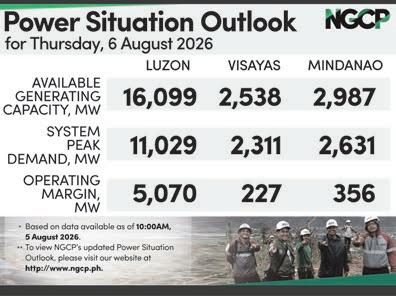
specifically through the deployment of Self-Generating Facilities [SGFs] and Distributed Energy Resources [DERs], including ZeroExport Solar Systems [ZESS] and the grid-connected types capable of island or synchronized mode, whose presence and participation can augment policies and initiatives on energy self-sufficiency, provide essential backup or peak-shaving capabilities, and reduce electricity costs,” the DOE circular read.
SEMIRARA Mining and Power Corp. (SMPC) reported a 17-percent increase in its second-quarter net income to P4.8 billion, bringing its first-half results to P8.6 billion from P8.4 billion in the same period last year. The strong financial performance was mainly driven by the company’s power segment that offset declining coal performance. The power segment contributed P4.6 billion, or 96 percent of consolidated second-quarter earnings, supported by improved plant availability, record generation and higher selling prices. Total power sales rose by 9 percent to a record 1,563 gigawatt hours (GWh), from 1,435 GWh, following stronger plant performance across the company’s power plants. Spot market volumes accounted for 53 percent of total electricity sold, while the remaining 47 percent was sold through bilateral contracts. Overall average selling price jumped by 29 percent to P5.81 per kilowatt hour (kWh) from P4.51/kWh, reflecting higher spot market prices during the quarter.
As of end-June, 52 percent of SMPC’s 860-megawatt (MW) dependable capacity was contracted, with 339.8 MW available for spot market sales after accounting for station service requirements. Lenie Lectura
By integrating RE with agriculture and aquaculture, GEA-9 aims to enable innovative projects that deliver clean power alongside sustainable farming and fishing. The official publication of the GEA-9 terms of reference is targeted for the fourth quarter.
Meanwhile, the DOE and the Department of Agriculture (DA) convened to review the draft memorandum of agreement (MOA) for the joint conduct of the 9th Green Energy Auction (GEA-9). This landmark collaboration focuses on pioneering agri-solar and aqua-solar frameworks, unlocking dual-use energy solutions that optimize the DA’s abandoned, undeveloped, and underutilized (AUU) land and water resources while supporting food security and rural livelihoods.
ASIA AND AFRICA DRIVE SALES Heineken NV’s volumes grew more than expected in the second quarter as strong demand in Asia and Africa offset persistent weakness in Europe and the Americas. The Dutch brewer said Thursday that consolidated volumes, which include drinks sold by Heineken at its subsidiaries, rose 0.9 percent on an organic basis, beating analysts’ estimates for a slight decline. When beer sales from licensed partners are included, total organic volumes rose 1.9 percent.
Wednesday, May 1, 2024. PHOTOGRAPHER: KSENIA KULESHOVA/BLOOMBERG

By Lorenz S. Marasigan @lorenzmarasigan
GLOBE Telecom Inc. saw its first-half earnings decline even as service revenues climbed to an all-time high, due to the absence of one-off gains that padded last year’s results.
Reported net income after tax (NIAT) fell 11 percent to P11 billion in January to June from P12.4 billion a year earlier, the listed telecommunications firm said in a disclosure to the Philippine Stock Exchange (PSE) on Tuesday.
Globe attributed the drop mainly to a smaller net gain from the dilution of its stake in Mynt Inc., the parent company of the group behind mobile wallet GCash, compared with the prior year, as well as higher nonoperating charges.
Core net income, which strips out foreign exchange movements and mark-to-market adjustments, stood at P10.2 billion, down 2 percent yearon-year—a far narrower decline that the company said reflects the underlying health of its operations.
“Our first-half results demonstrate the strength of our core business and the solid contribution of our digital ecosystem to Globe’s overall performance,” Globe President Carl Cruz said.
Consolidated gross service revenues rose 6 percent to a record P85.4 billion from P80.2 billion in the same period of 2025, surpassing the previous high of P82.8 billion booked in the second half of 2024. Data-driven services accounted for 91 percent of the total.
The mobile business remained the biggest revenue contributor at P60.4 billion, up 6 percent year-onyear. Mobile data revenues grew 10 percent to P53.9 billion and now make up 89 percent of total mobile service revenues.
Mobile data traffic climbed to 3,723 petabytes from 3,187 petabytes a year earlier, with average monthly usage per subscriber rising to about 17 gigabytes from 15 gigabytes.
Globe’s mobile subscriber base stood at around 67.7 million as of end-June, while mobile data users expanded 5 percent to more than 39.6 million.
Home broadband revenues likewise rose 6 percent to P12.4 billion, driven by the shift to fiber. Wired broadband subscribers grew 32 percent to over 2 million, more than offsetting the continued decline in legacy fixed wireless connections.
Fiber now accounts for roughly 93 percent of home broadband revenues, up from 91 percent at end2025 and 90 percent a year earlier.
Total broadband subscribers reached 2.4 million, with GFiber Prepaid contributing 1.1 million.
The enterprise segment posted the fastest growth. Corporate data revenues jumped 15 percent to a re-
cord P11 billion, lifted by domestic internet services and information and communications technology (ICT) offerings, particularly business application solutions (BAS).
Non-telco revenues, meanwhile, fell to P863 million from P1.2 billion, largely because of the deconsolidation of Yondu following Globe’s partnership with NCS. Excluding Yondu’s prior-year contribution, non-telco revenues would have risen 17 percent.
Total operating expenses and subsidy rose 6 percent to P40.5 billion due to higher interconnection charges, lease-related costs, marketing and subsidy, utilities and staff costs, partly cushioned by a 25-percent drop in provisions.
Earnings before interest, taxes, depreciation and amortization (Ebitda) grew 6 percent to P44.9 billion, with margin holding at 52.6 percent-above the company’s full-year guidance of about 50 percent.
Capital expenditures (capex) surged 39 percent to P26.3 billion, equivalent to 31 percent of service revenues. About 91 percent of the total went to data-related initiatives. Globe said it remains on track to keep full-year capex below $1 billion.
“As we look ahead, we are committed to shaping Globe’s next phase of growth by strengthening our leadership in connectivity while expanding our portfolio of products and services to deliver solutions that make a real difference in people’s lives and help businesses thrive.
We will invest in our network, technology platforms, and AI-enabled capabilities to improve customer experience, operate more efficiently, accelerate innovation, and help build a more connected and digitally inclusive Philippines,” Cruz said.
platform with CPG’s premium residential portfolio
“We are deeply honored by SSS’s continued confidence in Century Properties Group,” Marco Antonio, the company’s president and CEO, said. “This additional investment recognizes the strength of our fundamentals, our long-term strategy, and our commitment to deliver sustainable value to shareholders.” “We will continue to focus on catering to the end-user market, thereby allowing us to pay a steady and healthy stream of dividends to our shareholders, while keeping our debt profile at moderate levels.” VG Cabuag

By Reine Juvierre Alberto reine_alberto & Joel R. San Juan @jrsanjuan1573
INSURANCE Commissioner Rey-
naldo A. Regalado defended the accreditation of a third consortium under the Passenger Personal Accident Insurance Program (PPAIP) after the Office of the Ombudsman placed him under preventive suspension over the matter.
Regalado was placed under a sixmonth preventive suspension without pay by the Office of the Ombudsman. Administrative charges were filed against Regalado for alleged “conflict of interest” and “manifest partiality” over the approval of the accreditation of insurance providers under the PPAIP for public utility vehicles.
A statement his office issued last Wednesday quoted Regalado as saying he respects “the authority of the Ombudsman and will fully cooperate with the proceedings.”
He added he remains “confident that the allegations will be fairly and objectively evaluated based on the facts, the evidence and the applicable law.”
The order against Regalado came after the SCCI Management Insurance Agency filed a complaint alleging that the Insurance Commission chief accorded preferential treatment to a consortium accredited under the PPAIP.
The SCCI claims the consortium belatedly submitted its documentary requirements, failed to satisfy the requirements for accreditation under the PPAIP, and that IC failed to promptly act on its requests for documents.
Regalado filed his counter-affida-
vits, maintaining that the accreditation complied with Circular Letter (CL) 2025-17 and that all consortia were evaluated under the same standards.
He also stated that SCCI’s requests for documents were duly acted upon in accordance with Executive Order 2 (series of 2016) and the “Inventory of Exceptions.” The latter refers to government data, documents, and information restricted from public view and exempted from requests using the Freedom of Information Act. (See https://elibrary.judiciary.gov.ph/thebookshelf/showdocs/8/93815)
The Manila Regional Trial Court Branch 180 previously upheld the validity of CL 2025-17, and declared that the accreditation of a third insurance pool does not violate any law or regulation.
Still, Regalado has been charged with grave misconduct, violations of Republic Act (RA) 6713 or the “Code of Conduct and Ethical Standards for Public Officials and Employees” and RA 11032 or the “Ease of Doing Business and Efficient Government Service Delivery” law.
He also faces a criminal charge for violating provisions of the “AntiGraft and Corrupt Practices” law or RA 3019.
“Throughout my tenure, I have endeavored to perform my duties with integrity, impartiality, and in the best interest of the public and the Philippine insurance industry,” Regalado was quoted as saying.
BusinessMirror sought information from the IC on who would be designated as officer-in-charge during Regalado’s preventive suspension, but the agency had yet to respond as of press time.
CHINA Bank Savings Inc. (CBS) announced of having booked a net income of P1.19 billion in the first half of 2026, sustaining its earnings from the same period last year amid ongoing geopolitical uncertainties and a “challenging” economic environment.
A statement issued last Wednesday by the country’s second-largest thrift bank read CBS’s “resilient” performance was backed by continued expansion of its core lending business, which propelled revenue growth during the period.
Net interest income, meanwhile, jumped by about 16 percent year-on-year to P5.49 billion, driven by sustained growth in the bank’s lending portfolio, particularly its salary loan and business loan segments.
CBS said its total assets stood at P225.58 billion, supported by a “growing” customer base of more than 1.2 million. Gross loans (excluding interbank loans) grew by about 8 percent year-on-year to P158.80 billion, while deposits increased by 10 percent year-on-year to P199.42 billion, strengthening the bank’s liquidity position and providing a “stable” funding base for continued lending growth.
As for the thrift bank’s asset quality, CBS said it remained “sound,” with a non-performing loan (NPL) ratio of approximately 2.90 percent.
However, the bank said it has almost doubled its loan-loss reserves to cover NPLs, reflecting its “prudent credit risk management and conservative provisioning policy during challenging conditions.”
Even in the face of accelerating uncertainty, CBS President James Christian T. Dee said: “Our disciplined approach to lending has kept our portfolio sound and
By Reine Juvierre Alberto @reine_alberto
THE Philippine Deposit Insurance Corp. (PDIC) is seeking to expand deposit insurance beyond banks to cover non-bank financial institutions and cooperatives to provide a broader financial safety net for the public.
During a news briefing last Wednesday, PDIC President and CEO Roberto B. Tan announced that the state deposit insurer is pursuing a legislative agenda to amend Republic Act (RA) 3591, or the Deposit Insurance Law.
Tan said the PDIC wants to have the authority to implement a temporary blanket guarantee during systemic financial crises to help preserve public confidence and prevent destabilizing bank runs.
The state-run insurer seeks to expand deposit coverage to deposits in non-bank financial institutions and authorized solicitations by cooperatives.
Tan said they are also seeking authority to provide higher insurance coverage for accounts with high social and economic value such as
payroll, retirement and settlement accounts to reduce disruption when banks fail.
As of the first quarter of 2026, bank deposits totaled P22.040 trillion, of which P5.287 trillion were covered by deposit insurance.
The PDIC, likewise, wants to streamline the verification of deposit records and remove statutory legal barriers to accelerate the payment of deposit insurance claims, Tan said. Moreover, the state deposit insurer also seeks to strengthen its liquidation framework and institutional capacity to resolve failed financial institutions more efficiently and deliver its mandate more effectively.
After the briefing, Tan told reporters that the PDIC will continue providing lawmakers with the technical inputs needed to facilitate the
measure’s approval while urging both chambers to expedite deliberations.
“We will be urging our congressmen and our senators to try to speed up the processing and the legislative mill to get it out as soon as possible,” Tan said.
He believes amending RA 3519 to include the PDIC’s proposals “will reinforce the reforms we began last year and ensure that our deposit insurance system is more responsive, more resilient, and future-ready.”
According to PDIC General Counsel Maria Antonette Brillantes-Bolivar, the PDIC has secured Senator Vicente “Tito” C. Sotto’s promise to sponsor the bill. She added that Manila 5th District Rep. Irwin C. Tieng, the chairman of the Committee on Banks and Financial Intermediaries at the Lower House, already received the preliminary proposal.
Brillantes-Bolivar said the PDIC will formally submit the revised version to Tieng within the week, while also seeking additional sponsors in the House of Representatives.
RBAS implementation
BRILLANTES-Bolivar told reporters the state deposit insurer is moving ahead with its plan to implement its “risk-based assessment system,” or “Rbas.” The system is expected to align banks’ deposit insurance premium rates with their individual risk profiles instead of charging a uniform rate.
“The banking industry has evolved. Banks today differ greatly in size, complexity, business models and risk profiles. As banking evolves, the way deposit insurance premiums are assessed should also evolve,” BrillantesBolivar said during the briefing.
According to PDIC officials, they plan to conduct a one-year “shadow run” before the targeted implementation of the Rbas in 2028.
Currently, banks pay a flat assessment rate equivalent to one-fifth of 1 percent of their total deposit liabilities.
Under the Rbas, premium rates would instead be based on a bank’s overall risk profile, taking into account factors such as capital adequacy, liquidity, asset quality, governance, business model and supervisory assessments adopted by the Bangko Sentral ng Pilipinas (BSP). Brillantes-Bolivar said banks with stronger risk profiles could qualify for lower assessment rates under the new framework, which is being developed with advisory support from the World Bank Group and in consultation with the BSP and banking industry associations.
“The goal of [the] Rbas is not to penalize banks. The goal is to recognize, incentivize sound banking practices and encourage all banks to continuously strengthen their governance and financial condition for the benefit of the entire banking system,” she added.
Gstrong amid prevailing global geopolitical uncertainties and their impact on Philippine economic growth, inflation, and other factors. We will continue to grow our lending business in a prudential manner.”
D uring the first half of 2026, CBS said the bank opened five new branches and converted 10 Branch Lite Units (BLUs) into full-service branches, further strengthening its physical presence in key markets.
The thrift bank said it continued to expand its nationwide presence through its growing network of 190 branches, 33 APD Lending Centers, and 65 BLUs. Meanwhile, the bank’s workforce has grown into more than 3,000 employees.
Looking ahead, CBS Senior Vice President and Retail Banking Group Head Jan Nikolai M. Lim, who leads branch expansion nationwide, said: “Our expansion plans will continue.” Lim said this as there are still unbanked communities all around the Philippines.
‘The current challenging conditions are tough, but we know from experience that Filipinos are tougher,” Lim emphasized, adding that consumers and entrepreneurs alike need banking services to support their families and their businesses.
“And we want to be there for them,” added Lim.
CBS said it remains focused on expanding its higher-yielding loan portfolio, maintaining strong asset quality, growing its current and savings account (CASA) deposit base, deepening customer relationships, and improving operational efficiency through continued investments in its branch network and digital platforms.
CBS remains the second largest thrift bank in the Philippines in terms of assets. Andrea E. San Juan
OVERNMENT-backed loan guarantees for the agricultural sector rose in the first half of 2026, as stronger lending by partner financial institutions boosted financing for small farmers and fisherfolk.
The state-run Philippine Guarantee Corp. (PhilGuarantee) reported on Wednesday that agricultural guaranteed loans climbed by 42.96 percent to P3.34 billion as of endJune from P2.34 billion in the same period a year ago.
Commercial, thrift and rural banks accounted for the bulk of the guaranteed loans, which jumped by 50.63 percent year-on-year to P3.09 billion from P2.05 billion.
Loans guaranteed through partner cooperatives likewise grew by 23.83 percent to P176.99 million from P142.93 million in the first six months of 2025.
The number of guaranteed loan transactions reached 36,821 as of end-June, up by 22.52 percent from 30,053 a year ago.
Eased inflation, Qatar talks seen behind peso ‘strong rally’
By Andrea E. San Juan
OSITIVE develop -
Pments in the Qatar talks which fueled demand for emerging market assets, coupled with the softer-thanexpected inflation print in the Philippines which “sparked a strong rally” in the local fixed income market, boosted the Philippine peso on Wednesday.
A bank economist said this after data from the Bankers Association of the Philippines (BAP) showed that the local currency closed at P60.751 against the greenback on Wednesday.
This rate is 41.4 centavos stronger than its previous finish of P61.165 against the dollar on Tuesday.
This is also the peso’s strongest level since June 18, 2026, when it closed at P60.567 against the greenback.
Domini S. Velasquez, the Group Chief Economist of China Banking Corp. (Chinabank), explained that the peso strengthened “amid a combination of external and domestic factors.”
“Externally, improved risk
sentiment following positive developments in the Qatar negotiations boosted demand for emerging market assets,” Velasquez said.
She added that the move was “reinforced” by a weaker US dollar, which had already come under pressure over the weekend following renewed yen-supportive intervention.
Domestically, “the softerthan-expected inflation print sparked a strong rally in the local fixed income market, reinforcing expectations that the BSP may not need to tighten monetary policy aggressively,” Velasquez said.
“Lower bond yields and improved investor sentiment toward Philippine assets helped support the peso,” she added.
Looking ahead, Velasquez said the bank expects the peso to settle closer to its “fundamental value” of P60 per US dollar by year-end, assuming there is no-re-escalation of geopolitical tensions.
“Lower oil prices should also ease pressure on the country’s import bill, providing additional support for the local currency,” she added.
These loans benefited 31,737 unique small farmers and fisherfolk, 16.16 percent higher than the 27,321 borrowers assisted in the comparable period last year.
PhilGuarantee said it also expanded its network of active partner lending institutions to 101 as of end-June from 91 a year ago, through the accreditation of additional cooperatives.
In 2025, government-guaranteed loans reached P311.191 billion, up by 13.52 percent from P274.12 bil-
and
lion in 2024.
The bulk of the guarantees, amounting to P299.34 billion, went to housing loans, while P7.47 billion supported agriculture and P4.38 billion went to other priority sectors. The state credit guarantor provides credit guarantees to banks and financial institutions to help manage credit risk and encourage lending to key sectors and projects that contribute to economic growth and social development.
Alberto
of
Peak Lending Investors Inc. The firm owns online lending platforms also named as “Pondocash” and “Peranyo.” Empire Peak has informed the SEC that it does not own, operate, manage, authorize, sponsor, endorse or maintain any affiliation with the said Facebook page. The SEC is “strongly” advising the public to exercise due diligence and caution before dealing with entities claiming to represent financing or lending companies. VG Cabuag
➔ RCBC executive named Digital Leader of the Year
THE Rizal Commercial Banking Corp. (RCBC) announced that its Executive Vice President and Chief Innovation and Inclusion Officer Angelito M. Villanueva was named “Digital Leader of the Year” at the PhilSec Awards 2026. A statement issued by the lender read that Villanueva, who also serves as the founding chairman of FinTech Alliance.PH, was recognized “for championing initiatives that strengthen digital financial services while promoting cybersecurity, financial inclusion, and cross-sector collaboration.” Last month, the lender announced that the 9-percent increase in its total customer loans in the first half “reflects the bank’s data analytics capabilities and key strategic partnerships, enabling targeted customer acquisition.”
➔ Bitcoin wallet maker warns of AI failure THE company at the center of a Bitcoin hack has warned that artificial intelligence failed to detect the software flaw that was exploited to steal users’ funds, now
By Anne Ruth Dela Cruz
SINGAPORE—For decades, brachytherapy has been a mainstay in cancer treatment, offering highly targeted radiation for patients with cervical and other gynecological cancers, prostate cancer, breast cancer, as well as certain head, neck and skin cancers. Now, the same precision-based approach is giving new hope to patients diagnosed with eye cancer.
The Singapore National Eye Centre (SNEC) has established Singapore’s first retinal brachytherapy service, allowing selected patients with localized eye tumors to receive sight- and eyepreserving treatment that was previously unavailable in the country. The breakthrough was among the innovations highlighted during the SingHealth Urology and Ophthalmology Media Immersion held in July, which brought together journalists from the Philippines, Malaysia, Indonesia and Vietnam.
According to Professor Gavin Tan Siew Wei, Head and Senior Consultant of SNEC’s Surgical Retina Department, the center has a specialized ocular oncology service that provides eye- and vision-preserving treatment for selected patients with localized eye cancers.
Profound impact WHILE primary eye cancers are uncommon, their impact can be profound. For patients who already have limited vision in their other eye, preserving the affected eye can make a significant difference to their independence and quality of life.
“The traditional treatment for cer -

tain eye cancers was to remove the entire eye. Advances in localized radiation treatment now allow selected patients to retain the eye and preserve some vision,” Tan said.
One such treatment is brachytherapy, which utilizes a localized source of radiation placed directly over the tumor.
Unlike conventional radiation therapy, which passes through healthy tissue before reaching the cancer, brachytherapy delivers radiation directly to the affected area.
During the procedure, a small, curved radioactive plaque is positioned on the outside of the eye over the tumor. The plaque remains in place for several days, delivering a precise dose of radiation while minimizing exposure to surrounding healthy structures.
Once the prescribed dose has been administered, the plaque is removed through a second surgical procedure.
Effectiveness of the treatment
RESEARCH conducted in the United
Communities join forces
By Claudeth Mocon-Ciriaco
SCHOOLS , families, faith communities, health authorities, local enforcers, and government leaders are joining forces in Negros Occidental to strengthen tobacco and vape control efforts and protect children and young people from nicotine addiction.
The initiative, led by Parents Against Vape (PAV) together with Youth Against Vape (YAV), brings together schools, local government units, health authorities, civil society organizations, and community leaders in a coordinated effort to build smoke-free and vape-free communities.
PAV said meaningful tobacco and vape control requires more than legislation. It also depends on informed students, engaged parents, empowered local enforcers, supportive health leaders, and committed local governments working toward a common goal.
Health risks AT the Central Philippines State University (CPSU)-Hinigaran Campus, student leaders participated in a Community MPOWERment Session, where they learned about the health risks of tobacco and vaping, industry tactics targeting young people, and practical ways to become advocates for healthier campuses and communities.
One participant, student leader Argie Peronce, said the session prompted him to quit vaping.
Peronce, a member of the student publication and governor of the Education Society at
ABy Rizal Raoul Reyes Contributor
S more Filipinos embrace healthier lifestyles and preventive healthcare, wellness is becoming an essential part of everyday life rather than an occasional indulgence. Greater awareness of the effects of stress, long working hours, and sedentary lifestyles has encouraged many consumers to invest in services that support both physical and mental well-being.
This shift is reflected in the growing demand for wellness destinations that go beyond
CPSU-Hinigaran Campus, admitted he began vaping because many of his friends did.
“I believed it was harmless and even collected different vape pods. But as I used it more often, I started experiencing chest pain, and that made me realize that vaping was already affecting my health. Everything changed when I attended the Community MPOWERment Seminar led by Parents Against Vape. The session opened my eyes to the real dangers of vaping and inspired me to quit. I hope more young people choose their health over peer pressure, and I also hope our leaders continue strengthening policies and education to protect the next generation from nicotine addiction,” he said.
Beyond schools, PAV expanded its Community MPOWERment Program to Hinigaran and Murcia, engaging parents, community leaders, and faith-based organizations to strengthen awareness of tobacco and vaping. During a community session in Murcia conducted in partnership with St. John Bosco Parish and Shrine, facilitators found that only 13 of the 50 participating parents were familiar with vape products, underscoring the need for stronger public education and awareness campaigns.
Resource organization
THE organization also supported local implementation efforts by serving as a resource organization during the Tobacco and Vaping Control Enforcers Training organized by the Sagay City Primary Care Facility and the Sagay City Anti-Smoking Task Force. The training equipped local enforcers with
relaxation to promote long-term health. Among them is Makati-based Bali Body Rituals, which encourages clients to make massage, recovery, and self-care part of a regular routine.
Wellness as a ritual FOUNDED by corporate executive Jen Ruz, the spa was built on the belief that wellness treatments should be integrated into everyday living. “The idea is that wellness should become a ritual—something people do regularly, whether weekly or monthly, as part of taking care of themselves,” Ruz said. Before opening the business in early 2024, Ruz spent months studying the wellness in -
States and Europe has already established the effectiveness of ocular brachytherapy. However, because eye cancer occurs less frequently among Asians than among Caucasian populations, the treatment was not initially a major priority in Asia. Tan said SNEC established the service after its specialists underwent overseas training and identified sufficient regional demand.
For suitable patients, the procedure offers encouraging outcomes.
Tan said approximately 85 to 90 percent of patients who undergo brachytherapy are able to retain their affected eye. While vision may still be affected depending on the tumor’s location and the impact of radiation on nearby structures, most patients are able to preserve at least some useful vision.
“As with any cancer treatment, success cannot be guaranteed. Treatment may also affect vision because of the tumor’s location and the impact of radiation on nearby structures. Nevertheless, most suitable patients retain at least some useful vision,” he explained.
He added that retaining even partial vision can significantly improve a patient’s quality of life, especially for individuals who already have poor vision in their other eye.
Careful patient selection
NOT every patient diagnosed with eye cancer is a candidate for brachytherapy.
Before treatment, patients undergo a comprehensive assessment to determine whether the tumor is localized and whether the cancer has spread to other parts of the body. If the disease has metastasized, a different treatment strategy may be recommended.
For international patients, treatment generally begins with an initial evaluation, followed by brachytherapy three to six weeks later if they are deemed suitable candidates. Patients usually remain in Singapore for one to two weeks while the radioactive plaque is in place before it is removed.
Part of a broader vision-saving strategy
RETINAL brachytherapy is one of several innovations that reflect SNEC’s efforts to preserve vision through earlier diagnosis and more targeted treatment. The center has also introduced artificial intelligence-assisted screening for diabetic retinopathy, is evaluating longer-acting treatments that could reduce the need for frequent retinal injections, and is expanding the use of gene therapy for inherited retinal diseases. It also continues to advance minimally invasive retinal surgery and research into future retinal cell replacement therapies.
Despite these advances, Tan emphasized that early detection remains the most effective way to prevent irreversible vision loss.
Many retinal diseases can be successfully treated when diagnosed early. However, unlike the cornea, retinal cells cannot regenerate once they have been permanently destroyed, making timely diagnosis and intervention critical.
Patients should seek immediate medical attention if they experience persistent blurred or distorted vision, straight lines appearing wavy, sudden flashes of light, an increase in floaters, or a shadow or curtain over part of their field of vision, as these may be early warning signs of serious retinal disease.

the knowledge and skills needed to effectively implement the city’s Comprehensive SmokeFree Ordinance.
To strengthen policy collaboration, PAV also met with Governor Eugenio Jose “Bong” Lacson and officials of the Negros Occidental Provincial Health Office to discuss ongoing tobacco and vape control initiatives and express appreciation for the province’s support for the proposed Smoke-Free and Vape-Free Environment Bill (House Bill No. 9603).
“The Provincial Health Office remains committed to supporting initiatives that protect children and young people from tobacco and nicotine addiction through stronger prevention, education, and community partnerships,” said Provincial Health Officer I Dr. Ma. Ayessa B. Hugnatan.
local evidence
PAV President Rebie O. Relator underscored the need for stronger local evidence to support effective tobacco and vape control policies.
“Stories from our communities, together with strong local data, help us better understand the impact of tobacco and vaping. We encourage our local governments to continue strengthening data collection and policy implementation so we can build the evidence needed to protect more lives,” Relator said.
PAV expressed hope that Negros Occidental’s experience will encourage more local governments across the country to adopt a whole-of-community approach to protecting the next generation from tobacco and nicotine addiction.
By Candy P. Dalizon Contributor
NAVIGATING gastrointestinal health issues can be a daunting and fragmented journey. A new initiative by Healthway Cancer Care Hospital (HCCH), however, aims to change that. HCCH has officially launched its specialized Digestive Health Clinic, designed to provide comprehensive, coordinated care for patients with gastrointestinal diseases and abdominal cancers.
Built around a multidisciplinary model of care, the clinic brings together gastroenterologists, colorectal and hepatobiliary surgeons, medical oncologists, radiation oncologists, radiologists, pathologists, nutritionists, rehabilitation specialists, specialized nurses, and patient navigators to develop personalized treatment plans tailored to each patient’s unique needs. The launch reflects HCCH’s commitment to redefining digestive healthcare through seamless collaboration—from prevention and early detection to treatment, recovery, and long-term survivorship.
“Digestive health is about more than treating disease; it is about improving quality of life through early diagnosis, coordinated care, and compassionate support,” said Dr. Manuel Francisco Roxas, HCCH President and CEO.
“With the launch of our Digestive Health Clinic, we are bringing together the expertise of multiple specialists to provide patients with comprehensive care in one place.” Leaders, clinicians, and staff recently gathered at HCCH in Taguig for the clinic’s launch. They were joined by AC Health executives, including Vice Chairman and Ayala Corporation Chief Social Infrastructure Officer Paolo Borromeo, Chief Strategy & Investment Officer Rafael Jaime Recio, and Chief Health Officer Dr. Beverly Ho, alongside HCCH’s leadership team.
The milestone event was also attended by representatives from Takeda Healthcare Philippines, Inc. and leaders of key medical societies, including Dr. Dave Rennel L. Sebollena, president of the Philippine Society of Gastroenterology; Dr. Ronald V. Romero, president of the Philippine Society of Digestive Endoscopy; and Dr. Karen Estelle C. De Lunas of the Hepatology Society of the Philippines. Also present was Paul Ortiz, who shared his inspiring health journey and personal experience living with Crohn’s disease.
THE Digestive Health Clinic houses dedicated Colorectal, Liver, and Inflammatory Bowel Disease (IBD) clinics, offering comprehensive care for a wide range of gastrointestinal conditions. It provides specialized screening, treatment, and ongoing surveillance for common and rare cancers of the digestive system, including colorectal, liver (hepatocellular), stomach, pancreatic, esophageal, and other gastrointestinal malignancies.
The clinic also manages chronic inflammatory disorders such as Crohn’s disease and ulcerative colitis, as well as high-risk conditions requiring close, long-term monitoring. Patients have access to advanced diagnostic services, including colonoscopy, endoscopy,
liver ultrasound, advanced imaging, and evidence-based surveillance programs.
The Digestive Health Clinic is headed by Dr. Jose D. Sollano Jr., who also serves as HCCH Medical Director. Dr. Sollano leads the IBD Clinic Program, while Dr. Rei Joseph P. Prieto and Dr. Karen Estelle C. De Lunas head the Colorectal Clinic and Liver Clinic, respectively.
Dr. Sollano emphasized that colorectal and liver cancers— among the most commonly diagnosed cancers in the Philippines for both men and women—are largely preventable and highly treatable when detected early, making routine screening essential. He added that the clinic’s third focus area, IBD, is a complex disorder that has seen a noticeable increase in cases over the past six to seven years.
“The Digestive Health Clinic is dedicated to cancer prevention and the comprehensive management of gastrointestinal malignancies and other digestive disorders. Within this facility, we will actively pursue cancer screening and educate at-risk patient populations served at HCCH,” said Dr. Sollano.
“We will also ensure that patients seen in this clinic have access to the most appropriate cancer care available in the country in 2026. Ultimately, our mission is to heal, restore, and reintegrate patients into society—empowered with health, dignity, and hope,” he added.
A KEY feature of the new center is its dedicated IBD Clinic, which provides expert management for patients living with Crohn’s disease and ulcerative colitis. Both are chronic inflammatory conditions of the gastrointestinal tract. While Crohn’s disease can cause inflammation anywhere from the mouth to the anus, ulcerative colitis affects only the colon.
To help patients achieve better disease control and long-term quality of life, the clinic offers comprehensive disease assessment, routine monitoring, nutritional counseling, medical therapy, and coordinated multidisciplinary care.
“In this clinic, we’ll be able to provide patients with a seamless consultation and appointment experience. They’ll have immediate access to ancillary and laboratory services, one-stop access to stateof-the-art equipment and worldclass specialists, and an efficient recall system, which is essential for all screening programs. If patients are diagnosed with liver cancer, colorectal cancer, or any other cancer—or have a family history of these diseases—a multidisciplinary team is readily available to ensure holistic and comprehensive care,” Dr. Sollano said. The launch of the Digestive Health Clinic further strengthens HCCH’s clinical capabilities by combining advanced diagnostics with personalized, multidisciplinary care, improving access to specialized digestive healthcare while raising standards of care in the Philippines.
For more information about the Digestive Health Clinic or to book a consultation, visit https:// healthwaymedicalnetwork.com.ph/ our-network/healthway-cancercare-hospital/ or call (02) 77774673 (HOPE).
dustry and visiting spas across Metro Manila. She found that while many offered quality treatments, few emphasized personalized wellness programs that encourage lasting relationships with clients. Inspired by Bali’s healing traditions, the spa offers customized treatments that combine Balinese, Swedish, aromatherapy, and deep-tissue massage techniques based on each client’s condition and preferences. It has also introduced lymphatic massage to respond to growing interest in therapies that complement overall wellness routines.
According to Ruz, modern lifestyles have made wellness more relevant than ever.
“People are under constant stress from work and technology. They’re looking for ways to reconnect with themselves through human touch and self-care,” she said. Stress relief MUCH of the spa’s clientele consists of corporate professionals seeking stress relief, while athletes and fitness enthusiasts turn to deeptissue massage to support muscle recovery. The business has also seen increasing demand for grooming services among male clients, reflecting changing attitudes toward personal care. Every client undergoes a wellness assessment before treatment, allowing therapists
POLAND is expanding agricultural trade with the Philippines, pitching its meat industry as a reliable partner in helping meet the growing local demand for imported meat while supporting food security.
The initiative was the focus during the “Pork and Beef from Poland on the Philippine Market” seminar in Manila, organized by the Polish Investment and Trade Agency (PAIH) Manila Office—the local trade promotion arm of the Polish government—in cooperation with the Embassy of Poland in Manila. The event was held on behalf of the Union of Producers and Employers of Meat Industry (UPEMI) and the National Support Centre for Agriculture (KOWR), as it brought together Polish industry representatives and
prospective Philippine importers.
Agriculture Minister Stefan Krajewski said Poland’s strong export performance and expanding trade relations with the Philippines position both countries to deepen cooperation in the agri-food sector. Krajewski said that “over the past 20 years, we have proven…that we are a reliable partner.”
The minister added that bilateral trade between the two countries has been growing at a “double-digit pace,” then expressed his optimism that greater access for Polish meat
BCCP: Upper-middle income milestone boosts case for deeper UK-PHL trade ties
THE Philippines’ new uppermiddle income status should serve as a platform for deeper trade reform, stronger investor signaling, and wider economic partnerships
All these could be achieved through the country’s ongoing preparatory talks for accession to the Comprehensive and Progressive Agreement for Trans-Pacific Partnership (CPTPP), according to Executive Vice Chairman Chris Nelson of the British Chamber of Commerce Philippines (BCCP).
Nelson linked the country’s improved income classification with the need to keep pursuing reforms that support competitiveness, resilience, and market expansion: “The Philippines has just joined the upper-middle-class income bracket, and that’s a good move. [To] further support that, we need things like the Open Finance Act to be passed.”
The World Bank said the Philippines’ transition to upper-middle income status, effective July 1, 2026, reflects decades of reform, growth, job creation, and stronger integration into global markets. For the BCCP, however, the milestone also raises the urgency of helping the country sustain momentum through more open trade and stronger institutional follow-through.
Diversification and pressures
FOR Nelson, one of the clearest ways to do that is by diversifying the Philippines’ trading partners through high-standard trade agreements such as CPTPP: “The UK has been a strong supporter of the Philippines joining,” he said, describing the bloc as representing “about 15 percent of worldwide [gross domestic product],” and calling the current preparatory talks “a very important development.” That message comes at a time when macroeconomic pressures remain a concern. He noted in an interview that inflation is running above the Bangko Sentral ng Pilipinas’ 2 percent to 4 percent target, and that growth has dipped below the country’s more familiar 5 percent pace, adding to the importance of improving supply conditions, trade access, and investment confidence.
In that context, he said the Philippines “is very keen to get investments and boost its trade, both exports and imports,” making the push to widen trade links more relevant.
Nelson said the CPTPP should be viewed not just as a tariff ar -

products would further accelerate commercial exchanges.
He also assured Philippine importers that KOWR would continue supporting businesses seeking to source agricultural products from
rangement but as part of a broader strategy to strengthen the country’s position in a more uncertain global environment: “It’s also important. What the Philippines is doing is to join more of these trading areas, [and that accession would send] another good signal to investors.”
He also pointed to the country’s existing access to Southeast Asia through the Regional Comprehensive Economic Partnership (RCEP) and said a successful CPTPP entry would give companies “even more access.”
Chairship and competition FOR the chamber, that diversification strategy also reinforces growing United Kingdom- Philippines economic ties. Nelson said bilateral trade reached £3.2 billion by the end of 2025, although the Philippines still ranks only as the UK’s 59th-largest trading partner.
The next step, for him, is to keep highlighting Philippine opportunities more consistently to bring the linkage “from promising to more commercially significant.”
The chamber also sees a strategic opening in the Philippines’ Asean chairship. Nelson has said this leadership role gives the country an opportunity to highlight key sectors and strengthen its investment case, while underscoring its position as both a domestic growth market and a gateway to Southeast Asia.
“The Philippines is a very important market in its own right,” he said, but it also offers “access to Southeast Asia [via] RCEP, and hopefully very shortly to CPTPP.”
Nelson said the partnership’s benefits would likely be felt early in the services sector, where the Philippines already has a competitive base: “The first…that would clearly benefit is the service sector. The Philippines has clearly been leading in…services. Business outsourcing obviously is a key strength.”
At the same time, the BCCP official pointed out that trade diversification must be matched by domestic reform. He cited the “Cybersecurity Act,” “Open Finance Act,” “Digital Payments Act,” and continuing red tape reduction as vital measures to sustain investor confidence and support the country’s rise in the value chain.
“CPTPP will be important, but the decision-making now driving things is how easy it is for me to do business in the Philippines,” he said.
Growing demand
DURING the seminar, Polish officials
underscored their country’s capacity as one of the European Union’s leading meat producers. Poland has about 6.2 million head of cattle raised on approximately 270,000 farms, with roughly 80 percent of its beef production intended for export, making overseas markets central to the industry’s continued growth.
They also highlighted KOWR’s expanding global reach, as it works with numerous companies and continues to diversify export destinations beyond Europe.
The Philippines was identified as a key market because of its large consumer base and resilient demand for meat. Data presented showed that pork remains one of the primary sources of protein for 120 million Filipino consumers.
Polish officials noted that domestic hog production is still recovering from the effects of African swine fever, reinforcing the role of imports in helping stabilize supply and prices. Their estimates showed local pork imports reached about 750,000 metric tons in 2025, re -
flecting sustained demand from both consumers and the food sector.
Expanding cooperation
BEYOND pork, Poland also sees avenues to raise exports of premium beef products as demand from the hospitality, restaurant and retail sectors grows steadily.
Officials said the country’s meat industry is also shifting from exporting raw agricultural commodities to higher value-added products while diversifying export markets. The strategy has helped strengthen Poland’s position among Europe’s leading meat exporters and supported record export performance in recent years.
Krajewski said expanding access to the Philippine market would not only create new business opportunities for Polish producers, but also contribute to stronger bilateral trade relations.
“We are here for you,” he said, referring to KOWR’s commitment to assist Philippine importers interested in building long-term partnerships with Polish suppliers. Mike Policarpio
By Malou Talosig-Bartolome
AROME-BASED intergovernmental organization promoting rule of law has commended the Philippines for institutionalizing a body that promotes and uses forensic science in criminal investigation.
At an oversight meeting in Italy on July 28, International Development Law Organization (IDLO) Director-General Jan Beagle praised Manila’s broader push to upgrade its prosecutorial capabilities.
She described the Philippines’ strategy of co-investing in its own justice system as a model for “national ownership and sustainable legal development.”
Ambassador of the Philippines to Italy Neal Imperial, who represented the country alongside Minister Donna Gatmaytan at the IDLO Standing Committee, welcomed the recognition.
According to Imperial, “the Philippines values its partnership with IDLO across several key justice sector priorities.”
The ambassador cited the intergovernmental body’s crucial backing in training prosecutors, countering the online sexual abuse and exploitation of children or OSAEC, while advancing its “Women, Peace, and Security” agenda.
Justice, anti-corruption IN her comprehensive progress re-

port, Beagle specifically identified the Philippines as a key focus area for expanding access to justice and bolstering public integrity.
The IDLO noted that systemic hurdles such as delayed hearings, unlawful detentions, and overcrowded prisons disproportionately hit marginalized Filipinos.
In response, the organization is helping Manila implement “peoplecentered approaches” that equip citizens to seek redress and push legal institutions to become more responsive.
The Philippines is also a primary beneficiary of the IDLO’s anti-corruption push. Noting that corruption diverts key resources from public services, the group offers technical support to local judges, prosecutors, and specialized agencies to build
robust frameworks that detect and aggressively prosecute official misconduct.
‘Justice zone’ in ‘LU’
A MAJOR highlight of the Philippine delegation’s report in Rome was the recent launch of the country’s 20th “Justice Zone” in San Fernando City, La Union.
Rolled out in May by the Justice Sector Coordinating Council in partnership with the IDLO, the United Nations Office for Project Services, and the European Union’s Governance in Justice program or “GOJUST,” the La Union hub brings the government closer to its 2028 target of 30 operational zones nationwide.
THE Department of Labor and Employment (DOLE) and the Malaysian government are exploring ways to expand cooperation on jobs and skills training for Filipinos.
Ambassador Abdul Malik Melvin Castelino of Malaysia paid a courtesy call on Labor Secretary Francis Tolentino in July, as both discussed expanding cooperation on skills training, green jobs, technology-driven upskilling, workforce development, and certification for the halal food industry.

They also tackled other initiatives to help Filipino workers gain skills that align with the changing demands of the regional labor market. Tolentino also discussed the issu-
In San Fernando, the Justice Zone’s first-year roadmap immediately targets complex regional crimes by establishing an Anti-Trafficking Desk and a Cyber Crime Task Force. The hub will also fund information technology upgrades for webbased hearings and implement rehabilitation programs to curb repeat offenses.
In a dispatch to the Department of Foreign Affairs, the Philippine Embassy in Italy said the ongoing IDLO partnership reinforces Manila’s commitment to an inclusive justice system that effectively serves the country’s most vulnerable groups.
The zones act as localized hubs where judges, prosecutors, public defenders, and police coordinate directly, breaking the “silo” mentality that has historically clogged court dockets.
ance of Alien Employment Permits (AEPs) for Malaysian nationals, and proposed direct coordination between the Malaysian Embassy and DOLE.
“Faster time, embassy-to-department engagement... So, we do away with other extra bureaucratic layers and at the same time, make [them] faster and seamless,” the secretary said.
Around 300 Malaysian-owned companies operate in the Philippines, particularly in agribusiness, halal trade, renewable energy, tourism, and logistics.
In 2025, DOLE issued an estimated 2,029 AEPs to Malaysian nationals
employed primarily as managers and professionals.
Castelino thanked the Philippines for its continued support and close friendship with Malaysia. He said his country recognizes the department’s role, especially in promoting jobs, opportunities, and in “ensuring that our workers are safe and protected.” Malaysia remains one of the largest destinations for Filipino workers in Southeast Asia. As of May 2025, more than 13,000 landbased overseas Filipino workers were employed in the said nation, mostly in the construction, manufacturing, hospitality, and domestic service sectors. By
As travelers increasingly seek authentic experiences, meaningful connections, and more responsible ways to explore destinations, the Philippine Tour Operators Association (PHILTOA) is championing a new vision for the industry through “NextGen Tourism.”
The initiative takes center stage at the 37th Philippine Travel Mart (PTM), the country’s largest and longest-running travel trade exhibition promoting domestic tourism. Organized by PHILTOA, the three-day event will be held from September 4 to 6, 2026 at the SMX Convention Center, SM Mall of Asia in Pasay City.
Carrying the theme “Nurturing the NextGen Tourism: Discover Your Philippines,” this year’s travel mart underscores PHILTOA’s commitment to building a tourism industry that is sustainable, inclusive, innovative, and responsive to the evolving needs of travelers and host communities.
“’Nurturing the NextGen Tourism: Discover Your Philippines’ is more than this year’s theme,” said PHILTOA President Maria Lourdes Flor “Malou” Japson. “It represents the third chapter of PHILTOA’s long-term vision for Philippine tourism.”
Japson said the association introduced “Love the NextGen Tourism” in 2024, anchored on four pillars—Sustainability, Inclusivity, Digitalization, and Health and Wellness. Last year’s “Boosting the NextGen Tourism” campaign focused on accelerating these initiatives through stronger partnerships, greater industry capacity, and expanded opportunities. This year, PHILTOA aims to ensure these efforts take root and flourish.
“In line with our theme this year, our mission is to ensure these initiatives continue to grow,” Japson said. “Like a tree that has been planted and carefully cultivated, tourism must be nurtured through collaboration, innovation, responsible leadership, and shared commitment.”
For PHILTOA, the four pillars provide a roadmap for a tourism industry that remains globally competitive while preserving the country’s rich natural and cultural heritage.
Sustainability protects destinations while creating long-term opportunities for local communities. Inclusivity ensures tourism growth benefits MSMEs, indigenous communities, tourism workers, and emerging destinations. Health and wellness reflect travelers’ growing preference for meaningful and transformative experiences, while digitalization empowers tourism enterprises through artificial intelligence, digital marketing, smart tourism, seamless booking systems, and data-driven decision-making.
“Our vision is to build a tourism industry that’s globally competitive, resilient, responsible, and future-ready,” Japson said. “These four pillars define the future of tourism and serve as PHILTOA’s strategic blueprint for

Grace
industry.”
The pillars complement PHILTOA’s 4Ps Program—PHILTOA Partnering for Professionalism and Progress, which promotes education, collaboration, innovation, and professional excellence through seminars, certification programs, educational forums, and industry dialogues.
Now on its 37th edition, the Philippine Travel Mart continues to serve as one of the country’s premier travel expositions, bringing together tour operators, destinations, hotels, airlines, tourism organizations, and travelers under one roof.
Nearly 300 exhibitors from the country’s 15 regions—including Metro Manila, the Cordillera Administrative Region, BARMM, and participating local government units from Agusan del Sur, Batanes, Camiguin, Capiz, Laguna, Palawan, Kalibo, Malay, Ilocos Norte, and Cotabato City—will showcase destinations, travel products, accommodations, and unique tourism experiences.
Beyond offering travel deals, the event encourages Filipinos to discover destinations beyond the usual tourist circuit, connect directly with tourism stakeholders, and support communities through responsible and meaningful travel.
PHILTOA also continues to work closely with the Department of Tourism, the Tourism Promotions Board, TIEZA, local government units, and its members across the tourism value chain to strengthen industry collaboration, promote responsible tourism practices, and encourage innovation throughout the sector.
“Our membership represents the entire tourism value chain—from travel agencies and tour operators to transport providers, accommodation establishments, attractions, destination management companies, and other tourism-related enterprises,” Japson said.
“This allows PHILTOA to develop programs that benefit not only one sector but the entire tourism ecosystem.”
According to Japson, the Philippine Travel Mart is more than a venue for travel bargains.
“More than generating bookings, PTM serves as a national platform that creates business opportunities, strengthens partnerships, and promotes inclusive tourism growth,” she said.
The event also provides emerging destinations with opportunities to showcase their tourism offerings alongside more established attractions, enabling local government units and tourism enterprises to connect directly with consumers and industry buyers.
“Every booth represents a community, every booking supports livelihoods, and every destination promoted contributes to a stronger local economy,” Japson said. “This is PHILTOA’s commitment to ensure that tourism growth reaches every corner of the Philippines.”
Beyond promoting destinations, PHILTOA hopes visitors will leave the travel mart with a deeper appreciation of Philippine culture and a greater understanding of tourism’s role in nation-building.
“Beyond attractive travel packages, we want them to discover new destinations, appreciate our diverse cultures, support local businesses, and understand that every journey contributes to nation-building,” Japson said. “Every peso spent on local tourism creates jobs, supports families, empowers communities, and helps preserve our cultural and natural heritage.”
Japson also encouraged travelers to become active partners in nurturing NextGen Tourism by choosing accredited tour operators, staying in responsible accommodations, respecting local cultures, reducing their environmental impact, supporting local artisans, dining at local restaurants, hiring local guides, and exploring emerging destinations.
“In short, every journey becomes an investment in the future of Philippine tourism,” Japson said. “The future of tourism will not simply be measured by the number of places we visit, but by the value we create along the way.”
The 37th Philippine Travel Mart is supported by official credit card partner EastWest Bank, official airline partner Philippine Airlines, and media partners including AsianTraveler, Chinoy TV, DiscoverMNL, Hospitality News Philippines, Lakbay Magazine, Malaya Business Insight, Manila Standard, Negosentro Media Group, Our Awesome Planet, SPOT.ph, WhenInManila.com, and others.
Tickets are available onsite at the SMX Convention Center and online through the PHILTOA website at philtoa.com.

areas across North and Central Luzon. Affectionately known as the
“Melting Pot of Central Luzon,” Tarlac serves as a key transportation hub connecting major road networks in the region, making the facility highly accessible to patients seeking quality cancer treatment without having to travel to Metro Manila.
“Hope is finally here in Tarlac. Our main goal is to provide free chemotherapy services to the province and all our adjacent LGUs. This is the commitment of our company as a private entity partnering with the local and national government to deliver the services that are truly needed. This is the mission we bring—a professionally managed center where you can expect the utmost care and service. Bawal po ang suplado at suplada sa center na ito,” said Dr. John Paul Aclan, Chairman and CEO of We Hope Medical Group, during his welcome speech. The facility features modern treatment areas designed with patient comfort and safety in mind. It is supported by a specialized team of medical oncologists, oncology nurses, and other healthcare professionals. The center is located on the third floor of the Royal Lily Lifestyle Center, Besa Plaza, Panganiban Street, Tarlac City.
The inauguration was attended by key officials from various government offices, reflecting the strong support of local government units for the company’s mission of expanding access to quality healthcare in the region.
Among those present were: Ilocano Ako Party-List Rep. Richelle Antonio Singson; Sta. Ignacia Councilor Indo Antonio; Victoria Municipal Health Officer Dr. Nelin Tacasa; Victoria Medical Officer III Dr. Kathreen Stephanie Luz Micu, Medical Officer III; Paniqui Mayor Kathleen C. Roxas; Mayantoc Mayor Iluminados Pobre; Sta. Ignacia Mayor Bong Tan; Anao Mayor Gian Pierre de Dios; Moncada Councilor Janius Yasay; and Concepcion Mayor Noel Villanueva.

BDO formalize partnership for enhanced client payment experience
SOUTH Asialink Finance Corporation (SAFC) and BDO Unibank, Inc. formalized a partnership to streamline payment and collection processes across SAFC’s operations, reinforcing the company’s promise of Financing Made Easy.
Under the agreement, SAFC will adopt BDO’s Cash Management solutions, including On-site Check Writing, Auto-Credit Service, Outward Payment, enhanced Bills Payment, and the Auto Debit Arrangement (ADA).
“Cash management is the backbone of financing. By adopting BDO’s Cash Management solutions, we speed up every transaction and make payments completely hassle-free for the businesses and communities we serve,” said Maricel Dejongoy, President and Chief Executive Officer of SAFC.
The partnership expands SAFC’s payment and collection capabilities through more than 1,600 BDO branches nationwide and 24/7 access via BDO’s digital banking channels, providing clients with a faster and more seamless payment experience.
“On the ground, this means fewer manual steps, faster processing, and tighter controls across our disbursement and collection cycles,” said Azenith Cabrera,
Chief Operating Officer of SAFC. “BDO’s solutions give our operations team the tools to scale efficiently while keeping every transaction secure and accountable.”
Meanwhile, Monina Elena Camigla, Deputy Department Head for Institutional Banking – Financial Institutions and International Desks of BDO, emphasized that the collaboration underscores the bank’s commitment to sustainable institutional relationships.
“This event reflects the kind of long-term relationship we strive to build with our institutional clients,” Camigla said. “By aligning our solutions with SAFC’s business goals, we look forward to being a trusted partner in its growth journey as SAFC expands access to Filipinos nationwide.” Also joining the signatories were Angel Tejuco, Chief Finance Officer of SAFC; Angela Veronica Dulalia, Financial Institutions Segment Head for Cash Management at BDO; and Josephine Anne Bongat, Unit Head for Institutional Banking – Financial Institutions at BDO. Through this partnership, SAFC continues to modernize its payment infrastructure and optimize its financial management processes, making financing simpler and more accessible for more Filipinos.

Metro Cebu strengthens push for smarter local governance through PLDT, Smart’s AI-in-a-Box
METRO Cebu is taking a major step toward smarter and more responsive public service with the rollout of PLDT and Smart AI-in-a-Box (AIAB) program.
AI-in-a-Box is the PLDT Group’s initiative to make artificial intelligence (AI) more accessible to communities. The program combines digital tools, connectivity, training, and mentorship to help local government units turn emerging technologies into practical solutions. As part of the initiative, participating LGUs received an AI-in-a-Box kit that includes a laptop, a smartphone, a Smart connectivity device, and premium access to AI tools, including ChatGPT.
In a simple ceremony at the Cebu City Hall, Mayor Nestor Archival received the AI-in-a-Box package on behalf of the local government of Cebu City, from PLDT and Smart represented by Roby Alampay, FVP and Head of Public Engagement and Corporate Communications, and Stephanie V. Orlino, AVP and Head of Stakeholder Engagement.
The rollout successfully extends across Metro Cebu, including Lapu-Lapu City and Talisay City, which also received their respective AIAB packages. Key personnel from all three cities have undergone specialized training to strengthen their internal AI capabilities and identify practical applications of AI in local government work.
“We at PLDT and Smart believe that technology should help enhance the delivery of public service. Through the AI-in-a-Box Program, we affirm our commitment in assisting LGUs level up service delivery through a more citizen-focused, practical,
secure, and innovative technology,” said Alampay.
As one of the four pioneer participant cities in the country, Cebu City proudly represents the entire Visayas region in a mentorship and acceleration program organized by PLDT and Smart, with support from the group’s social outreach arm, the PLDTSmart Foundation (PSF). This mentorship program is specifically designed to help local offices transform conceptual ideas into practical, real-world AI solutions for faster, more responsive governance. Through the program, participating Cebu City personnel will receive guidance as they develop and deploy AI-enabled solutions that respond to specific needs in their communities. In a statement shared on his official Facebook page, Archival warmly welcomed the program, noting that it is heartening for Cebu City to be selected as a pioneer participant and the sole representative from the Visayas. He emphasized that through PLDT and Smart’s AIin-a-Box program the city will strengthen its use of innovation and AI solutions to deliver faster, more efficient, and more compassionate service to the people of Cebu.
By bridging the gap between advanced technology and localized public service, this initiative underscores PLDT and Smart’s broader commitment to fostering digital inclusion across the Philippines. As these local government units integrate AI into their daily workflows, the program aims to establish a scalable blueprint for digital governance that can be replicated in other provinces, ultimately driving nationwide development through shared technological progress.

AFEW weeks ago, I wrote about Anxiety in Children: Helping Our Kids Thrive in School, One Stage at a Time. Naturally, the next question many parents ask is: “What can we actually do at home?” If I had to recommend just one habit to support children through every stage of development, it would be Play.
In my own experience, play isn’t a magic wand that instantly erases anxiety. Rather, it develops the precise skills anxious children need: confidence, emotional regulation, resilience, communication, creativity, and problem-solving, not to mention the sheer fun and laughter it brings into our homes. Over the years, play has become our family’s go-to anchor.
The American Academy of Pediatrics calls play essential to healthy brain development, while Harvard’s Center on the Developing Child explains that playful “serve-and-return” interactions with caring adults help build the brain architecture children need to manage stress and regulate emotions.
AGES 3–5: BUILDING SECURITY THROUGH PLAY
AT this age, many children wrestle with separation anxiety: “Will Mommy or Daddy come back?” Pretend play offers a safe space to rehearse goodbyes and reunions.
n Suggested Toys: Melissa & Doug Get Well Doctor’s Kit and Slice and Toss Salad Set, Hola Record & Learn Phone, Kids Hits Baby Panda, and Learning Resources Big Feelings Pineapple Set.
n How to Play: Act out school drop-offs or doctor visits with dolls and plush toys. Role-reversal works wonders: let your child be the “teacher” or “doctor” while you play the hesitant “student” or “patient.” Use toy phones to practice saying goodbye and hello, or exchange feeling words using socio-emotional toys and puzzles.
n The Benefits: Role-play creates predictability and emotional security. Children learn that separations are temporary, expand their emotional vocabulary, and experience you as a calm, reassuring presence amid their worries.
AGES 6–9: BUILDING CONFIDENCE THROUGH EXPLORATION
GRADE-SCHOOL children often develop a fear of making mistakes. Open-ended play demonstrates that trying, tweaking, and starting over are all healthy parts of learning.
n Suggested Toys: Plus Plus building sets, Learning Resources MathLink Cubes, Nebulous Stars or Crayola arts and crafts kits, and basic sports gear.
n How to Play: Invite your child to build anything they imagine—with no “right” answer or fixed blueprint. Set up gentle art or puzzle challenges where the goal is simply to try different strategies, not to create a flawless finished product. Play casual sports games where you modify the rules together.
n The Benefits: Kids practice flexible thinking, problem-solving, and persistence. By praising effort (“I love how you tried a different way when that piece didn’t fit!”) rather than perfection, you gently teach them that mistakes are normal, manageable, and part of the process.
AGES 10–12: BUILDING FRIENDSHIP THROUGH SHARED PLAY
PRETEENS frequently worry about social dynamics and fitting in. Cooperative play offers structured practice in teamwork, clear communication, and healthy competition.

n Suggested Toys: Merchant Ambassador Pacman Claw Crane and other arcade games, classic board games like Monopoly, National Geographic Volcano or Cool Reactions science kits, collaborative Lego sets, and team sports equipment.
n How to Play: Choose board games that require strategy or working toward a common goal. Tackle simple science experiments or Lego builds side-byside, letting your child take the lead in explaining the instructions. Play ball games where you model encouraging teammates, losing gracefully, and trying again.
n The Benefits: Shared play provides safe practice in reading social cues, navigating wins and losses, and resolving conflicts. Watching you handle setbacks calmly is one of the most powerful resilience

lessons they can absorb.
AGES 13–18: BUILDING IDENTITY THROUGH SHARED INTERESTS
TEENAGERS face pressures surrounding academics, friendships, identity, and the future. While traditional toys drop away, their need for connection through play remains as strong as ever.
n Suggested Activities: Cook or bake a recipe together, film a creative video or fun challenge, shoot hoops in the driveway, or collaborate on a small DIY project or venture.
n How to Play: Let them choose the activity and set the pace. Focus on offering your grounded presence rather than giving advice or lectures.
n The Benefits: Shared interests keep communication channels open during a stage when teens naturally begin to pull away. Playful moments communicate a powerful message: “I’m here, I enjoy spending time with you, and I trust you.” This solidifies their sense of identity and emotional safety. Play has become our family’s “One Solution.” It continues to support my children’s learning, eases stress, strengthens communication, and creates joyful memories. Perhaps the greatest surprise is how much play benefits us as parents, too. These shared positive experiences becomes a symbolic hug with our children that says, “You matter. I am fully here with you.”

Coloring lives with the Sunshine Place at The Podium Atrium
across all seven of Sunshine Place’s art classes—seniors, adults, and children. It was a treasure trove of original artworks starting with 55 pieces of framed artwork from its Intermediate & Advance Art, Beginners and Children’s Painting, and Watercolor paintings.
There were also 26 pieces of Porcelain Painting, 15 Ikebana-Sogetsu flower arrangements, and 24 pieces of Decoupage works.
More than that, it was a celebration of creativity, self-discovery, family, and community.
Guest of honor was renowned sculptor and glass artist Impy Pilapil, who was there with her sister Bella, who attends the center’s dance classes. The family of Elena Fernandez led by her husband, renowned dermatologist and cosmetic/restorative surgeon Dr. Manuel Fernandez of the Makati Medical Center, were also on hand to support her.
Art likewise runs in the family as SM Foundation’s Linda Atayde takes ikebana classes, while her granddaughter Mandy is a painting enthusiast. So does the desire to excel. Dolly Borlongan, an active member of the Decoupage Club has apparently passed this on to her daughter Kat, who recently received the National Order of Merit, a distinction awarded by the French government to individuals who have rendered outstanding service. It is the second highest award in France. It’s also never too early or too late to discover one’s passion for art. Regina Lim, granddaughter of Ambassador Francis Chua, joined the Kids Art Class when she was 14 years old. Now 16 and enrolled in the beginners Art Class, she has discovered that “landscape painting allows me to express my emotions through various hues.” At 85, Erlinda “Leni” Araullo, on the other hand, was recognized as one of the Top 50 finalists and an Honorable Mention Awardee at the prestigious 21st GSIS National Art competition. “Sunshine Place has given us a beautiful place to continuously grow, express ourselves, and creativity knows no
boundaries,” she says.


beneficial to both students and instructors. James Empeño was drawn to watercolor painting during the pandemic and has recognized its therapeutic benefits. Sunshine Place has been part of Mee Lee Casey’s teaching journey since she joined the center in 2017. She has been teaching porcelain art for more than 25 years, beginning in Taiwan, and onto the UK, Australia, Brazil, Thailand, and now the Philippines. It brings her “great joy” to watch her students develop new skills, gain confidence, and build friendships. Now in its ninth consecutive year, Coloring Lives is the culminating exhibit of Sunshine Place’s art programs—a public showcase of what its students produce when given consistent mentorship, a structured creative practice, and a community that takes their work seriously. What started in 2018 as a fundraising exhibit inside the Sunshine Place center in Bel-Air, Makati, has grown into a program with a track record of nine beneficiaries and a following that returns year after year. This year, the exhibit returned to The Podium
Atrium, where it was first held during the 8th edition in 2025. Proceeds from artwork sales will go to Nazareth Bahay ng Pag-ibig, a home for abandoned elderly women, upon the close of the exhibit on July 26. Past beneficiaries of Coloring Lives include the San Lorenzo Ruiz Home for the Elderly, Kanlungan ni Maria Home for the Aged in Antipolo, the National Center for Mental Health, and the Josefheim Elderly Care Community in Rizal.
“Every work in this exhibit began with a student who was not sure what they were capable of. Sunshine Place gave them a space to find out,” says Sunshine Place President Lizanne Uychaco. “Nine years of Coloring Lives is proof of what happens when people are given a community that believes in them—they grow, they create, and they give back. We welcome anyone who sees themselves in these works to come and be part of what we are building here.”
The center Sunshine Place is located at No. 56 Jupiter Street, Brgy. Bel-Air, Makati City. More information can be found at www. sunshineplaceph.com or 017-5155656.
Thursday, August 6, 2026
By Rizal Raoul Reyes @brownindio
VICE President Sara Duterte, who is currently facing four impeachment charges on misuse of confidential funds, unexplained wealth, bribery and corruption and threat against President Marcos and other officials, continues to hold a comfortable lead over former Vice President and incumbent Naga City Mayor Maria Leonor “Leni” Robredo in a hypothetical head-tohead contest for the 2028 presidential elections.
In its latest survey, Octa Research pointed out that the race has become tighter as Robredo achieved gains in several key voter segments and Duterte’s advantage narrows.
Results of Octa Research’s second quarter 2026 Tugon ng Masa (TNM) survey showed Duterte preferred by 43 percent of adult Filipinos, compared with 34 percent for Robredo. Another 22 percent of respondents said they were undecided, chose neither candidate, or did not know whom they would support, while 1 percent refused to answer.
The survey, conducted through face-to-face interviews with 1,200 respondents from July 4 to 11, found Duterte’s lead shrinking
to 9 percentage points from the 11-point advantage she enjoyed in the first quarter of the year. Her support eased from 46 percent to 43 percent, while Robredo’s rating remained statistically steady at 34 percent from 35 percent previously. The increase in undecided voters suggests that Duterte’s declining support has yet to translate into a significant national gain for Robredo.
Octa, however, emphasized that these national changes fall within the combined margin of error for two independent survey rounds and should be regarded as suggestive rather than conclusive. The polling firm said the more significant developments emerged in specific regions and demographic groups.
Despite the relatively stable national figures, Octa said Robredo made notable gains in several areas. She strengthened her already commanding lead in Balance Luzon, where her support increased from 47 percent to 51 percent, compared with Duterte’s 27 percent. Robredo likewise improved her standing among Class E respondents, rising 8 percentage points to 31 percent, although Duterte continued to lead the socioeconomic group with 51 percent.
The survey also underscored Robredo’s enduring strength among older Filipinos specifically the Generation X and the boomers. She led among respondents aged 55 years and above and garnered 61 percent support among those aged 75 and older. Duterte, meanwhile, remained the preferred candidate among younger voters, posting her strongest showing of 61 percent among respondents aged 25 to 34.
While Robredo registered gains in several voter segments, Octa said Duterte continued to dominate the overall race, buoyed by overwhelming support in Mindanao, where she remained the preferred choice of 76 percent of respondents despite a decline from 88 percent in the previous quarter. She also maintained a commanding lead in the Visayas, while Robredo continued to dominate Balance Luzon.
One of the survey’s most striking findings was the dramatic shift in the National Capital Region. Robredo’s 20-point lead in Metro Manila during the first quarter disappeared, with both candidates
now tied at 34 percent. Octa noted that Duterte’s support increased by only 2 percentage points, while much of Robredo’s lost support appeared to have shifted to the undecided column, which grew from about 15 percent to 32 percent.
According to Octa, there are possible explanations for the changing dynamics but stressed that these should be treated only as working hypotheses rather than proven causal relationships.
It said Robredo’s repeated public statements distancing herself from a 2028 presidential bid may have contributed to greater uncertainty among some of her supporters, particularly in Metro Manila. Octa likewise noted that Duterte’s impeachment trial coincided with a modest decline in her national support, although it said the survey was not designed to determine whether either development directly influenced voter preferences.
Despite Duterte’s continued lead, Octa said the growing bloc of undecided voters indicates that the contest remains fluid. At 22 percent, the uncommitted vote is larger than Duterte’s current nine-point advantage over Robredo, suggesting that a significant portion of the electorate has yet to settle on a preferred candidate.
Octa emphasized that the survey represents an early snapshot of public sentiment nearly two years before the 2028 elections and should not be interpreted as a prediction of the eventual outcome. It noted that future candidate decisions, political alliances, campaign developments and emerging national issues could substantially reshape voter preferences in the coming months and years.
By Carmel Pedroza
CEBU CITY–Police and education authorities in Cebu have stepped up security measures in schools following separate incidents involving alleged death threats and a child reportedly displaying a firearm in a private class group chat.
In Liloan town, northern Cebu, the police recovered a gun, live ammunition and other deadly weapons after school authorities reported that a juvenile delinquent or child in conflict with the law (CICL) allegedly displayed a firearm in a video shared through a private class group chat.
The incident was reported by the principal of Liloan National High School, prompting the immediate response of the police station’s Women and Children Protection Desk (WCPD).
Police, in coordination with the Municipal Social Welfare and Development Office (MSWDO), conducted a child-sensitive inves -
tigation in line with Republic Act 9344, or the Juvenile Justice and Welfare Act of 2006, as amended. During the interview, the child voluntarily provided information about the firearm shown in the video. Investigators then proceeded to the identified location, where the firearm and other prohibited weapons were voluntarily surrendered.
Recovered were a snub-nosed revolver, five live rounds of ammunition, and a pair of brass knuckles with an improvised knife.
The items were documented before being placed in the custody of the Liloan Municipal Police Station for safekeeping, forensic examination and disposition.
The police said the investigation is continuing to determine the ownership and registration status of the revolver, in coordination with the Firearms and Explosives Office (FEO), as well as the possible criminal liability of individuals who may have violated Republic Act 10591, Presidential Decree 9
and other applicable laws.
Authorities stressed, however, that the case involving the child would be handled through a restorative justice approach.
The Liloan police, in a statement, said it coordinated with the MSWDO, Department of Education and the child’s parent or guardian to provide intervention, guidance and protection, consistent with the Juvenile Justice and Welfare Act.
In a separate statement, Col. Abubakar Udang Mangelen Jr., Cebu police commander, said the incident showed that public safety and child protection could be pursued simultaneously.
“Our immediate priority was to ensure that the firearm was safely recovered and that any threat to the community was addressed,” Mangelen said.
He added that children who come into conflict with the law should receive interventions that promote accountability, guidance and rehabilitation.
Meanwhile, the Department of Education-Cebu Province confirmed that classes had been suspended on Monday in some secondary schools in the town of Consolacion following death threats reportedly received through text messages.
In a message sent to the media, Superintendent Senen Paulin, of the Schools Division of Cebu Province, said the department was informed of the class suspensions through the Public Schools District Supervisors of Consolacion Districts 1 and 2.
Paulin said the Consolacion police are conducting an investigation upon the instruction of the local chief executive.
“DepEd Cebu Province is in close coordination with DepEd Consolacion,” Paulin said.
The two incidents occurred in separate municipalities, but both have prompted authorities to address potential threats to students and school personnel while investigations continue.
THE Ramon Magsaysay Award Foundation (Rmaf) recently launched a yearlong community-based coastal conservation initiative in Carles, Iloilo, bringing the proven environmental stewardship model of 2021 Ramon Magsaysay Awardee Roberto “Ka Dodoy” Ballon to a fishing community seeking to restore its mangrove ecosystem and strengthen sustainable livelihoods.
The program called Mangrove Fiesta (Fisherfolk Initiative for Environmental Sustainability of Tinigban Community Associations), marks the second phase of the Magsaysay Laureates Community Initiative (MLCI), an Rmaf program that connects Ramon Magsaysay Awardees with communities across Asia to replicate successful grassroots solutions. The initiative was officially launched
from July 22 to 24 in Barangay Tinigban, Carles, Iloilo. Through the Ramon Magsaysay Transformative Leadership Institute (RMTLI), Ballon will mentor members of the Fisherfolks Association of Tinigban (FAT), together with the Kapunungan sa Gagmay’ng Mangingisda sa Concepcion (KGMC) and selected alumni of the 4K Project. The program focuses on environmental

By Rex Anthony Naval
THE guided-missile frigate
BRP Miguel Malvar won third place in the recent Rim of the Pacific (Rimpac) Naval Fire Support Exercise Rodeo multinational live fire event, the Navy (PN) announced on Wednesday.
Capt. Marissa Martinez, Navy spokesperson, said: “[The] PN earned an impressive third-place in the highly competitive NSFS multinational live-fire event, highlighting the professionalism and competency of its personnel.”
During the event, BRP Miguel Malvar fired its Oto Melara 76mm Super Rapid multi-feeding main gun against a virtual, two-dimensional land target more than 3.5 miles away at the Hawaiian waters on July 14.
Earlier reports said 14 other allied naval ships took part in the contest. The top three performers were declared as the ships that have the smallest average distance from the target using five salvos.
No details were given on who topped the contest but reports from foreign media indicated that it was the South Korean Navy’s ROKS Daejeon.
This is the second time the PN bagged third place in the RIMPAC gunnery contest, after the BRP Antonio Luna in 2022.
“The participation of BRP
Miguel Malvar, together with the amphibious company of the Philippine Marine Corps underscored the Navy’s growing capability, expanded operational reach, proficiency in conducting complex multinational maritime operations alongside allied and partner navies,” Martinez said. PN ship participation in the biennial drills, held from June 24 to July 31 this year, started in 2018, with the country deploying offshore patrol vessel BRP Andres Bonifacio and the landing dock BRP Davao del Sur. Rimpc, which is hosted by the US Indo-Pacific Command, is the world’s largest international maritime exercise with 30 nations which sent 30 ships and five submarines in attendance. Beyond the operational gains, tMartinez said the Navy’s participation further strengthened its relationships with allied and partner navies through sustained collaboration and combined training.
‘Through its successful participation in Rimpac 2026, the PN reaffirmed its commitment to develop a modern, multi-domain, and self-reliant naval force while strengthening its role as a reliable regional partner, contributing to peace, stability, and the rules-based order in the region,” Martinez added. With PNA
By Manuel T. Cayon @awimailbox
DAVAO CITY—A universitybased disease watch and analytics center here will gather international experts on health, artificial intelligence and other disciplines to discuss more adaptive measures to address pressing health concerns that come in various forms, speed and complex configuration.
The Mindanao Center for Disease Watch and Analytics (Diwa Center), a unit of the University of the Philippines-Mindanao, will host the International Conference for Interdisciplinary Approaches to Health (Iciah) 2026, a gathering of scientists and global experts on academic, scientific and professional circles to tackle issues on health concerns and responses.
stewardship, organizational leadership, and sustainable livelihood development.
Ballon received the Ramon Magsaysay Award in 2021 for mobilizing fellow fishermen in Zamboanga Sibugay to restore degraded marine ecosystems through community-led conservation. Speaking during the launch,
“The complexity of today’s health challenges, from emerging diseases to climate-related risks, demands that we move beyond siloed thinking. Iciah 2026 brings together different disciplines because no single discipline can build resilient health systems on its own,” said May Anne E. Mata, convener of the conference.
Mata said artificial intelligence has been reshaping disease surveillance and climate shocks
worsen health challenges worldwide, and the conference will address these issues as researchers, practitioners, and decisionmakers will convene virtually on September 8-9 (via Zoom) for the Iciah 2026.
The conference’s theme is “The NOW and the NEXT for Health: Navigating a World in FLUX [Fast, Localized, Uncharted, and eXperimental]” and Mata said the conference will focus “on the interface of health, AI, nowcasting, and climate, bringing together interdisciplinary solutions for building health systems resilient to compounding global disruptions”. She said that “going fully online this year is not only a logistical choice, it is also how we make sure researchers and practitioners, especially from low- and middleincome settings, get to join the conversation about something that affects us all.”
Mata is a professor of applied mathematics at UP Mindanao and founding director of Diwa Center. She was one of six Filipino scientists among Asia Scientist Magazine’s top 100 researchers of 2026 and a recipient of the 2025 Outstanding Young Scientist award from the National Academy of Science and Technology,