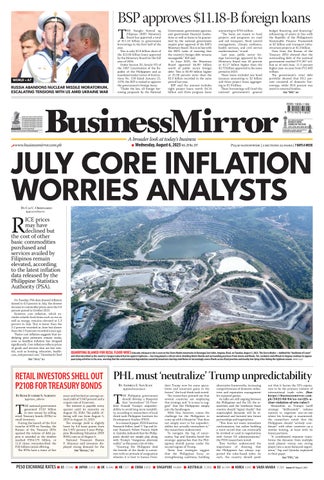
THE Bangko Sentral ng Pilipinas (BSP) Monetary Board has approved a total of $11.18 billion in government borrowings in the first half of the year.
This is only $2.8 billion short of the $13.68 billion loans approved by the Monetary Board for the full year of 2024.
Under Section 20, Article VII of the 1987 Constitution of the Republic of the Philippines and as mandated under Letter of Instructions No. 158 dated January 21, 1974, the BSP is tasked to approve the government’s foreign loans.
“Under the law, all foreign borrowing proposals by the National
Government, government agencies, and government financial institutions as well as loans to be guaranteed by the national government require prior approval of the BSP’s Monetary Board. This is in line with the BSP’s tasks of ensuring that the country’s foreign debt remains manageable,” BSP said.
In June 2025, the Monetary Board approved $4.89 billion worth of public sector foreign debt. This is $0.99 billion higher or 25.38 percent more than the $3.9 billion recorded in the same period last year.
BSP said the amount includes eight project loans worth $4.14 billion and three program loans
amounting to $750 million.
“The loans are meant to fund projects and programs on road and rail transport, flood control management, climate resilience, health services, and civil service modernization,” it said.
Last year, public sector foreign borrowings approved by the Monetary Board was 43 percent or $1.17 billion higher than the $2.73 billion approved in the same period in 2023.
These loans included one bond issuance amounting to $2 billion and three project loans aggregating to $1.9 billion. These borrowings will fund the national government’s general
JULY CORE INFLATION WORRIES ANALYSTS
By Cai U. Ordinario
By Andrea E. San Juan @andreasanjuan
By Reine Juvierre S. Alberto @reine_alberto
initial offering. The RTBs have a tenor of five years and fetched an average annual yield of 5.943 percent and a coupon rate of 6 percent. The interest is payable every quarter until its maturity on August 20, 2030. The public offering will run from August 5, 2025 to August 15, 2025. The average yield is slightly lower by 0.8 basis points from the 5.951 percent 5-year Philippine Bloomberg Valuation (PHP BVAL) rate as of August 4. National Treasurer Sharon P. Almanza said investors displayed strong demand for the
THE Philippine government should develop a blueprint that “neutralizes” US President Donald Trump’s unpredictability to avoid long-term instability, according to researchers of local think tank Philippine Institute for Development Studies (PIDS).
In a research paper, PIDS Emeritus Research Fellow Josef T. Yap and Senior Research Fellow Francis Mark A. Quimba indicated that the Philippines should not simply play along with Trump’s “dangerous alternate reality” as this poses a lot of risks.
“Granting the Philippine deal the benefit of the doubt is consistent with an attitude of resignation wherein it is best to humor Presi-
dent Trump now for some speculative and uncertain gains in the future,” the local think tank noted.
The researchers pointed out that several countries are employing this strategy and “it is easy to suggest” that the Philippines simply join the bandwagon.
With this, however, comes the challenge for the Philippines to come up with a blueprint “that does not simply react to his unpredictability but actually neutralizes it,” the researchers underscored.
To navigate the fog of uncertainty, Yap and Quimba listed the strategic approaches that the Philippines should pursue under the second regime of Trump.
These four strategies suggest that the Philippines focus on strengthening coalitions, building
alternative frameworks, increasing competitiveness of domestic industries and reputation management for repeated games.
As talks are still ongoing between the Philippines and the US, the researchers said the Southeast Asian country should “signal clearly” that unprincipled demands will be remembered and factored into future partnerships and negotiations.
“This does not mean immediate confrontation, but rather building a track record that can eventually be invoked or used in negotiations with future US administrations,” the PIDS researchers noted.
They further underscored the importance of showing that the Philippines has always supported the rules-based order. As such, the country should point
out that it harms the US’s reputation to be the primary violator of international trade rules. (See: https://businessmirror.com. ph/2025/08/04/us-tariffs-aclear-violation-of-wto-rules/)
Meanwhile, as Trump’s tariff strategy “deliberately” isolates nations to negotiate one-on-one where his leverage is maximized, the researchers noted that the Philippines should “actively coordinate” with other countries on a similar footing, at least with its Asean partners.
“A coordinated response transforms the dynamic from multiple weak players versus one strong player into a more balanced negotiation,” Yap and Quimba explained in their paper.
PHL, India bolster economic ties via strategic partnership
By Samuel P. Medenilla @sam_medenilla
WITHthe Philippines and India elevating their diplomatic relations through a newly signed strategic partnership, both countries have trained their sights on strengthening their economic ties by expediting the completion of a bilateral preferential trade agreement.
These were on top of the 12 other bilateral documents on law enforcement, security and defense, digital technologies, maritime cooperation, science and technology, tourism, culture and arts, and space cooperation, which were finalized and presented before President Ferdinand Marcos Jr. and Indian Prime Minister Narendra Modi after both officials concluded their bilateral talks at the Hyderabad House in New Delhi, India last Tuesday.
Marcos said the pending trade agreement can help boost the volume of trade between the Philippines and India once it is completed.
“Through our strategic partnership, Prime Minister Modi and I
have charged our economic teams to shepherd our commerce, now at $3.3 billion last year, towards a continued upward trajectory and expanded baskets of goods,” he said during the presentation ceremony.
The trade agreement, he said, can also help facilitate greater interaction among private enterprises in the Philippines and India, which will lead to greater innovation, technology transfer and upskilling between the two countries.
Marcos is scheduled to meet with Indian business leaders in New Delhi and Bangalore as part of his efforts to bring in more investments in the Philippines during his ongoing state visit in India, which will run from
August 4 to 8, 2025.
The President said such exchanges will be facilitated with the resumption of direct flights between Philippines and India by October.
For his part, Modi said India is prioritizing the completion of the IndiaAssociation of the Southeast Asian Nation (ASEAN) Free Trade Agreement, which will include the Philippines.
‘New epoch’
THE strategic partnership and its corresponding plan of action, the chief executive said, marked “a new epoch” in the 75-year-old Philippines-India diplomatic relations, together with the other agreements, which were signed last Tuesday.
India is currently only the fifth country that has a strategic partnership with the Philippines.
“This new apex [in our diplomatic relations] attests as much to the remarkably rapid growth, broadening and deepening of our 75-year-old bilateral relationship, the possibilities represented by the strong upward trajectory of our two economies as it does to the growing alignment of our interests and views on the challenges and imperatives of our time,” Marcos said.
Among the signed documents were the four separate terms of references on the Indian Air Force and the Philip -
pine Air Force on Air Staff Talks; Indian Army and the Philippine Army on the Army to Army Staff Talks, the Indian Navy and the Philippine Navy on the Navy to Navy Talks; and the enhanced maritime cooperation between the Indian Coast Guard and the Philippine Coast Guard.
The said agreements and defense and security will facilitate the sharing of information, training exchanges, and interoperability of the armed forces of the Philippines and India, according to Marcos.
Manila and New Delhi have also agreed on mutual legal assistance in criminal matters; treaty on transfer of sentenced persons; cultural exchange program; as well as cooperation in the next three years in the field of science and technology, tourism, peaceful uses of outer space.
Modi said he is open to entering into more partnerships due to India’s shared values and priorities with the Philippines.
“India and the Philippines are friends by choice, and partners by destiny. From the Indian Ocean to the Pacific, we are united by shared values. Ours is not just a friendship of the past, it is a promise to the future,” he said.
Economist Ruben Carlo O. Asuncion told BusinessMirror
“Since core items are often non-discretionary, households may continue to feel cost pressures despite lower food and transport prices. Thus, faster core inflation is a signal that inflation may not yet be fully benign, and that the BSP [Bangko Sentral ng Pilipinas] may need to balance its easing bias with vigilance on underlying price dynamics,” he also said.
Prior to July, PSA data showed that core inflation was still at 2.2 percent since March 2025. But the fastest rise in core inflation this year was at 2.6 percent recorded in January 2025.
De La Salle University economist Maria Ella Oplas told BusinessMirror that faster core inflation explains why Filipinos continue to feel the pinch even if headline inflation continues to slowdown.
Unfortunately, Oplas said core inflation will continue to increase because the spending habits of Filipinos usually pick up toward the end of the year. This spending “spree” starts in September and continues until the Christmas season.
“Faster core inflation means underlying inflationary pressures. It means that inflation is not just caused by temporary price shocks,” Oplas said “So, even if the news says inflation is low, people still feel the pinch because the prices of things they regularly pay for haven’t really gone down.”
Asuncion pointed out that Filipinos continue to feel the pinch because of higher costs of services such as education, health, accommodation; sticky prices in non-discretionary items; and limited wage growth.
Given these, he said core inflation is expected to hold steady at 2.5 percent from August to October, then slightly ease to 2.4 percent by November and December. Despite this, core inflation is not expected to “derail the broader disinflation trend.”
genuine productivity growth and open competition,” FEF said.
‘Unsustainable’
HOUSE Special Committee on Food Security Chairperson Rep. Raymond Adrian Salceda warned, however, that low rice prices may be unsustainable for local farmers—particularly rice producers.
“I fully commend President Ferdinand Marcos Jr. for stabilizing inflation and getting us out of the woods. Now that inflation has eased, especially in food prices, we can afford to go back to policies that give our local farmers a fighting chance,” Salceda said.
Food inflation posted an annual decline of 0.5 percent, driven mainly by a 15.9 percent drop in rice prices.
“That level of rice deflation is not sustainable for our farmers. It means farmgate prices are down while input costs are still high. This puts our food security at risk in the long run if farmers decide to plant less or shift to other crops,” Salceda said.
Salceda advocated for a phased rollback of the lowered rice import tariff, which was introduced at the height of last year’s inflation spike. Now that prices have stabilized, he argued, it is logical to restore protective policies that support local production.
“The purpose of the lower tariff was to bring prices down. Now that prices have dropped, it is only logical to restore tariffs to previous levels to support our rice farmers and maintain local production.”
Salceda vowed to work closely with the Department of Agriculture to strengthen rice farmer competitiveness and ensure they are not unfairly undercut by imports at a time when prices are already stable.
“While core inflation tends to move gradually, it sets the floor for headline inflation, which is more volatile due to food and fuel. As long as food inflation remains subdued, headline inflation will stay low, even if core inflation holds steady,” Asuncion told
BusinessMirror
Data obtained from the PSA showed that cereals, which includes rice, are excluded from the computation of core inflation as well as meat and fish that are fresh, chilled or frozen; and fresh dates, figs and tropical fruits.
PSA data showed core inflation also excludes other vegetables that are fresh or chilled; fresh or chilled fruit-bearing vegetables; electricity; liquefied hydrocarbons; diesel; and gasoline.
Price volatility IN a briefing, National Statistician Claire Dennis S. Mapa said core inflation accounts for 30 percent of the weight in the Consumer Price Index (CPI) of All Income Households.
“These prices have been exhibiting upward volatility. If they do not stabilize soon, they may dictate the long run inflation rate,” former Socioeconomic Planning Secretary Dante B. Canlas told BusinessMirror Bank of the Philippine Islands Chief Economist Emilio S. Neri Jr., however, told this newspaper that when the base effects of food and energy prices start wearing off, there could be an uptick in headline inflation.
Headline inflation may start picking up by September 2025. “Core inflation could continue going up if we see hefty wage hikes, higher energy that could push services prices higher, or even if inflation expectations are de-anchored by typhoon-driven food inflation,” Neri said.
Meanwhile, BSP said the July 2025
inflation outturn is within the BSP’s forecast range of 0.5 to 1.3 percent. Inflation is projected to average below the lower end of the target in 2025, due to the continued easing of rice prices.
Rice prices contracted 15.9 percent in July, which is now the lowest recorded for the entire 2018-based series that began in 1995. Mapa said regular milled rice prices posted the largest decline in July 2025. Regular milled rice prices declined 18.2 percent to P41.31 per kilo in July 2025 from P50.90 per kilo in July 2024. Month-on-month, rice prices contracted 2.5 percent. “For 2026 and 2027, inflation is expected to trend higher but will remain firmly within the 2.0 to 4.0 percent target range. Global economic activity is showing signs of deceleration, influenced by uncertainty over US trade policy and ongoing geopolitical conflict in the Middle East. These developments may contribute to slower domestic growth,” BSP said. For its part, the Department of Economy, Planning, and Development (DEPDev) said the drop in rice prices has significantly eased the cost of living for low-income households, with inflation for the bottom 30 percent income group falling to -0.8 percent in July 2025.
DepDev said this marked a sharp reversal from the 5.8 percent inflation rate experienced by this group in the same month last year. The agency also said the faster decline in inflation for the bottom 30 percent income group was primarily driven by the food and non-alcoholic beverages index.
This recorded an inflation rate of -3 percent in July 2025, slower than the -2.2 percent in June 2025. Key contributors include rice (-17.8 percent from -16 percent), corn (-17.7 percent from -16 percent); and vegetables and tubers (-1.9 percent from +0.1 percent).
“The sustained drop in rice prices and the easing of inflation for lowincome households are clear signs that our interventions are working. This not only helps Filipinos preserve the value of their peso but also builds confidence for businesses and consumers to plan ahead,” DepDev Secretary Arsenio M. Balisacan said.
“While we expect the overall inflation for 2025 to remain favorable and supportive of domestic demand, we remain vigilant against external risks, including global policy shifts and geopolitical tensions,” he added. For his part, Special Assistant to the President for Investment and Economic Affairs (SAPIEA) Frederick Go assured the public that the economic team will continue to pursue measures that “keep prices stable and make everyday life easier for every Filipino.”
Hangad natin na maramdaman ng taumbayan ang bunga ng pag-unlad ng ekonomiya sa kanilang mga tahanan [Our goal is to have the people feel the benefits of economic growth in their homes],” Go said in a statement sent to reporters on Tuesday. “These developments underscore the administration’s commitment to making food more accessible and affordable.”
Meanwhile, the leadership of the House of Representatives on Tuesday vowed to sustain efforts to lower food prices and strengthen its oversight function, following the drop in headline inflation to 0.9 percent in July 2025.
Speaker Ferdinand Martin G. Romualdez said a lower inflation rate means more Filipino families can now afford basic necessities like rice and other essential food items.
“The inflation rate is not just a number. It represents more Filipino families being able to afford rice and basic food items and more Filipinos being able to fight hunger,” he said. With reports from Andrea E. San Juan and Jovee Marie N. Dela Cruz
Laurel
ness.
“This is a delicate balancing act between our duty to
rice farmers from those who undervalue their
and ensuring consumers have access to affordable rice.”
www.businessmirror.com.ph
DSWD, e-wallet warn vs new scam
THE Department of Social Welfare and Development (DSWD) and GCash on Tuesday warned the public against a new text scam that uses the promise of financial assistance to steal users’ personal information and drain their GCash accounts.
The scam message, falsely claiming to be from the DSWD, offers supposed “ayuda,” or aid, through GCash and urges recipients to click on a malicious link.
Once clicked, the link leads to a fraudulent site designed to steal sensitive information or install malware on users’ devices.
GCash, for its part, reiterated that it does not send links via SMS and reminded users to verify transactions and communications only through the official GCash app. Users were also strongly advised to never share their MPIN, One-Time Password (OTP), or any personal data through text or suspicious websites.
Social Welfare Assistant Secretary Irene
Dumlao also urged the public to remain vigilant.
“The public is also reminded not to easily believe text messages from fake ‘GCash’ numbers claiming that there is financial assistance from the ‘DSWD’ in exchange for clicking a link,” she said.
“These clickbait messages have the potential to steal your personal information. Be vigilant and make sure to get information about our programs and services only from the official Facebook page of the Department of Social Welfare and Development,” she added.
The DSWD and GCash both urged the public to verify all assistance-related announcements only through the official DSWD website, its verified Facebook page, or the GCash app. Victims or those who receive similar scam messages are encouraged to report the incident immediately via the GCash Help Center in the app.
Jovee Marie N. dela Cruz
Legislator calls for action vs online gambling epidemic
ASENIOR lawmaker on Tuesday called on the House of Representatives to take bold and urgent action to put an end to what he described as the “silent epidemic” of online gambling.
In a privileged speech, Cagayan de Oro City Rep. Rufus Rodriguez urged his colleagues to confront the growing threat posed by digital gambling platforms—including e-sabong— that he said are wreaking havoc on Filipino families and communities.
“The numbers and stories paint a disturbing reality. Gambling, once confined to casinos and cockpits, now hides in our mobile phones—accessible 24/7 to our people, including children and the youth, often with no age restrictions, and just a click away from financial ruin. Today, any person, even a minor, can register on a gambling app, fund it through an e-wallet, and lose everything within minutes,” he said.
Rodriguez cited a 2025 Digital Risk Observatory report revealing that around 34 million Filipinos—about one in every three adults—have engaged in online gambling. Of these, 64 percent said they gamble regularly, and nearly 30 percent are aged 15 to 24, with many starting before they turned 18.
The Mindanao lawmaker expressed alarm over how gambling is being vigorously promoted online.
“We see celebrities, influencers, and even beauty queens endorsing [gaming] apps...
By Samuel P. Medenilla @sam_medenilla
DESPITE the expected deferment of 2025 Barangay and Sangguniang Kabataan Elections (BSKE), the Commission on Elections (Comelec) is still on track in reaching its one million target in the ongoing 10-day voter registration.
The poll body already achieved over 80 percent of its goal after it tallied 882,042 applicants in the first four days of the nationwide registration period from August 1 to 10, 2025.
While the registration initially started with only 145,181 applicants on its first day, it ramped up to 227,942 (August 2), 252,326 (August 3), and 262,593 (August 4) in succeeding days.
“It appears we will be able to beat the one million [target] set by the Commission. As you can see, it [voter registration] was really a blockbuster,” Comelec Chairman George M.
House set to resume QuadComm hearings
By Jovee Marie N. dela Cruz @joveemarie
THE House of Representatives on Tuesday reestablished the Quad Committee with the adoption of House Resolution 106, that aims to continue and broaden investigations into unresolved extra-judicial killings (EJKs), drug-related crimes, offshore gaming activities, and suspected collusion between government officials and criminal syndicates.
Manila Rep. Bienvenido Abante Jr., author of the resolution, said the “Quad Comm 2.0” will be composed of the Committees on Human Rights, on Public Order and Safety, on Dangerous Drugs and on Public Accounts and will focus on addressing “emerging and
unresolved issues” previously uncovered by the original Quad Committee.
In a privileged speech, Abante, who was recently reelected as Human Rights committee chairman, urged his colleagues to “stay the course” and resume the work started during the 19th Congress, where the original QuadComm unearthed serious allegations of abuse, impunity, and State involvement in irregular activities.
“Let us not allow the passage of time—or political convenience—to bury the horrors we have uncovered. The lives lost, the mothers left mourning, the children orphaned, the names forgotten by all but their families—these should not be tragic footnotes in our nation’s history. For they are wounds that demand healing and crimes that demand justice,”
Abante said.
He emphasized that the House has an obligation to finish what it started, noting that the process of accountability remains incomplete.
“Let us reconvene the Quad Comm in the 20th Congress. Let us continue the investigation into the extrajudicial killings that scarred our nation. Let us show the Filipino people that justice does not expire with time and that this Congress has the courage to finish what it has started,” he added.
Abante said the new committee— dubbed “Quad Comm 2.0”—would broaden its scope to investigate “the persistent and systemic problems of criminality and criminal syndicates that have flourished
across the years, often with the aid and protection of past and incumbent government officials.”
He pointed to the unresolved case of the missing “sabungeros,” or cockfighting enthusiasts, as an example of possible EJKs.
“There are allegations that some members of the police and even powerful individuals may be involved. This is not new to us—it resembles the pattern of EJK cases we investigated before,” he said in Filipino. “Why were they killed? Are these connected to previous killings? Has a culture of impunity taken hold?”
The lawmaker also raised questions about the aftermath of the crackdown on
House starts consultations with CSOs on natl budget
AS the House of Representatives gears up to begin formal deliberations on the proposed 2026 national budget on September 1, the chamber started a series of consultations with civil society organizations (CSOs) to promote public involvement in the budget process.
The House initiated its first consultation meeting with leaders of various CSOs, signaling the start of a broader push to institutionalize citizen participation in crafting the national budget. The event, held at the House of Representatives, was led by the House Committee on Higher and Technical Education chairman, Rep. Jude A. Acidre, a nominee of the Tingog party-list group.
“We are beginning to open the doors of the budget process to the public under the leadership of Speaker Ferdinand Martin G. Romualdez because a government that listens delivers better,” Acidre said.
enticing millions of Filipinos with promises of instant wealth. As of this year, over 15 top Filipino celebrities are directly or indirectly promoting gambling platforms,” he said.
He criticized how these endorsements are often disguised as lifestyle content, giving the illusion that gambling is fun and harmless. “But behind the glitz are ruined families, emptied savings, and broken lives,” he said.
The lawmaker shared real-life stories, including a jeepney driver who lost his entire day’s income on mobile slots while working and a woman from his own district who physically attacked her husband after losing in an online game called Scatter. “This is not fiction,” he said. “These are the tragic consequences of unregulated online gambling.”
While acknowledging that the government earns substantial revenues from online gambling, Rodriguez questioned, “At what cost? Can we truly put a price tag on broken families? On mental health issues? On domestic abuse? On youth addiction?”
“A financial gain for the few must not justify suffering for the many. Gambling is not a sustainable driver of development—it is a trap for the poor and a poison to our culture,” he said.
Rodriguez appealed to the House to pass legislation banning all forms of online gambling.
Garcia said in Filipino in an interview.
“It was so overwhelming to the point that we are already about to close, but the lines [from applicants] are still there,” he added. Garcia was surprised by the momentum of voter registration even after the poll body earlier announced that it got information that President Marcos will sign a new law next week, which will reset the date of the 2025 BSKE.
“The number of people registering should have decreased. But we still see too many people registering. They don’t care whether the elections go ahead or not. They just continue registering,” Garcia said. The applicants who will pass the screening process of Comelec will be included on the list of 68 million registered voters nationwide.
Once signed by the President, the new law will move the conduct of the next BSKE from December 1, 2025 to November 2026.
It will also extend the term of BSK officials from three years to four years.
Among the participants were representatives from several prominent CSOs and think tanks, including lawyer Natasha Daphne Sta. Clara Marcelo of the MoveAsOne Coalition, Rene Santiago of the Foundation for Economic Freedom, Eunice Tanilon of the We Solve Foundation, Raul Montemayor of the Federation of Free Farmers, Danica Supnet of the Institute for Climate and Sustainable Cities, Adolfo Jose A. Montesa of the People’s Budget Coalition, May R. Cinco of ENet Philippines, John Benedict Felices of the Jesse Robredo Institute-La Salle, Jeck Cantos of Social Watch, Inc., Ralph Degoncillo of Health Justice, and Sandino J. Soliman and Bryan Ezra Gonzales of CODE-NGO.
Printing of ballots for BARMM polls starts
THE Commission on Elections (Comelec) is eyeing the completion this month of the printing of more than two million ballots for the first Bangsamoro Parliamentary Elections (BPE).
“There is no exact date yet, but the start and end [of ballot printing] will be this August,” Comelec Spokesperson John Rex C. Laudiangco said in Filipino in a Viber message on Tuesday.
Laudiangco estimates it will only take only a week to complete the printing of the said ballots for the BPE.
This will include the 200,000 ballots for their BPE Roadshow and Election Board (EB) training as well as the around 2.2 million official ballots.
On Tuesday, poll body started printing ballots for the BPE Roadshow, which will be held from September 1 to 30, 2025. The initiative aims to demonstrate to stakeholders the use of the Automated Counting Machines (ACM).
It will then start printing the Officials Ballots, including those which will be used for the Final Testing and Sealing of Ballots.
“We will announce the start of Official Ballots printing, which citizens’ arms, the media and political parties can witness,” Laudiangco said.
The poll official said the commission does not expect any delays in the preparations for the BPE.
Under Republic Act 12123, the date of the BPE was reset from May 12 to October 13, 2025. Samuel P. Medenilla
They were joined by Congressional Policy and Budget Research Department (CPBRD) head Romulo Emmanuel Miral and lawyer Muel Romero, Head Executive Assistant of the Office of the Speaker.
“This is not a token participation. We want a system where your voices are heard, your expertise recognized, and your insights valued,” Acidre said.
Participants expressed their strong support for the initiative, highlighting the
need for early access to budget information, sector-specific dialogues, and continuous engagement throughout the budget cycle.
Acidre assured them that their feedback would be incorporated into the final version of the resolution.
Acidre also clarified that the inclusion of outside observers is not meant to diminish the role of lawmakers but to enrich legislative deliberations with diverse perspectives.
Meanwhile, the House Committee on Appropriations chairperson, Rep. Mikaela Angela Suansing of Nueva Ecija, confirmed that the chamber is targeting September 1 as the formal start of deliberations on the proposed 2026 national budget.
“Our target for the Development Budget Coordination Committee [DBCC] briefing is September 1,” Suansing said.
Where Faith Takes Root: Eternal Gardens and the Transfiguration of Jesus Christ
HERE is something
Tsacred in places where time stands still—where the wind softens, the land opens, and statues do not mourn, but quietly proclaim hope.
For nearly five decades, Eternal Gardens has been more than a resting place. It is a sanctuary shaped by faith, tradition, and a powerful truth: that life does not end—it is transformed.
This was the vision of Ambassador Antonio L. Cabangon Chua. He dreamed of a space that comforts the grieving, honors the departed, and gently reminds the living of the promise of eternity. Through his faith and the art it inspired, that dream lives on.
At the center of every Eternal Gardens park stands a statue of the Transfiguration of Jesus Christ: a moment described in the Gospels of Matthew, Mark, and Luke where Jesus reveals His divine nature to Peter, James, and John. Glorious, radiant, transcendent. It is a scene of transformation—where the earthly meets the eternal.
This is what Eternal Gardens chose to embody in each of its 12 branches—and soon, in its newest sanctuary rising in
Pacol, Naga City.
The first towering statue at Eternal Gardens Baesa was designed by National Artist for Sculpture Dean Napoleon V. Abueva, who captured Christ in a powerful pose—gazing upward, arms outstretched toward the heavens.
The statue stands 33 feet high, representing the number of years Jesus Christ lived on earth. It is mounted on a 12foot pedestal, symbolizing the 12 apostles. But beyond its symbolic dimensions, the Transfiguration monument embodies the essence of Eternal Gardens: a deep faith in God and in life everlasting, and man’s unceasing pursuit of divine light and understanding.
Interestingly, when Abueva presented his initial model of the sculpture, a debate arose as to whether the image represented the Resurrection or the Ascension. It was only resolved after Ambassador Cabangon Chua consulted his close friend, then Manila Archbishop Jaime Cardinal Sin, who affirmed that the image most powerfully depicted the Transfiguration of Jesus Christ.
Every August 6, Eternal Gardens joins the universal Church in celebrating the Feast
of the Transfiguration. For the company, the date holds even deeper significance—it marks a spiritual prelude to its founding anniversary on August 11. This unique confluence of faith and history is remembered each year through special Masses celebrated within Eternal Gardens parks or in nearby parishes. It is a tradition that lives on—not only in ritual, but in spirit.
That same devotion continues to guide Eternal Gardens today, carried on by his family and the people who shared his vision. Leading the way is his son, Chairman D. Edgard A. Cabangon, who remains deeply rooted in the mission his father believed in so strongly.
“For Dad, Eternal Gardens was more than a resting place. It was a place of faith,” Chairman Cabangon reflects. “He wanted every person who came here to feel that hope. That even in loss, God is near. That we are never alone.”
As Eternal Gardens prepares to mark its 50th year in 2026, its mission is as clear as the day it began. The company continues to offer more than just services. It offers peace, rooted in the belief that death is not the end, but the doorway to eternal life.
A4 Wednesday, August 6, 2025 www.businessmirror.com.ph
Arta fast-tracking reforms
By Andrea San Juan @andreasanjuan
THE Anti-Red Tape Authority
(Arta) said it is accelerating reforms that directly impact sectors critical to the country’s export competitiveness as the Philippines is now on “equal footing” with regional peers in terms of the tariff rate slapped on exports to the United States.
In a statement on Tuesday, the antired tape watchdog expressed support for the government’s position on the recently negotiated 19-percent tariff rate on Philippine exports to the US.
However, with this rate now putting the country on equal footing with regional peers like Indonesia, Malaysia, Thailand and Cambodia, that were also slapped 19
While the National Expenditure Program (NEP) is tentatively expected to be submitted by the Department of Budget and Management during the week of August 13, Suansing noted that several preliminary steps must be completed before the General Appropriations Bill (GAB) can be formally filed.
She explained that although this year’s schedule may be slightly delayed compared to previous years, the committee has already begun preparatory activities, including early stakeholder engagement.
“We’ll begin our initial engagements under what we call the ‘People’s Budget Review’ even before the GAB is filed,” she said.
Addressing concerns about delays, Suansing pointed out that the calendar is in line with previous cycles following an election year.
“We can compare this schedule to what happened in 2022. This is typical of the first regular session,” she said.
Despite the compressed schedule, Suansing expressed confidence in the committee’s ability to complete deliberations on time.
To expedite the process, the committee plans to conduct simultaneous budget hearings across multiple agencies through its vice chairpersons.
She acknowledged the demanding schedule ahead but remained confident: “We will get the budget passed on time—and more importantly, it will be strongly deliberated.”
Jovee Marie N. dela Cruz
NGCP
THE Visayas grid has again been placed on yellow alert by the National Grid Corporation of the Philippines (NGCP) owing to thin power reserves.
The yellow alert is hoisted over Visayas from 1:00 to 9:00 p.m. as available capacity stood at 2,528 megawatts (MW) versus peak demand of 2,475MW, leaving only a margin of 53MW, NGCP said on Tuesday.
A yellow alert is issued when the operating margin is insufficient to meet the transmission grid’s contingency requirement.
The thin power reserves were the result of 11 power plants that are still on forced outage since April and six more are out since 2023; while six are running on derated capacities, for a total of 733.5MW unavailable to the grid. Also, the forecast demand increased by 88MW and there was also a decrease in power imported from Mindanao by 30MW owing to the outage of Pulangi 4 Unit 3. The Luzon and Mindanao grids are under normal condition.
percent tariffs, Arta said it is ramping up efforts to streamline government services that directly impact trade facilitation.
Through its flagship project National Effort for the Harmonization of Efficiency Measures of Inter-Related Agencies (Nehemia), the anti-red tape watchdog said it is advancing sector-based reforms to reduce processing time, cost, and requirements in priority industries such as logistics, energy, and mining.
“These reforms target bureaucratic bottlenecks and promote seamless interagency coordination in sectors critical to the country’s export competitiveness,” added Arta.
Considering the global economy’s rapid transformation and the surging demand for energy transition materials, the Philippine government has identified mining as a
“strategic” growth area.
In response, Arta said it is committed to “reengineer” government processes in the mining industry to benefit stakeholders and the public.
Arta said it worked with the Department of Environment and Natural ResourcesMines and Geosciences Bureau (DENRMGB) to simplify and digitize permitting processes, including those for exploration and Mineral Production Sharing Agreements (MPSAs).
The proposed electronic Mining OneStop Shop (eMOSS), included in the Joint Memorandum Circular (JMC) under the Memorandum of Agreement (MOA), is part of the approach to improve how applications are managed in the mining sector.
From 2025 to 2028, Arta said it will lead various phases of the reform effort, covering
exploration, operationalization, and mine rehabilitation, with full digitization targeted through the e-MOSS system.
This includes reforms for small-scale mining permits, integration of a unified mapping tool, and the rollout of regulatory amendments that support mine closure and environmental restoration.
“These steps are important as the Philippines strengthens its role in the global supply chain for essential minerals,” said Arta.
The anti-red tape watchdog also noted it backs the government in taking “deliberate” measures that advance trade relationships while protecting national interests.
“As regulations continue to change, we remain focused on improving government service delivery in pursuit of a Bagong Pilipinas,” Arta said.
‘Millions still left behind’
By Jovee Marie N. dela Cruz @joveemarie
WHILE acknowledging some of the Marcos administration’s achievements, the Minority Leader of the House of Representatives said that millions of Filipinos continue to be left behind in poverty and hardship.
In his contra-Sona (State of the Nation Address) on Monday, House Minority Leader Marcelino Libanan said that statistical gains cannot mask the day-to-day struggles of ordinary Filipinos.
“While we welcome the President’s appeal for unity, genuine unity must be rooted in meeting the people’s most urgent needs—not in political convenience,” Libanan, the nominee of 4Ps party-list group, said.
Libanan recognized the administration’s initiatives on economic growth, infrastructure, and social programs but stressed that progress must be felt on the ground, not just measured in numbers.
Citing official data, Libanan noted that while poverty incidence decreased from 18.1 percent in 2021 to 15.5 percent in 2023, nearly 17.5 million Filipinos remain poor. He also pointed to a June 2025 SWS survey revealing that 49 percent of Filipino families still consider themselves poor, underscoring the gap between government statistics and lived realities.
Libanan criticized the persistent gap between government promises and market conditions, particularly on the cost of food and inflation.
“The President promised P20 per kilo of rice. But in reality, consumers still face prices of P45 to P60. For many Filipinos, this dream is still out of reach,” he said, as he slammed smuggling, price manipulation,
and the lack of farm reform.
He called for a comprehensive, longterm national agricultural roadmap, rather than short-term fixes like price controls or increased imports. “We must invest in our farmers, rural productivity, and food sovereignty. The solution must come from the strength of our own harvests.”
The Minority Leader called for the passage of a legislated national minimum wage, criticizing the current system of regional wage boards for failing to provide a living wage.
“Our workers, the backbone of our economy, deserve a national minimum wage that reflects the cost of living and restores dignity to every Filipino family,” he pointed out, while criticizing piecemeal wage board adjustments.
On education, Libanan agreed with the president’s goals but highlighted ongoing systemic challenges, citing poor international assessment results for Filipino students. He pushed for greater investment in teacher training, curriculum reform, and equitable access to quality education.
“Education is not just about infrastructure—it is about preparing our youth to compete in the world,” he said.
On health, Libanan echoed concerns over the high cost and limited access to healthcare. He pushed for full implementation of the Zero Balance Billing policy, better pay for frontliners, improved rural hospital systems, and urgent funding for mental health programs.
“The real test is whether our hospitals are ready—and accessible—to all who need them,” he said.
Libanan also addressed issues in the energy sector, citing high electricity costs, brownouts in the provinces, and
Visayas grid
overreliance on fossil fuels.
While backing the President’s initiative to plant 100 million coconut trees, Libanan called for stronger promotion of coconut oil as biodiesel and full implementation of the Biofuels Act.
On infrastructure, he expressed support for the Build Better More program but emphasized the need to address commuter woes, regional connectivity, and decentralization. He also renewed calls for the long-delayed Luzon–Visayas bridge linking Sorsogon and Northern Samar, calling it a “national lifeline.”
In light of recent floods across Luzon, Libanan pushed for audits of flood control projects, construction of durable seawalls in coastal provinces, and full enforcement of the Solid Waste Management Act.
“Public funds meant to protect lives must not be lost to corruption. Transparency and follow-through are non-negotiable,” he said.
Libanan slammed the administration’s silence on online gambling, warning of its grave social consequences despite the revenue it brings. He called for a total ban on predatory platforms and livelihood support for affected workers.
“We must not profit at the expense of broken families,” he said.
Libanan concluded by calling for urgent political reforms, including transparent campaign finance laws, genuine political party development, and a revision of the Party-list Law to ensure marginalized groups are authentically represented.
“The best part of the President’s SONA is that he knows our problems. Now we urge him to solve them. The success of the president must be the success of the Filipino people,” he said.
PCHRD eyes tighter policy links in health research week
By Bless Aubrey Ogerio
THE Philippine Council for Health Research and Development (PCHRD) is seeking stronger alignment between health research and policymaking as it hosts the 18th Philippine National Health Research System (PNHRS) Week from August 13 to 15 in Legazpi City, Albay.
Fatima Panganiban, PCHRD senior science research specialist, said the sessions will focus on how agencies can coordinate more closely to develop grounded, evidence-based public health strategies.
“These sessions will show how agencies plan to work together through trust, shared goals and sustained coordination,”Panganiban said during a media forum, referring to a plenary titled “Homegrown Inter-agency Initiatives Towards Optimal Collaborations.”
The conference will also highlight the push for policy integration through education and innovation under the One Health framework, with a second plenary tackling the role of cross-sector partnerships in crafting health programs tailored to actual community needs.
“This session will discuss how different sectors can work together to craft evidencebased policies and programs that genuinely respond to the needs of communities,” she added.
Data from the Philippine Statistics Authority showed that the country spent P748.80 billion on primary healthcare in 2024, with the government contributing 44.7 percent of total spending.
Meanwhile, a December 2024 Social Weather Stations survey showed that 71 percent of Filipinos believe science and technology programs, including health research, contribute to improving “national resilience and development.”
Beyond plenaries, the celebration will include meetings of the Research Agenda Management Committee and Research Utilization Committee, which help define research priorities and review how findings can feed into service delivery and policymaking.
“Discussions are ongoing to determine how we can better communicate research results and actually apply them to public programs,” Panganiban said. The event will also feature a policy pitch competition for researchers, as well as poster and oral presentation contests aligned with PCHRD’s Tuklas Lunas drug discovery program.
This year’s PNHRS theme is “One Health for All: Igniting Transdisciplinary Solutions for a Healthier Philippines.”
Senate bill imposes tough penalties on use of AI in investment scams
By Butch Fernandez @butchfBM
APRISON term and tougher penalties are needed to prevent the malicious use of artificial intelligence (AI) to spread false information, malign individuals and promote shady investment schemes for financial gain, Senate President Francis G. Escudero said on Tuesday.
“Used properly, AI could serve as a powerful tool for education, business, and other fields for improving productivity, research and finding solutions to complex problems. However, the reality is that AI is being exploited by some to cause personal harm or undermine public trust,” Escudero said.
Under Senate Bill 782 or the Physical Identity Protection Act that Escudero filed, any person responsible for creating, generating, reproducing, duplicating, simulating, distributing, disseminating or publishing an individual’s physical attributes without their consent in any media content, regardless of the medium, platform or point of access used, will be held criminally liable.
If left unchecked, he added, these nefarious activities will continue to multiply and victimize more unsuspecting individuals.
“We often see politicians and even big businessmen being portrayed as if they are endorsing a product or investment the legitimacy of which is suspect. But in truth, the scammers are only using the image of these people, through AI, without their permission whatsoever,” Escudero partly in Filipino.
The bill prescribes the penalty of imprisonment of one to two years or a fine not
exceeding P200,000, or both, for individuals who create, generate or share content containing a person’s physical attributes without prior consent or legal basis.
If the intention of the illegal content is to acquire financial gain or profit, SB 782 calls for a jail time of two to four years or a fine of P200,000 to P400,000, or both. The measure imposes an even higher penalty of four to six years imprisonment or a fine of P400,000 to P600,000, or both, for content designed to facilitate or commit crime or fraud.
If the scheme is to acquire financial gain or profit and to facilitate or commit a crime or fraud, the Senate President is proposing an imprisonment of up to 12 years or a fine of P600,000 to P1 million, or both. If the offender is a public official or employee, he or she will be penalized with absolute perpetual disqualification from public office, on top of the maximum penalties prescribed under the bill.
Certain exemptions are included in the bill, particularly if the use of physical attributes of a person in an AI-generated content is undertaken in good faith, such as the factual reporting and documentation of matters concerning public interest by the media.
“These interventions provide the government with the wherewithal to address emerging threats, ensure accountability in the use of Al technologies, and promote creativity and innovation without compromising personal rights and liberties, legitimate speech, journalism and news coverage, academic and educational research, documentary and historical piece and other similar works,” Escudero added.
“Addressing this challenge requires moving away from large baseload coal plants and towards a more flexible and distributed energy system. We need to start diversifying our energy portfolio. We must prioritize, invest in, and expand the use of indigenous renewable energy sources such as solar and wind in the long run. These technologies not only strengthen the Philippines’ energy security, but also improves grid resilience and reduces the country’s exposure to global fuel price volatility,” it said. As of August 4, 2025, the following baseload power plants remained offline owing to unplanned outages:
n DCPP Therma South Unit 1 (150MW, Coal): offline since July 31
n SMC Malita Unit 2 (150MW, Coal): offline since July 30
n FDC Misamis Unit 1 (135MW, Coal): offline since July 24
n Sarangani Energy Corporation Unit 2 (118MW, Coal): offline since July 31
n STEAG Unit 1 (116MW, Coal): offline since August 4
n STEAG Unit 2 (116MW, Coal): offline since July 12 and went online on August 2
The Institute for Climate and Sustainable Cities (ICSC) said the recurring grid alert across the country signals a deeper systemic issue: the Philippines’ over-reliance on coal, which still accounts for around 60 percent of the power generation mix.
n Pulangi 4 Unit 3 (52MW, Hydro):
offline since July 31 and went online on August 2
n Agus 1 Unit 2 (35MW, Hydro): offline since July 8
n Agus 6 Unit 1 (31MW, Hydro): offline since August 1
n Powersource Philippines Energy Corp. (20MW, Coal): offline since July 5
“These outages are not isolated incidents. Unplanned outages have been occurring frequently, especially among coal-fired power plants. As ICSC has previously noted, coal plants are designed for steady and continuous operations as baseload plants.
“However, they are increasingly being forced to ramp up and down to meet variable demand in today’s grid operations, which accelerates wear and tear. This cycling can lead to more frequent breakdowns, higher maintenance costs, and declining reliability,” ICSC noted.
Panay Energy Development Corp. Unit 1 (83MW, Coal), meanwhile, is still offline since July 22.
Moreover, several baseload plants were also operating at derated capacity, further limiting the grid’s available supply.
These are the Unified Leyte Geothermal Plant: only 190MW available out of 538MW;
Tongonan Geothermal Power Plant: only 79.5MW available out of 120MW; Mount Apo Unit 1 Geothermal Plant: only 43MW available out of 50MW; and Mount Apo Unit 2 Geothermal Plant: only 39MW available out of 50MW. Meanwhile, the Department of Energy (DOE) has directed generation companies in the Visayas and Mindanao to fast track the restoration of their power plants currently on forced outage in order to help stabilize the power supply in the two grids.
“The restoration of these facilities must be treated with utmost urgency,” Energy Secretary Sharon S. Garin said. “I have directed Undersecretary Mario C. Marasigan to lead this effort and work closely with all affected generation companies to establish clear and realistic timelines for the full return to service of these plants. We expect full cooperation and accountability—delays are no longer acceptable at this point.”
The DOE has also instructed private distribution utilities (DUs) to prepare for the possible activation of the Interruptible Load Program (ILP), a demand-side mechanism designed to ease grid pressure by tapping large consumers with standby generation.
More Electric and Power Corporation (More Power) and Visayan Electric Company (Veco) have already committed to activate their customers’ standby generators.
He proposed restrictions on e-wallet platforms like GCash, Maya, and ShopeePay from facilitating gambling transactions and called for penalties against gambling operators, promoters, and financial intermediaries.
“Let us penalize operators, promoters, and financial intermediaries. Let us empower
DICT [Department of Information and Communication Technology], NTC [National Telecommunications Commission], Pagcor [Philippine Amusement Gaming Corp.], and law enforcement with the legal tools to shut down access and punish violators,” he said.
“We must act decisively for the poor families in the barangays, for the children lured by flashy apps, for the victims of digital vice. We owe it to them to ban online gambling now,” he added.
Lenie Lectura @llectura
Why does the govt need twice the budget to build a classroom compared to the private sector? Sen. Bam wants to know
By Butch Fernandez @butchfBM
SENATOR Bam Aquino on Tuesday questioned the significant discrepancy in costs between government-funded public school classrooms and those built by the private sector.
“Bakit magkaibang-magkaiba iyong presyo. Paki- explain nga sa amin at sa taumbayan bakit magkaiba iyong presyo ng classroom sa gobyerno at classroom pagdating sa private sector at local government units,” Aquino said during an interview on “Headstart.”
The senator revealed that the Department of Public Works and Highways (DPWH) prices each classroom at around P2.5 million, while non-government organizations are able to build them for around P1 million or less.
“Para gumawa ng isang classroom sa DPWH, sa kuwento sa akin ng mga mayor, P2.5 million iyong presyo. Pero bakit ang Angat Buhay ni Ma’am Leni (Robredo), Hope Foundation, at Chinese Chamber, they can do it for a little bit more than a million or less than a million pesos,” he pointed out.
Aquino said the Senate Committee on Basic Education,
which he chairs, will conduct a hearing on the issue of classroom backlog next week, where he expects government officials to explain the disparity in construction costs.
“Once we’re able to determine what the right price is, then we can talk about how to increase the funds. Paano palalakihin iyong pondo at paano sabay-sabay tayong gagawa ng classroom para sa kabataan,” Aquino emphasized.
“If we’re able to bring the price down, mado-doble natin iyong number of classrooms,” he insisted.”
As part of efforts to address the shortage of 165,000 classrooms across the country, Aquino has filed the ClassroomBuilding Acceleration Program (CAP) Act, which will provide supplementary support to government initiatives once passed. The Classroom-Building Acceleration Program (CAP) Act intends to authorize capable local government units (LGUs) and private sector entities to build classrooms in compliance with national standards and guidelines within their jurisdictions, with funding support from the national government.
Marcoleta: Congress should assert its oversight power to aid farmers, uplift PHL agriculture
CONGRESS must start asserting its power of oversight to address the worsening situation of Filipino farmers and uplift Philippine agriculture, according to Senate Deputy Majority Leader Rodante D. Marcoleta.
In his interpellation on the privilege speech of Senator Raffy ‘Tulfo during the session on Monday night, Marcoleta—a lawyer and farmer’s son from Paniqui, Tarlac—noted that many progressive laws on agriculture that are not being implemented.
These measures have languished or gathered dust, he lamented, as local farmers are overwhelmed by cheap, imported rice flooding the domestic market due to the Rice Tariffication Law (Republic Act 11203).
“Halimbawa, mayroon po tayong batas…nadoonaynagkaroonngmandato na bigyan natin ng ‘guaranteed price’ ang palay. Ngunit hindi natutupad. Hindi nangyari,” explained Marcoleta. “Let us revisit that.”
The Deputy Majority Leader said farmers’ groups from Tarlac and Pampanga recently sought his assistance to complain about the depressed prices of palay in their localities.
“They are crying because their palay is being bought at between P7-8 per kilo. Ang nabilad naman, P11-12 pesos per kilo,” he told Sen. Tulfo.
“We also have a law mandating that all machines and equipment to be used by our farmers must all be made in the country. That’s a law. But it has never been carried
out, Till now, we are importing,” Marcoleta further stressed.
“If I’m not mistaken, in the Fisheries and Agriculture Modernization Act, certain lands needed for cultivation are so dedicated,” he related, partly in Filipino. This law mandates that agricultural lands cannot be easily converted or reclassified. “Now, reclassification, conversion of lands, is happening left and right. We might wake up one day and find there is no more land to plant on. Even kangkong,” Marcoleta warned.
The senator, likewise, resurrected the long-standing issue involving the Agri-Agra Reform Credit Act of 2009 or Republic Act No. 10000, which mandates that 25 percent of banks’ “loanable funds” should be devoted to farmers. He lamented, however, that this act has sadly been circumvented.
“They found a way to avoid this. They gave them to borrowers on the pretext these are related sa agriculture. That’s where it all went, and that explains why there are so many warehouses,” he explained.
Marcoleta said that just like the Education Commission 2 (EDCOM 2), which was a creation of law, he suggested pushing for a measure that would establish a more permanent commission for agriculture.
The commission could look into the status of the rice self-sufficiency program, enhanced role for the National Food Authority (NFA), regulation of rice importation, and measures to counter rice hoarding and smuggling. Butch Fernandez
Hazing, physical abuse not allowed in military–AFP
THE Armed Forces of the Philippines (AFP) on Tuesday reiterated its lack of tolerance for hazing and all forms of physical abuse and any form of maltreatment.
“The AFP is a professional institution built on discipline, integrity, and respect for human dignity. We do not and will never tolerate hazing, physical abuse, maltreatment or any form of degrading treatment. These values are instilled in every soldier from pre-entry training and reinforced throughout their service,” it added.
The AFP issued this statement following reports that Pvt. Charlie Patigayon, 22, a native of Kolambugan, Lanao del Norte collapsed while reportedly undergoing “reception” activities at the headquarters of the 6th Infantry Battalion at Barangay
OCTA Research survey: House trust rises, Senate approval falls
By Jovee Marie N. Dela Cruz @joveemarie
PUBLIC trust and satisfaction in the House of Representatives have significantly improved, while the Senate saw a notable decline, according to the latest Tugon ng Masa (TNM) survey conducted by OCTA Research. The July 2025 nationwide survey revealed that 57% of Filipinos now trust the House of Representatives, an increase of 8 percentage points from the previous year. Similarly, satisfaction with the House’s performance also climbed by 8 points, reaching 55%.
The House of Representatives’ trust ratings range from 50% to 64% across major regions, with the highest recorded in the Visayas, followed closely by Mindanao at 63%, and the lowest in Balance Luzon. By socio-economic class, trust is highest among Class E (63%) and lowest among Class ABC (46%).
Meanwhile, the House’s performance ratings remain steady
across most regions, ranging from 57% to 58%, except in Balance Luzon, where it dips to 51%. Among socio-economic groups, performance ratings are lowest in Class ABC (49%), compared to 55% in Class D and 56% in Class E.
In contrast, the Senate experienced a downturn. Trust in the Senate fell from 57% in November 2024 to 49% in July 2025, while satisfaction with its performance dropped from 53% to 47% over the same period.
Across the country, the Senate enjoys majority trust in most regions, except in Balance Luzon, where trust is at a low 42%. The highest level of trust comes from the Visayas at 58%. When broken down by socio-economic class, trust in the Senate ranges from a high of 66% among Class E respondents to a low of 33% among those in Class ABC.
In terms of performance, the Senate’s ratings vary across regions, from 42% to 52%. The highest scores are seen in both the National Capital Region (NCR)
and the Visayas at 52%, while the lowest are in Balance Luzon.
Across socio-economic classes, performance ratings range from 47% to 55%, with Class E giving the most favorable evaluations.
The survey, conducted through face-to-face interviews with 1,200 respondents nationwide from July 12 to 17, 2025, also found that a significant portion of adult Filipinos remain undecided about their trust and satisfaction levels with both chambers of Congress.
Reacting to the survey results, Speaker Ferdinand Martin G. Romualdez expressed profound gratitude to the Filipino people, emphasizing that the growing trust in the House reflects the institution’s commitment to serve.
“This trust is not about numbers—it is about people. It is about the Filipino family who looks to Congress to fight for them, to listen, and to deliver. These results tell us that what we are doing— every debate, every bill, every late night in session—is making a difference,” Romualdez said.
He attributed the positive ratings to the unified efforts of House Members in advancing pro-people legislation, pursuing transparent budget reforms, and creating opportunities through jobs and livelihood support.
“We are humbled by this trust, but we also know it is borrowed. We have to earn it every single day. That means staying true to our duty to be the voice of the people and to ensure that the laws we pass translate to real change in their lives,” Romualdez added. Romualdez also reaffirmed the House’s strong collaboration with President Marcos, noting that coordinated action between the executive and legislative branches accelerates progress for the nation.
“The people’s trust is like a candle that must be carefully tended. We will continue to light the way—through honest leadership, sincere service, and a united Congress working for every Filipino,” he said.
Teachers’ Dignity Coalition welcomes DepEd’s move to strengthen anti-bullying
CALLING it “timely” and “responsive action,” the Teachers’ Dignity Coalition (TDC) has expressed its strong support after Education Secretary Juan Edgardo Angara signed the revised Implementing Rules and Regulations of Republic Act No. 10627 or Anti-Bullying Act of 2013.
“We welcome this policy from the DepEd under Secretary Sonny Angara as a timely and responsive action to a long-standing concern we have consistently raised,” the group said in a statement.
The Philippines, TDC said, has been tagged as the bullying capital, with numerous incidents frequently going viral online and drawing public attention worldwide.
“The TDC has long advocated for this policy reform, and we are encouraged to see it finally being addressed. However, real change requires more than a policy—it demands the concerted effort of all stakeholders, especially government agencies. We call for a whole-of-society approach to ensure sustained implementation on the ground and a meaningful
response that addresses the needs of both the bully and the bullied,” the group furthered.
On Monday, the Department of Education (DepEd) has given its anti-bullying policy sharper teeth, empowering schools to prevent, address, and resolve bullying incidents with greater clarity and accountability, aligned with President Ferdinand “Bongbong” Marcos Jr.’s thrust to ensure safe learning environments.
Angara recently signed the revised IRR which strengthen preventive measures, formalize school responsibilities, and establish a clear chain of accountability to ensure every complaint is acted on swiftly and fairly.
“Ang eskuwela ay lugar ng pagkatuto, hindi ng pang-aapi. Wala dapat puwang ang bullying sa kahit anong sulok ng ating mga paaralan at lipunan,” said Angara, who is the principal author of RA 10627 during his Senate days.
Under the revised guidelines, all public and private basic education schools, including community learning centers and schools overseas under DepEd’s supervision,
policy with revised rules
are now required to adopt and operationalize a standard antibullying policy.
The updated IRR includes schoolwide prevention programs, early interventions, and a streamlined system for resolving complaints and appeals. The roles of school heads, teachers, parents and parent-substitutes, and even learners are now clearly laid out, ensuring that no case falls through the cracks.
“Kailangan may kultura ng malasakit at respeto. At para mangyari ito, binibigyan natin ng malinaw na kapangyarihan at tungkulin ang mga guro, magulang, at school heads,” he said.
Angara stressed that the new measures go beyond reacting to incidents, as it provided definitions for precursor behaviors, repeated patterns of intimidation, and cases that may not result in physical harm but lead to significant emotional distress or social exclusion, which often go unreported.
A key feature of the new framework is the introduction of the Learner Formation Officer (PDO I), a designated staff member who will serve as the first responder
for bullying complaints, ensuring that incidents are immediately addressed and referred to appropriate personnel when needed. Schools are also mandated to include anti-bullying procedures in their handbooks and visibly post them within school premises. Citing evidence that bullying contributes to absenteeism, poor performance, and even school dropouts, Angara emphasized that curbing such behavior is a prerequisite for improving academic outcomes.
“Walang bata ang uunlad kung araw-araw siyang takot pumasok sa klase. Kaya itong polisiya ay hindi lang para sa disiplina, kundi para rin sa kalidad ng edukasyon.”
The Department has also committed to tracking the functionality of Child Protection Committees in schools and providing technical assistance to ensure that all support systems are in place.
The updated anti-bullying policy will be published in the Official Gazette and widely disseminated across DepEd’s regional and division offices in the coming days. Claudeth Mocon-Ciriaco
1st MCA between PHL, India highlights growing military ties
THE Armed Forces of the Philippines (AFP) and the Indian Navy highlighted its growing military ties as they successfully conducted their first ever bilateral maritime cooperative activity (MCA) this Aug. 3 to 4.
Capiton, Datu Odin, Maguindanao del Norte last July 30.
Patigayo died the following day, even as two officers and 19 enlisted personnel were ordered relieved in wake of the incident.
“Gen. Romeo Brawner Jr., the AFP Chief of Staff has issued a clear and uncompromising directive to all units to uphold the highest standards of military conduct and discipline, and reject all forms of hazing, physical abuse, maltreatment, and degrading treatment,” the AFP said. It added it remains fully committed to cultivating a culture of professionalism, mutual respect, and accountability.
All personnel, regardless of rank or tenure must be treated with dignity in every setting whether in training, duty, ceremonies, or daily interactions. Rex Anthony Naval
This naval activity took place at the strategic waters from Masinloc, Zambales to Cabra Island in Lubang, Occidental Mindoro, and showcases the growing security collaboration between the two Indo-Pacific partners.
Philippine Navy (PN) assets that took part in the MCA included the missile frigates BRP Jose Rizal (FF-150), BRP Miguel Malvar (FFG-06), a Philippine Air Force search-and-rescue aircraft, and a C-208B reconnaissance plane.
Meanwhile, the Indian Navy deployed a robust maritime task group for the exercise, consisting of the guided missile destroyer INS Delhi (D-61), the anti-submarine warfare corvette INS Kiltan (P-30),
and the fleet replenishment tanker INS Shakti (A-57).
These surface vessels were supported by two multi-role naval helicopters, enhancing the group’s operational flexibility during the joint drills.
The two-day MCA featured a comprehensive series of high-level naval operations aimed at strengthening tactical coordination and joint maritime capability.
Among the key drills conducted were rendezvous operations, communication checks, air defense exercises, and maneuvering drills with photo exercise.
The activity also included more complex warfare simulations such as screening exercise, over-thehorizon targeting, naval surface interdiction and clearance integrated with a publication exercise, anti-submarine warfare exercise, replenishment at sea, passing exercise, and steaming fast.
The series culminated with a hot-
wash and a final evaluation through a final exercise, underscoring both forces’ commitment to achieving operational synergy in multilateral maritime environments.
The successful execution of this first bilateral MCA underscores the
two nations’ readiness to work together in promoting maritime domain awareness and supporting a peaceful, stable, and secure region. It also lays the groundwork for sustained maritime collaboration in the years ahead. Rex Anthony Naval
SC orders VP Sara to comment on House’s motion for reconsideration on impeachment ruling
TBy Joel R. San Juan @jrsanjuan1573
its appeal for the reversal of the Court’s decision.
HE Supreme Court (SC) on Tuesday ordered Vice Presi -
dent Sara Duterte and a group of Mindanaoan lawyers to comment on the motion for reconsideration filed by the House of Representatives seeking the reversal of its ruling which declared as unconstitutional the impeachment complaint it filed against the former before the Senate.
The order was issued by the Court during its regular en banc session where the House’s motion for reconsideration of its July 25 ruling was tackled by the magistrates.
The SC gave Duterte and the Mindanaoan lawyers led by Atty. Israelito Torreon “a non-extendible” period of 10 days to answer the MR.
The Court also maintained that its July 25 decision “is immediately executory.”
Meanwhile, the SC merely “noted” the motion for reconsideration filed by Akbayan Party-list Rep. Percival Cendaña et al. pending the SC’s action on their motion for intervention.
In its MR filed through the Office of the Solicitor General (OSG), the House pleaded for the Court’s reversal of the immediately executory nature of the SC ruling pending resolution on the merits of its appeal.
The House also raised several factual and legal errors to justify
These include the due process requirements for impeachment process laid down in the decision which the House said are not sanctioned by the Constitution and “unduly interferes” with its sole authority to conduct impeachment proceedings.”
The House maintained that under Article XI, Section 3 (4) of the Constitution, the signature of one-third of the House members is sufficient to trigger the transmittal of an impeachment complaint to the Senate for trial.
“It is the duty of every government body involved to ensure that it remains as accessible and viable a remedy as the framers envisioned it to be,” the House stressed.
“This, it cannot be overstated, cannot happen by unduly burdening it with requirements and technicalities, even the Constitution—fundamental law—does not require,” it added.
Romualdez maintained that on February 5, 2025, the House validly transmitted to the Senate a verified impeachment complaint against Vice President Duterte.
The House also insisted that the Court wrongly interpreted the one-year bar rule under the Constitution on the filing of multiple impeachment complaints.
“The fourth impeachment complaint could not have been barred by the archival, termination, or dismissal of the first three impeachment complaints because while the latter were
undergoing process of inclusion and referral, the fourth impeachment complaint was completed,” the House said.
“It is rather the fourth impeachment complaint which barred all other impeachment complaints from being initiated,” it added.
Aside from the violation of the one-year bar rule, the Court declared unconstitutional the impeachment complaint against Duterte due to violation of her right to due process.
Meanwhile, the group of 1Sambayan, which is composed of retired justices, legal luminaries, clergymen and pro-democratic groups, has filed a petition before the SC seeking to intervene and reconsider its controversial ruling.
The group represented by retired SC Associate Justice Antonio Carpio, former Ombudsman Conchita Carpio Morales and several others, filed a consolidated motion seeking reconsideration, status quo ante and the holding of oral arguments on the issue.
It argued that the fourth impeachment complaint passed through the processes outlined in the Constitution and approved by more than one-third of the members of the House.
Furthermore, the group said the Court’s ruling contradicts the intention of the framers of the 1987 Constitution to relax the requirements for the filing of the impeachment complaint and that the new due process requirements violate the principle of separa -
tion of powers between the three branches of the government.
Likewise, the group argued that the retroactive application of the new due process requirements violate due process and are impossible to comply with.
“The Honorable Court’s sweeping new due process requirements’ effectively raised the bar for future impeachment proceedings, in contravention of the clear mandate of the Constitution, and risk undermining the solemn duty to ensure that impeachment remains a vital mechanism for public accountability,” the group said in a 52-page motion.
PBA slams court’s ruling
MEANWHILE , the Philippine Bar Association (PBA) has echoed the serious concerns raised by various legal experts and law groups over the controversial SC decision.
In a statement, the PBA, the older voluntary national organization of lawyers, said the unanimous ruling of the SC “alters fundamental principles of constitutional law and accountability of public officers.”
It stressed that the impeachment process solely belongs to the jurisdiction of the House and the Senate and no other branch of the government should meddle on the matter under the principle of separation of power.
“On the matter of Impeachment, Congress, as the People’s agents, must remain free from undue interference in carry -
RTWPB Region VII to hold public hearings on minimum wage adjustments this month
THE Regional Tripartite Wages and Productivity Board (RTWPB) Region VII will hold public hearings on minimum wage rates this month.
The RTWPB-Region 7 announced in a social media post that the first public hearing for the proposed wage adjustment will take place in Cebu on August 19. This will be followed by a hearing in Negros Oriental on August 28 and in Bohol province on August 29. Furthermore, a public hearing for domestic workers will also be held in Cebu on August 31.
Continued from A1
More than trade policy coordination, they emphasized that Asean, as a “harmonized,” body should create shared intelligence networks to decode Trump’s “seemingly random decisions, pooling resources for alternative supply chains, and most importantly, demonstrating that his divide-and-conquer approach has costs.”
Among the recommended approaches by the researchers, what they deem as the “most powerful” long-term response is reducing dependence on US-dominated systems entirely.
The public hearings will determine the minimum wage for private and domestic workers. Meanwhile, the National Wages and Productivity Commission (NWPC) recently announced that Calabarzon could see wage adjustments as early as September. (See: https://businessmirror. com.ph/2025/08/04/wage-hikes-incalabarzon-seen-in-october/) NWPC Executive Director Maria Criselda R. Sy said that minimum wage earners in Calabarzon may benefit from an increase. “Wage consultations in [Calabarzon]
are province-based, given the region’s vast coverage,” Sy explained in a text message.
“After consultations, a public hearing will be held, followed by a review before a final decision is made,” she added
RTWPB IV-A announced that the first public consultation for the proposed wage adjustment will take place in Quezon province on August 5. In September last year, wage adjustments were implemented across various sectors within the region.
Such adjustments included nonagriculture, agriculture, and special
economic zones industries, with wage hike varying by sector and town.
The adjustments included increases of up to P41 daily for workers in component cities.
This follows the recent P50 daily wage hike in Metro Manila last June.
The National Capital Region (NCR) was the first to issue a wage order for 2025.
IBON Foundation earlier noted that a family of five in the Philippines needs at least P1,216 per day to maintain a decent standard of living as of June 2025. Ada Pelonia
ing out their duties. Where the Constitution entrusted a power ‘solely’ to one Branch, it intended to remain there. No Branch is allowed to alter—directly or indirectly—what the text of the Constitution itself establishes,” the group pointed out.
The PBA also described as “overzealous” the several due process requirements to the impeachment process laid down by the Court in its July 25 ruling which granted the petitions filed by Duterte and a group of Mindanaoan lawyers assailing the constitutionality of the fourth impeachment complaint.
The group said these due process requirements “unduly favors a public officer and frustrates the need of the public to get to the truth.”
The PBA also pointed out that the framers of the 1987 Constitution had deliberately relaxed the requirements for impeachment process in order to make it easier for the public to hold impeachable officials for wrongdoings.
“This Constitutional intent, being the product of lessons learned from so much suffering, must be respected,” the PBA added. Likewise, the PBA said the adoption by the Court of the new requirements for the impeachment process and its retroactive application would erode public trust in the judiciary.
“Enacting a significant change in the commonly held understanding of what the Constitution means on a matter of paramount
RTBs since a five-year tenor is considered a “sweet spot” and is a “very good for investment.”
“Moving forward, with the uncertainty coming from the external development, you know, the tariffs, usually [investors] don’t really want to lock in for very long or invest in very long duration bonds. So, demand really is on the five, I mean the belly of the curve,” Almanza said in a separate press briefing.
public importance, retroactively applying such change, challenges the public’s belief in equality before the law and strains confidence in our democratic institutions,” it added.
On the other hand, the group Taong Bayan Ayaw sa Magnanakaw at Abusado (TAMA NA), a broad coalition of concerned citizens, civil society leaders, academics, and church groups, has also asked SC to reconsider its July 25 ruling. In a letter submitted to the Court, the group claims that the ruling undermines constitutional mechanisms designed to ensure accountability from the country’s highest officials.
“The impeachment case involves serious allegations, and the public deserves transparency and truth—not silence,” Mong Palatino, former youth representative and TAMA NA convenor, said.
“This is not just a legal issue. This is about public accountability, about fighting corruption, about ensuring that those in power answer to the people,” he added. Palatino is asking the Court to hold public oral arguments on the issue to allow ordinary Filipinos to hear the full range of legal and constitutional arguments at stake.
“This isn’t just about VP Sara Duterte,” he said. “This is about protecting our Constitution, asserting the people’s right to demand accountability, and making sure corruption doesn’t go unanswered.”
In partnership with the Philippine Digital Asset Exchange (PDAX) and Bonds.ph, GBonds enabled fully verified users to invest in RTBs for as low as P5,000. RTBs are also available through traditional over-the-counter placement in bank branches and through other digital channels. Almanza said the target amount to be raised from the RTBs will depend on the demand and borrowing requirements for the year.
The authors of the paper said this is not being anti-American but rather reducing the “leverage” that comes from over-dependence on any single economic relationship.
In terms of increasing competitiveness of domestic industries, Yap and Quimba said the government should ensure local manufacturers and businesses can maximize the benefits provided by the existing trade agreements of the Philippines, including those currently being negotiated.
In addition, the government should address the “bottlenecks” in trade support services to ensure Philippine exports have lower non-tariff costs.
“Also, it is time to maximize the benefits of cheaper imports from the United States,
“This would entail accelerating regional trade integration among the RCEP economies, diversifying economic partnerships, and strengthening ties with countries that also seek alternatives to US economic hegemony,” the PIDS paper noted.
Tparticularly inputs to manufacturing which we can also use to expand our manufacturing product space,” the researchers noted.
Explaining how Trump is “weaponizing” trade policy, the researchers said the “deliberate opacity in methodology creates exactly the kind of uncertainty that serves as leverage rather than genuine economic policy.”
The letter-based approach with its August 1, 2025 deadline, the authors said, “perfectly captures this new reality where traditional diplomatic processes have been replaced by ultimatums.”
“Countries are left scrambling to decode what the US might accept, operating in a fog of uncertainty that makes rational policy responses nearly impossible,” PIDS researchers underscored.
Yap and Quimba deduced that the issue
is whether humoring Trump is the “best strategy.”
“The question of whether the only choice is to ‘play along’ with this dangerous alternate reality cuts to the heart of the matter. It challenges others to consider whether short-term accommodation might enable longer-term instability,” they pointed out.
On July 22, 2025, a trade deal between the Philippines and the US was announced in the White House.
After a press conference held at the end of an official visit by President Ferdinand R. Marcos Jr. Trump confirmed a reduction of the US tariff rate on Philippine goods from 20 percent to 19 percent.
In return, the Philippines would impose zero tariffs on some of the products it is importing from the US such as automobiles, soy products, wheat products, and medicines.
The government also took advantage of its maturing debts, with RTBs issued in 2021 set to mature next week, as well as the participation of retail investors, Almanza added.
The RTBs were made available on GBonds through the e-wallet GCash to make investing as easy as purchasing a load.
“This new channel makes investing more convenient than ever, which will allow more Filipinos to invest with just a few taps on their phones,” Almanza said in her speech.
“We hope that with this offering, with GBonds, and all the online platforms that we’re using, we can double, triple, the number of [investors],” Almanza added.
“We already substantially raised a portion during the first half, and we still have several auctions that we will be conducting at the end of the year, and we want to spread it out until the end of the year,” she said. In addition to the new RTBs, the Treasury will also exchange fresh RTBs for earlier-issued bonds maturing in September 2025 and February 2026. Almanza said around P400 billion in existing volume can be swapped by investors.
“[W]e are aggressively making our RTBs available and accessible to everyone—gaya ng mga estudyante, OFWs, sari-sari store owners, farmers, and young professionals. Anyone who wants their money to work as hard as they do,” Finance Secretary Ralph G. Recto said.
NLEX install sensor-based traffic lights to ease congestion at NLEX connector interchanges
O help organize vehicle flow and manage pedestrian crossings, the Metropolitan Manila Development Authority (MMDA), together with North Luzon Expressway (NLEX) Corporation, installed three new sensor-based traffic signal lights in NLEX Connector Interchanges in three separate locations in Manila and Caloocan.
“These newly installed signal lights are not just ordinary traffic signals. They follow MMDA’s updated standards and are equipped with adaptive signaling systems that use sensors instead of traditional timers. This technology allows real-time adjustment to traffic conditions, which means better vehicular flow and safer pedestrian crossings,” MMDA Chairman Romando Artes said of the three sensor-based traffic signal lights installed in C3 Road, Caloocan; España Boulevard (corner Antipolo St.); and Magsaysay Blvd. in Manila. Artes said there are 143,000 vehicles traversing in the said in-
tersections that will benefit from the smart traffic signaling system.
The MMDA chief, during the turnover and ceremonial switching of the adaptive traffic signal lights, likewise highlighted the importance of collaboration in continual efforts in improving traffic management and promoting road safety in the metropolis.
more efficient road network for all,” he said.
Metro Pacific Tollways Corporation (MPTC) Chief Regulatory Officer Arrey Perez said the new and modern signal lights will serve to improve traffic management, enhance road safety, and support sustainability.
Meanwhile, Caloocan City Vice Mayor Karina Teh-Limsico said having adaptive signal lights will help address traffic woes in the area. Artes said the MMDA has fully removed traffic signal lights with timers and have now installed 90 percent of adaptive signal lights operated by the agency resulting in better vehicular traffic flow and reduced number of road crash incidents. Claudeth Mocon-Ciriaco MMDA and
“This project is a perfect example of what we can achieve through strong partnerships between the public and private sectors. Together, we can build a safer, smarter, and
“This initiative of putting traffic signal lights reflects our commitment to easing congestion and improving the mobility experience for all—whether travelling along expressways or local roads. By working
together, we are creating safer roads not only for motorists but also for our community,” Perez said.
Editor: Angel R. Calso
Russia abandons nuclear missile moratorium, escalating tensions with US amid Ukraine war
MOSCOW—Russia has declared that it no longer considers itself bound by a self-imposed moratorium on the deployment of nuclear-capable intermediate range missiles, a warning that potentially sets the stage for a new arms race as tensions between Moscow and Washington rise again over Ukraine.
be made by the leadership of the Russian Federation based on an interdepartmental analysis of the scale of deployment of American and other Western land-based intermediate-range missiles, as well as the development of the overall situation in the area of international security and strategic stability,” the Foreign Ministry said.
The Russian statement follows President Donald Trump’s announcement Friday that he’s ordering the repositioning of two US nuclear submarines “based on the highly provocative statements” of Dmitry Medvedev, who was president in 2008-2012 to allow Putin, bound by term limits, to later return to the office. Trump’s statement came as his deadline for the Kremlin to reach a peace deal in Ukraine approaches later this week.
crisis, when the US and the Soviet Union both deployed intermediate-range missiles on the continent in the 1980s. Such weapons are seen as particularly destabilizing because they take less time to reach targets, compared with intercontinental ballistic missiles, leaving no time for decision-makers and raising the likelihood of a global nuclear conflict over a false launch warning.
ther steps.”
It didn’t say what specific moves the Kremlin might take, but President Vladimir Putin has previously announced that Moscow was planning to deploy its new Oreshnik missiles on the territory of its neighbor and ally Belarus later this year.
“Decisions on specific parameters of response measures will
In a statement Monday, the Russian Foreign Ministry linked the decision to efforts by the US and its allies to develop intermediate range weapons and preparations for their deployment in Europe and other parts of the world. It specifically cited US plans to deploy Typhoon and Dark Eagle missiles in Germany starting next year. The ministry noted that such actions by the US and its allies create “destabilizing missile potentials” near Russia, creating a “direct threat to the security of our country” and carry “significant harmful consequences for regional and global stability, including a dangerous escalation of tensions between nuclear powers.”
France and Saudi Arabia vow to keep up momentum for ‘two-state solution’ to Israel-Palestinian conflict
By Edith M. Lederer Associated Press
UNITED NATIONS—After decades of inaction and frozen negotiations, the issue of an independent Palestinian state living in peace with Israel returned to the spotlight at a high-level U.N. conference—and France and Saudi Arabia, which spearheaded the effort, are determined to keep up the momentum.
But hurdles for a two-state solution that would see Israel living side-by-side with an independent Palestine are very high.
War in Gaza—a crucial part of a hoped-for Palestinian state—drags on with escalating violence in the West Bank, the other main component. And Israel’s Prime Minister Benjamin Netanyahu and his right-wing government vehemently oppose an independent Palestinian state, which the Israeli leader says would be a reward for terrorism after Hamas’ Oct. 7, 2023, attacks against his country.
Nonetheless, after eight decades of conflict between Israel and Palestinians, pressure is growing for a two-state solution, as last week’s high-level U.N. conference co-chaired by France and Saudi Arabia demonstrated—even if it was boycotted by Israel and its close ally, the United States.
The conference illustrated that many believe a political solution is possible
The French U.N. ambassador, Jerome Bonnafont, conceded in an Associated Press interview that without a Gaza ceasefire and massive humanitarian aid for over 2 million Palestinians sliding toward famine, “it will be extremely difficult to move forward to define a new way of administering Gaza as part of Palestine”—and he said these are priority issues.
But the conference demonstrated that a majority of the U.N.’s 193 member nations are “convinced that there is a possibility of a political solution,” he said, and that is “what its follow-up will continue to promote.”
About 160 of the U.N.’s 193 member nations participated, 125 spoke in support of a two-state solution (forcing the meeting into an unexpected third day), and between 40 and 50 were represented by a government minister.
An independent state of Palestine is recognized by over 145 countries, and the meeting sparked new pledges of recognition by three of the seven members of the powerful Group of Seven—France, United Kingdom and Canada—as well as Malta.
A statement by seven others, including Australia, New Zealand, Finland and Portugal, expressed “positive consideration”
of following suit.
French Foreign Minister Jean-Noel Barrot and Saudi Foreign Minister Prince Faisal bin Farham are determined not to let the spotlight fade. They are planning “an event” during the annual gathering of world leaders at the General Assembly, which starts Sept. 23, when the new pledges are expected to be officially announced.
The conference was notable for being co-chaired by an Arab and Western nation, and for setting up eight working groups with diverse chairs to make proposals on key issues for a two-state solution—security for Israel and an independent Palestine, political reforms, legal problems, humanitarian assistance, economic development and Gaza reconstruction, to name some.
The result was a seven-page “New York Declaration.” The French and Saudi foreign ministers sent the declaration, with a lengthy annex of recommendations from the working groups, to all 193 U.N. members and asked them to endorse it by early September, before the world leaders’ gathering. The declaration, which also was endorsed by the European Union and Arab League, urges Israel to commit to a Palestinian state, and urges further recognitions as “an essential and indispensable component of the achievement of the two-state solution.”
The declaration contains some stronger language FOR the first time, the Arab League’s 22 member nations condemned “the attacks committed by Hamas against civilians” in southern Israel on Oct. 7, and agree that “Hamas must end its rule in Gaza and hand over its weapons to the Palestinian Authority.”
It sets out a plan to then move to an independent, demilitarized Palestine, including deployment of a U.N. Security Council-mandated “temporary international stabilization mission” supported by the Palestinian Authority. It would protect civilians, help build support for a Palestinian state and its security forces, and provide “security guarantees for Palestine and Israel.”
Richard Gowan, the International Crisis Group’s U.N. director, gave French President Emmanuel Macron credit “for raising the level of ambition for the conference,” and helping make it “more symbolically significant than many diplomats expected.”
The meeting gave weighty states including France, Britain and Canada the opportunity “to signal their discontent with Israeli policy,” he said, and it gave Palestinians seeking a peaceful road to statehood “some political ammunition.”
Trump said he was alarmed by Medvedev’s attitude. Medvedev, who serves as deputy chairman of Russia’s Security Council chaired by Putin, has apparently sought to curry favor with his mentor by making provocative statements and frequently lobbing nuclear threats. Last week. he responded to
Trump’s deadline for Russia to accept a peace deal in Ukraine or face sanctions by warning him against “playing the ultimatum game with Russia” and declaring that “each new ultimatum is a threat and a step toward war.”
Medvedev also commented on the Foreign Ministry’s statement, describing Moscow’s withdrawal from the moratorium as “the result of NATO countries’ anti-Russian policy.”
“This is a new reality all our opponents will have to reckon with,” he wrote on X. “Expect fur -
Intermediate-range missiles can fly between 500 to 5,500 kilometers (310 to 3,400 miles). Such land-based weapons were banned under the 1987 Intermediate-range Nuclear Forces (INF) Treaty. Washington and Moscow abandoned the pact in 2019, accusing each other of violations, but Moscow declared its self-imposed moratorium on their deployment until the US makes such a move.
The collapse of the INF Treaty has stoked fears of a replay of a Cold War-era European missile
Russia’s missile forces chief has declared that the new Oreshnik intermediate range missile, which Russia first used against Ukraine in November, has a range to reach all of Europe. Oreshnik can carry conventional or nuclear warheads.
Putin has praised the Oreshnik’s capabilities, saying its multiple warheads that plunge to a target at speeds up to Mach 10 are immune to being intercepted and are so powerful that the use of several of them in one conventional strike could be as devastating as a nuclear attack.
Putin has warned the West that Moscow could use it against Ukraine’s NATO allies who allowed Kyiv to use their longer-range missiles to strike inside Russia. (AP)
Dozens killed as Palestinians in Gaza scramble for aid from air and land
By Wafaa Shurafa & Samy Magdy Associated Press
DEIR AL -BALAH, Gaza Strip
— Dozens of Palestinians were killed or wounded on Monday as desperate crowds headed toward food distribution points and airdropped parcels in the Gaza Strip, according to witnesses and local health officials.
Israel’s blockade and military offensive have made it nearly impossible to safely deliver aid, contributing to the territory’s slide toward famine nearly 22 months into the war with Hamas. Aid groups say Israel’s week-old measures to allow more aid in are far from sufficient. Families of hostages in Gaza fear starvation affects them too, but blame Hamas.
Several hundred Palestinians have been killed by Israeli fire since May while heading toward food distribution sites and aid convoys, according to witnesses, local health officials and the United Nations human rights office. The military says it has only fired warning shots and disputes the toll.
As international alarm has mounted, several countries have airdropped aid over Gaza. The U.N. and aid groups call such drops costly and dangerous for residents, and say they deliver far less aid than trucks.
AP video shows scramble for airdropped aid
MANY food parcels dropped by air have splashed into the Mediterranean Sea or landed in so-called red zones from which Israel’s military has ordered people to evacuate. In either case, Palestinians risk their lives to get flour and other basic goods.
On Monday, Palestinians cheered as pallets of aid were parachuted over Zuweida in central Gaza. Associated Press footage showed a desperate scramble when the parcels hit the ground, with hundreds of people racing toward them. Fistfights broke out and some men wielded batons.
“I wish they would deliver it through the (land) crossings,” Rabah Rabah said earlier as he waited for the airdrop. “This is inhuman.”
At least one parcel fell on a tent where displaced people had been sheltering, injuring a man who was taken to a hospital. His condition was not immediately known.
Dozens killed seeking aid
AT least 16 people were killed late Sunday near the Israeli-controlled Zikim Crossing, the main entry point for aid to northern Gaza, according to records at Shifa Hospital in Gaza City, which showed that more than 130 people were wounded.
The circumstances were not immediately clear, but the crossing has seen several shootings in recent days that witnesses and health officials blamed on Israeli forces. There was no immediate comment from the military.
At least 10 people were killed as thousands waited for aid trucks in the Morag Corridor, which the Israeli military carved out between the southern cities of Khan Younis and Rafah.
Mohammed al-Masri, who was among the crowds, said Israeli forces opened fire when a group of young men tried to make their way to the front. “The occupation forces shot many people in the head and in the back,” he said, adding that he saw
four wounded people, one motionless on the ground.
Nasser Hospital in Khan Younis said it received 10 bodies from Morag and another five who were killed near an aid site in southern Gaza run by the Gaza Humanitarian Foundation, an Israeli-backed American contractor.
GHF said there were no violent incidents at or near its sites. It said a new U.N. route runs near two of its sites in the south and has drawn large crowds of people who unload the convoys. GHF says its contractors have only used pepper spray or fired warning shots on a few occasions to prevent deadly crowding since it opened four sites in May.
‘It’s a death trap’ AL-AWDA Hospital in central Gaza said it received the bodies of eight people killed near a GHF site in the Israeli-controlled Netzarim Corri-
dor, and that another 50 people were wounded. Witnesses and health officials said Israeli forces had fired toward the crowds.
An Associated Press photo showed a man carrying a body away from the site, as others hauled bags of food.
“It’s like yesterday, and the day before,” said Ayman Ruqab, a young Palestinian who said he had tried unsuccessfully to reach the site for the past three days. “It’s a death trap.”
The Israeli military said it fired warning shots at people who approached “in a manner that posed a threat to the troops,” without elaborating. It said it was not aware of any casualties.
Hamas-led militants killed around 1,200 people, mostly civilians, and abducted 251 in the Oct. 7, 2023, attack that ignited the war. They still hold 50 hostages, around 20 of them believed to be alive, after most of the rest were released in ceasefires or other deals.
Israel’s retaliatory military offensive has killed more than 60,900 Palestinians, according to Gaza’s Health Ministry. The ministry, which doesn’t distinguish between civilians and combatants in its count but says around half the dead have been women and children, is staffed by medical professionals. The U.N. and other independent experts view its figures as the most reliable casualty count. Israel has disputed the figures but hasn’t provided its own.
(Magdy reported from Cairo.)
RUSSIAN President Vladimir Putin arrives to attend a flag raising ceremony of the Knyaz Pozharsky nuclear-powered Borei-A class submarine in Severodvinsk, Russia, Thursday, July 24, 2025. ALEXANDER KAZAKOV, SPUTNIK, KREMLIN POOL PHOTO VIA AP
A PALESTINIAN carries the body of a man killed while trying to receive aid near a distribution center operated by the US-backed Gaza Humanitarian Foundation (GHF) in Netzarim, in the Gaza Strip, Monday, Aug. 4, 2025. AP PHOTO/ABDEL KAREEM HANA
Friendship turns frayed: Tensions rise between India and US as tariffs and social media posts drive wedge
By Sheikh Saaliq & Rajesh Roy The Associated Press
NEW DELHI—The men shared bear hugs, showered praise on each other and made appearances side by side at stadium rallies—a big optics boost for two populist leaders with ideological similarities. Each called the other a good friend.
In India, the bonhomie between Prime Minister Narendra Modi and US President Donald Trump was seen as a relationship like no other. That is, until a series of events gummed up the works.
From Trump’s tariffs and India’s purchase of oil from Russia to a US tilt towards Pakistan, friction between New Delhi and Washington has been hard to miss. And much of it has happened far from the corridors of power and, unsurprisingly, through Trump’s posts on social media.
It has left policy experts wondering whether the camaraderie the two leaders shared may be a thing of the past,
even though Trump has stopped short of referring to Modi directly on social media. The dip in rapport, some say, puts a strategic bilateral relationship built over decades at risk.
“This is a testing time for the relationship,” said Ashok Malik, a former policy adviser in India’s Foreign Ministry. The White House did not immediately respond to a message seeking comment.
Simmering tensions over trade and tariffs
The latest hiccup between India and the US emerged last week when Trump announced that he was slapping 25% tariffs on India as well as an unspecified
penalty because of India’s purchasing of Russian oil. For New Delhi, such a move from its largest trading partner is expected to be felt across sectors, but it also led to a sense of unease in India—even more so when Trump, on social media, called India’s economy “dead.”
Trump’s recent statements reflect his frustration with the pace of trade talks with India, according to a White House official who was not authorized to speak publicly and spoke on condition of anonymity to describe internal administration thinking. The Republican president has not been pursuing any strategic realignment with Pakistan, according to the official, but is instead trying to play hardball in negotiations.
Trump doubled down on the pressure Monday with a fresh post on Truth Social, in which he accused India of buying “massive amounts” of oil from Russia and then “selling it on the Open Market for big profits.”
“They don’t care how many people in Ukraine are being killed by the Russian War Machine. Because of this, I will be substantially raising the Tariff paid by India to the USA,” he said.
The messaging appears to have stung Modi’s administration, which has been hard-selling negotiations with Trump’s team over a trade deal by balancing between India’s protectionist system while also opening up the country’s market to more American goods.
Many expected India to react strongly considering Modi’s carefully crafted reputation of strength. Instead, the announcement prompted a rather careful response from India’s commerce minister, Piyush Goyal, who said the two countries are working towards a “fair, balanced and mutually beneficial bilateral trade agreement.” India’s Foreign Ministry also played down suggestions of any strain. However, experts in New Delhi wonder.
“Strenuous, uninterrupted and bipartisan efforts in both capitals over the past 25 years are being put at risk by not just the tariffs but by fast and loose statements and social media posts,” said Malik, who now heads the India chapter of The Asia Group, a US advisory firm.
Malik also said the trade deal the Indian side has offered to the US is the “most expansive in this country’s history,” referring to reports that India was willing to open up to some American agricultural products. That is a politically sensitive issue for Modi, who faced a yearlong farmers’ protest a few years ago.
Trump appears to be tilting towards Pakistan
THE unraveling may have gained momentum over tariffs, but the tensions have been palpable for a while. Much of it has to do with Trump growing closer to Pakistan, India’s nuclear rival in the neighborhood.
In May, India and Pakistan traded a series of military strikes over a gun massacre in disputed Kashmir that New Delhi blamed Islamabad for. Pakistan denied the accusations. The four-day conflict made the possibility of a nuclear conflagration between the two sides seem real and the fighting only stopped when global powers intervened.
But it was Trump’s claims of mediation and an offer to work to provide a “solution” regarding the dispute over Kashmir that made Modi’s administration uneasy. Since then, Trump has repeated nearly two dozen times that he brokered peace between India and Pakistan.
For Modi, that is a risky— even nervy—territory. Domestically, he has positioned himself as a leader who is tough on Pakistan. Internationally, he has made huge diplomatic efforts to isolate the country. So, Trump’s claims cut a deep wound, prompting a sense in India that the US may no longer be its strategic partner.
India insists that Kashmir is India’s internal issue and had opposed any third-party intervention. Last week Modi appeared to dismiss Trump’s claims after India’s Opposition began demanding answers from him. Modi said that “no country in the world stopped” the fighting between India and Pakistan, but he did not name Trump. Trump has also appeared to be warming up to Pakistan, even praising its counterterrorism efforts. Hours after levying tariffs on India, Trump announced a “massive” oil exploration deal with Pakistan, saying that someday, India might have to buy oil from Islamabad. Earlier, he also hosted one of Pakistan’s top military officials at a private lunch.
Sreeram Sundar Chaulia, an expert at New Delhi’s Jindal School of International Affairs, said Trump’s sudden admiration for Pakistan as a great partner in counterterrorism has “definitely soured” the mood in India. Chaulia said “the best-case scenario is that this is just a passing Trump whim,” but he also warned that “if financial and energy deals are indeed being struck between the US and Pakistan, it will dent the USIndia strategic partnership and lead to loss of confidence in the US in Indian eyes.”
India’s oil purchases from Russia are an irritant THE strain in relations has also to do with oil.India had faced strong pressure from the Biden administration to cut back its oil purchases from Moscow during the early months of Russia’s invasion of Ukraine. Instead, India bought more, making it the second-biggest buyer of Russian oil after China. That pressure sputtered over time and the US focused more on building strategic ties with India, which is seen as a bulwark against a rising China.
Trump’s threat to penalize India over oil, however, brought back those issues.
On Sunday, the Trump administration made its frustrations over ties between India and Russia ever more public. Stephen Miller, deputy chief of staff at the White House, accused India of financing Russia’s war in Ukraine by purchasing oil from Moscow, saying it was “not acceptable.”
Some experts, though, suspect Trump’s remarks are mere pressure tactics.
“Given the wild fluctuations in Trump’s policies,” Chaulia said, “it may return to high fives and hugs again.”
The
Dow leaps 585 points as US stocks win back most of Friday’s wipeout
By Stan Choe AP Business Writer
EW YORK—US stocks ral -
Nlied on Monday and won back most of their sharp loss from last week, when worries about how President Donald Trump’s tariffs may be punishing the economy sent a shudder through Wall Street.
The S&P 500 jumped 1.5% to follow up its worst day since May with its best since May. The Dow Jones Industrial Average climbed 585 points, or 1.3%, and the Nasdaq composite leaped 2%.
Idexx Laboratories helped lead the way and soared 27.5% after the seller of veterinary instruments and other health care products reported a stronger profit for the spring than analysts expected. It also raised its forecast for profit over the full year.
Tyson Foods likewise delivered a bigger-than-expected profit for
the latest quarter, and the company behind the Jimmy Dean and Hillshire Farms brands rose 2.4%.
They helped make up for a nearly 3% loss for Berkshire Hathaway after Warren Buffett’s company reported a drop in profit for its latest quarter from a year earlier. The drop-off was due in part to the falling value of its investment in Kraft Heinz.
The pressure is on US companies to deliver bigger profits after their stock prices shot to record after record recently. The jump in stock prices from a low point in April raised criticism that the broad market had become too expensive.
Stocks are coming off their worst week since May not so much because of that criticism but because of worries that Trump’s tariffs may be hitting the US economy following a longer wait than some economists had expected. Job growth slowed sharply last month,
and the unemployment rate worsened to 4.2%.
Trump reacted to Friday’s disappointing jobs numbers by firing the person in charge of compiling them. He also continued his criticism of the Federal Reserve, which could lower interest rates in order to pump adrenaline into the economy.
The Fed has instead been keeping rates steady this year, in part because lower rates can send inflation higher, and Trump’s tariffs may be set to increase prices for US households.
Friday’s stunningly weak jobs report did raise expectations on Wall Street that the Fed will cut interest rates at its next meeting in September. That caused Treasury yields to slump in the bond market, and they eased a bit more on Monday.
The yield on the 10-year Treasury slipped to 4.19% from 4.23% late Friday.
“In our view, if the Fed starts to cut rates at its September meeting, we believe this would be supportive for markets,” according to David Lefkowitz, head of US equities at UBS Global Wealth Management.
Such hopes, combined with profit reports from big US companies that have largely come in better than expected, could help steady a US stock market that may have been due for some turbulence. Before Friday, the S&P 500 had gone more than a month without a daily swing of 1%, either up or down.
This upcoming week may feature fewer fireworks following last week’s jobs report and profit updates from some of Wall Street’s most influential companies. This week’s highlights will likely include earnings reports from The Walt Disney Co., McDonald’s and Caterpillar, along with updates on US business activity.
On Wall Street, American Eagle Outfitters jumped 23.6% after Trump weighed in on the debate surrounding the retailer’s advertisements, which highlight actor Sydney Sweeney’s great jeans. Some critics thought the reference to the blonde-haired and blue-eyed actor’s “great genes” may be extolling a narrow set of beauty standards. “Go get ‘em Sydney!” Trump said on his social media network.
Wayfair climbed 12.7% after the retailer of furniture and home decor said accelerating growth helped it make more in profit and revenue during the spring than analysts expected.
Tesla rose 2.2% after awarding CEO Elon Musk 96 million shares of restricted stock valued at approximately $29 billion. The move could remove potential worries that Musk may leave the company.
CommScope soared 86.3% after
reaching a deal to sell its connectivity and cable business to Amphenol for $10.5 billion in cash, while Amphenol rose 4.1%. They helped offset a 15.6% loss for On Semiconductor, which only matched analysts’ expectations for profit in the latest quarter. The company, which sells to the auto and industrial industries, said it’s beginning to see “signs of stabilization” across its customers. All told, the S&P 500 rose 91.93 points to 6,329.94. The Dow Jones Industrial Average climbed 585.06 to 44,173.64, and the Nasdaq composite leaped 403.45 to 21,053.58. In stock markets abroad, indexes rose across much of Europe and Asia.
South Korea’s Kospi rose 0.9%, and France’s CAC 40 climbed 1.1%, while Japan’s Nikkei 225 was an outlier with a drop of 1.2%.
AP Business Writers Matt Ott and Elaine Kurtenbach contributed.
Brazil’s Supreme Court orders house arrest for former President Bolsonaro, a Trump ally
By Mauricio Savarese The Associated Press
AO
SPAULO—Brazil’s
Supreme Court on Monday ordered the house arrest for former President Jair Bolsonaro, on trial for allegedly masterminding a coup plot to remain in office despite his defeat in the 2022 election—a case that has gripped the South American country as it faces a trade war with the Trump administration. Justice Alexandre de Moraes, who oversees the case against Bolsonaro before the top court, said in his decision that the
70-year-old former president had violated precautionary measures imposed on him by spreading content through his three lawmaker sons.
Bolsonaro’s lawyers said in a statement that he will appeal the decision. They said his words “good afternoon, Copacabana, good afternoon my Brazil, a hug to everyone, this is for our freedom”—broadcast from a cell phone of one of his sons during a Sunday protest in Rio de Janeiro—cannot “be regarded as ignoring precautionary measures or as a criminal act.”
The trial of the far-right leader is
receiving renewed attention after US President Donald Trump directly tied a 50% tariff on imported Brazilian goods to his ally’s judicial situation. Trump has called the proceedings a “ witch hunt,” triggering nationalist reactions from leaders of all branches of power in Brazil, including President Luiz Inácio Lula da Silva.
Hours after the decision, the US State Department’s Bureau of Western Hemisphere Affairs said on X that the Trump administration “condemns (de) Moraes’ order imposing house arrest on Bolsonaro and will hold accountable all those aiding
and abetting sanctioned conduct.” “Putting even more restrictions on Jair Bolsonaro’s ability to defend himself in public is not a public service. Let Bolsonaro speak!” the US State Department body said. Brazil’s government has not commented on the case.
The case against Bolsonaro BRAZIL’S prosecutors accuse Bolsonaro of heading a criminal organization that plotted to overturn the election, including
See “Brazil,” A10
The plastic crisis deepens: Health costs hit $1.5 trillion; global treaty remains elusive
By Leslie Kaufman & Emma Court
ALMOST every week seems to bring a new report that plastic is even worse than had been thought for both human and planetary health. This week, it’s a paper in the Lancet that warns of a “grave, growing” danger from the rising tide of the material, and puts its health-related economic costs at more than $1.5 trillion a year.
Yet as diplomats gather today in Switzerland to negotiate an international treaty to tackle plastic pollution, the world seems further away from an agreement than it did when this process started three years ago. The gathering convened by the United Nations is the sixth round of talks, after a previous “final” conference in Busan, South Korea, failed last winter. In the interim, there have been numerous negotiations to wrangle down the proposed text of the treaty. This cuts down on the work that delegates need to do in person. Nevertheless, there remains a
fundamental rift between countries that want a broad treaty capping the amount of new plastic produced and certain toxic chemicals in them, and a smaller group that wants to limit the agreement to improving plastic waste collection and boosting recycling. This split has dominated previous rounds of talks.
“I do see that division persisting,” said Erin Simon, vice president and head of plastic waste and business at the World Wildlife Fund, one of the many NGOs pushing for a stricter treaty.
Differences will likely be even harder to overcome this time around because the world has seen leadership changes since Busan — most notably the re-election of US President Donald Trump, whose policies favor extracting more fossil fuels, the building blocks of plastic.
The US “supports an agreement that respects national sovereignty and focuses on reducing plastic pollution without imposing onerous restrictions on producers,” a State Department spokesperson
said. The State Department leads the US delegation at the talks.
Jessica Roff, plastics and petrochemicals campaign manager for the Global Alliance for Incinerator Alternatives (GAIA) US & Canada, described the US position as “disappointing.” “The only way to effectively address the plastic crisis around the world is to have a legally binding treaty with production reduction at its core,” she said.
Meanwhile, the volume of plastic in the world and the scientific record of its risks keep rising.
Plastics production continues to grow explosively, according to a 2024 report from the Organization for Economic Co-operation and Development. It doubled between 2000 and 2019, from 234 to 460 million tons. Without more ambitious policies, the amount of plastics produced around the world is set to reach 736 million tons by 2040.
Of the 16,000-plus chemicals in plastics, more than one-fourth are known to be hazardous to human health, while the majority
State Department may require visa applicants to post bond of up to $15,000 to enter the US
By Matthew Lee AP Diplomatic Writer
WASHINGTON—The State Department is proposing requiring applicants for business and tourist visas to post a bond of up to $15,000 to enter the United States, a move that may make the process unaffordable for many. In a notice to be published in the Federal Register on Tuesday, the department said it would start a 12-month pilot program under which people from countries deemed to have high overstay rates and deficient internal document security controls could be required to post bonds of $5,000, $10,000 or $15,000 when they apply for a visa.
Trump’s
PThe proposal comes as the Trump administration is tightening requirements for visa applicants. Last week, the State Department announced that many visa renewal applicants would have to submit to an additional inperson interview, something that was not required in the past. In addition, the department is proposing that applicants for the Visa Diversity Lottery program have valid passports from their country of citizenship. A preview of the bond notice, which was posted on the Federal Register website on Monday, said the pilot program would take effect within 15 days of its formal publication and is necessary to ensure that the US government is not financially liable if a visitor does not comply with the terms
of his or her visa.
“Aliens applying for visas as temporary visitors for business or pleasure and who are nationals of countries identified by the department as having high visa overstay rates, where screening and vetting information is deemed deficient, or offering citizenship by investment, if the alien obtained citizenship with no residency requirement, may be subject to the pilot program,” the notice said.
The countries affected will be listed once the program takes effect, it said. The bond could be waived depending on an applicant’s individual circumstances.
The bond would not apply to citizens of countries enrolled in the Visa Waiver
Program, which enables travel for business or tourism for up to 90 days. The majority of the 42 countries enrolled in the program are in Europe, with others in Asia, the Middle East and elsewhere.
Visa bonds have been proposed in the past but have not been implemented.
The State Department has traditionally discouraged the requirement because of the cumbersome process of posting and discharging a bond and because of a possible misperception by the public.
However, the department said that previous view “is not supported by any recent examples or evidence, as visa bonds have not generally been required in any recent period.”
influence on Federal Reserve: Rate cuts at stake as leadership changes loom
By Maria Eloisa Capurro & Jonnelle Marte
RESIDENT Donald Trump’s relentless calls for dramatic reductions in interest rates, along with his ability to make changes to the Federal Reserve’s leadership, is drawing more attention to the way monetary policy decisions are made—and the people who make them.
A close look at that group—barring additional surprise departures from the Fed—suggests the president probably won’t get the outsize rate cuts he wants in 2026.
Fed Governor Adriana Kugler announced last week she’ll resign on Aug. 8, five months
before her term was set to run out. Trump said he expects to name a replacement in the coming days. Whomever he chooses will likely be in the running to lead the US central bank when Jerome Powell’s term as chair expires in May, and could set the tone for what the Trump administration wants from monetary policy.
But even if the new chair agrees with Trump that borrowing costs should be much lower, changing them will require a majority on the central bank’s Federal Open Market Committee. Former Fed officials and staffers say that means arguments must be based on the economy, not politics.
“Whoever is in that role as chair, their job is to build consensus among the other vot -
ers,” said Loretta Mester, former president of the Cleveland Fed. “And it’ll have to be a sound, economical rationale.”
The importance of building support for a decision was on display last month, when Fed officials voted 9-2 to leave their benchmark rate unchanged. Fed Governors Christopher Waller and Michelle Bowman—both Trump appointees—dissented in favor of a quarter-point cut. Waller and Bowman said the Fed should provide more support to a slowing labor market, but most officials, including Powell, remained wary of tariff-driven inflation.
Fed chiefs are traditionally given significant deference by other policymakers in pursuing consensus, so long as they have
the committee’s respect.
“If the new chair is perceived as political or aligned with the administration, they may not be granted that trust immediately,” said Marc Giannoni, chief US economist at Barclays Capital and former research director at the Dallas Fed. Fed Board
ALL 19 policymakers participate in discussions about the economy and monetary policy, but only 12 officials vote. The seven Fed governors in Washington always vote, along with the president of the New York Fed. The remaining four votes are rotated each year among the presidents of the 11
See “Federal,” A11
have never been tested for toxicity, according to a recent paper in Nature. These chemicals appear to be found in every major plastic type, the study found.
But already, some have been linked to reproductive conditions, lower IQ in children and cancer and stroke risk in adults, with the highest risks seen when exposure occurs in utero, in infancy or in early childhood.
Scientists are in the early stages of understanding the health effects of microplastic and nano plastic particles, which have been detected in human organs, blood and semen. A paper published just last week finds that adult humans inhale 68,000 lung-penetrating microplastic fragments a day—100 times previous estimates. Another from last year found that patients with the particles in the walls of their blood vessels had a higher risk of heart attack, stroke or death roughly three years later.
There’s also evidence that plastics’ impact on climate change is more powerful than previously
Continued from A9
plans to kill Lula and Justice de Moraes after the far-right leader narrowly lost his reelection bid in 2022.
Monday’s order followed one from the top court last month that ordered Bolsonaro to wear an electronic ankle monitor and imposed a curfew on his activities while the proceedings are underway.
Following news of the arrest order, a staffer with Brazil’s federal police told The Associated Press that federal agents had seized cell phones at Bolsonaro’s residence in the capital of Brasilia, as ordered by de Moraes in his decision. The staffer spoke on condition of anonymity due to their lack of authorization to speak about the matter publicly.
Bolsonaro is expected to remain in Brasilia for his house arrest as he is not allowed to travel. He also has a house in Rio de Janeiro, where he held his electoral base as a lawmaker for three decades. The former army captain is the fourth former president of Brazil to be arrested since the end of the country’s military rule from 1964 to 1985, which Bolsonaro supported.
‘Flagrant disrespect’
THE move from the Brazilian justice comes a day after tens of thousands of Bolsonaro supporters took the streets in the cities of Sao Paulo and Rio, pleading for Brazil’s congress to pardon him and hundreds of others who are either under trial or jailed for their roles in the destruction of government buildings in Brasilia on Jan. 8, 2023.
On Sunday, Bolsonaro addressed supporters in Rio through the phone of one of his sons, which de Moraes’ described as illegal.
“The flagrant disrespect to the precautionary measures was so obvious that the defendant’s son, Sen. Flávio Bolsonaro, decided to remove the posting in his Instagram profile, with the objective of hiding the legal transgression,” de Moraes wrote.
Flávio Bolsonaro claimed on X that Brazil “is officially in a dictatorship” after his father’s house arrest. “The persecution of de Moraes against Bolsonaro has no limits!” the senator wrote.
De Moraes added in his ruling that Jair
Bolsonaro, who governed Brazil between 2019 and 2022, has spread messages with “a clear content of encouragement and instigation to attacks against the Supreme Court and a blatant support for foreign intervention in the Brazilian Judiciary”— likely a veiled reference to Trump’s support for Bolsonaro.
De Moraes also said that Bolsonaro “addressed protesters gathered in
thought. A 2024 paper by researchers at Lawrence Berkeley National Laboratory found that in 2019, primary plastics production generated 2.24 gigatons of CO2 equivalent, or 5.3% of total greenhouse gas emissions that year—significantly more than one previous estimate of 3.4%.
A new initiative called the Lancet Countdown on Health and Plastics will monitor global efforts to reduce plastic exposure and mitigate its risks. It is a joint project of Boston College, Heidelberg University in Germany, the Centre Scientifique de Monaco and Australia’s Minderoo Foundation.
“Plastic has been kind of invisible, overshadowed by the climate crisis, by air pollution, by things like wildfires,” said Boston College Professor of Biology Philip Landrigan, lead author of the new Lancet literature review and a co-chair of the initiative. “It’s taken us a while to realize the threat plastic pollution poses.” With assistance from Eric Martin and Aaron Clark / Bloomberg
Copacabana, in Rio” on Sunday so his supporters could “try to coerce the Supreme Court.”
Last week, the US Treasury Department announced sanctions on de Moraes over alleged suppression of freedom of expression regarding Bolsonaro’s trial. On Monday, the Bureau of Western Hemisphere Affairs called the Brazilian justice “a USsanctioned human rights abuser” and accused him of using “institutions to silence opposition and threaten democracy.”
De Moraes said in his decision that “(Brazil’s) judiciary will not allow a defendant to make a fool out of it.”
“Justice is the same for all. A defendant who willingly ignores precautionary measures—for the second time—must suffer legal consequences,” he said.
Possible trouble ahead CREOMAR de Souza, a political analyst of Dharma Political Risk and Strategy, a political consultancy firm based in Brasilia, said Bolsonaro’s house arrest opens a new moment for the country’s opposition, which will could gather steam in fighting against Lula’s reelection bid next year.
Now, de Souza said, “the 2026 election looks like turmoil” and the political debate in Brazil will likely be split between two key struggles.
“One is the effort of Bolsonaro supporters to keep strong on the right, no matter if it is pushing for amnesty in congress or putting themselves physically out there,” the analyst said. “The second is how the Lula administration will try to show that the country has a government.”
“This is just the start,” he concluded.The latest decision from the top court keeps Bolsonaro under ankle monitoring, allows only family members and lawyers to visit him and seizes all mobile phones from his home.
Lula was imprisoned for 580 days between 2018 and 2019 in a corruption conviction that was later tossed out by the Supreme Court, citing the bias of the judge in the case.
Michel Temer, who became president after Dilma Rousseff was impeached in 2016, was arrested for 10 days in 2019 in connection with a graft investigation, which later ended without a conviction.
Earlier this year, de Moraes ordered the detention of President Fernando Collor, who was in office from 1990 to 1992 until he was impeached. The 75-year-old former president was convicted for money laundering and corruption in 2023 and is now serving his more than eight-year sentence.
Hours after the order, right-wing lawmakers criticized de Moraes’ decision and compared Bolsonaro’s situation to that of his predecessors.
Trump’s tariff threats: Russia’s oil shipments to India remain resilient amid market volatility
By Julian Lee
RUSSIA’S oil shipments are yet to show clear signs of being hit by US President Donald Trump’s threat to “substantially” hike tariffs on imports from India, the biggest buyer of Moscow’s seaborne crude.
Four-week average crude shipments edged lower for a second week in the latest data, while seven-day flows rebounded. Seaborne cargoes averaged 3.15 million barrels a day in the four weeks to Aug. 3, down by about 2% from the period to July 27, tanker-tracking data compiled by Bloomberg show.
President Trump has threatened India with undisclosed additional tariffs on top of an already announced 25% rate. The extra levy will come into effect if New Delhi continues to take oil from Russia, Trump said ahead of an Aug. 8 deadline that he set for Mos -
cow to agree a truce with Ukraine.
The US leader first proposed secondary tariffs on buyers of Russian oil in mid-July, subsequently shortening the deadline for their implementation and on Monday focusing specifically on purchases by India.
The country’s refiners have bought about 1.7 million barrels a day of Russian crude so far this year. Before Moscow’s 2022 invasion of Ukraine, they imported virtually none. Much of the refined product made from that crude is then exported back to buyers in Europe, earning Indian processors
healthy profits—and indirectly helping to fund Russia’s war in Ukraine.
With Opec+ oil producers agreeing another big output hike for September and global oil markets forecast to be over-supplied in the second half of the year, the White House could be calculating that there may be no better time to try to curtail Russia’s oil shipments.
The tracking of crude shipments from Russia’s western ports is becoming more difficult with an increase in spoofed position signals in the Baltic, the Black Sea and around Murmansk. Bloomberg uses a combination of signals from ships’ automated information systems, port agent reports and satellite imagery to track oil flows.
Crude shipments
A TOTAL of 28 tankers loaded 20.97 million barrels of Russian crude in the week to Aug. 3, vessel-tracking data and port-agent reports show. The volume was up from 18.63 million barrels on 24
‘Fight fire with fire’: California Democrats plan redistricting
CBy Eliyahu Kamisher
ALIFORNIA Democrats are pushing a plan to redraw the state’s congressional boundaries, a move aimed at countering a Republican redistricting effort in Texas that could help President Donald Trump’s party win more seats in Congress.
The plan, backed by Governor Gavin Newsom, would allow the state legislature to override California’s independent redistricting commission-but only if Texas approves its own map changes. The proposal must clear the Democratic-controlled legislature this month to qualify for a Nov. 4 special election.
If approved, it would give lawmakers temporary authority to redraw congressional lines through 2030.
“The Assembly won’t stand by while our state is targeted. We will fight fire with fire,” California Assembly Speaker Robert Rivas said in a state -
other regional Fed banks.
If Powell resigns from the board when his chairmanship ends in May 2026, as is customary, that will give Trump another opening to fill, in addition to Kugler’s seat. Powell’s term on the board doesn’t officially expire until 2028.
Replacing both Kugler and Powell would make four of seven governors Trump appointees. It’s not guaranteed that all would automatically take direction from the president, though it could give the new chair a head start, Fed watchers say.
“If you have four governors all lined up on one side, that gives the chair quite a bit of momentum to get his or her way,” William Dudley, a former president of the New York Fed, said Monday on Bloomberg TV. “But I think the Federal Reserve presidents are going to vote their conscience in terms of what’s right for the macroeconomy.” Dudley is a Bloomberg Opinion contributor.
While Trump has been calling for lower rates for months, Bowman and Waller backed holding rates steady—and voted in favor of such moves—through June. Waller, whose name has been floated as a potential successor for Powell, has also been a staunch defender of central bank independence.
The other members of the board— Governors Michael Barr, Lisa Cook and Vice Chair Philip Jefferson, are generally viewed as neutral voices on rates. All three were appointed by former president Joe Biden. “They will be very focused on the fundamentals, and they could be a bit of resistance if the new members of the FOMC seem to
ment. “Our voters must be empowered to push back. California has never backed down-and we won’t start now.”
At the center of the debate is an effort in Texas, where Republicans are currently preparing to redraw district lines in a bid to add GOP seats in the US House. The plan is seen as a key part of a strategy to cement the Republican majority in Congress ahead of the 2026 midterm elections. Texas Democrats fled the state this weekend to block the vote, prompting Republican Governor Greg Abbott to order their arrest.
In California, Democratic leaders say they won’t sit by while other states game the system. Every 10 years, US states typically redraw political boundaries to reflect changes in population. These maps determine which voters are grouped into each district for elections to Congress and state legislatures. In some states, the party in power can shape the maps to favor their candidates, a tactic
be more influenced by political desire,” said Kathy Bostjancic, chief economist for Nationwide.
Regional banks ASIDE from New York Fed President John Williams, the regional presidents voting next year will be Cleveland’s Beth Hammack, Dallas Fed chief Lorie Logan, the Minneapolis Fed’s Neel Kashkari and Philadelphia’s Anna Paulson.
Williams, who is also vice chair of the FOMC, has often backed Powell and is viewed as a centrist. He said last week he would go into the September policy meeting with “very much an open mind” about lowering rates, and described the labor market as “still solid” after gradually cooling over the past year.
Hammack, who voted against a rate cut in December, only her third meeting as a policymaker, has shown cautiousness over inflation and a willingness to publicly disagree with her colleagues. She said Friday that while the jobs report was “disappointing,” she still had confidence in the Fed’s decision to keep rates steady last week and believes officials are further from their inflation goal than their employment target.
Logan took the helm at the Dallas Fed in 2022 after more than two decades on the markets desk at the New York Fed, where she oversaw management of the Fed’s balance sheet. She said in July that officials should hold rates steady for a while longer to bring inflation closer to the 2% target.
Kashkari, who previously worked for the Treasury Department under George W. Bush and Barack Obama, oversaw the Troubled Asset Relief Program (TARP) during the financial crisis. He said last week that the Fed is committed to making decisions based
known as gerrymandering.
California took that power away from politicians in 2010, handing it to an independent citizens commission. But now, state leaders say that system is putting California at a disadvantage. With 52 House seats, California has more influence than any other state.
“We have the opportunity to de facto end the Trump presidency in less than 18 months,” Newsom said on Monday. “And that’s why we’re putting a stake in the ground.” Isaac Bryan, a California assembly member and former chair of the state’s elections committee, said the redistricting effort is likely to secure the needed support by lawmakers.
“I think more than two-thirds of the legislators are frustrated with the rise of authoritarianism,” said Bryan. “You have to move with some significant urgency.” With assistance from Isabela Fleischmann and Julie Fine / Bloomberg
on the best data.
Paulson, who started in the role in July and will be voting as a policymaker for the first time next year, was previously the director of research at the Chicago Fed, where she worked since 2001. Her career as an economist will make her more prone to taking an analytical approach to policy decisions, said Mester.
“All four of the voters coming in are particularly attuned to financial markets and would be particularly sensitive to any indication that the Fed’s credibility is at risk,” said Julia Coronado, founder of the research firm MacroPolicy Perspectives and a former Fed economist.
Potential divisions
PROJECTION s released in June showed 10 officials predicted at least two cuts in 2025. Those in favor of lowering rates this fall could grow after the July jobs report revealed a weaker labor market than previously thought. Additional deterioration could swing the committee in favor of more cuts.
But if the new chair is unable to achieve consensus, it could lead to votes even more deeply split – a dynamic that hasn’t been seen in decades. That could raise doubts in financial markets about the central bank’s direction and its ability to manage inflation, potentially leading to higher long-term interest rates, said Mester. Waller has also nodded to those financial risks. If the next chair lacks credibility with markets, “you’re going to see inflation expectations spike,” Waller said in a July interview with Bloomberg TV. “You will not get
ships the previous week.
Crude flows in the period to Aug. 3 stood at about 3.15 million barrels a day on a four-week average basis, down by 70,000 barrels a day from the period to July 27. The four-week average smooths out big swings in weekly numbers, giving a clearer picture of underlying trends in crude flows. Using more volatile weekly figures, shipments rose by about 330,000 barrels to 3 million barrels a day, recovering some of the previous week’s loss.
The gain in weekly flows was driven by a sharp rebound in volumes of Urals crude from the Baltic and a small uptick in shipments from the Pacific. Those increases were partly offset by lower flows from the Black Sea and the Arctic.
There was one shipment of Kazakhstan’s KEBCO crude during the week from Novorossiysk and one from Ust-Luga.
Export value
THE gross value of Moscow’s exports rose by about $190 million, or 18%, to $1.33 billion in the
week to Aug. 3. The increase in flows was accompanied by higher average prices for Russia’s crudes.
Urals from the Baltic rose by about $1.80 a barrel to average $60.40 a barrel during the week, while the same grade loading in the Black Sea was up by $2 to $60.61 a barrel. The price of key Pacific grade ESPO also rose by $1.80 to average $69.93 a barrel.
Delivered prices in India were up by $1.80 at $68.10 a barrel, all according to numbers from Argus Media.
On a four-week average basis, the export price of Russia’s Urals from both the Baltic and the Black Sea was up by $0.80 a barrel, averaging about $58.60 a barrel, while Pacific ESPO was up by about $0.70 a barrel to $69.18 a barrel.
Using this measure, the value of exports was little changed from the period to July 27, averaging about $1.36 billion a week.
Flows by destination
OBSERVED shipments to Russia’s Asian customers, including those
showing no final destination, fell to 2.77 million barrels a day in the 28 days to Aug. 3.
The figures include about 540,000 barrels a day on ships from Western ports showing their destination as Port Said or the Suez Canal, or those from Pacific ports with no clear delivery point, and a further 100,000 barrels a day on tankers yet to signal a destination. It’s too early to say whether President Trump’s threatened additional tariffs on imports from India has affected the country’s purchases of Russian crude. The apparent drop-off in shipments to India could well be reversed once the destinations of those vessels in the Unknown Asia and Other Unknown categories become clear.
Flows to Turkey in the four weeks to Aug. 3 were unchanged from the period to July 27 at about 310,000 barrels a day, the lowest since May. Shipments to Syria averaged about 70,000 barrels a day. With assistance from Sherry Su / Bloomberg
The decline of farming heritage among youth in New Zealand, PHL
THE children of farmers in New Zealand are becoming less interested in inheriting the land that sustained their parents and their grandparents for years. According to a Bloomberg report, this is largely because of high costs and the waning attraction of farming as a viable source of livelihood. (See, “New Zealand farmers lack succession plan as debt spooks children,” in the BusinessMirror, June 25, 2025). A report from Rabobank New Zealand indicated that just 33 percent or one third of farmers and orchard growers have a plan in place to hand over their properties to new operators when they retire.
Sons and daughters of New Zealand farmers are discouraged by the fact that they will have to incur huge debts to sustain the plantation of their parents. Rabobank said volatility and uncertain returns are compounding the difficulties of older generations to entice the young to cultivate their farms. The youth in New Zealand are turning away from the land as only fewer than 20 percent of all owners are aged under 40 in 2023, down from more than 30 percent in 1996, while nearly 25 percent are aged 65 or older.
The dilemma confronting planters in New Zealand may well be the same issues that hound farming families in the Philippines. Years before Covid-19 placed the Philippines under lockdown, fewer young Filipinos are entering the agriculture sector as their parents would much rather see them work in other countries and in other industries, such as healthcare, than till the land. It did not help that the farmers and fishers have remained as the poorest sector in the Philippines, according to the Philippine Statistics Authority.
Further compounding the difficulty of enticing the youth to take up farming is the continuous rise in production costs due to a host of factors, including geopolitics. Russia’s invasion of Ukraine is one example of an international event that put pressure on the price of inputs, such as fertilizer. Expensive inputs pose problems to Filipino farmers, particularly smallholders, who also take out loans for their farms.
There are pockets of hope such as recent efforts to tap technology to increase the production of palay or unmilled rice. Cordillera farmers are using drones to make farming more efficient. (See, “Cordillera farmers bank on drones to further lift rice output,” in the BusinessMirror , July 9, 2025). Planters from Kalinga and Apayao disclosed that the use of drones led to precision in direct seeding or seed application compared to transplanting seedlings manually.
Some of the farmers tilling a total of 160 hectares covered by a government program noted that they were able to double their harvest to more than 9 metric tons using drones in direct seeding, from an average of 3.9 MT to 4.5 MT. The use of unmanned aerial vehicles also enabled them to significantly reduce their production cost. Doubling one’s harvest and a lower production cost mean more money in the pockets of farmers, which could eventually allow them to get out of debt and improve their quality of life.
There are other technologies that Filipino farmers can use to improve productivity. We call on the government to consider bankrolling technologies that seek to prop up food production and see to it that the money allotted for such purpose is not diverted to other projects like the construction of basketball courts. Sans radical changes in the way local planters produce crops and other food items that will allow them to increase their earnings, more young Filipinos will continue to avoid the agriculture sector.
Economy strong amid headwinds
TMark Villar
THE BUILDER
HE Philippine economy is resilient and continues to demonstrate remarkable strength, even as it faces external pressures, including the United States’ new 19-percent tariff on Philippine products effective August 1, 2025.
Despite the immediate challenge posed by these tariffs, the Philippine economy is showing strong resilience, evidenced by rapid growth, improved employment figures and stable prices.
I share the optimism of our economic managers. Projections indicate a robust 6 percent to 7 percent annual gross domestic product (GDP) growth rate, with the economy anticipated to reach P37 trillion by 2028.
These forecasts are bolstered by a burgeoning labor force and a consistent track record of expansion, cementing the Philippines’ position as one of Asia’s fastest-growing economies.
The growth extends beyond mere statistics, translating into tangible social progress. There’s been a notable reduction in poverty incidence and faster income growth among the poorer segments of the population. That is a reflection of an inclusive growth trajectory.
The country’s trade growth this year further supports this positive outlook. Philippine merchandise exports grew at a double-digit rate in
CR. Calso, Dionisio L. Pelayo Ruben M. Cruz Jr.
Eduardo A. Davad Nonilon G. Reyes
D. Edgard A. Cabangon
V. Ramos Aldwin Maralit Tolosa Rolando M. Manangan
the first six months of 2025, prior to the new tariff regime. Even with the upcoming tariffs, the Philippines maintains one of the lowest reciprocal tariff levels imposed by the US compared with other Asian nations.
Per the Philippine Statistics Authority (PSA), merchandise exports climbed 13.2 percent year-on-year to a record $41.24 billion in the first half of 2025. In June alone, exports saw a significant 26.1 percent year-on-year increase to $7.02 billion.
The US remains the Philippines’ top export market, receiving $6.6 billion worth of goods in the first half of 2025, up 13.2 percent from the previous year. The amount accounts for over 16 percent of total Philippine exports.
The strong trade growth is expected to persist in the second half of the year despite the higher US tariffs, fueled by rising optimism. The International Monetary Fund (IMF) recently raised its global growth forecasts for 2025 and 2026, citing stronger-than-expected purchases ahead of the August 1 tariff imple -
mentation. The IMF revised its global growth forecast upwards by 0.2 percentage point to 3.0 percent for 2025 and by 0.1 percentage point to 3.1 percent for 2026.
Our economic managers share this bullish sentiment. Finance Secretary Ralph Recto expects the economy to maintain an annual growth rate of 6 to 7 percent, effectively doubling the country’s GDP in 10 years. He sees the Philippines becoming a P37-trillion economy by 2028.
The optimism is underpinned by a growing labor force, which reached an all-time high of 52.33 million as of May 2025, including 31.6 million wage and salary workers. This expansion has directly contributed to an improved poverty incidence. Per the Department of Economy, Planning and Development (DEPDev), the steady GDP growth has reduced the poverty incidence from 18.1 percent in 2021 to 15.5 percent in 2023.
The improvement is attributed to faster income growth among the poorer half of the population, demonstrating the inclusive nature of the country’s growth. Unemployment has fallen below pre-pandemic levels, while underemployment consistently improved throughout 2023 and 2024.
The positive trend is closely linked to stable prices. Food inflation eased from 11.2 percent in January 2023 to 0.1 percent in June 2025.
To adapt to global trends and emerging challenges, the government is set to release the Midterm Update of the Philippine Development Plan 2023-2028 by the end of
the month. Crucial to achieving these targets is the implementation of key infrastructure projects. Per DEPDev, the Philippines’ active official development assistance (ODA) funded projects increased by 6 percent to $39.6 billion in 2024, led by new infrastructure loan commitments.
The 2024 ODA Portfolio Review Report by DEPDev shows that the ODA portfolio comprises 426 loans and grants. New infrastructure loans accounted for the bulk of the increase, with nine of 17 fresh loans, valued at $8.2 billion, directly supporting the Infrastructure Flagship Projects (IFPs).
These vital projects include the Laguna Lakeshore Road Network Project, the Dalton Pass East Alignment Road Project Phase I, new funding for the Bataan-Cavite Interlink Bridge Project, the Metro Manila Subway Project and the Infrastructure for Safer and Resilient Schools Project.
The report also shows that transport and connectivity infrastructure represent the largest share of the 2024 ODA portfolio, both in value ($42.81 billion, or 62.7 percent) and number (120 loans or grants). By prioritizing inclusive growth, maintaining fiscal discipline and investing strategically in infrastructure, the Philippines is not only positioned to weather global economic shifts—it is in step to forge a more prosperous and equitable future for Filipinos.
For feedback e-mail to senatormarkvillar@ gmail.com or visit our web site: https://markvillar. com.ph
HINA’S breakneck expansion of renewable power continues to set records—but an increasing amount of that wind and solar energy is being wasted because the grid isn’t up to scratch.
In the first half, the curtailment rate for solar rose to 5.7 percent, from 3 percent in the same period last year, according to the National Energy Administration. For wind, it was 6.6 percent, versus 3.9 percent in the first six months of 2024.
Curtailments measure how much electricity was generated without finding its way to customers. That happens when supply overwhelms demand, or bottlenecks in the grid interfere with power transmission, particularly over distance. As a result, the worst offenders are the biggest renewables hubs in the sparsely populated interior, which rely on power lines stretching thousands of kilometers to the major cities of the east.
“The reason why curtailment has become an issue in China is simply because renewable power installation is too strong, far exceeding the growth rate of the power grid and energy storage,” said Diana Xia, an analyst at Fitch Ratings Inc. “As a result, electricity generated by the additional capacity can’t be consumed.” China has raised its tolerance for curtailments to 10 percent from 5 percent to account for the lag between developing projects and connecting them to the grid. But the rates for western regions including Tibet, Xinjiang and Qinghai have blown past those limits, which could ultimately threaten the investment case for any further expansion unless the grid can quickly catch up.
To be sure, even the worst curtailment rates this year pale in comparison to those faced during China’s earlier renewables booms. In 2016, for example, Gansu was forced to ditch nearly half the wind power generated in the province for six months. And grid operators have praised the huge buildout of renewables for helping the country meet a summer surge in demand.
But China’s scaling up of clean energy is also posing a new set of challenges. In each of the last two years, the country has installed record amounts, including 277 gigawatts of solar last year. In May this year, it added more solar capacity in a single month than any other country did over the whole of 2024, according to BloombergNEF.
Upgrading the power network to cope involves enormous sums. The main operator, State Grid Corp. of China, said its spending will exceed
650 billion yuan ($90 billion) for the first time this year, with UltraHigh Voltage lines one of its biggest investments. China currently has 43 of those in operation.
Grid upgrade FOR provinces such as Qinghai, home to a renewables park that’s roughly the size of Singapore, the network can’t be built fast enough. Local demand from a population of only 6 million is completely insufficient to mop up all the power generated. The province has one UHV line connecting to Henan province, and another two are planned to Guangxi and Guangdong, Zhu Yuanqing, a director with the local energy bureau, said in an interview in the capital Xining earlier in the summer. But the lead times are daunting. It usually takes about five years to build a UHV line, said Fitch’s Xia. AlSee “China,”
Traders burned by August meltdown keep betting on Japan stocks
By Alice French & Aya Wagatsuma
AYEAR after an epic rebound in the yen upended currency trading and sent shares tumbling from Tokyo to New York, Japan’s stock market has found firmer footing.
It’s taken two major routs and a significant unwinding of the carry trade strategy, used by global investors to borrow heavily in the relatively low-yielding yen to buy other currencies offering higher returns.
But twelve months on from Aug. 5, 2024, when Japan’s stock benchmarks plummeted 12 percent and the market lost over $670 billion in value following an unexpected rate hike by the Bank of Japan, the broader Topix Index is once again hovering near record highs. And while this summer’s share climb bears some technical similarities to last July’s ill-fated rise, a combination of clearer BOJ messaging, steady corporate reforms and a better-than-feared US tariff deal has market participants betting against a repeat of the 2024 crash.
“It looks like a lot more stable of an environment for the market to go higher,” said analyst Pelham Smithers, who runs an eponymous Japan equity research firm in the UK. “I think there’s room for further rate hikes, which it hasn’t felt like before.”
The yen is still keeping investors on their toes—the currency gained 2 percent against the dollar on Friday following disappointing US employment data. The Topix and Nikkei 225 lost over 1 percent Monday after those statistics stoked recession fears.
The yen was trading at around 146.75 to the dollar at 8:25 a.m. in Tokyo on Tuesday.
But the yen’s choppiness over the past four weeks is tame compared to its 10 percent surge over the same period in 2024. And stocks’ Monday decline was mild in contrast to their August 2024 collapse, which was also accelerated by weak US jobs data.
The relative calm is evidence that investors are finally settling into the new reality of higher Japanese interest rates, said Anna Wu, a cross-asset strategist at investment management firm VanEck in Sydney.
“The market has come to a realization that yes, the BOJ will be hiking, but the differentials between the yen and trading pairs, as well as Japan interest rates versus the Fed’s rates, are still meaningfully high,” Wu said. That makes another sharp carry trade unwind unlikely, she added.
The newfound acceptance is largely thanks to an improvement in communication by the BOJ, Wu said. Its 15 basis point hike last July caught markets off-guard, sending the yen soaring and global investors rushing to offload carry trade positions.
The central bank has since updated its messaging style, ensuring at least one of its board members delivers a scheduled speech and holds a press conference ahead of each policy meeting.
For instance, 10 days ahead of its most recent hike in January, BOJ Deputy Governor Ryozo Himino gave an unusually explicit hint of a raise, with Governor Kazuo Ueda later backing up the message. The result was telling. Although the quarter
China . . .
continued from A12
though a number of new lines should be operational in the next couple of years, it means there’s unlikely to be a significant decrease in curtailment rates before 2027, she said.
The government’s other measures to reduce waste include promoting the buildout of transmission lines that directly link companies with renewables projects. Regions like Qinghai are also constructing massive data centers to take advantage of their abundant clean energy supplies and cooler weather.
The NEA wants the grid to accom-
Texas governor orders arrest of Democrats who left state to block redistricting vote
Tpercentage point hike to 0.5 percent was the bank’s largest in 18 years, markets were well prepared, and stocks gained in the following week, helped by a rally in banking shares.
“The BOJ’s decision to raise rates again in January, despite last summer’s turmoil, made it clear that the rate hike path will continue,” said Masayuki Koguchi, executive chief fund manager at Mitsubishi UFJ Asset Management. “It’s become easier to envision future rate hike scenarios,” he said.
Plus, having bounced back from last summer’s meltdown and a tarifffueled rout in April, Japan’s equities now look more resilient against potential shocks, analyst Smithers said.
“We got out a bit of hot money with the two flash crashes,” he said. “The people in the market right now are the ones who believe in Japan.”
A large chunk of those “believers” are foreign investors, drawn to Japan’s shares by a record level of corporate share buybacks and hopes that governance reforms will unlock long-term value for shareholders.
“Governance reforms and shareholder returns, far from peaking, are scaling new heights,” said Sunny Romo, an investment director of Japanese equities at M&G Investments. That signals room for Japan’s stocks to climb higher, especially as global investors look to diversify outside the US, she added.
Domestic market watchers see potential for more upside, too. Expectations that Japan’s ruling parties may give in to opposition calls for consumption tax cuts after a recent election setback are fueling hopes of a boost for retail and other domesticoriented sectors.
“The market is in a different place now than it was a year ago,” said Kazuhiro Sasaki, head of research at Phillip Securities Japan Ltd. “Investors have things to look forward to, especially in domestic demanddriven stocks, if the government pursues fiscal expansion.”
Optimism is shared by strategists at Goldman Sachs Japan Co. and Bank of America Securities Co. who have hiked their forecasts for the Topix and Nikkei in recent weeks, citing hopes that US tariffs won’t derail Japan’s economy as much as feared due to a truce limiting levies to 15 percent.
However, the trajectory of Japanese equities still hinges on the yen’s stability, and in a world of tariffdriven market swings, that’s no small caveat.
Lingering trade worries and uncertainty around Prime Minister Shigeru Ishiba’s fate could still boost safe-haven demand for the yen, stoking volatility, said Klaus Wobbe, CEO of Intalcon Asset Management.
“I think the yen could strengthen again to below 140, especially if the Fed cuts in the fourth quarter and the BOJ tightens,” said Wobbe. “That would be an indicator that the true unwind is underway. 140 is the last line of defense.” With assistance from Toru Fujioka and Masahiro Hidaka/Bloomberg
modate annual expansions of over 200 gigawatts of renewable power through 2027. But meeting that target while keeping curtailments below 10 percent will be challenging.
The coming months will test whether regulators can fast-track grid upgrades and accelerate power market reforms to keep renewable energy absorption stable, consultancy Trivium China said last month in a note.
“If these efforts fail, deteriorating renewable project returns from rising curtailment and plummeting power prices may lead to a significant investment slowdown,” said Trivium. With assistance from Dan Murtaugh/Bloomberg
By Joe Lovinger, Julie Fine & Madlin Mekelburg
EXAS Governor Greg Abbott ordered the arrest of Democratic lawmakers who left the state to block a controversial vote on new congressional maps.
“Texas House Democrats abandoned their duty to Texans,” Abbott said in a statement Monday. “I ordered the Texas Department of Public Safety to locate, arrest and return to the House chamber any member who has abandoned their duty to Texans.”
The governor’s move followed a vote by the remaining lawmakers in the Texas House of Representatives to authorize arrest warrants, which don’t carry any criminal charges and can’t be enforced across state lines. Republican lawmakers proposed a redistricting plan last week that Democrats describe as a gerrymander designed to give more seats in the US Congress to the GOP.
The unusually timed revamp of Texas’ congressional districts mushroomed into a national spectacle over the weekend with the Democrats’ departure. President Donald Trump has pushed the revamp as a way to bolster Republican power in the 2026 midterm elections. In response, Democratic governors such as California’s Gavin Newsom and New York’s Kathy Hochul have discussed retaliating with new maps of their own.
“This is not a decision we make lightly, but it is one we make with absolute moral clarity,” Gene Wu, the Democratic leader in the Texas House, said at a news conference in Illinois after leaving the state. “We’re not walking out on our responsibilities; we’re walking out on a rigged system that refuses to listen to the people we represent.”
By exiting the state, Democrats left the Texas House short of the minimum number of lawmakers required to hold votes. They will be fined $500 a day due to a rule adopted in 2021 after the caucus broke quorum over voting legislation.
That year, Republicans issued arrest warrants for absent members in a bid to compel them to return from Washington. While some Democrats fought the warrants in court and
secured temporary orders blocking their arrest, those orders were ultimately overturned by the Texas Supreme Court.
This year, there are two weeks left in a special session of the state legislature. Lawmakers were also set to address issues including last month’s deadly floods in central Texas.
“Leaving the state does not stop this House from doing its work. It only delays it,” said House Speaker Dustin Burrows.
Earlier, Abbott cited the Texas attorney general’s view that a district court may decide if the legislators’ departure amounts to an abandonment or forfeiture of an elected office, a ruling that the governor said would empower him to “swiftly” remove them from office.
He added that the Democratic lawmakers may have committed felonies with the move. He said he directed state authorities to investigate them for potential violations including bribery.
Texas Attorney General Ken Paxton, who is running for the Republican nomination for US Senate, said he supported the speedy arrest of “jet-setting runaways” who left the state during the legislative session.
“This is cowardice and dereliction of duty, and they should face the full force of the law without apology,” Paxton said in a tweet.
Democrats fired back at Abbott by casting doubt on whether he could legally remove them from office or have them charged with felonies. Many have gone to the Chicago area, with others journeying to Boston and Albany, New York.
“There is no felony in the Texas penal code for what he says,” Jolanda Jones, a Texas state representative and Democrat, said Monday at a news conference in Albany with New York Governor Kathy Hochul. “He’s trying to get sound bites and he has no legal mechanism.”
Hochul called the Texas redis-
The governor’s move followed a vote by the remaining lawmakers in the Texas House of Representatives to authorize arrest warrants, which don’t carry any criminal charges and can’t be enforced across state lines. Republican lawmakers proposed a redistricting plan last week that Democrats describe as a gerrymander designed to give more seats in the US Congress to the GOP.
tricting effort a “blatant power grab.”
“We are at war and that’s why the gloves are off,” she said.
She called for disbanding New York’s bipartisan redistricting committee, which draws the state’s congressional map every ten years. But lawmakers would have to amend the state constitution to redistrict out of schedule, Hochul said, making it impossible to establish new maps by the 2026 midterm elections.
The US Justice Department sent a letter to Texas officials in July arguing that four of the state’s congressional districts were racially gerrymandered. All four seats cited were won by Democrats last year. Trump then called on Texas Republicans to push through redistricting to help defend the party’s slim majority in the US House in next year’s midterm elections.
Republicans currently control 25 of the state’s 38 seats in the US House, or about 66 percent. Trump won 56 percent of the votes in Texas in last year’s presidential election.
The state typically revamps its congressional maps every 10 years based on new census information. It most recently redistricted in 2021 after a data delay caused by the pandemic. Those maps were already considered favorable toward Republicans and spurred lawsuits.
Chris Turner, one of the Democratic lawmakers who left Texas, said the exodus would draw attention to the redistricting and show what’s at stake.
“We cannot do this in perpetuity and no one is suggesting that we would,” Turner said on Bloomberg
Japan’s defense ambitions boosted by Australia navy frigate deal
By Alastair Gale & Michael Heath
JAPAN’S
Mitsubishi Heavy Industries won a multi-billion dollar deal to build a fleet of advanced naval frigates for Australia, boosting Tokyo’s ambitions to become a major exporter of military equipment and develop its defense sector.
MHI was chosen over Germany’s Thyssenkrupp Marine Systems to build eleven frigates optimized for undersea warfare and air defense that will replace Australia’s Anzacclass warships. The replacement program has a budget of between 7 billion and 11 billion Australian dollars ($4.3 billion to $6.8 billion).
The decision is a landmark for Japan’s attempts to become a player in the global defense export market. Tokyo’s only other major export deal was an agreement in 2020 to provide the Philippines with radar systems.
In recent years, Japan has sought to accelerate industry growth by gradually loosening restrictions on defense exports imposed amid anti-militarist feeling in the wake of World War II.
Both Australia and Japan are seeking to build up regional security partnerships amid growing concerns about China’s military prowess and an undercurrent of doubt over ties with their mutual ally, the US, as wrangling continues over tariffs.
“This is a huge proof of concept for Japan’s defense export potential,” said James Angelus, president of the International Security Industry Council of Japan, an organization that promotes defense industry col-
laboration.
MHI shares gained as much as 4.5 percent in Tokyo on Tuesday after the news of the deal.
Japan is targeting exports as a way to help shore up the country’s relatively small and fragmented defense industrial base. MHI is the largest company in the sector, but like rivals, most of its defense business is supplying the Japanese military, known as the Self-Defense Forces.
In announcing the decision Tuesday, Australian Defense Minister Richard Marles noted that the Japanese frigate is a much larger ship than the Anzac-class frigate it would replace, but can operate with a smaller crew.
While more expensive than the alternative German Meko A-200 frigate offering, MHI’s Mogami-class frigate offers “stealthy” protection from radar detection and 32 vertical launch cells capable of delivering long-range missiles, more than those of its rival in the bid.
Australia will now proceed with the next stage of the procurement process to enter into binding, commercial contracts with MHI and the Japanese government in 2026, Marles said in a statement. Plans call for
Television. “I expect ultimately this fight is going to be decided in the courts.”
Standing ovation MORE than two decades ago, Democrats fled to neighboring states in a bid to foil a redistricting effort. The move was unsuccessful.
This time, Hakeem Jeffries, the Democratic leader in the US House, told MSNBC that his party will “respond from coast to coast and at all points in between to this effort to steal the midterm elections.”
Many of the Texas Democrats are sheltering in hotels near Chicago, said Reid McCollum, the party chair in DuPage County in Illinois.
“They are welcome in the western suburbs as long as they need to be here,” he said. “We will hide them in our basements.”
A handful of the Texas lawmakers were in Boston this week for a national conference of state legislators. Fellow Democrats from across the country gave them a standing ovation at a luncheon Monday that also featured remarks from Illinois Governor JB Pritzker.
Two Texas representatives from the Houston area, Armando Walle and Ana Hernandez, said they planned to join their colleagues in Chicago once they leave the conference. They said they intended to stay out of Texas at least until the special session ends August 19.
Both said they rushed to arrange pickups and drop-offs for their kids to attend school and sports practices while they’re out of state. Hernandez said she ran out to a store in Boston to buy new clothing.
Asked about the threat of arrest, Walle said, “come and take it”—a defiant phrase from a commonly used flag in Texas that features a cannon and has its roots in the state’s successful rebellion against Mexico in the 1830s.
“Our constituents expect us to fight,” he said. “They don’t expect us to lie down. I’m not worried about any legal or political ramifications because the people have elected us to do what we’re doing today.” With assistance from Greg Ryan, Isis Almeida and Miranda Davis/Bloomberg
Both Australia and Japan are seeking to build up regional security partnerships amid growing concerns about China’s military prowess and an undercurrent of doubt over ties with their mutual ally, the US, as wrangling continues over tariffs.
the first three of the frigates to be built in Japan and the remainder in Western Australia, with the first vessel to be delivered in 2029 and come into service in 2030.
“The upgraded Mogami-class frigate will help secure our maritime trade routes and our northern approaches as part of a larger and more lethal naval surface combatant fleet,” Marles said.
MHI said in a statement it believed the choice had been made on the basis of its frigate’s proven performance and reliability, as well as factors such as reduced manpower requirements compared with conventional frigates.
Japan has bitter experience of losing a major defense export bid in Australia. In 2016, Japan was widely considered to be the frontrunner in a project to supply Australia with submarines, but it lost out to a French bid.
Tokyo sought to make its frigate proposal more attractive with plans for local production in Australia after the initial delivery. Japan’s top uniformed military officer has also suggested that Australia may get
priority for the first ship ahead of Japan’s navy. The deal is also the latest sign of deepening defense relations between Tokyo and Canberra. The two countries’ militaries have stepped up joint military drills in recent years.
“This will be a great step toward raising our defense cooperation to even greater heights,” Japan’s Chief Cabinet Secretary Yoshimasa Hayashi told reporters. He added that he expected the final contract to be signed early next year.
Australia, an open, trading island nation flanked by the Pacific and Indian Oceans, relies on secure sea lanes to move goods in and out of the country. The overhaul of its fleet reflects an increasingly contested region as China’s military expands alongside its economic heft. Canberra decided to buy the new frigates in early 2024 after finding the defense forces were “not fit for purpose,” with delays in the delivery of a different ship meaning the surface fleet was shrinking in numbers.
The government decided to buy an “off-the shelf” vessel and has agreed for at least some of the vessels to be fully built overseas so that delivery is quicker than previous attempts to build at home.
Under that plan, the Navy will have 26 warships by the mid-to-late 2040s from 11 in 2024, making it the country’s “largest fleet since the end of the Second World War,” Marles said when he announced that plan. With assistance from James Mayger/Bloomberg
Editor: Jennifer A. Ng
Global operations prop up net income of ICTSI in H1
By Lorenz S. Marasigan @lorenzmarasigan
INTERNATIONAL Container Terminal Services Inc. (ICTSI) reported a net income attributable to equity holders of $483.84 million in the first six months of 2025, up 15 percent from $420.55 million a year earlier.
The company said its operating income went up despite increased depreciation and amortization charges.
Revenues from port operations grew 14 percent to $1.51 billion from $1.32 billion, supported by tariff adjustments, volume growth, a favorable container mix, and higher revenues from ancillary services such as general cargo activities.
Consolidated throughput reached 6.99 million twenty-foot equivalent units (TEUs), an 11-percent increase from 6.31 million TEUs, reflecting improved trade activity across all regions.
“We have continued our strong momentum, with ICTSI’s exceptional performance in the first half of 2025, underscoring the
strength and agility of our diversified global operations,” ICTSI Chairman and President Enrique K. Razon Jr. said.
Cash operating expenses increased 9 percent to $381.73 million from $349.43 million, mainly due to higher volumes, expanded ancillary services, and mandated salary adjustments, partly offset by cost optimization measures and favorable foreign exchange movements.
Earnings before interest, taxes, depreciation, and amortization (Ebitda) rose 15 percent to $990.54 million, with the margin improving to 66 percent from 65 percent last year.
Capital expenditures (capex) amounted to $231.98 million during the period, allocated for expansions at Contecon Manzanillo S.A. in Mexico, select Philippine ter -
minals, and ICTSI DR Congo S.A., along with equipment acquisitions and upgrades.
ICTSI has earmarked about $580 million in capex for the full year to fund the development of the Batangas project, expansion at Manila International Container Terminal, growth initiatives at overseas terminals, and maintenance works.
Last May, ICTSI reported that its income expanded by 14 percent yearon-year to $239.54 million while its revenues reached $745.42 million in the first quarter on the back of its its strong international portfolio.
From January to March, ICTSI handled a consolidated volume of 3.47 million TEUs, up by 12 percent from 3.1 million TEUs previously. The company cited volume recovery at Contecon Guayaquil S.A. and contributions from the new Visayas Container Terminal in Iloilo.
SPPC gets show cause order from ERC
THE Energy Regulatory Commission (ERC) issued a show cause order (SCO) against South Premiere Power Corp. (SPPC) for allegedly being involved in an anti-competitive behavior in 2022.
SPPC is a wholly owned subsidiary of SMC Global Power Holdings Corp., which in turn is a wholly owned subsidiary of conglomerate San Miguel Corp. (SMC). The power firm owns and operates the 1,278 megawatt (MW) Ilijan combined cycle gas power plant.
The SCO dated July 24, 2025 stated that SPPC must submit a verified explanation within 15 days from receipt on why it should not be sanctioned and penalized under Section 46 of Republic Act 9136 or the Electric Power Industry Reform Act (Epira). In a nutshell, SPPC should explain why it disconnected from the grid
from June 5 to 25, 2022, which coincided with a 30-percent increase in spot market electricity prices.
“The order comes after ERC’s evaluation of the assessment report submitted by the Philippine Electricity Market Corp. [PEMC] which found that the 1,200-MW Ilijan power plant was on ‘open breaker status’ from June 5 to 25 2022, effectively disconnecting it from the grid and preventing it from supplying the system,” the ERC said.
Moreover, the disconnection coincided with a 30 percent spike in market prices and the issuance of multiple yellow and red alerts due to power supply deficiencies,” it added.
PEMC, the governing body of the Wholesale Electricity Spot Market (WESM), notified the ERC in September 2022 of a possible anticompetitive act committed by SPPC, but later recalled the notice “pending
finalization” of its review. The ERC said PEMC did not submit a followup report despite the agency’s consistent efforts to coordinate with PEMC to obtain access to the assessment report from September 2022 up to April 2024.
It was only in May 2024 that PEMC submitted its compliance with the ERC’s written requests.
PEMC turned over a Market Surveillance Committee (MSC) resolution dated August 11, 2022, approving the recommendation to endorse to the ERC a notice of possible anti-competitive behavior for the conduct of investigation on SPPC-Ilijan.
“We must remind our stakeholders that power generation, while it is privatized and deregulated, remains a business imbued with public interest. Deregulation does not equate to freedom from rules. All stakeholders,
Megaworld H1 profit rises on strong sales
PROPERTY developer Megaworld Corp. on Tuesday said its net income in the first half expanded by 23 percent to P12.08 billion from the previous year’s P9.81 billion. Revenues went up by 10 percent to P43.08 billion from the previous year’s P39.09 billion.
For the second quarter alone, its income grew 30 percent to P6.25 billion from the previous year’s P4.79 billion, while revenues grew at a slower pace at 9 percent to P22.15 billion from the previous P20.22 billion.
Real estate sales, continued to be the main driver of the company’s growth. It increased 9 percent to P27.11 billion in the first half from the previous year’s P24.82 billion. Growth was supported by strong residential demand across projects in both Metro Manila and key growth centers in the provinces, along with ongoing project completions, the company said, During the first half of the year, Megaworld launched its 36th township, the 116-hectare Nascala Coast in Nasugbu, Batangas, which will be developed by its subsidiary Global-Estate Resorts Inc.
“What excites us most is the broadbased strength we are seeing--offices, malls, residential and hotels are all growing. That gives us confidence as we scale further.
together with the regulator, have that shared obligation to ensure market integrity, fair competition, and consumer welfare,” said ERC chairperson Monalisa Dimalanta. SMC has yet to comment as of press time. Lenie Lectura
PBy Lenie Lectura @llectura
ETRON Corp. posted a net income of P5.3 billion at endJune this year, down by 11.9 percent from P6.02 billion in the same period last year as its revenues declined by 13 percent.
Revenues for the first six months fell to P386.4 billion from January to June this year, mainly due to lower international oil prices and decreased volumes from Petron’s trading operations in Singapore.
Escalating geopolitical tensions in the Middle East, global tariff tension, and the decision of OPEC plus members to unwind production cuts pushed Dubai crude prices to hit as low as $64 per barrel in May before recovering to $69 in June. As a result, Dubai crude averaged $72 per barrel in the first half, 14 percent lower than last year’s $83 per barrel.
The combined sales volume from the Philippines and Malaysia rose by 3 percent to 56.2 million barrels versus the previous year’s 54.7 million barrels, fueled particularly by Petron’s strong retail performance in the Philippines. Including trading transactions of the company’s operations in Singapore, consolidated sales volume ended at 64.2 million barrels, down 7 percent from 69.1 million barrels in 2024.
Nonetheless, Petron’s strategic marketing initiatives enabled its Philippine operations to capture the local demand growth with retail volumes increasing by 13 percent. Com-
bined with the company’s optimized plant operations and increased production, this helped cushion the impact of weak regional refining cracks and the overall drop in prices during the period.
Petron continues to operate the Philippines’s only remaining refinery—the Petron Bataan Refinery in Limay—and the Port Dickson Refinery in Malaysia.
“Our results continue to reflect our resilience in overcoming market challenges, while highlighting the strength of the Petron brand across different customers and industries. We remain confident in our ability to drive growth as we further enhance our operations towards greater efficiency and sustainability,” said Petron President and CEO Ramon S. Ang. Petron recently raised P32 billion through its latest fixed-rate bonds offering. The base offer of P25 billion was 1.3x oversubscribed, leading to an oversubscription of P7 billion. Proceeds from this fundraising activity were allotted for the redemption of the company’s Series D and E bonds, and funding for general corporate purposes, among others.
Phinma unit aims to expand school network in SE Asia
By VG Cabuag @villygc
PHINMA Education Holdings Inc., a unit of Phinma Corp., said it is keen on venturing into Vietnam in 2027 and expanding its existing schools in Indonesia and the Philippines.
“We’re hoping we can enter Vietnam around 2027. But we’re most excited about Indonesia, because were managing two schools there. And Indonesia is bigger than the Philippines, twice the population,” said Chito B. Salazar, Phinma Education president and CEO.
Salazar said he will go to Indonesia this month to look for a property where it could put up a facility in Southeast Asia’s most populous nation.
“We’re hoping to have at least a third school (in Indonesia) within the year,” he said at the sidelines of the Ramon V. del Rosario (RVR) Siklab Awards 2025.
Phinma currently manages Horizon University Indonesia, in Karawang, West Java. The school has over 90,000 enrolled students. It also recently added Kalbis University in Jakarta, Indonesia.
Phinma Education’s Indonesian venture began in 2019 with a joint venture with PT Ind Phil Managemen (IPM). The said joint venture was formed with Tripersada Global Manajemen to manage institutions for Yayasan Triputra Persada Horizon Education. Phinma holds a 66-percent stake in IPM.
“We’re excited about Indonesia than expanding to a new country,” Salazar said.
In Vietnam, he said the company also intends to acquire an existing institution.
In the Philippines, he said the company has 10 schools in 15 different campuses. Salazar said that in the next few months, the company hopes to add one or two new acquisition of schools. “We are looking. Just give us one or two months. We’re just waiting for the school year to start. I think we will grow this year.”
The number of Phinma’s students for this school year grew 11 percent to 163,000 from the 146,474 during the previous school year.
The company, which is now Southeast Asia’s largest private education network focused on underserved communities, said the surge in enrollment, along with strong performance from new schools and broader market reach. Its net income for financial year 2024-2025 ending March 31 inched up by 8 percent yearon-year to P1.5 billion.
The company said it is preparing to open additional campuses in San Pablo in Laguna, Roxas City, Bacolod City and Butuan City.
Salazar said Phinma has already acquired the property for these new facilities. The company is hoping to start construction soon.
Across its 12 schools, the company provides “holistic, studentcentered support including academic coaching, career mentoring, and life guidance, designed to help students stay on track and succeed.”
Megaworld H1 profit rises on strong sales
Continued from B1
We’re pushing forward with more townships, smarter spaces and deeper integration across our developments, but at the same time, making sure that we build responsibly and sustainably,” Lourdes Gutierrez-Alfonso, the company’s president and CEO, said.
Office leasing revenues jumped by 17 percent to P7.4 billion in the first half, driven by the contribution of new assets and leases, as well as sustained rent escalations.
The sector corners a huge chunk of its total rental income for the period at P10.72 billion.
Megaworld closed about 100,000 square meters in new leases during the quarter, with expansions from BPOs and multinational companies.
Its shopping malls revenues rose by 10 percent to P3.33 billion in the first half, as growing consumer foot traffic and new leases to premium tenants supported its growth. It recorded more than 30,000 square meters of new tenant openings during the period. In the second quarter alone, tenant openings include new brands such as Japan’s home furniture and decor store Nitori, Korea’s fashion retail store 8Seconds and China’s lifestyle novelty store KKV.
Hotel revenues posted the highest growth rate among all segments, rising 19 percent to P2.81 billion in the first half from the previous year’s P2.36 billion. The company’s hospitality business benefited from
and higher
Banking&Finance
AI tools—Which is best?
WITH the proliferation of Artificial Intelligence (AI) in almost every aspect of our lives, the question is: “Are we going to join the bandwagon of formal learning of AI?” It seems inevitable.
If so, how do we prepare ourselves that we may not be left behind? Where do we start our learning process? Which AI platform are we going to give priority for learning?
Unless we are into programming, we don’t need to learn Python, which is a most popular language for AI and machine learning. I, myself, would not attempt to learn programming. I tried to years ago but found it is so difficult to start without a programming background.
Still, I understand that Python is easy to learn even without a background in computer programming. There are introductory courses offered by Coursera, edX, Data Camp, or Google AI. There is no maximum age to learn AI. You can learn AI even at your 40s or past that age as long as you are interested to learn and have the time to spend in studying. Learning AI is not only for tech experts or programmers.
Since I am in the accounting and auditing industry, I would like to focus more on these areas. There is “Agentic AI” in accounting, which is designed to act with a purpose with new information, learn, react and automate processes in real time. What is interesting is it can do more than just find problems in financial data. The AI can not only look into these problems, assess their impact and outcomes, but recommends what action to take. It can also undertake autonomous actions. (Source: trillion.com dated April 27, 2025. “The Evolution of AI in Accounting.”) This is not only helpful to financial controllers but to external auditors as well.
An example would be the closing of books. The autonomous accounting software can identify missing entries, connect to the concerned stakeholders and resolve discrepancies by itself, saving time in closing the books.
What I hope is to have audit trails for us to determine what was missing and resolved and are done in a correct manner. Nonetheless, Agentic AI can make the records ready for audit since an AI agent maintains a real-time audit trails. As early before an audit, the company is alerted by this AI, in what areas where compliances are not met and helps those in the company prepare for audits and provide explanations or make corrections before audit comes.
But how is Agentic AI different from the generative AI?
Generative AI creates content such as text, report, summaries,
THE operator of GCash has issued an “urgent” warning to its users over a spoofing scam that is exploiting the aftermath of recent typhoons and heavy monsoon rains.
Bad actors are sending text messages claiming that recipients received financial aid or “Calamity Assistance,” luring them into clicking malicious links or scanning QR codes to claim the funds, read a statement issued by GXchange Inc. last Tuesday.
The fraudulent messages, which mimic official notifications, often indicate a specific amount allegedly sent by the Department of Social Welfare and Development (DSWD) via GCash.
Embedded within these messages are shortened links that appear legitimate but redirect users to phishing sites designed to capture sensitive account informa-
FINEX FREE ENTERPRISE
Wilma Inventor-Miranda
and generates outputs. However, Generative AI cannot perform a specific function unlike Agentic AI. The latter analyzes information and can automate processes in real time just like an accounting or finance specialist.
Speaking about generative AI, there is Grok 3 and OpenAI’s ChatGPT. These tools, however, are different fundamentally because they are built on different assumptions for various purposes. Grok 3 is more updated than ChatGPT and outperforms the latter in response time.
The weakness of Grok is it can become unpredictable. Grok can be unreliable if you are looking into continuity for your workflow. ChatGPT is more dependable since it can build on previous inputs without going off course.
Likewise, Grok 3 is designed to be more witty (with a sense of humor) unfiltered and with real time content, which is deeply integrated from X (formerly Twitter). It stood out as faster in speed and analytical insights, too. On the other hand, ChatGPT4 is more polished and professional and has various features. It is better in terms of coding, image generation and research accuracy. (Source: learn. g2.com/grok-vs-chatgpt dated June 7, 2025)
There may be other chatbots like DeepSeek, Gemini etc. but Grok and ChatGPT are the more popular nowadays. But we should ask ourselves which one can serve us best and at a price we can afford?
There is a wide array of AI’s tools out there, and sometimes with the many choices, we do not know which one to choose. For an ordinary person like me who is not really an information technology graduate or deep into IT expertise but would like to maximize AI’s benefits in my daily work and even in my writings and personal needs.
The key is to focus on which one will help your business and personal life and learn more from it. Remember it is never too late or you are never too old or too young to continually learn especially when the future growth of our business is greatly determined by technology nowadays.
Wilma Miranda is a Finex business column writer, the managing partner of Inventor, Miranda & Associates, CPAs, a Member of the Board of Directors and Former Head of Business Development of KPS Outsourcing Services Inc. The views expressed herein do not necessarily reflect the opinion of these institutions and the BusinessMirror
tion, including personal details, MPINs, and one-time passwords (OTPs).
“This scam isn’t just opportunistic—it’s engineered for emotional impact,” Miguel O. Geronilla, the company’s chief information security officer, was quoted in the statement as saying. “By invoking the term ‘Calamity Assistance,’ criminals seek to undermine user caution and exploit their vulnerability during disaster recovery.” Geronilla reiterated that it never sends clickable links through SMS and does not request credentials, MPINs, or OTPs from users.
To avoid falling victim, customers are advised to access their accounts only through the official GCash app and to verify any claims through legitimate channels.
Suspicious messages should
UKB loans continue to post double-digit growth—BSP
By Cai U. Ordinario @caiordinario
LOANS extended by universal and commercial banks (UKBs) continued to post double-digit growth in June, according to the latest data released by the Bangko Sentral ng Pilipinas (BSP).
Preliminary BSP data showed UKB loans rose 12.1 percent in June from 11.3 percent in May. This meant total loans increased to P13.55 trillion in June 2025 from P12.09 trillion in June 2024.
The bulk of these loans were composed of borrowings for economic activities at P11.49 trillion and the rest or P1.74 trillion were composed of loans to Filipinos.
The BSP monitors bank loans because they are a key transmission channel of monetary policy, the central bank explained. Looking ahead, the BSP will ensure that
domestic liquidity and bank lending conditions remain consistent with its price and financial stability mandates, it added.
After adjusting for seasonal fluctuations, outstanding U/KB loans increased by 1.2 percent in June compared with the previous month.
Meanwhile, BSP data showed loans meant to fund business activities grew 11.1 percent in June from a 10.2-percent growth in May.
Among the loans extended for economic activities, the fastest growing were for Professional, Scientific, and Technical services with
a growth of 65.3 percent while a farsecond were borrowings for electricity, gas, steam and air-conditioning supply, which grew 29.2 percent in June 2025.
The BSP also said loans also grew for the following: transportation and storage at 15.9 percent; financial and insurance activities at 12 percent; and, real estate activities at 9.9 percent in June 2025.
For loans extended to Filipinos, the fastest growing are credit card loans, which posted a growth of 29.9 percent while motor vehicle loans rose 18.2 percent during the period. It can be noted that other consumer loans also posted a growth of 24.6 percent. Outstanding loans to residents grew by 12.6 percent in June from 11.8 percent in May. Outstanding loans to non-residents contracted by 6.4 percent in June, following a 6.6-percent decline a month ago.
Domestic liquidity
WITH the growth in loans, the BSP disclosed that domestic liquidity or M3 grew by 6.3 percent year-on-year to about P18.6 trillion in June 2025.
M3 is a broad measure of money supply that includes currencies in circulation, bank deposits, and other financial assets that are easily convertible to cash, the BSP explained.
The data also showed claims on the domestic sector, which includes private and government entities, rose by 10.7 percent year-on-year in June as in May.
The BSP said claims on the private sector grew by 11.3 percent in June from 10.9 percent in the previous month due to higher bank lending to non-financial private corporations and households.
Net claims on the central government increased by 7.5 percent from 9.1 percent, driven by higher borrowings by the Marcos administration. The BSP said net foreign assets (NFA) in peso terms decreased by 1.7 percent year-on-year in June from the 4.6-percent decline in May.
The BSP’s NFA fell by 2.7 percent primarily due to the peso’s appreciation against the US dollar. Meanwhile, banks’ NFA rose largely on account of larger holdings of foreign currency-denominated debt instruments.
Manulife partners with Watsons on health awareness
By VG Cabuag @villygc
HE Manufacturers Life Insur-
Tance Co. (Phils.) Inc., the local arm of international financial services provider Manulife Financial Corp., announced last Tuesday the launch of its partnership with Watsons Personal Care Stores (Philippines) Inc. for a public awareness campaign.
The publicly-listed Manulife neither disclosed the value of the agreement nor its impact on revenue.
A statement by the insurer, nonetheless, sread that the “collaboration” aims to enhance the overall health awareness and make preventive care
THE state-run pension fund Government Service Insurance System (GSIS) has released P942.43 billion in loans to more than 1.1 million government employees under its multi-purpose loan (MPL) programs since 2020.
A statement issued by GSIS on Monday stated that strong member demand for credit to support educational expenses, family emergencies, and business opportunities has pushed five-year loan disbursements near the P1-trillion mark.
The MPL programs, now branded
be reported immediately through the GCash Help Center or by contacting its hotline.
The company is also coordinating with the Philippine National Police Anti-Cybercrime Group (PNP-ACG), the National Bureau of Investigation (NBI), and the Cybercrime Investigation and Coordinating Center (CICC) to track down the perpetrators of this scam.
According to Scam Watch Pilipinas, schemes like these tend to spike after natural disasters when people are anxious and looking for assistance.
Fraudsters impersonate government agencies, aid groups, and financial institutions, hoping to create a sense of legitimacy. Messages often claim to be part of relief efforts, invoking terms like “emergency aid,” “typhoon recovery,” or “calamity assistance.”
While they look official,
“more accessible to consumers in the Philippines.”
The partnership, Manulife added, centers on empowering Filipinos with accessible preventive health solutions, addressing key barriers such as cost and convenience, which often prevent people from prioritizing their wellness.
Manulife and Watsons will also soon introduce value-adding programs for members of the Manulife community, including its customers, employees and financial advisors across the country.
“People in the Philippines can picture better days ahead as Manulife supports them in taking charge
as Ginhawa loans, were launched in 2020 to replace the Consolidated Loan Program with faster processing and better terms.
The GSIS offers three loan types under the Ginhawa loans: Ginhawa Lite for quick cash advances, Ginhawa Flex for recurring expenses such as tuition and medical bills and Ginhawa Max for refinancing highinterest debts from private lenders. Interest rates for the loans range from 6 percent to 7 percent annually, with Ginhawa Max waiving service fees entirely.
these messages include links that lead to phishing sites, which, Scam Watch Pilipinas Co-Convenor Jocel de Guzman said is “a red flag” that users should not ignore.
“Let us be clear: If the message comes from what appears to be an official SMS channel of a government agency, bank, or financial institution and contains a link— it is a scam event. Do not click,” de Guzman said.
The group strongly advises ignoring and deleting such messages, never providing sensitive or banking information through unofficial means, and reporting incidents by sharing screenshots on its Scam Vault PH Facebook group.
“Scammers take advantage of public concern during post-disaster situations. Let’s work together to stay informed and protected,” de Guzman said. Lorenz S. Marasigan
of their lives through greater health awareness and valuable financial protection,” Sonali Verma, the insurer’s chief marketing officer, said.
“By collaborating with Watsons Philippines, we look forward to leveraging each other’s network to enable more Filipinos to take proactive steps towards a healthier and more secure future,” Verma added.
“Our collaboration with Manulife further strengthens our commitment to inspire holistic wellbeing through our various offerings.
Manulife’s nationwide network of colleagues, advisors, and customers enables us to expand our reach and cultivate an even healthier lifestyle
“Nearly P1 trillion in disbursements reflect the real financial needs of government employees and their families,” GSIS Officer-in-Charge Juliet Bautista was quoted in the statement as saying. According to GSIS, beneficiaries have used the loans for various livelihood and personal needs.
for them by providing them easier access to health products,” Joweehlyn B. Liao, finance, property and health business unit director of Watsons Philippines, said. Launched earlier this year, the program “underscores the importance of financial health” with Manulife’s health and critical illness protection plans.
One plan offers up to P5 million in cashless hospitalization coverage while another, called “HealthFlex,” provides lifetime protection against major illnesses like cancer, heart attacks, and strokes, along with potential dividends and maturity benefits.
Municipal councilor Nemen San Jose used the Ginhawa Flex loan to expand his hog-raising and car rental businesses, while public school teacher Veverlie Padernal tapped the same program to build a home and start a motorcycle parts business after her husband, a farmer, was incapacitated in an accident. “The Ginhawa loan programs demonstrate GSIS’s commitment to continue providing government employees with affordable credit and member-friendly terms when they need it, strengthening their financial stability,” the GSIS said. In 2024, the GSIS posted a net income of P135.7 billion, a 21 percent increase from P112.1 billion in 2023. The pension fund’s financial assets also went
➔ Maya Bank touts award
MAYA Bank Inc. announced it has been recognized as the “Best Virtual Bank” in the country by Carlton Media Group Pte. Ltd. at the Singapore-based firm’s “Asian Banking and Finance’s Retail Banking Awards 2025.” “This is Maya’s third consecutive win at the awards program and comes as the company reports strong growth, continuous innovation and profitability,” read a statement issued by the company. For the first quarter of the year, Maya’s deposits reached P44 billion, up 49 percent from the previous year. Loan disbursements climbed to P28 billion, tripling year-on-year, while the customer base grew to 6.8 million, an 88 percent increase. Total cumulative loans since launch have now reached P120 billion. VG Cabuag
➔ Loan-matching platform launched
FINQUEST Technologies OPC announced the launch of its platform that connects small and medium -sized enterprises (SMEs) with banks and financial institutions. In a statement, the firm said that the platform “functions as a secure and efficient marketplace for borrowers and lenders offering streamlined applications to access multiple financier options.” “Our mission is simple: to empower SMEs and business borrowers with faster access to financing, while helping formal financial institutions reduce origination costs and administrative burden,” Jose Carmelo C. Nograles, company founder, was quoted in the statement as saying. As the Philippine fintech space continues to expand, FinQuest said it aims “to bridge connections between Filipino entrepreneurs, banks, and other financial institutions through a secure, compliant, and efficient marketplace.”
Walking the line between empathy and enabling
MOST people want to be kind. We lend an ear, offer support, and stay up late talking to friends through tough times. We give rides, cover expenses, or keep secrets, all in the name of love and loyalty. Empathy is one of the best parts of being human because it allows us to connect, understand and comfort others. But like anything good, too much empathy without boundaries can start to hurt more than help. That is when empathy slips into enabling.
Empathy means feeling with someone. It is being present with their pain, understanding their fear, and letting them know that they are not alone. Enabling, on the other hand, often looks the same at first glance but it crosses into an area where we begin to protect others from consequences, excuse harmful behavior, or exhaust ourselves trying to fix what is not ours to fix.
Imagine your friend keeps calling you in the middle of the night to talk about the same relationship problems. You offer advice, they agree, but nothing ever changes. You lose sleep and you grow resentful. Still, you tell yourself that they need you. This is where unchecked empathy becomes enabling. Or think of a sibling who struggles with money because they have trouble keeping a job. You step in to help with rent every month. At first, it feels good to help. But over time, they stop trying to find work at all. Your support has turned into a cushion, and that cushion has become a trap for both of you. Most of us are guilty of this because when it comes to family,
we have been taught to help to the point of leaving nothing for ourselves. Sometimes, we enable out of fear. Fear that saying “no” will push someone away. Fear that they will not love us if we stop helping. Other times, we enable because it makes us feel needed. But when we constantly fix someone else’s problems, we rob them of the chance to grow and we wear ourselves out in the process.
So how do we know when our caring has gone too far? And how do we pull back without feeling like we are abandoning someone we love? How do we strike a healthy balance between being compassionate and being clear?
First, ask yourself if you are helping or rescuing. Empathy says, “I see you are struggling and I’m here to support you.” Enabling says, “Let me fix this for you so you don’t have to feel pain.” The difference lies in accountability. Helping empowers others to solve their own problems while enabling keeps them dependent. Before jumping in, ask yourself whether your support encourages growth or simply prevents discomfort. If your efforts keep someone stuck, you are not helping but enabling.
Next, set emotional boundaries. Caring deeply does not mean absorbing someone else’s emotions. You can be supportive without sacrificing your own well-being. If you find yourself constantly anxious, tired, or overwhelmed by someone else’s situation, you need to take a step back. Remind yourself that their choices are theirs to make, which means that their consequences are theirs to carry. Offer your presence – but not your peace of mind. Protecting your mental space is an act of love for both yourself and others.
Remember that you can still be loving when you say “no”. You can draw a line and still be a good friend, sibling, or parent. Saying “I care about you, but I cannot keep lending you money” does not make you selfish. It makes you honest. When you set limits, you model responsibility and respect. Do not say yes out
By Eugenia Last
BY JOSUE RAPHAEL J. CO�TEZ
THE State of the Nation Address (Sona) is among the much-awaited joint sessions annually. This is because it does not merely highlight the milestones the past Congress has achieved in various sectors; more importantly, it outlines an administration’s plan moving forward in light of emerging challenges. With the increasingly unprecedented events both in the local and global contexts, the realm of foreign affairs, under the Marcos Jr. regime, has been one of the highly anticipated points of the Address. The statement of the President in last year’s Sona—reiterating that our claims and rights on the West Philippine Sea are not fictitious, and that the country will not yield despite continuous threats—may be among the integral forces, which have piqued the nation’s interest in discussions pertaining to the sector.
Despite this unwavering commitment to promoting our interests, the President has once again shown in this year’s Sona that the country will never resort to the use of force and intimidation—similar to what greater powers are trying to undertake.
Instead, through his address, the country has once again renewed its adherence in good faith to the international agreements and covenants it has adopted over the years. That despite our goal of achieving a selfreliant military, and modernizing our troops to better their capabilities, these will solely
be used in peacekeeping and not at the expense of regional stability and order.
Aside from echoing our desire to further promote our rights and interests through harnessing our capabilities, this year’s Sona also placed a special emphasis on the country’s independent foreign policy. Aside from being a constitutional mandate, the fact that we strive to become friends with all seemingly bears fruit, not just in coalitionbuilding, but also economically and socially.
This, in turn, highlighted the pivotal role of two constants in diplomacy: 1) alliance-building and 2) negotiations. The Philippines, as a peace-loving nation, recognizes that collaboration is integral in this multilateral world order. It maximizes these relationships not just in promoting its strategic interests, but also in paving the way for more strides, particularly for the welfare of Filipinos overseas. The ties that we have nurtured with the Middle East, for instance, have already made significant progress. The pardoning of 68 Filipino nationals in the UAE is its most tangible example to date. In a nutshell, the 2025 Sona was a renewal of our commitment to the three pillars of our foreign policy. The
examples that have been mentioned are clearly attuned to these.
Moving forward, with the incumbent government being stereotyped as a closer ally to one of today’s great powers, the Address has seemingly debunked this notion by viewing things in a larger context.
The chief architect of Philippine foreign policy has already spoken: we forge a path where we continuously cultivate existing ties, while expanding and forging new ones with like-minded nations—this is the true state of the nation’s foreign policy.
ABOUT THE AUTHOR
JOSUE RAPHAEL J. CORTEZ is a full-time faculty of the De La Salle-College of Benilde School of Diplomacy and Governance . Aside from teaching, he also serves as the Practicum Coordinator of its Diplomacy and International Affairs Program. As someone who specialized in the European Union and Asean for his further studies at the Ateneo de Manila University, his research interests include Regionalism, Discourse on Collective Identities, and Efforts on Artificial Intelligence in regional
more likely to be patient and less critical of how you set your priorities. ★★
LEO (July 23-Aug. 22): Dealing with institutions, government agencies and authority figures will be emotional and can lead to unexpected changes in where or how you live. Bide your time and stay ahead of the situation by having alternative plans in place, and you’ll find it easier to navigate your way forward. ★★★
VIRGO (Aug. 23-Sept. 22): Take a midweek break and have some fun. Events that allow you to do something you enjoy will lead to interesting connections and the potential for love and romance. An event that offers insight into self-improvement and personal growth will empower you. ★★★★★
LIBRA (Sept. 23-Oct. 22): Stop, and rethink your next move. Go to your checklist, and revise and prioritize before you let your emotions take over or push you down the wrong path. Concentrate on gathering and verifying information and discussing your concerns with someone privy to what you want to achieve. ★★
SCORPIO (Oct. 23-Nov. 21): Use charm to get you a seat at the table. Talk is cheap if it isn’t accurate, making it vital to ensure you have your facts straight before implementing change. Take the time to reassure someone you love that you have their back. Hit the refresh button to ensure you maintain a healthy lifestyle.
SAGITTARIUS (Nov. 22-Dec. 21): Pay attention to detail, customize your surroundings to suit your needs and talk to experts before you implement change. Knowledge and making the right connections will contribute to your success. A minimalist lifestyle will help ease stress and some of the responsibilities or daily tasks you no longer want to do. ★★★
CAPRICORN (Dec. 22-Jan. 19): Share your feelings. If you want change, you must talk to those standing between you and your desires. Listen to the response you receive and be ready to counter with compromises that help you move closer to your objective. Take time, cost and effort into consideration, and you’ll hit the jackpot.
PISCES (Feb.
NEW BEAU?
DURING a recent big event, the actress was spotted with her rumored beau talking quietly while sharing a few drinks. While the actress has remained quiet about the status of her relationship with the guy, she seems not to hide how well they get along. When it comes to relationships, the actress tends to wear her heart on her sleeve, so to speak. She is also known to be fiercely loyal to people she loves. If she and the rumored boyfriend are indeed a couple, he is a lucky guy.
CONTROLLING HUSBAND
WHO is the big star who lost an endorsement because of her husband? According to rumors, the husband plays an important role in the big star’s career. However, some of the husband’s demands to the brands who try to get his wife’s services as endorser are too much, sources said. The big star really left her parents’ home to be with her husband, who seems to be more controlling than the people who used to run her career. The big star’s career has also dimmed since her marriage although she remains to be popular and talented.
BITTER EX
A SHOWBIZ couple is getting married soon but what is this we hear that the guy’s ex is ready to unleash some incriminating photos and videos? The ex is bitter for a reason because the guy left her for his soon-to-be wife. The soon-to-be wife is not well-liked by people in show business because many see her as a user who takes advantage of her fiancé’s connections to get favors even when she is a working actress who can afford things. She seems like a sweet girl but she knows what she wants and does everything in her power to reach her goals.
WEDDING BELLS
AN actress is said to be marrying her non-showbiz boyfriend this year. Will the wedding be small and private or will it be a grand affair? The latter is likely because the boyfriend comes from a big family with many friends and relatives. There are many rumors surrounding the actress’ relationship and it’s easy to think that they are jealous that her boyfriend is rich. The actress seems to be wearing an engagement and looks happy.
Walking the line between empathy and enabling
of guilt. Say “no” when it is what the situation truly calls for. Healthy relationships include healthy boundaries.
Let natural consequences play out. It is painful to watch someone suffer, especially when you know you can prevent it. But consequences are often life’s best teachers. If a loved one forgets a deadline, do not rush to cover for them. If they make a mistake, let them feel the weight of it. Pain can be a powerful motivator for change. Shielding someone from discomfort may feel like love but it can stunt their growth.
You also need to check your own needs and patterns. Sometimes we enable because helping makes us feel useful, in control, or important. But true compassion is not about us. It is about serving others in a way that helps them. Ask yourself: “Am I stepping in because they really need it, or because I need to feel needed?” When you notice that your support has become a habit that drains you or enables bad behavior, it may be time to reevaluate your role.
The truth is, healthy empathy includes boundaries. It says, “I will walk beside you, but I will not carry you.” It recognizes that love is not measured by how much we sacrifice, but by how much we empower others to stand on their own. In the end, being a good friend, partner, sibling, or parent is not about solving every problem. It is about showing up with an open heart and a clear sense of where you end and the other begins. When we learn to balance empathy with accountability, we offer not just comfort but real care. And that is a gift worth giving.
How ‘KPop Demon Hunters’ became the surprise hit of the summer
By Maria Sherman, Karena Phan & Juwon Park The Associated Press
EW YORK—In the colorful, animated, musical world of KPop Demon Hunters everyone is a fan. The general public rocks T-shirts supporting their favorite idols. They hold light sticks and stare starry-eyed at stadium stages; they scream, they cry, they cheer, they buy the merch. It shouldn’t come as much of a surprise, then, that the Sony Pictures/Netflix film itself has inspired similar fanfare, having topped the streamer’s global rankings. Fans have flooded the internet with art, covers, cosplay and choreography in response to the movie, which follows the fictional K-pop girl group HUNTR/X as they fight demons. And it’s not just the film that’s a summer hit.
The KPop Demon Hunters soundtrack has topped the charts—debuting at No. 1 on Billboard’s Soundtracks chart and No. 8 on the all-genre Billboard 200. Here’s how KPop Demon Hunters became the year’s surprising success story: n Musical tradition—and K-pop—are honored. The KPop Demon Hunters soundtrack utilizes some of the best and brightest in the genre. That included a partnership with K-pop company The Black Label, co-founded by super producer Teddy Park, known for his work with YG, Blackpink and 2NE1—empowered girl groups used as references for the film’s protagonists, the trio HUNTR/X. It’s one of the many reasons the musical film’s soundtrack stands on its own. Filmmakers “really did their homework,” says Jeff Benjamin, a music journalist who specializes in K-pop.
Indeed, they did a lot of research. One of the film’s directors, Maggie Kang, said that her team prioritized “representing the fandom and the idols in a very specific way,” as to not disappoint K-pop fans. They pulled from a treasure trove of influences heard at every corner: The fictional, rival boy band Saja Boys’ hit song “Soda Pop,” for example, references the 1990s K-pop group H.O.T.
And it has worked. KPop Demon Hunters is the highest charting soundtrack of 2025, with eight of its songs landing on the Billboard Hot 100. It peaked at No. 2 on the all-genre Billboard 200. To put that in perspective: Lorde’s “Virgin” and Justin Bieber’s
“Swag” did the same. In some ways, it recalls Disney’s Encanto, which topped the Billboard 200 and produced a No. 1 hit, “We Don’t Talk About Bruno ” in 2022. Similarly, KPop Demon Hunters embraces “the original soundtrack, which is a lost art form,” adds Benjamin. Tamar Herman, a music journalist and author of the “Notes on K-pop” newsletter, says the movie succeeds because it embraces animated musical tradition and authentic K-pop music production styles in equal measure. She considers KPop Demon Hunters to be “a musical with songs inspired by K-pop,” not unlike a Jukebox musical, where the songs of ABBA are reimagined for Mamma Mia n Audiences hunger for something new: The novelty of the film, too, seems to be resonating. Where many animated films rely on adapting existing intellectual property, KPop Demon Hunters is original. And it comes from an original perspective. “It’s not completely Korean, it’s not completely Western and it’s kind of right in that middle,” says Kang. “It’s like not pulled from one side; it’s kind of flavors of both. So, I think that’s what makes the movie feel a little different.”
And “the core story is what’s drawing everybody in,” says Kang.
San Francisco-based cosplayer and content creator Nanci Alcántar, who goes by Naanny Lee online, agrees. “It’s not only a K-pop group, but it also tells a story of their journey, of how they transform into powerful warriors,” said Alcántar in Spanish. For her, it goes beyond K-pop—it’s about the narrative. Kang’s approach to cultural authenticity, too, may have contributed to the film’s crossover appeal. Rather than explaining Korean elements like HUNTR/ X’s visit to a traditional medicine clinic or translating K-pop light stick culture for Western audiences, she opted for full immersion. “We just wanted everybody to just accept that they were in Korea,” Kang said. The director said this method of “throwing people into the deep end of a culture” breaks down barriers better than heavy-handed explanation. “We just wanted to keep everything feeling normal,” she explained. “If you don’t shine a light on it, it just becomes more easily accepted.”
n Inventive animation connects: Zabrinah Santiago, a San Diego-based longtime K-pop fan and freelance illustrator who goes by ItmeZ online, was so inspired by the animation style of the movie that she
raced to make fan art. She sold illustrated fan cards of HUNTR/X and Saja Boys at her booth at the Los Angeles Anime Expo, held in July, two weeks after the movie was released on Netflix.
And she wasn’t the only one. A search of #kpopdemonhunters on Instagram yields thousands of fan illustrations of HUNTR/X and Saja Boys.
Japan-based YouTuber Emily Sim, also known as Emirichu online, says the character designs and original plot drew her to the movie. Sim, with more than 3.5 million subscribers on YouTube, posted a 35-minute video about the movie. In a week-and-ahalf, it garnered nearly 450,000 views.
“I love seeing all the fan art and just the ways that this movie has creatively inspired people,” Sim said.
Kang says for KPop Demon Hunters, her team wanted to bring together demons and Jeoseung Saja— the grim reaper in Korean mythology—for a film that could look both very traditional and modernized— what she says is common in K-dramas but not in animation.
Herman compares the movie to another Sony animation: Spider-Man: Into the Spider-Verse, which also attracted a broad audience with its creative animation. “And it’s a fun, animated musical, which we haven’t had in a while,” she says. “It’s campy, it’s engaging, it’s universal.” n And K-pop fans see themselves represented: Santiago was initially skeptical of the title KPop Demon Hunters
“I feel like with big companies they kind of like to use K-pop as a bait. They kind of like to take advantage of K-pop fans’ sincerity,” said Santiago. “But I felt like with this one, it was such like kind of a love letter to K-pop fans.”
Indeed—if the film wasn’t authentic to K-pop fans’ experience, or mocked them, it is unlikely to have become so popular, says Benjamin. Instead, there are Easter eggs for the dedicated K-pop listener.
Herman agrees, and says that the film has in-jokes for K-pop fans, not unlike a children’s movie that features some humor meant to appeal specifically to parents. “Figuring out what makes K-pop tick in a way that resonates with musical fans was really important to this movie,” said Herman.
For Kang, that was always at the heart of the project. “Fandom plays a huge part in the world being saved at the end of the movie,” she said. “So, we were really confident that we were doing that justice.”
Globe, CCP partner to empower student creatives, future Filipino artists
TELCO giant Globe has formalized a year-long institutional partnership with the Cultural Center of the Philippines (CCP) to promote the arts and strengthen creative education among Filipinos, particularly the youth. The collaboration positions Globe as co-presenter of CCP’s flagship programs and events: Cinemalaya 2025, Virgin Labfest XX: Hinog, and the CCP Arts Education Program, which rolled out in schools nationwide this June. Globe’s support goes beyond sponsorship, it is helping the creative economy with tangible tools for young talents. Through the Globe Community Builders Program, students will gain access to connectivity, mentorship, grants, internships and volunteer opportunities. These initiatives are designed to develop creative and digital skills among high school and college students, aligning with CCP’s mission to nurture the next generation of
Filipino artists.
“Together with CCP, Globe continues to champion creativity and innovation among the Filipino youth. We’re proud to enable future filmmakers, playwrights and digital creatives through grassroots programs that give them both the inspiration and the infrastructure to succeed,” said Rochelle Vandenberghe, Globe chief marketing officer.
The collaboration further reflects Globe’s commitment to digital inclusion and nationbuilding through education and culture. The CCP Arts Education Program consists of workshops on multidisciplinary art forms and techniques for educators and students in select schools. Meanwhile, the Virgin Labfest celebrates its 20th year with a fresh batch of untried, untested and unstaged plays from young Filipino playwrights. It features educational components like the VLF promoting and safeguarding our country’s globe.com.ph.
Editor: Tet Andolong
Cebu Landmasters posts record 2024 growth
Story &
by Bernard L. Supetran
CEBU Landmasters Inc. (CLI), the leading property developer in the Visayas and Mindanao regions, delivered record financial results in 2024, with an alltime high revenue of P 19.5 billion, with an 8 percent increase in net income attributable to parent shareholders, and P4.3 billion in operating cash flows.
The company’s market share in the VisMin region rose to 19.3 percent, and declared a cash dividend of P0.18 per share, consistent with a 15 percent compound annual growth rate since its initial public offering (IPO) in 2017, bringing total shareholder returns to P3.8 billion.
“2024 was a year of masterful innovation, and we enter 2025 with clarity and confidence, ready to expand beyond our VisMin roots with our brand of homegrown excellence,” says Chairman and CEO Jose Soberano III at the Annual Stockholders Meeting held at Citadines Cebu City.
The group’s top honcho shared hat the listed company rose above economic headwinds to deliver record revenues of P19.5 billion, and achieved P20.58 billion in reservation sales, an outlier amidst the slowdown in Luzon, reflecting CLI’s agility in maximizing demand in the south.
He pointed out that the group’s diversification and expansion are in full swing as it achieved 94 percent sellout of launched inventory and boosted recurring income streams, with a 74 percent rise in hospitality revenues and 45 percent growth in commercial leasing.
With over 94 percent of launched inven -
tory sold and around P85 billion in contracts receivable—backed by low delinquency rates—CLI showcases strong market demand, disciplined execution, and a consistently healthy cash conversion cycle.
According to CLI chief finance officer
Grant Cheng, CLI’s preferred shares offering was oversubscribed by 1.4 times, giving the company additional flexibility to fund its development pipeline.
He noted that their capital strategy is built around aligning debt maturities with project cash inflows, reducing refinancing risk while supporting aggressive yet responsible growth.
Cheng added The company also made significant strides in diversifying its revenue streams. In 2024, hospitality revenues grew by 74 percent, while commercial leasing
income increased by 45 percent, reflecting progress toward building a strong recurring income portfolio and an eventual real estate investment trusts (REIT) listing.
A key milestone in 2024 was CLI’s international joint venture with Japan’s NTT Urban Development Corp., Japan’s largest ICT and telecommunications firm and one of the world’s largest, to develop the P6.4 billion
The Wave Towers in Cebu IT Park.
“This partnership proves CLI’s credibility in delivering quality products that are of global standard,” Soberano enthused.
The mixed-use luxury high-rise tower, which was formally launched a few days after the CLI’s stockholders meeting, incorporates the signature Cebuano touch and Japanese technology.
Soberano said that they will also strength -
en its foothold in the hospitality industry with ongoing projects Sofitel Hotel at the Cebu Business Park, Radisson Red at the Astra Center in Mandaue City, Abaca Resort Mactan, Mercure in downtown Cebu, and two Citadines hotels in Davao and Bacolod.
Once completed, Cebu Landmasters Inc. will be the top hotel owner in the Visayas.
Currently, the firm owns the Citadines and lyf Hotel both located at the Base Line Center and managed by Ascott Limited of Singapore, and The Pad Co-Living at the Banilad High Street, all located in Cebu City.
In a related development, the property conglomerate announced the appointment
of banker Eugene Acevedo and economist Winston Conrad Padojinog as independent directors of CLI, reinforcing its commitment to strong corporate governance.
Acevedo is former president and CEO of Rizal Commercial Banking Corp., while Padojinog is outgoing president of the University of Asia and the Pacific.
This year’s key launches were Velmiro Heights and Mindara Residences, both in Davao City, and sold out within days after its rollout. CLI has now nearly 130 projects across 18 locations in the southern Philippines, with its Luzon expansion already underway.
CLI’s other notable vertical developments are Masters Tower, Latitude Corporate Center Offices, 38 Park Avenue, Astra Center, Mivela Garden Residences, and Park Centrale Tower at the Cebu IT Park which houses its corporate offices.
In addition, also has several residential projects in major southern urban centers such as Gen. Santos, Puerto Princesa, Naga (Cebu), Bacolod, Dumaguete, Danao, Butuan, Ormoc, Iloilo, Talisay, Toledo, Tagbilaran, Bogo, Minglanilla, and Cagayan de Oro.
The company is also paying forward by venturing into corporate social responsibility through the Cebu Landmasters Foundation, which turned over a mid-rise sustainable housing project Tipolo Residences 2 to the Mandaue City Government for the victims of a recent. It also expanded education and livelihood programs, reaching over 500 farmers, scholars, and trainees.
Hexacon, OCI form partnership to build solar power ventures in the PHL
By Rizal Raoul S. Reyes @brownindio
LOCAL engineering and construction company
Hexacon Builders Corp. recently formed a partnership with Sogong-ro, Jung-gu, Seoul, South Korea-based OCI Power, an international solar energy solutions company to collaboratively execute numerous solar power ventures throughout the Philippines.
Jomar Ramirez, chief operating officer of Hexacon, told the B usiness M irror that the company decided to enter the local renewable energy market because of the huge potential and demand, but also to be able to contribute to alleviating the power shortage in the rural towns and villages that still has to live with regular brownouts up to this day. One of which are some towns in Zambales despite its relative development.
Ramirez said the centerpiece of the collaboration will be on accelerating the progress of large solar farms and decentralized solar energy systems to aid the Philippines in its transition to renewable energy and climate objectives.
“We are thrilled to partner with OCI Power, a highly regarded figure in the global solar energy sector,” stated Mary Joan Aceron, Chairman and CEO of Hexacon Builders Corp. “This alliance will not only enhance our technical expertise but also contribute to a more sustainable and secure energy landscape for Filipino communities.”
“I often think of the children in the provinces where there is brown out 6-7 hrs a day and how hot and hard it would be for them to study in their classrooms if it's in the daytime. If it’s at night time how hard it is to get a good night’s rest because of the heat and tons of mosquitoes biting you all night. Not to mention with no electricity also comes
no water. Wow...I know I would not want my children to live like that. I believe that OCI and Hexacon have the same heart in wanting to help and change the lives of many Filipino families. This marriage shall bear great fruit that will go far and beyond our initial expectations,” Aceron added. Meanwhile, OCI Power, renowned for its cuttingedge solar technologies and extensive portfolio of renewable energy ventures worldwide, expressed strong business optimism in the Philippine market and in Hexacon as a valuable local collaborator.
“OCI is excited to cooperate with Hexacon in unlocking the substantial solar potential in the Philippines,” mentioned Steve Songyop Kim, CEO of OCI Power. “This agreement underscores our dedication to investing in clean energy and making a lasting difference in Southeast Asia.”
OCI Power will share its best practices in the partnership. Besides producing inverters for the RE sector globally, he said OCI Power also produces equipment for electric vehicles, power management for cold storages of which there are many industries Hexacon can enter into as the local partner of OCI Power. “OCI Power brings into the partnership its expertise in the power conversion,” he said. The initial stage of this collaboration will focus on establishing and initiating operations for solar power facilities with an estimated total capacity of 500 megawatts (MW), commencing with locations in Zambales, Laguna, and Cagayan. He added these projects are anticipated to generate an impact by creating numerous local employment opportunities and significantly contribute to na -
tional clean energy objectives. Under the leadership of Aceron, Hexacon acquired a vast experience in the construction business, plus its local insight into the highly politicized and regional nature of doing business in the provinces. Furthermore, Hexacon will pursue entering joint ventures with electric cooperatives to help them build their solar power plants, which will allow them to produce the electricity that they will provide in their distribution networks. This, in turn, will help lower the cost of electricity for the public. Hexacon said it plans to build data centers. What will be the timetable? Hexacon plans to partner with data centers, as they are a huge electricity consumer. Aceron stressed the partnership aligns with
the Philippine government’s efforts to boost the proportion of renewables in the energy sector and decrease dependence on conventional fuels. It also mirrors the increasing trend of international collaborations driving investments in clean infrastructure in the region.
The formal agreement was finalized on July 21, 2025 at New World Hotel Makati, marking a pivotal moment in enhancing cooperation on renewable energy between the Philippines and South Korea. Aceron brings a wealth of experience as director/owner of Markbilt Construction, mother company of Hexacon, a AAA construction company with many infrastructure projects under its belt for over 40 years including building many of the solar power plants in Palauig Zambales for
and Citicore.
photos
MARY JOAN ACERON, Chairman and CEO of Hexacon Builders Corp (standing), joins Hexacon and OCI Power officials in a pose for posterity before the contract signing between the two companies. From left Dr. Sungtack Lim, Rhee Isaac Chang, Dr. Steve Songyop Kim, Jonathan Camcam, Grace Ibuna, and Sunggeum Song.
BANILAD High Street
THE Wave Towers scale model
TOP executives of Cebu Landmasters Inc. during its Annual Stockholders Meeting
BASE Line Center in downtown Cebu City
JONATHAN CAMCAM (seating, left) shares a light moment with OCI Power officials. From left: Dr. Steve Songyop Kim, Rhee Isaac Chang and Dr. Sungtack Lim.
Spotlight on Korean in Day 1 at Caliraya
KOREAN Kim Seoyun put off Sarah Ababa’s fiery rally and with some help from Princess Superal’s fumble found herself the surprise leader with a 69 at the start Tuesday of the International Container Terminal Services Inc. (ICTSI) Caliraya Springs Championship in Cavinti, Laguna. Kim anchored her round with birdies on Nos. 4 and 7, spiking a 34-35 card in hot conditions at the Lakeside course and taking early control of the P1-million, 54hole championship.
Ababa, on the other hand, ran out of holes in a torrid backside charge to settle for a 70, while Superal squandered a three-under round with a bogey-bogey finish for a 71.
Martina Miñoza also rallied with two birdies in the last five holes at the front, while Florence Bisera dropped a shot on the 18th and joined Superal at third.
Chihiro Ikeda strung three birdies in a four-hole stretch from No. 3 but gave up a stroke on the ninth to settle for an even-par 72 for solo sixth, while defending champion Harmie Constantino continued to struggle and mixed her three birdies with four bogeys for a 73 and a share of seventh with another Korean, Eun Hua Nam. Nam actually grabbed a share of the early lead after a oneunder backside start
but faltered coming home with a 38 that was marred by a double bogey on the par-four No. 2.
Tiffany Lee, trying to recapture the form that saw her win her pro debut at Splendido Taal, closed out with a birdie on the ninth to save a 74 despite an otherwise erratic round featuring a bogey and a double bogey.
Still, Lee remained within striking distance, just five shots off the pace.
Mafy Singson, who had a decent frontside performance of 36, lost grip with a double bogey on No. 13 and two more bogeys on the back nine that offset a lone birdie on the parfive 16th for a 75.
Kim, looking to redeem herself from a near-miss here at Caliraya Springs in 2023, revealed she focused on putting during the offseason of the circuit organized by Pilipinas Golf Tournaments Inc.
“I missed a nine-footer on No. 10, my first hole, and a couple more after that. I didn’t do anything special today, just played normal,” Kim said. “It’s hard to make good strokes, so I changed my putter and spent four hours a day on the practice green. I think it’s really working.”
“I missed winning here in 2023. That was a big feeling for me,” she said. “This time, I want to do my best. I’ll do everything I can to win.”
Ababa, one of the local tour’s most seasoned campaigners, stood just one stroke back after a dramatic comeback— she rebounded from a three-over card through 10 holes by nearly acing No. 11
and riding the momentum with a string of birdies on Nos. 14 to 16 before closing with another on 18.
“That near hole-in-one really sparked my bounce back,” said the Iloilo leg winner last year. “I stayed consistent with my irons and just stuck to my game.”
Dividing her time between teaching and competing, Ababa carries a no-pressure mindset into the final two rounds.
“I’ll just play my game and not think about the outcome,” she said.
Superal, meanwhile, was on track to a share of the lead before failing to get upand-down on No. 17 and three-putting the last hole.
“So far, my long game is solid,” said the former Order of Merit winner. “I just need to work on my putting.”
Determined to end her title drought, Superal went straight to the practice green post-round and said she’s sticking to her process-focused approach, which includes daily practice sessions and range work with coach Bong Lopez.
Veteran Que, young Corpus set early pace with similar 66s
VETERAN Angelo Que and young gun Carl Corpus carded identical six-under 66s to forge ahead of a stellar field after 18 holes of the International Container Terminal Services Inc. (ICTSI) Caliraya Springs Championship in Cavinti, Laguna, Tuesday. They stood two shots clear of a tight chasing pack composed of Jay Bayron, Jerson Balasabas, Kristoffer Arevalo, Justin Quiban, Russell Bautista and Fidel Concepcion, who all turned in 68s at the Arnold Palmer-designed layout under calm but scorching conditions.
Another group of veterans and young talents shared ninth spot with 69s—Josh Jorge, Jeffren Lumbo, Rupert Zaragosa and Jhonnel Ababa—at the start of the P2.5-million championship organized by Pilipinas Golf Tournaments Inc. Keanu Jahns, Nilo Salahog, Dino Villanueva, amateur Jet Hernandez and Korean Ji Sung Sheon also carded 70s to stay in the hunt.
But it was Que and Corpus who showcased contrasting styles shaped by experience and youth but driven by a common goal to dominate.
Que, 46 and a three-time Asian Tour champion had a fiery backside start he highlighted with precise wedge play and solid putting to knockdown six birdies against two bogeys.
“My start was really good. I hit precise wedge shots, and the putts were mostly inside eight feet,” said Que, who ruled the early part of the season with back-to-back wins at Pradera Verde and Eagle Ridge, and a runner-up finish at Forest Hills.
Corpus, meanwhile, took a different path to the top.
The 23-year-old rookie, still fresh from a breakthrough victory on the Asian Development Tour in Morocco last June, rebounded from an early bogey on No. 10 with a sensational rally.
He birdied three of his last four holes at the back before holing out an eagle on the par-4 second from 78 yards using a 58-degree wedge—the shot of the day.
Capital1 gals book breakthrough victory in futsal
“This win at the Women’s Futsal Cup is a meaningful step for our young Capital1 Solar Strikers team,” Milka Romero said. “With a solid mix of experienced players and top-tier coaching, we’re on the right path in building stronger foundations for the team.”
“Our team showed resilience and cohesion from the very start. Congratulations to our players and to
all the other teams that participated as we aim to build and support women’s football altogether,” Mandy Romero said.
Rebosura was the hands down choice for the adidas MVP award while Elauria took the Bootcamp Golden Glove—they also led the Cherry Turf Mythical Five with Yonah Dela Calzada (Makati FC), Maye Mendaño (Kaya FC-Iloilo) and Regina Aliping (Azzurri FC).
Cone counts on his track record
This
Collegiate, high school table tennis tournament up
THE Philippine Table Tennis Federation Inc. (PTTF) Intercollegiate and Interscholastic Challenge fires off August 29 to 31 at the Home Court of the Ayala Malls Manila Bay. Now on its third edition, the tournament has become one of the most anticipated events in the table tennis community where the best college and high school teams from different leagues converge and compete against each other in 14 events.
“Last year, around 600 participants. This time, we are looking at an even bigger number of participants,” PTTF secretary-general Pong Ducanes said. “This is the third season and this is the biggest intercollegiate, interscholastic event in the country in the post-pandemic era were different university, colleges, and schools from different leagues meet in one big event to test who is the best in the country.”
Ayala Malls Manila Bay. The college division will have eight events in the Men and Women Team (Division 1 and 2) and Singles and Doubles.
University of Santo Tomas captured seven titles last year with Eljay Tormis ruling the College Men’s Singles division. The tournament is
The high school division in the tournament also supported by Dino Jalandoni, Eric Ongkauko, Bombit Silva, and Mark Andrew
that they beat us, so we have to be prepared for them.” Taiwan also boasts of Mohammad Al Bachir Gadiaga as a local and a naturalized player in Brandon Gilbeck. After Taiwan, Gilas next faces
first opponent. But as you read this, the game could be over as they battle at 2 a.m. Wednesday, Philippine time, in Jeddah’s King Abdullah Sports City.
“We will be ready,” said Cone, confident as ever despite having lost to Chinese Taipei in their February match qualifiers in Taiwan.
Chinese Taipei is bannered by brothers Robert and Adam Hinton, who are with Harvard and Cornell, respectively, in the US NCAA Division 1. The two qualified for having a Taiwanese mother.
“The Hinton brothers are making an impact,” Cone said. “It wasn’t a
Jamaica to Joy: ‘Cant do that Akari’s Jamaica Villena foils Petro Gazz’s Joy Dacoron at the net in a Premier Volleyball League On Tour action which the Chargers won, 32-30, 25-22, 25-19, to advance to the quarterfinals and in the process eliminate the Angels. PVL IMAGES
KIM SEOYUN has a 34-35 round in hot conditions at the Lakeside course at the start of the P1-million, 54-hole championship. CARL CORPUS, 23, is fresh from a breakthrough victory on the Asian Development Tour in Morocco.
Flores will feature events in Boys and Girls Team, Singles and Doubles.