WASHINGTON’S imposition of reciprocal tariffs against its trading partners is a “clear violation” of the World Trade Organization’s (WTO) Most-Favored Nation (MFN) principle, the rule that goes against discrimination between trading partners, according to a former Philippine Tariff Commissioner.
“The reciprocal tariffs are clearly a violation of the WTO rules, particularly the MFN clause,”
Former Tariff Commissioner George N. Manzano told the BusinessMirror in a Viber message. However, Manzano said the dispute settlement mechanism of the WTO, which “mediates” on these matters is currently “crippled.”
Hence, the former Tariff Commissioner told this newspaper: “Not much WTO can do at this stage.”
Under the WTO agreements, countries cannot normally discriminate between their trading partners.
“Grant someone a special favor [such as a
lower customs duty rate for one of their products] and you have to do the same for all other WTO members,” WTO noted on its website as it explained the MFN principle.
Meanwhile, Manzano unveiled the culprit behind the malfunctioning dispute settlement mechanism of the WTO.
He said one of the pillars of the dispute settlement body of the WTO is the Appellate body— one that actually “mediates” in trade disputes.
By Reine Juvierre S. Alberto @reine_alberto
THE national government shelled out P768.109 billion to pay for some of its debt in the first semester, with interest payments eating up the lion’s share.
Latest data from the Bureau of the Treasury (BTr) showed the January to June debt payments represent a decline by 40.12 percent from the P1.282 trillion in the same period a year ago.
The decline, however, is not seen to be sustainable, with some economists calling it just a “blip,” given what are deemed to be features of the debt profile that warrant concern.
About 54 percent of the debt service was allocated for interest payments, while the remaining 46 percent was for amortization.
On one hand, the government’s interest payments grew by 9.96
TBy Ada Pelonia @adapelonia
HE Philippines maintained its streak as the world’s second largest pineapple exporter in 2024 as shipments posted a double-digit growth on the back of booming demand from key Asian markets, according to an international report.
The Food and Agriculture Organization of the United Nations (FAO) said pineapple shipments from the Philippines expanded by 14.1 percent to around 680,000 metric tons
percent year-on-year to P414.821 billion as of the first half of the year from P377.228 billion.
Domestic lenders obtained the bulk of interest payments, which rose by 11.85 percent to P299.827 billion from last year’s P268.040 billion. Broken down, the government settled the interest for P193.678 billion in fixed-rate Treasury bonds, P79.260 billion in retail T-bonds and P21.850 billion in Treasury bills.
Interest owed to foreign creditors amounting to P114.994 billion was also paid by the government in the
(MT) last year.
Citing available trade data by destination for 2024, the international organization said exports of the fruit in key Asian markets registered year-on-year increases.
For one, the FAO noted a 9.4-percent increase in shipments to China, “the leading recipient of pineapples from the Philippines at a share of some 40 percent.”
The FAO said the import growth in China was bolstered by the rise in demand for high quality fresh pineapples.
TBy Ada Pelonia @adapelonia
HE Philippines’s rice imports will breach 4 million metric tons (MMT) this year as its output is projected to fall 17 percent short of demand, according to the Department of Economy, Planning, and Development (DepDev).
Citing data from the Department of Agriculture and other agencies including the Philippine Statistics Authority, DepDev said the projected import volume will plug the estimated production shortfall of 2.653 MMT for the year.
DepDev said imports for this year will also enable the Philippines to have an ending stock of 3.918 MMT, which will form part of its supply for 2026.
The agency estimated that local
production by the end of the year will reach 12.888 MMT while demand is estimated at 15.54 MMT.
Imported rice arrivals reached 2.3 MMT as of July 10, based on latest data from the Bureau of Plant Industry (BPI).
Of the total volume, 1.76 MMT of rice came from Vietnam, which maintained its spot as the country’s top supplier. This was followed by Myanmar at 306,702.33 MT, which dislodged Thailand as the second-largest supplier.
The Philippines also purchased rice from other countries, such as Thailand (134,163.33 MT), Pakistan (74,964.02 MT), and India (19,521.91 MT).
In addition, the agency approved and issued 3,636 sanitary and phytosanitary import clearances (SPSICs) for the purchase of 3.18 MMT of imported rice.
US blocking judges ACCORDING to Manzano, the appellate body is not functioning mainly because the US is blocking the appointments of judges to the appellate body.
Because of the lack of judges, he said, “The appellate body cannot constitute a quorum to pass ‘judgments’ on cases on trade disputes.”
“But it has not been functioning since 2020 or so [even under Biden’s term], thus crippling the dispute settlement body,” the former Tariff chief explained.
Earlier, Agriculture Assistant Secretary Arnel de Mesa made an assurance that the country’s purchases of the staple grain would be below the 2024 record-high volume.
“It will be lower than last year’s 4.8 MMT,” De Mesa told reporters in a previous press briefing.
He had noted that the “reasonable” level of rice imports this year would range from 3.8 MMT to 4 MMT.
DA officials projected that rice imports will decline this year due to the expected rebound in local palay production.
With the all-time-high output of paddy rice in the first semester, the DA expressed confidence that the country could surpass its 2025 target of 20.46 MMT. This is higher than the 20.06 MMT record set in 2023.
“Palay and corn production for the January-June semester gives
us hope for a better year for agriculture despite the challenges we now face,” DA Secretary Francisco Tiu Laurel Jr. said in a statement.
“Mother Nature permitting, and with the help of President Ferdinand Marcos Jr. and lawmakers, we are cautiously optimistic that we could post a record harvest this year.”
Data from the Philippine Statistics Authority (PSA) indicated that palay production in the first semester stood at 9.08 MMT, from 8.53 MMT in the same period last year. The last time unmilled rice production breached the 9-MMT mark in the first half of the year was in 2023, when it reached 9.026 MMT. In 2024, PSA data showed that paddy rice production fell by 4.8 percent to 19.087 MMT, from the 20.059 MMT recorded in 2023.
“Amid changing consumer preferences, import growth continued to be driven not only by the need for higher volumes but also by growing demand for more premium pineapples, with the MD2 variety from the Philippines particularly sought after.”
Furthermore, the organization added that Japan and Korea remained as key import markets for pineapples from the Philippines, with a market share of around 33 percent and 16 percent, respectively.
“Shipments of Filipino pineapples to both destinations expanded substantially from the previous year, by a reported 20 percent to Japan and 28 percent to the Republic of Korea,” the FAO said in its latest report.
Furthermore, the international organization also noted that the average export unit value of shipments from the Philippines to world markets stood at $630 per MT in 2024, which posted a 6.3 percent increase from 2023.
The country exported 1.07 million metric tons (MMT) of pineapple and pineapple products last year worth $787.07 million, according to the Philippine Statistics Authority (PSA).
PSA data indicated that fresh or dried pineapples accounted for over half of the total exports at 682,382 MT worth $428.94 million.
Meanwhile, Costa Rica remained as the world’s largest pineapple exporter with a total shipment of 2.4 MMT in 2024, according to the FAO.
Philconsa asks SC: Revisit VP Sara impeachment ruling
By Jovee Marie N. Dela Cruz
THE Philippine Constitution Association (Philconsa) has asked the Supreme Court to reconsider its July 25 decision dismissing the impeachment complaint against Vice President Sara Duterte, warning that the ruling could undermine the constitutional balance of powers.
In a four-page statement signed by former Chief Justice Reynato S. Puno, Philconsa said the decision must undergo strict scrutiny for potential violations of core constitutional doctrines, particularly the separation of powers and the exclusive authority of the House of Representatives to initiate impeachment proceedings.
“Decisions of the Supreme Court that rearrange the particles of the principle of separation of power, redefine the limits of power of government or change the calculus of the balance of power between and among the three branches of our government demand their strictest scrutiny, for the slightest of error can bring about a tyrannicide that will incinerate our Constitution,” Philconsa said.
Philconsa, one of the country’s old -
est constitutional watchdogs, said the Court appeared to have relied on hearsay and unverified information in reaching its conclusion—without the benefit of factual findings from a trial court or a review by the Court of Appeals.
“Hearsay evidence is forbidden in the search for truth for it denies due process to the prejudiced party,” the group said. “We therefore urge the Supreme Court to review the salient facts it relied upon in its Decision to make sure the facts speak the truth, for only a Decision based on indubitable facts can stand time and its vicissitudes.”
The group also raised concern over seven new procedural rules the SC imposed on the House in handling impeachment cases, a theses encroach on the legislature’s exclusive constitutional mandate.
“With due respect, we express grave concern on the imposition of these new seven (7) rules, written by the Supreme Court itself for the House to comply with,” it said. “We submit that it violates Article XI (3) of the Constitution that provides: ‘The House of Representatives shall have the exclusive power to initiate all cases of impeachment,’” Philconsa said.
It questioned the Court’s move to evaluate the “sufficiency of evidence” and “reasonableness of time” in the impeachment process, warning this could erode legislative independence.
“The rules made by the Court, which gifted itself the power to determine the sufficiency of evidence and the reasonableness of time given to all members of the House to reach an independent decision, cannot but raise eyebrows,” Philconsa said.
“It tilted the balance of power in its favor. It runs counter to the advice that in interpreting the Constitution, the role of justices is to serve strictly as umpires. They should not act as pitchers or batters in favor of any party,” the group added. Philconsa also argued that due
process guarantees—particularly the right of the respondent to be heard—should apply during the Senate trial stage, not during the House’s initiation of impeachment.
The group reiterated its plea for the Supreme Court to revisit and reconsider its new rules, which it said could render the House’s impeachment powers “nugatory.”
“Our Constitution is based on democracy and not on the monocracy of any branch of government. It will endure only if we are able to preserve the pristine principles of separation of power, checks and balances, accountability of officials, a public office is a public trust and the sovereignty of the people from whom all powers of government emanate,” Philconsa said.
Restructuring
DEPDEV said 31 projects are undergoing restructuring requests or are scheduled to be restructured this year.
the highest at P940.52 billion. This was composed of P699.296 billion in loan proceeds; P241.21 billion in counterpart financing; and P17.54 million in grants.
This was followed by the P764.82 billion required for 2028 and onward and P611.24 billion in 2027. Apart from 2024, the highest counterpart financing required is P145.59 billion in 2027.
The agencies that will require the largest allocations until 2028 and onward are the DPWH and DOTr which will require P1.05 trillion and P987.66 billion, respectively.
The projects with the largest allocations under DPWH are the Panay-Guimaras-Negros (PGN) Island Bridges Project with P317.13 billion; Bataan-Cavite Interlink Bridge Project -Tranche 1, P202.74 billion; and Laguna Lakeshore Road Network Project (LLRN), Phase I, P180.697 billion.
For DOTr, the projects with the largest allocations are the NorthSouth Commuter Railway System (NSCR-Project and NSCR-Extension Project) with P359.93 billion; Metro Manila Subway Project Phase I (MMSP), P329.81 billion; and Philippine National Railways (PNR) South Long Haul Project (PNR-SLHP), P168.47 billion.
This includes five projects that were left over from 2024 and 26 scheduled for the year. In 2024, DepDev processed 40 restructuring requests and 35 of these have already been approved.
Restructuring requests involve time extensions such as those for implementation period or loan/grant validity; changes in project scope; and changes in cost, including full or partial loan/grant cancellations.
“Key reasons for project restructuring: Implementing agencies cited persistent implementation bottlenecks as the basis for restructuring,” the report stated.
Under the guidelines set by the Inter-agency Investment Coordination Committee (ICC), any modification of the parameters of projects must be approved by the Economy and Development (ED) Council (formerly the National Economic and Development Authority Board).
However, DepDev said, minor adjustments, such as extensions of up to 12 months, reallocations between fund categories, cost savings-related cancellations, or changes in the financing mix, are reviewed by the ICC Secretariat or DepDev and endorsed for approval by the DOF.
duties on its trading partners at a 10-percent baseline rate for a period of 90 days.
“No quorum, no decisions, no settlement,” Manzano pointed out.
Resolving trade disputes is one of the “core activities” of the WTO. The sole body in the world tasked to deal with global rules of trade explained that a dispute arises when a member government believes another member government is violating an agreement or a commitment that it has made in the WTO.
Based on the dispute cases filed with the WTO this year, China and Canada were some of the countries that requested consultations with the United States regarding “additional duties” on imported products from these countries.
On April 3, 2025, Canada requested consultations with the US with respect to measures imposing 25-percent tariffs on automobiles and automobile parts.
China, meanwhile, requested consultations with the US on February 4,2025 with respect to tariff measures consisting of a 10-percent additional tariff on goods originating in China.
Both countries claimed that the challenged measures appear to be inconsistent with WTO rules.
On April 2, 2025, US President Donald Trump unveiled a chart of trading partners and the corresponding reciprocal tariffs that would be slapped on their goods entering the US, in hopes of shielding American industries from foreign competitors.
A week after, however, Trump announced a pause on the implementation of steeper reciprocal tariffs and opted to set the additional
first semester, up by 5.31 percent from P109.188 billion a year ago. On the other hand, amortization or the settlement of principal amount reached P353.288 billion in the first half of the year. This represents a 60-percent drop from last year’s comparative level of P905.559 billion due to lower principal payments to local lenders. Bulk of amortization during the period was paid to external debt sources. This increased by 23.42 percent to P182.831 billion from P148.126 billion a year ago.
The remaining P170.457 billion in amortization was remitted to domestic creditors, as these payments plummeted by 77.49 percent from P757.433 billion last year.
For Ateneo de Manila University economist Leonardo A. Lanzona, the decline in debt service in the first semester is a “temporary blip rather than a sustainable trend.” Lanzona told BusinessMirror that while there are no signs of an immediate debt crisis in the country, there are still some areas that warrant concern. He cited these, among others: the government’s debt growing faster than economic output, continued heavy reliance on borrowings, frequent issuance of large benchmark bonds and an accelerating pace of debt accumulation.
“All these seem to point this out— the Philippines may be entering a more critical phase where debt sustainability becomes a genuine sign of significant crisis,” Lanzona said.
“The window for gradual adjustment may be closing rapidly. The government needs to act decisively now while it still has market access and policy space,” Lanzona added. To avoid this, Lanzona said the government should implement immediate fiscal tightening to slow debt accumulation and roll out long-term, growth-enhancing reforms.
“The key is to shift from the current trajectory of 11 percent+ debt growth to a sustainable path where debt grows slower than the economy,” Lanzona said. “Delay will only make the eventual adjustment more painful and increase the risk of a forced adjustment under crisis conditions.”
In June alone, the government’s debt payments amounted to P65.141 billion, lower by 1.41 percent year-onyear from P66.076 billion.
The bulk, or 88.14 percent, of the debt service was for interest payments at P57.420 billion, while P7.721 billion was allotted for amortization. Although amortization decreased by 25.99 percent compared to the P10.433 billion in June 2024, interest payments posted a 3.19-percent increase compared to last year’s P55.643 billion.
John Paolo Rivera, senior research fellow at the Philippine Institute for Development Studies, told BusinessMirror that the increase in interest payments signals that borrowing costs remain high.
Last July 31, the White House released a new Executive Order with the list of the new reciprocal tariff rates to be imposed on around 70 of the United States’ trading partners, with the rates ranging from 10 percent to as high as 41 percent. The list shows that Philippine goods entering the US border would be slapped a 19-percent country reciprocal tariff rate.
Effectivity on Aug. 7
ALLAN B. GEPTY, Department of Trade and Industry’s (DTI) Undersecretary for International Trade Group (ITG) confirmed to this newspaper that the country-specific reciprocal tariff rates will take effect on August 7, based on the EO released by the White House which sought to modify tariff rates for other countries.
Philippine Statistics Authority (PSA) data showed the US remained the top export market of the Philippines in the first half of 2025, as outbound shipments to America amounted to $6.6 billion—equivalent to 16 percent of the Philippines’ goods exports pie. The export receipts of the Philippines to the US in the six-month period this year is 13.2 percent higher than the $5.83 billion in export revenues a year ago. Local economists fear, however, that this level of growth for Philippine outbound shipments will not be sustained, especially starting in August 2025 when higher tariffs will apply to Philippine products entering
“Moving forward, it should focus on managing interest rate risks, improving revenue, and ensuring debt sustainability to avoid future fiscal strain,” Rivera said.
So far, the government has cleared 37.45 percent of its P2.050-trillion debt service bill for 2025. Of this year’s debt service bill, P1.202 trillion is allocated for principal amortization, while P848.031 billion will be for interest payments, both mostly for domestic lenders.
Outstanding debt of the national government reached P17.27 trillion as of end-June, 11.5 percent higher yearon-year from P15.483 trillion.
House to Senate: Hold it
By Jovee Marie N. dela Cruz @joveemarie
THE House of Representatives has raised concern over reports that the Senate may proceed with a vote on the impeachment case against Vice President Sara Duterte, despite the fact that the Supreme Court’s decision is not yet final, and reminded the Upper Chamber that it still intends to file a motion for reconsideration before the Court.
House Spokesperson Princess Abante, in a statement, called on the Senate to uphold due process and wait for the Supreme Court to issue a final ruling before proceeding with any action on the impeachment case against Duterte.
“We express deep concern over reports that the Senate may vote to act on the Supreme Court decision regarding the impeachment case against the Vice President—without waiting for the House of Representatives to exhaust its available legal remedies,” Abante said.
“Let us be clear: the decision of the Supreme Court is not yet final. The House of Representatives, as the body vested by the Constitution with the exclusive power and authority to initiate an impeachment, will file a Motion for Reconsideration soon. This is a matter of constitutional right and institutional integrity,” she emphasized.
Abante underscored that it is essential for the Senate to allow the judicial process to run its full course, especially given the farreaching implications of the case and what she described as “possible factual errors” in the SC’s initial ruling.
“For issues as transcendental as this— and especially when there appear to be factual errors upon which the legal conclusions were drawn—sheer prudence
dictates that the Senate allow the Supreme Court to hear the House in its motion for reconsideration,” she said.
“Any premature action—such as a Senate vote effectively abandoning the impeachment trial—may be interpreted as a disregard of due process. Worse, it may be construed as a political shortcut that undermines the constitutional role of the House,” Abante added.
“This is not just about the House or the Senate. This is about protecting our democratic institutions and upholding the system of checks and balances embedded in our Constitution,” she said.
Restraint
ABANTE urged senators to exercise restraint and allow the legal process to play out.
“The House remains committed to the rule of law and will exhaust all legal remedies to protect its constitutional mandate—and to ensure that accountability is not casually brushed aside,” Abante said. Echoing this sentiment, Akbayan Rep. Perci Cendaña criticized the reported rush by some senators to act on the case despite unresolved legal motions.
“Are they in such a hurry to move on? The citizen petitioners have also filed a motion for reconsideration with the Supreme Court. That should be addressed first. We cannot allow accountability and justice to be left behind,” Cendaña said.
Undeterred by a recent Supreme Court ruling that effectively halted the impeachment proceedings against Vice President Duterte, various religious leaders, lawmakers, and civil society groups under the “Sara Litisin” campaign vowed to continue their push for accountability and
Palace to sign bill resetting BSKE–Comelec
By Justine Xyrah Garcia
HE Commission on Elections
T(Comelec) confirmed over the weekend that President Marcos is set to sign into law next week the bill postponing the Barangay and Sangguniang Kabataan Elections (BSKE).
Comelec Chairman George Erwin M. Garcia said the commission decided to coordinate with Malacañang to dispel public uncertainty over whether the elections would still push through this year
“They [Palace officials] confirmed to us that on August 12, at 12:00 noon, the President will sign the law postponing
the barangay and SK elections and, at the same time, extending their terms from three years to four years,” Garcia said in a chance interview during the Special Register Anywhere Program (SRAP) in Pasay City. If enacted, the BSKE will be reset to November 2026.
Despite this development, however, Garcia assured that the Comelec will continue its preparations.
He said a new voter registration period will open in October and run until July next year to allow more Filipinos to register for the BSKE.
“We can start from October until July next year. We will no longer extend the August 1
Lacson catches scammer
By Butch Fernandez @butchfBM
SEN. Panfilo Lacson on Sunday warned the public against scammers seeking donations for victims of recent calamities, including those caused by cyclones and the southwest monsoon.
Lacson caught one such scammer pretending to be former Rep. Josephine Sato and asking for financial support “to rebuild a typhoon-damaged orphanage building” in Occidental Mindoro province.
“SCAMMER ON THE LOOSE: This person, misrepresenting himself as exCong Nene Sato contacted the wrong guy when he asked me for financial support to rebuild a ‘typhoon damaged orphanage
Ibuilding’ in Occidental Mindoro. have his real identity, even his photo on his SSS ID. GOTCHA, IDIOT!” he said.
He posted on his X account screenshots of the Viber messages sent to him by the scammer, who used a photo of the former House member in his profile.
The screenshots of the messages indicated the scammer even gave Lacson the “Gcash Donation Drive” number supposedly for the orphanage. Lacson said he is coordinating with authorities to bring the scammer to justice.
He also said this should prompt the public to be extra careful against such swindlers, especially as those affected by the recent flooding are still recovering.
to 10 registration,” the poll chief said, adding that they will also monitor if the law will be challenged before the Supreme Court on constitutional grounds.
At present, the Comelec is conducting a 10-day voter registration period at local Offices of the Election Officer and satellite registration sites nationwide.
In Metro Manila, the SRAP is available from August 1 to 7, allowing residents to register at select locations regardless of their place of residence.
Aside from new registrations, Comelec is also accepting applications for reactivation of records, transfer of registration (from overseas to local only), correction of
entries, changes in name or civil status, reinstatement of names in the voter list, and updates for persons with disabilities, senior citizens, and members of indigenous peoples and cultural communities. Comelec earlier said it would need at least P3 billion in additional funds if the BSKE is postponed to next year. The poll body warned that the current P11 billion budget would not be enough to cover the projected increase in registered voters and the expanded number of electoral board members.
Around 70
Another member of ‘Luffy’ gang falls
TBy Joel San Juan @jrsanjuan1573
HE Bureau of Immigration (BI) yesterday announced the arrest of a Japanese believed to be a member of the notorious “Luffy” criminal syndicate.
The suspect was identified as Kensuke Kudo, 28, who is wanted in Tokyo for his alleged involvement in a massive fraud operation and for being an undesirable alien.
A formal communication from the Embassy of Japan in Manila has classified him as a fugitive posing a threat to public safety and security. Further investigation showed that Kudo’s Japanese passport expired on October 4, 2024, and he had not filed any application for renewal, rendering him an overstaying and undesirable alien.
Kudo was arrested by operatives from the BI Fugitive Search Unit at a residential
area in Taguig City, in coordination with the National Police Agency (NPA) of Japan and the Philippine National Police-Intelligence Group (PNP-IG). His arrest stemmed from a warrant of arrest issued against Kudo by the Tokyo Summary Court in January for theft in violation of the Japanese Penal Code. Information coming from the Japanese government revealed that Kudo and his accomplices posed as law enforcement officers to deceive elderly victims into surrendering their ATM cards and personal information. The group then allegedly used the stolen data to withdraw large sums of money without authorization.
“The arrest of Kudo is a major step forward in dismantling foreign criminal syndicates exploiting Philippine territory,”
Team Manila’s Jowee Alviar: 'Good design uplifts lives'
By Francine Medina
n a time of uncertainty, design tends to be placed aside in favor of practicality. But design is so much more than aesthetics as Team Manila Graphic Studio co-founder Jowee Alviar explained in the latest episode of digital show, “Freshly Brewed.” Design is about creating meaningful experiences to the user and beholder, he explained.
Host Edwin Sallan, BusinessMirror’s Sound Strip and Tourism editor, sat down with Alviar for an engaging discussion on defining Filipino design.
Founded in 2001, Team Manila began as an initiative by design freelancers Alviar and friend Raymund Punzalan shortly after college and when Alviar returned to Manila after earning his Master’s Degree in Graphic Design at the wellknown California Institute of the Arts in the US. But when Alviar and Punzalan were still students, they often looked at music album covers and told themselves that that was what they wanted to do after their studies. “We learned that those designs didn’t happen in ad agencies but they were done by graphic designers,” Alviar recalled. “So that’s what I told Raymund, let’s get into that because there weren’t too many graphic designers in the country at that time.”
Among their inspirations, Alviar revealed, was American alternative music magazine Ray Gun, “That’s when we saw the connection between graphic design and music. So that’s how we began working with bands, participating in events, and doing album covers. Those were the first works that we got. It was fun stuff for young designers like us. But eventually, we worked with bigger clients,” Alviar said.
Telling the Filipino story
From the get-go, the idea was to launch a design studio that would represent the Philippines in the design community and elevate appreciation for Filipino cultural identity by creating designs showing familiar national figures, icons, and pop culture references.
The Team Manila logo showing National
Hero Jose Rizal wearing aviator sunglasses conveyed the street vibe and fun energy that the creative team had in mind.
“We were really just a handful when we started out. We all knew each other back then,” Alviar mentioned. “But now, there are a lot of agencies and studios that are into graphic design. But what’s unique about Team Manila is that we really want to tell the story of the Philippines to the outside world through graphic design.”
In 2005, Alviar and Punzalan launched the Team Manila Lifestyle Store with t-shirt collections and other merchandise. Their products easily became a hit due to the very relatable way they depicted Philippine culture and history. Their t-shirts, for instance, take the mundane but shared experiences, like the metro’s unsolvable traffic or the Pinoy’s love for music and travel. Team Manila presented images like the local jeepney, Filipino dishes, beverages, and places like Baguio, as well as statements like “I love PH,” “OPM” (short for Original Pinoy Music), and “West Philippine Sea (WPS) Atin Ito,” to name a few.
At first, Alviar and Punzalan sold their wares in bazaars and in their own pop-up stores. Then came their two main branches—the Suez and Zapote store in Makati City and The General Store in Quezon City. Along their journey sprouted other smaller Team Manila shops in various malls.
“We started with t-shirts because that’s what we were wearing when we’re in the studio. It’s an everyday thing. A t-shirt can carry a message, an advocacy, and your own identity,” Alviar added. “That’s one medium that was natural for us.”
Design community
In 2009, Team Manila thought of involving more people by organizing Manila Design Week, a seven-day festival and conference featuring dialogues, exhibitions, performances, pop-up booths offering services and sales, and more. The gathering hardly looked like a debut event because of the hundreds of participants who were palpably hungry for such a meet-up.
The yearly design week became a unifying factor for the growing design and creative community. But Alviar likewise realized that
sustaining their shared vision of promoting Filipino talent and design needed the support of government, too.
The next step was to gather the group again to chalk up a proposed bill that would further contribute to the industry’s growth and improvement. Thus, in 2011, Alviar was instrumental in the Philippine Design Competitiveness Act or RA 10557. In the digital show, Sallan asked how the law came about. Alviar replied, “We met with fellow design agency owners and compared what’s going on in the Philippines to our regional partners. Singapore, for instance, had a strong government that focuses on design and the creative industry.”
“We have Design Center of the Philippines but their mandate was just for product design and materials development because when it was formed (in 1973) and in the 80s, we were big exporters of furniture and design.
“But after a few years, design expanded to include service design, illustration, and multi-media, to name a few, so it outgrew their mandate. We thought that government shouldn’t just look at the physical, the objects,
but at the whole creative industry.” In 2017, the Team Manila co-founder along with other agency owners and freelancers in the local design industry formed the Communication Design Association of the Philippines (CDAP). Alviar was nominated president and was joined by other elected officers from the industry. The graphic design industry has really evolved since Team Manila was formed in 2001, commented Alviar, and emerging technologies, including AI (Artificial Intelligence), can be a boon rather than a bane to the industry.
“AI has been such a disruptor but we’re really a young industry. I think I’m already the oldest in the industry, their tito (uncle),” Alviar joked. “But we really have young graphic designers who are seeing the potential of technology and how to promote Filipino design just like the way we were doing it when we started—engaging clients, promoting Filipino design, and finding ways to improve brands through design. It’s a growing community.” As an enterprise, Team Manila continues to be among the busiest studios in the country It has ongoing design projects and steady release of Team Manila Lifestyle collections in its online and physical stores. Also in the works are more music industry collaborations such as the forthcoming
Jowee Alviar, co-founder of Team Manila Graphic Design Studio Edwin Sallan, BusinessMirror's SoundSTrip and Tourism Editor
Jowee Alviar, co-founder of Team Manila Graphic Design Studio, talks to Edwin Sallan, BusinessMirror's SoundSTrip and Tourism Editor, about the state of graphic design in the country.
Monday, August 4, 2025
House probe sought on Laguna de Bay’s flood control projects
ALAWMAKER has filed a resolution urging Congress to summon key government agencies to reevaluate the effectiveness of ongoing flood control projects around Laguna de Bay, warning that worsening flooding could lead to the year-round displacement of communities not only in Laguna and Rizal but also in parts of Metro Manila—and turn the lake into the country’s largest septic tank.
In House Resolution 33, Biñan City Rep. Walfredo Dimaguila Jr. wants the House Committee on Ecology to review all existing flood control efforts around the lake and to consider the feasibility of large-scale dredging as an immediate and sustainable solution to prevent widespread flooding and improve water quality.
The lawmaker emphasized that flooding around Laguna de Bay has worsened despite multiple projects by various agencies and that the increasing siltation of the lake has significantly reduced its capacity to absorb water, threat -
ening aquatic ecosystems and public health.
“There is a pressing need to assess the effectiveness, scope, and sustainability of these existing flood control projects,” he said. “A comprehensive master plan may be necessary to harmonize stakeholder efforts and develop long-term, science-based solutions.”
“The proposed review will also include a study on the environmental and economic feasibility of dredging the lake to restore its natural holding capacity and ecological balance,” he added.
Septic tank
WITHOUT immediate action, Dimaguila warned that Laguna de Bay is quickly degenerating into the nation’s “biggest septic tank.”
“I’ve seen the situation with my own eyes and experienced the effects of these so-called flood control projects. Billions have already been allocated, but the problem persists. The real solution may lie in what experts have been recommend -
ing all along: dredging the lake,” Dimaguila said. He noted that flooding, which previously occurred once every seven years, has now become an annual crisis—worsening in intensity. “Before, flooding happened every seven years. Then it happened every four years; now it’s every year, it has occurred consecutively during the rainy months.”
Dimaguila said that in July alone, water levels in Laguna Lake rose by over a meter, and many barangays in Biñan remain submerged. He warned that without urgent intervention, the situation could become catastrophic by September and October, when heavy rains are expected to intensify.
“If we don’t act now, we’ll have two or three barangays underwater the whole year,” he said.
The lawmaker described the current condition of Laguna de Bay as a public health and environmental hazard.
“When residents wade into the
lake, the water reaches chest level and the sludge goes up to their knees. That’s across the entire 90,000-hectare lake. Its carrying capacity has dropped by more than a meter,” he added.
The Biñan congressman emphasized the need to listen to local voices and scientific experts, calling on President Marcos to directly engage with local officials such as Laguna Governor Sol Aragones and district representatives.
Despite being part of the House majority, Dimaguila, an assistant majority leader, vowed to be persistent. “If I have to bang on the doors of national agencies, I will. I’m not going to stay silent. We have to act before it’s too late.”
According to the lawmaker, Laguna de Bay is one of the most important inland bodies of water in the country, serving multiple purposes such as water supply, fisheries, transportation, and flood control.
Jovee Marie N. dela Cruz
DICT eyes 30K Free Wi-Fi sites by end of 2025
THE Department of Information and Communications Technology (DICT) is aiming to close 2025 with at least 30,000 Free Wi-Fi sites nationwide as part of its aggressive digital inclusion program, while setting its sights on more than doubling that figure next year.
Information and Communication Technology Secretary Henry Aguda said the agency is prioritizing the completion of internet connectivity for all public schools this year, aligning with President Marcos’ directive in his recent State of the Nation Address to bridge the digital divide in education. Currently, more than 12,000 public schools—many in geographically isolated and disadvantaged areas—remain without internet access.
Legislator to Villar’s PrimeWater: Withdraw from JVAs voluntarily
By Jovee Marie N. dela Cruz @joveemarie
AMID persistent concerns over the quality and reliability of water services in several areas, an assistant majority leader on Sunday urged, the Villar-owned PrimeWater Infrastructure Corp. to voluntarily withdraw from its joint venture agreements (JVAs) with the Local Water Utilities Administration (LWUA), and pressed for a congressional review of these existing deals.
Las Piñas Rep. Mark Anthony Santos, in a statement, said many communities have continued to experience inconsistent water supply, which he attributes in part to unresolved issues in the publicprivate partnerships. He emphasized the need for “compassion and responsibility” in addressing the concerns of affected households.
Earlier, former Sen. Cynthia Villar noted that PrimeWater operations were not generating significant profits and mentioned that her husband, former Senate President Manny Villar’s interest in stepping away from the business.
agreements that are unfair to both the public and the government,” Santos said.
President Marcos in his recent State of the Nation Address (Sona), acknowledged public concerns over water services and affirmed Lwua’s commitment to ensure accountability among its partner water districts.
Malacañang has since disclosed that a surge in JVAs between PrimeWater and local water districts occurred in 2019. PrimeWater currently holds over 100 joint ventures nationwide.
He added that the root of public dissatisfaction lies not in criticism, but in the day-to-day service challenges people face, such as long outages and inconsistent supply. He also emphasized that basic utilities like water should always be managed with the public’s best interest in mind.
Santos is calling for greater transparency and accountability in the implementation of JVAs and supports a congressional review of current agreements between Lwua and its private partners.
THE Department of Transportation (DOTr) is considering transforming the long-stalled rail Common Station project on Epifanio de los Santos Avenue in Quezon City, into a public-private partnership (PPP) to accelerate its completion, with the agency aiming to start the bidding process within the year. Transportation Secretary Vivencio Dizon said the government is reviewing all options to restart the project but prefers a solicited PPP arrangement to ensure accountability and avoid past setbacks.
“Now, we’re carefully studying the options through the rail team. We’re looking
“Right now, we have about 18,000 to 19,000 Free Wi-Fi sites. By the end of the year, we hope to reach 30,000,” Aguda said in an interview. By 2026, he said the government should have surpassed its original target of deploying 50,000 Free WiFi sites, gunning to end the year with about “60,000 to 70,000 sites.”
as 50,000 barangay halls starting next year.
When asked if it is feasible, Aguda replied: “To implement? We have to.”
He noted that central to this effort is the fast-tracking of the National Fiber Backbone, originally slated for completion by 2028 but now targeted for 2026.
To support its expansion, the DICT plans to deploy Free Wi-Fi in around 10,000 to 12,000 health centers and hospitals, as well
“Once completed, we will increase capacity to deploy Free Wi-Fi,” Aguda added.
Lorenz S. Marasigan
DOTr mulls PPP for rail common station in QC
closely at PPP. We’re open to any of the modes, but for us, PPP is the safest—so we can avoid issues,” he said.
Dizon said he wants to avoid a “repeat of the BF contract,” which refers to the cancelled deal with BF Corp. and Foresight Development and Surveying Co. (BFC-FDSC), which was earlier tapped to build Area A of the Common Station.
After “inordinate delays” that left the major commuter hub idle for over a year, the government decided to terminate the deal in May.
The BFC-FDSC joint venture was supposed t o finish the work in 2021.
Dizon said the agency intends to launch the solicited PPP process this year, with a completion target of 2027—just in time for the full operations of the Metro Manila Subway and MRT-7.
“That’s the goal. But we need to get things in order this year,” he stressed.
The Common Station, located at the intersection of Edsa and North Avenue, was first proposed during the Arroyo administration in 2009. Its implementation has been plagued by legal disputes, right-of-way issues, and disagreements over design and location—particularly whether it should rise near SM North Edsa or Trinoma.
Seventeen years and two administrations later, the project remains unfinished. A compromise reached years ago paved the way for partial awarding of construction contracts, but progress slowed due to the pandemic and eventually ground to a halt earlier this year.
The 13,700-square-meter hub is envisioned to serve as a critical interchange, linking MRT 3, LRT 1, MRT 7, and the Metro Manila Subway.
It will feature a centralized concourse for seamless transfers and an intermodal transport terminal at street level for buses, jeepneys and taxis. Lorenz S. Marasigan
CamSur water-generation PPP now a case study in London college
THE Public-Private Partnership (PPP) between Italian innovator Veragon Technologies and the provincial government of Camarines Sur has positioned proviince as an “exemplary model for economic growth and environmental stewardship” in the Philippines and the rest of Southeast Asia, according to a case study at the University College London (UCL) by globally recognized business expert Prof. Paolo Taticchi. In his case study, Taticchi referred to the PPP project of Veragon with the provincial government of CamSur on addressing water
scarcity by way of this Italian company’s patented Atmospheric Water Generation (AWG) technology that converts water vapor in the air into pure and safe drinking water Veragon’s foray in 2024 into the Association of Southeast Asian Nations (Asean) region to promote its cutting-edge solution to address water scarcity in Southeast Asia—by way of establishing a regional hub in CamSur—happened, said Taticchi, with the strong support of elective officials led by now Gov. and former Rep. Luis Raymund Villafuerte and now Rep. and former Gov. Luigi Villafuerte.
Taticchi noted in his case study that Veragon’s success in CamSur was “a direct result of the visionary and proactive leadership of Governor LRay Villafuerte, supported by Luigi Villafuerte. Their forward-thinking governance and dedication to public private partnerships cultivated a thriving environment for innovative industries and collaborations with companies like Veragon.”
Now formally studied and published by UCL, this Veragon project with the local government unit (LGU) of CamSur and the Villafuertes serves as a replicable blueprint for PPPs in other regions
justice, warning of the decision’s long-term implications on democratic checks and balances.
Flimsy technical dismissal
IN a joint statement, the groups condemned the High Court’s decision, which they described as a “flimsy technical dismissal” of the impeachment case. The ruling, they warned, sets a dangerous precedent that will make it “even more difficult than it already is” to hold top officials accountable through the constitutional process of impeachment.
“We cannot simply give up the demand
in the Philippines and across the Asean.
Taticchi is deputy director of the UCL School of Management, co-director of its Center for Sustainable Business, and is a globally recognized expert on sustainability transformation, competitive strategy, consulting, and the future of cities.
He has written over 50 research books and other published works, delivered over 250 talks, trained thousands of executives from Fortune Global 500 companies in some 20 countries, and has taught at top business schools across Europe, Africa, Asia and the Americas.
for accountability and justice,” the statement read. “We call on the House of Representatives to assert its power as the initiator of impeachment proceedings. We call on the Senate to assert its mandate of conducting an impeachment trial. We call on Malacañang to desist from undermining the people’s demands for accountability.”
The coalition is urging mass participation in nationwide protest actions on August 6, particularly in front of the Senate, to appeal to senators not to close the door on impeachment. A separate mobilization is also planned in front of the Supreme Court on August 12, calling for the reversal of the controversial ruling.
Among the supporters of the “Sara Litisin” campaign are Bishops Gerardo A. Alminaza of San Carlos and Broderick S. Pabillo, Apostolic
“If the true interest is for the people, there must be compassion and accountability. It is time to end
Bucor,
T“Water should never be the business of the few. Every single day of inadequate service affects millions—impacting health, livelihoods, and dignity,” he said.
UP in land use swap
HE Bureau of Corrections (BuCor) has signed a memorandum of understanding with the University of the Philippines for a land exchange use involving 500 hectares owned by both parties.
The MOU was signed by BuCor Director General Gregorio Pio P. Catapang Jr. and UP President Angelo Jimenez at the Bahay ng Alumni in UP Diliman, Quezon City on Friday afternoon.
The BuCor is eying to establish a Regional Prison Facility (RPF) in Laguna using 500 hectares from UP’s Laguna-Quezon land grant.
In return, UP will gain access to 500 hectares of BuCor’s land in Iwahig, Puerto Princesa City.
Catapang said this reciprocal arrangement is designed to maximize land use in a manner that aligns with the objectives of both organizations, paving the way for enhanced service delivery and community support.
Meanwhile, a MOA for a tripartite partnership on education access and workforce development was also signed by Catapang, Chancellor Joane V. Serrano of the UP Open University (UPOU) and Robert Lester Aranton , president of the UP Alumni Association (UPAA).
Under the MOA, the UPOU shall facilitate access to its Massive Open Online Courses, which include courses relevant to workforce development and professional growth for Bucor personnel and prisoners or persons deprived of liberty (PDLs) while UPAA will coordinate between UPOU and Bucor with regard to information materials, PDLs inquiries, enlistment and participation and guidance during program implementation.
The UPAA shall also make the services of its Job Placement Office available for PDLs who have graduated from the UPOU under this program and who are due for release from Bucor.
The three institutions reflect a common vision of making education accessible and transformative, offering hope, dignity, and second chances to the Persons Deprived of Liberty (PDL). Joel R. San Juan
“This partnership addresses logistical needs, such as the establishment of a regional prison facility as we prepare for the closure of the New Bilibid Prison in Muntinlupa City come 2028,” Catapang said. He added that this MOU could serve as a model for future collaborations aimed at enhancing public service and educational initiatives across the country.
Vicar of Taytay; members of religious orders such as Fr. Rico P. Ponce, O.Carm, Prior Provincial of the Carmelites, and representatives from various congregations and religious coalitions. Progressive lawmakers and former representatives also lent their voices to the call, including Party-list Reps. Antonio Tinio of ACT Teachers and Renee Louise Co of Kabataan and former party-list nominees France Castro and Arlene Brosas. From the ecumenical sector, Mervin Sol Toquero, Deputy Secretary General of the National Council of Churches in the Philippines (NCCP), joined Renato Reyes Jr., president of Bayan, and David Michael San Juan of the Taumbayan Ayaw sa Magnanakaw at Abusado Network in signing the statement.
Continued from A3
Immigration Commissioner Joel Anthony Viado said.
According to the BI, Kudo is reportedly among the remaining active members of the “Luffy” syndicate—a Japan-based criminal network that operated from the Philippines and is believed to have amassed over ¥1 billion through theft, fraud, and related cybercrimes. Local authorities have conducted several operations along with Japanese authorities in a bid to dismantle the criminal syndicate. Kudo has been turned over to the BI Warden Facility (BIWF) for booking and documentation procedures, pending deportation proceedings.
Editor: Angel R. Calso
Israeli forces kill 10 Palestinians near Gaza aid distribution sites
By Wafaa Shurafa, Sam Metz & Samy Magdy The Associated Press
DEIR AL-BALAH, Gaza Strip—Israeli forces opened fire near two aid distribution sites run by the Israelibacked Gaza Humanitarian Foundation as crowds of hungry Palestinians again sought food, killing at least 10 people, witnesses and health workers said Saturday.
The violence came a day after US officials visited a GHF site and the US ambassador called the troubled system “an incredible feat.”
Another 19 people were shot dead as they crowded near the Zikim crossing from Israel in the hope of obtaining aid, said Fares Awad, head of the Gaza health ministry’s ambulance and emergency service.
Nearly a week has passed since Israel, under international pressure amid growing scenes of starving children, announced limited humanitarian pauses and airdrops meant to get more food to Gaza’s over 2 million people. They now largely rely on aid after almost 22 months of war.
But the United Nations, partners and Palestinians say far too little aid is coming in, with months of supplies piled up outside Gaza waiting for Israeli approval. Trucks that enter are mostly stripped of supplies by desperate people and criminal groups before reaching warehouses for distribution.
Experts this week said a “worst-case scenario of famine” was occurring. On Saturday, Gaza’s health ministry said seven Palestinians had died of malnutrition-related causes over the past 24 hours, including a child.
Aid is “far from sufficient,” Germany’s government said via spokesman Stefan Kornelius. The UN has said 500 to 600 trucks of aid are needed daily.
Families of the 50 hostages still in Gaza fear they are going hungry too, and blame Hamas, after the militants released images of an emaciated hostage, Evyatar David.
“The humanitarian aid flowing into
Gaza, meant to alleviate suffering, must reach Evyatar, Guy and all the other hostages too,” David’s brother Illay told a large rally in Tel Aviv.
More deaths near US-supported GHF sites
NEAR the northernmost GHF distribution site near the Netzarim corridor, Yahia Youssef, who had come to seek aid, described a grimly familiar scene. After helping carry three people wounded by gunshots, he said he saw others on the ground, bleeding.
“It’s the same daily episode,” Youssef said. Health workers said at least eight people were killed. Israel’s military said it fired warning shots at a gathering approaching its forces.
At least two people were killed in the Shakoush area hundreds of meters (yards) from where the GHF operates in the southernmost city of Rafah, witnesses said. Nasser Hospital in Khan Younis received two bodies and many injured. Witness Mohamed Abu Taha said Israeli troops opened fire toward the crowds. He saw three people—two men and a woman—shot as he fled.
Israel’s military said it was not aware of any fire by its forces in the area. The GHF said nothing happened near its sites.
GHF says its armed contractors have only used pepper spray or fired warning shots to prevent deadly crowding.
Israel ‘s military on Friday said it was working to make the routes under its control safer.
The GHF—backed by millions of dollars in US support—launched in May as Israel sought an alternative to
the UN-run system, which had safely delivered aid for much of the war but was accused by Israel of allowing Hamas to siphon off supplies. Israel has not offered evidence for that claim and the UN has denied it.
From May 27 to July 31, 859 people were killed near GHF sites, according to a UN report Thursday. Hundreds more have been killed along the routes of UN-led food convoys. Hamas-led police once guarded those convoys, but Israeli fire targeted the officers.
Israel and GHF have claimed the toll has been exaggerated.
Airdrops by a Jordan-led coalition—which is made up of Israel, the UAE, Egypt, France, and Germany— are another approach, though experts say the strategy remains deeply inadequate and even dangerous for people on the ground.
“Let’s go back to what works & let us do our job,” Philippe Lazzarini, the head of the UN agency for Palestinian refugees, wrote on social media, calling for more and safer truck deliveries.
Hostage families push Israel to cut deal
US President Donald Trump’s special envoy, Steve Witkoff, met with hostages’ families Saturday, a week after quitting ceasefire talks, blaming Hamas’ intransigence.
“I didn’t hear anything new from him. I heard that there was pressure from the Americans to end this operation, but we didn’t hear anything practical,” said Michel Illouz, father of Israeli hostage Guy Illouz.
He said he asked Witkoff to set a time frame but got “no answers.”
Protesters called on Israel’s government to make a deal to end the war,
imploring them to “stop this nightmare and bring them out of the tunnels.”
Airstrikes continue
NASSER Hospital said it received five bodies after two Israeli strikes on tents sheltering displaced people in Gaza’s south.
The health ministry’s ambulance and emergency service said a strike hit a house between the towns of Zawaida and Deir al-Balah, killing two parents and their three children. Another strike hit a tent in Khan Younis, killing a mother and her daughter.
Israel’s top general Lt. Gen. Eyal Zamir warned that “combat will continue without rest” if hostages aren’t freed. Coming home to ruins
MOST Palestinians are crowded into ever-shrinking areas considered safe.
“I don’t know what to do. Destruction, destruction,” said Mohamed Qeiqa, who returned home to Gaza City and stood amid the neighborhood’s collapsed concrete slabs. “Where will people settle?”
The war began when Hamas attacked southern Israel on Oct. 7, 2023, killing around 1,200 people, mostly civilians. Israel’s retaliatory offensive has killed more than 60,400 Palestinians, according to Gaza’s Health Ministry, which doesn’t distinguish between militants and civilians but says women and children make up over half the dead. The ministry operates under the Hamas government. The U.N. and other international organizations see it as the most reliable source of data on casualties.
Metz reported from Jerusalem and Magdy from Cairo. AP writer Jamey Keaten in Geneva contributed.
Pope Leo XIV inspires millions of young Catholics to embrace courage and faith at Jubilee of Youth
By Nicole Winfield The Associated Press
ROME—Pope Leo XIV urged hundreds of thousands of young people on Saturday to have the courage to make radical choices to do good, as he presided over his first big encounter with the next generation of Catholics during the highlight of the Vatican’s 2025 Holy Year.
Leo encountered a sea of people as he arrived by helicopter at the Tor Vergata field on Rome’s outskirts for a vigil service of the Jubilee of Youth. Hailing from early 150 countries, the pilgrims had set up campsites on the field for the night, as misting trucks and water cannons spritzed them to cool them down from the 30C (85F) temperatures.
Leo displayed his fluency in speaking to the kids in Spanish, Italian and English about the dangers of social media, the value of true friendship and the need to have courage to make radical choices like marriage or religious vows.
“Friendship can really change the world. Friendship is a path to peace,” he said. “How much the world needs missionaries of the Gospel who are witnesses of justice and peace!”
But history’s first American pope also alerted them to some tragic news: Two young people who had made the pilgrimage to Rome had died, one re -
portedly of cardiac arrest, while a third was hospitalized, Leo told the crowd during the vigil service. Leo was to return to the field for an early morning Mass on Sunday morning to close out the celebration.
Rome welcomes the throngs FOR the past week, these bands of young Catholics from around the world have poured into Rome for their special Jubilee celebration, in a Holy Year in which 32 million people are expected to descend on the Vatican to participate in a centuries-old pilgrimage to the seat of Catholicism.
The young people have been traipsing down cobblestoned streets in color-coordinated T-shirts, praying the Rosary and singing hymns with guitars, bongo drums and tambourines shimmying alongside. Using their flags as tarps to shield them from the sun, they have taken over entire piazzas for Christian rock concerts and inspirational talks, and stood for hours at the Circus Maximus to confess their sins to 1,000 priests offering the sacrament in a dozen different languages.
“It is something spiritual, that you can experience only every 25 years,” said Francisco Michel, a pilgrim from Mexico. “As a young person, having the chance to live this meeting with the pope I feel it is a spiritual growth.”
A mini World Youth Day,
25 years later
IT all has the vibe of a World Youth Day, the Catholic Woodstock festival that St. John Paul II inaugurated and made famous in Rome in 2000 at the very same Tor Vergata field. Then, before an estimated 2 million people, John Paul told the young pilgrims they were the “sentinels of the morning” at the dawn of the third millennium.
Officials had initially expected 500,000 youngsters this weekend, but Leo and organizers from the stage said the number could reach 1 million. The Vatican didn’t immediately provide a final estimate.
“It’s a bit messed up, but this is what is nice about the Jubilee,” said Chloe Jobbour, a 19-year-old Lebanese Catholic who was in Rome with a group of more than 200 young members of the Community of the Beatitudes, a Francebased charismatic group.
She said, for example, that it had taken two hours to get dinner at a KFC overwhelmed by orders Friday night. The Salesian school that offered her group housing is an hour away by bus.
But Jobbour, like many in Rome this week, didn’t mind the discomfort: It’s all part of the experience.
“I don’t expect it to be better than that. I expected it this way,” she said, as members of her group gathered on
church steps near the Vatican to sing and pray Saturday morning before heading out to Tor Vergata.
Romans inconvenienced, but tolerant THOSE Romans who didn’t flee the onslaught have been inconvenienced by the additional strain on the city’s notoriously insufficient public transport system. Residents are sharing social media posts of outbursts by Romans at kids flooding subway platforms and crowding bus stops that have delayed and complicated their commutes to work.
But other Romans have welcomed the enthusiasm the youngsters have brought. Premier Giorgia Meloni offered a video welcome, marveling at the “extraordinary festival of faith, joy and hope” that the young people had created.
“I think it’s marvelous,” said Rome hairdresser Rina Verdone, who lives near the Tor Vergata field and woke up Saturday to find a gaggle of police outside her home as part of the massive, 4,000-strong operation mounted to keep the peace. “You think the faith, the religion is in difficulty, but this is proof that it’s not so.”
AP reporter Paolo Santalucia contributed to this story.
WHITE House special envoy Steve Witkoff arrives to meet families of hostages held captive in the Gaza Strip, at the plaza known as the hostages square in Tel Aviv, Israel, Saturday, Aug. 2, 2025. AP PHOTO/ARIEL SCHALIT
From Laos to Brazil, Trump’s tariffs leave a lot of losers, but even the winners will pay a price
By Paul Wiseman AP Economics Writer
WASHINGTON—President
Donald Trump’s tariff onslaught this week left a lot of losers—from small, poor countries like Laos and Algeria to wealthy US trading partners like Canada and Switzerland. They’re now facing especially hefty taxes—tariffs— on the products they export to the United States starting Aug. 7.
The closest thing to winners may be the countries that caved to Trump’s demands—and avoided even more pain. But it’s unclear whether anyone will be able to claim victory in the long run—even the United States, the intended beneficiary of Trump’s protectionist policies.
“In many respects, everybody’s a loser here,’’ said Barry Appleton, codirector of the Center for International Law at the New York Law School. B arely six months after he returned to the White House, Trump h as demolished the old global economic order. Gone is one built on a greed-upon rules. In its place is a system in which Trump himself sets the rules, using America’s enormous economic power to punish countries that won’t agree to one-sided trade deals and extracting huge concessions from the ones that do.
The biggest winner is Trump,” said Alan Wolff, a former US trade official and deputy director-general at the World Trade Organization. “He bet that he could get other countries to the table on the basis of threats, and he succeeded—dramatically.’’
Everything goes back to what Trump calls “Liberation Day’—April 2—when the president announced “reciprocal’’ taxes of up to 50 percent
on imports from countries with which the United States ran trade deficits and 10 percent “baseline’’ taxes on almost everyone else. He invoked a 1977 law to declare the trade deficit a national emergency that justified his sweeping import taxes. That allowed him to bypass Congress, which traditionally has had authority over taxes, including tariffs—all of which is now being challenged in court.
Winners will still pay higher tariffs than before Trump took office TRUMP retreated temporarily after his Liberation Day announcement triggered a rout in financial markets and suspended the reciprocal tariffs for 90 days to give countries a chance to negotiate.
Eventually, some of them did, caving to Trump’s demands to pay what f our months ago would have seemed unthinkably high tariffs for the privilege of continuing to sell into the vast A merican market.
The United Kingdom agreed to 10 percent tariffs on its exports to the United States—up from 1.3 percent before Trump amped up his trade war with the world. The US demanded concessions even though it had run a trade surplus, not a deficit, with the
UK for 19 straight years.
The European Union and Japan accepted US tariffs of 15 percent. Those are much higher than the low single-digit rates they paid last year—but lower than the tariffs he was threatening (30 percent on the EU and 25 percent on Japan).
Also cutting deals with Trump and agreeing to hefty tariffs were Pakistan, South Korea, Vietnam, Indonesia and the Philippines.
E ven countries that saw their tariffs lowered from April without reaching a deal are still paying much higher tariffs than before Trump took office. Angola’s tariff, for instance, dropped to 15 percent from 32 percent in April, but in 2022 it was less t han 1.5 percent. And while Trump administration cut Taiwan’s tariff to 20 percent from 32 percent in April, the pain will still be felt.
“20 percent from the beginning has not been our goal, we hope that in further negotiations we will get a more beneficial and more reasonable tax rate,” Taiwan’s president Lai Ch -
ing-te told reporters in Taipei Friday. Trump also agreed to reduce the tariff on the tiny southern African kingdom of Lesotho to 15 percent from the 50 percent he’d announced in April, but the damage may already have been done there.
Bashing Brazil, clobbering Canada, shellacking the Swiss COUNTRIES that didn’t knuckle under—and those that found other ways to incur Trump’s wrath—got hit harder.
Even some poorer countries were not spared. Laos’ annual economic output comes to $2,100 per person and Algeria’s $5,600—versus America’s $75,000. Nonetheless, Laos got r ocked with a 40 percent tariff and Algeria with a 30 percent levy.
Trump slammed Brazil with a 50 percent import tax largely because he didn’t like the way it was treating former Brazilian President Jair Bolsonaro, who is facing trial for trying t o lose his electoral defeat in 2022. Never mind that the US has exported
more to Brazil than it’s imported every year since 2007.
Trump’s decision to plaster a 35 percent tariff on longstanding US ally Canada was partly designed to threaten Ottawa for saying it would recognize a Palestinian state. Trump is a staunch supporter of Israeli Prime Minister Benjamin Netanyahu. Switzerland was clobbered with a 39 percent import tax—even higher than the 31 percent Trump originally announced on April 2.
“The Swiss probably wish that they had camped in Washington’’ to make a deal, said Wolff, now senior fellow at the Peterson Institute for International Economics. “They’re clearly not at all happy.’’
Fortunes may change if Trump’s tariffs are upended in court. Five American businesses and 12 states are suing the president, arguing that his Liberation Day tariffs exceeded his authority under the 1977 law.
In May, the US Court of International Trade, a specialized court in N ew York, agreed and blocked the
tariffs, although the government was allowed to continue collecting them while its appeal wend its way through the legal system, and may likely end up at the US Supreme Court. In a hearing Thursday, the judges on the US Court of Appeals for the Federal Circuit sounded skeptical about Trump’s justifications for t he tariffs.
“If (the tariffs) get struck down, then maybe Brazil’s a winner and not a loser,’’ Appleton said.
Paying more for knapsacks and video games
TRUMP portrays his tariffs as a tax on foreign countries. But they are actually paid by import companies in the US who try to pass along the cost to their customers via higher prices. True, tariffs can hurt other countries by forcing their exporters to cut prices and sacrifice profits— or risk losing market share in the United States.
But economists at Goldman Sachs estimate that overseas exporters have absorbed just one-fifth of the rising costs from tariffs, while Americans and US businesses have picked u p the most of the tab.
Walmart, Procter & Gamble, Ford, Best Buy, Adidas, Nike, Mattel and Stanley Black & Decker, have all hiked prices due to US tariffs
“This is a consumption tax, so it disproportionately affects those who have lower incomes,’’ Appleton said.
“Sneakers, knapsacks ... your appliances are going to go up. Your TV and e lectronics are going to go up. Your video game devices, consoles are going to up because none of those are m ade in America.’’
Trump’s trade war has pushed the average US tariff from 2.5 percent at the start of 2025 to 18.3 percent now, the highest since 1934, according to the Budget Lab at Yale University. And that will impose a $2,400 cost on the average household, the lab estimates.
“The US consumer’s a big loser,” Wolff said.
AP Economics Writer Christopher Rugaber contributed to this story.
Trump removes official overseeing jobs data after dismal employment report
By Christopher Rugaber & Josh Boak AP Economics Writer
WASHINGTON—President
Donald Trump on Friday
removed the head of the agency that produces the monthly jobs figures after a report showed hiring slowed in July and was much weaker in May and June than previously reported.
Trump, in a post on his social media platform, alleged that the figures were manipulated for political reasons and said that Erika McEntarfer, the director of the Bureau of Labor Statistics, who was appointed by former President Joe Biden, should be fired. He provided no evidence for the charge.
“I have directed my Team to fire this Biden Political Appointee, IMMEDIATELY,” Trump said on Truth Social.
“She will be replaced with someone much more competent and qualified.”
Trump later posted: “In my opin -
ion, today’s Jobs Numbers were RIGGED in order to make the Republicans, and ME, look bad.” The charge that the data was faked is an explosive one that threatens to undercut the political legitimacy of the US government’s economic data, which has long been seen as the “gold standard” of economic measurement globally. Economists and Wall Street investors have for decades generally accepted the data as free from political bias.
Trump’s move to fire McEntarfer represented another extraordinary assertion of presidential power. He has wielded the authority of the White House to try to control the world’s international trade system, media companies, America’s top universities and Congress’ constitutional power of the purse, among other institutions.
McEntarfer’s firing was roundly condemned by a group that included two former BLS commissioners, including William Beach, who was appointed by Trump to the position. They particularly objected to the charge that the data was altered for political reasons.
“This rationale for firing Dr. McEntarfer is without merit and undermines the credibility of federal economic statistics that are a cornerstone of intelligent economic decisionmaking by businesses, families, and policymakers,” the statement from the group, the Friends of BLS, said.
In addition to Beach, the statement was signed by Erica Groshen, BLS
commissioner under former President Barack Obama.
“Firing the Commissioner ... when the BLS revises jobs numbers down (as it routinely does) threatens to destroy trust in core American institutions, and all government statistics,” Arin Dube, an economist at the University of Massachusetts-Amherst, said on X.
“I can’t stress how damaging this is.”
After Trump’s initial post, Labor Secretary Lori Chavez-DeRemer said on X that McEntarfer was no longer leading the bureau and that William Wiatrowski, the deputy commissioner, would serve as the acting director.
“I support the President’s decision to replace Biden’s Commissioner and ensure the American People can trust the important and influential data coming from BLS,” Chavez-DeRemer said.
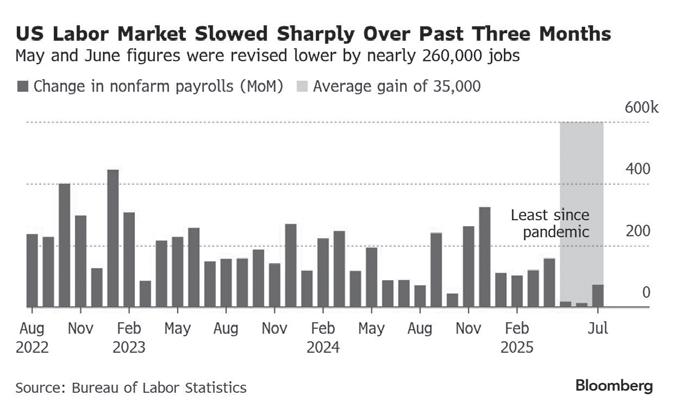
Friday’s jobs report showed that just 73,000 jobs were added last month and that 258,000 fewer jobs were created in May and June than previously estimated. The report suggested that the economy has sharply weakened during Trump’s tenure, a pattern consistent with a slowdown in economic growth during the first half of the year and an increase in inflation during June that appeared to reflect the price pressures created by the president’s tariffs.
“What does a bad leader do when they get bad news? Shoot the messenger,” Democratic Senate Leader Chuck Schumer of New York said in a Friday speech.
McEntarfer was nominated by Biden in 2023 and became the Commissioner of the Bureau of Labor Statistics in January 2024. Commissioners typically serve four-year terms but since they are political appointees can be fired. The commissioner is the only political appointee of the agency, which has hundreds of career civil servants.
The Senate confirmed McEntarfer to her post 86-8, with now Vice President JD Vance among the yea votes.
Trump focused much of his ire on the revisions the agency made to previous hiring data. Job gains in May were revised down to just 19,000 from a previously revised 125,000, and for June they were cut to 14,000 from 147,000. In July, only 73,000 positions were added. The unemployment rate ticked up to a still-low 4.2% from 4.1%.
“No one can be that wrong? We need accurate Jobs Numbers,” Trump wrote. “She will be replaced with someone much more competent and qualified. Important numbers like this must be fair and accurate, they can’t be manipulated for political purposes.”
Trump has not always been so suspicious of the monthly jobs report and responded enthusiastically after the initial May figures came out on June 6, when it was initially reported that the economy added 139,000 jobs.
“GREAT JOB NUMBERS, STOCK MARKET UP BIG!” Trump posted at the time. That estimate was later revised down to 125,000 jobs, prior to the most recent revision down to just 19,000.
During the 2016 campaign, Trump w as more critical: He often attacked
the jobs figures as they showed the unemployment rate steadily declining while Obama was still president, only to immediately switch to praising the data once he was in office, as steady job gains continued. The monthly employment report is one of the most closely-watched pieces of government economic data and can cause sharp swings in financial markets. The disappointing figure sent US market indexes about 1.5 percent lower on Friday. The revisions to the May and June numbers were quite large and surprising to many economists. At the same time, every monthly jobs report includes revisions to the prior two months’ figures. Those revisions occur as the government receives more responses from businesses to its survey, which helps provide a more complete picture of employment trends each month.
In the past decade, companies have taken longer to respond, which may have contributed to larger monthly revisions.
The proportion of companies responding to the surveys has also fallen steadily over the past 10 years, but the survey still gets responses from roughly 200,000 business locations, which can be independent companies or franchises of larger chains. The monthly jobs report has long been closely guarded within the BLS, with early copies held in safes under lock and key to prevent any leaks or early dissemination.
THE President Bush, a container vessel operating under the American President Lines (APL) fleet, is moored at the APL Terminal, also known as Global Gateway South, at the port of Los Angeles, Calif., Friday, Aug. 1, 2025. AP PHOTO/DAMIAN DOVARGANES
Trump’s economic ‘golden age’ faces headwinds as indicators signal trouble
By Josh Boak & Christopher Rugaber The Associated Press
WASHINGTON—For all of President Donald Trump’s promises of an economic “golden age,” a spate of weak indicators this week told a potentially worrisome story as the impacts of his policies are coming into focus.
Job gains are dwindling. Inflation is ticking upward. Growth has slowed compared with last year. More than six months into his term, Trump’s blitz of tariff hikes and his new tax and spending bill have remodeled America’s trading, manufacturing, energy and tax systems to his own liking. He’s eager to t ake credit for any wins that might occur and is hunting for someone else to blame if the financial situation starts to totter.
return—or they may be a preview of even more disruption to come.
Trump’s economic plans are a political gamble
TRUMP’S aggressive use of tariffs, executive actions, spending cuts and tax code changes carries significant political risk if he is unable to deliver middle-class prosperity. The effects of his new tariffs are still several months away from rippling through the economy, right as many Trump allies in Congress will be campaigning in the midterm elections.
countries that lacked settlements.
The costs of those tariffs—taxes paid on imports to the US—will be most felt by many Americans in the form of higher prices, but to what extent remains uncertain.
“For the White House and their allies, a key part of managing the expectations and politics of the Trump e conomy is maintaining vigilance when it comes to public perceptions,” said Kevin Madden, a Republican strategist.
India reels from Trump’s 25% tariff shock: Businesses and citizens voice outrage amid rising trade tensions
When Friday’s jobs report turned out to be decidedly bleak, Trump ignored the warnings in the data and fired the head of the agency that produces the monthly jobs figures.
“Important numbers like this must be fair and accurate, they can’t be manipulated for political purposes,” Trump said on Truth Social, w ithout offering evidence for his claim. “The Economy is BOOMING.” It’s possible that the disappointing numbers are growing pains from t he rapid transformation caused by Trump and that stronger growth will
B ut as of now, this is not the boom the Republican president promised, and his ability to blame his Democratic predecessor, Joe Biden, for a ny economic challenges has faded as the world economy hangs on his every word and social media post.
“Considering how early we are in his term, Trump’s had an unusually big impact on the economy already,” said Alex Conant, a Republican strategist at Firehouse Strategies. “The f ull inflationary impact of the tariffs won’t be felt until 2026. Unfortunately for Republicans, that’s also a n election year.”
The White House portrayed the blitz of trade frameworks leading up to Thursday’s tariff announcement as proof of his negotiating p rowess. The European Union, Japan, South Korea, the Philippines, I ndonesia and other nations that the White House declined to name agreed that the US could increase its tariffs on their goods without doing the same to American products. Trump simply set rates on other
Just 38 percent of adults approve of Trump’s handling of the e conomy, according to a July poll by The Associated Press-NORC Center for Public Affairs. That’s down f rom the end of Trump’s first term when half of adults approved of his economic leadership.
The White House paints a rosier image, seeing the economy emerging from a period of uncertainty after Trump’s restructuring and repeating the economic gains seen in his first term before the pandemic struck.
“President Trump is implementing the very same policy mix of deregulation, fairer trade, and prog rowth tax cuts at an even bigger scale—as these policies take effect, the best is yet to come,” White House spokesman Kush Desai said.
See “Trump,” A8
Caught
in crossfire:
By Brian Platt & Randy Thanthong-Knight
CANADA’S decision to retaliate against US tariffs earlier this year appears to be driving a divergence in how President Donald Trump is dealing with America’s neighbors. Until this week, Canada and Mexico received similar treatment in White House trade actions. Each was subject to a 25 percent base tariff, with a large exemption for goods shipped under the North American free trade pact known as USMCA.
That changed on Thursday, when Trump granted Mexico a 90-day pause on tariff hikes while jacking up its tax on Canadian products to 35 percent. The administration said Canada’s higher rate was a response to fentanyl trafficking and its moves to hit back with counter-tariffs.
The situation leaves Prime Minister Mark Carney with a political dilemma. On one hand, he won an election by promising a muscular approach to the trade war, saying the government would use tariffs to cause “maximum pain” in the US. His voters remember that, and some want him to punch back. Yet the retaliatory measures already undertaken failed to prevent further escalations. Instead, they appear to have emboldened Trump’s team to hit even harder. US administration officials in -
Canada’s trade
war strategy under scrutiny as US tariffs rise
cluding Commerce Secretary Howard Lutnick frequently talk about how only two countries retaliated against Trump’s tariffs—the other was China.
“Canada’s retaliatory trade measures against the United States further complicate bilateral efforts to address this escalating drug crisis,” the White House said in a fact sheet, referencing fentanyl. But Mexico is a much larger source of shipments of the drug into the US, according to Customs and Border Protection data. Carney, an economist and former central banker, has also made it plain he believes retaliation can only go so far. In fact, his government has watered down Canada’s counter-tariffs with a number of exemptions, declined to increase them when the US lifted steel and aluminum tariffs to 50 percent and scrapped a tax on technology services at Trump’s request. Dominic LeBlanc, the Canadian minister in charge of trade talks, told Radio-Canada on Friday the government hasn’t made any decisions about further retaliation.
But Carney is clearly reluctant to do so—which “reflects the reality that counter-tariffs are understood to be economically harmful to the country which imposes them,” said David Collins, a professor specializing in international trade at City St George’s, University of London.
The government’s priority is to keep the USMCA carve-out that dramatically lowers the real tax on Ca -
nadian goods. The effective US tariff rate on Canada is about 6.3 percent, according to Bank of Nova Scotia economists.
“A more diplomatic approach is likely to bear more fruit with the Americans,” Collins said.
Retaliation escalation
CANADA imposed two rounds of counter-tariffs in March, when Justin Trudeau was in his final days as prime minister. The first placed 25% levies on about C$30 billion ($21.8 billion) of imports from the US that included food items, clothing and motorcycles. The second came when Trump put tariffs on steel and aluminum.
Then, when Trump added tariffs to foreign automobiles, Carney essentially matched that move, imposing similar fees on US cars and trucks.
But in mid-April, the government unveiled a series of exemptions for business inputs—goods imported for use in manufacturing and food packaging, as well as things needed for health care, public safety and security. Automakers such as General Motors Co. and Honda Motor Co. that make vehicles at Canadian plants were also made eligible for relief from import taxes.
The large majority of US products can still enter Canada tariff-free. US companies and other entities exported about $440 billion of goods and services to Canada last year—more than to any other nation.
By Satviki Sanjay & Swati Gupta
SHOCK , dismay and angst swept across India as businesses, policymakers and citizens digested US President Donald Trump’s sharp remarks and a surprise 25 percent tariff rate earlier this week.
While Indian government officials weighed a response and business groups tallied the cost of the trade barrier, the local social media flared up with users protesting Trump’s comments and criticizing Indian Prime Minister Narendra Modi for not speaking up. It started with Trump saying that India’s trade barriers were the “most strenuous and obnoxious,” in a Truth Social post July 30. He added the US may also impose a penalty for New Delhi’s purchase of Russian weapons and energy. Less than a day later, he ripped into India again for aligning with Russia, calling them “dead economies” in another post.
With no imminent trade deal, the 25 percent tariffs kicked in as of Friday. India is hardly alone in facing Trump’s trade wrath—and not the subject to the very highest rates—but the news left business and political leaders wondering how to cope with the fallout.
‘Blunt-force’ message
For Canada, “the logic for escalation over cooperation is just weak,” said Oliver Lavelle, global macro strategist at Thiel Macro LLC.
Mexico’s way
MEXICAN President Claudia Sheinbaum, in contrast, has never imposed counter-tariffs on the US.
Sheinbaum’s position is also supported by her high approval ratings, which have remained above 75 percent in most polls. “It’s worth saying: President Trump treats us with respect in all the calls we’ve had, and we do too,” she said during a news conference. “We may not agree, but the treatment is respectful.”
A statement issued late Thursday night by Carney’s office expressed disappointment in Trump’s tariff hike on Canada, but made no mention of retaliation. A spokesperson for Carney declined to comment further.
LeBlanc said he met with Lutnick on Tuesday night, and that Canadian officials held other meetings throughout the week, but a deal acceptable to both sides “was not yet visible.”
In his statement, Carney acknowledged that lumber, steel, aluminum and autos are still subject to US levies, and said his government “will act to protect Canadian jobs, invest in our industrial competitiveness, buy Canadian, and diversify its export markets.” With
“OVERNIGHT, the US-India trade equation shifted from tense to turbulent,” said Akshat Garg, assistant vice president at Choice Wealth, a Mumbai based financial services firm. The levies “feel less like structured policy and more like a bluntforce political message.”
Complicating the narrative around the India trade deal—or the lack of it—was the US pact with its traditional rival Pakistan that came through on the same day.
As the US released rates across the world on August 1, India’s relative disadvantage to competitor exporting countries became more apparent, dampening moods and stoking tempers further.
“The biggest blow is that Pakistan and Bangladesh got a better rate than us,” V. Elangovan, managing director at SNQS Internationals, an apparel maker in the south Indian manufacturing hub of Tirupur, told Bloomberg News. “We were expecting something in the 15 to 20% range.”
India’s annoyance can be traced back in part to Trump declaring himself the peacemaker that helped broker a ceasefire in the armed conflict between India and Pakistan in May. The move was seen as an effort to upstage Modi and put the two South Asian neighbors on an equal footing, despite India’s larger military and economy. The events of this week have cemented that impression further in the eyes of some Indian observers. When the tariff rate news first dropped in late Wednesday evening in India, Ashish Kanodia recalls
being “very disturbed.” A director at Kanodia Global, a closely held exporter that gets over 40 percent of its revenue from the US selling home fabrics to toys, the entrepreneur already has two of its largest US customers seeking discounts to make up for the levy.
“The next six months are going to be difficult for everyone,” Kanodia said, adding that profit margins will be squeezed. If the pain continues for “months and months,” he said he’ll have to start cutting his workforce.
The US is India’s largest trading partner, with the two-way trade between them at an estimated $129.2 billion in 2024.
Compared with India’s 25 percent, Bangladesh was subjected to a 20 percent tariff, Vietnam got a 20 percent levy and Indonesia and Pakistan each received 19 percent duties.
“We know that we have got a deal that is worse than other countries,” said Sabyasachi Ray, executive director at The Gem and Jewelry Export Promotion Council. “We will take it up with the government.” Trump’s actions mark a 180-degree turn for New Delhi’s hopes of preferential treatment over regional peers. It was among the first to engage Washington in trade talks in February, confident of hammering out a deal sooner than others. Trump had called India’s Prime Minister Narendra Modi “my friend” in a February 14 post on X and the bond between the two countries “special.”
India is now weighing options to placate the White House, including boosting US imports, Bloomberg News reported citing people familiar with the matter, and many hope that the bilateral relationship and the tariff rate can still be improved.
“It is a storm in the India-US relationship at this moment but I think there’s a good chance that it will go away,” Vivek Mishra, deputy director of the Strategic Studies Programme at Delhi based Observer Researcher Foundation, told Bloomberg News. Indian business and trade groups are supporting the government’s stance on the deal as the negotiations for a US-India trade deal continue.
Negotiating tactic
JEWELRY businesses “are worried but they are not panicking” because they hope a more favorable deal can be worked out, said Ray of the gems export body. “The negotiation that should be happening should be a win-win, not a win-lose.”
The abrupt announcement by Trump over social media when negotiations with India were ongoing “seems like a knee-jerk reaction,” according to Rohit Kumar, founding partner at public policy research firm The Quantum Hub.
“This appears to be a negotiating tactic aimed at unresolved discussion points,” Kumar said. Bloomberg News
DONALD TRUMP with Narendra Modi at the White House on Feb. 13. PHOTOGRAPHER: FRANCIS CHUNG/POLITICO/BLOOMBERG
PRESIDENT Donald Trump disembarks from Air Force One at Lehigh Valley International Airport, Friday, Aug. 1, 2025, in Allentown, Pa. AP PHOTO/JULIA DEMAREE NIKHINSON
Trump orders repositioning of US nuclear submarines following Medvedev’s ‘highly provocative statements’
By Will Weissert The Associated Press
WASHINGTON—In a warning to Russia, President Donald Trump said Friday he’s ordering the repositioning of two US nuclear submarines “based on the highly provocative statements” of the country’s former president, Dmitry Medvedev, who has raised the prospect of war online.
Trump posted on his social media site that, based on the “highly provocative statements” from Medvedev, he had “ordered two Nuclear Submarines to be positioned in the appropriate regions, just in case these foolish and inflammatory statements are more than just that.” The president added, “Words are very important, and can often lead to unintended consequences, I hope this will not be one of those instances.”
It wasn’t clear what impact Trump’s order would have on US nuclear subs, which are routinely on patrol in the world’s hotspots, but it comes at a delicate moment in the Trump administration’s relations with Moscow. Trump said later Friday that he was alarmed by Medvedev’s attitude.
“He’s got a fresh mouth,” Trump said in an interview with Newsmax.
Trump has said that special envoy Steve Witkoff is heading to Russia to push Moscow to agree to a ceasefire in its war with Ukraine and has threatened new economic sanctions if progress is not made. He cut his 50-day deadline for action to 10 days, with that window set to expire next week. The post about the sub repositioning came after Trump, in the
wee hours of Thursday morning, had posted that Medvedev was a “failed former President of Russia” and warned him to “watch his words.” Medvedev responded hours later by writing, “Russia is right on everything and will continue to go its own way.”
And that back-and-forth started earlier this week when Medvedev wrote, “Trump’s playing the
ultimatum game with Russia: 50 days or 10” and added, “He should remember 2 things: 1. Russia isn’t Israel or even Iran. 2. Each new ultimatum is a threat and a step towards war. Not between Russia and Ukraine, but with his own country.”
Asked as he was leaving the White House on Friday evening for a weekend at his estate in New Jersey about where he was repositioning the subs, Trump didn’t offer any specifics.
“We had to do that. We just have to be careful,” he said. “A threat was made, and we didn’t think it was appropriate, so I have to be very careful.”
Trump also said, “I do that on the basis of safety for our people” and “we’re gonna protect our people.” He later added of Medvedev, “He was talking about nuclear.”
“When you talk about nuclear, we have to be prepared,” Trump said. “And we’re totally prepared.” He told Newsmax that the submarines were being moved “closer to Russia.”
Medvedev was Russia’s president from 2008 to 2012, while Vladimir Putin was barred from seeking a third consecutive term, and then stepped aside to let him
Denmark’s economy runs on Novo, will the drugmaker’s troubles slim it down?
By Sanne Wass & Christian Wienberg
DENMARK’S status as one of the few countries in Europe with an expanding economy rests in part on the success of its homegrown hero, Novo Nordisk A/S. Thanks to the pharmaceutical giant’s astronomical rise, the country enjoyed growth of 3.5 percent last year, outpacing most nations in the region. But after a series of stumbles, Novo is struggling to retain its edge in the cutthroat US weight-loss market.
That, in turn, is generating concern about whether the company’s troubles could lead to mass layoffs or become a drag on the broader Danish economy. Novo’s market value shrunk by almost $100 billion this week after the company cut its profit outlook on Tuesday, citing intensifying competition and copycat drugs in the US. It marked the second time this year that the drugmaker pared back its earnings projections. Shares plunged 23 percent—the steepest single-day drop on record—and its stock has continued to slide in the days since.
Novo’s bad news translated into an immediate financial blow to Danish households. Outside of pension savings, Danes lost 38 billion kroner ($5.8 billion) in regular stock portfolios on Tuesday alone, according to estimates by Sydbank A/S. That’s the equivalent of almost 3 percent of total annual private consumption.
“There will be shareholders who have lost rather large amounts,” said Mikael Bak, chief executive officer of the Danish Shareholders’ Association. “It’s quite conceivable that we’ll see some Danish investors holding back on things like buying a new car or booking an expensive vacation.” Given Novo’s size, the damage could ripple beyond the stock market. Economists have warned that a prolonged Novo slump could drag on the country’s exports—a concern shared by the state’s financial watchdog, which slashed its export forecast in May following a profit warning from Novo—and even influence interest rates.
Moreover, since the drugmaker’s production counts toward Denmark’s gross domestic product, any roll-back of expectations will “almost mechanically” impact the country’s growth numbers, said Las Olsen, chief economist at Danske Bank A/S, Denmark’s
largest lender.
“Lower growth in Novo means lower GDP growth in Denmark, it’s as simple as that,” said Olsen. A decline in drug sales did cause the Danish economy to shrink slightly in the first quarter, according to Statistics Denmark, and second-quarter GDP numbers will be released on Aug. 20. Novo is still growing, Olsen stressed, but if it were to flatline completely, Denmark would cease to be among Europe’s highest growth economies.
Soren Kristensen, chief economist at Sydbank, cautioned against reading too deeply into Novo’s dip. Analysts predict the company’s revenue and profit growth will continue through the end of the decade, and Kristensen emphasized that so long as the firm’s earnings are increasing, the Danish economy will benefit. Still, he added, Novo is “in a slightly more vulnerable position” than previously assumed.
“If things were to take a turn for the worse,” he said, “the effects would show up in quite a few areas.” He pointed to the country’s industrial production and exports as most exposed.
Novo’s vast output has helped drive Denmark’s large surplus and bolstered the krone. That has made it necessary for the Danish central bank to maintain a lower interest rate than
the European Central Bank to defend the currency peg. Should exports take a major hit, however, Kristensen said that Denmark might need to reverse course and raise its rates.
Within Denmark, a sustained Novo slowdown could also limit funding increases in scientific research, healthcare and social programs, Olsen said. That’s because the Novo Nordisk Foundation, which owns a controlling stake in the company, has significantly ramped up its grantmaking in these areas on the back of soaring profits from blockbuster drugs Wegovy and Ozempic. The foundation supports
the work and salaries of around 9,500 scientists.
Novo’s rise in recent years has fueled broader concern about Denmark becoming overly reliant on a single company. To those worried about the drugmaker’s outsized role in the country, its setbacks this week evoked specters of Nokia Oyj, the Finnish telecommunications giant whose slump in the early 2000s dragged down Finland’s entire economy.
Denmark’s Prime Minister Mette Frederiksen admitted in an interview last year that officials need to keep an eye on the risks linked to Novo’s
run again.
Now deputy chairman of Russia’s National Security Council, which Putin chairs, Medvedev has been known for his provocative and inflammatory statements since the start of the war in 2022. That’s a U-turn from his presidency, when he was seen as liberal and progressive.
Medvedev has frequently wielded nuclear threats and lobbed insults at Western leaders on social media. Some observers have argued that with his extravagant rhetoric, Medvedev is seeking to score political points with Putin and Russian military hawks.
One such example before the latest spat with Trump came on July 15, after Trump announced plans to supply Ukraine with more weapons via its NATO allies and threatened additional tariffs against Moscow. Medvedev posted then, “Trump issued a theatrical ultimatum to the Kremlin. The world shuddered, expecting the consequences. Belligerent Europe was disappointed. Russia didn’t care.”
Associated Press writer Dasha Litvinova in Tallinn, Estonia, and Darlene Superville in Bridgewater, N.J., contributed to this report.
Continued from A7
dominant position, but brushed off Nokia comparisons, noting that the economy’s strengths aren’t concentrated in the pharmaceutical sector alone.
Olsen from Danske Bank takes a similar view. He noted that Novo is still growing, while Nokia underwent a serious contraction, and argued that even if Novo were to experience a similar downturn, Denmark’s economy would be better positioned to absorb the shock. For all its growth, he said, the drugmaker has a limited impact on national employment and wages—both of which remain resilient—and the Danish economy is more flexible on account of its adaptive wage structures and rules that make it easier to fire employees. Denmark also relies on large inflows of foreign labor to meet workforce needs, which can be adjusted as needed.
Still, the company directly employs more than 30,000 people in Denmark. If layoffs are in the offing, as new CEO Maziar Mike Doustdar has hinted, key Novo hubs such as Kalundborg and Bagsvaerd are likely to take a hit.
Outside of the agricultural industry, Novo was responsible for half of all private-sector job growth in Denmark between early 2023 and 2024, according to the state’s fiscal watchdog.
“Locally, it could feel quite severe, even if it doesn’t show up strongly in national figures,” Kristensen said, especially as cuts and investment reductions are likely to reverberate through Novo’s network of suppliers and contractors.
Nowhere in Denmark have Novo’s rising fortunes registered more strongly than in Kalundborg, home to the company’s main production facilities. As corporate tax revenue from Novo has surged more than tenfold since 2011, unemployment has dropped to record lows and the town has experienced a boom. Novo’s factory expansions and rapid hiring have bolstered local businesses, universities and research programs have flocked to the town, and investment is flowing into housing and infrastructure.
“What’s been the impact of the massive growth in Novo Nordisk?” Olsen said. “It’s delivered GDP growth, shareholder returns, extra tax revenue and a current account surplus. So if the situation were to go the other way, all of those effects would naturally reverse.” Bloomberg News
Recent economic reports suggest trouble ahead THE economic numbers over the past week show the difficulties that Trump might face if the numbers continue on their current path: n Friday’s jobs report showed that US employers have shed 37,000 manufacturing jobs since Trump’s tariff launch in April, undermining prior White House claims of a factory revival.
n Net hiring has plummeted over the past three months with job gains of just 73,000 in July, 14,000 in June and 19,000 in May—a combined 258,000 jobs lower than previously indicated. On average last year, the economy added 168,000 jobs a month.
n A Thursday inflation report showed that prices have risen 2.6 percent over the year that ended in June, an increase in the personal consumption expenditures price index from 2.2 percent in April. Prices of heavily imported items, such as appliances, furniture, and toys and games, jumped from May to June.
n On Wednesday, a report on gross domestic product—the broadest measure of the US economy—showed that it grew at an annual rate of less than 1.3 percent during the first half of the year, down sharply from 2.8 percent growth last year.
“The economy’s just kind of slogging forward,” said Guy Berger, senior fellow at the Burning Glass Institute, which studies employment trends. “Yes, the unemployment rate’s not going up, but we’re adding very few jobs. The economy’s been growing very slowly. It just looks like a ‘meh’ economy is continuing.”
Trump’s Fed attacks could unleash more inflation TRUMP has sought to pin the blame for any economic troubles on Federal Reserve Chair Jerome Powell, saying the Fed should cut its benchmark interest rates even though doing so could generate more inflation. Trump has publicly backed two Fed governors, Christoper Waller and Michelle Bowman, for voting for rate cuts at Wednesday’s meeting. But their logic is not what the president wants to hear: They were worried, in part, about a slowing job market. But this is a major economic gamble being undertaken by Trump and those pushing for lower rates under the belief that mortgages will also become more affordable as a result and boost homebuying activity. His tariff policy has changed repeatedly over the last six months, with the latest import tax numbers serving as a substitute for what the president announced in April, which provoked a stock market sell-off. It might not be a simple one-time adjustment as some Fed board members and Trump administration officials argue.
PTRI: Top firms buying natural fibers in bulk
By Bless Aubrey Ogerio
AT least five large companies are now sourcing textile-grade natural fibers directly from Philippine farms, according to the Philippine Textile Research Institute (PTRI).
PTRI Director Julius L. Leaño Jr. said the agency has been “intensifying” efforts to link farmers with buyers in the fashion and manufacturing industries.
“These are not small firms— they’re buying in tons,” Leaño told BusinessMirror last Thursday. “And they’re sourcing fibers that are specifically intended for textiles.
Tractor makers warn that tariffs will raise machinery prices for global farmers
FARMERS will soon start feeling the impact from President Donald Trump’s tariffs in the form of higher prices for the machines used to plant, treat and harvest fields.
That’s the warning from AGCO Corp. and CNH Industrial NV. With duties on the rise, the equipment makers will increasingly be forced to pass along the extra costs—both to farmers in the US and to those elsewhere in the world.
For instance, some of AGCO’s high-end Fendt tractors and combines are built in Europe, where the EU bloc accepted a 15 percent tariff on most of its exports to the US. Rather than letting the price of one model spike, AGCO is instead moving to smooth it out across its offerings.
“We have a pile of costs that we’ve got to absorb somehow, and we look to sprinkle it wherever we can, all around the world on all products,” AGCO Chief Executive Officer Eric Hansotia said in an interview.
Tariff exposure is still a moving target, with Trump’s latest volley outlining minimum baseline levies of 10 percent. That’s forcing companies to put together increasingly complex scenarios on how to minimize costs and still turn a profit. AGCO’s current outlook for a 1-percent price rise in 2025 is subject to change.
CNH, with brands including Case IH and New Holland, said Friday it has increased prices for its model-year 2026 machines, without specifying by how much. That’s after steel and aluminum tariffs increased from earlier this year, which also boosted
Continued from A12
Young noted that the Philippines imported $70.9 million of cotton in 2024.
Last year, the main sources of Philippines’ cotton were: China, with $31.9 million; Vietnam, $6.03 million; Indonesia, $5.95 million; India, $5.01 million and Pakistan, $4.28 million.
Meanwhile, Young described Philippines’ garments exports to India as a “totally hopeless case” because India’s cost of textile and finished garments are cheaper by about 15 to 20 percent compared to Philippine garments.
“So there’s no chance of competition. The reason being, again, is they have textile mills. They’re one of the biggest textile producers,” he explained.
The Indian government provides subsidies to the textile industry, he stressed.
“Because they have this thing called Textile City which President Modi was able to do successfully,” added Young.
Young said India is already selling about $35 billion whereas the Philippines is still fighting for the $1 billion-mark.
However, he said the Philippines is exporting at a “very minimal quantity” to India some apparel and accessories.
“They order some garments [from us], we have scarves. And they attracted some Indian importers,” the industry leader noted.
These Philippine outbound shipments to India are valued at about $1.2 million per year, which include knitted items, scarves, shawls, crocheted apparels, laces, and tapestry work. Explaining why the Philippines cannot
Before, that didn’t exist. It was practically zero.”
Leaño, however, did not name the companies.
He said the institute began facilitating these linkages prior to the Covid-19 pandemic, but the shift gained traction during lockdowns when firms turned to local sources amid mobility restrictions and supply chain disruptions. The demand has since remained robust.
According to the PTRI director, the fibers being sourced include pineapple, banana, and abaca.
“Fiber isn’t just for textiles; it has many uses,” Leaño said. “But what we’re working on is fiber-grade material, which is specifically suitable
for textiles.”
The shift comes amid PTRI’s broader push to revive the country’s natural textile industry, which includes creating new production hubs, linking communities to buyers and developing training programs for weavers and other fabric producers.
Some of the firms use the fibers for yarn and handwoven fabrics, while others apply them to nonwoven products like mattresses and cushion fillings.
The increased demand is also prompting the establishment of new weaving communities in areas with available raw materials.
PTRI is pushing to rebuild the
domestic textile industry, and is pitching pieces of legislation that seeks to institutionalize government support for the sector.
One key measure is the proposed Philippine Textile Revitalization Act, which outlines a long-term strategy for industry development.
Also being pushed are the Handloom Weaving Industry Innovation Act and the Academic Regalia Act, the latter mandating state universities and colleges to use locally woven fabrics for ceremonial garments.
PTRI is addressing the lack of formal training in textile production.
domestic US material costs.
“It’s also important to note that most of the units sold in the quarter were not yet heavily impacted by additional tariff costs,”
CNH Chief Financial Officer James Nickolas told investors on a call. “Those impacts will come more in the second half as that tariff-impacted inventory flows through our production system.”
The potential for higher machinery prices for farmers comes as they also struggle with sliding crop values that have crimped spending. CNH also pointed to elevated delinquencies on loans for Brazilian farmers, although that pressure has likely peaked.
“It’s cyclically a tough time for farmers in Brazil,” Nickolas said.
Slow start
MEANWHILE top wheat shippers, including Russia, Ukraine and the European Union, got off to a slow start to the new season as exports were curbed by adverse weather and stockpiling by farmers.
Russian shipments in July, when sales usually boom as harvests roll in, are set to drop by 30 percent from a year earlier, according to an estimate from consultancy IKAR. Ukraine is only exporting at about a third of 2024’s pace, and the European Union is also shipping less.
The sluggish flows have stabilized Paris wheat futures and boosted spot prices at Black Sea ports in Romania and Bulgaria by an average of 8 percent last month. Spot prices in the French port of Rouen gained 2 percent. Bloomberg News
compete in terms of garments exports to India, Young said Thailand, Indonesia and Vietnam “copy very, very fast,” adding that these countries “can just knock down everything and produce it 20 percent, 15 percent lower than the Philippines.”
Still, he said the Philippines can bank on Filipino craftsmanship to explore and make it a bit bigger “in a few years’ time” in the area of fashion accessories.
He explained that these countries are beating Filipino garment makers in terms of speed in productivity, albeit the Philippines touts better craftsmanship, because local garments makers still have to import raw materials.
“The craftsmanship is better than theirs, so we are slower in the productivity. So we lose. Where does India gets theirs now? We saw the products already from Vietnam and from Indonesia and Thailand. They are very nice. They have all kinds of new materials already. We saw that they have inserts of some feathers and some beads. They are nice, really nice. We don’t have that. We have to import. That’s an added cost to the free on board costing. That’s where we lose,” Young explained further.
With Philippine goods set to be slapped an additional 19 percent tariff starting on August 7, Young explained that the local garments industry would have to concentrate on selling middle- to high-end items to the United States or the overalls, jackets, jogging pants, among others. Young said this as the local garments cannot compete on the basic level anymore which are the t-shirts and everyday wear. (See: https://businessmirror.com. ph/2025/07/23/seipi-us-philippinestrade-talks-yield-favorable-results-forsemiconductor-and-electronics-industry/)
TThe first offering filled all 20 available slots, Leaño said, with many enrollees being teachers of technology and livelihood education in public schools.
“For years, there was no full program in textile engineering,” he said in a press conference. “Our textile mills declined drastically in the 1990s, and the demand vanished. But now we’re seeing that these skills are needed again.”
PTRI said it plans to expand these training programs while continuing to support fiber-to-fabric initiatives at the local level.
The agency recently partnered with the University of the Philippines to pilot short courses on textiles and weaving innovation.
‘Raise rice tariff, amend RTL to protect local planters’
By Ada Pelonia @adapelonia
stabilize supply and lower prices for consumers.
HE National Sectoral Com -
mittee on Rice and Other Food Staples (NSC on Rice) has proposed several measures that will arrest the slump in palay prices and boost the competitiveness of the local rice sector.
In a meeting held July 21, the private sector partners from the NSC on Rice said “unbridled” rice importation caused downward pressure on domestic prices, which poses a threat to the livelihood of Filipino rice farmers.
The Rice Tariffication Law (RTL) was signed in 2019, which liberalized rice importation by replacing quantitative restrictions with tariffs, aiming to
Citing the Philippine Rice Research Institute’s (PhilRice) price monitoring data, however, the committee noted that while the official average price for fresh palay hovered around P11.50 per kilo, traders were buying it for low as P6 per kilo in some areas, far below production costs.
The consultative body under the Philippine Council for Agriculture and Fisheries expressed concern over the National Food Authority’s (NFA) limited market influence and resources due to its reduced mandate under the existing RTL.
With this, the committee proposed amendments to the RTL, which includes reinstating the
35-percent rice tariff and restoring the grains agency’s mandate to allow conditional market interventions during crises.
“Raising the tariff would likely increase the price of imported rice in the country. With the price increase of imported rice, this could protect local rice farmers by making their produce more competitive in terms of price and encourage domestic production.”
The committee said government-owned and -controlled corporations (GOCCs) should be allowed to procure local rice through the NFA for employee rice allowances as part of efforts to ease oversupply and support farmgate prices.
It also called for investments in community drying, storage,
and logistics infrastructure to reduce postharvest losses and improve palay quality along with expanding and decentralizing NFA procurement capacity to include mobile buying stations and rural field operations. It said palay traders must be regulated to ensure fair pricing and prevent market manipulation.
“These measures are critical to provide safety nets for local farmers, enhance the resilience of the domestic rice industry, and ensure food security for the nation,” NSC on Rice said.
The committee noted that a position paper detailing these proposed revisions and suggestions will be attached for the Department of Agriculture’s consideration.
Multinational firms must deliver cage-free eggs–group
LOCAL authorities must hold multinational companies operating in the Philippines accountable for “breached commitments” to transitioning to cagefree eggs, according to a nonprofit organization.
The Pinas Initiative for Accountability (PIA) noted the findings of a nonprofit think tank which indicated that 83 percent of Filipino consumers want food companies to source their eggs from cage-free environments while 95 percent agree that hens should not be kept in cages.
“Filipino consumers are being left behind in a time when they deserve transparency. It’s not enough to make promises abroad and hide behind silence locally. We call on local authorities to take action to protect our Filipino consumers,” said Nancy Samonte, program manager of PIA.
As it currently stands, though, no legislation exists compelling multinational corporations to publicize their commitments.
Come October, PIA said it will come up with a 2025 Cage-free Tracker mapping the commitments of all Philippine-based companies.
Cage-free systems are recognized around the world as a more humane standard of animal welfare. Unlike battery cages, they allow hens to move more freely and express natural behaviors like perching, nesting, and dust bathing while significantly reducing the amount of time they spend in pain. Local egg producers have
Govt sets up
THE Department of Agriculture (DA) expressed support for a “green lane” plan aimed at enhancing interagency coordination and streamlining the entry of strategic investments, particularly in the agriculture and fisheries sectors.
Agriculture Secretary Francisco Tiu Laurel Jr. signed a joint memorandum circular (JMC) which strengthens the operational mechanism of the Investment Facilitation Network (INFANet) and integrates the provisions of Executive Order (EO) 18, Series of 2023. EO 18 institutionalizes “Green Lanes for Strategic Investments,” an initiative to fast-track the processing of permits, licenses, and registrations critical for major investment projects.
been producing and supplying cage-free eggs, according to PIA.
Philippine-headquartered companies have committed to cagefree sourcing. For instance, Jollibee pledges to transition to 100 percent cage-free eggs in the United States by 2025 and 100 percent cage-free eggs by 2035 globally—sparing millions of hens from cruel cages. However, while local producers have begun stepping up, multinational companies operating in the
Philippines have yet to show the same level of urgency and transparency. Despite high-profile global pledges, many remain vague or silent about their progress within the Philippine market.
“Our consumers already buy into global brands that market themselves as ethical and sustainable. If those same brands are charging premium prices locally while cutting corners on animal welfare they follow elsewhere, then we are being lied to,” Samonte said.
PIA said it is in active dialogue with major brands, pushing them to publish local transition plans that match their global standards. Others have pledged to go cagefree by 2025.
“The goal is simple: empower consumers and pressure companies to stop treating ethical sourcing as optional in the Philippine market. We want Filipinos to see which companies are true to their word, and which ones are not,” Samonte said.
‘green lane’ for agri investments
“This JMC is a significant step forward in our commitment to making it easier for investors to do business in the Philippines’s agri-fishery sector,” the DA chief said in a statement.
“With improved coordination and more efficient systems in place, we are creating an environment that attracts investment and drives inclusive rural development.”
Under the circular, the DA will facilitate investments related to agribusiness, agricultural mechanization, food security, and rural infrastructure.
It said a dedicated INFA-Net Focal Unit, led by the DA’s Agribusiness and Marketing Assistance Service (AMAS) in coordination with the Policy Research Service (PRS), will
be responsible for ensuring timely coordination and compliance with the circular’s provisions. This measure tallies with the Ease of Doing Business and Efficient Government Service Delivery Act of 2018, which reinforces the government’s wider push to bolster public service efficiency and promote investor confidence.
By removing unnecessary red tape, DA said the circular could create a “more transparent and investorfriendly climate,” particularly in underserved rural areas.
The agency hopes this initiative will generate new investments, modernize farming and fisheries practices, and increase productivity and profitability for local producers.
“This initiative doesn’t just target
BusinessMirror file photo
Harnessing demographic potential: PHL’s path to broad-based prosperity
THE Philippines is at a crucial point in its economic development. With a young and growing working-age population, the country stands poised to harness a demographic advantage that many of our neighbors, burdened by aging populations, can only envy. However, as highlighted by Department of Economy, Planning, and Development Secretary Arsenio M. Balisacan, this window of opportunity is closing rapidly. Without swift and decisive structural reforms, the Philippines risks squandering its potential for broad-based prosperity. (Read the BusinessMirror story: “PHL at risk of wasting demographic edge without productivity reforms—Balisacan,” July 29, 2025).
Balisacan’s call to action during the 46th National Conference of Employers underscores an urgent need for the country to transform its economic landscape. The statistics are telling: while the population growth rate has slowed significantly, the proportion of older Filipinos is rising. By 2030, an estimated 10 percent of the population will be over 60, requiring economic changes to generate good, sustainable jobs for everyone. This demographic shift presents both challenges and opportunities. The increasing proportion of the population over 60 just five years from now necessitates a proactive economic transformation focused on creating quality, future-proof jobs.
Currently, the Philippines is experiencing economic growth, yet this growth is largely driven by labor and capital inputs rather than improved productivity. The World Bank’s findings illustrate a troubling reality: the country lags behind its regional neighbors in investment-to-capital ratios. This indicates a significant untapped potential for enhancing capital per worker through investments in technology and infrastructure.
The focus should move from simply boosting inputs to cultivating an innovation-driven economy that prioritizes productivity. This involves several key strategies: Encouraging both public and private sector investment in R&D to drive new discoveries and technologies; providing funding, resources, and mentorship for startups to promote new ideas and business models; enhancing our education systems to focus on critical thinking, creativity, and technical skills that promote innovation; facilitating partnerships between businesses, universities, and government to share knowledge and resources; and improving access to venture capital and financial support for innovative projects.
Moreover, the concentration of economic activity in Metro Manila highlights the geographic disparities that continue to plague the nation. Despite efforts at decentralization, the National Capital Region remains the dominant engine of growth, which poses risks not only to equity but also to economic resilience. A diversified economic landscape, with vibrant regional economies, is essential for mitigating vulnerabilities to global disruptions.
Balisacan’s vision calls for a multi-faceted approach: advancing productivity, embracing technological innovation, and fostering equitable growth across regions. This requires not just policy alignment but also concerted action among public and private sectors to enhance the efficiency of public spending and accelerate digital transformation.
As the Philippines stands at this crossroads, the message is clear: the time for action is now. Embracing the demographic advantage through comprehensive reforms will not only secure a prosperous future for the country but also empower the next generation of Filipinos. The path may be challenging, but with strategic foresight and collaborative effort, the Philippines can transform its demographic potential into enduring economic success.
The TikTok business school
WRISING SUN
ALK into any Filipino workplace today, and you’re bound to overhear someone saying, “I saw this tip on TikTok— they say it’s great for managing teams!” These days, business lessons are just as likely to be delivered alongside dance trends. Welcome to the era of the “TikTok MBA”—and it’s changing how professionals are getting ahead.
Many young professionals don’t have the time for grad school. But by following #PHCareerTips and listening to local influencers share business hacks, they can pick up actionable advice on their commute. Some even credit short-form videos for successful career transitions, proving that knowledge can be gained even in Edsa traffic.
With over 49 million active TikTok users in the Philippines as of 2024, rising to 62.3 million by early 2025, and nearly 70 percent of users aged 16 to 64, the app is now considered the country’s “unofficial after-
hours classroom.” From franchise strategies to digital marketing, professionals everywhere are swapping classroom lectures for advice-packed videos on their phones.
So what makes it click? Instead of abstract theories and jargon, viewers get bite-sized business wisdom wrapped in relatable storytelling. It’s no surprise that “shoppertainment”—the blend of shopping, entertainment, and education—is taking off among Filipino MSMEs (micro, small, and medium enterprises). Platforms like TikTok Shop now offer free e-learning modules and
“business school” content for business owners who once struggled to afford traditional seminars or MBAs.
But with speed and accessibility comes risk. Not all viral “hacks” are rigorously fact-checked; misinformation and oversimplification sometimes slip through. That’s why it’s important to check credentials, dig deeper, read books, enroll in specialized short courses, and consult real mentors.
For Filipino professionals, the rise of TikTok as an educational platform is less a replacement and more an evolution of lifelong learning. The best results come from a hybrid approach: snackable videos to spark curiosity, deeper dives for mastery, and—crucially—a community where actual stories matter as much as credentials.
As for universities and colleges offering business courses, this new wave of digital learning is both a wake-up call and an opportunity. With more young Filipinos adapting to bite-sized, interactive lessons online, traditional business schools are challenged to reinvent their methods, update their offerings, and embrace blended learning models. Some schools have started integrating social media content, real-
world case studies, and digital marketing simulations to stay relevant and engaging. Yet, competition for students’ attention is tougher than ever—institutions must now prove that formal education delivers not just theory, but also the practical, immediately applicable skills that digital platforms promise. And while social media platforms like TikTok offer rapid, accessible learning and real-world tips, only universities and colleges can provide formal credentials—certifications, diplomas, and degrees that carry both local and international recognition. These official documents remain crucial for many career paths, opening doors to management programs, scholarships, and global opportunities that informal online lessons simply can’t match. In this climate, the role of higher education shifts: it’s not just about content delivery, but also about rigorous assessment, mentorship, and awarding credentials that validate a professional’s skills and knowledge. Ultimately, universities that blend practical learning with the lasting credibility of formal certification will maintain their edge, offering graduates the best of both worlds.
A blueprint of action: Vince Dizon’s winning streak at the DOTr
IDionisio L. Pelayo
Ruben M. Cruz Jr.
Eduardo A. Davad Nonilon G. Reyes
LITO GAGNI
N a bureaucracy long defined by inertia, where service has too often meant simply showing up, Transportation Secretary Vince Dizon has transformed the blueprint for government leadership. Under his stewardship, the Department of Transportation (DOTr) has become a pro-active powerhouse, reshaping public expectations and elevating what is possible in the realm of public service.
No wonder President Marcos has tapped Dizon to shepherd his most ambitious legacy projects.
Take the long-delayed Metro Manila Subway, the country’s first underground mass transit system. Once mired in red tape and right-of-way issues, the final section from Valenzuela to Ortigas is now gaining critical momentum. Dizon has wasted no time answering the President’s call to expedite the 33-kilometer subway— one of the crown jewels of the administration’s infrastructure push. The President himself hopes to inaugurate the Valenzuela-Ortigas segment before his term ends in 2028.
Once operational, the subway will cut travel time from Valenzuela to Bicutan to just 45 minutes, easing the commute of over half a million passengers each day.
The transformation at DOTr is
visible across multiple fronts. One of the DOTr’s most tangible recent innovations is the modernization of commuter systems. With the introduction of cashless payments at MRT stations, Dizon has ushered in a smoother, faster, and more secure travel experience—aligning our transit systems with global best practices.
For someone attuned to government service where employees are already packing their belongings even before the 5 p.m. close, Dizon’s leadership has shown that this is no longer business as usual. This is governance on fast forward.
Dizon’s tenure is also marked by momentum in long-stalled projects.
The North-South commuter rail has entered the public consciousness, not just through press releases but through actual sleeper coaches now
The transformation at DOTr is visible across multiple fronts.
One of the DOTr’s most tangible recent innovations is the modernization of commuter systems. With the introduction of cashless payments at MRT stations, Dizon has ushered in a smoother, faster, and more secure travel experience— aligning our transit systems with global best practices.
being showcased—real steel and motion, not vaporware.
Meanwhile, Chinese-made Dalian trains, once idling in depots, have been integrated into the rail fleet, doubling passenger capacity. And far from the capital, construction is underway for a new international airport near Boracay—an infrastructure bet expected to bring in tourism dollars and regional growth. Even in matters of public safety, Dizon has been quick to act. Following a string of road tragedies, he moved decisively: suspending the operations of a negligent bus company involved in an SCTEX accident, mandating drug tests for public transport drivers, and ordering investigations into fatal lapses at the NAIA. He also cracked down on reckless sports car racers, suspending licenses and sending a blunt message—public roads are not playgrounds. What distinguishes Dizon’s lead-
ership is his bias for action. He rides the metro to see what commuters endure. He walks project sites. He confers with local leaders, like Pasig Mayor Vico Sotto, to resolve bottlenecks. Just days ago, they jointly inspected the Metrowalk station site— a showcase station in the subway system. Construction is expected to begin within weeks, a full three years after the project’s ceremonial groundbreaking.
In a government machinery punctured by excuses and stalled by signatures, where issues go on without resolution and decisions drown in delay, Vince Dizon has chosen a different beat—one of motion and meaning. His mantra is a stark rebuke to paralysis: solve, not stall; move, not muse. These aren’t mere slogans—they’re marching orders that have jolted an otherwise sluggish bureaucracy into a sprint. This is more than a break from tradition. It is the cracking of the mold, the rebooting of expectations. In a culture that has long accepted mediocrity as the ceiling, Dizon has punched a skylight. This isn’t just refreshing—it is revolutionary. And revolutions, when done right, do not shout. They build, they quietly move and they are relentless in their pursuit. Where others wait for crises, Dizon anticipates them. Where agencies often issue statements, he issues orders. Where complacency reigns,
See “Gagni,” A11
Antonio L. Cabangon Chua
Atty. Jose Ferdinand M. Rojas II
BIR people: The champions in tax administration
OJoel L. Tan-Torres
DEBIT CREDIT
N August 1, 2025, I attended the 121st anniversary celebration of the Bureau of Internal Revenue. Together with three other former BIR commissioners, we attended the BIR celebration entitled “BIR Champions: The focus behind the milestones.”
The theme is very appropriate because behind every successful tax reform, compliance and collection campaign, or digitization initiative stands a public servant—a BIR examiner, revenue collector, information technology analyst, or taxpayer service officer—committed to sustaining the financial lifeblood of the country. In tax administration, the tax people are the champions. While in the past years, celebrations were focused on taxpayers and the various tax associations, which were given awards for their tax payments and support, this time, the BIR people were the main focus. During the more than five-hour celebration, BIR personnel were recognized for their exemplary performance and given various plaques and cash awards. Rightfully so, since these revenue personnel have vigorously performed their work and mandate of collecting taxes and serving taxpayers and stakeholders.
As of December 2024, the BIR has 15,972 personnel deployed across the National Office, Revenue Regions, and District Offices. This is far greater than the staff that I had as BIR Commissioner in 2010, when the workforce was just around 10,500. This marked increase in BIR personnel over the last 15 years indicates the growth of the BIR collection target and other mandates.
Of the personnel of the BIR, 28.6% of its staff are estimated to focus on audit functions, 25.2 percent on tax collection, 1 percent on management, 3.0 percent on the legal group, 7.2 percent on taxpayer service and compliance, 1.5 percent on information technology, and 24.7 percent on administration. These allocations reflect the bureau’s balancing act of enforcement, education, service, and administration. https:// web-services.bir.gov.ph/annual_reports/annual_report_2024/BIR%20 2024%20AR.pdf
For 2024, the BIR posted positive net growth in its personnel complement. Despite the 556 retirements, the hiring of 1,185 new personnel led to a net growth of 629 employees, strengthening the BIR’s overall workforce. This indicates that recruitment efforts are outpacing retirements. However, there is no data in terms of the number of resignations that will add to the reduction in the manpower of the BIR.
Compared with the Asean tax administrations, the BIR’s workforce size and specialization appear modest. Indonesia’s Directorate General of Taxes (GDT) employs over 42,000 staff, Vietnam’s GDT around 39,000, Malaysia’s Inland Revenue Board approximately 13,000, and Thailand’s Revenue Department about 10,000. Singapore’s Inland Revenue Authority, with a staff of just over 2,100, stands out by employing only a small number but pursues its tax administration through digital systems and high productivity. This information and the ones that follow are sourced from the Asian Development Bank’s publication on “A Comparative Anal-
ysis of Tax Administration in Asia and the Pacific-8th edition” https:// www.adb.org/publications/series/comparative-analysis-tax-administrationasia-pacific.
What sets other Asean tax administrations apart is their strategic focus on capacity building and specialization. Malaysia has a structured Tax Training Academy, with certification programs for auditors and investigators. Indonesia’s DGT has its Learning Management System for continuous skills upgrading, especially on transfer pricing and digital tax enforcement. Singapore’s IRAS builds data and analytics competencies early, often hiring talent from various backgrounds and placing them in Artificial Intelligencesupported compliance teams.
The Philippines also has its own initiatives. The Philippine Tax Academy (PTA) has started rolling out competency-based programs for new hires and mid-level officials. I have written in my previous columns about the PTA-BIR efforts for capacity building to enhance the skills of BIR personnel. Multilateral institutions like the Asian Development Bank and the Organization for Economic Cooperation and Development have collaborated in providing training to BIR officials on international policy and leadership programs.
Nevertheless, the transformation is far from complete. The BIR faces significant capacity constraints in high-skill areas like transfer pricing (TP), digital economy taxation, data analytics, and risk-based audit management. For example, the BIR’s limited number of full-time personnel focused on transfer pricing enforcement, with no access to benchmarking databases like Orbis or RoyaltyRange. By contrast, Singapore, Indonesia, and Malaysia not only maintain larger TP units but also integrate data analytics and comparable databases into their routine audit processes.
There are more enhancements that can be pursued by the BIR leadership in promoting the number, skills and morale of its staff and personnel. BIR Commissioner Romeo Lumagui, Jr. has been initiating actively several pro-employee programs and initiatives. This is a strategy that developing and maintaining professional, ethical and motivated workforce is key in meeting the BIR’s target and mandate. Kudos to Commissioner Jun for making the BIR People the Champions in tax administration.
Joel L. Tan-Torres was a former Commissioner of the Bureau of Internal Revenue. He has also held various positions, including Dean of the University of the Philippines School of Business, Chairman of the Professional Regulatory Board of Accountancy, Tax partner of Reyes Tacandong & Co., and SyCip Gorres and Velayo & Co., and director of various corporate boards. He is a Certified Public Accountant who garnered No. 1 in the CPA Board Examination of May 1979. He has his own tax and consultancy practice in JL2T Consulting and can be contacted at joeltantorres@yahoo.com.
MNK—Fate of the nation
ISiegfred Bueno Mison, Esq.
THE PATRIOT
N his fourth State of the Nation Address, President Ferdinand Marcos Jr. (PBBM) delivered an hour long assessment of what his administration has done and will be doing for the rest of his term. Applause abound when he uttered the words, “Mahiya naman kayo” (shame on you), as he alluded to some public officials who have been pillaging the country’s coffers by building poor infrastructure projects and pocketing kickbacks (“for the boys”) in the process.
Mainly humiliating those connected to flood control projects, which were either substandard or non-existent as evidenced by the effects of the recent onslaught of weather disturbances in the country, PBBM seems to have found that resolve in exposing corruption.
He promised to audit and investigate those responsible. He vowed to publish these names with the infamy of being criminal, without the trial that goes with it. I guess this “Mahiya naman kayo” (MNK) campaign is a short cut version to start the accountability, realizing that the process of getting justice in this country can be long and hard. After all, it took at least three decades for the country to recover the ill-gotten wealth from the father of President BBM.
Plus, “forthwith” in the impeachment provision in the Constitution has taken a new interpretation which practically burdens the accountability process all the more. The 1987 Constitution, as well as its predecessor constitutions, simply provided that “public officers and employees must, at all times, be accountable to the people” (Article XI, Section 1). Yet, the glacial pace of holding public officials accountable seems to benefit these MNK people.
In my 20 years of working in government plus almost 20 years in the private sector, I have witnessed how some government officials who have become callous towards the fate of the nation increase in number.
I recall how my father and his two older brothers, all of them were part of government and definitely would support this MNK campaign of PBBM, used to share stories about how people in government were deeply admired and respected. Back then, policemen on the beat have a closer and genuine connection with the community they serve, according to my uncle, Mariano Mison, who used to be part of the police force before he became a lawyer and joined the NBI.
Politicians in QC, according to my late uncle/councilor Rafael Jr., were more authentic and mindful of their constituents—serving the people first before their own families.
I can claim that these Mison brothers who served a significant part of their professional lives in government would echo MNK to the current set of leaders in the Philippines.
Before, these MNK officials were a small minority; now, their tribe seems to increase as evident by the rising number of political dynasties. I noticed how some have acted with impunity—traveling with an ensemble of security detail as if the threat level against themselves or their family members are the same as President Donald Trump of the United States.
Others have practically mocked the constitutional provision of leading modest lives in the same Article XI, Section 1 of the 1987 Constitution as observers of the SONA, previous ones included, noticed how mem-
bers of the legislature flaunt their signature bags, luxury watches, and fashionable and expensive wardrobe.
I am not sure whether some of these public officials have a different definition or interpretation of “modesty,” in the same vein that of “forthwith.” Unless government (or civil society) can find a better and faster way of implementing what the 1986 Constitutional Commission expressed in the prohibition of political dynasties, this number of MNK officers will increase with reckless abandon.
The fate of our nation depends on the leaders that run it. So, I echo the MNK campaign with the hope that our leaders would put country over family, God over country, in carrying out their functions.
Leaders should be reminded of the principle of leading modest lives” (Article XI, Section 1). Most importantly, since the 1986 Constitutional Commission added the value of “love” for the very first time as part of our aspirational regime of truth, justice, freedom, love, equality, and peace (Preamble, 1987 Constitution), I hope that our leaders would have little or no difficulty in interpreting what the inclusion of “love” truly means.
Such a word may have many meanings, depending on its context, but the fact remains that love can be simple as sacrifice. Whether soldiers who die for country, or parents who toil for their families, love encompasses all things for the sake of others before themselves.
In biblical history, Jesus showed and lived how love should be. He came to save the lost and reconcile believers with our Almighty God, served as a substitute for sinners and died to cancel the debts of mankind, and went on to heal others and made us righteous.
Signals, shocks, and strategic shifts: Steering the peso toward strength
By Henry Go
ON August 1, the Philippine peso breached P58-$1—its weakest since February—rekindling concerns of sustained depreciation and deeper vulnerability. But this decline is no isolated reaction—it reflects a convergence of deepening global headwinds and structural vulnerabilities. Main triggers are the US tariffs reinstated under President Trump, the US Federal Reserve’s unflinching “higherfor-longer” policy line, and the Bangko Sentral ng Pilipinas’s (BSP) prudent, inward-focused approach. All these against a background of export concentration, capital flight, and growing geopolitical fault lines.
a) A perfect storm of policy, trade, and geopolitics
The revival of US trade protectionism on August 1—with 10 percent to 41 percent tariffs on some countries and products—has revived fears of global supply chain fragmentation. Although the Philippines managed to secure a lower 19 percent rate, dominant export industries like apparel, processed foods, coconut oil, and wood products remain exposed. These industries, predominantly composed of MSMEs, are crucial for job growth, especially in rural regions, but are still under-capitalized and greatly susceptible to tariff shocks. In order to develop resilience, MSMEs need to be given high priority in policy assistance and empowered to drive a transition towards more value-added activities. Investment in upskilling, digitalization, and export credit—particularly in emerging sectors such as digital innovation, health-related value chains, and sustainable agricultural technology is critical to releasing inclusive and sustainable growth.
While traditional exports face headwinds, electronics and semiconductors offer a crucial buffer. Exempt under the WTO’s Information Technology Agreement (ITA), these high-value shipments account for about half of the Philippines’ total exports and up to two-thirds of
those bound for the US. This sector— comprising semiconductors, integrated circuits, and computer parts—remains shielded for now, helping sustain export revenues, skilled jobs, and economic resilience, according to PEZA and SEIPI. At the macro level, the World Bank’s 2025 income classification highlights the country’s tenuous advancement. At $4,470 GNI per capita, the Philippines only needed $26 more to become upper middle-income—a symbolic indicator of how the nation’s economic development path is influenced by external trade and capital movements. A continued surge in high-value exports may be the key that ultimately propels the Philippines past that threshold. But any jolt to export revenues or investor morale threatens to delay that milestone.
b) External shocks and strategic buffers
The peso’s current weakness cannot be decoupled from global monetary dynamics. The US Federal Reserve’s tight policy settings continue to keep dollar yields attractive, drawing capital away from emerging markets and expanding the interest rate differential. This puts consistent pressure on the peso and raises the cost of foreign borrowing.
In contrast, the BSP has opted for a more accommodative stance. Domestic inflation is under control, with its July
2025 forecast a lowly 1.3 percent—the lowest in over two years. This good inflation news leaves the central bank with space to look at growth and financial stability. It is also, though, holding back the peso from being highly competitive in foreign capital inflows, especially since other central banks are set more aggressively.
This difference between external capital pressures and internal monetary constraints characterizes the policy challenge going forward. The weakness of the peso is not merely the product of domestic errors—it is a reflection of the difficulty of coping with a complicated world monetary system while coping with internal priorities.
c) Developing high-value, more resilient, and inclusive exports
The Philippines needs to double its efforts on high-value exports — the sectors that marry resilience, innovation, and long-term competitiveness. These are:
n Electronics and medical devices.
n Content creation, digital design, and IT-enabled media services.
n High-value Agri tech and precision manufacturing.
Beyond the sophistication of product, trade diversification is a concern.
Diversifying beyond the usual markets such as the US and China will be crucial with increasing geopolitical competition.
Taking advantage of free trade agreements with the EU and Asean neighbors, as well as backing MSMEs with export credit and logistical support, will mitigate concentration risk and increase participation.
Even reallocating 5 percent to 10 percent of export capacity toward these higher-margin sectors, less tariff-exposed sectors of the economy can considerably increase gross national income (GNI) and balance the peso—paving the way for a more inclusive basis for the Philippines to reach upper middleincome status.
Siegfred has a diversified set of education and experiences which has made him a game changer and a servant leader in organizations such as the Philippine Army, Integrated Bar of the Philippines, Malcolm Law Offices, a US based software development company called Infogix Inc, University of the East, Bureau of Immigration, Philippine Airlines, SM Prime Holdings, Franklin Baker Company of the Philippines, and SONAK Corporation. His professional degrees came from the United States Military Academy at West Point in New York, Ateneo Law School, and University of Southern California, Los Angeles, USA.
Siegfred is a former soldier and a lawyer by profession, an educator and inspirational speaker by passion, and a book author, writer, and radio broadcaster with a mission.
Jesus loved us to the point of suffering and death on the cross. “For our sake he made him to be sin who knew no sin, so that in him we might become the righteousness of God.” (2 Corinthians 5:21). Jesus did everything for our sake first not His. So, when Jesus was asked what is the greatest commandment in the Law, Jesus replied: “‘Love the Lord your God with all your heart and with all your soul and with all your mind. This is the first and greatest commandment. And the second is like it: ‘Love your neighbor as yourself.” (Matthew 22: 38-40). Loving neighbors entails putting others first before your own interest as a form of sacrifice. Perhaps others would proffer a different meaning of love, especially those in the MNK group of public officials. For them, love may be taken to mean amassing fame and fortune for the sake of their own political families to the detriment of the rest of the Filipino families. For them, love comes in the form of perpetuation of power within the family. The notion of sacrifice as a way of pursuing love is not only absurd but illusory. The days when Filipinos witnessed how a Salonga or a Tanada served with justice and patriotism in the Senate may never come again. It may take eons when another leader in the mold of a modest President Magsaysay who served “with utmost responsibility, integrity, loyalty, and efficiency”(Article XI, Section 1) will lead the Philippines again. One thing remains certain—leaders of this country need not deliver or listen to a State of the Nation every year; some already know that the Fate of the Nation lies in their hands, others who would totally support this MNK campaign, understand that our Almighty God has everything under control, especially the Fate of this Nation.
d) Strategic lens on unfolding events
The peso’s slide is not simply a currency story—it’s a strategic narrative of interlocking risks and potential reforms. US tariffs have returned. Capital is exiting. Monetary policies are diverging. And yet, there are still buffers: protected electronics exports, remittance inflows, low inflation, and a BSP focused on long-term stability. These unfolding developments demand more than just reaction—they require recalibration.
Exporters must diversify. Policymakers must modernize trade and capital frameworks. MSMEs must be empowered, not sidelined. This is not a moment for panic. It is a moment for pivot and purpose.
Looking ahead: From fragility to foresight
THE peso’s depreciation is more than a currency fluctuation—it is a reflection of the fragilities still holding the country back from sustained upper middle-income status. But with the right reforms, it could also be the spark for transformative change. The current low inflation window provides a rare opportunity to fast-track MSME support, strengthen export capacity, and recalibrate the country’s role in global value chains. Investment in infrastructure, digitalization, human capital, and FDI competitiveness must be framed not as short-term stimulus but as structural transformation.
The path to upper middle-income status is within sight—but what will determine if we get there is not GNI alone. It is how we respond today, with strategy and cohesion, to the interconnected realities of global trade, capital, and technology.
The fate of the peso is not sealed. It is a signal. And the next chapter depends on how we diligently pursue our reforms.
Monday, August 4, 2025
ODA report flags uncertain source for counterpart fund
By Cai U. Ordinario @caiordinario
THElack of firm appropriations for counterpart funding needed for Official Development Assistance (ODA) projects has been deemed a key “binding constraint” in the implementation and completion of these government projects.
Based on the 2024 ODA Portfolio Review, the Department of Economy, Planning, and Development (DepDev) said counterpart funds remain drawn from unprogrammed appropriations.
The multiyear budget requirement of ODA projects reached P2.12 trillion from 2024 to 2028 and onward. While the bulk or P1.64 trillion will be drawn from loan proceeds, DepDev said P475.82 billion will be sourced as counterpart funding of the government.
“Unlike loan proceeds, which can be readily accessed once budgetary
By Ma. Stella F. Arnaldo Special
to the
BusinessMirror
FIFTY million tourists by 2050?
Just what is realtor David Leechiu smoking? And can we have some?
The cofounder and Chief Executive Officer of Leechiu Property Consultants (LPC) shared a bold vision of Philippine tourism at the recent Philippine Hotel Owners Association (PHOA) Philippine Hotel Connect 2025, assuring that it can be attained through a two-pronged strategy that focuses on key tourism destinations, implementing the correct development schemes and government policies, then cascading these to the rest of identified potential locations. Under Phase 1 of Leechiu’s proposed 50/50 strategy, “from 2026 to 2038, we build the runway,” he said. This means the country must “establish world-class benchmarks, catalyze anchor destinations, and improve infrastructure,” not just roads and bridges, but also airports and sea ports. Included in infrastructure improvement are reliable utilities like power, water, waste management, and digital access, he added.
“We should further develop Bohol, Palawan, and Siargao; rehabilitate Boracay, Puerto Galera, and Taal or Tagaytay; reimagine major cities as tourist hubs; and establish pilot zones for medical tourism, senior care, wellness tourism, and education tourism,” he said. Along these lines, the Tagaytay-Nasugbu-Batangas corridor can be reimagined as a domestic mass tourism hub.
Among the major cities that can be “reinvented” as tourist hubs, for example, are Metro Manila and Cebu—gateway cities focused on culture, business, food, shopping, nightlife, and events.
‘The silver bullet’ UNDER Phase 2, from 2038 to 2050, the LPC executive sees the expansion of the tourism map. “Scale successful models from Phase 1, diversify source markets, and bring more regions into the tourism economy,” he said. This will include the further development of the Northern Luzon Coastline, which runs from Pampanga to Baler, Aurora; the rest of the Visayas region; Davao; and
cover is in place, unprogrammed appropriations, particularly for counterpart funds, are subject to availability of excess revenue or new revenue sources, as provided under the General Provisions of the GAA,” the report stated. “The absence of firm appropriations for counterpart funding remains a key bottleneck and could hinder compliance with loan disbursement schedules and implementation milestones,” it added. There is a shortfall of P13.98 billion in counterpart funding in 2025, the DepDev reported. The report said
only P26.3 billion was allocated for government counterpart funding.
However, implementing agencies require a total of P40.28 billion in counterpart funds for 56 ongoing project, according to the report.
The DepDev said some P138.46 billion have been authorized under unprogrammed appropriations. Of this, P112.16 billion is earmarked for foreign-assisted projects, including loan proceeds and grants.
“This funding gap could significantly affect project delivery timelines and may lead to interruptions in implementation. Agencies are expected to secure this shortfall either through fund realignment, reprogramming, or supplemental budget requests,” the report pointed out.
The data showed nine implementing agencies proposed a combined P110.8 billion in additional funding from the Unprogrammed Appropriations: Support to Foreign-Assisted Projects (UA–SFAPs), to help the continued implementation of 35 ongoing ODA-funded projects in FY 2025.
Of this amount, the DepDev said P70.51 billion is intended for loan proceeds and P40.28 billion is for the required government counterpart funding.
These agencies are the Department of Finance (DOF)–Bureau of Local Government Finance (BLGF); Department of Agrarian Reform, (DAR); Department of Health (DOH); Department of Transportation (DOTr); and Department of Public Works and Highways (DPWH).
The list also includes the Department of Social Welfare and Development (DPWH); Department of Trade and Industry (DTI); National Irrigation Administration (NIA); and Philippine Competition Commission (PCC).
“As loan proceeds cannot be withdrawn without corresponding appropriations in the national budget, securing budgetary cover through the GAA [General Appropriations Act] remains a prerequisite for continued project implementation,” the report stated.
Multiyear budget
OF the P2.12 trillion needed to undertake ODA projects until 2028 and onwards, loan proceeds amount to P1.64 trillion; P476.82 billion is for counterpart financing; and P132.46 million is for grant proceeds.
Total appropriations for 2024 was
By Andrea E. San Juan
THE head of the local retailers group in the Philippines is urging the government to abolish the de minimis law which exempts imported goods valued at P10,000 or less from customs duties and taxes, saying this measure favors online stores, thus creating an “unlevel” playing field with brick-and-mortar stores.
“So there is an unlevel playing field that’s occurring which is affecting most of our retailers, the physical stores, because we have, as we call the de minimis law— when an individual order comes in to the Philippines, addressed to the consumer that bought it, and which is the direction of where e-commerce is going because everyone orders from Shopee, in the marketplaces,” Roberto S. Claudio Sr., Chairman of Philippine Retailers Association (PRA), told reporters on the sidelines of the 31st National Retailer Conference and Expo (NRCE) on Friday.
Claudio explained that traditional retailers are losing revenue because of this policy.
“It would be fine with ut if it’s an issue of being competitive, but this is an issue of an unlevel playing field. Because under the de minimis, when you order something at less than P10,000 there is no customs clearance, no [value-added tax] VAT payment. So it becomes unfair in my case,” he also noted, partly in Filipino.
For instance, the PRA chairman said one tennis racket sold online is one tennis racket that “I could have sold [for which I paid] VAT. Whereas, he explained, the products ordered from China through an e-commerce
platform which would be delivered straight to the consumer’s doorstep are not subject to VAT.
“So this is still [one of the] ongoing headwinds that we are trying to raise to the Department of Finance [DOF] and the [Department of Trade and Industry] DTI to address the unlevel playing field,” added Claudio. E-commerce deals: $39B IN 2023, he emphasized that the ecommerce transaction in the Philippines amounted to $39 billion.
“Imagine if 90 percent of that were not VAT-ed, how much will be the revenue loss? Easily P100 billion that the Philippine government could have earned and at the same time, it levels the playing field. We would be on the same level. If they can, they’ll be cheaper but they pay what we pay,” added Claudio. Apart from abolishing the de minimis law, Claudio said there is a need to amend the Internet Transactions Act (ITA) as this law excluded physical goods from being levied.
“Apparently, the ITA, inexclude nila ‘yung
Cagayan de Oro. Also, he said, interisland connectivity must be expanded. Prioritizing the destinations to be developed, he underscored, “can be the silver bullet,” and propel the country’s tourism sector to new heights. “Thailand has Phuket, Indonesia has Bali…. We have a number of [areas] that can be world-class destinations.” Leechiu later told the BusinessMirror he’ll be sharing their 50/50 plan with the government: “It’s up to them to make it happen, right?” He added that LPC’s vision for tourism development is “based that on the BPO [business process outsourcing] sector and what has happened, if you can really dream up a clear vision and work hard to make it happen.”
Established in 1992, the BPO sector later exploded with the passage of the Special Economic Zone Act in 1995 and government offer of tax incentives and infrastructure support. Analysts estimate that this year, the sector will generate some $76 billion in revenue, which benefits 2 million in its workforce.
Improve FDI, visa policies IN terms of attracting FDI between 2026 and 2038, Leechiu proposed that government offer “special ownership structures, begin re-examining government support programs and tourismrelated FDI policies, and liberalize visa policies for all tourism-related travel.”
Between 2038 and 2050, he said globally-competitive tourism-investment frameworks must be institutionalized, and bold reforms should be introduced that will align the Philippines with top FDI destinations. As for governance, he urged the “upscaling of destination-management institutions, as well as formalizing tourism zoning, sustainability incentives, and fiscal support nationwide.”
For now, domestic players have invested some P250 billion in establishing 158 new hotels, adding over 40,000 new keys—“the largest injection of hotel rooms,” said Leechiu. The new investments until 2030 were tracked by LPC going into new locations like Lapu-Lapu City in Cebu and Panglao Island. (See, “Investors are putting
Group eyes India for cheaper cotton imports
By Andrea E. San Juan @andreasanjuan
AN industry group is joining the Philippine business delegation bound for Bangalore, India this week to scout for cheaper cotton and textile materials as an “antidote” to the 19-percent reciprocal tariff imposed by Washington on Philippine goods.
“This is one of my purposes on the trip. The reason I accepted the invitation is to see how they make it. I’m visiting three places in India. To be frank, we cannot sell [garments] to India because of our prices. So in return, it’s the opposite. We are buying from them, cot-
ton and textile materials,” Robert M. Young, President of the Foreign Buyers Association of the Philippines (Fobap) told the BusinessMirror in a phone interview on Sunday.
“What I’m planning to see is the top three mills, I heard they have some inventories and some cheap cotton and denim,” Young added. The industry leader said he has scheduled appointments with three India-based firms. “I made some appointments [with these people] so the Philippines can obtain cheaper selling prices on our ready-made garments. This is like an antidote to the 19-percent tariff in the USA.” Young said the Philippine gar-
ments industry is looking for cheaper imports from India for the “very reason” that the Philippines does not have a textile industry.
The president of the Foreign Buyers Association of the Philippines (Fobap) said the Philippines sources most of its raw textile from China, Vietnam, and Korea; while, he noted, India only supplies about 20 percent to the country.
“So this is now my chance to explore the market that will help the Philippines in selling cheaper prices that will be inputed in our finished products,” said Young. He explained how the industry is targeting to look into the “stocklot” pile in the Indian market—these
are the items being sold at 50 percent off after being discarded or rejected by manufacturers due to “wrong coloration,” among others. Young said the industry is aiming to import denim, cotton sheetings, 100 percent polyester, and some mixed fabrics such as polycotton and linens.
But the industry leader noted that he would
Editor: Jennifer A. Ng
Companies
BusinessMirror
B1 Monday, August 4, 2025
natural gas to expand MGen capacity’
By Lenie Lectura @llectura
THE Meralco PowerGen Corp. (MGen) is gunning for over 10,346 megawatts (MW) of net sellable capacity by 2030, double than the 5,068 MW it recorded last month, as it scales up investments in both traditional and renewable energy (RE) sources.
“MGen expects to double its capacity by having 10,346 MW of net sellable capacity and 5,288 MW attributable capacity by 2030 through its growth projects, such as the MTerra Solar project, Atioman One Energy project, Toledo expansion, EERI’s [Excellent Energy Resources Inc.] Unit 4, and PacificLight Power Pte. Ltd.’s (PLP) combined cycle gas turbine (CCGT)-hydrogen-ready power plant,” said MGen President Emmanuel Rubio.
STOCK-MARKET OUTLOOK
is set to exceed its 1,500 MW attributable energy capacity goal by 2027, three years ahead of the original 2030 timeline,” he said, adding that the capacity for Phase 2 is not yet included in MGen’s 2030 target net sellable capacity.
Inc. of Aboitiz Power Corp. holds a 40-percent stake.
“MGen’s solid performance in the first half of 2025 reflects the strength and dynamism of our generation portfolio. From thermal and LNG [liquefied natural gas] to renewables and battery storage, our investments will push our growth and profitability forward,” added Rubio.
As of July 2025, MGen’s net sellable capacity from its diversified portfolio in the Philippines and Singapore stood at 5,068 MW from 2,404 MW last year. Its attributable capacity, meanwhile, was recorded at 2,559 MW last month. MGen’s portfolio is made up of thermal under MThermal; renewable energy, which is held by MGen Renewable Energy Inc. (MGreen); and gas, under MGen Natural Gas. Rubio also said MGen will exceed its target attributable energy capacity of 1,500 MW in 2027. This will be possible with the completion of Phase 1 of the P200billion MTerra solar project.
ENERGY Development Corp. (EDC) will expand its 140-megawatt (MW) BaconManito (Bac-Man) geothermal facility by 90 MW more, a move that could help the Philippines regain its status as the world’s top geothermal energy producer.
“In the Bac-Man area, probably another 50 MW. We’re exploring the potential of it and another 40 MW. So, hopefully, 90 MW more of geothermal capacity. But on top of that, we have an ongoing construction for 20 megawatt hours (MWh) of battery which will be operational next year. That’s for this area,” said EDC President and COO Jerome H. Cainglet. Investment for the additional 90 MW is estimated at $6 million per MW. The amount includes exploration activities and the power plant component of the geothermal facility.
Last Friday, EDC inaugurated its 22MW, P7-billion Tanawon Geo -
PLDT tests
Radisys FWA
THE PLDT Group said over the weekend that it has successfully tested a new fixed wireless access (FWA) technology that promises to deliver fiber-like internet speeds over the air. The telco group said the proofof-concept (POC) trial of Radisys FWA achieved download speeds of up to 945 Mbps and upload speeds of 929 Mbps.
“Fixed Wireless Access using Radisys technology has already been deployed successfully in large markets like India. We saw a strong opportunity to adopt and tailor this proven solution for the Philippine setting, especially in areas where laying down fiber remains a challenge,” said Radames Zalameda, PLDT VP and Head of Wireless Network Strategy and Architecture.
“With Phase 1 on track for completion by early 2026 and Phase 2 targeted the following year, MGen
thermal Power Plant (Tanawon) in Bac-Man complex, Sorsogon City. The plant is operated by EDC unit BacMan Geothermal Inc.
Tanawon is projected to have a net annual generation of 159,000 MWh, contributing significantly to the country’s baseload renewable energy (RE) capacity and helping to avoid approximately 38,312 tons of COz emissions annually.
EDC tapped First Balfour Inc. and Japan’s Toshiba to develop the Tanawon plant which came online after more than 27 months of development.
In November 2020, the DOE awarded Tanawon a Certificate of Energy Project of National Significance (CEPNS), recognizing its crucial role in enhancing energy independence and reducing dependence on fossil fuels.
The new facility is the second among EDC’s seven growth projects to be commissioned. The first was the
Touted as the world’s soon-tobe largest integrated solar facility, MTerra Solar consists of a 3,500MW solar farm and a 4,500MW hour battery energy storage system (BESS). The overall project progress for Phase 1 stood at 54 percent as of end-June. Land acquisition and conversion of Phase 1 are almost complete, while Phase 2 stands at 42 percent.
MGen delivered a total of 12,644 gigawatt hours (GWh) of energy in the first half of 2025, a 66-percent increase compared to the same period last year. This significant growth was driven by improved dispatch across all power plants, consistently high plant availability, increased capacity contributions, particularly with the successful integration of Chromite Gas Holdings Inc. (CGHI).
EERI is 67-percent owned by CGHI while San Miguel Global Power Holdings Corp. owns 33 percent. CGHI is 60-percent owned by MGen while Therma NatGas Power
MGen ended the first semester with a 52-percent increase in consolidated core net income (CCNI) with higher revenues from its participation in the Reserve Market, investment in CGHI, commissioning of a new 100-MW plant in Singapore, as well as higher plant availability across its portfolio.
Core income of MGEN’s thermal plants grew to P3.6 billion from P1.9 billion last year and delivered 4,591 GWh, up 4 percent on the back of stable operations.
MGen’s LNG investments through CGHI and Singapore-based PLP delivered 4,800 GWh and 2,865 GWh, respectively.
Meanwhile, MGreen delivered 387 GWh, 13 percent higher with the contribution of its newly operational solar power plants and more than 98 percent average plant availability.
29-MW Palayan Binary Geothermal Power Plant, inaugurated on July 5, 2024. EDC targets to commission four of its growth projects this year-the 28MW Mahanagdong Binary Geothermal Power Plant in Leyte and three battery energy storage systems (BESS) projects totaling 40 MWh, which comprise the 20-MW BESS in BacMan, 10MW in Leyte, and 10 MW in Negros Oriental.
The company expects to complete its 5.6-MW Bago Binary Geothermal Power Plant in Negros Occidental by 2026.
EDC, First Gen Corp.’s RE subsidiary, has an installed capacity of nearly 1,400 MW, accounting for approximately 17 percent of the country’s total installed RE capacity. Its over 1,000 MW geothermal portfolio comprises approximately 56 percent of the country’s total installed geothermal capacity, making the Philippines the third largest geothermal producer in the world.
During the inauguration, Department of Energy (DOE) Secretary Sharon Garin said the agency supports geothermal exploration activities as this will allow the Philippines to regain its status as the world’s largest geothermal producer.
“We have to make sure that before the term of the President ends all that must be done should be done in order for us to be number one again.”
The exploration stage of geothermal energy is the most expensive and risky among all renewable energy sources. Garin said drilling wells does not guarantee viable results.
To reduce potential risks, the DOE, Asian Development Bank, and Land Bank of the Philippines have started exploring the geothermal risk reduction strategy.
“The risk is very high so we are trying to study how this risk can be reduced, possibly by half by sharing the cost with ADB perhaps,” said Garin. Lenie
Lectura
NCCC Ma-a tenants to open doors
By Manuel T. Cayon Mindanao Bureau Chief @awimailbox
DAVAO City—The local chain of shopping malls and hypermarts here announced that majority of its tenant stores and brands will start operations before the end of the year.
Alice C. Romero, marketing manager for NCCC Malls, said known local brands like Dairy Queen, Kenny Rogers and Jollibee will open their doors in October. These stores are on the ground floor, where NCCC’s popular supermarket opened in December last year.
Romero said the rest of the 200 tenant stores and brands will follow suit by the end of the year to signal the full operation of the Ma-a mall. The NCCC Mall Ma-a is a popular shopping mall in a chain of retail stores of the Lim family here,
whose original building burned down in 2017.
With its reopening, the NCCC now operates seven other main malls: NCCC Centerpoint, the main and first mall in Uyanguren, Buhangin, the acquired NCCC VP mall in Bajada, Tagum City in Davao del Norte and Panacan. It has another mall in Puerte Princesa, Palawan. It also operates 20 superstores, 25 Choice marts
ment parking for 800 vehicles that will also be opened this week. Its upper floors will house the department store, food court, cinemas, arcade, bowling center, outdoor basketball, an al fresco roof deck, and the chapel.
industries.” It said June’s inflation uptick and July’s typhoons serving as a “one-two punch” in the third quarter, affected logistics and agricultural output, disrupting capital formation and are threatening to curb consumer confidence.
Tantiangco said the market is exhibiting a bearish bias, forming a lower high and lower low when compared to July 14’s peak and July 17’s trough.
“With its six-day decline, the bourse has fallen below its 10-day, 50-day, and 200-day exponential moving averages. Its MACD line is moving downwards below the signal line. Hence, from a technical standpoint, if there will be no positive catalyst next week, the market may continue with its decline.”
Immediate support for the main index is seen at 6,300, resistance at 6,600 points.
STOCK PICKS BROKER Regina Capital Development Corp. gave a buy rating on Metro Retail Stores Group Inc. (MRSGI) due to its bullish store openings this year, increase and diversification of product offerings and expansion in the underserved markets in the Visayas.
“MRSGI continues to expand its store network with seven projects ongoing, one under groundbreaking and one new store opened in Cebu, bringing total branches to 72 as of the first quarter. The company’s revenue mix remains anchored on food retail (75 percent) and general merchandise (25 percent), with margin gains driven by the latter’s higher-value contribution.” It maintained its buy rating but with a lower target price of P1.40 per share, which presents an upside potential of 19 percent from its last traded price of P1.17 on July 31, the day
PAG -IBIG Fund reported double-digit year-on-year growth in its income for the first half of 2025, marking the highest earnings for the period in the agency’s 45year history, top officials announced on Friday (August 01).
From January to June, the agency’s gross income reached P44.39 billion, rising by 11.65 percent or P4.63 billion compared to the same period last year. Meanwhile, Pag-IBIG Fund’s net income grew by 15.25 percent or P3.71 billion to reach P28.04 billion. This is the highest net income recorded since the agency was founded in 1980.
Officials attributed the growth to strong collections and higher earnings from Pag-IBIG Fund’s housing and short-term loan portfolios.
“This performance shows how excellently we are managing the funds that our members have entrusted to us. With our strong fiscal standing, we remain capable of continuing to deliver our members’ benefits and are in a solid position to finance more homes under the Expanded Pambansang Pabahay para sa Pilipino, or Expanded 4PH Program, in line with the directive of President Ferdinand R. Marcos Jr. to empower more Filipinos achieve better, more dignified lives,” said Secretary Jose Ramon P. Aliling of the Department of Human Settlements and Urban Development, who also chairs the 11-member PagIBIG Fund Board of Trustees. Higher investment returns also contributed to the income growth.
The agency’s income from investments surged by 51.79 percent yearon-year to P4.27 billion. This was driven by strategic placements in bonds and other debt securities, money market instruments, equities, and investment properties. Investment income accounted for 5.56 percent of the agency’s total gross income in the first half of the year.
Pag-IBIG Fund Chief Executive Officer Marilene C. Acosta, meanwhile, emphasized the strength of the agency’s financial position. As of June 2025, Pag-IBIG Fund’s total assets stood at P1.14 trillion, reflecting a 7.02 percent or P74.90 billion increase from the year-end 2024
and 50 Health and Beauty 1 (HB1) pharmacy stores in the Island Garden City of Samal, Davao del Norte, Davao del Sur, Compostela Valley, Davao Oriental and Puerto Princesa. Its iconic mall in Ma-a has a base-
ARTIST’S perspective of NCCC Mall Ma-a in Davao City.
Insurance transformation: The new agenda
ON the surface, the Insurance industry appears vibrant and progressive, with organizations adopting new technologies and launching performance enhancing programs. And most insurance executives say they have big transformation objectives to achieve for the next half of this decade.
In a recent global survey of insurance executives conducted on behalf of KPMG International, 75 percent of respondents said that they expect to reduce their cost base by at least 10 percent between now and 2030; nearly a third hope to save more than 20 percent . Respondents also identified their strategic transformation priorities for the next two years. Unsurprisingly, their top priority is to embed AI into new ways of working, followed closely by improving data and analytics capabilities. Both priorities offer insurers new opportunities to transform the organization, improve efficiency and optimize costs. Insurers are also looking for ways to address cyber security risks and better manage regulatory compliance, both prerequisites for enhancing resilience in an increasingly digital world. The enhancement of the customer experience is one objective that they have shifted their focus on - an endeavor that will likely be supplemented by the adoption of new technologies and the management of risk.
To deliver on their goals, insurers have been implementing a range of new technology-driven approaches aimed at driving transformative outcomes. Many are also actively implementing AI use cases within specific processes and value streams. The more advanced companies are coupling their technology investments with workforce transformation initiatives to maximize the utility that these investments bring. However, our research shows that just 25 percent of transformation and cost initiatives in the insurance sector are considered highly successful by senior executives. On a more worrying note, our data suggests that many insurance executives lack confidence in their organization’s ability to adapt. Only 41 percent think they are well positioned to grow their revenues over the next two years. This poses a question: Why are insurers struggling to achieve their cost and transformation goals? The majority of our respondents say that they struggle with the complexity of it all. They face significant change portfolios but lack focus on prioritization and coordination. At the same time, only around a third of insurers say their cost objectives are well defined and just 35 percent say their transformation and cost objectives are ‘fully aligned’ within their organization.
The big question, therefore, is what the most successful insurance organizations are doing to achieve their objectives. Achieving clarity
and alignment between cost and transformation objectives is key part of any proper transformation strategy. At the same time, proper resourcing and clear structures also seem to be critical component of success. The most successful organizations are more than twice as likely as their moderately-successful peers to say they have clearly defined cost objectives.
A Philippine Perspective IN the Philippines, insurance remains a relatively underutilized financial service. Premiums accounted for only 1.89 percent of gross domestic product in the first quarter of 2025, a figure referred to as insurance penetration. While this reflects a modest improvement from 1.78 percent in the same period last year, the country still records one of the lowest penetration rates in the Asean region. However, there are signs of momentum. Total premiums collected across life, non-life and mutual benefit associations grew by 14.41 percent to P124.17 billion in the first quarter of the year, while insurance density, the average amount spent per person on insurance, rose by 13.4 percent to P1,094.94 . These gains suggest that the industry is starting to evolve, with digital platforms, fintech and alternative channels helping insurers reach untapped segments of the population.
“Transformation in the insurance sector extends beyond the digitization of customer interfaces. It encompasses leveraging emerging technologies to enhance operational efficiency, broaden market reach and deliver sustainable value,” says R.G. Manabat & Co. Audit and Assurance Partner and Insurance Lead Florizza C. Simangan. “From automation to zero-code platforms, insurers in the Philippines are exploring tools that allow them to move faster and more efficiently, but they must also tailor these efforts to the realities of our fragmented and price-sensitive market.”
The challenge now is for insurers to scale these solutions in ways that fit the needs and behaviors of Filipino consumers, many of whom are still uninsured or underinsured. Technology may offer the bridge that finally brings insurance into the mainstream.
NG paid more in commitment fees as infra projects delayed
By Cai U. Ordinario @caiordinario
FEES paid by the national government to its development partners for undisbursed loan balances increased by 21 percent in 2024, according to the Department of Economy, Planning, and Development (DepDev).
In its “2024 ODA Portfolio Review,” the DepDev said it paid a total of $16.8 million in commitment fees (CFs) last year, higher than the $13.87 million it paid in 2023.
In the past 10 years, CFs paid by the government reached $59.735 million. Of this amount, a total of $1.573 million was due to project delays.
“Delays also translated into financial costs; in 2024, the government incurred $16.80 million in commitment fees on undisbursed loan balances, marking a 21-percent increase from the previous year,” the DepDev said.
According to the DepDev, CFSs are levies or charges imposed by lenders to borrowers on the undrawn scheduled availments of loans. Paying this fee indicates that the borrower remains committed to take the loan and compensates the lender for setting aside these funds.
The DepDev said a significant number of these projects were being implemented by the Department of Transportation (DOTr). The agency said this reflected the scale and complexity of its ongoing infrastructure projects.
Among these projects, the report stated that the “Davao Public Transport Modernization” project incurred an estimated $0.29 million in delay-related CFs. This represents 17 percent of the project’s total CFs of $1.67 million.
The DepDev also said other major
projects with significant delay-related CFs include the “Malolos–Clark Railway” project and the “South Commuter Railway” project under the North-South Commuter Railway (NSCR) system.
The NSCR is the top project that incurred the highest cumulative commitments fees at the end of 2024.
The total CFs it paid the Asian Development Bank (ADB), the lender of the project, amounted to $2.44 million in 2024 and $11.7 million since the loan was secured for the project.
“(The delays were caused by) Right-of-way (ROW) acquisition and prolonged review and approval of parcellary plans of the consultants,” the report stated.
Other projects with high CFs include the “Metro Manila Flood Management” project, which paid $0.82 million in CFs in 2024 and a total of $6.4 million since the loan was secured.
The Department of Public Works and Highways (DPWH) project is financed by a loan from the World Bank and China’s Asian Infrastructure Investment Bank (AIIB).
The DepDev said this project encountered procurement challenges such as instances of failed bidding and limited project monitoring office capacity in carrying out WB bidding process.
The project also encountered difficulties related to onboarding of the consultancy firm for the “Solid Waste Management” program.
Another project with significant CFs is the “Support to Parcelization of Lands for Individual Tilting,” or “Split,” project, which paid $0.58 million in 2024 and a total of $3.28 million since the loan was obtained.
The Department of Agrarian Reform (DAR) project, funded by the World Bank, experienced delays in the approval and signing of the Joint Administrative Order between the DAR and the National Commission on Indigenous Peoples.
The joint order aims to facilitate the participation of indigenous peoples (IP). The DepDev also said the project experienced failure of bidding for the procurement of survey packages and IT consultants.
The report also stated that the “Capacity Enhancement of Mass Transit Systems in Metro Manila” project also paid CFs amounting to $0.10 million in 2024 and $3.27 million since the start of the loan.
The DOTr project, funded by the Japan International Cooperation Agency (JICA), encountered delays due to changes in technical design.
The DepDev explained that the technical design of the project was altered because of an overlapping segment with the DPWH C5 flyover project.
Another project that paid significant CFs was the “Improving Growth Corridors in Mindanao Road Sector” project worth $0.33 million in 2024 and $3.22 million since the start of the loan.
“These projects have also been classified by DEPDev as ‘actual problem projects’ as of end-2024 due to recurring implementation issues such as delayed mobilization, ROW acquisition bottlenecks, and budget execution gaps,” the DepDev said.
“To mitigate these risks and prevent unnecessary financial costs, these issues must be systematically addressed during project preparation and design, particularly in defining realistic implementation schedules, assessing institutional readiness, and confirming the adequacy of financing arrangements,” it added.
Based on the data, there were 44 projects that paid commitment fees. Three of these projects, the “Capacity Enhancement of Mass Transit Systems in Metro Manila, Cebu Bus Rapid Transit” project, and the “Forestland Management” project have been paying CFs since 2015. In 2024, the government began paying CFs for the following: “Build Universal Health Care Program, Subprogram 2”; “Inclusive Finance Development Program, Subprogram 3”; “Domestic Resource Mobilization Program, Subprogram”; and, the “Philippines First Digital Transformation Development” policy loan. Others such as the “Bataan Cavite Interlink Bridge Project-Tranche 1”; “Integrated Flood Resilience and Adaptation Project-Phase 1”; “Mindanao Inclusive Agriculture Development Project”; “Infrastructure Preparation and Innovation Facility - Additional Financing; and, “Infrastructure Preparation and Innovation Facility-2nd Financing” also started paying CFs in 2024.
Nearly half or 20 of these projects that paid CFs between 2015 and 2024 were financed by the ADB. The list is composed of 16 projects it financed on its own and four that were cofinanced with the AIIB.
This was followed by the 17 World Bank financed projects. Two of these projects were co-financed with the AIIB, one with the Government of France, and the rest were solely financed by the Washington-based lender. Out of the eight projects financed by the AIIB that paid CFs, only three were solely financed by the Beijing-based multilateral development bank.
The data also showed two projects that paid CFs were financed by JICA and three were financed by the Chinese government.
DepDev said commitment fee rates vary by lender, ranging from 0.10 percent per annum such as JICA to 0.30 percent per annum such as China EXIM. These rates are applied to the undrawn balance and charged as CFs.
Pagcor’s aid to storm-hit communities hits ₧67M
THE Philippine Amusement and Gaming Corp. (Pagcor) announced it has extended more than P67 million worth of relief assistance to communities severely affected by the successive storms and widespread flooding that struck Luzon in July.
The ongoing relief missions have benefitted more than 74,000 families in Metro Manila and Luzon who received food and non-food packs containing essentials like rice, canned goods, noodles and coffee as well as hygiene kits and sleeping mats, read a statement the Pagcor issued over the weekend.
Pagcor Chairman and CEO Alejandro H. Tengco said that in the last week of July alone, the agency distributed 41,000 relief packs worth P37 million
in Zambales, Bulacan, Laguna, Mindoro, Rizal, Tarlac, Nueva Ecija, and Olongapo City.
The Tingog Partylist and the Office of Senator Lito Lapid also received care packages for distribution to their affected constituents, according to the Pagcor.
Prior to this, and while heavy rains persisted, the Pagcor dispatched P30.41-million worth of aid to affected residents of Manila, Quezon City, Marikina, Parañaque, Cavite, Batangas, Rizal, Bulacan, Occidental Mindoro, La Union, and Laguna.
“Today, even after the rains have stopped and the floodwaters have subsided, we continue to provide support to severely affected communities because we understand that recovery from the aftermath of disasters takes time,” Tengco was quoted in the statement as saying.
Development Act, which states that income taxes paid by or on behalf of the contractors are included in the government’s 60-percent share of net proceeds from petroleum operations. The ruling also emphasizes that while the contractors are still liable for income tax, the government pays it on their behalf as
PHILIPPINE Amusement and Gaming Corp. Community Relations and Services Department Senior Manager Joaquin C. Abejar turns over to Barangay Chairman Eduardo S. Agapito the relief packages for affected families in Barangay Igulot, Bocaue, Bulacan, during the recent onslaught of storms in the country. CREDIT: PHILIPPINE AMUSEMENT AND GAMING CORP.
What US consumers can expect from import taxes as Trump sets new tariff rates
By Dee-Ann Durbin & Anne D’innocenzio The Associated Press
IT’S been almost 100 years since the US had tariffs at the level they could reach next Friday.
Once President Donald Trump’s planned tariffs take effect, Americans will see an average tax of 1 8.3% for imported products, the highest rate since 1934, according to the Budget Lab at Yale, a nonpartisan policy research center.
Late Thursday, Trump ordered new tariff rates for 66 countries, the European Union, Taiwan and the Falkland Islands. Among them: a 40% tariff on imports from Laos, a 39% tariff on goods from Switzerland and a 30% tariff on South A frican products.
Other trade partners, such as Cambodia and Bangladesh, had the tax rates on their exports to the US reduced from levels the president had threatened to impose. Trump postponed the start date for all of the changes from Friday until August 7. Tariffs are a tax, and US consumers are likely to foot at least part of t he bill. The Budget Lab estimated that prices will increase 1.8 percent in the short term as a result of the trade war the US waged this year. That’s the equivalent of a $2,400 loss of income per US household, the group said.
Companies are dealing with tariffs in various ways. Many automakers appear to be swallowing tariff costs for now. But the
wo rld’s largest eyewear maker, EssilorLuxottica, said it raised US prices due to tariffs. The maker of Ray-Bans grinds lenses and sunglasses in Mexico, Thailand and C hina and exports premium frames from Italy.
“Retailers have been able to hold the line on pricing so far, but the new tariffs will impact merchandise in the coming weeks,”
D avid French, chief lobbyist for the National Retail Federation, the nation’s largest retail trade group, said Friday. “We have heard directly from small retailers who are concerned about their ability to stay in business in the face of these unsustainable tariff rates.”
Here’s what we know about the tariffs and what their impact will be on US consumers:
How we got here
TRUMP unveiled sweeping import taxes on goods coming into the US from nearly every country in April.
He said the “reciprocal” tariffs were meant to boost domestic manufacturing and restore fairness to g lobal trade.
The president paused the country-specific tariffs a week later but a pplied a 10 percent tax to most imports. In early July, he began notifying countries that the higher
tariffs would go into effect August 1 unless they reached trade deals.
In announcing the new rates for dozens of countries on Thursday, Trump delayed their implementation until August 7.
I n the meantime, he announced a 35 percent tariff on imports from Canada would take effect Friday.
But Trump delayed action on Mexico and China while negotiations co ntinue.
Other duties not specific to countries also remained in place Friday, like a 50 percent tariff on imported aluminum and steel announced in June.
What tariffs are in place already
THE Trump administration reached deals with the European Union, Japan and South Korea that put 15 percent tariffs in place. A deal with the Philippines puts 19 percent tariffs in place, while a deal with Vietnam imposes a 20 percent levy. This week, Trump announced a 25 percent tariff on goods from India and ordered a 50 percent tariff on goods from Brazil.
Tariffs are being challenged in court
THE US Court of International Trade, a federal court that specializes in trade disputes, ruled in May t hat Trump exceeded his authority when he invoked an emergency powers law to implement tariffs.
On Thursday, an 11-judge panel of the US Court of Appeals considered the case, and j udges expressed skepticism that Trump could impose tariffs without congressional approval. The case is expected to wind up
before the US Supreme Court.
Tariffs are already impacting prices
THE US Commerce Department said Thursday that prices rose 2.6 percent in June, up from an annual pace of 2.4 percent in May and higher than the Federal Reserve’s goal o f 2 percent. Furniture, computers and other items that often come from abroad were among the categories with higher average prices.
Wendong Zhang, an associate professor in the Dyson School of Applied Economics and Management at Cornell University, said U S consumers could see prices increase in the coming months for ap pliances and other products that contain a large amount of steel and aluminum.
But Zhang said a 15 percent tariff doesn’t mean prices will immediately rise by 15 percent. Companies w ere aware of the tariff deadlines, and tried to stockpile goods and take other measures to mitigate the impacts, he said.
Some Americans will see benefits
ZHANG noted that Trump’s trade deals often contain specific provisions designed to boost US exports. T he agreement with the European Union, for example, calls for European companies to purchase $750 b illion worth of natural gas, oil and nuclear fuel from the US over three years.
Some US farmers could also see a potential upside, Zhang said.
As part of its trade deal, Vietnam agreed to purchase $2 billion in US agricultural products over three years, including corn, wheat and
soybeans, according to the International Trade Council.
B ut Zhang cautioned that agricultural agreements tend to be s hort-lived. Over the longer term, the uncertainty over tariffs could cause countries like China to back away from US agricultural markets, he said.
Food and drink prices will climb
THE tariffs will almost certainly result in higher food prices, according to an analysis by the nonpartisan Tax Foundation. The US simply doesn’t make enough of some p roducts, like bananas or coffee, to satisfy demand. Fish, beer and liquor are also likely to get more expensive, the foundation said. Ben Aneff, managing partner at Tribeca Wine Merchants and president of the US Wine Trade Alliance, s aid shoppers would see prices rise 20 percent to 25 percent at his store and others starting Friday because of tariffs and the declining value of the dollar.
“Nobody can afford to eat the tariff. It gets passed on,” Aneff said.
Aneff said shoppers haven’t felt the impact from higher duties until now because distributors and re tailers accelerated shipments from France and other European Union countries earlier in the year. But with the EU’s tariff rate set to go up to 15 percent in a week, Aneff expects European wine prices t o jump 30 percent in September.
Clothing and shoe prices are already creeping up NINETY-SEVEN percent of clothing and shoes sold in the US are i mported, primarily from Asia, ac -
cording to the American Apparel & Footwear Association. China leads the pack, but companies have been shifting more of their sourcing to Vietnam, Indonesia and India. Steve Lamar, the trade group’s president and CEO, declined to estimate how much apparel and footwear prices may increase due to tariffs. But companies may offer fewer discounts or drop products starting this fall because they’re too expensive to produce, he said. Matt Priest, president and CEO of the Footwear Distributors and Retailers of America, estimates prices for shoes are starting to go up for the back-to-school shopping season. He estimates price i ncreases in the 5 percent to 10 percent range.
Car prices hold steady—so far SOME automakers have already raised prices to counteract tariffs. Luxury sports car maker Ferrari said Thursday it was waiting for more details of Trump’s trade deal with the European Union before scaling back a 10% surcharge it put in place in April on most vehicles in the US. But for the most part, automakers haven’t raised prices as they w aited for details. Kelley Blue Book, which monitors car pricing, said the average US new car cost $48,907 in June, which was up just $108 from May. But that could change. General Motors said last week that the impact of the tariffs could get more p ronounced in the third quarter of the year. GM has estimated that the tariffs will cost it $4 billion to $5 billion this year.
CONTAINERS are piled up in a cargo terminal in Frankfurt, Germany, Friday, August 1, 2025. AP/MICHAEL PROBST
Style
Pretty Pinay reps
OUR notoriously envious neighbors may disagree but there’s never been any doubt that whenever the Philippines sends a representative to compete at a beauty pageant overseas, she will perform exceptionally well. That competitive edge starts at the local level, where the screening for potential candidates can be more stringent than scrutinizing the credentials of our politicians.
60 YEARS OF ‘GOLDEN’ GIRLS
THE City of Golden Friendship, home to Miss Universe 2015 Pia Wurtzbach, Binibining Pilipinas International 1989 Lilia Eloisa Andanar and Miss InterContinental 2021 Cinderella Faye Obeñita, will crown a new queen on August 23 at the LimKetKai Mall Atrium.
It is the milestone 60th Miss Cagayan de Oro pageant, coinciding with the bustling city’s 75th Charter Day, its Diamond Jubilee.
Organized by a team led by city councilor Gigi Go, aspirants were whittled down to a dazzling dozen: Ghia Bella Joice Aranas (Barangay Kauswagan), Prexy Joy Albacete (Barangay Carmen), Shane Gwen Agcopra Macalungan (Barangay Camaman-an), Charlaine Shrose Batobato (Barangay Gusa), Melody Lusterio (Barangay Lumbia), Christine Campion (Barangay Bulua), Shades De Lara Caminos (Barangay Macabalan), Gwyneth Jemimah Chan (Barangay Lapasan), Francienne Elle Simon (Barangay FS Catanico), Francine Mushieda Abueva (Barangay Macasandig), and Rianne Mae Mofar Getuaban (Barangay Camaman-an).
The strongest contender is Berjayneth Chee (Barangay Bulua), who was Miss Chinatown Philippines 2022 and Miss Earth Philippines-Water 2018.
A QUEEN SUPPORTING QUEENS
AN elite beauty queen herself, philanthropist Roselie Santiago Licup is paying it forward as she guides a bevy of nubile beauties. As the regional director for Quezon Province of Miss World Philippines and Miss Grand International Philippines, she happily serves as den mother to MWP QP 2025 Charlene Jay Bailey, MGI QP Dawn Salas, First Princess Marielle Mejica, and Second Princess Nicole Mondogar Neo.
As the former Noble Queen of the Universe Classic 2023, the 2025 Famas Prestige Awardee for Excellence in Fashion and Cultural Advocacy and one of Manila’s Best Dressed Women Hall of Famer, the lady known as Pink Rose graces many fundraising affairs.
At the Lizaso House of Style 8th Annual Filipiniana Americana event on July 2, Pink Rose brought her wards as she received the honor of being one of the “Outstanding International and National Beauty Queens and Global Community Civic Leaders.”
QUEEN KATE
CROWNED in New York City, the exquisite Kate Constantino is the reigning Miss Queen of the World 2024. “I’m a woman who embodies strength, resilience and purpose. More than a beauty queen, I’m a trailblazer, an advocate, and a voice for women across the globe. As Miss Bulacan and the reigning Miss Queen of the World 2025, my journey is not just about the title. It is also about empowerment,
I HAVE always thought of K-beauty as something that darker-skinned people like me couldn’t do. The cool-toned shades, the light-colored foundations, and the tone-up creams were simply things that did not resonate with me. But a deeper exploration into K-beauty has showed me that it’s not just about the colors but the techniques.
“The goal is to have skin that’s as smooth and poreless as a baby’s,” said makeup artist Chuchie Ledesma, who was a scholar at Jung Saem Mool Art &
leadership and making a lasting impact,” declared the single mother of three and a proud grandmother of one.
As the national director, Kate calls on women like her who embody “resilience, confidence and humility” to register for the pageant’s national finals.
“We are an inclusive and diverse pageant that celebrates women of all ages and backgrounds. We have four divisions: Miss (18–29, unmarried); Miss 30+ (30+, unmarried); Mrs. (18–55, married) and Elite (50+, married or unmarried),” shared Kate. “Winners of our national competition will go on to represent the Philippines on the international stage in New York, USA.” Interested applicants may contact kateconstantino@empoweredwomenph.com; 0918-9001118; Facebook: MsQueenoftheWorld2025; and Instagram: msqueenoftheworld2025.
TRIPLE PINAY PRIDE
INARGUABLY, talent manager Arnold Lazarito Vegafria of the ALV Pageant Circle is the most successful Filipino franchise holder of international pageants. In the past year alone came Krishnah Marie Gravidez, eventually Miss World 2025 Queen of Asia. And three current titleholders: Miss Grand
Academy in Seoul, South Korea. Jung Saem Mool is a South Korean makeup artist who popularized the “no-makeup makeup” look in K-beauty. Her techniques are legendary. It is techniques that Ledesma brings to K-beauty with Chuchie through a series, called 1:1 K-style Makeup Class. A portion of what Chuchie will earn from these classes goes to non-profit organizations that help empower women.
“A portion of every class fee allows me to give free workshops to PDLs (persons deprived of liberty) and cancer survivors and patients,” said Ledesma.
To reintroduce K-beauty with Chuchie, Ledesma hosted workshops for her friends, members of the press, and key opinion leaders. The workshops were sponsored by Experiences by Maika Cruz, INNISFREE Philippines, Soban K-Town Grill, iWhite Korea, Aera, and Jennyhouse Philippines.
One of the things I learned at Ledesma’s workshop is that with Jung Saem Mool’s technique, you just don’t apply any product on your face. It has to serve a purpose and make sense.
“When a person looks at you, they will see your
International 2024 Christine Julianne “CJ” Opiaza, Reina HispanoAmericana 2025 Deanna Marie “Dia” Maté, and Face of Beauty International 2024 Jeanne Isabelle Bilasano.
In a sensational shoot, the three Pinay queens were photographed by EJ Geronimo with makeup by Yaj Labeo. Rian Fernandez created the gowns for CJ and Dia, while Isabelle’s gown is by Vinze Assuncion.
The national final for Miss Grand Philippines is set on August 24 at the SM Mall of Asia Arena. Other titles at stake are Face of Beauty International, Miss Asia Pacific International, and Reina Hispanoamericana.
The three candidates who could easily snatch any title are Pampanga’s Emma Mary Tiglao, Top 20 at Miss InterContinental 2019; Quezon City’s Nikhisa Buenafe, appointed as the rep to Miss Multinational 2025, which didn’t materialize; and Zambales’ Anita Rose Gomez, Top 10 at Miss Universe Philippines 2024.
Cebuana Maria Gigante, Jasmine is bent on achieving a back-to-back win come finals night on August 10 in “Incredible India. “
For her captivating profile video, Jasmine gets to showcase her personality alongside our paradise home:
“I’m a pilot, a model, a host, and a Filipina beauty queen. I live in an exciting world, but even in all its wonder, I still need to pause, breathe and heal. In unfamiliar places, I found connection through rhythm, through soul. Every move shows how humanity speaks without words, healing with grooving indeed.
“Freedom is not just a feeling, it’s an action, wild and fearless. I let adventure take the lead. Indeed, healing seems like running with the wave.
“As I carry this to my Universal Woman experience in India, the Golden Sparrow, where vibrant culture meets tranquil beauty, I can continue to grow, rediscover myself, and find meaningful connection to my beloved universal sisters. What began as an introspection is now a shared journey, hoping to transcend to every heart, every soul. This is a journey to remember something deeply and beautifully universal.”
COS RETURNS TO NEW YORK FASHION WEEK FOR THE FOURTH TIME THIS SEPTEMBER
THIS September, London-based fashion brand COS returns to New York Fashion Week (NYFW) to present its in-season Autumn Winter 2025 collection on the runway. It marks the brand’s fourth consecutive September as part of the Council of Fashion Designers of America’s (CFDA) official schedule.
Engaging with communities at the forefront of fashion, art, design and modern culture, COS continues to build its presence in the global city of New York—championing expert craftsmanship, design innovation, and a deep respect for materiality on one of the fashion industry’s most iconic international stages.
CFDA CEO Steven Kolb comments, “Over the years, COS has brought a distinctive perspective to NYFW. Its continued commitment to New York City as the home for its Autumn-Winter shows is a testament to the power and appeal of our city as a global stage for creativity. We are proud to support a brand that so thoughtfully contributes to the evolving narrative of global fashion through a uniquely New York lens.”
“We love to see our collections come to life on the runway at New York Fashion Week. It’s such a dynamic city with so much personality—a constant source of inspiration for our collections, from music to art. We’re honoured to return once again this September,” COS design director Karin Gustafsson added.
The show will take place on Sunday, September 14, at 1 pm EDT and will be streamed live on cos.com, alongside COS YouTube and Instagram channels. COS in the Philippines can be found at SM Aura Premier.
face and not just your blush or lipstick,” said Ledesma. Korean beauty is characterized by skin-like base, soft layering, and subtle but significant enhancements.
“Korean makeup taught me restraint and precision,” said Ledesma. “It showed me how to bring out a person’s natural features, so they could better appreciate it, and not cover it up.”
Ledesma’s 1:1 K-Style Makeup Class is an intensive course designed to teach Korean techniques thoughtfully adjusted for Filipino features, lifestyle and climate.
There are three options. The Personal Class (4–5 hours) focuses on the student’s unique features and beauty needs. The Professional Class (6–7 hours) is tailored for aspiring makeup artists seeking indepth, professional training. The Point Class (2–3 hours) is a shorter course for quick technique refreshers or those with limited time.
n To enroll in Chuchie Ledesma’s 1:1 K-Style Makeup Class, visit bit.ly/3SNTBZF or follow @chuchieledesma for more details.
MAKEUP artist Chuchie Ledesma with Sam Alvero
PHOTO BY DINNA CHAN VASQUEZ
Over 148,000 families to benefit from SHFC moratorium in wake of ‘Crising,’ habagat
More than 148,000 families whose homes and livelihoods were severely impacted by Tropical Storm Crising and the intensified southwest monsoon (habagat) will benefit from the moratorium on monthly amortization payments implemented by the Social Housing Finance Corporation (SHFC).
The declaration of a one-month moratorium is in response to President Ferdinand Marcos, Jr.’s directive to provide swift assistance to families affected by the recent calamities. It also
aligns with the instruction of Department of Human Settlements and Urban Development Secretary Jose Ramon Aliling to extend immediate support to impacted communities.
“This is more than just a pause in payments,” SHFC President and CEO Federico Laxa said. “This is a compassionate response anchored in our commitment to assist our communities during times of disasters.” He added that the agency has mobilized its regional offices to closely
monitor the situation on the ground, ensuring that timely assistance reaches the most affected areas.
The moratorium will provide financial relief to families from over 2,100 communities in areas hit by the recent weather disturbances, enabling them to redirect resources toward basic needs and immediate recovery efforts.
Among the most affected communities are Metro Manila with about 70,000 member-beneficiaries (MBs), Quezon Province with nearly 12,000 MBs, and Cavite with around 11,000 MBs. Other severely affected areas include Bulacan, Pampanga, Rizal, Laguna, Occidental and Oriental Mindoro, Batangas, Sorsogon, Iloilo, and Palawan among others.
The moratorium underscores SHFC’s role as “Kaagapay ng Komunidad,” a reliable partner in building safe, affordable, and resilient housing communities.
For further information, affected member-beneficiaries are advised to coordinate with their Account Officers or contact the nearest SHFC office.
Okada Manila Allows Guests to Live in Balance through Curated Wellness Experiences
In-house guests can train at Okada PowerFit or enjoy 24-hour access to The Retreat Spa Fitness Center for stretching and cardio.
OKADA Manila, Asia’s premier integrated resort, invites guests to experience wellness in a more personal and enriching way with the launch of “Live in Balance, only at Okada Manila,” a seasonal wellness program designed to inspire renewal through movement, nourishment, and restorative experiences.
As a Forbes 5-star integrated resort, Okada Manila continues to redefine hospitality by integrating wellness at the heart of the guest experience. Guests can relax, recharge, and reconnect through three distinct wellness journeys: Energize, Connect,
CASA
Wand Restore—each designed to support personal rhythms and priorities during their stay.
The Energize journey focuses on physical renewal through curated fitness and nutrition options. In-house guests can train at Okada PowerFit or enjoy 24-hour access to The Retreat Spa Fitness Center for stretching and cardio. Guests may also swim at the Coral Wing or Retreat Spa pools.
To nourish the body, the Lobby Lounge presents wellness-forward selections under Sips of Wellness and Green Goodness, including fresh juices, kombucha, and light fare. At Kiapo, traditional Filipino comfort food is given a nutritious update, with dishes such as Lumpiang Ubod and sautéed Chopsuey.
The Connect journey is for those who find wellness through shared moments. Guests can take part in friendly competitions at Thrillscape’s Challenger of the Day or spend time with the family at PLAY Kids’ Club, where children enjoy themed activities and creative movement. With the Stay and Dine offer, guests enjoy 20 percent off room rates and P2,500 daily dining credits, along with special rewards across select retail and entertainment venues.
For guests seeking calm and restoration, the Restore journey offers time to slow down. The Retreat Spa’s Midday Reset provides extra time for treatments booked between 12 pm and 4 pm. Grooming and self-care are also available at the Nail Art Salon, Barbershop, and Beauty Salon, each offering seasonal promotions. At The Sole Retreat, weekday guests who book two treatments receive a third one at no additional cost. Guests booking a spa or Beach Club session also receive discounts at The Gift Boutique and PLAY Store.
Live in Balance is not only a wellness initiative, it’s Okada Manila’s way of integrating well-being into every guest experience. With thoughtful touches and flexible options, Okada Manila empowers its guests to recharge, reconnect, and find balance in their own way.
To explore Okada Manila’s wellness options, contact [email] or +632 8888 0777. Visit https://okadamanila.com/deals/livein-balance/ for full details.
by KMC offers safe shelter for employees amid storm Dante
HEN Cyclone Dante struck the Philippines last week, it brought with it relentless rain, waist-deep flooding, and near-total transport paralysis across Metro Manila. In Taguig and surrounding cities, entire neighborhoods ground to a halt as the monsoon-enhanced storm overwhelmed drainage systems and left thousands stranded. It was the kind of disruption that tests not just infrastructure but values.
At KMC, the response was immediate and human-centered.
From July 22 to 25, 2025 the company opened CASA by KMC, its employee accommodation facility in Makati, as a free refuge for employees and client teams unable to get home safely. There were no performance metrics. No productivity checks. Just one message: We’ll take care of you.
“CASA by KMC isn’t just about providing a place to stay; it’s about providing peace of mind and continuity when life throws the unexpected our way,” said Parry Nagpal, CEO of KMC Teams. “In challenging moments like this, CASA becomes more than a shelter; it becomes a space where people feel supported, safe, and connected.”
CASA by KMC is the company’s dedicated employee accommodation offering affordable yet premium housing designed to support client teams and offshore staff based in Metro Manila. With fully furnished rooms, 24/7 staffing, and proximity to KMC office locations, CASA provides a ready-built safety net for companies navigating the challenges of modern operations. During Cyclone Dante, it became something more: a haven.
Throughout the four-day deluge, employees from distant areas like Sta. Rosa, Laguna, Cavite, and Cavite City, many of whom report to sites like Cyber Sigma in Taguig, took shelter at CASA. Some were stranded. Others had been advised not to return home. For all, CASA offered something rare during a crisis: calm, familiarity, and care.
Guests received warm meals (lunch and dinner daily),
fresh linens, toiletries, and a safe, quiet space to rest. A few chose to work remotely from the CASA lobby, where connectivity remained stable—but most simply welcomed the relief from flooded streets and anxious commutes.
“CASA wasn’t just a shelter; it was a place where we felt truly taken care of, like an extension of home during a very stressful time,” said one employee from Sta. Rosa, Laguna. “It was comforting to be surrounded by familiar faces and to know that we were in a safe space.” A team member from Cavite added, “It was a good place to stay with relaxing accommodations, definitely helped us feel safe through the storm.”
And from Cavite City, another shared: “We’re grateful for the support. CASA gave us a warm, quiet place to rest without the stress of commuting in bad weather.”
Employees needing assistance coordinated directly with their KMC HR partners or on-site community managers. The offer was extended exclusively to active KMC staff and affiliated client teams—but when a few external referrals came in through clients, they were welcomed too.
What stood out wasn’t scale, but sincerity. While many companies focus on business continuity in times of crisis, KMC’s actions reflected a different kind of priority—human continuity.
“We built CASA as a reflection of what we believe in,” said Nagpal. “That companies don’t just manage people—they care for them. Especially when it matters most.”
In a city no stranger to climate-driven disruption, KMC’s response during Cyclone Dante didn’t just maintain its reputation as an innovative employer. It reinforced something deeper: that the best companies don’t just talk about culture. They live it—through rain, through crisis, and through the quiet act of opening their doors when it matters most.
AFTER a majority stake in its ownership was acquired by MOHS Analytics, Inc. in the last quarter of 2024, Remed Pharmaceuticals recorded accelerated sales in the first half of 2025. Sales in the first semester grew by 88 percent versus target, and 35 percent growth over the same period in 2024. Growth in the quarter ending June 2024 was even more impressive with 102 percent growth over target and 70 percent increase over the previous year. Sales at the Mercury Drug chain increased at a remarkable rate, doubling over the same period last year.
Accounting for the growth in sales was the increase in the distribution footprint in major key accounts and national chain drugstores with outlets increasing from 2,500 to 4,000 nationwide, ensuring broader accessibility and visibility. Remed is focusing on establishing at least 80 percent presence for “Must Carry” brands in Mercury, Watsons, Generika, and other major chain drugstores nationwide. As a result of this focus, five new products with seven SKUs were included at these major drug stores.
“At Remed Pharma, we believe that growth is not just measured in numbers but in the trust we build with our partners, the innovation we bring to our products, and the lives we improve through accessible healthcare,” says MOHS CEO Michael B. Hortaleza.
“With Artificial Intelligence quickly disrupting society, product innovation and digitalization will drive our growth and efficiency gains. As we advance towards our 2031 vision, we remain true to the vision of founder Remedios A. Rivera of a highly innovative and researchoriented company always ready with new products that respond to global and local health developments.”
Remed grew all of its four therapeutic categories—
Mouth Antifungal, Respicare, Gastrocare and Vita lines— with a deliberate marketing push to ensure equitable share of voice in medical promotions.
A digital platform was also deployed by its medical representatives to drive prescription generation among doctors. Marketing efforts emphasize program execution that enhances awareness among target healthcare professionals supported by above-the-line marketing promotion for Over the Counter products.
“Even with Remed’s fast growth and aggressive investments, it has successfully maintained strong profitability and effective cost controls. We remain fully committed to our five-year roadmap, which aligns closely with the CEO’s strategic direction,” says MOHS SVP and Group CFO Dr. Kenji M. Asano, Jr. “Despite global economic headwinds, the healthcare sector continues to expand and will deliver steady year-on-year growth for MOHS group-wide.”
Remed was founded as a research and development oriented pharmaceutical company. To ensure a continuous flow of products through its development pipeline and expand its
Fossil unveils special edition collection inspired by Superman
FOSSIL is proud to unveil its latest collaboration with Warner Bros. Discovery Global Consumer Products: a special-edition collection inspired by DC Studios’ film, “Superman.” Known for bringing iconic stories to life through timeless design, Fossil reimagines the world of Superman with an exclusive range of watches, wallets, and jewelry that pay tribute to the beloved DC Super Hero. Crafted as the ultimate collector’s item, this collection captures the legacy and heroism of Superman, with designs inspired by the new film from writer/director, James Gunn. The collection was launched prior to “Superman” releasing in theaters and IMAX® nationwide on July 11, 2025, and internationally beginning July 9 2025, distributed by Warner Bros. Pictures. At the core of this collaboration are two limitededition timepieces inspired by archival Superman x Fossil collaborations from the 1990s and 2000s. The S-Shield Watch Set (P17,650), crafted in silver-tone stainless steel and featuring the iconic Superman S-Shield at the center of a gray, cracked-effect dial; and the Metropolis Watch Set (P17,650), which combines gold and silver-tone stainless steel with a navy leather strap and two-hand date movement. Its dial showcases Superman soaring above the skyline of Metropolis against a bold blue backdrop. Each watch features a custom caseback etched with limited-edition numbering. The collection extends beyond the wrist with leather
goods, including the Sliding 2-in-1 Wallet (P4,050), where Superman is revealed in flight as you slide out the inner card holder. Every
Why walking is now the preferred fitness exercise of practical people
AS communicators and practitioners of public relations and marketing, we derive immense benefits from a healthy and positive lifestyle, one of which is having the vigor and endurance for the various demands of our profession. Activities such as client meetings, product launches, media events, and business socials may take us all over the metropolis and beyond, requiring such energy that will not flag or wane before the workday is over. This explains why we PR professionals take keen interest in particular sports or fitness programs that we personally advocate.
In a recent column here entitled “Defying Gravity: Treks and Kicks,” we were introduced to two communications practitioners who are into the adventure sport of mountain trekking and the combat sport of taekwondo. (Defying Gravity: Treks and Kicks part 1 (published July 14, 2025) & part 2 (published July 21, 2025). It must be exhilarating to engage in adrenaline-charged activities but my preferred form of exercise is much simpler—walking. Once grossly underrated among fitness buffs, it has emerged to be one super powerful way of maintaining one’s health.
Walking became my spontaneous exercise during the pandemic when all gyms were closed and all forms of group exercise were practically banned. That’s when I discovered Leslie Sansone, the American fitness instructor who is known for her “Walk at Home” Fitness program, which focuses on indoor walking workouts. Now 64, Leslie started creating and producing her fitness content since 1980 and has released over a hundred DVDs and four books where she promotes walking exercises. Today she continues to head and run a business that was self-reported to be worth $200 million. Way past the pandemic, I have carried on with my walking routine and realized its manifold advantages over my previous biking and exercise regimens. While walking may lack the flash and dash of high-impact workouts like running, swimming or cycling, walking offers a wide array of health benefits. Regular walking improves cardiovascular health, helps maintain a healthy weight, boosts mood, enhances balance, and supports joint mobility—
all without the strain that running can place on knees, hips and ankles.
For older participants, walking reduces the risk of chronic illnesses like diabetes, hypertension, and arthritis. Its benefits for younger people include helping with stress management and improving focus—and encouraging a healthy lifestyle early on. Unlike running, walking is lowimpact and sustainable over long periods, making it an ideal activity for daily wellness.
I recently participated in a first-of-its-kind mall activity that promoted fitness walking. Dubbed “Stride: Walkathon at the Shang” and held at the Shangri-La Plaza in Mandaluyong, the event drew a total of 300 participants who registered online and arrived early on a Sunday to walk either for the 3k or the 5k category.
It was amazing that the age range of participants was from Gen Z and millennials to baby boomers and a sprinkling of senior walkers, but what came as a huge surprise was when they came in groups of two or more, mostly “barkada” buddies, work mates, neighbors, and a lot of families and friends. The organizers informed me that there were many more who wanted to join but the cut off number was set at a little over 300 to keep the flow of walking around the mall smooth and manageable and to also make sure that all the participants were given very generous gift bags with plenty of health products related to walking.
Everyone who joined had great fun, and I was also happy to know that my regular practice of walking around the malls had now become a well-attended group event. I asked a few participating friends who are regular walkers what they like about it and here’s what they said:
Tina Dumlao, Business Editor of the Philippine Daily Inquirer
FOR one thing, it is an easy way to clear your mind and is not hard on fifty-plus-year-old knees. And you also don’t need much more than a good pair of walking shoes. I try
“Bawal ang Marupok” campaign— this time with a savory twist. Through the cleverly crafted “Free Taste” video ad, the trusted homegrown plastic furniture brand blends humor with hard hitting insight, reminding consumers that in both life and furniture, sturdiness matters.
Following the success of its previous installments, this year’s campaign steps beyond the usual and spotlights the deeper meaning
behind “marupok”—a common Filipino term for weakness or susceptibility. Through this lens, Uratex Monoblock expands its messaging to include not just physical durability in furniture, but also emotional and psychological strength in everyday decision-making. The campaign’s newest video, Free Taste, offers a humorous yet all too familiar narrative. It features a father and son navigating a
to walk at least once a week in the UP campus. I prefer to do it in the great outdoors just to breathe noncondo air.
Joy Rojas and Mateo Macabe–Long-distance runners who covered the Philippines on foot in 2005 and the United States in 2009 WE now enjoy long walks during the week. When walking together, the slower pace allows for conversations with each other or with people we meet along the way, which we could never do when we were still running. We also tend to see things we would otherwise miss if we were moving at a faster clip.
For Joy, who writes for a living, walking is something she looks forward to after hours of sitting before her laptop. It also never fails to inspire fresh ideas on how to present a story.
Based on my own experience with walking around the different malls (and even around open areas) as often as I can, here are the top reasons why I believe everyone who is still able to walk and has strong legs should consider taking up this simple but very worthwhile exercise.
n Walking is very practical because it does not require special athletic wear or expensive gym gear or equipment. All one needs to invest in is a pair of comfortable walking shoes (well, maybe at least two pairs so that there is a ready alternative when one pair gets worn out.)
n Walking is free! One can do it on open-air grounds (like the UP oval for the fresh air and need for individual space) or at countless shopping malls all over the Philippines during hot and humid months or seasons of inclement weather. Walking around in airconditioned comfort affords you the chance to check out interesting shops and dining spots while completing your target number of steps. Just don’t be lured into buy everything you like because then your walking will no longer be “free.” You can also avoid stop -
grocery store lined with free taste stations. Each tempting bite leads them further away from their shopping list, ultimately giving in to impulse purchases. The relatable scene ends with a memorable note: #BawalAngMarupok—a modern mantra encouraging wiser choices amid daily temptations.
The video is more than a cheeky commentary on consumer behavior – it is a timely metaphor for the
ping for sugary drinks or coffee by bringing your own jug of water.
n You can take up walking anytime and anywhere. Early morning in the hood before going to work, mid-morning or afternoon walks for those who stick close to home, and even early evening rounds at the malls if you have energy to spare at the end of the workday. You can also walk as often as your legs and body can carry you, and accomplish the day’s prescribed number of steps (according to your age and capacity). So you can chalk up the basic 3,000 steps or rev it up to 10,000, 12,000, or even 20,000 steps depending on how long and fast you walk. For active people who travel and choose to walk around while abroad, walking becomes doubly beneficial: they are able to enjoy the sights and attractions of the places they visit and maximize their health requirements, as well.
n You can lose or maintain your weight by walking regularly. According to Harvard Health Publishing, walking can counteract the effects of weight-promoting genes. Harvard researchers studied 32 obesity-promoting genes in over 12,000 people to determine how much these genes actually contribute to body weight. They found out that among the study participants who walked briskly for about an hour a day, the effects of those genes were cut in half.
n Walking can help ease joint pain. Several studies have found that walking reduces arthritis-related pain, and that walking five to six miles a week can prevent arthritis from forming, in the first place. George Monson, an 83-yearold retired airline pilot who regularly walks around the football field of our village three times a week, cites three good reasons for walking: first, he feels that all the organs inside and outside his body are moving well whenever he walks so that makes him feel good. Secondly, he says he sleeps much better after walking. And the third reason for him is that walking is easy on his joints.
value of discernment and strength in all facets of life, especially when it comes to choosing long lasting home essentials. With over three decades of industry leadership, Uratex Monoblock has become synonymous with quality and dependability. As the first local manufacturer of blow molded plastic chairs and tables, the brand has set a benchmark in innovation and resilience.
Hospital, who often chooses to walk to and from the hospitals where he works, has also confirmed that walking can protect the joints—especially the knees and hips, which are most susceptible to osteoarthritis—by lubricating them and strengthening the muscles that support them.
To summarize, walking is a simple, accessible, and low-impact exercise that makes it suitable for people of all ages and fitness levels. It can be easily incorporated into your daily routine like during lunch break—or you may opt to walk to places instead of taking your car. Taking leisurely walks around the parks and malls during weekends or while shopping are also extremely doable ways to stay fit and healthy. Best of all, while walking with a partner or with groups you like can be a great stress reliever, walking alone at your own pace gives you a chance to truly relax. There you go appreciating the window dressing at your favorite stores or communing with nature as you walk past trees and flowering plants. The invigorating fresh air and the clear blue sky above inspire you to say a little prayer of thanks for being given the gift of walking.
Happy and healthy walking to everyone.
PR Matters is a roundtable column by members of the local chapter of the United Kingdom-based International Public Relations Association (Ipra), the world’s premiere association for senior communications professionals around the world. Joy LumawigBuensalido is the President and CEO of Buensalido PR and Communications. She was past Chairman of the IPRA Philippine chapter for two terms.
PR Matters is devoting a special column each month to answer our readers’ questions about public relations. Please send your questions or comments to askipraphil@gmail.com.
“#BawalAngMarupok goes beyond physical durability—it’s a way of thinking. We want to encourage Filipinos to choose strong, reliable options in all aspects of life, especially when it comes to their home furniture,” said Dindo Medina, Business Unit Director of Uratex Monoblock. “Whether it’s a chair, a table, or an entire furniture set, strength and safety should never be compromised.”
Dr. Joseph Adrian Buensalido, an infectious diseases specialist at Makati Medical Center and Asian
FROM left: Joy R. Polloso, Shang Properties EVP for Retail & Commercial, Tina Dumlao, Joy Buensalido and Joy Rojas at the recent STRIDE walkathon inside Shangri-la Mall.
SHANGRI-LA Plaza hosted its first-ever indoor walkathon with STRIDE Walkathon at the Shang, an innovative indoor fitness experience.
Looking good ahead of Asia Cup
THE Philippines beat Jordan, 85-61, in a tune-up game on Saturday in Jeddah and with Calvin Oftana and June Mar Fajardo responding to the call, everything is looking good for Gilas Pilipinas in the 2025 International Basketball Federation (FIBA) Men’s Asia Cup.
“I’m just looking for a measurement of where we are in terms of preparedness,” Gilas head coach Tim Cone told the Philippine Basketball Association (PBA) media bureau. “So I think that is really the key, to see how prepared we are.”
The team’s preparedness already reared in a 103-98 victory over the Macau Black Bears in a previous tune-up game at the Smart Araneta Coliseum last Monday—to think that Cone was unable to hold practices with a complete lineup because of the PBA Philippine Cup Finals where Fajardo and Oftana played for San Miguel Beer and TNT Tropang 5G, respectively.
Fajardo and Oftana sat out the Macau game to rest their tired bodies and, more importantly, their injuries.
But Gilas team doctor Randy Molo’s declaration to BusinessMirror on Sunday were assuring.
“He [Oftana] is fine,” Molo said in an internet message. “No restrictions. We are going to continue his rehab and recovery to further optimize his performance.”
“His ba seline function so far is good and he was tested for game specific functional movement at every practice,” added Molo of Oftana, who rode the plane to Jeddah with sprained ankles.
And taking it from the Samahang Basketbol ng Pilipinas’s social media post Oftana nailed two threepointers against Jordan, who opted for Dar Tucker as its naturalized player in Jeddah, instead of TNT’s resident import Rondae Hollis-Jefferson.
Hollis-Jefferson donned Jordan’s jersey in the Hangzhou 2023 Asian Games but failed to carry his team in the gold medal match against a Justin Brownlee-led Gilas side.
Fajardo and his injured calf? Molo said the big man’s doing good as well.
June Mar Fajardo is also okay, and he is moving pretty well and progressing well,” Molo said. “He played against Jordan and did a full practice Sunday morning.”
New Zealand will be next in pool play on Thursday at 11 p.m. and Iraq on Saturday at 4 p.m. with Cone and the entire team expected hordes of Saudi Arabia-based Filipinos packing the venue to cheer for their team.
“Their [Filipino community] response has been really awesome. We’ve had so many kids and parents coming on over,” Cone told in an interview by the team’s official broadcast partner One Sports. “Our players are obviously incredibly popular.”
“It’s just a really good feeling for us when we see that we’re affecting people,” Cone said. “People are really concerned about the way we play and do things. It’s a wonderful thing.”
He added: “We feel it back home and we feel a] home here as well with all the responses and good wishes that we have.” Josef Ramos
Bugna sparkles in Olivarez
Open
KATHLYN BUGNA hardly showed signs of rust despite coming off to again win two titles in the girls’ division of the Rep. Eric Olivarez National Open Tennis Championships in Sucat over the weekend. The 14-year-old standout from La Carlota City reaffirmed her status as one of the country’s most promising junior players by dominating the 14-and-under category as the third seed with a clinical 6-2, 6-2 victory over No. 5 Michaela Suarez at the Olivarez Sports Center. She showed no let-up in the 16-andunder finals by blasting past No. 6 Tori Deocampo, 6-0, 6-1, as the No. 2 seed in the Group 2 tournament held as part of the Olivarez family’s long-standing commitment to junior tennis development. Bugna’s latest conquests extended her growing collection of titles that began in Pasig City last April and continued with dominant campaigns in Iloilo, Bacolod, Roxas, Kalibo and Cebu. Her success is a reflection of the grassroots efforts spearheaded by Team Batang Onay, a group committed to developing regional tennis talents and exposing them to high-level national competition.
‘Pretty Boy’ in handsome win in Long Beach
By Josef Ramos
JERWIN “THE PRETTY BOY” ANCAJAS beat Uruguay’s Ruben Dario Casero via majority decision in a non-title yet crucial super bantamweight fight in California on Sunday, a win that could dramatically help his bid for another shot at a world crown.
L ucas didn’t waste the opportunity to impress at the Thunder Studios in Long Beach.
“I t was a good overall result. I didn’t feel any setback,” the 33-yearold former International Boxing Federation super flyweight champion told BusinessMirror after the fight. “I just did what I do in training and that dictated everything positively.”
T wo of the judges favored Ancajas, 80-72, while surprisingly, the the third judge saw the eightround 122-pound bout 76-76.
Despite his failure to knock out his opponent, Ancajas showed his durability and stamina with a new sense of defensive skill set—although his 32-year-old southpaw opponent displayed toughness throughout the fight.
“He was tough, so I focused on my defense because he really wanted to catch me with counterpunches,” Ancajas said A n accidental clash of heads created a cut in Casero’s right eyebrow in the fourth round and Ancajas put up some good combinations and effective jabs to his sturdy opponent to control the contest.
A ncajas delivered the night’s highlights in the seventh and eighth round with machine gun punches to the body that forced Casero to cover for safety.
“Jerwin Ancajas got most of the rounds, and it was perfect and beautiful. You don’t need a knockout sometimes, but a slick performance,” international matchmaker Sean Gibbons said. “I really love to see machine gun punches. He
applied what he’s doing in training.”
A ncajas made his hometown of Panabo City proud as he improved to 37 wins, four losses and two draws with 24 knockouts.
H e was coached and managed by Joven Jimenez while Jhack Tepora and Jonas Sultan supported him at the corner. Casero dropped to a13-5 win-loss record with five knockouts.
Malacañang creates task force for FIFA futsal worlds
By Samuel Medenilla
RESIDENT Ferdinand Marcos
PJr. created an Inter-Agency Task Force (IATF) to ramp up preparations for the country’s first-time hosting of the Fédération Internationale de Football (FIFA) Futsal Women’s World Cup (FFWWC) 2025.
The IATF was created to coordinate the efforts of concerned government agencies, including government-owned or controlled corporations, state universities and colleges, as well as local government units and the private sector related to the FFWWC 2025.
T he top 16 women’s national teams will compete in the tournament to be held in Pasig City and in Victorias City in Negros Occidental from November 21 to December 7.
In his three-page Administrative Order (AO) No. 35, Marcos directed the Philippine Sports Commission (PSC) to serve as the chair and the secretariat of the IATF, while the Department of the Interior and Local Government will serve as its vice chair. Its members include the Departments of Tourism, Foreign Affairs, Finance, Budget and Management, Information and Communication Technology, Public Works and Highways and Transportation, Philippine National Police, Bureau of Immigration, Metropolitan Manila Development Authority, National Intelligence Coordinating Agency, National Bureau of Investigation, Intellectual Property Office the Philippines and the Presidential Communications Office.
Among the IATF’s many functions is formulate and implement plans, activities and programs, including the procurement of materials and equipment for the international sports event.
It is also allowed to accept donations, contributions, grants, bequests or gifts from domestic or foreign sources, for purposes relevant to its mandate and functions, subject to relevant laws, rules and regulations.
The funds for preparations for the FFWWC 2025 will be sourced from the existing budget of the concerned agencies.
Marcos issued AO 35 through Executive Order No. 35 signed by Executive Secretary Lucas P. Bersamin on 30 July 2025, but was only released to the media during the weekend.
win. After that, they went 6-12.
W hile they made it to the World Series, I wasn’t confident. True enough, they lost badly to the Dodgers.
T his season, it is déjà vu all over again. After going 1-3 in series against the Boston Red Sox (twice) and the Los Angeles Angels, New York has not been the same.
W hat gives?
It isn’t like they aren’t talented. In the case of Hamilton, Usman and Pacquiao, they were winners while the Yankees still have to
Ha, who are all raring to contend in the 72-hole tournament organized by Pilipinas Golf Tournaments Inc. The 54-hole Ladies PGT, meanwhile, is shaping up to be a tight contest as well with Harmie Constantino looking to rediscover her winning touch on the same unpredictable
edge
HEAD coach Tim Cone engages his players in one of several huddles during a training session in Jeddah. SBP FACEBOOK PHOTO
Won
course where she beat Pauline del Rosario by two strokes last year.
JERWIN “THE PRETTY BOY” ANCAJAS connects against a bloodied Ruben Dario Casero.