By Samuel P. Medenilla @sam_medenilla
BORROWINGS under the Marcos administration are expected to peak by 2025 or 2026 as the government raises its revenue through new tax measures in the coming years, according to the Department of Budget and Management (DBM).
"The [borrowing] will peak by 2025 to 2026 depending on the collection and expenditure," DBM principal economist and Adviser to the Budget Policy and Strategy Group Joselito R. Basilio said in an interview with reporters in
Malacañang on Thursday.
He noted this was in line with the downward trend in the country’s budget deficit of the government’s 2022-2028 Medium-Term Fiscal Program (MTFP) due to the expected increase in government revenues.
Under the latest MTFP, the 6.1-percent budget deficit this year is expected to slow down initially to 5.1 percent next year and then eventually to 3 percent in 2028.
DBM said the projected additional revenues next year from non-tax measures and tax measures will reach P4.27 trillion next
year—14.56 percent higher than this year’s P3.729-trillion target.
The non-tax measures include the privatization of government assets, which is expected to generate P196 billion.
The bulk or P4.07 trillion of the revenues for 2024, however, are expected to come from existing and new tax measures.
The pending tax-related pieces of legislation include the Value Added Tax on Digital Services, Passive Income and Financial Intermediary Taxation (Pifita), excise tax on single-use plastics, excise tax on premixed alcoholic beverages, excise tax on sweet -

ened beverages and junk food, and new mining fiscal regime.
“Most of the [tax] measures are already in the advance stage...



During the Ledac [LegislativeExecutive Development Advisory Council] last month it was also discussed and the Senate and the House [of Representatives] have committed to pass the legislations,” DBM Secretary Amenah F. Pangandaman said. Pangandaman added she is confident Congress will not pass any new law, which will reduce government revenues.
MUP PENSION, BENEFITS FOR ’24 TO HIT OVER P160B
By Jasper Emmanuel Y. Arcalas @jearcalas
EcOnOMISt VIllEgaS: FarM grOWth crUcIal Invest in agriculture, business asked
Duterte briefs PBBM on China trip, Xi meeting
FORMER President Rodrigo R. Duterte finally met with President Ferdinand R. Marcos Jr. on Wednesday evening in Malacañang to discuss his recent trip to China.
In a brief statement, Presidential Communications Office Cheloy V. Garafil disclosed that Duterte talked about his meeting with Chinese President Xi Jinping in Beijing. “They also discussed other issues. The former President likewise gave some good pieces of advice to President Marcos,” Garafil said.
Based on the 2024 National Expenditure Program (NEP), the executive branch is proposing a P164.087 billion funding for the MUP pension, retirement gratuity and terminal leave.
The amount is 3.6 percent over this year’s P158.387 billion budget allocation, according to state budget documents.
See related story in B3 Banking, “Features of MUP pension reform bill bared.”
Bulk of the proposed fund will finance the pension of MUP and veterans amounting to a total of P140.679 billion, based on Chapter 42 of the 2024 NEP. Of the amount, about P129.821 billion would go to the pension of MUP while P10.857 billion will fund the pension of veterans.
The proposed budget for next year’s MUP pension is slightly higher than the P128.656 billion allocated this year. The veterans' pension, meanwhile, has the same amount of budget for 2023.
The 2024 NEP showed that P23.408 billion be allocated for the retirement gratuity and terminal leave of MUP, 24 percent higher than the P18.873 billion budget this year. Broken down, it allots P10.306 billion to retirement gratuity and P13.101 billion
 By Cai U. Ordinario @caiordinario
THE private sector can help the agriculture sector post a growth of 2 to 3 percent annually if they will take up the challenge of investing in the sector through corporate farming, according to a local economist.
In a briefing for the Rotary Club of Manila on Thursday, University of Asia and the Pacific (UA&P) economist Bernardo Villegas told local businessmen that raising agriculture growth and productivity is crucial in the fight against poverty.

Villegas said higher agricul -
tural productivity will boost economic growth to 8 to 10 percent annually. This can bring down poverty to the level of the country’s Asean neighbors of zero to 4 percent by 2028.
“It’s time for people in large corporations to invest heavily in corporate farming because that is one way of helping our economy reach higher levels of productivity,” Villegas said.
Villegas said Malaysia’s Nucleus farm model can help inform these efforts. Through the model, Malaysia was able to assemble thousands of hectares of land and dedicate it to the production of high value crops such as palm oil and rubber. He said the President’s ad -
visory council, which consists of experts in agriculture, are now working on a similar effort surrounding coconut which is a step toward the right direction.
Noting there are 3.5 million hectares of land dedicated to coconut, Villegas said maximizing this would not just allow the country to reap the same benefits that Malaysia gained from palm oil and rubber but also replicate the success of the banana and pineapple industries in the country.
“I hope those of you who can do something about it will help the government and the other sectors of society. There is no way we can improve agriculture if we keep those millions of
hectares in two to three hectare fragments. There is no way we will ever grow in agriculture,” Villegas said.
“So we have to undo the harm done by agrarian reform, not by taking back the ownership from the small farmers but by finding creative ways of reconsolidating them (such as through) cooperatives,” he added.
Villegas said it would also help if local entrepreneurs will encourage children to go into agriculture. He said agriculture is not just farming, but it can be in post-harvest facilities or logistics that are profitable.
See “Economist,” A2
After their face-to-face meeting, President Marcos and former President Duterte were joined by Cabinet secretaries as well as Senator Christopher Go and former Executive Secretary Salvador Medialdea.
Marcos earlier said he welcomes Duterte's meeting with Xi since it provided the country additional new communication channels with China.
The Chinese government has recognized Duterte for his efforts in improving the relations between Manila and Beijing.
Marcos also met with members of the Senate led by Senate President Juan Miguel F. Zubiri last Wednesday in Malacañang for a dinner gettogether.
“It was a birthday dinner for Senator Joel Villanueva,” Garafil said.
In a statement, Zubiri said among the issues that were discussed in the meeting were agriculture and the issue of the West Philippine Sea.
“Overall it was a very relaxed mood and the senators just wanted to catch up with the President,” Zubiri said.
Samuel P. Medenilla
PESO E xchangE ratES n US 54.9870 n jaPan 0.3838 n UK 69.9160 n hK 7.0482 n chIna 7.6456 n SIngaP OrE 41.0289 n aUStralIa 35.9395 n EU 60.1668 n KOrE a 0.0423 n SaUDI arabIa 14.6675 Source: BSP (August 3, 2023)
A broader look at today’s business www.businessmirror.com.ph n Friday, August 4, 2023 Vol. 18 No. 291 P25.00 nationwide | 2 sections 22 pages | 7 dAys A week BusinessMirror ROTARY CLUB OF MANILA JOURNALISM AWARDS 2006 National Newspaper of the Year 2011 National Newspaper of the Year 2013 Business Newspaper of the Year 2017 Business Newspaper of the Year 2019 Business Newspaper of the Year 2021 Pro Patria Award 2018 Data Champion EJAP JOURNALISM AWARDS BUSINESS NEWS SOURCE OF THE YEAR (2017, 2018, 2019, 2020, 2021) DEPARTMENT OF SCIENCE AND TECHNOLOGY 2018 BANTOG MEDIA AWARDS Govt borrowings seen to peak by 2025, 2026 See “MUP,” A2 See “Govt,” A2
at the gathering of rotarians at Manila Polo club, Dr. bernardo Villegas (left), renowned economist and one of the architects of the 1987 Philippine constitution, along with rotary c ub of Manila President rafael alunan III, who previously held government positions such as tourism and Interior and local government Secretary, offered their perspectives on the Philippine economy under the administration of President Ferdinand Marcos jr NONIE REYES
THE Marcos administration plans to spend over P160 billion for the military and uniform personnel (MUP) pension, gratuity and terminal leave benefits next year, which is nearly P5.7 billion higher than what it allocated this year.
Chinese summer outbound travel 53% below pre-Covid
By Ma. Stella F. Arnaldo @akosistellaBM Special to the BusinessMirror
In an email to the BusinessMirror , ForwardKeys Vice President Insights Olivier Ponti said, “The Chinese outbound travel market has been amongst the slowest in the world to recover. Looking at flight bookings this summer [June 1– August 31], outbound bookings from China were 53-percent behind prepandemic (2019) levels, whereas the global average was 12-percent behind. By contrast, Chinese domestic bookings are 8-percent ahead, so one might say that ‘staycationing’ is the current Chinese travel trend.”
He added, “The most popular Chinese outbound destination this summer is Japan, to where flight bookings are 67-percent behind
2019. It is followed by South Korea, 43-percent behind; Hong Kong, 25 percent behind; and Thailand, 57-percent behind.”
Before the pandemic, Ponti also noted that “China was the fourth most important source market for summer tourism to the Philippines; this year it is the 12th, 71-percent behind 2019.” ForwardKeys, a knowledge partner of the World Travel & Tourism Council, gathers global data on actual flight bookings to and from destinations.
Face-to-face interviews
T HE D epartment of Foreign Affairs
(DFA) has announced the pilot-test of its electronic visa (e-visa) plat -
form for Chinese visitors starting August 24, despite widespread national security concerns among the local intelligence community. Local tourism leaders also noted that the e-visa implementation occurs during “Hungry Ghost month” (August 16-September 24), when Chinese stay away from doing travel-related activities.
Meanwhile, Senator Nancy Binay, chair of the Senate Committee on Tourism, welcomed the e-visa platform as a means to ease travel into country and increase visitor arrivals. But in a mix of Filipino and English, she warned in a news statement, “Transnational crimes are now more widespread, such as human trafficking and prostitution from mainland China. How sure are we that those who received the e-visa are legitimate tourists?”
She supported the DFA’s stance “to require face-to-face interviews with tourist visa applicants, whose profiles fall in marked categories.”
She noted that the Philippines is the only Asean country with a Tier 1 status under the US State Department’s annual human trafficking report.
Need for ‘safety nets’
A S of July 26, the Philippines wel -

Economist…
Food processing is also a very lucrative business venture in the Philippines. This will not only bring down the cost of food items but also help the country industrialize.
Continued from A1
Villegas said.
comed just 137,822 tourists from China, since the latter reopened its borders to outbound travel. In 2019, China was the second largest source market for tourists for the Philippines, accounting for 1.7 million of the total arrivals of 8.3 million. Thus, the Department of Tourism had been pressing the DFA to implement the e-visa platform and speed up the latter’s issuance of visas to Chinese travelers.
However, the DFA noted that Chinese outbound travel has been sluggish mainly due the slowdown in China’s economy and large-scale youth unemployment. (See, “DOT lauds e-visa for Chinese tourists; but will they come?” in the BusinessMirror, July 31, 2023.) Tourism analysts likewise point to the slow passport renewals in China and inadequate international flight capacities as among the reasons Chinese outbound travel has not sharply grown as initially projected.
“With the gradual return of tourism, we also cannot ignore that China is a big market. I share the opinion that we have to take advantage of the global ‘revenge tourism’ phenomenon, but targeting visitor quotas need not dilute national security interests,” said Binay. “At the end of the day, safety nets in homeland security should be in place. Visa applicants must demonstrate their eligibility of an e-visa be it for tourism, business or emergencies purposes. The policy must apply to all foreign nationals, and we always have to be on the side of caution and prudence,” she stressed.
Govt…
Continued from A1
“During our Ledac, when talking about the top measures that the Congress should pass, there was no mention of other revenue-eroding measures,” the DBM chief said.
DBM said it will resort to more borrowings to fill up the gaps left by the said tax and non-tax measures in the P5.768 trillion 2024 National Expenditure Program (NEP).
It may be noted that poor Filipinos are sensitive to expensive food items. Based on the Consumer Price Index (CPI), food has a weight of 51.38 percent of the CPI for the Bottom 30 percent of the population.
This is significantly higher than the 34.78 percent weight of food in the CPI for all households. This only shows that because of their low incomes, poor Filipinos spend more of what little they have on food.
“I tell our graduates, why don’t you go into agriculture, their immediate reaction is no, that’s a backward sector because they're thinking of the small farmer Carabao etc, etc. But I tell them, agribusiness is not just farming. It’s post harvest. It’s cold storage, logistics, supply chain. It’s processing,”
MUP…
Continued from A1
to terminal leave benefits, budget documents showed.
Economic officials have earlier announced that the passage of the MUP pension reform would free up the national government's scarce budget resources that could be used to bankroll other programs of the state such as construction of schools.
Department of Budget and Management (DBM) officials said the proposed MUP fund for next year would not be automatically deleted should the government pass a legislation reforming the fund. There will be a transition period before the new MUP pension fund system fully takes effect, which would also depend on the final law that will be passed, DBM added.
Finance Secretary Benjamin E. Diokno earlier reiterated that undertaking the military pension reform would be a “game-changer” as it will open up a lot of fiscal space
“I hope that you can influence your children and your grandchildren that food and agribusiness should be a focus. If not on the farming side, at least in all the legs of the value chain that will make food more accessible to people,” he added.
Earlier, the Bangko Sentral ng Pilipinas (BSP) said cheaper food items, electricity prices, and the appreciation of the peso may have helped cool down inflation to below 5 percent in July.
The BSP projects July 2023 inflation to have settled within the range of 4.1 to 4.9 percent. This is the lowest inflation rate since April 2022 when inflation was at 4.9 percent or March 2022 when inflation was at 4 percent.
Inflation has been trending downward since it peaked at 8.7 percent in January 2023. The increase in commodity prices slowed to 5.4 percent in June 2023.
in the national government's budget.
The Department of Finance (DOF) also earlier announced that the MUP pension fund will be managed by the GSIS as part of the economic managers’ reform proposal. The DOF disclosed that the monthly premium of the reformed MUP pension fund would be invested by the GSIS to allow the fund to grow in order to achieve “required return of 85 to 90 percent of pension upon retirement” of MUPs.
The DOF said the economic team would soon provide the “computations on the net take home pay, as well as the net payout of all retirement options” of MUPs under the proposed reforms.
Based on the previous actuarial study conducted by the Government Service Insurance System in 2019, the national government would spend about P850 billion annually in the next 20 years to finance the current MUP pension system—figures that, DOF warned, would result inevitably in a fiscal crisis.
LAWMAKER PROPOSES DEPT OF CORRECTIONS
HB 8672 also converts national prisons and penal farms in Metro Manila, Palawan, Davao, Leyte, Occidental Mindoro and Zamboanga into regional correctional facilities.
The provincial and subprovincial jails shall be the detention facilities for prisoners serving sentences with penalties of imprisonment for three years and below; while the district, city and municipal jails are for detainees who fail to post bail and are awaiting trial or sentencing, Yamsuan said.
Yamsuan said the bill also creates a Transition Monitoring Panel to oversee the expeditious and efficient imple -
mentation of the transfer to, and absorption by the DCJM of the personnel, properties, finances and records of the government agencies that will be placed under its wing.
This panel will be chaired by the DOJ Secretary, with these members: the Secretaries of the DILG and the Department of Budget and Management (DBM), the Civil Service Commission (CSC) chairman, the DJCM Secretary, and the chairpersons of the committees of the Senate and House of Representatives on Justice,
Continued from A14
Human Rights and Public Order and Safety.
Per BuCor data, the NBP and other penal facilities it manages currently house around 51,500 inmates nationwide. But the total capacity of all these jails is estimated at only 12,250 inmates, leading to a congestion rate of 321 percent.
The congestion rate alone of the NBP, the largest megaprison in the world, is at 377 percent as its current population of 30,701 is only enough for 6,500 inmates. Jovee Marie N. Dela Cruz
Only 23% of workers say bosses encourage dissent–PwC poll
Uncertain future
M E ANWHILE the survey also divulged the uncertainty of organizational future, noting that 39 percent of F ilipino employees believe that their organization “will not survive beyond 10 years” if they remain on their current path, with Baby Boomers being t he most pessimistic at 53 percent.
With this, PwC recommended, “To survive, organizations must embrace transformation, involving employees in co-creating and facilitating c hange.”
In terms of career advancement decisions, the survey showed that while F ilipino employees are more likely to
Continued from A14 ask for a raise or promotion, they are less likely to change employers.
The results revealed that 70 percent of Filipino employees ask for a pay raise compared to the 42 percent global employees; and 59 percent of Filipino employees ask for promotion while o nly 35 percent of employees globally ask for promotion.
PwC stressed that talent shortages, rising living costs drive pay rise. Hence, the firm said organizations must consider more “holistic reward and recognition” to meet expectations.
Of the 1,000 respondents in the survey, 36 percent are female while 64 percent are male. In terms of region, 65 percent of the respondents are from Luzon, 20 percent from Visayas and 15 percent from Mindanao.
In terms of age group or generation, 55 percent of the respondents are millennials, 19 p ercent are Gen Z, 19 percent are Gen X, and 6 percent are Baby Boomers.
As for the respondents’ employment status, 86 percent are e mployed full-time while 10 percent are employed part-time.
BusinessMirror www.businessmirror.com.ph Friday, August 4, 2023 A2 News
LIKE the Philippines, other Asian countries are also seeing a slow revival in their Chinese visitor arrivals, contrasting with earlier projections of a sharp tourist boom.
EDCA sites devt needed to boost PHL’s HADR capabilities–Gibo
DEPARTMENT of National Defense (DND) Secretary
“We need to build more facilities to increase our operational tempo so kailangang mapabilis pa ang development dun sa [there is a need to speed up development on the] five initial EDCA sites and four more Philippine bases with EDCA sites,” the defense chief said following a visit to Lal-lo Airfield in Cagayan.
Teodoro issued the comment after noting the “operational limitation” caused by the barrel refueling of Philippine and American aircraft engaged in HADR missions in the aftermath of heavy southwest monsoon rains and typhoon “Egay.”
He also clarified that any facilities that will be set up in
Classes for SY 2023-2024 to begin Aug. 29–DepEd
EDCA sites are “purely logistics” in nature.
As this developed, Teodoro expressed his thanks to the US for coming into the country’s assistance following the recent series of weather disturbances.
“We like to thank our United States partners for coming into our assistance because our air assets are totally committed not only here in Northern Luzon, in Central Luzon and in Mindanao also,” he said.
Named as additional EDCA locations were the Naval Base Camilo Osias in Sta. Ana, Cagayan; Lal-lo Airport in Lal-lo Cagayan; Camp Melchor Dela Cruz in Gamu, Isabela; and Balabac Island in Palawan, which are not part of the existing five locations earlier picked by the Philippines and the United States.
Rex Anthony Naval
THE Bureau of Customs (BOC) said it had seized close to P1.9 billion worth of smuggled cigarettes from January to July, surpassing the amount it recorded for the entire 2022 on the back of a huge raid earlier this year.
BOC data showed that as of end-July, Customs conducted 152 seizures of illicit cigarettes and tobacco products valued at P1.889 billion.
The value is already higher than the P1.129 billion worth of illegal cigarettes and tobacco products that the BOC recorded for 2022.
Furthermore, the BOC’s sevenmonth tally of seized cigarettes is also higher than the P1.715 billion it registered in 2021.
BOC Customs Intelligence and Investigation Services Director Verne Y. Enciso attributed the increase in value to the single biggest raid the bureau conducted in March, which led to the confiscation of
P1.4 billion worth of smuggled cigarettes.
BOC data showed that the bureau made 152 seizures as of endJuly. Last year, it conducted 190 seizures and 131 confiscations in 2021, based on BOC data.
“The BOC is confident that we will have more seizures. The bureau will continue its efforts against smuggling. We are confident that the [value of seized cigarettes this year] would still grow,” Enciso told reporters on the sidelines of the International Tobacco Agricultural Summit on Thursday.
Enciso noted that the further opening of the economy could be a factor in the higher value of seizure made by the BOC as transactions in areas where illicit cigarette is rampant increased.
He added that Mindanao remains the hot spot in rampant illicit cigarette and tobacco trading based on the BOC’s information.
Jasper Emmanuel Y. Arcalas
THE chairman of the House Committee on Appropriations assured that the conduct of Barangay and Sangguniang Kabataan Elections (BSKE) on October 30, 2023 would not affect the deliberations of the proposed P5.76-trillion 2024 national budget in the lower chamber.
Ako Bicol Party-list Rep. Elizaldy Co, chairman of the House appropriations panel, said his committee would immediately buckle down to work as they formally received the proposed P5.768-trillion national budget for 2024 from the Executive department.
He said his committee is scheduled to begin the briefing with the Development Budget Coordination Committee (DBCC) on the proposed 2024 national budget on August 10, while plenary debates are being eyed beginning September 18.
He also vowed to work on the
swift passage of the national spending plan as the House targets approval before Congress goes on a break in October.
Co said the House is targeting the transmittal of the 2024 General Appropriations bill to the Senate by the end of September.
“We recognize the magnitude of our task, and we are resolute in our commitment to maintain the highest levels of transparency and accountability throughout the budgetary review,” the lawmaker said.
Co also assured the public that the panel would closely scrutinize the 2024 National Expenditures Program (NEP).
“The Appropriations Panel is ready to diligently review every aspect of the budget proposal. The committee members understand the weight of their responsibility and are fully devoted to the task at hand,” Co said.
He also pledged a transparent
and effective budgetary process to the “best interests” of the nation and the Filipino people.
“Being entrusted with the oversight of the nation’s budget is a privilege and a solemn duty. We recognize the significance of this responsibility bestowed upon us by the people,” Co said.
“It is our duty to earnestly review and thoroughly understand every budget proposal to ensure that it addresses the pressing needs of our people,” he added.
According to Co, the House, under the leadership of Speaker Ferdinand Martin Romualdez, aims to provide much-needed financial support to the Marcos administration’s 8-Point Socioeconomic Agenda and align with the objectives of the Philippine Development Plan 2023-2028.
“As a united committee, we vow to leave no stone unturned in this rigorous process,” Co said.
Jovee Marie N. Dela Cruz
THE Philippine Red Cross (PRC) and the Department of Health (DOH) urged the public on Thursday to be vigilant against leptospirosis affliction following the recent flood-causing torrential downpour brought by typhoons “Egay” and “Falcon.”
For leptospirosis cases as of Morbidity Week 28 (January 1-July 15, 2023), the DOH pegged the reported cases at 2,079.
“Our priority is the safety and well-being of every Filipino. Leptospirosis can pose a serious threat during this time, and it’s crucial that we take preventive measures to protect our loved ones, and ourselves,” PRC Chairman and CEO Richard Gordon said.
For her part, PRC Secretary General Dr. Gwen Pang explained how leptospirosis could affect people.
“Leptospirosis is a potentially life-threatening bacterial infection that can enter the body through various means, including open wounds. The floodwaters and damp environment created by the recent typhoons provide an ideal breeding ground
for this bacteria,” Pang said.
Leptospirosis, caused by the Leptospira bacteria, thrives in water that has been contaminated by rat urine.
Symptoms of leptospirosis can manifest as high fever, redness of the eyes, stomachache, diarrhea, joint pain, and vomiting. Swift action is essential if any of these symptoms is observed. Early detection and treatment are paramount in ensuring a positive outcome for those affected by leptospirosis.
In order to prevent the spread of leptospirosis, PRC advises individuals to exercise caution and follow these guidelines:
1 Avoid wading through floodwaters. If possible, refrain from wading through flooded areas, especially if you have open wounds.
2 Use protective gear. For those who must traverse flooded areas, it is important to wear protective gear such as gloves and boots. This minimizes the risk of direct contact with potentially contaminated water.
3 Hygiene and cleanliness.
Maintain good hygiene
practices, including thoroughly washing hands and exposed skin after coming into contact with floodwaters or potentially contaminated objects.

“Exposure to contaminated flood water significantly increases the risk of leptospirosis. It’s better to stay safe and dry,” said Chairman Gordon.
Meanwhile, the DOH said, there were 182 new cases reported in the recent 3-4 weeks (June 18 to July 1), a 42 percent increase from 128 cases reported two weeks prior.
“Cases may still increase with late reports,” the DOH said.
Region III exhibited continuous increase in cases in the recent six weeks reporting 9 cases in the recent 2 weeks (July 2 to 15).
Nine regions, namely, National Capital Region, Cordillera Autonomous Region, Regions II, IV-A, IVB, IX, X, XI, and Caraga, showed increase in cases in the last 3-4 weeks with 7 to 53 new cases, while Regions I and V had increase in cases in the recent 2 weeks with 9 and 3 cases reported, respectively. Claudeth Mocon-Ciriaco
THE Department of Education (DepEd) on Thursday announced that school year (SY) 20232024 will open on August 29, 2023.
Pursuant to Republic Act (RA) 11480, private schools, on the other hand, may choose to open classes on any date starting “the first Monday of June 9, 2023. The DepEd also conducted an early registration of incoming Kindergarten, Grades 1, 7, and 11 learners in public schools from May 10 to June 9, 2023 to make the needed preparations and adjustments of plans for the incoming SY. On the other hand, incoming Grades 2-6, 8-10, and 12 learners from public schools are considered preregistered and do not need to participate in the early registration.
In the case of private schools, they are encouraged to conduct their respective early registration activities in the same time frame.
Claudeth Mocon-Ciriaco
A3 Friday, August 4, 2023 www.businessmirror.com.ph • Editor: Vittorio V. Vitug
Gilberto C.
Teodoro Jr. on Thursday said there is a need to speed up the development of all Enhanced Defense Cooperation Agreement (EDCA) sites to maximize government’s humanitarian assistance and disaster response (HADR) capability.
BOC seizes ₧1.9B worth of smuggled cigarettes from January to July 2023
BSKE won’t affect deliberations on proposed ₧5.76-T ’24 national budget, Rep. Co assures
PRC and DOH warn vs leptospirosis spread after typhoons, monsoon rain
Nlex-Slex Connector starts toll collection on August 8
METRo Pacific Tollways Corp. (MPTC) said on Tuesday the Toll Regulatory Board (TRB) has issued a notice to start toll collection for the North Luzon Expressway-South Luzon Expressway (Nlex-Slex)
Connector.
S tarting Tuesday, August 8, the company will collect P86 for Class 1 (cars and SUVs), P215 for Class 2 (minivans and buses), and P302 for Class 3 (large trucks and trailers) that will pass through the expressway stretch between Caloocan City (C3) and España Boulevard in Manila.


The expressway started commercial operations in March. Since then, it has provided about 14,000 daily motorists toll-free passage.
The company added that its



To recover from the losses caused by typhoon “Egay” in significant rice production areas, the government urged famers to exert extra effort to sustain rice production.
In a memorandum to Department of Agriculture (DA) regional executives in typhoon-affected regions, DA Undersecretary Leocadio Sebastian told farmers “to catch up with the ongoing rice cropping period to sustain our rice production.”
He also instructed local executives to ensure strategies
DENR eyes ‘co-processing’ to control plastic pollution
subsidiary Nlex Corp. plans to complete the second section of the Nlex-Slex Connector “by fourth quarter of 2023.”
“It aims to provide easier access to the University Belt and ease traffic congestion in the cities of Malabon, Navotas, Caloocan, and Valenzuela,” a company statement read.
MPTC noted that the Nlex-Slex Connector “has also improved its environs like the redevelopment of Magsaysay Boulevard, rehabilitation of the existing eastbound and westbound service roads, improvement of PNR railroad crossing, relocation of electric posts, decommissioning of the Magsaysay Flyover, and traffic signalization of the Magsaysay Boulevard intersection.” Lorenz
S. Marasigan
are implemented to secure food production in the country “like replanting short-duration rice varieties in feasible areas, like those with good water sources/ irrigation during oc tober and November.”
Meanwhile, in areas where replanting rice is not feasible, the distribution of vegetables and other crops ensures a source of livelihood for affected farmers, the DA official said.
For additional income sources, the distribution of one-month-old chickens among areas unaffected by avian flu was also prescribed.
As part of the initiative, the DENR is exploring the potential of co-processing, a method that converts residual waste such as endof-life plastics into alternative fuel for cement manufacturing plants. Using co-processing, solid waste, including plastics and discarded tires, is substituted for coal, pet coke, or diesel as fuels. The waste is processed at 1450°C.
The affected regions can also avail of the quick response fund (QRF).
Furthermore, the latest damage to agriculture from the typhoon stood at P3.17 billion for a total volume of 106,453 metric tons planted in 170,843 hectares. Farmers and fisherfolk affected totaled 146,260, the DA reported.
Data showed the damage and losses in rice amounted to P1.34 billion with affected areas at 98,887 hectares and volume of production loss at 38,917 metric tons (MT) or 0.20 percent of the total annual
This fuel substitution avoids methane emissions generated at landfill sites and partially decarbonizes the manufacturing process.
Any waste by-products, such as ash, are also fully integrated into the microstructures of the clinker, a key ingredient of cement.
Environmentalists, however, question this method, saying it contributes to air pollution and violates
production target volume for rice at 19.76 million MT.
While for corn, damage and losses amounted to P1.03 billion with affected areas at 70,003 hectares and volume of production loss at 55,513 MT or 0.60 percent of the total annual production target volume for corn at 9.30 million MT.
These values are subject to validation. Through its Regional Field o f fices, the department is assessing the impacts caused by typhoon in the agriculture and fishery sector. Raadee S. Sausa
the Clean Air Act, a law that prohibits waste incineration as a method of waste disposal.
DENR Secretary Antonia YuloLoyzaga recently visited the new shredder platform, which strengthens the waste-to-fuel co-processing operation of Republic Cement in Taysan, Batangas upon the invitation of Aboitiz Group President and CEo Sabin Aboitiz.
The company is a joint venture of Aboitiz Group and Ireland-based CRH, one of the leading building materials companies in the world.

Through its resource recovery “eco loop,” Republic Cement is the pioneer in the use of alternative fuel in local cement manufacturing, with over 20 years of experience using alternative fuels and raw materials. It has established the capacity to reuse or recover the thermal and mineral properties of waste
materials, such as residual plastic or rice husk, as alternative fuels.
The DENR is seeking strategic engagements with stakeholders in the private sector and other nongovernment organizations that will yield multiple benefits to communities, the environment, and the economy, while complying with both the Ecological Solid Waste Management Act and the Extended Producer’s Responsibility or EPR Law of 2022.
The EPR law requires large companies to collect, recycle and otherwise dispose of plastic packaging wastes by 80 percent in 2028. Loyzaga signed the law’s implementing rules and regulations in January this year.
Meanwhile, Loyzaga lauded Republic Cement for enabling the decrease of its partner LGU’s plastic packaging footprint from 2020 to 2022. Jonathan L. Mayuga
chief
By Samuel P. Medenilla @sam_medenilla
THE implementation of Executive o r der (E o ) No.


138 devolving more functions of the national government (NG) to local government units (LGU) will likely remain suspended until next year, according to the Department of Budget and Management (DBM).
In an interview with reporters in Malacañang on Thursday, Budget Secretary Amenah F. Pangandaman disclosed the review led by the National Economic and Development Authority (Neda) on the capacity of local government units (LGU) to implement E o 138 is still ongoing.
E o 138 was issued by President Rodrigo R. Duterte in 2021 to implement the Mandanas Ruling of the Supreme Court, which states LGUs should get 40 percent of all government tax collections and not just internal revenue allotments three years prior.
“The study is still not complete.
So as of now it (E o 138) appears to
be suspended,” Pangandaman said.
The economic managers initiated the review last March after it was ordered by President Ferdinand R. Marcos Jr. to “determine the responsibilities, projects and programs that can be done by LGUs and those will be left to the national government.”
Pangandaman also noted that LGUs lack the necessary funding under 2024 National Expenditure Program (NEP) to implement some of devolved functions under E o 138.
“So the national government, if you will notice in our [proposed] budget, will still fund some of the projects and programs of local government units,” the DBM chief said.
Under the 2024 NEP, LGUs will receive P871 billion worth of national tax allocation (NTA), which was previously called internal revenue allotment.
Pangandaman said the NTA of LGUs was higher compared to previous years following the reopening of the economy from the pandemic, which generated more revenue for the government.
A4 Editor: Vittorio V. Vitug • www.businessmirror.com.ph Friday, August 4, 2023
DA urges farmers to exert extra effort to sustain rice production
EO 138 on full devolution may remain suspended until next year–DBM
While aggressively promoting the implementation of the extended Producer’s Responsibility (ePR), which compels big plastic manufacturers to recover plastic wastes that they produce, the Department of environment and Natural Resources (DeNR) is also looking at ways to reduce plastic waste and combat pollution.
PEZA and DOST pact outlines expansion of PHL KIST parks
By Andrea E. San Juan @andreasanjuan
A ccording to the DOST-PEZA, the JMC seeks “to set the criteria and procedures in evaluating applications for registration of KIST Ecozones and administration of incentives to KIST developers/operators and locators under Republic Act No. 7916, as amended.”
The circular noted that the JMC shall cover applications for establishment of KIST Park by Higher Education Institutions (HEIs) and its declaration as an ecozone under the PEZA Framework.
It shall also cover the registration and administration of fiscal and non-fiscal incentives to KIST Ecozone Developers/Operators and Locators including start-up and spin-off companies.
A mong the objectives of the KIST Ecozones are to transform idle lands
owned by HEIs into more productive uses catering to STI purposes.
Moreover, the JMC noted that KIST Parks should “serve as a center of excellence where optimal growth conditions for business and innovation and start-ups and spin-offs are created through the collaboration of the government, academe, business, and community.”
A lso one of the goals of the KIST Ecozones is to “open opportunities to business and start-up and spinoff companies to operate in a special economic zone to enjoy fiscal and non-fiscal incentives, provided for under the Corporate Recovery and Tax Incentives for Enterprises [CREATE] law and the Innovative Startup Act.”
The circular noted that it also aims to support strategies for skills development, the generation, acqui-

sition, adoption and assimilation of knowledge through sharing and/or transfer of the academe and industry, and the promotion of “technopreneurship” such as start-ups and spin-offs, among others.
I n his speech during the signing ceremony of the JMC on KIST Guidelines, PEZA Director General Tereso O. Panga said, “we had our first KIST park already proclaimed by the President, which is the Batangas State University.”
Moreover, Panga said the PEZA Board has likewise approved three more which are the De La Salle University Innovation Hub located in Biñan, Laguna; AltaHub, which is in the University of Perpetual Help in Bacoor, Cavite; and the Lyceum of the Philippines-Laguna KIST Park which is also in Laguna.
A ccording to the PEZA chief, “KIST Parks will play a significant role in increasing Research and Development [R&D] infrastructure, fostering collaboration in R&D with foreign partners, facilitating technology transfer, and upskilling our workforce towards innovation. Together with the DOST, we can do a lot to boost our knowledge and technology inputs-outputs towards enhancing our global invocation index ranking.”
PEZA noted that KIST Park services also include start-ups incubation, technical support on product development, financial support from partner banks/micro, small, and medium enterprises (MSMEs)/angel investors/venture capitalists, patent services, market linkages, capacity building programs, among others.
Bong Go attends SHC groundbreaking rites in Caloocan; aids poor residents
SENATOR Christopher Lawrence “Bong” Go personally attended on Wednesday the groundbreaking ceremony of the Super Health Center (SHC) in Barangay 28, Caloocan City.
The initiative of Go, in collaboration with the Department of Health and the local government, marks a significant milestone in the pursuit of accessible health care for the local community, especially the poor and vulnerable sectors.
In an interview during the event, Go emphasized his commitment to supporting and prioritizing programs that would directly benefit the marginalized sectors of society.
Rest assured po na uunahin ko po ’yung makakatulong sa mga mahihirap, mga pro-poor programs... Magtulungan tayo na walang magutom na Pilipino,” said Go.
“Magtulungan tayo na ilapit ang serbisyo medikal sa mga kababayan nating nangangailangan. ’Yung
serbisyo ng gobyerno, ilapit natin sa kanila. Huwag na ’yung sila pa ang lalapit sa atin para magmakaawa para humingi ng tulong,” he added.
“Tulungan natin ang mga mahihirap, sino ba naman ang magtutulungan kundi tayo po, mga kapwa natin mga Pilipino. At ’yung mga helpless, hopeless na umaasa po sa gobyerno, sila po ang dapat nating unahin,” Go said.
The establishment of SHCs is one of Go’s initiatives
in support of DOH. It is aimed at strengthening the health-care system by providing access to basic medical services in strategic locations throughout the country.
A s chairperson of the Senate Committee on Health and Demography, Go consistently advocated for the establishment of these healthcare facilities, emphasizing the importance of ensuring that more Filipinos have access to affordable health care in the grassroots.
T he SHCs will offer basic health services, including database management, out-patient, birthing, isolation, diagnostic (laboratory: X-ray, ultrasound), pharmacy and ambulatory surgical unit. Other available services are eye, ear, nose, and throat (EENT) service, oncology centers, physical therapy and rehabilitation center, and telemedicine, through which remote diagnosis and treatment of patients is made possible.
News www.businessmirror.com.ph | Editor: Vittorio V. Vitug Friday, August 4, 2023 A5 BusinessMirror
THE Philippine Economic Zone Authority (PEZA) signed a joint memorandum circular (JMC) on the Knowledge, Innovation, Science and Technology (KIST) Park Guidelines with the Department of Science and Technology (DOST), which aims to support strategies for skills development, among others.

ESTABLISHMENT / ADDRESS No. NAME OF FOREIGN NATIONAL , POSITION AND BRIEF DESCRIPTION QUALIFICATION AND SALARY RANGE ESTABLISHMENT / ADDRESS No. NAME OF FOREIGN NATIONAL , POSITION AND BRIEF DESCRIPTION QUALIFICATION AND SALARY RANGE BusinessMirror A6 www.businessmirror.com.ph Friday, August 4, 2023 ESTABLISHMENT / ADDRESS No. NAME OF FOREIGN NATIONAL , POSITION AND BRIEF DESCRIPTION QUALIFICATION AND SALARY RANGE ACCIONA CONSTRUCTION PHILIPPINES INC. 23/f Tower 2, The Enterprise Center Tower 2, Ayala Ave. Cor. Paseo De Roxas, San Lorenzo, City Of Makati 1. MARTIN CUBAS NUÑEZ, BORJA Business Development Officer Brief Job Description: Assist the business development head to generate new business opportunities for ACPI. Basic Qualification: Bachelor’s degree, at least 2 years of experience in a related role, preferably in an international setting, and should be fluent both in English & Spanish. Salary Range: Php 30,000 - Php 59,999 2. FAL CONDE TAPIA, CRISTINA Employee Engagement Officer Brief Job Description: Provide support in the design and delivery of ACPi’s employee engagement strategy in conjunction with the HR team. Basic Qualification: Bachelor’s degree, at least 2 years of experience in a related role, preferably in an international setting, and should be fluent both in English & Spanish. Salary Range: Php 30,000 - Php 59,999 ACSTREAM MANAGEMENT INC. 9/f Sterling Centre, 131 Dela Rosa Cor. Ormaza Sts., San Lorenzo, City Of Makati 3. ZHANG, HAIYING Mandarin Speaking Customer Service Representative Brief Job Description: Provides services relating to products. Basic Qualification: Good verbal and written communication skills in Mandarin. Salary Range: Php 30,000 - Php 59,999 4. CHANG, YEN-TZU Mandarin Speaking Marketing Supervisor Brief Job Description: Prepare marketing strategy and write action plans. Basic Qualification: Good verbal and written communication skills in Mandarin. Salary Range: Php 30,000 - Php 59,999 5. HO, CHIA-WEI a.k.a. OSAMA YAHYA ALI MOHAMMED ALGHASINI Mandarin Speaking Operations Specialist Brief Job Description: Provide business operations support on the financial aspects. Basic Qualification: Good verbal and written communication skills in Mandarin. Salary Range: Php 30,000 - Php 59,999 6. WANG, YUNXIANG Mandarin Speaking Risk Control Specialist Brief Job Description: High level risk assessment and feedback for new initiatives. Basic Qualification: Good verbal and written communication skills in Mandarin. Salary Range: Php 30,000 - Php 59,999 7. HUANG, WEN Mandarin Speaking Technical Support Specialist Brief Job Description: Places software into production by loading software into computer. Basic Qualification: Good verbal and written communication skills in Mandarin. Salary Range: Php 30,000 - Php 59,999 8. LI, XUHENG Mandarin Speaking Technical Support Specialist Brief Job Description: Places software into production by loading software into computer. Basic Qualification: Good verbal and written communication skills in Mandarin. Salary Range: Php 30,000 - Php 59,999 9. ZHAO, PENG Mandarin Speaking Technical Support Specialist Brief Job Description: Achieves computer system objectives by gathering pertinent date. Basic Qualification: Good verbal and written communication skills in Mandarin. Salary Range: Php 30,000 - Php 59,999 AIRVENT MECHANICAL SYSTEM INC. Unit 4 9/f Ri-rance Corporate Center, Aseana City, Tambo, City Of Parañaque 10. LUO, JIANMIN Product Specialist Brief Job Description: To analyze and design business processes in collaboration with stakeholders. Basic Qualification: 18-55 y/o, with at least 6 months of experience, and with good verbal and written skills. Salary Range: Php 30,000 - Php 59,999 AVANZADO OUTSOURCING SERVICES CORP. U-501 Prestige Tower Condominium, F. Ortigas Jr. Road, Ortigas Center, San Antonio, City Of Pasig 11. XU, FAN Mandarin Administrative Manager Brief Job Description: Supervising the day to day operations of the administrative department and staff members. Hiring, training, evaluating employees, and taking corrective actions when necessary. Developing, reviewing and improving administrative systems, policies and procedures. Basic Qualification: College graduate. Fluent in Chinese-Mandarin language. Salary Range: Php 30,000 - Php 59,999 BAOLONG TECHNOLOGY INDUSTRY GROUP LIMITED INC. 24th-27th/f Century Diamond Tower, Kalayaan Ave. Cor. Salamanca St., Poblacion, City Of Makati 12. GAO, BO Mandarin Speaking Customer Service Representative Brief Job Description: Recommends potential products or services to management by collecting customer information and analyzing customer needs. Basic Qualification: Can speak Mandarin. Salary Range: Php 30,000 - Php 59,999 BOSHRA FASHION INC. House No. 160-a, Sa-01, Sb-01 2/f Bagong Milenyo Bldg., F.b. Harrison St., Barangay 76, Pasay City 13. ISLAM, MD FAISAL Marketing Coordinator Brief Job Description: Evaluating the effectiveness of campaigns. Basic Qualification: With excellent interpersonal skills. Salary Range: Php 30,000 - Php 59,999 C’EST LA VIE EVENT MANAGEMENT INC. 230, Narra Street, Marikina Heights, City Of Marikina 14. CAI, QIUYUN General Trade Marketing Specialist Consultant Brief Job Description: Responsible for developing and executing commercial strategies. Basic Qualification: Can work as an independent consultant to provide marketing expertise to clients. Can research industries, markets, demographics, trends, sales results, and other data related to the client’s products or services. Salary Range: Php 30,000 - Php 59,999 CHINA ROAD AND BRIDGE CORPORATION Unit 2605, 2607, 2608, & 2609, High St. South Corporate Plaza, Tower 1, 9th Avenue Corner 26th St. Bonifacio Global City, Fort Bonifacio, City Of Taguig 15. WANG, YINGCHUN Financial Supervisor Brief Job Description: Supervise and oversee financial operations. Basic Qualification: Experience in financial management. Fluent in Chinese and English. Salary Range: Php 60,000 - Php 89,999 16. ZHANG, ZHONGLEI Site Technician Brief Job Description: Monitors and install various substation equipment. Basic Qualification: Experience in handling site equipment. Fluent in Chinese and English. Salary Range: Php 60,000 - Php 89,999 CHN-PHL HUAIYUAN INTERNATIONAL CONSTRUCTION CORPORATION Unit A&b 20/f Rufino Pacific Tower, 6784 Ayala Avenue, San Lorenzo, City Of Makati 17. JI, JIAJIAN Mandarin Speaking Equipment Installation Specialist Brief Job Description: Supervising every phase of the project from start to completion. Basic Qualification: With good verbal and communication skills in English and Mandarin language and familiar in the field of construction works. Salary Range: Php 30,000 - Php 59,999 18. NGUYEN, DAC VUONG Mandarin Speaking Equipment Installation Specialist Brief Job Description: Supervising every phase of the project from start to completion. Basic Qualification: With good verbal and communication skills in English and Mandarin language and familiar in the field of construction works. Salary Range: Php 30,000 - Php 59,999 19. WANG, BAONIU Mandarin Speaking Equipment Installation Specialist Brief Job Description: Supervising every phase of the project from start to completion. Basic Qualification: With good verbal and communication skills in English and Mandarin language and familiar in the field of construction works. Salary Range: Php 30,000 - Php 59,999 20. WU, WENRU Mandarin Speaking Equipment Installation Specialist Brief Job Description: Supervising every phase of the project from start to completion. Basic Qualification: With good verbal and communication skills in English and Mandarin language and familiar in the field of construction works. Salary Range: Php 30,000 - Php 59,999 21. LIU, BO Mandarin Speaking Technician Brief Job Description: Inspecting, analyzing, and troubleshooting systems and equipment. Basic Qualification: With good verbal and communication skills in English and Mandarin language and familiar in the field of construction works. Salary Range: Php 30,000 - Php 59,999 22. ZHAO, YING Mandarin Speaking Technician Brief Job Description: Inspecting, analyzing, and troubleshooting systems and equipment. Basic Qualification: With good verbal and communication skills in English and Mandarin language and familiar in the field of construction works. Salary Range: Php 30,000 - Php 59,999 EASTERN GOLD CORPORATION 503, Nueva St., Barangay 289, Binondo, City Of Manila 23. LIN, SIHUA Marketing And Sales Agent Brief Job Description: Researches and develops various marketing strategies for products and services and implements marketing plans and works to meet sales quotas. Basic Qualification: Able to speak and communicate using Mandarin. Salary Range: Php 30,000 - Php 59,999 24. SHENG, XINHAI Marketing And Sales Agent Brief Job Description: Researches and develops various marketing strategies for products and services and implements marketing plans and works to meet sales quotas Basic Qualification: Able to speak and communicate using Mandarin. Salary Range: Php 30,000 - Php 59,999 25. ZHU, JINGJING Marketing And Sales Agent Brief Job Description: Researches and develops various marketing strategies for products and services and implements marketing plans and works to meet sales quotas Basic Qualification: Able to speak and communicate using Mandarin. Salary Range: Php 30,000 - Php 59,999 EDOTCO TOWERS, INC. 11/f Phinma Plaza, 39 Plaza Drive, Rockwell Center, Poblacion, City Of Makati 26. SURAJ NARAYANAN KUTTY Country Managing Director Brief Job Description: Responsible to lead and manage the national tower companies (NTC) business and operation to ensure growth and profitability. Basic Qualification: College graduate. With at least 10 years of relevant work experience and 5 years in a senior management position. Salary Range: Php 150,000 - Php 499,999 ENSHORED INC. Units A, B, C & D 16/f & Units A & B 20/fjmt Bldg., Adb Avenue, Ortigas Center, San Antonio, City Of Pasig 27. DUMRONGTHAI, KHANUTSNUN Bilingual Content Moderator Brief Job Description: Your decisions will be based on set Policies & Procedures. Documenting information while your mind thinks should be second nature. Be quick off the mark according to client’s KPIs when performing duties but not sacrificing quality. Logging activities during work hours is a must. Basic Qualification: Fresh graduates with or without experience. Average communication skills in Thai. Basic understanding of different social media platforms. Salary Range: Php 60,000 - Php 89,999 FLYING DRAGON NETWORK PHILIPPINES INC. Malate Bayview Mansion, 1781 M. Adriatico Street. 076, Barangay 699, Malate, City Of Manila 28. DENG, KAI Chinese Customer Service Brief Job Description: Assisting clients by providing information on services. Basic Qualification: Fluent in written and verbal Mandarin and English. Salary Range: Php 30,000 - Php 59,999 29. GUO, DAIQI Chinese Customer Service Brief Job Description: Assisting clients by providing information on services. Basic Qualification: Fluent in written and verbal Mandarin and English. Salary Range: Php 30,000 - Php 59,999 30. HOANG, TIEN LUC Chinese Customer Service Brief Job Description: Assisting clients by providing information on services. Basic Qualification: Fluent in written and verbal Mandarin and English. Salary Range: Php 30,000 - Php 59,999 31. LUONG KHANH DUY Chinese Customer Service Brief Job Description: Assisting clients by providing information on services. Basic Qualification: Fluent in written and verbal Mandarin and English. Salary Range: Php 30,000 - Php 59,999 32. NGUYEN, VAN TUAN Chinese Customer Service Brief Job Description: Assisting clients by providing information on services. Basic Qualification: Fluent in written and verbal Mandarin and English. Salary Range: Php 30,000 - Php 59,999 33. PHUNG LAM THANH Chinese Customer Service Brief Job Description: Assisting clients by providing information on services. Basic Qualification: Fluent in written and verbal Mandarin and English. Salary Range: Php 30,000 - Php 59,999 34. TRUONG VAN DAN Chinese Customer Service Brief Job Description: Assisting clients by providing information on services. Basic Qualification: Fluent in written and verbal Mandarin and English. Salary Range: Php 30,000 - Php 59,999 35. YANG, HONG Chinese Customer Service Brief Job Description: Assisting clients by providing information on services. Basic Qualification: Fluent in written and verbal Mandarin and English. Salary Range: Php 30,000 - Php 59,999 GAMMA INTERACTIVE INC. 21/f Alphaland Makati Place, 7232 Ayala Ave. Cor. Malugay St., Bel-air, City Of Makati 36. LEONG JEN NEE Marketing Executive Chinese Speaking Brief Job Description: Maximize profits through developing sales strategies that match customer requirements and by promoting products, services or ideas. Basic Qualification: College graduate. With Marketing Executive experience. Good communication skills. Salary Range: Php 30,000 - Php 59,999 HC CONSUMER FINANCE PHILIPPINES, INC. 15th Floor, Ore Central, 9th Ave. Cor 31st. Bonifacio Global City, Fort Bonifacio, City Of Taguig 37. PENSIMUS, JIRI Head Of Underwriting Brief Job Description: Delivering on the strategic underwriting initiatives developed in line. Basic Qualification: Must have master’s degree from an accredited institution in mathematics, statistics and risk management. Salary Range: Php 150,000 - Php 499,999 ISCALE SOLUTIONS, INC. 27/f & 28/f The Enterprise Tower 2, 6766 Ayala Ave. Cor. Paseo De Roxas, San Lorenzo, City Of Makati 38. BILL, RICHARD AGO T24 Consultant Brief Job Description: Taking of the bank’s core banking system. Basic Qualification: More than 3-6 years of experience in software development, and application supportT24. Salary Range: Php 30,000 - Php 59,999 JAPANESE HELP DESK INC. S/lp-11 Medical Plaza Makati, 102 Amorsolo St. Cor. Dela Rosa, San Lorenzo, City Of Makati 39. MIYANO, KANA Medical Assistant Brief Job Description: Serves as an interpreter to Japanese clients. Basic Qualification: College graduate. With at least 2 years of work experience as a Medical Assistant. Salary Range: Php 60,000 - Php 89,999 40. YOSHIOKA, MIKI Medical Assistant Brief Job Description: Serves as an interpreter to Japanese clients. Basic Qualification: College graduate. With at least 2 years of work experience as a Medical Assistant. Salary Range: Php 60,000 - Php 89,999 K LINE MARITIME ACADEMY PHILIPPINES INC. ‘k’ Line Bldg. Coral Way Drive, Central Business Park 1, Bay City, Barangay 76, Pasay City 41. SUZUKI, SADAHARU “K” Line Representative Brief Job Description: Oversee the vessel & Terminal Compatibility Assessment Group. Communicate with principals regarding vessel & Terminal Compatibility Assessment. Basic Qualification: Bachelor’s degree in business or related field. Salary Range: Php 60,000 - Php 89,999 KOREA SME BUSINESS CENTER CORP. U-1807 18/f One San Miguel Avenue Condo., San Miguel Ave. Cor. Shaw Blvd., Ortigas Center, San Antonio, City Of Pasig 42. AN, IKSANG Business Development Manager Brief Job Description: Build market position by locating, developing, defining and closing business relationships. Identifies trendsetter ideas by researching industry and related events, publications and announcements. Basic Qualification: College graduate. With at least 1-year professional relevant work experience. Fluent in English, Korean and Filipino languages. Salary Range: Php 30,000 - Php 59,999 LEEKIE ENTERPRISES, INC. 8/f Techzone Bldg., 213 Sen. Gil Puyat Ave., San Antonio, City Of Makati 43. ANGGI OKTAVIANI Indonesian-customer Service Support Brief Job Description: Prepares and generates reports concerning customer service staff in case of customer’s account and feedback. Basic Qualification: Bachelor degree with 3 years of work experience. Salary Range: Php 30,000 - Php 59,999 44. NIKO HARIYANTO Indonesian-customer Service Support Brief Job Description: Prepares and generates reports concerning customer service staff in case of customer’s account and feedback. Basic Qualification: Bachelor’s degree with 3 years of work experience. Salary Range: Php 30,000 - Php 59,999

ESTABLISHMENT / ADDRESS No. NAME OF FOREIGN NATIONAL , POSITION AND BRIEF DESCRIPTION QUALIFICATION AND SALARY RANGE ESTABLISHMENT / ADDRESS No. NAME OF FOREIGN NATIONAL POSITION AND BRIEF DESCRIPTION QUALIFICATION AND SALARY RANGE ESTABLISHMENT / ADDRESS No. NAME OF FOREIGN NATIONAL , POSITION AND BRIEF DESCRIPTION QUALIFICATION AND SALARY RANGE BusinessMirror A7 www.businessmirror.com.ph Friday, August 4, 2023 MANNAGE RESOURCES TRADING CORP. Unit C-d 17th/f Marco Polo Hotel Ortigas,, Manila Sapphire, San Antonio, City Of Pasig 45. CHEN, HUILIN Sales Manager Brief Job Description: Manages the sales department and ensure that the sales team are operating effectively. Basic Qualification: College graduate. Fluent in Chinese-Mandarin and English languages. Salary Range: Php 30,000 - Php 59,999 METROPOLITAN BANK & TRUST COMPANY Metrobank Plaza, Gil Puyat Ave., Bel-air, City Of Makati 46. FUJIHATA, DAICHI Japanese Special Advisor Brief Job Description: Provide expert advice on the needs and strengths of Japanese Investors based on business and market intelligence, track record of professional, business, technical expertise and in-depth knowledge and understanding of Japanese markets. Present advisory on the framework and methodology for reaching out to and foregoing business relationships and alliances with Japanese related entities, financial institutions and SMEs. Provide advisory on business practices of Japanese investors in the engagement of financing, legal, tax, debt collection and other required professional services. Basic Qualification: Must have at least 15 years of solid experience in International Banking Industry, with strong background in corporation credit (medium to large corporations), relationship management including facilitating Japanese investments in the Philippines and ASEAN. Proficient in Japanese and English language. Strong and deep linkages with the Japanese business community in the Philippines. Profound understanding of Japanese business practices and customs. Willing to be assigned in the Philippines. Salary Range: Php 90,000 - Php 149,999 MOA CLOUDZONE CORP. 4th-11th Flr. Nexgen Tower, C4 Rd. Edsa Ext., Barangay 76, Pasay City 47. LI, ZHAOTING Chinese Customer Service Representative Brief Job Description: Managing incoming calls and customer service inquires. Basic Qualification: Able to speak, read and write Chinese language. Salary Range: Php 30,000 - Php 59,999 48. TANG, MEI Chinese Customer Service Representative Brief Job Description: Managing incoming calls and customer service inquiries. Basic Qualification: Able to speak, read and write Chinese language. Salary Range: Php 30,000 - Php 59,999 49. PRAKIRANA, HATAICHANOK Thai Customer Service Brief Job Description: Managing incoming calls and customer service inquires. Basic Qualification: Able to speak, read and write Chinese language. Salary Range: Php 30,000 - Php 59,999 50. MAI VAN QUANG Vietnamese Customer Service Representative Brief Job Description: Managing incoming calls and customer service inquires. Basic Qualification: Able to speak, read and write Chinese language. Salary Range: Php 30,000 - Php 59,999 51. PHAM THI THUY Vietnamese Customer Service Representative Brief Job Description: Managing incoming calls and customer service inquires. Basic Qualification: Able to speak, read and write Chinese language. Salary Range: Php 30,000 - Php 59,999 52. PHAM, THI MINH THU Vietnamese Customer Service Representative Brief Job Description: Managing incoming calls and customer service inquiries. Basic Qualification: Able to speak, read and write Chinese language. Salary Range: Php 30,000 - Php 59,999 53. PHAN VAN THANG Vietnamese Customer Service Representative Brief Job Description: Managing incoming calls and customer service inquiries. Basic Qualification: Able to speak, read and write Chinese language. Salary Range: Php 30,000 - Php 59,999 54. PHAN, HUNG Vietnamese Customer Service Representative Brief Job Description: Managing incoming calls and customer service inquiries. Basic Qualification: Able to speak, read and write Chinese language. Salary Range: Php 30,000 - Php 59,999 55. PHAN, THI HOA Vietnamese Customer Service Representative Brief Job Description: Managing incoming calls and customer service inquiries. Basic Qualification: Able to speak, read and write Chinese language. Salary Range: Php 30,000 - Php 59,999 56. PHAN, TRONG HUNG Vietnamese Customer Service Representative Brief Job Description: Managing incoming calls and customer service inquiries. Basic Qualification: Able to speak, read and write Chinese language. Salary Range: Php 30,000 - Php 59,999 57. TANG, THI THAM Vietnamese Customer Service Representative Brief Job Description: Managing incoming calls and customer service inquiries. Basic Qualification: Able to speak, read and write Chinese language. Salary Range: Php 30,000 - Php 59,999 58. TO, THI QUYNH Vietnamese Customer Service Representative Brief Job Description: Managing incoming calls and customer service inquiries. Basic Qualification: Able to speak, read and write Chinese language. Salary Range: Php 30,000 - Php 59,999 59. TRAN HUU HUYNH Vietnamese Customer Service Representative Brief Job Description: Managing incoming calls and customer service inquiries. Basic Qualification: Able to speak, read and write Chinese language. Salary Range: Php 30,000 - Php 59,999 60. TRAN PHI HIEP Vietnamese Customer Service Representative Brief Job Description: Managing incoming calls and customer service inquiries. Basic Qualification: Able to speak, read and write Chinese language. Salary Range: Php 30,000 - Php 59,999 NANYANG TELECOM INC. Unit 1510 15th Floor One Park Drive, 11 Drive Corner 9th Avenue Bonifacio Global City, Fort Bonifacio, City Of Taguig 61. YIN, FEIYANG Customer Service Associate Brief Job Description: Assist Chinese customers with problems and unexpected situations. Provide solutions for customers problems and ensure customer issues are resolved in a timely manner. Basic Qualification: College graduate. Fluent in Chinese-Mandarin language. Salary Range: Php 30,000 - Php 59,999 NEW ORIENTAL CLUB88 CORPORATION 1331 Pearl Plaza Bldg., 133 Quirino Ave., Tambo, City Of Parañaque 62. GUI, JUNYI Chinese Customer Service Brief Job Description: Customer support and data base services. Basic Qualification: Knowledgeable in computer application with good verbal and written communication skills. Salary Range: Php 30,000 - Php 59,999 63. HU, FANGFANG Chinese Customer Service Brief Job Description: Customer support and data base services. Basic Qualification: Knowledgeable in computer application with good verbal and written communication skills. Salary Range: Php 30,000 - Php 59,999 64. HUANG, ZHILONG Chinese Customer Service Brief Job Description: Customer support and data base services. Basic Qualification: Knowledgeable in computer application with good verbal and written communication skills. Salary Range: Php 30,000 - Php 59,999 65. LIAN, XINGLI Chinese Customer Service Brief Job Description: Customer support and database services. Basic Qualification: Knowledgeable in computer application with good verbal and written communication skills. Salary Range: Php 30,000 - Php 59,999 66. LIU, QINGTIAN Chinese Customer Service Brief Job Description: Customer support and database services. Basic Qualification: Knowledgeable in computer application with good verbal and written communication skills. Salary Range: Php 30,000 - Php 59,999 67. WAN, LINGLING Chinese Customer Service Brief Job Description: Customer support and data base services. Basic Qualification: Knowledgeable in computer application with good verbal and written communication skills. Salary Range: Php 30,000 - Php 59,999 68. WANG, XUE Chinese Customer Service Brief Job Description: Customer support and database services. Basic Qualification: Knowledgeable in computer application with good verbal and written communication skills. Salary Range: Php 30,000 - Php 59,999 69. HO VAN HUNG Vietnamese Customer Service Brief Job Description: Customer support and database services. Basic Qualification: Knowledgeable in computer application with good verbal and written communication skills. Salary Range: Php 30,000 - Php 59,999 70. HOANG, THI MAY Vietnamese Customer Service Brief Job Description: Customer support and database services. Basic Qualification: Knowledgeable in computer application with good verbal and written communication skills. Salary Range: Php 30,000 - Php 59,999 71. LUONG TIEN TUNG Vietnamese Customer Service Brief Job Description: Customer support and database services. Basic Qualification: Knowledgeable in computer application with good verbal and written communication skills. Salary Range: Php 30,000 - Php 59,999 72. NGUYEN THI MINH Vietnamese Customer Service Brief Job Description: Customer support and database services. Basic Qualification: Knowledgeable in computer application with good verbal and written communication skills. Salary Range: Php 30,000 - Php 59,999 73. NGUYEN THI THUY Vietnamese Customer Service Brief Job Description: Customer support and database services. Basic Qualification: Knowledgeable in computer application with good verbal and written communication skills. Salary Range: Php 30,000 - Php 59,999 74. NGUYEN TRONG DAT Vietnamese Customer Service Brief Job Description: Customer support and database services. Basic Qualification: Knowledgeable in computer application with good verbal and written communication skills. Salary Range: Php 30,000 - Php 59,999 75. NGUYEN TRUONG THI Vietnamese Customer Service Brief Job Description: Customer support and database services. Basic Qualification: Knowledgeable in computer application with good verbal and written communication skills. Salary Range: Php 30,000 - Php 59,999 76. NGUYEN, HUU TUYEN Vietnamese Customer Service Brief Job Description: Customer support and database services. Basic Qualification: Knowledgeable in computer application with good verbal and written communication skills. Salary Range: Php 30,000 - Php 59,999 77. NGUYEN, QUOC ANH Vietnamese Customer Service Brief Job Description: Customer support and database services. Basic Qualification: Knowledgeable in computer application with good verbal and written communication skills. Salary Range: Php 30,000 - Php 59,999 78. NGUYEN, VAN CUONG Vietnamese Customer Service Brief Job Description: Customer support and database services. Basic Qualification: Knowledgeable in computer application with good verbal and written communication skills. Salary Range: Php 30,000 - Php 59,999 79. TRAN, DUY TINH Vietnamese Customer Service Brief Job Description: Customer support and database services. Basic Qualification: Knowledgeable in computer application with good verbal and written communication skills. Salary Range: Php 30,000 - Php 59,999 OUTWIT, INC. 2/f Marvin Plaza, 2153 Chino Roces Ave., Pio Del Pilar, City Of Makati 80. MAEUD, SARAWUT Mandarin Speaking Marketing Specialist Brief Job Description: Assists with writing and editing of promotional literature. Basic Qualification: Good verbal and written communication skills in Mandarin. At least 6 months of work related experience. Salary Range: Php 30,000 - Php 59,999 PMFTC INC. Plant C & D, Champaca Ii, Fortune, City Of Marikina 81. YAMAN, BARIS Global Equipment Lead Secondary Cc Brief Job Description: Lead the Open+ Phase Progression (Pillars Deployment/ Activation) in the affiliate to build capability in the organization. Basic Qualification: Minimum of 5 years of experience in IWS, WCM. Minimum of 5 years of experience in Production. Salary Range: Php 150,000 - Php 499,999 RUNNINGMAN CORPORATION 8/f Techzone Bldg., 213 Sen. Gil Puyat Ave., San Antonio, City Of Makati 82. DWISASON TANDIONO Indonesian-language Customer Support Staff Brief Job Description: Serves as primary contact for problem resolution and information gathering regarding customer complaints and work assignments. Basic Qualification: A native speaker of Indonesian and fluent in English language (spoken and written). Salary Range: Php 30,000 - Php 59,999 83. JAROENYOD, SASITORN Thai-language Customer Support Staff Brief Job Description: Serves as primary contact for problem resolution and information gathering regarding customer complaints and work assignments. Basic Qualification: A native speaker of Indonesian and fluent in English language (spoken and written). Salary Range: Php 30,000 - Php 59,999 SPARVA INCORPORATED 7/f Insular Life Bldg., 6781 Ayala Ave., Cor. Paseo De Roxas, Bel-air, City Of Makati 84. TINI Business Operations Manager Brief Job Description: Resolve issues and give information when appropriate to solve issues effectively and promptly. Basic Qualification: Fluency in English and Mandarin is essential or native speaker of Bahasa Indonesia. Salary Range: Php 90,000 - Php 149,999 SPD JOBS, INC. 3/f Lemon Square Bldg., 1199 E. De Los Santos Ave. 1, Katipunan, Quezon City 85. YANG, HUIMING Chinese Technical Leader Consultant Brief Job Description: To handle data analysis, Date Mining task and to update and oversees, supervises, and evaluates the project development. Basic Qualification: Top notch organizational skills, and has the ability to collaborate with Chinese Employer. Salary Range: Php 150,000 - Php 499,999 SUTHERLAND GLOBAL SERVICES PHILIPPINES, INC. 12th Floor Philplans Corporate Center, Kalayaan Avenue & Triangle Drive, Fort Bonifacio, City Of Taguig 86. PATEL, ZARINE Sr. Director - Process Improvement Brief Job Description: Lead SWAT Projects with client assigned. Provide direction to the Performance Managers and Business Analyst in achieving internal and external goals by exemplifying the core values of the organization. Basic Qualification: College graduate. With at least 15 years of experience in the same industry. Lead experience in various operational functions in the industry (Training, Quality, Workforce and Operations). Salary Range: Php 150,000 - Php 499,999 TRUSTING SOCIAL AI PHILIPPINES, INC. North Penthouse Unit 22nd Floor Marajo Tower 312, 26th Street Corner 4th Avenue Bonifacio Global City, Fort Bonifacio, City Of Taguig 87. VAVERKA, DANIEL Portfolio Manager Brief Job Description: AI Fintech products development and management, roadmap prioritization and large business partnership acquisition. Basic Qualification: College graduate. With at least 9 years of work experience in consumer finance and AI product management. Salary Range: Php 150,000 - Php 499,999 VERTEX DIGITAL ENTERTAINMENT TECHNOLOGIES, INC. 1439 Adriatico Cor. Sta. Monica St., 072, Barangay 669, Ermita, City Of Manila 88. DAO THI HUYEN IT Specialist Brief Job Description: Maintain the operations of electronic gaming devices. Basic Qualification: College graduate with experience in maintaining gaming devices, and fluent in Mandarin and English speaking. Salary Range: Php 30,000 - Php 59,999 89. LEE YONG TING IT Specialist Brief Job Description: Maintain the operations of electronic gaming devices. Basic Qualification: College graduate with experience in maintaining gaming devices, and fluent in Mandarin and English speaking. Salary Range: Php 30,000 - Php 59,999 90. MAH ZHENG VEE IT Specialist Brief Job Description: Maintain the operations of electronic gaming devices. Basic Qualification: College graduate with experience in maintaining gaming devices, and fluent in Mandarin and English speaking. Salary Range: Php 30,000 - Php 59,999 91. MIU THUY HANG IT Specialist Brief Job Description: Maintain the operations of electronic gaming devices. Basic Qualification: College graduate with experience in maintaining gaming devices, and fluent in Mandarin and English speaking. Salary Range: Php 30,000 - Php 59,999 92. NGUYEN THI DUYEN IT Specialist Brief Job Description: Maintain the operations of electronic gaming devices. Basic Qualification: College graduate with experience in maintaining gaming devices, and fluent in Mandarin and English speaking. Salary Range: Php 30,000 - Php 59,999 93. NGUYEN VAN THANH IT Specialist Brief Job Description: Maintain the operations of electronic gaming devices. Basic Qualification: College graduate with experience in maintaining gaming devices, and fluent in Mandarin and English speaking. Salary Range: Php 30,000 - Php 59,999 94. NGUYEN VAN VINH IT Specialist Brief Job Description: Maintain the operations of electronic gaming devices. Basic Qualification: College graduate with experience in maintaining gaming devices, and fluent in Mandarin and English speaking. Salary Range: Php 30,000 - Php 59,999 95. VU HOANG OANH IT Specialist Brief Job Description: Maintain the operations of electronic gaming devices. Basic Qualification: College graduate with experience in maintaining gaming devices, and fluent in Mandarin and English speaking. Salary Range: Php 30,000 - Php 59,999 *Date Generated: Aug 3, 2023 In the ad material of Notice of Filing of Application for Alien Employment Permits published on July 19, 2023, the company name of JIAO, KAI under GOLDEN CHINA KITCHEN SEAFOOD RESTAURANT INC., should have been read as GOLDEN TOPPER EQUITY HOLDINGS (PHILIPPINES) INC. and not as published. Any person in the Philippines who is competent, able and willing to perform the services for which the foreign national is desired may file an objection at DOLE National Capital Region located at DOLE-NCR Building, 967 Maligaya St., Malate Manila, within 30 days after this publication. Please inform DOLE National Capital Region if you have any information on criminal offense committed by the foreign nationals.
Republic of the Philippines DEPARTMENT OF LABOR AND EMPLOYMENT
Regional Office No. IV-A
4th Flr. Andenson Bldg. II, Brgy. Parian, Calamba City Telefax No.: (049) 545-7362
August 4, 2023
NOTICE OF FILING OF APPLICATION/S FOR ALIEN EMPLOYMENT PERMIT/S (AEP/S)
Notice is hereby given that the following companies/employers have filed with this Regional Office application/s for Alien Employment Permit/s:
NAME OF FOREIGN NATIONAL, POSITION AND BRIEF DESCRIPTION QUALIFICATION AND SALARY RANGE
NO. ESTABLISHMENT
1 AICE PHILIPPINES ICE CREAM INC.
Block 9A, Lots 1-3, Lima Technology Center, San Lucas, City of Lipa, Batangas
2 ANOC99 CORPORATION POGO 1 Building, Covelandia Road, Pulvorista, Kawit, Cavite
JIA, QIXIN Machine Specialist
Brief Job Description:
Set-up machine to start production cycle and maintain stability and performance of company tools and equipment and machinery
LUONG MAN Vietnamese Customer Service Representative
Brief Job Description: Manage incoming calls and customer service inquiries
Basic Qualification: At least 5-year of experience in food factory
Salary Range: Php30,000Php59,999
8 KOMATSU PHILIPPINES CORPORATION
Lot 8-C, First Philippine Industrial Park, Santa Anastacia, City of Sto. Tomas, Batangas
NASU, TAKURO Admin and Operations Manager
Brief Job Description: Coordinate with the headquarters or other subsidiaries of Company’s group worldwide
OSHIMA, TSUKASA
9 LINEARWORKS CORPORATION Lot 9, Block 6, Technology Ave., People’s Technology Complex, Maduya, Carmona, Cavite
QA Deputy General Manager Brief Job Description: Preside over quality control. Ensure effective executions of all assigned operations and functions

WATANABE, MASAKI
Basic Qualification: Bachelor’s degree relative to Global Business and Economics
Salary Range: Php150,000Php499,999
Basic Qualification: Graduate of Engineering; fluent in reading, writing and speaking Japanese language
Salary Range: Php30,000Php59,999
3 CPO ELECTRONICS PHILIPPINES INC.
Block 6-09 Amplefield SME Park, J.P. Rizal Ave., Lima Technology Center, Bugtong Na Pulo, City of Lipa, Batangas
4 DO FIRST MS PHILS. CORP
Lot 2, Block 14, Phase III South Avenue, 7th St., Cavite Economic Zone, Tejeros Convention, Rosario, Cavite
5 F&L FASHION LEADER, INC.
Hi Wood Subdivision, Bagong Pook, City of Lipa, Batangas
6 FIT PHILIPPINES INC.
Block 2, Lot 1, Light Industry & Science Park III, San Rafael, City of Sto. Tomas, Batangas
LIU, YONGHUI Production Consultant
Brief Job Description: Responsible for initiating change and supporting clients to improve the productivity and effectiveness of their internal operations
CHOI, YOUNGHO Plant Manager
Brief Job Description: Plan, organize, direct and run day to day operations; Responsible for production output and quality
Basic Qualification: Able to speak, read and write Chinese and Vietnamese language
Salary Range: Php30,000Php59,999
Basic Qualification: Five to ten-year experience in manufacturing operation
Salary Range: Php30,000Php59,999
10 MITSUBISHI MOTORS PHILIPPINES CORPORATION No. 1 Auto Park Avenue, Greenfield Automotive Park, Don Jose, City of Santa Rosa, Laguna
Executive Vice President, Chief Finance Officer & Treasurer
Brief Job Description:
Plan,
7 INABATA PHILIPPINES INC.
CCMC Compound 3, Lots 4 & 5, Block 2, Phase 7A, Laguna Technopark, Malamig, City of Biñan, Laguna
KIM, SUNGJIN Garments Technical Consultant Brief Job Description: Over-all in charge in the production setup
OGURA, HIDEKI
Basic Qualification: Must have at least 5-year experience in running a garments manufacturing facility
Salary Range: Php60,000Php89,999
Basic Qualification: Knowledgeable in production setting and monitoring Salary Range:
Php149,999
12
OGURA, MASAHIRO President and Chairman
Brief Job Description: Display leadership posture and decision-making skills to lead the company with confidence
Php89,999
Basic Qualification: Extensive knowledge of the industry and market conditions
Salary Range: Php150,000Php499,999
13
15 MOA CLOUDZONE CORP.
Island Cove II, Covelandia Road, Pulvorista, Kawit, Cavite
NONG, THIEN TUONG
Vietnamese Customer Service Representative
Brief Job Description:
Manage incoming calls and customer service inquiries
NISHIYAMA, TAKERU
16 NIDEC PHILIPPINES CORPORATION
136 North Science Avenue, Laguna Technopark, Malamig, City of Biñan, Laguna
Vice President
Brief Job Description:
Responsible in the management of SPM and parts division in the achievement of division goal

Basic Qualification: Able to speak, read and write Chinese and Vietnamese language
Salary Range: Php30,000Php59,999
Basic Qualification: Must be knowledgeable in all process related to SPM and parts division
Salary Range: Php90,000Php149,999
Php90,000
Production Manager Brief Job Description: Plan and organize production schedules Basic Qualification: Extensive knowledge in the electronic manufacturing industry Salary Range: Php60,000
corporation charter Basic Qualification: Must
expertise in finance management Salary Range: Php150,000Php499,999
MOA CLOUDZONE CORP. Island Cove II, Covelandia Road, Pulvorista, Kawit, Cavite LE, THI NGOC LAN Vietnamese Customer Service Representative Brief Job Description: Manage incoming calls and customer service inquiries Basic Qualification: Able to speak, read and write Chinese and Vietnamese language Salary Range: Php30,000Php59,999
develop and establish current and long-range objectives, plans and policies of business organization in accordance with board directives and
have
11
MOA CLOUDZONE CORP. Island Cove II, Covelandia Road, Pulvorista, Kawit, Cavite LE, THI NGUYET Vietnamese Customer Service Representative Brief Job Description: Manage incoming calls and customer service inquiries Basic Qualification: Able to speak, read and write Chinese and Vietnamese language Salary Range: Php30,000Php59,999
MOA CLOUDZONE CORP. Island Cove II, Covelandia Road, Pulvorista, Kawit, Cavite LE, VAN BE Vietnamese Customer Service Representative Brief Job Description: Manage incoming calls and customer service inquiries Basic Qualification: Able to speak, read and write Chinese and Vietnamese language Salary Range: Php30,000Php59,999
NGUYEN, VAN TAI Vietnamese Customer Service Representative Brief Job Description: Manage incoming calls and customer service inquiries Basic Qualification: Able to speak, read and write Chinese and Vietnamese language Salary Range: Php30,000Php59,999
14 MOA CLOUDZONE CORP. Island Cove II, Covelandia Road, Pulvorista, Kawit, Cavite
BusinessMirror A8 www.businessmirror.com.ph Friday, August 4, 2023
The World
Sudan warring parties commit war crimes, including mass killings of civilians, rape
By Samy Magdy
The Associated Press
CAIRO—Sudan’s warring parties have committed extensive war crimes in the ongoing conflict, including deliberate killings of civilians and sexual assault, a leading rights group said Thursday.
The east African country plunged into chaos in mid-April
when monthslong tensions between the military and a powerful paramilitary group, the Rapid Support Forces, exploded into open fighting in the capital of Khartoum, and elsewhere in the country.
Amnesty International’s 56page report said civilians were killed and wounded in targeted attacks. The group also reported women being raped, with some

held in conditions “amounting to sexual slavery” mostly in the capital, Khartoum, and the western region of Darfur.
“Sexual violence has been a defining element of this conflict since the beginning,” Donatella Rovera, co-author of the report, told The Associated Press. “Civilians really have no good options. It’s difficult for them to leave. It’s incredibly dangerous
for them to stay.”
Almost all rape cases were blamed on the RSF and its allied Arab militias. The report said the RSF abducted 24 women and girls—as young as 12- and held them “for several days during which they were raped by several RSF members.”
Rovera said that war crimes such as sexual assault are happening, “on what seems to be a large scale.”
The RSF, which evolved from the notorious Janjaweed militias, was also blamed for most of the deliberate attacks, Amnesty said. Some members of the military were also accused of the crimes, the report said.
Responding to the report, the military said it had established a unit to try to minimize civilian harm while the RSF denied allegations of sexual violence, as well as carrying out violent acts in West Darfur.
The conflict has turned Khartoum and other urban areas into battlefields. Darfur—which had been the scene of genocidal war in the early 2000s—saw some of the worst bouts of violence with the current fighting turning into ethnic clashes.
The fighting forced about 4 million people to flee their homes, either to safer areas inside Sudan or to neighboring countries, according to the UN migration agency.
The violence in Darfur was mostly blamed on the RSF and its allied Arab militias, which the group said targeted the African Masalit community in the region. The group said armed men from the Masalit allegedly also targeted Arabs suspected of siding with militias.
Amnesty detailed waves of violence in West Darfur province— one of five constituting the Darfur region—including the killing of civilians, looting and destruction of homes and facilities such as the main hospital and markets.
The killing of West Darfur Gov. Khamis Abdalla Abkar on June
14—following his detention by the RSF—promoted an exodus of many members of the Masalit community to eastern Chad, which turned into an open camp for those who fled the fighting in Darfur, Amnesty said.
“Civilians throughout Sudan are suffering unimaginable horror every single day,” said Agnès Callamard, the group’s secretary general. She called on the warring sides and their affiliated groups to “end their targeting of civilians, and guarantee safe passage for those seeking safety.”
On April 20, an attack in Khartoum’s southern neighborhood of Kalakla killed three children from the same family as they tried to escape the gunfire, the group said, adding that it was not able to determine which side was responsible for the killing.
Amnesty quoted Kodi Abbas, a 55-year-old teacher, whose two sons and nephew were killed, as saying they “were small and couldn’t run away fast enough…I don’t know who shot them. The war killed them.”
The group said it also documented an attack by the RSF on the complex of the Mar Girgis Coptic church in Khartoum’s Bahri district. RSF members in a pick-up
vehicle stormed the church, shooting five members of the clergy, and stole money and a gold cross, the report said citing witnesses.
“They were shouting and insulting us – saying things like, ‘Egyptian dogs and sons of dogs’ – and asking for money and gold,” an unidentified survivor was quoted by the human rights group. Amnesty’s report was the latest one documenting atrocities in Sudan’s conflict.
Last month, Human Rights Watch called for the International Criminal Court to investigate atrocities in Darfur, including “summary executions” of around three-dozen non-Arab tribesmen in a Darfur town.
The UN Human Rights Office said a mass grave was found outside the town of Geneina with at least 87 bodies, citing credible information. And the International Criminal Court’s prosecutor, Karim Khan, told the UN Security Council in July he was investigating alleged new war crimes and crimes against humanity in Darfur.
“There are allegations that this could be ethnic cleansing,” said Rovera, “The situation is a very difficult one, is a very dangerous one because it can escalate further.”
US wants Kenya to lead a force in Haiti with 1,000 police. Watchdogs say they’ll export abuse
The
By Cara Anna The Associated Press
NAIROBI, Kenya—As the US government was considering Kenya to lead a multinational force in Haiti, it was also openly warning Kenyan police officers against violent abuses. Now 1,000 of those officers might head to Haiti to take on gang warfare.
It’s a challenging turn for a police force long accused by rights watchdogs of killings and torture, including gunning down civilians during Kenya’s Covid-19 curfew. One local group confirmed that officers fatally shot more than 30 people in July, all of them in Kenya’s poorest neighborhoods, during opposition-called protests over the rising cost of living.
“We are saddened by the loss of life and concerned by high levels of violence, including the use of live rounds” during those protests, the US said in a joint statement with 11 other nations in mid-July.
Now the US, as this month’s president of the UN Security Council, is preparing to put forward a resolution to authorize a mission in Haiti led by Kenyan police, who have relatively little overseas experience in such large numbers and don’t speak French, which is used in Haiti.

“This is not a traditional peacekeeping force,” the US ambassador to the UN, Linda Thomas-Greenfield, said Tuesday. For more than nine months, the
UN had appealed unsuccessfully for a country to lead an effort to restore order to the poorest nation in the Western Hemisphere.
Kenya’s interest was announced on Saturday, with its foreign minister saying his government has “accepted to positively consider” leading a force in Haiti and sending 1,000 police officers to train the Haitian National Police, “restore normalcy” and protect strategic installations.
“Kenya stands with persons of African descent across the world,” Alfred Mutua said. A ministry spokesman didn’t respond to questions about the force or what Kenya would receive in return.
US Secretary of State Antony Blinken on Tuesday praised Kenya
for simply considering to serve, a sign of the difficulty in mustering international forces for Haiti, where deadly gang violence has exploded since the 2021 assassination of President Jovenel Moise.
Some organizations that have long tracked alleged police misconduct in Kenya are worried.
“We had some consultations with Kenyan (civil society organizations) last week and there was general consensus that Kenya should not be seen to be exporting its abusive police to other parts of the world,” Otsieno Namwaya, Kenya researcher with Human Rights Watch, told The Associated Press. Kenya’s security forces have a

BusinessMirror Friday, August 4, 2023 www.businessmirror.com.ph • Editor: Angel R. Calso A9
SMOKE rises over Khartoum, Sudan on June 8, 2023, as fighting between the Sudanese army and paramilitary Rapid Support Forces continues. A leading human rights group said on Thursday, August 3, 2023, Sudan’s warring parties have committed “extensive war crimes” including mass killings of civilians, rape and sexual slavery of women in the ongoing conflict. AP
See “Watchdogs,” A10
RIOT police fire tear gas grenades at demonstrators during protests in the capital Nairobi, Kenya on July 7, 2023. The United States is praising Kenya’s interest in leading a multinational force in Haiti. But weeks ago, the US openly warned Kenyan police officers against violent abuses. Now 1,000 of those police officers might head to Haiti to take on gang warfare. AP/BRIAN INGANGA
The World
Pope urges Portugal students to fight economic injustice and global warming
By Nicole Winfield, Barry Hatton & Helena Alves
The Associated Press
LISBON, Portugal—Pope Francis
challenged university students
on Thursday to make the world a more just and inclusive place, as he focused the second day of his Portugal trip on inspiring young people to use their privilege to combat global warming and economic inequalities.
Francis received a warm welcome at the Catholic University, one of Portugal’s top institutions of higher learning, where students broke into periodic papal chants under an already bright sun on the central Lisbon campus.
After the event, Francis was heading to the seaside town of Cascais to visit the local branch of his Scolas Occurrentes foundation, a movement he founded years ago to bring young people from different backgrounds and nationalities together.
Francis is in Lisbon through the weekend to attend World Youth Day, the big Catholic jamboree that St. John Paul II launched in the 1980s to encourage young Catholics in their faith. Francis has picked up John Paul’s mantle with gusto as he seeks to inspire the next generation to rally behind
his key social justice, economic and environmental priorities.
In his remarks Thursday, Francis urged the students to take risks and reject the temptation to merely perpetuate the status quo—the “present global system of elitism and inequality”— with an attitude of self-preservation.
“An academic degree should not be seen merely as a license to pursue personal well-being, but as a mandate to work for a more just and inclusive— that is, truly progressive—society,” he said.
Francis urged the students to instead use the privilege of their education to work for the common good, especially in caring for the environment, the poor and marginalized. He said that current promises to curb global warming have amounted to mere “halfway measures (that) simply delay the inevitable disaster.”
“Yours can be the generation that takes up this great challenge. You have the most advanced scientific and technological tools, but please, avoid falling into the trap of myopic and partial approaches,” he said.
“We need to align the tragedy of desertification with that of refugees, the issue of increased migration with that of a declining birth rate, and to see the material dimension of life within the greater purview of the spiritual.”
Rather than polarized approaches, Francis said, “We need a unified vision, a vision capable of embracing the whole.”
Many young Catholics around the world have embraced some of Francis’ core teachings about correcting economic injustices and promoting environmental custodianship, joining church-sponsored foundations and social movements under the banner of the “Economy of Francesco” the “Global Compact on Education” and the “Laudato Si” movement, named for Francis’ 2015 encyclical on the environment.
Thursday’s event was punctuated by testimonies from students, including one who first fled her native Iran for Ukraine, and then fled Russia’s war for Portugal. Periodically the students broke into the Portuguese version of the classic World Youth Day chant of “This is the youth of the pope.”
“I think that all the young people feel very close and very friendly even with the pope,” said Mathilde Laborinho, who attended the university event. “And it’s very nice to see that he comes here and has a little meeting.”
Francis arrived in Lisbon on Wednesday and dove head-on into Portugal’s clergy sexual abuse crisis, which has intensified after a panel of experts hired by Portugal’s bishops reported in February that priests and
other church personnel may have abuse at least 4,815 boys and girls since 1950.
Meeting with the country’s bishops at Lisbon’s iconic Jeronimos Monastery, Francis blasted the “scandal” of sexual abuse, which he said had marred the face of the church and helped drive the faithful away. He told the bishops that victims must always be welcomed and heard.
After nightfall, after a long day of travel and protocol visits, Francis met for more than an hour with 13 victims at the Vatican embassy, listening to their traumas, the Vatican said.
The encounter, which had been expected since Francis met with survivors on previous trips abroad, was aimed at trying to help the Portuguese hierarchy and faithful come to terms with the church’s own legacy of abuse and coverup after many other European countries have gone through similar reckonings.

The response by Portugal’s bishops to the expert report’s findings, however, has in some ways added to the problem. Prior to the report, Portuguese church officials had insisted there were only a handful of child sex abuse cases. After the document’s release, the bishops initially refused to remove named abusers from ministry and said they would only compensate victims if courts ordered them to.
Israeli protesters are calling for democracy. What about the occupation of Palestinians?
By Tia Goldenberg
The Associated Press
JERUSALEM—Israel is being rocked by a wave of mass protests calling for the country’s democracy to be upheld. But the pro-democracy movement lacks any clear message of opposition to Israel’s open-ended military rule over millions of Palestinians. This contradiction reflects a widely held belief among Jewish Israelis that the conflict with the Palestinians is both intractable and somehow separate from Israel’s internal strife. Critics of the protest movement, including Palestinians, say this is a significant blind spot
and that such selective advocacy of democratic ideals shows how disconnected Israelis are from the harsh reality of those living under Israel’s occupation.
“It’s so ironic that they’re talking and protesting for democracy while at the same time it’s been a dictatorship for Palestinians for 75 years,” said Diana Buttu, a Palestinian commentator. “They’re afraid that their own privileges and rights are going to somehow be affected, but they won’t make the connection” with the occupation.
The protesters are demonstrating against the drive of Prime Minister Benjamin Netanyahu’s government to weaken the
judiciary by limiting judicial oversight on official decision-making and legislation.
The protest movement says its limited message against the judicial overhaul is holding together one of the largest and most sustained protest movements Israel has ever seen, bringing tens of thousands of people to the streets for the last 30 weeks.
Netanyahu’s government, made up of ultranationalist and ultra-religious parties with close ties to the West Bank settler movement, says the overhaul will restore power to elected lawmakers and rein in what it says is an overly interventionist judicial system.
Critics see the legislative push, especially because it’s driven by far-right and conservative religious parties, as an assault on Israel’s democratic fundamentals and its weak system of checks and balances. They say it will open the door to serious infringements on personal liberties and the rights of women, the LGBTQ+ community and minorities that will set Israel on a path toward autocracy.
The protesters come from a wide swath of Israeli society. They chant “democracy or rebellion!” carry signs reading “Israel will remain a democracy,” and have unfurled a giant copy of the country’s declaration of independence, which serves as an unofficial bill of rights, at various events.
But largely missing from the raucous protests is any meaningful reference to Israel’s 56-year occupation of lands the Palestinians seek for their future state. A small contingent
Watchdogs. . .
Continued from A9
yearslong presence in neighboring Somalia to counter Islamic extremists—a deadly threat that some Kenyans say should keep police at home—and troops have been in restive eastern Congo since last year. Past UN peacekeeping deployments include Sierra Leone.
But while other African nations including Rwanda, Ghana and Egypt have thousands of personnel in UN peacekeeping missions, Kenya currently has less than 450, according to UN data. Just 32 are police officers.
The US has a total of 35 personnel in UN peacekeeping missions.
“I have no knowledge of any complaints raised by the UN during those deployments, hence no concern on my end,” the executive director of the watchdog Independent Medico-Legal Unit, Peter Kiama, told the AP. “Remember, the
Selection of Thailand’s prime minister delayed again, to await court decision on election winner
By Jintamas Saksornchai The Associated Press
BANGKOK—A parliamentary vote to select Thailand’s new prime minister expected on Friday was delayed again after a court put off a decision in a case involving the progressive party that won May’s election, adding to growing uncertainty about when a new government can take office.
The Constitutional Court on Thursday said it needs more time to deliberate on whether to accept a petition from the state ombudsman on whether it was constitutional for Parliament to bar Move Forward Party leader Pita Limjaroenrat, the surprise election winner, from being nominated as a prime ministerial candidate a second time.
postponed the vote but rescheduled it days later, although the court had yet to make a decision.

The court said in a statement Thursday that it will meet again on Aug. 16 to decide whether to accept the petition. If accepted, the court could order the vote to be postponed until it issues a ruling.
House Speaker Wan Muhamad Noor Matha said the vote for a prime minister would be delayed pending the court’s decision. He said Parliament will still convene on Friday to debate a Move Forward petition seeking an amendment of the military-enacted constitution to eliminate the Senate’s de facto ability to veto a prime minister candidate.
of activists waving Palestinian flags have taken part, but remain mostly on the fringe.
In some cases, they have even been ostracized by organizers who feared that mentioning the occupation would somehow undercut the protest movement. Israel’s Palestinian citizens, who make up a fifth of the population, have sat out the protests in part because the demonstrations are ignoring the occupation.
“The protest is against the reduction of the democratic space for Jews. Most Jews in Israel don’t have a problem with Israel enforcing an apartheid regime in the West Bank,” said Dror Etkes, a veteran anti-occupation activist.
Despite his concerns, Etkes has made a point of participating in the protests. He sees the absence of occupation-related themes as a strategy meant to unite disparate groups against a more imminent threat. He said that if the government has its way, “people like me won’t be able to protest” against the occupation.
The Associated Press contacted several protest leaders who either declined to comment or did not respond to questions about the contradictions.
Israel captured the West Bank, east Jerusalem and the Gaza Strip, territories the Palestinians seek for their hoped-for independent state, in the 1967 Mideast war. Israel withdrew from the Gaza Strip in 2005 and, along with Egypt, enforces a blockade on the territory. More than 700,000 settlers now live in the West Bank and east Jerusalem.
major challenges regarding policing practices in Kenya include political interference with police command and independence, inadequate political will to reform the institution, culture of internal impunity and criminality, and inadequate internal and external accountability.”
With the Haiti deployment, Kenyan police would likely be in charge instead of answering to a UN force commander as in traditional peacekeeping missions.
Haiti’s Prime Minister Ariel Henry on Tuesday said he spoke with Kenyan President William Ruto to thank Kenyans for the “demonstration of fraternal solidarity.” Kenya plans to send a task force in the coming weeks to assess the mission’s operational requirements.
“We have to find someone who can help us,” one Port-au-Prince resident, Benice Pierre, said Wednesday. At home, Kenya’s police force has received millions of dollars in
The progressive Move Forward Party finished in first place in the May election and assembled an eight-party coalition with 312 seats in the 500-member lower house. But Parliament has struggled to confirm a new prime minister, which requires a majority vote together with the conservative 250-member appointed Senate. Pita’s initial bid last month fell short by more than 50 votes, largely because only 13 senators backed him. He was barred from a second try the following week when Parliament voted that he could not submit his name again.
Many senators, who were appointed by a previous military government, said they would not vote for Pita because of his party’s call to reform a law that makes it illegal to defame Thailand’s royal family. Critics say the law, which carries a penalty of up to 15 years in prison, has been abused as a political weapon. The Senate’s members see themselves as guardians of conservative royalist values that hold the monarchy to be sacrosanct.
Move Forward, whose agenda appealed greatly to younger voters, also seeks to reduce the influence of the military, which has staged more than a dozen coups since Thailand became a constitutional monarchy in 1932, and big business monopolies.
After Pita was barred from a second bid, several complaints were submitted to the state ombudsman asserting that the action violated the constitution. The complainants include private citizens and lawmakers from Pita’s party. When the case was filed to the court last week, Parliament
training and support from the US, European Union and other partners in recent years, with the US focusing on “promoting police accountability and professionalism.”
But last week, Kenya’s National Assembly saw a shouted debate, along with demands for a moment of silence, over police actions during the recent protests.
“The kind of brutality that has been meted out on innocent and unarmed civilians in the last couple of months has been unprecedented,” minority leader Opiyo Wandayi said.
“Those youth that you are killing require jobs, not bullets.”
Kenya’s leading opposition party has threatened to gather evidence to submit to the International Criminal Court.
In response, Interior Minister Kithure Kindiki said police have remained “neutral, impartial and professional.” The ministry referred questions about alleged abuses to the police, who haven’t responded.
Regardless of the court ruling, Pita’s chances of being nominated again appear nil. Move Forward faces several legal challenges, which its supporters see as dirty tricks deployed by its political opponents to cling to power. One of the cases, which accuses Pita of violating the constitution by running for office while allegedly holding shares in a media company, resulted in him being suspended from Parliament last month while Parliament was debating his second nomination.
In the latest major blow, Pheu Thai, the second biggest party in the eight-party coalition, which took over the lead role in forming a government after Move Forward’s two attempts, said Wednesday that Move Forward has been excluded because its platform to reform the royal defamation law made it impossible to rally enough support from other parties and the Senate.
Chonlanan Srikaew, Pheu Thai’s leader, said the party does not support Move Forward’s call to amend the law and will form a coalition with new partners and nominate its candidate, real estate tycoon Srettha Thavisin, as prime minister.
Pheu Thai is the latest in a string of parties affiliated with ex-Prime Minister Thaksin Shinawatra, a billionaire populist who was ousted in a 2006 military coup. His daughter has announced that he plans to return on Aug. 10 following years of selfimposed exile to escape a prison term in several criminal cases that he has decried as politically motivated.
The party’s plan to unveil its new coalition partners on Thursday was also postponed following the court’s announcement.
Ruto, elected president a year ago, at first praised police for their conduct during the protests, but later warned officers against extrajudicial killings as a public outcry grew.
Problems with Kenya’s police force have long been acknowledged, even by officials.
The National Police Service “does not have a ‘shoot to kill’ policy,” its inspector general, Hilary Mutyambai, said in a submission to a parliamentary inquiry on extrajudicial killings and enforced disappearances released in late 2021.
But the government-created Independent Policing Oversight Authority told the inquiry it had received 95 cases of alleged deaths due to police action in the previous seven months alone, noting “continuous abuse of force and firearms occasioning deaths.”
A commissioner with the authority said last month that police weren’t even reporting deaths to the body as required, which is illegal.
BusinessMirror www.businessmirror.com.ph
Friday, August 4, 2023 A10
LAWMAKERS gather during a meeting at the Parliament in Bangkok, Thailand on Thursday, August 3, 2023. A parliamentary vote to select Thailand’s new prime minister expected on Friday, August 4, was delayed again after a court put off a decision in a case involving the progressive party that won May’s election, adding to growing uncertainty about when a new government can take office. AP/SAKCHAI LALIT
The World Russian shelling hits landmark church in Ukraine’s Kherson City
By Hanna Arhirova The Associated Press
KYIV, Ukraine—Russian shelling
on Thursday damaged a landmark church in the city of Kherson that once held the remains of the renowned 18th-century commander who exerted Russian control through the southeast parts of modern Ukraine and annexed the Crimean Peninsula.
Ukraine’s emergency service said four of its workers were wounded in a second round of shelling as they fought the fire at St. Catherine’s Cathedral. Four other people were wounded in the first shelling attack, which also hit a trolleybus, the prosecutor general’s office said.
The shelling followed the severe damage sustained by a beloved Orthodox cathedral in a missile strike last week in Odesa and underlined the war’s risk to the country’s cultural monuments. Fighting has intensified in multiple regions as Ukraine’s military steps up a counteroffensive to reclaim Russian-occupied territory.
The Kherson church, dating from 1781, is one of the city’s most notable buildings. It once was the burial spot for Prince Grigory Potemkin, a favorite of Russian Empress Catherine the Great.
His remains were removed last year while the city was still under Russian occupation. Russian forces withdrew from Kherson last November in the face of a
Ukrainian counteroffensive.
Potemkin engineered the 1784 annexation of Crimea from the Crimean Khanate. His name entered popular speech because of stories, now widely doubted, that he erected fake settlements called “Potemkin villages” to impress Catherine during her long journey through Crimea and the southern territories.
The Ukrainian president’s office said two people were killed over the past day in Russian attacks—one in eastern Ukraine’s Donetsk province and one in Zaporizhzhia province.
The Ukrainian air force said Russia launched a wave of 15 Shahed drones against the Kyiv region but all were shot down. The governor of the capital region, Ruslan Kravchenko, said there were no injuries or damage.
Ukraine’s military also continued to launch attack drones deep into Russia. The Russian Defense Ministry said six Ukrainian drones were downed in the Kaluga region, about 150 kilometers (90 miles) south of Moscow, the latest incident following attacks that twice hit buildings in the Russian capital that house some government ministries.
Kaluga Gov. Vladislav Shapsha reported another drone was shot down later Thursday.
After enduring nearly nine months of Russian occupation, Kherson was recaptured by Ukrainian forces in November of
SVITLANA SUSHKO, 62, sobs while visiting the grave of her youngest son, a Ukrainian soldier who was killed last year in the war against Russia, in Kyiv, Ukraine on Thursday, August 3, 2023. AP/JAE C. HONG
last year, marking a momentous victory for Ukraine and a humiliating defeat for the Kremlin.
The Ukrainian recapture of Kherson instantly made the city the front line in the country’s south and a target of daily Russian attacks, mostly artillery and drone attacks mostly artillery and drones coming from Russian-held territory across the Dnieper River.
The relentless strikes often result in reports of civilian casualties. In early June, Kherson was shattered by the war-related collapse of Kakhovka dam, which flooded areas near the riverbank and forced thousands of residents to evacuate.

Jim Heintz contributed to this report from Tallinn, Estonia.
Niger’s
junta and civil society mobilize nation to fight for freedom from foreign interference
By Sam Mednick The Associated Press
NIAMEY, Niger—Niger ‘s ruling junta and civil society groups called on the nation to mobilize in the capital on Thursday to fight for the country’s freedom and push back against foreign interference.
“We are talking about the immediate departure of all foreign forces,” Mahaman Sanoussi, interim coordinator for the M62 civil society group that’s organizing the protest, told The Associated Press. “(We’ll mobilize) against all forms of threats to continue the struggle for the sovereignty of the people. The dignity of the Nigerian people will be respected by all without exception.”
The march falls on the West African nation’s independence day from its former colonial ruler, France, and as anti-French sentiment spikes, more than one week after mutinous soldiers ousted the country’s democratically elected president. Protests are expected throughout the capital, Niamey, to push back against foreign meddling.
The coup has been strongly condemned by Western countries, many of which saw Niger as the last reliable partner for the West in efforts to battle jihadis linked to al-Qaida and the Islamic State group in Africa’s Sahel region. Russia and Western countries have been vying for influence in the fight against extremism.
France has 1,500 soldiers in Niger who conduct joint operations with its military, and the United States and other European countries have helped train the nation’s troops.
In an address to the nation on Wednesday, the new military ruler, Gen. Abdourahmane Tchiani, lashed out at neighboring countries and the international community and called on the population to be ready to defend the nation.
Tchiani said Niger will face difficult times ahead and that the “hostile and radical” attitudes of those who oppose his rule provide no added value. He called harsh sanctions imposed last week by the West African block known as ECOWAS illegal, unfair, inhuman and unprecedented.
ECOWAS has also threatened to use force if ousted President Mohamed Bazoum, who remains under house arrest, is not released and reinstated by August 6.
In a closed-door meeting on Wednesday, dozens of people from civil society organizations, professional groups and trade unions spoke with the coup leaders about their vision for the country.
Sanoussi, from M62, was at the meeting and said the junta talked about their priorities for the nation, including securing it from violence.
But another civil society member at the same gathering who did not want to be named for security reasons told the AP they left feeling concerned. They had a strong impression that the French military was going to be ousted soon and that members of civil society groups would help the junta do it.
During the meeting, Tchiani spent a long time speaking about the history of foreign military presence in the region, discussing France’s involvement without naming it specifically, and
asked those present to help maintain the country’s integrity. Tchiani also didn’t seem concerned that ECOWAS would intervene or that President Bazoum would resign—which he has yet to do—noting he was no longer in power, the civil society members said.
Even if the junta demands the withdrawal of French troops—as they did in neighboring Mali and Burkina Faso, both of which are run by military leaders—it wouldn’t make a difference, said Anne-Claire Legendre, a spokesperson for the French foreign minister during a press briefing on Wednesday.
“We don’t answer to the putschists. We recognize one constitutional order and one legitimacy only, that of President Bazoum,” she said.
Ahead of Thursday’s demonstration, the French Embassy in Niamey asked Niger’s government to take all measures to ensure the security and protection of its premises after it was attacked by protesters last week and a door was set on fire.
Demonstrators in Niger are openly resentful of France and have been waving Russian flags during protests. Some see Russia and its Wagner mercenary group, which operates in a handful of African countries, including Mali, as a powerful alternative.
The new junta leaders have not said whether they intend to ally themselves with Moscow or stick with Niger’s Western partners. As tensions grow in the capital and the region, many European countries announced the evacuations of their citizens.
By late Wednesday night, nearly 1,000 people had left on four flights and a fifth evacuation was underway, France’s Ministry of Foreign Affairs said.
The State Department on Wednesday ordered what it said was the temporary departure of nonessential embassy staff and some family members from Niger as a precaution. It said its embassy would remain open. Pentagon press secretary Brig. Gen. Pat Ryder said late Wednesday that the State Department had not requested US military assistance for the departure.
Nigeriens are now bracing for what’s ahead. The sanctions announced by ECOWAS included halting energy transactions with Niger, which gets up to 90% of its power from neighboring Nigeria, according to the International Renewable Energy Agency.
Earlier this week, power transmission from Nigeria to Niger was cut off, an official at one of Nigeria’s main electricity companies said, speaking on condition of anonymity because they were not authorized to comment on the issue. The official did not clarify how much of Niger’s power the cut represented, but any reduction would further squeeze citizens in the impoverished country of more than 25 million people.

On Wednesday, the president’s party accused the junta of cutting off electricity to his residence since that morning. “As a result, the president of the republic and his family no longer benefit from the rotating supply of energy,” said Kalla Ankourao, the ruling party’s general secretary.
T he Associated Press reporter Zane Irwin in Dakar, Senegal contributed
BusinessMirror Friday, August 4, 2023 www.businessmirror.com.ph A11
Revisiting tax credits for charitable giving
A“whole-of-goveRnment” approach refers to national agencies and local government units working together to achieve shared goals. A “whole-of-nation” approach widens the whole-of-government efforts to include the private sector to ensure active participation of all sectors of society and make nationbuilding a filipino citizens’ movement.
Recent natural calamities that hit the country focused attention on the growing impact of disasters on poor communities. In times of calamities, a broadened involvement of every sector of society is important, especially in rescue efforts to save lives and respond to the needs of affected citizens. With the worsening effects of climate change, a whole-of-nation approach becomes imperative.
Unfortunately, the Philippines is located along the typhoon belt in the Pacific, and visited by an average of 20 typhoons every year. These tropical cyclones are growing progressively more destructive because of climate change. For example, Supertyphoon “Egay,” which hit the country last week, is reportedly the eighth most destructive tropical cyclone in the last five years. The supertyphoon left nearly P5.5 billion in damage to infrastructure (P3.51 billion) and agriculture (P1.96 billion), based on a situation report released by the National Disaster Risk Reduction and Management Council.
Fortunately, private-sector organizations are collaborating with the government, and providing services and in-kind donations of goods in support of the government’s emergency response.
In the wake of Supertyphoon Egay’s davastation in northern Philippines, the Manila Electric Co. (Meralco) has extended assistance to hasten power restoration activities and aid the families severely affected by the supertyphoon. In close coordination with the local government unit of Ilocos Norte and local power distributor Ilocos Norte Electric Cooperative (INEC), Meralco deployed 32 engineers and line crew to help in power restoration and conduct clearing operations.
The Meralco contingent brought with them an essential fleet of vehicles to expedite the power restoration process in the province. These include four pickup trucks that were used to survey and assess damage; four basket trucks for the installation of power lines; one stake truck and two cranes for the erection of new poles.
The team was also equipped with six generator sets and 12 LED floodlights, which enabled them to carry out restoration works safely, even at night.
Beyond aiding in power restoration, the company’s social development arm, One Meralco Foundation (OMF), along with the MVP Group of Companies, also mobilized a relief operation to cater to the immediate needs of affected and displaced residents in the devastated areas.
The Group has so far donated 1,150 relief packs, water filtration devices, hundreds of 6-liter bottles of clean water, 550 health kits, and mWell OnTheGo packages.
mWell OnTheGo is a portable digital clinic, which provides far flung communities access to online doctor consultation through technology and connectivity tools. This special package may be used in remote barangays, even in areas without electricity. Charitable institutions and organizations may avail themselves of mWell OnTheGo to allow patients in remote areas to consult doctors online for free.
“We continue to provide support, especially in areas badly hit by Supertyphoon Egay. Hopefully, in our small way, we can help affected communities recover and rebuild, providing them the resources they need to cope in this difficult time,” Meralco Vice President and Head of Corporate Communications Joe R. Zaldarriaga said.
While most of the natural calamities that happen in the Philippines are beyond human control, a whole-of-nation approach in disaster response is needed to save lives and help alleviate human suffering. Apart from Meralco, there are other private sector entities waiting to be tapped to help in government’s calamity response. The challenge is how to encourage multiple stakeholders’ participation to strengthen resource and capacity augmentation.
If the devastation of natural disasters that visit the country every year gets worse, economic and human development will be adversely affected. Disaster management should therefore be seen as a strategy to protect the country’s growth potential. Maybe, just maybe, now is a good time to revisit shelved proposals on the tax deductibility of calamity-related donations. Who knows, this might be the key to unlock the wellspring of private sector financial support that can help bankroll the country’s disaster relief program amid the destructive effects of climate change.

Keeping track of our indigenous people and communities
sonny M. angara

Better Days
on August 9, 2023 we commemorate the 29th International Day of the world’s Indigenous Peoples. the date was chosen by the United nations general Assembly to mark the first meeting of the Un working group on Indigenous Populations in 1982. there are at least 110 indigenous cultural communities/indigenous peoples (ICC/ IP) in the Philippines. Individually, they number anywhere between 14 and 17 million. geographically, they are predominantly located in mindanao (61 percent) and northern luzon (33 percent). while they represent a sizeable chunk of the population, IPs continue to be among the most disadvantaged groups in the country.
The World Bank previously noted that IPs, while comprising only 6 percent of the global population, account for nearly 20 percent of the world’s extreme poor. According to the Department of Economic and Social Affairs of the United Nations, more than 70 percent of the world’s population are living in countries with rising income and wealth inequality, including indigenous peoples who already face high rates
of poverty and acute socioeconomic disadvantages. They attribute the high levels of inequality to institutional instability, corruption, financial crises, increased crime and lack of access to justice, education and health services.
In its report on the Philippines, the International Labor Organization took note of how IP communities, generally located in distinct ancestral territories, have high rates of
unemployment, underemployment, and illiteracy. While their socioeconomic, cultural, and spiritual lives revolve around their ancestral domains, indigenous peoples see their ownership of land shrinking and disregarded.
The Philippines was among the 144 countries of the UN General Assembly that voted to adopt the United Nations Declaration on the Rights of Indigenous Peoples (UNDRIP) on September 13, 2007. It establishes a universal framework of minimum standards for the survival, dignity and well-being of the IPs of the world and it elaborates on existing human rights standards and fundamental freedoms as they apply to the specific situation of IPs.
The UNDRIP affirms that indigenous peoples are equal to all other peoples. Reaffirms that indigenous peoples, in the exercise of their rights, should be free from discrimination of any kind. It recognizes the urgent need to respect and promote the rights of indigenous peoples.
Our Constitution mandates that the State shall recognize, protect, promote and fulfill the rights of IPs.
In 1997, Republic Act 8371 or the Indigenous Peoples Rights Act (IPRA)
was enacted, fulfilling the State’s constitutional duty to recognize the millions of ICCs and IPs in the country. The IPRA has been around for 26 years but little headway has been made to improve the lives of our IPs. What exacerbates the situation of our IPs is the absence of reliable public data on ICCs and more often than not, this leads to situations where they are neglected in the delivery of basic, social, technical and even legal services. It is for this reason that we filed Senate Bill 1167 in August last year, which calls for the establishment of ICC/IP resource centers in strategic areas in the country, as determined by the National Commission on Indigenous Peoples. These centers will be composed of three major service areas, namely: the Statistical Service Area; Human Development Index Service Area; and the Domains Management Service Area. The Statistical Service Area will be responsible for the documentation and recognition of ICCs and IPs, their indigenous knowledge, systems and practices, political structures, and customary laws through census, appraisal and baseline reports and libraries. For the
See “Angara,” A13
A review of policy issues in Philippine mining


First of three parts
In recent decades, there have been several efforts to change the policy governing mining in the Philippines. the current proposal is to create a new fiscal regime for all large-scale mining operations. estimates show that, if enacted, the new fiscal regime could yield P38 billion annually. the most relevant features of the current plan, which has been approved at the committee level of the house of Representatives (hoR), ensures additional revenue streams from mining activities by declaring all mining areas as mineral reservation area (or 5 percent royalty payment to the national government) and imposing a 10 percent tax on the market value of mineral exports. the proposals that were originally drafted by the Department of finance (Dof) would increase the effective tax rate on mining from the existing 38 percent to 51 percent.
The resurgence of interest in mining comes after the issuance of Executive Order (EO) 130, which effectively lifts the moratorium on new mining applications that has been in effect since 2012 through an earlier EO 79 by President Benigno Aquino III. EO 79 was created to promote sustainable economic development and social growth at both national and local levels, and spelled out agenda points that ensure adherence to improved environmental standards
and increased revenues through a new legislation that rationalizes revenue sharing schemes.
The revenues received by the national and local government come from tax and non-tax payments of mining companies to various government agencies. Among the taxes collected from mining, the excise tax accrues to local government units (LGUs) hosting the extractive activity. Excise tax, also known as national wealth, is an additional revenue to the
internal revenue allotment that LGUs are entitled to receive regularly from the national government. Since the enactment of the Philippine Mining Act in 1995, excise tax on all locally extracted mineral products has been pegged at 2 percent of the market value of the gross output. In 2018, excise tax on all locally extracted minerals only (metallic and non-metallic) increased to 4 percent by virtue of the implementation of the first package of the Tax Reform for Acceleration and Inclusion (TRAIN) Law. Excise tax on minerals are not differentiated from the excise tax on other manufactured domestic goods and from abroad.
Section 294 of the Local Government Code (LGC) specifies that the utilization of the LGU’s share from mining (also known as national wealth share) shall be appropriated by the local legislative to fund local development and livelihood projects.
The gross collection of revenues from mining is generally distribut-
ed to the national government (60 percent) and the LGUs (40 percent). The 40 percent share of the LGUs is further allocated to the province (20 percent), component city/municipality (45 percent), and barangay (35 percent). The revenue share of the national government depends on the production of the aggregated mining industry, and the LGU share depends on the performance of the mining company in a particular locality. At the height of the pandemic, the mining sector increased its payment of taxes, fees, and royalties to various collecting agencies to P42.34 billion in 2021 from P31.28 billion in 2020.
Of these, the Mines and Geosciences Bureau (MGB) and Department of Environment and Natural Resources (DENR) collected P3.21 billion in 2021, higher than the previous year’s level of P2.17 billion. Excise tax collected by the Bureau of Internal Revenue (BIR) increased to P7.87 billion
See “Eagle Watch,” A13

www.news.businessmirror@gmail.com Friday, August 4, 2023 • Editor: Angel R. Calso Opinion BusinessMirror A12 editorial
A broader look at today’s business Publisher Editor in Chief Associate Editor News Editor Senior Editors Online Editor Creative Director Chief Photographer Chairman of the Board President Advertising Sales Manager Group Circulation Manager T. Anthony C. Cabangon Lourdes M. Fernandez Jennifer A. Ng Vittorio V. Vitug Lorenzo M. Lomibao Jr., Gerard S. Ramos Lyn B. Resurreccion, Dennis D. Estopace Angel R. Calso Ruben M. Cruz Jr. Eduardo A. Davad Nonilon G. Reyes D. Edgard A. Cabangon Benjamin V. Ramos Aldwin Maralit Tolosa Rolando M. Manangan BusinessMirror is published daily by the Philippine Business Daily Mirror Publishing, Inc., with offices on the 3rd floor of Dominga Building III 2113 Chino Roces Avenue corner De La Rosa Street, Makati City, Philippines. Tel. Nos. (Editorial) 817-9467; 813-0725. Fax line: 813-7025. (Advertising Sales) 893-2019; 817-1351, 817-2807. (Circulation) 893-1662; 814-0134 to 36. E-mail: news.businessmirror@gmail.com www.news.businessmirror@gmail.com Printed by brown madonna Press, Inc.–Sun Valley Drive KM-15, South Superhighway, Parañaque, Metro Manila Ambassador Antonio L. Cabangon Chua Founder Since 2005 ✝ MEMBER OF eaGLe WatCH Perpevina C. tio 2020 2021 2022 Taxes, fees, and royalties 31.28 42.34 3.51 Fees, charges, and royalties (collected by DENR-MGB) 2.17 3.21 3.51 Excise tax (collected by BIR) 5.9 7.87Taxes collected by national agencies 19.77 27.34Taxes, fees, and charges collected by LGUs 3.43 3.91Taxes, Fees, and Royalties from Mining (in Billions of Pesos) Source: MGB Mineral Statistics 2020, 2021, 2022, preliminary (data as of 2023 March 06).
BusinessMirror
Meghan Markle and
the sinking Sussex brand
Rhapsody in August (After Kurosawa and the absence of peace)
Tito Genova Valiente annoTaTions
‘There’s nothing sexier than confidence, and nothing dumber than over-confidence,” says Michael Makai, an American author. This is where it all went wrong with one half of the sussex brand—the Duchess of sussex, Meghan Markle.
It is Meghan’s perception of herself as having almost mythic capacities that is undoing her brand. She thinks she is smart, believes in her own star-power and sees herself as a global icon. She also thinks she has talent in podcasting and seemingly believes that Hollywood success is easy even without the work ethic. The woman needs a reality check.
In 2018, Meghan married Prince Harry in a wedding that became the third most watched in history, according to Betway Digital.
Just 20 months later, the Sussexes dropped a bomb on their Instagram account by announcing their decision to “step back as ‘senior’ members” of the British Royal Family. Part of their statement read: “We intend to step back as ‘senior’ members of the Royal Family and work to become financially independent.”
In March 2020, they relocated to Los Angeles, California, and four months later, they purchased a $14-million mansion in Montecito in the Santa Barbara area.
That same year, the popularity of the Sussexes was on an all-time high in the US, with lucrative deals pouring in from Netflix, Spotify and Penguin Random House estimated at $135 million combined.
They are beautiful people who had a story to tell, “a voice to share,” a unique experience of bolting out of the monarchy that is steeped in tradition and enigma. The couple—who has a polar opposite background of a British prince and not just a commoner but also a bi-racial American actress—gave up both worlds in the name of love.
Those are formidable elements in Hollywood, and we were hooked to know the details of their unique experiences, especially hoping for sneak peeks of the British monarchy’s mystery.
Such is the Sussex brand that we thought was carefully crafted. For the couple, we considered adjectives such as independent, empathic, motivational, strong, talented, smart and relatable. We were eager to hear their brand story through their voices.
We were fascinated until the Oprah Winfrey interview happened in March 2021. Then Meghan delivered a speech at the One Young World Summit in Manchester in 2022. The Netflix documentary was released in the same year, and Spare was published in January 2023, along with a series of TV interviews with Harry. Watching and reading all of them hit us like a ton of bricks: their brand
Eagle Watch . . .
continued from A12
in 2021 from P5.9 billion the previous year. Other taxes received by the national agencies in 2021 amounted P27.34 billion, an increase from the P19.77 billion collected in 2020.
The LGUs’ collection of local taxes, fees and charges in 2021 has increased to P3.91 billion from the previous year’s collection of P3.43 billion. The accompanying table shows the breakdown of collection from mining.
Production value (PV) refers to the gross output of mineral extract-
story is that of victimhood and their brand purpose is apparently the destruction of the British monarchy. The brand personality reeks of extreme narcissism, and the brand image is that of incessant whining and entitlement by the couple.
How do you expect people to have brand loyalty to the Sussexes when all you hear is a constant reminder of how, in their wee minds, they were wronged by the Royal Family, the British press and even the Markle family?
Meghan, it seems, is averse to the idea of being part of an institution— family, marriage or the monarchy. That is not great news for potential followers in Asia, where filial piety, the virtue of utmost respect for parents and elders, is quite strong.
In the Oprah interview, Markle said, “there’s a lot that’s been lost already. I’ve lost my father.” Her father is still alive, but this was her way of cutting him off from her life.
Meghan has not spoken to her dad for four years, and her husband and kids have never met him. Thomas Markle’s crime? He lied about talking to the British press before her wedding—apparently something that Meghan could not forgive.
It didn’t help that Meghan mocked the much-loved Queen with her exaggerated curtsy recollection in the Netflix series, while Harry looked at her “like an idiot.” Not exactly sure who she wanted to amuse in that scene, but it established two things—she cracks the whip in the relationship and she is clueless on what her audience wants and dislikes. The blowback is catastrophic.
Referring to the global community in a speech at the One Young World Summit, Markle asked, “What can I do to make it better?” She should have asked herself that about her relationship with her father, her inlaws and the Sussex brand.
To date, Spotify has cancelled the deal with the Sussexes, and Hollywood bigwigs are avoiding them like the plague. The media on both sides of the Atlantic are pummeling them. And Meghan, together with her husband, is the least liked royal in the 2023 Ipsos favorability poll.
The excessive self-confidence and self-importance that Meghan is known for did more damage than good.
Three years after they left the UK, the Sussex brand is sinking swiftly, primarily because building a brand does not begin with the demolition of another. We can all learn from this.
ed during the reporting period as defined in Chapter 1, Section 5(ar) of the DENR Administrative Order 2010-21 of the Philippine Mining Act of 1995 (under the term “Gross Output”). The production value of mining has seen an increase from the 2020 level at P195.3 billion to P223.5 billion in 2021 and to P247.2 billion in 2022. The MGB report also shows that total employment in mining in 2022 was 205,642, an increase from 185,534 employed in 2021.
Ms. Perpevina C. Tio is a graduate student at the Department of Economics of Ateneo de Manila University.

The only uncertainty now is peace. This essay, however, is about certainty. The certainty of memories. And the certainty that many of the men and women who figured in this past of mine are all gone. And with them as well is my youth, that unencumbered sense of idealism and bravado that once guided me through museums of peace and gardens of mothers swooning into the heavens as they cradled deaths and sufferings and monumental rendering of wars.
I was 20 years of age. Hatachi. A special age for the Japanese because to turn 20 is to be an adult. It was also in the deep winter when I found myself in Hiroshima.
A letter to the editor appearing in August of 1978 in the Japan Times was what brought me to Hiroshima. It was a letter from Dr. Tomin Harada, a Japanese surgeon who became famous for his works among the hibakusha, which referred to those afflicted with diseases due to exposure to radiation caused by the Atomic bomb dropped on two cities in Japan. Harada was a military doctor assigned to Taiwan when the bombing of Hiroshima and Nagasaki took place. Out of this work, it is said he was able to help some 86,000 persons.
The hibakusha were noted for the keloids that formed on their bodies, marking them as different. Out of this disfigurement came the discrimination suffered by the said individuals. Many of them were seen as not capable of being married.
I responded to the letter by introducing myself as a young Filipino student spending a year in Japan under the program called International Christian Youth Exchange (ICYE). I did not anymore articulate one thing: my interest in Japan was formed out of the many stories about
World War II.
“I have heard about the World Peace Center. Would they accept a volunteer?”
By December, I received a response from Dr. Harada. I showed the letter to Jintaro Ueda, our program director, who coordinated with the Center.
In February, I was traveling to Hiroshima via a shindaisha, a sleeper train, which was cheaper than the Shinkansen, known then as bullet train.
The World Peace Center was an old Japanese house. I lived there for months, free in exchange for helping clean the surroundings, including an ancient garden at the edge of the building. A significant bulk of my volunteer work included going to the A-Bomb hospital, presently the Red Cross hospital of the city, where I distributed books from a cart I pushed around the wards.
At Hiroshima, I had the chance to visit the famous Peace Memorial. The building, which has been kept as a ruin, had nothing to do with politics. It was a building meant for
exposition and trade fairs. But its dome had served as almost a symbol of the folly of war. A museum running the length of the park contained the artifacts when time stood still that 6th day of August, 1945.
As if the first bomb was not enough and indeed because the war machine could never have satiety, the second bomb was dropped on August 9, 1945. In wartime history books, we are told the bombing brought the war to end.
There was peace for a while. Then in 1950, across the Sea of Japan, the Korean War erupted. Five years separated the two wars from each other.
In my case, histories separated me from the notion of peace in a city where peace was about memorials and monuments, and those evening meetings where I met for the first time women, their arms and faces bearing scars. Youth also was a divide as I looked at these persons
The Japayuki (literally, those who go to Japan) phenomenon, a massive trafficking of Filipinas to supply the numerous bars and nightclubs made the Philippines a notorious supplier of labor.


Outside of Hiroshima and Nagasaki, the ceremonies in Nagasaki were beginning to look more exotic each year, as the war and its memories receded into the past. In Tokyo, in July or in August, government officials would observe O-bon, the time devoted to ancestor-worship, by paying tribute to wartime heroes enshrined at the Yasukuni Shrine. The heroes, as some critics of this practice would attest, had become deities in this shrine.
It was in 1991 when Kurosawa Akira released his film Rhapsody in August (Hachigatsu no kyōshikyoku). The film tells a story about an old woman who is being convinced by her grandchildren to visit her brother in Hawaii. As she would not travel to see her only remaining sibling, a nephew, Clark, comes over to visit his aunt in Nagasaki. Played by Richard Gere, the character of the American became major. In one of the dramatic scenes in the film, Clark and his grandmother were shown seated on a bench, while a pale moon shone over them. As the camera came closer, we heard them talking. Clark was apologizing for the bombing and the grandmother responded in English: “Thank you
I would leave Hiroshima that year with the promise that each year I would write about those two days in August. But I would forget each year.
A post-graduate scholarship would bring me back to Japan in 1990. Older and armed with theories, the talk of peace even became more complicated. The migration of the Filipinos continued unabated.
BRICS summit and the US dollar
of creating a BRICS currency as well as forming pooled reserves for an expanded BRICS plus format that would include everything from oil to semiconductors to agricultural commodities.
The upcoming BrICs (Brazil, russia, India, China, south Africa) summit from August 22 to 24 in south Africa comes at a time when the Us s triple A rating has been downgraded by Fitch ratings, a fact that could give rise to the prospects of the revival of de-dollarization or the settlement of trades among the countries in their local currencies.
Fitch’s surprise announcement on the downgrade has already earned the ridicule of noted US economists, with Nobel winners Paul Krugman and Lawrence Summers saying that the nearbankruptcy of the federal government due to problems on the debt ceiling is something that cannot be discounted. For that is a big funding problem that cannot just be put under the rug.
Thus, with the BRICS summit, the possibility of the US dollar losing its preeminence cannot be discounted, especially with moves within the new economic bloc to foreshadow the dollar’s worth.
Reports said that South Africa Ambassador-at-large Anil Sookla announced that the BRICS grouping is
Angara . . .
continued from A12
Human Development Index Service Area, it will address the problems of ICCs and IPs and provide basic and necessary services through link-ups with concerned government departments and agencies, such as training programs, grant of scholarships, employment, livelihood and enterprises, and health services. In the case of the Domains
looking at switching away from the dollar in the settlement of their trades, although Brazil President Luiz Inacio Lula de Silva and Russian Foreign Minister Sergei Lavrov are pushing for a so-called BRICS currency.
At least 22 heads of state are expected to attend the summit and more than 40 countries, including Saudi Arabia, Bangladesh, Indonesia, Egypt and Argentina, have expressed interest in joining the bloc. What must be remembered too is that the BRICS grouping accounts for 31.5 percent of global GDP, much higher than that of the G-7 combined.
This means the bloc could soon gain new power and standing.
During the meetings, participants are expected to discuss the possibility
Management Service Area, it will be tasked to promote participatory programs, projects and activities for ICCs and IPs to effectively deliver their responsibility of maintaining ecological balance, restore denuded areas, observe laws, and ensure the implementation of the Ancestral Domains Sustainable Development and Protections Plans and other existing programs. We authored Republic Act 10908 or the Integrated History Act of 2016 to raise the awareness and under-
Experts said the upcoming BRICS summit could also prove to be the group’s most important meeting. If member countries find successful strategies to overcome the geopolitical minefield, the grouping is seen to be unrivaled on the planet.
Earlier, in a Russia-Africa summit in St. Petersburg on July 27-28, attended by 49 of the 54 countries of the African contingent, 17 of which were represented by heads of state, the participants discussed cooperation at all levels, including agriculture, medicine, and education.
African leaders, for their part, emphasized that despite Western pressure, they will cooperate with those who look at them as equals.
Experts view the Russia-Africa Summit as an excellent initiative and a new platform on the way to the formation of a multipolar world.
During the summit, Dilma Rousseff, President of the BRICS New Development Bank (NDB), said: “The positive role of transition economies on the world stage is becoming more and more visible every time, especially against the background of the negative processes taking place in the world.”
She also said that “the fact that pro-
standing of our youth on FilipinoMuslims and IPs. The law mandates the teaching of Filipino-Muslim and IPs history in basic and higher education in the country. I believe that raising the awareness of people about the history, culture and practices of our IPs by educating them in their early years will help in fostering inclusivity and in eliminating discrimination.
ICC/IPs have unique practices and customs that contribute to the richness and complexity of Philippine culture and heritage. They deserve
The screening room at the arthouse cinema, Iwanami Hall, was full of viewers but when that scene flashed on screen, many stood up and walked out of the theater. Peace could never be about apologies; war was never about bombs. And August can be a month of ghosts and forgetting.

E-mail: titovaliente@yahoo.com
tectionist policies and unilateralism seriously harm developing countries is becoming more and more obvious.” She drew attention to the fact that the policy of unilateral sanctions of individual countries trying to extend their legislation to foreign jurisdictions not only does not solve the existing world problems, but also seriously aggravates them.
The policy of the West led by the United States to completely isolate Russia and block China is apparently failing. This is evidenced by the latest trends in world politics like that of the recent Russia-Africa summit.
The Russia-Africa Summit is an excellent initiative and a new platform on the way to the formation of a multipolar world. This kind of platform helps states to jointly overcome new challenges and find ways out of modern crisis situations. The positive role of transition economies on the world stage is becoming more and more visible every time, especially against the background of the negative processes taking place in the world. At the same time, the fact that protectionist policies and unilateralism seriously harm developing countries is becoming more and more obvious.
The BRICS summit, thus, is a significant milestone for the grouping as the countries tackle the many issues that are now enveloping the world. It bears watching for the new economic order that could come about.
to be noticed and just like any other Filipino, their needs should not be neglected and the services provided by government should reach all of them, wherever they are situated.
Senator Sonny Angara has been in public service for 18 years—9 years as Representative of the Lone District of Aurora, and 9 as Senator. He has authored, co-authored, and sponsored more than 330 laws. He is currently serving his second term in the Senate. E-mail: sensonnyangara@yahoo.com| Facebook, Twitter & Instagram: @sonnyangara
Friday, August 4, 2023 Opinion A13 BusinessMirror www.news.businessmirror@gmail.com
LiTo GaGni
DBP defends 58% jump in OP’s budget for 2024 trips
By Samuel P. Medenilla @sam_medenilla
T his was how the Department of Budget and Management (DBM) defended the higher budget allocated for President Ferdinand R. Marcos, Jr.’s local and overseas trips, as well as intelligence funds for all government agencies in the 2024 National Expenditure Program (NEP).
DBM Secretary Amenah F. Pangandaman said the 58-percent increase in the proposed budget of the Office of the President (OP) for local and foreign trips is “justified” since it helps promote the country as a business hub.
T he OP requested Congress to raise its P893.87-million travel budget to P1.08 billion.
P angandaman noted that in most overseas travels, the president makes it a point to meet with foreign businessmen and encourage them to set up their operations in the country.
So I think the expenses of the trip, as long as it will be beneficial, is an advantage for the country,” Pangandaman said, partly in Filipino during a press briefing in Malacañang on Thursday.
C ritics have often sought a costbenefit analysis on the expenses incurred for the several trips undertaken by the president since assuming office on June 30, 2022.
Palace officials and economic man -
agers, however, have pointed to the benefit of having the President himself “sell” the country, given the challenging global outlook and the keen competition among countries looking to lure investments that exit conflict-stricken areas or those deemed no longer conducive for business. The DBM chief, meanwhile, also allayed public concerns on the P120 increase in the intelligence funds in the 2024 NEP.
Pangandaman attributed the proposed hike in intelligence funds to the additional needs of the Department of Information and Communication Technology (DICT), AntiMoney Laundering Council, and the
LAWMAKER PROPOSES DEPT OF CORRECTIONS
TO unify the country’s fragmented correctional system, a lawmaker has filed House Bill (HB) 8672 creating a Department of Corrections and Jail Management (DCJM).
Presidential Security Group (PSG).
DICT will utilize the budget for its cybersecurity programs, while PSG will tap it for its intelligence activity during overseas trips of the president. Most or P2.25 billion of the proposed P10.14 billion-intelligence funds next year is still lodged with the OP.
O ther executive offices have the second biggest intelligence fund allocations with P695 million, followed by the Office of the Vice President (P500 million), Department of Justice (P471.29 million), and the DICT (P300) million.
Pangadaman gave assurances that all of the government agencies and instrumentalities will still be required to account for the use of their intelligence funds under the Joint Circular No. 2015-01 of DBM, Commission on Audit, Department of the Interior and Local Government, Governance Commission for GOCCs, and the Department of National Defense.
“ It identifies what projects can be funded with confidential and intel funds and at the same time under section 4 of the joint circular, it also details how to disburse the fund,” Pangandaman said.
I n his explanatory note, Bicol Saro Rep. Brian Raymund Yamsuan said creating the DCJM will “address the inherent flaws in the country’s correctional system,” such as the perennial high congestion rate in jails, limited resources, poor coordination among government agencies involved in penal management, and the abuse and corruption that has prevailed in the National Bilibid Prison (NBP) and other penal facilities.
By centralizing the oversight and management of prisons and jails and the rehabilitation of Persons Deprived of Liberty (PDLs) under a single department, the government can achieve greater efficiency and accountability,” said Yamsuan.
He said centralizing the management of the corrections, jail management and probations systems, would also “streamline resource allocation and budgeting,” which will then ensure that each penal facility would have adequate funding to support essential services that would contribute to better living conditions and a higher standard of care for PDLs.
T his, in turn, will foster an en -
vironment more conducive to the rehabilitation of PDLs, noted Yamsuan, a former assistant secretary of the Department of the Interior and Local Government (DILG), the agency that supervises the Bureau of Jail Management and Penology (BJMP).

Under HB 8672, the Bureau of Corrections (BuCor), which is currently under the Department of Justice (DOJ); the BJMP of the DILG; the correctional and jail services of the provincial governments; the Board of Pardons and Parole (BPP); and the Parole and Probation Administration (PPA) will be placed under the DCJM.
Yamsuan said the DCJM will have four bureaus: 1) the Bureau of Corrections, taking over the functions of the defunct DOJadministered BuCor; 2) Bureau of Jail Management and Penology, taking over the functions of the defunct BJMP under the DILG, and is tasked to exercise supervision and control over all provincial, sub-provincial, city, and municipal jails; 3) Bureau of Parole and Probation Administration, which shall assume the functions of the defunct PPA; and 4) the Bureau of Rehabilitation Services, which shall assume the rehabilitation and reintegration services and programs of the defunct BuCor, BJMP and PPA.
Only 23% of workers say bosses encourage dissent–PwC poll
By Andrea E. San Juan
ONLY 23 percent of Filipino employees say that their managers encourage dissent and debate and only 26 percent of Filipino managers will tolerate small-scale failures, according to PwC’s Philippine Workforce Hopes and Fears Survey 2023.
Veronica Bartolome, consulting managing principal of PwC Philippines, said while people are clamoring for feedback to improve their performance, their leaders and supervisors do not encourage being contradicted and opposed.

W ith this, Bartolome noted that, “This is a call to action wherein leaders are part of the problem.” She said organizations have an opportunity to “enhance workplace culture and nurture open and more transparent communication.”
T he PwC official noted that globally, while only 50 percent find their jobs fulfilling, in the Philippines
SEN. Francis Chiz Escudero cautioned Malacañang to avoid being stampeded into blocking a Manila Bay reclamation project solely on the basis of the United State government’s concern over “long-term environmental impact” and the Chinese partner of the project proponent: a state-owned Beijing firm earlier blacklisted by Washington.
E scudero said halting a project that had hurdled regulatory clearances from Philippine agencies—in this case the Department of Environment and Natural Resources (DENR) primarily – would set a bad precedent whereby Manila could be simply dictated upon by policy of foreign governments.
Speaking at the Kapihan sa Senado, Escudero said the Chinese firm “was blacklisted by the US government, not the Philippine government.”
He noted that this is a reclama-
it’s 69 percent who find meaning and purpose in the work that they do. Equally, she said, 69 percent believe that their manager treats them fairly and equitably.
This is interesting because I just talked about managers not tolerating failures, not encouraging dissent and debate and yet employees are generally satisfied,” Bartolome said.
M oving forward, she said this requires organizations to “look inside, look into themselves, look into their culture and not take it for granted. Not to be complacent just because this is what the survey says.”
B artolome noted that a company’s culture may look very different from the c-suites, from the executives, than it really does on the ground and the frontlines.
“ So I think it’s really imperative for companies to look into their culture once they do a cultural assessment and see how they can improve to make sure that they are
tion project which got clearances from the DENR and, presumably, the Philippine Contractors Association.
A sked about a part of a recent US Embassy statement about possible adverse environmental impacts, Escudero said the “DENR should have looked at that before they granted approval,” adding that the department’s decision enjoys the presumption of regularity, or that it examined all relevant data to form the basis for its move to issue a go-ahead to the project.
“We cannot block a project on the basis of fear,” Escudero stressed, speaking mostly in Filipino, as he replied on what he deemed speculative basis for throwing out a project that was earlier cleared.
I n its statement, the US Embassy at Roxas Boulevard, fronting the Manila Bay, was also “concerned” that the reclamation project is being financed by China Communications Construction Co., whose
providing quality, meaningful and purposeful work for their employees,” the PwC official stressed. For his part, Aldie Garcia, assurance managing partner of PwC Philippines, emphasized that dissent is “very difficult” to enable in an environment where the workforce are “only asked to perform and not to explore.”
Making sure that the workers also will have adequate time for them to explore other ways of delivering their work, other ways of being more fulfilled because once you free up that time, that gives a lot of opportunities for feedback... for dissent,” Garcia stressed.
A ccording to PwC, the Philippine Workforce Hopes and Fears 2023 surveyed 1,000 Filipino employees across 17 regions within the three island groups of Luzon, Visayas, and Mindanao, as part of the annual PwC’s Global Workforce Hopes and Fears Survey.
subsidiary, China Harbour Engineering Co. Ltd., was awarded the project involving backfilling to form three artificial islands and foundation treatment.
A ccording to US Embassy spokesman Kanishka Gangopadhyay, “We are also concerned that the projects have ties to the China Communications Construction Co., which has been added to the US Department of Commerce’s Entity List for its role in helping the Chinese military construct and militarize artificial islands in the South China Sea. The company has also been cited by the World Bank and the Asian Development Bank for engaging in fraudulent business practices.”
A Department of Foreign Affairs source confirmed that this concern was communicated to them. However, the Embassy did not file any demarche or note verbale to this effect. Butch Fernandez
A14 Friday, August 4, 2023
JUSTIFIED expenses that can help the government draw more investments in the country and beef up national cybersecurity.
Continued on A2 Continued on A2
Chiz cautions vs halting project on US govt say-so
PANGANDAMAN
FILE PHOTO
Editor: Jennifer A. Ng
Companies
BusinessMirror
Friday, August 4, 2023
Clean energy unit of Aboitiz to invest in new wind farm
By Lenie Lectura @llectura
Under the joint venture agreement between ARI and Vena Energy (Vena Energy), the Aboitiz unit will invest in Vena Energy’s greenfield 102-megawatt (MW) wind power project in Rizal and Laguna.
The project is expected to reach financial close and commercial operations in 2024 and 2025, respec-
tively. AboitizPower did not disclose the investment cost.
“We are thrilled to partner with Vena Energy, given our shared ambition of growing the Philippine renewable energy generation portfolio in the coming years.
Through ARI, Aboitiz Power is taking decisive steps towards our

long-term objective of growing our renewable energy capacity and striking a 50:50 balance between our renewable and thermal portfolios by 2030,” said ARI President and COO James Arnold Villaroman.
Samrinder Nehria, Vena Energy head of business in the Philippines, said its project will make a significant impact in accelerating the energy transition in the Philippines.
The Philippine government targets a 35-percent RE share in the power generation mix by 2030 and 50 percent by 2040.
“We are excited to have AboitizPower as a strategic partner as Vena Energy continues to develop, construct, operate, and grow its renewable energy portfolio in the country,” said Nehria.
Vena Energy, in partnership with other companies, operates 5 solar
plants and a wind farm in the Philippines with a combined capacity of around 330 MW.
AboitizPower President and CEO Emmanuel Rubio added that this joint venture builds on the company’s foothold in wind energy.
“This underscores our aspiration to be a significant contributor to a well-managed and just energy transition that will fuel the economic progress of the country. We continue to serve the critical needs of the Philippine energy system. We are confident we are able to deliver this project for our country’s renewable energy requirements,” he said.
AboitizPower, together with its partners, will build an additional 3,700 MW of renewable energy, growing its existing Cleanergy capacity threefold by 2030.
ACEN profit nearly doubles in H1
ACEN Corp.’s net income in the first half ballooned by 94 percent year-on-year to P4.2 billion on the back of higher revenues, which rose by 28 percent year-on-year to P20.5 billion.
It reported on Thursday that strong results from its power projects, as well as the commissioning of new projects, allowed it to achieve a net selling merchant position, amid strong prices in the Wholesale Electricity Spot Market.
“Our growth continues to be robust midway through 2023. We’ve made considerable progress with the continued ramp-up of our projects, helping provide much-needed supply to the Philippines and across the region. This has transitioned us to a net selling position in the Philippine spot market and strengthened our financial performance,” ACEN President Eric Francia said in a statement.
Attributable earnings before interest, taxes, depreciation, and amortization (EBITDA), which includes ACEN’s share of EBITDA from non-
consolidated operating associates and joint ventures, rose 20 percent to P9.4 billion in the first half.
Boosted by a strong Northern Luzon wind regime and the portfolio’s swing to a net seller position, Philippine operations contributed P4.1 billion to EBITDA, a 48-percent rise year-on-year.
Meanwhile, international EBITDA grew 17 percent to P5.5 billion with stronger wind resources and the ongoing commissioning of the 521-megawatt (MW) New England Solar farm in Australia, supported by carbon credit sales in Vietnam.
Total attributable renewables output showed double-digit growth, rising 21 percent to 2,052 gigawatt hours (GWh) in the first half of 2023, without the impact of the Visayas curtailment experienced in the previous year.
Renewables generation from Philippine operations rose by 30 percent to 568 GWh, on the back of a strong wind regime, and with the commissioning of the country’s largest wind
THE Securities and Exchange Commission (SEC) has secured the conviction of eight officers of lending company Phil86 Gurunanak Lending and Trading Corp. for submitting falsified documents for their company’s registration.
FINECAST, a subsidiary of GroupM Nexus, has partnered with iWantTFC, the content platform of ABS-CBN, to offer connected TV (CTV) inventory to customers in the Philippines.
More than ever, clients are now watching TV via digital extensions, according to this year’s Nielsen Consumer and Media View report. In fact, CTV ownership went up to 17.2 percent from 6.1 percent before the pandemic.
With Finecast’s expertise in addressable TV and iWantTFC’s position as a leading streaming platform, this partnership is expected to benefit local advertisers.
“Finecast is delighted to partner with iWant to bring CTV inventory to clients in the Philippines. This partnership is a game changer for the industry and will drive the evolution of TV advertising in the country,” said Yasmin Mallari, chief investment officer of GroupM Philippines. Roderick L. Abad
In a decision dated July 4, the Pasay City Regional Trial Court Branch 112 found Nicanor Borong, Nelson Henson, Irene Romero, Michael Ligaray, Regina Elizon, Gurjant Singh, Harnaib Singh and Gurmeet Kaur guilty for violating Republic Act 9474, or the Lending Company Regulation Act (LCRA).
The court ordered each of the officers to pay a fine of P10,000.
The decision was rendered after the officers entered a guilty plea to the act of falsifying their company registration documents. Another officer, Tarsem Singh Dhaliwal, is set to be re-arraigned on August 1 to reflect his guilty plea.
The SEC filed the criminal complaint against the officers after finding that they made a false statement in their application for the incorporation of Phil86.

The group submitted a certificate of bank deposit in the amount of P1 million, supposedly issued by Banco de Oro-Two Shopping Center Branch
farm to date, the 160 MW Pagudpud wind farm in Ilocos Norte, as well as of the 44 MW second phase of the Arayat-Mexico solar farm in Pampanga.
ACEN’s international portfolio generated 1,483 GWh, up 17 percent from 2022, driven by strong wind resources in Vietnam, alongside improved capacity factors in Indonesia, and the ramp-up of commissioning offtake for the 521 MW first phase of New England Solar in New South Wales, Australia. Consolidated assets rose to P242.7 billion, while long-term investments grew 19 percent to P130.7 billion as the company continued to scale up its renewables portfolio, with 2.7 GW currently under construction. Total liabilities grew by 15 percent to P95.5 billion with more borrowings to fund renewables expansion during the period. Nevertheless, the company’s leverage ratios remain strong at a gross debt-to-equity (D/E) ratio of 0.52x and net D/E of 0.29x.
“We continue to expand our fund-
ing sources and optimize ACEN’s capital structure, while keeping track of our leverage ratios, as we aggressively pursue new investments in line with our growth aspirations,” said ACEN Chief Financial Officer Cora Dizon.
ACEN is targeting to achieve 20 GW in attributable renewables capacity by 2030. Currently, the company has a diversified portfolio of 4.3 GW in renewable energy, both operational and under construction, with 1.6 GW in the Philippines, 1.0 GW in Australia, 0.9 GW in Vietnam and Lao People’s Democratic Republic, 0.5 GW in India, and 0.3 GW across Indonesia and other markets.
“We continue to be at the forefront of the global energy transition as we actively establish new partnerships and grow existing relationships in order to deliver reliable and sustainable power to the markets we serve. We are confident that these opportunities will allow us to move ever closer to our ACEN 2030 aspirations and beyond,” said Jonathan Back, ACEN chief strategy officer. Lenie Lectura
B1
Bond proceeds to fund acquisition of Coke bottler–AEV
ABOITI z Equity Ventures Inc. (AEV) will reallocate the proceeds of its planned P14.75-billion bond sale to fund the acquisition of Coca-Cola Beverage Philippines Inc. (CCBPI), the local bottler of The Coca-Cola Co.
AEV said it intends to fund its acquisition of the local bottler of Coke with an optimal mix of debt and cash.
“AEV recently announced its plan to offer up to P17.45 billion worth of fixed-retail bonds by the third quarter of this year. It also has cash generated from its recent sale of a portion of its stake in its power business as well as cash generated from operations.”
Previous to the Coca-Cola announcement, AEV is also buying GMR Megawide Cebu Airport Corp., which operates the Mactan Cebu International Airport. AEV is acquiring the airport operator for P25 billion, which it can pay until next year.
At an acquisition cost of $1.8 billion for CCBPI, AEV will have to shell out $720 million (P40 billion) or a 40-percent share under its deal with its partner, Europe-based Coca-Cola Europacific Partners PLC (CCEP).
Coca-Cola Europacific will have a controlling stake in the local bottler of Coke.

Luis Limlingan, managing director at Regina Capital Development Corp. said the deal would be “a great opportunity” for AEV in its effort to diversify as Coca-Cola would be “a good addition” to its food segment.
“However, the main challenge lies on high taxation on sugar.”
Abacus Securities Corp., meanwhile, said the acquisition may prove to be most expensive for the company
moving forward.
“The reason why CCBPI’s ownership has changed hands many times over the past two decades is an indication that it’s not exactly a great asset. Of course that’s in the past but Coca-Cola US reported that in its latest quarter that volumes in the Philippines declined.”
It said the food and beverage firm’s volume in the past six years only grew by a compounded 2.2 percent.
“This was affected by the sugar tax in 2018 but this is barely above the population growth rate,” it said.
“Moreover, CCEP wrote in its own press release that CCBPI generated a PBT [profit before tax] of $90 million last year. On an after tax basis, the $1.8-billion valuation would imply a P/E [price to earnings] of about 27 times. Even if net profit grows by 20 percent through 2024, it would still be pricey at 22 times. This gives an earnings yield of 4.5 percent which is likely lower than AEV’s cost of money.”
Once completed, the two companies will gain a foothold in an operation that has a supply chain footprint of 73 production lines and 19 plants, and enjoys a strong customer base, servicing more than 1 million outlets.
The acquisition is subject to a number of conditions, including satisfactory completion of confirmatory due diligence approval of the acquisition by AEV and CCEP’s respective boards, and the signing of definitive agreements.
The deal is set to be completed by the end of the year. VG Cabuag
DMCI donates universal testing machine to UP
DMCI Homes Inc., the property development arm of Consunji-led DMCI Holdings Inc., donated a 2000 kN universal testing machine to the Construction Materials and Structures Laboratory of the University of the PhilippinesInstitute of Civil Engineering (ICE).
“As our chairman Sid (Isidro) Consunji said, ‘what is not measured is not managed.’ We should have the right tools and equipment to enable us to deliver good quality.”
in Pasay City. The said submission was to comply with the minimum paid-up capital prescribed by the LCRA during its registration as a lending company in 2017.
Upon verifying with the bank, however, the SEC found that no such certificate was issued. The agency denied the company’s application for registration as a lending company.
The LCRA penalizes any officer, employee or agent of a lending company who made any false or misleading statement with respect to any material fact in any application, report or document required.
This is 10th conviction scored by
SEC for violation of the LCRA, with a total of 86 individuals already convicted. The agency has also secured two convictions under the Revised Penal Code, with a total of 12 individuals convicted.
To date, the SEC has cancelled the licenses of 39 financing or lending companies. A total of 58 online lending applications have also been ordered to cease operations for lack of authority to operate as a lending or financing company.
The SEC has also revoked the primary registration of a total of 2,084 lending companies to date for noncompliance with the LCRA. VG Cabuag
DMCI Homes President Alfredo Austria turned over the equipment along with laptop computers and laboratory furniture to the laboratory during a ceremony held in Quezon City last week.
“Research is very important for innovations, and in companies like DMCI Homes, we always do a lot of innovations for us to be of service to the community around us and to be able to create value for our customers,” Austria said.
Austria also acknowledged the influence of their education at UP, particularly in civil engineering, instilling a sense of duty to contribute to the country.
Nathaniel Diola, UP-ICE deputy director for planning development and finance said the 2000 kN universal testing machine will replace an old equipment in the CoMSLab that dates back to the 1950s.
“We want a machine that can be used for research, that can be controlled through computers so we can have accurate and precise assessments.”
Alfonso Aliga Jr., executive director of UP Engineering Research and Development Foundation Inc. thanked the DMCI for their donations to UP-ICE through the years, which include professorial chairs, lecture rooms, computational laboratory, canteen and the 260-seat David M. Consunji Theater. VG Cabuag
Aboitiz Renewables inc. (ARi), the renewable energy (RE) subsidiary of Aboitiz Power Corp., will invest in a wind power project of a Singapore-based RE firm in Rizal and Laguna.
SEC: Court convicts
officers Finecast ties up with iWantTFC
lending firm
BusinessMirror file photo BusinessMirror file photo
DBP to use bond-sale divvy for projects
By Jasper Emmanuel Y. Arcalas @jearcalas
STATE-run Development Bank
of the Philippines (DBP) said it raised almost P4 billion from its latest short-term local bond issuance that would be used to bankroll its various “developmental” projects.
DBP President and CEO Michael
O. de Jesus said the bank’s 1.5-year fixed rate Series-4 bond was oversubscribed by 3.6 times from its issue size of P2 billion.
With the latest offering, the DBP said it has culminated its 4-year P55billion sustainable bond program.
“Notwithstanding the volatile market backdrop, we are buoyed by the strong support from institutional investors, which allowed us to price at our tightest ever spread of 10 basis points over the relevant benchmark,” de Jesus said last Thursday. “The overwhelming reception of DBP’s issuance resulted in closing the offering period earlier than expected.”
The DBP said the latest bond offering had an interest rate of 6.4126 percent per annum and is set to mature in January 2025. The bonds were enrolled and traded through the Philippine Dealing & Exchange Corp., it added.
“Part of the proceeds would also be used to augment future loan growth pipeline, balance sheet expansion, and provide diversification of funding sources amidst rising demand from its clients in the wake of the country’s rapid economic recovery and expansion,” de Jesus said.
He added that the DBP’s latest bond issuance is “a tangible manifestation of the bank’s proactive stance to offer investors with an opportunity to be part of the noble goal of supporting efforts to stimulate the economy and actively contribute to the country’s steady recovery.”
The DBP tapped Standard Chartered Bank Plc. as issue manager together with China Bank Capital Corp., as joint lead arrangers and bookrunners for the bank’s latest offering.
The DBP’s previous two bond offerings involve an offshore bond that raised $300 million in 2021 and an onshore bond offering last year that fetched P12 billion via private placement.
BIR files tax evasion case vs 214 execs
By Joel R. San Juan @jrsanjuan1573
BIR Commissioner Romeo D. Lumagui Jr. led the second nationwide filing of the cases under the agency’s “Run After Tax Evaders,” or “Rate,” program.
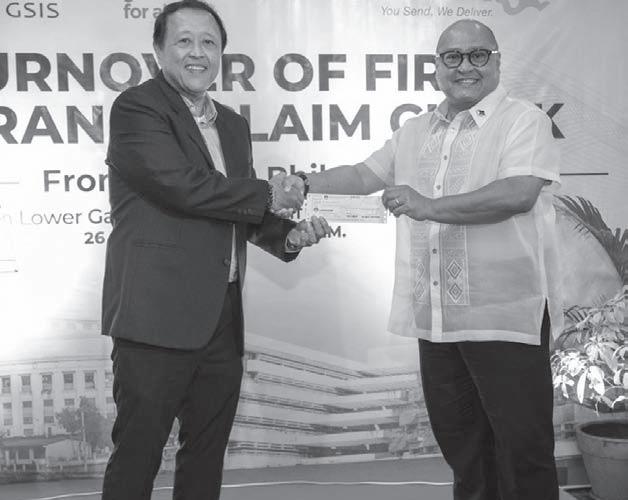
The first nationwide filing last February 2023 involves 74 tax evasion cases approximately amounting to P3.58 billion against erring individuals and corporate taxpayers.
“This is a reminder to every corporation and corporate officer not to ignore the BIR. Do so and we will file criminal cases against you,” Lumagui said.
The executive director: Executive, director, or both?
IN the realm of associations, the executive director (ED) heads the secretariat or management team. Other terms used in lieu of the ED title are chief executive officer, president, secretary general and general manager.
The ED, who is both “executive” and “director,” takes on a unique and multifaceted dimension. As an executive, the ED is tasked with executing policies and plans approved by the board of directors (board of trustees, as it is usually called in the Philippines), navigating the delicate balance between executive leadership and directorial responsibilities. This duality poses distinct challenges and opportunities, making the ED a pivotal figure in driving the association’s success and impact.
On the other hand, the title “director” in ED highlights the importance of governance and accountability. The ED serves as the primary link between the association’s management and its board, ensuring effective communication and collaboration.
Whether an ED is also a member of the board depends on the specific organizational structure and governance policies of the association. The roles and responsibilities of an ED and the board are typically distinct, but there are cases where an ED may also hold a position on the board.
There are two likely scenarios in
this regard: the ED is a non-voting board member; and, the ED is a voting board member.
In the first scenario, the ED collaborates closely with the Board, offers expertise and ensures seamless communication between the management team and the governing body. Having the ED as a nonvoting member enhances the flow of information and facilitates a better understanding of the association’s day-to-day challenges and accomplishments.
In the second scenario, the ED holds a dual role as a voting member of the Board. This scenario is more common in smaller associations, where the ED’s leadership and operational expertise are highly valued in the decision-making process.
There are pros and cons on the two scenarios. For instance, the inclusion of the ED as a voting member can sometimes raise concerns about potential conflicts of interest or the independence of the board’s decision-making. To mitigate these issues, some associations have policies that restrict the ED’s voting rights on certain matters or require to abstain from voting on specific is-
sues that directly affect, for example, employment or compensation.
It’s important to note that in larger associations or those with more robust governance structures, the roles of the ED and the board are typically kept separate to ensure a clear distinction between management and governance functions. This separation helps maintain checks and balances and promotes accountability within the organization.
While some associations include the ED as a non-voting or voting member of the board, the prevalent practice is to have the ED serve as an ex-officio, non-voting member. The specific arrangement depends on the association’s size, governance policies and the desire to balance the benefits of close collaboration with the need for independent governance oversight.
The ED role embodies a unique blend of executive leadership and directorial accountability, making it a critical position within an organization’s hierarchy. As an executive, an ED provides visionary leadership and strategic direction; as a director, an ED ensure governance, compliance and accountability.
Octavio Peralta is currently the executive director of the Global Compact Network Philippines and founder and volunteer CEO of the Philippine Council of Associations and Association Executives, the “association of associations.” PCAAE will hold its 11th Associations Summit at the PICC on December 6, 2023. E-mail: bobby@pcaae.org.

Chinabank’s H1 income shoots up 7% to ₧10.8B
By Cai U. Ordinario @caiordinario
THE Sy-led China Banking Corp. (Chinabank) posted a 7-percent growth in its net income in the first six months of the year on the back of “higher revenues and lower provisioning.”
In a disclosure to the Philippine Stock Exchange on Thursday, Chinabank said its net income reached P10.8 billion in the January to June period this year.
Quarter on quarter, net income increased by 16 percent to P5.8 billion in the second quarter from P5 billion in the first quarter of 2023.
“Our customer focus and disciplined operational execution enabled us to continue to deliver strong results to all our stakeholders,” Chinabank President and CEO Romeo D. Uyan Jr. was quoted in a statement as saying.
The performance in the first semester translated to a return on equity of 15.9 percent and a return on assets of 1.6 percent.
The bank also reported that its total revenues posted an eight percent growth to P27.2 billion in the January to June period in 2023.
Net interest income posted a 16 percent growth to P25.5 billion. The bank said this was due to “robust growth in top line revenues offset the surge in interest expense.”
Its losses, the bank noted, were lower by 47 percent from the same period last year, as the economy continues to recover. Non-performing loan (NPL) cover remained sufficient
and above industry at 122 percent.
Chinabank said it posted a 22 percent increase in operating expenses to P13.6 billion. Nevertheless, the cost-to-income ratio remained healthy at 50 percent.
“(This was due to) continued heavy investments on human resource development and digital innovation, along with higher volume and revenue-related taxes,” the bank said. Total assets stood at P1.4 trillion, up 15 percent and still the fourth largest among private domestic banks.
Net loans rose by 11 percent to P726 billion on stronger demand from the consumer sector, up 20 percent, and the business sector, up 8 percent.
Despite the solid loans growth, asset quality remained stable, with NPL ratio easing to 2.2 percent, which was lower than the latest industry average.
Total deposits grew by 19 percent to P1.1 trillion. CASA ratio dropped to 49 percent due to the growth in term deposits year-on-year.
Total capital reached P139 billion, up 9 percent, with Common Equity Tier 1 Ratio and Total Capital Adequacy Ratio of 15.2 percent and 16.1 percent, respectively, both above the minimum regulatory requirement. Book value per share grew 9 percent to P51.48.
“Our balance sheet is in great shape, with an improved liquidity ratio of 45 percent,” Chinabank CFO Patrick D. Cheng said. “The strength of our balance sheet means we are
well placed to take advantage of the growth opportunities, deliver sustainable returns to our shareholders, and more importantly, continue supporting our customers and the broader economy.”
Moody’s recently affirmed Chinabank’s investment grade credit rating with a stable outlook. In its July 28, 2023 report, the international credit watchdog noted: “the
Some of those charged were involved in the construction, importexport, retail and manufacturing industries.
“The list of respondents is still considered confidential due to the presumption of innocence until cases have been filed in courts,” the BIR noted. Lumagui advised companies and individual taxpayers to be diligent and honest in filing their taxes.
He also reminded them not to ignore letters of authority coming from the BIR as doing so will likely result in the conduct of audit, then
assessment and, lastly, the filing of cases if anomalies are found.
“Our taxpayers should participate in all our processes. Don’t hide or evade these processes. We are giving you the opportunity to explain your tax dues,” the BIR chief said. “A notice or letter from the BIR is an opportunity for the taxpayer to come forward to present their side and be afforded due process. If after examination, deficiency taxes were found, taxpayers are advised to pay or contest the assessment within the allowable period,”Lumagui added.
Features of MUP pension reform bill bared
By Jovee Marie N. dela Cruz @joveemarie
THE newly-elected chairman of the Ad Hoc Committee on the Military and Uniformed Personnel (MUP) Pension Reform revealed the three key features of a solution lawmakers and government economists agreed upon last Wednesday.
Albay Rep. Jose Ma. Clemente

“Joey” S. Salceda was elected chairman of the Ad Hoc Committee by the House plenary following a 3-hour meeting between members of the economic team and key lawmakers. The closed-door meeting last Wednesday was convened by Speaker Ferdinand Martin G. Romualdez after President Ferdinand R. Marcos Jr. asked them to thresh out disagreements over the MUP pension reforms.
According to Salceda, Marcos and Romualdez—both of whom he thanked “for their trust”—“wanted a working solution as soon as possible.”
“And I think we have come up with one,” the lawmaker said adding that a consensus hammered out between the executive agencies and the House leadership needs refinement.
“We will listen to all stakeholders to refine the version, but we have received very positive feedback about the version we have at hand,” Salceda said last Thursday.
Key features
SALCEDA revealed that “the emerging version” has four key features.
sate the MUP; the duty of the MUP to save for part of their own pensions; and, the duty of people to pay part of the cost of those pensions.”
“It’s a social compact,” the lawmaker said.
Salceda said the reform also prevents mass retirement as it does not create separate retirement regimes for different categories.
“Everyone gains something; everyone shares something: that is the key principle of this reform,” he added.
Meanwhile, Salceda added that the Ad Hoc committee will try to finish its version “hopefully before the 2024 budget reaches the House floor.”
“We still have boxes of documents from the May to October 2021 House hearings on the reform, not to mention initial position papers submitted this year by stakeholders. So, we have enough to work with. We will finalize the consensus version, and that will be the starting point for discussions,” he said.
Pending issues
ACCORDING to Salceda, pending issues include what to do with MUP assets and the management of the Trust Fund.
“But these are questions of detail rather than questions of principle,” he said. “The principle is shared benefit and shared sacrifice. The proposal is already at that point. Win-win.”
Baa2 deposit and issuer ratings are driven by the bank’s strong capitalization and profitability; as well as its modest deposit franchise, offset by its strong level of liquidity.
Moody’s added that “the ratings also factor in a one-notch uplift to its Baa3 baseline credit assessment to reflect the moderate probability of support from the Government of Philippines (Baa2 stable).”
One is a guaranteed annual salary increase for a MUP at a sustainable rate of 3 percent per year for the next ten years. A second feature is retaining indexation of pensions but limiting pension increases to 50 percent of the salary increase for active personnel.
The version also features the creation of an MUP Trust Fund and a governance committee with the economic managers and the MUP services represented. The fourth feature is the retention of almost all other features of the MUP pension system.
According to Salceda, the proposal would also include a contribution scheme wherein active MUPs will contribute a portion of base pay but where the government will pay a larger counterpart.
The lawmaker said they are looking at patterning the scheme after that applied to salaries of civil servants. the latter features deductions at 9 percent for the employee and 12 percent for the government.
The lawmaker added, however, that the contribution scheme feature is still subject to deliberation, and that they could ease the deductions through a transition period.
Guarantees, duties
ACCORDING to Salceda, the MUP pension reform bill “will have what I call the ‘Three Guarantees:’ a sure annual salary increase; sure indexation of pensions; and, sure funding for the pension system,” Salceda said. “The resulting reform must have those three features in it.”
He added that the “Three Guarantees” must be rooted in “Three Duties:” the duty of the State to compen-
He vowed to finalize the “win-win version of MUP reform right away.” Salceda, nonetheless, emphasized that the biggest problem with the MUP pension system is that each time salaries grow, pension liabilities also grow.
“Indexation of pensions to active personnel salaries is the key feature of the pension system. So, any reform must focus on that, either to control salary growth or to control its effects on the pension,” he said.
(See related story in A1: “Govt to spend P160B for MUP pension, other benefits in ’24”)
Fiscal collapse
FINANCE Secretary Benjamin E. Diokno earlier announced that Marcos has approved decreasing the contributions of the government to the pool of funds for the pension of MUPs, among other reforms to avoid a fiscal collapse.
For this year alone, Diokno said the government would spend more than P120 billion (roughly $2.21 billion at current exchange rates) to fund the pension of those serving under several state institutions.
The latter are: the Armed Forces of the Philippines; the Bureau of Jail Management and Penology; the Bureau of Fire Protection; the Philippine National Police; the Philippine Public Safety College; the Philippine Coast Guard; and, the Bureau of Corrections.
Under the current proposal, the fund will be managed by the Government Service Insurance System (GSIS). An oversight committee shall be formed composed of the Secretary of Finance, the Secretary of Budget and Management, the Executive Secretary and the President and General Manager of the GSIS as ex-officio member and representatives from the MUP services.
BusinessMirror Editor: Dennis D. Estopace • Friday, August 4, 2023 B3 www.news.businessmirror@gmail.com Banking&Finance
THE Bureau of Internal Revenue (BIR) announced it filed a P6.1-billion tax evasion complaint before the Department of Justice (DOJ) against 214 executives of 127 companies.
INITIAL
after
CREDIT:
mEnT SERvICE InSuRanCE SySTEm
Octavio Peralta Association World
CLAIM This undated photo courtesy of the Government Service Insurance System (GSIS) shows GSIS President and General Manager Jose Arnulfo A. Veloso (left) turning over the actual P100-million check to Acting Postmaster General and Philippine Postal Corp. (PhilPost) CEO Luis D. Carlos representing initial payment for the insurance claim damage suffered by the Manila Central Post Office (MCPO) in May this year. This payment is intended to cover the urgent needs of Philpost in rehabilitating the MCPO building. The full compensation will be paid by GSIS
evaluation of the adjuster’s report and approval of the final settlement offer.
GovERn-
Bankers brave the rain to meet new BSP chief
❶ BSP Gov. Eli Remolona with Erramon Aboitiz, board director of Aboitiz

THE torrential rain last Friday certainly didn’t keep the leaders in the banking and financial sectors from attending the reception to get to know the new Bangko Sentral ng Pilipinas (BSP) Governor Dr. Eli M. Remolona Jr. and celebrate the monetary institution’s 30th anniversary.
A proud product of the country’s public school system, having studied at the much-respected V. Mapa High, the seventh BSP chief and chair of the policymaking Monetary Board was perceivably still trying to get used to the idea of strangers coming up to him to introduce themselves, making small talk, and, well, take selfies.
Walking or driving around the metro with security aides in tow is also something Remolona is still trying to get used to, we are told, but he knows it can’t be helped. After all, he is the country’s top economic manager—a VVIP by Manila’s standards!— whose signature will soon be appearing on our paper currency along with that of the current president in Malacañang.

The newly minted governor has been described as quiet and thoughtful. He is not one to chit-chat idly about the weather, and is more comfortable discussing monetary policy. (He has described himself a “central banking nerd.”) He will speak briefly, but with purpose. For instance, Remolona recently drew the BSP as “structurally hawkish,” the first time, we believe, a sitting central bank chief has done so.
When he’s not thinking about monetary policy, Remolona, we are told, appreciates good food and savors his favorite wines at some of the trendiest local restaurants with his wife, the former Marie Velasco. Mrs. Remolona, unfortunately, was not at Friday’s reception. (One friend has said she eschews dressing up to the nines to attend functions and formal affairs, and prefers whipping up new dishes in the kitchen.)
This is the second time Remolona is serving a Marcos, by the way. He graduated in 1972 with an economics degree from the Ateneo de Manila University, and then worked at the Presidential Economic Staff of then President Marcos Sr. He went on to receive a PhD in Economics “with Distinction” from Stanford University in 1982. Remolona has spent most of his career in central banking, 14 years at the Federal Reserve Bank of New York and 19 years at the Bank of International Settlements in Basel, Switzerland and Hong Kong. He has also had teaching stints at Williams College, Columbia University, New York University, and the UP-School of Economics.
In his brief remarks last Friday, Remolona thanked his predecessor Felipe Medalla for the latter’s courageous efforts in steering the economy and stabilizing prices.
“Today, we re beginning to see tantalizing fruits of our efforts. Headline inflation seems to have peaked and looks to be on its way to our target range of two to four percent,” said the new governor. But he recognizes the BSP still needs to soldier on to combat inflation. “There are still upside risks to inflation—for example, risks in the form of El Niño and further supply shocks,” he stresses.
SEE “BANKERS,” B5

ICCP joins Travel Sale Expo 2023
ONEKLIK Events and the Israel Chamber of Commerce of the Philippines (ICCP) recently held a contract signing event to formalize the participation of ICCP to the Travel Sale Expo 2023 slated on September 30 to October 1 at the Megatrade Hall, SM Megamall. OneKlik Events is the organizer of the Travel Sale Expo 2023 with the theme “Travel is on and it’s Unstoppable.”
The ICCP will open a booth at the upcoming Travel Sale Expo to promote its projects in the Philippines, as well as the business interests of its chamber members.
“We are very thankful for the trust and confidence that ICCP has given us and we look forward to a long-
The
 Eugenia
CELEBRITIES BORN ON THIS
DAY: Cole Sprouse, 31; Dylan Sprouse, 31; Meghan Markle, 42; Barack Obama, 62.
HAPPY BIRTHDAY: Simplify your life. Take part in events and activities that soothe your soul. Maintenance is the name of the game, and taking the path that offers peace of mind and stability will be of help. Don’t share too much information until you have everything in place and pass the point where interference might become problematic. Honor your beliefs, and live life your way. Your numbers are 8, 11, 21, 25, 37, 39, 46.
ARIES (March 21-April 19): Socialize, but don’t let temptation get the best of you. Monitor your intake and do what’s affordable and physically within your means. Too much of anything will put a damper on your day. Make personal growth, selfimprovement and love your priorities. ★★★
TAURUS (April 20-May 20): Don’t labor over things you cannot change. Look beyond the negative and develop a positive alternative that is within budget. A personal plan will reveal something unexpected, leaving you with more options than anticipated. A challenge will turn in your favor. ★★★
GEMINI (May 21-June 20): You’ll face unusual barriers when dealing with others. Watch out for anyone who is using manipulative tactics to steer you in the wrong direction. If you don’t feel comfortable, take a different path. Be honest, and demand the same from others. ★★
CANCER (June 21-July 22): Don’t hesitate when you can accomplish plenty. Use your imagination, and you’ll devise unique ways to outdo yourself and anyone who tries to step in and take over. Step into the spotlight and show everyone what you have to offer. ★★★★★
LEO (July 23-Aug. 22): Tidy up loose ends before someone can object or disrupt your plans. Don’t take on too much or make promises you cannot keep. Be resourceful, use your intuition and make calls based on experience and knowledge. You will succeed. ★★★
VIRGO (Aug. 23-Sept. 22): Discuss your intentions with those you want to include in your plans or with an expert who can help decide how to move forward. Don’t let physical changes disturb you or disrupt your plans. Be secretive regarding personal matters and beliefs. ★★★
LIBRA (Sept. 23-Oct. 22): Don’t sit idle when you can make a difference. Let your actions speak for you and you’ll gain momentum. Be observant and you’ll discover who shares your beliefs. Changing plans will cost you. ★★★
SCORPIO (Oct. 23-Nov. 21): Use your intuition and intelligence to wiggle your way into a leadership position. You can make a difference by taking the high road and marking a just path. Don’t believe everything you hear; ask questions and stick to the facts. ★★★★★
SAGITTARIUS (Nov. 22-Dec. 21): Do what makes you happy. Don’t follow the crowd or let others choose for you. Listen, but don’t get involved in impossible battles. Give others the same freedom you expect in return. The only person in charge of your happiness is you. ★★
CAPRICORN (Dec. 22-Jan. 19): Don’t stop believing in yourself and your ability to reach your destination. The journey will be informative, and the people you meet will offer insight into possibilities that can change how you use your attributes and earn a living. ★★★★

term partnership with them”, said Michelle Taylan, Chairperson of Travel Sale Expo 2023.
The partnership goes beyond the participation in the Travel Sale Expo 2023 of ICCP. OneKlik Events will help promote ICCP’s other projects and handle the travel needs of its chamber members.
“We believe in the collaboration of proven experiences and professionalism in OneKlik Events and we are confident that Michelle Taylan can help our members and non-members to achieve their travel goals and to enjoy both the professional side and leisure side of travel to amazing Israel,” said Yoray Ofek, ICCP president.
AQUARIUS (Jan. 20-Feb. 18): Take the most inviting path and put yourself first for a change. If someone chooses to head in a direction, wish them well. Make your health, emotional well-being, and the activities and events that make you happy your priorities. ★★★
PISCES (Feb. 19-March 20): Set high standards and stick to your plan. An opportunity will develop that is too good to refuse. Make the necessary adjustments, take advantage of what’s available and high-tail it to the finish line. ★★★
BIRTHDAY BABY:
You are detailed, responsive and chic. You are contemplative and masterful.
B4 Friday, August 4, 2023 • Editor: Gerard S. Ramos www.businessmirror.com.ph Relationships BusinessMirror ACROSS 1 The King actress Lily-Rose 5 Harvest 9 Becomes less bright 13 Trifling 14 Jaipur’s country 16 Fine-tune, like text 17 Put a pin in it! 19 Opposite of wax 20 Hosp. scan 21 Flake (on) 23 Dress edge 24 Car add-ons that reduce wind noise and glare 28 Stool pigeon 29 Comic Jeong 30 List on Decluttr, say 31 “Yeah, when pigs fly!” 33 Bread box? 35 Limber 39 Plan that’s sure to succeed 43 Make void 44 ___-de-France 45 18-wheeler 46 Small salamander 49 Finnish duo? 51 Scripps National Spelling ___ 52 Writer such as Julia Child 57 Warm greeting 58 Idris named People’s Sexiest Man Alive in 2018 59 “Yech!” 60 Comedian Rodriguez 62 Extra person on a double date... who’s depicted by the last O in 17-, 24-, 39- and 52-Across? 67 Used a turntable 68 Charlatan 69 Thomas of soul 70 Beach trip grains 71 ___ serif 72 Story of Pandora, e.g. DOWN 1 Driver’s license org. 2 Fair-hiring letters 3 Step up at work 4 Actor Pascal 5 Ipanema’s city, familiarly 6 “The ___ is near!” 7 Spicy Spanish marinade 8 Seasoned rice dishes 9 Lawn moisture 10 Shoshone Falls state 11 Underground worker 12 Parts of apples or goblets 15 “Stayin’ ___” (Bee Gees hit) 18 (I’m a pig!) 22 French city found backward in “Well, I’ll be!” 24 Stoneworker 25 Tail end 26 “Hold ___ your hat!” 27 Narrow openings 28 Tennis star Nadal’s nickname 32 Get an F on 34 “Who, me?” 36 New York City neighborhood near NoHo 37 Odyssey poet 38 Emmy-winning Falco 40 Military academy newbie 41 Bug biting Rover 42 List with appetizers 47 See 48-Down 48 With 47-Down, award-winning writer of This Boy’s Life 50 Kare-kare or ragout 52 “Hanging” things in the 2000 election 53 Occult board 54 Nash who said, “You are only young once, but you can stay immature indefinitely” 55 The Metamorphosis writer 56 Pronoun pair for Ryan Gosling 61 Sum up 63 V : five :: X : ___ 64 Big baseball hits: Abbr. 65 CPR pro 66 ___-di-dah (pretentious) Solution to today’s puzzle:
‘that’s how I roll’ BY SAM KOPERWAS AND JEFF CHEN
Universal Crossword
• Edited by David Steinberg/Anna Gundlach/Jared Goudsmit
TODAY’S HOROSCOPE By
Last
Equity Ventures PHOTOS FROM BSP ❷ SM Prime Holdings Inc. chairman Hans T. Sy listens to Gov. Remolona’s hopeful inflation outlook with BSP Deputy Gov. Chuchi Fonacier. ❸ BSP Deputy Gov. Bernadette Romulo-Puyat and Yuata Savings Bank independent director Celia Sandejas ❹ PNB president Florido P. Casuela, RCBC EVP Lito Villanueva, PNB chairman Edgar A. Cua, PNB Capital and Investment Corp. president Gerry Valenciano
❶ ❷ ❸ ❹
Ah, well, interesting films
THERE are films that take your breath away and there are those that leave your breath intact, allowing you a modicum of control during the viewing times.
Three films—all Japanese—qualified under that second category, films that enable you to think things over, and even allow the same mind to wander around. Here is where you are able to check the “gaze,” the production design, the camera maneuver, the colors. In these three films, I even became conscious of gestures and mannerisms, images, which then I lumped under “performances.” one film is called Kingdom. The film poses a singularly interesting problem: its geography, history and culture. While the dialogue is in Japanese, the film locates itself in Chinese history and, we assume, in Chinese location.
The latter, of course, is one of the more problematic aspects of cinema, that of portraying places on screen without necessarily having those places have a one-to-one correspondence with what it putatively locates as the setting of the actions. There are, after all, studios and locations that can pass off as another country.
The story involves two orphans: Xin and Piao. They dream of not only having to escape poverty and slavery but of becoming generals (in the film, this rank is translated as “shogun’). one day, a highranking officer from the palace arrives in their village and spots one of the boys, Piao. The official asks the owner of the two slaves to give up Piao because the palace is interested in having him. Piao wants to take with him Xin but the king wants only Piao. Xin understands what is happening and the two boys vow to see each other. That day comes when Piao, one night, arrives in the village where he grew up wounded and dying.
How would the dream of the two boys be achieved when one of them is dead? They will and that will make the adventure quite unforgettable even as you get distracted by conflicts that are easily resolved and the language serving as mediator for history and conquest.
Kento Yamazaki plays Xin, in a performance that, while gripping, never allows us to forget the physical charm of this actor, whose filmography includes the Netflix series Alice in Borderland. Portraying Piao is another “idol,” Ryo Yoshizawa.
Kingdom is an adaptation of the manga series called Kingudamu. The screenplay was written by Tsutomu Kuroiwa, Shinsuke Sato and Yasuhisa Hara. Directing the film is Shinsuke Sato, who is also a video game designer. The film is produced by Sony Pictures Japan.
Bankers...
Continued from B5
Remolona also looks forward to having more Filipinos be included in the financial system through digitalization. The BSP targets by the end of the year, 70 percent of adult Filipinos will have a bank account, up from 56 percent in 2021, already a substantial increase from just 23 percent in 2017. “These accounts should provide the opportunity for people to build savings buffers, invest in their future and more actively participate in the digital economy. Programs like Paleng-QR help digitalize crucial value chains of merchants and SMEs,” he says.

After the governor’s remarks, the guests at the BSP Assembly Hall returned to feasting on the fabulous spread prepared by Chef Florabel Co-Yatco—her chicken inasal tortilla and Angus Roast Beef with caldereta sauce were particular hits.
Needless to say, key officials of the BSP, along with MB members, were present at the affair; a few seen schmoozing with our banking reporter-friends to keep them happy, we suppose, as the latter were told not to ambush the governor with questions. (Well, they did get a ‘groufie’ with the governor. Hmmm…)
Two tycoon families with major banks were ably represented with Hans Sy (SM Prime Holdings) and Montxu Aboitiz (Aboitiz Group) in attendance.
Former BSP governors Say Tetangco (chairman of SM Investments Corp.), Joey Cuisia (Phinma director), and Ben Diokno (now Finance Secretary) were also around. Returning Socioeconomic Planning Secretary Arsi Balisacan was likewise in the mix, along with representatives of government financial institutions, commercial banks, foreign banks, and a few rural banks.
our congratulations to Gov. Remolona, and here’s wishing him six years of success at the BSP’s helm. n
There is Kingdom 2 and 3. The film is a depiction of the life of Li Xin, a legendary general during the Warring States era of ancient China.
Another manga series is the source of a film with the title Burn the House Down. The manga series bears the title, Mitarai-ke, Enjō Suru, which literally translates to “The Mitarai Family Goes Up in Flames,” the Mitarai referring to the family involved in the story.
The film begins with a massive house burning. It is the home of the Mitarai. A woman is down on her knees begging for forgiveness. Did she burn her own home? A young girl looks down on her mother. She is lost, confused. Among the crowd, a woman seems to relish the conflagration.
The little girl grows into Anzu Murata. She has dropped her family name, and assumed an identity as she enters what is technically her previous home. Another mother/wife occupies the house because the first Mrs. Mitarai is in a hospice, depressed and bereft of memory.
Anzu will apply for a job as a cleaning lady in the Mitarai household. on her first day, she is met by this woman who used to be a “friend” of the original Mrs. Mitarai. Anzu is not recognized. She embeds herself into the household. There are mishaps along the way on the part of our young protagonist, which causes her to be kicked out. For some incredible reasons, she manages to be back in the house where the second Mrs. Mitarai once doubted her sincerity.
Mei Nagano as Anzu is an engaging actress saddled with a role that faces conflicts and confronts incredibly insurmountable difficulties, which she
somehow manages to solve. She is back in a place that once burned down and implicated her own mother, which then reduced them not only as being fatherless but without the financial and emotional stability that the house once provided them. She is there in that house not only to befriend the villain but to expose her as the arsonist because that will provide her mother with a release from her guilt. From there, we expect the mother’s mental health to improve and, as with Cinderella tales, return to the princess (two princesses actually) their happiness and banish the wicked (technically) stepmother.
Kyoka Suzuki, the veteran actress, is the second Mitarai. This is a character that, while stereotypically understood in the local parlance as a contravida, is but a commentary on how motherhood/wifehood is truly the curse that Japanese society inflicts on women. Women when married have to live up to notions about the perfect caretaker of homes. She should be skillful enough to prepare impeccable dishes and keep the living rooms and other areas of homes uncluttered for the man of the house to enjoy. The “man” includes the son and this means the wife/mother has to make sure they are able to have dreams of success and are able to pursue them.
The film is directed by Yuichiro Hirakawa. The manga series is written and illustrated by Moyashi Fujisawa and was serialized in the josei manga (comics for adult women) magazine called Kiss, published by Kodansha. The series, according to Netflix, is part of an increasing number of live-action, Japaneselanguage originals for Netflix. Kingdom also streams on Netflix. n
PolitiCianS UrGe taYlor Swift to PoStPone la ConCertS
CALIFoRNIA S lieutenant governor and other elected officials on Tuesday urged Taylor Swift to postpone her Los Angeles concerts as a way to stand in solidarity with striking hotel workers.
Lt. Gov. Eleni Kounalakis and dozens of state and local politicians signed an open letter telling Swift that her tour makes the region’s hotels money, with some properties “doubling and tripling what they charge because you are coming.”
Meanwhile, the letter said, many housekeepers and other hotel workers can’t afford to live close to their jobs and some sleep in their cars and risk losing their homes. “Hotel workers are fighting for their lives. They are fighting for a living wage. They have gone on strike. Now, they are asking for your support,” they wrote. “Stand with hotel workers and postpone your concerts.”
Starting today, Swift is scheduled to perform six sold-out shows at SoFi Stadium near Los Angeles. Her representatives didn’t immediately respond to an email seeking comment on the letter.

Unite Here Local 11, which represents some 30,000 hotel workers, is negotiating for better wages, improved health care benefits, higher pension contributions and less strenuous workloads.
Contracts expired last month at more than 60 hotels, including properties owned by major chains such as Marriott and Hilton.
Kounalakis, a Democrat who said she will run for governor in 2026, is the top official in the state to make the plea. She attended Swift’s Eras tour in Santa Clara, California, according to Politico.
signed the letter include the mayors of several cities, Assembly Majority Leader Issac Bryan and state senators Dave Min and Maria Elena Durazo. AP
Benilde student film wins US filmfest, vies next at CCP’s Gawad alternatibo

A THESIS film about a boy who slugs it out in a neighborhood thumb wrestling tournament against another kid, whom he cannot defeat, will compete with other short film finalists at the Gawad CCP Para sa Alternatibong Pelikula at Video or Gawad Alternatibo. This after it bagged first place in the 2023 Student World Impact Film Festival.
Arena, the capstone project of recent De La SalleCollege of Benilde film graduate Nicole Yvonne Lee, topped the SWIFF comedy (18 years old or older) category.
The 20-minute coming-of-age film stars Matthew Stanley, Shawn Niño Gabriel, and Miaka Mon, among an ensemble of other child actors.
SWIFF director Mark Leschinsky shared that the week-long New Jersey-based event, which received more than 13,000 submissions from 120 countries, “focuses on elevating the voices of young storytellers from historically marginalized races, backgrounds, and cultures to give them the opportunity to share their stories with the world.”
Prior to winning the SWIFF award, Arena became the first recipient of the Benilde Best Thesis Film trophy at the Cinematheque Centre Manila last April.
“As a filmmaker, I just really want to make people laugh and be happy using the films I made,” said Lee, who wrote, edited, scored, directed, and co-produced the film. “Since I was a student, my school projects have been in the comedy genre. Arena was made from my playful imagination.”
Lee got the support of production manager Krissel Bernabe, director of photography Iezer Yap Magallon, production designer Grant Frondozo, assistant director Ivan Balmaceda, script continuity Giulia Saavedra, sound supervisor Paul Van Guzman, wardrobe master Clarisse Llaguno, colorist Tyrone James Luanzon, hair and makeup artist Rose Go, and production assistants Sheina Bensurto and Rodora
will try to continue its winning streak at Gawad Alternatibo, the longest-running independent film competition of its kind in Asia. Established in 1987, Gawad Alternatibo will feature some of the best works of Filipino alternative storytelling and filmmaking this weekend, August 5 to 7, at the Tanghalang Ignacio Gimenez (Cultural Center of the
Kento YamazaKi in Kingdom

B5
www.businessmirror.com.ph Show BusinessMirror
Editor: Gerard S. Ramos • Friday, August 4, 2023
, a 20-minute coming-of-age film, stars matthew Stanley, Shawn niño Gabriel, and miaka mon, among an ensemble of other child actors.
taYlor Swift
FOUR REASONS WHY YOU SHOULD START YOUR
LPG BIZ
Solane’s nationwide distribution system consists of more than 50 distributors and approximately 10,000 points of sale located in different parts of the Philippines. With 13 LPG refilling plants nationwide and LPG logistics using tech-advanced and safe lorries, you are also guaranteed to efficiently get LPG supply wherever you choose to put up your Solane LPG business.
Help prevent LPG-related fires in the community
Because of the high demand of LPG, there are malicious individuals who resort to unsafe and unfair LPG trade practices, leading to the rampant spread of unregulated LPG products at risk of exploding or causing massive fires.
GIGIL Agency, Profriends offer PHL’s first-ever free overnight house trial
BUYING a house is a huge investment. Bright smiles on a billboard with a beautiful home as a backdrop isn’t enough for you to buy a property. Not a virtual house tour, nor a free umbrella when you indulge a real estate agent while passing through a mall. These don’t help in convincing someone to buy a house.
Local real-estate company Profriends recognized this and partnered with local independent ad agency GIGIL to offer the Philippines’ first-ever free overnight house trial.
The Profriends Overnight House Trial is a free weekend-long stay in one of the featured Lancaster New City Cavite homes. If successfully booked, the guest will participate in different community events, such as Zumba sessions, bazaars, coffee pop-ups, and many other activities, all free of charge.
Houses buyers can live in the following house models during the Profriends Overnight House Trial:
n THEA, a two-storey residence for young families and professionals looking for activities right when they leave their doorstep.
n ADELLE, a two-storey townhouse for growing families in search for the company of caring co-families.
n ALEXANDRA, a two-storey residence allowing growing families to be a part of a healthy community.
If interested in experiencing the Profriends Overnight House Trial, you can book a stay now at profriendshousetrial.com.
GIGIL is an independent agency that has won various campaigns in marketing effectiveness in 2020, 2021, and 2022 in the APAC Effies.
TO cope with the rising costs of basic needs, more and more Filipinos are turning to additional sources of income on top of their regular jobs, including taking on extra jobs, side “gigs,” and establishing their own small business.
A 2022 nationwide survey by OCTA Research has found that four out of five Filipinos are interested in starting their own business, with respondents saying they want to manage their own time, earn daily and work at home or anywhere.
While the desire for financial freedom is always present, the challenge has always been knowing where to start. The options for small business ideas can be overwhelming, but most are also extremely common and finding your own customers can be close to impossible. But have you ever considered a kitchen staple like your LPG tank as a potential source of income?
Here are some of the reasons why you should explore being an LPG (liquefied petroleum gas) business partner:
Small startup capital with stable passive income
STARTING your own business venture is daunting not only due to significant costs, but the lengthy process of building a brand. Being an LPG distributor or retailer offers you a business opportunity with under a million pesos without having to go through the rigorous process of making your own product.

Solane LPG, one of the trusted LPG brands in the country, offers a retailer package for as low as P24,000, which already includes eight 11kg LPG cylinders, six 1.4kg LPG cylinders, store branding, training certificate and License to Operate permit. A package worth P250,000 includes an assortment of 70 LPG cylinders, a motorcycle vehicle, a weighing scale, rental subsidy and staff uniform, on top of the LTO permit and training certificate.
LPG as an essential product
LIKE water and food, LPG is a basic product used for various kitchen tasks such as cooking rice, preparing viands, baking and heating water. LPG is a staple kitchen fuel in Filipino homes due to its reliability, efficiency and economical cost, which means you can be sure that there will always be a steady demand for your product.
LPG demand has remained relatively stable even during the pandemic and will continue to have a market despite changes in the economy.
Huge LPG demand in local municipalities
LPG is still one of the primary kitchen fuels in 40 percent of the households in Philippines. Consumers usually prefer to purchase through neighborhood channels, such as retailers, nearby sari-sari stores and other neighborhood sellers. Investing in an LPG business that will serve your community and even neighboring municipalities will provide you with a steady customer base.
By becoming an authorized LPG distributor in your area, you provide access to safe and trusted quality kitchen fuel. On top of securing your family’s future by having a passive income, you also get to secure the safety of your family hard-earned property by helping prevent LPGrelated fires caused by substandard and illegal LPG products in your community.
Being a verified Solane LPG distributor or retailer guarantees that you only sell safe and quality LPG products that are compliant with government standards. With over five decades of experience and expertise in the LPG industry, Solane offers stringent safety and quality measures, such as regular cylinder maintenance and the exclusive Seven-Point Safety Check, which will provide your potential customers with peace of mind. Solane LPG’s world-class team of certified technical engineers and trained dealer technicians are also ready to work with you in ensuring topnotch LPG quality and seamless distribution of LPG products.
Interested Solane LPG business partners may download the Solane Application form on the Solane website (https://solane.com.ph/partnerdetails/), fill it out and submit it via email to solanesales@islagrp.com. A business assessment will then be conducted, where interested business partners will meet with a Solane LPG representative to discuss the business proposal and undergo assessment.
Want to know more about being a Solane LPG business partner? You may also reach out through Solane LPG’s official Facebook Messenger (https://m.me/solane.ph), text hotline: 0918887-5555 (Smart) / 0917 8977555 (Globe), or hotline number: (02) 8887-5555.
SM honored for efforts to empower PWDs at this year’s Apolinario Mabini Awards
awareness and encourage compassion among those of us who are able-bodied. We believe that is what is needed to create a society that is truly inclusive of Persons With Disabilities.”
Radenta Technologies Offers 60-Day Free Trial on Microsoft Defender for Business
RADENTA Technologies, one of the country’s leading systems integrators, is offering a 60-Day Free Trial for Microsoft Defender for Business, an enterprise-grade device protection, specially built for businesses with 300 employees or less.
Resear ch in the US shows a staggering 300 percent increase in ransomware attacks in the past year, with half targeting small businesses. One in four SMBs admitted that they had a security breach in the last year which translates to an average cost of $108,000 or roughly P5.8 million per data breach.
Micr osoft Defender provides enterprise-grade protection. It uses leading Defender technologies like endpoint detection, response and threat, and vulnerability management.
It is easy t o use. It is up and running quickly with easy, wizard-based onboarding. It is cost-effective.
Choose from 2 flexible plans as part of Microsoft 365 Business Premium or as a stand-alone solution. The plan can protect up to five devices per user at a very affordable cost.


Micr osoft Defender is a unified online security solution that can identify, protect, detect, respond, and recover.
Micr osoft Defender offers the following:
n Threat and Vulnerability Management—this reduces vulnerability with a risk-based management approach.
n Attack Surface Reduction—it helps eliminate risks by reducing the surface area of attack.
n Next Generation Protection—it protects against cyberthreats like ransomware and malware.
n Endpoint Detection and Response - It detects and investigates advanced persistent attacks.
n Auto Investigation and Remediation—It automatically investigates alerts and responds to complex threats.
Micr osoft Defender has received outstanding reviews. User feedback on www.peerspot.comshows it is easy to set and configure and most users appreciate its EDR technology that mitigates malicious cyber threats. Some users give points for stability and reliability saying that the security solution does not crash or freeze and there are no bugs or glitches. Scalability also got positive mentions. Another user became even more specific saying that those using Microsoft Defender and Microsoft Intune can bring in system-hardening policies to enhance security. The same reviewer further added that Microsoft Defender’s vulnerability checking is extremely sensitive and automatically checks for and reports on vulnerabilities on all machines that have been on the domain.
Michelle Lasam, Radenta Technologies Microsoft Line of Business Operations Manager has this to say, “Hackers in this generation are cunning and devious. They know that data is money and they take advantage of smaller businesses that cannot afford expensive security solutions.”
Microsoft Defender is just what your business needs. Ask Radenta to show you how. Call 0908-812-4891 or email info@radenta.com
Private Art, Public Lives: Salcedo Redefines Legacy with Launch of Exhibition Series
SALCEDO Auctions, through its gallery and exhibition arm Salcedo Private View, debuts a new program that takes you inside the private art collection of one of the region’s top bankers: Edwin Riego Bautista, and his wife, Professor Aileen Beltrano Bautista.
SM Prime was recently honored at this year’s the 2023 Apolinario Mabini Awards for its efforts in empowering and uplifting Persons With Disabilities (PWDs).
The organization took home multiple awards, conferred to it by the Philippine Foundation for the Rehabilitation of the Disabled (PFRD), at a special ceremony held at the Heroes Hall in Malacañang Palace, last July 18, 2023.

The awards bestowed include the Empowerment of Persons With Disabilities Award given to SM Cares, SM Supermalls’ corporate social responsibility arm, along with the DisabilityFriendly Establishment Award given to several SM Malls and SM Offices.
Special distinction was conferred to SM City Grand Central for being the sole Gold winner, while SM City Urdaneta Central and SM City Telabastagan both received Bronze.
Special citations were also given to SM City Tanza, SM City Dasmariñas, SM City Iloilo, SM City Bacolod, and SM City Cagayan de Oro Uptown for partial compliance with Batas Pambansa Blg. 344, or An Act to Enhance the Mobility of Disabled Persons by Requiring Certain Buildings, Institutions, Establishments and Public Utilities to Install Facilities and Other Devices.
SM Offices was also recognized under the Disability-Friendly Establishment category, with SM Cyber Two Makati receiving a Bronze award, and special honors awarded to One E-Com and Three E-Com Centers.
Executive Secretary Lucas Bersamin and Senate President Juan Miguel Zubiri graced the conferment with their presence. SM Supermalls
President Steven T. Tan was also in attendance, alongside SM Supermalls SVP for Operations and Director for SM Cares Program on Persons with Disabilities Engr. Bien C. Mateo and SM Prime VP for SM Offices Alexis L. Ortiga.
“It is indeed an honor for SM’s efforts to be recognized by the PFRD,” said Tan. “We work hard to ensure that our SM Malls cater to the needs of our fellow Filipinos who live with disabilities because we want to facilitate a safe and inclusive space for them. We are humbled to be consistent awardees at the Apolinario Mabini Awards because it only reassures us that we are fulfilling that goal.”
“SM believes in advocating for a more inclusive environment for the disabled community, which is clear through the initiatives we push forward,” said Mateo.
“More than creating projects for the benefit of disabled persons, we also want to spread
Established by the PFRD on its Silver Anniversary in 1974, the Apolinario Mabini Awards is a biennial program named after one of the country’s most well-known heroes. Also known as the Sublime Paralytic, Mabini’s disability did not hinder him from playing a major role in the Philippine revolution. Thus, the awards are given to professionals and organizations that have empowered and rendered outstanding services to persons with disabilities, and are considered to be the most prestigious prize for Persons with Disabilities-related organizations and programs in the country.
SM Prime is a strong advocate for persons with disabilities, with many notable programs under SM Cares designed to uplift and empower this sector of society. Several initiatives for disabled persons include the award-winning Emergency Disaster Preparedness Forum, which aims to equip persons with disabilities with the knowledge and skills to become more resilient and better prepared during natural disasters, as well as The Blackout Zone, the first experiential exhibit that simulates blindness and encourages sighted individuals to develop a deeper understanding of the struggles and challenges faced by the those who are visually impaired community. SM Cares’ initiatives also reflect the organization’s support for the United Nations’ Sustainable Development Goals (SDGs), particularly “SDG 10: Reduced Inequalities”. Other advocacies of SM Cares include Programs for the Environment, Women & Breastfeeding Mothers, Children & Youth, Senior Citizens, and the SM Bike-friendly initiative.
To learn more about these programs, visit www.smsupermalls.com/smcares.
Salcedo Auctions’ chairman and chief specialist Richie Lerma just added something exciting to the auction house’s program: a series of exhibitions featuring collections in private hands titled Private Art, Public Lives. It debuts with a selection from the extensive collections of UnionBank president and chief executive officer Edwin Riego Bautista and his wife, the academician Aileen Beltrano Bautista, who have assembled through the decades a tantalizing range of objects of antiquity, most of which have not been shown in public.
Curator Floy Quintos titled the exhibition A Passion for Connections and Their Narratives and sectioned the objects thematically. Islands, Partners and Colonizers “examines trade partnerships with various Southeast Asian polities, as well as the gradual identification of our island kingdoms as one colony of Spain,” Quintos states in the exhibition notes. Visualizing the Faith includes santos in wood, ivory and silver, with a subsection titled A Faith Proclaimed Through Splendor to showcase colonial jewelry and adornment from Aileen Beltrano Bautista’s own collection. A Secret Spirituality is devoted to “anting-antings as a language of resistance.” Its sub-section, Re-Imagining the Divine features mamarrachos, or folk santos—unique in their unorthodox portrayals of holy personages—carved by local artisans.
The last section, Building, Defending Nations, is a poignant visioning of our journey to nationhood, narrated through battle-captured Philippine flags as well as indigenous and Katipunan-related armament.
“We are delighted to announce the new program as well as its inaugural edition,” Lerma states. “This exhibition is a realization of a dream to support the educative work of our museums—a sector that I worked in for over a decade and where in fact I got the inspiration for ‘Private Art, Public Lives.’ Building on the trust that we enjoy as well as the collective expertise of Salcedo’s specialists, we felt that it was our duty to begin sharing—indeed, opening up—important collections that have remained in private hands all these
A PAIR of rare early 19th century silver porta paz from a church in Panay, depicting the Lamb of God and the Crucifixion

years. To me, Edwin and Aileen epitomize the ethos of Salcedo—that a well-appointed life means having a life that gives back to society. The transformative work of the couple in their professional careers have truly made a mark in the lives of so many. And so, it gives me great pleasure to have Salcedo work with them to have their finer, more private pursuits contributing in their own way to the country’s cultural landscape by providing the unparalleled access that this exhibition will provide the public.”
Lerma adds “With insights from curator Floy Quintos, the show also invites a deeper understanding, and a more critical assessment of depictions of our history. For example, it is a common notion that we got the intricate craft of filigree from the Spanish, but in reality, our artisans were already practitioners of this fascinatingly fastidious form of embellishment before they arrived, as you can see from some of the excavated gold jewelry. These are insights that Filipinos can truly be proud of, achievements outside of the ‘international recognition’ tropes that have been sadly misused and distorted by the Barnum and Bailey characters in our midst, and this is just the beginning of a series of truly substantive exhibitions—hallmarks of what we continue to present at Salcedo.”
Private Art, Public Lives: A Passion for Connections and Their Narratives from the Collections of Edwin and Aileen Bautista will have a three-day run: invitational viewings on August 31 and September 1, and open to the public, on September 2, 9 am to 6 pm at Salcedo Auctions, NEX Tower, 6786 Ayala Avenue, Makati City. Follow @salcedoauctions on Facebook and Instagram for updates.
B6 Friday, August 4, 2023 www.businessmirror.com.ph
IN the photo are, from left, Senate President Juan Miguel Zubiri, Executive Secretary Lucas Bersamin, SM Supermalls President Steven Tan, SM Supermalls SVP Engr. Bien Mateo and SM Offices VP Alexis Ortiga receiving SM Group’s Apolinario Mabini awards.
Talosig captures third gold medal in Marikina pool
By Josef Ramos
MIKAELA ANGELA TALOSIG
scooped a third gold medal at the Marikina City Sports Center indoor pool as the sun finally showed itself after days of intermittent heavy rains that drenched the 63rd Palarong Pambansa on Thursday.
Talosig, swimming out of Midsayap in Cotabato, ruled the girls’ secondary 1,500-meter freestyle to stay on course to a possible five gold medal haul with the 800m freestyle and 4x100m relay coming up on her program.
The 17-year-old daughter of department store owner Michael Talosig, clocked 18 minutes and 25.09 seconds to beat SOCCSKSARGEN
teammate Thea Diane Canda by a whopping 24 seconds and Ilocos Region’s Daryn Joy Santa Maria by close to a minute.
Talosig has proven herself as a versatile swimmer by adding the 1,500m to the gold medals in the shorter 400m and 200m freestyle gold medals she won earlier in the week.
A nother SOCCSKSARGEN athlete, Randy Degolacion, also 17, made his native Tampakan in South Cotabato proud when he won gold in the boys’ secondary 3,000 meters race on Thursday morning.

Degolacion won in 10:18.45 with Mark Castro of Northern Mindanao finishing second in 10:21.68 and Mark Henry Astillero of Southern Tagalog third in 10:28.02.
H e returned on the Marikina track in the afternoon and added a silver in 1,500m—both medals he dedicated to his farmer parents
Arleen (mother) and Arlene (father)
Degolacion—won by Tangub City’s Teo Lou Papel, representing Northern Mindanao.
Western Visayas, meanwhile, was perched atop the medals table with 27 gold, 21 silver and 13 bronze medals, followed by the National Capital Region (22-27-20 gold-silver-bronze), Southern Tagalog (20-28-21), Davao Regions (13-1-9) and Central Luzon (9-11-17).
I n athletics, Bicol Region’s Sofia Huete ruled the elementary girls discus throw with 29.98 meters, while Matthew Luis Angeles of Southern Tagalog won gold in secondary boys’ 400m in 51.08.
A lso winning their events in swimming were Paolo Miguel Labanon (Davao Region, boys’ 13-18 1500m freestyle), Jennuel Booh De Leon (Western Visayas, boys’ 13-18 100m freestyle) and Briana Lim (NCR, girls 7-12 50m backstroke).
FAVORITES TEETER DOWN UNDER
MELBOURNE, Australia—
Frequent Women’s World Cup title contenders like the United States, Germany and Brazil are used to win-or-go-home scenarios— but rarely this early in the tournament.
The high-stakes must-win-ordraw matches for top teams began in group play this year, in part thanks to the ripple effects of a format change.
W ith the Women’s World Cup now at 32 teams, no longer can any thirdplace finishers in the group stage advance to the round of 16.
In general, we can say that at this tournament, what we expected happened,” Germany coach Martina Voss-Tecklenburg said ahead of her team’s group-stage finale Thursday night against South Korea in Brisbane. “We had some close wins, faced some difficulties. We had games where we had to give everything.”
After losing 2-1 to Colombia on
Sunday, two-time World Cup champion Germany needed a win over South Korea to clinch a spot in the knockout rounds.
A d raw combined with a Colombia win or draw against Morocco in a match being played simultaneously could also send the Germans through.
No. 2 Germany isn’t the only top contender that faced this situation in this year’s tournament. Several teams have experienced unfamiliar— but not entirely unexpected or unwelcome—pressure to earn crucial points in their group-stage finales.
“ We had to be ready, every game is hard,” said Léa Le Garrec, a midfielder for No. 5-ranked France, which needed at least a draw against Panama on Wednesday to lock down a spot in the round of 16. France conceded the first goal before winning 6-3.
No. 7 Canada became the first reigning Olympic champion to fail to reach the Women’s World Cup knockout rounds after losing 4-0 in its must-win finale against co-host
PVL returning to all-Filipino play in 12-team 3rd conference
THE Premier Volleyball League (PVL) is already prepping up for the season-ending conference carrying an all-Filipino format with the organizing Sports Vision looking at a record 12-team cast.
We’ll be back to all-Filipino for the third conference,” said PVL and organizing Sports Vision president Ricky Palou, only three days after the highly-successful mid-season conference that saw the Kurashiki Ablaze of Japan dethrone the Creamline Cool Smashers in a classic one-game final that drew more than 8,000 fans at the PhilSports Arena.
The FIVB [International Volleyball Federation] had blocked our request for ITCs [International Transfer Certificates], so there’ll be no Reinforced Conference,” Palou said. “But we’ll proceed with the allFilipino with 12 teams to see action.” P VL club teams need to secure the ITCs from the FIVB, the worldgoverning body of the sport, for their foreign guest players to be able play in the league.
Petro Gazz swept Cignal in the best-of-three finals to rule the Reinforced Conference last year.
Australia. No. 8 Brazil’s streak of qualifying for the knockout stages through six consecutive World Cups was ended after a must-win finale against Jamaica ended in a draw.

Tensions were strung tight for the top-ranked US team’s group-stage finale against Portugal, because the Americans needed at least a draw— which they hung on for—to advance.
I remember as a child watching the FIFA games and seeing results like 12-0,” Germany midfielder Lena Oberdorf said. “I find it extremely interesting that we now see more close results and even ties.”
Th is year, 32 teams qualified to compete in eight groups. In the past two Women’s World Cups, 24 teams qualified to compete in six groups.
In the 24-team format, the top two finishers from each group plus the top four third-place finishers across all six groups advanced to the round of 16.
The inclusion of third-place finishers in the knockout rounds
3 UAAP squads, Perpetual Help figure in semis
THREE teams from the University Athletic Association of the Philippines (UAAP) and one from the National Collegiate Athletic Association are left to fight in the semifinals of the Shakey’s Super League National Invitationals on Friday at the FilOil EcoOil Centre in San Juan City.
Reigning UAAP champion De La Salle locks horns with rival University of Santo Tomas (UST) in the main game at 4 p.m. after the 2 p.m. opening duel between UAAP third-place Adamson Uni-
TANGUB City’s Teo Lou Papel wins the boys’ 1,500 meters gold medal, while swimmers take the plunge in one of the heats of the girls’ secondary 200 meters butterfly.

BERNARD TESTA
versity and NCAA squad University of Perpetual Help System Dalta, which is pulling off a breakthrough performance in the tournament.
T he winners will figure in a best-of-three championship series next week.
De La Salle cruised past Mindanao’s Jose Maria College Foundation, 25-18, 25-14, 25-19, while UST ousted Luzon qualifier Enderun Colleges, 25-13, 25-16, 21-25, 25-14, to set the stage for an all-UAAP semifinal.
T he Lady Spikers, the only unbeaten team to come out of the 12team field, are the heavy favorites but they are wary of the vengeful
Golden Tigresses. UST was the only team that beat De La Salle in UAAP Season 85 after an almost perfect championship run in 16 matches. The semifinals are a different battle,” De La Salle deputy Noel Orcullo said. “The girls have to raise their game higher.”
UST coach Kungfu Reyes said that although De La Salle has practically a new lineup, they have the height advantage. They’re actually a new breed of players, but De La Salle always has that edge in height,” Reyes said. “We’re not tall, but we’re ready.”
UCI’s historic world championships in 13 disciplines get going in Scotland

TADEJ POGACAR said his focus was on resting after the Tour de France, where the two-time winner was unable to keep up with Jonas Vingegaard over the final week in the mountains and finished a distant second to his biggest rival in Paris.
Turns out the break didn’t last long.
Pogačar confirmed this week that he will line up for Slovenia in the men’s road race at the International Cycling Union (UCI) world championships, which begins Thursday in Scotland with the first track events and continues for the next 10 days.
It will be the first time that cycling’s world governing body holds nearly all of its championships at one time and in one place, which UCI President David
Lappartient hopes will build some momentum for the sport heading into next year’s Paris Olympics.
The course for the men’s road race hardly suits Pogačar’s climbing ability, but the 24-year-old will nonetheless join seven of his countrymen in contesting Sunday’s race. It will begin in Edinburgh and head toward Glasgow, where most of the events are to be conducted, and features the kind of punchy climbs that favor the stars of the one-day classics.
meant that wins in teams’ first two matches, or a win and a draw, were almost certain to clinch them a spot in the knockout rounds.
This year, with no safety net for third-place finishers, a 1-1-1 groupstage record knocked out Canada, cohost New Zealand and Portugal, which was making its tournament debut. That record would have eliminated the defending World Cup champion US had Portugal’s late shot off the post had instead found the back of the net.
Increased parity in the women’s game has been evident throughout group play. Now that only half of the 32 teams go on to the knockout rounds, versus two-thirds in the 24-team format, more of the higher-ranked teams are competing for fewer spots.
We recognize how every single player is important and plays a significant role in the outcome,” Oberdorf said. “This is how we keep the game interesting, and this should be our aim.” AP
The return to the all-Filipino format could be a mixed blessing for the league, which is riding the crest of a blockbuster Invitational Conference that featured 13 teams, made up of 11 local squads—including newcomers Foton, Gerflor and Farm Fresh—and the Kurashiki Ablaze and Kinh BacBac Ninh of Vietnam.
We’re very happy with the results of the first two conferences,” Palou said. “They exceeded our expectations, especially the Invitational Conference.”
Sure, the fans were happy. Everybody enjoyed the game even if Creamline had lost. And that’s what we want to give the fans— enjoyment,” he added.
For one, Kurashiki had signified its intention to defend the crown with Palou virtually assuring the Japanese return, saying: “Of course, we will invite them again.”
They really enjoyed their stay here. They never experienced playing before such huge crowds in Japan,” he said.
Palou said the third conference will start on October 16 and will run through December. Format will be a single round elims with the top four advancing to the semis, a best-ofthree series. Winners will dispute the crown in another best-of-three setto.
Kerr, US team sending chills to FIBA World Cup opponets
TEAM USA head coach Steve Kerr is looking forward to the International Basketball Federation (FIBA) 2023 World Cup next month at the SM Mall of Asia Arena and bared their ultimate design by way of a chilly warning to the opposition.
My staff and I are thrilled to have the opportunity to coach such talented, team-oriented players,” Kerr said. “I’m confident this group will represent our country well, with effort, talent and a commitment to winning together.”
We look forward to competing for a gold medal in the World Cup later this summer,” he added.
B y putting together a roster of next generation National Basketball Association (NBA) stars, the
champion coach of the Golden State Warriors hinted that Spain and Argentina, which clashed for the gold medal in 2019 in China, will now have company. Four years ago, the Americans— coached by Gregg Popovich of the San Antonio Spurs and bannered by NBA stars Harrison Barnes, Donovan Mitchell, Jayson Tatum, Jaylen Brown, Kris Middleton and Kemba Walker—were tossed around in the crucial stage of the tournament.
T hey were bumped off a podium finish by France, 89-79, in the quarterfinals and edged by Serbia, 94-89, for fifth to eighth places in the classification before beating Poland, 87-74, to wind up in seventh place.
W ith Kerr calling the shots this time—assisted by Los Angeles Clippers’ Tyronn Lue, Miami Heat’s Erik Spoelstra and Gonzaga University’s Mark Few—Team USA looks to fare much better as it kicks off the Group Phase against New Zealand on August 26, Greece on August 28 and Jordan on August 30, all at 8:40 p.m. at the SM MOA Arena in Pasay City.
T he Final Phase—from the quarterfinals to the championship—are scheduled at the MOA Arena. S ingle game tickets, including for opening day on August 25, are now available via smtickets.com
Inaugural action features Mexico against Montenegro at 4:45 p.m. and Egypt against Lithuania at 7:30 p.m. AP
Sports B7 Friday, August 4, 2023 BusinessMirror mirror_sports@yahoo.com.ph |
Editor: Jun Lomibao
GEYSE couldn’t help but cry after a 0-0 tie with Jamaica that shoved the Brazilians out of the running. AP
TEAM Great Britain competes in the Men’s Elite team qursuit Qualifier in day one of the world championships at the Sir Chris Hoy Velodrome in Glasgow Thursday. AP
BoschlaunchesnewBluelineBrakePads
Peregrino

“We at Bosch Automotive Aftermarket always advocate for safer cars and roads. Braking components such as brake pads play a crucial role in car safety,” said Paulo Duarte, g e neral Manager of Bosch Philippines. “We are always committed to progress by making essential contributions toward advancing technical progress in brake technology. Bosch brake innovations have supported road safety for more than 90 years,” he added.
According to Bosch, the Blue Line Brake Pads is engineered to be the best alternative to Oe it offers excellent friction stability and shearing characteristics, low noise and vibration suppression, brake disc friendly, reasonable wear rate and asbestos-free formula.

The latest brake pads have high-strength back plate material, slotted friction material, noise suppression shims, chamfered friction material, and wear indicators. it offers benefits such as reduced pad flex, reliable performance in all driving conditions, reduced noise for maximum driver comfort, and warning when to change pads.
Meanwhile, Bosch AA offers a comprehensive range of new and exchange parts. Also launched were Next- generation Autoparts for daily motoring needs. These Next- gen Autoparts will also be available in the market soon.

ENV6 Brake Fluid
T H e product is compatible with various vehicle applications, especially the Japanese i ndustrial Standard (J i S). Bosch e N v6 is characterized by low viscosity, high boiling point and good lubrication.
Bosch AGM Battery
T HiS high-performance battery is designed
to deliver reliable and long-lasting power to vehicles with a start-stop system. it is made of advanced Absorbent glass Mat (AgM ) technology, which ensures that it is maintenance-free and has a longer lifespan than traditional lead-acid batteries. The Bosch AgM battery is engineered to withstand extreme temperatures and harsh driving conditions. it is ideal for many vehicles, including luxury cars, high-performance sports cars, and heavy-duty trucks.
Bosch EFB Battery
iT is a reliable and high-quality battery option for vehicles that require an enhanced flooded battery. This battery is designed with advanced technology to provide superior performance and longer service life than traditional flooded batteries. Bosch e F B battery is built with a durable and rugged construction resistant to vibrations and shocks. The Bosch e F B battery is also equipped with a unique acid circulation system, extending the battery’s service life.
Bosch Aeristo Premium Cabin Filter
T H e product is developed for superior air quality and improved health benefits for all vehicle occupants. The filter neutralizes harmful gasses, fine dust particles and has an additional layer which filters viruses and bacteria. it has a dedicated anti-allergy coating which renders allergens permanently harmless and eliminates bacteria. Also, an activated carbon that absorbs harmful gases and unpleasant smells and an ultra-fine microfiber which filters fine dust particles (up to 0.3 microns), soot and pollen. it has a carrier fleece that stabilizes the filter layers.
Bosch LED Gigalight
T HiS product is the latest addition to the Bosch L e D Retrofit range of advanced, energy-saving vehicle lamps for the front headlights. it s white color offers an elegant lighting effect and is compatible with the most common halogen sockets. Bosch L eD l amps are ideal for drivers who want their vehicles to have a stylish and modern lighting effect.
Bosch Aerotwin with new AeroClip adapter
i T is an aerodynamically optimized connection between the wiper blade and the wiper arm—it increases the contact pressure against the windshield, preventing the airstream from lifting the wiper. The result is improved wiping stability performance, even at higher speeds. The Aerotwin with AeroClip adapter also features the Power Protection Plus (PPP) wiper rubber with its patented coating and long-life formula. Since a special additive makes the wiper blade rubber more resistant to wear and environmental influences, it lasts even longer.
Bosch EVO Spark plugs
T H i S auto part is engineered to ensure reliable ignition throughout its long service life—even under extreme conditions in modern engines. Thanks to its improved insulator design and high di-
electric strength (greater than 45 kv ), the new e vO spark plugs can withstand irregular combustion – known as mega knocking – that can occur in modern, technologically advanced engines. Bosch e vO spark plugs are developed and produced with the same high quality as the original equipment.
Bosch AA also launched an e - Catalogue designed with specific functions depending on roles—distributor, retailer, workshop, or car owner. This e - Cat helps in finding the right Bosch vehicle parts. The Bosch e - Catalogue link is https://ap-ecat.
Rare Lexus treat to the public
Igive way again to Jade B. Sison, the super energetic wordsmith of Lexus, as she delivers yet another stunner on the nation’s iconic luxury brand. Here:
“Lexus will showcase this weekend a curated selection of thrilling lifestyle activities and test drives in the heart of Bonifacio global City (BgC ) in Taguig.
“This easily accessible event will feature the entire Lexus electrified lineup amid fun and engaging activities that complement the Lexus lifestyle.
e ach booth within the Lexus electrified Roadshow has been crafted to exhibit ‘omotenashi’ —or Lexus’ Japanese hospitality—for the ultimate delight of visitors, guests and customers.
TEST DRIVE
“LexuS associates will answer questions about the cutting-edge technology under the skin of the Lexus electrified Su vs and sedans.
“As a special treat, guests may drive the all-electric RZ 450e.
“With electrifying power and sustainable driving, the new RZ delivers exhilaration and excitement with a dynamic spirit that harmonizes driver and vehicle.

“To truly experience these luxurious and masterfully-crafted models firsthand, testdrive sessions can be booked on August 5-6.
“Those wanting to purchase or reserve a Lexus during the event will be given exclusive deals and lucrative giveaways.
GOLF SIMULATOR e x C L u S i ve Lexus coffee and matcha drinks crafted by MATCHA TOKYO can be enjoyed by guests.
“The Signet Store, which specializes in handmade shoes, tailored suits and luggage will give away personalized gifts and Lexusbranded key chains to would-be buyers and special guests. “A virtual golf Simulator will allow guests
boschaftermarket.com.
Last, Bosch AA highlighted its authorized retailer program, the Bosch Module Partner (Bosch branded workshop). Benefits of the Bosch Module include instant recognition for quality—provided with Bosch signage, product banners and workwear; access to technical support and product training; increased efficiency through digitalization and being rewarded with Bosch e xt ra Loyalty Program—earning points upon purchase of Bosch parts and products through an application available in Apple iOS and google Android.
to test their swing while refining their technique. Lexus-branded golf merchandise are also available.
“The Lexus electrified Roadshow is from August 4 to 6 (Friday to Sunday) at the Bonifacio High Street Amphitheater (in front of Shake Shack ) on 5th Avenue Bonifacio global City, from 10 a.m. to 8 p.m.”
What are you waiting for, fellas?
PEE STOP Christine gi ray of gadgets reports that Petron Motorsports has been consistently supporting the nation’s top racing events to include Toyota v ios Cup July 1, Sept. 9 and Nov. 11; Phimos Races in August, September and October; MORAC C u P i n August, September and October; Tour de Cebu on Oct. 20-23; Blaze 100/Rotax/Max Super Karting Races on September 9-10 and November 4-5; Blaze 100/ROK Cup April 29-30, May 2728, July 29-30 and August 19-20; and, the Makabayan Series at Kagitingan Cup on April 15-16, Kalayaan Cup on June 10-11 and Bonifacio Cup on November 25-26… Froi Dytianquin has been appointed by Chairman Rommel Sytin as managing director of Chery Auto PHL that carries the hot-selling Tiggo. Brilliant choice. Froi carries with him more than three decades of motoring expertise. Nice move, Rommel. Cheers!
BusinessMirror Friday, August 4, 2023 B8
Tet Andolong
Motoring Editor:
Story & photos by Randy S.
BOSCH Automotive Aftermarket (AA) is advancing its commitment to ensure road traffic safety with the Blue Line Brake Pads launch. Bosch is a key pioneer in brake technology as early as 1927. Brake technology continues to be characterized by many technical developments by Bosch.
The new Bosch Blue Line Brake Pads
Bosch’s line of Next-Generation Autoparts
