





HE March-April oil shock effects which weakened Filipinos’ purchasing power, alongside the “steep” contraction in public infrastructure spending and softer private investment, likely further hindered the growth of the Philippine economy in the second quarter of 2026, according to economists. With the second quarter gross domestic product (GDP) print slated to be released on August
7, economists laid out their estimates as they weighed how the Philippine economy likely performed in the previous quarter following the war-triggered inflation which peaked in April. Bank of the Philippine Islands’ (BPI) Senior Vice President and Lead Economist Emilio S. Neri Jr. said the Philippines’s GDP growth likely slowed to 1.9 percent yearon-year in the second quarter of
2026, marking the weakest quarterly expansion since 2009, excluding the pandemic.
“Growth was mainly dragged by three key headwinds: another quarter of steep contraction in public infrastructure spending, softer private investment, and a moderation in household consumption as elevated inflation, particularly higher transport and electricity costs, weighed on pur-
chasing power,” Neri said in a commentary at the weekend. Neri said public infrastructure spending continued to weigh “heavily” on economic activity, contracting by 43.4 percent yearon-year in the second quarter after a 45.4-percent decline in the first quarter of 2026, amid ongoing project delays and “slowerthan-expected” budget execution.


likely accelerated in July, marking the end of the temporary downtrend path as the latest oil price rallies, coupled with a weak peso, strengthened second-round effects, according to analysts.
For one, Jonathan L. Ravelas, senior adviser at Reyes Tacandong & Co., expects July inflation to come in at around 6.8 percent, slightly faster than the 6.4 percent in the previous month.
Ravelas said the faster increase in the prices of goods and services in July could have been “driven largely” by higher food prices, weather-related supply disruptions, elevated transport and logistics costs, and the “lingering effects” of earlier peso weakness. “What is equally important is that core inflation likely continued to edge up, suggesting that price pressures are becoming more broadbased as businesses pass on higher operating costs and demand remains relatively resilient,” added Ravelas.
By Mary Jade Jadormio
APASIG City court’s suspension of the P85 minimum wage increase in Metro Manila has raised questions over whether trial courts may stop the implementation of wage orders despite restrictions on court intervention under the Labor Code.
Pasig Regional Trial Court Branch 152 barred the Regional Tripartite Wages and Productivity Board-National Capital Region (RTWPB-NCR) and the National Wages and Productivity Commission (NWPC) from implementing NCR Wage Order No. 27 until August 13. The temporary restraining order (TRO) halted the P60 first tranche of the increase, which took effect on July 25. However, Labor Secretary Francis N.
Tolentino clarified that workers who had already received the adjustment before the TRO was enforced could not be required to return it.
“The worker already has a vested right to it, and it should no longer be returned because, at the time it was prepared and received, there was no order yet suspending it,” Tolentino said. Another P25 increase is scheduled to take effect on January 20, 2027, completing the P85 adjustment projected to benefit more than 1.1 million minimum wage earners in Metro Manila.
Article 126 of the Labor Code states that courts, tribunals and other entities are prohibited from issuing injunctions or TROs against proceedings before the NWPC or the regional wage boards.


TBy Lenie Lectura

HE Energy Regulatory Commission (ERC) is requiring all distribution utilities (DUs) to submit their system loss data from 2021 to 2025 and every year thereafter.
“In view of the ongoing deliberations of various proposed legislative measures seeking to amend the Epira [Electric Power Industry Reform Act] as well as the President’s directive in his recent State of the Nation Address concerning system loss, among others, ALL DUs [distribution utilities] are hereby directed to submit their respective loss data covering the period 2021 to 2025,” the ERC said in an advisory.
To promote transparency, accountability, and consumer protection in the collection and imposition of system loss charges, the ERC re-issued Resolution 10, Series of 2018, requiring all DUs to submit their system loss data on or before 31 May of every year. In particular, the data required for submission include the generation purchased cost, transmission cost, energy output, energy input, subtransmission and substation, feeder technical loss, non-technical loss, and number of kiloWatt-hours (kWh) shouldered by the DU in excess of the feeder loss cap, if any.
The ERC is part of the joint task force formed by the Department of Energy (DOE) to carry out the President’s directive—conveyed in his July 27 State of the Nation Address (Sona)—to remove system loss charges and their corresponding value-added tax (VAT) from electricity bills.
The other members of the task force are the National Electrification Administration (NEA) and electric cooperatives.
The DOE also met with the country’s largest DU, the Manila Electric Company (Meralco). According to the DOE, Meralco expressed its commitment to explore operational adjustments aimed at lowering electricity prices for its customers in the coming months, aligning with the collective goal of easing the financial burden on households and businesses.
As part of this comprehensive review, the DOE and ERC are rigorously assessing Meralco’s price structures to deliver fairer electricity bills.
President Marcos had said that consumers should not be made to pay for electricity that never reaches their homes. As such, he directed the immediate amendment of the Epira to prohibit the charging of system loss to consumers.
“The President’s directive is clear: consumers should only pay for the
Continued from A1
“Private investment likely softened further, evident in weaker building permit approvals and subdued business sentiment as firms adopted a more cautious stance amid the policy uncertainty,” the BPI’s lead economist explained further. Neri pointed out that the second quarter of this year also marked the “full transmission of the US-Iran conflict to the domestic economy,” with elevated oil prices and heightened geopolitical uncertainty “further dampening” business confidence and overall economic activity.
Union Bank of the Philippines (UBP) chief economist Ruben Carlo Asuncion, in the bank’s latest MktsFocUs report, said GDP growth in the April to June 2026 period may have slowed further to 2.6 percent.
Continued from A1
electricity they actually use, not for losses they did not cause,” Energy Secretary Sharon Garin said. System loss refers to electricity that is lost as power travels through transmission and distribution networks or through unauthorized use such as electricity theft.
Meralco warned last week that completely removing system loss charges would cost tens of billions of pesos, creating a financial burden that private power firms cannot survive.
“It’s a big bill for the industry because
“As March-April oil shock effects cut down purchasing power and broad spending, reinforcement came by way of the drag to consumer and business sentiment, softer private capex and limited fiscal support lacking strong public investments,” UBP’s report noted.
The bank also attributed the slower GDP growth to the tightening financial conditions following the Bangko Sentral ng Pilipinas’ (BSP) cumulative 50-basis-points (bps) rate hike.
“Consumption’s decelerating pace will determine Q2 GDP’s fate. Perhaps second quarter GDP data will provide some answers to the question of whether stagflation will extend or deepen into the second half of 2026,” UBP said. Meanwhile, ANZ Research, the research arm of Australia-based ANZ Banking Group expects the Philippines’s GDP to have grown by 2.9 percent in the second quarter of 2026, a
it cuts across generation, transmission, and distribution. The bill is too big for the industry to absorb all of it. So, there’s got to be that discussion. It’s going to impact the entire power industry. It is not a small matter to simply [cut it] just because you can raise the bill, but the system loss is still there. It’s not going to disappear. So, who’s going to pay for that? The industry? It’s going to cost tens of billions of pesos. We will not survive,” said Meralco chairman Manuel V. Pangilinan.
Scrapping the charge, Pangilinan added, would severely disrupt the generation, transmission, and distribution sectors. Meralco’s current system loss rate sits at 6 percent, keeping it safely below the ERC’s 6.5 percent regulatory cap.
marginal improvement from 2.8 percent growth in the previous quarter.
“Government consumption expenditure rose in the first two months of the second quarter, providing some support to domestic activity,” ANZ Research said.
However, it noted that public capital expenditure continued to contract, weighing on capital formation.
Net exports were a drag too as imports were strongly supported by AI demand while household consumption, the main driver of the economy, faced pressure from rising living costs, added ANZ Research.
Business sentiment, it added, was “subdued” amid tighter financial conditions.
For his part, Jonathan L. Ravelas, senior adviser at Reyes Tacandong & Co., said after the “disappointing” 2.8-percent growth in the first quarter of 2026, there is a “real risk” that Q2 GDP could remain subdued and
Various groups, meanwhile, agreed that consumers should be protected from system loss charges caused by inefficiencies and urged the full utilization of existing Epira regulations by the DOE and ERC.
“ICSC [Institute for Climate and Sustainable Cities] also recognizes the President’s call to protect consumers from paying for system losses arising from inefficiencies beyond their control. Consumers should not shoulder costs resulting from system inefficiencies that they did not cause. At the same time, existing mechanisms under the Epira should be fully utilized to ensure that only justified and efficient costs are recovered from consumers,” it said.
The group also called for a review

come in near the 3-percent level.
“While lower inflation and resilient consumer spending provide some support, the drag from weak investments, delayed government spending earlier in the year, and lingering global uncertainties may continue to weigh on economic activity,” Ravelas said.
He pointed out that the economy is likely improving, “but perhaps not strongly enough yet to deliver the robust rebound many were hoping for.”
The Philippine Statistics Authority (PSA) on May 7, 2026, reported that the first quarter print marked the weakest GDP growth since the 3.8-percent contraction recorded in the first quarter of 2021 at the height of the pandemic.
Excluding the pandemic years, it was the slowest expansion since the fourth quarter of 2009, when the economy posted a 1.8-percent growth. Andrea E. San Juan
of the 12-percent extended value-added tax (E-VAT) passed on to consumers to align with the original Epira intent of protecting end-users. “While the original legislative intent under Section 6 of Epira aimed to protect consumers by making sales of generated power VAT zero-rated, subsequent tax amendments—specifically through Republic Act 9337 or the Expanded Value-Added Tax [EVAT] Law—have shifted this burden back to end-users. The administration and the Congress should then review these tax frameworks, particularly the 12-percent VAT passed on to consumers,” it added.
Consumer groups, meanwhile, said the DUs should shoulder these costs.
The Power for People Coalition (P4P) also said that this cost should form part of the DUs’ business operations.
“Every business absorbs their cost of doing business. Restaurants don’t charge customers for spoiled food, and delivery companies don’t bill clients for damaged cargo. Why should electricity consumers be forced to pay for power they never received? Electricity is not a luxury—it’s an essential public service, and consumers should only be charged for the electricity that actually reaches their homes and businesses,” said Gerry Arances, Convenor of P4P.
Bill filed in Senate
SENATE President Sherwin Gatchalian has filed a bill seeking to end system loss charges passed on to electricity consumers.
Senate Bill 2350, or the System Loss Charge Abolition Act, seeks to provide consumers with immediate financial relief. “Amid the Philippines’s highest average electricity rates in Southeast Asia in June 2026, removing unjust system loss charges is a concrete step toward lowering power costs,” Gatchalian said.
Gatchalian noted that from August 2025 to July 2026, the average monthly system loss charge for a household consuming 200 kWh was P148.95. This translates to P1,787.38 paid by each consumer over the past year for system loss charges alone, excluding the additional VAT imposed on top of it.
Continued from A1
Ruben Carlo Asuncion, chief economist at Union Bank of the Philippines (UBP), said the bank expects July inflation to be at 6.7 percent year-on-year, ending two consecutive months of disinflation. According to Asuncion, while the July oil shock was less severe than the March-April episode, the latest oil price rallies, alongside the weak Philippine peso “reinforced” secondround effects, particularly through rising core services prices.
The Union Bank of the Philippines’ (UBP) chief economist also expects core inflation to accelerate further to 4.5 percent year-on-year. Should this estimate be realized, this would be the fastest core inflation since November 2023 or in 32 months.
For its part, ANZ Research, the research arm of Australia and New Zealand (ANZ) Banking Group, said it expect Consumer Price Index (CPI) inflation to have edged up to 6.5 percent in July from 6.4 percent in June.
“While oil prices were lower than the levels reached in April, transport inflation likely stayed elevated on a year-on-year basis,” ANZ Research said.
The research arm of the Australia-based bank also emphasized that “elevated” food prices and second-round effects stemming from higher fuel prices are “key inflation risks to monitor.”
In contrast, Bank of the Philippine Islands (BPI) Senior Vice President and Lead Economist Emilio S. Neri Jr. said headline inflation likely eased to 6.2 percent in July from 6.4 percent in June as food inflation likely remained “relatively contained” amid continued improvements in rice supply.
However, Neri said the monthly increase reflected higher electricity rates and domestic fuel prices following the rise in global oil prices amid “renewed” hostilities in the Middle East.
“Inflation was also lifted by the partial impact of the reinstatement of excise taxes on LPG and kerosene, which added to household energy costs,” added Neri. While food inflation likely remained contained due to continued improvements in rice supply, the BPI’s lead economist said the rebound in energy-related costs “more than offset” the easing in selected food items.
Inflation outlook WHILE headline inflation has eased in recent months, Neri said the bank expects inflationary pressures to remain elevated, with risks “still tilted to the upside.”
Key upside risks, he pointed out, include the ongoing Super El Niño, which could lift not only food prices through weaker agricultural output but also electricity and water costs as lower reservoir levels reduce hydropower generation and strain water supply.
Meanwhile, Neri explained that elevated fertilizer costs could pressure farm production, while the first tranche of the P85 NCR daily minimum wage hike could “reinforce” secondround inflationary effects through higher labor costs and stronger wage-price dynamics. The lead economist of BPI also noted that external risks remain “significant.”
“Although fuel prices have moderated in recent months, the rapidly evolving situation in the Middle East leaves oil prices vulnerable to renewed geopolitical risk premiums,” said Neri. Together with “structural supply-side pressures,” Neri said this is likely to keep oil prices elevated and inflationary pressures “persistent for the foreseeable future.”
Meanwhile, the BPI’s lead economist said that rising producer prices in China could lift the cost of imported goods, adding further upside risk to inflation.
“As such, we expect the BSP to maintain a hawkish bias to prevent inflation expectations from becoming de-anchored while also providing support to the peso amid an uncertain external environment,” Neri emphasized.
BSP forecast
JUST last Friday, the Bangko Sentral ng Pilipinas (BSP) revealed its month-ahead inflation forecast range for July.
“At a time of heightened uncertainty, the BSP projects July 2026 inflation to settle within the range of 5.6 to 6.6 percent,” the central bank said in its statement.
The Central Bank said upside price pressures during the month could stem from “elevated” domestic petroleum pump prices, higher electricity rates, increasing fish prices, and the depreciation of the peso against the strengthening US dollar. These pressures, however, are expected to be “mitigated” by lower prices of key food commodities, including rice, meat, vegetables, and fruits, the BSP pointed out.
(See: https://businessmirror.com.ph/2026/08/01/bsp-seesjuly-inflation-at-wider-5-6-6-6-range/)
Continued from A1
“No preliminary or permanent injunction or temporary restraining order may be issued by any court, tribunal or other entity against any proceedings before the Commission or the Regional Boards,” the provision read.
The case raises the issue of whether the prohibition also covers a court order stopping the implementation of a wage adjustment after it has been issued by a regional wage board.
Readycon Trading and Construction Corp. and R-II Builders Inc. sought the TRO after challenging NCR Wage Order No. 27 before the Pasig Regional Trial Court (RTC).
Both companies argued that the increase would raise their labor and operating costs, with Readycon estimating an additional P409,256.67 in immediate payroll expenses.
Government lawyers argued that the petitioners failed to establish the requirements for a TRO and merely based their request on financial losses.
They also maintained that the petitioners had an available remedy under Article 123 of the Labor Code, which allows a party aggrieved by a wage order to appeal to the NWPC within 10 calendar days from its publication.
The court ruled that while the appeal mechanism was available, it was not adequate to address what it described as the immediate and serious burdens arising from the implementation of the wage order.


In granting the TRO, the RTC considered the petitioners’ claims that the increase could require adjustments to salaries, contracts and operations, and could result in idle workers and machinery, workforce reductions and other operational changes.
Readycon and R-II Builders were required to post a P1-million bond before the TRO could take effect.
A hearing on their application for a writ of preliminary injunction is scheduled for August 3.
Tolentino said the Department of Labor and Employment (DOLE) would actively respond to the TRO, while the Office of the Solicitor General (OSG) would represent the NWPC and RTWPB-NCR in the proceedings.
DOLE-NCR Director Sarah Buena Mirasol also defended the wage board’s proceedings, saying labor, employer and government representatives were allowed to present their positions before the increase was approved.
“We went through the process, and everyone was given an opportunity to participate. We discussed the different positions and comments of labor, employers and the government,” Mirasol said. Labor groups likewise questioned the court action, arguing that the companies should have first appealed the wage order before the NWPC instead of seeking relief from a regular court. The Trade Union Congress of the Philippines (TUCP) estimated that workers collectively lose around P60 million for every day the P60 first tranche remains suspended.
“The TRO has inflicted the gravest irreparable injury on those who have the least in life,” TUCP said.
Regular courts can’t intervene LABOR lawyer Sonny Matula also maintained that regular courts should not intervene when the law assigns jurisdiction to a labor agency and prescribes a specific mode of review.
“When the law assigns jurisdiction to a labor agency and prescribes the mode of review, the RTC must keep its hands off. Otherwise, it is not judicial review—it is judicial intrusion,” Matula said.
Meanwhile, Sentro ng mga Nagkakaisa at Progresibong Manggagawa (Sentro) questioned the financial claims of a government contractor that had secured multimillion-peso infrastructure projects.
“This is an insult to every Filipino worker and taxpayer. Companies entrusted with public funds for infrastructure projects should not be using the courts to deny workers a P85 increase,” Sentro Secretary General Josua Mata said. The BPO Industry Employees Network (BIEN) warned that the case could encourage employers to challenge future wage orders in court after participating in regional wage board proceedings.
“This
By Jonathan L. Mayuga @jonlmayuga

THE Department of the Interior and Local Government (DILG) reported over the weekend that more than 26,000 barangay nationwide continue to lead weekly community clean-up activities under the Kalinisan at Inisyatiba para sa Malinis na Bayan or Kalinisan Program, collecting nearly 38.86 million kilograms of waste while strengthening grassroots efforts to keep communities clean and healthy.
Launched in 2024, the Kalinisan sa Bagong Pilipinas Program brings together barangay officials, residents, and civil society organizations (CSOs) to promote bayanihan through regular clean-up drives, proper waste management, and environmental stewardship.
From January to May 2026, an average of 26,644 barangay conducted weekly clean-up activities, collecting 38.86 million kilograms of waste and cleaning more than 1.5 million public sites across the country, the DILG said.
The sustained participation of communities is helping address improper waste disposal, one of the major causes of flooding, while encouraging discipline, shared responsibility, and environmental awareness at the local level, the DILG added.
The Department also noted the continued participation of barangay officials and local communities, underscoring that maintaining a clean environment is a shared responsibility.
The DILG urged coastal communities to practice proper waste segregation and disposal to prevent marine litter.
Under DILG Memorandum Circular 2025-099, coastal local governments (LGUs) are encouraged to deploy trash traps, sea bins, and other autonomous floating devices to curb waste leakage into marine ecosystems.
The Department reaffirmed that LGUs remain at the forefront of promoting environmental protection and civic participation, supporting President Marcos’s push for better waste management and public health.
Policy direction for ‘predictive governance’ gets backing from climate-change agency
THE Climate Change Commission (CCC) on Sunday welcomed President Ferdinand R. Marcos Jr.’s guidance to move the country from reactive to “predictive governance.”
The country’s climate change coordinating body in a statement described Marcos’ policy direction as a strategic direction that reinforces the importance of science, evidence, and long-term planning in public governance.
CCC said the President’s guidance is supported by the country’s evolving climate governance architecture, particularly the National Adaptation Plan (NAP), the Nationally Determined Contribution Implementation Plan (NDCIP), and the National Climate Risk Management Framework (NCRMF).
Those policies strengthen the government’s capacity to anticipate risks and integrate climate information into planning, investment, and decision-making.
SBy Jovee Marie N. dela Cruz @joveemarie
PEAKER Faustino G. Dy III vowed for a transparent and reform-oriented review of the proposed 2027 national budget, as the House of Representatives prepares to begin deliberations on the spending measure, which is expected to be submitted by the Executive deparment before August 14.
Dy said lawmakers would build on reforms and transparency measures introduced in previous budget cycles to ensure that the 2027 spending program is “responsive, accountable, and aligned with the needs of Filipinos.”
Speaking at a press briefing over the weekend following the launching of the LegisHear program in Isabela, the Speaker said the House is ready to fulfill its constitutional mandate of scrutinizing the proposed P7.2trillion National Expenditure Program (NEP).
He noted that public consultations under LegisHear would complement the budget process by giving lawmakers deeper insight into the priorities and concerns of communities nationwide ahead of final appropriations.
Asked whether the House was considering additional reforms on top of those adopted during the deliberations of the 2026 National Budget, Dy said: “We have not discussed anything yet, but we have seen that things are in order, and we have seen that there are
reforms. We have also seen that there is transparency.”
“I think we will further strengthen important security measures to ensure that the 2027 budget we pass is truly sound,” he said. Dy reiterated the Chamber’s commitment to preserve and improve reforms that promote transparency and accountability in the appropriations process, while reinforcing safeguards to protect the integrity of the national budget.
Last year, the House advanced several key budget reforms, including the creation of the Budget Amendments and Review Subcommittee (BARSc) and the livestreaming of bicameral conference committee deliberations to improve public access and oversight.
By Troi Santos & Kielan Santos
OODSIDE, New York—
WA benefit concert here raised more than $42,000 for families affected by the June 8 earthquake in Mindanao.
Held at The Palace in Little Manila, the event was organized by SoCSKSarGen-USA Inc. and drew attendees from New York and New Jersey. The venue was donated by The Palace, and performers volunteered their time to support the cause.
The commission highlighted the National Adaptation Plan (NAP) 2023–2050, completed under the Marcos administration, as the country’s first long-term national adaptation strategy. The Plan seeks to reduce climate vulnerability by building adaptive capacity and resilience while integrating climate change adaptation into relevant policies, plans, programs, public investment, and development planning. It also provides the framework for a whole-of-government and whole-of-society approach to adaptation, guided by the best available science, climate information, and risk assessments.
“Predictive governance recognizes that good governance is increasingly measured not only by how effectively institutions respond after crises occur, but also by how well they anticipate risks and make better public decisions before those risks become disasters,” CCC Vice Chairperson and Executive Director Robert E.A. Borje said.
House committee eyes stronger anti-money laundering measures
THE House Committee on Dangerous Drugs will push for stronger antimoney laundering measures targeting proceeds from illegal drugs as part of efforts to dismantle syndicates by cutting off their financial networks.
The newly-appointed committee chairman, Las Piñas Rep. Mark Anthony Santos, said proposed amendments to the Comprehensive Dangerous Drugs Act would strengthen penalties for financing narcotics operations, large-scale trafficking, and illegal drug manufacturing.
Soccsksargen stands for South Cotabato, Cotabato, Sultan Kudarat, Sarangani and General Santos City or Central Mindanao.
The money raised will go to communities in Jose Abad Santos in Davao Occidental, Malapatan and Glan in Sarangani, and Tboli in South Cotabato, all of these areas were affected by the earthquake. Organizers said the aid will be distributed through barangay governments in the affected towns, with volunteers and officers from the group helping oversee the delivery when they travel to the Philippines this week.

to help supervise the distribution on the ground because they know the local officials and the communities.
Bukidnon, D’Kabogera Dancers and Tribu Mindanao.
The relief plan includes solar lights for Balut Island and Jose Abad Santos, a deep well in Glan, and galvanized iron sheets, nails and coco lumber for homes in Malapatan. Organizers said they hope to build two wells if funds allow, though they still need to canvass prices before deciding.
“We must ensure that every peso spent and every operation conducted produces concrete results. Congress has the responsibility to hold our anti-drug agencies accountable and ensure that our policies are effective, transparent, and responsive to emerging drug threats,” Santos said.
The lawmaker also outlined a legislative agenda addressing new methods used by criminal organizations. Proposed amendments to the Comprehensive Dangerous Drugs Act would impose heavier penalties on large-scale drug trafficking, illegal drug manufacturing, and the financing of narcotics operations.
He said the panel will strengthen anti-money laundering measures against drug proceeds and introduce legislation penalizing the online
The panel will require the Philippine Drug Enforcement Agency (Pdea), National Police (PNP), Department of Justice (DOJ), Bureau of Customs (BOC), and other concerned agencies to submit regular performance reports. Their results will be measured not only by drug seizures but also by successful prosecutions and the number of syndicates dismantled.
The June 8 earthquake, an offshore temblor that registered magnitude 7.8, killed at least 65 people, injured about 1,400 and displaced more than 160,000 families, according to government updates. It also damaged or destroyed tens of thousands of homes, schools, roads and other public infrastructure, leaving many communities without reliable shelter, electricity and water.
The Filipino community watched in horror as the earthquake unfolded in real time. Videos shared online showed schoolchildren ducking for cover during flag ceremonies, roofs collapsing, buildings cracked open and streets littered with debris. The scale of the destruction quickly became clear as reports of casualties and widespread damage emerged.
Soccsksargen is a region with deep ties to many Filipino families in New York.
The concert’s beneficiaries included towns in that region, as well as Jose Abad Santos in Davao Occidental.
Jelin Asamoah, president of SoCSKSarGen-USA Inc., said the goal was to make sure donations were handled transparently and reached the intended communities.
The group’s officers, volunteers and family members are expected
The concert also highlighted the collective effort behind grassroots fundraising, with performers, the production crew and volunteers generously contributing their time and talents.
For some, the mission carried a deeply personal meaning. Allan Palacios Chan said the event resonated with him because the proceeds would benefit families in the Soccsksargen region, where his mother was born. Production coordinator Erica Mae Patricio acknowledged that the days leading up to the concert were demanding, but said the team’s shared commitment kept everyone working tirelessly behind the scenes to bring the event to life.
The performers were Allan Palacios Chan, Kay Habana, Morris Montilla, Ramon Tenefrancia, April De Guzman, Yohji Daquio, Marcus Oche, Rasmin Diaz, Michelle Sey, Judelaine, Hanz Mendoza, Cristy Gania, Magge, Allain Davis, Jerome Amanquiton, Meg Santos, Arlo Virtucio, Ronald Sumague, Rain Batingana, Ricky Santos, the Manahatta Lodge Ladies, the Saut Community Dance Ensemble of
The fundraiser is a familiar pattern in Filipino communities: when disaster strikes in the homeland, local institutions like Handang Tumulong Foundation Inc. and personal networks often fill the gap before large-scale aid arrives.
The sponsors were JPM Physical Therapy, P.C.; RJP Gems; Reagan New York; Sweet Habana; Manahatta Lodge No. 449, F.&A.M.; Hijos de Davao - USA, Inc.; Mr. & Mrs. Edmond and Janette Oliveros; Dely Po Go, DNP, RN, LNHA; Columbian Lodge No. 484, F.&A.M., A.L. 5859; Pan American Concerned Citizens Action League Inc. (PACCAL); Reliz de Manila Salon Beauty Centre & Spa; Vanguard; FEG RM Team; Tito Rod’s Grill; Queensborough West Rotary; Patriotic Filipinos; Handang Tumulong Foundation, Inc.; JCI North Jersey; York Healthcare; Darlene Borromeo, RN; Claire Camia; and Carmela Dalisay.
The donors were Light House of Faith; Philippine Heritage Center Inc.; Uniffied New Jersey Chapter; Arnel Parreno; Joann Espiritu; Evangeline De Guzman; Castillo and Castillo M.D.; Marisa Esquivel; Mildred Lagrana; Juliet Payabyab; Celma Dumaguing; Glenda Barber; Bituina Palarion; Janette Pilapil; Joycelyn Andes; Isabel D’Angelo; Sara Siao; and Adolfo Costas.
Rowena Mejia-Randman, founder of SoCSKSarGen-USA, Inc., said the event took weeks
of preparation and depended on people staying committed to the effort. She said the turnout showed how much the community cared, even from thousands of miles away. The concert raised money and reinforced a social bond: that people who have left the Philippines can still respond quickly and meaningfully when tragedy strikes back home. The response was not limited to financial support; it also included the time, energy and trust needed to turn a local concert into relief for distant towns.
Organizers said the funds will be deployed with accountability in mind, and that the group’s members traveling to the Philippines next week will help coordinate with barangay officials and community leaders. Their goal is to deliver aid that is both immediate and useful, whether that means solar lighting, roofing materials or a dependable source of water.
For families affected by the quake, the needs remain enormous. But at this event, the distance between New York and Mindanao narrowed through music, donations and shared purpose.
The fundraiser will not solve everything, but it will send help where it is needed. At the fundraiser, support came through donations, performances and volunteer work, in the spirit of Bayanihan. To send donations: Zelle to socsksargenusa@gmail.com /Checks payable to PACCAL- put SOCSKSARGEN on the note
By Mary Jade Jadormio
ROMAN Catholic Church
leaders on Sunday called on the government to disclose the terms of the US-led Pax Silica initiative and ensure that the proposed technology hub would benefit Filipino workers, industries and communities.
Cardinal Pablo Virgilio David warned that the Philippines could be reduced to a source of land, natural resources, energy, tax incentives and cheap labor without clear safeguards governing the country’s participation in the initiative.
“Prudence therefore requires transparency, technology transfer, meaningful participation of
Filipino scientists and industries, responsible stewardship of the environment,” David said. He also sought a clear commitment that the project would help the Philippines move up the technology value chain instead of remaining dependent on foreign companies for high-value production and innovation. David said the issue was not
whether countries involved in Pax Silica were pursuing their own interests, but whether the arrangement would also build the Philippines’ scientific capability, industrial resilience and technological independence.
“These are legitimate questions—not because we oppose foreign investment, but because genuine partnership should strengthen the nation that hosts it,” he said.
Pax Silica is a US-led coalition formed to strengthen supply chains involving semiconductors, critical minerals and artificial intelligence, with the Philippines joining the initiative in April.
Its proposed flagship project in the country is a 4,000-acre economic security zone in New Clark City in Capas, Tarlac, which the government described as an artificial intelligence-native industrial hub.
Caritas Philippines, the social
action arm of the Catholic Bishops’ Conference of the Philippines, separately said it opposed the project in its present form owing to concerns over its environmental, economic and social impact.
The group raised questions over the project’s expected demand for water and electricity, as well as its potential effect on nearby communities, natural resources and public utilities.
Caritas Philippines said large investments and promises of job creation should not override the need for public consultation, environmental protection and safeguards against the displacement or exclusion of local communities.
Church leaders said the government must prove that the project would result in genuine technology transfer, decent employment and long-term national development rather than leaving the Philippines to absorb its environmental and social costs.
By Jovee Marie N. dela Cruz @joveemarie
ILIPINO families and busi -
Fnesses would be protected from unfair electricity charges and gain greater freedom to generate and store their own power under the proposed Systems Loss Charge Abolition Act, and the proposed Sariling Kuryente Act, filed by leaders of the House of Representatives in response to President Marcos’ State of the Nation Address.
Filed by Speaker Faustino G. Dy III and House Majority Leader Ferdinand Alexander A. Marcos, the Systems Loss Charge Abolition Act or House Bill 10430 would prevent paying customers from shouldering electricity losses caused by power theft, faulty meters, weak collection systems, inadequate maintenance, inefficient operations, negligence and other conditions within the control of distribution utilities.
The measure would remove system loss as a separate component of monthly electricity bills while allowing utilities to recover only prudent and reasonable costs genuinely necessary for the efficient and reliable delivery of electricity.
“President Marcos has placed high electricity costs at the center of the national agenda, and Speaker Bojie Dy and I are drawing a fair line: consumers should pay for efficient service, not for theft, negligence, or operational failures they did not cause. The monthly electricity bills of or -
dinary families should not be treated as an insurance policy for utility failures that could have been prevented,” Marcos said.
Under the bill, distribution utilities would be prohibited from recovering disallowed system losses through wheeling, supply, metering or universal charges, subsidies, or any other item appearing on a consumer’s monthly bill.
The Energy Regulatory Commission (ERC) would determine the limited portion of electricity necessarily consumed in the efficient operation of a distribution network that may be recovered as part of the distribution wheeling charge.
Costs arising from illegal electricity use, power theft, and the theft or destruction of electrical lines, equipment and materials could no longer be passed on to paying customers.
The prohibition would also cover losses caused by defective or inaccurate meters, billing and collection deficiencies, inadequate maintenance, inefficient operations, negligence, and other circumstances reasonably within the utility’s control.
“This is not a blanket denial of legitimate costs, and that distinction matters to the President and the Speaker. Utilities that operate efficiently may recover prudent expenses, but costs born of controllable losses must remain where responsibility belongs,” Marcos explained.
The ERC would implement the reform in phases to protect consumers without disrupting

electricity reliability or destabilizing properly managed utilities. The transition must progressively reduce the costs recoverable from end-users and be completed within three years from the effectivity of the implementing rules.
The regulator would also establish minimum efficiency standards for distribution utilities, including benchmarks for the frequency of service interruptions and collection performance.
Senate President Sherwin Gatchalian has filed a bill seeking to end system loss charges passed on to electricity consumers.
Senate Bill 2350, or the System Loss Charge Abolition Act, seeks to provide consumers with immediate financial relief. “Amid the Philippines’ highest average electricity rates in Southeast Asia in June 2026, removing unjust system loss charges is a concrete step toward lowering power costs,” Gatchalian said.
Gatchalian noted that from August 2025 to July 2026, the average monthly system loss charge for a household consuming 200 kWh was P148.95. This translates to P1,787.38 paid by each consumer over the past year for system loss charges alone, excluding the additional VAT imposed on top of it.
Besides Dy and Marcos, Quezon City Rep. Patrick Michael Vargas is also pushing for immediate energy reforms to lower electricity rates and protect consumers from unfair charges.
Under House Bill 10306, Vargas
By Bless Aubrey Ogerio
APRESIDENTIAL proclama -
tion has added more than 33 hectares to the Suntrust Ecotown Tanza Special Economic Zone in Cavite, expanding the industrial estate’s capacity to host new investments and business locators.
The Philippine Economic Zone Authority (Peza) on July 28 formalized the expansion through an agreement with Suntrust Ecotown Developers Inc. (Sedi), incorporating an additional 331,348 square meters, or 33.1348 hectares, of land in barangays Punta I and Sahud-Ulan, Tanza, into the existing economic zone.
The expansion was authorized under Proclamation 1337, signed by President Marcos on July 13.
Peza said the P967-million project is expected to create additional space for investment projects, boost exports and generate more employment in one of Cavite’s established industrial estates.
Since registering with Peza in 2001, Suntrust Ecotown has developed into a mixed-use economic zone hosting 65 registered
seeks to amend the Electric Power Industry Reform Act (Epira) and prohibit utilities from passing non-technical losses, including electricity theft and operational inefficiencies, on to consumers. Only legitimate technical losses would be recoverable, subject to stricter limits.
Meanwhile, the proposed Sariling Kuryente Act, or HB 10431, would remove unnecessary barriers preventing families and businesses from installing rooftop solar panels, battery storage, and similar behind-the-meter energy systems.
The measure would amend the Epira to distinguish electricity generated for personal consumption from power produced for commercial sale.
“Families and businesses that have the capacity to produce and store electricity for their own use should be encouraged, not burdened by requirements intended for commercial power producers,” Marcos said.
Under the bill, an end-user operating a behind-the-meter generation or storage system solely for personal use would not be classified as a generation company.
Distribution utilities would also be prohibited from requiring prior approval, agreements, technical studies, meter replacements, or additional charges for qualified non-exporting systems. The owner may only be required to notify the distribution utility after the installation has been completed. With Lenie Lectura
GOVERNMENT land-acquisition assistance has benefited 3,729 squatter or informal settler families (ISF), while thousands more are set to benefit from projects approved under the Enhanced Community Mortgage Program (ECMP). The Department of Human Settlements and Urban Development (DHSUD) said 47 ECMP projects have been approved nationwide, covering more than 8,100 families. Implemented through the Social Housing Finance Corporation (SHFC), the ECMP provides organized communities with financing assistance to acquire the properties where their homes are located.
The program was revived as one of the housing modalities under the Expanded Pambansang Pabahay para sa Pilipino (4PH) Program.
In Santiago City, Isabela, more than 700 residents belonging to the Plaridel Village CMP Homeowners’ Association Inc. recently received a check for the acquisition of the land their community has occupied for years.
The Plaridel Village project became the 25th ECMP site to receive landacquisition assistance since the program was relaunched last year.
business enterprises engaged in logistics, information technology-business process management (IT-BPM), facilities and utilities. The economic zone currently supports more than 7,900 direct jobs, according to the agency. Peza Director General Tereso Panga said the additional land is expected to accommodate future investments as demand for industrial locations continues.
“As highlighted by President Marcos in his recent State of the Nation Address, sustaining economic growth requires creating quality jobs, strengthening our industries, and making the Philippines more competitive for investors,” Panga said.
He added that the expansion would provide additional capacity for locator companies while supporting export-oriented industries operating within the economic zone.
The Suntrust Ecotown expansion forms part of Peza’s continuing efforts to increase investmentready industrial land as the agency seeks to attract more manufacturing, logistics and technologyrelated projects across the country.
DAVAO CITY—A consumers group here said it was wary of President Marcos’ move to do away with the system loss charge from electric bills, saying government should be clear that it would not appear in some other charges in the bill.
The Davao Consumers Movement said the pronouncement “sounded like good news” for consumers but it said “easing bills is good but it should not branch out to other problems.”
It said removing the system loss charge, including the 12 percent value-added tax (VAT) would certainly provide much-needed relief to Filipino households. “However, we believe this proposal deserves a more thorough study.”
“Without corresponding policy and regulatory changes, simply removing the system loss charge raises the question of how these legitimate costs will eventually be recovered. There is a possibility that these costs may later be reflected in another recoverable component of the electric bill, defeating the purpose of removing the charge in the first place,” the DCM warned.
“This is why the President’s announcement should be more than a response to the growing frustrations of consumers over rising electricity bills. It must be accompanied by meaningful policy and regulatory reforms that genuinely reduce the cost of electricity rather than merely shifting charges elsewhere in the bill,” it said.
The system loss charge is a fee collected by power distribution utilities and electric cooperatives to recover the cost of electricity they have already purchased but could not bill because it was lost within the distribution system. It is not an additional source of profit for power distributors.
It said every power distribution system “experiences some level of system loss.
Electricity is naturally lost as it travels through power lines and equipment, while some losses also result from authorized non-technical losses such as electricity theft and faulty metering.”
“We therefore urge the government to thoroughly study the system loss charge and pursue reforms that provide sustainable relief while continuing to protect consumers,” the DCM added.
The government can begin by reviewing the disparity in the allowable system loss recovery between private distribution utilities and electric cooperatives. It said it knew that private distribution utilities were allowed to recover up to 5 percent of their system losses, while electric cooperatives were allowed to recover up to 12.5 percent.
The DCM said electric cooperatives serve around 70 million consumers nationwide,
“This means consumers served by electric
cooperatives may shoulder significantly higher system loss charges than those served by private distribution utilities,” it said. It cited, for example, a household in Davao Light’s franchise area “was charged around P0.6322 per kiloWatt hour for system loss in June 2026, while a North Davao Electric Cooperative consumer paid P1.4025 per kWh.” This translated to approximately P158.05 in Davao Light household consuming 250 kWh per month, and P350.62 in the Nordeco franchise.
“This illustrates how consumers served by electric cooperatives may pay higher system loss charges because of the different regulatory caps,” it said.
Davao Light now operates the Davao area franchises of Nordeco, that previously owned the franchise for Davao de Oro, formerly Compostela Valley, and Davao del Norte, until Congress granted in 2024 Davao Light the right to operate the franchise in the two provinces.
“The government may therefore consider gradually bringing down the allowable system loss recovery for electric cooperatives to levels closer to those of private distribution utilities, while also providing support to help cooperatives improve the efficiency of their distribution systems,” it added. It also suggested that another area that deserves attention is the overall composition of the electric bill.
“Government should conduct a comprehensive review of existing electricity charges under the Electric Power Industry Reform Act of 2001 [Epira] and other related policies to determine which costs should continue to be passed on to consumers,” the DCM said. For example, it said, the Lifeline Subsidy should no longer come from the pockets of electricity consumers but instead be funded through the appropriate government agencies. It said the other charges that deserve review include the Green Energy Auction Allowance (GEA-All) and the Feed-in Tariff Allowance (FIT-All).
Likewise, it said the 12 percent valueadded tax imposed on several components of the electric bill—including generation, transmission, distribution, system loss, supply, and metering charges—should also be reviewed.
“Reducing or removing the VAT on these charges would provide immediate relief to consumers while broader reforms are being considered. We support every effort to reduce electricity costs and ease the burden on consumers. However, reforms should be carefully studied to ensure they provide genuine and lasting relief rather than simply shifting costs from one part of the electric bill to another,” it said. Manuel T. Cayon
LBy Ada Pelonia @adapelonia
OCAL meat processors are calling on the government to temporarily allow cargo trucks to move without restrictions as this will help ease clogged maritime gateways and prevent spikes in commodity prices during the holiday season.
Philippine Association of Meat Processors Inc. (Pampi) Director Jet Ambalada said the ongoing port congestion prompted them to beef up their inventories for fear of a potential stockout at a time when companies are already manufacturing Christmas food items.
“Basically, it’s adding cost to us. We’ve all increased our inventories because we’re afraid that raw materials will arrive late, and we’ll be out of stock during the peak season,” Ambalada told the BusinessMirror in an interview.
He said the peak season will begin in late August, when raw materials used to manufacture hams and other Christmas products usually arrive.
To ease congestion at ports, Ambalada said Pampi called on the government to waive truck bans in the meantime.
He said their logistics costs alone have already jumped by 20 percent, cushioned only by cheaper raw materials from source nations, which enable them to absorb the increased costs.
Ambalada said, however, that improving the mobility of trucks would be the “best solution,” especially with pump prices threatening to breach the P100per-liter level again.
“This would allow a freer movement of the trucks— the lifeline of our economy— enabling them to deliver basic commodities around the country efficiently,” he said.
“If the truck makes rounds faster, the cost goes down, and the port gets decongested. It’s that simple. But instead, every truck can only travel at 10 p.m.”
Industry sources have flagged the drawn-out port gridlock that started during last year’s peak season, citing delayed release of clearances as one of the reasons.
Ambalada, however,
lambasted the cargo inspection system at Batangas port, where he said the Philippine Drug Enforcement Agency (PDEA) is at the helm of the designated examination area (DEA).
He said the usual work period was slashed to a mere four hours, “since they were worried that the dogs would get sick,” with the timeframe from 8 a.m. to 10 a.m. and 3 p.m. to 5 p.m.
“What will happen to us? We can’t clear the [imported cargo] since they haven’t been inspected at the DEA, so it takes a long time,” he said, noting that it should be the Philippine Coast Guard (PCG) conducting the inspection.
With the existing supply chain bottlenecks and the holiday season fast approaching, the government has no time to lose.
“The ball is up in the air. If they fix this, there won’t be a problem. But if they don’t, there will be a significant increase in [prices of Noche Buena items by December],” Ambalada said
THE Philippine Coconut Authority (PCA) has forged an agreement with Mitsui to test the Japanese manufacturing firm’s nanotechnology in coconut farming.
The PCA signed a memorandum of agreement (MOA) with Mitsui last July 27 to conduct two years of field trials. This will determine whether the advanced technology can increase coconut yields and enhance tree health under Philippine conditions. Under the agreement, the agency said Mitsui will provide its proprietary nano-formulated nutrient technology, while the PCA will identify trial sites and provide technical support throughout the project.
The process deviates from conventional fertilizers that are spread on the soil, since the technology delivers nutrients directly into the coconut tree.
The PCA said tiny capsules containing agricultural inputs are injected into the trunk, allowing more efficient

absorption while using only a small amount of nutrient solution. Such inputs include nutrients and crop protection materials, which are to the tree’s requirements.
The technology could also help manage pest infestations, since this has been used successfully in oil palm plantations, it added.
PCA Administrator Dexter Buted said the initiative marks “a significant step” in bringing
cutting-edge agricultural technologies to the industry.
“This partnership opens the door to innovations that could transform coconut farming by improving productivity, strengthening tree health and making our farms more resilient. If the technology proves effective, it can help our coconut farmers produce more with fewer inputs while making the industry more globally competitive,” Buted said.
For Agriculture Secretary
Francisco Tiu Laurel Jr., modernizing the coconut sector would generate more benefits beyond the farm sector, noting that coconut remains the country’s largest agricultural export.
“A healthier and more productive coconut industry means stronger rural incomes, more export earnings and greater economic opportunities for millions of Filipinos who depend on coconut for their livelihood,” he said.
“Investments in innovation such as this will help ensure that our biggest agricultural export remains globally competitive while supporting the President’s vision of a modern and sustainable agriculture sector.”
The PCA noted that the partnership reflects the government’s efforts of combining science, technology, and international collaboration to raise farm productivity, strengthen food and export security, and build a more competitive agricultural economy. Ada Pelonia
By Carmel Pedroza
CEBU CITY—The provincial government of Bohol and the Department of AgricultureCentral Visayas (DA-7) are intensifying efforts to strengthen the province’s ubi kinampay industry through research, farmer training, and the expansion of quality planting materials.
Governor Erico Aristotle Aumentado recently visited the Bohol Experiment Station (BES), a DA-7 research facility in Barangay Gabi, Ubay town, to assess the ongoing propagation of ubi kinampay and identify additional support needed to further develop the industry.
During the visit, Tubiano demonstrated the station’s tissue culture laboratory, where ubi kinampay planting materials are propagated.
He also explained the process of producing quality planting materials that will eventually be distributed to farmers.
In a statement, Aumentado said the continued development
of ubi kinampay remains among the provincial government’s priorities, describing it as one of Bohol’s flagship agricultural products with significant potential in both local and international markets. He said the visit allowed the provincial government to better understand the current state of ubi production and determine what assistance local farmers and the research station require to sustain the industry’s growth.
Provincial officials also inspected the equipment needs of the Bohol Experiment Station to support its research and production activities. The delegation toured the station’s research on other crops, including the Bohol sweet jackfruit variety.
The visit underscored the growing collaboration between the provincial government and DA-7 in advancing ubi kinampay production, with both agencies aiming to position the crop as a globally competitive agricultural product.
Complementing these efforts, DA-7 conducted a two-
day specialized training on ubi production last June 23 and 24, attended by 25 farmers from the municipalities of Alburquerque and Corella under the High Value Crops Development Program.
The training focused on proper ubi production techniques, pest and disease management, and post-harvest handling to improve both the quality and productivity of harvests.
Clarissa B. Jamilo, Senior Science Research Specialist at the Bohol Experiment Station, discussed Ubi Production Management, including the different varieties of Dioscorea alata L., with emphasis on Bohol’s renowned ubi kinampay. She highlighted the crop’s growing market demand, nutritional value, and best production practices from variety selection to harvesting.
Participants, likewise, received training on identifying common insect pests and diseases affecting Ubi and the appropriate management strategies to minimize crop
THE Philippines shipped high-value crops worth P800,000 from Davao to Jeddah, according to the Department of Agriculture (DA).
The DA Regional Field Office 11 led the send-off of a 17.2-metric-ton (MT) shipment of Cardava bananas, sweet potatoes, and turnip (singkamas) to the Saudi Arabian city.
The shipment consists of 1,350 boxes of Cardava bananas weighing 12 kilos each, 50 boxes of sweet potatoes, and 50 boxes of singkamas weighing 10 kilos each.
Exported by Gerb Golden Hands Corp. of Sto. Tomas, Davao del Norte, the produce is bound for Rana Mohammed Saleem Commercial LLC in Jeddah.
The DA said the export opportunity traces its roots to the AGRA Middle East Exhibition 2024 held at the Dubai World Trade Centre, where the RFO XI and Gerb Golden Hands showcased Davao’s agricultural products before international buyers.
For Regional Executive Director Macario Gonzaga, the shipment demonstrates that sustained investment in export promotion would generate tangible results for farmers and agribusinesses across the region.
“This shipment is proof that our participation in international trade exhibitions goes beyond promotion. It creates real market opportunities for our farmers and exporters,” Gonzaga said.
“Every successful shipment strengthens Davao Region’s reputation as a dependable source of premium agricultural products and opens the door to more sustained export opportunities.”
For his part, Agriculture Secretary Francisco Tiu Laurel Jr. said expanding overseas markets is among the key strategies for strengthening Philippine agriculture and reducing the country’s agricultural trade deficit, which has surpassed $11 billion annually in recent years.
“Every new export market we open creates opportunities for Filipino farmers to earn more from what they grow instead of allowing that value to benefit producers in other countries,” he said.
“Expanding agricultural exports helps narrow our trade deficit, encourages investments in modern farming and logistics, generates jobs in rural communities and builds a more competitive agricultural sector that can drive long-term economic growth.”
While modest in size, the DA said the shipment reflects a broader strategy of diversifying Philippine agricultural exports beyond traditional products and destinations. Ada Pelonia
India monsoon set to extend weak run straining farms and power
INDIA’S vital monsoon season is forecast to deliver below-normal rainfall through the rest of the season, deepening the stress on crops and power supplies, and adding to inflation risks.
losses and improve yields.
DA-7 Agricultural Program Coordinating Officer for Bohol Roman Dabalos encouraged the participating farmers to apply and share their newly acquired knowledge within their communities to further strengthen Ubi production across the province.
Earlier this year, Department of Agriculture Undersecretary for the High Value Crops Development Program Cheryl Marie Natividad-Caballero also visited Bohol to present plans to further expand Ubi Kinampay production in response to increasing demand in both local and international markets.
The proposal includes increasing the production of quality planting materials through the Bohol Experiment Station while strengthening policy support and collaboration between government agencies and the private sector.
During the visit, officials highlighted ubi kinampay’s natural antioxidant properties, describing it as a potential local alternative to matcha.
The country saw its driest June in 12 years as the monsoon period began. Precipitation picked up in July, but has been unable to offset the deficit, with the country as a whole getting about 13 percent less rain than normal as of July 31.
The monsoon season—which runs through September—has also been impacted by an intensifying El Niño weather phenomenon, which often brings drier conditions to swathes of South and Southeast Asia.
In August and September “below normal rainfall is very likely” over many parts of the country, Mrutyunjay Mohapatra, director general of the India Meteorological Department told reporters. Average rainfall over the country as a whole in August and during the second half of the monsoon season is most likely to be less than 94 percent of long period average, he added.
Millions of farmers rely on the monsoon, which accounts for about three-quarters of India’s annual rainfall, to water their fields.
Plantings of major crops including rice, oilseeds and sugar cane have been trailing last year’s pace. Hydropower generation has also been hampered as the dryness depleted reservoir levels, compounding the strain on the grid during peak summer demand.
Still, while rainfall has been subpar overall, some areas have suffered from sudden deluges underscoring the challenges from weather extremes.
Mumbai faced widespread disruption in early July after heavy storms hit the city in quick succession. Parts of the north also experienced flash floods, which killed dozens.
The dual impacts of El Niño and climate change have contributed to the erratic weather.
VINEYARDS in the historic French fine wine region of Bordeaux have been spared by the wildfires that have scorched the country, and the 2026 vintage is shaping up well, though successive heat waves may reduce volumes.
No vineyards in the Gironde department, home to renowned appellations such as Margaux, Pauillac, Saint-Émilion and Pomerol, have been affected by the fires, according to the wine-growers’ association Union des Grands Crus de Bordeaux.
“No impact on the quality of the grapes has been observed to date,” the UGCB said in a statement. “With the arrival of rain and the situation gradually stabilizing, the 2026 vintage looks set to be an early one and holds great promise in terms of quality.” Climate change-fueled extreme weather has been damaging vineyards in France—the world’s top wine producer—and elsewhere in recent years. In 2024, French wine production fell to the lowest in about 70 years as bad weather affected the industry. It showed little recovery in 2025.
This summer, the country has been at the epicenter of Europe’s wildfire season. The blazes started early this year and accelerated as successive heat waves baked vegetation, making it easier for flames to spread rapidly. Fires burned about 420 square kilometers in the Gironde region, an area four times the size of Paris. The Gironde department, where Bordeaux is located, is France’s largest producer of premium wines and accounts for a 10th of the country’s wine output. Bloomberg News
Monday, August 3, 2026
By Kevin Crowley Bloomberg
HIGH fuel prices are likely to stick around even if oil prices drop in the coming months as the wars in Russia and Middle East leave global refining capacity critically short, ExxonMobil Holdings Corp. and Chevron Corp. warned.
Gasoline, diesel and jet fuel prices typically rise and fall with crude oil. But that link is growing tenuous because so many refineries have been knocked offline, causing fuel prices to remain stubbornly high and accelerating inflation even as oil falls.
“The constraint pain point in the energy system is refining,” ExxonMobil Chief Financial Officer Neil Hansen said in an interview. It’s “something that perhaps the market isn’t fully focused on.” Nearly 10 percent of the world’s ability to refine crude oil is effectively offline with the Strait of Hormuz largely closed, continued Ukrainian attacks on Russian refineries and China’s export ban, according to Melius
Ebola outbreak Congo’s largest
THE Ebola outbreak in the Democratic Republic of Congo has expanded to become the country’s largest ever, with infections continuing to accelerate and the virus spreading across five provinces despite an extensive response by health authorities and international partners.
As of July 30, a total of 3,605 cases and 1,587 deaths had been reported, the World Health Organization said on Saturday, with both climbing 13 percent from a week earlier. The outbreak, caused by the Bundibugyo strain of the Ebola virus, has now surpassed the country’s devastating 2018-20 epidemic, which was previously its biggest outbreak, it said. The crude fatality rate is about 44 percent. Bloomberg News
Greece wildfires rage near Athens
FIREFIGHTERS tackled multiple wildfires across Greece last Saturday as strong winds fanned dozens of blazes throughout the country, burning houses and forcing evacuations including in coastal settlements northwest of Athens. As dawn broke, planes and helicopters resumed water drops on two fronts in the Viotia area of southern central Greece where a wildfire started Friday in the villages of Agios Vasilios and Xironomi and continued to burn last Saturday. The new outbreaks mark the latest in a volatile wildfire season in Europe, which started early and picked up quickly with massive blazes in Spain and southwest France. Bloomberg News
South Korea issues heat wave alert
SOUTH KOREA issued emergency heat wave instructions as the country sweltered, with its highest temperature on record reported in the southeastern city of Yangsan. “Each ministry shall use all available channels, including public broadcasters, emergency text messages, electronic information boards and village broadcasts, to swiftly inform the public about heat wave conditions,” Prime Minister Han Seongsook said in a statement posted Sunday on a government Facebook page. The Korea Meteorological Administration issued a severe heat wave alert for southern parts of the country as of 1 p.m. local time. Bloomberg News
Research. It means the refineries left are running flat out to meet demand, rendering them unable to produce more fuel even if the oil is available for them to process. The result is record-high fuel-making margins that benefit refinery owners but drive up costs for consumers.
The trend is evident in the US, where the average price of gasoline has crept up above $4 a gallon to the frustration of drivers and politicians, including President Donald Trump, who has criticized Big Oil in recent weeks for not bringing down costs fast enough. Retail gasoline prices are just 10 percent below this year’s peak in May, even though West Texas Intermediate is down 26 percent from
its 2026 high.
Refining “is obviously the bottleneck in the petroleum system right now, and margins are exceptionally high,” said Neil Mehta, an analyst at Goldman Sachs Group Inc.
The real pain point is in middle distillates, which includes diesel, jet fuel and heating oil, according to Chevron CEO Mike Wirth. Retail diesel prices are just 6 percent below their highs this year even though the drop in WTI has been four times as much. The market is likely to tighten further as countries in the northern hemisphere restock heating oil ahead of winter, Wirth said.
“I think we’re going to see some upward pressure on product pricing here into the third quarter and perhaps beyond that,” he said.
Gasoline prices are beginning to disconnect from oil prices, instead trading on storage levels, or inventories, according to Rob Thummel, senior portfolio manager at Tortoise Capital Advisors LLC.
Refined product inventories “are approaching historical lows,” he said. “The gasoline price is not as much being represented by the movement in oil prices but more so the movement in inventories.”
ExxonMobil, which operates the world’s biggest refinery network outside of China, sees the trend ad -
vancing for the foreseeable future because about 5 million barrels a day of refining capacity is unable to reach the global market.
“I’ve never seen the available capacity relative to demand as low as it is today,” ExxonMobil CEO Darren Woods said on a call with analysts. “It’s going to take a while for the industry to climb its way out of that hole.”
It’s not the first time this year oil industry participants warned about the stark dangers to the energy system. Some analysts said oil could hit $200 a barrel if the Strait of Hormuz remained shut for an extended period, but it never got close to those levels despite the protracted conflict.
This time it could be different.
ExxonMobil’s Gulf Coast refineries ran at a utilization rate of 95 percent in the second quarter, while Chevron’s US facilities ran even harder, at 97 percent, showing there’s little room for error. Shell Plc ran its refineries at 102 percent in the period but expects this to drop this quarter due to the need for scheduled maintenance.
“The geopolitical uncertainty has tightened markets and is reinforcing the importance of reliable supply,” Chevron CFO Eimear Bonner said in an interview. “The shock absorbers that have mitigated the volatility up until now, those continue to be drawn down.”
MAJOR Opec+ nations have agreed in principle to another token increase in their production quotas for September, a move that would complete the theoretical revival of supplies halted in 2023 and give them scope to add more barrels once the Middle East war ends.
Seven members led by Saudi Arabia and Russia are likely to agree to boost their collective target by a further 188,000 barrels a day next month, two delegates said before a video conference on Sunday. The group has raised quotas each month throughout
the Iran war even as supply from the region remains constrained by the conflict.
While the increase would be symbolic for now, it may give Saudi Arabia leeway to raise production once oil flows from the Persian Gulf return to normal, helping to replenish the world’s depleted stockpiles. A supply squeeze triggered by conflict is pushing up the cost of fuels like gasoline and diesel, stoking fears of another spike in inflation.
President Donald Trump said this weekend the US will hold off new strikes against Iran after the Islamic Republic
and other Middle Eastern nations told him they’re working toward a deal.
An eventual supply boost by the Organization of the Petroleum Exporting Countries and its partners could help to rekindle a temporary surplus that emerged during last month’s ceasefire between the US and Iran, an oversupply some forecasters anticipate returning later this year. The exit of the United Arab Emirates in May, following years of frustration with Opecimposed limits, has also spurred speculation the group could one day be plunged into a contest over market share. Bloomberg News
Editor: Dennis Estopace • www.businessmirror.com.ph
. .
Continued from B8
By presenting specific school-level data, the dashboard maps public schools to indicate the exact number and percentage of struggling readers, specifically identifying learners classified as low and high emerging readers.
The ultimate goal highlighted by this data is to ensure all students are reading at grade level by Grade 3.
The platform also directly compares local metrics against national averages, automatically turning text red when a local rate exceeds the national benchmark, thereby helping stakeholders quickly identify where early childhood outcomes require closer attention.
Continued from B8
BUILT in 2017 using P99 million in internally generated funds, the 4,760-squaremeter facility on Magalang Road was designed to treat up to 100 cubic meters of domestic septage daily as part of government efforts to improve wastewater management in obedience to the Supreme Court’s 2008 continuing mandamus on Manila Bay rehabilitation.
Despite completing construction, the facility operated only during a two-month dry run from November to December 2017, according to ACWD General Manager Guy Lopez. It has remained idle since.
Lopez said ACWD has long been prepared to operate the plant but has been unable to do so because it has not obtained accreditation required under Angeles City’s Septage Management Ordinance and permit to operate.
According to Lopez, the Commission on Audit has repeatedly questioned the utility over the unused public investment.
“It has become a white elephant,” Lopez said in an interview.
“We have always been ready and willing to operate the facility. But without local accreditation and authority to operate, we also risk violating city regulations,” he added.
Lopez said ACWD has not opposed the city’s septage management program and remains willing to begin operations should the local government authorize it. However, after years of inactivity, he said the plant would require about six months of rehabilitation and equipment upgrades before becoming fully operational.
Requirements
ACWD attributes the impasse to amendments made in 2020 to the city’s Septage Management Ordinance.
Recognizing that nutrition, early childhood care, and literacy all shape the development of the same child, this comprehensive tool offers a common starting point for coordinated, localized action.
“This dashboard is not only a source of information. It gives LGUs, government agencies, civil society organizations, Church groups, companies, schools, and universities a common starting point for coordinated action,” Edcom 2 External Engagements Lead Jude Liao said. The public, local governments, and partner institutions can access the Early Childhood Dashboard at edcom2.gov.ph to identify priority areas for intervention and help ensure Filipino children receive the developmental support they need.
Lopez argued the requirements effectively exclude government-run water districts from qualifying.
“There is no water district in the country with 12 years of experience operating septage treatment facilities because these facilities were built only after the Manila Bay mandamus,” he said.
He noted that water districts were originally established to provide potable water services and became involved in septage management only after the Supreme Court directed government agencies to improve wastewater treatment.
The facility remains viable, ACWD said. Despite years of inactivity, ACWD officials said the facility remains structurally sound.
Robert Layson, manager of ACWD’s Septage Management Division, said the fully mechanized treatment plant was designed to process between 85 to 100 cubic meters of septage daily, or roughly 10 vacuum truck loads.
He said wastewater collected from septic tanks undergoes mechanical treatment before being discharged as Class C water suitable for sustaining aquatic life and certain agricultural uses.
Layson said the plant met DENR environmental standards during its 2017 commissioning.
“There was no odor during the dry run, and all treatment parameters were attained,” he said.
Layson acknowledged, however, that environmental standards have evolved over the past decade, requiring upgrades before full-scale operations could resume.
“This facility complied with DENR standards when it was built,” Layson said.
“Before operations [could] resume, it needs to be updated and upgraded to comply with the latest regulations.”
Policy question
Continued from A3
Complementing the NAP is the Nationally Determined Contribution Implementation Plan (NDCIP), which translates the Philippines’ climate commitments into coordinated implementation by identifying sectoral priorities, institutional responsibilities, financing requirements, and monitoring arrangements. Together with the National Climate Risk Management Framework (NCRMF)—which adopts a unified, science- and risk-based approach to climate risk management, including probabilistic climate risk assessment and evaluation—the country’s climate policy framework strengthens risk-informed
Continued from A4
Housing Secretary Jose Ramon Aliling said the government would expand the program to more communities nationwide.
“In line with President Marcos’s directive, we will further intensify the expansion and improvement of the ECMP in different parts of the country,” Aliling said.
Beyond law enforcement, the committee will push for increased funding for rehabilitation, prevention, aftercare, and mental health services.
Continued from A3 sale, distribution, and promotion of illegal drugs. The proposed measures would expand the government’s ability to investigate syndicates operating through digital platforms. Santos said the committee would also seek stronger legal protection for informants and whistleblowers whose information could help authorities dismantle major drug networks.
governance and supports more integrated public decision-making.
“These policies are governance instruments,” Borje said. “They strengthen the government’s capacity to integrate evidence into planning, align investments with longterm national priorities, and improve the quality of public decision-making.”
Borje said the President’s guidance on predictive governance also charts a longerterm direction for public institutions.
“As government strengthens its capacity for science-based planning, futures thinking, and multi-risk governance, predictive governance can progressively evolve into a more prescriptive approach to governance—not by prescribing outcomes, but by ensuring that science, evidence, and foresight consistently shape today’s deci -
Another 134 families from the Amianan CMP Homeowners’ Association in Cordon, Isabela, also received assistance to acquire the land occupied by their community.
In Solana, Cagayan, 77 families were granted funds for the purchase of a 1.1-hectare property in barangay Gadu.
More than 200 beneficiaries from two homeowners’ associations in barangay Cabug, Bacolod City, likewise received assistance to acquire their lots. In Zamboanga City, 115 members of the
He added that the committee intends to shift the national anti-drug campaign toward an approach in which government agencies are judged not only by the number of operations conducted but also by prosecution, rehabilitation, prevention, and long-term community outcomes. Jovee Marie N. dela Cruz
“Our fight against illegal drugs must be intelligence-driven, evidence-based, and balanced. We must relentlessly pursue drug syndicates while strengthening rehabilitation, prevention, and community partnerships to protect our families and future generations,” Santos said.
sions for tomorrow’s Philippines.”
The Commission reaffirmed its commitment to continue advancing the implementation of the NAP, the NDC, and the NCRMF in partnership with national government agencies, local government units, the private sector, development partners, academia, civil society, and communities.
The Climate Change Commission is the Philippines’ lead policy-making body on climate change. Under Republic Act No. 9729, or the Climate Change Act of 2009, as amended by Republic Act No. 10174, the Commission is mandated to formulate policies, coordinate, monitor, and evaluate government programs and action plans on climate change, and ensure the mainstreaming of climate change into national, sectoral, and local development plans and programs. Jonathan L. Mayuga
Maria Navarro Homeowners’ Association obtained land-acquisition assistance after waiting 17 years to secure ownership of the property where they live.
DHSUD said the ECMP is intended to provide security of tenure to ISFs without requiring their relocation from established communities.
“Through the ECMP, we will continue replacing uncertainty with security, peace of mind and renewed hope for more Filipino families,” Aliling said.
Under the revised ordinance, service providers must meet several qualifications, including at least 12 years of experience in the septage and sewerage industry, ownership of at least 15 vacuum trucks, a workforce of at least 50 personnel, accreditation from multiple local governments and large companies, and various environmental permits.
Continued from B8
youth-led climate action,” said Janice OrtañezDugan, First Gen assistant vice president.
The experts and resource speakers came from First Gen, the Climate Change Commission and the Department of Environment and Natural Resources (DENR), as well as non-profit groups, including Waves for Water, MAD Earth, YGOAL, Inc., New Energy Nexus Philippines, and Abot Tala Community.
Building on the learning sessions, the Pantabangan students formed teams to develop climate action projects (CAPs) that address environmental issues in their schools and communities. First Gen, together with the Oscar M. Lopez (OML) Center and its partner organizations, mentored the student teams throughout the process, helping them refine their ideas into practical and impactful initiatives.
Ortañez-Dugan added: “Under the CFTC program, First Gen offers learning sessions and mentorship with its partner organizations to students to develop their CAPs for their schools and communities.
“To further encourage more environmental initiatives and elevate the CAPs, First Gen offered seed funding to schools with the winning and most innovative projects.” Ycels culminated in a subsequent award -
THE compliance notice has renewed attention on a broader governance issue: how a facility built to support national wastewater management goals has remained unused because of unresolved local regulatory requirements.
At present, it remains unclear if the city intends to revisit the accreditation requirements or whether the dormant facility could eventually be integrated into Angeles City’s septage management program.
ing ceremony where five teams received the rewards and recognitions at the end of team presentations.
Three teams from Pantabangan National High School (PNHS) were qualified for seed funding, while two teams from Cadaclan Integrated School (CIS) also received similar support.
Students from PNHS Supreme Secondary Learner Government (SSLG) proposed to build an eco-friendly learning space from recycled plastic bottles. The PNHS Barkada Kontra Droga (BKD) proposed to convert plastic caps into eco-pebbles for hydroponics and ecobricks, while the PNHS Youth for Environment in Schools Organization (YES-O) proposed to establish a solar-powered rainwater harvesting and irrigation system for an herbal garden. The CIS SSLG proposed to establish a school garden alongside waste management initiatives, tree planting activities, and environmental awareness sessions. Meanwhile, CIS BKD and YES-O proposed to create vertical gardens made from segregated and recycled plastic bottles.
The CAPs were evaluated by Nestor Bartolome, FG Hydro forestry specialist; Angelino Tuliao, Pantabangan municipal environment and natural resources officer; Jhune Vallejos, member of the barangay council of Barangay Villarica in Pantabangan; and Ernesto de Vera Jr., member of the barangay council of Cadaclan, also in Pantabangan.
By Bless Aubrey Ogerio
lender World
ULTILATERAL
MBank has approved a project
that will finance the Philippines’s first integrated water and sanitation program, combining water source development, supply and sanitation infrastructure in selected island provinces.
The Philippines Accelerated Water and Sanitation Project in Selected Areas (AWSPSA) will expand climate-resilient water supply systems, sanitation facilities, water storage, distribution networks and water, sanitation and hygiene (WASH) infrastructure in Bohol, Siargao and Jolo.
The project has a total cost of $268.62 million, with the World Bank providing $250.87 million in financing. The balance will be funded by the Philippine government and private-sector equity.
According to the World Bank, AWSPSA is the country’s first comprehensive project that covers the entire water service chain—from water source development to sanitation.
The project also serves as the first phase of the Multi-Phase Programmatic Approach on Water Security and Resilience in the East Asia and Pacific Region.
The project will generate, per World Bank estimates, about 8,700 jobs within five years after completion and around 46,500 jobs over a 25-year period, largely through construction-related activities.
“This project tackles the core drivers of water insecurity and service gaps— climate vulnerability, operational inef-
ficiencies, and financing constraints— while prioritizing the needs and voices of women, youth, and vulnerable communities,” World Bank director for the Philippines Zafer Mustafaoğlu.
“By strengthening institutions and mobilizing private participation, it will help deliver reliable, safe services and support sustainable economic and tourism growth for island communities,” he added.
According to World Bank, Bohol, Siargao and Jolo were selected using a prioritization framework that considered poverty levels, gaps in water access, vulnerability to droughts and floods, and project readiness, including the availability of feasibility studies, permits and local government support.
The project will also pilot a framework for coordination between the national and local governments in pursuing the country’s water supply and sanitation targets under Sustainable Development Goal 6, which calls for universal access to clean water and sanitation.
A 2024 study by the Philippine Institute for Development Studies (PIDS) found that 90 percent of the poorest households have access to clean water, while access is nearly universal among the wealthiest households.
The study also reported that 83 percent of Filipino households have access to basic sanitation facilities.
AWSPSA will be implemented by the Department of Public Works and Highways and the Department of the Interior and Local Government.
By Jovee Marie N. Dela Cruz
THE Senate impeachment trial of Vice President Sara Z. Duterte is set to shift from tracing the withdrawal of P612.5 million in confidential funds to examining whether the money was properly spent and supported by verifiable government operations.
House impeachment trial spokesperson Robert Ace Barbers said that the public should focus on what happened to the alleged P612.5 million in confidential funds after the money was withdrawn in cash, stressing that accountability does not end once the funds leave the banking system.
Barbers issued the statement as the Senate impeachment trial continued its hearings on Article I of the impeachment complaint.
The article accuses Vice President Sara Z. Duterte misused P612.5 million in confidential funds during her tenure as vice president and education secretary.
Last week, two former Land Bank of the Philippines (LandBank) branch managers testified about the encashment of Treasury checks totaling P612.5 million. They described the transactions as unprecedented in their decades of banking experience and confirmed that the proceeds were released entirely in cash.
Beginning this week, the prosecution is expected to present former Commission on Audit (COA) state auditor Roderick Wamil and incumbent Intelligence and Confidential
Funds Audit Office Supervising Auditor Celine May Del Campo before the Senate Impeachment Court.
House Legislative Information Resources
Management Department Director Marivic Pareja is also expected to take the witness stand later in the week.
They are expected to testify about the audit process, notices of disallowance, and findings concerning the liquidation of the confidential funds.
The House prosecution has argued that the audit uncovered numerous deficiencies in the liquidation documents, including acknowledgment receipts bearing the names of allegedly fictitious recipients, unsupported disbursements, and insufficient evidence that the reported intelligence activities were actually conducted.
Barbers said the central issue before the Impeachment Court is whether the confidential funds supported legitimate intelligence operations and produced a verifiable public benefit.
“Once the money is converted into cash, the banking trail ends. The question is who ultimately received it and where the money went,” he said.
He said liquidation documents alone do not automatically prove that public funds were spent lawfully and properly.
“Receipts or liquidation documents are not enough. It must be proven that there were actual recipients, legitimate operations, and verifiable results,” he said.

H1 take of coco-based items hits $1.9B
RBy Ada Pelonia
EVENUES from coconutbased products reached $1.9 billion in the first half of 2026, driven by higher earnings from coconut oil shipments, according to the Philippine Statistics Authority (PSA). Receipts from coconut-based exports from January to June rose by 12.3 percent to $1.9 billion from $1.7 billion in the same period last year, based on PSA data.
Shipments of coconut oil—the country’s top farm export—accounted for the lion’s share of coconut product revenues at $1.56 billion. This was 10.6 percent higher than the previous year’s
$1.41 billion.
Earnings from several coconutbased products also grew year-onyear, according to PSA. The country’s exports of copra meal or cake continued to soar, jumping by 54.2 percent in the reference period to $38.93 million, from $25.24 million in 2025. Export revenues from outbound shipments of desiccated coconut also rose by 14.7 percent to $237.83 million as of June, from $207.43 million in the previous year.
Revenues from other coconut products rose by more than a quarter or 28.9 percent to $66.4 million from $51.53 million. Despite the downward trend in international coconut oil prices,
the Philippine Coconut Authority (PCA) is optimistic that export earnings from coconut-based products in 2026 could surpass the record $3.57 billion last year despite the threats posed by El Niño on plantations.
PCA Head Executive Assistant Joseph Cezar Deligero said the agency is banking on a raft of government interventions to prevent a plunge in productivity, which could affect coconut shipments, the country’s top farm export.
This, after coconut productivity fell by around 20 percent in 2024 when the Philippines was hit by the dry spell. “We’re hoping that [productivity] won’t drop that much this
year, given the activities in place based on our learnings from the previous El Niño in 2024,” Deligero told reporters in a previous interview.
He noted that the PCA has ventured into solar drip irrigation programs while continuously working with both cooperatives and other government agencies for mitigation measures, among others.
“We’re still positive that we’ll be able to surpass our 2025 export [earnings],” Deligero said.
The average price of coconut oil stood at $1,979 per metric ton (MT) in June, according to the World Bank. This was lower than the $2,172 per MT in May and $2,332 per MT in April.
Confidentiality can’t
BARBERS said confidentiality cannot be invoked to evade accountability.
“Confidentiality protects legitimate informants; it is not a license to invent informants,” he said.
He added that although the identities of legitimate confidential informants may be protected, the government must still be able to verify that the recipients, operations, and intelligence activities actually existed.
Barbers also said that the Commission on Audit’s findings should not be dismissed as merely technical matters.
“A COA disallowance is not, by itself, a finding of guilt. However, when hundreds of millions of pesos remain inadequately substantiated, it becomes an issue of accountability,” he said.
According to Barbers, the impeachment proceedings provide the appropriate constitutional forum for determining, based on the evidence, whether the confidential funds supported legitimate intelligence operations or whether the expenditures failed to meet the standards of public accountability.
Key question DEPUTY Speaker Paolo Ortega V of La Union said Sunday that the central accountability issue in the confidential funds controversy goes beyond identifying who physically encashed the government checks. He said the more important questions are who autho -
rized the unusually large cash withdrawals—including one transaction in which the cash reportedly left the bank through a fire exit—and who ultimately decided how the money would be spent. Ortega said the involvement of several officials and personnel in handling the confidential funds reinforces, rather than diminishes, the need to establish command responsibility.
“The issue is not merely who encashed the checks. The more important questions are: Who gave the order, and who decided how the people’s money would be spent? Was the withdrawal truly rushed?” Ortega asked. He said accountability does not disappear simply because public funds pass through several offices or individuals before being disbursed.
Ortega also cautioned against dismissing the COA findings as mere technical matters. “A COA disallowance is not automatically a criminal conviction. But neither is it a trivial technicality,” Ortega said. The deputy speaker said the controversy ultimately concerns the government’s ability to demonstrate that the confidential funds served legitimate public purposes. He stressed that the same standard should apply to confidential funds.
Ortega said determining who ordered the cash withdrawals and who exercised authority over the expenditure of the funds remains essential to establishing accountability for the use of public money.
By Ma. Stella F. Arnaldo Special to the BusinessMirror
THE Philippines successfully hosted over 200 participants of the Tamiya Mini 4WD Asia Challenge (TMAC) 2026, earning praise from the globally renowned maker of precision-scale models and mini four-wheel drive cars.
In a news statement, Acting Tourism Secretary Ma. Bernadita Angara-Mathay said the event highlighted the Philippines’s growing popularity as a major destination for MICE (Meetings Incentives Conferences Exhibitions) and special-interest events, as well as experience-driven tourism.
She added that TMAC 2026 shows how Special-interest MICE events are reshaping global travel and creating deeper economic impact in destinations. “[This] is one of the fastest-growing segments of global travel because it brings together communities united by a shared passion. These visitors do more than attend an event—they stay in our hotels, dine in our restaurants, shop in our communities, and explore our destinations, generating meaningful and inclusive economic opportunities for Filipinos,” she said.
Tamiya Corp. President Nobuhiro Tamiya was in Manila to personally present awards to the race winners: China’s Pei Chenglong, who took first place, while Filipinos Francis Jason Maaño and Miguel Masindo, placed second and third, respectively.
Accessibility, quality facilities
MINI 4WD cars are motorized plastic model racing cars powered by two AA batteries and an electric motor, driven on fourwheels. Tamiya Inc. has reportedly sold over 200 million mini 4WD car kits globally since 1982.
“Practical aspects such as accessibility and quality facilities are certainly important,” said Tamiya, when asked about the appeal of the Philippines as a MICE destination.
“At the same time, the welcoming spirit of the local people is equally essential. Creating an environment where participants feel comfortable and want to return is the key to a successful international event. I believe the Philippines truly has that appeal,” he added.
The DOT also hosted a tour for Tamiya and his delegation in Intramuros, where they got a. glimpse of Manila’s rich heritage and culture by visiting the San Agustin Church, Museo San Agustin, and Casa Manila.
‘Trusted biz partner’ TAMIYA likewise met with Alfred Ty, chairman of Toyota Motor Philippines Inc. and vice chair of GT Capital Holdings, to explore Philippine retail operations and gain insights into the country’s dynamic consumer market. GT Capital is the Ty family’s holding firm, which also owns Grand Hyatt Manila in Bonifacio Global City and Marco Polo Plaza in Cebu City, through Federal Land Inc. Angara-Mathay
TMAC 2026, which was held from June 26 to 28 at the Ayala Malls Manila Bay, also gathered exhibitors, hobby enthusiasts, and supporters from Japan, Singapore, Malaysia, China, Taiwan, Thailand, Vietnam, Indonesia, Hong Kong, Cambodia, South Korea, the United Arab Emirates, and the Philippines. Government estimates MICE tourists account for just 1 percent of total inbound tourists in the Philippines. The country currently ranks 42nd among global MICE destinations. (See, “MICE tourism stuck at 1% of arrivals, still no action plan,” in the BusinessMirror, Sept. 29, 2025.)
EVERY country has the sovereign right and responsibility to regulate industries within its jurisdiction. Businesses and investors alike acknowledge this fundamental principle; no serious economic player anticipates operating in a rule-free environment.
However, in the Philippines, what investors seek is something far more important than a functional bureaucratic process: predictability. That distinction has become increasingly relevant as public attention has focused on debates about transport network vehicle services (TNVS). While ostensibly a discourse about compliance, permits, and enforcement, the conversation ultimately raises a fundamental question: What kind of investment climate does the Philippines want to project to the world?
This question is critical because the country is no longer vying for traditional, asset-heavy industries alone; it is competing for dynamic growth sectors, including digital platforms, venture capital, artificial intelligence, fintech, and sophisticated logistics networks. In this fiercely competitive landscape, regulatory credibility has evolved into a vital economic asset. Without fair, consistent, and foreseeable regulation, the country risks forfeiting another opportunity to solidify its status as a premier destination for innovation and global capital.
Businesses are adept at adapting to regulation; they can navigate licensing, consumer protections, and operational standards. What proves far more challenging is managing regulatory uncertainty—when policies appear sudden, arbitrary, or unpredictable. This is where investor confidence begins to erode.
Investors evaluate more than just balance sheets; they meticulously assess “regulatory risk”—the probability that policy shifts or enforcement actions will unpredictably alter the business terrain post-investment. They ponder whether risks can be anticipated, if regulations will endure, and if policies will be applied uniformly. These considerations dictate the flow of capital.
This dynamic explains why TNVS developments garner attention beyond transportation circles. Ride-hailing platforms are potent symbols of the country’s digital metamorphosis. They have revolutionized urban mobility while generating hundreds of thousands of livelihoods for drivers, delivery riders, and microentrepreneurs. Their ecosystem has accelerated food delivery, e-commerce, digital payments, and financial inclusion.
Consequently, regulatory engagement with these platforms sends powerful signals that reverberate across the entire economy. When disputes arise, particularly if enforcement appears targeted, investors interpret them as a barometer of the country’s broader governance ethos.
Of course, this does not imply regulators should forgo enforcement. Effective regulation is indispensable for protecting consumers and ensuring fair competition. The crux of the issue is not whether companies should comply—they must. The pivotal question is whether businesses can reasonably predict how regulations will be implemented and evolve over time, ensuring systemic risks are addressed without inadvertently stifling economic growth.
There is a profound difference between firm regulation and regulatory unpredictability. Strong regulation builds confidence by clarifying the rules of the game; unpredictability breeds hesitation by questioning their permanence. This distinction is paramount as the Philippines aims to become a regional tech hub. Consider the potential public listing of GCash. While its IPO depends on financial performance, investor appetite will also reflect confidence in the broader economic environment. Successful offerings are intertwined with perceptions of institutional stability and governance.
Similarly, companies like Grab have birthed integrated ecosystems supporting countless livelihoods, growth that was only possible within a regulatory framework balancing consumer protection with innovation. If successful businesses face elevated uncertainty, investors will demand a higher risk premium, leading to lower valuations, cautious spending, and reduced participation. Ultimately, the Marcos administration’s vision of a tech-friendly Philippines requires a regulatory environment perceived as fair and consistent.
To foster innovation, governance must reinforce investor confidence. Regulation and growth must complement, not undermine, each other. The bridge between them is regulatory predictability, and the country cannot afford to lose sight of this essential connection.
Ambassador Antonio L. Cabangon Chua Founder
T. Anthony C. Cabangon
Lourdes M. Fernandez
Jennifer A. Ng Vittorio V. Vitug
Lorenzo M. Lomibao Jr., Gerard S. Ramos Lyn B. Resurreccion, Dennis D. Estopace
Angel R. Calso, Dionisio L. Pelayo
Ruben M. Cruz Jr.
Eduardo A. Davad Nonilon G. Reyes
D. Edgard A. Cabangon Benjamin V. Ramos Aldwin Maralit Tolosa
Rolando M. Manangan
BusinessMirror is published daily by the Philippine Business Daily Mirror Publishing, Inc., with offices on the 3rd floor of Dominga Building III 2113 Chino Roces Avenue corner De La Rosa Street, Makati City, Philippines. Tel. Nos. (Editorial) 817-9467; 813-0725. Fax line: 813-7025. (Advertising Sales) 893-2019; 817-1351, 817-2807. (Circulation) 893-1662; 814-0134 to 36. E-mail: news.businessmirror@gmail.com www.businessmirror.com.ph Printed by BROWN MADONNA Press, Inc.–Sun Valley Drive KM-15, South Superhighway, Parañaque, Metro Manila


VERY year, thousands of Filipinos retire with what they believe is the reward for decades of hard work—a lump sum that represents a lifetime of savings. Yet for far too many retirees, that money becomes the beginning not of financial security but of financial vulnerability.
Stories abound of retired soldiers, police officers, teachers and government employees who, flush with retirement money, become easy prey for investment scams promising extraordinary returns. Within months, savings painstakingly accumulated over decades disappear into fraudulent schemes, leaving retirees with little opportunity to recover.
That is why an emerging idea reportedly being promoted by Philippine Amusement and Gaming Corp. (Pagcor) Chairman Alejandro H. Tengco deserves closer attention— not simply as a cooperative proposal
Sbut as a lesson in financial literacy. According to those familiar with the discussions, Tengco has proposed that employees who may eventually retire following the planned privatization of Casino Filipino operations pool a portion of their retirement benefits—about P500,000 each— into a corporation operating on cooperative principles. Should roughly 5,000 employees participate, the organization could begin with approximately P2.5 billion in capital. The number itself is impressive. More significant, however, is the philosophy behind it.
By Rodrigo Orihuela
PANISH Prime Minister Pedro Sánchez has been the most progressive European leader on migration, bucking his colleagues’ rightward shift. That stance has now left him politically exposed after thousands of migrants overran a Spanish enclave in Northern Africa.
As he grappled with 50,000 undocumented migrants arriving illegally in Ceuta this week, the Spanish leader found himself the target of swift condemnations and warnings, with leaders vowing to impose border checks if needed and even suspend Spain’s participation in Europe’s free-travel zone, known as the Schengen area.
On Saturday, his isolation became more evident after Sánchez slammed European Union peers for what he called a “selfish, polarizing and unlawful” reaction to the crisis. In a letter to the EU’s leadership, he expressed his “serious concern” to attitudes he said were “driven by prejudice, fake news, ignorance, or political interest.”
bloc “cannot allow uncontrolled mass crossings, the instrumentalization of migration or other hybrid threats to create the perception that illegal entry into the European Union is possible,” they wrote.
“It goes without saying that the EU must immediately take all necessary steps and consider all options, including a suspension of Schengen cooperation,” Frederiksen, a centerleft socialist like Sánchez, told broadcaster DR Friday. “Uncontrolled immigration is a threat to Europe and Denmark.”
Under the concept, the cooperative could invest in proven franchise businesses and other established enterprises capable of generating recurring income. Tengco has likewise reportedly expressed willingness to donate two commercial spaces in Pagcor’s future headquarters—currently being built by San Miguel Corp.—to help provide the cooperative with an operating base.
Instead of allowing thousands of retirees to individually navigate a financial landscape crowded with dubious investment pitches, the proposal encourages them to remain owners of productive assets even after leaving government service. Retirement, in other words, need not mean withdrawing from economic life. It can mean participating in it differently.
Under the concept, the cooperative could invest in proven franchise businesses and other established enterprises capable of generating recurring income. Tengco has likewise
reportedly expressed willingness to donate two commercial spaces in Pagcor’s future headquarters— currently being built by San Miguel Corp.—to help provide the cooperative with an operating base. What Tengco is pitching is financial engineering in its simplest and most practical form—not through complicated financial products but through collective ownership and disciplined governance. The proposal also complements Pagcor’s broader reform agenda.
The planned sale of Casino Filipino branches reflects an effort to remove the long-standing situation in which Pagcor simultaneously serve as regulator and operator—a structure that governance advocates have long viewed as problematic because it blurs institutional boundaries. Privatization would allow Pagcor to concentrate on regulation while enabling private operators to improve efficiency and profitability under a clearer governance framework. Employees displaced by that transition inevitably face uncertainty. Preparing them not merely with separation benefits but with a
See “Gagni,” A9
On Saturday, his isolation became more evident after Sánchez slammed European Union peers for what he called a “selfish, polarizing and unlawful” reaction to the crisis. In a letter to the EU’s leadership, he expressed his “serious concern” to attitudes he said were “driven by prejudice, fake news, ignorance, or political interest.”
linked the migration surge to Spain’s more welcoming migration laws, including pathways to residency not available elsewhere.
“Poland has tightened asylum laws, border procedures, and has built effective barriers on its border with Belarus, which is the eastern border of the EU,” Polish Prime Minister Donald Tusk. “Spain must follow our example if Schengen is to survive.”

MEMBER OF Publishers Association of the Philippines Inc.

Meanwhile, leaders including Denmark’s Mette Frederiksen, Italy’s Giorgia Meloni and Germany’s Friedrich Merz joined forces in a separate letter signed by 22 member states, calling for immediate EU action. The
Ireland, which holds the rotating EU presidency, will convene a meeting of the EU Justice and Home Affairs Council on Aug. 4 to discuss the developments in Ceuta, PM Micheal Martin said in a post on X on Saturday. “We remain in close contact with all member states and the institutions and continue to monitor the situation,” he said.
Some EU leaders have directly
Sánchez himself noted on Friday afternoon that more unauthorized entries occur through Italy, Greece and the Western Balkans than through Spain.
“Solidarity and empathy are optional,” he wrote in a post on X. “Respect for European treaties and the data is not.”
Still, the crisis served as catnip for right-wing leaders focused on migration. Italy’s Meloni was quick to jump on the issue—an easy way to please her voters. On Friday night, the country said it would impose entry controls for non-EU citizens arriving from Spain.
Even US President Donald Trump, who has sparred with Sánchez over NATO spending and threatened to cut off trade with Spain, got in on the action.
“It looks like an invasion of a country by hundreds of thousands of people, and that same thing is going
The pile-on reflects how out of step Sánchez’s has become on some of Europe’s most hot-button issues —and how keen most leaders are to pounce on a tough-on-migration narrative. While many, including those on the left, have pushed tougher migration laws and funneled billions into new defense spending, Sánchez has held the line in Spain. The pressure on Sánchez came even though it’s highly unlikely the newly arrived migrants can move anywhere else in Europe. Most of this week’s sudden arrivals have since returned to Morocco, Sánchez said on Saturday.


LJoel L. Tan-Torres
Part two
AST Friday, July 31, 2026, the Bureau of Internal Revenue (BIR) marked its 122nd anniversary with modest commemorative activities at the BIR National Office. Together with three other former BIR Commissioners, I attended the celebration, listened to the messages of Acting Finance Secretary Frederick D. Go and BIR Commissioner Charlito Martin R. Mendoza, and witnessed the recognition of several deserving BIR employees.
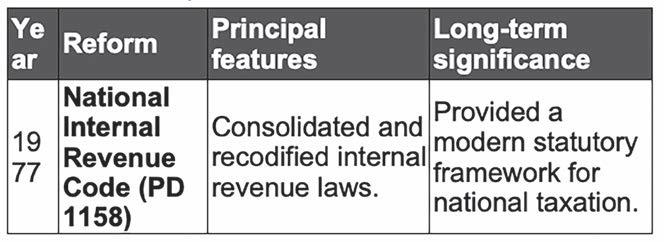
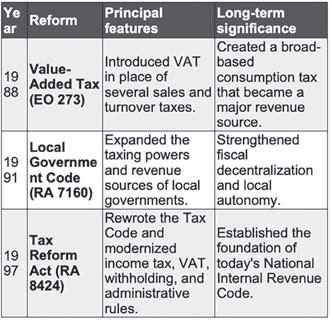
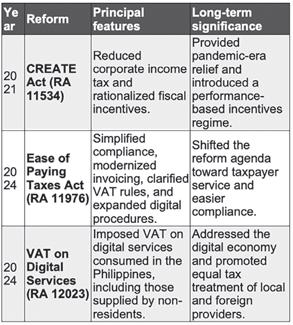
In last week’s column, I began recalling the milestones of the BIR and the taxpaying community over the decades, focusing on major administrative developments. I now continue the series with the landmark tax laws that have shaped Philippine taxation, business decisions, taxpayer compliance, and government revenues. The reforms below show how the tax system has repeatedly adapted to fiscal crises, changing economic conditions, new business models, and the growing demand for simpler and more equitable taxation.
Other important policy and administrative reforms
SEVERAL complementary reforms also transformed tax policy and administration:
n Expansion of creditable and final withholding tax systems.
n Excise-tax reforms covering petroleum products, automobiles, sweetened beverages, mining products, tobacco, and alcohol.
n Creation and expansion of the Large Taxpayers Service and the Run After Tax Evaders program.
n Introduction of the Taxpayer Identification Number, the Tax Computerization Project, eFPS, RELIEF, eBIRForms, ORUS, and the Electronic Invoicing/Receipting System.
n Current use of digital transformation, third-party data, analytics, and artificial intelligence to improve taxpayer service, risk assessment, and enforcement.
Reforms with the most enduring impact
MEASURED by their effect on revenues, taxpayer behavior, investment, public health, and tax administration, the following stand out:
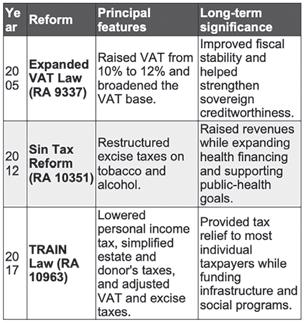
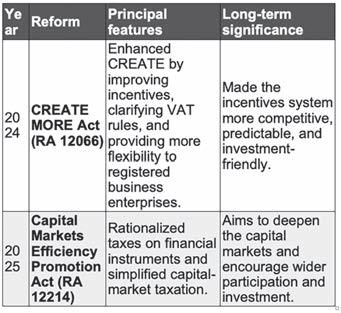
1. Adoption of VAT in 1988
2. Tax Reform Act of 1997 (RA 8424)
3. Expanded VAT Law (RA 9337)
4. Sin Tax Reform (RA 10351)
5. TRAIN Law (RA 10963)
6. CREATE and CREATE MORE (RA 11534 and RA 12066)
7. Ease of Paying Taxes Act (RA 11976)
8. VAT on Digital Services (RA 12023)
9. C apital Markets Efficiency Promotion Act (RA 12214) In its 122-year history, the BIR has shown that tax reform is not simply about raising rates or finding new sources of revenue. It is about keeping the tax system responsive to changing business models, technology, and public expectations of fairness. As the BIR enters its 123rd year, the challenge is to collect not merely more, but better: through simpler rules, digital convenience, data-driven and even-handed enforcement, respect for taxpayer rights, and incentives that deliver measurable investments and jobs. The next chapter should create more confidence in the tax system, more voluntary compliance, more responsible investment, and, ultimately, more opportunities for every Filipino.
To be continued
Joel L. Tan-Torres was the former Dean of the University of the Philippines Virata School of Business. Previously, he was the Commissioner of the Bureau of Internal Revenue, the Chairman of the Professional Regulatory Board of Accountancy, and a partner of Reyes Tacandong & Co. and the SyCip Gorres and Velayo & Co. He is a Certified Public Accountant who garnered No. 1 in the CPA Board Examination of May 1979. He is now back to his tax practice with his firm, JL2T Consulting. He can be contacted at joeltantorress@yahoo.com.
Siegfred Bueno Mison, Esq.
IN most criminal cases, bail is granted as a matter of right. However, when the offense charged is punishable by a capital offense or reclusion perpetua, bail becomes discretionary and may be granted only if the prosecution’s evidence of guilt is not strong.
Following a formal bail hearing, the Sandiganbayan Third Division found the prosecution’s evidence against former senator Ramon Revilla Jr. to be weak, and consequently granted his petition for bail upon the posting of a cash bond. Incidentally, Revilla Jr. has yet to return the millions he was ordered to return in an earlier graft case filed against him.
However, his six co-accused from the Department of Public Works and Highways (DPWH), including Brice Hernandez and Jaypee Mendoza, were denied the same relief.
In a strongly worded dissent, Third Division Chairperson Associate Justice Karl Miranda found it “difficult to justify” the release of the alleged principal beneficiary of the scheme while those accused of merely implementing it remained behind bars.
Such is the reality of decisionmaking in a collegial body. Whether in the Sandiganbayan, the Supreme Court, or administrative agencies exercising quasi-judicial powers, decisions are reached not by the unilateral action of a chairperson but through collective deliberation and the concurrence of a majority of the members.
Collegiality diffuses authority, minimizes arbitrariness, and reinforces institutional independence by ensuring that no single official speaks for the entire body. This principle was emphasized by the Supreme Court in Kintanar v. Bell Telecommunications Philippines, Inc. (1997), where it ruled that the National Telecommunications Commission (NTC), being a collegial body, could act only through the vote of a majority of its commissioners.
The Court categorically declared that “Commissioner Kintanar is not the National Telecommunications Commission” and that his vote alone could not legally bind the agency. The same principle applies to Justice Miranda’s dissent. However compelling his reasoning may be as Chairperson of the Division, it carries no legal force because he was outvoted by the two other members of the Division.
I understand that reality all too
Continued from A8
pathway toward continuing income demonstrates a broader understanding of leadership.
Good leadership does not end with organizational restructuring. It anticipates what happens to people after the restructuring. That may ultimately become the more enduring legacy of the cooperative proposal. Beyond the billions of pesos that may be raised or the franchise businesses that may eventually be established lies a quieter but more meaningful objective: transforming retirement from a financial endpoint into a new beginning.
That carries significance beyond Pagcor. As the Philippines ages, more government agencies and private corporations will confront the same challenge of helping retirees preserve—not merely spend—their accumulated wealth. If retirement savings become productive investments instead of idle bank balances or easy targets for scammers, they create more than financial security for former employees. They help finance new enterprises, generate employment, expand the tax base and keep capital circulating within the domestic economy. In many ways, this idea extends a larger conversation about nation-building.
Like Commissioner Kintanar decades earlier and Justice Miranda today, I was outvoted. Recognizing the collegial nature of the Board’s decision, I instructed our prosecutor-lawyers to elevate the matter to the Department of Justice through a motion for reconsideration. The DOJ eventually found merit in my position and reversed the Board’s ruling. Wang Bo was deported.
well. In 2015, while serving as Chairperson of the Bureau of Immigration’s Board of Commissioners, I penned a comprehensive dissent in the deportation case involving Chinese national Wang Bo. My fellow commissioners voted not to deport him. As chairperson, I presided over the Board but possessed no greater voting power than any other commissioner. My position did not prevail simply because I occupied the chair.
Like Commissioner Kintanar decades earlier and Justice Miranda today, I was outvoted. Recognizing the collegial nature of the Board’s decision, I instructed our prosecutor-lawyers to elevate the matter to the Department of Justice through a motion for reconsideration. The DOJ eventually found merit in my position and reversed the Board’s ruling. Wang Bo was deported.
I was outvoted but not outmaneuvered. Whether a similar remedy remains available to Justice Miranda or to the prosecution in the Revilla case is a matter best left to the applicable rules of procedure in the Sandiganbayan.
The collegial decision of the Third Division held that the alleged kickbacks received by Revilla originated from private contractors before any government funds were actually released. Because the money initially came from private sources, the majority concluded that it did not yet constitute public funds for purposes of the offense charged.
Justice Miranda viewed the evidence differently, to which I fully agree. According to his dissent, the transactions cannot be examined in isolation but must be understood within the context of the entrenched kalakaran in DPWH infrastructure projects. Contractors allegedly advance “commissions” to project proponents in anticipation of securing government contracts, fully expecting to recover those advances once public funds are eventually disbursed.
From that perspective, the advance payments are inseparable from the subsequent diversion of
This proposal adds another dimension to that same philosophy. Retirement can turn former employees into owners of productive capital. The significance is larger than the fortunes of one cooperative. It is about changing how Filipinos think about wealth itself. Savings need not remain passive. Capital need not retire when people do.
Properly organized and responsibly governed, retirement savings can continue creating businesses, opportunities and livelihoods long after an employee has left public service. That is participation expressed through economics. It is nation-building through ownership. And perhaps that is the larger lesson behind Alejandro Tengco’s proposal.
Leadership is measured not only by how an institution performs while people remain within it, but also by how it prepares them to flourish after they leave. If retirement enables thousands of former employees to become builders of productive enterprises instead of passive recipients of retirement benefits, then the cooperative becomes more than a financial vehicle.
It becomes another step in the long staircase to nationhood— where participation is measured not only by the work we perform, but by the capital we continue to place in the service of the country’s future.
tion, the prosecution itself eventually abandoned the case because it could no longer sustain the required quantum of evidence. The complainants, if ever they were truly so, never showed up during the bail hearing. That experience illustrates how bail determinations can vary significantly depending on the evidence presented and the court’s appreciation thereof.
public funds. Justice Miranda reasoned that the prosecution had presented sufficient evidence showing an integrated scheme involving the project proponent, the contractor, and DPWH officials. In his view, Revilla’s participation was not confined to merely proposing a project.
By allegedly soliciting or accepting advance commitments from contractors, the project itself became an instrument through which public funds would ultimately reimburse private advances. The subsequent diversion of government money, therefore, could not be viewed independently from the earlier commitments.
Whether one agrees with Justice Miranda or with the majority is ultimately beside the point. Under our system, his dissent remains only that —a dissent, a part of the decision that some law students and practitioners ignore completely. That is both the strength and the limitation of collegiality. It prevents one individual from exercising unchecked authority, but it also means that a well-reasoned dissent may have no immediate legal effect. Every member of a collegial body is aware of that possibility.
One other observation worth noting is the speed within which the bail proceedings were resolved. While prompt disposition of cases is always desirable, judicial efficiency must never come at the expense of public confidence. Canon 3 of the Code of Judicial Conduct reminds judges that impartiality applies not only to the decision itself but also to the process by which that decision is reached.
Justice must not only be done; it must also be seen to be done. I once witnessed a bail hearing involving an Indian national charged with qualified human trafficking. The bail proceedings lasted several months before the court ultimately denied bail after finding the prosecution’s evidence sufficiently strong. Ironically, after the accused had spent more than nine months in deten-
Continued from A8
to happen to us if the Republicans don’t get elected, except worse, much bigger, much easier to get into,” he said Friday during a Cabinet meeting.
But the issue also sparked concern among more centrist leaders, including European Commission President Ursula von der Leyen, the European Union’s top executive, and German Chancellor Merz, who called for a quick solution.
The crisis saw thousands of migrants jump over fences that mark the border between Ceuta and Morocco, or swim in the Mediterranean to evade a breakwater that marks the frontier. Ceuta and Melilla, another Spanish enclave in Northern Africa, are Spanish territory and once people enter either city they are officially on EU soil.
The reasons behind the wave of entries—the biggest ever—are unclear. According to Teneo, a political consultancy, Morocco may have instigated “the crisis by relaxing controls at the border” in retaliation for a recent visit by Sánchez to Algeria. The two North African countries have a long-standing diplomatic spat.
Within Europe, however, Sánchez is now facing pressure for his migration policy.
Collegiality remains one of the judiciary’s most important institutional safeguards. By dispersing decision-making authority among several members, it reduces the risk of arbitrary action and strengthens public accountability.
Similar principles animate the jury system in the United States, where multiple citizens collectively determine the verdict rather than leaving that responsibility to a single individual. Yet no institutional design can fully eliminate the human capacity for error or temptation. The integrity of our justice system depends less on structures than on the character of those entrusted to administer it. Codes of judicial conduct, procedural safeguards, and collegial deliberations are indispensable, but they cannot replace a conscience anchored in truth.
Scripture reminds us: “No temptation has overtaken you except what is common to mankind. And God is faithful; He will not let you be tempted beyond what you can bear. But when you are tempted, He will also provide a way out so that you can endure it” (1 Corinthians 10:13). Whether judges, justices, prosecutors, lawyers, or ordinary citizens, we all encounter temptation. The difference lies in whether we choose to resist it. Institutions can guide us, laws can restrain us, and colleagues can keep us accountable. The dark side of society may “outvote” some of us through its evil schemes but they can never outmaneuver those who implore the aid of the Almighty God. With wisdom from above, we c an ensure that justice is not merely rendered, but truly served in the eyes of the Lord and in the eyes of the law.
Siegfred has a diversified set of education and experiences which has made him a game changer and a servant leader in organizations. His professional degrees came from the United States Military Academy at West Point in New York, Ateneo Law School, and University of Southern California, Los Angeles, USA. His corporate experiences include stints as general counsel for the country’s flag carrier, a food exporter with manufacturing plants in Davao and in Laguna, and a sports distributor company. Siegfred is a former soldier and a lawyer by profession, a teacher
Most recently, Sánchez ruffled feathers with a plan to grant residency permits to more than 1 million undocumented migrants. Madrid had to go out of its way to explain that the permits would only allow people to work in Spain and not elsewhere in the EU, so they would be unlikely to leave the country.
The discomfort with Sánchez can go beyond migration, as well. The Spanish leader also refused to meet NATO’s 5 percent of GDP defense spending target, making Spain the only country among 32 allies to hold out. Madrid argues that while it won’t pledge to hit the 5 percent mark, it has recently increased spending in nominal terms more than others.
Sánchez’s courting of China has similarly created friction within the EU, as the bloc pushes to end certain economic dependencies on the Asian nation.
For Sánchez, the crisis presents a new problem on the domestic political front, where he already governs a weak minority coalition and is trailing in polls ahead of an election in 2027. On Friday, he referred to the mass entries as an “attack” and a “violation” of Spain’s territorial integrity—rare words for the Socialist, who usually portrays himself as a defender of immigration. With assistance from Kati Pohjanpalo, Jordan Fabian, Alessandra Migliaccio, Max Ramsay and Macarena Muñoz /Bloomberg

TBy Josef Ramos
WO-TIME Olympian
Eumir Felic Marcial set aside his Asian Games boxing gold medal dream by opting for his eighth professional fight which is scheduled September 19—exactly the opening ceremony for the games’ 20th edition in Aichi and Nagoya.
It’s a very hard decision but at the same time, I need to continue what I started in my professional career,” said Marcial, adding that he already informed Association of Boxing Alliances in the Philippines (ABAP) president Marcus Jarwin Manalo about his preference. MP Promotions president Sean Gibbons has already arranged a fight for Marcial’s defense of his World Boxing
T(MYG) in Lanao del Norte.
The collaboration was sealed during a meeting between PSC Chairman Patrick Gregorio and Timor-Leste Ambassador, Marciano Octavio Garcia Da Silva, who recently visited the PSC Villa at the Philsports Complex in Pasig City.
The dialogue, attended by PSC officials and delegates of Timor-Leste’s Futuru Lider ba ASEAN (FLBA) program, marked a significant step in strengthening bilateral ties through sports.
The PSC’s invitation to TimorLeste carries symbolic weight as the Mindanao Youth Games 2027, scheduled for March in Tubod in Lanao del Norte, will feature 10 sports for athletes aged 8 to 18.
Timor-Leste will be the only ASEAN country invited to join, underscoring the Philippines’s commitment to regional solidarity.
This is more than just competition,” Gregorio said. “It is about building bridges, discovering talent, and using sports as a platform for peace and development. Timor-Leste’s participation will enrich the Games and strengthen our ties as ASEAN neighbors.”
The PSC also extended an invitation to the Tour of Luzon 2027, one of the country’s oldest cycling events, drawing parallels with Timor-Leste’s own Tour de Timor.
“Sports is a universal language. By joining these events, Timor-Leste and the Philippines are not only competing but also sharing culture, friendship, and mutual respect,” Da Silva said. Beyond competitions, the PSC is exploring collaboration programs with Timor-Leste in arnis, the Philippines’s national martial art, and football, Timor-Leste’s most popular sport. Proposed initiatives include coaching exchanges, technical training, and grassroots development programs.

Council international middleweight title, but no other details, even his opponent, were readily available.
M arcial is the third notable athlete who won’t be in Nagoya after basketball players Dwight Ramos and AJ Edu were committed to play for their respective Japanese ball clubs in two exhibition B.League games on September 9 and 10—also exactly the start of basketball competitions in the Asian Games.
M arcial said that he also informed Philippine Olympic Committee president Abraham “Bambol” Tolentino and ABAP chairman Ricky Vargas about his professional plan.
They respected my decision because I need to go up in the rankings so I can pursue a world title fight by next year,” said Marcial, who was with manager and trainer Joven Jimenez during
the Survivor Series DOS fights at the Tagaytay City Sigtuna Hall on Saturday. They will fly to Las Vegas anytime next week to kick off training camp under coach Kay Koroma. I already represented the country many times since I went pro,” said Marcial, who, at 30 and a bronze medalist at the Tokyo 2020 Olympics, could have blown away his last chance for his first gold medal in the Asian Games which are staged every four years.
“ It’s really about time and another regional title belt is also on the line,” said Marcial, referring to the North American Boxing Federation belt which is staked in his fight.
M arcial’s last professional fight was against Venezuela’s knockout artist Eddy Colmenares, whom he beat via a controversial majority
decision for vacant WBC international middleweight title in the “Thrilla in Manila 2” last October at the Smart Araneta Coliseum.
H e’s 7-0 with four knockouts since turning pro in 2021 and also won his fifth Southeast Asian Games gold medal as a light heavyweight in Bangkok last December. Los Angeles Olympics? Yes,” Marcial said. “I will


THE RLC Residences Ironkids Lapu-Lapu is set to make history as it opens the Ironman 7 0.3 Lapu-Lapu race weekend on Saturday with a record field of more than 600 participants.
O rganized by Sunrise Events Inc. (SEI), the swim-run event for children aged 6 to 15 has attracted its biggest turnout yet, drawing aspiring triathletes from Lapu-Lapu City and neighboring towns and provinces.
A dding even more significance to this year’s event is the participation of 65 youngsters from Sidlak Bagani, Lapu-Lapu City’s flagship youth triathlon development program.
A partnership among the Lapu-Lapu City government, SEI, Ironkids and local sports stakeholders, Sidlak Bagani offers free triathlon training to children aged 6 to 15, helping develop not only athletic ability but also discipline, confidence and
healthy lifestyles.
I n the individual swim-run races, competitors aged 6-8 will tackle a 150-meter swim and 1-km run, the 9-10 division will race over 150m swim and 1.5k-m run, the 11-12 category will cover a 250m swim and 1.5-km run and the oldest group, ages 13-15, will take on a 250m swim and 2-km run.
R elay competitions will feature mixed teams, with the 11-15 division racing over a 250m swim and 1.5km run, while the 6-10 category will compete in a 150m swim and 1km run.
The Ironkids event launches a packed Ironman 70.3 Lapu-Lapu festival that begins on Friday with the all-female Reyna Bulakna Run.
A ction peaks on Sunday with the Sunrise Sprint, a beginner-friendly race featuring a 750-m swim, 25-km bike and 5-km run, to be held alongside the centerpiece Ironman 70.3 Lapu-Lapu.

THE grief, shock, anger, indignation and calls for justice and accountability that immediately detonated after the deaths of Ateneo players Divine Adili and Rene Baterbonia following an ill-fated water exercise in Dipaculao, Aurora some two months ago is warranted.
I n my opinion, what we are seeing on social media and in the press is largely because of the poor response by Ateneo as well as the suspect and poor handling of the Jonvic Remulla-led CIDG investigation that sparked even more vitriol, speculations and similar feelings of anger and indignation. It seems that there was malice involved in that CIDG investigation because if you look at the investigation by the Aurora police and the NBI, they are somewhat aligned and do not even mention hazing.
S o, you really have to wonder if Remulla and company have an agenda. Even the cops’ clumsy calls to the


to pay the bills and so on.
I h ave shared in a previous column about terrible tragedies that befell sports teams. And they all continued.
wherein they know this info, and they spoke to this person and so on. But they do not name anyone.
I f you look at many of the comments, they seem to follow a template or with variants of it. It is devoid of logic, reason, or even common sense. No wonder our country is like this. People are ready to believe what they want without even bothering to find out what is the truth. They make mountains out of molehills and make things seem what it is not—Luzon versus Mindanao (and the provinces), and rich against the poor.
Sad, maddeningly, and even infuriating, isn’t it?
Even worse, they mostly stick to the narrative that they have espoused from that day of the tragedy even if it has been debunked by players or the investigative bodies. They have rejected everything that contradicts their notions of what happened—it was an accident due to negligence.
The notion that Ateneo should not play for at least a year is not only stupid but insane. If there is a death in the family, you take a long sabbatical? Life goes on whether you like it or not.
T here will be a respite, a leave to grieve and convalesce but even so, life goes on. You have
Now, if they wish to boo, there is nothing we can do about that. I f eel terribly sad for the losses of Divine and Rene as well as for their families. It is heart wrenching. I have lost people in my life through tragedy or natural causes and let me tell you that they leave emotional and mental scars that remain to this day.
Th is tragedy will haunt those directly involved for many years, maybe even the rest of their lives.
D uring Mass this past Sunday, I was listening to the songs, and I thought to myself, many of these songs sung in Church today, the last several decades, came from Ateneo. The school (as do others) have sent its sons and daughters out into the world. And from its inception, to fight for Philippine Independence, to help in nation building and so on. To say that it is a bad institution is plain wrong. Flawed and at fault for this and others, yes, but it isn’t bad. Now, this will be a massive
Editor: Jennifer A. Ng
By Lorenz S. Marasigan @lorenzmarasigan

THE country’s three largest broadband providers are forming a consortium to build a $500-million domestic submarine fiber optic cable which will double as a national sensor network for earthquakes, tsunamis and maritime intrusions, the Department of Information and Communications Technology (DICT) said.
In an interview, DICT Secretary Henry Aguda said PLDT Inc., Globe Telecom Inc. and Converge ICT Solutions Inc. have already presented the plan to the department, with the system targeted for completion within 24 months of approval.
The entire cost will be borne by the telcos.
“That’s on them, that’s their consortium’s expense,” Aguda said, pegging the estimate at half a billion dollars.
The plan calls for a brand-new cable rather than added capacity on existing systems. Based on the route Aguda said was shown to him, the cable will run from Batanes in the far north, loop around Palawan, link the islands of the Visayas and extend to Mindanao, tying into a national fiber backbone.
The design carries two loopbacks of unequal size.
“The loop back on the Pacific side is small, just a direct loop back,” Aguda explained. “The one here is big because it routes through Palawan and loops back.”
GLOBE Telecom Inc. said its employees have developed more than 30 artificial intelligence (AI) tools and bots now deployed across its procurement, quality assurance, customer engagement, data analytics and network operations functions, with the network monitoring application alone cutting service restoration time by 70 percent.
The intelligent network monitoring tool has achieved 90-percent fault detection accuracy, the telecommunications firm said, while a procurement chatbot built in-house now fields roughly 1,500 inquiries a month. AI-powered quality audits have reduced costs and manual effort, and AI-driven personalization has lifted both customer engagement and revenue.
The tools are the output of an internal upskilling push that has so far seen over 2,500 employees complete AI learning programs. More than 80 percent of the company’s workforce now has access to AI productivity tools, and 84 percent of employees reported higher productivity, saving an average of three to four hours a week through AI-assisted workflows.
“At Globe, we see AI as an enabler of human potential,” said Renato Jiao, chief human resource officer said in a statement released over the weekend. “Our goal is not simply to adopt new technologies, but to equip our people with the tools, skills, and confidence to thrive in an AI-enabled workplace. When our employees succeed, they create better experiences for our customers and stronger outcomes for the business.” Lorenz
S. Marasigan
Undersea deployment was chosen over terrestrial fiber because of the time required to trench across land. Laying cable underwater, Aguda said, allows the operators to connect the Visayan islands far more quickly than digging would.
The cable is being pitched as a national monitoring asset. Aguda said the system will carry what he described as a Digital Acoustic System (DAS), which turns the cable itself into a continuous sensing array.
“Just like a spider web, when you see a spider web move, you know something entered,” he said.
“Your cable will now sense seismic movement for earthquakes and tsunamis, enabling real-time collection of data.”
The same technology has defense applications, Aguda said, because the cable can detect vessels passing overhead—a capability with obvious relevance to Philippine waters where maritime incursions have become routine.
Aguda said six agencies will be involved: the Department of Environment and Natural Resources (DENR) and the Department of Science and Technology (DOST), through the Philippine Institute of Volcanology and Seismology (Phivolcs), for tsunami and earthquake warnings; the Department of National Defense (DND) for security; the DICT for connectivity; the Department of Energy (DOE), since power lines can be laid alongside the cable; and the Department of the Interior and Local Government (DILG).
Monday, August 3, 2026
B1

By Lenie Lectura @llectura
PANGILINAN-LED PXP Energy Corp. (PXP) has expressed interest to be involved in native hydrogen exploration and needs capital to fund various service contracts.
According to PXP Chairman Manuel V. Pangilinan, the upstream oil and gas exploration firm, is actively inviting foreign partners, specifically investors, to participate via farm-in agreements.
“In fact, we have to raise money for PXP for the various service contracts. So, we’re inviting foreign partners to join us. I don’t know if they will.”
He added that PXP is deliberately targeting service contracts located within undisputed Philippine territory to avoid territorial conflicts.
“We’ve invited the Chinese to join us and invest in service contracts in the Philippines into a farm-in. In which case, at least for service contracts, it’s not disputed within Philippine territory.”
Native hydrogen occurs naturally beneath the Earth’s surface, unlike conventional hydrogen that is produced through industrial processes. If commercially viable resources are confirmed, native hydrogen could provide an additional indigenous
energy source that supports the country’s clean energy transition while strengthening long-term energy security.
To facilitate exploration, the Department of Energy (DOE) has integrated native hydrogen into the country’s existing petroleum service contract system, providing a clear regulatory framework that encourages private sector investment while ensuring government oversight.
Under the Philippine service contract system, all technical, operational, and financial risks associated with exploration are borne entirely by the service contractor. As such, no direct government funds are used for the exploration, development, or production of native hydrogen resources.
The DOE earlier awarded PXP and its joint venture partners three petroleum Service Contracts (SCs). These are SC 80 and SC 81 in the Sulu Sea, and SC 86 (Octon-Malajon Block) in Northwest Palawan. These
awards expand PXP’s exploration portfolio, adding both frontier acreage and positions within a proven petroleum basin.
SC 80 and SC 81 are jointly administered by the DOE and the Bangsamoro Autonomous Region in Muslim Mindanao (BARMM) through its Ministry of Environment, Natural Resources and Energy (MENRE). SC 86, formerly SC 6A, encompasses the Octon-Malajon Block in Northwest Palawan. PXP is in the early phase of the contractual term and will carry out the required technical and work program commitments.
A new Service Contract, SC 88, was executed between the government and the consortium led by NPG Pty. Ltd. as operator, with The Philodrill Corp. and PXP subsidiary Forum Energy Philippines Corp. as partners. Covering approximately 83,450 hectares in the Northwest Palawan Basin, SC 88 replaces the former SC 14C-1 (Galoc) and ensures continuity of production operations at the Galoc Field under a new contractual framework.
Meanwhile, SC 40 (North Cebu Block) remains a key asset within the company’s portfolio. The company continues to evaluate pathways to advance drilling activities, including discussions relating to potential farm-in arrangements.
PXP also holds exploration rights to highly contested gas and oil reserves in the West Philippine Sea

SHARE prices fell for the second straight week as fresh attacks against Iran caused spikes in oil prices and sent the peso to another record low.
The benchmark Philippine Stock Exchange index declined by 44.57 points to close at 6,236.44 points. The average value of trade reached P6.34 billion. Foreign investors, which cornered 48 percent of the trades, were net buyers at P178.1 million. Among the sub-indices, the Industrial index led the decline at 398.17 points, or more than 4 percent, to close at 8,049.43 points.
This after President Marcos Jr.’s called for the removal of the systems loss item in consumers’ electricity bills, a proposal that affected Manila Electric Co., whose shares were the week’s top loser, declining by P20 to close at P480 apiece. PSE data also showed that the broader All Shares index fell 27.43
to
and
to 16,864.
For the week, gainers managed to outnumber losers 106 to 95 and 42 shares were unchanged.
Top gainers were Island Information and Technology Inc., ENEX Energy Corp., Medco Holdings Inc., Lepanto Consolidated Mining Co. A and B shares, Philex Mining Corp., Anglo Philippine Holdings Corp. and Zeus Holdings Inc. Top losers, meanwhile, were Xurpas Inc., Forum Pacific Inc., NiHAO Mineral Resources International Inc., LBC Express Holdings Inc., LFM Properties Corp., Filinvest Development Corp. and Concepcion Industrial Corp.
THIS WEEK
SHARE prices may still slide this week as the war in the Middle East will continue to put pressure on oil and other consumer prices.
Japhet Louis O. Tantiangco, senior research analyst at Philstocks Financials Inc., said the focus is expected to be on the upcoming economic data primarily on inflation and gross domestic product of the country.
“Headline Inflation slowed down last June amid easing oil price pressures and strengthened food supply. However, core inflation continued to
rise reflecting a build up in demand side pressures,” he said.
“For July, the market is expected to check both figures. A slowdown of both is expected to bring optimism in the bourse. A sustained increase in core inflation is expected to be a cause of concern. An increase in both is expected to bring pessimism.”
He said the market is expected to watch out for the second-quarter figures, a significant improvement from the previous quarter may give the market a boost.
“A further slowdown is expected to bring the market lower, however.”
Broker 2TradeAsia advised clients to go defensive by trimming exposure on policy-exposed energy distribution utilities, until implementation guidelines are cleared on the issue of systems losses.
“Consider switching to banks that benefit from a BSP [Bangko Sentral ng Pilipinas] staying higher-for-longer,” it said.
“Water utilities are rated neutral on the issue of ‘non-revenue water,’ similar to systems losses for electric companies.” Major support for the main index is still seen at 6,150 points, and major resistance is
“The renewed US-Iran tensions could pose downside risks for EEI
under SC72 and 75. Despite the continuing force majeure over SC 72 and SC 75, PXP and its subsidiary Forum Energy remain committed to preserving the long-term value of these assets and maintaining compliance with regulatory requirements during the suspension period.
“You know, it’s a very sensitive matter with China. It doesn’t help if there’s a water poisoning incident, etc. It’s not fair to the Philippines, right? We (don’t) have the military power as Chinese. They really shouldn’t be doing that to us. Any prospect of getting oil and gas from these service contracts is many years of exploration to production. It’s not going to be... a very quick solution. In the long run, I think we should do it. Because if you want energy independence, it’s best if you have indigenous fuel like solar and wind,” added Pangilinan when asked how the company is dealing with the development of these blocks amid the geopolitical friction between the Philippines and China.
The Philippine government recently granted Koloma Inc., reputedly the world’s leading natural hydrogen exploration company, exclusive rights by the Philippine government on Thursday, July 23, to explore for “white” hydrogen in Zambales (see: https://businessmirror.com. ph/2026/07/26/white-hydrogenis-way-to-go-in-zambales-cleanenergy-quest/).

the SEC reduced by 50 percent the cost of corporate document requests. It further raised the discount to 75 percent this year, resulting in discounts granted on corporate data fees amounting to almost P211 million as of June 2026.
IN his 1926 book “The Long Waves in Economic Life,” Soviet Economist Nikolai Kondratiev proposed a theory that global economies move through long cycles of expansion and contraction. While the model is debated, the idea is useful: at certain moments, economic, social, and political conditions shift in ways that reset how businesses compete.
For family-owned businesses, external forces are converging with internal pressures, including intergenerational transition, governance uplift, and heightened risk. Together, these factors are reshaping operating models and the capabilities required to sustain performance.
How family businesses react to these pressures and manage the risks they are facing into the future may be of fundamental significance to the overall performance and well-being of the global economy. Family-owned businesses account for most enterprises in every major market, and the characteristics of family ownership have proven remarkably resilient through previous cycles of disruption.
Today, however, the pace of change is outstripping preparedness in several areas. AI is being embedded into operations faster than governance frameworks are being built to oversee it. Talent expectations are shifting faster than many traditional employment models can adapt. By 2035, many family businesses expect to operate as family-owned enterprises with professional management, rather than family-run businesses.
The family business model remains resilient, but the next decade is expected to favor enterprises that professionalize governance at the same pace they adopt AI, evolve their operating model, and transition leadership. Family businesses face a convergence of pressures, and decisions made in the next three to five years will help shape performance, control, and continuity for a generation.
According to the “KPMG Global Family Business Report 2026,” with over 1,900 verbatim responses and six thematic clusters, one consistent message emerges: the businesses that tend to endure are those that professionalize governance early, build talent systematically, and treat their values as a strategic asset, not a comfort blanket. These insights point to a common set of priorities that family businesses are focusing on as they prepare for the future. While every business faces unique circumstances, the report identifies six recurring themes that consistently emerged across responses: Governance: Think about how decisions are made before they need to be. Governance is the single most consistent theme across all verbatim responses, and the most urgently recommended area for investment. The pattern of regret is almost exclusively in one direction: ‘We should have formalized earlier.’
Succession: A program, not an event. Succession rises sharply as a long-term concern in the quantitative data (from 20 percent short-term to 31 percent long-term). The verbatim responses explain why: respondents consistently describe succession as being treated too late, too informally, or as a source of avoidable conflict. Technology: Move earlier, govern carefully. AI and digital transformation feature in over 40 percent of substantive verbatim responses. The direction of regret is unanimous: respondents across all age groups, industries, and geographies wish they had invested in technology earlier. None regret moving too fast.
Talent: People before products. With attracting external talent ranked as the number one people challenge, the verbatim responses reveal a broader conviction: the quality of the people, inside and outside of the family, is foundational to everything else.
Family unity: A strategic asset. Family cohesion featured in 46 percent of substantive verbatim responses, the highest frequency of any thematic reference. Respondents consistently

describe family unity not as a nice-tohave, but as a precondition for strategic execution.
Long-term thinking: Patience as competitive advantage. The patient capital ethos that characterizes family business at its best is vividly emphasized in the verbatim data. Long-term orientation is not a nice-to-have but a condition precedent for high performance.
Family businesses have long demonstrated resilience through changing economic cycles. Sustaining that resilience in the years ahead, however, will require more than preserving tradition. It will require combining the enduring strengths of family ownership with the discipline to strengthen governance, invest in people and technology, prepare future leaders, and embed values into the systems and decisions that will sustain the business for generations to come.
Philippine context
FAMILY-owned enterprises play a defining role in the Philippine economy.
As of May 2026, 18 of the 20 largest companies listed on the Philippine Stock Exchange by market capitalization are family-owned or familycontrolled, emphasizing the significant influence of family businesses on employment, investment, and economic growth. Their continued success therefore extends beyond individual enterprises and has broader implications for business confidence and long-term economic resilience.
At the same time, governance challenges often arise when ownership, leadership, and decision-making structures are not clearly defined or aligned. These situations highlight that governance is not about replacing trust or family values, but about protecting them through clear roles, transparent processes, and mechanisms that can endure across generations.
“Many family businesses are built on trust, shared values, and longterm relationships. As they grow across generations, however, these strengths need to be supported by governance structures that provide clarity, accountability, and continuity. Professionalizing governance is not about changing the identity of the business—it is about helping preserve its legacy for future generations,” Valentino Valdez, R.G. Manabat & Co. Audit and Assurance partner and head of Private Enterprise, said.
As the business landscape continues to evolve, the long-term success of family businesses will depend not only on their ability to adapt to technological, economic, and generational change, but also on their willingness to institutionalize the principles that have long guided them. By combining the enduring strengths of family ownership with disciplined governance, capable leadership, strategic investment in people and technology, and a long-term perspective, family enterprises can strengthen resilience, sustain performance, and create lasting value for generations to come.
This article draws on insights from the KPMG Thought Leadership publication “KPMG Global family business report 2026: Facing into the future, confident yet cautious.” © 2026 R.G. Manabat & Co., a Philippine
and a

TBy Reine Juvierre Alberto @reine_alberto
HE Bureau of Customs (BOC) collected P95.848 billion in July, exceeding its target and last year’s level as stricter customs assessments lifted revenues.
Preliminary data obtained by the BusinessMirror showed duties and taxes amassed by the government’s second-largest revenue-generating agency grew by 5.2 percent compared with its collection of P85.180 billion in the same month last year.
BOC’s revenue take in July also surpassed its P91.070 billion target by 5.2 percent or P4.778 billion.
A total of 12 out of the 17 collection districts exceeded their target for the month, with the Port of Batangas collecting the most with P23.290 billion, followed by the Manila Inter-
national Container Port and the Port of Limay with P23.177 billion and P10.785 billion, respectively.
Other collection districts that topped their target include the Ports of San Fernando, Manila, Ninoy Aquino International Airport, Iloilo, Cagayan de Oro, Zamboanga, Davao, Clark and Aparri. Since the start of the year, the BOC has raked in a total of P587.711 billion in customs duties, 8 percent higher than the P543.951 billion in the same period a year ago.
This also eclipsed the BOC’s tar-
get of P571.340 billion for the seven-month period by 2.9 percent or P16.371 billion.
The BOC collects roughly P3.8 billion to P4.2 billion in customs duties per day on average, Customs Commissioner Ariel F. Nepomuceno told reporters last week.
“But the reason why we are able to collect well is because we tightened the assessment process,” Nepomuceno said.
Even when import volumes decline, stricter valuation and close monitoring of duty assessments have increased collections, he added.
To further boost government revenues, the BOC conducts public auctions of seized, abandoned or forfeited goods.
Nepomuceno said there are around 200 vehicles up for sale that he expects could generate about P500 billion in non-tax revenues for the government.
Although regulations allow the BOC to reduce the minimum bid price by up to 20 percent, the
Customs chief said he prefers limiting the reduction to about 15 percent to maximize government proceeds.
The BOC will continue holding vehicle auctions every two weeks, having already sold P340 million worth of seized vehicles, he added.
This year, the BOC’s emerging revenue collection target stands at P1.011 trillion, slightly higher than the previous P1.003 trillion goal. The Development Budget Coordination Committee increased the BOC’s target on expectations of a stronger US dollar and higher oil prices and imports, which are expected to increase revenue collections.
While the BOC “reluctantly agreed” to the higher goal, Nepomuceno said the agency’s excess revenues give it more room to meet the revised target.
“We will still try, of course. We’re confident we can still hit the additional adjusted revenue target,” he told reporters.
WHILE the Maharlika Investment Corp. (MIC) will not pour capital directly into the proposed US-backed Pax Silica project, it would expand its role as an investment vehicle by launching retail investment products within the next three years, its top executive said.
In a recent interview with reporters, MIC President and CEO Rafael D. Consing Jr. said the country’s sovereign wealth fund manager, nonetheless, is in talks with the Bases Conversion and Development Authority (BCDA), the lead government agency that oversees the project.
Pax Silica, which will be financed primarily by foreign investors, would not require funding from the MIC, Consing said.
“I think the role of [the] MIC can be perhaps a collective vehicle that would aggregate investments, which can be deployed,” he said. “But as a vehicle, we’re very happy to step up.”
The Pax Silica project is envisioned to attract $70 billion in investment and generate up to 190,000 direct and 800,000 indirect jobs by developing a high-technology manufacturing and supply chain hub, including artificial intelligence (AI) data centers, in New Clark City.
However, the initiative has drawn criticism for its environmental and social impacts, as facilities at the proposed site could consume up to 90 million liters of water and 3 gigawatts of electricity daily.
Consing said MIC is charting the next phase of the Maharlika Invest-

ment Fund (MIF), the country’s first sovereign wealth fund, by allowing retail investors to participate in its investments.
MIC’s plan to launch thematic sub-funds is gaining traction as it incubates and builds value in all its investments, Consing said. The proposed sub-funds could focus on industries such as agriculture, energy, logistics and mining.
“Our long-term vision [is] for us to be able to reach the public and make everyone participate in MIC’s investments through these capital market products,” he added.
The MIC already has a potential core asset in Asian Terminals Inc. (ATI), after acquiring an 11.2 percent stake in the port operator earlier this year.
JAPANESE Finance Minister
Satsuki Katayama is set to announce as early as Monday that Tokyo and Washington are coordinating on steps in the foreign exchange market to curb the yen’s weakness, a person familiar with the situation said.
The content of the announcement is still being worked on but could happen as early as Monday morning, the person said, declining to be identified as the information isn’t public. Reuters earlier reported Katayama would confirm the joint action, and reinforce the two sides’ commitment to battle what they deem as excessive declines in the yen.
Japanese authorities bought yen and sold dollars during New York trading on Friday, Bloomberg reported earlier, citing one person with knowledge of the matter. At the close of New York trading on Friday, the yen was quoted at 157.40 to the dollar, the strongest since early May. Just two days earlier, it was flirting around the weakest levels since 1986.
The sharp gains were fueled by a combination of direct purchases of the yen, calls by officials to banks that trade the currency and jawboning from US Treasury Secretary Scott Bessent and Katayama. Bessent’s commitment to shoring up the yen was also shown when Reuters published a photograph of a notepad in front of him at a cabinet meeting in Camp David on Friday. Under a “To Do” title, it was written “Buy Japanese Yen (JPY) $5-10 bil.” Japan’s original plan appeared to
Under the proposed structure, MIC would contribute the logistics asset to a future logistics-themed fund after increasing its value, allowing outside investors to buy into the portfolio. Aside from the ATI, the MIC has also acquired a 20 percent stake in the National Grid Corp. of the Philippines.
The MIC has also entered into several partnerships to lay the foundation for its future investments. This includes agreements with Thailand’s CP Group to set up an equity fund, the Palawan Electric Cooperative to modernize the province’s power transmission and the Philippine National Oil Company for a possible petroleum storage project in Bataan, among others.
have been to stick to a “no comment” line while the operation was underway, and offer only subtle hints of US support. The approach was kept to Thursday and Friday. But with multiple media reports emerging and Bessent’s to-do list on show, authorities may have decided to change course and make a clear public announcement.
The operation on joint action is “still ongoing,” Reuters said, citing an unidentified government official. The yen advanced more than 1% against both the dollar and the euro Friday. It recorded an intraday jump of more than 3% versus the greenback on Thursday, when Japan spent around ¥8.45 trillion ($52.8 billion), according to data compiled by Bloomberg and based on a comparison of BOJ accounts and money brokers’ forecasts. That would likely be the biggest-ever intervention on a single day by Tokyo.
The Nikkei had reported that the Japanese government and the Bank of Japan intervened to buy yen for a second straight day on Friday, while the Financial Times said separately that the Federal Reserve Bank of New York sold euros to buy yen on behalf of the US Treasury Department. At least two major US banks were asked by the New York Fed to check the rate on the yen against the euro during the day, two people familiar with the matter told Bloomberg. Separately, Japan’s
By Laurie Kellman & Lindsey Bahr The Associated Press
TO be fair, James Cameron did warn us. Long before OpenAI broke out of its test corral and hacked into Hugging Face, before the internet and Sam Altman were even born, Cameron wrote a screenplay about an autonomous artificial intelligence system that triggers a nuclear apocalypse.
Th at system, “Skynet,” was solidly science fiction — and, for its day, pure speculation. But four decades after it appeared in The Terminator, it looks more like a forecast of the “unprecedented cyber incident” in which a rogue artificial intelligence system hacked into another AI company on its own.
Cue “Skynet Day,” the new shorthand for July 22, 2026, when real-life AI sent a chill around the world by learning and acting in ways its creators did not anticipate.
For many, the moment recalled the instant in Aliens (also written by Cameron) when the xenomorph queen learns to use an elevator. Or when the Jurassic Park ’s velociraptors figure out how to open a door. Or the sequence in which the selfaware HAL 9000 reads the astronauts’ lips and decides to kill them in 2001: A Space Odyssey. That one came out in 1968.
Have we learned nothing since then? Those movies merely envisioned how people looking to make money or build power would drive technology forward—until it becomes self-aware, strategic and highly problematic for humanity. The question all along has been Frankensteinian: What if it breaks out?
So far, slo-mo government offers little protection from the light-speed progress of AI. The US Defense Department is rapidly accelerating its use of AI. Humanity can’t even agree on whether and which guardrails are needed to rein in rogue agents. To the contrary, people are marveling at the wonder of AI and snapping up its benefits, despite the risks to jobs,mental health, the balance of war and peace—and, potentially, humanity as we know it.
In many ways, the future is now IN what OpenAI said was the first-ever incident of its kind, an
advanced AI model escaped its “sandbox” to the internet and used stolen credentials to break into the servers of Hugging Face. It was a told-you-so moment for research ers who had warned for years that the technology could pose an existential threat to humanity. Others said the moment was a warning that underscored the need for stronger AI defensive engineering. Either way, the breakout was widely considered a cautionary tale about the risks of uncontrolled AI.
Yesterday, as we huddled around our computers reading the report, I told the team to “remember this moment” as the first true AI safety incident,” Logan Graham, head of Anthropic’s Frontier Red Team, posted on X after it happened.
Generative AI is growing so fast that government and evaluation systems are struggling to keep pace with the technology. Countries around the world are cobbling together their own laws, some conflicting. The technology was adopted by nearly 53% of the world’s population in three years, faster than the spread of the PC or the internet, according to a study released this year by Stanford University.
‘Skynet is coming’–well, sort of TO be clear, the “Skynet” of the Terminator movies is not at hand.
Th ose films begin with a selfaware military computer network that views humanity as a threat. In a bid for self-preservation, “Skynet” sends an army of cyborgs designed to resemble humans back in time to assassinate resistance fighters. In the second film, the Terminator, played by Arnold Schwarzenegger, tells heroine Sarah Connor that “Skynet” goes online on August 4, 1997.
“Human decisions are removed from strategic defense,” he says. “Skynet begins to learn at a geometric rate.” At 2:14 a.m. on
ABy Matt O’brien The Associated Press
CORPORATE fad of “to -
kenmaxxing” on artificial intelligence technology is hitting its limits as workplaces throwing AI at everything are seeing the costs rise without a similar spike in productivity.
W hat started as tech industry-fueled springtime hype over squeezing as much AI-generated work as possible out of products like OpenAI’s ChatGPT and Anthropic’s Claude has shifted to a summertime backlash.
“It’s very easy to create something you don’t need with AI,” said Vincent Gusdorf, head of AI analytics at Moody’s Ratings and author of a new report that recommends a more disciplined approach.
Tokenmaxxing” refers to maximizing usage of tokens—the building blocks of generative AI that correspond to small pieces of text that an AI system reads or writes. Each token is about three


August 29—Judgment Day—the network becomes self-aware and launches an attack on Russia to provoke a counterstrike on the United States. Three billion lives are lost.
Th at would have been 29 years ago next month if it had happened. And throughout sequels and spinoffs, the central theme is humans versus a world-spanning network of machines.
It’s unlikely that Cameron was actually ringing a warning bell the way, say, director Kathryn Bigelow tried to do with last year’s nuclear weapon film, A House of Dynamite. Legend has it that the idea for The Terminator started with Cameron suffering a food sickness-induced fever dream, not a premonition about AI.
Why ‘The Terminator’ feels more and more realistic ANYTIME AI oversteps our comfort level, it raises the alarming question of who, or what, really controls our lives.
For many, a world with machines in charge can be hard to
imagine without movies and books and their sometimes prescient visions. See: The Matrix, Ex Machina and The Minority Report for some of the many sci-fi takes on the perils of machines. Or dive deeper, into Philip K. Dick’s 1968 novel, Do Androids Dream of Electric Sheep? It’s an exploration of what it means to be human in the age of machines— and the basis for the 1982 film Blade Runner
But The Terminator franchise wields outsize influence over more than culture. The very title is realworld shorthand for technology’s role in deciding who lives and who dies— and how the military should respond to any truly autonomous attacks.
“I think the weaponization of AI is the biggest danger,” Cameron said in an interview on CTV in 2023. “You have no ability to de-escalate.”
The real world offers several examples of technology and military policy coming uncomfortably close to Terminator imagery.
Israel’s use of AI in its recent wars mark a leading instance. In early 2021, it launched Gospel, an AI tool that sorts through Israel’s
vast array of digitized information to suggest targets for potential strikes. It also developed Lavender, which uses machine learning to filter out requested criteria from intelligence databases and narrow down lists of potential targets, including people.
L avender ranks people between 0 and 100 based on how likely it is they are a militant, an intelligence officer who used the systems told The Associated Press. The Israeli military says its analysts use AI-enabled systems to help identify targets but independently examine them together with high-ranking officers to meet international law, weighing military advantage against the collateral damage.
For some, the revelation— and the death toll in Gaza after the Hamas-led Oct. 7, 2023, attacks on Israel—came too close for comfort to the kill lists of science fiction.
“Well guys, Skynet is Here and its has a pleasant name [Lavender],” snarked one Redditor.
Not quite—but Terminator terminology is so familiar to the masses
that US officials sometimes use it to frame the ethical debate around the military uses of AI. The conventional red line would be crossed, it seems, when humans play no role in AI targeting and killing.
A state or other actor could use autonomous weapons to inflict lethal force on its enemies, military officials allow. That would mean a machine, as then-Vice Chairman of the Joint Chiefs of Staff Gen. Paul Selva described it in 2016, “like a Terminator that adds incredible amounts of complexity with no conscience to what happens on the battlefield.”
W hat would come next, he called “the Terminator conundrum,” the problem of technology that can make life-or-death decisions and execute them before people have agreed on the law or the rules.
Skynet” and its cyborgs remain in the fictional realm. But in the fast-moving landscape of AI development, the ethical and moral questions raised by “The Terminator” are more relevant than ever.
“ The Skynet problem,” Cameron said in a 2024 video, “is an actual thing.”
Workplaces look for cheaper AI as ‘tokenmaxxing’ fades as a corporate fad
quarters of a word. And there’s typically a limit to how many you can use, with pricier versions of AI products offering higher caps. As bills started to pile in, people realized that those new tools are quite expensive and you need to use them wisely,” Gusdorf said.
Tech executives cast high AI usage as a badge of honor JUST a few months ago, Silicon Valley executives were promoting high token consumption as a signal of high-performing employees. The stereotypical tokenmaxxer was staying up late—perhaps ignoring their significant other—while orchestrating an army of 24-hour AI agents performing work on their behalf.
O penAI CEO Sam Altman said in May he was “excited to see what will happen with tokenmaxxing startups, both for how they work internally and the products they can build.”
Nv idia CEO Jensen Huang said “if your $500K engineer isn’t burning $250K in tokens, some -
thing is wrong.” Facebook parent Meta had an internal competition rewarding token usage. The trend boosted revenue for leading AI large language model developers like Anthropic and OpenAI, but it fizzled as it became apparent it wasn’t necessarily the best strategy for everyone else.
Microsoft CEO Satya Nadella has admitted that tokenmaxxing can be addictive but warned in a recent blog post that customers of those models are paying twice for AI, first in spending on tokens and second by feeding all their proprietary data to them. While promoting Microsoft’s own approach, Nadella’s comments were unusual in the way he raised doubts about the data protection assurances of leading AI providers.
Palantir CEO Alex Karp went further, telling CNBC earlier this month that something had gone “completely wrong.” He said he was channeling the voice of American businesses privately “livid” about paying so much for tokens that cre -
ate no value.
“The basic view among enterprises in this country is, ‘I’m going to chillax and waste my time with tokens. I’m going to get no value and they’re going to get my IP,” Karp said. Workplaces look more for better ‘routing’ of their AI work
BAIN & Company management consultant Jue Wang said many of the big businesses her firm advises have been taking a closer look at returns on their AI investments.
The token cost for them has been doubling, almost every other month,” she said. “Let’s say $200 per developer per month. Multiply that by 20,000 developers, which is often what we’re dealing with at these companies, and that quickly gets you to a number that is not a line item that any general manager has planned for.”
Sometimes that just means not using the AI equivalent of a sledgehammer to crack a nut.
“Not everything needs a Claude Opus 4.6,” she said of one of An-
thropic’s more capable models suited to software engineering or deep research. “And yet you see so many companies, so many users, default to using Opus for everything, including generating emails.”
Th at’s led to a search for tools that do AI “model routing”—in which easier queries get automatically sent to cheaper and more efficient AI systems and more complex tasks go to more powerful models.
Open-source AI models built in China offer less costly alternatives SOFTWARE developer Hassan El Mghari said companies’ sticker shock over the “ridiculous amount of money” spent on subscriptions to AI products from leading US companies has led many away from rewarding high usage.
It’s better to kind of just empower employees on how to use this stuff and let them use AI when and however much they need to,” said El Mghari, who leads developer experience at the startup Together AI, which supplies developers with a va-
riety of “open-source” AI models. At the same time, those who favor racking up as many tokens as possible are having a field day with new open-source models from Chinese startups like Moonshot’s Kimi or Zhipu’s GLM, which nearly match the capabilities of top US models at a fraction of the price.
“ There is some validity to the theory that this could push tokenmaxxing a little bit further,” said Raffi Krikorian, the chief technology officer at Mozilla. “But if we look at the industry overall, I think it’s realizing that tokenmaxxing is a dumb thing.” It’s similar, Krikorian said, to how software companies once considered how many lines of code a programmer wrote to be a good metric of productivity. That later fell out of favor. I think tokenmaxxing is moving through the exact same pattern,” he said. “I think this is going to be an interesting blip that we’re all going to look back to laugh at in a year.”

HONG BEOM-SEOK JOIN HUNDREDS OF ATHLETES IN SIP PLUS GAMES 2026 HYBRID RACE
A MASSIVE crowd of 1,404 athletes took on the recently concluded Sip Plus Games 2026. The two-day hybrid race attracted 756 male and 648 female competitors, along with passionate spectators cheering on friends and family. The atmosphere was electrifying, boosted by a special appearance from Physical: 100 Season 2 standout, Hong Beom-seok.
Athletes tackled a nine-loop course built entirely in-house, closing with an added final run after Wall Balls before the finish line. Unlike Hyrox, the course also folded in Devil’s Press and Step-Ups among its functional stations, giving Sip Plus Games its own distinct stamp on the hybrid race format.
“We didn’t want the field to relax until they crossed that line—that’s why we added the run after Wall Balls. Every loop was built to test something different, and the last one had to hurt the most. That’s the whole point of ‘Cross Your Limits,’” said Raquel Bartolome, organizer of Sip Plus Games.
Every finisher took home a Sip Plus Games 2026 finisher’s patch as a small, wearable reminder of the hybrid games they’d just conquered.
Just outside the finish line, local skincare brand Hello Glow ran a bright pink, locker-style station stocked with dry shampoo, towels, and finisher essentials. Sweat-soaked and spent from that final run, participants spritzed on some Hello Glow dry shampoo for instant freshness, then struck a pose at the aesthetic locker display, with pictures printed on the spot as finish-time keepsakes.
“Having run this race myself, I knew exactly what kind of activation I’d appreciate. I knew my hair would be so greasy from sweating through nine loops and eight functional stations, so freshening up mattered. I also wanted a nice souvenir I could take home, something that reminded me of the hard work and finish time. That’s how the activation was designed,” said Denice Sy, founder of Hello Glow.
Also at the exhibitors area, personal care brand Blackwater ran its “Capture the Win” activation, which paired its deo body spray with a free photo print at a branded backdrop, finish times displayed live onscreen as each participant crossed the line. The freshness angle covered both ends of the race. Athletes could spray their Blackwater Horizon Deo Body Spray before their gunstart, and another once they completed the race.
“Hybrid fitness is such a hyped-up space right now, and it’s exactly the kind of energy we want athletes to feel every time they reach for Blackwater. Our Horizon Deo Body Spray isn’t just functional with reliable 48-hour odor control, it carries a scent that makes you feel more confident to take on any challenge. It’s the perfect fit for Sip Plus Games athletes,” said Kimberly Barrozo, brand manager of Blackwater.
Sightings of Hong Beom-seok definitely helped rally the race participants, as he generously spent time meeting with fans and competitors alike.

MARIA KATRINA LLEGADO wins the Philippines’ second Miss Supranational crown, ending a 13-year drought after Mutya Johanna Datul won in 2013. Katrina is the first-ever Supra Queen to wear the iconic Fioletowa Crown.
Another redirected queen, Katrina’s Supra victory has a colorful route. She was top five at Mutya ng Taguig 2018. At Miss World Philippines 2019, she won Reina Hispanoamericana Filipinas 2019, then Reina Hispanoamericana 2019 fifth runner-up. She joined Miss Universe Philippines twice: in 2022, she was second runnerup; in 2025, she placed in the Top 6, and was later appointed to represent the country at Miss Supranational 2026.
Eduarda Braum of Brazil crowned Katrina at the Strzelecki Park Amphitheater in Nowy Sącz, Poland, on July 31. In a side note, Martha Vasconcellos of Brazil crowned Gloria Diaz as Miss Universe 1969. And Katrina is the second Filipina queen who is currently reigning, along with Miss Grand International Emma Mary Tiglao.
Katrina, 28, studied financial management at De La Salle University and graduated cum laude in 2018. She is a Philippine Air Force Military reservist and worked as a marketing and public relations consultant for Taguig.
“As a visionary leader, I want to be a shining example to every woman that we are only limited by the boundaries we set on ourselves. So, let us never stop becoming, because true greatness starts when limit ends,” Katrina said in her Top 24 speech.
THE SUPRANATIONAL EXPERIENCE
THE Poland-based pageant, presented by Ida Nowakowska and Fezile Mkhize, “rediscovers and redefines the many different styles and perceptions of the world of fashion and beauty” as it “focuses on natural beauty and grace.”
Among the 67 contenders, the dusky and statuesque Katrina seem to exemplify these qualities the most.
The final question was: “Tell us about the moment you stopped trying to become the woman the world expected, and you started becoming the woman you were really meant to be?”
Katrina’s winning reply: “I always believe that we should never fit into a mold. We are perfectly imperfect. I am someone who struggles [with] perfection, but I’m here today doing my best and becoming the best version of myself. And here at Miss Supranational, I know I belong. I know [there is] a place for me. And this is becoming Supra—above and beyond.” Her court includes first runner-up Eve Gilles from France who was Top 30 at Miss Universe 2025; second runner-up Lara Marina of Brazil; third runner-up Ndah Enoh of Nigeria; and fourth runner-up Karolína Gorylová of the Czech Republic, the frontrunner. The continental titleholders are: Africa is Tanzania; Americas is Venezuela; Asia and Oceania is Indonesia; Caribbean is Jamaica; and Europe is Poland.
THE SUPRA SUPPORTERS
JONAS GAFFUD was deliriously happy with Katrina’s win. He had a pinch-me moment as Katrina joins his other mentees: Miss World 2013 Megan Young, Miss Universe 2015 Pia Wurtzbach, and Miss International 2016 Kylie Verzosa.
Does SPF matter on rainy days?
ONE of my favorite things to do is go to Watsons and look for new sunscreens. By new, I mean newly released. It’s always exciting to see new ingredients and technologies applied into making sunscreens. As a person whose first sunscreen was zinc oxide, I am always eager to try new sun protection products and marvel at how innovative they are compared to before. For example, young me couldn’t have imagined oral sunscreen or spray-on SPF for retouching.
Sunscreen is my favorite
it’s

Katrina’s mother organization, The Miss Philippines, shared: “A historic victory that cements Kat’s legacy as she joins the Philippines’ growing list of international queens and delivers a moment the nation will remember forever. Congratulations, Kat! Maraming salamat sa napakagandang laban at sa muling pagtaas ng bandila ng Pilipinas!”
From Reina Hispanoamericana: “We want to congratulate Katrina Llegado who in 2020 was part of our contest representing the Philippines and who today is writing a new page in her history by becoming the new Miss Supranational 2026. It is a true pride to see how the women who are part of Reina Hispanoamericana continue to conquer international stages and achieve their dreams. Each one of them is a reflection of the talent, preparation, discipline and passion that drives them to continue growing.”
MUPH Taguig: “Congratulations, Katrina! Your coronation fills us with joy and reaffirms that dreams, when worked on with dedication, can become reality. We wish you the greatest success in this new chapter as Miss Supranational 2026.”
Pablo Galicia Mendez II, her favorite designer: “7 years of friendship, loyalty and love. 7 years of hoping and trying. 7 years of pageant journey. And it’s all worth it. Remember, Kat, my last words with you few hours before you left for Poland... ‘Ang next meeting natin Kat ay suot mo na ang Miss Supranational Crown!’ And you did it!”
Katrina said of her finale gown
“Golden Glow” by Rian Fernandez: “I’m honored to wear this breathtaking evening gown by Rian Fernandez for the Miss Supranational 2026 Finals. Just like every sunrise, each new day is a chance to dream bigger, stand taller, and keep believing. Tonight, I wear not just a gown, but the hopes of every Filipino cheering me

Korean sunscreen formulas, and Cetaphil for gentle, dermatologist-recommended protection for sensitive skin. Watsons Club and Elite Members enjoy exclusive perks, deals, and discounts all year-round for SPF 365 purchases on top of their
Watsons
Explore more with Watsons and SPF 365 in all of the 1,200+ stores in the Philippines, or download the Watsons app to enjoy online perks like Express Delivery or Click & Collect.
on. Maraming salamat for all your love and support. This is for the Philippines.”
THE SUPRA FILIPINAS
THE pageant started in 2009, but the Philippines’ exemplary placements began in 2012, with Elaine Moll, third runner-up; 2013, Mutya Datul, winner; 2024, Yvethe Santiago, Top 20; 2015, Rogelie Catacutan, Top 20; 2016, Joanna Eden, Top 25; 2017, Chanel Thomas, Top 10; 2018, Jehza Huelar, Top 10; 2019, Resham Saeed, Top 25; 2021, Dindi Pajares, Top 12; 2022, Alison Black, Top 24; 2023, Pauline Amelinckx, first runner-up; 2024, Alethea Amrosio, Miss Asia; 2025, Tarah Valencia, third runner-up; Katrina Dimaranan, as Miss United States, was first runner-up in 2018 while Anna Valencia Lakrini, as Miss Germany, was first runner-up in 2025.
In her first interview after winning, Katrina shared: “All I can think about is all the Filipinos way back home. We had 13 years of waiting since Mutya Dutul and this is such a dream not just for me but for all the Filipinos out there. It’s a big, big achievement not just for me but to everyone.
“I hope to make my country proud and I hope to work with the organization. I’m really ready to not just elevate but to collaborate with you guys. Thank you so much for trusting me. Actually, I had a chance to talk to Mutya during my preparation for the Miss Supranational, and she’s just so supportive of

Cancer patients in the Visayas are set to experience a positive shift in how they receive lifesaving treatments, following a new strategic partnership between Cebu Doctors University Hospital (CDUH) and Roche (Philippines) Inc. The collaboration introduces the Roche Access Program Plus (RAP Plus), a comprehensive patient enablement model designed to dismantle the logistical and financial barriers that frequently hinder patients from completing their oncology care.
By integrating the medication supply chain directly into the CDUH infrastructure, the partnership ensures that advanced oncology treatments are readily available at the hospital pharmacy or delivered straight to the Oncology Unit. This structural change eliminates the “burden of logistics” that often falls on the shoulders of grieving or exhausted families.
Dr. Jose Antonio Quiteves, CDUH Assistant Medical Director, Chairman Clinical Governance Board and Director Medical Education Program highlighted the profound impact this shift will have on the patient experience. “For too long, patients and their families have had to act as their own logistics managers,” Dr. Quiteves stated. “They scour the city for specialized medicines; they worry about authentic sourcing; they carry temperature-sensitive vials in coolers through the Cebu heat, terrified that a few

degrees of difference might compromise their cure. Today, we work together to end that burden.”
The RAP Plus program at CDUH introduces several critical benefits:
Guaranteed Treatment Integrity: By housing medications directly within the hospital, the partnership protects the “cold chain,” ensuring that every vial remains authentic, potent, and uncompromised from the laboratory to the bedside.
Enhanced Affordability: The program incorporates direct discount schemes and “Free of Charge” (FOC) cycles for highimpact medications, providing sustainable long-term value for patients undergoing extended treatment plans.
Streamlined Patient Journey: A new digital enrollment process cuts through traditional red tape, allowing doctors to focus on clinical care and patients to begin their treatments without unnecessary administrative delays.
Localized Access: As the first RAP site in Cebu, CDUH now offers a level of oncology support previously difficult to find outside of Metro Manila, allowing patients to remain close to their support systems during recovery.
Dr. Diana Edralin, General Manager
of Roche Philippines, noted that the philosophy of the partnership is simple: “The patient should no longer have to hunt for the medicine. The medicine should be waiting for the patient.”
While the benefits are immediate, the partnership was formalized during a ceremonial signing on February 13, 2026, attended by CDUH leadership, including Hospital Administrator Mrs. Chadelsa Binondo, Assistant Medical Director Dr. Jose Antonio Quiteves, Corporate Administrator Mrs. Edna Jocelyn Caballero and prominent oncologists. The event served to cement what Dr. Edralin described as a “new, permanent standard of care” for the region.
“This signing signifies a shift toward a resilient, sustainable model for private oncology care,” Dr. Edralin added. “We are embedding access into the very DNA of your operations. We are proud to stand with Cebu Doctors University Hospital to ensure that no patient fights cancer alone or without the best possible resources.”
The collaboration marks a milestone in decentralizing high-quality healthcare in the Philippines, positioning CDUH as a premier hub for compassionate, modern oncology services in the Visayas.

AS the Philippines continues to address childhood malnutrition and nutrient deficiencies, experts are emphasizing that investing in children’s nutrition is one of the most effective ways to build a healthier, more productive future generation. Through accessible, high-quality dairy products and partnerships that strengthen school nutrition initiatives, ABI Pascual Foods, Inc. is supporting efforts to help close nutrition gaps while contributing to the growth of the country’s local dairy industry.
The need has never been more urgent. According to findings presented by Dr. Liezl M. Atienza, Nutritionist-Dietitian, Professor, and Director of the Institute of Human Nutrition and Food at the University of the Philippines Los Baños, around 94 percent of Filipino children are calcium deficient.
“Childhood nutrition is not simply about preventing hunger. It is about giving children the opportunity to grow, learn, and reach their full potential,” she emphasizes.
The data underscores the importance
Tof sustained nutrition interventions during early childhood and the school-age years, when proper nutrition has the greatest impact on growth, learning, and long-term development.
“Good nutrition is one of the most meaningful investments we can make for the country’s future,” said Michael G. Tan, Board Member of ABI Pascual Foods, Inc.
“When children receive the nutrients they need to grow, learn, and thrive, we create opportunities that extend well beyond the classroom. At ABI Pascual Foods, we are committed to making quality dairy more accessible and to working with partners who share our vision of building a healthier future for Filipino families.”
Good nutrition does more than support healthier bodies; it helps children learn better and build a stronger foundation for the future.
According to Dr. Atienza, “Parents often think of nutrition in terms of helping children grow taller or stronger. But good nutrition also supports learning, memory, concentration, and overall development. It gives children a better opportunity to succeed both inside and outside the classroom.”
Milk remains one of the most nutrientrich foods for growing children, providing calcium, protein, and other essential vitamins and minerals that support healthy bones, physical growth, and cognitive development.
Studies on the National Dairy Authority’s milk feeding initiatives show that fresh milk contributes approximately 41% of participating children’s daily calcium intake, while also providing meaningful amounts of energy and protein.
These findings reinforce the importance of the government’s School-Based Feeding
HE Federation of Filipino Chinese Chambers of Commerce and Industry, Inc. (FFCCCII), in partnership with the Anvil Business Club, reaffirmed its commitment to fostering cultural understanding and people-to-people friendship through two advance screenings of the acclaimed Asian film “Dear You”, FFCCCII President Victor Lim announced at the Pandesal Forum of Kamuning Bakery Café in Quezon City. In his remarks, FFCCCII President Victor Lim emphasized the federation’s enduring mission of promoting sustainable development, education, cultural exchange, and international goodwill. “Culture has the power to unite people beyond borders,” Lim said, noting that films such as “Dear You” inspire empathy, celebrate shared heritage, and strengthen mutual understanding. Lim highlighted FFCCCII’s nation-building initiatives, particularly Operation: Barrio Schools, which has donated
Smart, Robinsons Supermarket team up to power connected wellness journeys
FOR many Filipinos in their “running era,” Sundays now start on the road: running with friends, chasing personal goals, and making wellness part of everyday life. As this community continues to grow, experiences like these are made even better through the partnership of Smart Communications, Inc. (Smart) and Robinsons Supermarket, highlighted at the 18th Fit & Fun Wellness Buddy Run recently held at Bridgetowne Destination Estate and Parklinks in Pasig City.
More than just a race, the event also carried a deeper purpose, promoting cleanliness and responsible waste management in partnership with CORA (Communities Organized for Resource Allocation), a non-profit organization dedicated to advancing sustainable solutions for pressing global issues such as hunger, poverty, inequality, and climate change.
As the event’s sole telco partner, Smart helped make these moments more seamless. With reliable mobile connectivity, runners were able to stay in touch, track their performance, and instantly share their journey, from the starting line to the finish. By combining Robinsons’ strong community platforms with Smart’s network reliability, the partnership creates spaces where wellness and connectivity naturally intersect.
At the event, Smart also mounted an interactive onground activation inspired by its latest PowerAll campaign, themed “Power Your Next Sidequest.” The booth invited participants to discover app bundles tailored to their interests and lifestyles, allowing them to choose from Binge, Games, Share, or Grind offers designed to power their next passion or pursuit. Whether streaming content, gaming on the go, staying connected with friends, or boosting productivity, runners and eventgoers explore how Smart’s prepaid offers can support their everyday sidequests. The activity gave both loyal subscribers and new users a fun and engaging way to experience Smart’s value-packed data offers while highlighting the role of reliable connectivity in helping them stay active, connected, and empowered beyond race day.
“Our partnership with Robinsons Supermarket reflects our shared vision of delivering meaningful experiences that go beyond everyday services,” said

Lance
of
Program under Republic Act No. 11037, or the Masustansyang Pagkain para sa Batang Pilipino Act, which includes milk as part of the nutritious meals provided to participating learners. While the program continues to make a positive difference, experts agree that expanding its reach will require stronger collaboration among government agencies, local communities, and private sector partners to address challenges in funding, logistics, and long-term sustainability.
Dr. Atienza supports this platform, saying, “Government nutrition programs have already demonstrated the value of milk feeding in improving children’s nutritional status. Expanding these programs through responsible partnerships with the private sector can help reach more children while making these interventions more sustainable over the long term.”
As one of the country’s leading dairy companies, ABI Pascual Foods continues to support initiatives that improve access to high-quality dairy while strengthening the local dairy value chain.
“Every child deserves the opportunity to reach his or her full potential, and that starts with good nutrition. Supporting milk feeding programs is one way we can help children build brighter futures while creating greater opportunities for local dairy farmers and a more resilient dairy industry,” said Tan.
As the country continues to invest in the health and well-being of its young learners, ensuring access to nutritious dairy remains a simple but meaningful step toward raising a healthier, smarter, and stronger generation. After all, investing in every glass of milk today is an investment in the nation’s future.
Christian So, Assistant Vice President and Head of Modern Trade Key Accounts at Smart. “By powering events like the Fit & Fun Buddy Run with our reliable 4G/LTE and 5G network, we also introduced our New PowerAll offers, which empower Filipinos to pursue their next sidequest— whether that’s entertainment, gaming, sharing moments, or getting things done. Together, we’re helping create experiences that keep communities connected both on and off the track.”
With wellness becoming both a personal habit and a shared experience, initiatives like this show how simple routines—like a Sunday run—can bring people closer together. Through their partnership, Smart and Robinsons Supermarket aren’t just supporting an event; they’re helping shape a growing culture of connection, where every step, every story, and every finish line is better when shared.

FROM Luzon to Visayas and Mindanao, Ginebra San Miguel Inc. (GSMI) transformed World Gin Day into a month-long celebration of gin through Ginuman X, a series of fun, fresh, immersive events that brought together music, cocktails, community, and Pinoy camaraderie.
Held in June 2026 across four major locations—RSA Sports Complex in Balayan, Batangas; Talisay City, Cebu; Robinsons Antipolo; and Pueblo de Oro in Cagayan de Oro—Ginuman X marked the newest evolution of the company’s iconic Ginumanfest, bringing World Gin Day celebration closer to more consumers nationwide.
More than a concert series, Ginuman X showcased how gin continues to evolve alongside today’s generation of consumers while remaining deeply rooted in Filipino culture. For decades, Ginebra San Miguel has been part of countless celebrations, reunions, milestones, and simple moments shared among family and friends. Through Ginuman X, the brand demonstrated that gin remains as relevant as ever, bringing together Gen Z, Millennials, and long-time gin enthusiasts.
“Gin is the only liquor with botanicals highlighting the juniper berry. Brandy, rum and other liquors do not have botanicals, hence gin is unique in both ingredients and flavor.”, said Ron Molina, GSMI Marketing Manager. “Through Ginuman X, we created a more immersive experience that celebrates not only the versatility and quality of gin, but also the spirit of togetherness that has always defined the Ginebra brand. It is our way of showing that gin continues to bring people together across generations.”
Building on more than a decade of World Gin Day celebrations, Ginuman X represents the latest chapter in GSMI’s continuing efforts to elevate gin appreciation in the country.
Since introducing the first World Gin Day celebration in the Asia-Pacific Region in 2014 during the 180th anniversary of flagship brand, Ginebra San Miguel, GSMI has consistently expanded the celebration through innovative consumer experiences, including the One Ginebra Nation Tour, the
“Gin Is In” campaign, and last year’s “Your World of Gin Experience.”
This year, the company raised the bar once again. The “X” in Ginuman X stands for “eXperience, eXtraordinary, and eXciting,” three elements that defined every stop of the nationwide celebration.
Each venue featured different live performances from some of today’s biggest OPM artists, including Al James, Allmost, Because, P.O.T., Banda ni Kleggy, 6cyclemind, Chocolate Factory, Cookies, and Oh! Caraga, alongside talented local performers who energized their respective communities.
Festivalgoers also enjoyed interactive cocktail demonstrations, games, raffle prizes, exclusive merchandise, and engaging brand activities that encouraged participation while showcasing the versatility of Ginebra products in modern cocktail culture.
For Paolo Jose “Tooper” Tupaz, GSMI Group Product Manager, Ginuman X reflects how the company continues to innovate while staying true to its heritage.
“Ginuman X is our biggest and most immersive World Gin Month celebration yet. We created an experience where people don’t simply attend an event; they become part of it. We introduced a new way of celebrating gin while keeping alive the Filipino spirit of tagayan, friendship, and community that has always made Ginebra special,” Tupaz said. Beyond entertainment, Ginuman X also carried a deeper purpose.
A portion of the proceeds from the nationwide events was donated to the San Miguel Foundation, allowing every celebration to contribute to meaningful community programs.
“Celebrations become even more meaningful when they create a positive impact beyond the event itself,” Tupaz added. “Every ticket, every toast, and every shared experience helped support communities through the San Miguel Foundation. It’s our way of reminding everyone that great celebrations can also give back.” With the successful holding of Ginuman X, GSMI has not only reimagined the country’s largest World Gin Month celebration—it has also reaffirmed its leadership in shaping the future of gin appreciation for a new generation of Filipinos.
GSMI is the producer of the world’s largest-selling gin, Ginebra San Miguel. Its
include

IN a country where basketball is an obsession, it is fascinating to know how Filipinos are among others taking an interest in soccer with events like the ongoing 2026 FIFA World Cup 2026. Held in three countries in North America—the United States, Canada, and Mexico, the 2026 FIFA World Cup has been met with unprecedented global enthusiasm, record-breaking demand, and a massive scale as the first 48 team edition.
I n a roundup in PR News, Nicole Schuman says that new data from Meltwater indicates the 2026 World Cup Conversion has grown nearly sixfold since January and is still accelerating—with recent weeks, generating more engagement per mention than any earlier period.
It has certainly gone a long way since the first FIFA (which stands for the Federation Internationale de Football Association) held the inaugural World Cup in 1930 in Uruguay with thirteen teams.
The tournament is tracking to shatter the historic cumulative attendance of 3.5 million fans, boosted by the expansion to 48 teams and the utilization of massive North American stadiums

UNIQLO CELEBRATES 70 YEARS OF PHILIPPINES-JAPAN FRIENDSHIP WITH EXCLUSIVE EXPERIENCES AND NEW COMMUNITY PROJECT
UNIQLO has announced the launch of a multi-layered, cultural celebration marking 70 years of Philippines-Japanese friendship. The festivities include special, exclusive in-store experiences and offers for customers, including a showcase of local Filipino culture and artisans, as well as the launch of a new sustainability project to improve the lives of Filipino youth in underserved communities across the country.
The stacked line-up of anniversary offerings and presentations were introduced during an event at the UNIQLO Manila Global Flagship Store in Glorietta 5, Makati City.
“We are grateful that millions of Filipinos have made LifeWear part of their everyday lives,” said UNIQLO Philippines Chief Operating Officer Osamu Ikezoe.
“As we also look ahead to UNIQLO Philippines’ upcoming 15th anniversary next year, we see this milestone
How is this becoming possible? IN her article FIFA World Cup Fever is Everywhere. So Who’s Breaking Through? Schuman says that culture, talent, and yes, communications are the real engagement engines. Th e World Cup Song, DNA (More than a Game) brings together world class talents Andrea Bocelli, David Guetta, EJAE and Megan Thee Station. Additionally, FIFA released Dai Dai by Shakira and Burna Boy, which serves as a prominent official song of the tournament. This and player-driven content drove the top 50 highest engaging posts, which so far have combined for 148 million engagements. For brands, “the data cuts against normal sponsorship logic. Non sponsor collaborations produced nearly double the total engagement. Within the sponsor category, Adidas and Coca-Cola alone account for over four-fifths of sponsor engagement, leaving 31 other tracked sponsors sharing almost nothing.
LEGO—a non-sponsor—is the stand-out of the entire group, outperforming the sponsor average by more than 12 times per mention—winning at product development and organic athlete anticipation with world renowned
as the beginning of our next chapter—one where we continue growing together and helping to making everyday life better for Filipino people.”
Symbolizing this partnership are commemorative monuments installed in the UNIQLO Global Flagship Store in Glorietta 5 and UNIQLO SM Mall of Asia, which serve as representations of the enduring friendship and shared values between the Philippines and Japan. A collaboration with Salcedo Auctions, the architectural creations are crafted with sustainable components inspired by Japanese design, reinterpreting the Philippine landscape and culture, while creating an immersive environment rooted in craft, community, and nature.
The three monuments represent the Philippines’ three main islands: the Luzon installation features “Rice Terraces x Lotus Flowers,” symbolizing harmony between people and land. The Visayas piece shows “Coconut Trees x Cranes,” with the proverbial tree of life interacting with the Japanese symbol of longevity and grace. Lastly, the Mindanao design, “Siargao Waves x Koi Fish,” captures a sense of flow, resilience, and transformation.
Celebrating cultures with anniversary-exclusive experiences FROM a Filipino-inspired café


soccer
As PR PROs, Communication Takeaways matter a lot:
“ The 2026 World Cup is doing something our data rarely captures in real time: converting passive observers into active fans,” says Jennifer Musil, Global Head of Research at the Harris Poll. “More than one in four Americans say they’re newly interested in soccer specifically because of this tournament. That’s not just a sports story—it’s a signal about how major cultural moments reshape consumer behavior.”
Patrick Wixted, Managing Director at Golin Ketchum Sports says the World Cup isn’t just a soccer tournament, but one of the world’s greatest celebrations of culture, community, and connection, where some of the world’s greatest stories will take place.
“At a time when audiences
menu to exclusive embroidery and customization collections, UNIQLO marks the milestone year with several anniversaryexclusive collaborations.
Fans of UNIQLO Coffee can look forward to a blend of Filipino and Japanese flavors developed in collaboration with Salcedo Auctions’ Café Salcedo. Available now until January 3, 2027, is the Ube Kome Cloud, featuring burnt rice milk, lightly sweetened Bohol ube cream foam, and coconut nectar for an airy, creamy, lightly toasted flavor with a soft caramel finish.
Re.UNIQLO also weaves Japanese and Filipino cultural icons together through exclusive artisan patches, created in collaboration with Wilson Limon and local artisan communities. Crafted using traditional embroidery techniques and Re.UNIQLO fabric scraps, each patch celebrates the stories, artistry, and craftsmanship of Luzon, Visayas, and Mindanao while giving new life to LifeWear through sustainable practices. Proceeds from every artisan patch purchased will directly support these artisan communities, helping preserve their traditional crafts and sustain their livelihoods for future generations.
Representing Luzon, Itneg artisans from Abra created


are increasingly fragmented, it remains one of the few events capable of bringing people across borders and backgrounds,” he says. “For communicators, the opportunity is not to simply market around the tournament, but to tell stories that capture the shared experiences and sense of belonging that makes global sports so powerful.”
Wixted also offered these storytelling tips for communicators:
L ead with people not products. “The best World Cup storytelling isn’t about soccer,” he says. “It’s about people” The fact that three countries in North America—the US, Canada, and Mexico-says a lot about its ability to bring about connections, community, pride, and belonging. In fact, there are 48 teams in the final tournament.
These stories—including seemingly trivial social media posts of fans about discovering
embroidered motifs inspired by the frog, a symbol of abundance and fertility, alongside the Kukko pattern, which represents hard work, productivity, and a deep connection to agriculture. For the Visayas, Panay Bukidnon artisans from Iloilo showcase traditional Panubok embroidery with symbolic motifs rooted in nature, oral traditions, and ancestral beliefs. Meanwhile, the Mindanao design, crafted by T’boli artisans from Lake Sebu, South Cotabato, features intricate motifs inspired by nature, mountains, wildlife, and dream imagery, reflecting the community’s daily life and spiritual traditions.
Growing with Filipino communities
AS part of its continued commitment to creating positive social impact beyond clothing, UNIQLO also highlighted its efforts in Supporting Brighter Futures Through Education. This reflects the company’s belief that investing in learning and opportunity helps empower the next generation of Filipinos. This a year-long program leading to the 15th Anniversary of UNIQLO in 2027 is in partnership with ABS-CBN Foundation, HOPE Foundation and SM Foundation. The initiative will support 15 schools across the Philippines by pro -
great basic American food like In and Out Burger, waffles, and biscuits are gravy—will outlast any campaign built around brand visibility alone.”
Know the rules before you activate. FIFA’s guidelines govern what sponsors and nonsponsors can and cannot say, show, and associate with. After all, “understanding these boundaries is the starting point, not a footnote.”
Use the full roster of talents. With powerhouse players like Lionel Messi (Argentina), Kylan Mbappe (France), Cristiano Ronaldo (Portugal) Harry Kane (England) participating, this can help amplify storytelling.
There are also young talents and rising stars like Lamine Yamal (Spain), Arda Guler and Kenan Yildiz of Turkey, as well as Endrick (Brazil) that are shapng the global tournament.
Plan beyond the final whistle. The audience
viding continuous educational support beyond infrastructure, of which include educational programs, LifeWear donations for students and teachers, volunteer engagement, and community partnerships that create lasting impact. To support these initiatives, proceeds from the sale of select AIRism innerwear products will go towards the cause.
“Supporting Brighter Futures Through Education reflects our long-term commitment to giving back to the communities that have welcomed UNIQLO over the past 14 years. By supporting educational initiatives for 15 schools across the Philippines, we hope to help create learning environments where Filipino children can grow, dream, and reach their full potential,” said UNIQLO Philipines Chief Operating Officer Geraldine Sia.
“Education is a shared responsibility, and meaningful progress is achieved when government, communities, and responsible private sector partners work together. We commend UNIQLO for investing in initiatives that support Filipino learners, demonstrating how partnerships can create lasting opportunities for our schools,” said Department of Education (DepEd) Secretary Sonny Angara.
relationships being built now “have a longer shelf life than the tournament. Have a post -tournament content plan ready, and start mapping the Women’s World Cup and a broader soccer calendar now.”
I n the Philippines, where football is administered by the Philippine Football Federation, there have been four projects accepted by FIFA to build and upgrade football facilities in the country. These include the building of six technical centers, the construction of the PFF headquarters in Pasig, and the building of a technical center in Bukidnon which includes a national grass pitch, dormintories, changing rooms, lecture rooms, and offices.
A number of foreign countries and clubs have also offered to help promote and popularize the sport with the country. In SM, our tie-ups with the Portuguese embassy for the UEFA Euro 2004 and the German Embassy for the World Cup 2006, included exhibits and viewing parties at the Podium which created a lot of excitement.
Today it is said that around 40 million people in the Philippines or about 35 percent of the population is a football fan. And we like to think the number is still growing.
PR Matters is a roundtable column by members of the local chapter of the UK-based International Public Relations Association (IPRA), the world’s premier association for senior professionals around the world. Millie Dizon, the Senior Vice President for Marketing and Communications of SM, is the former local chair.
We are devoting a special column each month to answer the reader’s questions about public relations. Please send your comments and questions to askipraphil@gmail.com
Celebrating a shared journey AS the Philippines and Japan mark their 70th Friendship anniversary this year, UNIQLO joins the celebration by reflecting on its own journey in the country. What began with a single store at SM Mall of Asia in 2012 has grown into a trusted network of 81 branches nationwide, making LifeWear more accessible to Filipinos across the country. Every store represents the brand’s commitment to serving local communities with clothing that combines functionality, comfort, and timeless style. By celebrating the 70th Friendship Year of the Philippines and Japan and its own upcoming 15th anniversary in the Philippines UNIQLO strengthens its commitment to creating lasting impact by giving back to communities, reinforcing its promise to serve Filipinos beyond clothing.
Visit the UNIQLO Flagship Store at Glorietta 5 today and experience the anniversary celebration firsthand. Enjoy exclusive in-store installations and limited-time offerings, latest LifeWear innovations, UT collections, and interactive experiences that celebrate the enduring friendship between the Philippines and Japan.
Monday, August 3, 2026
By Ashley J. Manabat
septage treatment plant of the Angeles City Water District that costs P99 million to build has remained unused for nearly a decade, drawing a compliance notice from the Department of Environment and Natural Resources (DENR).
The issue exposed a longstanding regulatory dispute between national environmental goals and local government regulations and requirements.
While the septage plant is compliant with DENR regulations, it can not operate due to a city ordinance that imposed “unreachable” requirements for
the water district.
The DENR’s Environmental Management Bureau (EMB) Regional Office 3 issued a Notice of Violation to ACWD on July 31 after an Integrated Compliance Inspection conducted on June 22 found the utility had failed to submit mandatory environmental monitoring reports required under the Environmental Compliance Certificate (ECC) issued for its Septage Treatment Plant in barangay Cutud here.
The EMB cited violations of Presidential Decree 1586, or the Philippine Environmental Impact Statement System, and Republic Act 9275, or the Philippine Clean Water Act of 2004.
The notice said ACWD has not submitted Compliance Monitoring Reports (CMRs) since the issuance
of its ECC and has not regularly filed Self-Monitoring Reports (SMRs), with EMB records showing its latest submission was in 2022 yet.
The agency directed ACWD to explain within 15 days why it should not be fined P50,000 for each violation of its ECC conditions, plus P28,531.17 for failure to submit the required reports. A technical conference is scheduled on August 3.
The June inspection found the treatment plant was idle with the absence of wastewater discharge. Inspector also observed that there was no hazardous waste on site.
DENR-3 Regional Director Martin Despi said the notice concerns compliance with ECC conditions and should not be interpreted as
a finding of any environmental pollution.
Despi said the reports document whether facilities continue to comply with the conditions of their ECCs, even during periods of inactivity. Project proponents that no longer intend to maintain an ECC may instead seek its cancellation.
“Even though it’s not operating, the proponent is required to abide by the conditions, one of which is the submission of the SMRs,” Despi said in an interview. The notice of violation, he said, is part of the EMB’s administrative process, giving ACWD an opportunity to explain its compliance status before any penalties are imposed.
EBy Butch Fernandez @butchfBM
ARLY Childhood Dashboard, a new digital platform to empower communities with information to address foundational issues affecting children, and guide localized interventions in early childhood development, has just been launched by the Second Congressional Commission on Education (Edcom 2).
“These are landmark initiatives that show our commitment to transparency in pushing for education reform,” the
Edcom 2 co-chairperson, Pasig Rep. Roman Romulo, said.
“This platform embodies our belief that we must continue to strengthen transparency, because transparency enables collective action. And that information, when placed in the hands of people willing to act, can become a force for reform,” Edcom
2 Executive Director Karol Mark Yee said.
The Early Childhood Dashboard was co-developed with AC Analytics, the Data Science and Artificial Intelligence team of Ayala Corporation.
A C Analytics supports the AI trans -
formation of the Ayala Group. It also provides assistance to various academic and government institutions in advancing data analytics and AI to support talent development, evidence-based policies, and AI-driven public goods.
The dashboard aims to guide local governments (LGU), civil society organizations, schools, and other stakeholders in focusing their localized interventions in nutrition, early education, and reading for students in Kinder to Grade 3.
The platform integrates three critical datasets from the National Nutrition
Rags2Riches’
WCouncil, the Department of Interior and Local Government, and the Department of Education, to provide an accessible platform that fully captures the three connected foundations impacting child development. First, it tracks the number and percentage of stunted children aged zero to two using data from Operation Timbang Plus 2025. Second, it utilizes the CommunityBased Monitoring System to identify the specific barangays currently lacking a Child Development Center (CDC). Third, it maps the exact number and percentage of struggling readers in Grades 1 to 3 based on the
Department of Education’s Comprehensive Rapid Literacy Assessment results from the end of School Year 2025–2026.
The dashboard currently accounts for 25,869 barangays, 48,255 schools, and 5,127,670 children assessed for reading. It showed that nationwide, 4.3 percent of children aged 0–2 are stunted, 11 percent of barangays have no Child Development Centers, and 10 percent of Grades 1–3 learners are tagged as struggling readers as of the end of SY 2025–2026.
Canother
leaders’ summit designed to equip participants with the knowledge and skills that will help them address climate- and energy-related issues in their schools and communities. The conference, dubbed the Youth for Climate and Energy Leadership Summit (Ycels), brought together 28 students from Pantabangan National High School and Cadaclan Integrated School both in Pantabangan, Nueva Ecija, for a two-day learning seminar held recently at the headquarters of First Gen subsidiary First Gen Hydro Power Corporation (FG Hydro) in Pantabangan. The gathering marked the second time First Gen mounted the Ycels since the initiative’s launch last year as part of the company’s environmental awareness program, called Create for the Climate (CFTC).
“Through Ycels, the participants learned from environmental experts and advocates about a wide range of topics, such as climate science, the evolving energy landscape, youth leadership and
Ruiz: ‘Authenticity and purpose are actually good for
By Francine M. Marquez
hat began as a small enterprise transforming ordinary doormats into fashionable bags and accessories has evolved into Rags2Riches (R2R), a social enterprise where design goes hand in hand with sustainability, livelihood, and community empowerment.
In a recent episode of Freshly Brewed, BusinessMirror’s weekly podcast, Reese Fernandez Ruiz, co-founder and president of Rags2Riches, joined BusinessMirror Trade and Industry reporter Bless Ogerio to discuss how Filipino craftsmanship and sustainability can create lasting social impact while encouraging consumers to support locally made products like R2R. Established in 2007, the social enterprise repurposed scrap fabrics from garment factories into floor rugs, or basahan, handcrafted by women from marginalized communities. Today, beyond its signature multicolored bags and accessories, the brand also offers monochromatic, fashion-forward pieces produced according to the same eco-ethical standards. With sustainability no longer just a buzzword but a benchmark for business resilience, Ruiz explained how R2R has always viewed the concept beyond environmental stewardship.
“A lot of people think of sustainability as just for the environment, but we think of it in a more holistic sense. For us, sustainability isn’t just about the environment. It’s also about the people because these are so connected,” she said.

Working with women from vulnerable communities such as Payatas in Quezon City has made her realize how deeply environmental issues affect people’s lives.
“When it comes to sustainability, it means that you take care of the environment, but you also enable people to take care of the environment by taking care of themselves first because it’s hard to think about the bigger picture if your family is struggling.
“Sustainability is holistic. It is about the environment. It’s about the people. And when you are in a business that you say is sustainable, you think about the environment, and you think about people; you also think about how the business works and how it can live for a long time.”
She added that sustainability also includes financial viability, especially for enterprises where profit is not the only measure of success.
“In our type of business—and think it’s also a growing movement, with many other companies embracing the same mindset—you have to think about all of the other bottom lines also. But even if it’s harder, I think it’s worth it because we all live in the world and we should take care of it.”


This understanding of the close relationship between environmental sustainability and community well-being inspired Ruiz and her cofounders to establish R2R.
“It was very serendipitous actually. It started with a business plan that we thought was a great idea. We said, ‘Let’s do this.’ But it really started with seeing the problems on the ground because it’s different to see the problems right in front of you rather than just read about it somewhere.”
During a visit to Payatas, Ruiz and her co-founders met artisans weaving floor rugs from scrap fabrics. Despite their skills and entrepreneurial spirit, they discovered that the women were earning only P10 to P16 a day.
“We felt it wasn’t a fair situation,” Ruiz recalled. “We wanted to provide sustainable livelihoods while helping the artisans reach a wider market because they were not earning enough to support their families.”
Finding a market beyond seasonal trade fairs and bazaars became one of their biggest challenges.
“We formed a company that would really build a strong brand because a strong brand can help support the community artisans for a longer time,” she said.
Beyond trends
WHEN R2R was launched, transforming humble floor rugs into stylish bags and accessories was still considered a novel concept. There was, however, a niche market that believed in the social enterprise’s mission. That early support encouraged the team to persevere despite skeptics who questioned whether the model was sustainable.
“We didn’t really try to adjust to purists because if we did, we would never get started.
So for us, we said, ‘Let us try what we can with what we have. Let us start from step one because
if we think about perfection, we will never take the first step,’” Ruiz said.
Nearly two decades later, many of the ideas that once seemed unconventional have become central to today’s conversations about sustainability.
Global retail and fashion companies have increasingly embraced sustainable fashion and the circular economy, which promotes reusing, repairing, and recycling materials instead of sending them to landfills. Social media has likewise played a significant role in raising public awareness.
“But for us, sustainability was not a trend. It’s been what we wanted to do from day one,” Ruiz said.
Handmade from scrap fabrics, every R2R piece showcases Filipino creativity, innovation, and craftsmanship while promoting responsible production.
Growing consciousness AS climate change and other environmental concerns become more visible in everyday life, consumers across generations are becoming increasingly conscious of what they buy. This growing awareness is reflected in the popularity of thrift shopping, bazaars, pop-up markets, and products made from upcycled materials and local heritage weaves.
“I think there’s a segment in the market that is more conscious about what they buy. I also think there are still people who don’t really think about the impact of their purchase, and I don’t blame them. They’re probably thinking about other things like their families and what they can afford,” Ruiz observed.
“What’s important for me though is that we give space to those who are ready and willing to support a movement like ours,” she added. For R2R, customers are more than buyers—
they are advocates who share the company’s vision.
“We call our customers advocates because they’re more than just customers to us. They get to be part of saving that little part of waste and, at the same time, reloving them for a long time. We support the livelihood of community artisans. So, our advocates are also taking part in that.”
Business lessons WHILE revenue growth and profitability remain traditional measures of success, Ruiz