
More businesses turn pessimists in BSP poll
ORE businesses are now pessimistic than optimistic in the Philippines due to the ongoing Middle East conflict, as they see the impact of the energy crisis weighing on consumer spending with higher fuel costs seen feeding into the prices of other basic goods and services.
The Bangko Sentral ng Pilipinas’ (BSP) monthly Business Expectations Survey (BES) revealed that business sentiment in the Philippines turned pessimistic in March 2026 as the current-month confidence index (CI) declined from 8.2 percent in February to -24.3 percent in March 2026.

By Andrea E. San Juan @andreasanjuan
RESEARCH
institutions are expecting the Bangko Sentral ng Pilipinas (BSP) to deliver two quarter-point rate hikes at its upcoming policy meetings in June and August, raising the key interest rate to 5 percent amid a “deteriorating” inflation outlook and broadening price pressures due to the ongoing conflict in the Middle East.
In separate commentaries, ANZ Research, Citi Research and Nomura said they see the BSP delivering more rate hikes in the coming months with higher inflation expectations.
“Managing
“A negative CI means more respondents are pessimistic than optimistic,” the BSP explained.
BSP said firms attributed their pessimism in March 2026 to the ongoing Middle East conflict, which had led to a sharp increase in domestic pump prices.
“Businesses consequently expect consumer spending to slow, as higher fuel costs are seen to feed into the prices of other basic goods and services,” the central bank said.
Compared to their outlook in February, the firms’ outlook for the quarter ahead (June 2026) also became pessimistic, while the
outlook for the year ahead was less upbeat, the survey conducted by the BSP on businesses noted.
“The three-month ahead [confidence index] CI turned negative from 37.4 percent [in February 2026] to -17.3 percent, while the year-ahead CI declined from 51.1 percent to 11.7 percent,” it noted. The central bank said respondents’ outlook for both periods weakened on expectations that the “adverse” economic impact of the ongoing Middle East conflict may persist.
Key constraints MEANWHILE , businesses cited
stiff domestic competition, insufficient demand, and high interest rates as major constraints to their business activities.
“They also cited the impact of oil price hikes, stemming from the ongoing Middle East conflict, as an emerging business constraint due to higher production cost,” the BSP noted. As firms cited these constraints to business activities, they anticipate inflation to trend higher, with inflation averaging at 3.1 percent in the next three months and 3.3 percent over the next 12 months. Meanwhile, firms expect tighter




‘LBy Ada Pelonia @adapelonia
OCAL producers bucked the government’s bid to increase pork shipments entering the country at a lower tariff, citing ample domestic stockpile and stable farmgate prices.
Corn producers, however, agreed to augment the minimum access volume (MAV) allocation, provided that the measure would be invoked in the lean season to shield farmers from cheaper imports during peak harvest.
This, after Agriculture Secretary Tiu Laurel Jr. recently disclosed raising the allocation of MAV, dubbed the MAV Plus, for pork and corn instead of slashing their tariffs to protect local farmers.
President Ferdinand Marcos Jr. has ordered the DA and the Tariff Commission to reduce duties levied on imported products to help ease prices for Filipino consumers, as the global oil crisis trickles into food costs.
“We don’t support increasing the volume because we have enough local supply and current

By Reine Juvierre S. Alberto @reine_alberto
SUBSIDIES given to government-owned and -controlled corporations (GOCCs) dropped to P8.691 billion in the first two months of 2026, according to the Bureau of the Treasury (BTr).
According to the data released by the BTr, national government subsidies extended to GOCCs plunged by 27.32 percent to P8.691 billion as of end-February from P11.959 billion in the same period last year. Broken down, major non-financial government corporations cornered 64.98 percent of the total, while other government corporations obtained 30.69 percent. Of the P5.648 billion in subsidies to major non-financial government corporations, the Na -
tional Irrigation Administration (NIA) received the highest, or P2.865 billion.
NIA was trailed by the National Food Authority (NFA) with P2.611 billion; and the Light Rail Transit Authority with P138 million.
As for the P2.668 billion in financial aid to other government corporations, the Philippine Crop Insurance Corp. (PCIC) took the biggest subsidy amounting to P591 million.
Next to PCIC are the Philippine Heart Center (P404 million), the Philippine Children’s Medical Center (P256 million) and the Philippine Rubber Research Institute (P189 million).
In February alone, total subsidies amounted to P5.334 billion, down by 29.57 percent year-on-year from P7.574 billion.

ASP ANGELS WALK 2026 With the theme “Aumbitious. Aarangkada. Aangat,”
Wage hike…
Continued from A12
from 1.9 percent in the previous month.
The group warned that “ongoing uncontrolled” inflation will further erode workers’ purchasing power as the peso weakens.
Based on the latest consumer price index released by the Philippine Statistics Authority (PSA), Kapatiran said the P695 minimum wage in NCR now has an effective real value of only P539.18, translating to a loss of P155.82.
“The above circumstances are supervening factor not anticipated at the time the prevailing wage order was enacted. This warrants the board’s use of its power to conduct an urgent wage review, overriding the usual procedural timelines,” it added.
FTA deal with Chile nears end…
Continued from A12
Canada,” he said in Filipino. He added that successful completion of these agreements would support the country’s longer-term trade strategy, including efforts to strengthen the Philippines’s position for possible participation in the Comprehensive and Progressive Agreement for Trans-Pacific Partnership (CPTPP). Bless Aubrey Ogerio
‘People Power’ plot exists, but doomed to fail–Lacson
SOMEgroups are reportedly trying to seek support from members of the uniformed services for a possible military-backed “people power revolution” amid the controversies involving President Ferdinand Marcos Jr. and Vice President Sara Duterte, according to Senate President Pro Tempore Panfilo M. Lacson. However, he said such efforts are not likely to succeed.
Lacson said he received information indicating that some “retired officers” are trying to recruit support from within the Armed Forces of the
Philippines (AFP). In a radio interview, Lacson, a former intelligence officer who rose to become chief of the Philippine Na-
Think tanks see more rate hikes…
persist and inflation expectations breach projections.
Japan-based think tank Nomura, for its part, said it maintains its forecast of another 25-basis-point hike to
4.75 percent in the third quarter of this year.
However, Nomura said it sees a “rising risk this is brought forward to the next meeting in June and BSP deliv-

tional Police before being elected senator, said in a radio interview: “There is definitely an attempt but this is outside the AFP. Those behind this could only recruit a few, if at all, from inside the AFP. My contacts in the Philippine National Police say there is no indication this ‘movement’ will snowball. But definitely there is an attempt, mostly by retired officers.” He spoke in a mix of English and Filipino.
Lacson served in the uniformed service from 1971 to 2001, in both the AFP and PNP. He served as PNP Chief from 1999 to 2001. Asked about the chances of such a move succeeding, Lacson said there is none, because the AFP is a professional organization.
ers more thereafter.”
The Japan-based think tank underscored that the BSP’s decision to raise the policy rate by 25 basis points to 4.5 percent was in line with its forecast.
“BSP raised its policy rate by 25bp to 4.50 percent, in line with our forecast [Consensus was split], citing the deterioration in the inflation outlook and broadening price pressures,” Nomura said.
“The tone remained hawkish. BSP’s forward guidance emphasized it ‘stands ready’ to take further steps to ensure inflation returns to its target over the policy horizon,” noted the Japan-based think tank.
Meanwhile, Citi said following BSP’s 25bps policy rate hike to 4.5 percent in April, they now add to their base case a “follow-up 25bps hike” in June, before pausing.
“In regard to the risk scenario, we think the balance of risks is higher for an additional 25bps hike in August, compared to a pause after June,” added Citi.
Citi said it expected the central bank to rise the policy rate by 25 basis points at the April meeting to 4.5 percent, pointing out that policymakers cited the “broadening or spill-over of inflation into food and transport following the increase in domestic energy prices.”
As to the forward-looking guidance, Citi said it can sense that
Pork…
imported inventory. Farmgate prices are within normal levels,” Pork Producers of the Philippines (ProPork) President Eric Harina told the BusinessMirror For his part, National Federation of Hog Farmers Inc. (NatFed) Vice Chairman Alfred Ng cautioned that implementing a MAV Plus would only increase imports at a time when prices were on a downward trend.
“We don’t see logic why meat importers and traders should be given MAV Plus, [which] will result in lowered tariffs, like 10 percent lower. It will further improve their profit margins and encourage more imports,” Ng told this newspaper.
“Liveweight [price] of pork has been steady for the past month and is starting to go down again, so there is no reason or justification for any tariff reduction because meat prices are on a downtrend.”
‘Complement local corn output’ THE Philippine Maize Federation Inc. (PhilMaize) called for a MAV Plus of 500,000 metric tons (MT) to plug the projected shortfall in domestic output that should arrive during lean months. Cur-
“So long as the AFP is professional and I would like to believe it is, there is no compelling reason to have a military junta or another People Power revolution,” he said. Last year, Lacson rejected the idea of a military-backed “reset” or junta amid public outrage over corruption issues, saying such outrage must continue but not at the expense of the Constitution.
In rejecting unconstitutional changes of leadership, he pointed out that under the 1987 Constitution, the succession of leadership ends with the House Speaker. He said this was why he filed his “Designated Survivor” bill that extends the line of succession to include the most senior Senate and House member.
the BSP’s move was not meant to be a one-off, though it noted that there was also an “apparent emphasis” on gradualism, with the BSP’s signal that it will “proceed in steps” and “won’t make very large moves.”
In Citi’s view, the central bank’s signal is in light of: the rapidly changing nature of the Middle East base-case; and increased tolerance against the expected breach of the inflation target.
“We think BSP will aim to keep real policy rates in accommodative territory given the weak starting point of GDP growth going into the energy shock,” Citi also noted.
“This is even though policymakers expect a turnaround in fiscal spending this year,” Citi said. The Monetary Board, the highest policymaking body of the BSP, raised the Target Reverse Repurchase (RRP) Rate by 25 basis points to 4.5 percent last April 23.
“The reason is clear. The inflation outlook has deteriorated amid the ongoing conflict in the Middle East,” BSP Governor Eli M. Remolona Jr. said, with elevated oil and fertilizer costs expected to spill over to food prices and services. (See: https://businessmirror.com.ph/2026/04/24/ price-shocks-prompt-tweaksto-key-rates/).
rently, the MAV for corn stood at 216,940 MT
“Under the corn MAV Plus plan, imported corn should be scheduled not to arrive during harvest time,” PhilMaize said in its policy note sent to the BusinessMirror
“This is to prevent imported corn from coinciding with the peak harvest period of domestic production. By doing so, we reduce the risk of oversupply in the market, protect farmgate prices, and safeguard the livelihood of local farmers.”
PhilMaize said foreign shipments of corn during the lean months could also serve as a “strategic buffer” to meet feed and industrial demand, ensuring a steady supply without undermining local harvest.
“Imported corn should complement—not compete with—local harvests. By aligning arrivals during lean months, we protect farmers’ income, stabilize the market, and guarantee supply for corn-consuming sectors.”
The group said the next planting months are May and June, which will be harvested in August and September.
Pork shipments that enter MAV are levied 15 percent compared to the out-quota at 25 percent. Corn imports within the trade scheme stand at 5 percent, while those outside the quota are charged 15 percent.
and insurance costs, and introduce risks into global meat markets,” the FAO said.
It added that shifts in trade policies could exacerbate uncertainty and influence short-term trade decisions, while the persistence of transboundary animal diseases could result in import bans with major implications for exporting and importing nations.
“Moreover, macroeconomic conditions, including rising inflation and weakening consumer purchasing power, particularly in key importing regions, may shape demand across meat categories, with substitution effects, especially towards poultry meat, influencing trade dynamics.”
programs or projects.
This year, the government has allotted a total of P149.654 billion in subsidies to GOCCs.
The Philippine Health Insurance Corp. will receive the biggest subsidy amounting to P53.262 billion this year, but data showed that no subsidies have been released to the state health insurer as of end-February.
cash position and credit access in March 2026 as the survey showed that financial condition index turned “more negative” from -15.2 percent in February 2026 to -24.9 percent in March 2026.
Likewise, the credit access index became more negative from -4 percent to -7.1 percent over the same period, the business expectations survey showed.
As to hiring intentions of firms three months from now and the next 12 months, the business expectations survey noted that employment outlook indices turned negative from 27.2 percent to -0.1 percent for June 2026, and declined from 30 percent to 10 percent for the year-ahead period.
Firms also expected the Philippine peso to depreciate against the US dollar in the next three months and over the next 12 months. The survey noted that firms anticipated that the peso-dollar exchange rate may average P59.60/US$1 in June 2026, and P60.00/US$1 over the next 12 months.
According to the central bank, the March 2026 BES was conducted during the period March 5 to 31, 2026.
“A total of 515 firms were surveyed nationwide, comprising 193 [37.5 percent] companies in the National Capital Region [NCR] and 322 [62.5 percent] firms in areas outside the NCR, covering all 18 regions across the country,” the BSP survey noted. The central bank said results of the BES provide “advance indication of the direction of the change in overall business activity in the economy and in the various measures of companies’ operations as well as in selected economic indicators.”
BSP explained that the business confidence index (CI) is computed as the percentage of firms that answered in the affirmative less the percentage of firms that answered in the negative regarding their views on the overall business outlook.
The BSP said it continues to “closely monitor” the impact of the Middle East conflict on domestic prices and the broader economy, and stands ready to take appropriate monetary policy action should rising oil prices lead to more persistent inflationary pressures.
To provide targeted relief, the BSP said it has also issued regulatory measures to enable banks to assist affected clients.
“The monthly BES provides more timely insights into business confidence. This allows the BSP to respond more proactively to evolving domestic and international conditions,” BSP said. Andrea E. San Juan
Lacson eyes faceoff among Romualdez, Zaldy Co, ex-soldiers
WBy Butch Fernandez @butchfBM

HILE still awaiting signatures on an earlier partial report, Senate President Pro Tempore and BlueRibbon committee Chairman Panfilo M. Lacson is preparing a Chairman’s Progress Report on the flood control scandal.
This is seen to pave the way for the resumption of hearings and to aid case-buildup by the Department of Justice and the Office of the Ombudsman.
Lacson also said at the weekend he is keen on inviting anew former Speaker Ferdinand Martin Romualdez to the committee’s
next hearing—and having him join a faceoff with former Partylist Rep. Elizaldy Co of Ako Bicol and former soldiers who claimed to have delivered kickbacks to various personalities on Co’s orders.
“We have drafted a Chairman’s Progress Report. I cannot report out the partial committee report
on the Senate floor due to the lack of needed signatures. So to get it over with, I have thought of drafting the Chairman’s Progress Report, which has a precedent,” he said in a mix of English and Filipino in a radio interview on Sunday.
“We owe it to the Filipino people. The Blue-Ribbon committee has conducted eight hearings on the matter but has yet to come up with even a partial report,” he added.
He said the Chairman’s Progress Report will contain the findings of the partial report, and include pieces of evidence gathered during the hearings as attachments.
It will also include visual aids that will help the public better understand the report once it is presented in plenary, he added.
Lacson said he remains open to more senators signing the partial committee report so he can sponsor it on the floor where it can be
debated upon, amended and adopted. Six senators, including Lacson and Senate President Vicente Sotto III, have so far signed the partial committee report, which needs three more signatures to be sent to plenary.
Filing of the chairman’s progress report, Lacson said, could pave the way for the resumption of panel hearings—and allow the panel to furnish the Department of Justice and Office of the Ombudsman with a copy of the report, including the pieces of evidence that may help their investigation.
“Rendering the chairman’s progress report is as good as sponsoring the partial report. So we can resume hearings once the chairman’s progress report is rendered because the contents of the partial report become a matter of public record,” he said.
“The Office of the Ombudsman
See “Lacson,” A4
VP husband threatens to file case against govt officials, legislators
By VG Cabuag
Tment officials, including Bangko Sentral Governor Eli Remolona Jr. and Anti-Money Laundering Council Executive Director Ronel Buenaventura as well as legislators for disclosing to the public classified confidential banking records.
Lawyer Manases Reyes Carpio said he would file the case at the Quezon City Prosecutor’s Office. It will for the violation of the Anti-Money Laundering Act, bank secrecy laws and the Data Privacy Act.
Legislators cite
ABy Samuel P. Medenilla @sam_medenilla
HEAD of the last impeachment hearing this week, members of the House Committee on Justice said Vice President Sara Duterte has failed to address “serious questions of alleged unexplained wealth” when she failed to include P6.77 billion of transactions, which were flagged by the Anti-Money Laundering Council (AMLC), in her Statements of Assets, Liabilities and Net Worth (SALNs).
This despite the camp of Duterte’s claims that the flagged transaction from the AMLC was “bloated” since it contained aggregate inflows and outflows and that the said amount were included in SALNs of Duterte under the “other assets.” The House Committee on Public Accounts chairperson, Party-list Rep. Terry L. Ridon of Bicol Saro, however, questioned the validity of Duterte’s explanation. “Assuming that cash and bank deposits were included in ‘other assets,’ she is still not off the hook. The declared amount of other assets is only around P8.75 to P21
Also included in the case are House of Representratives Committee on Justice members Reps. Gerville Luistro of Batangas, Percival Cendaña and Chel Diokno
See “File,” A4

Erwin Tulfo to peers: Fast-track revision of Oil Deregulation Law
By Butch Fernandez @butchfBM
SAYING “Filipinos are at a disadvantage because of this existing Oil Deregulation Law,” Sen. Erwin Tulfo has pressed colleagues to fast-track revision of that law amid the seemingly arbitrary spikes in fuel prices as the Middle East conflict rages.
“The government is limited by the law from controlling or dictating oil prices,” he said in a statement at the weekend. “Worse, because of the Oil Deregulation Law, the government can only appeal
to the oil companies to not hike their prices too much when there are price increases in the global oil prices,” Tulfo said.
Because of this, he said he coauthored Senate Bill 641 or the “Institutionalizing Transparency in the Philippine Downstream Oil Industry bill” filed by Sen. Sherwin Gatchalian to review RA 8479 known as the Downstream Oil Industry Deregulation Act of 1998.”
“Senator Gatchalian and I want to see the unbundled prices of oil companies. How much did they spend to purchase the petroleum products? What are their added costs and how much do they take for profit per liter?” Tulfo added.
“Lately, we feel that the petroleum products sold in gasoline stations are overpriced so it is really high time that we have a law that would mandate these companies to reveal their costing of the products being sold to us,” he said.
During Tulfo’s stint as a congressman in the 19th Congress, he had filed House Bill 8898 to repeal the Oil Deregulation Law. Now a senator, Tulfo continues to question how the law was passed in 1998 when it puts the Filipino people in a disadvantageous position. He then concluded that the repeal of the Oil Deregulation Law has always been the appeal of the transport sector.
Senator backs DepEd’s expanded use of SEF
THE move of the Department of Education to expand uses of the Special Education Fund (SEF), to include the construction of additional classrooms, among others, has gained support from Sen. Sherwin Gatchalian, who pushed anew his proposal to broaden the SEF’s application.
The senator reiterated his proposal following the Department of Education’s move to optimize
Sara.
Continued from A3
“Even if we say that some liquid assets are declared as ‘others,’ it still doesn’t make sense that the money you hold won’t change,” Ridon said.
The House Committee on Good Government and Public Accountability chairman, Manila Rep. Joel Chua, and the Justice committee chairperson, Batangas Rep. Gerville Luistro also raised similar concerns.
“What is significant here, this P6.7 billion which is contained in the report of the Anti-Money Laundering Council, was not included in the SALN. Of course, most of these are cash transactions or deposit or withdrawal or credit memo or investment that somehow should have been reflected in the SALN. So what is immediately clear here is there is non-disclosure in the Statement of Assets and Liabilities and Net Worth,” Luistro said.
Unexplained wealth and SALN discrepancies were among the grounds cited in the impeachment complaints, which the House Committee on Justice is looking into.
The Committee is expected to vote if there is probable cause in the impeachment complaints against Duterte on Wednesday so it can submit its report to the plenary once Congress resumes its regular sessions on May 4.
the SEF for additional classrooms, improved learning materials, and stronger support for teachers and learners.
Under the 21st Century School Boards Act (Senate Bill 53) filed by Gatchalian, the SEF may also be used to pay the salaries and wages of teachers, non-teaching personnel, and child development teachers and workers. This way, the SEF can help local governments (LGUs) improve the
delivery and quality of education to their constituencies, he explained.
Gatchalian also seeks to allow the use of the SEF for procuring books, learning materials, and information and communication technology packages; establishing and maintaining extension or remedial classes; and granting honoraria and allowances to teaching and non-teaching personnel for services rendered beyond school
Asia’s leaders to advance pre-disaster climate finance at AIM conference
CLIMATE science can now forecast disaster days, sometimes even weeks, in advance yet across Asia, climate finance still arrives largely after the damage is done.
Closing that gap is no longer a theoretical exercise. It is an urgent leadership challenge, and one that the 2026 Asian Conference on Climate Change and Disaster Resilience (ACCCDR) is built to address.
On Thursday, the Asian Institute of Management (AIM) will convene regional policymakers, development finance institutions, private sector leaders, and local government executives at its Makati campus for a focused, highlevel dialogue on anticipatory climate finance—mechanisms that release funding based on forecasts and risk data before the next disaster strikes.
hours, among others.
“If we can broaden usage of the SEF, we can help the LGUs raise the quality of education in their areas,” said Gatchalian.
The measure also mandates Local School Boards to formulate policies, reforms, and programs, with success measured through indicators such as National Achievement Test (NAT) scores, student participation rates, and dropout rates, among others. Butch Fernandez
LIA conducts emergency simulation exercise
LAGUINDINGAN, Misamis Oriental—Laguindingan International Airport (LIA), the country’s tenth busiest gateway and operated by Aboitiz InfraCapital (AIC) Airports, ha conducted its biennial full-scale emergency simulation exercise, dubbed “AERON2026,” reaffirming it’s commitment to safety and operational excellence.
AERON, which stands for Airport Emergency Response Operations Network, symbolizes strength, unity, and coordination in ensuring the safety of the traveling public.
This comprehensive exercise i s held every two years to comply with Civil Aviation Authority of the Philippines (Caap) requirements and serves as a critical stress test evaluating the LIA’s response capabilities of Aerodrome Rescue and Fire Fighting Services (ARFFS), evaluating medical rescue and recovery teams, and ensuring the adequacy of the Airport Emergency Plan (AEP).
AERON2026, focusing on Emergency Plan (Emplan) 1—Aircraft Accident On-Airport, simulated a critical incident involving a mock-up Airbus A321-NEO. The drill tested the coordinated response of both primary air -

port responders and secondary responders from various government units and private sectors under a Mutual Aid Emergency Agreement (MAEA) in the event of an aircraft hard landing.
“Safety is not a static goal but a continuous practice,” said Ryan Ermac, General Manager of Laguindingan International Airport.
“By conducting this exercise every two years, we refine our communication channels and response times according to the changing landscape and employ best practices learned from our day-to-day operations. This ensures the preparedness of our team and our partners and acts as a single, seamless unit to save lives.”
Job B. de Jesus, Area Manager for Area 10 of the Civil Aviation Authority of the Philippines (Caap), emphasized the importance of this joint effort: “The success of AERON2026 is a testament to the strong synergy between the Civil Aviation Authority of the Philippines and our private sector partners. These simulations are vital in ensuring that our safety protocols are not just compliant, but are continuously evolving to meet global standards. When we work as a unified front, we strengthen the integrity of our aviation industry and ensure the safety of
Continued from A3
of Akbayan and Leila de Lima of Mamamayang Liberal. Carpio said he was constrained to seek legal action in defense not only of his wife, the Vice President, and the Duterte family, but more so in defense of the banking and financial community “especially the unwary general public.”
He said that under the AMLA as amended, confidentiality and protection of bank records are absolute and without exception, for security, stability and integrity of the finan-
every passenger passing through Laguindingan.”
Regular flight operations remained unaffected at LIA during the entire duration of the simulation exercise. Designated areas for the exercise, such as the General Aviation Area (Staging) and Arrival Hall Area (Treatment), were selected to ensure minimal disruption to passengers.
AERON2026 closed with a review and recommendations from airline partners, Caap, Coast Guard (PCG) Region 10, Office of Civil Defense Region 10, Bureau of Fire Protection Region 10, the municipal government of Laguindingan, and the provincial government of Misamis Oriental. This collaborative model serves as a blueprint for how private-public synergy can elevate airport standards, transforming them into resilient economic engines. By fostering this culture of preparedness alongside our regional partners, LIA ensures that its positive transformations contribute to a unified and high-quality travel experience across the Philippines. This proactive approach allows LIA to maintain its status as a secure and reliable gateway, proving that while disasters cannot always be predicted, the airport remains steadfastly prepared.
cial and banking system. Even the media is banned and may be criminally charged.
“Congress itself enacted Section 8A of AMLA prohibiting disclosure in any manner any reports of banks submitted to AMLC,” Carpio said.
Carpio is a practicing lawyer and the managing partner of Carpio Lawyers.
“There is no exception. The prohibition is absolute. That is what Congress itself enacted to preserve full security against any disclosure of any information or record obtained by the AMLC,” Carpio said.
The complaint to be filed alleges that the AMLC and the House Committee on
Carrying the theme, “From Risk to Readiness: Investing in Climate Futures in Asia,” ACCCDR brings together the people and institutions best positioned to shift climate finance from reactive to proactive—ensuring resources reach vulnerable communities in time to reduce impact, and not just support recovery.
“Climate change is one of the greatest threats of our time, demanding urgent and coordinated action,” said AIM President and Dean Jikyeong Kang. “AIM believes the academe must go beyond observation by equipping leaders with the strategic vision needed to strengthen systems against rising climate risks. Through the ACCCDR, the institution highlights climate finance as a key driver of both mitigation and adaptation.
The conference aims to unite business, government, and civil society to transform fragmented initiatives into integrated, practical solutions for a more resilient future.”
Continued from A3
informally asked for a copy of our partial report. We are studying if this can be done, especially as the partial report has not been tackled on the Senate floor. But one way to address this is with the chairman’s progress report, that will help the Ombudsman in its investigation,” he added.
“We must help each other and integrate our efforts so the investigation will be clearer,” Lacson said.
Inviting Romualdez
LACSON said he is keen on inviting Romualdez to the panel’s next hearing, especially after he hinted in his video message that he may link personalities to the flood control mess.
“So long as there are aspects to the issue that his participation is needed—and it seems that way because he needs to clarify some of
Justice leaked various private record of transactions, expanding to insurance payments, time deposits, investments and utility bill payments.
“The above subpoena appeared to have been issued directly to respondents Remolona and Buenaventura without notice to, much less prior authorization of, complainant [Carpio]. Neither has respondents afforded due courtesy and respect to ‘copy-furnish’ complainant thereof to date. The height of arrogance and disdain of the law and due process,” according to the complaint.
Carpio claims that the alleged AMLC leak was used as a tool for black propaganda and political harassment
Discussions will also span the broader climate finance landscape, from global funding mechanisms and national investment strategies to private sector risk management and local implementation. Particular focus will be placed on “last-mile” delivery, highlighting practical cases where financing has successfully reached communities and identifying barriers that continue to limit access.
“ACCCDR strengthens leaders’ capacity to address interconnected risks—from climate change to economic crises—through coordinated governance. AIM prepares leaders to manage complex systems and build resilient societies, while the conference fosters collaboration, knowledge exchange, and practical solutions for disaster risk reduction,” said Erin Downey, School Head of the Stephen Zuellig Graduate School of Development Management.
Chad Briggs, Academic Program Director of the Executive Master in Disaster Risk and Crisis Management at AIM, emphasized the importance of shifting from reactive to proactive systems:
“The ACCCDR promotes proactive climate readiness. Through this dialogue, it connects global funding, leadership, and expertise to local governments and communities, ensuring climate finance reaches the last mile and strengthens preparedness before disasters strike.”
Bridging the gap between policy ambition and operational reality requires sustained dialogue, stronger leadership capacity, and closer coordination across sectors—areas that platforms like ACCCDR aim to advance.
The shift from response to readiness will not happen overnight. As climate risks intensify, the cost of inaction—or delayed action—on climate issues will continue to rise.
his recent statements—we’ll keep inviting him,” he said. He added that it would be better if Romualdez faced off with Co and former soldiers who claimed delivering flood control project kickbacks to various personalities—including Romualdez.
“I am not a judge but I have experience in investigation and intelligence. It is important to observe their demeanor. Assuming Romualdez attends along with Co and some ex-soldiers including [Orly] Guteza, we can ask them questions and gauge who is telling the truth and who is lying,” he said. When asked about the possibility of the evidence leading to President Marcos, Lacson maintained the Blue-Ribbon panel will follow the evidence, even if it leads to him. For now, however, Co’s claims linking the President to the delivery of kickbacks have no evidentiary value because they were not made under oath, Lacson said.
rather than a legitimate regulatory action. It is intended to destroy the reputation of the Vice President Sara and the entire Duterte family.
“”AMLA is being weaponized to the max even if illegal and contrary to law, for pure black propaganda with a view to the 2028 national election,” he said. He warned that the unauthorized and illegal disclosure creates a dangerous precedent where no citizen’s financial data is secure under current bank secrecy laws.
“No one is safe. Instead of our system being governed by law and due process, the ugly head of men seem to prevail,” he said. With Joel R. San Juan
DA: Reforms key to expanding PHL agri trade under multilateral system
WHILE the World Trade Organization (WTO) remains central to expanding trade and growth, the Department of Agriculture (DA) said enabling the country to compete in the global arena requires lowering production costs, improving marketing, and ensuring the quality of products.
Agriculture Secretary Francisco Tiu Laurel Jr. made the pronouncement following the 14th WTO Ministerial Conference (MC), which advanced discussions on fisheries rules, implemented the Fisheries Subsidies Agreement, and rolled out measures that benefit small economies.
It also moved forward provisions giving developing countries more flexibility under sanitary and technical trade rules.
“The message from MC14 is clear. The conference has provided direction, momentum, and a clear work program,” he said in a statement.
“The responsibility now lies with us to translate these developments into coherent national positions, sustained engagement in Geneva, and effective coordination across our institutions.”
He noted that agencies should stay aligned as negotiations continue, particularly on WTO reform and agriculture.
Meanwhile, the DA chief noted “concrete gains” in the conference, citing the organization’s continued relevance despite geopolitical tensions and economic
uncertainty.
“MC14 reaffirmed that, even in a complex and uncertain global environment, the multilateral trading system remains active and capable of delivering results,” he said at a recent post-ministerial workshop.
He noted the delivery of an outcome document on fisheries subsidies as one of the “most notable achievements.”
“This outcome not only advances sustainability objectives but also demonstrates that multilateral negotiations can deliver meaningful results when there is political will and effective leadership.”
The DA chief, however, flagged unresolved issues in agriculture and development, stressing the slow pace of consensus at the WTO.
In particular, he pointed to near agreement on extending the e-commerce moratorium and incremental progress on reform as signs of cautious momentum.
“As the global trade body evolves, the Philippines is positioning itself as a more assertive player. The challenge will be sustaining that momentum while translating global deals into domestic gains.”
The Philippines is a founding member of the WTO. The government said in a circular that the country remains committed to its international obligations.
Ada Pelonia
Govt tweaks MAV scheme as war raises cost of inputs
By Ada Pelonia @adapelonia
THE government has revised the rules for implementing the minimum access volume (MAV) mechanism, citing the need for transparency and “equitable stakeholder participation in the agricultural sector.”
In Joint Department Circular 1 signed by six agencies, the revised guidelines also outlined a different allocation structure for pork shipments under MAV.
“All MAV allocations are hereby cancelled and shall be pooled by the MAV Secretariat for distribution for MAV Year 2026. All previously issued MAV licenses are likewise cancelled,” the circular read.
“For MAV Year 2026, a minimum utilization threshold of 70 percent of the allocated shall be achieved for MAV holders to qualify for participation in the subsequent BYP/ SPD [beginning year pool/system-
atic distribution procedure] in MAV Year 2027.”
Under the circular, 50 percent of MAV for pork would be allocated to meat importer processors (MIPs) with verified local processing facilities, 30 percent to other qualified MAV licensees, and 20 percent to state trading enterprises (STEs) to enhance food security and stabilize prices.
Pork imported via the MAV scheme enjoys a lower tariff of 15 percent for shipments falling under the in-quota allocation while the out-quota allocation is slapped a tariff of 25 percent.
The circular also stipulated that interested holders and prospective applicants for allocation of agricultural products covered by the MAV scheme should submit a new application for a MAV license.
The government said the MAV scheme could be increased to address potential shortages in commodities or “abnormal” price increases.
“Commodity shortages may be deemed to exist when the local wholesale price of a commodity exceeds the CIF price of its corresponding imported product, expressed in local currency and adjusted for the applicable out-of-quota and in-quota tariff rates, as well as handling and transport costs from port to warehouse.”
Farm goods covered by the MAV mechanism include pork, poultry meat, corn, chipping potatoes, coffee beans, and coffee extract.
An increase in allocation, dubbed a MAV Plus, can be invoked even if allocations have not yet been fully utilized, according to the circular.
Meanwhile, a MAV licensee that fails to use its annual allocation cannot participate in the succeeding year’s MAV distribution process, “unless such a failure is due to force
majeure or other causes beyond its control.”
A license can also be suspended or permanently cancelled due to misrepresentation of information, falsified documents, and technical smuggling, among others.
Imports made through the MAV scheme enjoy a lower tariff for shipments falling under the in-quota allocation compared to the out-quota allocation, which is levied with a higher tariff rate.
The circular was signed by the respective secretaries of the Departments of Agriculture (DA), Agrarian Reform, Finance, Trade and Industry, Science and Technology, and Economy, Planning, and Development.
The DA said it has conducted consultations with stakeholders to “ensure their concerns are considered in the revision of the MAV rules, consistent with the Philippines’s international trade commitments.” MAV pertains to the volume of a specific agricultural product permitted for importation at a lower MFN tariff, as committed by the Philippines to the World Trade Organization under the Uruguay Round Final Act.


The World
Editor: Angel R. Calso | Monday, April 27, 2026

Trump unharmed after shooting incident at White House correspondents’ dinner
By Seung Min Kim, Aamer Madhani, Collin Binkley, Alanna Durkin Richer & David Bauder
The Associated Press
WASHINGTON—A man armed with guns and knives stormed the lobby outside a high-profile journalists’ dinner attended by President Donald Trump and multiple senior US leaders on Saturday night, rushing toward the ballroom before Secret Service agents swarmed him and took him into custody. The president was uninjured and was hustled away.
Guests went diving under tables as the scene unfolded and some reported hearing shots outside the vast subterranean ballroom in the Washington Hilton where the event was being held.
One law enforcement official said a gunman had opened fire. A law enforcement officer was shot in the bullet-resistant vest but is expected to be OK, several sources told The Associated Press.
The shooting suspect—described by Trump as a “sick person”—was identified as Cole Tomas Allen, 31, of Torrance, California, two law enforcement officials told the AP.
“When you’re impactful, they go after you. When you’re not impactful, they leave you alone,” Trump, safe and uninjured and still in his tuxedo, said at the White House two hours later. “They seem to think he was a lone wolf.”
There was no immediate indication of any other involvement, and Washington Mayor Muriel Bowser said she had “no reason” to believe anyone else was involved. Video posted by Trump showed the suspect running past security barricades as Secret Service agents ran toward him.
“There does not appear to be any sort of danger to the public at this time,” Bowser said at a separate news conference.
All officials protected by the Secret Service were evacuated. Those in attendance included Trump, Vice President JD Vance, Defense Secretary Pete Hegseth and Secretary of State Marco Rubio—and many other leaders of the Trump administration on a night when the nation is at war with Iran.
It was the third time since 2024 that the president had been under threat by an attacker in his immediate vicinity—including the assassination attempt in Butler, Pennsylvania, that injured him and killed a local firefighter.
“Today we need levels of security that probably nobody has ever seen before,” the president said. But he also said, “We’re not going to let anybody take over our society.”
Acting Attorney General Todd Blanche said charges related to Saturday night’s attack will be filed shortly, and that the nature of the charges would be obvious considering what had happened at the dinner. Blanche stressed that “the investigation is obviously ongoing and just started.”
FBI Director Kash Patel, flanking Trump, said the agency is examining a long gun and shell casings recovered from the scene, as well as interviewing witnesses from the dinner. He urged anyone with information to come forward.
gan—noise Trump said he initially thought was a tray dropping but some journalists believed were five to eight gunshots.
The Secret Service and other authorities swarmed the room as guests ducked under tables by the hundreds. Audible gasps echoed through the ballroom as guests realized something was happening; hundreds of journalists immediately got on phones to call in information.
“Out of the way, sir!” someone yelled. Others yelled to duck. From one corner, a “God Bless America” chant began as the president was escorted offstage. He fell briefly — he apparently tripped—and was helped up by Secret Service agents. Outside the hotel, members of the National Guard and other authorities flooded the area as helicopters circled overhead.
After an initial attempt to resume, the event was scrapped for the night and will be rescheduled.
“We will do this again,” said Weijia Jiang, president of the White House Correspondents’ Association. Shortly afterward, staff began breaking down table settings and the presidential lectern.
House Speaker Mike Johnson said he and his wife, Kelly, who both attended the event, were “praying for our country tonight.” The House Democratic leader, Rep. Hakeem Jeffries of New York, said “The violence and chaos in America must end.”
The banquet hall—where hundreds of prominent journalists, celebrities and national leaders were awaiting Trump’s remarks—was immediately evacuated. Members of the National Guard took up position inside the building as people were allowed to leave but not immediately reenter. Security outside was also extremely tight.
Republican Rep. Mike Lawler of New York, a guest at the dinner, said he heard a pop and “we didn’t know what the hell it was. And then you heard all sorts of things clatter.” Lawler said he gets “death threats often” and said “I think we live in a climate where everybody recognizes it’s a problem, but I don’t think people fully appreciate how much of a problem it really is.”
The event had initially appeared set to resume after the disorder. Servers refolded napkins and refilled water glasses in preparation for Trump’s return. Another worker prepared the president’s teleprompter for the remarks he was scheduled to make. Generally, the Hilton hotel, where the dinner has taken place for years, remains open to regular guests during the correspondents’ dinner, and security has typically been focused on the ballroom and rather than the hotel at large, with little screening for people not entering the dinner itself. In past years, that has created openings for disruptions in the lobby and other public spaces, including protests in which security moved to remove guests who unfurled banners or staged demonstrations.
In 1981, President Ronald Reagan was shot by John Hinckley Jr. outside the Hilton—an event that prompted redesigns of the property that increased security and added a special presidential suite near the entrance where chief executives could be taken. Trump was dispatched there briefly after the incident Saturday night.
and Anna Johnson contributed to this report.
PRESIDENT Donald Trump speaks in the James Brady Press Briefing Room at the White House after an unspecified threat at the annual White House Correspondents’ Association Dinner in Washington, Saturday, April 25, 2026. AP PHOTO/JOSE LUIS MAGANA
Dangerous loophole: Why lower courts must stop blocking product standards
DR. Jesus Lim Arranza, chairman emeritus of the Federation of Philippine Industries (FPI), recently revealed a troubling development: for the past six years, the Philippines has operated without established quality standards for flat glass. Not because regulators failed to do their job, but because two regional trial courts issued temporary restraining orders (TROs) that effectively froze the government’s ability to protect consumers.
This is not an isolated glitch in the judicial system. It is a gaping loophole that endangers every Filipino family, every commuter, and every occupant of buildings made with substandard materials.
Last week, the FPI took a necessary and courageous step by urging the Supreme Court to rein in lower courts that issue injunctions against mandatory product standards. The FPI’s letter-petition highlights an absurd reality: after months or even years of technical study and regulatory review by agencies like the Department of Trade and Industry (DTI) and the Food and Drug Administration (FDA), a single regional trial judge can suspend enforcement nationwide. Importers of substandard goods have learned to exploit this vulnerability, flooding the courts with forum-shopping petitions to keep dangerous products on the market. (Read the BusinessMirror story—“FPI asks SC: Stop lower courts” TRO on product standards checks, April 25, 2026). The consequences are not abstract. Substandard flat glass shatters under stress. Counterfeit construction materials crumble in earthquakes. Unregulated products fail during typhoons. The Philippines is visited by roughly 20 typhoons a year and lies along the Pacific Ring of Fire. When a major disaster strikes, the integrity of every window, every steel bar, and every structural component can mean the difference between life and death. Yet for half a decade, bad actors have used TROs as a business strategy—not to defend legitimate rights, but to evade accountability.
The FPI’s proposal is both reasonable and urgent: apply the same rule already governing environmental cases to product standards. Under current jurisprudence, except the Supreme Court itself, no lower court may issue a TRO or preliminary injunction against lawful government actions enforcing environmental laws. The same principle should protect product safety standards. The harm from substandard goods, as the FPI rightly notes, can be “sudden, widespread, and fatal.”
Critics may argue that stripping lower courts of this power risks denying legitimate businesses a remedy against overzealous regulation. But that is precisely why the Supreme Court retains jurisdiction. A consolidated mechanism—where only the High Court can halt a product standard—does not eliminate judicial review. It merely prevents abuse by forcing petitioners to go before the highest judicial body, where cases are deliberated with the gravity and visibility they deserve. No legitimate enterprise with a valid grievance should fear that process.
The state has a clear duty under Republic Act 7394 (the Consumer Act of the Philippines) to protect citizens from hazards to health and safety, and from deceptive and unconscionable practices. That duty becomes a hollow promise if a single trial court can nullify nationwide safeguards on a flimsy application. Regulators invest enormous resources in setting standards. Those standards should not be held hostage by procedural gamesmanship.
We urge the Supreme Court to adopt the procedural safeguard that the FPI has proposed. Restrict TROs on mandatory product standards to the High Court alone. Close the loophole that allows non-compliant traders to weaponize the judicial system against public protection. Filipino consumers deserve construction materials that do not crumble, drugs that are not counterfeit, and flat glass that does not shatter at the first tremor. That is not too much to ask. It is the bare minimum of a government that puts safety above impunity.
BusinessMirror
Opinion BusinessMirror

Business in the age of crisis: The case for a second income

ARISING SUN
FTER the week’s money has been spent and the next payday still some days away, someone says these words as the family eats dinner: “Kulang ulit.” It is usually not a poor family, but employed, even running a small business, but held up by a single thread. This is where the second income becomes imperative, and yet this may be the most important financial conversation Filipinos are not having loudly enough.
The PSA’s 2023 Family Income and Expenditure Survey shows that the average annual family income reached P353,230 nationally, a 12.7 percent rise from 2018. That looks encouraging until you set it against expenditure of P258,100, an increase of 12.8 percent in just two years. These figures are driven by food, housing, and transport. The margin between earning and spending was already uncomfortably thin before inflation spiked to 6 percent in 2023, and the minimum wage—averaging P481 a day across 17 regions as of mid-2025—remains roughly P737 short of the real family living wage.
And now, the war in Iran has dealt
a fresh blow: the Bangko Sentral ng Pilipinas expects inflation to average 5.1 percent in 2026, well above its 2 percent to 4 percent target and last year’s 1.7 percent, as the closure of the Strait of Hormuz has disrupted up to a fourth of global oil supplies, pushing transport, energy, and food costs higher across the archipelago. This exposes just how little room a single income leaves when the world shifts beneath you.
Picture the mid-career BPO supervisor in his early 40s who takes home about P45,000, has two kids in private school, saves about P8,000 on a good month, but with no investments and no second income. It is a life that looks solidly middle-class
Filipinos are already responding to this vulnerability in large numbers. Around 1.5 million are active on international freelancing platforms, and when domestic gig workers are included, the PSA estimates the figure swells to nearly 9.9 million, or roughly 22 percent of the employed population. The earnings, when done well, are real: freelance income grew 208 percent between 2019 and 2020, the highest rate in Asia, and by 2024 the country’s digital economy was valued at P2.25 trillion.
from the outside but is, financially, one medical emergency or redundancy cycle away from collapse, not because he is irresponsible, but because he is overexposed to a single point of failure. And whether the income stream flows from an employer or a business that you run yourself, a single income is not security.
Filipinos are already responding to this vulnerability in large numbers. Around 1.5 million are active on international freelancing platforms, and when domestic gig workers are included, the PSA estimates the figure swells to nearly 9.9 million, or
roughly 22 percent of the employed population. The earnings, when done well, are real: freelance income grew 208 percent between 2019 and 2020, the highest rate in Asia, and by 2024 the country’s digital economy was valued at P2.25 trillion. These numbers matter not because they prove the gig economy is a walk in the park—it isn’t— but because they confirm that the market exists, the skills are there, and the infrastructure is in place for Filipinos to build something meaningful beyond their primary income.
However, most second income attempts fail quietly because they are chosen for the wrong reasons, structured poorly, or abandoned when they demand the one thing that nobody budgets for: sustained time and energy on top of an already full life. Next week, we will share the top three qualities that your second income must possess so it has a bigger chance of succeeding.
To be continued
This column is part of Business in the Age of Crisis, a series of practical guidance for Filipino professionals and business owners navigating one of the most economically turbulent periods in recent memory. Clarity, not panic, is what gets people through.
weight of a name: The Knights of Rizal and the test of Rizal’s ideals

THERE are moments when an institution must confront not its critics—but its conscience. Moments when the comfort of ceremony is pierced by the urgency of truth. When the symbols it wears are no longer enough to conceal the distance between what it proclaims—and what it practices.
Rolando M. Manangan


The Knights of Rizal now stand in such a moment. For this is not merely a question of governance. It is a question of fidelity—to a name that was never meant to be ornamental.
José Rizal did not live a life of convenience. He lived a life of consequence. In Mi Último Adiós, he wrote of offering his life “without doubts, without regret,” in the service of truth and country—a final testament that ideals are not worn, but lived, and when necessary, defended at great cost.
That standard now casts a long shadow. Because when an institution bears his name, it does not merely
inherit prestige. It inherits expectation. And it is against that expectation that the present moment must be measured. It did not begin with an accusation. It began with a dissent. When two former Chief Justices—Reynato S. Puno and Hilario G. Davide Jr.—together with a member of the judiciary, Elihu A. Ybañez, affixed their names to a dissenting opinion within the Council of Elders, the matter could no longer be treated as routine. It became a reckoning.
While the majority dismissed the complaints on procedural
grounds, the dissent cut through the formalities with unmistakable clarity: the issues raised were substantive, supported by evidence, and deserving of full institutional accountability. This divergence is more than a legal split.
It is an institutional signal. One that suggests the problem was never a lack of evidence—but a lack of will.
The Knights of Rizal was not formed merely by tradition—it was established through law. In 1951, the Philippine Congress enacted Republic Act No. 646, formally recognizing the Order as a civic organization tasked with promoting and upholding the ideals of José Rizal. This was not a casual endorsement. It was a deliberate act by the State to institutionalize the memory—and more importantly, the principles—of the country’s foremost patriot.
The passage of the law reflected a post-war Philippines searching for anchors of national identity. Rizal, whose life embodied intellectual courage and moral clarity, became that anchor. Lawmakers did not merely seek to honor him in statue or ceremony. They sought to embed his ideals within a living institu-
tion—one that would carry forward his teachings through civic action, education, and example. In granting the Knights of Rizal a legislative charter, Congress effectively conferred both privilege and burden. The privilege was recognition. The burden was expectation. For an organization created by law to represent a national hero, its actions would not be judged as those of an ordinary association—but measured against the very ideals it was mandated to uphold. That mandate carries weight. Rizal did not stand for convenience. He stood for truth, even when it unsettled institutions. He challenged systems that hid behind form while failing their purpose. To carry his name, therefore, is not to inherit prestige. It is to assume responsibility. And yet, institutions do not drift through open collapse. They drift through accommodation. Members speak of incomplete records, constrained audits, and financial discrepancies left unresolved. Questions persist about transparency, about accountability, about whether internal processes serve scrutiny—
Atty. Jose Ferdinand M. Rojas II
‘Let’s kill all the l _ _ _ _ _ s!’

ISiegfred Bueno Mison, Esq.
THE PATRIOT
T only took one memo to make transparency feel like trespassing. During his term as Ombudsman, Samuel Martires required anyone requesting a Statement of Assets, Liabilities, and Net Worth (SALN) to present a notarized letter of authorization from the very official being requested. Hardly anyone objected to the circular, despite the clear import of the Omnibus Rules, which state that “all SALNs filed shall be made available for inspection at reasonable hours upon a valid and lawful request.”
While access may be subject to reasonable regulations by each agency, those rules must comply with Republic Act No. 6713 and, more importantly, with the principle that access is the rule and restriction is the exception. Yet in practice, the rule was quietly inverted. The public was asked to seek permission from the very official whose wealth they sought to scrutinize. It was a neat legal maneuver, but deeply ironic. Martires justified the restriction as a safeguard against the weaponization of SALNs. It was not an entirely baseless concern. In a political climate where documents can be selectively leaked and conveniently misread, the risk is real.
But the cure proved heavier than the disease. Transparency was not merely tempered, it was chilled. Then, with a single policy shift, the pendulum swung back. Jesus Crispin Remulla lifted the restrictions, grounding the decision on a simple, almost obvious premise: the public has a legitimate right to know how those in government acquire their wealth. He even encouraged other institutions, including the Office of the President, Congress, and the judiciary, to align their practices accordingly.
Same office, same law, two sharply different outcomes. The divergence was not in the statute but in the interpretation. It was never just about the law. It was about the lawyer, and the values he chooses to prioritize. And that is where the discomfort begins.
In Henry VI, William Shakespeare gave us one of the most quoted lines about the legal profession: “The first thing we do is, let’s kill all the lawyers.”
Taken at face value, it sounds like a clever jab, a centuries-old roast of a profession that often invites suspicion.
When I first encountered it, I took offense. After all, I had left the uniformed service to join what I believed to be a nobler calling, one grounded in justice, where arguments are meant to illuminate rather than obscure. But context, as my previous law professors reminded me, is everything.
The line is spoken by Dick the Butcher, a follower of the rebel Jack Cade. They were not reformers but opportunists, leading a populist uprising against King Henry. They opposed not just authority but intellect itself. They wanted to eliminate anyone who could read, anyone who could question, anyone who could resist manipulation. In that world, lawyers were not the villains. They were obstacles to tyranny. They were the ones who understood the system well enough to defend it.
As US Supreme Court Justice John Paul Stevens later observed, Shakespeare understood that removing lawyers is a step toward totalitarianism. Strip away those trained to interpret and challenge power, and you are left with raw authority, unchecked and unrestrained.
Yet there is another reading, one that is harder to dismiss. Legal scholar Daniel Kornstein suggests that the line may also reflect a critique of lawyers who align themselves too closely with the interests of the powerful. In that interpretation, lawyers are not defenders of justice but gatekeepers of privilege, using their expertise to entrench inequality rather than dismantle it.
It stings because it feels uncomfortably familiar, especially in societies where access to justice often depends on access to resources, like the Philippines. That tension is playing out in real time. In the ongoing impeachment proceedings involving Sara Duterte, legal arguments are no longer confined to courtrooms. They spill into press briefings and social media threads. Lawyers, or those speaking on their behalf, increasingly try their cases before the public. The goal is not always clarity but persuasion, not always truth but traction, not always justice
Vape taxes need sanity, not tax shock

Tbut advantage. This is where the line begins to blur. When lawyers knowingly obscure facts, distort legal principles, or inflame public sentiment to gain advantage, they do more than win cases. They weaken the very foundation they stand on.
A system already struggling with public trust can ill afford practitioners who treat it as a stage rather than a forum for justice, or who confuse cleverness with truth. I think most of us can tell who I am referring to. They are not that many, but they can be very noisy.
To be fair, some lawyers continue to practice with quiet integrity, balancing their duty to clients with their responsibility to the law. But others drift, sometimes subtly, sometimes brazenly, pulled by the demands of powerful clients or the lure of public attention. And surrounding them is an ecosystem of ignorant commentators, bloggers, and self-styled analysts who amplify confusion!
These demagogues blur the lines between legal reasoning and political messaging, until the public can no longer tell the difference. In such an environment, the biblical advice still holds timeless relevance. “Speak up for those who cannot speak for themselves. Judge fairly. Defend the rights of the poor and the needy.” (Proverbs 3:8-9) Simple words, often quoted by leaders but rarely lived by them.
The problem is that some government officials have learned to reinterpret biblical precepts until they become comfortable. Real reform will not come from louder arguments or sharper rhetoric. It requires a shift in mindset, particularly among those entrusted with public power.
Lawyers or advocates must choose, repeatedly and deliberately, to serve not just their clients but the principles that give their profession legitimacy. Justice cannot be reduced to strategy, nor can integrity be outsourced to convenience or plain victory.
Younger lawyers step into a profession shaped by those who came before them, for better or worse. Some will find mentors who embody the highest ideals of the law. Others will encounter examples that test their own boundaries. In the end, the decision remains personal, similar to how and when believers decide to follow Jesus Christ who modeled how to live and love others, by the law. So no, the answer is not to kill all lawyers. For the law professor, the answer is to develop and train better ones. For the public, the answer is to demand and encourage better ones. When lawyers or leaders choose to illuminate rather than obscure, to clarify rather than confuse, they become exactly what Shakespeare’s villains feared, a barrier against chaos and a defense against tyranny! But when lawyers or leaders do the opposite, when they lend their voices to distortion and their skills to deception, they betray the law of the land and the Law of Lord! When such betrayal happens, the line “to kill all lawyers” stops being satire. It starts to sound like a warning, not applicable to just Lawyers but to all Leaders. To those entrusted with power and responsibility, beware of Shakespeare’s call: “Let’s kill all the l _ _ _ _ _ s!”
Siegfred has a diversified set of education and experiences which has made him a game changer and a servant leader in organizations. His professional degrees came from the United States Military
Joel L. Tan-Torres
DEBIT CREDIT
HE latest hearing of the House Committee on Ways and Means has usefully reframed the Philippine vape debate. The session—initially convened by Rep. Miro Quimbo during his chairmanship and continued in the current Congress—brought together key stakeholders from the Department of Finance, Bureau of Internal Revenue (BIR), Bureau of Customs (BOC), Department of Trade and Industry, Food and Drug Administration, industry representatives, and public health advocates.
The real issue is no longer whether vapor products should be taxed. They should be. The harder and more practical question is this: what tax design can actually be enforced, can still raise revenue, and will not hand the market to smugglers, underground manufacturers, and illicit traders?
The hearing showed why this matters. Government agencies themselves acknowledged that the current two-tier system for nicotine salt and freebase is difficult to administer because the BIR and the BOC cannot readily conduct chemical verification and largely rely on product declarations and certifications.
A booming industry shaped by behavior, not just policy TO understand the urgency, one must appreciate how quickly the vape industry has grown in the Philippines.
Vapor products were first introduced locally in the late 2000s to early 2010s, following their global emergence around 2003, when modern e-cigarettes were developed in China. From a niche smoking alternative, vaping has evolved into a rapidly expanding consumer market in the Philippines.
There are principally two main drivers for this significant growth. First, there are the youth consump -
tion and lifestyle trends. Vaping has become a social and lifestyle product, driven by flavors, device design, and peer influence. There is also the smoking substitution. A significant portion of adult users consists of smokers shifting to vape products as a perceived less harmful alternative.
This dual market—new young users and transitioning smokers— has produced a booming yet complex ecosystem. It is precisely this complexity that makes tax policy design critical. A poorly designed system will not shrink the market—it will simply push it underground.
That is why harmonizing nicotine salt and the original freebase nicotine deserves support. A tax system that hinges on distinctions the government cannot easily verify is an invitation to misdeclaration.
The House committee hearing also surfaced the wide gap between the current tax treatments of salt nicotine and freebase products— a disparity that lawmakers and agencies themselves acknowledged has opened loopholes and revenue leakages. Globally, most tax jurisdictions do not provide any distinction between nicotine salt and freebase when it comes to taxation.
But tax-rate harmonization alone is not enough. House Bill No. 1316 gets one important principle right:
administration matters as much as tax rates.
It proposes the following tax administration measures:
n A digital tracking-and-tracing system.
n Unique product identifier codes.
n BIR-managed oversight.
n Digital or physical tax markers.
n Mandatory registration of manufacturing equipment.
This is precisely the kind of supply-chain visibility that modern excise tax administration requires.
The World Health Organization Protocol on illicit tobacco trade likewise treats tracking and tracing as a core enforcement tool, not an optional add-on.
International experience provides a cautionary note.
Australia has long relied on high excise taxes as a tobacco-control tool. While effective in reducing consumption, its own government now acknowledges a serious downside: a large and growing illicit market.
Official estimates have placed illicit tobacco at 50 percent to 60 percent of the market, while a vast majority of vape products circulating are considered illegal.
The lesson is not to abandon sin taxes. It is to avoid confusing deterrence with overkill.
Excessive increases may look tough on paper, but can become selfdefeating when:
n Enforcement is weak.
n Illicit supply chains are strong.
n Price gaps become attractive for tax evasion.
A more sensible approach is a unified, moderate rate that:
n Removes salt-versus-freebase nicotine arbitrage.
n Simplifies compliance.
n Keeps legal products pricecompetitive.
n Reduces incentives for smuggling and misdeclaration.
That is why a unified rate in the single-digit to low-teen range per milliliter deserves serious consid-
eration. This is not a case for “cheap vapes.” It is a case for a credible and enforceable rate.
The United Kingdom provides a useful example. Its new vaping duty adopts a flat-rate approach, precisely to simplify compliance and reduce disputes over classification. The same logic should guide the Philippines on product sizing taxation.
Excise based on per milliliter (mL) remains the cleanest approach, but legislation can improve enforcement by recognizing standard, auditable sizes such as 1 mL, 2 mL,3 mL, 5 mL, and 10 mL. Larger refill sizes can still be allowed—but only if these are preregistered, traceable, and digitally marked. This preserves flexibility without opening the door to packaging manipulation irregularities.
The bottom line is that in the end, good sin-tax policy is not about imposing the highest possible rate. It is about setting a rate that the government can defend, enforce, and collect.
The House hearing—first initiated under Rep. Quimbo’s leadership—points in the right direction:
1. Unify the rate.
2. Adopt track-and-trace.
3. Standardize administration.
4. Avoid excessive tax shocks. On vape taxation, the Philippines does not need dramatic policy swings. It needs something far more difficult—and far more important: Sanity.
To be continued
Joel L. Tan-Torres was the former Dean of the University of the Philippines Virata School of Business. Previously, he was the Commissioner of the Bureau of Internal Revenue, the chairman of the Professional Regulatory Board of Accountancy, and partner of Reyes Tacandong & Co. and the SyCip Gorres and Velayo & Co. He is a Certified Public Accountant who garnered No. 1 in the CPA Board Examination of May 1979. He is now back to his tax practice with his firm JL2T Consulting. He can be contacted at joeltantorress@yahoo.com.
Taiwan fears it’ll be ‘on the menu’ at Trump-Xi summit
By Jenny Leonard, Yian Lee & Miaojung Lin
ASENIOR Taiwanese official expressed concern that President Donald Trump might make concessions on the self-governed island in his meeting with Chinese President Xi Jinping, adding Taiwan was working hard to prevent such a scenario.
“What we are the most afraid is to put Taiwan on the menu of the talk between Xi Jinping and President Trump,” Deputy Foreign Minister Francois Wu said Friday in an English-language interview with Bloomberg News. “We worry, and we need to avoid that it happens.”
Trump is set to travel to Beijing May 14-15 for a summit with Xi that’s widely expected to include a variety of business deals and purchasing commitments. It was delayed from late March because of the Iran war and the need for Trump to stay in Washington.
Taiwan—a democratic island claimed as Chinese territory by Beijing —is high on Xi’s list of priorities. At the meeting, Xi is likely to press Trump to agree to change the island’s status by opposing Taiwan independence. A verbal confirmation of that or formal change in US policy would be a major win for Beijing.
Asked if the US has given Taipei any assurances that the language won’t be changed, Wu said: “Nothing is 100 percent sure.”
But Wu remained optimistic, as Taiwan has been seeking to expand shared interests with the US, particularly through the island’s semiconductor industry and its significant
investments in America.
The “more we share a common national interest, more I think we feel comfortable that we will not be put on the menu,” he said. “For now, we feel comfortable.”
A White House official said Trump expects a very positive visit with Xi and that the administration’s stance on relations with Taiwan, known as the One China policy, is unchanged.
Under the policy, the US acknowledges Beijing as China’s sole government without clarifying its position on Taiwan’s legal status. The US has maintained unofficial relations with Taipei under that arrangement.
The Ministry of Foreign Affairs in Beijing didn’t respond to a request for comment outside of normal working hours.
Where Trump routinely talks warmly of Xi, he has a number of advisers who are hawkish on China and who have intervened in the past, including when there was internal debate about whether to allow China to buy Nvidia Corp.’s advanced Blackwell chip, people familiar with the matter said.
Residual worry
THE engagements between Taipei
appearance
Will it confront
and Washington have been positive, the people said, but they added that it’s impossible to get reassurance from the White House about what exactly will be discussed or agreed to in the Beijing summit.
They also said that Trump’s aides don’t know—and don’t pretend to know—how the meeting will play out.
For Taiwan, the US is an important security and strategic partner, and relations are built on “shared values and a long history of cooperation,” Wu said.
Taiwan also recognizes the need to “strengthen its connections with the international community, particularly by deepening cooperation with like-minded countries such as those in Europe, in order to enhance overall resilience and deterrence,” he added.
US officials have said the TrumpXi meeting will focus on trade and investment matters. They want to focus the Beijing trip on ensuring better access to critical minerals and rare earths that China last year cut off through sweeping export controls.
While the flow of the metals and minerals has picked up since the two leaders reached an agreement last fall in South Korea, the trade is still not back to the level it was before the controls took effect.
Another key outcome for Beijing would be restraining US arms sales to Taiwan. Trump this year delayed a weapons package to Taipei after pressure from Xi and said he was
the concerns now brought into the open? Will it restore trust through transparency and reform? Or will it retreat—once more—into procedure and silence?
Because in moments like this, neutrality is not an option. In the end, the question is not about governance alone. It is about meaning.
“talking to him about it,” and that he would be making a determination “pretty soon.” The comment alarmed some officials in Washington and Taipei, as well as US lawmakers. Still, people familiar with the deliberations believe the pause is temporary and that the package will move ahead after the May summit.
China’s ruling Communist Party considers Taiwan its territory and has vowed to claim it someday, despite never having controlled the democratic island. Officials in Taiwan reject that stance, saying that the island is de-facto independent and has never been governed by Beijing.
Trump told the New York Times earlier this year that it was “up to Xi” what the Chinese leader would do with Taiwan, but that it was unlikely he would move on it while Trump is president and that the US leader would be “very unhappy” if he did. The US this week seized an Iranian tanker that Trump said contained a “gift from China”—possibly rocket fuel and other inputs. It came after Trump said he’d received written commitments from Xi that China wouldn’t send arms to Iran.
“I was a little surprised but—because I have a very good relationship and I thought I had an understanding with President Xi,” Trump said on CNBC’s Squawk Box this week. “But that’s all right. That’s the way war goes, right?” With assistance from Colum Murphy and Eric Martin /Bloomberg
What does it mean to be a Knight of Rizal today? To wear his name, or to live his ideals? Because Rizal is not preserved in ceremony. He is preserved in practice. And if that practice falters, then the question is no longer whether the institution honors Rizal—but whether it still understands him.
Monday, April 27, 2026
2nd Front
BusinessMirror
‘GEOPOLITICS, FREIGHT COSTS HITTING MEAT BUYERS, TRADERS’
By Ada Pelonia @adapelonia
EOPOLITICAL ten-
Gsions and expensive freight are additional risks that meat buyers and traders will face this year, according to the Food and Agriculture Organization of the United Nations (FAO).
In its latest report, the FAO said ongoing conflicts could strain global trade for poultry, pork, and bovine meat shipments.
While the poultry meat trade is forecast to sustain its upward momentum as the main driver of expansion in the global meat trade in 2026, geopolitical tensions in the Middle East could affect shipments.
“Prolonged tensions in the Near East could reshape trade dynamics, particularly for Brazil, as almost 30 percent of its poultry meat shipments are absorbed by this region,” the FAO said.
Furthermore, prioritizing domestic production in several importing countries to bolster food security, along with the risks posed by trade restrictions due to transboundary diseases, could stunt poultry’s import growth and limit expansion.
The FAO also expects the pig meat trade’s continued expansion due to its role as an alternative to higher-priced bovine
meat.
Growth, however, could slow this year due to “restrictive” trade measures and trade bans caused by African swine fever (ASF).
“Demand could be constrained by restrictive trade measures, including anti-dumping duties imposed by China in December 2025 on European pig meat imports and import quotas on supplies from countries without preferential trade agreements introduced by Mexico, as well as ASF-related risks that may trigger trade bans.”
For bovine meat, the FAO projects import demand to soften following China’s introduction of a new three-year safeguard framework with country-specific quotas in late 2025, “potentially reshaping trade flows.” According to the FAO, “This could be partially offset by continued import growth in the United States, supported by constrained domestic availability.”
Despite this, the organization stressed that prolonged geopolitical tensions in the Middle East could disrupt shipments, particularly for India’s carabeef exports, which supply around 30 percent of the region’s needs.
“In 2026, ongoing conflicts and geopolitical tensions, particularly in strategically important regions, are likely to disrupt trade routes, increase freight
Solon weighs in as another labor grp files for wage hike
By Justine Xyrah Garcia & Samuel P. Medenilla
FOLLOWING
the surge in prices of basic goods driven by geopolitical tensions overseas, a labor group has filed a petition seeking a P200 increase in the minimum wage in Metro Manila.
Last week, the Kapatiran ng mga Unyon at Samahang Manggagawa (Kapatiran) submitted its petition to the Regional Tripartite Wages and Productivity Board–National Capital Region (RTWPB–NCR) for a wage hike.
Relatedly, House Minority Leader and 4Ps Party-list Rep. Marcelino “Nonoy” Libanan has backed the calls by some labor groups for a new round of minimum wage hikes amid rising costs of living triggered by the Middle East crisis.
In a statement on Sunday, Libanan said the demand is now “justified” because of the inflationary impact of the Middle East crisis, which resulted in a spike in global oil prices.
He said this inflation has eroded the real value of real wages.
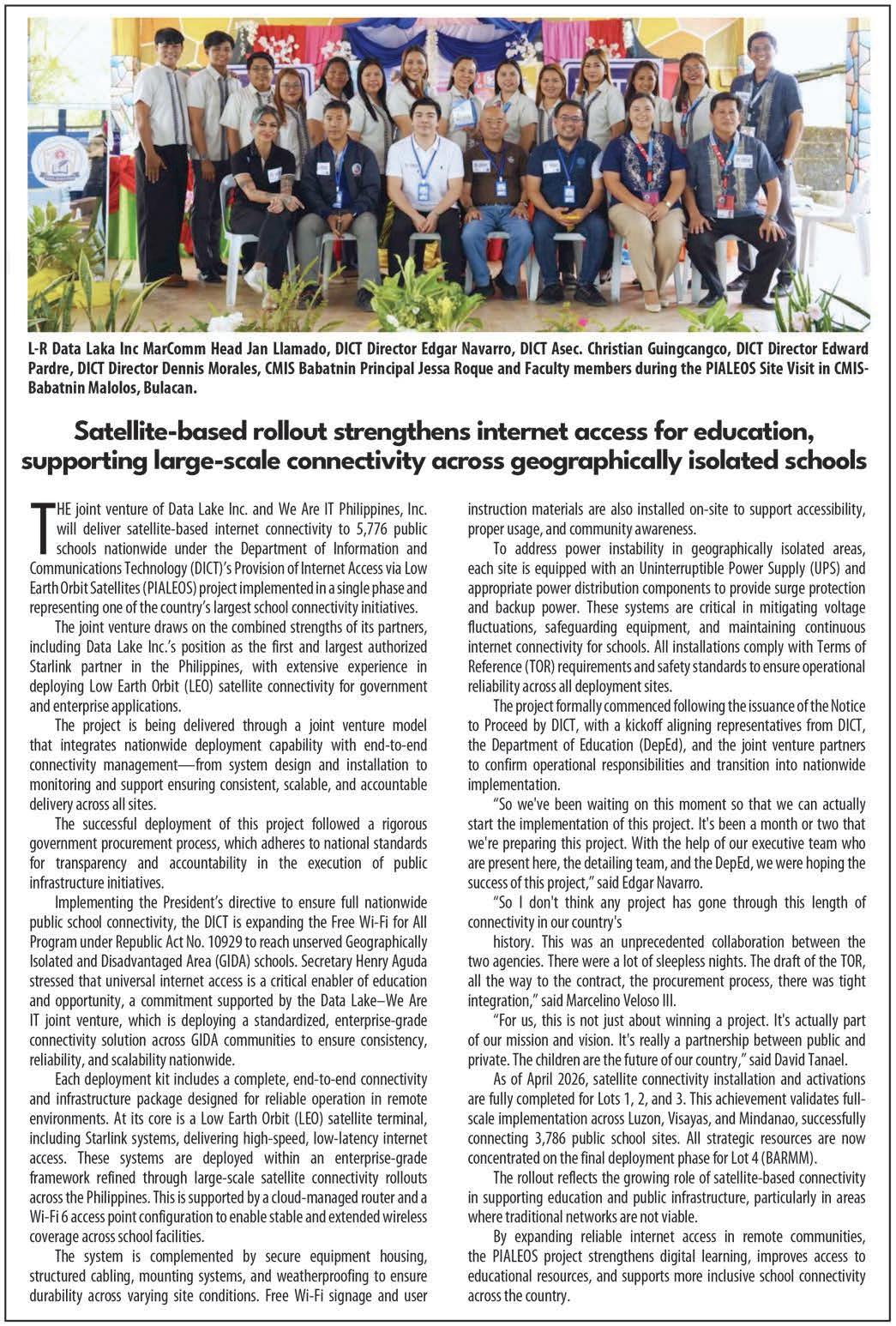
“We have to restore the lost buying power of the country’s 5.2 million minimum wage earners if we want to revive and sustain consumption spending—and, by extension, the broader economy,” the lawmaker said.
However, he said the adjustments will also benefit even non-minimum wage earners.
“Regional minimum wage increases are also likely to benefit higher-paid workers, as employers move to correct wage distortions,” Libanan said.
Wage distortion occurs with the new minimum wage adjustments to narrow down or eliminate the gap between entry-level and more senior positions.
The Trade Union Congress of the Philippines (TUCP) has urged Presi-
dent Ferdinand Marcos to grant minimum wage earners a P5,000 monthly wage subsidy, while the National Wage Coalition called for the immediate passage of the legislated P200 per day wage hike.
This, after the Philippine Statistics Authority (PSA) reported inflation accelerated to 4.1 percent after the start of the Middle East crisis last February.
The Department of Labor and Employment (DOLE) the regional wage boards will look into the possible minimum wage adjustments in their jurisdictions in the coming months, in compliance with the one-year ban for the issuance of new wage orders under the Wage Rationalization Act.
It said that the Regional Tripartite Wages and Productivity Board in the National Capital Region (NCR) is expected to start its consultations for a minimum wage adjustment by mid-May.
The last minimum wage order issued by the RTWPB-NCR took effect July 18, 2025 and granted a P50 wage hike, raising the daily minimum wage rates in the region from P658 to P695.
Kapatiran petition IN its four-page petition, Kapati -
DENR orders landfill operators: Where’s disaster contingency?
By Jonathan L. Mayuga
THE Department of Environment and Natural Resources (DENR), through the Environmental Management Bureau (EMB), has directed sanitary landfill (SLF) operators to submit disaster contingency plans in response to the spate of tragic incidents in sanitary landfills over the past few months.
The order came after DENR Secretary Juan Miguel Cuna had ordered an audit of all sanitary landfills in the country to determine their compliance with environmental laws and identify the various threats in their operation.
To recall, a massive trash slide at the Prime Waste Solution Landfill in Barangay Binaliw, Cebu City killed 36 workers on January 8, 2026. Weeks after the Cebu incident, a portion of the landfill in Rodriguez, Rizal, collapsed, leaving one person dead and two others missing.
The most recent incident involves a rubbish fire at the Navotas Sanitary Landfill, creating a massive environmental and health hazard.
In coming up with a contingency plan, the DILG wants sanitary landfill operators to submit plans that covers fire incidents and other emergencies in waste disposal facilities, while also reminding local government units (LGUs) to immediately cease operations of open and controlled dumpsites to protect nearby communities.
In a memorandum dated April 22, OIC Assistant Secretary for Environment and concurrent EMB Director Jacqueline A. Caancan instructed all EMB regional directors to require SLF operators within their jurisdictions to submit contingency plans for fire and other emer -
gency incidents within 15 days from receipt.
The required contingency plans must outline fire prevention and suppression measures; emergency response protocols for fires, slope failure, leachate overflow, and gas explosions; installation and maintenance of gas venting and monitoring systems; coordination mechanisms with LGUs, the Bureau of Fire Protection (BFP), and other agencies; evacuation and public safety procedures; and post-incident rehabilitation and environmental mitigation measures.
The EMB emphasized that preparedness is critical to minimizing risks to public health, property, and the environment, especially under extreme heat conditions.
At the same time, the Bureau reminded local governments that open dumping remains strictly prohibited and that operating open or controlled dumpsites should be directed to immediately stop operations and implement their Safe Closure and Rehabilitation Plan (SCRP).
For closed dumpsites, EMB regional offices were instructed to verify the status of rehabilitation, take appropriate action based on findings, and provide technical assistance to ensure compliance with national closure and rehabilitation guidelines.
Regional directors were also ordered to conduct regular inspections and validation of disposal facilities, assess risks and site conditions, and identify high-risk areas requiring immediate intervention.
DENR’s core responsibility is to regulate, enforce, and ensure compliance with RA 9003 by landfill operators, from approving their plans to auditing their operations and issuing penalties when they violate standards.
ran cited the continuing Middle East conflict, which has pushed up global oil prices and, in turn, raised the cost of transportation, logistics, and essential goods and services.
“It is acknowledged that the instant petition is being filed earlier than 60 days prior to the anniversary of Wage Order No. NCR-26. However, it is being submitted that there exist urgent and reasonable grounds to issue a new wage order,” it explained. Under existing guidelines of the labor department’s National Wages and Productivity Commission (NWPC), wage orders issued by RTWPBs cannot be reviewed or modified within 12 months from their effectivity, unless a supervening event justifies an earlier review. The latest wage order in the country’s capital took effect on July 18, 2026, raising the minimum daily pay of non-agriculture workers to P695, while those in the agriculture and service or retail establishments with 15 employees or less now receive P658.
Kapatiran pointed to mounting inflationary pressures in NCR, noting that inflation in Metro Manila accelerated to 3.6 percent in March
FTA deal with Chile nears end, talks with EU advancing
THE country is close to wrapping up its free trade agreement (FTA) negotiations with Chile, with only a few remaining issues left for final resolution, according to the Department of Trade and Industry (DTI).
Trade Undersecretary Allan Gepty said no additional full negotiation rounds are expected, noting that the last complete discussions between both sides were held in December. What remains now, he said, are the final technical and policy details before the agreement can be concluded.
Although Chile is “not a major and traditional partner,” Gepty noted in 2024 that there have been encouraging developments, such as renewed investments in 2023 after years of inactivity. (See: https://businessmirror. com.ph/2024/11/12/governmentset-to-finalize-study-on-fta-withchile/)
Meanwhile, negotiations with the European Union (EU) are also moving forward, with the next round scheduled for May 18 to 22 in Manila. Per Gepty, there is cautious optimism that this round could be the final stretch of talks, depending on how remaining issues are resolved. If finalized, the EU FTA would be the Philippines’s largest and most comprehensive trade agreement, granting permanent access to the world’s biggest trading bloc with nearly 450 million consumers and about 14 percent of global trade.
“We are almost there,” Gepty told reporters on the sidelines of the Intellectual Property Office of the Philippines’ Gawad Yamang Isip in Pasay on Friday evening, referring to the overall pace of ongoing FTA negotiations. On the Canada front, discussions covering both the bilateral Philippines-Canada FTA and the broader Asean-Canada trade agreement are also progressing, with the trade undersecretary expressing hope that both can be concluded within the year.
Gepty said the Canada negotiations have been moving at a relatively fast pace compared with other trade deals, clearing out that speed does not mean fewer commitments or a less detailed agreement.
He said the Philippines sees the Canada track as one of the quickest-moving FTA processes so far, but stressed that the focus remains on ensuring that the final text is comprehensive and balanced.
“So now, hopefully, once we’re done with the EU and Chile talks, we can go full blast on
Editor: Jennifer A. Ng
Companies
BusinessMirror
B1 Monday, April 27, 2026
‘Coal revival is a tough push’

By Lenie Lectura @llectura
ACEN Corp., the power arm of conglomerate Ayala Corp., said over the weekend that scaling up coal power generation is difficult due to challenges related to financing and social acceptance.
ACEN President Eric Francia said the Department of Energy (DOE), which declared last week that it is open to lifting moratorium on building new coal-fired power plants, must now take a “second look” at its Power Development Plan 2023-2050.
“It’s the call of the government. Either way it goes, it’s going to be more challenging to scale up coal because of various issues, including finance ability, social acceptance and so forth, right? So regardless of, we can’t depend on that, even if that pushes through. We can’t depend on coal saving the day in terms of energy security and so forth. We still need to make sure that we accelerate the scale up of renewable and energy storage. But it does put in
question, I think there ought to be a second look at the long-term power development plan because the plan assumes that coal is flat.
So, the key question now is, is that a realistic plan to not grow coal and depend a lot of that base load from gas given the risks associated with gas?” he said.
Department of Economy, Planning, and Development Secretary Arsenio Balisacan proposed the lifting of the six-year-old moratorium on new coal-fired power plants to boost the country’s energy security amid high fuel prices.
In response to this, DOE secretary Sharon Garin said this proposal is being evaluated.
“In times of crisis, coal still remains as one of the cheapest options we have for power generation. And on the comment of Secretary Arsie, we are studying the expansion of that exception, but we need to study
it properly because the problem is diesel and diesel is not really a major factor in terms of power generation in the Philippines. It’s more on the transportation side.
Our teams are already studying this and we are open naman as far as coal is concerned as long as it’s cleaner technology. There will be a transition plan for that coal power plant to eventually transition to cleaner energy. But yes, we’re considering it,” said Garin.
Last week, the Philippine Chamber of Commerce and Industry (PCCI) said it fully supports the possible lifting of the moratorium on new coal-fired power plants.
“Our economy cannot run on uncertainty. While the transition to renewable energy remains our long-term goal, our immediate priority must be the stability and affordability of our power grid,” said PCCI President Ferdinand Ferrer.
Honda joins fight against fake auto parts
HONDA Motor Co., Ltd. has joined
initiative to
According to the Intellectual Property
Office of the Philippines (IPOPHL), Honda signed an E-Commerce Memorandum of Understanding (MOU), expanding a multi-sector effort to remove counterfeit goods from online platforms through faster takedowns and closer coordination with e-commerce players.
The agreement covers Honda’s Philippine operations, including Honda Philippines, Inc., which handles motorcycles, generators, marine engines, oil, and parts, and Honda Cars Philippines, Inc., which covers four-wheel vehicles.
“With Honda’s participation in the
E-Commerce MOU, the brand will enhance its capability to remove counterfeit parts and products from online markets through expedited takedowns and strengthened platform-level enforcement mechanisms,” IPOPHL said in a statement. Bless Aubrey Ogerio
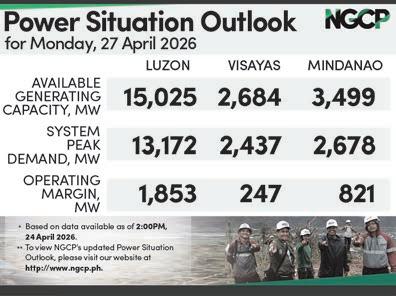
THE Philippine National Oil Co. (PNOC) is conducting a market scoping to gather information from experts for the procurement of transaction advisor services for the planned strategic fuel reserve (SFR) program.
The state firm said qualified consulting firms and professional advisory service providers have until the end of this month to participate in the market scoping. PNOC clarified that this is for market research and procurement planning only and not a formal request for proposal.
“This market scoping activity is for procurement planning purposes only and shall not constitute an invitation to bid, request for proposal, or commitment to procure,” PNOC said.
This activity aims to identify experts to help develop a national SFR, including feasibility studies, regulatory approvals, and project financing. The transaction adviser will assist in developing a secure national SFR through strategic technical, legal, and economic analyses.
Energy Secretary Sharon Garin said PNOC and the Maharlika Investment Corp. (MIC) are in talks to develop oil storage facilities aimed at
strengthening the country’s energy security. “They have met already and they are exploring options on how to do a study and how to fund and what kind of project they will undertake . Talks started but they are still discussing and planning,” said Garin. MIC had proposed a consortium where PNOC contributes existing assets while MIC can provide capital for the planned infrastructure. Once established, the facility can be operated by private sector.
Just recently, the PNOC secured 21,000 metric tons of liquefied petroleum gas (LPG) sourced from the United States, reinforcing efforts to ensure stable and reliable fuel supply amid global market volatility. The incoming shipment, scheduled for delivery from May 20 to 31 and to be discharged in Batangas, will boost the country’s LPG inventory and strengthen supply buffers for households and businesses.
The DOE has issued an advisory mandating the submission and utilization of available storage capacity in oil and gas depots and terminals, in line with Executive Order No. 110, series of 2026, which declares a State of National Energy Emergency. Lenie Lectura
‘It has to be in the culture’: Linden Suites’ GM Tet
Romualdo on pioneering sustainable hospitality
By Francine M. Marquez
industry initially because I found it glamorous. But very quickly, I realized that the environment is demanding and fast-paced. It requires time management skills, resourcefulness, and a genuine passion for this kind of work every single day. “Actually, being in the hospitality business is not easy. It requires a lot of emotional intelligence, finding ways to create meaningful experiences not just for our guests but for our team members. At the

same time, it also requires you to be resourceful in driving and generating business for the property.” Under her leadership, The Linden Suites stepped up its green initiatives through recycling efforts and became the first hotel in the country to switch to renewable energy.
The shift towards sustainability, she said, was born from the recognition of how every action is actually connected with the environment.
“When I started making operational decisions, I realized that every single decision we make, with regard to resources like energy, water, and waste, has a direct impact on our bottom line and on our community.”
Relating this year’s Earth Day theme, “our Power, our planet,” to her role as a leader, Romualdo believes that sustainability is now a priority among leaders.
“It’s a requirement for every leader to incorporate sustainability into every decision. Hotels use a lot of resources. We have to be thoughtful and mindful about how we use these resources.
“As leaders, we have the responsibility not just to initiate action but to influence the mindset, the culture of our people, of our industry, so that every single act will be cohesive.”
Conveniently located near SM Megamall and Shangri-la mall, schools, and corporate offices like San Miguel Corporation and the Unilab headquarters, four-star The Linden Suites is known for its spacious rooms that include a penthouse suite. For relaxation and wellness, guests can enjoy


its temperature-controlled indoor pool, sauna, spa, and well-equipped gym.
The hotel is also known for offering various cuisines prepared by chefs at restaurant outlets, The Happy Chef and Ciao Pizza Bar. The friendliness and efficiency of its staff are also among the commendable details often mentioned in various hotel reviews by guests.
Romualdo and her team’s meticulous service has earned the hotel recognitions such as the Kayak Hotel Award, Tripadvisor Travelers’ Choice Award 2025, and the Agoda Customer Review Award 2024.
“Beyond providing comfort and service, the Linden Suites today is evolving into a mindful and thoughtful property that is also responsible in terms of environment and long-term goals.” Pioneer in green-energy use Alongside the quest for excellence in service and amenities, the hotel considers its sustainability efforts as the core of its activities.
“Our sustainability efforts started with our operational steps. It was as simple as launching our Linen Reuse program, using LED lights, and recycling our resources.
“But then in one of our profit and loss meetings, we all realized that our energy source is increasing and it already impacted our bottom line, so that’s why we took advantage of the Department of Energy’s green energy program, wherein Linden was qualified because our demand was more than 465 kilowatt-hour, and because of that, we were qualified to transition into a renewable energy source. That decision had a huge impact not only on our cost savings.”
On March 26, 2022, The Linden Suites pioneered the full use of renewable energy through
its partnership with Green Core Geothermal, Inc.
The shift helped in the conservation of the hotel’s energy consumption while it also made a big contribution to a decarbonized and regenerative future.
According to Romualdo, “In 2025, we were able to save around P4.5 million just by shifting from the traditional to the renewable source of energy. But more than that, we were able to save around 300,000 trees annually by preventing emissions of around 6,000 tonnes of carbon dioxide. I think if we look at the operations, electricity has a huge impact on our expenses, and that is why we should see ways to switch to more sustainable ways.”
In 2022, when the hotel shifted to renewable energy, the world was still in the midst of a pandemic. Wrought with financial and health shocks, businesses, including The Linden Suites, were moved to rethink their strategy.
“We have been doing green practices in the past, but not cohesively. After COVID-19, we realized we needed to review the processes, procedures, and our use of resources. We were able to see that electricity was one of the resources that we can save up on. Also, we can save up on water and even the amenities of the property. We were thinking, how can we save on these because the revenue during the pandemic was very minimal,” Romualdo continued.
“Our sustainable project is evolving. We continue to find ways to be more sustainable and mindful of what we’re doing,” she added.
Holistic approach
From empowering the hotel’s operations towards being future-ready, the hotel’s Luntian Campaign aims to bring its positive practices to
be embraced by guests as well.
“Initially, we started with independent initiatives, but as the years passed by, we evolved into creating a holistic approach, which we call the Luntian Campaign. It’s not just a program but a mindset that every single thing we do should be cohesive, and we should be mindful of all the resources we use and be responsible for them. It’s not just about being profitable, but it’s also about helping the community and preserving the resources.
“I also realized that operational efficiency and sustainable practices can go hand in hand. In the past, there was a perception that it would be more expensive to operate green. But it’s not. If you look at different options, different partners, there’s a way to do it. And it will not only benefit your bottom line but every stakeholder, too.” Ensuring that the green mindset is truly imbibed
“What is encouraging is that our guests not only appreciate it, but they also participate. I see them in the hallways refilling their own water bottle pitchers, and rarely do we get requests for single-use plastic bottled water. What we’re doing is very simple and sustainable and should be practical,
Celeste "Tet" Romualdo, General Manager of Linden Suites, talks about the hotel's sustainability efforts with Anne Ruth Dela Cruz, Wine and Dine Editor of BusinessMirror.
Celeste "Tet" Romualdo, General Manager of Linden Suites Anne Ruth Dela Cruz, Wine and Dine Editor of BusinessMirror
Banking&Finance
AI is helping revolutionize risk management
ARTIFICIAL intelligence
(AI) isn’t just evolving risk management—it’s helping reengineering it. AI, including Generative AI (Gen AI) and agentic AI, is driving a seismic shift in how organizations anticipate, assess, and act on risk.
The old playbook of manual processes, backward-looking assessments, and fragmented frameworks is being replaced by intelligent systems that learn, adapt, and act in real time. According to the KPMG’s “Future of Risk Survey,” 400 executives rank AI and Gen AI as by far the most popular type of technologies for managing additional risk responsibilities in the next three to five years.
Risk teams have been using AI, such as automation and advanced data analytics tools, for various tasks for many years. In fact, 98 percent of respondents to the survey said that digital acceleration such as AI and advanced analytics has already improved their approach to risk identification, monitoring, and mitigation. Looking forward, today’s risk leaders see massive potential in moving beyond the basic AI tools at their disposal to take advantage of the latest AI advancements, including Gen AI, to surface deeper risk insights, automate workflows, and turbocharge risk managers’ efficiency and productivity.
What separates the leaders from the laggards is how smartly, and boldly, they embrace and embed AI advances into their risk operations. Many are experimenting with “point-in-time” solutions— automating the edges or single step activities while leaving the core untouched. But the real opportunity lies in embedding connected AI solutions across the risk lifecycle, flipping the pyramid from productionheavy to decision-driven, and preparing for a future where agentic AI operates with minimal human oversight and humans spend more time on analyzing results, actively managing risk, and strategic imperatives.
Five stages of AI maturity in risk management IMPACT can increase in risk management as AI capabilities mature, becoming transformative.
n Stage 1: Prototype. Organizations explore the use of automation, ML or AI but not in full production n Stage 2: Siloed. Point solutions in production focused on single activities within risk which may or may not be connected to the organization’s governance, risk, and compliance.
n Stage 3: Integrated. Connected solutions for end-to-end activities within risk which are connected to GRC with human-in-the-loop for key decisioning.
n Stage 4: Agentic. End to end solutions in production focused on key processes within risk which are automated n Stage 5: Transformative. Fundamental transformation in approaches to the risk framework and methodologies which replace
EBy Andrea E. San Juan
VEN before violence tore through the Middle East, consumers were already less upbeat over the way the economy is going and how it is managed by government, results of the central bank’s Consumer Expectations Survey (CES) for the first quarter of 2026 showed.
While consumer sentiment in the Philippines improved in the first quarter of 2026, the Bangko Sentral ng Pilipinas (BSP) underscored that its survey reflects conditions prior to the onset of the Middle East conflict. “Any effects of the conflict on

tradition methods used today.
As organizations race to launch AI-powered products, they’re hitting a wall of internal friction: new product approval reviews, model risk requirements, and compliance hurdles that slow innovation to a crawl. Ironically, AI is both the accelerator and the constraint.
This duality is reshaping the risk function. AI can dramatically reduce costs, automate compliance, and surface hidden insights. But it also introduces new risks that demand a new kind of oversight. Risk teams must now manage the risk of AI in and of itself.
Philippine context IN the Philippines, organizations are beginning to leverage AI to transform how they manage risk and safeguard operations. Major telecom providers, for example, are leveraging automation and data analytics to monitor network traffic, detect fraud, and prevent service disruptions.
These early-stage applications, often focused on operational tasks, show how AI can enhance risk identification and real-time monitoring, laying the foundation for more integrated, predictive, and decisiondriven risk management systems.
“AI is no longer just a tool for automation. It is becoming the backbone of how companies anticipate disruptions, secure digital infrastructure, and make faster strategic decisions. As organizations mature in AI adoption, they can move from isolated solutions to connected systems that detect and respond to risk while providing actionable insights to guide strategy, strengthen resilience, and ensure compliance,” said Doris Aura B. Pastoriza, Technology Consulting Principal and Data, AI and Innovation Lead at R.G. Manabat & Co.
As this shift takes place, risk teams are moving beyond process management toward enabling better, more informed decisions. Organizations that integrate AI with strong governance and clear accountability will be better equipped to manage uncertainty and build resilience.
This excerpt was taken from the KPMG Thought Leadership publication “AI is helping revolutionize risk management.”
© 2026 R.G. Manabat & Co., a Philippine partnership and a member firm of the KPMG global organization of independent member firms affiliated with KPMG International Limited, a private English company limited by guarantee. This article is for general information purposes only and should not be considered as professional advice to a specific issue or entity. The views and opinions expressed herein are those of the author and do not necessarily represent the BusinessMirror, KPMG International or R.G. Manabat & Co. All rights reserved. For more information, you may reach out through ph-kpmgmla@kpmg.com social media or visit home.kpmg/ph.
consumer confidence and inflation expectations may be reflected in subsequent survey rounds,” the BSP said in a statement.
Results of the latest quarterly CES of the central bank showed the current-quarter confidence index (CI) turned less negative from -22.2 percent in the fourth quarter of 2025 to -15.8 percent in the first quarter of 2026. The BSP said this improvement reflects a larger decline in the share of pessimistic respondents than in the share of optimistic respondents. “Respondents were less pessimistic in the first quarter of 2026 as they expected: higher earnings, stable
DBM orders GOCCs, SUCs to cut spending, save funds

By Reine Juvierre Alberto @reine_alberto
THE Department of Budget and Management (DBM) has ordered all government agencies, government-owned and -controlled corporations and state universities and colleges (SUCs) to defer big-ticket purchases and non-critical infrastructure projects to generate savings for the government amid the energy crisis.
Acting Budget Secretary Rolando U. Toledo issued National Budget Circular 602, directing all govern-
ment agencies to adopt “economy measures” after the Philippines was declared under a state of national
energy emergency. The DBM has ordered the immediate deferment of various capital outlays, such as the construction of new government buildings or facilities and other capital outlays that are not yet “implementation-ready.”
According to the DBM, the purchase of any type of motor vehicles, except those for health services, uniformed personnel and disaster risk response, must also be postponed.
Moreover, a 20-percent cost reduction in maintenance and other operating expenses (MOOE) was mandated by the DBM.
Agencies are instructed to cut spending on official travel, training and scholarships, supplies and materials, utilities, representation and other MOOE items that may be conserved through bureaucratic efficiency.
The DBM expects the cost-cutting measures will generate savings ranging from P12.8 billion to P25.6 billion from March to December 2026, depending on the level of compliance across agencies, the DBM said earlier.
These measures will help generate funding sources to mitigate the economic and social impacts of the Middle East conflict, the DBM added.
“Agencies shall ensure that identified cost reductions and [programs, activities and projects] offered as savings will not adversely affect agency performance or result in service disruptions,” the budget department said.
These “economy measures” will remain in full force and effect for the duration of the national energy emergency, unless extended or lifted earlier by the President.
BSP chief expects fiscal side could prop up economy
AS the government is seen to start spending more to spur economic activity, the central bank is now focusing on its price stability mandate as it “stays ahead of the curve” in delivering interest rate hikes to combat high inflation.
In a recent televised interview, Bangko Sentral ng Pilipinas (BSP) Governor Eli M. Remolona Jr. said he thinks the response from the fiscal side “will be more than adequate” to prop up the economy.
“I expect the fiscal side will start to provide stimulus so that we can get closer to our potential in terms of growth. Right now, we’re growing relatively strongly. I’d say 4.5 percent, 4.6 percent this year,” Remolona said.
Banking on the fiscal side to propel the economy this year, the central bank chief said he sees that “controls are now in place.” Remolona also believes “the fiscal side is ready to resume spending.”
The BSP Governor also signaled at the policy meeting last April 23 that fiscal policy will be “more stimula-
tive” than before.
“I think in March, it wasn’t clear to us that fiscal policy would start to kick in. But now it seems we’re more confident now that fiscal policy will be more ‘stimulative’ than before,” Remolona said.
“The government will start spending more. I think spending of the government slowed down because of this effort to discipline its spending. And now I think they have more or less controls in place and they can begin to spend more,” he added.
But the BSP chief said he was not sure if there were assurances from the government that the fiscal support will come.
“There were nods, I think,” Remolona purportedly said during the April 23 policy meeting of the Monetary Board. That day, too, he said “there will be discussions” and that one of the MB member was invited to attend that session.
Days after delivering a quarterpoint rate cut at the February 19 MB meeting, the BSP governor pointed out that the central bank’s tools and
models can only do so much in helping uplift the economy and that the BSP needs more help “from other things.”
That month, Remolona expressed concern over the public’s shift from considering interest rates as the solution as the economy crawls its way into expansion.
“Yes, that is a concern. Interest rates can’t do the trick. It needs help from other things,” the BSP governor said.
“We have very limited tools in monetary policy. Basica lly, we have tools on the demand side and we are supposed to focus on inflation. So it’s not clear how much more we can do,” he added.
Remolona spoke after monetary authorities delivered a quarter-point rate cut last month but before the US and Israel launched an attack on Iran, prior to the onset of the Middle East conflict and against the backdrop of declining confidence which dragged the pace of growth of the Philippine economy last year.
(See: https://businessmirror.com.
ph/2026/02/20/declining-confidence-spurs-25-bps-rate-cut/)
‘Trying to be proactive’ WHEN pressed on why the BSP is moving ahead of its peers in terms of delivering rate hikes, Remolona said: “We’re trying to be proactive. We’re trying to stay ahead of the curve.”
“I think it’s less risky to stay ahead of the curve than to lag behind.It’s less disruptive because to catch up you need bigger rate hikes… if you’re in a catch-up mode,” added the BSP chief.
Remolona’s stance is reflected in the MB’s decision to raise the target reverse repurchase (RRP) Rate by 25 basis points to 4.5 percent last week.
“The reason is clear. The inflation outlook has deteriorated amid the ongoing conflict in the Middle East,” the central bank chief said, with elevated oil and fertilizer costs expected to spill over to food prices and services.
(See: https://businessmirror.com.ph/2026/04/24/ price-shocks-prompt-tweaks-tokey-rates/) Andrea E. San Juan
Maharlika Investment exits from mining firm
SOVEREIGN wealth fund manager Maharlika Investment Corp. (MIC) has sold its $10 million bridge loan in Makilala Mining Company, Inc. (MMCI) to India-based Equinaire Holdings Ltd. (Equinaire).
MIC announced last Saturday that it executed an Assignment Agreement to transfer its rights, title and interests as lender under its omnibus loan and security agreement with MMCI to Equinaire.
The loan extended by the MIC to MMCI was used to fund the frontend engineering design and feasibility study of the Maalinao-CaigutanBiyog (MCB) copper-gold project.
According to the MIC, the transaction is expected to generate gross
jobs, new income sources, and more family members joining the workforce,” the BSP’s consumer expectations survey pointed out.
Less upbeat
DESPITE the improvement in their sentiment in the first three months, consumers admitted they are less upbeat for the second quarter this year and over the next 12 months. In fact, the next-quarter (Q2 2026) confidence index decreased from 3.6 percent to 1.8 percent.
Likewise, the year-ahead (February 2026–January 2027) CI also decreased from 11.8 percent in the fourth quarter of 2025 to 9.6 percent
annualized returns exceeding the loan’s stated interest rate of 12.5 percent per annum. The manager of the country’s wealth fund pool said the move is consistent with its mandate to generate appropriate risk-adjusted returns while managing portfolio exposure.
According to the MIC, it has notified MMCI of the assignment. The MMCI was also given 15 business days to fully repay the outstanding loan if it opts to retain the obligation. Should the company not exercise this option, and subject to standard closing conditions, Equinaire will assume MIC’s position as lender.
“This transaction underscores MIC’s role as a catalytic investor,
in the first quarter of 2026.
The BSP’s consumer expectations survey pointed out that the less upbeat outlook of consumers for both periods reflected concerns over: graft and corruption in the government, higher inflation, and ineffective government policies and programs.
For the second quarter of this year and over the next 12 months, consumer outlook also became less optimistic regarding the family’s financial situation and family income.
In the next three months, the outlook remained “pessimistic” among the low-income group, while it “softened” among the middle-income and high-income groups.
deploying capital to unlock value in strategic sectors and creating pathways for long-term private investment,” MIC President and CEO
Rafael D. Consing, Jr. was quoted in a statement as saying.
According to the MIC, the loan was able to support the early-stage project development and help attract long-term private sector capital. With the completion of the engineering and feasibility work, MIC said it had achieved its objective of de-risking the project.
Equinaire, through its parent company Kiri Industries Ltd. (KIL), brings industrial expertise and growing interest in critical minerals and downstream processing, according to the MIC.
KIL is an India-listed global manufacturer of dyes, intermediates and basic chemicals, with expanding interests in critical minerals and industrial processing.
KIL has commenced construction of a greenfield copper smelting plant in India, according to MIC, with its participation increasing international investor confidence in the Philippines’ mineral development sector.
“The bridge financing enabled critical early-stage work for the MCB Project, and this assignment allows MIC to realize its returns while bringing in a capable international partner to support the project’s next phase of development,” Consing added.
“Over the next 12 months, the outlook was less optimistic among the low-income and middle-income groups but little changed among the high-income group,” the quarterly consumer expectations survey of the BSP also noted.
Spending outlook MEANWHILE, the survey revealed that the spending outlook of households on goods and services in the next three months was less upbeat as the confidence index declined from 43.7 percent in the survey round of the fourth quarter of 2025 to 40.3 percent in the first quarter of 2026.
“Across geographical areas, the spending outlook of consumers in the National Capital Region (NCR) was more upbeat while that in areas outside the NCR) was less optimistic,” the BSP survey noted. Moreover, spending outlook was less upbeat for the following consumer items: food, non-alcoholic and alcoholic beverages, and tobacco; clothing and footwear; house rent and furnishing; gas and other fuels; health; transportation; information and communication; education, recreation and culture; restaurants and accommodation services; and personal care and miscellaneous goods and services.
Reine Juvierre S. Alberto
CASHING IN ON CHANCE: The rise of prediction trading platforms
By Wyatte Grantham-Philips The Associated Press
PREDICTION
markets let people wager on just about anything— from basketball games to elections. And among the more jarring bets recently, the US military capture of former Venezuelan President Nicolás Maduro.
The raid has evolved into an insider trading scandal. This week, the federal government charged a US special forces soldier who was part of January’s capture with using classified information about the mission to bet on Maduro’s downfall, and pocket more than $400,000 on Polymarket soon after.
Polymarket, one of the world’s largest prediction markets, said it alerted the Justice Department after determining that someone had traded on classified government information and cooperated with the investigation.
In a statement, the company maintained that insider trading “has no place” on its platform. Still, the case is once again putting the spotlight on a murky (and growing) world of speculative, 24/7 transactions now filling the internet. The timing and subjects of particular trades—particularly related to geopolitical conflicts—have fueled scrutiny recently. Earlier this month, The Associated Press reported that a group of new accounts on Polymarket also made highly specific, well-timed bets on the fate of the US and Israel’s war against Iran. Because prediction market wagers are categorized differently than traditional forms of gambling, tensions about government oversight are rising. President Donald Trump’s administration has already thrown its support behind company operators—and sued three states over their efforts to regulate them further. Meanwhile, other lawmakers in Washington are calling for further investigations and new guardrails.
Here’s what we know:
How prediction markets work
THE scope of topics involved in prediction markets can range immensely. Beyond geopolitical conflicts, there’s been a surge of wages on elections and sports games recently. But users also bet on anything from weather forecasts, the likelihood of the US government confirming the existence of extraterrestrial life and how much billionaire Elon Musk might post on social media this month.
In industry-speak, what someone buys or sells in a prediction market is called an “event contract.” They’re typically advertised as “yes” or “no” wagers. And the price of one fluctuates between $0 and $1, reflecting what traders are collectively willing to pay based on a 0 percent to 100 percent chance of whether they think an event will occur.
The more likely traders think an event will occur, the more expensive that contract will become. And as those odds change over time, users can cash out early to make incremental profits, or try to avoid higher losses on what they’ve already invested.
Proponents of prediction markets argue putting money on the line leads to better forecasts. And some think there’s value in monitoring prediction markets for potential news, particularly elections. Still, prediction markets can also be wrong. Traders may be closely following certain events, but others could just be randomly guessing. Who is behind all of the trading is also pretty unclear, at least to the public. The companies running today’s biggest platforms know who


their customers are—as they collect
perts note that users might still find ways to buy certain contracts while traveling abroad or through connecting to different VPNs. But for U.S.-based trades, the reach of these markets has expanded rapidly over recent years, coinciding with shifting policies out of Washington. While prediction markets have found backing from the Trump-controlled Commodity Futures Trading Commission, former President Joe Biden was more aggressive in cracking down. Following a 2022 settlement with the CFTC, Polymarket was barred from operating in the country. That changed under Trump late last year, when Polymarket announced it would be returning to the US after receiving clearance from the commission. American-based users
can now join a “waitlist” to access the platform. Meanwhile, Polymarket’s top competitor, Kalshi, has been a federally-regulated exchange since 2020. The platform offers similar ways to buy and sell event contracts as Polymarket—and it currently allows event contracts on elections and sports nationwide.
Kalshi won court approval just weeks before the 2024 election to let Americans put money on upcoming political races and began to host sports trading last year.
The space is now crowded with other big names. Major League Baseball inked a deal with Polymarket last month, following other partnerships in professional hockey and soccer. Meanwhile, sports betting giants DraftKings and FanDuel have launched their own prediction platforms. Trump’s social media site Truth
Social has also promised to offer an in-platform prediction market through a partnership with Crypto.com—and one of the president’s sons, Donald Trump Jr., holds advisory roles at both Polymarket and Kalshi.
Last month, The Associated Press agreed to sell its US elections data to Kalshi.
Loose regulation and calls for reform BECAUSE they’re positioned as selling event contracts, prediction markets are regulated by the CFTC. That means they can avoid state-level restrictions or bans in place for traditional gambling and sports betting today.
“It’s a huge loophole,” Karl Lockhart, an assistant professor of law at DePaul University who has studied this space, previously told the AP. “You just have to comply with one set of regulations, rather than (rules from) each state around the country.” Sports betting is taking center stage. There are a handful of big states—like California
and Texas, for example—where sports betting is still illegal, but people can now wager on games, athlete trades and more through event contracts.
A growing number of states and tribes are trying to stop this. But the Trump administration has already pushed back, maintaining that the CFTC has the sole authority to regulate prediction markets. Many lawyers expect litigation to eventually reach the US Supreme Court.
Despite overseeing trillions of dollars for the overall U.S. derivatives market, the CFTC is much smaller than the Securities and Exchange Commission, which regulates the securities industry. And at the same time event contracts are growing rapidly on prediction market platforms, there have been sizeable workforce cuts and leadership departures. CFTC chairman Michael Selig is the sole member filling just one of five commissioner slots. Meanwhile, Congress members from both sides of the aisle have introduced broad legislation for more guardrails in recent months— including a ban on prediction market bets related to war, assassinations or terrorist attacks. Federal law already gives the CFTC the authority to bar these kinds of event contracts, but some lawmakers are seeking an outright ban. Calls for change also arrive as insider trading allegations pile up. Beyond the charges spanning from the Maduro-related bets on Polymarket, Kalshi just earlier this week fined and suspended three congressional candidates who it said wagered on the outcome of their own elections.
Both Kalshi and Polymarket have rolled out added guardrails in efforts to combat insider trading recently, notably soon after Congressional pushes for increased oversight.
Style
Frontrunners on why they should be Miss Universe Philippines 2026

ON May 2, the Most Beautiful Filipina will be crowned the new Miss Universe Philippines (MUPH). She will succeed Maria Ahtisa Manalo and will compete at the 75th Miss Universe pageant in Puerto Rico later this year. At the Mall of Asia Arena, MUPH’s sister organization, The Miss Philippines, will also crown our new representatives to Miss Supranational, Miss Charm, Miss Cosmo, and Miss Eco International.
In a closed-door interview moderated by Voltaire Tayag, MUPH EVP, the frontrunners for the titles replied to the all-important question: Why should you be Miss Universe Philippines 2026?
n Baguio City: Roxie Baeyens. “I should be the next Miss Universe Philippines because in my experience of being an actress, I have had a deeper understanding of women. I have played broken women, hopeful women, and enthusiastic women. And with those stories, I have found pieces of myself, and that’s the soul core of MUPH, which is really women empowerment.
“So, I am happy because I feel like I have a relationship with women, and therefore I can advocate for them. And that’s what it takes to be a Miss Universe Philippines.”
n Camiguin: Erica Jean Cadayday. “I should be the next Miss Universe Philippines because I am ready to represent our country with dedication and authenticity. Being true to my values, most especially I have a heart of service to help the street workers because I was raised by one. Fun fact, I helped my mother remove weeds from the streets. I helped her sell barbecue and as a labandera for an exchange of a small payment. But we never gave up because I have a dream and I have a dream for my family as well”.
n Cebu City: Apriel Smith. “I should be the next MUPH because I have that fire in my heart that I want to continue to fight for representation. Growing up, I’ve been marginalized for being a Black Filipina, being bullied for having black skin color, for being tall, for being different. Today, I know that I have improved a lot. I want to share my story to inspire the other people out there that they can also be beautiful in their own way and they can also excel in different platforms in life.”
n Cebu Province: Nicole Borromeo. “This is such a simple question but yet so hard to answer. I’ve thought about this so many times. I think every girl here that’s competing is very worthy of the title but in my case I’d rather have it be for my faith and for the power that I can bring. When the people around me meet me, I like to think that they feel happier, that after a conversation with me they feel lighter and that’s what I like to be—like a star, a light in the universe.”
n Cotabato: Clarissa Westram. “A Miss Universe Philippines delegate is someone who’s authentic, someone who knows how to share her stories, and someone who doesn’t just listen, but who not just

speaks up for the masses but actually screams for the masses. “And that is someone who actually listens to the needs of the people and always champions her causes. At the same time, a Miss Universe Philippines is someone who loves to communicate with other people, despite the language barrier or different diverse cultures. And I believe a representation of that woman is someone standing here or sitting here in front of you right now.”
n La Union: Bea Millan-Windorski. “There’s a motivation crisis in the Philippines. Far too often, people dream of going abroad, just like my family, but I dreamed in the opposite direction. I packed my life into suitcases and balikbayan boxes and moved away from the life I knew because I believe in the future for all Filipinos here locally, so that we’re not forced to go abroad and be separated from our families in order to survive and in order to thrive. And I’m ready to bring back the fifth crown for the Philippines because I believe us Filipinos deserve hope and dignity.”
n Manila: Justine Felizarta. “I started my pageantry journey 12 years ago in Manila to be exact, and this journey is a testament of my grit and determination, and if you choose me to become your next Miss Universe Philippines 2026, I will not only
bring preparation but also purpose and show the universe that when perseverance meets purpose, a Filipina is a force to be reckoned with.”
n Muntinlupa: Adela May Marshall. “The short answer is because I’m ready. I have obviously represented the Philippines in the past. I’ve had that privilege but I never did it with a sash across my heart. I really felt that I had to earn that right but it’s here in the Philippines that I became a woman. It’s the country that I serve with my advocacy empowering the next generation through literacy. But I also graduated here and work here and overcame personal hardship here. So now I feel that I really have the experience to represent not just the best version of myself on the international stage but also the best version of a Filipina.”
n Pampanga: Allyson Hetland. “I know that I should be the next Miss Universe Philippines because I align really well with the organization’s values and morals. I know Miss Universe empowers, uplifts, and they want a respectful representation of women. And I value honesty, responsibility, as well as confidence.
Filipino dermatologist attests to Rejuran’s growing popularity

KOREAN skincare is considered groundbreaking because it is science-backed and produces positive results. One of the Korean skin treatments that’s gaining global attention is Rejuran, an injectable that claims to boost collagen, improve elasticity, and strengthen the skin barrier, all with minimal downtime.
Rejuran is a South Korean-developed injectable formulated with polynucleotides derived from salmon DNA. These compounds are considered biocompatible with human tissue and used to promote cellular repair, enhance elasticity, and strengthen the skin barrier structurally.
Unlike traditional dermal fillers that add volume
or toxins that relax muscles, Rejuran stimulates collagen production, improves skin texture, and accelerates skin healing. Thus, it’s great for long-term skin rejuvenation.
“Unlike dermal fillers that add volume, or neuromodulators that limit muscle movement, Rejuran works by encouraging the skin to heal itself. The approach has made it popular among patients seeking gradual, natural-looking results,” said Kei George Rebolledo, founder of Kutis By Kei, during the Rejuran Infinite Awards Night.
At the event, Kei explained that Rejuran functions as a skin booster designed to address concerns such as dullness, enlarged pores, fine lines, and acne scarring.
“By stimulating collagen production and improving cell turnover, the treatment aims to enhance overall skin quality over time rather than deliver immediate changes,” he added. The procedure is performed by licensed medical professionals, typically dermatologists, who inject small amounts of the product into targeted areas such as the face, neck, or under-eye region. Mild redness or small bumps may appear after treatment but usually subside within a few days.
Results develop gradually over several weeks, with improved hydration often seen first, followed
should be the next Miss Universe Philippines because it is my job not only to be seen, but I think the true job of a beauty queen is to make other people feel seen, and that is what I’ve already been doing. And I want to amplify my voice. I look at this crown as a microphone, as a platform to truly make a difference.”
n Taguig: Maria Ysabella Roxas Ysmael. “I believe that the Philippines deserves a representative who is a modern Filipina. And for me, a modern Filipina is somebody who is not afraid to make moves, and I believe that’s who I am. I’ve gone from being a ballerina to becoming a ballet teacher, and now I own my ballet school.
“I do things that are outside of what people expect me to do, and I hope that it is something that I can inspire other Filipinas—to know that they are capable of whatever it is they want to chase. Because when a Filipina decides to take a step forward, the whole universe takes that step forward with her.”
n Tarlac: Marian Arellano. “I’m not here to show perfection but real connection and relatability. I should win because I’m easy to work with and I’m adaptive. I grew up without my mother on my side. She’s been an OFW for a decade now and my father is a security guard. With my background in marketing, I know how to build community. The next Miss Universe Philippines is timeless and fearless—and that’s me!”
SWEDEN’S SECONDHAND CLOTHING SWAPS OFFER A TRENDY WAY TO CUT ENVIRONMENTAL WASTE
STOCKHOLM—Alva Palosaari Sundman scoured the racks of secondhand clothes in Stockholm for hours in search of the right pair of preowned jeans. The 24-year-old art student was among hundreds of people attending an annual clothing swap on Sunday at a community center in Sweden’s capital. They exchanged their own clothes to “shop” for others. Similar events drew thousands across the country to reduce the environmental cost of clothing production. Palosaari Sundman said she enjoyed seeing others pick out the clothes she’d brought. “It’s like, ‘Oh, OK, it gets a new life with this person,’” she said. “It just feels a bit more humane.”
The UN Environment Program cites fast fashion as major player in environmental damage, producing up to 10 percent of the world’s carbon emissions. Discarded clothes gorge landfills that scar landscapes in developing countries, and the plastic fibers used to make cheap fabrics pollute oceans. To produce a pair of jeans, for example, roughly 2,000 gallons (7,571 liters) of water is required, UNEP has said.
Sweden’s clothing swap initiative began in 2010 and has grown. Last year, some 140,000 people participated in 140 swap events and took home more than 44,000 preowned items.
Sweden is often seen as environmentally advanced, but the reality is more nuanced. Clothing consumption contributes to roughly 3 percent of a Swede’s total emissions, according to Mistra Future Fashion, a research institute.
Swedes last year were banned from throwing away clothes in the regular trash in a European Union bid to boost recycling. But the measure backfired when municipalities’ collection sites were overwhelmed, leading to stockpiles of unused textiles, and the government reversed part of the rule in October. The swap events are organized by the Swedish Society for Nature Conservation. Its chair, Beatrice Rindevall, said each Swede throws away around 9 to 10 kilograms (20 to 22 pounds) of clothes.

Swedes on average buy around 25 new items of clothing per year, according to the society, and 90 percent of items in wardrobes are never used. AP
by smoother texture and increased firmness.
Practitioners generally recommend multiple sessions spaced weeks apart, with maintenance treatments every few months depending on individual needs.
The treatment’s growing popularity follows broader changes in the beauty industry, where consumers are prioritizing maintenance and prevention over corrective procedures. This skin health innovation, which emphasizes supporting skin biology, has contributed to its increasing presence in clinics and online discussions worldwide.
The program was held on April 13 in Makati and gathered doctors, business leaders, and key figures in dermatology and the aesthetic industry.
The Rejuran Infinite Awards Night honored innovation, excellence, and achievement in the field, including recognition of partners who carry the Rejuran brand. Emerging brand Kutis By Kei walked home as the most decorated dermatology and aesthetic clinic of the evening, with six awards including the coveted Platinum Membership Award, Social Impact and Visibility Award, and Emerging Star Award.
“These awards inspire us to continue advancing our approach to skin health, and to maintain
standards in treatments,” said Kei.

PhilHealth, Philippine College of Surgeons partner to strengthen standards for surgical care
The Philippine Health Insurance Corporation (PhilHealth) and the Philippine College of Surgeons (PCS) signed a Memorandum of Agreement recently to strengthen the systems that will make quality surgical care more accessible to Filipinos.
Under the agreement, PhilHealth and PCS will jointly develop surgical benefit packages, referral networks, and quality standards, supported by research and geographic mapping of surgical services across the country.
The agreement was signed by PhilHealth President and CEO Dr. Edwin M. Mercado and PCS President Dr. Joselito M. Mendoza.
“Surgical professionals are among our most important partners in delivering on the promise of Universal Health Care. Through this agreement, we are working with PCS to build the systems that will make quality surgical care more reachable for every Filipino,” said Dr. Mercado. PCS will also ensure compliance of its

Hisense Philippines redefines home entertainment, lifestyle at Grand 2026 Partner Conference at Okada
Gmember-surgeons with PhilHealth policies, strengthen fraud detection and ethical claims review, and participate in a joint mechanism for resolving surgical claims and complaints. PCS will likewise identify and share emerging best practices in surgical procedures to PhilHealth.
This partnership supports PhilHealth’s mandate under Universal Health Care to ensure that all Filipinos have access to surgical services that are safe, fairly delivered, and of the highest standard.
For details, members may call PhilHealth’s 24/7 touch points at (02) 866-225-88 or at mobile numbers (Smart) 0998-857-2957, 0968-865-4670, (Globe) 0917-1275987 or 0917-1109812.
MG Motor Philippines sustains strong momentum in Q1 2026

MG Motor Philippines continues its strong performance in the local automotive market, recording a total of 2,109 units sold in the first quarter this 2026.
The brand reflected a consistent monthly sales result, with 716 units sold in January, 696 units in February, and 697 units in March, highlighting steady demand across MG’s expanding lineup. MG Philippines also maintained its 8th place ranking in overall industry sales, based on the latest
GCAMPI figures cementing its place in the local automotive industry as one of the significant brands in the market.
Driving this performance are MG’s top-selling models, led by the MG5 in the subcompact sedan segment and MG ZS in the subcompact SUV segment, which continue to resonate strongly with customers for their combination of modern design, practical features, and compelling value. New models like the MG HS Hybrid+ helped boost sales growth in the compact SUV segment and expand
MB Franchise Developers announces The Franchise CEO Workshop, a three-Saturday intensive training program for franchise leaders, brand managers, and serious business owners ready to build world-class franchise systems.
The program runs on May 23, May 30, and June 6, 2026, every Saturday from 1 pm to 5 pm at BDO Equitable Tower, Paseo de Roxas, Makati City. Seats are strictly limited to 12 participants.
Co-facilitated by Butz Bartolome (The Franguru, Founder of GMB Franchise Developers) and Lyndah Bartolome (Franchise Systems Advisor), the workshop covers the three pillars every franchise company must master:
May 23 — Build the Franchise System
May 30 — Manage the Franchise Network
June 6 — Grow and Protect the Brand
Unlike conventional seminars, each session is a working session — participants leave with completed frameworks, filled-in templates, and a concrete action plan.
Investment
Early Bird: P15,000 (first 6 seats)
Regular Rate:P18,000 (remaining 6 seats)
Includes 12 hours of live facilitation, workbook and templates, snacks, Certificate of Completion, and alumni network access.
Register now as seats are filling fast. Send an email to business.mentor@butzbartolome.com butzbartolome.com | gmb.ph https://forms.gle/dMGAdKcTfhLiMbFNA
MG’s reach across key segments.
The brand’s stable performance also reflects increasing market acceptance of its evolving product lineup, particularly with the introduction of electrified vehicles. MG’s Hybrids are gaining traction as more consumers shift toward fuel efficient vehicles, supported by future-ready mobility options.
“MG Motor Philippines held its strong position in the first quarter of 2026, showing the growing trust of our customers and the strength of our expanding vehicle lineup,” said Wei Wei Zhang, President of MG Motor Philippines. “As we move forward, we remain focused on delivering global-quality vehicles, push our electrification efforts, and making innovative mobility more accessible to Filipino drivers.”
Building on this momentum, MG Motor Philippines is set to accelerate its market position with new products, expanded dealership network, and continued nationwide initiatives, ensuring that more Filipinos can experience the brand’s combination of innovation, performance, and value, elements which make MG truly Made Global, Made Great.

viewing even in bright rooms. It features 4K resolution with a 120Hz refresh rate, supporting smooth motion for movies and gaming and is powered by the flagship Hi-View AI Engine X, which optimizes picture quality, contrast, and color in real time.
U6 SE Series: Dubbed as the 2026 “Hero Model”, it seeks to deliver better picture quality, better sound quality and the best value for money with features similarly found in flagship models, but at a more affordable price.
The CanvasTV: Blending art and technology, this lifestyle TV features a matte, anti-glare screen and customizable frames to transform any living room into a gallery.
Hisense also expanded its “Smarthouse” ecosystem, introducing a range of AI-powered home appliances that prioritize energy efficiency and user convenience: PureFlat Smart Refrigerators: Equipped with an integrated antimicrobial liner and a touch-screen interface
HAPPENING on June 14, 2026, Sunday, at Filinvest City Events Grounds, Alabang, Muntinlupa City, the upcoming run marks the first-ever collaboration between MNL City Run and BS-CBN Foundation. Kapamilya Run will have four categories: 10K, 5K, 3K, and 1K Dog Run. It’s also in partnership with the City of Muntinlupa.
For 36 years, the ABS-CBN Foundation has been at the heart of every Filipino story. A pillar in public service, the organization takes pride in sustaining five core programs: Sagip Kapamilya (disaster resilience), Bantay Bata (children), Programa Genio (education), Bantay Kalikasan (environment), and GaLing Pamayanan (livelihood).
In that same spirit, MNL City Run, managed by Rule and Rich Events Management Services, has built its own legacy of bringing people together for meaningful causes. Since 2019, it has united thousands of runners to champion advocacies that uplift lives, from education and health to shelter and rehabilitation for vulnerable communities. It has since organized nearly 20 events, helping a total of 17 beneficiaries and raising nearly P2 million in funds over the years.
Teaming up for the Kapamilya Run, the two entities will bring charity to the fore, combining fitness with purpose in a fun-filled event that aims to create impact well beyond the finish line. Registration is currently ongoing. Runners may sign up online until May 24 or in person at Festival Mall Alabang (UGF West Wing, Bridgeway Door, in front of Decathlon) until June 7, or
To
next best-selling model in the local market. “Today is more than just a product launch; it is a testament to our commitment to the Filipino consumer,” said the Management of Hisense Philippines. “By bringing our most advanced global technologies—like the RGB MiniLED—to the Philippines, we are ensuring that every Filipino household can enjoy a premium, connected, and smarter lifestyle.”
The event concluded with an immersive “Experience Zone” where guests interacted with the new VIDAA OS platform, which has been upgraded to serve as a centralized hub for content, AI services, and smart device control.

Lyndah Bartolome, Franchise Systems Advisor, co-facilitating a GMB training session — “As entrepreneurs, we dream about big things for our business.
Networking for a new generation

AS the first and only professor at the Boston University’s College of Communication’s first PR school, Monique Kelley says her students are surprised when she points out that Forbes, in a recent article, listed networking as one of the top 20 skills PR professionals need to develop to succeed.
While the article says these are effective at internal communications, she points out in an article in PR News that “networking is essential for all communications and business functions at large.” And that can make a difference in one’s overall career.
For Kelley, it seems students are puzzled at what networking means. And you can’t blame them.
Definitions of networking typically describe it as a transaction that takes place between individuals. According to the journal Career Development International, “Networking is defined as a goal-directed behavior, which occurs both inside and outside of an organization, focused on creating, cultivating, and utilizing relationships.”
While most professionals know they should network, according to a Linkedin global survey, only half or 48 percent keep in touch with their networks

CCP CONVENES ARTS
LEADERS TO MAP THE FUTURE OF PHILIPPINE CONTEMPORARY ART
WHAT is the most essential building block for the future of the Cultural Center of the Philippines in the visual arts?
This question set the tone for the recent Philippine Arts Roundtable organized by the country’s premier cultural institution, bringing together a diverse group of experts to examine the current landscape and explore the future directions of Philippine contemporary art. The recent roundtable discussion brought together Alfredo and Isabel Aquilizan, contemporary visual artists and cultural practitioners; Isa Lorenzo, founder and co-director of Silverlens Galleries; Carlos Quijon Jr., art historian, critic, and curator currently serving as the C-MAP Fellow for Southeast and East Asia at the Museum of Modern Art in New York; Clarissa Chikiamco, curator at National Gallery Singapore and a PhD candidate at King’s College London; Dindin Araneta, co-founder of Art Fair Philippines and Director of the Benilde Center for Campus Exhibitions (CCE) at De La Salle–College of Saint Benilde; Tina Colayco, Presi-

when things are working well. It has, in short, become a oneshot deal, not evolving into a long-lasting relationship. Why has this happened? The leading cause: not having enough time, not wanting to ask strangers for favors, and also introverted or shy professionals feeling like they can’t effectively network. Kelley, who has also written a book, “Redefining Networking: How to Lead with Your Unique Value”, nevertheless sees opportunities in this.
“Instead of looking at networking as a transaction, what if we looked at it as an ongoing way to contribute value to audiences who could benefit from
dent of the Metropolitan Museum of Manila; Sheila Ramos, business executive and art collector; and Ana Maria Ortega, business executive and arts management educator.
Together, they unpacked pressing questions and concerns on institutional support, artistic practice, and cultural direction, offering critical insights that point to emerging possibilities for the CCP’s role in shaping the visual arts ecosystem in the years ahead.
Arts education as a foundation for the future FOR the Aquilizans, education is an essential foundation for the future of Philippine visual arts. They emphasized the need for government institutions to maximize their capacity to develop and expand arts curricula, particularly at the high school level.
“We have the Philippine High School for the Arts as the educational arm of the CCP, and I believe this model should be replicated across the country, perhaps through the development of accessible educational modules and similar programs,” said Alfredo Aquilizan.
They also highlighted their experience in Australia, where they conduct art workshops in remote communities, an approach they believe could be effectively adapted in the Philippines to expand access to arts education.
“We conduct workshops in remote communities, which play an important role in expanding access
to knowledge, and it raises the question of how the CCP can further extend its reach and share its resources more effectively with underserved communities,” noted Alfredo.
The Aquilizans also pointed out the importance of sustainable support systems for artists, including government-funded travel grants and mentorship programs.
Preservation and accessibility as pillars of the future
CHIKIAMCO emphasized that CCP initiatives play a vital role in supporting the visual arts ecosystem in the Philippines. Programs such as the Thirteen Artists Award recognize and nurture emerging artistic practices, while the 21AM serves as an important venue for exhibiting and preserving the CCP’s visual arts collection.
At the same time, she underscored the importance of accessibility and conservation in the arts. She cited the works of Roberto Chabet as an example, that these should be made more accessible through institutions, like the CCP, for the public to engage with.
“I think sometimes that this legacy is in danger of being lost because this history is not really visible. I’m aware of it, and many curators who have conducted research have seen the archives of those early exhibitions at the CCP. But it can be difficult to access,” said Chikiamco, who also suggested the need for CCP to actively acquire and safeguard significant art collections.
mutually supportive relationships?” she asks. Here, she shares with us an example of a three-step process of effective networking in her article: Networking Redefined: How PR Students (and Others) and Break Through.
1. Identify your value. CONSIDER what makes you unique and the value you can provide to an organization, and or/ people. As you gain more experience and widen your network, this value may evolve over time.
2. Find an audience. ARE these customers, shareholders, the communities, or col -
“It is very important for CCP, and I guess Philippine institutions in general, to collect contemporary arts. A lot of this is in danger of disappearing if it’s not collected, because you need to work with the artist in developing guidelines, like what is essential to the work, for its display,” enthused Chikiamco.
Strategic promotion elevates Philippine visual arts
FOR Lorenzo, CCP, being a national institution with many existing assets, must position itself as the gold standard for exhibition-making, not only in the Philippines, but across the region.
“Your collection is amazing. But how do you get people to see it? And how do you broadcast this information to the world? The CCP cannot afford to remain insular. It needs to be more outward-looking,” emphasized Lorenzo.
This outward approach should include a stronger presence on social media and the cultivation of diverse voices that can engage multiple generations. “Whether it’s through TikTok, Instagram, or other platforms, there should be a significant investment in communicating who the CCP is, what it does, and what it holds. The only way to build an audience is to bring people in,” added Lorenzo.
They also highlighted the importance of expanding the reach of CCP’s collections through nationwide exhibitions, increased publications, and visibility in international
leagues? Not every service or company is for everyone. Neither is your value. Try to benefit from the value you provide. The more specific, the better.
3. Communicate Your Value. KELLEY says that the art of storytelling is one way you can communicate your value. This could be done “through content in Linked in and other social media, as well as smaller and curated social events where you have 1:1 conversations and start to establish relationships.
Is your specialty fashion, the arts, politics, or business? Develop your skills in this and communicate those you have that can contribute to an organization and industry.
events as key strategies for advancing Philippine visual arts.
“Another priority is the CCP collection itself. Lean into your existing assets. Consider touring exhibitions across the Philippines. Another is publications. There are already publications, but perhaps there could be more. Set a goal, maybe three to five publications a year, or at least one annually, and be present in international art events. Support regional artists in global exhibitions, and build on efforts that already exist.”
Institutional support for curators advances Philippine visual arts
AS a Filipino curator working with international artists and large-scale exhibitions, Quijon Jr. noted that while many curators already operate on a global level, most begin their careers in the Philippines but eventually move abroad due to limited local opportunities. For him, this underscores a key concern: the need to strengthen institutional support not only for artists, but also for curators within the Philippine visual arts sector.
“That is what is at stake for me in this conversation. We have the talent, but how do we support that talent so they can stay here? So that we are the ones who “makikinabang” from the efforts of these curators, myself included. One of the first things I thought of is ensuring that t he local ecology is in place, that it works. It means local institutions function well and support one another. If that happens, we can begin
PR Matters is a roundtable column by members of the local chapter of the United Kingdom- based International Public Relations Association (IPRA), the world’s premier association for senior professionals around the world. Millie Dizon, the Senior Vice President for Marketing and Communications of SM, is the former local chair.
We are devoting a special column each month to answer the reader’s questions about public relations. Please send your comments and questions to askipraphil@gmail.com.
to address these anxieties about participating in international and global conversations,” said Quijon Jr. He also clarified the roles of the curator. “I’m not an artist, and I’m not a gallerist. But we, as curators, position artists for galleries. I position artists for art historians, so that we can be part of regional and international conversations around art.”
Furthering the discussion IN the latter part of the discussion, discussants Dindin Araneta, Tina Colayco, Sheila Ramos, and Ana Maria Ortega provided further insights, responding to and building upon the perspectives shared by the first set of speakers.
Present during the roundtable discussion were the CCP Board of Trustees, led by Chairman Jaime C. Laya, co-chairs Ma. Carissa O. Coscolluela and Maria Margarita Moran-Floirendo, with Trustees Junie S. Del Mundo, Felix Monino S. Duque, Atty. Gizela Gonzalez, and Jonathan M. Velasco
CCP President Kaye C. Tinga; Vice President for Administration and Finance Jose Victor M. Gaite and Vice President and Artistic Director Dennis Marasigan, who served as moderator, also attended the event.
For details on CCP programs and events, follow the CCP on Facebook, Instagram, and TikTok. To learn more about the Cultural Center of the Philippines and its programs, visit www.culturalcenter.gov.ph
YAN KRUKAU CANVA



Pinay duos all business as Sanya beach volley hits quarterfinals
SANYA, China—The Philippine duos marked their place in the quarterfinals with muted celebrations rather than jubilation to keep their eyes firmly on the big prize in beach volleyball of the Asian Beach Games at the Tianya Haijiao Venue Cluster. K hlylem Progella and Sofia Pagara stormed past Kazakhstan’s Yekaterina Ryukhova and Kristina Karimova, 21-11, 21-14, while Sunnie Kalani Villapando and Gryzelle Joanice Matibag dispatched Sri Lanka’s Shehani Ashanga Wattelage and Alawaththage Kasuni Tharuka Lakshani, 21-15, 21-13.
B oth tandems noted they were pleased not as much with the wins as with improving on the tactical and technical aspects of their game. The victories were nonetheless huge as the Philippines kept pace with continental volleyball powers China, Japan and Thailand, which also sent two teams each to the quarterfinals—making it a four-nation affair in the women’s side.
A“HERITAGE Ride” among racing executives and a jersey honoring cycling legend Paquito Rivas marked the countdown to the MPTC Tour of Luzon 2026 that hits the road on Wednesday in Calatagan, Batangas.
N o less than General Nicolas Torre III, Metropolitan Manila Development Authority General Manager a nd former Philippine National Police chief, led the executive race held three days ahead of the 14-stage Tour of Luzon that offers the richest prize pot in Tour history at P12 million.
“ We’re honored to have cycled alongside General Torre in the Heritage Ride, who himself is an advocate of cycling,” said Tour Chief Organizer and CEO Arrey Perez after the 60-km event that preceded the Tour co-presented by the Philippine Sports Commission and MPTC and sanctioned by the PhilCycling. Torre was with his MMDA Bike Lane Program team in the executive race that also saw Dinah Remolacio, president of Tour of Luzon organizer Mad Management, sweat it out in the event that started and finished in

21-7, 21-6. Matibag, recalled to the national team only recently and able to train with Villapando only days before the event, is pleased to sustain the fine run.
“The win was just a bonus because we were focused on the movements and how we can improve game per game,” Matibag said.
V illapando emphasized consistency and discipline.
We executed much better in this match, and that was the goal at the start. To polish our plays and be better each day,” Pagara said. “It boosts confidence, not only of your own but of your partner.” Progella and Pagara next take on Thailand’s Kongphopsarutawadee
Worapeerachayakorn and Naraphornrapat Taravadee, who overwhelmed K orea’s Kim Hyunjoo and Seo Gaeun,
Just a point-by-point, break-bybreak type of thing. What that means for us is really just making sure our fundamentals are really good and solid, and then building on that, getting more aggressive every point,” Villapando said. “Today is another good building game for our chemistry.”
Villapando and Matibag next face Sisters Ren and Non Matsumoto, who steamrollered Rachael Yu Jie Goh and Sin Sing Yee, 21-7, 21-14. Aldrin Quinto
Silver in sand sprint keeps PHL in 3rd spot
By Aldrin Quinto
SANYA, China—The Philippines narrowly missed another win, earning the silver medal in women’s 4x60-meter run on Sunday in the Asian Beach Games athletics competition at Phoenix Island.
K ristina Knott got the Filipina squad off to blazing start and Jessica Rose Laurance anchored the team to a 29.73-second finish for second place, adding to the Philippine haul of three gold, two silver and two bronze.
Shane Joy Ponce and Lianne Diana Pama kept the momentum steady in middle legs, helping the Philippines improve to a 3-2-2 gold-silver-bronze haul, still good for third spot in the 45-nation meet.
It’s so different. There’s no baton. The exchange zone is three meters versus 30 meters. So, I think that was our only enemy in the race was the zone,” Knott said.
C hina remains firmly on top with 13 gold, 11 silver and four bronze medals, while Thailand is running second w ith a 4-5-3 collection.
Th ailand’s Sanmano Manatsada, Khanonta Jirapat, Phetkun Athicha and Poolkerd Supanich clocked 29.46 for the golds.
C hina’s Li He, Zhou Jing, Dong Yuehua and Feng Lulu posted a time of 30.42 seconds to finish third.
It feels great. Honestly, I came here not knowing what to expect. I really just wanted to have fun and see what I could do on sand,” Laurance said. I’ve never run on sand and I really beat my expectations. So, I’m really happy.”
F ilipinas also continued their solid run in the beach volleyball competitions at the Tianya Haijiao Venue Cluster, with two teams ad -
‘Heritage Ride,’ Paquito Rivas Polka Dot Jersey prelude to 2026 MPTC Tour of Luzon

Promotion, relegation drama
THE promotion and relegation systems are one of the best things to happen to football or even in sport in general. Unlike in the National Basketball Association (NBA) there are accusations of tanking, in football every team fights for its spot on the table because at stake isn’t just the championship, but also European competition that brings in a lot of money.
Th is past week saw two incredible stories.
T he first was the promotion and return of Coventry City to the Premier League after an absence of 25 years. A whole generation passed without seeing the Sky Blues—as the team is nicknamed—in the Premier League of which they are a founding member.
C oventry City achieved that following a 1-1 draw with Blackburn Rovers that gave them a total of 89 points with two matches to spare. That also makes it also impossible for current second running Ipswich Town and current third placer Millwall to catch up and win the title as they both have only accrued 80 points.
It will be a dogfight for the second EFL side to be promoted aside from Ipswich and Millwall, Middlesbrough, and Southampton all have a chance for the outright second place to be promoted and that third spot that will be contested by a play-off.

But if we were to just imagine… Millwall making it to the Premier League for the first time since the old First Division. They will renew old rivalries with West Ham (assuming they are not relegated) and Leeds United. The latter saw violent clashes during the 1970s and 80s.
A s for the Premiership, Wolves and Burnley are going down with Tottenham hanging on for dear life.
T he fall of Tottenham is shocking. They were once considered part of the Premier League’s Big Six. But not since they had the dynamic strike force of Heung MinSon and Harry Kane. And they won the Europa League two seasons ago!
Th is past weekend, Tottenham defeated Wolverhampton, 1-nil, but West Ham (currently 17th) nipped Everton, 2-1, to hold off the former in the relegation zone. With four matches
vancing to the quarterfinals.
K hylem Progella and Sofia Pagara came up with another dominant win, cruising past Kazakhstan’s Yekaterina Ryukhova and Kristina Karimova, 21-11, 21-14. S unnie Kalani Villapando and Gryzelle Joanice Matibag fended off Sri Lanka’s Shehani Ashanga Wattelage and Alawaththage Kasuni Tharuka L akshani, 21-15, 21-13. The Philippines thus matched host team China and its fellow Asian volleyball powers Japan and Thailand, which also sent two




Del Monte Jr PGT tilt gets going
TCaSobe in Calatagan.
T he polka dot jersey awarded to the King of the Mountain, meanwhile, will be named after the late legendary champion Paquito Rivas, who owns the title as Eagle of the Mountain for having won for three consecutive years—1973, 1974 and 1979—the individual time trial race that finished in Baguio City.
“ His legacy will be immortalized through the King of the Mountain Polka Dot Jersey,” Perez said. “This symbolic gesture celebrates his unmatched feats.”
The Tour starts with a Grand Depart in CaSoBe in Calatagan and ends with a Grand Finish in Tagaytay City on Wednesday and culminates with a grueling climb on Kennon Road from Lingayen to Scout Hill inside John Hay Hotels on May 13.
A lso supported by the MVP Group and aligned with the objectives of the National Sports Tourism Inter-Agency Committee, the MPTC Tour of Luzon rewards the individual champion P1 million and the team titlist P2 million.
remaining the tension and pressure will only increase. Should they be relegated, that will leave only Arsenal, Chelsea, Everton, Liverpool, and Manchester United as the only clubs not to be relegated from the Premier League.
I c an only imagine the shock and dread of Spurs fans.
But if the state of Tottenham is shocking, the sad plight of Leicester City is even more mollifying.
T hey won the Premier League during the 2015-16 season in a storybook season where no one saw this coming. After the passing of their beloved owner, Thai billionaire Vichai Srivaddhanaprabha in a tragic helicopter crash outside their home King Power Stadium in 2018, the Foxes still showed they were not going anywhere when they won the FA Cup during the 2020-21 season.
But that was the last hurrah. They were relegated following the 2022-23 season to the EFL Championship and this ongoing season, they are once more going down to the EFL League One.
L eicester and Blackburn are the only two teams to have won the Premier League and to be relegated.
Wait….There’s more.
York City are back in the EFL League Two after a stunning 1-1 draw with Rochdale just yesterday in the National League. Rochdale, Carlisle United, Boreham Wood, Scunthorpe United, and Forest Green Rovers will all battle in a playoff to decide the second promotion.
These final weeks of the English football season will be mighty interesting indeed. And that is an understatement.
By Josef Ramos
General Manager Nicolas Torre III (green jersey), MPTC Tour of Luzon
Organizer and CEO Arrey Perez (sixth from left), Mad Management head Dinah Remolacio (black jersey) with the cycling executives. MPTC
BUKIDNON’S
SUNNIE VILLAPANDO reaches the last eight with new partner Gryzelle Matibag. POC-PSC MEDIA
JESSICA ROSE LAURANCE, Lianne Diana Pama, Shane Joy Ponce and Kristina Marie Knott deliver silver for the Philippines. POC-PSC MEDIA