Seizure of 6,500-member recruitment channel coincides with UN-backed Philippine crackdown on POGO-linked fraud
By Malou Talosig-Bartolome
UNITED States law enforcement agencies have launched a sweeping regional offensive against Southeast Asia’s multibillion‑dollar cyber‑fraud industry, seizing a major Telegram recruitment channel that targeted Filipino workers under the guise of “POGO” job postings.
The seizure of the “POGO JOB HIRING 2023!!!!” chan nel, which had more than 6,500 members, came as the Philippine Anti‑Organized Crime Commis sion (PAOCC) adopted new United Nations‑backed prosecutorial pro tocols to overhaul how scam hubs are dismantled and prosecuted.
In Manila, PAOCC’s new stan dard operating procedures—rolled out on April 22 with support from the UN Office on Drugs and Crime (UNODC)—aim to address a criti cal legal hurdle. Previously, authorities had only a 36‑hour window to file com plex cybercrime charges after raid ing a compound.
“How do you prove a cyber crime in 36 hours? It is not pos sible; we were scrambling,” a for mer PAOCC operations director explained. “We had to improvise and ended up bringing charges of human trafficking—that is a lot easier to prove when you find hun dreds of foreign nationals trapped in the compound.”
The new protocols standardize
victim repatriation, evidence col lection, custody of perpetrators, and asset recovery.
PAOCC Executive Director Benjamin C. Acorda said the re forms reflect a collective resolve to “reinforce our national framework in addressing organized and trans national crime.”
PAOCC has freed 5,949 people from scam compounds, including 3,483 foreigners. A total of 218 perpetrators are currently await ing trial.
Executive Secretary Ralph G. Recto, who recommended the 2024 POGO ban during his ten
ure as Finance Secretary, empha sized the economic reality of the crackdown: “Whatever revenues POGOs claimed to generate could never justify the lawlessness, ex ploitation, and social decay they left behind.”
The ‘POGO’ Telegram seizure
THE adoption of these new Philip pine prosecutorial protocols came as the newly formed US Scam Center Strike Force executed a first of its kind seizure of a highly organized Telegram recruitment network.
The recruitment syndicate heavily targeted the Philippine la bor pool and utilized local industry terms to mask its operations.
The main channel, boasting over 6,500 members, operated un der the name “POGO JOB HIRING 2023!!!!”
Evidence recovered from the seized channel revealed job post ings that actively funnelled vic tims into both localized hubs and overseas forced labor camps:
• Overseas Deployment: Post ings for “Urgent Hiring in Cambo dia” explicitly listed the Philippines among its target nationalities.
The syndicates specifically sought workers with “American” accents to work night shifts—aligning precisely with US daytime hours for cold calling operations.
• Local Hubs: Parallel job post ings recruited female “Dealers” for localized operations in the Cagayan Valley, offering salaries between P30,000 and P50,000. These posts included strict, dis criminatory physical require ments, such as height minimums and the absence of visible tattoos or braces.
The fraud scheme: Impersonating authorities ONCE lured to the scam com pound—located in rural Cambo dia near the Thai border—recruit ed workers were held against their
By Laura Curtis Bloomberg
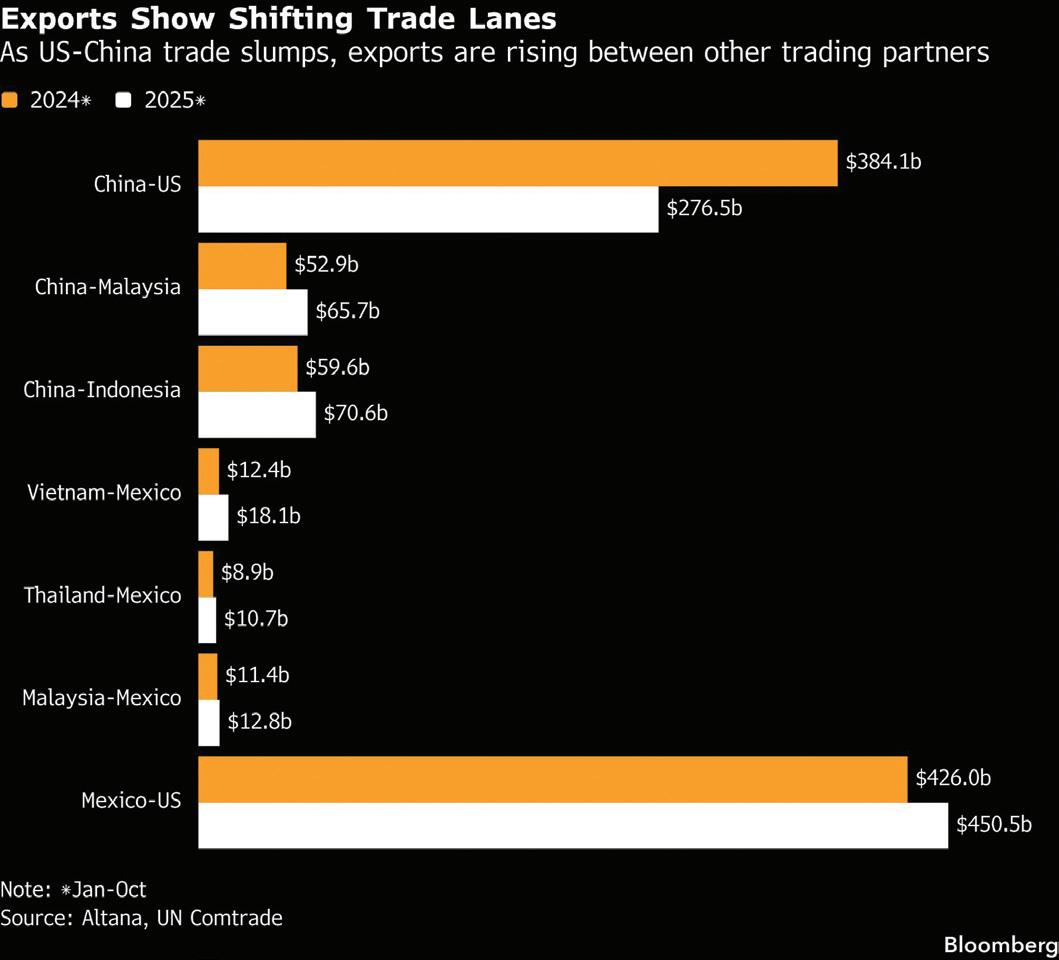
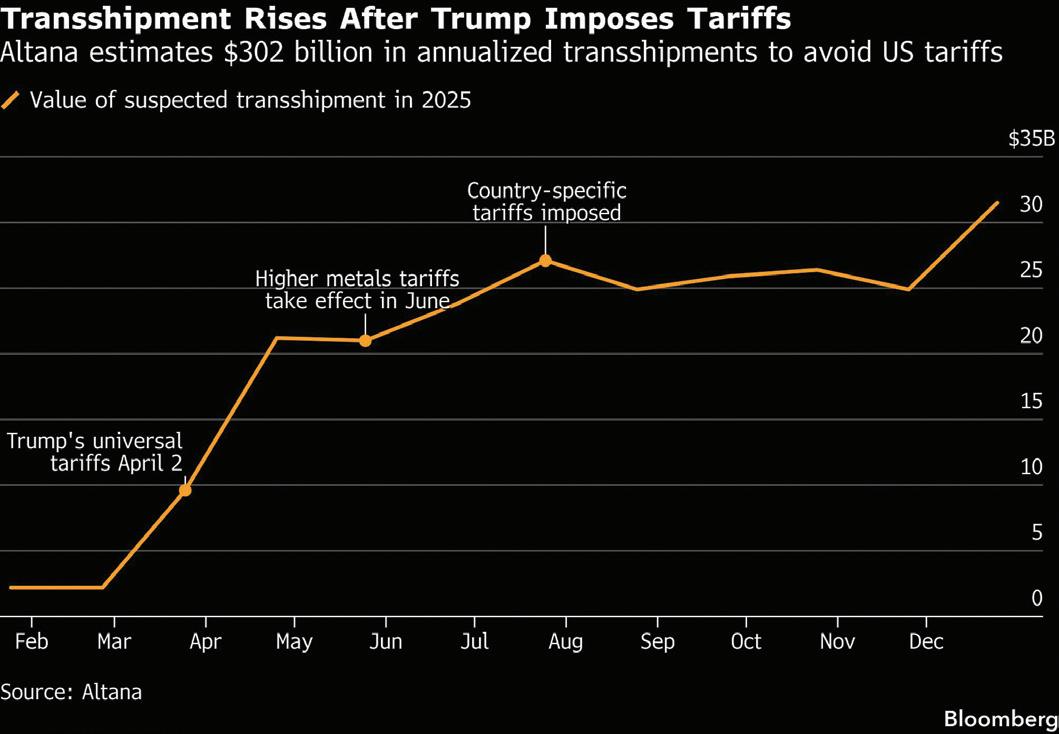
ABOUT $300 billion worth of goods subject to Trump administra tion tariffs are avoiding the levies annually and reaching the US from Southeast Asia and Mexico, exposing enforce ment vulnerabilities just as a review of the North American trade deal is set to begin. US imports from China plummeted last year as Presi dent Donald Trump ramped up tariffs. But shipment level records analyzed by AI driven supply chain platform Altana show that as new duties were imposed and adjusted, busi nesses often routed goods through Asian countries with lower tariff rates, and onto Mexico, where treatment un der the US Mexico Canada Agreement offered another opportunity for savings.
Transshipment isn’t nec essarily illegal in a global trad ing system where production and assembly often span mul tiple economies and as compa nies ship goods through major ports to transfer cargo from one vessel to another.
Component parts from China are increasingly used
to make new products in Viet namese factories, for example, that are later shipped to the US. USMCA related routes aren’t new, either.
“Millions of USMCA bound shipments containing goods with travel consistent with rerouting and tariff cir cumvention have been regis tered since the agreement was ratified in 2020,” New York based Altana said in a report released Thursday.
Altana, whose technology is used by the US Customs and Border Protection agency for trade enforcement, estimates that suspect transactions in the first 10 months of 2025 surged 76% compared with the same period in 2024, from just over 100 million transac tions to 188.5 million.
But the increase in suspi cious shipments raises ques tions about whether goods al lowed into the US underwent any required changes at each stop in their journey to actu ally qualify for preferential treatment under the USMCA.
The issue hinges on com plex “rules of origin” that gov ern which country — and tar iff rate — apply to a shipment of goods. In order to qualify as
Continued on A2
EQUIPMENT confiscated in a raid by Cambodian police are laid out on a table at a scam center in Phnom Penh, Cambodia, Wednesday, March 11, 2026. AP/HENG SINITH
Everything must go: No letup in war on SE Asia ‘POGO’ scams
will and forced to execute a sophisticated law enforcement and banking impersonation scheme targeting US citizens.
Victims of human trafficking were forced to cold-call Americans, posing as customer service agents for major institutions like JPMorgan.
The scammers would warn the intended victims that their bank accounts had been used to purchase firearms from a US gun store. The victims were then transferred to a second tier of scammers posing as “NYPD detectives” or officials from the “New York Supreme Court.” Through aggressive pressure tactics, the syndicates induced victims to transfer their life savings to the criminals.
Following the raid, corporate giants including JPMorgan Chase, Microsoft, and Meta voluntarily launched internal investigative measures to combat the fraud operating on their systems.
US Attorney Jeanine Ferris Pirro noted that American prosecutors have already restrained over $700 million in cryptocurrency linked to victims’ stolen funds.
The human cost and reclaiming the hubs PIRRO stressed that the ongoing crackdown targets grave human rights abuses as much as financial fraud.
The UNODC echoed this, noting that women face particular risks inside these compounds. Exploited for their desperation for a better life, women who fail to meet fraud quotas are frequently locked in dark rooms or forced into sex work to serve managers.
Men and other workers are similarly subjected to forced labor, debt bondage, and physical torture.
In a stark symbol of the ongoing crackdown, a massive former scam center in Pasay City—located just hundreds of meters from government departments—has been reclaimed and converted into PAOCC’s headquarters. Where crime bosses once directed illicit operations, investigators now work to uncover crimes linked to POGOs.
Parts of the Pasay compound, including former gaming halls and a torture chamber, have been left intact to serve as a reminder of the industry’s brutality.
Another portion of the site now houses a Department of Social Welfare and Development (DSWD)
“Walang Gutom” kitchen, capable of serving 700 people daily.
In December 2025, the EU funded a regional exchange that brought Southeast Asian police and immigration officers to the Pasay center to learn from PAOCC’s operations.
Targeting the financiers and global treaties
THE sweeping actions in Manila and Washington are part of a broader net closing around the industry’s kingpins.
The US Department of the Treasury recently imposed sanctions on Cambodian senator and businessman Kok An, alleging he controls illicit compounds disguised as legitimate casinos and office parks.
Criminal charges were also filed against two Chinese nationals linked to the Shunda compound in Myanmar, accused of managing cryptocurrency investment fraud
and trafficking workers.
The US Department of Justice confirmed that its Scam Center Strike Force has seized 503 fraudulent investment websites under “Operation Level Up,” notifying nearly 9,000 victims and preventing over $562 million in losses.
Prosecutors have also restrained more than $700 million in cryptocurrency tied to laundering stolen funds, with the goal of returning assets to victims.
The State Department announced a reward of up to $10 million for information leading to recovery of proceeds from Tai Chang scam centers in Myanmar.
Senior officials from the FBI, Secret Service, Treasury, and State Department underscored that these coordinated actions represent a “whole - of-government” push against transnational criminal organizations preying on Americans.
According to the FBI’s Internet
Crime Complaint Center, cryptocurrency investment fraud accounted for 83 percent of reported investment scams in 2023, with losses rising from $3.96 billion in 2023 to $7.2 billion in 2025. Analysts estimate the global value of funds stolen by scam syndicates approached $64 billion by the end of 2023. Bolstering these efforts is the United Nations Convention against Cybercrime, adopted in December 2024. The legally binding treaty provides a universal framework to criminalize online fraud, mandating standardized electronic evidence sharing to track cross-border financial fraud.
“No country can deal with this alone,” Amielle del Rosario of UNODC Philippines said. “The networks behind them operate across jurisdictions and exploit weak coordination between authorities. That makes international cooperation essential.”
Continued from A1 in America’s reliance on Chinese factories.
Vietnamese, for example, intermediate goods from China must meet a “substantial transformation” standard upon export to the US.
“Altana’s transshipment detection algorithm traces facility-level supply chain relationships to identify paths where goods move from an origin to an intermediary to a final destination without evidence of substantial transformation. It indicates that some of this activity was likely illegal transshipment,” the company said.
Altana estimates that the US government lost about $40 billion worth of tariff revenue over the past year, “just from goods that have effectively been laundered through the USMCA free trade preferences when they really shouldn’t qualify,” Seamus Roddy, senior research content manager at Altana, said at a conference in Washington on Thursday.
Reshoring, self-sufficiency
AMONG the biggest goals of Trump’s tariffs are the permanent reshoring of production to the US and a structural reduction Rerouted
Altana’s analysis, though, suggested “rerouting in response to tariffs is not being accomplished by building new capital-intensive supply chain relationships, but has instead involved more goods rerouting being pumped through established networks of suppliers, facilities and actors.”
In a hearing on trade policy on Wednesday, House Ways and Means Committee Chairman Jason Smith touted a 32% drop in the US-China goods trade deficit he said was due to the Trump’s tariffs. But he also noted that trade policy isn’t always incentivizing an American manufactur
ing renaissance.
“I’ve had CEOs of several large businesses tell me in recent weeks that it would be better to locate major manufacturing facilities in Mexico because under USMCA rules, they are able to import many more of their component parts tariff-free, then bring the finished product into the United States tariff-free as well,” Smith said.
The Trump administration is already considering potential
changes to North American trade rules that would raise tariff costs on US automobile imports and push manufacturers to boost domestic production. And Mexico raised its own tariffs on certain goods from China at the end of last year. In December, US Trade Representative Jamieson Greer told an Atlantic Council forum that bilateral trade deals help the US address transshipment issues and that USMCA discussions would need to look at non-auto rules of origin. “There are going to be certain areas where a trilateral discussion could make sense — rules of origin being one of them,” he said.
Canada’s chief trade negotiator Janice Charette told a Canadian Chamber of Commerce summit in Ottawa on Tuesday that she anticipated trilateral talks, for instance on automotive rules of origin, with bilateral agreements in addition to the “underlying” deal. For progress on the USMCA review, Canada wants to revisit Trump’s sectoral tariffs hitting key export sectors like steel, aluminum and autos, first.
EQUIPMENT used at a scam center in Phnom Penh, Cambodia, Wednesday, March 11, 2026. AP/HENG SINIT
Editor: Angel R. Calso
Battery boom meets backlash: Californians fear lithium storage farms could fuel wildfire risk as demand surges
By Todd Woody
THE US is in the midst of a battery boom critical to keeping the lights on amid heat waves, winter storms and surging electricity demand from artificial intelligence. But developers are increasingly encountering an implacable foe: communities afraid that large lithiumion storage farms could spontaneously burst into flames.
As installations grow larger and are placed closer to neighborhoods, on farmland or in high-risk wildfire areas, local opposition is growing. That puts many states in a bind as they depend on renewable energy to meet rising electricity demand and to achieve climate targets. The expansion of solar and wind energy is tied in part to batteries, which can store electricity for use after the sun sets and the wind stops blowing. They’re also key to the growth of data centers, which face rising resistance as well.
The rush to secure sites near key transmission lines for battery energy storage systems, or BESS, has led developers to places like Acton, California, a bucolic Los Angeles County town of horse ranches and animal sanctuaries.
There, Blackstone-affiliated Coval Infrastructure wants to build the world’s second-largest BESS, a $1.9 billion facility called the Prairie Song Reliability Project.
Acton sits in a high desert mountain basin that the state has designated a “very high fire hazard severity zone.” The ferocious Santa Ana winds that fueled the 2025 Los Angeles firestorms barrel down canyons into town, prompting the local utility to occasionally shut off electricity to prevent downed power lines from igniting wildfires. The San Andreas earthquake fault lies just a few miles away.
Already primed for catastrophe, townspeople’s discovery that developers had quietly targeted Acton for multiple battery projects stoked fears of industrial blight, fire and contamination of residential water wells and the nearby headwaters of Southern California’s last free-flowing river.
“We live with the reality of wildfire risks every single year,” Don Laird, a resident since 1988 and a member of the Acton Town Council, told state officials at a public meeting on Prairie Song in February. “Acton is not the right location for a lithium-ion battery facility. The risks are too high.” That risk hit home weeks later:
In early April, a 385 acre blaze fueled by Santa Ana winds ignited several miles from the Prairie Song site, forcing residents to evacuate.
“This is so common in our community,” says Ruthie Brock, who notes a brush fire broke out last
August behind her home about two miles from Prairie Song. “It’s pure insanity to put anything in this area that brings added fire risk.”
A Coval spokesperson wrote in an email that “there is a significant need for clean, reliable, and affordable energy infrastructure across the United States, and Coval is proud to help develop and deliver that through our projects.”
Yet sentiments like Brock’s are being repeated across California and the US, where hostility to battery farms has scuttled projects as residents and local officials sue to overturn government approvals or enact ordinances to ban the facilities or restrict where they can be built.
“The rising tide of communitybased opposition,” utility-funded nonprofit Electric Power Research Institute warned in a 2025 paper, is contributing to “longer development time lines—doubling in some instances—and higher siting and permitting costs, along with high rates of project cancellation.”
That’s a problem, according to Dustin Mulvaney, a professor of environmental studies at San Jose State University. “It’s amazing how much we’ve transformed our electrical grid with batteries and we need more storage,” he says.
But while blanket opposition to battery facilities sounds like NIMBYism—shorthand for “not in my backyard”—Mulvaney says it represents something else.
“If there is local resistance to projects, in many ways that’s on the developer for making bad decisions about where they put projects,” he says.
The US installed the equivalent of three nuclear reactors of grid-connected big batteries last year, and dozens more are in the pipeline to be built by the end of the decade. To ensure those come online, developers will need to find a way to assuage community concerns.
Six years ago, California boasted 500 megawatts of utility-scale battery storage; today it has nearly 15,000 megawatts, second only to Texas, and more than 110,000 megawatts of projects have applied to connect to the grid, according to the California Independent System Operator, which runs the grid. While many of those projects won’t end up breaking ground, says CAISO executive Neil Millar, the
frenzy “is reflective of the level of competition.”
Battery storage facilities typically consist of a collection of shipping container-sized enclosures that, until recently, attracted relatively little notice. But as projects have proliferated and some have grown from a few dozen containers to thousands, they’ve become lightning rods, particularly in the wake of a series of fires at US lithium-ion battery storage plants.
A 2025 blaze in Moss Landing, California, made international headlines when it resulted in the evacuation of 1,200 residents, the closure of a busy coastal highway and contamination of nearby wetlands. The fires mostly involved a type of battery storage system built before the establishment of stringent safety standards that’s no longer deployed. Battery fires can be more challenging to extinguish and clean up, though fire departments are increasingly trained to handle lithium-ion blazes.
Scott Murtishaw, executive director of industry advocacy group California Energy Storage Alliance, notes such incidents are rare. Between 2018 and 2024, safety failures per installed gigawatthour fell 98% worldwide, according to EPRI, with about 12 events a year even as utility-scale battery capacity grew 50-fold.
“Battery storage is playing a critical role in keeping the lights on and will play a larger role in ensuring that as we decarbonize, we also maintain reliability of the grid,” says Murtishaw.
Noah Roberts, executive director of industry group the US Energy Storage Coalition, attributes opposition in part to the massive rollout of batteries in just a few years. “There are hundreds of energy storage projects that are being built across the country and the conversation we’re having is more of a product of that scale than anything unique to the technology itself,” he says.
But overcoming perceptions that lithium-ion battery technology is inherently dangerous has proven challenging, and developers sometimes fuel mistrust by dismissing residents’ concerns about
fire, toxic threats and the industrialization of natural landscapes.
The hard sell of battery projects can also strengthen pushback.
Madeleine Krol is a clean energy land use specialist at the University of Michigan who advises local governments in her state when they receive developers’ battery proposals. “Oftentimes it feels like these projects are already ready to go and then being presented to a community with a great sense of urgency,” she says.
That was the case in Acton. “Projects like Prairie Song are not optional additions. They’re essential infrastructure,” Garrett Lehman, Coval’s director of development, told townspeople at the February meeting.
Residents’ first sign that they were living in a battery hotspot came in January 2023, when a developer showed up with county approval in hand to build a 400-megawatt facility called Humidor.
The town of 7,700 people already serves as a critical node to transmit renewable energy from distant solar and wind farms to urban areas. The transmission towers that dot the hills connect to a large electrical substation in Acton, making the surrounding scrub lands highly coveted by battery developers who could plug projects into the grid without building long, million-dollar-amile power lines.
Surprised by Humidor, Jacqueline Ayer, a resident of Acton for 25 years and a mechanical engineer, logged on to CAISO’s website and discovered that three additional prospective battery projects had applied to connect to the substation. She and local activist Brock started scouring property and corporate registration records to locate the proposed projects, and alerted neighbors that if built, the battery plants would industrialize hundreds of acres of chaparral and juniper surrounding the substation.
“There is no community anywhere in California that has as many high-voltage lines concentrated in one area that’s a very high fire hazard zone with high
winds,” says Ayer, who serves as town council correspondence secretary. “I’m no NIMBY—I have solar panels and a battery at my own house—but no lithium-ion battery storage facilities should be built here given the extremely high fire risk.”
At least one may not. The community group Ayer runs sued to stop Humidor, and in October, a state court judge overturned the county’s approval of the project, ruling it violated zoning codes.
Developer Fullmark Energy had not appealed the judgment by a Monday court deadline, according to Alene Taber, the attorney for Ayer’s group. A Fullmark spokesperson declined to comment. The company has withdrawn an application to connect a second Acton battery project—one of the three Ayer uncovered in the CAISO queue—to the substation.
Other developers are forging ahead. Coval Infrastructure sidestepped local regulations last June by applying to the California Energy Commission for state approval to build the 1,150-megawatt Prairie Song plant, which would consist of 2,035 shipping containers housing lithium iron phosphate batteries spread over 100 acres, including on land designated as ecologically sensitive.
“Prairie Song would start here, right by those homes and extend for a mile,” says Ayer as she pilots her Subaru past modest dwellings that would abut a perimeter wall topped with razor wire towering as high as 14 feet. Even on this winter day—when California gets the vast majority of its rain—the landscape looks parched, and a large Los Angeles County Fire Department sign nearby warns, “Danger Extreme Fire Hazard Area.”
In its application to the energy commission, Coval notes that 80 wildfires have burned within five miles of the project site since 1911, and that fires may start on or spread to the property. But the company says the facility “will not exacerbate wildfire risk” due to safety precautions like clearing the site of vegetation.
The story in Acton is playing out across the state and nation.
In Morro Bay, California, Vistra Corp. abandoned plans to build a 600-megawatt battery storage plant last October after residents passed a ballot measure requiring voter approval of such projects and the powerful California Coastal Commission determined that impacts from sea level rise and the facility’s location on sensitive habitat made state approval unlikely.
The same month, Engie North America suspended its state application for a battery project in the Southern California city of San Juan Capistrano to search for a new site while this month, energy giant AES Corp. cancelled a 320-megawatt battery project in San Diego County. Both proposed facilities were near neighborhoods and high-risk wildfire zones and faced fierce resistance from residents. In a statement, Engie said it paused the project for economic reasons, not because of local opposition.
Hecate Energy, the developer of what would have been New York’s largest battery energy storage system, pulled the plug on the 650-megawatt Staten Island project last August after residents and local politicians lobbied state officials to kill it over fire concerns.
Even in Texas, where developers face fewer regulatory hurdles, the state Republican party last year vowed to protect “counties from the many dangers associated with battery energy storage systems.”
Developers declined to make executives available for interviews.
With such widespread antagonism—and climate change making more areas dangerously fireprone—it raises the question of where the additional 29 gigawatts of batteries set to be installed in California by 2035 will go. This fall will yield some answers. In September, the California Energy Commission will decide whether to let NextEra Energy Resources build a 400-megawatt battery plant on prime farmland north of San Francisco over the objection of residents and county officials who’ve restricted such projects to industrial areas. The commission is also set to rule on Prairie Song in October. An energy commission spokesperson said in an email that the agency considers public comments and whether a project conflicts with local regulations.
Mulvaney, the environmental studies professor, says battery developers and government officials should take a lesson from battles fought in the 2000s over the siting of wind and solar farms on ecologically vulnerable land. Those fights faded once governments began delineating specific zones where such projects were allowed and impacts could be minimized.
“A lot of these tensions around where to build battery storage can be resolved by reinvigorating the planning process because otherwise it’s going to be a long slog to get projects built,” he says. Bloomberg News
THE Vistra Corp. Moss Landing battery storage facility. BLOOMBERG
Sunday, April 26, 2026
Perfect homework, blank stares: Colleges turn to oral exams to verify if students really know what they’ve done
By Jocelyn Gecker AP Education Writer
THE assignment involves no laptop, no chatbot and no technology of any kind. In fact, there’s no pen or paper, either.
Instead, students in Chris Schaffer’s biomedical engineering class at Cornell University are required to speak directly to an instructor in what he calls an “oral defense.”
It’s a testing method as old as Socrates and making a comeback in the AI age. A growing number of college professors say they are turning to oral exams, and combining a variety of old-fashioned and cutting-edge techniques, to help address a crisis in higher education.
“You won’t be able to AI your way through an oral exam,” says Schaffer, who introduced the oral defense last semester.
Educators are no longer naively wondering if students will use generative AI to do their homework for them. A big question now is how to determine what students are actually learning.
College instructors across the US are noticing troubling new trends as generative artificial intelligence becomes more sophisticated. Take-home essays and other written assignments are coming back perfect. But when students are asked to explain their work, they can’t. The long-term impact of AI use on critical thinking remains to be seen, but educators worry students increasingly see the hard work of thinking as optional.
Some colleges shift toward in-person tests AT the University of Pennsylvania, Emily Hammer, an associate professor of Middle Eastern Languages and Cultures, now pairs oral exams with written papers in her seminar classes.
“It comes across as if we’re trying to prevent cheating,” Hammer says. “That’s not why we’re doing this. We’re doing this because students are actually losing skills, losing cognitive capacity and creativity.”
Hammer forbids AI use on all writing assignments but tells her class she knows she can’t enforce that. However, if they haven’t written their papers themselves, defending the material face-toface will likely be “a very stressful situation.”
Hammer’s class is part of “a massive shift toward in-person assessments,” both written and oral, at Penn, says Bruce Lenthall, executive director of the school’s Center for Teaching and Learning. The Ivy League school is one of a small but growing number of universities that have started running faculty workshops on oral exams.
Oral exams are not traditionally part of the modern American undergraduate system, unlike certain European universities. For instance, in the Oxbridge tutorial system in England, students meet
faculty for weekly discussions.
Some US colleges saw a move toward oral exams during the Covid-19 pandemic to address concerns about online cheating, and interest has intensified since the launch of ChatGPT in 2022.
During the pandemic, engineering professor Huihui Qi launched a three-year study at the University of California, San Diego on how to scale oral exams. Several universities have since invited her to provide faculty workshops or discuss her research.
Harnessing AI to fight ‘fire with fire’
AT New York University, several types of oral assessments are on the rise. More faculty are requiring office hours, assigning presentations and cold-calling on students in class. Instructors are saying, “I need to look my students in the eye and ask, ‘Do you know this material?’” says Clay Shirky, vice provost for AI and technology in education.
One NYU professor has put a modern spin on the traditional oral test.
Panos Ipeirotis, a professor at NYU’s Stern School of Business, unveiled an AI-powered oral exam last semester for the final exam in a class on AI product management. He calls it “fighting fire with fire.”
Students log in from home, at any time that fits their schedule. A voice cloned from a business school professor greets them.
“Hi there,” says the voice on their screen. It asks for the student’s name and school ID number and then says, “I’m ready to conduct your exam today.”
The chatbot starts with questions about a final group project and drills into details based on each student’s answers. If the student stumbles, the AI agent gives them clues, along with criticism and positive feedback. Ipeirotis grades the exams separately, also with the help of AI.
“We wanted to check: Do you know what your team did? Were you a free rider? Did you outsource everything to AI?” says Ipeirotis, who designed the tool with ElevenLabs, a company that develops generative AI voice agents to conduct job interviews.
Students in the class this semester are redesigning the AI agent to smooth out some kinks, and Ipeirotis plans to use it in all his future classes.
“I want oral exams everywhere now. I want to pair it with every single written assignment,” says Ipeirotis. “I don’t trust written assignments anymore to be the result of actual thinking.”
Feedback from students last semester was mixed.
Business major Andrea Lui found the chatbot’s voice to be surprisingly human, but the conversation felt choppy with odd pauses. It asked multiple questions at once, which was confusing. And it was jarring to hear a voice but not see a person.
“It felt kind of awkward to be talking to what was pretty much a blank screen,” says Lui, 21.
But, she agreed with worried educators: “There is no perfect world where AI exists and kids are not abusing it.”
Schools see benefits even for shy students
ACROSS the humanities and STEM disciplines, like computer science, educators worry that students who skip the mental struggle that is necessary for problem solving won’t develop the skills they need to advance in upper-level classes and careers.
That’s why Schaffer, the Cornell professor, introduced the oral defense in his biomedical engineering class. He requires students to sign up for 20-minute sessions of Socratic-style questioning after submitting written problem sets, which are assigned several times each semester.
With a class of 70 students, Schaffer splits the job with his teaching assistants. They no
longer grade the written problem sets, just the oral defenses. He calls it “incentivizing” his students to do the work, or at least understand it enough to explain.
Schaffer’s class is highlighted in a new “Oral Assessment Workshop” offered by Cornell’s Center for Teaching Innovation. Other examples at Cornell: a religious studies professor who now holds 30-minute “final conversations” with students instead of a final exam; and another engineering course where the professor gives four-minute mock interviews to each student in a 180-person class.
Skeptics point out oral exams can be unsettling for students who are shy or have serious anxiety, but clarifying the format ahead of time and starting with softball questions can help, says Carolyn Aslan, who leads Cornell’s oral exam training.
“Sometimes it’s actually good to get that quiet student one-onone, and you finally get to hear from them. Sometimes that is the breakthrough,” Aslan says.
Several of Schaffer’s students say they felt nervous at first but ended up preferring the oral exam.
“I honestly liked it a lot,” says Cornell junior Olivia Piserchia, a biomedical engineering major. She initially found the oral defense nerve-wracking but came to value the one-on-one time with instructors. It kept her from feeling lost in a large class and helped her build the skill of articulating her technical knowledge, as she would need to in a job.
“Having that live check-in holds you accountable,” says Piserchia. “It’s a lot harder to look people in the eyes and say out loud, ‘I don’t know this.’ And, that makes you realize, ‘I should study this.’”
Trump’s wage cut for temporary foreign workers is a gift to American farmers
By Alicia A. Caldwell & Eliyahu Kamisher
JOE PETROCCO a fourth-generation vegetable farmer in Colorado, is facing one of the toughest seasons he can remember, with rising costs for fertilizer and fuel as well as a looming water shortage after a dry winter. But one part of his business is providing some optimism: As farms like his
across the US get going on the planting and harvesting seasons, when the need for workers spikes, the cost of immigrant labor is set to drop. The cut could be more than $5 an hour in some places, reducing pay by a third. That’s thanks to a Trump administration move to lower minimum wages for foreign farmworkers who come to the US legally on temporary H–2A visas.
“We’ve been under such a tight squeeze,” Petrocco lamented in a recent interview.
Since the US launched its war in Iran, prices for fertilizer and diesel have soared about 50%. The relief on labor costs won’t fully offset the other tailwinds for his 3,000acre (1,200-hectare) operation, which grows spinach, cabbage, onions, green beans and sweet corn among other crops, but it’s a welcome break. “It’s significant,” Petrocco said.
As Donald Trump fulfills a campaign pledge to crack down on almost all forms of immigration—from undocumented crossings to foreign university students to H-1B visas for highly skilled professionals— his aggressive enforcement is creating labor shortages in industries ranging from construction to fast food. But the president is going the opposite way on farms by keeping the path for temporary workers open.
Trump, who has frequently boasted about his support among farmers, hosted growers at the White House shortly after he began his second term, telling them “You voted for me. I will never forget that.” As raids swept through Southern California last year and temporarily led to an increase in absences at some agriculture work sites, the president vowed to “protect our farmers” and suggested at various points that he’s sympathetic to their need for immigrant workers.
His gift comes after US growers and their lobbyists have been pushing for change around the H-2A visa program for years, arguing onerous rules made it too cumbersome and expensive to hire temporary seasonal workers. The changes could also aid Trump’s pledge to ease the cost of living. Food has been one of the top drivers of inflation, and lowering farmers’ costs could help keep a lid on prices, a big voter issue in 2026 midterms with control of Congress in play.
The changes approved by the administration last year go beyond reducing pay—they also include a provision allowing employers to effectively charge workers for housing, which previously they had to provide for free.
Under the new wage rules, nationally farm workers stand to lose between $4.4 billion and $5.4 billion annually, according to an Economic Policy Institute estimate.
Daniel Costa, director of immigration law and policy research at EPI, said the wage cuts appear to have a dual intent: help American farmers find cheaper labor, thus making it easier for them to replace unauthorized workers.
“I think that’s the strategy overall: Deport the undocumented and replace them with H–2A low-wage workers,” Costa said.
Unlike most other work visa categories, those for farm workers have no annual
limits. Usage has grown about 10-fold over the past 20 years, with a record 315,000 such visas issued in fiscal year 2024, the most recent data.
In a legal notice before the new rules took effect, officials described the changes as eliminating a “number of unnecessary, burdensome, and costly requirements on employers.” The United Farm Workers and other farm labor advocates have sued the administration to block the wage changes, arguing reductions for foreign workers will also drive down salaries for domestic workers.
To take part in the program, employers need to show that hiring foreigners won’t “adversely affect” US workers. They aren’t allowed to charge recruitment fees. Workers are reimbursed for meals daily, as well as the cost of travel from their home country and their return home. Contracts vary, but typically H-2A workers come for six to nine months, and many return year after year.
Mexico accounted for about 286,000 H-2A visa holders in fiscal year 2024, according to the most recent data published by the US State Department. South African farm workers represented the secondlargest group, with about 14,700 temporary workers. There were also 18 Canadians.
Though the wage reductions will vary by state—the rules factor in cost of living and employers still have to meet local minimum
wage rules—workers across the country will see cuts. In Georgia, for example, the lowest paid could see a cut of $5.56 an hour to $10.77. In California, the lowest rate will drop by about $3, to roughly $16 an hour. Richard Keeth, the chief operating officer of Charlottesville, Virginia-based masLabor, an H-2A recruitment firm, said the roughly 12,000 seasonal farm workers his company recruits will see an average wage drop of about $2.19 an hour this year. That gave some people pause when deciding whether to sign up. But ultimately, seasonal jobs in the US are generally still a better financial option than what’s available in their home countries, particularly Mexico, Keeth said.
“When we started around recruitment this year, that was a tough call to every H-2A worker,” he said. “As you can imagine, $2 an hour when you’re making $17 is a life changing decrease for some people. And so we initially had a lot of worry. Is it cost prohibitive? It turned out that that’s not the case.” Keeth said about 8% to 10% of the roughly 12,000 H-2A workers his company is placing with US farms this year opted to move to states with higher pay, a far smaller rate than initially expected. And some of the roughly 2,100 employers who use his firm, he said, opted to pay returning workers the same, higher wages, to ensure a steady and experienced workforce. H-2A recipients generally work between 45 and 50 hours a week, with a
A CHAPGPT logo is seen in West Chester, Pa., Wednesday, Dec. 6, 2023. AP/MATT ROURKE
DOST-PTRI eyes natural fibers as PHL’s ‘premium niche’ in global textile market
by John Eiron R. Francisco
STA. CRUZ, Laguna—Amid the surge of synthetic and massproduced textiles worldwide, the Department of Science and Technology-Philippine Textile Research Institute (DOST-PTRI) is betting on science to position the country’s natural fibers as a “premium niche.”
DOST-PTRI Director Dr. Julius Leaño said many countries are known for specific strengths in textiles. Germany, he noted, is recognized for high-performance materials, while China produces large volumes of polyester. Other countries, such as Egypt, are known for high-quality cotton.
These materials, he said, shape each country’s identity in the global textile industry.
This, he pointed out, leads to a key question: What can the Philippines offer that sets it apart?
He pointed to natural fibers as the answer through the development of a Natural Textile Fiber Innovation Hub (NTFIH).
The Philippines, Leaño noted, is among the world’s top producers of pineapple, banana, and abaca, resources that can be transformed into high-value textile materials.
“All of these are natural textile raw materials that we want to use as the identity mark of Philippinemade fabrics,” he said.
Based on Food and Agriculture Organization data, the country has historically supplied nearly two-thirds of the world’s abaca, accounting for about 63.5 percent
across the country.
of global production, or 67,388 metric tons in 2020.
Although this reflected a 2.29-percent decline from 68,965 metric tons in 2016, the country still far outpaced Ecuador, which produced 36,634 metric tons in 2020, or about 34.5 percent of global share, with a modest 1.17-percent increase over the same period.
Other producers, including Costa Rica, Indonesia, Equatorial Guinea, and Kenya, collectively contributed less than 2 percent of global output, with production largely stagnant or declining.
Leaño emphasized that the country must move beyond exporting raw materials and instead focus on producing higher-value textile.
He noted that raw fibers typically fetch low prices, sometimes
only around half a dollar, when exported without processing.
“We’re trying to extend the supply and demand chain such that we don’t just export raw materials, but higher-value products,” he said. “[This creates a greater] impact on commerce, trade, and sustainability in human consumption.”
He added that the shift toward value-added production also addresses broader concerns beyond clothing, particularly in promoting more environmentally sustainable production and consumption practices.
NTFIH Launched in Laguna ON April 16, DOST-PTRI launched the NTFIH at the Laguna State University campus in this town. The facility is part of the Frontier
Program, or Fostering the Revitalization of Nascent Textile Innovation Ecosystems in the Region, which aims to establish regional textile hubs across the country.
The Laguna facility is the third in the Philippines and the first in the Calabarzon region. It is designed to transform agricultural by-products into high-value textile materials, while integrating local communities into the value chain.
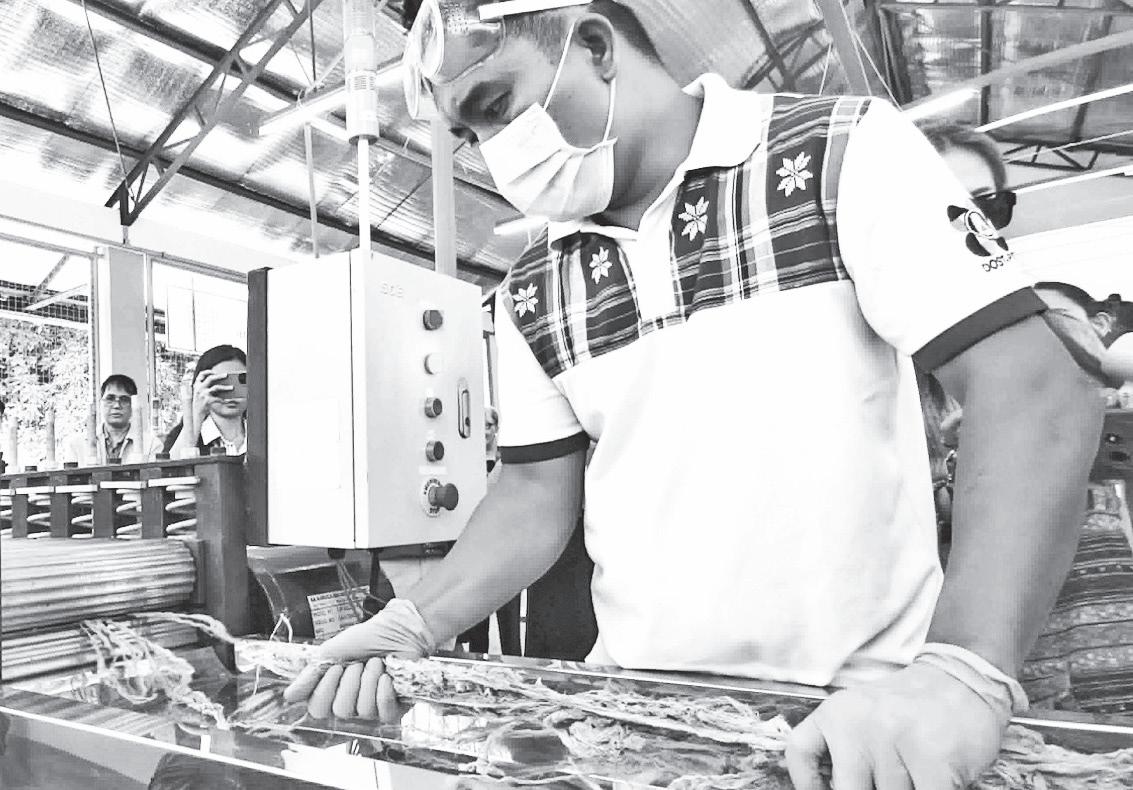
The hub, which involved around P1.6 million in site improvements to an existing facility, was equipped with machinery worth about P6 million. These include a decorticating machine, degumming machine, hard fiber opener, fiber cutting machine, and mechanical softening machine.
The facility can process up to 40 kilograms of natural fibers
Filipino nuclear science students challenged to be global standard-bearers in
By John Eiron R. Francisco
YOUNG Filipino nuclear science students are being challenged to “be the standard” in global Olympiads, following early Philippine performances that surpassed neighboring countries long considered frontrunners in the competition.
During the awarding and closing ceremony of the third Philippine Nuclear Science Olympiad (PNSO) on Thursday at the Philippine Nuclear Research Institute (PNRI), Organizing Committee Co-Chair Kristine Marie Romallosa-Dean highlighted the country’s strong showing in the first two editions of the International Nuclear Science Olympiad (INSO).
She said the Philippines won two gold medals and one silver medal in the inaugural competition, followed by one gold and three silver medals in the second edition.
One Filipino delegate also earned the prestigious Nuclear Ambassador title during the first INSO and received the top scorer award.
Romallosa-Dean said these achievements signal that Filipino students are no longer just participants in the global stage, but are proven contenders capable of winning and excelling in highly competitive science arenas.
With this progress, Romallosa-Dean raised a key question: “So the question now is, how do we go further?” She laid out three key challenges for the country’s young science talents.
First, she urged students to rise above constraints, citing various barriers—such as geopolitical tensions, local governance issues, limited funding, educational gaps, as well as personal and financial struggles. Instead of focusing on limitations, she encouraged a mindset shift: from “I cannot do this because of…” to “What can I do despite these challenges?”
Second, she challenged participants to “be the standard,” referencing the dominance of countries like Singapore and China in science, technology, engineering and mathelatics (STEM) Olympiads.
She noted that these nations have
THE five winners of this year’s third Philippine Nuclear Science Olympiad will represent the country in the third International Nuclear Science Olympiad in Jeddah, Saudi Arabia, in August. They are first placer Ivan Gerard Empizo of Philippine Science High School-Cordillera Administrative Region; second placer Clara Canta, PSHS-Eastern Visayas; third placer Francis Ian Oliver Corachea, PSHS-Calabarzon; fourth placer Magnus Rex Navarro, PSHS-Main; and fifth placer Lorenzo Mercado, PSHS-Central Luzon. PHOTOS BY JOHN EIRON R. FRANCISCO
consistently set the benchmark in competitions, such as INSO, often entering as expected medal leaders.
Romallosa-Dean also noted emerging developments in global participation, including reports that China may join upcoming competitions, further raising the level of competition.
“This is the challenge,” she said. “How do we, as a national team, rise so high that we become the standard and the team to beat, not just Singapore, not just China?”
The third challenge she presented was to give back and pay forward.
She reminded participants that while not everyone will finish in the top ranks, all finalists have already demonstrated academic excellence by reaching the national level.
She encouraged them to use their skills and achievements to inspire other young Filipinos and contribute meaningfully to national development, particularly in nuclear science and engineering.
Support unlocks
Filipino potential
MEANWHILE , PNRI Deputy Director and OIC Dr. Vallerie Ann Samson reminded
participants of the global competitiveness of Filipino professionals, especially during moments of self-doubt.
She cited the contributions of Filipino engineers in constructing high-rise buildings in Dubai, as well as the trust placed in Filipino nurses and doctors in countries like the United States.
“Opportunity is needed and of course of support of government and the whole country, and even the private sector for the Filipino to thrive here in this country and to contribute to this country,” Samson said partly in Filipino.
“Owing to the many problems in the country, our countrymen lose confidence in our excellence. But through this [competition], we are very, very proud to always showcase that the Filipino youth are excellent,” she pointed out.
Samson said one of the country’s biggest advantages is its young population, which gives the Philippines a deep pool of talent to train, educate, and prepare for the future.
Yet, she emphasized that Filipinos can further excel globally if provided with the right opportunities and resources.
STEM Olympiads
Five Filipino students bound for 3rd INSO in Saudi Arabia
THE top five winners of this year’s PNSO will represent the Philippines in the third INSO in Jeddah, Saudi Arabia, in August.
However, organizers are still considering whether the competition will be held onsite or online, depending on whether tensions in the region ease.
Leading the delegation is first placer Ivan Gerard Empizo of Philippine Science High School (PSHS)-Cordillera Administrative Region.
He is joined by second placer Clara Canta of PSHS-Eastern Visayas; third placer Francis Ian Oliver Corachea of PSHS-Calabarzon; fourth placer Magnus Rex Navarro of PSHS-Main; and fifth placer Lorenzo Mercado of PSHS-Central Luzon. Canta is the first female winner in PNSO’s three-year competitions.
Apart from the opportunity to represent the country, they received cash prizes: P30,000 for first place; P25,000 for second; P20,000 for third; P15,000 for fourth; and P10,000 for the reserve finalist.
Empizo said he did not expect to make the team, but vowed to give his best and maximize the opportunity.
“I’ll prepare twice as much, probably triple, because, of course, the problems are more about application, how it can be used to help society. It’s one thing to understand physics. It’s another thing to learn how to apply it, especially in a helpful way,” he said.
for yarn production, which can be transformed into approximately 410 meters of fabric, enough to produce around 100 uniforms.
Besides natural fibers, water hyacinth, which is abundant in Laguna de Bay, is also being utilized in the production process, expanding the range of sustainable raw materials for textile development.
According to Leano, Laguna’s advantage lies not only in the quality of its fibers but also in its lower carbon footprint. Due to its proximity to Metro Manila, sourcing fibers from the province results in less transportation-related emissions compared to materials shipped from farther areas such as Mindanao.
“Carbon footprint is no longer just a marketing tool. It is now being
required, especially in the international market,” he said, noting that this is now being closely considered by garment exporters.
Leaño added that exporters are now required to account for both the water and carbon footprint of every fabric they produce and export, which he said provides a strategic advantage for fiber production in Laguna.
He likewise highlighted the strong potential of the local market. He noted that under the national budget, clothing and cultural uniform allowances for government employees could reach around P17 billion annually, based on an estimated P8,000 allowance per employee multiplied by about 2 million workers.
He said this represents a “captive market” for locally produced textiles, especially since Republic Act 9242, or the Philippine Tropical Fabrics Law, already mandates the use of locally made tropical fabrics for government uniforms.
“Imagine the impact of P17 billion every single year for the industry, for the farmers, for the weavers, for the manufacturers, including the sewers of our uniforms,” he said partly in Filipino.
Leano also encouraged Laguna State University and other government agencies to fully comply with the law, saying this approach should not only address rising production costs but also create shared opportunities for farmers, weavers, stakeholders, and local garment workers, forming a stronger textile innovation ecosystem in Laguna and across the country.
‘Count people, not cars:’ Balik Scientist urges focus on people-centric transportation
RECENT data from an artificial intelligence (AI)-powered mobility program, shows a stark imbalance on the roads, which shows that only 23 percent of space is available for pedestrians, while about 47 percent of people who are traveling and using private vehicles take up a massive 77 percent of it.
Recognizing that putting people first is key to improving public transportation, especially in busy cities, Dr. Syrus Gomari, a Filipino researcher has enhanced the SEERMO mobility app to help address this uneven use of road space across the Philippines.
“We at DOST [Department of Science and Technology] are proud to see how a Balik Scientist like Dr. Gomari are using their global expertise to help the country, especially in emerging and interdisciplinary fields like smart mobility, urban systems, and artificial intelligence,” said Science Secretary Renato U. Solidum Jr.
“What’s especially exciting is the potential for this work to grow even further, connecting city plans not just across Metro Manila, but throughout the entire country.”
Dr. Syrus Gomari, one of the 710 Filipino scientists who returned to the country through the DOST’s Balik Scientist Program (BSP), is working to strengthen science and innovation in the Philippines by sharing his global expertise and helping improve urban planning across the country.
“The question should not be ‘How do we move more cars?’ but ‘How do we move more people efficiently?’ When we shift from carcentric to people-centric thinking, solutions expand beyond road widening to integrated transport systems, active mobility, and smarter urban design with SEERMO,” said Gomari during his exit presentation as a Balik Scientist, held in Quezon City on February 20.
DOST Undersecretary for Research and Development Dr. Leah J. Buendia expressed her support for the vision of Gomari.
“The Balik Scientist Program continues to be a vital bridge in bringing homegrown talent and global expertise together for nationbuilding. By integrating AI into transport and urban planning, we are not only addressing
traffic congestion but also building safer, more inclusive, and more sustainable communities,” said Buendia, the program lead of BSP. Gomari has earlier worked with the local governments of Pasig City and Taguig City for the research and development (R&D) pilot testing of SEERMO.
In his third pursuit, he continued his R&D in Quezon City with more refined research methods, which focused on the deployment of SEERMO to a much larger city. In his exit report, he emphasized the importance of moving beyond traditional planning models by incorporating an understanding of people’s behavior and decision-making in mobility choices— such as their use of walk paths and public transportation.
His SEERMO targets up to 10 times faster planning using AI-driven data and analytics compared to traditional consultancy and manual data gathering.
By integrating behavior-aware datasets of pedestrians and commuters, the AI mobility technology makes it possible for a city as large as Quezon City to shift from vehicle-centric traffic counts to people-centric mobility planning. After a series of updates and improvements, SEERMO now has enhanced accuracy in monitoring the mobility of both people and vehicles. It functions like a CCTV system, but instead of manual counting, the process is automated through computer algorithms. Reporting on-ground incidents and transport infrastructure problems can now be done via smartphones. SEERMO also combines field data reports and government records into a single database. Currently, the technology has reached and helped other cities, towns, and provinces like Cauayan City, Isabela; Porac, Pampanga; Naga City, Camarines Sur; Isabela City, Basilan; and Roxas City, Capiz. Additionally, the research team improved the system to provide detailed results for each district or road section, showing how movement in one area impacts another, instead of just providing city-wide totals.
Story & photos
Natural Textile Fiber Innovation Hub at the Laguna State University campus in Sta. Cruz, Laguna, on April 16. The NTFIH is part of the Fostering the Revitalization of Nascent Textile Innovation Ecosystems in the Region program, which aims to establish regional textile hubs
A NTFIH staff operates a mechanical softening machine that conditions natural fibers by compressing and releasing them to improve flexibility and texture.
PNRI Deputy Director and OIC Dr. Vallerie Ann Samson
Leo XIV spoke bluntly about war, migration, same-sex blessings, and the Holy See’s relations with authoritarian governments during a roughly 20-minute in-flight press conference with journalists traveling with him from Malabo, Equatorial Guinea, to Rome after his apostolic journey to Africa.
Before taking questions, the pope stressed that the primary purpose of a papal trip is pastoral rather than political.
“When I make a trip—speaking for myself, but today as pope, bishop of Rome—especially an apostolic, pastoral trip, it is to find, accompany, and come to know the people of God,” he said.
He added that such journeys should be understood above all as “an expression of wanting to announce the Gospel, proclaim the message of Jesus Christ,” and as a way “to draw close to the people in their happiness, in the depth of their faith, but also in their suffering.”
Asked about the chaotic state of negotiations aimed at ending the conflict involving Iran, Israel, and the United States, the pope called for a new mindset rooted in peace rather than violence.
“Certainly, I would like to begin by saying that we need to promote a new attitude, a culture of peace,” he said. “Many times
when we evaluate certain situations, the immediate response is that we must enter with violence, with war, by attacking, and we have seen that many innocent people have died.”
Leo said the key question was not simply whether a regime should change but how to defend important values without more innocent victims.
“Regime change or no regime change, the question is how to promote the values in which we believe without the death of so many innocent people,” he said.
Describing the situation as “very complex,” the pope said the back-and-forth of negotiations had created “this chaotic and critical situation for the world economy,” while innocent people in Iran were suffering because of the war.
“Rather, I would encourage the continuation of dialogue for peace,” he said. “As Church, I say again, and as a pastor, I cannot be in favor of war, and I would like to encourage everyone to make ev -
ery effort to seek responses that come from a culture of peace and not of hatred.”
Later in the exchange, responding to a question about reported executions by the Iranian regime, the pope issued an unequivocal condemnation.
“I condemn all actions that are unjust, I condemn the taking of people’s lives. I condemn capital punishment,” Leo said.
“I believe that human life is to be respected, and that all people from conception to natural birth, their lives should be respected and protected. So when a regime, when a country, takes decisions which takes away the lives of other people unjustly, then obviously that is something that should be condemned,” he pointedout.
On migration, a major topic ahead of his next international apostolic journey to Spain, the pope said governments have the right to regulate their borders but insisted
that wealthier nations must also address the deeper causes driving people to leave poorer countries.
“Evidently, the issue of migration is very complex and affects many countries, not only Spain, not only Europe, but also the United States; it is a global phenomenon,” he said.
Leo continued: “I personally believe that a state has the right to establish rules at its borders. I do not like the idea that everyone enters as if there were no order, and at times creating even more unjust situations than those they had left behind.”
At the same time, he challenged richer countries and multinational corporations to do more for developing nations, especially in Africa.
“But having said that, I ask: What are we doing in richer countries to change the situation in poorer countries?” he said.
Referring to Africa, he added that for many people it is seen as
Toward eco-missiology: The pillars of sustainability
By Bp. Samuel N. Agcaracar, SVD DD
AN outstanding feature of Pope Francis’s papacy is his commitment to ecological conversion, evident in his two major apostolic exhortations, Laudato Si’ (2015) and Laudate Deum (2023), which ushered in a vital shift in people’s awareness on environmental stewardship.
For the Society of the Divine Word (SVD), care for creation is central to its life and mission as stated in its Constitution.
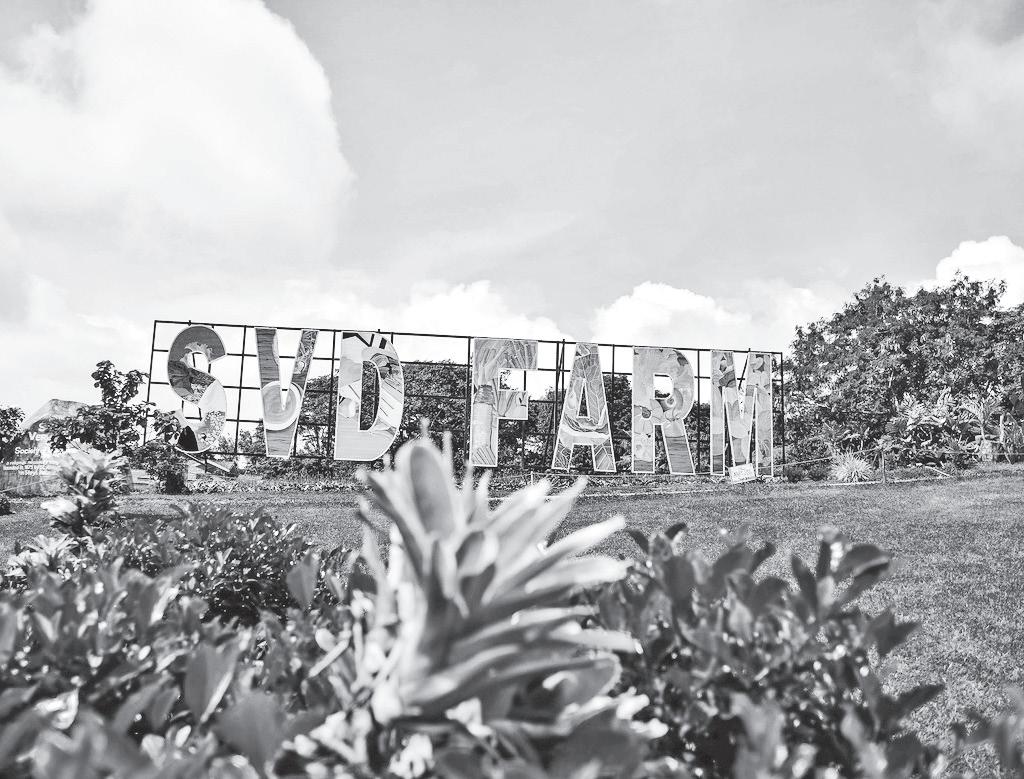
The above provides a glimpse of the birth and development of the SVD Laudato Si Farm in Silang, Cavite, which is inspired by the papal encyclical. From its humble beginnings during the pandemic, it has evolved into a more holistic initiative through multi-sectoral collaboration.
The Working Paper of SVD 19th General Chapter states: “In our pursuit of ecological sustainability, we emphasize the adoption of eco-friendly lifestyle within our communities. This involves practical measures such as implementing clean and green programs, reducing waste, reducing the use of plastic, promoting recycling, encouraging the use of renewable resources.” SVD Farm is anchored on environmental protection, ensuring self-sustainability, and improving the community’s quality of life, with six pillars as guideposts. These pillars are sustainable farming (food security), sustainable energy (renewable and clean energy, zero emissions), sustainable water supply, sustainable livelihood, sustainable knowledge, and sustainable lifestyle.
With these, we can say that we have had considerable accomplishment in farming that is evident in the organic farming practices. With the assistance extended by the Department of Agriculture (DA), the farm has succeeded in the area of sustainable farming.
The farm has expanded its operation, and has to date, four major distinct services, such as farming, food, faith, and family.
Farming is its backbone, as it started with growing of vegetables and poultry for
the consumption of the community. This was realized and, in the process, gained the support of the DA as an advocacy partner. Food service started with the construction of the Oies Café and Oies Kitchenette, whose outstanding mark is the fresh and organic flavor commonly known as the “farm to table”concept. Another significant feature is the emphasis in offering menus and spices that are extinct and locally grown. This is a response to the ecological challenge of restoring local species and varieties of plants and animals.
As an eco-religious tourism destination, spiritual activities are major features of the Farm, making it unique from others in the Tagaytay Ridge. Faith is a
significant component, which necessitated the construction of the retreat house and the Holy Spirit Hermitage to minister to its guests.
Meanwhile, family service is reflected in the growing number of visitors who find the farm conducive for family bonding activities, particularly during the pandemic.
Over time, there was a felt need to professionalize its services, which amazingly has been addressed by volunteerism from lay partners. This collaboration and networking became the foundation for the enhancement of services as part of strengthening its pastoral mission.
During bamboo tree planting activities every Season of Creation, a growing number of Christians continue to join, which indicate their desire to protect the environment and is a potential avenue in building an ecumenical spirit.
My conversations with Buddhist and Muslim friends, and collaborations with other Christian denominations made me realize that the Farm has become a place for ecumenical and interreligious encounters.
This crossing of paths is a positive sign where ecology could serve as a horizon
“a place where one can go to take minerals, to take its riches, to enrich others in other countries.”
The pope insisted that migrants must always be treated with dignity.
“When people arrive, they are human beings and they deserve the respect that every human being deserves because of human dignity,” he said. “We need to treat human beings in a humane way and not treat them worse than household pets, animals, etc.”
A French journalist asked Leo how he avoids lending moral legitimacy to authoritarian rulers when he meets them during papal trips.
The pope said such encounters can be interpreted in different ways, but he returned to the pastoral purpose of travel and the diplomatic mission of the Holy See.
“Certainly, the presence of a pope with any head of state can be interpreted in different ways,” he said. “I would go back to something I said in my initial remarks about the importance of understanding the primary purpose of the travel that I do, that the pope does to visit the people.”
He also defended the Vatican’s continued diplomatic engagement even with difficult governments.
“We don’t always make great proclamations, criticizing, judging, or condemning,” he said. “But there’s an awful lot of work that goes on behind the scenes to promote justice, to promote humanitarian causes.”
That work, he said, can include efforts to free political prisoners and respond to hunger and sickness.
“So the Holy See, by maintaining if you will, a neutrality, and looking for ways to continue our
for wider engagements. Our common love for nature builds a fraternal spirit where religious and cultural differences could be overcome, and lead us further to discover the one God whose many faces are incarnated in diverse expressions.
Pope Francis’ call to protect and build our common home, Mother Earth, is an invitation that should generate more initiatives that span across the borders of culture, economic status, and faiths. The growing number of SVD Farm partners is a testament to how it has become an avenue in linkages and collaboration.
Care for the poor is an integral part of the mission as it plays a significant role in tending its major components of organic farming and livestock production.
An unnoticed aspect is the presence of 25 farmers and gardeners who quietly contribute to the realization of the Farm’s vision. Most of the employees also come from nearby villages who were laid off due to the pandemic.
Helping the poor is observed in its operation, in the acceptance of employees, and special consideration to hire the needy. We envision the Farm to be a small oasis and well spring of hope in Tagaytay allocating a portion of its revenues for charity work.
The notion of integral ecology proposed in Laudato Si’ serves as a framework for the Church’s missiological reflection and practice. By integrating ecological concerns into its theology, the Church ensures that environmental stewardship is woven into its life and work, and helps in responding to the ecological crisis on various levels.
Looking back, one cannot help but marvel at the Divine Providence that the SVD Tagaytay Community has received through the SVD Laudato Si’ Farm.
Bp. Samuel N. Agcaracar, SVD DD, is the newly installed bishop of the Diocese of San Jose, Nueva Ecija. The article is excerpted from a lecture delivered at the 9th International Farm Tourism Conference of the International School for Sustainable Tourism in Baguio City.
positive diplomatic relationship with so many different countries, we’re actually trying to find a way to apply the Gospel to concrete situations, so that the lives of people can be improved,” he explained.
Questioned about the blessing of same-sex couples after a decision by German Cardinal Reinhard Marx in Munich and Freising, Leo said Church unity should not be reduced to sexual ethics.
“First of all, I think it’s very important to understand that the unity or division of the Church should not revolve around sexual matters,” he said.
“We tend to think that when the Church is talking about morality, that the only issue of morality is sexual, and in reality, I believe there are much greater and more important issues, such as justice, the equality, freedom of men and women, freedom of religion, that would all take priority before that particular issue,” he added.
Leo said the Holy See had already made clear to the German bishops that it does not agree with the “formalized blessing of couples,” including homosexual couples or couples in irregular situations, beyond what Pope Francis had permitted.
Invoking Francis’ well-known statement of “Tutti, tutti, tutti,” Leo said: “All are welcome, all are invited. All are invited to follow Jesus, and all are invited to look for conversion in their lives.”
“To go beyond that today, I think that the topic can cause more disunity than unity,” he added, “and that we should look for ways to build our unity upon Jesus Christ and what Jesus Christ teaches.” Marco Mancini/Ewtn News Via Cbcp News
Faith-based Shincheonji Volunteers lead multi-sector tree planting for climate resilience
IN a unified effort to support environmental protection, disaster resilience, and future community livelihood, Shincheonji Volunteers (SCJ Volunteers) Manila last week led the multi-sector “Go Green, Grow Together” tree-planting drive along the riverside in Barandal, Barangay Sta. Ana, San Mateo, Rizal.
The initiative mobilized 85 volunteers from government, civic, and community partners in celebration of Earth Month.
It brought together the Philippine Army’s 2nd Civil-Military Operations Battalion, CivilMilitary Operations Regiment, the Department of Agriculture Bureau of Plant Industry (DABPI), the Rotary Club of San Mateo, the San Mateo Business Club, and the local government units (LGUs) of Barangay Sta. Ana and the municipality of San Mateo, represented by Coun. Joey Briones, the Municipal Agriculture Office (MAO), and the Municipal Environment and Natural Resources Office.
The collaboration highlighted a shared commitment to sustainability and community-driven environmental action.
A total of 300 seedlings, consisting of 100 bamboo and 200 assorted fruit-bearing trees provided by DA-BPI, were planted across the site.
The MAO led the technical orientation, while the Department of Labor and Employment’s Tulong Panghanapbuhay sa Ating Disadvantaged/Displaced workers San Mateo supported the site preparation.
Volunteers worked hand in hand from clearing to planting, demonstrating how coordinated efforts can deliver tangible environmental impact.
MAO OIC Alexis Santos of San Mateo said the initiative highlights the value of collaboration in addressing environmental challenges.
“This initiative proves that when communities, government, and organizations work together, we can build solutions that protect both people and the environment. Bamboo planting is not just for today. It is an investment in climate resilience, sustainable livelihoods, and the future of our communities,”Santos said.
More than a tree planting, the activity underscores bamboo’s critical role in climate action. With its fast growth and high carbon absorption capacity, bamboo helps restore degraded land, prevent soil erosion, and reduce the impacts of flooding and heavy rainfall.
For residents along the Sta. Ana riverside, the initiative also carries long-term benefits for disaster mitigation and potential livelihood opportunities, as mature bamboo plantations may serve as a sustainable source of income.
Meanwhile, the inclusion of fruitbearing trees supports food security and additional income sources for the community. Together, these serve as practical, nature-based solutions that support both environmental resilience and community development.
To ensure sustainability, local residents will take an active role in monitoring and maintaining the site. This includes regular watering, replanting when necessary, and organizing follow-up activities to support the survival and growth of the planted trees.
Rooted in faith and service, SCJ Volunteers Manila emphasized that caring for the environment reflects a deeper spiritual responsibility. The group underscored the importance of living out faith through meaningful actions that benefit others and honor creation, drawing inspiration from Matthew 5:16. Through this initiative, volunteers aim to serve both people and the planet.
With “Go Green, Grow Together,” SCJ Volunteers Manila and its partners demonstrate that environmental stewardship becomes more impactful when communities unite with purpose, partnership, and a shared vision for a greener and more resilient future. SCJ Volunteers is a global nongovernment organization affiliated with the Shincheonji Church of Jesus, dedicated to advancing community welfare through volunteerism. Its programs focus on environmental protection, livelihood support, and educational and social development initiatives.
POPE Leo XIV speaks to journalists aboard the papal plane en route from Malabo, Equatorial Guinea, to Rome on April 23, after an 11-day trip to Africa. VATICAN MEDIA
Asean Champions of Biodiversity Media Category 2014
Editor: Lyn Resurreccion
Biodiversity Sunday
Finlayson’s squirrel threatens Metro Manila’s urban biodiversity
By Jonathan L. Mayuga
THE Finlayson’s (Callosciurus
finlaysonii) squirrel are increasingly visible in Metropolitan Manila. They may be cute, but their presence has made the Department of Environment and Natural Resources (DENR) to express alarm. Being a nonnative invasive species they may be a threat to local ecosystem.
In its recent Facebook post, the DENR said the rodent species has been spotted jumping across trees, power lines, or parks around Metropolitan Manila.
Native to parts of Southeast Asia—such as Cambodia, Laos, Myanmar, Thailand, and Vietnam—the Finlayson’s (named in honor of Scottish naturalist and traveller George Finlayson) is recognizable for its varied coat color.
Invasive species
CONSIDERED an invasive alien species, fears of Finlayson’s impact on urban biodiversity were aired.
The DENR Facebook account was abuzz with various reactions.
Some said getting rid of the animals before their population grows and becomes unmanageable. Mike Con suggested shooting them with .22 pellet guns.
Ad Def said that squirrels being edible, “Just inform the public that they are free to eat it if they see one. It will be gone soon.”
For her part, Yza Lim said: “Invasive or not, they have lives that need protection. They didn’t wish to be born invasive. Besides, aren’t human beings the most invasive species in the entire world? If we still deserve to live, so do they.”
Rhod Bolongaita said there are many squirrels in Taguig, in Greenway Park within the Bonifacio Global City. They are active in the morning and are seen atop tall trees.
King Lion Catli said he spotted one jumping from one tree to another, when he parked at the Lung Center of the Philippines in Quezon City.
Cute rodents
SQUIRRELS are actually rodents, only cuter and in a natural habitat, that play an important role in the ecosystem.
From the family Sciuridae, squirrels comprise of over 200 species found across nearly every continent.
They are generally categorized into three main types based on their lifestyle: tree squirrels, like the common gray squirrel; the ground squirrels, which include chipmunks and prairie dogs; and the flying squirrels, which can glide through the air using specialized skin flaps.
Like rodents, squirrels have four front teeth that never stop growing, which they keep in check by constant gnawing.
Although omnivores, they are often seen enjoying nuts and seeds, flowers, insects, and occasionally bird eggs or small animals.
They are highly adaptable and intelligent, scientists observe. Based on studies, they often find their way to their target, like bird feeders and nests.
According to scientists, squirrels are “accidental gardeners”—as they try to bury seeds on the ground for use later—but often forget about them, allowing the seeds to grow and become part of the forest.
Palawan squirrels
OUTSIDE their natural habitat, squirrels could be a threat to biodiversity—even threatening to eliminate or cause the extinction of other species.
The Finlayson’s squirrel could pose a great threat to the native squirrel found only on the island of Palawan, the Northern Palawan tree squirrel.
There is nothing to worry, though, said Assistant Director Mariglo Laririt of the DENR’s Biodiversity Management Bureau (BMB).
“As long as the Finlayson’s remain in Luzon, there is no habitat overlap. They are just a threat to birds in the city,” she said partly in Filipino.
According to Laririt, the Wildlife Resource Division (WRD) of the DENR-BMB has been providing training on how to trap squirrels, which are supposed to be turned over to the DENR-BMB for disposal.
However, she said people don’t want to do the job themselves.
“We get requests to do the trapping ourselves. Unfortunately, we do not have enough manpower to do that. Our strategy is training at the barangay level,” she told the B usiness M irror via Messenger on April 17.
Naturally invasive
ACCORDING to Laririt, while some alien species have become “naturalized,” the Finlayson’s
squirrel or other squirrels are a big threat to biodiversity.
“Squirrels? Even in their natural habitats, like rodents, they multiply faster. They gnaw on almost anything, including [electric] wires,” she said.
She added that sometimes, squirrels make nests to breed in house ceilings, making them invasive.
According to Laririt, the DENR-BMB is considering giving a certificate to citizens who capture and turn over squirrels to the DENR-BMB. This is similar to those given to individuals who rescue wildlife and turn them over to the DENR. This is yet to be discussed with the WRD of the DENR-BMB.
Squirrels in the city?
“ THEY’RE cute, cuddly, and they love to play. Who wouldn’t love squirrels? However, they might not be native to our country,” said environmentalist Gregg Yan.
“The Philippines has nine known native squirrel species; most of them live in the forested regions of Palawan, Mindanao, and
the Visayas—rarely in the middle of highly urbanized cities,” he noted.
According to Yan, invasive species like the Finlayson’s squirrel have been plying the greens of Metro Manila since the early 2000s.
“We used to go birdwatching at the American War Cemetery in Taguig, where we’d sometimes encounter them jumping on top of trees. Twenty years later, they’ve spread as far north as La Mesa Eco Park, near the border of Bulacan—an indicator that they’re breeding and expanding their range,” Yan said.
Growing problem
ACCORDING to Yan, while they are not yet a major problem, in 20 years or more, the Finlayson’s will eventually become one, when they start invading the farmlands and forests of Bulacan, Cavite, and Laguna.
“Squirrels eat fruits, tree bark, and most alarmingly, birds, lizards, and their eggs.
They can put a dent in our native bird and lizard populations unless we stop them from spreading. There’s no telling what kind of damage they’ll cause if they spread further
Chernobyl’s radioactive landscape testament to nature’s resilience, survival
CHERNOBYL, Ukraine—On contaminated land that is too dangerous for human life, the world’s wildest horses roam free.
Across the Chernobyl exclusion zone, Przewalski’s horses—stocky, sand-colored and almost toy-like in appearance—graze in a radioactive landscape larger than Luxembourg.
On April 26, 1986, an explosion at the nuclear power plant in Ukraine sent radiation across Europe and forced the evacuation of entire towns, displacing tens of thousands. It was the worst nuclear disaster in history.
Four decades on, Chernobyl—which is transliterated as “Chornobyl” in Ukraine— remains too dangerous for humans.
But the wildlife has moved back in.
Wolves now prowl the vast no-man’sland spanning Ukraine and Belarus, and brown bears have returned after more than a century. Populations of lynx, moose, red deer and even free-roaming packs of dogs have rebounded.
Przewalski’s horses, native to Mongolia and once on the brink of disappearing, were introduced here in 1998 as an experiment.
Known as “takhi” in Mongolia (“spirit”), the horses are distinct from domestic breeds, with 33 pairs of chromosomes, compared with 32 in domesticated horses. The modern name comes from the Russian explorer who first identified them.
“The fact that Ukraine now has a freeranging population is something of a small miracle,” said Denys Vyshnevskyi, the zone’s lead nature scientist.
With human pressure gone, parts of the exclusion zone now resemble European
landscapes from centuries past, he said, adding: “Nature recovers relatively quickly and effectively.”
The transformation is visible everywhere. Trees pierce abandoned buildings, roads dissolve into forest, and weathered Sovietera signs stand beside leaning wooden crosses in overgrown cemeteries.
Hidden cameras show the horses adapting in unexpected ways. They seek shelter in crumbling barns and deserted homes, using them to escape harsh weather and insects — even bedding down inside.
The horses live in small social groups— typically one stallion with several mares and their young—alongside separate bands of younger males. Many died after their introduction, but others adapted.
Declared extinct in the wild in 1969, Przewalski’s horses survived only through captive breeding before reintroduction efforts rebuilt a global population of
about 3,000, according to Florian Drouard, an operations manager at a program for the horses at Cevennes National Park in southern France.
“This species is a remarkable example of successful reintroduction,” he said. “While it is still far from being fully secure, it has shown that with proper preparation, a species kept in captivity can regain the social and ecological behaviors needed to live freely.”
The horse, he said, has proved unexpectedly adaptable to open landscapes but now also thriving in Ukraine’s partly forested environment.
Tracking the animals at Chernobyl takes time. Vyshnevskyi often drives alone for hours, setting motion-sensitive camera traps in camouflaged casings attached to trees.
Despite persistent radiation, scientists have not recorded widespread die-offs, though subtler effects are evident. Some
frogs have developed darker skin, and birds in higher-radiation areas are more likely to develop cataracts.
However, new threats have emerged.
Russia’s 2022 invasion brought fighting through the exclusion zone as troops advanced toward Kyiv, digging defenses into contaminated soil. Fires linked to military activity swept through forests.
Harsh wartime winters have also taken a toll. Damage to the power grid left surrounding managed areas without resources, and scientists report increases in fallen trees and dead animals—casualties of both extreme conditions and hastily built fortifications.
“Most forest fires are caused by downed drones,” said Oleksandr Polischuk, who leads a firefighting unit in the zone. “Sometimes we have to travel dozens of kilometers to reach them.”
Fires can send radioactive particles back into the air.
Today, the zone is no longer just an accidental refuge for wildlife. It has become a heavily monitored military corridor, marked by concrete barriers, barbed wire and minefields—a landscape of what some describe as grim beauty.
Personnel rotate in and out to limit radiation exposure. Chernobyl is likely to remain off-limits for generations—too dangerous for people, yet full of life.
“For those of us in conservation and ecology, it’s kind of a wonder,” Vyshnevskyi said. “This land was once heavily used— agriculture, cities, infrastructure. But nature has effectively performed a factory reset.” Derek Gatopoulos And Evgeniy Maloletka/Associated Press
She said sightings had already been reported as early as 2007.
“Then, in 2013, there were already public warnings that they were likely non-native squirrels and that they could pose risks to urban biodiversity, including by preying on the eggs of native bird species,” said Lim, a former DENR-BMB director and the immediate former executive director of the Asean Centre for Biodiversity.
She warned that the animal’s reported gnawing on electrical wires in residential areas could raise concern not only for biodiversity but also for possible disruptions to public utilities and other essential services.
Expanding population
LIM said what is especially alarming is the potential consequence of the Finlayson’s squirrel’s continued expanding and spreading population beyond Metro Manila into protected areas and other ecologically important sites.
“If that happens, the impacts could be devastating. These exotic squirrels may alter habitats, place additional pressure on already vulnerable native species, and undermine conservation gains in areas that are meant to serve as refuges for biodiversity,” she warned.
through the forests of north and south Luzon,” he said.
Yan pointed out that like feral cats and dogs that kill everything from sea turtles to tiny insects, the best solution is to cull and curb Metro Manila’s squirrel population before they get out of hand, with trapping or even hunting them as logical options.
“At least in Metro Manila and other cities, squirrels are best kept as pets—never to be released into the wild. What happens when invasive species establish themselves in a country? Well, the maya bird or Eurasian tree sparrow was introduced from Europe to the Philippines just a century ago—and now it’s literally in every barangay, town, and city in the Philippines. When you let life find a way, it often will,” he said.
Serious threat to urban biodiversity
THERESA Mundita S. Lim, an international biodiversity expert, said the increasing sightings of the Finlayson’s squirrel in Metro Manila should be taken seriously.
According to Lim, recommendations to address this problem have already been made in the past, through the National Invasive Species Strategy and Action Plan. In 2016, the Action Plan has already identified Finlayson’s squirrel as an invasive species spreading in Metropolitan Manila.
“This shows that the issue has long been recognized and that recommendations to address invasive alien species have already existed within the national policy framework. What is needed now is sustained and coordinated implementation,” she said. She said it should be treated as an interdisciplinary task involving environmental authorities, local government units, park managers, biodiversity experts, veterinarians, researchers, academic institutions, and communities.
“Public participation is likewise essential. We need to encourage the reporting and mapping of sightings to help guide containment measures and prevent further spread [of Finlayson’s squirrel]. The sooner we act in a coordinated and science-based manner, the better our chances of managing the problem effectively,” Lim said.
Fatou, world’s oldest gorilla in captivity, celebrates her 69th birthday at Berlin Zoo
BERLIN—Fatou, the world’s oldest gorilla living in captivity, celebrated her 69th birthday with a feast, munching on cherry tomatoes, beets, leeks and lettuce at the Berlin Zoo. But no birthday cake, because sugar isn’t healthy for the aging primate.
Fatou, a western lowland gorilla, arrived in what was then-West Berlin in 1959. She was believed to be about 2 years old at the time, though her exact birth date isn’t known—April 13 is her designated birthday.
Gorillas can live for around 35 to 40 years in the wild and longer in captivity.
Fatou became the zoo’s oldest resident in 2024, following the death of Ingo the flamingo. The bird was believed to be at least 75 and had lived at the zoo since 1955.
Fatou was likely born in the wild in western Africa, but the story goes that a French sailor took her out of Africa and bartered her to cover his bar tab in Marseille, France, according to the Guinness World Records.
A French animal trader then reportedly sold her to the zoo.
These days, Fatou lives in an enclosure of her own and prefers to keep her distance from the zoo’s other gorillas in her old age. She’s lost her teeth and she suffers from a touch of arthritis and hearing loss.
But Christian Aust, the Berlin Zoo’s primate supervisor, said that she’s friendly with the zookeepers, if still a bit stubborn. At 69 years old, she’s earned it. Alles Gute zum Geburtstag (Happy birthday), Fatou! Stefanie Dazio And Fanny Brodersen/ Associated Press
‘You need to deserve to go to the World Cup’ Sports
ROME—Italian sports officials say fourtime champion Italy is not interested in replacing Iran at the upcoming World Cup following a suggestion to that effect by a Trump administration official.
Iran has not withdrawn from the World Cup, and the team is preparing to play in the US despite the war in the Middle East.
FIFA has insisted its group stage games near Los Angeles and in Seattle will go ahead as planned in June.
The Financial Times reported that Paolo Zampolli, the US special envoy for global partnerships, had suggested the swap to President Donald Trump and FIFA president Gianni Infantino.
In a phone interview with The Associated Press on Thursday, Zampolli emphasized that “my request is not a political request.”
The task, which was made to Trump and Infantino on Wednesday, was meant as a contingency plan in case Iran could not participate in the soccer tournament at the last minute.
“I had a dream,” Zampolli told the AP. “My request was for the Italian people and the AmericanItalian people.”
He said in the FT interview that, with four titles, the Italian national team’s appearance in the World Cup would be justified.
Italian officials pushed back hard at the suggestion, with Sports Minister Andrea Abodi saying Thursday that “first of all, it’s not possible. Secondly, it’s not a good idea.”
Luciano Buonfiglio, the president of the Italian Olympic Committee, which oversees all sports
in Italy, also dismissed the idea.
“I would feel offended,” Buonfiglio said. “You need to deserve to go to the World Cup.”
Italy’s Finance Minister Giancarlo Giorgetti called the suggested swap “shameful.”
Hours later, Trump was asked at the White House about Iranian soccer players potentially not being allowed into the US for the World Cup. He initially joked, “I don’t think about it too much” before adding, “That’s an interesting question.”
“Let me give that some thought,” Trump added.
He then deferred to Secretary of State Marco Rubio, who said, “Nothing from the US has told them they can’t come.”
“The problem with Iran would be, not their athletes. It would be some of the other people that they want to bring with them,” Rubio said, suggesting that Iran’s soccer team could bring in people loyal to militant groups disguised as journalists and trainers.
“We may not be able to let them in,” Rubio said of people around the team. “But not the athletes themselves.”
He added that there had been “speculation that Iran may decide not to come, but then Italy could fill their spot,” without adding details.
“If they decide not to come on their own, it’s ‘cause they decided not to come,” the secretary of state said of Iranian athletes.
While Iran was among the first teams to qualify for the World Cup, Italy missed out for the third consecutive tournament, resulting in the resignations of its national team coach and soccer federation president. AP
Italy dismisses replacing Iran at the World Cup after suggestion by Trump official.
THE crack of arrows slicing through the air reverberated across the Benjamin Dy Sports Complex during the 2026 World Archery Philippines (WAP) Philippine Sports Commission (PSC) Philippine National Archery Championship Qualifier Leg 1 in Cauayan, Isabela.
Among the 450 young archers who converged from every corner of the country, one name soared above the rest: Juliana Vernice Garcia, a 17yearold recurve specialist from Pasig City who is fast emerging as the face of Philippine archery.
“I’ve been shooting since I was eight. My dream right now is to qualify and do well in the Asian Games. If I can pull it off, the Olympics won’t be that far,” said Garcia, her voice steady yet brimming with determination.
Archery
program set to soar under
world-class coaching from Koreans
on the line—men’s and women’s individual, men’s and women’s team, mixed team recurve, and the newly introduced mixed team compound event.
under the summer
Garcia was a standout in the Cauayan kickoff qualifier hosted by Mayor JC Dy and witnessed by Philippine Sports Commission Chairman Patrick Gregorio, who was visibly moved by the turnout.
“Sometimes I ask myself Sunday
World-renowned jiu jitsu
LLIANCE Jiu Jitsu, one of the world’s most decorated Brazilian JiuJitsu systems, has officially opened its first flagship academy in Clark, marking another milestone in the Freeport’s growing sports and lifestyle scene. Clark Development Corporation (CDC) President and CEO Atty. Agnes VST Devanadera joined shareholder Adrian Salvador and Manila head coach Mark Entrata in leading the
is a time to rest. But when you meet 450 young archers from all over the Philippines, full of aspirations and dreams, you immediately know your efforts are worth it,” said Gregorio.
With WAP president Jonathan “Bing” Reaport at the helm, the national team has tapped two Olympic coaches from South Korea with world-class credentials—Ryu Su Jeng and Hong Sun Chil—whose methods are already producing remarkable results.
“Before Coach Ryu came, our recurve archers never hit scores in the 660s or 670s. Now it happens more often. Even our under18 youth can score 700 in 72 arrows at 50 meters,” Reaport said.
Archery at the 2028 Los Angeles Olympics will put six gold medals
program welcomed in Clark
opening on April 18 at Clark Center Pavilion 06B. Entrata underscored Clark’s accessibility and rapid development as key reasons for choosing the Freeport as the academy’s expansion site. “We saw the development here in Clark, you can see it around and the potential for growth. It’s easy to go around so we really feel that this is the perfect area to really put up something like this,” Entrata said.
The academy offers structured training programs for beginners, enthusiasts and competitive athletes. Regular classes run Monday to Friday from 5:30 p.m. to 8:15 p.m., while Saturday sessions are dedicated to women and children, with women’s classes from 9:00 to 9:45 a.m. and children’s classes from 10:00 a.m. to 10:45 a.m. Alliance Jiu Jitsu Clark carries the lineage of Rubens “Cobrinha” Charles, a multiple time world champion and
after golf. Weight is surely a factor, but aside from being heavy, dehydration also plays a huge part in why I get cramps. I’ve discovered that when I play on overcast days or play in cooler weather like in Baguio or in cold countries, I don’t get cramps, even when I walk the course. But on normal rounds in Philippine heat, even if I ride the whole 18 holes, I’d get cramps at night. So during the hottest months, I need to double down on hydrating to keep cramps at bay. I literally
“We’ve identified solid talents in the under15 and under18 groups who will be our next generation,” Reaport said. Gregorio also announced PSC’s plan to establish a Regional Training Center for archery and ball sports at the Benjamin Dy Sports Complex, and a rowing center at the Cagayan River.
“Mabuhay ang World Archery Philippines and its president Bing Reaport. Take care of our Korean Olympic coaches. They will unlock the way to the podium for the hearts of all these young athletes,” Gregorio said.
“Thank you Mayor JC Dy, Congressman Mike Dy, Cauayan City Sports Head King Medrano and former national rower and fivetime SEA Games gold medalist Joe Rodriguez,” added Gregorio, noting that PSC will also organize a Cagayan Valley Sports Summit this July. “We will be back soon.”
one of the most respected figures in modern Brazilian JiuJitsu. The system is known for its competition tested curriculum, emphasizing technique, leverage, and ground control over sheer strength. Before its Clark expansion, Alliance Jiu Jitsu established its Philippine presence through its Manila branch at Valle Verde
OFFICIALS of the Alliance Jiu Jitsu Clark present tokens to Clark Development Corporation President and CEO Agnes VST Devanadera during the academy’s grand opening at the Clark Center Pavilion 06B. They are (from left) cuest Coach Francis Tejano from Alliance Los Angeles Headquarters, shareholder Adrian Salvador, head coach Ram Morales and Manila Branch Head Coach Mark Entrata.
ITALY players react during a penalty shootout during the World Cup qualifying playoff final match against Bosnia in Zenica, Bosnia, last month. AP
JULIANA VERNICE GARCIA, 17, is fast emerging as the face of Philippine archery. PSC PHOTO
TV reboots put Millennials in charge of the remote
APRIL 26, 2026 | soundstrip.businessmirror@gmail.com
ON A ROLL
Ely Buendia talks about new song, playing bass and getting a business adviser
Story by Jingo Zapata
Ely Buendia must’ve written hundreds of songs — starting with the Eraserheads, onto The Mongols, Pupil, The Oktaves, and Apartel, as well as in his debut solo work, “Wanted: Bedspacer,” back in 2000.
He hasn’t stopped, and apparently, he’s on a roll. After releasing his second solo album, “Method Adaptor,” in 2024 and actively promoting its single, “Bulaklak sa Buwan,” on social media and live performances last year, the astute artist (and businessman) is back with a new single, “Ate,” which he says is about a real person.
In this exclusive Q&A, the unofficial leader of the ’90s golden age of OPM reveals the motivations behind his creative streak, including his successful mixing of art and commerce.
You’ve been on a creative streak these past few years, releasing “Method Adaptor” album in 2024 and the single “Ate” just last month. Is it inspiration or plain hard work?
A bit of both. I felt I really could do something
Publisher :
T. Anthony C. Cabangon
Lourdes M. Fernandez
Editor-In-Chief :
Concept :
Aldwin M. Tolosa
Y2Z Editor :
SoundStrip Editor : Group Creative Director : Graphic Designers :
Jt Nisay
Edwin P. Sallan
Eduardo A. Davad
Niggel Figueroa
Chow Jarlego
Contributing Writers :
Tony M. Maghirang
Rick Olivares
Jingo Zapata
Reine Juvierre S. Alberto
John Eiron R. Francisco
Patrick Villanueva
Ana Zoe V. Davad
Justine Xyrah Garcia
Ginger Franz S. Ocampo
Trixzy Leigh Bonotan
Bless Aubrey Ogerio
Photographers :
Bernard P. Testa Nonie Reyes
Y2Z & SOUNDSTRIP are published and distributed free every Sunday by the Philippine Business Daily Mirror Publishing Inc. as a project of the
The Philippine Business Mirror Publishing, Inc., with offices on the 3rd Floor of Dominga Building III 2113 Chino Roces Avenue corner Dela Rosa Street, Makati City, Philippines. Tel. Nos. (Editorial) 817-9467; 813-0725. Fax line: 813-7025
Advertising Sales: 893-2019; 817-1351,817-2807. Circulation: 893-1662; 814-0134 to 36. www.businessmirror.com.ph
worthwhile and something I could be proud of by being exposed to a lot of new music through Offshore. Also, there was a certain sound that I missed, that I really didn’t hear from anyone else, and I decided to be the one to do it, despite the daunting task of building a new solo catalogue at my age. It was very hard work, but worth it.
Speaking of hard work, “Ate” sounds like a tribute to all the tireless eldest sisters in the country but with playful lyrics sung like a nursery rhyme, reminiscent of “Toyang” and “Tindahan ni Aling Nena.” Did you have a particular person in mind when you wrote it?
I know a lot of these tireless people who seem to carry the whole weight of responsibility for everyone in their family. “Ate” was inspired by one particular person who has been working since she was a young girl, put herself through school, and is still the breadwinner until now. She actually acts like the kuya in all aspects, but I don’t want to “out” her because I don’t want to make it seem that she’s being treated unfairly by her family, and I want to respect their privacy. But she knows the song is about her.
The two women on the cover artwork are said to be related to Audry Dionisio. Their smiles capture the positive vibe of the song. How did you find that photo?
It’s her mother and grandmother. It was taken in the ’70s, and the first time I saw it, I just loved the whole vibe. It’s also to honor her mom who was such a lovely lady and who was always nice to me, accepting me with open arms without judgment. Just a really cool woman.
The guitar work, by the way, is simple but brilliant. Do you follow a practice-makesperfect routine? Because you’ve also been doing instructional videos on how to play certain notes and keys.
Thank you, coming from someone who’s seen all the guitar greats, that means a lot. But I wish I had more discipline, then I could’ve trained early on and been really
great by now! I’m still working on precision, so I guess, yeah, I believe in practice and taking it slow.
About “Method Adaptor,” discogs.com says you played multiple instruments like bass and keyboards, aside from guitar and co-producing it with your bandmates and Offshore Music cohorts. Did you really plan it that way?
I usually get ideas for guitar parts while I’m writing a song, so it’s natural that I do the parts when recording. But as a producer, I have an ear for who would be the right musician for the job. I ended up playing bass because I think I’m a good bass player, and I didn’t want to waste time telling someone else to play less and simple. I wanted a very simple, unadorned arrangement for “Method,” more rock and roll.
It was also released on vinyl, CD and cassette in France. Any special reason?
It was made in France because Offshore has a partnership with a printer there. I’m one of those people who believe these media (vinyl, CD, cassette) are better than digital streaming.
Without comparing to the many songs you’ve written with the Eraserheads, Mongol, Pupil, The Oktaves, and Apartel, the tracks on “Method Adaptor” have retained a youthful disposition — they rock and touch on human frailties at the same time. What keeps you young at age 55?
At my age, I still feel I haven’t learned enough,
and I never ever feel sentimental about my past accomplishments. I guess, in a nutshell, “a rolling stone gathers no moss” is my credo.
The second single from “Method Adaptor” to be promoted after “Bulaklak sa Buwan” is “Kontrabando,” which cleverly uses mixed metaphors to illustrate an illicit love affair. You seem to have mastered the art of writing lyrics that depart from the pop song formula. You gotta be unique to be noticed, more so than ever now. So, I like to mix it up.
You’ve invested your money well through your Offshore Music record label which has been developing new artists, plus a new food and live music venue in Thai Mookata and Sari Sari. Do you have a business adviser? Yes, I do, and I would tell anyone about it who would give me their time. I would talk your ear off. Getting a good business adviser is one of the best decisions I ever made in my life. My only regret is that I hadn’t done it sooner. And you’ve also recently appeared in a Cinemalaya film, “Padamlagan.” What other projects are on the table, and how do you choose them?
Mostly, projects choose me. I sit around and wait for the next thing that challenges me. That’s how I ended up in “Padamlagan,” and that’s how I ended up in the new [TV5] series “My Bespren
Emman.”
Ely Buendia at 55: I still feel I haven’t learned enough, and I never ever feel sentimental about my past accomplishments. I guess, in a nutshell, “a rolling stone gathers no moss” is my credo.
The cover art of the single “Ate” is a photo of the grandmother and mother of Audry Dionisio, who is Ely’s bandmate, GM of his Offshore record label, and partner.
Ely and Audry performing onstage
Ely celebrating the first anniversary of his business venture Sari Sari
‘WAKAS AT SIMULA’
SB19
has reached the end of beginning, and a new era will unfold soon
Story by Reine Juvierre S. Alberto
At their sold-out Wakas at Simula: The Trilogy Concert Finale (WaS), SB19 did not end their story; they burned it down to rebuild it on their own terms.
In a video they displayed during the show, a phoenix burned the DAM tree, but a seed with a sprouting leaf remained.
The DAM tree represented SB19’s journey throughout eight years since their debut—from growing to standing firmly with stability.
With the seed left, SB19 is no longer building their identity. They can now grow in any direction, no matter how far, and their WaS concert brilliantly closed a chapter of their multi-year musical arc to start a new era.
Biggest sold-out P-pop concert yet Under the sweltering summer heat, A’TIN, or fans of SB19, flocked early to Aseana City turning what could have been a long wait into a full-day celebration.
A’TIN pregamed in Parqal, which was transformed into a sprawling Fanzone, where fans played games, bought merchandise, and took photos against curated backdrops.
By sunset, the SMDC Festival Grounds had filled with nearly 100,000 attendees, all moving with a striking sense of order and anticipation.
It already felt like history in the making—the biggest P-pop concert yet, but SB19 has never been content with simply making history.
Goosebumps all the way
SB19’s opening salvo alone sent chills down everyone in the crowd.
Cloaked and almost mythic, Josh, Pablo, Ken, Stell and Justin emerged atop a moving jeep, parading down Aseana Avenue toward the main stage. Backup dancers carrying flags marched alongside them as
fireworks launched into the sky to the tune of “DAM.”
SB19 wasted no time establishing the show’s intensity, with each track carrying its own weight: “DAM,” with its themes of resilience; “What?” as a bold, almost patriotic reflection of identity; and “GENTO,” a reminder that there is no finish line but to forge ahead.
The energy didn’t let up. “Everblack” and “8TonBall” followed, but this time, a deliberate shift towards a darker and rock-infused territory—an evolution that SB19 and A’TIN embraced.
But for all its scale and spectacle, WaS found its strongest moments in contrast.
“ILAW,” “Time,” “Liham” and “Memories” stripped the production down to its emotional core with the voices of a hundred thousand fans rising in unison, relating deeply and intimately with these songs.
SB19’s journey, including all the obstacles and criticisms thrown at them, has always been part of their narrative.
Josh, Justin and Stell recalled the challenges they faced throughout the years and despite this, Stell emotionally said that one thing remained: A’TIN.
“I hope our journey together was fun. Tonight, let’s create more memories together.”
From a heartfelt turned to something more sensual as SB19 shifted gears with fan-favorite “I Want You” and a more sexy version of “Moonlight” to further heat things up.
The world opens up
As SB19 establishes their global presence and makes P-pop known to the world, they also brought home Japanese group BE:FIRST and choreographer Riehata to the show.
SB19 and BE:FIRST performed together “Toyfriend,” their collaboration song, and lent the stage to BE:FIRST to showcase their own songs “Boom Boom Back” and “BE:FIRST All Day” on the Filipino stage.
From collaborating with other international artists to becoming the platform themselves, it’s a subtle but powerful reversal.
Meanwhile, 1Z Entertainment artists, including SB19’s choreographer and now rapper J2X, as well the agency’s debuting first girl group Xonara, were given the platform to exhibit pure Filipino talent.
Brave, never silent
A powerful stretch featuring “MANA,” “VISA,” and “DUNGKA” served as a call to action.
“MANA” reinforced humility, even in the face of success, while “VISA” cut deeper—a commentary on systemic barriers and “cages” that prevent Filipinos from soaring. Meanwhile, “DUNGKA” delivered a sharp, unapologetic response to critics.
It felt like a protest, a pointed critique, delivered not through speeches but through performance, symbolism, and carefully chosen lyrics.
From there, the concert surged into one of its most explosive sequences. “Bazinga,” “Crimzone” and “Emoji” turned the grounds into a frenzy, with SB19
feeding off the crowd’s energy. It was chaotic in the best way—raw, loud and electrifying. And yet, just as the night seemed to peak, SB19 pulled it back.
“MAPA,” “Quit,” “SLMT,” and “Freedom” brought the audience into a reflective close. These songs, rooted in gratitude and growth, felt like a collective exhale—a chance to look back on everything that had led to this moment.
Shooting for the stars
“Wakas,” “Go Up” and “Shooting for the Stars” served as both conclusion and continuation.
If “Go Up” once symbolized SB19’s ascent, here it felt like a reminder of how far they’ve come—from underdogs navigating an uncertain industry to trailblazers who helped define P-pop’s identity.
That journey was encapsulated in the concert’s most striking visual: a towering tree, representing their growth from Pagsibol to Pagtatag!, set ablaze by an eagle.
It was a jarring image—destruction, finality. But in its aftermath came something quieter, more powerful: a single seed, sprouting a leaf.
The message was unmistakable. SB19 is not ending—they are evolving.
SB19. Photos courtesy of Live Nation Philippines
TV REBOOTS PUT MILLENNIALS IN CHARGE OF THE REMOTE
By Sarah Rappaport Bloomberg
WHAT’S the surest sign your age group dominates the culture?
When the entertainment merry-goround turns out one reboot after another playing to your generation’s childhood memories. With television right now, its millennials’ turn to go retro.
Malcolm in the Middle is back after 20 years, Scrubs after a 16-year-break. And a simple trailer for HBO’s Harry Potter reboot has been enough to melt the internet, with a record 277 million views in its first 48 hours alone, according to the network. The show doesn’t premiere for another eight months.
‘Nostalgic for what feels like a more stable time’
HOLLYWOOD long ago figured out that reboots and revivals are a safe bet. Beloved works—as different as a children’s fantasy series and a medical sitcom—have a proven audience to build on even if they’re less likely to be as big a hit as the originals.
“The creative businesses are risky. Nobody really knows what is going to find an audience and what won’t,” says Amanda Lotz, professor at Queensland University of Technology and author of books on the television industry. “The only thing you know worked is what worked before.”
Adults in their 30s and 40s who grew up with shows on network TV like dysfunctional-family sitcom Malcolm in the Middle are the core subscribers of cable and streaming services now, says Los Angeles entertainment lawyer Peter Kaufman.
“They’re nostalgic for what feels like a more stable time for them,” Kaufman says.
Ratings speak for themselves IN a period of broader societal unease, there’s a form of comfort in familiar characters and storylines, like tuning into see Frankie Muniz’s Malcolm break the fourth wall as he narrates the shenanigans his family members get up to.
It’s paid off for Malcolm in the Middle:
Life’s Still Unfair, becoming Disney+ and Hulu’s most-viewed season premiere of 2026 so far, Disney says, with 8.1 million views globally in its first three days since the April 10 premiere. There’s still interest in Scrubs too—its premiere was ABC’s top-performing comedy episode in over a year, according to the network, based on the number of viewers who watched the broadcast or streamed the premiere. (It’s streaming in the US on Hulu, and on Disney+ in the Philippines—Ed.) Broadcast viewership numbers have dropped since then, according to Nielsen data, but the show remains among the top 50 broadcast programs.
In the early 2000s, Malcolm in the Middle succeeded on a scale nearly impossible to replicate today. At its peak, the show regularly drew audiences of 10 million to 15 million viewers per episode in the US, making it one of Fox’s flagship comedies and a consistent presence near the top of the weekly ratings.
Even mid-tier sitcoms of that era commanded audiences that would be considered exceptional now, Lotz says, though she’s hesitant to impose too neat a narrative on the current wave of revivals. It might be tempting to argue that the return of shows like Malcolm and Scrubs signals a renewed appetite for family-oriented or comfort viewing, but Baywatch—a very different flavor of popcorn entertainment—is also being rebooted, on Fox.
Bridging generations
AS for Harry Potter, Lotz thinks its revival is likely a strategy to find another avenue for millennial parents to introduce their Gen Alpha children
to the franchise 15 years after the last film was in theaters. (Of course, kids have had ample chances to learn about the wizarding world from the book series, theme parks, a stage play and eight films.) At 42, the television series showrunner Francesca Gardiner is a millennial herself.
The reboot must contend with another issue: author JK Rowling’s controversial comments about the transgender community. John Lithgow, the
tively stable over time, he says.
The composition of what’s airing has shifted, though, he says. The dominance of sprawling superhero franchises that we saw with the Marvel heyday in the 2010s has started to wane, a trend Bisson attributes to what he calls “franchise fatigue.” As audiences tire of increasingly repetitive blockbusters, studios and networks are looking elsewhere for reliable material.
“We’ve been in a nostalgia cycle for a while,” Bisson says, pointing to shows like Stranger Things, which traded heavily on 1980s references and sent 40-yearold Kate Bush songs rocketing up the charts. He says familiarity can carry a show only so far, especially as the biggest hits of recent years, such as Squid Game and Stranger Things, have largely been original ideas—or like Game of Thrones or Bridgerton, based on books.
Also hot: Comedy BISSON points out that the shows don’t need to dominate the culture to succeed. They just need to find an audience, and there’s one already built-in for them. Once you’ve finished the revival of Malcolm, the first seven seasons are ready for binge-watching on the
‘[Revival shows] don’t need to dominate the culture to succeed. They just need to find an audience, and there’s one already built-in for them.’ Guy Bisson, co-founder of entertainment analytics firm Ampere Analysis
actor playing Dumbledore, told the New York Times he nearly quit due to the backlash. The Hogwarts Legacy video game in 2023 also drew criticism, but still ended up being the top-selling game of that year.
Guy Bisson, co-founder of entertainment analytics firm Ampere Analysis, notes that although reboots might feel more visible today, they aren’t necessarily becoming more common. Adaptations of existing intellectual property like these longoff-the-air shows account for roughly one-third of all television series orders, a share that has remained rela -
same services. (Viewing hours of the original show were up 107 percent compared with the week before the revival’s debut, according to Disney.)
Perhaps there’s another appeal of familiar favorites coming back to television: “Comedy is essential right now,” Malcolm star Bryan Cranston, who plays the family’s beleaguered dad, told the Guardian, calling it a break from the bombardment of nonstop information. Maybe a retreat back into a goofy sitcom is just what an audience of tired millennials needs.
n Cover photo by cottonbro studio on Pexels.com
HOLLYWOOD long ago figured out that reboots and revivals are a safe bet. Malcolm in the Middle, for example, is back after 20 years. Since its April 10 premiere, the sitcom became Disney+ and Hulu’s most-viewed season premiere of 2026 so far with 8.1 million views globally in its first three days.
Wine Dine& BusinessMirror
LETTING MY TASTE BUDS WANDER
Experiencing Fukuoka through its flavorful food places
By Vincent Peter Rivera
THEY say that when traveling to new places, visiting popular landmarks is only half the journey. Delighting your taste buds and indulging in local cuisine is the best way to complete the ultimate travel experience. For a place like Japan, long celebrated for its signature “umami” flavors and uniquely curated meals like bento boxes and ramen, this saying isn’t just a suggestion; it’s a rule.
As a first-time international traveler who chose Fukuoka for my maiden voyage, I can confirm: the way to a city’s heart is definitely through your stomach.
Located on the northern coast of Kyushu, Japan’s southernmost main island, Fukuoka is the capital of Fukuoka Prefecture and is widely known as the “Gateway to Asia.”
Compared to the viral Japan travel videos I watched online, this city feels less “touristy” and more “laid back,” if I can say so myself, boasting a slower-paced way of life. But don’t let the lack of massive crowds fool you; it doesn’t mean the city has nothing to offer. In fact, many consider Fukuoka as the greatest culinary cradle of Japan.
To experience this for myself, I spent my four-day stay wandering through the city’s diverse food hubs to see what Fukuoka could offer me.
Nakasu Karaage Eikichi
MY first stop was Nakasu Karaage Eikichi, a spot known among locals for its authentic Karaage (traditional Japanese deep-fried chicken). I accidentally discovered this food hub while navigating on Google Maps as it holds a solid 4.4-star rating during that time. They offer various styles, including Hikukara (marinated in garlic and soy sauce), Karakara (red chili pepper), and Tarekara (sweet soy sauce similar to teriyaki).
I ordered the Karakara, as I love a bit of heat, along with the Nukiteba, their highly recommended deep-fried boneless chicken, and
By John Eiron R. Francisco
ACROSS the world, Filipinos are recognized for their excellence, resilience, and dedication in every field, and the global culinary industry is no exception.
On board international cruise ships, where thousands of passengers from different countries are served daily, Filipino professionals continue to earn respect in key leadership roles.
Among them is Executive Chef Ceferino Ogayon, whose journey from modest beginnings to leading the kitchen of the Adora Mediterranea reflects the talent and perseverance of Filipinos working overseas. For Ogayon, heading the international kitchen of a major cruise ship is a proud milestone, but one carried with humility. Despite his accomplishments, he remains grounded and has never forgotten the struggles and sacrifices that shaped his career. Pioneer chef OGAYON, one of the pioneer chefs of Adora Cruise Line, the first homegrown Chinese cruise company expanding across Asia and beyond, told the BusinessMirror that despite his position, he never sees himself as being “on top.”
2000 and has since built decades of experience working across international cruise lines. Before taking on his current role, he spent over two decades with a major cruise company and completed another contract with a different global operator. Today, he proudly serves as one of the pioneering chefs of his current cruise line.
Drawing from years of managing multicultural teams, Ogayon said he learned valuable lessons from both positive and negative experiences with former superiors. He adopted the good practices and left behind those that were not effective.
haul itineraries across Southeast Asia and the Philippines.
These include five-day/four-night and sixday/five-night cruises, a nine-day/eight-night voyage covering Manila, Coron, and destinations in Vietnam such as Hue and Da Nang, as well as a 13-day/12-night “Maritime Silk Road Discovery Journey” spanning Vietnam, the Philippines, Malaysia, Singapore, and Brunei.
a side of rice. Since they don’t have a dine-in area, I took my haul back to the hotel.
The flavors were genuinely impressive. The Nukiteba had a savory saltiness that I think Filipino taste buds would appreciate, a bit reminiscent of how we wanted our fried chicken to be. Meanwhile, the Karakara provided a nice kick— not overwhelmingly spicy, but just enough to leave a lingering warmth on the lips. The meat was soft and juicy, making every bite flavorful.
FUK COFFEE
TOURISTS have been buzzing about this shop, so I made it a priority to stop by FUK COFFEE before heading to Uminonakamichi Seaside Park. True to the hype, a line was already forming outside when I arrived. The staff informed me that food is limited to dine-in customers, and since I was on a tight schedule, I opted for a quick drink to-go.
Inside, the shop features a sleek, modern-minimalist interior dominated by black and white tones. They even sell branded souvenirs and their own coffee bean variants. Seeking a “morning boost,” I ordered the Brown Sugar Latte. Despite being a “level two” sweetness on their menu, the sugar didn’t overpower the coffee; it was a perfectly balanced cup that woke up my senses for the day ahead.
7-Eleven
IN Japan, convenience stores are your best friends. They are accessible and stocked with everything a traveler could need. Unlike the versions we have back home, 7-Eleven stalls here are obviously packed with their signature snacks like Tamago Sando (egg salad sandwiches) and hearty bento boxes. During my trip, I found myself snacking here often, usually grabbing a Tuna Mayo Onigiri (rice ball) in between destination hopping. I even tried a “viral” DIY coffee hack one time where I picked up a strawberry-coffee smoothie blend cup and a LOTTE Coolish ice cream. After the smoothie machine (which I wish we had here) blended the base, I topped it with the ice cream. It was incredibly easy and resulted in a sweet, creamy treat.
Yatai food stalls
IF there is one experience you cannot miss in Fukuoka, it’s the Yatai food stalls at night. These temporary wooden stalls line the Naka River, offering everything from Yakitori and Oden to Gyoza and Yakisoba
When I arrived, the long lines at every stall were a testament to the area’s popularity. I eventually found a seat at the Yama-chan stall, where I tried their fried ramen and gyoza. It was my first time eating “Yaki-ramen,” and I loved how the concentrated broth and sesame flavors complemented the fresh Negi (green onions) and crunchy Kikurage (wood ear mushrooms).
What made it stand out, though, was the atmosphere. Sitting shoulder-to-shoulder with locals while indulging in food I had only ever seen in anime was a “pinch-me” moment.
Dacomecca
FOR the “breakfast people” out there, Dacomecca is a must. This open-kitchen bakery in Hakata is famous for its live grill and massive variety of sandwiches. The line is usually long, and finding a seat can be a challenge. I ordered the Sauteed Cabbage and Bacon with Anchovies along with an iced Americano. As someone who isn’t a heavy breakfast eater, I actually struggled to finish it—the portions are huge! One sandwich from Dacomecca is easily enough to keep you full until late afternoon.
ICHIRAN Souhonten
FINALLY, you can’t leave without visiting the ICHIRAN Original Shop and Headquarters in Nakasu. Often recognized as the global “mecca” for Tonkotsu ramen, Fukuoka is widely celebrated as the birthplace of this rich, milky pork broth. Hence, this is a true bucketlist destination. The wait took nearly an hour, but it was worth every minute.
The 12-story building is a landmark. After ordering via a userfriendly vending machine—where you customize everything from the richness of the broth to the amount of garlic and the texture of the noodles—you are ushered into a “Private Ramen Booth.” These booths, separated by wooden partitions, allow you to focus entirely on the bowl in front of you. When your ramen is ready, a staff member slides up a bamboo curtain, places the steaming bowl on your table, and bows before closing the curtain again.
I loved getting lost in my own world with a custom bowl of Tonkotsu Ramen, loaded with dried seaweed, kikurage, extra sliced pork, and a soft, half-boiled egg. Although I asked for “medium” spice, the heat wasn’t very prominent in the final taste. But all in all, a steaming bowl of ramen paired with a cold glass of Coke is the ultimate treat for the soul.
Reflecting on my journey a month later, I realize what a privilege it was to experience these local gems. While enjoying Japanese cuisine in the Philippines is a great start, having the opportunity to authentically indulge in these flavors right in the heart of Fukuoka was truly surreal.
In the end, Fukuoka taught me that the best way to know a place isn’t just by seeing its sights, but by pulling up a chair, picking up your chopsticks, and letting the city feed your soul. If you ever find yourself at a food stall in Fukuoka—savor the moment. It’s a flavor you won’t soon forget.
“I cannot perform well without my assistants and cooks. All of them are important to me,” he said. For Ogayon, hard work alone is not enough.
“Hindi lang dapat sipag at tiyaga, dapat sipag, tiyaga, talino at diskarte [It doesn’t just have to be hard work and perseverance, it has to be hard work, perseverance, intelligence and strategy],” he shared, adding that faith also plays an important role in achieving success. Ogaynon entered the cruise industry in
“I’m proud to be Filipino. I started as a third cook,” Ogayon said during a media kitchen tour aboard the Adora Mediterranea during its Xiamen-to-Manila cruise from April 5 to 8, 2026. He said his success would not be possible without the support of his team.
“Kasi sa pagiging chef, international ang hinahawakan mo, walang discrimination, no partiality. [Because as a chef, you handle an international staff, there is no discrimination, no partiality.] All must be treated the same all the time,” he said.
Even when working with fellow Filipinos in the kitchen, Ogayon said professionalism comes first. While he speaks with them warmly, mistakes are addressed seriously and discipline is handled privately.
Adora Mediterranea
Southeast Asia Runs
THE Adora Mediterranea has been operating a series of international preview sailings from Xiamen, China, with multiple short- and long-
The sailings are part of preparatory operations ahead of Adora Cruises’ official deployment. The highlight of the upcoming program is the Manila–Japan–Manila route, which will offer Filipino passengers a visa-free cruise option to Japan, with scheduled stops in Naha and Miyakojima.
Menu Planning
ACCORDING to Ogayon, ahead of each sailing preparations begin days in advance, including passenger profiling. About three days before departure, the team already receives forecasts such as passenger composition and age group, which help guide kitchen operations. Cuisine planning, he added, follows a balanced structure of roughly 60 percent regional Asian
Yaki ramen
Dacomecca
The ICHIRAN Select 5 menu
Yatai Food Stalls Facade of ICHIRAN Original Shop and Headquarters
Chef Ceferino Ogayon
The Adora Mediterranea
Wine Dine&
Worth the weekday splurge? Decoding Olive Garden’s P595 set
By Bless Aubrey Ogerio
IF you’re wondering how far less than P600 can go these days, Olive Garden is making a case for it. The restaurant chain is rolling out its P595 weekday set, bundling an entrée, unlimited soup or salad, signature breadsticks, and a drink into one offering.
It’s not entirely new territory for the brand, but the formula is clear: more choices, more volume, and the same familiar comfort. Available all day on weekdays, the set leans into what Olive Garden does best—generous servings and that signature “unlimited” appeal. But beyond the promise of value, the real question is simple: is it actually worth it?
The mains: Built for appetite
THE P595 menu doesn’t hold back. It’s a lineup that leans heavily into creamy pastas, hearty proteins and a few unexpected combinations that try to break the usual ItalianAmerican mold.
On the pasta side, the Penne Pesto is easy to like. It’s creamy and herb-forward, with cherry tomatoes adding a bit of brightness. The chili flakes and garlic give it just enough edge to keep things interesting.
The Creamy Spinach Fettuccine goes all in on richness. The spinach cream adds depth, while toasted capers cut through with a salty bite. It’s indulgent, kind of borderline heavy, but that’s clearly
the intention. Meanwhile, the Tuscan Spaghetti sits somewhere in between. It’s still rich, but more balanced, with sun-dried tomatoes and
mushrooms adding texture and a slightly earthy flavor. For those trying to balance things out, the protein dishes offer a different route. The Chicken
Parmigiana is the safest bet with its breaded chicken, tomato sauce, melted cheese and a side of spaghetti. It’s familiar and does exactly what you expect.
At SM, casual Foodcourts, curated Food Halls go beyond quick meals.
By Francine M. Marquez
MALL food courts are the go-to place for quick, no-fuss bites in between shopping activities. But with the changing and dynamic restaurant landscape, food stall owners are keeping up with major dining establishments by offering upgraded dishes at budget-friendly prices.
SM Supermalls’ Foodcourts and Food Halls redefine its dining venues by serving affordable, satisfying, and unique options to match the mallgoers’ cravings. Laid-back and spacious, these food hubs offer a range of cuisines from Filipino, Western, to Asian delights, and more. At SM Foodcourt branches, Kamay Kainan offers a taste of home-style dishes such as ginataang kuhol or grilled pate that are best enjoyed with family or friends. For tasty and reliable eats, since 1981, Kipp’s has been serving
donburi, and udon.
To
one bowl.
For a complete mall experience, enjoy the convenience of hopping over for tasty food that appeals to the palate and wallet at SM Foodcourts and Food Halls.
Frabjous (Savory Interlude)
BEFORE returning to sweeter notes, guests can pause at Frabjous, a savory and tea-inspired interlude with hot and cold selections. Offerings include warm and velvety smoked tomato cappuccino, golden and hearty Frabjous sausage roll, decadent Earl Grey tea cake, fresh and vibrant caterpillar garden roll, and delicate yet rich Red Queen salmon blinis, providing warmth, balance, and a gentle reset for the palate.
Pool of Tears FOR those seeking lighter options, the Pool of Tears presents thoughtfully composed desserts such as sugar-free mango cheesecake and mixed berry chia pudding. At this chapter, guests can also try “Drink Me” flavored shooters and “Eat Me” chiffon cakes.
White Queen’s Coronation and The Escape
THE experience concludes with The Escape, where warm and familiar flavors await. Guests can enjoy chocolate babka, cromboloni, and a striking doughnut wall, both visually impressive and deeply satisfying. Wonderland Reverie at Brasserie on 3 offers a harmonious blend of whimsy and indulgence, ideal for solo visits or shared moments with loved ones. For more information on Conrad Manila’s latest offerings, please contact +632 8833 9999 or email MNLMB.FB@ConradHotels.com.
The Pan-Seared Tenderloin shifts toward a rice-based plate, with lemon herb seasoning, garlic butter, asparagus and cherry tomatoes. It’s lighter compared to the cream-heavy dishes but still filling.
On the heavier end, the Creamy Mushroom Tenderloin leans fully into comfort with its breaded pork, thick mushroom sauce, rice and vegetables. It’s rich, no surprises there.
Some dishes try to push beyond the usual, though. The Savory Soy Pork Pasta blends Italian format with a distinctly Asian flavor profile, specifically being umamiheavy and slightly salty.
Seafood options also round things out. The Golden Fish Fillet with Pesto Sauce is straightforward, with its crispy dory with a pesto mayo.
On the other hand, the Salmon Peach Salsa Pasta goes lighter, adding a sweet, tropical note, while the Parmesan Crusted Salmon sticks to a richer, more classic profile with a crunchy topping.
Across the board, the pattern is clear: this is not a light menu.
The drinks: From safe to extra THE beverage lineup gives you two choices: keep it simple, or go all in.
The basics, including Classic Lemonade, Raspberry Lemonade, Peach Raspberry Iced Tea and Mango Strawberry Iced Tea, do what they’re supposed to do. They’re refreshing, slightly sweet, and necessary to cut through the richness of
the food. You can go for a single serving at P85 or refillable at P145, which makes more sense if you’re staying longer.
Then there’s the Dolce Fizz mocktail collection, which adds a bit more personality. These are alcohol-free but styled to feel like a proper add-on to your meal. The Strawberry Blush is sweet and creamy, almost dessert-like. The Green Breeze is cleaner, with cucumber and grapes giving it a fresh finish. The Watermelon Coolers leans into bright, fruity flavors, while the Peach Berry Blend goes for a slushy-style mix with a balance of sweet and tart.
For those who want something stronger, the Tipsy Tales cocktails step in. The Cranberry Cosmo is sharp and straightforward, while the Hazelnut Espresso Punch is richer, almost a dessert in a glass, with coffee and nutty notes topped with cream.
The drinks aren’t the main attraction, but they do their job of either balancing out the heaviness or leaning further into indulgence. Will you order it again?
THE P595 set is built around one idea: abundance. Between the entrée, unlimited soup or salad, breadsticks and a drink, you’re not walking out hungry. But it’s not for everyone. If you’re a light eater, it might feel like too much. The value really depends on how much you can actually consume.
This works best for long lunches, casual catch-up or anyone who wants to take full advantage of the unlimited offerings. It’s also a practical choice for big eaters or anyone leaning into a full-on carb-heavy meal. At P595, the appeal is its volume. And if you can keep up with it, then yes, it’s worth it.
The Bevvy, Makati’s hidden gem, returns
TUCKED inside a warehouse complex along Chino Roces Avenue in Makati, The Bevvy has quietly built a reputation as a hidden gem for wine lovers, industry insiders, and curious newcomers.
Known for its extensive wine list, great food, and warm hospitality, The Bevvy has developed a loyal following and an organic 4.9 rating on Google Reviews, where guests consistently highlight the food and service.
After a short renovation, The Bevvy returns with a refreshed space designed to feel warmer, more intimate, and more immersive, while staying true to its philosophy: “Where fine wine can be casual.”
Located inside a warehouse complex, The Bevvy is the kind of place people discover rather than pass by — and once discovered, it often becomes a favorite.
Guests can browse the wine shelves and enjoy bottles at
retail prices rather than typical restaurant markups, making the wine experience more relaxed, approachable, and
Garden’s P595 menu
The Dolce Fizz mocktail collection
Grilled pusit served family-style at Kamay Kainan Hand-made sushi rolls at Sushi Nori
The wine display at The Bevvy
Ribbon cutting ceremony was led by, from left, Rupert Hallam, General Manager, Conrad Manila; Joanne Gomez, Commercial Director, Conrad Manila; Jaquelyn Sunderarajo, Director of Food & Beverage; Nicolas de Visch, Executive Chef, Conrad Manila; and Stephanie Cabrejas, Director of Marketing & Communications.
The menu includes a selection of pastas and salads
The Tipsy Tales cocktail collection
Wine Dine&
From Sabah to Manila: The Croffle Craze lands in the Philippines with Chunk & Dunk
By Brian Ong
THE Philippine culinary landscape is famously fast-paced, a dynamic arena continuously evolving to welcome the next great food and beverage trend. Yet, amidst the myriad of dessert concepts that vie for the discerning Filipino palate, a compelling new contender has arrived to firmly plant its flag in the bustling heart of Quezon City.
Last Easter Sunday, April 5, 2026, the dessert scene in Metro Manila received a delightfully crunchy upgrade with the grand opening of Chunk & Dunk at the 3rd floor of Eastwood Mall. This inauguration is more than just another storefront ribbon-cutting; it marks a significant milestone, cementing Chunk & Dunk as the very first Sabahan-owned dessert and fast-food chain to successfully expand into the global market. Behind every great culinary brand is a story of relentless passion, unyielding hustle, and a profound leap of faith. For Chunk & Dunk, that visionary force is prominent Malaysian social media personality Adam Shamil. Founded in 2024, the brand’s meteoric rise from a local favorite to an international player is nothing short of inspiring. Transitioning from the digital screen to the demanding, high-stakes world of food and beverage, Shamil invested his hardearned life savings—funds he had meticulously set aside for almost two years—to bring his culinary dream to fruition.
“Exactly two years ago, on April 14, 2024, I started my first 100-square-foot outlet at a local mall in ITCC Penampang, Sabah, Malaysia,” Shamil recounts. What began as a bold entrepreneurial experiment in a modest kiosk rapidly transformed into a regional phenomenon. Driven by a commitment to quality, he spent months tirelessly perfecting his croffle recipes,
Korean
Text and photos by
AFrancine M. Marquez
ensuring that each bite delivered the exact texture, aroma, and flavor profile he envisioned. His unwavering dedication paid off. “In just 23 months, Chunk & Dunk has officially gone global,” Shamil shares with palpable pride, celebrating the launch of their seventh branch overall and their very first international outpost right here in the Philippines.
Signature offering BUT what exactly is driving this rapid expansion and drawing queues of eager foodies? The answer lies in the brand’s signature offering: the croffle. For the uninitiated, the croffle is an ingenious culinary hybrid. It takes the buttery, flaky, multi-layered goodness of a traditional French croissant and presses it into a hot waffle iron until it achieves a deeply satisfying, gridmarked crunch. Filipinos can now experience what the brand proudly touts as the “crunchiest croffles” on the market. The exterior boasts of a beautifully caramelized shell that shatters upon
the first bite, immediately giving way to a soft, airy, and rich interior that practically melts in the mouth.
Chunk & Dunk’s menu is a testament to both classic simplicity and inventive indulgence. Pastry purists can enjoy the Classic Croffle, priced accessibly at P185 for a single serving or P680 for a box of four. However, the true gastronomic adventure begins with their extensive array of toppings. For P225 (single) or P780 (box of four), patrons can elevate their croffles with universally loved flavors such as Famous Amos, Lotus Biscoff, and Matcha. For those craving a savory-sweet interplay, the Chicken Floss—available in both Regular and Spicy variants—offers a unique textural experience that pays delicious homage to Southeast Asian flavor profiles.
Exclusive flavors RECOGNIZING the distinct preferences of the local market, Chunk & Dunk has smartly intro-
breads raise the bar for
eries. What better way to start than by using a premium ingredient like California Raisins?”
FTER the massive popularity of K-Pop and K-dramas, Korean bakeries are now getting acclaim. Thanks to the ppangji sullye, which means “bread pilgrimage,” the latest destinations are bakeries offering breads, buns, and pastries that have gone viral.
Korean breads and pastries are also gaining attention because of their sweet and savory balance, light and springy texture, as well as the combination of French techniques that incorporate local ingredients. International chains like Paris Baguette and Tous Les Jours have likewise been expanding their global presence, bringing a taste of South Korean goodies to the world.
As a treat to Filipino bakers, California Raisins ASEAN and Dane International Commodities recently organized a baking demonstration featuring Chef Han Sang-Baek, a celebrated pastry and bread specialist from South Korea known for his contemporary baking techniques and innovative use of ingredients.
According to Sam “Samy” Yong, account manager of California Raisins ASEAN, “While K-pop and K-dramas are trending, K-bakeries are also getting to be known, which is why we brought Chef Han here. We wanted to bring the best of Asia to the Philippines and share how bakers in other countries are innovating their techniques and use of California Raisins.
“We hope that through these baking demos, we can help bakers achieve quality, consistency, and more profitability in their bak-
By Bless Aubrey Ogerio
less sweet, and easier to come back to every day. That shift is where CHAGEE is placing its bet. The tea chain’s latest release, Hojicha Genmai Milk Tea, pushes a profile that is roasted, mild, and noticeably lighter. It’s not trying to compete on overload. It’s trying to be drinkable. If anything, the
Gracing the event was Ryan Bedford, Agricultural Attaché of the US Embassy in Manila, who mentioned that the Philippines is the third-largest market for California Raisins and the largest in Southeast Asia. Also present were vloggers Gerry San Miguel, Marivic Ong, and celebrity baker-chefs Buddy Trinidad and Jackie Ang Po, alongside bakery owners, home bakers, and students.
Modern techniques
WITH 30 years of experience in Korea, Japan, and Germany, Chef Han is also a consultant in Taiwan and China.
At the baking demonstration held at Magsaysay Center for Hospitality and Culinary Arts (MIHCA), Chef Han baked four familiar breads—cinnamon roll, pretzel, brioche, and bagel—that were elevated with new techniques, presented in inviting ways, with cream fillings and toppings consisting of delectable flavors and California Raisins.
Chef Han said that 15 years ago, he began baking without sugar, offering healthier breads.
“Filipinos want it sweeter, but as we get older, we want healthier options. Even without sugar, we can use raisins for our fermentation process,” Chef Han said in Korean. In baking, the fermentation process is a crucial stage as yeast and bacteria consume sugars. This helps dough to rise, which strengthens the gluten structure, enhances flavor, makes the bread light and fluffy, and improves digestibility.
duced exclusive flavors that can only be found in their Philippine branch: Hazelnut and the deeply nostalgic Ube Macapuno. These localized offerings seamlessly bridge the gap between Sabahan innovation and beloved Filipino comfort food, making the brand instantly endearing to the local crowd.
For the ultimate indulgence, the premium toppings menu is an absolute must-try. The Pistachio Croffle provides a rich, nutty crunch, but the undisputed crown jewel of the menu is the Belgian Milk Chocolate Croffle (P245 for a single, P835 for a box of four). This best-seller refuses to compromise on quality, utilizing premier couverture chocolate sourced directly from Callebaut. Established in 1911, Callebaut is globally renowned among professional chefs and chocolatiers for its high-quality, workable chocolate. The result is a luxurious, velvety chocolate coating that perfectly complements the warm, buttery pastry beneath, elevating it from a simple
mall snack to a gourmet dessert experience.
Of course, a premium pastry demands a beverage of equal caliber. Rather than importing foreign coffee blends, Chunk & Dunk has made the brilliant, culturally synergistic decision to partner with 18 Days Coffee, a proudly Filipinoowned enterprise. The sweet and savory croffles find their perfect match in a freshly brewed Café Americano, crafted from a carefully curated variety of single-origin Philippine beans. The robust, slightly acidic notes of the local coffee beautifully cut through the rich butteriness of the croffles, creating a harmonious afternoon pick-me-up or a sophisticated post-dinner treat.
The serendipitous journey of bringing this Sabahan sensation to Philippine shores did not begin in a corporate boardroom, but rather on a family vacation. In May 2025, Lester Edward Lim, a Filipino property management specialist and now Chunk & Dunk’s international brand partner, traveled to Kota Kinabalu with his family for an archery tournament. It was his youngest daughter, Chevy, who first caught wind of the croffle craze making waves online.
Digital hype
EAGER to see what the digital hype was all about, the family sought out the dessert kiosk at a local mall, only to be met with a dauntingly long queue. The sight of the winding line almost deterred them; Lim’s wife, tired from the day’s events, suggested they skip the dessert entirely. However, Chevy’s youthful intuition prevailed. She astutely pointed out to her mother that such a massive crowd was a surefire indicator of something truly exceptional. Yielding to her curiosity, the family waited. That single bite of the perfectly caramelized, buttery croffle transformed a casual vacation dessert run into a life-changing culinary discovery. Convinced of the product’s immense potential, Lim soon forged a
cross-border partnership with Shamil to bring the brand home. Today, Lim’s confidence in the product’s success within the competitive local market remains unwavering. “It’s never enough,” he notes, summarizing the highly addictive nature of their signature offering. “You would definitely want to have more.”
Family-centered
FITTINGLY the very person who initiated that fateful discovery in Malaysia—Lim’s daughter, Chevy—now serves as the official brand ambassador for Chunk & Dunk Philippines.
savory goodness with California Raisins
Instead of sugar, Chef Han mixed 500 grams of raisins with water and honey. The mixture is set aside for two days of fermentation. When the fermented raisin liquid is mixed with yeast, Chef Han observed that the mixture produced gas, proving that the raisin liquid is a good alternative for yeast production.
“Eating this bread gives you a fuller feeling. We have to eat highly acidic breads for better digestion. It’s better for our health,” said Chef Han.
To replenish the fermented raisin water, Chef Han instructed adding 100 percent pure grape juice to the liquid mixture. The grape juice should then be covered with saran wrap or placed in a glass jar and set aside for future use.
Be adventurous
CHEF Han encouraged the audience to be imaginative when baking and not to be afraid to claim recipes as their own. He said, “ Use local ingredients in European recipes. Filipinos are fond of ube extract. So you can make a German pretzel and incorporate ube. Then it becomes a Filipino product.”
When making cinnamon rolls, Chef Han presented various ways to shape the pastry— the usual roll, braided, and flower-shaped.
“Again, you can incorporate ube to make it into a delicious Ube Cinnamon Roll. Utilizing different shapes can also be matched with different prices to make the business thrive.”
All-natural goodness
DURING the taste test, the much-awaited part of the baking demonstration, par-
ticipants couldn’t get enough of Chef Han’s baked goodies. The fermented raisin water gave the soft breads just the right sweetness. The cinnamon roll became even more tempting with swirls of sweet cream frosting and a sprinkling of California Raisins on top. The pretzel was savory and rich with cheese, ham, and green onions, topped like a pizza. The hint of sweetness in the California Raisins brought balance to the salt-forward taste of ham and cheese.
The sesame-sprinkled bagel had a crisp outer layer but was chewy to the bite, with a cream cheese filling that simply melted in the mouth. The brioche, which the Filipino ensaimada is a type of, was buttery rich, soft, and made even more indulgent when generously slathered with custard cream topping dusted with sugar powder and toasted desiccated coconut.
Natural sweetness
TURNING basic breads into oh-so-luscious patisserie creations, Chef Han showed the wonders of using California Raisins to elevate baked items.
According to Yong, the quality of the raisins is ensured from the time the grapes are grown to the harvest period. He said, “California Raisin is natural. It’s from California, which is one of the best places on this planet to grow grapes. The raisins are dried naturally. Our raisins are dried on the vine. So the people who harvest the grapes let them hang to dry. This makes it organic and natural. There is no artificial process to speed up the drying process. The only ingredients are the grapes and the sunshine, and that’s it.”
Aida Garcia, president of Dane International, the local distributor of California Raisins, noted what makes Filipinos love the brand:
“First of all, the quality is excellent. Second is safety due to the natural process it undergoes. The taste is very authentic. Also, raisins appear in many Filipino dishes for their natural sweetness and also because of our attachment to the American culture,” she said. Besides California Raisins, Dane International Commodities also distributes other dried fruits, nuts, seeds, Himalayan pink salt, and dry shirataki rice, among others. Yong added, “Another thing in raisin growing is that it’s consistent with the quality, in terms of the taste, color, and the size of the raisins. You get the same sweetness in each raisin.” California Raisins are available in grocery and baking supply stores nationwide. For upcoming baking and cooking demonstrations, check Dane International’s Facebook page.
“So Hojicha Genmai was one of the key beverages we prioritized for launch from our brand’s perspective,” Katrina Khoe of CHAGEE’s Asia-Pacific public relations team told BusinessMirror in an exclusive interview. “We know that hojicha is a flavor trend that has been making waves in the region.”
More importantly, Khoe said, customer feedback pointed to a gap in what people want from milk tea.
“We find that through our customer surveys and customer feedback that this is a flavor that people find very refreshing but surprisingly light at the same time,” she said. Built for slow moments TO mark the launch, the brand held an after-
aroma, while genmai (roasted brown rice) adds a subtle grain-like depth. Combined with milk, the result is soft rather than heavy, with a clean finish that doesn’t linger too long.
noon yoga session in Bonifacio Global City on April 11, 2026, pairing the activity with the new hojicha drink. It’s a small detail, but it shows that the product is less of a quick fix and more of a slower routine.
The drink itself fits that positioning. Compared to standard milk teas, it carries less caffeine, making it easier to consume beyond the usual morning window.
“Hojicha Genmai is actually surprisingly super light and lower in caffeine… something that’s suitable to be drunk not just in the morning but in the afternoon and even closer to the evening time as well,” Khoe said.
It’s meant for pauses—short breaks between tasks, not sugar spikes to power through them. And that idea extends to how the brand imagines its audience.
If the drink is a person, Khoe described it
as a girl “who is like a go-getter… but she’s also someone who’s very grounded. She knows what she needs to achieve, but at the same time… she can only do that if she is well-rested and grounded.”
Stripping milk tea back to tea
THE bigger difference, however, is how CHAGEE approaches milk tea as a category. In a market crowded with add-ons, the brand has chosen to remove them entirely.
“We are always very focused… on the tea,” Khoe told this newspaper. “You’ll find that our drink doesn’t have any toppings or pearls in them and that’s very deliberate.”
Even the straw is designed around that idea. CHAGEE uses a proprietary three-hole straw meant to control how the drink flows, allowing the tea flavor to come through more clearly.
“It’s supposed to allow you to take the right amount of sip… so that the tea flavor really comes through,” she explained. That focus, Khoe said, is what keeps customers coming back. “By focusing on the tea and by staying true to the philosophy of why we created the brand… people will be able to taste the difference,” she said. “That’s what keeps them coming back.”
In practical terms, it also makes the drink easier to consume regularly. Without heavy additions or overly sweet profiles, it doesn’t feel like a once-in-a-while indulgence. Where it fits in a crowded market WITH milk tea in the country already saturated with brands competing on novelty, price, or customization, CHAGEE takes less variety, more control. Yet, for customers used to toppings or
Malaysian social media personality and Chunk & Dunk owner Adam Shamil
Chunk & Dunk - Pistachio, Belgian Milk Chocolate, Ube Macapuno, and Chicken Floss
Korean master baker, Chef Han Sang-Baek, demonstrates how to make a pretzel. Assisting him is Samy of California Raisins ASEAN
and organic California Raisins, available in groceries and baking stores nationwide.
Wine Dine& BusinessMirror
From coconut to culture: A taste of Mindanao in Boracay
By Anne Ruth Dela Cruz
& Resorts
IN 2002, the Philippines officially marked Eid’l Fitr as a national holiday through Republic Act No. 9177 and Presidential Proclamation No. 1083, signed by then President Gloria MacapagalArroyo. Eid’l Fitr, or Eid al-Fitr, is one of the most important Islamic celebrations observed by Muslims worldwide. It marks the end of the month-long, dawn-to-dusk fasting during Ramadan.
Eid’l Fitr is determined by the sighting of the new crescent moon (hilal), marking the start of Shawwal, the 10th month in the Islamic lunar calendar. Whatever day it falls on, I usually spend it at home resting or catching up on deadlines.
This year’s Eid’l Fitr celebration, however, was different. I was invited by Megaworld Hotels & Resorts (MHR) to experience “Hari Raya: A Feast of Ramadan” at Savoy Hotel Boracay in Boracay Newcoast from March 20 to 24, 2026. The event forms part of MHR’s purposeful steps to create more inclusive spaces for Muslim travelers across its properties.
Princess Habiba of Radyo Pilipinas, Ellie Aben of Arab News, Jun Aguirre of Boracay Island News, and I had our first taste of Musliminspired cuisine at Savoy Hotel Boracay’s Vienne Restaurant. It oper-
ates with a halal-certified kitchen and offers Muslim-friendly dining options.
We sampled dishes such as Vegetable Samosa, golden, crispy parcels filled with a spiced mixture of potatoes, peas, and carrots; Chicken Masala, featuring juicy chicken leg quarters marinated and cooked in a rich blend of ginger, garlic, and yogurt; and Chicken Kabsa, bone-in chicken seasoned with cumin, coriander, and cardamom, served over fragrant rice with raisins and almonds, accompanied by a lemon yogurt sauce. These dishes served as a fitting prelude to what awaited us the following day.
Learning the foundations of halal cooking
AFTER a filling breakfast at Savoy Café, we were brought to the Boracay Newcoast Convention Center for the Halal Culinary Experience with Chef Tahir Malikol. A prominent Filipino halal chef, consultant, and educator from Cotabato City, Chef Tahir is known for promoting Bangsamoro culinary heritage.
We had been told the night before that we would be donning aprons and cooking three dishes under his direction. While I am familiar with cooking dishes like tinola, sinigang, and kaldereta, doing so with an audience watching is an entirely different experience.
Before the cooking began, Chef Tahir gave us a brief introduction to halal cooking, emphasizing cleanliness and the strict prevention of contamination between pork and non-pork ingredients.
“It is important to separate tools, spaces, and personnel to maintain cleanliness and the trust of Muslim customers,” he said.
According to Chef Tahir, Mindanao cuisine is defined by its simplicity, with coconut as its foundation.
The heart of Mindanao cuisine “IN Mindanao, everything starts with coconut. Whether burnt, grated, or turned into milk, coconut is the heart of many dishes such as pianggang and piaparan. Cooking begins with a base like palapa, which serves as the soul of flavor,” he explained.
Pianggang is a Tausug dish of marinated chicken braised in spices, coconut cream, and coconut milk, then finished on the grill.
Piaparan consists of meat, usually chicken or seafood, cooked in a coconut milk-based broth with grated coconut, aromatics, and spices, all enhanced with palapa
Beyond its ingredients, Mindanao cuisine reflects history and identity.
“Mindanao dishes are influenced by Malay and Arab cultures, brought through trade and migration. This is evident in techniques
like bamboo cooking and dishes similar to kabsa or curry,” Chef Tahir said. “We may share flavors with other cultures, but our identity remains our own.”
Following the introduction, participants were divided into groups and tasked to cook palapa, piyaparan a manok, and dinilutan
A Hands-On Culinary Experience
PALAPA is a spicy Maranao condiment made from sakurab, ginger, chili, and turmeric, while dinilutan is a traditional Maguindanaon eggplant dish often served with rice. Thanks to my teammates Nisha Gopaldas and Animar Villcarlos, both from MHR, we passed the test with flying colors. I was, however, overwhelmed by the aroma of spices and even experienced a mild allergic reaction that left me teary-eyed.
Before the evening’s main event, we witnessed a lanternlighting ceremony at Marhaba Beach, the country’s only dedicated Muslim-friendly beach space, representing various ethnolinguistic groups including the Maguindanaon, Maranao, Tausug, Yakan, Iranun, and Kalagan.
We then returned to the Convention Center for the Halal Gastronomy Festival curated by Chef Tahir.
In his opening remarks, Sonny Alvaro, Cluster General Manager of MHR Boracay Newcoast, high-
lighted that the celebration “is the result of true collaboration walking side by side with people who believe that destinations are built not just by infrastructure, but by people, partnerships, and purpose.”
A feast of culture and community “OUR goal is not just to host events like this, but to create a Boracay and a Philippines where people feel safe, respected, and at home,” he added.
Tourism Undersecretary Myra Paz Valderrosa-Abubakar echoed this, noting that such initiatives strengthen inclusive tourism while honoring the country’s rich Islamic heritage.
The highlight of the evening was the halal feast, where dishes representing various Bangsamoro groups were served buffet-style in wooden stalls, allowing guests to sample each offering.
The Kalagan tribe was represented by Suwabay, a soft rice flour pancake made with coconut milk and lightly flavored with turmeric and chives.
From the Maguindanaon tribe came Inasakan a Layagan, a stuffed crab shell with coconut, ginger, garlic, and spices—one of my personal favorites—as well as Pindilutan flaked smoked fish in coconut milk with kaffir lime, tomatoes, and herbs.
The Iranun dishes included Sinina a Kambing, tender goat meat
PAUSE IN MAKATI | A refined afternoon tea experience at Ascott Makati
As General Manager Cecille Teodoro shared, “At Ascott Makati, we don’t just offer fine living; we celebrate the many ways it can be experienced, through art, fashion, food, culture, music, and more. This is reflected in our global tagline,
cooked in coconut milk with root vegetables and spices, and Siager a Udang, shrimp mixed with coconut and spices, formed into balls and simmered in coconut milk.
From the Maranao were Riyandang, beef slow braised in coconut milk with rich native spices, and Inaluban a Bakas, tuna pounded with herbs and simmered in coconut milk.
The Yakan offerings featured Kiyaliyan Manok, sautéed chicken with garlic, ginger, chili, and turmeric, and Beef Piyassak, beef and liver simmered with burnt coconut, herbs, and coconut milk.
The Tausug dishes included Piyalam Istah, a light fish stew with ginger, turmeric, chili, and citrus, and Beef Kulma, a curry simmered in peanut, tomato, and coconut sauce.
For dessert, the Bangsamoro selection featured Dudol, a sticky rice delicacy cooked in coconut milk and sugar.
Cooking from the heart
“AS can be gleaned from the dishes, coconut is the heart of our cuisine. Our food is simple, but that simplicity is our strength,” Chef Tahir said.
More than just flavors, the experience revealed something deeper.
“We cook so that when you leave, you leave happy. You cannot leave our table without a hearty meal,” he added.
Katrina personally walked attendees through the menu, explaining how each piece fits into the experience. There was also a tea blending session led by Rene, giving guests a closer look at how the flavors come together. Even the takeaway felt on theme, with artworks created using tea, showing
Photos courtesy of Megaworld Hotels
By Justine Xyrah Garcia
Chef Tahir Malikol is a prominent Filipino halal chef. Beef Kulma ( Tausug)
Dudol (Bangsamoro)
Dinilutan
Inasukan a la Yagan (Maguindanao)
The ingredients used during the Halal Culinary Experience with Chef Tahir Malikol. Piyaparan a manok Siager (Iranun)
the photo are, from left, Apothecary Owner and Herbalist, Rene McHugh-Rodrigo, Ascott Makati General Manager, Cecille Teodoro and Mesclun Restaurant + Café Owner and Chef Katrina Kuhn-Alcantara
In the photo are, from left, Tea Artists Esang Ocampo and Rens Tuzon with Best Buddies Philippines Executive Director Michelle Aventajado
April 26, 2026
Edited by Jose F. Lacaba
Bittersweet landscapes: The cinematic journey of Negros Occidental
By Seymour B. Sanchez
To gaze upon a map of the Philippines is to witness an archipelago of fragmented stories, a jigsaw puzzle of diverse cultures separated by sea and history. For
However, in the heart of the Visayas, the city of Bacolod is staging a narrative revolution. Here, the landscape refuses to remain in the background. It has stepped forward to become the protagonist.
A PLACE OF CONTRASTS
NEGROS Occidental is traditionally perceived as a place of contrasts, where the outward sweetness of the
true nature: A city of world-class storytellers.
The history of Negros is inextricably tied to the sugar trade, an industry that birthed a duality of opulence for a few and systemic hardship for many.
This tension is the heartbeat of Negrense cinema, pulsing through the grand shadows of ancestral haciendas and the resilient flicker of a candle in a sakada’s (laborer’s) hut. In the modern era, Bacolod’s cinematic output transcends the label of “regional.” These are global human stories told with the distinct, melodic lilt of a Hiligaynon accent. By examining the recent harvest of
films from the Bacolod Film Festival, Sine Negrense: Negros Island Film Festival, and other local filmfests, we see a bridge being built between the heritage of the past and the bold, experimental energy of the new wave.
SUGAR CHRONICLES
AT the core of Negrense identity lies the monocrop economy, a system that has dictated power dynamics for centuries.
A powerful contingent of local filmmakers has turned their lenses toward the struggle between the Hacienderos (landowners) and the Sakadas. These works are character-
ized by a
demands the
the
Among the most
is Sa
of
Fresh off its Best Director win at Sagay City’s Margaha Film Festival, the film is a masterclass in cinematic restraint. It serves as a vital bridge between the dark memories of the Martial Law era in Negros and the contemporary political awakening of the youth.
somber, political tone that
viewer to acknowledge
historical weight of the industry.
poignant
these
Pwesto ni Pistong (The Barber’s Chair), directed by Vincent Joseph Entuna.
SA Pwesto ni Pistong team
Sunday, April 26, 2026
Tony&Nick
The cinematic journey of Negros Occidental
Continued from page 1
Entuna’s work demonstrates a sophisticated maturity, consistent with the skills he honed as an undergraduate at the University of the Philippines Film Institute. His other notable work, Ang Amomonggo sa Aton, further cements his role as a chronicler of the Negrense condition.
Jay Abello’s Pureza: The Story of Negros Sugar and Ulap Chua’s Rod provide the visual language for this struggle. In these films, the vast, swaying green sugarcane fields are rendered with a haunting duality. They are at once breathtakingly beautiful and suffocatingly vast. These films have garnered attention at various festivals for their unapologetic exploration of labor struggles, making them essential viewing for activists, historians, and students alike. They do not merely show the land. They interrogate the cost of the sugar it produces.
LAMBING OF THE EVERYDAY
WHILE the Sugar Chronicles provide the brawn and muscle of the region’s history, the soul of the people is found in their lambing, a characteristic gentleness and affection, and their world-renowned culinary heritage. This facet of Negrense cinema offers a necessary breather from heavy social themes, celebrating the vibrant sensory experience of living in Bacolod. Recent festivals have showcased a fresh harvest of films that lean into a warm, whimsical tone. Directors Chelsea Tasic, with A Flower A Day and Isa Ka Higayon, and Charlene Mead Tupas, with Aninaw and Tonton, capture the quiet moments of domestic life and the intimate interiors of ancestral homes. These films emphasize the beauty of the mundane, turning daily rituals into cinematic poetry. The culinary landscape, another cornerstone of Bacolod’s bid for UNESCO recognition, is celebrated
in works like Banjo Hinolan’s Manokan Country and Hoy! Pili Ka Na, as well as Pau Ortaliz Santos and Nina Aira Villanueva’s Laragway sa Karon. Through these lenses, the steam rising from a plate of Chicken Inasal and the kaleidoscopic colors of the MassKara Festival masks become more than just tourist attractions. They are symbols of a resilient, joyful culture. These films have become favorites for cultural tourists and families, proving that the local flavor has universal appeal.
SOUTHERN GOTHIC: THE REALM OF MAGIC REALISM
Beyond history and daily life, Bacolod possesses a deep-seated tradition of the supernatural. The province’s identity is a unique blend of intense Catholic fervor and ancient folk mysticism, a fertile ground for Southern Gothic storytelling. A growing collection of filmmak-
ers is exploring this “weird” and “unseen” side of Negros, creating what is increasingly recognized as a distinct Visayan Gothic aesthetic.
The eerie, stylized tones of these films are often inspired by the province’s physical landmarks: the twisted branches of old Balete trees, the haunting Spanish-era ruins such as the iconic “The Ruins” in Talisay, and the mist-shrouded slopes of Mt. Kanlaon.
Zack Verzosa’s Glub and the collaborative work The Mansion by Alvin “Swoop” Diaz and Oscar Villanueva exemplify this trend, using genre tropes to explore deeper psychological and social anxieties.
A standout in this category is Silong (Shelter), directed by Steven Asaph L. Reasol. Emerging from the Bakunawa Fest, a festival dedicated to genre and fantastic cinema, the film presents a staggering post-apocalyptic vision of Bacolod City. It depicts a world where
a family must hunt for water among the ruins of familiar city landmarks, blending horror and sci-fi with a local urgency.
Similarly, Those Little Things by Poli Gonzales and Massah GonzalesGamboa contributes to this movement, captivating youth and artists who seek stories that are “unclassifiable” and boundary-pushing.
FUTURE OF FILIPINO STORYTELLING
By categorizing the output of Bacolod’s filmmakers into these three distinct pillars, Social Justice, Gastronomy/Culture, and Magic Realism, a curated roadmap is available for the Filipino viewer. Whether the audience is in Bacolod or Quezon City, they are no longer just watching a random collection of Visayan films. They are witnessing a region grappling with its past, celebrating its flavors,
and dreaming through its myths.
The current cinematic movement in Negros hinges on a critical transition: the movement from being a regional footnote to becoming a pillar of world-class cinema. This evolution is supported by the preservation of heritage, including efforts to restore Negrense classics to honor the founders of modern Bacolod cinema. We are in a golden age where the legendary luxury of the past meets the resilient, contemporary struggles of the present. Ultimately, these films do more than just entertain. They document the evolution of a province that is consciously and creatively moving beyond its past. As these storytellers continue to garner accolades in festivals across the country and the globe, they prove that the most specific, local stories, when told with honesty and “lambing,” are the ones that truly resonate with the world.
BEHIND the Scenes: Sa Pwesto ni Pistong
ISA Ka Higayon
CONVENTIONS AT
Elevate your convention experience in the heart of Quezon City
PRIME LOCATION
Strategically located in Quezon City near business districts, government offices, hospitals, and dining options. Easily accessible via major roads and public transport for a smooth, convenient event experience.
PERFECT EVENT SPACES
Luxent Hotel features two grand ballrooms and 13 function rooms ideal for conventions, conferences, and corporate events. The Celestial Ballroom accommodates 500–800 guests, while the Seasons Ballroom hosts 250–350, with flexible spaces for meetings of 10–200 participants.
COMPLETE EVENT SETUP
Fully equipped with modern facilities and complete event essentials to ensure smooth, efficient, and professional execution. Designed to support seamless conferences, meetings, and corporate events from planning to program flow, delivering a well-organized experience from start to finish.
SEAMLESS STAY
Featuring 255 well-appointed rooms, Luxent Hotel offers a complete stay experience for delegates and guests. Complemented by diverse dining options and comfortable amenities, it provides the perfect setting for both business and leisure—ensuring a seamless and enjoyable stay.