

INFLATION SEEN TO SPUR ANOTHER 25-BPS RATE

By Reine Juvierre S. Alberto
ANOTHER 25-basis-point rate hike could be delivered by the hawkish Bangko Sentral ng Pilipinas (BSP) in its next rate-setting meeting in June as further inflationary pressures lie ahead for the country.
BMI, a unit of Fitch Solutions, said in a commentary that it expects the BSP to raise the key policy rate again by 25 basis points to 4.75 percent from the current 4.5 percent.
“Acting sooner would help to re-anchor inflation expectations before broader price pressures become more entrenched,” BMI said.








Supreme Court to restrict lower courts from issuing temporary restraining orders and injunctions that halt the implementation of government-mandated product standards and public health regulations enforced by the DTI and FDA, warning that such orders can suspend nationwide safeguards and expose consumers to substandard goods. NONIE REYES
By Ada Pelonia
HE Federation of Philippine Industries (FPI) urged the Supreme Court to restrict lower courts from issuing temporary restraining orders (TROs) on government-mandated product standards aimed at protecting consumers against substandard goods.
Such a move places standards enforcement “on hold” nationwide and exposes consumers to substandard goods, according to the group.
The letter was signed by FPI President John Reinier Dizon, FPI Chair Elizabeth Lee, and FPI Chairman Emeritus Jesus Arranza.
“They did this, he explained in a press conference in San Juan on Friday, because “the current system allows any RTC [regional trial court] to issue an injunction against any product standards. We feel that that’s wrong, because standards are supposed to be for the consumers’ benefit.”
THE rate hike decision of the Bangko Sentral ng Pilipinas (BSP) and sustained worries on the Middle East conflict resulted in the negative close of the local bourse’s main index Friday, but the peso gained against the US dollar. The Philippine Stock Exchange index (PSEi) shed further by 0.67 percent to 5,943.49 points, and the broader All Shares by 0.52 percent to 3,352.22 points. Most of the sector indices also finished the week in the negative territory, with Financials posting the biggest drop at 1.63 percent. It was trailed by Property, 1.15 percent; Mining and Oil, 1.04 percent; Holding Firms, 0.61 percent,
BMI said its tracker points to a 3.6-percent year-on-year growth in the first quarter of the year, below the government’s target of 5 to 6 percent, as government outlays remain constrained by the fallout from the corruption scandal.
Manufacturing activity also appears to be losing momentum as
Beyond June, BMI said the BSP is seen to pause for the rest of the year, given the “increasingly fragile” growth backdrop.

and Services, 0.07 percent. Only the Industrial index gained during the day after rising by 0.10 percent. Volume reached 2.1 billion shares amounting to P5.5 billion. Decliners led advancers at 110 to 80, while 64 shades were unchanged.
Aside from the 25 basis points hike decision in the central bank’s key rates a day ago, Philstocks Financials Inc. also cited as among the factors for the day’s trading monetary officials’ inflation expectations.
The average inflation rate this year is expected to rise to 6.3 percent, way higher than the upper
end of the BSP’s 2-4 percent target band, due mainly to the impact of the Middle East conflict.
“Uncertainties over the conflict in the Middle East also continued to weigh on sentiment,” it said in a market report.
This also negatively affected the local currency, which closed at 60.7 to a greenback from its 60.48 close a day ago.
It started the day weak, at 60.69, from its 60.25 opening Thursday, and traded between 60.8 and 60.67. The average rate for the day stood at 60.73.
Volume reached USD1.38 billion, lower than the previous session’s USD1.82 billion. PNA
6.3%

The FPI appealed to the SC through a letter-petition, citing the current system that allows “non-compliant traders” to obtain injunctive relief from mandatory product standards and public health product regulations enforced by the Department of Trade and Industry (DTI) and the Food and Drug Administration (FDA) at the trial-court level.
The group said the SC has also been exercising its power to promulgate rules in
By Bless Aubrey Ogerio
THE proposed Pax Silica artificial intelligence (AI) hub is being positioned for initial rollout within the current administration, with Philippine authorities targeting progress within the term, even as key details remain under negotiation.
The Bases Conversion and Development Authority (BCDA) and the Department of Trade and Industry (DTI) said the project is still in its early stages and will move forward in phases once formal agreements are in place.
A supplemental agreement outlining the terms is targeted within the next six months.
BCDA President and Chief Executive Officer Joshua Bingcang said the government aims to advance the project within the Marcos administration, with a technical team expected to be deployed this year to conduct feasibility studies and planning.
The


“We

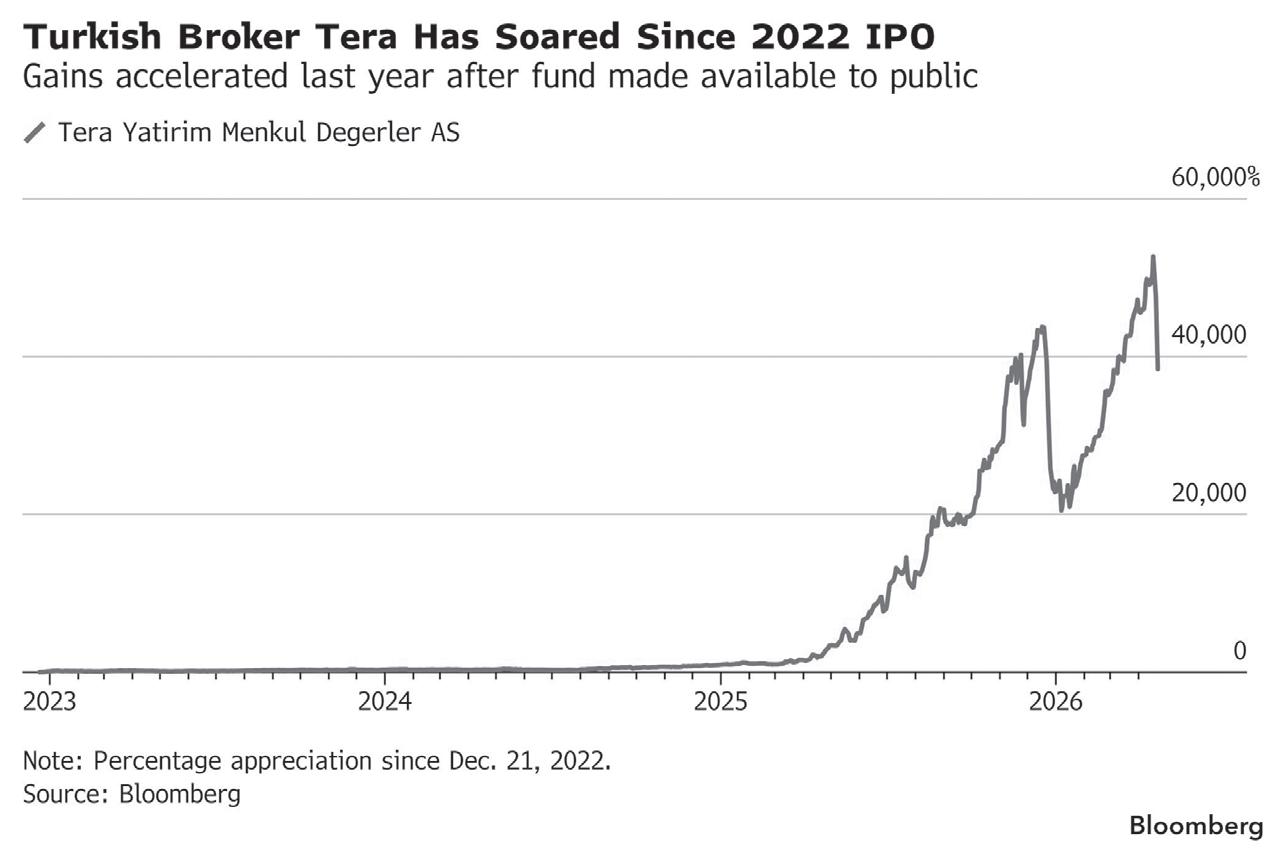
Behind the 40,000% stock surge that’s mystifying Turkey traders
By Tugce Ozsoy, Ugur Yilmaz and Donal Griffin Bloomberg
AT first, it was just a curiosity in Turkey’s financial circles: An obscure brokerage firm with a stock that went up and up.
As the months went by last year, though, the gains in shares of Tera Yatirim Menkul Degerler AS just kept coming, over and over, in staggering amounts—54%, 108%, 61%, 73%. Even in Turkey, long a hotbed of speculative manias, the sheer pace and scope of the surge—now totaling almost 40,000% since Tera’s 2022 initial public offering—stunned investors and sparked a fascination with the financial alchemy that seems to have powered it.
To this day, not all the details are fully understood, but a picture has emerged of a firm taking unconventional steps that appear to have fueled a surge in the value of its own stock, according to finance experts who’ve looked at the trading. While the shares have started to slide this week, Tera still has a market value of $4.5 billion, making it one of Turkey’s most valuable companies despite having only about 130 employees. At times this
year, the firm has been worth more than global players with thousands of employees such as Lazard Inc. and BGC Group Inc. At the heart of the business is its flagship investment fund, which has gained a cult following on social media for minting astronomical returns: more than 1,500% in the past year alone. It achieved those results by pouring billions of lira into a tight circle of related companies and amplified the bets with borrowed cash. The fund amassed stakes in Tera itself, as well as Tera subsidiaries and companies that Tera’s brokerage has helped take public. Tera’s multiple roles may create “layered conflicts of interest” that amount to “high-risk structural conditions,” said Orkun Saka, a lecturer at City St. George’s, University of London who’s studied Turkey’s economy. The fund’s purchases “push up affiliated stock prices, which inflates the fund’s
net asset value, which makes the fund management business appear more valuable, which elevates the parent company’s earnings and stock price,” he said. “This loop is self-reinforcing by construction.”
Now those gains are drawing scrutiny from regulators and raising questions about Tera’s transactions. Watchdogs at the Capital Markets Board are mulling new rules that would limit a fund’s exposure to related parties and cap concentrated investments, according to a document seen by Bloomberg News. The proposal is aimed mainly at Tera’s strategies, said people familiar with the matter, asking not to be identified discussing draft proposals. A

spokesperson for the regulator declined to comment.
In the meantime, the surge has propelled Tera’s founder into the ranks of the richest people in Turkey. Emre Tezmen, a 53-year-old former financial analyst, founded the firm 20 years ago and owns a 32% stake that is now worth $1.4 billion. In an interview at Tera’s headquarters in Istanbul, he rejected any criticism of the firm’s strategy.
“Everything we do here is in line with the regulations,” Tezmen said. “We haven’t done anything that hasn’t been done in global markets.”
The frenzy around the firm began picking up steam in July last year, when it made the Tera Portfoy First Mutual Fund available to retail investors.
The fund quickly drew an ardent following on social media. Regulatory filings show that at one point in 2023 the fund had 99% of its assets in a single stock — shares of its own parent, Tera.
The fund bought shares in publicly traded Tera subsidiaries, and used borrowed money to buy more shares, filings show. And it invested in companies that Tera’s brokerage unit had helped take public yet which had relatively few shares available for trading, known in finance as a small “free float.”
Tera classifies the $2.7-billion
fund as a high-risk investment.
“It is designed for qualified investors with a medium- to long-term investment perspective, who can tolerate market fluctuations and are suitable for a high risk level,’’ according to the fund’s website.
One of the most eye-popping examples of the Tera strategy: a finance company called Destek Finans Faktoring AS. Bankers for Tera took the company public in 2025 and Tera’s fund accumulated a stake that reached 26% of assets under management.
The stock has surged more than 4,700% since the IPO at 46.98 liras a share, making Destek the third-largest company on the Borsa Istanbul, with an $18.8 billion market value.
The Tera fund’s stake now accounts for 18% of the free float. A representative for Destek Finans said in an email that the stock’s performance is driven “by free market principles and the company doesn’t have any interference.”
Another Tera-owned stock that saw relatively extreme moves was mining company Visne Madencilik Uretim Sanayi ve Ticaret AS. In February 2025, Tera’s brokerage arranged a small IPO for Visne that put just 21% of the company’s outstanding stock in public hands.
The stock immediately began to soar and by the end of July was up by more than 2,100%. That same month, Tera’s main fund and brokerage sold the Visne shares they had purchased in the IPO, filings show. The next month, the stock crashed. It lost 75% in August alone and is now down 89% from its peak. A Visne representative declined to comment.
Tera’s trading of Visne ran afoul of regulators. In October, the Capital Markets Board fined two of the firm’s fund managers 8.9 million liras ($199,000) each over transactions involving the stock. They created “misleading perception on the price, supply and demand” for the shares, the regulator said, without elaborating. Tera didn’t reply to a request for comment on the fines.
Inflation seen to spur another 25-bps rate hike
Continued from A1 a result of the US-Iran conflict, it added.
“Given the weak growth backdrop and limited fiscal space, we think the BSP will prefer to keep rates on hold to support the economy,” BMI said.
Remolona: As many hikes as necessary IN an interview with Bloomberg’s The China Show, BSP Governor and Chairman of the Monetary Board Eli M. Remolona Jr. said the central bank is being proactive and staying ahead of the curve.
“We stay vigilant, and we’ll do as many hikes as necessary,” Remolona said.
The “big jump” in March’s inflation print was largely due to the oil price shock, Remolona said.
With the “big jump” in March’s inflation print due to the oil price shock, Remolona said the BSP could deliver a succession of small rate hikes, but it will depend on how big the spillover effects are.
“We have to just watch the data and measure expectations,” Remolona said, noting that the BSP’s inflation expectations have risen but haven’t become unanchored.
Rate hike aftermath
ACCORDING to Jean De Castro, Manulife Investment Management’s head of fixed income, the recent interest rate hike means “tighter” financial conditions ahead.
This includes higher borrowing costs and a more cautious credit cycle—while also providing some support to currency stability and helping prevent the inflation shock from becoming more persistent, De Castro said.
For Filipino investors, De Castro said bond yields are attractive at current market levels.
However, price risk remains if the market will price in more interest rate hikes, with long-dated funds becoming more sensitive to this risk.
“The fact that long-end yields are generally holding steady suggests investors see policy credibility and the likelihood that the BSP will act to help contain second-round inflation, and growth softness offsetting inflation fears,” De Castro said.
With long-end fixed income yields at current levels, De Castro said it is easier to meet return targets with coupons rather than relying on price gains.
“For investors adding exposure now, this is a better entry point for high-quality peso government bonds and conservative fixed-income funds,” De Castro added.
The FPI said its appeal is anchored on the state’s duty under RA 7394 to shield consumers against hazards to health and safety and against deceptive, unfair, and unconscionable practices.
“Regulators invest months or years in consultations, testing, and technical review to craft standards, yet these can be neutralized by a single restraining order obtained through forum shopping among numerous trial courts,” the group said.
The FPI called on the SC to apply the same principle in environmental cases to product standards, which states that “Except the Supreme Court, no court can issue a TRO or writ of preliminary injunction against lawful actions of government agencies that enforce environmental laws or prevent violations thereof.”
For the group, the harm caused by substandard products can be “sudden, widespread, and fatal,” thus warranting the same measures applied to environmental cases.
As a country often affected by weather-related shocks and earthquakes, the FPI highlighted the danger of substandard construction materials.
“We cannot predict when a major disaster will happen, but we can reduce risk by ensuring the integrity of materials used in homes, buildings, and infrastructure.”
With this, the FPI urged the high court also to adopt a rule stating that only the SC can issue TROs or preliminary injunctions against lawful DTI and FDA actions implementing mandatory standards, conformity assessment, product registration, licensing, market surveillance, and enforcement measures.
“We respectfully appeal for a clear procedural safeguard that empowers regulators to do their job and protects Filipino consumers nationwide.”
Initial plans cover a 4,000acre (1,618 hectares) lease area, with the first two years serving as a grace period to support early development. Lease terms beyond this period will be negotiated separately.
Funding arrangements and participation are still being finalized, and the project is expected to involve joint participation, with the Philippine government open to supporting early-stage studies. There are also indications of possible involvement from the United States, although no commitments have been confirmed.
No specific companies have been identified so far, but officials said there has been initial investor interest. Incentives for locators are expected to align with existing frameworks under the CREATE MORE law and other investment promotion policies. The agreement will be structured in accordance with Philippine laws on economic zones and public land use, including the Special Economic Zone Act and the Bases Conversion and Development Act.
Still, the near-term environment argues for staying disciplined because inflation, oil and foreign exchange-driven volatility can quickly push yields higher and create mark-to-market losses, especially in longer-duration funds. all courts to protect constitutional rights and public welfare, and “can likewise adopt a procedural safeguard to prevent the abuse of injunctive relief against nationwide product safety measures.”
www.businessmirror.com.ph
BDO posts modest 2% net income growth in Q1 on higher provisions, low-rate yields
Reine Juvierre S. Alberto
SY-LED BDO Unibank, Inc.
(BDO) posted a modest firstquarter net income growth of 2 percent as higher provisions and lower interest rate-driven yields weighed on its earnings.
In a press briefing on Friday, BDO President and Chief Executive Officer Nestor V. Tan said the bank’s net income rose by 2 percent to P20.1 billion in the first quarter from P19.7 billion in the same period last year.
Tan said the slower year-onyear net income growth was due to pricing issues due to lower interest rates, as the Bangko Sentral ng Pilipinas (BSP) cut key policy rates by a total of 125 basis points. “We cannot control policy rates, and that drives yields on loans,” Tan said.
With the BSP turning more hawkish, Tan said it is a “two-edged sword” for BDO, as its margins will slowly move up, but will be tempered by competition.
“The funding costs will also be going up and there’s a possibility that delinquencies will eat up. So we’ll have to look at the balance of all three,” Tan added.
Moreover, in a separate press release, BDO said its net income was tempered by higher provisions as it builds up its reserves as a preemptive measure in response to evolving geopolitical risk conditions.
Tan said the bank is concerned about the Middle East war, as there is no clear resolution in the conflict.
The resulting inflation shock may also weigh on consumption spending, while BDO’s corporate
capital expenditures may be affected, Tan added. The bank has no plan to scale down despite its fears of inflation impacting its corporate capex, particularly expanding its physical branches.
“The underserved continue to be underserved and that’s what we’re going after,” Tan said, noting that the bank targets to put up 120 physical branches this year.
However, Tan said he is concerned about loans for large-ticket items, such as people putting up new buildings or showrooms or others expanding their supermarket outlets.
BDO also reported mid-teens growth in loans and pre-provision operating profit, with asset quality continuing to improve.
Net interest income rose by 11 percent as gross customer loans increased by 16 percent to P3.8 trillion, boosted by the doubledigit growth across all market segments.
Total deposits also jumped by 15 percent, with current account/ savings account (CASA) growth increasing to 7 percent.
Moreover, non-interest income went up by 6 percent, while income from insurance operations expanded by 27 percent.
Non-performing loan (NPL) ratio of the bank declined to 1.68 percent from 1.77 percent in the same period last year, with NPL coverage at 132 percent.
Shareholders’ equity also grew by 9 percent on the back of sustained earnings, with book value per share rising by 8 percent to P119.36. BDO’s common equity tier 1 ratio also stood at 13.3 percent.
DepEd asks DHSUD, Pag-IBIG to give teachers priority in housing
NOTING the challenges they face in securing homes due to rising property costs, limited financing access and lack of information on available housing programs, Education Secretary Juan Edgardo “Sonny” Angara has initiated the coordination with the Department of Human Settlements and Urban Development (DHSUD), and the Home Development Mutual Fund to secure priority access for public school teachers and education personnel in the upcoming nationwide housing fairs.
“ Sa pamamagitan ng pakikipagtulungan natin sa Pag-IBIG, sinisiguro natin na ang ating mga guro ay prayoridad sa programa sa pabahay ni Pangulong Bongbong Marcos. Layunin nating pagaanin ang proseso para magkaroon sila ng sariling tahanan na abot-kaya at disente ,” Angara said. The initial leg of the housing fairs are scheduled for April 27 to 28 at The Jose Rizal Coliseum in Calamba City, Laguna, and April 30 to May 1 at the IEC Convention Center in Cebu City.
CEO Marilene Acosta of the Home Development Mutual Fund, commonly known as the Pag-IBIG Fund, expressed full support for the partnership, saying the agency is committed to providing specialized lanes and dedicated counselling to ensure educators are well-informed of their benefits.
“At the Pag-IBIG Fund, we fully recognize the vital role that teachers and education workers play in shaping the future of our country.
That’s why our housing fairs are meant to be a concrete way of fulfilling the directive of President Marcos to bring quality and affordable housing to more Filipinos, especially those in the education sector,” Acosta said, partly in Filipino.
Through the Pag-IBIG housing fairs, DepEd personnel can explore affordable housing units, receive on-site counseling on financing terms and requirements, and initiate loan applications while availing exclusive offers for government employees.
To facilitate a smoother experience, registered employees will be issued a Pag-IBIG Loan Value Card, which expedites evaluation at developer booths and allows for a preliminary loan assessment.
Depending on the number of pre-registered participants, Pag-IBIG has arranged shuttle services to transport personnel to the housing fair sites for added convenience.
This institutional push aims to replicate the success of long-time employees like Maridel Ignacio, who secured a home in Rizal province through a special housing loan facility of DepEd in partnership with Pag-IBIG. Ignacio availed of the

PBBM visiting Japan in late May amid preps for 70th anniversary
By Samuel P. Medenilla
PRESIDENT Ferdinand Marcos
Jr. will go on a State Visit to Japan next month as it prepares for its upcoming celebration of the 70th anniversary of the normalization of diplomatic relations with the Philippines.
In a statement on Friday, the Presidential Communications Office (PCO) announced that Marcos has accepted the invitation of the Japanese government to travel to Japan. He will be accompanied by First Lady Louise AranetaMarcos.
The State Visit will be held from 26 to 29 May 2026 and includes the President and First Lady’s visit to the Imperial Palace to meet with Japanese Emperor Naruhito and Empress Masako for a Welcome Ceremony, State Call, as well as a State Banquet.
Marcos will then hold a summit meeting with Japanese Prime Minister Sanae Takaichi to discuss how to enhance Philippines-Japan Strengthened Strategic Partnership.
Both state leaders will also tackle current international developments, especially with regard to energy and food security, and maritime security.
Earlier this month, Japan hosted the online Asia Zero Emission Community (AZEC) Plus Online Summit, where Marcos thanked Takaichi for launching a regional supply chain strengthening program.
To cap his upcoming weeklong trip to Japan, Marcos will also meet with Japanese business groups and the members of the Filipino community in Japan.
The visit comes a few months before the anniversary of the normalization of Philippines-Japan diplomatic relations on 23 July,
which will be celebrated this year with the theme: “Weaving the Future Together: Peace, Prosperity, Possibilities.”
It has been over a decade since a Philippine President undertook a State Visit to Japan. The last was that of former President Benigno S. Aquino IIl in June 2015. However, it will be Marcos’ fourth trip to Japan since the start of his presidency.
The first was in February 2023 when he accepted the invitation of former Japanese Prime Minister Fumio Kishida for a working visit, and the second was in December of the same year to attend the Association of Southeast Asian Nations (Asean)-Japan Friendship and Cooperation Commemorative Summit.
Last year, the President also travelled to Japan to visit the Philippine Pavilion at Expo 2025 in Osaka.
Bigger baskets, fewer trips mark sari-sari stores shift–study
By Bless Aubrey Ogerio
SARI- SARI stores across the country saw a sharp jump in sales in March as both retailers and consumers began stocking up, reacting to rising fuel costs and concerns over possible supply disruptions.
Data from local tech firm Packworks, drawn from over one million transactions on its Sari.PH Pro app, showed gross merchandise value (GMV) across its network of around 300,000 stores climbed to P3.73 billion in March, up from P1.97 billion in February.
The surge coincided with global oil price increases linked to tensions in the Middle East. Packworks said the strongest spike came on March 21, when GMV
SEN. Sherwin Gatchalian is asking Congress to move fast on his bill keeping minors below 16 off limits to social media.
Gatchalian has filed a bill that prohibits children below 16 years of age from registering, accessing, or maintaining accounts on any social media platform.
“It’s time to protect our youth from the harm done by social
rose by 265 percent, days after the announcement of double-digit fuel price hikes on March 17.
Further, consumers traditionally driven by “tingi,” or small, daily purchases, are now consolidating their shopping trips to manage rising expenses.
Average basket sizes, or the amount spent per visit, increased significantly, from a range of P337 to P1,097 in February to between P597 and P1,560 in March.
While spending rose, transaction volumes grew by a more modest 17 percent, indicating that shoppers are visiting stores less often but buying more each time.
“In some regions, delivery lead times have reportedly stretched to three weeks, forcing retailers to prioritize bulk purchasing of fast-moving goods,” Packworks
media. Let us not wait for the problem to worsen before we act,” said Gatchalian in filing Social Media Safety for Children Act (Senate Bill No. 2066).
The proposed measure follows the lead of countries that have imposed similar bans, including Australia - the first to do so - which passed the Online Safety Amendment (Social Media Minimum Age
said in its report. Meanwhile, Packworks chief data officer Andoy Montiel said that sari-sari store owners are proactively adjusting their purchasing strategies with growing uncertainty and rising oil and commodity prices.
“Larger basket sizes and increased inventory levels indicate a shift toward preparedness for potential supply disruptions and rising costs,” Montiel added.
The trend was seen across regions, with the Cordillera Administrative Region recording the highest increase in basket size at 101.7 percent, from P773 to P1,560.
The National Capital Region followed with an 85-percent increase, while the Bangsamoro Autonomous Region in Muslim Min -
danao posted an 80.2-percent rise. In commonly purchased items, cigarettes recorded the largest increase at around P234 million, followed by detergent at P116 million, gin at P66 million, powdered coffee at approximately P55 million, and chips and dips at P45 million. Other everyday goods such as soda, biscuits, powdered milk, and canned products also posted higher sales during the period, per Packworks.
“As the backbone of local communities, sari-sari stores continue to demonstrate resilience in times of disruption,” Packworks chief platform officer Hubert Yap said. “However, they remain highly vulnerable to price fluctuations and logistical challenges, highlighting the need for continued support,” he added.
The DICT, in coordination with the DSWD, DepEd, NTC, NPC, and other relevant government agencies and private stakeholders, shall promulgate the rules and regulations within ninety days after the effectivity of this Act.
Butch Fernandez
Act 2024), effective December 2025. In Southeast Asia, Indonesia became the first to enforce a similar restriction by banning social media access for children under 16. Under Senate Bill No. 2066, social media platform providers will be required to adopt age and identity verification systems, conduct regular audits to deactivate accounts of age-restricted users, and establish reporting and response mechanisms for underage access, among other safeguards.
Cebu solon files anti-DUI law amendments
By Carmel Pedroza
CEBU CITY— A new measure seeking tougher rules against drunk and drugged driving has been filed in the House of Representatives, following a series of deadly road incidents in Cebu, including the widely mourned death of young entrepreneur Kingston Cheng.
Cebu City South District Rep. Eduardo “Edu” Rama Jr. filed on April 22, 2026 House Bill 8939, which proposes sweeping amendments to Republic Act No. 10586.
The proposed law aims to strengthen enforcement, lower allowable blood alcohol levels, and introduce stricter penalties under a broader “Vision Zero Philippines” framework—an approach that treats road deaths as preventable rather than inevitable.
“Road safety in the Philippines has become a public health crisis that demands stronger, more responsive laws,” Rama said, citing a rise in DUI-related crashes across Cebu.
after road kills
Family seeks justice, reform
IN a statement, the Cheng family said Kingston’s death exposed gaps in both the law and its enforcement.
“We find it ironic that the

very law that could have prevented Kingston’s death also prevented us from seeking justice and full closure. The incident could have been avoided. The law could have been enforced,” the family said. They emphasized that the proposed amendments are meant not only to improve road safety but also to ensure accountability.
“For us, the true purpose of these amendments is to prevent the same heartbreak from happening to others. If tragedy strikes again, God forbid, these reforms should guarantee that the law is enforced to its fullest extent,” they added.
The family also thanked the University of San Carlos College of Law, particularly Joan Largo and Jose Glenn Capanas, as well
NBI files human trafficking charges vs Defensors after Pasig hotel raid
By Joel R. San Juan
THE National Bureau of Investigation (NBI) has filed human trafficking charges against the wife and son of former Rep. Mike Defensor, a known critic of the Marcos Jr. administration, before the Pasig City Prosecutor’s Office.
Recommended for prosecution were Julie Rose Defensor and Miguel Gabriel Defensor, wife and son of the former solon, along with several other individuals for allegedly being involved in a suspected trafficking-in-persons “network operating within a nightclub and hotel establishments identified as Chicago Nightclub and Bleu Hotel in Pasig City.”
The NBI has recommended the filing of charges for violation of Republic Act No. 9208, as amended (Anti-Trafficking in Persons Act), and Republic Act No. 9165 (Com -
Anti-DUI. . .
Continued from A3
as law students who helped craft the policy recommendations behind the bill.
Key reforms in the bill
HOUSE Bill 8939 introduces stricter blood alcohol concentration (BAC) limits—setting a near-zero tolerance for novice and professional drivers and lowering the cap for private motorists.
It also mandates alcohol and drug testing in serious crashes, requiring authorities to conduct chemical tests within two hours in incidents involving injury or death.
Drivers who refuse testing may face a rebuttable presumption of intoxication, alongside administrative penalties such as license revocation.
Law enforcement officers would also be empowered to collect “secondary evidence,” including witness testimony and video recordings, in cases where standard tests are unavailable or refused.
Tougher penalties, focus on high-risk areas
THE measure imposes heavier penalties for violations in so-called “vulnerable zones” such as school areas, hospitals, and dense residential communities.
Fatal DUI cases in these areas could carry life imprisonment and fines reaching up to P1 million.
The bill also introduces shared liability for parties whose viola -
prehensive Dangerous Drugs Act of 2002).
“Corporate records obtained in the course of the investigation indicate that the registered owners of the establishment are the wife and son of former Congressman Mike Defensor,” the NBI said. It, however, stressed that this information is part of the ongoing investigation and “does not, by itself, establish criminal liability.”
“All persons concerned are presumed innocent unless proven guilty in a court of law,” the NBI said.
tions—such as illegal parking— contribute to accidents.
Repeat offenders would be required to undergo rehabilitation programs before regaining driving privileges.
Responding to a pattern of crashes
THE proposed reforms come amid a pattern of late-night and early-morning crashes in Cebu City, many linked to intoxicated driving.
High-traffic areas such as the South Road Properties have seen multiple collisions, including fatal incidents during recent holidays.
Rama said the law must reflect local realities, where road infrastructure often lacks safeguards like sidewalks and protected crossings, increasing the risk for pedestrians.
Toward “Vision Zero”
THE bill adopts a “Vision Zero” approach, a strategy used in countries like Sweden and Japan, where road systems and laws are designed to minimize fatalities.
“The goal is simple: no loss of life on our roads should ever be considered acceptable,” Rama said.
For the Cheng family, the push for reform is deeply personal.
“Kingston’s memory demands that we move beyond purely punitive measures. By focusing on accountability and science-based enforcement, we can transform our roads into safer spaces for all Filipinos,” they said.

The NBI said Bleu Hotel is owned by Zerrin Development Corporation, where Defensor’s wife and son were listed as president and treasurer, respectively.
‘Baseless, malicious’
JULIE , in a statement, branded as “baseless” and “malicious” the allegations made by the NBI against them.
“Let me be absolutely clear regarding the recent NBI operation: we have absolutely no connection to the targeted establishment or its operation. Any attempt to link our family to the abhorrent acts allegedly committed there is a deliberate, dangerous, and desperate lie,” she said.
“The motive behind this orchestrated smear campaign is painfully obvious. This is fabricated pretext designed to artificially manufacture a case, with the chilling goal of filing unwarranted, unbailable charges” against their family, she added.
Julie also tagged as “political attack” the filing of a case against them which left 1,000 employees jobless.
“These are 1,000 families stripped of their livelihoods in the middle of a crisis. It is unconscionable that innocent workers are being sacrificed as pawns in someone else’s political vendetta,” she added.
Julie said their camp would avail itself all legal remedies to “clear our names, expose this harassment, and hold those responsible accountable.”
The filing of charges stemmed from an entrapment and rescue operation conducted last April 21 at Chicago Nightclub and Bleu Hotel where 54 women believed to be victims of human trafficking were rescued.
The operation was conducted by the NBI Special Task Group (NBISTG) after receiving intelligence information regarding the alleged recruitment and exploitation of women for sexual services.
The NBI said surveillance and case build-up operations confirmed that the establishments were facilitating a systematic scheme of sexual exploitation.
Operatives from the NBI operatives, in coordination with the De -
More cooperation seen between PHL, Japanese counterparts
partment of Justice-Inter-Agency Council Against Trafficking (DOJIACAT), the Department of Social Welfare and Development (DSWD), and other partner agencies, executed the operation, resulting in the successful rescue of victims and the apprehension of key individuals, including the managers, facilitators and customers.
Based on its initial investigation, it was established that customers were initially entertained inside Chicago Nightclub, where women were presented through a “line-up” system.
Once a customer made a selection, the parties were then brought to rooms at Bleu Hotel, where the sexual services were allegedly consummated.
The NBI said the women were being paid between P5,000 to P15,000 per encounter, depending on the arrangement, with portions of the payment allegedly distributed among facilitators, managers, and other individuals involved.
The rescued victims have been turned over to the appropriate social welfare authorities for proper care, protection, and assistance.
JICA taps Japanese experts to help in Navotas fire; Risa seeks waste system review
THE Government of Japan and the Japan International Cooperation Agency (JICA) have activated its Japan Disaster Relief (JDR) Operations following a request from the Government of the Philippines, through the National Disaster Risk Reduction and Management Council (NDRRMC), in response to the fire at the Navotas Landfill that has raised alarm over the spreading air pollution.
JICA Philippines welcomed on Thursday a six-member team of experts deployed from Japan. Led by Minister Yokota Naobumi of the Embassy of Japan, the expert team will stay in the Philippines for the duration of its mission to carry out technical assessments and provide guidance in close coordination with relevant Philippine authorities.
The incident at the 41-hectare landfill, reported from early March, has raised concerns due to its scale and potential impact on Navotas City and surrounding communities in Metro Manila. Local authorities have been carrying out ongoing response efforts to address the fire and safeguard public welfare. Through the JDR Operations, the Japanese expert team will work closely with Philippine counterparts to assess site conditions, help identify contributing factors, and provide technical guidance to support and strengthen existing response measures.
The Japan Disaster Relief (JDR) program is a core pillar of JICA’s cooperation with partner governments, providing timely assistance in times of disaster and supporting recovery efforts. In the Philippines, JICA’s engagement through JDR dates back to the 1990 Baguio earthquake and continues today, including humanitarian support provided following the Magnitude 6.9 Cebu earthquake in 2025.
‘Time to revisit solid waste management systems’ RELATEDLY, Senator Risa Hontiveros on Friday renewed her

call for a comprehensive review of the country’s solid waste management framework, RA 9003 and its amendments, amid frantic efforts by national and local authorities—and now joined by Japanese experts – to put out the landfill fire in Navotas that has affected nearby communities and raised serious environmental and public health concerns.
“For days, residents in the Camanava area, some other areas in NCR, and even as far as Bataan have been exposed to unhealthy air quality that was never supposed to pose this kind of danger. This incident is deeply alarming,” Hontiveros said.
In February, Hontiveros filed Proposed Senate Resolution No. 285 which calls for an investigation into the systemic failures of the national solid waste management framework following the collapse of the Binaliw landfill in Cebu City. “This is exactly what we wanted to avoid when we filed PSN 285. This kind of incidents should no longer be repeated. The realy tragedy is when we don’t do anything to redress the lapses in our solid waste management system,” she said, partly in Filipino.
The Navotas landfill fire is not an isolated incident and reflects recurring failures in regulation and waste management, Hontiveros said, citing past landfill disasters
in Cebu City and Rodriguez, Rizal as a result of continued reliance on landfills.
“Our laws are clear. Landfills are meant to be the last resort and not the default solution. But gaps in the implementation of waste reduction, segregation, and recycling at the local level continue to push large volumes of waste into landfills,” she said.
Hontiveros also flagged oversight gaps, citing Sec. 16.1 of Department of Environment and Natural Resources Administrative Order No. 2017-15, which limited Multipartite Monitoring Teams (MMT) to Environmentally Critical Projects. The classification of landfills below a certain capacity to Non-ECPs or Category B projects ensured that many in the country escaped regular monitoring and oversight.
“If monitoring is weak, breaches of environmental standards happen. The DENR must ensure that the obligations under the ECC, including the correct way for closing landfills and rehabilitating them, are strictly followed,” she said.
Hontiveros reiterated her call to prioritize the inquiry under PSN No. 285 to ensure accountability, strengthen enforcement, and prevent similar incidents from happening in the future. With a report by Butch Fernandez
COOPERATION and partnership between the Philippine Navy (PN) and the Japan Maritime SelfDefense Force (JMSDF) was further expanded following high-level meetings between its ranking officials last April 22.
This was after Philippine Fleet chief Rear Admiral Joe Anthony Orbe met with JMSDF Self— Defense Fleet Amphibious and Mine Warfare Force commander Rear Admiral Ikeuchi Izuru, Commander of the Amphibious at Naval Operating Base Subic, Zambales, the PN said on Friday.
“Accorded full arrival honors, Rear Admiral Izuru proceeded to a formal meeting with Rear Admiral Orbe following the guestbook signing. The engagement concluded with an exchange of mementos and a commemorative photo,” it added.
During their meeting, the two officials discussed strengthening naval cooperation, enhancing interoperability, and advancing joint maritime security efforts between the PN and the JMSDF.
“The visit comes amid Japan’s expanded participation in Exercise ‘Balikatan’ 2026, involving approximately 1,400 personnel and the deployment of Type 88 surface-to-ship missile systems—marking a significant step in Japan’s growing operational role in the region. Such engagements also reinforce both nations’ shared commitment to a rulesbased international order, particularly the principles of freedom of navigation, respect for sovereignty, and the peaceful resolution of disputes in accordance with international law, including the United Nations Convention on the Law of the Sea [Unclos],” the PN said. Rex Anthony Naval
loan facility for DepEd’s housing project in 1996, and now lives in a community alongside her fellow employees. In partnership with DHSUD, Pag-IBIG is showcasing over 20,000 housing units during these events. Additional housing fairs are scheduled for Mindanao and Metro Manila to ensure broad accessibility. To address concerns over affordability, Pag-IBIG has updated its product list to offer more affordable packages, including discounts of up to 45 percent on acquired assets, specialized group sales, and properties matching teachers’ salary brackets. By providing direct access to developers and logistical support, DepEd continues to prioritize the long-term security of its dedicated teachers and staff across the country.
Claudeth Mocon-Ciriaco
BusinessMirror
Specialized zoo tours for people with dementia
By Stefanie Dazio & Pietro De Cristofaro The Associated Press
BERLIN—Christel Krueger peered through thick glass and murky water at the Berlin Zoo, staring in awe at a mother hippopotamus and her child sleeping on a sandbar. Krueger, 86, and her daughter were on a specialized zoo tour last month for people who live with dementia that was organized by Malteser Deutschland, part of the international Catholic aid organization Malteser Order of Malta.
On the tour with Krueger, Ingrid Barkow watched from her wheelchair as the elephants roamed their habitat, while Monika Jansen balanced on her tiptoes to get a better view of a rhinoceros.
“When I get home, I’ll still be thinking about it,” said Jansen, 85. “Maybe even at night, while I’m sleeping and dreaming about it.” The three women are among roughly 1.6 million people living with dementia in Germany, according to the Office of the National Dementia Strategy. The figure is expected to rise to 2.8 million by 2050.
Specialized tours grow worldwide MUSEUMS and other cultural institutions across the globe have added specialized, barrier-free tours and guides to their repertoire in recent years, some made possible by advances in technology.
These include sign-language tours for people who are deaf and hard of hearing, touch-based events for those with blindness or low vision and programs for people on the autism spectrum.
The Berlin chapter of Malteser Deutschland last year designed a cultural program in the capital catering to people with dementia.
“People with dementia aren’t very visible in our society. It’s still a major taboo subject, yet it actually affects a great many people and it’s important that they continue to be at the heart of society,” project coordinator Christine Gruschka said. “They have a right to participate, just like everyone else.”
Millions of people around the globe have some form of dementia, a progressive loss of memory, reasoning, language skills and other cognitive functions. People can experience changes in personality, emotional control and even visual perception. Alzheimer’s is the most widely recognized type, but there are many others, with their own symptoms and underlying biology.
Malteser Berlin’s tours for people with dementia occur at the zoo, the Museum of Natural History, Britzer Garden and Charlottenburg Palace, with hopes of expanding to other locations.
“’Normal’ tours—so-called normal tours—are often too fast, too loud, with too many people and too many distractions,” Gruschka said. “That’s why we’ve made it our goal to create programs specifically for people with dementia: Where they still feel seen, where they feel comfortable, and where they can still show that they’re still here and can still be part of it.”
Dementia-specific tours are key for caregivers and families
KRUEGER , Jansen and Barkow followed Malteser Berlin tour coordinator Carola Tembrink around the Berlin Zoo, accompanied by their daughters and a caregiver.
Tembrink skipped the majority of the zoo’s vast offerings to focus on the hippo, rhino and elephant habitats so the participants would not get too tired or overwhelmed. “The zoo is a wonderful place for tours like this because almost everyone who grew up in Berlin has been here as a child,” Tembrink said. “And especially for people with dementia, childhood memories are often still present—they just need to be jogged a bit—and that happens naturally when they see the animals, smell the air as they enter the zoo, or when they go into the rhino house and catch a different scent.”
For the caregivers and families, the tours are a lifeline. During long and sometimes frustrating days of caring for someone with dementia, a specialized tour lets them connect with others who understand the journey.
TimeOur Japan’s silver workforce: A preview of the global retirement revolution
By Jona C. Redondo
AS populations age rapidly and birth rates decline, governments worldwide face a stark fiscal and economic reality: traditional retirement ages are no longer sustainable. Japan offers a compelling preview of this future.
In recent years, the number of Japanese workers aged 70 and over has reached 5.4 million—nearly matching the 5.71 million in the 1524 age group. These older employees now make up about 8 percent of the total workforce, with 14 percent of employed persons aged 65 or older. This surge reflects both necessity and policy adaptation in the world’s fastest-aging major economy.
The demographic drivers are universal. Globally, the number of people aged 65 and older stands at around 830 million and is projected to more than double to 1.7 billion by the mid-2050s. By 2030, one in six people worldwide will be 60 or older, up from one in 11 recently. Fertility rates have plummeted—from 3.2 births per woman in 1990 to about 2.4 today—while life expectancy continues to climb. In OECD countries, the old-age dependency ratio (people 65+ per 100 working-age individuals) is expected to rise sharply from 33 in 2025 to 52 by 2050. Fewer workers will support more retirees, straining pension systems, healthcare, and economic growth.
Pension systems designed in the mid-20th century—when life expectancy hovered around 60-70 years and workers supported large families—cannot cope with today’s realities. In many developed nations,
retirees now draw benefits for 2030 years. Without reform, public spending on pensions and health could balloon by several percentage points of GDP, forcing higher taxes, deeper debt, or cuts in services. Labor shortages already plague sectors from healthcare to manufacturing, as shrinking cohorts of young workers enter the market. Raising the retirement age addresses these pressures by extending working lives, preserving workforce size, and easing the dependency burden. Japan illustrates both the challenge and the opportunity. Once synonymous with mandatory retirement at 60, the country has overhauled policies through laws like the Act on Stabilization of Employment of Elderly Persons. Companies must now offer continued employment up to age 70 for those who wish it, backed by subsidies and incentives. The result? Employment rates for those 65-69 have soared to over 50 percent, and even those 70+ participate at record levels. Seniors fill critical roles in retail, healthcare, and services—sectors hit hardest by shortages. Surveys show roughly 80% of Japanese workers want to keep working past traditional retirement, preferring their current employers. This model has helped Japan’s labor force top 70 million for

the first time in 2025, despite overall population decline.
Economically, the case for higher retirement ages is compelling. Each additional year older workers remain employed boosts GDP through wages, taxes, and consumption while reducing pension payouts. Older employees bring irreplaceable experience, institutional knowledge, and lower turnover. Studies from the OECD show that extending working lives by even a few years can significantly improve fiscal sustainability. In Japan, seniors have offset labor gaps in aging industries like construction and nursing care, where their numbers have grown dramatically. Globally, delaying retirement could add trillions to economies by sustaining productivity without relying solely on immigration or automation.
Yet challenges remain. Not all jobs suit older bodies or minds; physically demanding roles in factories or healthcare demand adaptations like ergonomic redesigns, flexible hours, or phased retirement. Ageism persists in hiring, and skills gaps may require lifelong learning programs. Health disparities matter too—while many 70-year-olds today are as fit as 50-year-olds were decades ago, inequalities in access to
care could leave some sidelined. Mental health and social isolation risks rise if retirement is abrupt rather than gradual.
Other nations are following Japan’s lead, albeit unevenly. Across the OECD, normal retirement ages are rising. For those entering the workforce in 2024, the average will reach 66.4 years for men and 65.9 for women—up about two years from current retirees. Over half of OECD countries have legislated further increases. Denmark, Estonia, Italy, the Netherlands, and Sweden already set normal retirement at 70 or higher in some projections, with Denmark targeting 70 by 2040. France raised its age from 62 to 64 amid protests. The UK, Australia, Germany, and others plan incremental hikes to 67 or beyond. Even emerging economies in Asia and Latin America face similar pressures as their populations gray faster than expected.
These reforms are not merely cost-cutting measures. They recognize a profound shift: “old age” no longer begins at 65. Advances in medicine, nutrition, and technology mean many people remain productive well into their 70s. Flexible policies— such as part-time options, retraining subsidies, and anti-discrimination
When life suddenly locks you in your body

THE other day, we visited an inlaw at the hospital. He suffered a stroke several days ago in one of the resort islands in the south and had to be flown to Metro Manila immediately. The MRI told it all: he had a brain stem stroke caused by a clot, cutting blood supply to the base of his brain. He’s now in “locked-in state,” meaning nearly all his muscles are paralyzed except for eye movement, yet remains fully conscious. He is 69 years old.
One consoling aspect about his condition is that he can still recognize people and can open his mouth to speak but in a slurred, incomprehensible way. He expresses his appreciation for the presence of those who visit him by crying like a child. Could it also be partly self-pity or fear of the uncontrollable? The good thing also is that he can raise his elbows on his own, but the downside is he cannot swallow, be it fluids or soft food.
When we arrived, we had to wait for while at the ante-room because his diapers were being changed and his body was being wiped clean anew by a female hospital attendant. I could imagine how extremely embarrassing and humiliating it must be to have your private parts touched, handled and wiped, while you lie helplessly, fully aware of what’s happening. This will now be a daily routine for him.
The mind and the feelings are all alive in the man but I couldn’t help but think: what a way to exist, to be imprisoned inside your limp body, completely dependent on strangers.
I immediately remembered the story of Jean-Dominique Bauby, editorin-chief of a popular French magazine, who was also paralyzed from head to toe by a stroke to his brain stem.
and the Butterfly” inspired a wellacclaimed movie with the same title. He was able to prove that life can go on through the blink of an eye.
Bauby was the butterfly trapped in the diving bell but then found a way to release himself through a creative way of communication. The diving bell is an air-filled wooden container that enables divers to work underwater. The butterfly is a creature that transforms from an ugly crawling insect into a flying entity of grace and beauty.

The only body part he could move was his left eye and he learned to communicate with the outside world by blinking specific letters one by one with an alphabet system devised by his speech therapist. With tremendous willpower and creativity, Bauby wrote a memoir of his struggle with “locked-in syndrome.”
His book entitled the “Diving Bell
Will my brother in law who is now confined in his “diving bell” be able to summon the determination, creativity and spiritual faith from within him to cause a butterfly transformation of his present existence? No one can do it for him, except himself. But it would take a devoted support network to help him. The butterfly trapped in the diving bell can only find his way to release through unceasing love, empathy and great understanding. I would call it his oxygen supply, which would include not only his wife, family and friends but his doctor, physical and speech therapist, care giver, and not to forget, his spiritual mentor. Thinking about locked-in syndrome, the more I realize that there are many more of my fellow seniors who are in that state or condition, one way or the other.
Take for example my friend L. who is 76 years old, and is now immobilized and in partial coma because of a stroke. As hard as it is for him, the more difficult part of the ordeal is suffered by his wife, his second, whom he had married just two years ago. She has to stay by his side 24/7. She can no longer depend on the relatives of her husband. They have left her one by one, due to caring fatigue.
Seeing her grow so thin and emotionally drained in just a matter of months, I can see that she too is stuck in the “diving bell” of her commitment made on wedding day to serve her spouse, “for better or for worse till death do us part.” Will she find her own release? When and how?

Then there’s what I call “inverse paralysis” as exemplified by another friend in his 70s whom I will hide under the name Gael. He is not immobilized physically. The real problem is internal paralysis. Since his wife’s demise two years ago, he has practically “given up the ghost” so to speak. He refuses to eat since he says he has no appetite, but in reality, he has lost his appetite for life. An accomplished artist-photographer, he wouldn’t even touch the painting brush, drawing pencil or his favorite camera.
I remember a short story of Edgar Alan Poe about a man who suffers from cataleptic attacks which leave him insensate and seemingly lifeless.
In Gael’s case, it’s his inner self that has become catatonic. He exists but he has prematurely died inside. To borrow the words of one playwright, he has “confined himself entirely within the solitude of his own heart.”
laws—can make extended careers appealing rather than punitive. Japan’s success stems from cultural respect for elders combined with pragmatic incentives; other countries can adapt similar approaches, tailoring them to local contexts.
Critics argue that raising retirement ages disproportionately burdens lower-income or manual workers who face earlier health declines. Solutions must include stronger safety nets, such as disability provisions, targeted support for physically demanding jobs, and incentives for employers to hire and retain seniors. Gender equity matters too—women often face career interruptions for caregiving, leading to lower pensions and later workforce re-entry. The alternative to reform is unsustainable. Unfunded pension liabilities could trigger fiscal crises, forcing abrupt austerity. Labor shortages would stifle innovation and growth, while younger generations shoulder heavier tax loads. Proactive policies, by contrast, turn demographic headwinds into strengths. Investing in healthy aging—through workplace wellness, lifelong education, and inclusive design—ensures older citizens contribute fully. Japan’s 5.4 million septuagenarian workers demonstrate that extended careers are feasible and beneficial. As the global population ages, policymakers must act decisively. Redefining retirement is not about working forever; it is about aligning systems with longer, healthier lives. By raising retirement ages thoughtfully—with supports for health, skills, and flexibility—nations can secure economic stability, honor the value of experience, and build societies where people of all ages thrive. The window for action is narrowing, but the evidence from pioneers like Japan shows the path forward is clear.
Maybe, in life sometimes certain parts of the body need to be shut down so other parts can breathe and come alive.
Maybe individuals suffering locked in syndrome are being compelled by a higher power to focus on the inner self. Perhaps this is the lesson we all need to learn from my brother in law’s predicament. That we have been living in too shallow, meaningless waters and that our hearts and mind need to dive deep into ourselves, because it is precisely depth that many of us need. The thing is the heart of life does not cease to beat even when one is in locked-in syndrome.
He can love, appreciate, with his consciousness. He can bring his mind to deeper levels of awareness and consciousness and greater passion.
As I keep saying, it’s not what life does to you, it’s how you respond to what life does to you. Anything, even the most paralyzing of events, can be used as a vehicle for transforming one’s life into its own greatness.
In an interview, director Julian Schnabel who made a film based on Bauby’s lock-in syndrome said: “Does it take locked-in syndrome to make a human being conscious, to make others empathize? Do we have to get sick for the angels to appear and help us?...This is the story of all of us, who surely do face death and sickness. But if we look, we can find meaning and beauty here.”
And so many more of us in late stage who are locked-in, prisoners in our own aging bodies. I encounter seniors whose spirits are paralyzed by a sense of failure, hatred, regret, trauma, fear, illusions, greed, and others. It’s as if we are on stationary bikes. We pedal on and on but we are not actually moving forward. We are trapped in loveless marriages, toxic relationships with members of our own families. I know one who has become one-track minded in pursuing lasting fame, pathetically pestering people to secure achievement awards that will help burnish his legacy.
WORKERS in Yokosuka, Kanagawa Prefecture, Japan. PHOTOGRAPHER: SOICHIRO KORIYAMA/BLOOMBERG
A SCENE from the movie “The Diving Bell and the Butterfly”

Palawan Group’s PalaSave targets 1 million users in the 1st year

THE Palawan Group of Companies has already onboarded over 60,000 depositors since the launch of PalaSave, a new savings product developed in partnership with the Rizal Commercial Banking Corp.’s (RCBC) DiskarTech.
The Palawan Group of Companies is aiming to reach 1 million Filipinos within the first year of the launch of PalaSave. Under the partnership, PalawanPay, an e-wallet platform supported by Palawan Express Pera Padala branches nationwide, will act as an access point for underserved Filipinos to open a PalaSave basic deposit account through RCBC DiskarTech, the bank’s multilingual financial app available in Taglish and Cebuano.
DiskarTech has been created to reach those in rural, remote, and low-income communities as part of its goal to bring accessible and practical financial
services closer to Filipinos through both digital and physical touchpoints.
PalaSave is a savings feature embedded within the PalawanPay app that offers up to 4.0 percent interest per year. There is no minimum deposit requirement, and the product is designed to provide users with a secure, high-yield savings option directly accessible through their e-wallet.
“For many years, Filipinos have trusted the Palawan Group not only to safely and conveniently send money but also to support their financial needs through services such as pawning, selling gold and jewelry, microinsurance, and a growing suite of business solutions that enable transactions, investments, liquidity, and financial security. With PalaSave, we build on that trust by giving them the opportunity to save and grow their hard-earned money, making financial progress more accessible to every Filipino,” said Karlo M. Castro, president and CEO of the Palawan Group of Companies.
With over 60 years of experience, RCBC brings secure, reliable, and scalable banking infrastructure that supports seamless savings for Filipinos. Through this partnership, RCBC helps extend formal financial services to underserved communities, combining innovation with accessibility to empower more Filipinos to build sustainable saving habits and achieve long-term financial security.
“We are launching the full go-live of PalaSave.
businessmirror.lifestyle@gmail.com • www.businessmirror.com.ph
Trend Micro unveils new identity to boost PHL’s AI frontier
BY RIZAL RAOUL REYES
GLOBAL cybersecurity leader Trend Micro recently announced its rebranding to Trend AI for its enterprise business unit.
Ian Felipe, country manager for the Philippines, said the rebranding signals a shift from reactive protection to proactive, AI-driven security as businesses across the globe, and specifically in the Philippines, pursue integrative generative AI into their core operations.
Ryan Flores, director of research for Trend Micro, compared the current state of technology to the Cambrian era, a period of rapid evolutionary diversification. While AI offers immense potential for productivity, Flores highlighted a significant “tension” between corporate perception and technical reality.
This isn’t just a new feature. It is a fundamental shift in how we deliver services. By embedding the RCBC DiscardTech Savings Hub directly into the PalawanPay app, we are opening doors for all 23 million PalawanPay users. Think about that scale. We are enabling millions of Filipinos, many who have traditionally been underbanked, to open a formal savings account without having to download a new app or visit a physical bank branch. This represents RCBC’s first live implementation of banking as a service,” said Reginaldo B. Cariaso, president and CEO of RCBC.
Users can open an account with no initial deposit and no minimum balance, allowing them to start saving at their own pace without the pressure often associated with traditional banking requirements. They can begin growing their savings with a succeeding deposit of as little as P200, while earning up to 4 percent interest per year. With the ability to transfer money anytime, anywhere, without additional fees, users can steadily build both shortterm and long-term savings goals.
Lito Villanueva, executive vice president and chief innovation and inclusion officer of RCBC, put emphasis on the importance of the Palawan Group’s strong network, especially in the rural areas.
“Digital services alone are not sufficient; access must be supported by trust. Our customers need reliable human support when issues arise,” he said.
Gamers praise new game ‘Pragmata’, Capcom to protect IP
BY PATRICK VILLANUEVA
IN just two days, Capcom’s latest IP Pragmata sold over one million units across platforms, further verifying that the gaming landscape may have shifted back to single players.
Just over a month after the success of Resident Evil:
Requiem, Capcom has found another gold in their library in Pragmata, with plenty of gamers having nothing but praise over the game.
Pragmata is a “science-fiction action-adventure game that depicts the journey of Hugh Williams and Diana, an android girl, in a near-future lunar world.” It is mostly played in third-person. The new IP, according to Capcom, was developed by younger developers inside the company. Although the setting is futuristic, it maintains the story-driven, puzzlefilled gameplay that the company is known for.
Part of its success was their initiative of an early
playable demo, as well as multiplatform support that reached even the Nintendo Switch 2 system.
“Capcom remains firmly committed to satisfying the expectations of all users by leveraging its industry leading game development capabilities in order to create highly entertaining gameplay experiences,” the press statement reads.
The game’s nature has been described by many players as “bringing out the paternalistic instinct” of the player, having plenty of interaction with Diana, a young android.
Pragmata seemingly depicts Hugh and Diana’s relationship as a father-daughter dynamic, with Hugh being protective over her newfound “daughter,” who shares the mission with him. This was readily noticed by players, who easily got attached to the character Diana, mirroring Hugh’s care toward her. “Lovely game. I love being a father,” a Steam review of this game read.
However, this game was also criticized for having an underaged main character, with a few people saying how it is pedophilic in nature simply because of the minor main lead. Moreso, worries about mods, or modifications made by PC users, linger around the internet. Fortunately, the Pragmata community has the game’s back, not letting the “weirdos” around the internet to vilify the legacy that the game might have, with many defending how the game “depicts a normal, loving father-daughter relationship” and that “those who found it weird has some issues they need answered.”
Capcom is in agreement with the general consensus about the protection of the game, even blocking X user @CenturyZetaZZ, who made a post “criticizing” Diana’s censored design. Their perverted post has since then been deleted, and the account suspended afterwards.
According to a global survey commissioned by Trend Micro, while IT teams feel influential, a majority reported being pressured by boards to implement AI despite unresolved cybersecurity concerns.
The study added that most organizations claim to be “AI-ready,” yet confess to a low understanding of the legal and security frameworks required to govern it safely. Flores noted that while the Philippines currently lags behind neighbors like Singapore in terms of raw AI adoption volume, it possesses a unique technical synergy.
“In the Philippines, the gap between business leaders and technical teams is much narrower,” Flores explained. “Filipino decision-makers are more hands-on with AI, giving them a better baseline understanding compared to global peers,” he added.
Data also indicated that Philippine AI usage is heavily “business-driven” rather than purely consumer-focused. Much of the local traffic involves AI for code development and BPO-related voice and speech services, reflecting the country’s strength in the service and outsourcing sectors.
As enterprises move away from third-party tools like ChatGPT to host their own Large Language Models (LLMs), they are introducing new vulnerabilities. Flores warned that many organizations are deploying “Ollama” servers—tools used to run AI locally—but failing to update them, leaving sensitive data exposed to the internet.
The share of AI-related software vulnerabilities is rising, growing from 2.36 percent in 2023 to over 4.4 percent currently.
Felipe said Trend AI’s mission is to secure this evolving stack, ensuring that as businesses innovate, they aren›t inadvertently opening doors to cybercriminals. While Trend Micro remains the parent company, Felipe clarified that the business has been reorganized into specialized units to provide clearer support for different sectors.
Felipe emphasized that the Philippines remains a cornerstone of this global operation. With over 1,100 employees locally, the Philippine office is the secondlargest business unit for Trend Micro globally, serving as a hub for global threat research and support.
Felipe pointed out that the rebranding to Trend AI is more than a name change; it is a commitment to security. By leveraging their position as a world leader in vulnerability disclosure, Trend AI aims to provide “virtual patching”, protecting organizations from threats before a software vendor even releases an official fix.
“AI is changing the risk equation,” said Felipe. “Our objective is to give organizations the confidence to move fast and innovate responsibly. The future is powered by AI, but it must be secured by Trend AI.”
Got an awkward or embarrassing Gmail address? Google is now letting users change it

GOOD news for people who regret the Gmail address they came up with when they registered for an account: Google is now letting users change it.
Google started quietly rolling out the change late last year in India and said this week in a blog post that it’s now available for all Google Account users in the United States. There were no details on when it would be available to users in other countries.
Google’s CEO suggested the update will be welcomed by people who want to keep their accounts but have outgrown the awkward, embarrassing or nonsensical Gmail handles they created after the service launched 22 years ago. “2004 was a good year, but your Gmail address doesn’t need to be stuck in it,” Sundar
Pichai wrote in a post on X, adding that the policy change means users could “say goodbye to v0t3f0rp3dr02004@gmail.com or mrbrightside416@ gmail.com [or whatever you were into at the time].”
The company also updated a help page to reflect the new policy. Here’s a quick runthrough: ■ It’s a simple process. The procedure is fairly easy to follow. First, go to your Google Account page. From the Google homepage in your computer browser or the Google mobile app, click the account icon in the top right corner, and then click or tap Manage your Google Account, then Personal info, then Email. You should be able to click Change Google Account email. If you don’t see it, you might not have the option yet. Google says it’s “gradually
rolling out to all users.” Now you’ll have to enter your new address so make sure you have an idea for what you want. Then click to confirm that you want to make the change. Google says addresses can’t be identical to any existing address or one that was “used by someone in the past and then deleted.” ■ Second thoughts. But what if you miss your old Gmail address? Don’t worry, you’ll still be able to access it because Google is effectively creating a second Gmail address. The old address will remain as an alternate and messages sent to either the old or new addresses will appear in your Gmail inbox. To find out which address an email was sent to,
SEE “GMAIL,” A7
PRESENT during the contract-signing between the Palawan Group of Companies and RCBC are (from left): RCBC executives including Jose Carlo Eufemio, FVP, go-to-market and growth division head; Angelito Villanueva, EVP, chief innovation and inclusion officer; Reginaldo Cariaso, president and CEO; Helen Y. Dee, chairman; alongside Palawan Group executives Bobby L Castro, founder and chairman; Karlo M. Castro, president and CEO; Lilian Castro-Selda, CFO; and Third S. Librea, PalawanPay president and CEO PHOTOS FROM THE PALAWAN GROUP OF COMPANIES
www.businessmirror.com.ph

Earth Day 2026: Together with OPPO for a sustainable future
EVERY year on April 22, Earth Day highlights the importance of protecting our planet to ensure a brighter future for all its inhabitants. As a global technology company serving over 760 million users in more than 90 countries and regions worldwide, Oppo recognizes its responsibility and influence in shaping a more sustainable future.
More than just creating exceptional products and experiences, Oppo integrates sustainability across its operations and innovation, and has pledged to make its entire operations carbon-neutral by 2050. With this goal firmly on the horizon, the company is continuing to implement greener practices, develop more environmentally friendly products, and inspire people all around the world to take real steps to building a sustainable future.
Excessive packaging has become a widespread environmental challenge for the consumer goods industry.
Oppo has introduced the “3R+1D” principle of Reduction, Recyclability, Reusability, and Degradability into its packaging, promoting more sustainable packaging through upgrades to both processes and materials.
According to data from the World Wildlife Fund, around 405 million tons of paper and paperboard are produced globally every year, and paper-based packaging alone consumes approximately 3 billion trees, placing ongoing pressure on forest resources. To reduce paper consumption, Oppo has actively shifted paper-made product guidance information to digital formats. In 2025, this initiative saved about 110 million A4 sheets, equivalent to avoiding the felling of approximately 13,000 mature trees and reducing around 3,500 tons of carbon emissions.
According to estimates from the United Nations Environment Programme, over 430 million tons of plastic are produced globally each year, with more than 11 million tons entering the oceans, posing a serious threat to ecosystems. To minimize plastic usage, Oppo has incorporated natural biomass materials, such as tea residue, into packaging designs. By replacing 10 percent to 30 percent of petroleumbased plastics with these environmentally friendly alternatives, Oppo is not only reducing plastic consumption but also finding a valuable use for biomass waste that would otherwise be disposed of.
These and more and just some of the ways in which Oppo is tackling environmental challenges. In addition to improving environmental practices through its own products and technology, Oppo works closely with communities around the world to inspire greater public participation in environmental initiatives.
Guided by the mission “Technology for Mankind, Kindness for the World,” Oppo will continue to advance sustainability initiatives worldwide, working hand in hand with users, partners, and all sectors of society to build a more sustainable future together.








BusinessMirror









nubia Neo 5 GT 5G: Game on, game long

FOR the most dedicated mobile gamers, nubia’s Red Magic phones have become something of a grail. Not just because of their industrial, gaming-centric design, but because of what they deliver—active cooling systems, shoulder triggers, and performance that holds steady even after hours of play. They’re built for long sessions, and they’ve earned that reputation. The only catch is the price, as RedMagic sits firmly in flagship territory. The nubia Neo 5 GT 5G takes those same gaming priorities and brings them to a more accessible level.
You don’t get the full Red Magic hardware, but you do get much of the experience—from a gamingfocused design with LED lighting, to a built-in active cooling fan, shoulder triggers for added control, and bypass charging that allows the phone to draw power directly to reduce heat and maintain stable performance.
But will it be enough to satisfy the gaming cravings of your inner Technivore?
DESIGN AND BUILD
I HAVE to give props to the nubia Philippines team for making our unboxings way more interesting than most other brands. It’s actually one of the reasons why
no raised camera bump, meaning no wobble when laid on a table. It sits steady whether you’re tapping through menus or mid-match and resting it between rounds.
The nubia Neo 5 GT comes in Phantom Black, Stellar Silver, and Electro Gold. The Phantom Black keeps things understated, while Stellar Silver highlights the patterns and lighting more clearly. Electro Gold leans fully into the gaming identity. It measures 163.6 x 75.8 x 8.4mm and weighs around 210 grams. It’s not a small phone, but the flat edges and balanced weight make it comfortable to hold in landscape, exactly how most people will use it.
The phone also carries an IP64 rating for dust and splash resistance while the air duct area carries an IP5X rating, which is a reasonable trade-off.
DISPLAY AND AUDIO
THE nubia Neo 5 GT uses a 6.8-inch AMOLED display with a 144Hz refresh rate and a 1224 x 2720 resolution. Peak brightness reaches up to 4,500 nits, making it usable even under strong outdoor lighting.
The high refresh rate keeps everything fluid from everyday navigation to fast-paced games, without noticeable stutter. More importantly, responsiveness feels consistent. With a touch sampling rate of up to 550Hz, inputs register quickly with very little delay between action and response.
The AMOLED panel delivers vibrant colors, deep blacks, and enough sharpness from its 1.5K resolution to keep everything clear without looking overprocessed. The flat display also works in its favor—no accidental touches, no distracting edge reflections—just a more controlled experience when playing in landscape.
FPS, while Honor of Kings runs around 80 to 90 FPS. Genshin Impact is more demanding, but still delivers between 50 to 60 FPS at higher settings, with occasional drops during more intense scenes.
CONTROL, TRIGGERS, AND EXTRAS
THOSE capacitive shoulder triggers can be mapped to in-game actions like aiming, firing, or activating skills. Moving those controls off the screen frees up visibility and allows faster reactions, especially in competitive play.
Game Space acts as the control center, allowing adjustments to performance modes, fan speed, trigger mapping, and real-time monitoring of frame rate and system status. Notifications can also be blocked during gameplay.
BATTERY
AND CHARGING
THE nubia Neo 5 GT carries a 6,210mAh dual-cell battery. In our daily use, it can stretch close to two days, while gaming comfortably lasts a full day depending on usage.
Charging is handled by 80W wired fast charging. A 0 to 50 percent charge takes around 18 to 20 minutes, while a full charge completes in roughly less than an hour.
Bypass charging is one of the most practical features here. When enabled, the phone draws power directly from the charger instead of cycling through the battery. This reduces heat buildup, helps maintain stable performance, and slows long-term battery wear. For extended gaming sessions, it makes a noticeable difference.
CAMERAS
check the “to” field.
You can switch back to the old address by changing the settings in your Google account.
If you don’t like the new Gmail address you’ve created, unfortunately you’re out of luck—at least for the next year. Google won’t let you create another Gmail address for your account until 12 months have passed. And you can only do so three times in total.
■ Potential issues to keep in mind. Gmail addresses are also used to sign in to other Google services like YouTube, Google Docs as well as thirdparty websites and apps. But the company warns that some non-Google apps and services might not recognize you with the new Gmail address, so it provided some troubleshooting tips on a help page. Google also says Chromebook users might encounter problems, though many issues will go away after a few hours. It advises users to check a troubleshooting page but warned that if the problems persist, “you may need to change back to your previous Google Account email,” although the new address can still be used to send and receive messages. CONTINUED FROM A6
I get excited with every nubia Neo release. They sent us a special package that includes two boxes—one with the device, and another called the Game Master Suit, which contains several extras: a MagSafecompatible case, a nubia GT cable, and the new nubia GT Buds, which also look and sound great. The moment you take it out of its box, there’s no denying that the nubia Neo 5 GT is a gamer’s phone— and this time, it feels even closer to a Red Magic device.
Across the rear, the nubia Neo 5 GT leans into a gamer aesthetic, with RGB lighting built into a patterned strip that resembles a stylized eye, glowing through the back panel depending on your settings. It adds personality without turning the phone into a full light show. You start to notice more of the details the longer you hold it. The power button has a textured finish with a subtle red accent, making it easy to find by feel. Along the sides, the capacitive shoulder triggers sit flush with the frame, almost invisible until you start using them in-game.
Then there’s the part most phones don’t even attempt—actual airflow. Small intake and exhaust vents are built into the frame to support the internal cooling fan. Air moves through the device, not just around it. It’s a functional design decision that explains why the phone isn’t fully sealed like most smartphones.
The back panel is completely flat—which is refreshing, as I’ve grown tired of massive camera “continents” (they’re bigger than islands now). There’s
The stereo speakers with DTS:X Ultra support are tuned for clarity and balance. Highs come through clean, dialogue is easy to understand, and there’s enough depth to make games and videos engaging.
One minor caveat worth noting: the 144Hz refresh rate is only accessible through the Game Space panel rather than system-level display settings. It’s a small inconvenience, but something to be aware of if you prefer managing display settings at the OS level.
STABLE PERFORMANCE = UNINTERRUPTED GAMING
THE nubia Neo 5 GT runs on a MediaTek Dimensity 7400 (4nm), paired with up to 12GB of LPDDR5 RAM and up to 512GB of UFS 3.1 storage. Some may question the choice of the Dimensity 7400 at this price point, and it’s a fair point to raise. The chipset is a capable midrange processor, but it’s not a powerhouse— extremely demanding games pushed to maximum settings will hit its ceiling.
That said, nubia’s answer to this is the active cooling system rather than raw chip performance, and in sustained gameplay tests, that approach holds up. Independent stress tests report the phone maintaining 99.5% performance stability with the fan running—a significant edge over passively cooled midrange rivals. The built-in active cooling fan is supported by a through-flow design. Instead of relying purely on passive heat dissipation, the system helps push heat out more efficiently, keeping temperatures in check during longer sessions.
During gameplay, that translates to steady frame rates. Mobile Legends: Bang Bang stays close to 120
THE camera setup includes a 50MP main sensor with a secondary lens and a 16MP front camera. It performs well in good lighting, producing sharp images with strong contrast and saturated colors.
In lower light, noise becomes more noticeable and results are less consistent. It’s not a camera phone but it can still take good photos with the right setup.
It’s also worth noting that video recording is capped at 30fps, which reflects the hardware’s limitations rather than a software choice. For casual video, this is fine but content creators who need smoother video output may want to factor this in.
SOFTWARE AND EVERYDAY USE
RUNNING on MyOS 16 based on Android 16, the nubia Neo 5 GT remains responsive in daily use. Apps load quickly, multitasking is smooth, and connectivity through 5G, Wi-Fi 6, and Bluetooth 5.4 is stable. The software comes with several pre-installed apps, which may require some initial cleanup and I wish it had its own gallery app instead.
FINAL WORD
THE nubia Neo 5 GT carries that Red Magic DNA, focusing on giving players tools that actually matter during long gaming sessions. But more than competing for benchmark scores, it leans on features like active cooling, shoulder triggers, and bypass charging to keep gameplay stable over time.
Priced at P19,999 for the 12GB/256GB variant and P17,999 for the 8GB/256GB variant, the nubia Neo 5 GT is a good choice for those who want to experience premium gaming features without the flagship pricing.
DepEd bolsters SPIMS program, honors returning OFW teachers
RETURNING overseas Filipino teachers were lauded for their dedication and resilience, with clearer pathways for their reintegration.
This was made possible under the “ Sa Pinas, Ikaw ang Ma’am/Sir ” (SPIMS) program of the Department of Education (DepEd), in partnership with the Department of Migrant Workers (DMW).
At the “ Bayanihan Para sa Balikbayang Manggagawa: A National Reintegration Network (NRN) Fair ” held at the Quezon City Hall, Education Secretary Juan Edgardo “Sonny” Angara highlighted the government’s commitment to ensuring that returning OFWs are supported not just in employment, but also in education and family stability.
In Filipino, Angara recalled that previously, the teachers were brought home and left on their own, leaving them to plan their lives. It's different now, he said, as they are taken to the provinces’ job fairs, immediate services and school visits, where DepEd hired applicants there.
The secretary highlighted the streamlined reintegration process implemented especially for repatriated teachers.
He said the DepEd provides immediate employment pathways and educational support to former overseas-based teachers who are fleeing the ongoing conflict in the Middle East.
Comprehensive approach
ACCORDING to the DMW, the program’s comprehensive approach, which includes financial assistance for employment to 8,047 teachers
and online refresher courses for 521 others, has established SPIMS as the government’s most successful reintegration program for overseas Filipino workers (OFWs).
The department said that since its launch in 2014, the program has assisted over 11,000 licensed Filipino teachers in transitioning from overseas employment back into Philippine public school classrooms.
Teacher “Jennifer,” who spent 12 years in Qatar before returning to teach in Malabon City, credited SPIMS for easing her transition. She said that she inquired via the SPIMS Facebook page and later sent her application through email. Upon her return home, a job was already waiting for her.
Honored and fulfilled
AT a panel discussion, three former OFW teachers were also honored for their inspiring journeys, as they shared how they overcame challenges abroad and successfully returned to the country to teach.
Aylene Lara, who formerly taught in Thailand, described reintegration as a pathway to healing from family separation.
“I didn’t want to work abroad for a very long time because it’s not easy,” Lara said. “[It was my first time being away from family, but it's necessary because of the hardships of life]. My father died while I was away, and that is a hurt I will always carry with me.” She now teaches at the Calero

Integrated School in Liloan, Cebu and credits the SPIMS program as well as the DepEd Schools Division Office, school principal and co-teachers for her smooth reintegration.
In Filipino, she shared that her simple dream of wearing the DepEd uniform while teaching the country’s youth came true because of the SPIMS program. For her, it is an honor and a debt of gratitude for fulfilling her dream, while her family's life has improved.
Displaced from the United Arab Emirates by the Covid-19 pandemic in 2021, Veronica Dungog also praised SPIMS for alleviating fears of unemployment.
She expressed her gratitude to the government, specifically the DMW and DepEd, for allowing her to teach again in the country, specifically at the West Crame Elementary School in San Juan City.
Dungog thanked the two departments for their support, especially in terms of financial needs and employment. She testified that even
during the pandemic, the government did not abandon her and until her return, the support continued.
Heroes, 3x over MEANWHILE, DepEd also provided on-site services at the fair, including registration for Accreditation and Equivalency tests, the Philippine Educational Placement Test for OFW children, access to the Senior High School Voucher Program, 720 scholarship slots under the Teacher Education Scholarship Program, and review incentives for licensure exams.
The department said that beyond providing employment, the SPIMS program addresses national teacher shortages and leverages the global exposure of returning OFWs, helping improve local teaching quality while allowing educators to stay close to their families.
For his part, DMW Secretary Hans Leo Cacdac called them “‘double and triple heroes,’ because they are teachers, and also OFWs.” Marita Moaje/PNA
UE expands scholarships for 2026-27 ahead of 80th founding anniversary
AS it prepares to mark its 80th founding anniversary in September, the University of the East (UE) has opened scholarship slots for School Year 2026-2027 to support financially challenged but academically qualified students.
UE President and Chief Academic
Officer Zosimo Battad said the scholarship initiatives reflect the university’s continuing commitment to access and inclusion in higher education, as enrollment for the incoming academic year opens in May.
“As UE approaches its 80th year, we continue to strengthen pathways to access and opportunity in higher education through our scholarship programs to support qualified and deserving students,” Battad said. Among the flagship programs is the UE-Tan Yan Kee Foundation Inc. legacy
MANILA
scholarship, in partnership with the LT Group of Companies’ corporate social responsibility. It covers full tuition and miscellaneous fees, along with allowances for books, transportation, uniforms, and a monthly stipend. Scholars may continue to receive benefits for the duration of their degree program, subject to maintaining prescribed academic requirements per semester.
UE also offers entrance scholarships for academically high-achieving senior high school (SHS) graduates from both public and private schools. These include students who graduated with highest honors, high honors, and honors.
Additional financial assistance mechanisms include special tuition discounts for Filipino SHS alumni, children of UE alumni, overseas Filipino workers, and dependents of employees of LT Group member-companies.
Opportunities
THE university also offers athletic service grants for student-athletes competing at the University Athletic Association of the Philippines or UAAP, as well as cultural service grants for students who qualify for membership in UE’s performing groups, including the UE Chorale, UE Silanganan Dance Troupe, UE Band, and UE Drama Company.
A separate Student Financial Assistance Program also provides up to P15,000 per semester to support qualified undergraduate students. Interested applicants may inquire or apply via www.ue.edu.ph or on campus at the UE Admissions Office in Manila or Caloocan City.
The university operates campuses in those cities, offering programs from basic education to graduate studies in

bution.
fields such as law, dentistry, engineering, business, fine arts, and information technology. UE Manila holds an autonomous status from the Commission on Higher Education, while UE Caloocan is CHED-deregulated.
A new campus is rising in Sta. Rosa, Laguna—its first expansion outside Metro Manila.
UE currently ranks fifth among Philippine private universities in Asia in the Applied Higher Education Private University Ranking: All Asia, 6th in Manila, and 16th in the Philippines based on EduRank.org. Its College of Computer Studies and Systems continues to be recognized by CHED as a “Center of Excellence in Information Technology” education. Founded in 1946, UE once held the highest enrollment record among all universities in Asia.
“As Silver Jubilarians, we felt a strong calling to support our alma mater in a meaningful way,” shared some members of High School Batch 2001. “[The] P1 million contribution, alongside our mentorship and outreach initiatives, reflect our dedication to ensuring ‘St. Scho’ continues to provide a nurturing and modern educational environment for its students.”
The multi-faceted commitment from Batch 2001 highlights how alumnae support can contribute to a school’s ongoing development and
Editor: Mike Policarpio
UP Mindanao to study Finland’s academic engagement offer
By Manuel T. Cayon
DAVAO
CITY—The
Min -
danao campus of the University of the Philippines will explore the Embassy of Finland’s offer of academic engagement, from student and faculty exchange, to research collaboration.
UP Mindanao said a delegation from the embassy in Manila offered opportunities for academic exchange when the Finland delegation made a courtesy call to Chancellor Lyre Anni Murao on April 16.
Team Finland Knowledge (Singapore) coordinator Dr. Mika Tirronen and the embassy’s deputy head of mission Veera Kaarela presented data on the influx of foreign teaching and research personnel to Finland, saying that the European country is a leader in innovation and higher education.
A post on the UP Mindanao website said that the delegation asked the university’s officials to consider an engagement.
Murao took note of the presentation, and suggested possible matching through student exchange, faculty graduate education, and research collaboration in health and data science.
Vice Chancellor for Academic Affairs Maria Stella Salazar also suggested academic exchange in sports.
The two sides expressed their intentions to pursue the opportunity. The visiting delegation went on a campus tour, and met the school’s Sports Studies students at the Davao City-UP Sports Complex, and visited the Mindanao Center for
Disease Watch and Analytics. The Finnish delegation also met Honorary Consul of Finland for Mindanao Antonio Peralta and European Chamber of Commerce in the Philippines (ECCP)-Davao Branch officer Rie Realingo.
Call for abstracts
MEANWHILE, UP Mindanao has encouraged its researchers and interested parties to submit abridged abstracts for full research papers related to the theme of a global conference in India, at which a university has extended an invitation. It said the invitation came from CHRIST (Deemed to be University)-Bangalore Central Campus in India, which would hold the conference on “Strategies for Sustainable Value Creation: Integrating Synthetic Intelligence and Human-Centric Approaches” from September 9 to 11 this year.
Its Department of Commerce, School of Commerce, Finance and Accountancy said the conference will bring together academicians, researchers, practitioners and research scholars “to deliberate on how emerging forms of synthetic intelligence can be ethically and effectively integrated with human-centric values to foster sustainable value creation across organizations, markets and society.”
“We invite [interested parties to align] with the conference theme and its interdisciplinary tracks,” the university said.
The deadline for abstract submission is on May 25, 2026.
PNU and Benilde collaborate for deaf students’ inclusive education
TO enhance the quality of learning for students with disabilities, the De La Salle-College of Saint Benilde (DLS-CSB) and Philippine Normal University (PNU) recently joined hands to support deaf or hearing-impaired individuals through an initiative to foster inclusive education and research projects.
The partnership was sealed through the signing of a memorandum of understanding (MOU) between the two academic institutions represented by DLS-CSB chancellor Benhur Ong and PNU president Dr. Bert Tuga.
Since 1991, Benilde has continued to produce deaf and hard-of-hearing leader-advocates through its School of Deaf Education and Applied Studies (SDEAS), the leading learnercentered deaf education institution in the country.
“Together, we deliver a meaningful impact on the lives of deaf learners and the future of the teaching profession,” Ong said.
“This collaboration represents a vital step toward enhancing deaf inclusion within the education system. Let us continue…creating a system that values deaf students as integral contributors to shaping the future of the teaching profession and society.”
PNU, on the other hand, is a specialized state university designated as the National Center for Teacher Education.
Tuga likewise noted that the university has received a Certificate of Program Compliance from the Commission on Higher Education or CHED for its Bachelor of Special Needs Education, and reiterated the university’s dedication to reinforce the academic offerings of this program.
“We can develop joint training programs or capacity build -

ing, not only for PNU faculty but perhaps to our number 1 clientele in education: our teachers, our educators, who really need significant training and support, as far as inclusive education is concerned,” the PNU official stated. Under the tie-up, Benilde and PNU will seek to promote internship programs and the Board Licensure Examination for Professional Teachers review access. The two institutions will also engage in capacity building, where both will conduct and attend orientations, training sessions, and professional development activities.
Training programs on deaf culture, pedagogy, curriculum development, and communication methods such as sign language workshops may likewise be pursued.
Other areas of partnership to be explored include cross-enrollment between institutions, as well as research, teacher training, and community outreach initiatives. These efforts will also involve joint forums and awareness campaigns which advocate for the rights of deaf or hearingimpared individuals.
FILIPINO teachers Bryll Borgoños (from left), Veronica Dungog and Aylene Lara receive recognition for their inspiring journeys back to Philippine classrooms. DMW/PNA
Tourism Editor: Edwin P. Sallan
UNDER THE RADAR European cities to add to your bucket list
Story & photos by Joshua Berida
EVERYONE is familiar with Europe’s most famous cities such as Paris, Rome, Madrid, London, Berlin, Amsterdam, and the list goes on. Movies and music have been made about them and celebrities have lived in some of these cities.
However, if you have already visited these places, you might want to venture to other destinations that are flying under the radar. In my experience traveling around the continent, you might want to consider adding these places to your itinerary.
Ceske Budejovice (Czechia)
WHEN you think of Czechia, the first city that comes to mind is the capital Prague. Ceske Budejovice is just an afterthought and/or a place you’ll most likely misspell or mispronounce.
However, the city is quite charming in its own way and doesn’t draw large crowds like Prague.
Some quick facts about the city:
n The city is famous for producing beer.
n Bohemian king Otakar II founded the city in the 13th century.
n The Ceske Budejovice Regional Museum and City Archives is home to some important Rizal artifacts such as letters between the national hero and Blumentritt and editions of El Filibusterismo and Noli Me Tangere.
The city is also a jump-off point to the beautiful Hluboka Castle. Ceske Budejovice is just a few hours away by bus or train from Prague.
Sibiu (Romania)
SIBIU is one of the cities you can visit while exploring Transylvania. It’s a charming city with a centuries-long history. It has a lower and upper town which you can explore on foot. Wander around the Grand and Small Square to

soak in the city’s history. You can eat and drink in one of the cafes or restaurants in those areas. Sibiu is a nice addition to your itinerary after visiting Brasov and Bucharest.
Plovdiv (Bulgaria)
PLOVDIV is Bulgaria’s second largest city. It has a long and interesting history wherein different empires took control of it; from the Thracians to the Romans and to the Turks. It used to be Thrace’s capital, which was a Roman province during ancient times. Walking around Plovdiv’s old town is like stepping back in time. One of the most impressive and well-preserved vestiges of ancient times is the Roman Theater.
Ohrid (North Macedonia)
OHRID provides a scenic backdrop and is also a great place to learn more about North Macedonia’s history. It used to be a Greek colony and a Bulgarian tsar’s capital. Ohrid also reminds me a bit



SIBIU is one of the cities you can visit while exploring Transylvania.
of a Turkish city with its houses and bazaar, but that’s just my opinion. Go up Samuel’s Fortress for overlooking views and check out probably the most photographed spot of Ohrid which is the Church of St. John at Kaneo.
Augsburg (Germany)
AUGSBURG is a city in Bavaria that has a history that spans hundreds of years. It is one of the oldest cities in the state. There’s plenty of beautiful and centuries old buildings and churches that are part of the city’s historical and cultural identity. It was a hub for commerce and banking in the 15th and 16th centuries. Take a leisurely stroll along Maximilianstraße, check
BATANGAS BLISS Experiencing Laiya’s coastal charm
Story
by Angelique Cortez
AS summer rolls in and the urge for a beach escape grows stronger, many of us start searching for that perfect seaside spot—somewhere scenic, relaxing, and easy to get to. With rising fuel prices also in mind, the appeal of a destination closer to home, or at least one that feels well worth the drive, has never been greater.
That’s where Batangas comes in. Long favored for its accessibility from Metro Manila and its wide range of coastal options, it remains a go-to for quick beach trips. Among the choices, Club Laiya in San Juan stands out for those in search of more than just convenience. With its fine, cream-colored sand, unique and cozy accommoda -
tions, and a selection of satisfying dining options and water activities, it offers a well-rounded beach experience that caters to both relaxation and indulgence.
Luxurious coastal living
I MIGHT not have discovered this slice of paradise if not for an invitation to Club Laiya’s Premier District amenities launch, where members of the media were given an exclusive first look at its latest offerings. Three new key additions in the property have been introduced: the Events Hub, Sports Hub, and Linear Pool. The Sports Hub houses a fully equipped gym and an indoor court designed for a variety of activities, while the Linear Pool across it elevates the leisure experience with its thoughtfully curated spaces, including a Lap Pool, Oasis Pool, Sunken Pool Lounge, and an open pavilion.

Behind this vision is Landco Lifestyle Ventures, the hospitality and leisure platform of Landco Pacific Corporation, known for shaping luxury leisure communities that blend comfort with lifestyle. During the event, Landco also offered a preview of The Spinnaker, a 22-story beachfront condominium slated for turnover in December 2027. Envisioned as the “Crown Jewel of Laiya,” it promises hotel-like amenities and picturesque views of Tayabas Bay and Mt. Daguldol. With this development, luxury coastal living in Batangas begins to feel less like a distant dream and more like an everyday escape.
Unconventional yet comfortable stays THERE’S a Day Tour Pass starting at


out the City Hall, visit the Augsburg Cathedral and St. Anne’s Church or simply hang out in one of the cafes in the city after a day of sightseeing.
Vilnius (Lithuania)
THE capital of Lithuania was a pleasant surprise. I wasn’t expecting much when I visited this quaint city in the Baltics. However, its old world charm won me over. Another surprise was that I found their local food delicious. It’s not something you would typically find in international menus in other countries. Its historic center is a UNESCO World Heritage Site. It’s also a walkable city with plenty of centuries old structures and churches, and muse -

ums for those who want to learn more about the country’s history. It has a self-proclaimed independent republic called Uzupis within its borders. The declaration of the so-called republic took place on April 1, 1998. Whether you want to take it seriously or not is up to you. However, the tiny district has its own currency and constitution.
Tallinn (Estonia)
TALLINN is another Baltic city that enthralled me. It has a mix of medieval charm and post-Soviet vibes (Estonia used to be part of the USSR). Its historic center is also a UNESCO World Heritage Site where you’ll find most of its ancient buildings. Its quaint corners and preserved history create a pleasant aimless walking experience. After checking out the Town Hall, St. Olaf’s Church, the City Walls, and the old town, you can grab something to eat at Telliskivi Creative City. The latter is home to many shops, galleries, cafes, and restaurants. It’s also possible to go on a day trip to Helsinki from Tallinn. There are frequent ships plying the roundtrip route to and from both cities.

Php850 at Club Laiya, but I was surprised to discover that their accommodations go far beyond the usual four walls. For adventurous couples or solo travelers eager to try something new, the Cocoons provide a unique stay experience. The fully

furnished, pod-like rooms are adorned with marine-inspired murals that create a playful yet calming atmosphere. Do note that the toilet and shower facilities are located separately, though it’s just a short walk away and well-kept.

There’s plenty of other under the radar cities you might want to consider visiting in Europe after you’ve seen the continent’s greatest hits. These places on this list are just a few you can add to your itinerary.
& photos
WALK around Ceske Budejovice’s lovely square.
LAIYA in San Juan, Batangas
GO on a side trip to Hluboka Castle from Ceske Budejovice.
PLOVDIV’S
OHRID blends history and nature beautifully.
CLUB Laiya is located along Laiya Aplaya in San Juan, Batangas, approximately a three-hour
A10 Saturday, April 25, 2026
Editor: Angel R. Calso
Trump orders US military to ‘shoot and kill’ Iranian small boats choking Strait of Hormuz
By Jon Gambrell, Jamey Keaten & Aamer Madhani The Associated Press
DUBAI, United Arab Emirates— President Donald Trump has ordered the US military to “shoot and kill” small Iranian boats that deploy mines in the Strait of Hormuz, announcing the move Thursday a day after Iran again displayed its ability to thwart traffic through the channel.
Trump also announced that a ceasefire in Lebanon would be extended by three weeks.
His post on social media about the small boats came shortly after the US military seized another tanker associated with the smuggling of Iranian oil, ratcheting up a standoff with Tehran over the strait through which 20% of all crude oil and natural gas traded passed during peacetime.
“I have ordered the United States Navy to shoot and kill any boat, small boats though they may be ... putting mines in the waters of the Strait of Hormuz,” Trump posted, adding that US minesweepers “are clearing the Strait right now.”
“I am hereby ordering that activity to continue, but at a tripledup level!” he added.
The decision to extend a pause in fighting between Israel and the Hezbollah militant group in Lebanon came during a meeting at the White House between the Israeli and Lebanese ambassadors to the United States.
Meanwhile, it was still unclear
when, or if, the US and Iran would meet again in the Pakistani capital, Islamabad, where mediators are trying to bring the countries together to reach a diplomatic deal ending that conflict.
Negotiations initially planned this week have not happened. Iran insists it will not attend until the US ends its blockade on Iranian ports and ships. The White House insists it will not take part until Tehran opens the strait to international traffic.
Pope Leo XIV, returning home from a trip to Africa, urged the US and Iran to return to talks to end the war.
Footage shows US forces on deck of tanker
THE Defense Department released video footage of US forces on the deck of the oil tanker Majestic X, which was seized in the Indian Ocean. The ship had been flying a Guyanese flag, though the South American nation of Guyana said it was not registered there The footage emerged a day after

Iran’s paramilitary Revolutionary Guard attacked three cargo ships in the strait, capturing two of them, in an assault that raised new concerns about the safety of shipping through the waterway.
The powerful head of Iran’s judiciary, Gholam Hossein Mohseni Ejei, said three “violating ships” in the strait were “subject to enforcement” Wednesday.
“The show of strength by the armed forces of Islamic Iran in the Strait of Hormuz is a source of pride,” he wrote Thursday on X, claiming the Americans “lack the courage” to approach the strait.
Ship-tracking data showed the Majestic X in the Indian Ocean between Sri Lanka and Indonesia, roughly the same location as the oil tanker Tifani, seized earlier by American forces. It had been bound for Zhoushan, China.
Majestic X previously was named Phonix and had been sanctioned by the US Treasury Department in 2024 for smuggling Iranian crude oil in contravention of US sanctions against the Islamic Republic.
Guyana said in a statement the Majestic X was not registered in the South American nation.
“While the name of the vessel has changed, the (International Maritime Organization) number remains recorded in the international database as PHONIX. There is no record of this vessel or name in Guyana’s registry. Therefore, the ship is FRAUDULENTLY flying the Guyana flag,” Guyana’s Maritime Administration Department said.
There was no immediate response from Iran about the seizure.

Trump claims leadership rift in Iran
TRUMP this week extended a ceasefire to give the Iranian leadership more time to come up with a “unified proposal” on ending the war, while maintaining an American blockade of Iranian ports.
In a post Thursday, Trump claimed a leadership rift between moderates and hard-liners was confounding Iran. “Iran is having a very hard time figuring out who their leader is! They just don’t know!” Trump said.
Trump has repeatedly said during the ceasefire that began April 8 that his team is dealing with Iranian officials who want to make a deal, while acknowledging that his decision to kill several top leaders has come with complications.
Iran’s president and its parliament speaker posted statements on social media declaring the country has no hard-liners or moderates.
“We are all Iranians and revolutionaries,” they said.
A spokesperson for the Iranian

Foreign Ministry said Trump’s claim of a leadership rift was a “deflection.” Other Iranian officials said on social media that the country was united.
Trump, while speaking to reporters at the White House, pushed back against questions about the conflict exceeding the four-to-six-week timeline that he and aides previously set for the war.
“I don’t want to rush myself,” Trump said, adding that the US “took the country out” militarily in the first four weeks.
“Now all we’re doing is sitting back and seeing what deal” can be made. “And if they don’t want to make a deal, then I’ll finish it up militarily,” Trump said.
He said he would not use a nuclear weapon against Iran.
Meanwhile, three aircraft carriers were in the region after the USS George H.W. Bush arrived in the Indian Ocean. One carrier was in the Arabian Sea and another was in the Red Sea, military officials said.
Talks between Lebanon and Israel lead to truce extension
TRUMP said a second round of talks between Israel and Lebanon in Washington “went very well” and resulted in a ceasefire extension for Israel and the Hezbollah militant group.
“The United States is going to work with Lebanon in order to help it protect itself from Hezbollah,” Trump said on his Truth Social platform.
The latest war between Israel and Hezbollah started after Israel and the US launched attacks on
Businesses
Iran and the Tehran-backed militants fired rockets into northern Israel. The ceasefire first took effect for a 10-day period starting Friday.
Underscoring the truce’s fragility, Israel’s military said it struck missile launchers in Lebanon that had fired into its borders. Hezbollah said it fired at the Israeli town of Shtula in response to Israeli attacks on the Lebanese village of Yater.
Lebanon’s public health ministry said an Israeli airstrike killed three people further north, in the area of Nabatiya. The Israeli military said it killed three militants who launched a missile toward an Israeli warplane. Each side has accused the other of breaching the truce.
Trump reiterated that the US continues to demand that Iran stop it’s backing of Iranian-allied militias in the Mideast, including Hezbollah in Lebanon, as part of any deal between Washington and Tehran to end the US war on Iran.
“Yeah, they’ll have to cut that,” Trump said to a reporter’s question about aiding Hezbollah. “That’s a must.”
Threats to shipping persist
SINCE the Feb. 28 start of the war between Iran, Israel and the United States, over 30 ships have come under attack in the waters of the Persian Gulf, the Strait of Hormuz and the Gulf of Oman. The threat of attack, rising insurance premiums and other fears have stopped traffic from moving through the strait. Iran’s ability to restrict traffic through the strait, which leads from the Persian Gulf to the open ocean, has proved a major strategic advantage.
Jakob Larsen, the head of maritime security for BIMCO, the largest international association representing shipowners, said in a note Thursday that most shipping companies need a stable ceasefire and assurances from both sides of the conflict that the strait is safe for transit.
The threat of mines, he wrote, was a “particular concern” if traffic might return to normal levels one day.
Madhani reported from Washington, and Keaten reported from Geneva.
dole out up to $4 million to cross Panama Canal with Strait
of Hormuz closed
By Alma Solís & Megan Janetsky The Associated Press
PANAMA CITY—Businesses have doled out up as much as $4 million to move boats through the Panama Canal with the Strait of Hormuz effectively closed, according to the Panama Canal Authority, in a move that has created a seismic shift in global trade flows.
While passage through the waterway usually comes at a flat rate via reservations, companies without reservations can cross by paying an additional fee in an auction for slots, which are awarded to the highest bidder rather than
waiting for days off the coast of Panama City.
That price has ballooned in recent weeks as Iran and the United States have bottlenecked the key shipping route, the Strait of Hormuz, and demand for those slots has skyrocketed. Ships have increasingly traveled through the Panama Canal as shipments are rerouted and buyers purchase from other countries to avoid commerce through now-treacherous Middle Eastern waterway.
“With all the bombings, the missiles, the drones...companies are saying it’s safer and less expensive to cross through the Panama
A CARGO ship sails in the Persian Gulf toward the Strait of Hormuz, Wednesday, April 22, 2026. AP
EU approves a $106 billion loan package to help Ukraine after Hungary lifts its veto
By Lorne Cook, Justin Spike & Karel Janicek The Associated Press
BRUSSELS—The European Union on Thursday approved a 90-billion-euro ($106-billion) loan package to help Ukraine meet its economic and military needs for two years after oil began flowing through a key pipeline to Hungary and Slovakia, ending months of political deadlock.
The EU also approved a new raft of sanctions against Russia over its war on Ukraine. The measures were prepared early this year and had been set to be announced in February to mark the fourth anniversary of the conflict, but Hungary and Slovakia opposed the move.
Hungary and Slovakia have been locked in a feud with Ukraine since Russian oil deliveries to the two EU countries were halted in January after a pipeline was damaged.
Ukrainian officials blamed the damage on Russian drone attacks. Both countries confirmed Thursday that deliveries have resumed.
Ukraine desperately needs the loan package to prop up its
Pentagon seeks
By Tony Capaccio & Roxana Tiron
THE Pentagon’s largest-ever budget request earmarks $75 billion for drones and technologies to counter them, mainly for a massive increase for a little-known office working with US commandos to test and evaluate various systems, according to defense officials.
The drone-funding proposal includes $54.6 billion for the Defense Autonomous Working Group, or DAWG, from just $225.9 million this year. That would appear to be the largest single yearover-year boost of any defense program or office, meaning it’s likely to draw particular congressional and public scrutiny in an already eye-catching $1.5 trillion request that’s 42% larger than this year’s budget.
The big boost for the Pentagon’s little-known drone unit comes as the US and Israeli war against Iran illustrates how drones can help level the playing field against even the world’s most well-funded armed forces. Tehran has sent volleys of its cheap Shahed one-way attack drones into energy facilities and other buildings across the Persian Gulf, closing the Strait of Hormuz to tanker traffic, raising global energy prices and putting pressure on President Donald Trump to find a diplomatic off-ramp.
The vast majority of the $75 billion is aimed at evaluating, purchasing or modifying drone systems that are already in use, rather than for technologies in the research phase, according to a defense official who briefed reporters prior to the formal release of details on Tuesday.
“The first thing I will be looking for” in the new information “is a better description of what specifically” the working group will actually spend that money on, said Todd Harrison, a defense expert at the American Enterprise Institute.
war-ravaged economy and help keep Russian forces at bay. Hungary angered its EU partners by reneging on a December deal to provide the funds. The loans are expected to be available in coming weeks and months.
“Promised, delivered, implemented,” European Council President António Costa posted on social media. A few hours later, as he arrived to chair a summit of EU leaders in Cyprus, Costa told reporters that the priority now must be to advance Ukraine’s quest to join the bloc.
Standing alongside him, Ukrainian President Volodymyr Zelenskyy thanked his European partners for their support. “We will work to
make sure the funds are delivered as soon as possible,” he said. “This will strengthen, of course first of all our army, Ukrainian forces, and allow us to boost production.”
Pipeline breakthrough
THE political greenlight for the loan package came after Russian oil began flowing to Hungary and Slovakia again through the Druzhba pipeline that crosses Ukraine. Populist Slovak Prime Minister Robert Fico welcomed that development as “good news.”
“Let’s hope a serious relation between Ukraine and the European Union has been established,” Fico said.
Hungarian energy group MOL said it had “received crude oil at the Fényeslitke and Budkovce pumping stations earlier Thursday. Crude oil deliveries via the Druzhba pipeline system have thus resumed to Hungary and Slovakia after a hiatus of nearly three months.”
Ukraine and most of its European backers oppose imports of Russian oil which have helped to fund Russian President Vladimir Putin’s war against Ukraine, now in its fifth year. But unlike the rest of the European Union, Hungary and Slovakia still depend on Russia for their energy needs.
Hungary’s nationalist Prime Minister Viktor Orbán, who was

recently defeated in an election, had accused Ukraine of deliberately delaying repairs—an allegation that Zelenskyy denied. Fico said Thursday he still didn’t believe the pipeline was damaged at all and alleged that the pipeline and oil “were used in the current geopolitical battle.”
Another EU voting hijack
THE row has raised yet more troubling questions about decisionmaking in the EU, which can often be held hostage to national interests when unanimous votes are required. Several top officials have in recent months called for
more majority voting.
The 27-nation bloc had originally intended to use frozen Russian assets as collateral for the loan. But that option was blocked by Belgium, where the bulk of the frozen assets are held.
In December, the Czech Republic, Hungary and Slovakia agreed not to stop their EU partners from borrowing the money on international markets as long as the three countries did not have to take part in the scheme.
But Orbán, who has repeatedly blocked EU aid to Ukraine, angered the other 24 countries by later reneging on that deal over the pipe -
line dispute and as campaigning heated up ahead of the April 12 election that he lost in a landslide.
More sanctions on Russia
THE EU has also been trying since February to push through a new raft of sanctions against Russia to undermine its war effort, but Hungary and Slovakia were also blocking those measures over the oil feud.
More than 40 ships believed to be part of Russia’s shadow fleet illicitly transporting oil were targeted.
Oil revenue is the linchpin of Russia’s economy, allowing Putin to pour money into the armed forces without worsening inflation for everyday people and avoiding a currency collapse.
A number of banks were targeted, and a ban was imposed on Europeans using Russian crypto currency.
Asset freezes were slapped on around 60 more “entities”—often companies, government agencies, banks or other organizations— adding to a growing list of more than 2,600 Russian officials and entities already under sanctions, including Putin, his political associates, oligarchs, and dozens of lawmakers.
Spike reported from Budapest. Janicek reported from Prague.
$75B for drones and counter-drone tech, including a record jump for Special Forces Drone Unit
The DAWG works with special operator forces who test systems on a daily basis, giving feedback to manufacturers for improvement before the US purchases them. It evaluates drones that can operate autonomously or with human operators, and suggests how to integrate them into the military services.
In a budget request briefing for reporters on Tuesday, the Pentagon’s acting comptroller, Jules Hurst, called DAWG “a pathfinder” and a multi-year investment not only to dominate the field but to protect troops from an adversary’s drones.
The 2027 request features $20 billion for counter-drone systems, including one-way attack drones, the US Air Force’s unmanned collaborative combat aircraft program, and the MQ-25 Stingray aerial refueling drone.
The working group was launched during the current Trump administration and is part of US Special Operations Command. The unit also manages the Biden administration era Replicator initiative, which sought to produce and field thousands of expendable autonomous drones by August 2025—a milestone that came and went without any public results.
Among the Replicator systems selected and disclosed so far are AeroVironment Inc.’s anti-armor Switchblade 600, Anduril Industries Inc.’s reconnaissance and attack drone Ghost-X, and Performance Drone Works LLC’s C-100.
While Russia has for years used Iran’s Shahed drones in strikes on Ukraine, the US first used one-way attack drones in the current Middle East war. US Central Command deployed a unit wielding low-cost unmanned combat attack system (LUCAS) drones, produced by Arizona-based SpektreWorks Inc., which are estimated to cost about $35,000 each and were reverseengineered from Iran’s designs. DAWG in January launched a
public challenge with a $100 million prize to produce technology for voice-controlled and autonomous drone swarms. The prize was launched jointly with the Defense
Innovation Unit, which is devoted to partnering with Silicon Valley startups.
A proposal from Elon Musk’s SpaceX and xAI was among the
successful submissions, as well as two other bids that included Sam Altman’s OpenAI for the artificial intelligence component, Bloomberg News reported in March.
The Office of Management and Budget on April 3 released the overall defense budget’s broad outlines. See “Pentagon,” A12


UKRAINE’S President Volodymyr Zelenskyy makes statements as he arrives for the EU Summit in Ayia Napa, Cyprus, Thursday, April 23, 2026. AP/PETROS KARADJIAS
A12 Saturday, April 25, 2026
Intel’s $240 billion rally slams into a potential earnings wall
By Carmen Reinicke
INTEL Corp. has been one of the hottest stocks in the market over the past 12 months, soaring 235% to the highest price since the dot-com bubble. But the rally is facing a potential roadblock in the company’s first-quarter earnings report due after the close Thursday. The shares have been on a roll since last year, spurred by the US government’s $8.9 billion investment in return for a stake in the once-struggling chipmaker. Since then, it has also paid $14 billion to buy back half of a plant in Ireland that it had previously sold to Apollo Global Management, joined Elon Musk’s semiconductor manufacturing project Terafab and received a commitment from Alphabet Inc.’s Google to use its processors.
These developments have offered investors encouraging signs about Intel’s turnaround under Chief Executive Officer LipBu Tan. As a result, the stock is among the 20 best performers in the S&P 500 Index in the last year, soaring 58% since March 30 alone. Last week, it closed at $68.50, its highest level since September 2000. The company’s market capitalization is almost $328 billion, a year ago it was just $85 billion.
But the first-quarter earnings report could halt that momentum. Wall Street analysts expect Intel to post adjusted earnings per share of 1 cent, a 92% drop from a year ago, and a slight decline in revenue to $12.4 billion. Gross margins are projected to fall to less than 35% from 39% in the first quarter of 2025.
“I think financial strength may still take time,” said Hendi Susanto, a portfolio manager at Gabelli Funds, which holds Intel stock. “I still expect some volatility, including some potential pullback” in the shares.
One challenge for the investors seeking more gains from here is the rally has made Intel by far the most expensive chip stock in the market. It’s trading at about 92 times earnings expected over the next 12 months, the highest multiple in the Philadelphia semiconductor index. The next closest is Arm Holdings Plc at 89 times estimated earnings, while Nvidia Corp. is priced at around 22 times.
“Consensus is actually saying that these shares are expensive and that based on the current valuation, they’re expecting downside,” said Melissa Otto, head of technology, media and telecommunications research at Visible Alpha. “The company needs to come out with guidance and earnings that are meaningfully higher in order to essentially move beyond the current expectations of what is priced in.”
See “Intel,” A13
Iran war risks price hikes across thousands of household products
By Anne D’innocenzio AP Retail Writer
NEW YORK—It might be hard to imagine the Iran war weighing on stuffed toys with names like Snuggle Glove, Bizzikins and Wobblies, but even plush playthings are not immune when oil shipments from the Middle East are constrained.
Like many soft toys, the creatures developed by a manufacturer in Fort Lauderdale, Florida, are made with polyester and acrylic, synthetic fibers derived from petroleum. Three weeks after the war started, suppliers in China notified Aleni Brands that getting the materials already was costing them 10% to 15% more, CEO Ricardo Venegas said.
“I think this situation demonstrates how much oil permeates throughout our system, and we can’t get away from it,” said Venegas, who founded Aleni Brands last year and is in the process of adding product lines. “Who would have thought that the price of a toy would have a direct relationship with oil?”
It’s not just toys. Petrochemicals derived from oil and natural gas go into making more than 6,000 consumer products, according to the U.S. Department of Energy. Computer keyboards, lipstick, tennis rackets, pajamas, soft contact lenses, detergent, chewing gum, shoes, crayons, shaving cream, pillows, aspirin, dentures, tape, umbrellas and nylon guitar strings are just a few of them. So far, the war’s most tangible and immediate effect for many people outside the conflict zone has been spiking gasoline prices. Travelers also are seeing higher airfares and flight fees as airlines respond to the rising cost of jet fuel. Consumers may find themselves paying more for food, furniture or any of the myriad of

goods transported by trucks that run on diesel.
But crude oil isn’t just refined as fuel. It gets turned into chemicals, waxes, oils and other mixtures that appear in a vast array of everyday items, including most made with plastic and rubber. Petroleum derivatives also are used in a lot of packaging. With disruptions to global oil supplies now in their eighth week, higher production costs also could make things more expensive for shoppers, according to trade groups and some companies.
Venegas, a 30-year toy industry veteran, said he would absorb higher material costs for now but expects to increase prices for customers by early 2027, if the war goes on another three to six months.
From crude oil to T-shirts and rugs
WHILE 85% of global oil consumption is in the form of fuel, the rest goes into a wide range of consumer products, according to Gernot Wagner, a climate economist at Columbia University’s School of Business.
Crude oil is mostly a complex mixture of hydrocarbons, which are compounds made of carbon and hydrogen atoms. Refineries and chemical plants separate and break them down to convert them into smaller chemical building blocks known as petrochemicals.
Six petrochemicals—ethylene, propylene, butylene, benzene, tol -
The Pentagon and the military services will brief reporters on Tuesday with additional details.

uene and xylenes—are the major foundations of plastics and synthetic materials like nylon and polyesters, which manufacturers in turn use to design and deliver products. More from the Department of Energy: Automobile parts, ballpoint pens, curtains, dice, eyeglasses, fertilizer, golf balls, hearing aids, insect repellant, kayaks, luggage, mops and nail polish.
Materials account for a big share of production costs for many manufacturers, including those that supply carpets, clothing and tires, according to Andrew Walberer, partner and global lead in the chemicals practice of global strategy and management consultancy Kearney. Take a button-down shirt, for example. Walberer estimated that materials account for 27%-30% of how much it costs a manufacturer to make one. Labor costs contribute 10% to 30%. Business expenses tied to marketing, distribution and administration comprises the rest, he said.
The ripple effect
EXPERTS say if oil holds above $90 per barrel for the next several months, cost pressures will accelerate throughout the supply network.
Footwear Distributors and Retailers of America CEO Matt Priest said most of the trade organization’s members keep a two- to three-month inventory of finished products, providing a temporary cushion against higher materi -
The funding boost for DAWG is far from certain to win approval. The Pentagon is requesting $1 billion in regular discretionary spending, while the rest of the funding is requested as mandatory spending. That means Congress would have to include the funding in a budget reconciliation bill, a separate spending package the Republican majority could pass on a party-line vote.
Canal,” said Rodrigo Noriega, said lawyer and analyst in Panama City. “All of this is affecting global supply chains.”
Meanwhile, Noriega said Panama’s government is “maximizing what it can earn from the Panama Canal.”
The average price to cross through the canal ranges between $300,000 and $400,000 depending on the vessel. Previously, to get an earlier crossing, businesses would pay an additional $250,000 to $300,000. In recent weeks, the average additional cost has jumped to around $425,000.
Ricaurte Vásquez, the canal’s
als costs.
Roughly 70% of the materials in synthetic shoes are petrochemicalbased, and 30% of the costs for those materials are directly tied to oil price rate swings, according to a report the organization published last month on the US footwear industry’s “exposure to oil prices & the impact on shoe costs.”
The FDRA analysis estimated that between materials, factory energy and transportation, companies paying more for petroleum could translate into a 1.5% to 3% increase in the price shoppers pay for a pair of shoes by late summer and the fall.
By the end of April, US shoe and clothing manufacturers need to start signing contracts with suppliers, mostly outside the US, for orders of polyester staple fiber and polyester filament yarn to get their designs on retail shelves and online for the holiday shopping season, according to Nate Herman, executive vice president of the American Apparel & Footwear Association.
One kilogram, or a little over two pounds, of the materials used in polyester textiles, has increased in price from an average of 90 cents before the US and Israel attacked Iran to $1.33 per kilogram, Herman said. He estimated that each garment will cost 10 cents to 15 cents more to produce as a result.
Another cost for importers
SOME businesses are looking for ways to offset rising costs.
Lisa Lane is the founder of Rin -
Separately, the US Navy said it was requesting $65.8 billion for shipbuilding in fiscal 2027, up from about $45.1 billion this year—the biggest ask since 1962 when adjusted for inflation—according to Navy figures released Tuesday.
administrator, said another company that he would not name paid an extra $4 million when its fuel vessel had to change its destination because of ongoing geopolitical tensions.
“It was a ship carrying fuel to Europe, and they redirected it to Singapore, and it needed to get there because Singapore is running out of fuel,” he said.
Other oil companies paid an excess of $3 million in addition to the crossing fee to accelerate their passage in the face of soaring oil prices.
Vásquez said that ships have not piled up at the canal, but rather the costs can be attributed to last-minute shifts and greater urgency by vessels needing to get from one point to another faster in the wake of larger trade chaos.
seroo, which sells portable shower head, bathtub and sink attachments for cleaning, pet grooming, and bathing. She recently tripled the number of the slip-on hoses she procures from China each month after her manufacturer said the cost would be 30% higher in another 30 days. She had a few days to decide whether to place a threemonth advance order. The components of Rinseroo’s products include petroleum derivatives like polyvinyl chloride, Lane said. After purchasing 240,000 units instead of her usual 80,000, she is also evaluating cost-cutting options.
Lane said she wants to hold off on increasing prices for retailers that sell the attachments since Rinseroo did that last year to offset higher US tariffs on imports from China. For example, a hose for washing pets in a bathtub went up to $33.95 from $29.95 on retail websites, she said.
“We want to stay at that sweet spot where people want to continue to buy from us and feel like they’re getting a good value,” Lane said. Another company, which sells wound care products like bandages, dressings, pads and sponges to nursing homes and other medical facilities, plans to raise its prices by 15% in a matter of weeks. Gentell CEO David Navazio noted that adhesives in the products rely on several petrochemicals. Including energy for production and materials, Navazio estimated the company’s costs are going up by 20%.
Gentell, which is based in Yardley, Pennsylvania but has its main manufacturing location in Toronto, also makes private label products for other companies, including a medical technology firm that supplies retail stores like CVS. Because bandages and dressings are necessities, Navazio said he doesn’t think his business will suffer if it raises customer prices. Less certain is whether prices will come down once the war ends and oil shipments stabilize.
“In the past, I’ve seen transportation costs come down, but I’ve never seen prices of raw material come down,” he said.
The budget also requests—for the second consecutive year— funding for two Virginia-class submarines made by General Dynamics Corp. and HII Inc. Among the most scrutinized requests will be additional funding for the so-called Trump class battleship program on top of $1.5 billion that was first outlined for the program on April 3, when the broader White House budget was unveiled. Bloomberg News
Vásquez emphasized that the costs were not a blanket market rate, but rather a temporary toll shouldered by companies.
“They decide how high a price to go,” Vásquez said. At the same time, it’s earning more money from the new business, Panama’s government has also been dealt a blow by the geopolitical struggle.
On Wednesday, the country’s foreign ministry accused Iran of illegally seizing a Panama-flagged vessel from the Italian company, MSC Francesca, in the Strait of Hormuz.
Panama, a country with one of the world’s largest ship registries, said the ship was “forcibly taken” by Iran. It wasn’t immediately clear if the boat remained in Iranian custody.
“This represents a serious attack on maritime security and constitute an unnecessary escalation at a time when the international community is advocating for the Strait of Hormuz to remain open to international navigation without threats or coercion of any kind,” it said.
Noriega, the analyst, said that the amount companies are paying to cross the Panama Canal may only go up if the conflict continues to stretch on, as oil prices are already skyrocketing. The price of a barrel of Brent crude oil briefly jumped above $107 this week, soaring from around $66 a barrel a year ago.
“No one really foresaw the potential effects (the war) would have on global trade,” Noriega said.
Trump administration vows crackdown on companies ‘exploiting’ US AI models
By Didi Tang
The Associated Press
WASHINGTON—
The Trump administration is vowing to crack down on foreign tech companies’ exploitation of US artificial intelligence models, singling out China at a time that country is narrowing the gap with the US in the AI race.
In a Thursday memo, Michael Kratsios, the president’s chief science and technology adviser, accused foreign entities “principally based in China” of engaging in deliberate, industrial-scale campaigns to “distill,” or extract capabilities from, leading AI systems made in the U.S. and “exploiting American expertise and innovation.”
The administration, Kratsios wrote, will work with American AI companies to identify such activities, build defenses and find ways to punish offenders.
The memo arrives at a time when China is challenging US dominance in artificial intelligence, an area where the White House says the US must prevail to set global standards and reap economic and military benefits. But the US-China gap in performance of top AI models has “effectively closed,” according to a recent report from Stanford University’s Institute for Human-Centered AI.
China’s embassy in Washington said it opposed “the unjustified suppression of Chinese companies by the US.”
“China has always been committed to promoting scientific and technological progress through cooperation and healthy competition. China attaches great importance to the protection of intellectual property rights,” said Liu Pengyu, the embassy spokesperson.
Kratsios’ memo also came the same week that the House Foreign Affairs Committee offered unanimous, bipartisan support for a bill to set up a process to identify foreign actors that extract “key technical features” of closed-source, US-owned AI models and to punish them with measures including sanctions.
“Model extraction attacks are the latest frontier of Chinese economic coercion and theft of US intellectual property,” said Rep. Bill Huizenga, R-Mich., who sponsored the bill. “American AI models are demonstrating transformative cyber capabilities, and it is critical we prevent China from stealing these technological advancements.”
Last year, the Chinese start-up DeepSeek rattled US markets when it released a large language model that could compete with US AI giants but at a fraction of the cost.
David Sacks, then serving as President Donald Trump’s AI and crypto adviser, suggested that DeepSeek copied US models. “There’s substantial evidence that what DeepSeek did here is they distilled the knowledge out of OpenAI’s models,” Sacks said then.
In a February letter to US lawmakers, OpenAI, the developer of ChatGPT, made similar allegations and said China should not be allowed to advance “autocratic AI” by “appropriating and repackaging American innovation.”
Anthropic, the maker of the Claude chatbot, in February accused DeepSeek and two other China-based AI laboratories of engaging in campaigns to “illicitly extract Claude’s capabilities to improve their own
from A12 Wall Street is looking for more evidence of a recovery, particularly in its competitiveness in foundry services and chip design, according to Wedbush analyst Matt Bryson, who thinks Intel shares have “gotten ahead of reality.” He has a neutral rating on the stock and a $30 price target, which implies a 54% decline from Wednesday’s close.
“The change over the last three months seems less tied to definitive signs Intel’s execution has improved, but is rather due to tightening of available best-in-class manufacturing due to the continued accelerated growth of AI data centers,” he wrote in an April 20 note to clients. Investors will be all ears on any discussion of new customers for Intel’s foundry business, which has been the source of speculation in recent weeks. Intel shares got a boost late Wednesday when Musk said Tesla plans to use the firm’s 14A chip production technology.
“They haven’t quite come out and said, ‘Hey we’ve won this major customer for foundry,’” said Jay Goldberg, a senior analyst at Seaport Group, who added that it’s “the most important thing for the company long term.”
Another focus will be comments on capacity constraints for central processing units, or CPUs, which drove part of Intel’s weaker-than-expected first-quarter revenue guidance in its previous report. The stock plunged 17% on Jan. 23, the day after the results, its worst drop since August 2024. And investors will
models” using the distillation technique that “involves training a less capable model on the outputs of a stronger one.”
Anthropic said distillation can be a legitimate way to train AI systems but it’s a problem when competitors “use it to acquire powerful capabilities from other labs in a fraction of the time, and at a fraction of the cost, that it would take to develop them independently.”
But it can go both ways. San Francisco-based startup Anysphere, maker of the popular coding
tool Cursor, recently acknowledged that its latest product was based on an open-source model made by Chinese company Moonshot AI, maker of the chatbot Kimi.
Kyle Chan, a fellow at the Washington-based think tank The Brookings Institution and an expert on China’s technology development, said it will be like “looking for needles in an enormous haystack” to separate unauthorized distillation from the vast volume of legitimate requests for data. But information sharing and coordination
among US AI labs could help, and the federal government can play an important role in facilitating anti-distillation efforts across labs, Chan said.
It’s hard to assess how far the House bill can go, but Chan said Trump may not want to rock the boat with Chinese President Xi Jinping ahead of a planned mid-May state visit to Beijing.
AP Technology Writer Matt O’Brien contributed to this report from Providence, Rhode Island.

Progella, Pagara on track for spot in round of 16 of beach volleyball
SANYA,
The Philippine teams still have one match each in the preliminaries, and better results mean better positioning in the Round of 16.
Unlike their sluggish start in the opener, Progella and Pagara took control early, racing to a 6-0 lead, and wrapping up the first set in 12 minutes.
It quickly became apparent early that the match was going to be a breeze for the University Athletic Association of the Philippines champions, but Pagara said that while it was a chance to work on other aspects of their game, they could not look too far ahead.
“It’s a step-by-step process. We still remained focused on the job, to win this match. But yes, we got to try out some of the tactics we needed to polish,” Pagara said.
“It’s a way to improve a little bit more each game,” Progella added. Villapando and Matibag, meanwhile, leaned on growing chemistry to dispatch their Mongolian foes with ease.
“We’re stoked, I’m really happy. I think aside from the win, wins are awesome, but I think we’;re growing in a lot of ways. And I felt really proud with the small adjustments we made from yesterday to today.
Matibag added: “It’s about growing and improving as new partners. It’s not just about her play or my play, it’s about working together. We’re so happy.”
Thailand’s Salinda Mungkhon and Patcharaporn Seehawong eased past Rishfa Mariyam and Ishfau Ishaq Aishath of Maldives, 21-5, 21-6. Indonesia’s Sari Nur Atika and Kaize Josephine Selvina Anasthasya defeated Khatun Most Sabina and Akter Mat Takfiya of Bangladesh, 21-4, 21-15. Japan’s Sakura Ito and Miki Ishii also got a win streak going, ripping Syria’s Alshaikh Maguy and Moussa Luiza, 21-8-21-3. Aldrin Quinto
Grospe jumps high, wins PHL’s 2nd gold Sports




By Aldrin Quinto
SANYA, China—Leonard Grospe struggled for traction on the sand but found enough grip to seize the gold in the Asian Beach Games high jump.
The 24-year-old Grospe adjusted well to the conditions in his first stint in beach athletics, clearing the bar on his first attempt at 2.05 meters on Friday to give the Philippines its second gold medal in as many days. That wasn’t too far from his usual numbers on tartan tracks—and his Philippine national record of 2.21 set at the Thailand Open in 2024. He leapt 2.19 for bronze in the Southeast Asian Games last year in Thailand. At the athletics site in Phoenix Island in this resort city in Hainan, Grospe had easily cleared 1.90m then needed two tries at 2.0m.
The veteran Filipino athlete edged out Chinese Taipei’s Yeh Po-Ting and China’s Zhang Hao, who both wound up with silver medals after needing two shots at 2.05m.

to adjust my technique.”
Grospe’s feat in this 14-sport event meant the Philippines has matched its gold medal haul of two in the last ABG in Da Nang, Vietnam 10 years ago.
The Philippines was running third in the 45-nation conclave with two gold medals and one bronze.
Yulo gets invite to vie in top-level French league
TOPS in Carlos Yulo’s 2026 calendar are the Asian championships in June in Zunyi
The Filipina beach volleyball pairs continued the fine play at Tianya Haijiang Venue Cluster, both scoring their second straight victories to get into prime position for the knockout rounds.
Khylem Progella and Sofia Pagara scored a 21-7, 21-3 demolition of Uzbekistan’s Sabina Muzaffarova and Milana Kurbanova to go 2-0 in women’s beach volleyball play.
Pinay spikers Sunnie Kalani Villapando and Gryzelle Joanice Matibag also improved to 2-0 in pool action, defeating Mongolia’s Gantogtokh Khandsuren and Munkhbayar Oyuntuya, 21-10, 21-11.
Nailga faces tough foes in Del Monte stop of JPGT series Cool Smashers get throne back as queens in PVL
“I didn’t expect to win it, it’s hard to get traction on the sand,” Grospe said. “It’s my first time competing in beach high jump, so I had
China had a 4-2-1 gold-silver-bronze haul, while the United Arab Emirates had 2-1-1 on Friday afternoon, when action was halted is some venues due to heavy rains.

said Bernadette Pons, who delivered a herculean performance in the clincher with 22 points, 25 excellent digs and 15 receptions.
Setter Jia de Guzman orchestrated yet another championship run in her return to the team—and the league.
“We really worked for this,” she said. “It went to five sets. Cignal made it very
Team Philippines—supported by the Philippine Sports Commission and Philippine Olympic Committee—also had four silver and 15 bronze medals in the 2016 ABG.
Former world jiu-jitsu women’s featherweight no-gi champion Alexandra Luz Enriquez on Thursday gave Philippines its first gold in the meet by ruling the women’s 63-kilogram class as Kaila Napolis earned bronze in the -52kg division.
Vanie’s MVP Cignal’s Vanie Gandler poses with her Most Valuable Player trophy in the All-Filipino Conference with Capital1’s
Macau’s Leong On Leng and Law Weng Sam, who bowed to Progella and Pagara in the opener, bounced back with a 21-9, 21-14 victory over Kazakhastan’s Laura Kabulbekova and Nadezhda Ivanchenko.
At Sanya River, the Philippine men’s dragon boat team wound up fifth in the 100-meter race.
Needing to finish in the top two in the semifinals to advance to the final, the Filipino paddlers clocked 26.334 seconds, falling .3 seconds behind Macao.
The Filipinos defeated Hong Kong with a time of 26.958 in the classification race for fifth and sixth spots.

difficult for us, but we stayed patient and pushed through until the end.”
Cignal surely went all out to send the series to a Game 3—after losing in straight sets in Game 1, 25-22, 25-18, 25-16, they refused to roll over and lose and sent Game 2 to a five-setter, 25-23, 22-25, 25-16, 16-25, 15-11. It was Creamline’s eighth AllFilipino crown and 11th overall.
A year removed from a historic Grand Slam, the Cool Smashers stumbled into unfamiliar territory—a title-less season, missed Finals appearances and whispers that their core was aging.
“For one year, we really didn’t make the Finals,” Meneses reflected.
“That’s why this feels different—the excitement, especially in Game 2, which went to five sets. It was intense, full of pressure. So this—this is pure joy. Creamline is back in the championship.” Meneses said he didn’t have a magic wand to steer the team back to the title, instead, he said it was a collective effort.
“We just held on to our system and pushed ourselves to improve on what we lacked last year,” he said. “But what really made the difference was the team effort.”

Bhole championship organized by Pilipinas Golf Tournaments Inc. The Del Monte stop marks the third leg of the six-stage Visayas-Mindanao series organized by Pilipinas
Tournaments Inc. after Mactan and Alta Vista, with upcoming tournaments set at Pueblo
Oro, Bacolod and Negros Occidental. While Nailga’s return provides a major storyline, another compelling narrative is unfolding in the younger division. Ethan Lago is on the brink of another victory.

THE Creamline Cool Smashers celebrate their eighth All-Filipino crown and 11th overall title in the league. PVL IMAGES
LEONARD GROSPE in his gold medal-clinching jump and later joins Philippine Sports Commission chairman Patrick Gregorio (second from left), deputy chef de mission Ricky Lim (left) and chef de mission Donaldo Caringal. POC MEDIA POOL
ALEXIS NAILGA headlines a deep and competitive field in Manolo Fortich. JPGT PHOTO