THE Philippine economy is seen to expand below the government’s expectations this year, as the direct impact of higher tariffs on the country’s exports to the United States and other external developments could drag economic growth, according to the International Monetary Fund (IMF).
In its latest World Economic Outlook, the IMF projects the Philippine economy to grow by 5.5 percent in 2025. This is a significant downward revision from its earlier forecast of 6.1 percent in January 2025.
6 percent this year as electronics, which accounts for a chunk of its export earnings, will bear the brunt of the new trade policy of the United States.
BMI, a unit of Fitch Solutions, said the 17-percent reciprocal tariffs slapped by the US on its ally in Southeast Asia will cut real GDP growth of the Philippines by 1.1 percentage points.
BMI revised its projection for Philippine GDP growth to 5.4 percent this year, from its initial forecast of 6.3 percent, due to the trade war.
“Although the US tariff rate on the Philippines is comparatively lower than that on its peers, almost 4 percent of its value-added output serves US final demand,”
BMI Country Risk Analyst Low Shi Cheng explained at a webinar
on Tuesday. Cheng said the Philippines’s top export to the United States is electronics, such as office machine parts, insulated wires and cables, which account for about 22 percent of total outbound shipments.
Meanwhile, the Philippines’s largest import from the United States is integrated circuits and assemblies.
Despite this, Cheng said the impact of tariffs on the Philippines will be “softer” compared to other Asian countries. However, given the Philippines’s balanced trade exposure to China
By Bless Aubrey Ogerio @blessogerio
THE United Nations on Monday warned that many cities in Asia-Pacific are unprepared for climate shocks, social inequality and inadequate services, as urban areas are set to absorb 1.2 billion more people by 2050, roughly double the current Asean population. Opening the 81st session of the UN Economic and Social Commission for Asia and the Pacific (ESCAP), officials emphasized the need for stronger regional efforts to build cities that are resilient, inclusive and capable of supporting sustainable growth.
“Urbanization is more than just managing growth—it’s about transforming cities into hubs of innovation, resilience, and equity,” said Armida Salsiah Alisjahbana, UN under-secretary-general and ESCAP executive secretary.
Escap’s latest report revealed that one in three urban residents still lack access to basic services. Meanwhile, cities are grappling with escalating climate risks, including extreme floods, heatwaves and rising sea levels. In the Philippines, the 2023 UN-Habitat report noted that 70 percent of urban centers are coastal, with 3.7 million informal settler families, including 500,000 in high-risk areas, living in slums.
“This is the paradox we face. Our cities are engines of opportunity, but also centers of vulnerability. But there is hope,” Alisjahbana added. With 2.2 billion urban dwellers in the region, including seven of the world’s largest megacities, UN deputy secretary-general Amina Mohamed emphasized that Asia-Pacific is well-positioned to lead global urban sustainability efforts, provided it addresses inequality, climate impacts, and gender disparities.
IMF’s outlook of a 5.5-percent economic growth is at the bottom of the government’s target of 6 to 8 percent this year.
The recent external developments, higher uncertainties, financial tightening and the lower-than-expected growth outturn in the fourth quarter of 2024 triggered the lowering of the IMF’s growth projections for the Philippines.
The Philippine economy grew by 5.3 percent in the fourth quarter of 2024, while full-year GDP growth settled at 5.7 percent, still below the government’s tar -
get of 6 to 8 percent. The lower GDP forecast also considered the direct impact of higher tariffs on the Philippines’ goods exports to the United States, as well as the downward revisions to its trading partners’ growth, according to the IMF.
“Uncertainty, especially that regarding trade policy, has surged to unprecedented levels,” the IMF said in its WEO.
To boost the Philippines’ economic growth, the IMF said the recent legislative reforms could facilitate an accelerated implementation of domestic infra -
structure projects, including through public-private partnerships, which could result in higher foreign direct investments. Domestic consumption remains the key driver for growth and is expected to be supported by lower inflation and low unemployment, the IMF added.
“Major policy shifts are resetting the global trade system and giving rise to uncertainty that is once again testing the resilience of the global economy,” the IMF said in its WEO. As such, the IMF lowered its
By Andrea E. San Juan @andreasanjuan
Tand luggage manufacturing industries after Washington imposed one of the lower additional tariff rates on the Philippines—a development that most local business leaders believe places the country in a competitive position compared to its peers in Asia whose goods are slapped with higher tariffs to the US.
Philippine Economic Zone Authority (Peza) Director General Tereso O. Panga said in a statement on Tuesday that the investment promotion agency has been receiving “serious” inquiries from several investors with manufacturing facilities in the US, China, Taiwan and Vietnam after the recent tariff policy measures implemented by Washington.
“Apparel, footwear, and luggage manufacturing are the industries that we lost to China, Vietnam and Cambodia. With the reciprocal tariffs, we hope to revive these industries in the Philippines,” Panga said in a statement on Tuesday.
The Peza chief said, “We have received serious inquiries from several investors with manufacturing facilities in the US, China, Taiwan and even Vietnam.”
“When you’ve got American, Chinese, Taiwanese, and even Vietnamese manufacturers knocking on your door, you know something’s shifting, and it’s shifting towards our direction,” Panga said.
The head of the investment promotion agency tasked to promote and establish economic zones in the Philippines further underscored: “The Philippines is back in the conversation.”
In fact, the Peza chief divulged that PLG Prime Global Co. Ltd., a Taiwanese locator which operated in the Philippines from 2018 to 2022 is returning to the Philippines in hopes of being able to export to the US.
PLG Prime Global Co. Ltd., one of the leading luggage manufacturers, transferred their luggage manufacturing to China after pulling out from the Philippines in 2022.
By Reine Juvierre S. Alberto @reine_alberto
UN body flags Asia’s cities as vulnerable… Continued from A1
Leaders from Thailand, Bangladesh, Nepal and others also pushed the need for better urban planning, stronger local governance and increased investment in housing, transport and infrastructure.
Nepal’s foreign minister Arzu Rana Deuba, who was elected chair of the session, said the region must plan proactively for demographic shifts and mobilize new financing tools.
“We must have well-planned urban development to ensure that we achieve resilient and sustainable urban development,” Deuba said.
“We must invest in cities that are inclusive, green and resilient, strengthening urban network and city-to-city cooperation, plan proactively for demographic transition and mobilize diversified financing,” she added.
Economic and Social Council President Bob Rae, meanwhile, stressed that two-thirds of the Sustainable Development Goals (SDGs) rely on local action, underscoring the role of local governments in tackling urban challenges.
Escap’s 81st session will conclude on Friday with the endorsement of regional resolutions on climate resilience, water security and sustainable urban development.
National Day of Mourning declared as Nora is buried
By Samuel P. Medenilla @sam_medenilla
PRESIDENT
Ferdinand Marcos on Tuesday issued Proclamation No. 870 declaring April 22, 2025 as a Day of National Mourning Over the Passing of National Artist Nora Cabaltera Villamayor, more popularly known as Nora Aunor, billed as the country’s “one and only superstar.”
The chief executive made the issuance during Aunor’s ongoing state necrological service at the Metropolitan Theater in Manila.
Under his Proclamation 870, Mar -
US tariffs…
and the United States, whose economies are expected to slow down over the next quarters, Cheng said the Phil-
cos ordered for all national flags to be flown at half-mast from sunrise to sunset, on all government buildings and installations throughout the Philippines and abroad, pursu -
ippines “will definitely follow suit.”
The Philippines has been subjected to a 17-percent reciprocal tariff by Washington, the second lowest in Asia. However, US President Donald Trump had decided to impose only the baseline rate of 10 percent for 90 days
ant to the Implementing Rules and Regulations of Republic Act No. 8491 or the Flag and Heraldic Code.
The declaration aims to recognize Aunor’s outstanding contribution to Philippine cinema, television, and music.
According to Proclamation 870, Aunor’s “artistry, depth, and dedication as a performer elevated the standard of excellence in the fields of arts and culture, and inspired generations of actors, filmmakers, and audiences, both on the local and international stage.”
It noted that the country joins Aunor’s family and friends in mourning the passing of the National Artist.
The President and First Lady Louise “Liza” A. Marcos on Monday visited the last night of the wake of Aunor at the Heritage
or until July.
“We think that the Philippines will be successful in keeping them at this level at the very least,” Cheng said, as the country remains an important security partner for the US in countering China’s reach in the South China Sea.
Continued from A1 Church…
The Philippines is also anticipated to negotiate for the reduction or removal of Washington’s tariff barriers.
Possible areas for negotiations could be increasing import volumes from the US, such as imports of energy and weapons, Cheng said.
In lowering trade barriers, Cheng said the possible concession is the reduction of levies on US goods entering the Philippines.
“We think that [negotiations] will give them at least a bit of le -
Park in Taguig last Monday. Aunor, 71, died on April 16, 2025 due to acute respiratory infection. She was conferred the order of National Artists of the Philippines for Film and Broadcast by former President Rodrigo R. Duterte through his Proclamation No. 1390, series of 2022. Her remains were interred at the Libingan ng mga Bayani in Taguig City after a state funeral, preceded by a necrological service at the Metropolitan Theater in Manila, organized by the National Commission for Culture and the Arts (NCCA) and the Cultural Center of the Philippines (CCP). See earlier BusinessMirror story, https://businessmirror.com. ph/2025/04/22/writing-theepic-that-is-nora-aunor/.
verage,” he added.
Inflation, too
BMI also lowered its inflation forecast for the Philippines for this year to 2.2 percent from the initial 2.6 percent. This is within the government’s target range of 2 to 4 percent. Inflation slowed to 1.8 percent in March, the lowest since the height of the Covid-19 pandemic, due to lower food and non-food prices.
BMI also expects the Bangko Sentral ng Pilipinas (BSP) to reduce the key policy rate by an additional 75 basis points this year, bringing the borrowing costs to 4.75 percent from the current 5.5 percent.
BSP Governor Eli M. Remolona Jr. said the central bank is “more dovish” in its policy stance this year, signaling “a few more” rate cuts this year.
mitted to building a society grounded in peace and mutual respect—ideals Pope Francis exemplified throughout his life.
persistent and heartfelt appeals for peace in the Middle East, especially in the face of atrocities in Palestine.
He was a source of moral clarity as he continuously urged world leaders to depart from war and instead seek peaceful resolutions,” Macacua wrote in a statement.
Macacua also said the Bangsamoro government remains com-
“But because of the reciprocal tariff, they want to revive their operations in the country to be able to export to the US,” Panga noted.
The luggage manufacturer has already reserved a lot at the Hermosa Industrial Park “where they will put in bigger investments this time.”
The company, Panga said, will file their application within 15 days.
Peza said it welcomed representatives of PLG Prime Global Co. last April 16 to discuss invest-
The Holy See confirmed that the late Pontiff had requested in his spiritual testament, dated June 2022, to be buried in a simple tomb at the Papal Basilica of Saint Mary Major in Rome.
“The tomb should be in the ground; simple, without particular ornamentation, bearing only the inscription: Franciscus,” the Pope wrote.
global growth forecast to 2.8 percent in 2025 from 3.3 percent in 2024, with downward revisions for nearly all countries amid the direct effects of the new trade measures and trade linkages spillovers, heightened uncertainty and deteriorating sentiment.
IMF noted that the forecast is based on information available as of April 4, including Donald Trump’s announcement of tariffs on April 2 and initial responses, and is subject to significant uncertainty.
Lower inflation
MEANWHILE , the IMF sees lower inflation in the Philippines, after revising its inflation outlook for the country to 2.6 percent in 2025 from its earlier projection of 2.8 percent.
This is within the government’s target range of 2 to 4 percent, and is further expected to remain on target until 2026 at 2.9 percent, based on IMF’s outlook. IMF said risks to the inflation outlook are broadly balanced, with upside risks such as potential disruptions in global supply chains and trade restrictions raising imported inflationary pressures, while risk-off shocks could contribute to currency depreciation.
“The Philippines’s exposure to extreme climate events also poses additional inflationary risks,” the IMF said.
On the downside, risk of weaker global demand prospects could pose deflationary risks, including through lower commodity prices, the IMF added.
The Bangko Sentral ng Pilipinas (BSP) also has room to reduce the key policy rate and firmly move to a neutral stance, according to the IMF.
The BSP has lowered the key policy rate by 25 basis points to 5.50 percent on April 10, while the interest rates on the overnight deposit and lending facilities were also reduced to 5 percent and 6 percent, respectively.
“With inflation projected to remain around the BSP’s target of 3 percent, inflation expectations well-anchored, and amid an expected widening of the output gap, there is space for a more accommodative stance,” it said.
The BSP’s Monetary Board still has four monetary policy meetings left this year.
“Amidst prevailing uncertainty and with both upside and downside risks to inflation, a data-dependent approach, and clear and effective communication around policy settings will be important to manage expectations and provide clarity on the BSP’s reaction function,” the IMF added. Reine Juvierre S. Alberto
expensive, “It is worth noting that this rate remains among the lowest in Southeast Asia.”
ment opportunities in the country under the CREATE MORE regime and the “emerging” China+2 strategy.
During the meeting, PLG Prime Global Co., accompanied by Manila Economic and Cultural Office (MECO) Board of Director Wilson Techson and PEZA investment promotion partner Jayson Sze presented its plans to build a manufacturing facility in Hermosa, Bataan.
The investment promotion agency said the luggage manufacturer has facilities in Taiwan, China, and the US.
“At present, the company seeks to explore investments in the Philippines with the country’s growing presence as a smart investment destination in the region,” Peza noted.
In an earlier statement, Peza said while the 17-percent tariff will make Philippine exports to the US more
“In contrast, neighboring countries such as Vietnam [46 percent], Thailand [36 percent], Indonesia [32 percent] and Malaysia (24 percent) face significantly higher tariffs,” Peza said in a statement early this month.
“This comparatively lower rate highlights the strong economic ties between the Philippines and the US and positions the country more favorably than its regional counterparts,” the agency also noted.
On April 9, US President Donald Trump announced a “90-day pause” on implementing the steeper reciprocal tariffs on imports from most of its trade partners, maintaining the baseline 10-percent tariffs on over 180 of its trade partners, except for China.
The implementation of the steeper tariffs was halted just a week after Trump presented a series of charts containing these additional tariffs that the US government intends to slap on trading partners, most especially those with whom the US has large trade deficits.
SC orders eviction of squatters on Matabungkay foreshore land
TBy Joel R. San Juan @jrsanjuan1573
HE Supreme Court (SC) has held that while the use of foreshore lands may be authorized it should comply with certain conditions set under existing laws.
This was declared by the Court in 15-page ruling written by Associate Justice Amy Lazaro-Javier which affirmed the Court of Appeals decision issued on September 13, 2023 and resolution dated February 1, 2024, which declared as public nuisance the structures built on Matabungkay Beach in Lian, Batangas, by petitioner-spouses Pablo Calimlim and Patbubay Isla Calimlim.
The SC, likewise, upheld the appellate court’s order for the Calimlims to demolish the illegal structures and vacate the premises they built at the Matabungkay beach in front of Villa Alexandra Beach Hotel and Restaurant and the award of P30,000 in damages aside from the amount of P10,000 as attorney’s fees which will earn legal interest of 6 percent per year from the finality of the decision until its full satisfaction.
The case stemmed from the complaint for abatement of nuisance, easement and injunction filed on January 3, 2012 by respondent-spouses Efren G. Goño and Rafaelita Goño against the petitioners before the Regional Trial Court in Nasugbu, Batangas.
In their complaint, the Goños claimed that they are the owners and operators of Villa Alexandra Beach Resort and Restaurant (Villa Alexandra) located in barangay Matabungkay, Lian, Batangas.
On the other hand, spouses Calimlim operated informal structures and rest houses along the shore of Matabungkay Beach and provided video machines, videoke sets, and billiard tables with assortment of sari-sari stores and carinderias to tourists on foreshore fronting the hotel owned by the Goños.
Owing to discomfort and inconvenience caused by activities of the petitioners, Villa Alexandra’s guests complained and swore never to return to the tourist facility.
They added that the structures constructed by Calimlims obstructed the view of Villa Alexandra on the shore of Matabungkay Beach.
The structures, according to the Goños, stood on a piece of land declared as a tourist zone and maritime reserve of the sea under Proclamation 1801 dated November 10, 1978.
The complainants learned that the Department of Environment and Natural Resources (DENR) denied the Calimlims’ application for a foreshore lease and did not secure the necessary permits such as building, business, sanitary, and mayor’s permits, from the proper authorities for their business; nor did spouses Calimlim issue the corresponding official receipts or pay taxes on their business.
In its ruling issued on November 16, 2020, the trial court ruled in favor of the Calimlims and dismissed the complaint.
This prompted the Goños to appeal the issue before the CA, which ruled in their favor and reversed the trial court’s decision.
The CA declared the illegal structures to be a public nuisance and ordered their demolition along with the payment of damages to the resort owners.
The Calimlims then brought the case before the SC seeking to reinstate the trial court’s decision.
However, the SC agreed with the CA that the structures were
Central Visayas logs fastest 2024 growth at 7.3 percent
By Bless Aubrey Ogerio
CENTRAL Visayas or Region VII topped all regions in 2024, posting a solid 7.3 percent economic growth, beating the national average of 5.7 percent, data from the Philippine Statistics Authority (PSA) showed. Caraga came next with 6.9 percent, while Central Luzon followed closely at 6.5 percent.
Other regions that outpaced the national figure included Davao (6.3 percent), Eastern Visayas (6.2 percent), Northern Mindanao (6 percent) and the Negros Island Region (5.9 percent).
Nationwide, the economy grew slightly faster than the previous year’s 5.5 percent, driven by strong performances in health and social work (10.9 percent), food and hospitality (10.4 percent) and construction (10.2 percent).
On the spending side, investments, or gross capital formation, rose by 7.7 percent. On the other hand, government spending increased by 7.3 percent, while household spending was at 4.9 percent.
On services, Metro Manila took the biggest share at 41.1 percent, followed by Calabarzon (Cavite, Laguna, Batangas, Rizal and Quezon) at 10.9 percent and Central Luzon (8.3 percent).
For industry, Calabarzon led at 24.7 percent, while the National Capital Region (NCR) and Central Luzon were at 18.3 percent and 16.3 percent, respectively.
Central Luzon was also the top contributor to agriculture, forestry and fishing at 14 percent. Northern Mindanao followed with 10.5 percent, while Davao Region was at third at 8.3 percent.
Household spending increased across all regions, with Central Visayas again leading at 7.7 percent, followed by Eastern Visayas (6.8 percent) and Zamboanga Peninsula (6.4 percent).
But for government spending, NCR grew the fastest at 9.9 percent, then Cordillera Administrative Region (7.6 percent), Western Visayas (7.5 percent), NIR (7.2 percent), and Cagayan Valley (7.05 percent).
Gross capital formation grew fastest in Davao Region at 17 percent, followed by Central Visayas (13.8 percent) and Zamboanga Peninsula (13.4 percent).
At the national level, per capita GDP grew by 4.8 percent. Central Visayas posted the highest per capita growth at 6.2 percent, followed by Caraga (5.8 percent), Central Luzon (5.6 percent), NIR (5.5 percent) and Eastern Visayas (5.4 percent).
“The
built on public foreshore land without the required lease agreement from the DENR.
Foreshore land is defined as “the part of the shore which is alternately covered and uncovered by the ebb and flow of the tide.”
“While foreshore land is disposable land unlike streets, sidewalks, or public plazas that are considered beyond the commerce of man, the law sets particular conditions for its authorized use,” the SC said.
The SC noted that based on DENR Administrative Order 2004-24, in relation to the Public Land Act or
Commonwealth Act No. 141, foreshore lands may be disposed of only through a lease agreement with the DENR.
“The Calimlim’s lease application was denied by the DENR, making their occupation and use of the land unauthorized. The DENR acknowledged this illegal occupancy and issued Notices to Vacate, which the Calimlims ignored,” the SC pointed out.
The SC ruled that their obstruction of and unauthorized occupation and use of the foreshore land equate to a public nuisance.
Under Article 694 of the Civil Code, a nuisance is any
act, omission, establishment, business or establishment , business, or condition that : (1) harms
The SC found the structures harmful to the
and its guests, who reported unclean water coming from the structures’ toilet.
Furthermore, the SC said absence of a building permit raised concerns about the structural integrity of the building, putting everyone nearby at risk.
Wednesday, April 23, 2025
Comelec
gives Camille Villar 3 days to explain ‘vote-buying’ in Cavite
By Justine Xyrah Garcia
Commission on Elections
HE
T(Comelec) has sent a show cause order to senatorial candidate Camille Villar to explain her alleged involvement in a votebuying incident in barangay Buhay na Tubig, Imus, Cavite.
The Comelec’s Committee on Kontra Bigay (CKB) said Villar was seen in a Facebook video attending what appeared to be a raffle event where money was reportedly being distributed.
Teopisto Elnas Jr., head of the CKB, said the video was posted on February 12 but only reached the poll body yesterday, Monday, through an anonymous complaint. Elnas clarified that Villar, who currently represents the lone district of Las Piñas, was not seen directly handing out money.
However, her presence during the distribution of cash could still fall under the scope of vote-buying.
Present during raffle
“SHE was there while the activity was taking place...Cash was being given and accepted during the event...The amount is immaterial—as long as money is handed out and we can prove that the act falls within the circumstances and situation defined as vote-buying,” Elnas explained.
The poll body added that it is still determining the date of the event as it may have occurred prior to the official campaign period, which began on February 11 for national candidates.
If the incident took place before that date, the commission said Villar may not be held liable under election laws.
“We’re verifying the exact date of the incident. There are cases where the video is recorded earlier and posted days or even weeks later,” Elnas added.
‘No vote-buying’
IN a statement, Villar denied allegations of vote-buying, maintaining that the activity flagged by the Commission on Elections happened before the official campaign period.
The senatorial aspirant clarified that the event in question took place on February 9—well ahead of the start of the campaign season.
“I vehemently deny any allegation or insinuation of vote buying or commission of any election offense for that matter…I am confident that the Comelec will clear my name of these wrongful allegations upon hearing my side on the matter,” Villar said.
As of press time, Villar said she had yet to receive a show cause order from the poll body.
Villar is running under the administration-backed Alyansa Para sa Bagong Pilipinas slate. Her inclusion in the coalition has come under scrutiny following a recent endorsement from Vice President Sara Duterte, who is known to have political differences with President Marcos. Villar has also not been attending public events of the Administration-backed Alyansa.
DepEd ramps up preparations for May polls
By Claudeth Mocon-Ciriaco @claudethmc3
HE Department of Education (DepEd)
Ton Tuesday assured that it is reinforcing its commitment to protect, train and empower the thousands of teachers and education personnel who will serve as frontliners in the May elections.
Aligned with the instruction of President Ferdinand R. Marcos Jr. to ensure a fair, orderly, and safe electoral process, Education Secretary Juan Edgardo Angara underscored DepEd’s role in ensuring a safe, transparent, and peaceful electoral process during a recent multi-agency Memorandum of Agreement (MOA) signing with the Commission on Elections (Comelec), Armed Forces (AFP), National Police (PNP), and other institutional partners.
“The teachers are holding up the pillars of democracy. In return, we are making sure their service is met with gratitude, preparation, and protection,” Angara said.
The MOA includes key provisions for legal and medical assistance for teachers and personnel deputized for election service, as well as enhanced coordination among agencies to safeguard their welfare.
The Integrated Bar of the Philippines (IBP) also pledges to provide legal assistance to teachers who may face complaints for serving in the 2025 elections.
To strengthen institutional readiness, the DepEd Election Task Force (ETF) will be mobilized nationwide.
The task force, spanning the Central, Regional, and Schools Division Offices, will provide real-time monitoring, assistance, and incident response.
The DepEd Election Command Center will be fully operational from May 11 to 13, 2025, with its headquarters in Makati City to ensure real-time monitoring and coordination across all DepEd offices nationwide.
Each ETF Operations Center will coordinate closely with the Comelec, the Public Attorney’s Office and law enforcement agencies to safeguard the rights and welfare of DepEd personnel deputized for election service.
“Our ETF is built like a command center—with clear roles, dedicated personnel, and the authority to act fast when our people need help,” Angara said. Meanwhile, ETF members will be entitled to honoraria, overtime pay, or compensatory time off (CTO), depending on their employment status and subject to government rules. Clear guidelines have also been issued to maintain political neutrality, with strict prohibitions against electioneering and partisan activity.
In line with this effort, DepEd also held a special election laws orientation for personnel, facilitated by lawyer Alberto C. Agra a former acting Justice secretary and Solicitor General, to deepen the legal awareness of DepEd personnel and provide them with the tools to respond effectively to election-related challenges on the ground.
As election day approaches, the department calls on all stakeholders to help create an environment where every vote is protected, and every teacher is respected, Angara said.
“This is more than an election,” Angara said, adding, “It is a national act of trust— and our teachers deserve nothing less than our full support.”
Lacson tells cops to recover, return ransom paid in Que-Pabillo kidnap
By Butch Fernandez @butchfBM
LAW enforcement autorities must not only recover, but also return, the ransom reported to be P100 million in the kidnap-killing of Chinese Filipino trader Anson Que and his driver Armanie Pabillo.
This advice came from former senator Panfilo Lacson, a former National Police (PNP) chief who made a name in several celebrated rescues of kidnap victims and is now seeking a Senate comeback.
Recovering the funds, after the PNP touted it busted a big criminal syndicate that acts as a collector-executioner of sorts, would further help, Lacson said, the PNP regain the trust and confidence of the public, especially the Chinese-Filipino community that protested the initial investigation done by the police.
The Anti-Money Laundering
Council (AMLC) will have a key role in this since the ransom payment in recent cases has become more sophisticated and involves e-wallets, Lacson added.
“Recovering even a portion of the ransom money and returning the same to the victim’s family will further help the PNP regain the trust and confidence of the public,” Lacson said on his X account.
“If you don’t recover the ransom money, yet you have arrested the suspects, what will the victim’s family and the Chinese Filipino community think? Where is the ransom money? There should be
ransom recovered since you arrested the suspects,” he added in Filipino, in television interviews. Lacson noted the more recent cases now involve online transfers that are channeled through Philippine Offshore Gaming Operations (Pogos) or casino junket operations. This is where the AMLC can come in since the Anti-Money Laundering Act has been amended to cover casinos, he added.
Citing information reaching him, Lacson said that in the Que case, at least 20 ransom transactions were made using e-wallets even after Que and Pabillo have already been killed. The ransom could reach some P200 million in dollars and pesos, he said.
However, he also cited information reaching him indicating part of the ransom may already be unrecoverable since it was used by the suspects in gambling at casinos.
“The AMLC will play a big role here. They are already investigating because they can open e-wallets,” he said.
Meanwhile, Lacson reminded the PNP that ensuring the conviction of the suspects must remain its primary goal before it shares
Navy patrol ship going about lawful mandate in Philippine waters–AFP
By Rex Anthony Naval
THE Armed Forces (AFP) on Tuesday maintained that the Navy (PN)’s offshore patrol vessel, BRP Apolinario Mabini (PS-36), was exercising its mandate when it conducted a patrol in Bajo de Masinloc on April 20.
“The PN’s BRP Apolinario Mabini conducted a routine and lawful maritime patrol in the vicinity of BDM in accordance with the Philippine Constitution and Republic Act 12064 or the Philippine Maritime Zones Act,” the AFP spokesperson, Col. Francel Margareth Padilla, said in a statement Monday night.
Padilla issued the statement in the wake of a China claim that it drove the ship away for intruding
in Chinese maritime territory.
Padilla said BRP Apolinario Mabini’s actions are “consistent with international law, particularly the United Nations Convention on the Law of the Sea [Unclos] and the 2016 Arbitral Award.”
“The vessel traveled on its planned route and completed its mission,” she added.
Padilla also said that BDM is an integral part of the Philippine national territory under the Constitution and that the country exercises sovereignty over the shoal and its territorial sea.
“The Philippines has sovereign rights and jurisdiction in the waters adjacent to the shoal, which form part of the Philippine EEZ [exclusive economic zone]. We remain committed in protecting our
sovereignty, sovereign rights, and jurisdiction, and in upholding the rules-based international order,” she added.
What permission from China?
THE Philippines did not seek permission from China to carry out the March 4 rotation and resupply (Rore) mission for the contingent manning BRP Sierra Madre (LS57) beached at the Ayungin Shoal, the National Task Force-West Philippine Sea (NTF-WPS) Area Task Force West said on Monday night.
“The Philippines firmly asserts that no permission was sought from, nor granted by, China for the conduct of our lawful and regular Rore mission to our troops stationed aboard BRP Sierra Madre
Marcos appoints Calinisan to Napolcom
PBy Samuel P. Medenilla @sam_medenilla
RESIDENT Marcos has named Rafael R. Calinisan as the new vice chairman and executive officer (VC-EO) of the National Police Commission (Napolcom).
In a Viber message to Palace reporters on Tuesday, Executive Secretary Lucas P. Bersamin confirmed Calinisan replaced former Napolcom VC-EO Ricardo P. Bernabe III. He clarified that Calinisan’s designation will not be covered by the ongoing election prohibition period for the 2025 mid -
term polls.
“It’s only [an] internal movement,” Bersamin said. Bernabe and Calinisan were appointed as Vice chairperson and as a commissioner of Napolcom, respectively, on 24 November 2024.
As of press time, the Palace has yet to disclose why there was a change in Napolcom’s leadership.
In his social media page, Calinisan, former chairman of the Quezon City People’s Law Enforcement Board, thanked the President for his appointment and promised to perform his duties to the best of his ability.
He also assured that he will uphold transparency, accountability, social justice and effective service in Napolcom.
“To the men and women of Napolcom, we will continue doing the good work by my predecessors, while striving for further improvements in our office. I will listen to all of you and we will move as a collective whole. Our Napolcom will be a proactive Napolcom, receptive to the needs of the PNP [National Police] and the people, and to our own employees,” Calinisan said.
Napolcom is an attached agency of the Department of the Interior and Local Government (DILG)
updates on the case, especially information that may cast aspersions on the victims’ character. This means reconciling the suspects’ testimonies and the physical and documentary evidence gathered so far; and using forensics to build an airtight case. Otherwise, he said the case could be “solved” as far as the PNP is concerned, but justice may not yet be served since the suspects are not yet convicted.
“The police may be right when they claim the case is solved. But they cannot claim justice is served until the suspects are convicted. So as of now, it’s case solved, but justice not yet served,” he stressed. Meanwhile, on a related issue, Lacson saw no need to tap the military against kidnappings, since the police and military are part of the intelligence community, and they hold workshops to share intelligence information.
“As we speak I am sure there is coordination between the PNP and the military, so the military is being tapped indirectly as a support group, especially in technical matters. I’m sure they are coordinating,” he said.
[LS57] in Ayungin Shoal on 04 March 2025,” it added. The task force also said that Ayungin Shoal is a feature well within the Philippines’ exclusive economic zone (EEZ) and continental shelf, as affirmed by the 2016 Arbitral Award. It added that the Philippines has sovereign rights and jurisdiction over the area and has been conducting Rore missions independently and this is in accordance with international law, particularly the United Nations Convention on the Law of the Sea (Unclos).
“China’s claim that it ‘granted permission’ for this mission is a blatant disinformation attempt to undermine Philippine sovereignty and mislead the international community. The Philippines does not recognize any authority of China over Ayungin Shoal, and we categorically reject any implication that our actions require their approval,” NTF-WPS Area Task Force West said.
with the mandate of administering police entrance exam, investigate police-related anomalies and irregularities as well as dismiss erring police officials.
Calinisan is a certified public accountant and lawyer. He is the son of a retired police Brig. Gen. Roberto Calinisan, who once led the Central Luzon police command.
Parents told to plan eco-friendly summer activities for children
By Jonathan L. Mayuga @jonlmayuga
AN environmental watchdog has urged parents to plan eco-friendly activities for their children during the summer break.
BanToxics issued the appeal in line with the 55th Earth Day celebration, highlighting the urgent need for climate action, environ -
mental protection, and a shift toward renewable energy.
The group stressed that engaging children in fun, eco-friendly summer activities help nurture a generation that actively takes part in caring for the planet.
“We should teach our children the importance of protecting and preserving the environment they will one day inherit. Summer vacation offers the perfect
opportunity to introduce them to meaningful, toxics-free and waste-free activities, and it’s a great way to reduce screen time, too,” said Thony Dizon, BAN toxics advocacy and campaign officer.
According to BanToxics, there are a number of eco-friendly activities parents can bring their children to, including gardening, ecowalk, nature trek, bird watching, beach clean-up, do it yourself
upcycled crafts, and community toy and book exchange.
“These are just a few examples of how families can make summer both enjoyable and environmentally meaningful. By choosing ecofriendly activities, parents not only create lasting memories with their children but also help instill values of responsibility, creativity, and care for the planet—one small action at a time,” Dizon said.
CALINISAN
Editor: Angel R. Calso
Pope Francis’ funeral set for Saturday, with public viewing starting Wednesday
By Nicole Winfield & Colleen Barry The Associated Press
VATICAN CITY—Cardinals have taken their first decisions following the death of Pope Francis, setting Saturday as the date for his funeral and allowing ordinary faithful to begin paying their final respects starting Wednesday, when his casket is brought into St. Peter’s Basilica.
The cardinals met for the first time Tuesday in the Vatican’s synod hall to chart the next steps before a conclave begins to choose Francis’ successor, as condolences poured in from around the world grieving history’s first Latin American pope.
The cardinals set the funeral for Saturday at 10 a.m. in St. Peter’s Square, to be celebrated by the dean of the College of Cardinals, Cardinal Giovanni Battista Re.
US President Donald Trump has announced he and first lady Melania Trump plan to attend Saturday’s funeral. Argentine President Javier Milei is also expected. Francis died Monday at age 88 after suffering a stroke that put him in a coma and led his heart to fail. He had been recovering in his apartment after being hospitalized for five weeks with pneumonia. He made his last public appearance Sunday, delivering an Easter blessing and making what would be his final greeting to followers from his popemobile, looping around St. Peter’s Square.
In retrospect, his Easter appearance from the same loggia where he was introduced to the world as the first pope from the Americas on March 13, 2013, was a perfect bookend to a 12-year papacy that sought to shake up the church and return it to its Gospel-mandated mission of caring for the poorest.
“He gave himself to the end,” said Cardinal Matteo Zuppi, the head of the Italian bishops’ conference and considered a possible contender to be next pope. “To go out to meet everyone, speak to everyone, teach us to speak to everyone, to bless everyone.”
The first images of Francis’
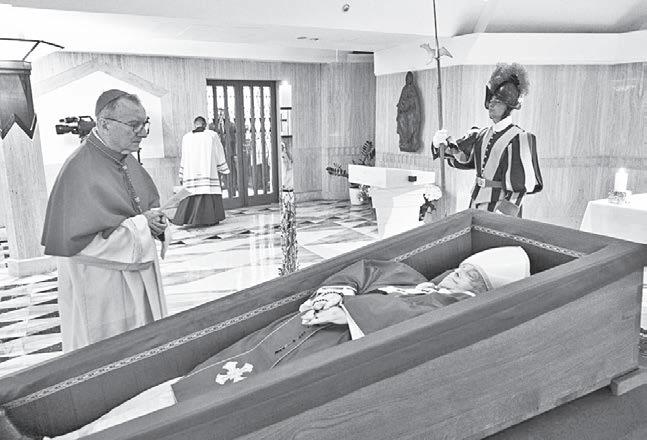
body were released Tuesday, showing him in the wooden casket, in red vestments and his bishop’s miter, with the Vatican secretary of state praying over him in the chapel of the Domus Santa Marta hotel where he lived and died.
In his final will, Francis confirmed he would be buried at St. Mary Major Basilica, which is outside the Vatican and home to his favorite icon of the Virgin Mary.
Before and after every foreign trip, Francis would go to the basilica to pray before the Byzantine-style painting that features an image of Mary, draped in a blue robe, holding the infant Jesus, who in turn holds a jeweled golden book. Francis stopped by the basilica on his way home from the Gemelli hospital on March 23, after his 38day hospital stay, to deliver flowers to be placed before the icon. He returned April 12 to pray before the Madonna for the last time.
The world reacts BELLS tolled in chapels, churches and cathedrals around the world and flags flew at half-staff in Italy, India, Taiwan and the US after Francis’ death was announced by the Vatican camerlengo. Soccer matches in Italy and Argentina were suspended in honor of the Argentine pope who was a lifelong fan of the San Lorenzo soccer club.
World leaders praised Francis for his moral leadership and compassion, while ordinary faithful remembered his simplicity and humanity.
“Like every Argentine, I think he was a rebel,” said 23-year-old Catalina Favaro, who had come to pay her respects in the Buenos Aires church where Francis dis -
covered his priestly vocation. “He may have been contradictory, but that was nice, too.”
In East Timor, where Francis’ final outdoor Mass drew nearly half of the population last September, President Jose RamosHorta praised Francis’ courage. “Papa Francisco was a brave man who was not afraid to speak out against the rulers of the world who seek war, but do not want to seek peace,” Ramos-Horta said.
“He challenged the powerful to act with justice, called nations to welcome the stranger, and reminded us that our common home— this Earth—is a gift we must protect for future generations,” said Nigeria’s President Bola Tinubu, who is Muslim. Nigeria is Africa’s most populous country and has around 30 million Catholics, representing about 14% of the total population.
Viewing the pope’s coffin
THE pope’s formal apartments in the Apostolic Palace and in the Santa Marta hotel were sealed Monday evening, following a centuries-old ritual. Cardinal Kevin Farrell, who as camerlengo had the task of announcing the death and confirming it once the cause was determined, presided over the rituals.
Francis chose not to live in the palace, though, but in a two-room suite in Santa Marta on the other side of Vatican City. He died there and his body was transferred to the hotel chapel in the lobby, where the private viewing was being held Tuesday for Vatican officials and members of the pontifical household.
In changes made by Francis
last year, his body was not placed in three wooden coffins, as it had been for previous popes. Rather, Francis was placed in a simplified wooden coffin with a zinc coffin inside.
Once in St. Peter’s, his coffin will not be put on an elevated bier but will just be placed simply facing the pews, with the Paschal candle nearby.
“He was a pope who didn’t change his path when it came to getting dirty,” Francis’ vicar for Rome, Cardinal Baldassarre Reina, said in a Mass in his honor. “For him, poor people and migrants were the sacrament of Jesus.”
Choosing the next pope AFTER the funeral, there are nine days of official mourning, known as the “novendiali.” During this period, cardinals arrive in Rome and meet privately before the conclave.
To give everyone time to assemble, the conclave must begin 15-20 days after the “sede vacante”— the “vacant See”—is declared, although it can start sooner if the cardinals agree.
Once the conclave begins, cardinals vote in secret sessions in the Sistine Chapel. After voting sessions, the ballots are burned in a special stove. Black smoke indicates that no pope has been elected, while white smoke indicates that the cardinals have chosen the next head of the Catholic Church.
The one who has secured twothirds of the votes wins. If he accepts, his election is announced by a cardinal from the loggia of St. Peter’s Basilica who tells the world “Habemus Papam,” Latin for “We have a pope.”
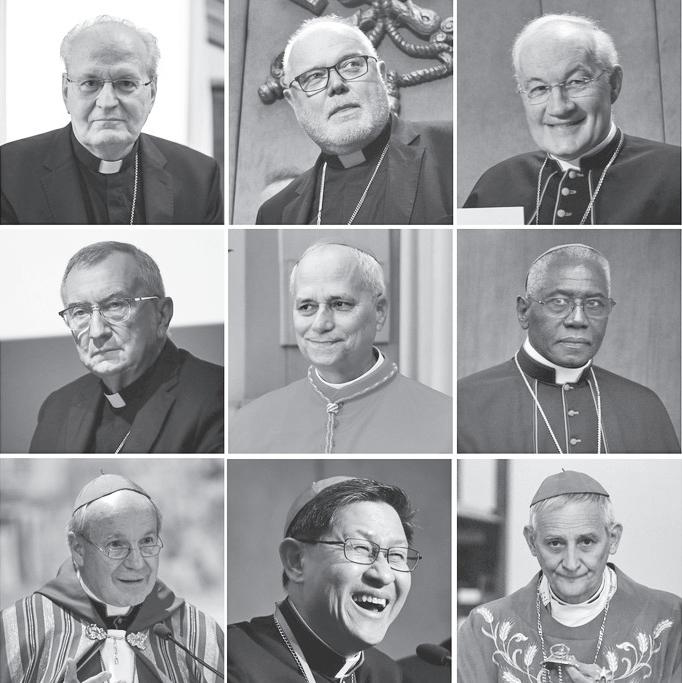
Next pope watch: Top cardinals poised to succeed Pope Francis
VATICAN CITY—A popular saying in Vatican circles is that if you “enter a conclave as pope, you leave as a cardinal.”
It implies the sacred and secretive process is no popularity contest or campaign, but rather the divinely inspired election of Christ’s Vicar on Earth by the princes of the church. Still, there are always front-runners, known as “papabile,” who have at least some of the qualities considered necessary to be pope—much like those depicted in last year’s Oscar-nominated film “Conclave.”
Any baptized Catholic male is eligible, though only cardinals have been selected since 1378. The winner must receive at least twothirds of the vote from those cardinals under age 80 and thus eligible to participate. Pope Francis, who died Monday, appointed the vast majority of electors, often tapping men who share his pastoral priorities, which suggests continuity rather than rupture. Anyone trying to handicap the outcome should remember that Jorge Mario Bergoglio was considered too old to be elected pope in 2013 at age 76, and that Karol Wojtyla wasn’t on any front-runner lists going into the 1978 conclave that elected him Pope John Paul II. Some possible candidates:
Cardinal Peter Erdo ERDO, 72, the archbishop of Budapest and primate of Hungary, was twice elected head of the Council of European Episcopal Conferences, in 2005 and 2011, suggesting he enjoys the esteem of European cardinals who make up the biggest voting bloc of electors. In that capacity, Erdo got to know many African cardinals because the council hosts regular sessions with African bishops’ conferences. Erdo had even more exposure when he helped organize Francis’ 2014 and 2015 Vatican meetings on the family and delivered key speeches, as well as during papal visits to Budapest in 2021 and 2023.
Cardinal Reinhard Marx
MARX , 71, the archbishop of Munich and Freising, was chosen by Francis as a key adviser in 2013. Marx later was named to head the council overseeing Vatican finances during reforms and belt-tightening. The former president of the German bishops’ conference was a strong proponent of the controversial “synodal path” process of dialogue in the German church that began in 2020 as a response to the clergy sexual abuse scandal there. As a result, he is viewed with skepticism by conservatives who considered
the process a threat to church unity, given it involved debating issues such as celibacy, homosexuality and women’s ordination. Marx made headlines in 2021 when he dramatically offered to resign as archbishop to atone for the German church’s dreadful abuse record, but Francis quickly rejected the resignation and told him to stay.
Cardinal Marc Ouellet
OUELLET, 80, of Canada, led the Vatican’s influential bishops office for over a decade, overseeing the key clearinghouse for potential candidates to head dioceses around the world. Francis kept Ouellet in the job until 2023, even though he was appointed by Pope Benedict XVI, and thus helped select the more doctrinaire bishops preferred by the German pontiff. Considered more of a conservative than Francis, Ouellet still selected pastorally minded bishops to reflect Francis’ belief that bishops should “smell like the sheep” of their flock. Ouellet defended priestly celibacy for the Latin Rite church and upheld the ban on women’s ordination but called for women to have a greater role in church governance. He has good contacts with the Latin American church, having headed the Vatican’s Pontifical Commission for Latin America for over a
decade. Since 2019, his office has taken charge of investigating bishops accused of covering up for predator priests, a job that would have made him no friends among those sanctioned but also could have given him lots of otherwise confidential and possibly compromising information about fellow cardinals.
Cardinal Pietro Parolin PAROLIN , 70, of Italy, has been Francis’ secretary of state since 2014 and is considered one of the main contenders to be pope, given his prominence in the Catholic hierarchy. The veteran diplomat oversaw the Holy See’s controversial deal with China over bishop nominations and was involved—but not charged—in the Vatican’s botched investment in a London real estate venture that led to a 2021 trial of another cardinal and nine others. A former ambassador to Venezuela, Parolin knows the Latin American church well. He would be seen as someone who would continue in Francis’ tradition but as a more sober and timid diplomatic insider, returning an Italian to the papacy after three successive outsiders: St. John Paul II (Poland); Benedict (Germany) and Francis (Argentina). But while See “Next pope,” A9
VATICAN Secretary of State Cardinal Pietro Parolin, left, prays before the body of Pope Francis, which is laid out in state in his private chapel at the Vatican, Monday, April 21, 2025. VATICAN MEDIA VIA AP, HO
The bridge between papacies: Cardinal Farrell’s key role in Vatican transition
By Nicole Winfield The Associated Press
ATICAN CITY—Cardinal
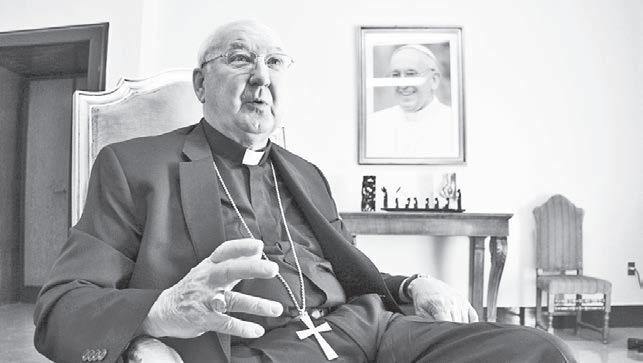
VKevin Farrell remembers the day Pope Francis asked him to be the camerlengo, the Vatican official who runs the Holy See after the death of one pope and before the election of another. They were flying back to Rome from the 2019 World Youth Day in Panama, and Francis popped the question in business class.
Farrell, 77, had been in Rome only a few years, summoned out of the blue from his job as bishop of Dallas, to reorganize the Vatican’s laity office, a key part of Francis’ reforms. Three years into the job, Francis asked him to take on another role that is steeped in myth and mystery but also has realworld responsibilities: managing the Vatican as “camerlengo”—or chamberlain—during the often traumatic “interregnum” between papacies and helping to organize the conclave to elect the next pontiff.
“I said to him I would accept the position but on one condition,” Farrell recalled in a 2022 interview, smiling as he remembered their airborne conversation. The condition was that the pope would have to preach at Farrell’s own funeral, reflecting Farrell’s hope that he would die before Francis and never have to act as a camerlengo.
The joke was twofold: Farrell didn’t particularly want the heavy responsibility. But more personally, he didn’t want to entertain the possibility of outliving Francis, whom he credited with having set the Catholic Church on a crucial path of renewal, redirecting it away from culture war defensiveness and back to its Gospel-driven essence of inclusion.
“We were defending ourselves always: Self-preservation was the theme of the church,” Farrell said. “And Pope Francis moved us beyond self-preservation” to a message of welcome and accompaniment.
The camerlengo’s role With Francis’ death, though, Farrell is in the spotlight, albeit only until a new pope is elected. Farrell on Monday morning announced the death from the chapel of the Domus Santa Marta hotel where Francis lived and died. In a short statement read live on Vatican television, he said Francis’ “entire life was dedicated to the service of the Lord and of his church.”
According to tradition, the camerlengo certifies the pope’s death, seals the papal apartment and breaks the pope’s fisherman’s ring, as a symbol of a vacancy at the Holy See. He leads the procession accompanying the coffin into St. Peter’s Basilica and presides over the burial.
The camerlengo also gets written reports from Vatican offices about their current assets; a copy of the current and projected budget for the Holy See; and any other information from the Vatican’s economic ministry that would be useful for cardinals and the future pope. He and the dean of the College of Cardinals, Italian Cardinal Giovanni Battista Re, then play key roles organizing the meetings of cardinals preceding the conclave.
Farrell, a no-nonsense Irishborn American, said the financial duties are far more important than the ceremonial ones and the ones for which he is more qualified.
Farrell already heads top Vatican committees on finances, investments and confidential matters,
Farrell said he was happy and “very comfortable” as bishop in Dallas when his secretary came to him in May 2016 to tell him the pope was on the phone.
“And I said ‘the pope’s not on the phone. Popes don’t use telephones,’” Farrell said, assuming another bishop was playing a prank. “And so I picked up the phone. I was about to tell him where to go,” when all of a sudden the voice on the line said quietly in Spanish: “Soy Francisco”— “This is Francis.”
as well as its supreme court, making him particularly well-suited to deliver a financial prospectus to the new pope.
From Ireland to the US
THE man Francis chose to bridge his papacy was born in Dublin on September 2, 1947. He entered the Legionaries of Christ religious order in 1966 and was ordained a priest for the Mexican-based order in 1978. He left six years later—long before revelations that its founder was a pedophile who sexually abused his young seminarians—and became a diocesan priest in the Washington Archdiocese.
He worked in a series of parishes but also took on increasing charge of the books in the archdiocese—he has a keen mind for finances but says he never finished his MBA. He became auxiliary bishop of Washington in 2001 and served under the ex-Cardinal Theodore McCarrick before being made bishop of Dallas in 2007.
Farrell has said repeatedly that during his years in Washington, he never heard the rumors that McCarrick had behaved inappropriately with seminarians, sleeping with them in his bed while he was a bishop in New Jersey. McCarrick, who died earlier this month, was defrocked after a Vatican investigation in 2019 found he sexually abused children as well as adults.
The two had never met, but Francis knew Farrell spoke Spanish fluently, given his years in the Mexican-based Legion.
A Vatican assignment
FRANCIS also knew that Farrell had made it a policy in both Washington and Dallas to put qualified lay experts, rather than priests, in positions of authority in running the dioceses.
Farrell said Francis asked him to do the same with the Holy See’s laity office, which the pontiff wanted to rebuild by merging it with the Vatican’s family and life departments and serve as a model of lay-led governance of church management.
“I was trying to come up with every reason why I should not do it. And he said, ‘Well, you think about it for three days and I’ll call you back,’” Farrell recalled. “Three days later, at the same time, I get a telephone call and then I gave him all my reasons that I had formulated. And he said, ‘Well, why don’t you come on over and talk to me?’”
“Well, that was the end,” Farrell said.
He moved to Rome in October 2016 to head the laity office. Within hours of his arrival, Francis announced that Farrell would be made a cardinal.
It was a sign, later confirmed with his nomination as camerlengo, that Francis fully intended to entrust Farrell with some of the most important responsibilities of the church, including after he was gone.
Navigating the complex rituals of papal transition: Key terms and roles
By The Associated Press
ACHANGE in popes—through death or resignation—is a complicated process, with centuries-old rituals involving the transition in leadership for both the spiritual head of the global Catholic Church and the Vatican’s head of state.
These are the need-to-know terms— some of them in Latin—to help make sense of news in the coming days:
Who is the Vatican camerlengo?
THIS is the “chamberlain”—the cardinal in charge of formally verifying the pope’s death—and then sealing his room and study. Between then and the election of the new pope, the camerlengo administers the “goods and temporal rights” of the Holy See. The current one is the Irish-born American Cardinal Kevin Farrell.
Who is in the College of Cardinals?
THERE are 252 cardinals worldwide, and as a body, they are in charge of the Holy See’s affairs in-between popes, albeit with limits. Of them, 135 are “cardinal electors,” who gather in the Vatican to choose the new pope. For centuries, they have chosen one of their own. The vast majority of the electors—108—were made cardinals by Pope Francis, according to Vatican statistics.
What is the conclave?
THIS is the closed-door meeting of the cardinal electors to choose the new pope in the Sistine Chapel. Its name, literally “with a key,” was used in the 13th century to describe the process of locking up the cardinals until the election is completed. It must begin no more than 20 days after the death or resignation of a pope. The electors are sequestered from all outsiders for the duration; the last three popes were chosen within days.
Who is the dean of the College of Cardinals?
THE current dean is Italian Cardinal Giovanni
explained
Battista Re. He is the head of the College of Cardinals who informs the rest of the cardinals and the ambassadors to the Holy See of the pope’s death once he learns of it from the camerlengo. He convenes the conclave and presides as the electors take their oaths. Once a new pope is chosen, the dean asks him if he accepts and what name he wants to be called.
What is the Domus Santa Marta?
THIS Vatican guesthouse, built in 1996, specifically houses cardinals during a conclave and is used at other times as a hotel for visiting priests and Vatican officials. Pope Francis never moved out after he was elected pope, choosing to live in suite 201, rather than the papal apartments in the Apostolic Palace.
What does ‘extra omnes’ mean?
A LATIN phrase for “all out,” it’s spoken by the master for papal liturgical celebrations, currently Italian Archbishop Diego Ravelli, to ask all those present except the cardinal electors to leave the Sistine Chapel to begin the voting process during the conclave.
Why is the pope’s ring called the fisherman’s ring?
EACH pope gets this ring at the Mass marking the beginning of his pontificate. It bears this name because Jesus told St. Peter, the first pope, that he would be “a fisher of men.” Until the 1990s, it was destroyed upon a pope’s death. Now, it’s “annulled,” or marked in such a way that it can’t be used as a seal.
What are the General Congregations?
THIS is the name given to the gathering of all members of the College of Cardinals after the pope’s death and before the start of the conclave to discuss major church affairs. All cardinals who aren’t infirm take part in this meeting in the Vatican’s Apostolic Palace. They also discuss preparations for the conclave, under oath and in secret.
See “Rituals,” A9
CARDINAL Kevin Farrell, head of the Vatican’s family and laity office, speaks during an interview with The Associated Press in Rome, July 31, 2018. AP/PAOLO SANTALUCIA
. .
Continued from A8
What does it mean when they say, ‘Habemus Papam’?
THIS Latin phrase translates to “We have a pope.” These are the words used by the “protodeacon” of the College of Cardinals to announce from the loggia of St. Peter’s Basilica that a new pope has been elected. He then says the new pope’s birth name and the name he has chosen to use as pope, also in Latin. The current protodeacon is French Cardinal Dominique Mamberti.
Who are the infirmarii?
THESE are the three cardinals, chosen by a random drawing from the electors, who are charged with gathering the ballots of any electors who are ill during the conclave.
What does Pope Francis’ motto ‘miserando atque eligendo’ mean?
THIS is Latin for “having had mercy and choosing him”—a phrase that Francis chose as his motto when he was elevated to bishop and kept as his papal seal. It was drawn from the homilies of St. Bede the Venerable, an 8th century monk. It comes from the Gospel narrative of St. Matthew, a tax collector whom Jesus called to follow him.
Who are the revisers?
THESE are the three cardinals, chosen by random drawing from the electors, who are charged with reviewing the ballots during the conclave.
What is a rogito?
THIS is the document, or “deed,” listing key details of the pope’s life and papacy that is placed in his coffin. It’s written in Latin by the master for papal liturgical celebrations. A copy is kept in the Vatican archives.
Who are the scrutineers?
What does the saying ‘sede vacante’ mean?
THIS is Latin for “vacant seat,” the period between the pope’s death or resignation and the election of a new one.
What is St. Mary Major?
THIS is the basilica in Rome where Pope Francis said he wants to be buried. Francis is breaking with the tradition of his predecessors who are buried inside the Vatican, saying he wanted to be near his favorite icon of the Virgin Mary, the Salus Populi Romani, a Byzantine-style painting of the Madonna draped in a blue robe, holding the infant Jesus who in turn is holding a jeweled golden book. The icon is located in the church first built in the 5th century and devoted to the Virgin Mary. In his will, Francis said he wanted a simple underground tomb with only “Franciscus” written on it.
What does the text ‘Universi Dominici Gregis’ contain?
THIS Latin phrase means “the Lord’s whole flock.” It’s the Vatican constitution that regulates the processes from a pope’s death until a new one is elected. St. John Paul II issued it in 1996 during his papacy, and Pope Benedict XVI twice amended it, most significantly by removing John Paul’s provision that after about 12 days of balloting a simple majority could elect a new pope rather than a two-thirds majority. If the conclave lasts that long, the top two vote-getters go to a runoff, with a twothirds majority required to win. Neither of the top two candidates casts a ballot in the runoff.
What does white or black smoke mean during a papal transition?
Wall Street, dollar tumble as investors fret over Trump’s trade war and Fed criticism
By Stan Choe Ap Business Writer
EW YORK—Wall Street
Nweakened Monday as investors worldwide get more skeptical about US investments because of President Donald Trump’s trade war and his criticism of the Federal Reserve, which are shaking the traditional order.
The S&P 500 sank 2.4% in another wipeout. That yanked the index that’s at the center of many 401(k) accounts 16% below its record set two months ago.
The Dow Jones Industrial Average dropped 971 points, or 2.5%, while losses for Tesla and Nvidia helped drag the Nasdaq composite down 2.6%.
Perhaps more worryingly, US government bonds and the value of the US dollar also sank as prices retreated across US markets. It’s an unusual move because Treasurys and the dollar have historically strengthened during episodes of nervousness. This time around, though, it’s policies directly from Washington that are causing the fear and potentially weakening their reputations as some of the world’s safest investments.
cial Network. He also said that “the businessmen who criticize tariffs are bad at business, but really bad at politics,” likewise in all caps.
Trump has recently focused more on China, the world’s second-largest economy, which has also been keeping up its rhetoric.
China on Monday warned other countries against making trade deals with the United States “at the expense of China’s interest” as Japan, South Korea and others try to negotiate agreements.
“If this happens, China will never accept it and will resolutely take countermeasures in a reciprocal manner,” China’s Commerce Ministry said in a statement.
Also hanging over the market are worries about Trump’s anger at Federal Reserve Chair Jerome Powell. Trump last week criticized Powell again for not cutting interest rates sooner to give the economy more juice.
The Fed has been resistant to lowering rates too quickly because it does not want to allow inflation to reaccelerate after slowing nearly all the way down to its 2% goal from more than 9% three years ago.
markets means some investors say they’re having to rethink the fundamentals of how to invest.
“We can no longer extrapolate from past trends or rely on longterm assumptions to anchor portfolios,” strategists at BlackRock Investment Institute said in a report. “The distinction between tactical and strategic asset allocation is blurred. Instead, we need to constantly reassess the longterm trajectory and be dynamic with asset allocation as we learn more about the future state of the global system.”
That in turn could push investors outside the United States to keep more of their money in their home markets, according to the strategists led by Jean Boivin.
On Wall Street, Big Tech stocks helped lead indexes lower ahead of their latest earnings reports due later this week.
Wall Street, and 92% of the stocks within the S&P 500 fell.
Among the few gainers were Discover Financial Services and Capital One Financial, which climbed after the US government approved their proposed merger. Discover rose 3.6%, while Capital One added 1.5%.
All told, the S&P 500 fell 124.50 points to 5,158.20. The Dow Jones Industrial Average dropped 971.82 to 38,170.41, and the Nasdaq composite tumbled 415.55 to 15,870.90.
THESE are the three cardinals, chosen by random drawing from the electors, who are charged with reviewing each ballot and announcing it to the assembled conclave after each round of voting. They then tally the votes—to win the election, two-thirds of the votes are necessary—and they also burn the ballots.
A FTER each round of voting in the Sistine Chapel, the ballots are burned in a special furnace to indicate the outcome to the outside world. If no pope is chosen, the ballots are mixed with cartridges containing potassium perchlorate, anthracene (a component of coal tar), and sulfur to produce black smoke. But if there is a winner, the burning ballots are mixed with potassium chlorate, lactose and chloroform resin to produce the white smoke. Bells also are rung to further signal there is a new pope. Rituals.
Continued from A7
Parolin has managed the Vatican bureaucracy, he has no real pastoral experience. His ties to the London scandal, in which his office lost tens of millions of dollars to bad deals and shady businessmen, could count against him.
Cardinal Robert Prevost
THE idea of an American pope has long been taboo, given the geopolitical power already wielded by the United States. But the Chicago-born Prevost, 69, could be a first. He has extensive experience in Peru, first as a missionary and then an archbishop, and he is currently prefect of the Vatican’s powerful dicastery for bishops, in charge of vetting nominations for bishops around the world. Francis clearly had an eye on him for years and sent him to run the diocese of Chiclayo, Peru, in 2014. He held that position until 2023, when Francis brought him to Rome for his current role. Prevost is also president of the Pontifical Commission for Latin America, a job that keeps him in regular contact with the Catholic hierarchy in the part of the world that still counts the most Catholics. In addition to his nationality, Prevost’s comparative youth could count against him if his brother cardinals don’t want to commit to a pope who might reign for another two decades.
Cardinal Robert Sarah SARAH , 79, of Guinea, the retired head of the Vatican’s liturgy office, was long considered the best hope for an African pope. Beloved by conservatives, Sarah would signal a return
to the doctrinaire and liturgically minded papacies of John Paul II and Benedict. Sarah, who had previously headed the Vatican’s charity office Cor Unum, clashed on several occasions with Francis, none more seriously than when he and Benedict co-authored a book advocating the “necessity” of continued celibacy for Latin Rite priests. The book came out as Francis was weighing whether to allow married priests in the Amazon to address a priest shortage there. The implication was that Sarah had manipulated Benedict into lending his name and moral authority to a book that had all the appearances of being a counterweight to Francis’ own teaching. Francis dismissed Benedict’s secretary and several months later retired Sarah after he turned 75. Even Sarah’s supporters lamented the episode that can hurt his papal chances.
Cardinal Christoph Schoenborn SCHOENBORN , 80, the archbishop of Vienna, Austria, was a student of Benedict’s, and thus on paper seems to have the doctrinaire academic chops to appeal to conservatives. However, he became associated with one of Francis’ most controversial moves by defending his outreach to divorced and civilly remarried Catholics as an “organic development of doctrine,” not the rupture that
See “Next pope,” A10
Trump continued his tough talk on global trade as economists and investors continue to say his stiff proposed tariffs could cause a recession if they’re not rolled back. US talks last week with Japan failed to reach a quick deal that could lower tariffs and protect the economy, and they’re seen as a “test case,” according to Thierry Wizman, a strategist at Macquarie.
“The golden rule of negotiating and success: He who has the gold makes the rules,” Trump said in all capitalized letters on his Truth So -
Trump talked Monday about a slowdown for the US economy that could be coming unless “Mr. Too Late, a major loser, lowers interest rates, NOW.”
A move by Trump to fire Powell would likely send a bolt of fear through financial markets. While Wall Street loves lower rates, largely because they boost stock prices, the bigger worry would be that a less independent Fed would be less effective at keeping inflation under control. Such a move could further weaken, if not kill, the United States’ reputation as the world’s safest place to keep cash.
All the uncertainty striking pillars at the center of financial
Tesla sank 5.7%. The electric vehicle maker’s stock has more than halved from its record set in December on criticism that the stock price had gone too high and that CEO Elon Musk’s role in leading the US government’s efforts to cut spending is damaging the brand.
Nvidia fell 4.5% for a third straight drop after disclosing that US export limits on chips to China could hurt its first-quarter results by $5.5 billion. They led another wipeout on
Gold also climbed to burnish its reputation as a safe-haven investment, unlike some others. In the bond market, shorterterm Treasury yields fell as investors expect the Fed to cut its main overnight interest rate later this year to support the economy. But longer-term yields rose with doubts about the United States’ standing in the global economy. The yield on the 10-year Treasury climbed to 4.40%, up from 4.34% at the end of last week and from just about 4% earlier this month. That’s a substantial move for the bond market. The US dollar’s value, meanwhile, fell against the euro, Japanese yen, the Swiss franc and other currencies.
AP Business Writer Elaine Kurtenbach contributed.
Wednesday, April 23, 2025
Pope Francis led the church with humility and simplicity
By Nicole Winfield Associated Press
VATICAN CITY—He was a pope who understood the power of a simple touch: caressing the deformed head of a man in St. Peter’s Square, washing the feet of a Muslim prisoner, sinking to his hands and knees to implore South Sudan’s rival leaders to make peace.
Pope Francis charmed the world with those poignant acts of love, humility and informality, starting with his first appearance as pontiff on the loggia of St. Peter’s Basilica with a remarkably normal, “Buonasera” (“Good evening”) to his cheering flock below.
Francis, the first Latin American pope, died Monday at age 88. It was just a day after Francis imparted what would become his final public blessing from that very same loggia on Easter. “Brothers and sisters, Happy Easter,” he said, before embarking on what would become a final farewell to the faithful with a ride in his popemobile through St. Peter’s Square.
The Vatican said Francis suffered a stroke which led to a coma and his heart to fail, as he recovered from a five-week hospitalization for double pneumonia. His funeral and burial at St. Mary Major Basilica across town are expected over the weekend.
After that first rainy night of his election on March 13, 2013, Francis made even greater gestures, like bringing a dozen Syrian refugees home with him from a Greek refugee camp. Such actions won him wild popularity among progressives and signaled new priorities for the Vatican after the sometimes-troubled papacy of Pope Benedict XVI.
But Francis soon invited troubles of his own and conservatives grew increasingly upset with his focus on the poor and the environment, and his outreach to LGBTQ+ Catholics, at the expense of preaching Catholic doctrine. Some accused him of heresy.
His greatest test came when he botched a notorious case of clergy sexual abuse in Chile in 2018. Suddenly, the scandal that festered under his predecessors erupted anew on his watch and was used by critics to try to weaken him.
And then the crowd-loving,
pope.
Continued from A9
globe-trotting pope of the peripheries had to navigate the unprecedented reality of leading a universal religion through the coronavirus pandemic from a locked-down Vatican City.
He implored the world to use Covid-19 as an opportunity to rethink the economic and political framework that he said had turned rich against poor and rendered the Earth an “immense pile of filth.”
“We have realized that we are on the same boat, all of us fragile and disoriented…all of us called to row together, each of us in need of comforting the other,” Francis told an empty St. Peter’s Square at the height of the outbreak in March 2020.
Shaking up the church without changing core doctrines
AFTER Benedict’s surprise resignation and retirement, Francis was elected on a mandate to reform the outdated Vatican bureaucracy and its finances, but he went much further in shaking up the church itself without ever changing its core doctrine.
When asked about a purportedly gay priest, he replied: “Who am I to judge?”
The comment sent a message of welcome to the LGBTQ+ community and those who felt shunned by a church that had stressed conditions, rules and sexual propriety over unconditional love.
“Being homosexual is not a crime,” he told The Associated Press in 2023, calling for an end to civil laws that criminalize it. A year later, he approved church blessings for same-sex couples.
In a similar, merciful line, Francis changed the church’s position on the death penalty, declaring it inadmissible in all circumstances. And he modified its stand by saying the mere possession of nuclear weapons, not just their use, was “immoral.”
In other firsts, he approved an agreement with China over bishop nominations that had vexed the Vatican for a half-century, met with a Russian patriarch, and charted new relations with the Muslim world by visiting the Arabian Peninsula and Iraq.
South Sudan President Salva Kiir Mayardit said Monday that Francis would be remembered “as a beacon of hope, compassion and unity,” par-
ticularly for his remarkable gesture in 2019 when the pope kissed Kiir’s feet and those of his rival in begging them to make peace during a meeting at the Vatican.
Francis reaffirmed the all-male, celibate priesthood and strongly upheld the church’s opposition to abortion, equating it to “hiring a hit man to solve a problem.”
But he added women to important decision-making roles in the Vatican and formally allowed them to serve as lectors and acolytes in parishes. He allowed women to vote alongside bishops in periodic Vatican meetings, following longstanding complaints that women do most of the church’s work but are barred from its top echelons.
Sister Nathalie Becquart, named by Francis to a high Vatican job, said his legacy was a church where men and women exist in a relationship of reciprocity and respect.
“It was about shifting a pattern of domination—from human being to the creation, from men to women— to a pattern of cooperation,” said Becquart, the first woman to hold a voting position in a Vatican synod.
A refuge for ‘everyone’
WHILE Francis stopped short of allowing women to be ordained, the voting reform was part of a revolutionary change in his emphasis of what the Catholic Church should be: a refuge for everyone— “todos, todos, todos” (“everyone, everyone, everyone”)—not just the privileged few. Migrants, the poor, prisoners and outcasts were at his table far more than presidents or CEOs.
“For Pope Francis, it was always to extend the arms of the church to embrace all people, not to exclude
anyone,” said Cardinal Kevin Farrell, whom Francis made camerlengo, the official taking charge after a pontiff’s death.
Francis demanded bishops apply mercy and charity to their flocks, pressed leaders to protect God’s creation from climate disaster, and challenged countries to welcome those fleeing war, poverty and oppression.
After visiting Mexico in 2016, Francis said of then-US presidential candidate Donald Trump that anyone building a wall to keep migrants out “is not Christian.”
While progressives were thrilled by Francis’ focus on the core of Jesus’ message of mercy and welcome for marginalized souls, it troubled conservatives who feared he watered down Catholic teaching and threatened the very Christian identity of Europe and the U.S. A few cardinals openly challenged him.
Francis usually responded to conflict with his typical answer: silence. He made it easier for Catholics to get a marriage annulment and allowed priests to absolve women who had abortions. He divided the church by opening debate on issues such as homosexuality and divorce, giving pastors wiggle room to discern how to accompany their flocks rather than handing them strict rules.
“I see clearly that the thing the church needs most today is the ability to heal wounds and to warm the hearts of the faithful,” he told a Jesuit journal in 2013. “I see the church as a field hospital after battle.”
A nod to St. Francis of Assisi FRANCIS lived in the Vatican hotel instead of the Apostolic Palace, wore his old orthotic shoes and not the red loafers of the pa -
pacy, and set an example to the clerical classes by using compact cars. It wasn’t a gimmick.
If his election as the first Latin American and first Jesuit pope wasn’t enough, Francis also was the first to name himself after St. Francis of Assisi, the 13th century friar known for personal simplicity, a message of peace, and care for society’s outcasts and nature.
Francis sought out those who suffer: the unemployed and sick, the disabled and homeless, the elderly and imprisoned. Those encounters provided poignant images of his papacy, such as in 2013, when he embraced a man with neurofibromatosis, the condition associated with the “Elephant Man,” Joseph Carey Merrick.
“We have always been marginalized, but Pope Francis always helped us,” said Coqui Vargas, a transgender woman whose Roman community forged a unique relationship with Francis during the pandemic.
And he himself suffered: Part of his colon was removed in 2021 and he needed more surgery in 2023 to repair a painful hernia and remove intestinal scar tissue. By 2022, he regularly used a wheelchair and cane because of bad knees and bouts of bronchitis.
His priorities also informed his travel: His first trip outside Rome as pope was to the Italian island of Lampedusa, then the epicenter of Europe’s migration crisis. He consistently visited poor countries where Christians were often-persecuted minorities, rather than centers of global Catholicism.
Francis’ friend and fellow Argentine, Bishop Marcelo Sánchez Sorondo, said concern for the poor and disenfranchised formed the core of his pontificate, based on the Beatitudes—the biblical blessings that Jesus delivered in the Sermon on the Mount for the meek, the merciful, the poor in spirit and others.
“Why are the Beatitudes the program of this pontificate? Because they were the basis of Jesus Christ’s own program,” Sánchez said.
Missteps on priestly sexual abuse
BUT over a year passed before Francis met with some of the church’s most wounded souls— survivors of priestly sexual abuse—and victims’ groups questioned whether he understood the scope of the problem.
Francis created a sex abuse commission to advise the church, but it later lost its influence and its recommendation for a tribunal to judge bishops who covered for predator priests went nowhere.
He made up for it with new legal provisions to hold the hierarchy accountable after he endured the greatest crisis of his papacy in 2018, when he discredited Chilean victims of abuse and stood by a controversial bishop linked to their abuser, Chile’s most notorious pedophile. After Francis realized his error, he invited the victims to the Vatican for a personal mea culpa and had the leadership of the Chilean church resign en masse.
Another crisis erupted surrounding ex-Cardinal Theodore McCarrick, the retired archbishop of Washington and counselor to three popes.
Francis actually had sidelined McCarrick after the church received an accusation he had molested a teenage altar boy in the 1970s. But Francis nevertheless was accused by the Vatican’s onetime US ambassador of having rehabilitated McCarrick early in his papacy.
Francis eventually defrocked McCarrick after the Vatican determined he sexually abused adults as well as minors.
The two popes
FRANCIS’ 2013 election was paved by Benedict XVI’s decision to resign and retire—the first in 600 years. It created the unprecedented reality of two popes living in the Vatican until Benedict’s death on December 31, 2022.
Francis didn’t shy from that potentially uncomfortable shadow but embraced Benedict as an elder statesman and adviser whom he coaxed out of his cloistered retirement to participate in the public life of the church.
“It’s like having your grandfather in the house, a wise grandfather,” Francis said.
Francis praised Benedict’s decision to retire, saying he “opened the door” for others. That fueled speculation that he, too, might retire, but after Benedict’s death, he made clear the papacy is generally a job for life. Francis’ looser liturgical style and pastoral priorities made clear he and the German-born theologian came from very different
some conservatives contended. Schoenborn’s parents divorced when he was a teen, so the issue is personal. He also took heat from the Vatican when he criticized its past refusal to sanction high-ranking sexual abusers, including his predecessor as archbishop of Vienna. Schoenborn has expressed support for civil unions and women as deacons, and was instrumental in editing the 1992 update of the Catechism of the Catholic Church, the handbook of the church’s teaching that Benedict had spearheaded when he headed the Vatican’s doctrine office.
Cardinal Luis Tagle TAGLE , 67, of the Philippines, would appear to be Francis’ pick for the first Asian pope. Francis brought the popular archbishop of Manila to Rome to head the Vatican’s missionary evangelization office, which serves the needs of the Catholic Church in much of Asia and Africa. His role took on greater weight when Francis reformed the Vatican bureaucracy and raised the
importance of his evangelization office. Tagle often cites his Chinese lineage—his maternal grandmother was part of a Chinese family that moved to the Philippines—and he is known for becoming emotional when discussing his childhood. Though he has pastoral, Vatican and management experience—he headed the Vatican’s Caritas Internationalis federation of charity groups before coming to Rome permanently—Tagle would be on the young side to be elected pope for life, with cardinals perhaps preferring an older candidate whose papacy would be more limited.
Cardinal Matteo Zuppi
ZUPPI, 69, the archbishop of Bologna and president of the Italian bishops conference, elected in 2022, is closely affiliated with the Sant’Egidio Community, a Rome-based Catholic charity that was influential under Francis, particularly in interfaith dialogue. Zuppi was part of Sant’Egidio’s team that helped negotiate the end of Mozambique’s civil war in the 1990s and was named Francis’ peace envoy for Russia’s war in Ukraine. Francis made him a cardinal in 2019 and later made clear he wanted him in charge of Italy’s bishops, a sign of his
admiration for the prelate who, like Francis, is known as a “street priest.” In another sign of his progressive leanings and closeness to Francis, Zuppi wrote the introduction to the Italian edition of “Building a Bridge,” by the Rev. James Martin, an American Jesuit, about the church’s need to improve its outreach to the LGBTQ+ community. Zuppi would be a candidate in Francis’ tradition of ministering to those on the margins, although his relative youth would count against him for cardinals seeking a short papacy. His family had strong institutional ties: Zuppi’s father worked for the Vatican newspaper L’Osservatore Romano, and his mother was the niece of Cardinal Carlo Confalonieri, dean of the College of Cardinals in the 1960s and 1970s. AP
THIS combination of photos shows, top row from left, Cardinal Peter Erdo, Cardinal Reinhard Marx, Cardinal Marc Ouellet, middle row from left, Cardinal Pietro Parolin, Cardinal Robert Prevost, Cardinal Robert Sarah, and bottom row from left, Cardinal Christoph Schoenborn, Cardinal Luis Tagle and Cardinal Matteo Zuppi. AP
ARGENTINE Cardinal Jorge Bergoglio, who chose the name of Pope Francis, waves to the crowd from the central balcony of St. Peter’s Basilica after being elected 266th pontiff of the Roman Catholic Church, at the Vatican, Wednesday, March 13, 2013. AP/GREGORIO BORGIA
See “Pope Francis,” A11
www.businessmirror.com.ph
White House voices support for Hegseth as a new Signal chat revelation stirs fresh Pentagon turmoil
By Tara Copp & Eric Tucker
WThe Associated Press
ASHINGTON—The White House expressed support Monday for Defense Secretary Pete Hegseth following media reports that he shared sensitive military details in another Signal messaging chat, this time with his wife and brother.
Neither the White House nor Hegseth denied that he had shared such information in a second chat, instead focusing their responses on what they called the disgruntled workers whom they blamed for leaking to the media and insisting that no classified information had been disclosed.
“It’s just fake news. They just bring up stories,” President Donald Trump told reporters. “I guess it sounds like disgruntled employees. You know, he was put there to get rid of a lot of bad people, and that’s what he’s doing. So, you don’t always have friends when you do that,” Trump said.
The administration’s posture was meant to hold the line against Democratic demands for Hegseth’s firing at a time when the Pentagon is engulfed in turmoil, including the departures of several senior aides and an internal investigation over information leaks.
The White House also tried to deflect attention from the national security implications of the latest Signal revelation by framing it as the outgrowth of an insti -
religious traditions, and Francis overturned several of Benedict’s decisions.
He made sure that Salvadoran Archbishop Óscar Romero, a hero to the Latin American liberation theology movement, was canonized after his case languished under Benedict over concerns about the credo’s Marxist bent.
In a controversial move, Francis reimposed restrictions on celebrating the Latin Mass that Benedict had relaxed, arguing the spread of the Tridentine Rite was divisive. That riled Francis’ traditionalist critics and opened what became sustained
tutional power struggle between Hegseth and the career workforce. But some of the recently departed officials the administration appeared to dismiss as disgruntled were part of Hegseth’s initial inner circle, brought in when he took the job.
“This is what happens when the entire Pentagon is working against you and working against the monumental change that you are trying to implement,” White House press secretary Karoline Leavitt said in remarks amplified by a Pentagon social media account.
The latest news added to questions about the judgment of the embattled Pentagon chief, coming on top of last month’s disclosure of his participation in a Signal chat with top Trump administration leaders in which details about the military airstrike against Yemen’s Houthi militants were shared.
“Pete Hegseth must be fired,” Senate Democratic leader Chuck Schumer said.
Latest reports of Hegseth’s Signal use
THE New York Times reported Sunday that the information shared in a Signal messaging chat with Hegseth’s wife, brother and others was similar to what was communicated in the already disclosed chain with Trump administration officials.
A person familiar with the contents and those who received the messages, who spoke on condition of anonymity to
conflict between right-wing Catholics, particularly in the US, and the Argentine pope.
Conservatives ‘don’t like this pope’ BY then, conservatives had turned away from Francis after he opened debate on allowing remarried Catholics to receive the sacraments if they didn’t get an annulment—a church ruling that their first marriage was invalid.
“We don’t like this pope,” headlined Italy’s conservative daily Il Foglio a few months into his papacy, reflecting the unease of the small but vocal traditionalist movement that was coddled under Benedict.
Those same critics amplified their complaints after Francis’ approved
discuss sensitive matters, confirmed the second chat to The Associated Press. The person said it included 13 people and was dubbed “Defense Team Huddle.”
White House officials first learned of the second Signal chat from news reports Sunday, according to an official familiar with the matter who spoke on the condition of anonymity to discuss internal conversations.
Hegseth, talking to reporters while attending the White House Easter Egg Roll, didn’t address the substance of the allegations or the national security implications they raised but assailed the media.
“They take anonymous sources from disgruntled former employees and then they try to slash and burn people and ruin their reputations,” Hegseth said. “Not going to work with me. Because we’re changing the Defense Department, putting the Pentagon back in the hands of warfighters. And anonymous smears from disgruntled former employees on old news doesn’t matter.”
Republican Sen. Tom Cotton, chairman of the Senate Intelligence Committee, struck a similar tone, writing on Sunday night on X: “Secretary Hegseth is busy implementing President Trump’s America First agenda, while these leakers are trying to undermine them both. Shameful.”
The Trump administration’s response on the use of Signal THE Trump administration has struggled
church blessings for same-sex couples, and an accord with China over nominating bishops. The details were never released, but conservative critics bashed it as a sellout to communist China, while the Vatican defended it as the best deal it could get.
US Cardinal Raymond Burke, a figurehead in the anti-Francis opposition, said the church had become “like a ship without a rudder.”
Burke waged his campaign for years, starting when Francis fired him as the Vatican’s supreme court justice and culminating with his opposition to Francis’ 2023 synod on the church’s future.
He twice joined conservative cardinals in asking Francis to explain himself on doctrine issues where the pope had showed a more progressive
in its public explanations about senior officials’ use of Signal, a commercially available app not authorized to be used to communicate sensitive or classified national defense information.
The first chat, set up by national security adviser Mike Waltz, included a number of Cabinet members and came to light because Jeffrey Goldberg, editor-in-chief of The Atlantic, was added to the group.
Officials have repeatedly insisted that the information shared on Signal was not classified, though the contents of that chat, which The Atlantic published, shows that Hegseth listed weapons systems and a timeline for the attack on the Iran-backed Houthis last month.
Multiple current and former military officials say launch times and munitions drop times are classified information and putting those details on an unsecured channel could have put those pilots at risk.
The Trump administration has faced criticism for failing to take action so far against top national security officials who discussed plans for the strike in Signal, and the latest report fueled additional calls for Hegseth’s ouster.
“The details keep coming out. We keep learning how Pete Hegseth put lives at risk. But Trump is still too weak to fire him,” Schumer posted Sunday on X.
The New York Times reported that the group in the second chat included Hegseth’s wife, Jennifer, who is a former
bent, including on same-sex blessings and his outreach to divorced and civilly remarried Catholics.
Francis eventually sanctioned Burke financially, accusing him of sowing “disunity.” It was one of several moves to shift power away from doctrinaire leaders to more pastoral ones.
Reprimanding bureaucrats with ‘spiritual Alzheimer’s’ FRANCIS insisted his bishops and cardinals imbue themselves with the “odor of their flock” and minister to the faithful. When they didn’t, he expressed his displeasure.
His 2014 Christmas address to the Vatican Curia was one of the greatest public reprimands of bu-
Fox News producer, and his brother Phil Hegseth, who was hired at the Pentagon as a Department of Homeland Security liaison and senior adviser.
The Times said the second chat had the same warplane launch times that the first chat included.
Hegseth’s Signal use is under investigation by the Defense Department’s acting inspector general at the request of the bipartisan leadership of the Senate Armed Services Committee. The senior Democratic member, Jack Reed of Rhode Island, urged the watchdog Sunday to look into the reported second chat as well.
Wider turmoil inside the Pentagon
THE Pentagon has confronted a wave of turbulence stretching beyond Signal.
Defense officials have faced scrutiny over a seemingly haphazard and disjointed campaign to purge online content that promoted women and minorities, in some cases scrambling to restore posts after their removals came to light.
Over the past week, five officials in Hegseth’s inner circle have departed.
Last week Dan Caldwell, a Hegseth aide; Colin Carroll, chief of staff to Deputy Defense Secretary Stephen Feinberg; and Darin Selnick, Hegseth’s deputy chief of staff; were escorted out of the Pentagon as the department hunts down leaks of inside information.
reaucrats: Standing in the marbled Sala Clementina of the Apostolic Palace, Francis listed 15 ailments he said can afflict his closest collaborators, including “spiritual Alzheimer’s,” lusting for power and the “terrorism of gossip.”
Francis oversaw reforms of the scandal-marred Vatican bank, and took bold steps to wrestle bureaucrats into financial line, limiting their compensation and ability to receive gifts or award public contracts.
He authorized Vatican police to raid his own secretariat of state and the Vatican’s financial watchdog agency after suspicions were raised about the secretariat’s 350 million euro investment in a London real estate venture. After a 2
While those three initially had been placed on leave pending the investigation, a joint statement shared by Caldwell on X on Saturday said they “still have not been told what exactly we were investigated for, if there is still an active investigation, or if there was even a real investigation of ‘leaks’ to begin with.”
Another close Hegseth aide, chief of staff Joe Kasper, also was leaving, according to two officials. They didn’t say why. Caldwell and Selnick had worked with the defense secretary during his time leading the nonprofit Concerned Veterans for America. Kasper was the one who sent a March memo saying the Pentagon was investigating what it called leaks of national security information and that Defense Department personnel could face polygraphs. Former Pentagon spokesman John Ullyot announced he was resigning last week, unrelated to the leaks. The Pentagon said, however, that Ullyot was asked to resign. And on Monday, three US officials said another staff member, Sean Parnell, was shifting temporarily from his job as Hegseth’s chief spokesman and instead will spend more time in Hegseth’s front office. The officials all spoke on the condition of anonymity to provide details of personnel moves.
The Associated Press writers Chris Megerian and Zeke Miller contributed to this report.
1/2-year trial, the tribunal convicted a once-powerful cardinal, Angelo Becciu, of embezzlement and returned mixed verdicts to nine others, acquitting one. The trial, though, became a reputational boomerang, showing deficiencies in the Vatican’s legal system, turf battles among monsignors and the ways the pope had intervened in the case.
While earning praise for trying to turn Vatican finances around, Francis angered US conservatives for his excoriation of global markets favoring the rich over the poor.
Economic justice was an important theme for Francis, saying in
See “Pope Francis,” A12
Pope Francis. . .
Google faces off with US government in attempt to break up company in search monopoly case
By Michael Liedtke & Alan Suderman Ap Technology Writer
ASHINGTON—Google
Wis confronting an existential threat as the US government tries to break up the company as punishment for turning its revolutionary search engine into an illegal monopoly.
The drama began to unfold Monday in a Washington courtroom as three weeks of hearings kicked off to determine how the company should be penalized for operating a monopoly in search. In its opening arguments, federal antitrust enforcers also urged the court to impose forward-looking remedies to prevent Google from using artificial intelligence to further its dominance.
“This is a moment in time, we’re at an inflection point, will we abandon the search market and surrender them to control of the monopolists or will we let competition prevail and give choice to future generations,” said Justice Department attorney David Dahlquist.
The proceedings, known in legal parlance as a “remedy hearing,” are set to feature a parade of witnesses that includes Google CEO Sundar Pichai.
The US Department of Justice is asking a federal judge to order a radical shake-up that would ban Google from striking the multibillion dollar deals with Apple and other tech companies that shield its search engine from competition, share its repository of valuable user data with rivals and force a sale of its popular Chrome browser.
Google’s attorney, John Schmidtlein, said in his opening statement that the court should take a much lighter touch. He said the government’s heavy-handed proposed remedies wouldn’t boost competition but instead unfairly reward lesser rivals with inferior technology.
“Google won its place in the market fair and square,” Schmidtlein
said.
The moment of reckoning comes four-and-a-half-years after the Justice Department filed a landmark lawsuit alleging Google’s search engine had been abusing its power as the internet’s main gateway to stifle competition and innovation for more than a decade.
After the case finally went to trial in 2023, a federal judge last year ruled Google had been making anti-competitive deals to lock in its search engine as the go-to place for digital information on the iPhone, personal computers and other widely used devices, including those running on its own Android software.
That landmark ruling by US District Judge Amit Mehta sets up a high-stakes drama that will determine the penalties for Google’s misconduct in a search market that it has defined since Larry Page and Sergey Brin founded the company in a Silicon Valley garage in 1998.
Since that austere start, Google has expanded far beyond search to become a powerhouse in email, digital mapping, online video, web browsing, smartphone software and data centers.
Seizing upon its victory in the search case, the Justice Department is now setting out to prove that radical steps must be taken to rein in Google and its corporate parent, Alphabet Inc.
“Google’s illegal conduct has created an economic goliath, one that wreaks havoc over the marketplace to ensure that—no matter what occurs—Google always wins,” the Justice Department argued in documents outlining its proposed penalties. “The American people thus are forced to accept the unbridled demands and shifting, ideological preferences of an economic leviathan in return for a search engine the public may enjoy.”
Although the proposed penalties were originally made under President Joe Biden’s term, they are still being embraced by the Justice De -
partment under President Donald Trump, whose first administration filed the case against Google. Since the change in administrations, the Justice Department has also attempted to cast Google’s immense power as a threat to freedom, too.
In his opening statement, Dahlquist noted that top officials from the Justice Department were in the room to watch proceedings. He said their presence indicated that the case had the full support of federal antitrust regulators, both past and present.
“The fact that this case was filed in 2020, tried in 2023, under two different administrations, and joined by 49 states demonstrates the nonpartisan nature of this case and our proposed remedies,” Dahlquist said.
Dahlquist also said that Mehta would be hearing a lot about artificial intelligence and said top executives from AI companies, like ChatGPT maker’s OpenAI, would be called to testify. He said the court’s remedies should include provisions to make sure that Google’s Gemini, a technology build on generative AI, isn’t used to strengthen its existing search monopoly.
“We believe that Google can and will attempt to circumvent the court’s remedies if it is not included,” Dahlquist said. “Gen AI is Google’s next evolution to keep their vicious cycle spinning.”
The focus on AI during the hearings reflects the potential for the technology to revolutionize the way people plumb the internet for information, just as Google’s search engine did more than 20 years ago
The government’s first witness was Greg Durrett, an AI expert and computer science professor from the University of Texas, who said the Google’s dominate position in search has been integral in helping the company build high-quality AI products.
Schmidtlein, Google’s attorney, said in his opening remarks that rival AI companies had seen enormous growth in recent years and were doing “just fine.”
But in a Monday blog post about the remedy hearings, AI search engine Perplexity backed the govern-
ment’s push to forbid the multibillion dollar deals that give Google a favored position on smartphones and PCs.
“The future of search is clear, and it isn’t links for Google to sell traffic. It’s AI that answers questions, completes tasks, and interacts with applications,” Perplexity said.
But Google is also sounding alarms about the proposed requirements to share online search data with rivals and the proposed sale of Chrome posing privacy and security risks.
“The breadth and depth of the proposed remedies risks doing significant damage to a complex ecosystem. Some of the proposed remedies would imperil browser developers and jeopardize the digital security of millions of consumers,” Google lawyers said in a filing leading up to hearings.
The showdown over Google’s fate marks the climax of the biggest antitrust case in the US since the Justice Department sued Microsoft in the late 1990s for leveraging its Windows software for personal computers to crush potential rivals.
The Microsoft battle culminated in a federal judge declaring the company an illegal monopoly and ordering a partial breakup—a remedy that was eventually overturned by an appeals court.
Google intends to file an appeal of Mehta’s ruling from last year that branded its search engine as an illegal monopoly but can’t do so until the remedy hearings are completed. After closing arguments are presented in late May, Mehta intends to make his decision on the remedies before Labor Day.
The Justice Department also targeted Google’s digital advertising network in a separate antitrust case that resulted last week in another federal judge’s decision that found the company was abusing its power in that market, too. That ruling means Google will be heading into another remedy hearing that could once again raise the specter of a breakup later this year or early next year.
Liedtke reported from San Francisco.
Pope Francis. . .
his first meeting with journalists that he wanted a “poor church that is for the poor.”
His first major teaching document, “The Joy of the Gospel,” denounced trickle-down economics as unproven and naive, based on a mentality “where the powerful feed upon the powerless” with no regard for ethics, the environment or even God.
“Money must serve, not rule!” he said.
He elaborated on that in his major eco-encyclical “Praised Be,” denouncing the “structurally perverse” global economic system that he said exploited the poor and risked turning Earth into “an immense pile of filth.”
A childhood of prayer, soccer and opera
JORGE MARIO BERGOGLIO was born Dec. 17, 1936, in Buenos Aires, the eldest of five children of Italian immigrants.
He credited his grandmother Rosa with teaching him how to pray. Even as pope, he carried in his worn prayer book a Catholic creed she composed. Weekends in the Bergoglio home were spent listening to opera on the radio, going to Mass and attending matches of the family’s beloved San Lorenzo soccer club.
His love of soccer continued into adulthood, and he amassed a huge collection of jerseys as pope from visitors.
He said he received his religious calling at 17 while going to confession at his parish church, San Jose de Flores. “Something strange happened to me in that confession,” he recounted in a 2010 authorized biography. “I don’t know what it was, but it changed my life.... I realized that they were waiting for me.”
He entered the diocesan seminary and in 1958 switched to the Jesuit order, attracted to its missionary tradition and militancy, being on “the front lines of the church, grounded in obedience and discipline.”
Around this time, he suffered severe pneumonia and the upper part of his right lung was removed. His frail health prevented his becoming a missionary as he had hoped, and his less-than-robust lung capacity was perhaps responsible for his whisper of a voice and reluctance to sing at Mass.
On Dec. 13, 1969, he was ordained a priest, and began teaching. In 1973, he became head of the Jesuits in Argentina, an appointment he later acknowledged was “crazy” at age 36. “My authoritarian and quick manner of making
decisions led me to have serious problems and to be accused of being ultraconservative,” he said.
A clergyman amid dictatorship HIS six-year tenure as provincial coincided with the start of Argentina’s 1976-83 dictatorship, when the military launched a murderous campaign against left-wing guerrillas and other regime opponents. Like many, Bergoglio didn’t outwardly confront the junta, and he was accused of effectively allowing two slum priests to be kidnapped and tortured by not publicly endorsing their work. Bergoglio refused to counter that version for decades.
Only in a 2010 authorized biography did he finally recount his extraordinary, behind-the-scene effort to save them, persuading the family priest of feared dictator Jorge Videla to call in sick so that he could say Mass instead. Once inside the junta leader’s home, Bergoglio appealed for mercy. Both priests were eventually released, two of the few surviving prisoners.
In 1986, Bergoglio went to Germany to research a neverfinished thesis. Upon returning to Argentina, he essentially went into internal exile within the Jesuits, stationed in Cordoba during a period he called a time of “great interior crisis.”
Out of favor with the more progressive leadership of Argentina’s Jesuits, Bergoglio was eventually rescued from obscurity by St. John Paul II, who in 1992 named him an auxiliary bishop of Buenos Aires. Six years later, he became archbishop, and then cardinal in 2001.
A humble man who denied himself the luxuries that previous archbishops enjoyed, Bergoglio rode the bus, cooked his own meals and regularly visited slums. He came close to becoming pope in 2005 when Benedict was elected, gaining the second-most votes in several rounds of balloting before bowing out.
After becoming pope, accounts began emerging more widely of the many priests, seminarians and dissidents he saved in the “dirty war,” letting them stay incognito at the seminary or helping them escape the country.
“He made me wonder if he really understood the trouble he was getting into. If they grabbed us together, they would have marched us both off,” onetime radical Gonzalo Mosca told AP in 2014, recounting how Bergoglio let him stay at the seminary and bought his plane ticket to Brazil. It was a gesture typical of the pope.
Marcos signs law upholding proper Muslim burial rites
PRESIDENT Ferdinand Marcos signed Republic Act (RA) No. 12160 requiring the proper burial of Muslim cadavers in accordance with the Muslim Rites.
Dated 11 April 2025, the new law, which will also be known as the Philippine Islamic Burial Act, provides the guidelines for Muslim remains to undergo burial rites as soon as possible with or without a death certificate.
Under RA 12160, within 24 hours after the death of a Muslim, his or her cadaver must be released by the concerned hospital, medical clinic, funeral parlor, morgue, custodial and prison facilities and other similar facilities or persona, who have custody of it
The cadaver will be wrapped with white cloth and placed in airtight, leak-proof cadaver bag or cadaver wooden box, and shall be zipped or closed with tapes or bandage strips.
Non-payment of hospital bills, medical expenses, professional fees, cost of wrapping, or any other charges shall in no case be made a reason to withhold the release and shipment of the cadaver.
Any person or facilities, who withhold or cause, directly or indirectly, an unjustified delay in the release of the cadaver due to non-payment of the said bills, expenses, and fees may face imprisonment of not less than one month, but not more than six months or/and be fined of not less than 50,000, but not more than 100,000 depending on court discretion.
The person who will perform the burial rites or the kin of the deceased must report the death to a local health official, who will prepare the death certificate and certify the
cause of death, within 14 days after date of the burial.
In the absence of local health officials or a duly authorized representative, such incidents must be reported to the Office of the Mayor, which will issue the death certificate and certify the cause of death if there is no forensic interest in the remains.
In case that such a forensic interest exist, the family of the deceased must be informed before any examination that may be conducted by law enforcement authorities assigned to the case.
The local health officer or City of Municipal Mayor, who will prepare and certify the death certificate must forward it to the Local Civil Register within 30 days after its issuance.
House Speaker Ferdinand Martin G. Romualdez lauded the passage of RA 12160, which he said will help uphold “genuine inclusivity, cultural sensitivity, and human dignity” for Filipino Muslims.
“This measure uplifts our Muslim brothers and sisters who, for years, have struggled to uphold a basic tenet of their faith in the face of red tape and costly logistics. Now, we correct that with compassion and resolve,” Romualdez said in a statement issued last Tuesday.
He said the Department of Health and the Department of the Interior and Local Government will issue the necessary guidelines for the implementation of the new law.
For its part, the National Commission on Muslim Filipinos (NCMF) will serve a key role in the implementation of RA 12160. Samuel P. Medenilla
BI foils escape of Chinese fugitive wanted by Interpol for running online gaming scam
TComelec begins deployment of ballots for May ‘25 polls
By Justine Xyrah Garcia
HE Commission on Elections
T(Comelec) on Tuesday midnight has begun deploying official ballots for the upcoming midterm polls, starting with the Bangsamoro Autonomous Region in Muslim Mindanao (BARMM).
In an interview at the commission’s storage facility in Sta Rosa, Laguna, Comelec Chairman George Erwin M. Garcia said the first batch of ballots—intended for 3,546 precincts across BARMM, including the Special Geographic Area—is now en route to its destination.
“Tonight, we are preparing the very first ballots that we will deploy to Bangsamoro Bangsamoro comes first, and it represents 3,546 precincts across the region, including
the Special Geographic Area, which covers eight municipalities,” Garcia said, partly in Filipino.
He explained that the poll body’s deployment strategy gives priority to remote regions to ensure all materials are in place ahead of the May 2 to 8 schedule for final testing and sealing of automated counting machines.
Garcia said all ballots should reach their designated Treasurer’s Offices nationwide by May 1.
“In the meantime, we will first send the ballots to the farthest areas, moving gradually toward the nearer ones… We should be able to distribute all the ballots nationwide more or less by the end of April,” he added .
The Comelec chief also assured that
the ballots—color-coded by region—are sealed in waterproof containers for Luzon (green), Visayas (yellow), and Mindanao (blue).
Ballots for the National Capital Region are stored separately at the National Printing Office.
Garcia emphasized that each ballot is “precinct-specific” and will be secured by the city or municipal treasurer until election day.
For the first time, the poll chief said the treasurers will be allowed to inspect the delivered ballots through a viewing window on the ballot boxes to prevent discrepancies.
Comelec has also ordered election officers to notify political parties, candidates,
accredited citizens’ arms, and advocacy groups of the delivery schedule and locations to uphold transparency. Garcia stressed that ballots cannot be deployed too early, as the risk of loss or tampering increases with premature distribution.
To maintain security, the commission said it has also coordinated with the Philippine National Police for convoy escorts and route monitoring “ At the same time, we have personnel from the [PNP] convoying the container van until it is delivered to its destination port, where it will be received at the entry point These are well-guarded because if there’s one item that is most important for the upcoming elections, it’s these ballots,” Garcia said.
PHL, UAE sign new security pact to fight transnational
By Malou Talosig-Bartolome
THE Philippines and the United Arab Emirates (UAE) have signed a bilateral security agreement to boost cooperation on transnational crimes
Philippine Interior and Local Government
Secretary Juanito Victor “Jonvic” Remulla and UAE Minister of Interior Lt. Gen Sheikh Saif bin Zayed Al Nahyan signed the agreement on Monday during the visit of Remulla in Abu Dhabi.
Sheik Saif, the brother of UAE President President Mohamed bin Zayed Al Nahyan, said he and Remulla discussed ways on how the Philippines and the UAE can jointly work to fight against organized crime crossing borders.
best practices and expertise in fighting crimes.
Both interior ministers shared the commitment to “support effective international institutional cooperation” to improve on the security and stability of communities, Sheikh Saif said on his post in X.
According to Philippine Ambassador to Abu Dhabi Alfonso Ver, the new security agreement specifically targets the fight against criminals with expansive networks worldwide, equipped with new technologies, and facilitated by ease in trave.
Both countries felt the need to increase “international cooperation and partnerships” to effectively address the “growing menace” of cross-border crimes, Ver told the B usiness M irror
UAE Mutual Legal Assistance, Extradition and Transfer of Sentenced Persons
“If you may recall we were able to bring back to the Philippines two Filipino fugitives hiding in plain sight in the UAE as OFWs for heinous crimes such as rape and child pornography,” Ver said.
Ver also said that the bilateral relations with the UAE have gone into “new and unexplored areas” beyond the traditional issues of OFWs, migration and oil.
Earlier, the Philippines and UAE signed agreements related to cooperation on renewable energy, artificial intelligence, and the digital economy, improving government services.
crimes
“We’re looking at investments in renewable energy energy and energy transformation even the clean-up up of the Pasig River,” he said.
(See related story: https://businessmirror com ph/2025/01/18/pact-marksformal-entry-of-uaes-masdar-into-phl/)
By Joel R. San Juan @jrsanjuan1573
HE Bureau of Immigration (BI) disclosed Tuesday the arrest of a Chinese fugitive who is being sought by the Interpol for his involvement in the illegal operation of online gaming sites.
Immigration Commissioner Joel Anthony Viado said the suspect identified as 34-year-old Anrui Wang was intercepted last April 19 at the immigration departure area of the Ninoy Aquino International Airport (Naia) before he could board a Philippine Airlines flight to Phnom Penh, Cambodia.
Anrui was prevented from leaving the country after the BI officer who processed him saw that his name prompted a positive hit in the bureau’s derogatory alert system indicating that the passenger is subject of an Interpol “red” notice for being a fugitive from justice.
After confirming that Wang and the person who is subject of the Interpol red notice are one the same, authorities arrested Anrui and was turned over to personnel of the bureau’s border control and intelligence unit (BCIU).
BI-Interpol unit acting chief Peter de Guzman noted that the Interpol published its red notice on Anrui on February 2022 or less than two months after a warrant for his arrest was issued by the public security bureau in Feixi County in Hefei City, China. Based on the BI records, Anrui arrived in the country in 2022 and has not left since then, thus, considered as an illegal alien.
Anrui is being accused of running a gambling house, an offense which carries a penalty of eight years imprisonment under China’s criminal law.
The suspect and his accomplices, according to Chinese authorities, established and operated gambling platforms in the Internet which catered to Chinese customers between January 2019 to September 2021.
The suspects advertised the gambling platforms online which enabled them to attract large number of customers from whom they earned profits estimated at more than 78 million yuan, or roughly US$10.7 million.
Wang is currently detained at the BI detention facility in Camp Bagong Diwa, Taguig City pending deportation proceedings against him.
Antique town irrigators gets support from DAR
THE Department of Agrarian Reform (DAR) has provided farm machinery and equipment to agrarian reform beneficiaries (ARBs) in the town of Tibiao, Antique province.
The P1.5 million worth of farm machinery and equipment (FME) to the Barangay Importante Centro Amar Communal Irrigators’ Association, Inc. (BICACIA) was provided through the DAR’s Climate Resilient Farm Productivity Support Project.
A memorandum of agreement was signed to provide the FME and other support services to the group’s members. The FMEs aim to boost rice production, enhance farm efficiency, and promote sustainable agriculture for BICACIA’s 248 members. The support package includes vital equipment and training designed to improve productivity and resilience to climate change.
Among the assistance provided are: one (1) solar dryer, one (1) stationary rice mill with a shed, two (2) deep well systems, two (2) agricultural water pumps, 10 knapsack sprayers, and training on farming technolo -
gies and capability development.
BICACIA manages a service area of 56.8 hectares, cultivating rice as their main crop, with high-value vegetables as secondary produce. With the new FMEs and technical support, members are expected to increase their yields and income while adopting more sustainable and climate-resilient farming practices.
“This initiative is part of our continuing commitment to empower ARBs and strengthen rural communities through climate-smart farming support,” said DAR Antique Provincial Agrarian Reform Program Officer II Geralyn E. Cañas. Present during the MOA signing were key DAR officials, including Chief Agrarian Reform Program Officer Mary June B. Andres, Municipal Agrarian Reform Program Officer Lucy Lin N. Gomez, DF Lilibeth Beliran, and CRFPSP Section Head Engr. Charma Rose M. Cayetano. Also in attendance was Rodolfo Aloro, representative of the Provincial Agrarian Reform Coordinating Committee (PARCCOM). Jonathan L. Mayuga
The bilateral agreement will also provide the Philippine and UAE police forces to share
The agreement will complement the recently signed judicial treaties, i.e. Philippine-
(See related story: https://businessmirror com ph/2025/02/20/envoy-laudscooperation-agreement-with-uae/)
THE eight Filipino crew of MT Krishna, who were detained due to alleged violation of immigration laws, were freed by Malaysian authorities and are now back in the country, according to the Department of Migrant Workers (DMW). They were repatriated on Monday through the joint efforts of Philippine
Embassy in Malaysia and Migrant Workers Office (MWO) in Kuala Lumpur.
After their arrival, they met with DMW Secretary Hans J. Cacdac, who assured them of government aid, at the DMW Central Office in Mandaluyong City.
They were given financial assistance from the DMW’s Agarang Kalinga at Saklolo
para sa mga OFWs na Nangangailangan (AKSYON) Fund and the Technical Education and Skills Development Authority (TESDA) skills training and other job opportunities. Cacdac said President Ferdinand Marcos is closely monitoring the status of the Filipino sailors after DMW reported last week they were detained in Kota Tinggi, Malaysia.
Romualdez tells Lakas-CMD to go all-out for APBP slate
LBy Samuel P. Medenilla @sam_medenilla
AKAS-Christian Muslim Democrats (LakasCMD), the dominant political party in Congress, announced last Tuesday it is eyeing a “sweeping victory” for the 11 senatorial candidates for the administration-backed Alyansa Para sa Bagong Pilipinas (APBP).
In a meeting held in Malacañang last Tuesday, House Speaker and Lakas-CMD President Ferdinand Martin G. Romualdez ordered his party to rev up its political machinery to support the APBP senatorial bets.
“This is what our Dear President wants. They are our true partners. They have been tried and tested. know each and every one of
them have proven themselves,” the lawmaker said in Filipino at the event.
“We really should come straight to [supporting] the Alliance [senatorial candidates], no ifs and buts about it. This is what I am really asking of you,” he added.
The APBP candidates are former Department of the Interior and Local Government (DILG) Secretary Benjamin Abalos Jr., as well as incumbent senators Pilar “Pia” S. Cayetano, Manuel “Lito” M. Lapid, Francis N. Tolentino, Ramon “Bong” Revilla, Jr. It also includes former senators Emmanuel “Manny” D. Pacquiao, Vicente C. “Tito” Sotto III, and Panfilo “Ping” M. Lacson, former Department of Social Welfare and Development (DSWD) Secretary Erwin T. Tulfo, Makati Mayor
Caap starts collecting higher service fees
By Nonie Reyes @Nonielonlon
EFFECTIVE April 21, departing passengers will have to pay a higher service fee in all 44 airports managed by the Civil Aviation Authority (Caap).
The agency in a statement on Tuesday said the new rates for Principal Class 1 and Class 2 international airports departing international passengers is now P900 up from the previousP784 and will be integrated on flight tickets purchase starting April 21, 2025. The PSC per passenger for domestic flights is P350 for those departing through international airports; P300 for those in principal class 1 airports; P200 for those in principal class 2 airports and P100 for community airports.
“The increase, primarily adjusted based solely on inflation from 2015 to present, underwent the required public hearing with various stakeholders -as well as the mandatory publication,” Caap spokesman Eric Apolonio said.
Tickets purchased before the effective date will continue to be honored at the previous PSC rate. Passengers holding these tickets will not be charged any additional amount, as the PSC integrated into their tickets remains valid regardless of the scheduled travel date. The adjustment supports Caap’s efforts to enhance passenger experience and improve airport facilities and operations. The agency is committed to deliver safe, efficient, and high-quality aviation services nationwide, Apolonio added.
Abigail “Abby” S. Binay, and Las Piñas representative Camille Villar-Genuino.
All of the senatorial candidates were present in the Lakas-CMD meeting at the Palace except for Villar.
Senator Imelda “Imee” R. Marcos, the president’s sister, was initially part of the APBP senatorial slate, but she decided to leave the group last month due to differences in her principles and ideals with those from the administration.
Aside from its two senatorial candidates-Tulfo and Revilla—Lakas-CMD was also able to field 6,112 candidates for the upcoming 2025 Midterm elections. Most or 4,089 of the said candidates are
Aside from Ambassador Ver, also present during the bilateral meeting were DILG Assistant Secretary for International Affairs Lilian de Leon, and DILG Executive Assistant Heidi Sy. Sheikh Saif, on the other hand, was accompanied by UAE Interior Undersecretary Maj Gen Khalifa Hareb Al Khaili; Director-General of the Abu Dhabi Police Major General Sheikh Mohammed bin Tahnoon Al Nahyan; and Director-General of the Federal Anti-Narcotics Department Brigadier Saeed Abdullah Al Suwaidil.
“President Ferdinand Marcos Jr. always asks how they [8 Filipino seafarers] and their families are doing. That’s why we are monitoring the welfare of each OFW. We will continue to help you,” he said in Filipino. DMW is now coordinating with the licensed manning agency and the shipowners of the said seafarers to determine the circumstances, which led to their detention and if they were given sufficient protection. Samuel P. Medenilla
municipal councilors. The rest are governors (2), vice governors (29), congressional candidates (125), city mayors (38), city vice mayors (39), city councilors (431), municipal mayors (572), municipal vice mayors (518), and provincial board members (250). Romualdez said Lakas-CMD’s “comprehensive lineup” of candidates shows its “deep bench of experience and reformist energy.”
“We are choosing leaders who build, not break. Leaders who legislate, not obstruct. Leaders who offer solutions, not slogans,” the lawmaker said.
“This is not just a Senate campaign—it is a grassroots movement for good governance. The engine of national progress is local governance. KayaanglabanngAlyansaaylaban ng bawat lalawigan, bayan, at barangay,” he added.
Rising coconut oil prices: A boon for PHL farmers amid supply challenges
INTERNATIONAL quotations for coconut oil, the Philippines’s top farm export, have been on the rise in recent months. Figures from the World Bank indicated that the average quotation of coconut oil surged by nearly 74 percent to $2,082 per MT in the first three months of 2025. (See, “WB report: Coco oil, cocoa prices soar in Q1,” in the BusinessMirror, April 7, 2025). In the same period last year, the average price did not even reach $2,000 per MT as it settled at $1,519 per MT.
Higher international prices of coconut oil due to increasing demand would usually mean better copra prices for farmers. Last year, earnings from coconut oil exports reached $2.19 billion (some P110 billion), a significant increase from the $1.18 billion recorded in 2023. And if the first-quarter average price of the commodity holds, it is possible that the Philippines will earn more from shipments of coconut oil.
While El Nino was a major factor behind the tightness in coconut oil supply last year, the shift in consumers’ preference for sustainable products has also put pressure on prices last year. This is good news for a country like the Philippines, where millions of smallholder farmers continue to rely on the coconut tree for their livelihood. Higher demand for Philippine products like coconut oil would mean a steady market for their crops as well as higher income.
The fuel policy of the government is also putting further pressure on prices as well as coconut supply. In 2007, the Philippines implemented a 1-percent biodiesel blend (B1) in compliance with the Biofuels Act of 2006 or Republic Act 9367. This was increased to 2 percent or B2 in 2011. However, starting October 2024, the Philippines raised the coconut methyl ester (CME) blend in all diesel fuel sold nationwide to 3 percent (B3). This year, the CME blend will increase to 4 percent (B4) in October and to 5 percent (B5) in October 2026. The Department of Energy estimated that around 900 million additional coconuts will be needed to produce the extra CME required to meet the mandated blend percentages. (See, “Increase in biodiesel blend lowers GHG emission—DOE,” in the BusinessMirror , November 11, 2024).
Producing the additional coconuts would be easier said than done, according to a report released by the United States Department of Agriculture’s Foreign Agricultural Service in Manila (USDA-FAS Manila). USDA-FAS Manila said the Philippines will only see a marginal increase in coconut output in marketing year 2025 despite the absence of extreme weather events due to the nonintensive farm practices of smallholders. (See, “Report: Farm practices limit PHL coconut production,” in the BusinessMirror , April 16, 2025). And as local demand outpaces domestic production which drives up copra prices, USDA-FAS Manila noted that some oil mills are now importing dried coconut kernels.
Fortunately, there are existing mechanisms that would allow both the government and the private sector to implement the necessary interventions and programs to improve production. The Coconut Farmers and Industry Development Plan, which was approved in 2022, outlines the activities that will be pursued and funded by the Coconut Farmers and Industry Trust Fund. As money is already available for the coconut sector, initiatives for improving its productivity can be immediately crafted and implemented.
Economic resiliency
ITHE BUILDER
NCREASED tariffs from the United States and retaliatory measures by China and other developed economies do not bode well for international trading. But amid these external shocks, I am confident the Philippine economy will survive and continue to expand.
The Philippines has shown resiliency in the past and managed to overcome adversities. The recent Covid-19 pandemic tested our resolve and the economy bounced back strongly after a double-digit contraction.
Rising US tariffs or duties on our exports will effectively increase the cost of goods entering the American economy. Philippine companies, however, can innovate, expand their markets and strive to be more efficient to offset the higher US tariffs.
The Philippines, along with its major Asian trading partners, will remain flexible despite the global escalation of tariffs.
The ASEAN+3 Macroeconomic Research Office (AMRO) sees the Philippine economy growing 6.3 percent annually in 2025 and 2026. AMRO’s forecast for the Philippines is higher than the average 4.3-percent growth projected for the ASE -
VR. Calso, Dionisio L. Pelayo
Ruben M. Cruz Jr.
Eduardo A. Davad Nonilon G. Reyes
D. Edgard A. Cabangon
V. Ramos Aldwin Maralit Tolosa Rolando M. Manangan
AN+3 region.
The research body believes ASEAN+3 is positioned for resilience “with growth increasingly driven by domestic demand, diversified export markets and policy space to manage risks.”
The Philippines has learned its lessons from the past and is better positioned to weather the trade shock. The economy has diversified, with the Information Technology Business Process Outsourcing (IT-BPO) sector now a significant growth driver.
The Philippines, per former Trade and Industry Undersecretary Rafaelita Aldaba, is emerging as the least affected among ASEAN members under the new US tariff scheme.
While many nations face steep increases, the Philippines is subject to a relatively modest 17 percent rate once the temporary period ends. Our high-value exports such as semi-
By Carolina Gonzalez & Philip Sanders
ICTOR ESPINOSA has a small model of Javier Milei wielding a chainsaw on his desk and a plan for Chile that is every bit as radical as the Argentine president’s libertarian policies.
The economic advisor to Chilean presidential candidate Johannes Kaiser says he would push the budget into surplus in the first month in office, cut corporate taxes, abolish the levy on inheritances and remove the capital gains tax, before introducing a voucher system for education and slashing regulations. And almost as an afterthought, he would privatize the world’s biggest copper company—Codelco—and every other state-owned company in Chile for that matter. Espinosa is nothing if not ambitious.
The manifesto may seem like an exercise in wishful thinking by Espinosa—especially given Chile’s economic stability compared with Argentina—but Kaiser, a YouTuber and current lower house deputy, has surged in the polls and now sits second favorite. He is unlikely to get a clear majority for such radical policies in Congress though, so he has a team working out which mea-
sures would require simple regulatory changes that could be pushed through by presidential decree and which would have to go through the legislature.
“We’ve got no time to lose,” Espinosa said in an interview at the Universidad de Desarrollo, where he teaches. “We’ve been waiting during more than a decade of economic stagnation. The quality of life for most people is falling. People can’t wait any more.”
What’s more, he wants the reforms to become permanent. The goal is to modify the Constitution to stop future governments from pushing taxes back up or adding new ones for 50 years, changes which would be protected by an increase in the congressional majority needed to reform the magna carta, Espinosa said.
The problem
BUT Kaiser and Espinosa have one big problem. Chile is not like Argentina, where Milei convinced voters
conductors and integrated circuits, which account for about 30 percent of Philippine exports to the US, are entirely exempted.
Vietnam and Thailand, in contrast, face higher tariffs of up to 46 percent, impacting key sectors like electronics, textiles and automotive parts.
“The Philippines is uniquely positioned to benefit in this shifting trade landscape,” says Aldaba, citing the country’s young and skilled workforce, growing innovation ecosystem and strategic location as potential draws for supply chain relocations.
Even the Asian Development (ADB) paints a rosier picture of the Philippines. It considers the Philippines among the fastest-expanding economies in Southeast Asia, with a growth rate of at least 6 percent for 2025 and 2026.
Public infrastructure projects are supporting the Philippine growth story.
“The Philippines remains a bright spot in the Southeast Asian region, with robust private consumption and sustained investments, particularly on infrastructure, continuing to fuel growth,” says ADB country director for the Philippines Pavit Ramachandran.
Per the ADB, increased uncertainty in global trade and investment policies following the announcement of new US tariffs may impact market sentiment and investment decisions. Geopolitical tensions and weather
that only radical change was capable of ending decades of economic chaos and decline. By contrast, Chile has averaged economic growth of almost 3 percent over the last 15 years, annual inflation of 4 percent—about the same as the rate posted in Argentina each month—and has one of the smaller government debt burdens in the world, equal to just over 42 percent of GDP.
For Espinosa though, Chile is going in the wrong direction and needs to change course. He blames tax hikes and increased regulation for hurting the nation’s economy, with its position in the International Institute for Management Development’s ranking of global competitiveness falling to 44th in 2024 from 31st a decade earlier.
“To prosper, a country must have a market economy where the institutions facilitate entrepreneurship and the accumulation of tech capital and education,” Espinosa said.
The program starts with massive spending cuts, including a reduction in the number of ministries to nine from 25. The areas of energy, mining, environment, agriculture, fishing and business will all come under the Economy Ministry, for example.
shocks could also pose challenges, the ADB report added.
The Philippine economy will outpace Indonesia (5 percent this year, 5.1 percent next year), Malaysia (4.9 percent and 4.8 percent), and Thailand (2.8 percent and 2.9 percent). The Philippine economic expansion, per the ADB report, would be fueled by rising employment with the jobless rate at 4.3 percent in January 2025 against 4.5 percent in January 2024, which translates into an additional 2.6 million jobs generated within the period.
“Higher household incomes supported by minimum wage hikes in several regions, remittance inflows from Filipinos overseas, as well as election-related spending ahead of the mid-term elections in May will all help bolster domestic consumption,” it said. The bank sees the creation of more jobs following the easing of foreign ownership restrictions in various sectors, such as renewable energy, telecommunications, shipping, railways and expressways. Supporting this trend are government’s efforts to strengthen industry upskilling, reskilling and labor market programs. The Philippine economy, thus, is well-placed despite many challenges. It has resiliency and the ability to adapt to the changing global trade environment.
For feedback e-mail to senatormarkvillar@gmail. com or visit our web site: https://markvillar.com.ph
Espinosa’s team also plans to fire thousands of state workers tapped by the current administration for their political affiliation, without naming replacements from the ranks of their own supporters. Long-standing civil servants will be happy to see their highly-paid colleagues depart, Espinosa says.
Tax cuts
As the government reduces spending, it would also cut the tax rate on large companies to 20 percent from 27 percent, and on smaller firms to 12.5 percent from 25 percent. After four years, the plan is to further reduce those rates to 15 percent and 10 percent, respectively. At the end of four years, “we are going to deliver a country growing at twice the rate it has been growing in the last decade,” Espinosa said. “If we include the changes from our tax reform, potential GDP would rise to 4.6 percent.” Espinosa also plans to privatize all state-owned companies, including top copper producer Codelco, through the sale of a 51 percent stake. Before that though, they will reduce the board of directors from nine to five. The money See “Chile,”
Mark Villar
When ill health happens, the hand that says ‘hang on’
LET me share with our dear readers my remarks earlier this month, when the organization of Filipinos in the UK’s care sector—and they ARE aplenty—marked a milestone. Much has been said about why Filipino nurses and carers are prized in other countries, even though we struggle to give them decent benefits back home. But that’s another story.
Remarks by Ambassador Teodoro L. Locsin, Jr. at the 1st Filipinos in CARE anniversary event (Filipinos in Care CIC), Holiday Inn Kensington Hotel, Wrights Lane, London, April 5, 2025.
I’M grateful to be here with all of you on this fine spring day, as we come together to celebrate the many extraordinary contributions of Filipinos in the care sector of the United Kingdom. This event highlights the profound impact and wide influence that Filipinos continue to impart to the care sector, particularly in the most challenging of times.
I express my appreciation to Filipinos in Care CIC for organizing today’s event, so we can acknowledge the remarkable achievements of Filipino care workers, who have served tirelessly and selflessly to ensure the wellbeing of the most vulnerable in society.
Over the years, Filipino nurses and carers have become an integral part of the UK’s healthcare system. You are not only a cornerstone of the NHS but a pillar holding it up as the very embodiment of compassion, professionalism and resilience in this vital sector that demand those qualities. Your strength, empathy, and commitment inspire admiration around the world.
Early this week I welcomed to the Embassy the fairly new organization of Filipino doctors and surgeons here in the UK. I’ll tell you what they told me. One of their aspirations is for Filipino doctors to be well-known globally for excellence, just like Filipino nurses and care workers already are. I told them not to worry; Filipino is the world’s byword for unfailing care and commitment across the board of public services.
We hear inspiring success stories of our compatriots beating the odds, overcoming the obstacles and facing down adversity to achieve the pinnacle of their careers. Their stories reflect the spirit of the Filipino community.
This spirit was particularly evident in the most trying period of recent history worldwide: the Covid-19 pandemic. The courage, care and compassion shown by Filipino nurses and care workers in that time revealed the very best of humanity.
I’ll tell you a story about King Charles III when I presented my
Chile . . .
continued from A14
from the sale, as well mining royalties, would go to a sovereign wealth fund to boost the minimum pension. Espinosa recognizes that this change would have to go through Congress, but there are other things they can do by decree. And they won’t step back from using that tool.
“It is a power of the president. He can change regulations depending on the area with decrees,” Espinosa said.
“If other presidents haven’t done it, that is their problem.”
Pope Francis mourned by leaders seeking a link to his legacy
By Donato Paolo Mancini
GLOBAL leaders paid tribute and sought to associate themselves with the legacy of the late Pope Francis, highlighting his role in key global conflicts at a time of heightened geopolitical tensions.
US Vice President JD Vance, a key ally in Donald Trump’s push to disrupt the global order, mentioned a homily made by the late pope in 2020, when he called on people to keep faith in their leader amid the “storm.” Spanish Prime Minister Pedro Sanchez, who’s clashed with the more conservative leadership of the church in Madrid, highlighted the pope’s commitment to social justice. The UK’s center-left prime minister, Keir Starmer, said Francis has been a “pope for the poor.”
Pope Francis, 88, died in Rome on Monday morning. He’d been hospitalized for about five weeks with severe pneumonia and left hospital in March.
credentials to His Majesty as the Philippine envoy to the Court of St. James’s. He conveyed to me his deep appreciation for Filipino healthcare workers. He said: When we didn’t have vaccines, we didn’t have medicines or palliatives for the pain, the Filipino nurse had one more medicine. They took off their surgical gloves and held the hands of the dying so they could “go gently into that goodnight.” Words that reminded me of the Welsh poet’s line about “not going gently into that goodnight; but raging against the dying of the light.” But that wasn’t what the Covid-afflicted needed most, which was not defiance, but the comfort and consolation of deeply caring company. Our nurses gave it. The King’s touching message reflects the profound sense of compassion that you, our Filipino nurses and carers, bring to your work. This ability to offer comfort in the most difficult of circumstances saved countless lives and brought solace to many in their final moments.
It is, without a doubt, one of the highest expressions of care, love, and devotion that one human being can show to another. And at great risk to themselves, for many of those nurses died. Yet this is what Filipinos in the care sector do every single day; not just as professionals but as people who understand the power of kindness and compassion—indeed the importance of making others feel valued and mourned as an irreplaceable loss as they went out.
I would also like to honor the broader Filipino community here in the United Kingdom. Your contributions to this great country in healthcare, education or other sectors are immeasurable. You are warp and woof in the woven fabric of a great and ancient kingdom which makes the UK a diverse, tolerant and dynamic society.
Once again, thank you for this opportunity to join you in celebrating the Filipino spirit in the care sector. Thank you to Filipinos in CARE CIC for your efforts and empowering Filipino workers in the care sector. May we always remember the profound difference that one caring hand can make in the lives of many. Thank you, Consul Rhen for helping me put this together based on your long experience and commitment with our compatriots; whatever shall I do without you.
Italian Prime Minister Giorgia Meloni, a long-time ally of the late pontiff, said the news saddened her deeply, calling him a “great man and a great shepherd.” Meloni made history last year when she invited the late pope to the Group of Seven summit in southern Italy, where he warned of the dangers of unregulated artificial intelligence.
“I’ve had the privilege of enjoying his friendship, his advice and his teachings, which have never ceased even during moments of hardship
and suffering,” Meloni said in a statement, referencing his teachings as a way to pursue peace and build a “more just and more equal society.”
Trump commented on the pope on Monday, saying “Rest in Peace Pope Francis!” in a post on the Truth Social platform.
Pope Francis met Vance on Sunday, making the American politician the last world leader to see the pope. In a post on X, Vance said he’d been “happy to see him yesterday, though he was obviously very ill.”
The US vice president said he remembered the homily given by Pope Francis during the initial weeks of the Covid pandemic.
“We find ourselves afraid and lost,” the pope said at the time. “Like the disciples in the Gospel we were caught off guard by an unexpected, turbulent storm.”
Within months of taking office, US President Donald Trump has rattled relations with allies in Europe and elsewhere. Countries around the world are preparing for talks with the US to seek reductions or exemptions from the sweeping tariffs that Trump imposed and later paused on around 60 trading partners.
Earlier this year, Pope Francis
criticized the Trump administration’s migration policies, which include forced deportations. Vance responded to the criticism by praising the pope but saying he would stand by his views. On Saturday, Vatican officials met with the US vice president, having an “exchange of opinions” on a range of matters—including migrants.
Trump has also clashed with Ukraine’s President Volodymyr Zelenskyy over plans to end the ongoing war caused by Russia’s invasion of the eastern European country in 2022. Zelenskyy said in a post on X that Pope Francis “knew how to give hope, ease suffering through prayer, and foster unity. He prayed for peace in Ukraine and for Ukrainians.”
Russian President Vladimir Putin also expressed condolences, saying the pope actively promoted dialogue between the Russian Orthodox and Roman Catholic churches, “as well as constructive cooperation between Russia and the Holy See,” according to a statement from the Kremlin.
Indian Prime Minister Narendra Modi said Pope Francis “will always be remembered as a beacon of compassion, humility and spiritual courage by millions across the world,” according to a post on X. “I fondly recall my meetings with him and was greatly inspired by his commitment to inclusive and all-round development.”
Taiwan President Lai Ching-te conveyed his condolences to the Vatican and will send a special envoy to
attend the pope’s funeral, the foreign ministry said in a statement. Taiwan w ill continue to deepen the longstanding friendship with the Holy See, the ministry said, adding that the pope appointed many bishops from Taiwan. China claims Taiwan as its territory.
European Commission President Ursula von der Leyen said the pope’s legacy will continue to provide guidance toward “a more just, peaceful and compassionate world.”
The UK’s Starmer called the pope’s leadership “often courageous” and noted how it “always came from a place of deep humility.” Starmer said in the post on X that “Pope Francis was a pope for the poor, the downtrodden and the forgotten.”
Philippine President Ferdinand Marcos Jr. said his nation joins the Catholic community worldwide in grieving the loss of Pope Francis. “The best Pope in my lifetime as far as I’m concerned,” President Marcos said on the sidelines of a meeting on Monday, according to a statement issued by the Presidential Communications Office. Nearly 80 percent of the Philippine population is Catholic, based on the statistics agency’s latest survey in 2020.
Spanish Prime Minister Sanchez said in a post on X that the late pope’s commitment to peace and social justice leaves a “deep legacy.” With assistance from Daniel Basteiro, Dayana Mustak, Akriti Sharma, Nasreen Seria, Miaojung Lin, Andrey Biryukov, Olesia Safronova and Ditas Lopez /Bloomberg
S&P 500 slumps as Trump reiterates call for lower interest rates
By Joel Leon
US stocks tumbled as President Donald Trump continued to verbally attack Jerome Powell over monetary policy, raising concern about the central bank’s independence. The dollar fell with long-dated Treasuries.
The S&P 500 Index fell nearly 2 percent, while the Nasdaq 100 Index was down almost 2.5 percent. Trump posted on his social media site that he favors “preemptive cuts” to interest rates and petulantly called the Fed chairman a “loser.” Trump economic advisers have said the president is reviewing whether he can remove Powell before Powell’s term ends next year.
All 11 S&P 500 sectors were lower, with stocks also under pressure from Trump’s incoherent trade policies. The broad index is now off by nearly 9 percent since he unveiled sweeping tariffs on most US trading partners, only to pause many of them a week later. It has fallen 16 percent from a February record. Nvidia Corp. sank 5 percent, Delta Air Lines Inc. slid 4.5 percent and Constellation Energy dropped 6 percent.
“Fading optimism on trade deals and concern over the Trump admin-
istration’s recent comments on Fed Chair Powell are a reminder that market recoveries are rarely a straight line,” said Mark Hackett, chief market strategist at Nationwide.
Other notable movers were Netflix Inc., which rose 2.9 percent, after the streaming giant logged record profit in the first quarter. Meanwhile, Tesla Inc. tumbled as Wedbush’s Dan Ives said the electric-vehicle maker faces a “code red” moment.
The so-called “sell America” trade has gathered momentum as concern over Trump following through with threats to oust Powell as Fed chair bubbled over. National Economic Council Director Kevin Hassett said Friday that Trump was studying whether he would be able to fire Powell, with the comments raising new questions on whether the central bank could maintain its longstanding independence.
The threats have also hit the US dollar, sending a gauge of the greenback to a 15-month low. Christopher Wong, a strategist at Oversea-Chinese Banking Corp. in Singapore, said that the Fed’s credibility being called into question could “severely erode confidence in the dollar.”
Trump has been vocal over the head of the central bank not moving fast enough to slash interest rates. While legal scholars say the president cannot dismiss a Fed chair easily and Powell has no intention to resign, the White House’s comments on the matter are giving investors something to think about.
“Our view remains that the president lacks the power to remove Powell as monetary policy is a legislative function rather than an executive branch function,” TD Cowen’s Jaret Seiberg wrote in a note published Sunday evening. “That differs from other independent agencies. That said, we do not see legal questions stopping Trump if he is determined to act.”
“The next block in the wall of worry is earnings, and the degree of uncertainty around trade and macro conditions will drive ambiguity in corporate guidance, likely result -
ing in negative estimate revisions,” Hackett said. Earnings season continues with Tesla, Alphabet Inc., Boeing Co. and Intel Corp. among the big names to report this week. Tesla will issue first-quarter earnings on Tuesday, with the electric-vehicle maker contending with an Elon Musk-induced brand crisis and uncertainty from tariffs.
Results thus far have been “mixed,” according to Canaccord Genuity’s Michael Graham. “Earnings results from these companies have yet to fully reflect tariff impacts, and it may take a few months before conclusions can be reached due to tariff-related pull forward of spending and choppy hard data,” Graham wrote in a note on Monday. Meanwhile, in a move that upped the ante in the ongoing trade war, China warned countries against striking deals with the US that could hurt the interests of Beijing. While respecting nations resolving trade disputes with the US, Beijing “resolutely opposes any party reaching a deal at the expense of China’s interests,” the Ministry of Commerce said in a statement on Monday. Bloomberg
China’s export-led growth exposes economy to steeper tariff hit
CHINA’S stronger-than-expected growth in the first quarter revealed a growing dependence on foreign demand, a key vulnerability that raises the threat of a sharper economic hit as trade tensions soar.
growth, this could knock 2.0 percent to 2.5 percent off GDP,” said Bloomberg economists Eric Zhu, Chang Shu and David Qu.
That would represent a rupture with the consensual policies pursued by Chilean governments since the return of democracy in 1990. The last president to widely use decrees to govern was Salvador Allende, and his administration ended in the military coup of 1973. There is one concession Espinosa is willing to make to the economic reality in Chile—he doesn’t propose abolishing the central bank, as Milei has backed in Argentina. When asked if he sees himself becoming finance minister if Kaiser were to win the presidential election, Espinosa said he doesn’t expect it. The first round vote will be on Nov. 16 and a run-off, if needed, will be December 14.
Nearly 40 percent of first-quarter expansion in gross domestic product—which came in at 5.4 percent— was driven by net exports, the highest share for this period in over a decade. That’s also up from last year, when trade accounted for almost a third of overall growth.
That heavy dependence on foreign demand comes at a precarious time. With the US ramping up tariffs on Chinese goods and global demand weakening amid the broader fallout from President Donald Trump’s chaotic trade policies, the export engine helping power China’s recovery may be at risk of stalling.
“I am here out of conviction,” Espinosa says. With assistance from Marie Monteleone /Bloomberg
The strong contribution from trade also shows how fragile the domestic economy remains as it faces pressure from deflation, sluggish consumer demand and a prolonged property slump. Economists
including from Citigroup Inc. and UBS Group AG have cut their 2025 growth forecasts to around 4 percent or lower, calling for more stimulus to stabilize the economy.
China’s trade surplus with the US totaled $77 billion in the first quarter, accounting for 28 percent of its overall goods trade surplus, and that figure is expected to shrink as tariffs hit, with Goldman Sachs economists warning exports may slow sharply this month.
Bloomberg Economics has warned the new US duties will “crush” exports as it cut its forecast for GDP growth this year to 4.2 percent.
“President Donald Trump’s barrage of tariffs means Chinese goods now face an effective US levy of about 115 percent. Along with indirect impacts from decreased transshipments and a slowdown in global
The fiscal data released late last week also points to underlying weakness in the economy, with tax revenues shrinking 3.5 percent in the first quarter. That’s well below the 4.6 percent growth in nominal GDP.
Part of the revenue shortfall likely stems from increased rebates for exporters and other tax breaks.
Export tax rebates rose 14% from the same period a year earlier. Export-related tax returns as a share of foreign shipments climbed to 12.3 percent in January-March, pointing to faster payouts to help the finances of Chinese companies.
Land sales also continued to slump, with revenue down 16 percent in the first quarter after three straight years of declines.
The continued contraction in land sales and tax revenues meant total income under the two major budgets fell 2.6 percent to 6.9 trillion yuan ($950 billion) in the first quarter.
That slowdown in revenue precedes the full impact of the US tariffs, suggesting the government will have to go even further into debt to try and support the economy.
While the Chinese government has pledged to counter external shocks with stronger efforts to drive domestic demand, the latest budget data shows infrastructure investment is still lagging.
Expenditure in areas such as urban and rural development, water conservation and transportation under the general public budget— the government’s main book—contracted 4.2 percent in the first quarter from a year earlier, the first drop in two years.
That trend may need to be reversed quickly if global trade takes a bigger hit from rising tariff uncertainty.
“China may add stimulus in the second half of the year, or even the fourth quarter,” said Lu Ting, chief China economist at Nomura Holdings Inc., at a media roundtable in Beijing on Thursday. Bloomberg
Wednesday, April 23, 2025
Tariff jitters pull down think tank’s Q1 forecast to 6%
By Bless Aubrey Ogerio @blessogerio
ECONOMICgrowth likely hit 6 percent in the first quarter of 2025, as global uncertainty, especially over new US tariff policies, weighed on the country’s momentum.
The First Metro Investment Corporation and University of Asia and the Pacific (FMICUA&P) said the recent back-andforth on US tariff rates added pressure on trade and investor confidence, prompting a 0.2percentage-point downward adjustment.
“Trump’s tariff moves have created much uncertainty which should impact, albeit mildly, our Gross Domestic Product [GDP] Q1-2025 growth forecast to 6 percent,” FMIC-UA&P said in its latest Market Call report.
United Nations Economic and Social Commission for Asia and the Pacific (Unescap) peg Philippine growth at 5.9 percent, just below the target range.
FMIC-UA&P also expects inflation to stay low, averaging 2.2 percent in the second and third quarters, matching the first quarter’s pace.
ciation bias until May, the BSP move and its efforts to rebuild dollar reserves should reverse the situation in June.”
www.businessmirror.com.ph
FEBRUARY 2025 CONSTRUCTION SEES FEWER PERMITS, LOWER SPENDING
By Bless Aubrey Ogerio @blessogerio
CONSTRUCTION activity slowed in February 2025, with both the number of approved permits and total spending posting annual declines, according to the Philippine Statistics Authority (PSA).
cent, while commercial buildings made up the bulk by number, with 2,322 permits or 70.6 percent.
The US initially proposed a 17-percent tariff on Philippine goods on April 2 as part of a broader reciprocal policy. However, this was scaled back to a temporary 10-percent baseline following a 90-day pause announced on April 9. In a press chat last week, Socioeconomic Planning Secretary Arsenio Balisacan said the country remains on track to hit the lower end of its 6 to 8 percent full-year growth target, though he acknowledged that hitting the upper end may be difficult due to weak global demand. (See: https://businessmirror. com.ph/2025/04/15/phl-seesmodest-export-gdp-gains-under-new-tariffs/)
“With the plunge in crude oil prices amid an expected global economic slowdown and abundant supply [esp. OPEC reducing its output cuts] and lower international rice prices, inflation will likely average 2.2 percentn in Q2 and Q3 as in Q1,” it said.
Data from the Philippine Statistics Authority showed March inflation cooled to 1.8 percent, the lowest since May 2020.
Given the softer inflation and global slowdown, the think tank said it expects the Bangko Sentral ng Pilipinas (BSP) to cut policy rates in June to boost consumption and investments.
Separate projections from the Asean+3 Macroeconomic Research Office (Amro) and the
“We expect BSP to cut its policy rates by another 25 basis points [bps] in June regardless of what the Fed does,” the think tank said. However, it added, “While the peso will keep a slight appre -
Meanwhile, government spending growth eased to 8.9 percent year-on-year in February, down from 19.2 percent in January. However, current and capital outlays accelerated to 13.7 percent, driven by interest payments and local government units’ allotments.
Money supply growth also slowed to 6.3 percent year-onyear in February, contributing to the peso’s 0.9-percent appreciation that month.
Moreover, FMIC-UA&P said that the volatility from the US tariff policies continues to affect global financial markets, and this will likely spill over into local equities. Still, strong Q1 earnings and GDP performance could lift the Philippine Stock Exchange index (PSEi).
“The local market needs neutral to positive mid-term election results and more clarity on final agreements on Trump’s tariffs, likely to occur in Q2, before it can continue to a more definitive upswing,” it said.
The total value of construction projects for the month hit P41.60 billion, down 16.9 percent from P50.05 billion in February 2024. Meanwhile, approved building permits reached 14,440, or 2.5 percent lower than the 14,809 recorded a year earlier. This followed a sharper 12.8-percent drop in permit approvals in January 2025.
Residential buildings made up the largest share of projects in February, with 9,223 or 63.9 percent of total constructions. Despite a slight 1.2-percent increase in volume, the total value dropped by 24.9 percent to P17.38 billion.
Most of these were single-type houses, which accounted for 7,766 projects and P11.92 billion—roughly 84.2 percent of residential activity by number and 68.6 percent by value.
On the other hand, non-residential projects were valued at P21.29 billion, a nearly flat growth vis-a-vis the previous year’s P21.39 billion. These made up 22.8 percent of total constructions, with 3,290 permits issued, down 4.7 percent year-on-year.
Within this category, institutional buildings had the highest value at P10.41 billion or 48.9 per-
Additions (any new construction that increases the height or area of an existing building), alterations and repairs, and other constructions had mixed figures. Additions reached P560 million (1.3 percent of total value), alterations and repairs were at P2.04 billion (4.9 percent), and other constructions like demolitions, landscaping and signage made up P320 million (0.8 percent). Compared to the previous year, the value of additions dropped 44.1 percent, alterations and repairs fell 49.8 percent and other constructions declined 29.2 percent. By volume, additions totaled 530 permits (3.7 percent of the total), alterations and repairs 1,048 permits (7.3 percent), and other constructions 330 permits (2.3 percent). All three posted annual declines, recording 4 percent, 14.2 percent, and 25.6 percent, respectively.
The average construction cost in February 2025 was P10,919 per square meter, 1.5 percent lower than the P11,088 recorded a year earlier. The PSA noted that projects without reported floor areas, such as façade work, helipads and signboards, were excluded from the average cost estimate. Per the statistics agency, the data reflects approved construction applications for the period, not completed projects.
By Justine Xyrah Garcia
SEVERAL Church and government leaders in the Philippines mourned Pope Francis—hailing him as a beacon of compassion, courage, and reform whose papacy left a lasting mark on the country and the world.
Pope Francis, one of the most transformative leaders of the Catholic Church in the 21st century, died on Monday morning at the age of 88. The Vatican confirmed his cause of death as a stroke, which led to a coma and irreversible cardiocirculatory collapse.
During a mass for the eternal repose of the late Pontiff at the Minor Basilica of the Immaculate Conception, Manila Archbishop Jose F. Cardinal Advincula described Pope Francis as a gift from God—especially to the Filipino people.
“From the very beginning of his Petrine ministry, the Holy Father has reminded us that the Church must be close to the poor, merciful to all, and a welcoming home for the forgotten,” Advincula said.
The Manila archbishop also recalled how Pope Francis challenged Catholics to build a Church that listens and walks with its people— one that hears the cry of humanity and brings Christ’s light to the world. He recalled how the late Pope stood with Yolanda survivors in Tacloban under heavy rain and celebrated mass with millions in Luneta during the latter’s visit to the Philippines in 2015.
“He showed us what it means to suffer with others and find hope in the midst of pain. His presence, prayers, and preaching confirmed us in faith, enlivened our hope, and animated us to charity,” Advincula said.
Apostolic Nuncio to the Philippines Archbishop Charles Brown also thanked the Filipino people for praying for Pope Francis in his final months.
“These past two months, I asked you to pray for him, and you responded with great generosity and great love for your Lolo Kiko,” Brown said.
He noted that because of those prayers, Pope Francis was able to return to his residence in the Vatican and give his final blessing to the faithful during Easter Sunday in St.
Peter’s Square. Before his passing, the Pope had been hospitalized for 38 days beginning February 14 due to bronchial complications.
He was later diagnosed with bilateral pneumonia.
‘He knew his bishops’ Meanwhile, Pangasinan Archbishop Socrates B. Villegas recalled how Pope Francis supported him personally at a time when he was facing attacks for speaking out against extrajudicial killings.
“When I was mocked, ridiculed, and threatened by government authorities, he assured me and encouraged me personally in Rome to carry on my task of guiding the flock,” Villegas said. “He knew his bishops. He knew our tears. He knew us, and he loved us. He taught us not to fear.” Meanwhile, Catholic Bishops’ Conference of the Philippines President Pablo Cardinal David said Pope Francis reshaped the vision of the Church through synodality—urging it to be a field hospital that heals and walks with its people.
David also recalled how the Pope honored the quiet faith of millions of overseas Filipino workers, calling them “contrabandistas de la fe” or smugglers of the faith because of how they bring the Gospel to places beyond the reach of traditional missionaries.
The Ecumenical Bishops Forum also issued a statement, describing Pope Francis as a humble servant who lived a life of mercy and service.
“He was a shepherd whose heart beat for the most vulnerable among us, a voice of compassion in a world increasingly divided, a servant who walked humbly with God,” they said. Bangsamoro’s tribute to ‘beacon of peace’ EVEN leaders of the Bangsamoro Autonomous Region in Muslim Mindanao expressed their sorrow over the passing of the Catholic leader.
Bangsamoro Chief Minister Interim Abdularaof A. Macacua hailed Pope Francis as a “beacon of hope” who championed peace, justice, and interfaith dialogue.
“Testament to this were his
Taiwan hails partial lifting of execs’ travel curbs
By Malou Talosig-Bartolome
TAIPEI welcomed Manila’s partial lifting of the travel restrictions for Philippine government officials to travel to Taiwan and meet Taiwanese officials. In a statement, Taiwanese foreign minister Lin Chia-lung said he “affirms the Philippine government’s pragmatic step” in promoting bilateral relations. Lin believes that the new order of President Marcos Jr. “will help Taiwan continue to deepen substantive cooperation with the Philippines under the policy of integrated diplomacy.” On April 15, President Marcos
Jr. amended Executive Order 313 issued in 1987, prohibiting government officials from traveling to Taiwan, and meeting Taiwanese officials visiting the Philippines.
Memorandum Circular No. 82 now allows government executives—except for its four top officials—to travel to Taiwan and interact with Taiwanese officials “to further maximize opportunities for the development and expansion of Philippines’ priority areas of investments.”
Only President Marcos Jr., Vice President Sara Duterte, Foreign Affairs Secretary Enrique Manalo and Defense Secretary Gilberto Teodoro Jr. are barred from traveling to Taiwan and meeting Taiwan-
ese officials. (See related story: https://businessmirror.com. ph/2025/04/21/manila-easesrestrictions-on-taiwan-travel/) China has yet to comment on the new order, but it has always invoked the One-China policy as one of the primary foundations on the establishment of its bilateral relations. There was no mention of the One-China policy in the new Memorandum Circular. But it was tacitly implied as the Memo Circular prohibits concluding any agreements, memorandum of understanding or exchange of notes with any Taiwanese organization without the clearance of the Department of Foreign Affairs and
if necessary, the imprimatur of the Office of President. The Taiwanese Foreign Affairs Ministry noted that Taiwan is the eighth-largest export market of the Philippines, the ninth-largest trading partner and 10th-largest source of imports.
“As Philippine President Ferdinand Marcos Jr. has emphasized repeatedly, peace and stability across the Taiwan Strait are a priority, while peace, security, and stability are the concern of all nations. Moving forward, Taiwan will continue to work with democratic allies such as the Philippines to jointly contribute to regional prosperity, peace, and
said.
DRAWN TO A DRONE SHOT: HAPPY EARTH DAY One of the photos used in a BusinessMirror article caught the random attention of
Cantilan, Surigao del Sur. The
Editor: Jennifer A. Ng
San Miguel moving closer to MRT-7 full operations
By Lorenz S. Marasigan @lorenzmarasigan
SAN Miguel Corp.’s (SMC) railway unit has formalized a partnership with Korea Railroad Corp. (Korail), South Korea’s national railway operator, to guide the transition of the Metro Rail Transit Line 7 (MRT-7) from construction to full operations.
SMC MRT-7 Corp. signed an Operations and Maintenance Services Agreement with Korail that will see the South Korean railway operator provide technical support in setting up core operational systems, safety protocols, and mainteNance procedures for the railway project. The engagement begins in July 2025.
“This is a critical step as we move closer to delivering MRT 7 to the public,” said Ang. “We have faced delays—mostly due to rightof-way issues—but we have stayed focused. With all trains expected to be running and tested by the end of this year, and full operations
targeted for 2026, this partnership with Korail brings us closer to our goal.”
Under the agreement, Korail will initially focus on pre-operational preparations for six to 12 months, after which it will continue to support long-term operations and maintenance through knowledge transfer and application of international best practices.
MRT-7 is a 22-kilometer elevated railway that will connect North Avenue in Quezon City to San Jose del Monte, Bulacan, through 14 stations along Commonwealth Avenue. Once operational, it is expected to cut travel time and ease congestion
across key urban corridors.
Korail, which operates South Korea’s KTX high-speed trains, commuter lines, and intercity services, hailed the partnership as “landmark of cooperation and mutual prosperity, enabling the Philippines’s premiere corporation to excel in the new arena of rail.”
“I am confident that the fusion of
Korail’s technical expertise with San Miguel’s managerial prowess will make MRT 7 the finest rail in the Philippines,” Korail President and CEO Han Moon Hee said.
“I am certain that the success of MRT-7 will become a role model for Philippine railway projects and dramatically improve mobility and quality of life for the Filipino people.”
Pop Mart to expand PHL footprint
By Andrea E. San Juan @andreasanjuan
CHINA-BASED toy company
Pop Mart International Group is mulling over the addition of more stores in the Philippines, according to the Department of Trade and Industry (DTI).
DTI said in a statement on Tuesday that Pop Mart International Group Vice President Karen Chen presented the company’s development plans in the Philippines for 2025.
“These plans involve forging partnerships with local business enterprises, and expanding their physical presence through new store openings,” DTI said.
Currently, Pop Mart operates two pop-up stores at SM Makati and SM Mall of Asia in the Philippines.
Aboitiz unit starts work on BESS project
ABOITIZ Power Corp. (AboitizPower) has broken ground on its hybrid battery energy storage system (BESS) project in Agusan del Norte.
The 48-megawatt (MW) Nasipit Hybrid BESS project will commence construction within the current quarter and is scheduled for completion a year after. Its unit, Therma Marine Inc. (TMI), is the project proponent.
The proposed project will be integrated into TMI’s oil-fired power facility, TMI Mobile 2, in Lawis, Sta. Ana. Nasipit, Agusan del Norte.
“Once completed, the Nasipit BESS project will help enable more grid stability and support the growing share of renewable energy in our grid. It’s a smart solution for a smarter energy landscape,” said AboitizPower Transition Business Group Chief Operating Officer for Operated Assets Ronaldo Ramos. Lenie Lectura
Last April 10, Pop Mart International Group officials visited Manila to explore business opportunities in the country, such as retail expansion, investment strategies, and collaborations with Filipino creatives.
DTI’s Philippine Trade and Investment Center in Beijing (PTICBeijing) and the Foreign Trade Service Corps (FTSC) facilitated the delegation which engaged with the Philippine Franchise Association, and key government offices which included the Board of Investments, Consumer Protection and Advocacy Bureau, Design Center of the Philippines, and the Intellectual Property Office of the Philippines.
According to DTI, the discussions focused on regulatory frameworks, market entry requirements, intellectual property, and potential partner-
ship opportunities.
Pop Mart also expressed strong interest in working with Filipino creatives to develop new intellectual property and original designs.
Through this engagement, the toy firm seeks to create collectibles that are “deeply inspired” by the Filipino culture.
This expansion, DTI noted, seeks to build on Pop Mart’s performance in 2024 when the company reported a 106.9 percent increase in revenue (13 billion yuan) and a 185.9 percent surge in net profit (3.4 billion yuan).
“The company aims to leverage its strong brand recognition and loyal customer base, driven by the popularity of plush toys and an aggressive overseas market expansion,particularly in Southeast Asia,” DTI said.
The agency added that in Southeast Asia alone, Pop Mart has seen a “sixfold increase” in revenue.
The DTI, however, did not disclose the number of new stores that the company is planning to open in the country.
Pop Mart has over 500 stores in over 30 countries and regions, according to its website.
“We manage and represent incredible artists from all over the world. Our roster spans dozens of iconic characters, like MOLLY, DIMOO, SKULLPANDA, THE MONSTERS, HIRONO and more,” it said.
The toy firm said its focus is on IP incubation and operations, designer toys and retail, theme parks and experiences and digital entertainment.
Sale of SM unit development begins
By VG Cabuag @villygc
SM Leisure Resort Residences, a unit of shopping mall operator SM Prime Holdings Inc., said it has started selling its development dubbed Pico Terraces in Nasugbu, Batangas.
The company said it is offering a permanent address for the development, set within the 2.3-hectare enclave at Hamilo Coast in Batangas.
“With 80 percent of the land devoted to open space, Pico Terraces creates a setting that balances seclusion and a lasting connection to the environment.”
Completion of the project is expected by December 2027.
There will be four buildings now developed by Costa Del Hamilo Inc. Price starts at P10.8 million for the 46 square meter, one-bedroom unit; P17.7 million for the 66 square meter, two-bedroom unit; and P24.4 million for the 88 square meter, three-bedroom unit.
Completion is set on the fourth quarter of 2027 for both the Ardea Suites-Building 1 and Balea Suites-Building 2. It has 211 residences across Ardea Suites and Balea Suites.
Situated within Pico de Loro Cove, Pico Terraces is eight-minute walk to Pico Beach, and six minutes to both the Beach Club and the Country Club.
“Pico Terraces is designed for families and individuals seeking a balanced lifestyle with forested landscapes as their constant backdrop,”
Shirley C. Ong, the company’s executive vice president and business unit head, said.
“It places you far enough to truly disconnect yet close enough to come and go with ease.” Pico Terraces is two hours away from Metro Manila and 72 kilometers from the SM Mall of Asia.
It has a suite of resort-style amenities, such as the 500-square meter cascading pool complex with dedicated zones for laps, family time and lounging.
It also offers a nature trail, an outdoor fitness lawn, an indoor gym and a multi-purpose green—ideal for yoga, weekend matches or casual open-air gatherings. Ownership at Pico Terraces also includes access to the Pico de Loro Beach and Country Club.
“Pico Terraces is a premium coastal development that moves to the rhythm of nature—unhurried, grounded and deeply attuned to how people truly want to live today,” Ong said.
MERALCO PowerGen Corp. (MGen) reported on Tuesday that the P200-billion integrated solar and battery energy storage project being undertaken by Terra Solar Philippines Inc. (MTerra Solar) has reached 35 percent overall progress.
The project will consist of 3,500 megawatt peak (MWp) of solar and 4,500 megawatt hour (MWh) of battery energy storage capacity.
Once completed, MTerra Solar will supply 850 megawatts (MW) of mid-merit renewable energy to Meralco under a power supply agreement. Major construction works are underway, including the substation, solar panel structure assembly, and transmission line development—signaling strong momentum toward commercial operations and energy delivery for Phase 1 in the first quarter of 2026.
The second phase is expected to be completed a year after.
Spanning four municipalities across Nueva Ecija and Bulacan, the project will supply clean energy to approximately 2.4 million households and contribute to carbon reduction by avoiding 4.3 million tons of emissions
A ceremonial signing of P150billion omnibus loan and security
agreement was held last Monday. The P200-billion project will be financed via a P150-billion syndicated loan and P50 billion from UK-based investment house Actis. The banks that participated in the deal are BDO Unibank, Inc., Security Bank Corporation, China Banking Corporation, Philippine National Bank, Metropolitan Bank & Trust Company and Bank of the Philippine Islands.
BDO Capital & Investment Corp. was the sole mandated lead arranger with BDO Unibank Inc.-Trust and Investments Group serving as facility agent and security trustee.
MGen is the power generation arm of the Manila Electric Co. Its main subsidiaries include Global Business Power (MThermal), MGen Renewable Energy Inc. (MGreen), and MGen Gas Energy Holdings, Inc. (MNatural Gas). Additionally, MGen holds stakes in PacificLight Power (PLP), a liquefied natural gas facility in Singapore, and SP New Energy Corp. (SPNEC), a renewable energy company. Recently, MGen has invested a 40.2-percent stake in an integrated liquefied natural gas facility in Batangas. Across its portfolio, MGen has a combined net sellable capacity of 4,953 MW from traditional and renewable sources as of March 2025.
By Lenie Lectura @llectura
SAN Miguel Corp. Chairman and CEO Ramon S. Ang (seated, right) and Korea Railroad Corp. (Korail) President and CEO Han Moon Hee seal their deal at the San Miguel Corp. head office in Mandaluyong City on Tuesday, April 22, 2025. Standing from left are: South Korea Ambassador Lee Sang-hwa, Korea Ministry of Land, Infrastructure and Transport Vice Minister Baek Won Kug, DOTr Senior Undersecretary Giovanni Lopez, and DOTr Undersecretary for Railways Timothy John Batan. CONTRIBUTED PHOTO
PHOTO FROM WWW.SPNEC.PH
You can count on her: Milan OFW runs factory for money-counting machines
What time is it?
DO you have a goal? As a sales leader, you should. Having one simply means that you don’t plan to fail. It may be one huge goal or a series of smaller goals that serve as milestones for that ultimate objective that you aspire to achieve. But at the end of the day, success is not just about the whats and whys of goals. It also involves, to a large extent, the when question. When do you plan to achieve a particular goal? When are you going to start moving towards your goal? Remember, time is of the essence.
The law of the harvest ACCORDING to Jack Kornfield, “The trouble is, you think you have time.” And that’s why we usually put off the things we can do today, in favor of things that are not relevant to our specific objectives. We actually think that we have enough time to execute the plan. But suppose you plan to eat rice anytime by the month of October? You know that takes at least 120 days or four months to prepare, cultivate, harvest and process the rice crop before you can cook and eat it. Today you still have time—at least about 40 days to spare. However, once you reach the month of June, time becomes a very limited resource, and every day that you delay the whole process of planting rice, becomes a day too late. That illustrates Stephen Covey’s Law of the Harvest.
Time is gold
ARE you conscious of time? You should. As they say, “Time is gold.” And we definitely don’t want to waste such a valuable resource. Benjamin Franklin nailed it when he said that “Lost time is never found again.” And so, we have to make a decision—what do we do
with the time given us? I like how Jim Rohn conveyed it: “Either you run the day, or the day runs you.” Yes, we have a choice. Whether we use time wisely or we bungle its use. I remember when I was new to driving. My supervisor gave a practical advise—“Lex, since you’re still learning how to drive, I suggest you leave earlier. That way it’s safer and surely, you’ll reach the destination on time.” I took that advise, and I’m still taking it up to this very day. After all, “The two most powerful warriors are patience and time” (Leo Tolstoy).
The second best time is now THE best time to act on your goals is yesterday. The next best time is today. So better act now! If you plan to sell more, better start prospecting and selling today. If you aim to finish specific tasks, begin as soon as possible. If your objective is to get rich, the time to act on it is today. Just do what the clock does—move! Proverbs 6:6-8 said it best—“ Go to the ant, you sluggard; consider its ways and be wise! It has no commander, no overseer or ruler, yet it stores its provisions in summer and gathers its food at harvest.” Surely, time will not wait for you. It’s either we act now or we lose the opportunity to seize the day. So, what time is it?
Alexey Rola Cajilig is the President of ARCWAY Consultancy Inc., Executive Director of ARC DOCENDI, and Senior Vice President & Chief Operations Officer of EM-CORE DOTNET Inc. He is a Sales Leadership Coach, Strategic Sales Operations Consultant, Christian Motivational Speaker, Human Ecologist and Author of The Effective Seller. He is also the creator of ARCH Styles, a behavioral and personality assessment & discovery tool. If you have questions and suggestions, you may send an email to alexey.cajilig@gmail.com.
Fishers’ group to showcase tilapia products in CamNorte trade fair
LBy Connie Calipay
EGAZPI CITY—A fishers’ group supported by the Bureau of Fisheries and Aquatic Resources in Bicol (BFAR5), under its Special Area for Agricultural Development (SAAD), is preparing to participate in a trade fair in Camarines Norte promoting sustainable aquaculture practices.
In a media release on Wednesday, the BFAR-SAAD Bicol said the 30-member San Lorenzo Ruiz Tilapia Raiser is preparing a variety of tilapia-based products for the Bantayog Festival Trade Fair on April 21, 2025, in Daet. The product lineup includes embutido, patties, nuggets, skinless longganisa, corned oil, tilanggit, and skin chicharon, all made from tilapia.
In addition to their tilapia-based products, the association also produces agri-products such as banana chips and eggs. The BFAR-SAAD said the associa-
tion’s participation at the trade fair is a significant step toward supporting local livelihood, and boosting the economy of Camarines Norte. It added the event presents an excellent opportunity for the association to showcase the versatility of tilapia and its potential in creating unique, value-added food products.
“The association aims to capture a broader market and introduce their high-quality, locally-produced goods to a wider audience,” the BFARSAAD said.
The Bantayog Festival, a significant historical and cultural celebration in Camarines Norte, marks the province’s founding anniversary and honors the Daet Revolt of 1898. The festival is also a tribute to national hero Jose Rizal and other local heroes. Named after the First Rizal Monument (Unang Bantayog ni Dr. Jose Rizal), the festival is a vibrant commemoration of the region’s rich history. PNA
[Editor’s note: The past several years, the government has been busy cobbling together and refining an effective, comprehensive re-integration program for migrant Filipino workers whose OFW contracts have lapsed and have decided to try their luck anew at another job or livelihood in the Philippines. But there are many others who have set up stake in their host countries, helping form and grow enterprises. BusinessMirror is providing a window into their life and work in its Entrepreneur page. This first story is that of an educated Bicolana who preferred to become a maid in Italy than follow her clan’s political direction. Through sheer determination and faith, she studied technical skills in between housecleaning, and became a worker in a factory that assembles counting machines for bills and coins, with a global clientele. From worker to part-owner to top company executive—Anizette Cabiles’s story is told here through the courtesy of Philippine Consul General in Milan Elmer G. Cato, from his FB post].
LIKE many Filipinos who came before her, Anizette Cabiles became a domestic helper when she arrived in Italy in 2007. Today, the 40-year-old Bicolana runs and coowns a company that assembles bills and coins counting machines for the international market.
Anizette’s Italian journey began when she decided to leave behind a comfortable life in her hometown of Tabaco, Albay and try her luck abroad. A Physical Education instructor at the Tabaco College and the Polytechnic Institute of Tabaco, she was also a Sangguniang Kabataan Chairman who was being groomed by her politician father to follow in his footsteps.
Since she would not want to pursue her political career, Anizette decided to pack her bags and take that trip to Italy and work as a domestic helper, with the assistance of her aunt Janing Manalo in Modena. Despite possessing educational credentials, many Filipino migrants like Anizette face challenges in having their qualifications recognized
in Italy. But Anizette had bigger dreams. “I just could not see myself growing old cleaning houses in Italy although it’s a decent and a valuable profession,” she said.
After a few months, her ambition led her to pursue an apprenticeship in an electromechanics company— a field integral to Modena’s thriving industrial landscape.
Over six years, she honed her skills in assembling components for counting machines, touch screen monitors led lights, among others, and gained invaluable experience.
A diligent worker, Anizette eventually worked her way up the production line. Her employers were so happy with her performance that after six years of being an ordinary employee she was asked if she wanted to be part owner of the factory. She immediately agreed and a few years later, she was again asked and she
agreed to run the company.
Today, Anizette runs Texa SRL and is the employer of 13 kababayan who help put together those machines at the company’s production line located in the industrial district of Modena. The machines, which are destined for countries in Europe, the Midlde East and Africa, are all proudly made by Filipino hands.
Anizette’s decision to employ fellow Filipinos at Texa not only provide them with stable employment but also fosters a sense of community and support among expatriates.
Anizette’s journey from a domestic worker to a factory owner in Modena is a remarkable testament to her resilience, adaptability, and entrepreneurial spirit. Her story underscores the transformative power of skill development and seizing opportunities within Italy’s robust industrial sector.
Food brands forge solid trade partnerships with Philippines companies at Japan trade fair
THE FOODPhilippines showcase at FOODEX JAPAN
2025 from March 11-14, 2025 resulted in solid deals with major global market players, and rounded out the first quarter series of overseas trade fairs for food by the Center for International Trade Expositions and Missions (CITEM), the lead promotion arm for the Philippine export industry.
Participating exhibitors were able to secure deals with Costco Japan, PepsiCo, and Walmart, retail and wholesale giants with parent companies in the United States, along with popular Asian chains Aeon, Lawson, and Tipco, among others.
These connections are crucial in strengthening the marketability and viability of more Philippine goods across the globe. The 2025 food service market in Japan alone is estimated at $289.2B, with the global food and beverage market value projected to surpass $7 trillion this year.
The Philippines was among the 74 countries that sought to capitalize on the expansive trade opportunities in the Japanese market. Event venue Tokyo Big Sight in Tokyo, Japan saw more than 72,000 registered visitors flock to the 4-day event to see thousands of food products and services from almost 3,000 exhibitors from across the globe.
Aiming to establish a better foothold internationally through the lucrative consumer, import, and innovative-driven Japanese market were 15 companies that CITEM organized for the food show. These exhibitors under the FOODPhilippines banner program helped bring in at least $8.5 million in total sales. Composed of veteran export players and event first-timers, their offerings centered on bringing authentic, healthy, premium quality food products in flavors adapted to the Japanese and East-Asian market.
Consistent with the country’s
top food exports of fruits and nuts to Japan in the past years, coconut products proved most popular for Philippine exhibitors, with Lionheart Farms (Philippines) Corporation leading the
followed by banana chips from Prime Fruits International and See’s
al Food Mfg. Corp. Healthy grains and snacks, such as noodles from
Ngosiok Marketing and sweet baked crisps from Hueza Bakery also made the bestseller list for Philippine export products at the trade event. Completing the exhibitor lineup were: Cabadbaran Aquatech Resources; EJ Contreras Food House; IMAI Limited; JBM Food Products; KMK Food Products; Profood International Corporation; Sabroso
Chocolate Manufacturing; Sonya Secret Garden. 3 Sher’s Food Products; and YanYan International Phils. Inc.
The exhibitors also participated in a merchandise visit to various supermarkets and retail stores posttrade show that included BIO-RAL Natural Supermarket and Kaldi Coffee Farm at the AEON Style Ariake Garden; Bio c’ Bon and Picard in Azabu Juban; and Seijo Ishii in Chiyoda City in Tokyo.
A day before the opening of FOODEX JAPAN 2025, the Philippine delegation paid a courtesy visit to the Philippine Consulate in Japan and showed their products to the Philippine Ambassador to Japan, Her Excellency Mylene Albano. She welcomed the exhibitors together with the delegation and officials from the Department of Agriculture (DA), Provincial Government of Isabela, and the Department of Trade and Industry (DTI) Region ) II, and Philippine Trade Investment Center (PTIC)-Tokyo. Ambassador Albano then graced the Philippine Pavilion opening with DA Secretary Francisco Tiu Laurel, Jr., PTIC-Tokyo Commercial Counselor Dita AngaraMathay, DA Assistant Secretary for Export Development Philip Young, among other government officials. Together, they made the rounds visiting the participating exhibitors, lending full support to the delegation.
These FOODPhilippines exhibitors will again make waves as they showcase their best at the muchawaited 18th edition of IFEX Philippines this coming May 22 to 24, 2025 at the World Trade Center Metro Manila in Pasay City, Philippines. Registration for trade buyers and exhibitors is still open by visiting https://www.ifexconnect. com/ or check out the official site of CITEM at citem.gov.ph for more export industry campaigns and updates.
Editor: Vittorio V. Vitug
pack,
Internation-
Bearish dollar bets move toward levels that increase risk of recoil
By Masaki Kondo & Ruth Carson | Bloomberg
INVESTORS looking for shortterm relief in the beleaguered dollar may be encouraged by technical indicators and market positioning that suggest some overshooting of bearish bets.
The dollar fell to the lowest since December 2023 this week after President Donald Trump’s threat to fire Federal Reserve Chair Jerome Powell along with the risk of a recession in the US turbocharged the “sell America” trade.
“The dollar is poised for a rebound—short-lived or not,” said Ken Cheung, chief Asian foreign-
exchange strategist at Mizuho Bank Ltd. “Large bearish positions, technicals and real yield differentials suggest the greenback could bounce back” although its gain may be limited by dollar-negative headlines, he said.
The relative-strength index for the Bloomberg’s Dollar Spot Index has fallen to the lowest
since 2020, suggesting that the currency’s nearly 10 percent drop from this year’s high in February may have been excessive. The RSI’s drop to similar levels in July 2023 was followed by a rally of about 7 percent in the dollar in the subsequent months.
A surge in bearish positioning on the dollar may be another indicator of an impending rebound. Speculators’ net bearish positions on the greenback against 10 currencies and on the Dollar Index surged to $40 billion last week, the most since October, based on data from the Commodity Futures Trading Commission aggregated by Bloomberg.
“The dollar selloff may seem stretched for now,” said Christopher Wong, a foreign-exchange strategist at Oversea-Chinese Banking Corp. “Short dollar is also a big consensus trade, and that warrants some cau-
tion especially if there is any short covering.”
Data from the Federal Reserve show an increase of more than $10 billion in marketable Treasury securities held on behalf of overseas central banks, monetary authorities and international organizations in the two weeks ended April 16. This shows that the rout in Treasuries didn’t deter reserve managers from accumulating US government bonds, a move that’s supportive of the dollar.
The dollar still holds a yield premium versus other major currencies on an inflation-adjusted basis, which could also provide an impetus for the greenback’s rebound.
The greenback struggled to hold gains on Tuesday, as it rose as much as 0.2 percent in early Asian trade before flipping to a loss. It has only closed higher in three sessions so far this month.
Maya says on track for growth after reaping profits
By VG Cabuag @villygc
FINANCIAL services and digi-
tal payments company Maya Philippines Inc. announced last Tuesday of having turned in profits in the first three months of the year. The company did not state figures, however.
The company also announcing of having doubled revenue growth for the full-year 2024 compared with 2023. No figures were also disclosed.
The company said its first quarter performance was fueled by robust lending activity and continued leadership in deposits and payments. Loan disbursals reached about P28 billion in the first quarter alone, with cumulative disbursements totaling P120 billion.
The company said its loan-to-deposit ratio improved to 51.1 percent, signaling strong credit demand and disciplined capital deployment. The firm added that its deposit
balance, ending the quarter with P43.6 billion in total deposits—approximately double that of the next largest digital bank, UnionDigital Bank Inc. Non-performing loan ratio reached 3.8 percent, below the digital banking industry average.
According to the company, it is also accelerating growth in its merchant business through an integrated payments and banking platform designed for large enterprises, as well as small and micro businesses.
AF Payments Inc. (AFPI), the company behind the Beep cards and the fare collection system in Metro Manila’s light rail network, has announced the appointment of Remigio Carpio Jr. as its new President and CEO. In a statement, AFPI said Carpio succeeds Jonathan Juan Moreno, “who led the company through a transformative period of growth, innovation and expanded partnerships in the mobility space.”
This leadership transition marks a new chapter for AFPI, as Carpio becomes the fourth President and CEO since the company’s establishment in 2014. The AFPI is a consortium formed by the Ayala and First Pacific groups of companies, following their successful bid for a 10-year Concession Agreement with the Department of Transportation (DOTr) to implement an Automated Fare Collection System (AFCS) in LRT 1, LRT 2 and MRT 3 under a Public-Private Part-
THE Philippine Deposit Insurance Corp. (PDIC) announced that its “Closed Bank Loan Incentive Program,” or Clip, has been enhanced and extended this year “to benefit more borrowers of closed banks.” In a statement issued on April 21, the PDIC said the program, now known as “Clip 3.0,” aims to
nership (PPP) project.
Over the past eight years, Carpio has steadily risen through the ranks at AFPI, bringing with him a deep understanding of its operational and cultural dynamics. Since joining the company in 2017 as “Service Delivery Lead,” he has held key leadership roles as head of Rail Services and Special Projects, Chief Rail Operations Officer and, most recently, as its Chief Operating Officer.
“As our existing Concession Agreement with the [DoTr] nears its conclusion and discussions on a possible extension take shape, I remain confident that AFPI is well-positioned to play a critical role in the future of mobility in the Philippines,” Moreno was quoted in the statement as saying. He added that the firm “will stay true to its mission” under Carpio’s leadership. Carpio takes the helm as AFPI expands its role beyond fare collection
to become a full-fledged provider of integrated mobility solutions serving commuters, operators, merchants and government partners alike.
qualifying principal balance thresh-
As the statutory receiver of closed banks, the PDIC collects loan payments from borrowers of closed banks to augment the liquid funds for the settlement of claims of the banks’ creditors. The PDIC launched its Clip in 2021. Under the enhanced program, the
According to the company, its merchant business is also gaining momentum, with over P1 trillion in payments processed for enterprises, small businesses, and micro entrepreneurs in 2024.
According to the company, it is on track to accelerate its ecosystem growth, as it expand its credit portfolio, enhancing merchant offerings, growing its consumer platform with products like credit cards. With Lorenz S. Marasigan
Insurer launches funds for tech equity market Fintech secures grant from Sterling Bank
FINANCIAL technology firm
Skyro Lending Inc. revealed last Tuesday it has secured a P370 million grant from Sterling Bank of Asia to further enhance its operations.
A statement issued by the company read that the partnership was formalized through a credit agreement signing, attended by Skyro Co-CEO Nasim Aliev, President Anthony Co, and Country Head of Finance Vicente Dela Cruz. Representing Sterling Bank were Executive Vice President and Commercial Lending Group Head Benson Hari-Ong, along with Senior Vice President and Commercial Lending 1 Head Jose S. Ison Jr. Aliev expressed his gratitude for the collaboration. Ison, meanwhile, highlighted the shared vision between the two companies.
Introduced in the country in August 2022, the company’s eponymous Skyro app has earned a reputation for its digital financial services. It offers “Flexi Payment” that allows customers to adjust their monthly payment or due date, without paperwork or questions, ensuring greater financial flexibility.
The fintech is now present in over 4,500 partner merchant stores nationwide with more than 700,000 active customers.
By Reine Juvierre Alberto @reine_alberto
THE Sun Life Grepa Financial Inc. (SLG) announced launching two new dollar-denominated funds under its variable unit-linked (VUL) plan to lure local investors into the global technology equity market.
A statement issued by the insurer last Tuesday read that SLG launched its “Global Tech Growth (GTG) Fund” and “Global Tech Payout (GTP) Fund.” Both are fund options for SLG’s “Power Builder Dollar 1 VUL” plan. These funds come with life insurance coverage packaged by the insurer as securing investors from future risks while “potentially” growing their finances.
According to the insurer, the GTG Fund is equity-centric and allows funds to accumulate over time by providing access to global tech investments, which could potentially yield high returns. The fund, according to SLG, is apt for investors working towards long-term financial goals such as education, retirement, or wealth-building.
Meanwhile, the GTP Fund aims to provide cash flows of additional income from investments that generate quarterly payout potential.
The funds will serve as feeder funds and will be directed to the Invesco EQQU LN Nasdaq-100 ETF, which tracks the NASDAQ-100 Index, according to SLG. The index features 100 of the largest United States and international non-financial securities covering major industry groups, such as computer hardware and software, telecommunications, retail/wholesale trade and biotechnology.
“With technology playing an increasingly important role in our daily lives, it makes sense to align financial strategies with this trend,” SLG President Richard S. Lim was quoted as saying in the statement.
“Through the global tech funds, we are excited to provide clients with a strategic way to participate and harness technological innovation while securing their financial goals and enjoying the benefit of insurance protection,” Lim added. The insurer also offers a pesodenominated tech fund, as well as other fund options that come with insurance policies.
Data from the Insurance Commission (IC) showed SLG, a joint venture between the Yuchengco Group of Companies and Sun Life of Canada (Philippines) Inc., recorded a net income of P1.371 billion last year.
Underscoring credit information
EVERY business requires credit, whether from institutional lenders like banks, from investors like those in the capital (bond) market or from personal private sources like relatives and friends.
One would expectedly start business with one’s own capital; but this is never enough. Nor should anyone depend totally on personal capital and lose the advantage of leverage.
With full conviction we can say, credit is essential for business. But credit is never free. It has a cost. And beyond cost, credit is accompanied by risks–to the lender or creditor (“Will I be paid back?”) and as well to the borrower or debtor (“Can I be able to pay back?”). In other words, there’s always the credit risk attached to the extension of credit–in any form through any channel, and however sourced.
Yet, despite the risks, credit does flow from lenders to borrowers, from investors to debt securities issuers. Business thrives with available credit nevertheless.
The reason is, credit risks can be managed. The uncertainty that credit risk brings can be anticipated, can be avoided, can be mitigated, can be shared or transferred. There are ways to handle the possibility of loss or damage from credit risks.
But we must note, the management of credit risks requires information, more specifically, good and reliable credit information.
We can never be exactly sure of what will happen tomorrow. By definition, risks are uncertain. But we can make predictions of possible scenarios, and get prepared.
Parenthetically, our lending practices continue to require properties for collateral or security for borrowing, but property is what most small business entrepreneurs do not have, and this cuts them off from needed credit. Good credit information should theoretically be a satisfactory substitute to hard collateral.
Credit information indeed comes in many forms, from several sources. When available they need to be evaluated for authenticity, for validity and relevance, for materiality and significance, and for other refining criteria. This in turn requires analytical experience and good judgment.
That’s why we have credit officers; they are trained for the job. And when we need greater scrutiny for credit quality because we are tapping the capital market for funds where long-term repayment commitments are made to a large number of investors in debt instruments of large amounts, then we need the credit opinion of independent credit rating agencies to provide the evaluation of credit risks. Connectedly, good credit information is central to the whole evaluation exercise.
THIS undated photo courtesy of Skyro Lending Inc. (Skyro) shows Co-CEO Nasim Aliev (fourth from right) and Sterling Bank of Asia Executive Vice President and Commercial Lending Group Head Benson Hari-Ong (4th from left) during ceremonies marking the partnership between the two entities. Joining them are (from left) Sterling Bank Marketing Assistant
F. Dumlao Jr.
3 reasons why an operating room is the best place to get circumcised
HAVING your son circumcised in a hospital— complete with a surgeon and anesthesiologist— sounds a bit extra, right? Especially when circumcisions or “tuli” in Tagalog (that is, the removal of the foreskin of the penis) are conducted every summer for free in barangays.
Performed without anesthesia by a “manunuli,” or a person with no formal training in medicine, a traditional circumcision typically has a boy chewing guava leaves (noted for their antibacterial and woundhealing properties) while the manunuli uses a sharp knife to slice the upper skin of his young patient’s penis, exposing the glans.
The chewed guava leaves are then applied onto the fresh cut that is wrapped in a bandage, and the boy is sent off, with instructions to wash the wound in the nearby river.
Considered a rite of passage into manhood for boys usually between 8 and 12, the approach comes with potential health risks, says Dennis M. Galimpin, MD from top hospital in the Philippines, Makati Medical Center (MakatiMed, www.makatimed.net.ph). As such, there’s a good reason why MakatiMed regards a hospital operating room as the best place to get circumcised.
n It’s a sterile environment. Circumcisions performed outside of a medical setting may not adhere to the same standards of hygiene, pain management, technique, and postoperative care as those performed by qualified medical professionals in a sterile environment.
“From sterilized surgical instruments to oxygen on standby, a hospital operating room has everything needed and more, even for a routine and safe procedure,” shares Galimpin. “Should any complications arise, like excess bleeding, they can be addressed immediately.”
n It’s managed by medical experts. Boardcertified pediatricians and general surgeons are in the roster of MakatiMed’s specialists. “They have the knowledge, skills, and experience to perform the procedure using precise techniques that minimize complications like infections and improper healing,” notes Galimpin. “They can recommend what’s best for the age of your son and overall health condition, answer your questions regarding the procedure and its aftercare, and make sure your boy’s okay before he’s allowed to go home.”
n It’s private. Community circumcisions are conducted en masse. Meaning, he’ll also be within earshot of the screams of fellow patients. While some are unaffected by this kind of environment, others may find the experience overwhelming, especially if they’re about to enter puberty.
MakatiMed recommends discussing the procedure with your son first, instead of simply deciding on his behalf. While community circumcisions may be a cultural tradition for some Filipino families, it’s crucial to prioritize your son’s well-being and personal preferences.
“Since it’s his body, ask your son to decide how he wants to go about it,” suggests Galimpin. “Speaking up, taking charge of his health, and understanding the pros and cons of his decision are the true signs of manhood.”
The latest episode in faking Warhol
AMERICAN pop art icon Andy Warhol remains a top target in the counterfeit art market, with transactions of his fake works leading to a fresh round of arrests.
The Associated Press reported on April 11 the separate cases of Leslie Roberts of Miami and Carlos Miguel Rodriguez Melendez of Sunny Isles, both tied to sales of forged Warhol artworks. Roberts, the 62-year-old owner of Miami Fine Art Gallery in Coconut Grove, has been charged with “participating in a conspiracy to sell forged art using fake and fraudulent invoices and authentications,” while Rodriguez Melendez is charged with participating in a wire fraud conspiracy.
Both have been released on bond, according to the story, with an arraignment hearing scheduled yesterday, April 21. If convicted, Roberts faces up to 30 years in prison and Rodriguez Melendez faces 20.
The cases added to the long list of criminal activity involving Warhol artworks just in the past few months.
On March 15, it was reported that a Pennsylvania man was sentenced to eight years in federal prison after pleading guilty to theft of a major artwork.
Thomas Trotta was part of a group that stole paintings by Warhol and Jackson Pollock, among other valuables. The 49-year-old is the fourth person “sentenced as part of the investigation into thefts that took place over more than two decades at 20 museums, stores and institutions,” according to an AP report.
Stop getting in your own way
WE have all done it. You set your sights on something and then for some reason, it falls apart before it even gets started. You miss the deadline and the opportunity is lost. You back out at the last minute or convince yourself it was not that important after all. It is not that you are lazy or incapable but more often than not, this is self-sabotage at work. Self-sabotage is when your actions, behaviors, or thoughts hold you back from achieving your goals. It is not always loud or dramatic and, in fact, it is often something you are not consciously aware of. Sometimes it looks like procrastination, avoiding tough conversations, or even constantly secondguessing yourself. Self-sabotage often stems from deep-rooted fears like fear of failure, fear of success, fear of judgment, or a belief that you are not worthy of good things. It is a defensive mechanism that your brain has built, often based on bad past experiences. Ironically, it tries to shield you from pain but in doing so, it often keeps you stuck and unable to enjoy the things that you already have.
Recognizing self-sabotaging behavior is not always easy but once you know what to look for, you
will notice that patterns start to emerge. One of the most common forms is putting things off until the last possible minute, then scrambling to finish or not finishing at all. You may also notice perfectionism, where you never feel anything is good enough to share or submit, so you keep tweaking your work or never start doing it at all. Negative self-talk is another huge indicator of self-sabotage. Thoughts like “I am not smart enough,”
“This probably will not work anyway,” or “I always mess things up” do not seem like a big deal at first but they shape how you behave. Over time, you begin acting in ways that confirm these thoughts, creating a self-fulfilling prophecy that only gets worse.
Other behaviors include avoiding responsibility, staying in toxic situations, or starting conflicts when things are going well. It might even turn to self-destructive habits like binge eating, excessive drinking, or overworking to numb uncomfortable feelings. If you find yourself repeating cycles that always end in frustration, there is a good chance that you are self-sabotaging.
Breaking free from self-sabotage starts with awareness. One way you can do this is by reflecting after a setback and writing down your thoughts in a journal. Then, you can ask yourself questions like “What was I afraid of in this situation?” or “What were my assumptions before I started on this project?”
The goal when you do self-reflection is not to judge yourself but to understand where these thoughts and behaviors are coming from so you can identify the causes that limit your actions.
Next, work on challenging the inner critic. When a self-defeating thought pops up, question it and replace
Meanwhile, Italian authorities uncovered and dismantled on November a network of European art forgers who painted fake Warhols, Banksys and Picassos. They tried to sell the forged pieces through complicit auction houses. Thirty-eight people have been placed under investigation, including six in Spain, France and Belgium. According to Italian authorities, the thwarted network could have done €200 million ($212 million) in economic damage by flooding the art market with fake works.
Forgery in visual arts, of course, is nothing new.
Hungarian-born painter Elmyr de Hory (19061976) carries the infamous title of “one of the most notorious art forgers of the 20th century.” He faked more than 1,000 artworks between the 1950s and 1960s, some of which still hang on museum walls worldwide. Then there’s painter Han van Meegeren (1889-1947), known for his complex schemes centered on the works of Dutch masters, including Johannes
Vermeer. He repeatedly tried and failed to secure attribution for his rip-off Vermeers. In 1937, however, he stuck his landing after getting expert Abrahan Bredius to authenticate his fake Christ and the Disciples at Emmus. While the painting looked nothing like Vermeer’s, Bredius believed it aligned with the artist’s religious period, since the master had likely converted to Catholicism. Van Meegeren used the expert’s preconceived beliefs against him.
Today, Warhol still figures among the most faked artists, alongside other contemporary household names in the industry like Keith Haring and JeanMichel Basquiat. Even after nearly 40 years after his death, caused by complications following surgery to remove his gall bladder in early 1987, Warhol is still an art forger’s favorite.
“His process—screen-printing on paper or canvas—can benefit counterfeiters,” said New York art dealer Joseph K. Levene in a 2021 New York Post story. While Levene hinted at the supposed simplicity of forging contemporary artists, Christopher Marinello, CEO of Art Recovery International, was more direct in his assessment.
“The more complicated a work of art is, the more difficult it is to copy, as is the case with Old Masters,” Marinello told The Post
However, it is worth pondering if the theory of practicality from an art forger’s perspective even applies in today’s times. At the rate AI art evolves, who’s to say there’s even a limitation to this criminal act anymore? n
the harsh inner dialogue with something more compassionate and constructive, like “I am learning,” or “It is okay to try and not be perfect.” When you do this, you allow yourself to try and you give yourself an opportunity to do more and learn from your experience.
In addition, set realistic goals and break them into smaller steps. When goals feel overwhelming, your brain is more likely to shut down and you end up not starting at all. Start with one small, manageable action like sending the email, write just one paragraph, or even making a phone call. By starting a small task, you build momentum which can snowball into doing more in finishing the project.
Also, pay attention to your environment because who you spend time with matters. Surround yourself with people who support and believe in your growth and do not underestimate the power of asking for help. Whether it is therapy, coaching, or just talking to someone you trust to get another perspective can shift everything. Do what you can to keep moving.
Lastly, be patient with yourself. Self-sabotaging patterns are often rooted in years of experience, so it takes time to rewire them. Progress will not be perfect, but that is okay. Every small win, like catching yourself before slipping into your old pattern, is a step forward. Self-sabotage does not mean you are broken or doomed. It means there is a part of you trying
if
Julia Barretto, Maya Make History with World’s First-Ever Savings Calendar Girl
JULIA Barretto and Maya, the #1 Digital Bank App in the Philippines, are making history together. In a global first, Maya proudly unveils Julia as the world’s first-ever Savings Calendar Girl, proving once and for all that saving can be sexy.
Julia is back in full glow-up mode— but now, it’s all about owning her savings era. With jaw-dropping posters and bold visuals, the Maya Savings Calendar doesn’t just mark the months—it shows how your money grows every single day. Because in this economy, if your money ain’t earning, it’s burning. And with up to 15 percent interest per annum, paid out daily, that’s straight-up sizzling. Julia’s here to show you exactly how it’s done—serving looks while stacking earnings.
“This is a proud moment for me, as it’s a celebration of where I am now in life,” Julia shares. “I’m in my savings era, and being the world’s first-ever Savings Calendar Girl is an experience I’ll never forget.”
The Maya Savings Calendar isn’t just for tracking days—it helps you see how your savings can grow. Starting with an initial deposit for the year, it shows how your money increases each month when you add P10,000 regularly. You will also see how daily interest accumulates and how compounding interest boosts your total savings over time. It’s a simple way to visualize your savings grow effortlessly!
This playful and one-of-a-kind savings calendar is co-created by none other than the original savings calendar girl herself— Julia Barretto! Take a peek at April, and
Ayou’ll spot Julia rocking her signature shades from Juju Club. With each page flip, savers are reminded of how their money is working harder for them— all while Julia brings the fire to each themed month. Because, as our first-ever calendar girl says: “‘Wag na sunog-pera, baby.”
Just by saving with Maya, 20 lucky fans will get the chance to win a Meet & Greet with Julia Barretto, a signed Maya Savings Calendar, and P5,000 cash! Plus, 30 more winners will take home a signed calendar.
Joining is easy: just grow your Maya Savings until April 27, 2025. Earn one raffle entry for every P1,000 you add and maintain in your Maya Savings balance during the promo period. The more you save, the more chances you have to win! Don’t miss out on this chance to save and win! See full details on how to join here: mayabank.ph/CalendarGirlPromo
The Maya Savings Calendar is also accessible online—just visit the Maya website to check it out.
Ready to start your own savings glowup? Open a Maya savings account now and join Julia in making your money earn, not burn!
For more updates on Julia as the Savings Calendar Girl, follow @ mayaiseverything on Facebook, Instagram, YouTube, and TikTok.
Terms and conditions apply. Per DTI Fair Trade Permit No. FTEB-219157, Series of 2025.
announces Thompson, Abarientos, Brownlee as
RENAPLUS, the 24/7 sports entertainment gateway in the Philippines, proudly welcomed its newest endorsers—basketball icon Scottie Thompson and his Barangay Ginebra teammates RJ Abarientos and Justin Brownlee during a ceremonial signing event held on April 3, 2025.
Rafael Jasper Vicencio, President of Total Gamezone Xtreme Inc., the official game provider for ArenaPlus, spoke on the brand’s vision behind this endorsement.
“These three gentlemen embody the spirit of sportsmanship and the relentless drive that defines Filipino athletes. At ArenaPlus, we look for ambassadors who reflect our core values— passion, grit, and a love for the game. Through this partnership, we aim to amplify the Astig spirit in all of us and continue inspiring fans across the nation. More than that, it’s about building a strong, united
The new Honda Room builds skills, creates opportunities
HONDA Philippines, Inc. (HPI), the leading manufacturer and distributor of motorcycle vehicles in the Philippines, through its Corporate Social Responsibility (CSR) initiatives, under the banner Honda You, relaunched its Honda Room program in March 2025.
HPI organized a series of events across Luzon, Visayas and Mindanao in partnership with reputable technical schools offering Motorcycle/Small Engine Servicing (MSES) vocational course to underprivileged youth. Key factors for consideration include locations with high demand for motorcycle service technicians and a growing customer base. The Honda Room is a technical learning laboratory for motorcycle and small engine servicing. It provides quality education, produces
mechanics, offers job opportunities for youth, and ensures a
supply of technical manpower for Honda dealerships. High quality, safety, and customer satisfaction levels are maintained according to Honda Standards. Through this CSR program, approximately 25 learners per term are given hope and a chance for a brighter future, benefiting their families as well.
The series of Honda Room relaunch events kicked off in Luzon, Don Bosco Training Center - San Jose, Inc. in Nueva Ecija on March 18, 2025 in a vocational training center for the poorest youth aged 17-24, primarily children of farmers
Mr. Cash Pioneers Ethical Lending in the Digital Age
endorsers community, “sama-sama,” where everyone feels part of the excitement, both on and off the court,” he shared during his keynote.
As the pioneering endorser of ArenaPlus and one of the PBA’s newly named Top 50 Greatest Players of All Time, Thompson expressed heartfelt gratitude to the brand for its continued support. Reflecting on his journey, Thompson shared his thoughts on the honor of being recognized among the country’s basketball greats and the role ArenaPlus has played throughout his career.
“It’s always been an honor to be part of this organization,” Thompson shared. “ArenaPlus has supported me both on and off the court, and for that, I’m truly grateful. I look forward to more years of partnership ahead—for our new endorsers, and for the continued success of the brand.”
He went on to reflect on his personal journey and growth as an athlete: “I feel incredibly blessed to be given this opportunity. I know not everyone gets a chance like this, and there are so many others who are just as deserving. I’m still early in my career, and I know I have a lot more to prove. But I’m committed to working hard and making the most of every opportunity—whether in basketball or in life.”
Meanwhile, Brownlee and Abarientos both expressed their appreciation for the warm welcome from ArenaPlus and their excitement to be part of the brand’s growing family.
Following Thompson’s remarks, RJ Abarientos shared his own thoughts on becoming part of the ArenaPlus family.
Hongqi Philippines Set to Introduce
“What you’re about to see from Hongqi isn’t just your typical vehicle rollout,” said Delgado. “What we’re about to unveil speaks to a brand-new design paradigm for Hongqi. These models reflect a radical change in our
For him, the partnership goes beyond endorsements— it’s about aligning with a brand that shares his mindset and values.
“To me, astig isn’t about showing off; it’s about confidence,” he explained. “It’s about staying true to yourself, doing the work, and showing up every single day. That’s why ArenaPlus’ taglines, ‘Astig sa Sports’ and ‘Sama-sama sa ArenaPlus,’ really resonate with me. It’s about community, support, and pushing each other to be better.”
Rounding out the event, Justin Brownlee expressed his admiration for Thompson’s latest achievement, highlighting the hard work and dedication that earned him a spot among the PBA’s Top 50 Greatest Players of All Time.
“It’s well-deserved,” Brownlee said. “Scottie’s one of the hardest workers I’ve ever seen—always the first in the gym and the last to leave. What he does on the court is incredible. Despite his size, he plays like a 6’ or 7’ footer when he crashes the boards. It’s truly an honor to be his teammate, and I’m proud to be on this journey with him.”
With its newest ambassadors officially on board, ArenaPlus marks another milestone in its mission to grow the local sports community. As the brand continues to expand its family, it stays true to its core—uplifting Filipino sports while keeping the experience fun, exciting, and engaging for all.
Through partnerships built on shared passion and dedication, ArenaPlus aims to inspire more people to not just watch sports, but to live and celebrate it—samasama, every moment, every win, every milestone.
To know more about the brand, visit www. arenaplus.ph.
Next-Generation
design philosophy that we believe is as modern and innovative as the technology in the cars themselves.”
Delgado further commented that both the Hongqi EH7 and Hongqi E-HS7 have markedly different designs from Hongqi’s current design language. With sleek external lines and improved internal architecture, the EH7 and E-HS7 will be Hongqi’s interpretation of electric luxury. Both vehicles will feature next-generation battery and electric motor technology that boast of greater power efficiency through high-capacity batteries and high output motors.
“We are truly excited to unveil the cars to the Philippines soon! With the continuously growing highly competitive EV landscape in the country, the Hongqi EH7 and Hongqi EHS7 will both make noise and stand out in our market.” said Delgado. Hongqi’s new-generation electric vehicles highlight their shift to a sleeker, more modern approach to automotive design and innovation. As Hongqi continues
Electric Vehicles
to grow in Europe, Southeast Asia, and the Americas, the global market can expect even more exciting products soon.
Hongqi’s full lineup is available for viewing and test drive at their showrooms located at BGC, Manila Bay, Alabang, and Quezon City. You can also book a test drive through Hongqi’s official website at https://www.hongqi. ph. Additional information and updates are available through Hongqi’s official Facebook page at https://www. facebook.com/hongqi.philippines/ and Instagram at @ hongqi.ph.
IN an era where financial flexibility is more important than ever, Mr. Cash is redefining online lending by offering fast, safe, and responsible loan solutions. With a commitment to transparency, security, and ethical lending, Mr. Cash provides Filipinos with a seamless and secure way to access funds when they need them most.
Ethical lending refers to responsible financial practices prioritizing fairness, transparency, and borrower well-being over excessive profit-making. It ensures that borrowers fully understand their loan terms, have access to reasonable interest rates, and are not subjected to unfair collection practices.
Many online lending platforms exploit financial distress by imposing hidden fees, excessively high interest rates, and aggressive collection tactics. Mr. Cash stands out by committing to fair lending practices, ensuring that every borrower is treated with dignity and respect while providing them access to much-needed financial assistance.
Many Filipinos have found relief through Mr. Cash’s fast, reliable, and ethical lending services. From young professionals and students covering school expenses to parents providing for their children’s needs, Mr. Cash has been a trusted financial lifeline.
Mr. Cash has earned the trust and support of its customers by prioritizing responsible and transparent lending, offering clear loan terms with no hidden fees, and a seamless borrowing experience. Unlike predatory lenders, Mr. Cash ensures borrowers fully understand their repayment terms before committing. Furthermore, the company upholds fair and ethical lending and collection practices—ensuring no harassment, blackmail, aggressive collection tactics, or unethical pressure on borrowers. By promoting responsible lending, Mr. Cash helps borrowers avoid debt traps and fosters financial literacy, empowering them to make informed financial decisions. The platform also offers flexible repayment options to ensure customers can meet
ArenaPlus
brand
DON Bosco and HPI together with Don Bosco Learners. In the photo arem from left, HPI Customer Service (CS) Department team, Safety Driving Center Department, Manager Jun Lumibao; Don Bosco Assistant Technical Director Rogelio Jazmin Jr.;
(Luzon) Cyrus Pagaran; Don Bosco Technical and Vocational Education and Training Director Bro. Ronnel P. Tiu, SDB
Editor: Tet Andolong
LOCAL LUXURY MARKET ATTRACTS GLOBAL PROPERTY PLATFORM
By Rizal Raoul S. Reyes @brownindio
ALTHOUGH it is still a Third
World country, the Philippines Sotheby’s International Realty (PSIR) expressed optimism that the local luxury and ultra luxury markets are worth taking a serious look at.
PSIR, the official local affiliate of Sotheby’s International Realty, led by seasoned real estate professional Catherine Ocariz-Florencio and her husband Thomas Florencio recently made major collaboration with the global platform that aims to elevate the real estate landscape of the Philippines on a global stage. Ocariz-Florencio said the partnership aims to establish a strong platform that presents the high-end properties of the Philippines to the global marketplace that will be enhanced by Sothesby’s international network.
She also believes the country’s rich cultural heritage, diverse landscapes, and vibrant communities can attract the right market overseas. “From enchanting beachfront villas nestled along the pristine shores of Palawan and Boracay to luxurious penthouses overlooking the bustling city skyline of Manila the real estate market here is a treasure trove waiting to be uncovered,” she said.
“In this landmark event, where we will officially launch Philippines Sotheby’s International Realty, we will introduce our brand, showcase the unique properties that embody the essence of Philippine luxury living, and share our vision for the future of luxury real estate in our beautiful country,” said Catherine Dianne L. Ocariz-Florencio, managing partner, Philippines Sotheby’s International Realty.
Additionally, the partnership will embark on a national expansion by putting up offices across Luzon, Visayas, and Mindanao, over the next five years.
Savills boosts presence in the PHL GLOBAL real estate services provider Savills recently announced its acquisition of a strategic interest in its long standing associate, KMC Savills in the Philippines.
“We are delighted to welcome KMC Savills into the Savills family. This strategic collaboration will not only allow us to deliver enhanced services and deeper local expertise within the Philippines but also enable us to leverage the outsourcing capabilities within the team, strengthening our overall offerings across the Region,” Chris Marriott, Chief Executive Officer, Savills South East Asia, stated.
He said the acquisition will enable Sav -
The allure of Central Luzon leisure
Conclusion
PREVIOUSLY, I discussed the recovery prospects for the Philippine travel and tourism sector. As I highlighted two weeks ago, there is an urgent need to improve the country’s tourism competitiveness to attract more long-staying and high-spending international visitors. The travel and tourism sector is a primary plank of the Philippine economy and the increase in the number of foreign tourists and rise in total expenditures benefit all stakeholders—from property developers to retailers of souvenir items.
Central Luzon remains a vital hub especially for the recovery of Philippine property. The region plays a crucial role in attracting more foreign direct investments especially those funneled into manufacturing, outsourcing, and leisure segments.
Better airports to benefit
Central Luzon leisure
THE development and modernization of more airports across the country should provide opportunities for property firms that intend to expand their leisure foothold. This expansion strategy should also be buoyed by the improvement of road networks leading to popular and emerging tourist spots across the Philippines.
In our view, developers with parcels of land near major airports and mass transit systems should consider developing new hotels and explore complementing these with MICE facilities to cash in on a
rebounding hotel sector across the Philippines, as shown by rising daily rates, occupancies, and tourism revenues. In our view, the hospitality sector will continue to benefit from improving infrastructure connectivity.
Aside from the expanded and modernized Vlark airport, Bulacan will also see the completion of New Manila International airport which, once completed, can accommodate up to 100 million passengers per annum according to San Miguel Corporation. According to government and private sector sources, full airport operations are expected to commence in 2028.
Improving statistics
DATA from the Department of Tourism (DOT) showed that international arrivals reached 5.95 million in 2024, up 9.2 percent from the 5.45 million recorded in 2023 but unable to breach the government-projected 7.7 million arrivals.
South Korea remained to be the country’s top source market with 1.6 million arrivals, followed by the United States, Japan, China and Australia. Despite lackluster arrival figures, the DOT reported that tourist receipts reached a record-high P760 billion (USD13.1 billion), up from P600 billion (USD10.3 billion) in 2019, which indicates that tourists are now spending more and staying longer. The Philippines ranked the highest in Southeast Asia with an average expenditure per arrival of USD2,073 (P122,000) for an average 11-night stay.
Meanwhile, the New NAIA Infra Corp. (NNIC) reported that the Ninoy Aquino International Airport (NAIA) ended 2024 with a record-breaking passenger volume of 50.1 million, up 10.1 percent from a year ago and breaching its 35 million capacity. The Clark International Airport (CRK) also recorded a 20 percent growth in passenger volume YOY, serving 2.4 million passengers in 2024.
If there is one region that is bound for tourism rebound it is definitely Central Luzon especially with its improving air and road transport infrastructure and the pipelined development of more accommodation facilities.
Zeroing in on demand for golf courses
COLLIERS believes that townships offer a better value proposition than standalone projects since they offer mixeduse developments. Masterplanned projects enable residents to live, work, play, and shop within a community. Essential items and services are within reach and this feature makes integrated communities an attractive option for investors. We see more Filipinos choosing masterplanned communities as they offer a better living and working environment. Incorporating massive integrated communities into the development portfolio of property firms is now becoming the norm. We are seeing masterplanned projects being launched and completed left and right and the challenge now is how to stand out in a fiercely-competitive property market that is starting to rebound post-covid. One key highlight that we are seeing currently is how developers try to mix business with leisure, offering amenities and services that will entice investors to eventually acquire properties within firms’ integrated developments.
With more expatriates in Clark, we see the greater viability of golf courses within Clark Freeport and the nearby New Clark City (NCC) in Capas, Tarlac where the Hann Philippines group is planning to develop a golf course.
There’s no doubt that the attractiveness of Central Luzon’s property landscape bodes well for hopmegrown and national developers expanding footprint in the region.
Please e-mail joey.bondoc@colliers.com for comments.
ills a sharper focus on expanding integrated cross-border services tailored to the evolving demands of both local and international clients. The combined expertise will enhance the ability of KMC Savills to provide exceptional property and facilities management services, ultimately benefiting clients through improved efficiency and reduced operational costs.
Michael McCullough, Chairman of KMC Savills, said the collaboration will enhance their value proposition and solidify their position as a leading real estate services provider in the Philippines.
“Our combined expertise and resources will empower us to expand our service offerings and better meet the evolving needs of our clients. I would like to acknowledge the efforts of my core team and our partners at T1, whose commitment and contribution has been instrumental
in our success,” he said.
Martin Fidden, Chief Executive Officer, Savills Asia Pacific (ex-Greater China), commented, “This acquisition strengthens our Asia Pacific platform, expanding our reach across over 60 offices in all major markets. With this enhanced presence, we’re perfectly positioned to support clients with seamless, cross-border solutions. We look forward to collaborating with the KMC Savills team to drive innovation and deliver outstanding outcomes.” KMC Savills, established in 2009, is a renowned full-service real estate advisory firm with a strong entrepreneurial spirit and a reputation for innovation. With a dedicated team of over 400 professionals operating from multiple offices across the Philippines, KMC Savills has positioned itself as a market leader in the local real estate sector.
HOLCIM Philippines, a leading provider of innovative and sustainable building solutions, proudly announces the renewal of its partnership with Dugenia, Marayan, and Associates Company (DM&A Co.) as its agency of record for public relations.
The renewal highlights a continued commitment to leveraging DM&A Co.’s expertise in strategic communication to enhance Holcim’s public image, visibility, and stakeholder engagement. This collaboration sets the stage for impactful initiatives in 2025, focusing on strengthening key areas of engagement.
As part of the renewed collaboration, Holcim Philippines aims to re-energize its media relations strategy, deepening existing relationships with journalists and media outlets while increasing its visibility in traditional and digital channels. Holcim seeks to amplify its message and showcase its leadership in the construction industry by fostering stronger ties with media partners. “We are thrilled to renew our collaboration with DM&A Co. as we continue our journey of building a sustainable future,” said Holcim Philippines OIC-Chief Sustainability Officer Jill Ramos. “Their strategic vision aligns with our values, particularly our dedication to transparency, sustainability, and strengthening community relationships.”
Michael Dugenia, Managing Partner of DM&A Co., shared his gratitude for the ongoing partnership.
“It is an honor to continue serving Holcim Philippines. Their pioneering efforts in sustainability inspire us to deliver innovative communication strategies. Together, we aim to highlight the positive impact of their initiatives on communities and the environment.”
DM&A Co., a full-service marketing communications consultancy, has built a reputation for delivering innovative client-focused solutions. Guided by its “Challenge the Usual” mantra, the agency leverages over 40 years of combined experience to develop impactful public relations campaigns that enhance brand reputation and stakeholder trust.
Holcim Philippines, a trusted leader in the construction industry for over five decades, shares DM&A Co.'s commitment to health and safety, collaboration, empowerment, and customer focus. These shared values provide a strong foundation for their renewed partnership.
The dedicated team managing Holcim Philippines’ publicity requirements includes DM&A Co. External Director and Partner Alvin Marayan, Client Servicing Lead and Account Supervisor Maika De Castro, Head of Content and Strategic Planning Officer JJ Ibarreta, Media Relations Officer Jainy Carilla, and Jr. PR Associate Martin Alcantara. As Holcim Philippines and DM&A Co. enter another year of collaboration, they are poised to deliver dynamic and meaningful public relations programs that elevate the brand’s leadership and vision for sustainable construction.
Thais hold off High Speed Hitters
AKHON RATCHASIMA
NQminC VC flirted with disaster but regained composure just in time to repel a stunning comeback bid by PLDT, 26-24, 25-20, 20-25, 20-25, 15-9, Tuesday to clinch the top spot in Pool D of the 2025 AVC Women’s Champions League at the Philsports Arena in Pasig City.
W hat started as a show of dominance by the Thai powerhouse turned into a nail-biting showdown, with the High Speed Hitters mounting a gutsy fightback to erase a two-set deficit and force a decider.
But when the pressure mounted in the fifth, the Devil Cat dug deep, fending off the Filipinas’ momentum and closing the match with a decisive 8-1 finishing kick.
The victory gave Nakhon Ratchasima a 2-0 card in the group stage.
PLDT had looked poised to complete the comeback, snatching the lead at 8-7 in the decider behind Majoy Baron and Cuban import Wilma Salas.
B ut Greek reinforcement Eva Chantava stepped up for Nakhon Ratchasima, coming through with a pinpoint crosscourt hit to level the score. But it was the Thai squad’s successful challenge on a centerline violation by Kianna Dy that swung momentum back to their side.
MAVIS ESPEDIDO came up with a strong start in her bid for back-to-back titles, carding a 76 for a three-stroke lead in the International Container Terminal Services Inc. Sherwood Hills Junior Philippine Golf Tour Championship on Tuesday in Trece Martirez, Cavite.
The nine-year-old standout from Anvaya Cove, who led the girls’ 7-10 division wire to wire two weeks ago at Eagle Ridge in the first leg of the sevenstage Luzon series of the nationwide junior tour, was comfortably ahead of Venus De los Santos but was not fully satisfied with her nines of 37-39.
“My game was kind of bad. I kept getting bogeys and even had a double bogey,” she said, although her three birdies helped cushion the mistakes.
“I’ll try to bounce back and go for back-to-back wins so I can gain more points,” she added, vowing to stay focused and reduce errors in the final round of the event organized by Pilipinas Golf Tournaments, Inc.
Delos Santos also tallied three birdies but was undone by two bogeys, two double bogeys, and a quadruple bogey for a 79. Athena Serapio carded an 88, Penelope Sy scored 90, Tyra Garingalao had a 93 and Amiya Tablac shot 100.
In the boys’ 7-10 category, Zoji Edoc took a massive step toward redemption after a narrow loss at Eagle Ridge. He shot an 81 for a commanding 17-stroke lead over Halo Pangilinan (98), with Michael Ray Hortel II (100) and Alexian Ching (102) trailing further behind. Edoc’s highlight was a scrambling par on the seventh hole, where he chipped to tap-in range.
“Playing on this course isn’t bad, and I’ll try to break 81 tomorrow,” he said.
Meanwhile, in the 11-14 category, Vito Sarines moved within striking distance of victory, birdying the last hole to save a 76 and edge ahead of Eagle Ridge leg winner Ryuji Suzuki by one stroke. Suzuki staged a late rally with back-to-back birdies on Nos. 16 and 17 to finish at 77, setting up a high-stakes final round.
Sarines, who tied for third in the previous leg, briefly lost his lead after bogeying the 17th but regained composure to birdie the 18th.
“My round could’ve been better, but I’m still very happy,” said the 12-year-old Sarines, who recorded four bogeys and a double bogey to go with two birdies.
“It wasn’t that windy, but it was so hot I got dizzy at one point. I just relied on my short game when my irons weren’t working,” added the rising star from Riviera Golf and Country Club.
A mis connection between Palomata and Salas disrupted PLDT’s rhythm, and though Salas briefly cut the lead to 9-10, the High Speed Hitters’ offense sputtered late.
S aowapha Soosuk and Kaewkalaya Kamulthala sealed the victory with clutch hits, capitalizing on two crucial Salas errors that crushed PLDT’s hopes of topping the group.
PLDT faces a tall order in the knockout quarterfinals as it takes on Pool A top seed Zhetysu VC on Thursday.
“ We never gave up and we played as a team—that was very important,” said Chantava, who finished with 16 points off 13 attacks and three aces. “PLDT played amazing defense and had great attackers. We had to adjust to their game.”
Nakhon Ratchasima moves on to face Creamline, Pool A’s second seed,
ROME—Top-flight football matches in Italy and Argentina were postponed after the death of Pope Francis on Monday.
T he Buenos Aires club that the Argentine pontiff supported throughout his life was also mourning its most famous fan.
The wider football and sports world paid homage after Francis died at 88.
All sports events scheduled for Easter Monday in Italy were postponed, including four Serie A games: Torino vs. Udinese, Cagliari vs. Fiorentina, Genoa vs. Lazio and Parma vs. Juventus. The games will now be played on Wednesday.
Likewise, three top-flight games in Argentina were postponed from Monday to Tuesday: Tigre vs. Belgrano, Argentinos Juniors vs. Barracas Central and Independiente Rivadavia vs. Aldosivi. The games will be preceded by
Ta minute of silence to mourn Francis, who was the Archbishop of Buenos Aires before being elected pope.
FIFA president Gianni Infantino said he was “deeply saddened” over the pope’s death.
“I was privileged enough to spend some time with him on a couple of occasions, and he always shared his enthusiasm for football and stressed the important role our sport plays in society,” Infantino said on Instagram.
“All the prayers of the whole football world are with him.”
International Olympic Committee president Thomas Bach said “we are losing a great friend and supporter of the Olympic movement.” Bach added that Francis’ “support for the peace and solidarity mission of the Olympic Games and the many refugee initiatives of the IOC has been unwavering.”
POPE Francis spins a football presented to him by a member of the Circus of Cuba at the Vatican on January 2, 2019. AP
national team standout said.
NHE curtain rises on the Tour of Luzon: Great Revival on Wednesday afternoon in Paoay with no less than Department of the Interior and Local Government Secretary Juanito Victor “Jonvic” Remulla gracing the Opening Ceremony and Team Presentation as the Guest of Honor.
Remulla will be addressing the 119-athlete, 17-team cast vying in the Tour of Luzon in the late afternoon ceremony that that will be staged with world heritage site San Agustin (Paoay) Church as an iconic backdrop.
Abe King’s beautiful speech
reading of King’s piece was shelved. But it is beautiful and it would be a crime if it doesn’t see print. Here:
“I tr uly wish I could be there with you in person tonight, but due to some medical concerns, I’m unable to travel.
“The league was my home for 18 years. It gave me purpose, pride and a lifelong community.
“I share this honor with all my former teammates, coaches, coaching staff, waterboys, ball boys, scorers, liaisons and the fans who cheered for me through every high and low, right up until my retirement.
To the late, great Coach Caloy Loyzaga, thank you for honing my skills during my college years, for being my mentor, and for becoming a father figure to me. Your guidance shaped the player and the man I became.
“ To the legendary Joe Cantada, thank you for giving me the moniker.” That nickname stuck with me and, even now, wherever I go, fans still call out, ‘Abe King, Chairman of the Board.’
To Coach Dante Silverio, my first PBA coach, thank you for helping me develop my game and for pushing me to be better.
To my family, cousins and relatives, thank you for always being there, cheering me on with pride and love.
ATIONAL team member Miggy Bautista of the University of the Philippines defeated last year’s Most Valuable Player Nicollei Felipe of University of the East, 15-14, in the men’s epee gold medal bout in the University Athletic Association of the Philippines fencing championships on Tuesday at the Rizal Memorial Coliseum in Malate, Manila.
Rookie of the Year in Season 82 with Ateneo, Bautista put UP in the winners’ circle in Season 87.
“It feels really good to be back in the UAAP after five years. I miss the energy. The last time I played here, I was with Ateneo and got the silver medal. Good thing I was able to come back and do better this year,” the 23-year-old
Bautista beat UE’s Aurell Obzunar in his last pool match then outdueled University of Santo Tomas’ Adam Putian, 15-13, and teammate Dexter Ramos, 15-9, in the knockout rounds.
“If I have to rate my performance, it was very average. Maybe a six out of ten.
I’m just glad I had the emotional and mental resilience to stay focused and win the bout even after falling behind.”
R amos and UST’s Kieth Bernal joined Bautista on the men’s epee podium with bronze medals.
UE’s Khiane Felipe, meanwhile, ensured the Junior Warriors remained dominant by securing gold in the boys’ individual sabre event. He defeated James Lim, 15-13, in an all-UE finale.
To my beloved wife, Ligaya, you are my rock. You stood by me through good times and bad, always knowing just the right thing to say... and sometimes reminding me to stay focused, and to shut up when needed. Thank you, my love.
“My idol was the great Bill Russell. His brilliance on the court inspired me and made me dream of becoming a basketball player. That’s why I wore jersey Number 6 to honor him.
“Basketball taught me discipline, teamwork, hard work, perseverance and determination—values I passed on to my children and grandkids, who all love the game just as much.
Toyota was the most memorable chapter of my career. I celebrated seven championships with that team. I made the first reverse dunk in a championship series, scored 60 points in a single game, and was named Most Improved Player in 1979— before that award was even institutionalized.
“In 1982, we won two championships, and I was named to the Mythical Five.
“Basketball was my life, so that when I was forced to retire in 1995, l went through a difficult period of depression.
“I didn’t touch a basketball until 2008, when I co-founded the PBA Legends USA Foundation with my good friend, Dr. Rufino Ignacio. Our mission was to support former players in
“It will be a momentous event with the Lord’s blessing showering the whole entourage a day before The Great Revival hits the road,” said Patrick “Pató” Gregorio, chairman of organizer DuckWorld PH. Abraham “Bambol” Tolentino, president of both the Philippine Olympic Committee and the sanctioning national federation PhilCycling, will also grace the ceremony for the Tour of Luzon presented by the MVP Group’s Metro Pacific Tollways Corp. (MPTC) headed by its Chief Regulating Officer Arrey Perez. Ilocos Norte Governor Matthew Manotoc and Paoay Mayor Shiella Galano will be welcoming the Tour of Luzon in the ceremony that also features Bases Conversion and MPTC president Jose Ma. Lim and aired live by Cignal TV and Pilipinas Live.
All teams—except Team Pangasinan which is due Wednesday morning—have been accounted for in Paoay, including the four foreign teams—CCN Factory HK from Hong Kong, Malaysia Pro Cycling, Bryton Racing Team from Taiwan and Gapyeong Cycling Team from South Korea—which flew in from Clark and Laoag City airports. Already in town for a few days to acclimatize in the rising summer heat are PhilCycling-registered UCI continental teams Standard
need, provide educational scholarships, organize outreach and medical missions, and bring joy to fans abroad by letting them see their basketball heroes once again.
“The PBA employs and inspires countless people— not just players, but referees, sportscasters, writers, and many others. It offers hope to young kids, showing them that a future in basketball is possible. It opens doors for endorsements and even careers in film.
To the young players out there, pursue your dreams with dedication and integrity.
“I had wished someone told me how to invest wisely and protect myself from those who might take advantage. Be aware. Stay sharp. Share your blessings. Stay humble and kind.
“Once again, I sincerely thank the PBA and the Selection Committee for this honor. I am truly humbled and grateful.
Nelson Beltran and Ding Marcelo…Jake P. Ayson says, happy birthday to Lucio “Ka Luchie” Yan, a friend for the ages.
PLDT’s Kianna Dy hits the ball past Nakhon Ratchasima blockers.