By Reine Juvierre S. Alberto & Samuel P. Medenilla
Fitch
In a rating action commentary, Fitch Ratings revised its outlook on the Philippines’s Issuer Default Rating (IDR) to “negative” from “stable,”
By Samuel P. Medenilla
while affirming the IDR at “BBB.”
“The Outlook revision reflects rising risks to the Philippines’s strong medium-term growth prospects from recent disruptions to public investment, exacerbated in the near-term by elevated exposure to the ongoing global energy shock,” Fitch said.
“These challenges could narrow the country’s GDP growth outperformance relative to peers, amid higher post-pandemic government debt and a gradual and sustained deterioration in its external finance position,” it added. The credit rater forecasts GDP
ergy
petroleum products not be disrupted because he does not want [economic] stagnation,” Palace Press Officer Claire Castro said in Filipino during a press briefing.
During the meeting, the Department of Energy reported the arrival of 471,000 barrels of fuel will now allow the country’s fuel supply to last for 52 days. The Philippines is a net importer of petroleum products.
Castro said Marcos was concerned with headline inflation accelerating to 4.1 percent in March from 1.8 percent year-on-year after the start of the tensions in the Middle East last February.
Food and non-alcoholic beverages were
By Bless Aubrey Ogerio
priority sectors as it continues to position the country as a stable destination for global capital amid shifting economic conditions.
Speaking during a business roundtable with the United States private sector on April 14, Finance Secretary Frederick Go said that the country
growth of 4.6 percent in 2026, as public capital expenditures recover gradually and household consumption is weighed down by higher energy costs.
With its reliance on energy imports and potential slowdown in remittances from the Gulf region, Fitch said the Philippines is “highly exposed” to the Middle East conflict.
The sovereign could face a credit rating downgrade if confidence in economic growth is reduced, the government debt-to-GDP ratio increases and foreign-currency reserves deteriorate.
is opening key industries to deeper foreign participation, including semiconductors and electronics, mineral processing, pharmaceuticals and medical devices, food and agriculture, steel, renewable energy, infrastructure and tourism. He added that ongoing policy reforms are aimed at making these sectors more accessible and investment-ready. Go also pointed to emerging opportunities in electric vehicles and shipbuilding, citing
among the biggest contributors to the uptrend in inflation.
The Philippine Statistics Authority (PSA) has yet to issue gross domestic product (GDP) figures for this year.
“There was already inflation because of the conflict in the Middle East so he does not want it to reach a state of stagnation; so it is necessary that the supply of crude oil remain and continue in our country,” she added.
Toll and port fees holiday TO help bring down inflation, Executive Secretary Ralph G. Recto has directed concerned government agencies to reduce toll and port See “Economy,” A2
By Reine Juvierre S. Alberto @reine_alberto
THE Bangko Sentral ng Pilipinas (BSP) is expected to keep its key policy rate unchanged in its upcoming rate-setting meeting on Thursday, adopting a “wait-and-see” approach. BMI, a unit of Fitch Solutions, said in its outlook that the BSP will hold rates steady, currently at 4.25 percent, during its Monetary Board Meeting.
“Given the weak growth backdrop, we think the Bank will opt to look past temporary supply-driven price surges and adopt a wait-and-see approach,” BMI said.
In 2025, economic growth slowed to 4.4 percent from 5.7 percent in 2024, as the flood control scandal weakened investments in the country.
Inflation, meanwhile, quickened to 4.1 percent in March—hitting a 20-month high—from 2.4 percent in February. This is due to the spillover effects of the Middle East conflict, such as higher global oil prices, on domestic costs, according to the Philippine Statistics Authority.
This also breached the central bank’s inflation target range of 2 to 4 percent for the first time since July 2024.
BSP Governor Eli M. Remolona Jr. said in a recent interview that the central bank is in a wait-and-see mode while the Monetary Board
is “waiting for spillover effects onto demand.” Remolona said monetary policy tools are “demand-side” tools that cannot address inflation driven by supply shocks, although the transmission of oil shock into local prices of goods may start to surface sooner than expected. (See: https://businessmirror. com.ph/2026/04/11/bsp-on-wait-andsee-mode-fears-quick-spillover-effectsof-middle-east-war/).
BMI said the March inflation is in line with its Country Risk team’s upward revision of the
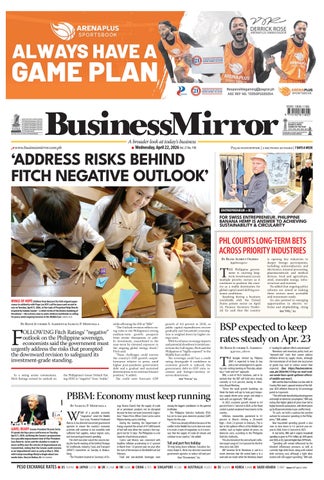
WINGS OF HOPE Children from Quezon City fold origami paper cranes in solidarity with Pope Leo XIV’s call for peace and an end to war on Tuesday, April 21, 2026, at Our Lady of Perpetual Help Church. Inspired by Sadako Sasaki—a child victim of the Atomic bombing of Hiroshima—the activity aims to unite children worldwide in calling for peace amid ongoing tensions in the Middle East. NONOY LACZA
Continued from A1 PHL courts long-term bets across…
Continued from A1
discussions with Mitsubishi Motors Corporation on potential hybrid electric vehicle manufacturing in the country.
“These strategic investment pillars represent both growth and stability, and we are inviting deeper cooperation and long-term investments in our priority sectors,” the country’s finance chief said.
Representatives of the US private sector, led by the US-Asean Business Council and the US Chamber of Commerce, expressed support for the Philippines’ economic direction while raising areas for further cooperation, Go said. He added that investors are increasingly focusing on economies that can sustain growth while managing risks, especially as global conditions remain uncertain.
The Philippines is also working to strengthen its investment appeal through macroeconomic stability, citing sustained growth, controlled inflation, a stable labor market, and fiscal discipline, he said.
“So, if you are looking for your next growth market in Asia, look at the Philippines,” Go said.
The roundtable also served as a venue to discuss broader economic concerns, including investment climate reforms, capital market development and measures to sustain resilience in the face of global uncertainty, per the finance chief.
Principal payments jack up Jan external DSB by 80%
By Reine Juvierre S. Alberto @reine_alberto
THE Philippines’s external debt service burden (DSB) rose by 80 percent year-on-year in January, driven by higher principal payments, according to the Bangko Sentral ng Pilipinas (BSP).
Latest BSP data showed that external DSB soared by 81.10 percent to $1.505 billion in January 2026, from $831 million in the same month last year.
DSB is the total principal and interest payments the country has to pay after the debt has been rescheduled. Broken down, $760 million of the
Flights…
Continued from A12
three months starting April 15, 2026.
“This is part of our response to the President’s call to mitigate the impact of the Middle East situ-
external DSB for the month was allotted for principal, while $745 million was for interest payments.
Principal payments climbed by 763.63 percent year-on-year from $88 million, while interest payments marginally increased by 0.26 percent from last year’s $743 million. Meanwhile, the country’s debt ser-
ation,” Neri said.
The airport authority expects to incur losses of around P5 million or more during the three months due to the rebate, with potential increases if the measure is extended.
Neri added that MCIAA has also requested assistance from the Aboitiz Group, its private sector partner, for possible additional relief measures,
vice burden compared against its export shipments jumped to 26.5 percent in January from 16.8 percent a year ago.
As a percentage of the country’s exports of goods, as well as receipts from services and primary income, went up to 11.2 percent from 6.5 percent.
In terms of other ratios, that of DSB to current account receipts likewise rose to 10.7 percent from last year’s 6.1 percent.
BSP’s DSB data consists of principal and interest payments on fixed medium- and long-term credits, including International Monetary Fund credits, and loans covered by the Paris Club.
It also includes interest payments on fixed and revolving short-term liabilities of banks and non-banks, but excludes
although a response is still pending.
Meanwhile, while the Civil Aviation Authority of the Philippines (CAAP) has slightly reduced passenger service charges, MCIAA said it could not implement a similar move due to limitations under its concession agreement. For now, Neri maintained that the situation remains under control.
“If things get worse with this war, I don’t know what’s going to happen, but for now, I would say it is very manageable,” Neri concluded.
Meanwhile, the Aboitiz InfraCapital Cebu Airport Corporation (ACAC) has started coordinating with key tourism players to help soften any potential impact on Cebu’s travel industry.
“The aviation and tourism sectors are deeply intertwined. When global headwinds like surging jet fuel costs put pressure on our airline partners, our industry inevitably feels the impact,” said Athanasios Titonis, chief executive officer of Aboitiz InfraCapital Operating Airports.
As part of its preparations, MCIA recently held an industry dialogue with hotel operators and tourism stakeholders in Cebu to ad-
Continued from A1
fees in time for the harvest season when food transportation activities are expected to rise.
“This begins with the speedy accreditation of farmers and traders who are qualified for the toll fee waiver,” Recto said in a statement.
“Unnecessary and unreasonable stopping and inspection of food trucks by police and LGU [local government units] checkpoints should also stop because it delays travel and wastes fuel,” he added.
The Department of Agriculture (DA) and the Department of Transportation (DOTr) have coordinated with tollway operators to waive toll for government-accredited cargo trucks.
DA has accredited 1,162 private trucks under its Food Lane Program. It is targeting to accredited another 3,100 truckers.
prepayments on future years’ maturities of foreign loans and principal payments on fixed and revolving short-term liabilities of banks and non-banks.
As of the end of 2025, the country’s external debt reached $147.651 billion, up by 7.28 percent year-on-year from $137.628 billion. The bulk of the external debt was accounted for by the public sector compared to the private sector.
Public external debt stood at $94.867 billion as of end-2025, higher by 11.16 percent than the $85.340 billion recorded in the same period a year ago.
Private external debt, meanwhile, marginally grew by 0.94 percent year-on-year to $52.784 billion from $52.288 billion.
dress possible challenges.
The discussions centered on how rising global fuel prices, driven by geopolitical tensions, could lead to higher airfares and potentially reduce travel demand, particularly among inbound visitors.
“By aligning closely with our hotel partners, developing agile passenger scenarios, we are leveraging the same proactive management model that has driven success across our other gateways,” Titonis added. Participants also examined ways to respond collectively, including scenario planning and strengthening coordination across the tourism value chain.
Beyond mitigating risks, MCIA is likewise looking at expanding its network by exploring new and emerging markets. Airport officials said talks are underway to open direct routes to alternative destinations that could help offset any slowdown from traditional markets.
Similar consultations are expected to be rolled out in other airports managed by Aboitiz InfraCapital, including Laguindingan International Airport and Bohol-Panglao International Airport.
“The DA expects to generate over 100 million pesos in savings for haulers as a result of the measure period for one month starting April 20, 2026,” Castro said.
The Maritime Industry Authority (Marina) will also cut by 75 percent its key regulatory fees covering permits, safety certificates, vessel registration and accreditation.
It also reduced its annual tonnage fee and suspended the implementation of its January issued schedule of fees and charges starting April 20, and will remain enforced for one year or for the duration of the State of National Energy Emergency unless earlier lifted or revised.
The Philippine Ports Authority (PPA), it will reduce Roll-on/Roll-off (RoRo) annual tonnage fee to just one peso per gross tonnage beginning April 10, and will remain in effect for six months.
DA and DOTr tollway operators have waived toll for Department of Agricultureaccredited cargo trucks.
The DA expects to generate over P100 million in savings for haulers as a result of the measure period for one month starting April 20, 2026.
Palace: Fitch cited PHL efforts DESPITE the outlook downgrading, the international credit rating agency has recognized that the country’s efforts to boost its economic growth, which remain robust, can withstand global headwinds, according to Malacañang.
Citing the Department of Finance (DOF), Palace Press Office Claire Castro said Fitch highlighted the initiatives of the “decisive and proactive response to global challenges particularly the energy shock.”
“While Fitch says that the outlook is negative, it does not mean a downgrade is imminent,” Castro said in Filipino in a press briefing.
“Measures such as expanding the policy toolkit and implementing fuel saving strategies demonstrate agile and responsible economic management which continues to strengthen market confidence,” she added, quoting acting Finance Secretary Frederick D. Go.
‘Not a death sentence,’ but... LEONARDO A. LANZONA, economist at the Ateneo de Manila University, told the BusinessMirror that the outlook revision is “not a death sentence” and the Philippines may still proceed to its “Road to A” agenda.
“But the risks will be greater if it does not respond to the factors that led to the revised outlook,” Lanzona said.
Jonathan A. Ravelas, senior adviser at Reyes Tacandong & Co., said the Philippines’s upgrade story is “clearly over,” although Fitch Ratings’ move is not a “crisis.”
“Other agencies could revise outlooks, but a downgrade isn’t imminent as long as growth stabilizes, inflation is contained, and fiscal execution improves,” Ravelas said. If oil prices continue to remain higher and the current account deficit stretches with no strong policy response, then the cushion safeguarding the country’s ‘BBB’ rating gets “very thin,” Ravelas added.
“With current issues being faced we need to show we can maintain the ‘BBB,’” he said.
DOF, BSP: PH economy remains solid STILL, the Department of Finance (DOF) said Fitch’s affirmation of the sovereign’s credit rating reflects its “strong economic fundamentals and “sound fiscal position.”
“The Philippine economy remains on solid footing with a robust domestic market, stable financial system, and recognized reforms,” the DOF said in its reply to reporters.
Meanwhile, the Bangko Sentral ng Pilipinas (BSP) noted the credit rater’s decision to affirm the country’s investment-grade credit rating.
“The BSP is closely monitoring the impact of higher oil prices and geopolitical developments, particularly the conflict in the Middle East, on inflation and the overall Philippine economy,” BSP Governor Eli M. Remolona Jr. said.
While the recent oil price pressures are driven by global supply shocks, Remolona said the central bank remains vigilant against spillover effects and the risk of de-anchoring inflation expectations.
“It stands ready to act in a measured, timely and data-driven manner,” Remolona added.
An investment-grade rating signals low credit risk and continued access to affordable financing, supporting government spending on priority programs.
A negative outlook, meanwhile, underscores the need to address emerging risks affecting the country’s credit profile.
Increased spending PRESIDENT Marcos also directed the Department of Budget and Management (DBM) to release P46.22 billion for 1,743 infrastructure projects, according to Castro.
This includes the Davao City Bypass Construction Project which has an approved allocation of more than P288 million for fiscal year 2026. Marcos also ordered the release of P17.27 billion funds for the construction of 4,960 classrooms nationwide. Last week, Garin said the government is raising its spending to prevent “stagflation,” or the combination of high inflation and stagnant economic growth.
PHL govt initiatives
AMONG the initiatives implemented by the government when the crisis broke on February 28, and which Palace officials cited, are a four-day work week and requiring agencies to reduce their fuel consumption by 10 to 20 percent. The government also allowed the distribution of cash aid, fuel subsidies, and service contracting program to cushion the public from the effects of Middle East crisis.
Castro also said these measures give the country an investor-friendly environment.
“Aside from that, the Philippines continues to enjoy strong access to global capital markets supported by a diversified investor-based and sustained demand for its Republic of the Philippines issuances. These are clear indicators of investors trust in the country’s long term trajectory,” Castro said.
ICSC pilots renewable energy roadmap
PALO, Leyte—Building on its earlier work in local energy planning, the Institute for Climate and Sustainable Cities (ICSC) pilots a Renewable Energy (RE) Plan and Roadmap scoping workshop with the Municipality of Guiuan from April 14 to 17, as one of the initial activities under its recently signed Memorandum of Agreement with Eastern Visayas local chief executives.
Under this partnership, participating local governments (LGU) aim to institutionalize participatory local energy planning and roadmapping, craft local RE ordinances, and mobilize innovative financing for rooftop solar, island microgrids, and community-led RE initiatives.
“Renewable energy is a no-regrets solution. Beyond reducing electricity costs, it enhances public services, supports livelihoods, improves public health, and strengthens local infrastructure. Decentralized solutions like rooftop solar and mini-grids can bridge energy access gaps, particularly in rural and underserved areas, ensuring that no community is left behind,” said Councilor Kinna Mae Kwan-Mabansag, who spoke on behalf of Mayor Annaliza Gonzales-Kwan during the workshop.
Workshop participants from the Guiuan LGU were educated on renewable energy policy, grid modernization, data-driven energy targets, and resilient energy options for off-grid and small island communities by ICSC Grid Modernization Advisor Gaspar Escobar Jr. and Energy Transition Advisor Alberto Dalusung III, respectively.
Sessions also delved into RE project structures, cycles, and financing, as well as available lending programs for RE projects for local governments, led by ICSC Senior Advisor on Energy Literacy and Energy Democracy, Monalisa Dimalanta, and Development Bank of the Philippines Vice President Rustico Noli D. Cruz.
In addition to the information discussions, case studies of other local governments were also tackled, particularly from the cities of Butuan and Iloilo. Butuan City Planning and Development Office’s Engr. Angelo Boligol talked about the formulation process, implementation, and impact of their local Renewable Energy Plan Roadmap, and how RE zoning, land use planning, and investment promotion helped move clean energy planning forward in their city.
ICSC’s Director for Community Resilience Arturo Tahup emphasized the importance of local leadership in responding to energy challenges in his welcome remarks. “We are at a point where we must transform crises into opportunities. The current energy situation presents real challenges, but it also opens pathways for local governments to lead,” said Tahup.
The four-day workshop brought together Guiuan’s technical working group, composed of legislative representatives, department heads, and staff from planning, engineering, general services, permitting and licensing, finance, environment, and disaster risk management. Together, they validated ICSC’s report on their local energy baseline and identified viable RE opportunities.
Throughout the sessions, the workshop resource persons, together with ICSC advisers, provided technical guidance and access to resource materials that helped shape and prioritize projects for financing and implementation. Outputs include an envisioned RE plan and targets, enabling local programs and policy measures to drive energy transition and RE development in the municipality.
Kwan-Mabansag highlighted that the workshop is a significant step not only for the municipality, but for the Eastern Visayas region’s broader push toward a cleaner, more resilient, and more sustainable energy future.
“Reliable, affordable, and sustainable energy is essential to local development. High power costs and frequent outages have already affected fisheries, water distribution, investment, and economic opportunities in Guiuan, and a Local Energy Plan will help the municipality identify priority RE projects, craft enabling policies and ordinances, and direct investments where they are needed most,” KwanMabansag added.
Beyond broader RE planning goals, the workshop focused on Guiuan’s immediate energy priorities, particularly efforts to improve and eventually achieve 24/7 electricity access in offgrid communities like Homonhon, Suluan, and Victory.
Discussions covered the municipality’s energy profile, grid and transmission constraints, and energy source options such as solar, wind, battery energy storage system (BESS), and hybrid systems to reduce diesel dependence and strengthen energy security.
Designed to strengthen LGU understanding of the energy landscape and policy frameworks, build capacity to assess local energy needs, support the development of RE plans, and translate these into actionable projects and investments, the workshop lays important groundwork for Guiuan’s next steps. For the technical working group, this process is expected to advance a more affordable, reliable, and resilient energy future, positioning Guiuan as a model for how Eastern Visayas communities can turn clean energy commitments into implementable roadmaps.
It serves as the pilot run of a series of capacity-building activities, with more LGUs across Eastern Visayas, Northern Mindanao, and Bicol Region set to undertake similar RE planning processes with ICSC in the coming months.
Toll exemptions could save food vehicles ₧152-M in one month
MBy Ada Pelonia @adapelonia
ORE than 1,100 vehicles transporting farm products could save up to P152 million from the one month toll exemption aimed at easing logistics cost pressures on retail prices of goods amid the ongoing global oil crisis, the Department of Agriculture (DA) said.
This, after the government initiated a program where operators of major expressways granted toll exemptions to accredited agricultural transport vehicles last April 20. It is set to end in a month.
Agriculture Undersecretary
Arrey Perez said 1,162 trucks currently accredited could save at least P52 million to P152 million from the program, which expanded the food lane project that previously provided toll rebates only.
“An additional 300 vehicles
have been accredited over the weekend, and this will further increase as many are enticed to join the program,” Perez told reporters in a news conference on Tuesday.
The agency is looking at 4,000 vehicles carrying agricultural goods that will benefit from the month-long toll exemption program. There are more than 20,000 agricultural truckers nationwide.
If realized, the DA explained that these 4,000 vehicles could transport around 16,000 metric tons (MT) of farm goods to markets on a daily basis.
Under revised guidelines, up to Class 3 vehicles carrying agricultural goods, such as seeds, crops, livestock and fisheries products, fertilizers and pesticides, and farm machinery are qualified for the program.
The DA said applications can now be approved within the same day, with toll exemption activation
completed within 24 hours.
The system integrates digital registration, QR-coded accreditation, and RFID enrollment to enable seamless verification across key tollways such as North Luzon Expressway, South Luzon Expressway, and Skyway, reducing delays at checkpoints and toll plazas.
The DA noted that priority rollout areas include major agricultural corridors in Luzon, especially Central Luzon, Calabarzon (Cavite, Laguna, Batangas, Rizal and Quezon), and the Cordilleras, where large volumes of food products move daily to urban markets.
“The policy underscores how logistics efficiency has become a frontline issue in food security. By cutting transport friction and shielding producers from rising fuel costs, the government aims to cushion consumers from supply disruptions, even as global energy uncertainties persist.”
Lacson backs DOE-mandated fuel adjustments
By Butch Fernandez @butchfBM
HAVING the Department of Energy (DOE) mandate fuel price adjustments is a better option than leaving the public entirely at the mercy of the market, Senate President Pro Tempore Panfilo M. Lacson said, provided these remain reasonable. Lacson said in a statement on Tuesday that such intervention— enabled by the DOE’s authority to impose price adjustment limits during a state of national energy emergency—is far better than
leaving the fuel prices to the oil companies.
“The government must use the powers granted to it under a state of national energy emergency. As long as the DOE’s computations are reasonable—whether the adjustments are upward or downward—this is better than just allowing oil firms to dictate prices of fuel,” he said.
For this week, the DOE set a minimum rollback of P24.94 per liter for diesel, P3.41 for gasoline, and P2.00 for kerosene. Energy Secretary Sharon Garin was quoted as saying that companies
are free to offer bigger discounts, but any adjustment less than the prescribed amount will trigger legal action.
Also, Oil Industry Management Bureau Director Rino Abad was quoted as saying violators will be charged under Section 24 of the Downstream Oil Industry Deregulation Act of 1998, with penalties including three months to one year imprisonment and a fine ranging from P50,000 to P300,000.
The DOE had warned it may revisit or revoke the business permits of any company that resists the prescribed price ceiling.
Republic Act 8479, or the Downstream Oil Industry Deregulation Act, allows the DOE to take over temporarily or direct the operation of any person or entity in the oil industry, Lacson pointed out.
“Actually, the state is given the prerogative, under RA 8479 or Downstream Oil Industry Deregulation Act, to quote—‘when public interest so requires, the DOE may, during the period of the emergency and under reasonable terms prescribed by it, temporarily take over or direct the operation of any person or entity engaged in the industry,’” he said.
DILG opens public bidding for ₧1.27-B 911 vehicles
By Jonathan L. Mayuga @jonlmayuga
THE Department of the Interior and Local Government (DILG) has opened public bidding for more than P1.27 billion worth of vehicles for the Unified Emergency 911 National Office.
The public bidding for the acquisition of the vehicles is part of the government’s push to deliver faster and more reliable emergency response all over the country, the DILG said in a statement.
To be procured are motorcycles, patrol cars, and ambulances that will help responders reach people faster during accidents, fires,
medical emergencies, disasters, and other urgent situations.
The bidding was conducted through the department’s Bids and Awards Committee (BAC) in line with President Marcos’ directive to strengthen transparency, accountability, and clean government transactions.
To ensure openness, the proceedings were livestreamed on the DILG’s official Facebook page so the public could witness the process in real time.
Interior and Local Government Secretary Jonvic Remulla has emphasized that public trust is built when government funds are used properly and
every process is done fairly, openly, and according to law.
The BAC, led by DILG Undersecretaries Omar Romero and Jon Paulo Salvahan, together with Assistant Secretary Jesi Howard Lanete, evaluated the bid documents submitted by participating suppliers.
The procurement for light motorcycles advanced to the next stage of evaluation, while the bidders for the patrol cars and ambulances were declared ineligible due to incomplete or non-compliant documents, reflecting the department’s strict observance of the procurement process.
The Commission on Audit, together with the DILG Technical Working Group and Procurement Management Division, were also present to ensure integrity and proper procedure throughout the activity.
The procurement package includes light motorcycles worth P238.29 million, patrol cars worth P607.21 million, and ambulances worth P434.44 million.
The DILG said the additional vehicles will strengthen the operational capacity of the 911 system and help emergency responders deliver quicker and more dependable service to communities nationwide.
FPI pushes vigilance as Customs loosens import rules
By Bless Aubrey Ogerio
THE extension of importer accreditation validity from one year to three years may reduce administrative delays, but its impact will depend on how consistently rules are enforced on the ground, the Federation of the Philippine Industries (FPI) said.
The change, issued under Customs Administrative Order 012026, is intended to streamline import procedures and reduce repeated documentary requirements for accredited importers.
FPI said the adjustment could ease compliance costs for businesses that have long complained about delays in processing and repeated renewals.
“Predictability and speed are important to lessen business friction costs. A timely measure
given current economic circumstances,” FPI chairperson Elizabeth Lee said.
However, the group also pointed out that regulatory efficiency is not only a matter of policy design, but also of implementation, which has often been uneven across processes tied to trade facilitation.
While the longer accreditation period is expected to simplify transactions, industry stakeholders said persistent bottlenecks in customs procedures continue to affect import timelines and costs.
The policy comes at a time of heightened external pressures, including volatility in global energy markets driven by geopolitical tensions, which have pushed up fuel and transport costs.
For an import-dependent economy like the Philippines, FPI said
these shifts quickly feed into higher production costs and tighter margins for businesses.
The group warned that these conditions increase the risks posed by smuggling and illicit trade, which can further distort pricing and competition when legitimate firms are already under pressure.
“At a time like this, the entry of smuggled goods becomes even more damaging. It distorts markets precisely when firms are least able to absorb additional pressure,” Lee said.
She said addressing illicit trade should be treated as part of broader economic stability measures, given its impact on both government revenues and market competition.
“In this environment, curbing smuggling is not only a law enforcement priority but an economic necessity,” she said.
The group cited estimates placing revenue losses from smuggling and customs leakages at up to P500 billion annually, based on industry and congressional discussions. It said these gaps weaken fiscal space needed for subsidies, inflation relief, and social programs. Meanwhile, in the tobacco sector alone, illicit trade is estimated to cost at least P40 billion a year in lost government revenue.
FPI said these losses directly affect the government’s capacity to respond to rising public spending needs. “Every seizure is more than enforcement—it is fiscal defense. In a high-inflation, high-cost environment, protecting revenues ensures government retains the capacity to cushion the most vulnerable sectors,” Lee said.
House committee set to trace paper trail of Duterte’s wealth
By Samuel P. Medenilla @sam_medenilla
THE committee of the House of Representatives that is conducting impeachment proceedings is set to receive copies of the Statements of Assets, Liabilities and Net Worth of Vice President Sara Duterte, as well as documents from the Bureau of Internal Revenue and the Anti-Money Laundering Council on Wednesday.
Party-list Rep. Terry L. Ridon of Bicol Saro, a member of the House Committee on Justice that is conducting the proceedings, said on Tuesday that the next impeachment hearing against Duterte on Wednesday “will be more consequential, as the House Committee on Justice is set to rely primarily on financial documents, tax records, and bank transactions in determining probable cause over allegations of ill-gotten and unexplained wealth.” Office of the Ombudsman, Securities and Exchange Commission (SEC), Bureau of Internal Revenue (BIR), and Anti-Money Laundering Council (AMLC) are expected to attend the April 22 hearing to provide the Justice committee with copies of Duterte’s Statement of Assets, Liabilities and Net Worth (SALN), income tax returns, corporate records of her husband lawyer Manases Carpio, and reports on any suspicious bank transactions involving the couple’s accounts.
Ridon said the documents to be submitted by these agencies will allow lawmakers to independently assess whether there is a signifi -
cant discrepancy in the Vice President’s wealth beyond the P88.5 million net worth declared in her 2024 SALN.
Kung may malaking pagkakaiba mula sa P88 million base sa ITR, bank records, at financial statements ng SEC, may problema na siya ,” Ridon said. “ Kailangang magtugma ang idineklara niyang halaga ng kanyang kayamanan sa SALN at sa records ng BIR at SEC,” he added.
He said the Committee on Justice will need to determine the threshold for material discrepancy—whether a substantial variance between declared and actual assets would constitute sufficient basis for a finding of unexplained wealth.
When asked whether the committee will examine the bank accounts and transactions cited by former Sen. Antonio Trillanes IV, Ridon said the panel must first establish whether the accounts are indeed attributable to the Vice President.
Trillanes has been subpoenaed to attend the Wednesday hearing, following his claim that over P2.4 billion in transactions allegedly occurred from 2006 to 2015 across
multiple Duterte family accounts, including joint accounts with the Vice President.
He also claimed to possess bank ledgers showing deposit patterns allegedly linked to manager’s checks associated with illegal drug transactions, involving accounts under the names of Sara Duterte during her tenure as vice mayor, as well as those of Rodrigo Duterte’s wife and son.
The Vice President faces allegations of having deposited at least P111 million across various banks in Davao City and Metro Manila from 2006 to 2015—amounts that complainants argue are grossly disproportionate to her salary as former vice mayor and mayor of Davao City. Ridon also flagged a previously noted P50-million alleged discrepancy in her declared wealth, which has since risen to P88 million in 2024.
Do a Madriaga AS a test of credibility, Deputy Speaker Paolo Ortega V on Tuesday urged Duterte to personally attend the next hearing of the House Committee on Justice on April 22, take her oath, sign a bank waiver, and directly answer allegations raised by resource person Ramil L. Madriaga.
Ortega said the combination of sworn testimony and a bank waiver would remove any doubt and allow documents—not narratives—to settle the issue.
The call came after the panel heard Madriaga under oath on April 14. He signed the bank waiver and testified following clearance from a Manila court. House members earlier described him as a key resource person in the impeachment proceedings.
Ortega said the next step is straightforward: the Vice President should respond under the same conditions.
Ortega, who represents La
OCD convenes multi-agency meeting as Navotas rubbish fire threat persists
TBy Jonathan L. Mayuga
@jonlmayuga
HE Office of the Civil Defense has convened a multiagency coordination meeting as the Navotas landfill fire continues to emit toxic smoke, causing serious threat to human health and the environment.
In the meeting with national agencies and international partners, the OCD sought to address the fire incident and strengthen measures to manage the situation and mitigate potential air quality impacts.
Representatives from the Bureau of Fire Protection, Coast Guard (PCG), Armed Forces (AFP), US Embassy, US Department of State, Fairfax County Fire Rescue Department, Los Angeles County Fire Rescue Department, and DHR Wildfire Unit are actively coordinating with OCD.
Undersecretary Harold N. Cabreros, during the meeting, highlighted the value of unified action and the integration of international expertise to support a proactive and science-based response. The fire, which started last April 10, has quickly spread in parts of
the 41-hectare sanitary landfill in barangay Tanza 2, Navotas City.
The Navotas landfill is bigger than the Quezon City Circle, the Philippine Space Agency (Philsa) said.
Satellite imagery from the Philippine Space Agency (PhilSA) shows the fire has burned approximately 28.6 hectares—nearly 70 percent of the facility, six days after the fire broke out.
PhilSA said it has produced a map of the landfill and provided it to the National Disaster Risk Reduction Council.
Toxic smoke from the fire has severely affected air quality in Caloocan, Malabon, Navotas and Valenzuela City or the Camanava District, Bulacan, and as far as Bataan.
In Bulacan, 400 individuals have been evacuated due to poor air quality.
Firefighters from the Camanava area have been struggling to contain the fire, which was earlier declared “under control”, but the burning rubbish underneath continues to pose a problem as they easily reignite because of the methane gas buildup underneath.
Authorities have advised the public affected by the smoke from the fire to stay at home, with doors and windows closed and use a facemask whenever going outside.
Union stressed that signing a bank waiver would be a decisive move toward transparency, as it would allow the verification of financial records tied to the allegations.
A bank waiver, Ortega said, enables authorities to access bank documents that could either confirm or debunk claims of undisclosed assets, cutting through speculation and competing statements.
Ortega pointed out that without such a step, public debate remains confined to claims and denials, instead of evidence.
He added that a bank waiver, combined with sworn testimony, would place both sides on equal footing—subject to verification, documentation, and legal accountability.
Ortega echoed the earlier position of former Integrated Bar of the Philippines national president Domingo Cayosa that fairness demands the same standard, noting that Madriaga had already testified under oath and exposed himself to possible perjury liability.
He emphasized that the issue is not about theatrics but about verifiable truth.
Ortega added that inconsistencies, if any, should be tested through documents and questioning—not used to avoid participation.
He reiterated that the House panel is not determining guilt at this stage but is focused on establishing probable cause based on evidence and testimony.
AMLC receives House subpoena
THE Anti-Money Laundering Council (AMLC) has received a subpoena from the House Committee on Justice requiring its top official to appear at the next impeachment hearing on Wednesday and submit financial records involving Vice President Sara Z. Duterte and her husband.
Sotto says senators prepared to conduct impeachment trial
By Butch Fernandez @butchfBM
SENATORS have been reminded to prepare seriously for the possible convening of the Senate as an impeachment court, and to avoid any pronouncements or acts that this early may be deemed as a prejudgment of the outcome.
Senate President Vicente Sotto III said Tuesday the Senate leadership gave the reminders at a recent meeting, even as he asserted that remarks prejudging some senators, like what a former presidential counsel Salvador Panelo said last week, should simply be trashed so as not to distract the work of senator-judges.
Asked in a news conference whether he was also preparing for an eventuality where some members of the minority might question the legality of the Senate’s tackling the House impeachment complaint, Sotto said the constitutional mandate is clear, i.e., the Senate must act with dispatch on an impeachment complaint from the lower chamber.
A reporter asked if he would act “forthwith,” and Sotto quickly replied in Filipino, “I know the meaning of forthwith.” It was an allusion to the time of Senate President Francis Escudero in February 2025, when he refused to convene senators, who were then in recess, even just for organizational and related issues, and not as a court.
The camp of Vice President Sara Duterte then used the time to elevate a case to the
Another group asks SC to stop Sara impeach proceedings
JBy Joel R. San Juan @jrsanjuan1573
UST as the House of Representatives panel conducting impeachment proceedings against Vice President Sara Duterte is about to receive copies of her financial records from various government agencies, another group of lawyers filed a petition before the Supreme Court seeking to stop what they called “the ongoing mini-trial” being conducted by the House against her.
The latest petition, which was filed by lawyers Hue Jyro U. Go, Micah Lorelle P. de Guzman, and Jake Leoncini, also sought to nullify all the actions and compulsory processes, including the issuance of subpoenas, by the House Committee on Justice compelling several agencies to submit documents to support the impeachment complaints.
“The successive issuances of subpoenas, reception of materials outside the complaints, and resort to third-party record-gathering reveal an unmistakable attempt to search for, assemble, and construct evidence not found in the complaints themselves,” the 34page petition read.
“These acts constitute nothing less than a fishing expedition for evidence,” it added.
The petitioners argued that the House of Representatives exceeded its constitutional authority under Article XI, Section 3 of the 1987 Constitution when it took cognizance of the impeachment complaints.
The petitioners further argued that the House Committee on Justice has embarked on a campaign of “case build-up” instead of confining itself to the task of evaluating the impeachment complaints as mandated under the Constitution.
“The power to determine sufficiency in form, sufficiency in substance, and the existence of sufficient grounds does not include the power to manufacture those grounds by searching beyond the complaint for evidence that was not properly alleged, incorporated,
or appended in the first place,” the petitioners pointed out. The petitioners also questioned the relevance to the impeachment complaints of the documents being sought by the House committee through its subpoenas such as Duterte’s statements of assets, liabilities and net worth (SALNs), records from the Anti-Money Laundering Council (AMLC) for covered and suspicious transactions from 2006 to 2025 and the admission of the supplemental affidavit of witness Ramil Madriaga, an accused in a kidnap-for-ransom case.
“The impeachment complaints rest primarily on allegations concerning confidential funds disbursement, liquidation irregularities, and alleged deficiencies in acknowledgment receipts and COA [Commission on Audit] submissions,” the petitioners said.
“However, the subpoenas issued and sought extend far beyond these defined subject matters, encompassing SALNs spanning decades, AMLC covered and suspicious transaction reports, and the banking activities of both the Vice President and her spouse over an expansive timeframe,” they added. Furthermore, the petitioners said the House impeachment proceedings violate the principle of fair play and the requirement of due process based on the recent ruling of the SC in Duterte v House of Representatives.
The latest petition brought to four the number of petitions that have been filed before the SC seeking to enjoin the House impeachment proceedings against the Vice President,
The first petition was filed by a group of lawyers led by Israelito Torreon which was followed by another petition filed by the Vice President herself.
The third petition was filed by One Bangsamoro Movement, Commission on Education (CHEd) Commissioner Ronald Adamat and several lawyers.
All four petitions prayed for Court’s issuance of a temporary restraining order (TRO) to immediately enjoin the House impeachment proceedings.
SC affirms ruling on prescription of cyber libel cases
THE Supreme Court (SC) has affirmed its 2023 which declared that the crime of cyber libel prescribes in one year from the time it is discovered by the offended party.
In its 29-page resolution written by Associate Justice Henri Jean Paul B. Inting, the Court en banc denied the motions for reconsideration filed by Berteni Cataluña Causing and the Office of the Solicitor General (OSG) of its October 11, 2023 decision.
The Court, in the said ruling, clarified that the prescriptive period for cyber libel is one year from the date of discovery, consistent with traditional libel under the Revised Penal Code.
The decision stemmed from the cyber libel complaint filed by Cotabato Rep. Ferdinand L. Hernandez in December 2020 against Causing in connection with his Facebook posts accusing the legislator of pocketing over P200 million in relief goods for Marawi victims.
Hernandez, who repesents the Second District of Cotabato said he discovered the posts on February 4 and April 29, 2019. Criminal informations were filed before the Regional Trial Court (RTC) against Causing in May 2021. Causing filed a motion to quash the informations, arguing that they were already timebarred under the Revised Penal Code (RPC) because more than one year had passed since the posts were uploaded. The RTC denied the motion, ruling that cyber libel prescribes in 12 years under Republic Act 10175 or the Cybercrime Prevention Act. Causing elevated the issue before the Court, which ruled in 2023 that the prescriptive period for cyber libel is one year from the date of discovery, consistent with traditional libel under the Revised Penal Code.
By Justine Xyrah Garcia
THE Philippines is seek -
ing stronger international support to address gaps in digital access and institutional capacity that continue to limit the use of technology in population data systems, the Commission on Population and Development (CPD) said.
In a statement following the 59th session of the United Nations Commission on Population and Development in New York, the CPD said developing countries need support to close digital divides, strengthen institutions, and expand access to technological innovations.
Undersecretary Lisa Grace Bersales, CPD executive director, said these gaps affect how governments use data to design and deliver population and development programs.
“We, therefore, call for strengthened international cooperation to support developing countries in closing digital divides, building institutional capacity, and ensuring equitable access to technological innovations,” Bersales said.
The CPD said uneven connectivity continues to restrict the reach of digital systems. While mobile phone ownership exceeded 80 percent of Filipinos in 2024, only about half of households have internet access, pointing to gaps in
infrastructure and access.
The agency said the government has been expanding the use of digital tools in census-taking, geospatial systems, and data sharing across agencies.
It added that digital platforms are also being used to deliver health services, including telemedicine and mobile applications, particularly in geographically isolated and disadvantaged areas.
These efforts are supported by the E-Governance Act of 2025, which aims to improve interoperability and public service delivery.
However, the CPD said gaps in connectivity, access to online platforms, and the availability of relevant data continue to constrain policymaking.
It added that investments in technology and research need to be matched with investments in human capital, institutions, and inclusive policies.
“Technology is not an end in itself—it is a means to empower people, expand choices, and achieve sustainable and equitable development,” Bersales said.
The CPD also noted that the countrty remains committed to a rights-based and inclusive approach to population and development, with a focus on using research and technology to support evidence-based policies and ensure that no sectors are left behind.
Changes in Japan rules to allow PHL access to quality defense equipment
By Rex Anthony Naval
NATIONAL Defense Secretary
Gilberto Teodoro Jr. on Tuesday hailed the results of Japan’s “Review of the Three Principles on Transfer of Defense Equipment and Technology” and its “Implementation Guidelines” as these will allow the Philippines to access defense articles of the highest quality.
Teodoro, in a statement, said this is important as its supportability will not only enable the Philippines to strengthen its domestic resilience but also to contribute to regional stability through deterrence in a meaningful way.
“Our defense partnership with [the] Japanese has entered a new
Tera of working together and with other like-minded partners to secure our individual and collective rights and entitlements under international law through principled advocacy buttressed by deterrence,” he added.
Teodoro also said they are also grateful for Japan’s Official Security Assistance when the
Philippines was hit by natural calamities.
“We will continue the fruitful and impactful partnership and will be creative in pro-actively ensuring our mutual security goals in the coming period. I look forward to the visit of the Hon. Shinjiro Koizumi [Japanese Defense Minister] soon where we will discuss anchoring mechanisms for a strong and responsive alliance,” he added.
The Japanese government officially revised “Review of the Three Principles on Transfer of Defense Equipment and Technology” and its “Implementation Guidelines” to enable overseas sales of weapons, including those with lethal capabilities.
The revisions scrap rules that limit Japan’s defense equipment exports to five noncombat categories, namely rescue, transport, warning, surveillance, and minesweeping. Instead, defense equipment will be divided into “weapons” and “non-weapons” categories, based on whether they have lethal capability.
DA seeks $1-M grant from ADB for fertilizer plant feasibility study
THE Department of Agriculture (DA) is seeking to secure a $1 million grant from the Asian Development Bank (ADB) to bankroll a feasibility study for the country’s first fertilizer manufacturing plant.
bid to establish a fertilizer manufacturing plant has been approved by the President subject to a feasibility study.
The subpoena ad testificandum et duces tecum, dated April 15, 2026, directed AMLC Chairman Eli M. Remolona Jr. to attend the April 22 hearing at 10 a.m. at the House of Representatives and to bring documents covering reported transactions from 2006 to 2025. Under the order received last April 16, the AMLC is required to produce “original or certified true copies of all reports of covered transactions and suspicious transactions” involving Duterte and Manases Carpio, along with “any and all investigation reports or related reports or documents prepared by AMLC” on the same. The subpoena, issued in connection with the verified impeachment complaints against the Vice President, states that the records will be used “to testify on reports of covered transactions and suspicious transactions” involving Duterte and her husband. It added that the request is tied to allegations of unexplained wealth, referring to transactions “which VP Duterte failed to reflect in her Statement of Assets, Liabilities, & Net Worth.” The House panel also directed the AMLC to “identify and authenticate AMLC reportorial certifications, and other relevant reports” involving the Vice President, her spouse, and “various business entities in which they hold interest.”
the Russia-Ukraine war caused spikes in the prices of the critical farm input.
By Joel R. San Juan @jrsanjuan1573
HE Department of Justice
(DOJ) yesterday announced that it would lead a high-level delegation bound to Prague within the week to discuss with Czech authorities the immediate return of former congressman Zaldy Co to the country to face trial for the multi-billion corruption of public funds intended for infrastructure and flood-control projects of the government.
At a press briefing, Justice Secretary Fredderick Vida also dismissed claims that Co’s arrest in Czech Republic was false. Vida emphasized that their trip to Prague, as well as the notices received by the Philippine Center for Transnational Crime (PCTC) about the former legislator’s arrest were good indicators that he is being held by Czech authorities.
Vida, however, could not confirm if Philippine authorities in the Czech Republic have gotten in touch with Co already.
“No such information to confirm or deny that. Next challenges, distance. That’s why I’m flying in to Czech Republic very soon, within the week I’ll be flying in. Arrangements have already been made for a meeting with relevant Czech authorities,” Vida said.
“I believe our visa requirements are now being prepared. The intention is to be able to meet with the Czech authorities so that we can [flesh] out possible submittals,” he added.
Vida also disclosed that based on their information Co was with a male companion with no criminal record or standing arrest warrant when he was arrested.
“I don’t want to speculate on information. I don’t want to mention his name because the person might be a private individual, not an accused in any of the cases al-
ready pending with the Philippine government,” Vida said. The DOJ secretary, however, assured that the delegation would include seeing Co in his detention as part of their agenda.
“If there is an opportunity, we will do that,” Vida said. Vida said he had already met with Foreign Affairs Secretary Theresa Lazaro to be properly guided in how to deal with Co’s case and to “understand the law of the land” in the Czech Republic. At present, Vida stressed there is still no definite legal means that the Justice department would be taking in order to hasten Co’s return to the country as several options are still being studied.
“As to the definite mode, it will still be known in the coming days,” he said.
Vida admitted among the legal options being eyed by the DOJ are deportation and extradition.
In addition, the DOJ is also looking into the possibility of invoking the United Nations Convention Against Corruption (Uncac) is seeking Co’s return to the country.
Vida noted that both the Philippines and Czech Republic are signatories in the convention, thus, are obliged to assist each other in holding individuals involved in corruption accountable.
“So here, because the person we are pursuing, the one we are trying to bring back to our country, has been accused in corruption case, this is one of bases of our confidence… this is one of the things we hold on to,” Vida explained.
“Because we know that in the Czech Republic, they also do not tolerate corruption. They would not allow the objective of holding accountable those who should be held accountable to be jeopardized simply because someone fled to another country.
This is recognized by all other countries,” he added.
Agriculture Assistant Secretary Arnel de Mesa said the ADB has approved “in principle” the grant that will kickstart the study for the technical and financial viability of constructing the manufacturing plant in Semirara Island in Caluya, Antique.
He said the study could take two to three months to finalize. The manufacturing facility aims to process coal into urea, a critical farm input used to boost the output of rice, corn, and vegetables.
This, as the Philippines remains at the mercy of foreign fertilizer suppliers and subject to global price volatility.
For his part, Agriculture Undersecretary Roger Navarro said the
However, the Court rejected Causing’s motion to quash the informations due to insufficient proof that the offense had already prescribed.
The SC stressed that the issue on prescription requires the presentation of evidence during court trial. Both the OSG and Causing filed separate partial motions for reconsideration.
In his motion, Causing sought reconsideration of the decision, insofar as it held that the prescriptive period of cyber libel is reckoned from the discovery of the published libelous matter by the offended party.
He argued instead that the prescriptive period of cyber libel should be counted from the date of publication of the defamatory materials.
Causing also maintained that Hernandez should be presumed to have discovered the defamatory materials at the time that they were posted on Facebook, an online social network or social media platform.
He also pointed out that online posts are more widespread compared with the traditional modes of publication in Article 355 of the RPC.
”For example, if we’re going to finish the study by August or September, then we can break ground maybe by November or December,” Navarro told reporters in a news conference on Tuesday.
“Then by 2027, we’ll be able to put up the plant and before the end of that year we will have our own urea fertilizer plant,” he added.
Navarro also disclosed that Agriculture Secretary Francisco Tiu Laurel Jr. will go to Brunei this week to discuss securing additional fertilizer supply for the country.
World Bank figures recently showed that the average quotations for urea in March soared by almost 84 percent to $725.6 per metric ton (MT) from $394.5 per MT in the same month last year.
This was highest since the $925 per MT recorded in April 2022, when
He further argued that if the discovery rule is applied, cyber libel charges could be filed several years after the post was made, as long as the offended party discovered it later.
The OSG, on the other hand, maintained that the one-year prescriptive period for traditional libel under the RPC should not apply to cyber libel.
Instead, it should be 15 years under the Cybercrime Prevention Act, as previously decided by the SC through an unsigned resolution in Tolentino v People.
In upholding its decision, the Court said reckoning the prescriptive period of cyber libel from the date of discovery will not result in a situation where the accused would have no way of knowing when the period started to run.
“Knowledge, as the mental state of awareness of a fact, may be determined on a c·ase-to-case basis by taking into consideration the prior or contemporaneous acts of the person’to whom knowledge is imputed, as well as the surrounding circumstances of the case,” the SC stressed.
The SC added that the accused in the cyber libel cases has the right to have compulsory processes issued to secure the attendance of witnesses
Fertilizer prices started to rise after the United States and Israel launched an airstrike on Iran. Iran then restricted trade in the Strait of Hormuz, a critical chokepoint for global oil and fertilizer trade.
Meanwhile, domestic prices of urea also surged following the onset of the Middle East war, based on government data.
Data from the Fertilizer and Pesticide Authority (FPA) showed that prilled urea leaped by 45.5 percent to P2,490.17 per 50-kilo bag as of April 17, from P1,711.58 per bag prior to the war.
Granular urea also soared by 50.9 percent to P2,536.29 per bag, from P1,681.8 per bag in the reference period.
The war left import-dependent nations, like the Philippines, scrambling to secure additional supplies from other sources.
and the production of evidence in his behalf.
“He may also cross-examine the prosecution witnesses as regards the date when they discovered the purported defamatory remarks that he uploaded on Facebook. Plainly, there are procedural remedies and trial techniques available to petitioner in order to elicit evidence proving that the crime has prescribed,” it added.
The SC also clarified that its earlier ruling in Tolentino v People, which stated that cyber libel prescribes in 15 years, is not binding on Causing.
It explained that since Tolentino was decided through an unsigned resolution, “it binds only the parties involved and does not apply to third persons.”
In his Concurring Opinion, Senior Associate Justice Marvic M.V.F. Leonen argued that the one-year prescription period should apply only to libel cases against private individuals.
“Libel against public figures is best decriminalized. The continued punishment of comments and criticisms directed at public figures hampers the promotion of an atmosphere of uninhibited discussion of ideas and opinions relating to the proper conduct of those in public office,” Leonen said. Joel R. San Juan
Remolona was instructed to appear before the committee at the 2nd Floor of the People’s Center in the House complex. The subpoena noted that he may be accompanied by legal counsel, but such counsel would be limited to an advisory role and “shall not be permitted to speak or otherwise participate in the proceedings.”
The order was signed by the Committee on Justice chairperson, Batangas Rep. Gerville Luistro, with Deputy Speaker Alfredo Benitez signing for Speaker Faustino G. Dy III, and attested by Secretary General Cheloy Garafil.
Supreme Court, which ruled in her favor when she questioned the interpretation of the constitutional timelines in the handling of impeachment cases. This time around, Sotto said that while he is aware of perceptions that Duterte has “allies in the Senate” who might move to block or delay this year’s impeachment trial, he was confident that the majority would uphold the chamber’s constitutional duty. On observations that this early, some senators appear to be prejudging the case Sotto said, “we not only must be impartial, we must look impartial.” He added that it’s “their own lookout, whether they’re showing impartiality or not.” Sotto pointed out that having been through two impeachment trials, the Senate should know by now how to behave.
“The decision of the impeachment court must be based on proven acts... Given that, a senator-judge must also be neutral,” he added.
Last week, Sen. Imelda Josefa Remedios Marcos assailed the testimonies in the House of Ramil Madriaga, confessed alleged bagman, against Duterte, while Panelo said he was certain that Sotto, Senate President Pro Tempore Panfilo Lacson, and Sens. Anna Theresia Hontiveros and FRancis Pangilinan, would vote to convict Duterte if her case came up for trial in the Senate. Meanwhile, Sotto expressed confidence that presiding over the impeachment court, by a non-lawyer like him, would not pose an “extra challenge” or be “extra difficult” since they would all be guided by the Senate’s impeachment rules, as laid down in the 2012 trial of then Chief Justice Renato Corona. Sotto, though not a lawyer like former Senate President Juan Ponce Enrile who presided at the Corona impeachment, has notched the longest record in lawmaking, in both chambers of Congress.
A6 Wednesday, April 22, 2026
Editor: Angel R. Calso
Trump signals no truce extension on eve of scheduled peace talks
By Arsalan Shahla, Jeff Mason, Ben Bartenstein &Fiona MacDonald
PRESIDENT Donald Trump
signaled he is unlikely to extend a two-week ceasefire with Iran that’s set to expire in two days, while Iran has yet to confirm it will participate in talks to end a war that’s engulfed the Middle East and upended global trade.
Trump said in an interview on Monday that the ceasefire expires on Wednesday evening in Washington and he is “not going to be rushed into making a bad deal.” He said the Strait of Hormuz would stay blockaded for now, and “I’m not opening it until a deal is signed.” Iran’s Parliament Speaker Mohammad Bagher Ghalibaf said his country would not “accept negotiations under the shadow of threats.”
The standoff underscores the uncertainty surrounding a new round of talks, even after Trump said negotiations could begin as early as Tuesday. The US president has threatened strikes on Iran’s power infrastructure if diplomacy fails. A pause in hostilities has mostly held for two weeks after a conflict that killed thousands across the region and disrupted
global energy supplies.
Vice President JD Vance will leave for Pakistan to participate in negotiations that are set to begin “either Tuesday night or Wednesday morning,” Trump said Monday. He is expected to be joined by the president’s son-in-law Jared Kushner and special envoy Steve Witkoff.
“There’s going to be a meeting. They want a meeting, and they should want a meeting. And it can work out well,” Trump said.
The president’s optimism contrasts with the tone of Iranian officials, a difference that became more pronounced after the US intercepted and seized an Iranianflagged vessel that attempted to transit Hormuz. The waterway— through which about a fifth of the world’s oil and liquefied natural gas exports flowed before the war began in February—remains effectively shut. Iran said last week it would reopen the strait to traffic, only to reverse the decision hours later as the blockade on its own ships persisted.
Iranian officials have stopped
short of explicitly ruling out participation in the talks in Pakistan, reinforcing expectations that both sides are continuing to explore a deal to end the war. The conflict began on Feb. 28, when the US and Israel launched airstrikes on Iran,
Conservative elements within the Iranian government and military leadership, including those at the top of the Islamic Revolutionary Guard Corps, have taken the continuation of the US blockade as a further signal that Trump can’t be trusted, according to US and Iranian officials.
The IRGC’s leader, Ahmad Vahidi, is pushing for a tough negotiating stance, people familiar with the dynamics said. There is a divide between the likes of Vahidi and less ideological figures, such as President Masoud Pezeshkian and Foreign Minister Abbas Araghchi, who are more inclined to reach an accord with Washington, said the US and Iranian officials, asking not to be named because of the sensitivity of the matter.
prompting retaliatory attacks by Iran or its proxies in a conflict that affected about a dozen countries across the region.
Benchmark oil futures fell about 1% on Monday after a report that Iran would be sending a team to Islamabad for the peace talks. Brent crude is still about a third more costly than before the war began. Beyond Hormuz, another fraught issue is Iran’s nuclear program. Trump has demanded that Iran forswear any ambitions for a nuclear weapon and hand over stockpiles of enriched uranium. Tehran has balked at giving up its uranium and has said its nuclear program is for peaceful purposes. Trump and advisers see his varying comments about what might happen if the ceasefire deadline lapses as creating strategic ambiguity that the US could exploit in talks, said a White House official, who requested anonymity to describe internal thinking. Yet that uncertainty could create misunderstandings with Iranian negotiators, who are also grappling with internal divisions among the country’s leaders.
Trump is also facing pressure at home to end the war, with polls showing most Americans disapproving of the conflict. The president campaigned on keeping the US out of foreign entanglements and lowering consumer prices, two pledges strained by his decision to start the war.
He has sought to assuage those worries, insisting that fuel prices will fall quickly once the war ends and that the US is not embroiled in a quagmire.
The conflict has already stretched beyond the four-tosix-week timeline Trump initially set, and he has repeatedly suggested the conflict was nearing a conclusion. At the same time, he’s urged Americans to have patience, noting that other US wars dragged on for years.
“Vietnam lasted how many decades, right? Vietnam lasted years. Afghanistan lasted years. They all lasted years,” Trump said. “I’m not going to be rushed into making a bad deal by treasonous senators and treasonous congresspeople.” With assistance from Elaine To and Thomas Hall / Bloomberg
A8 Wednesday, April 22, 2026
Japan scraps lethal weapons exports ban in major change of postwar pacifist policy
By Mari Yamaguchi The Associated Press
TOKYO—Japan on Tuesday scrapped a ban on lethal weapons exports, a major change in its postwar pacifist policy as the country seeks to build up its arms industry amid worries over Chinese and North Korean aggression.
The approval by Prime Minister Sanae Takaichi’s Cabinet of the new guideline clears a final set of hurdles for many arms sales, including of a next-generation fighter jet and combat drones.
China criticized the change in policy, but it has been largely welcomed by Japanese defense partners like Australia and attracted interest from Southeast Asia and Europe.
Opponents say the change violates Japan’s pacifist constitution and will increase global tensions and threaten the safety of the Japanese people.
Japan could start selling weapons like fighter jets, missiles and destroyers
rising global and regional tensions, but exports were limited to five areas: rescue, transport, alerts, surveillance and minesweeping.
The new guidelines scrap those limits and allows the export of equipment such as fighter jets, missiles and destroyers. That’s a major change from existing exports such as flak jackets, gas masks and civilian-use vehicles that Japan has sent to Ukraine and intelligence radars sold to the Philippines.
and Russia.
The defense industry is one of 17 strategic areas targeted for growth under the Takaichi government. A growing number of major companies and startups are showing interest, especially in dual-use goods and drones.
The government also has increased funding for startups and academic research.
Outlook for potential customers
The new policy will “ensure safety for Japan and further contribute to the peace and stability in the region and the international society as the security environment around our country rapidly changes,” Chief Cabinet Secretary Minoru Kihara told reporters. “The government will strategically promote defense equipment transfers to create a security environment that is desirable for Japan and to build up the industrial base that can support fighting resilience.”
Pope Leo
JAPAN has long prohibited most arms exports under its post-World War II pacifist constitution. It has made recent changes because of
For now, such exports will be limited to 17 countries that have signed defense equipment and technology transfer agreements with Japan. They also must be approved by the National Security Council, and the government will monitor how the weapons are managed afterward.
In principle, Japan still will not export lethal weapons to countries that are at war.
Japan Began To Export Some Non-Lethal Military Supplies In 2014, And In December 2023 It Approved A Change That Would Allow Sales Of Dozens Of Lethal Weapons And Components That It Manufactures Under Licenses From Other Countries Back To The Licensors, Clearing The Way For Japan To Sell Us-Designed Patriot Missiles To America To Make Up
XIV’s visit to oil-rich
For Munitions That Washington Sent To Ukraine.
The 2023 revision also paved the way for Japan to jointly develop a sixth-generation fighter jet with Britain and Italy, and for Japan’s biggest arms deal ever, which was formalized last week with Australia. It calls for Japan to deliver the first three of a $6.5 billion fleet of Japanesedesigned frigates for the Australian navy and jointly build eight others in that country.
Equatorial Guinea
a diplomatic challenge as he closes his Africa
LBy Nicole Winfield The Associated Press
UANDA, Angola—Pope Leo
XIV heads Tuesday to Equatorial Guinea for the final leg of his four-nation African journey, arriving in a country that presents perhaps the most diplomatically delicate challenge of this trip and his young papacy.
The former Spanish colony on Africa’s western coast is run by Africa’s longest-serving president, Teodoro Obiang Nguema Mbasogo, 83. He has been in power since 1979 and is accused of widespread corruption and authoritarianism.
The discovery of offshore oil in the mid-1990s transformed Equatorial Guinea’s economy virtually overnight, with oil now accounting for almost half of its GDP and more than 90% of exports, according to the African Development Bank. Yet more than half of the country’s nearly 2 million people live in poverty. And rights groups including Human Rights Watch—as well as court cases in France and Spain—have documented how revenues have enriched the ruling Obiang family rather than the broader population.
Leo has shown he won’t mince words on this maiden African journey as pope, and the church’s teaching on the scourge of social inequity and corruption is clear. If Leo’s stop in Cameroon was any indication, the pope’s messaging in Equatorial Guinea might be just as sharp.
Upon arriving in Yaounde, Cameroon last week, Leo met with President Paul Biya, at 93 the world’s oldest leader. Like Obiang, Biya has also been in power for decades—since 1982—and like Obiang, he’s accused of presiding over an authoritarian government.
Leo didn’t hold back as he stood next to Biya and delivered
his arrival speech in the presidential palace.
“In order for peace and justice to prevail, the chains of corruption—which disfigure authority and strip it of its credibility—must be broken,” Leo said. “Hearts must be set free from an idolatrous thirst for profit.”
A secular but very Catholic country EQUATORIAL Guinea is officially a secular country, but the Catholic Church is at the center of its political and social systems.
Church leaders “are very much interconnected intrinsically with the government,” said Tutu Alicante, a U.S.-based activist who runs the EG Justice rights group. “Part of it is the fear the government has instilled in everyone, including the church, and part of it is the monetary gains that the church derives from this government.”
The Rev. Fortunatus Nwachukwu, No. 2 in the Vatican’s
missionary evangelization office, said the Catholic Church is present in difficult civil spaces and knows how to operate in them to carry out its mission.
“Should the church go to war against the government? Surely no,” Nwatchukwu said. “Should the church swallow everything as if it were normal? No. The church has to continue preaching justice, always in defense of life, human dignity and the common good.”
That is particularly challenging in Equatorial Guinea, which with about 75% of its population Catholic is one of the most Catholic countries in Africa.
But it’s also one of the most oppressed. In addition to official corruption, the country’s government also faces rampant accusations of harassment, arrest and intimidation of political opponents, critics and journalists.
Corruption is a longstanding problem IT has consistently ranked among
trip
the bottom 10 countries in Transparency International’s annual corruption perception index, though the government has in recent years taken some steps to improve the situation, said Transparency International’s regional advisor for Africa, Samuel Kaninda.
The government passed an anti-corruption law and is working to fund an anti-corruption commission. But the only way such measures will be effective is if the commission is truly independent to investigate and the judiciary is independent as well, he said.
Kaninda said he hoped the pope’s visit would draw attention to such shortcomings, and give the people of Equatorial Guinea hope. Even if the government exploits the visit to signal a papal endorsement of its rule, historically pope trips to even authoritarian regimes have ended up as a net positive experience for the people, he said.
“The risk is there, but at the same time, we see more of the opportunity to shed more light on a lot more that is happening there,” he said.
A busy final stop on a long trip
AT the very least, the first papal visit since St. John Paul II came in 1982 is giving seamstress Tumi Carine lots of business, as she makes dresses with fabric stamped with Leo’s image.
“The coming of the pope brought us many customers,” Carine said. “ We are really grateful for the coming of the pope, so, we are really happy.”
Leo has a packed schedule in Equatorial Guinea. He arrives and meets with Obiang and then delivers two sets of remarks: A speech to government authorities and diplomats, and then another speech at the national university.
Japan aims to build up its arms industry
JAPAN’S domestic defense industry was long seen as a bad investment, limited to catering to only the Self-Defense Force and Defense Ministry. Dozens of former defense contractors have withdrawn from the market.
That is changing as Japan accelerates a buildup of its military and defense industry to play more offensive roles in the face of threats from China, North Korea
AUSTRALIA on Saturday signed an agreement with Japan for delivery of three of Mitsubishi Heavy Industries’ upgraded Mogami-class frigates and to jointly produce eight others. It welcomed Tokyo’s new policy as a move to deepen their defense partnership.
New Zealand has also showed interest in the Japanese frigates. Several other countries, including the Philippines and Indonesia, have also expressed interests in Japanese defense equipment, officials said. Last week, a group of 30 NATO representatives visited Japan to discuss further deepening ties as the US commitment to its alliance has been shaken by US President Donald Trump. They visited a subsidiary of Mitsubishi Electric Corp., which is part of the trilateral fighter jet project and also known for its satellite technology.
Driven by pressures of war, Iran gives its field commanders more power over militias in Iraq
By Qassim Abdul Zahra & Samya Kullab The Associated Press
BAGHDAD—Iran has granted its commanders greater autonomy over militias in Iraq, allowing some groups to carry out operations without Tehran’s approval, a shift driven by the pressures of the war, three militia members and two other officials told The Associated Press.
Many Iran-backed militias are funded through the Iraqi state budget and embedded within the security apparatus, drawing criticism from the United States and other countries that have borne the brunt of their attacks and say Baghdad has failed to take a tougher stance.
Despite mounting pressure from the US, Baghdad has struggled to contain or deter the groups. The most hardline factions now operate under Iranian advisers using a decentralized command structure, the five officials told AP, each on condition of anonymity to speak freely about sensitive matters.
“The various forces have been granted the authority to operate according to their own field assessments without referring back to a central command,” said one militia official, who didn’t have permission to speak publicly.
The war in the Middle East has exposed the fragility of Iraq’s state institutions and their limited ability to restrain these groups. A parallel confrontation between Washington and the militias has deepened the crisis, with factions acting as an extension of Iran’s regional campaign and escalating attacks on US assets in Iraq before a tenuous ceasefire deal was reached in April.
Even if the ceasefire agreement holds, Washington is expected to intensify efforts against the groups militarily and politically, particularly as they gain latitude to operate more independently, officials and experts said. On Friday, the US imposed sanctions on seven commanders and senior members of four hardline Iran-backed Iraqi militia groups.
“The US is still going to feel it has the freedom of action to hit Iraqi militias,” said Michael Knights, head of research for Horizon Engage, a geopolitical risk consulting firm, and an adjunct fellow at the Washington Institute for Near East Policy. “That may well play out into an effort to try and guide a less
militia-dominated government formation.”
For Iran-backed militias in Iraq, a move to decentralized control DAYS into the war sparked by US and Israeli strikes on Iran on Feb. 28, an Iranian delegation arrived in Iraq’s Kurdish region and delivered a blunt message: If militia attacks escalated near US military bases, commercial interests and diplomatic missions, Iraqi Kurdish authorities should not come to Tehran with complaints, as there was little they could do about it.
“They said they’ve devolved authority to regional Iranian commanders,” a senior Iraqi Kurdish government official said on condition of anonymity, citing the subject’s sensitivity. In the past, Kurdish leaders in Iraq would call Iranian officials after attacks to ask why they had been targeted. “This time, they wanted to preempt that by saying, ‘We can’t help you with the groups in the south right now,’” the official said.
This shift reflects lessons drawn from the 12-day war in June, the official said. Militia officials corroborated the claim. During that war, operations were tightly centralized. In its aftermath, greater autonomy was granted in the field.
A spokesperson for Harakat Hezbollah al-Nujaba, among the Iran-backed militia groups that have attacked the US in Iraq, said there was “coordination” with Iran in launching attacks but didn’t give details.
“Since we are allies of the Islamic Republic, we have coordination with our brothers in the Islamic Republic,” Mahdi al-Kaabi said.
In the recent war, key Iraqi militia leaders appeared to step back from the latest phase and didn’t appear to be directly involved in operations, Knights said. US strikes largely killed mid-level commanders, according to militia officials.
“None of the first-line leaders have been killed,” said a second militia official, who wasn’t authorized to brief reporters. Rather than targeting top figures, the US also focused on Iranian Revolutionary Guard advisory cells, said Knights, who tracked the attacks. In one strike in Baghdad’s upscale Jadriya neighborhood, three Guard advisers were killed at a house used as their headquarters during a meeting, according to the second militia official.
JAPAN’S Prime Minister Sanae Takaichi speaks to reporters at her office in Tokyo Monday, April
2026, after holding telephone talks with her Pakistani counterpart Shehbaz Sharif.
POPE Leo XIV arrives at the Parish of Our Lady of Fatima in Luanda, Angola, for a meeting with bishops, priests, consecrated men and women, and pastoral workers Monday, April 20, 2026, on the eighth day of an 11-day apostolic journey to Africa AP PHOTO/ANDREW MEDICHINI
Slovenia eyes energy, tech push in Philippines
By Bless Aubrey Ogerio
SLOVENIA is looking to deepen its economic footprint in the Philippines by focusing on energy efficiency, high-tech solutions and knowledge-based cooperation, according to Slovenian Ambassador Smiljana Knez.
Knez said Slovenia sees potential in sectors that improve efficiency and security, particularly in energy systems and advanced technologies, while also noting growing interest in life sciences.
“Energy, those high-tech solutions that would make us more efficient and more secure, are definitely one of the key areas,” Knez told reporters on Wednesday afternoon on the sidelines of a Stratbase event in Makati City.
She also pointed to life sciences as another possible area of cooperation, but said further groundwork is needed to identify viable partnerships.
Bilateral trade between the two countries remains modest but is expanding, she said, noting that the Philippines hosts Slovenia’s only embassy in Southeast Asia, which was opened a year ago to help stimulate commercial ties.
“Trade is growing, it’s still small for the time being, but it is growing fast,” Knez said.
While trade is currently slightly in Slovenia’s favor, she said both sides are working toward a more balanced and higher-volume exchange, consistent with Slovenia’s export-driven economy.
Based on government data, total trade between the Philippines and Slovenia rose by 30.7 percent in 2025 compared with the previous year. The increase was driven largely by a 39.9 percent rise in imports, which offset a 9.8 percent decline in exports.
Slovenia is actively exploring areas for expansion, particularly in high-value sectors and academic exchange, Knez said.
“I focus a lot on knowledge-based, hightech solutions, trying to bring them over,” she
said, adding that closer cooperation between universities and research institutions could also support long-term growth.
On current trade flows, Knez said Slovenia exports pharmaceuticals and dairy products, among others, while also participating in global supply chains for semiconductors. She noted that some dairy products consumed in international coffee chains are sourced from Slovenia.
Meanwhile, imports into Slovenia include agricultural goods such as coconut oil, which she said is a key product in European distribution networks. She also cited semiconductor-related cooperation as part of existing industrial linkages.
Regarding the investment climate, Knez said Slovenia is still familiarizing itself with doing business in the Philippines but acknowledged that governance issues, including corruption, remain a concern across many markets globally.
Vietnam currently remains Slovenia’s strongest trade partner in Southeast Asia, according to the envoy, while the Philippines is still in a developing phase in terms of trade volume, at the same level as Indonesia.
Despite external uncertainties, Knez said geopolitical developments have had a limited direct impact on Slovenian business plans in the Philippines.
However, she noted that past crises, including the European energy shock triggered by the Russia-Ukraine war, underscored the importance of energy efficiency and resilience.
Sustained global instability could still affect growth if prolonged, both in Europe and in emerging markets such as the Philippines, she said.
On the other hand, Knez said Slovenia’s decision to establish an embassy in Manila was based on three factors: perceived economic potential, shared commitment to international law and the need to expand labor and mobility cooperation, including hiring Filipino workers in Slovenia.
DILG: LGUs told to strengthen ordinances and make cities safe
THE Department of the Interior and Local Government (DILG) has asked local government units (LGUs) to enact new ordinances and strengthen existing ones to support the government’s Safer Cities initiative, a nationwide push to make streets, neighborhoods, and public spaces safer for Filipino families. The campaign aims to make people feel safe and secure not only at home, but also on the roads, in markets, near schools, and in places where daily life happens.
Marcos appoints former DILG chief Sarmiento as new peace adviser, replacing retiring Galvez
PBy Samuel P. Medenilla @sam_medenilla
RESIDENT Ferdinand Marcos has continued to revamp members of his security cluster when he named former Department of the Interior and Local Government (DILG) Secretary Mel S. Sarmiento as the new head of the Office of the Presidential Adviser on the Peace Process (OPAPRU).
Palace Press Officer Claire Castro confirmed former Presidential Adviser on Peace, Reconciliation and Unity Carlito Galvez Jr. has stepped down from his post last Tuesday.
She said the designation of Sarmiento marks the natural progression in the government’s anti-rebel initiatives, which is now focused on reconciliation.
“Secretary Sarmiento’s appointment
marks a natural progression of the country’s peace work with security and normalization milestones largely in place, the process now enters a phase that calls for civilian leadership centered on reconciliation, local governance and socio-economic reintegration,” she said in a press briefing last Tuesday.
“This is especially vital in the Bangsamoro as it moves toward its first parliamentary elections and the full realization of the comprehensive agreement. and secretary Sarmiento background in local government and public administration equips him well for the task,” she added.
Sarmiento served as head of DILG during the Aquino administration and representative of the 1st District of Samar from 2010 to 2015.
In a separate statement, Galvez said
he decided to retire from OPAPRU on April 21, 2026.
“I shall step down from public office after forty-six years of unbroken service to our nation. This decision is borne of a personal necessity to attend to the health of my wife, and to devote myself to my family—a commitment that is, perhaps, long overdue,” he said.
“Though I leave my official post, my heart remains with the nation. Until my final breath, I remain a humble servant of the Filipino people,” he added.
DPWH to demolish by May ₧96 M pumping station that worsened flooding
By Lorenz S. Marasigan @lorenzmarasigan
THE Department of Public Works and Highways (DPWH) has committed to completing the demolition of the upstream and downstream gates of the Matalahib Creek Pumping Station in Quezon City by the end of May, after the unfinished structure was found to have worsened flooding in the area.
Public Works Secretary Vince Dizon said the floodgates part of a pumping station project that residents and local officials blame for aggravating perennial flooding in Barangay Talayan and Sto. Domingo are now being torn down on orders of President
By Claudeth Mocon-Ciriaco @claudethmc3
Recent implementation data from the Safer Cities initiative recorded 68,257 public safety interventions, reflecting active enforcement, guidance, and community correction across participating areas. Many incidents involved public drinking and smoking, roaming shirtless in public places, minors found outside during curfew hours, and unauthorized karaoke operations beyond allowed hours.
The initiative is currently being piloted across LGUs in the National Capital Region, with expansion set for major urban centers nationwide.
The DILG said safer communities are measured by whether parents feel at ease letting their children walk outside, workers can go home without fear, and neighborhoods can rest peacefully at night.
Memorandum Circular 2026-029, “Encouraging the Enactment of Local Ordinances for Safer Cities: A Call to Action for Local Government Units” was handed down by the DILG as early as April 8. Jonathan L. Mayuga
The DILG urged provinces, cities, municipalities, and barangays to review and reinforce ordinances covering public drinking, roaming shirtless in public areas, excessive noise, videoke operations beyond 10:00 p.m. and curfew measures for minors. For LGUs where these rules already exist, the DILG called for consistent enforcement and stronger police visibility, especially in busy streets, transport terminals, commercial districts, and other crowded areas where residents expect order and protection. Local chief executives are mandated under the law to implement measures that promote the general welfare, maintain peace and order, protect public safety, and preserve public convenience.
THE Department of Education
(DepEd) will mobilize around 607,000 teachers and volunteer tutors nationwide for the expanded summer remediation programs, ensuring learners receive the personalized attention, guidance and encouragement necessary for effective learning recovery.
Slated from May 6 to June 3, 2026, the DepEd said that learners at risk of falling behind will be given a critical chance to succeed through expanded summer remediation programs to help learners recover foundational skills and put every learner back on the path to grade-level readiness.
Education Secretary Juan Edgardo “Sonny” Angara emphasized the urgency and purpose of this initiative: no learner should be left behind.
Sa suporta ni Pangulong Bongbong Marcos, tinitiyak natin na ang ating mga
in Quezon City
Ferdinand Marcos Jr. “By the end of May, we will be finished here,” Dizon said.
Quezon City Mayor Joy Belmonte, who has long flagged the structure’s impact on her constituents, said city “data confirmed that flooding in the area worsened after the pumping station was built,” with floodwaters taking longer to recede and more families being displaced during heavy rains.
Dizon said the demolition is part of a broader package of flood mitigation measures that includes dredging operations along the San Juan River, the installation of retention ponds, and the deployment of mobile pumps to accelerate water flow during extreme flooding events particularly
At the heart of this effort is the Academic Recovery and Accessible Learning (ARAL) program, a flagship intervention that aims to sharpen the Reading and Mathematics skills of about 3.7 million incoming Grade 2 to 11 learners.
For those nearing graduation, the Senior High School Remediation program delivers support to around 2.1 million incoming Grade 12 learners, ensuring mastery of essential competencies in English, Filipino and Mathematics.
Meanwhile, the Summer Academic Remedial Program provides targeted assistance to around 141,000 learners across all grade levels who did not meet the required grade level requirements in one or two learning areas, giving them the support they need to move forward with confidence.
The results of these targeted interventions are already clear and compelling. Comparisowns between the Beginning-of-School-Year (BOSY) and End-of-School-Year (EOSY) assessments reveal significant gain: literacy gaps have narrowed by an average 33 percentage
to drain Barangay Talayan into the San Juan River.
“With these interventions, at least we can ease the hardship of our countrymen, reduce flooding, and hopefully make floodwaters subside faster,” Dizon said.
The first phase of the unfinished Matalahib Creek Pumping Station project was awarded to St. Timothy Construction Corp. and Pilastro Builders and Development Inc. for P95,998,547 under the 2024 General Appropriations Act. St. Timothy Construction, which has been linked to the family of Sarah and Curlee Discaya, is among the top 15 firms that secured major DPWH flood control contracts between July 2022 and May 2025.
DepEd mobilizes 607,000 teachers for summer remediation program to help 5.8 million students recover learning gaps
points in Grades 1 to 3; 16 percentage points in Grades 4 to 6; and 28 percentage points in Grades 7 to 10.
These gains affirm a powerful truth when given the right support, struggling learners can recover, progress and thrive.
Beyond academics, the summer programs adopt a holistic approach which includes providing teaching and learning resources, incentives for educators, and critical health support like vision and ear care screenings along with free meals, to remove physical barriers that hinder learning.
Angara emphasized that the success of the undertaking relies on a unified front between the school and the home.
Galvez thanked President Ferdinand Marcos for giving him the opportunity to serve under his administration. He said he welcomes the appointment Sarmiento as his successor in OPAPRU.
“As a champion of good governance and a man of peace, I am certain that under his leadership, our pursuit of a just and lasting peace will reach even greater heights,” he added.
Galvez was the second member of the Security, Justice and Peace Coordinating Cluster (SJPCC) to leave the Cabinet. Last week, former National Security Adviser Eduardo M. Año also retired as National Security Adviser. He was replaced as Armed Forces of the Philippine (AFP) chief Eduardo Oban Jr.
Prior to the latest designation in the Marcos administration, Galvez also previously served 50th Chief of Staff of the Armed Forces of the Philippines, Presidential Peace Adviser, Chief Implementer of the National Task Force Against novel coronavirus disease (COVID-19), Vaccine Czar, and Officer-in-Charge of the Department of National Defense.
‘Balikatan’ troops aid road mishap victims in Cagayan
ARMED Forces of the Philippines (AFP) and United States Marine Corps personnel participating in this year’s “Balikatan” rescued Filipino civilians following a vehicular accident on April 20 near Lal-lo Airport in Cagayan.
“Four casualties were immediately extricated from a cement-loaded truck that lost control and plunged into a ravine, and were transported to a nearby hospital. Two others, initially trapped and assessed with life-threatening injuries, were later rescued and airlifted by a US HH-60 ‘Black Hawk’ helicopter to a higher-level medical facility for advanced treatment,” the AFP said in a statement Tuesday.
US Marine Corps personnel in the area witnessed the incident and rendered initial assistance, while the troops from 17th Infantry Battalion under Joint Task Force “Tala,” reinforced rescue efforts and coordinated with the Philippine National Police for investigation. All individuals involved were confirmed to be Filipino civilians, with no military personnel affected.
“The response highlights the realworld value of Exercise ‘Balikatan’ 41-2026, demonstrating how joint training, interoperability, and readiness translate into rapid, life-saving response and a shared commitment to protecting communities,” the AFP said. Rex Anthony Naval
Farmgate to retail gap: How middlemen drive up food prices in PHL
PEOPLE who were born and raised in areas outside of Metro Manila would often complain about the disparity between prices of agricultural products at the farm level and in urban retail centers. They are shocked by the huge markups as consumers in many Philippine cities are forced to pay double or even triple the price of the vegetables and fruits grown in their provinces. What appalls them is the fact that they can usually acquire these products at very minimal cost or for free if you are friends with your neighbors who cultivate the food items.
The gap between farmgate prices and retail prices has only widened in recent years and is more pronounced in Metro Manila, the country’s capital region and home to a number of the biggest central business districts in the Philippines. Despite its relative proximity to Central Luzon, a major livestock producer and where the rice granary of the country can be found, food prices in Metro Manila can skyrocket to unprecedented levels at the slightest disruption to the supply chain. Logistics issues are often the favorite excuse used by traders for jacking up food prices even if they did not have to use boats or the RoRo system to deliver produce.
All this boils down to inefficiencies that continue to plague the agricultural supply chain—loopholes that many “enterprising” traders have been exploiting for many years. Right after President Marcos was sworn into office, agricultural groups called on the government to address these inefficiencies and reduce the layers that make food expensive. (See, “Agri leaders: Cut middlemen layers to lower food prices,” in the BusinessMirror , July 11, 2022). For instance, the chairman of the Philippine Association of Fish Producers Inc. said the retail price of bangus or milkfish is nearly twice its farmgate price because of the five to six layers of middlemen in its value chain. When he assumed leadership of the Department of Agriculture at the start of his administration, President Marcos indicated the need to reconstruct the country’s agricultural value chain to make food more affordable. (See, “Marcos as agriculture chief: Food supply, prices first priority,” in the BusinessMirror , July 5, 2022). Based on the March inflation data from the Philippine Statistics Authority (PSA), however, it would appear that this remains a pipe dream as food is still expensive. In fact, food and non-alcoholic beverages was the top commodity group that contributed to the March overall inflation rate of 4.1 percent, with a 28.2-percent share or 1.2 percentage points.
The current crisis facing not only the Philippines but also other neighboring Southeast Asian countries is a stark reminder that the administration can no longer put off initiatives that aim to remove inefficiencies in the value chain and strengthen the local agricultural sector. As the global population expands and natural resources shrink partly because of erratic weather patterns, the race to secure adequate food supply will only intensify in the coming years. That food costs will rise because of factors beyond the Philippines’ control is a given, but exorbitant prices because of the greed of a few Filipino middlemen is unacceptable.
Helping the most vulnerable
EAntonio L. Cabangon Chua
T. Anthony C. Cabangon
Lourdes M. Fernandez
Jennifer A. Ng Vittorio V. Vitug
Lorenzo M. Lomibao Jr., Gerard S. Ramos Lyn B. Resurreccion, Dennis D. Estopace
Angel R. Calso, Dionisio L. Pelayo Ruben M. Cruz Jr.
Eduardo A. Davad Nonilon G. Reyes
D. Edgard A. Cabangon Benjamin V. Ramos Aldwin Maralit Tolosa
Rolando M. Manangan
BusinessMirror is published daily by the Philippine Business Daily Mirror Publishing, Inc., with offices on the 3rd floor of Dominga Building III 2113 Chino Roces Avenue corner De La Rosa Street, Makati City, Philippines.
VERYBODY feels the impact of the US-Iran war on crude oil supplies and prices. Higher oil prices directly translate into higher costs of transportation, goods and services. The costlier prices will ultimately shrink household budgets.
The poorest of the poor suffer the most. Increased oil prices can result in reduced state funds for social and welfare services if government resources are re-allocated to transportation subsidies.
The government, too, will be hard-pressed to search for alternative sources of funds to finance subsidies borne out of the energy crisis. Raising taxes and identifying new sources of revenues to bridge the funding gap at this time are politically unpalatable.
The government is in a bind in weighing all the pros and cons of transport subsidies. But it has little choices—it has to respond to the energy emergency and the sensitivity of the public. The administration of President Ferdinand Marcos Jr. did not waste time in directly addressing the needs of the most vulnerable.
He announced a nationwide transport assistance package aimed at easing the impact of rising fuel prices on the public. His directives in-
volve fuel subsidies for jeepneys and UV Express operators and drivers.
The government calls it the Pantawid Pasada Fuel Subsidy Program and the Service Contracting Program (SCP) for buses and jeepneys on select routes that will provide 20 percent fare discounts for the riding public.
Local government units and the Department of the Interior and Local Government (DILG) are teaming up with government agencies to ensure the seamless implementation of President Marcos’ directives.
Also involved in the implementation of the subsidy program for drivers and fare discounts for commuters are the Department of Energy (DOE), Department of Transportation (DOTr) and the Land Transportation Franchising and Regulatory Board (LTFRB).
The government began rolling out the transport aid package last week under the DOTr’s service contracting program, with public utility vehicle (PUV) operators and drivers receiv-
By Pablo S. Trillana III
THEY went to Islamabad with briefing books and came back with a blockade. That is the plainest way to describe what followed the collapse of the latest US-Iran talks. Trump did not announce a total closure of every vessel passing through the Strait of Hormuz. What is being enforced is narrower in legal form but wide in practical effect: a US blockade aimed at ships entering or leaving Iranian ports, while non-Iranian transit is still formally allowed. Yet in the real world of insurers, tanker owners, and frightened captains, such legal distinctions do not calm the sea very much.
That is why the move is more than a military maneuver. It is economic coercion applied to one of the shared arteries of world commerce. Washington says it is trying to prevent Iran from using geography as a weapon. But allies are not rushing to stand at attention. Britain and France have held back. China says the blockade runs against global interests and is urging restraint. ASEAN has called for a permanent resolution and for safe and continuous navigation. America may still
command force, but on this question, it does not command broad legitimacy.
The strategic criticism taking shape across the world is strikingly consistent. John Mearsheimer argues that the attack on Iran rested on a fantasy of coercion: the belief that air power and pressure alone could break a regime and force surrender. Jeffrey Sachs, from another angle, says that war has achieved nothing that serious diplomacy could not have done at far less cost,
Lower transport fares would help prevent increases in commodity prices driven by higher logistics costs. In particular, I commiserate with the plight of our vegetable growers, especially in the Mountain Province, who are forced to dump their produce, instead of transporting and selling them to the markets, because of the high fuel cost.
ing subsidies ranging from P40 to P100 per kilometer to offset operating losses caused by rising fuel prices.
In exchange, participating operators and drivers are required to grant a 20-percent fare discount to passengers.
The rollout, per the guidelines, starts in Metro Manila, initially covering Commonwealth Avenue in Quezon City, before expanding to Quezon Avenue, España, Zapote, A. Bonifacio, Rizal Avenue, and Marcos Highway, with plans for nationwide implementation.
Fuel subsidies will be released through legitimate gas stations approved and monitored by the DOE.
Once fully implemented nationwide, the subsidy program is expected to benefit around 50,000 PUV drivers from about 1,000 operators, as well as an estimated 15 million commuters.
Lower transport fares would help prevent increases in commodity prices driven by higher logistics costs. In particular, I commiserate with the plight of our vegetable growers, espe-
cially in the Mountain Province, who are forced to dump their produce, instead of transporting and selling them to the markets, because of the high fuel cost.
Global oil prices surged after the US and Israel fired missiles on targets in Iran on Feb. 28, prompting retaliatory strikes by Tehran and disruptions in the Strait of Hormuz, a strategic oil shipping route. As a result, oil prices climbed from around $66 to $71 per barrel before the conflict to as high as $128 per barrel before a ceasefire between the United States and Iran temporarily took effect on April 8.
President Marcos has declared a national energy emergency on March 24 and is expected to decide soon on the possible suspension or reduction of excise taxes on fuel under Republic Act No. 12316.
The government, though, faces the risk of undermining the fiscal balance if the excise taxes on petroleum products are suspended. It may be forced to borrow more to preserve the integrity of the national budget and the funds allotted for key sectors, such as infrastructure. At any rate, the government will have to do a tight balancing act. The current transportation subsidy may suffice for the moment, as long as the US-Iran conflict does not drag on. Let us hope for the best—an early resolution of the war and a lasting peace in the Middle East.
For feedback e-mail to senatormarkvillar@ gmail.com or visit our web site: https://markvillar. com.ph
For the Philippines, the matter is painfully concrete. We are not seated in a safe balcony watching somebody else’s fire. We are an import-dependent economy. When oil surges, transport costs rise, electricity strains, food prices follow, and ordinary families begin doing arithmetic with worry in their bones. So, our response should be practical, not theatrical: push for de-escalation, support freedom of navigation, work through ASEAN, build fuel buffers, strengthen energy diversification, and accelerate mass transport and electrification.
while also damaging the legal order. Kishore Mahbubani adds the Asian warning: every long war the United States enters without a credible political endgame drains American power and gives China strategic time and space. Different schools, different vocabularies, same basic verdict: coercion without a realistic settlement is not strategy. It is drift wearing medals. Even the more speculative voices now circulating in Asia tell us something important about the temper of the age. Professor Jiang Xueqin has become newly visible because he offers a story many in the Global South find plausible: that China plays a longer, colder, more patient game while the West exhausts itself in wars, sanctions, and moral grandstanding. One need not accept all his claims to see why they travel so quickly. When the old order shakes, prophecy becomes a growth industry. The wider editorial mood points in the same direction. The Economist has called Trump’s move a dangerous gamble. TIME has noted that energy is once again becoming not merely a commodity, but a weapon. See “Trillana,” A11
Trillana. . .
continued from A10
That is exactly the problem. People speak loosely of “alternative routes,” as if pipelines and ports were magic tunnels immune from war. They are not. If Hormuz is strained, the whole system trembles. If the Red Sea also becomes more dangerous, shipping, insurance, fertilizer, food, and inflation all begin moving in the same dark direction.
Even the moral voice from Rome has entered the argument. After being attacked by Trump, Pope Leo XIV refused to descend into political sparring, saying in effect that he was not there to play politician but to speak from the Gospel. He said he would continue speaking strongly against war and for peace, dialogue, multilateralism, and reconciliation. Days earlier, he had already called the threat against the Iranian people unacceptable, urged a return to the negotiating table, and reminded the world that attacks on civilian infrastructure violate international law. In a season of blockades, bravado, and geopolitical vanity, the Pope sounded like one of the few grown men left in the room.
From Mearsheimer’s realism to Sachs’s legal alarm, from Mahbubani’s Asian statecraft to the Pope’s moral clarity, the warning is much the same: coercion without a credible political endgame is not strategy but drift, and drift in a chokepoint of world energy can become a global punishment.
Where then does this go? One possibility is that the blockade becomes bargaining leverage and produces another round of ugly talks. Another is a gray-zone stalemate in which the strait remains technically open but commercially half-paralyzed by fear, insurance costs, and selective interdiction. The third, and worst, is regional widening: Hormuz remains tense, the Red Sea tightens, and inflation spreads outward from the Gulf into every import-dependent country
in between. Modern war no longer arrives only by bomb. It also arrives later in freight rates, empty shelves, and household budgets.
For the Philippines, the matter is painfully concrete. We are not seated in a safe balcony watching somebody else’s fire. We are an import-dependent economy. When oil surges, transport costs rise, electricity strains, food prices follow, and ordinary families begin doing arithmetic with worry in their bones. So, our response should be practical, not theatrical: push for de-escalation, support freedom of navigation, work through ASEAN, build fuel buffers, strengthen energy diversification, and accelerate mass transport and electrification.
As for ordinary Filipinos, the old virtues still apply. Conserve fuel. Combine trips. Avoid panic-buying. Watch household budgets. Prepare not only for higher gasoline prices but for second-round effects on fares, food, and power. Civilization is often preserved not by dramatic gestures, but by disciplined households and steady nerves.
Hormuz is no longer just a narrow strait between Iran and Oman. It has become a mirror held up to a fraying world order. America is testing whether it can still dictate terms at the chokepoints of global commerce. Iran is testing whether geography can outmuscle superior firepower. China is watching, calculating, and counseling restraint while time quietly works in its favor. And the rest of the world, including the Philippines, is learning once more that when great powers play imperial chess in narrow seas, ordinary nations pay in diesel, rice, fertilizer, freight, and fear. That is why this blockade is not merely a naval act. It is a warning that in an interdependent world, unilateral force in a shared artery quickly becomes everybody’s burden.
Dr. Pablo S. Trillana III is the former chair of the National Historical Institute, which is now the National Historical Commission of the Philippines. He is a distinguished historian who has also served as the president of the Philippine Historical Association.
PBBM: A calm captain steering the ship through the storm
TDr. Jesus Lim Arranza MAKE SENSE
HE Middle East is on fire. That’s not hyperbole. The US-Israel-Iran war has turned the Strait of Hormuz into a geopolitical tinderbox, and the Philippines—a country that doesn’t drill its own oil, that depends on tankers slicing through those exact waters—is feeling every tremor. When the reports first came in that our reserves might only last 45 days, I felt that old familiar dread. Fuel shortages. Soaring prices. Transport strikes. The fragile chain of remittances from our OFWs snapping. I’ve lived through enough crises to know how quickly panic can unravel a nation.
But President Ferdinand Marcos Jr. didn’t panic. That’s the first thing I noticed.
On March 24, he declared a State of National Energy Emergency. Not martial law. He was careful to frame it as a “precautionary tool”—limited to oil and electricity, with a one-year horizon. He activated the UPLIFT Framework and formed a crisis committee that he personally chairs. And then he got to work. I read the list of measures, and I thought: This is what governance is supposed to look like. Ten-peso-perliter fuel subsidies for jeepney and tricycle drivers. Cash relief for farmers and fisherfolk who would otherwise watch their livelihoods evaporate with each price hike. Temporary suspension of fuel excise taxes on LPG and kerosene. Extended MRT and LRT hours so commuters wouldn’t be stranded. The Libreng Sakay program expanded. The AKSYON Fund mobilized for OFWs.
By late March, over 1,400 OFWs and 334 dependents had been repatriated on government-chartered flights. Not a mass evacuation order—because 80 to 85 percent of our OFWs in the affected areas wanted to stay and work—but a standing mechanism for anyone who felt unsafe. The remains of those killed
in strikes were brought home with dignity. DSWD aid reached thousands. And the President personally welcomed returning OFWs at the airport. That image stuck with me: a President standing there, not for a photo op, but because he understood that every exhausted face walking down that ramp was a mother, a father, a sibling who had just fled a war we did not start.
He even secured safe passage assurances from Iran for Philippineflagged vessels and Filipino seafarers through the Strait of Hormuz. Oil diplomacy, they called it. I call it a President who knows that his people work on those ships, that their wages feed entire barangays, that their safety is non-negotiable. And yet, even as he works, the rumors never stop. Especially the ones about his health.
I am a 12-year cancer survivor. I know what stage four looks like. I know the weight loss, the pallor, the way chemo steals your edges and leaves you hollowed out. I have sat in hospital waiting rooms surrounded by people who were fighting for their lives, and I have learned to recognize the signs.
President Marcos does not have them.
When I see him on television—
Apple’s next CEO is the quiet engineer in the room
By Troi Santos Part one
ON a gray Monday in Cupertino this spring, Apple did something it has only done a handful of times in its history: it told the world who would run the company next. When the press release hit inboxes—Tim Cook to become executive chairman; John Ternus to be chief executive officer—it looked, at first glance, almost boring. No coup, no activist slugfest, no outsider visionary parachuted in from the cloud. Just a quiet insider, a hardware guy, formally taking a job that rumor-watchers had already half-awarded him for months.
But inside Apple, the elevation of John Ternus was anything but routine. It was a decision about what kind of company Apple wants to be in the 2030s: one where the most powerful person in the building still thinks in aluminum, silicon, and heat, not just in subscriptions and services.
If Tim Cook’s origin story is about spreadsheets and supply chains, John Ternus’s begins in chlorinated water. In the mid-1990s, on winter mornings at the University of Pennsylvania, he was in the pool with the men’s varsity swim team, chasing marginal improvements that would never make televised highlight reels. Swimming is a brutal sport: the repetitions are mind-numbing, the gains microscopic, the victories measured in hundredths of a second. It’s you, your lungs, the clock—and the knowledge that everyone else is doing the same thing before dawn. Ternus studied mechanical engineering, the kind of degree that comes with more problem sets than parties. For his senior project, he worked on a mechanical feeding arm controlled by head movements, designed to help people with quadriplegia eat independently. It was a small thing, easily lost among the standard catalog of student prototypes, but it wired a particular instinct into him early: technology is at its most consequential where human bodies meet
mechanical constraints. That combination of empathy and rigor would quietly echo through his later work.
What he did not do, crucially, was start a company. There were no dorm-room startups, no mythology-ready founding story. After graduation, he went to work, not to pitch. The first stop was a now-vanished name in the long prehistory of virtual reality: Virtual Research Systems. It was the 1990s, and VR was still a clunky promise—bulky headsets, grainy displays, nauseating lag. The job was not about sleek experiences; it was about physics. How do you mount optics and screens on a human head without wrecking someone’s neck? How do you keep a device firmly attached and still tolerable after 20 minutes?
At the time, it was just work. He learned the stubbornness of materials, the trade- offs between field of view, weight, and cost, and the sobering fact that you cannot charm physics with a product launch. That humility—hardware doesn’t care how good your story is—would serve him well later, when the stakes were measured not in prototype units but in tens of millions of devices.
In 2001, Apple wasn’t yet the planetary object it would become.
Steve Jobs had been back for a few years; the original gumdrop iMac had shocked the beige PC world; the iPod was on the cusp of chang-
ing how people thought about music and about Apple itself. Into that still-f ragile company, John Ternus arrived as a product design engineer. His early work was not on the soon-to-be-iconic iPhone or iPad, but on the things that made the ecosystem feel serious: the Apple Cinema Display, for example, a hushed slab of metal and glass aimed at creative professionals who cared less about marketing adjectives and more about color accuracy and reliability. It was an object that needed to disappear— visually and aurally—so that editors, designers, and producers could focus on what was on the screen. Making something disappear, it turns out, is complicated. The display had to be thin but rigid, cool but quiet, mass-manufacturable yet premium. That’s where Ternus lived: in the gap between industrial design’s sketches and the manufacturing line’s tolerance stack-ups.
Apple’s product design culture at the time has been described as part monastery, part knife fight. Industrial designers pushed for impossible thinness, invisible seams, unbroken planes of aluminum. Engineers pushed back with thermal envelopes, antenna geometries, battery chemistry. Ternus’s job was not to choose a side; it was to make the two sides coexist in actual objects that could be built by the millions.
As Apple’s hardware ambitions grew, so did Ternus’s portfolio. He moved into managerial roles, then into leadership positions on Mac hardware programs, including the G5 - based iMacs that turned the desktop computer into something like a single sheet of floating screen. These projects forced him to engage deeply with Apple’s far-f lung manufacturing partners, learning the choreography of component sourcing, assembly lines, and quality control that underpins every gleaming product on a launch slide. Along the way, he had the chance
Despite the efforts of those set on destabilizing his leadership and wishing him harm, President Marcos remains entirely unfazed. The more mud they throw, the clearer his focus becomes. Far from being distracted, he stays composed and resolute—tackling head-on the very problems that would have crushed a weaker leader.
jumping jacks, gym challenges, cabinet meetings that run late into the night—I don’t see a sick man. I see someone who knows what the fight costs, and who refuses to let baseless speculation distract from the work at hand. The fake medical report from St. Luke’s, the claims of a colostomy bag, the whispers of terminal illness — these aren’t journalism. They’re sabotage. Malacañang is right to call it a deliberate effort to destabilize. The PCO is right to pursue charges. Because while the trolls fabricate medical records, real Filipinos are getting real fuel subsidies. Real OFWs are boarding real repatriation flights. Real price rollbacks on diesel and kerosene are happening.
Despite the efforts of those set on destabilizing his leadership and wishing him harm, President Marcos remains entirely unfazed. The more mud they throw, the clearer his focus becomes. Far from being distracted, he stays composed and resolute—tackling head-on the very problems that would have crushed a weaker leader.
Winston Churchill once remarked, “The nation will find it very hard to look up to the leaders who are keeping their ears to the ground.” If the critics of President Marcos would open their eyes, they would see that his greatest strength lies in acting on what he hears on the ground—exactly how he is working to cushion the impact of the Middle East crisis. To those critics who contribute nothing
to do something symbolic: take a private office. He didn’t. Coworkers noticed that he stayed out in the open, at a desk among his team. In a company where proximity to power often translates into actual power, this was not a small choice. It signaled how he wanted information to flow and how approachable he expected to be. Good engineering cultures depend on people surfacing bad news early; nothing kills that faster than a leader who is literally and figuratively behind a closed door. His version of authority is quieter, flatter, more about density of context than volume of voice.
By 2013, Ternus had climbed to vice president of hardware engineering. The company was now in its iOS golden age. The iPhone had detonated the phone industry. The iPad, launched in 2010, was trying to decide what it wanted to be when it grew up: a couch computer, a laptop replacement, a professional tool for illustrators and video editors.
Ternus’s remit spanned the iPad line and portions of the Mac business, plus something new and slightly weird: AirPods. At launch, AirPods looked like the punchline to a joke— expensive white toothpicks dangling from early adopters’ ears. Within a few years, they were everywhere, a pair of white exclamation points hanging from commuters and teenagers, as recognizable as the iPod’s white cables once were. They became both a cultural signal and a financial one: a major chunk of Apple’s wearables business, a pillar of a category that, if it ever spun out, could stand as a large company on its own.
The fact that the same executive was overseeing the guts of a MacBook Pro and the click of a tiny, magnetized AirPods case says something about Apple’s internal logic. To Apple, these are not separate product stories; they’re different surfaces of the same system. Ternus had to think in that system-level way: about radios and batteries, sure, but also about
yet never stop complaining, here’s my simple advice: If you add zero value, at least stop undermining the people who are actually solving the country’s problems.
We at the Federation of Philippine Industries recognize the role of duly constituted authorities and support their work. As a privatesector organization, we still remain committed to strengthening the economy. That is why we are steadfast in helping the government fight smuggling and all forms of illicit trade, which undermine and weaken local industries. We also advocate for Philippine-made products and urge the government to prioritize local goods in its procurement decisions. Since the public sector is the country’s largest buyer, giving local products preference in procurement can help sustain and grow industries nationwide.
Those who refuse to contribute to the improvement of the Philippine economy have no right to criticize the President, who is working to support the people—especially the most vulnerable—as they contend with the Middle East crisis. This crisis has driven oil prices to levels that are difficult for ordinary families to bear.
It is my belief that many everyday Filipinos who simply want to afford transportation to work and a meal for their families are quietly backing President Marcos.
So here is my voice, rising to join theirs—not as a whisper, but as a firm declaration: Stay the course, Mr. President. I have absolute confidence that you are guiding the ship of state with unwavering, steady hands. The storm still rages, yes— but I know we have a captain who will not abandon this vessel or its crew. He will not jump overboard. He will see us through.
Dr. Jesus Lim Arranza is the Chairman Emeritus of the Federation of Philippine Industries and concurrent Chairman of the Anti-Smuggling and AntiIllicit Trade Committee.
how someone moves from a Mac to an iPad to AirPods to a Watch without thinking about the transitions at all. If there is a beating heart of Apple’s business, it’s the iPhone. Getting near it is like being invited onto the bridge of a ship in heavy seas. In the late 2010s and around 2020, responsibility for iPhone hardware increasingly flowed toward Ternus. Suddenly, the person who had been sweating hinge tolerances on laptops and fit-and-f inish on displays was in charge of the physical manifestation of Apple’s most important product line.
This would have been a big job even in a stable technical era. But Apple was about to undertake a chip -level revolution in a different product line: the Mac’s shift from Intel processors to Apple’s own silicon. Deciding to abandon Intel after 15 years was one of the most consequential technical and strategic calls of the Cook era. The transition risked breaking developer workflows, confusing consumers, and fragmenting the Mac base. But the upside—a family of chips designed in lockstep with the operating system and the hardware—was enormous.
You could feel, in Apple’s first Apple - s ilicon announcements in 2020, a kind of pent-up relief. In one of those tightly produced keynotes, Ternus stood in a white -walled lab, gesturing over exploded diagrams of M-series chips and logic boards, explaining how unified memory meant the CPU and GPU stopped fighting over the same scraps of RAM. He talked through performance per watt in a way that felt less like marketing and more like someone finally allowed to brag about work that had been happening in secret for years.
The gambit worked. Reviewers and users loved the battery life and performance. Developers ported their apps; consumers mostly did not care about instruction sets, only that the new MacBook Air was
weirdly fast and refused to get hot. For Apple’s board, this was a critical data point: Ternus had just helped guide one of the company’s riskiest multi-year engineering projects to a clean landing.
In 2021, Apple made it official: John Ternus was promoted to senior vice president of hardware engineering and joined the elite group of executives who sit one step below the CEO. On paper, his portfolio now encompasses almost everything you can hold that has an Apple logo on it: iPhone, iPad, Mac, AirPods, Apple Watch. In practice, that means he is the person who has to referee conflicts between battery life and camera modules, between industrial design’s hunger for thinness and wireless engineers’ need for antenna volume, between environmental goals and supply- c hain realities. He also had to become more visible. For most of his career, Ternus was an internal name, familiar to Apple watchers but not to the general public. As SVP, he climbed onto Apple’s polished virtual stages more often, narrating the evolution of iPads and Macs with a tone that was confident but intentionally un-f lashy. There are executives who treat product launches like performances; Ternus is not one of them. His energy reads more like “respected lab lead,” which is exactly what many engineers want in their boss. Succession at Apple is a slow-motion sport. Tim Cook took over from Steve Jobs in 2011, but the handoff had been telegraphed years in advance. Under Cook, speculation about his own eventual replacement became a kind of parlor game. For years, chief operating officer Jeff Williams—another operations savant, often described as “Tim Cook 2.0”—was the presumed heir. There were other names, too: software chief Craig Federighi, marketing lead Greg Joswiak, services boss Eddy Cue. To be continued
Wednesday, April 22, 2026
M.E. WAR IMPACT ON FLIGHTS AT M.C.I.A. ‘VERY MANAGEABLE’
By Carmel Pedroza
CEBU CITY—The impact of the ongoing tensions in the Middle East on flights at Mactan-Cebu International Airport (MCIA) remains “very manageable,” even as some airlines reduce frequencies or suspend select routes, according to Mactan Cebu International Airport Authority (MCIAA) General Manager Julius Neri.
Neri said recent flight reductions should not be seen as a sign of declining passenger demand, but as part of airlines’ strategic adjustments amid global challenges, including rising fuel costs and a shortage of aircraft.
“When airlines open new routes, these are often developmental. Passenger loads may start at around 50 percent and gradually grow to sustainable levels,” he explained.
“But when costs increase, especially fuel, these routes can suddenly become unprofitable, so airlines redeploy aircraft to more viable destinations,” he added.
Among the affected routes were relatively new or “developmental” services, including flights from Vietnam Airlines to Cebu, which have been suspended, and the Cebu-Guam route of Philippine Airlines, which is either halted or in the process of stopping. Cebu Pacific, meanwhile, reduced its Cebu-Singapore flights from daily service to five times weekly.
Neri emphasized that such adjustments are common in the aviation industry and are often aimed at improving efficiency.
“It doesn’t mean passenger numbers are
going down. In fact, flights may now operate at higher load factors—around 80 to 90 percent—instead of flying daily at lower occupancy,” he said.
He also pointed out that some reductions are seasonal, with airlines typically scaling back flights during off-peak months starting in April, independent of geopolitical tensions.
Despite the changes, MCIA recorded a strong performance earlier this year. Neri noted that January 2026 posted the highest passenger figures in the airport’s history, with the first quarter also marking a record high.
Based on the MCIAA data from January to February, MCIA handled 2,430,881 domestic and international passengers. This is a 17-percent increase compared to the same period in 2025.
In January 2026 alone, a total of 1,303,306 passengers were recorded, and 1,127,575 for February 2026. Since the Middle East conflict escalated on February 28, only minimal disruptions have been observed.
While Qatar Airways temporarily halted flights and Emirates briefly suspended operations, the latter resumed services on March 16.
Neri said the overall impact of these suspensions has been limited, noting that only a portion of passengers on such routes originate from Cebu.
To help cushion the effects on airlines, MCIAA has introduced a temporary 10-percent rebate on takeoff and landing fees for
BusinessMirror
Escap cuts growth forecast for PHL, citing global crises
By Justine Xyrah Garcia
AUNITED Nations agency has trimmed its growth forecast for the Philippines this year, citing heightened global uncertainty amid the ongoing Middle East conflict.
In its Economic and Social Survey of Asia and the Pacific, the UN Economic and Social Commission for Asia and the Pacific (Escap) projected the Philippine economy to grow by 5.2 percent in 2026, significantly lower than its earlier 6.3 percent estimate.
Growth is expected to recover to 5.7 percent in 2027, while inflation is projected to average 2.5 percent over both years.
These projections assume the conflict remains short-lived and that tensions begin to ease later in 2026. If realized, growth would fall at the lower end of the Marcos administration’s targets of 5 to 6 percent for 2026 and 5.5 to 6.5 percent for 2027.
According to the UN body, the Middle East tension could push up oil and freight costs, disrupt trade, and weaken global demand, fueling inflation and keeping interest rates
elevated.
These pressures, in turn, could dampen exports, tourism and remittances, slow growth, and strain government finances as spending needs rise while revenues weaken.
“The disruptions to trading routes and shipments will lead to higher commodity prices, especially food and fertilizers in 2026. Introducing fiscal stimuli to support people and businesses would be challenging for many countries in the region as both fiscal deficits and public debt levels have risen in recent years,” the report stated.
For the Philippines, the Department of Economy, Planning, and Development (DepDev) earlier said the government could face a funding gap in supporting affected sectors if the conflict persists into the second half of the year.
DepDev Secretary Arsenio M. Balisacan told a Senate panel this month that funding requirements could reach around P429 billion for the second half, with sources yet to be identified.
Latest data from the Department of Budget and Management (DBM) showed that available resources
from the 2025 and 2026 national budgets as the government’s response to the crisis is about P238 billion, P125.2 billion of which has already been released as of April 1.
Escap warned that risks to its outlook remain tilted to the downside, particularly if geopolitical tensions escalate further.
The extent of the impact, it said, will depend on countries’ reliance on Middle East oil and gas, exposure to trade and investment links with the region, dependence on remittances and tourism, and the resilience and structure of their economies.
For the Philippines, these vulnerabilities are pronounced, given its heavy dependence on imported fuel—about 98 percent of which is sourced from abroad, much of it from the Middle East—as well as its reliance on remittances, which accounted for 7.3 percent of gross domestic product (GDP) last year.
Across the region, Escap expects growth to moderate to 3.5 percent in 2026 and 3.8 percent in 2027 amid persistent global uncertainty.
It also flagged rising trade protectionism, particularly higher tar-
iffs imposed by the United States, as an additional risk that could further dampen exports and disrupt global supply chains.
Beyond growth, the UN body warned that prolonged geopolitical tensions could undermine broader development outcomes across Asia and the Pacific, including rising food insecurity and worsening health conditions, increased poverty from weaker purchasing power and job losses, wider income inequality, and the displacement of migrant workers.
Escap stressed the need for proactive and well-calibrated economic policies to navigate heightened global uncertainty, urging governments to adopt targeted, “quickwin” measures that provide immediate support while safeguarding macroeconomic stability and protecting vulnerable sectors.
“Beyond macroeconomic stability, strengthening resilience requires diversifying export markets, deepening intraregional trade and expanding digitally delivered services, alongside boosting domestic and regional sources of demand,” it added.
New health plan eyes 50,000 Pinoys, taps gig, VA market
By John Eiron R. Francisco
THE Insurance One-Stop Shop (IOSS) Insurance Agency Inc. aims to reach at least 50,000 Filipinos this year through its newly launched 4-in1 AYOS health card powered by PhilCare, unveiled on Monday, with freelancers identified as one of the key segments expected to support its rollout target.
“We have very good numbers of VAs [virtual assistants] in the Philippines right now since the pandemic started. I think the VA market alone can support the 50,000 commitment, plus the fact that we also have a lot of minors and working individuals that are not covered by HMOs [health maintenance organizations] yet,” IOSS Agency Manager Sweetheart Ortega told the BusinessMirror during a press conference in Filinvest City, Alabang.
Data from the Philippine Institute for Development Studies (PIDS) showed there were about 1.5 million registered freelancers in the country as of January 2025. It also noted that from 2019 to 2020, the Philippines posted a 208-percent growth in freelance revenue, the highest in Asia, a sharp increase from 35 percent recorded from 2018 to 2019, when the country ranked sixth in the region.
PIDS attributed the rise to the country’s young population and the growing preference for flexible work arrangements.
However, a significant portion of freelancers reportedly remain without formal health coverage, as many are responsible for securing their own insurance.
Government data showed that as of December 2025, more than 108.14 million Filipinos are covered under the Philippine Health Insurance Corporation (PhilHealth) National Health Insurance Program (NHIP), including 62.60 million direct members and 45.54 million dependents, in line with efforts toward universal coverage.
Despite this, only about four in 10 Filipinos have private insurance beyond PhilHealth HMO coverage, according to the Philippine Statistics Authority.
“AYOS Healthcard is the first health card that covers the extensive coverage for PEC Day 1. Most of our competitors, if you compare, we are still cheaper, more affordable,” Ortega said. She cited its lowest variant, priced at P18,888, which already includes up to P60,000 in illness coverage with direct access to hospitals and doctors, covering laboratory tests, consultations, emergency room care, and confinement.
On top of HMO benefits with mental health coverage under PhilCare, the card also includes P100,000 life insurance coverage from PhilLife, P50,000 personal accident coverage from PhilFirst, and an additional P50,000 burial or accident assistance from PhilPlans.
Ortega noted that standalone memorial plans can cost around P1,000 per month or roughly P12,000 annually for a P50,000 benefit, underscoring the bundled value of the package.
“Imagine, P18,888 gives you all of that protection in one plan. It’s a one-year coverage with multiple benefits already included,” she said. She added that pricing is uniform for individuals aged 18 to 60 and also covers pre-existing conditions.
To balance affordability with sustainability, IOSS introduced a “bridge to coverage” model. After payment verification, members undergo a 15-day activation period before full benefits take effect. Coverage for pre-existing conditions (PECs), particularly life-threatening illnesses such as cancer, stroke, chronic kidney disease, and advanced heart disease, is subject to a six-month waiting period. According to Ortega, the structure ensures long-term viability while still providing immediate protection for non-critical cases.
“Day-one coverage applies to consultations, laboratory tests, and procedures that are not life-threatening. But for critical illnesses, the six-month period serves as our security that helps ensure sustainability while still expanding access to care,” she said.
As of this writing, the AYOS healthcare card has recorded just over 1,000 Filipino holders since its soft launch in July 2025.
OFFICIALS from Insurance One-Stop Shop (IOSS) Insurance Agency Inc. and the PhilFirst Insurance Group—comprising PhilCare, PhilLife, PhilPlans, and PhilFirst—sign partnership agreements on Monday in Filinvest City, Alabang. JOHN EIRON R. FRANCISCO
Editor: Jennifer A. Ng
Semirara, SMC power units keen on coal blocks—DOE
By Lenie Lectura @llectura
FIVE firms are interested in joining the upcoming bidding for coal development and production in a number of areas, according to the Department of Energy (DOE).
These are Limay Power Inc. (LPI), Malita Power Inc. (MPI), TSR/Sta. Clara, DESCO, and Consunji-led Semirara Mining and Power Corp. (SMPC). LPI and MPI are subsidiaries of SMC Global Power Holdings Corp., the power arm of conglomerate San Miguel Corp. They attended the pre-bid conference last April 21.
Last February, the DOE launched a PreDetermined Area (PDA) bid round for coal development and production. The auction offers three coal areas covering a total of 18 coal blocks. These include 10 blocks in Semirara Island, Caluya, Antique; three blocks in Amulung and Iguig, Cagayan; and five blocks in Benito Soliven, Naguilian, and Cauayan, Isabela.
A PDA bid round is a competitive process where the government offers identified resource areas for development and production, and qualified parties participate under a transparent evaluation and award mechanism. By offering areas with established mineable reserves through a structured bid round, the DOE aims to ensure the orderly and responsible development and production of indigenous coal resources, while maintaining strict safeguards for public safety, environmental protection, and hostcommunity welfare.
SMPC currently holds coal operating
contract (COC) no. 5, which is among the coal blocks in Semirara Island that will be auctioned off. The COC is valid until July 14, 2027.
“Mining, shipments, and power generation activities are ongoing and are not affected. The company intends to fulfill the remainder of its current COC while preparing the appropriate mine plan and documentation should the DOE proceed with a formal bidding process, subject to the issuance of the relevant notices and guidelines,” SMPC had said.
The Consunji-led firm said management continues to implement “prudent capital management measures” to preserve financial flexibility. It added that there is no immediate impact on its financial condition or business operations, beyond the mine plan submitted to the DOE.
In a statement, the DOE said the government’s priority is to uphold the rule of law while safeguarding the country’s indigenous energy resources.
“Any future contract or continuation of operations must strictly comply with constitutional limits and demonstrably protect both the national interest and our host communities,” said DOE Secretary Sharon Garin.
To support orderly development of these established mineable reserves while maintaining the state’s full control and supervi-
sion and keeping contract structure within constitutional limits, the DOE has strengthened its contracting and regulatory framework for the award of COCs.
Recently, the DOE issued Department Circular (DC) No. 2026-02-004, which sets out guidelines for awarding COCs for development and production. The circular reinforces the open, transparent, and competitive process under DC2017-09-0010, which adopts the Philippine Conventional Energy Contracting Program (PCEP) for awarding COCs and establishes the Review and Evaluation Committee (REC).
Accordingly, the DOE has assured the public that all contracting and regulatory actions “will remain transparent, competitive, and firmly anchored in law.”
The DOE further said it continues to review and enhance regulatory frameworks to align them with evolving energy security, environmental, and economic priorities. Updated operational standards and progressive safeguards reflect “a balanced approach” that supports indigenous resource utilization while ensuring responsible stewardship in areas where coal operations exist. This includes reinforcing mine safety and environmental standards; institutionalizing progressive rehabilitation and coal mine decommissioning requirements; and strengthening compliance obligations on geotechnical monitoring, slope stability assessments, occupational health and safety protocols, environmental protection, and reporting.
The DOE said the PDA bid round is “firmly grounded” in law and conducted through a transparent and competitive process that safeguards public interest. The mechanism ensures equal opportunity among qualified proponents and strict adherence to established eligibility and evaluation standards.
Peza: AG&P unit sets sights on BREZ
TBy Bless Aubrey Ogerio @blessogerio
HE Philippine Econonomic Zone Authority (Peza) said AG&P Industrial, a subsidiary of the AG&P Group, is keen on a proposed economic zone in Libon, Albay as it explores potential sites for future manufacturing activities in the Philippines.
The visit forms part of ongoing efforts to assess the viability of the planned Bicol Region Economic Zone (BREZ), a Peza-led development that is still awaiting presidential proclamation before it can formally host locators.
The AG&P unit provides modular and industrial infrastructure for global projects, including liquefied natural gas (LNG) terminals, refineries, petrochemical plants and utilities.
“The technical team from AG&P India and Germany who was part of the site visit was awed by the scenic beauty of Pantao
and its potential for attracting foreign direct investments,” Peza said in a statement.
Once approved, Peza said BREZ is expected to support job generation, expand exports, and create opportunities for local micro, small, and medium enterprises, particularly those linked to agriculture.
The ecozone remains in the preparatory stage, with Peza completing documentary requirements for presidential proclamation under Republic Act 7916, as amended.
Support for the project has also been raised in Congress. House Resolution 633, introduced by Former Albay Rep. Joey Salceda and adopted by the House of Representatives, calls on government agencies to expedite the required approvals for the ecozone.
For his part, Peza Director General Tereso Panga said the Pantao site offers “strategic advantages” but acknowledged that further steps are needed before development can proceed.
“What we see in Pantao is not just a promising location, but a strategic gateway for inclusive and sustainable industrial growth supported by strong local backing, improving infrastructure, and growing investor interest,” he said.
“While there is still work to be done, particularly in securing approvals and ensuring readiness, Peza remains fully committed to developing this ecozone into a competitive and future-ready hub for global industries.”
As part of early planning, Peza said it is exploring options to ensure stable power supply within the proposed zone.
This includes tapping AG&P’s expertise in modular LNG solutions, as well as ongoing discussions with Indonesian stateowned firm Pertamina and the Philippine National Oil Co. for a possible embedded power facility.
AG&P has invested more than P8 billion in the Philippines to date and employs over 1,200 engineers and technical workers.
UK job cuts suggest companies turning cautious on Iran war
UK businesses stepped up job cutting in March, a sign that the Iran war is causing fresh caution in the labor market after warnings Britain will be one of the hardest hit advanced economies from the energy shock.
The number of employees on payrolls dropped 11,000, the biggest fall since November and double the decline seen in February, tax data published by the Office for National Statistics showed on Tuesday. It was worse than the flat reading expected by economists.
The figures suggest the seven-week conflict is piling renewed pressure on the jobs market, which had been showing tentative signs of stabilization after being hit by sharp increases to payroll taxes and the minimum wage imposed by Prime Minister Keir Starmer’s Labour government. Vacancies fell to the lowest level in almost five years.
JAZA steps down as chairman of Globe
By VG Cabuag @villygc & Lorenz S. Marasigan @lorenzmarasigan
AIME AUGUSTO ZOBEL DE AYALA
J(JAZA) has stepped down as chairman of Globe Telecom Inc., after a decades-long tenure that saw several changes in the Philippine telecommunications landscape.
He is succeeded by Cezar P. Consing, Ayala Corp.’s president and chief executive.
Jaime Alfonso Antonio Zobel de Ayala was also elected in Globe’s board of directors.
JAZA served as the company’s chairman since December 1996, and director since March 1989.
“Today, we honor JAZA’s legacy defined by his visionary and transformative leadership and an unparalleled commitment to excellence,” the company said.
JAZA has been the principal architect of Globe’s evolution from a simple cable company into the country’s first digital telco and today’s leading mobile network operator.
He led the Globe-Mackay merger with Clavecilla Radio Corp., which launched its longstanding strategic partnership with Singtel, and expanded our services through the acquisition of IslaCom, Bayantel and Vega Telecom.
Under JAZA’s stewardship, Globe underwent a massive network and IT modernization program that ushered in the age of data in Philippine telecommunications and reinvented Globe as the purveyor of the Filipino digital lifestyle.
“Under his guidance, Globe became an instrumental contributor to democratizing access to connectivity,” the company said.
From mobile services as a privilege available only to small percentage of the population, technology and distribution investments allowed a large majority of Filipinos to enjoy the benefits that access to communications and information can bring.
After it faced challenges such as poor network connections, Globe has launched GCash, which changed the financial landscape in the country used by most Filipinos today. It boomed during the pandemic as most payments were made using GCash.
The company has since fixed its network.
Globe also invested and ventured into various cutting edge, tech-driven initiatives through Kickstart Ventures and 917Ventures, and offered top-tier telco and technology-adjacent platforms through both the Asticom and Brave Group of Companies and ST Telemedia Global Data Centers.
All these companies were realized even before Globe celebrated its 50th anniversary as a listed company.
JAZA was also a staunch advocate of sustainability and responsible business practices.
With his support, Globe became an established climate leader in the country, the first publicly listed company to get its net-zero roadmap validated from SBTI, and today’s highest ESGrated telco company in the country.
“Globe would not be the institution it is today without JAZA’s vision and belief in what Globe could achieve.”
JAZA will continue to support Globe in his capacity as chairman of Asiacom Philippines Inc., the joint venture company of Ayala Corp and Singtel, the major shareholders of Globe.
“The board, together with the management and employees of Globe, express their deepest gratitude and utmost respect for JAZA’s undeniable achievements throughout his years of service to the company.”
AsiaCom Philippines Chairman Jaime Augusto Zobel de Ayala
Entrepreneur
For Swiss entrepreneur, Philippine banana hemp is answer to achieving sustainability & circularity
Story and photo by Mike Policarpio
Designing team alignment
TEAM alignment is one of the most talked about— and most misunderstood—concepts insales leadership. Leaders often assume that alignment happens naturally over time.
“Mag-a-adjust din sila,” as we would say. But the truth is this: alignment is never accidental—it is designed. When teams are aligned, execution becomes seamless. Communication flows, decisions are faster, and results are predictable. But when alignment is missing, even the most talented teams struggle—leading to confusion, duplicated efforts, missed opportunities, and ultimately, lost revenue.
So how do you design alignment intentionally? Let me anchor this on three critical elements of performance: Alignment, Activation, and Acceleration.
Start with true alignment
TRUE alignment goes beyond simply agreeing on goals; it is rooted in clarity of vision, roles, strategies, and expectations. Many teams believe they are aligned because they share the same targets, yet when asked how to achieve them, different answers reveal underlying assumptions. As a sales leader, your role is to eliminate this gap by ensuring everyone clearly understands the destination and their role in reaching it.
You must also align the team on the strategy and define what success truly looks like. When these elements are clear, alignment becomes real and actionable. In turn, friction is reduced, guesswork is eliminated, and the team moves forward with focus and confidence.
Activate the right drivers
EVEN when everything is clear, not everyone moves at the same pace—or for the same reasons. This is where many leaders struggle, as they communicate one way and expect everyone to respond uniformly. The reality is that people are different, and each individual is driven by distinct internal motivators. Some people are driven by purpose and relationships, others by results and achievement, while others by ideas and innovation, and still others by structure and stability. Alignment strengthens when leaders recognize these differences and activate people based on how they are wired. As a leader, your role is not just to communicate, but to translate the same message in ways that resonate with each person. When individuals feel that the message makes sense to them, alignment transforms into movement.
Accelerate with effective execution
ALIGNMENT without execution is nothing more than a good conversation. This is where discipline comes in, ensuring that plans are implemented consistently, standards are followed, progress is measured, and adjustments are made when needed. Accelerated execution is where alignment proves itself, translating clarity into tangible results. When outcomes are inconsistent, do not immediately question effort—revisit alignment and identify the gaps. When alignment is strong, execution becomes easier, faster, and more effective.
Alignment is a Leadership Responsibility
HERE’S the reality: misalignment is not a team problem— it is a leadership design problem. If people are confused, unclear, or pulling in different directions, it simply means alignment was not designed well enough. Remember, people do what people see—and they follow what leaders clarify, reinforce, and model.
Final Thought TEAM alignment is not a one-time event. It is a continuous leadership discipline. You align. You activate. You execute. And then you do it all over again. Because in sales leadership, alignment is not just about keeping everyone together—it’s about moving everyone forward, faster, and stronger. You got this. God bless.
Alexey “Coach Lex” Rola Cajilig is the President and CEO of ARCWAY Consultancy Inc., a recognized Sales Leadership Coach, Strategic Sales Operations Consultant, Christian Motivational Speaker, and Human Ecologist. As the author of The Effective Seller and Solving the Sales Puzzle, Coach Lex empowers leaders and sales professionals to turn knowledge into action, and action into measurable results. He is also the creator of ARCH Styles, a cutting- edge behavioral discovery framework that helps individuals and teams unlock their true potential and perform at their peak. Connect and collaborate with Coach Lex at arcway.ph.
ZURICH, Switzerland—What becomes of modern packaging materials—especially those produced from plastic—when they have exhausted their functionalities and reach their endof-life?
Swiss entrepreneur Christian Paul Kaegi started to contemplate on that concern nearly 10 years ago, especially as plastics or materials made of such have become a default element in the life of the common man. He acknowledged the unmistakable reliance on plastics as part and parcel of modern life.
That led Kaegi to jointly establish QWSTION—a Swiss company that produces items designed to challenge the overreliance on, and effects of, plastics. His enterprise endeavors to achieve this by incorporating in their products a raw material sourced some 10,000 kilometers away; specifically, from an island-province a continent away: Catanduanes.
“We continually research possibilities of different types of fibers,” the Swiss creative director said. “Ultimately, we discovered the potential of raw banana fiber—specifically the abaca variety growing in the central Philippines, particularly in Catanduanes.”
The material, more commonly known as abaca or banana hemp, has been cultivated in the Philippines for centuries. It produces long fibers with high tensile strength, making it suitable for use in textiles and other durable goods.
“Its long fibers are really strong,” Kaegi said. “And it has been cultivated for centuries. That allowed us to tap into existing knowledge of working with the plant.”
Bananatex: Textile revolution from PHL
FROM this fiber, the company developed a textile called Bananatex, introduced in 2018 as an alternative to synthetic materials. “We launched it as an alternative to plastics,” the QWSTION co-founder said. “And we opened up our supply chain to other brands.”
This created a dual platform for the company: supplying material to other brands while continuing its own directto-consumer product line. Among those that have adopted the material are Balenciaga and Stella McCartney, which have incorporated Bananatex into footwear and other products.
“They have a strategy to reduce their footprint,” Kaegi shared. “That’s why we
collaborate.”
The textile is produced in different weights—from lighter fabrics used in garments to heavier versions suited for bags and upholstery—broadening its range of applications.
Design approach
FOR the Swiss entrepreneur, the material is only part of the equation.
A conventional backpack, Kaegi noted, can contain around 120 components made from different materials, often plastics that are stitched or glued together.
“They can’t be separated or disassembled,” he explained. “That’s what prevents most products from going back into a cycle.”
QWSTION reduced its designs to around 30 components using a limited number of materials. These include abaca fabric, wool felt for padding, cotton for smaller components, vegetable-tanned leather, and minimal metal parts.
“Our product is all the things we expect from an everyday backpack,” the Swiss entrepreneur said. “And yet, it’s fully natural, fully circular. We can repair it, we can upcycle it, and in the end we can compost it.”
To meet functional requirements, the material is treated with a natural wax coating that provides water resistance while maintaining biodegradability.
From Catanduanes to Basel ALTHOUGH the raw material originates in Catanduanes, production involves several countries.
“We look at two main aspects: knowhow and sustainability,” Kaegi said. “Where can we find the expertise, and how can we optimize transportation between those places?”
Abaca fibers are sourced from the Philippines, processed into yarn and fabric in Taiwan, and manufactured into finished products in China before being shipped to Europe. The structure reflects the availability of specialized knowledge. Switzerland, he noted, no longer has the same textile manufacturing capacity it once had.
Transportation decision
TRANSPORT choices, the QWSTION cofounder admitted, are guided by efficiency
rather than distance alone.
“The optimization happens through the means of transportation,” he said. “What we learned was kind of counterintuitive.”
He explained that while local sourcing is often assumed to be more sustainable, the type of transport used can have a greater impact.
“Trucking has about 20 times higher carbon footprint compared to shipping,” he said. The difference is largely due to physical factors.
“With speed, air resistance increases significantly,” Kaegi said. “A truck traveling faster faces much higher resistance than a slower-moving ship.”
Trucks also deal with constant elevation changes, requiring energy to overcome gravity, as well as frequent acceleration and braking.
“Ships accelerate once, then keep their speed,” he said. “Trucks are stop-and-go. There’s also rolling resistance from the tires. All of that adds up.”
As a result, long-distance shipping can be more efficient. As he pointed out: “About 1,000 kilometers by truck can equal 20,000 kilometers by ship. So we can move materials over long distances with a similar footprint if we use ships.”
The trade-off is time.
“If we want things tomorrow, then we have to fly it,” Kaegi said. “And that comes with an even higher footprint.”
From Asia, materials are shipped to Europe, transported by train from Hamburg to Basel, and then moved short distances by truck.
“We keep trucking distances short and rely on more efficient transport where possible,” he said.
Cost of sustainability
THE approach, however, results in higher costs.
According to Kaegi, Bananatex can cost
AS the global food industry shifts from brand loyalty to value-driven quality, the Philippines is positioning its manufacturers at the center of this evolution.
The Grocers’ Exchange Mart (GMART), a special feature of the 19th edition of IFEX Philippines on May 21-23, 2026, serves as the strategic gateway for Philippine MSMEs to occupy a major seat in the multibillion dollar private label food market.
According to NielsenIQ (NIQ) market intelligence, this sector is projected to cross the $600 billion mark in 2027.
The traditional “seat at the table” for food exporters has long been defined by individual brand presence. However, a global surge in private and white-labeling, particularly in North America and Europe, has redefined success. GMART is the specialized ecosystem designed to facilitate these high-stakes partnerships, moving Philippine manufacturers from the sidelines into essential, scalable roles within the global supply chain.
For the Center for International Trade Expositions and Missions (CITEM), the export promotion arm of the Department of Trade and Industry (DTI), GMART is central to its mission of making local companies globally competitive.
CITEM Executive Director Leah Pulido
Ocampo stresses the unique value of GMART,
stating that it is more than a showcase, “it is a strategic response to a fundamental shift in how the world eats and shops. By transcending the limitations of traditional branding and manufacturing, we are enabling Philippine enterprises to become the silent engines of global retail, proving that our quality can compete at the highest levels of the international supply chain.”
In September 2025, CITEM validated the Philippines’ potential as a strategic sourcing destination at Private Label Middle East (PLME) in Dubai, the largest trade event for contract manufacturing in the Middle East, Africa, and South Asia (MEASA) region. The mission showcased the country’s comparative advantage in Halal-certified products derived from coconut, banana, and calamansi, among other high-value crops. By gaining critical insights into global consumer preferences and retail requirements, Filipino exhibitors positioned themselves as sophisticated partners ready for integration into the global “house brand” ecosystem.
Value chain excellence
BUILDING on these global insights, GMART provides a network of advantages by connecting qualified local manufacturers with local and international trade buyers across the value chain.
For exhibitors:
Accelerated market entry —helping MSMEs get their foot in the door of major supermarkets, specialty sectors, and the global hotel/food service industry.
Scalable solutions —enabling «silent» partnerships where Phil-ippine quality meets global retail branding.
Strategic growth —moving beyond consumer brands to diversify export portfolios through toll-packing and bespoke manufacturing demands from major international retailers and grocery chains.
For buyers:
Margin management—transcending traditional brand premiums to offer competitive retail pricing without compromising product integrity.
Supply resilience—diversifying sourcing through reliable Philippine partners to mitigate global supply chain disruptions.
Enhanced brand control —tailoring exclusive product lines to specific regional tastes and dietary trends with authentic tropical ingredients.
The global pivot toward private labels is most evident in high-growth sectors where the Philippines holds a competitive edge. Bloomberg Intelligence forecasts the plant-based food market alone is expected to reach $77 billion by 2030, while demand
five to ten times more than synthetic materials such as nylon or polyester.
“That’s really the cost of sustainability,” he said. “There’s no highly industrialized process behind it.”
He pointed to the broader issue of how products are priced: “In many cases, we are not paying the true cost. There are environmental and health [factors] that are not included in the price.”
These include impacts such as microplastics and carbon emissions, which are absorbed by society rather than reflected in the cost of goods: “With this kind of supply chain, most of those costs are included.”
Plants vs. waste
FOR the Swiss designer, plant-based materials offer a different approach.
“Plants capture carbon from the air as they grow,” he said. “If we create products from natural fibers, that carbon is stored in the product.”
Abaca grows quickly and captures carbon within a short period. Once the product reaches the end of its life, it can return to the environment through decomposition. The raw fabric retains its natural color and texture, while the wax treatment ensures durability without introducing synthetic elements.
Paying the price of circularity BEYOND materials, QWSTION’s approach also reflects changes in design and production. The company develops prototypes in-house while working with external manufacturing partners for larger production runs. It also continues to explore ways to rebuild local knowledge in textile production.
“The more we can reconnect to the things we consume, the more we can value them,” Kaegi said. Its products are largely plastic-free and designed for circularity, with some variations depending on durability requirements.
According to him: “We think about the end at the very beginning.”
Plastic detox
KAEGI placed the effort within a broader shift in how materials are used.
“More than 50 years ago, most of what we used came from nature,” he said. “Now plastics dominate.”
He pointed to growing concerns over microplastics and their impact on health and the environment, as well as the continued use of fossil-based materials.
“If we use petroleum, we’re taking carbon that has been stored for thousands of years and releasing it,” the QWSTION founder said.
At the same time, he emphasized that alternatives are available.
“The solutions exist,” Kaegi said. “Sometimes we just have to look back at how things were done.”
for sustainable, high-quality seafood is at an all-time high.
GMART serves as the specialized platform to meet these demands across 9 priority product categories: Bakery Products and Confectioneries; Beverages; Fruits and Vegetables; Seafood; Gourmet and Specialty Food; Ingredients, Condiments, and Sweeteners; Meat, Poultry and
Govt warned caps, subsidies to aggravate PHL debt levels
By Justine Xyrah Garcia
THE country’s debt burden could climb to as high as 70 percent of gross domestic product if the government adopts largescale stimulus measures in response to the oil crisis, a state think tank warned.
In its recent discussion paper, the Congressional Policy and Budget Research Department (CPBRD) of the House of Representatives maintained that proposals such as fuel price caps and broad subsidies could significantly increase government spending, potentially widening the budget deficit and accelerating debt accumulation.
The study noted that a stimulus package of around half a trillion pesos could push the national government’s budget deficit up to P2.15 trillion, raising the deficit-to-GDP ratio to nearly 7 percent.
Data from the Bureau of the Treasury (BTr) showed that the country posted a budget deficit of P1.58 trillion last year, slightly above the government’s P1.56-trillion program. As a share of GDP, however, the defi-
cit eased to 5.63 percent from 5.70 percent in 2024, though still above the 5.5 percent ceiling.
According to the CPBRD, the country’s debt-to-GDP ratio, already at 63.2 percent as of end-2025, could further rise if borrowing accelerates, increasing the risk of a fiscal or debt crisis amid global uncertainties.
“This would enlarge the country’s already sizeable debt overhang and heighten the risks of a sovereign debt crisis. The prognostication becomes even more dire upon considering growing volatility or uncertainty in the global economy,” the think tank said, emphasizing that fiscal space remains limited for further deficit expansion.
The warning comes as policymakers weigh interventions such as fuel price caps, which the CPBRD said
could worsen supply conditions or add to fiscal pressures despite their intended relief.
Price controls—particularly when set below prevailing market levels—risk discouraging suppliers from selling fuel, eventually constraining supply as firms are unable to recover rising costs, the report said.
“The government could then succeed in fixing the price of petroleum—but fail in ensuring the adequacy of its supply. The inadequacy of the supply renders the ostensibly cheaper price useless. Buyers, therefore, are made worse off by the imposition of a price ceiling as their desired goods become unattainable,” the CPBRD said.
Republic Act 8479 (Downstream Oil Industry Deregulation Act of 1998) liberalized the oil sector and allowed companies to adjust pump prices based on global market movements without prior government approval, limiting the state’s direct role in price-setting.
This framework has been repeatedly cited by the Department of Energy as a key constraint in imposing price caps.
However, lawmakers in both chambers of Congress continue to explore the possibility of introducing price ceilings on petroleum products as public pressure mounts amid persistently high fuel costs.
This comes even as oil firms implemented a series of rollbacks in recent weeks, which only partially offset earlier sharp increases.
Despite these reductions, pump prices remain significantly higher than pre-crisis levels, underscoring the continued burden on consumers.
Alternatively, the CPBRD said the government may opt to subsidize the gap between market and regulated prices to avoid shortages, but this would come at a steep fiscal cost as well.
Estimates cited in the study show that sustaining such subsidies could reach over P1 trillion annually, equivalent to nearly a fifth of the national budget.
Instead, the CPBRD urged policymakers to adopt targeted, timebound and data-driven interventions to cushion the impact of higher fuel prices on vulnerable sectors, while staying within the limits of the current national budget.
It also emphasized the need for prudent fiscal management, including improving spending efficiency and prioritizing essential programs, to ensure that government responses do not exacerbate existing economic pressures.
“If the government wants to provide subsidies and transfers, then it must do so well within the parameters defined by the current budget,” it also said.
IBy Reine Juvierre Alberto @reine_alberto
T was a Rolling Stones song moment: government only got what it needed at Tuesday’s auction of Treasury bonds (Tbonds).
The Bureau of the Treasury (BTr) raised P20 billion via reissued 7-year T-bonds despite yields edging higher. Investors demanded higher returns for long-dated bonds as yields accepted by the auction committee ranged from a low of 6.580 percent to a high of 6.693 percent.
Rizal Commercial Banking Corp. Chief Economist Michael L. Ricafort believes some investors are still begrudgingly lockingin positions on longer-end tenors on risks exhibited by market dynamism vis-à-vis the Middle East geopolitical conflict. The latter has led global crude oil prices to swing sharply to near 4-year highs.
According to Ricafort, rising crude oil prices pushed the 7-year T-bond yield to 4.24 percent.
Coupled with a weaker peso, he added the confluence of these factors could result in higher import costs and inflation that, in turn, could prompt local monetary authorities to raise policy rates.
“[This is] also amid relatively higher long-end bond yields in some developed countries worldwide in recent weeks/months amid concerns over long-term inflation if the [US Federal Reserve] becomes more
IN this times of crisis cascading from the ongoing war started by the US and Israel against Iran, I thought it might be instructive to share with my readers some selected quotes from an old Harvard Business Review magazine (2012) titled “Managing Uncertainty.”
The excerpts trigger the mind to ponder, to be more accepting of realities, and to realize that uncertainty does not equate to helpless inability.
“Adaptability: The New Competitive Advantage” captures the main message of Martin Reeves and Mike Deimier in their article of that title.
They said that “we live in an era of risk and instability.”
“Globalization, new technology and greater transparency have combined to upend the business environment…” (and dare I might add, military misadventures of super powers.)
“All this uncertainty poses a tremendous challenge for strategy making. That’s because traditional approaches to strategy—though often seen as the answer to change and uncertainty—actually assume a relatively stable and predictable world.” Here’s their recommendation.
“ Instead of being really good at doing some particular thing, companies must be really good at learning how to do new things Those that thrive are quick to read and act on signals of change.” (Underscoring supplied.)
In another article, “The Six Mistakes Executives Make in Risk Management,” authored by Nas -
sim N. Taleb, Daniel G. Goldstein, and Mark W. Spitznagel, these are their conclusions:
“Low-probability, high impact events that are almost impossible to forecast—we call them Black Swan events—are increasingly dominating the environment… Risk management, we believe, should be about lessening the impact of what we don’t understand - not a futile attempt to develop sophisticated techniques and stories that perpetuate our illusion of being able to understand and predict the social and economic
environment” (Underscoring supplied.)
Read that again: “our illusion of being able to understand and predict;” for we can never ever really predict what the future holds for us.
So these authors point out the six mistakes Eexecutives make in risk management:
1. We think we can manage risk by predicting extreme events.
2. We are convinced that studying the past will help us manage risk.
3. We don’t listen to advice about what we shouldn’t do.
4. We assume that that risk can be measured by standard deviation.
5. We don’t appreciate that what’s mathematically equivalent isn’t psychologically so.
6. We are taught that efficiency and maximizing shareholder” value don’t tolerate redundancy.
In my 70 years of work experience since graduation from college (a dubious secret) I find that two attitudes standout to hinder adaptability.
First is complacency : the tendency to just let things go with the flow or the feeling that things will take care of themselves. It’s the Pinoy’s “ Bahala na ” attitude. Second is over self-confidence : the conviction of a know-it-all who listens to no one or who is convinced he can’t make any mistake.
In difficult times of uncertainty, I am endlessly amused by, again, another Pinoy reaction: “ Bahala na si Batman.”
How serious can we get?
F. Dumlao Jr.
THE Government Service Insurance System (GSIS) has disbursed P7.3 billion in refunds under its loan moratorium program to more than half a million government workers and pensioners as a relief amid rising oil prices.
A statement released by GSIS last Tuesday read that members and pensioners who received their refunds reached 525,447, out of 598,420 who applied for the program.
➔ Security Bank in ‘green’ financing
According to the state pension fund, it has instructed its partner banks to credit the refunds to the accounts of those approved as of April 20. The remaining balance is still being processed and will be credited within the next working days, it added.
GSIS has set aside over P19 billion for the loan moratorium program, which provides refunds equivalent to up to three months of eligible loan amortizations, cov-
SECURITY Bank Corp. announced last Tuesday of having closed a P2.7-billion 15-year green project finance facility for Astra Solar Energy Corp., supporting an 80.6-megawatt solar plant in Currimao, Ilocos Norte, “and strengthening its role in financing large-scale renewable infrastructure in the Philippines.” According to the bank, it acted as sole lender, green loan coordinator, and hedging bank for the transaction. Security Bank Capital Investment Corp. served as mandated lead arranger and bookrunner. The project forms part of a growing renewable energy cluster in Currimao, alongside the 20MW solar facility of Mirae Asia Energy Corp. and the 83MW plant by Nuevo Solar Energy Corp. Both facilities are owned and operated by Vena Energy. Security Bank is the sole lender across all three adjacent projects.
➔ BOC bags billions from seizures
A TOTAL of P2.531 billion worth of illegal drugs has been seized by the Bureau of Customs as of April. A statement issued last Monday by the BOC read the agency turned over P30.780 million worth of ketamine to the Philippine Drug Enforcement Agency (PDEA) on April 20. The illegal drugs, weighing 6,156 grams, were seized at the Port of Clark last March, following derogatory information shared by the PDEA. The shipment was flagged for physical examination, x-ray scans and a K-9 sniff test confirming the presence of illegal substances. The BOC declined to disclose the shipment’s point of origin or the vessel involved. Reine Juvierre S. Alberto
➔ Maya is ‘Neobank of the Year’ MAYA Bank Inc. has been named “Neobank of the Year” and recognized for Best Digital Fraud Protection Experience at the Asset Triple A Digital Awards 2026. Maya is among three recipients of the Neobank of the Year award, alongside Hong Kong-based ZA Bank and Mox Bank. The awards recognize financial institutions across Asia-Pacific and the Middle East that are advancing digital
aggressive in cutting rates or at least hesitates in raising rates in the coming months,” he said. The 7-year debt papers fetched a higher average yield at 6.643 percent, up by 17 basis points from the 6.473 percent recorded in the previous auction for the same tenor last March 10.
While this is among 1-month lows, this is still the highest in nearly two years or since June 2024.
Govt bags ₧20B despite bond yields edging high Managing
ering loans from December 2025 to February 2026, in a single lumpsum credit.
Regular loan deductions will continue and the loan term will be extended by a corresponding period, with no additional interest or penalties.
Availment of the loan moratorium is voluntary. To qualify, borrowers must have no arrears at the time of filing, meaning their loan amortizations must be updated
finance through innovation and customer experience. “These recognitions reflect how we design our services—built for everyday use, with security embedded from the start. As adoption grows, the focus is on strengthening trust while improving how customers experience payments, savings and credit,” Shailesh Baidwan, Maya group president and Maya Bank co-founder, said. VG Cabuag
➔ Pagcor maintains ISO certification
THE Philippine Amusement and Gaming Corp. (Pagcor) announced it has maintained its International Standardization Organization (ISO) 9001:2015 certification for the fourth time. Pagcor announced last Sunday that Pagcor Chairman and CEO Alejandro H. Tengco received the certification from DQS Certification Phils. Inc. last Thursday. ISO 9001:2015 is the international standard for quality management systems. The agency’s operational resilience and safety culture, quality customer service and gaming innovations, commitment to sustainability and responsible practices and robust training and competency development programs for its employees were also cited by DQS. The surveillance audit conducted from December 15 to 18 last year covered 17 existing sites. Reine Juvierre S. Alberto
➔ PDIC holds literacy session
THE Philippine Deposit Insurance Corp. (PDIC) announced having conducted a community-level financial literacy session in Barangay Holy Spirit in Quezon City, one of the most populated barangays in the National Capital Region, on March 31 to amplify its out-of-home campaign. In January this year, the state deposit insurer continued to roll out the OOH component of its multimedia public awareness campaign, which included signages in sari-sari stores and tricycle units in the said barangay. A total of 48 tricycle drivers, sari-sari store owners, and barangay staff and officials were in attendance. Their key role in spreading the message of depositor protection in the community was cited.
Compared to the secondary market, the 7-year T-bonds is higher by 10.8 basis points than the 6.535-percent yield for the same tenor, based on the Philippine Bloomberg Valuation.
The BTr’s auction committee still awarded in full the P20-billion T-bonds it offered despite soured investor appetite. The auction was 1.3 times oversubscribed, as tenders amounted to P26.453 billion. The securities have a remaining life of seven years and three months, and a coupon rate of 6.625 percent.
This April, the government will raise as much as P248 billion, with P108 billion coming from the issuance of Treasury bills and P140 billion through T-bonds. A total of P2.682 trillion will be borrowed this year, in favor of domestic sources. The national government’s outstanding debt has reached P18.15 trillion as of end-February. This is a marginal increase of 0.14 percent from P18.133 trillion a month earlier.
when they apply for the refund. The GSIS said it will accept applications for the refund through the GSIS’s mobile app until October 31, 2026. The app displays each member’s eligibility status and refundable amount before an application is submitted. Members whose applications were rejected would also be notified through the app. Approved refunds are credited within three working days, according to the GSIS. Reine Juvierre S. Alberto
TBy VG Cabuag @villygc
HE wholly-owned subsidiary of Union Bank of the Philippines (PSE: UBP) announced having entered into an agreement with the state-run Social Security System (SSS) for a micro-loan program.
The initiative aims to empower qualified SSS members, with a strong focus on overseas Filipino workers, by providing vital funds for their immediate financial needs, read a statement by UnionDigital Bank Inc. (UDB).
The product, known as “SSS LoanLite,” provides SSS members with convenient access to short-term loans. The application process is integrated within the bank application.
Once onboarded, members don’t just gain access to the product; they unlock the “full suite” of UDB’s products. This includes unlimited and free InstaPay transfers, bill payments to over 500 merchants and a savings account with UDB.
The SSS has expressed optimism that the partnership with the bank will be instrumental in reaching a wider, more diverse member base, especially among OFW members.
The partnership, the monetary value of which the UDB didn’t disclose, came after Moody’s Ratings flag its parent “as being more exposed to risks arising from “shrinking” financial buffers of retail borrowers amid higher inflation.
Moody’s Ratings said last Monday that UBP had the largest share of retail loans among its rated Philippine banks at around 60 percent of its total loans, while unsecured retail loans accounted for around 40 percent of its total loans. (See https://businessmirror.com. ph/2026/04/20/moodys-unionbank-moreexposed-to-risks/)
FINEX FREE ENTERPRISE
Santiago F. Dumlao Jr.
Image
Pacing yourself
URNOUT can feel like an invisible storm
Bslowly building around you. At first, it may appear as simple fatigue or a lack of motivation, but left unchecked, it can take over your work, your relationships, and your sense of self. The good news is that burnout is not inevitable. You can recognize the warning signs and take steps to prevent it before it reaches a point where recovery feels impossible. Understanding your energy patterns and personal limits is the first step in staying ahead of exhaustion.
You must start by knowing your own body and mind. Pay attention to your sleep patterns, your energy levels throughout the day, and the moments when you feel mentally or physically drained. If you notice a consistent lack of enthusiasm for tasks that usually bring satisfaction or a growing irritability over small inconveniences, these may be early signs that your stress levels are rising. Once you notice these patterns, you can take deliberate steps to protect your well-being.
Setting boundaries is essential. You cannot do everything at once, and attempting to do so is a fast track to burnout. Start by evaluating your workload and identifying tasks that are not urgent or can be delegated. Learn to say no in a firm yet respectful way. For instance, if a colleague asks for help on a project that does not align with your priorities, you can offer support at a later time or suggest alternative solutions. Boundaries are not a sign of weakness. They are a necessary measure to maintain balance and protect your mental health.
Equally important is scheduling regular breaks throughout your day. Long hours without pauses can make small tasks feel insurmountable. Even five minutes of deep breathing or a short walk around your office can help reset your focus and energy. Consider using time management techniques that include built-in breaks. You may find that breaking your work into focused intervals followed by short rests increases your productivity and reduces the feeling of being overwhelmed.
Another practical strategy is to nurture activities that restore your energy outside of work. Physical exercise, creative hobbies, or social connections can replenish your mental reserves and provide perspective.
For example, taking a weekly dance class or spending Sunday afternoons in nature can help you detach from work pressures. Restorative activities are not indulgences. They are essential tools in building resilience and maintaining a sustainable pace in life. Stress management is also key to preventing burnout. Simple practices such as journaling, meditation, or mindful breathing can help you
process emotions before they accumulate. If you feel tension rising during a busy day, pause and acknowledge your feelings rather than ignoring them. Naming your stress allows you to respond to it proactively instead of letting it build unchecked. Over time, consistent stress management can make you less reactive and more capable of handling challenges without draining your energy.
You must also pay attention to your support network. Talking with friends, family, or mentors about challenges can lighten the emotional load and provide new perspectives. Isolation can magnify stress and accelerate burnout, while sharing experiences fosters resilience. Seek conversations
that are solution-oriented or comforting rather than dwelling on negativity. You do not need to navigate pressures alone, and leaning on others is a sign of strength, not weakness. Finally, reflect regularly on your goals and values. Misalignment between what you do every day and what truly matters to you can accelerate exhaustion. Ask yourself if your daily activities support your longterm vision, or if you are simply reacting to external demands. Making intentional choices about where to invest your time and energy can prevent the feeling of being trapped in a cycle of endless obligations. Even small adjustments, such as reprioritizing tasks or setting aside time for personal projects, can have a
significant impact on your overall well-being. Preventing burnout is a combination of selfawareness, boundaries, restorative practices, and intentional living. It requires consistent effort and reflection, but the payoff is a life where you are engaged, energized, and capable of handling challenges without feeling depleted. By paying attention to the signals your body and mind send you, you can intervene early, protect your energy, and maintain a sustainable rhythm in both work and life. The earlier you start, the less likely you are to reach a point where exhaustion feels unavoidable. You have the tools to stay ahead of burnout and live a life that is both productive and fulfilling.
TO DELIGHT HER SENSES: THE BODY SHOP’S WHITE TEA AND ELDERFLOWER SPECIAL EDITION COLLECTION
JUST in time for Mother’s Day, The Body Shop announces the launch of its new White Tea and Elderflower collection, which captures the delicate beauty of spring, encouraging moments of quiet luxury and thoughtful self-care. Inspired by the first breath of spring, the special edition White Tea & Elderflower collection embodies a light, floral, and perfectly joyful scent profile. With top notes of sparkling tonic water, crisp cucumber, and a bright twist of lemon, it’s delicately intertwined with the fresh sweetness of precious apple orpur.
The fragrance evokes the joy of new beginnings, and at its heart sits a graceful blend of dewy elderflower and white tea, softened by juicy conference pear before settling into a warm cedarwood and soft musk base. It’s a scent designed to uplift the mood, make one feel cared for, and add a moment of calm to the busiest
of days. And for Mother’s Day this year, it’s reminiscent of the love that grows stronger every day.
The White Tea & Elderflower special-edition collection, which will be launched on April 30, 2026, features an indulgent assortment of bodycare essentials: Bath and Shower Gel, Body Butter, Body Yogurt, Hand Cream, and Fragrance Mist.
Each product is crafted with ethically sourced Community Fair Trade ingredients like Shea Butter and Almond Milk, upholding The Body Shop’s long-standing commitment to people and the planet. This range is not just a gift, it’s an invitation to experience sophisticated self-care, transforming everyday routines into cherished rituals. Visit The Body Shop stores nationwide or order at the brand’s website (www.thebodyshop.com.ph).
A small but growing movement wants you to put down your phone
By Michael Weissenstein The Associated Press
NEW YORK—More than a dozen millennials gathered in a brownstone apartment in Brooklyn and placed their phones in a metal colander before two hours of reading, drawing and conversation—anything but staring at screens.
A similar scene played out a few miles away, in an early 20th-century cardboard box factory turned high-end office space. Nearly 20 people in their 30s stared at their cellphones for a few minutes. Then they set them down and looked at their bared palms for a while. Then those of their neighbors. The exercise was meant to drive home the importance of paying attention to real life, not the gleaming little screens that have taken over our world.
A ‘REVOLUTION’ AGAINST DEVICES
TWO decades after Steve Jobs premiered the iPhone, a small but passionate movement—with offshoots in several countries—is rebelling against the omnipresent screen.
getting in the way of the things I love,” Fox said.
Mobile internet access has so thoroughly permeated modern life that one of the few places in the world where it’s not readily available is wartime Iran, where authorities shut down the internet during mass protests in January.
A GROWING BACKLASH
D. GRAHAM BURNETT is a historian of science at Princeton University and one of the authors of Attensity! A Manifesto of the Attention Liberation Movement, making him a pillar of the growing backlash against the corporate harvesting of human attention.
backpack full of books—the paper kind. Other chapters have cropped up around the world
Across the Atlantic Ocean in the Netherlands, people filed into a neoGothic cathedral late last month for a meeting of the Offline Club.
“We create our events and gatherings with different themes. One of them is connecting with yourself through creative activities or reading or writing or puzzling,” said co-founder Ilya Kneppelhout. “Really something that makes you slow down and reflect, go inward.”
Z members break free of the world’s largest companies? The raw numbers say no. But cultural changes start small, and the rebellion is growing against what many call “human fracking.” Apple and other Big Tech firms say they’ve taken steps to help users reduce time spent on their devices, including features that track usage and a less enticing gray mode.
‘DUMB PHONES’ PROVIDE A LOW-TECH ALTERNATIVE
ACTIVISTS say it’s not enough.
“The products have become more insidious and more extractive, exploitative,” said Dan Fox, 38, who hosted the house gathering. Members of the nascent movement “want to start a revolution,” he said. But can an “attention activism” movement of millennials and Generation
“They want to take down Big Tech,”
says Fox, a stand-up comedian who works in marketing for Brooklyn-based Light Phone, one of several “dumb phones” with only basic functionality.
Unlike most modern products, the company boasts of its phones’ lack of features, like “social media, clickbait news, email, an internet browser, or any other anxiety-inducing infinite feed.” Fox was inspired to join the movement when he attended a 2015 Tame Impala concert at Radio City Music Hall. It felt as if everyone in the audience was filming the concert on their phones instead of immersing themselves in the music. “I realized the phones are literally
Along with MS NOW host Chris Hayes’ bestselling The Sirens’ Call: How Attention Became the World’s Most Endangered Resource, his work is part of a growing body of literature calling for people to move away from screens and pay attention to life.
Burnett says the “attention liberation movement” is about throwing off the yoke of time-sucking apps. People “need to rewild their attention. Their attention is the fullness of their relationship to the world.” The people in Fox’s living room started the evening by introducing themselves, as if at a support group.
“I don’t feel good about my relationship with my phone. I feel like an addict,” said Riley Soloner, who teaches theatrical clowning and works as an usher at Carnegie Hall. He arrived with a
There are several dozen “attention activism” groups across the United States and Canada, and the movement has also cropped up in Spain, Italy, Croatia, France and England. Burnett said he expects it to spread further.
Wilhelm Tupy read Attensity after stumbling across it at a Vienna bookstore and visited the School of Radical Attention in Brooklyn’s DUMBO neighborhood on a trip last month.
He felt he had found something that united his sporting career as a judo champion—with its need for focused “flow”—and his postretirement work as a business consultant.
“Discipline is not enough nowadays,” he said. “It’s becoming more and more difficult to keep the attention and to keep the focus on goals and whatever you want to achieve and want to do.”
Pasig City, GCash bring access to faster aid to over 30,000 Pasig City residents
Pasig City continues to innovate in public service, finding new ways to better serve its citizens. To enhance efficiency and speed, the city government has partnered with GCash, the Philippines’ leading finance superapp, to digitize financial assistance and market fee collection citywide.
This partnership paves the way for beneficiaries, including over 30,000 scholars, to receive aid safely and hasslefree through GCash-linked Visa cards, alongside other beneficiaries such as senior citizens, solo parents, and persons with disabilities (PWDs). This system will eliminate long lines, ensure faster and more secure delivery, and empower Pasig City residents to manage their finances.
In his message, Mayor Vico Sotto shared that this partnership is a “triple win” for the Pasig City Government, GCash, and most importantly—for Pasigueños.
“Ito naman po ay primarily gagamitin para sa social services at poverty alleviation programs. Kasi marami pong posibleng paggamitan ng GCash. Ito ay para maging cashless na,
mas maikli ang pila, para sa iba’t ibang programa,” Sotto said. Sa totoo, sa dami (ng mga programa), talagang ang hirap ng disbursement. Talagang napaka importante ng ganitong partnership para sa amin. Hopefully, everything runs smoothly and works out, and we’ll be able to use GCash more with your help,” he added.
Beyond aid distribution, the initiative also introduces cashless payments for vendors at the Mutya ng Pasig Mega Market, who will soon be able to pay rental fees using GCash Scan to Pay. By shifting away from manual cash collection, the city reduces the need for time-consuming verification and reconciliation, allowing smoother and more efficient daily operations.
With digital disbursement and payment systems in place, Pasig City strengthens transparency and accountability in handling public funds while reducing administrative burden on local government personnel.
The streamlined process minimizes errors, accelerates transactions, and ensures that both residents and small business owners experience more seamless interactions with city services.
The partnership also supports broader financial inclusion by giving beneficiaries access to essential digital financial tools. Through GCash, users can manage their funds, pay bills, and complete everyday transactions, or withdraw through accessible cash-out channels nationwide, helping them stay financially empowered.
As more Filipinos embrace digital financial solutions, GCash continues to support more responsive and inclusive local governance, leveraging technology to help ensure support reaches communities faster, services become more accessible, and everyday transactions are made simpler for every Pasigueño.
For more information, please visit www. gcash.com.
Vespa: Redefining Italian elegance in Manila
BEYOND mere utility, certain brands inhabit a realm of narrative and intent; they are silent envoys of character that articulate identity through the simple power of their presence. Vespa has long occupied this rare space, existing less as a machine and more as a manifesto of style.
In a moment where the precision of luxury craftsmanship meets the spirit of the open road, Piaggio Philippines Corporation recently unveiled two new masterpieces of an enduring ideal. Debuting exclusively at Makina Moto 2026, the Vespa Sprint and Primavera 180cc collections emerge not merely as machines, but as declarations of high style at the SMX Convention Center.
Since 1946, Vespa has occupied a position that no other motorized vehicle has dared to inhabit, somewhere between art, architecture, and wearable luxury. The Sprint and Primavera are not newcomers to this legacy; they are its living continuation, now arriving in the Philippines with a presence and gravitas long awaited by the local market.
To own a Vespa is to acquire a piece of Italian culture, a statement as deliberate as a bespoke suit from a Milanese tailor.
This new 180cc generation introduces refined elements that
speak to the connoisseur:
Vespa Primavera 180cc: Carries the warmth and romance of a tradition that celebrates life and beauty. Its signature silhouette is elevated by newly designed rims and a redesigned speedometer, striking a balance between heritage aesthetics and modern clarity.
The Primavera range is offered at P218,000 for the Standard variant, P228,000 for the Primavera S, and P268,000 for the Primavera Tech—each reflecting a refined evolution of timeless style with progressively advanced features.
Vespa Sprint 180cc: Speaks the vocabulary of the contemporary connoisseur, with sharp, sculpted lines and proportions honed over decades. While it retains its unmistakable Vespa identity, the Sprint introduces a more dynamic edge, further enhanced by a highdefinition dashboard in the Tech variant that acts as a digital heart within a classic frame. The Sprint lineup starts at P238,000 for the Standard variant, P248,000 for the Sprint S, and P288,000 for the Sprint Tech, offering a spectrum of choices that blend performance, innovation, and iconic design.
What distinguishes Vespa from the mechanical is intention.
The experience is elevated by an enhanced 180cc engine, engineered to provide a smooth, resonant power delivery that matches its visual poise.
In a nod to effortless modern luxury, the Keyless Start system replaces the traditional ignition with a seamless, fluid transition from standing to riding. This grace in motion is secured by advanced ABS brakes, providing a composed, confidence-inspiring stop that mirrors the bike’s agile nature.
For the Filipino owner, choosing a Vespa communicates a worldliness and a refusal to settle for the anonymous. It is an object that enhances its environment, whether parked on a café terrace in Bonifacio Global City or gliding through Old Manila at golden hour. Every curve, from the architectural flow of the rims to the intuitive interface of the dashboard, has been refined through a process mirroring the great European workshops, slow, deliberate, and guided by beauty. It is, in the truest sense, a fashion accessory, one that happens to move. The new Vespa 180cc lineup is ready to be experienced at authorized dealerships nationwide.
Gumande Tires introduces a complete, performance-driven lineup for every rider type
GUMANDE Tires reinforces its commitment to delivering reliable grip, durability, and performance with a full lineup engineered for the demands of modern riders.
At the core of its range is the LT01, built for everyday use, offering consistent road grip, durability, and comfort for daily commuters. For riders seeking a more aggressive feel, the LT02 delivers enhanced cornering stability and improved control, making it ideal for spirited street riding.
Expanding into the performance segment, the LY02 is designed specifically for 17-inch applications, featuring a softer compound that maximizes road contact and delivers superior grip in high-demand riding conditions.
For smaller-displacement motorcycles, the GT01 provides extra grip across 10-, 12-, 13-, and 14-inch sizes, ensuring performance is not limited by wheel size but is elevated across all categories.
Completing the lineup is the GTRS Racing Series, engineered for high performance environments where precision, traction, and speed are critical. Built for competitive use, the GTRS represents Gumande’s pursuit of peak performance.
Vivant extends aid to Black Saturday fire victims in Brgy. Ermita, Cebu City
VIVANT Corporation, through its corporate social responsibility arm, Vivant Foundation Inc. (VFI), extended assistance to families affected by a fire that struck Barangay Ermita in Cebu City on Black Saturday, April 4, 2026.
The fire affected around 150 families, roughly 600 to 750 individuals, causing significant damage to homes and displacing residents. In response, VFI distributed essential goods to support immediate needs and aid the community’s initial recovery efforts.
The incident occurred in Barangay Ermita, a densely populated urban community and host barangay of Meridian Power Inc. (MPI), previously known as Cebu Private Power Company (CPPC) and fully-acquired subsidiary of Vivant Energy. At the height of the incident, the plant opened its facility to allow the responders to use the site as a strategic staging ground. This enabled faster access, improved coordination, and more efficient fire and rescue operations, significantly helping to contain the spread of the fire and protect surrounding areas.
“We are grateful to MPI for immediately opening its gates to the fire responders during the onset,” said Mark Rizaldy Miral, Barangay Captain of Ermita. “That quick decision made a huge difference to help prevent the fire from spreading further and spared more families from losing their homes.”
“Our communities are never an afterthought. They are part of who we are and why we do what we do,” said Bienvenido Saniel III, Vice President of Meridian Power Inc. “We carry with us a responsibility to look after the people who live around us. Supporting them in time of need will always come first.”
For Vivant, the response reflects a broader commitment beyond infrastructure. “Vivant goes beyond providing energy solutions. We are present for the communities we serve, especially in times of need,” said Shem Jose Garcia, Executive Director of Vivant Foundation Inc. “In moments like this, what matters most is showing up, standing with the community, and doing what we can to help them recover and move forward.”
Wilcon Depot at CONEX 2026: Building beyond structure
CONTINUING to build beyond structure, Wilcon Depot took part in the United Architects of the Philippines’ Convention Exhibit (CONEX) 2026, an event filled with meaningful exchange, learning opportunities, and collaboration on one national stage running from April 16 to 18, 2026, at the SMX Convention Center, Pasay City.
Carrying the theme “Above and Beyond,” this year’s CONEX united architects, designers, builders, and industry partners to reflect, engage, and take part in shaping the future of the built environment in the Philippines.
In recent years, Wilcon Depot and the United Architects of the Philippines have built a strong and enduring partnership. Together, they have consistently created platforms through collaborations such as LECONEX, REGIONEX, CONBEX, UAP NATCON, and CONEX, where both emerging and seasoned professionals can explore new technologies, exchange ideas, and discover solutions that help shape the future of design and construction.
The event formally commenced with a ribbon-cutting ceremony attended by Wilcon Depot SEVP-COO Rosemarie Bosch-Ong, joined by key executives and industry partners, marking the official opening of the exhibit.
In her speech following the separated ribbon-cutting ceremony at the Wilcon booth, Bosch-Ong expressed, ‘’I feel both proud and grateful. Proud, because this booth represents the hard work, creativity, and dedication of our team. And grateful, because opportunities like this allow us to connect with all of you, our partners, our customers, and our fellow builders of dreams.’’
‘’Seeing this come together today, our presence here at CONEX and the launch of this new campaign, makes me genuinely happy. It reflects who we are as a company and what we continue to strive for: to listen better, to serve better, and to grow alongside the communities we are part of,” Bosch-Ong added.
At its designated booth, Wilcon showcases a curated selection of trusted brands, including P.Tech, New Tech Tile, Picasso Tiles, Pool Tiles, Franke, Hamden, Bellini,
Hills, Rubi, Direct Hardware, Alphalux, Atelier, Grohe, Solutherm, and Heim, names recognized for delivering innovative home and construction solutions that go beyond aesthetics and into functionality and durability. Enhancing the overall exhibit experience, Wilcon also promoted its MyWilcon ABCDE+ Loyalty
Pasig City Mayor Vico Sotto and GCash vice president and general manager for business Paul Vincent Albano (5th and 4th from left) with, from left, GCash account manager Rose Ann Danting; vice president and head of public sector Cleo Celeste Santos; chief operations officer and B2C general manager Barbara Dawn Dapul; Pasig City councilors Simon Tantoco and Ryan Enriquez; and administrator Atty. Jeronimo Manzanero.
Vivant employees distribute relief assistance to fire victims in Barangay Ermita, Cebu.
Manager Arnold Ologuin, AVP for Sales and Operations Erine Borja, SEVP-COO Rosemarie Bosch-Ong, Vice President for Investor Relations Jean Alger, AVP for Sales and Operations Catherine Guingab, and Raymund Dolores.
Vespa Philippines at Makina Moto 2026
Editor: Tet Andolong
ROBBIE ANTONIO’S EVOLUTION FROM LUXURY DEVELOPER TO GLOBAL TECH MOGUL
By Rizal Raoul S. Reyes @brownindio
IT is a strategic shift from developer to multi-sector investor and ventures for Jose Roberto “Robbie” Antonio.
Antonio, the founder of Resident Holdings, is now focused on being a “platform builder” and dealmaker leveraging on celebrity partnerships, technology platforms and global collaborations. Moreover, Antonio’s current trajectory is similar to a venture capitalist + brand architect hybrid, rather than a traditional tycoon.
In a move that could redefine the valuation of global real estate, Resident Holdings recently announced a partnership with Digital Rights Management (DRM) to monetize the 3D and augmented reality layers of its property portfolio.
Antonio describes the partnership as a significant move to protect and monetize the digital presence of its real estate portfolio as spatial computing and augmented reality become increasingly mainstream. Moreover, Resident Holdings continues to position itself at the forefront of innovation in the techdriven startup and real estate sectors, now extending its vision into the digital realm.
Founded by five-time Emmy Award-winning producer and AR pioneer Neil Mandt, DRM utilizes secure blockchain technology to publicly record ownership and acts as the legal, financial, and technical infrastructure connecting real estate, advertising, insurance, data, finance, government, and media industries.
Property rights in the digital age THE partnership aligns with Resident Holdings’ mission to identify and nurture ventures that disrupt industries and create significant global impact. Known for its tech-driven approach and strategic collaborations with leading figures in technology
Securing the digital layer of real estate DIGITAL Rights include the augmented reality and 3D layer of realworld property. In today's marketplace, advertisers, entertainment studios, and social media companies are utilizing buildings as a canvas for digital commercial campaigns without obtaining permission. As AR glasses and mobile apps with spatial computing capabilities become widespread, DRM provides property owners with a clear pathway to control and monetize their digital assets.
Capturing leisure-centric opportunities
THE Philippines recorded dismal aggregate international arrivals in 2025. The country has yet to recover pre-covid visitors. Despite this, domestic travelers continue to drive take up for hotels and MICE facilities across the country.
This year will also see the highest completion of Metro Manila hotel rooms since 2018. Colliers Philippines believes that a conservative 10-12 percent rise in foreign visitors is likely in the near term. More institutional reforms need to be addressed to enable the Philippines to attract more foreign arrivals.
The results of our previous tourismcentric polls highlighted sustained strength in both leisure and business travel demand, with Palawan and Boracay remaining the top domestic destinations, followed by Siargao and Cebu, underscoring the continued importance of the domestic tourism market. However, for a P30,000 travel budget, our respondents showed a strong preference for international destinations, led by Taipei, then Bangkok, Hong Kong, and Bali, suggesting growing competition for local tourism amid rising travel costs. For staycations, Fort Bonifacio, the Bay Area, and Makati CBD remain highly attractive due to their concentration of upscale hotels and conference facilities. As competition intensifies with new hotel supply entering the market, operators are encouraged to strengthen bleisure offerings and continuously upgrade amenities—particularly those focused on convenience and wellness—to attract guests and build customer loyalty.
Where are you likely to travel over the next 12 months?
Half of our respondents chose to travel to Palawan or Boracay, consistent with the results of our previous polls. Trailing Boracay and Palawan are Siargao (15 percent) and Cebu (13 percent).
Colliers believes that the domestic market will continue to be a key driver for Philippine tourism. In 2024 (latest government data), the Tourism department recorded 63.9 million overnight travelers, up from 55.3 million in 2023. Domestic trips also grew to 134 million in 2024 from 122 million in 2023.
Colliers encourages developers to explore building hotels in thriving tourist destinations across the country. Aside from the traditional hotspots, local hotel developers as well as foreign brands should also consider building new facilities in emerging hubs with tremendous potential for growth.
If you were given P30,000 budget (airfare & accommodation) to travel, which of the following locations would you choose?
Nearly a third of our respondents chose Taipei (32 percent) as their preferred travel destination given a budget of PHP30,000 (USD520), followed by Bangkok (19 percent), Hong Kong (16 percent) and Bali (15 percent).
In our opinion, airline and hotel operators can capitalize on the increasing demand for these international destinations by offering more bundled and flexible travel deals. Meanwhile, the Tourism department should work with local governments and hotel operators to come up with more attractive travel packages to drum up interest in our local destinations.
Which business hub are you eyeing for your next staycation?
Fort Bonifacio was our respondents' top choice for hotel staycation, followed by the Bay Area and Makati CBD. These
locations also continue to draw business travelers due to the presence of several four- and five-star hotels as well as conference facilities.
In our view, hotel operators should continue offering and highlighting their mix of business and leisure packages to continue capturing a significant share of the bleisure (business + leisure) market.
This may include collaboration with event organizers to provide tailored packages such as discounted room rates and shuttle services that appeal to MICE (Meetings, Incentives, Conferences and Exhibitions) delegates, as well as executives attending major trade events.
What amenities/services are you looking for in a hotel?
Results of our Q2 2025 briefing poll showed that fitness centers/pools (24 percent), express check-in/check-out (20 percent) and hotel/airport transfer (20 percent) were essential amenities and services our respondents look for when staying in hotels.
We encourage hotel operators to be mindful of guests’ preferences. It's obvious that guests put a premium on convenience and wellness.
Hotel operators should not just offer the bare minimum especially now that more firms offer a mix of business and leisure accommodation facilities in the capital region. In Metro Manila alone, we see the completion of 1,800 new hotel rooms every year from 2026 to 2029. In our view, constant upgrading of services and amenities is crucial in attracting new guests and expanding base of loyal customers. To be continued
and entertainment, Resident Holdings has consistently been at the forefront of innovation.
“At Resident Holdings, we’ve always believed in staying ahead of industry trends and protecting the value of our investments," says Antonio. "This partnership with DRM represents the natural evolution of property rights in the digital age. Just as we have pioneered innovative business developments through global collaborations, we’re now securing the digital future of our properties. Our portfolio deserves protection and monetization opportunities in both the physical and digital dimensions.”
How DRM Works DRM’s platform enables property owners to register real estate by securely registering physical properties to establish digital rights. Property owners can control digital representation by defining how properties appear in AR and spatial computing environments, while monetizing digital assets through licensing digital rights to advertisers, brands, and
content creators. The platform ensures protection through patent-pending technology that enables automated insurance coverage and compliance. DRM has already registered more than $50 billion in commercial real estate assets during its invite-only beta phase, with clients including BXP (owners of Prudential Tower, John Hancock Tower, and Salesforce Tower), Colliers International, The Flatiron Building, and prominent Las Vegas properties. Antonio recently partnered with Lucy Guo to bring her platform Passes to the Philippines. The platform helps content creators monetize through tools like subscriptions, live streams, and ecommerce.
Diversification
ANTONIO partnered with Denovia Labs to address plastic waste in the Philippines. The collaboration involves deploying plastic upcycling technology converting hard-to-recycle waste into useful materials. Through Resident Branding, he partnered with celebrity chef Todd English to launch a Filipino-inspired culinary platform combining global branding with local cultural storytelling and designed to scale as a food + lifestyle brand ecosystem. This epitomizes his strategy of celebrity-driven branded businesses. While diversifying, Antonio still leverages his legacy in luxury development. His earlier Armani collaboration continues to be highlighted as a benchmark for branded real estate in the Philippines, meanwhile, he is exploring ways to bring museum-grade art experiences to the country.
Megaworld to open third hotel in Iloilo
PROPERTY giant Megaworld, through its hospitality arm Megaworld Hotels & Resorts, is opening Belmont Hotel Iloilo, its third hotel development within the 72-hectare Iloilo Business Park in Iloilo City.
Located along Festive Walk Parade just beside Saint Dominique and a short walk away from the iconic Iloilo Convention Center and Festive Walk Iloilo, the 12-story Belmont Hotel Iloilo features 405 elegantly curated rooms in varying layouts, ranging from OneBedroom Suite (48 square meters), Premiere Room (30 square meters), Twin Room (24 square meters), and Queen Room (24 square meters).
The hotel also offers Specially-Abled Rooms (30 square meters) for guests with special mobility needs, as well as themed Kids Rooms (48 square meters) connected to another room—a first-of-its-kind concept in Iloilo—offering a playful and more immersive experience for families traveling with children.
A refreshing stay in Iloilo Business Park EVERY suite within Belmont Hotel Iloilo offers a unique cultural experience, showcasing curated artworks by local artists that highlight iconic landmarks in Iloilo infused with the nostalgic charm of the 1950s to further reinforce Iloilo Business Park’s identity as Iloilo City’s Center of Arts and Culture.
“We are excited to offer a truly refreshing experience for everyone at Belmont Hotel Iloilo, and this chapter marks an important milestone in our commitment to help boost tourism in the Visayas. Iloilo continues to be a premier destination for local and international travelers with Iloilo Business Park leading the way. We are proud to continue expanding our hospitality footprint in this township with a new and premier development for guests who want to experience the best of Iloilo’s thriving tourism and business scene,” says Cleofe Albiso, managing director, Megaworld Hotels & Resorts.
To be managed and operated by Megaworld Hotels & Resorts, Belmont Hotel Iloilo brings Megaworld’s total hospitality portfolio to 880 room keys within Iloilo Business Park—commanding nearly 25 percent of the entire city's hotel room inventory. Aside from Belmont Hotel Iloilo, Megaworld also operates two other world-class hotels in Il -
oilo Business Park in Richmonde Hotel Iloilo (149 rooms) and Courtyard by Marriott Iloilo (326 rooms).
A new, standout addition to IBP’s growing skyline
THE overall design and architecture of Belmont Hotel Iloilo introduces a standout aesthetic within Iloilo Business Park as it draws inspiration from the iconic spirit of the Miami Art Deco district. Stepping inside the hotel, guests will be welcomed to a spacious, lightfilled lobby characterized by a colorful and festive theme, blending the rich culture of Iloilo with the
JOSE ROBERTO ANTONIO
MILANO
Beach wars begin on island of Sanya
beach wrestling, dragon boat, sailing, sport climbing and teqball. The Philippine men’s handball team got off to a rousing start ahead of the opening ceremony, scoring a 48-34 victory over Hong Kong to kick off its campaign on Tuesday morning. In terms of performance we can’t say, but of course, we’re always hoping for the best especially for our mixed martial arts bets and of course our handball teams, they’re good,” Philippine delegation Chef de Mission Don Caringal said.
Launchpad for Cebu 2028 FOCUS is on the battle this week, according to POC president Abraham “Bambol” Tolentino, but the participation in these Asian Beach Games also serves as a springboard for the Philippines’s hosting of the event in two years.
“ These games also serve as a benchmark for us, particularly Cebu, when we host in 2028,” Tolentino said. “This will be a jumping board for our athletes and for the country to emerge as the best host ever.”
Two-time world
THE Gilas Pilipinas women’s 3x3 team has found itself on track for a maiden Olympic berth at the 2028 Los Angeles Games.
Th anks in major part to a historic silver medal finish in the FIBA Asia Cup for a berth in the FIBA World Cup—the country is now ranked second in the halfcourt game in Asia behind Australia and is in strong contention of it to LA. The big dream that we have is to make the 2028 Olympics. And the campaign for that started this year,” Samahang Basketbol ng Pilipinas Executive Director Erika Dy told Tuesday’s Philippine Sportswriters Association Forum at the Philippine Sports Commission Media Center.
D y said that top two teams in Asia within the two-year qualification window will make it to the Olympics.
D y thanked the members of the Gilas women’s 3x3 team for laying the foundation behind its strong showing in the two FIBA-sanctioned tournaments in Singapore.
A fril Bernardino, Kacey Dela Rosa, Mikka Cacho, Cheska Apag and Reynalyn Ferrer joined Dy in the session with coach Anton Altamirano and program director Ryan Gregorio. The SBP executive said a lot of work has to be done for the
CAVITE now has a state-of-the-art sports facility that can rival the country’s biggest athletic complexes at Vista Mall in Imus, Cavite—a sprawling 3,500-square-meter establishment that features world-class equipment—something new for the province. Mel Macasaquit built MelMac Sports, the result of decades of hard work and research, giving birth to a space designed to elevate Philippine sports.
Philippines to maintain its FIBA ranking.
“If the Olympics are tomorrow, we’re in,” she told the session presented by San Miguel Corp., PSC, Philippine Olympic Committee, Milo and ArenaPlus. “So we have to maintain that, but it’s not going to be an easy road obviously.”
The program has a busy schedule, according to Dy, with the Sanya Asian Beach Games that stayrt on Wednesday and the the FIBA 3x3 Women’s Series stop on May 7 and 8 at the SM Mall of Asia Music Hall.
“ Basically, we’re not really stopping in our preparations, there are just too many tournaments,” said Dy, adding that Mongolia, China and Japan are the biggest threats to the Philippines’ Olympic bid.
champion Annie Ramirez and fellow jujitsu athlete Yman Xavier Baluyo will lead the Philippine team in theparade of athletes at the Tianya Haijiao Ring Theater.
Team Philippines’ participation in the games is backed by the Philippine Sports Commission headed by John Patrick “Pato” Gregorio. Our President Bambol Tolentino made sure that we have a very good contingent here,” Caringal said, adding that it is a “big boost for our athletes” to get another platform to show their wares as the country stages the next ABG.
It’s good because it will continue for the next edition. We’re lucky we’re able to get the hosting job.” K aila Napolis is also part of the jiujitsu team, while also among those expected to make waves are the basketball 3x3 teams, triathlon’s Raven Alcoseba, Erika Burgos, Andrew Remolino, Inaki Lorbes and Matthew Hermosa.
S unny Villapando, part of the team that won the women’s beach volleyball in the Thailand Southeast Asian Games, will be joined by Khylem Progella, Sofiah Pagara and Grydelle Matibag.
The Philippines won five gold, 10 silver and 35 bronze medals in the 2008 Bali ABG, 2010 Games in Oman, the 2012 meet in Haiyang and 2014 in Phuket.
By Josef Ramos
Two decades ago, I started MelMac Sports—probably the first sports marketing agency in the Philippines,” Macasaquit said during MelMac Sports’ soft opening held last Monday. “We humbled ourselves: studying, listening to veterans, and gaining experience.”
“ We were fortunate to work with Gilas Pilipinas, the Azkals and the Philippine 3x3 OQT campaign, to name a few. I’ve poured my life into this game—the discipline, and above all, the athlete,” he said.
Boatwright back with a bang
Sunday, San Miguel tied Magnolia at 6th to 7th places with identical 4-4, win-loss records in the 13-team mid-season tournament being currently led by the surprising Rain or Shine.
C oach Yeng Guiao’s Rain or Shine has an unbeaten 7-0 record, followed by NLEX at 6-2—with Barangay Ginebra, TNT and Meralco tied at 5-2 for 3rd to 5th spots. Phoenix is alone at 4-3 for sixth place.
R ounding out the standings are Terrafirma in 9th at 3-5, Titan in 10th at 2-5, Converge in 11th at 2-6, Blackwater in 12th at 1-6 and Macau bringing up the rear at 0-7.
W hy Boatwright wasn’t able to suit up early
Aldrin Quinto
MEL MACASAQUIT (third from left) leads the ribbon-cutting ceremony with (from left) Mark Zambrano, Anton Roxas, David Carlos and Misagh Bahadoran. MELMAC PHOTO
High Speed Hitters near bronze PLDT’S Mika Reyes eludes the defense put up by Farm Fresh’s Ces Molina as Kim Dy and Kim Fajardo look on during the High Speed Hitters’ two-hour and 17-minute