
‘Rate hike to shield dollar buffer, fortify peso’
supply-driven, Neri said historical experience suggests prolonged shocks tend to spill over into demand-side dynamics, increasing the risk of “de-anchored” inflation expectations.
which could de-anchor inflation expectations. In a commentary, Emilio S. Neri, Jr., Bank of the Philippine Islands’ (BPI) Senior Vice President and Lead Economist, said the bank expects the Bangko Sentral ng Pilipinas (BSP) to deliver a 25-basis-point policy rate hike on April 23, as the balance of risks has shifted toward a “more persistent and broad-based inflation environment.”
While current pressures remain largely

THEnational government’s debt payments in the first two months of 2026 surged by 258 percent year-on-year due to large bond maturities and a weaker peso.
Latest data from the Bureau of the Treasury (BTr) showed debt payments ballooned by 258.18 percent to P568.313 billion as of end-February from P158.664 billion in the same period last year. Broken down, amortization accounted for P391.565 billion while interest payments accounted for P176.748 billion of the total.
Amortization in the two-month period soared by 6,669 percent from merely P5.784 billion a year ago due to a spike in domestic repayments. This comes after domestic amortization increased by a whopping
WITH job creation as the Philippine government’s top priority, Finance Secretary Frederick D. Go urged international partners to scale up financing support as geopolitical and climate risks are limiting fiscal space. During the International Monetary Fund-World Bank Spring Meetings in Washington D.C., Finance Secretary Frederick D. Go pushed for “more accessible, flexible” and scaled-up global financing and cooperation to protect jobs and sustain economic growth.
88,166 percent to P386.607 billion from P438 million, despite the 7.25-percent decline in foreign amortization to P4.958 billion from P5.346 billion. According to Michael L. Ricafort, chief economist at Rizal Commercial Banking Corp., the surge was mainly driven by the maturity of P232-billion 7-year Treasury bonds (T-bonds) last February 14, which resulted in substantial principal repayments. “Furthermore, the higher US dollar/peso exchange rate in recent years led to higher debt servicing
At the Intergovernmental Group of Twenty-Four (G-24) Ministers’ and Governors’ Meeting, Go said fiscal space is becoming more limited as overlapping global challenges strain countries’ ability to respond to shocks. Go said budget support, emergency funding tools, and greater private capital mobilization are needed to sustain social services and development programs, as well as to drive investments in infrastructure, the energy transition and digital services.

The BPI lead economist explained to the BusinessMirror that when inflation expectations become unanchored “it means that businesses, consumers, and investors no longer believe the central bank can or will return inflation to its target.”
“This loss of credibility transforms inflation from a temporary headache into a self-fulfilling cycle,” Neri also told this newspaper, adding that this leads to further inflation, which triggers even higher wage demands, creating a feedback loop that is “incredibly difficult to break.”
In his commentary, he said external vulnerabilities further complicate the outlook.
For one, Neri said the peso will likely remain under pressure as the situation in the Middle East remains “fluid.”
He noted that a sharper depreciation would “amplify” imported inflation. “This foreign exchange-inflation feedback loop may ultimately become a binding constraint, and may require tighter policy even in the face of a supply-driven shock.”
He also noted that the country’s gross international reserves (GIR) declined significantly in March to a seven-month low of $107 billion, equivalent to 7.1 months of import cover (See: https://businessmirror. com.ph/2026/04/08/bsp-move-on-pesoseen-behind-7-month-gir-low/).
While still adequate by what he called “traditional metrics,” Neri said the downward trend in the GIR highlights “gradually eroding external buffers amid sustained global pressures.”
“Without a rate hike, the speed of GIR depletion amid spot market intervention could lead to significant peso depreciation, which could ultimately de-anchor inflation expectations,” he said. Jonathan L. Ravelas, senior adviser at Reyes Tacandong & Co., said he also thinks a 25-basis-point hike is likely because inflation risks are “resurfacing” and the BSP “doesn’t want to be caught reacting too late.”
According to Ravelas, there is a need for




THE Department of Budget and Management (DBM) has released a total of P63.49 billion for infrastructure and education projects across the country in its bid to ramp up public investment spending and reduce implementation delays.
In a statement, the DBM said it authorized the release of P46.22 billion to the Department of Public Works and Highways (DPWH) for the construction of 1,743 infrastructure projects across 17 regions.
The allocation will fund the DPWH’s Asset Preservation Program, which includes the preventive maintenance of national roads and the rehabilitation and reconstruction of existing road networks.
It will also cover the road widening and off-carriageway improvements under the DPWH’s Network Development Program, as well as the Bridge Program, which reha-
bilitates, retrofits, strengthens and widens permanent bridges.
The Davao City Bypass Construction Project, which has an allocation of P288.371 million, will be funded, the DBM added.
“When the documents are complete and in order, we will not hesitate to release the funds,” Acting Budget Secretary Rolando U. Toledo said. “Because for every day a project is delayed, there are fellow Filipinos who are not yet benefiting—and that is what we want to avoid.”
Citing DPWH, the DBM said the projects have undergone “thorough evaluation” and are aligned with the President’s priorities for infrastructure development and the advancement of socioeconomic growth.
Meanwhile, the DBM also disbursed P17.27 billion to the Department of Education (DepEd) to build 4,960 classrooms across the

country and to provide school furniture and fixtures.
This supports the President’s Nationwide Classroom Building Program, a partnership between DepEd and local government units to accelerate the construction, rehabilitation and repair of classrooms nationwide,
By Reine Juvierre S. Alberto @reine_alberto
HORMUZ LOCKDOWN A container ship is seen in the Strait of Hormuz off Qeshm Island, Iran,
‘Rate hike to shield dollar buffer, fortify peso’
the central bank to implement a “calibrated preemptive response” which he defined as “small, measured tightening now to anchor inflation expectations, support the peso, and preserve credibility, instead of risking much bigger hikes later.”
“It’s the BSP tapping the brakes early so growth stays on track,” Ravelas also underscored.
The Monetary Board, the BSP’s highest policy-making body, is set to hold its second scheduled monetary policy meeting for this year on April 23.
In an interview last week, BSP Governor Eli M. Remolona Jr. signaled that the central bank is on a wait-and-see mode while the Monetary Board is “waiting for spillover effects onto demand.” Remolona said this as he pointed out that monetary policy tools are “demand-side” tools which could not address inflation driven by supply shocks.
He, however, admitted that the secondround effects or the transmission of oil shock into local prices of goods may start to surface sooner than expected.
“In the past it would be two to three months. But given how sharp the rise in oil prices has been, it may be quicker than that. So, this is kind of a new experience,” added Remolona. (See: https://businessmirror. com.ph/2026/04/11/bsp-on-wait-and-seemode-fears-quick-spillover-effects-of-middle-east-war/).
LEAD moves to next phase of crafting aid framework
By Jovee Marie N. Dela Cruz @joveemarie
THEHouse’s 13-panel Legislative Energy Action and Development (LEAD) committee hearings are moving into a “more consequential phase,” as lawmakers begin translating testimonies, sectoral complaints, and agency recommendations into a consolidated “Kalinga” bill.
Marikina Rep. Miro Quimbo, chairman of the LEAD, said the next stage will involve breaking down the 13 committees according to their respective areas of expertise to refine and integrate the proposed measures.
“The next task is that the 13 committees will be broken up so they can work according to their respective subject matter expertise and gather and collate all the recommendations of the departments,” Quimbo said. The LEAD structure, formed under Speaker Faustino Dy III and House Majority Leader Ferdinand Alexander Marcos, was designed to deliver a
whole-of-House response to the global oil shock, bringing together committees handling transport, labor, energy, social services, overseas workers, ICT, and other affected sectors.
As global oil prices continue to be affected by geopolitical tensions in the Middle East, House leaders are pushing for a more institutionalized protection system to shield consumers from sudden spikes in fuel costs.
Dy and Marcos filed House Bill 8834, or the Kalinga Act, which seeks to establish a fast and automatic government response mechanism during fuel price surges.

Rather than a purely emergency aid program, the measure proposes a national framework that triggers coordinated interventions once key indicators are met, including sharp fuel price increases, elevated inflation, declining fuel supply, or a declared energy emergency.
“Just one movement in oil prices, and everything goes up—fares, food, electricity. Congress and the government will find solutions to this situation,” Marcos said in an earlier statement. “Under the Kalinga Act, there is a clear system— there is a trigger, there is action, there is assistance.”
“This is not just aid. This is protection,” Marcos said. “When prices go up, assistance is automatic.”
Moreover, Quimbo said the LEAD process is now focused on integrating all findings into a single legislative framework. “And then we will consolidate all of these things.”
He added that the consolidated measure is targeted for submission to the Joint Committee by the first week of May, following internal consolidation efforts by late April.
Quimbo, however, noted that formal presentation depends on plenary action constituting the committee.
“As soon as that is done, the consolidated bill will now be presented formally to the Joint Committee,” he said.
He said the hearings are intended not as political criticism but as a collaborative effort to improve
government response mechanisms.
“We are not here to criticize. We are here to make the necessary suggestions so that the executive and the president can make accurate and correct decisions,” Quimbo said.
Quimbo also clarified that while earlier concepts resembled a Bayanihan-style measure, the House has now moved toward a broader policy framework under the Kalinga Bill, covering sectors beyond emergency cash assistance.
He said the proposal also seeks to address the impact of fuel price increases on the middle class, which he said has often been excluded from government assistance programs. The measure may include proposals for tax reforms, fund realignment, emergency supply agreements, and possible suspension or reduction of fuel-related taxes.
Quimbo added that the House is also considering the need for emergency powers to allow faster government response during crises.
“We need emergency powers to be able to address urgent needs,” he said.
He also emphasized the importance of coordination with the executive branch, particularly the Department of Finance, to ensure that policy decisions are guided by accurate and complete data.
“You can only find the best solution if you have the best data,” Quimbo said.
in pesos of US dollar and other foreign currency/denominated debts, both principal and interest payments,” Ricafort added.
He also underscored the importance of sustained support for jobs and human capital, as well as faster and more accessible climate financing and technical assistance to strengthen disaster preparedness and climate resilience for vulnerable countries such as the Philippines.
“Sustaining progress requires collective resolve. We call on countries and development partners to deepen collaboration in responding to both current and emerging crises,” Go said at the G-24 meeting.
“We therefore urge renewed multilateralism and deeper international cooperation to strengthen and stabilize the global financial architecture—so that economic transformation is achieved and progress remains inclusive and sustainable,” he added.
Separately, at the EDS15 Constituency Meeting, Go called for more timely and concrete support in strengthening crisis preparedness and disaster response from the World Bank.
This includes faster approval of crisis-related assistance and the continued rollout of disaster risk financing programs that enable the country to quickly access funds during emergencies, allowing a more rapid response when disasters or economic shocks occur.
Go also asked for expanded access to blended financing, combining loans with grants, guarantees and technical assistance to fund urgent needs, strengthen institutions and support long-term development.
“The Philippines reaffirms its
commitment to the World Bank’s core mission of promoting quality jobs, poverty reduction, climate action and equity. Together, we move forward with coordinated action through timely support, adequate financing, and practical solutions as we navigate an uncertain global environment,” he added.
PHL’s top priority IN a panel interview at the International Monetary Fund-World Bank Spring Meetings in Washington D.C., Go said the business processing outsourcing (BPO), electronics manufacturing and energy sectors are key to generating employment in the country.
Go said the BPO industry is shifting into higher-value services, such as artificial intelligence, data analytics and IT-enabled services, alongside continued expansion in semiconductor manufacturing, with firms such as Samsung increasing investments.
He also cited growing investments in wind, solar and geothermal energy as an emerging source of employment.
“Creation of jobs, it’s everything we do, from the reforms we have created, to attract investments, both foreign and domestic investments. It has one singular purpose, which is to provide jobs for millions of Filipinos,” Go said.
To ensure sustained job growth, he said the government is creating a stable business environment through reforms such as the Create More Act and the Public-Private Partnership Code, while investing in education and skills training.
“So, we’re trying to combine both a macroeconomic approach and very industry-specific programs to ensure that growth translates into real job opportunities for Filipinos,” Go said. Reine Juvierre S. Alberto
Interest payments jumped by 15.61 percent from P152.880 billion in the two-month period last year. Domestic interest payments rose by 15.15 percent to P131.684 billion as of end-February from P114.353 billion a year ago. Under domestic interest payments, fixed-rate T-bonds accounted for P105.184 billion, Treasury bills with P8.317 billion, and retail Tbonds with P15.527 billion. External interest payments totaled P45.064 billion for the twomonth period, up by 16.96 percent from last year’s P38.527 billion. For February alone, total debt service surged by 725.71 percent to P430.644 billion from P52.154 billion in the same month last year. Amortization expenses for the month ballooned by 10,191 percent year-on-year to P381.713 billion from P3.709 billion. Interest payments, meanwhile, marginally rose by 1 percent to P48.931 billion from P48.445 billion in February last year. Ricafort said wider budget deficits, partly due to higher inflation that bloated government spending in recent years, have also led to rising debt servicing costs over the years. For the coming months, Ricafort said debt payments may increase further as 5-year T-bonds worth P282 billion will mature on April 8. “Higher US dollar/peso exchange rate, higher prices/inflation that could bloat the budget deficit, and higher interest rates since the war on Iran/Middle East started on February 28, 2026, could lead to higher debt servicing costs, both principal and interest payments, going forward,” he added. For this year, the government programmed debt payments to reach P2.005 trillion, of which P1.005 trillion will be allotted for amortization and P950 billion for interest payments. As of end-February, the government borrowed P886.998 billion, up by 60.48 percent year-on-year from P552.692 billion a year ago. The government’s outstanding debt hit a fresh record high of P18.159 trillion as of the end of February 2026, higher by 0.14 percent than the P18.133 trillion recorded a month earlier.
two grids highlighted a recurring vulnerability in the Philippines’s power system, ICSC added. “The country’s energy sector remains baseload-centric and relies on large power plants, making the grid more exposed to disruptions that affect Filipino households and businesses across the country.”
It urged players in the energy sector to improve and invest on a system built on diversified, distributed and flexible resources in order to minimize single points of failure, and provide a more stable foundation for affordable, reliable, and secure electricity for all Filipinos. It stressed that expanding the share of renewable energy (RE) in the power mix will strengthen energy security, improve system resilience, and reduce exposure to volatile global fuel markets.
“Heavy reliance on imported LNG continues to tie domestic electricity prices to global fuel price shocks and geopolitical disruptions, unlike indigenous RE sources that have no fuel costs and help moderate electricity prices in the Wholesale Electricity Spot Market [WESM].” With the country’s archipelagic geography and exposure to extreme weather, power generation must also be geographically distributed, ICSC pointed out. “A more decentralized system allows communities to reduce reliance on a few large plants— improving local reliability, selfsufficiency, and reducing the risk of power supply disruptions brought by outages, disasters, or other
‘Adopt
By Reine Juvierre S. Alberto @reine_alberto
govt principles’

THE Department of Budget and Management (DBM) has mandated all government agencies to adopt open government principles, such as transparency, citizen participation and digital governance, into their programs, activities and projects (PAP).
Acting Budget Secretary Rolando U. Toledo issued Circular Letter 2026-6, detailing the implementing guidelines on the adoption of open government partnership principles in government PAPs. This is to institutionalize open government practices, ensure compliance and promote a culture of participatory, transparent and accountable governance across all levels of government, the circular read.
“Compliance with this Circular shall form part of agencies’ implementation, accountability obligations, and advocacy initiatives. The requirements herein may be considered by the DBM in the evaluation of agency performance review processes,” Toledo said.
As such, all government agencies should integrate transparency measures, stakeholder participation, public reporting and feedback systems into their flagship or high-impact programs.
They must also conduct stakeholder engagement involving civil society organizations (CSO), the academe, private sector and vulnerable groups using multiple formats, such as public forums, digital platforms and consultations.
Everything must be documented, such as attendance, issues raised, recommendations, corresponding agency responses, CSO accreditation, grievance resolution and corrective actions. Records must, likewise, be available to the DBM upon request.
By Lorenz S. Marasigan @lorenzmarasigan
THE Philippine Ports Authority (PPA) is intensifying its push to position the Philippines as a cruise hub in Asia, buoyed by steady port activity and passenger volumes recorded in the first two months of 2026.
From January to February 2026, the PPA logged 26 cruise calls and 76,188 cruise passengers across key ports nationwide, with data for March and April still undergoing validation.
Despite global headwinds including rising fuel prices, the figures reflect sustained “appeal among international cruise operators,” according to PPA General Manager Jay Santiago.
He cited the “significant increase” in turnaround calls at the Eva Macapagal Cruise Terminal in Manila, as an example. As of April, the terminal has recorded six turnaround calls, compared to only two in the same period last year—a development that Santiago said reflects growing “confidence among cruise lines in the country’s capability to serve as a homeport.”
The Manila cruise terminal continues to accommodate medium to large vessels carrying roughly 1,000 to 3,000 passengers each, drawn from markets including China, Europe, and the United States.
To keep pace with rising demand, the PPA has rolled out infrastructure upgrades including covered walkways, improved
To ensure responsiveness and accountability, agencies must establish and maintain accessible public feedback or grievance mechanisms related to their programs and projects.
Agencies must also set rules for CSO participation, such as accreditation or recognition policies and guidelines to define eligibility criteria, scope of participation, roles and responsibilities and safeguards against conflict of interest.
Official digital platforms or authorized government systems must be used by agencies to document stakeholder engagement, accreditation and reporting processes, the circular stated.
Moreover, the DBM is requiring agencies to include updates on open government in their regular accountability reports to support transparency and continuous tracking of progress.
The reports must present measurable results, the impact of public input and financial and physical progress.
Further, all agencies are instructed to actively observe Open Government Week during the third week of May of every year as a nationwide platform to advance transparency, accountability and citizen participation in governance.
Agencies shall allot at least one day as their “Open House Day” to conduct public information campaigns, citizen engagement activities and service delivery initiatives.
“All covered agencies are hereby directed to strictly comply with the provisions of this Circular, effective immediately upon issuance,” Toledo said. “Non-compliance shall be taken into account in the performance assessment of the agency concerned under applicable performance management systems.”
COA duns Sara ₧300-million more
By Jovee Marie N. dela Cruz @joveemarie
ASEPARATE P300-million notice of disallowance has emerged as an additional potential liability in the confidential funds controversy involving Vice President Sara Z. Duterte, even as the Commission on Audit’s (COA) final ruling ordering the return of P73 million remains a central issue in the ongoing impeachment proceedings.
The development signals that the legal and political ramifications of the issue may continue to widen, as the House Committee on Justice presses forward with its impeachment hearings.
Party-list Rep. Terry L. Ridon of Bicol Saro, who also sits on the House Committee on Justice, clarified that the newer disallowance is a separate matter from the
gangways, and upgraded restroom facilities.
“We are actively upgrading the ports and expanding our capabilities to support the growing demands of cruise tourism,” Santiago said, noting the agency’s commitment to meet “the evolving standards of global cruise tourism.”
Beyond Manila, ports in Currimao, Salomague, Coron, and Puerto Princesa have consistently received cruise vessels. The PPA is also developing additional cruise-capable ports, including the Port of Coron in Palawan, Port of Alegria in Buruanga, Aklan, Port of Catagbacan in Loon, Bohol, and Port of Balbagon in Mambajao, Camiguin.
The agency has also been advancing sustainability measures, including the gradual adoption of electric-powered equipment and solar lighting in port facilities— moves the PPA said were already underway even before the recent spike in global fuel prices.
Complementing its infrastructure drive is the “PPAsyal Tayo” tourism campaign, which promotes destinations near PPAmanaged ports and encourages cruise passengers to explore surrounding communities, with the goal of extending the economic benefits of cruise tourism beyond the docks.
PPA data showed that cruise tourism has been growing in recent years. From 88,080 passengers in 2023, the figure climbed to 150,903 in 2024 and further surged to 226,247 in 2025—surpassing pre-pandemic levels of 213,765 recorded in 2019.
already final COA ruling involving the P73 million.
“These are two different matters. As far as the P73 million is concerned, that case is already final at the COA. If they want to contest it, the next step is no longer within COA but before the Supreme Court,” Ridon said. He added that a new notice of disallowance covering at least
P300 million in confidential funds is currently under review, indicating that the issue does not end with the earlier case.
Ridon explained that, unlike the P73-million disallowance, which already carries a final COA ruling and corresponding personal liability, the newer amount remains at an intermediate stage of the audit process.
“At this point, it is still under a notice of disallowance. The next likely step is an appeal before the COA Commission Proper, so it is still in the middle stage compared to the earlier case,” he said.
He emphasized that once a COA disallowance becomes final, liability is no longer institutional but personal.
“When the COA’s findings become final, it is no longer just an issue involving the office. The officials named in the disallowance will bear personal liability,” Ridon stressed.
According to Ridon, the existence of another disallowance suggests that the confidential funds controversy may not be limited to a single audit finding but could involve a broader
pattern of transactions now under scrutiny.
This also indicates that the legal and political implications of the issue may continue to expand, even as the House Committee on Justice proceeds with impeachment hearings.
Ridon noted that, as in the earlier case, the central issue remains the failure of concerned officials to properly support the questioned expenditures with the documentation required under COA rules. In addition, Ridon said the final ruling of the COA ordering the return of P73.287 million in confidential funds marks a shift from institutional accountability to direct personal liability, as the amount is no longer charged to the OVP but to specific officials, including Duterte.
The COA ruling involves P73.287 million out of the P125 million confidential funds of the OVP in 2022. The notice of disallowance was issued in August 2025, and the petition for review filed by Duterte and other officials was later denied, making the ruling final at the administrative level.
No threat to Sotto’s Senate leadership–Lacson
SBy Butch Fernandez @butchfBM
ENATE President Pro Tempore Panfilo M. Lacson asserted at the weekend the leadership of Senate President Vicente Sotto III faces no risks amid the possibility of an impeachment trial that pundits had painted as polarizing the Senate.
This, even as Lacson slapped down an attack on four senators, including him, by former presidential counsel Salvador Panelo. Panelo’s son, Salvador Paolo Panelo III, is the lawyer of Vice President Sara Z. Duterte, the subject of impeachment hearings at the House of Representatives.
On Saturday, Lacson said squarely there is no threat to the Senate leadership under Sotto amid the prospect of an impeachment trial against Vice President Duterte.
Lacson said he and Sotto have started taking “crash courses” or briefings on legal matters—such as the Rules of Court and Revised Rules on Criminal Procedure—to
prepare for the possible transmission of the impeachment case to the Senate.
“Impeachment trial or no impeachment trial, there’s always the possibility of an attempt at leadership change. That will not go away. Such plots are usually hatched during session breaks,” he said in a mix of English and Filipino in a radio interview.
“At least to my knowledge, the majority bloc is solid because Senate President Sotto is leading well,” he added.
Marcoleta threat
LACSON conceded, however, the possibility that Sen. Rodante Marcoleta would try to block the impeachment trial by questioning its basis. Lacson said he has advised Sotto to prepare for such possible attempts.
“The answer to Marcoleta’s threat lies in one word: Constitution,” Lacson said, citing the advice of a retired justice, as he stressed senators have a constitutional duty to proceed as senator-judges in an impeachment trial.
TShould Marcoleta put into question their constitutional duty as senator-judges, he could even be asked to join the defense team.
“It depends on how he will present his arguments. If needed, he may be told to join the defense team,” he said.
Relatedly, Lacson swatted away as “nonsensical” the prejudgment by Panelo on how he and other senators would vote should the impeachment case of Vice President Duterte reach the Senate.
Lacson particularly took issue with Panelo’s claim that he, Sotto, and Sens. Anna Theresia “Risa” Hontiveros and Francis Pangilinan would vote to convict the Vice President.
“Why is Panelo trying to sound smarter than us? No one can speak on my behalf. And I have said this before—we’ll always be guided by the evidence. We haven’t reached the trial stage, why is he preempting us and calling us ‘pusakal’ [feral]?” he said in a mix of English and Filipino in an interview on Storycon on One News. “Is he a soothsayer?
Cops in BARMM go on blue alert Intl body grants Level 2 accreditation to Clark airport
By Ashley J. Manabat
CLARK
FIELD, Pampan -
ga—Clark International Airport (CRK) has earned Level 2 Airport Customer Experience Accreditation from Airports Council International (ACI) World, Luzon International Premiere Airport Development Corp. (Lipad) said.
Lipad, which operates the airport, said the accreditation recognizes CRK’s structured approach to improving how travelers move through and interact with its facilities.
The latest recognition builds on CRK’s earlier Level 1 accreditation in 2025. This reflects continued progress in its customer experience management.
“A well-planned airport experience has the power to shape the
HE National Police (PNP) has placed all units in the Bangsamoro region on heightened alert to preempt any retaliatory attacks after 10 suspected members of the local Dawlah Islamiyah-Maute Group (DI-MG) were killed in a Lanao del Sur encounter on Friday.
“Heightened alert” in the police is the equivalent of the military’s “blue alert’ meaning at least 50 percent of all personnel should be present and accounted for in their stations at any time.
The PNP Chief, Gen. Jose Melencio Nartatez Jr., directed local police forces in the Bangsamoro Autonomous Region in Muslim Mindanao (BARMM) to continue coordination with the military for follow-up operations against remaining members of the local terrorist group to prevent further attacks and stabilize affected communities.
“All our units in Lanao del Sur and nearby areas are on alert and are in constant coordination with our military counterparts in the conduct of operations to crush the remaining threat and eventually bring peace and development to the local communities,” Nartatez said in a statement on Sunday.
He said the police remain in full control of the security landscape in Lanao del Sur, saying the heightened alert status is a proactive measure to safeguard civilians.
Nartatez urged residents to coordinate closely with local precincts whenever they spot any suspicious activity.
A police team and soldiers from the Army’s 1st Infantry “Tabak” Division were to serve arrest warrants for murder, frustrated homicide, kidnapping and serious illegal detention against a DI-MG leader in barangay Banga-Pantar in Marantao when they were ambushed by the bandits.
An hour-long firefight erupted and ended with 10 suspected terrorists killed, including four females.
No casualties on the government side were reported during the 1:00 a.m. law enforcement operation.
Police seized two M-16 rifles, an M-4 carbine, an M-1 Garand rifle, a caliber .38 revolver, a hand grenade, and several improvised explosive device components. Rex Anthony Naval with PNA
What if I say he’s a pusakal [feral] soothsayer?” Lacson said, in Filipino. “He isn’t just a feral dog. He’s an idiot,” Lacson said of Panelo. Lacson stressed that as potential senator-judges, he and his colleagues must be circumspect in their statements, noting that the public would closely scrutinize their actions. He added there is no reason to decide other than on the basis of evidence, as senators would be questioned if they vote to convict despite weak evidence, or to acquit despite strong evidence. Lacson also noted Panelo’s “saving grace” is that his son, Salvador Paolo Panelo Jr., is well-mannered. Meanwhile, Lacson reminded his Senate colleagues to refrain from making comments on the possible merits of the Vice President’s impeachment case, as they are potential senator-judges.
“I am not saying we have colleagues who are inappropriate. But we must refrain from commenting because we will be potential senator-judges,” he said.

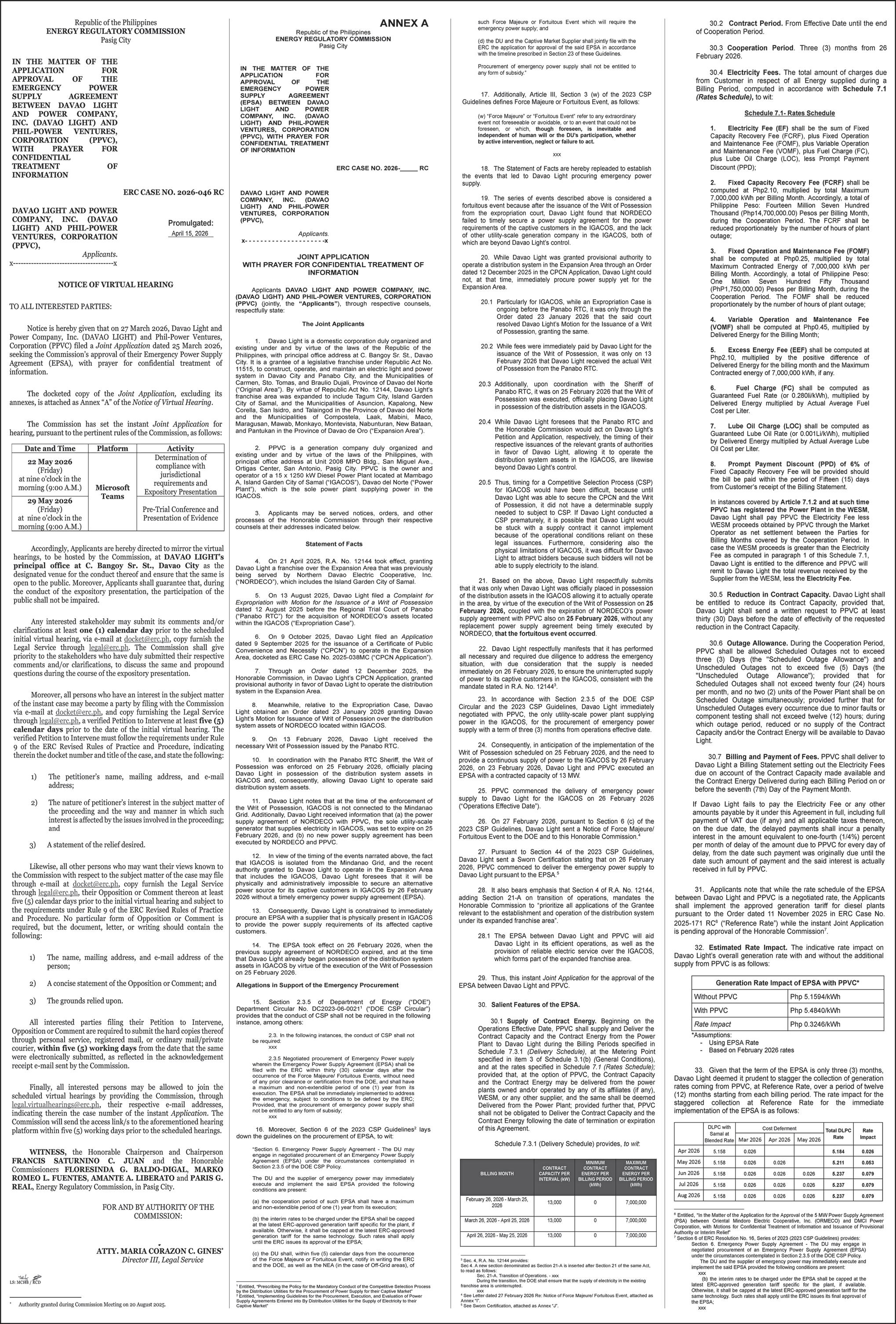
ERC set to order power utility to adopt shorter refund process
By Lenie Lectura @llectura
THE Energy Regulatory Commission (ERC) is set to issue an order directing the Manila Electric Company (Meralco) to adopt a shorter refund process involving the P19.95 billion over-recovery of rates for the lapsed period from July 2022 to end-December 2024.
“We agreed already to shorten in the final decision that we will issue so that there will be additional refund that will cushion the expected increases, if any, in the coming months,” ERC Chairman Francis Saturnino Juan said. The refund stemmed from a “true-up” calculation regarding the actual weighted average tariff (Awat) compared to the approved final distribution rate for the lapsed period of July 1, 2022 to December 31, 2024.
Clark. . .
Continued from A3
entire journey,” said Noel Manankil, Lipad president and chief executive officer. “Our focus at Clark International Airport is to continuously improve how passengers move through the terminal so that every trip begins in a way that feels easy, efficient and welcoming.”
Earlier this year, CRK was also recognized for Best Airport Arrivals. It places among six airports worldwide cited for efficient arrival processes and smooth passenger flow.
The ACI Airport Customer Experience Accreditation Program is a global initiative that helps airports improve passenger experience through long-term strategies, best practices and industry collaboration.
The program has five levels and evaluates airports across key areas, including customer understanding, strategy, measurement, operational improvement, governance, airport culture, service design and innovation, and community collaboration.
Level 2 accreditation indicates CRK has established a customer experience strategy and is using tools such as passenger feedback, journey mapping and data insights to guide improvements.
The recognition comes as CRK continues to position itself as a key gateway in Central Luzon, with several domestic destinations accessible via the airport.
The ERC, in March 2025, ruled that the refund will be implemented over a period of 36 months. The said provisionally approved refund amount is equivalent to an average refund rate P0.1189 per kilowatt-hour (kWh) for all of the distribution utility’s customer classes. “What was issued was a provisional authority only. What we will issue is the final decision,” Juan said.
The ERC has been pushing for
a shorter, more expedited refund process to provide immediate financial relief to consumers struggling with high fuel and electricity prices.
“In response to consumer feedback and stakeholder proposals, the Commission is also considering the adoption of shorter refund implementation periods in future cases to enable more immediate rate relief,” ERC Commissioner Paris G. Real said during an open commission meeting (OCM) last week.
Real stressed that the agency is authorized to do this, emphasizing the importance of responsive regulation amid current economic conditions.
“Given that the Commission has the authority to shorten the period, and considering the clamor from consumers—especially during this time of crisis—I am inclined to support a shorter implementation period. This would provide more immediate relief to consumers without necessarily affecting the operations of distribution utilities,” he said.
Real raised this during the deliberation on the application of
TMeralco for the confirmation of its true-up calculation of the Awat during its OCM.
As presented by the ERC’s Regulatory Operations Service (ROS), the Awat mechanism was instituted following the deferment of the scheduled regulatory reset to ensure that implemented rates remain consistent with approved parameters. The application covers the lapsed period from July 2022 to December 2024, during which Meralco continued to implement previously approved final distribution rates.
Meralco proposed a net refund amounting to P19,096,911,515 or equivalent to an average refund rate of P0.1138/kWh. Meanwhile, the commission provisionally approved a higher refund amount of P19,958,945,951, or an equivalent refund rate of P0.1189/kWh to be implemented over 36 months, subject to further review and confirmation. These adjustments account for variances between projected and actual collections across customer classes, ensuring that only just and reasonable charges are ultimately borne by consumers.
Congressman eyes shift from ayuda programs, seeks ‘systemic interventions’
By Jovee Marie N. dela Cruz @joveemarie
AS the House of Representatives Legislative Energy Action and Development (LEAD) Joint Committee continues its deliberations, a lawmaker is pushing for a decisive shift away from one-time ayuda programs toward long-term systemic interventions aimed at strengthening the economic resilience of the people.
Party-list Rep. Arthur Yap of Murang Kuryente said that while short-term assistance offers immediate relief, “it fails to address the structural weaknesses that leave many Filipinos exposed to recurring economic shocks.”
Instead of reactive aid, Yap is advocating for forward-looking mechanisms designed to prevent crises from hitting households in the first place.
A key component of his proposal is the use of the Maharlika Investment Fund as a risk transfer mechanism to boost agricultural financing. By serving as a finan -
cial backstop, the fund would encourage banks to expand lending to farmers, thus improving productivity and helping cushion the sector from rising input costs such as fertilizers.
The proposal gained a positive response from Maharlika Investment Corporation (MIC) Executive Director Rafael Consing Jr., who expressed openness to coordinate with Agriculture Secretary Francisco Tiu Laurel Jr. to assess its viability.
Yap also addressed the recurring burden of fuel price volatility, noting that subsidies alone are insufficient to shield consumers from global price swings.
He proposed that government financial institutions, such as the Land Bank of the Philippines and the Development Bank of the Philippines, establish long-term financing or syndicated loan facilities for oil companies.
Under this setup, fuel procurement costs could be spread over time, allowing companies to absorb sudden price spikes instead of immediately passing them on to
consumers. Yap emphasized that this approach is a market-based solution—not a subsidy—that uses the banking system to stabilize prices while maintaining fiscal discipline.
Complementing these measures, Yap also introduced a more efficient way of delivering government assistance by coursing subsidies through electricity billing systems.
Under the proposal, qualified beneficiaries would see direct reductions in their power bills, with electric cooperatives administering the program to ensure timely, transparent, and full delivery of benefits.
Yap said these proposals represent practical, immediately implementable solutions anchored on structural reform and smarter public spending.
By moving beyond stopgap assistance, he underscored the need to build a more resilient and responsive economic framework that can better protect Filipino households from future shocks.
Cebu City barangays get ₧40-M fuel subsidy
CEBU CITY—Cebu City has started the distribution of fuel assistance to all 80

barangays, reinforcing essential frontline services amid rising fuel costs.
The distribution and signing of the Acknowledgment and Agreement forms for the fuel allocation were held on Friday morning at the Office of the Association of Barangay Councils (ABC), under the leadership of its president, Franklin Ong.
Cebu City Mayor Nestor Archival personally distributed the fuel fleet cards together with City Administrator Albert Tan and Kenneth Siasar, the mayor’s chief of staff.
Jesson Morata, assistant public information officer of the city government said, each barangay was given P500,000 worth of fuel assistance.
The fuel assistance was intended to support critical barangay operations, including transportation
needs, emergency response, and the delivery of frontline community services.
Under the agreement, the fuel allocation is valid for one month – from April 17 to May 17, 2026 –or until fully consumed.
The allocation was determined by the Office of the Mayor in coordination with the Liga ng mga Barangay, ensuring distribution aligned with each barangay’s operational needs.
This program also includes an option for renewal, subject to evaluation and emerging developments in fuel supply and pricing conditions.
City officials said the initiative is part of a broader effort to shield local communities from global economic pressures while ensuring uninterrupted public service delivery across Cebu City’s barangays.
By Ada Pelonia @adapelonia
HE Department of Agriculture (DA) has scaled up its cheaper rice program by extending selling hours and opening more distribution outlets nationwide to relieve the pressure of the global oil crisis on Filipino consumers.
Agriculture Secretary Francisco Tiu Laurel Jr. said the expansion would steady food access as transport and logistics costs push up retail prices.
“We have sufficient food supply, but elevated fuel and logistics costs are pushing market prices to levels that further contain the budgets of many Filipinos,” Tiu Laurel said.
“By expanding access to affordable rice and essential goods, we are directly easing that pressure and ensuring vulnerable sectors are protected while we work to stabilize both prices and supply.”
To achieve this, the Food Terminal Inc. (FTI) inked an agreement with the National Food Authority (NFA) that secured funding and supply commitments for 2026.
The deal earmarks P3 billion under the DA’s P10 billion budget Rice-for-All program to procure around 1.8 million 50-kilo bags of well-milled rice.
As such, the DA is set to roll out an additional 900 P20 selling sites nationwide. It will prioritize Capiz, Bukidnon, Cebu, Cotabato, Catanduanes, and other high-need areas to expand access to affordable rice for vulnerable communities.
If realized, these would add to the 932 sites that already sell P20 rice across the country. These are composed of Kadiwa outlets, NFA warehouses, local governments (LGUs), national government agencies, and other sellers accredited by the FTI. As rice stocks get released into the market, the DA noted that revenues are reinvested into more palay purchases, creating a continuous procurement cycle.
This also frees up space in NFA warehouses, enabling the agency to buy more from farmers, especially during peak harvest periods when prices are most vulnerable.
“We assure that this budget will be used to secure better prices for our farmers, especially during the harvest season,” NFA Administrator Larry Lacson said.
“In some areas, we have already increased our buying price to as much as P30 per kilo to prevent a drop in farmgate palay prices. The NFA continues to step in to protect the income of our farmers.”
For his part, FTI President and CEO Joseph Rudolph Lo stressed the “significant increase” in buyers of P20 per kilo rice.
“Given the current instability in market prices due to external conflicts, we are seeing a significant increase in buyers turning to our outlets to access quality rice at lower cost,” Lo said.
“We are closely coordinating with government partners to manage this demand and are preparing to expand our network further, with a target of reaching 1,800 P20 rice selling sites nationwide by the end of 2026,” he added.
‘Restore govt role in fuel pricing’
ALAWMAKER has filed a bill seeking to restore government intervention in fuel pricing, aiming to shield consumers from sharp and sudden increases in oil prices driven by global market fluctuations.
In House Bill 8839, or the proposed Fuel Price Stabilization and Energy Security Act, Manila Rep. Joel R. Chua seeks to create a Fuel Regulatory Board, establish a new Oil Price Stabilization Fund, and set up a Strategic Fuel Reserve to serve as State tools during fuel price shocks and supply disruptions.
Under the measure, the government would effectively regain authority to step in during abnormal movements in fuel prices, a policy shift that Chua said is necessary to protect consumers from immediate pass-through effects of global oil spikes.
Chua, chairman of the House Committee on Good Government and Public Accountability, said the proposal is designed to address fuel price volatility more comprehensively than existing policies, noting that rising international oil prices currently translate almost directly into higher domestic pump prices, with limited government intervention.
At the core of the measure is a five-member Fuel Regulatory Board composed of an energy policy chairperson, two experts in energy economics or petroleum-related fields, and representatives from the consumer and transport sectors.
The board would be authorized to impose temporary price bands or ceilings, regulate fuel pricing during emergencies, and investigate anti-competitive practices in the industry.
The bill also proposes a revised Oil Price Stabilization
Fund, intended to cushion sudden price hikes. Unlike the defunct fund created under the Oil Deregulation Law of 1998, the new mechanism would not be used for oil company reimbursements but for temporary market intervention to ease consumer impact.
Chua explained that the fund could be activated when projected fuel increases reach levels that would significantly affect transport costs and consumer prices, allowing the government to moderate or delay adjustments at the pump until conditions stabilize.
The measure further establishes a strategic fuel reserve, which would be built during periods of lower global oil prices. The stored fuel may be released during crises to stabilize supply and prevent panic-driven price surges.
Under the proposal, the President, upon recommendation of the Fuel Regulatory Board, would have authority to release fuel reserves, while the Commission on Audit (COA) would oversee and audit transactions related to both the stabilization fund and the reserve system.
Chua said the bill seeks to reduce the country’s vulnerability to external oil shocks and provide a more proactive government response to energy emergencies, shifting away from the current fully deregulated system toward a framework centered on consumer protection, economic stability, and energy security.
“House Bill 8839 is a departure from the decades-old oil deregulation law. It abandons the full deregulation policy. Instead, House Bill 8839 is grounded on consumer protection, economic stability, and energy security,” Chua said. Jovee Marie N. dela Cruz
PHL allows Germany to resume pork exports
GBy Ada Pelonia @adapelonia
ERMANY has officially secured a regionalization agreement with the Philippines to maintain exports of pork products after the lifting of a six-year ban on its shipments due to outbreaks of African swine fever (ASF).
Agriculture Secretary Francisco Tiu Laurel Jr. issued Department Circular (DC) 18, authorizing the grant of bilateral recognition of regionalization for ASF to Germany. The same circular also mandated the lifting of the temporary ban Manila slapped on German pork, which was imposed in 2020.
The circular noted that the Philippines requested several documentary requirements from the veterinary authorities of Germany to assess the public health control measures applied and implemented against ASF.
The Bureau of Animal Industry (BAI), an attached agency of the Department of Agriculture (DA), conducted a review and evaluation of the application for bilateral

BUSINESSMIRROR
recognition of regionalization for ASF.
BAI then concluded that Germany “maintains sufficient veterinary oversight and has established necessary control and mitigating measures against ASF.”
This ensures a low risk of importing swine products and their byproducts, including meat from identified proposed
zones for recognition, according to the DA.
It also indicated that the chief veterinary officers of Germany and the Philippines agreed on the import terms and conditions for the bilateral regionalization for ASF.
With this, the DA said all pork import transactions should be in accordance with the bilaterally agreed import terms and
conditions on regionalization and the current rules and regulations.
Germany has been added to the growing list of DA-accredited countries that have existing regionalization agreements for pork shipments. Other nations include Poland, Russia, and Canada.
Prior to the ban imposed by Manila, Germany was one of the top suppliers of pork products to the Philippines.
UK poultry
IN a separate order, the United Kingdom also secured a regionalization agreement with the Philippines for the sustained trade of poultry goods despite bird flu outbreaks.
Tiu Laurel issued DC 17, which granted bilateral recognition of regionalization for Highly Pathogenic Avian Influenza (HPAI) to the UK.
The Philippines also sought documents from the veterinary authorities of the UK to assess their measures against bird flu.
“BAI concluded that the United Kingdom maintains sufficient veterinary oversight and has established necessary control and
‘Risk mitigation facility key to expanding agri lending’
By Jovee Marie N. Dela Cruz @joveemarie
ALAWMAKER has expressed strong support for the Department of Agriculture’s (DA) plan to establish a risk mitigation facility under the Agricultural Credit Policy Council (ACPC), aimed at expanding farmers’ access to financing ahead of the main planting season. During a recent hearing of the Congressional Legislative Energy Action and Development (LEAD) Committee, Murang Kuryente Party-list Rep. Arthur Yap, a former secretary of the DA, stressed the urgency of adopting market-based solutions to address rising input costs and persistent credit constraints in the agriculture sector.
Agriculture Secretary Francisco Tiu Laurel Jr. earlier proposed creating a risksharing mechanism that would encourage commercial banks and private lenders to extend more loans to farmers by reducing their exposure to lending risks.
“Private lenders are ready to step in, but they need a credible risk-sharing mechanism,” Yap said. “This is not about subsidies or grants, and it does not require new legislation. What the market needs is a simple escrow facility that can cushion risks tied to agricultural lending. Not everything is about tax cuts or one-time aid—give banks a risk mitigation fund, and that will give them the confidence to lend to our farmers.”
He also cited the potential role of the Maharlika Investment Fund in supporting
agricultural financing, noting that it could serve as a catalytic facility to de-risk private sector lending and unlock billions of pesos in rural credit, without being used for direct subsidies.
The lawmaker warned that fertilizer prices have increased by more than 60 percent, significantly driving up production costs. “When inputs become too expensive, farmers are forced to cut back, which ultimately reduces yields,” Yap said. “If this trend continues, we may face increased rice imports at higher prices by year-end.”
While existing government lending programs remain important, Yap said their reach is limited by available public funds.
“By leveraging a risk mitigation facility, we can mobilize private capital at scale while maximizing the impact of public
resources—especially in a constrained fiscal environment.”
He also called for stronger agricultural risk protection, urging the Philippine Crop Insurance Corp. (PCIC) to accelerate the rollout of its yield-based insurance products, which are designed to protect farmers from both economic shocks and climate-related risks, including the ongoing El Niño-induced dry spell.
“These tools are essential—not only to manage rising input costs but also to shield farmers from climate vulnerabilities.”
The proposed risk mitigation framework, along with expanded crop insurance coverage, is expected to boost lender confidence, widen access to credit, and strengthen the resilience of the Philippine agriculture sector.
Toll-free passage for trucks bearing farm products starts Monday
TBy Butch Fernandez @butchfBM
RUCKS carrying agricultural and food products will be temporarily exempted from toll on all expressways starting April 20, Sen. Francis N. Pangilinan reminded the public and government agencies.
“Thanks to the collaboration among the Department of Transportation [DOTr], Toll Regulatory Board [TRB], and Department of Agriculture [DA], as well as the tollway concessionaires and operators, the problem with high prices of delivering food supplies will be eased,” he said, partly in Filipino. Pangilinan also thanked tollway concessionaires and operators San Miguel Corp. chief Ramon S. Ang and Metro Pacific head Manuel V. Pangilinan for agreeing to his proposal for the establishment of a food lane.
“Sa panahon ng krisis, walang ibang magtutulungan kundi tayo-tayo rin [In times of crisis, no one can help us better than ourselves],” said Pangilinan, chairman of the Senate Committee on Agriculture, Food and Agrarian Reform. He noted, though, that more things need to be done to ensure adequate, affordable, and accessible food for all Filipinos, but this is a vital step in that direction.”
Pangilinan first raised the proposal of toll-free delivery on food during the April 8 Senate hearing of the Committee on Agriculture, Food, and Agrarian Reform. This was reiterated in a letter dated April 13 to Transportation Secretary Giovanni Z. Lopez. Lopez, in his April 16 reply, said that the toll-free measure for food logistics will initially run for one month and may be extended “subject to review, assessment, and further discussions.”
To qualify for the toll exemption, trucks
carrying agricultural goods must comply with existing requirements implemented for availing toll discounts for Land Transportation Franchising and Regulatory Board (LTFRB) registered, accredited by the DA, and RFID (radio frequency identification)-registered.
Complementing the toll holiday, the roll-on/roll-off (RoRo) terminal fees have been temporarily reduced to P1 for vehicles transporting raw and unprocessed agricultural products. The reduced fee, effective April 10, will be implemented for six months and is also “subject to review for possible extension, modification, or termination.”
Lopez said the move is meant “to support food supply chain reliability,” particularly for inter-island transport of essential goods.
Vehicles availing of the reduced RoRo fee must be carrying eligible agricultural cargoes “as declared in the shipping
manifest and/or supported by appropriate documentation issued or recognized by the DA or other competent authorities.”
Such shipments will be validated by the Port Management Office or terminal operators prior to entry, in line with existing port procedures.
The DOTr said it “shall continue to coordinate with the DA in delivering necessary support to the agriculture sector,” signaling further interventions may follow as the government seeks to cushion the impact of rising fuel and logistics costs on food prices.
On Thursday, Pangilinan also attended the Agriculture-Agrarian (Agri-Agra) meeting of executive and legislative officials on how to stabilize food supply and ease rising food logistics costs due to the war in the Middle East
The effort is being coordinated with the DA, TRB, and the Philippine Ports Authority.
Record US drought sparks worries about fires, water supply and food prices
DROUGHT in the contiguous United States has reached record levels for this time of year, weather data shows. Meteorologists said it’s a bad sign for the upcoming wildfire season, food prices and western water issues.
More than 61 percent of the Lower 48 states is in moderate to exceptional drought—including 97 percent of the Southeast and two-thirds of the West— according to the US Drought Monitor. It’s the highest levels for this time of year since the drought monitor began in 2000.
The National Oceanic and Atmospheric Administration’s comprehensive Palmer Drought Severity Index not only hit its highest level for March since records started in 1895, but last month was the third-driest month recorded regardless of time of year. It trailed only the famed Dust Bowl months of July and August 1934.
Because of record heat, much of the West has had exceptionally low levels of snow in the first few months of the year, which is usually
how the region stores water for the summer. A different drought—connected to the jet stream keeping storms further north—has put the South from Texas all the way to the East Coast into a separate drought that just happens to coincide with what’s going on in the West, said Brian Fuchs, a climatologist with the National Drought Mitigation Center. It would take 19 inches of rain in one month to break the drought in eastern Texas and more than a foot of rain to solve the deficit for most of the Southeast, NOAA calculated.
“Right now 61 percent of the country is in drought and that’s steadily been going up for the calendar year,” Fuchs said. “We just haven’t seen too many springs where this amount of the country has been in this kind of shape.”
Sticking out like a sore thumb is a highly technical but crucial measurement of “the sponginess’’ of the atmosphere—or how much moisture the hot, dry air is sucking up from the land it’s baking. It’s called vapor pressure deficit. It’s 77% above normal
and more than 25 percent higher than the previous record for January through March in the West, said UCLA hydroclimatologist Park Williams.
That level of moisture-sucking from the ground “wouldn’t have appeared possible” before now, Williams said.
Drought usually peaks in summer, not spring, and that’s what worries meteorologists.
“Fire tends to respond to heat and drought in an exponential manner,” Williams said. “For each degree of warming, you get a bigger bang in terms of fire than you got from the previous degree of warming.”
In Arizona, cacti are blooming months early and the worry about water has already started, said Kathy Jacobs, director of the Center for Climate Adaptation Science and Solutions at the University of Arizona.
“Those of us who are dependent on the Colorado River, of course, are very concerned about the fact that we don’t have a negotiated path forward in the middle
mitigating measures against HPAI, ensuring that there is a low risk of importing live poultry, day-old chicks, eggs, and semen from identified proposed zones for recognition.”
The regionalization enables continuous shipments of domestic and wild birds along with their products, including poultry meat, day-old chicks, eggs, and hatching eggs originating from bilaterally recognized free zones of the UK.
of what appears to be possibly the worst year of drought that we’ve all experienced,” Jacobs said. “We have lots of reservoirs that are not full.”
Yale Climate Connections meteorologist Jeff Masters said his biggest concern is what drought will do to agriculture and then food prices. If America has a poor crop year because of the drought, it could be a global problem.
A strong natural El Nino weather oscillation is predicted, which often reduces crop yield in other places across the globe, such as India.
UCLA’s Williams said the drought and hotter weather are driven by both natural variability and human-caused climate change with randomness a slightly bigger factor.
“All weather is now affected by climate change,” Arizona’s Jacobs said. “There is no such thing as weather that’s divorced from climate trends. But this extreme event is extreme in the way that we’ve been expecting: extreme heat waves, intense drought.” The Associated Press
The DA maintained, however, that all transactions should follow import terms and conditions on regionalization, along with the agency’s rules and regulations. Under a regionalization agreement, the Philippines will restrict shipments of pork or poultry products only from certain areas with confirmed cases of transboundary disease, such as ASF or bird flu, instead of imposing a country-wide ban.


Editor: Angel R. Calso |

Iran closes Strait of Hormuz and fires on ships in retaliation for US blockade
By Sam Metz & Samy Magdy
The Associated Press
CAIRO—The standoff over the Strait of Hormuz escalated again Saturday as Iran reversed its reopening of the crucial waterway and fired on ships attempting to pass, in retaliation after the United States pressed ahead with its blockade of Iranian ports.
The strait is closed until the US blockade is lifted, Iran’s Revolutionary Guard navy said Saturday night, warning that “no vessel should make any movement from its anchorage in the Persian Gulf and the Sea of Oman, and approaching the Strait of Hormuz will be considered as cooperation with the enemy” and be targeted.
New attacks on the strait, through which roughly one-fifth of the world’s oil normally passes, threatened to deepen the global energy crisis and push the countries into renewed conflict as the war entered its eighth week.
A fragile ceasefire is due to run out by Wednesday. Iran said it had received new proposals from the United States, and Pakistani mediators were working to arrange another round of direct negotiations.
Iran’s joint military command earlier said “control of the Strait of Hormuz has returned to its previous state...under strict management and control of the armed forces.”
Revolutionary Guard gunboats opened fire on a tanker and an unknown projectile hit a container vessel, damaging some containers, the British military’s United Kingdom Maritime Trade Operations center said. India’s foreign ministry said it summoned Iran’s ambassador over the “serious incident” of firing on two India-flagged merchant ships, especially after Iran earlier let several Indiabound ships through.
For Iran, the strait’s closure—imposed after the US and Israel launched the war on Feb. 28 during talks over Tehran’s nuclear program—is perhaps its most powerful weapon, threatening the world economy and inflicting political pain on President Donald Trump. For the United States, the blockade keeps up pressure and could strangle Iran’s already weakened economy.
Iran’s new supreme leader, Ayatollah Mojtaba Khamenei, issued defiant remarks on Saturday, saying the navy stands “ready to inflict bitter defeats on its enemies.” He has not been seen in public since being elevated to the post following his father’s death in Israel’s opening barrage.
A turnaround a day after Iran said the strait was open ON Friday, Iran announced the strait’s reopening to commercial vessels after a 10-day truce was announced between Israel and the Iranian-backed Hezbollah militant group in Lebanon. The reopening caused oil prices to fall. Trump, however, said the US blockade of Iran’s ports “will remain in full force” until Tehran reaches a deal with the United States. Trump had imposed the blockade after a round of historic face-to-face talks in Pakistan between the countries ended without an agreement.
US forces have sent 23 ships back to Iran since the blockade began on Monday, US Central Command said Saturday. Trump’s comments triggered an outcry. “Americans are risking the international community, risking the global economy through these, I can say, miscalculations,” Iranian Deputy Foreign Minister Saeed Khatibzadeh told The Associated Press, adding that the US is “risking the whole ceasefire package.”
Iran’s Supreme National Security Council issued a statement calling the blockade a violation of the ceasefire and said Iran would prevent “any conditional and limited reopening” of the strait. The council has recently acted as Iran’s de facto top decision-making body.
Since most supplies to US military bases in the Gulf region come through the strait, “Iran is determined to maintain oversight and control over traffic through the strait until the war fully ends,” the council said. That means Iran-designated routes, payment of fees and issuance of transit certificates.
The Revolutionary Guard navy statement later indicated that no vessel should attempt a transit at all.
Pakistan pushes for progress toward a new deal
THE renewed standoff over the strait came hours after Pakistani Foreign Minister Ishaq Dar said his country was working to “bridge” differences between the US and Iran. Pakistan is expected to host a second round of negotiations early next week.
Iran’s Supreme National Security Council said “new proposals” from the US had been put forward during a visit to Iran by Pakistan’s army chief and were being reviewed. But Khatibzadeh said the Iranians were not ready for a new round of face-toface talks because the Americans “have not abandoned their maximalist position.”
He also said Iran will not hand over its stock of 970 pounds (440 kilograms) of enriched uranium to the United States, calling the idea “a nonstarter.” Khatibzadeh did not address other proposals for the enriched uranium, saying only that “we are ready to address any concerns.”
Trump said Saturday that Iran “got a little cute” but that “very good” conversations were happening, and more information would come by day’s end. “They can’t blackmail us,” he added.
On Friday, Trump said the US will go into Iran and “get all the nuclear dust,” referring to the enriched uranium, which is believed to be buried under nuclear sites badly damaged by US military strikes last year.
With 144,000 classrooms missing nationwide, can the DepEd-DPWH MOA close the huge gap?
THE recent Memorandum of Agreement between the Department of Education (DepEd) and the Department of Public Works and Highways (DPWH) is a welcome acknowledgment of a crisis that has festered for decades. With a classroom shortage exceeding 144,000 units, the ceremonial signing led by Education Secretary Sonny Angara and Public Works Secretary Vince Dizon signals that the Marcos administration recognizes the urgency. But let us be clear: agreements do not teach children. Classrooms do. (Read the BusinessMirror story: “DepEd, DPWH step up school construction to close 144,000-classroom gap nationwide,” April 16, 2026).
For the country’s learners—millions of whom endure overcrowded rooms, shifting schedules, and makeshift learning spaces—this shortage is a daily assault on their right to quality education. When 60 or more students squeeze into a room designed for 40, when children sit on floors or share dilapidated textbooks, when the afternoon session begins only because the morning session has ended—that is not education. That is survival, which is not the foundation upon which a nation builds its future.
The adverse impacts are already visible. Overcrowded classrooms breed higher infection rates, increased noise and distraction, and diminished teacherstudent interaction. Learners in Last Mile Schools—far-flung communities already starved of resources—face the cruelest irony: the state promises education but delivers leaking roofs and absent walls. The shortage forces split classes, compresses learning hours, and drives overworked teachers to the brink of burnout. Worse, it pushes children out of school entirely, particularly those from poor families who cannot afford alternative arrangements.
Secretary Angara’s commitment to “fast-track the construction of quality classrooms” and Secretary Dizon’s vow to “act fast” are commendable. The MOA’s provisions—disability access, water and sanitation facilities, technicalvocational labs, and Learning Continuity Spaces—show thoughtful planning. The three-tranche funding mechanism and monthly reporting requirements promise transparency. But these are processes, not progress.
The hard truth is that past administrations have signed similar agreements. Bureaucratic delays, fund releases that arrive late or short, construction that drags for years, and substandard buildings that crumble before completion have haunted every classroom program. The gap of 144,000 units did not appear overnight. It accumulated through years of half-measures, underfunding, and a persistent disconnect between central offices and ground realities. DepEd’s promise to submit a master list of priority schools by the end of May 2026 is a critical first milestone. But there’s a need for parallel commitment to interim solutions. For the learners who will spend another year in overcrowded rooms while waiting for construction, where are the temporary learning shelters, the rapid-assembly classrooms, the community-based alternatives? Furthermore, the partnership between DepEd and DPWH must overcome its historical weakness: coordination failure. Too often, DepEd identifies a need, but DPWH builds what is convenient. Too often, schools receive buildings without water, toilets without doors, or laboratories without equipment. The MOA’s joint site validations and rectification clauses are only as good as the will to enforce them. Secretary Dizon is correct that the objective is “ bilisan natin.” But speed without quality is waste. And quality without sustained political will is fantasy. Every month of delay means another cohort of learners passes through a broken system. Every classroom not built is a future cut short. Our learners do not need another ceremony. They need walls, roofs, desks, and chairs—yesterday. They need a government that treats classroom shortage not as a target to be met, but as an emergency to be ended. The MOA is a tool. Now we must see if those who signed it have the courage to use it well. The 144,000 missing classrooms are not just numbers. They are 144,000 reasons why Filipino children are being failed. Let this agreement be the end of that failure—not another chapter in it.
2005
BusinessMirror
Ambassador Antonio L. Cabangon Chua
T. Anthony C. Cabangon
Lourdes M. Fernandez
Jennifer A. Ng Vittorio V. Vitug
Lorenzo M. Lomibao Jr., Gerard S. Ramos
Lyn B. Resurreccion, Dennis D. Estopace
Angel R. Calso, Dionisio L. Pelayo
Ruben M. Cruz Jr.
Eduardo A. Davad Nonilon G. Reyes
D. Edgard A. Cabangon Benjamin V. Ramos Aldwin Maralit Tolosa
Rolando M. Manangan
BusinessMirror is published daily by the Philippine Business Daily Mirror Publishing, Inc., with offices on the 3rd floor of Dominga Building III 2113 Chino Roces Avenue corner De La Rosa Street, Makati City, Philippines. Tel. Nos. (Editorial) 817-9467; 813-0725. Fax line: 813-7025. (Advertising Sales) 893-2019; 817-1351, 817-2807. (Circulation) 893-1662; 814-0134 to 36. E-mail: news.businessmirror@gmail.com www.businessmirror.com.ph
Opinion BusinessMirror

Business in the age of crisis: The Salary Illusion

TRISING SUN
HERE is a particular kind of financial confidence that comes with receiving a salary. Every cutoff, the number arrives—predictable, reassuring, almost ceremonial. It pays the rent, covers the groceries, and funds the weekend. For millions of Filipino workers, the paycheck is the plan. But that, exactly, is the problem.
When the pandemic shuttered businesses overnight in 2020, it exposed a fault line that had been hiding beneath the surface of steady employment: most salaried workers had no financial backup. The salary had been doing all the work, and the moment it stopped—through retrenchment, pay cuts, or forced leaves—there was nothing underneath. Not savings. Not a side income. Not an investment.
This is what is called the Salary Illusion: the mistaken belief that stable employment equals financial security. It does not. Employment is
income. Security is something else entirely.
The distinction matters because crises—economic, health, political, or personal—do not negotiate with your employment contract. A company that cannot survive a downturn, specifically, this current crisis, will not keep paying salaries out of loyalty. Retrenchment is a business decision, not a moral one. And yet, most employees continue to treat their job as their financial identity, tying their entire sense of stability to a single source of income controlled entirely by someone else.
The danger of the Salary Illusion is not just financial; it is psychological.
A steady paycheck breeds complacency. It discourages the uncomfortable conversations employees should be having with themselves: What happens if I lose this job tomorrow? How many months can I survive? Do I have any income that does not depend on showing up to work?
For most, the honest answer is: not long, and no.
Building genuine financial resilience requires doing the unglamorous work alongside the day job. It starts with an emergency fund—ideally three to six months of living expenses, liquid and untouched. It continues with deliberate investments, even modest ones, that compound over time outside of the employment relationship. It includes developing skills or income streams that do not live and die with a single employer.
None of this requires wealth to begin. It requires the willingness to stop treating the salary as the destination and start treating it as the launchpad.
Employers, for their part, bear some responsibility here. Finan -
cial literacy remains embarrassingly absent from most workplace programs. Organizations that invest in the financial well-being of their people—not just through competitive salaries, but through education on savings, investment, and crisis preparedness—build workforces that are not just productive in good times, but stable under pressure.
A crisis does not create vulnerability. It reveals it. The employees who emerged from the pandemic with the least damage were not necessarily the highest earners. They were the ones who had been quietly building a financial life that did not depend entirely on one company’s ability to survive.
The salary is not security. It is a starting point. The sooner employees and organizations accept that distinction, the less devastating this—and the next crisis—will be.
This column is part of Business in the Age of Crisis, a series of practical guidance for Filipino professionals and business owners navigating one of the most economically turbulent periods in recent memory. Clarity, not panic, is what gets people through.
Even on weekends, the Cabinet speaks: How UPLIFT shields vulnerable sectors from the Mideast crisis

EVEN on weekends, when most governments fall silent, the Philippine Cabinet is speaking—directly, deliberately, and in full view of the public. Last Saturday, while the markets rested but the crisis did not, Acting DOTr Secretary Giovanni Lopez stepped forward—not behind a desk, but into a forum—to explain, unpack, and defend the government’s response to an economic storm unleashed far beyond our shores.
T his matters. Because the Iran crisis is not a distant headline—it is a daily intrusion. It has constricted global oil supply, disrupted as much as 20 percent of the world’s flow, and pushed fuel prices upward with a relentlessness that emerging economies like the Philippines can neither ignore nor easily absorb.


And so, the government has chosen not to retreat into bureaucratic quiet—but to engage. To explain. To persuade. To act. Through the UPLIFT program— Unified Package for Livelihoods, Industry, Food and Transport—what we are witnessing is not just policy rollout, but policy presence. A wholeof-government approach that understands a simple truth: in times of crisis, silence breeds anxiety, but clarity builds confidence. And then comes the pivot—the
policy that speaks loudest not in words, but in numbers: From P546… to P1 for deliveries of agricultural products. That is a recalibration of the economic bloodstream.
At a time when the Iran crisis has tightened the arteries of global oil supply and sent fuel prices surging through every layer of the economy, the Philippine government has chosen an unusual weapon: not restraint, but release. Not delay, but velocity. Through the UPLIFT program, it has attempted something rare in policy: to make relief felt not as an announcement, but as a transaction. Because the truth is this: inflation is not just a statistic. It is a sequence of small suffocations. A jeepney driver counting coins at the end of the day. A farmer watching transport costs eat into already thin margins. A consumer staring at a price tag
that seems to rise between glances. And so the question becomes: how do you interrupt that sequence? You cut the chain where it hurts most.
The toll relief and free port fees for agricultural products are not just logistical tweaks—they are economic surgery. By collapsing shipping costs from hundreds of pesos to a single peso, the state is not merely subsidizing movement; it is accelerating it. Goods move faster. Costs compress. Margins breathe. And somewhere down the line, prices—if the chain holds—ease.
This is what a whole-of-government approach looks like when it abandons abstraction. Consider the choreography.
The Department of Transportation pushes relief at the point of movement—roads, ports, fares.
The Department of Social Welfare and Development injects direct support where the strain is most human—P5,000 to drivers navigating both traffic and survival. Financial channels go digital—e-wallets and banks—cutting not just time but friction, turning aid into something that arrives, not something that is chased.
And then there is the quieter but equally powerful move: a 20 percent fare discount for commuters. Because crises are not only about producers. They are about passengers. The driver and the rider, the farmer and the buyer—the entire ecosystem feels the tremor of rising oil. UPLIFT, at least in design, recognizes this symmetry. It does not pick
a single hero. It attempts to steady the entire stage. Still, there is something undeniably strategic—almost elegant— about targeting the arteries of movement in an oil-driven crisis. When fuel becomes expensive, everything that moves becomes expensive. And when everything becomes expensive, the instinct is often to subsidize everything.
UPLIFT resists that temptation. Instead, it chooses to cheapen movement itself. That is a different philosophy. And perhaps, a more sustainable one. Because if you can move goods cheaply, you do not need to subsidize them endlessly. You restore flow. And in economics, flow is life.
The Iran crisis may be thousands of kilometers away, but its effects arrive daily—at the pump, at the checkout counter, in the quiet recalculations of households and businesses. The question is not whether we can stop that external shock. We cannot. The question is whether we can outmaneuver it. With UPLIFT, the government is attempting exactly that—not by confronting the storm, but by reconfiguring how we move within it. From P546 to P1. In that single peso lies a larger idea: that in times of crisis, the fastest way to ease the burden is not always to give more—but to make it cost less to live, to move, and to endure. And in UPLIFT, we have a winner in our hands.
Atty. Jose Ferdinand M. Rojas II
Elon Musk on the education system: A scathing critique and vision for radical change
By Jona C. Redondo
ELON MUSK, the entrepreneur behind Tesla, SpaceX, and xAI, has repeatedly called the traditional education system outdated, ineffective, and in desperate need of overhaul. Drawing from his experiences as a parent and innovator, Musk argues that schools operate like outdated factories, prioritizing rote memorization and standardized pacing over genuine problemsolving and curiosity. He has not only voiced these criticisms in high-profile interviews but also acted on them by founding his own school. His views, captured in several widely viewed videos, paint a picture of an education system stuck in the past while technology races ahead.
The factory model: Grades as an assembly line
ONE of Musk’s core complaints is that conventional schooling treats students like products on an assembly line. Children are grouped by age and forced to progress through grades at the same pace, regardless of individual aptitude or interest. In a YouTube compilation video titled “Elon Musk’s Incredible Speech on the Education System,” Musk describes creating his own school, Ad Astra, precisely because traditional models failed his children. He explains: the school has “no grades… there aren’t any like grade one, grade two,” allowing students to advance at their own speed in each subject. This critique echoes across his interviews. Musk believes the system wastes potential by assuming uniform learning curves, a model he sees as fundamentally broken for preparing kids for a rapidly changing world.
‘Vaudeville before radio, TV, and movies’: Why lectures fail
IN a widely discussed 2024 appearance at the Milken Institute Global Conference, Musk delivered one of his sharpest takedowns yet. Speaking with Michael Milken on May 6, 2024, he compared modern education to “vaudeville before there was radio, TV, and movies”—an outdated form of entertainment reliant on live performers whose quality varied wildly.
“You don’t want a teacher in front of a board,” Musk stated, arguing that the typical lecture format is unengaging and ineffective. Instead of isolated “courses on screwdrivers and a course on wrenches,” he advocates teaching through real problems: “Take apart an engine… oh, you need a screwdriver—that’s what the screwdriver is for.” Kids forget disconnected facts because they don’t see the relevance; problemfirst learning makes knowledge stick.
Clips from this discussion, such as “Elon Musk on the Future of Education” (YouTube, 2025 upload compiling the remarks), have gone viral for highlighting how education has barely evolved despite massive technological leaps in other fields.
Problem-based learning over tools and memorization
MUSK’S philosophy boils down to “teach to the problem, not the solution.” In an earlier interview with Sal Khan of Khan Academy (featured in the clip “Elon Musk on Education,” YouTube, 2016), he likened education to “downloading data and algorithms into your brain.” He stressed that real learning happens through application, not abstract drills. This approach informed Ad Astra (later evolving into Astra Nova), the small private school Musk launched around 2014–2015 on the SpaceX campus in Hawthorne, California. Initially serving his five sons and children of SpaceX employees, it emphasized project-based learning, no mandatory grades or classes, and personalization. Students tackled real-world challenges, traded with their own currency, and could opt out of uninteresting subjects.
An extra month to file, but not to procrastinate

TElon Musk’s commentary isn’t abstract theorizing—he pulled his own children from elite private schools because they weren’t meeting his standards and built a better alternative. His videos and interviews consistently urge parents, educators, and policymakers to reject the status quo. As he put it in the “Incredible Speech” compilation: successful people often succeed despite the education system, not because of it.
Musk described it in the “Incredible Speech” video as a place where learning matches aptitude rather than age.
College degrees: Overhyped and often unnecessary
MUSK has also questioned the value of traditional higher education. He has stated publicly that college is “overweighted” in importance and that many subjects can be learned for free online. At Tesla and SpaceX, demonstrated skills and exceptional ability matter far more than degrees. In the same Khan Academy discussion and related clips (e.g., “Elon Musk: Education, College & The School He Made For His Kids,” YouTube), Musk notes that while college can provide social experiences, the core learning often happens elsewhere.
The future: AI-powered personalization and socialization LOOKING ahead, Musk sees artificial intelligence transforming education entirely. In recent remarks (including discussions referenced in 2024–2025 coverage), he envisions AI as a personalized tutor that adapts to each child’s pace, freeing schools to focus primarily on socialization and real-world interaction. Projects in places like El Salvador experimenting with individualized AI teachers align with his thinking. He has long advocated gamifying learning to make it as addictive and engaging as the best video games or internet content—ideas he reiterated in the Milken session, calling for interactive, high-production-value educational experiences.
Why it matters: Musk’s call to action ELON MUSK’S commentary isn’t abstract theorizing—he pulled his own children from elite private schools because they weren’t meeting his standards and built a better alternative. His videos and interviews consistently urge parents, educators, and policymakers to reject the status quo. As he put it in the “Incredible Speech” compilation: successful people often succeed despite the education system, not because of it.
In an era of AI, automation, and rapid innovation, Musk’s message is clear: the education system must evolve from a one-size-fits-all factory into a dynamic, problem-solving engine—or risk becoming as obsolete as vaudeville. His critiques, backed by action, offer a provocative blueprint for the future.
Joel L. Tan-Torres
DEBIT CREDIT
HE extension of the deadline for filing the 2025 Annual Income Tax Returns (AITR) from April 15, 2026, to May 15, 2026 surprised many taxpayers who were all ready to comply with their tax obligations on the deadline date. The Bureau of Internal Revenue (BIR) issued Revenue Memorandum Circular (RMC) No. 30-2026 to implement the extension, citing Executive Order (EO) No. 110, s. 2026, that declared a state of national energy emergency, and the effects of rising oil prices, as the backdrop for giving taxpayers additional time to file, pay, and submit attachments without penalties.
Malacañang, through the Presidential Communications Office, announced that President Marcos had extended the filing deadline to May 15. I cannot easily link the traditional filing of the AITRs to the reasons for extending the deadline of rising oil prices and the state of national emergency cited by Malacañang. Rather, I sense this may be more of a political move by the government higher-ups to get “pogi” points from the millions of taxpayers whom politicians perceive will be forever grateful for this magnanimous act of extending the tax deadline.
But this year’s extension raises an important institutional and legal point that should not be ignored. In the past, when the government moved tax filing and payment deadlines on a broad scale, the implementing issuance was typically a Revenue Regulation, not merely a Revenue Memorandum Circular. During the Covid pandemic, for example, the extensions of statutory deadlines were carried through RR No. 7-2020, then further amended by RR No. 10-2020 and RR No. 112020. The Department of Finance itself described RR No. 11-2020 as extending filing, submission, and payment deadlines under the Tax Code pursuant to the authority granted by the Bayanihan to Heal as One law.
Why does this matter? Because form is not a trivial matter in tax administration. A Revenue Regulation is ordinarily the instrument used to implement or amend tax rules under the Tax Code and new
laws. It carries stronger normative weight because it is designed to prescribe rules for implementation.
A Revenue Memorandum Circular, by contrast, is generally used to disseminate, clarify, or remind taxpayers and revenue officers of existing rules or administrative directions. When what is being moved is not just an internal procedure, but a statutory deadline affecting millions of taxpayers, the choice of issuance becomes significant.
This is why the current approach invites discussion. RMC No. 30-2026 is the operative issuance that expressly moved the filing, payment, and submission deadline from April 15 to May 15. Yet the Circular merely states that it was issued “in view of” EO No. 110, s. 2026 and the effects of rising oil prices. The available official descriptions of EO No. 110 frame it as an energy-emergency and UPLIFT measure, not as a tax-specific order that itself directly resets the annual income tax filing deadline. In other words, the actual extension is found in the RMC, while the broader policy context comes from the Executive Order and the President’s announcement.
That distinction is important for at least five reasons.
First, it goes to legal clarity. Taxpayers should not be left guessing whether a statutory deadline has been moved by a rule-making issuance, by a circular, by a presidential announcement, or by some combination of all three. Clear legal language builds confidence, and confidence encourages voluntary compliance.
Malacañang, through the Presidential Communications Office, announced that President Marcos had extended the filing deadline to May 15. I cannot easily link the traditional filing of the AITRs to the reasons for extending the deadline of rising oil prices and the state of national emergency cited by Malacañang. Rather, I sense this may be more of a political move by the government higher-ups to get “pogi” points from the millions of taxpayers whom politicians perceive will be forever grateful for this magnanimous act of extending the tax deadline.
Second, it goes to institutional discipline. The tax system works best when the hierarchy of issuances is respected. If the BIR is implementing a broad change in a statutory deadline, many practitioners will naturally ask whether a Revenue Regulation would have been the more appropriate vehicle, as in prior nationwide extensions. That is not nitpicking. In tax administration, procedure is often substance.
Third, it goes to future precedent. Once an RMC is used to move a major filing deadline, the question arises: will this now become the easier template for future postponements? If so, then the government should be prepared to explain the legal basis more fully, to avoid unnecessary controversy and to preserve the credibility of deadline-setting in the tax system.
Fourth, our fiscal managers may be aghast at the impact of the deferral of tax payments on national budget cash management, with billions of pesos of taxes possibly being deferred by one month, And finally, these acts regarding tax compliance and deadlines can raise attention and questions (maybe even ridicule) from the local and international tax community, including the multilateral institutions, like the World Bank, International Monetary Fund, Asian Development Bank, and the Organization for Economic Co-operation and Development. It’s not that often that the state leaders come up with fiscal decisions that
The jet-fuel surge is making global flight connections disappear
By Danny Lee, Kate Duffy & Sri Taylor
AIRLINE passengers should brace for more aggravation in the next few months as carriers around the world deepen cancellations and ground planes to cope with stratospheric increases in jet-fuel prices.
Dutch flag carrier KLM is the latest company to cut its schedule, saying Thursday it will scrap 80 return flights at Amsterdam’s Schiphol Airport in the coming month. That puts it in the same league as United Airlines Holdings Inc., Deutsche Lufthansa AG and Cathay Pacific Airways Ltd. which have all pruned itineraries to contain the damage.
Global capacity for May has been reduced by about 3 percentage points, with all but one of the 20 largest airlines slashing flights, according to data compiled by analytics firm Cirium Ltd. It’s revising an initial prediction of 4 percent to 6 percent growth for the year and says a decline of as much as 3 percent is possible under certain conditions.
“It appears extremely likely that more reductions are ahead,” wrote Richard Evans, a senior consultant at Cirium, in a report released Thursday.
The disruptions roiling the aviation industry after the war in Iran started were initially limited to Middle Eastern airlines, their airports and airspace. They’ve since become contagious and threaten to upend the lucrative summer travel season globally. And with the US na-
val blockade of the Strait of Hormuz cutting off Iranian oil shipments, there’s no immediate end in sight.
“Any flying that we’re doing that’s on the margin, maybe not producing the yields we’d like, is likely going to be reconsidered,” Delta Air Lines Inc. Chief Executive Officer Ed Bastian said while announcing an extra $2.5 billion in fuel costs this quarter. “This is going to be a test for the industry.”
Compounding the challenge are concerns about whether there’s even enough jet fuel to go around.
The International Energy Agency says Europe has “maybe six weeks” of supplies left, and Ryanair Holdings Plc, Virgin Atlantic Airways and EasyJet Plc. only gave forecasts on availability that didn’t stretch beyond mid-May.
The European Union said it may face supply issues for jet fuel “in the near future.” The bloc is preparing a joint action plan in case the situation in the Strait of Hormuz persists, a spokesperson said Friday in Brussels.
For now, the industry may have gained some breathing room when Iran said Friday the strait was “completely open” to commercial
are not economically based but on political considerations. Still, while these legal and administrative questions deserve attention, taxpayers should not misread the extension as an invitation to procrastinate.
My advice is simple: do not wait until May 15 if you are already ready to file your tax returns and pay income tax.
Most individual and corporate taxpayers had long prepared for the original April 15, 2026, deadline. By that date, many had already completed their AITR, gathered their schedules and attachments, coordinated with auditors and accountants, and set aside funds for payment. For these taxpayers, the extension should be viewed as a safety valve, not a new target date. Filing early avoids last-minute system congestion, banking and payment bottlenecks, document defects, and unnecessary anxiety. It also reduces the risk that a taxpayer, lulled by the extra month, ends up rushing again on the eve of May 15. The wiser course is to treat the extension as a cushion for those who genuinely need it—those awaiting final attachments, those affected by business disruptions, or those needing a little more time to ensure accuracy. The best returns are not merely timely filed; they are properly prepared, fully supported, and calmly submitted. This is the best opportunity to file your income tax return as a final declaration instead of a tentative one due to the nonfinalization of the audited financial statements. In tax compliance, as in many things, extra time is helpful. But good discipline is even better. The government may have moved the deadline to May 15, 2026. That does not mean taxpayers should move their own sense of urgency with it.
Joel L. Tan-Torres was a former Commissioner of the Bureau of Internal Revenue. He has also held various positions, including Dean of the University of the Philippines School of Business, Chairman of the Professional Regulatory Board of Accountancy, Tax partner of Reyes Tacandong & Co., and SyCipGorres and
traffic. Benchmark Brent crude subsequently fell as much as 11%.
But any agreement remains brittle, with both sides seeking to maintain leverage in the conflict.
The recent adjustments in capacity signal that many airlines are entering self-preservation mode with the expectation that the conflict will be detrimental to business for the foreseeable future. Even if all fighting ends soon, damaged infrastructure will likely take months or years to repair.
Lufthansa, Europe’s biggest airline, took drastic measures this past week as a series of strikes exacerbated its fuel crisis. It shut down the CityLine unit, withdrawing 27 planes from service, and trimmed capacity across the rest of its network by grounding older, fuel-guzzling widebody jets.
“The package to accelerate fleet and capacity measures is unavoidable given the sharp rise in jet fuel costs and ongoing geopolitical instability,” Till Streichert, the group’s chief financial officer, said Thursday.
The list goes on. The group’s Edelweiss brand suspended Denver and Seattle flights and reduced frequencies to Las Vegas.
Air Canada on Friday announced that it has canceled services from Montreal and Toronto to New York’s John F. Kennedy airport, though it will continue to serve Newark and La Guardia.
Norse Atlantic ASA, a Norwegian budget airline, halted all flights to and from Los Angeles. Virgin Atlan-
tic scrapped its London-to-Riyadh service after just one year in operation, and British Airways dropped its Jeddah route.
Nigerian airlines warned they’re “facing existential threats” and may halt flights in coming days unless measures are taken to lower fuel prices.
Qantas Airways Ltd. is reducing its flights to the US and will also cut domestic flight capacity by about 5% as it estimates an extra A$800 million ($575 million) on its fuel bill in the second half of its fiscal year.
Hong Kong’s Cathay Pacific is cutting 2 percent of flight frequencies across the Asia-Pacific region from mid-May to the end of June. Its money-losing budget unit, HK Express, is implementing a steeper 6 percent pullback.
The cuts come after fuel levies of as much as $400 were imposed on long-haul, round-trip services.
“We have pursued every suitable means to keep our flights operating as normal,” Cathay Chief Customer and Commercial Officer Lavinia Lau said in an April 11 release. “However, these measures have not been enough to mitigate the significantly increased fuel costs.”
Many European airlines are well-hedged on fuel at least for the coming months, while most US airlines—the biggest carriers in the world by capacity—don’t hedge and wind up facing the biggest bills. With assistance from Siddharth Philip and Julia Zhong/Bloomberg
Monday, April 20, 2026
PHL COCO OIL EXPORTS SEEN RISING AS OUTPUT IMPROVES
By Ada Pelonia
THE Philippines, a major player in the global coconut oil market, will improve its output and sustain coconut oil exports growth, according to the United States Department of Agriculture-Foreign Agricultural Service (USDA-FAS Manila).
In a report, USDA-FAS Manila said the Philippines could export 1.19 million metric tons (MMT) of coconut oil in US marketing year (MY) 2026/2027, which will begin in October. The figure is 5.3 percent higher than the projected shipments of 1.13 MMT in the current US marketing year.
“[The increase is] in line with higher coconut oil production from increased copra crush and improved extraction,” the report read.
“Industry contacts report that exporters are maintaining their focus on key traditional markets while monitoring evolving quality and sustainability requirements in major destinations,” it added.
Despite the projected growth in shipments, however, the agency said export volumes remain below MY 2024/25 levels, “as a larger share of output continues to supply domestic industrial and food use, including biodiesel blending under the B3 mandate.”
In MY 2024/25, the country’s coconut oil exports surged to 1.4 MMT.
USDA-FAS Manila also expects
output to grow to 1.76 MMT in MY 2026/27, a 3.5 percent increase from 1.7 MMT in the current marketing year.
The agency attributed this to improved copra crushing, which will likely reach 2.7 MMT in the upcoming MY from 2.6 MMT.
This, however, is due to higher copra availability rather than any expansion in installed milling capacity.
Citing industry figures, USDAFAS Manila said the Philippines still has 61 coconut oil mills with a combined annual rated capacity of about 4.14 MMT. While the figure is 12.3 percent higher than the 3.69 MMT recorded in 2022, the agency said no additional capacity increases are expected during the forecast period.
“Instead, higher crush volumes reflect improved utilization of existing plants as weather conditions normalize and coconut output gradually recovers.”
The USDA-FAS Manila projects copra output to rebound to 2.65 MMT in MY 2026/27 on the back of improved rainfall last year and the recovery of trees. The forecast was 1.9 percent higher than its adjusted estimates of 2.6 MMT in the current MY. Coconuts are manufactured into copra, the main raw material to produce crude coconut oil and its byproducts. These are essential for food and industrial applications, including cooking oils, soaps, cosmetics, and biofuels.
BusinessMirror
Govt refining blueprint for expansion of steel industry
By Bless Aubrey Ogerio @blessogerio
THEgovernment is updating its roadmap for the iron and steel industry, but officials and industry representatives say longstanding issues— particularly high costs, financing constraints, and gaps in the value chain—are limiting its growth.
Board of Investments (BOI)
Executive Director Ma. Corazon Halili-Dichosa said the sector is still a priority, citing its role in industrialization and infrastructure development.
She said the review of the roadmap follows a directive to revisit the country’s industrial strategy for steel, to strengthen domestic capacity.
“Finishing the roadmap is only the beginning. It gives us a unified direction and a shared commitment to move the industry forward,” Dichosa said at a consultative work-

tized and aligned with clear policy goals.
shop last March 18 in Makati City. She added that fragmented efforts could slow progress, stressing the need for coordination across agencies and industry players.
“In a time of global volatility and rapid industrial transformation, we cannot afford fragmented efforts,” she said, noting that implementation would depend on “close coordination, decisive action and sustained commitment.”
Dichosa also pointed to limited resources, saying government interventions would need to be priori-


‘Panel to finish impeach hearings by end-April’
By Jovee Marie N. Dela Cruz
THE House Committee on Justice is aiming to conclude its impeachment hearings against Vice President Sara Z. Duterte by April 29 as it moves toward determining probable cause on complaints alleging threats against top government officials, misuse of confidential funds, unexplained wealth, and inconsistencies in her Statements of Assets, Liabilities, and Net Worth (SALN).
A committee report is expected to be transmitted to the plenary when Congress resumes session on May 4, setting the stage for the next phase of the constitutional process, which could lead to a Senate trial if approved.
Lanao del Sur Rep. Zia Alonto Adiong, a member of the justice panel, said the committee is nearing the end of its evidence-gathering phase, with the remaining hearings scheduled on April 22 and April 29.
“From what I know, on the 29th, hopefully we will wrap it up,” Adiong said in a radio interview.
Adiong said that once the committee report is approved, it—along with the third and fourth impeachment complaints—will be submitted to the plenary for deliberation and possible action by the House. He noted that plenary discussions will allow members to scrutinize the findings and question the sponsor of the report, Batangas Rep. Gerville Luistro, who chairs the Justice Committee.
“So it won’t be approved right away because there will still be, of course, a debate, and there will also be time for other members to ask questions from the chairperson, who will be the sponsor of this committee report,” he said. Adiong stressed that the proceedings remain “strictly within constitutional bounds,” emphasizing that the House is only tasked to determine probable cause, not guilt.
He added that the panel’s evaluation focuses on whether the evidence, including supporting documents and testimonies, is sufficient to elevate the case to a full trial in the Senate.
The impeachment complaints accuse
Duterte of betrayal of public trust and possible constitutional violations, citing alleged irregularities in the use of confidential and intelligence funds during her tenure as vice president and as former education secretary. The complaints also include allegations of inconsistencies in her asset declarations and claims that she made threats against President Ferdinand R. Marcos Jr., First Lady Liza AranetaMarcos, and then-House Speaker Ferdinand Martin G. Romualdez.
Corroborates
MEANWHILE, the Land Transportation Office (LTO) has confirmed that all motor vehicles registered under the name of Ramil L. Madriaga—allegedly a bagman of Vice President Duterte—are reflected in its official records, including those he claimed were purchased using funds allegedly provided by former President Rodrigo Roa Duterte. House Committee on Public Accounts Chairperson Terry L. Ridon, a member of the Justice
Committee, said six vehicles previously owned by Madriaga are listed in LTO records.
“All vehicles mentioned in the affidavit, as bought and in the name of Mr. Madriaga and son, are in the LTO records,” Ridon said. He added that seven of eight other vehicles currently under Madriaga’s name are also found in the LTO database but remain unregistered.
In a supplemental affidavit, Madriaga claimed he received P25 million from the former president in 2021 to purchase high-end motorcycles allegedly used by Vice President Duterte, as well as vehicles for operations of the group “Inday Sara Is My President [ISIP] Pilipinas.” Madriaga said he used part of the funds to buy two 2021 Harley-Davidson motorcycles worth P4.5 million, registered under his son’s name, and two Ducati motorcycles worth P3.5 million and P2.3 million, along with P500,000 in accessories.
He also claimed he purchased seven Yamaha NMAX motorcycles for ISIP Pilipinas operations, all paid in cash, while the remaining funds were
“We will ensure the effective implementation of the roadmap and its translation to concrete actions. Given the constraints on available resources, it is essential that government interventions are carefully prioritized,” she said. Further consultations and working group meetings are expected as the roadmap is finalized. Yet, even as the government pushes forward, industry challenges remain structural.
Rafaelita Aldaba, technical adviser for the roadmap, said the issue is not demand but the conditions that
make investment difficult.
“The issue is not the lack of demand as we have a large market [for steel products],” Aldaba said.
“The challenge lies in the binding constraints, demand not sufficiently bankable, high energy and logistics costs, limited long-term finance, and the missing segments in the value chain,” she added.
The need to strengthen the local workforce were also highlighted, as the BOI said the industry is moving toward more advanced and environmentally sustainable production.
“As we move toward greener technologies, more advanced production, and diversification, the demand for skilled workers will grow significantly,” she said.
For Aldaba, addressing these gaps would require more coordinated policies, particularly in developing mineral resources and flat steel production—areas seen as critical to completing the domestic value chain. The updated roadmap is expected to align the industry with broader industrial and infrastructure plans, while identifying policy gaps and outlining next steps for implementation, they said.
BBy Lenie Lectura
REAKING the cycle of grid alerts in the Philippines requires a transition away from a reliance on large, centralized baseload plants towards a more flexible and distributed system, according to the Institute for Climate and Sustainable Cities (ICSC).
This as the Department of Energy (DOE) cited a number of oil and natural gas power plants that took up the part of the demand when multiple plants conked out last week. The incident triggered a yellow alert, which indicates that operating margin is insufficient to meet the transmission grid’s contingency requirement.
Last Thursday’s yellow alert notice—first in the Luzon grid—was brought about by the forced outage of 35 power plants, 14 plants that were running on derated capacities, leaving a total of 5137.2 megawatts (MW) unavailable. Also, the tripping of Excellent Energy Resources Inc. (EERI) Units 1, 2, and 3; Ilijan Block A and B; and unavailability of hydro plants (Magat 1, 2, 3, 4) contributed to the issuance of a yellow alert.
“At the onset of the Ilijan and EERI tripping, oil plants [Limay CCGT, TMO Navotas, Bulacan Power Gen (Trans-Asia), Ingrid and Subic] providing ancillary services were immediately dispatched to stabilize the grid frequency,” the agency said. “Starting 3 p.m., oilbased Bauang plants, First Gen’s natural gas plants [Sta. Rita, San Gabriel and Avion], coal-fired power plants [GNPD, Pagbilao and OPPL] generation were increased to fulfill the demand,” it added.
The natural gas plants are operated by Prime CoreGen, a subsidiary of Prime Infrastructure Capital Inc. (Prime Infra), following its acquisition of a majority stake in the plants from First Gen in 2025. Prime CoreGen’s power facilities—1,000-MW Sta. Rita, 450-MW San Gabriel, and 97-MW Avion—operated at approximately 95 percent generating capacity.
The EERI units and the units of South Premiere Power Corp. (SPPC) were later on synchronized to the grid. “We remain committed to supporting system stability and minimizing any disruption to consumers,” said LNGPH Chief Executive Officer Yari Miralao.
LNGPH operates a major integrated LNG complex in Batangas, including the 1,278-MW Ilijan plants and the 1,320-MW EERI plants. LNGPH is backed by the country’s major power firms— Pangilinan-led Meralco PowerGen Corp. (MGEN), Aboitiz Power Corp., and San Miguel Global Power Holdings, Corp. It accounts for about 20 percent of Luzon’s base load requirements and 30 percent of Luzon’s supply distributed by the Manila Electric Company (Merlaco) in its franchise areas.
A similar alert was hoisted over the Visayas grid on the same day. ICSC cautioned that the Visayas grid is vulnerable to grid alerts due to its reliance on high-voltage direct current imports from Luzon and Mindanao. “This is exactly what happened on April 16. The Visayas grid, already operating on net negative reserves, felt the ripple effect of outages and derations in Luzon— its primary source of imported power,” it said.
For the Luzon grid, the ICSC noted that a significant portion of the unavailable capacity during the alert came from LNG-fired power plants, including the EERI and Ilijan facilities, and not just from the scheduled maintenance of the Magat hydropower plant.
“This underscores how closely overall system conditions are tied to the performance and location of major generating units. While these plants contribute to meeting demand, the situation highlights the importance of ensuring that new capacity is planned and distributed in a way that strengthens system resilience and minimizes the impact of localized disruptions,” the group said in a statement.
The yellow alert raised over the
BOARD of Investments (BOI) Executive Director Ma. Corazon Halili-Dichosa WALK
Editor: Jennifer A. Ng
B1 Monday, April 20, 2026
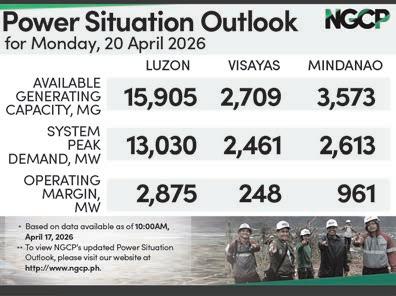
NGCP grid backs new projects Largest Uniqlo SEA logistics hub opens

By Lenie Lectura @llectura
AN official of the National Grid Corporation of the Philippines (NGCP) assured over the weekend that the transmission grid can accommodate the 22 new power projects that will generate 1,471 megawatts (MW).
“So far, almost all of that can be accommodated on time and the schedules are aligned,” NGCP Spokesman Cynthia Perez-Alabanza said. Alabanza referred to projects that form part of 200 power plants the Department of Energy (DOE) was ordered to ensured built and made live over the next three years. The order, expressed by President Ferdinand R. Marcos Jr. in his 4th State of the Nation Address, aims to accelerate the delivery of additional power supply across the country.
These incoming capacities will come from renewable energy (RE) sources. Twelve solar projects account for approximately 1,284 MW, complemented by six hydro -
electric plants with 48.23 MW, two biomass facilities with 38 MW, one wind project with 13.56 MW, and one 20 MW Integrated RE Storage System (Iress).
“We have identified just, I think, two points that we need to focus on and that is already being focused on by NGCP. Just a caution on solar because solar and wind are unique in a sense that these are intermittent sources of energy. We would still—for the stability of the grid, …baseload is still preferred,” Alabanza, also a lawyer, said over the weekend.
“But we do understand that there are limitations on certain plants that we cannot avoid. So NGCP is doing its best to manage within the parameters set by the DOE,” she added.

The DOE earlier said the power projects are already in advanced stages of construction or are undergoing final testing and commissioning. Once fully integrated into the grid, they are expected to provide critical near-term capacity that can reinforce supply margins, support rising electricity demand, and strengthen overall grid reliability in the months ahead.
The NGCP also said last week that transmission rates this month increased by 4.26 percent to P1.7526 per kilowatt hour (kWh).
The transmission rate is composed of ancillary service and transmission wheeling rates (TWR), which refer to what the NGCP charges for its core service of delivering electricity.
Ancillary service rates, meanwhile, cover the pass-through costs of services sourced from the reserve market and from providers with bilateral contracts with NGCP to stabilize the grid during power supply-demand imbalances. The ancillary service rate increased from P0.8275/kWh to P0.8516/kWh.
NGCP officials emphasized the company neither earns from ancillary service nor benefit from any change in ancillary service prices. They explained earnings from the latter are remitted directly to generation companies that have bilateral contracts with the NGCP and to the Independent Electricity Market Operator of the Philippines Inc. for ancillary services sourced from the reserve market.
Meanwhile, the company’s TWR increased to P0.7022/kWh from P0.6677/kWh.
“The increase in effective [TWR] has no impact on NGCP’s revenue, as the company’s allowable revenue is capped by the ERC,” documents from the NGCP read.
The company reiterates that bulk of the overall transmission rate still comprises of charges for ancillary services.
“As the system operator, NGCP’s priority is to ensure the grid remains resilient during supply-demand imbalances. [The company] does not profit from [ancillary service] charges, as these are remitted directly to the providers who help us maintain the continuous flow of electricity across the country,” the grid operator said.
By Bless Aubrey Ogerio @blessogerio
ANEW logistics facility for Japanese apparel brand Uniqlo has begun operations in General Trias, Cavite, marking what the company describes as its largest hub in Southeast Asia.
Located at the Riverpark North Commercial District, the facility was formally opened on April 17 through a partnership between Federal Land NRE Global Inc. (FNG) and Fast Retailing Philippines Inc. (FRPH), the local operator of Uniqlo.
The warehouse is expected to strengthen the company’s distribution network, particularly in the Southern Tagalog region, allowing faster movement of goods to stores and customers nationwide.
FNG President William Thomas F. Mirasol said the facility stands out not just for its size but also for its design, noting that it departs from the typical warehouse setup.
“If you’ve never been to a warehouse before, this is the nicest warehouse in the Philippines right now, air-conditioned inside,” Mirasol told reporters during the opening.
He said the concept was shaped by Uniqlo’s internal approach to operations, where ‘employee welfare
Nutritionist and vlogger Jo Sebastian: Snacking mindfully can be part of
By Francine M. Marquez
Snacking, often misunderstood in our healthconscious culture, is now being reframed as a valuable opportunity for better nutrition.
A leading nutritionist and dietitian featured on a recent episode of BusinessMirror’s weekly podcast, “Freshly Brewed,” shared insightful perspectives on how mindful snacking can positively contribute to a balanced and healthy lifestyle.
Joining the conversation was registered nutritionist-dietitian and content creator Jo Sebastian, host of The Donut Box Podcast, alongside BusinessMirror’s Multimedia Content Producer John Eiron Francisco.
In their engaging discussion, they explored the growing interest in mindful snacking: how it shapes daily nutrition, how consumers can better understand food labels that are often disregarded, and how it can contribute to overall health.
Sebastian, who has built a strong presence on social media, began posting online in 2015 while still in college, initially to boost her confidence.
“It kind of worked because I did get to know myself a lot better,” she shared.
A former dancer in high school, Sebastian later earned her degree in Community Nutrition from the University of the Philippines Diliman and became a registered nutritionist-dietitian. While her early content focused on beauty and

lifestyle, she soon realized she could use her platform to talk about nutrition and help people build a healthier relationship with food.
“I think it was a fun way to mix my past and my present—still becoming a performer in a sense, while using my science background to share an important message,” she said. Her upbeat and relatable videos quickly resonated with people struggling with foodrelated guilt, overwhelmed by conflicting nutrition advice online, or simply looking to take better care of themselves without feeling restricted.
Transitioning from clinician to content creator wasn’t difficult, she noted. “Even in college, we were trained to become effective nutrition educators. We learned how to translate science-backed information into everyday habits. You really have to make it easy for people to understand.”
In the digital age, where many turn to social media for guidance, distinguishing

is treated as part of the overall customer experience.’
Asked whether the project could influence future warehouse developments, Mirasol said interest from other regional players has been emerging, though similar projects remain complex.
Beyond operations, the facility is also expected to generate jobs for local residents, although specific figures were not disclosed.
FNG Chief Operating Officer Geraldine L. Sia said the new hub supports the company’s long-term expansion while maintaining its operational standards.
“This new warehouse marks a new chapter for us in the Philippines, supporting our commitment to responsible growth while staying true to our purpose,” Sia said. She also expressed hope the facility “will become a benchmark for supply chain excellence in the country.” The opening comes as Riverpark continues to position itself as a growing logistics and industrial corridor in Cavite, supported by its proximity to key transport routes in Southern Luzon.
Uniqlo entered the Philippine market in 2012 and has since expanded to nearly a hundred stores nationwide.
a balanced life’

fact from misinformation is crucial.
Sebastian emphasized the importance of verifying sources.
“First, check if the source is credible— whether it’s backed by scientific studies or shared by a qualified health professional,” she explained. “Then look at the claims. If something sounds too good to be true or overly bold, that’s a sign to double-check.”
Fear of eating RATHER than being seen purely as a source of nourishment or enjoyment, food has increasingly become a source of anxiety. Social media and cultural influences have shaped perceptions that certain foods are inherently “bad.”
“The fear of eating is deeply ingrained in our culture,” Sebastian said. “Many believe we should only have three meals a day or avoid certain foods altogether. Because of these beliefs, people tend to question their food choices.”
In reality, she stressed, there are no “good” or “bad” foods, though not all foods are nutritionally equal.
“There’s no moral value to food. When you remove that mindset, you can decide why you’re eating—whether for energy, taste, or comfort. There are many reasons
we eat, and it starts with how we view food and the language we use around it.”
Snacking, therefore, is not harmful as long as it is done in moderation; mindfully even!
Sebastian identifies two types of snackers: the mindful snacker and the “mindless” one.
“The mindful snacker eats with intention and sets aside time for it,” she explained. “Then there’s the ‘mindless’ snacker, or the ‘grazer,’ who eats small amounts throughout the day without really paying attention to how much they are eating.”
While neither is inherently wrong, she encouraged people to reflect on their habits.
“Ask yourself: Why am I snacking this way? Is it because my meals are not satisfying? Am I stressed or restricted in my diet?”
Modern lifestyles also play a role.
“We often treat eating as a secondary activity, something we do while working or multitasking. But eating can and should be a primary activity when we make time for it.”
Mindful snacking
UNDERSTANDING the body’s hunger signals and cravings takes time, as these are
influenced by both biological processes and personal experiences. Establishing a consistent eating routine is a good starting point, Sebastian said.
“When you give your body consistency, it learns to recognize patterns,” she explained. “Ideally, you should eat your first meal within two hours of waking, then every three to four hours after—including meals and snacks.”
With consistency, the body becomes better at signaling hunger and fullness, making it easier to distinguish between true hunger and emotional triggers such as stress or fatigue.
Awareness is the first step; balance comes next.
“When snacking, set aside a portion that feels satisfying. You can use nutrition labels or portion guides as a starting point,” she advised. “Then consider what nutrients might be missing and how you can improve the snack.” Equally important is the experience of eating itself.
“Sit down, be present, and enjoy your food with all your senses. We don’t just eat for nourishment—we eat for joy. Developing mindful habits helps improve your overall relationship with food.”
Read the labels NUTRITION labels are a practical tool for making informed food choices. They provide standardized information that helps consumers understand what they are consuming.
“Start with the serving size,” Sebastian said. “For example, a bag of cookies might list two pieces as one serving.” Next, check the calorie content, followed by the nutrients.
“We look at nutrients we want more of— like fiber and protein—and those we want to limit, such as added sugars and saturated fats. Labels help us make informed decisions and reduce guilt around food.”
With the rise of front-of-pack nutrition labeling (FOPNL), key information is now easier to see at a glance. Still, Sebastian advises consumers to look beyond the front.
“Front labels are helpful, but they don’t tell the whole story. Just because something is labeled ‘low-fat’ doesn’t mean it’s automatically the best choice for everyone,” she said. She also emphasized that fats are not inherently harmful. “Dietary fats help absorb essential vitamins like A, D, E, and K. Similarly, low-carb options may not suit everyone’s needs.” Her advice: always check the full nutrition panel.
“As a rule of thumb, five percent is considered low and 20 percent is high. Aim for higher amounts of fiber, protein, and essential nutrients, while keeping added sugars and saturated fats on the lower side.”
This discussion emphasizes the importance of informative, rather than restrictive labels on food, so consumers can learn for themselves what foods fit their diet.
Finding balance SEBASTIAN is also realistic about everyday food choices. In her vlogs, she often demonstrates how convenience foods, like instant noodles, can be made more nutritious.
“I love my noodle videos because we have to be realistic,” she said. “Food choices are influenced not just by misinformation, but also by accessibility and affordability.”
She encourages adding simple ingredients like eggs and vegetables to enhance both flavor and nutritional
Nutritionist-Dietitian and content creator Jo Sebastian talks about mindful snacking and why snacks deserve a second look with BusinessMirror's Multimedia Content Producer John Eiron Francisco.
Nutritionist-Dietitian and content creator Jo Sebastian John Eiron Francisco, Multimedia Content Producer of BusinessMirror
Banking&Finance
Earth day at a crossroads: turning global awareness into real impact
‘IT’S abnormally hot today.” “The rain doesn’t feel normal anymore.” “Electricity prices are already very high.”
These are no longer passing remarks; they reflect a growing reality t hat many Filipinos now experience firsthand, one that is increasingly shaping both the cost of living and how businesses manage risk and longterm resilience.
Environmental risks are no longer abstract concepts found only in global reports. From extreme heat and stronger storms to rising energy costs, these pressures are visibly shaping how we live and how businesses operate. What once felt distant is now disrupting infrastructure, straining supply chains, a nd threatening economic stability.
At the same time, environmental commitments have expanded. Netzero targets, sustainability disclosures, and climate strategies are now embedded across industries and institutions, yet outcomes continue to l ag behind ambition. This gap is no longer a question of awareness; it is a question of execution.
The 2026 Earth Day theme, “Our Power, Our Planet,” reinforces a collective call to action. “Our Power” reflects the ability of organizations to influence outcomes through everyday decisions, from how capital is allocated and energy is sourced to how operations and supply chains are designed. In parallel, “Our Planet” is no longer a distant concern. It is directly linked to business performance, risk exposure, and long-term value, making environmental outcomes increasingly inseparable from economic realities. However, despite decades of advocacy and global participation, environmental outcomes remain insufficient. W hile numerous organizations have made significant progress in setting sustainability commitments and climate goals, these are not yet fully e mbedded into financial decisionmaking, risk management frameworks, and daily operations. The issue is no longer whether action is needed, but how effectively commitments are translated into measurable results.
At the center of today’s climate challenges are everyday decisions. Choices on energy sourcing, capital allocation for sustainable resources and initiatives, and risk management shape emissions trajectories and longterm environmental performance. The urgency is undeniable: the Intergovernmental Panel on Climate C hange affirms human activity has unequivocally warmed the planet. Energy production accounts for over 73 percent of global greenhouse gas emissions, yet current policies still project up to 3.1°C of warming by century’s end, far exceeding Paris Agreement targets. Consequently, the World Economic Forum continues to rank extreme weather events such as floods, droughts, and heat waves among the most significant risks to global supply chains and economic stability. Environmental risks are already translating into measurable business impacts, from rising energy costs and supply chain disruptions to increasing regulatory and reporting pressures. As climate risks become increasingly measurable and financially material, organizations are being pushed to move beyond awareness-based initiatives toward a more system-based governance. This requires integrating sustainability into core business processes, including rigorous tracking of emissions and resource consumption. At the same time, these changes must extend beyond organizations, influencing how communities produce, consume, and respond to environmental c hallenges. Ultimately, sustainability is no longer defined by intention alone, but by how effectively decisions and actions translate into lasting impact. This global context is especially significant for the Philippines, one of the countries most vulnerable to climate and environmental risks. Stronger typhoons, rising sea levels, frequent flooding, and warming ocean temperatures continue to place pressure on infrastructure, communities, and key industries. These challenges are not only environmental, but they also

have direct implications for business continuity, supply chains, and longterm planning. Yet despite this high level of exposure, the country contributes only a small share to global g reenhouse gas emissions compared to the world’s largest economies, highlighting a broader imbalance where t hose least responsible often face the greatest risk.
At the same time, the shift from awareness to action is already underway locally. Regulatory momentum a nd market expectations are driving organizations to take structured approaches to sustainability. Initiatives led by the Securities and Exchange Commission include the adoption of the Philippine Financial Reporting Standards on sustainability disclosures and the move toward mandatory emissions assurance for publicly l isted and large non-listed companies, which signals increasing expectations for transparency, accountability, and data reliability. In parallel, companies, particularly in energy-intensive industries, are investing in renewable energy a nd improving operational efficiency as part of their transition strategies. For companies operating in the Philippines, this evolving landscape requires more than participation in isolated initiatives. It calls for stronger integration of sustainability into core business functions, particularly in how data is managed, how risks are assessed, and how decisions are made. Long-term impact depends on embedding sustainability into day-today operations, including strengthening data systems, integrating climate risks into enterprise risk management, and aligning sustainability considerations with financial and operational planning.
At R.G. Manabat & Co., we recognize that addressing this challenge e xtends beyond internal efforts to how we support the broader business community. As regulatory expectations tighten and investors demand g reater transparency, companies must establish robust data collection and monitoring systems. We work with organizations to operationalize sustainability by embedding it into enterprise r isk management, linking climate considerations to financial planning, and strengthening data, reporting, and decision-making frameworks. Through our ESG Transformation, Reporting, and Assurance services, we support companies in moving beyond compliance toward more strategic and measurable outcomes. Engaging independent auditors further enhances t his process by ensuring that sustainability disclosures are transparent, credible, and ready for increasing stakeholder scrutiny. As we observe Earth Day 2026, “Our Power, Our Planet” reminds us that sustainability cannot be confined to a single day of reflection. It must be a continuous, year-round commitment. For governments, organizations, and individuals alike, the focus must now shift from commitments to execution, embedding sustainability into everyday decisions that shape both business performance and environmental outcomes. By taking consistent and measurable steps together, we can help build an economy where energy is not only accessible and reliable, but also sustainable for the generations to come.
© 2026 R.G. Manabat & Co., a Philippine partnership and a member firm of the KPMG global organization of independent member firms affiliated with KPMG Int’l Ltd., a private English company limited by guarantee. All rights reserved. For more information, you may reach out through ph-kpmgmla@ kpmg.com, social media or visit www.home.kpmg/ ph. This article is for general information purposes only and should not be considered as professional advice to a specific issue or entity. The views and opinions expressed herein are those of the author and do not necessarily represent the BusinessMirror , KPMG International or R.G. Manabat & Co.
Hawkish BSP seen as high prices shock PHL economy
By Andrea Louise San Juan
THE Philippine economy’s exposure to food shock will prompt the Bangko Sentral ng Pilipinas (BSP) to prioritize its battle against inflation, hence shifting to a hawkish stance, even as the country still faces growth risks, analysts pointed out.
In separate commentaries, bank economists warned of the country’s vulnerability to food shock amid the oil crisis and the “unusually” strong El Niño seen later this year which could worsen food supply risks.
HSBC Senior Asean Economist Aris D. Dacanay, for one, pointed out that due to the economy’s exposure to a food shock, “maintaining a hawkish stance may help keep inflation expectations anchored.”
“Despite facing growth risks, we expect the BSP to increase the policy rate by 25 basis points to 4.50 percent next week,” Dacanay added.
He explained that while the oil shock was the main driver of inflation in March, core inflation “surprisingly” accelerated.
Toll on inflation
ACCORDING to the Philippine Statistics Authority (PSA), core inflation, which excludes selected food and energy items, increased to 3.2 percent in March from 2.9 percent in February. Core inflation in March 2026 was the highest in 26 months or since March 2024 when the metric hit 3.4 percent, historical data from the
PSA showed. At the BSP’s off-cycle policy meeting last March 26, BSP Governor Eli M. Remolona Jr. underscored that under these conditions, the Monetary Board prefers to look at core inflation as the metric strips out the “volatile elements” in headline inflation.
“Core inflation will also rise, but not likely breach the tolerance range,” Remolona added.
Dacanay demurs saying “this is not proof that soft demand isn’t having a toll on inflation.”
“Rather, it was proof that the second-round effects of the oil shock quickly permeated in the economy,” he wrote in a commentary. Dacanay added that these “spillover effects” are not to be ignored.
The current oil shock risks turning into a food inflation shock, he said citing the HSBC “Asean Perspectives” research report.
“And food prices tend to have an even broader impact on overall inflation expectations,” added Dacanay.
Impact on rice
THE recent surge in oil prices has exacerbated the trend in rice prices, Bank of the Philippine Islands (BPI) Senior Vice President and Lead Econ-
omist Emilio S. Neri Jr. wrote in a separate commentary.
“Domestically, rice prices were already on an upward trajectory even prior to the latest oil shock due to tighter supply conditions,” Neri wrote. He noted that March inflation rose 5.0 percent monthon-month, marking the fastest pace since October 2023 and returning rice’s contribution to headline inflation to positive territory for the first time since November 2024. Neri also flagged the El Niño phenomenon as adding to the problem, citing warnings from scientists.
“Climate scientists have warned that an unusually strong El Niño later this year could exacerbate food supply risks, compounding concerns already heightened by disruptions to fertilizer-linked supply chains stemming from geopolitical tensions.”
“Faced with stagflation risks, the BSP will likely prioritize its battle against inflation,” Dacanay said.
Hence, he said he expects the BSP to raise its policy rate by 25 basis points to 4.50 percent next week, “kicking off a tightening cycle; the length of the tightening cycle depends primarily on how long the conflict in the Middle East persists.”
Global lenders scramble to address financing risks
By Bless Aubrey Ogerio
HEADS of multilateral development banks (MDBs) have called for stronger coordination among institutions as they face rising pressure to help member countries deal with economic instability driven by global shocks.
Meeting on the sidelines of the World Bank Group-International Monetary Fund Spring Meetings, MDB leaders said they see economies already feeling the impact of higher energy costs, supply chain disruptions and tighter financial conditions.
Asian Development Bank President Masato Kanda, who chairs the MDB Heads Group, said cooperation among institutions has become more urgent as global conditions grow more complex.
“MDBs are working more closely than ever to support our members and clients through a complex and
evolving global environment,” Kanda said.
Pooling financial resources and expertise, he added, allows development banks to respond to immediate challenges while also preparing countries for longer-term risks.
“By combining our financial strength, knowledge, and partnerships, we are helping countries manage immediate pressures while building resilience for the future,” he said.
Beyond crisis response, the MDB heads discussed ways to expand financing capacity, particularly by mobilizing private capital, pointing to structures that allow institutions to originate and distribute loans to scale up investment in developing economies.
The group also agreed to form a working group to advance these financing approaches.
Further, they pushed for improved transparency in assessing credit risks in emerging markets
through the Global Emerging Markets (GEMs) consortium, as well as broader use of local currency financing to reduce exposure to exchange rate volatility.
Another area of focus was impact measurement, with MDBs agreeing to develop a shared approach to assessing how their operations contribute to job creation and poverty reduction.
The institutions also committed to deeper cooperation in strategic sectors, including critical minerals, which they said are essential to energy security, digital development and industrial growth.
At the same time, MDBs launched “Water Forward,” a global initiative aimed at expanding investment in water systems seen as critical to jobs, food security, and climate resilience. They also signaled continued joint work on emerging priorities such as artificial intelligence.
On procurement, the banks
agreed on a common framework focused on value for money, intended to improve the quality and sustainability of projects financed by MDBs. Each institution will adapt the framework to its own operational systems.
The group also noted progress in using mutual reliance arrangements, which allow MDBs to co-finance projects more efficiently by recognizing each other’s procedures. The MDB Heads Group includes the ADB, the African Development Bank Group, the Asian Infrastructure Investment Bank, the Council of Europe Development Bank, the European Bank for Reconstruction and Development, the European Investment Bank, the Inter-American Development Bank Group, the Islamic Development Bank, the New Development Bank and the World Bank Group.
The International Monetary Fund also takes part in the discussions.
Pausing tax on petrol products get lawmakers’
backing

By Jovee Marie N. dela Cruz @joveemarie
ALAWMAKER is backing a proposal in the 13-committee House mega panel that would directly translate into immediate financial relief for millions of Filipinos by suspending the 12 percent value-added tax (VAT) on petroleum products for two months, a measure he said would quickly ease the impact of soaring fuel prices on households and businesses.
Camarines Sur Rep. Miguel Luis R. Villafuerte, a member of the House Committee on Ways and Means, said the proposed VAT suspension would deliver a more immediate and substantial reduction in pump prices of diesel and gasoline, helping consumers cope with the ongoing global oil shock triggered by the Middle East conflict.
He expressed support for the proposal of Marikina City Rep. Romero Federico “Miro” S. Quimbo under the Legislative Energy Action and Development (LEAD) Council. Villafuerte said that a temporary VAT suspension is a “feasible and necessary intervention” given the extraordinary spike in global oil prices.
He said that lowering fuel costs is crucial in protecting vulnerable sec-
tors from slipping into poverty, citing projections from the Philippine Institute for Development Studies (PIDS) that between 1.34 million and 3.5 million Filipinos—mostly near-poor households—could fall into poverty due to sustained high oil prices.
According to Villafuerte, these households are especially at risk because they spend most of their income on basic necessities such as food, transport, and utilities, leaving little to no savings to absorb sudden price increases.
He noted that a VAT suspension would have an immediate pass-through effect on fuel prices, unlike other tax relief measures, because VAT is computed based on actual pump prices. As fuel prices rise, so does government VAT collection—meaning consumers shoulder a larger burden during oil price spikes.
Villafuerte added that easing fuel costs would also help contain inflation, which recently breached the Bangko Sentral ng Pilipinas’ target range. Lower fuel prices, he said, would help prevent second-round effects such as higher transport fares, electricity costs, and commodity prices, all of which directly affect ordinary families.
The lawmaker also pointed out
that the measure would provide relief not only to commuters and households but also to transport operators, fisherfolk, farmers, and small businesses that are heavily dependent on fuel for their livelihood and operations.
Villafuerte further noted that oil industry stakeholders themselves have acknowledged that removing VAT could result in immediate price reductions at the point of importation, easing pressure across the supply chain.
He said the proposal, if approved by Congress and Malacañang, could be enacted within weeks, providing timely relief while the global oil market remains unstable due to geopolitical tensions.
Transparency
MEANWHILE, Cavite 1st District
Rep. Ramon “Jolo” Revilla III called for greater transparency and accountability in the distribution of government assistance while renewing his push for fuel tax relief.
During the same LEAD Joint Committee hearing, Revilla urged concerned agencies to provide clear and concrete plans on wage adjustments, aid distribution, and safeguards to ensure efficiency and fairness.
He highlighted the need to im-
prove the implementation of the TUPAD Tuloy Pasada program, noting that beneficiary lists are sourced from the Land Transportation Franchising and Regulatory Board and validated by the Department of Labor and Employment.
Revilla stressed the importance of preventing duplication of aid and expanding coverage to more Filipinos affected by rising fuel costs. He also addressed the issue of wage increases, acknowledging that adjustments are complex but emphasizing the need to explore all possible measures to ease the burden on workers.
At the same time, Revilla pushed back against claims that reducing fuel excise taxes would mainly benefit the wealthy, arguing that middleincome earners would significantly benefit from lower transportation and commodity costs. He said reducing fuel taxes would have a ripple effect across the economy, helping bring down daily expenses for ordinary families.
Revilla underscored that the energy crisis affects all sectors, calling for a unified and coordinated government response to deliver meaningful and inclusive relief to Filipinos, particularly workers and middle-income households most affected by rising fuel and energy costs.
FROM STRAIT TO STATION
Why gas prices take time to fall

By Cathy Bussewitz | The Associated Press
HOPES for cheaper gasoline could be short-lived after Iran reclosed the Strait of Hormuz and fired on ships over the weekend, a sudden escalation that threatens to prolong disruptions in global oil flows and delay relief at the pump.
Motorists, hoping for relief at the pump, wondered how quickly gasoline prices might fall as renewed disruptions in the Persian Gulf once again stalled oil tanker movements. A gallon of regular gasoline cost $4.08 on average in the US Friday, which was 37% more than before US and Israel attacked Iran but down a few cents from a week ago.
But when gas prices spike, they don’t typically drop as quickly as the cost of crude. Even if Iran keeps the waterway open in the face of a US blockade of its vessels, it still could take months for fuel prices to return to levels resembling those enjoyed before the war began Feb. 28, energy experts said.
The slow speed at which oil tankers travel from ports to refineries, renewed security risks following the latest attacks in the Strait of Hormuz, congestion in the waterway and damage to energy infrastructure in the Middle East are all contributing to elevated gasoline prices.
The historical observation is that gasoline prices rise quickly but fall slowly, regardless of the particular causes of the increase,” said Mark Barteau, a professor in the department of chemical engineering at Texas A&M University.
“In this case, one has to take into account the time it takes for the steps that have to happen once tankers sail through the straits – for example, sailing time to refineries on other continents, time to ramp up refinery operations, and time to transport some refined products by tanker to the continent where they will be used,” Barteau said. “There
is also tendency to hedge bets because of doubts about whether and how quickly that restoration might occur, and whether further disruptions are possible along the way.”
Nevertheless, some energy analysts were optimistic that gas prices would gradually decline.
Tempered hopes for lower gasoline prices
GASOLINE prices were already falling slightly after last week’s announcement of a two-week ceasefire between the US and Iran, according to motor club federation AAA.
Following the Strait of Hormuz announcement, oil prices fell by $10 to $12 per barrel, which generally translates into a decrease of 25 or 30 cents per gallon of gas, said Michael Lynch, distinguished fellow at Energy Policy Research Foundation, a non-partisan research institution focused on energy and economics.
“ That doesn’t happen overnight, but within a week or two, we could be down 50 cents a gallon easily, if this holds,” Lynch said. “And part of it is, there’s a lot of tankers ready to go. And if they all come out, then that balances the market very quickly.”
In the wake of Friday’s news, “every state will start seeing gas price decreases accelerate at a pace of probably 1 to 3 cents a gallon for every day or two,” said Patrick De Haan, head of petroleum analysis at GasBuddy, in a webcast. “And that could continue for at least a couple of weeks.”
DeHaan estimated that the national average for a gallon of regu-


lar gas could reach $3.45 to $3.65 by Memorial Day. But he acknowledged that returning to lower prices could take a while. It might take until later this year or early next year to really fully normalize and for some of these surcharges and impacts to reverse and disappear,” De Haan said. Traffic and trepidation IF an agreement to end the war is
reached, it could take at least four months for shipping through the Strait of Hormuz to go back to normal, said Patrick Penfield, professor of supply chain practice at Syracuse University. Right now, you still have potential mines that have to be removed or detonated, you have over 150 tankers that have been anchored in and around the
which is causing a traffic
and
we still have shipping rates that are still high because of lack of shipping capacity and war rate insurance,” he said. The leaders of France and the UK welcomed word of the strait’s reopening but said they would keep pushing for a way to permanently restore freedom of navigation for vessels that rely on the narrow passage off Iran’s coast, through which about one-fifth of the world’s oil typically travels.
Ship owners would have to be convinced to trust the Americans and Iranians, “and that seems like it’s a hard hill to climb,” Lynch, of the Energy Policy Research Foundation, said. “I certainly wouldn’t want to do it. I wouldn’t wanna be the first ship through or even the first five ships through, but somebody will do it. There’s a lot of money on the table and somebody’s going to grab it.”
If the Iranians are cooperating, the mines should not be a problem, because Iran has a sense of where the mines are, Lynch said.
“Now, that raises the issue, are the Iranians going to cooperate, or what do they want to cooper-
ate?” he asked. “Are they going to demand a couple-million dollars a ship, as is talked about? Or is Trump going to say ‘that’s not acceptable,’ and then what’s the next step after that?”
If the strait remains open, and ships loaded with oil leave the Persian Gulf, it could take weeks for those heavy, slow-moving ships to reach their destinations.
“People think that once the strait opens, it’s fine. We’re done. It’ll be better really fast,” said Richard Joswick, global head of nearterm oil analysis at S&P Global Energy. “If you open the strait today to get a ship and bring it around and take it to Europe and run a refinery, turn it into products, you’re talking 10 weeks of a lag time here. It will be two to three months before things can start to get back to normal after the straight reopens.”
Damage to energy infrastructure in the Middle East
MANY oil production facilities were damaged in the Middle East, including refineries in Saudi Arabia and Kuwait and oil tanker terminals in the United Arab Emirates and Iran. Some repairs has been made, but damage remains. In addition, some countries slowed down or halted production during the war, because without the ability to ship crude through the Strait of Hormuz, their ships and storage tanks filled up with stranded oil.
“It’s not a light switch. Everyone’s impatient and saying, ‘Go, go go,’” De Haan said. “But it will take time to get these flows of oil through the Middle East fired back up again.”
Once an oil well is turned off, the pressure within the well could change, and it can take time to restart the flow. But that might not be a problem in some Middle East oil fields, where production can be resumed quickly, Lynch said. The Saudis have done that a bunch of times. They ramp up by 2 or 3 million barrels a day, almost overnight, and there’s no problem with the wells that have been shut in for months and sometimes years,” Lynch said.
strait,
jam,
THE sun rises behind a tanker anchored in the Strait of Hormuz off the coast of Qeshm Island, Iran, Saturday, April 18, 2026. AP/ASGHAR BESHARATI
BACKDROPPED by ships in the Strait of Hormuz, damage, according to local witnesses caused by several recent airstrikes during the US-Israel military campaign, is seen on a fishing pier in the port of Qeshm island, Iran, Monday, April 13, 2026. AP/ASGHAR BESHARATI
JEEPNEY drivers walk on portraits of President Ferdinand Marcos Jr., Israeli Prime Minister Benjamin Netanyahu and US President Donald Trump as they hold a rally during a strike of some transport groups to denounce the high prices of oil on April 15, 2026, in Manila. AP/AARON FAVILA
Limgas na Pangasinan 2026:
Industrial, Intellectual, Infinite



DRIFT INTO A SEASON OF EFFORTLESS STYLE
THE country’s largest specialty retailer, SSI Group invites you into a world where the summer of 2026 unfolds slowly: bathed in sunlight, softened by sea breeze, and filled with moments that feel as effortless as they are unforgettable. Ongoing until May 15, 2026, the group’s Spring/Summer campaign, Sun-Ripe Dreams, paints a portrait of a retro seaside escape set in a private beachfront villa where time lingers just a little longer. Inspired by summers and vintage postcards of the 1960s, the campaign follows three friends as they move through a sun-soaked day by the shore, laughing, lounging, and embracing the quiet joy of simple pleasures. It is a story told through movement and light: carefree yet considered, relaxed yet refined. The campaign comes to life through a palette that mirrors the poetry of summer, translated into seasonal essentials across SSI’s brands. Mediterranean blues and sky tones appear in light, breathable pieces and relaxed silhouettes, while sunlit yellows, muted corals, and vintage reds bring warmth through statement dresses and everyday staples. Woven textures come through in bags, footwear, and accessories, complemented by flowy fabrics and easy layering for warm-weather days. Softened by blush pinks and creamy neutrals, the season reflects a balance of contrast and ease—capturing a summer that feels both effortless and personal. More information can be found at tinyurl.com/yph6xecc.

A SKINCARE brand for sensitive skin, Aveeno has just launched refills for its popular Body Wash.
In terms of sustainability, refilling saves time and reduces waste in the long run. Remember that every refillable bottle reduces the demand for single-use plastics.
Each Aveeno Body Wash refill pouch is made using 77 percent less plastic and costs 20 percent less compared to the regular Aveeno 532ml bottle. The refill pouches make it possible for you to either reuse your existing Aveeno bottles or other soap dispensers Coleen Garcia, Sofia Andres, and Enzo Villacorta love

LINGAYEN, Pangasinan—On its 50th year, the Limgas na Pangasinan, fondly referred to as the “Mother of All Pageants” in the province, is looking for representatives who embody the modern-day Urduja, the legendary 14th-century warrior princess believed to have lived in what is now their progressive province.
Originally called “Limgas na Dayat” (Beauty of the Sea), Limgas na Pangasinan (Beauty of Pangasinan) held a press presentation on March 21 at the Sison Auditorium.
The Pre-Pageant Night happened on April 18, where candidates showcased their talents before a selection committee. Owing to the current oil crisis, a toned-down Grand Coronation Night is set on April 24 at the Narciso Ramos Sports and Civic Center (NRSCC) Gymnasium.
Out of a possible 48 candidates (comprising four cities—Dagupan, Alaminos, Urdaneta, and San Carlos—and 44 municipalities), 19 pretty and articulate contenders are vying to be Pangasinan’s representatives to Miss World Philippines, Mutya ng Pilipinas and Miss Grand Philippines.
The bold vision of the pageant—the inspired idea of Gov. Ramon “Mon-mon” V. Guico III, chairman First Lady Maan Tuazon-Guico, and Provincial Tourism and Cultural Affairs officer Maria Luisa A. Elduayan—is to find the Pangasinense who is a “beauty beyond barriers.”
“When we speak of beauty beyond barriers, we are reminded that true beauty is not confined to standards, titles or appearances. It goes beyond what we see. It lives in the stories we carry, the struggles we overcome, and the values we choose to uphold every single day,” said the First Lady Maan Tuazon-Guico, herself a former model.
“Now in Limgas, I hope each and every one of our candidates will be about beauty, passion, purpose and, above all, I hope you will be strong—a strong woman, an independent woman who can stand on your own and make each of your town, and possibly in the future your province, very proud of you,” added Tuazon-Guico.

Besides showcasing the most beautiful, charming and talented women in the province. Limgas also highlights the province’s efforts to promote tourism and cultural heritage by aligning with Project Masanting, an initiative featuring the beauty and bounty of Pangasinan’s culture, arts and traditions. In their glamorous headshots, the contenders are clad in mirrored geometric gold ensembles by Glenn A. Gonzales and Glennze T. Aquino as they radiate the province’s new era: industrial, intellectual, and infinite.
This year’s official candidates are: Alyanna Kristel Bustamante (Binalonan), Angelle Rianne A. Bulseco (Mangatarem), Bea Faye S. Isidro (Bautista), Jemmaica D. De Guzman (Binmaley), Giselle P. Villorente (Laoac); Samantha Louise S. de Guzman (Lingayen). Faten Mohamad P. Sharan (Bayambang), Shayne Angela F. Solis (Calasiao), Aira Nicole F. Hermogeno (Aguilar), Jessalyn S. Espinoza (Mangaldan); Althea Bernice T. Gabiola (Sta. Barbara), Samantha T. Long (Urdaneta City), Michelle M. Francisco (Asingan),
WORLD VISION PHILIPPINES EMPOWERS FILIPINO CHILDREN TO THRIVE, NOT JUST SURVIVE
HUNGER has no place in a child’s life but in the Philippines, millions of children still face malnutrition every day. That’s why World Vision Philippines is amplifying its global Enough campaign, a bold call to “Act more. Pray more. Give more. Until every child has Enough.” Introduced in 2024, Enough reflects the belief that there are Enough resources in the world for every child to have nourishing food, the chance to grow, and the opportunity to thrive, no matter where they live or the crises they face. The need is urgent. According to a 2025 Social Weather Stations survey, 16.1 percent of Filipino families, nearly 1 in 6, experienced hunger. Each year, hundreds of thousands of children under five suffer from stunting, wasting, or being underweight, limiting their growth, learning, and future potential.
launches refills for popular product
Aveeno Body Washes, which are formulated with colloidal oat that locks in moisture for up to 24 hours and soothes dryness. Aveeno Body Wash comes in two variants.
Dr. Vanika Viardo, MD, a board-certified dermatologist, said Aveeno’s Triple Oat Complex has the ability to nourish and help protect sensitive skin while supporting overall skin health. “Formulations with Triple Oat Complex contain colloidal oatmeal, oat extract, and oat oil. It has antiinflammatory properties, helps soothe irritated skin, it relieves itch, [and] it has antioxidant, prebiotic, and barrier repair properties to boost the protective function of our skin’s outer layer which makes it the perfect ingredient for dry and sensitive skin,” she said. Aveeno’s Triple Oat Complex uses oat oil, oat extract, and colloidal oat to soothe and hydrate the skin on top of boosting its ceramide levels and the skin’s natural barrier.
Enzo Villacorta, a long-time Aveeno user, said the new Body Wash Refills reflect Aveeno’s commitment to practicality, sustainability, and gentle care for sensitive skin
“Using these [Aveeno Body Wash] refills don’t just save time and money, but they also save the environment. Refill packets are great and the fact that they chose to release this in the Philippines really shows how many people use this for
To turn Enough into action, World Vision has launched Bawat Batang Pinoy Malusog (BBPM), an integrated health program addressing child hunger and malnutrition in key areas, including Albay, Camarines Sur, Sorsogon, Antique, Leyte, Samar, and the Bangsamoro Autonomous Region in Muslim Mindanao. The program focuses on proper child development and holistic care, with resources allocated to: water, sanitation, and hygiene, positive deviance/hearth (Nutrition Rehabilitation), and Go Baby Go! Parenting Program.
Since its launch, BBPM has already reached 15,133 individuals, helping children and families access the nutrition, education and support they need to grow stronger and healthier. Behind these numbers are real stories of transformation, children
their sensitive skin,” said Enzo In time for Earth Month this April, Aveeno Body Wash Refills highlight how the brand’s expertise in oat science drives a more mindful approach to both skin health and sustainability.
Aveeno Body Wash Refills make it convenient for you to replenish your shower essentials with its easy-to-pour design. You can expect that every pouch contains the same trusted formula loved by Coleen Garcia, Sofia Andres, and Enzo Villacorta.
Aveeno Skin Relief Body Wash is best for sensitive skin, as it not only soothes dry, itchy skin, but also strengthens the skin barrier through Aveeno’s Triple Oat Complex. This formula utilizes oat oil, oat extract, and colloidal oat to soothe and hydrate the skin on top of boosting its ceramide levels and the skin’s natural barrier. Aveeno Skin Relief Body Wash offers up to 72 hours of moisturization when used with Aveeno Skin Relief Lotion.
Dr. Vanika Viardo, MD, a board-certified dermatologist, talked about the benefits of the Triple Oat Complex, emphasizing its ability to nourish and help protect sensitive skin while supporting overall skin health.
“Formulations with Triple Oat Complex contain colloidal oatmeal, oat extract, and oat oil. It has anti-inflammatory
who are now gaining weight appropriately, caregivers who have adopted improved feeding practices, and communities that are becoming more empowered to sustain better health outcomes for the next generation.
“We’re proud that our efforts across health, nutrition, education and child protection have already made a difference in the lives of so many children,” said Dr. Herbert Q. Carpio, national director of World Vision Philippines. “But the fight isn’t over. With your support, we can ensure that every child has Enough—Enough food, Enough care, Enough learning opportunities, and Enough protection to thrive.”
To support Enough and help Filipino children survive past their fifth birthday and reach their full potential, visit tinyurl. com/4ud258yk.
properties, helps soothe irritated skin, it reliefs itch, [and] it has anti-oxidant, prebiotic, and barrier repair properties to boost the protective function of our skin’s outer layer which makes it the perfect ingredient for dry and sensitive skin,” she said.
Aveeno Daily Moisturizing Body Wash is best for normal to dry skin. It nourishes the skin’s moisture barrier, leaving it soft and nourished. Formulated with prebiotic colloidal oat, it keeps your skin moisturized for up to 24 hours. Aveeno Daily Moisturizing Body Wash locks in moisture for up to 48 hours when used with Aveeno Daily Moisturizing Lotion. Both variants are clinically proven and dermatologistrecommended along with being soap free, dye-free, and hypoallergenic.
Aveeno Body Wash provides deep hydration with every shower, the start of every body regimen. With Aveeno Body Wash Refills, this small, daily act also becomes a gesture of kindness to the environment. Aveeno believes that real care lives in the little choices we make every day.
This belief is inspired by Kenvue’s Healthy Lives Mission, which shapes Aveeno’s sustainability commitments under its
THE GIRLS OF THE LIMGAS NA PANGASINAN
Photographed by Brian Mamawan; geometric gold ensembles by Glenn A. Gonzales and Glennze T. Aquino; creative direction by Constantine B.
DBP cited as outstanding Pag-IBIG Fund partner
State-owned Development Bank of the Philippines (DBP) has been conferred the Outstanding Disbursement Partner for Checkless Disbursement for Developers award by the Pag-IBIG Fund, in recognition of the bank’s efforts in providing efficient and secure electronic fund disbursement services for housing developers.
Pag-IBIG cited DBP’s exemplary performance in facilitating seamless housing development fund transfers through secure, efficient, and checkless electronic disbursement channels, which promoted operational efficiency and improved client satisfaction.
DBP President and Chief Executive Officer Michael O. de Jesus said the bank

CEO for Operations Cluster Benjamin R. Felix, Jr. (second to the left), Pag-IBIG Deputy CEO for Support Services Cluster Atty. Robert John S. Cosico (second to the right), and Acting Deputy CEO for Member Services Cluster Atty. Marcial C. Pimentel Jr. (rightmost). has consistently supported the housing agency’s initiatives to enhance and expand access to housing programs for underserved communities, which is closely aligned with DBP’s priority thrusts while buttressing the National Government’s socio-economic goals.

Hat the recently
Moto Expo 2026, held from April 10 to 12, 2026, at the SMX Convention Center Manila in Pasay City.
Marking its 10th anniversary, the three-day event once again brought together riders, motorcycle enthusiasts, and industry leaders from across Asia, celebrating the ever-evolving motorcycle culture through innovation, design, and performance. Honda heightened the excitement at this year’s expo with the official launch of three new models, reinforcing its commitment to delivering innovative and riderfocused mobility solutions. Motorcycle enthusiasts witnessed the unveiling of the New Honda WN7, the CB650R, and the NX500—each representing a distinct expression of Honda’s engineering excellence.
Leading the launches, the New Honda WN7 highlighted Honda’s continued push toward electric vehicles, marking the brand’s entry into full-size EV motorcycles designed for everyday urban mobility. Built for efficiency, sustainability, and responsive city riding, the model delivers 18 kW of rated power and up to 50 kW peak output, paired with 100 Nm of torque for immediate acceleration and smooth power delivery. It accelerates from 0 to 50 meters in just 3.9 seconds, with a riding range of up to 144.1 km and a top speed of 129 km/h—making it a practical option for both daily commutes and longer urban rides. It also supports convenient charging, reaching a full charge in approximately 2.5 hours under normal conditions, while fast charging from 20% to 80% can be achieved in just 0.5 hours for added flexibility. The model is presented in a sleek Graphite Black finish.
Enhancing its smooth and responsive performance, the WN7 features the Honda Smart Key System for ignition. It also comes equipped with Honda RoadSync connectivity via Bluetooth for navigation, music, messaging, and calls, along with a 5-inch TFT display with RoadSync integration. Additionally, it features compact
twin projector headlights with daytime running lights. For improved safety and maneuverability, the model includes multiple riding modes, Selectable Speed Limit Assist, Selectable Deceleration Power levels, and low-speed forward and reverse assist functions for navigating tight spaces.
While electric vehicles continue to gain traction globally, internal combustion engine (ICE) motorcycles remain a vital part of the Philippine market, driven by infrastructure readiness, affordability, and rider familiarity. As demand for reliable, high-performance motorcycles continues to grow, ICE models play a key role in delivering accessible mobility solutions for Filipino riders.
Blending modern aesthetics with dynamic performance, the CB650R drew attention with its smooth, high-revving inline-four engine. Designed for riders who value both style and substance, it is equipped with Honda’s E-Clutch System, allowing riders to start, stop, and change gears without using the clutch lever, along with a quick shifter.
It also features Honda RoadSync connectivity for calls, messaging, navigation, and music via smartphone, paired with a five-inch full-color TFT display with optical bonding for improved readability and reduced glare. The Standard variant comes in Matte Gunpowder Black Metallic, while the E-Clutch variant is available in Matte Gunpowder Black Metallic, Grand Prix Red, and Matte Jeans Blue Metallic.
Meanwhile, the NX500 E-Clutch variant stood out as a capable and versatile adventure motorcycle, engineered for riders eager to explore beyond the city. With its lightweight build and confident handling, it transitions seamlessly between urban roads and more rugged terrain.
It features a five-inch TFT meter display with optical bonding to reduce glare and improve readability, along with Honda RoadSync connectivity that links the motorcycle to a smartphone via Bluetooth for navigation and app control. It is also equipped with Honda’s E-Clutch System, allowing the rider to start, stop, and change gears through pedal shifting without using the clutch lever. The model is available in Pearl Horizon Black and Matte Gunpowder Black Metallic.
Alongside these newly launched models, Honda also showcased a premium lineup of motorcycles that captured the attention of attendees throughout the event. The X-ADV impressed with its unique blend of adventure capability and urban functionality, while the CRF1100L Africa Twin remained a top choice for long-distance touring and off-road performance. The Rebel 1100 delivered a bold and modern cruiser experience, and the Gold Wing continued to embody luxury touring at its finest. Completing the display was the CBR1000RR-R Fireblade SP, a race-bred superbike engineered for precision, speed, and track-level performance.
HPI President Takeshi Kobayashi expressed his appreciation for the strong turnout and continued support from the riding community.
“Makina Moto Expo is a very important event for the motorcycle community. It brings together people who share the same passion for riding, innovation, and motorcycle culture. We are happy to be part of this celebration, especially as Makina Moto Expo marks its 10th anniversary this year. Through the years, we have strengthened our connection with the riding community—not only by offering reliable motorcycles, but also by creating meaningful experiences that bring riders together,” he shared.
Suzuki Philippines expands Pre-Delivery Inspection facility
Philippines Incorporated (SPH) has reinforced its commitment to quality, efficiency, and customer satisfaction with the expansion of its Pre-Delivery Inspection (PDI) facility at the Suzuki Philippines Plant in Laguna. The upgraded facility enhances SPH’s ability to meet growing market demand while ensuring every vehicle adheres to Suzuki’s global
“The expansion of our PDI facility reflects Suzuki Philippines’ continued commitment to being truly ‘By Your Side’ of every Filipino customer,” said Koichiro Hirao, President of Suzuki Philippines. “Through strategic investments in
operational coordination. Driven by increasing demand for fuel-efficient and reliable vehicles, the expansion was completed in December 2025. Its strategic location in Laguna enables efficient distribution across NCR, North and South Luzon, and easy access to ports serving the Visayas and Mindanao.
“Through this expansion, we significantly improve operational efficiency while maintaining strict adherence to Suzuki’s global standards,” said Norihide Takei, Director and General Manager for the Automobile Division. “This allows faster delivery to dealers without compromising inspection quality.” Regular audits by Suzuki Motor Corporation (Japan) and global subsidiaries ensure compliance with international standards. Safety enhancements. including a concreted stockyard, improved spacing, blind spot reduction measures, and upcoming
further strengthen operations. Continuous personnel training and employee welfare programs also support high-quality output. For customers, the facility ensures vehicles are

AS the dry season begins, PhilHealth reminds members that coverage for heat-related illnesses is in place to help protect Filipinos from rising temperatures and associated health risks.
The State Insurer reminds members of its inpatient benefit packages for common summer- and heat-related illnesses that can be availed in any PhilHealth-accredited hospitals nationwide, helping reduce out-of-pocket expenses:
• Heat stroke, heat exhaustion, heat collapse, heat cramp and sunstroke: P12,675
• Heat fatigue and other effects of heat and light: P18,135
• Moderate to severe dehydration: P7,800
• Varicella/chickenpox without complication: P7,800
• Typhoid fever: P19,500
• Sore eyes/conjunctivitis: P16,575
• Infectious diarrhea/acute gastroenteritis: P11, 700
• Toxic effect of contact with fish and other marine
animals such as jellyfish, sea anemone, shellfish, and starfish: P11,115
PhilHealth also reiterates that emergency health care needs, heat-related or beyond, are covered by the Outpatient Emergency Care Benefit (OECB) Package, available in accredited Level 1 to 3 hospitals. This ensures
delivered in optimal condition—clean, safe, and roadready—minimizing post-delivery concerns. Dealers benefit from faster processing, improved inventory flow, and more reliable vehicle allocation.
Designed for the future, the facility is equipped to handle upcoming models, including electric vehicles. Further upgrades are planned, such as a Suzuki-standard paint booth, portable fueling equipment, bird deterrent systems, and green initiatives like solar power installations. Through these developments, Suzuki Philippines continues to deliver high-quality vehicles while strengthening support for its dealer network and ensuring a reliable, worry-free ownership experience for Filipino customers.
For more information, you may check out any authorized Suzuki Auto dealerships nationwide or visit http://suzuki.com.ph/auto/. For daily updates on Suzuki, please like Suzuki Auto PH’s Facebook page at https:// www.facebook.com/SuzukiAutoPH, follow them on X at https://x.com/suzukiauto_ph and Instagram at @ suzukiautoph.
showcasing diverse expressions of fine living. “At Ascott Makati, we don’t just offer fine living; we celebrate the many ways it can be experienced, through art, fashion, food, culture, music, and more. This is reflected in our global tagline, ‘Savor the Art of Fine Living,’” shares General Manager Cecille Teodoro. Beginning in April, the luxury serviced apartment introduces a series of tea-centered experiences alongside a thoughtfully curated gourmet offering designed to showcase how tea can transform simple moments into something truly special. Headlining the campaign is a collaboration between Ascott Makati and Mesclun Restaurant + Café, for a specially curated Ascott Afternoon Tea. Guests can indulge in an elegant selection crafted by Chef Katrina Kuhn-Alcantara, featuring a delightful array of Mesclun’s most-loved delicacies and new creations. This includes Mushroom and Spinach Empanaditas, Grilled Vegetable Sourdough, Cucumber Tea Sandwiches, Bonbons, and Carrot Cake.
Perfectly complementing the menu are customblended teas developed in collaboration with Apothecary owner and herbalist Rene McHugh-Rodrigo. “Food and tea are equal components of any Afternoon Tea, so it was important for us to create a pairing that is harmonious. We worked closely with Rene to develop blends that are not only refreshing but also have positive effects for the body. We wanted the entire experience to feel intentionally nourishing and comforting,” shares Chef Katrina.
Diners can choose between two distinctive tea blends.
The Glow Citrus & Mint Blend is a bright, uplifting infusion of lemon, globe amaranth, and peppermint—crafted to promote relaxation and support digestion. Meanwhile, the Warm Cinnamon & Spice Blend combines ginger, cinnamon, and white fennel in a comforting infusion known to aid gut health, digestion, and metabolism.
Ascott Makati’s Afternoon Tea will be available at Mesclun Restaurant + Café until June 30, 2026, from 12:00 noon onwards, priced at P1,495 nett, good for two persons.
Ascott Makati unveiled the offering through an intimate tea soirée attended by members of the media and hotel guests. Attendees were among the first to experience the Ascott Afternoon Tea, with Chef Katrina

Ascott Makati and Mesclun Restaurant + Café collaborate for Ascott Signature Tea now available for P1,495 nett good for two persons.
Kuhn-Alcantara personally guiding them through the curated selection. For an immersive experience, the event also included a tea blending session led by custom tea maker Rene McHugh-Rodrigo, offering guests expert insights into the art of tea. To complete the experience, guests took home bespoke artworks by tea artists Esang Ocampo and Rens Tuzon, who use tea as their painting medium, highlighting its versatility beyond the cup. In line with its celebration of tea as a way of fine living, Ascott Makati will also introduce a series of thoughtfully curated activities and workshops centered on wellness and tea. Open to the public on a first come, first-served basis, these enriching experiences invite guests to further explore tea—from

In the photo, from left, are Joselito Ang, Suzuki Philippines’ Group Head for Homologation, PDI, Warehouse & External Affairs; Koichiro Hirao, Suzuki Philippines’ President; Norihide Takei, Suzuki Philippines’ Director and General Manager for Automobile Division.
‘Numbers don’t lie. Narratives do’

DATA guru Jose Ramon “Toots” Albert, Senior Research Fellow of the Philippine Institute for Development Studies (PIDS), recently gave a talk to the International PR Association Philippines’s chapter membership.
Albert’s presentation, “Numbers Don’t Lie. Narratives Do” made an impact on the group of experienced communicators, opening their eyes and minds to the effect of data misuse and mishandling may have on our politics, our society, and our current issues.
I had planned to write an article on it and had sent Toots some questions. His answers were too perfect to rewrite or rephrase. I didn’t want to do his words an injustice, so here they are in full. Grab a coffee. Read. Reflect. And then read all over again. Tell us about yourself in 5 sentences.
“I am a professional statistician currently working as Senior Research Fellow at the Philippine Institute for Development Studies, where I work on poverty, inequality, social protection, basic education, innovation, climate change and other evidence-informed policymaking.
I previously served as the Philippines’ Chief Statistician, heading the now-defunct National Statistical Coordination Board as its Secretary-General.
Over the past three decades, I have worked with governments and international organizations in more than 27 countries on data systems and development policy.
My work focuses not just on producing data, but on ensuring it is properly understood and used by those who shape public policy and public opinion.
I believe that statistics are not just technical tools—they are part of the infrastructure of trust in a functioning democracy.”
Why do you say data doesn’t lie?
“Data, when properly collected using sound methods, is anchored in measurement—not opinion. Surveys like those of the Philippine Statistics Authority and some organizations in the private sector like Social Weather Stations and Pulse Asia follow established statistical standards, so the numbers themselves are not fabricated. What often changes is how people interpret, frame, or communicate those numbers. The problem is rarely the data itself—it is the narrative constructed around it, and more often the critical details that are quietly left out.”
Can you give us an example where data debunks popular opinion/belief?
“A good example is the drug war narrative. Former President Duterte often cited “3 to 4 million drug addicts,” but during his time, survey-based evidence from the Dangerous Drugs Board estimated about 1.8 million drug us -

ers in the Philippines.
That estimate already included anyone who had used any illegal substance—including marijuana—within the past year. It was not a count of addicts or dependents, merely of users. The gap came from conflating very different concepts: user versus addict, and current use versus lifetime use.
When you double the baseline, you double the perceived scale of the crisis—and you double the apparent justification for an extraordinary policy response such as a brutal drug war for which the former President is now being tried in the International Criminal Court.”
How can a lay person determine whether or not to believe data presented to them?
“I always tell people to start with three simple questions.
First, ask what exactly is being measured—what concept, what survey, what year does this number come from, and who benefits when these numbers are communicated?
Second, ask what is not being captured— every statistic has a boundary, and what falls outside it matters enormously.
Third, ask what would change the number—different assumptions, methods, or definitions can move a figure significantly without anyone lying. If a number is presented to you without these anchors, treat it with appropriate caution, no matter how authoritative the source sounds.”
You say the Philippines has a trust problem. Can you give an example of this?
“A clear example is poverty data. Official statistics may show poverty declining, but many Filipinos still feel economically insecure. When this gap is not explained, citizens conclude that “the numbers are being manipulated.”
But official poverty measures the lack of income against a defined poverty line (around a monthly income of around P14,000 in 2023 for a family of five), while many Filipinos are measuring their own sense of insecurity, social exclusion, and felt inadequacy—two entirely different questions, both of them valid.
The issue is not false data on poverty, but the failure to communicate that distinction clearly and consistently to the public.
If we have a trust problem, how can we as individuals be more discerning when assessing data?
“We need to shift from passive consumption to active questioning. Do not just read the headline—look for the denominator, the definition, and the source behind the number.
Be wary of numbers that sound dramatic but lack context. And above all, recognize that different statistics can answer different questions—so apparent contradictions are often about perspective, not dishonesty or fabrication.”
Can data be weaponized against the public? How can we protect ourselves?
“Yes, absolutely—data, even if neutral, can be easily weaponized not by lying, but by selective presentation: inflating numbers, hiding denominators, or dropping caveats. This creates persuasive but incomplete narratives.
The best protection is data literacy—the habit of asking not just what is shown, but what is missing. The most insidious distortions come not from fabrication but from disciplined omission: the caveat about how the data was produced that was trimmed, the denominator that quietly vanished, the uncertainty range that was flattened into a single convenient number as though it were Bible truth [when even the Bible should not be taken literally].
What do you believe is the greatest challenge posed by the misuse of data in today’s context?
The biggest risk is erosion of trust in institutions. Once people start believing that “all statistics are cooked,” even accurate data loses credibility. This undermines policy making, weakens reform, and even affects economic outcomes—because investors and citizens both rely on credible information.
The correction, when it eventually comes, almost never catches up to the original distortion— footnotes simply do not trend. Rebuilding trust is far harder than producing data.”
What can we as PR professionals do?
“PR professionals sit at the critical interface between data and public understanding.
The responsibility is not just to simplify—but to simplify without distorting. This means explaining what the number is, what it is not, and what would change it. In short, the task is to protect the caveat, the denominator, and the institution’s credibility. Ethical communication is not a constraint—it is part of nationbuilding.”
What is your greatest wish for our country or Philippine society?
“My greatest wish is that we become a society that can agree on facts even when we disagree on policies that are best to adopt given the facts. Development requires debate, but it must be grounded in shared evidence. We will never agree on everything— and we should not. But we should at least be able to argue from the same set of facts.
If we restore trust in our data systems, we strengthen democracy, governance, and long-term growth. Without that trust, even good policies will struggle to gain support—and even good leaders will struggle to be believed.”
And last, because it is the topic of the times. How can data help us in our current context (the Middle East issue and its global impact)?
“In times of global uncertainty—such as the current geopolitical tensions in the Middle East that are rippling into oil prices, freight costs, and investor sentiment—data helps separate signals from noise. It allows us to understand real impacts: how rising prices affect households, who is most vulnerable, and what policy responses are most effective.
Some argue that the Philippines should scrap excise taxes to bring down fuel prices, but these revenues are precisely what enable the government to provide targeted support to the poor and most vulnerable—especially since the impact of higher fuel prices goes beyond transport and feeds strongly into food and electricity costs. Without reliable data, deci -
sions become reactive, driven by fear or speculation. The Philippines does not produce oil—we import it—so we are price-takers, not price-setters. Even oil-producing neighbors in Asean are being affected by these global shocks.
Our vulnerability to external price movements, especially in terms of petroleum, is real. But data helps us respond with discipline. It shows that while everyone is affected, the burden is not equal. A low-income family may lose about P5,500 to P6,000 per month, while a high-income household may lose around P25,000 to P27,000 monthly for a family of five.
In absolute terms, the richer household loses more—but in relative terms, the poorer family bears a much heavier burden. Families living on around P28,000 a month—roughly twice the poverty line for a family of five—have very little buffer, while those earning several times that can draw on savings. With data, governments and citizens can respond more calmly and more fairly—targeting support where it is needed most. Because when everyone is affected, what matters is not equal impact, but unequal capacity to cope. The government should practice the principle of giving support to those who need this support the most.”
Toots is also the author of a newly published “The Handbook on Poverty: From Counting The Poor to Multidimensional Approaches” by World Scientific. Orders can be made on their site (print and e-book available): https://www.worldscientific.com.
PR Matters is a roundtable column by members of the local chapter of the United Kingdom-based International Public Relations Association (IPRA), the world’s premier association for senior professionals around the world. Margarita Locsin-Chan is the President of Philippine Chamber of Commerce in Singapore.
We are devoting a special column each month to answer the reader’s questions about public relations. Please send your comments and questions to askipraphil@gmail.com.
Showdown set on sands of Sanya
THE bulk of the 101-strong Team Philippines flies to China on Monday, two days ahead of the opening ceremo-
Gandler, Pons at center stage in PVL finals
ALL eyes will be on Vanie Gandler and Bernadeth Pons as they lead Cignal HD Spikers and Creamline Cool Smashers in the showdown for the Premier Volleyball League All-Filipino Conference crown. Gandler and Pons bring experience, composure and all-around play—qualities that could shape the outcome of the best-of-three finals starting Tuesday at the Araneta Coliseum. Creamline coach Sherwin Meneses has stressed the importance of staying healthy as the team chases an 11th title. Much will depend on Pons, who has provided stability as Creamline battled through injuries and a demanding playoff run that included multiple do-or-die matches en route to a 15th finals appearance.
Pons came up with a 28-point outing against PLDT, followed by key performances against Cignal and Farm Fresh.
will be bearing the flag for Team Philippines during the parade of athletes is as high on the closing ceremony on April 30. One of the highlights of the closing ceremony in the same venue that was supposed to host the games 10 years ago if the turnover for the Asian Beach
Games’ host in 2028—Cebu City.
“It will be a highly-anticipated event for us as the next host of the Asian Beach Games,” said Philippine Olympic Committee president Abraham “Bambol” Tolentino. “As host, we also anticipate a successful hosting, showcasing not only our athletes performance, but as importantly as host.”
Joining Tolentino in accepting the games’ colors are Cebu City Mayor Nestor Archival and Cebu Governor Pamela Baricuatro.
Filipino athletes are entered in 3x3 basketball, open water swimming and water polo, aquathlon,
beach athletics, beach handball, beach kabaddi, beach soccer, beach volleyball, beach wrestling, dragon boat, jiu-jitsu, sailing, sport climbing and teqball in Sanya. Among the favorites for the medals besides Ramirez are another jujitsu standout, Kaila Napolis, and the women’s beach volleyball squad of Thailand Southeast Asian Games gold winner Sunny Villapando who will team up this time with Sofiah Pagara, Khyle Progella and Grydelle Matibag.

“Of course, I’m very grateful because the core of our team is still intact. That’s something we’re bringing into the Finals,” Pons said. “We know it won’t be easy, so we have to work hard for every point. We need to put in the effort starting in training Cignal, on the other hand, will lean on Gandler. The former Ateneo scored 24 in their semifinal win over Creamline that secured the franchise’s first finals berth.
“We can’t explain how deep this means for us because we know how hard we’ve worked,” Gandler said. “I’m just so grateful to the team because the player I am today is because of them.”
“We want the best for each other. It’s really not about ourselves—it’s about the team,” she said.
Ancajas wins by stoppage

class, improving his win-loss-draw record to 38-4-2 with 25 knockouts.
By Josef T. Ramos
It was Ancajas’ debut in the 126-lb

TAB BALDWIN entered Starbucks, his usual Notre Dame cap (his alma mater) on his head, with a broad smile on his face.
You look recharged, I pointed out.
Ah, it’s early in the season, he countered still with that smile.
The story I am writing is this is Tab Baldwin’s 10th year coaching the Ateneo Blue Eagles. He is the longest tenured coach in the school’s senior basketball history surpassing Norman Black’s nine.
It is also Tab’s longest stint beating his previous seven years with the Auckland Stars in New Zealand’s National Basketball League who he led to five championships.
In his 10 years with Ateneo, Baldwin has led Ateneo to a 105-45 record along with four
Garcia quit on his stool at the start of the fourth round of the scheduled eight-rounder.
“My featherweight debut went really well. I felt strong and properly conditioned at this weight, and our preparation was key to the win,” Ancajas told the BusinessMirror after the fight through a video call. The 34-year-old fighter from Panabo, Davao del Norte.
“Compared to my previous fight
Tigresses boost semis bid
of Santo Tomas secured at least a playoff for the remaining spot in the semifinals of the University Athletic Association of the Philippines women’s volleyball tournament with a 23-25, 25-21, 25-22, 25-19 win over alsoran University of the Philippines on Sunday at the Mall of Asia Arena.
The Golden Tigresses improved to an 8-5 record, staying one match ahead of the Far Eastern University Lady Tamaraws at 7-6 heading into the final play date of the elimination round.
This sets up a crucial showdown for UST against National University on Wednesday at the Smart Araneta Coliseum, where a win would secure a final four berth without complications. FEU will face Ateneo on the same day.
Lianne Penuliar, Angge Poyos and Regina Jurado carried the Golden Tigresses down the stretch, powering a decisive 19-12 cushion en route to the win in two hours and seven minutes.

last August, this win was more convincing. Tostado didn’t want to back down. He kept engaging even after I knocked him down and hurt him early. I stayed sharp because he was still dangerous on the counter.
Garcia now has a record of 28 wins, 17 losses and 1 draw, with 11 of his victories coming by knockout.
Ancajas, a former International Boxing Federation super flyweight champion, last fought in a non-title super bantamweight bout, winning by majority decision against Ruben Dario
Casero of Uruguay last year in Long Beach, California.
Tostado, 32, a last-minute replacement for Mexican Rafael Rosas, brawled with Ancajas in the third round but ended up absorbing body shots and a left straight to the head. The Mexican was down on his knees after absorbing the combinations thrown by Ancajas, but was saved by the bell at the end of the third round before his corner decided to halt the fight and avoid further damage.
Tab Baldwin Celebrates 10 Years with Ateneo
championships (counting only UAAP competition) for a 70% winning percentage.
“I knew this was my 10th year in Ateneo, but I didn’t know the length of tenure. It is quite a privilege. It means it is something special,” he reflected. Baldwin remarked that “it is an interesting concept for a foreign coach in the Philippines,” and yet, coincidentally, the long-tenured and successful coaches in the country—scholastic and professional—are American. From Ron Jacobs to Norman Black to Tim Cone, and now, Baldwin.
“In the course of my international coaching, I ran into imports who played here, and they spoke glowingly about the basketball scene, public, and landscape,” shared Coach Tab.
“I was always intrigued by coming here.
The general consensus was it was difficult for a foreign coach to coach in the Philippines. I never expected the opportunity to arise and how it has played out, it is a phenomenal basketball destination.”
But 10 years, I posed the question—how has
coaching in the Philippines – in the PBA, the national team, and Ateneo—changed him?
Basketball-wise, Tab says that he was a devotee of the triangle offense that he implemented in all his previous stops. While coming in as a consultant for the Philippine national team, he was introduced to the dribble drive offense by Chot Reyes and that helped him change his philosophies in coaching.
“As a coach, the evolution was forced on me. The vast majority of my career has been a coach in the pros or international teams. I went from someone that designed and implemented basketball systems to teach fundamentals again and teach concepts to players of limited experience to adjust and perform.”
“Teaching the game is far more difficult than managing the game. But I have enjoyed the challenge. “What we ran during Ateneo’s three-peat is different from what we have been doing in the last few years,’ he pointed out.
“On a personal level, everyone evolves after a decade of life in a country and being in a Catholic
our best, not to hold back, give it 100 percent. We don’t doubt ourselves anymore and just trust our teammates and the system we have,” said Poyos, who delivered 25 points, 11 excellent digs, and eight excellent receptions. After carrying much of the load in last week’s 25-27, 20-25, 24-26 loss to Adamson University, Poyos received ample support this time as Jurado added 17 points and Jonna Perdido contributed 13. Rookie middle blockers Avril Bron and Penuliar also stepped up with eight points each, while Cassie Carballo had 29 excellent sets. UP closed its campaign in sixth place with a 5-9 record, below its 6-8 finish last season.
Graduating leaders Niña Ytang and Irah Jaboneta led the Fighting Maroons in their final outing. Ytang, a three-time Best Middle Blocker,
“This game was crucial and our mindset as a team was to just give

THLETES from 13 countries are set to converge on Northern Mindanao
Sports Commission Filipino Elite Category, which seeks to elevate local competition by gathering the country’s top triathletes, including national team members and emerging talents. The program aims to identify and develop homegrown athletes while strengthening the Philippines’ footprint in the global triathlon scene. Preparations are in full swing, with the organizing Sunrise Events, Inc. (SEI) working closely with the provincial government led by Gov. Xavier Jesus Romualdo. The event is part of the inaugural 5150 Triathlon Islands of the Philippines Series, a four-leg circuit designed to showcase some of the country’s most scenic island destinations through Olympic-distance racing. The series kicked off in Guimaras last month, with Bohol set to host the third leg on July 12 before culminating on Sept. 20 at Samal Island in Davao City.
university in a predominantly Catholic country where religion is part of the landscape, has been a positive experience,” bared the coach.
“Over the years, I have tried to find purpose and figure things out. There have been ups and downs in my stay here and this might be a strange thing to say for someone staring at 70 years of age in the face, but I am more settled and happier than at any point of my life.”
“And it hasn’t come about accepting settling. It has come through evolving and getting closer to God in the last several years. I consider myself blessed and am still kicking. I feel no impediment for my age.”
There is excitement coming into the new college basketball season. He did land perhaps the biggest blue-chip player available in Kieffer Alas. However, like he always says, it is more than one player.
“The last two seasons were a real challenge. People don’t want to hear reasons because they frame them as excuses. And sometimes, they are. But there are reasons—we were very young; the pandemic changed the make-up of our team. Went through unexpected transformations that were hard to predict. I didn’t see
so many players leaving the program early to turn pro. We did not anticipate that and left us with a young roster.”
“Our roster now sees more maturity and age. Guys who understand the task to go out and compete. Now, we are about to find out.”
For someone who has coached in the Olympics and in dozens of international tournaments, if there’s another national team that comes calling, will he answer that call?
“Ten years here has caused me to view my career, especially the current era differently. You value security and are incredibly pleased to have been offered an extension. And am eternally grateful. And I will show that gratitude.”
“In reality, a leopard doesn’t change his sports. For 30 years, I was a mercenary coach and I still am. I love the challenge of different cultures, societies, teams, and landscapes. But I do not have a lot longer to give. What life demands from me now is the question.
For me to entertain going to another national team, it would have to be very special.”
But I will tell you that right now, as with the last 10 years, I am in a very special place in Ateneo.”
CASSIE CARBALLO shows she is not just a playmaker for UST. UAAP
THE Super Spikers and Cool Smashers get a boost of firepower and hustle from Vanie Gandler and Bernadeth Pons. PVL
CAMIGUIN Gov. Xavier Jesus Romualdo (third from left) pledges the province’s full support for Ironman 5150 Camiguin. He is joined by Leonides Oclarit of the Provincial Planning and Development Office, race director Julian Valencia, Sunrise Events Inc. president Princess Galura, Provincial Tourism Officer Candice Borromeo-Dael, and SEI project director Farrah Legaspi. IRONMAN 5150
Also in the radar are the basketball 3x3 quartets and triathlon’s Raven Alcoseba and Erika Burgos in the women’s side and the men’s trio of Andrew Remolino, Inaki Lorbes and Matthew Hermosa.
The Philippines have so far won five gold, 10 silver and 35 bronze medals in the games that had its inaugurals in 2008 in Bali, followed by the 2010 games in Oman, 2012 in Haiyang (China) and 2014 in Phuket.