
 TBy Lenie Lectura @llectura
HE Luzon grid may experience tight power supply in May, particularly from May 13 to 26, potentially leading to yellow alerts due to El Niño, a Manila-based think tank said Tuesday. This, as Luzon was placed on red alert and the Visayas on yellow, amid outages in 31 power plants.
In a report, Chief Data Scientist Jephraim Manansala of the Institute for Climate and Sustainable Cities (ICSC) said any unplanned outages may further deplete operating reserve levels and affect the grid’s reliability.
“As El Niño reduces the available capacity from hydroelectric power plants, all baseload power plants need to be compliant with the approved Grid Operating and Maintenance Program [GOMP] of the NGCP [National Grid Corporation of the Philippines] and DOE [Department of Energy],” he said.
This year’s GOMP stated that no baseload plants should undergo any outages, both scheduled and unscheduled, from April to June.
“The timely delivery of committed power projects and their expedited testing and commissioning are necessary steps that can enhance the power supply situation,” Manansala suggested.
The red and yellow alert status hoisted over Luzon and Visayas grids, respectively, on Tuesday—after a total of 31 power plants conked out while eight more are running at derated capacity—were extended by the NGCP following the implementation of manual load dropping (MLD) in affected areas.
The red alert notice was in effect until 11 p.m. Tuesday. “Red alert status in Luzon
By Malou Talosig-Bartolome
SINGAPORE is eyeing to buy carbon credits from the Philippines as part of its international commitment to mitigate climate change.
A carbon credit is a financial instrument corresponding to the avoidance or removal of one ton of carbon dioxide from the atmosphere. The credits are issued by climate-action projects that capture or stopping CO2 from the atmosphere such as planting trees, stopping deforestation or using efficient cook stoves instead of open fires.
Wa growth of 6.2 percent this year and next year. This is faster than the 6 percent estimate it released in January 2024. However, IMF’s latest projections see the country’s unemployment rate rising to 5.1 percent this year and 5.2 percent next year.
“In the near term, the rollout of artificial intelligence could boost investment in some cases, with firms allocating more resources to integrate innovative tools and refine production processes,” the report stated. “IMF staff analysis suggests that over the medium term, artificial intelligence could raise worker productivity and incomes and contribute to growth, but also cause job displacement and inequality,” it added.
was in 2022 at 5.4 percent. It has since declined to recordlow levels with the latest figure pegged at 3.5 percent in February 2024. (See: https://businessmirror.com.ph/2024/04/12/ jobless-rate-slows-but-government-flags-exit-of-womenyouth/)
The Philippine Statistics Authority (PSA) data showed the last time the country’s unemployment rate was above 5 percent
IMF estimated that in emerging economies, which include the See “IMF,” A



The number of carbon credits generated is based on CO2 the climate-action project saves.
Visiting Foreign Minister Vivian Balakrishnan said he discussed with Philippine Foreign Affairs Secretary Enrique Manalo the prospect of buying carbon credits from the Philippines.
“We talked about the creation of the carbon credits market that is compliant with Article 6 of the Paris Agreement,” Balakrishnan said, referring to the international agreement
See “Carbon credit,” A
ECONOMISTS from the Foundation for Economic Freedom Inc. said it is high time for the Philippines to “try solving the problem” after the country has already spent “100 years of solitude” from Foreign Direct Investments (FDIs).
FEF disputed the arguments in the paper released by economists from the University of the Philippines School of Economics (UPSE) that said an economic cha-cha was not necessary to attract FDIs.
(See: https://businessmirror. com.ph/2024/04/12/cha-chanot-a-necessary-1st-step-tolure-investments/)
Members of the FEF insisted that removing restrictions on
foreign investments is a necessary first step in attracting FDIs in the Philippines. The UPSE economists said improving institutions and processes must be prioritized, but FEF said without “opening the door” to foreign business, they will not benefit from these institutional reforms.
“It is easy to find fault with proposed solutions to problems, while being completely comfortable with doing the exact same thing that created the problems in the first place. After 100 years of solitude from FDI, we believe it’s about time we try solving the problem,” FEF said in a rejoinder
See “FEF,” A

PESO EXCHANGE RATES US 56.7520 JAPAN 0.3680 UK 70.6392 HK 7.2495 CHINA 7.8411 SINGAPORE 41.6590 AUSTRALIA 36.5540 EU 60.3047 KOREA 0.0409 SAUDI ARABIA 15.1299 Source: BSP16April2024 TIGHT
SUPPLY
SINGAPORE LOOKING TO BUY CARBON CREDITS FROM PHL See “Power supply,” A FEF to UP economists: FDI boost needs Charter change IMF: PHL growth faster, but jobless rate to rise A broader look at today’s business BusinessMirror www.businessmirror.com.ph P. nationwide | sections pages | 7 DAYS A WEEK Wednesday, April 17, 2024 Vol. 19 No. 183 By Cai U. Ordinario @caiordinario
POWER
SEEN; GRIDS ON ALERT
HILE the Philippine economy is expected to post faster growth this year, the jobless rate is also expected to increase in 2024 and 2025, according to the International Monetary Fund (IMF).
the World Economic Outlook
GDP
In
(WEO), the IMF said the country’s
is expected to post
VISIT ILOILO Iloilo Provincial Governor Arthur Defensor Jr. (center); Cleofe Albiso, managing director of Megaworld Hotels and Resorts; and Allan Tan, president of the Iloilo Festivals Foundation Inc., joined by other tourism stakeholders, have pledged to enhance community collaborations and bolster efforts to draw in both domestic and international tourists through the Visit Iloilo Campaign. JOHN EIRON R. FRANCISCO
RICE, RISING Las Piñas Public Market showcases a variety of rice prices against the backdrop of a significant 31.2-percent surge in wholesale rice prices
in March 2024, according to BUSINESSMIRROR S report citing Philippine Statistics Authority data. NONIE REYES
Payouts for pandemic duty of health workers lack ₧23B
By Claudeth Mocon-Ciriaco @claudethmc3
THE Department of Health (DOH) on Tuesday said thatP23.4 billion is still needed to pay for 4.3 million claims for thePublic Health Emergency Benefits and Allowances (HEA and Covid-19 Sickness and Death Compensation).
As of April 16, 2024, the DOH said that it has received a total of P91 billion from the Department of Budget and Management (DBM), intended for the payment of the
FEF. . .
Continued from A
to the UPSE paper.
“We firmly believe that RBH 7 [Resolution of Both Houses No. 7] and its counterpart RBH6 in the Senate will provide certainty to the country’s economic policy direction by giving our legislators the flexibility to create legislation that is responsive to global and domestic economic realities, for the benefit of the Filipino people,” the rejoinder stated.
FEF said it was not enough that calculations and theory be used to determine the impact of opening the economy to more foreign
IMF. . .
Continued from A
Philippines, artificial intelligence could affect 40 percent of jobs.
The impact would be larger in advanced economies at 60 percent; and lesser at 26 percent in low-income countries.
Last year, PSA said the value of the country’s digital economy is over P2 tril-
HEA covering the period July 1, 2021 to July 20, 2023 and also Special Risk Allowance (SRA), and Meals, Accommodation, and Transportation (MAT) benefits, covering the period February 1, 2020 to June 30, 2021.
Out of this P91 billion, P14.2 billion has been sub-allotted to Centers for Health Development (CHDs) for the payment of SRA and MAT benefits, all of which have been fully disbursed to HCWs, with no arrears.
For the grant of Public Health Emergency Benefits and Allowances, the DOH has already released a total of P76.8 billion to
players since the country already has a “proof of concept” that is expected to yield results.
The members said the recent government decision liberalizing the renewable energy (RE) sector is expected to yield results as several billion dollars worth of investments have already been committed.
Once the country opened up the RE sector, FEF said Bloomberg identified the country as the 4th best destination for these investments. This transformed the country into the “new darling of the RE global industry.”
Potential investments in manufacturing of machinery needed for RE projects such as wind turbines and solar panels, FEF also said, can make the country a manufacturing hub for these machines in the region.
lion in 2022. The data showed the digital economy in 2022 amounted to P2.08 trillion, an 11-percent growth from the P1.87 trillion recorded in 2021. (See:https:// businessmirror.com.ph/2023/04/26/ phl-digital-economy-now-worth-overp2t-says-psa/)
Meanwhile, the IMF also expects the country’s inflation to be within the BSP’s 2 to 4 percent target. For 2024, inflation is expected to average 3.6 percent and will trend
the CHDs (regional offices), DOH hospitals, TRCs, and other attached agencies in the regions, P75.7 billion of which is for HEA.
The available funds allocated to the CHDs are now being processed for release to health facilities.
The DOH gave assurances that CHDs have been closely working with private and local government unit (LGU)-owned hospitals and health facilities for the completion of their documentary requirements for the said benefits. The law requires that these non-DOH facilities execute a Memorandum
“Ten [10] seaports must be built to transport and build tools and machinery like turbines for wind energy, solar panels and batteries. This will translate to direct employment as well as livelihood opportunities from ancillary services to the RE sector,” FEF said, citing the speech of Undersecretary Sharon Garin in February 2024.
Earlier, the UPSE economists noted there seems to be a view that removing foreign restrictions is considered “a necessary first step” to attracting foreign investments.
However, their research showed more than just increasing FDIs, the quality of these investments is more important in ensuring better and sustainable economic growth.
The economists said FDIs are not a panacea
downward to an average of 3 percent in 2025.
“Near-term inflation expectations are an important pass-through channel because of their implications for both wage and price setting and have declined toward target levels in both advanced economies and emerging market and developing economies, although measures of financialmarket-based inflation expectations have recently shown signs of a pickup in the US,” IMF said.
of Agreement or MOA with the DOH before fund transfers can take place.
“Once the private and LGU-owned hospitals have a MOA with DOH CHD, the DOH can then start transferring HEA funds to them. However, COA Circular No. 2012-001 requires that no additional funds can be transferred unless the previously transferred funds are fully liquidated or a proper accounting thereof is made,” the DOH said.
DOH said it is ready to release the funds, through its CHDs, as soon as the concerned private and LGU hospitals will comply with the law that requires a MOA and liquidation.
to the country’s economic woes. They noted that while FDIs benefit the economy, these benefits are not limitless.
Bangko Sentral ng Pilipinas (BSP) data showed that the country’s foreign direct investments (FDI) nearly doubled in January 2024.
FDI net inflows surged 89.9 percent to $907 million in January 2024 from the $478-million net inflows posted in January 2023. However, this was mainly driven by debt instruments which more than doubled during the period.
Data showed nonresidents’net investments in debt instruments soared 173.2 percent to $820 million in January 2024 from $300 million in January 2023. Cai U. Ordinario
“Longer-term inflation expectations have remained anchored, despite the string of large shocks since 2020—with decisive communication and action by central banks safeguarding the credibility of their inflation targets—and contributed little to recent movements in core inflation,” IMF said.
Given expectations that inflation will start to cool, IMF expects interest rates to remain restrictive but poised to fall. This is also expected to fuel the appetite for acquiring assets in emerging market and developing economies, including the Philippines.
Further, IMF said sovereign spreads on government debts have already fallen from the peak recorded in July 2022. However, governments facing funding shortages are still expected to tap international debt markets in 2024.
“The outlook for inflation is broadly similar to that in the October 2023 WEO, with a downward revision for advanced economies, offset by an upward revision for emerging market and developing economies. Medium-term prospects for growth in world output and trade remain the lowest in decades, with the pace of convergence toward higher living standards slowing for middle- and lower-income countries,” IMF said.
Carbon credit. . .
Continued from A
that allows countries to pursue cooperation to reach climate targets.
Under Article 6, countries can transfer carbon credits earned from the reduction of the greenhouse gas emissions to help one or more countries to meet their climate targets.
“I believe this is in mutual interest of both our countries given the global need to transit towards net carbon zero,” Balakrishnan said.
“The Philippines, in my view, has a great potential on this area,” he added.
He is proposing that Singapore and Manila work on the “framework” of the carbon credits.
“This will open broad areas and opportunities for the Philippine economy whilst expanding Singapore’s businesses’ excess to the available carbon credits that would be generated,” Balakrishan said.
Singapore has been establishing carbon credit collaboration with other countries like Costa Rica, Cambodia, Chile, Colombia, Dominican Republic, Fiji, Indonesia, Kenya, Mongolia, Morocco, Peru, Rwanda, Senegal and Sri Lanka. It aims to meet its net-zero emissions target by 2050.
Continued from A
has been extended due to the outage of two additional plants, Kalayaan 1 and 2 at 180MW each,” NGCP said.
ICSC recommendations
ICSC recommended immediate measures to ensure a stable and continuous power supply across the country: These include an efficient delivery of committed capacities, facilitated through coordination and support from the DOE and NGCP in the testing and commissioning process; averting unplanned outages outside of the approved GOMP; anddistribution or sharing of power supply capacities across the major grids.
Alberto Dalusung III, Energy Transition Advisor of ICSC, said activating the DOE’s ILP can also augment the power supply in Luzon during yellow or red alerts.
“However, resorting to ILP means that the power supply has already deteriorated, signaling the grave reality of our power supply’s vulnerability. We should navigate this critical balance with foresight and collaboration to strengthen the country’s energy resilience,” said Dalusung.
ICSC also recommended demand-side management as an immediate measure to address looming power issues this quarter, highlighting the need for contribution and collaboration among all stakeholders, especially the government, power plant operators, and consumers.
NGCP implements
MLD
TO maintain the integrity of the grid, the NGCP implemented an emergency MLD at 4:16 PM in some parts of Baguio City, Benguet, Ilocos Sur, Nueva Ecija, and Aurora.
MLD was first implemented at 4:15PM with rotational power interruptions affecting parts of northern Luzon.
For the Visayas grid, the yellow alert notice was extended until 9 p.m. due to generation deficiency.
Aboitiz Power Corp., meanwhile, confirmed that its unit, Therma Visayas Inc. (TVI) unit 2, was shut down last Monday due to a “bed material leak” inside the boiler.
The 150MW coal plant in Toledo Cebu is now undergoing repairs. “The TVI team is working to restore operations by Friday,” it said.
Boiler tube leak
INDUSTRY sources earlier told B USINESS M IRROR a boiler tube leak is the main reason behind the sudden forced outage of most of the power plants.
For instance, Unit 2 of Pagbilao plant went on emergency shutdown last Monday due to possible tube leak. The following day, Unit 1 of Pagbilao also went on unplanned outage due to boiler tube leak.
Meanwhile, two power plants were already on forced outages since March, while another one went on forced outage last April 14. Eight hydro plants, on the other hand, recorded reduced water level or low water supply as it is being used for irrigation and potable water due to El Niño.
NGCP issues a red alert status when power supply is insufficient to meet consumer demand and the transmission grid’s regulating requirement.
In the case of the Luzon grid, capacity was recorded at 13,537MW. This was not enough to supply peak demand recorded at 13,024MW. As such, the grid was placed on red alert from 2 p.m. to 4 p.m. and from 6 p.m. to 9 p.m. on Tuesday. It will also be on yellow alert from 1 p.m. to 2 p.m., from 4 p.m. to 6 p.m., and from 9 p.m. to 11 p.m.
A yellow alert, meanwhile, is issued when the operating margin is insufficient to meet the transmission grid’s contingency requirement.
The NGCP said 19 power plants are on forced outage, while three others are running on derated capacities, which means power supply is depleted by 2,117.3 MW.
The 19 plants on forced outage are BT2020 (13MW), Irisan (1.2MW), NMH (3.9MW), Bineng (19.8MW), VS Gripal (5.4MW), NIA (6MW), Bakun 1 (74MW), Masinloc 1 (344MW), SLPGC 2 (150MW), Maris 1 (4.3MW), Maris 2 (4.3MW), Bakun 2 (12.4MW), Ambuklao 1 (37.5MW), Ambuklao 2 (37.5MW), Binga 1 (35MW), Binga 4 (35MW), Sta. Rita 40 (264MW), Pagbilao U2 (382MW), Pagbilao U1 (382MW).
Generators with de-rated capacities are SLTEC 1 (120MW), derated by 2MW; SLTEC 2 (20MW), derated by 4MW; Ilijan A (300MW), derated by 300MW.
The Manila Electric Company (Meralco), for its part, said it has advised interruptible load program (ILP) participants for possible de-loading. “We are ready in the event the implementation of MLD or rotating power interruptions will be needed as part of our responsibility to manage the system,” it said.
Meralco services Metro Manila, provinces of Rizal, Cavite, Bulacan and parts of the provinces of Pampanga, Batangas, Laguna and Quezon.
Visayas grid
A TOTAL of 676.5MW was shaved off from the Visayas grid after 12 power plants conked out, while five others are running on derated capacities.
The 12 plants are SCBP (19.5MW), HPC 1 (2MW), VMC 2 (21.5MW), SCBI (7.4MW), PCPC (135MW), PB101 U2 (5.5MW), PB101 U3 (5.5MW), SNBP (25MW), TVI U2 (169MW), FFHC (9MW), VMC 1 (2.5MW), PDPP3-G (13MW).
Those with de-rated capacities are Leyte A-315MW (derated by 175.1MW), PGPP 1-110.5MW (derated by 76MW), CEDC U3-82MW (derated by 75MW), TGPP-79.5MW (derated by 41MW), and PDPP3-E-8MW (derated by 4MW).
The Visayas grid was placed on yellow alert from 2 p.m. to 4 p.m., and from 6 p.m. to 7 p.m. because its available capacity stood at 2,742MW versus a peak demand of 2,440MW.
New line in CNP
MEANWHILE, the NGCP said the newly-energized Cebu-Negros-Panay 230-kiloVolt (kV) Backbone
Project Stage 3 (CNP3), is a big step towards improving power transmission services in the Visayas grid as its energization will allow the delivery of power to support Panay’s needs from Cebu or elsewhere from the grid, “provided that there is an availability of excess power generation.”
“While the line will help improve the delivery of power, more baseload plants in Negros and more in-island generation in Panay are needed to prevent the occurrence of power outages,” NGCP said.
The new line, with a carrying capacity of 400MW, is the third stage in the CNP backbone. This upgrades the existing Amlan-Samboan submarine cable which currently connects Cebu and Negros islands.
The first stage of the CNP Project added a new 230kV transmission line from Bacolod to E.B Magalona, and the second stage upgraded the Cebu Substation into 230kV level.
While the energization of the line will definitely improve transmission services and the reliability of the grid, NGCP stressed the need for carrying out strategic developments in the generation side to fully optimize the benefits of the strengthened interconnection.
“The project’s completion was touted by some parties as the primary solution to the recent spate of power outages in Negros and Panay. But CNP3 is not the sole or primary solution to the woes of Panay consumers.
“Transmission and power generation go hand in hand. Sufficient power generation development supported by reliable transmission is the formula for optimized energy development. This will support the country’s push towards economic recovery,” NGCP explained.
DOE works with stakeholders
MEANWHILE, the Department of Energy (DOE) said it is closely coordinating with all power stakeholders to ensure that appropriate measures are taken to minimize the impact of the power supply situation in Luzon and Visayas.

However, to Sen. Sherwin Gatchalian, the DOE should share part of the blame. “The red alert status in the Luzon grid and the yellow alert in the Visayas grid are unacceptable and alarming. We have repeatedly called on the Department of Energy to implement the necessary contingency plans that would tide us over when one or several of our power plants are incapacitated or unable to operate at full capacity,” said the senator in a statement.
The DOE has instructed all distribution utilities (DUs), including Meralco and electric cooperatives (ECs), to activate their ILP to help reduce the overall demand in the grid. The DOE also reminded all government offices to conserve energy. Industrial and commercial establishments are likewise encouraged to minimize the use of power during peak hours to help mitigate the impact of the supply shortage. “Flexible work arrangements and other conservation measures would also be helpful. The extremely high temperatures have been affecting the operations of power plants in the grid,” DOE Secretary Raphael Lotilla said.
BusinessMirror
April 17, 2024 www.businessmirror.com.ph A2 Power supply. . .
Wednesday,
Economy
Palay harvest posts slight uptick in Q1
THE country’s palay harvest likely posted a slight increase in the first quarter due to higher yield, based on the Philippine Statistics Authority’s (PSA) survey of standing crops.
The PSA data showed palay harvest may increase by 0.8 percent to 4.82 million metric
tons (MMT) in the first quarter of 2024 from 4.78 MMT in the same period of 2023.
Based on standing crop for the period
January to March 2024, PSA said the yield per hectare of palay may increase by 1 percent to 4.1 metric tons from the yield per hectare of 4.06 metric tons in the same




period last year.
“The updated estimate of palay production for the period January to March 2024 as of 01 March 2024 exhibited an increase of 0.3 percent from its estimate of 4.8 MMT as of 01 January 2024,” PSA said.
However, PSA said the estimated harvest area may decrease by 0.1 percent to 1.17 million hectares based on standing crop for the period January to March 2024 from 1.18 million hectares of actual harvested area in the same period of 2023.
As of March 1, the PSA said 677,340 hectares or 57.7 percent of 1.17 million hectares updated harvest area of standing crop have been harvested. This translates to palay output of 2.74 million metric tons.
Of the total area of 497,520 hectares of standing crop yet to be harvested as of 01 March 2024, 8.8 percent were at the
reproductive stage and 91.2 percent were at the maturing stage.
Meanwhile, the PSA said the estimated corn production based on standing crop for the period January to March 2024 as of 01 March 2024 may increase to 2.64 MMT or by 4.8 percent from its actual estimate of 2.52 MMT in the same period of 2023.
The harvest area based on standing crop for the January to March 2024 may increase to 697,350 hectares or by 0.4 percent from 694,390 hectares actual estimate of harvest area in the same period of the previous year.
Yellow, white
THE PSA said the yield per hectare of corn may increase to 3.79 MT or by 4.4 percent from its previous year of the same quarter recorded yield per hectare of 3.63 MT.
“As of 01 March 2024, about 413,480 hectares or 59.3 percent of 697,350 hectares updated harvest area of standing corn have been harvested, translating to 1.42 MMT of
Group seeks stable power supply in Mindanao
ACONSUMER advocacy group has urged Congress and the national government to guarantee the stability of the electricity supply in Mindanao amid political issues in the area.
Through a statement, the Davao Consumer Movement called for the immediate passage
of House Bill (HB) 6740, which seeks to resolve power issues in Davao by terminating the franchise of Northern Davao Electric Cooperative (Nordeco) in the wake of the 60-day preventive suspension of Davao del Norte Governor Edwin I. Jubahib.
The organization expressed“deep concern”




corn output,” PSA said. In terms of variety, yellow corn production is estimated to reach 2.167 MMT in the first quarter of 2024 based on data as of March 2024. This represents a 5.7 percent increase from the actial production of 2.049 MMT in the first quarter of last year.
Harvest area for yellow corn may have increased by 3.4 percent to 476,647 hectares from the 461,079 hectares in 2023. In terms of yield, yellow corn yield may have increased 2.5 percent to 4.55 MT per hectare from the actual 4.44 MT per hectare last year. Meanwhile, white corn production is expected to increase 0.6 percent to 472,827 MT in the first quarter of 2024 from the actual 470,102 MT posted in the January to March period in 2023.
Harvest area for white corn may have declined 5.4 percent to 220,699 MT in the first three months of 2024 from 233,315 MT in the same period of 2023.
PSA data also showed white corn yield
that Jubahib’s suspension may jeopardize “our shared aspirations”of halving electricity prices while enhancing service quality.
The group said Jubahib’s “steadfast support for HB 6740...deserves commendation.”
“Yet, his suspension threatens to derail the progress made in this critical endeavor,” the group’s statement read.
may have increased 6.5 percent to 2.14 MT per hectare in the first quarter of 2024 from 2.01 MT per hectare in the first quarter of last year.
Farmgate prices
THE PSA also said farmgate prices of dry palay increased 32 percent to P24.52 per kilo in March 2024 from the P18.57 per kilo level in the same period last year.
The fastest increase in palay farmgate prices was recorded in the Mimaropa Region at 43.6 percent while the slowest increase of 15.9 percent was recorded in Eastern Visayas, the only increase that was below 20 percent. Farmgate prices in the Mimaropa region averaged P25.4 per kilo while average farmgate prices in Eastern Viasayas averaged P19.11 per kilo in March 2024.
The highest average farmgate price level nationwide was recorded in the Ilocos region at P27.71 per kilo while the lowest was in Eastern Visayas, the only farmgate price that was below P20 per kilo. Cai U. Ordinario
HB 6740, filed by Rep. Margarita B. Nograles, seeks to resolve power issues in Davao by terminating Nordeco’s franchise and may allow a new player to step in. Other legislators have also filed similar bills.
“We urge sobriety among both the people and the government during this challenging time,” the group said. “Our politicians, from both sides, have all publicly said that there is a need to upgrade Davao del Norte’s electrical services, and so let’s deliver this—you will all be heroes in our eyes.” Jovee Marie N. Dela Cruz




A4 Editor: Vittorio V. Vitug • www.businessmirror.com.ph Wednesday, April 17, 2024
55 assorted Chinese ships spotted off WPS
By Rex Anthony Naval
THE military spotted 55 assorted Chinese ships spotted off five West Philippine Sea (WPS) features as of April 16.
“A total of 55 Chinese various Chinese vessels (were) monitored,” Philippine Navy (PN) spokesperson for the WPS Commodore Roy Vincent Trinidad told reporters in a media briefing Tuesday.
This can be broken down into two China Coast Guard Vessels (CCGs) and 24 Chinese Maritime Militia Vessels (CMMVs) off Bajo De Masinloc (also known as Scarborough Shoal), one CCG and five Chinese Fishing Vessels (CFVs) near Ayungin Shoal, one CCG and 19 CMMVs off Pagasa Island, two in Panata Island, and one People’s Liberation Army Navy craft off Lawak.
The latest figure is higher than the 45 monitored last April 10.
“Their activities have been varied, some of them would be laying to or stationary, others would be moving, doing patrols,” Trinidad said.
Earlier, experts said more international support is needed by the Philippines against the continued aggression of China in the WPS.
These experts, which included former Armed Forces of the Philippines (AFP) chief Gen. Emmanuel Bautista, made this statement in a closed-door forum last April 11 organized by international think tank Stratbase in partnership with the United States Institute of Peace (USIP).
In his presentation, Bautista recalled that only 21 countries expressed support for the Philippines when the Chinese Coast Guard once again fired water cannons against a resupply boat en route to Ayungin Shoal last March.
“We saw 21 countries support us in that incident but these are just 21 countries. There are over 100 countries around the world,” he said.
And of the 21 nations, Bautista said none of them are from Southeast Asia. “We hope more will speak out. We hope, especially, that our brothers in Southeast Asia will also speak out.”
The event was part a two-day forum titled “The West Philippine Sea as Ground Zero of Emerging Risks and Opportunities,” which brought together incumbent and former government officials, members of the diplomatic community, scholars, and policy experts to discuss the maritime security landscape in the WPS and explored avenues for cooperation with like-minded countries.
In the forum, Bautista also acknowledged that there is no enforcement mechanism for the 2016 arbitral ruling that recognized the Philippines’s sovereign rights to areas within its exclusive economic zone in the WPS.
“But if all of us speak out, I mean the international community, then that will result in social pressure on any errant state,” he said.
Meanwhile, Stratbase Institute President Dindo Manhit, in his opening statement, condemned China’s gray zone tactics which “seek to destabilize a rules-based international order.”
“Our country continues to encounter such attacks in the WPS in the form of shadowing, blocking, swarming strategies, laser incidents, water cannons, and even intentional collision incidents,” he added.
“I don’t see risk, I see opportunities for the Filipino nation. But it takes a whole of Philippine society approach. It takes the Philippines as a whole talking with the international community,” Manhit said.
Singapore FM: No Asean member wants to be proxy of US or China
By Malou Talosig-Bartolome @maloutalosig
MEMBERS of the Association of Southeast Asian Nations (Asean) have differing views on the increasing tension between the Philippines and China in the South China Sea. But one thing that “unites” them is the fact that no membercountry wants to play “proxy” or “vassal” of either of the world’s superpowers China and the United States.
Singapore Foreign Minister Vivian Balakrishnan made this assertion when asked for his views by reporters during a joint press conference with Philippine counterpart Enrique Manalo in Manila Tuesday.
Foreign policy experts have been criticizing Asean for “being silent” whenever the China Coast Guard fires water cannon, collides with, or flashes military-grade lasers at Philippine Coast Guard and other civilian boats in the West Philippines.
The Philippines and Singapore are one of the founding members of Asean. Balakrishnan said Asean has been “successful” in maintaining the peace and stability in the region while focusing on economic prosperity of its members.
“In our relations to both superpowers, and to the middle powers like India, Australia, Europe, if you look carefully at Asean, each of us have slightly different levels of proximity in terms of strategic alignment with one or the other.
“But I believe Asean is united in the sense that no single Asean country wants to become a proxy or a vassal state of any power,” Balakrishnan said.
This is the “external” dynamics of Asean in trying to understand why Asean seems divided on the South China Sea issue.
“Not all Asean members are claimant
states.… That does not mean that Asean as a whole has no stake in what happens in South China. Sea.
“The most important thing for Asean is to maintain peace and stability. Not only because it is in our immediate backyard. It is one of the world’s busiest waterways,” Balakrishnan said.
Singapore does not claim any islands nor assert any maritime entitlements in the South China Sea. But it has been vocal whenever there are serious altercations between the Philippines and China, as its external trade is dependent on the sea-lanes in the South China Sea.
“The moment you have escalation of tension or collisions, always military action in the South China Sea, it will immediately impact and impede trade. It will immediately increase insurance premiums, it will certainly have inflationary impact on our economies, and it will dampen confidence in what in fact should be multiple decades of growth that we all expect and our people need in order for us to achieve the economic expansion and the expansion on jobs,” he said.
Balakrishnan stressed that “questions of sovereignty” may be difficult to resolve, and may take generations.
“Dispute over sovereignty does not necessarily have to lead to conflict or climactic action in the South China Sea. So we continue to advocate for peaceful resolution of the dispute,” he added.
Avoiding the use of force on outstanding territorial disputes, he acknowledged, is “difficult to achieve.”
The Singaporean top envoy stressed, though, that on the issue of maritime entitlements, Asean has been upholding the “primacy” of the United Nations Convention on the Law of the Seas (Unclos).
“The third aspect is to maintain Asean unity and centrality. That’s not just a form of words..… We represent the most diverse regional grouping around the world in terms of size, in terms of economic development, political structures, demographics.
“It is complex. It is variated,” he said. He said for decades, the Asean has been

PSE says will start process of delisting Abra Mining
By VG Cabuag
THE Philippine Stock Exchange Inc. (PSE) on Tuesday said it will maintain the trading suspension on Abra Mining and Industrial Corp.’s (AR) shares and will proceed with the initiation of delisting proceedings.
The PSE said it “is left with no alternative move” after the Securities and Exchange Commission’s (SEC) Markets and Securities Regulation Department (MRSD)confirmed “that there were indeed illegally issued shares circulating on the market and its resolution revoking AR’s registration statement and corresponding permit to sell securities.”
“In view of SEC’s findings contained in its April 8, 2024 decision, minority stockholders of AR may, individually or as a group, consult their counsel and seek legal advice on available remedies under existing laws,” the PSE said.
negotiating with China for a code of conduct in the South China Sea.
“The code of conduct will not resolve territorial sovereignty but we believe it is important in one way because it will reduce tension and possibility of complications if collisions or disputes occur in the ways of the South China Sea,” he said.
Manalo: Nuances in position
FOR his part, Manalo agreed with Balakrishnan that due to “nuances in positions” in the South China Sea, the Philippines “cannot have the text that we want.”
“But there has always been Asean’s statement expressing concern over developments in the South China Sea.
We know what country has caused most of these developments,” Manalo said.
For his part, Manalo agreed with Balakrishnan that due to “nuances in positions” in the South China Sea, the Philippines “cannot have the text that we want.”
“But there has always been Asean’s statement expressing concern over developments in the South China Sea.
We know what country has caused most of these developments,” Manalo said.
Asean “centrality,” Manalo stressed, “is still one of the important foreign policies of the Philippines.”
“We’ll do whatever way we can to promote peace and stability in the region,” he added.
39th ‘Balikatan’ exercises to kick off on April
The SEC has the authority to adjudicate complaints under FPSCPA such as damages not exceeding P10 million.
Abra Mining shares were last traded on March 3, 2021 and closed at P0.0046 apiece.
The SEC has slapped a fine of more than P560 million on Abra Mining and Industrial Corp. for the unauthorized and fraudulent trading of unissued and unlisted shares from 2015 to 2019
The violations pertain to the illegal issuance of Abra Mining’s shares and issuance of shares for a consideration less than the stock’s par value.
In a decision promulgated on April 8, the SEC’s MSRD found Abra Mining guilty of violating Section 26 of RA 8799, or the Securities Regulation Code, and Section 61 of RA 11232, or the Revised Corporation Code.
Also found liable were company president James G. Beloy; corporate secretary Amelia G. Beloy; directors Conde Claro C. Venus, Carmelo Rafael D. Tansengco, Premy Ann G. Beloy, and Joel G. Beloy; and former director Belinda T. Gaskell.
It cited Republic Act (RA) 11765 or the Financial Products and Services Consumer Protection Act (FPSCA), which aims to provide protection to financial consumers against fraudulent practices and provide them with an expeditious remedy for enforcement of claims.
MPTC remains keen on Cavitex takeover
capacity-building.
US Marine Corps Forces Pacific Commander Lt. Gen. William M. Jurney, US exercise director for “Balikatan,” said he is confident in the strengthened capabi ities
grow stronger, our alliance grows stronger,” he added. “Balikatan” 2024 is structured around three main components: Command and Contro Exercise (C2X), Field Training E xercise (FTX), and Humani-

News www.businessmirror.com.ph Wednesday, April 17, 2024 A5 BusinessMirror
22
T HE 39th iteration of the annual “Balikatan” bilateral exercise between Phi ippine and United States Armed Forces will take place from Apri 22 to May 10. This was announced by “Balikatan” 2024 Combined nformation Bureau chief Lt. Co John Pau Bureau in a statement Tuesday. “Schedu ed to unfo d across Luzon from Apri 22 to May 10, the event will see more than 16,000 service members from both nations converge for joint training,” he said. “Ba ikatan” aims to bolster collaboration and readiness across a spectrum of critical areas inc uding external defense operations, cyber defense, counterterrorism, humanitarian assistance and disaster response, and interagency
achieved through joint exercise. “Our combined capabilities with the Armed Forces of the Philippines (AFP) are stronger than ever. Every day that we work and train together, the bonds between our people grow stronger, our capabi ities
tarian Civic Assistance (HCA). T hese activities wi ll span various l ocations under the Northern Luzon Command, Western Command, and Southern Luzon Command areas of operation. C2X will encompass a Staff E xercise, a Cyber Defense E xercise, and an inaugural Information War fighter E xercise, all designed to test the ability of AFP and US forces to plan, command, and communicate effectively in simulated scenarios. The FTX will concentrate on combined joint all-domain operations, including vital maritime terrain protection, air assault operations, and reconnaissance activities. Additionally, it will feature the dep oyment and utilization of cutting-edge mi litary assets such as the H igh Mobi l ity Arti ll ery Rocket System (HIMARS) Rapid nfi tration, ntegrated Air and Missi l e Defense (IAMD), and various unmanned aeria systems. The key event will be the Maritime Strike, which seeks to integrate joint and combined fires, combined joint dynamic targeting, and mu ti-domain effects through the sinking of the adversary’s vesse Rex Anthony Naval By Lorenz S. Marasigan @lorenzmarasigan M ETRO Pacific Tollways Corp. (MPTC) has offered the Phi ippine Reclamation Authority (PRA) P2.5 billion to buy out its residua interest in the Mani a-Cavite Toll Expressway (Cavitex). Rogelio Singson, the company’s president, said MPTC intends to “follow the spirit of pub icprivate partnership” (PPP) by fully taking over Cavitex, which is a joint venture between Cavitex Infrastructure Corp. (C C) and the PRA. Current y, the PRA operates and maintains the expressway through the Public Estates Authority Tollways Corp. (PEATC), but these requirements are being subcontracted to the C C. “We have submitted an offer four times,” Singson said in a press briefing. According to MPTC CFO Christopher Lizo, the group submitted a P2.5-billion offer to buyout PRA in 2023. It’s a standing offer. Unfortunate y, they never rep ied on the offer, but if they did of course we are willing to negotiate with them on the offer. t’s something that we want to pursue,” he said. Current y, the two groups have a 90-10 revenue share in favor of CIC. Their Toll Operation Agreement mandates C C to build and fund Cavitex’s 24-ki ometer stretch and the PRA to operate and manage the tollway. Singson said their dea a so provides that the revenue share will be adjusted to 60-40 after the construction of the who e three segments of the Cavitex and after the payment of C C’s loans. To bui d the whole Cavitex—R1 Expressway, R1 Extension, and C5-Link Expressway—the MVP Group is investing P25 billion in total with two more segments of the C5 Link still to be fully constructed. Lizo said the group’s tota outstanding oan stands at P7 billion with p ans to raise another P4 billion to bui d the two remaining segments of the C5 Link. The condition to shift on the revenue share is conditional on us recovering all of our investments and loans being paid. We have ob igations to the lenders to pay the loans,” Lizo said. The two remaining segments are Segment 2 and Segment 3B. Segment 2 is expected to be comp eted this month, whi e Segment 3B will start construction in May. PEATC OIC Dioscorro Esteban Jr. has filed a petition for mandamus before the Court of Appeals (CA) to takeover CIC with his private lawyer earlier being quoted as citing issues on revenue sharing. However, for Singson this case shou d have been hand ed based on the Joint Venture Agreement (JVA) with the PRA. MPTC, he said, be ieves that Esteban “does not have any authority to file such a case of mandamus without a PEATC Board approva
S NGAPORE AN Foreign Minister Vivian Balakrishnan and Ph lippine Foreign Affairs Secretary Enrique Manalo show a poster culminating the 55th anniversary of estab ishing dip omatic re ations bet ween Singapore and Mani a. MALOU TALOSI G - BAR TOLOM E

ESTABLISHMENT / ADDRESS No. NAME OF FOREIGN NATIONAL POSITION AND BRIEF DESCRIPTION QUALIFICATION AND SALARY RANGE ESTABLISHMENT / ADDRESS No. NAME OF FOREIGN NATIONAL , POSITION AND BRIEF DESCRIPTION QUALIFICATION AND SALARY RANGE BusinessMirror A6 www.businessmirror.com.ph Wednesday, April 17, 2024 ESTABLISHMENT / ADDRESS No. NAME OF FOREIGN NATIONAL , POSITION AND BRIEF DESCRIPTION QUALIFICATION AND SALARY RANGE 7 PRIME TECH, INC. 10/f Ewestpod, Eton Westend Square, Yakal St. Cor. Don Chino Roces Ave., San Antonio, City Of Makati 1. EDWARD RINALDY Indonesian-Speaking Customer Service Officer Brief Job Description: Manage large number of calls and handle customer concerns. Basic Qualification: Excellent in reading, writing and speaking in a foreign language. Salary Range: Php 30,000 - Php 59,999 ACE VELOCITY CONSULTANCY INC. Unit 406 4/f Vicente Madrigal Bldg., 6793 Ayala Ave., Bel-air, City Of Makati 2. LEI, SHENTAO Chinese Speaking Marketing Consultant Brief Job Description: Assists in managing paid advertisements campaign across multiple channels. Basic Qualification: Have excellent verbal and written communication skills and able to organize their work using tools. Salary Range: Php 30,000 - Php 59,999 ANOC99 CORPORATION 5/f To 10/f Ayala Malls Manila Bay Building D., Macapagal Blvd. Cor. Aseana Street, Tambo, City Of Parañaque 3. SAN PWINT Burmese Customer Service Representative Brief Job Description: Managing incoming calls and customer service inquires. Basic Qualification: Able to speak, read and write in Chinese and Burmese languages. Salary Range: Php 30,000 - Php 59,999 4. HOANG, SY HUONG Vietnamese Customer Service Representative Brief Job Description: Managing incoming calls and customer service inquires. Basic Qualification: Able to speak, read and write in Chinese and Vietnamese languages. Salary Range: Php 30,000 - Php 59,999 5. PHAN THI MAI HIEN Vietnamese Customer Service Representative Brief Job Description: Managing incoming calls and customer service inquiries. Basic Qualification: Able to speak, read and write in Chinese and Vietnamese languages. Salary Range: Php 30,000 - Php 59,999 6. TSAN, TSENG KHIN Vietnamese Customer Service Representative Brief Job Description: Managing incoming calls and customer service inquiries. Basic Qualification: Able to speak, read and write in Chinese and Vietnamese languages. Salary Range: Php 30,000 - Php 59,999 C’EST LA VIE EVENT MANAGEMENT INC. 230, Narra Street, Marikina Heights, City Of Marikina 7. GAO, WENXIN Field Sales Consultant Brief Job Description: The one responsible to “get the sale” using various customer sales methods. Basic Qualification: Can research accounts and generate or follow through sales leads. Can evaluate customers skills, needs and build productive longlasting relationships. Can meet personal and team sales targets. Salary Range: Php 30,000 - Php 59,999 8. ZHANG, XIAOTAO Field Sales Consultant Brief Job Description: The one responsible to “get the sale” using various customer sales methods. Basic Qualification: Can research accounts and generate or follow through sales leads. Can evaluate customers skills, needs and build productive longlasting relationships. Can meet personal and team sales targets. Salary Range: Php 30,000 - Php 59,999 9. LYU, ZHIJUN Key Accounts Specialist Consultant Brief Job Description: Oversee the relationships of the company with Chinese clients. Responsible for obtaining and maintaining long term key customers by comprehending their requirements. Basic Qualification: Can develop strong positive relationships with executive and management contacts. Able to speak and communicate using Mandarin language. Salary Range: Php 30,000 - Php 59,999 10. PARMJIT KAUR Key Accounts Specialist Consultant Brief Job Description: Oversee the relationships of the company with Chinese clients. Responsible for obtaining and maintaining long term key customers by comprehending their requirements. Basic Qualification: Can develop strong positive relationships with executive and management contacts. Able to speak and communicate using Mandarin language. Salary Range: Php 30,000 - Php 59,999 CHINA COMMUNICATIONS SERVICES PHILIPPINES CORPORATION 21st Floor Menarco Tower, 32nd Street, Bonifacio Global City, Fort Bonifacio, City Of Taguig 11. CAI, CIGUI Chinese Speaking Cabling Infrastructure Technician Brief Job Description: Installing new software and hardware components. Basic Qualification: Excellent verbal and written communication both in English and Mandarin Chinese languages. Strong public speaking skills. Salary Range: Php 30,000 - Php 59,999 12. YAO, ZHIBIN Chinese Speaking Cabling Infrastructure Technician Brief Job Description: Installing new software and hardware components. Basic Qualification: Excellent verbal and written communication both in English and Mandarin Chinese languages. Strong public speaking skills. Salary Range: Php 30,000 - Php 59,999 13. CONG, JIAN Mandarin Speaking Project Manager Brief Job Description: Establishing department goals and objectives. Basic Qualification: Excellent verbal and written communication both in English and Mandarin Chinese languages. Strong public speaking skills. Salary Range: Php 60,000 - Php 89,999 CHINA HARBOUR ENGINEERING COMPANY 5/f Section E Ramon Magsaysay Center, 1680 Roxas Blvd., 076, Barangay 699, Malate, City Of Manila 14. LIU, SHENG Bilingual Dredger Navigation Controller Brief Job Description: The bilingual dredger navigation controller will be a strategist and a leader able to steer the company to the most profitable direction while also implementing its vision, mission and long-term goals. Basic Qualification: Proven experience as Bilingual Dredger Navigation Controller, familiarity, knowledge, and awareness on machinery and heavy equipment used by company, and demonstrable experience in developing strategic business plan. Salary Range: Php 30,000 - Php 59,999 15. SHI, JUNLONG Bilingual Dredger Navigation Controller Brief Job Description: The bilingual dredger navigation controller will be a strategist and a leader able to steer the company in the most profitable direction while also implementing its vision, mission, and long-term goals. Basic Qualification: Proven experience as Bilingual Dredger Navigation Controller, familiarity, knowledge, and awareness on machinery and heavy equipment used by company, and demonstrable experience in developing strategic business plan. Salary Range: Php 30,000 - Php 59,999 16. MAO, QINGHUA Bilingual Dredging Pump Mechanic Specialist Brief Job Description: The bilingual dredging pump mechanic specialist will be a strategist and a leader able to steer the company in the most profitable direction while also implementing its vision, mission, and long-term goals. Basic Qualification: Proven experience as Bilingual Dredging Pump Mechanic specialist, familiarity, knowledge and awareness on machinery and heavy equipment used by company, and demonstrable experience in developing strategic business plan. Salary Range: Php 30,000 - Php 59,999 CRONYX INC. 5-12, 15-19/f Royal Peak Tower A, 485 Quirino Avenue, Tambo, City Of Parañaque 17. NGUYEN CUU TUYET TRINH Chinese Speaking Program Designer Brief Job Description: Documents all aspects of software, for ongoing maintenance and revisions. Basic Qualification: With at least 6 months of work experience. With good verbal and written communication skills. Salary Range: Php 30,000 - Php 59,999 DATAMATICS GLOBAL SERVICES CORP. Units 304, 305, & 306 3/f, Rockwell Business Tower, Tower 1, Meralco Ave., Ugong, City Of Pasig 18. AGUILAR LOPEZ, LUIS ANTONIO Customer Service Representative (Spanish) Brief Job Description: To provide service on Spanish customer in writing and verbal. Basic Qualification: Must know how to communicate in Spanish language. Salary Range: Php 60,000 - Php 89,999 EASTERN GOLD CORPORATION 503, Nueva St., Barangay 289, Binondo, City Of Manila 19. CHEN, GUAN-LING Marketing And Sales Agent Brief Job Description: Researches and develops various marketing strategies for products and services and implements marketing plans and works to meet sales quotas. Basic Qualification: Can contribute information, ideas, and research to help develop marketing strategies. Can help detail, design, and implement marketing plans for each product or service being offered. Salary Range: Php 30,000 - Php 59,999 20. KOU, XUEFENG Marketing And Sales Agent Brief Job Description: Researches and develops various marketing strategies for products and services and implements marketing plans and works to meet sales quotas. Basic Qualification: Can contribute information, ideas, and research to help develop marketing strategies. Can help detail, design, and implement marketing plans for each product or service being offered. Salary Range: Php 30,000 - Php 59,999 21. LI, WEI Marketing And Sales Agent Brief Job Description: Researches and develops various marketing strategies for products and services and implements marketing plans and works to meet sales quotas. Basic Qualification: Can contribute information, ideas, and research to help develop marketing strategies. Can help detail, design, and implement marketing plans for each product or service being offered. Salary Range: Php 30,000 - Php 59,999 22. MENG, XUEPING Marketing And Sales Agent Brief Job Description: Researches and develops various marketing strategies for products and services and implements marketing plans and works to meet sales quotas. Basic Qualification: Can contribute information, ideas, and research to help develop marketing strategies. Can help detail, design, and implement marketing plans for each product or service being offered. Salary Range: Php 30,000 - Php 59,999 23. NGUYEN NGOC THU TRUC Marketing And Sales Agent Brief Job Description: Researches and develops various marketing strategies for products and services and implements marketing plans and works to meet sales quotas. Basic Qualification: Can contribute information, ideas, and research to help develop marketing strategies. Can help detail, design, and implement marketing plans for each product or service being offered. Salary Range: Php 30,000 - Php 59,999 24. NI, ZUHANG Marketing And Sales Agent Brief Job Description: Researches and develops various marketing strategies for products and services and implements marketing plans and works to meet sales quotas. Basic Qualification: Can contribute information, ideas, and research to help develop marketing strategies. Can help detail, design, and implement marketing plans for each product or service being offered. Salary Range: Php 30,000 - Php 59,999 25. QIU, HUIFENG Marketing And Sales Agent Brief Job Description: Researches and develops various marketing strategies for products and services and implements marketing plans and works to meet sales quotas. Basic Qualification: Can contribute information, ideas, and research to help develop marketing strategies. Can help detail, design, and implement marketing plans for each product or service being offered. Salary Range: Php 30,000 - Php 59,999 26. QUAN, HUIHUI Marketing And Sales Agent Brief Job Description: Researches and develops various marketing strategies for products and services and implements marketing plans and works to meet sales quotas. Basic Qualification: Can contribute information, ideas, and research to help develop marketing strategies. Can help detail, design, and implement marketing plans for each product or service being offered. Salary Range: Php 30,000 - Php 59,999 27. ZHAO, YI Marketing And Sales Agent Brief Job Description: Researches and develops various marketing strategies for products and services and implements marketing plans and works to meet sales quotas. Basic Qualification: Can contribute information, ideas, and research to help develop marketing strategies. Can help detail, design, and implement marketing plans for each product or service being offered. Salary Range: Php 30,000 - Php 59,999 28. ZHU, HENGJIE Marketing And Sales Agent Brief Job Description: Researches and develops various marketing strategies for products and services and implements marketing plans and works to meet sales quotas. Basic Qualification: Can contribute information, ideas, and research to help develop marketing strategies. Can help detail, design, and implement marketing plans for each product or service being offered. Salary Range: Php 30,000 - Php 59,999 29. CHEN, ZHURONG Senior Marketing Specialist Brief Job Description: Looking after the budget of the marketing department and making sure the budget spend is delivering a return on investment. Managing the design and production of promotional materials, such as websites and brochures. Basic Qualification: Can work harmoniously with executive team such as the marketing director or managing director to set the marketing strategy for the business. Must be willing to hire and manage junior marketing team that includes PR and creative staff. Able to speak and communicate using Mandarin language is an advantage. Salary Range: Php 30,000 - Php 59,999 GIGA INFORMATION TECHNOLOGY AND SOFTWARE DEVELOPMENT INC. 31/f Pbcom Tower 6795 Ayala Ave., Cor. V.a. Rufino St., Bel-air, City Of Makati 30. CHEN, QUANHUO Chinese Account Specialist Brief Job Description: Prepares work to be processed by gathering, sorting, organizing, data, information and documents. Basic Qualification: Exceptional ability to provide technical support and resolve queries. Salary Range: Php 60,000 - Php 89,999 31. LYU, DONGYAN Chinese Account Specialist Brief Job Description: Prepares work to be processed by gathering, sorting, organizing, and recording data, information, and documents. Basic Qualification: Exceptional ability to provide technical support and resolve queries. Salary Range: Php 60,000 - Php 89,999 32. SHI, CHUNXIANG Chinese Account Specialist Brief Job Description: Prepares work to be processed by gathering, sorting, organizing, data, information and documents. Basic Qualification: Exceptional ability to provide technical support and resolve queries. Salary Range: Php 60,000 - Php 89,999 33. WANG, WEICHAO Chinese Account Specialist Brief Job Description: Prepares work to be processed by gathering, sorting, organizing, data, information and documents. Basic Qualification: Exceptional ability to provide technical support and resolve queries. Salary Range: Php 60,000 - Php 89,999 34. YANG, ZHIJIE Chinese Account Specialist Brief Job Description: Prepares work to be processed by gathering, sorting, organizing, data, information and documents. Basic Qualification: Exceptional ability to provide technical support and resolve queries. Salary Range: Php 60,000 - Php 89,999
ESTABLISHMENT / ADDRESS No. NAME OF FOREIGN NATIONAL , POSITION AND BRIEF DESCRIPTION QUALIFICATION AND SALARY RANGE ESTABLISHMENT / ADDRESS No. NAME OF FOREIGN NATIONAL , POSITION AND BRIEF DESCRIPTION QUALIFICATION AND SALARY RANGE ESTABLISHMENT / ADDRESS No. NAME OF FOREIGN NATIONAL , POSITION AND BRIEF DESCRIPTION QUALIFICATION AND SALARY RANGE BusinessMirror A7 www.businessmirror.com.ph Wednesday, April 17, 2024 35. LORENZA Indonesian Account Specialist Brief Job Description: Create and manage product in conjunction with marketing strategies to Indonesian account specialist. Basic Qualification: Must be 4 years college graduate in any related field. Salary Range: Php 60,000 - Php 89,999 36. SHELLA CHAIDINATA Indonesian Account Specialist Brief Job Description: Create and manage product in conjunction with marketing strategies to Indonesian account specialist. Basic Qualification: Must be 4 years college graduate in any related field. Salary Range: Php 60,000 - Php 89,999 37. ANDOKO Indonesian IT Support Specialist Brief Job Description: Maintaining hardware and software installations. Basic Qualification: Exceptional ability to provide technical support and resolve queries. Salary Range: Php 60,000 - Php 89,999 38. BUDIMAN TJIOE Indonesian IT Support Specialist Brief Job Description: Create and manage product in conjunction with marketing strategies to Indonesian IT support specialist. Basic Qualification: Must be 4 years college graduate in any related field. Salary Range: Php 60,000 - Php 89,999 39. DANIEL Indonesian IT Support Specialist Brief Job Description: Configuring computer hardware, software system, and network printer. Basic Qualification: Must be 4 years college graduate in any related field. Salary Range: Php 60,000 - Php 89,999 40. JOVIN WILLIAM Indonesian IT Support Specialist Brief Job Description: Create and manage product in conjunction with marketing strategies to Indonesian IT support specialist. Basic Qualification: Must be 4 years college graduate in any related field. Salary Range: Php 60,000 - Php 89,999 41. JULIYAN DWI PUTRA PURWODONO Indonesian IT Support Specialist Brief Job Description: Maintaining hardware and software installations. Basic Qualification: Exceptional ability to provide technical support and resolve queries. Salary Range: Php 60,000 - Php 89,999 42. MUHAMMAD BAYU ARDIAN Indonesian IT Support Specialist Brief Job Description: Create and manage product in conjunction with marketing strategies to Indonesian IT support specialist. Basic Qualification: Must be 4 years college graduate in any related field. Salary Range: Php 60,000 - Php 89,999 43. MUHAMMAD RIDWAN HADI Indonesian IT Support Specialist Brief Job Description: Maintaining hardware and software installations. Basic Qualification: Exceptional ability to provide technical support and resolve queries. Salary Range: Php 60,000 - Php 89,999 44. PANDI Indonesian IT Support Specialist Brief Job Description: Maintaining hardware and software installations. Basic Qualification: Exceptional ability to provide technical support and resolve queries. Salary Range: Php 60,000 - Php 89,999 45. SOFIAN Indonesian IT Support Specialist Brief Job Description: Maintaining hardware and software installations. Basic Qualification: Exceptional ability to provide technical support and resolve queries. Salary Range: Php 30,000 - Php 59,999 46. SONNY WIJAYA PUTRA Indonesian IT Support Specialist Brief Job Description: Configuring computer hardware software system network printer. Basic Qualification: Exceptional ability to provide technical support and resolve queries. Salary Range: Php 60,000 - Php 89,999 47. RICKY YONATHAN Indonesian Quality Control Brief Job Description: Create and manage product in conjunction with marketing strategies to Indonesian quality control. Basic Qualification: Must be 4 years college graduate in any related field. Salary Range: Php 60,000 - Php 89,999 48. DESY ALVIANI Indonesian Retention Specialist Brief Job Description: Maintaining hardware and software installations. Basic Qualification: Exceptional ability to provide technical support and resolve queries. Salary Range: Php 60,000 - Php 89,999 49. HAIRUL KAMAL Indonesian Retention Specialist Brief Job Description: Maintaining hardware and software installations. Basic Qualification: Exceptional ability to provide technical support and resolve queries. Salary Range: Php 60,000 - Php 89,999 50. CHOI, WONGEUN Korean Account Specialist Brief Job Description: Working with accounts payable, account receivable and payroll. Basic Qualification: Foreign language speaking. Salary Range: Php 60,000 - Php 89,999 51. KIM, SANGYONG Korean Account Specialist Brief Job Description: Working with accounts payable, account receivable and payroll. Basic Qualification: Foreign language speaking. Salary Range: Php 60,000 - Php 89,999 52. YOUN, SUKHWAN Korean Account Specialist Brief Job Description: Working with accounts payable, account receivable and payroll. Basic Qualification: Foreign language speaking. Salary Range: Php 60,000 - Php 89,999 GLARION TECHNOLOGIES CORPORATION 4th-11th Flr. Nexgen Tower, C4 Rd. Edsa Ext., Barangay 76, Pasay City 53. HA, THI TRUC TIEN Customer Service Representative Brief Job Description: Supports customers by providing helpful information, answering questions, and responding to complaints. Basic Qualification: College graduate/ level, preferably with customer service or sales experience, and fluent in Mandarin and basic English languages. Salary Range: Php 30,000 - Php 59,999 54. LOC VAN TAI Customer Service Representative Brief Job Description: Supports customers by providing helpful information, answering questions, and responding to complaints. Basic Qualification: College graduate/ level, preferably with customer service or sales experience, and fluent in Mandarin and basic English languages. Salary Range: Php 30,000 - Php 59,999 55. LY THE TUNG Customer Service Representative Brief Job Description: Supports customers by providing helpful information, answering questions, and responding to complaints. Basic Qualification: College graduate/ level, preferably with customer service or sales experience, and fluent in Mandarin and basic English languages. Salary Range: Php 30,000 - Php 59,999 56. NGUYEN, MANH MINH Customer Service Representative Brief Job Description: Supports customers by providing helpful information, answering questions, and responding to complaints. Basic Qualification: College graduate/ level, preferably with customer service or sales experience, and fluent in Mandarin and basic English languages. Salary Range: Php 30,000 - Php 59,999 57. NGUYEN, THI THUY Customer Service Representative Brief Job Description: Supports customers by providing helpful information, answering questions, and responding to complaints. Basic Qualification: College graduate/ level, preferably with customer service or sales experience, and fluent in Mandarin and basic English languages. Salary Range: Php 30,000 - Php 59,999 58. SIRIWATTANA, TARAWAN Customer Service Representative Brief Job Description: Supports customers by providing helpful information, answering questions, and responding to complaints. Basic Qualification: College graduate/ level, preferably with customer service or sales experience, and fluent in Mandarin and basic English languages. Salary Range: Php 30,000 - Php 59,999 59. TRAN DUY CUONG Customer Service Representative Brief Job Description: Supports customers by providing helpful information, answering questions, and responding to complaints. Basic Qualification: College graduate/ level, preferably with customer service or sales experience, and fluent in Mandarin and basic English languages. Salary Range: Php 30,000 - Php 59,999 HITACHI SOLUTIONS PHILIPPINES CORPORATION 12th Floor Marajo Tower, 26th Street Cor. 4th Ave. Bonifacio Global City, Fort Bonifacio, City Of Taguig 60. OHNISHI, KUMI PMO - Support Consultant Brief Job Description: Monitor and proactively report projects and risks with focus on strategic and high-risk projects. Promote and measure compliance of established project management, methodology, and project financial standards. Basic Qualification: 3 years of Consulting experience working in software project implementation and service delivery. 2 years of experience in a project management role. Salary Range: Php 150,000 - Php 499,999 61. TANAKA, REO Technical Analyst - CE Brief Job Description: Understand functional design and provide a technical architecture that will meet functional design. Ensure that there are complete unit tests for every component or task. Basic Qualification: Bachelor’s degree is required. Minimum of 3 years’ experience in Microsoft Dynamics CRM implementation, configuration, system design or related business experience. Salary Range: Php 150,000 - Php 499,999 HSBC ELECTRONIC DATA PROCESSING (PHILIPPINES) INC. Building C-1 Up Ayala Technohub, Commonwealth Avenue, U.p. Campus, Quezon City 62. BACHHAWAT, JITENDRA Director, Data And Regulatory Reporting Brief Job Description: Leading collateral operation services in Manila with focus on risk and control, client service, efficiency, knowledge retention, people engagement and budget, leading reconciliations, dispute, and regulatory function, ensuring reduction in disputes and swift client service, and manage a large and complex set of controls within a comprehensive operational risk management framework, large stakeholder groups - global, regional, and in-country teams and balancing competing priorities and expectations. The role holder will adhere to, and be able to demonstrate adherence to, internal controls and will implement the group compliance policy by adhering to all relevant processes/procedures. Basic Qualification: Proven experience of operating effectively in a matrix environment and working across multiple dimensions of entity, location, region, and product. 20 plus years of work experience, working knowledge of the fundamentals of collateral and risk function, deep knowledge about the financial industry and financial products, experience of engaging teams effectively, especially in a remote or hybrid working environment and proven ability in working across multi-disciplinary and multi-cultural, diverse work environments. Salary Range: Php 500,000 and above HUAWEI TECHNOLOGIES PHILS. INC. 53/f Pbcom Tower, 6795 Ayala Ave., Cor., V.a. Rufino St., Bel-air, City Of Makati 63. TANG, CHANGCHUN Quality & Operation Project Manager Brief Job Description: In charge with the IT department to develop a digital dashboard to monitor visibility process indexes. Basic Qualification: Proficient in speaking, reading and writing in Mandarin language. Salary Range: Php 150,000 - Php 499,999 64. WANG, JUNWEN Supply Chain Manager Brief Job Description: Plan and design the supply network nodes and paths based in company`s network layout. Basic Qualification: Proficient in speaking, reading and writing in Mandarin language. Salary Range: Php 150,000 - Php 499,999 HYPERPUSH MEDIA INC. 15/f Unit 06 Mg Tower Ii, Shaw Boulevard, Hagdang Bato Libis, City Of Mandaluyong 65. PHAM, TUAN LINH Marketing Executive Brief Job Description: Coordinating promotional activities, events and interviews. Basic Qualification: Excellent communication skills, both written and verbal. Salary Range: Php 30,000 - Php 59,999 66. THAMWORACHOT, PANATAWAN Marketing Executive Brief Job Description: Compiling, distributing and presenting ideas, information and strategies. Basic Qualification: Strong analytical skills with the ability to interpret data and derive insights. Salary Range: Php 30,000 - Php 59,999 J&H AMUSEMENT TRADE OPC (SEVEN SPORTS) 161, Aguirre Avenue, B. F. Homes, City Of Parañaque 67. SUN, HUALIAN Assistant Marketing Manager Brief Job Description: Collaborating with marketing manager, internal teams, clients and partners on marketing strategy. Basic Qualification: Bachelor’s/College degree holder in any field. Salary Range: Php 30,000 - Php 59,999 LEONG HUP (PHILIPPINES), INCORPORATED Penthouse 6 Landsdale Tower, #86 Mother Ignacia Ave., Paligsahan, Quezon City 68. WONG SIANG WAI Assistant Finance Manager-Financial Reporting Brief Job Description: Taking responsibility for the planning and execution of financial duties and projects of a company, preparing financial statements, reports, and forecasts for the business to ensure financial stability and compiling financial reports and supervising month and processes. Basic Qualification: With at least 3 to 5 years relevant marketing experience. Fluent in English language. Salary Range: Php 90,000 - Php 149,999 MAKATI SHANGRI-LA HOTEL & RESORT, INC. Cor., Ayala/makati Avenue, San Lorenzo, City Of Makati 69. LIE WING PING Dimsum Chef Brief Job Description: Responsible for the supervision and production of all dim sum and administration, operation, interdepartmental relations. Basic Qualification: Must have a minimum of 5 years of experience in an international class hotel. Salary Range: Php 150,000 - Php 499,999 70. ESTHER KHIEW MEI FUNG Service Leader - Front Office Brief Job Description: Complete responsibility for directing training, supervising, planning, coordinating of all areas within the front office including any projects requested by the General Manager, Resident Manager of the hotel and its board. Basic Qualification: Must have minimum of 8 years of experience in international class hotel. Salary Range: Php 150,000 - Php 499,999 MATTHEY MANPOWER INC. Unit 602 Richville Corporate Tower, 1107 Alabang-zapote Rd. Mbp Ayala Alabang, Alabang, City Of Muntinlupa 71. WU, AIZHI Chinese Admin Department Assistant Manager Brief Job Description: Analyzes information and options by developing spreadsheet reports. Basic Qualification: Foreign language speaking. Salary Range: Php 30,000 - Php 59,999 72. ZHOU, XIANGHUI Chinese HR Manager Brief Job Description: Prepares general consolidated internal and external financial. Basic Qualification: Foreign language speaking. Salary Range: Php 30,000 - Php 59,999 MMC CONSTRUCTIONS INCORPORATED 6/f Cocofed Bldg., 144 Amorsolo St., San Lorenzo, City Of Makati 73. GUO, YINGCHUN Mandarin Sales Officer Brief Job Description: Developing and sustaining long-lasting relationship with customer. Basic Qualification: Proficient in speaking, reading and writing in Mandarin language. Salary Range: Php 30,000 - Php 59,999 74. MA, QINGBO Mandarin Technical Officer Brief Job Description: Preparing and following a general maintenance schedule. Basic Qualification: Proficient in speaking, reading and writing in Mandarin language. Salary Range: Php 30,000 - Php 59,999 MPOTECH DIGITAL SYSTEM INC. 2/f 331 Bldg., Sen. Gil Puyat Ave., Bel-air, City Of Makati 75. ARIES Indonesian Customer Service Representative Brief Job Description: Provide products/services information, answer questions and resolve emerging problems. Basic Qualification: Graduate of 4 years bachelor degree with critical thinking and problem-solving skills. Salary Range: Php 30,000 - Php 59,999 76. KEVIN Indonesian Customer Service Representative Brief Job Description: Provide products/services information, answer questions and resolve emerging problems. Basic Qualification: Graduate of 4 years bachelor degree with critical thinking and problem-solving skills. Salary Range: Php 30,000 - Php 59,999 MRHOMES INC. (MRHOMES PHILIPPINES) Unit 2825 Spaces World Plaza, 5th Avenue Bonifacio Global City, Fort Bonifacio, City Of Taguig 77. PARK, YONGSIK Analyst Brief Job Description: Providing project management support, analysis, and coordination for strategic projects, process changes, acquisitions, and daily business activities. Supporting daily sales, marketing, finance, and supply chain functions through market research, quantitative analysis, and process management. Basic Qualification: Excellent communication, interpersonal and listening skills. The capability to explain complex information simply and clearly. Ability to network and establish relationships with clients. Research and analytical skills. Negotiation and influencing skills as well as determination and tenacity. Fluency in English and Korean languages is a must. Salary Range: Php 30,000 - Php 59,999 MUFG BANK, LTD. Oledan Square 15/f, 6788 Ayala Ave., San Lorenzo, City Of Makati 78. ADACHI, SOICHIRO Director And Joint Department Head For Treasury Front Office Brief Job Description: Responsible for managing the foreign exchange, money market, derivatives and treasury sales operations while ensuring effective fund management and optimization of profit. Basic Qualification: College graduate. With at least 4 years of global market experience. Fluent in Japanese language. Salary Range: Php 150,000 - Php 499,999 NEO INCORPORATED North Tower Centrum Bldg., Aseana Avenue, Entertainment City, Baclaran, City Of Parañaque 79. HA, VAN BAC Chinese Speaking Business Development Associate Brief Job Description: Identify and maintain new business opportunities and existing partners. Basic Qualification: Have excellent verbal and written communication skills and able to organize their work using tools. Salary Range: Php 30,000 - Php 59,999
ESTABLISHMENT / ADDRESS No. NAME OF FOREIGN NATIONAL , POSITION AND BRIEF DESCRIPTION QUALIFICATION AND SALARY RANGE ESTABLISHMENT / ADDRESS No. NAME OF FOREIGN NATIONAL , POSITION AND BRIEF DESCRIPTION QUALIFICATION AND SALARY RANGE ESTABLISHMENT / ADDRESS No. NAME OF FOREIGN NATIONAL , POSITION AND BRIEF DESCRIPTION QUALIFICATION AND SALARY RANGE BusinessMirror A6 www.businessmirror.com.ph Wednesday, April 17, 2024 80. HOANG ANH TUAN Chinese Speaking Business Development Associate Brief Job Description: Identify and maintain new business opportunities and existing partners. Basic Qualification: Have excellent verbal and written communication skills and able to organize their work using tools. Salary Range: Php 30,000 - Php 59,999 81. SAM THE HAI Chinese Speaking Business Development Associate Brief Job Description: Identify and maintain new business opportunities and existing partners. Basic Qualification: Have excellent verbal and written communication skills and able to organize their work using tools. Salary Range: Php 30,000 - Php 59,999 82. WANG, YIXIANG Chinese Speaking Business Development Associate Brief Job Description: Identify and maintain new business opportunities and existing partners. Basic Qualification: Have excellent verbal and written communication skills and able to organize their work using tools. Salary Range: Php 30,000 - Php 59,999 83. CHI TU LINH Chinese Speaking Data Entry Clerk Brief Job Description: Correcting errors and organizing the information in a manner that will optimize swift and accurate capturing. Basic Qualification: Have excellent verbal and written communication skills and able to organize their work using tools. Salary Range: Php 30,000 - Php 59,999 84. KO KO LWIN Chinese Speaking Data Entry Clerk Brief Job Description: Correcting errors and organizing the information in a manner that will optimize swift and accurate capturing. Basic Qualification: Have excellent verbal and written communication skills and able to organize their work using tools. Salary Range: Php 30,000 - Php 59,999 85. TIEU BICH TUYEN Chinese Speaking Data Entry Clerk Brief Job Description: Correcting errors and organizing the information in a manner that will optimize swift and accurate capturing. Basic Qualification: With experience in computer aided design and with good verbal and written communication skills. Salary Range: Php 30,000 - Php 59,999 86. WANG, LIJIA Chinese Speaking Data Entry Clerk Brief Job Description: Correcting errors and organizing the information in a manner that will optimize swift and accurate capturing. Basic Qualification: Have excellent verbal and written communication skills and able to organize their work using tools. Salary Range: Php 30,000 - Php 59,999 87. ZHANG, PEIBING Chinese Speaking Data Entry Clerk Brief Job Description: Correcting errors and organizing the information in a manner that will optimize swift and accurate capturing. Basic Qualification: Ability to concentrate for lengthy periods. With good verbal and written communication skills. Salary Range: Php 30,000 - Php 59,999 88. CAO, THI HUE Chinese Speaking Program Designer Brief Job Description: Document all aspects of software, for ongoing maintenance and revisions. Basic Qualification: With experience in computer aided design and with good verbal and written communication skills. Salary Range: Php 30,000 - Php 59,999 89. CHAU VAN VIET Chinese Speaking Program Designer Brief Job Description: Document all aspects of software, for ongoing maintenance and revisions. Basic Qualification: With experience in computer aided design and with good verbal and written communication skills. Salary Range: Php 30,000 - Php 59,999 90. HA THI NGA Chinese Speaking Program Designer Brief Job Description: Document all aspects of software, for ongoing maintenance and revisions. Basic Qualification: Have excellent verbal and written communication skills and able to organize their work using tools. Salary Range: Php 30,000 - Php 59,999 91. HUYNH TRAN ANH THU Chinese Speaking Program Designer Brief Job Description: Document all aspects of software, for ongoing maintenance and revisions. Basic Qualification: Have excellent verbal and written communication skills and able to organize their work using tools. Salary Range: Php 30,000 - Php 59,999 92. NGUYEN DINH HOANG Chinese Speaking Program Designer Brief Job Description: Document all aspects of software, for ongoing maintenance and revisions. Basic Qualification: With experience in computer aided design and with good verbal and written communication skills. Salary Range: Php 30,000 - Php 59,999 NEW ORIENTAL CLUB88 CORPORATION Levels 1, 2, 3, 4 And 5 Pearl Plaza Bldg., 1331 Quirino Ave., Tambo, City Of Parañaque 93. CAI, PENG Chinese Customer Service Brief Job Description: Manage incoming calls and inquiries. Handling complaints, provide solutions, process customer accounts and file documents. Basic Qualification: College graduate, preferably 1 yr. work experience in similar field, and speak and write fluently in their native language. Salary Range: Php 30,000 - Php 59,999 94. CHEN, JIANPING Chinese Customer Service Brief Job Description: Manage incoming calls and inquiries. Handling complaints, provide solutions, process customer accounts and file documents. Basic Qualification: College graduate, preferably 1 yr. work experience in similar field, and speak and write fluently in their native language. Salary Range: Php 30,000 - Php 59,999 95. HUANG, JIANYING Chinese Customer Service Brief Job Description: Manage incoming calls and inquiries. Handling complaints, provide solutions, process customer accounts and file documents. Basic Qualification: College graduate, preferably 1 yr. work experience in similar field, and speak and write fluently in their native language. Salary Range: Php 30,000 - Php 59,999 96. HUANG, LU Chinese Customer Service Brief Job Description: Manage incoming calls and inquiries. Handling complaints, provide solutions, process customer accounts and file documents. Basic Qualification: College graduate, preferably 1 yr. work experience in similar field, and speak and write fluently in their native language. Salary Range: Php 30,000 - Php 59,999 97. LIN, JIAWEI Chinese Customer Service Brief Job Description: Manage incoming calls and inquiries. Handling complaints, provide solutions, process customer accounts and file documents. Basic Qualification: College graduate, preferably 1 yr. work experience in similar field, and speak and write fluently in their native language. Salary Range: Php 30,000 - Php 59,999 98. LIN, JINCHENG Chinese Customer Service Brief Job Description: Customer support and data base services. Basic Qualification: Knowledgeable in computer applications with good verbal and written communication skills. Salary Range: Php 30,000 - Php 59,999 99. LIU, YANFENG Chinese Customer Service Brief Job Description: Manage incoming calls and inquiries, handling complaints, provide solutions, process customer accounts and file documents. Basic Qualification: College graduate, preferably 1 yr. work experience in similar field, and speak and write fluently in their native language. Salary Range: Php 30,000 - Php 59,999 100. LU, XIAOFENG Chinese Customer Service Brief Job Description: Customer support and data base services. Basic Qualification: Knowledgeable in computer applications with good verbal and written communication skills. Salary Range: Php 30,000 - Php 59,999 101. NIE, BAISHUAI Chinese Customer Service Brief Job Description: Customer support and data base services. Basic Qualification: Knowledgeable in computer applications with good verbal and written communication skills. Salary Range: Php 30,000 - Php 59,999 102. SUN, YUNPENG Chinese Customer Service Brief Job Description: Manage incoming calls and inquiries. Handling complaints, provide solutions, process customer accounts and file documents. Basic Qualification: College graduate, preferably 1 yr. work experience in similar field, and speak and write fluently in their native language. Salary Range: Php 30,000 - Php 59,999 103. WANG, WEIPING Chinese Customer Service Brief Job Description: Manage incoming calls and inquiries, handling complaints, provide solutions, process customer accounts and file documents. Basic Qualification: College graduate, preferably 1 yr. work experience in similar field, and speak and write fluently in their native language. Salary Range: Php 30,000 - Php 59,999 104. XIAO, ZUOYU Chinese Customer Service Brief Job Description: Manage incoming calls and inquiries, handling complaints, provide solutions, process customer accounts and file documents. Basic Qualification: College graduate, preferably 1 yr. work experience in similar field, and speak and write fluently in their native language. Salary Range: Php 30,000 - Php 59,999 105. XU, RONGPEI Chinese Customer Service Brief Job Description: Manage incoming calls and inquiries. Handling complaints, provide solutions, process customer accounts and file documents. Basic Qualification: College graduate, preferably 1 yr. work experience in similar field, and speak and write fluently in their native language. Salary Range: Php 30,000 - Php 59,999 106. YANG, SHOUJING Chinese Customer Service Brief Job Description: Customer support and data base services Basic Qualification: Knowledgeable in computer applications with good verbal and written communication skills. Salary Range: Php 30,000 - Php 59,999 107. ZENG, XIANGYING Chinese Customer Service Brief Job Description: Manage incoming calls and inquiries, handling complaints, provide solutions, process customer accounts and file documents. Basic Qualification: College graduate, preferably 1 yr. work experience in similar field, and speak and write fluently in their native language. Salary Range: Php 30,000 - Php 59,999 108. ZENG, ZHANGYU Chinese Customer Service Brief Job Description: Customer support and data base services. Basic Qualification: Knowledgeable in computer applications with good verbal and written communication skills. Salary Range: Php 30,000 - Php 59,999 109. HENDRIX JOSEPH Indonesian Customer Service Brief Job Description: Manage incoming calls and inquiries. Handling complaints, provide solutions, process customer accounts and file documents. Basic Qualification: College graduate, preferably 1 yr. work experience in similar field, and speak and write fluently in their native language. Salary Range: Php 30,000 - Php 59,999 110. JIMMY Indonesian Customer Service Brief Job Description: Manage incoming calls and inquiries. Handling complaints, provide solutions, process customer accounts and file documents. Basic Qualification: College graduate, preferably 1 yr. work experience in similar field, and speak and write fluently in their native language. Salary Range: Php 30,000 - Php 59,999 111. JULIANTO Indonesian Customer Service Brief Job Description: Manage incoming calls and inquiries. Handling complaints, provide solutions, process customer accounts and file documents. Basic Qualification: College graduate, preferably 1 yr. work experience in similar field, and speak and write fluently in their native language. Salary Range: Php 30,000 - Php 59,999 112. LUMBA GUNAWAN Indonesian Customer Service Brief Job Description: Manage incoming calls and inquiries, handling complaints, provide solutions, process customer accounts and file documents. Basic Qualification: College graduate, preferably 1 yr. work experience in similar field, and speak and write fluently in their native language. Salary Range: Php 30,000 - Php 59,999 113. ANDY SAHIMIN Malaysian Customer Service Brief Job Description: Manage incoming calls and inquiries. Handling complaints, provide solutions, process customer accounts and file documents. Basic Qualification: College graduate, preferably 1 yr. work experience in similar field, and speak and write fluently in their native language. Salary Range: Php 30,000 - Php 59,999 114. DE DEE Myanmar Customer Service Brief Job Description: Manage incoming calls and inquiries. Handling complaints, provide solutions, process customer accounts and file documents. Basic Qualification: College graduate, preferably 1 yr. work experience in similar field, and speak and write fluently in their native language. Salary Range: Php 30,000 - Php 59,999 115. HTUN AUNG KYAW Myanmar Customer Service Brief Job Description: Manage incoming calls and inquiries. Handling complaints, provide solutions, process customer accounts and file documents. Basic Qualification: College graduate, preferably 1 yr. work experience in similar field, and speak and write fluently in their native language. Salary Range: Php 30,000 - Php 59,999 116. MAW CHIN KYEE Myanmar Customer Service Brief Job Description: Manage incoming calls and inquiries, handling complaints, provide solutions, process customer accounts and file documents. Basic Qualification: College graduate, preferably 1 yr. work experience in similar field, and speak and write fluently in their native language. Salary Range: Php 30,000 - Php 59,999 117. PAN EI MON Myanmar Customer Service Brief Job Description: Manage incoming calls and inquiries. Handling complaints, provide solutions, process customer accounts and file documents. Basic Qualification: College graduate, preferably 1 yr. work experience in similar field, and speak and write fluently in their native language. Salary Range: Php 30,000 - Php 59,999 118. SAN SAN WIN Myanmar Customer Service Brief Job Description: Manage incoming calls and inquiries. Handling complaints, provide solutions, process customer accounts and file documents. Basic Qualification: College graduate, preferably 1 yr. work experience in similar field, and speak and write fluently in their native language. Salary Range: Php 30,000 - Php 59,999 119. NAN NI LAR OO Myanmari Customer Service Brief Job Description: Customer support and data base services. Basic Qualification: Knowledgeable in computer applications with good verbal and written communication skills. Salary Range: Php 30,000 - Php 59,999 120. NANG AYE NON Myanmari Customer Service Brief Job Description: Customer support and data base services. Basic Qualification: Knowledgeable in computer applications with good verbal and written communication skills. Salary Range: Php 30,000 - Php 59,999 121. THET THET MON Myanmari Customer Service Brief Job Description: Customer support and data base services. Basic Qualification: Knowledgeable in computer applications with good oral and written communication skills Salary Range: Php 30,000 - Php 59,999 122. LIAO, HUNG-MING Taiwanese Customer Service Brief Job Description: Manage incoming calls and inquiries. Handling complaints, provide solutions, process customer accounts and file documents. Basic Qualification: College graduate, preferably 1 yr. work experience in similar field, and speak and write fluently in their native language. Salary Range: Php 30,000 - Php 59,999 123. LIN, YI-SHENG Taiwanese Customer Service Brief Job Description: Manage incoming calls and inquiries, handling complaints, provide solutions, process customer accounts and file documents. Basic Qualification: College graduate, preferably 1 yr. work experience in similar field, and speak and write fluently in their native language. Salary Range: Php 30,000 - Php 59,999 124. BUI THANH NGA Vietnamese Customer Service Brief Job Description: Manage incoming calls and inquiries. Handling complaints, provide solutions, process customer accounts and file documents. Basic Qualification: College graduate, preferably 1 yr. work experience in similar field, and speak and write fluently in their native language. Salary Range: Php 30,000 - Php 59,999 125. CHE LY THANG Vietnamese Customer Service Brief Job Description: Manage incoming calls and inquiries. Handling complaints, provide solutions, process customer accounts and file documents. Basic Qualification: College graduate, preferably 1 yr. work experience in similar field, and speak and write fluently in their native language. Salary Range: Php 30,000 - Php 59,999
ESTABLISHMENT / ADDRESS No. NAME OF FOREIGN NATIONAL , POSITION AND BRIEF DESCRIPTION QUALIFICATION AND SALARY RANGE ESTABLISHMENT / ADDRESS No. NAME OF FOREIGN NATIONAL , POSITION AND BRIEF DESCRIPTION QUALIFICATION AND SALARY RANGE ESTABLISHMENT / ADDRESS No. NAME OF FOREIGN NATIONAL , POSITION AND BRIEF DESCRIPTION QUALIFICATION AND SALARY RANGE BusinessMirror A9 www.businessmirror.com.ph Wednesday, April 17, 2024 126. CHIEM THANH THONG Vietnamese Customer Service Brief Job Description: Manage incoming calls and inquiries. Handling complaints, provide solutions, process customer accounts and file documents. Basic Qualification: College graduate, preferably 1 yr. work experience in similar field, and speak and write fluently in their native language. Salary Range: Php 30,000 - Php 59,999 127. DINH THI HOA Vietnamese Customer Service Brief Job Description: Customer support and data base services. Basic Qualification: Knowledgeable in computer applications with good verbal and written communication skills. Salary Range: Php 30,000 - Php 59,999 128. HOANG THI THAM Vietnamese Customer Service Brief Job Description: Customer support and data base services. Basic Qualification: Knowledgeable in computer applications with good verbal and written communication skills. Salary Range: Php 30,000 - Php 59,999 129. LE MANH HUNG Vietnamese Customer Service Brief Job Description: Manage incoming calls and inquiries. Handling complaints, provide solutions, process customer accounts and file documents. Basic Qualification: College graduate, preferably 1 yr. work experience in similar field, and speak and write fluently in their native language. Salary Range: Php 30,000 - Php 59,999 130. LE, PHUNG QUOC HUY Vietnamese Customer Service Brief Job Description: Manage incoming calls and inquiries. Handling complaints, provide solutions, process customer accounts and file documents. Basic Qualification: College graduate, preferably 1 yr. work experience in similar field, and speak and write fluently in their native language. Salary Range: Php 30,000 - Php 59,999 131. LE, THI VIET ANH Vietnamese Customer Service Brief Job Description: Customer support and data base services. Basic Qualification: Knowledgeable in computer applications with good verbal and written communication skills. Salary Range: Php 60,000 - Php 89,999 132. LOC KHOAN LIENG Vietnamese Customer Service Brief Job Description: Manage incoming calls and inquiries, handling complaints, provide solutions, process customer accounts and file documents. Basic Qualification: College graduate, preferably 1 yr. work experience in similar field, and speak and write fluently in their native language. Salary Range: Php 30,000 - Php 59,999 133. NGUYEN DANG DUY Vietnamese Customer Service Brief Job Description: Manage incoming calls and inquiries, handling complaints, provide solutions, process customer accounts and file documents. Basic Qualification: College graduate, preferably 1 yr. work experience in similar field, and speak and write fluently in their native language. Salary Range: Php 30,000 - Php 59,999 134. NGUYEN THI THOA Vietnamese Customer Service Brief Job Description: Manage incoming calls and inquiries, handling complaints, provide solutions, process customer accounts and file documents. Basic Qualification: College graduate, preferably 1 yr. work experience in similar field, and speak and write fluently in their native language. Salary Range: Php 30,000 - Php 59,999 135. NGUYEN VAN HAI Vietnamese Customer Service Brief Job Description: Customer support and data base services. Basic Qualification: Knowledgeable in computer applications with good verbal and written communication skills. Salary Range: Php 30,000 - Php 59,999 136. NGUYEN VAN HOA Vietnamese Customer Service Brief Job Description: Manage incoming calls and inquiries, handling complaints, provide solutions, process customer accounts and file documents. Basic Qualification: College graduate, preferably 1 yr. work experience in similar field, and speak and write fluently in their native language. Salary Range: Php 30,000 - Php 59,999 137. NGUYEN XUAN TU Vietnamese Customer Service Brief Job Description: Manage incoming calls and inquiries, handling complaints, provide solutions, process customer accounts and file documents. Basic Qualification: College graduate, preferably 1 yr. work experience in similar field, and speak and write fluently in their native language. Salary Range: Php 30,000 - Php 59,999 138. PHU, THI THANH PHUONG Vietnamese Customer Service Brief Job Description: Customer support and data base services. Basic Qualification: Knowledgeable in computer applications with good verbal and written communication skills. Salary Range: Php 30,000 - Php 59,999 139. TAN NGOC TIEN Vietnamese Customer Service Brief Job Description: Manage incoming calls and inquiries. Handling complaints, provide solutions, process customer accounts and file documents. Basic Qualification: College graduate, preferably 1 yr. work experience in similar field, and speak and write fluently in their native language. Salary Range: Php 30,000 - Php 59,999 140. TAN XUAN DAT Vietnamese Customer Service Brief Job Description: Manage incoming calls and inquiries. Handling complaints, provide solutions, process customer accounts and file documents. Basic Qualification: College graduate, preferably 1 yr. work experience in similar field, and speak and write fluently in their native language. Salary Range: Php 30,000 - Php 59,999 141. TRAN NAM TRUONG Vietnamese Customer Service Brief Job Description: Manage incoming calls and inquiries. Handling complaints, provide solutions, process customer accounts and file documents. Basic Qualification: College graduate, preferably 1 yr. work experience in similar field, and speak and write fluently in their native language. Salary Range: Php 30,000 - Php 59,999 142. TRAN THI NOI Vietnamese Customer Service Brief Job Description: Manage incoming calls and inquiries. Handling complaints, provide solutions, process customer accounts and file documents. Basic Qualification: College graduate, preferably 1 yr. work experience in similar field, and speak and write fluently in their native language. Salary Range: Php 30,000 - Php 59,999 143. TRAN THI VIET TRINH Vietnamese Customer Service Brief Job Description: Manage incoming calls and inquiries. Handling complaints, provide solutions, process customer accounts and file documents. Basic Qualification: College graduate, preferably 1 yr. work experience in similar field, and speak and write fluently in their native language. Salary Range: Php 30,000 - Php 59,999 144. TRUONG VAN TUAN Vietnamese Customer Service Brief Job Description: Manage incoming calls and inquiries. Handling complaints, provide solutions, process customer accounts and file documents. Basic Qualification: College graduate, preferably 1 yr. work experience in similar field, and speak and write fluently in their native language. Salary Range: Php 30,000 - Php 59,999 145. TRUONG, VAN NHAN Vietnamese Customer Service Brief Job Description: Customer support and data base services. Basic Qualification: Knowledgeable in computer applications with good verbal and written communication skills. Salary Range: Php 30,000 - Php 59,999 146. VAY MY QUYNH Vietnamese Customer Service Brief Job Description: Manage incoming calls and inquiries. Handling complaints, provide solutions, process customer accounts and file documents. Basic Qualification: College graduate, preferably 1 yr. work experience in similar field, and speak and write fluently in their native language. Salary Range: Php 30,000 - Php 59,999 147. VI, VAN SAU Vietnamese Customer Service Brief Job Description: Manage incoming calls and inquiries, handling complaints, provide solutions, process customer accounts and file documents. Basic Qualification: College graduate, preferably 1 yr. work experience in similar field, and speak and write fluently in their native language. Salary Range: Php 30,000 - Php 59,999 148. VONG AI DIEU Vietnamese Customer Service Brief Job Description: Manage incoming calls and inquiries, handling complaints, provide solutions, process customer accounts and file documents. Basic Qualification: College graduate, preferably 1 yr. work experience in similar field, and speak and write fluently in their native language. Salary Range: Php 30,000 - Php 59,999 149. VY THANH MY PHUNG Vietnamese Customer Service Brief Job Description: Manage incoming calls and inquiries, handling complaints, provide solutions, process customer accounts and file documents. Basic Qualification: College graduate, preferably 1 yr. work experience in similar field, and speak and write fluently in their native language. Salary Range: Php 30,000 - Php 59,999 OMEGA HEALTHCARE MANAGEMENT SERVICES INC. 15th Floor Unionbank Plaza, Meralco Avenue Corner Onyx And Sapphire St., Ortigas Center, City Of Pasig 150. PADMANABHAN, MUTHU KUMAR Deputy General Manager-Technical Training Brief Job Description: Responsible for designing implementing and managing training program. Basic Qualification: Good understanding of US healthcare processes with excellent internal and external stake holder management skills, proven experience in developing and delivering training program. Salary Range: Php 150,000 Php 499,999 PHILIPPINE CHINESE EDUCATION RESEARCH CENTER, INC. 4/f Alliance Bldg., 410 Q Paredes St., 027, Barangay 289, Binondo, City Of Manila 151. AN, GUIHUA Mandarin Specialist Brief Job Description: Work closely with the grade school teachers and the integrated Chinese Dept. Head for the constant improvement of the Chinese language curriculum. Basic Qualification: Bachelor’s degree holder, fluent in Mandarin language in speaking, writing and in computer applications. Salary Range: Php 30,000 - Php 59,999 152. CAO, XIAOFENG Mandarin Specialist Brief Job Description: Work closely with the grade school teachers and the integrated Chinese Dept. Head for the constant improvement of the Chinese language curriculum. Basic Qualification: Bachelor’s degree holder, fluent in Mandarin language in speaking, writing and in computer applications. Salary Range: Php 30,000 - Php 59,999 153. DU, YANMEI Mandarin Specialist Brief Job Description: Work closely with the grade school teachers and the integrated Chinese Dept. Head for the constant improvement of the Chinese language curriculum. Basic Qualification: Bachelor’s degree holder, fluent in Mandarin language in speaking, writing and in computer applications. Salary Range: Php 30,000 - Php 59,999 154. GAO, XIN Mandarin Specialist Brief Job Description: Work closely with the grade school teachers and the integrated Chinese Dept. Head for the constant improvement of the Chinese language curriculum. Basic Qualification: Bachelor’s degree holder, fluent in Mandarin language in speaking, writing and in computer applications. Salary Range: Php 30,000 - Php 59,999 155. SUN, LILI Mandarin Specialist Brief Job Description: Work closely with the grade school teachers and the integrated Chinese Dept. Head for the constant improvement of the Chinese language curriculum. Basic Qualification: Bachelor’s degree holder, fluent in Mandarin language in speaking, writing and in computer applications. Salary Range: Php 30,000 - Php 59,999 156. XING, ZHONGLAN Mandarin Specialist Brief Job Description: Work closely with the grade school teachers and the integrated Chinese Dept. Head for the constant improvement of the Chinese language curriculum. Basic Qualification: Bachelor’s degree holder, fluent in Mandarin language in speaking, writing and in computer applications. Salary Range: Php 30,000 - Php 59,999 157. ZHANG, CHAOJUN Mandarin Specialist Brief Job Description: Work closely with the grade school teachers and the integrated Chinese Dept. Head for the constant improvement of the Chinese language curriculum. Basic Qualification: Bachelor’s degree holder, fluent in Mandarin language in speaking, writing and in computer applications. Salary Range: Php 30,000 - Php 59,999 PINNACLE MIND CORP. 65, Road 20, Bahay Toro, Quezon City 158. HU, MIN Dynamic Functional Consultant Brief Job Description: The one responsible for resolving application issues, understanding customer interaction, educating clients on the product process, performing a test script and data documentation, using technical skills to troubleshoot problems, and providing analysis of data. Basic Qualification: Relevant experience in the steel or metals industries is an advantage. Strong quantitative, analytical and conceptual problemsolving skills. Salary Range: Php 30,000 - Php 59,999 POCKETMARKET INTERNATIONAL ECOMMERCE CORP. 11/ef Cyber One Plaza Bldg., Eastwood City Cyberpark, Bagumbayan, Quezon City 159. EFFENDY Sales And Marketing Agent Brief Job Description: Responsible for the planning and execution of eCommerce initiatives for an organization or within an agency. Basic Qualification: Should possess a strong knowledge of the ecommerce space including competitive strategies, marketing strategies, product development, consumer research, usability best practices and industry trends. Must know how to use spreadsheet/excel. Can develop, monitor, write and update product content contained on ecommerce websites/ portals. Salary Range: Php 30,000 - Php 59,999 160. JACKLUN LIM Sales And Marketing Agent Brief Job Description: Responsible for the planning and execution of eCommerce initiatives for an organization or within an agency. Basic Qualification: Should possess a strong knowledge of the ecommerce space including competitive strategies, marketing strategies, product development, consumer research, usability best practices and industry trends. Must know how to use spreadsheet/excel. Can develop, monitor, write and update product content contained on ecommerce websites/ portals. Salary Range: Php 30,000 - Php 59,999 POWERTRAC INCORPORATED 2015c, Apolonia St., Mapulang Lupa, City Of Valenzuela 161. ZHANG, XIAOGANG Controller Manager Brief Job Description: Manage outsourced functions and oversee the operations of the accounting dept. Basic Qualification: Know how to speak, write and read in English language with 3 to 5 years work experience. Salary Range: Php 30,000 - Php 59,999 PRIDE GLOBAL (PHILIPPINES), INC. 11/f Insular Life Makati Bldg., 6781 Ayala Ave. Cor. Paseo De Roxas, Bel-air, City Of Makati 162. PARVEEN, SHANA Recruitment Manager (US Recruitment) Brief Job Description: Oversee the entire recruitment cycle, encompassing hiring, performance management, expansion initiatives, training programs and industry research. Basic Qualification: College graduate. With at least 10 years of work experience in a similar field. Salary Range: Php 150,000 - Php 499,999 TOTAL CREST BUSINESS SUPPORT, INC. 26/f & 27/f Alphaland Corporate Tower, Ayala Ave. Extn. Cor. Malugay St., Bel-air, City Of Makati 163. TAN YONG SIANG Foreign Back Office Team Leader Brief Job Description: Monitor team performance and report on metrics. Basic Qualification: Excellent in foreign languages. Salary Range: Php 30,000 - Php 59,999 TS TECH BUSINESS SERVICES PHILIPPINES, INC. 6/f 6780 Ayala Ave. Bldg., 6780 Ayala Avenue, San Lorenzo, City Of Makati 164. KOBAYASHI, HIDEO President/General Manager Brief Job Description: Overseeing job operations and delegating all administrative functions of the corporation. Basic Qualification: A bachelor’s degree in business administration or a related field. Salary Range: Php 150,000 - Php 499,999 VEHICLE MASTER SERVICE CORP. #27, T. Santiago St., Canumay West, City Of Valenzuela 165. CHEN, YIRAN General Automotive Mechanic Brief Job Description: Automotive mechanics help diagnose and repair various issues for different automotive vehicles, including cars, trucks and vans. Basic Qualification: Must develop skills in areas like problem-solving, communication, and attention to detail. Strong communication skills are a critical component of an auto mechanic’s abilities. Time management also helps mechanics estimate how long each repair will take. Salary Range: Php 30,000 - Php 59,999

ESTABLISHMENT / ADDRESS No. NAME OF FOREIGN NATIONAL , POSITION AND BRIEF DESCRIPTION QUALIFICATION AND SALARY RANGE ESTABLISHMENT / ADDRESS No. NAME OF FOREIGN NATIONAL , POSITION AND BRIEF DESCRIPTION QUALIFICATION AND SALARY RANGE ESTABLISHMENT / ADDRESS No. NAME OF FOREIGN NATIONAL , POSITION AND BRIEF DESCRIPTION QUALIFICATION AND SALARY RANGE BusinessMirror A6 www.businessmirror.com.ph A10 Wednesday, April 17, 2024 166. LIU, XIAOPING General Automotive Mechanic Brief Job Description: Automotive mechanics help diagnose and repair various issues for different automotive vehicles, including cars, trucks and vans. Basic Qualification: Must develop skills in areas like problem-solving, communication, and attention to detail. Strong communication skills are a critical component of an auto mechanic’s abilities. Time management also helps mechanics estimate how long each repair will take. Salary Range: Php 30,000 - Php 59,999 167. PENG, WENLONG General Automotive Mechanic Brief Job Description: Automotive mechanics help diagnose and repair various issues for different automotive vehicles, including cars, trucks and vans. Basic Qualification: Must develop skills in areas like problem-solving, communication, and attention to detail. Strong communication skills are a critical component of an auto mechanic’s abilities. Time management also helps mechanics estimate how long each repair will take. Salary Range: Php 30,000 - Php 59,999 168. SHAO, XIN General Automotive Mechanic Brief Job Description: Automotive mechanics help diagnose and repair various issues for different automotive vehicles, including cars, trucks and vans. Basic Qualification: Must develop skills in areas like problem-solving, communication, and attention to detail. Strong communication skills are a critical component of an auto mechanic’s abilities. Time management also helps mechanics estimate how long each repair will take. Salary Range: Php 30,000 - Php 59,999 169. CAI, PEINA Marketing And Sales Consultant Brief Job Description: Identify effective marketing campaigns that will reach targeted audiences effectively and efficiently. Basic Qualification: Strong knowledge of sales and persuasion techniques coupled with excellent knowledge of the products. Knowledge of data analysis and market research. Intuition about customer desires and practical needs. Salary Range: Php 30,000 - Php 59,999 170. HONG, YALI Marketing And Sales Consultant Brief Job Description: Identify effective marketing campaigns that will reach targeted audiences effectively and efficiently. Basic Qualification: Strong knowledge of sales and persuasion techniques coupled with excellent knowledge of the products. Knowledge of data analysis and market research. Intuition about customer desires and practical needs. Salary Range: Php 30,000 - Php 59,999 171. KE, YOUXI Marketing And Sales Consultant Brief Job Description: Identify effective marketing campaigns that will reach targeted audiences effectively and efficiently. Basic Qualification: Strong knowledge of sales and persuasion techniques coupled with excellent knowledge of the products. Knowledge of data analysis and market research. Intuition about customer desires and practical needs. Salary Range: Php 30,000 - Php 59,999 172. PENG, JUAN Marketing And Sales Consultant Brief Job Description: Identify effective marketing campaigns that will reach targeted audiences effectively and efficiently. Basic Qualification: Strong knowledge of sales and persuasion techniques coupled with excellent knowledge of the products. Knowledge of data analysis and market research. Intuition about customer desires and practical needs. Salary Range: Php 30,000 - Php 59,999 173. WANG, MINGYONG Marketing And Sales Consultant Brief Job Description: Identify effective marketing campaigns that will reach targeted audiences effectively and efficiently. Basic Qualification: Strong knowledge of sales and persuasion techniques coupled with excellent knowledge of the products. Knowledge of data analysis and market research. Intuition about customer desires and practical needs. Salary Range: Php 30,000 - Php 59,999 174. WU, LIJUN Marketing And Sales Consultant Brief Job Description: Identify effective marketing campaigns that will reach targeted audiences effectively and efficiently. Basic Qualification: Strong knowledge of sales and persuasion techniques coupled with excellent knowledge of the products. Knowledge of data analysis and market research. Intuition about customer desires and practical needs. Salary Range: Php 30,000 - Php 59,999 175. YANG, XIULIU Marketing And Sales Consultant Brief Job Description: Identify effective marketing campaigns that will reach targeted audiences effectively and efficiently. Basic Qualification: Strong knowledge of sales and persuasion techniques coupled with excellent knowledge of the products. Knowledge of data analysis and market research. Intuition about customer desires and practical needs. Salary Range: Php 30,000 - Php 59,999 176. ZHUANG, YANYUN Marketing And Sales Consultant Brief Job Description: Identify effective marketing campaigns that will reach targeted audiences effectively and efficiently. Basic Qualification: Strong knowledge of sales and persuasion techniques coupled with excellent knowledge of the products. Knowledge of data analysis and market research. Intuition about customer desires and practical needs. Salary Range: Php 30,000 - Php 59,999 WISHLAND SOFTWARE TECHNOLOGY INC. 28/f Techzone Condo Corp., 213 Buendia Ave., San Antonio, City Of Makati 177. CHEN, JINYU Chinese Language Support Service Brief Job Description: Provide support services across technology programs and projects. Basic Qualification: Proficient in speaking in Mandarin language. Salary Range: Php 30,000 - Php 59,999 178. HUANG, GUOCHAO Chinese Language Support Service Brief Job Description: Provide support services across technology programs and projects. Basic Qualification: Proficient in speaking in Mandarin language. Salary Range: Php 30,000 - Php 59,999 179. KUANG, WENFENG Chinese Language Support Service Brief Job Description: Provide support services across technology programs and projects. Basic Qualification: Proficient in speaking in Mandarin language. Salary Range: Php 30,000 - Php 59,999 180. OUYANG, XIU Chinese Language Support Service Brief Job Description: Provide support services across technology programs and projects. Basic Qualification: Proficient in speaking in Mandarin language. Salary Range: Php 30,000 - Php 59,999 181. QIU, CHAO Chinese Language Support Service Brief Job Description: Provide support services across technology programs and projects. Basic Qualification: Proficient in speaking in Mandarin language. Salary Range: Php 30,000 - Php 59,999 182. WANG, DANDAN Chinese Language Support Service Brief Job Description: Provide support services across technology programs and projects. Basic Qualification: Proficient in speaking in Mandarin language. Salary Range: Php 30,000 - Php 59,999 183. XU, HAO Chinese Language Support Service Brief Job Description: Provide support services across technology programs and projects. Basic Qualification: Proficient in speaking in Mandarin language. Salary Range: Php 30,000 - Php 59,999 184. ZHANG, YING Chinese Language Support Service Brief Job Description: Provide support services across technology programs and projects. Basic Qualification: Proficient in speaking in Mandarin language. Salary Range: Php 30,000 - Php 59,999 185. ZHAO, YING Chinese Language Support Service Brief Job Description: Provide support services across technology programs and projects. Basic Qualification: Proficient in speaking in Mandarin language. Salary Range: Php 30,000 - Php 59,999 186. ZHENG, WENSI Chinese Language Support Service Brief Job Description: Provide support services across technology programs and projects. Basic Qualification: Proficient in speaking in Mandarin language. Salary Range: Php 30,000 - Php 59,999 187. TRAN NGOC VINH Vietnamese Language Support Service Brief Job Description: Provide support services across technology programs and projects. Basic Qualification: Proficient in speaking in Mandarin language. Salary Range: Php 30,000 - Php 59,999 XSPACE SERVICE OFFICE INC. Unit F&g 2nd Floor, W High Street, 11th Avenue Corner 28th Street, Bonifacio Global City, Fort Bonifacio, City Of Taguig 188. LAN, JINGFU Mandarin Business Development Analyst Brief Job Description: The Mandarin Business Development Analyst will be a strategist and a leader able to steer the company to the most profitable direction while also implementing its vision, mission and long-term goals. Basic Qualification: Proven experience as Mandarin Business Development Analyst, familiarity, knowledge and awareness on machinery and heavy equipment used by the company and demonstrable experience in developing strategic business plan. Salary Range: Php 30,000 - Php 59,999 189. SU, DONGHUI Mandarin Business Development Analyst Brief Job Description: The Mandarin Business Development Analyst will be a strategist and a leader able to steer the company to the most profitable direction while also implementing its vision, mission and long-term goals. Basic Qualification: Proven experience as Mandarin Business Development Analyst, familiarity, knowledge and awareness on machinery and heavy equipment used by the company, and demonstrable experience in developing strategic business plan. Salary Range: Php 30,000 - Php 59,999 190. LI, LIANGCHENG Mandarin Customer Service Specialist Brief Job Description: The Mandarin Customer Service Specialist will be a strategist and a leader able to steer the company to the most profitable direction while also implementing its vision, mission and long-term goals. Basic Qualification: Proven experience as Mandarin Customer Service Specialist, familiarity, knowledge and awareness on machinery and heavy equipment used by the company and demonstrable experience in developing strategic business plan. Salary Range: Php 30,000 - Php 59,999 191. LIM WEN YE Mandarin Customer Service Specialist Brief Job Description: The Mandarin Customer Service Specialist will be a strategist and a leader able to steer the company to the most profitable direction while also implementing its vision, mission and long-term goals. Basic Qualification: Proven experience as Mandarin Customer Service Specialist, familiarity, knowledge and awareness on machinery and heavy equipment used by the company and demonstrable experience in developing strategic business plan. Salary Range: Php 30,000 - Php 59,999 192. YAO, QING Mandarin Customer Service Specialist Brief Job Description: The Mandarin Customer Service Specialist will be a strategist and a leader able to steer the company to the most profitable direction while also implementing its vision, mission and long-term goals. Basic Qualification: Proven experience as Mandarin Customer Service Specialist, familiarity, knowledge and awareness on machinery and heavy equipment used by the company and demonstrable experience in developing strategic business plan. Salary Range: Php 30,000 - Php 59,999 193. ZHANG, QINGYI Mandarin Customer Service Specialist Brief Job Description: The Mandarin Customer Service Specialist will be a strategist and a leader able to steer the company to the most profitable direction while also implementing its vision, mission and long-term goals. Basic Qualification: Proven experience as Mandarin Customer Service Specialist, familiarity, knowledge and awareness on machinery and heavy equipment used by the company and demonstrable experience in developing strategic business plan. Salary Range: Php 30,000 - Php 59,999 194. JI, LIN Mandarin Marketing Associate Brief Job Description: The Mandarin Marketing Associate will be a strategist and a leader able to steer the company to the most profitable direction while also implementing its vision, mission and long-term goals. Basic Qualification: Proven experience as Mandarin Marketing Associate, familiarity, knowledge and awareness on machinery and heavy equipment used by the company and demonstrable experience in developing strategic business plan. Salary Range: Php 30,000 - Php 59,999 195. LUO, TIBIAO Mandarin Marketing Associate Brief Job Description: The Mandarin Marketing Associate will be a strategist and a leader able to steer the company to the most profitable direction while also implementing its vision, mission and long-term goals. Basic Qualification: Proven experience as Mandarin Marketing Associate, familiarity, knowledge and awareness on machinery and heavy equipment used by the company and demonstrable experience in developing strategic business plan. Salary Range: Php 30,000 - Php 59,999 196. SONG, MINGJIE Mandarin Marketing Representative Brief Job Description: The Mandarin Marketing Representative will be a strategist and a leader able to steer the company to the most profitable direction while also implementing its vision, mission and long-term goals. Basic Qualification: Proven experience as Mandarin Marketing Representative, familiarity, knowledge and awareness on machinery and heavy equipment used by the company and demonstrable experience in developing strategic business plan. Salary Range: Php 30,000 - Php 59,999 197. SHEN, XIANGYANG Mandarin Marketing Specialist Brief Job Description: The Mandarin Marketing Specialist will be a strategist and a leader able to steer the company to the most profitable direction while also implementing its vision, mission and long-term goals. Basic Qualification: Proven experience as Mandarin Marketing Specialist, familiarity, knowledge and awareness on machinery and heavy equipment used by the company and demonstrable experience in developing strategic business plan. Salary Range: Php 30,000 - Php 59,999 198. ZENG, JUN Mandarin Marketing Specialist Brief Job Description: The Mandarin Marketing Specialist will be a strategist and a leader able to steer the company to the most profitable direction while also implementing its vision, mission and long-term goals. Basic Qualification: Proven experience as Mandarin Marketing Specialist, familiarity, knowledge and awareness on machinery and heavy equipment used by the company and demonstrable experience in developing strategic business plan. Salary Range: Php 30,000 - Php 59,999 ZAPPORT SERVICES, INC. Unit Aro1-03 B,c,m,n,o,p,q 28th/f & 14/f U-c, B, Ar03, Ar02, Q,p,o,g,h,i,j01,02,03, K&l, Burgundy Corporate Tower 252 Sen. Gil Puyat Ave., Pio Del Pilar, City Of Makati 199. JORDI GUNAWAN Indonesian-Speaking Customer Service Officer Brief Job Description: Write Indonesian reports on a daily operation of call center activities performing customer-oriented telephone activities and various background operation duties. Basic Qualification: Fluent in Indonesian language. Salary Range: Php 30,000 - Php 59,999 200. RESTIANA Indonesian-Speaking Customer Service Officer Brief Job Description: Write Indonesian reports on a daily operation of call center activities performing customer-oriented telephone activities and various background operation duties. Basic Qualification: Fluent in Indonesian language. Salary Range: Php 30,000 - Php 59,999 *Date Generated: Apr 16, 2024 Any person in the Philippines who is competent, able and willing to perform the services for
The World
UN warns of nuclear accident as Russia, Ukraine trade blame over attacks on Europe’s largest nuclear plant
By Michael Weissenstein The Associated Press
NITED NATIONS—Russia
Uand Ukraine on Monday traded blame before the United Nations Security Council for the attacks on Europe’s largest nuclear power plant, which the head of the International Atomic Energy Agency said have put the world “dangerously close to a nuclear accident.”
Without attributing blame, IAEA Director General Rafael Mariano Grossi said his agency has been able to confirm three attacks against the Zaporizhzhia Nuclear Power Plant since April 7
“These reckless attacks must cease immediately,” he told the Security Council. “Though, fortunately, they have not led to a radiological incident this time, they significantly increase the risk…
where nuclear safety is already compromised.”
The remote-controlled nature of the drones that have attacked the plant means that it is impossible to definitively determine who launched them, Grossi told reporters after the meeting.
“In order to say something like that, we must have proof,” he said. “These attacks have been performed with a multitude of drones.”
Zaporizhzhia sits in Russiancontrolled territory in southeastern Ukraine and has six nuclear reactors.
Fears of a nuclear catastrophe have been at the forefront since Russian troops occupied the plant shortly after invading in February 2022. Continued fighting between Russian and Ukrainian forces—as well as the tense supply situation at the plant—have raised the specter

of a disaster.
Ukraine and its allies on Monday again blamed Russia for dangers at the site, with the United States saying, “Russia does not care about these risks.”
“If it did, it would not continue to forcibly control the plant,” US deputy ambassador Robert Wood told the Security Council, which met at the initiative of the US and Slovenia.
Russia, for its part, said Ukraine was to blame for the attacks.
“The IAEA’s report does not pinpoint which side is behind the attacks,” Russia’s UN Ambassador Vassily Nebenzia said. “We know full well who it is.”
“Over the last few months, such attacks not only resumed,” Nebenzia said, “they significantly intensified.”
Ukraine’s ambassador to the UN, Sergiy Kyslytsya, called the attacks “a well-planned false flag operation by the Russian Federation,” which he alleged Russia had designed to distract the world from its invasion of its neighbor.
The Zaporizhzhia facility is one of the 10 biggest nuclear plants in the world. Fighting in the southern part of Ukraine where it is located has raised the specter of a potential nuclear disaster like the one at Chernobyl
in 198 6, where a reactor exploded and blew deadly radiation across a vast area.
Neither Russia nor Ukraine in recent months has been able to make significant advances along the 1,000-kilometer (620-mile) front line crossing eastern and southern Ukraine. Drones, artillery and missiles have featured heavily in what has become a war of attrition.
Russia and Ukraine have frequently traded accusations over the Zaporizhzhia plant.
The most recent strikes did not compromise the facility, which is designed to withstand a commercial airliner crashing into it, the IAEA said.
The plant’s six reactors have been shut down for months, but it still needs power and qualified staff to operate crucial cooling systems and other safety features.

www.businessmirror.com.ph • Editor: Angel R. Calso BusinessMirror Wednesday, April 17, 2024 A11
THE Zaporizhzhia nuclear power plant, Europe’s largest, is seen in the background of the shallow Kakhovka Reservoir after the dam collapse, in Energodar, Russian-occupied Ukraine on June 27, 2023. Officials at the Russian-controlled Zaporizhzhia Nuclear Power Plant said that the site was attacked Sunday, April 7, 2024, by Ukrainian military drones, including a strike on the dome of the plant’s sixth power unit. AP/LIBKOS
The World
Israeli military tells Palestinians not to return to north Gaza after witnesses say troops killed 5
By Wafaa Shurafa & Samy Magdy The Associated Press
DEIR AL-BALAH, Gaza Strip—
The Israeli military renewed warnings on Monday for Palestinians not to return to northern Gaza, a day after witnesses and medical officials said Israeli troops opened fire and killed five people among throngs of displaced residents trying to walk back to their homes in the devastated area.
Hundreds of thousands of Palestinians were driven from the north after Israeli forces first launched their offensive there soon after Hamas’ October 7 attack on southern Israel. In the months of fighting since, vast parts of the north have been flattened, including much of Gaza City. After months of Israeli restrictions on aid to the north, some 300,000 who remained there are on the brink of famine, according to the United Nations.
Still, many Palestinians have wanted to go back, saying they are sick of the conditions they endured in displacement. For months, families have been crammed into tent camps, schools-turned-shelters and homes of relatives throughout the south of the Gaza Strip. Some also fear remaining in Rafah, Gaza’s southernmost town, as Israel says it plans to attack it eventually to root out Hamas.
Late Monday, Defense Minister Yoav Gallant met with top officials to work on preparations for the
Rafah invasion, his office said. The international community, including the United States, has voiced strong objections to the planned offensive, saying it will endanger the estimated 1.4 million Palestinians sheltered in Rafah.
Gallant’s office said Monday’s meeting included plans for evacuating civilians and expanding deliveries of food and medical equipment to Gaza.
Israel, which has reduced the number of its troops across Gaza, has repeatedly rejected calls to let Palestinians back to the north of the territory, saying Hamas militants continue to operate there.
The military says it has loosened the militants’ control over the north, but it is still carrying out airstrikes and raids against what it says are reorganizing militants. Last month, Israeli troops raided Gaza’s main hospital, Shifa, in two weeks of fighting that left the facility in ruins.
Israeli military spokesman Avichay Adraee wrote on X,

formerly Twitter, that Palestinians should stay in southern Gaza because the north is a “dangerous combat zone.”
People appeared to be heeding the new warning, especially after Sunday’s shootings.
On Sunday, thousands of Palestinians tried going up Gaza’s coastal road back to the north, most on foot and some on the backs of donkey carts. Some said they had heard rumors that Israeli troops were allowing people to enter the north.
“We want our homes. We want our lives. We want to return, whether with a truce or without a truce,” said Um Nidhal K hatab, who was among those trying to return home.
Several witnesses said Israeli troops opened fire as the crowds neared checkpoints at Wadi Gaza, the line that the military has drawn separating northern Gaza from the rest of the territory. Five people were killed and 54
wounded, according to officials at nearby Awda Hospital in central Gaza, where the casualties were brought.
The Israeli military had no immediate comment. It was not clear what triggered the shooting.
Farida Al-Ghoul, 2 7, said that as she and her family neared the checkpoint, she saw a woman rushing back with blood on her telling them not to continue. Ignoring her, they kept going ahead, but soon there was heavy gunfire and shelling around them. She said she saw Israeli troops shooting.
She and another witness said the troops were letting some women and children through to go north but opened fire when some young men tried to pass.
“People on the side were falling down,” al-Ghoul said. “When we saw these scenes, we decided to turn back and never try again.”
K aram Abu Jasser said he, his wife and four children, were among
China’s economy beats expectations with 5.3% growth in first quarter, but concerns remain
By Zen Soo Ap Business Writer
HONG K ONG—China’s economy expanded at a faster than expected pace in the first three months of the year, helped by policies aimed at stimulating growth and stronger demand, the government said Tuesday.
The world’s second-largest economy expanded at a 5.3 percent annual pace in JanuaryMarch, beating analysts’ forecasts of about 4. 8 percent, official data show. Compared to the previous quarter, the economy grew 1.6 percent.
China’s economy has struggled to bounce back from the Covid-19 pandemic, with a slowdown in demand and a property crisis
weighing on its growth.
The better-than-expected data Tuesday came days after China reported its exports sank 7.5 percent in March compared to the year before, while imports also weakened. Inflation cooled, reflecting deflationary pressures resulting from slack demand amid a crisis in the property sector.
Industrial output for the first quarter was up 6.1 percent compared to the same time last year, and retail sales grew at an annual pace of 4.7 percent. Fixed investment, in factories and equipment, grew 4.5 percent compared to the same period a year earlier.
The strong growth in JanuaryMarch was supported by “broad manufacturing outperformance,” festivities-boosted household spending due to the Lunar New
Year holidays and policies that helped boost investments, according to China economist Louise Loo of Oxford Economics.
“However, ‘standalone’ March activity indicators suggest weakness coming through post-Lunar New Year,” she said. “External demand conditions also remain unpredictable, as seen in March’s sharp export underperformance.”
Loo noted that an unwinding of excess inventory, normalization of household spending after the holidays and a cautious approach to government spending and other stimulus will affect growth in this quarter.
Policymakers have unveiled a raft of fiscal and monetary policy measures as Beijing seeks to boost the economy. China has set an ambitious gross domestic
Singapore Prime Minister Lee to step down on May 15; Lawrence Wong to succeed him
SINGAPORE—Singapore
Prime Minister Lee Hsien Loong said Monday that he will step down on May 15 after two decades at the helm, and hand power to his deputy Lawrence Wong. Lee, 7 2, will formally advise the city-state’s president to appoint Wong, who is currently deputy prime minister and finance minister, to succeed him, his office said in a brief statement. Wong, who has the unanimous
support of lawmakers in the longruling People’s Action Party, will be sworn in at the national palace later the same day, it said.
Lee has served as prime minister and head of the PAP since August 2004.
Lee announced last November that he would retire this year and has already named Wong as his designated successor. Lee originally planned to step down before turning 70, but those plans were shelved
because of the Covid-19 pandemic.
“For any country, a leadership transition is a significant moment.
Lawrence and the 4G (fourth-generation) team have worked hard to gain the people’s trust, notably during the pandemic,” Lee said in a Facebook post on Monday. “I ask all Singaporeans to give Lawrence and his team your full support, and work with them to create a brighter future for Singapore.”
Lee has said there is no reason
product (GDP) growth target of about 5 percent for 2024.
Such strong growth usually would push share prices across the region higher. But on Tuesday, Asian shares fell sharply after stocks retreated on Wall Street.
The Shanghai Composite index lost 1.4 percent and the Hang Seng in Hong K ong lost 1. 9 percent. The benchmark for the smaller market in Shenzhen, in southern China, lost 2. 8 percent.
Stronger growth in the region’s biggest economy normally would be seen as a positive for its neighbors, which increasingly rely on demand from China to power their own economies. However, strong growth figures are also viewed as a signal that the government will hold back on further stimulus.
to delay the political transition and that passing the baton to Wong before national elections due next year will allow the 51-year-old politician to win his own mandate and take the country forward.
Wong came to prominence while helping to coordinate Singapore’s fight against Covid-19. He will be the city-state’s fourth leader since its independence in 19 65.
PAP, one of the world’s longestserving parties, retained its super majority with 8 3 out of 9 3 parliamentary seats in 2020 general elections. But that was its worst performance after losing some seats and support slipped. AP
the crowd and they heard gunshots and shelling from up ahead at the checkpoint. “People were panicked, especially women and children. There were many women and children. We ran away,” Abu Jasser said, speaking from a shelter in central Gaza.
He said his family wanted to return home to the Jabalia refugee camp in the north, even though they know their house was hit and damaged.
“We’ll have to live in a tent, but it will be at our home,” he said. “There is bombing everywhere in Gaza. If we will die, it’s better to die in our home.”
The return of the population to northern Gaza has been a key sticking point between Israel and Hamas in negotiations underway for a cease-fire deal that would bring the release of hostages taken by Hamas in the October 7 attack.
Israel wants to try to delay the return to prevent militants from regrouping in the north, while Hamas says it wants a free flow of returnees, a full withdrawal of all Israeli troops from Gaza and an end to the war.
“The permanent ceasefire is the only guarantee to protect our people and stop the flow of blood and massacres,” Izzat al-Risheq, a top Hamas official, said in a statement.
The war has had a staggering toll on civilians in Gaza, with most of the territory’s 2.3 million people displaced by the fighting and living in dire circumstances, often in tents and with little food and no end in sight to their misery. Large swaths of the urban landscape have been damaged or destroyed, leaving many displaced Palestinians with
nowhere to return to.
Six months of fighting in Gaza have pushed the tiny Palestinian territory into a humanitarian crisis, leaving more than 1 million people on the brink of starvation.
Famine is said to be imminent in the hard-hit north, where aid has struggled to reach because of the fighting. Israel has opened a new crossing for aid trucks into the north as it ramps up aid deliveries to the besieged enclave. However, the United Nations says the surge of aid is not being felt in Gaza because of persistent distribution difficulties.
The UN food agency on Monday said it managed to deliver fuel and wheat flour to a bakery in isolated Gaza City in the north for the first time since the war started.
The conflict started on October 7, when Hamas killed 1,200 people, mostly civilians, in a surprise attack and incursion into southern Israel. Around 250 people were seized as hostages by the militants and taken to Gaza. A deal in November freed about 100 hostages, leaving about 130 in captivity, although Israel says about a quarter of those are dead.
Israeli bombardments and ground offensives in Gaza have killed more than 33,700 Palestinians and wounded over 76,200, the Gaza Health Ministry says. Women and children make up around two-thirds of the dead, according to the ministry, whose count doesn’t differentiate between civilians and combatants.
Israel says it has killed over 12,000 militants during the war, but it has not provided evidence to back up the claim.
Magdy reported from Cairo.
German chancellor tells Xi Jinping Russia’s invasion of Ukraine threatens global security
EIJING—German Chancellor Olaf
BScholz told Chinese leader X i Jinping who hosted him in Beijing on Tuesday that Russia’s full-scale invasion of Ukraine threatens global security, in an apparent call for China to apply greater pressure on its neighbor and close strategic partner to resolve the conflict.
Scholz also told X at their meeting that the use of nuclear weapons in the 2-year-old war should not even be threatened, German media reported. Russian President Vladimir Putin warned last month that Russia is ready to use nuclear weapons if its sovereignty or independence is threatened, his latest such threat since invading Ukraine.
Scholz told X that Germany’s “core interests” were impacted by the war against Ukraine, which has threatened to spread into a regional conflict and has disrupted energy and global food supplies and other trade.
Russia’s actions “violate a principle of the United Nations Charter and the principle of the inviolability of national borders,” Scholz was quoted as saying by German media.
China has refused to criticize the invasion and has maintained ties with Russia. While China says it is not sending military aid to Moscow, it has provided it with an economic lifeline to help it cope with sanctions from the West.
Beijing has also been urging peace talks between Ukraine and Russia, offering a proposal that says nothing about the settlement of the key territorial disputes between them and which has received a tepid response from the two countries or the international community. Despite that, China continues to insist that the United Nations charter should prevail in international affairs and that the sovereignty and territorial integrity of all nations be respected, in apparent contradiction with Russia’s military agenda.
China’s official X inhua News Agency quoted X as saying the two leaders
discussed Ukraine among other issues. “China encourages and supports all efforts that are conducive to the peaceful resolution of the crisis, and supports the timely convening of an international peace conference recognized by Russia and Ukraine, with equal participation by all parties, and fair discussion of all peace options,” X i said.
“China is willing to maintain cooperation with all relevant parties, including Germany, in this regard,” X was quoted as saying.
Scholz on Monday called for fair competition in trade relations while warning about dumping and overproduction during a talk to college students in the financial hub of Shanghai, where German companies have major investments.
His visit has underscored trade-related tensions as the European Union and other nations complain that China is competing unfairly through the use of tariffs, intellectual property theft and political interference.
The European Union is mulling over tariffs to protect its producers against cheaper Chinese electrical vehicle imports, which some fear will flood the European market.
Scholz began his three-day China trip on Sunday in the industrial hub of Chongqing, where he and his delegation of ministers and business executives visited a partially German-funded company and other sites in the vast city, which is a production base for China’s auto and other industries.
Scholz was due to meet Premier Li Qiang later Tuesday in Beijing before returning to Berlin in the late evening.
Along with Russia, China is one of five permanent veto-wielding members of the U.N. Security Council, and a US intelligence report last week found Beijing has increased equipment sales to Moscow to indirectly boost its war effort against Ukraine.
Berlin is also worried about a potential Chinese invasion of Taiwan, a self-ruled island 130 kilometers (80 miles) off China’s coast that Beijing claims as its own. AP
Wednesday, April 17, 2024 www.businessmirror.com.ph A12 BusinessMirror
PARACHUTES drop supplies into the northern Gaza Strip, seen from southern Israel on Monday, April 15, 2024. AP/OHAD ZWIGENBERG
The World
Biden administration announces new program to help 50 countries prevent future pandemics
By Amanda Seitz The Associated Press
WASHINGTON—President
Joe Biden’s administration will help 50 countries identify and respond to infectious diseases, with the goal of preventing pandemics like the Covid-19 outbreak that suddenly halted normal life around the globe in 2020.
US government officials will work with the countries to develop better testing, surveillance, communication and preparedness for such outbreaks in those countries, according to a senior Biden administration official that briefed reporters Monday about the program on the condition of anonymity. The official did not share a list of countries that will participate in the program.
The announcement comes as countries have struggled to meet a worldwide accord on responses to future pandemics.

Four years after the coronavirus pandemic, the prospects of a pandemic treaty signed by all 1 9 4 of the World Health Organization’s members are flailing.
Community tensions rise in Australia after bishop and priest are wounded in knife attack in a church
By Mark Baker & Rod Mcguirk The Associated Press
SYDNEY—A teenager has been accused of wounding a Christian bishop and priest during a church service in a second highprofile knife attack to rock Sydney in recent days, leaving communities on edge, leaders calling for calm and a besieged church urging against retaliation.
The 16-year-old was overpowered by the shocked congregation at Christ the Good Shepherd Church after he allegedly stabbed Bishop Mar Mari Emmanuel and Fr. Isaac Royel during a service on Monday night that was being streamed online.
Police have not commented on reports that the boy’s fingers were severed by parishioners in the Orthodox Assyrian church in suburban Wakeley, but confirmed his hand injuries were “severe.”
Video of the attack spread quickly on social media and an angry mob converged on the church demanding vengeance. They hurled bricks, bottles and fence boards at police, who temporarily barricaded the boy inside the church for his own safety. Many in the crowd chanted “an eye for an eye” and “bring him out.”
Several people including police officers required hospital treatment following the hourslong riot.
The church said in a statement on Tuesday it “denounced retaliation of any kind.” Police stood guard around mosques in parts of Sydney on Tuesday after reports that text messages were circulating urging the Assyrian Christian community to retaliate against Muslims.
Police and community leaders said public anxiety had been
heightened by a lone assailant’s knife attack in a Sydney shopping mall on Saturday that killed five women and a male security guard who attempted to intervene. The 40-year-old assailant, Joel Cauchi, had a history of mental illness and trouble with women and a fascination with knives. He was shot dead by police.
Prime Minister Anthony Albanese urged the public not to take the law into their own hands.
“We understand the distress and concerns that are there in the community, particularly after the tragic event at Bondi Junction on Saturday,” Albanese told reporters, referring to the Westfield Bondi Junction shopping mall.
“But it is not acceptable to impede police and injure police doing their duty or to damage police vehicles in a way that we saw last night,” Albanese added.
News South Wales Police Commissioner K aren Webb on Tuesday declared the church attack a terrorist incident, but not the shopping mall rampage.
The terrorism categorization allows more law enforcement resources to be focused on the crime. The declaration also gives police expanded powers to stop and search people, premises and vehicles without a warrant.
Webb said the teen’s comments and actions pointed to a religious motive for the attack. She didn’t detail the wording of the comments that led her to believe he had been religiously motivated.
Ten Network television reported the boy had told churchgoers who restrained him in Arabic: “If they didn’t insult my Prophet, I wouldn’t have come here.”
The Australian Security Intelligence Organization, the nation’s main domestic spy agency, and
Australian Federal Police have joined state police in a counterterrorism task force to investigate who else was potentially involved.
ASIO Director-General Mike Burgess agreed with Webb that the mall attack was not terrorism as defined by Australian authorities.
To call it a terrorist attack, there must be “information or evidence that suggests actually the motivation was religiously motivated or ideologically motivated,” Burgess said. “In the case of Saturday, that was not the case. In this case, the information we and the police have before us... would indicate strongly that that is the case and that’s why it was called an act of terrorism.”
A coronial inquest will investigate the circumstances of the six knife deaths in the mall attack and what policy changes could be made to prevent similar attacks from occurring in the future. The coroner will also consider whether security guards should be armed. Westfield Bondi Junction mall guards, including knife victim Faraz Tahir, do not carry guns.
New South Wales Premier Chris Minns said he was reviewing government restrictions on how security guards could be armed following the knife attack. But he has ruled out allowing them to carry guns, saying the fewer firearms in the community, the better.
Mass killings are relatively rare in Australia because assault riflestyle semi-automatic firearms are banned from public ownership under tough national gun laws.
Webb said the teen suspect in the church attack had been known to police, but was not on a terror watch list. He had been convicted in January for a range of offenses including possession of a switchblade knife, being armed with a
weapon with an intention to commit an indictable offense, stalking, intimidation and damaging property, Australian Broadcasting Corp. reported.
A Sydney court released him on a good behavior bond, ABC reported.
The boy used a switchblade, which is an illegal weapon in Australia, in Monday’s attack, ABC reported.
Juvenile offenders cannot be publicly identified in New South Wales.
The church in a message on social media said the bishop and priest were in stable condition and asked for people’s prayers. The church said in a statement on Tuesday the 53-year-old Iraq-born bishop’s condition was “improving.”
Emmanuel has a strong social media following and is outspoken on a range of issues. He proselytizes to both Jews and Muslims and is critical of liberal Christian denominations. He also speaks out on global political issues and laments the plight of Palestinians in Gaza.
The bishop, described in local media as a sometimes divisive figure on issues such as Covid-19 restrictions, was in the national news last year over comments about gender.
He was ordained a bishop in the Ancient Church of the East in 2011 but established an independent church four years later in the Eastern Syriac tradition.
Assyrians are a predominantly Christian ethnic group native to ancient Mesopotamia, which is now carved up between Iraq, Iran, Syria and Turkey.
McGuirk reported from Melbourne, Australia.
Ukraine’s foreign minister says Israel’s response to an Iranian aerial attack shows what Kyiv needs
By Susie Blann & Illia Novikov The Associated Press
KYIV, Ukraine—The success of Israel and its allies in largely thwarting a massive Iranian missile and drone attack shows what Ukraine could achieve against Russian aerial barrages if it had more support from its partners, Ukrainian Foreign Minister Dmytro Kuleba said Monday.
A recent Russian aerial campaign targeting Ukraine’s energy infrastructure and other targets has wrought extensive damage, and Ukrainian officials have pleaded with the country’s Western allies to provide more air defense systems as the war stretches into its third year.
Israel’s defense system, with assistance from the US and Britain—countries that
are also supporting Ukraine’s war effort—is credited with preventing serious damage or casualties in Sunday’s attack by Iran using more than 300 drones and missiles.
Kuleba, speaking to reporters in Kyiv, urged Ukraine’s allies to “give us what we need and we will do the rest of the job.”
Ukrainian President Volodymyr Zelenskyy made the same point late Sunday, referring to the Iranian attack. “The whole world sees what real defense is. It sees that it is feasible,” he wrote on Telegram.
Russia last week fired nearly 130 exploding drones, more than 80 Russian missiles and nearly 700 guided aerial bombs at Ukraine, Zelenskyy said Sunday on the social platform X . He has pleaded with allies to send more Patriot systems.
However, the Institute for the Study of War noted there are key differences between
the challenges faced by Israel and by Ukraine.
“Russian forces launch drones and missiles from throughout occupied Ukraine and in close proximity to Ukraine from within Russia, affording Ukrainian air defenders a fraction of the time that Israel and its allies leveraged to successfully blunt the mass Iranian missile and drone strike,” the Washington think tank said in an assessment late Sunday.
The scale and improved accuracy of recent Russian attacks have unnerved Ukraine’s defenders. They say Kremlin forces now have better intelligence and fresh tactics in their campaign to destroy Ukraine’s power grid and crush its economy. Moscow has also apparently learned how to exploit gaps in air defenses across the huge country.
That development has added to Ukraine’s problems, as the Kremlin’s forces seize the
battlefield advantage. At the same time, Ukraine is struggling with shortages of ammunition and troops. Ukraine’s military chief on Saturday warned that the battlefield situation in the industrial east has recently significantly worsened.
A crucial hurdle to receiving more air defense supplies is the hold-up in Washington of House approval for a US aid package that includes roughly $60 billion for Ukraine.
House Speaker Mike Johnson said Sunday he will try to move the package forward this week.
“The exhaustion of US-provided air defenses resulting from delays in the resumption of US military assistance to Ukraine combined with improvements in Russian strike tactics have led to increasing effectiveness of the Russian strike campaign in Ukraine,” the Institute for the Study of War said.
The US program will rely on several government agencies—including the US State Department, the Centers for Disease Control and Prevention, Health and Human Services and the US Agency for International Development, or USAID—to help countries refine their infectious disease response.
Congo is one country where work has already begun, the official told reporters. The US government is helping Congo with its response to an mpox virus outbreak, including with immunizations. Mpox, a virus that’s in the same family as the one that causes smallpox, creates painful
skin lesions. Last year, the World Health Organization declared mpox a global emergency, with more than 9 1,000 cases spanning across 100 countries to date.
The White House on Tuesday is releasing a website with the names of the countries that are participating in the program. Biden officials are seeking to get 100 countries signed onto the program by the end of the year.
The US has been devoting billions of dollars to the effort. Biden, a Democrat, is asking for $1.2 billion for global health safety efforts in his yearly budget proposal to Congress.
House Speaker pushes separate votes on aid for Israel, Ukraine, and Taiwan
By Stephen Groves & Lisa Mascaro The Associated Press
ASHINGTON—House Speaker Mike
WJohnson is pushing toward action this week on aid for Israel, Ukraine and Taiwan, unveiling an elaborate plan Monday to break the package into separate votes to squeeze through the House’s political divides on foreign policy.
Facing an outright rebellion from conservatives fiercely opposed to aiding Ukraine, the Republican speaker’s move on the foreign aid package was a potentially watershed moment, the first significant action on the bill after more than two months of delay. But Johnson’s intention to hold four separate votes on parts of the package also left it open to being significantly altered from the $95 billion aid package the Senate passed in February.
It’s unclear if the House could end up with a package that is similar to the Senate’s bill or something significantly different, which could complicate the months-long, painstaking effort to get Congress to approve military funding for Ukraine.
“We will let the House work its will,” Johnson told reporters.
But as the House has struggled to act, conflicts around the world have escalated.
Israel’s military chief said Monday that his country will respond to Iran’s weekend missile strike. And Ukraine’s military head warned over the weekend that the battlefield situation in the country’s east has “significantly worsened in recent days,” as warming weather has allowed Russian forces to launch a fresh offensive.
“There are precipitating events around the globe that we’re all watching very carefully and we know the world is watching us to see how we react,” Johnson said.
President Joe Biden, hosting Czech Prime Minister Petr Fiala at the White House, called on the House to take up the Senate funding package immediately. “They have to do it now,” he said.
Johnson and Biden spoke Monday, according to a person familiar with the call and granted anonymity to discuss it. Democrats in the House could be open to helping Johnson pass the aid in parts, and may even be agreeable to some of the additional measures being discussed by Republicans, such as providing some of the Ukraine economic assistance as loans.
But Johnson would lose the Democratic support he needs if he strays too far into Republican-only priorities. Any overhaul to the package also risks setbacks in the Senate, where a bulk of Republicans oppose the aid for Ukraine and Democrats have become increasingly alarmed at Israel’s campaign in Gaza.
As House members returned to the Capitol Monday evening, Johnson huddled with fellow GOP lawmakers to lay out his strategy to gain House approval for the funding package. He said he would push to get the package to the House floor under a single debate rule that allows for separate votes on aid for Ukraine, Israel, Taiwan and other foreign policy proposals.
Johnson said those proposals would structure some of the funding for Kyiv as
loans, allow the US to seize frozen Russian central bank assets and place other sanctions on Iran.
The GOP meeting was filled with lawmakers at odds in their approach to the conflict with Russia: Republican defense hawks, including the top lawmakers on national security committees, are pitted against populist conservatives who are fiercely opposed to continued support for Kyiv’s fight.
As often happens, the meeting turned into a free-for-all of ideas as Republicans tried to put their own stamp on the package but rarely found any unity. Yet Johnson’s plan won over significant Republican support, said Rep. Greg Steube, R-Fla., as he left the meeting.
“I don’t like it,” he said. “But I’m clearly in the minority.”
Still, Johnson’s support for Ukraine aid could further incite the populist conservatives who are already angry at his direction as speaker.
Rep. Marjorie Taylor Greene, R-Ga., is already threatening to oust him as speaker. As she entered the closed-door Republican meeting on Monday, she said her message to the speaker was simple: “Don’t fund Ukraine.” But Greene did not indicate whether she would move for a quick vote on her motion to remove the speaker if the Ukraine aid is approved.
“I’m thinking it over,” she said.
Another unknown was how Donald Trump, the Republican presidential frontrunner who has railed against overseas aid, would respond to the proposal. Johnson met with Trump on Friday at his club in Florida.
“I don’t spend my time worrying about motions to vacate,” Johnson said Monday. “We’re having to govern here, and we’re going to do our job.”
Democrats had pressured Johnson to simply take up the Senate-passed bill that would provide a total of $95 billion for the US allies, as well as humanitarian support for civilians in Gaza and Ukraine.
“The House must rush to Israel’s aid as quickly as humanly possible, and the only way to do that is passing the Senate’s supplemental ASAP,” said Senate Majority Leader Chuck Schumer.
House Democratic Leader Hakeem Jeffries pledged in a letter to lawmakers to do “everything in our legislative power to confront aggression” around the globe, and he cast the situation as similar to the lead-up to World War II.
“The gravely serious events of this past weekend in the Middle East and Eastern Europe underscore the need for Congress to act immediately,” Jeffries said. “We must take up the bipartisan and comprehensive national security bill passed by the Senate forthwith.”
Democrats have also circulated a lastditch option, known as a discharge petition, that could force a floor vote on the aid without the speaker’s approval. The petition has gained 195 lawmakers’ signatures, leaving it about a dozen votes shy of the majority it would need.
The Associated Press writers Kevin Freking, Farnoush Amiri nd Mary Clare Jalonick contributed.
www.businessmirror.com.ph BusinessMirror Wednesday, April 17, 2024 A13
PRESIDENT Joe Biden listens as he meets with Iraq ’s Prime Minister Shia al-Sudani in the Oval Office of the White House on Monday, April 15, 2024, in Washington. AP/ALE X BRANDON
Cis one of the basic needs of man, aside from food and shelter. Industries that supply these basic needs have been thriving for years. For one, the textile industry was regarded as one of the main drivers of the industrial revolution.
read use of cotton among textile manufacturers. T he clothing industr y made cotton the most profitable nonfood crop in the world.
According to the World Wildlife Fund (WWF), its production prov ides income for more than 250 million people worldw ide as approximately half of all textiles are made of cotton.
WWF said, however, that the current cotton production methods are env ironmentally unsustainable. T he group said cotton cultivation severely degrades soil quality. Also, conventional production practices for cotton involve the application of substantial fertilizers and pesticides, which threaten the quality of soil and water T here are alternatives to cotton, such as fiber from banana and bamboo, which can be grown in abundance in the Philippines.
T hese alternatives are considered env ironment friendly as the fibers from banana and bamboo are made w ith minimum use of chemicals. Fibers from the two crops are also biodegradable, which means they w ill not exacerbate the world’s pollution problem.
T he Philippines can ver y well take advantage of the increasing demand for ecofriendly fibers, given the suitability of its lands for grow ing bananas, pineapples, abaca and bamboo. T he countr y is known as an exporter of bananas, pineapples, and abaca. Efforts are also under way to expand the plantation of bamboo, which can be used for construction and clothing.
Abaca is already contributing to the export receipts of the Philippines, but there is a lot of room for growth for banana and bamboo fibers. T he sustainable apparel market is expected to grow double to $20.51 billion in 2030, from the $10.22 billion recorded in 2022, according to a report by market research firm SNS Insider It w ill record a compounded annual growth rate (CAGR) of 9.1 percent over the forecast period of 2023-2030. T he SNS Insider report noted that Asia Pacific w ill grow at a high CAGR until 2030 due to increasing production capacities and rising consumer awareness about sustainable fashion. T he Philippines w ill not be able to take advantage of this trend if advocates w ill not get all the support they need to enable local eco-friendly fibers to get the attention of foreign buyers. Initiatives such as fashion shows are welcome as this would train the spotlight on local products (See, “Fashion shows to train spotlight on fabric from bamboo, banana,” in the BusinessMirror, April 4, 2024), but Philippine fibers would need more than a sashay on the catwalk to make it in the international arena.

Developing the fringes of Metro Manila


THE heavy traffic in Metro Manila again caught the eye of President Ferdinand Marcos Jr. last week. This time around, President Marcos offered long-term solutions that could ease the traffic jams and lead to a broader and more inclusive economic development of the nation.
I am referring to the policy statement of the chief executive to pursue the development of nearby provinces and cities as a timely solution to Metro Manila’s worsening traffic woes.
“Traffic is one of our biggest problems in this countr y. Sadly, it’s been a part of ever y Filipino’s life, and the traffic in the Philippines is notorious all over the world,” Mr Marcos said in his recent vlog. “Metro Manila is congested. So part of the plan is to develop the neighboring prov inces and cities.”
I consider this a Solomonic decision on the part of President Marcos. Mega i nf rast ruct ure projects a re coming on stream—maybe in four to si x years—to allev iate traffic in the urban capital reg ion. But the respective capacities of the 147-k ilometer North–South Commuter Railway (NSCR), or the Clark– Calamba Railway, the 36-kilometer Metro Manila Subway, new roads and bridges w ill reach their limit over time w ith the grow ing Philippine population and the increasing transport demand in the capital reg ion. Decongesting Metro Manila and developing nearby prov inces such as Bulacan, Pampanga, Lag una, and Cav ite are more plausible and part of the long-ter m options. W hat President Marcos wants is a comprehensive and holistic approach to solv ing the traffic problem—not the piecemeal approach adopted in the past. The Presidential directive drew an immediate response from our chief econom ic manager T he Nat ional Economic and Development Authority (Neda) also last week called on businesses to invest in the prov inces to help allev iate traffic congestion in Metro Manila. “We suppor t t he development of neighboring prov inces like Bulacan, Cav ite, Lag una, and Batangas, as well as reg ional centers such as Clark and Pampanga, Laoag, Metro Cebu, Metro Davao, Cagayan de Oro, Iloilo, Bacolod, General Santos
BBy Rajesh Kumar Singh
UILT along a stretch of salt flats in southern India, the Tuticorin power plant epitomizes a quagmire for the world’s fastestgrowing major economy: how to provide reliable energy to 1.4 billion people.


www.businessmirror.com.ph Wednesday, April 17, 2024 Editor: Angel R. Calso Opinion BusinessMirror A14 editorial
Untapped potential of eco-friendly fibers in PHL textile industry
T he industrial revolution has given rise to the mass production of clothes and other products. Innovations, such as the spinning jenny and the cotton gin made it possible to reduce the cost of clothes. Prior to the arrival of machines, clothes were handmade and women would usually spend hours just to make a piece of clothing. T he mass production of clothes also gave rise to the w idesp
LOTHING
City, and others,” said Neda Secretar y A rsenio Balisacan. Proper urban planning, he says, is crucial to resolv ing Metro Manila’s traffic problems. “T he rapid growth of our economy has led to a significant increase in the number of people traveling for work, running businesses, and even for leisure and tourism. T his has caused traffic congestion,” Balisacan said. “We need to consider our entire transportation system and infrastructure, along with the development of our industries, commercial centers, and even residential areas.” I can only agree w ith our chief econom i c planne r Establ i s hi ng new economic hubs just outside of Metro Manila w ill hopefully put a stop to the continuous migration of Coal keeps powering India as booming economy crushes green hopes BusinessMirror A broader look at today’s business Publisher Editor in Chief Associate Editor News Editor Senior Editors Online Editor Creative Director Chief Photographer Chairman of the Board President Advertising Sales Manager Group Circulation Manager T. Anthony C. Cabangon Lourdes M. Fernandez Jennifer A. Ng Vittorio V. Vitug Lorenzo M. Lomibao Jr., Gerard S. Ramos Lyn B. Resurreccion, Dennis D. Estopace Angel R. Calso Ruben M. Cruz Jr. Eduardo A. Davad Nonilon G. Reyes D. Edgard A. Cabangon Benjamin V. Ramos Aldwin Maralit Tolosa Rolando M. Manangan BusinessMirror is published daily by the Philippine Business Daily Mirror Publishing, Inc., with offices on the 3rd floor of Dominga Building III 2113 Chino Roces Avenue corner De La Rosa Street, Makati City, Philippines. Tel. Nos. (Editorial) 817-9467; 813-0725. Fax line: 813-7025. (Advertising Sales) 893-2019; 817-1351, 817-2807. (Circulation) 893-1662; 814-0134 to 36. E-mail: news.businessmirror@gmail.com www.news.businessmirror@gmail.com Printed by BROWN MADONNA Press, Inc.–Sun Valley Drive KM-15, South Superhighway, Parañaque, Metro Manila Ambassador Antonio L. Cabangon Chua Founder Since 2005 MEMBER OF For starters, the 1,050-megawatt coal plant, one of the region’s largest, was supposed to shut down. Opened four decades ago, the facility is too cramped to install retrofits to meet the gover nment’s pollution nor ms, prompting India’s power ministr y to plan its closure by 2022. Yet the facility continues to run at full blast, clock ing 90 percent utilization in Februar y. Ag ing boilers g uzzle coal from mines nearly 2,000 k ilometers away—a t ranspor t d i stance t h at only adds to the nation’s emissions footprint. Electricity consumption in India is growing at the fastest rate of any major economy, driven by rising temperatures and incomes, which have pushed up sales of power-intensive appliances like air conditioners. That explosive equation has exposed the countr y’s teetering grid. Though Prime Minister Narendra Modi has promised to rapidly build out solar and wind generation to replace polluting fossil fuels, his administration hasn’t been able to keep up with demand, giving a second life to old, inefficient coal plants like the one in Tuticorin. In recent months, Modi has greenlit a fresh wave of power station development and extended the lifespan of many existing coal assets. It’s a decision that puts India at odds w ith global allies who’re shunning the fuel on climate grounds, threatening Modi ’s ambitions to curb air pollution and reduce the world’s third-largest share of greenhouse gas emissions. T hose dynamics w ill also hand the nation a crucial role in dictating the speed of the world’s retreat from coal. Demand in China, currently the top consumer, probably peaked last year and the rate of future growth w ill increasingly be driven by India and Southeast Asia’s rising economies, according to the Inter national Energy Agency. “T he message is clear to both the inter national and domestic audiences: We’re all in for climate actions, but India’s domestic interests w ill take priority,” said Ashw ini K Swain, a fellow at Sustainable Futures Collaborative, a climate think tank in New Delhi India’s power ministr y and Tamil Nadu Generation and Distribution Cor p., which runs the Tuticorin coal plant, didn’t respond to requests for comment. India has a long way to go to ensure reliable and affordable electricity. In Oct. 2021, the countr y was hit by a massive coal and power crisis, just as the economy began to emerge from the Cov id-19 pandemic. Years of weak demand had led to slugg ish growth in mining, transportation and power generation capacities. Soon afte r t h e s it u at i on i mproved, officials realized the crisis wasn’t a blip. Energy demand rose to a new high the follow ing summer, causing the worst supply shortages in eight years. In 2023, even though that squeeze eased at the national level, Maharashtra, one of India’s most industrialized states and home to its financial capital Mumbai faced an alar ming 10 percent peak deficit in Aug ust. W hile shortages raised expectations that the countr y would accelerate the shift to green energy, India’s response was exactly the opposite. Officials pushed for more mining, abandoned plans to retire old power plants, raised targets to add coalfired electricity and successfully lobbied inter national forums to adopt resolut ions t h at wou ldn’t hi nder fossil fuel use. “As a cou nt r y, we shou ld play to our st rengt h, and coal i s our strengt h,” sa id Prakash Tiwari a for mer operations director at staterun NTPC Ltd., the nation’s largest power producer Alte r nat i ve ene r gy sol u t i ons haven’t yet caught on for financial, political and safety reasons. More than 35 miles from Tuticorin, a dusty road leads to two solar power plants surrounded by sprawling wind parks. Ayana Renewable Power which runs one of the facilities, sees a future in renewable power with energy storage to ser ve industrial users. That trend is rising in India, although far from becoming a source of mass power supplies. Solar accounted for 6 percent of generation in 2023, according to Bloomberg calculations based on power ministr y data. State-run power producer NLC India Ltd., which runs the other plant, is committing more than tw ice as much money to expanding mining, coal and lignite-fired power capacity than to building renewables, according to Chairman M. Prasanna Kumar Natural gas, pushed by producers as a less-polluting alter native to coal, has also struggled to compete. Nea rly 25 g igawatts of gas-f ired power capacity has been idling for yea rs, priced out by ot her power sources, including coal. India doesn’t have enough domestically produced subsidized fuel to run the plants and operating these assets on imported liquef ied natural gas is often too costly in India’s price-competitive electricity market. Building hydropower dams is also fraught. Most of India’s potential there is locked in the frag ile Himalayan reg ion, where frequent extreme weather events, such as flash floods, jeopardize projects. T he risks have galvanized local opposition against large dams, delay ing plans by years and adding to costs that have rendered many of them unpalatable. Nuclear power has seen a rev ival in many parts of the world for its low-emissions energy. But there, too, the industr y in India has moved too slowly to make a mark and questions about safety persist. T he nation’s nuclear liability law holds vendors and suppliers responsible for acciSee “Coal,” A See “Villar,” A THE BUILDER Mark Villar
THE Philippine financial system’s total resources increased in February this year on the back of higher resources among universal and commercial banks (UKBs), according to the latest data released by the Bangko Sentral ng Pilipinas (BSP).



16 Wednesday, April 17, 2024
Cai U.
A
By
Ordinario @caiordinario
Iloilo gov eyes agriculture value chain strengthening By John Eiron R. Francisco I LOILO CITY—Prov i nc i al Gover nor A r t hur Defensor Jr h as set hi s sig hts on establ i shi ng a robu st value c h a i n for ag ric u lt ural products w it hin t he city, urg ing private sector involvement to en h ance touri st offeri ngs. T hi s i n it i at ive al igns w it h t he V i sit Iloi lo Campa ign, f ur t her sol id i f ied t hroug h t he sign i ng on t he comm itment wall at t he Iloi lo Convent ion Center i n Mandurri ao on Monday, Apri l 15, 2024. “We need our private sector to t hi nk about t h at and do t h at. So we can offer more,” Defensor told t he BusinessMirror He sa i d t h at t h e p r ov i nce i s d ri ven by mot i vat i on, hi g h l i g h ti ng ex i st i ng p r og r ams ta i lo r ed fo r small and med iu m ente r p ri ses. Howeve r, t h e p ri ma r y emp h as i s r ema i ns on i mp r ov i ng offe ri ngs w i t hi n t h e b u s i ness secto r, w hi c h h e c i ted as a tang i ble goal so u g h t afte r by t h e p r ov i nc i al gove r nment. “We a r e toget h e r w it h t h e p rivate sector Capital w i ll come f rom i n it i at i ve and t h e b u s i ness w i ll come f r om t h e p ri vate secto r,” h e sa i d. Defensor sa id t h at due to t he nat ure of gover nance and bu si ness i n t he Phi l ippi nes, a rou nd 9 0 percent of i nter vent ions i n bu si nesses a re h andled by t he private sector whi le t he gover nment prov ides essent i al g rou ndwork. As for t he i nter vent ions of t he prov i nc i al gove r nment of Iloi lo, t he gover nor outl i ned t hree ma i n aspects: mot ivat ion, a i med at encourag i ng stakeholders and pa r tne r s to t r ansfo r m ag ri c u lt ur al products; prov i sion of t ra i n i ng and educat ion; and faci l itat ing access to capital. “Break i ng t he value c h a i n, so t h at we can h ave more products and we want t he food i ndu st r y to be t he center of our bu si ness, but t h at per ta i ns to t he private sectors, becau se we a re a t rad it ional gover nment i nnovat ion bu si ness,” he sa id. “We’re t r y i ng to develop our ag ric u lt ur al se r v ices, we want to t r a i n people. We want more dest inat ions for you [touri sts],” Defensor concluded. DMW WANTS ‘HIGH-RISK AREA’ TAG FOR STRAIT OF HORMUZ By Samuel P. Medenilla @sam_medenilla F OLLOWING t he recent “detent ion” of t he conta i ner ship MSC A ries and its c rew, i nclud i ng four Fi l ipi nos, by I ran i an aut horit ies as it passed t he St ra it of Hor mu z, t he Depa r tment of M ig rant Workers (DMW) i s now pu shi ng for t he classif icat ion of t he water way as a hig h-ri sk a rea” (HRA). In a statement i ssued last Tuesday, t he agency sa id t he measure w i ll bolster t he safety of seafa rers of ships passing t he St ra it of Hor mu z. DMW Off i ce r - i n-C h a r ge Hans J. Cacdac sa i d t h ey w i ll s u bm it t h e p r oposal to t h e Inte r nat i onal Ba r ga i ni ng Fo ru m (IBF), w hi c h i s composed of representat i ves of t h e Inte r nat i onal Tr anspo r t Wo r ke r s Fede r at i on (ITF) and t h e i nte r nat i onal ma rit i me employer s, for cons i de r at i on. DMW w i ll also seek t he suppor t of va riou s stakeholders i n t he global ma rit i me i ndu st r y for t he HRA classi f icat ion of t he St ra it of Hor mu z. “By spea rhead i ng t he pu sh for t hi s hig h-ri sk a rea designat ion, we a re tak i ng a proact i ve stance to encour age st ricter enforcement of sec urity measures and prov ide our seafa rers w it h t he necessa r y safeg u a rds duri ng t heir passage,” Cacdac sa id. Last Sat urday, t he I ran i an Revolut iona r y Gu a rds sei zed t he Por t ug uese-flagged MSC A ries i n t he Hor mu z St ra it due to its “l i nks w it h Israel.” DMW i s work i ng w it h t he Depa r tment of Fore i gn Affa irs (DFW) to sec ure t he release of t he four Fi l ipi no c rew of t he sa id ship. If t h e IBF app r oves t h e proposal, it w i ll lead to an i nc r ease i n v i g i lance and sec urity pat rols by reg ional aut horit ies i n t he St r a it of Hor mu z. L i kew i se, t h e sa i lo r s of s hips pass i ng t hrou g h HRAs w i ll be g i ven t he ri g ht to ref u se sa i l i ng. T hose who opt to exe rc i se t he ri g ht w i ll be repat ri ated at t he company’s cost and g iven compensat ion e qu al to two mont h s’ bas ic wage as well bonu s e qu al to bas ic wage. T hi s yea r, t he IBF h as designated t he Gu lf of Aden as an HRA and t he sout her n port ion of t he Red Sea and t he ent ire Gu lf of Aden w i ll be classi f ied as “wa r -l i ke zones” (WLZs) due to i nc idents of hijack i ng and m i ssi le attacks i n t he sa id a reas. T h e co u nt r y’s total f i nanc i al resources g rew 7 99 6 percent to P30. 8 69 t ri ll ion i n Febru a r y 2024 f rom t he P28 .583 t ri ll ion recorded i n Febru a r y 2023 T hi s was composed of t h e P25.752-t ri ll ion resources i n Phi lippi ne banks and P5.117 t ri ll ion of resources lodged i n non-banks. T he resources in banks increased 9.46 percent f rom t he P23.526 t ri ll ion posted i n Febru a r y 2023 whi le non-bank resources i nc reased 1.18 percent f rom P5.057 t ri ll ion i n Febru a r y last yea r Among banks, t he la rgest reso ur ces we r e w it h U K Bs w hi c h reac hed P24.141 t ri ll ion i n Februa r y 2024, a 9.18 -percent g rowt h f rom t he P22.112 t ri ll ion posted i n t he same period last yea r T hi s was followed by t hri ft banks, w it h resources amou nt i ng to P1.0 9 t ri ll ion i n Febru a r y 2024, a 7.64-pe rcent g rowt h f rom t he P1.012 t ri ll ion posted i n Febru a r y 2023 T hi s was followed by Rural and Cooperat ive banks whose resources amou nted to P426 bi ll ion, t he same level of resources it h ad i n t he past si x mont h s. However, BSP data showed t hi s was a 5.91-percent g rowt h f rom t he P403 bi ll ion posted i n Februa r y 2023 D i g ital banks (DGBs), meanwhi le, saw total resources cl i mb to P95 bi ll ion i n Febru a r y 2024, t he highest level of resources posted by DGBs si nce t he BSP began mon itori ng t heir resources i n Ma rc h 2023 In Ma rc h 2023 DGB resources was recorded at P61 bi ll ion, stead i ly cl i mbi ng to t he P9 0-bi ll ion level: f irst recorded at P91 bi ll ion i n December 2023 Ea rl ier BSP sa id it takes at least f ive yea rs before d ig ital banks can real i ze a prof it, but it rema i ns keen on l icensi ng more of t hese banks due to hig h i nterest among ma rket players. BSP Gover nor El i M. Remolona Jr sa id i nc reasi ng t he nu mber of d i g ital banks f rom t he s i x t h at h ave been g iven l icenses i s pa r t of t he d ig ital i zat ion st rateg ies of t he cent ral bank. Currently, BSP Deputy Gover nor Mamer to E. Tangonan sa id only two out of t he si x d ig ital banks a re prof itable. Nonet heless, he sa id, t he ot her d ig ital banks expect to reali ze a prof it between f ive and seven yea rs of operat ion. T he cent r al bank off ic i al sa id t he BSP w i ll soon release a comprehensive repor t on t he per for mance of d i g ital banks. BSP w i ll u se t he data i n t hi s repor t w i ll dete r m i ne i f t he mor atoriu m on i ss ui ng d i g ital bank l icenses w i ll be extended or l i fted. SINKHOLE IN THE CITY Motorists were surprised by the sudden appearance of a 3-meter crater on Sales Road near Villamor Air Base last Sunday, April 14, 2024. The Department of Public Works and Highways (DPWH) is working overtime to fix it, aiming for completion by April 17, 2024, at 4 pm for safe passage once again. According to Maynilad Water Services, the sinkhole was likely formed due to a water leak. NONIE REYES Total financial resources up 8% to ₧30.9T in Feb–BSP FILE PHOTO
By VG Cabuag @villygc
VILLARLED property developer Vista Land and Lifescapes Inc. said it posted a net income of P10.29 billion last year, 39 percent higher than P7.39 billion recorded in 2022 mainly due to robust residential sales.
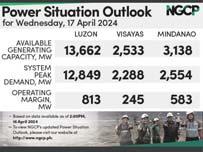
E—that’s about four to five customer access networks,” Easter n Communications EV P Delfin Lopez said. “The capex is intended for our tech refresh and diversities, which fill up the P1.15 billion for 2024.” Tech refresh, he said, refers to the replacement of “obsolete components of the network,” while diversity refers to building up resiliency to segments that “we are exposed” to ensure that there w ill be “ver y minimal outage.”
As of end-2023, Easter n Communications has a fiber cable network of over 9,760 k ilometers w ith a total of 180 notes in 42 business cities across the Philippines. Mike Castaneda, the company’s V P and head of sales, noted that the increased capex spend w i ll allow Easter n to “strengthen” its nationw ide coverage. “We w ill continue to expand to next wave cities. We want to accelerate growth through ICT solutions because companies are now look ing for ways to imp


ETERNAL C hapels and Mortuar y Ser v ices unveiled their second branch in Cagayan de Oro City, mark ing the si xth Eter nal Chapels branch in the Philippines. T he blessing and inaug uration ceremony took place on the site located at #86 Toribio Chavez St., Cagayan de Oro City, more popularly known as Divisioria, on Saturday, April 6, 2024. T he event commenced w it h a thanksgiv ing mass led by Rev. Fr Fer min Tan, Parish Priest of t he Immac u late Concept ion – Bu lu a, followed by the ceremonial ribbon c utt ing and blessing. Among t he disting uished g uests were the executives of Eter nal Chapels including Chair man and CEO D. Edgard A. Cabangon, Vice Chairman Benjamin V. Ramos, Treasurer D. Antoinette C. Cabangon-Jacinto, Vice President for Sales Jose Antonio V. R ivera, and branch manager Amor S. Leodones. Add it ionally, t he occasion was graced by special g uests, including Atty. John Apatan, Div ision Chief of the Insurance Commission, who later conducted an ocular inspection of the columbarium units of Eter nal Plans; Atty. Cassie Jaraula-Lim, Atty. Adrian C. Barba, representatives from sister companies of the ALC Group, and the Eter nal Gardens sales force. Spanning a floor area of 580 sqm, the branch features 7 wake chapels, i nclud i ng 4 c h apels w it h fam i ly rooms and 3 reg ular chapels. Each chapel can accommodate up to 50 g uests, w ith the flexibility to merge chapels for larger gatherings of up to 100 g uests. Ever y Eter nal Chapels branch is designed w ith convenience in mind, offering fully air-conditioned rooms, free Wi-Fi, and round-the-clock security. T he company also takes pride in its team of highly trained professionals, who are experts in embalming and ot her mor tuar y ser v ices, dedicated to prov iding exceptional care to families during their most challeng ing times. “We are happy to see the Eter nal Group expanding and grow ing. T his reflects the v ision of our founder my father, Amb. Antonio L. Cabangon Chua, to prov ide quality memorial care accessible to Filipinos,” remarked D. Edgard A. Cabangon, Chair man and CEO of Eter nal Chapels. “Before my father passed away, I sought his approval to expand our ser v ices in memorial care by offering chapels and mortuaries. T hankfully, I received his blessing, and now we are grow ing. T his city, Cagayan de Oro, is ver y close to our hearts as it is the home of the inaug ural branch of Eter nal Chapels located in Barangay Bulua. I want to thank my officers for their hard work in realizing our mission, and, more importantly, we are grateful to all our clients who continue to place their trust in us,” he added. T he management and operation of Green Hills Memorial Chapel in Plaza Div isoria, Cagayan de Oro City, were officially tur ned over to Eternal Chapels and Mortuar y Ser v ices on Aug ust 26, 2022. Eter nal Chapels management pledged to continue the ser v ice, but this time w ith the Eter nal brand of excellence. Eter nal Chapels now operates si x branches in key cities, including Brgy. Bulua, Cagayan de Oro City; Naga City, Cabuyao City, Batangas City, Cabanatuan City, and this newly inaugurated branch in Divisioria Plaza, Cagayan de Oro. Eter nal Chapels is par t of the Eter nal Memorial Group, along w ith sister companies Eter nal Gardens, Ete r nal C remator y, and Ete r nal Plans. T he group is a subsidiar y of the larger conglomerate, ALC Group of Companies, founded by the late Ambassador Antonio L. Cabangon Chua and currently led by Chair man D. Edgard A. Cabangon. BusinessMirror Editor: Jennifer A. Ng Companies B1 Wednesday, April 17, 2024 Residential sales lift 2023 net income of Vista Land Eastern Communications hikes capex PERC profit climbs on clean energy Eternal Chapels opens new branch in Cagayan de Oro City “Our 2023 resu lts showed our optimism in the real estate industr y. We have launched over P50 billion worth of projects across the countr y. T hese launches were key to our reser vation sales reaching about P72 billion,” company chair man Manuel B. Villar Jr said. “We are on our way w ith our maximization of resources strategy as the majority of our launches were vertical developments across the countr y and we will continue to do so in 2024.” As of the end of 2023, the company launched 34 projects w ith an est i mated project value of about P50.7 billion. Consolidated revenues surged to P35.2 billion, marking an 18 -percent increase from the prev ious year Real estate revenue went up by 19 percent year-on-year to P15.2 billion, while rental income for the year amounted to P16 billion. Manuel Paolo A. Villar, the company’s president and CEO said, Vista Land’s developmental segment showed improvement as it expanded by 19 percent, a reversal of the losses it incurred since 2020. “We w i ll cont i nue to pur s ue our r es i dent i al segment now w it h t h e la u nc h of mo r e ve r t i cal, as well as hi g h e r -end p r od u cts. T hi s h as been pa r t of o ur ove r all st r ategy of asset opt i m i zat i on. We also cont i nu ed w it h o ur maste r planned developments t hr o u g h V i sta Estates, now at 26, ac r oss t h e co u nt r y,” h e sa i d. “O ur leas i ng bu s i ness on t he ot her h and, su sta i ned its g rowt h as we ended 2023 w it h a total g ross floor a rea of 1.6 m i ll ion squ a re meters or over 100 i nvestment proper t ies consi st i ng of 42 malls, 56 commerc i al bui ld i ngs and seven off ice bui ld i ngs.” Vista Land said it remained prudent, w ith net-debt-to-equity ratio at 84 percent by yearend. For 2023, t he company spent P27.1 bi ll ion on capital expenditures, mostly on construction and land development. Land acquisition remains muted as the company intends to utilize its existing land bank. T he company said it w ill continue to maximize its resources, particularly land assets, through Vista Estate developments nationw ide and increased involvement in upscale projects such as Brittany and Crown Asia initiatives. It plans to prioritize mi xed-use developments that combine vertical and commercial elements in both its ongoing and planned projects.
ASTERN Communications has announced that it is increasing its capital expenditures (capex) to P1.15 billion this year from P1.03 billion the year prior to further expand and strengthen its network. In a press briefing Tuesday, Easter n Communication executives said the goal for 2024 is to reach more business districts to capture more of the enter prise market. “T here are a few more sites that are due for completion towards the end of the year
ove their
i
how they deliver those serv ices, and efficiencies in spending,” he said. Lorenz S. Marasigan By Lenie Lectura @llectura PETROENERGYReso ur ces Cor p. (PERC) of the Yuchengco Group saw its net income rise to P944 million last year on the back of the strong electricity sales of its renewable energy (RE) projects. T he company said its financial per for mance last year was largely due to the full-year operation of the 32-megawatt (MW) Maibarara geothermal power project–Units 1 and 2. PetroWind Energy Inc. (PWEI), a joint venture of PetroGreen Energy Cor p. (PGEC), the RE ar m of PERC, EEI Power Cor p. (EEIPC), and BCPG Public Co. Ltd. of T hailand, also reported “better generation due to higher w ind speeds in the months of July and Aug ust 2023 PERC also sa id PSC’s per for mance has been “consistently good.” PetroSolar Cor p. (PSC), another subsidiar y of PGEC, showed a “consistently good” per for mance. “T he RE projects’ notable perfor mance tempered t he i mpact of t he i mpa ir ment loss recogn i zed on accou nt of t he decl i ne i n t he valu at ion of PERC’s m i nority i nterest i n its oi l assets i n Gabon, West Af rica, as well as t he not ional remeasurement loss and amor t i zat ion of an i ntang ible asset i n relat ion to t he i nvestments i n P WEI,” t he company sa id. PERC also recorded a 30-percent i nc rease i n its consol idated assets to P21. 9 bi ll ion f rom P16. 8 bi ll ion i n 2022. T he i nc reases i n consol idated assets and l i abi l it ies resu lt la r gely f rom PERC’s ac qui s it ion f rom EEIPC of a 20-percent d irect equity i nterest i n P WEI, a 44-percent d irect equity i nterest i n PSC, and an add it ional 7.5-percent equity i nterest i n PGEC. T hese acqui s it ions h ave been f unded t hrough ter m loans f rom local banks. PERC’s and PGEC’s combi ned 60-percent equity in PWEI enabled the consolidation of PWEI’s financials into that of PERC’s, further increasing PERC’s consolidated assets and liabilities. Another reason for the increases is the start of the funding and construction of PWEI’s 13.2 MW Phase 2 of the Nabas Wind Power Project in Aklan. In scaling up its RE footprint, PERC, through PGEC, recently established R izal Green Energy Cor p. to hold and spearhead the development of new solar projects. Included i n t he pipel i ne a re t he four sola r projects i n Bohol, Nueva Ec ija, Pangasi nan, and Isabela. T hese new projects al ready h ave sec ur ed offtake a rr angements t hroug h t he Green Energy Auct ion Prog ram or w it h a private reta i l elect ric ity suppl ier ETERNAL Chapels Chairman and CEO, D. Edgard A. Cabangon, a ong with Rev Fr. Fermin Tan and Eterna Chapels Treasurer, D. Antoinette C. Cabangon-Jacinto, lead the ribbon-cutting ceremony for the new Eternal Chapels in Divisoria Plaza, Cagayan de Oro. They are joined n the photo by Eterna Chapels Vice Chairman Benjamin V Ramos, VP for Sales Jose Antonio V Rivera, Branch Manager Amor S. Leodones, Att y. Adrian C. Barba, and Ms. Sharon Tan
r
ser v
ces,

MORE GAY RUMORS
NOW that the handsome actor is being linked to an A-lister, speculations his allegedly being gay continue to hound him.
This is what we know: the handsome actor had a girlfriend a few years ago at the height of his popularity. This is the reason why he did not fall in love with his screen partner. That relationship lasted for around two years. As for his involvement with the A-lister, they indeed have been friends for a bit. The handsome actor may not be a perfect man but he is a gentleman and the A-lister appreciates that. He was a gentleman when they worked together and he continues to support her now that she needs a friend.
FRIEND-ZONED
IT’S so funny that this pretty starlet and her family are angry that a popular star friend-zoned her when, in fact, she has a boyfriend. The pretty starlet has had a boyfriend for a while and this is an open secret in the network where she belongs. The boyfriend is also in showbiz but he is lesser known. The popular celebrity being linked to her, meanwhile, is definitely the biggest star in this triangle. Probably irked that the starlet is already openly dating someone else while riding on their online popularity, he friend-zoned her publicly. Somehow, this triggered something in the starlet and her family.
BULLY
PEOPLE call her a queen but in the not-so-distant past, she was somewhat a bully. One of her victims was a network favorite. The queen and the network favorite somehow had a misunderstanding and after that, the latter was no longer in the network’s good graces. She used to have juicy projects but started to be given mother roles. That was the queen’s doing. Another one of her victims was a sexy actress who her husband was reportedly eyeing. From being one of the network’s talents for build-up, the sexy actress now gets projects that aren’t worthy of her talent and looks.
SUGAR
BABY
EVEN when the sexy starlet was a teenager, she was already charging expensively for her escort services. Contrary to the belief that her current sugar daddy, a married government official, is her first benefactor, the starlet already had one when she was 16 and he was a rich man from the Visayas. He is old enough to be her dad. Her fans believe that the sexy starlet was born rich and while it is true that she inherited a bit of money, that is nothing compared to what her benefactors have given her and her family. Aside from her mansion and luxury cars, she also has many properties in prime Metro Manila spots.
LAST ‘SWITCH’ FOR PPO’S 39TH CONCERT SEASON
THE Philippine Philharmonic Orchestra, the country’s primary orchestra, will take its last Switch for its 39th concert season on April 19, 7:30 pm, at the Samsung Performing Arts Theater in Circuit Makati. For its finale concert, the resident orchestra of the Cultural Center of the Philippines will feature violinist Diomedes Saraza Jr. as its guest soloist. Saraza Jr. is an active concert violinist, chamber musician, and avid educator.
The former Manila Symphony Orchestra’s concertmaster, Saraza is a well-established musical artist who has taken part in many international solo performances with different orchestras such as the Mannes Orchestra, New York Symphonic Arts Ensemble, and the Sichuan Philharmonic Orchestra, to name a few. His extensive solo and chamber performances include prestigious venues that span from Philippines’ Cultural Center of the Philippines, New York’s Avery Fisher Hall, Alice Tully Hall, and Carnegie Hall, to Russia’s Tchaikovsky’s Concert Hall among others. For its final concert, PPO music director and principal conductor Maestro Grzegorz Nowak will take the baton, leading the national orchestra in a night of Fete Francaise. The concert program includes National Artist Lucresia Kasilag’s “Violin Concerto No. 1,” Camille Saint-Saëns’ “Introduction and Rondo Capriccioso, Op. 28,” and Franz Schubert’s “Symphony No. 5.”
Tickets to PPO Concert VIII: Fete Francaise are priced at P3,000 (orchestra center), P2,000 (orchestra side), P2,500 (loge center), P1,500 (loge side), and P800 (balcony 1).
The PPO concert season is made possible with partners SSI Group Inc., TBWA\ SMP, Ascott Bonifacio Global City, and Lyf Malate Manila.
More information can be found at www.culturalcenter.gov.ph.

Divisive?

The Associated Press
ALEX GARLAND’S provocative Civil War didn’t only ignite the discourse. The il also inspired audiences to go to the cine as this ee end here it surpassed e pectations and earned illion in tic et sales in North A erica according to studio esti ates N Sunday.
t’s the iggest rated opening o the year to date and a record or A the studio ehind il s li e Everything Everywhere All At Once and The Iron Claw. Civil War also unseated Godzilla x Kong ro its perch atop the o o ice. The titan ovie ro arner ros. had held the No. spot or the past t o ee ends.
Civil War, starring irsten Dunst agner oura and ailee Spaeny as ront line ournalists in the near uture covering a devastating con lict in the S and trying to a e their ay to ashington D
The story ritten y Garland ho is also the ind behind Ex Machina and Annihilation i agines a S in hich ali ornia and Te as have united against a president ho has disbanded the and given hi sel a third ter
Though entirely ictional Civil War has been inspiring debates since the irst trailer that have e tended beyond the usings o il critics and

traditional revie s. This ee end The New York Times ran t o opinion pieces related to the ovie one by Stephen arche and another by ichelle Goldberg. There ere also pieces on NN and olitico. Going into the ee end pro ections pegged the il to debut in the to illion range. The studio said Civil War overper or ed in ar ets ro LA to El aso. The data analytics co pany EntTelligence reported that the il has attracted over illion patrons this ee end and that the top three ar ets ere Los Angeles Ne or and Dallas.
The title alone is enough to spar a conversation in a year here the political discourse is top o ind said aul Dergarabedian the senior edia analyst or co Score. And they couldn’t have pic ed a better date. This ovie is per ectly ti ed in a onth that is very uiet. The il opened on screens in the S and anada including AX. t’s the ost e pensive ovie that the studio has ever ade ith a production budget o illion hich does not account or illions spent on ar eting and pro otion.
AX sho ings o Civil War hich as playing on o the large or at screens accounted or illion or percent o the do estic total. Revie s have been largely positive. t’s currently at percent on Rotten To atoes ith a percent audience score. ts ine aScore as a hich has so eti es indicated that ord o outh ight not be strong going or ard. ut that
65.

Engage in what makes you happy. Choose to explore possibilities, live in the moment and enjoy what life has to offer. Broaden your awareness, skills and relationships with people who share your interests. Expansion and exploration will encourage new beginnings and give you a better understanding of your purpose while showing you how to quench your thirst for knowledge and new solutions. Your numbers are 6, 19, 22, 28, 31, 37, 46.
Set your sights on something you like, and be relentless in making it yours. Your enthusiasm will be infectious, making convincing others to take on your responsibilities easy. Trust your instincts and turn your dream into a reality.
Direct your energy wisely. Refuse to let what others do lead to a flurry of reactions that will put you in a vulnerable position. Keep your thoughts and feelings to yourself until you think matters through. Control and patience are your best options.
Educational pursuits and updating your look and appeal to suit your target audience or occupation will boost confidence and push you in the right direction. Domestic improvements will require cutting your losses and doing what’s best for you.
Keep your emotions to yourself. Don’t mix business with pleasure or leave yourself open for criticism or accusations. Stick to your plan, focus on getting ahead financially and change your lifestyle to ensure you reach your goal.
Preparation is everything. Don’t expect things to come to you; prepare to fight for what you want. If you want it, go after it with a vengeance. Strength, courage and looking the part will separate you from the competition and give you additional confidence and showmanship to go the distance.
Follow through, embrace change and create opportunities that offer a new lease on life. Attending a conference, meeting, reunion or event that provides connections and options will help you form your plans. Change is hovering over you.
Think before you act. Don’t apply pressure to an explosive situation. Look for calmer alternatives using common sense and understanding to ensure your success. Personal gains are apparent if you are transparent and fair.
A change in your routine will be uplifting. Activities that challenge and excite you will spark your interest in something you hadn’t thought of doing before. An awakening will change how you view your future and your lifestyle. Don’t settle for less.
Refuse to let outside influences confuse you. Rely on your intelligence and ability to figure out your best path forward. It’s your life; choose your terms and build your future. Put your best foot forward.
Step out of the line of fire. Refuse to let someone bait you into a conversation prematurely. Initiate positive domestic changes that will encourage the lifestyle you want. Hard work and dedication will help you surpass your expectations. Don’t give up; get moving.
Remain focused and ready for action. Fine-tune your thoughts and plans, and be prepared to counter anything

ight
ith Civil War hich doesn’t have a tre endous a ount o co petition over the ne t e ee s until The Fall Guy opens on ay ou have to ta e all the etrics together including the co petitive landscape Dergarabedian said. ut it is a notable in or the studio hich doesn’t al ays open il s nation ide out o the gates. e ore Civil War A ’s biggest debut as the Ari Aster horror Hereditary hich opened to illion in This isn’t destined to be a illion global B4 Wednesday, April 17, 2024 Editor: Gerard S. Ramos www.businessmirror.com.ph Show BusinessMirror ACROSS 1 Kettle output 6 Legal wrongs 11 “That’s funny!” 14 Major artery 15 Amazon Prime ___ 16 Function 17 State park located in the San Francisco Bay 19 “2 funny!” 20 “About Me” blurb 21 “OK, got it!” 22 Kick back with friends 23 General concept 27 Pet Shop Boys and Carpenters, for example 30 Yogurt-based side dish in Indian cuisine 31 Jewish wedding dance 32 Office workspace 33 “Nothing but ___” (“Swish”) 36 Inherent behaviors 41 Sunbathing result 42 Mojo Dojo ___ House (“Barbie” dwelling) 43 Prefix with “space” 44 Bangkok natives 46 Ends a career 49 Long-running singing competition show 52 Knights’ titles 53 Ready for business 54 Sushi topper 57 ___ Mahal 58 Tasks to assign 62 Plane ticket info 63 “What’s up?” in textspeak 64 Shout from the crowd 65 Male sheep 66 Admission of defeat 67 Reddish-brown color DOWN 1 Bygone Swedish automaker 2 “Un-Break My Heart” singer Braxton 3 “Therefore...” 4 Had a snack 5 Surfing destination near Los Angeles 6 Living room fixtures 7 Edmonton hockey pro 8 Nutrition label fig. 9 Highest score for an Olympic competitor 10 Lawn covering 11 Luau performer 12 Collectively 13 “Hey Arnold!” character with pigtails 18 “Not true” retort 22 Chart-topping song 23 Big Daddy star Sandler 24 Half brother of Athena 25 Group performing a play 26 Word before “bar” or “torch” 27 Rad, in 1990s slang 28 Game of Thrones actress Chaplin 29 Problem with an office machine 32 Carrier of genetic info 34 To be, in Paris 35 General ___ chicken 37 Antioxidant-rich berry 38 Secular 39 Insecure actress Rae 40 Painted part of a finger or toe 45 There are 24 in a day: Abbr. 46 Remove, as old carpet 47 Perfect garden 48 Mixers with gin 49 Michaelmas
50 Mazda convertible 51 Some dark crime films 54 Harvest 55 Hilton rival 56 “Como ___?” 58 Sushi tuna 59 Rank for Mustard or Sanders: Abbr. 60 Number of bars in a package of Twix 61 In ___ Heights (2008 Broadway musical) Solution to today’s
DAY: Rooney Mara, 39; Jennifer Garner,
Liz Phair,
Sean Bean,
not be the case
daisy
puzzle:
52;
57;
that gets in your way. Address your relationships, consider who is on your team and make adjustments that encourage better results. Keep your emotions to yourself. Don’t mix business with pleasure or leave yourself open for criticism or accusations. Stick to your plan, focus on getting ahead financially and change your lifestyle to ensure you reach your goal. You are competitive, entertaining and ambitious. You are opportunity-driven and responsive. TODAY’S HOROSCOPE By Eugenia Last
KIRSTEN DUNST in a scene from Civil War which opened as the No.1 movie in North American theaters.
War’
victory
office
Not for moviegoers. ‘Civil
declares
at box

Cebu Pacific earns Great Place To Work certification
CEBU Paci ic, the Philippines’ leading carrier, has set another milestone a ter being recognized as a Great Place To Work for 4. This is the irst time an airline in Southeast Asia has achieved such distinction. The Great Place To Work Institute, a leading authority in workplace excellence and employee satisfaction, awarded the certi ication following an independent assessment that highlighted CEB’s positive employee experiences across key areas including credibility, respect, fairness, pride and camaraderie.
This recognition rea irms our dedication to providing a workplace where everyone can thrive. As we move forward, our focus remains on upholding Cebu Paci ic’s core values and ensuring that our employees remain at the heart of its success,” said Felix Lopez, CEB chief human resources o icer.
Over the years, CEB has focused on initiatives that foster community building, celebrate individuality through diversity and inclusion, and promote a healthy culture by creating spaces where every voice is heard and valued. These initiatives are at the heart of what makes CEB a great place to work, where employees feel supported and empowered to excel and contribute to something meaningful together.
Alongside these e forts, CEB has been recognized this year by Prosple as one of the top employers in the Philippines for fresh graduates and received the Best Employer Brand award at the LinkedIn Talent Awards in 2023. These accolades underscore CEB’s commitment to providing an exceptional work environment for professionals at all career stages.

IN many organizations, the capacity to in luence others is o ten synonymous with holding a position of authority, particularly within traditional corporate settings where hierarchy o ten outweighs actual competence. However, simply occupying a position does not guarantee e fective leadership. True in luence goes beyond titles and ranks. It stems from personal credibility, e fective communication skills, and a genuine understanding of how people relate to one another. In luencing people without formal authority is not only possible but a reliable indication of e fective leadership. If you want to in luence people without formal authority, note that it is a gradual journey that demands persistence and patience.
Trust is the foundation of in luence. To in luence others without authority, start by building strong relationships based on trust and credibility. This involves demonstrating integrity, competence and consistency in your actions and words. If your interactions with others appear solely driven by self-interest, they will likely perceive you as an opportunist. It is crucial for people to recognize that the relationship is mutually bene icial and that they can depend on you as much as you depend on them. You need to be reliable, follow through on commitments, and always do what is right even when no one is looking. When people trust you, they are more likely to listen to your ideas and be in luenced by your perspectives.
Personally, I see e fective communication as the most essential skill one needs to e fectively in luence others. When you can command people’s attention and persuade them to your perspective, you e fectively in luence them even without a position of authority. To develop e fective communication skills, focus on being a good listener irst. You need to understand people’s motivations, needs and concerns so that you can tailor your message to resonate with your audience. Clearly articulate your ideas using persuasive language and compelling storytelling techni ues. People o ten forget that communication is not just talking, but also actively listening to what people are saying through their choice of words and body language. Be open to feedback and be willing to adapt how you communicate based on the responses you receive.
People o ten say that actions speak louder than words but o ten forget it in how they conduct themselves. To in luence others, you need to demonstrate the behaviors and attitudes you wish

to see in others. Whether it is taking initiative, displaying resilience in challenging situations, or showing empathy toward colleagues, leading by example sets a powerful precedent whether they will follow you or not. When people observe your consistent behavior, they are more likely to emulate it and be in luenced by your leadership style than just by telling them alone. You need to walk your talk if people are to follow you. Relatedly, understanding people’s emotions and perspectives is key to in luencing them positively. You need to develop empathy by putting yourself in other people’s shoes and showing genuine concern for their well-being. When you do this, people are more open to what you have to say because they know you understand where they are coming from. Emotional intelligence can help you navigate interpersonal dynamics e fectively, anticipate reactions, and adjust your approach when needed. By connecting with people on an emotional level, you can nurture deeper relationships and enhance your ability to in luence them. You also need to focus on adding value and o fering solutions to other people’s problems. Understand their needs and challenges and position your ideas and proposals as viable solutions. When people see tangible bene its from your suggestions, they are more likely to be receptive to your in luence. Always emphasize how your ideas align with their interests and contribute to shared objectives. When people understand that you have their best interest at heart,
they are more willing to listen and follow your recommendations.
You also need to understand that in luence o ten grows through collaborations. Identify key stakeholders and in luential people within your network and ind opportunities to collaborate with them. By working together toward common goals and demonstrating shared values, you can harness collective in luence to bring about change, especially when the change is implemented in the entire organization.
Be considerate of diverse viewpoints and nurture a culture of collaboration that empowers everyone involved by actively listening to what people need and tapping people in your network to help out. When people know that you have a group you can rely on to help out, they are more likely to listen and follow your direction.
In luence is a powerful tool for leadership that transcends formal authority. By focusing on building trust, honing your communication skills, leading by example, cultivating empathy, collaborating e fectively, providing value, and maintaining persistence, you can e fectively in luence people regardless of your o icial title or position.
Remember, true in luence is not about control it is about inspiring and empowering others to achieve common goals and drive positive change. So, make a meaningful impact within your organization by enhancing your ability to lead and in luence others even without a title or rank.
THE recently concluded Packaging Design Awards
recognized the ingenuity of young students in sustainable and industry-standard pasalubong (souvenir) packaging designs for diverse micro, small, and medium enterprises ( S Es) from di ferent regions in the Philippines.
Copresented by Fedrigoni Asia Ltd. and Prestige Quality Paper Products, producers of premium eco-friendly specialty paper for publishing, arts, and packaging, the initiative was organized by the Industrial Design Program of the De La Salle-College of Saint Benilde (DLS-CSB).
Twenty-nine budding talents rose to the challenge to develop products not only visually appealing to the global market but are, likewise, mindful of their environmental impact.
They were mentored by Benilde Industrial Design chairman Romeo Catap Jr. and educators Christian Pagulayan and Stuart Yang. They were joined by Fedrigoni Asia Ltd. marketing manager for Asia Paci ic ervin alero.
In preparation for the competition, alero, together with Prestige Quality Paper Products general manager Leah Marie Ayeng, guided the students on the fundamentals of ecological packaging design.
Under the supervision of the One Town One Product Philippines program of the Department of Trade and Industry (DTI), the competitors collaborated with their chosen MSMEs to earn an overview of the brand.
Following the conceptualization process, they presented their ideas in an online clinic and received professional advice from the members of the Philippine Printing Technical Foundation (PPTF).
The prototypes were constructed using supplies from Fedrigoni Asia Ltd. and Prestige Quality Paper Products. These were exhibited at the 4th

International Processing and Packaging (ProPak) Trade at the World Trade Center in Pasay.
To provide a more holistic learning experience, the participants, together with Catap, specially curated the Informa Markets-sponsored booth.
Among the entrants, Glenn Hernandez, Justin Osorio, Ralf Sales and Mikaela Asuncion of Team Benilde’t Di ferent emerged as the champion. Their proposals for Tamagos Confectionaries included a triangular prism barquillos box that prevents the cylindrical biscuit from being crushed and a tasting menu-inspired layout that o fers a complete experience of the available goods. The outputs were pitched before a panel of experts:
Design Center of the Philippines deputy executive director Lucky Lopez,
blockbuster. But it’s a very high-pro ile win for A24,” Dergarabedian said. They’re a studio that pushes the envelope. They’re a brand associated with a certain level of uality and ilmmaking expertise, pushing boundaries and taking risks. It’s well-earned over the years.”
Second place went to Godzilla x Kong: The New Empire, which
out the top ive was Universal and DreamWorks’ Kung Fu Panda 4, in fourth with $5.5 million in weekend six, and Dune: Part Two with $4.3 million in its seventh weekend. Dune 2 has now earned $272 million domestically. Estimated
Climate Change Commission chief information o icer Riza Torrado, Philippine Retailers Association vice chairman and director for international Lorenzo Formoso, Pumapapel Cra ts creative director and founder and Benilde Industrial Design alumna Amy Nayve, and Bureau of Philippine Standards (BPS) senior trade and industry development specialist for the standards development division Ann Fernando. The winners received cash prizes, project and internship opportunities, and the chance to manufacture their entries for the mainstream use of MSMEs. B5 Editor: Gerard S. Ramos www.businessmirror.com.ph
BusinessMirror PHOTO BY KALEIDICO ON UNSPLASH
Image
INDUSTRIAL DESIGN STUDENTS CREATE SUSTAINABLE ‘PASALUBONG’ PACKAGING FOR LOCAL BUSINESSES
earned $15.5 million in its third weekend to bring its running domestic total to nearly $158 million. Another Empire movie, Sony’s Ghostbusters: Frozen Empire, took third place in its fourth weekend with $5.8 million. It’s now at $160 million worldwide. Rounding
US and Canadian theaters, according to comScore.
Civil War, $25.7 million 2. Godzilla x Kong: The New Empire, $15.5 million
Ghostbusters: Frozen Empire, $5.8 million 4. Kung Fu Panda 4, $5.5 million
Dune: Part Two, $4.3 million 6. Monkey Man, $4.1 million
The First Omen, $3.8 million
The Long Game, $1.4 million
Shrek 2, $1.4 million
SUGA: Agust D Tour ‘D-DAY’, $990,881. Divisive?
ticket sales for Friday through Sunday at
1.
3.
5.
7.
8.
9.
10.
Not for moviegoers. ‘Civil War’ declares victory at box office

YOUNG FILIPINO STUDENT ROBOTEERS WIN BIG IN 9TH PHILIPPINE ROBOTHON COMPETITION 2024

THE country’s brightest, most tech-savvy young minds won big in the 9th Philippine Robothon Competition 2024 co-organized by First Eduspec Inc. and Rex Education. The competition was held recently at St. Paul College Pasig.
The competition, the most prestigious robotics-related showcase in the country today, was aptly themed, “F.U.T.U.R.E.: Filipinos in Unified Technologies, Unveiling Robotics Excellence; Pagtanaw sa Ating Ambisyon Tungo sa Matatag na Edukasyon.” It gave young Filipino innovators a fitting platform to show their expertise in robotics, a field becoming increasingly important in today’s society.
The ninth edition, like its predecessors, allowed the student participants not only to demonstrate their various technical skills when it comes to robotics but also their ability to create innovative solutions to pressing community issues. St. Paul College Pasig (Primary), Las Piñas
Montessori School (Middle), Brokenshire College Toril (Junior), and Grace Christian College (Senior) were adjudged champions in the different minirobot challenge categories. De La Salle University Integrated School (Middle) and Immaculate Conception-Greenhills (High School), on the other hand, were hailed as the big winners in the two innovative open categories. Aside from the contest proper, another highlight of the 9th Philippine Robothon Competition was the seminar-workshop titled “Unlocking Learner’s Potential through STEAM Education.” This conference gathered some of the country’s best, most innovative experts in the fields of science, technology, engineering, arts, and math—including Gino Luayon, School Head at the Domuschola International School; Vilma Clerigo, Principal at San Beda College Alabang; and Paolo Josef Blando, Program and Partnership Development Officer, The National Teacher’s

PCollege—to discuss the growing importance of STEAM (Science, Technology, Engineering, Arts, and Math) education in the modern-day curriculum and how to unlock students’ potential in these fields.
STEAM, of course, is a critical component of 21st-century education because at its very core is the enhancement of vital future-proof skills like problem-solving, data gathering and analysis, evidence assessment, and technical and technological know-how. The same skills are expected to have premium value in this presentday context marked by rapid advancements in technology and heightened complexity.
This is why introducing young Filipinos to STEAM early is crucial, and this was the overriding goal of this seminar-workshop co-organized by First Eduspec Inc. and Rex Education to unlock the full potential of learners with innovative approaches to teaching and learning.
First Eduspec Inc., a global leader in offering innovative, technology-based educational solutions and services, and Rex Education, one of the country’s leading publishers of academic materials, are committed to promoting and supporting STEAM education nationwide. Rex Education has been relentless in promoting STEAM education in the Philippines, incorporating the latest pedagogies and learning strategies in its comprehensive portfolio of scholastic materials and holding various events championing STEAM education and quality education, in general.
Partnering with First Eduspec Inc. for the 9th Philippine Robothon Competition, Rex Education affirms its mission of nurturing every child for lifelong learning. RE X is for every child, every roboteer for life.
To know more about the 9th Philippine Robothon and the winning entries, visit https:// www.facebook.com/EduspecPhilippines?mibexti d=ZbWKwL.
The groundbreaking initiative empowered LGBT+ couples to make medical decisions for their partners, in a country still struggling with gender equality.
Right To Care first made waves at Spikes Asia, where it bagged Bronze for Healthcare, and a Grand Prix in the Glass Spikes category, a first for a Philippine agency. It also won big in Adfest, where it won a Silver Sustainable Lotus and a Gold PR Lotus, with the latter leading to a 2nd place win for PR Agency of the Year.
More recently, the same campaign also won two silvers at the 2024 Clio Awards, where it won two silvers for PR Launch and PR Public Affairs categories.


OMODA, JAECOO Make First Public Appearance at MIAS 2024
ON April 1, 2024, the Manila International Auto Show (MIAS) officially kicked off. Themed “Gearing Towards New Mobility,” OMODA and JAECOO made their first appearance, showcasing a lineup of crossover intelligent SUVs ncluding OMODA 5, the pure electric SUV OMODA 5 EV, the high-end off-road SUV JAECOO J7, and the luxury off-road SUV JAECOO J8. This diverse range demonstrated future modes of transportation, striking the strongest note in OMODA and JAECOO’s endeavor to craft a global, personalized brand identity.
At the auto show, OMODA and JAECOO unveiled their new brand strategy, “Global Brand Filipino Centric.” With a comprehensive lineup of products spanning all categories and guided by the operation philosophy of “In the Philippines, for the Philippines,” OMODA and JAECOO endeavor to shape a highly personalized brand identity.
The Philippine MIAS has been held for over 20 consecutive years, standing as the most influential international auto show in the Philippines. Attracting world-class automotive brands each year with a daily foot traffic exceeding 100,000, this year’s participation marked OMODA and JAECOO’s inaugural appearance at MIAS.
Spanning nearly 800 square meters, the floor area for the brands perfectly melded future technology with off-road passion, creating an immersive experience that intertwined the scenarios of “Future-proof Fashion Ecosystem” and “Personalized Off-road Ecosystem”.
Over the past year, OMODA and JAECOO’s global export sales exceeded 160,000 vehicles, winning the hearts of users in nearly 20 countries and regions worldwide. OMODA is dedicated to providing users with future-oriented design and intelligent technology in their automotive products, while also taking a visionary approach in the new energy sector to lead the future of green mobility. On the other hand, JAECOO, adhering to the philosophy “From Classic, Beyond Classic,” is committed to creating high-performance all-terrain off-road
products, accompanying adventurous users on fearless journeys.
The four newly launched models—OMODA C5, OMODA E5, JAECOO J7, and JAECOO J8—attracted thousands of visitors. Particularly, the brand’s first pure electric model, OMODA E5, with its long range, aerodynamic performance, and wind noise reduction, combined with a futuristic and aesthetically pleasing design, is poised to become a leading Electric Vehicle product in the Philippine market.
Moreover, OMODA and JAECOO, showcased the vehicles in scenarios where they are in their natural habitats. This demonstrated a range of ecological products including bicycles, brandcustomized eco-friendly apparel, tents, and camping chairs, interpreting OMODA and JAECOO’s vision of centering around the vehicle and extending into personalized future technological ecosystems for users.
To cap off their unveiling, popular Filipino artist Silent Sanctuary made a surprise appearance, witnessing the unveiling of the star models and performing three classic songs.
Furthermore, OMODA and JAECOO offered a test drive experience event, allowing users, media, and dealer representatives in the Philippines to deeply experience the charm of the OMODA 5 and JAECOO 7 products and to personally appreciate the latest achievements in brand technological innovation.
Their participation in MIAS marks a key step in OMODA and JAECOO’s strategy for the Philippine market. Leveraging the MIAS platform, OMODA and JAECOO opened direct lines of communication with Filipino consumers, enabling close and comprehensive interactions. This is set to aid the brand in adapting its strategies for the local market.
OMODA and JAECOO will retail at the 2nd half of 2024. Pre-selling activities and promotions will start as early as June 2024.
SM Offices leverages tech strategies to better serve tenant-partners
MA X IMIZING the latest in technological advancements, the real estate industry has been quick to adopt various property technologies (proptech) into their operations to help open new avenues in advancing the quality of real estate.
applicable leased spaces.
from Spikes, Adfest, Clio, Marketing Interactive
capped off the first quarter of 2024 with its biggest haul to date from Asia’s most prestigious creative award shows, which includes some historic firsts for the Philippines. Headlining this year’s haul is the Right To Care Card, developed in partnership with the Quezon City Gender and Development Council. MullenLowe TREYNA bags historic international haul
Primer Group Brings footwear, apparel brand Allbirds to SEA
THE Primer Group of Companies, a leading distributor of outdoor, travel, and lifestyle products in Southeast Asia, has added another world-renowned brand to their diverse portfolio, announcing a partnership with Allbirds, the New Zealand-American footwear and apparel brand known for their commitment to comfort, style, and sustainability.
With the strategic partnership, The Primer Group’s extensive network, market insights, and operational expertise benefits Allbirds’ efforts for global expansion, especially in Southeast Asia, one of the fastest-growing markets for eco-friendly fashion and lifestyle products, where they look to further establish their presence and expand their reach. Furthermore, The Primer Group shares Allbirds’ values and vision for creating a more sustainable future.
Founded by Tim Brown and Joey Zwillinger in 2014, Allbirds’ goal was to revolutionize the footwear industry by using sustainable materials, creating innovative designs, and putting a premium on comfort. Over the years, the brand has rapidly gained global recognition for its product curation and commitment to reducing environmental footprint. The brand’s signature styles, including the Wool Runner and Tree Runner, have garnered
a loyal following of environmentally-conscious consumers seeking comfortable and stylish footwear options.
“We are excited to collaborate with Allbirds and support their mission to bring sustainable footwear and apparel to Southeast Asia,” said Jimmy Thai, Chief Executive Officer of The Primer Group of Companies. “This partnership aligns with our commitment to promoting environmentally responsible brands and offering innovative products that resonate with today’s conscious consumers.”
“We are thrilled to announce our partnership with the Primer Group of Companies as we continue to expand our presence in Southeast Asia,” said Joey Zwillinger, Co-Founder and Co-CEO of Allbirds.
“Primer Group’s expertise and market insights will be invaluable as we work together to introduce Allbirds’ sustainable products to more consumers in the region.”
This partnership further reinforces The Primer Group and Allbirds’ commitment to sustainability, innovation, creating a positive social and environmental impact. The Primer Group and Allbirds aim to lead the way in the adoption of sustainable fashion and contribute to a more sustainable future in Southeast Asia and beyond.
Right To Care is the latest in a string of awardwinning PR campaigns from MullenLowe, which also include works for Domex and FWD Life Insurance. For its stellar showing in the field of public relations, the agency won Bronze for PR Team of the Year at the recently concluded Marketing Interactive PR Awards held in Singapore. MullenLowe emerged as the only Philippine agency to earn metal, edging out nominees from across Asia and Oceania regions. For more information about MullenLowe TREYNA and their award-winning work, visit https:// philippines.mullenlowe.com/
Learn more about Allbirds and their selection of products by visiting www.allbirds.com. Discover The Primer Group’s diverse portfolio of brands by visiting www.primergrp.com.

Proptech brings forth inventive solutions that enhance buildings—boosting efficiency, streamlining operations, and improving customer experience.
SM Offices, a division of SM Prime, is one of the leading developers in the country that is actively leveraging on such technologies—taking great pride in the proptech solutions it utilizes to slash energy consumption and revolutionizing its space solutions to become more sustainable.
This forward-thinking approach to integrating proptech not only underscores SM Offices’ commitment to ESG goals but also paves the way for innovative adaptations in its infrastructure. In fact, SM Offices recently launched electric vehicle (EV) chargers at three of their office buildings in the Mall of Asia Complex, namely ThreeE-com Center, FourE-com Center, and FiveE-com Center.
By introducing EV chargers in its office buildings, SM Offices takes the next logical step towards reducing environmental impact and enhancing tenant experience, “Listening to the growing demand from our tenant-partners for more environmentally friendly transportation options, we have proactively installed EV chargers in our properties. This initiative is part of our broader commitment to improving tenant convenience and leading by example in adopting a low-carbon footprint lifestyle. Our efforts are a testament to our belief that green buildings and practices are not merely ethical choices but smart, long-term investments,” said Alexis L. Ortiga, SM Prime Holdings Vice President and SM Offices Head. SM Offices has also embraced cutting-edge technologies like the Energy Recovery Ventilator (ERV)—another technology that promotes energy efficiency by transforming stale exhaust air into fresh outside air. Aside from improved energy efficiency, this system enhances air quality, moisture regulation, and provides cool and clean air to the tenants.
Other technologies in its office buildings include a Building Management System (BMS) and Air Conditioning and Ventilation System (ACVS) equipment, which are used to optimize desired comfort cooling requirements at the least energy and water consumption for both common areas and
National Building Code-compliant Seismic Accelerograph earthquake recording instruments and seismic detection devices are also installed to help ensure the serviceability, performance, and structural integrity of the buildings in the event of earthquakes. During seismic events, these technologies trigger alarms and provide relevant information to ensure that emergency protocols are implemented. Elevators also open at the nearest stop for immediate and proper evacuation of passengers.
“Measures like this are crucial for protecting our tenant-partners and their businesses, offering them peace of mind and a secure working environment,” Ortiga emphasized.
And because time is money, SM Offices employs a Centralized Automated Meter Reading (CAMR) System to perform real-time and automatic meter reading for accurate recording, billing, and analytics. For SM Offices, this is a perfect feature to improve technician productivity and for tenants with spaces in multiple floors to access all data in a single location.
Extending the scope of technological integration beyond the confines of their office buildings, SM Prime also pioneers in the application of proptech to enhance the broader infrastructure that supports their complexes. The implementation of adaptive traffic signals within the Mall of Asia Complex, where the SM E-Com Office Block is located, is a prime example of this expansive vision. These adaptive traffic signals detect vehicles and pedestrians crossing the different road lanes through sensors embedded within the pavement. According to their data, these adaptive traffic signals reduce delays by about 20 percent, stops by 20 percent, fuel consumption by 212 percent, and emissions by 7 percent.
SM Offices’ transformative use of proptech illustrates the profound impact it has on sustainability, efficiency, and the well-being of its tenant-partners. By integrating advanced solutions within its properties, SM Offices not only reimagines the development and management of office spaces but also sets new benchmarks for environmental stewardship and operational excellence. “We’re not just looking at immediate benefits. Our focus is on the long-term impact, setting new standards, and inspiring a shift across the industry. Through strategic proptech integration, we aim to create spaces that not only serve our current tenants but also pave the way for future generations,” Ortiga shared.
B6 Wednesday, April 17, 2024 www.businessmirror.com.ph
STUDENTS from different schools impressed with their strategic thinking and engineering skills at the 9th Philippine Robothon.
HILIPPINE agency Mullenlowe TREYNA



KMC awarded prestigious B Corp certification
By Rizal Raoul S. Reyes @ brownindio
KMC, a major provider of flexible office spaces and employer of record services in the country, recently received the distinguished B Corp certification which underscores the company’s commitment to sustainable development.
“We’re very proud to announce that today that we got our certification. It’s one of the toughest independent certifying bodies that looks at your scoring around environment and society and it really aligns with what we’re trying to do with making investments that are not just profitable, but also good for people and the planet. And so that’s why we really liked the B Corp certification program. And it’s super rigorous,” said Michael McCullough, Cofounder of K MC in a recent interview with the BusinessMirror.
K MC is only the fifth company in the country to be given a B Corp certification.
MCullough recalled it was not a walk in the park as K MC had to work hard for two years to win the award. He gives credit to the team for their hard work. He said the citation really aligned with the K MC brand which is making workplace life better.
The B Corp certification, awarded by the non-profit B Lab, recognizes a company’s dedication to meeting rigorous standards of social and environmental performance, accountability, and transparency. McCullough pointed out that the accolade is a testament to its people-centric philosophy and its vision of “Making Work + Life Better.”
Based on the B Impact assessment, K MC earned an overall score of 8 0.4. The median score for ordinary businesses who complete the assessment is currently 50. 9 Meanwhile, K MC implemented a lot of initiatives to get their
The B Corp certification reflects K MC’s commitment to excellence and offers many benefits, including the attraction and retention of top talent. Moreover, it paves the way for operational improvements, fostering innovation, strengthening stakeholder relationships, and enhancing corporate governance.

WELL certification ratings. These include pop up daycare, which are great for the employees. free transportation, subsidized co-living in CASA located on the outskirts of Bonifacio Global City.
CASA has a 160-bed capacity.
The 6-story building is also Leadership in Leadership in Energy and Environmental Design (LEED) and WELL certified. “It has tons of green space and we’ve tried to use high quality materials. It’s just a whole different standard of living,” McCullough said.


Furthermore, K MC has also lined up several corporate social responsibility (CSR)-related activities. It will organize a fun party coming up next month that will be for their CSR initiatives. Proceeds of next month’s activity will go to a nongovernment organization that helps girls that have been victims of abuse and victims of human trafficking.
Investors urged to open more hotels in Pangasinan to accommodate influx of tourists
By Roderick L. Abad
LINGAYEN, Pangasinan—
The Provincial Government of Pangasinan is calling for more hospitality investments to bridge the gap between the volume of arrival and length of stay of tourists in the province.
In his second State of the Province Address (SOPA) 2024 during the 444th foundation anniversary of Pangasinan held at the Capitol Complex last April 5, Pangasinan Governor Ramon V. Guico III reported that tourist arrivals in the province aggregated to 9,065,577 in 2023, or 51.78 percent higher than 5, 97 2,62 9 recorded in 2022.
“We intensified our efforts to make Pangasinan as the province of choice for local tourists and foreign visitors,” he said. “The Provincial Administration, through the Provincial Tourism and Cultural Affairs Office, strengthens our resolve toward the enhancement of participatory governance, especially in tourism. We play the role of an aggressive catalyst to permeate every nook and corner of the province to strengthen the tourism industry.”
Based on data from tourist destinations, 8 ,401, 897 visitors went to to Pangasinan from January to December of 2023. However, overnight tourist arrivals per accommodation establishments peaked only at 663,6 8 0, or merely 7 9 percent of the latter. At present, there are 8 19 accommodation facilities and 1,067 other tourism-related enterprises in the province.
Challenged by the disparity between the arrival and stay of guests, the governor urged hospitality industry players to invest in branded hotels to cater to the growing number of tourists coming in to Pangasinan.

“The natural attractions [and other] tourist spots of the province naturally attracts all of these tourists. But the challenge is how to make them stay. That’s why the operators and investors of hospitality business—hotels and resorts—they have to beef up their investments and improve their services, accommodations and rooms to entice all of these tourists to stay in the province at least overnight,” Guico III told reporters in an interview. “So just imagine the business that could be generated out of this tourist arrival.”
According to him, they are in discussion with an international hotel brand owner who is interested to put up a 320-room accommodation facility at the Capital Complex in Lingayen.
“That’s ambitious, but it makes sense to put it in the Capitol because this is the center of the province—one of the biggest in the country. And, then, the connectivity is there via our PLEX [Pangasinan Link Expressway]. So we have to put up more convention centers and meeting halls. MICE [meetings, incentives, conferences, and exhibitions] industry
is something that we have to look into,” he said.
Apart from accommodations, the Provincial Government is improving various attractions and building new infrastructures meant to spur tourism activities in the province.
For instance, the Capitol Complex is being developed with the first and possibly the longest reflecting pool in the whole country that faces the iconic building from the beach. The Capitol itself attracted 1, 9 47 visitors in 2023.
“We’ll make it walkable. We’ll make it conducive for families to gather. We’ll make it safe,” the governor said of the master plan for the Capitol Compound.
Outside of Pangasinan’s capital, he bared their plan to build an airport in Bolinao and redevelop the Minor Basilica of Our Lady of the Rosary of Manaoag, commonly known as Manaoag Church, which receives more than 6 million pilgrims annually.
Amid such ongoing and upcoming developments, these should ”not limit other private investors to invest in so many beautiful places of the province,” Guico III stressed.
By integrating sustainability into the core of its business model, he said K MC is setting a new standard for how companies can operate responsibly while still achieving commercial success.
“Our achievement of the B Corp certification marks a significant milestone in our journey towards creating a more inclusive and sustainable economy,” said McCullough.
“It reflects our deep-seated belief that businesses should be a force for good, and our commitment to this principle is embedded in everything we do. From the way we design our workspaces to foster collaboration and productivity, to how we engage with our clients and communities, we are dedicated to making a positive impact,” he
explained.
McCullough said the B Corp certification reflects K MC’s commitment to excellence and offers many benefits, including the attraction and retention of top talent. Moreover, it paves the way for operational improvements, fostering innovation, strengthening stakeholder relationships, and enhancing corporate governance.
Beyond these tangible advantages, K MC’s pursuit of B Corp certification is driven by a desire to be part of a larger movement of businesses dedicated to using their influence for the greater good. This aligns with the company’s overarching goal of redefining the conventional workplace to enrich the quality of work and life for its clients and staff.
AMAIA UNVEILS ENHANCED LIVING IN SAN FERNANDO
AMAIA Land proudly unveils Amaia Scapes San Fernando Sector 2, a 5.4-hectare expanse featuring 315 finished residential units. The new project highlights the Single-Home 60 model. Each unit has a floor area of 60 sq m and a minimum lot area of 8 0 sq m, offering not just space and comfort, but embracing a new generation of design and functionality. Nestled in San Fernando, strategically positioned and easily accessible from Metro Manila and other key cities in Central Luzon, this development promises convenience for both work and leisure. Its proximity to the Clark Freeport Zone and Clark International Airport opens various economic opportunities for residents, making it a prime location for those seeking a well-connected and vibrant community.
Beyond the residential units, Amaia Scapes San Fernando Sector 2 takes living to a whole new level by providing a wide range of amenities designed to enhance the overall living experience. Residents can look forward to breaking a sweat at the basketball court, letting their kids make memories at the play area, making use of the village pavilion, and taking a refreshing lap in the swimming pool for their well-being.
The launch of this new sector follows the success of Amaia Scapes San Fernando Sector 1. The new sector is strategically situated in Brgy. Baliti, San Fernando, Pampanga. Ensuring accessibility, the development is located just 2.5 km from MacArthur Highway, 3 km from NLEX—Mexico Exit, and 9 km from NLEX—San Fernando Exit.
Adding to the allure of Sector 2 is its location in San Fernando, called the “City of Lanterns.” As residents of this new sector, homeowners can revel in the rich cultural heritage and festive spirit that fills the air during the dazzling celebrations.


The doors to a new chapter of living in Amaia Scapes San Fernando Sector 2 are wide open, emerging as a wise choice for a diverse spectrum of home seekers in Pampanga. Model units of Sector 2 are now open for future homeowners to visit and discover the ideal home that matches their needs and expectations. Pampangueños seeking to root themselves in the rich cultural tapestry of their hometown will find the perfect blend of tradition and modern living within this vibrant community. Overseas Filipino workers yearning for a home that echoes the warmth of their roots will discover a haven strategically positioned for convenience and
connection. For young families and early nesters, the Single-Home 60 model with its innovative design and functionality promises not just a residence but a nurturing environment for the growth of their aspirations.
Amaia Scapes San Fernando Sector 2 offers an elevated living experience, promising not just a home but also a community where residents can embrace a vibrant lifestyle filled with long-lasting memories. For inquiries and site tripping, please contact any Amaia Real Estate Salesperson, or visit www.amaialand.com.
Editor: Tet Andolong B7 usinessMirror ine Bu Wednesday, April 17, 2024
PANGASINAN Governor Ramon V. Guico III (right) fields questions from the press.
AMAIA Land proudly unveils Amaia Scapes San Fernando Sector 2, a 5.4-hectare expanse featuring 315 finished residential units.
MICHAEL MCCULLOUGH, Co-founder, KMC SIGMA1
KMC Cares Tree Planting activity
AMAIA Scapes San Fernando Sector 2 offers an elevated living experience, promising not just a home but also a community.


Macron ponders Plan B for ceremony on Seine
GBy Josef Ramos
YMNAST Emma Malabuyo targets an Olympic berth on Wednesday in Doha while Cris Nievarez tries to return to the games in a rowing qualifier this weekend in South K orea.
The two athletes—and about two dozen others—are still in contention for the Paris Olympics where at least 13 Filipino athletes have already made the grade. “Emma is very, very good and has a strong chance of qualifying for the Paris Olympics,” Gymnastics Association of the Philippines president Cynthia Carrion told BusinessMirror from Doha on Tuesday. “If she gets a medal, she’s in and no need for her to wait for the Asian championships in May.”
Malabuyo tries to become the third Filipino gymnast after former world champion Carlos Yulo and Aleah Finnegan as she competes in the final leg of the International Gymnastics Federation 16th Artistic World Cup that starts Wednesday at the Women’s Sports Committee Hall at the Aspire Zone in Doha.
Malabuyo, 21 and a senior elite gymnast at University of California, Los Angeles, clinched silver in floor exercise in series’ second leg in Cairo.
An alternate in Tokyo, Malabuyo must finish in the top two to make it to Paris.
Levi Jung-Ruvivar is also in Doha to compete in the uneven bars and balance beam, where she’s ranked fifth in the world.
“We still need to wait until the Asian championships to know her chances,” said Carrion on Jung-Ruvivar.
The Asian championships are set May 24 to 26 in Tashkent, Uzbekistan.
Nievarez eyes second straight Olympics
TO K YO Olympian Cris Nievarez
and three others are seeing action in the World Rowing Asian and Oceania Olympic and Paralympic Qualification Regatta and Asian Rowing Cup this weekend in Chungju, South K orea.
The 24-year-old Nievarez told BusinessMirror on Tuesday that he needs to reach the Final A of men’s singles sculls to have a strong chance of returning to the Olympics.
“There are many participants in today’s Olympic qualifiers than in Tokyo, but anything can happen,” said Nievarez by internet call during a break in training at the banks of Tangeum Lake in Chungju.
“It’s challenging on our part, but I’m better physically and emotionally so we’re all ready and prepared,” said Nievarez, who finished eighth in the same event at the Hangzhou 19th Asian Games last September.
With the Atimonan (Quezon) native who calls the La Mesa Dam Eco Park under the Philippine Rowing Association headed by Patrick Gregorio are Joanie Delgaco and Rynjie Peñaredondo and Zuriel Sumintac.
Delgaco will see action in women’s singles sculls while Peñaredondo and Sumintac will be competing in men’s doubles light sculls with all three also hoping to qualify for Paris.
They are coached by Uzbekistan’s Shukrat Ganiev and Edgardo Macabitas Maerina.
Thirteen Filipinos are technically qualifies for the Paris Olympics—pole vaulter Ernest John “EJ” Obiena, boxers Eumir Felix Marcial, Nesthy Petecio and Aira Villegas, weightlifters Vanessa Sarno, Erleen Ann Ando and John Febuar Ceniza, and gymnasts Carlos Yulo and Aleah Finnegan, as well as weightlifter Rosegie Ramos and two swimmers and a female track and field athlete under the universality rule.
HARMIE CONSTANTINO braces for a strong challenge as she aims for her third consecutive victory in the International Container Terminal Services Inc. (ICTSI) Luisita Ladies International 2024 set April 23 to 25 at the Luisita Golf and Country Club in Tarlac. The $100,000 championship features a strong international roster, including top talents from the Ladies Professional Golf Association of Taiwan (TLPGA) and top competitors from Thailand, Japan, Malaysia, Singapore, Indonesia and Hong Kong. Fresh off her triumph in the ICTSI Caliraya Springs Championship last week, Constantino, renowned for her strategic play and resilience, is prepared to take on both the challenging course and a diverse field of competitors.
Her recent performances— marked by dramatic come-frombehind victories—underscore her capability to compete at high levels.
Constantino overturned a five-stroke deficit to claim victory



FRENCH President Emmanuel Macron on Monday said the opening ceremony for the Paris Olympics planned on the River Seine could be shifted instead to the country’s national stadium if the security threat is deemed too high.
France is on high security alert ahead of the Paris Olympics and Paralympics, which are expected to draw millions of visitors to the country.
Security concerns are notably high for the exceptional opening ceremony, which involves boats carrying athletes along the Seine on a 6-kilometer parade and huge crowds watching from the embankments.
Speaking to French media BFMTV and RMC, Macron said France’s law enforcement forces will be mobilized at an exceptional level for the security of the open-air event.
Constantino tackles strong field in Luisita International
at Rancho Palos Verdes in Davao, followed by a remarkable comeback from three shots down to defeat two of the best players on the Ladies Philippine Golf Tour (LPGT)— Pauline del Rosario and Princess Superal—in Cavinti, Laguna. Reflecting on her ascent in the competitive golf scene. Constantino said: “Honestly, I’m just happy to be in contention because it shows that my game is keeping pace with strong competitors. It’s a testament that my hard work is paying off.”
Ironkids in Mactan features future champions
THE future stars of Philippine triathlon will be on display as the RLC Residences Ironkids set Saturday at The Reef Island Resort in Mactan, Cebu. The aquathlon event, designed for participants aged 6 to 15, aims to foster an active and healthy lifestyle among the youth. They will compete for titles in several age groups ranging from 6- 8 to 13-15 years old in both individual and mixed relay divisions. The races are set over designated swim and run distances tailored for each age group, ensuring a challenging yet enjoyable competition for all involved. The 6-8 age group will tackle a
Woods vows to keep moving

“But if we think there are risks, depending on our analysis of the context, we have fallback scenarios,” Macron said. “There are plan Bs and plan Cs.”
The July 26 event is set to be the first Olympic opening ceremony held outside a stadium setting. About 10,500 athletes will parade through the heart of the French capital on boats on the Seine along the route ending in front of the Trocadéro.
To limit security risks, Macron said organizers could decide to shorten the itinerary of the parade on the Seine, and even to “repatriate the ceremony to the Stade de France” just outside Paris for a more conventional opening event. Macron did not give more details about the alternative plans.
Organizers had originally planned a grandiose opening ceremony for as many as 600,000 people, most watching free of charge from riverbanks. But security and logistical concerns have led the government to progressively scale back its ambitions. Earlier this year, the overall number of spectators was reduced to around 300,000.
the best experience for the athletes. Security is an underpinning and a foundation. We’re not the main show, so I want the best experience for Team USA athletes.”
Macron insisted that, for now, plans for the opening ceremony remain the same.
“It’s a world first. We can do it and we will do it,” the French President said.
France has repeatedly been hit by deadly Islamic State attacks, including the Bataclan theater massacre in 2015 in which extremists opened fire on concert-goers and held hostages for hours. French troops have also fought against Islamic extremists in the Middle East and Africa.
Last month, the French government increased its security alert posture to the highest level after the deadly attack at a Russian concert hall and the Islamic State’s claim of responsibility.
Macron said that security perimeters will be installed “days, even weeks” before the opening ceremony. He added that road traffic in the high-security zone will be brought to a standstill, and that French authorities will use “drone systems, coding, cyber protection,” in their safeguarding efforts.
The French government also decided that tourists won’t be given free access to watch the opening ceremony because of security concerns. Free access will be invitationonly instead. Asked about the possibility of the opening ceremony being held in the stadium, Nicole Deal, the chief of security at the US Olympic and Paralympic Committee, said: “From my point of view, I want
Answering to a viewer who expressed concerns about her son attending the opening ceremony, Macron said “If there’s one place where your son will be safe, it’s here.” AP





in 2001 and 2002, repeating his victories in 2005 en route to pocketing a total of 14 majors, the major run ending somewhat in 2008 Johnny Miller, another legend from another era, then said: “Woods will never win again.” Wrong.
In a stunning comeback, Woods won the 2019 Masters to end his 11-year majors drought.
With that win, he appeared on the way to a second wind—until that single car crash in 2021 that nearly got his right leg amputated.
He seemed still unwell, his leg—and even his hip and back—sewn with wiring, screws, nuts and bolts that he has become “The Terminator” more than man.
He didn’t finish Masters 2023, quitting after seven holes in the third round “due to hurts and pain” after tying Gary Player and Fred Couples for making the cut 23 consecutive times.
He made the last Masters weekend two strokes away from the cutline for a record 24th progression, and declared “I feel I can win again”—even if he was 8




Rain or Shine faces skidding NorthPort; Hotshots vs Bossing
THE Rain or Shine Elasto Painters will be protecting a winning streak they intend to extend to five games against a NorthPort side that they expect to come out strong after losing consecutive games.
“We’re in a dangerous situation against NorthPort,” said Rain or Shine’s leading scorer Santi Santillan on Tuesday. “They lost two straight and they are itching to bounce back.”
The 6-foot-4 multi-position player from Lapu-Lapu City told BusinessMirror on the Batang Pier couldn’t be taken lightly having won four of their seven games so far in the Philippine Basketball Association Philippine Cup.
“We will be facing a young and talented team that plays fast-paced basketball,” said Santillan, who’s been shooting 20 points and grabbing nine rebounds this conference for Rain or Shine, which is in the middle of the pack with its 4-4 won-lost record.
“We have to limit their superstar, Arvin Tolentino, to get our winning streak alive,” he added.
Tolentino’s averaging 21. 8 points, 7.1 rebounds and 4.1 assist in seven games for NorthPort, which lost two straight to Magnolia, 97-104, and Barangay Ginebra San Miguel, 8895.g, last week although the Batang Pier still remain in playoff contention with 4-3 win-loss slate at fifth spot.
The Rain or Shine-Batang Pier game is set at 4:30 p.m. Wednesday at the Ninoy Aquino Stadium with Magnolia also hoping to sustain its run when it plays skidding Blackwater squad at 7:30 p.m.
The Hotshots won two in a row to go into playoff contention with a 3-2 record while the Bossing, after a 3-0 start, suffered four straight losses for a 3-4 record. Josef Ramos
shots away from the leader. Not quite.
His 82 in the third round—his worst ever in any tournament—did him in. After a last-round 77 for a career-worst of 304 total, Woods, the 11-time PGA Player of the Year, said: “It was a good week.” Appearing undaunted, he added: “I’m just going to keep lifting, keep the body moving, keep the motor going…” Nicklaus was 46 when he won the 1986 Masters—his 18th and final major win. Woods is 4 8. Not that old, really.
YOU have to give it to Tiger Woods. Despite finishing last in the just-ended Masters, he still managed to put up a façade of tranquility, of firmness in spirit. Calm as a river that runs deep. The Masters is the most venerated golf tournament in the world, the most coveted by aspirants of the game. It is described as the “Vatican of golf” by the eminent Jim Murray. Woods made Masters history, dubiously, by landing 60th among 60 survivors from the starting field of 89 at the Augusta National in Georgia. Scottie Scheffler won it a second time in three years. But how can someone as decorated as Woods (a record 8 2 Professional Golfers Association Tour titles) wind up dead last ? It’s like believing Judas never betrayed Jesus. How can Woods stumble in an event he had won so wondrously five frigging times? It’s like seeing LeBron James score zero in a crucial Lakers game. And how can a 15-time majors champion like Woods see himself suffer the ignominy of eating an entire field’s dust this late in his career? It’s like seeing seven-time Formula One champion Michael Schumacher bring up the rear in the Monaco Grand Prix. As if Tiger Woods is no living legend gardemit! In 1997, he won the Masters by a record 12 strokes, a feat that prompted 18 -time major winner Jack Nicklaus to say, “There’s the dude out to break my record.” Woods would win the Masters back-to-back
Just needs to become man again and discard his “The Terminator” cloak. THAT’S IT Happy birthday today, April 17, to my fellow golf rulesman, Jake P. Ayson, and to our family doctor, Lito Durante. Jake is 82 and Doc Lito 80. But, hey, they move and look 50—if not 49. As my good neighbors, they are also my regular glass-mates—as perennial as grass. Here’s a glass to friendship that’s mightier than the tallest tree in Sierra Madre. Cheers! Sports BusinessMirror B8 WEDNESDAY, APRIL 17, 2024 mirror_sports@yahoo.com.ph Editor: Jun Lomibao
EMMA MALABUYO and Cris Nievarez are hoping to add their names to the growing roster of Fi ipino Paris Olympians.
Gymnast Malabuyo, rower Nievarez eye Paris berths in separate qualifiers
FRENCH President Emmanuel Macron says there are fallback scenarios. AP
100-meter swim followed by a 1-km run, while those in the 9-10 category will take on a 150-meter swim and a 1.5-km run and the 11-12 contenders will face a 200-meter swim and a 1.5-km run in the event organized by The Ironman Group. The 13-15 category will cover 250 meters of swimming and 2 kms of running. In relay events, the 6-10 age group will complete a 100-meter swim and 1-km run, and the 11-15 group will challenge a 200-meter swim and 1.5-km run. But w r isks, dep e o f the con t s cenarios ,” a re p lan B s T he b e the first ceremony h setti ng. A b parad p e t hr Frenc h ca S eine al o To Macro decid of t an c F f SANTI SANTILLAN is churning n the numbers for the Elasto Painters. Jovzkie vs Brooke Cignal’s Jovelyn Gonzaga eaps high against Petro Gazz’s Brooke Van Sickle in their Premier Volleyball League All-Fi ipino Conference match the Angels won, 25-13, 25-18, 25-17, to strengthen their semifinals bid on Tuesday night at the PhilSpor ts Arena in Pasig Cit y.
