
BIR credits reforms for higher tax collection in March
By Reine Juvierre S. Alberto
its revenue collection in March, on the back of stronger tax compliance, sustained enforcement efforts and administrative reforms.
Preliminary BIR data showed gross collections reached P198.755 billion in March, higher by 11.87 percent than the P177.666 billion collected in the same month last year.
“The strong March outturn reflects a combination of taxpayer cooperation, sound enforcement, and institutional reforms that are helping us strengthen collection ef-


FAMILIES
of overseas Filipino workers (OFWs) should start managing the remittances of their loved ones wisely as faster inflation and higher fuel prices in host economies could make it difficult for those working abroad to send more money back home.
While the war between the United States and Iran has fueled the dollar in recent weeks which is expected to increase the peso value of remittances or the money sent home by OFWs, an analyst told the BusinessMirror said this could be offset by the rising expenses back home, after inflation quickened to 4.1 percent in March.
“Of course, forex [foreign exchange] rates dropped as the greenback gained. However, inflation rates rose so whatever extra incomes from cash remittances [given a depreciated peso] will only be offset by rising expenses,” Jeremaiah Opiniano, executive director of the Institute for Migration and Development
ficiency and build greater trust in the tax system,” Internal Revenue Commissioner Charlito Martin R. Mendoza told the BusinessMirror Mendoza said the agency saw improved tax remittances as more taxpayers filed and paid on time.
The BIR’s continuous administrative reforms and digitalization also made compliance more accessible, efficient and convenient for taxpayers, the commissioner said.
“Our sustained enforcement efforts, including audit, collection, and anti-illicit trade operations, helped protect the revenue base and improve overall performance,” Mendoza added.
Moreover, the BIR released
P11.368 billion in tax refunds in March, or more than five times the amount released a year ago. As a result, net collection for the month stood at P187.387 billion, up by 6.68 percent year-on-year.
“While the higher level of refunds tempered net collection growth, it also meant more funds were returned to taxpayers and businesses during the ongoing energy crisis,” the BIR said in a separate statement released on Wednesday.
From January to March this year, the BIR has raised a total of P730.661 billion, a 5.83-percent increase from the P690.409 billion collected in the same period in 2025.
This already accounts for 20.41 percent of the BIR’s target of P3.579 trillion for the year. To ensure that the government has steady revenues to fund essential services and provide timely support, Mendoza said the BIR will heed the directive of President Ferdinand R. Marcos Jr. and Finance Secretary Frederick D. Go. The BIR has also extended the deadline for the filing and payment of annual income taxes to May 15 to provide relief to taxpayers amid the ongoing energy crisis. (See: https://businessmirror. com.ph/2026/04/15/heedingpalace-bir-sets-may-15-itr-filing-deadline/)



By Samuel P. Medenilla
DESPITE the adverse impact of the Middle East crisis and a sharp down-
M. Balisacan, Palace Press Officer Claire Castro said the government has already rolled out programs to prevent the socioeconomic impact of the Middle East conflict from derailing government efforts to attain both goals. The said initiatives include providing cash aid, fuel and fare subsidies, and service
By Justine Xyrah Garcia
AMID mounting calls to suspend excise taxes on diesel and gasoline, economists maintain that such a move would deliver limited relief to poorer households, with most of the benefits flowing to higher-income groups that consume more fuel. They also warned that a broad tax suspension may be difficult to sustain, given the government’s already tight fiscal space. At a House committee hearing on Wednesday, Finance Undersecretary Karlo S. Adriano said it would be more prudent to limit any tax relief to kerosene and liquefied petroleum gas (LPG), which are more widely used by low-income
households.
He noted that majority of diesel and gasoline consumption comes from the top three income groups. This view is reinforced by Ateneo de Manila University (ADMU) economist Leonardo A. Lanzona, who noted that the structure of fuel consumption itself limits the benefits of tax cuts for poorer households.
He said wealthier households have broader uses for fuel and are more willing to pay higher prices, resulting in a larger share of the gains accruing to them when taxes are reduced.
“It is true that the welfare impact on the poor would be limited… Lowering excise taxes therefore reduces prices only to inflate the sur-
plus of the wealthy,” Lanzona told the BusinessMirror Based on the 2023 Family Income and Expenditure Survey presented by the Department of Finance (DOF) during the hearing, average spending among households in the 8th to 10th income decile accounts for 3.4 percent of their total income, compared with just 0.4 percent for the bottom 30 percent. In terms of gasoline consumption, the top 30 percent’s average gas spending account for 10.3 percent of their total income, versus 36.8 percent for the bottom 12.3 percent. Meanwhile, by industry, the Department of Energy (DOE) said 66.4 percent of diesel is consumed by the transport sector, although it is unclear how much of this is used by public transport. This is followed by services at 17.4 percent, industry at 10.2 percent, power generation at 4.5 percent, and agriculture at 1.5 percent. Lanzona also pointed out that fuel excise taxes act as a rationing tool for limited oil supply, and
By Andrea E. San Juan @andreasanjuan
Peso weakens on costly oil, ‘fragile’ US-Iran ceasefire
By Andrea E. San Juan
THEPhilippine peso fell to P60.115 against the dollar on Wednesday as the ceasefire between the United States and Iran is seen as “fragile” and oil prices remain high.
Data from the Bankers Association of the Philippines (BAP) showed the local currency closed at P60.115 after opening at P59.75 to the greenback on Wednesday, April 15. The rate is weaker by 24 centavos than the peso’s previous finish of P59.87 on April 14.
Jonathan L. Ravelas, senior advis-
er at Reyes Tacandong & Co. attributed the peso’s weakness to “Mideast war jitters” as “ceasefire talks remain fragile.”
Philippine Institute for Development Studies (PIDS) Senior Research Fellow John Paolo Rivera said the depreciation of the local currency “reflects a mix of renewed dollar
Experts back pause on LPG…
Continued from A1
suspension, these are unlikely to be substantial.
“Gains are mostly indirect through potentially lower transport and food
costs but these are often partial, delayed, and not always fully passed on. So, while there are indirect benefits, they are typically less targeted
strength and profit-taking after its recent gains.”
“Lingering concerns over elevated oil prices and external uncertainty may have increased demand for dollars putting pressure on the peso,” he added.
The state-run think tank’s senior research fellow said this highlights the peso’s current environment which is highly sensitive to global factors and prone to short-term swings, rather than a “shift in underlying fundamentals.”
Michael L. Ricafort, chief economist of Rizal Commercial Banking Corp. (RCBC), said the peso may have weakened “after the seasonal slowdown in OFW remittances upon crossing the new year and geopolitical risks, though war in the Middle East since February 28 is yet to be reflected that could have slowed down OFW deployment and re-
and less efficient compared to the fiscal cost of the measure,” Rivera told the BusinessMirror
Data from the DOF show that suspending excise taxes on diesel and gasoline could result in revenue losses of around P38 billion to P39 billion over three months, assuming Dubai crude prices average

mittances sent back home.”
Ricafort said the peso may have weakened also after the International Monetary Fund (IMF) and Moody’s reduced their estimates for Philippine economic growth for 2026.
The peso weakened anew on Wednesday, just a day after recovering from its two-day losing streak against the dollar.
Within the trading session, the peso hit its strongest level at P59.69 and its weakest at P60.13.
The peso plunged to an alltime low on March 31 when it closed at P60.748 against the dollar as volatile oil prices and sustained dollar demand weighed on the local currency as Middle East risks linger.
$100 per barrel. Per day, this will translate to roughly P430 million in foregone revenues.
‘Tight fiscal space’ MEANWHILE , former Socioeconomic Planning Secretary Dante B. Canlas said suspending fuel excise taxes could, in principle, benefit low-income households under normal conditions.
He said consumption-based taxes such as VAT and excise are inherently regressive, as they take up a larger share of income among poorer households.
Removing these taxes, he said, can ease that burden and make the tax system less skewed against the poor.
“But conditions are not normal. The fiscal position of the government is probably at its weakest currently,” Canlas told the BusinessMirror
He noted that foregoing revenues from a tax suspension could further drive up the government’s borrowing costs, especially following the recent credit rating downgrade.
“This increases further [government] debt servicing with adverse effects on the budget spending for development in the [General Appropriations Act],” he added.
Data from the Bureau of the Treasury (BTr) showed the national government’s outstanding debt continued to climb for a fifth straight month, reaching P18.16 trillion in February.
As of end-2025, the country’s debt, as a share of gross domestic product (GDP), climbed to a 10-year high of 63.2 percent.
Interventions
FOR the economists, targeted subsidies remain a more effective way to cushion the impact of rising fuel prices on poorer households.
Rivera said support should be focused and time-bound, such as fuel subsidies for public transport and farmers, direct cash transfers to vulnerable households, and measures to stabilize food supply and logistics.
Canlas, for his part, said the government could retain current excise taxes and instead expand subsidies for the most vulnerable sectors
Lanzona echoed this, saying revenues from excise taxes should be channeled into targeted cash assistance.
“This approach is far more precise and equitable—it does not squander relief on those who need it least. In this light, the excise tax is not merely a conservation tool; it is a blunt and deliberate instrument of income redistribution,” he added.
Continued from A1
Issues (IMDI) and professor at the University of Santo Tomas told the BusinessMirror on Wednesday.
Opiniano said Filipino families “who receive exponential incomes from abroad” should learn from the shock caused the Covid-19 pandemic on their incomes.
“On their own, migrant families can re-assess their lifestyles and live by their means. Cash remittances and overseas work are not always there to save the day. We have to build our individual capacities at home and prepare for shocks,” he added.
Other analysts also warned that quicker inflation, slower global growth, and higher fuel prices could “cap” remittance growth in the near term.
“Faster inflation and higher fuel prices—particularly those linked to geopolitical tensions in the Middle East—could weigh on disposable income in host countries, capping near-term growth,” Union Bank of the Philippines (UBP) chief economist Ruben Carlo Asuncion said.
State-run think tank Philippine Institute for Development Studies’ (PIDS) Senior Research Fellow John Paolo Rivera told this newspaper that while demand for OFWs abroad remains “steady” which supports remittances inflows, he underscored the risks that stem from global headwinds.
“Risks come from global headwinds such as slower growth, higher fuel costs, and geopolitical uncertainty which could affect host economies and the capacity of OFWs to send money. I expect stable but not accelerating remittance growth with downside risks if global conditions weaken further,” Rivera told the BusinessMirror in a Viber message on Wednesday.
“Looking ahead, inflation, slower global growth and higher fuel prices linked to Middle East tensions may cap remittance growth in the near term, keeping it in low single digits,” added Jonathan L. Ravelas, senior adviser at Reyes Tacandong & Co.
Multilateral institutions have recently revised downwards their forecast for global and regional growth.
Washington-based International Monetary Fund (IMF) projects global growth to slow to 3.1 percent in 2026 while Asian Development Bank (ADB) projects growth in Asia and the Pacific to moderate to 5.1 percent.
9-month low
EXPERTS raised these concerns after the latest data from the Bangko Sentral ng Pilipinas (BSP) showed cash remittances reached $2.79 billion in February 2026, up by 2.6 percent from the $2.72 billion registered in February 2025.
However, this is the lowest level recorded since the $2.658 billion in May 2025.
On a month-on-month basis, remittances contracted 7.6 percent from the $3.02 billion posted in January 2026.
Cash remittances refer to cash sent by land-based and sea-based workers through the banking system, the BSP said. Meanwhile, personal remittanc-
Continued from A1
contracting program to public utility vehicles, farmers, and fisherfolks.
The Department of Energy (DOE) earlier said the programs are expected to not only protect vulnerable sectors from high pump prices, but also to boost government spending.
“Despite geopolitical tensions and heightened uncertainty we will stay the course in stabilizing the economy and strengthening social protection to sustain poverty reduction,” Castro said in a press briefing in Malacañang last Wednesday.
Global impact EARLIER this week, the IMF
es, which include cash sent through banks and informal channels as well as remittances in kind, reached $3.10 billion in February this year, 2.6 percent higher than the $3.024 billion recorded in February 2025.
Experts said, however, that the February remittances reflect “seasonal normalization” rather than a weakening in overseas Filipino labor conditions.
“Even in previous years post-pandemic, cash flows decrease month on month [January to February]. Yet the February 2026 totals are more than February 2025,” Opiniano said.
He said he expected February cash flows from the Middle East to be higher “but come March, expect a sharp drop.”
Asuncion said that inflows are “typically strong in December and January due to year-end bonuses and holiday-related transfers, with February historically marking a softer month.”
“This was also compounded by higher living costs abroad, which may have temporarily constrained the ability of some overseas Filipinos to send larger amounts,” added the Union Bank’s chief economist. Rivera, for his part, called this a “post-holiday slowdown” than a “fundamental weakening.”
“MOM [month-on-month] flows tend to be volatile, and February is typically softer after peak remittances in December and January. Remittances are expected to remain broadly resilient but with modest growth,” he told this newspaper.
“What we’re seeing is a temporary dip, not a red flag. February is usually a softer month due to seasonality, and higher living costs abroad mean OFs are being more careful— even as remittances still grew yearon-year,” Ravelas said. According to BSP, the US remained the top source of cash remittances to the Philippines in January-February 2026, followed by Singapore and Saudi Arabia.
Prescriptions
AMID the ongoing conflict in the Middle East, Opiniano underscored the need to “build more of our economic capacity at home, which remittances can supplement but not primarily fund.”
“As for government, whose country is too externally exposed given the presence of Filipinos in foreign lands, the crisis reflects that international migration is an economic input that the Philippines still cannot afford to lose. If shocks like this crisis come, the country feels the economic pressure,” he told this newspaper.
Ravelas said that while remittances remain “structurally” resilient as overseas Filipinos step up during tough times, he said there is a need to have “broader drivers” within the Philippine economy to carry momentum this year.
“The key message is this: remittances will continue to cushion Filipino households, but they won’t be a growth booster on their own, so the economy needs broader drivers to carry momentum this year,” he pointed out.
“Overall, barring a sharp deterioration in global employment conditions, remittances should continue to grow at a low-to -mid single - digit pace, providing a stable buffer for the Philippine external accounts,” said Asuncion.
slashed its target forecast for economic growth to 4.1 percent from 5.6 percent last January. Moody’s also lowered the country’s economic growth projection to 4.9 percent. Both projections are lower than the 5 to 6 percent target set by the Development Budget Coordination Committee (DBCC).
IMF and Moody’s revised their projections since they expect the high global oil prices caused by the Middle East conflict will temper the country’s economic growth and accelerate inflation.
Castro said the country is not the only Asian country that took a hit from the said regional conflict, which disrupted the global oil supply chain.
“Most Asian economies are likely to miss their growth targets this See “Conflict,” A14
Lawmakers tell VP: Confront allegations
By Jovee Marie N. dela Cruz @joveemarie
CONGRESSMEN on Wednesday challenged Vice President Sara Z. Duterte to confront the allegations against her head-on during the House impeachment hearings, stressing that the proper venue to answer and rebut testimony—particularly that of key witness Ramil L. Madriaga—is inside the chamber, not in media briefings, as the next hearing shifts focus to claims of ill-gotten or unexplained wealth.
Party-list Rep. Terry L. Ridon of Bicol Saro, a member of the House Committee on Justice, underscored that the impeachment proceedings provide the Vice President a clear opportunity to present her side and counter statements raised against her under oath.
“It would be better for her to raise these counter statements during the House impeachment hearings rather than through press statements or her lawyers’ press conferences,” Ridon said.
In his supplemental affidavit, Madriaga claimed that Duterte struggled academically in law school and allegedly relied on the help of a professor to pass her subjects.
Madriaga said Assistant Special Prosecutor Ryan Rey Quilala of the Office of the Ombudsman—whom he identified as Duterte’s former professor at San Sebastian College of Law— shared details about her time in school.
“He [Quilala] shared with me that Sara was not particularly good in school, was often struggling with her academics, and habitually rude and violent to other students. Hence, Attorney Ryan used his influence in SSC-Law to ensure
that Sara received passing grades despite her poor academic performance,” Madriaga said. In response, Duterte pushed back against Madriaga’s allegations, particularly the claim that she needed assistance to get through law school. She described her former bagmanturned accuser as a “bar flunker and kidnapping suspect.”
Duterte said she completed her studies on her own terms, emphasizing a well-rounded life over academic distinction. She also stressed that she never sought special accommodation from professors and was never the subject of any complaint for rudeness or violence at the SSC-R College of Law.
“Once again, the Vice President retains the right to attend the hearings of the House Committee on Justice in the impeachment proceedings against her, where she can present evidence addressing all the allegations,” Ridon said.
He noted that addressing the issues directly during the hearings would allow the vice president to respond to accusations in a structured setting, where evidence and testimony are formally received and assessed.
The lawmaker reiterated that the House proceedings are the proper forum for clarifying contested claims and testing the credibility of witnesses, including Madriaga, whose testimony figures prominently in the complaints.
‘Unexplained wealth, SALN’ AFTER concluding its first clarificatory hearing on Duterte’s alleged misuse of P612.5 million in confidential funds and bribery, the House Committee on Justice is set to shift its focus to allegations of
Forensic examiners: Handwritten Sara receipts done by few persons
FORENSIC
examiners on Tuesday said handwritten entries on several acknowledgement receipts tied to alleged beneficiaries of Vice President Sara Z. Duterte’s confidential funds appear to have been written by only a few individuals, while some names listed in the same documents did not match any records in the civil registry database.
National Bureau of Investigation Director Melvin Matibag and forensic examiner Carolyn J. Moldez-Pitoy presented a four-page report covering their review of 36 acknowledgment receipts.
According to Pitoy, the bureau found that as few as seven individuals may have authored all 36 documents.
“There are seven groups of handwritten receipts that were found to be written by one and the same person. In each of the seven groups, only one individual did the writing,” she said.
Misamis Oriental Rep. Jenni-
fer Lagbas sought clarification on whether this meant only seven individuals had signed all the receipts. Pitoy explained that while this is one possibility, the handwriting could also have been divided among individuals—one writing dates, another names, and another signatures, or any combination of these.
She added that the NBI refrained from issuing conclusions on portions of the receipts where handwriting samples were insufficient for comparison.
For instance, the bureau concluded that the signatures above the names Sally Rendon and Sheila
Dado were written by the same person. It also found that the handwritten dates below the names Analisa Ziño and Ken Naso were written by one individual, but it did not issue findings on the corresponding signatures.
The NBI said its analysis covered handwriting characteristics such as form, structural patterns, stroke direction, alignment, and execution across the 36 receipts.
Other alleged recipients whose signatures or handwritten entries were flagged as questionable include Jason Bitangcol, Selsa Arojable, Samson Samuel, Hedda Claribelita Tamayo, Jayson Reignold Ngo, Joseph Caraceo, Raymond Mamon, Angel Marie Abrigo, Anthony Santos, Sabel Salazar, and Milky Secuya.
The alleged irregularities were first raised during the 2024 probe by the House Committee on Good Government and Public Accountability into the supposed misuse of P612.5 million in confidential funds by the Office of the Vice President and the Department of Education.
Lawmakers earlier questioned the presence of what they described as “fictitious names” in the documents, including the widely cited “Mary Grace Piattos,” rais-
ing doubts over whether the funds reached legitimate beneficiaries. Brian Poe and Jonathan Keith Flores asked whether the NBI had also examined the roughly 4,000 remaining acknowledgment receipts. The NBI clarified that its review was limited to the 36 documents requested by the House, but Matibag said the bureau is “more than willing to examine all the documents” upon the committee’s request. Ghost names FOR her part, Assistant National Statistician Marizza V. Grande told lawmakers that hundreds of names listed in acknowledgment receipts tied to the confidential funds issue in the impeachment complaints against Duterte yielded negative results in the Philippines Statistics Authority’s civil registry records, raising fresh doubts about the authenticity of the documents used to liquidate public funds. Grande confirmed that the PSA had submitted certifications dated December 8 and December 11, 2024. Grande, who identified herself as part of the Civil Registration Service, said she oversees the verification of civil registry documents, as well as their processing, archiving,

Economy
DA starts rollout of ₧10 billion assistance program for farmers
By Ada Pelonia @adapelonia
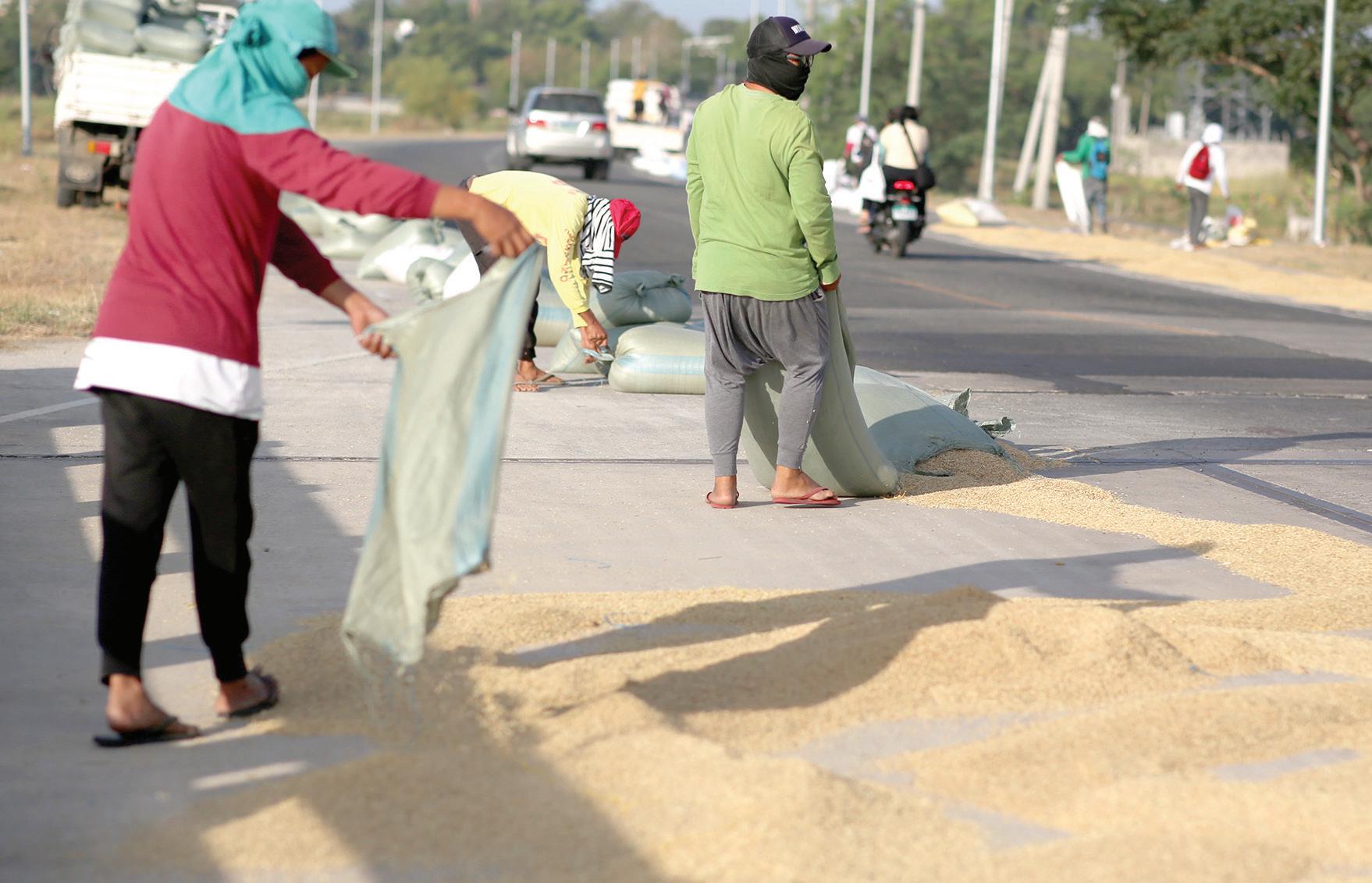
THEDepartment of Agriculture (DA) on Wednesday started the rollout of the P10-billion cash assistance program aimed at helping farmers and fisherfolk grappling with surging production and input costs.
Funded under the 2026 General Appropriations Act (GAA), the agency noted that the Presidential Assistance for Farmers and Fisherfolk Program (PAFFP) will distribute P2,325 each to over 4.17 million beneficiaries nationwide.
Initial payouts will begin this
week in Ilocos Region, Cagayan Valley, Central Luzon, Western Visayas, and Zamboanga Peninsula, with thousands of beneficiaries expected in the first tranche.
In addition, the agency said it will finalize master lists and distribution systems, which have posed challeng-
es in past large-scale aid efforts.
The DA said it would helm the implementation, targeting rice planters cultivating two hectares and below, along with corn and sugarcane farmers.
Beneficiaries should be listed on the Registry System for Basic Sectors in Agriculture (RSBSA) and the National Program for Municipal Fishing Vessels and Gears Registration (BoatR) systems.
The DA noted that the aid comes as increasing fuel prices continue to squeeze the margins of farmers and fisherfolk, since fuel is necessary to run machinery, irrigation pumps, and boats.
For officials, the DA said the program would inject immediate liquidity into rural economies and help prevent disruptions in food production.
While stressing the interven-
tion’s urgency, however, Agriculture Secretary Francisco Tiu Laurel Jr. also acknowledged its limits.
“This financial assistance, while admittedly small, provides a lifeline for over 4.1 million Filipino farmers and fisherfolk hit hard by soaring petroleum product prices,” Tiu Laurel said.
The agency noted that the program reflects a wider shift toward direct cash assistance as a response to economic strain.
“The support can provide shortterm relief, but it does not address longer-term issues such as high input costs, limited access to financing, and exposure to climate-related risks.”
“PAFFP offers immediate support to vulnerable producers. Its impact on sustaining productivity will depend on how it is carried out and supported by broader agricultural measures,” the DA said.
Lawmaker: Include private vehicles in toll discounts
By Jovee Marie N. dela Cruz @joveemarie
HE chairman of the House Commit-
Ttee on Labor and Employment called for the expansion of existing toll discount programs to cover private vehicles, emphasizing the need for broader and more inclusive relief as the oil and energy crisis continues to drive up transportation and daily living costs.
Cavite Rep. Jolo Revilla raised the proposal during the Legislative Energy and Develop -

ment (LEAD) Joint Committee hearing, where lawmakers and key government agencies discussed urgent measures to cushion the impact of rising fuel prices.
The lawmaker pointed out that while toll discounts have already been implemented for public utility vehicles (PUV), including traditional and modern jeepneys, buses, and freight vehicles, similar support should also be extended to private motorists who are likewise affected by soaring fuel costs.
“Not only PUVs are affected by high oil prices. All of us are hit by this—especially the middle class, who commute daily and continue to shoulder rising expenses,” Revilla said.
He stressed that many private vehicle owners depend on their cars for work and everyday mobility, making them vulnerable to the combined pressures of high fuel prices, toll fees, and inflation.
Revilla welcomed the response of transpor-
Receipts…
Continued from A3

tation officials, particularly acting Transportation Secretary Giovanni Z. Lopez, who expressed openness to further discussions with toll operators to explore the possible inclusion of private vehicles in toll discount programs.
“We welcome the DOTr’s commitment to continue discussions with toll operators. It is important that this be implemented immediately so that more Filipinos can feel the relief,” he said.
Revilla also underscored that the proposal complements earlier measures he has advocated to mitigate the impact of the fuel crisis on Filipino workers and consumers. These include calls to review and reduce value-added tax (VAT) on basic commodities such as food staples, limit the pass-through of system loss charges in electricity rates, and accelerate targeted subsidies for transport and other energy-sensitive sectors.
“We cannot rely on isolated solutions. Our
and the generation of vital statistics.
Responding to clarificatory questions from Party-list Rep. Jude Acidre of Tingog, Grande confirmed the figures in the December 8 certification.
Of the 677 names submitted for verification, 405 had no record of birth or certificate of live birth, 507 had no record of death or certificate of death, and 443 had no record of marriage or certificate of marriage. A total of 398 unique individuals had no record of birth, marriage, or death in PSA records.
She also affirmed the findings in the December 11 certification. Of the 1,922 names submitted, 1,322 had no birth records, 1,593 had no death records, and 1,456 had no marriage records, while 1,287 unique individuals had no record of birth, marriage, or death in the PSA database.
Asked by Acidre whether she was confirming under oath that the certifications were accurate, sufficient, and consistent with official PSA records,
actions must be simultaneous and interconnected for people to truly feel relief,” he stressed.
Revilla reiterated the need for a wholeof-government approach anchored on clear direction, immediate action, and concrete assistance to address the cascading effects of the energy crisis.
“The oil and energy crisis affects everyone. That is why the solution must be inclusive and felt by all—not just a few sectors,” he said.
He added that measures such as expanded toll discounts can provide immediate relief while Congress and the executive branch continue to pursue long-term solutions to stabilize energy supply, manage inflation, and protect jobs.
“As Chairman of the Committee on Labor and Employment, our call is clear: a clear plan, immediate action, and concrete assistance for our countrymen who continue to be affected by the crisis,” Revilla said.
Grande replied in the affirmative.
“This is based on the list of names submitted by the committee,” Grande said. The hearing later turned to specific names that had surfaced in the confidential funds controversy.
Acidre asked whether, under the Saballa complaint, there were corresponding PSA records for Mary Grace Piattos, Milky Secuya, Kokoy Villamin, and Irene Tan.
Grande said that all the names mentioned yielded negative results, except for Irene Tan.
She explained that “Irene Tan” is a common name, and without additional identifying details, verification could not be made with certainty.
However, PSA searches showed multiple matching records for that name, including entries for birth, marriage, and death.
She clarified that the other names cited in the hearing had no corresponding records in the PSA database.
Immigration probes aliens’ role in Subic takeover try
By Joel R. San Juan @jrsanjuan1573
THE Bureau of Immigration
(BI) has launched an investigation into the attempted takeover of private resort facilities in Subic Bay Freeport by foreigners while being escorted by alleged members of the National Police (PNP) last week.
Immigration Commissioner Joel Anthony Viado said the agency is now verifying the identities, immigration status, and activities of the foreign individuals involved, which included American national Timothy Desmond, who had previously served a jail term for perjury.
“We will not allow foreign nationals to exploit their presence in the country to interfere in domestic affairs or disrupt public order,” Viado said.
Viado also directed concerned BI units to coordinate with the National Police Commission, the PNP, and the Subic Bay Metropolitan Authority to establish the full circumstances surrounding the incident.
He also ordered a review of the visa status and travel history of
the individuals involved, and the evaluation of possible grounds for their inclusion on the immigration watchlist or blacklist, as well as the initiation of deportation proceedings should violations of immigration laws be established.
The BI emphasized that foreign nationals are strictly prohibited from engaging in activities beyond the scope of their authorized stay, including involvement in local disputes or attempts to assert control over private entities without lawful authority.
“Any foreign national found to have abused the privilege of staying in the country will be dealt with accordingly, including deportation and blacklisting,” Viado added. Earlier reports said Desmond was ordered deported in 2016 for allegedly duping investors of hundreds of millions of pesos in the Ocean Adventure theme park venture. Reports also said he was released from the Olongapo City District Jail despite a final deportation order from the BI. Viado assured the public that the bureau will act swiftly and decisively to uphold Philippine laws and protect national interest.
CCC pushes for localized climate adaptation plans
By Jonathan L. Mayuga
THE Climate Change Commission (CCC) is pushing for localization of the National Adaptation Plan (NAP) 2023-2050 to combat the intensifying heat indices that threaten the Philippines this summer.
CCC Vice Chairman and Executive Director Robert E.A. Borje issued the call during the Urban Heat and Drought Summit organized by the Quezon City Government and CityNet.
“This dry season, we continue to experience intense heat, which highlights the need for urgent and coordinated action. Through NAP localization, we provide a sciencebased roadmap that will guide the country in addressing heat risks while protecting key sectors and human health,” Borje said.
While national in scope, the commission stressed that the NAP’s impact depends on strong localization, translating strategies into concrete, community-level action that allows LGUs to respond directly to climate risks.
Arnold Grant S. Belver of the CCC’s Policy Research and Development Division, who presented the NAP, emphasized the importance of stronger coordination between national and local governments to ensure effective implementation at the community level.
“Strengthening the bond between the national government and Quezon City, and indeed all local governments, is essential to ensure that the NAP translates into concrete, inclusive, and climate-
resilient actions for every Filipino community. The temperature and heat is rising, but so is our resolve,” Belver said.
Extreme heat continues to escalate in urban areas. In Quezon City alone, heat index levels in 2024 and 2025 reached as high as 46°C, which raised risks to public health, disrupted daily life, and strained energy and water systems.
“The NAP is a tailored-fit adaptation strategy for each locality, ensuring that interventions respond directly to their unique climate risks and conditions,” Borje added. The NAP, developed under the leadership of President Marcos, serves as the country’s long-term roadmap to strengthen climate resilience and adaptive capacity toward sustainable development by 2050. In Quezon City, the impacts of extreme heat are becoming more visible across communities, particularly among vulnerable sectors exposed to high temperatures.
“But climate change does not announce itself in global averages; it is felt by our people, most especially in specific places,” said a city official. The summit brought together CityNet member cities, national and local governments, academe, the private sector, development partners, and key stakeholders to drive coordinated action, share solutions, and accelerate climate adaptation efforts to address urban heat and drought.
The CCC remains committed to localizing the NAP as a key framework for strengthening climate action at the local level.
Dole expands Tupad for PUV drivers
THE Department of Labor and Employment (Dole) has expanded its cash-for-work Tuloy Pasada initiative to cover all workers in the public utility vehicle (PUV) sector, widening support beyond drivers as the energy crisis continues to affect transport livelihoods.
The Dole–Bureau of Workers with Special Concerns (BWSC) said the agency has allocated P1.2 billion for distressed workers affected by the crisis, with the program now covering not only drivers but also those providing essential support to PUV operations.
“The P1.2 billion budget is intended for PUV drivers and other
workers providing necessary and essential support for the PUV operations. This is the latest, the Tupad Tuloy Pasada budget is no longer limited to drivers,” the agency said in a statement sent to the BusinessMirror Earlier this week, Dole began rolling out the Tulong Panghanapbuhay sa Disadvantaged-Displaced Workers (Tupad) Tuloy Pasada program, starting with an initial batch of 134 public utility jeepney drivers. Under the scheme, Dole has partnered with the Department of Transportation (DOTr) and the Land Transportation Franchising and Regulatory Board (LTFRB), which will be responsible for identi-
fying and screening beneficiaries, to provide participating workers with wages equivalent to the prevailing regional minimum wage where they are located.
Dole said this is expected to effectively augment their income on top of the P5,000 fuel subsidy earlier extended to them.
Beneficiaries will receive the minimum wage for rendering six hours of work per day, with shifts scheduled either from 6 a.m. to 12 noon or from 2:00 p.m. to 8:00 p.m.
The agency earlier said around 55,000 drivers are expected to benefit from the Tuloy Pasada program, although this figure may rise following the program’s expansion,
with updated estimates yet to be released. The BWSC also said the rollout of Tupad for other sectors affected by the energy emergency will continue, with funding separate from the P1.2 billion allocation for the Tuloy Pasada initiative. For 2026, over P25 billion of the agency’s budget is earmarked for employment assistance programs. Of this amount, P21.28 billion is allocated for the Tupad, P2.6 billion for the Dole Integrated Livelihood Program (DILP), P1.1 billion for the Government Internship Program (GIP), and P228 million for the DOLE Adjustment Measures Program (AMP).
Another firm sends help to put out Navotas landfill fire
By Jonathan L. Mayuga
PRIME Infrastructure, a Razon-led company engaged in water services, sustainable energy, and waste management in the Philippines, has dispatched two fire-fighting tugboats to support the Navotas City’s ongoing efforts to extinguish a fire at the local sanitary Mayor John Rey Tiangco said. Now on its sixth day, the fire continues to produce thick smoke that affected nearby communities.
Firefighters from the entire CaloocanMalabon-Navotas-Valenzuela (Camanava) District are working to extinguish the fire to prevent it from further setting ablaze other portions.
“We have borrowed tankers from Maynilad.
Prime Infra has also sent tugboats with a fire pump,” Tiangco said, during a press briefing. Tiangco, however, did not specify the particular water equipment loaned by Prime Infra or provide details on its current deployment as of the latest update.
In addition to assistance from private companies, Tiangco said the Navotas local government has also sought support from the Department of Public Works and Highways
Sto. Tomas implements alternative work scheme
IN support of the alternative work arrangement and energy conservation protocols of the national government, the City of Sto. Tomas in Batangas has partnered with SM City Sto. Tomas to temporarily transfer its Friday operations inside the shopping establishment to limit the city government’s use of electricity.
The partnership program with SM City, Mayor Arth Jhun Aguilar Marasigan said, aims to lessen energy use across all city hall departments and offices to achieve a measurable conservation target without compromising the delivery of basic services to the people.
Marasigan is positive that the alternative work arrangement program will encourage more Tomasinos to avail of the city government services while buying home necessities at the same time.
The city in full operational capacity brings government services to clients and mall shoppers who wish to avail local documents.
The initiative also aims to bring government service much closer to the public, accommodating service-seeking public thus maintaining efficient and responsible use of energy for the government.
Since SM City can only accommodate frontline employees due to its limited space, non-client interacting city hall personnel are tasked to do community work to stay productive.
Marasigan,, likewise directed city personnel to limit the use of government service vehicles and encourages employees to practice carpooling to save gasoline.
Similarly, air-conditioning system in city hall buildings are operational only from 9 am to 12 noon and 1 o’clock to 4 o’clock in the afternoon and set at 24 C to manage use of power.
The city’s alternative work arrangement and energy conservation protocols which started March 27 has catered numbers of clients mostly mall goers and is expected to save energy much lower than the usual consumption.
The city arranged work procedure is in response to Memorandum Circular 114 of the national government directing all government agencies to implement strict energy conservation measure to address rising energy costs.
(DPWH), the Metropolitan Manila Development Authority (MMDA), and the Department of Transportation (DOTr) to help control the fire in the sanitary landfill site covering around 40plus hectares.
The mayor also said the city hospital is prepared to respond to residents who may be affected by smoke or smog resulting from the ongoing incident.
Tiangco reiterated that the city’s priority is to contain the fire and prevent further spread.
The fire at the Navotas landfill broke out at approximately 7:56 p.m. on April 10. As of April 14, authorities have intensified sand burial operations to suppress an apparent underground fire, even after the incident was declared “under control” on April 12.
The Navotas Fire Station has not yet officially declared the fire fully “under control.”
The Bureau of Fire Protection is currently undermanned, and is facing firefighting equipment deficiency, particularly fire trucks that undermines it's firefighting capacity and capability.
Earlier, Interior and Local Government Secretary Juanito Victor Remulla admitted that ongoing efforts to reform the organization caused some delay in the acquisition of fire trucks and firefighting equipment.
Allegations…
Continued from A3
ill-gotten or unexplained wealth in its next hearing on April 22.
Tuesday’s hearing brought together several resource persons, including self-confessed bagman Madriaga, his notary public, and representatives from the Commission on Audit (COA), House records, Philippine Statistics Authority (PSA), and the National Bureau of Investigation (NBI).
Key findings presented included Madriaga’s detailed accounts of his dealings with the Duterte family, the NBI’s determination that some acknowledgment receipts for confidential funds were written by a single individual, COA’s notices of disallowance on the Office of the Vice President’s (OVP) use of confidential funds from 2022 to 2023, and PSA data showing that many of the listed beneficiaries have no corresponding birth, death, or marriage records.
The House Committee on Justice chairperson, Batangas Rep. Gerville Luistro said that the next hearing will center on Duterte’s Statements of Assets, Liabilities, and Net Worth (SALN), as provided by the Office of the Ombudsman, along with corporate and tax records from the Securities and Exchange Commission (SEC) and the Bureau of Internal Revenue (BIR).
“We intend to focus for the next hearing on the allegations of unexplained wealth, and that is why the Ombudsman, the SEC, and the BIR were not asked in Tuesday’s hearing,” she said.
The committee has also approved motions to subpoena the Anti-Money Laundering Council (AMLC) and former senator Antonio Trillanes IV to testify on allegedly anomalous or suspicious bank transactions from 2006 to 2025.
According to Ridon, the upcoming hearing will include discussions on Duterte’s SALN, income tax returns, and bank transactions flagged by the AMLC, as well as details that may be provided by Trillanes. Ridon explained that the subpoena for bank records was limited to Duterte and her husband, Mans Carpio, since the unexplained wealth allegation is anchored on the Vice President’s SALN. Expanding the scope to other family members, he said, was unnecessary.
He added that any suspicious transactions identified would be crucial in establishing their relevance to the case.
The impeachment complaints allege that Duterte deposited at least P111 million in various banks in Davao City and Metro Manila from 2006 to 2015—an amount complainants say is grossly disproportionate to her salary as former vice mayor and mayor of Davao City.
Her net worth also allegedly increased from P13.8 million in 2007 to P44.8 million in 2017, despite an estimated annual salary of only P2 million.
Bank secrecy waiver
MANILA Rep. Joel R. Chua, chairperson of the House Committee on Good Government and Public Accountability, said that Madriaga’s bank secrecy waiver will allow the Committee on Justice to verify whether the cash transfers he claimed to have carried out on behalf of the
Lacson: Blue-Ribbon flood control mess hearings suspended until...
By Butch Fernandez @butchfBM
SENATE
President Pro Tempore and Blue-Ribbon committee chairman
Panfilo Lacson said all further hearings on the flood control mess are suspended until the panel’s partial report is reported out and sponsored in plenary.
Lacson said continuing hearings without reaching a logical conclusion in the form of a committee report that senators can debate, amend and adopt on the Senate floor would be pointless and contrary to Senate rules. He also reminded members of the Blue-Ribbon committee, most especially those from the minority bloc,
Duterte family actually took place.
He said the waiver would help confirm deposits made into Madriaga’s accounts, which he claimed were used as conduits for large financial transactions, including alleged money laundering activities.
Madriaga signed the waiver during Tuesday’s hearing, authorizing the panel to examine transactions from six bank accounts listed in his affidavit.
According to him, these accounts were opened by close Duterte associates and were used to transfer millions of pesos to Malacañang and various safehouses upon the orders of former President Rodrigo Duterte.
Chua said the move could validate Madriaga’s claims that substantial amounts of money passed through the accounts he controlled.
He added that Madriaga’s affidavits help connect the testimonies of special disbursing officers regarding how the P612.5 million in confidential funds were withdrawn and distributed to the vice president’s security personnel, including Col. Dennis Nolasco and Col. Raymund Dante Lachica.
These details first surfaced during the Committee on Good Government and Public Accountability’s 2024 probe into the alleged misuse of confidential funds by the OVP and the Department of Education.
Madriaga said he worked with Nolasco and Lachica from July 2022 to April 2023, delivering large sums of cash to various recipients upon Duterte’s instructions.
He also claimed that in December 2022, Duterte personally called him to coordinate with her security personnel and deliver four duffel bags filled with cash to multiple locations, including the Office of the Ombudsman parking lot, a comedy bar in Quezon City, and political allies in Laguna.
Madriaga further asserted that contrary to reports that P125 million in confidential funds was spent over 11 days, he personally distributed the amount in less than 24 hours.
These funds were among those flagged by the Commission on Audit through a notice of disallowance for noncompliance with COA-DBM Joint Circular 2015-01, which governs the use and reporting of confidential and intelligence funds.
Chua described Madriaga’s testimony as “very explosive” and “shocking,” noting that it marked the first time the public heard direct allegations of the Duterte family’s involvement in a multi-million peso laundering scheme.
He added that while the committee had already extensively questioned Madriaga, lawmakers may still request his presence at the April 22 hearing for further clarificatory questions.
Disallowance
CHUA also said the Commission on Audit’s affirmation of a notice of disallowance covering P73.287 million in confidential expenses of the Office of the Vice President raises serious accountability concerns.
COA reported that it denied the appeal filed by Vice President Duterte and other OVP officials, affirming Notice of Disallowance 2024-002-100, which covers expenses incurred from December 21 to 31, 2022.
COA official Gloria Camora said that once the ruling becomes final, the disallowed amount must be returned to the government. The amount includes P69.787 million
of their duty, including signing the report, so it can be reported out in plenary.
“I do not expect any member of the minority to sign. They can offer all kinds of reasons all they want, wise or otherwise, not to fulfill their duties as members. It’s on them, not on the chairman,” Lacson said.
“That said, I am suspending all
for rewards and P3.5 million for equipment such as tables, chairs, computers, and printers.
Chua stressed that the amount involved is significant and could have been used to assist sectors such as jeepney drivers and other Filipinos struggling amid the ongoing oil crisis.
He emphasized that the issue cannot be dis-
hearings until I have reported out to sponsor in plenary the partial committee report at the very least,” he added.
Lacson pointed out that under the Senate’s rules, all inquiries in aid of legislation should lead to a committee report containing recommended legislative actions.
As of Wednesday, Lacson said the partial committee report still needs at least five more signatures so it can be reported out on the Senate floor.
Sen. Imelda Josefa Remedios Marcos, a vocal critic of her brother, President Marcos had said she would not sign the Blue-Ribbon partial report until there is a “full investigation.”
“Our Senate rules are clear as they are basic. Thus, all inquiries in aid of legislation should end up in recommended legislative actions via a committee report, except the Blue-Ribbon committee which can
missed as a mere administrative matter, as it involves public funds.
Chua explained that a notice of disallowance is issued when an agency fails to justify its use of funds after audit review. While legal remedies remain available, he noted that COA’s findings stand unless overturned.
also investigate and recommend the filing of criminal cases for malfeasance, misfeasance or nonfeasance,” Lacson said. At the same time, Lacson criticized some minority members of the committee for pushing to invite personalities linked to the issue, such as former Undersecretary Trygve Olaivar, but failing to question him when he appeared before the panel.
“Why did they not ask them what they knew when they appeared? They had the opportunity to ask as members of the committee,” Lacson said in Filipino in an interview on radio.
“If we call for hearing after hearing, without reaching the logical conclusion of having a committee report that need to be debated upon, amended and adopted on the floor, our efforts will end up openended,” the senator explained.
He also pointed out that COA had issued additional notices of disallowance covering the first three quarters of the OVP’s 2023 confidential funds,

A6 Thursday, April 16, 2026
Poultry sector facing multiple threats–group

TBy Ada Pelonia @adapelonia
HE United Broiler Raisers Association (Ubra) has warned that soaring production costs due to the Middle East conflict as well as unfair trade practices are threatening the viability of the broiler sector, which has seen steady growth in recent years
The group noted that the war has squeezed small and mediumsized broiler farms, since they would have to absorb the increase in operational costs due to fuel price spikes.
Ubra also said broiler raisers could not pass on additional costs since consumers are already struggling with the economic repercussions of the war, adding that most Filipinos opt to prioritize key expenditures, such as fuel.
In recent weeks, the group said demand for broiler has softened, resulting in a collapse of farmgate prices that hit a low of P65 per kilo in some key producing provinces.
“It will always be about supply and demand. How are we going to pass the increase in costs if there is no demand since Filipinos are tightening their belts? It will be the raisers who
will absorb the higher expenses,”
Ubra Chairman Elias Jose Inciong said in a statement.
‘Probe locator’
THE group also urged the government to investigate a locator for allegedly abusing its right to import duty-free chicken meat, which competes with locally produced poultry.
Ubra said it received reports that an investor in a certain export processing zone in the Philippines involved in the meat trade is abusing its privilege to import duty-free chicken meat.
Citing information received by the group, Ubra said the locator outsources the processing of its raw materials into various products, including chicken-based rice meals that end up in the domestic market.
The group did not disclose the name of the locator.

“This practice is detrimental to local producers since the imported raw materials, which are supposed to be processed and exported subsequently, compete with domestic output in the market,” it said.
“The alleged malpractice by the locator is also unjust to fair trade, especially to legal importers and other investors in economic zones that are following existing rules and regulations to the letter.”
The group argued that malpractice adds to the challenges that beset broiler raisers already grappling with the impact of the Middle East war and continuous importation
of cheaper foreign supplies.
“This abuse of privileges and even rules by an investor is unjustifiable in any way. We call on the government to investigate such case to safeguard the domestic poultry industry,” Inciong said.
The value of poultry production last year rose by 9.1 percent to P304.71 billion, from the P279.41 billion recorded in 2024, according to data from the Philippine Statistics Authority (PSA).
Philippine farm output recovered and recorded a 2.6-percent growth last year on the back of the expansion of the poultry and crops subsectors.
NFA plans auction of aging rice stocks
THE National Food Authority (NFA) will auction off up to 62,890 metric tons (MT) of aging rice and 232,141 MT of palay in tranches this year.
NFA Administrator Larry Lacson said the approved volume covers milled rice stocks aged over three months and palay aged more than six months, which can be auctioned off as prescribed by law.
Of this volume, he said around 5,000 MT to 20,000 MT of rice aged nine months and above will be traded in early May.
“We will prioritize the oldest supply first and then proceed in order until we reach the relatively younger stocks,” Lacson told reporters in a phone interview on Wednesday.
He noted that the NFA would place primacy on its older stockpile, since milled rice aged three to six months are still “in very good condition,” which can be released to the government’s P20 per kilo rice program.
While palay was included, Lacson said the grains agency is not keen on trading unmilled rice next month, pending a test mill that will determine its quality.
If the test result is still satisfactory, this will be milled and sold. The shelf life of palay is longer, according to the NFA chief.
“That’s why there tends to be more palay that will age, because we only mill them when needed.”
Lacson said the floor price for the next round of auction next month would is still being determined. This will likely fall within the previous prices ranging from P22 to P28 per kilo, he added.
The NFA chief also said the grains agency is still reviewing if the tender can be conducted at the regional level to expedite bidding.
Aside from freeing up warehouse space ahead of the peak harvest, Lacson said the planned auction could help release aging stocks before it becomes stale.
It would also help the agency generate cash flow, he added.
“We need cash flow to buy a truck, augment rice procurement, preposition rice, and to pay for trucking services, and all those operating costs.”
Ada Pelonia
‘Fuel crisis offers opportunity to fortify coconut sector’
BIODIESEL produced in the Philippines would boost economic activity in the country and help improve the local coconut industry’s value chain, according to an industry leader.
United Coconut Association of the Philippines (Ucap) Chairman Marco Reyes made the pronouncement after agencies said they are considering importing biofuels for one year if blended diesel prices exceed those of pure fuels by at least
5 percent to ease local pump prices.
Reyes told the BusinessMirror that importing palm biodiesel instead of petroleum diesel would only divert economic value from the Middle East to Indonesia or Malaysia. Thus, its contribution to economic growth would be captured by the foreign country from which the Philippines imports, he added.
“Since palm biodiesel is cheaper than petroleum diesel

and coconut biodiesel, the benefit is lower pump prices,” Reyes told this newspaper.
“But in totality, nothing will boost economic activity (more) than (using) a locally sourced product (like coconut methyl ester or CME),” he added. CME is a biodiesel component produced from coconut oil.
He said this would buoy the economy through savings in foreign exchange, consumer spending, and investment, while also
THE collapse in cocoa futures is stoking optimism among some industry players that the pace of processing will improve as cheaper beans filter through the supply chain, easing the price of candy bars.
Companies, even now, are still working through pricey stock or following tweaked recipes that use less cocoa after a historic rally in 2024 reshaped the chocolate industry. The demand destruction that followed, coupled with decent harvests, has boosted prospects for a larger-than-expected surplus and has pushed the most-active New York cocoa contract down more than 70 percent from its record.
“The market’s completely changed, not just in price but also in the structure,” said Jonathan Parkman, the head of agricultural sales at commodities brokerage Marex Group.
Grindings data—the volume of beans that processors convert into butter and powder for chocolate products—is expected to be weak in the first quarter, but “this will likely be the last quarter of a slowdown,” Parkman said.
providing multiplier effects in the economy from related industries and enhancing the coconut value chain.
He also noted that palm oil prices have soared due to Indonesia’s move to blend 50 percent palm biodiesel as part of its fuel independence. Reyes said palm biodiesel is “inferior” to coconut biodiesel in terms of performance.
He said a higher CME blend will lower particulate emissions, improve efficiency and mileage
Processing in Europe, the world’s top consumer, in the first three months of this year is estimated to have dropped 6 percent from a year ago, the lowest first-quarter data since 2013, according to a Bloomberg survey of nine traders and analysts.
Grindings in Asia are also expected to slump to the lowest first-quarter level in eight years. North America’s processing data is expected to fall more modestly, according to the survey. Numbers for all three regions are expected on Thursday.
Malaysia’s first-quarter grindings were up about 9 percent year-over-year,
of diesel engines, reduce carbon emissions, lower vehicle operating costs, and lessen respiratory health burden.
“In times of crisis, especially when it is triggered by foreign events, the economic strategy is to boost local manufacturing. Our coconut biodiesel presents a great opportunity to do this.”
Meanwhile, the Department of Energy (DOE) recently said it continues to evaluate hiking the biofuel blend as local and international prices of the
according to a statement from the Malaysian Cocoa Board and Cocoa Manufacturers Group on Tuesday. Still, not all of the lost demand is likely to bounce back because recipe reformulations are not easy to reverse.
Product reformulations using cocoa butter equivalents “are not just cyclical,” said Nisha Kumari, an analyst with Tropical General Investments Group. “They are becoming a structural hedge against future cocoa supply shocks.”
Many of the changes may be the industry’s new reality.
At Barry Callebaut AG’s new Callebaut Global Innovation Center in Singapore, one of the

commodity are also increasing, which might not help in easing pump prices.
Ucap had proposed the implementation of a staggered increase in the biodiesel mandate to 7 percent to mitigate surging diesel costs wrought by the Middle East war. The government should then resume the implementation of the 4 percent biodiesel blend (B4), which had been suspended owing to soaring copra prices last year. Ada Pelonia
focuses is on cacao coatings, in which the cocoa butter is replaced with vegetable fats while still giving “the same great taste of chocolate,” Dries Roekaerts, president for customer experience, said at a February event to mark its opening. Consumers—already hit by higher food and living costs— have also eased up on purchases. Chocolate candy volume sales in North America in the 13 weeks ending March 22 were down about 1.3 percent from the same period a year prior, according to data from Circana. While chocolate still remained the top choice for holidays, almost 40 percent of consumers trying to reduce spending for Easter said they would buy less, according to a survey from research firm NIQ. Nearly a quarter said the same for Valentine’s Day.
Confectionery makers are recognizing that this is a “longterm challenge rather than a short-term cycle and are looking more into cocoa-free chocolate alternative solutions,” according to Mark Golder, CEO of cocoa-
Cocoa price crash spurs hopes for demand recovery, cheaper candy
A8 Thursday, April 16, 2026
Editor: Angel R. Calso
Children killed in Lebanon as Israeli strikes hit homes far from Hezbollah war front lines
BBy Abby Sewell The Associated Press
EIRUT—Jawad Younes, 11, and his cousins were playing soccer in the lot between their houses, as they often did. His little brother, 4-year-old Mehdi, had joined them but grew tired, so Jawad took him home and handed him off to their mother before returning to the game. Minutes later, an Israeli strike came.
The target was Jawad’s uncle’s home. The blast shook neighboring buildings and threw Jawad’s siblings at home to the ground. As their mother, Malak Meslmani, scrambled to help them up, she could think only of Jawad.
“I was pulling my children off the floor in the house, but as I was running to pick them up, I screamed, ‘Jawad,’” she said. “My heart told me.”
Her son was instantly killed in the March 27 Israeli strike in Saksakieh. So was one of his cousins—so close they were more like brothers. Several other children were wounded.
Jawad’s uncle also was killed. He was an interior design engineer; Jawad wanted to be an engineer like him. Meslmani called him a civilian. But like many Shiite families in southern Lebanon, the family were loyal supporters of the militant group and political party Hezbollah, which formed in the 1980s to fight Israel’s occupation of the area.
Jawad and his cousin are among 168 children killed— of more than 2,100 people in all—by Israel’s strikes in the six weeks of renewed war between the country and Iran-backed Hezbollah.
Israel has often struck alleged Hezbollah militants or officials in their homes without warning, frequently in areas far from the front line when they are with their families, in apartment buildings surrounded by uninvolved neighbors. The Israeli military rarely names the targets of its strikes but says it takes measures to minimize civilian casualties— including children—and blames Hezbollah members for mixing with the general population. The families of children killed accuse Israel of committing war crimes because of the large number of civilian casualties.
At least two Israeli civilians— both adults—and 13 soldiers have been killed in the current war with Hezbollah, according to figures from Israel. One of the civilians was killed by mistaken Israeli fire.
In response to Associated Press questions, the Israeli military didn’t deny that children have been killed in its Lebanon strikes but said it has targeted Hezbollah facilities and militants. The army says it’s killed hundreds of Hezbollah operatives but has provided little evidence to support the claim.
Under international law governing armed conflict, it’s never legal to directly target civilians, but collateral damage—harm to civilians when striking a military target—is allowed if it is proportional to the anticipated military gains of any given strike.
The Israeli military told AP in a statement that its strikes follow the law, including “the principles of distinction, proportionality, and the taking of precautions.”
Charles Trumbull, an assistant University of South Carolina law professor who

studies the law and ethics of armed conflict, said it’s difficult to assess whether the proportionality threshold was met without knowing the strike targets and whether the military knew children were present.
“To the extent that they knew that children were likely to be harmed or killed in these strikes, and as an ethical matter, absolutely I think that should affect the calculus,” he said. “Just because certain strikes might not violate the law on conflict doesn’t mean that they’re not concerning or problematic or that they are morally justified.”
Children crushed under their own homes
AT 2 a.m. March 12, Taline Shehab—who would have turned 4 last month—was sleeping when missiles tore into an apartment above hers in the family’s building in Aramoun, about 20 km (12 miles) south of Beirut, causing it to collapse.
Taline and her father died; her mother was critically wounded.
Aramoun is a religiously mixed area that was generally considered safe, though it had been targeted by airstrikes in the previous Israel-Hezbollah war, in 2024.
Taline’s father, Mohamad, was a drone operator and video producer who often worked with the Lebanese army and on highprofile television productions. He and his wife, Nathalie, ran a fashion company; Taline appeared regularly on its social media.
“They were a very close family. Their daily life revolved around their daughter,” said Ali Shehab, Mohamad’s brother.
Taline “was full of personality,” he said. “She was very attached to her father. She loved being around him and didn’t like to share him with anyone.”
He comforts himself with the thought that “maybe Mohammed and Taline, because they are so attached to each other, God chose them both.”
Dr. Ghassan Abu Sitta, who’s worked extensively in Gaza and Lebanon and runs an initiative treating some of the most seriously war-wounded children at the American University of Beirut Medical Center, said that, like Taline, most of the cases he has seen are “children being crushed underneath the rubble of their own homes.”
A lifetime shadowed by war and loss
TEN-YEAR-OLD Zeinab al-Jabali used to tag along wherever her father went: the corner store, the mountains around their village in Lebanon’s Bekaa Valley.
Now, he sleeps in the Beirut hospital where doctors are treating his wife and three older daughters, all wounded in the strike that killed Zeinab. War has shadowed most of
al-Jabali’s life. In 1982, his brother—then 10, like Zeinab—was killed by an Israeli missile.
Al-Jabali made a living selling mouneh, or preserved foods such as raisins and dried herbs, and worked for his cousin’s factory producing laban, or yogurt.
On March 5, al-Jabali’s wife and daughters were preparing for iftar, the meal ending the daily fast during the holy month of Ramadan, at his wife’s sister’s house when the airstrike hit it.
Al-Jabali acknowledged his brother-in-law—who was killed—“in the past was with the resistance,” referring to Hezbollah.
“But they struck him at home, in a house full of children, full of girls,” said al-Jabali, who heard the blast from elsewhere in the village and found a scene of carnage when he rushed to check on his family. He said his wife still doesn’t know Zeinab is dead; he’s afraid the grief would endanger her recovery.
Families grieve: “I remember everything” IN response to questions about the strikes that killed Jawad, Taline, and Zeinab, the Israeli military didn’t give details about the intended targets beyond that they were related to Hezbollah. The military’s statement said Israel regrets any civilian harm but that it’s operating against Hezbollah, “which attacked the State of Israel under Iranian backing.”
Many Lebanese have blamed Hezbollah for pulling their country into the war when it fired missiles across the border March 2, two days after the US and Israel attacked Iran. But for others, the devastation from Israeli strikes has strengthened their support.
“We are now holding onto the resistance more than any time before,” said Meslmani, Jawad’s mother.
Despite Israeli army notices for residents in large swathes of southern Lebanon to flee, many in their town of Saksakieh stayed. Displaced people from farther south took refuge there. Life felt almost normal before the strike that killed Jawad.
Now, Meslmani visits his grave in a small cemetery overlooking a mountain vista, where she can hear warplanes roar overhead.
“I remember everything,” she said. “How he used to eat and drink, how he used to play, how he would get dressed and fix his beautiful hair.”
Since he was killed, the planes no longer bother her.
“The most precious thing, my heart, is gone,” she said. “What more can they do?”
Hassan
The Associated Press journalists Malak Harb in Beirut and Koral Saeed in Abu Snan, Israel, contributed to this report.
MOURNERS gather over the body of Jawad Younes, 11, who was killed in an Israeli airstrike, during his funeral procession in Saksakieh village, south Lebanon, Saturday, March 28, 2026. AP/HUSSEIN MALLA
The World
Hopes rise for renewed US-Iran talks as US military enforces blockade of Iranian ports

By Munir Ahmed & Sam Metz
The Associated Press
ISLAMABAD—Hopes rose for renewed talks between the United States and Iran on Wednesday, as the US military said its blockade of Iranian ports was in full effect and Tehran threatened to retaliate by strike targets across the war-weary region.
US President Donald Trump said Tuesday that a second round of talks could happen “over the next two days,” telling the New York Post the negotiations could be held again in Islamabad as diplomats worked through back channels to arrange them.
U.N. Secretary-General António Guterres said it’s “highly probable” that talks will restart, citing a meeting he had with Pakistan’s Foreign Minister Ishaq Dar. The office of Pakistan’s Prime Minister Shehbaz Sharif said he would travel to Saudi Arabia Wednesday as his country pushes to mediate new talks and to Turkey for the Anatalya Peace Forum, which starts Friday. Oil prices fell on hopes for an end to fighting, and in the US, stocks surged close to records set in January. The war, now in its seventh week, has jolted markets and rattled the global economy as shipping has been cut off and airstrikes have torn through military and civilian infrastructure across the region.
Meanwhile in Washington, the first direct talks in decades between the Israeli and Lebanese ambassadors to the US concluded on a productive note Tuesday, according to the US State Department.
Israeli Ambassador Yechiel
Leiter said the two countries are “on the same side of the equation” in “liberating Lebanon” from the militant Hezbollah group. Lebanese Ambassador Nada Hamadeh Moawad called the meeting “constructive” but urged an end to the ongoing conflict between Israel and Iran-backed Hezbollah militants. Since March, that war has displaced more than 1 million people in Lebanon.
Israel and Lebanon have technically been at war since Israel was established in 1948, and Lebanon remains deeply divided over diplomatic engagement with Israel.
First round of talks with Iran failed to end conflict LAST weekend in Pakistan, an initial round of talks aimed at permanently ending the USIran conflict failed to produce an agreement. The White House said Iran’s nuclear ambitions were a central sticking point.
“I think they want to make a deal very badly,” Trump said in an excerpt from an interview with Fox Business Network’s “Mornings with Maria” scheduled to air Wednesday morning. He added: “I view it as very close to over.”
A US official said Tuesday that fresh talks with Iran were still under discussion and that nothing has been scheduled. The official spoke on condition of anonymity because they were not authorized to discuss sensitive negotiations.
Muhammad Aurangzeb, Pakistan’s finance minister, told The Associated Press that “our leadership is not giving up” on
efforts to help the US and Iran end the conflict.
Though the ceasefire appeared to hold, the showdown over the strategic Strait of Hormuz risked reigniting hostilities and deepening the regional war’s economic fallout.
The fighting has killed at least 3,000 people in Iran, more than 2,100 in Lebanon, 23 in Israel and more than a dozen in Gulf Arab states. Thirteen US service members have also been killed.
Tankers turned around after blockade took effect US Central Command said Tuesday no ships made it past the blockade in the first 24 hours, while six merchant vessels complied with direction from US forces to turn around and reenter Iranian waters.
The blockade is intended to pressure Iran, which has exported millions of barrels of oil, mostly to Asia, since the war began Feb. 28. Much of it has likely been carried by so-called dark transits that evade sanctions and oversight, providing cash that’s been vital to keeping Iran running.
Tankers approaching the strait Monday turned around shortly after the blockade took effect, though one reversed course again and transited the waterway.
Since the war began, Iran has curtailed maritime traffic, with most commercial vessels avoiding the waterway. Tehran’s effective closure of the strait, through which a fifth of global oil transits in peacetime, has sent oil prices skyrocketing, pushing up the cost of gasoline, food and other basic goods far beyond the Middle East.
Metz reported from Ramallah, West Bank. Associated Press writers Aamer Madhani, Matthew Lee, Fatima Hussein, Collin Binkley, Chris Rugaber, Will Weissert and Konstantin Toporin in Washington; Sylvie Corbet in Paris; Toqa Ezzidin in Cairo; Natalie Melzer in Jerusalem; Edith Lederer and Farnoush Amiri at the United Nations, and Russ Bynum in Savannah, Georgia, contributed to this report.
Pope Leo brings message of peace to Cameroon as separatists announce 3-day pause in fighting
By Nicole Winfield
The Associated Press
ALGIERS, Algeria — Pope Leo XIV is heading to the central African nation of Cameroon with a message of peace for its separatist region and for talks with President Paul Biya, the 93-year-old leader whose grip on power was extended for an eighth term in a widely disputed election last year.
The Vatican says fighting corruption in the mineral-rich country and insisting on the correct uses of political authority are expected to be themes of Leo’s visit, which starts Wednesday with his arrival in Yaounde, the capital. Leo was traveling to Cameroon from Algeria, the first stop on his four-nation Africa tour.
The Vatican has made clear that Catholic social teaching disapproves of the types of authoritarian leaders that Leo is encountering on his visit, the first to the continent by history’s first American pope. Biya is the world’s oldest leader and has led the central African nation since 1982. Leo will meet with Biya upon arrival at the presidential palace in the capital Yaounde.
He’ll then address Cameroon government authorities, civil service representatives and diplomats before visiting an orphanage run by a Catholic
religious order of nuns.
Cameroon authorities made a lastminute change to the program, the Vatican said Wednesday. Biya, and not the prime minister, will now deliver a speech before Leo addresses government authorities and the encounter will occur in the presidential palace, not a conference center.
Cameroon’s opposition has contested the result of the Oct. 12 election that secured the victory for Biya. His election rival, Issa Tchiroma Bakary, claims to have won and has called on Cameroonians to reject the official result.
Just this week, Leo issued an unrelated message on the correct role of political leaders and the need for “authentic democracy” to legitimize their authority and act as a “guardrail against the abuse of power.”
In a message to a Vatican academy for social science, Leo wrote that democracy remains healthy only when it is driven by morality and a vision of humanity that respects the dignity of everyone.
“Lacking this foundation, it risks becoming either a majoritarian tyranny or a mask for the dominance of economic and technological elites,” he warned in a message that wasn’t directed at any particular nation or leader and was dated April 1.
A peace meeting and a pause in fighting
LEO has two major events in Cameroon, with the highlight a “peace meeting” on Thursday in Cameroon’s northwest city of Bamenda, which has been plagued by separatist violence.
English-speaking separatists launched a rebellion in 2017 with the stated goal of breaking away from the French-speaking majority of Cameroon and establishing an independent English-speaking state. The conflict has killed more than 6,000 people and displaced over 600,000 others, according to the International Crisis Group, a think tank.
On the eve of Leo’s arrival, the English-speaking separatists announced a three-day pause in fighting to allow “safe travel” for Leo’s visit.
The Unity Alliance, which includes several separatist groups, said in a statement late Monday the pause reflects the “profound spiritual importance” of the visit and is intended to allow civilians, pilgrims and dignitaries to travel safely.
Leo’s other big event in Cameroon, where about 29% of the population is Catholic, is a Mass on Friday in the city of Douala, where some 600,000 people are expected to turn out.
On Saturday, Leo heads to Angola for the third leg of his trip, which ends next week in Equatorial Guinea.
A CARGO ship sails in the Persian Gulf towards Dubai port as seen from Ajman, United Arab Emirates, Tuesday, April 14, 2026. AP
Thursday, April 16, 2026
Lawmakers urge oil crisis aid for middle class as fuel prices push millions toward poverty
By Jovee Marie N. Dela Cruz @joveemarie
LAWMAKERS on Wednesday urged a more inclusive government response to the ongoing oil crisis, warning that the Filipino middle class— long excluded from direct financial assistance programs—can no longer be ignored.
A House leader said millions of middleincome families are now at risk of slipping into poverty as surging fuel prices, driven by geopolitical tensions in the Middle East, continue to push up the cost of goods and services.
During the hearing of the House’s 13-panel Legislative Energy Action and Development (LEAD) Joint Committee, Marikina Rep. Miro Quimbo emphasized that the crisis is no longer a distant economic concern but a daily struggle for many working Filipinos.
Quimbo, who chairs the House Committee on Ways and Means, said previous hearings have already revealed the deeper risk posed by the global oil shock—its gradual but persistent impact on household spending and economic stability.
He said that amid the rising prices of fuel and basic goods, the middle class remains largely outside the scope of government “ayuda,” despite facing increasing financial strain.
Quimbo cited the 2023 Family Income and Expenditure Survey of the Philippine Statistics Authority, noting that spending patterns on fuel do not significantly differ between the poorest and the richest households.
The data showed that 12.1 percent of income among the poorest households goes to diesel and gasoline, compared to 14.7 percent among the richest families—challenging earlier claims that wealthier Filipinos account for the bulk of fuel consumption.
He then turned to the group he said can no longer be treated as invisible in the government’s response.
“In the midst of this, there is one sector we must not forget—the middle class. This is the sector that is often not covered by financial aid, even as they struggle with rising prices. They are one major crisis away from falling below the poverty line,” Quimbo stressed.

According to Quimbo, the weakening financial capacity of middle-income earners also threatens the broader economy, as they form a significant portion of the country’s workforce and consumer base.
“We must also recognize Filipino workers as the lifeblood of our economy. When their ability to earn and spend weakens, the economy slows down. When support for them is insufficient, it is not only livelihoods that are affected but the overall movement of the economy as well,” Quimbo said.
That is why, he argued, the House can no longer frame the issue as a narrow question of short-term relief.
“That is why the question before us now is not only how to provide financial aid but how to sustain the momentum of the economy amid the global oil crisis,” Quimbo said.
Quimbo also highlighted the challenges faced by businesses, particularly small enterprises, which continue to grapple with rising production and operational costs.
He raised concerns on whether companies can keep prices stable without passing on the full burden to consumers, especially as smaller firms lack the financial buffers
to absorb prolonged increases in expenses.
“This also includes the situation of our business sector—our manufacturers, retailers, and other enterprises that continue to face rising production and operating costs. Small businesses are especially affected, as they have limited capital, lack sufficient buffers, and struggle to keep up with the continuing increase in expenses,” Quimbo noted.
Cagayan de Oro Rep. Rufus Rodriguez backed Quimbo’s position, stressing that the effects of rising oil prices cut across all income groups.
Rodriguez cited data showing that only a small fraction of the population belongs to the high-income bracket, while a significant 45 percent falls within the middle class.
“You don’t have to be an economist to see that everybody is affected,” he said, rejecting claims that proposed measures such as suspending petroleum taxes would only benefit the rich.
For his part, Cavite Rep. Jolo Revilla underscored the middle class’ critical role in sustaining government revenues, noting
See “Lawmakers,” A11
PSA: Metro construction materials wholesale prices rise slightly in March
By Justine Xyrah Garcia
WHOLESALE prices of construction materials in Metro Manila picked up slightly in March, the Philippine Statistics Authority (PSA) said on Wednesday.
The Construction Materials Wholesale Price Index (CMWPI) in the National Capital Region (NCR) grew by 1.1 percent in March 2026, a tad faster than the 1 percent recorded in February.
This marks a sharper increase compared to the 0.2 percent growth logged in March 2025.
The PSA attributed the faster annual growth mainly to higher prices of electrical works, which rose by 0.9 percent from a -0.1 percent a month earlier.
percent decline in February. Slower annual increases were observed in cement (1.5 percent from 2.3 percent), reinforcing steel (0.1 percent from 0.9 percent), and concrete products (2.2 percent from 2.4 percent). On the other hand, annual declines were seen in polyvinyl chloride (PVC) pipes (0.1 percent from 0.3 percent), hardware (0.1 percent from zero), and metal products (0.6 percent from 0.5 percent).
The CMWPI measures changes in the wholesale prices of construction materials used in building projects in Metro Manila.
Faster price increases were also recorded for galvanized iron (G.I) sheets (0.3 percent from 0.1 percent), plumbing fixtures and accessories or waterworks (0.3 percent from 0.2 percent), painting works (1.1 percent from 0.8 percent), and fuels and lubricants (7.9 percent from 0.2
UK envoy urges action on Hormuz, reaffirms South China Sea stance
By Malou Talosig-Bartolome
BRITISH Ambassador Sarah Hulton urged swift action to restore freedom of navigation in the Strait of Hormuz, warning that disruptions threaten global trade far beyond the Middle East
“National security and economic prosperity have become increasingly intertwined,” Hulton told business leaders of the Makati Business Club Tuesday. She stressed that “freedom of navigation underpins global trade, and it matters for every sea, every ocean, every strait.” Crisis in Hormuz AMID escalating tensions, Hulton emphasized that “the goal is to negotiate a swift and lasting end to the conflict, achievable only through diplomacy.” She cited the UK’s proactive role,
noting that the Foreign Secretary Yvette Cooper recently convened talks with over 40 nations, while the Prime Minister Keir Starmer engaged Gulf allies to restore confidence in international shipping. London is also working closely with the shipping, insurance, and energy sectors to stabilize the route.
In March, the UK joined nearly 40 nations—including France, Germany, Japan, Canada, Australia, and Gulf partners—in condemning Iran’s attacks on commercial vessels and energy infrastructure. The coalition called for compliance with UN Security Council Resolution 2817 that condemns Iran’s attacks on Gulf states and shipping in the Strait of Hormuz, demands an immediate halt to hostilities, and calls for compliance with international law to protect freedom of navigation.
See “UK Envoy,” A11

Año steps down from NSA, NSC due to health reasons
By Rex Anthony Naval
NATIONAL Security Adviser Eduar -
do Año on Wednesday said that he will formally step down from the NSA and as Director General of the National Security Council due to health reasons.
He added that this condition requires his “full attention and care,” hence his retirement.
“Public service has been the defining mission of my life, and it has been
my utmost privilege to have served the Filipino people in times of both challenge and opportunity. After many decades in government service and having had the honor of serving as Commanding General of the Philippine Army, Chief of Staff of the Armed Forces of the Philippines, and Secretary of the Department of the Interior and Local Government and now as the NSA I have reached this difficult but necessary decision,” Año said.
He said that in the last few months, this
health condition has become apparent and made him realize that he must prioritize his well - being.
“To ensure continuity, stability, and the highest standards of service in safeguarding our national security, I believe it is time to step aside and allow others to lead. An orderly transition is underway, and I am confident that critical operations and ongoing initiatives will continue,” he added.
Likewise, Año also took this opportunity to express his thanks to President Ferdinand
Humanitarian assistance activities in ‘Balikatan’ showcases strong partnership of PHL and US
HUMANITARIAN assistance
activities in past and present
“Balikatan” exercises highlight the strong relationship between the Philippines and the United States militaries, the American spokesperson for the drills said on Wednesday.
“Humanitarian assistance opportunities are important for the our ironclad alliance and represents our cooperation between our two nations for Balikatan. There’s a lot more to Balikatan [other than] security operations,” US Balikatan spokesperson Col.
Robert Bunn said during an interview with a local television network.
He also added that it is important that these types of operations continue to further beef up the cooperation between the Philippines and the United States.
This year’s Balikatan is scheduled from April 20 to May 8 this year and involves more than 17,000 plus troops from the militaries of the Philippines, United States, Australia, Japan, Canada, France, and New Zealand.
Bunn also said Balikatan provides
great opportunities for the Philippines and US armed forces to enhance their interoperability.
“And what do I mean by interoperability? What I mean is sometimes our our communication systems, our computer systems need to be able to talk to each other but also as human beings there’s always a natural barrier sometimes due to cultural reasons or due to language reasons that we are able to work through every year to increase our ability to operate together,” he added. Rex Anthony Naval
Nepomuceno takes over BOC Intel Group as deputy resigns over smuggling failures
By Reine Juvierre S. Alberto
USTOMS Commissioner Ariel
CF. Nepomuceno will act as de facto officer-in-charge of the Intelligence Group after Deputy Commissioner Romeo Allan Rosales tendered his resignation.
This comes after Nepomuceno confirmed to reporters last Tuesday that Rosales’ resignation took effect on April 13, Monday. While Rosales did not specify the reason for his departure in his resignation letter, Nepomuceno said there are things that he should have apprehended, but
UK Envoy. . .
The UK-led group also welcomed the International Energy Agency’s release ostrategic petroleum reserves to ease global energy shocks.
When pressed by reporters on whether the UK is actively lobbying the Philippines or the broader ASEAN bloc to join the Strait of Hormuz coalition, Hulton maintained that “this is obviously a global issue, we’re discussing this with everyone.”
Global–Regional Security Link
DRAWING parallels between the Middle East and the Indo-Pacific, Hulton reaffirmed Britain’s long-standing support for the 2016 Arbitral Award and its commitment to a free and open South China Sea.
“The UK will continue to champion international law and the rules-based
was not able to.
“There were smuggled items which he thought he failed to act on, so he resigned,” Nepomuceno said in a vernacular. Rosales previously served as the district collector at the Manila International Container Port and was appointed deputy commissioner of the Intelligence Group on June 30, 2025.
When asked if there were people who got mad or reprimanded Rosales, Nepomuceno dismissed the question.
A new deputy commissioner is on the way, according to Nepomuceno, but in the meantime, he will act as the de facto officer-in-charge of the Intelligence Group.
system,” she said.
Pressed on whether the UK is lobbying ASEAN states to join the Hormuz coalition, Hulton replied: “This is a global issue— we’re discussing this with everyone. The countries that have already signed up are on the record.”
Oil Shock and Sanctions
WHEN asked about emerging markets like the Philippines being tempted to secure oil from sanctioned sources such as Russia amid the global oil shock, Hulton acknowledged the severe energy pressures facing all economies.
She stressed that the UK supports easing these pressures through coordinated global efforts, including the use of strategic oil reserves.
However, she firmly rejected reliance on Russian oil or easing sanctions, explaining that the UK assesses lifting sanctions would actually worsen oil prices since Russia is

R. Marcos Jr. for his trust and confidence
“I am equally grateful to my colleagues in the Cabinet and to my fellow public servants across the national security community especially the National Task Force on the West Philippine Sea, the National Task Force to End the Local Communist Armed Conflict, the National Intelligence Board, the Armed Forces of the Philippines, the Philippine National Police, the Philippine Coast Guard, other law enforcement agencies, and civilian institutions for their steadfast commitment
Lawmakers. . .
Continued from A10
that they account for a large share of tax contributions.
“The middle class makes a very significant contribution to our country,” Revilla said, lamenting that this sector often receives little direct support compared to more vulnerable groups.
“But what about the middle class… Most of the taxes come from us. What about us?” he added.
Quimbo said lawmakers are now tasked with striking a balance between immediate relief measures and long-term economic stability, ensuring that support mechanisms do not overlook the very sector that helps keep the economy running.
“I’m the one who is giving direct instructions to our intelligence operatives.”
Nepomuceno added that he has recommended his former classmate from the Philippine Military Academy to become the new deputy commissioner for the Intelligence Group to President Ferdinand R. Marcos Jr. and Finance Secretary Frederick D. Go.
“I hope they can approve him right away because he’s very qualified for the job. I fully trust my endorsement,” Nepomuceno noted.
The Intelligence Group is responsible for the surveillance and apprehension of smuggled products into the country
already operating near capacity.
“Funds to Russia fund that war machine,” she warned, urging Filipinos to consider the moral and geopolitical consequences.
Hulton underscored the importance of consistent support for UN statements on Ukraine when weighing long-term impacts.
UK-Philippine Partnership
HER remarks also marked 80 years of UKPhilippine diplomatic relations. Hulton
For his part, Finance Undersecretary Karlo Fermin Adriano admitted that the impact of rising oil prices and inflation is no longer confined to low-income Filipinos, noting that middle-income households—who largely shoulder the country’s tax burden—are also among the hardest hit sectors.
“Mr. Chair, we recognize and we know that it is not only the poor who are affected by this. One of the most affected is the middle-income classes that pay all the taxes as well,” Adriano said.
He added that the government, in its assessment of possible relief measures, has considered the need to extend interventions or subsidies beyond vulnerable groups to include middle-income earners. However, he stressed that such measures remain constrained by available fiscal space and government revenues.
highlighted booming bilateral trade, now at $3.2 billion, up 8.9% from the previous year, alongside major green investments such as Actis’ £600 million M-Terra solar project.
She praised the Philippines’ strong utilization of the UK’s Developing Countries Trading Scheme and welcomed its formal application to join the Comprehensive and Progressive Agreement for Trans-Pacific Partnership (CPTPP).
and professionalism. Together we have faced complex threats and worked tirelessly to uphold the sovereignty, safety, and well - being of our nation,” he added.
Despite his retirement, Año said he remains confident in the strength and resilience of the institutions and in the capable, steady leadership of incoming NSA retired Gen. Eduardo Oban Jr. who will carry forward the mission to protect the nation.
“I have full faith that, under his leadership, our national security institutions will continue to uphold the highest standards of excellence and integrity. With gratitude to God and to the Filipino people, I will continue to support our nation in whatever capacity I can. I am mindful that the call to serve does not end with leaving office but endures in every citizen committed to the common good,” he added.
79 years of showing up when every second counts: The enduring PHL Red Cross legacy
SEVENTY-NINE years is not merely a number. It is nearly eight decades of deploying rescue boats through submerged streets when typhoons send floodwaters surging, of digging through collapsed concrete and twisted metal after earthquakes reduce homes to rubble, and of standing watch in emergency medical tents and hospital corridors when every second counts. It is volunteers wading chest-deep to carry children to safety, setting up evacuation centers in the dark, and delivering hot meals to families who have lost everything. It is blood donors lining up without being asked, first aiders tending to wounds amid the chaos, and grief counselors sitting silently beside the newly displaced. Through every typhoon, every earthquake, every fire, and every landslide, the Philippine Red Cross has been there—not as a distant agency, but as a living network of ordinary people refusing to look away.
Today, the Philippine Red Cross marks its 79th anniversary—not with grand fanfare, but with the quiet, steadfast resolve that has defined it since its founding. With 102 chapters nationwide and two million volunteers, the PRC has become more than an organization; it has become the backbone of the nation’s humanitarian conscience.
What makes the PRC extraordinary is not simply its ability to deliver aid. It is the culture it has cultivated: preparedness over panic, discipline over disorder, and humanity over indifference. Its volunteers are not distant responders in official uniforms. They are neighbors wading through floodwaters beside those they rescue. They are strangers who become lifelines. They are ordinary Filipinos who have chosen, again and again, to be extraordinary.
Yet the PRC does not work alone. Behind every blood donation, every relief mission, and every rebuilding effort stands a network of donors, partners, and global allies—including the International Federation of Red Cross and Red Crescent Societies and the International Committee of the Red Cross. This is a powerful reminder: while the PRC serves the Filipino people, it is also part of a worldwide movement bound by a shared promise to protect human dignity.
Under the leadership of Chairman and CEO Richard Gordon and Secretary General Dr. Gwendolyn Pang, the PRC has evolved into a highly capable humanitarian force. Investments in logistics, information technology, and training have transformed response times and expanded reach into the country’s most isolated communities. But technology alone does not save lives. Trust does. Credibility does. Compassion, sustained across generations, does.
As the Philippines faces increasingly frequent and severe natural disasters, the role of the Philippine Red Cross becomes not less important, but more vital. It is no longer enough to be a responder. The PRC must also be a steady, reassuring presence—proof that in the darkest hours, no Filipino stands alone.
At 79, the Philippine Red Cross has earned its place in the nation’s story. But its greatest chapters are still being written—one volunteer, one donation, one saved life at a time.
BusinessMirror
Ambassador Antonio L. Cabangon Chua Founder


The pump price is a lie

TOUTSIDE THE BOX
HE gas pump is just a distraction. Seven weeks of headlines, seven weeks of politicians performing outrage at the pump price, seven weeks of analysts debating the crude price ceiling and the world has managed to miss the actual story. The real story is uglier and takes longer to explain.
Henry Ford had a word for people who thought the automobile business was about automobiles. He called them “order takers.” These were men who stood at the front of the house counting receipts while the actual work—the ore, the coke, the rubber, the glass—happened somewhere out of sight that they preferred not to think about. The order taker was the man most surprised when the shelves went empty, because he had never bothered to learn what filled them. Seven weeks into this war, the order takers are running the commentary.
River Rouge was Ford’s vertically integrated mega-complex outside Detroit where raw iron ore entered
at one end and finished automobiles rolled out the other. This was the physical embodiment of his conviction that whoever controls the upstream controls everything. Ford built it because he had watched, during the First World War, what happened to manufacturers who did not own their upstream. Supply lines severed, finished goods collapsed, and not because the factories stopped, but because the inputs stopped. The delay between upstream disruption and downstream consequence is the part that fools people into thinking the damage is manageable.
The Strait of Hormuz carries roughly 30 percent of global helium supply, in the form of Qatari LNG
byproduct. Helium spot prices have doubled since the war erupted. Helium does not fill party balloons. It is the cooling medium inside all semiconductor fabrication lines making the chips that run everything from coffee makers to smartphones to the servers half the world now depends on. South Korea imports 65 percent of its helium from Qatar. Samsung and SK Hynix have months of inventory until they do not.
Eighty-four percent of Middle Eastern polyethylene export capacity routes through the Strait. The Middle East supplies roughly a quarter to a third of global polyethylene and polypropylene exports. Polymer prices across major grades are up roughly 40 percent since late February. Naphtha, the feedstock driving most of Asia’s petrochemical capacity, surged nearly 74 percent in two weeks. A man who does not control his feedstock does not control his factory. Asia’s petrochemical sector is learning this at considerable expense.
Gulf aluminum smelters are declaring force majeure. LME aluminum hit $3,492 per ton at the end of March, a four-year high, up roughly 10 percent since the conflict began. Macquarie Bank estimates a production loss of 800,000 to 900,000 tons in 2026—enough to push the global

market into a full-year deficit. Aluminum is one of the most non-specific inputs in industrial production and a shortage propagates everywhere simultaneously rather than concentrating in one sector. You do not notice it until it is gone, and then you notice everything at once. The fertilizer channel is where the damage turns agricultural. Global sulfur, urea, and ammonia prices are rising because the dominant exporting region is offline. Philippine direct exposure to Gulf fertilizer supply is more limited than the headlines suggest. Price is the immediate problem, not supply. The Philippine farmer does not need to source from the Gulf to get hurt by Gulf disruption. The global price is the farmer’s price. Reduced fertilizer application this planting season means reduced yields and tighter domestic food supply in the second half of the year, on a trajectory already locked in. The BSP has no monetary instrument for a harvest shortfall. The medical sector sits at the end of this same chain. Sterile packaging, IV bags, syringes—in fact every disposable item in every Philippine hospital—are petrochemical derivatives now facing 40 percent input cost increases. Helium shortages will
Russia struggles to boost oil flows after Black Sea port hobbled
RAngel R. Calso, Dionisio L. Pelayo
Ruben M. Cruz Jr.
Eduardo A. Davad Nonilon G. Reyes
D. Edgard A. Cabangon Benjamin V. Ramos Aldwin Maralit Tolosa
Rolando M. Manangan
BusinessMirror is published daily by the Philippine Business Daily Mirror Publishing, Inc., with offices on the 3rd floor of Dominga Building III 2113 Chino Roces Avenue corner De La Rosa Street, Makati City, Philippines. Tel. Nos. (Editorial) 817-9467; 813-0725. Fax line: 813-7025. (Advertising Sales) 893-2019; 817-1351, 817-2807. (Circulation) 893-1662; 814-0134 to 36. E-mail: news.businessmirror@gmail.com www.businessmirror.com.ph


By Julian Lee & Sherry Su
USSIA is struggling to capitalize on soaring oil prices, with exports from its key Black Sea port halted just as flows from the Baltic recover after earlier
While shipments from the Baltic port of Ust-Luga resumed after multiple attacks in recent weeks, that came just as loading operations at Novorossiysk on the Black Sea were stopped by more raids. The terminal’s two largest berths remained out of operation for most of the week, with no sign of their imminent restart.
That sent the country’s total fourweek average shipments in the period to April 12 down to 3.22 million barrels a day, 200,000 less than the previous week and the lowest since August.
The war in the Middle East has driven oil prices to multiyear highs and boosted demand for Russian supplies as cargoes from the Middle East are effectively cut to a trickle. With more than 12 million barrels a day of potential crude exports trapped in the Persian Gulf, that is helping to drain Russian volumes stored at sea as refiners scramble for alternatives.
But the Kremlin’s own war chest is being denied the full benefit of soaring prices and burgeoning demand for its oil by the lingering impact of
Ukrainian
drone strikes.
Ukraine’s military operations.
The recent slump in crude flows coincided with a surge in deliveries from tankers previously stranded at sea with Russian cargoes. As a result, the stockpile of Russian crude at sea has drained rapidly, with the amount of oil on tankers falling by about 26 million barrels in the three weeks to April 12. By Sunday, the amount on the water had fallen to 103 million barrels, down from a peak of about 140 million in mid-January.
Prolonged disruption to Russia’s exports from drone attacks could put crude supplies to Indian refiners at risk, the International Energy Agency said Tuesday in its latest monthly report. Processors in the south Asian nation have snapped up Russian barrels previously stranded in the Arabian Sea, boosting imports to 1.9 million barrels a day last month, the most since June.
But a US waiver permitting purchases of Russian oil loaded onto tankers before March 12 expired on Saturday and has yet to be extended. That could leave refiners at risk of penalties for any future deliveries
Prolonged disruption to Russia’s exports from drone attacks could put crude supplies to Indian refiners at risk, the International Energy Agency said Tuesday in its latest monthly report. Processors in the south Asian nation have snapped up Russian barrels previously stranded in the Arabian Sea, boosting imports to 1.9 million barrels a day last month, the most since June.
of Moscow’s barrels.
Crude shipments A TOTAL of 29 tankers loaded 22.38 million barrels of Russian crude in the week to April 12, vessel-tracking data and port-agent reports show.
The volume was little changed from a revised 22.63 million barrels on 30 ships the previous week.
On a daily average basis, shipments in the week to April 12 were little changed at 3.2 million barrels a day.
The increase in shipments from the Baltic ports of Primorsk and UstLuga after earlier multiple Ukrainian drone strikes was offset by the halt in shipments from Novorossiysk for most of the week.
The flows are volatile, affected by
weather, maintenance work, sanctions and the timing of shipments. There was one shipment of Kazakhstan’s Kebco grade from Novorossiysk during the week.
Export value ON a four-week average basis, the gross value of Moscow’s exports rose to $2.12 billion a week in the 28 days to April 12 from a revised $2.07 billion in the period to April 5. That took it to a new high for the period since June 2022, with another jump in prices more than offsetting the dip in flows.
Urals prices rose for a sixth week, driven higher by the conflict in the Middle East, which further boosted global benchmarks, and a continued easing of the discounts Moscow had previously been forced to offer to move additional cargoes into China, as buyers returned for the nation’s crude.
Using this measure, the export prices of Russia’s Urals from the Baltic rose by about $10.10 to $95.83 a barrel and a similar increase took Black Sea cargoes to $94.18. The price of Pacific ESPO crude increased by a more modest $2.00 to
John Mangun
By Weilun Soon
UK faces worst growth and price hit from Iran war, IMF says US-sanctioned tanker tests Trump blockade with Hormuz exit
By Philip Aldrick
BRITAIN will suffer the biggest economic shock from the Iran war of any major advanced economy and struggle to cushion the blow through either interest rate cuts or state support, according to the International Monetary Fund.
The global financial supervisor cut its UK growth forecast by 0.5 percentage points this year and 0.2 percentage points in 2027, a steeper downgrade since January than it gave the rest of the Group of Seven’s leading nations. The UK is hardest hit due to the “large negative effect” of being a “net energy-importing” economy, the IMF said. Germany was next worst affected, with a 0.6 percentage point downgrade across the two years.
The numbers come at a bad time for Chancellor of the Exchequer Rachel Reeves who heads to Washington for the IMF spring meetings this week. The OECD also said Britain would be affected more than peer economies last month, while Bloomberg Economics predicts the country is “facing a fresh bout of stagflation.”
The IMF downgraded global growth to 3.1 percent from 3.3 percent this year due to the Iran war, assuming the disruption fades by mid-2026. It warned that if the Strait of Hormuz remains blockaded for longer, hampering deliveries of vital oil, gas and fertilizer stocks, the impact would even more severe. With growth stalling and prices rising, the UK’s Labour government faces another challenge. It has raised the prospect of a sharp hike in defense spending along with measures to protect households from rising energy and food prices.
Reeves said: “The war in Iran is not our war, but it will come at a cost to the UK. These are not costs I wanted, but they are costs we will have to respond to.” She added that the government will try to keep “inflation and interest rates in check to protect households and businesses.”
Earlier, she said “stable public finances” were vital.
If the IMF’s World Economic Outlook forecasts play out, the Chancellor may have few options as her fiscal room narrows from the £23.6 billion ($32 billion) set aside in March.
The fund expects the UK to grow 0.8 percent this year, equal fourth fastest in the G7 ahead of Italy and Japan, and 1.3 percent in 2027, third fastest after Canada and the US. On a GDP per person basis, the UK will be the slowest growing G7 economy this year.
UK households face a price and jobs shock, the forecasts also showed. Inflation will “pick up again temporarily toward 4 percent,” averaging 3.2 percent this year—above G7 peers—before falling to 2 percent by
constrain MRI availability across Asia. These are not projections. They are procurement officers on the phone right now explaining to hospital administrators why the numbers have changed. Nobody planned this shutdown and nobody controls the restart. When the Strait reopens, the upstream does not simply resume. Damaged facilities require reconstruction. Supply buffers need re-
Russia. . .
continued from A12
The numbers come at a bad time for Chancellor of the Exchequer Rachel Reeves who heads to Washington for the IMF spring meetings this week. The OECD also said Britain would be affected more than peer economies last month, while Bloomberg Economics predicts the country is “facing a fresh bout of stagflation.”
the end of 2027. Unemployment will rise to 5.6 percent this year from 5.2 percent currently, implying another 150,000 people will drop out of work.
“Being handed the biggest downgrade in the G7 is a clear verdict on Rachel Reeves’ choices—and she’s got no one to blame but herself,” said Mel Stride, the Conservatives’ shadow chancellor.
At a press conference PierreOlivier Gourinchas, director of the IMF research department, played down the prospect of a 1970s style wage-price spiral caused by the energy shock in the UK. Although headline inflation will peak higher than expected, core inflation that excludes volatile energy and food prices remains below 3 percent in the IMF forecast, he said. Demand is also weak because the economy has not yet returned to potential. As a result, “slack is moderating wage pressures.”
The fund said targeted help for the most vulnerable would be appropriate, but it cautioned high-debt countries against borrowing to pay for household support. Countries that are fiscally constrained should look to tax rises or spending cut to fund giveaways, it recommended. The UK’s debt to GDP ratio is high at close to 100 percent.
The Bank of England is unlikely to come to the rescue, the IMF warned. Central banks “must guard against prolonged supply shocks destabilizing inflation expectations,” it said, and can only “look through” the energy shock if inflation expectations remain well anchored. Markets expect close to two quarter point rate rises this year, up from 3.75 percent currently.
Gourinchas added that central banks, including the BOE, “don’t have to step on the brakes right away” and raise rates. He said they can afford wait until “they see signs that inflation is taking hold” with evidence of wage price spirals or businesses aggressively rising prices. Bloomberg
plenishment. The system that looked efficient seven weeks ago turns out to have been efficient and brittle simultaneously, which is what efficiency without redundancy always is right up until it is not. The order takers will call this a temporary disruption. They will wait for the pump price to fall. They will be the last to understand what the shelves are telling them.
E-mail me at mangun@gmail.com. Follow me on Twitter @mangunonmarkets. PSE stock-market information and technical analysis provided by AAA Southeast Equities Inc.
with Urals rising by about $3.00 a barrel compared with the week to April 5. Flows by destination OBSERVED shipments to Russia’s Asian customers, including those showing no final destination, slipped to 3.02 million barrels a day in the 28 days to April 12, following the increase in overall shipments, down from a revised 3.15 million in the period to April 5. While the amount of Russian crude on tankers showing destinations in China and India continues
AUS-SANCTIONED tanker linked to China sailed out of the Strait of Hormuz and into the Gulf of Oman, testing President Donald Trump’s naval blockade.
Rich Starry, a medium-range tanker earlier known as Full Star, was blacklisted by Washington in 2023 for helping Tehran evade energy sanctions. It is not clear on this occasion whether it visited Iranian ports before its transit, or is carrying cargo.
The exit is a second attempt for the carrier, which began a first as the US blockade came into effect on Monday, only to turn back. It then restarted hours later, and appeared to turn the bend into the eastern side of Hormuz on Tuesday.
Shipowners, energy traders and investors across financial markets have been keenly following its route through Hormuz as they try to understand the latest US effort to pressure Tehran and curb its oil revenues—and how it will work in practice.
“The real issue is not simply whether ships can pass through Hormuz, but what spectrum of enforcement options US warships apply, and where they choose to apply them,” said Charlie Brown, an advisor to United Against Nuclear Iran, a US lobby and
South
Spressure group focused on Tehran. Rich Starry initially transmitted that it had a Chinese owner and crew—a common safety mechanism for ships crossing the strait during the current conflict in the Persian Gulf, and one that could test Washington’s resolve to challenge vessels tied to the world’s largest oil importer. The tanker has now switched to indicating the Omani port of Sohar as its destination, according to shiptracking data.
Throughout the crossing, the tanker’s location signals have not been consistent. Vessels in the area have regularly been impacted by electronic interference which can produce inaccurate speed and location reports.
Another tanker, the Elpis, was in the strait and headed into the Gulf of Oman just as the blockade began. It appears to have stopped out of the narrow waterway and off the Iranian coast. Ship-tracking platforms Kpler and Vortexa indicate that Elpis had docked at an Iranian port in the gulf before attempting to pass through Hormuz, meaning it would be a
potential target for a patrolling US navy vessel.
The ship was sanctioned by the US last year under its former name, Chamtang, over its links to the Iranian oil trade.
While information about the two tankers’ prior movements was unclear, both emitted signals showing they couldn’t have been in an Iranian port before 3 p.m. on Monday. That could be important because the US gave a grace period for “neutral” vessels to leave the Persian Gulf nation’s facilities, although that only applied to freighters. Both are sanctioned.
Most shipowners reached by Bloomberg across the Middle East and Asia—who now face the need to clear both Iranian and US approvals to exit the Persian Gulf—said they would pause any effort to make their way through the strait until the workings of the blockade are clear.
Trump’s blockade has also sparked alarm among Asian nations that rely heavily on Middle Eastern energy and fuel exports.
China’s Foreign Minister Wang Yi has urged global stakeholders to push for peace talks between Tehran and Washington.
A spokesman for China’s Foreign Ministry said at a regular press briefing on Tuesday that he was not familiar with specifics of Rich Starry’s
voyage. “Only by ending the war, and realizing peace and stability in the Gulf region, can we fundamentally uphold safe and unimpeded passage at the Strait of Hormuz,” spokesman Guo Jiakun said.
Any effort to interdict a Chinese vessel would unsettle markets already upended by a historic energy supply crisis.
“At best, Trump’s announcement is a paper tiger. At worst, it marks an escalation,” said Carlos Casanova, senior Asia economist at Union Bancaire Privee in Hong Kong. The Rich Starry has indicated it is sailing under a Malawi flag, but the landlocked African nation has said it has no official registry for oceangoing ships.
Rich Starry is owned by Full Star Shipping Ltd., which shares the same contact details as Shanghai Xuanrun Shpg. Co. Ltd., maritime database Equasis shows. A call made to Shanghai Xuanrun did not get through, while the company didn’t respond to an emailed request for comment. The Shanghai-based entity is also sanctioned by the State Department. Elpis’s owner is Chartchemical SA that uses its manager, IMS Ltd.’s contact details. A call made to Malaysiabased IMS failed to connect. IMS did not respond to an emailed request for comment. With assistance from Dan Murtaugh, Lucille Liu and Julian Lee/Bloomberg
Korea import prices post biggest jump since 1998 on Iran war
By Heesu Lee
OUTH Korea’s import prices posted their biggest surge in nearly three decades, underscoring the scale of cost pressures rippling through the economy as the Iran war spurs a spike in oil and weighs on the won.
Import prices jumped 16.1 percent in March from a month earlier—the fastest monthly increase since January 1998—and rose 18.4 percent from a year earlier, Bank of Korea data showed Wednesday. Export prices also climbed 16.3 percent month on month, highlighting broad-based inflationary pressure across trade flows.
The surge reflects a dramatic jump in global crude costs and a weaker won. Dubai crude nearly doubled from a month earlier to an average $128.52 a barrel in March, while the won weakened about 2.6 percent against the dollar over the same period, the BOK said.
Raw materials led the gains, with import prices for crude and other mining products soaring more than 40 percent month on month. Oilrelated products, including naphtha and jet fuel also posted sharp increases, amplifying cost pressures for manufacturers.
“The outlook for consumer inflation will likely be influenced by a combination of factors, including how the conflict in the Middle East unfolds, and the effectiveness of the government’s price stabilization measures,” Lee Moon-hee, head of the BOK’s price statistics team, said. “If the war becomes prolonged, elevated oil prices and potential disrup-
tions to raw material supplies could spread across the broader economy, increasing upward pressure on consumer prices.”
The inflation outlook is already tilting higher. In its latest World Economic Outlook, the International Monetary Fund maintained its 2026 growth forecast for South Korea at 1.9 percent, slightly above the advanced economy average, while projecting inflation will pick up to 2.5 percent this year, compared with an earlier 1.8 percent estimate.
The update follows the Bank of Korea’s warning of rising price pressures, with the central bank saying inflation could exceed its 2.2 percent forecast for 2026 and accelerate into the mid- to upper-2 percent range, while growth is likely to fall short of its earlier 2 percent projection.
Export prices climbed in tandem, supported by higher energy costs and strong demand for semi-
conductors. Prices for computer, electronic and optical products increased alongside gains in petroleum products, reflecting both cost pass-through and resilient global tech demand.
The sharp rise in import costs is likely to feed into consumer inflation with a lag, complicating the policy outlook. The spike comes as authorities are preparing fiscal support to cushion the economy from the Middle East shock, raising the risk of policy divergence if the central bank is forced to respond to mounting price pressures with a rate increase.
“Given that disruptions to raw material supply are unlikely to be fully resolved in the near term, it is difficult to predict the direction of import prices for April at this stage,” Lee told reporters, citing the high degree of uncertainty surrounding talks between the US and Iran. Bloomberg
Middle East conflict sends luxury stocks tumbling as LVMH, Kering and Hermès report weak sales
By Angelina Rascouet & Allegra Catelli
SEVEN weeks of war in the Middle East are stifling demand in the luxury industry with LVMH, Kering and Hermès all reporting weak first-quarter sales.
Shoppers in the Middle East are some of the world’s biggest spenders, splashing out at retail hubs like Dubai and other luxury destinations including Paris and Milan. The lackluster results from three of the most important groups reveals how the impact of grounded flights and disrupted vacations is rippling through the industry.
Hermès International SCA, normally the sector’s most reliable outperformer, disappointed with sales dipping by 5.9% in the region. Hermès shed close to $20 billion of
to show sharp declines in the most recent weeks, the volume on vessels yet to show a final destination has soared, allowing for much of that pattern to be reversed in time. Tankers frequently show interim destinations, such as Suez or Port Sudan, until they are well across the Arabian Sea, while some never show a final calling point, even after mooring to discharge.
Flows on tankers signaling Chinese ports stood at 890,000 barrels
its value on Wednesday alone, as its shares fell as much as 14%.
“We had beautiful growth at double digit rates in January and February but March ground to a halt” in the Middle East, Hermès Chief Financial Officer Eric du Halgouet told reporters on a call Wednesday.
In France — where more than half of Hermès’ business is linked to tourism — sales declined 2.8% due to lower spending by visitors, du Halgouet said. The maker of Birkin handbags’ stores in Switzerland and the UK were also affected by fewer Middle Eastern shoppers. While the Middle East represents about 4.4% of Hermès’ total sales, customers from the region account for about 7% overall, du Halgouet said.
Earlier this week, LVMH Moët Hennessy Louis Vuitton SE’s most important fashion and leather goods
a day in the four weeks to April 12, down from a revised 1.2 million barrels a day for the period to April 5. The amount destined for India fell to 600,000 barrels a day from a revised 920,000 barrels a day in the earlier period. But there is the equivalent of 1.44 million barrels a day on vessels yet to show a final destination. Of that, about 1.18 million barrels a day is on ships from Russia’s western ports show-
units reported a 2% drop in sales. Gucci sales also tumbled with Kering’s retail revenue in the Middle East falling 11% during the first quarter.
Investor selloff
HERMÈS shares dropped as investors sold off shares on the back of earnings they particularly deemed disappointing in France and Asia, as well as the Middle East.
The collective market capitalization of 10 listed European luxury companies has dropped by $176 billion since the end of last year, according to data compiled by Bloomberg. LVMH has lost close to $100 billion of its worth as its shares continued their decline after the luxury giant stock’s worst first-quarter performance on record.
The war in the Middle East has disrupted oil and gas supplies and
ing their destination as Port Said or the Suez Canal, or those from Pacific ports with no clear delivery point, and a further 260,000 barrels a day is on tankers yet to signal any destination.
Flows to Turkey in the four weeks to April 12 slipped to about 180,000 barrels a day from about 210,000 barrels a day in the period to April 5. Four-week flows to Syria remained at zero for a fourth week, down from a recent peak of about
darkened the economic outlook with fears of a global inflation crisis. The longer the conflict continues the greater the knock-on effect, with the turmoil already dimming hopes that the luxury sector would see a recovery following the arrival of new designers at brands such as Dior and Gucci.
LVMH’s business in the Middle East, which represents about 6% of total sales, suffered after a “very positive start to the year,” the company’s CFO, Cécile Cabanis, said Monday. The war reduced group organic growth by about 1 percentage point for the quarter.
Beyond ready-to-wear fashion and handbags, the luxury watch sector is also feeling the chill from reduced demand in the Middle East. With assistance from Levin Stamm / Bloomberg
130,000 barrels a day seen in the period to mid-January. Tankers hauling Russian crude to the east Mediterranean nation rarely signal their destination and usually disappear from automated tracking systems when they’re south of Crete, making it difficult to estimate flows in advance of ships arriving off the port of Baniyas, where they can often be picked up on satellite photos. Bloomberg
Thursday, April 16, 2026
2nd Front
BusinessMirror
‘LOWER MID-INCOME WORKERS MUST BE INCOME TAX-EXEMPT’
By Justine Xyrah Garcia
THE Trade Union Congress of the Philippines is pushing to expand income tax exemp -
tions to include lower middle-income earners, arguing that relief should no longer be limited to the poorest workers. Under House Bill No. 8860 or the proposed Patas na Ambag sa Tax para sa Angat-Sahod (PATAS) Act, employees earning P50,000 and below monthly— or up to P600,000 annually—would be exempt from income tax.
This significantly raises the current threshold, where only those earning up to P250,000 annually are tax-exempt.
TUCP Party-list Representative Raymond Democrito C. Mendoza said the measure aims to ensure that workers fully take home what they earn from overtime, night shifts, and holiday work.
“This is what true fairness looks like: reducing taxes for struggling ordinary Filipinos, while those with excessive wealth and earnings should be taxed more,” Mendoza added.
The bill also proposes a revised progressive tax structure: incomes above P600,000 but not exceeding P850,000 would be taxed at 15 percent of the excess over P600,000; those earning up to P1.5 million would pay P37,500 plus 20 percent of the excess over P850,000.
Higher brackets would face steeper rates, reaching up to 35 percent for incomes beyond P13 million.
Mendoza acknowledged the po -
tential revenue loss from widening tax exemptions, but said this could be offset by new measures targeting the wealthy.
TUCP is proposing a “solidarity wealth tax” on billionaires and a “windfall profits tax” on corporations benefiting from extraordinary gains, particularly in the oil and power sectors.
Under the measure, billionaires will be subject to an up to 3-percent tax based on annual net worth—1 percent for P1 billion to P2 billion, 2 percent for over P2 billion to P3 billion, and 3 percent for wealth exceeding P3 billion. Meanwhile, corporations earning beyond “normal” profit levels would face a 15 percent to 30 percent windfall tax, applied to income exceeding a threshold defined as their average taxable earnings over the past three years, adjusted for inflation. He argued that those with the greatest capacity to pay—especially top earners and highly profitable firms— should shoulder a larger share of the tax burden.
Mendoza said a modest but progressive levy on billionaires, combined with higher taxes on windfall profits, could generate substantial revenues while easing pressure on workers.
“Let us put an end to injustice: the Philippines cannot claim to be on the path to upper middle-income status while our minimum wage earners remain overworked and underpaid, and its middle class overtaxed yet underserved,” Mendoza also said.
MIC fund open to cofinancing Strategic Petroleum Reserve
By Reine Juvierre S. Alberto @reine_alberto
PHILIPPINE
sovereign wealth fund manager Maharlika Investment Corporation (MIC) is amenable to co-financing the proposed Strategic Petroleum Reserve and investing in fuel storage infrastructure to strengthen fuel supply security while generating stable returns.
In a hearing of the Legislative Energy Action and Development (LEAD) Council on Wednesday, MIC President and Chief Executive Officer Rafael Jose D. Consing Jr. said the MIC is open to doing so, but not by acquiring fuel, as this would only expose the fund to market risks.
“If we do it that way, ma’am, we’re not going to take market risk on the price of fuel, but rather we will be receiving our returns on the long-term lease,” Consing said in response to House Deputy
Minority Leader Leila de Lima’s query.
Consing said the plan is “very new,” and that MIC began discussions with the Philippine National Oil Company (PNOC) last week.
Even if PNOC has around P30 billion allocated for fuel, Consing said it still lacks sufficient storage capacity. “This is where we can come in.”
Consing said the idea is to form a consortium with PNOC and the private sector, wherein PNOC can contribute land or assets while the

If
fuel costs idle boats, fish imports to surge
By Ada Pelonia
THE Philippines could import as much as 350,000 metric tons (MT) of fish in 2026 if the surging costs of fuel necessary to run boats force the fishing sector to grind to a halt, the Department of Agriculture (DA) said.
Agriculture Secretary Francisco Tiu Laurel Jr. said an increase in imports would help plug the gap in potential supply shortfalls caused by the escalating Middle East conflict. The war has resulted in soaring global oil prices, driving up production costs and squeezing the fishing industry.
“If the fisheries sector stops, imports could go up to 300,000 MT to 350,000 MT, but we don’t know
since it still depends on the demand,” Tiu Laurel told reporters on the sidelines of the P20 per kilo rice launch in Makati last Tuesday.
He cited receiving reports that fishers have stopped unloading in General Santos, dubbed the tuna capital of the Philippines.
“They said wala nang nagbababa, so I told the association that they should import the lost volume to fill the gap. So, whatever their previous volume was, that’s what we will allow to be imported to sustain the market.”
With oil price hikes putting a strain on local tuna production, Tiu Laurel warned that this would result in a “slowdown” of exports. The Philippines is a leading exporter of tuna.
The DA has authorized the importation of 250,000 MT of fish in March to ensure a steady supply of affordable fish and aquatic resources this year. The issuance of import clearances will begin on August 1, covering over 50 species.
Such an authorization followed a recommendation by the National Fisheries and Aquatic Resources Management Council (NFARMC) last February.
The circular, however, was issued before the airstrikes launched by the United States and Israel on Iran that resulted in disruptions on the Strait of Hormuz, choking oil shipments and jacking up fuel prices.
“We’ve computed that prior to the war, we need a minimum
of 250,000 MT imports per year across all species,” Tiu Laurel said.
The DA chief recently stressed that the fishing industry, particularly the commercial sector, will suffer from the global oil crisis as fuel prices have cornered up to 80 percent of production costs.
Agriculture groups earlier raised the alarm after nearly half of the fisherfolk in Luzon stopped their operations due to rising oil prices.
The DA has started disbursing P50 million for fuel subsidy to 15,669 fisherfolk, where they would receive P3,000 each.
It is also eyeing the provision P10 per kilo to commercial and municipal fishers for every kilo of landed catch on government fish ports.
MIC and private partners can invest in tank farms.
Operations would be outsourced to the private sector, while the MIC would act as capital providers, Consing said.
“This is a medium-term solution, likely achievable in two to three years,” he added.
To proceed with the plan, Consing told reporters in a separate message that the MIC still needs to seek approval from its respective boards and investment committees, and then it will form a technical working group.
“Insofar as our participation is concerned, the impact that we will have is on the supply and the cost of capital, but not any of the other friction costs that are beyond our control,” Consing said in the hearing.
Consing said the idea of fuel storage is a reaction to the current situation, which is the oil crisis caused by the Middle East conflict.
The regional war began on February 28 when the United States and Israel attacked Iran, triggering retaliatory missile and drone attacks from the latter, as well as restrictions on the Strait of Hormuz, through which ships bear -
ings one fifth of the world’s energy supply transit.
Also attacked by both sides were some of the Middle East’s most important oil and gas facilities, leading to what has been billed the world’s worst energy crisis since the 70’s.
As a long-term solution to this, Consing said the MIC is investing in electricity infrastructure, such as transmission and distribution, in Mindoro and Palawan.
“This enables broader economic activity, allowing even small entrepreneurs to build businesses with reliable electricity,” Consing said. “We aim to attract power generators, especially renewable energy developers, thereby reducing costs over time and stimulating economic growth.”
The MIC has signed a memorandum of understanding with Mindoro and technical studies are being conducted, Consing said. The plan involves the acquisition and upgrading of the transmission loop built by the National Power Corporation. The MIC is the sole vehicle responsible for mobilizing and managing the Maharlika Investment Fund.
PHL orders 22-M kilos of LPG to boost stock; supply lasts only 36 days
By Lenie Lectura
THE Philippines has placed an order for 22,000 metric tons (MT), or 22 million kilos, of liquefied petroleum gas (LPG), energy secretary Sharon Garin announced on Wednesday.
The country’s current LPG supply is expected to last for only 36 days. Garin said this will be augmented by the delivery of new LPG supply next month.
“As of April 10, the average supply is to last for an average of 50 days. Of which, gas is 54; diesel, 49; kerosene, 104; jet fuel, 68; fuel oil, 46 and LPG, 36. LPG is low but there are incoming orders so it will be adjusted when it is updated over the weekend,” said Garin.
The LPG supply order is being facilitated by the Philippine National Oil Company (PNOC).
“We contracted the first volume through PNOC. They just signed for 22,000 metric tons of LPG.
in
The delivery
to
LPG
for
of
said
is
so
will
Undersecretary Alessandro Sales. PNOC-Exploration Corp (PNOC-EC), meanwhile, has been tasked to place orders for diesel supply. “We have two cargoes that have been delivered. The second cargo was delivered last April 10 and the third cargo is scheduled to come in by end of this week; and the fourth cargo shortly thereafter is also coming. The plan for the fourth cargo is to be stored and delivered somewhere in Davao to spread out
from A2
year due to global supply chain disruptions and heightened uncertainty from the Middle East,” she said, quoting Balisacan.
Targets THE Marcos administration is targeting to become an Upper Middle Income Country (UMIC—a classification set by the World Bank for a country with a gross national income (GNI) per capita of at least $4,496—this year. The country currently belongs to the lower middle-income bracket or countries with GNI per capita
buffer stock of diesel,” said Sales. Earlier, the PNOC-EC ordered 1.042 million barrels of diesel. The first 142,000 barrels, or 22.578 million liters, arrived last March 26. Last Saturday, the country received another delivery of diesel—329,000 barrels or 52.311 million liters.
Based on previous data, the country consumes roughly 33 million liters of diesel per day. Meanwhile, the agency has issued an advisory mandating the submission and utilization of available storage capacity in oil and gas
“Non-compliance
said.
between $1,136 and US$4,495. Last year, its GNI per capita was at $4,470. Under the Philippine Development Plan 2023-2028, the government is targeting to bring down poverty incidence to 8.8 percent to 9 percent by 2028 from 15.5 percent in 2023. Castro said by July, the World Bank is set to assess if the country met the income threshold for upper middle-income status based on 2025 performance. “Formal classification may require additional years of sustained results. We remain confident this will be achieved within the term of the Marcos administration,” Castro said, quoting Balisacan.
COURT INSPECTS FLOOD PROJECT IN BULACAN Justices of the Sandiganbayan Third Division conduct an ocular inspection of an allegedly unfinished flood control project in Barangay Bunsuran, Pandi, Bulacan, on Wednesday, April 15, 2026. The project has been cited by witnesses in hearings tied to the malversation case involving former senator Bong Revilla, as proceedings continue to examine the use of public funds. NONOY LACZA
Editor: Jennifer A. Ng
PHL firms in Dubai enjoying trade as Manila hub opens

By Bless Aubrey Ogerio @blessogerio
BUSINESS ties between the Philippines and Dubai expanded last year, with rising trade volumes and a growing number of Filipino companies operating in the emirate, as Dubai International Chamber opened a representative office in Manila to sustain that momentum.
Data showed that non-oil trade last year between Manila and Dubai reached AED3.58 billion (about P58.57 billion at current exchange rates), up 17 percent from the previous year, placing the Philippines among Dubai’s fastest-growing trade partners in Southeast Asia.
at strengthening trade and investment links between the two markets.
“The Manila office will support Filipino companies in exploring opportunities in Dubai and expanding their international presence,” Mohammad Ali Rashed Lootah, Dubai Chamber president and CEO, said.
markets. In May 2025, the Dubai Chamber of Commerce led a trade mission to the Philippines involving 17 Dubai-based companies, which resulted in 180 business-tobusiness meetings.
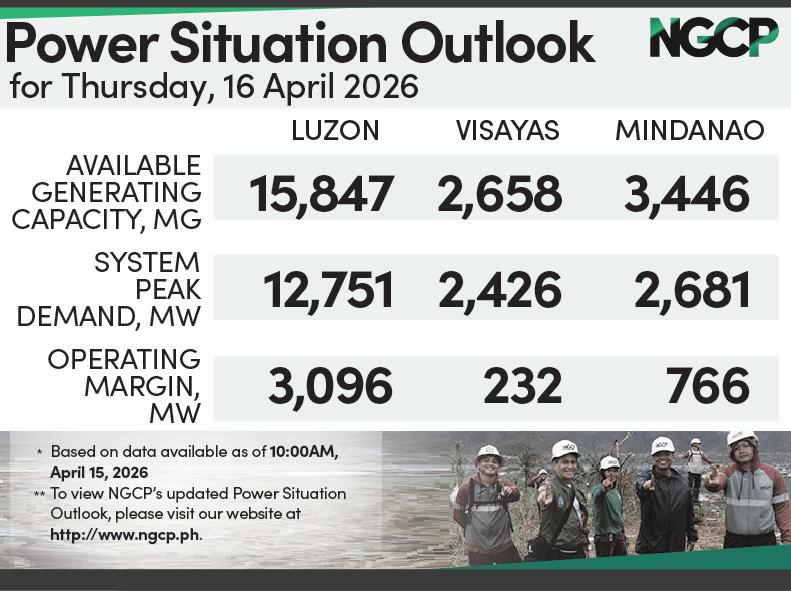
RBy Lenie Lectura @llectura
EPOWER Energy Development Corp. (REDC) is looking at posting “stronger” 2026 financial performance after it posted an increase of 177 percent in earnings to P330 million in 2025 brought about by the robust performance of its power assets.
Revenues surged to P775.8 million last year from P533.4 million in 2024, citing higher electricity sales and favorable feed-in-tariff adjustments.
Continued on B2
During the same period, 856 new Filipino firms joined the chamber, marking a 5.9 percent rise compared to 2024.
Amid this growth, the Dubai International Chamber formally opened its first representative office in Manila on April 14, aimed
Further, as of December 2025, a total of 2,592 Philippine companies were registered as active members of the Dubai Chamber of Commerce, reflecting a 23.3 percent year-on-year increase.
A statement read that the Dubai Chamber expects its office would serve as a platform for expanding business ties by working with both government and private sector stakeholders, as well as providing market intelligence, facilitating partnerships and supporting companies from both sides.
It added that the office will also assist Dubai-based firms looking to enter the Philippine market by offering local insights, identifying opportunities and connecting them with potential partners.
The Manila launch follows earlier engagements between the two
During the visit, the chamber also held a “Doing Business with the Philippines” forum and signed a pact with the Philippine Chamber of Commerce and Industry to strengthen cooperation and explore new areas for trade and investment.
Engagements continued into 2026, with Dubai Chambers hosting First Lady Liza Araneta-Marcos at its headquarters in January.
Dubai International Chamber is one of three entities under Dubai Chambers and focuses on supporting the global expansion of businesses and attracting foreign investments.
The opening of its Manila office forms part of the “Dubai Global” initiative, which aims to establish 50 international offices by 2030.
Malampaya PHL’s fortuitous asset
By Lenie Lectura @llectura
MANILA’S bet on Malampaya Deep Water Gas-to-Power project (Service Contract 38, or SC38) is paying off after it began commercial operation in 2002. So says the current top executive of its operator, Prime Energy Resources Development B.V. Prime Energy President Donnabel Kuizon Cruz told reporters on Tuesday evening that indigenous natural gas remains and must continue to remain as a critical pillar of the government’s energy security agenda as the commodity offers a more stable and cost-effective alternative to imported fuels while buffering the economy from global price volatility.
Indeed, for over two decades, SC-38 has supplied 20 percent of Luzon’s electricity and generated more than $14 billion in government revenue.
Likewise, Cruz noted the significance of the project amid rising energy costs.
She said during a roundtable discussion with journalists that Malampaya’s fuel cost equivalent is approximately P4.80 per kWh, compared with roughly P10.30 per kWh for imported liquefied natural gas (LNG). By maximizing indigenous gas resources, Malampaya helps protect Filipino consumers from global fuel price volatility while supporting more stable electricity costs, added the first female executive of Prime Energy.
Cruz considers the push by the Marcos administration to find more wells and more blocks as “a very good approach, [showing the government’s] more long-term focus.”
“Because in the end, if you don’t invest in indigenous gas, you will not get anything. You will reach a point where we import 100 percent. So, fortunately
this year, with this crisis, fortunately there is Malampaya,” she said.
“Just imagine if there was no drilling and the energy crisis could persist for the next two years. Next year, we will import everything and we will be totally dependent on the global market,” Cruz added.
Prime Energy and the rest of the SC 38 consortium members are undertaking the Malampaya Phase 4 (MP4) project. The consortium reiterated that it is on track to deliver first gas from the MP4 development by the fourth quarter of 2026.
The MP4 includes drilling new wells. So far, the SC38 consortium has successfully completed the drilling and flow test of the Camago-3 and the Malampaya East-1 (MAE-1) wells. These are expected to extend the operating life of Malampaya by around six years, reinforcing the Philippines’ first and only indigenous gas resource.
The SC 38 consortium continues to work closely with the Department of Energy and project partners to target first gas delivery from MP4 by the fourth quarter of this year.
“We already have two wells delivered. We’ve tested these wells and we’ve proven there’s gas that we can produce to maintain the Malampaya plateau for at least six years. So that is already a major milestone,” Cruz said.
“And now, immediately after that, we’ve started laying the pipes that would connect these wells to the platform. It’s on track. It’s going very well so far. So as long as we continue on this track, we remain on schedule, we should be able to meet the fourth quarter 2026 target,” she added.
Other members of the consortium working on this critical asset include UC38 LLC, Prime Oil & Gas, and PNOC Exploration Corp.
Solar goods maker gets PEZA approval BPO eyes long-term operation
THE Philippine Economic Zone Authority (Peza) announced it has approved a new renewable energy investment in Batangas, with a solar manufacturing firm set to produce panels for export markets.
Genuine Renewable Energy and Eco-Friendly Energy Network Corp. (GreeenC) was formally registered as an ecozone enterprise following the signing of its agreement on April 13.
With an initial investment of P370 million, the company will focus on the manufacturing and assembly of solar photovoltaic modules. It will operate at the Light Industry and Science Park III–Special Economic Zone in Santo Tomas, Batangas.
These panels are intended for a wide range of applications, including residential, commercial, industrial, agricultural, utility-scale, and off-grid use.
Peza said the company is expected to generate around $132 million in export sales during its incentivized period, with most of its output targeted for markets in the European Union.
The entry of a solar manufacturing firm comes as global demand for renewable energy equipment continues to rise, driven by efforts to reduce dependence on fossil fuels and manage energy costs.
Peza Director General Tereso O. Panga said the investment reflects broader shifts in the global energy landscape, where countries are seeking more stable and sustainable energy sources.
“Projects like GreeenC’s not only generate jobs and spur technological advancement—they also help reduce reliance on imported fossil fuels and mitigate vulnerabilities during global crises,” Panga said.
He added that investments in renewable energy manufacturing can contribute to long-term economic resilience, particularly as industries face volatility in fuel prices and supply disruptions.
The project adds to a number of export-oriented investments in clean energy within Peza areas, as the national government continues to position the country as part of global supply chains supporting the energy transition. Bless Aubrey Ogerio
RELX | Reed Elsevier PLC, a British multinational information and analytics company, has committed to develop Filipino talent as the company hopes to further operate in the country for the longer term.
The company, which has an office in the country called Reed Elsevier Shared Services (Philippines) Inc., said it wanted to deepen its role as a long-term partner in the country’s growth.
“Our commitment is to develop higher value digital analytics and technology-enabled capabilities, to deepen industry domain expertise, to grow leaders with a common mission of servant leadership, to invest in future-ready Filipino talent, and to strengthen our role as a long-term partner in the country’s growth,” Mark R. Lwin, managing director of RELX | Reed Elsevier, said. “Our mission has been to develop and invest in Filipino talent who have grown with us through the many years,” Lwin said.
“We are very well poised … to create employment for our people and help them build their careers and their professional capabilities.
This is part of the nation-building that we should all be proud of,” he added. Since its inception in 2011, the company has expanded from editorial and content operations to deliver services across the entire value chain, growing to a workforce of over 6,000 knowledge workers specializing in a wide array of technology and analytics.
These teams serve a range of industries—legal, healthcare, insurance, aviation, exhibitions, science and research, and financial services. Its footprint now stretches across Manila, Iloilo, Alabang, Cebu and Davao.
The Philippine operations of RELX contribute directly to the products and platforms that professionals around the world rely on daily—on software engineering, data science, AI development, risk analytics, and digital operations. RELX’s authoritative content gives professionals in the Philippines and around the globe the foundation to build solutions that support medical research, improve legal workflows and help organizations detect and prevent financial fraud. VG Cabuag


Banking&Finance
Customer communication in the age of cybercrime

COMMUNICATION is the heartbeat of our daily lives. Whether it’s through words, texts, gestures, or even the gradations of sign language, we’re constantly expressing our thoughts and emotions. Each time we share a laugh, a story, or even an impulsive idea, we’re reaching out and connecting with others.
No matter the language—be it familiar or foreign to the Titos and Titas of Manila—we find ways to communicate. And let’s be real—sometimes we throw in a “Char!” or “Ngani!” just to spice things up! It’s all part of the vibrant tapestry that makes up our interactions.
In our fast-paced digital world, have we truly evolved our communication, especially in light of the rising threat of cybercrime?
Just last week, I received a message from a coworker that struck me as odd: “May laman ba ang GCash mo?” In that instant, I realized his messenger account had been compromised, confirming my suspicions.
In this age of increasing cyber threats, ensuring safe communication is more crucial than ever. It’s not just about what you say but how you say it. By combining strong digital hygiene with secure tools— like encrypted messaging apps, multi-factor authentication, and careful online behavior— we can better protect ourselves. In the Philippines, where scams and phishing attempts are alarmingly common, it’s vital to remain vigilant, both personally and professionally.
As bank marketers, we have a unique responsibility to engage our audiences meaningfully across diverse channels and strategies. Here’s how we do it: Digital marketing: We harness the power of social media, email campaigns, and online advertising to connect with potential customers and maintain a vibrant online presence.
Content marketing: By creating informative, engaging content, we not only educate our customers about banking products and services but also drive traffic
By Reine Juvierre Alberto @reine_alberto

OVER P127.3 million in grants for climate resilience projects in Kidapawan, Iriga, Ormoc and Camarines Sur have been greenlit by the People’s Survival Fund (PSF) Board.
The Department of Finance (DOF) announced last Wednesday that the PSF Board approved funding for four projects aimed at boosting disaster resilience and restoring critical ecosystems. In Kidapawan City, P27.74 million will fund the “Canopy 25 Ecosystem Restoration Program and Installation of Early Warning Systems,” which aims to restore at least 700 hectares of forest areas. The funding includes maintaining around 400 hectares planted with 1.1 million seedlings and at least 579,000 more across degraded forest
BSP eases rules as financial system soldiers on in crisis
Tto our websites.
Community engagement: Building authentic relationships within our communities fosters trust and loyalty, paving the way for lasting customer relationships.
Data-driven strategies: Utilizing data analytics allows us to customize marketing messages and enhance customer interactions, ensuring that every individual feels valued and understood.
Clear and concise messaging: We prioritize straightforward language to demystify complex financial topics, helping our customers grasp essential information with ease.
In an era where cybercrime is a constant threat, establishing trust is not just important—it’s imperative. While technology can fortify our communications, it’s trust that truly strengthens our connections.
For banks, customer trust is the heartbeat of their existence. Think of it as the invisible currency that drives every transaction, holding far more weight than interest rates or flashy features. Without it, even the most sophisticated security measures and innovative financial products will fail to persuade customers to entrust their money. Trust isn’t merely a nice-to-have—it’s the foundation upon which everything else is built. In the financial realm, cultivating trust is not just a strategy; it’s a survival imperative.
Communication is the vehicle of trust. Trust is the destination of communication. Together, they create resilience against cybercrime and strengthen customer loyalty.
For more information, visit www.bmap.org.ph or https://facebook.com/BankMarketingAssociationPH
Judith C. Songlingco is the head of Corporate Affairs and Brand Marketing at Philippine Business Bank (PBB) and the secretary of the Bank Marketing Association of the Philippines (BMAP). She can be reached via judith.songlingco@yahoo.com. The writer’s views and her written piece do not necessarily reflect those of the BusinessMirror, the PBB and the BMAP.
areas, river easements and upland ancestral domains. The project also includes the installation of seven EWS in high-risk barangays. Total project cost is P38.59 million, with the local government unit (LGU) providing P10.85 million. Meanwhile, P42.35 million will be granted to Iriga City to support the “Securing Water as Adaptive Mechanisms for Survival and Sustainability” project that aims to restore and strengthen the ecosystem services and watershed functions of Mount Iriga.
The initiative includes organic vegetable farming demonstration farms, training for over 2,000 farmers, establishment of tree nurseries, deployment of 25 forest rangers and installation of three early warning systems.
The PSF will provide P32.48 million, with the LGU providing P2.8 million in support of the project,
By Andrea Louise San Juan
HE Bangko Sentral ng Pilipinas (BSP) is extending regulatory relief measures to BSP-supervised financial institutions (BSFIs) and their clients in response to the Middle East conflict, which have contributed to rising energy prices and supply constraints.
Approved under Monetary Board Resolution 296 dated 08 April 2026, the BSP said the relief measures aim to support lending activity and borrower recovery.
These measures include, among others, the grant of temporary grace periods of up to six months for loan payments of affected borrowers, and the deferment of agricultural loan payments for up to one year, subject to bank assessment, the central bank said.
BSP said loans to affected borrowers may also be temporarily excluded from past due and non-performing loan classifications for up to one year, subject to applicable notification and reporting requirements.
The BSP also urges BSFIs to help consumers and businesses during the national emergency by temporarily suspending fees and charges on online banking platforms or e-money services, including InstaPay and PESONet electronic
fund transfers. “Lower-cost digital transactions may help consumers and businesses by reducing the need for transportation to banks and e-money service providers,” the central bank pointed out.
“The BSP remains committed to promoting financial stability, financial consumer protection, and overall financial health amid the energy emergency,” it also noted.
Last week, analysts warned that the Philippine banking system could see a higher proportion of bad loans to the total loan books as the Middle East conflict saps the purchasing power and capacity to pay of Filipino borrowers especially in fuel and costsensitive sectors.
Latest data from the BSP showed that the gross non-performing loans (NPLs) ratio climbed to 3.33 percent in February—the highest in six months.
NPLs, also known as “bad” or “soured” loans, are credit accommodations that have not been paid for 90 days or more after the due date. The NPL ratio is the proportion of bad loans to total loans.
Michael L. Ricafort, chief economist at Rizal Commercial Banking Corp. (RCBC), pointed out that the latest NPL data has yet to fully reflect the effects of the US-Israel war on Iran.
According to Ricafort, the conflict that led to sharply higher prices of crude oil and started feeding into the prices of commodities, could reduce the disposable incomes and/ or purchasing power of consumers, businesses and other institutions.” Thereby, these factors “could also reduce sales, earnings, cost-cutting measures, even some employment losses,” he added.
In effect, these economic repercussions could reduce the ability to pay by some borrowers and debtors, which could lead to higher bad loans going forward, Ricafort said.
(See:https://businessmirror.com. ph/2026/04/09/wars-impacton-borrowers-capacity-to-payloans-flagged/)
Monetary Board Resolution 296 was issued after the declaration of a State of National Energy Emergency on March 24 by the country’s chief executive.
Covid-like programs for transport sector considered
By Jovee Marie N. dela Cruz @joveemarie
LAWMAKERS and banking sector representatives are considering a possible suspension or deferment of loan payments for transport operators affected by rising fuel prices.
During the House Legislative Energy Action and Development (LEAD) Committee meeting, House Committee on Transportation Chairman Rep. Franz S. Pumaren raised the appeal of transport stakeholders, noting that many operators are seeking government intervention similar to measures implemented during the Covid-19 pandemic.
Pumaren said he’s been visited by
Clark Intl
By Lorenz S. Marasigan @lorenzmarasigan
THE Clark International Airport Corp. (CIAC) announced last Wednesday of having remitted to the National Treasury more than half-a-billion pesos, its highest dividend contribution on record, driven by a sharp rise in net income.
CIAC President Joseph P. Alcazar said the remittance of P585.71 million—equivalent to 60 percent of the agency’s adjusted net income from its 2025 operations—was 88-percent higher than the P310.99 million re-
which has a total cost of P35.23 million.
Moreover, the PSF will shell out P42.35 million to help fund ‘Building Ormoc’s “Community Resilience through Green Riverscaping and Nature-Based Solutions for Flood Mitigation” project.
The initiative, which is funded by the PSF grant and P15.2 million from the LGU, will restore watersheds, reforest 180 hectares of upland areas and improve drainage along key rivers. It also includes the planting of 10.39-kilometer bamboo and fruit tree buffer along the Pagsangaan River, establishment of community nurseries and installation of five local weather monitoring systems.
Lastly, the PSF Board approved a P24.73-million grant to implement the “Electronic System for InterConnected Transformative Information On-Demand Emergency Operations Center” project in the
“many bus operators, jeepney operators, and even truck operators… asking if it is possible to suspend loan payments and penalties given the current situation.”
Representatives of government and private banking institutions said such action would require coordination with financial regulators.
“During the pandemic, we implemented deferments on loan amortizations,” Land Bank of the Philippines First Vice President Eden B. Japitana said. “Right now, we are improving our ‘Cares Plus’ program so we can extend similar assistance to borrowers affected by current economic conditions.”
Japitana said an expansion of any relief program requires coordination
mitted the previous year.
Alcazar said the company was able to surpass its previous high due to improved operations, alongside a consistent upward trend in revenue and efficiency in 2025.
The record payout was underpinned by a sharp improvement in the airport operator’s bottom line.
CIAC’s net income reached P976 million in 2025, a 72-percent jump from P565 million in 2024, following what the government firm describes as “enhanced operational performance and effective revenue generation.”
Under Republic Act 7656, government-owned and controlled corpora-
Municipality of Goa, Camarines Sur.
The project, with a total cost of P32.82 million with P8.091 million coming from the LGU, will install EWS to monitor water levels in the Rangas and Hiwakloy Rivers. A “Radio Frequency Automated Public Address System” will be installed to improve community alerts.
It will also upgrade the Emergency Operations Center to shift from manual to real-time monitoring, while the LGU will install a Local Weather Monitoring System for localized climate data. Capacity-building programs will also be conducted across 34 barangays to enhance data collection, climate-responsive planning and disaster preparedness protocols. Republic Act 10174 has mandated spending via the PSF for climate adaptation programs and projects of LGUs and accredited community organizations.
with the Bangko Sentral ng Pilipinas, a requirement echoed by Bankers Association of the Philippines Associate Director Arnel N. Almaden.
Still, Almaden said banks “need to further study this proposal and come up with appropriate recommendations.”
“However, …we would require guidance from our regulators to ensure an enabling environment for these measures,” he added.
Still, Almaden noted that the banking industry does not have consolidated data on transport-sector loan exposure and that such information is primarily with the central bank.
He said while banks remain open to deferment of loan payments or restructuring of debts, they need clear regulatory guidance.
House Committee on Ways and Means Chairman Rep. Romero Federico “Miro” S. Quimbo urged the banking sector to submit more concrete policy recommendations based on experiences during the pandemic.
Quimbo also noted that previous emergency loan programs had mixed results.
“We would like a clear assessment of whether loan deferment or suspension will effectively address the situation,” he said.
Quimbo also wants representatives of the central bank in future committee hearings who could provide data on the financial condition of transport-related borrowers.
tions (GOCCs) are required to declare and remit dividends to the national government.
Department of Finance (DOF) guidelines set a floor of 50 percent of adjusted net income for such remittances—a threshold that would have translated to approximately P488 million for the CIAC given its 2025 earnings.
The agency, however, exceeded that minimum after the DOF requested a higher payout rate.
“We also complied with the DOF’s request to increase the dividend remittance rate to at least 75 percent of CIAC’s 2025 net earnings, which led to the higher payout,” Alcazar explained. He said the company expects dividend contributions to grow further in the coming years as it moves ahead with seven flagship projects within the Clark Aviation Capital, aimed at contributing to national economic progress.
“CIAC remains financially strong due to prudent fiscal management, a business-friendly environment for locators, and its ability to attract partnerships and investments through development projects within the Clark Aviation Capital,” Alcazar said.
Health&Fitness
Beyond the flu: Experts highlight life-saving benefits of vaccination
By Candy P. Dalizon | Contributor
VACCINATION has long been viewed through a narrow lens—the idea that a flu shot simply prevents influenza. However, experts stress that the benefits of the influenza vaccine go far beyond avoiding a mild illness. More importantly, it plays a crucial role in reducing complications and preventing hospitalization.
Even if an individual contracts the virus after vaccination, the vaccine serves as a critical safety net. It helps make the illness more manageable and, more importantly, protects patients from severe complications that could otherwise require hospitalization.
“Before, when we talked about vaccination, we always told ourselves that we would be protected against influenza. It’s not only about not getting influenza. Even if you get the flu, if you are vaccinated, you will not need to go to the hospital. This is because the vaccine will protect you against complications related to influenza,” said infectious diseases expert Dr. Rontgene Solante.
Strong link
DR . Solante emphasized that data reveals a strong link between influenza and life-threatening events, an association that many people fail to recognize
during a viral infection. For instance, influenza can increase the risk of stroke. While many patients attribute such episodes solely to uncontrolled blood pressure, the underlying infection may actually serve as the trigger.
“What causes the blood pressure to become uncontrolled? Infection. Patients will have heart attacks because of, again, infection. So that’s the other gap there because they don’t know that they have the infection,” he explained.
Beyond cardiovascular risks, severe influenza can also lead to organ failure, particularly affecting the kidneys and liver. Hospitalized patients face even greater danger, including the risk of sepsis, a life-threatening systemic infection, as well as pneumonia and chronic obstructive pulmonary disease (COPD).
Dr. Solante noted that vaccination significantly reduces the likelihood of developing these severe complications, even if infection occurs.
Timing, however, is critical. To ensure protection before the peak season, April, May, and June are considered the optimal months for vaccination.
“April, May, and June represent a three-month window of opportunity to get vaccinated. This is because the subsequent months—July through December—constitute the seasonal peak of influenza cases,” he said.
World Immunization Week
DR. Solante was among the key experts at the recent media roundtable, “Katuwang sa Kalusugan: A Collaborative Movement to Make Prevention Accessible to All,” organized by biopharma leader Sanofi Philippines and premier HMO provider PhilCare.
The initiative coincides with the global observance of World Day for Safety and Health at Work (April 28) and World Immunization Week (April 24 to 30). Through this collaboration, Sanofi and PhilCare aim to empower the Filipino workforce to shift from reactive treatment to proactive health management, fostering safer and more resilient workplaces.
With the Philippine labor force participation rate reaching 65.7 percent, more than 52 million Filipinos are driving the country’s economic growth. However, vaccine-preventable diseases, particularly influenza, continue to pose a significant threat to this momentum.
“As the country’s workforce continues to grow, maintaining employee health is vital to sustaining productivity and economic growth,” said Vanessa Gomez, Head of Vaccines at Sanofi Philippines. “Immunization is one of the most effective ways to support the health and longevity of Filipino employees.”
While flu season in the Philippines typically
Cebu gov’t acquires new anesthesia machines for hospitals
TBy Carmel Pedroza | Contributor
HE Cebu Provincial Government is strengthening its healthcare system through the procurement of modern medical equipment, including 18 new anesthesia machines to enhance surgical capacity across its hospital network.
Capitol Public Health Consultant Nikki Catalan said the province acquired 18 units of the 9100c NXT anesthesia machine from GE Healthcare. These will be distributed to provincial and district hospitals in Balamban, Bogo, Carcar, Danao, Camotes, and Bantayan. Additional recipients include Isidro C. Kintanar Memorial Hospital, Juan B. Dosado Memorial Hospital, Mariano J. Cuenco Memorial Hospital, and Minglanilla District Hospital.
Officials said the new equipment will improve surgi -
cal precision and overall patient care. “Investments like this mean stronger hospitals, better preparedness, and better care for every Cebuano,” Catalan said.
The initiative supports the healthcare agenda of Governor Pamela Baricuatro, which focuses on upgrading hospital capabilities and expanding access to essential services.
Alongside equipment upgrades, the province is also expanding diagnostics. Cebu Provincial Hospital in Balamban has introduced mammogram services to improve early breast cancer detection, allowing patients to access screening and treatment closer to home.
To address workforce gaps, the hospital has also added four radiologic technologists, improving the speed and accuracy of imaging services.
Provincial officials said these efforts reflect a broader commitment to delivering accessible, efficient, and quality healthcare services for all Cebuanos.

The Medical City makes quality care more accessible with launch of Dr.
By Anne Ruth Dela Cruz
‘IAlfredo R. A. Bengzon Patient Access Ward
WANT us to be the example to all private hospitals... The Medical City’s (TMC) message will and always will be—at least while am here—that we should continue to push the boundaries in increasing access without compromising quality.”
This was the message of Dr. Stuart Bennett, President and Group CEO of The Medical City, as the institution unveiled a milestone initiative honoring the enduring legacy of the late Dr. Alfredo R. A. Bengzon. The launch reaffirms TMC’s commitment to making quality healthcare more accessible to every Filipino.
Dr. Bennett emphasized that Dr. Bengzon’s legacy will remain deeply embedded in the institution. “Dr. Bengzon will always be linked to this hospital by virtue of the fact that we will always have a PhilHealth ward and that we will continue to support it,” he said, underscoring TMC’s commitment to inclusive healthcare and collaboration with the government.
“There is no distinction between the PhilHealth Ward and our other rooms. In fact, this is one of the nicest wards we currently have. What this reflects is our commitment to elevating the standard of care for every patient we serve,” he added.
“We will continue to work closely with Dr. Edwin Mercado, President and CEO of PhilHealth, and explore innovative ways to maximize PhilHealth benefits so that they reach more patients. Our goal is to make quality healthcare the starting point of every patient’s journey at The Medical City,” Dr. Bennett said.
Access to world-class healthcare
LOCATED on the 10th floor of The Medical City Ortigas,
the ward expands access to world-class healthcare by maximizing PhilHealth benefits and helping ease the cost of care. Patients can now receive quality treatment in a setting that prioritizes safety, dignity, and overall wellbeing, carrying forward Dr. Bengzon’s vision of bringing quality care within reach of all Filipinos.
The ward features a total of 51 beds, including two isolation rooms designed to support safe and efficient patient care. It also includes nine mother-and-baby-friendly rooms, a tribute to Dr. Bengzon’s championing of the Philippine Milk Code, providing a nurturing environment for mothers and newborns.
Dr. Bengzon was a respected healthcare leader and former President and CEO of The Medical City, known for advancing patient-centered care in the Philippines. A Ramon Magsaysay Awardee and former Secretary of Health, he championed reforms that significantly improved access to quality healthcare for Filipinos.
The opening ceremony was attended by leaders of The Medical City, members of the Bengzon family, and key stakeholders, including PhilHealth President and CEO Dr. Edwin Mercado. The event underscored the critical importance of public-private collaboration in advancing healthcare access across the country.
A continuing legacy DR . Ruben Kasala, EVP and CEO of TMC Ortigas, emphasized the importance of continuing Dr. Bengzon’s legacy and aligning infrastructure with patient needs.
“Today, we are not only opening a new ward; we are also paying a well-deserved tribute to the legacy of Dr. Bengzon, whose vision continues to shape how we deliver care at The Medical City. It is truly meaningful for us to honor his contributions in a way that directly ben -
efits our patients, expanding access to quality care and making it more responsive and sustainable, especially for those who depend on PhilHealth,” Dr. Kasala shared. For his part, Dr. Mercado highlighted the broader significance of the initiative, noting its role in strengthening patient care systems and advancing universal healthcare in the country.
“We hope that TMC’s commitment inspires other private hospitals to follow suit in moving the needle in our collective efforts to deliver universal healthcare in the country. I believe the question here is not capability but will; the will to look at every PhilHealth member and say, ‘You belong here, too.’ Decades from now, no one will ask how many private suites The Medical City had. They will ask how many lives were changed. And today, that number grows because of the decision to put the patient first,” Dr. Mercado said.
Health as a basic right
REPRESENTING the Bengzon family, Margaret Bengzon shared how the initiative carries forward Dr. Bengzon’s legacy in shaping healthcare in the Philippines.
“With health being such a basic need, a basic right, there is so much opportunity to do good. But as we all know, those with the greatest needs are often those with the least means...Many will say that is the work of the government. But Dr. Bengzon believed, and I think he has been proven right, especially post-Covid, that the government cannot do it alone. The private sector must step up and take its share in addressing inequities in our healthcare system,” she said.
“We, as a family, are so grateful that you have immortalized Dr. Bengzon’s life ethos. I’m sure he’s using any influence he has to make sure this will be successful,” she added.
New partnership launched to expand nutrition interventions among children
UBy Claudeth Mocon-Ciriaco
NDERNUTRITION remains one of the most urgent challenges for children in the Philippines.
One in four children under the age of five is stunted, and more than half a million are wasted. The situation is most severe in Bangsamoro Autonomous Region in Muslim Mindanao (BARMM), where more children are affected by undernutrition and at risk of its long-term consequences on their growth, learning and development.
Addressing undernutrition starts when children are in their mothers’ wombs, and upon and after they are born. Nearly one in five women are nutritionally at risk, while 21.7 percent of those pregnant suffer from iron deficiency anemia, a condition where the blood lacks enough iron to carry oxygen efficiently, which can affect a mother’s health and a baby’s growth. The Philippine government, through the Department of Health, the National Nutrition Council, and UNICEF, has launched a new partnership under the UNICEF-led Child Nutrition Fund (CNF) to provide P756.2 million (US$13.2 million) in catalytic financing to complement the country’s ongoing commitment to expand high-impact nutrition interventions nationwide, including in the BARMM. Strengthen service delivery THIS partnership will help strengthen service delivery
peaks between June and November, health experts stress that protection is needed yearround. For unvaccinated adults, especially those with underlying health conditions, the flu can lead to severe complications, missed workdays, lost income, and increased medical expenses that strain household finances.
Breaking barriers to adult immunization
DESPITE the World Health Organization’s position that vaccines are essential for disease control, adult immunization remains widely overlooked. Common barriers include cost, limited access, and a lack of awareness about the importance of vaccines beyond childhood.
To address these challenges, the SanofiPhilCare partnership aims to expand access to vaccines and strengthen awareness among corporate members. The initiative aligns with PhilCare’s mission to prioritize preventive care over reactive treatment.
“PhilCare continuously seeks solutions to make healthcare more responsive to the evolving needs of Filipinos,” said PhilCare President and CEO Jaeger L. Tanco. “By integrating critical services like flu vaccination into our healthcare offerings, we are addressing gaps in adult preventive care and supporting the
long-term well-being of the workforce.” The partnership also recognizes that health extends beyond the individual.
“There is a need for greater urgency in protecting the adult population, especially the working class. Each working member we protect represents not just one person, but the livelihood of an entire family,” said Zainab Sadat, General Manager for Sanofi Vaccines (Southeast Asia & India). Sadat added that the cost of immunization is significantly lower than the economic impact of a single flu episode. A typical infection can result in at least three days of missed work—an especially heavy burden for daily wage earners and essential workers. “So there is a real need to raise awareness and encourage people not to take this lightly. Sometimes the reason people don’t get vaccinated is not a lack of understanding, but simply a lack of prioritization,” she said. Through their shared commitment to preventive healthcare, Sanofi and PhilCare are helping ensure that no one is left behind, enabling workers to stay healthy, remain productive, and continue supporting their families. More importantly, this collaboration lays the foundation for a healthier, more resilient Filipino society.
Oral health care brands unite for nationwide dental care advocacy
By Vincent Peter Rivera
IN celebration of World Oral Health Day, Haleon’s premier oral healthcare brands, Sensodyne and Polident, launched “Ngiting Tagumpay,” a nationwide advocacy program designed to equip Filipinos with the services and knowledge needed to combat tooth sensitivity and tooth loss.
With Sensodyne reporting that six out of 10 Filipinos suffer from tooth sensitivity, and Polident finding that only 11 percent of those who need dentures actually wear them, this campaign aims to bridge the gap between oral health needs and treatment.
In collaboration with the Philippine Dental Association (PDA) and the Philippine Association of Registered Dental Technologists (PARDTI), the campaign localizes this year’s global theme, “A happy mouth is a happy life.”
“We bring that message locally through one unified campaign, ‘Ngiting Tagumpay: Ngiting Alaga, Ngiting Confidence,’ because when we invest in oral health, we invest in people’s ability to smile, to speak, and to live with confidence,” said Maimai Punzalan, General Manager of Haleon Philippines.
The advocacy officially kicked off at Market! Market! where attendees received free dental consultations, listened to educational discussions, and interacted with entertaining booths related to oral care concepts.
Supporting this vision, PDA President Dr. Lucilo G. Niñal Jr. emphasized that initiatives like this are beneficial in bringing meaningful oral care conversations one step closer to every Filipino.
“As a national association of dental professionals, PDA remains deeply committed to providing prevention, education, and improving access to oral health care in our communities. Initiatives like this remind us that promoting oral health care is not something we do alone, it is made stronger through collaboration” he noted.
Addressing two oral concerns with one advocacy
THE “Ngiting Tagumpay” advocacy is more than an awareness campaign; it is a comprehensive response to two of the most prevalent yet overlooked oral health issues in the country.
For Sensodyne Assistant Brand Manager Aleia Salazar, the mission starts with changing the Filipino mindset regarding pangingilo (tooth sensitivity).
Data shows that six out of 10 Filipinos experience this discomfort, yet many delay treatment until the pain becomes unbearable.
“Tooth sensitivity worsens over time, and it isn’t just a byproduct of aging,” Salazar explained.
to quality care in health facilities and communities and stronger protection during the first 1,000 days of a child’s life.
across communities, alongside the systems that support it, including supplies and the use of nutrition data for better targeting and follow-through.
The CNF supports the Government’s efforts to reduce stunting and wasting through a catalytic financing model that links domestic public resources with global funding and drives greater public investment in nutrition. These investments help make essential nutrition services more accessible for mothers and young children, especially during the first 1,000 days, while strengthening the systems needed to sustain and expand results. These combined investments aim to reach more than 8.4 million children under five, and 1.2 million pregnant women, who will benefit from
“Investing in nutrition is one of the most powerful ways to improve every child’s survival, learning, and long-term well-being, benefits that extend far beyond childhood. Through the Child Nutrition Fund, we are helping more families access the right support at the right time, especially during the first 1,000 days,” said UNICEF Philippines Representative Kyungsun Kim.
Expand access to maternal nutrition services
LIKEWISE, through this partnership, which also complements World Bank financing, the Philippines will expand access to maternal nutrition services,
“It is something we must address as early as now. Our goal this year is to expand awareness on why it worsens and, more importantly, to identify the wrong practices Filipinos should avoid.”
To drive this behavior change, Sensodyne is taking a highly intentional approach to consumer engagement. Recognizing that the heart of Filipino culture is food, the brand will conduct “food hops” and visit food hubs across the Philippines, places where sensitivity is most likely to be felt in real-time.
“We want to capture the moments where pangingilo actually occurs,” Salazar added. “By providing free samples and conducting live demonstrations at groceries and pharmacies, we want families to feel the ‘instant difference’ that using the right toothpaste can make.”
Beyond the consumer level, the brand continues to fortify its professional ties. Through webinars, livestreams, and partnerships with dental schools and the PDA, Sensodyne is ensuring that expert advice is accessible to every Filipino, regardless of their location.
While Sensodyne focuses on prevention and maintenance, Polident continues its long-standing mission of restoration. Now in its fourth year, the “Oplan Balik Ngiti” initiative remains the cornerstone of Polident’s contribution to the advocacy. Polident Brand Manager Lia Magno pointed out the saddening reality behind the statistics: of the 12 million Filipinos suffering from tooth loss, many are forced to prioritize daily survival over dental restoration.
Since its inception in 2023, the program has already transformed the lives of 5,600 individuals. This year, in partnership with the PDA and PARDTI, the mission scales up to provide an additional 1,500 Filipinos across Luzon, Visayas, and Mindanao with free dentures and specialized care kits. However, the advocacy extends beyond physical dentures. Polident recognized that the transition to wearing dentures can be a profound, and often isolating, life change.
“We have created a safe space where denture wearers can find comfort and alliance with one another,” Magno noted, citing the Samahang Balik Ngiti Facebook community, which has grown to over 7,000 members. “It’s about bringing back the ‘postiso confident’ smile and ensuring no one has to navigate that journey alone.”
To formalize the nationwide advocacy, a symbolic commitment ceremony of the sealing of partnership among the representatives of Polident, Sensodyne, PDA, PARDTI, and drugstore partners was conducted to mark the formal alliance of Ngiting Tagumpay: Ngiting Alaga, Ngiting Confidence.
including multiple micronutrient supplements for pregnant women, and strengthen government systems to deliver sustainable, high-quality nutrition programs that help every child survive, thrive, and reach their full potential.
“In BARMM, where the burden of undernutrition is highest, strengthening nutrition services for mothers and young children remains a priority, particularly in harder-to-reach communities. This partnership with UNICEF and the Child Nutrition Fund will strengthen the delivery of essential nutrition interventions and support children’s growth and development. It is also an investment in BARMM’s future when children are well-nourished, they are more likely to stay healthy, learn well, and contribute to their communities and the local economy,” said Dr. Kadil M. Sinolinding Jr., Minister of Health, BARMM.
Editor: Anne Ruth Dela Cruz
Denmark, PHL celebrate 80th yr of strong diplomatic cooperation

THE Philippines and Denmark kicked off their celebration of 80 years of diplomatic relations with the unveiling of the official commemorative logo aboard BRP Miguel Malvar at the Naval Operating Base in Subic Bay.
Featuring unique and shared symbols of the two countries, the logo represents a celebration of histories and a forward-looking commitment to innovative and inclusive progress, as encapsulated by the theme “Partners for a Sustainable Future.”
The unveiling ceremony on April 7 highlighted the evolution of both countries’ bilateral cooperation into
I.
Ia modern and dynamic partnership responsive to the rapidly changing geopolitical landscape. The milestone event aboard one of the Philippine Navy’s newest and most advanced guided missile frigates showcased the two nations’ mutual commitment to maritime security and rules-based international order.
“In spite of the distance between our countries, we have cultivated a
Cervantes reignites
NSTITUTO CERVANTES de Manila, together with the Embassy of Spain and with the support of Ayala Land and Make it Makati, invite the public to the Ayala Triangle Gardens for the iconic staging of this year’s Día del Libro on Saturday, April 25.
This celebration of World Book Day promises a vibrant lineup of activities designed to inspire and share the joy of reading with everyone.
From fiction to non-fiction and poetry to prose, thousands of books will be up for grabs at the venue. Día del Libro will feature Manila’s top bookstores and publishing houses that will be selling a wide array of books at a 20 percent discount. Following the tradition in Spain, each book purchase will come with a free rose.
Día del Libro will officially kick off at 9 a.m. with a special inauguration to be led by Ambassador Miguel Utray of Spain, marking the official opening of the event.
Among the activities, a classic stands out: Escribo el Quijote. Like every year, to commemorate the Day of Miguel de Cervantes, visitors will be challenged to join a “Quixotic” attempt: to handwrite the classic novel “Don Quixote de La Mancha” —an initiative which Instituto Cervantes started a decade ago. The final handwritten book will be deposited in the Library of Instituto Cervantes. The activity will begin at the start of the festivities. No prior registration will be required. Participants in the handwriting chain will receive a free book from Instituto Cervantes.
Opening chapter
AT 9:45 a.m., Instituto Cervantes will host Plantadores de Historias (Story Planters)—an activity that invites participants to write poems and short stories on plantable papers, which are then planted on a pot to grow into a plant. This activ-
partnership founded on shared values: respect for international law, commitment to multilateralism, and a common aspiration for peace, stability, and sustainable development,” said the Philippines’ ambassador to Denmark Pablito Mendoza in a message to the ceremony.
Citing Denmark as a reliable partner of the Philippines in harnessing innovation and promoting sustainability for its local maritime industry, Rear Admiral Juario Marayag—the Philippine Navy’s Commander for Naval Sea Systems Command— welcomed the milestone as another headway for both nations to deepen engagements to guarantee safe and secure seas for future generations. He said “the security of our waters is inherently connected to the prosperity of our countries and people.”
Ambassador Franz-Michael Mellbin of Denmark acknowledged
the remarkable progress that the two countries have made over eight decades of enduring friendship: “Although we are separated by a great body of water, we have bridged our nations’ shared interests: from economic [and security, to people-to-people ties. We will still] work together to bring more welfare, better economy, and more jobs to our people.”
Denmark was among the first wave of countries that formally established diplomatic relations with the Philippines in 1946, following the end of World War II and the founding of the United Nations.
According to the Embassy of Denmark, the 80th anniversary celebration will be marked by a series of events in both nations throughout 2026, focusing on cultural exchanges, business promotion activities, and enhanced strategic dialogue between their governments.
passion for books via Día del Libro ’26
ity uniquely combines ecology and literature, making it especially engaging and meaningful.
Children and teenagers will also find their place as they enjoy a storytelling session at 10:15 a.m. The story “Las aventuras de Don Quijote” (The Adventures of Don Quixote), will offer a delightful first introduction to the world of Don Quijote. Libros que Importan (Books That Matter) is a public book exchange where participants anonymously share books they love. Each donated book includes a personal note explaining why it holds special meaning, creating a deeper connection between readers.
As part of Día de Libro, Instituto Cervantes will also offer free beginner Spanish classes at 10:30 a.m. and 4:15 p.m. Those interested may visit the Instituto’s booth to join these sessions.
Afternoon activities
AT 12 p.m., theatre lovers can catch a sneak peek of Repertory Philippines’ upcoming production of “Man of La Mancha” —the Tony Award-winning musical inspired by Don Quijote. In this heartfelt adaptation, Nonie Buencamino will take on the dual roles of Don Quijote and Miguel de Cervantes, bringing the story to life with stirring music, and unforgettable moments in an exclusive early preview.
The Argentinian performance of “Tango para siempre” (Tango Forever) at 12:30 p.m. will share stories through movement, with each step and gesture reflecting the joy and rhythm of literature. At 1 p.m., the Design Center of the Philippines will conduct handson workshops on handmade paper making and journal making, offering participants a creative way to craft their own stationery. Through the poetry recital “Ber-
song Hispano-Pinoy” at 1:30 p.m., Instituto Cervantes invites poetry lovers to bring Spanish and Filipino verses to life, celebrating the beauty of the language and the art of expression.
It will be followed at 2:30 p.m. by “Jazz en el parque”—a concert by two of Manila’s most exciting young jazz musicians: Gabriel Lazaro and Bergan Nuñez. They will pay their own tribute to the masters of Latin jazz.
From 3 p.m., Spanish language learners will have the chance to take part in an Universitarian Yincana especially designed for university students across Manila. This segment will include activities such as dance, live music, quizzes, poetry creation, drawings, and more.
For those interested in art, Instituto Cervantes will present the space “Latag,” where Urban Sketchers Manila will display their works on Día del Libro, and conduct a workshop on sketching.
Book lovers can look forward to launches and presentations organized by several publishers. Visitors can also meet authors, and get their copies personally signed courtesy of the collaboration with participating publishing houses.
At 3:30 p.m., visitors are invited to a free Latin dance class offered by Manila SBKZ Latin Dance Festival.
Toward the evening AS gastronomy is an essential part of culture, participants will have the chance to savor the flavors of Spanish cuisine throughout the day. They should not miss the special paella gigante at 6:15 p.m. to be presented by the Sociedad Española de Beneficencia. The dish will be cooked live accompanied by a vibrant flamenco performance, creating a festive and immersive experience for everyone.
To end the evening on a high note, Instituto Cervantes will present a live
concert by a renowned Filipino reggae-band Brownman Revival starting at 8 p.m., followed by a lively DJ session to close Día del Libro 2026 in style.
Whether one is a lifelong reader or just discovering the joy of books, the Día del Libro 2026 is “a day to celebrate the power of words to connect us with each other, and to the world around us,” according to Instituto Cervantes de Manila.
The event is organized in collaboration with the National Book Development Board of the Philippines, Spanish Chamber of Commerce in the Philippines (La Cámara), Asesoría de Educación en Filipinas, Make It Makati, Ayala Triangle Gardens, Ayala Land Inc., Design Center of the Philippines, Sociedad Española de Beneficencia, Embajada de Argentina en Filipinas, Embajada de Chile en Filipinas, Embajada de Colombia en Filipinas Embajada de México en Filipinas, Repertory Philippines, Manila SBKZ Latin Dance Festival, University of the PhilippinesCollege of Music, Circle of Chabacano Dreams, Atrapavientos, and Kalon Film Productions.
Bookstores and publishing houses will also be part of the festivities: Anvil Publishing, Artbooks.ph, Ateneo University Press, 19th Avenida, Isang Balangay Media Productions, Bookforless, Circle of Chabacano Dreams, FEU Bookstore, Fullybooked, Bien Chabacano, Kahel Press, Milflores Publishing, Ortigas Foundation, Tawid Publications, Vibal Publishing House, Piefke Trading, Central Books, Everything’s Fine, Komiket. com, Plaza Books, Good Intentions Books, and Exploding Galaxies. Admission to all Día del Libro activities is free on a first-come, firstserved basis. Search the event teaser on YouTube. Visit Instituto Cervantes de Manila’s web site and Facebook page for more information about Día del Libro 2026.

ANBERRA—Ambassador
CAntonio Morales welcomed Asean-Australia Centre Head Fiona Hoggart, representatives from the Asia Institute of the University of Melbourne, and 31 emerging leaders from across Southeast Asia and Australia to the Philippine Embassy for an engagement under the country’s 2026 Asean Chairship.
The Emerging Leaders Program on Fostering Foreign Policy and Security Leadership is supported by the AseanAustralia Centre and contributes to the mission of building a network of future leaders equipped to strengthen regional cooperation and drive positive change.
In his remarks, Morales outlined the Philippines’ strategic focus for its Asean Chairship, anchored on the three pillars of the Asean Community and articulated through the “3Ps”: Peace and Security Anchors (advancing stability through dialogue, adherence to international law, and enhanced cooperation on non-tradi-
tional security challenges); Prosperity Corridors (fostering inclusive growth through economic integration, digital transformation, and sustainable development); and People Empowerment (promoting social inclusion, protecting vulnerable groups, and strengthening a shared sense of Asean identity).
For him, emerging leaders play a key role in ensuring that Asean remains resilient, dynamic, and responsive amid evolving regional and global concerns.
For her part, Hoggart expressed her appreciation for the embassy’s engagement, and reaffirmed Australia’s strong support for the Philippines’ Asean Chairship.
She also noted the significance of 2026 as the fifth anniversary of the Asean-Australia Comprehensive Strategic Partnership, underscoring her country’s longstanding commitment as the region’s first dialogue partner in 1974, and its first Comprehensive Strategic Partner in 2021.
Brit. Chamber welcomes e-Governance IRR, bats for stronger cybersecurity measures Ambassador highlights PHL’s chairship with Asean-Australia emerging leaders

THE British Chamber of Commerce Philippines (BCCP) underscored the growing importance of cybersecurity in the country’s digital transformation, citing strong market potential alongside rising global cyber risks. This came after the ceremonial signing of the Implementing Rules and Regulations (IRR) of Republic Act 12254, or the e-Governance Act, led by the Department of Information and Communications Technology (DICT) on March 24.
BCCP welcomed the IRR’s issuance, as it noted its role in strengthening digital infrastructure through improved interoperability, cybersecurity, and public service delivery, alongside the e-Government Master Plan (EGMP).
The chamber emphasized that prioritizing cybersecurity is timely, as rising geopolitical tensions in the Middle East are reshaping global cyber risks, with 91 percent of major organizations already adjusting their strategies in response.
As these developments unfolded, BCCP also welcomed the launch of the Cybersecurity Handbook developed by the United Kingdom in partnership with The Asia Foundation, which serves as a practical guide for UK firms exploring opportunities in the Philippines.
The Philippine cybersecurity market is projected to expand significantly, growing from $282.7 million in 2026 to $417.1 million by 2031, representing a compound annual growth rate or CAGR of 8.1 percent. While the country currently trails regional peers such as Vietnam and Thailand in market size, its growth trajectory is expected to outpace several Asean counterparts, positioning the Philippines as a key emerging market in Southeast Asia.
The chamber noted that market expansion is driven by increasing digital adoption, regulatory reforms, and heightened exposure to cyber threats. Despite this growth, a large portion of the market remains underserved, particularly among micro, small, and medium enterprises or MSMEs, which account for more than 99 percent of businesses in the Philippines, but remain largely untapped by cybersecurity providers.
BCCP said the United Kingdom remains a global leader in cybersecurity. It is home to more than 2,000 firms supported by strong collaboration among the government, industry, and academia. Through institutions such as the National Cyber Security Centre, the UK continues to drive global norms and strengthen global cooperation in cybersecurity.
Executive Vice Chairman Chris Nelson of BCCP emphasized the importance of integrating cybersecurity into the country’s digital agenda, stating that “cybersecurity cannot be an afterthought—it must be integrated from the start, which is by design and by default.” On behalf of the chamber, Nelson urged the Philippines to continue passing legislation, “particularly on e-commerce, on digital payments and, of course, on cybersecurity.” BCCP reaffirmed that ensuring a secure digital environment will be critical to sustaining economic growth and maintaining investor confidence. As the Philippines accelerates its digital transformation, collaboration with trusted international partners, according to the chamber, will be essential in building cyber resilience and unlocking new market opportunities.
UNVEILING of the anniversary’s commemorative logo HENRY EMPEÑO
AMBASSADOR Antonio Morales (center) welcomed Asean-Australia Centre Head Fiona Hoggart (front row, center) and the region’s emerging leaders to the Philippine Embassy. DFA
CONSUL Emilio Lopue (from left), BCCP Executive Vice Chairman Chris Nelson, Ambassador Teodoro Locsin Jr., and Asean BAC Phils. Executive Director Anthony Patrick Chua
BancNet is ranked 5 on Best Workplaces™ in the Philippines 2026
BancNet was recently recognized as one of the Best Workplaces™ in the Philippines for 2026, according to Great Place to Work™, the global authority in workplace culture. BancNet ranked 5th among 15 shortlisted companies in the small organizations category (companies with 10-99 employees). The recognition celebrates organizations that foster a high-trust, highperformance workplace culture where employees feel valued, supported, and empowered to do their best work.
The recognition was awarded at the Conrad Manila during the Best Workplaces in the Philippines 2026 awards ceremonies attended by leaders from the Great Place to Work Certified community.
For BancNet, the recognition reflects more than a workplace distinction— it represents the collective spirit of its people.
“We are deeply honored to be recognized as one of the Best Workplaces in the country,” said Emmie S. Reyes, Chief Executive Officer of BancNet.
“This recognition is especially meaningful because it reflects the voices and experiences of our people. Every day, our teams work together with a shared sense of purpose—to support the country’s payments ecosystem by enabling secure and reliable payment services for millions of Filipinos. This recognition belongs to every BancNeteer who contributes to the culture of trust, collaboration, and excellence that defines our organization.”
The Best Workplaces™ badge, a globally recognized accolade, is awarded

companies that demonstrate a hightrust, high-performance workplace culture.
Organizations are evaluated through the Trust Index© survey, which measures employees’ workplace experiences across three key relationships—with management, with colleagues, and with their work.
This year’s Best Workplaces list recognizes 55 organizations across the Philippines, representing companies that have successfully built cultures where employees feel respected, heard, and inspired. The honorees were selected based on confidential employee feedback gathered from surveys conducted between late 2024 and 2025, representing insights from over 300,000 employees nationwide.
This year’s theme, “The New Business as Usual,” reflects a growing realization among organizations that the future of work is already unfolding. The 2026 honorees demonstrate that when organizations place people, trust, and inclusion at the center of their culture, they are better equipped to innovate, adapt, and thrive.
According to Evelyn Kwek, Managing Director of Great Place to Work ASEAN & ANZ, organizations that prioritize trust consistently outperform others in innovation and resilience.

SINCE 2019, the Tiong Bahru name has bridged the gap between Filipinos and the rich depth of savory Singaporean cuisine. Named for the famous neighborhood in Singapore that features one of the country’s most beloved hawker centers, Tiong Bahru in the Philippines has become synonymous with the same diverse flavors that distinguish it as a can’t-miss destination for foodies everywhere. Now, the noted restaurant chain’s growth

for authentic Singaporean cuisine anywhere in the
continues under the fitting name of Tiong Bahru Singapore Flavours. With their menu of timeless classics, the restaurant is the go-to place for authentic Singaporean cuisine anywhere in the Philippines. Among the signature offerings at Tiong Bahru Singapore Flavours is the ever-popular Hainan chicken. Poached chicken served with seasoned rice and a delicious helping of sauces mixed from ginger, chili, and soy sauces, Hainan chicken has
Meanwhile, Charles Plumley, General Manager of Great Place to Work Philippines, emphasized the role of Filipino culture in shaping strong workplaces.
“The Philippines has always had an extraordinary relationship with people. We have a culture rooted in community, in bayanihan, and in the belief that everyone deserves to be valued. The organizations we recognize today show that when trust is placed at the heart of the workplace, Filipino talent doesn’t just thrive—it leads.”
At Great Place To Work®, a “great workplace” is defined as one where employees trust their leaders, take pride in their work, and experience genuine camaraderie with colleagues. Organizations recognized on the Best Workplaces list demonstrate not only high levels of trust but also consistency of positive experiences across diverse employee groups, proving that great workplaces are truly For All™.
For BancNet, the recognition reflects its continued commitment to building an environment where employees can grow, collaborate, and contribute meaningfully to the organization’s mission. The Makati-based company was previously certified a Great Place to Work™ for two consecutive years --in 2024 and 2025.
become an international favorite for those seeking a filling and savory meal. One can even have the same experience with the restaurant’s roasted chicken instead, trading in the poached flavors for a brown chicken skin that straddles the line between crispy and tender all at once.
Far from staking their claim on a single signature dish though, Tiong Bahru Singapore Flavours seeks to capture the sense of cultural diversity that makes Singaporean cuisine so unique. Now, their expanded menu also includes mouthwatering dishes such as bak kut teh, a pork rib bone broth steaming with a rich, savory flavor as well as juicy, delicious slices of pork to enjoy with it. There’s also the ever-hearty laksa, whose deep red broth and perfectly textured noodles demonstrate the perfect balance of spices, fillings, and sensations all in a single bowl.
Each dish showcases the love of the team behind every kitchen at Tiong Bahru Singapore Flavours. The delicious meals reflect the chain’s dedication to bringing authenticity to the Filipino market, where a single bite transports each customer to the bustling hawker centers of Singapore, perusing the wide variety of cuisines and dishes available to them.
Tiong Bahru Singapore Flavours demonstrates the immense cultural power of food. With enough care and passion for craft, a well-cooked meal has the power to bridge oceans and create understanding between two foreign cultures. It’s no wonder that they’ve been so dedicated to their promise of providing “a true taste of Singapore, just like home.”
PCCI picks Guerrero as chair of 52nd PBC&E
THE Philippine Chamber of Commerce and Industry (PCCI) recently announced the appointment of Arturo “Butch” Guerrero as the Chair of the 52nd Philippine Business Conference and Expo, the country’s premier gathering of business leaders, policymakers, international partners, and MSMEs, happening on October 13 to 14, 2026, at the historic The Manila Hotel.
The PCCI leadership unanimously appointed Guerrero as Chair. Guerrero led major conferences in the past, including the National Conference of Employers in 2023. Last year, Guerrero served as Vice Chair in the 51st PBC&E.
“With his experience and expertise in organizing events, we trust that this year’s conference will be equally substantive, meaningful, and successful as the previous PBCs,” PCCI President Perry A. Ferrer said.
The 52nd PBC&E with the theme “Raising the Bar: Empowering Business for a Resilient Future” coincides with the Philippines’ Chairship of the Association of the Southeast Asian Nations (ASEAN) and the 60th Conference of the Confederation of the Chamber of Commerce of Commerce and Industry (CACCI) that PCCI is hosting in Manila this year.
“Three major business summits will happen towards the end of the year. We will align our efforts and PBC agenda with that of the two other events. After all, we share a common goal of creating a dynamic and prosperous regional economy,” Guerrero said.
A forward-thinking business leader, Guerrero brings more than 30 years of experience in labor and employment policy, workforce solutions, and tripartite collaboration.
As Chairman of Temps and Staffers, Inc, a leading staffing firm and a senior national employer representative, he has consistently driven progressive, data-enabled labor

Business Conference and Expo strategies while championing reforms that strengthen social protection and promote industrial peace in the Philippines. His expertise spans national policy, corporate governance, digital transformation, and social security systems allowing him to bridge the priorities of workers, employers, and government institutions.
The 52nd Philippine Business Conference will convene leaders from across industries to address pressing challenges and opportunities in the Philippine economy. It traditionally opens with the Vice President of the Philippines delivering a keynote address and concludes with the President of the Philippines receiving a set of policy recommendations that emanate from PCCI members, local chambers, and industry partners.

SOCIEDAD Española de Beneficencia
(SEB) is hosting its signature fundraising event, Paella Gigante, on Saturday, April 25, 2026 at 4 pm at Ayala Triangle Gardens, Makati City in partnership with Instituto Cervantes’ annual Dia del Libro celebration.
Now in its ninth year, Paella Gigante has grown into a beloved community gathering that celebrates Spanish-Filipino heritage through food, culture, and camaraderiewhile supporting a meaningful cause. The event is held in collaboration with the LTB Philippines Chefs Association, Ayala Land / Make It Makati, La Cámara, and other valued partners.
Approximately 30 chefs from leading restaurants and culinary schools across the Philippines will come together to prepare the iconic dish. Spearheaded by the LTB Philippines Chefs Association, this culinary collaboration will utilize a massive paellera measuring over 10 feet in diameter, capable of serving up to 1,000 guests.
Founded in 1948 by Spanish nationals in the Philippines, Sociedad Española de Beneficencia is a non-profit, nonstock charitable institution dedicated to
improving the quality of life of elderly Spanish and Filipino individuals in need. Over the decades, SEB has provided shelter, welfare support, counseling, and burial assistance to its beneficiaries.
The organization currently partners with the Santa Maria Josefa Home for the Aged in Malate and the Little Sisters of the Abandoned Elderly Home in Mandaluyong. Through initiatives like Paella Gigante, SEB continues to expand its reach and extend care to some of society’s most vulnerable members. For further info www. sebfilipinas.com
The LTB Philippines Chefs Association, on the other hand, is a non-profit organization composed of hotel and restaurant professionals from various nationalities. It is dedicated to maintaining and elevating culinary standards in the Philippines and is a member of the World Association of Chefs Societies (WORLDCHEFS), a global network committed to advancing culinary excellence.
Each P1,000 Paella Gigante 2026 ticketdonation includes a generous serving of paella. Proceeds will go directly to SEB’s programs for the elderly.
Shincheonji marks 42nd anniversary with celebrations in the PHL, worldwide
SHINCHEONJI Church of Jesus (SCJ) marked its 42nd founding anniversary with celebrations across the Philippines, bringing together 1,910 members at 31 onsite locations nationwide and 484 more participating virtually. The event was part of the global commemoration of the denomination’s growth from humble beginnings to a worldwide movement attracting tens of thousands of new members each year. Globally, the main commemorative
service was held on March 15, 2026, at the Cheongju Church in South Korea, attended by over 2,000 members in person and streamed live to believers across South Korea and other countries. Chairman Lee Man-hee emphasized the importance of faith grounded in the Bible, particularly the Book of Revelation, urging members to remain faithful to what he described as the unchanging Word of God. Founded on March 14, 1984, Shincheonji Church of Jesus began with small gatherings
before expanding its presence internationally. The church attributes its continued growth to its Bible education initiatives, particularly through the Zion Christiana Mission Center, which has produced large numbers of graduates from its Bible courses worldwide. The church also cited its expanding partnerships with churches globally through various cooperation agreements. According to Shincheonji, it has established hundreds of partnerships with churches in South Korea and thousands more across dozens of countries.
Apart from its religious activities, the organization highlighted its humanitarian efforts, including blood donation drives, plasma donations during the Covid-19 pandemic, and volunteer work in disasteraffected communities. The church said it also conducts community outreach programs such as medical missions and support activities for vulnerable sectors.
Shincheonji said it intends to continue expanding its outreach while promoting what it described as faith centered on biblical teachings.
Great Place to Work Philippines General Manager Charles Plumley (center) is flanked by, from left: BancNet Talent and Organization Development Officer Belle Lobitana, CEO Emmie Reyes, Human Resources and Administration Head Polly Austria, and HR Officer Jao Burgas to
The Philippine Chamber of Commerce and Industry has appointed Arturo “Butch” Guerrero Chair of the 52nd Philippine
Chairman Lee Man-hee delivers a message at the 42nd Founding Anniversary Commemorative Service of Shincheonji Church of Jesus, held at Cheongju Church, Shincheonji Church of Jesus on the 15th.
Paella Gigante: Your grain of rice for the elderly in need
Tiong Bahru Singapore Flavours brings authentic taste of hawker centers to PHL
Tiong Bahru Singapore Flavours is the go-to place
Philippines


Parentlife

A healthy home starts with a healthy liver
MUJI has been in the Philippines for nearly a decade, providing Filipinos with everyday essentials, from household goods and garments to food, designed to support a simple and comfortable lifestyle whether at home, at work, in school, or on the go.
In celebration of their 9th anniversary and to thank customers for their continued support, Muji is holding Muji Week until April 19, 2026, offering 10-percent off on all items, including sale items and drinks for all Muji Members. The promotion is available in all physical stores and online at www. mujiph.com (online promo code: MujiWEEK).
If you’re not yet a Muji Member, you can easily sign up for free in-store or online at woobox.com/vhqgji. As a Muji Member, you’ll get exclusive in-store and online offers and a free drink upsize every last week of the month.
Coinciding with Muji Week is their monthly campaign, Enjoy a Comfortable Daily Life with Muji, featuring products designed to help customers stay cool and refreshed during the summer season. Featured here are some selections that will help consumers cool down the summer heat. Now that you’ve discovered Muji’s essentials for a comfortable daily life, visit their physical stores in Glorietta 3, SM Mall of Asia, Estancia Mall, Greenhills Mall, Festival Mall, SM North Edsa, Uptown Mall, Shangri-La Plaza, Greenbelt 3, Power Plant Mall, Central Square, and Muji SM Megamall Pop-up Store or shop online at www.mujiph.com.



AS parents, we are often the “frontliners” for our family’s health. We notice the onset of flu symptoms, prepare the meals, remind everyone to drink water, and try our best to keep everyone moving and nourished. But there is one part of our body we rarely talk about at home until something goes wrong—the liver.
According to the Hepatology Society of the Philippines, around 18 million Filipinos are at risk of Fatty Liver Disease. That number is very alarming. It reminds us that many families may be quietly living with a condition that often shows no early symptoms.
This is what makes liver health a parenting conversation too. Because when we talk about family wellness, we are not only talking about our children; we are also talking about ourselves, the caregivers who keep everything running.
The challenge is while early testing is possible, access to screening is not always easy or top of mind. Many of us delay checkups simply because life gets busy. Work, school schedules, and daily responsibilities take priority.
This is why initiatives that bring healthcare closer to families matter. Phospholipids (Essentiale Forte P), manufactured by global healthcare company Opella, has partnered with Mercury Drug Corp. to launch a
Free Liver Test Program available in select Mercury Drug stores nationwide. The program, which runs throughout the year, aims to make early detection more accessible and encourage Filipinos to take proactive steps in protecting their liver health.
“Many Filipinos are unaware that everyday lifestyle factors such as diet, stress and alcohol consumption, as well as existing conditions such as hypertension, obesity and type 2 diabetes, can affect liver health,” said Gheck Barlis, brand manager of Phospholipids (Essentiale Forte P).
“At Essentiale, we believe that having a healthy liver allows people to get more out of life. Since the liver supports many vital functions that help keep the body energized and balanced, taking care of it is key to maintaining overall health and well-being. Through this initiative, we hope to encourage more people to check their liver health regularly and take proactive steps to care for it.”
What I appreciate about this program is its simplicity. The test, known as an SGPT (Serum Glutamic Pyruvic Transaminase) test, measures liver enzyme levels through a small blood sample. It follows a clear and guided process—from a quick health check to the test itself, to receiving results via email, and even an option for consultation with a doctor. All of these are offered free of charge. For many families, this removes a major barrier: access.
The liver, after all, is one of the most hardworking organs in our body. It performs hundreds of functions daily, from filtering toxins to supporting metabolism.
As shared by Dr. Anna Guia Limpoco of the Philippine Academy of Family Physicians, when liver cells are damaged, enzymes leak into the bloodstream, which can be detected through tests like SGPT. Elevated levels may already signal that the liver needs attention.
Even children can benefit from simple habits that
protect the liver early. Ensure they eat balanced meals rich in fruits, vegetables, and whole grains rather than sugary or processed foods. Encourage active play and limit screen time to keep their bodies moving. Teach them to drink enough water daily and avoid excessive sweets or fried snacks. Building these habits early helps children develop lifelong routines that protect their liver and well-being.
Taking care of our liver is not about dramatic changes. It is about consistent, intentional choices like balanced meals, active routines, mindful consumption, and regular checkups. For some, supplements like Phospholipids (Essentiale Forte P) may also support liver cell health and regeneration, especially when combined with a healthy lifestyle.
“Community pharmacies are often the first place people go to for health advice, so programs like this allow us to play a more active role in promoting preventive care by making services such as liver screening more accessible to our customers,” said Martin Gumayan, vice president for chainstore operations of Mercury Drug Corp. “Preventive healthcare is an important part of empowering customers to take charge of their well-being,” added Cora Lim, vice president for merchandising of Mercury Drug. “By working with trusted healthcare partners like Essentiale, we can bring meaningful health initiatives into our stores and make it easier for customers to access services that support early detection and better health outcomes.”
As we continue to juggle the many roles of parenting, may we remember this simple truth: the better we take care of ourselves, the better we can take care of the people we love. Every choice matters… from what we eat to how we rest, move, and check in with our health. And sometimes, the first step toward lifelong wellness begins with something simple yet powerful: choosing to care—today.
How to improve your chance of a healthy pregnancy later in life
By Laura Ungar | The Associated Press
DR. JACQUELYN MEANS knew that being pregnant in her late 30s would be challenging.
“It is definitely harder on your body. You just feel a lot more fatigued. There are certain complications to watch out for,” said Means, a Texas OB-GYN who had her first child at 37 and her second at 39. “It’s usually going to be fine, but there are things to be aware of.”
Like Means, more and more women are having babies later in life. A federal report showed that 21 percent of all births in the US were to women 35 and older in 2023, up from 9 percent in 1990. And this “advanced maternal age” raises risks for both moms and babies.
Older pregnant women are more likely to have conditions like high blood pressure and obesity, for example, and are more prone to developing pregnancy complications. They’re more likely to undergo cesarean sections and give birth to twins or babies with some genetic abnormalities.
But don’t be too worried. Risks are generally low; they’re just higher than average. And while most older moms have normal pregnancies, doctors say there are ways lower to risk and prevent problems before, during and after pregnancy.
“Moms over 35 can still have a healthy pregnancy and a happy baby,” said Dr. Michael Warren, chief medical and health officer for the March of Dimes, a nonprofit that works to improve the health of mothers and babies.
BEFORE GETTING
University of Texas Southwestern, said optimizing your health is like “building your baby’s first home.”
That involves following the time-honored advice of eating a well-balanced diet, staying active and avoiding risky behaviors like smoking. Being as healthy as possible is important, Zink said, because pregnancy can be as rigorous as a marathon.
“Your volume of blood expands; it’s harder work for your heart,” she said. “And just the discomforts of pregnancy—all kinds of things—are a little bit better tolerated if you’re in good physical condition.”
A checkup before trying to conceive can be helpful, doctors said, allowing you to discuss health concerns, get treated for any conditions that might affect your pregnancy and make sure you’re up to date on vaccinations.
DURING PREGNANCY, ASK YOUR DOCTOR ABOUT PRENATAL TESTS AND SCANS
DOCTORS suggest getting a first-trimester ultrasound, which can measure the size of the fetus, help confirm the due date and check for multiple fetuses.
Women over 35 tend to produce more of the hormone that stimulates the ovaries to produce eggs, and they also may use in vitro fertilization to get pregnant. Both of these things increase the likelihood of twins or triplets, which puts you at a higher risk of complications such as premature birth.
Older women may also want to consider having blood drawn for noninvasive prenatal testing, which can screen for chromosomal abnormalities in a fetus such as Down syndrome and trisomy 13 or 18.
Zink said older women can also ask about a “growth ultrasound” at around 32 or 34 weeks of
pregnancy. “It shows us if the placenta is still doing a good job,” she said. “Do you have normal fluid? Do you have normal growth?”
Ultrasounds late in pregnancy may also spot problems with the fetus.
KNOW THE RISKS DURING BIRTH
THE percentage of babies delivered by C-section rises with maternal age, averaging 48 percent of live births for women 40 and older, according to the March of Dimes, which looked at the years 2022 to 2024. Women who undergo C-sections have a significantly higher risk of maternal complications such as infection and bleeding than those who deliver vaginally.
Medical reasons for C-sections include having chronic health conditions that may make vaginal birth risky, such as diabetes or high blood pressure, the March of Dimes said. Other reasons include complications during labor.
Placenta problems, which can result in dangerous bleeding before or during labor, are also more likely in older women but they don’t occur that often.
Means gave birth to both of her children vaginally but had placenta-related issues. She also had gestational diabetes with both of her pregnancies.
After giving birth to her first child, a daughter, in 2023, some of her placenta was retained and had to be removed, and she needed treatment for a postpartum hemorrhage. A week after giving birth to her son last year, she suffered severe bleeding and had to be treated at the hospital.
“Once I got past all those bleeding issues, I’ve been fine...And both my kids are super healthy, so I’m thankful for that,” she said.
FROM left: Shalimar Estrada, ethical channel lead, Opella; Gheck Barlos, brand manager, Essentiale, Opella; Amal Fathy, ASEA Science Hub head, Opella; Dr. Anna Guia Limpoco, board of trustee, Philippine Academy of Family Physicians; Martin C. Gumayan,
country head, Opella;
Aguilar, manager, merchandising, Mercury Drug Corp.; Asuncion Asis, AVP, chainstore operations, Mercury Drug Corp.; Jenny Lou Ilagan, trade marketing lead, Philippines and Indonesia, Opella; and Azie James Hong, customer development manager, Opella;
Record
field of 44 teams in Rising Stars Cup
RECORD
Aincluding an entry from New Zealand, will duke it out in the fourth edition of the Shakey’s Girls Volleyball Invitational League (SGVIL) Rising Stars Cup unfurling on Monday at the La Salle Green Hills gym.
Surpassing last year’s 30-squad field, the highly anticipated high school girls’ volleyball tournament promises more exciting and thrilling competition featuring up-and-coming talents.
Titleholder National University banners a competitive 20-school Division 1. Domuschola w International School, on the other hand, will have its hands full defending its Division 2 crown in a 24-entry field that includes guest team Diverse Auckland Cubs
“Since the establishment of the second division last year, more schools have approached us and expressed interest in joining the league. There are now 20 in Division 1 and 24 in Division 2, with a team from New Zealand joining as well,” said Dr. Ian Laurel, president of league organizer Athletic Events and Sports Management, Inc. (ACES) during the tournament presser on Wednesday at the Shakey’s Paseo de Magallanes.
“So, the interest at the high school level in joining the Shakey’s GVIL has exponentially grown, and it is an honor for us, a pleasure for us to be able to host them again this year,” Laurel added.
Teams in Division 1 are divided into four pools with five squads each, while Division 2 features four pools of six teams.
The Lady Bullpups, who beat Bacolod Tay Tung in a cardiac five-set finale last year, lead Pool A alongside King’s Montessori, inaugural champion California Academy Antipolo, Lyceum of the Philippines Academy and Bethel Academy.
Three-time runner-up Bacolod Tay Tung is in Pool B with Canossa Academy, Holy Rosary College, University of Perpetual Help and Immaculate Conception College.
De La Salle-Lipa, Far Eastern University-Diliman, University of the Philippines Integrated School, San Felipe Neri Catholic School and St. John’s Institute compose Pool C while in Pool D are 2024 champion Adamson University, Emilio Aguinaldo College, Chiang Kai Shek College,



Experience prevails in milestone match Sports
By Troi Santos
ALEXANDRA EALA’S longanticipated first showdown with Leylah Fernandez ended in a stark 1-6, 4-6 defeat in the Round of 32 at the Porsche Tennis Grand Prix on Tuesday.
Under the lights of Stuttgart’s Porsche Arena, the Filipina fell short of an upset—but the match underlined how firmly she now belongs on the sport’s biggest stages.
Fernandez, the 2021 US Open runnerup and current world No. 25, set the tone from the start with aggressive, first strike tennis on the indoor clay.
Taking the ball early on return and stepping inside the baseline in rallies, the Canadian lefthander repeatedly rushed Eala out of her patterns and the numbers behind that early barrage were unforgiving.
Fernandez landed 63 percent of her first serves and won 69 percent
of those points, while Eala managed 52 percent first serves and won 64 percent behind them.
The decisive separation came on second serve: Fernandez captured 87 percent of her second serve points, compared to just 40 percent for Eala, turning almost every tight game in her favor.
By the end of the night, Fernandez had broken Eala’s serve four times to Eala’s once and finished with a 63-46 edge in total points won.
Strip the match down to patterns, and Fernandez’s game plan is clear. She attacked Eala’s second serve relentlessly, treating it almost like a short ball.
The Canadian won nearly nine of every 10 points behind her own second delivery while holding Eala to four of 10, a gulf you almost never overcome at tour level.
On Eala’s service games, that pressure meant she was playing catchup from the very first shot of the rally,
forced to defend deep in the backhand corner rather than stepping in behind her lefty forehand.
Beyond the score, the pairing carried a symbolic weight that had been building for days.
The opener was billed as an “all Pinay” clash—two lefthanders with Filipino bloodlines, one representing Canada and the other the Philippines, sharing the main stadium of a WTA 500 event.
Fernandez’s Filipino-Canadian mother has long been part of her public story, and she has become a familiar figure to Filipino communities following her run to the US Open final in 2021 and subsequent recognition events in New York.
Eala, meanwhile, is the first Filipina to crack the WTA Top 40, a trailblazer whose rise has turned each
Guico, Dee notch statement wins in JPGT
ZACH GUICO and Andrea Dee delivered commanding performances in the International Container Terminal Servics Inc. Summit Point Junior PGT Championship on Wednesday in Lipa, Batangas.
Guico stamped his class in his season debut, firing a closing 81 to secure a convincing five-shot victory in the boys’ 7-10 division with a 151 total in the 36-hole tournament. The rising star from Quezon City built a solid cushion with a two-under 70 in the opening round.

Despite a spirited challenge from Zoji Edoc, who fired an eagle-aided frontside 37 to briefly threaten, Guico stayed composed and coasted to victory. Edoc carded an 80 for a 156, while Asher Abad placed third for the second straight leg with a 163 after a 78.
Dee, also from QC, cruised to
a five-shot triumph with a 160 after an 83. She thwarted the charge of Mount Malarayat leg winner Winter Serapio, who wound up with a 165 after an 82, while Jehanne Mendoza carded a second 84 for third at 168.
The next leg is set April 28 to 30 at John Hay in Baguio.
In the girls’ 11-14 class, Cailey Gonzales from Las Piñas surged past Mavis Espedido with a late-round charge, stringing together three birdies after an opening bogey to fire a 72 and win by four at 150. Espedido had a 154 after a second 77, while Tyra Garingalao finished third at 171 after an 84.
Rafael Leonio turned the boys’ 1518 category into a showcase of control, pulling away with a 73 for a 149 and building a commanding six-stroke margin heading to the final round of the 54-hole tournament. Taeyang Yun shot a 77 for a 155 total, while Bien Fajardo
MPL PH draws sports, entertainment figures
OBILE Legends: Bang Bang (MLBB) Professional League (MPL) Philippines Season 17 continues to cement
status as the country’s premier weekend esports spectacle. The event has evolved beyond competitive gaming into a
touchpoint that bridges industries and communities and more than just a battleground for the nation’s top MLBB teams, MPL PH has become a vibrant stage where sports, entertainment and digital culture intersect. It has drawn not only passion-
A rock named Ed
WHEN basketball was slower and less explosive than it is today, when finesse counted for something and shots were more deliberate than instinctive, there ruled a tall guard in the backcourt named Edgardo Roque.
He was 6-foot-1—a kilometric boost at a time when 5-foot-9 was tall and 6-foot-flat was a marvelous thing. He grew up loving the game in the vast fields that nurtured his growth in San Pascual, Obando, Bulacan. He was born with an innate basketball IQ, had the intriguing appeal of a basketball warrior and a charming dose of cockiness that served him well in the dog-eat-dog sport that he chose to play. His talents were recognized as he grew, so much so that the JRC Heavy Bombers (known these days as Jose Rizal University or JRU) took him in as one of its top bombardiers. In those days (the late 1950s) when the National Collegiate Athletic Association of the Philippines
ate fans but also a growing roster of Filipino athletes and celebrities who choose to experience the thrill live. Within the first three weeks of its Regular Season, the league has already welcomed an impressive lineup of personalities spanning traditional sports, mainstream entertainment and online content creation.
These distinguished guests were not only in attendance but were also formally recognized through the MPL PH Wall of Fame, a platform that celebrates individuals who have brought pride and honor to the Philippines

(NCAA) was THE collegiate league, Jose Rizal was a gold mine of basketball talent where national players and Olympians like Elias Viray Tolentino, Egay Gomez, Rene Canent, and later, Philip Cezar, Etok Lobo, Rhoel Deles and Sixto Agbay, among others, showcased their talents. For Ed Roque to be recruited by this hardy team with a no-nonsense approach to basketball, much like the San Antonio Spurs, was a testament to his strength and prowess. While there he was hands down a collegiate hero who kept JRC always in the fight. The Heavy Bombers, however, would only win the NC crown in 1963 and 1964—two years in a row—behind the one-two punch of
was at 162 after an 80.
In the girls’ premier division, Kendra Garingalao maintained a comfortable lead at 160 after a an 81 as Rafa Anciano pooled a 165 after a 79 to move to second.
Alexie Gabi also carded a 79 to tie Chloe Rada, who faltered with an 84, at 166, while Levonne Talion shot an 86 for a 169.
In JPGT Visayas-Mindanao Series, Tashanah Balangauan outlasted Dominique Gotiong in a gripping day-long duel of skill and composure, sealing a onestroke victory in the premier 1518 division of the ICTSI Alta Vista Junior PGT Championship on Wednesday in Cebu City.
of her maindraw appearances into a national talking point. Their first professional meeting arrived earlier than expected—
Eala had initially been penciled into Stuttgart qualifying, but a late withdrawal by Zheng Qinwen opened a slot in the main draw, pushing the world No. 46 directly into a headline firstround assignment.
For Filipino fans watching from latenight Manila to earlymorning North America, the sight of two players with shared heritage trading blows on such a stage felt like a milestone in itself.
Eala now turns toward bigger outdoor events in Madrid, Rome and eventually Roland Garros, where slower clay and open conditions may better amplify her heavy topspin and endurancebased game.
Stuttgart did not deliver the breakthrough many in the Philippines hoped to see, but it offered something more quietly valuable—a clear snapshot of the gap between a rising 20 years old and a Grand Slam finalist, and evidence that the distance between them continues to narrow.
Pató: Tour of Luzon aligns with sports tourism objectives

THE MPTC Tour of Luzon 2026 hits the road on April 29 in Calatagan and no less than the National Sports Tourism Inter-Agency Committee (NST-IAC) has bestowed its recognition on the 14-stage race that features local and foreign teams.
“The Philippine Sports Commission [PSC] supports the conduct of the MPTC Tour of Luzon 2026 as an activity aligned with the objectives of the NSTIAC,” said Patrick “Pató” Gregorio, who chairs both the PSC and the NST-IAC.


“The PSC likewise recognizes the significance of the event in providing opportunities for athlete participation and in contributing to the continued development of Philippine sports,” added Gregorio, now considered as the “Father of the Tour of Luzon” revival for having spearheaded the fabled summer spectacles’ return last year.
“To this end, the participation of qualified athletes and personnel is strongly encouraged,” he said. The Tour of Luzon returns for a second straight year under the slogan “A Heritage in Motion” with the Grand Depart for Stage 1 set at 8 a.m. from CaSoBe in Calatagan to a Grand Finish in Tagaytay City where PhilCycling and Philippine Olympic Committee president Abraham Tolentino will welcome the entourage.
At least six foreign teams have confirmed their participation, according to the Tour’s Chief Organizer and CEO Arrey Perez, with nine local teams— UCI continental and club—vying for the top individual prize of P1 million and team purse of P2 million from the total prize pot of P12 million.
Three more overseas squads have pending applications for the race supported by the PSC, MVP Group and title sponsor MPTC and raced under UCI regulations through sanctioning national federation PhilCyling. Gregorio said that the Tour of Luzon caters not only to the elite in cycling but to the multitude of aspiring young riders all over the country.


through their craft.
At its core, the MPL PH Wall of Fame is not just a ceremonial tribute, but a storytelling platform that connects excellence across disciplines. Each honoree embodies the spirit of “Palag Na To,” the league’s defining theme for the season. During the opening week, MPL Philippines welcomed Michael Christian
sweet shooting Egay Gomez and the Jeff to his Mutt, the pesky guard, Rene Canent.
As for Roque, he was snatched right after his college stint by Ysmael Steel—one of the hottest, strongest teams in the Manila Industrial and Commercial Athletic Association (MICAA), the big and main basketball league of that era. Known as the Admirals, Ysmael won the championship on the year Ed Roque joined their ranks.
As an Admiral, Roque was outstanding enough to be chosen for the national team and in 1960, was part of the squad that represented the Philippines in the 1960 Rome Olympics.
“He was the best of the tall guards,” recalls Ignacio Dee, top caliber sports journalist who is a veritable walking encyclopedia of Philippine sports history. “The No. 2 spot in those days was manned by tall guards like Orly Bauzon, Manuel Jhocson and Roque. Roque was the best of them, and he was always proud of his defensive ability. He always savored an incident where he said sinupalpal daw niya si Caloy [Loyzaga].”
Well, Roque’s biography would show he later played alongside Caloy “The Big Difference” Loyzaga. Roque transferred to the
Martinez, the first skater from Southeast Asia and from a tropical country to qualify for the Winter Olympics. Alongside Martinez, Southeast Asian Games gold medalists Justin Kobe Macario and Geli Bulaong were also present during the opening week.
Last weekend, MPL PH shone the spotlight on rising cycling talent Zedric Honorica, whose story has quickly captured national attention.
At just 21 years old, Honorica made headlines after breaking a two-decadeold Philippine national record in the men’s elite sprint at the Asian Track Cycling Championships 2026, clocking an impressive 10.865 seconds. Honorica competed using the very
Admiral’s arch-enemy, the Yco Painters, in 1964. The Yco-Ysmael rivalry pre-dates and in many ways outdoes the latter-day great rivalry of Crispa and Toyota.
The rivalry was so deep and so intense that after the Admirals failed to defend their National Seniors title and broke their vow to tie the Yco Painters’ record of seven straight championships, Ysmael players and coaches shaved their heads and played bald the rest of the way.
Roque would be a key piece on the Yco team and conquer more crowns and assignments as a Painter/Redshirt till 1970. He played for the country in the Summer Olympics in Tokyo in 1964, won gold as a member of the national team that competed in the 1962 Jakarta Asian Games, represented the country in the Asian Basketball Confederation (ABC) tournaments in Taipei, Kuala Lumpur and Seoul in 1963, 1965 and 1967, respectively, then left again in 1968 for the Mexico Olympics. He was a national team member six times and was named Mr. Basketball—the equivalent of MVP in those days—for his exemplary talents. Roque played a brief while with the Mari -
same bike he once relied on as a food delivery rider—going head-to-head with international athletes equipped with top-tier, high-performance gear. Honorica is also an MLBB player, known to favor Khufra, and is a supporter of Team Liquid Philippines. Athlete-turned-actor John Vic De Guzman also visited the MPL PH Arena, bringing with him his experience and passion for competitive sports and esports—he was the captain of the 2019 SEA Games men’s national volleyball team that secured a silver medal. Not just athletes, the iconic dance group SexBomb made a special appearance last April 12 as part of MLBB’s Summer Break campaign.
wasa team in the MICAA in the early 70s just before the Philippine Basketball Association’s birth in 1975. In the PBA, he suited up as a referee alongside confreres Elias Tolentino, Manny Jhocson and Bay Ledesma. And then he retired.
Ed Roque would stay hale and hearty up to his 80s, maintain the upright, athletic physique he had as an athlete well into the 2020’s and keep his regular guy, I’m OK-you’re OK outlook intact.
He would attend and help organize countless Yco Team reunions to keep the camaraderie and the Yco family togetherness going and going and going.
Last April 12, Ed Roque left the game for good. He was 88. He left behind his family, wife Lena, children Dondi, Ernest Gil, Sandy, Ethel, Sasha and Nina and awesome basketball memories carefully preserved in volumes of albums and clippings.
Now he’s probably having a good time up there with his Admiral buddies and Yco compadres in the big playing arena in the sky. Welcome to the “Sky Room,” Ed. Vive La Compagnie!
LEYLAH FERNANDEZ completes the straight-sets win over Alexandra Eala in under 90 minutes.
PSC chairman Patrick “Pató” Gregorio says the revived Tour of Luzon serves as a platform for elite athletes and a source of inspiration for young cyclists. PSC
his support for the local esports league.