NATION’S LIFEBLOOD
At 75, PRC evolves from merely blood provider to modern, full-service humanitarian organization
By Roderick L. Abad Contributor
Being seated in the Pacific’s “Ring of Fire” makes it highly vulnerable to earthquakes and volcanic eruptions. This tropical nation, likewise, experiences at least 20 typhoons yearly on the average. It’s not even spared from the impacts of climate change in the past recent years: think Haiyan (Yolanda), billed as the strongest cyclone ever to hit land. A s if the natural calamities were not enough, the country had to deal the past three years with the pandemic. While the ensuing health crisis situation has somewhat eased, it still faces the threats of Covid-19, fully recovering towards post-pandemic. Beyond all these adversities, Filipinos often find themselves at the center of several conflicts and violence here and abroad.
Fortunately, the Philippine Red Cross (PRC) has always been there for Filipinos to turn to in times of need and emergencies. Through the years, the country’s foremost humanitarian organization has never failed to extend assistance or be of good service to every Filipino anytime, anywhere.
Humble beginnings
DOWN memory lane, a closer look at its past makes everyone appreciates more the PRC, which turns 75 today (April 15), as a bastion of heroism and compassion that


never ceases to amaze and inspire every Juan to also do good unto others.
L eafing through the pages of its memoir reveals that it was Apolinario Mabini, the heart and brains of the Philippine Revolution, who paved the way for its inception when he encouraged the founders of the Malolos Republic to approve the Constitution of the National Association of the Red Cross on February 17, 1899, with Hilaria del Rosario de Aguinaldo as the appointed president.
From just being a local unit of the American National Red Cross at the turn of the 19th century, forming the standalone Philippine branch of the Red Cross was initiated by President Manuel L. Quezon in 1934. Since his Commonwealth government could not sign the Geneva Conventions, it did not push through—until the country became independent from the American regime.
On February 14, 1947, President Manuel A. Roxas inked the Treaty of Geneva and the Prisoners of War Convention. Over a month after, he signed Republic Act 95, mandating the creation of the PRC. This was followed by Aurora Aragon Quezon, the organization’s first chairman, receiving a cable from Geneva, which meant the recognition for the PRC, as per approval of the International Com-
mittee of the Red Cross (ICRC).

The PRC’s charter has been amended several times since its creation. In 2010, then President Gloria Macapagal-Arroyo signed into law Republic Act 10072, otherwise known as the Philippine Red Cross Act of 2009, penned by Senator and Philippine National Red Cross (PNRC) Chairman Richard J. Gordon. Officially, it changed the

name of PNRC to PRC.



Since then, the organization has grown by leaps and bounds. Starting off with merely 13 chapters in 1947, the PRC is currently comprised of 102 chapters, serving millions of Filipinos nationwide.
From blood letting to lifeline BECAUSE the Philippines was under tumultuous times during the
formative years of this philanthropic association, its primary role back then was to collect blood from donors.

“ The Red Cross was known for blood in 1947, when we got our independence [and, then,] when we first got our Charter by International Convention. Also, disasters were forthcoming in the 1950s, [with the rise of the] Hukbalahap [Hukbong Bayan Laban sa Hapon],”
Gordon told the BusinessMirror in an interview. “In fairness to the past, the Red Cross people in V. Luna, they gave psychosocial support. But the focus, [starting with] Rosa Rosal, was blood.”
W hile PRC had already made its mark in this kind of service, eventually, it has evolved from a blood-collection agency to a fullfledged humanitarian organization
in 1992, following the Mount Pinatubo eruption. During the time, its chapters in Tarlac and Zambales helped set up makeshift shelters to accommodate the displaced people overcrowding the evacuation centers. Augmenting their efforts was Gordon, mayor of Olongapo City back then, who deployed a fleet of vehicles to move the evacuees from San Marcelino in Zambales to his bailiwick.


Apart from responding to this historic event, the country and the rest of the world have witnessed the PRC coming as fast as it could to the aid of those in need whenever there is any disaster like typhoons, earthquakes, armed conflicts, disease outbreaks, and even emergencies concerning Filipinos outside of the country. It has built more

PESO EXCHANGE RATES n US 55.2700 n JAPAN 0.4170 n UK 69.2478 n HK 7.0412 n CHINA 8.0475 n SINGAPORE 41.8047 n AUSTRALIA 37.4896 n EU 61.0678 n KOREA 0.0424 n SAUDI ARABIA 14.7355 Source BSP (April 14, 2023) A broader look at today’s business BusinessMirror EJAP JOURNALISM AWARDS BUSINESS NEWS SOURCE OF THE YEAR (2017, 2018, 2019, 2020, 2021) DEPARTMENT OF SCIENCE AND TECHNOLOGY 2018 BANTOG MEDIA AWARDS ROTARY CLUB OF MANILA JOURNALISM AWARDS 2006 National Newspaper of the Year 2011 National Newspaper of the Year 2013 Business Newspaper of the Year 2017 Business Newspaper of the Year 2019 Business Newspaper of the Year 2021 Pro Patria Award PHILIPPINE STATISTICS AUTHORITY 2018 Data Champion
Continued on A2
THE Philippines is among the countries that have undergone numerous catastrophes and tragedies, whether natural or man-made.
IN this November 19, 2013, file photo, Typhoon Yolanda survivors pass by hundreds of victims lying in body bags on the roadside until forensic experts can register and bury them in a mass grave outside of Tacloban. AP/DAVID GUTTENFELDER
IN this November 2, 2020, file photo, a Philippine Red Cross volunteer views damage from Typhoon Rolly (Goni) in Bato, Catanduanes. PHILIPPINE RED CROSS VIA AP
PHILIPPINE Red Cross volunteers and residents cross a flooded road due to Typhoon Jolina (Conson) at Usab village, Masbate, on September 7, 2021. PHILIPPINE RED CROSS VIA AP
A PHILIPPINE Red Cross volunteer passes under toppled electrical posts after Typhoon Rolly (Goni) passed by San Andres, Catanduanes, November 2, 2020. PHILIPPINE RED CROSS VIA AP RED Cross volunteers walk along a collapsed wall after a strong earthquake hit Ilocos Sur on July 27, 2022. PHILIPPINE RED CROSS VIA AP
www.businessmirror.com.ph n Saturday, April 15, 2023 Vol. 18 No. 180 P25.00 nationwide | 18 pages | 7 DAYS A WEEK
PHILIPPINE Red Cross Chairman & CEO Richard J. Gordon BERNARD TESTA
NATION’S LIFEBLOOD
Continued from A1 or database containing the names and contact details of all the individual volunteers, first-aiders and even medical doctors and specialists that the public can have access to for assistance during disasters or emergencies.
than 155,000 houses for those left homeless by such misfortunes and has developed a sizable network of trained emergency medical services staff. “ We were challenged all throughout the 75 years. In the last 20 years, we beat all these challenges,” he said.
Modernization-enabler
KEEPING up with the changing times, the organization had to adopt new technologies and strategies in so far as extending humanitarian services is concerned— thanks to the election of Senator Gordon as chairman and chief executive officer in 2004. The Red Cross became modernized during my term,” he told the BusinessMirror, while citing some initiatives he led the past two decades meant to make the PRC well-equipped with the latest technologies and innovations to bring quality service in a fast and efficient manner.
In so doing, he inspired many people to become part of this noble organization. Showing good leadership by example by being always and first on the ground to respond during uncertainties, the PRC has seen its national network of volunteers grow to around 1.5 million at present, making it the largest humanitarian group in the Philippines. Over the last six months, the administration of Gordon has been developing a comprehensive map
With ample and capable manpower in place, PRC’s modernization and expansion program beefed up its logistics so as to deliver more services on time, with the support of information technology. The organization invested heavily in rolling assets to improve further its response capabilities. Currently, it has a fleet of 178 ambulances, 38 food trucks, rescue trucks, fire trucks, Humvees, amphibious vehicles, rubber boats, wing vans, water tankers with water bladders, and payloaders to clear debris after calamities. Given the country’s archipelagic setup, a humanitarian ship called the MV Amazing Grace was acquired as another crucial asset in its rescue and relief operations on various islands.
A t the core of fulfilling its tasks is the PRC’s Operations Center or “OpCen,” which serves as the command hub linked to all its chapters all over the country. This state-of-the-art center allows the organization to respond immediately to any emergency, providing a coordinated action that optimizes the impact of volunteers and logistics.

That’s why our slogan is, ‘Volunteers + Logistics + Information Technology = A Red Cross that is always first, always ready, and al-
ways there,’” the PRC chief said. “We want to be the lifeline of the country. We want to be the partner of choice of different partners.”
Beyond expertise
BOLD and brave, the PRC always steps out of its way to take responsibilities beyond its known competence.
Prior to Covid-19, Gordon already had predicted a few years back that this could happen after reading the book, The Great Influenza, by John M. Barry that examines the Spanish flu, one of the worst pandemics in world history that occurred from 1918 to 1920.
Then came the latter part of 2019, when the coronavirus outbreak unfolded in China and started to become a pandemic early 2020. As soon as the lockdown was imposed in Metro Manila and some parts of the country with increasing cases of infections mid-March of that year, PRC was one of the leading organizations to respond to this health crisis.

That is not our skills set.
We’re in blood. But still we put up 100 tents all over the country,” he said of the fully equipped isolation facilities they built in hospitals
and some schools to accommodate the rising number of patients that were not admitted to hospitals due to lack of beds.
The organization, likewise, blazed the trail to build the first molecular laboratory for testing in the country, which earned praise from government officials who visited the facility. Such testing lab now counts at 14 spread across the nation—each costing around P25 million. Apart from swabbing, it also pioneered saliva testing.

“
From the very start, we were representing about 65 percent to 70 percent of the testing,” the PRC chairman and CEO shared, while citing their leadership in terms of output: conducting 5,692,158 tests out of the total of 34,876,958 nationwide as of April 11.
Red Cross in the Philippines,

with its compassion and benevolence, is not only at the forefront of responding to Filipinos during times of tragedies, but also extends a helping hand even to foreign lands. Since 2005, PRC has become a donor society by giving monetary assistance to various countries confronted with various calamities. The latest of which were Turkey and Syria, which were jolted by a 7.8-magnitude earthquake on February 6—each receiving $100,000. “
This only shows that we also became a donor country,” Gordon stressed. “So a lot of things were done by the Red Cross.” W ith this visionary leader at the helm of PRC, this humanitarian organization could well continue to become the torch bearer of heroism and kindness for every Juan.
NewsSaturday BusinessMirror www.businessmirror.com.ph Saturday, April 15, 2023 A2
IN this January 11, 2021, file photo, swabbing booths for Covid-19 testing of the Philippine Red Cross are seen at the NAIA Terminal 1 in Pasay City. NONIE REYES
IN this June 19, 2020, file photo, Gordon announces the opening of the Red Cross laboratories in Subic and Clark free ports with SBMA Chairman and Administrator Wilma T. Eisma and BCDA President and CEO Vince Dizon. HENRY EMPEÑO
PRC’s state-of-the-art Operations Center allows the organization to respond immediately to any emergency, providing a coordinated action that optimizes the impact of volunteers and logistics. PHILIPPINE RED CROSS
China to PHL: Don’t allow EDCA sites near Taiwan if you care about OFWs
By Malou Talosig-Bartolome
CHINESE Ambassador to Manila Huang Xilian asked the Philippine government to keep its hands off Taiwan’s bid for independence by not giving military access to the United States near Taiwan.
“The Philippines is advised to unequivocally oppose ‘Taiwan independence’ rather than stoking the fire by offering the US access to the military bases near the Taiwan Strait if you care genuinely about the 150,000 OFWs,” Huang said during a forum hosted by a non-government group of Filipino and Chinese businessmen and academics.
The Chinese diplomat was referring to the newest sites the Philippines has agreed to provide access to the US for prepositioning of defense materiel and troops near Taiwan—Sta. Ana, Cagayan and Lal-lo Airport in Cagayan—under the Enhanced Defense Cooperation Agreement (EDCA).
He said the “root cause” of the recent Taiwan tension was the “collusion” of the pro-independence administration with the US administration.
“The Taiwan question is entirely China’s internal affair, as is the Mindanao issue to the Philippines. You will never allow any third party to meddle with resolving rebel issues in Mindanao. Likewise, it should not be hard to understand why the announcement of the four additional EDCA sites has caused widespread and grave concern among Chinese people,” he said.
He cited “some” sectors in the Philippines who justified putting EDCA sites near Taiwan for the “safety” of the 150,000 Filipino workers in Taiwan.
“China is the last country that wishes to see conflict over the Strait because people on both sides are Chinese. But we will not renounce the use of force, and we reserve the option of taking all necessary measures. This is to guard against external interference and all separatist activities,” he said during the 8th Manila Forum of the Association of Philippines-China Understanding (APCU).
Foreign Affairs Secretary Enrique Manalo had earlier said the selection of four new EDCA sites was based on further enhancing the Philippine and US militaries’ capabilities for “interoperability” and for immediate deployment during disasters.
However, the Chinese ambassador said, “Facts speak louder than words.”
“Obviously, the US intends to take advantage of the new EDCA sites to interfere in the situation across the Taiwan Strait to serve its geopolitical goals, and advance its anti-China agenda at the expense of peace and development of the Philippines and the region at large,” he said.
He quoted “many Filipino politicians and ordinary Filipino people” whom he said are “questioning whether opening new bases will serve the national interests of the Philippines.”
“Why are the new EDCA sites only a stone’s throw away from Taiwan? How will the Philippines effectively control the prepositioned weapons in the military bases? Why will the Philippines fight for another country through the new EDCA sites? These are soul-searching questions of the Philippine people and also doubt by people in China and across the region,” he said.
43.47% pass Nov ’22 Bar Exam with top 5 examinees from UP
By Joel R. San Juan
ALAW graduate from the University of the Philippines (UP) topped the 2022 Bar Examinations where 3,992 or 43.47 percent out of 9,183 bar takers passed the exams held last November.
Significan tly, the top five Bar takers are all from UP and out of the 30 Bar topnotchers that was announced by 2022 Bar Exams Chairman Associate Justice Benjamin Caguioa, 13 were graduates of the state-run law school.
Among the top 30 Bar passers are UP law graduates Czar Matthew Gerard Torres Dayday (88.80 percent, 1st place); Erickson Cayabyab (88.76 percent, 2nd place); Christian Claire (87.96 percent, 3rd place); Andrea Jasmine Ong (87.77 percent, 4th place); Kim Gia Grande (87.42 percent, 5th place); University of San Carlos law graduate Gabriel Gil Manlambus (87.25 percent, 6th place); and San Beda College Alabang law graduate Luigi Nico Mosqueda (87.19 percent, 7th place).
Four graduates from the Ateneo law school clinched the 8th to 11th place.
T hey are Rio Mei Lungub Uy (87.05 percent); Mark David Quinit Vergara (87.00 percent); Jaims Gabriel Lopez Orencia (86.90 percent); and Reina Marie Manatad Cayanong (86.75 percent).
In the 12th place is Mariano Marcos State University law graduate Jether Kakilala Corpuz (86.75 percent); Jayvy Rosales Gamboa from UP landed in the 13th place; Ar-rashid Jammih of Ateneo de Zamboanga University (86.68 percent, 14th place);
Sharele Ann Oliva Joson from UP (86.58 percent, 15th place); Nicole Kate Paronda from Ateneo de Manila University (86.56 percent, 16th place); Luis Gabriel Arevalo Perez, UP (86.55 percent 17thplace; Eric Pamintuan Exiomo, Saint Louis University (86.49 percent, 18th place); Louis-mari Rosales Opina, University of Santo Tomas (19th p lace, 86.42 percent); and Kyle
Terrence Amilao Viloria, Arellano University (Arellano University, 20th place).
R anked 21st to 30th plac e are Gian
Miguel Jimenez Balbaenro, Ateneo de Manila University (86.31 percent), Jennefer
Franco Estabillo, Manuel Quezon University (86.30 percent); Jojo Marie Insular Balaver, UP (86. 24 percent); Jesse Brian Balisi, Ateneo de Manila University (86.20 percent); Alvin Tumang Dayrit, Angeles University Foundation (86.17 percent);
Angelika Uy Vega, University of San Carlos
DTI chief: Investment approvals surge 155% to ₧463.3B in Q1 ‘23
By Andrea E. San Juan
THE Board of Investments
(BOI) on Friday announced that investment approvals for the first quarter of 2023 surged by 155 percent to P463.3 billion from the P182 billion recorded in the same period last year.
Trade Secretary Alfredo E. Pascual, who’s also the BOI Chairman, said the investment promotion agency is “definitely on track” to meeting the new annual investment target of P1.5 trillion.
Of the total investment approvals recorded in the first three months of 2023, Pascual said BOI foreign investment approvals accelerated to P165.4 billion in the same period, “a remarkable 3,722 percent growth from just P4.33 billion in the same quarter in 2022.”
The BOI revealed that foreign investment approvals in the first quarter of 2023 accounted for nearly 36 percent of the total investment approvals, with domestic invest -
ment nods taking up the rest with P297.9 billion, 68 percent up from the P177.3 billion recorded in the same period a year ago.

As to the share of countries in the investment approvals pie, the BOI said the bulk of foreign capital came from Germany with P157 billion followed by Netherlands with P2.7 billion, the United States, with P1.2 billion; Japan with P524 million, and the United Kingdom with P293 million.
In terms of regional dispersion, the investment promotion agency said investments in Western Visayas “led the way” with P293.3 billion, while Calabarzon took up second place with P112.7 billion. This is followed by Ilocos Region with P38.7 billion, Davao Region with P3.6 billion, and Eastern Visayas Region with P3.6 billion.
Meanwhile, BOI noted that the renewable energy/power sector remains “dominant” with P440 billion in approvals, 156 percent higher than the P172 billion recorded in the same period last year.
Manufacturing is also on the
“upswing” with P17 billion in approvals, 416 percent higher from the P3.3 billion recorded in the first quarter of 2022.
As to the share of other sectors in the investment approvals for the first quarter of 2023, BOI said Administrative services bagged P3.7 billion; Transportation and Storage with P1.2 billion, and Agriculture with P929 million.
The investment promotion agency also unveiled some of the top projects approved from January to March 2023. Among these are the German-owned Wpd Philippines Inc.’s P392.4 billion offshore wind farms in Cavite, Negros Occidental, and Guimaras, which the agency said would provide greener power solutions to local communities and businesses.
Coming in second place among the top projects is the Filipinoowned 3 Barracuda Energy Corp., with its P36.9 billion solar energy project located in the Ilocos Region, BOI said.
As the renewable energy (RE) sector recorded the biggest share in the investment approvals, Pascual emphasized that “this is concrete evidence that we are on our way to becoming a global hub for sustainability and green projects, aligned with the national government’s policy of promoting cleaner and more sustainable sources of energy.”
“We aim to attract more RE players globally as full foreign ownership is now allowed under the amended implementing rules and regulations of the Renewable Energy Act,” the trade chief added.
Moving forward, Pascual said, “We shall continue with our aggressive investment promotion campaigns as investments are also set to provide higher quality and betterpaying jobs for Filipinos.”
The BOI said the P463.3 billion investment approvals recorded in the first three months of 2023 is expected to generate 16,719 jobs from the 68 projects it approved in the said period.
DOT flags breaching of Boracay Island’s carrying capacity during Holy Week break
By Ma. Stella F. Arnaldo Special to the BusinessMirror
THE Department of Tourism (DOT) has called the attention of the Malay local government unit (LGU) after Boracay Island’s carrying capacity was breached again during the Holy Week.
(86.15 percent); Chrisha Ver Ramirez Romano-Weigel, University of San Carlos (86.15 percent); Aaron Daryl Pasumbal Marquez, UP (86.01 percent); Kathleen Kae Zagala Endozo, Ateneo de Manila University (86.00 percent); Michael Hofileñ Delgado, Ateneo de Davao University (86.00 percent); and Patricia Marie Eugenion, UP (86.00 percent).
Mean while, considered as the top five law schools with more than 100 first time Bar takers are San Beda University with 161 passers out of 165 takers (97.58 percent);
Ateneo de Manila University with 176 passers out of 181 takers (97.24 percent); University of the Philippines, 210 passers out of 221 takers (95.02 percent); University of San Carlos with 186 passers out of 199 takers (93.47 percent); and University of Santo Tomas with 127 passers out of 159 takers (79.87 percent).
Ateneo de Manila University also emerged as the top law school if all candidates (firsttime and repeaters) were to be considered with 178 passers out of 184 takers (96.74 percent) followed by San Beda University with 14 passers out of 180 takers (96.67 percent); University of the Philippines with 214 passers out of 227 takers (94.27 percent;) University of San Carlos with 192 passers out of 210 takers (91.43 percent); and University of Santo Tomas with 139 passers out of 178 takers (78.09 percent).
Earlier Chief Justice Alexander Gesmundo advised this year’s unsuccessful bar examinees to “never give up. Everything is according to God’s plan.”
Dayday, in an interview with reporters, said he did not actually expect to top the Bar Exams and that he just wanted to pass it.
“ Well, honestly when I heard Justice Caguiao announcing the name of the topnotcher I thought there was another Dayday who took the exam,” he said.
Dayday, who is now working in a law firm in Makati, said he cried along with some family members when he finally realized that it was him who actually topped the Bar.
“Moving forward, I really want to continue working with where I am now. I still have a lot to learn, I still have a lot to experience. I still have a lot to do. I realized that working is different from law school, so even though I already graduated from law school and passed the Bar now, there is still a lot for me to learn.
So now I really just want to be exposed to the profession, to learn more from the people around me,” Dayday said.
This developed as a total of 62,241 holidaymakers traveled to Boracay during the Lenten break this year, from April 2 to 9, according to data from the Municipal Tourism Office of Malay, which governs the popular vacation spot.
This was a dramatic surge of 38 percent from the 44,981 tourists who visited the island from April 11 to 17, 2022, which was the Lenten break then.
This year, over 80 percent or 50,015 tourists were locals, while 11,535 were foreigners, and 691 were overseas Filipino workers.
Also, municipal data showed Boracay’s carrying capacity was breached on three days, with tourists reaching 25,480 on April 6 (Maundy Thursday); 25,2294 on April 7 (Good Friday); and 23,284
on April 8 (Black Saturday), despite the daily departures on those days. A study by the Department of Environment and Natural Resources (DENR) has determined the island’s carrying capacity for tourists at 19,215 at any given time.
Boracay consistently ranks among the most popular islands in the world in surveys conducted by international travel publications and news sites, because of its powdery white sand beach.
‘Tug of war’
DOT Director for Region 6 (Western Visayas) Crisanta Marlene P. Rodriguez has “requested the office of the mayor to give due attention to the existing carrying capacity of Boracay,” after noting the breaches. Carrying capacity refers to an ecosystem’s ability to support people and other living things without negative effects.
Malay Mayor Frolibar Bautista failed to comment on the matter, despite repeated attempts by this paper to contact him.
For his part, Tourism Congress of the Philippines President Roberto “Bob” Zozobrado described
the issue in Boracay as “always a tug of war between profitability and sustainability. I think the DENR study, which pegs the island’s carrying capacity at 19,215, is just to put some semblance of control, but if you really look closely, how is it being monitored?”
He told the BusinessMirror , “I would push for an increase in Boracay’s carrying capacity to ensure sustainability of the products and services that the destination offers. Besides, these ‘breaches’ take place only on a few weekends throughout the year. What happened in the past was the result of decades of neglect not only by the stakeholders themselves, but also by the local government. Now, everybody is conscious of steps they have to take to ensure its sustainability.”
‘Good for business’
IN a separate interview, a manager of a resort on the island who requested anonymity said, “Breaching [the carrying capacity] is good news to every stakeholder here in the island as it results to more business. I think the national government is amenable, too that
Propmech says ready to work with govt to transform domestic maritime industry
By Rene Acosta
PHILIPPINE-BASED shipbuilder
Propmech Corporation is able and ready to support the government’s initiative to transform the country as the “Maritime Capital of the World,” citing its experience, network, expertise and infrastructure.
“Our commitment to supporting the Philippine government’s efforts to strengthen its maritime defense capabilities remains steadfast. We are ready to contribute our expertise and resources to help make the Philippines the Maritime Capital of the World,” said Glenn Tong, director of Propmech Corporation.
The Department of Transportation (DOTr) recently said the country intends to become the maritime seat of the world, and part of this plan is to modernize domestic shipping and expand its shipbuilding and repair capabilities.
The strategy also includes the development of a marine industrial
park, marine environment protection, development of inland waterway networks and corrective actions on multiple levels to address the assessment findings from the European Commission and the independent evaluators of the International Maritime Organization.
Propmech said it is ready to support the government’s plan through its vast experience as a local marine solutions provider that includes defense and security.
“Propmech Corporation is eager and ready to support this ambitious plan with its proven track record of supporting the Philippine Armed Forces, including the Navy, Coast Guard, Marines as well as the Philippine National Police [PNP], through the development and maintenance of vessels used in various missions,” the company said.
It cited some of the vessels as the LCU (Landing Utility Craft), a vessel designed for moving troops, vehicles and equipment to far flung areas; the PNP and Marine high-speed attack craft
and Coast Guard aluminum patrol boats.
In the Navy, Propmech has delivered the signature Multi-Purpose Attack Craft (MPAC).
The first batch of MPACs was delivered to and commissioned in the Navy in April 2009, and since then the MPACs racked up hundreds of mission hours ranging from rescue to logistics to combat, and has undergone several iterations to date.
Acting on the Navy’s feedback from several missions, Propmech was able to continuously improve each MPAC model.
Currently, there are three models of the MPAC and 12 units are in the Navy’s service.
The MPAC has proven to be a reliable and versatile vessel in various applications, including counterterrorism and territorial defense.
Propmech was founded 70 years ago and during the stringent lockdowns of the pandemic in 2020, it managed to provide regular maintenance work to the Navy’s various vessels in order to keep their operational readiness.
the carrying capacity cannot be implemented fully. We already have the Boracay-Caticlan Sustainable Development Council, which will act as the sort of BIATF [Boracay Island Inter-Agency Task Force] for the island and we have discussed two weeks ago regarding the presentation of a higher carrying capacity.”
The island’s stakeholders have requested for an increase in carrying capacity in the light of infrastructure improvements made by the government. The appeal came on the heels of the breaching of the island’s carrying capacity last year, also during Holy Week.
Tourists on the island reached 21,252 on April 14 (Maundy Thursday) and 22,519 on April 15 (Good Friday). The DOT then, which cochaired the BIATF, informed the DENR and DILG of the breach, requesting stricter measures be taken to prevent any future occurrences as the local government was still under Covid Alert Level 1 status. (See, “Boracay breaches carrying capacity for tourists on Maundy Thursday, Good Friday—DOT,” in the BusinessMirror.)
Saturday, April 15, 2023 www.businessmirror.com.ph
V.
A3 News BusinessMirror
• Editor: Vittorio
Vitug
Saturday, April 15, 2023
DMW begins listing of displaced Saudi OFWs with unpaid claims
By Samuel P. Medenilla
THE Department of Migrant Workers (DMW) on Friday announced it has started crafting the master list for the unsettled claims of around 10,000 overseas Filipino workers (OFW), who were displaced from their employment in the Kingdom of Saudi Arabia (KSA) in 2016.

The move was in preparation
for the meeting of DMW Secretary Susan V. Ople with the Saudi Ministry of Human Resources and Social Development (MHRSD) Ahmad bin Sulaiman Al-Rajhi in KSA on May 24, 2023 to finalize the guidelines for the release of the unpaid claims of the retrenched OFWs.
In a news conference, Ople instructed the affected OFWs to submit their contact details and record of employment in KSA, which in -
cludes their Iqama number, as well as their passport number and salary before they were displaced at saudiclaims@dmw.gov.ph so they can be included in the list.

She extended the appeal even to those who have previously registered with DMW or in the platform provided by the Saudi government, and those who availed of financial aid from the Overseas Workers Welfare Administration (OWWA).
“It is better if they will email us, because we don’t want to make mistakes [in the processing of claims],”
Ople said. She said they would use the email response to validate their existing database of beneficiaries.
Deadline for submission



DMW Undersecretary Bernard P. Olalia said they have registered around 5,000 “validated” beneficiaries and another 1,400 who are still undergoing screening in their platform.
DMW is targeting to turn over the list of beneficiaries to the special committee created by the Saudi government to settle the claims by
the first week of May.
“If 90 percent [of the retrenched OFWs] are able to submit [their email], I feel we can [do the] turnover. Then if there would be more submissions after that, we will continue to accept them. But our appeal is for them to send their email by the end of April or May 1,” Ople said.
The DMW chief stressed even OFWs, who have availed of financial aid from OWWA, can still file their claims by sending the email.
“The assistance from the government is separate from their claims, which they are entitled to receive since they worked for it,”
Ople pointed out.
Ople said the processing of the claims of the affected OFWs was fast tracked after Saudi Crown Prince and Prime Minister Mohammed bin Salman committed to President Ferdinand R. Marcos Jr. to settle it during the 29th Asia Pacific Economic Cooperation (APEC) Economic Leaders’ Meeting in Thailand last November.
The Saudi government said it would allocate 2 billion Saudi riyals to settle the claims of around 10,000 OFWs, who worked in Saudi firms that declared bankruptcy in 2015 and 2016.
Sen. Binay bats for DOT review of PPP theme park project at Nayong Pilipino
By Butch Fernandez
SENATOR Nancy Binay is pressing for a review of a P1.5-billion public-private partnership (PPP) project to build a cultural theme park at the Nayong Pilipino.
The senator wants the Department of Tourism (DOT) to review the National Economic and Development Authority (Neda)-approved project billed as “original and the very first PPP [public-private partnership] model” for a cultural theme park.
“That was a P1.5-billion tourism-oriented project under PPP which was in line with Nayong Pilipino Foundation’s [NPF] mandated purpose to showcase Filipino culture, and explore alternate sources of income,” the senator noted.
Citing that “given their fiscal situation now,” Binay said, “I would side with COA’s opinion that Nayong Pilipino needs to come up with alternative revenue sources for its operations, kasi kung walang konkretong plano o proyekto para magkaroon ng income, at walang movement para maging sustainable ang operations ng NPF, paniguradong masisimot kung anumang pondo ang meron sila.”
“Again,” the senator suggested, “DOT can also look into NPF’s financial and sales projections in the next 5 to 10 years. Tingnan din ng DOT ang ibang activities that crossline the department’s programs, o yung mga corporate function that somehow duplicate what other agencies are already doing.”
Binay asserted that “more than anything else, with income coming from several pieces of prime assets that they own and lease out— including the 15-hectare property they own in Bay City/Aseana which awaits to be developed—the NPF is supposedly a self-sustaining GOCC [government owned and controlled corporation].”
“It is really up to them as to how they can maximize their property to be of highest and best use,” the senator said, reminding, “The NPF needs to think out of the box to generate a decent income but the first step is not getting out of the box. The most important first step for NPF is to think.”
BusinessMirror A4 www.businessmirror.com.ph News
9,149 indigent senior citizens in Surigao City get pension
By Alexander Lopez
BUTUAN CITY—At least
9,149 indigent senior citizens in Surigao City received their regular pension in a three-day payout from April 12 to 14 covering
54 barangays. “ This is for the release of the first semester of social pension for our indigent senior citizens covering the months of January to June this year,” the City Social Welfare and Development Office and the Department
of Social Welfare and Development (DSWD) 13 (Caraga Region) said in an advisory on Tuesday.

For the first semester, each beneficiary will receive a P3,000 social pension cash benefit from the agency.
A total of P27.4 million stipend was
released to the beneficiaries during the three-day payout activity.
A ccording to the DSWD, the Social Pension for Indigent Senior Citizens Program enables qualified beneficiaries to receive a P500 monthly stipend.
T he program, in line with Republic Act 9994 or the Expanded Senior Citizens Act of 201, aims to provide support for the daily needs of indigent senior citizens, especially for their medicines.
On Wednesday, a total of 4,599
beneficiaries from 19 barangays in Surigao City received their stipends while another 3,328 beneficiaries from 14 barangays also got their cash allowances on Thursday. On Friday, 1,222 beneficiaries from 21 island barangays in the city also received
In Kerala, an aging trend bucks India’s booming population
By Sibi Arasu
The Associated Press
KOCHI, India—When 82-yearold Vasanthi Baby almost tripped while climbing down the stairs in her home in southern India’s Kerala state, she decided, along with her 84-year-old husband V. Baby, to move to an assisted living center.
T he couple are two of a growing number of people in India’s only aging state that are moving into assisted living centers. They’re happy with the care they receive: round-theclock access to nurses, the reassuring company of their own generation and healthy, regular meals.

There is a feeling of safety we can only get here,” V. Baby said. “We cannot get this at home.”
Like millions of others in the region, Baby, a retired math professor, spent his life savings building a twofloor multi-bedroom home. It was meant to last generations: their son Sony was supposed to have and grow his family here, but he emigrated to the United Arab Emirates for work and a better quality of life.
I n the past 60 years, the percentage of people age 60 and over in Kerala has shot up from 5.1 percent to 16.5 percent—the highest proportion in any Indian state. This makes Kerala an outlier in a country with a rapidly growing population, soon to be the world’s most populous at 1.4 billion. India has a booming workforce and young population, but language barriers, climate threats, minimal federal provisions and an increasing desire among younger people like Sony to live elsewhere put the state’s older people in a precarious position.
T he country’s population has more than quadrupled since its independence from colonial rule 75 years ago. But the world’s largest
democracy remains, in many ways, two countries: a place that is both urban and rural, modern and pre-industrial, opulent and impoverished. For older people, where they fall on the divide determines how they’ll live out their autumn years.
Just 20 kilometers away (12 miles) from the assisted living center, in the Mattancherry neighborhood of Kerala’s financial capital Kochi, 65-year-old Zainaba Ali lives in a small room with an asbestos roof in a corner of her daughter’s house.
A li spent most of her youth working in the countries around the Middle East as a cleaner but has little savings to show for it. After developing
arthritis and a slew of other health conditions making her unable to work, she returned to India.
“ I receive a small pension from the government but that hasn’t come through in months. I survive on the goodwill of my children,” Ali said. Her daughter doesn’t work and her son is a daily wage laborer. “Even buying medicines has become difficult now.”
In India, people over 60 are entitled to a state pension of roughly 1,600 rupees ($20) a month, usually not enough for basic necessities. It means that many older people rely on their children if they are no longer able to work and don’t have enough
Notes of a plainly dressed man
By Nick Tayag
MY SIXTY-ZEN’S WORTH
IREMEMBER an ad in my younger days, showing a well-dressed man in an eye-patch oozing with supreme selfconfidence as the blurb simply says:
“The man in the Hathaway shirt.” He was the epitome of cool in our day. “Clothes make the man” was the headline of another old print ad.
T hose ads reflected the milieu I grew up in. “Dress for success” was the guiding meme. The message: it pays to be well dressed and neatly groomed.
T he thing is, I have never been a stylish or a flashy dresser. When it comes to clothes, I’ve always been fashion blind.
In the college I went to, the dress
code was white shirt with collar and a necktie. During classes, I would wear a black shoelace around my neck to serve as the prescribed tie.
It wasn’t long before many did the same thing and the dress code was rescinded. If you open my college graduation yearbook, you’ll see a photo of me wearing a cut-off sweatshirt, not a shirt with a collar.
W hen I got a job in advertising after college, I ended up in a department of writers and artists. Thankfully, creative types were not expected to dress up like the stiff collared account executives. “Creative” was a license to dress differently. The more outlandish, the
more mismatched the attire, the more you were seen as very imaginative. In my case, I wore plain dull clothes that intentionally made me inconspicuous or invisible, blending with the scenery.
T hen and now, when I shop for new clothes, I go for what is accessible and available, usually at the local mall. I am not brand conscious. I simply choose what fits well enough and has an affordable price tag, rather than what expresses a certain style or would make heads turn.
I’m not rebelling against anything. It isn’t because I am a nonconformist or trying to make a statement. It’s just that I have never been choosy or fastidious about what to wear for reasons I will elaborate later.
Yes I know that we live in a society where clothes are very important. Every day we put much effort in choosing what to wear because clothes are a channel of self-expression, sending messages to others about who we are and what we do.
A side from self-expression, psychologists say clothes are part of self-care. Dressing well isn’t just about projecting an image — it can also be a way to boost one’s mental
house,” Ali said, pointing to buckets kept in various corners of the house.
“Summer has become absolutely unbearable. Because of the scorching sun, we often go to the seashore seeking a bit of shade. Inside here the fan does not even run properly.”
Prakash said specific measures to look after older people who have their own needs and vulnerabilities are a “dark spot” in climate policy.
“ Understanding the specific needs of seniors is the first step in protecting them.... People are not trained to rescue older people and children,” he said.
T he movement of younger people away from the state also means fewer people to care for their older relatives.
Poonam Muttreja, the executive director of the New Delhi-based Population Foundation of India, pointed to a steady stream of outward migration from Kerala for at least 50 years. In the 1960s and 1970s, “there was a huge migration to the Middle East, eastern Africa.” Many went to other countries as school teachers or nurses, a trend that’s continued in more recent times, now also to Europe and north America, she said.
to migrate abroad for work. Kerala probably sends out more nurses to the rest of the world than any other single region in India or elsewhere. To get them to stay here and work here for long periods is extremely difficult,” he said.
T he state’s unique demographics in India are due to declining fertility and increasing life expectancies as a result of statewide policies. Since the state was formed in 1956, Kerala prioritized social welfare and invested heavily in public health and education.
It paid off: Kerala’s literacy rate is 93 percent compared to India’s 75 percent. It’s also the only state in India to have a maternal mortality rate that is less than one for every 100,000 live births.
In other parts of India, especially in poorer regions in the north, states have a larger population, higher levels of corruption and other factors that cause them to lag behind in health and education, Muttreja said.
saved up. In Kerala, where there are over 4.2 million elderly people, it can be tough on families’ finances.
Flooding and heat waves, both made worse by human-caused climate change, adds to the vulnerability of Kerala’s older people, said Anjal Prakash, a research director at the Indian School of Business.
K ochi in particular has been bearing the brunt of the damages. A disastrous flood in 2018 sunk large parts of the city. The summer months are getting hotter and longer and rains are becoming more erratic and concentrated.
During monsoons we need to hold open umbrellas inside the
health. I know a woman executive who wears blazers, black trousers or tailored skirts including heels even to her zoom meetings because she feels more professional and productive that way. Like many people, she feels more empowered with the help of clothing.
Wearing clothes is essentially part our daily performative act. We want our attire to make us appealing, attractive, and desirable, or presentable at the very least. Doctors, lawyers, corporate executives, and clergy put on their designated garbs when they perform their respective tasks.
We have a distant relative who posts frequently images of herself on social media wearing a different set of clothes each time. She seems to never run out of new outfits to display. My wife and I are simply amused because we feel she is having a swell time and is sharing that joy with others. So, why not?

O ne of my wife’s FB friends also posts photos of herself wearing outlandish outfits that border on shocking. I asked my wife if it’s proper for a woman in her late sixties to dress that way. I suspect it is just her way of provoking certain people, to stir up feelings of envy or rage.
Then at the end of the day, just like an entertainer’s costume, we put them away for the next performance.
T he aging population, combined with the migration of younger generations, means there will be 35 people over 60 in the state for every 100 working-age people by 2030, according to the Kerala government. It means more assisted living facilities would be needed, with enough workers to staff them.
“Getting qualified employees is a big challenge today and bringing people from other states doesn’t always work because of language barriers,” said Alex Joseph, the managing trustee of Signature Homes, the assisted living center where the Babys reside. Joseph added that getting staff from within Kerala is also difficult since most of them aspire
It begs the question, are we performing to please ourselves or others? Sometimes clothes can cloak a hidden motive or deeper mental health issues. One should be wary of investing too much in the power of the clothing to provide a mental boost. When there are deeper mental issues involved such as low self-esteem or depression, I doubt if clothes can be of much help.
Smart dressing has never been a “vain desire” for me. I have long made peace with myself and have resigned to being a lousy dresser or fashion inept. I don’t mind being called a “dowdy,” which describes a person who dresses badly and has an unstylish appearance.
T he simple explanation is I am an introvert, a quiet person who’s more inward looking. I subscribe to an ascetic approach to living. Being unattached to fashion trends or apathetic to sleek attire is just being me as a person.
A s long as my clothes are comfortable, neat and presentable, that’s enough for me. I even wear cheap imitation rubber shoes without being apologetically self-conscious about it. I don’t have an expensive iconic watch on my wrist.
One time, a friend who noted my uninspired attire asked me: “Why are you so humble?” Me, humble?
Oh no, I laughed, thinking of Golda
B ut like Kerala, “southern Indian states have lower fertility rates because they invested in literacy, health infrastructure and family planning,” said Muttreja. She estimated that states like southern Tamil Nadu could also see Kerala-like trends in the long and medium term.
A lthough that’s good news for most younger working people, it can be tough on older generations.
D espite his cheerful demeanor, Baby admits he misses his son but agrees there is a better life to be had elsewhere.
“I cannot ask him to stay here,” he said.
(Editor’s note: This story is part of an ongoing series exploring what it means for the 1.4 billion inhabitants of India to live in what will soon be the world’s most populated country.)
Mayer’s quip: “Stop being so humble. You’re not that great.” D on’t get me wrong. I am fascinated by elegant clothes. Dressing well can be an art. It is also a fun way to bring more beauty into the world. My guiding precept in personal attire is simplicity and modesty. If you think I’m old-fashioned, that’s perfectly alright with me. I do not judge people by what they wear. I’m not like other people who make their first impression of someone instantaneously based on his clothes and grooming. What we wear should not be a rash referendum on our worth as a person. I care more about the real person beneath the attire or accouterments. I’d rather spend time with someone in a boring outfit but who can carry a scintillating conversation than a stylishly dressed person who is a boring conversationalist.
For in the end the best outfit we can wear should be that special something we are comfortable to be in: our self-dignity and self-worth. No matter what we wear, be it a branded outfit or plain and dull, self-dignity should be enough to carry us through. But without an authentic sense of self-worth, not even the most luxurious iconic clothes can conceal the fraudulence and emptiness within.
www.businessmirror.com.ph Time BusinessMirror Our Editor: Angel R. Calso • Saturday, April 15, 2023 A5
V. BABY, an 84-year-old retired math professor and his wife Vasanthi, 82 years, share a room at the Signature Aged Care in Kochi, Kerala state, India, on March 6, 2023. The couple tried living in their home for a few years but with age-related health conditions catching up and unable to maintain the enormous home, they took a call to move to the assisted living center which is just a few kilometers from their home. Here, Baby is happy with the care he and his wife receive. “There is a feeling of safety we can only get here. We cannot get this at home,” he said. AP PHOTO/ R S IYER
Law scholarship bill to boost poor’s access to legal services
He explained that a bill that seeks to establish legal aid programs in schools which he has filed would be a good complement to HB 7433.
Mike Policarpio

Santo Tomas U tops THE-ICE i-graduate Student Satisfaction Global Index 2022
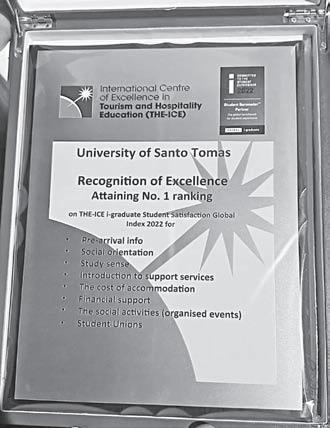
THE University of Santo TomasCollege of Tourism and Hospitality Management (UST-CTHM) was recognized as the top-ranking institution on The International Excellence in Tourism and Hospitality Education (THEICE) i-graduate Student Satisfaction Global Index.
Rep. Fidel Nograles of Rizal Province’s Fourth District, who is a legal aid advocate, said the bill passage would greatly help those economically challenged in gaining access to free legal services.
“A legal scholarship law would help in addressing our issues on legal access, especially for the poor,” Nograles said in a press statement. “This is a bill with noble intentions, and I support this wholeheartedly.”
The congressman was referring to House Bill (HB) 7433 that was filed by Rep. Paolo Duterte of Davao City’s First District, Rep. Eric Yap of Benguet and Rep. Ed -
vic Yap of ACT-CIS Party-list. It seeks to provide free legal education to eligible students. After they pass the Bar examinations, they will then render a mandatory two-year return of service (ROS) in the Public Attorney’s Office (PAO) or any government agency lacking lawyers.
Backing the passage of the bill, Nograles cited data from the Foundation for Economic Freedom, which showed there is roughly only one lawyer for every 2,500 Filipinos. In comparison, the United States has one lawyer for every 240 citizens. He said that currently, the PAO
does not have enough lawyers. With that dearth in numbers, they could not sufficiently address the legal needs of Filipinos.
“This measure would be a great boost toward this end, as the PAO would have a steady stream of lawyers coming in every year,” the solon pointed out.
HB 6325, or the “Legal Aid Program” Bill, mandates the creation of legal-aid programs in both private and public law schools in the country to augment the services rendered by the PAO and other public offices that offer free legal assistance.
“A mandatory legal aid program in schools would mesh well with the ROS... Perhaps we could find a way to harmonize these two measures so that our legal scholars would have…proper training [while they are still studying],” Nograles said.
“[We can make some sort of a] service track, where scholars would be part of the legal clinic, and then render the ROS. This way, they already have a realtime experience once they start serving at the PAO,” he added.
Jose Cielito Reganit/PNA
iACADEMY, Netflix urge filmmakers to create regional-based material
IN partnership with Netflix, iACADEMY recently launched the “iNDIEGENIUS” campaign to encourage emerging Filipino filmmakers with regional backgrounds or regional roots to submit their film concepts and finally bring them to life.
Vanessa Tanco, president and CEO of iACADEMY, believes the collaboration with Netflix will develop the potential of young filmmakers: “iACADEMY has always been an advocate of arts and design, and we’re committed to continuously find talent, encourage, inspire, and support them. iNDIEGENIUS is a testament of this mission.”
Tanco added: “The goal is to prepare our participants for their future as filmmakers, em -
power them to tell local stories, and share their distinct, cultural perspectives while setting them up for success.”
iACADEMY CEO Raquel Perez said the partnership with Netflix will boost young Filipino filmmakers’ capabilities to become world-class talents: “We’re always in pursuit of opportunities where we can provide space that invites diversity and inspires inclusivity. We’re humbled that Netflix shares and believes in this same value that iACADEMY holds, and we are very grateful for their generosity.”
Perez furthered: “It is with great honor that we launch iNDIEGENIUS—a nationwide call for young Filipino filmmakers and creatives to forge compelling short film concepts, share
distinct cultural perspectives through film, and bring their dream projects to life through a mentorship program and a production grant from iACADEMY and Netflix.”
Amy Sawitta Lefevre, Netflix’s head of External AffairsAsia-Pacific, remarked that iNDIEGENIUS hopes “to increase representation in front of and behind the camera, [while supporting] authentic stories that showcase the talent and skill of young filmmakers from across the Philippines.”
Keith Sicat, program director of iNDIEGENIUS and creative director of iACADEMY’s ViSION Creative Unit, said it is an honor for the school, as it is the first program they are supporting in the Philippines.
It is unique, he added, because it focuses on younger filmmakers who have yet to gain the opportunity to make their first feature film, “and trust this experience will give them the tools to keep pursuing their cinematic dreams.”
Selected participants, Sicat confirmed, will be mentored by high-caliber practitioners who have been pushing the Filipino cinematic landscape to greater heights: “Further, the grant allotted to the two finalists is a generous amount that should help them achieve their visions for their short films.”
iNDIEGENIUS will select 10 finalists who will undergo workshops, as two winners will be awarded production and scholarship grants. Rizal Raoul S. Reyes
The award was given during THEICE’s15th International Panel of Experts (IPoE) Forum at The Emirates Academy of Hospitality Management in Dubai.
Among the top Tourism and Hospitality member-schools in the world, UST-CTHM was ranked first in the following eight areas: Pre-arrival information, social orientation, study sense, introduction to support services, cost of accommodation, financial support, social activities (organized events), and student unions.
The ICE-IPoE Forum was launched to focus on relevant issues related to tourism, hospitality, culinary and events, among others, to provide the academe, government, industry and professional organizations opportunities for collaboration and partnerships for growth and development.
Attendees of the annual event were leading educators from Asia,
the Americas and Europe. It featured a Benchmarking Roundtable Series which focused on interesting discussions on “internship, industry advisory boards, governance structure, graduate outcomes, curriculum design and development, [as well as] academic integrity.”
The academic gathering allows participants to share best practices via sharing of alternative and new approaches, which provides solutions to common issues and concerns.
Pratt Institute president visits Benilde Design+Arts Campus

MANILA CENTRAL UNIVERSITY (MCU) takes pride in its long and rich history of academic excellence through the legacy of its founders Filemon D. Tanchoco and Purificacion Gallego, who both believed that values-based education offered salvation from poverty. More than a century later, the fruits of the university’s solid foundation has nurtured thousands of minds and produced notable alumni who have been acknowledged globally. One pride of the university is Dr. Johnah C. Galicia DMD, MS, PhD, who is the recipient of a $17,467 grant for his proposal: “Genome-wide gene expression profile of inflamed dental pulp in humans: Implications in clinical diagnosis and symptoms of pulpitis.” This has led to a published study on the Covid-19 virus and the dental pulpit, alongside past educatorfellow Dr. Asma Khan. Their research may very well be the first one exploring the subject, according to MCU.
A more recent accomplishment of Dr. Galicia is his contribution to the study: “The influence of CBCT-derived 3-D-printed models on Endodontic Microsurgical Treatment Planning And
Confidence Of The Operator,” with Shreyas Oza, Gordon Lai, Ove A. Peters, Bekir Karabucak and Raymond Scott. The study reached the conclusion that the availability of three-dimensional printed models did not alter the participants’ surgical approach, but it significantly improved their confidence for endodontic microsurgery.
Dr. Galicia previously served as the director of the Graduate Program in Endodontology at the University of the Pacific Arthur A. Dugoni School of Dentistry in California and at the Eastman Dental Institute of the University College of London. He was also elected as a “new practitioner trustee” of the American Association of Endodontist (AAE)
Foundation’s Board of Trustees from 2020 to 2022.
This love for education also extends back home in the Philippines, where Dr. Galicia is now a Professor 2 and an Associate Dean of MCU’s College of Dentistry. Aside from teaching and mentoring residents, he also serves on multiple AAE and American Dental Association committees.
Building the foundation
DR. GALICIA earned his Doctor of Medical Dentistry degree from MCU in 1996. After passing the dental licensure examination in Manila, he practiced general dentistry and earned a diploma in clinical dentistry from the University of Rennes in France in 2000, followed by a PhD con -
ferment in Oral Biology from Niigata University in Japan in 2006. At that time he served as a f aculty member at his original alma mater.
“MCU provided me with a good and supportive environment… with opportunities to prosper as a student and as a new faculty member back then. With MCU as my roots, I was…mentored well during my Dentistry student days. When I became a junior faculty right after I passed the Dental Licensure Exams, I was supported by MCU to study abroad in France, and then in Japan,” Dr. Galicia shared.
“Then-president Lualhati T. Gonzalez, Dean Elisa G. Puzon and my [fellow] faculty members showed me how kindness and support to young educators could make a difference in someone’s future. It still makes me tear up when I think about how grateful I am to the people who made an indelible mark in my life,” he added.
“You do not need to pay enormous amounts of money, or to be the Number 1 student in the country to succeed in life. I realize, now that I am back at MCU, that this was the dream of our founder Filemon D. Tanchoco,” imparted Dr. Galicia.
FRANCES BRONET, a distinguished educator at the forefront of interdisciplinary learning and the president of Pratt Institute—a New York-based prestigious private university which specializes in architecture, art and design and liberal arts—toured the Design+Arts Campus of the De La Salle-College of Saint Benilde during her recent stay in the Philippines.
The visit was organized by Magsaysay Group of Companies president and CEO Doris Magsaysay Ho and Joey Yupangco of Joey Yupangco+Associati Design principal and the former Benilde School of Design and Arts dean. Both happen to be graduates of Pratt Institute.
They were joined by Tina Periquet who is the principal designer of Periquet Galicia Interior Architects; Dominic Galicia who is the principal architect of Dominic Galicia Architects; as well as design principal, architect and interior designer Ed Calma of Lor Calma & Partners, who is the creative genius behind the 14-story modernist Benilde campus. They were received by Benilde Center for Partnership Advancement director Robin Serrano.
The exploration around the building provided Bronet with a comprehensive overview of the innovative and inclusive education technologies and facilities.
Led by School of Environment and Design dean Architect Dottie Asela Domingo and School of New Media Arts dean Maria Sharon Mapa Arriola, Bronet studied the scene shops, Weaving and Sewing workshops, Industrial Design laboratories, Motion Capture Room, Red Room and Green Room which Bronet called “the biggest” she had ever seen.
The Canadian architect and academic administrator initiated conversations with several student-artists at work, and shared her professional advice to enhance their design concepts.
Bronet’s walkabout of the campus treated her with a sneak peek at the on -
going Capstone projects, debut collections and augmented-reality exhibitions in galleries and along the hallways. She also conducted an insightful talk before the students, educators and administrators of the college.
The Pratt Institute president expressed her gratitude for the warm welcome, and encouraged the young artists “not to take for granted” the many resources and opportunities available to them.
She imparted the inspiring history of Pratt: from being a “radical experiment to expand access to creative careers,” to becoming a top-notch college with 61,000 alumni “making a positive impact through their remarkable work and research.”
Bronet explained the participation of the institute in Brooklyn’s transformation into one of the most livable cities in New York. This is an initiative that reflects Benilde’s community involvement in its neighboring barangays , with a mission to spark a compassionate spirit in addressing contemporary social issues, according to the college.

She believes local residents are the “best experts” in addressing challenges of their community, as well as the key role of proactive students in an inclusive society.
Pratt Institute’s president also reminded the students and mentors alike to always be mindful of the environment, the human condition, and of their “collective role to use technologies in the most creative ways” to build a fairer and more sustainable world for all.
Bronet was accompanied by Pratt Institute officials: vice president for Institutional Advancement Daphne Halpern, associate vice president for Institutional Advancement Jessica Tallman, executive director of Development Jacob Korb, and director of Alumni Engagement Tue Tran.
Education BusinessMirror
A6 Editor:
Saturday, April 15, 2023
ALAWMAKER recently supported a bill which seeks to provide free education to aspiring lawyers studying in state universities and colleges.
CONGRESSMAN Fidel Nograles HOUSE OF REPRESENTATIVES/PNA
THE plaque awarded to UST
EDUCATORS SPEAK American Association of Endodontics educator-grant recipient cites MCU roots DR. JOHNAH C. GALICIA
BENILDE Fashion Design and Merchandising student Dianne Ursais shows her application of fabric manipulation with Pratt Institute’s Frances Bronet DLS-CSB.
Tourism&Entertainment
www.businessmirror.com.ph
A Slice of chArm And culture At nAneng heritAge VillAge in K AlingA
We were met by several locals who offered us a cup of brewed Kalinga coffee and some native delicacies at the open-air basketball court. Not long after, the village’s young residents showed up wearing traditional clothing and performed a cultural dance. In keeping with the wishes of the elder population for the current generation to preserve part of their way of life, artistic, cultural, and traditional practices are taught in
Go
their school. I have yet to explore the small town, but we got a taste of the warm hospitality and caught a fascinating glimpse of the villagers’ rich culture.
Arduous Backstrap Weaving
I N SIDe the nearby hall, we were then shown some of the creations of the women weavers in the village. We met and observed a few of the women masters of the tradi -
tional “laga,” or back-strap weaving. Among them was Remedios Amla, the oldest weaver, who first learned backstrap weaving in the late 1970s. Laga or backstrap weaving, is an olden method of creating woven cloth in the province of Kalinga.

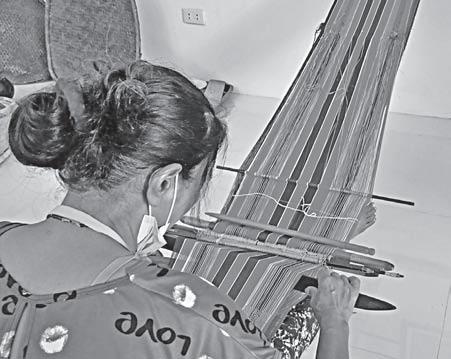
In back-strap weaving, the warp yarns are attached at one end to the weaver and the other end to a stationary object like a tree or a wall.
When using this technique, the weaver is required to sit on the ground or on a small bench. The process makes for a more difficult yet portable, flexible, and simplistic alternative to the traditional pedal loom. This weaving mechanism allows for the creation of narrower but longer textiles.
Chilly Night on a Homey Home Stay
A F T e R satisfying our yearning for new cultural knowledge, it was time to explore the village. I started off by walking towards the river. I stopped short of going down to a natural pool filled with hot spring water as I got captivated
Nayong Pilipino opens exhibit in Tarlac


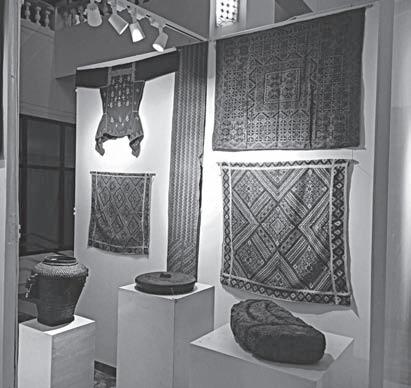
The Nayong Pilipino Foundation (NPF), in partnership with the Tarlac Provincial Government, opened the NAYON SA DIWA: Bringing Cultural Communities Closer to the h e art exhibit at the Diwa ng Tarlac Museum, on March 30. This marks the Foundation’s first exhibit outside of Metro Manila.
The initiative was in support of the National Tourism Development Plan (NTDP) 2023-2028, where Department of Tourism (DOT) Secretary Christina Garcia-Frasco emphasized the goal to “establish a Philippine tourism industry anchored on Filipino culture, heritage and identity.”
The said exhibit displayed items from different communities in the country. It also highlights the works of the Abelling Aeta(s) who displayed their traditional items.
The NPF e x ecutive Director Gertie
Duran-Batocabe emphasized on the rich multicultural nature of the province of Tarlac, calling it the “beating heart of Luzon” which provides a
unique experience to its visitors.
“At this moment, I cannot help but feel a deep sense of pride and satisfaction that we have all come together to
by the verdant green fields along my path.
I sat down on a narrow-cemented trail and flew my drone to get a view of the whole village from the perspective of a bird. I saw how the old houses and rows of streets aligned beautifully next to the flowing, clear waters of the Chico River.


As spectacular as it looked from above, viewing it back on the ground was equally enchanting as the gentle breeze caressed my face while I continued my stroll through windblown rice fields and
towering trees, creating the kind of bucolic dreamscape a city slicker like me could only hope to see on a daily basis.
We spent our first night at Duyan ho mestay, owned by the family of the first elected governor of then Kalinga-Apayao and located a stone’s throw away from the 1927 Saint Joseph Parish Church. Like most of its neighboring homes, the homestay is typical of the preWorld War II architecture found throughout the village.

h aving learned about this village for the first time, I was sur -
prised to learn that Naneng he ritage Village was already a favorite among foreign tourists. “Before the pandemic, we would host up to 40 foreigners, the last time (were) all Israelis. They will stay here after their river rafting and make a bonfire, sing, and dance,” one of the locals tells us.
The residents were so hospitable that we actually feasted on double dinners that night. The first one was at a house whose owners invited us for a chat, and the other was at our homestay, where we had chicken curry, fried fish, and a vegetable dish with squash and tomatoes freshly picked from the backyard. With a full stomach, an 18-degree Celsius evening, and a plush bed cushion placed over a polished wooden floor, I had one of the best on-the-road snoozes ever.
The only downside of our visit to Naneng he ritage Village was that we only stayed for a night as we had to go back to Tabuk the next day to cover the Bodong Festival, which in itself is another interesting story to write about.

further promote the rich history and culture of our country,” said DuranBatocabe.
“We believe that this partnership in bringing this collection closer to the people and showcasing our unique material culture will help create a deeper understanding of our identity as Filipinos and provide opportunities for our people, and even tourists, to engage in meaningful ways,” she added.
The ribbon cutting ceremony was led by DOT Undersecretary Shereen Gail Pamintuan, Governor Susan Yap, Tarlac Vice Governor Carlito David, Abelling Chieftain Rody Dela Cruz, NPF e x ecutive Director Gertrudes Duran-Batocabe and PNU Associate Dean Dr. Zyralie Lotivio-Bedural.

Also present during the event were Mayors from the different municipalities of Tarlac, Board Members of
Tarlac, Members of the Sangguniang Panlalawigan of Tarlac, and other local chief executives.
The exhibit is part of the NPF’s Travelling Museum Project, an initiative meant to bring culture and heritage closer to the public. The public may visit the exhibit for free from 8 a.m. to 5 p.m. at Diwa ng Tarlac, Tarlac City until the last week of May 2023.


A7 BusinessMirror
Saturday, April 15, 2023
Story & photos by Marky Ramone
Clueless of the place we’re heading to, the scenery of rolling mountain ranges rising parallel to the mighty Chico River, and expansive farm fields gave me helpful hints to a bucolic countryside perhaps or even more. The latter was spot-on as I set foot in the village of Naneng in Tabuk, Kalinga.
IN photo, (from second to the left) Mayor Noel Villanueva of Concepcion, Tarlac Vice Governor Carlito David, Tarlac Governor Susan Yap, DOT Usec. Shereen Gail Pamintuan, Abelling Chieftain Rody Dela Cruz, NPF Executive Director Gertie Duran-Batocabe, PNU Associate Dean Dr. Zyralie Lotivio-Bedural, and Tarlac Board member Harmes Sembrano. At the back are members of the Sangguniaang Panlalawigan of Tarlac and other local chief executives.
N AYONG Pilipino Foundation (NFP) brings indigenous collections to Tarlac. T HE Nayon sa Diwa exhibit is part of NPF’s Travelling Museum Project.
C HARMING view of Naneng Heritage Village through a drone’s lens.
E V ERGREEN f ields that sustain the Naneng Heritage Village.
T HE surrounding hills, fields, and river make Naneng village more enchanting. S AINT Joseph Parish Church at the heart of the Naneng Heritage Village.
FLY ING a drone, the writer entertains some local kids.
R E SIDENT Lola Patring smiles in front of her home.
O N E of the women weavers is busy at work.
LOLA Remedios is the oldest weaver in Naneng today.
T H E backstrap technique appears to be more challenging than using a traditional pedal loom.
Suga bares his soul in upcoming documentary Major Thai ticketing
THANKS to a screener from Disney+, I got to watch Suga: Road to D-Day, coming in April 21 on the streaming platform. The thing is that I can only write about it without divulging any specifics so as not to spoil anything for fans of BTS and Suga.

But what I will say is that the documentary will catch fans by surprise because Suga, whose real name is Min Yoon-gi, reveals a lot of himself without the drama expected in such exercises. The rapper, songwriter and producer talks about his emotions and thoughts matter-of-factly. As a viewer, I was swept away by his words because I know that he guards his privacy fiercely so it must have taken a lot for him to open his heart and mind so publicly.
The upcoming documentary will follow Suga as he travels around the world from Seoul to Tokyo, Las Vegas and beyond in search of musical inspiration for his upcoming album D-Day
“Throughout the documentary, viewers will see the star at his most vulnerable, as he discusses his writer’s block with other musicians, and delves deep into his most traumatic memories to pen lyrics for several of his latest songs,” said Disney+ in a press release.
The documentary also includes exclusive live clips of songs on Suga’s upcoming album, which will be released on April 21. My favorite track in the new album is “Amygdala,” because it tells the story of what the artist has been through.
I also like “Snooze” featuring Ryuichi Sakamoto and Kim Woo-sung of The Rose. I predict that Kim Woo-sung and The Rose will get more fans as soon as this album is released because they’re really talented.
The 10-song album opens with the collection’s title track, “D-Day” (produced by Vincent “Invincible” Watson and 2Live) and also features “Haegeum”
(produced by Agust D), “HUH?!” (produced by Agust D and El Capitxn, co-written by J-Hope), and “Amygdala” (produced by El Capitxn). The album’s second half includes a collaboration with recently deceased Oscar-winning composer Ryuichi Sakamoto (this is the song with Kim Woo-sung).

The second half features “SDL” (produced by the singer and El Capitxn), pre-release single “People Pt. 2” featuring IU (produced by El Capitxn), “Polar Night” (produced by the singer and El Capitxn), “Interlude: Dawn” (produced by the singer and El Capitxn), “Snooze,” and “Life Goes On” (produced by El Capitxn). The the final track is one of two featuring a cowriting credit for J-Hope.
I’m sure the documentary and the album will be big hits. The fans will enjoy watching the
A NEW ACERPURE GADGET FOR THE HOME
ACER debuted its lifestyle brand acerpure during the pandemic, with the goal of making sure that the air in our homes was always clean and fresh.


The product range has since expanded to other household appliances and the new product is a cordless vacuum cleaner, called acerpure clean.
Acerpure clean V1 is slim but powerful and ultralight at a 1.5kg. It has a cordless body, visual battery life with a running time of 60 minutes on a full charge, different modes for different cleaning usages, electric power brush with hair-free technology, and four built-in LED lights.
Acerpure clean also has Cyclone Technology, with five stages of filtration that can trap small and large sizes of dust and dirt from the filter to the main cyclone without losing suction pressure. acerpure claims this technology can help trap 99.5 percent of
99.9 percent of mites. The two-in-one combination brush has two flexible ways to let you quickly clean multiple surfaces, such as windows, curtains, tables and car interiors. Aside from the LED lights, the crevice nozzle helps you reach narrow areas and hard-toclean spaces, such as corners, sofa gaps, and ceilings.
Acerpure clean V1 Lite is super lightweight at 550g with 13000Pa suction pressure power and a maximum of 15 minutes of cleaning time. It has 2-in-1 usage, one button switch, a DC motor, and a USB type-C charger. Acerpure clean V1 has an SRP of P10,999 but is available at P9,999 for a limited time while the acerpure clean V1 Lite has an SRP of P3,999 but is offered at P3,499 for a limited time. acerpure clean is available at Acer Concept Stores, authorized retailers and online at store.acer.com
More information is available at www.acer.com. ■
platform eyes
PHL expansion
BY RIZAL RAOUL S. REYES
THAILAND’S second largest ticketing platform, Ticketmelon aims to establish a strong presence in the Philippines as the demand for events resumes after being sidelined for two years by the Covid-19 pandemic.
Panupong Tejapaibul, CEO and cofounder of Ticketmelon, recently announced the company’s expansion in Southeast Asia and the Philippines offering a robust system that integrates cutting-edge ticketing tools, innovative digital inevent solutions, and live streaming services.


He said Ticketmelon’s entry into the local market is geared to cater to the needs of the most challenging event formats and audience volumes, all backed by exceptional organizer support to deliver the most seamless event experience.

“Our expansion into the Philippines, Singapore, Vietnam and Malaysia has been rapid, and our primary focus is to continue providing white-glove service support to local event organizers. Building local teams is an integral part of our expansion strategy, as this has been the key to earning the trust of event organizers over the past few years,” said the 30-year-old techpreneur.
“When the pandemic struck, we quickly adapted to the new normal. Agility is the key element and the watchword during the crisis,” Chelsea Gloria, the company’s business development manager in the Philippines, explained in a media statement.

Despite the restrictions during the pandemic, Ticketmelon pushed on successfully hosting Young Living Philippines’ first-ever Virtual Press Conference: Amplify 2021, Young Living Events and NOSH Conferences providing streaming platform and ticket selling. “We are now entering the new digital landscape for local and international events that are back and on the rise. We are excited to be a part of the new event experience in the Philippines.”
It has facilitated everything from global festivals and corporate brand launches to sporting events and conventions, including the Vietnam Motor Show, Sensation, Garden Beats in Singapore, Wonderfruit, 1975, and Transmission Festival Asia, as well as the LPGA Thailand Open.
In addition to being a leading provider of in-event cashless payment solutions and ticketing platforms in Southeast Asia, Ticketmelon offers localized payment channels in various currencies, enabling local consumers to seamlessly purchase tickets. Their digital in-event solutions support all types of events, including corporate, sporting, and product launches, and feature personalized welcome messages, interactive games, points redemptions and more, all under the audience’s unique code to create an unforgettable event experience. Furthermore, their advanced ticketing features are unparalleled, offering white labeling options, intuitive seat mapping, and live streaming services to expand audiences beyond physical events.
“At Ticketmelon, our long term goal is to consistently elevate the standards of our hosted events to a global level, establishing ourselves as the foremost benchmark for best practices in event technology applications and operations that extend beyond Southeast Asia,” said Tejapaibul.





“We are the leader in the industry because we are the most experienced digital ticketing company that can provide end-to-end services, from ticket selling/online registration to on-ground digital solutions that provide streamlined services. We make our clients’ work easier so they can focus on the other vital parts of their event. We are currently in talks with some local clients whose events we are excited to host and we are confident of becoming one of the market leaders in the Philippines,” Gloria noted.

MPIC’s health tech unit unveils award-winning app made by doctors for doctors
BY RODERICK L. ABAD Contributor
FRESH from its win as the Best Mobile Innovation for Digital Life in the 2023 Global Mobile Awards in Barcelona, Spain, Metro Pacific Investments Corp.’s (MPIC), through mWell, the medical technology platform developed by its wholly-owned subsidiary Metro Pacific Health Tech Corp., has launched an app designed by doctors for doctors.
Called the mWellMD, this virtual clinic allows healthcare professionals to attend to app userpatients on their mobile phone 24/7 and easily manage their schedules and records. With just a click of a button, they can use the appointment booking system for their online clinics and do virtual consultation, as well as notify patients of their upcoming clinic or hospital visit.
This platform can also process billings and calculate professional fees of doctors. They can even communicate with their staff and refer patients to
other medical practitioners. Practice and patient data are accessible anytime, anywhere. Soon, enhanced features and more tools will be available for doctors via mWellMD Advanced.
“We’re committed to delivering innovative healthcare solutions not only for mWell app users but also for our partner-doctors. mWellMD’s futureproof platform empowers Filipino doctors to reach more through the power of technology,” MPIC president, chairman and chief executive officer (CEO) and mWell chairman Manny V. Pangilinan said in a video message during the kick-off event held in Pasig City.
Mindful of the importance of a smooth doctor experience, the country’s leading infrastructure investment company always listens and responds to their needs. Hence, the app is designed to provide a faultless process from sign-up to consultation.
“Through the mWellMD app, we are able to deliver a seamless end-to-end journey which
will allow them to conveniently consult and grow their practice. With help from our partnerdoctors, mWell’s fully integrated digital healthcare ecosystem will be able to offer our countrymen here and abroad convenient access to quality healthcare,” explained MPIC chief finance, risk and sustainability officer and mWell CEO Chaye CabalRevilla. Because doctors were engaged to develop this Filipino-made app and test the system to ensure that it’s seamless, intuitive and user-friendly, the platform does not only involve the growing needs of doctors but also of the industry, per mWell chief technology officer Dr. Mike Muin. He said: “We are going beyond telemedicine—we are building solutions for doctors to make their practices and their lives better.”
Tech experts are on-call 24/7 to assist partnerdoctors and respond quickly to their questions. There’s also a dedicated operations team for their regular training sessions and updates.
The app is following global security standards to ensure the security and protection of all personal information that are stored, processed and transmitted in its system belonging to both doctors and patients.
“mWellMD went through rigorous vulnerability tests and security audits. It completed and passed all requirements to bring down all cyber-related risks to the lowest level,” said Angel Redoble, mWell chief cybersecurity officer and PLDT Group and Smart Communications first vice president and group chief information security officer.
Registration is as fast as 30 minutes, sans joining fees. Only a PRC ID is required. Doctors get 100 percent of their professional fee without deduction of any commission from mWell. They can also avail of an exclusive high-speed internet plan from PLDT Home Fibr: 100mbps for only P1,499. The mWellMD app is now available on Google Play Store and Apple App store.

A8 Saturday, April 15, 2023 • Editor: Gerard S. Ramos www.businessmirror.com.ph BusinessMirror
Choosing the right gaming monitor
CHEF JESSIE LAUNCHES HAPAG MOVEMENT MENU, PROCEEDS TO HELP FUND PROGRAM VS INVOLUNTARY HUNGER
RENOWNED Filipino chef Jessie Sincioco is helping feed the hungry in a whole new way.
A top chef who has made meals for global dignitaries, Chef Jessie has launched the Hapag Movement Menu, which includes four set meals that patrons may enjoy while also helping address involuntary hunger.
The special menu is part of Sincioco’s commitment to the Hapag Movement, a community program led by telecom giant Globe that aims to alleviate involuntary hunger through supplemental feeding and sustainable livelihood opportunities.
The meal sets, which include a salad, soup, main course, dessert and hot drink, are available for lunch at P1,200 and dinner at P1,500 at Sincioco’s well-loved restaurant, Chef Jessie Rockwell Club in Makati. For every meal served, half of the proceeds will be donated to the Hapag Movement.
“I salute Globe for this timely and much-needed movement for the whole country. We know very well that hunger is a reality here. We make it a point to give back whenever we can. That’s how we came up with the Hapag Movement menu. This way, our diners can support the advocacy,” said the chef.

The Hapag Movement Menu features a healthy selection of salads for starters and a variety of Filipino and fusion main dishes, from the familiar yet elevated beef morcon and caldereta to fish fillet florentine and baked parmesan-crusted chicken.
In strengthening her commitment to the Hapag Movement, Sincioco also said she would invite top chefs from the Philippines and abroad to be part of the movement, as well as enlist the help of neighboring restaurants in Rockwell to further the advocacy.
“When I learned about this credible and realistic movement, I did not hesitate or think twice about helping out. Let us all do our part in making this movement a smashing success,” she said.
Chef Jessie has cooked and created many dishes for world leaders, big movers in the business industry, wellknown personalities, and even the Pope. But what she finds most fulfilling is providing food for the most marginalized in society.
Chef Jessie supports the Hapag Movement through her company’s membership at the Rotary Club of Makati Business District (RCMBD), which recently signed a fouryear partnership with Globe to raise funds for the Hapag Movement. Her Manna Cuisine Corp. is among the earliest corporate members of Rotary to support the undertaking.
“We are excited to have Chef Jessie on board as we continue our fight against hunger in the Philippines. We are grateful for her commitment to find ways to raise funds, including the special Hapag Movement menu. We look forward to expanding the Hapag Movement globally through enlisting a global network of chefs for the initiative,” said Yoly Crisanto, chief sustainability and corporate communications officer at the Globe Group.

RCMBD earlier pledged to raise P10 million in funds for the Hapag Movement through various initiatives involving individual members and corporations. By making this commitment, the Rotary chapter has become one of Hapag Movement’s most dedicated fundraising partners.
Globe leverages partnerships to raise funds and deliver critical support to affected families. The program aims to rally Filipinos behind a collective effort to feed the hungry and provide empowering livelihood training, as an estimated 15 million Filipinos continue to suffer from involuntary hunger.
WHILE most people were enjoying their Holy Week vacation, I found myself rummaging through the towering boxes in my old room, searching for my Playstation 4 power cord. My nephew Tomi had recently become fascinated with Mortal Kombat, and wouldn’t stop until I let him try it. I called Datablitz and other gaming stores, and even tried online, but it was out of stock and those that sold replacements were located overseas and would likely take at least two weeks to arrive.
So, I decided to go search for the cord instead thinking it was just in one of the more accessible megaboxes. Boy, was I wrong! It took me three days to find the power cord and by that time it was already Easter Sunday.
I did find some other old gaming stuff though, like an Atari joystick, a wireless SuperNintendo controller, my old SEGA megadrive and what I think was an Atari clone console. I also found our first desktop monitor—a bulky CRT (Cathode Ray Tube) monitor for our Intel 386 desktop PC. Back then, there were was no option or need for a gaming monitor.
Gaming monitors have come a long way since the early days of arcade gaming, where the need for fast and responsive displays was first recognized.
If I remember correctly, the first dedicated gaming monitor was the Atari 2600 Video Computer System, released in 1977, and included a built-in 14-inch CRT display. But as games became more complicated and the industry grew, so did the demand for highperformance monitors.
With advances in technology, gamers can now experience a level of immersion that was once thought impossible. Today, gaming monitors come equipped with a range of features, including high refresh rates, low response times, high resolution, HDR support, and adaptive sync technology. These features provide gamers with a more responsive gaming experience, allowing them to fully immerse themselves in the game world. With the rise of esports and competitive gaming, gaming monitors have become an essential component in a gamer’s setup, and the industry continues to push the boundaries of what is possible with these displays.
But getting a gaming monitor isn’t cheap and requires significant investment, so if you are planning on getting one, some important factors to consider include: refresh rate (look for a monitor with a high refresh rate of at least 120Hz), input lag (look for a monitor with a low input lag of less than 10ms), resolution (consider the resolution that is suitable for your needs, whether it is 1080p, 1440p or 4K).
There are many options in the market when it comes to monitors, and one brand that’s establishing a name for itself in the gaming market is Philips. Philips has been a trusted name in technology and they have brought their expertise to the gaming world with their Momentum line of gaming monitors.
The Momentum Gaming 5000 Series with ultrafast refresh rates key was even recognized by the


prestigious iF Design Award. The iF Awards are given to products that meet the highest level of design aesthetic and desirability, combined with outstanding performance levels. The series deliver the right combination of design, features and specifications, all woven together to match the demands of gaming styles, titles and platforms across the gaming spectrum.
First is its accelerated 300Hz refresh rate: Refresh rate refers to how many times per second the monitor can display a new image. Most standard monitors have a 60Hz refresh rate, but gaming monitors typically have higher refresh rates ranging from 120Hz to 360Hz. The higher the refresh rate, the smoother the gameplay will be, and the less motion blur and ghosting you’ll experience.
The Philips Momentum 27M1N5500U boasts of a trailblazing refresh rate of 300Hz, taking your gaming experience to the next level. The low input lag, coupled with variable refresh rate technology, gives serious gamers an advantage when playing competitively. Additionally, the wide-view angle panel with high resolution provides a realistic gaming experience with unsurpassed color accuracy.

Another key feature of the Philips Momentum gaming monitor is its low input lag. Input lag is the delay between when you perform an action with your controller or keyboard and when that action appears on the screen. The lower the input lag, the more responsive the monitor will be, which is crucial for professional or even aspiring esports athletes. With a low input lag, you’ll be able to react to what’s happening on the screen almost instantaneously, giving you a major advantage over your opponents.
The Philips Momentum gaming monitor also boasts of IPS LED wide view technology, which provides remarkable color accuracy and crisp images. IPS displays use an advanced technology which gives you extra wide viewing angles of 178/178 degree,

TikTok fined $15.9M by UK watchdog over misuse of kids’ data
LONDON—Britain’s privacy watchdog hit TikTok with a multimilliondollar penalty Tuesday for misusing children’s data and violating other protections for young users’ personal information.
The Information Commissioner’s Office said it issued a fine of £12.7 million ($15.9 million) to the shortvideo sharing app, which is wildly popular with young people.
It’s the latest example of tighter scrutiny that TikTok and
its parent, Chinese technology company ByteDance, are facing in the West, where governments are increasingly concerned about risks that the app poses to data privacy and cybersecurity.
The British watchdog, which was investigating data breaches between May 2018 and July 2020, said TikTok allowed as many as 1.4 million children in the UK under 13 to use the app in 2020, despite the platform’s own rules prohibiting
children that young from setting up accounts.
TikTok didn’t adequately identify and remove children under 13 from the platform, the watchdog said.
And even though it knew younger children were using the app, TikTok failed to get consent from their parents to process their data, as required by Britain’s data protection laws, the agency said.
“There are laws in place to make sure our children are as safe in the
digital world as they are in the physical world. TikTok did not abide by those laws,” Information Commissioner John Edwards said in a press release.
TikTok collected and used personal data of children who were inappropriately given access to the app, he said.
“That means that their data may have been used to track them and profile them, potentially delivering harmful, inappropriate content at their very next scroll,” Edwards said. AP
making it possible to view the display from almost any angle. One good thing about IPS displays is that they give you vivid colors and remarkably crisp images, making them ideal not only for gaming, but also for professional applications that demand color accuracy and consistent brightness at all times.
These monitors likewise deliver Crystalclear, Quad HD 2560x1440 or 2560x1080 pixel images. Utilizing high performance panels with high density pixel count, enabled by high bandwidth sources like Displayport, HDMI, Dual link DVI, they can make your images and graphics come alive. Even for demanding professionals requiring extremely detailed information for 3D graphic applications or a financial wizard working on huge spreadsheets, Philips displays will provide Crystalclear images.
In addition to its stunning visuals, the Philips Momentum gaming monitor also has a variety of features designed to reduce eye strain and fatigue. Its LowBlue mode and Flicker-free technology have been developed to reduce eye strain and fatigue often caused by long hours in front of a monitor. This makes it possible to game for extended periods of time without worrying about your eyes getting tired or strained.
Philips MultiView display also allows for simultaneous dual connection with the ultra-high resolution MultiView, enabling you to work with multiple devices such as a PC and notebook at the same time, allowing for complex multi-tasking. Quickly access the monitor’s settings with the discreetly placed EasySelect Menu Toggle Key. This key allows you to make quick and easy adjustments to monitor settings in the On-Screen Display menu.
Lastly, the SmartErgoBase is another feature that sets it apart from the competition. This monitor base delivers ergonomic display comfort and provides cable management. The base can swivel, tilt, and rotate to various angles to ensure maximum comfort, and the height adjustable stand guarantees optimal viewing level, reducing the physical strains of a long workday. Cable management also reduces cable clutter and keeps your space neat and professional.
For those planning to get a Philips monitor, they also have an ongoing “A Summer to Treasure” campaign where you can get a free Herschel bag when you purchase select Philips Monitor. The promo includes a wide range of monitor models, from compact 27-inch displays to larger 43-inch MultiView monitors, with top-of-the-line options available for both gaming and office use. Gaming enthusiasts can enjoy flagship models with the fastest refresh rate of 300Hz, low input lag, and 4K resolutions, while office workers will appreciate the USB-C connections for reduced desk clutter, IPS technology, built-in speakers, and ergonomic mounts that allow for height adjustment, swiveling, and tilting. ■
A9 Editor: Gerard S. Ramos • Saturday, April 15, 2023 www.businessmirror.com.ph
THE Philips Momentum Gaming 5000 Series
BusinessMirror
JESSIE
CHEF
PHL eyes 330,000 MT rice import to boost stockpiles
790,449 metric tons have arrived in the country, the statement said.
The Philippines’ rough rice output is projected to hit 20.5 million metric tons this year compared to 19.8 million metric tons in 2022.
Marcos said he’s confident there won’t be a shortage in rice supply and that the government is looking at ways “to control prices so they won’t go up too much.”
Salceda presents options to implement PUVMP
discounted prices,” Cainglet said in Filipino, even as he lamented the government’s first recourse is importation across commodities.
“Bakit tayo importation ang first recourse across commodities?
From onion, to sugar, to pork and now, back to rice,” he asked.
He added the NFA has been allotted a P9-billion budget and may seek additional allotment for rice stocking or emergency purposes.
THE Public Utility Vehicle Modernization Program (PUVMP) should not totally “abolish” the traditional jeepney, but should rather modernize the renowned Filipino vehicle, by opting for locally made but fuel-efficient vehicles.
House Committee on Ways and Means Chairman Rep. Joey Sarte Salceda issued the statement as he called on the government to extend the deadline for consolidation for jeepneys manufactured in recent years and to support domestic manufacturers of cheaper and more modern jeepneys.
some 0.25 kg per passenger due to smaller capacity.
“It’s a 31 percent saving in per passenger emissions for a vehicle that costs as much as 620 percent more. We need a cheaper, domestically manufactured jeepney that modernizes the traditional one,” the Albay lawmaker said.
Salceda added the government should first ensure that the domestic jeepney-manufacturing sector is an option for the PUVMP, and assist it in producing cheaper but similarly modern and efficient units.
The National Food Authority, the state’s grains procurement agency, has proposed that the rice imports be undertaken through a government-to-government deal, either through the Office of the President or its designated agency, Marcos’s communications office said in a statement late on Thursday.
Marcos, who’s also the agriculture chief, had met with agriculture officials to discuss supply of the country’s national staple and keep prices stable. “In terms of the general supply for the country, I think we are in good shape
and although we still have to import, our importations have come down,” he said.
The Philippines is also one of the world’s biggest rice producers, but it usually buys from major suppliers Thailand and Vietnam to help fill production gaps caused by typhoons. Department of Agriculture officials have said rice imports this year will likely reach around 2.5 million metric tons, down from about 3.5 million metric tons last year. The government typically issues rice import licenses and so far,
Rice importation, again?
REACTING to the latest government rice import plan, the Samahang Industriya ng Agrikultura (SINAG) questioned the importation approach, saying the NFA can buy cheaper rice from local farmers than imports.
SINAG executive director Jayson Cainglet revealed that the landed cost of imported rice amounts to P36 per kilo, much costlier than the locally produced rice at P20 to P21 per kilo.
“Local millers have long offered to mill the palay of NFA at
“Tumaas na rin ang imported rice from $490 per metric ton to $520 or around P36 per kilo landed cost,” Cainglet pointed out.
Under the DA’s 2023 supply outlook, the country’s total supply is at 16.98 million metric tons (MMT), which is sufficient to cover this year’s demand estimated at 15.29 MMT. “This would leave the country with an ending balance of 1.69 MMT, which is equivalent to 45 days of buffer stock, instead of the 90-day ideal buffer stock to stabilize the price of rice,” according to a DA briefer.
Asean must address brain drain in health-care sector–PBBM
SOUTHEAST Asian countries must adjust and find ways to address human capital flight, particularly in the health-care sector for the benefit of the region, President Ferdinand R. Marcos Jr. said on Thursday. The issue on brain drain in the region’s health sector, particularly the emigration of nurses and doctors, was discussed during the
President’s meeting with Temasek Foundation executives at the Malacañang Palace.
“We are very proud of [our nurses and doctors] and the role they play during the height of the pandemic but as I said, we are a victim of our own success,” President Marcos told Temasek officials led by its chair Ms. Jennie Chua Kheng Yeng.
“But you know, we have to adjust and find other ways. We have to give them at least equal opportunities at home. It is very clear that most Filipino overseas workers are willing to take less in terms of pay so long as they can stay here,” President Marcos pointed out.
If Singapore can find a solution to that problem, it would immensely help the Southeast Asian region’s healthcare sector, the President said.
Chua said the Singapore nursing association has agreed to register nurses in Singapore to arrest human capital flight in the sector after the country lost 400 nurses to New Zealand, which offered permanent residency (PR).
Under New Zealand’s PR, nurses can bring their families with them, allow their children to go to local schools, and apply for housing.
T he Temasek Foundation International chair said Singapore does not want to give Filipino nurses citizenship unlike what is being offered by the US, Canada and New Zealand so they can go back and forth during
their working years.
Chua commended the Philippines for producing good nurses and doctors, noting Singapore’s emergency room doctors are mostly Filipinos, and praised their training based on life experience.
Temasek Foundation, a Singapore-based non-profit philanthropic organization, is an arm of Singapore’s state sovereign fund Temasek Holdings.
The foundation funds and supports programs aimed at building community capabilities in Asia and beyond through philanthropic endowments.
The foundation forged agreements with the Philippines to enhance competencies across industries, through the Technical and Vocational Education and Training (TVET) (Digitalization and Industry 4.0) Program, Science, Technology, Engineering and Mathematics (STEM) with Design Thinking Programme, and Health Care Management Program. PNA

BARMM vows to raise intervention in public expenditure management
By Manuel T. Cayon
DAVAO CITY—The Bangsamoro government said it would increase its intervention in managing public expenditures in a bid to ensure sound financial management.
Among these in terventions include a month-long planning and budgeting, and repeated reminders to chiefs of offices to observe transparency and accountability, said Bangsamoro Senior Minister Abdulraof Macac ua.
He represented Chief Minister Ahod Balawag Ebrahim of the Bangsamoro Autonomous Region in Muslim Mindanao (BARMM) during the Bangsamoro Budget Forum for Fiscal Year 2024 last month.
“A month-long planning and budgeting are not easy. You have been working tirelessly to provide the Bangsamoro people with what they deserve.”
“Let us always keep in mind that what we are now is the result of the 50 years of Bangsamoro struggle. Let us not waste it and commit to practicing what we learn today.
May our goal remain intact that this is for the Bangsamoro people,” Macacua said.
In the budget forum, Minist er Ubaida C. Pacasem of the Ministry of Finance Budget and Management (MFBM) presented the salient features of the Budget Call for fiscal year 2024 that contains the parameters to guide the ministries and offices in preparing their respective budget proposals.
Pacasem also commended the efforts of Bangsamoro government personnel “in continuously taking part in the goals and aspirations of the Bangsamoro government, paving the way to the realization of significant milestones in
“I would summarize my proposal in three points: First, support domestic manufacturing of more modern and more efficient, but similarly stylish jeepneys. Second, increase the subsidy per unit to meet the financial viability gap. Third, buy out old jeepneys for cash,” Salceda said.
Salceda also told the Department of Transportation to consider emissions “on a per capita basis,” since the more modern jeepneys “can accommodate fewer passengers than traditional jeepneys.”
According to Salceda, the traditional jeepney produces some 0.33 kg of CO2 emissions per passenger per year, while the modern jeepneys would still produce
By Jonathan L. Mayuga
THE Manila Water Co.
Inc. said it would make “significant” investments in projects that will create alternative water sources, including the Calawis Water Supply System and the East Bay Ph1 Water Supply System initiatives.
The two system initiatives can add 80 million liters a day (MLD) and 50 MLD more capacity, respectively.
The Marikina PTP, other deep wells, and other possible contingency and augmentation measures will be further ramped up, according to the company.
“If we can bring the cost of the unit to P600,000 to P1 million, that becomes more realistic for both the jeepney operator, and on a cost-benefit basis. I think the domestic manufacturing sector can do it. But we need to support them,” he pointed out.
“By that figure, you bring ROI to around 7.4 years. Otherwise, with these supposedly modern but still very expensive jeepneys, you run into the same problem,” he added. Salceda projects that sans subsidies, operators will need as much as 22 years to recoup the value of their investments in new jeepneys.
“It’s not that jeepney operators don’t want to modernize. It’s just that, financially, it’s suicide. It makes no sense.”
Dela Cruz
Marie N.
Jovee
Antipolo, San Mateo, and Rodriguez in Rizal, the San Mateo-Rodriguez Sewerage System, the Hinulugang Taktak Sewerage System Project, the Mandaluyong West Sewerage System, and the North and South Pasig Sewerage Systems to name a few.
the region through the establishment of a sound financial environment.”
T he annual forum was attended by key heads of the regional offices, the ministers, heads of offices, director-generals, budget and planning officers, chief accountants, as well as representatives from civil society organizations (CSOs).
MFBM Deputy Minister Amilbahar Amilasan Jr. reminded everyone of the duties and responsibilities as the BARMM’s financial managers.
“Moral governance in the Bangsamoro government intensifies government actions, especially in policy and decision making with a sense of responsibility, ensuring transparency and accountability, strengthening work commitment, protecting the spirit of fairness, and elevating integrity,” Amilasan said.
Rasul Salik member of MFBM Technical Working Group said 2024 will be the last remaining full calendar year of the extended transition period, considering the possible changes come 2025 with the recent passage of the Bangsamoro Electoral Code and the eventual regular elections come mid-2025.
The crafting of the Bangsamoro budget for the calendar year 2024 is key in making sure that all the desired reforms in our way of governance are implemented, all the public goods and services we promised to the Bangsamoro people are duly given to them, and ultimately, all the desired progress and development we envision for our people is finally realized,” Salik said.
H e said the Bangsamoro government “recognizes the modernization of the national budget process to improve the efficiency of the processes such as planning, procurement, cash management, and payment systems.
Given the peak water demand during the ongoing drought season and the impending El Niño, Manila Water said these initiatives are given “the utmost importance” because they will reduce dependence on the current water supplies, Angat and La Mesa Dams, and Cardona treatment plant (Laguna Lake).
Along with the projects associated with the two water supply system projects, Manila Water is also preparing the reliability lines through the Novaliches-Balara Aqueduct 4 and the Angat Water Transmission Improvement Project (AWTIP) Tunnel 5 projects to evaluate and fix the existing aqueducts.
Key investments in wastewater have been made to expand wastewater service coverage within the East Zone and to comply with the Department of Environment and Natural Resources environmental protection standards under the Revised General Effluent Standards of 2016 (DAO 2016-08). Manila Water is currently constructing three sewerage treatment plants and sewer networks to serve portions of Mandaluyong, San Juan, Quezon City,
“To be well-positioned to serve the public even amid the economic challenges, we want to ensure that our capital spending meets both our water supply and sewerage service obligations. After all, it has always been our utmost commitment to provide safe, reliable, and affordable water supply to more than seven million people in the East. This covers more than 1.3 million households and with over 5,000 kilometers of network pipelines,” Manila Water President and CEO JV Emmanuel de Dios said.
“For wastewater, we have invested nearly P40 billion in capital expenditures [capex] over more than 20 years and will ramp up our investments in the following years. Presently, wastewater coverage in the East Zone is now over 30 percent of population served, with nearly 400 kilometers of laid sewer network, allowing us to serve over 2 million Filipinos.”
He said this is a significant increase from only 3 percent coverage when the company took over operations from the Metropolitan Waterworks and Sewerage System in 1997. “These milestones would not have been possible without MWSS’ support and guidance.”
The company capped off 2022 with a total capex budget of P20.6 billion, recording the third consecutive highest capex for the company, beating the 2021 performance by almost P7 billion.
Manila Water said it awarded a total of 103 projects in 2022.
BusinessMirror Saturday, April 15, 2023 A10 Editor: Vittorio V. Vitug • www.businessmirror.com.ph News
THE Philippines, one of the world’s top rice buyers, plans to import 330,000 metric tons of rice this year to boost its stockpiles, according to the office of President Ferdinand R. Marcos Jr.
Manila Water lists water supply system priority projects in 2023
The World
N. Korea says it tested new solid-fuel long-range missile
SEOUL, South Korea—North Korea said Friday it has successfully test-launched a new intercontinental ballistic missile powered by solid propellants, a development that if confirmed could possibly provide the country with a harder-to-detect weapon targeting the continental United States.
North Korea’s official Korean Central News Agency (KCNA) issued the report a day after its neighbors detected the launch from an area near its capital of Pyongyang, which added to a spate of testing that so far involved more than 100 missiles fired into sea since the start of 2022.
KCNA said the test was supervised on site by North Korean leader Kim Jong Un, who described the missile—named Hwasong-18—as the most powerful weapon of his nuclear forces that would enhance counterattack abilities in the face of external threats created by the military activities of the United States and its regional allies.
Kim pledged to further expand his nuclear arsenal so that his rivals “suffer from extreme anxiety and fear while facing an insurmountable threat, and be plunged into regrets and despair over their decisions.”
North Korea has justified its weapons demonstrations as a response to the expanding military exercises between the United States and South Korea, which the North condemns as invasion rehearsals while using them as a pretext to push further its own weapons development.
“Respected comrade Kim Jong
Un said speeding up the development of evolving and more advanced and powerful weapons systems is our party and government’s consistent policy to respond to military threats and worsening security situation on the Korean Peninsula,” KCNA said.
It cited Kim as saying that the Hwasong-18 would rapidly advance North Korea’s nuclear response posture and further support an aggressive military strategy that vows to maintain “nuke for nuke and an all-out confrontation for an all-out confrontation” against its rivals.
“The Hwasong-18 weapons system to be run by the country’s strategic forces would play its mission and role to defend [North Korea], deter invasions and preserve the country’s safety as its most powerful method,” KCNA said.
North Korea has tested various intercontinental ballistic missiles since 2017 that demonstrated potential range to reach the US mainland, but its previous missiles were powered by liquid-fuel engines that need to be fueled relatively shortly before launch, as they cannot remain fueled for prolonged periods.
An ICBM with built-in solid propellants would be easier to move and hide and could be fired more quickly, reducing the opportunities for opponents to detect and counter the launch. But it wasn’t immediately clear from Friday’s report how close the North has come to acquiring a functional solid-fuel ICBM that would be capable of reaching and striking the US mainland. AP
Risk of Chinese economic blockade has Taiwan preparing response
TAIWAN is working with friendly nations on how to respond to a possible economic blockade by China, a scenario that appears more likely than a direct military attack on the island, according to a senior Taiwanese diplomat.
Chinese militar y exercises are increasingly aimed at “winning the war without an actual fight,” Taiwan’s deputy Foreign Minister Roy Chun Lee said in an interview. “An economic blockade is, for sure, one of the possible options that China is seriously looking at.”
L ee’s remarks came after the People’s Liberation Army conducted three days of military drills around Taiwan, a response to President Tsai Ing-wen’s travel through the US, where she met House Speaker Kevin McCarthy in California. Foreign Minister Joseph Wu told Bloomberg that the intensity of the latest exercises was on a par with Beijing’s reaction last August, when then-Speaker Nancy Pelosi visited the island.
While Beijing and Washington disagree on everything from technology to human rights, China views Taiwan as its territory and a top national security priority. That, combined with President Joe Biden’s repeated vows to defend the island if it’s attacked, have fueled concerns that Taiwan could be the next geopolitical flashpoint after Russia’s war in Ukraine.
Lee said Chinese President Xi Jinping will have to take into account the costs any conflict would have on his nation’s economy.
“A blockade is one of the possible scenarios, but it is actually very costly and risky for any country, especially China, to implement,” Lee said. “Because economic blockades can easily escalate into military confrontation not only between Taiwan and China, but also between China and other trading partners that are doing a lot of commercial activities with Taiwan.”
Over the past two years, Taiwan has been accelerating its efforts to stockpile critical goods and minerals and has introduced new legislation to bolster the island’s resilience. Being ready to respond to a blockade has become a top priority, though planning is currently at an “inception” stage, Lee added.
S ome US officials have said China wants to have its military capable of overrunning Taiwan by 2027. Admiral Harry Harris, the former commander of US forces in the Pacific, told Congress in February that the US ignores the prospect of China invading Taiwan within years “at our peril.”
That’s not the message shared by top current US officials, including Director of National Intelligence Avril Haines and Defense Secretary Lloyd Austin, who said they don’t think an attack on Taiwan by China is imminent. But President Joe Biden’s repeated statements that
US embarrassed after 21-year-old nabbed in classified documents leak
The FBI arrested Jack Teixeira, of Dighton, Massachusetts, on Thursday, with the promise of a swift arraignment on Friday. Attorney General Merrick Garland said he was being held in connection with the “unauthorized removal, retention and transmission of classified national defense information.”
As Pentagon jobs go, Teixeira’s was pretty junior. An Air Force job description says workers like him “keep our communications systems up and running and play an integral role in our continuing success.” He joined the Air National Guard in 2019, according to his service record.
That will raise the inevitable question: If a low-level Defense Department employee has access to such sensitive information, who doesn’t?
the world.
One official from an allied nation described how telephones immediately began ringing when a Washington Post report landed Thursday night describing the leaker as a military buff who started sharing the documents with online friends and acquaintances—some of them just teenagers—in an apparent bid to stave off isolation during the coronavirus pandemic.
a broader dissemination of intelligence might help prevent another attack on US soil.
“It’s clear that we have a problem of a huge number of people with access to classified information,” said Holden Triplett, founder of Trenchcoat Advisors and a former FBI counterintelligence official in Moscow and Beijing. “I don’t think the US has made as much progress as it could controlling who it gives what to and when.”
have grown inured to such leaks after past unauthorized disclosures, such as the one carried out by Edward Snowden in 2013 that the US spied on some of its closest allies.
the US would defend Taiwan in case of attack has prompted China to argue that America is abandoning decades of support for the “One China” policy that has guided policy toward the island.
A veteran Chinese diplomat warned this week that unless the US changes its attitude toward the nation, there’s no point in having talks on ways to safeguard the relationship between the world’s two biggest economies. And Zhu Fenglian, spokeswoman for the Taiwan Affairs Office in Beijing, said Wednesday that China’s latest military drills were a stern warning to both people in Taiwan advocating independence and “foreign interference.”
We will take resolute measures to foil any external intervention and separatist behavior, and safeguard national sovereignty and territorial integrity,” Zhu said.
Lee acknowledged that the current tensions over the island could have an economic cost, as companies reassess their investments in Taiwan— the world’s leading manufacturer of high-end semiconductors— or look to diversify operations out of the region.
“ There are areas where we are seeing a concern, especially from the private sector and especially from the foreign investor communities,” he said. Yet the data so far don’t show any real impact, he added, and called for more balanced rhetoric about the likely risks.
2024 elections
LEE said he didn’t expect the US-Taiwan relationship to change, regardless of who wins in the island’s January 2024 presidential election or the American election ten months later. Support for Taiwan is backed by Democrats and Republicans alike in Washington, with congressional action and visits to the island picking up steadily.
The “US-Taiwan partnership is actually a long-term partnership— it’s not about which party is governing,”he said. “There’s also a strong consensus that maintaining a long-term, solid and united partnership with the United States is of critical importance for Taiwan.”
On the economic front, Washington and Taipei have been in talks on a trade framework that isn’t binding and doesn’t include any discussion of market access. But momentum has grown in the US Congress and inside the Biden administration to turn the existing framework into a traditional free trade agreement. Lee said the US should consider such a shift as a “strategic move” rather than a purely economic one.
Whether or not that eventually happens, the two sides are on track to finalize some portions of the talks in the coming months and “by the end of this year, we’re going to see tangible results,” Lee said. Bloomberg News
“It’s outrageous that these kinds of documents would be shared with an insignificant national guard unit,” said Dennis Wilder, former senior editor of the President’s Daily Brief. “This is a real Pentagon problem.”
While President Joe Biden sought to downplay the severity of the leak, experts and former officials said it was a massive exposure that highlighted not only up-to-the-minute assessments of the Ukraine war, but also how the US collects intelligence around
It was, the person said, a fresh reminder of a question that’s dogged the US after a series of intelligence failures—whether the most powerful nation on Earth is able to keep a secret. To address those concerns, Defense Secretary Lloyd Austin announced Thursday he’d ordered a review of the Pentagon’s “intelligence access, accountability and control procedures” to make sure a leak like that never happens again.
Regardless of the motivation, one flaw exposed by the disclosure is the sheer number of people who are privy to US secrets. As of October 2019, nearly three million people had permission to access classified documents, according to the National Counterintelligence and Security Center.
That oversharing has its roots in efforts to expand the sharing of information following after September 11. The idea was that
The unit where Teixeira is believed to have been assigned sheds light on his proximity to Top Secret information. Based on Cape Cod, the 102nd Intelligence Wing provides “worldwide precision intelligence and command and control along with trained and experienced Airmen for expeditionary combat support and homeland security,” its web site says.

The Justice Department didn’t immediately respond on Thursday evening when asked if he had a lawyer. Biden was briefed on Teixeira’s arrest, according to the White House.
“It’s important to understand that we do have stringent guidelines in place,” said Brigadier General Pat Ryder, a Defense Department spokesman. “This was a deliberate, criminal act, a violation of those guidelines.”
So far, the public response from other nations has been relatively muted, suggesting that they may
The intelligence community “will be working to reassure partners that their information is protected,” said Emily Harding, deputy director with the International Security Program at the Center for Strategic and International Studies and a former Central Intelligence Agency analyst. “But the US’s longstanding intelligence partnerships are hardy and resilient and have withstood far worse.”
That may be true. Yet officials acknowledged that some details in the report—such as reports of divisions among Russian military commanders—could help Moscow to identify the source of its own intelligence breaches.
There were countless smaller revelations too—like the US assessment of China’s hypersonic missile program—as well as details on US collection categories and methods that foreign intelligence services, both friend and foe, may find useful.
“I’ve had to take classes or get certified, I think every year, for as far back as I can remember on handling of classified material,” said retired Lieutenant General Ben Hodges, a former commander of US Army Europe. “Frankly, it’s embarrassing.” Bloomberg News
Poll
shows many Americans view China as ‘enemy’ as trust dwindles
AMERICANS are increasingly seeing China as an “enemy” of the US rather than a competitor, reflecting growing public skepticism over the ability for the world’s two largest economies to cooperate, according to a new survey by the Pew Research Center.
Some 38 percent of respondents to the survey labeled China as an “enemy,” up 13 percentage points from last year. More than half those polled described China as a “competitor,” while just 6 percent said the country was a “partner” of the US.
The survey of more than 3,500 US adults, which was taken in late March and published Wednesday, also found that 83 percent of respondents had “unfavorable opinions” of China—up one percentage point from 2022. The Pew report drew upon focus groups conducted in Virginia late last year, too.
“People are broadly concerned about China’s role in the world,” the Pew researchers wrote in the report, which also highlighted worries about Chinese President Xi Jinping’s relationship with Russian President Vladimir Putin in the aftermath of the ongoing war
in Ukraine. “Few Americans have confidence in Xi to do the right thing in world affairs—including nearly half who say they have no confidence at all in him.”
The report underscores the worsening US-China relationship, which soured during the Trump administration with the trade war and was further strained during the pandemic, which former President Donald Trump called a “Chinese plague.” The nations also tussled over allegations of human rights abuses in Xinjiang and the crackdown on political freedoms in Hong Kong.
Ties have continued to deteriorate under President Joe Biden, with Xi in March accusing the US of “containment” over China’s technological advances. An alleged Chinese spy balloon was also shot down over American skies recently, prompting US Secretary of State Antony Blinken to call off his visit to China.
Taiwan has been another pain point: Meetings between President Tsai Ing-wen’s and major US political leaders have led Beijing to up military pressure on the island. Beijing sees the democracy as part of its territory, and concerns about a potential conflict
have been growing.
Foreign Ministry spokesman Wang Wenbin said he wouldn’t comment on survey results but blamed “anti-China forces” for spreading disinformation about his country, misleading public opinion.
“China is committed to peaceful development,” he said Thursday at a regular press briefing in Beijing. “Our development is an opportunity for the world, not a challenge to anyone.”
The Pew survey found that 47 percent of respondents think tensions between China and Taiwan are “very serious,” a record high share. Some 62 percent of those surveyed also cited the ChinaRussia partnership as a “very serious” issue, too.
Nearly half of the survey’s respondents now see the US as the world’s leading economic power while only about 40 percent see China on top—a marked change from last year, when opinion was divided equally between the two.
Even so, around eight in 10 Americans said economic competition with China was at least a “somewhat serious” problem.” Bloomberg News
Oil holds near five-month high as US, China show tighter market
OIL retreated after testing a key technical level, but still held near a five-month high as shrinking US inventories and surging Chinese imports added to signs of a tightening global market.
Fundamentals are supporting crude’s recent rally as inventories declined again last week at the key American storage hub in Cushing, Oklahoma, while weaker Russian oil exports and interrupted flows from Iraqi Kurdistan are reining in supplies.
T he US benchmark approached its 200day moving average after two days of solid gains, but prices failed to break through the technical level on Thursday. Crossing that mark would be a bullish indicator with the potential to spur additional buying. If the 200-day moving average holds as resistance, prices could retreat to around $76 a barrel, a level last seen before OPEC+ surprise output cuts, TACenergy said in a note.
A slew of reports projecting the market’s supply-and-demand projections released this week are also being closely watched. The Organization of Petroleum Exporting Countries’ report forecast that markets will be deeply undersupplied this year. In contrast, the US Energy Information Administration projected supplies surpassing demand both in 2023 and 2024. The week’s third major report—from the International Energy Agency—will be published Friday. Bloomberg News
BusinessMirror Saturday, April 15, 2023 www.businessmirror.com.ph • Editor: Angel R. Calso A11
THE Biden administration is going to have a hard time explaining how the biggest US intelligence leak in a decade may have been committed by a 21-year-old airman whose role—“cyber transport systems journeyman”—required a high-school degree, a driver’s license and up to 18 months of on-the-jobtraining.
THIS image made from video provided by WCVB-TV, shows Jack Teixeira, in t-shirt and shorts, being taken into custody by armed tactical agents on Thursday, April 13, 2023, in Dighton, Massachusetts. WCVB-TV VIA AP
Del Rosario brings act back to LPGT Caliraya Springs
PAULINE DEL ROSARIO cashes in on the Epson Tour’s threeweek break to headline the International Container Terminal Services Inc. (ICTSI) Caliraya Springs Championship field.
Del Rosario is keen on stirring up play in the P1 million Ladies Philippine Golf Tour (LPGT) event beginning Tuesday at the Caliraya Springs Golf Club in Cavinti, Laguna.
Del Rosario marked her LPGT debut in 2017 in dominant fashion by racking up four victories and topping the Order of Merit (OOM) and capped her prolific season with a victory on the Ladies Professional Golf Association (LPGA) of Taiwan Tour.
W hile she has had not much success on the LPGA Tour’s farm league where she is a full card holder—with a best tied for 12th effort in last year’s Four Winds Invitational in Indiana—del Rosario hopes to recalibrate her skills in the upcoming LPGT event as she builds up for the next Epson Tour leg—the Copper Rock Championship from April 27 to 29 in Utah—where
ICTSI teammate Dottie Ardina is the defending champion.
“No expectations but I hope to play well and continue to build some momentum when I head back to the US for the Epson Tour,” del Rosario said.
More than the competi tive side and enhancing her all-around game, however, del Rosario is using the Caliraya Springs event as a chance to re new her ties with the locals aces, whom she also bested in her last LPGT appearance in 2020 at Riviera in bubble setup.

But she does expect a challenging week with the likes of Bacolod leg champion Chanelle Avaricio, reigning OOM winner Chihiro Ikeda, Harmie Constantino, Daniella Uy, Sarah Ababa and Marvi Monsalve all geared up for a duel of power, iron game and putting on a well-kept course spruced up to championship condition.
W hile Rianne Malixi won’t be around to shoot for a follow-up to her big win in Iloilo last month, fellow amateurs Lois Kaye Go, Mafy Singson, Laurea Duque all seek to rise to the challenge in all three days of the championship organized by Pilipinas Golf Tournament Inc.
PAULINE DEL ROSARIO is making the most out of the Epson Tour’s three-week break.
U.S., BRITISH GROUPS FORM WORLD BOXING
LONDON—American and British boxing officials are among the leaders of a breakaway group launched Thursday with the aim of saving boxing’s place at the Olympics.
The new federation, to be called World Boxing, is a rival to the 77-year-old International Boxing Association (IBA), which has been suspended from organizing the sport at the Olympics amid longstanding concerns about fair judging and the IBA’s ties to Russia.
“Amateur, Olympic-style boxing was facing elimination from the Olympic Games,” said USA Boxing president Tyson Lee, who is on the interim board of the new organization. “I can speak for
the United States and many other national federations. We have a vested interest in maintaining a pathway to the Olympic movement and somewhere along the line that turned out to not be a priority for IBA.”
World Boxing will be based in Switzerland and have a board consisting of athletes and officials, including Lee and GB Boxing chief executive Matthew Holt. Lauren Price of Britain, a gold medalist at the Tokyo Olympics in 2021, and silver medalist Richard Torrez Jr. of the United States are on the board as athlete representatives.
Elections for a president and a new board are planned for November.
This is about the future of the sport,” Holt said. “Our status on the Olympic program is on life support and we, as an organization, need to breathe new life into it. We want to operate in the best interests of the boxers.”
A standoff between the IBA and the International Olympic Committee (IOC) meant boxing was left off the initial program for the 2028 Olympics in Los Angeles. Boxing is part of next year’s Paris Olympics, but it will be organized by the IOC.
The IOC suspended the IBA in 2019 after years of concerns about its finances,
AcadArena Spaces empowers esports to students in campus
Obiena preps for 3rd-straight SEA Games gold in Cambodia
to go, win gold and get back to sharpening for the meets to come,” Lafferty said.
Obiena, Lafferty said, will not take the SEA Games lightly.
KEVIN HOANG is AcadArena’s Co-Founder and Chief Executive Officer.

ACADARENA launched the AcadArena Spaces—a cobranded, convertible student hubs built for students who engage with gaming, esports or tech—at the National University (NU) Laguna campus this month.
AcadArena Spaces are fullyequipped facilities that offer high-end PCs and a student lounge for study, play and events with a modular design that allows customizable additions to fit the student community’s needs.
W ith dedicated support for student clubs, AcadArena Spaces provide more than just a computer laboratory for academic institutions. It creates vibrant programs for students to understand that esports and gaming have become a fundamental part of campus life and is committed to creating the best environment for educators and students.
We’ve always treated campuses as our partners in esports, thus when developing Spaces we focused on balancing the specific needs of a campus with the wants of esports athletes and student gamers,” AcadArena Scholastic Partnerships Manager Atty. Isaiah San Miguel said. Tailor-fit to desired space, Spaces is highly adaptable and AcadArena is capable of transforming existing classroom or computer laboratory into dream esports facility—all white working with your space and budget limitations—according to San Miguel.
We’re proud to say that our approach has been well-received and we’re already in talks with several other campuses who are interested in developing their unique AcadArena Space,” AcadArena CoFounder and Chief Executive Officer Kevin Hoang said.
We believe that the success of these Spaces is down to our ability to work closely with campus officials to understand the needs of their students and create Spaces that cater to those needs,” he added. H oang said: “Empowering people to be everyday heroes AcadArena is devoted to developing and supporting student gamers across our network of 800 campuses and 100 plus student clubs.”
A student lounge, competition hub, broadcast studio and miniesports arena are all within the program with NU Laguna opting for a mixed-use Space to maximize all physical space at its disposal.
governance and claims that fights at the 2016 Olympics were manipulated.
Current IBA president Umar Kremlev took over in 2020, bringing financial backing from Russian state gas company Gazprom.
The IOC wants Russians to compete as neutral athletes in Olympic sports following the invasion of Ukraine, but Kremlev’s IBA has allowed them to fight at the world championships with national flags and anthems, drawing another rebuke from the IOC.
The United States and Britain were among more than 10 countries that announced boycotts of the recent women’s world championships and upcoming men’s world championships because of Russia’s position and wider concerns about the IBA. Kremlev said officials who backed a boycott were “worse than hyenas and jackals.”
World Boxing interim secretary general Simon Toulson said the new organization was operating with a budget of 900,000 euros ($994,000) this year, without naming any specific funding sources. That’s a small fraction of the resources at the IBA, which offers up to $200,000 for gold medalists at the traditionally amateur men’s world championships and $100,000 at the women’s world championships.
T he new organization says it is reaching out to national boxing bodies around the world but is not taking on members yet. None of the national bodies whose members are involved have quit the IBA, they said.
Toulson added that “we’ve had no contact with the IOC regarding the setting up of this organization” but hoped to soon. The IOC told The Associated Press in a statement that it “takes note of the latest developments.” AP
By Josef Ramos
WORLD No. 3 pole vaulter
Ernest John “EJ” Obiena moved camp to Alicante in Spain to prepare for his outdoor season campaign starting with the Cambodia 32nd Southeast Asian Games next month.
From the world pole vault center in Formia, Obiena and his renowned Ukrainian coach Vitaly Petrov are training at the Ciudad Deportiva Camilo Cano La Nucia where it’s quieter with less distraction than the facility in Italy.
Obiena’s confidante Jim Lafferty confirmed to BusinessMirror on Friday that the country’s top track and field athlete will go for his third gold medal in the Cambodia SEA Games where the athletics competitions are set May 8 to 12 at the Morodok Techo Stadium in Phnom Penh.
As the SEA Games are early in this process, our objective is
SAINT BENILDE ‘NC’ CHAMPION
COLLEGE of Saint Benilde made short work of Lyceum of the Philippines University, 2519, 25-11, 25-20, to annex a second straight National Collegiate Athletic Association women’s volleyball crown Friday at the Filoil EcoOil Centre.

D espite all the challenges, including the loss of last year’s MVP Mycah Go to a knee injury weeks before the start of the season, the Lady Blazers bagged their third title overall and stretched their remarkable winning streak to 29 matches since the 2020 season.
We’re extremely glad and excited,” Saint Benilde coach Jerry Yee said. “For us, winning this season puts us on the right path to the future.”
The Lady Pirates are first-time finalists and showed lack of championship experiende against the Lady Blazers.
Gayle Pascual, named Best Opposite Spiker award, dropped 15 points on 14-of-32 spikes for Saint Benilde.
Jade Gentapa finished with 13 kills and 11 digs and was declared the Finals MVP on top of the 2nd Best Outside Spiker award for the Lady Blazers, who have won five straight Finals matches
since their historic 2016 title romp.
Saint Benilde captain Cloanne Mondoñedo had 23 excellent sets, while Zam Nolasco logged all of her team’s three blocks.
Johna Dolorito had 11 points and nine receptions while Joan Doguna added nine points and six digs for the Lady Pirates. Two-time Best Setter Venice Puzon had 12 excellent sets.
San Beda snapped Perpetual’s 32game winning streak with a stunning 17-25, 25-27, 25-22, 25-23, 15-11 victory to send the men’s finals to a rubber match.
T he Red Spikers overcame season MVP Louie Ramirez’s 32-point explosion to hand the “three-peat seeking” Altas their first loss since February 16, 2018. Game 3 is on Sunday at the San Juan arena.
Santi commits to De La Salle
FORMER Gilas Youth player and La Salle Green Hills star Santi Romero committed to play for the De La Salle Green Archers in the University Athletic Association of the Philippines.
O nly 18, the speedy 6-foot-3 Romero is known for his defense after finishing No. 2 in steals in the National Collegiate Athletic Association (NCAA). R omero made a record by six
steals in a game during the team’s stunning run to the Finals of the NCAA.
Two other schools reportedly tried to lure Romero but failed.
R omero firmly believes he has a great future under Green Archers coach Topex Robinson.
R alph Cabalsa had 19 points and seven digs, Kenrod Umali also scored 19 points to go along with 10 receptions while setter Jerome Lopez tossed in 33 excellent sets and fired two service aces for San Beda.
R amirez, who had team-highs four blocks and four service aces and collected five digs, valiantly battled cramps and tried to tow Perpetual from completing a perfect season before falling short.
T he Red Spikers, whose previous Finals stint ended up in a loss to the Altas in 2012, hope to go all the way this time to bag their first-ever championship.
San Beda will make its first Game 3 appearance since losing to Letran in 2009 Finals, where its current coach Ariel dela Cruz was part of the champion squad.

L orenz Calayag had three blocks for a 15-point outing while Justine Santos added 12 points, including four blocks, for the Red Spikers.
Joshua Zareno was the other Perpetual player in double digits with 10 points.
EJ always respects his competition and recognizes the progress m ade by his SEA competitors, particularly from Thailand,” Lafferty said. “He takes nothing for g ranted. But like any competition, EJ comes to win and that’s how he plans to approach the upcoming SEA Games.”

Obiena, 27, competed in seven tournaments during the indoor season in Europe in January and February and collected three gold medal, two silver and one bronze medals.
L afferty said Obiena’s focus is to improve on his personal best of 5.94 meters, the Asian record, as he prepares for the Paris Olympics qualifying window that starts in June.
“EJ is in the process of making adjustments in the hope of clearing 6 meters this season,” Lafferty said. “This outdoor season is extremely long until end September and includes major competition such as the world cnd Asian Championships and the Diamond League.”
The Olympic qualifying standard for men’s pole vault is 5.83 meters.

IF the 32nd Southeast Asian Games next month are part of Ernest John “EJ” Obiena’s outdoor season program, they’re not for Tokyo Olympics boxing bronze medalist Eumir Felix Marcial. But Marcial will be in Cambodia not to box, but to cheer his fellow athletes.

I will be in Cambodia to support our athletes as the Philippines’ No. 1 supporter,” said the 27-year-old four-time SEA Games middleweight champion Marcial. “I believe my fellow athletes will be successful in bringing home a lot of gold medals.”
The Cambodia SEA Games in Phnom Penh and Siem Reap are set May 5 to 17.
Marcial’s right knuckle has yet to fully recover. It’s a recurring injury and was aggravated during his last professional fight which he won via second-round technical knockout over Ricard Villalba in San Antonio, Texas, last February. “ I need one more month before hitting the mitts and the bag but I’m doing some extra workout like jogging to stay in shape before returning to the US to prepare for my next fight,” he said.
Marcial will be with his wife Princess, a former national boxer, during the entire duration of the boxing competitions.
He [Marcial] will be there to support the athletes,” Philippine Olympic Committee President Rep. Abraham “Bambol” Tolentino said.
A total of 840 Filipino athletes are competing in 608 events in 38 sports in Cambodia.
Marcial to cheer for Team PHL in SEAG
Sports A12 Saturday, April 15, 2023 BusinessMirror mirror_sports@yahoo.com.ph | Editor: Jun Lomibao
ERNEST JOHN “EJ” OBIENA is now training in Alicante, Spain.
SANTI ROMERO owns a record six steals in juniors hoops.
EUMIR FELIX MARCIAL’S knuckle has yet to fully heal.

ESTABLISHMENT / ADDRESS No. NAME OF FOREIGN NATIONAL , POSITION AND BRIEF DESCRIPTION QUALIFICATION AND SALARY RANGE ESTABLISHMENT / ADDRESS No. NAME OF FOREIGN NATIONAL , POSITION AND BRIEF DESCRIPTION QUALIFICATION AND SALARY RANGE BusinessMirror A13 www.businessmirror.com.ph Saturday, April 15, 2023 ESTABLISHMENT / ADDRESS No. NAME OF FOREIGN NATIONAL , POSITION AND BRIEF DESCRIPTION QUALIFICATION AND SALARY RANGE 7 PRIME TECH, INC. 10/f Ewestpod, Eton Westend Square, Yakal St. Cor. Don Chino Roces Ave., San Antonio, City Of Makati 1. FERY AFFANDI Indonesian Speaking Customer Service Officer Brief Job Description: Manage large amount of calls and handle customers concerns. Basic Qualification: Foreign language speaking. Salary Range: Php 30,000 - Php 59,999 2. JASON Indonesian Speaking Customer Service Officer Brief Job Description: Manage large amount of calls and handle customers concerns. Basic Qualification: Excellent in reading, writing, and speaking in foreign language. Salary Range: Php 30,000 - Php 59,999 3. JEFVENY KHO Indonesian Speaking Customer Service Officer Brief Job Description: Manage large amount of calls and handle customers concerns. Basic Qualification: Foreign language speaking. Salary Range: Php 30,000 - Php 59,999 4. KELVIN AOE Indonesian Speaking Customer Service Officer Brief Job Description: Manage large amount of calls and handle customers concerns. Basic Qualification: Foreign language speaking. Salary Range: Php 30,000 - Php 59,999 5. KENNILY KHO Indonesian Speaking Customer Service Officer Brief Job Description: Manage large amount of calls and handle customers concerns. Basic Qualification: Foreign language speaking. Salary Range: Php 30,000 - Php 59,999 6. MUHAMMAD DIMAS PRATAMA Indonesian Speaking Customer Service Officer Brief Job Description: Manage large amount of calls and handle customers concerns. Basic Qualification: Foreign language speaking. Salary Range: Php 30,000 - Php 59,999 7. RINALDO GUNAWAN Indonesian Speaking Customer Service Officer Brief Job Description: Manage large amount of calls and handle customers concerns. Basic Qualification: Foreign language speaking. Salary Range: Php 30,000 - Php 59,999 8. SARIPAN Indonesian Speaking Customer Service Officer Brief Job Description: Manage large amount of calls and handle customers concerns. Basic Qualification: Foreign language speaking. Salary Range: Php 30,000 - Php 59,999 9. TRAPHEAL Indonesian Speaking Customer Service Officer Brief Job Description: Manage large amount of calls and handle customers concerns. Basic Qualification: Foreign language speaking. Salary Range: Php 30,000 - Php 59,999 8 STONE BUSINESS OUTSOURCING OPC 5/f To 10/f, Tower 4 Pitx #01, Kennedy Road, Tambo, City Of Parañaque 10. DENG, WEI Mandarin Customer Service Representative Brief Job Description: Customer service. Basic Qualification: Fluent in Mandarin. Salary Range: Php 30,000 - Php 59,999 11. LI, BIN Mandarin Customer Service Representative Brief Job Description: Customer service. Basic Qualification: College graduate/level and fluent in Mandarin/ basic English. Salary Range: Php 30,000 - Php 59,999 12. ONG ZHEN ZHONG Mandarin Customer Service Representative Brief Job Description: Customer service. Basic Qualification: Fluent in Mandarin. Salary Range: Php 30,000 - Php 59,999 13. QIN, FUKANG Mandarin Customer Service Representative Brief Job Description: Customer service. Basic Qualification: Fluent in Mandarin. Salary Range: Php 30,000 - Php 59,999 14. SUN, LUDA Mandarin Customer Service Representative Brief Job Description: Customer service. Basic Qualification: Fluent in Mandarin. Salary Range: Php 30,000 - Php 59,999 ACCENTURE, INC. 7f, Robinsons Cybergate Tower 1, Pioneer St, City Of Mandaluyong 15. NA, HANUI SW/app/cloud Tech Support Analyst Brief Job Description: Advise client’s team leads of development status and issues; help in knowledge by explaining business requirement/functional design to team leaders and members; improve auto-translation process and request onshore counterparts to unify the description of functional design, if necessary. Basic Qualification: Bachelor’s degree graduate. Undergraduates are welcome to apply; can communicate effectively in both verbal and written English and the required language; knowledgeable or with experience in service desk management and willing to work on holidays, weekends, shifting schedules, and extended working hours, as needed. Salary Range: Php 30,000 - Php 59,999 ALASKA MILK CORPORATION Corinthian Plaza Bldg., P. De Roxas, San Lorenzo, City Of Makati 16. SCHLEICHER, TOBIAS WINFRIED Procurement Manager Brief Job Description: Formulate sourcing strategy, policies, guidelines and ensure that all projects are aligned standards are set for project management. Basic Qualification: With Bachelor’s degree in relevant field required, master’s degree preferred but not required and at least 15 years of solid experience in industrial management or manufacturing and must be excellent in verbal and written skills. Salary Range: Php 150,000 - Php 499,999 ALIBABA CLOUD INTELLIGENCE PHILIPPINES, INC. Unit 2918, 29th Floor, World Plaza, 5th Avenue, Bonifacio Global City, Fort Bonifacio, City Of Taguig 17. GONG, GUANYUAN Alibaba Cloud Solution Consultant Brief Job Description: Closely work with customers to ensure their cloud architecture is successfully implemented. Basic Qualification: Background in IT, computer science and/or cloud computing. Salary Range: Php 500,000 and above ANOC99 CORPORATION 5/f To 10/f Ayala Malls Manila Bay Building D., Macapagal Blvd. Cor. Aseana Street, Tambo, City Of Parañaque 18. HONEY MIN Burmese Customer Service Representative Brief Job Description: Managing incoming calls and customer service inquiries. Basic Qualification: Able to speak, read, and write Chinese language. Salary Range: Php 30,000 - Php 59,999 19. CHEN, JIANZHI Chinese Customer Service Representative Brief Job Description: Manage incoming calls and customer service inquiries. Basic Qualification: Able to speak, read, and write Chinese language. Salary Range: Php 30,000 - Php 59,999 20. DENG, SENWEN Chinese Customer Service Representative Brief Job Description: Manage incoming calls and customer service inquiries. Basic Qualification: Able to speak, read, and write Chinese language. Salary Range: Php 30,000 - Php 59,999 21. DENG, ZHIFEI Chinese Customer Service Representative Brief Job Description: Managing incoming calls and customer service inquires. Basic Qualification: Able to speak, read, and write Chinese language. Salary Range: Php 30,000 - Php 59,999 22. HU, JUNHAI Chinese Customer Service Representative Brief Job Description: Managing incoming calls and customer service inquiries. Basic Qualification: Able to speak, read, and write Chinese language. Salary Range: Php 30,000 - Php 59,999 23. LI, JINHONG Chinese Customer Service Representative Brief Job Description: Managing incoming calls and customer service inquiries. Basic Qualification: Able to speak, read, and write Chinese language. Salary Range: Php 30,000 - Php 59,999 24. LI, XIANGLI Chinese Customer Service Representative Brief Job Description: Managing incoming calls and customer service inquiries. Basic Qualification: Able to speak, read, and write Chinese language. Salary Range: Php 30,000 - Php 59,999 25. SUN, LONG Chinese Customer Service Representative Brief Job Description: Managing incoming calls and customer service inquiries. Basic Qualification: Able to speak, read, and write Chinese language. Salary Range: Php 30,000 - Php 59,999 26. WEI, SHIREN Chinese Customer Service Representative Brief Job Description: Managing incoming calls and customer service inquiries. Basic Qualification: Able to speak, read, and write Chinese language. Salary Range: Php 30,000 - Php 59,999 27. WEI, SHIZHOU Chinese Customer Service Representative Brief Job Description: Managing incoming calls and customer service inquiries. Basic Qualification: Able to speak, read, and write Chinese language. Salary Range: Php 30,000 - Php 59,999 28. AGUSTINA LIU Indonesian Customer Service Representative Brief Job Description: Manage incoming calls and customer service inquiries. Basic Qualification: Able to speak, read, and write Chinese language. Salary Range: Php 30,000 - Php 59,999 29. ANDRY YAP Indonesian Customer Service Representative Brief Job Description: Manage incoming calls and customer service inquiries. Basic Qualification: Able to speak, read, and write Chinese language. Salary Range: Php 30,000 - Php 59,999 30. DESSY Indonesian Customer Service Representative Brief Job Description: Managing incoming calls and customer service inquires. Basic Qualification: Able to speak, read, and write Chinese language. Salary Range: Php 30,000 - Php 59,999 31. FERRY WILIAM FERNANDO Indonesian Customer Service Representative Brief Job Description: Managing incoming calls and customer service inquires. Basic Qualification: Able to speak, read, and write Chinese language. Salary Range: Php 30,000 - Php 59,999 32. FREYA NATANIA THE Indonesian Customer Service Representative Brief Job Description: Managing incoming calls and customer service inquires. Basic Qualification: Able to speak, read, and write Chinese language. Salary Range: Php 30,000 - Php 59,999 33. JANUARDI Indonesian Customer Service Representative Brief Job Description: Managing incoming calls and customer service inquiries. Basic Qualification: Able to speak, read, and write Chinese language. Salary Range: Php 30,000 - Php 59,999 34. JECKY Indonesian Customer Service Representative Brief Job Description: Managing incoming calls and customer service inquiries. Basic Qualification: Able to speak, read, and write Chinese language. Salary Range: Php 30,000 - Php 59,999 35. TJHAI HON CUNG Indonesian Customer Service Representative Brief Job Description: Managing incoming calls and customer service inquiries. Basic Qualification: Able to speak, read, and write Chinese language. Salary Range: Php 30,000 - Php 59,999 36. CHOW LEARN HO Malaysian Customer Service Representative Brief Job Description: Manage incoming calls and customer service inquiries. Basic Qualification: Able to speak, read, and write Chinese language. Salary Range: Php 30,000 - Php 59,999 37. GOH KAI CHUN Malaysian Customer Service Representative Brief Job Description: Managing incoming calls and customer service inquires. Basic Qualification: Able to speak, read, and write Chinese language. Salary Range: Php 30,000 - Php 59,999 38. HO KAH POH Malaysian Customer Service Representative Brief Job Description: Managing incoming calls and customer service inquires. Basic Qualification: Able to speak, read, and write Chinese language. Salary Range: Php 30,000 - Php 59,999 39. LI, JIA-SIN Taiwanese Customer Service Brief Job Description: Managing incoming calls and customer service inquiries. Basic Qualification: Able to speak, read, and write Chinese language. Salary Range: Php 30,000 - Php 59,999 40. LO, CHEN-CHE Taiwanese Customer Service Brief Job Description: Managing incoming calls and customer service inquiries. Basic Qualification: Able to speak, read, and write Chinese language. Salary Range: Php 30,000 - Php 59,999 41. BE, THI NHA UYEN Vietnamese Customer Service Representative Brief Job Description: Manage incoming calls and customer service inquiries. Basic Qualification: Able to speak, read, and write Chinese language. Salary Range: Php 30,000 - Php 59,999 42. CHIENG, CHAN LUNG Vietnamese Customer Service Representative Brief Job Description: Manage incoming calls and customer service inquiries. Basic Qualification: Able to speak, read, and write Chinese language. Salary Range: Php 30,000 - Php 59,999
77.
able to steer the company to the most profitable direction while also implementing its vision, mission and long-term goals.
ZHANG, KUILIAN Mandarin Chief Electric Officer
Brief Job Description: The mandarin staff captain will be a strategist and a leader able to steer the company to the most profitable direction while also implementing its vision, mission and long-term goals.
DINGZHONG Mandarin Chief Officer Brief Job Description: The mandarin chief officer will be a strategist and a leader able to steer the company to the most profitable direction while also implementing its vision, mission and long-term goals.
Basic Qualification: Proven experience as mandarin chief electric officer, familiarity, knowledge and awareness on machinery and heavy equipment use by company. Demonstrable experience in developing strategic business plan.
Salary Range: Php 30,000 - Php 59,999
Basic Qualification: Proven experience as mandarin staff captain, familiarity, knowledge and awareness on machinery and heavy equipment use by company. Demonstrable experience in developing strategic business plan. Salary Range: Php 30,000 - Php 59,999
Basic Qualification: Proven experience as mandarin chief officer, familiarity, knowledge and awareness on machinery and heavy equipment use by company. Demonstrable experience in developing strategic business plan.
ESTABLISHMENT / ADDRESS No. NAME OF FOREIGN NATIONAL , POSITION AND BRIEF DESCRIPTION QUALIFICATION AND SALARY RANGE ESTABLISHMENT / ADDRESS No. NAME OF FOREIGN NATIONAL POSITION AND BRIEF DESCRIPTION QUALIFICATION AND SALARY RANGE ESTABLISHMENT / ADDRESS No. NAME OF FOREIGN NATIONAL , POSITION AND BRIEF DESCRIPTION QUALIFICATION AND SALARY RANGE BusinessMirror A6 www.businessmirror.com.ph A14 Saturday, April 15, 2023 43. CHU THI HUYEN Vietnamese Customer Service Representative Brief Job Description: Manage incoming calls and customer service inquiries. Basic Qualification: Able to speak, read, and write Chinese language. Salary Range: Php 30,000 - Php 59,999 44. DANG VAN BACH Vietnamese Customer Service Representative Brief Job Description: Manage incoming calls and customer service inquiries. Basic Qualification: Able to speak, read, and write Chinese language. Salary Range: Php 30,000 - Php 59,999 45. DINH, TA HIEU Vietnamese Customer Service Representative Brief Job Description: Managing incoming calls and customer service inquires. Basic Qualification: Able to speak, read, and write Chinese language. Salary Range: Php 30,000 - Php 59,999 46. DUONG, MY LINH Vietnamese Customer Service Representative Brief Job Description: Managing incoming calls and customer service inquires. Basic Qualification: Able to speak, read, and write Chinese language. Salary Range: Php 30,000 - Php 59,999 47. GIP MY PHUNG Vietnamese Customer Service Representative Brief Job Description: Managing incoming calls and customer service inquires. Basic Qualification: Able to speak, read, and write Chinese language. Salary Range: Php 30,000 - Php 59,999 48. HOANG, THI HOI Vietnamese Customer Service Representative Brief Job Description: Managing incoming calls and customer service inquiries. Basic Qualification: Able to speak, read, and write Chinese language. Salary Range: Php 30,000 - Php 59,999 49. HOANG, VAN THANG Vietnamese Customer Service Representative Brief Job Description: Managing incoming calls and customer service inquiries. Basic Qualification: Able to speak, read, and write Chinese language. Salary Range: Php 30,000 - Php 59,999 50. HUA THI LINH Vietnamese Customer Service Representative Brief Job Description: Managing incoming calls and customer service inquiries. Basic Qualification: Able to speak, read, and write Chinese language. Salary Range: Php 30,000 - Php 59,999 51. LE NGOC BAO TRAM Vietnamese Customer Service Representative Brief Job Description: Managing incoming calls and customer service inquiries. Basic Qualification: Able to speak, read, and write Chinese language. Salary Range: Php 30,000 - Php 59,999 52. LE THI TUYEN Vietnamese Customer Service Representative Brief Job Description: Managing incoming calls and customer service inquiries. Basic Qualification: Able to speak, read, and write Chinese language. Salary Range: Php 30,000 - Php 59,999 53. LE, THI THANH NGOC Vietnamese Customer Service Representative Brief Job Description: Managing incoming calls and customer service inquiries. Basic Qualification: Able to speak, read, and write Chinese language. Salary Range: Php 30,000 - Php 59,999 54. LE, VO CANH Vietnamese Customer Service Representative Brief Job Description: Managing incoming calls and customer service inquiries. Basic Qualification: Able to speak, read, and write Chinese language. Salary Range: Php 30,000 - Php 59,999 55. LIEU NGOC PHUONG Vietnamese Customer Service Representative Brief Job Description: Managing incoming calls and customer service inquiries. Basic Qualification: Able to speak, read, and write Chinese language. Salary Range: Php 30,000 - Php 59,999 56. LUC, THI NIEM Vietnamese Customer Service Representative Brief Job Description: Managing incoming calls and customer service inquiries. Basic Qualification: Able to speak, read, and write Chinese language. Salary Range: Php 30,000 - Php 59,999 57. LUU VAN TRUONG Vietnamese Customer Service Representative Brief Job Description: Managing incoming calls and customer service inquiries. Basic Qualification: Able to speak, read, and write Chinese language. Salary Range: Php 30,000 - Php 59,999 58. LUU, THI HUYEN THANH Vietnamese Customer Service Representative Brief Job Description: Managing incoming calls and customer service inquiries. Basic Qualification: Able to speak, read, and write Chinese language. Salary Range: Php 30,000 - Php 59,999 59. TRAN HAU CONG Vietnamese Customer Service Representative Brief Job Description: Managing incoming calls and customer service inquiries. Basic Qualification: Able to speak, read, and write Chinese language. Salary Range: Php 30,000 - Php 59,999 60. TRAN HAU PHUONG Vietnamese Customer Service Representative Brief Job Description: Managing incoming calls and customer service inquiries. Basic Qualification: Able to speak, read, and write Chinese language. Salary Range: Php 30,000 - Php 59,999 61. TRAN PHAT MINH Vietnamese Customer Service Representative Brief Job Description: Managing incoming calls and customer service inquiries. Basic Qualification: Able to speak, read, and write Chinese language. Salary Range: Php 30,000 - Php 59,999 62. TRAN XUAN DIEN Vietnamese Customer Service Representative Brief Job Description: Managing incoming calls and customer service inquiries. Basic Qualification: Able to speak, read, and write Chinese language. Salary Range: Php 30,000 - Php 59,999 63. VU, THI NHUNG Vietnamese Customer Service Representative Brief Job Description: Managing incoming calls and customer service inquiries. Basic Qualification: Able to speak, read, and write Chinese language. Salary Range: Php 30,000 - Php 59,999 64. VUONG VAN THUY Vietnamese Customer Service Representative Brief Job Description: Managing incoming calls and customer service inquiries. Basic Qualification: Able to speak, read, and write Chinese language. Salary Range: Php 30,000 - Php 59,999 AVANTICE CORPORATION 19/f Pbcom Tower, Ayala Ave., Bel-air, City Of Makati 65. MERRY SUSANTI Client BPO Executive Brief Job Description: Serve as liaison between the customer and various departments. Basic Qualification: Fluent in English and Indonesian language. Salary Range: Php 60,000 - Php 89,999 66. MODENA Client BPO Executive Brief Job Description: Serve as a liaison between the customer and various departments. Basic Qualification: Fluent in English and Indonesian language. Salary Range: Php 60,000 - Php 89,999 67. HUYNH NGOC ANH KHOA Client BPO Supervisor Brief Job Description: Assist in responding to customer inquiries and resolving issues or complaints. Basic Qualification: Must be native Vietnamese /Thai/ Taiwanese, fluent in English & native language and with at least a year experience in the same field. Salary Range: Php 150,000 - Php 499,999 68. CHAIJIT, ARNON Client Delivery Senior Executive Brief Job Description: Generate and suggest new product ideas and recommend enhancements to existing products. Basic Qualification: Must be native Vietnamese /Thai/ Taiwanese, fluent in English & native language and with at least a year experience in the same field. Salary Range: Php 90,000 - Php 149,999 69. WANG, CHAO Client Delivery Senior Executive Brief Job Description: Assist in the implementation and management of new customer acquisition programs. Basic Qualification: Must be native Vietnamese /Thai/ Taiwanese, fluent in English & native language and with at least a year experience in the same field. Salary Range: Php 90,000 - Php 149,999 70. LIM WOEI MEI Head Of Finance Brief Job Description: Oversee overall function of finance department and work directly with managing director. Basic Qualification: Must be native Malaysian, fluent in English and native language & Mandarin and with credible experience. Salary Range: Php 500,000 and above BLOOMBERRY RESORTS AND HOTELS INC. Solaire Resort And Casino, 1 Asean Avenue, Entertainment City, Tambo, City Of Parañaque 71. KOO POH CHEE Shift Manager, Premium Service Brief Job Description: Providing supervision to the day-to-day operation of the player devt. team. Basic Qualification: Proven professional experience. Salary Range: Php 90,000 - Php 149,999 BYTEDANCE PHILIPPINES, INC. Unit C&d 11/f South Tower Rockwell, Business Center Sheridan, Highway Hills, City Of Mandaluyong 72. WANG, YIXIN Account Management Brief Job Description: Acquire and incubate brands, principals and big merchants that contribute Large GMV shares. Basic Qualification: Minimum bachelor’s degree or above. 2 to 5 years of experience in e-commerce and direct experience in relevant categories is preferred. Salary Range: Php 150,000 - Php 499,999 CHENGXIN IMPORT AND EXPORT TRADING CORP. 2502-m San Andres Bukid,, Madre Perla, Sta. Ana 083, Barangay 764, Santa Ana, City Of Manila 73. LI, ZIXIAN Logistic Assistant Brief Job Description: Signing delivery notes upon receipt of shipments. Basic Qualification: Ability to handle and maneuver fragile stock with ease. Salary Range: Php 30,000 - Php 59,999 CHINA HARBOUR ENGINEERING COMPANY 5/f Unit 2ecbo05005, Tower B, Two E-com Center, Bayshore Ave. St., Moa Complex, Barangay 76, Pasay City 74. SHI, MENG Mandarin Business Senior Staff Brief Job Description: The Mandarin Business Senior Staff will be a strategist and a leader able to steer the company in the most profitable direction while also implementing its vision, mission, and long-term goals. Basic Qualification: Proven experience as Mandarin Business Senior Staff, familiarity, knowledge, and awareness of machinery and heavy equipment used by the company. Demonstrable experience in developing strategic business plans. Salary Range: Php 30,000 - Php 59,999 75. FANG, ENSONG Mandarin Chief Electric Officer Brief Job Description: The mandarin chief electric officer will be a strategist and a leader able to steer the company to the most profitable direction while also implementing its vision, mission and long-term goals. Basic Qualification: Proven experience as mandarin chief electric officer, familiarity, knowledge and awareness on machinery and heavy equipment use by company. Demonstrable experience in developing strategic business plan. Salary Range: Php 30,000 - Php 59,999 76. HE, YUNXING Mandarin Chief Electric Officer Brief Job Description: The mandarin chief electric officer will be a strategist and a leader
78. GUO,
Salary Range: Php 30,000 - Php 59,999 79. DING, WEIGUO Mandarin Cruise Consultant Brief Job Description: Able to steer the company to the most profitable direction while also implementing its vision, mission and long term goals. Basic Qualification: Familiarity, knowledge and awareness on machinery and heavy equipment used by company. Salary Range: Php 30,000 - Php 59,999 80. GAO, YINLING Mandarin Cruise Consultant Brief Job Description: Able to steer the company to the most profitable direction while also implementing its vision, mission and long term goals. Basic Qualification: Familiarity, knowledge and awareness on machinery and heavy equipment used by company. Salary Range: Php 30,000 - Php 59,999 81. JIANG, HOUQIAN Mandarin Cruise Consultant Brief Job Description: The Mandarin Business Senior Staff will be a strategist and a leader able to steer the company in the most profitable direction while also implementing its vision, mission, and long-term goals. Basic Qualification: Proven experience as a Mandarin Cruise Consultant, familiarity, knowledge, and awareness of machinery and heavy equipment used by the company. Demonstrable experience in developing strategic business plans. Salary Range: Php 30,000 - Php 59,999 82. LIANG, JINGYUAN Mandarin Cruise Consultant Brief Job Description: Able to steer the company to the most profitable direction while also implementing its vision, mission and long term goals. Basic Qualification: Familiarity, knowledge and awareness on machinery and heavy equipment used by company. Salary Range: Php 30,000 - Php 59,999 83. WANG, WENXIAN Mandarin Cruise Consultant Brief Job Description: Able to steer the company to the most profitable direction while also implementing its vision, mission and long term goals. Basic Qualification: Familiarity, knowledge and awareness on machinery and heavy equipment used by company. Salary Range: Php 30,000 - Php 59,999 84. LIAO, ZHONGRONG Mandarin Deck Officer Brief Job Description: The mandarin deck officers are responsible for the safety of everyone on board vessel. They ensure that all equipment is functioning properly and that crew members are performing their duties safety and effectively. Basic Qualification: Proven experience as mandarin deck officer, familiarity, knowledge and awareness on machinery and heavy equipment use by company. Demonstrable experience in developing strategic business plan. Salary Range: Php 30,000 - Php 59,999
99.
DU, WENSHUANG Mandarin Staff Captain Brief Job Description: The Mandarin Staff Captain will be a strategist and a leader able to steer the company in the most profitable direction while also implementing its vision, mission, and long-term goals.
LI, ZHICONG Mandarin Staff Captain Brief Job Description: The mandarin staff captain will be a strategist and a leader able to steer the company to the most profitable direction while also implementing its vision, mission and long-term goals.
Basic Qualification: Proven experience as a Mandarin Staff Captain, familiarity, knowledge, and awareness of machinery and heavy equipment used by the company. Demonstrable experience in developing strategic business plans.
Salary Range: Php 30,000 - Php 59,999
Basic Qualification: Proven experience as mandarin staff captain, familiarity, knowledge and awareness on machinery and heavy equipment use by company. Demonstrable experience in developing strategic business plan.
Salary Range: Php 30,000 - Php 59,999
100.
WANG, DONGPING Mandarin Staff Captain Brief Job Description: The mandarin staff captain will be a strategist and a leader able to steer the company to the most profitable direction while also implementing its vision, mission and long-term goals.
Basic Qualification: Proven experience as mandarin staff captain, familiarity, knowledge and awareness on machinery and heavy equipment use by company. Demonstrable experience in developing strategic business plan.
Salary Range: Php 30,000 - Php 59,999
101.
XU, MINGLI Mandarin Staff Captain Brief Job Description: The Mandarin Staff Captain will be a strategist and a leader able to steer the company in the most profitable direction while also implementing its vision, mission, and long-term goals.
Basic Qualification: Proven experience as a Mandarin Staff Captain, familiarity, knowledge, and awareness of machinery and heavy equipment used by the company. Demonstrable experience in developing strategic business plans.
102.
ESTABLISHMENT / ADDRESS No. NAME OF FOREIGN NATIONAL , POSITION AND BRIEF DESCRIPTION QUALIFICATION AND SALARY RANGE ESTABLISHMENT / ADDRESS No. NAME OF FOREIGN NATIONAL POSITION AND BRIEF DESCRIPTION QUALIFICATION AND SALARY RANGE ESTABLISHMENT / ADDRESS No. NAME OF FOREIGN NATIONAL , POSITION AND BRIEF DESCRIPTION QUALIFICATION AND SALARY RANGE BusinessMirror A15 www.businessmirror.com.ph Saturday, April 15, 2023 85. HE, MINGJUN Mandarin Motorman Officer Brief Job Description: The mandarin motorman officer will be a strategist and a leader able to steer the company to the most profitable direction while also implementing its vision, mission and long-term goals. Basic Qualification: Proven experience as mandarin motorman officer, familiarity, knowledge and awareness on machinery and heavy equipment use by company. Demonstrable experience in developing strategic business plan. Salary Range: Php 30,000 - Php 59,999 86. JIANG, JUNFA Mandarin Motorman Officer Brief Job Description: Able to steer the company to the most profitable direction while also implementing its vision, mission and long term goals. Basic Qualification: Familiarity, knowledge and awareness on machinery and heavy equipment used by company. Salary Range: Php 30,000 - Php 59,999 87. LIANG, YING Mandarin Motorman Officer Brief Job Description: Able to steer the company to the most profitable direction while also implementing its vision, mission and long term goals. Basic Qualification: Familiarity, knowledge and awareness on machinery and heavy equipment used by company. Salary Range: Php 30,000 - Php 59,999 88. GUO, HUAYOU Mandarin Security Officer Brief Job Description: The mandarin security officer secures premises and personnel by patrolling property, monitoring surveillance equipment, and access points. Investigates security breaches, incidents, and other alarming behavior. Basic Qualification: Familiarity, knowledge and awareness on machinery and heavy equipment used by company. Salary Range: Php 30,000 - Php 59,999 89. HUANG, MIAOGEN Mandarin Security Officer Brief Job Description: The Mandarin Security Officer will be a strategist and a leader able to steer the company in the most profitable direction while also implementing its vision, mission, and long-term goals. Basic Qualification: Proven experience as a Mandarin Security Officer, familiarity, knowledge, and awareness of machinery and heavy equipment used by the company. Demonstrable experience in developing strategic business plans. Salary Range: Php 30,000 - Php 59,999 90. HUANG, SHAOHUA Mandarin Security Officer Brief Job Description: The Mandarin Security Officer will be a strategist and a leader able to steer the company in the most profitable direction while also implementing its vision, mission, and long-term goals. Basic Qualification: Proven experience as a Mandarin Security Officer, familiarity, knowledge, and awareness of machinery and heavy equipment used by the company. Demonstrable experience in developing strategic business plans. Salary Range: Php 30,000 - Php 59,999 91. LI, HONGQUAN Mandarin Security Officer Brief Job Description: The Mandarin Security Officer will be a strategist and a leader able to steer the company in the most profitable direction while also implementing its vision, mission, and long-term goals. Basic Qualification: Proven experience as a Mandarin Security Officer, familiarity, knowledge, and awareness of machinery and heavy equipment used by the company. Demonstrable experience in developing strategic business plans. Salary Range: Php 30,000 - Php 59,999 92. LI, SANBAO Mandarin Security Officer Brief Job Description: The Mandarin Security Officer will be a strategist and a leader able to steer the company in the most profitable direction while also implementing its vision, mission, and long-term goals. Basic Qualification: Proven experience as a Mandarin Security Officer, familiarity, knowledge, and awareness of machinery and heavy equipment used by the company. Demonstrable experience in developing strategic business plans. Salary Range: Php 30,000 - Php 59,999 93. LIN, XIANHUA Mandarin Security Officer Brief Job Description: The mandarin security officer secures premises and personnel by patrolling property, monitoring surveillance equipment, and access points. Investigates security breaches, incidents, and other alarming behavior. Basic Qualification: Familiarity, knowledge and awareness on machinery and heavy equipment used by company. Salary Range: Php 30,000 - Php 59,999 94. PU, BO Mandarin Security Officer Brief Job Description: The mandarin security officer secures premises and personnel by patrolling property, monitoring surveillance equipment, and access points. Investigates security breaches, incidents, and other alarming behavior. Basic Qualification: Familiarity, knowledge and awareness on machinery and heavy equipment used by company. Salary Range: Php 30,000 - Php 59,999 95. SHENG, KAIYAN Mandarin Security Officer Brief Job Description: The Mandarin Security Officer will be a strategist and a leader able to steer the company in the most profitable direction while also implementing its vision, mission, and long-term goals. Basic Qualification: Proven experience as a Mandarin Security Officer, familiarity, knowledge, and awareness of machinery and heavy equipment used by the company. Demonstrable experience in developing strategic business plans. Salary Range: Php 30,000 - Php 59,999 96. WANG, JUNQI Mandarin Security Officer Brief Job Description: The mandarin security officer secures premises and personnel by patrolling property, monitoring surveillance equipment, and access points. Investigates security breaches, incidents, and other alarming behavior. Basic Qualification: Familiarity, knowledge and awareness
company. Salary Range: Php 30,000 - Php 59,999 97. CHEN, MINGCHUN Mandarin
Brief
Description:
Basic Qualification: Proven experience
mandarin
Salary Range: Php 30,000 - Php 59,999
on machinery and heavy equipment used by
Staff Captain
Job
The mandarin staff captain will be a strategist and a leader able to steer the company to the most profitable direction while also implementing its vision, mission and long-term goals.
as
staff captain, familiarity, knowledge and awareness on machinery and heavy equipment use by company. Demonstrable experience in developing strategic business plan.
98.
Salary Range: Php 30,000
Php 59,999
-
YAN, LIANQING Mandarin Staff
Brief
Description:
Basic Qualification: Proven
Salary Range: Php 30,000 - Php 59,999
YING, BANGFU Mandarin Staff Captain Brief Job Description: The mandarin staff captain will be a strategist and a leader able to steer the company to the most profitable direction while also implementing its vision, mission and long-term goals. Basic Qualification: Proven experience as mandarin staff captain, familiarity, knowledge and awareness on machinery and heavy equipment use by company. Demonstrable experience in developing strategic business plan. Salary Range: Php 30,000 - Php 59,999 CHINA ROAD AND BRIDGE CORPORATION Unit 2605, 2607, 2608, & 2609, High St. South Corporate Plaza, Tower 1, 9th Avenue Corner 26th St. Bonifacio Global City, Fort Bonifacio, City Of Taguig 104. XIANG, JIQUAN Quality Assurance/quality Control Brief Job Description: Approve incoming materials needed in job site and inspect works by checking and confirming specifications. Basic Qualification: Experience in quality assurance/quality control and fluent in Chinese and English. Salary Range: Php 60,000 - Php 89,999 DEXIN INTERNATIONAL IMPORT AND EXPORT CORP. 534, Tomas Mapua St., Barangay 298, Santa Cruz, City Of Manila 105. ZHANG, HAO Chinese Cargo Office Agent Brief Job Description: Prepare airline and customs documentation. Basic Qualification: Knowledgeable in Chinese documentation. Salary Range: Php 30,000 - Php 59,999 DIGICHROM INC. Unit 2001-a, 2602 & 2603 20/f & 26/f Pbcom Tower, 6795 Ayala Ave. Cor. V.a. Rufino St., Bel-air, City Of Makati 106. BUI VAN ANH Vietnamese Speaking Customer Service Representative Brief Job Description: Manage incoming and outgoing calls, chats, and emails. Basic Qualification: Proficient in speaking reading and writing in Vietnamese. Salary Range: Php 30,000 - Php 59,999 107. NGUYEN THI MY PHUNG Vietnamese Speaking Customer Service Representative Brief Job Description: Manage incoming and outgoing calls, chats, and emails. Basic Qualification: Proficient in speaking reading and writing in Vietnamese. Salary Range: Php 30,000 - Php 59,999 DYNAMIC STUDIO TECHNOLOGY INC. 5th To 8th/f & 10th/f Platinum Tower Building, Aseana Ave. Cor. Fuentes Street, Baclaran, City Of Parañaque 108. LUO, HAN Chinese Speaking Admin Associate Brief Job Description: Responsible for providing overall administrative support to the Chinese team. Basic Qualification: Excellent in verbal and written communication. Salary Range: Php 30,000 - Php 59,999 109. YA MIN OO Chinese Speaking Data Entry Clerk Brief Job Description: Gather data and capture the information into database. Basic Qualification: Ability to concentrate for lengthy periods. Salary Range: Php 30,000 - Php 59,999 110. KHIN LAY MON Chinese Speaking Program Designer Brief Job Description: Test and deploy programs and systems. Basic Qualification: Experience in computeraided design. Salary Range: Php 30,000 - Php 59,999 GAMESA EOLICA, SL-UNIPERSONAL - PHILIPPINE BRANCH Units 1 2 & 4 35th & 36th Floor Ecotower Building, 32nd Street Corner 9th Avenue Bonifacio Global City, Fort Bonifacio, City Of Taguig 111. YANG, XU Commissioning Technician Brief Job Description: Commissioning work for wind turbines with the Philippine team in-charge for the wind farm installation in Pagudpod, Ilocos Norte. Basic Qualification: Tertiary education and 7 years of experience in the field of renewable energy with emphasis on experience in wind turbines. Salary Range: Php 60,000 - Php 89,999 GRAND EVEREST HOLDING INC. 16/f Tower 6789, 6789 Ayala Ave., Bel-air, City Of Makati 112. LE THI LOI Chinese Speaking Customer Financial Officer Brief Job Description: Assist customer for payment and withdrawals. Basic Qualification: Developing in depth knowledge of our financial product to advise clients accordingly. Salary Range: Php 30,000 - Php 59,999 HUAWEI TECHNOLOGIES PHILS. INC. 53/f Pbcom Tower, 6795 Ayala Ave., Cor., V.a. Rufino St., Bel-air, City Of Makati 113. AHMAD SYAZWAN BIN MAHADAN Wireless Network Technical Manager For Philippines Lte Rollout Brief Job Description: • Provide technical support and consultation to client. • Prepare product solutions and training of new product to clients and new employees. • Lead technical team in network operation centre deployment and commissioning of ims network equipment Basic Qualification: • Must have 5 years of work experience as a technical leader for wireless products design, rollout and modernization in the webe lte account. • Expert in 5g baseband unit (bbu), radio convergence unit (rhub), pico remote radio unit (prru) and 5g test user equipment (tue) configuration and management • Deep knowledge of 5g cloud radio access network (cran), non-standalone (nsa) and standalone (sa) 5g network design • With working knowledge of network security knowledge such as internet protocol security (ipsec) tunnel and virtual private network (vpn). • Proficient in 5g advanced features such as cloud radio access network (cran), standalone (sa) architecture, 3d-mimo, 5g-nr ca (new radio carrier aggregation), downlink & uplink decoupling. • Graduated with a bachelor’s degree in electronic engineering or other related courses. • Highly proficient in Chinese and English languages. Salary Range: Php 90,000 - Php 149,999 INFOVINE INC. 8th, 9th, 10th/f Aspire Corporate Plaza Bldg., Macapagal Blvd. St., Zone 10, Barangay 76, Pasay City 9/f Y Tower, Moa Complex, Coral Way Drive Cor. Macapagal, Barangay 76, Pasay City 114. HOANG THI DAO Chinese Speaking Business Development Associate Brief Job Description: Assist/help customers and give customers information about product and services. Basic Qualification: With at least 6 months of customer service experience and good in verbal communication and writing skills. Salary Range: Php 30,000 - Php 59,999 115. TANG TUNG FUI Chinese Speaking Business Development Associate Brief Job Description: Assist/help customers and give customers information about product and services. Basic Qualification: With at least 6 months of customer service experience and good in verbal communication and writing skills. Salary Range: Php 30,000 - Php 59,999 116. YEE CHIN KOON Chinese Speaking Business Development Associate Brief Job Description: Identify new business opportunities and maintain existing partners. Basic Qualification: With at least 6 months of customer service experience and good in verbal communication and writing skills. Salary Range: Php 30,000 - Php 59,999
Captain
Job
The mandarin staff captain will be a strategist and a leader able to steer the company to the most profitable direction while also implementing its vision, mission and long-term goals.
experience as mandarin staff captain, familiarity, knowledge and awareness on machinery and heavy equipment use by company. Demonstrable experience in developing strategic business plan.
103.
ESTABLISHMENT / ADDRESS No. NAME OF FOREIGN NATIONAL , POSITION AND BRIEF DESCRIPTION QUALIFICATION AND SALARY RANGE ESTABLISHMENT / ADDRESS No. NAME OF FOREIGN NATIONAL POSITION AND BRIEF DESCRIPTION QUALIFICATION AND SALARY RANGE ESTABLISHMENT / ADDRESS No. NAME OF FOREIGN NATIONAL , POSITION AND BRIEF DESCRIPTION QUALIFICATION AND SALARY RANGE BusinessMirror A6 www.businessmirror.com.ph A16 Saturday, April 15, 2023 LOGICDOSE INC. 36/f Robinsons Summit Center, 6783 Ayala Ave., Bel-air, City Of Makati 117. SIU PHUONG DAN VY Vietnamese It Technical Support Brief Job Description: Troubleshoot system and network problems. Basic Qualification: Can speak Vietnamese language and knowledgeable in information technology system. Salary Range: Php 30,000 - Php 59,999 MCP BUSINESS CONSULTANCY INC. 207b 2nd Floor, 409 A. Soriano Ave., Barangay 656, Intramuros, City Of Manila 118. BALWINDER SINGH Financial Consultant Brief Job Description: To guide clients through all procedures required and responsible for furnishing clients with relevant information. Basic Qualification: Bachelor’s Degree in Business Management and with excellent communication skills, verbal or written. Salary Range: Php 30,000 - Php 59,999 119. LIU, WEI Marketing Specialist Brief Job Description: To guide clients through all procedures required and responsible for furnishing clients with relevant information. Basic Qualification: Bachelor’s Degree in Business Management and with excellent communication skills, verbal or written. Salary Range: Php 30,000 - Php 59,999 120. LIANG, JIALONG Operation Supervisor Brief Job Description: To guide clients through all procedures required and responsible for furnishing clients with relevant information. Basic Qualification: Bachelor’s Degree in Business Management and with excellent communication skills, verbal or written. Salary Range: Php 30,000 - Php 59,999 MOA CLOUDZONE CORP. 4th-11th Flr. Nexgen Tower, C4 Rd. Edsa Ext., Barangay 76, Pasay City 121. CHEN, LIZONG Chinese Customer Service Representative Brief Job Description: Managing incoming calls and customer service inquiries. Basic Qualification: Able to speak, read and write Chinese language. Salary Range: Php 30,000 - Php 59,999 122. CHEN, WENWU Chinese Customer Service Representative Brief Job Description: Managing incoming calls and customer service inquiries. Basic Qualification: Able to speak, read and write Chinese language. Salary Range: Php 30,000 - Php 59,999 123. CHEN, ZHONGWU Chinese Customer Service Representative Brief Job Description: Managing incoming calls and customer service inquiries. Basic Qualification: Able to speak, read and write Chinese language. Salary Range: Php 30,000 - Php 59,999 124. CHI, PENGFEI Chinese Customer Service Representative Brief Job Description: Managing incoming calls and customer service inquiries. Basic Qualification: Able to speak, read and write Chinese language. Salary Range: Php 30,000 - Php 59,999 125. DAI, QIQIAO Chinese Customer Service Representative Brief Job Description: Managing incoming calls and customer service inquiries. Basic Qualification: Able to speak, read, and write Chinese language. Salary Range: Php 30,000 - Php 59,999 126. FU, CHAO Chinese Customer Service Representative Brief Job Description: Managing incoming calls and customer service inquiries. Basic Qualification: Able to speak, read, and write Chinese language. Salary Range: Php 30,000 - Php 59,999 127. GAO, CHUNRONG Chinese Customer Service Representative Brief Job Description: Managing incoming calls and customer service inquiries. Basic Qualification: Able to speak, read, and write Chinese language. Salary Range: Php 30,000 - Php 59,999 128. HE, DALIN Chinese Customer Service Representative Brief Job Description: Managing incoming calls and customer service inquires. Basic Qualification: Able to speak, read and write Chinese language. Salary Range: Php 30,000 - Php 59,999 129. HUANG, JINQI Chinese Customer Service Representative Brief Job Description: Managing incoming calls and customer service inquiries. Basic Qualification: Able to speak, read and write Chinese language. Salary Range: Php 30,000 - Php 59,999 130. HUANG, YINGBO Chinese Customer Service Representative Brief Job Description: Managing incoming calls and customer service inquires. Basic Qualification: Able to speak, read and write Chinese language. Salary Range: Php 30,000 - Php 59,999 131. JIANG, YI Chinese Customer Service Representative Brief Job Description: Managing incoming calls and customer service inquires. Basic Qualification: Able to speak, read and write Chinese language. Salary Range: Php 30,000 - Php 59,999 132. LAI, JIAN Chinese Customer Service Representative Brief Job Description: Managing incoming calls and customer service inquires. Basic Qualification: Able to speak, read and write Chinese language. Salary Range: Php 30,000 - Php 59,999 133. LAI, XIN Chinese Customer Service Representative Brief Job Description: Managing incoming calls and customer service inquires. Basic Qualification: Able to speak, read and write Chinese language. Salary Range: Php 30,000 - Php 59,999 134. LAVANG, DOUANGXAY Chinese Customer Service Representative Brief Job Description: Managing incoming calls and customer service inquires. Basic Qualification: Able to speak, read and write Chinese language. Salary Range: Php 30,000 - Php 59,999 135. LI, SIHAN Chinese Customer Service Representative Brief Job Description: Managing incoming calls and customer service inquiries. Basic Qualification: Able to speak, read, and write Chinese language. Salary Range: Php 30,000 - Php 59,999 136. LUO, QILUN Chinese Customer Service Representative Brief Job Description: Managing incoming calls and customer service inquiries. Basic Qualification: Able to speak, read and write Chinese language. Salary Range: Php 30,000 - Php 59,999 137. QU, XIANGKAI Chinese Customer Service Representative Brief Job Description: Managing incoming calls and customer service inquiries. Basic Qualification: Able to speak, read, and write Chinese language. Salary Range: Php 30,000 - Php 59,999 138. WANG, XINYU Chinese Customer Service Representative Brief Job Description: Managing Incoming calls and customer service inquires. Basic Qualification: Able to speak, read, and write Chinese language. Salary Range: Php 30,000 - Php 59,999 139. SAI T KHAM SONN Customer Service Representative - Burmese Speaking Brief Job Description: Managing incoming calls and customer service inquiries. Identifying and assessing customer’ needs to achieve satisfaction. Handle customer complaints, provide appropriate solutions and alternatives within the time limits and make follow-ups to ensure resolution of complaints. Follow communication procedures, guidelines and policies. Basic Qualification: Finished at least a Secondary Education or College Undergraduate. Preferably with 6-months to 1-year Customer or Sales Experience. Fluent in Burmese. Salary Range: Php 30,000 - Php 59,999 140. NI SIA Customer Service Representative - Indonesian Speaking Brief Job Description: Managing incoming calls and customer service inquiries. Identifying and assessing customers’ needs to achieve satisfaction. Basic Qualification: Finished at least a Secondary Education or College Undergraduate. Preferably with 6-months to 1-year Customer or Sales Experience. Fluent in Indonesian. Salary Range: Php 30,000 - Php 59,999 141. KE, JIAPENG Customer Service Representative - Mandarin Speaking Brief Job Description: Managing incoming calls and customer service inquiries. Identifying and assessing customers’ needs to achieve satisfaction. Basic Qualification: Finished at least a Secondary Education or College Undergraduate. Preferably with 6-months to 1-year Customer or Sales Experience. Fluent in Mandarin. Salary Range: Php 30,000 - Php 59,999 142. QI, TONGTONG Customer Service Representative - Mandarin Speaking Brief Job Description: Managing incoming calls and customer service inquiries. Identifying and assessing customers’ needs to achieve satisfaction. Basic Qualification: Finished at least a Secondary Education or College Undergraduate. Preferably with 6-months to 1-year Customer or Sales Experience. Fluent in Mandarin. Salary Range: Php 30,000 - Php 59,999 143. QIU, GUANGDONG Customer Service Representative - Mandarin Speaking Brief Job Description: Managing incoming calls and customer service inquiries. Identifying and assessing customers’ needs to achieve satisfaction. Basic Qualification: Finished at least a Secondary Education or College Undergraduate. Preferably with 6-months to 1-year Customer or Sales Experience. Fluent in Mandarin. Salary Range: Php 30,000 - Php 59,999 144. XIONG, WEI Customer Service Representative - Mandarin Speaking Brief Job Description: Managing incoming calls and customer service inquiries. Identifying and assessing customers’ needs to achieve satisfaction. Basic Qualification: Finished at least a Secondary Education or College Undergraduate. Preferably with 6-months to 1-year Customer or Sales Experience. Fluent in Mandarin. Salary Range: Php 30,000 - Php 59,999 145. YANG, YANG Customer Service Representative - Mandarin Speaking Brief Job Description: Managing incoming calls and customer service inquiries. Identifying and assessing customer’ needs to achieve satisfaction. Handle customer complaints, provide appropriate solutions and alternatives within the time limits and make follow-ups to ensure resolution of complaints. Follow communication procedures, guidelines and policies. Basic Qualification: Finished at least a Secondary Education or College Undergraduate. Preferably with 6-months to 1-year Customer or Sales Experience. Fluent in Mandarin. Salary Range: Php 30,000 - Php 59,999 146. CHU THI HIEN Customer Service Representative - Vietnamese Speaking Brief Job Description: Managing incoming calls and customer service inquiries. Identifying and assessing customer’ needs to achieve satisfaction. Handle customer complaints, provide appropriate solutions and alternatives within the time limits and make follow-ups to ensure resolution of complaints. Follow communication procedures, guidelines and policies. Basic Qualification: Finished at least a Secondary Education or College Undergraduate. Preferably with 6-months to 1-year Customer or Sales Experience. Fluent in Vietnamese. Salary Range: Php 30,000 - Php 59,999 147. DAO THI HONG PHUONG Customer Service Representative - Vietnamese Speaking Brief Job Description: Managing incoming calls and customer service inquiries. Identifying and assessing customer’ needs to achieve satisfaction. Handle customer complaints, provide appropriate solutions and alternatives within the time limits and make follow-ups to ensure resolution of complaints. Follow communication procedures, guidelines and policies. Basic Qualification: Finished at least a Secondary Education or College Undergraduate. Preferably with 6-months to 1-year Customer or Sales Experience. Fluent in Vietnamese. Salary Range: Php 30,000 - Php 59,999 148. DAO XUAN TOAN Customer Service Representative - Vietnamese Speaking Brief Job Description: Managing incoming calls and customer service inquiries. Identifying and assessing customer’ needs to achieve satisfaction. Handle customer complaints, provide appropriate solutions and alternatives within the time limits and make follow-ups to ensure resolution of complaints. Follow communication procedures, guidelines and policies. Basic Qualification: Finished at least a Secondary Education or College Undergraduate. Preferably with 6-months to 1-year Customer or Sales Experience. Fluent in Vietnamese. Salary Range: Php 30,000 - Php 59,999 149. HAU NHOC DIN Customer Service Representative - Vietnamese Speaking Brief Job Description: Managing incoming calls and customer service inquiries. Identifying and assessing customers’ needs to achieve satisfaction. Basic Qualification: Finished at least a Secondary Education or College Undergraduate. Preferably with 6-months to 1-year Customer or Sales Experience. Fluent in Vietnamese. Salary Range: Php 30,000 - Php 59,999 150. HOANG GIA VAN Customer Service Representative - Vietnamese Speaking Brief Job Description: Managing incoming calls and customer service inquiries. Identifying and assessing customer’ needs to achieve satisfaction. Handle customer complaints, provide appropriate solutions and alternatives within the time limits and make follow-ups to ensure resolution of complaints. Follow communication procedures, guidelines and policies. Basic Qualification: Finished at least a Secondary Education or College Undergraduate. Preferably with 6-months to 1-year Customer or Sales Experience. Fluent in Vietnamese. Salary Range: Php 30,000 - Php 59,999 151. HOANG THI TRIEU Customer Service Representative - Vietnamese Speaking Brief Job Description: Managing incoming calls and customer service inquiries. Identifying and assessing customer’ needs to achieve satisfaction. Handle customer complaints, provide appropriate solutions and alternatives within the time limits and make follow-ups to ensure resolution of complaints. Follow communication procedures, guidelines and policies. Basic Qualification: Finished at least a Secondary Education or College Undergraduate. Preferably with 6-months to 1-year Customer or Sales Experience. Fluent in Vietnamese. Salary Range: Php 30,000 - Php 59,999 152. HUA THI TIEN Customer Service Representative - Vietnamese Speaking Brief Job Description: Managing incoming calls and customer service inquiries. Identifying and assessing customer’ needs to achieve satisfaction. Handle customer complaints, provide appropriate solutions and alternatives within the time limits and make follow-ups to ensure resolution of complaints. Follow communication procedures, guidelines and policies. Basic Qualification: Finished at least a Secondary Education or College Undergraduate. Preferably with 6-months to 1-year Customer or Sales Experience. Fluent in Vietnamese. Salary Range: Php 30,000 - Php 59,999 153. LE NGOC HA Customer Service Representative - Vietnamese Speaking Brief Job Description: Managing incoming calls and customer service inquiries. Identifying and assessing customer’ needs to achieve satisfaction. Handle customer complaints, provide appropriate solutions and alternatives within the time limits and make follow-ups to ensure resolution of complaints. Follow communication procedures, guidelines and policies. Basic Qualification: Finished at least a Secondary Education or College Undergraduate. Preferably with 6-months to 1-year Customer or Sales Experience. Fluent in Vietnamese. Salary Range: Php 30,000 - Php 59,999 154. LY YEN NHI Customer Service Representative - Vietnamese Speaking Brief Job Description: Managing incoming calls and customer service inquiries. Identifying and assessing customers’ needs to achieve satisfaction. Basic Qualification: Finished at least a Secondary Education or College Undergraduate. Preferably with 6-months to 1-year Customer or Sales Experience. Fluent in Vietnamese. Salary Range: Php 30,000 - Php 59,999 155. NGUYEN THI AN Customer Service Representative - Vietnamese Speaking Brief Job Description: Managing incoming calls and customer service inquiries. Identifying and assessing customer’ needs to achieve satisfaction. Handle customer complaints, provide appropriate solutions and alternatives within the time limits and make follow-ups to ensure resolution of complaints. Follow communication procedures, guidelines and policies. Basic Qualification: Finished at least a Secondary Education or College Undergraduate. Preferably with 6-months to 1-year Customer or Sales Experience. Fluent in Vietnamese. Salary Range: Php 30,000 - Php 59,999 156. NGUYEN TIEN PHUC Customer Service Representative - Vietnamese Speaking Brief Job Description: Managing incoming calls and customer service inquiries. Identifying and assessing customers’ needs to achieve satisfaction. Basic Qualification: Finished at least a Secondary Education or College Undergraduate. Preferably with 6-months to 1-year Customer or Sales Experience. Fluent in Vietnamese. Salary Range: Php 30,000 - Php 59,999 157. PHAM TRONG VANG Customer Service Representative - Vietnamese Speaking Brief Job Description: Managing incoming calls and customer service inquiries. Identifying and assessing customers’ needs to achieve satisfaction. Basic Qualification: Finished at least a Secondary Education or College Undergraduate. Preferably with 6-months to 1-year Customer or Sales Experience. Fluent in Vietnamese. Salary Range: Php 30,000 - Php 59,999
ESTABLISHMENT / ADDRESS No. NAME OF FOREIGN NATIONAL , POSITION AND BRIEF DESCRIPTION QUALIFICATION AND SALARY RANGE ESTABLISHMENT / ADDRESS No. NAME OF FOREIGN NATIONAL POSITION AND BRIEF DESCRIPTION QUALIFICATION AND SALARY RANGE ESTABLISHMENT / ADDRESS No. NAME OF FOREIGN NATIONAL , POSITION AND BRIEF DESCRIPTION QUALIFICATION AND SALARY RANGE BusinessMirror A17 www.businessmirror.com.ph Saturday, April 15, 2023 158. PHUNG DUY KHANH Customer Service Representative - Vietnamese Speaking Brief Job Description: Managing incoming calls and customer service inquiries. Identifying and assessing customers’ needs to achieve satisfaction. Basic Qualification: Finished at least a Secondary Education or College Undergraduate. Preferably with 6-months to 1-year Customer or Sales Experience. Fluent in Vietnamese. Salary Range: Php 30,000 - Php 59,999 159. AUNG PYAE CHAN Customer Service Representative-Burmese Speaking Brief Job Description: Manage incoming calls and customer service inquiries. Basic Qualification: Fluent in Burmese language. Salary Range: Php 30,000 - Php 59,999 160. THET NAING LWIN Customer Service Representative-Burmese Speaking Brief Job Description: Manage incoming calls and customer service inquiries. Basic Qualification: Fluent in Vietnamese. Salary Range: Php 30,000 - Php 59,999 161. DENNY PRADO SUBAGKIA Customer Service Representative-Indonesian Speaking Brief Job Description: Manage incoming calls and customer service inquiries. Basic Qualification: Fluent in Vietnamese. Salary Range: Php 30,000 - Php 59,999 162. VIJEY APPRILLIO Customer Service Representative-Indonesian Speaking Brief Job Description: Manage incoming calls and customer service inquiries. Basic Qualification: Fluent in Indonesian language. Salary Range: Php 30,000 - Php 59,999 163. KUAN BOON KHIAN Customer Service Representative-Malaysian Speaking Brief Job Description: Manage incoming calls and customer service inquiries. Basic Qualification: Fluent in Malaysian language. Salary Range: Php 30,000 - Php 59,999 164. CHAO, FANJIE Customer Service Representative-mandarin Speaking Brief Job Description: Manage incoming calls and customer service inquiries. Basic Qualification: Fluent in Mandarin. Salary Range: Php 30,000 - Php 59,999 165. HA ANH TRUONG Customer Service Representative-Vietnamese Speaking Brief Job Description: Manage incoming calls and customer service inquiries. Basic Qualification: Fluent in Vietnamese. Salary Range: Php 30,000 - Php 59,999 166. HOANG VAN AN Customer Service Representative-Vietnamese Speaking Brief Job Description: Manage incoming calls and customer service inquiries. Basic Qualification: Fluent in Vietnamese language. Salary Range: Php 30,000 - Php 59,999 167. HOANG VAN DONG Customer Service Representative-Vietnamese Speaking Brief Job Description: Manage incoming calls and customer service inquiries. Basic Qualification: Fluent in Vietnamese language. Salary Range: Php 30,000 - Php 59,999 168. TRUONG THI HIEN Customer Service Representative-Vietnamese Speaking Brief Job Description: Manage incoming calls and customer service inquiries. Basic Qualification: Fluent in Vietnamese. Salary Range: Php 30,000 - Php 59,999 169. ALENDRA WIDODO Indonesian Customer Service Representative Brief Job Description: Managing incoming calls and customer service inquiries. Basic Qualification: Able to speak, read and write Chinese language. Salary Range: Php 30,000 - Php 59,999 170. ILIN Indonesian Customer Service Representative Brief Job Description: Managing incoming calls and customer service inquires. Basic Qualification: Able to speak, read and write Chinese language. Salary Range: Php 30,000 - Php 59,999 171. CHU VAN THANG Vietnamese Customer Service Representative Brief Job Description: Managing incoming calls and customer service inquiries. Basic Qualification: Able to speak, read and write Chinese language. Salary Range: Php 30,000 - Php 59,999 172. CHU, THANH BUONG Vietnamese Customer Service Representative Brief Job Description: Managing incoming calls and customer service inquiries. Basic Qualification: Able to speak, read and write Chinese language. Salary Range: Php 30,000 - Php 59,999 173. DANG THI THANH Vietnamese Customer Service Representative Brief Job Description: Managing incoming calls and customer service inquiries. Basic Qualification: Able to speak, read and write Chinese language. Salary Range: Php 30,000 - Php 59,999 174. DANG, THI LUONG Vietnamese Customer Service Representative Brief Job Description: Managing incoming calls and customer service inquiries. Basic Qualification: Able to speak, read and write Chinese language. Salary Range: Php 30,000 - Php 59,999 175. DAO THI XUAN Vietnamese Customer Service Representative Brief Job Description: Managing incoming calls and customer service inquires. Basic Qualification: Able to speak, read and write Chinese language. Salary Range: Php 30,000 - Php 59,999 176. HA, PHUONG DONG Vietnamese Customer Service Representative Brief Job Description: Managing incoming calls and customer service inquires. Basic Qualification: Able to speak, read and write Chinese language. Salary Range: Php 30,000 - Php 59,999 177. HA, THI DUYEN Vietnamese Customer Service Representative Brief Job Description: Managing incoming calls and customer service inquires. Basic Qualification: Able to speak, read and write Chinese language. Salary Range: Php 30,000 - Php 59,999 178. HA, THI THANH Vietnamese Customer Service Representative Brief Job Description: Managing incoming calls and customer service inquires. Basic Qualification: Able to speak, read and write Chinese language. Salary Range: Php 30,000 - Php 59,999 179. HOANG THI THANH HUYEN Vietnamese Customer Service Representative Brief Job Description: Managing incoming calls and customer service inquires. Basic Qualification: Able to speak, read and write Chinese language. Salary Range: Php 30,000 - Php 59,999 180. HOANG, THI BICH LAI Vietnamese Customer Service Representative Brief Job Description: Managing incoming calls and customer service inquires. Basic Qualification: Able to speak, read and write Chinese language. Salary Range: Php 30,000 - Php 59,999 181. HOANG, THI HIEN Vietnamese Customer Service Representative Brief Job Description: Managing incoming calls and customer service inquires. Basic Qualification: Able to speak, read and write Chinese language. Salary Range: Php 30,000 - Php 59,999 182. HOANG, THI THIEN Vietnamese Customer Service Representative Brief Job Description: Managing incoming calls and customer service inquires. Basic Qualification: Able to speak, read and write Chinese language. Salary Range: Php 30,000 - Php 59,999 183. HOANG, THI THOI Vietnamese Customer Service Representative Brief Job Description: Managing incoming calls and customer service inquires. Basic Qualification: Able to speak, read and write Chinese language. Salary Range: Php 30,000 - Php 59,999 184. LA, THI THUONG Vietnamese Customer Service Representative Brief Job Description: Managing incoming calls and customer service inquires. Basic Qualification: Able to speak, read and write Chinese language. Salary Range: Php 30,000 - Php 59,999 185. LA, THI TRANG Vietnamese Customer Service Representative Brief Job Description: Managing incoming calls and customer service inquires. Basic Qualification: Able to speak, read and write Chinese language. Salary Range: Php 30,000 - Php 59,999 186. LAM VAN KET Vietnamese Customer Service Representative Brief Job Description: Managing incoming calls and customer service inquires. Basic Qualification: Able to speak, read and write Chinese language. Salary Range: Php 30,000 - Php 59,999 187. LANG BICH HANH Vietnamese Customer Service Representative Brief Job Description: Managing incoming calls and customer service inquires. Basic Qualification: Able to speak, read and write Chinese language. Salary Range: Php 30,000 - Php 59,999 188. LE HONG KY Vietnamese Customer Service Representative Brief Job Description: Managing incoming calls and customer service inquires. Basic Qualification: Able to speak, read and write Chinese language. Salary Range: Php 30,000 - Php 59,999 189. LE, THI HOAI LINH Vietnamese Customer Service Representative Brief Job Description: Managing incoming calls and customer service inquires. Basic Qualification: Able to speak, read and write Chinese language. Salary Range: Php 30,000 - Php 59,999 190. LE, THI THOM Vietnamese Customer Service Representative Brief Job Description: Managing incoming calls and customer service inquires. Basic Qualification: Able to speak, read and write Chinese language. Salary Range: Php 30,000 - Php 59,999 191. LY XUAN CUONG Vietnamese Customer Service Representative Brief Job Description: Managing incoming calls and customer service inquiries. Basic Qualification: Able to speak, read and write Chinese language. Salary Range: Php 30,000 - Php 59,999 192. NGUYEN CONG RONG Vietnamese Customer Service Representative Brief Job Description: Managing incoming calls and customer service inquiries. Basic Qualification: Able to speak, read and write Chinese language. Salary Range: Php 30,000 - Php 59,999 193. NGUYEN DINH QUY Vietnamese Customer Service Representative Brief Job Description: Managing incoming calls and customer service inquires. Basic Qualification: Able to speak, read and write Chinese language. Salary Range: Php 30,000 - Php 59,999 194. NGUYEN NGOC HIEU Vietnamese Customer Service Representative Brief Job Description: Managing incoming calls and customer service inquiries. Basic Qualification: Able to speak, read, and write Chinese language. Salary Range: Php 30,000 - Php 59,999 195. NGUYEN SY QUAN Vietnamese Customer Service Representative Brief Job Description: Managing Incoming calls and customer service inquires. Basic Qualification: Able to speak, read, and write Chinese language. Salary Range: Php 30,000 - Php 59,999 196. NGUYEN THI NGA Vietnamese Customer Service Representative Brief Job Description: Managing incoming calls and customer service inquiries. Basic Qualification: Able to speak, read, and write Chinese language. Salary Range: Php 30,000 - Php 59,999 197. NGUYEN, VAN DONG Vietnamese Customer Service Representative Brief Job Description: Managing incoming calls and customer service inquiries. Basic Qualification: Able to speak, read, and write Chinese language. Salary Range: Php 30,000 - Php 59,999 198. PHAM THANH QUANG Vietnamese Customer Service Representative Brief Job Description: Managing incoming calls and customer service inquiries. Basic Qualification: Able to speak, read and write Chinese language. Salary Range: Php 30,000 - Php 59,999 199. PHAN XUAN TU Vietnamese Customer Service Representative Brief Job Description: Managing incoming calls and customer service inquiries. Basic Qualification: Able to speak, read, and write Chinese language. Salary Range: Php 30,000 - Php 59,999 200. TO VAN THANH Vietnamese Customer Service Representative Brief Job Description: Managing incoming calls and customer service inquiries. Basic Qualification: Able to speak, read, and write Chinese language. Salary Range: Php 30,000 - Php 59,999 201. VO TRUONG HOANG KHUONG Vietnamese Customer Service Representative Brief Job Description: Managing incoming calls and customer service inquires. Basic Qualification: Able to speak, read and write Chinese language. Salary Range: Php 30,000 - Php 59,999 NINE THOUSAND MILES GROUP OF COMPANIES CORP. 4/f King’s Court 1 Bldg., 2129 Chino Roces Ave., Pio Del Pilar, City Of Makati 202. WU, XUSHENG Marketing Mandarin Speaking Specialist Brief Job Description: Responsible for creating advertising campaign, their target audience through mandarin language and mandarin writing skills. Basic Qualification: Proficient in speaking, reading and writing in Mandarin or any Chinese language. Salary Range: Php 30,000 - Php 59,999 NOCMAKATI, INC. 8,9,10,11,12,14,15,16,17,18 & 19 Floors, Century Diamond Center, Poblacion, City Of Makati 203. ABDURAHMONOV, MUBINJON Tajikistani Customer Service Representative Brief Job Description: Managing calls and customer services. Basic Qualification: Fluent in Tajikistani and English. Salary Range: Php 30,000 - Php 59,999 NOVATECH (PASAY) LIMITED, INC. 4f Wmall Bldg., D. Macapagal Ave. District 1 Zone 10, Barangay 76, Pasay City 204. NGUYEN NGOC HUYEN TRANG Vietnamese Speaking Customer Service Representative Brief Job Description: Deal with all customer queries/complaints. Basic Qualification: Should be fluent in Vietnamese and English. Preferably 6 months to 1-year experience. Salary Range: Php 30,000 - Php 59,999 205. NGUYEN QUYNH NHU Vietnamese Speaking Customer Service Representative Brief Job Description: Deal with all customer queries/complaints. Basic Qualification: Should be fluent in Vietnamese and English. Preferably 6 months to 1-year experience. Salary Range: Php 30,000 - Php 59,999 OCEAN MIGHT SUPPORT MANAGEMENT INC. 33/f Tower 6789, Ayala Ave., Bel-air, City Of Makati 206. XIANG, JIANG HR Admin Brief Job Description: Maintaining personnel records, managing HR documents (e.g. employment records and onboarding guides) and updating internal databases. Our ideal candidate has experience with HR procedures and can juggle various administrative tasks in a timely manner. Basic Qualification: 18-55 y/o, with at least 6 months of experience and with good verbal and writing skills. Salary Range: Php 30,000 - Php 59,999 207. ARIANTO Multilingual Customer Service Specialist Brief Job Description: Responsible for handling questions, comments and complaints regarding a particular business. Their ultimate goal is to provide positive customer experiences by enhancing relationships between them. Basic Qualification: 18-55 y/o, with at least 6 months of experience and with good verbal and writing skills. Salary Range: Php 30,000 - Php 59,999 208. CHEN, ZHENHAO Multilingual Customer Service Specialist Brief Job Description: Responsible for handling questions, comments and complaints regarding a particular business. Their ultimate goal is to provide positive customer experiences by enhancing relationships between them. Basic Qualification: 18-55 y/o, with at least 6 months of experience and with good verbal and writing skills. Salary Range: Php 30,000 - Php 59,999
231.
may include fielding telephone calls, receiving and directing visitors, word processing, creating spreadsheets and presentations and filing.
WANG, QIUDE Mandarin Collection Officer Brief Job Description: Responsible for conducting loss mitigation and recovery efforts with regards to a company’s delinquent or charged-off accounts includes making call determine and possibly cure costumer delinquencies
Basic Qualification: College Graduate. Fluent in Mandarin, Cantonese, and Taiwanese Language. Must work well under pressure and excellent sense of priorities. Excellent Interpersonal and communication skills. At least 1-year of experience related to the position applying for.
Salary Range: Php 30,000 - Php 59,999
Basic Qualification: College Graduate. Fluent in Mandarin, Cantonese, and Taiwanese Language. Must work well under pressure and excellent sense of priorities. Excellent Interpersonal and communication skills. At least 1-year of experience related to the position applying for.
Basic Qualification: College Graduate. Fluent in Mandarin, Cantonese,
232.
HE, QIANG Mandarin Coordinator Brief Job Description: Typically works under a mandarin manager to maintain office equipment, physical space and telecommunications systems for a single building.

ESTABLISHMENT / ADDRESS No. NAME OF FOREIGN NATIONAL , POSITION AND BRIEF DESCRIPTION QUALIFICATION AND SALARY RANGE ESTABLISHMENT / ADDRESS No. NAME OF FOREIGN NATIONAL POSITION AND BRIEF DESCRIPTION QUALIFICATION AND SALARY RANGE ESTABLISHMENT / ADDRESS No. NAME OF FOREIGN NATIONAL , POSITION AND BRIEF DESCRIPTION QUALIFICATION AND SALARY RANGE BusinessMirror A6 www.businessmirror.com.ph A18 Saturday, April 15, 2023 209. CHUONG MY LINH Multilingual Customer Service Specialist Brief Job Description: Responsible for handling questions, comments and complaints regarding a particular business. Their ultimate goal is to provide positive customer experiences by enhancing relationships between them. Basic Qualification: 18-55 y/o, with at least 6 months of experience and with good verbal and writing skills. Salary Range: Php 30,000 - Php 59,999 210. DUONG VAY PHENH Multilingual Customer Service Specialist Brief Job Description: Responsible for handling questions, comments and complaints regarding a particular business. Their ultimate goal is to provide positive customer experiences by enhancing relationships between them. Basic Qualification: 18-55 y/o, with at least 6 months of experience and with good verbal and writing skills. Salary Range: Php 30,000 - Php 59,999 211. ERIC ZHANG Multilingual Customer Service Specialist Brief Job Description: Responsible for handling questions, comments and complaints regarding a particular business. Their ultimate goal is to provide positive customer experiences by enhancing relationships between them. Basic Qualification: 18-55 y/o, with at least 6 months of experience and with good verbal and writing skills. Salary Range: Php 30,000 - Php 59,999 212. ERWIN CHEN Multilingual Customer Service Specialist Brief Job Description: Responsible for handling questions, comments and complaints regarding a particular business. Their ultimate goal is to provide positive customer experiences by enhancing relationships between them. Basic Qualification: 18-55 y/o, with at least 6 months of experience and with good verbal and writing skills. Salary Range: Php 30,000 - Php 59,999 213. HA CAM VU Multilingual Customer Service Specialist Brief Job Description: Responsible for handling questions, comments and complaints regarding a particular business. Their ultimate goal is to provide positive customer experiences by enhancing relationships between them. Basic Qualification: 18-55 y/o, with at least 6 months of experience and with good verbal and writing skills. Salary Range: Php 30,000 - Php 59,999 214. HENDI Multilingual Customer Service Specialist Brief Job Description: Responsible for handling questions, comments and complaints regarding a particular business. Their ultimate goal is to provide positive customer experiences by enhancing relationships between them. Basic Qualification: 18-55 y/o, with at least 6 months of experience and with good verbal and writing skills. Salary Range: Php 30,000 - Php 59,999 215. INTARUKSA, NITAYA Multilingual Customer Service Specialist Brief Job Description: Responsible for handling questions, comments and complaints regarding a particular business. Their ultimate goal is to provide positive customer experiences by enhancing relationships between them. Basic Qualification: 18-55 y/o, with at least 6 months of experience and with good verbal and writing skills. Salary Range: Php 30,000 - Php 59,999 216. NGUYEN THI BICH Multilingual Customer Service Specialist Brief Job Description: Responsible for handling questions, comments and complaints regarding a particular business. Their ultimate goal is to provide positive customer experiences by enhancing relationships between them. Basic Qualification: 18-55 y/o, with at least 6 months of experience and with good verbal and writing skills. Salary Range: Php 30,000 - Php 59,999 217. RAO, TIANTIAN Multilingual Customer Service Specialist Brief Job Description: Responsible for handling questions, comments and complaints regarding a particular business. Their ultimate goal is to provide positive customer experiences by enhancing relationships between them. Basic Qualification: 18-55 y/o, with at least 6 months of experience and with good verbal and writing skills. Salary Range: Php 30,000 - Php 59,999 218. THET THET AUNG Multilingual Customer Service Specialist Brief Job Description: Responsible for handling questions, comments and complaints regarding a particular business. Their ultimate goal is to provide positive customer experiences by enhancing relationships between them. Basic Qualification: 18-55 y/o, with at least 6 months of experience and with good verbal and writing skills. Salary Range: Php 30,000 - Php 59,999 219. XIAO, QI Multilingual Customer Service Specialist Brief Job Description: Responsible for handling questions, comments and complaints regarding a particular business. Their ultimate goal is to provide positive customer experiences by enhancing relationships between them. Basic Qualification: 18-55 y/o, with at least 6 months of experience and with good verbal and writing skills. Salary Range: Php 30,000 - Php 59,999 220. YU, ENZHAO Multilingual Customer Service Specialist Brief Job Description: Responsible for handling questions, comments and complaints regarding a particular business. Their ultimate goal is to provide positive customer experiences by enhancing relationships between them. Basic Qualification: 18-55 y/o, with at least 6 months of experience and with good verbal and writing skills. Salary Range: Php 30,000 - Php 59,999 SKY DRAGON GLOBAL TECHNOLOGIES CORP. 2f-5f, Unit 710 Shaw Blvd., Global Link Center, Wack-wack Greenhills, City Of Mandaluyong 221. GO, EUNJUN Customer Service Representative Brief Job Description: Customer relations service provider. Basic Qualification: Fluent in mandarin both verbal and written. Salary Range: Php 30,000 - Php 59,999 222. HO NHI PHUC Customer Service Representative Brief Job Description: Customer relations service provider. Basic Qualification: Fluent in mandarin both verbal and written. Salary Range: Php 30,000 - Php 59,999 223. KIM, TAEHWAN Customer Service Representative Brief Job Description: Customer relations service provider. Basic Qualification: Fluent in mandarin both verbal and written. Salary Range: Php 30,000 - Php 59,999 224. LIU, XINYUAN Customer Service Representative Brief Job Description: Customer relations service provider. Basic Qualification: Fluent in mandarin both verbal and written. Salary Range: Php 30,000 - Php 59,999 225. NG KAR CHUN Customer Service Representative Brief Job Description: customer relations service provider. Basic Qualification: fluent in mandarin both oral and written Salary Range: Php 30,000 - Php 59,999 226. PHAM QUOC KHANH Customer Service Representative Brief Job Description: Customer relations service provider. Basic Qualification: Fluent in mandarin both verbal and written. Salary Range: Php 30,000 - Php 59,999 227. SEO, YOUNG WOONG Customer Service Representative Brief Job Description: Customer relations service provider. Basic Qualification: Fluent in mandarin both verbal and written. Salary Range: Php 30,000 - Php 59,999 228. UNG CUNG HAN Customer Service Representative Brief Job Description: Customer relations service provider. Basic Qualification: Fluent in mandarin both verbal and written. Salary Range: Php 30,000 - Php 59,999 STANDARD CHARTERED BANK 6788, Ayala Avenue, San Lorenzo, City Of Makati 229. GRENVILLE BERNARD PINTO Global Account Manager Brief Job Description: Manages corporate client relationships in the Philippines; Works with internal stakeholders and product partners to deliver banking solutions to Philippine corporate clients; Directs the coverage team, industry, and product specialists to deliver on client strategy; Responsible for account plans, establish and maintain and end to end understanding of client group structure and client needs, steering the client relationship. Basic Qualification: Bachelor’s degree in any related field; Ideally 10+ years of experience in the relevant environment; Risk & AML certified as stipulated by Bank policy; Languages: English and/ or local language skills as relevant to country requirements. Salary Range: Php 30,000 - Php 59,999 STEPFORWARD SERVICE INC. Unit Ug03 Upper G/f Cityland Condominium 10 Tower 2, 156 Hv Dela Costa St., Bel-air, City Of Makati 230. HUANG, BAIRONG Mandarin Admin Support Brief Job Description: Performs administrative and office support for activities for multiple supervisors. Duties
Salary Range: Php 30,000 - Php 59,999
and Taiwanese Language. Must work well under pressure and excellent sense of priorities. Excellent Interpersonal and communication skills. At least 1-year of experience related to the position applying for. Salary Range: Php 30,000 - Php 59,999 233. ZHOU, HONGBO Mandarin Management Analyst Brief Job Description: Propose ways to improve the company’s efficiency and advise office managers on how to make the company more profitable through reduced costs and increased revenues. Basic Qualification: College Graduate. Fluent in Mandarin, Cantonese, and Taiwanese Language. Must work well under pressure and excellent sense of priorities. Excellent Interpersonal and communication skills. At least 1-year of experience related to the position applying for. Salary Range: Php 30,000 - Php 59,999 SUPREME CHENGHAO MANAGEMENT OPC Acceler8 Ub 111 Paseo De Roxas Bldg., Paseo De Roxas, San Lorenzo, City Of Makati 234. YANG, HE Software Development Specialist Brief Job Description: Designs and builds computer programs, mobile device, and desktop computers. Basic Qualification: College graduate; at least 1-2 years of working experience in the related field and fluent in Chinese/ basic English. Salary Range: Php 30,000 - Php 59,999 SURESTE PROPERTIES INC. The Executive Offices, Solaire Resort & Casino, 1 Asean Avenue, Entertainment City, Tambo, City Of Parañaque 235. CHIANG, CHUEN QUAN Director, Food & Beverages Brief Job Description: Responsible for the mgt. and successful achievement of all aspects of food and beverage division. Basic Qualification: Proven professional experience. Salary Range: Php 30,000 - Php 59,999 236. SPAGONI, ANDREA Executive Chef, Italian Brief Job Description: Responsible for the operation of the Italian kitchen and the delivery of the highest standard of food. Basic Qualification: Proven professional experience. Salary Range: Php 90,000 - Php 149,999 TATA CONSULTANCY SERVICES (PHILIPPINES) INC. 8th-12th, 14th & 15th Floor, Panorama Tower, 34th Street Corner Lane A, Bonifacio Global City, Fort Bonifacio, City Of Taguig 237. SOM, KRISHANU Financial Systems Analyst And Developer Brief Job Description: Responsible for implementing of TCS BaNCS product and supporting various phases of testing. Basic Qualification: With at least 5 years of experience in software development using java. Salary Range: Php 150,000 - Php 499,999 238. MHATRE, RUPESH SHASHIKANT System Administrator-enterprise Growth Group Brief Job Description: Responsible for leading the support team in overseeing the handling of major incidents and service requests. Basic Qualification: With at least 10 years of Information Technology experience. Salary Range: Php 150,000 - Php 499,999 TELUS INTERNATIONAL PHILIPPINES, INC. Units 23/f, 31st/f - 37th/f Discovery Centre, Adb Avenue, Ortigas Center, San Antonio, City Of Pasig 239. EYEBE ESSONO, DIEUDONNE NORBERT MAGLOIRE French Operations CSR II Brief Job Description: Provides expedient and accurate customer service to French speaking clients and customers. Basic Qualification: Skilled in French language. Salary Range: Php 60,000 - Php 89,999 240. MAPEMBE, RAISSA CYRIELLE French Operations CSR II Brief Job Description: Provides expedient and accurate customer service to French speaking clients and customers. Basic Qualification: Skilled in French language. Salary Range: Php 60,000 - Php 89,999 241. NJI, DESTINY FUH French Operations CSR II Brief Job Description: Provides expedient and accurate customer service to French speaking clients and customers. Basic Qualification: Skilled in French language. Salary Range: Php 60,000 - Php 89,999 242. TEM, GODLOVE FOY French Operations Technical Support Representative III Brief Job Description: Provides expedient and accurate customer service to French speaking clients and customers. Basic Qualification: Skilled in French language. Salary Range: Php 60,000 - Php 89,999 TENERITY PHILIPPINES CORP. 12th Floor, W Fifth Building, 32nd St. Cor. 5th Avenue, Bonifacio Global City, Fort Bonifacio, City Of Taguig 243. CAMACHO CAMACHO, TULIO CLAUDIO Spanish Customer Care Specialist Brief Job Description: Respond professionally, accurately and in a timely manner to customer contacts (primarily inbound calls and may also encompass outbound calls, emails, etc.). Basic Qualification: Excellent interpersonal, listening, written and verbal communication skills. Ability to work collaboratively in a team environment. Salary Range: Php 30,000 - Php 59,999 TOTAL CREST BUSINESS SUPPORT, INC. 26/f & 27/f Alphaland Corporate Tower, Ayala Ave. Extn. Cor. Malugay St., Bel-air, City Of Makati 244. SOE SAN THEIN Foreign UI Designer Brief Job Description: Manage and maintain UI guidelines and responsive design system. Basic Qualification: Excellent in foreign languages. Salary Range: Php 30,000 - Php 59,999 VERTEX DIGITAL ENTERTAINMENT TECHNOLOGIES, INC. 1439 Adriatico Cor. Sta. Monica St., 072, Barangay 669, Ermita, City Of Manila 245. HUYNH HUU TUYEN It Specialist Brief Job Description: Maintain the operation of the electronic gaming device. Basic Qualification: College Graduate with experience in maintaining gaming devices and fluent in Mandarin and gaming devices. Salary Range: Php 30,000 - Php 59,999 VPC CORPORATE SOLUTIONS INCORPORATED 11/f 100 West, Sen Gil Puyat Ave. Cor., Washington St., Pio Del Pilar, City Of Makati 246. JANG, KYEONGDOO Bilingual Technical Support Specialist Brief Job Description: Work with customers/employees to identify computer problems and advise them with the solution. Basic Qualification: Foreign language speaking. Salary Range: Php 30,000 - Php 59,999 247. KIM, DOEUN Bilingual Technical Support Specialist Brief Job Description: Work with customers/employees to identify computer problems and advise them with the solution. Basic Qualification: Foreign language speaking. Salary Range: Php 30,000 - Php 59,999 248. KIM, TAEWOON Bilingual Technical Support Specialist Brief Job Description: Work with customers/employees to identify computer problems and advise them with the solution. Basic Qualification: Foreign language speaking. Salary Range: Php 30,000 - Php 59,999 249. SHIN, YAE JIN Bilingual Technical Support Specialist Brief Job Description: Work with customers/employees to identify computer problems and advise them with the solution. Basic Qualification: Foreign language speaking. Salary Range: Php 30,000 - Php 59,999 *Date Generated: Apr 14, 2023 In the ad material of Notice of Filing of Application for Alien Employment Permits published on April 12, 2023, the position of WANG, WENBIN under the company GRAND EVEREST HOLDING INC., should have been read as CHINESE SPEAKING CUSTOMER FINANCIAL OFFICER and not as published. In the ad material of Notice of Filing of Application for Alien Employment Permits published on April 6, 2023, the name SUPARDIE LIE under the company FLYING DRAGON NETWORK PHILIPPINES INC., should have been read as SUPARDI LIE and not as published. In the ad material of Notice of Filing of Application for Alien Employment Permits published on April 12, 2023, the position of WANG, HAODI under the company DYNAMIC STUDIO TECHNOLOGY INC., should have been read as CHINESE SPEAKING ADMIN ASSOCIATE and not as published. Any person in the Philippines who is competent, able and willing to perform the services for which the foreign national is desired may file an objection at DOLE National Capital Region located at DOLENCR Building, 967 Maligaya St., Malate Manila, within 30 days after this publication. Please inform DOLE National Capital Region if you have any information on criminal offense committed by the foreign nationals.
