



By Ma. Stella F. Arnaldo Special to the BusinessMirror
AS the new Tourism Secretary, Bernadita “Dita” Angara-Mathay faces the incredible task of encouraging more foreign tourists to visit the Philippines, at a time when the Middle East conflict has resulted in higher jet fuel prices—something that will certainly affect the country’s ability to attract higher-spending, long-haul tourists.
Angara-Mathay’s appointment to the DOT was officially announced on Friday morning by the Presidential Communications Office (PCO). She is a “distant cousin” of Education Secretary Sonny Angara, according to a source in his office. The “seasoned public servant,” as she is described by PCO, is married to Robbie Mathay, former president of the Aurora Economic and Free Port Authority. Armed with a P1-billion branding budget under the General Appropriations Act (GAA) this year, the Department of Tourism’s marketing efforts, however, will still be limited. Even if added to the separate P1.37 billion allocation to DOT’s marketing arm, the Tourism Promotions Board, the country’s promotions budget still pales in comparison to the Philippines’s neigbors in Asean. Even Vietnam has a tourism promotions budget of $148 million (P8.8 billion). Under the GAA, the DOT is committed to attract 6.7 million international tourists this year. Inbound visitors last year reached 5.87 million, 1.34 percent less year on year, and accounted for mostly by Philippine passport holders permanently residing abroad. (See, “Tourist arrivals barely hit 6M, still below prepandemic break,” in the BusinessMirror.)
DOT’s marketing efforts will also be challenged not just by an increase in airfares, but higher hotel rates. A common complaint
of many Filipinos is that it is 2030 percent cheaper to vacation abroad than to frolic in the country’s white beaches, such that DOT data showed 7.65 million Filipinos traveled abroad in 2025, exceeding foreign visitor arrivals. While the energy crisis may cramp the Filipinos’s penchant to travel abroad and to local destinations, other challenges remain. (See, “PHL tourism faces headwinds as fuel prices surge, flights cut,” in the BusinessMirror, March 29, 2026.)
Accolades yes, but where are the tourists?
THERE is certainly no dearth in natural beauty that the Philippines can offer tourists. Among the honors it has received were from the World Travel Awards as Asia’s Leading Beach Destination, Leading Dive Destination, and Leading Island Destination. The white beach in Boracay Island even topped Condé Nast Travellers ’ list of “Best Beaches in the World for Sunbathing, Surfing, and Doing Absolutely Nothing.”
Despite these honors, the Philippines doesn’t attract as many foreign visitors as it should. Associate Economist Zhao (Bella) Guo of ABN-AMRO in December said the Philippines has to address “long-standing infrastructure gaps that limit accessibility, competitiveness, and visitor experience. Investments in airports, seaports, and road networks are essential to

improving access across islands, increasing visitor flows, and dispersing tourism benefits more evenly.”
Unfortunately for Angara-Mathay, most of these shortcomings are not under the DOT’s purview, but that of the Departments of Transportation, Public Works and Highways, and the Interior and Local Government. The latter, specifically, can push provincial and municipal government leaders to simplify access from airports to local tourist destinations, reduce unnecessary fees imposed on visitors or tourism businesses, and give business permits and licenses only to DOT-accredited establishments.
For another, the DOT’s ability to help local governments improve their stature as desirable tourism destinations also faces a stumbling block as lawmakers — on orders of President Ferdinand R. Marcos Jr. — are in the process of removing the travel tax, which funds the operations of the Tourism Infrastructure and Enterprise Zone Authority (Tieza), a government-owned and -controlled corporation over-
seen by the agency. Travel taxes have funded the provision of hyperbaric chambers in many of the country’s leading dive destinations; the maintenance of Unesco World Heritage sites like the Ifugao Rice Terraces and St. Paul Subterranean River, water rehabilitation efforts in Boracay and future water projects in Coron and El Nido; and the ability of Tieza to attract more tourism investments, a role recently assigned to the government firm due to reforms in the country’s tax laws. (See, “Tourism comeptitiveness at risk in travel tax junking,” in the BusinessMirror, Feb. 23, 2026.)
High praise from ex-bosses ASIDE from her former bosses and colleagues at the Department of Trade and Industry, not much is known about Angara-Mathay, who has no social media footprint except for the occasional photo in official functions.
“She is excellent,” assures former Trade Secretary Manuel



WITH US bombs raining down on Iran and Tehran’s leaders responding by hitting targets across the Persian Gulf and restricting transit through the Strait of Hormuz, it is fair to suggest that the present moment represents a low in relations

favor of taking over the Anglo-Iranian Oil Company, expelling the company’s British owners and saying they wanted to turn oil profits into investments in the Iranian people. The US feared disruption in the global oil supply and worried about Iran falling prey to Soviet influence. The British feared the loss of cheap Iranian oil.
President Dwight Eisenhower decided it was best for the US and the UK to get rid of Mossadegh.
Operation Ajax, a joint CIA-British operation, convinced the Shah of Iran, the country’s monarch, to dismiss Mossadegh and drive him from office by force. Mossadegh was replaced by a much more Western-friendly prime minister, handpicked by the CIA.
1979: Revolutionaries oust the shah, take hostages AFTER more than 25 years of relative stability in US-Iran relations, the Iranian public had grown unhappy with the social and economic conditions that developed under the dictatorial rule of Shah Mohammad Reza Pahlavi.
Pahlavi enriched himself and used American aid to fund the military while many Iranians lived in poverty.
Dissent was often violently quashed by SAVAK, the shah’s security service.
In January 1979, the shah left Iran, ostensibly to seek cancer treatment. Two weeks later, Ayatollah Ruhollah Khomeini returned from exile in Iraq and led a drive to abolish the monarchy and proclaim an Islamic government.
In October 1979, President Jimmy Carter agreed to allow the shah to come to the US to seek advanced medical treatment.
Outraged Iranian students stormed the US Embassy in Tehran on November 4, taking 52 Americans hostage. That convinced Carter to sever US diplomatic relations with Iran on April 7, 1980.
Two weeks later, the US military launched a mission to rescue the hostages, but it failed, with aircraft crashes killing
eight US service members.
The shah died in Egypt in July 1980, but the hostages weren’t released until January 20, 1981, after 444 days of captivity.
1980-1988: US tacitly sides with Iraq
IN September 1980, Iraq invaded Iran, an escalation of the two countries’ regional rivalry and religious differences: Iraq was governed by Sunni Muslims but had a Shia Muslim majority population; Iran was led and populated mostly by Shiites.
The US was concerned that the conflict would limit the flow of Middle Eastern oil and wanted to ensure the conflict didn’t affect its close ally, Saudi Arabia.
The US supported Iraqi leader Saddam Hussein in his fight against the antiAmerican Iranian regime. As a result, the US mostly turned a blind eye toward Iraq’s use of chemical weapons against Iran.
US officials moderated their usual opposition to those illegal and inhumane weapons because the US State Department did not “wish to play into Iran’s hands by fueling its propaganda against Iraq.”
In 1988, the war ended in a stalemate. More than 500,000 military and 100,000 civilians died.
1981-1986: US secretly sells weapons to Iran
THE US imposed an arms embargo after Iran was designated a state sponsor of terrorism in 1984. That left the Iranian military, in the middle of its war with Iraq, desperate for weapons and aircraft and vehicle parts to keep fighting.
The Reagan administration decided that the embargo would likely push Iran to seek support from the Soviet Union, the US’s Cold War rival.
Rather than formally end the embargo, US officials agreed to secretly sell weapons to Iran starting in 1981.
The last shipment, of anti-tank missiles, was in October 1986. In November 1986, a Lebanese magazine exposed the deal. That revelation sparked the Iran-Contra scandal in the US, with Reagan’s officials found to have collected money from Iran for the weapons and illegally sent those
funds to anti-socialist rebels—the Contras—in Nicaragua.
1988: US Navy shoots down Iran Air flight 655 ON the morning of July 8, 1988, the USS Vincennes, a guided missile cruiser patrolling in the international waters of the Persian Gulf, entered Iranian territorial waters while in a skirmish with Iranian gunboats.
Either during or just after that exchange of gunfire, the Vincennes crew mistook a passing civilian Airbus passenger jet for an Iranian F-14 fighter. They shot it down, killing all 290 people aboard.
The US called it a “tragic and regrettable accident,” but Iran believed the plane’s downing was intentional. In 1996, the US agreed to pay US$131.8 million in compensation to Iran.
1997-1998: The US seeks contact IN August 1997, a moderate reformer, Mohammad Khatami, won Iran’s presidential election.
US President Bill Clinton sensed an opportunity. He sent a message to Tehran through the Swiss ambassador there, proposing direct government-to-government talks.
Shortly thereafter, in early January 1998, Khatami gave an interview to CNN in which he expressed “respect for the great American people,” denounced terrorism and recommended an “exchange of professors, writers, scholars, artists, journalists and tourists” between the United States and Iran.
However, Supreme Leader Ayatollah Ali Khamenei didn’t agree, so not much came of the mutual overtures as Clinton’s time in office came to an end. In his 2002 State of the Union address, President George W. Bush characterized Iran, Iraq and North Korea as constituting an “Axis of Evil” supporting terrorism and pursuing weapons of mass destruction, straining relations even further.
2002: Iran’s nuclear program raises alarm IN August 2002, an exiled rebel group announced that Iran had been secretly work-

ing on nuclear weapons at two installations that had not previously been publicly revealed.
That was a violation of the terms of the Nuclear Nonproliferation Treaty, which Iran had signed, requiring countries to disclose their nuclear-related facilities to international inspectors.
One of those formerly secret locations, Natanz, housed centrifuges for enriching uranium, which could be used in civilian nuclear reactors or enriched further for weapons.
Starting in roughly 2005, US and Israeli government cyberattackers together reportedly targeted the Natanz centrifuges with a custom-made piece of malicious software that became known as Stuxnet.
That effort, which slowed down Iran’s nuclear program was one of many US and international attempts—mostly unsuccessful—to curtail Iran’s progress toward building a nuclear bomb.
2003: Iran writes to Bush administration
IN May 2003, senior Iranian officials quietly contacted the State Department through the Swiss embassy in Iran, seeking “a dialogue ‘in mutual respect,’” addressing four big issues: nuclear weapons, terrorism, Palestinian resistance and stability in Iraq.
Hardliners in the Bush administration weren’t interested in any major reconciliation, though Secretary of State Colin Powell favored dialogue and other officials had met with Iran about al-Qaida.
When Iranian hardliner Mahmoud Ahmadinejad was elected president of Iran in 2005, the opportunity died.
The following year, Ahmadinejad made his own overture to Washington in an 18-page letter to President Bush. The letter was widely dismissed; a senior State Department official told me in profane terms that it amounted to nothing.
2015: Iran nuclear deal signed AFTER a decade of unsuccessful attempts
to rein in Iran’s nuclear ambitions, the Obama administration undertook a direct diplomatic approach beginning in 2013.
Two years of secret, direct negotiations initially bilaterally between the US and Iran and later with other nuclear powers culminated in the Joint Comprehensive Plan of Action, often called the Iran nuclear deal. Iran, the US, China, France, Germany, Russia and the United Kingdom signed the deal in 2015. It severely limited Iran’s capacity to enrich uranium and mandated that international inspectors, led by the International Atomic Energy Agency, monitor and enforce Iran’s compliance with the agreement. In return, Iran was granted relief from international and US economic sanctions. Though the inspectors regularly certified that Iran was abiding by the agreement’s terms, President Donald Trump withdrew from the agreement in May 2018.
2020: US drones kill Iranian Maj. Gen. Qassem Soleimani
ON January 3, 2020, an American drone fired a missile that killed Maj. Gen. Qassem Soleimani, the leader of Iran’s elite Quds Force. Analysts considered Soleimani the second most powerful man in Iran, after Supreme Leader Ayatollah Khamenei. At the time, the Trump administration asserted that Soleimani was directing an imminent attack against US assets in the region, but officials have not provided clear evidence to support that claim. Iran responded by launching ballistic missiles that hit two American bases in Iraq.
2023: The October 7 attacks on Israel HAMAS’ brazen attack on Israel on October 7, 2023, provoked a fearsome militarized response from Israel that continues today and served to severely weaken Iran’s proxies in the region, especially Hamas—the perpetrator of the attacks—and Hezbollah in Lebanon.
2025: Trump 2.0 and Iran TRUMP initially saw an opportunity to forge a new nuclear deal with Iran and to pursue other business deals with Tehran. Once inaugurated for his second term, Trump appointed Steve Witkoff, a real estate investor who is the president’s friend, to serve as special envoy for the Middle East and to lead negotiations. Negotiations for a nuclear deal between Washington and Tehran began in April, but the countries did not reach a deal. They were planning a new round of talks when Israel struck Iran with a series of airstrikes
2026: Simmering
Continued from A1
“Mar” A. Roxas II (2000-2003).
“She was one of the outstanding FTSC (Foreign Trade Service Corps) that consistently brought in investment, facilitated trade and ‘hand held’ investors as they went through the processes of doing business in the Philippines,” he told the BusinessMirror
A largely private person, Angara-Mathay’s quiet tireless work heading the Philippine Trade and Investment Center in Tokyo is a wild swing from the DOT’s former head, Christina Garcia Frasco. The latter had been accused by netizens of promoting herself via multiple photos on the agency’s social media pages, magazines, and biscuit packs, instead of the Philippines’s iconic tourism destinations.
Roxas expressed confidence that Angara-Mathay will be able to manage the DOT well, as her job under DTI required similar skills. “Front-facing [investors] sya, so projection and marketing skills are key.” He added that, “it’s a nice win for long-serving, professional, and competent bureaucrats.”
However, Roxas is pragmatic about what Angara-Mathay can accomplish at the DOT. “Two years to go, not much time. Plus the Iran situation and the economic uncertainty. She won’t be able to increase numbers much in the near term. BUT [emphasis his], she will be able to put in place a coherent plan that can be executed once the external environment improves and be able to attract investors in a programmatic way. Hindi barabara o patsamba or hodgepodge. The beneficiary will most likely be the next admin and it will be good for the sector.”
Another former DTI chief, who requested anonymity, also shared that Angara-Mathay is the

right person for the tourism job. “With her experience selling the Philippines to foreign investors, she will do well at DOT. You won’t last long working in [the trade office] in Japan if you don’t have good relations with business executives and investors,” he said.
A word of warning, though, from an ex-tourism official: “[Angara-Mathay] has to size up the people with whom she will be working at the DOT. She needs to understand the agency’s existing programs, its organization, clean up the NPAs [non-performing assets/officials], and appoint competent people.”
Earlier, business and tourism leaders urged Marcos Jr. to appoint a Tourism Secretary with industry and business experience, along with strong leadership qualities and a vision to lift up the tourism industry. (See, “Biz, tourism groups want industry-savvy DOT chief,” in the BusinessMirror, March 19, 2026.)
Stakeholders hope for partnership
WHILE she is not known much in the tourism community, stakeholders welcomed her appointment, and expressed hope she would have a more open, honest, and collaborative partnership with the private sector.
“Perhaps a fresh set of eyes is what’s needed to move the DOT and the industry forward,” said one tourism industry source who asked not be named. “But she needs to hit the ground running, as she only has two-and-a-half years to accomplish anything,” he said.
Veteran hotelier and a director of the Philippine Hotel Owners Association (PHOA) Peggy Angeles said, “First thing the Secretary should do is meet with the various stakeholders to gain insights. She should capitalize on the low-hanging fruits for immediate results. For example, the visa-free privilege for Chinese tourists.”
She proposed that the approved marketing budget for the DOT be spent on “key markets. Participate in select trade shows and embark on follow-up sales missions. Efforts must be taken to revive the Korean market, accelerate efforts in the Indian market, and so on. The private sector will surely support efforts by way of participation.”
The main challenge for Angara-Mathay, said Angeles, who is Ex-
ecutive Vice President of SM Hotels and Conventions Corp., “is still the [lack of] infrastructure to support tourism, accessibility to the beautiful destinations of the country. Our domestic flights are expensive even before the Middle East situation. How can she also ensure the safety and security of tourists, which is needed to change the image of the Philippines?”
For his part, Tourism Congress of the Philippines President James Montenegro said the new DOT chief “must immediately reset the tourism agenda toward economic outcomes—driving yield, length of stay, and regional dispersion, not just arrivals.”
He underscored: “The challenges Angara-Mathay faces require decisive intervention, not incremental fixes. The Philippines must confront its tourism paradox head-on— strong GDP [gross domestic product] contribution but weak international arrivals—by aggressively improving global competitiveness. Air connectivity remains the biggest constraint, demanding immediate expansion of routes and reduction of access costs.” He noted that, “Fragmented government execution must be addressed by establishing a clear command structure that aligns all agencies influencing the traveler experience. Cost competitiveness must be tackled through coordinated efforts across the value chain, from transport to accommodations. The country must also accelerate product development by building curated, scalable tourism experiences that can drive higher spend and repeat visits. At the same time, she must actively manage external risks—fuel volatility, global demand shifts, and currency movements—by building a more resilient, diversified demand base and maintaining operational discipline across the sector.”
As the new DOT Secretary, Angara-Mathay has a tall order to fulfill. Her long knowledge of how government works, as well as marketing skills gained in her former job, will hopefully propel her to successfully lead the agency under these trying times.
Editor: Angel R. Calso

By Rebecca Choong Wilkins, Nectar Gan & Colum Murphy
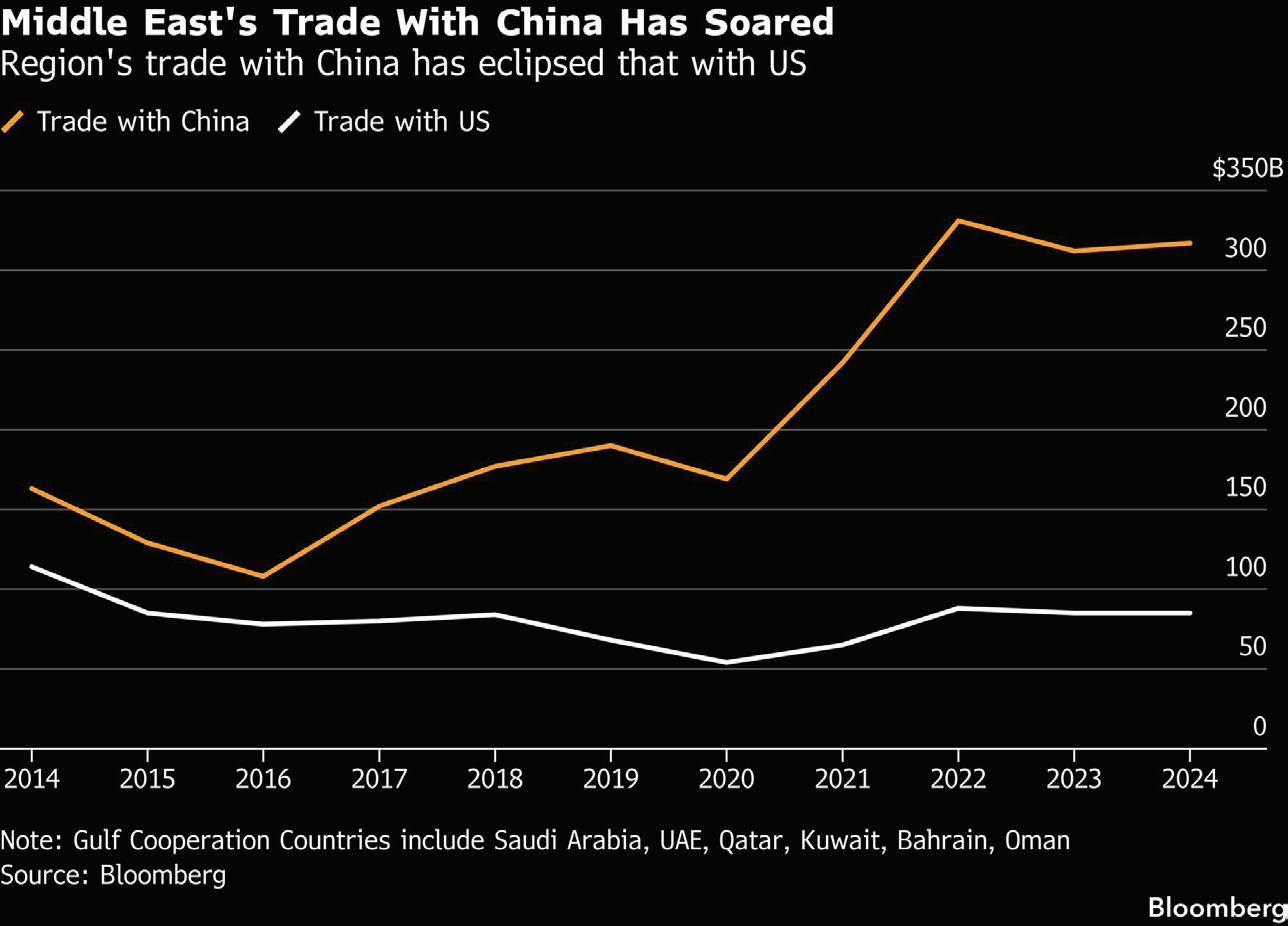
EVEN as China remains one of Iran’s biggest diplomatic allies, President Xi Jinping’s support for the Islamic Republic is being constrained by a vast trail of Chinese capital across the Gulf. China ramped up investment in the Middle East in the wake of the pandemic. Companies hit by a slump in the world’s No. 2 economy sought to cash in as Gulf states pushed to diversify beyond fossil fuels into green tech and tourism—sectors that neatly matched Beijing’s strengths. With developing nations like Zambia and Sri Lanka defaulting on their debt, countries buoyed by oil reserves seemed an attractive bet. That strategy has sent Chinese investment and construction in the Middle East growing at the fastest pace of anywhere in the world in recent years, transforming the region into a key beneficiary of Xi’s flagship Belt and Road Initiative. China is outcompeting the US as a regional financier. Between 2014 and 2023, Beijing provided about $2.34 for every dollar Washington donated or lent to Middle East countries, according to AidData’s Executive Director Brad Parks.
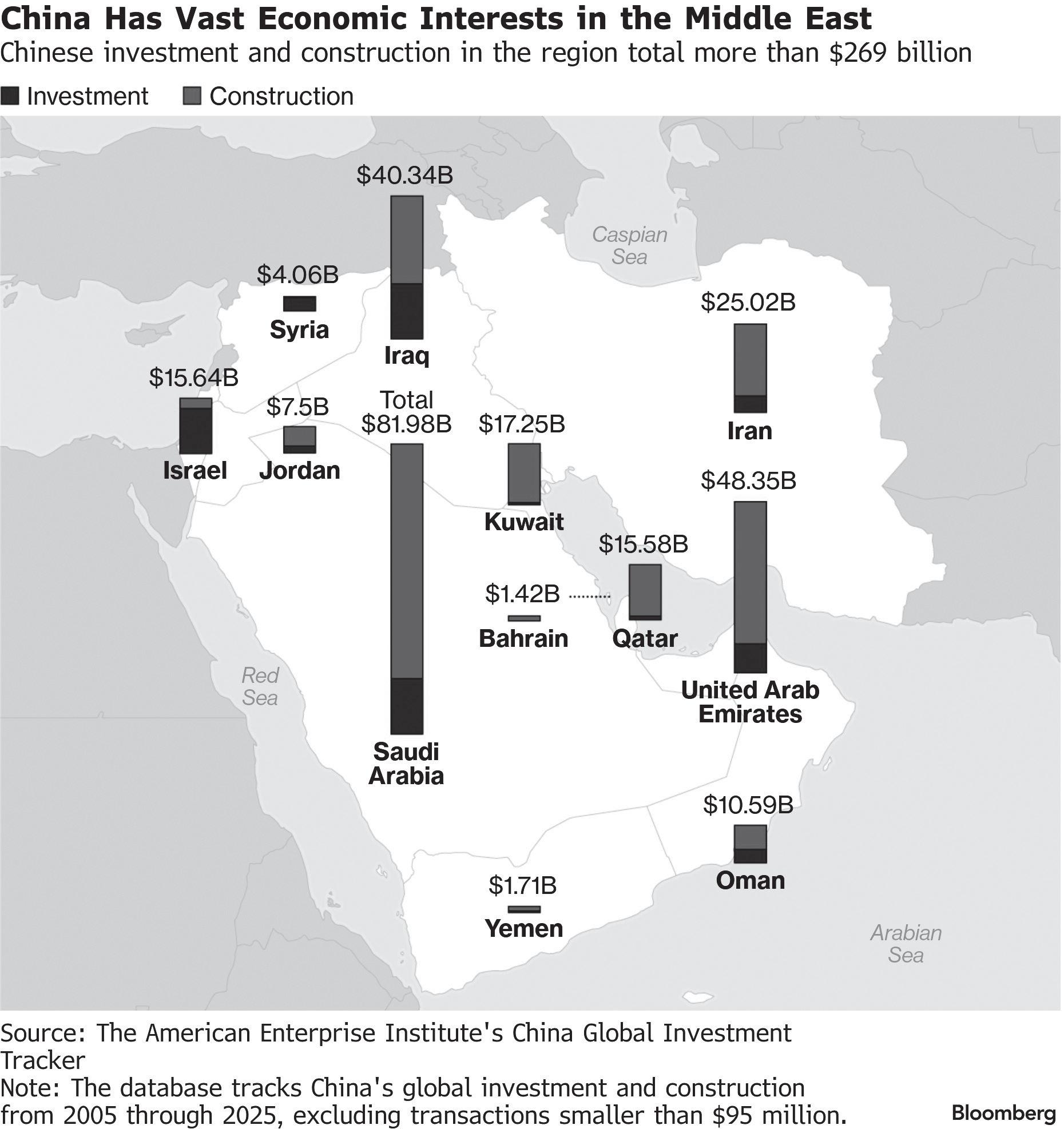
Now, a spiraling war that’s killed thousands and jolted global markets is jeopardizing the stability China depended on to expand its economic footprint. While Trump has credited Chinese officials with convincing Iran to agree to a two-week truce, larger questions remain about durable peace in a region where China has amassed about $270 billion worth of investments and construction projects over the past two decades, according to the American Enterprise Institute’s China Global Investment Tracker.
“China’s stake in the Gulf is high—there is people risk, there is investment risk, there is energyresource risk,” said George Chen, partner for Greater China practice at The Asia Group. Beijing now needs to “help Iran to de-escalate while at the same time reassuring Gulf countries it will continue to cooperate with them.”
In the long term, this could even be an “opportunity for China to double down on investment in the Gulf given the cheaper valuation of a lot of assets,” he added. China’s envoy to the United Nations Fu Cong this week laid out in an X post his country’s desire to balance both sides’ perspectives, in a war that’s bitterly dividing the region. Fu wrote that the US and Israeli strikes were a “clear
violation” of international norms, while calling for “shipping lanes and energy infrastructure” to be safeguarded, in a thinly veiled reproachment of Tehran.
“Peace is the prerequisite for development,” a Foreign Ministry spokesperson told Bloomberg News. “As sincere friends and strategic partners of Gulf and Middle Eastern countries, China is willing to deepen practical cooperation in various fields such as investment with regional states.’’
Chinese projects are already in the firing line. At least three Chinese-financed infrastructure assets across Dubai, Qatar and Oman have been targeted by Iranian strikes. Another 12 are in high risk areas, jeopardizing some $4.66 billion in financing commitments including projects already impacted, according to estimates by AidData, a research lab at William & Mary University in the US.
While no Chinese workers have been reported injured outside Iran, thousands are working in a war zone. Before the conflict began, some 370,000 Chinese citizens were stationed in the United Arab Emirates alone, according to China’s official Xinhua News Agency. More than 10,000 have been since evacuated from the Middle East, but many who spent money relocating have stayed put.
James Wang, 40, is among them. He arrived in the United Arab Emirates last summer, leaving behind an 11-year-old son. He works on a construction site managing some 40 people and earning about 15,000 yuan ($2,193) a month—more than double what he’d receive in China, where a property crash has crippled wages. Air raid alerts at one point pinged his phone almost every hour, yet he says he has no plans to leave.
“This place is going through a massive infrastructure boom, much like China was ten years ago,” he told Bloomberg News. “There are definitely still oppor -
By Munir Ahmed & E. Eduardo Castillo
The Associated Press
ISLAMABAD —It was initially seen as an unexpected mediator, but this week Pakistan has established itself as a key player in bringing Iran and the United States to the negotiating table. Now, it is awaiting representatives from both countries to meet in Islamabad, as the world watches to see whether the talks could lead toward an end to the war.
Since Washington and Tehran agreed to an initial 14-day ceasefire on Tuesday, Pakistan’s Prime Minister Shehbaz Sharif, Foreign Minister Ishaq Dar and the powerful army chief Field Marshal Asim Munir have been sharing messages about conversations with world leaders, highlighting their role as mediators. President Donald Trump has repeatedly referred to Munir as “my favorite field marshal” since last year, when he helped mediate a ceasefire between Pakistan and India. Islamabad isn’t often called on to act as an intermediary in highstakes diplomacy, but it’s stepped into the role this time for a number of reasons, both because it has relatively good ties with both Washington and Tehran and because it has a lot at stake in seeing the war resolved.
Pakistani government officials have said that their public peace
effort follows weeks of quiet diplomacy, though they have provided few details. The talks are expected to take place in Islamabad on Saturday following the arrival of both delegations. Pakistan ramped up security across the city with additional troops and police. Here’s what to know about Pakistan’s mediation effort:
Pakistan helped US deliver an initial 15-point plan to Iran Pakistan’s role in Iran-US negotiations surfaced a few weeks ago following media reports. Officials in Islamabad later acknowledged that a US proposal had been conveyed to Iran.
It remains unclear who has served as Iran’s point of contact in the indirect talks.
According to Pakistani officials, US messages were being passed to Iran and Iranian responses relayed to Washington, though they did not specify how the process was being handled or who was directly communicating with whom. Pakistan said that Turkey and Egypt were also working behind the scenes to bring the sides to the negotiating table.
A final US ultimatum and an announcement of an agreement BUT days passed with no indication of progress. Last weekend, Trump escalated his threats and issued what seemed like a final deadline to Iran, saying that if
tunities here—it’s just a matter of whether I can catch this wave while it lasts.”
Breakthrough moment
IN 2023, Beijing’s friendship with Tehran and commercial ties with Gulf states took center stage as China brokered a rapprochement between bitter rivals Saudi Arabia and Iran—a breakthrough widely hailed at the time as a sign of Xi’s growing clout in the region.
Since then, however, China has largely taken a backseat as conflict reignited in the Middle East. The October 2023 Hamas attacks on Israel and ensuing escalation exposed the limits of its influence: Beijing has confined itself to calls for restraint and de-escalation, preferring to focus on booming business.
Saudi Arabia, the region’s largest economy, has welcomed that engagement. It’s now the leading recipient of Chinese construction activity globally, particularly in clean energy, with Chinese
a mediator
Tehran did not reopen the Strait of Hormuz by Tuesday, “the entire country can be taken out.” That same day, he also said that “a whole civilization will die tonight,” adding, “I don’t want that to happen, but it probably will.”
Pakistan and other countries were already working behind the scenes to reach an agreement and avoid an escalation.
Then, before the deadline, Sharif tweeted: “With the greatest humility, I am pleased to announce that the Islamic Republic of Iran and the United States of America, along with their allies, have agreed to an immediate ceasefire.” The US and Iran also confirmed it.
Michael Kugelman, a senior fellow for South Asia at the Atlantic Council, said that Pakistan can show to the world it is “an influential regional actor” thanks to its work as mediator.
“Islamabad can also enjoy a measure of vindication: for having defied the skeptics who didn’t think it could pull off such a feat,” he wrote in Foreign Policy magazine this week.
Ties with both US and Iran set Pakistan up for new role
PREVIOUS US-Iran negotiations have been facilitated mainly by countries in the Middle East, including Oman and Qatar, but as they came under Iranian fire, Pakistan stepped into the role. Analysts say Pakistan’s geo -
firms building large solar plants and wind turbines, said Derek Scissors, a senior fellow at the American Enterprise Institute who tracks Chinese overseas investment. “The region appreciates Chinese technical expertise,” he said. “Chinese firms can do things that are valued.”
In the United Arab Emirates, Chinese companies are developing the world’s largest battery energy storage system, while in Saudi Arabia they’re building solar plants and data centers.
Chinese cars last year counted the UAE as their third biggest market globally.
The war now threatens to complicate those ties, according to She Gangzheng, an associate professor of international relations at Tsinghua University. “The Gulf is no longer the kind of straightforward ‘gold mine’ it once appeared to be for China,” She said. “What has been damaged is not just physical security, but also confidence in the broader picture.”
‘In full swing’ DESPITE the risks, many construction projects in countries such as Israel, the UAE and Saudi Arabia are pressing ahead. On March 7, hours after a drone attack near at Dubai’s International Airport— and barely an hour after another wave of missiles were intercepted overhead—one Chinese worker reported on social media platform Douyin: “The construction site is still in full swing.”
Chinese workers post videos of taking cover in bomb shelters and screenshots of late-night alerts about incoming strikes. But despite the risks, one Chinese worker in Israel with more than 40,000 followers on Douyin said none of his colleagues had taken up Chinese embassy evacuation offers. A whole year’s salary in China “wouldn’t match what I make here in a month,” he quoted a colleague as saying. As the situation in the Middle East shifts, there could be longterm openings for China. Iran’s retaliation against US allies has dented America’s credibility, giving Beijing a chance to play an even bigger economic role after the conflict. Already, Iran is reportedly taking some payment for passage through the Strait of Hormuz in yuan, giving the Chinese currency a boost.
When the dust settles, experts say China is set to remain a major economic force, albeit with risks and security considerations that weren’t previously priced in.
“I don’t expect to see any major scaling back of its investment in the region,” said William Figueroa, assistant professor of history and theory of international relations at the University of Groningen in the Netherlands. “Beijing sees the current conflict like a hurricane: something they have little ability to influence or stop, and so they are simply looking to weather the storm and rebuild when it’s over.” With assistance from Yujing
graphic proximity to Iran—it’s one of its neighbors—coupled with its longstanding ties with the US, gives it a unique position at a time when direct communication between the two sides remains constrained.
Islamabad also has close strategic ties with Gulf states including Saudi Arabia, with which it signed a defense cooperation agreement last year. However, Pakistan has no diplomatic relations with Israel because of the lingering issue of Palestinian statehood.
Relations between the US and Pakistan have improved since last year, with increased diplomatic engagement and expanding economic ties. Islamabad also joined Trump’s Board of Peace, which aims to ensure peace in Gaza, despite opposition from Islamists at home.
Pakistan has a lot at stake in ceasefire talks
THE conflict poses some of “the biggest economic and energy security challenges” in Pakistan’s history, said Islamabad-based security analyst Syed Mohammad Ali.
The country gets most of its oil and gas from the Middle East— and, he said, the 5 million Pakistanis working in the Arab world send home remittances each year roughly equal to the country’s total export earnings.
Rising tensions have already contributed to higher global oil
prices, forcing Pakistan to increase fuel prices by about 20% and putting pressure on Sharif’s government.
The war is also adding to domestic turmoil, even as Pakistan has been grappling for months with its own conflict with neighboring Afghanistan. Islamabad has accused the country’s Taliban government of tolerating militant groups that are behind attacks in Pakistan.
Earlier this month, protests erupted across the country following US strikes on Iran, with demonstrators clashing with security forces in several cities. At least 22 people were killed and over 120 injured in clashes in Karachi a day after the US and Israel attacked Iran, killing Supreme Leader Ayatollah Ali Khamenei. Another 12 people were killed after a mob tried to storm the US Consulate in Karachi on March 1. Khamenei was a central religious and political figure for Shiites worldwide, including in Pakistan.
Pakistan has a record as a mediator PAKISTAN’S then-President Gen. Yahya Khan facilitated back-channel contacts that led to US President Richard Nixon’s historic 1972 visit to China. That paved the way for the establishment of diplomatic ties between Washington and Beijing in 1979. Since then, Pakistan has played
a role in several other complex regional conflicts, most notably during the 1988 Geneva Accords that paved the way for the Soviet withdrawal from Afghanistan. Acting as a front-line state and key interlocutor, Islamabad participated in U.N.-brokered negotiations while working closely with the United States and other stakeholders and helped increase pressure on Moscow to pull out its forces.
Castillo reported from Beijing.


By Bill Barrow The Associated Press
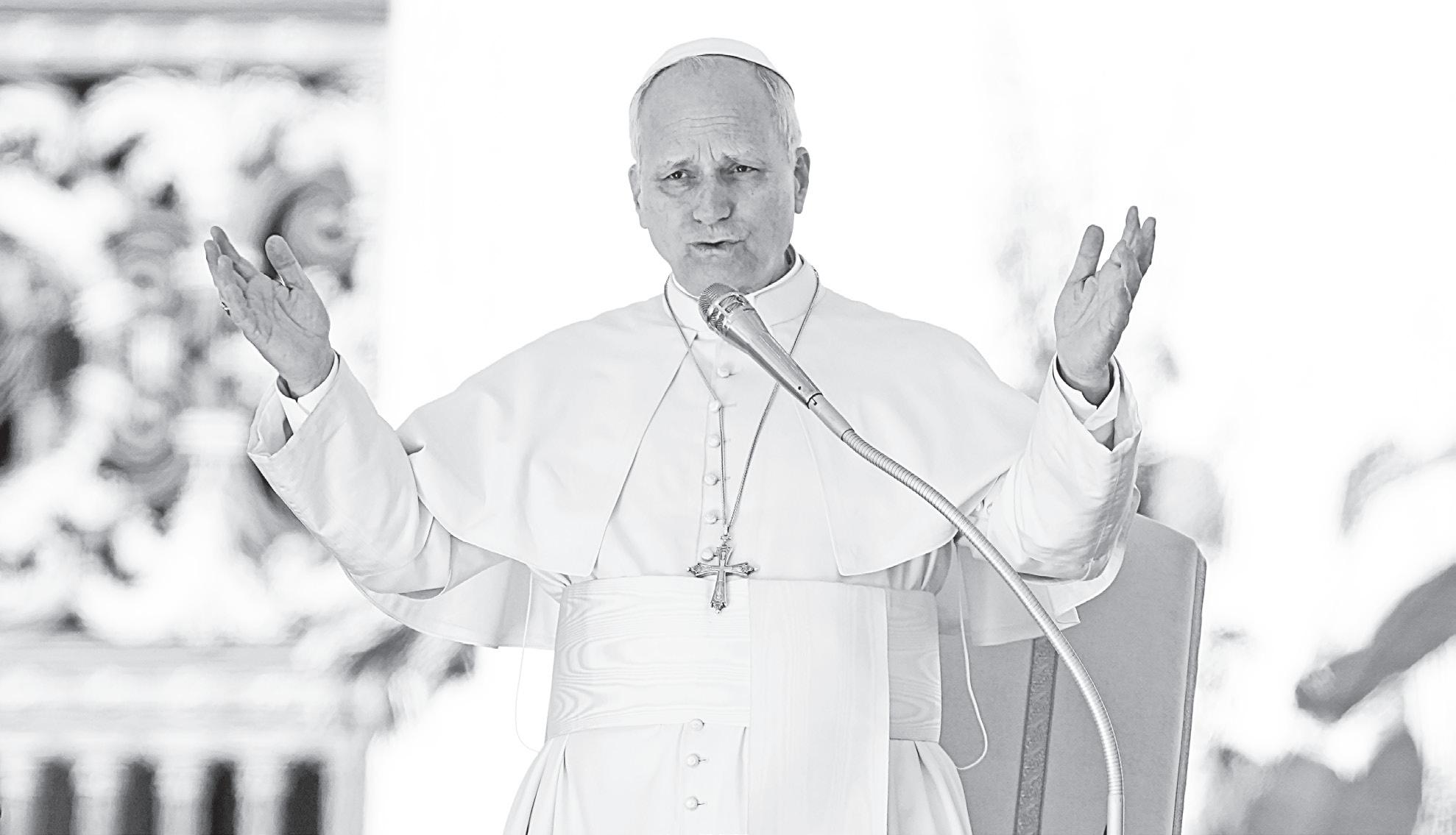
DONALD Trump is accustomed to criticism from coast to coast — Democrats, disaffected Republicans, late-night comedians, massive protests. Yet in his second presidency, Trump’s most influential American critic doesn’t live in the country but at the Vatican.
It’s an unprecedented situation, with the first American pope directly assailing the American president over the war in Iran, where a fragile ceasefire took hold this week. The announcement came after Pope Leo XIV declared that Trump’s belligerence was “truly unacceptable.”
Never before has the relationship between Washington and the Vatican revolved around two Americans — specifically, a 79-year-old politician from Queens and a 70-year-old pontiff from Chicago. They come from the same generation and share some common cultural roots yet bring jarringly distinct approaches to their positions of vast power. And the relationship comes with risks for both sides.
“They’re two white guy boomers but they could not be any more different in their life experiences, in their values, in the way they have chosen to live those values,” said theology professor Natalia Imperatori-Lee of Fordham University. “This is a very stark contrast, and I think an inflection point for American Christianity.”
Polar positions on Iran among US Christians EXPERTS on the Catholic Church emphasized that Leo’s opposition to the war reflects established church teachings, not the reflexive politics of the moment.
“For the last five centuries,
the church has been involved in a project of helping develop strong international norms,” including the Geneva Conventions in recent centuries, said Catholic University professor William Barbieri. “It is a very long-standing tradition rooted in Scripture and theology and philosophy.”
Yet the US administration, which has close ties to conservative evangelical Protestant leaders, has claimed heavenly endorsement for Trump’s war on Iran.
Defense Secretary Pete Hegseth urged Americans to pray for victory “in the name of Jesus Christ.” When Trump was asked whether he thought God approved of the war, he said, “I do, because God is good — because God is good and God wants to see people taken care of.”
The Rev. Franklin Graham, son of iconic Baptist evangelist Billy Graham, said of Trump that God “raised him up for such a time as this.” And Graham prayed for victory so Iranians can “be set free from these Islamic lunatics.”
Leo countered in his Palm Sunday message that God “does not listen to the prayers of those who wage war, but rejects them.” He referenced an Old Testament passage from Isaiah, saying that “even though you make many prayers, I will not listen — your hands are full of blood.”
While it’s not unusual for popes and presidents to be at cross pur -
poses, it’s exceedingly rare for the leader of the Catholic Church to directly criticize a US leader, and Leo later named Trump directly and expressed optimism that the president would seek “an offramp” in Iran.
An even stronger condemnation came after Trump warned of mass strikes against Iranian power plants and infrastructure, writing on social media that “an entire civilization will die tonight.” Leo described that as a “threat against the entire people of Iran” and said it was “truly unacceptable.”
Experts: Leo doesn’t see himself as a Trump rival IMPERATORI-Lee said Leo’s direct criticism stands out from the church’s more general critiques of political and social systems. For example, Pope Francis urged US bishops to defend migrants without specifically mentioning Trump or his deportation agenda. Leo also previously called for humane treatment of migrants.
“Popes have critiqued unfettered capitalism before, very robustly. The popes have critiqued the Industrial Revolution, right? Things that the US has been at the forefront of,” Imperatori-Lee said, “but it’s never been this specific
and localized.”
She said Leo’s commentary resonates in the US — with Catholics and non-Catholics — because he is a native English speaker.
“There’s no question about his inflection and meaning,” she said. “It removes any ambiguities.”
Trump welcomed Leo’s election last May as a “great honor” for the country, and he hasn’t responded to the latest criticisms. The White House did not respond to a request for comment.
“What Pope Leo and Donald Trump have in common is they both lived through the postwar polarization,” including the political upheaval of the Civil Rights Movement and Vietnam War, said Steven Millies, a professor at Chicago’s Catholic Theological Union, one of the pope’s alma maters.
He noted that Leo is a subscriber to The New York Times, plays the “Wordle” game, keeps up with US sports and talks regularly with his brothers, including an avowed Trump supporter.
“In some ways he’s just like us,” Millies said, someone “who understands where our domestic political crisis came from,” unlike the Argentinian Francis, “who did not fully understand the peculiarities
of the United States” even as he offered implicit criticism.
Barbieri said Leo’s American savvy still does not change an underappreciated reality of Catholicism and the papacy. “The Catholic Church doesn’t neatly fit into either right or left boxes as they’re understood in US politics,” he said.
Leo’s global focus vs. Trump’s ‘transactional’ politics
LEO spent much of his pre-papal ministry, including all his time as a bishop and cardinal, outside the US.
He was educated in Rome as a canon lawyer within the church. He was a bishop in poor, rural swaths of Peru. He led the Augustinian order and served as Francis’ prefect for recommending bishop appointees around the world.
Imperatori-Lee said that global reach gave him a first-hand perspective on how Washington’s economic and military policies — including backing dictators in Latin America — have negatively affected less powerful nations and their citizens.
His varied experiences made then-Cardinal Robert Prevost uniquely suited to be elected pope despite the College of Cardinals’
traditional skepticism toward the US and its superpower status. Millies argued that Trump and his advisers, even Vice President JD Vance, a Catholic convert, may not appreciate those distinctions.
“This is an administration that seems to think only in terms of transactional politics — who’s for us and who’s against us,” he said.
Polarization poses risks for Leo and Trump RELATIONS between Washington and the Vatican have become so strained that a report of an allegedly contentious meeting involving Pentagon and Catholic Church officials sent shockwaves through both cities.
According to the report in The Free Press, a member of Trump’s administration warned the church in January not to stand in the way of US military might.
The US Embassy to the Holy See rejected the report, writing on social media that “deliberate misrepresentation of these routine meetings sows unfounded division and misunderstanding.”
Millies, meanwhile, questioned whether anything the pope or US bishops say can sway individual Catholics. Trump is likely to lose support among Catholics as he loses support across the broader electorate, Millies said, but that’s not necessarily because members of Leo’s flock are applying church doctrine.
“Partisan preferences always trump the religious commitments,” Millies said, describing a “disconnect” between church leaders and many parishioners who look to other sources, politicians included, when shaping their views of faith and politics.
“The icon of Catholicism in American politics now is JD Vance, and it’s more about winning an argument,” he said. “It’s a very different emphasis, but it’s one that may suit the Trump administration very well.”
w
Prediction markets back in spotlight, this time because of the war in Iran
By Wyatte Grantham-Philips AP Business Writer
PREDICTION markets let people wager on just about anything—from basketball games to elections. And among more jarring bets recently, the fate of the US and Israel’s war against Iran. Shortly ahead of a fragile ceasefire agreement earlier this week, a new group of accounts on prediction market platform Polymarket made highly specific, well-timed trades betting there’d be an announcement about a halt in fighting for April 7. Some quickly pocketed awards, which amounted to hundreds of thousands of dollars in profits combined. Others are still awaiting payouts as an end to the deadly conflict still seems uncertain. Regardless, the trades once again put the spotlight on a murky—and growing— world of speculative, 24/7 transactions now filling the internet. And some have raised questions about suspicious activity, including an anonymous Polymarket trader pocketing more than $400,000 following


the US military’s capture of former Venezuelan President Nicolás Maduro in January. The timing and subjects of such trades have fueled concerns about potential insider trading—with calls increasing among lawmakers for investigations. Popular platforms, including Polymarket, have rolled out added guardrails in efforts to combat insider trading recently, but critics say it isn’t enough. Meanwhile, because prediction market wagers are categorized differently than traditional forms of gambling, tensions about government oversight have erupted.
President Donald Trump’s administration has already thrown its support behind company operators—and sued three states over their efforts to regulate them further.
Here’s what we know: How prediction markets work THE scope of topics involved in prediction markets can range immensely. Recently, there’s been a surge of wagers on elections and sports games. But some users have also bet millions on things like a rumored—and ultimately unrealized—“secret finale” for the Netflix’s “Stranger Things,” whether the US government will confirm the existence of extraterrestrial life and how much billionaire Elon Musk might post on social media this month.
In industry-speak, what someone buys or sells in a prediction market is called an “event contract.” They’re typically advertised as “yes” or “no” wagers. And the
price of one fluctuates between $0 and $1, reflecting what traders are collectively willing to pay based on a 0% to 100% chance of whether they think an event will occur.
The more likely traders think an event will occur, the more expensive that contract will become. And as those odds change over time, users can cash out early to make incremental profits, or try to avoid higher losses on what they’ve already invested.
Proponents of prediction markets argue putting money on the line leads to better forecasts and allow you to gauge public opinion as an alternative to polling. And some think there’s value in monitoring prediction markets for potential news, particularly elections.
Still, prediction markets can also be wrong. People investing their money may be closely following certain events, but others could just be randomly guessing.
Who is behind all of the trading is also pretty unclear.
The companies running today’s biggest platforms know who their customers are—as they collect personal information to verify identities and payments. But most users can trade under anonymous pseudonyms on public-facing websites, making it difficult for the world to tell who is profiting off many event contracts.
The major players
POLYMARKET is one of the largest prediction markets in the world. Users can fund event contracts through cryptocurrency, debit or credit cards and bank transfers. Restrictions vary by country, but in the US, the reach of these markets has expanded rapidly over recent years, coinciding with shifting policies out of Washington. While prediction markets have found backing from the Trump-controlled Commodity Futures Trading Commission, former President Joe Biden was more aggressive in cracking down. Following a 2022 settlement with the CFTC, Polymarket was barred from operating in the country. That changed under Trump late last year, when Polymarket announced it would be returning to the US after receiving clearance from the commission. American-based users can now join a “waitlist” to access the platform. Meanwhile, Polymarket’s top competitor, Kalshi, has been a federally-regulated exchange since 2020. The platform offers similar ways to buy and sell event contracts as Polymarket—and it currently allows event contracts on elections and sports nationwide. Kalshi won court approval just weeks before the 2024 election to let Americans put money on
Critics also stress that the ease and speed of joining these 24/7 wagers leads to financial losses every day, particularly harming users who may already struggle with gambling.

THE push for greener agriculture in the Philippines is moving beyond research laboratories and into policy and industry spaces, as government scientists and international partners ramp up efforts to replace hazardous chemical pesticides with eco-friendly alternatives.
At the National Policy Forum titled “Incentivizing the Formulation, Production, and Application of Eco-Friendly Crop Protection Solutions in the Philippines” on March 31, Science Secretary Renato U. Solidum Jr. said meaningful change in agriculture depends on “coherent policies, strong institutions, and sustained partnerships.”
This is as the country confronts the continued use of Persistent Organic Pollutants and Highly Hazardous Pesticides.
“The challenge we are addressing through this project is both global and urgent: the continued use of Persistent Organic Pollutants and Highly Hazardous Pesticides,” Solidum said in his speech.
He pointed out that science and innovation must be directly linked to public welfare and environmental protection, adding that research should not remain confined to laboratories but must translate into real-world policy and industry shifts.
“Science, technology, and innovation must be harnessed to advance inclusive economic
growth, environmental resilience, and public welfare,” the head of the Department of Science and Technology (DOST) said.
Solidum pointed to the growing role of biopesticides and biological control agents as a practical example of how science can influence regulation and reshape agricultural practices.
“The promotion of biopesticides and biological control agents is a tangible reflection of this mission. It demonstrates how S&T can directly shape evidence-based policy, regulatory improvement, and responsible market transformation,” he added.
The initiative is part of the Philippines’ participation in the United Nations Industrial Development Organization (Unido)-Global Environment Facility (GEF) Financing Agrochemical Reduction and Management (FARM) Project, a regional program aimed at reducing reliance on harmful chemical pesticides across Asia and promoting safer crop protection methods. The

project is funded by the GEF and implemented by the Unido.
In the Philippines, the program is being carried out by the DOSTPhilippine Council for Agriculture, Aquatic and Natural Resources Research and Development (DOSTPCAARRD) and implemented by the Philippine Agriculture and Resources Research Foundation Inc. It is also being supported by Hindustan India Ltd.
The project is being implemented by the United Nations Environment Programme in seven countries—Kenya, India, Pilipinas, Uruguay, Ecuador, Laos, at Vietnam.
Unido first invited DOST to join the initiative in 2022, which was later endorsed to DOST-PCAARRD after being recognized as aligned with existing programs on integrated pest management, safer crop production, and green innovation.
Solidum said the project builds on ongoing national efforts rather than starting from scratch.

Artemis II astronauts describe their lunar voyage as surreal and profound ahead of Earth return
By Marcia Dunn AP Aerospace Writer
HOUSTON—Drawing ever closer to Earth, the Artemis II astronauts tidied up their lunar cruiser for the upcoming “fireball” return and reflected on their historic journey around the moon, describing it as surreal and profound.
As the next-to-last day of their flight dawned on Thursday, humanity’s first lunar explorers in more than half a century were less than 150,000 miles (240,000 kilometers) from home with the odometer clicking down.
“We have to get back. There’s so much data that you’ve seen already, but all the good stuff is coming back with us. There are so many more pictures, so many more stories,” said pilot Victor Glover, adding that “riding a fireball through the atmosphere is profound as well.”
Being cut off from all of humanity for nearly an hour while behind the moon was especially “surreal,” according to commander Reid Wiseman.
“There’s a lot that our brains have to process...and it is a true gift,” Wiseman said late Wednesday during the crew’s first news conference since before liftoff.
While out of contact behind the moon Monday, Wiseman, Glover, Christina Koch and Canada’s Jeremy Hansen became the
most distant humans ever, clocking in at a record 252,756 miles (406,771 kilometers) from Earth before heading back. As they emerged from behind the moon, they experienced a wondrous total solar eclipse as the orb blocked the sun from their perspective.
Launching from Florida on April 1 diminished the amount of illumination on the lunar far side, Glover noted, but the eclipse was the consolation prize “and it was one of the greatest gifts.”
While acknowledging anxiety over Friday’s return, NASA Associate Administrator Amit Kshatriya said the crew’s “expressions of love and devotion to family” have warmed hearts worldwide and served as “a great example of why we go and do these missions.”
”If you can’t take love to the stars, then what are we doing?” he said. “That’s why we send humans instead of robots sometimes, that’s why we have that firsthand witness.”
Friday’s reentry and Pacific splashdown off the coast of San Diego—as dynamic and dangerous as liftoff—topped everyone’s minds. The recovery ship, USS John P. Murtha, was already at sea, with a squadron of military planes and helicopters poised to join the operation.
It was the first time that NASA and the Defense Department have teamed up for a lunar crew’s reentry since Apollo 17 in 1972. Their Orion capsule was set come
screaming back, hitting the atmosphere at a predicted 34,965 feet (10,657 meters) per second—not a record but still mindbogglingly fast.
Flight director Jeff Radigan said the capsule must nail the reentry angle within a single degree.
“Let’s not beat around the bush. We have to hit that angle correctly—otherwise we’re not going to have a successful reentry,” he said.
Instead of replacing Artemis II’s heat shield, which would have forced another lengthy delay, NASA tweaked the capsule’s descent through the atmosphere to reduce the blisteringly hot exposure. Next year’s Artemis III and beyond will fly with redesigned heat shields.
Artemis III will see astronauts practice docking their capsule with a lunar lander or two in orbit around Earth. Artemis IV in 2028 will attempt to land two astronauts near the moon’s south pole, setting the stage for what NASA hopes will be a sustainable lunar base.
NASA officials have been loath to provide their risk assessment numbers for the nearly 10-day mission, acknowledging launch and entry as the biggest threats.
“We’re down to the wire now,” said NASA’s Lakiesha Hawkins. “We’re down to the end of the mission, and obviously getting the crew back home and getting them landed safely, is a significant part of the risk that’s still in front of us.”
“We immediately recognized its significance and alignment with our priorities. We knew this was not a new beginning, but rather a continuation and strengthening of our ongoing initiatives toward sustainable and responsible agriculture,” he said.
He added that the transition from chemical-based pesticides to biological alternatives goes beyond science, requiring coordinated action across policy, regulation, and industry.
“It requires a whole-of-society approach, protecting our farmers’ health and livelihoods, ensuring food and environmental safety, and preserving the natural resources that sustain our agriculture and ecosystems,” Solidum said.
As implementation progresses, he emphasized the need to strengthen regulatory alignment, expand capacity building, and secure sustainable financing to support long-term adoption of eco-friendly technologies.
Solidum expressed confidence that the project could become a regional model for science-driven agricultural reform. He said its outcomes could demonstrate how collaboration between government, researchers, and development partners can accelerate sustainable transformation in the sector.
Not starting from zero
FOR researchers on the ground, the shift toward biopesticides is not new—but scaling it remains the real challenge.
DOST-PCAARRD Executive Director Reynaldo Ebora, who also chairs the project steering committee for FARM Philippines, said many biocontrol technologies have already been developed and tested by Filipino scientists.
“It is important to note that biopesticides and biocontrol are not new to the Philippines,” Ebora said in his welcome remarks.
He said several of these innovations have shown effectiveness in
addressing pest and disease outbreaks in key agricultural crops, backed by years of research and institutional support.
The gap, however, lies in moving these solutions beyond pilot testing and into widespread commercial use.
“The challenge lies in scaling these innovations—to move them from pilot studies to full commercialization, where they can benefit more farmers and contribute to a more competitive local industry,” he said.
Ebora said the FARM Project is designed to help bridge that gap by creating a more enabling policy environment and strengthening the link between research and enterprise.
“To us at PCAARRD, science must translate into practical solutions that serve people and communities,” he said. He added that the project reflects a broader vision of integrating science, policy, and business to make agriculture more sustainable and inclusive.
“I invite all of you to take an active role in today’s discussions, to share insights and perspectives, and to work together in charting a roadmap toward a stronger, science-driven, and eco-friendly crop protection industry for the Philippines,” Ebora said.
To show the commitment of the participating government agencies, their representatives signed the document: Fertilizer and Pesticide Authority, Bureau of Agriculture and Fisheries Standards, Department of Environment and Natural Resources, Philippine Chamber of Agriculture and Food Inc., Visayan Agricultural Innovation Incorporated, and University of the Philippines Los Baños.
Balik Scientist bee chemical profile discovery to help in food safety, environment protection
HIS successful characterization of the chemical profiles of stingless bee pollen and propolis, showing clearer differences in their nutrients and antioxidant levels, has helped Balik Scientist Dr. Elmer-Rico E. Mojica make scientific discoveries in strengthening food safety, environmental protection, and local food industries.
By studying bee products and daily food items using advanced analytical chemistry techniques, such as Fourier Transform Infrared Spectroscopy, UltravioletVisible Spectroscopy, fluorescence spectroscopy, and chemometrics, Mojica was able to identify what makes items safe, authentic, and of high quality.
His research methods, unlike wet chemistry tests, are rapid, non-destructive, and of low-cost quality control, helping both consumers and small beekeepers in the country.
He helps raise awareness on the unseen pollution affecting families and communities by generating the country’s first baseline data on microplastics in key consumer products, such as powdered milk and honey, as well as in waterways and coastal areas in Miagao, Iloilo, where he found that all the tested samples contained microplastics.
“Even with his short-term engagement as Balik Scientist Dr. Mojica has cultivated long-term impact in the scientific community. What makes our Balik Scientists like Dr. Mojica exceptional is their ability to integrate global expertise with the needs of our local sectors,” said Science Secretary Renato U. Solidum Jr. The Balik Scientists Program is under the Department of Science and Technology (DOST).
Besides his research and development (R&D) breakthroughs as a Balik Scientist, Mojica has made lasting contributions to the University of the Philippines Los Baños (UPLB) by providing laboratory instruments and expanding the university’s research networks by establishing collaborations with the UP Visayas, Cavite State University, University of Santo Tomas, and De La Salle University.
During Mojica’s exit presentation on March 6, DOST-PCIEERD Deputy Executive Director Engr. Niñaliza H. Escorial shared that Mojica’s efforts have helped local producers and increased scientific knowledge.
“Dr. Mojica’s proficiency in vibrational spectroscopy equipment and analytical chemistry is crucial to enhancing the nation’s research capabilities,” Escorial shared.
“Furthermore, to reinforce the Council’s commitment to supporting the BSP Program, we are pleased to announce the establishment of the BSP R&D Grant and yearly Call for Proposal of this grant. This grant provides funding for new and ongoing medium-term and long term Balik Scientist in the fields of industry, energy, and emerging technologies. At present, two proposals have already been successfully approved under this
grant,” Escorial pointed out. Before returning to the Philippines as a Balik Scientist grantee, Mojica was already a highly accomplished Filipino chemist based in New York City with an impressive research career, authoring or coauthoring over 118 peer-reviewed articles, book chapters, and encyclopedia entries.
DOST Undersecretary Dr. Leah J. Buendia, for R&D, and head of the Balik Scientist Program, pointed out the need for continuing programs that support the country’s scientific capabilities.
“As one of DOST-PCIEERD’s 186 Balik Scientists, Dr. Mojica’s exceptional work allows more researchers and students to gain advanced analytical chemistry knowledge through hands-on experience with state-of-the-art instruments and methods. The [BSP], which has more than 165 host institutions nationwide and is committed to the growth and development of the nation through science, technology, and innovation, is the cornerstone of Dr. Mojica’s work as a real-life innovator—indeed, a ‘scientist with a heart,’ a Balik Scientist,” Buendia said.
To date, the Balik Scientist Program has supported 709 Balik Scientists, with 956 engagements.

A6 Sunday, April 12, 2026

EW data from the Annuario Pontificio 2026 and Annuarium Statisticum Ecclesiae 2024 highlight trends in baptized populations across the five continents, with a remarkable increase in the number of Catholics in Africa.
Over the past two years, the number of baptized Catholics worldwide has remained stable at approximately 17.8 percent, reflecting growth roughly aligned with the rate of global population increase.
In 2024, the Catholic population stood at over 1.422 billion, compared with about 1.406 billion in 2023, a relative increase of 1.14 percent.
The contribution of different continents to the overall figure varies. Europe remains the least dynamic continent, with Catholic numbers rising by only 0.8 percent.
In the context of ongoing demographic stagnation, this results in a modest improvement in territorial presence, with Catholics representing 39.7 percent of Europe’s population in 2024.
In the Americas and Asia, the Catholic population grows more slowly than the general population, whereas Oceania experiences more substantial growth (+2.1 percent).
Africa shows a remarkable increase, with growth nearly five times that of Asia (2.7 percent) and above the continent’s demographic growth. The number of Catholics in Africa rose from just over 281 million in 2023 to over 288 million in 2024.
These differing trends reinforce the increasing weight of the African Church, with its share of global Catholics rising from 19.9 percent to 20.3 percent, while Europe’s share declined slightly, from 20.4 percent in 2023 to 20.1 percent in 2024.
In the Americas, Catholics continue to represent a significant proportion, namely a 47.7 percent of the global total.
The proportion of Catholics remains stable in Asia and Oceania, at 11.0 percent and 0.9 percent of the global total, respectively.
Of particular interest is the ratio of Catholics to population by continent, which indicates the number of Catholics per 100 inhabitants.
At the end of 2024, this ratio was 64.0 percent in the Americas, 39.7 percent in Europe, 25.9 percent in Oceania, 19.9 percent in Africa, and 3.3 percent in Asia.
Record number in Estonia ESTONIA is considered the least religious country in Europe, based on statistical evidence, but numbers only tell a small part of the story of faith.
During the Easter Vigil this year, a record number of people were baptized in the Cathedral of the Diocese of Tallinn.

ACATHOLIC bishop on Wednesday urged stronger support for elderly and isolated priests, warning that loneliness and neglect remain pressing but often overlooked challenges within the Catholic Church.
Bishop Julito Cortes, chairman of the Catholic Bishops’ Conference of the Philippines’ (CBCP) Commission for the Retired, Sick and Elderly Priests, said aging priests continue to carry out a quiet but vital ministry despite declining strength and visibility.
He warned of growing isolation, citing Pope Leo XIV’s apostolic letter “A fidelity that generates the future,” that “attention to our most lonely and isolated brothers...cannot be considered less important” than pastoral care for the faithful.
Cortes made the statement in his homily during Mass at a retreat with retired priests at Mary Help of Christians Spirituality Center in Nasugbu, Batangas.
He said priests, even in retirement, remain essential to Church life, quietly offering prayer, sacraments and presence despite physical weakness and reduced public roles.
He acknowledged the emotional toll of ministry, including “misunderstandings

Bishop Philippe Jourdan celebrated the Easter Vigil Mass and administered the baptisms at the Sts. Peter and Paul Cathedral.
According to the Bishop of Tallinn, Blessed Eduard Profittlich, the first Blessed of Catholics in Estonia, has certainly served as a guide for the newly baptized.
“God has opened our path to holiness. It is wide and it is connected to the sacraments—baptism and confession,” Jourdan told the newly baptized.
He added that when the sacraments accompany us, the path of the holiness is real.
Profittlich bore witness to this.
“Holiness cannot be achieved in one day. It is a journey, but God with His Saints and Blessed Profittlich gives us the opportunity to accompany us on this path with His own light,” he once said.
Catholics in Estonia were blessed with a great joy this Easter, as they celebrated Easter Sunday with their own intercessor, Blessed Eduard Profittlich, who was beatified on September 6, 2025.
They shared their Christian joy with the dozens of adults who were baptized at the Easter Vigil Mass.
Since adults who have previously been baptized in other Christian denominations are usually accepted as full members of the Catholic Church, this year there were many who wished to join the Church and were received into the Catholic Church at the Mass on Easter Sunday, not during the Vigil Mass.
The record number of new Catholics welcomed into the Church bears witness that the Catholic Church in Estonia is growing.
The beatification of Archbishop Eduard Profittlich has given new impetus to the Church’s work, as well as the increased visibility of the Church in society and the fruitful work of Bishop Jourdan in Estonia.
The general fragility and pain of the world have also an impact on religious conversion, as people seek to find common ground in the hope and love that the Church offers.
Singapore has largest number of new Catholics this Easter THE Catholic Church in Singapore received its largest group of new Catholics in the past 10 years

this Easter.
According to the Office for Catechesis (OFC), around 978 catechumens (those being prepared for baptism, confirmation, and the Eucharist received at the Easter Vigil) and 155 candidates participated in the English-language Rite of Election and Call to Continuing Conversion held on February 21 and 22 at the Church of the Immaculate Heart of Mary and the Church of Christ the King.
About 111 catechumens and six candidates took part in the Mandarin Rite of Election last March 1.
The Rite of Election, typically celebrated on the First Sunday of Lent, marks the final stage of preparation for those entering the Church.
During the liturgy, catechumens approach the altar to inscribe their names in the “Book of the Elect,” signifying their commitment to follow Christ and their readiness to be fully initiated into the Church.
“God is choosing you” ACCORDING to the report of the Catholic News Singapore, OFC Catechetical Director Fr. Terence Kesavan reminded the participants
that faith is ultimately a response to God’s initiative.
“You have made a choice to come to church and to learn more of God and the faith,” he said. “But today, we are celebrating God’s choice: God is choosing you.” He also encouraged the faithful to see the Lenten season not only as a time of sacrifice but as an opportunity for deeper conversion.
“The more important question,” he said, “is whether these practices help us become who God wants us to be.” Fr. Kesavan noted that while no formal study has been conducted, the increase in numbers may be linked to active evangelization, especially among young people, as well as the positive impact of Pope Francis’ visit to Singapore in 2024.
“It is through the evangelization efforts of the Catholic community that people are touched and inspired to want to follow Christ,” he said.
As Easter approaches, the Archdiocese of Singapore prepares to welcome this new generation of faithful each with their own story of faith, conversion, and hope. Vatican News
THE beatification cause for Bishop Cesar Maria Guerrero, the first shepherd of Lingayen, formally began March 27.
A Mass opening the diocesan phase of the cause was presided over by Archbishop Socrates Villegas of Lingayen-Dagupan at the Cathedral of St. John the Evangelist in Dagupan City.
The ceremony followed the Vatican’s issuance of a “nihil obstat [nothing hinders]” from the Dicastery for the Causes of Saints, indicating that the Vatican sees nothing is standing in the way of advancing the cause for Guerrero.
or loneliness” and wounds from scandals that have shaken trust and tested priestly commitment over time.
Quoting Scripture, he said a priest’s mission endures in any condition: “What I do have, give you,” pointing to Christ as the Church’s true gift.
The bishop also highlighted the hidden sacrifices of clergy, saying “many will never know how much it costs you to keep saying ‘yes’ to the Lord.”
“My brothers, many will never know how much it costs you to keep saying ‘yes’ to the Lord, to keep saying ‘yes,’ the long journeys, the hidden sacrifices, the nights of mourning you had, but the Lord knows,” Cortes said. He urged Church communities to actively support elderly clergy, warning that loneliness can lead to “a sad closing in on oneself” without sustained fraternity and care.
He emphasized that priesthood is lifelong, saying it is “not a career to be completed, but a friendship to be lived to the end.”
Cortes said the fidelity of retired priests remains vital, describing their witness as “a seed for tomorrow” that continues shaping future generations of clergy. CBCP News
“What a luminous twilight this is, as we begin the first steps that will hopefully lead to the canonization of the Servant of God, Bishop Cesar Maria Guerrero, our first bishop, whom his people hailed at his passing as sabio y santo, wise and holy,” Villegas said in his homily.
The Mass was concelebrated by Auxiliary Bishop Fidelis Layog and Bishop Renato
Mayugba of Laoag, chairman of the CBCP Office of Postulation for the Causes of Saints.
With the diocesan phase underway, Guerrero is now referred to as a “Servant of God,” as a detailed documentation begins evaluating his heroic virtues.
The diocesan inquiry will also document any favors or miracles attributed to the bishop, alongside the establishment of a historical commission in line with canon law requirements.
Once the “positio” (document in canonization process) is submitted to the Dicastery for the Causes of Saints, the Vatican may recommend to the pope a decree declaring Guerrero “venerable.”
Beatification normally requires a verified posthumous miracle, while canonization usually requires a second miracle. Success in the process would recognize Guerrero as a saint of the Catholic Church.
The Vatican has recognized at least 22 causes from the Philippines, including three
other bishops: Venerable Teofilo Camomot, Venerable Alfredo Obviar and Bishop Alfredo Verzosa.
Born Jan. 26, 1885, in Ermita, Manila, Guerrero earned a law degree from the University of Santo Tomas before pursuing the priesthood and studying at the Pontifical Gregorian University in Rome.
He was ordained Oct. 28, 1914, and returned to the Philippines the following year, serving in Binondo and as chaplain of the Hospicio de San Jose.
He went up the mountains for missionary work in San Mateo, Rizal, but this was cut short due to malaria. He was consequently appointed as secretary to Manila Archbishop Michael O’Dougherty.
Appointed the first bishop of Lingayen in 1929 by Pope Pius XI, Guerrero was consecrated on May 24 by Archbishop O’Doherty. He founded a diocesan seminary in Binmaley, promoted as clerical discipline, and advanced in pastoral formation in the young diocese.
In 1937, he became auxiliary bishop of Manila and organized the Catholic Action of the Philippines two years later, expanding lay participation in church life. After World War II, he faced accusations of collaboration with Japanese forces; the treason case was dismissed in 1946. Guerrero was named the first bishop of San Fernando in 1949, promoting devotion to the Virgen de los Remedios, establishing a seminary, and supporting the Carmelite community in Angeles.
“Bishop Guerrero invites you: begin with Mary. In your homes and workplaces, let Remedios’ devotion quell your inner rebellions,” Villegas said. Poor health led to Guerrero’s resignation in 1957. He retired to the Hospicio de San Jose, living a simple life of prayer and penance until his death on March 27, 1961. He was buried at the Carmelite monastery in Angeles City.
The Philippines has two canonized saints: Lorenzo Ruiz and Pedro Calungsod.
POPE Leo XIV on Thursday appointed 12 new members to the Dicastery for Communication, including three Filipino bishops.
The department’s members include five cardinals, among them Luis Antonio Tagle, pro-prefect of the Dicastery for Evangelization’s Section for First Evangelization and New Particular Churches.
It also includes two archbishops, among them Ryan Jimenez of Agaña in Guam, president of the Episcopal Conference of the Pacific (CEPAC), and three bishops, including Marcelino Antonio Maralit Jr. of San Pablo.
Maralit chairs the Office of Social Communication of the Federation of Asian Bishops’ Conferences and previously led the Episcopal Commission on Social Communications of the Catholic Bishops’ Conference of the Philippines.

The dicastery has been led since 2018 by Dr. Paolo Ruffini, the first layperson appointed prefect of a Roman Curia department. Msgr. Lucio Adrián Ruiz serves as secretary. The Dicastery for Communication oversees the Vatican’s entire communications network, coordinating and unifying the Holy See’s media operations while respecting their distinct functions.
It also develops the theological and pastoral dimensions of the Church’s work in communications, alongside its operational responsibilities.
The dicastery is also known as the Vatican’s largest department by personnel. Since 2019, all
have been integrated under a

Editor: Lyn Resurreccion

WASHINGTON—In their current state, climate policies around the world could leave a significant chunk of the global population exposed to simultaneous extreme heat and drought over five times more often by the end of this century than during the mid-to-late 20th century.
In a new American Geophysical Union (AGU) study, researchers project the increase will affect 28 percent of the global population overall, concentrated in low-income, tropical nations that have contributed only a small fraction of humanity’s greenhouse gas emissions to date.
“Heat and drought amplify each other,” said Di Cai, a climate scientist at the Ocean University of China and lead author of the study.
“In compound hot-dry extremes, they lead to water restrictions and unstable food prices. For outdoor workers, it is dangerous,” Cai added.
The study—“Compound Hot-Dry Extremes Amplify Disproportionate Climate Risks for Low-Income Nations”— appeared on April 7 in Geophysical Research Letters, AGU’s journal for high-impact, innovative, and timely articles on major advances across the geosciences.
Amplified extremes WHEN heat and drought strike together, the damage often exceeds the sum of what they can inflict separately. Wildfire risk, agricultural losses, and heat-related mortality can all spike. These extreme combos are already on the rise. When the researchers divided Earth’s land into cells on a grid and compared heat and drought occurrence in each cell, they found that, on geographical average, Earth’s land areas weathered roughly four hot-dry events per year from 2001 to 2020. By their estimates, that’s about twice as often as in the preindustrial period from 1850 to 1900.
THERE’S a well-worn debate in US politics that goes something like this: Would you rather have abundant and affordable energy or a clean, healthy planet where wildlife can flourish?
It sounds like an either or choice, but it doesn’t have to be.
Many corporate leaders, including those I’ve worked with, know that wildlife conservation can also be good business.
That’s worth remembering after the Trump administration took the rare step of convening a special committee—known as the “God Squad”—to override one of the nation’s most important environmental protection laws, the Endangered Species Act of 1973, to exempt many US oil and gas industry activities in the Gulf of Mexico.
What is the ‘God Squad’?
THE Endangered Species Act requires that federal agencies avoid any action that is likely to jeopardize the continued existence of any species listed under the act. That includes federal permits for development, mining, drilling or logging.
To comply with the law, companies can be required to take actions to avoid harming protected species. Those steps can be frustrating when they add delays and costs to already costly development projects. Early in the law’s history, Congress amended it to include an exemption. It authorized the creation of the Endangered Species Act Committee, made up of federal agency leaders, which could grant exemptions
to this prohibition on federal actions considered likely to risk extinction of a listed species.
That committee—the God Squad—includes six permanent members: the secretaries of the interior, agriculture and Army; the chairman of the Council of Economic Advisors, and the administrators of the Environmental Protection Agency and National Oceanic and Atmospheric Administration (NOAA).
A seventh member of the committee is to be a designated individual from the affected state or states.
The committee’s rare actions in the past
MEETINGS of the God Squad are so rare that the committee has gathered only three times in its existence.
The committee’s authority is limited to very uncommon circumstances in which there are no “reasonable and prudent alternatives” that would avoid jeopardizing a listed species or impair a species’ critical habitat.
The committee’s first and most notable case was in 1979. It involved the snail darter, a tiny, then-endangered fish whose habitat would have been harmed by the proposed Tellico Dam in Tennessee.
Around the same time, the committee also met to review an exemption application related to water management at the Grayrocks Dam in Wyoming and its effects on endangered whooping cranes downstream in Nebraska.
The third meeting of the committee was in the 1990s,
To see how conditions might evolve through the end of this century, the team analyzed 152 existing simulations based on eight climate models, considering various scenarios of population growth and global warming outlined in the Sixth Assessment Report by the Intergovernmental Panel on Climate Change.
For this study, they defined hot-dry events as days with a high temperature in the top 10 percent and at least moderate drought, both relative to records from the 1961 to 1990 baseline.
The effort required processing terabytes of data, a
when it considered exempting from the Endangered Species Act multiple timber sales in Oregon and Washington that would likely jeopardize the northern spotted owl.
For Tellico Dam, the committee denied the exception, but Congress later cleared the way for the dam to be completed.
For Grayrocks Dam, the committee granted an exemption but required the Missouri Basin Power Project to preserve habitat and manage water to reduce harm to the cranes.
In the case of the northern spotted owl, exemptions were initially granted for timber sales in Oregon but later withdrawn due to legal challenges and procedural violations. No such exemptions were authorized in Washington state.
What happened in the 2026 meeting?
IN its March 31, 2026, decision, the committee unanimously approved an exemption from
significant challenge.
“The more chaotic the climate becomes, the more difficult it becomes to make forecasts,” said Monica Ionita, a climatologist at the Alfred Wegener Institute and senior author of the study. “It’s very difficult to keep up with what’s going on now.”
In the climate and population growth scenario most aligned with our current trajectory, the team found, hot-dry extremes become “heightened” (over five times more probable on any given day than during 1961 to 1990) for 28 percent of the global population—nearly 2.6 billion people—by the 2090s.
Endangered Species Act requirements for all oil and gas activities associated with the government’s Outer Continental Shelf Oil and Gas Program in the Gulf of Mexico, which the Trump administration has renamed the “Gulf of America.”
Secretary of Defense Pete Hegseth told the committee that the exemption was “a critical matter of national security” because ongoing Endangered Species Act litigation “threatened to halt oil and gas production in the Gulf of America.”
“These legal battles waste critical government resources and make it impossible for energy companies to plan and invest in new projects,” Hegseth told the committee.
“When development in the Gulf is chilled, we are prevented from producing the energy we need as a country and as a department,” he added.
Specifically, Hegseth’s request for the exemption pointed to a May 2025 NOAA Fisheries

For comparison, they expect only about 6.6 percent to suffer that level of exposure in the 2030s.
“When you get to almost 30 percent of the global population affected by this, it’s very critical. It should make us consider much, much more deeply our actions in the future,” Ionita said.
She had anticipated a slightly slower pace of change, ending at a figure of maybe 10 percent or 15 percent.
“By the end or middle of the century, maybe my children will not be able to experience the life that I have now,” she added.
Some reap what others sow GLOBALLY, compound hot-dry extremes may strike nearly 10 times per year on average by end-century, with the longest lasting around 15 days— increases of 2.4 and 2.7 times from the conditions of the past 25 years, respectively.
Human emissions of greenhouse gases drive those changes: When the researchers analyzed simulations with only natural forces at play, no significant trends in the frequency or duration of hot-dry extremes emerged.
However, those who emit the most likely won’t suffer the greatest impacts.
According to the geographical distribution of risk in the simulations, low-income nations around the equator and
biological opinion that oil industry operations, particularly vessels striking wildlife, could jeopardize the Rice’s whale and other rare species.
That opinion and prior ones have been challenged by conservation groups that want more protections, and by industries that consider it too restrictive.
Legal experts have voiced concerns over the legitimacy of the God Squad’s actions, questioning the lack of state involvement or public transparency.
Environmental groups said they would challenge the committee’s exemption decision in court.
Changing the paradigm
WHILE the common rhetoric often makes it seem like energy and environmental goals are at odds, examples among leading energy and transportation companies have shown otherwise.
At the University of Illinois Chicago’s Energy Resources Center, my colleagues and I find ways conservationists and energy companies can work together—such as through networks like the Rights-ofWay as Habitat Working Group, which focuses on habitat conservation in working landscapes.
Balancing ecological and economic interests is not just a “nice idea”—it’s shown to be good business.
Planning new projects in ways that avoid harm to wildlife and include proactive conservation plans can avoid lawsuits, permit delays, reputational risks and
tropics—including islands such as Mauritius and Vanuatu— will feel the most exacerbated hot-dry extremes despite contributing far fewer emissions than wealthier nations.
For context, the team estimated the climate impact from the carbon 1.2 average US citizens emit over their lifetimes could expose one additional person to heightened hot-dry extremes by the end of the century.
“For lower-income countries, there is a huge unfairness here,” Cai said.
“It’s hard to fund air conditioning. It’s hard to fund health care. There is no backup if water runs out. It’s not just a climate science issue; it is about basic, daily life,” he added.
Limiting emissions could avert a lot of risk, the researchers found. If all nations fully implement the climate action plans they contributed under the Paris Agreement, as well as more binding long-term pledges, about 18 percent of the global population would face heightened exposure to hot-dry extremes by the century’s end. That equates to roughly 1.7 billion people, nearly a third fewer than the number under the current trajectory.
“The choices we make today will directly affect the daily lives of billions of people in the future,” Cai said.
increased costs.
Such actions require minimal investment and pay dividends in positive environmental and social results, especially when compared to the tens of millions of dollars spent to lobby for environmental regulation reforms each year. Companies we work with in the energy and infrastructure sectors are finding that integrating ecological principles and conservation practices into development projects and operations avoids other business interruptions as well.
For example, maintaining green spaces as wildlife habitat can buffer infrastructure from severe weather, erosion or flooding.
Restoring or improving habitats can also reduce legal risks from environmental damage.
Programs like the University of Illinois Chicago’s nationwide agreements for monarch butterflies and bumblebees help companies reduce regulatory delays and help conserve endangered and declining species at the same time.
For businesses, this can create positive connections with their employees and the communities where they operate. This, in turn, improves their reputations, which can help reduce project delays and encourage investment. The Endangered Species Act Committee’s decision could influence more than the future of a few species. Dan Salas, University of Illinois Chicago/The Conversation
A8 Sunday, April 12, 2026
Beyond the fight with Floyd Mayweather Jr., Manny Pacquiao and his team are building with a broader vision in mind—from fighter development under Manny Pacquiao Promotions to new training hubs through the Hollywood gym, the focus extends well past the ring.
By Jonathan Landrun Jr.
The Associated Press
ANGELES—Manny
OS
LPacquiao let the setting speak before he said a word. Inside a boxing gym once tied to Floyd Mayweather Jr. in the heart of Hollywood, Pacquiao walked past a partially finished ring, pointing toward future placements for heavy bags and glancing at a larger-than-life image of his rival that will soon be taken down.
The space, which is set to open this summer, already carries its new identity: Pacquiao Prime Boxing.
The timing adds another layer. Pacquiao and Mayweather are set to meet again September 19 at the Sphere in Las Vegas, a rematch more than a decade after their record-setting 2015 bout.
In recent days, attention around the fight has centered on how it will be presented, with Mayweather describing it as an exhibition while Pacquiao points to the terms he agreed to. Representatives for Mayweather did not respond to requests for comment.
“He knows what he signed,” Pacquiao said in an interview with The Associated Press this week, offering a steady, matter-of-fact view as he continues preparation for the bout. It comes down to principle for the Filipino boxer, who ended his own fouryear retirement last year as the 49-yearold undefeated Mayweather returns after retiring nine years ago.
“Dignity. Integrity,” Pacquiao, 47, said. “That’s what matters.”
How Pacquiao’s team responds to contract dispute vs Mayweather BEHIND the scenes, the focus has shifted from how the fight is being described to how it moves forward.
Jas Mathur, CEO of Manny Pacquiao Promotions and a producer on
the event, said the bout is anchored by multiple signed agreements, and that those terms remain clear.
He said Mayweather was well aware
“Not one, not two, but three different agreements,” Mathur said. “He signed all of them.”
According to Mathur, those agreements outline a professional fight, not an exhibition, and include financial commitments already in motion.
His comments come amid broader questions surrounding Mayweather’s plans, including previously reported bouts with former heavyweight champion Mike Tyson and against kickboxer Mike Zambidis—which could complicate the agreement.
“He took an advance on his purse,” Mathur said. “Everything is black and white.”
Mathur described the situation as a breach of contract, pointing to public comments that differ from the signed terms.
He added that the matter is now being handled through legal channels as both sides work toward a resolution.
“There are consequences that come with that,” Mathur said.
Pacquiao’s focus remains steady. But for him, the situation comes down to clarity and commitment.
“What we signed is a real fight,” he said. “I know that he knows what he signed.... We signed both, and I hope he honors it.”
Pacquiao takes jab at Mayweather: ‘Bawk, bawk, bawk’ arms flapping WHEN asked what it would signal if the bout does not move forward as planned, Mathur did not hesitate.
“He’s a chicken,” he said. Standing beside him, Pacquiao responded in his own way, letting out a brief “bawk, bawk, bawk” while flapping his arms, drawing laughter from both. Beyond the immediate stakes of
the fight, Pacquiao also addressed the broader conversation surrounding legacy, including how greatness is defined in boxing.
It’s a discussion that has long included both him and Mayweather.
“I don’t even claim myself as the greatest,” said Pacquiao, who noted he’s the only fighter to win titles across four decades. “I let the people say who is the greatest.”
Why take over Mayweather’s gym
Now? A natural layer of symbolism
TAKING over a space once associated with Mayweather, especially in the lead-up to a high-profile rematch, carries a natural layer of symbolism.
But Pacquiao and his team framed the decision through a different lens.
While standing in front of Mayweather’s image—one that will soon be replaced—Pacquiao described a new
direction for the space as one centered on performance rather than accessibility.
The facility will operate as a private training center for professional fighters, athletes and select guests.
There are plans to expand the model across major markets.
Mathur pointed to location and visibility as key drivers behind the decision, noting the volume of daily traffic through the Hollywood corridor.
At the same time, he suggested the opportunity reflects a broader shift in approach tied to the previous business connected to Mayweather’s brand.
“There was a chance to build something much bigger,” Mathur said. “We’re looking at this differently.”
Pacquiao said he wants to create opportunities for the next generation of fighters while expanding his footprint in the sport.
THE University Athletic Association of the Philippines (UAAP) formalized a fresh five-year contract extension with broadcast partner Cignal TV, ensuring that the league’s games will continue to reach audiences nationwide and internationally from Season 89 to Season 93.
With the renewed broadcast and marketing partnership, Cignal will remain the UAAP’s official broadcast partner for the next five seasons, beginning with Season 89—which Far Eastern University will host—extending a long-standing collaboration that has significantly enhanced the league’s visibility and accessibility through Cignal’s multiple broadcast and streaming platforms.
Since joining forces in 2020, Cignal has significantly expanded the reach of UAAP games through free-to-air broadcasts on One Sports, while also launching the UAAP Varsity Channel, the country’s first and only 24/7 channel dedicated solely to varsity sports.
“I think we’re very glad and privileged to extend our coverage of the UAAP, which is the premier sports league in the country, with its member universities. It’s a five-year engagement, and we promise to improve the coverage of all the sports of the association,” MediaQuest Holdings Inc. chairman Manuel V. Pangilinan said.
“There’s no pragmatic reason. Sports is one avenue for a certain segment of our people and the disadvantaged to obtain the material blessings they won’t be able to get by them becoming
a basketball player, a badminton player, or whatever,” Pangilinan added on his continued support for the growth of Philippine sports.
“It gives them that avenue to improve their welfare. Number two, it teaches values that are important to life,” Pangilinan said. “The discipline, the hard work, the ability to be magnanimous in victory and humble in defeat. So it just improves the overall character of people or persons.”
MediaQuest President and CEO Ricky Vargas reiterated Cignal’s commitment to delivering fresh concepts and comprehensive broadcasts that aim to capture the spirit of varsity sports—whether at the grassroots level or the collegiate stage.
“We’re very happy that we are working with the UAAP. It’s a content that we value, it’s content that the Filipinos love, and it’s a content that supports our love for basketball, and it’s a content where the Filipino people enjoy,” Vargas said. In 2023, Cignal further expanded its coverage to OTT through the launch of Pilipinas Live, primarily aimed at bringing all UAAP events to fans around the world.
While flagship events such as men’s basketball, women’s volleyball and the



punching channel numbers are much more convenient.
What today’s technology has changed though is what is available in the lead up to the majors. Old footage, special documentaries and interviews, interesting features on all sorts of topics are available to watch weeks, even months before the majors begin.
In the 90s and 2000s, “major fever” starts on Thursday evening of tournament week. That’s when we start getting live coverage of the majors. Nowadays, we can watch Masters, The Open, US Open and PGA Championship features weeks before the actual tournament. Each major has their own official YouTube channel. Golf publications also have their own, aside from websites. In short, we can enjoy as much of the majors as we want.
I’ve been on the Masters YouTube channel for the past couple of weeks. From past tournaments, to Masters traditions, to food and merchandise, The Masters has taken advantage of technology to market the tournament, the history, the traditions, and the brand like no one else. They are truly at the top of the game when it comes to hosting and promoting a golf tournament.
It used to be that golfers, especially those like us who are far away, are content with live daily coverage of the golf. Now, even before the tournament starts, we are being primed weeks or even months in advance. Is it effective? Oh yeah! Like I said, I’ve been watching old Masters tournaments, interviews, highlights, lifestyle features, and everything in between. For impatient fans like me, it feeds the anticipation of
tournament week. By the time day one of the tournament proper arrives, I’d have been in “Masters Mode” for the better part of a month. To those who read my articles weekly might have noticed that my content for the past weeks has been all about the Masters. And now that


Experts believe a single therapy session can make a difference, with the right mindset
APRIL 12, 2026 | soundstrip.businessmirror@gmail.com
Story and photos by Patrick Villanueva
RISING to new heights is Original Pinoy Music (OPM), with a vast exposure nationally and globally not only from the legends and powerhouses of old, but also from the rising stars of the new, whose dominance continues to shape what the future of OPM is about to be.
And one defining trait of these superstars is their own and unique brand and style of music. BINI’s bubblegum pop, SB19’s poprock and ballads, Ben&Ben’s indie-folk, and Moira’s pop and soul may come to mind as to what genre OPM have right now.
So, it is crucial as an artist that you set the tone of what people expect from your releases. As such, Ely Buendia’s independent record label Offshore Music gathered some of the finest Pinoy artists

Publisher :
T. Anthony C. Cabangon
Lourdes M. Fernandez
Editor-In-Chief :
Concept :
Aldwin M. Tolosa
Y2Z Editor :
SoundStrip Editor : Group Creative Director : Graphic Designers :
Jt Nisay
Edwin P. Sallan
Eduardo A. Davad
Niggel Figueroa
Chow Jarlego
Contributing Writers :
Tony M. Maghirang
Rick Olivares
Jingo Zapata
Reine Juvierre S. Alberto
John Eiron R. Francisco
Patrick Villanueva
Ana Zoe V. Davad
Justine Xyrah Garcia
Ginger Franz S. Ocampo
Trixzy Leigh Bonotan
Bless Aubrey Ogerio
Photographers :
Bernard P. Testa
Nonie Reyes
Y2Z & SOUNDSTRIP are published and distributed free every Sunday by the Philippine Business Daily Mirror Publishing Inc. as a project of the
The Philippine Business Mirror Publishing, Inc., with offices on the 3rd Floor of Dominga Building III 2113 Chino Roces Avenue corner
Dela Rosa Street, Makati City, Philippines. Tel. Nos. (Editorial) 817-9467; 813-0725. Fax line: 813-7025
Advertising Sales: 893-2019; 817-1351,817-2807.
Circulation: 893-1662; 814-0134 to 36. www.businessmirror.com.ph
in ALYSON, Ligaya Escueta, Sexy Jay, and Halina to bring out their flavor in OPM with their slated music releases this summer.
ALYSON and inspired storytelling
ALYSON’s ‘Kung Sakaling Tanawin’ boasts off of story-driven music, taking inspiration from Teleseryes and KDramas on its approach of being a storytelling first kind of song.
It is slow yet intimate, making you savor the experience of unresolved past relationships. Pleading to return to the past and reminisce the love you once had with each other, yet knowing that it is inevitable that it will not happen again.
“Medyo kakaiba siya… from our previous album ‘Definitely Love.’ So, we pushed it a bit, compared to what people are used to hearing.” the band’s vocalist Pio shared during the media conference. “For this one, we are trying to capture something teleserye-like so hopefully everyone enjoys.”
“Of course, all of our songs are centered around love… but this is a song where we wanted to push the drama, the hype, the emotion of love in this particular facet.” Marcus, the band’s drummer, added.
BEING the youngest of the bunch, Ligaya Escueta is already a phenom to listen to. But perhaps her greater strength is the fact that she is more daring in her genre, providing raw and intimate lyricism and vibe on her latest music.
Her first single of the year is ‘June,’ a love song yearning to be with the person that they love most, now unafraid to do things she once was scared of. Featuring slow guitar and beat, the song is an emotional pool that drowns you in its silent yet passionate admission of love.
Admittedly, she said that this was more of an exploration in her music,



stating that she was going for a more “dreamy-like” approach for ‘June.’ However, it was in this song that she felt closer to who she is as a person and artist.
“So as mentioned earlier, because I have been releasing music… I released my first song when I was 13, now I feel like my music is growing more into who I am,” Ligaya shared during the media conference.
THE most unique and unforgettable of the bunch was Sexy Jay’s ‘Daga,’ because of its unique backstory and approach in music.
Being reminded of a childhood memory with rats, he did not let the opportunity slide to create music inspired by the 80’s sound with synths. It was an interesting and unique take on having fun with sounds.
“Nung bata pa ako… sa lolo ko lagi ako nandun. Syempre mga luma na ‘yung mga kabinet dun. Pagbukas ko ng kabinet dun, minsan may mag-nanay na daga,” Sexy Jay shared to the media. “Tapos ‘yung tunog niya inspired sa 80’s music, ‘yung may mga synth. Bigla na lang lumabas sa isip ko ’yung daga kasi


parang masaya ‘yung tunog,” he added.
Halina and perfectionism in art ART takes time. And so, ‘Tukso’ by Halina is no different in its development before it became ready for public viewing.
First written in 2016 by Halina, he admitted that this song took him a lot of time because he wanted it to be perfect.
“Nasulat ko siya nung 2016 pa… medyo matagal ako magsulat eh. Pero, kinain ako ng perfectionism ko. Gini-gig ko na siya tapos habang naggi-gig, paiba-iba na ‘yung areglo so ‘dun siya na-develop,” Halina shared.
The song is fully inspired by the classic OPM sound. It combines the classic OPM tune and modern sound, with the song fully designed as a sought-after music for radio. Its melodic tune sounds like a great companion for when you want to take it slow and enjoy the ride.
With many cooks in the industry of OPM, it is inevitable that many add their flavor to music. And that is a good thing for the industry. After all, OPM is not just about the mainstream; it’s also about the art behind it and the unique stories that the industry is willing to tell to its listeners.
Story by Zoe Davad
If a swear jar exists to penalize bad language, why shouldn’t a cry jar exist to penalize bad partners?
Thai singer-songwriter Pami asks this question in her latest single “cry jar”, a masterclass in the sweet-andsour pop aesthetic.
Many great pop songs have a specific moment of friction that sparks a melody. For Pami, that moment arrived during a song camp in Sydney, while venting about an ex-boyfriend who borrowed significant amounts of money and never paid it back. Her topliner and co-writer Ayu—whose credits include global K-pop acts like Twice and aespa—heard the story and had an immediate revelation.
“We were at the camp, and I was telling her about my experiences with this one ex,” Pami recalls. “She was like, ‘Oh! Let’s do something about this! If you make me cry, pay up!’”
That ‘eureka’ moment was just the first spark of lightning in a bottle. Completed in just a single day, the track benefited from what Pami called “monsters” — industry pros who move with terrifying efficiency. Working alongside Ayu and producer Glen Hopper, Pami found a synergy that merged Japanese-style synths with pop sweeter than spun sugar.
There was, however, one minor pivot during the session. “The original chorus had some... bad words,” Pami admits. “I was like, ‘Maybe we should change it to something more polite?’ I didn’t really want the ‘Explicit’ tag on my music just yet.”
This polite bite is exactly where Pami thrives. It allows the song to slide into a listener’s ear as easy listening without being toothless.
Pami is an intensely visual artist. If you look at her progression from 2024’s out of nowhere to 2025’s puffette, you can see the color palette expanding and changing with every new entry.
“At the start, I looked a bit dark. But my team and stylist helped me find a direction that felt like a ‘homegirl’ type of dress. Not too big, not too old, but not childish either. We started adding pops of color like red, indigo, pink.” While she talks, a bright pink Hello Kitty plushie sits in pride of place just behind her.
When asked about her role models, Pami doesn’t point to the polished titans of the past, but to the raw, confessional writers of the present. “I am really, really into Gracie Abrams,” she says, her eyes lighting up. “She is the idol and role model for how I want to write my songs. She’s so honest. The first time I heard her, it was amazing. It’s my biggest dream to collaborate with her.”
She also draws from the “dreampop” world, citing Canadian indie band Men I Trust as a foundational reference for the atmospheric sounds she loves. By blending that atmospheric “dreaminess” with the sharp-tongued wit of


album
artists like Sabrina Carpenter, Pami has carved out a middle ground that is uniquely hers.
To understand why “cry jar” feels so liberating for Pami, one has to look at where she started. Before her solo debut with the EP out of nowhere in 2024, Pami was previously an idol. “I was an idol before and I never made my own songs,” she reflects. “I just did what other people told me to do. It’s not a bad job—people who love being idols, they find fulfillment there. But for me, I suffered because of it. The fame and everything was really hard.”
The shift from being a product to a producer helped her realize what she truly wants to do with her art. Looking back, she views her past not with bitterness, but as a necessary chapter that helped shape who she is now. “I took part of that idolentertainer personality and realized that’s also me. I loved my idol life in its own way. Everything in my life, all together, made Pami today.”
Her songwriting process is one that goes with the flow, but don’t mistake it as weakness. “I’ve written songs before because I felt I should, and I just scratched them out.” Pami stands firm that there are “no ‘shoulds’” in her process. “I just needed to fight back a bit in ‘cry jar.’ The song is something a girl would think in her head but wouldn’t dare say out loud.”
That stubbornness—or perhaps clarity—is what separates “cry jar” from a thousand other breakup songs. It’s not seeking approval. It’s not asking for sympathy. It’s stating a transaction: you hurt me, you owe me. Whether that’s literal money (in her ex’s case, yes) or emotional restitution, the principle stands.
For some, an artist dreaming of the Grammys or Coachella early into their career might seem “silly,” but Pami has no time for small goals.
“I love to dream big,” she says. “Some people

might think that’s silly, but I’m claiming it. It’s unpredictable how people listen to music now. It feels good being myself and realizing that people actually like it.”
When asked about whether she’s ever felt vulnerable about exposing deeply personal songs and experiences to a global audience, Pami laughs it off. “It was when I wrote my first EP, my producer asked, ‘Are you sure about these lyrics? Are you sure about releasing this into the world?’ And my answer was: ‘Yeah, of course!’ I’ve never felt nervous. Why would I write about ‘saving the world’ or ‘cute stuff’ just because someone else wants me to? I never want to do something just because somebody else wants it.”
As she prepares for a year filled with more singles, Pami is leaning into a “new me and an old me” simultaneously.
“There’s going to be a few more singles out this year. I’m playing around with some crazy new sounds—lots of bass and synths. I want to keep that dreamcore direction, but I want it to be fun.”
Experts believe a single therapy session can make a difference, with the right mindset
By Albert Stumm The Associated Press
Just before the holidays in 2025, Julie Hart felt stuck.
A nagging problem she had struggled with for years left her ruminating all day and questioning nearly everything she had ever said, done or could do. She was considering traditional therapy, but decided instead to try single-session counseling. Rather than committing to weekly therapy sessions, she would get only 60 minutes to tackle the problem. It worked.
“It helped me get unstuck, is how I would describe it, in a very positive, meaningful and effective way,” said Hart, of Springfield, Virginia.
Hart joined what experts say is an increasing number of people who, at least for now, have decided to forgo the weeks, months or even years that traditional therapy implies in favor of a more targeted approach.
The therapy is what it sounds like: one session, typically an hour, where a counselor helps the client identify concrete steps toward relieving a specific problem. The intention is not to completely solve a problem, but rather to help clients walk away with a toolbox of strategies on how to approach it.
“Those strategies made all kinds of sense,” Hart said. “But you can’t identify them when you’re in it.”
Where single-session therapy comes from IT’S not new. Sigmund Freud notably offered it.

But it has become increasingly common as a way to fill gaps in access to mental health care, and the need is greater than ever, said Jessica Schleider, a Northwestern University psychology professor and the founding director of the Lab for Scalable Mental Health.
The cost of traditional therapy has risen to several hundred dollars a month, and even those who can afford it or have insurance encounter long waiting lists.
“Even if we doubled miraculously the number of trained mental health professionals overnight, we still wouldn’t come anywhere close to meeting the need for mental health support,” Schleider said.
That doesn’t factor in other barriers, such as people who can’t take time off work to attend weekly sessions. Besides, data show that the most common number of sessions people are likely to receive is just one because many people start and don’t come back, Schleider said.
“It’s a really elegant solution to get peo -
ple support they need at the moment that need arises,” she said.
SHARON THOMAS , a psychologist and director of signal-session therapy at the Ross Center in Washington, D.C., said both counselor and client enter the session with expectations: “That the client will be able to have meaningful change in their life, and that we’ll see an improvement in both their self-efficacy and a decline in their symptoms in just one visit.”
Rather than do a full assessment of the client’s past and current circumstances, the counselor targets a specific problem. By the end of the session, the client walks away with a written plan of steps toward alleviating it.
“Not everyone wants to discuss childhood trauma,” Thomas said. “It’s very much focused on what the client wants to focus on in that moment.”
Who it’s for
MOST people can benefit from single-session therapy, whether they are struggling with a difficult circumstance like a work problem or something more persistent, such as anxiety, said Arnold Slive, a psychology professor at Our Lady of the Lake University in Texas, who helped pioneer walk-in single-session therapy clinics in Canada in the 1990s.
Slive said counselors still have an obligation to screen for risk of self-harm, and many people with chronic mental health issues could still benefit from traditional therapy or medication.
“It’s not meant to replace all those other things that mental health professionals do, but it can help people feel better,” Slive said.
Another expectation is that every client already walks in with strengths that will help them address their issue. Single sessions also often attract a different type of client, such as someone who might be skeptical about whether traditional therapy is right for them.
“It’s like putting a toe in the water,” Slive said.
Experts point to research that it works
SCHLEIDER said research on single-session intervention has “blossomed in the past five or 10 years to where this has become a more well-established form of mental health support.”
Her lab conducted a meta-analysis of 415 clinical trials and found that in most cases, single-session approaches reduced mental health difficulties across various problems, including depression and anxiety, for both youth and adults, she said.
For Hart, she has continued to feel better months later, saying she felt more confident because she knew she could come back. “I left feeling so optimistic.”
PRESSURE on mental health services across the UK is leaving many men without timely support when they need it most.
Men in the UK die by suicide at more than three times the rate of women. Yet long National Health Service waiting lists for psychological support mean that many men are unable to access help when they need it.
In Wales, the mental health charity Mind Cymru reports that more than 2,000 people with moderate to severe mental health problems are waiting over six months for therapy in any given month. When men are unable or unwilling to seek support, they have historically been inclined to engage in alternative coping strategies, such as substance use. As formal services come under in-
creasing strain, informal men’s groups, including community-based peer support groups, continue to grow. These groups remain poorly understood. Our new research shows that they could help fill an important gap in mental health support.
We surveyed 30 men’s wellbeing groups across Wales and found that these initiatives are thriving despite limited resources. More than 80 percent reported rising attendance, drawing in men of all ages, which suggests they may be responding to unmet demand. Most groups were volunteer-run and operated without public funding, which many highlighted as the biggest barrier to providing the group. Only 21 percent reported having any professionally qualified staff.
Yet these groups offer men a space where they can turn up and talk without fear of judgment. Their informal environments often appeal to men who feel uncomfortable with clinical structures, assessments, diagnoses and formal appointments. Community groups help remove barriers that can deter men from seeking support and can create a trusting environment perceived as more “male-friendly”.
The growth of these community support groups signals a subtle but meaningful shift in how men are experiencing different types of masculinity. These groups are not only helping men cope with health difficulties, but also helping reshape the landscape of manhood.
Within these spaces, men are learning to express vulnerability without feel-

ing that it undermines their identity or masculinity. This matters because these groups may be offering support at a time when demand for NHS mental health services is exceeding what is available. But informal volunteer - led services also come with their own challenges. Operating without qualified staff means limited regulation and uncertainty about the quality, standard and consistency of the support on offer. Our research had a modest sample size, so we still do not know exactly how these groups operate in everyday practice or what they offer to different men. More detailed and in - depth research would help build this understanding and provide clearer insight into how these groups might complement overstretched NHS services. The Conversation