global environment has prompted the Bangko Sentral ng Pilipinas (BSP) to reduce the key policy rate by 25 basis points to 5.50 percent on Thursday, with further rate cuts seen this year to support economic growth.
In the second meeting of the Monetary Board for the year, BSP Governor and MB Chairman Eli M. Remolona Jr. announced that the Target Reverse Repurchase (RRP) rate was lowered by 25 bps to 5.50 percent.
The Monetary Board has also adjusted the interest rates on the overnight deposit and lending facilities to 5 percent and 6 percent, respectively.
“The Monetary Board noted the more challenging external environment, which would dampen global GDP growth and pose a downside risk to domestic economic activity,” Remolona said.
The announcement of the 17-percent reciprocal tariffs imposed on Philippine exports was taken into account, which “clears up a lot of the uncertainty,” Remolona said in the press briefing.
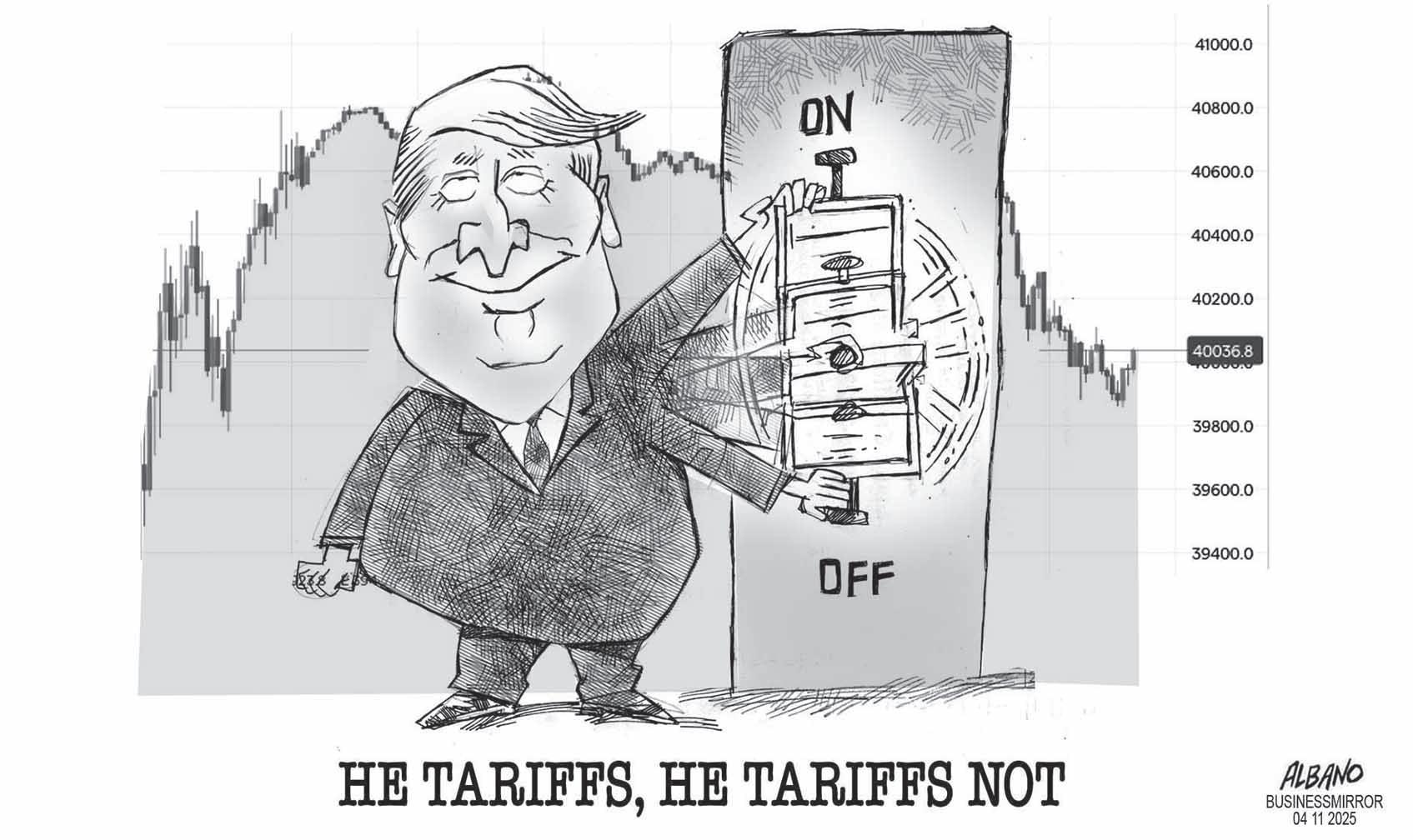
“So there’s still some uncertainty, but there’s less of it than before,” he added, noting the 90-day suspension of these tariffs announced by United States President Donald Trump on Thursday.
As to the impact of the tariffs on the Philippine economy, Remolona said the BSP is looking at slower growth, like the rest of the world, but they are also looking at lower inflation, unlike the rest of the world.
Low inflation to cushion blow
ASSISTANT Governor Zeno Abenoja said the expected slowdown in global growth could impact domestic economic activity, but falling international commodity prices could cushion the blow.
By Reine Juvierre S. Alberto @reine_alberto
THE Philippines’s fiscal consolidation efforts are at risk of stalling, as the budget deficit is projected to widen this year due to tariff shocks and pressure to increase public spending.
In a commentary, United Kingdombased research firm BMI, a unit of Fitch Solutions, said the Philippines’s fiscal deficit will widen to 5.9 percent of the gross domestic product (GDP) in 2025.
“The likelihood of the government having to incur a larger fiscal deficit has risen significantly against the backdrop of heightened geopolitical uncertainty,” BMI said.
On April 2, United States President Don -
ald Trump imposed a 17-percent reciprocal tariff rate on Philippine exports.
This will delay the Marcos administration’s fiscal consolidation efforts as this would reverse the country’s attempt to reduce the budget shortfall.
The government projects the deficit-toGDP ratio to ease at 5.3 percent this year, after hitting its 5.7-percent goal in 2024.
As a result of higher tariffs, BMI said the Philippines’s output would be reduced by around 1.1 percentage points, which puts the government’s growth target in jeopardy.
BMI said the higher tariff rate slapped on the Philippines will be reduced, under its impression that the country will succeed in negotiations with the Trump administration.
“The Philippines remains a vital security partner for the US, particularly as Washington aims to counter Beijing’s growing influence in the South China Sea. This strategic relationship should afford the Philippines some leverage in negotiations,” BMI said.
More fiscal support is also needed if lawmakers intend to mitigate the economic fallout caused by the impact of Washington’s protectionist policies, it added.
The government will have to increase its expenditure by around 1.4 percentage points from 21.9 percent of GDP to reach the lower bound of the government’s growth target of 6 percent, according to BMI.
BMI said lawmakers will employ a policy mix instead of relying solely on increased public spending to prop up the economy. “We are not implying that it is feasible for the government to run such a wide budget deficit to support the economy over the coming years,” BMI said. “[The] Philippines’s fiscal position hardly recovered from the pandemic aftermath, remaining a clear laggard in its fiscal consolidation process compared to its regional peers,” it added. In February, the Philippines’s fiscal po
CHINA BOOSTS YUAN DEFENSE AS U.S.-CHINA TARIFF WAR PEAKS
By Wes Cabangon
EIJING—Trade tensions between the United States and China have surged to unprecedented levels, with both sides locking into steep tariff regimes. As of April 9, the United States has imposed cumulative tariffs of 125 percent on Chinese imports—up from 104 percent just days earlier—while China has retaliated with 84 percent tariffs on all US goods. In a parallel move, China has also halted exports of critical rare earth elements to the US, further escalating the conflict and disrupting high-tech supply chains globally. These developments mark one of the most intense phases in the ongoing economic standoff between the world’s two largest economies, prompting Beijing to reinforce economic defenses through currency stabilization and regional diplomacy.
Timeline of escalating tariffs
· February 1, 2025: US President Donald Trump signs Executive Order 14195, imposing a 10-percent tariff on all Chinese imports (effective February 4).
· February 4, 2025: China responds with 15-percent tariffs on US coal and LNG, and 10 percent on crude oil and machinery (effective February 10).
· March 3, 2025: The US raises tariffs to 20 percent.
· March 4, 2025: China counters with 15-percent tariffs on US agricultural products and 10 percent on other key goods (effective March 10).
· April 2, 2025: The US imposes an additional 34 percent, bringing cumulative tariffs to 54 percent (effective April 5).
· April 4, 2025: China announces a matching 34-percent hike, pushing its total tariffs to 49 percent (effective April 10).
· April 7, 2025: The US threatens
and then imposes an additional 50 percent, raising its cumulative tariff level to 104 percent.
· April 9, 2025: China raises its tariffs to 84 percent and announces a halt to rare earth exports to the US. The US retaliates further by raising tariffs to a final rate of 125 percent.
The rare earth export halt is especially significant. These elements—used in electric vehicles, smartphones, wind turbines, and defense systems—are critical to US high-tech manufacturing and national security. China’s decision, framed as a national security measure, is seen as a strategic pressure point in the growing dispute.
China’s monetary response: Curbing dollar demand WITH the yuan under pressure and global investor anxiety rising, the People’s Bank of China (PBOC) has
issued “window guidance” to major state-owned banks to limit US dollar purchases and monitor foreign exchange flows more tightly.
The move aims to stabilize the yuan, which has fallen by 1.3 percent over the past month, hitting its weakest level since December 2007. Authorities say while a moderate depreciation may aid exports, unchecked declines risk triggering capital outflows and undermining domestic market confidence.
This latest intervention highlights China’s preference for a managed, stable exchange rate policy—even in the face of significant external pressure.
Strategic pivot: China builds regional alliances PARALLEL to its domestic economic adjustments, President Xi Jinping has intensified diplomatic outreach in the region. At a central
official to show PHL
‘French way’ of beneficial trade
By Malou Talosig-Bartolome
THE French minister delegate in charge of foreign trade has arrived in the Philippines at a time when the United States is planning to impose sweeping tariffs across the globe and potentially disrupting global trade. Laurent Saint-Martin, French Minister Delegate for Foreign Trade and French Nationals Living Abroad, said the timing of his visit to the Philippines “could not be more appropriate.”
“As tensions are running high in an increasingly polarized global environment, France is offering nothing less than a mutually beneficial opportunity for most needed political, economic and strategic diversification.
“Look at the global landscape today: established value chains are entering times of uncertainty. Some are tempted to leverage trade and investment relationships to further their own geopolitical goals. Let me be clear: that is not the French way. That is not the European way. In an environment that challenging, “derisking” is becoming the key word, and we all need friends we can trust and partners upon whom we can safely rely.
“I am here today because France sincerely believes that the Philippines are such a friend and partner, as evidenced by the discussions between Presidents Macron and Marcos Jr.,” Saint-Martin told BusinessMirror in an exclusive online interview.
US President Donald Trump has imposed reciprocal tariffs in almost all countries. For the 27-member European Union, the tariff rate is 20 percent. The European Union responded Wednesday with an increase in tariffs for US goods for up to 25 percent.
On Thursday, Trump authorized a 90-day pause on reciprocal tariff plans for all countries except China.
“We stand united with our European partners. We are determined to defend our interests and our companies. We will stand firm and retaliate if need be. Let me be very clear : neither France nor the European Union want a trade war with the United States. It would be a lose-lose situation. We will always be ready to open
“I
Continued from A1
conference on neighborhood diplomacy held in Beijing on April 8 and 9, Xi vowed to strengthen strategic cooperation with neighboring countries, promote supply chain integration, and manage disputes constructively.
The effort reflects China’s longer-term strategy to diversify partnerships and reduce overdependence on volatile trade ties with the US. Strengthening regional connectivity may also provide new outlets for Chinese goods, services, and investments amid tariff headwinds.
Implications for the Philippines
THE Philippines, situated at the intersection of major Indo-Pacific trade routes, will likely be affected in the following ways:
Export disruptions: Higher global tariffs and disrupted supply chains—especially in electronics and auto components—may ripple into Philippine manufacturing and BPO industries.
Currency sensitivity: Yuan instability and heightened dollar demand could create peso volatility, influencing interest rates and import costs.
Investment realignment: China’s push for stronger regional ties could benefit Southeast Asian nations. The Philippines may see opportunities in infrastructure, logistics, and digital trade if positioned as a reliable partner.
As global trade realigns around the China-US divide, the Philippines must act decisively—balancing diplomatic neutrality with economic agility—to safeguard its interests and capture emerging opportunities.
SC affirms life term for human trafficker of minors
By Joel R. San Juan
THESupreme Court has affirmed the life imprisonment imposed on a recruiter for trafficking three minors to work as domestic helpers in Lanao del Sur and Iligan City.
In a decision penned by Associate Justice Mario V. Lopez, the SC’s Second Division affirmed the Regional Trial Court and the Court of Appeals’ conviction of Joemarie Ubanon for qualified human trafficking under Republic Act No. (RA) 9208 or the AntiTrafficking in Persons Act of 2003. The Court also ordered Ubanon to
pay a fine of P2 million aside from P600 as moral and exemplary damages to each of the minor victims. Court records showed that on April 14, 2014, Ubanon approached two 14-year-olds and one 15-year-old in Bukidnon, offering them work as onion peelers with a promised monthly wage of P 2,500.
French official to show PHL…
Continued from A1
infrastructures.
“French companies are ideally positioned to meet the high expectations our Filipino partners. Their expertise is world-renowned. Their track re-
cord is unmatched. They are committed to high social and environmental standards, and they create value and jobs locally. They are reliable, long-term partners,” he said.
The minors told Ubanon that they needed to go home first to ask permission from their parents but the accused insisted that the employer was already waiting for them.
Ubanon then asked a brother of one of the victims to inform their parents about their employment.
The accused then arranged the victims to be transported to Iligan City and later on to Marawi City.
The minors were eventually sent to different homes in Lanao del Sur and Iligan City to work as domestic helpers until they were rescued by government authorities.
In ruling against Ubanon, the SC pointed out that all elements of qualified trafficking were present in the case.
It noted that trafficking hap -
BSP…
Continued from A1
“There are some downside risks, but we think that there are some reasons to continue to see some firmness in economic activity moving forward,” Abenoja said.
Abenoja said the economy could grow near the lower end of the government’s 6 to 8 percent growth target range, depending on how the external environment progresses from now on.
Meanwhile, Remolona said risks to the inflation outlook have eased and continue to be broadly balanced from 2025 to 2027 due to downside risks brought by lower tariffs on rice imports and the expected impact of weaker global demand.
Upside pressures come from possible increases in transport charges, meat prices and utility rates.
As such, the BSP’s risk-adjusted inflation forecast for 2025 was reduced to 2.3 percent from 3.5 percent. The central bank’s forecast for 2026 and 2027 declined to 3.3 percent and 3.2 percent, respectively. “Inflation expectations also remain within target,” it said.
“The more manageable inflation outlook and the risks to growth allow for a shift toward a more accommodative monetary policy stance,” Remolona said.
“The lower inflation rates that we’re looking at give us more degrees of freedom,” the governor added.
‘Further cuts this year’
WITH a more challenging external environment hindering economic growth, Remolona said the BSP is “contemplating” further monetary easing this year.
“We can’t tell you exactly how many more cuts, but definitely further cuts this year,” Remolona said, noting that rate cuts will not happen at every monetary policy meeting.
The governor said the rate cuts will be done in “baby steps,” 25 bps at a time. “I can’t tell how many more times…We have more meetings than the number of cuts we are thinking about.”
Remolona said the easing cycle will be completed by 2025, but if the economy takes a “hard landing,” then the BSP may have to cut more.
’Still restrictive’ THE BSP’s current policy rate is still “slightly restrictive,” according to Remolona.
“We’re still somewhat below capacity, which means we have some room to cut without causing inflation ourselves,” Remolona said. Abenoja said the previous policy increases have continued to have some impact on domestic demand, but the BSP is dialing it down 100 bps now,
pens when individuals are recruited or transported—whether or not they give consent—through deception, coercion, or abuse of power for exploitative purposes like prostitution or forced labor.
When the victims are minors, the offense becomes qualified trafficking, which carries a penalty of life imprisonment, the Court said.
The SC emphasized that even just recruiting and transporting minors is enough to prove trafficking.
In this case, the SC said Ubanon took advantage of the minors’ age and need for money, convinced them to accept the job, and personally brought them to the terminal and to their final destination, where they were exploited and unpaid.
which has contributed to maintaining the growth momentum.
“There’s still room to go further, to dial down [and] make the monetary policy less restrictive moving forward, and that should help economic growth move...the momentum to be maintained, and then we will close that gap,” Abenoja added.
’75 bps more’ THE BSP is expected to cut 75 bps more this year to bring down the policy rate to 4.75 percent, as inflation remains under control and growing economic risks.
Pantheon Macroeconomics
Chief Emerging Asia Economist Miguel Chanco said it remains consistent with its forecast of the BSP delivering three more rate cuts in the months ahead.
“We doubt that headline inflation will re-accelerate substantially from the March print, and we’re still more than comfortable with our belowconsensus forecast for average inflation to slow further this year to 2.5 percent,” Chanco said.
However, risks to their outlook are now to the downside, in view of the post-“Liberation Day” collapse in global oil prices.
Pantheon Macroeconomics has also downgraded the Philippines’s growth forecast to 5.3 percent from 5.4 percent due to the tariff imposed by the United States on the Philippines.
Capital Economics is also dovish with projections of the central bank loosening the policy rate further by 75-bps in the coming months.
“The 10-percent universal tariff, the uncertainty created by sudden shifts in US trade policy and the likely impact of slower growth in the US and China will still act as a drag on demand for the country’s exports,” Capital Economics Assistant Economist Joe Maher said.
Citing Remolona’s remarks of continued easing in inflationary measures, Maher said a combination of easing food price inflation and lower transport price inflation will keep inflation contained in the coming months.
“Looking ahead, the BSP will continue to take a measured approach in deciding on further monetary easing. The BSP will remain data-dependent in its pursuit of price stability conducive to sustainable economic growth and employment,” Remolona said.
The Monetary Board, in its previous policy meeting in February, kept the policy rate steady at 5.75 percent due to global uncertainty over trade policies.
After raising interest rates by 50 bps in February 2023 to 6 percent, the Monetary Board began loosening the monetary policy by a total of 75 bps delivered in 25 bps increments. It began the easing cycle in August 2024.
Continued from A16
GDP, as the Philippine economy is less reliant on exports as a source of economic growth.
“Philippine merchandise exports are 3-5 times lower compared to major Asean countries on a yearly basis; but slower world economic/ GDP growth due to Trump’s higher US import tariffs/reciprocal tariffs/ other protectionist measures could also indirectly weigh on the Philippine economy,” he also noted.
Ricafort further explained that Philippine exports are not that huge compared to other Asean/Asian countries, “So more limited adverse impact on the Philippines by the US reciprocal tariffs [additional tax could be passed to buyers or absorbed depending on competition; more bearable compared to the higher US import tariffs/reciprocal tariffs on other Asean/Asian countries, especially vs. China’s 125%].”
WTO statement MEANWHILE , Ngozi Okonjo-Iweala, Director-General of the World Trade Organization (WTO), said in a statement on April 9: “The escalating trade tensions between the United States and China pose a significant risk of a sharp contraction in bilateral trade.”
She noted that WTO’s preliminary projections suggest that merchandise trade between these two economies could decrease by as much as 80 percent.
Okonjo-Iweala said this “tit-fortat” approach between the world’s two largest economies—whose bilateral trade accounts for roughly 3 percent of global trade—carries “wider implications that could severely damage the global economic outlook.”
According to WTO’s assessments which take into account the latest developments, the negative macroeconomic effects will not be confined to the United States and China but will extend to other economies, especially the least developed nations.
“Of particular concern is the potential fragmentation of global trade along geopolitical lines. A division of the global economy into two blocs could lead to a long-term reduction in global real GDP by nearly 7 percent,” said the WTO chief.
She also noted that trade diversion remains an “immediate and pressing threat,” one that requires a coordinated global response.
“We urge all WTO members to address this challenge through cooperation and dialogue,” Okonjo-Iweala said.
Asean Economic Ministers IN a statement sent to reporters on Thursday, Philippines’s Trade and Industry Secretary Cristina A. Roque said Asean Economic Ministers acknowledge the 90-day suspension of reciprocal tariffs as a “positive, albeit temporary, development.”
“We recognized the necessity for a comprehensive impact assessment to fully understand the direct and indirect consequences of these tariffs on Asean member states,” Roque said.
She also underscored the need for Asean member states to formulate “effective” mitigation strategies to ensure the protection of member states’ interests as well as maintain investors’ confidence in the region. Revealing the outcome of the recently held virtual meeting among Asean economic leaders, Roque said: “A strong consensus emerged among us regarding the importance of open and constructive dialogue with the United States.”
This developed after global news reports noted that Trump halted the imposition of higher tariffs because over 75 trading partners did not retaliate and have reached out to the United States to negotiate.
For the Philippines’s part, Roque told reporters on Wednesday that the Philippines won’t likely retaliate against Washington, saying the new trade policy of the United States is even advantageous for certain local goods. (See: https://businessmirror. com.ph/2025/04/10/governmentunlikely-to-counter-trump-tariffs/)
PUSHING THE BOUNDARIES OF SUSTAINABLE LIVING
ARTHALAND, in partnership with ARCH Capital, celebrates the journey to completion of this soon-to-rise exclusive Makati address
MAKATI City is still the prime location to live, work, and do business. In the midst of redevelopment efforts, Makati City continues to thrive as a dynamic business and residential center.
ARTHALAND Corporation’s latest project, Eluria, is poised to be a game changer on the ultra-luxury property market. “Makati is still the Philippines’ premier financial and business district, and it is evolving into a vibrant community where business, culture, and sustainability intersect,” said Christopher Narciso, Executive Vice President at ARTHALAND Eluria is a manifestation of confidence in Makati City. Positioned right at the heart of the Makati CBD, Eluria offers residents unparalleled access to everything this vibrant city has to offer—from top-tier retail and commercial establishments to fine dining, covered walkways, cultural hotspots, medical facilities, and world-class institutions. But what truly sets Eluria apart is its exclusive retail experience,” Narciso added.
In p artnership with ARCH Capital, ARTHALAND's leaders are confident that Eluria will redefine exclusivity in Legazpi Village and set a new standard for sustainable living. With the on-time structural topping off last November 24 and the project handover to begin by the 4th quarter of 2025, the
developmentis set to elevate the concept of sustainable living to new heights. Oliver L. Chan, ARTHALAND Senior Vice President and Chief Sustainability Officer, said choosing Makati City as the site of Eluria is a sound decision because the city continues to be redeveloped in response to the changing times.
“Five years from now, 10 years from now, if you do need to leave your unit for your kids, your grandkids, the value of a newly redeveloped area would actually be better than something that has been developed and finished already today,” Chan said.
He added that both the end-user and investor side would benefit in investing in Eluria. According to Narciso, investors have already been rewarded handsomely since the price per square meter has increased by 25 percent since it was launched. Additionally, he said, it was beneficial to invest early when Eluria was launched in 2022.
“I just want to point out the benefit of investing early during the pre-development sales as the first few buyers in 2022 were able to avail
nience to shop and pamper themselves, all without leaving home.
or at the end so that we can find a way to market it as sustainable,” Chan said.
Narciso noted that as part of the ultra-luxury market, Eluria is not affected by the oversupply challenge currently prevailing in the local market because it only affects the mid-market segment.
“Eluria is totally detached from it. In fact, we call it exclusive development because there's only 37 units in the entire building. So it caters for a market looking not just to invest, but really a place to live in, especially with the services,” he said.
With its signature retail space, Eluria will host a selection of unique, high-quality brands, providing residents with the ultimate conve-
Chan noted that the location of Eluria is at the center of several redevelopments, which are expected to give the CBD a new and modern look.
Sustainability as a standard
Chan said ARTHALAND considers sustainable development not as a trend but as a standard. Furthermore, it is segmented into different segments like savings on power and water consumption
Chan said sustainability has been part of Eluria since its planning stage. He pointed out that the building specifications had been integrated from the conceptualization of the project. We did not insert it somewhere in between
Michael Banak, chief architect of Eluria of Sydney-based Australia FMB Architects shared his thoughts on Eluria.
This is the best building I've done. Eluria draws its biggest inspiration from the harmony between nature and contemporary living. Its unique look is the result of a collaborative effort by renowned architects, visionary designers, and environmental experts. Their collective vision has transformed Eluria into an exquisite sanctuary that seamlessly integrates sustainable architecture with timeless design,” Banak pointed out. He also stressed that a sustainable atmosphere will be experienced by the future
By Rizal Raoul Reyes
Embrace serenity as the warm hues of dusk envelop ELURIA | ARTIST’S PERSPECTIVE
The team behind the construction of Eluria pose for posterity during the milestone celebration.
Cyrene Pamela S. Go,
PRIMARY BEDROOM | ACTUAL SHOW SUITE PHOTO
ARTHALAND AND ARCH CAPITAL TEAM celebrate Eluria’s Journey to Completion. Christopher G. Narciso, Executive Vice President, ARTHALAND; Sheryll P. Verano, Senior Vice President, ARTHALAND; Eric Manuel, Head of Philippines, ARCH Capital; Jaime C. González, Vice Chairman and President, ARTHALAND; Oliver L. Chan, Senior
ARTHALAND’s Christopher G. Narciso and Oliver L. Chan gamely answer questions during the media roundtable.
Group hits CSC rule on social media posts; commission blinks
By Jovee Marie N. dela Cruz @joveemarie & Justine Xyrah Garcia
APARTY-LIST group on Thursday said the Civil Service Commission (CSC) Memorandum Circular 3-2025 that threatens government employees with suspension for simply liking or sharing political posts on social media will create a “chilling effect” on government employees’ exercise of their civil and political rights.
At the same time the commission toned down its memorandum and said the prohibition only covers actual campaigning.
ACT Teachers Rep. France Castro, together with ACT Teachers nominee Antonio Tinio, said this CSC memorandum is a clear violation of government employees’ constitutional rights to free expression and political participation.
“By prohibiting even the most basic social media interactions like ‘liking’ or ‘sharing,’ the CSC is effectively silencing nearly two million government workers and
stripping them of their fundamental right to engage in democratic discourse,” Castro said.
The CSC, through MC 03, reminded government employees and officials to avoid partisan political activity for the 2025 elections, as required by the Constitution and laws.
On Thursday, the commission clarified its order saying that government employees “may like, share, comment on, or repost election-related content on social media—as long as these actions don’t amount to campaigning for or against any candidate.”
The CSC stressed that while online interactions are not automatically considered electioneering, civil servants must be careful not to cross the line into political advocacy.
It added that public officials and employees “are expected to maintain their politically neutrality in line with the 1987 Constitution.”
Beyond social media, the CSC and the Commission on Elections (Comelec) earlier outlined offline restrictions in Joint Circular No. 1, s. 2016.
Government workers are not allowed to organize rallies or campaign events, distribute materials, solicit support, wear campaign items, or serve as poll watchers—unless explicitly authorized by Comelec.
These rules apply across all levels and types of government service, including employees in government-owned and -controlled corporations, state universities and colleges, and uniformed personnel in the Armed Forces, National Police and other armed services.
Even those on leave are still bound by the rules. Employees found violating the guidelines may face administrative sanctions.
First-time offenses may result in suspension, while repeated violations could lead to dismissal, loss of benefits, and a ban on future
government employment.
The CSC urged all public servants to remain “impartial and mindful” in both their offline and online conduct, emphasizing their duty to serve the public with integrity during the election period.
But Castro and Tinio said that the CSC’s new directive contradicts its own established precedent. In 2015, through Joint Circular 1, the CSC and Commission on Elections (Comelec) explicitly excluded liking, sharing, and commenting on social media from the scope of prohibited partisan political activities.
“The CSC itself, along with Comelec, stated in 2015 that simply liking, sharing, or commenting on social media is not included in prohibited partisan political activities. Why has their position suddenly changed?” Castro questioned. “The CSC cannot simply change its interpretation of the law, especially when it contradicts a previous joint circular they issued with Comelec.”
Castro stressed that the new memorandum creates a chilling effect on government employees’ exercise of their civil and political rights.
Castro and Tinio called on the CSC to immediately withdraw the memorandum and revert to its previous stance that respects government employees’ rights to free expression.
Cops, DENR personnel rescue 83 endangered animals
PBy Jonathan L. Mayuga @jonlmayuga
OLICEMEN and Department of Environment and Natural Resources personnel rescued 83 endangered animals and arrested an operation in San Pablo City in Laguna.
Criminal Investigation and Detection Group (CIDG) operatives from the units Laguna field office, DENR Calabarzon (Cavite, Laguna, Batangas, Rizal and Quezon) regional office together with San Pablo policemen conducted a buy-bust operation in relation to CIDG’s Operation-Plan Kalikasan—an operation against the unlawful destruction of environment and natural resources—in barangay San Gabriel, San Pablo City, Laguna, that resulted in the arrest of a suspected illegal trader
of endangered animals.
Police Maj. Gen. Nicolas D. Torre III, CIDG director, identified the arrested suspect only as “Arvin.”
He was caught en flagrante delicto or while in the act of selling and trading endangered and protected wildlife species without the necessary permit.
The operation was conducted on April 4 after the operatives confirmed the target personality and the presence of various wildlife in his possession.
Seized from Alvin’s possession were 83 endangered wildlife animals including 48 cuora Philippinensis (Turtles), 18 T-Grey, seven large scale water monitor lizards, three Philippine fresh water crocodiles, two Ben-toad Geckos, two boiga cynodons, one leopard gecko, one serpent eagle, and one brahminy kite with total estimated
value of P224,000.
The operation came following the directive of Police Gen. Rommel Francisco D. Marbil, National Police chief, to the CIDG to enhance the crime prevention and solution efficiency.
The DENR confirmed that the suspect lacked the Certificate of Wildlife Registration (CWR) and permits to transport, possess, or sell the rescued wildlife species, in violation of Republic Act No. 9147, otherwise known as the Wildlife Resources Conservation and Protection Act.
The seized endangered wildlife were immediately handed over to the DENR Calabarzon Regional Office and subsequently transferred to the Regional Wildlife Rescue Center in barangay Lamot 2, Calauan, Laguna, for safekeeping and proper care.
The suspect will be charged before the National Prosecution Service with violation of Section 27 of Republic Act 9147 or the Wildlife Act, for the unlawful killing, destroying, trading, collecting, or transporting of wildlife endangered animals.
The DENR, which is mandated to protect and conserve the country’s rich biodiversity, depends on various law enforcement agencies to curb the illegal wildlife trade, a major driver of biodiversity loss.
Torre said the CIDG is relentless in its fight against all forms of criminality and remains steadfast in enforcing all laws, including environmental laws, that safeguard the country’s flora and fauna.
“We urge the public to report all crimes in your localities and your CIDG will do the rest,” Torre said.
Administration senatorial slate calls on Pinoys overseas to vote
WITH overseas absentee voting commencing on April 13, the administration-backed Senate slate Alyansa Para sa Bagong Pilipinas on Thursday called on 1.24 million
overseas Filipino workers (OFWs) to exercise their right to vote for leaders who will champion policies that protect and empower them and their families. The Commission on Elections
reported that 1.24 million overseas Filipinos are eligible to vote in this year’s midterm elections, a decrease from the 1.62 million registered in 2022. The month-long voting period, which concludes on May 12, enables overseas Filipinos to cast their votes for senators and party-list groups who will shape the nation’s future.
Navotas City Rep. Toby Tiangco, Alyansa’s campaign manager, emphasized the significant impact of overseas voters, even from afar.
“Our kababayan abroad may be far from home, but their votes carry the weight of millions of families they continue to support. The best way to protect their sacrifices is to elect leaders who will fight for them,” Tiangco said.
He urged overseas Filipinos not to waste the opportunity, especially in major OFW hubs with the largest voter populations: United Arab Emirates (189,892), United
‘Polvoron video’ may doom Roque’s bid for asylum in Netherlands–solon
ALAWMAKER on Thursday said that the controversy surrounding former presidential spokesperson Harry Roque and the “polvoron video” could undermine, rather than strengthen, his application for asylum in the Netherlands.
House Assistant Majority Leader Zia Alonto Adiong made a statement after Roque claimed that the Tri-Comm House hearings, where he was implicated in the release of a deepfake video allegedly showing President Marcos using illegal drugs, would help prove he was being politically persecuted.
However, Adiong argued that the evidence points to the contrary. “If he is really proving the truth, that revelation itself...It could really condemn, legally for example, his asylum application in the Netherlands. Because it is part of destabilizing a government.”
The controversy stems from the sworn affidavit of social media personality Vicente “Pebbles” Cunanan, who alleged that Roque was the original source of the “polvoron video,” a doctored clip purportedly showing President Marcos using illegal drugs.
“Well, I doubt that’s his defense. But I don’t think the messaging, I mean the information that the revelation of Ms. Pebbles would add on to his defense or his application for asylum,” Adiong, who represents Lanao del Sur, said.
“So itis not for me a signal that this administration is really ganging up on him as what he is trying to portray online. In fact, the very purpose of that invitation is to provide him with the due process that should be accorded and afforded to him as a citizen of this country,” he added.
In an affidavit, Cunanan testified that Roque discussed plans to release the video during a private dinner in Hong Kong in July 2024 with other pro-Duterte figures.
Cunanan also recalled Roque allegedly boasting, “Magaling ako magpabagsak ng gobyerno” (I am good at bringing down governments), which Cunanan interpreted as part of a broader destabilization effort.
Adiong said Roque, as a lawyer and officer of the court, knows very well that accountability is not optional. He pointed out that Roque’s asylum bid appears more connected to the legal issues he already faces.
“The application for asylum rests very well, well linked and connected with the charges filed against him on qualified human trafficking and also the contempt orders that were cited against him by the Quad Comm,” he said.
“By continuously refusing and frustrating the committee by withholding those documents that we requested him to provide, he heeded and assured the committee that he would provide them eventually, but up to now he has not released or given them to our committee,” Adiong said.
Roque also alleged that the Tri-Comm had prepared a scripted hearing. Adiong dismissed this, saying lawmakers and resource persons are expected to come prepared for serious discussions.
When asked if Roque should be summoned again by the Tri-Comm following Cunanan’s testimony, Adiong responded affirmatively.
Adiong said Roque’s own words—according to Cunanan’s testimony—require a clear and public explanation.
Adiong said that prior to the “polvoron video,” there were already signs of coordinated destabilization efforts allegedly by Roque’s camp.
“I think the group is associated with Atty. Roque has been laying down the premise connecting the president to illegal drug use,” he said. Jovee Marie N. dela Cruz
SND to fighter pilots: Train hard, fly hard, fight hard
By Rex Anthony Naval
SECRETARY of National Defense (SND) Gilberto Teodoro told Air Force (PAF) fighter pilots to focus on their training and in their mandate of protecting the country’s skies even he commended them for their courage and bravery.
Teodoro visited Basa Air Base in Floridablanca, Pampanga, on April 9 shortly after the commemoration rites for Araw ng Kagitingan at Mount Samat in Bataan, Assistant Defense Secretary Arsenio Andolong said in a statement on Thursday.
States (178,033), Saudi Arabia (130,711), Hong Kong (83,330), and Taiwan (71,009).
“Mere praise for OFWs is not enough. They need concrete action. That begins with representation in the Senate that truly understands their struggles and will push policies to uplift their lives,” Tiangco added.
According to Tiangco, Alyansa is committed to push for key reforms for OFWs, including accessible consular assistance, stronger legal protection, reintegration support, and increased job opportunities in the Philippines to mitigate forced migration.
“Your vote matters now more than ever,” Tiangco told overseas voters. “The challenges facing OFWs today—contract violations, rising costs, and family separation—can only be solved if we put the right leaders in place.”
See “Overseas,” A5
BAB is the headquarters of the PAF’s Fifth Fighter Wing, the unit that operates and maintains the PAF’s FA-50PH fighter jets.
During his visit, Teodoro commended the fighting spirit of the PAF and thanked the pilots for their dedication to duty amid the inherent risks of their profession.
He also acknowledged the immense responsibility, skills, and courage it takes to fly and fight in defense of the country’s skies. Teodoro, a rated pilot, also called on the fighter pilots to focus on training hard, flying hard, and fighting hard.
“What we expect from you is to train hard, fly hard, and fight hard. That’s it,” Teodoro said.
“The rest are things for us to do. To make sure that you are able to train hard, to fight hard, and to fly hard. We cannot afford any slowdown in operational tempo,” the DND chief stressed. In addition, Teodoro reaffirmed the commitment of the DND and Armed Forces (AFP)to enhance the capabilities of the Integrated Air Defense System. He also called for strengthening air domain awareness in joint operations within the AFP, and ensuring seamless interoperability in combined operations with allied and likeminded nations.
DOTr orders PAL to explain emergency landing
THE Department of Transportation (DOTr) has ordered Philippine Airlines (PAL) to explain the emergency diversion of its Los Angeles-bound flight to Tokyo on Wednesday, as aviation authorities begin investigating the incident that left passengers stranded for hours at Haneda Airport.
Transportation Secretary Vivencio Dizon said he has instructed the Civil Aviation Authority
of the Philippines (Caap) and the Civil Aeronautics Board (CAB) “to issue show cause orders” to the flag carrier, directing them to “investigate the said incident... and ensure compensation of the affected passengers.” PAL diverted Los Angelesbound flight PR102 to Tokyo’s Haneda Airport early Wednesday after smoke was detected
www.businessmirror.com.ph
Soybean imports seen shooting up to 3.3 MMT
THE country’s soybean meal (SBM) imports may increase to over 3.3 million metric tons (MMT) in the coming marketing year (MY) 2025/26 owing to bolstered local feed demand, an international agency said.
The United States Department of Agriculture’s Foreign Agricultural Service in Manila (USDAFAS Manila) projects SBM shipments to grow by 3.1 percent to 3.35 MMT in the marketing year 2025-2026, higher than the 3.25 MMT recorded in the previous year.
USDA-FAS Manila said the increase in SBM imports was due to the growing feed demand from poultry, aquaculture, and pet food industries, along with the projected rebound of the swine sector.
“Population growth, increase in household incomes, and diversification of diet drive up the demand for protein sources such as chicken meat, eggs, and commercially farmed fish and shrimp, which will increase the demand for SBM,” the agency said in its latest report.
“Similarly, the forecast rebound in the swine industry due to the continuous swine repopulation and expansion programs
Economy
Administration to seek FTA with US
By Samuel P. Medenilla @sam_medenilla
of the government, along with growth of the pet food industry, further increases the demand for SBM.”
Meanwhile, USDA-FAS Manila forecasts the country’s coconut oil exports to be flat in MY 2025/26 despite a projected increase in local output.
“FAS Manila forecasts coconut oil exports to be flat in MY 2025/26 compared to the previous year. While there is a forecast rebound in coconut production in MY 2025/2026 that will increase copra supply for crushing, the increase in biodiesel blending is projected to marginally decrease the available exportable supply of coconut oil,” it said.
USDA-FAS Manila forecasts a marginal increase of 2.1 percent in coconut oil production to 1.67 MMT in 2025/26, based on the anticipated growth in copra crushing.
“The Philippines is one of the world’s largest producers and exporters of coconut oil. This oil is widely used in cooking, cosmetics, and industrial applications,” USDA-FAS Manila added. Ada Pelonia with Jovee dela Cruz
Caap places all airports on heightened alert
TBy Nonie Reyes
HE Civil Aviation Authority of the Philippines (Caap) has placed all 44 commercially operated airports in the country on heightened alert as the Manila International Airport Authority (Miaa)-New Naia Infrastructure Corporation (NNIC) also placed all Ninoy Aquino International Airport (Naia) Terminals on heightened alert in anticipation of a projected10 to 20 percent increase in passenger traffic during the Holy Week.
Caap launched “Oplan Biyaheng Ayos” Semana Santa 2025, which aims to ensure the safety, security, and overall efficiency of air travel.
Caap Director General Raul del Rosario announced round the clock or 24/7 operations in key airports and the suspension of leave privileges for essential personnel to effectively manage the expected influx of travelers.
To further support passengers, additional Malasakit Help Desks will be deployed in all major airports to provide real-time assistance and ensure a more seamless travel experience.
Caap has also led a series of airport security coordination meetings and strengthened its collaboration with key agencies, including the National Police—Aviation Security Unit (PNP-Avseu), Office for Transportation Security (OTS), Department of Tourism (DOT), Civil Aeronautics Board (CAB), local governments, and airline operators.
PAL. . .
Continued from A4
from one of the aircraft’s air conditioning units.
Carrying 359 passengers and 18 crew, flight PR102 landed safely at Haneda at 3:30 a.m. local time. But it was not until 10:00 a.m.—“after several requests”— that the aircraft was assigned a gate, allowing all passengers to finally disembark.
At the Naia terminals, medical tents with assigned doctors and nurses and information counters with public assistance officers on duty for passenger inquiries will be set up while security forces with bomb sniffing dogs will be deployed to secure the airport and its perimeter.
Airport officials reminded all passengers to arrive at the airport in advance of their scheduled flights, monitor airline advisories, and adhere to airport safety protocols to ensure smooth and stress-free travel.
MIAA General Manager Eric Ines said that Miaa and the New Naia Infrastructure Corporation (NNIC) the new operator of the premier airport, are expecting more passengers to fly to the country soon especially during the observance of Holy Week from April 17-20, 2025.
He also said that heavy passenger movement is expected as more foreign airlines are eyeing to operate at the NAIA that will create more routes abroad.
Meanwhile, local air carriers operating at the Naia activated their alert project “Ngayong Semana Santa 2025” to ensure smooth and safe travel experience for all guests from April 13 to 20, 2025.
Philippine Airlines, Cebu Pacific and AirAsia Philippines remind guests that only power banks not exceeding 100 watthours (Wh) are allowed onboard, devices rated between 100Wh and 160Wh require airline approval at the checkin counters.
THE Marcos administration will seek to negotiate for a Free Trade Agreement (FTA) with the United States (US) during the coming visit of Special Assistant to the President for Investment and Economic Affairs Frederick D. Go to Washington.
In a press briefing in Malacañang on Thursday, Go said that is the best case scenario in his talks with the US Trade Representative (USTR) regarding the 17 percent reciprocal tariffs, which was earlier announced by US President Donald Trump for Philippine imports.
Trump, however, decided to suspend for 90 days the implementation of his additional reciprocal tariffs, which range from 11 percent to 50 percent, last Thursday. During the said period, a 10 percent reciprocal tariff will be levied on all imports entering the US except for those coming from China.
“The best possible outcome
[from the negotiation] is a free trade agreement – free trade agreement means zero tariffs on their side, zero tariffs on our side – that’s probably the best possible outcome of that meeting but again it’s open communication, dialogue, cooperation and let’s see what we can negotiate,” Go said.
Go said he communicated with the USTR to discuss the reciprocal tariff after President Marcos met with his economic team on Tuesday to assess how it will affect global exports and Philippine economy as well as how to mitigate its negative effects.
“We’ve reached out to the USTR and we have communicated with them our desire to engage in a meeting or dialogue with them and they have positively responded so I will be scheduling a trip to the United States to meet with the USTR soon,” Go said.
Tariff impact
CITING estimates from the National Economic and Development
Authority (Neda), Go said the 17 percent is projected to “affect” the country’s Gross Domestic Product (GDP) by 0.1 percent in the next two years if it were implemented.
Despite the negligible overall impact of the tariff to the economy, Go said it will still have negative effects to certain industries, which includes exporters, prompting them to enter into negotiations with the USTR.
He said they are confident the exporters will be able to look for alternative markets if the additional reciprocal tariff makes selling their products to the US, no longer viable.
The President’s economic aide said they are also closely monitoring the response of the other countries to the reciprocal tariff.
“We need to keep monitoring what the other countries do, and for ourselves we need to negotiate an agreement that is beneficial for our country and for the businesses and enterprises in our country,” Go said.
Prior to the 90-day suspension in the implementation of the over 11 percent reciprocal tariffs, he said the Philippines has a competitive edge compared to other Association of Southeast Asian Nation (Asean) countries when it comes to exporting to the US. The US slapped higher reciprocal tariffs to Cambodia (49 percent), Laos (48 percent), Vietnam (46 percent), Myanmar (44 percent), Thailand (36 percent), Brunei (24 percent) and Malaysia (24 percent). Singapore was slapped a lower 10 percent tariff.
On Thursday, Asean Trade ministers met to determine how the regional bloc will have a “frank and constructive dialogue” with the US on the reciprocal tariff, according to Go.
Each of the Asean member countries, Go said, are still expected to pursue bilateral talks with the US, similar to what the Philippines is doing, while the Asean response is being finalized.
Manila-Malolos rail line to be operational by end 2026, Dizon says
THE Department of Transportation (DOTr) is “confident” that certain segments of the North-South Commuter Railway (NSCR) will be operational by as early as end-2026.
Transportation Secretary Vivencio Dizon told reporters on Thursday that the agency is “accelerating” work on the ambitious project, gunning to finish a segment before President Marcos bows out in 2028.
“We are confident that we can run Manila to Malolos by the end of 2026 or early 2027,” Dizon said.
“We targeting [to complete Manila] all the way to Clark before the end of the President’s term.”
He noted that the Manila-Clark segment is now “roughly a little over 50 percent completed.”
The NSCR is a 147-kilometer urban rail system that will connect Calamba in Laguna to Clark in Pampanga. Backed by the Japan International Cooperation Agency (Jica) and the Asian Development Bank (ADB), the project is envisioned to serve over 800,000 passengers per day once fully operational.
Dizon said Marcos has ordered the acceleration of railway projects outside Metro Manila, seeing them as key to decongesting heavilyused toll roads and improving Filipinos’ daily commute.
“Iyong ating mga trains outside Metro Manila, bilin ng Pangulo na bilisan. It will be the catalyst to decongesting our roads, especially the toll roads,” Dizon said.
“With the trains from Calamba to Clark, it will change the way people live and commute. That’s why the President is pushing everybody to work.”
Dizon attributes his confidence to the agency’s close coordination with Jica and the ADB.
“Ilang dekada na po ito, but we
Overseas. . .
Continued from A4
feel that with our partners now— Jica and ADB—will see these trains start to operate within the term of the President. Not the full line from Calamba to Clark, but I think part of those lines— from Metro Manila to Malolos,
and Malolos to Clark—before the President’s term ends. After three decades, mabibigay na ng gobyerno ito,” he said.
Once complete, the NSCR is expected to significantly cut travel times, reduce dependence on road-
based transport, and enhance interconnectivity across Luzon. It will also integrate with other major lines, including the Metro Manila Subway, forming a unified railway system that will redefine public transport in the country.
“Philippine Airlines prioritizes safety above all else and is fully cooperating with the relevant airport and aviation authorities,” the airline said in a statement.
The aircraft was on cruising altitude when crew members observed smoke coming from one of two air conditioning units onboard, prompting the precautionary landing.
PAL said it is closely coordinating with the Department of Transportation and Japanese airport authorities as investigations continue.
PAL said its ground team in Haneda has provided full assistance to affected passengers, including meals, baggage support, and alternative flight arrangements to Los Angeles.
He encouraged all eligible overseas Filipinos to verify their voting status, visit their respective embassies or consulates, and make their voices heard.
“Your vote, your voice. Let’s work together for a Bagong Pilipinas that includes every Filipino, no matter where in the world they may be,” Tiangco said.
The Alyansa ticket includes former Interior Secretary Benhur Abalos, Makati City Mayor Abby Binay; Sens. Ramon Revilla, Pia Cayetano and Lito Lapid; former senators Panfilo Lacson, Manny Pacquiao and Vicente Sotto III; Senate Majority Leader Francis Tolentino; ACTCIS Rep, Erwin Tulfo and Deputy Speaker Camille Villar. Jovee Marie N. dela Cruz
From ‘Liberation Day’ to retreat: Trump’s tariffs spark global uncertainty, confusion
By Chris Megerian & Seung Min Kim The Associated Press
WASHINGTON—The stock market was soaring and the sun was shining when President Donald Trump stepped out of the Oval Office on Wednesday afternoon. Less than two hours earlier, he had retreated from his plans to increase tariffs on many US trading partners, and investors were rejoicing after bracing for a global economic meltdown.
“You’ve got the markets seeing your brilliance,” Sen. John Barrasso, a Republican from Wyoming, told the president. Trump agreed. “Nobody’s ever heard of it,” he declared. It was a typical bit of hyperbole that, in this case, was true. Even by the standards of Trump’s second term, the saga that had played out over the past week left the world struggling to catch its breath.
The president, of his own doing, had single-handedly pushed the global economy to the brink of chaos with new tariffs. The stock market cratered, businesses tore up their plans and foreign leaders prepared for a future without the world’s richest nation at the center of international trade.
And then Trump backed down. Seven days after announcing what would have amounted to America’s largest tax hike since World War II in an elaborate Rose Garden ceremony, he rolled back most of the tariffs in a surprise post on his social media website.
“I think the word would be flexible,” he said later despite days of insisting that he wouldn’t bend. “You have to be flexible.”
Uncertainty lingers as trade talks continue IT was unclear what the president had accomplished, beyond the satisfaction of, in his words, having other countries “kissing my ass” to try to talk him out of the tariffs. No new trade deals have been reached, although administration officials said negotiations are underway.
However, real damage has been done. The back-and-forth over tariffs shook confidence in US leadership, exposed fractures within Trump’s team and rattled companies that rely on global sources for products and international customers for sales. Americans who use the stock market to save for retirement and college suffered days of angst.
The turmoil isn’t over yet, either. Trump’s 10 percent blanket tariffs initially imposed on Saturday are now applied to dozens of nations. He also jacked up tariffs to 125 percent on imports from China, leaving the world bracing for a showdown between the first and second largest economies. There are 25 percent tariffs on Canada and Mexico, America’s largest trading partners, as well as 25 percent taxes on imported autos, steel and aluminum.
Other tariffs—including 24 percent on Japan, 25 percent on South Korea, 20 percent on the European Union—are on hold for 90 days to allow for
trade talks.
“This just accentuates the policy uncertainty and sense of unreliability Trump is creating,’’ said William Reinsch, a former US trade official now at the Center for Strategic and International Studies. While Reinsch said it’s good news that Trump didn’t move forward with some of his highest tariffs, “how does anybody know that he won’t change his mind on Friday or next week?”
Trump makes his announcement on ‘Liberation Day’ US flags were draped along the White House colonnade for a red-white-and-blue backdrop when Trump announced his tariffs on Wednesday, April 2.
“My fellow Americans, this is Liberation Day,” he said. The president held up a poster listing the tariffs that he would slap on each country—32 percent for Thailand, 49 percent for Cambodia, 26 percent for India, and on and on. People around the world squinted to decipher the numbers that would reset critical economic relationships.
The day after the announcement, Trump jetted to Florida for the weekend.
“The markets are going to boom, the stock is going to boom, the country is going to boom,” he promised while leaving the White House, the whirring rotors of Marine One sometimes overpowering his voice.
But the market was crashing, posting its biggest single-day loss since the outbreak of the coronavirus pandemic five years earlier. And around the country and the world, the fallout spread over the weekend.
Fulcrum Coffee Roasters in Seattle braced for rising costs for beans from Southeast Asia and espresso machines from Italy. Stellantis, the automaker behind brands like Jeep and Ram, announced it would pause production at plants in Mexico and Canada, leading to temporary layoffs at other facilities in Indiana and Michigan, a reminder of how interconnected vehicle supply chains have become.
The Dutch division of Tata Steel said it would cut 1,600 employees, about a fifth of its workforce. Ireland Prime Minister Michael Martin said “there is no way to sugar coat” the situation as business with the US started tapering off.
Trump faces growing pushback from his own party THE markets were still in a panic on Monday when an unverified report circulated that the president was considering a 90-day pause on the tariffs. Stocks briefly soared before in -
vestors realized the information was wrong.
“We’re not looking at that,” Trump said as hopes for the rumored reprieve vanished. With fears of a recession growing, Republican lawmakers returning to the Capitol for the workweek were peppered with questions about the tariffs and what they would do in response.
Sen. Ron Johnson of Wisconsin was asked on Tuesday if he understood Trump’s strategy, and responded by asking “does anybody?” Some of his state’s premier companies like Kohl’s expected higher costs, while its dairy farms expected to struggle to sell milk and cheese. HarleyDavidson was a target of planned reciprocal tariffs by the European Union.
Sen. Thom Tillis of North Carolina was even more blunt that day during a hearing with Trump’s top trade representative, Jamieson Greer. If the tariff plans don’t work, he said, “I’m just trying to figure out whose throat I need to choke.”
Trump retreats, and aides call it part of the strategy all along THE tariffs on allies like Japan, South Korea and the European Union took effect at 12:01 a.m. on Wednesday, and there were no signs that Trump would back down when the sun came up in Washington.
“BE COOL! Everything is going to work out well,” he posted on Truth Social.
Trump also wrote: “THIS IS A GREAT TIME TO BUY!!!”— advice that turned out to be fortuitous. The president later said he’d been talking with his aides that morning about pausing the tariffs, an announcement that would send the stock market soaring. Greer was back on Capitol Hill for another hearing when Trump made his announcement.
Rep. Steven Horsford, a Nevada Democrat, asked if Trump’s trade representative knew that the tariffs he had just spent at least two hours defending had been paused.
“I understand the decision was made a few minutes ago,” Greer said.
Horsford erupted, saying “this is amateur hour, and it needs to stop.”
At the White House, press secretary Karoline Leavitt scolded reporters for not understanding the president’s plans.
“Many of you in the media clearly missed The Art of the Deal,” she said, referencing Trump’s book from 1987. “You clearly failed to see what President Trump is doing here.” But the administration sent mixed messages even as it rolled back the tariffs.
Treasury Secretary Scott Bessent said the decision had nothing to do with the markets.
“This was driven by the president’s strategy,” he told reporters outside the West Wing. “He and I had a long talk on Sunday, and this was his strategy all along.”
Trump himself later contradicted Bessent.
“I was watching the bond market,” he said. “That bond market is very tricky.”
Reporting was contributed by Scott Bauer in Madison, Wisconsin, Martha Bellisle in Seattle, Stephen Groves in Washington, Jamey Keaten in Geneva, Bharatha Mallawarachi in
World markets explode as Trump announces 90-day tariff reprieve, easing trade war fears
By Yuri Kageyama Ap Business Writer
TOKYO—World markets soared on Thursday, with Japan’s benchmark jumping more than 9 percent, as investors welcomed US President Donald Trump’s decision to put his sharp tariff hikes on hold for 90 days, though he excluded China from the reprieve.
In early trading, Germany’s DAX initially gained more than 8 percent. It was up 7.5 percent at 21,141.53 a bit later, while the CAC 40 in Paris gained 7.2 percent to 7,360.23. Britain’s FTSE 100 surged 5.4 percent to 8,090.02. However, US futures edged lower and oil prices also declined. Chinese shares saw more moderate gains, given yet another jump in the tariffs each side is imposing on each other’s exports.
The future for the S&P 500 was down 0.4 percent while that for the Dow Jones Industrial Average edged 0.2 percent lower. Analysts had expected the global comeback given that US stocks had one of their best days in history on Wednesday as investors registered their relief over Trump’s decision. On Thursday, Japan’s benchmark Nikkei 225 jumped 9.1 percent to finish at 34,609.00, zooming upward as soon as trading began. Australia’s S&P/ASX 200 soared 4.5 percent to 7,709.60. South Korea’s Kospi gained 6.6 percent to 2,445.06. Hong Kong’s Hang Seng added 2.4 percent to 20,750.65. The Shanghai Composite rose 1.2 percent to 3,223.64. Investors went “from fear to euphoria,” Stephen Innes, managing partner at SPI Asset Management, said in a commentary. “It’s now a manageable risk,
especially as global recession tail bets get unwound, and most of Asia’s exporters breathe a massive sigh of relief,” he said, referring to the tariffs on China, which Trump has kept.
On Wall Street, the S&P 500 surged 9.5 percent, an amount that would count as a good year for the market. It had been sinking earlier in the day on worries that Trump’s trade war could drag the global economy into a recession. But then came the words investors worldwide had been waiting and wishing for.
“I have authorized a 90-day PAUSE,” Trump said, saying more than 75 countries are negotiating on trade and not retaliating against his latest increases in tariffs.
Treasury Secretary Scott Bessent later told reporters that Trump was pausing his so-called ‘reciprocal’ tariffs on most of the country’s biggest trading partners, but maintaining his 10 percent tariff on nearly all global imports.
China was a huge exception, though, with Trump saying tariffs are going up to 125 percent against its products. The trade war is not over, and an escalating battle between the world’s two largest economies can create plenty of damage. US stocks are also still below where they were just a week ago,
China courts nations to counter US tariffs as trade war escalates
By Christopher Bodeen The Associated Press
TAIPEI, Taiwan—China is reaching out to other nations as the US layers on more tariffs, in what appears to be an attempt by Beijing to form a united front to compel Washington to retreat. Days into the effort, it’s meeting only partial success from countries unwilling to ally with the main target of President Donald Trump’s trade war.
Facing the cratering of global markets, Trump on Wednesday backed off his tariffs on most nations for 90 days, saying countries were lining up to negotiate more favorable conditions.
China has refused to seek talks, saying the US was insincere and that it will “fight to the end” in a tariff war, prompting Trump to further jack up the tax rate on Chinese imports to 125 percent. China has retaliated with tariffs on US goods of 84 percent, which took effect Thursday.
Trump’s move was seemingly an attempt to narrow what had been an unprecedented trade war between the US and most of the world to a showdown between the US and China.
China has thus far focused on Europe, with a phone call between Premier Li Qiang and European Commission President Ursula von der Leyen “sending a positive message to the outside world.” The two are each other’s largest trading partners.
“China is willing to work with the EU to jointly implement the important consensus reached by the leaders of China and the EU, strengthen communication and exchanges, and deepen China-EU trade, investment and industrial cooperation,” the official Xinhua News Agency reported.
That was followed by a video conference between Chinese Commerce Minister Wang Wentao and EU Commissioner for Trade and Economic Security Šefčović on Tuesday to discuss the US “reciprocal tariffs.”
Wang said the tariffs “seriously infringe upon the legitimate interests of all countries, seriously violate WTO rules, seriously damage the rules-based multilateral trading system, and seriously impact the stability of the global economic order,” Xinhua said.
“It is a typical act of unilateralism, protectionism and economic bullying,” Wang said quoted as
when Trump announced worldwide tariffs on what he called “Liberation Day.”
But on Wednesday, at least, the focus on Wall Street was on the positive. The Dow Jones Industrial Average shot to a gain of 2,962 points, or 7.9 percent. The Nasdaq composite leaped 12.2 percent. The S&P 500 had its thirdbest day since 1940. The relief came after doubts had crept in about whether Trump cared about the financial pain the US stock market was taking because of his tariffs. The S&P 500, the index that sits at the center of many 401(k) accounts, came into the day nearly 19 percent
below its record set less than two months ago.
That surprised many professional investors who had long thought that a president who used to crow about records for the Dow under his watch would pull back on policies if they sent markets reeling.
Wednesday’s rally pulled the S&P 500 index away from the edge of what’s called a “bear market.”
That’s what professionals call it when a run-of-the-mill drop of 10 percent for US stocks, which happens every year or so, graduates into a more vicious fall of 20 percent. The index is now down 11.2 percent from its record.
Wall Street also got a boost from a relatively smooth auction of US Treasurys on Wednesday. Earlier jumps in Treasury yields had rattled the market, indicating increasing levels of stress. Trump said he had been watching the bond market “getting a little queasy.”
Higher yields on Treasurys put pressure on the stock market and push upward on rates for mortgages and other loans for US households and businesses.
US Treasury yields historically have dropped—not risen—during scary times for the market because the bonds are usually seen as some of the safest possible investments. This week’s sharp rise had brought the yield on the 10-year Treasury back to where it was in late February.
After approaching 4.50 percent in the morning, the 10-year yield pulled back to 4.34 percent following Trump’s pause and the Treasury’s auction. That’s still up from 4.26 percent late Tuesday and from just 4.01 percent at the end of last week.
In energy trading, benchmark US crude fell 81 cents to $61.54 a barrel. Brent crude, the international standard, declined 93 cents to $64.55 a barrel. In currency trading, the US dollar fell to 146.77 Japanese yen from 147.38 yen. The euro cost $1.0986, up from $1.0954.
saying.
“China is willing to resolve differences through consultation and negotiation, but if the US insists on its own way, China will fight to the end,” Wang said.
Wang has also spoken with the 10-member Association of Southeast Asian Nations, while Li, the premier, has met with business leaders. China has “already made a full evaluation and is prepared to deal with all kinds of uncertainties, and will introduce incremental policies according to the needs of the situation,” Xinhua quoted Li as saying.
Not all countries are interested in linking up with China, especially those with a history of disputes with Beijing.
“We speak for ourselves, and Australia’s position is that free and fair trade is a good thing,” Australian Prime Minister Anthony Albanese told reporters. “We engage with all countries, but we stand up for Australia’s national interest and we stand on our own two feet.”
China imposed a series of official and unofficial trade barriers against Australia in 2020 after the then-government angered Beijing by calling for an independent inquiry into the Covid-19 pandemic.
India has also reportedly turned down a Chinese call for cooperation, and Russia, typically seen as China’s closest geopolitical partner, has been left out of the Trump tariffs altogether.
Yet, Southeast Asian nations such as Vietnam and Cambodia find themselves in a particular bind. They benefited when factories moved to their countries from China due to rising costs. They are being hit by punishing tariffs but have few buyers outside the US and are already operating on razor-thin margins.
EU chief welcomes Trump’s tariff pause but quiet about the bloc’s retaliatory plan
BRUSSELS — European Commission President Ursula von der Leyen on Thursday welcomed President Donald Trump’s decision to temporarily halt most US tariffs, but she did not say whether the European Union intends to press ahead with its own retaliatory measures.
“I have authorized a 90-day PAUSE,” Trump said, after recognizing the more than 75 countries that he said have been negotiating on trade and had not retaliated against his latest increases in tariffs. Countries subject to the pause will now be tariffed at 10 percent. The EU’s rate was 20 percent, but it was not entirely clear how the 27-nation bloc would be impacted. China was not included. Trump further jacked up the tax rate on Chinese imports to 125 percent.
Von der Leyen described the halt on reciprocal tariffs as “an important step towards stabilizing the global economy. Clear, predictable conditions are essential for trade and supply chains to function.”
Before Trump’s announcement
on Wednesday, EU member countries voted to approve retaliatory tariffs on $23 billion in goods in response to his 25 percent tariffs on imported steel and aluminum.
The EU, the largest trading part -
ner of the US, described them as “unjustified and damaging.”
The tariffs are set to go into effect in stages, some on April 15 and others on May 15 and Dec. 1. The EU commission didn’t immediately provide a list of the goods. The bloc’s top trade official has shuttled between Brussels and Washington for weeks trying to head off a conflict.
But Von der Leyen gave no sign that the EU’s timetable has changed. Spokesman Olof Gill noted that the commission “will now take the necessary time to assess this latest development, in close consultation with our member states and industry, before deciding on next steps.”
Members of the EU—the world’s largest trading bloc—repeated their preference for a negotiated deal to settle trade issues, and von der Leyen underscored that commitment, “with the goal of achieving frictionless and mutually beneficial trade.”
Still, the head of the EU’s executive branch—which negotiates trade deals and disputes on behalf of the member countries—said that Europe intends to diversify its trade partnerships.
EUROPEAN Commission President Ursula von der Leyen stands prior to a meeting with Iceland’s Prime Minister Kristrun Frostadottir at the EU headquarters in Brussels, Wednesday, April 9, 2025. AP/OMAR HAVANA
Israel strikes Gaza residential block, killing 23; UN says aid access denied
By Wafaa Shurafa And Samy Magdy Associated Press
DEIR AL-BALAH, Gaza
Strip—Israeli aircraft struck a residential block in warravaged northern Gaza on Wednesday, killing at least 23 people, health officials said, as the renewed fighting in the devastated Palestinian enclave showed no signs of slowing.
The Al-Ahly hospital said at least 23 people were killed in the strike, including eight women and eight children. The territory’s Health Ministry confirmed the figures.
The strike hit a four-story building in the Shijaiyah neighborhood of Gaza City, and rescue teams were searching for victims under the rubble, according to the Health Ministry’s emergency service. The civil defense, a rescue group that operates under the Hamas-run government, said other neighboring buildings were damaged in the strike.
The Israeli military said it struck a senior Hamas militant who it said was behind attacks emanating from Shijaiyah, but it didn’t name him or provide further details. Israel blames the deaths of Palestinian civilians on the militant group, because it embeds itself in dense urban areas.
As it ratchets up pressure on Hamas to agree to free hostages, Israel has issued sweeping evacuation orders for parts of Gaza, including Shijaiyah. It imposed a blockade on food, fuel and humani -
tarian aid that has left civilians facing acute shortages as supplies dwindle. It has pledged to seize large parts of the Palestinian territory and establish a new security corridor through it.
The UN. said the Israeli military has denied aid workers permission for more than two-thirds of 170 attempts to move humanitarian supplies within the Gaza Strip since the ceasefire ended. UN spokesperson Stephane Dujarric said efforts to get dwindling aid supplies to Palestinians were “severely strained.”
The Israeli military did not immediately comment.
Earlier this week, Hamas fired its strongest volley of rockets since the ceasefire collapsed, lobbing 10 projectiles toward southern Israel.
Israel resumed its war against Hamas in Gaza last month after an eight-week ceasefire collapsed. The ceasefire brought a muchneeded reprieve from the fighting to war-weary Palestinians in Gaza and sent an infusion of humanitarian aid to the territory. It also led to the release of 25 living Israeli hostages held in Gaza and the return of the remains of eight
Video shows 4 captive Ukrainian troops killed by men identified as Russian forces
By Erika Kinetz, John Leicester & Beatrice Dupuy The Associated Press
others, in exchange for hundreds of Palestinian prisoners.
Mediators have since attempted to bring the sides to a bridging agreement that would again pause the war, free hostages and open the door for talks on the war’s end, something Israeli Prime Minister Benjamin Netanyahu said he won’t agree to until Hamas is defeated. Hamas wants the war to end before it frees the remaining 59 hostages it holds, 24 of whom are believed to be alive.
The war, which was sparked by Hamas’ October 7, 2023, attacks on southern Israel, has seen the deadliest fighting between Israelis and Palestinians in their history. It has ignited a humanitarian crisis in already impoverished Gaza, and has sent shockwaves across the region and beyond.
Netanyahu traveled to Washington this week to meet with President Donald Trump. In their public statements, they offered sympathy for the plight of the hostages but shed little light on any emerging deal to suspend the fighting.
Trump has said he wants the war to end. But his postwar vision for Gaza—taking it over and relocating its population—has stunned Middle East allies, who say any talk of transferring the Palestinian population, by force or voluntarily,
MOURNERS pray over the bodies of Palestinians killed in an Israeli airstrike in the Shijaiyah neighborhood, at the Baptist Hospital in Gaza City on Wednesday, April 9, 2025.
is a nonstarter. Israel has embraced the idea.
Netanyahu, meanwhile, is under pressure from his far-right political allies to continue the war until Hamas is crushed, an aim Israel has yet to achieve 18 months into the conflict.
French President Emmanuel Macron said France should move toward recognizing a Palestinian state in the coming months. The goal is to do that by June, when France and Saudi Arabia co-host an international conference about implementing a two-state solution, Macron told broadcaster France-5 in an interview aired Wednesday.
The war has killed more than 50,000 Palestinians in Gaza, according to the health ministry there, which does not differentiate between combatants and civilians in its count but says more than half of the dead are women and children.
Hamas killed 1,200 people during its October 7 attack, mostly civilians, and took 250 people captive, many of whom have been freed in ceasefire deals.
Magdy reported from Cairo. Associated Press writers Tia Goldenberg in Tel Aviv, Israel; Angela Charlton in Paris; and Farnoush Amiri at the United Nations contributed to this report.
ROME—The Ukrainian soldiers clambered from the ruined house at gunpoint—one with arms raised in surrender to the Russian troops—and lay face-down in the early spring grass.
Two drones—one Ukrainian and one Russian—recorded the scene from high above the southern Ukrainian village of Piatykhatky. The Associated Press managed to get both videos. They offer very different versions of what happened next.
The Ukrainian drone video, which AP obtained from European military officials, shows soldiers with Russian uniform markings raising their weapons and shooting each of the four Ukrainians in the back with such ferocity that one man was left without a head.
“Out of all the executions that we’ve seen since late 2023, it’s one of the clearest cases,” said Rollo Collins of the Center for Information Resilience, a London group that specializes in visual investigations and reviewed the video at AP’s request. “This is not a typical combat killing. This is an illegal action.”
The Russian drone video, which AP located on pro-Kremlin social media, cuts off abruptly with the men lying on the ground—alive. “As a result of the work done by our guys, the enemy decided not to be killed and came out with their hands up,” wrote a Russian military blogger who posted the video.
Two videos. Two stories. In one, the prisoners appear to live. In the other, they die.
As evidence of potential war crimes continues to mount, many in Ukraine worry that the Trump administration’s aboutface on the war will make it more difficult to establish a firm historical narrative about what has happened since Russia’s 2022 invasion and whether those most responsible for atrocities will ever be held accountable.
On March 13, the day European officials say the incident in Piatykhatky took place, US representatives landed in Russia for ceasefire talks with President Vladimir Putin.
President Donald Trump, who has signaled that a prospective deal could see Ukraine surrender some territory and
echoed Moscow’s talking points, called for a quick peace deal. His administration has pulled back support for Ukraine, including war crimes investigations, and is rebuilding relations with Putin—the very man many victims and prosecutors want to see in court.
“Whatever a peace agreement would be, Ukraine is not ready to forgive everything which happened in our territory,” Yurii Bielousov, head of the war crimes department for Ukraine’s prosecutor general, told AP. “In which form there will be accountability, that we don’t know at the moment.”
Kremlin denies a policy of killing POWs THE killing of surrendering POWs in the Ukrainian video—a crime under international law—was not unique, according to Ukrainian prosecutors, international human rights officials and open-source analysts. At least 245 Ukrainian POWs have been killed by Russian forces since the full-scale invasion, according to Ukrainian prosecutors. They allege it’s part of a deliberate strategy encouraged by Russian officials.
“It’s definitely part of the policy, which is fully supported by the top leaders of the Russian Federation,” Bielousov told AP. “This isn’t the action of specific commanders. It is supported on the top level.”
Asked about Russia’s treatment of Ukrainian prisoners of war, Kremlin spokesman Dmitry Peskov said Russia treats surrendering Ukrainian troops in accordance with international law and does not encourage the killing of POWs.
“This is not a policy of the Russian side,” he told AP, and repeated Moscow’s claims that atrocities committed by its troops in the Ukrainian town of Bucha were faked.
In the occupation of that town outside Kyiv early in the war, hundreds of Ukrainians were killed. Overwhelming evidence, including witness testimony, photos, CCTV videos, phone intercepts and corpses of civilians, substantiated those deaths.
Leicester reported from Paris and Dupuy reported from New York. Volodymyr Yurchuk in Kyiv, Ukraine; Molly Quell in The Hague, Netherlands; Yuras Karmanau in Tallinn, Estonia; and Emma Burrows in London contributed.
Hegseth: China’s military presence in Western Hemisphere is ‘too large’
By Juan Zamorano The Associated Press
PANAMA
CITY—US Secretary of De -
fense Pete Hegseth focused again on China’s presence in the Western Hemisphere Wednesday, one day after calling the world power a threat to the Panama Canal.
Speaking at a regional security conference, Hegseth said that China-based companies were controlling land and critical infrastructure in strategic sectors.
“China’s military has too large of a presence in the Western Hemisphere,” Hegseth said. “Make no mistake, Beijing is investing and operating in this region for military advantage and unfair economic gain.”
He called on the region’s governments to work together to deter China and address threats posed by transnational drug cartels and mass immigration.
Hegseth was speaking a day after meeting Panama’s President José Raúl Mulino and touring the Panama Canal. The two countries agreed to step up security coordination and appeared to say they would work toward a way to pay back fees that US warships pay to pass through the Panama Canal.
The visit comes amid tensions over US President Donald Trump’s repeated assertions that the US is being overcharged to use the Panama Canal and that China has influence over its operations—allegations that Panama has denied.
Shortly after Hegseth and Mulino met, the Chinese Embassy in Panama criticized the US government in a statement on X,
saying Washington had used “blackmail” to further its own interests and that who Panama carries out business with is a “sovereign decision of Panama ... and something the US doesn’t have the right to interfere in.”
On Wednesday, Hegseth said, “I don’t know anything about blackmail.”
The concern about China’s influence over the waterway was provoked by Hong Kong-based consortium CK Hutchison holding a 25-year lease on ports at either end of the canal. The Panamanian government announced that the lease was being audited and late Monday concluded that there were irregularities, which CK Hutchison denied in a statement Wednesday.
CK Hutchison has already announced that it would be selling its controlling stake in the ports to a consortium including BlackRock Inc., effectively putting the ports under American control once the sale is complete.
Later Wednesday, Hegseth said that he would sign an agreement with Panama concerning the security and operation of the Panama Canal that would allow US warships to “sail first and free.”
The fact that the US has a treaty obligation to protect the canal, but also had to pay to move its warships between the Atlantic and Pacific oceans had been one of the Trump administration’s complaints.
Panama’s Canal Affairs Minister José Ramón Icaza, said the two governments would look for a mechanism to repay the fees from US warships to use the canal. He said annually they had paid on average $5 million to $7 million. The canal generated about $2.4 billion for the government in the last fiscal year, he said.
Ukraine accuses Russia of recruiting Chinese mercenaries, escalating geopolitical tensions
By Samya Kullab The Associated Press
KYIV, Ukraine—Ukraine on Wednesday expanded on its claim that significant numbers of Chinese nationals are fighting for Russia’s invading army, saying it had gathered detailed intelligence on more than 150 mercenaries Moscow allegedly recruited through social media. In China, officials called the allegations “totally unfounded.”
The Ukrainian accusation and Chinese denial come as the US strives to secure a ceasefire in the more than three-year war.
President Volodymyr Zelenskyy announced Tuesday that the Ukrainian military had captured two Chinese men fighting alongside the Russian army on Ukrainian soil. It was the first time Ukraine had made such a claim about Chinese fighters in the war.
On Wednesday, Zelenskyy said he was willing to exchange the two prisoners of war for Ukrainian soldiers held captive in Russia. Without providing evidence, Zelenskyy said officials in Beijing were aware of Russia’s campaign to recruit Chinese mercenaries. He stopped short of saying the Chinese government authorized the mercenaries’ involvement in Ukraine.
Zelenskyy said Ukraine has the last names and passport data for 155 Chinese citizens fighting for the Russian army and that “we believe that there are many more of them.” He shared with journalists documents listing names, passport numbers and personal details of the alleged Chinese recruits, including when they arrived in Russia for military training and departed for service; the AP has not independently verified the documents.
China has provided strong dip -
lomatic support for Russia since it launched its full-scale invasion of Ukraine in February 2022. It has also sold Russia machinery and microelectronics that it can use to make weapons, Western officials say, in addition to providing an economic lifeline through the trade in energy and consumer goods.
China is not believed to have knowingly provided Russia with troops, weapons or military expertise.
US officials have accused Iran of providing Russia with drones, while American and South Korean officials say North Korea has sent thousands of troops and ammunition to help Russia on the battlefield.
With the US and Europe having provided substantial military support and diplomatic heft for Ukraine, the war has to some degree become a contest between power blocs.
Tensions between the US and China have deepened in recent years. Disputes have centered on geopolitical influence, technology and trade—and recently escalating import tariffs between the countries have roiled global financial markets. Zelenskyy said US officials expressed “surprise” when informed of the presence of Chinese mercenaries in Ukraine.
US President Donald Trump is trying to follow through on a campaign promise last year to swiftly end the war in Ukraine.
US State Department spokesperson Tammy Bruce said at a briefing in Washington on Tuesday that reports of Chinese citizens fighting on behalf of Russia were “disturbing.”
“China is a major enabler of Russia in the war in Ukraine,” Bruce said. China provides nearly 80% of the dual-use items Russia needs to sustain the war, she claimed.
But Keith Kellogg, Trump’s special envoy to Ukraine and Russia, said he is “not convinced yet” the Chinese personnel identified as fighting on behalf of Russia against Ukraine are more than mercenaries or volunteers.
“There’s an axiom in the military, the first report is always wrong,” Kellogg said during a Wednesday appearance at Georgetown University. “And this is one of those let’s sit back and see how this plays out, because it could be volunteers.”
Kellogg noted that Ukraine also has volunteers from other countries, including the United States, fighting on its behalf. He added that the early reports of Chinese personnel are not on par with North Korea’s deployment of thousands of troops to the frontlines.
The European Union’s foreign policy chief, Kaja Kallas, also called Beijing “the key enabler of Russia’s war.”
Dual-use goods are entering Russia via China, she said in Brussels, adding “it’s clear that if China would want to really stop the support, then it would have an impact.”
China has surged sales to Russia of machine tools, microelectronics and other technology that Moscow in turn is using to produce missiles, tanks, aircraft and other weaponry for the war, according to a US assessment last year.
The Kremlin has effectively rejected a US proposal for an immediate and full 30-day halt in the fighting in Ukraine. The Kyiv government has consented to it. Both sides are believed to be readying spring-summer military campaigns.
Chinese Foreign Ministry spokesperson Lin Jian said in Beijing that China has played a “constructive role in politically resolving the Ukraine crisis.”
Lin told a daily news briefing Wednesday that “the Chinese government always asks Chinese citizens to stay away from conflict zones, avoid getting involved in any form of armed conflict, and especially refrain from participating in any party’s military operations.” His comments appeared to indicate that the captured Chinese had joined Russia’s ranks on their own initiative. Both Russia and Ukraine allow foreign soldiers to enlist.
China has previously put forward a vague peace plan that was swiftly dismissed by most observers.
In the meantime, both countries have kept fighting a war of attrition along the roughly 1,000-kilometer (620-mile) front line and targeted each other with long-range strikes.
The city of Kramatorsk in Ukraine’s eastern Donetsk endured a “massive drone attack” overnight, regional head Vadym Filashkin said, injuring an 11-year-old girl, her mother and her grandmother.
Ukraine’s air force said Russia launched 55 Shahed and decoy drones at the country overnight. The Russian Defense Ministry said that air defenses downed 158 Ukrainian drones over 11 Russian regions overnight but reported no casualties or damage.
Several Russian regions temporarily suspended flights at their airports because of the attack, however, and some Ukrainian drones reached Russia’s Orenburg region in the southern Urals located nearly 1,200 kilometers (745 miles) east of the Ukrainian border, the Defense Ministry said.
AP reporters Christopher Bodeen in Taipei, Taiwan, Lorne Cook in Brussels, and Aamer Madhani in Washington contributed to this report.
US Defense Secretary Pete Hegseth speaks during a press conference in Panama City, Wednesday, April 9, 2025. AP/MATIAS DELACROIX
US scholar jailed in Thailand on charges of insulting monarchy released on bail
By Grant Peck The Associated Press
BANGKOK—A US scholar teaching in Thailand who was jailed on charges of insulting the country’s monarchy—an offense punishable by up to 15 years in prison—was released on bail on Wednesday, but also had his visa revoked, an indication he could be deported soon.
An appeals court granted Paul Chambers’ release on bail after it was twice denied on Tuesday by a lower court, said the advocacy group Thai Lawyers for Human Rights. No trial date has been set.
However, since immigration police earlier on Wednesday revoked his visa, Chambers could be deported home to the United States at any time. He has the right to appeal the visa revocation within 48 hours, according to police Maj. Gen. Sarawut Khonyai.
Chambers was first jailed on Tuesday pending trial following a complaint by the Thai army that he had insulted the nation’s monarchy, an offense also known as “112” after its article number in the criminal code. He has been working as a lecturer at Naresuan University in Thailand’s northern province of Phitsanulok,
The US State Department said in a statement Tuesday that it was alarmed by Chamber’s arrest and urged “Thai authorities
to respect freedom of expression and to ensure that laws are not used to stifle permitted expression.”
A 58-year-old Oklahoma native with a doctorate in political science from Northern Illinois University, Chambers has studied the Thai military, which has staged 13 coups since Thailand became a constitutional monarchy in 1932, most recently 11 years ago.
The charge against him was related to a webinar he took part in last October, organized by the ISEAS–Yusof Ishak Institute, a think tank in Singapore. His defenders say he had nothing to do with what was quoted in the charge sheet. He was also charged with violating the Computer Crime Act, covering online activities.
Akarachai Chaimaneekarakate of the Thai lawyers’ group said Chambers’ visa was revoked on the basis of an immigration law barring entry to foreigners who are deemed likely to engage in activities contrary to public order or good morals, prostitution, people smuggling and drug trafficking.
Thai law calls for 3-15 years imprisonment for anyone who defames, insults or threatens the king, the queen, the heir apparent or the regent. Critics say it is among the harshest such laws anywhere. The legislation has also been used to punish critics of the government and the military.
AAPI adults split on mass deportations; older generation takes tougher stance
By Terry Tang & Amelia Thomson-Deveaux The Associated Press
WASHINGTON—There are sharp generational disagreements among Asian Americans, Native Hawaiians and Pacific Islanders when it comes to how the US should handle mass deportations, with older AAPI adults—many of whom are themselves immigrants—taking a much tougher stance on unlawful border crossers, according to a new poll.
The survey, released Wednesday from AAPI Data and The Associated Press-NORC Center for Public Affairs Research, finds that just 20 percent of AAPI adults under 30 favors deporting all immigrants living in the country illegally, compared to just over half of AAPI adults ages 60 and older. The rift among AAPI adults is wider than the divide among the general public, with younger AAPI adults less in favor of the hardline position than young adults generally, and older AAPI adults slightly more likely than older Americans overall to support mass deportations. Coming off an election year full of uncompromising rhetoric around immigration and the border, there is a sense among many—including within Asian American communities—that the country cannot afford to provide resources for people in the US illegally, said Karthick Ramakrishnan, executive director of AAPI Data and researcher at the University of California, Berkeley. But the split between older and younger AAPI adults could defy conventional wisdom about how immigration attitudes work.
The assumption might be that older Asian Americans, many of whom were
born outside the US, would be more liberal on the issue because they’re closer to the immigrant experience, Ramakrishnan said. But the data suggests that older AAPI adults, who may have put their migration experience in the rearview mirror years ago, have less sympathy for people who are in the country illegally. It’s younger AAPI adults—who are more likely to be native-born—who want a more lenient approach.
The poll is part of an ongoing project exploring the views of Asian Americans, Native Hawaiians and Pacific Islanders, whose views are usually not highlighted in other surveys because of small sample sizes and lack of linguistic representation.
Younger AAPI adults see mass deportations as a low priority. An AAPI Data/ AP-NORC poll conducted in February found that only about 15 percent of AAPI adults under 30 think deporting immigrants living in the US illegally should be a “high priority” for the federal government, compared to about 4 in 10 adults ages 60 and older.
Meanwhile, older AAPI adults take a stern view of people who enter the US illegally, particularly if the migrants have a criminal history. About 9 in 10 AAPI adults ages 60 and older “somewhat” or “strongly” favor deporting immigrants in the country unlawfully who have been convicted of a violent crime, and about 7 in 10 say the same about immigrants in the country illegally who have been convicted of a nonviolent crime such as shoplifting or burglary.
Mike Nakawatase, a retired 62-yearold Republican from Torrance, California, said there is no room for negotiation for someone who is in the US illegally. He supports President Donald Trump’s handling of the US-Mexico border and
strongly favors deporting people with criminal histories.
“I’m from immigrants obviously, but the fact is my strongest belief is that illegal immigrants who have committed crimes should be caught,” said Nakawatase, who is Japanese American. “If they’re not contributing to society, I don’t think they should really be here. They should be deported.”
But younger AAPI adults are less certain that mass deportations are the right approach, even for people with criminal records. Only about twothirds of AAPI adults under 30 favor deporting all immigrants living in the US illegally who have been convicted of a violent crime, and about 4 in 10 support deportation for people who have been convicted of a nonviolent crime.
Cecil Wuggle, a 20-year-old college student in West Palm Beach, Florida, who identifies as a Democrat, understands why some immigrants with illegal status and a criminal record would have to be deported eventually. But she opposes the idea of mass deportations based on criminal history alone, without further examination of their situation, such as whether the crime was committed at a young age.
“I think they should have at least a fair trial before deporting them automatically,” Wuggle said. “Maybe they’re a good person now.”
Currently, immigration is a relative strength for Trump. A recent AP-NORC survey found about half of US adults approve of his approach to the issue, which is in line with older AAPI adults’ views of his handling of immigration.
But only about 3 in 10 AAPI adults under 30 have a positive view of Trump’s methods on immigration broadly. And some of his most hardline tactics are even more unpopular, the poll found. About 2 in 10 AAPI adults under 30 support deporting immigrants in the
country unlawfully, even if it means separating them from their Americanborn children. About twice as many AAPI adults ages 60 and older support this approach.
Wuggle, whose parents came to the US from China, is strongly against the idea of family separation, which she worries could do irreparable emotional damage to a child.
“I feel like kids, it affects the way they grow up,” Wuggle said. Other consequential fights over immigration policy are still brewing. The Trump administration last month pushed for the US Supreme Court to allow some restrictions on birthright citizenship even as legal battles continue over Trump’s executive order to effectively end the Constitution’s 14th Amendment, including citizenship being denied to people born in the US after Feb. 19 if their parents are in the country illegally. The order is currently blocked nationwide.
About one-third of AAPI adults support eliminating the constitutional right to birthright citizenship for children born in the US to parents who are here unlawfully, while about one-quarter favor an end to birthright citizenship for the children of parents who were in the US on temporary work or student visas. A significant share—about 2 in 10—don’t have an opinion.
Nakawatase, the Republican, is “on the fence” about depriving citizenship for children of parents who illegally entered the US. He is less resistant to the idea of giving children birthright citizenship, though, if parents at least have a temporary work visa or a student visa.
“People who are here for the right reasons...I’m open to a little bit more— even more onto the favor side,” Nakawatase said.
Tang reported from Phoenix.
US political science lecturer Paul Chambers, left, of Thailand’s Naresuan University, stands outside the police station in Phitsanulok, Thailand, where he was arrested on Tuesday, April 8, 2025, on charges of insulting the monarchy. AP
Marcos: New teacher licensure exam to improve quality of basic education
By Samuel P. Medenilla
P@sam_medenilla
RESIDENT Ferdinand Marcos said the signing of new Joint Memo -
randum Circular (JMC) providing specialized licensure exams for teachers will not only raise number of board passers, but also help improve the country’s quality of basic education.
Last Thursday, the Chief Executive witnessed the ceremonial signing aligning the Board Licensure Examination for Professional Teachers with the Commission on Higher Education (CHED) Teacher Education Curriculum in Malacañang. It was signed by representatives of CHED and the Professional Regulation Commission (PRC).
The landmark reform embodies our commitment to ensuring that every Filipino teacher is equipped with the skills and tools needed to teach with depth, with clarity, and with purpose,” Marcos said.
“It is a vital st ep towards raising the quality of education for our present and, most importantly, our future generations,” he added.
Among the k ey features of the JMC is it will revised the structure of the Board Licensure Examination for Professional Teachers (BLEPT) to include professional education, general education, and the
examinee’s chosen field of specialization.
Marcos said the specialization will allow aspiring teachers to focus on their chosen specialization, which includes technology and digital space, which he said are crucial in today’s labor market.
T he new BELPT is expected to take effect by September this year.
T he President said he hopes the specialization aspect of the JMC will help address the low number of BLEPT passers.
F rom 2014 to 2024, only an average of 36.33 percent of examinees passed the BLEPT at the elementary level, while for the secondary level, it was an average of 43.57 percent.
“ Through this Joint Circular, we are making that process more than just relevant, more responsive, more—to every single examinee,” Marcos said.
“Alongside this, we are giving education graduates not just another shot—but we are giving them a good chance. Because what they learn should prepare them for the test that they are meant to take and the classrooms they are meant to lead,” he added.
Mar cos, however, pointed out that the JMC is only a stopgap measure until the necessary law is passed to plug the gaps in the Philippine Teachers Professionalization Act of 1994.
Comelec hires close to a thousand personnel for
24-hour poll support
By Justine Xyrah Garcia
HE Commission on Elections
T(Comelec) has hired more than 900 personnel to man its newly opened National Technical Support Center (NTSC), a 24-hour operations hub that will handle all election-related queries and concerns across the country.
Comelec Chairman George Erwin M. Garcia on Thursday led a walk-through of the NTSC facility, which he described as the “nerve center” of the agency for the upcoming polls.
“All calls from precincts, schools, canvassing centers, and repair hubs—technical or not—will come through here. Every problem must be addressed, and we must know what’s happening on the ground in real time,” Garcia said in Filipino.
The NTSC will operate round-the-clock, especially during the critical period leading up to and during May 12 midterm polls.
S taffed by over 900 support personnel, the facility is designed to accommodate simultaneous calls from across the country and provide immediate guidance to electoral boards and field officers.
“Every call must be answered within five
seconds. Even if calls come in at the same time, we must provide immediate advice or escalate the issue quickly if it’s technical,” Garcia explained.
Comelec spokesperson Atty. John Rex Laudiangco explained that the support center is structured into three levels of response.
L evel 1 handles basic and easily resolved issues, such as simple trouble shooting issues, level 2 is managed by Comelec’s Information Technology Department for more technical problems, and level 3 involves the intervention of major technology providers, including Miru Systems, SMS Global Technologies Inc., and Sequent Tech Inc. to resolve critical technical concerns.
“Very secured facility. Our partnership with them [DOS-1] requires deployment of security... this is by the security of Comelec and augmented by the Philippine National P olice’s Police Security and Protection Group,” Laudiangco added. The NTSC will also serve as the monitoring hub for the online voting and counting system for overseas Filipino voters.
As of la test data, over 36,000 out of the 1.24 million overseas voters have enrolled in the pre-voting system.
Humanitarian aid for Mt. Kanlaon evacuees hits ₧132 million–DSWD
THE Department of Social Welfare and Development (DSWD) has extended over P132 million worth of humanitarian aid to families and individuals affected by the continuing restiveness of Mt. Kanlaon.
During a media forum at the DSWD Central Office in Quezon City Thursday, Assistant Secretary Irene Dumlao of the DSWD’s Disaster Response Management Group (DRMG) said the total aid covers 107,825 family food packs (FFPs) and 24,990 non-food items that have been augmented to local government units (LGUs) since the Dec. 9 eruption, as well as P28 million in financial assistance under the Assistance to Individuals in Crisis Situation (AICS).
The DSWD also provided over 3,500 other food items such as potable water and hot meals.
Dumlao, who is also the DSWD spokesperson, told reporters that the agency is striving to address “food-pack fatigue” among internally displaced persons (IDPs) through the joint provision of hot meals with concerned LGUs as most evacuees have been displaced for almost four months now.
“Merontayong community kitchens po doonsalugarnanaapektuhan,partikularsa mga evacuation centers, so nakakapaghain potayongibangpagkainsamga (We have community kitchens in the evacuation centers, so we were able to provide other food
Special investigation task force formed to look into killing of bizman, driver
By Rex Anthony Naval
THE Philippine National Po -
lice (PNP) on Thursday said that it has formed a Special Investigation Task Force (SITF) to look into the case of a Filipino-Chinese businessman and his driver whose bodies were found in Rodriquez, Rizal last April 9.
PNP chief Gen. Rommel Francisco Marbil ordered the creation of the SITG to determine
the motives and identification of the suspects behind this gruesome kidnap-slay, police spokesperson Brig. Gen. Jean Fajardo said in a press conference.
The victims were identified as businessman Congyuan Guo, who is also known as “Anson Tan/ Anson Que” and his driver Armanie Pabillo.
The remains of the victims were recovered Wednesday and there were signs of bruises and injuries
along with strangulation marks Fajardo said.
Fajardo also added that Marbil also ordered the relief of PNP Anti-Kidnapping Group chief Brig. Gen. Elmer Ragay following this incident.
This is for accountability reasons, the PNP spokesperson said.
The victims were last seen alive leaving their office in Valenzuela City on March 29.
The pair were aboard a Lexus
Silver lining for development projects: Canadian aid seen filling USAID gap
AS they say, for every dark cloud there is a silver lining. This is the optimistic outlook of the League of Corporate Foundations (LCF) as far as impact of development projects in the midst of the potential abolition of the United States Agency for International Development as part of the government reorganization undertaken by President Donald Trump.
Edric Calma, vice president, Knowledge Channel Foundation and vice chairperson, LCF said a Canadian development agency is interested to fill in the gap and help in financing the country’s development projects in health, education, gender development, among others. Calma, however, declined to identify the Canadian aid agency.
“We just found out this Canadian
aid agency is willing to sustain the projects for some of the education projects that the USAID had started. It is worthwhile mentioning that the European Union wants to help us too. And then there are the local grant giving organizations which haven’t gotten huge attention because there are bigger grants like the USAID,” Calma told reporters in an interview on the sidelines of the launching of the 2025 Conference and Expo launch held in Makati City.
Shem Jose Garcia, executive director, Vivant Foundation and LCF chairperson, said local foundations think the current number of laws covering corporate social responsibility are sufficient to keep it growing.
“We just have to be very creative. We actually have a lot of good laws in place. The question is
about executing and making sure it’s done. Every sector requires more depth in order to look at, Garcia said.
Garcia said the laws need to be specific to address the concern of stakeholders. For instance, students with disabilities need to have their needs addressed.
“There’s a lot of good intentions, but there aren’t a lot of specifics,” Garcia said.
And what I saw in our own case in Cebu for this one sector, and again, the whole point of diversity is that each sector is different, so it would require more in depth research. But like in the case of like, say, deaf students, I would encourage more resources to make sure that you know, in an island would also benefit from the program,” he said.
Garcia said the LCF is also
CitizenWatch urges Senate to pass site blocking bill to combat piracy and protect PHL creative industry
By Rizal Raoul Reyes @brownindio
ACONSUMER advocacy group on Thursday called again for the immediate passage of the long-stalled Site Blocking Bill, urging the Senate to follow the lead of nations like South Korea and Indonesia where aggressive anti-piracy laws have delivered real economic benefits and curbed cyber threats.
CitizenWatch Philippines convenor Christopher Belmonte warned that continued inaction is going to kill the local industry and expose consumers to online crime.
to) evacuees besides the FFPs,” she said.
Based on the April 10 report of the agency’s Disaster Response Operations Management Information Communication (DROMIC), a total of 12,761 families or 48,850 individuals in the Negros Island were affected by the eruption of Mt. Kanlaon. Of these, 2,606 families or 8,313 persons are currently taking temporary shelter in 22 open evacuation centers, while 3,702 families or 11,892 persons are temporarily staying with their friends or relatives. In line with the marching order of President Ferdinand R. Marcos Jr., Dumlao assured the public that the agency has sufficient resources to ensure that no affected families would go hungry amid the ongoing crisis.
“Again, handapoangDSWD namagbigay ng tulong dahil sapat po ang ating mga resources. Makikitangnasa2.7 million yung atingnationalstockpile and nagpapatuloy potayosa pag-produce (the DSWD is ready to provide assistance because we have adequate resources. We have 2.7 million FFPs in the national stockpile and we are continuously producing),” Dumlao said.
Of these, 152,546 FFPs are stockpiled in the Negros Island Region: 88,195 in Negros Occidental, 58,220 in Negros Oriental, and 6,131 in Siquijor.
She said the DSWD also has PHP93 million in stand-by funds nationwide and non-food items such as hygiene, family, and kitchen kits as well as modular tents.
“South Korea and Indonesia have shown us the playbook,” Belmonte said. “When we empower our authorities and telcos to shut down piracy websites, we don’t just protect the rights of our intellectual property owners—we protect jobs, bolster the growth of our creative industry, and keep our citizens safe.”
According to the 2024 report by
IPHouse published by the Digital Citizens Alliance (DCA),there were drastic declines in piracy-related traffic following site-blocking enforcement in multiple countries: 89% in the United Kingdom, 70% in Portugal, 69% in Australia, 98% in South Korea, and 95% in Indonesia. It also found that legal streaming increased in India and Brazil by 8% and 5%, respectively, within a year of implementing anti-piracy strategies.
“These numbers prove that strong anti-piracy measures are integral to a thriving digital economy,” Belmonte said. “In South Korea, those enforcement efforts helped push content exports to an all-time high—$13 billion from Kdramas and films alone. That’s the reward for protecting the creative industry.”
With adequate legislative support, Belmonte said the Philippine creative sector could follow the same trajectory of the said countries. He pointed out that the Philippine creative economy contributed P1.72 trillion to GDP in
2023, and yet the industry is being gutted by unchecked online piracy.
According to Media Partners Asia, local entertainment lost P 781 million in 2022 due to illegal downloads and streams.
He underscored that piracy spares no one from the celebrities to the staff. “It’s the lighting crews, set builders, writers, camera operators, and scores of linked services needed in the production of each project. These are hardworking and talented Filipinos who lose income when content is stolen.”
Belmonte added that many of the piracy sites being accessed by Filipinos are operated abroad and are beyond the reach of local law enforcement, making site blocking a critical tool. “These are operated by cybercrime operations linked to scams, malware, identity theft, and data harvesting. A study by cybersecurity expert Dr. Paul Watters found that Filipinos are nearly 30 times more likely to encounter malware on piracy sites than on legal platforms,” he warned.
Despite the clear data and the
vehicle that was later found abandoned at Seminary Road, Barangay Bahay Toro, Project 6, Quezon City on April 8. Also, Fajardo said the investigation will also establish whether kidnapping was the real crime, considering that some factors do not fit this narrative, as the victims were killed.
In real kidnapping cases, the victims are immediately released once the ransom is paid.
urging businesses to go beyond the traditional CSR initiatives by combining diversity, equity and inclusivity (DEI) into their programs.
“Integrating DEI into business strategies is not only about corporate responsibility. Businesses that prioritize DEI do more than adapt, they lead. By embedding DEI into their core strategies, they unlock new opportunities, drive meaningful change, and contribute to a more equitable and sustainable future for all,” said Garcia. The conference will be held from July 1 to 3 at Dusit Thani Makati, while the Expo will take place from July 1 to 2 at Glorietta Activity Center, Makati City. The US government, through USAID, disbursed at least $2.81 billion to the Philippines from 2001 to 2023, according to data from the US State Department. The USAID website, however, estimates the total assistance to reach almost $5 billion since 1961.
Rizal Raoul Reyes
multi-sectoral support from content creators, telcos, consumer groups, and entertainment industry, the bill has been stalled for over three years in the Senate. While the House of Representatives passed its version in 2023, the Senate Committee on Trade, Commerce and Entrepreneurship chaired by Sen. Allan Peter Cayetano has yet to act on it.
“The DCA report shows that we are lagging behind over 50 countries that have successfully implemented site-blocking frameworks making the Philippines a risky investment for content development,” Belmonte said. He emphasized that site blocking does not infringe on digital freedom. “Site blocking isn’t censorship—it’s law enforcement. It’s shutting down theft, and our netizen’s safety, not silencing free expression.”
With mid-term elections nearing only a few days of legislative sessions when Congress reconvenes, Belmonte warned, “If the Site Blocking Bill dies in this Congress, billions in potential revenue will be lost to piracy syndicates, Filipino consumers will face escalating cybersecurity threats, and our creative industry will continue to suffer.”
Palace says no to drug test, burden of proof on accusers
MALACAÑANG on Thursday slammed the supposed calls from some groups for the President Ferdinand Marcos to undergo a drug test to finally disprove a fake video, where he is allegedly seen sniffing illegal drugs.
In a press briefing last Thursday, Palace Press Officer Claire Castro stressed that the burden of proof for such allegations should be on the accusers and not the President.
“If there is an accusation against the President, the one making the accusation must
prove whether or not he is using [illegal drugs],” she said in Filipino.
“We will not allow a make up story, which has no basis and a mere fantasy, to damage the [reputation of the] President without any basis,” she added.
The Presidential Communications Office (PCO) undersecretary made the remark when asked by a reporter if Marcos will undergo a hair follicle drug test to prove he is not using illegal drugs.
A hair follicle drug test is able to detect the drugs a person uses 90 days prior to the test.
This after a vlogger Vicente Bencalo “Pebbles” Cunanan disclosed during the House Tri-Committee fourth hearing that the person behind the spreading of the fake “polvoron video” online last year was former Presidential spokesperson Harry Roque. The video showed a person allegedly resembling Marcos, sniffing illegal drugs. Roque has denied he was responsible for its dissemination.
Castro said she is not surprised about the expose that Roque was the one who spread the video. “If you recall what he said in Vancouver, Canada when he said they were planning to release this video. And in his previous statements, in interviews, he said that the person who made this video possible was his colleague Maharlika. He thanked Maharlika for making this video possible,” she said. Castro was referring to another vlogger Claire Contreras, who is also known as “Maharlika.” “So, it is not new in the public’s view as to who was really the mastermind or the one who spread this fake polvoron video,” she said. Samuel P. Medenilla
Behind the numbers: The unseen struggle of Filipino workers
THE recent labor figures released by the Philippine Statistics Authority (PSA) may seem like a cause for celebration, with an unemployment rate of 3.8 percent or 1.94 million individuals in February 2025. However, a closer examination of the data reveals a more nuanced and concerning picture. Despite the decline in unemployment, a significant number of Filipinos remain unprotected and underpaid, highlighting the need for a more comprehensive approach to addressing labor market insecurity. (Read the BusinessMirror story: “Millions of workers in PHL still underpaid, lack benefits,” April 9, 2025).
Economist Fernando T. Aldaba of Ateneo de Manila University aptly pointed out that the low unemployment rate is misleading, as it fails to account for the quality of jobs and the economic security of workers. Many Filipinos are employed in low-quality jobs, such as unpaid family workers, part-timers, and those earning minimal income. Furthermore, underemployment remains high at 10.1 percent, affecting 4.6 million individuals. Discouraged workers, who have stopped seeking work, are also excluded from official unemployment statistics, further obscuring the true extent of labor market insecurity.
The World Bank’s State of Social Protection Report 2025 underscores the need for countries to strengthen both social protection systems and labor market programs. In the Philippines, the issue lies not only in coverage but also in the adequacy of benefits. Over 30 percent of the population in lower-middle-income countries like the Philippines are either missed entirely or insufficiently supported by existing programs.
The gaps in social protection are particularly evident among informal workers and those employed in micro and small enterprises. While the Universal Health Care Law has expanded basic coverage, many workers remain excluded from formal systems such as the Social Security System, Government Service Insurance System, and Pag-IBIG Fund. The low registration rates and utilization rates of these programs are a clear indication of the need for a more effective and inclusive social protection system.
To address these challenges, the government must prioritize improving the quality of jobs to improve the economic condition of Filipino families. This requires a multifaceted approach that includes supporting the formalization of small businesses, ensuring that workers can be enrolled and protected under formal programs, and improving the coordination and delivery of social protection programs.
The Asian Development Bank’s report highlights the need for wellcoordinated delivery systems, integrated social registries, and devolution and localization of programs to improve efficiency in the rollout of social protection programs. The government must also recognize that social protection is not a quick fix to solve all issues, but rather one part of a broader strategy to address the root causes of labor market insecurity.
While the decline in unemployment is a positive development, it is crucial to look beyond the numbers and acknowledge the unseen struggles of Filipino workers. The government must take a more comprehensive approach to addressing labor market insecurity, prioritizing the improvement of job quality, economic security, and social protection for all. Only then can we truly say that we are making progress towards a more equitable and prosperous society for all Filipinos.
BusinessMirror
T. Anthony C. Cabangon
Lourdes M. Fernandez
Jennifer A. Ng Vittorio V. Vitug
Comfort women should be given governmental actions similar to war veterans’ benefit
AFlowers for Lolas
S the country honors the World War II veterans during Araw ng Kagitingan (Day of Valor) every April 9, it will also be a reminder of the Philippine government’s continuous discrimination against Filipina comfort women and other victims of sexual slavery by the Japanese soldiers.
I recently stumbled upon an old photo of mine of the Kilometer 00 (Km 00) marker in Bagac, Bataan, which symbolizes the start of the so-called Bataan Death March.
Araw ng Kagitingan is observed every April 9 to mark the surrender of more than 76,000 Filipino and American troops to Japanese forces in Bataan in 1942.
Following the surrender, prisoners of war were forced to endure the infamous Bataan Death March—a grueling 105-kilometer trek from Bagac, Bataan to Camp O’Donnell in Capas, Tarlac.
During the march, prisoners received little food or water, and many died. They were subjected to severe physical abuse, including beatings and torture.
On the march, the “sun treatment” was a common form of torture. Prisoners were forced to sit in sweltering direct sunlight without helmets or other head coverings. Anyone who asked for water was shot dead. Some men were told to strip naked or sit within sight of fresh, cool water.
Only about 54,000 of the 76,000
prisoners reached their destination as thousands died from starvation, dehydration, disease, and execution along the way.
Some of the survivors of the march include Ramon Bagatsing Sr., (17th Mayor of Manila from 1971 to 1986), actor and director Fernando Poe Sr., Ambassador Manuel Yan, Sr.; Brigadier General Vicente Lim; and breaststroke swimmer Teófilo E. Yldefonso (first Filipino and Southeast Asian to win an Olympic medal, and the first Filipino to win multiple medals).
The Veterans Law or Republic Act No. 6948 was enacted in 1990 granting benefits to veterans including pensions, educational assistance, medical care, and burial benefits, with provisions for non-serviceconnected pensions and disability compensation.
The Committee on the Elimination of Discrimination against Women (CEDAW) issued on March 8, 2023 a decision that recognizes the discriminatory nature of the lack of support for female survivors of wartime conflict-related sexual violence.
Key economic balances
MACROECONOMIC identities are fundamental relationships or equations that hold true, by definition, in macroeconomic models. They describe how different economic variables are related to each other. Today’s column focuses on the national saving and investment identity, which states that total savings must equal total investment. This identity also features the three key economic balances that analysts closely follow.
While Philippine war veterans, who are mostly men, are entitled to special and esteemed treatment from the government, there was no such action with the comfort women.
On November 23, 1944, the women from Mapaniqui, Pampanga were ordered to walk to the Bahay na Pula in San Ildefonso, Bulacan, which became a barracks where they became victims of military sexual violence and slavery. Upon arriving at the mansion, the soldiers forcibly pulled the women, whose ages ranged from 13 to their early 20s, into dimly lit rooms where they took turns raping them.
In its landmark decision, the committee recognized that the Philippines has failed to address the system of wartime sexual slavery and its consequences for the survivors, the majority of whom are female.
This includes the absence of governmental action and programs by the Philippine Commission on Women, as well as neglecting to protect and maintain the memorial site of the “Bahay na Pula” (Red House) where the women were held hostage in 1945.
In contrast, the committee found that the state has taken actions in favor of mostly male wartime veterans, who have received a number of government benefits.
The CEDAW recommended that the state provide full reparation to the Malaya Lolas. This includes: (i) an acknowledgement of and official apology for the discrimination and damages they have suffered; (ii) restitution, rehabilitation and satisfaction measures aimed at restoring their dignity and reputation and at providing financial compensation corresponding to
the damage and gravity of the violations suffered.
The committee also recommended the establishment of a fund for compensation and reparations, which all women survivors of the wartime sexual slavery can access, in order “to ensure the restoration of their dignity, value and personal liberty.”
The Philippine government argued that it did not commit acts that constitute continuous discrimination since there is substantial distinction and valid classification that warrant a difference in State-sanctioned benefits accorded to them.
While the sexual slavery victims and Philippine war veterans may have endured the same war, their individual experiences and involvement, as well as the very nature of their consequent sufferings from such are entirely different and distinct from one another.
It added that the entitlement of Philippine war veterans to certain benefits from the government does not automatically entail inequality in treatment between the two distinct groups. Through the lack of State support received, the women were discriminated against, and publicly maligned, thus highlighting the State’s role in perpetrating and perpetuating gender inequity post-conflict. Continuous gender-based discrimination against survivors of conflict-related sexual violence is as structural as the violence itself.
Atty. Dennis R. Gorecho is the junior partner who heads the Seafarers’ Division of the Sapalo Velez Bundang Bulilan Law Offices. For comments, e-mail info@sapalovelez.com, or call 0908-866-578.
to firms in exchange for income. Using resources from households, firms are the businesses that produce goods and services. The financial sector is composed of banks and other financial institutions that facilitate the flow of money through saving, borrowing, and lending. The government is responsible for providing public goods and services, collecting taxes, and influencing economic activity through spending and regulation. The international sector represents the interactions of an economy with the rest of the world through trade and investment.
The computation of gross domestic product (GDP) is based on the fivesector model. On the expenditure side, GDP is made up of household
final consumption expenditure, general government final consumption expenditure, gross capital formation (private and public investment in fixed assets, changes in inventories, and net acquisitions of valuables), and net exports (exports minus imports) of goods and services. On the income side, GDP can go to consumption, savings, and taxes. In essence, what is spent equals what is earned. Those who have undergone some training in macroeconomics should recall that GDP can be mathematically expressed as follows: . Algebraic rearrangement will yield the following key economic balances: See “Eagle
Dennis Gorecho
Bond chaos, deal mania and Jamie Dimon: Inside Trump’s tariff reversal
By Justin Sink
AS Donald Trump’s sweeping “reciprocal” tariffs took effect just after midnight on Wednesday, the president was watching the bond market.
Long-term yields were soaring. The 10-year Treasury saw the biggest three-day jump since 2001. The president was confronting a worst-case scenario: voters who had returned him to the White House because of inflation now faced both increased prices and higher borrowing costs.
“People were getting a little queasy,” Trump allowed.
The president had for days been debating whether to fully push ahead with the tariff program, which resulted from a frenetic meeting with his economic aides just hours before he rolled out the announcement in the White House Rose Garden last week.
Within 14 hours, Trump would go on to execute one of the biggest economic policy reversals in modern presidential history, implementing a three-month pause on expanded tariffs on dozens of countries and rallying stocks that had been in free-fall since his announcement a week earlier.
China, which met Trump’s tariffs with equal retaliatory measures, was the only country not offered a reprieve; instead, the president again raised tariffs on the world’s secondlargest economy.
White House officials framed Trump’s decision as the artful execution of a carefully calibrated policy that yielded offers from allies and trade partners who had approached the administration in recent days seeking to make a deal to avoid the levies.
Yet Trump himself, meeting with several race-car drivers on the South Lawn of the White House on Wednesday afternoon, conceded that the decision was driven in no small part by the chaos roiling financial markets.
“Well, I thought that people were jumping a little bit out of line,” Trump said. “They were getting yippy—you know, they were getting a little bit yippy, a little bit afraid.”
On Tuesday night, before the tariffs hit, longtime ally Senator Lindsey Graham of South Carolina called the president to relay his concerns about their impact.
“I said, ‘Listen, you’re trying to bring about a level playing field you’ve been talking about for four years, now there’s a way to do it. People are responding to what you’ve done. Sit down with them and see what kind of deals you can get,’” Graham said.
When Trump woke up Wednesday morning, the warning seemed to be playing out in real time. The president started his day monitoring the reaction on Fox Business, where a parade of executives and traders on the normally friendly network sounded alarm.
JPMorgan Chase & Co. Chief Executive Officer Jamie Dimon piqued the president’s interest, particularly when he said it was “perfectly reasonable” to conclude that global trade was unfair. Dimon encouraged foreign policymakers to take a calm approach and “negotiate some trade deals.” Trump praised Dimon, saying “he understood it.”
“He’s very smart, and very genius financially, did a fantastic job at the bank,” he continued. “And he knows that everybody knows that.”
But Dimon also warned that a recession was a likely outcome of Trump’s moves and that businesses were cutting back amid the uncertainty.
“Markets aren’t always right, but sometimes they are right,” Dimon said.
The concern expressed on television was not dissimilar from what Trump had publicly and privately
Translating the untranslatable: ‘Intawon’
IWithin 14 hours, Trump would go on to execute one of the biggest economic policy reversals in modern presidential history, implementing a three-month pause on expanded tariffs on dozens of countries and rallying stocks that had been in free-fall since his announcement a week earlier.
been hearing from some of his wealthiest allies in recent days.
Elon Musk, his billionaire adviser, spent recent days assailing the tariff decision and mocking Peter Navarro, the president’s counselor on trade matters, in deeply personal terms. Bill Ackman, the hedge fund manager who had backed Trump’s campaign, had in recent days floated the idea of a 90-day pause on the expanded tariffs to allow for deals.
Trump turned to social media to encourage followers it was “a great time to buy.” The missives underscored to Wall Street that the president was paying attention, helping fuel a stock rebound.
“BE COOL! Everything is going to work out well. The USA will be bigger and better than ever before!” Trump posted to his Truth Social site.
Still, as the morning stretched on, Trump decided to gather some of his top economic advisers at the White House. Notice went out to US Trade Representative Jamieson Greer, who was testifying before a House panel, that Trump was rethinking the tariff levels.
Treasury Secretary Scott Bessent, who had been scheduled to address the congressional Republican Study Committee to discuss tax legislation, hastily canceled his appearance to return to the White House. Commerce Secretary Howard Lutnick was also summoned. The financial markets were weighing heavily on his mind.
“Over the last few days, it looked pretty glum,” Trump said.
The flood of outreach from other countries now making “the right kind of offers” also played a role, Lutnick said. Trump was particularly intrigued that countries were beginning to offer concessions that hadn’t previously been on the table, including addressing non-tariff trade barriers.
“It just became crazy, the amount of calls we got,” Lutnick said.
Ultimately, Trump was swayed— it was time to largely pause the “liberation” he had unveiled just days before.
The trio sat to draft a social media post to tell the world that he was, at least temporarily, rolling back the tariffs, writing the text without even consulting the president’s legal team.
“Just wrote it up,” Trump said. “It was written from the heart, and I think it was well written, too.”
Some officials in the West Wing didn’t know the post was coming, and quickly joined meetings trying to decipher Trump’s intentions. Unanswered questions about how the directive would be implemented, and the full impact not only on China but also countries like Canada and Mexico had to be sorted out.
The president, who for days had insisted he wasn’t interested in delays or exemptions, was undisturbed by the about-face. And now, he allowed, he would consider exemptions for companies that were facing severe consequences from tariffs.
“You have to be able to show a little flexibility,” Trump said. “I’m able to do that.” With assistance from Steven T. Dennis and Skylar Woodhouse /Bloomberg
ANNOTATIONS
N the March 2025 edition of the Oxford Essential Dictionary (OED), 11 Filipino words made it to the list. This isn’t unprecedented of course but one of the entries is, well, cute. This word is “gigil” and it’s defined as “the uncontainable feeling.”
Its first entry is as a noun, where it is defined as “an intense feeling caused by anger, eagerness, or the pleasure of seeing something cute or adorable, often expressed through physical reactions like clenching hands or gritting teeth.” You get the picture?
Its other definition is as an adjective and it describes “a person overwhelmed by such a feeling.” The report forwards a claim stating how “gigil” “is one of those words Filipinos use all the time but is hard to translate perfectly. It’s often felt when seeing a cute baby or pet—that irresistible urge to squeeze or pinch due to overwhelming affection.” OED says “the emotional complexity makes it [gigil] a standout. Immediately, we sense that generally the entry emphasizes the nearly harmless, often pleasant side of the word. True, the entry of gigil as a noun brings in the word anger but this soon disappears in the definition. It could be wise to consider that “gigil” or “manggigil” is preternaturally present in the contemporary discourses on fake news, vloggers of fake news, politicians who think misogyny is sexy and cool, and EJK. How are these words singled out? Following the commentary found on the OED website, words are noticed because when encountered they appear to be difficult to translate and, worse, “untranslatable.” According to the OED: “Often, when we talk about untranslatable words, what we are actually talking about are words that have been lexicalized in one language but not in others, which is what
makes them particularly intriguing.” This brings me to my own “untranslatable” words, and there are many. Navigating several language areas, my first language is Tigaonon, the language of Ticao Island. My situation is not a closed one because I have basically developed a second language, the Bikol language of Naga City. And yet, in my writing and reading, I have not left and will not leave the languages that are present around me: the Hiligaynon, Cebuano, and Waray present in all the strands of Bikol languages, not to mention the highly fluid influences on Ticao literature and lore. I glory in this state of flux, for lack of a better word and, this has kept my anthropological and linguistic antennae up and alert. It is in this condition that I notice one terrific word “Intawon.” Spoken in regular discourse, no one bothers with the meaning of the word. This is almost akin to what anthropologist Clifford Geertz (he was discussing the Javanese concept of “rasa” with its two primary meanings—feeling and meaning) referred to as “the ultimate significance,” the deepest meaning at which one arrives by dint of mystical effort.”
latable words? By untranslatability, I do not mean it’s a dead-end. It is one of those lovely problems in language and linguistics. We get to see the meaning of the word by its usage.
One can use it to mean “pity”—“ay intawon.” It can be used to describe the kindness of one who has nothing to give but still does acts of charity or kindness, as when a farmer shares the only meal he has in the kitchen.
“Intawon” can also be an expression of exasperation.
In the song “Dahong Laya” (Wilted Leaves), there is a line which says: “nawad-a na, intawon,” which, freely translated means, all is gone, lost.
“Intawon” in this line becomes a deep sigh.
I have my own example and it is
because of this experience that the word “intawon” and the concept (I am now talking in terms of construct as I distance myself from the more mundane memory of it) that goes with it has remained with me up to this day.
Is “intawon” one of those untrans-
In our household in Naga, upon the transfer of my father from the island, we were always host to relatives visiting us. One of these was a couple, Lolo Pedring and Lola Paching. Both were
supremely genial persons. It was not just once but several instances that whenever they came from outside and chanced upon us—my father and mother and sometimes all the four of us siblings huddled in the living room, Lola Paching would stop by the landing of the staircase, holding on to the arm of Lolo Pedring (they were such a loving husband and wife) and in that sweet inflection of hers would say in a grand conspiratorial whisper: “Kitaa baya, Pedring, sinda… katahum lang… Intawon. Look at them, Pedring, how beautiful to see them all. Pity them. In this regard, the closest I can translate the “intawon” is to be literal about it, that they seemed to pity us. And yet, that word ceases to connote sorrow but rather paints now a soft, almost muted idealization of a good family. Intawon has turned into a modifier for admiration. Back to OED, there were other words that entered into the lexicon of the English language. “Load” for example is already there. You guessed it: mobile credit. Its definition says: “credit purchased for a pay-asyou-go mobile phone.” In the Philippines, the entry states, “load” is a noun and the usage, says OED, has gained global recognition. Long overdue is the word “Pinoy.” In the entry, Pinoy is marked as an “adjective”; “it is more than a word —it’s an identity. It’s informal, affectionate, and widely used among Filipinos worldwide.” One entry is a bit problematic: videoke. While it affirms a toxic utilization of a noise-polluting machine, the word removes any trace of the Japanese in the concept. Who would ever think that “oke” in that word ever refers to “orchestra”? Intawon!
E-mail: titovaliente@yahoo.com
Trump signs order to revive US shipbuilding, DOGE review of Navy
By Laura Curtis & Tony Capaccio
PRESIDENT Donald Trump signed an executive order Wednesday that seeks to revive US shipbuilding and will dispatch Elon Musk’s efficiency squad to investigate how the US Navy fell so far behind in turning out vessels.
The order is intended to blunt China’s maritime dominance by offering new funding streams to support American shipbuilding, according to a senior White House official who asked not to be identified discussing the document before its release.
It clears the way for tax breaks on investments in “maritime opportunity
Eagle Watch. . .
continued from A14
Net private saving is represented by , which is the difference between gross domestic savings (S) and gross capital formation (I). It basically shows the ability of a country to finance its overall investment needs from its own savings. A deficit occurs when the investment expenditures of a country exceed its savings, so the country is most likely forced to borrow to fund the gap. Government budget surplus is represented by When government revenues from taxes (T) are exceeded by government spending (G), the government has a deficit, which reduces the supply of savings.
Trade surplus is represented by . When the exports (X) of a country are exceeded by its imports (M), the country has a trade deficit, which also reduces the supply of financial capital.
zones” and directs agencies to study in particular the US presence in the Arctic, the person said. Challenges over maritime commerce and seagoing defenses have the president’s attention. During his speech to Congress in March, Trump announced a new office of shipbuilding and said the US would be making ships “very fast and very soon.”
The Maritime and Industrial Capacity Directorate is already in place to drive the effort. Leading the sevenperson shipbuilding office inside the National Security Council is Ian Bennitt, a former staff director on the seapower panel of the House Armed Services Committee.
China fees
IT won’t be an easy task. In just twoand-a-half decades, China’s shipyards went from turning out less that 5% of the world’s commercial shipping capacity to building more than 50 percent this year. China’s navy is rapidly growing and it now has a larger fleet than the US. The new executive order dovetails with a proposal by the US Trade Representative to charge million-dollar fees on Chinese-built ships upon entry to a US port. Dozens of commodities exporters and trade groups have warned that the plan would spike the inflation rate, cause major supply chain disruptions and make businesses go
So, if a country has a high government budget surplus and a high trade surplus, it means it has a large supply of financial capital available for investment. Conversely, if a country has a government budget deficit and a trade deficit, it will most likely borrow from the rest of the world to finance its spending and investment. Nevertheless, one should be cautioned against talking about these key economic balances as if they were causally related. They are just arithmetic relationships that do not necessarily mean that changes on one side of the equation cause changes on the other side of the equation. At any rate, it should be interest-
ing to look at data from the World Development Indicators Database. The accompanying graph shows how the key economic balances in the Philippines have moved over time. Although the actual numbers do not add up perfectly due to, perhaps, some statistical discrepancies, the deficits of the Philippines have, evidently, ballooned in recent years. Structural imbalances and a limited domestic market are probably fueling this propensity to borrow from outside, and it is unclear how such borrowing has helped the Philippines build its growth momentum.
In 2023, the Philippines posted a GDP growth rate of 5.5 percent, which
belly up overnight.
The order also expands the Harbor Maintenance Fee to include cargo that arrives in Mexico or Canada by ocean before clearing US Customs at an inland location. That addresses a concern raised by West Coast dockworkers, who warned that the tariffs and fees proposed would encourage cargo to flow through Canadian and Mexican seaports instead of US hubs.
The executive order directs the Muskled Department of Government Efficiency to review past Navy shipbuilding decisions that have led to problems with some major platforms, including the $22 billion frigate program, the official said. Bloomberg
was the fastest among the ASEAN-6 economies (Indonesia, Malaysia, Philippines, Singapore, Thailand, and Vietnam) but fell short of the government growth target of 6 to 7 percent. In 2024, overall growth in the Philippines improved marginally to 5.6 percent but was still below the government growth target. The Philippines was also overtaken by Vietnam (7.1 percent), while the other four ASEAN countries improved their GDP growth rates to an average of 4.3 percent from 3.1 percent in 2023. If the Philippines must borrow so that it can spend, it should maximize the efficacy of spending by focusing on activities that generate the greatest benefits—both meaningful and long-lasting—for the greatest number of people. Heavy spending on elections and patronage politics may yield benefits in the short run, but it remains doubtful whether broader economic development outcomes will indeed improve in the long run.
Tito Genova Valiente
US-China trade war ‘more problematic’ than US tariffs
By Andrea E. San Juan @andreasanjuan
PHILIPPINE experts said the looming trade war of the United States with China may be “more problematic” than Washington’s imposition of additional tariffs on its trading partners as the tariff war between two economic powerhouses would slow down the growth of countries highly reliant on China’s supply chains, including the Philippines.
“The looming trade war with China is more problematic. As China’s growth slows down, so will emerging countries trading heavily with China, particularly those highly reliant on China’s supply chains,”
Former Socioeconomic Planning
Secretary Dante B. Canlas told BusinessMirror in a Viber message on Thursday.
Canlas said Trump’s flip-flopping
“yields unpredictable policies, resulting in higher uncertainty and risk for all countries, with negative effects on global growth.”
Data from the Philippine Statistics Authority (PSA) showed the People’s Republic of China is the Philippines’s top source of goods with imports amounting to $32.81 billion in 2024, equivalent to 25.8 percent of the country’s import re -
Global tariff wars pose risk to PHL jobs—experts
By Justine Xyrah Garcia
RISING global trade tensions could threaten jobs in the Philippines, with economists warning that worsening tariff wars may trigger spikes in both unemployment and underemployment.
Experts said on Thursday that the country’s heavy reliance on exports and imported production inputs leaves it vulnerable to the ripple effects of protectionist trade policies abroad.
Ateneo de Manila University economics professor Fernando T. Aldaba said a global recession, if it materializes, would likely push more Filipinos into joblessness or compel them to settle for shorter work hours.
“So we will expect a rise in unemployment. I don’t know by how much but given the looming recession...it will create more unemployment and probably also increase underemployment,” Aldaba told BusinessMirror
His warning comes as the Philippine Statistics Authority (PSA) reported an unemployment rate of 3.8 percent in February 2025, equivalent to 1.94 million jobless Filipinos. The latest figure marks an improvement from January 2025’s 4.3 percent (1.80 million), but remains higher than the 3.5 percent (2.16 million) recorded in February 2024. Underemployment also remained elevated at 10.1 percent, or around 4.6 million people seeking additional work hours.
Aldaba attributed this concerning labor market outlook primarily to the potential fallout from these trade tensions.
He said that if trade disputes intensify, Philippine exports could take a direct hit due to waning global demand. Recent PSA data show that the country’s total external trade in goods reached USD 15.66 billion in February 2025—a modest increase of 0.4 percent from the same month last year.
Electronics remained the country’s top import group, amounting to USD 2.11 billion or 22.5 percent of total imports.
Aldaba warned that this heavy dependence on imported materials
puts certain sectors at greater risk. If tariffs drive up input costs, industries that rely on foreignsourced components will likely feel the strain through tighter margins and reduced production.
Echoing Aldaba’s concerns, former National Economic and Development Authority (Neda) Secretary Dante Canlas said Philippine-made goods could become less competitive in major export destinations such as the United States.
“Exports from Philippine domestic firms will have a higher price in the US, slowing down quantity demanded of [Philippine] exports,” Canlas said. “This adversely affects the level and growth rate of employment in the Philippines as unemployment in export-oriented firms rises.”
These warnings follow recent trade policy shifts announced by US President Donald Trump, who suspended country-specific reciprocal tariffs for only 90 days.
Once the grace period ends, nearly all trading partners—including the Philippines—will be subject to a baseline 10 percent tariff.
China, however, faces far steeper duties of up to 125 percent, intensifying the ongoing trade war between the two economies.
Despite the rising risks, Ateneo economics professor Leonardo Lanzona believes the overall impact on national employment may be limited.
However, he pointed out that certain export-driven sectors such as semiconductors could bear the brunt.
“If there’s going to be an impact, it’s most likely isolated in that sector,” he said.
PSA data show that manufacturing jobs, which include semiconductor workers, dropped slightly to 3.59 million in February 2025 from 3.65 million in the same period last year.
Beyond the immediate effects, Lanzona also flagged a deeper concern: the potential for a tariffinduced downturn in the United States, which could ripple through the Philippine economy.
“The problem is that there might be a depression in the US as a result of that, it could affect us as well, fall into a recession because of this, and that would affect us too—especially remittances straight from the US,” Lanzona added.
ceipts last year.
The former Socioeconomic Planning chief of the Philippines made this pronouncement after US President Donald Trump announced on Wednesday a 90-day pause on implementing steeper reciprocal tariffs on imports from most of its trade partners, thus maintaining the blanket global 10-percent tariffs on these countries—except for China.
Trump raised the trade duties that would be slapped on imported goods from China to 125 percent “effective immediately,” hours after China hiked its retaliatory tariff on American goods to 84 percent starting April 10, 2025.
Trump noted he had to hit the brakes on slapping countries with higher import tariffs because people were getting “yippy” and afraid.
Higher input costs FOR his part, Michael Ricafort, Chief Economist, Rizal Commercial Banking Corporation (RCBC), said the large retaliatory tariffs betwen the US and China “could directly and indirectly lead to higher input costs for products from the US and China that could be exported on to
other countries and supply chains globally.”
“A much lower 10 percent baseline US import tariff rate for exports from many countries would somewhat mitigate US inflationary pressures than the previous higher reciprocal tariffs announced on April 2, 2025. However, the large 125-percent US import tariff on China, which is the world’s second biggest economy, would still lead to higher US import prices paid for goods from China by US consumers, businesses, and other institutions,” added Ricafort.
The large retaliatory tariffs between the US and China would lead to higher costs/prices for US imports from China (+125 percent) and also for China imports from the US (+84 percent), the RCBC chief economist noted.
Canlas explained that all Philippine exporting firms will experience a decline in quantity demanded of their exports to the US. “Expect a slowdown in real GDP growth from declining export,” added the former Neda chief.
Ricafort said, however, there may be “limited drag” on Philippine
See “US-China,” A2
By Lorenz S. Marasigan
HE Office of the Presi-
Tdent has declared the tenure of Department of Information and Communications Technology (DICT) Undersecretary Jeffrey Ian C. Dy expired, “effective immediately.”
Based on a letter signed by Executive Secretary Lucas Bersamin addressed to DICT Secretary Henry Rhoel Aguda, the letter directed him to inform Dy of the development and to ensure the “proper turnover of all matters, documents, and information relative to Mr. Dy’s office.”
The letter was confirmed by a DICT official.
Dy, who previously served as undersecretary for cybersecurity and upskilling, questioned the grounds for his removal, pointing out that he occupies a plantilla position at the depart-
ment.
“I haven’t talked to anyone from the Office of the Executive Secretary. I don’t know how my tenure has expired since I am holding one of the plantilla positions. Perhaps it is the trust and confidence in me, of the appointing authority, that has expired. Not my tenure,” Dy said in a text message. Despite the sudden development, Dy expressed gratitude for the opportunity to serve in government.
“I thank the President for giving me the opportunity to serve. I look forward to going back to the private sector. I know in my conscience I served this government, and the Filipino people very well,” he added. The BusinessMirror sought for more information on who will replace Dy, but the DICT declined to provide more details.
Senate panel tackles Duterte arrest
By Butch Fernandez @butchfBM
THE Senate foreign relations committee resumed hearings Thursday on the circumstances and legal questions arising from the March 11 arrest, detention and transfer to The Netherlands of former President Rodrigo Roa Duterte.
Helping the panel clarify the basis for the Philippine government’s action of surrendering Duterte to the International Criminal Court (ICC), through the Interpol—despite Manila’s having exited the Rome Statutes treaty in 2018—was former Supreme Court Associate Justice Adolf Azcuna. The former magistrate said the act of surrender may fall under the country’s “residual obligations” as a former ICC member, since the Hague-based court was already in consideration of the Philippine case by the time the then Duterte government with -
drew from it.
“I believe we have residual obligations after our withdrawal,” Azcuna told the panel chaired by Senator Imee Marcos. The “Philippine situation was already under ICC examination that day,” referring to Manila’s reckoning of its time of withdrawal.
That time, in February 2018, ICC prosecutor Fatou Bensouda made that notification about the court’s taking cognizance of the reported thousands of needless deaths in Duterte’s bloody war on drugs.
Azcuna said, how ever, that while the issuance of warrant is legal since the case had already been under ICC consideration before Manila withdrew, the surrender by the government of the former president suffered from procedural infirmities. Senator Marcos had stressed that Duterte was not brought before a “competent national judicial authority.”
Still, Azcuna explained that from the ICC’s viewpoint, “the prosecution is part of the court.”
According to Azcuna, the rule in international law is that “procedural law is applicable only to the forum” meaning, in this case, criminal proceedings before the ICC are governed by their [ICC] own procedures.
Justice Secretary Juan Crispin Remulla later seized on Azcuna’s explanation to stress that while Duterte was not brought before a criminal court, the presence of the Philippine Prosecutor General Anthony Fadullon during the 12-hour proceedings since Duterte’s arrest satisfied the ICC’s definition of a competent judicial authority, since under the ICC setup, the prosecutor is part of the court.
The committee grilled at length Gen. Nicanor Torre, the chief of the Criminal Investigation and Detection
loyalists Senators Ronald Bato dela Rosa and Robin Padilla, grilled Torre
Editor: Jennifer A. Ng
New Naia Infra demolition of hotel to start off T5 build
By Lorenz S. Marasigan @lorenzmarasigan
THE New Naia Infrastructure Corp. (NNIC) will begin the demolition of the abandoned Philippine Village Hotel by April 21, shortly after the Holy Week, to jumpstart the construction of the Ninoy Aquino International Airport (Naia) Terminal 5.
This was revealed by NNIC General Manager Angelito A. Alvarez in an interview last Thursday.
“Gagawa tayo ng panibagong terminal; yan ang Terminal 5. Siguro in two years’ to three years’ time, that will be finished,” Alvarez added.
VIVANT Hydrocore Holdings Inc. (VHHI), a wholly-owned subsidiary of Vivant Infracore Holdings Inc., announced having sealed a 25-year deal with the Metropolitan Cebu Water District (MCWD).
Under the joint venture agreement, VHHI will supply water in Metro Cebu from the former’s desalination plant located in Cordova, Cebu which can produce up to 20 million liters of clean, potable water per day. The MCWD, in turn, distributes this
Terminal 5 is part of the company’s broader efforts to ease congestion at the Naia, which continues to exceed its design capacity. The Naia was designed to handle up to 34 million passengers annually but served around 51 million travelers last year. This year, NNIC is target -
to its customers.
“Vivant is committed to investing in essential infrastructure that enable communities to thrive,” Vivant Corp. CEO Arlo Angelo G. Sarmiento was quoted in a statement as saying.
“This landmark partnership with [the] MCWD is a testament to our long-term vision of providing sustainable and impactful projects that propel economic growth and improve everyday living in the communities that we serve.”
The entire Cebu province contin-
ing to serve 54 million passengers.
“Just imagine the congestion here in our terminals,” Alvarez said. “May mga moves na kami na ginagawa.” [We’re already working to address the congestion.]
One of those moves includes scrapping the initial plan to redevelop the aging Terminal 4, Alvarez said, citing safety concerns.
“Yung lumang Terminal 4 ay hindi na naming itutuloy dahil nakita naming na yan ay isang malaking hazard,” Alvarez explained, referencing the Jeju Air incident where lives were lost due to terminal conditions abroad.
Instead, the replacement for Terminal 4 will be constructed on the site of the former international cargo terminal. Over the next three months, NNIC will coordinate with government agencies and warehouse operators to relocate cargo
ues to experience growing demand on its water supply, driven by population growth and urban development. Furthermore, climate-related factors have put pressure on water supply.
In early 2024, Cebu City declared a water crisis due to the El Niño phenomenon, which led to a significant water deficit and affected water distribution in areas like Talisay and the southern district of Cebu City. During that time, the MCWD reported a water deficit of 40,000 cubic meters per day, which later increased
operations to temporary facilities and clear the area for redevelopment.
“Inaasahan namin na doon ilagay ang AirAsia domestic flights at ibang flights ng Cebu Pacific,” Alvarez said.
The NNIC took over the operations of the 76-year old Naia in September 2024.
In February 2024, the consortium—comprising San Miguel Holdings Corp., RMM Asian Logistics Inc., RLW Aviation Development Inc., and Incheon International Airport Corp.—secured the 15-year concession to revamp and manage the NAIA.
This winning bid promises the government an 82.16-percent revenue share, with total projected government earnings exceeding P900 billion, according to the NNIC website.
LEGACY carrier Philippine Airlines Inc. (PAL) has officially reopened its aviation school, a return to pilot training after a four-year hiatus, through a strategic partnership with the Airways Aviation Group (AAA), a leading global educator in aviation.
The flag carrier, which suspended operations of its aviation school in June 2020 at the height of the pandemic, is reviving its pilot training program to meet the growing demand for skilled aviators amid its continuing fleet and route expansion.
to 50,000 cubic meters.
The partnership between VHHI and MCWD will help address this crisis.
“Water security is essential to sustainable development, and this agreement showcases our dedication to innovative solutions. Desalination provides a viable and scalable alternative to meet Cebu’s growing demand,” Sarmiento added.
Vivant Corp. is a listed-Cebubased energy and water conglomerate. Lenie Lectura
DOTr, common station contractor move to solve unpaid obligations
T“As
sion strategy, prioritizing key provincial markets. This strategic initiative is designed to drive continued growth, expand our market footprint, and enhance customer shopping satisfaction, convenience, and accessibility, ultimately positioning us for long-term value creation,” the younger Co said.
As of end December last year, the company opened 26 new Puregold stores, four S&R stores and eight S&R
HE Department of Transportation (DOTr) is currently holding coordination meetings with the contractor of the Unified Grand Central Station (UGCS) project to resolve outstanding payables, as it moves forward with the formal termination of the stalled construction contract.
At a Senate hearing on Thursday, DOTr Undersecretary for Road Transport and Infrastructure Mark Steven C. Pastor told Senators that discussions are ongoing with the consortium of BF Corp. and Foresight Development and Surveying Co. (BFC-FDSC), which won the contract to build Area A of the common station in 2019.
“With regard to the contractor on the common station, there is an ongoing coordination meeting with the contractor insofar
as payables are concerned. The termination of the contract is underway through our legal office,” Pastor said, when asked by Senator Grace Poe on updates about the common station.
Earlier, Transportation Secretary Vivencio “Vince” B. Dizon said the contractor may face penalties and liquidated damages for delays, while acknowledging the government’s own lapses, particularly delayed payments.
Pastor also noted that the agency has not created new bid proposals for the project.
The transportation department earlier announced it would terminate its agreement with the BFC-FDSC consortium due to “inordinate delays” that have kept the project idle for over a year.
Dizon earlier described the delays
as “unacceptable,” stressing that the project should already be operational and easing the daily commute of thousands of Filipinos.
The common station, located at North Edsa, Quezon City, is designed to be a 13,700-square-meter hub integrating four major railway lines: LRT 1, MRT 3, MRT 7, and the future Metro Manila Subway.
It is also expected to feature an intermodal transport terminal beneath the station to accommodate other forms of public transport such as buses, jeepneys, and taxis.
Originally targeted for completion in 2021, the project remains unfinished, prompting the government to explore alternative procurement mechanisms under the Government Procurement Act or the newly-enacted Public-Private Partnership Code. Lorenz S. Marasigan
In a news briefing last Thursday, PAL officials said the revival of the aviation school will be “ushering in a new era of excellence” after six decades and 1,200 pilots trained before its closure.
The AAG, which has trained more than 12,000 pilots globally through its academy, will initially accommodate a batch of 20 cadets, who are expected to commence their ab initio flight training in Australia between late July and September.
“We want to be assured of a steady pipeline of pilots who will meet our needs in line with our expansion plans for the future,” PAL President Stanley Ng said.
AAG CEO Romy Hawatt called the partnership “a major step for the next generation of pilots” and an opportunity to “blend international best practices with local strengths.”
“We’ve learned a lot from different parts of the world…and hope to bring this same level of excellence to
the Philippines,” Hawatt said. Australian Ambassador to the Philippines Hae Kyong (HK) Yu said the collaboration is an example of a “strategic partnership in action,” adding that it reflects the growing synergy between the two countries since the forging of their formal strategic partnership in 2023.
Senior Vice-President Roland A. Narciso said talks with the AAG began as early as 2019. The pandemic forced the school’s closure in 2020, leading to the cancellation of two training classes and the sale of assets.
However, PAL deliberately kept the aviation school’s name, anticipating a revival.
“With the demand right now in the aviation industry for pilots, the conversation between PAL and Airways Aviation continued a year or two ago,” Narciso said. Under the renewed program, aspiring cadets will undergo a rigorous selection process aligned with PAL’s stringent pilot criteria.
Successful candidates will be flown to Australia for their full ab initio course. While employment with PAL is not guaranteed, Narciso emphasized that the training is designed to produce aviators who may be considered for future roles.
Historically, PAL’s aviation school screened around 500 applicants per batch, trimming the cohort to just 25 of the most qualified candidates. Narciso noted that PAL is “studying” further investments into the training program. Lorenz S. Marasigan
BUSINESSMIRROR FILE PHOTO
BUSINESSMIRROR FILE PHOTO
Release
THE national government’s release of the budget allocation for the year remained sluggish as of March, data from the Department of Budget and Management (DBM) showed.
Latest status of allotment releases showed the DBM released 80.7 percent or P5.107 trillion of the total P6.326trillion budget allocation for the year.
The pace was laggard compared to the 83.2 percent rate recorded during the same period a year ago, but faster than the 67 percent in the previous month.
The slowdown in the budget release could be driven by the election ban, but could still likely improve after the midterm elections, according to Reyes Tacandong & Co. Senior Adviser Jonathan L. Ravelas.
“With DBM’s budget release rate of 80.7 percent by March, [this] indicates a proactive approach to government spending,” Ravelas said.
This, in turn, could lead to increased public services, economic stimulus and efficiency in budget utilization, he added. Broken down, the DBM freed up 87.2 percent of the 2025 General Appropriations Act (GAA). This amounted to P3.680 trillion out of the P4.221 trillion adjusted program.
About P3.433 trillion, or 93 percent of the P3.691 trillion allotment, was released to various departments and agencies.
Special purpose funds (SPFs) worth P246.764 billion, or 46.6 percent of the P529.595 billion allocation, were disbursed by the budget department.
Meanwhile, P1.385 trillion or 65.8 percent of the allocation under automatic appropriations was released. There is still P719.787 billion remaining in the balance.
Under this, 79.5 percent of the tax expenditures fund/customs duties and taxes amounting to P11.520 billion was disbursed by the DBM.
Banking&Finance Insurers, MBAs given IC nod to invest in debt instruments
funds
The DBM has also started to release the budget for interest payments in March. It disbursed 18 percent or P152.880 billion of the total P848.030 billion allocation.
All of the budget apportioned under the national tax allotment (P1.034 trillion), block grant (P83.421 billion), pension of former presidents and their widows (P480,000) and special account in the general fund (P27.352 billion) have been freed up as well. Further, the DBM allotment P7.042 billion more under the retirement and life insurance premiums for government employees, granting a total of P75.592 billion.
The budget department has yet to release the budget for net lending pegged at P28.7 billion.
As for other releases, the DBM set down a total of P41.463 billion. Of the amount, P8.739 billion in continuing appropriations were released to departments and as special purpose funds.
About P25.212 billion in other automatic appropriations was also disbursed, of which P25.210 billion was put into the special account in the general fund and P2.094 billion as grants and donations.
Lastly, budget for unprogrammed appropriations worth P7.511 billion was disbursed to the Departments of Health and Transportation and the Metropolitan Manila Development Authority as support to foreign-assisted projects. About P6.269 billion in subsidies were also provided to the National Food Authority. Unprogrammed appropriations are those which provide standby authority to incur additional agency obligations for priority programs or projects when revenue collection exceeds targets, and when additional grants or foreign funds are generated.
The DBM has yet to release 19.3 percent or P1.219 trillion of the remaining P6.326 trillion total budget allocation for the year. Reine Juvierre S. Alberto
Cigarette, liquor sales by sarisari stores dropped in 2024
By Andrea E. San Juan
ASOFTWARE company’s report
showed that sari-sari stores saw a drop in sales of cigarettes and liquor in 2024 amid inflation and sin taxes.
In a statement it issued last Thursday, The Pack Solutions Inc. (DBA Packworks) said it observed a downward trend in the sales transactions last of cigarette brands “Marlboro,” “Mighty” and “Winston” last year, as well as alcoholic drinks “Tanduay” rum and “Emperador” brandy—all considered staples in sari-sari stores.
The study found that the combined sales of the three cigarette brands fell to approximately 12 percent in 2024 at over P392 million in gross merchandise value (GMV) compared to the previous year at more than P503 million. Mighty recorded a marked decrease of 25 percent, followed by Marlboro at 24 percent, and Winston at 8 percent.
Packworks underscored that sarisari stores saw a decrease in the sales of cigarettes despite the Bureau of Internal Revenue (BIR) lowering the floor price per pack to P78.58 last year from P114.60 in 2023 (Revenue Regulations 016-2024).
Despite the cut in floor prices, the tech startup said consumers’ purchasing power was weakened by the high inflation. According to the Philippine Statistics Authority (PSA), the country’s year-end inflation for 2024 was 3.2 percent compared to 2023. Meanwhile, sari-sari store sales of Tanduay rum plummeted by 17 percent, resulting in a GMV of P102 million in 2024, compared to P124 million in 2023.
Sales of Emberador brandy fell by 22 percent from a GMV of over P63 million in 2023 to P49 million in 2024.
Packworks Chief Data Officer
Andres J. Montiel was quoted in the statement as saying that the decrease in sales of cigarettes and alcohol may be pointed to “imminent” economic and social factors.
“Our tracking data of 12 consecutive months indicate a significant shift in purchasing trends within the sari-sari store sector for cigarettes and
alcohol products, which can be due to various external factors such as rising prices and supply issues, but might also be a precursor to changing internal consumer behaviors and preferences,” Montiel said. “This analysis could be used to inform regulatory governance and demand planning for our market.”
Through the lens of sari-sari store owners, Anabel Desuyo, a Packworks app user from Negros Occidental, pointed out that the high prices of liquor, coupled with the inflationary environment, could be affecting her community’s purchasing power.
“Because the price of rum has increased, and perhaps because of the difficult economic situation,” Desuyo said in Filipino.
Echoing her sentiment was Anita Lagtapon, a sari-sari store owner in Saranani, who said: “I don’t sell cigarettes anymore; the prices are too high.”
According to Packworks, the government increased excise taxes on tobacco products, including cigarettes, alongside the “yearly indexation” of the specific tax rates for cigars rising from 4 percent to 5 percent effective January 1, 2024, while retaining the 20-percent ad valorem rate.
This is pursuant to Republic Act (RA) 11346 (Tobacco Tax Law of 2018). On top of this, RA 11467 mandated that distilled spirits, including rum, are subject to a 22-percent ad valorem tax on the net retail price, excluding excise tax and value-added tax, per proof, plus a specific tax adjusted yearly, effective starting in 2020.
“These tax increases, in turn, have contributed to higher end-consumer prices,” read the Packworks statement.
According to the company, the findings were gathered through its mobile sari-sari store app and business intelligence tool, which looked at the sales transactions from its network of over 300,000 sari-sari stores nationwide.
“For our sari-store users we provide real-time information on the movement and offtake of their inventory giving them intelligence to better manage and plan for their small businesses—especially during these times of fluctuating market conditions,” according to Packworks executives.
TBy Reine Juvierre Alberto @reine_alberto
HE Insurance Commission
(IC) is now allowing insurers, reinsurers and mutual benefit associations (MBAs) to invest in structured products and/or debt securities issued by supranational organizations and investment vehicles.
This was after Insurance Commissioner Reynaldo A. Regalado issued on April 8 Circular Letter 2025-09, which provided the omnibus guidelines on investments for insurance entities.
“This will empower Insurance Commission-Regulated Entities (ICREs) to make well-informed investment decisions, ensuring the continued stability and growth of its financial assets while safeguarding
TBy Lenie Lectura @llectura
HE Power Sector Assets and Liabilities Management Corp. (PSALM) has distributed to qualified renewable energy (RE) firms a total of P1.51billion worth of “Missionary Electrification-Renewable Energy Developers’ Cash Incentive” (ME-Redci).
The ME-Redci is billed and collected from all electricity-end users. These collections are intended to incentivize six RE developers, who play a key role in delivering sustainable and RE solutions to missionary areas.
PSALM’s role in disbursing the incentive is part of its mandate as administrator of the universal charge.
When the rules for the cash incentives was released by the Energy Regulatory Commission in 2014, there were only three qualified RE developers and the universal charge ME-Redci rate was only P0.0017per kilowatt hour (kWh).
The rates increased to P0.0044/kWh effective February this year and there are now six RE developers who are entitled to receive the cash incentive.
These developers include: the Romblon Electric Cooperative Inc. (Romelco); the Oriental Mindoro Electric Cooperative Inc.; the Sunwest Water and Electric Co. Inc.; Philippine Hybrid Energy Systems Inc.; the Ormin Power Inc. (OPI); and, the Suweco Tablas Energy Corp.
the interests of its policyholders,” the circular read.
The CL 2025-09 also mandates that each new allowable investment must meet minimum credit rating requirements or be listed on recognized exchanges, which provides a layer of transparency and market oversight.
As such, structured products, debt securities issued by supranational organizations and investment vehicles were added to the range of allowable
investments for ICREs. Structured products, such as credit-linked notes, equity-linked notes, funded fixed rate notes, principal protected notes, bond-linked notes and structured deposits, must obtain a credit rating from at least two reputable credit rating agencies. These should also have a minimum credit rating of “B” from Standard & Poor’s, “B2” from Moody’s Ratings, “B” from Fitch Ratings, or an equivalent rating by other reputable credit rating agencies. The former three minimum credit ratings are also required for debt securities issued by supranational organizations and/or multilateral agencies. These instruments could also secure an equivalent rating from at least two reputable credit rating agencies. Further, investment vehicles and their fund managers must be
Of the P1.51 billion, Psalm said P455.45 million was disbursed in 2024 alone.
The universal charge ME-Redci will assist these RE firms who are operating in remote regions commonly referred to as “missionary areas,” pursuant to Republic Act 9513 (Renewable Energy Act of 2008).
The Psalm said this can be utilized for their operational expenses thereby ensuring the financial viability of their projects.
“The 50-percent cash incentives provided by [the] PSALM, as provided by the provisions of RA 9513, has provided significant support to the operation of the Cantingas Mini-hydro Power Plant especially in the payment of loan amortization, provide funds in the improvement, and maintenance of facilities for the efficient and reliable supply of electricity,” Romelco General Manager Rene M. Fajilagutan said.
“Further, [the] cash incentives help maintain a cheaper cost of power to Romelco’s member-consumer-owners in Sibuyan Island,” Fajilagutan added.
OPI Vice President (VP) of Operation Betram H. Bautista said the cash incentive was utilized to pay for the power plant operations and maintenance, benefits and allowances of employees, and corporate social responsibility programs.
The RE firms said some 325,000 households have benefited from the cash incentive by means of improved access to electricity and enhanced community well-being.
BIR rejects extending date of filing, paying tax returns
THE Bureau of Internal Revenue (BIR) asserted that there will be no extension on the filing and payment of annual income tax returns (AITRs) due on April 15, as it aims to collect P432 billion during the month.
“There will be no extension,” Internal Revenue Commissioner Romeo D. Lumagui Jr. said in a televised news program last Thursday.
Lumagui said the BIR has been campaigning since February, conducting national tax campaigns across the country to encourage the public to settle their taxes.
The BIR’s online facilities are also up and running and the Bureau has opened its offices on Saturdays to assist with the filing and payment of taxes, Lumagui added.
He reminded that taxpayers will be penalized if they miss the deadline, which subjects them to 12 percent interest and a 25 percent surcharge.
“Avoid this by making sure to file and pay taxes on or before April 15,” Lumaågui said.
Taxpayers are mandated to file their 2024 AITRs through the BIR’s e-Filing facilities, such as the Electronic BIR Forms (eBIRForms) or Electronic Filing and Payment System (eFPS).
Those without internet access may use the Revenue District Offices’ (RDO) eLounge facilities where they will be assisted in their e-Filing of 2024 AITR.
Authorized Agent Banks will also on April 12, Saturday, and extend banking hours until 5:00 p.m. from April 1 to April 15 to accept tax payments.
Individuals with salaries not exceeding P250,000, employees covered by substituted filing, those with income subjected to final withholding tax and minimum wage earners are exempted from paying their income taxes.
This April, the BIR aims to collect a record P431.946 billion, which is the peak of tax filing season in the Philippines. This is higher by 11.20 percent from the P388.407 billion it set during the same month in 2024. Historically, the month of April accounts for a significant portion of the BIR’s full-year collections, as taxpayers settle their taxes to contribute to the country’s development. The BIR will generate P207.630 billion from taxes on net income and profit in April. This is 13.03 percent higher than last year’s goal of P183.681 billion.
This year, the BIR will collect P3.232 trillion, which is 13.36 percent higher year-onyear from P2.851 billion. Reine Juvierre S. Alberto
circular, and
fund of funds, money market funds, corporate debt vehicles and other investments and pooled funds.
While prior IC approval is no longer required for these investments, the Commission assured that safeguards remain to ensure ICREs will maximize returns within prudent risk levels.
Moreover, IC has lifted the prior approval requirement for certain PHP and foreign currency investments that meet market standards and have undergone external reviews, such as credit ratings or exchange listings.
“By issuing these new Omnibus Guidelines, we are addressing the bottlenecks that hinder timely investment decisions and strain regulatory resources,” Regalado was quoted in a statement as saying.
The power of patience
FILIPINOS have an adage that goes: “kapag may tiyaga, may nilaga,” which is literally translated to “if you have patience, you will have a good stew.”
Patience, a virtue that involves the ability to remain calm, composed, and tolerant in the face of challenges, adversity, or delays, is not only about waiting, but is also about maintaining a positive and an understanding attitude while waiting. The “power of patience,” in effect, emphasizes the pragmatic and transformative impact this quality can have on various aspects of personal or organizational life.
In the context of associations, patience is not merely a virtue but also a catalyst for resilience, effective collaboration, and sustainable growth, as exemplified below:
1. Strategic planning. Patient associations take a long-term view, understanding that meaningful results may take time to materialize.
2. Change management. Association leaders with patience guide their organizations through transitions with calm and persistence, recognizing that change often involves a process of adaptation that requires time and effort.
3. Building consensus. Associations navigating discussions and decision-making processes with patience allows their stakeholders to express their views and facilitating the development of collaborative solutions.
4. Relationship building. Using the power of patience, association leaders can build meaningful connections with team members, members, partners, and stakeholders, fostering trust and collaboration over the long term.
5. Member engagement and retention. Having a committed membership base requires patience to cultivate member engagement by consistently delivering value, patiently building relationships, and adapting strategies based on member feedback.
6. Effective communication. Communicating clearly and patiently, associations ensure that their messages are understood and information is disseminated in a way that fosters understanding and trust.
7. Crisis management. Steering crises with patience, associations acknowledge that resolution and recovery may take time,
and that a steady and patient approach is often more effective than rushed decisions.
8. Negotiation and collaboration. Associations negotiate and collaborate effectively by patiently working through differences, seeking common ground, and building relationships with partners and stakeholders.
9. Team development. Association leaders nurture and develop their teams patiently, recognizing that individuals may have different learning curves and strengths that contribute to the overall success of the organization.
10. Professional development. Associations investing in their own staff’s professional development with patience understand that ongoing learning and skill development contribute to their effectiveness.
11. Celebrating incremental progress. Association leaders appreciate small victories, understanding that progress may unfold gradually and that each step forward contributes to the overall success of the organization.
12. Organizational sustainability. Recognizing that enduring success often comes from patient and thoughtful leadership, association leaders can make decisions with a focus on the long-term sustainability of the organization, The power of patience is a dynamic force that propels associations toward sustained success and meaningful impact. As associations navigate challenges, make strategic decisions, and foster collaborative relationships, the cultivation of patience emerges as a guiding principle that transforms obstacles into opportunities. In embracing the power of patience, associations unlock their full potential, contributing to a legacy of resilience, innovation, and enduring success.
Octavio Peralta is founder and volunteer CEO of the
Octavio Peralta
A ssociation World
Relationships BusinessMirror
Making woowoo at ‘The White Lotus’
IF you haven’t watched the finale of The White Lotus Season 3 yet, I advise you to stop reading now.
In true Mike White fashion (White is the creator and director of The White Lotus), the season closed with a lot of the baddies spared from death and eternal damnation. Although is anyone really a bad character or an antagonist in this series? The lines are all blurred between good and evil because, well, people are complicated.
Chelsea (Amiee Lou Wood), who I felt was among the likeable characters this season, dies in the arms of her Rick (the great Walton Goggins!), himself fatally shot by reluctant resort guard Gaitok (Tayme Thapthimthong).
Unfortunately, despite Chelsea’s plea to Rick to “stop fixating on the love you didn’t get (and) think about the love that you have,” he still ends up grabbing the gun of resort owner and tycoon Jim Hollinger (Scott Glenn) and shooting him dead.
Of course, we all knew Hollinger was Rick’s father! Why didn’t he tell Rick this when they were in Bangkok, and instead cast aspersions on Rick’s mother? I think it’s because it was a time in his life that Hollinger really wanted to forget, simple as that. He probably had a drug-addled, alcohol-infused affair with Rick’s mother, but could’t handle having a child with her, so he left to begin a new life in Thailand. And Hollinger wasn’t proud of what he did, which is probably why he told Rick that the latter didn’t miss anything much because his father was no-good anyway.
The three deaths confirm Chelsea’s assertion that “bad luck comes in threes,” aside from the fact that her
death was also the third run of her misfortune after getting caught in a robbery, then being bitten by a snake (again, Rick’s fault). And indeed, Rick ironically causes the death of his own father, for which he had earlier blamed Hollinger.
Chelsea’s faith that Rick could still change was quite charming, heartwarming and naive. And in this group of mostly unhinged, self-absorbed personalities, she stood out as being the most, well, “normal.” She seemed to be genuinely in love with Rick, in contrast with the other similar young sexy woman-aging rich dude relationship in the show that is Chloe (Charlotte Le Bon) and Gary/Greg (Jon Gries). Chloe made no secret that she was just with Gary for his money, a common relationship apparently in Thailand, according to White.
To be honest, I was hoping Lochlan Ratliff (Sam Nivola) would die, as the earlier part of the finale had teased. I thought it was the appropriate ultimate punishment for his rich and shallow family, but then patriarch Timothy (the sexy Jason Isaacs) losing all his money may be punishment enough as far as White may be concerned.
The family left North Carolina for Thailand on top of the world (“We usually go to the Caribbean”) but will return home practically destitute. Too bad, daughter Piper changed her mind about staying in the Buddhist monastery; with her family now poor, she probably would have fared off better there where no one really knows her. But it’s amusing to watch her come to the realization that she can’t live without her creature comforts.
Going back to complicated people, White has a way of making viewers believe in the goodness of several characters in the series, who turn our to be seriously flawed. Take Belinda (Natasha Rothwell): all she wants to do is own her own spa, which her Season 1 client Tanya McQuoide (Jennifer Coolidge, who we miss!) had promised to finance.
In this season, Belinda accepts a US$5-million bribe from McQuoide’s husband Gary/Greg to build her spa in exchange for her silence on his true identity. Then we see her leaving the island with her son, to the dismay of her lover, resort therapist Pornchai (Dom Hetrakul). Belinda inflicts on him the same disappointment she had felt when Tanya leaves her to
get married. Tsk.
In the case of pretty resort staff/dancer Mook (Blackpink’s Lisa), she expressed some interest in Gaitok, teased him by going on a date with him, until he says he wants to quit his job. Then she is tentative about going on a second date with him. (A lesson to all men: No girl wants a boyfriend with no ambition in life!) But as we see in the end, Mook is cutesy and sweet on Gaitok again since he got promoted to Sritala’s personal driver, following his shooting of Rick.
As for the three besties—Kate (Leslie Bibb), Laurie (Carrie Coon), and Jacklyn (Michelle Monaghan)— most women will probably agree that their friendship is quite normal. There are often cliques within groups of friends who will talk behind one or the other’s back about a character flaw or some upsetting incident with the latter.
And when Laurie was telling off Jacklyn about misleading her, trying to force her to hook up with yoga instructor Valentin when it was actually Jacklyn interested in him, that’s just real talk. Jacklyn later owns up to her action. Among women, you can talk shit about each other, or take each other to task on an issue, but it doesn’t mean you don’t love each other. On the contrary, it’s your affection and respect for each other that abets the honesty.
As for Saxon (Patrick Schwarzenegger), he is seen reading a book on self-improvement, which hopefully, will help him cope with the reality of his family’s impending indigency (and get over the incestuous sexual incident with his brother Lochlan. Ewww!).
To be honest, I was not enamored with this season of The White Lotus. There was just too many woowoo things White wanted to cover, like astrology, spirituality or Buddhism, and Parker Posey as Victoria just wasn’t crazy intense enough like Coolidge. But the series is just a hard habit to break and White just gives you enough morsels each episode to heighten your anticipation for the next one.
Meanwhile, I suspect Victoria may show up in Season 4, maybe with a different husband, at a White Lotus ski resort in the Swiss Alps. Although, after all the deaths and killings in the three other establishments, I don’t know who would still want to book a
in such a resort chain. ■
By Eugenia Last
TAURUS (April 20-May 20): A lifestyle change
CANCER (June
22): Let intelligence, not your emotions, clear the path forward. If you crave change, consider what will make you happy, add to your comfort, ease stress and make your life more convenient. Say no to anger and no-win situations and yes to positive action.
LEO (July 23-Aug. 22): You have options that may require a little work. Be open to learning, upgrading and finding a popular niche in your community. Filling a void or finding a way to make what you have to offer valuable will bring good results and boost your confidence and status. ★★★★
VIRGO (Aug. 23-Sept. 22): Present your thoughts, feelings and attributes. Put your energy into shaping your next move based on the response you receive. Revisit the past, attend a reunion and gather information that encourages you to apply your skills to positively impact those you encounter. ★★★
LIBRA (Sept. 23-Oct. 22): Find something you feel passionate about and do your best to make a difference. The confidence you gain and the people you meet will help you overcome some challenges while benefiting others. Changing your surroundings will motivate you to adopt a healthier lifestyle with better dietary and fitness habits. ★★★
SCORPIO (Oct. 23-Nov. 21): A diversion will help you get out of a rut or redirect your attention to something engaging and beneficial. Travel, educational pursuits and social activities and friendships will change your routine. A creative outlet will help you see people and situations from a unique perspective. ★★★
SAGITTARIUS (Nov. 22-Dec. 21): Honest communication is in your best interest. If you stretch the truth or try to spare someone’s feelings with a lie, it will do more harm than good. Money matters require attention, and maintaining assets is necessary to divert loss. ★★★★
CAPRICORN (Dec. 22-Jan. 19): Refuse to let emotional situations spin out of control. Take a step back and evaluate your next move. Intelligent, truthful communication is your best choice, along with flexibility, compromise and incentives. Someone from your past will surface unexpectedly, bringing back poignant memories. ★★
AQUARIUS (Jan. 20-Feb. 18): Observe, but don’t feel obligated to participate in the changes someone else is pursuing. Utilize your skills and set a budget to accommodate your goals. An energetic approach to health and financial well-being will increase your security and stabilize your life. ★★★★★
PISCES (Feb. 19-March 20): Participation is your ticket to new beginnings. Be receptive to information and fine-tune your plans to maximize the options and opportunities to achieve your desired results. Personal gain will lead to self-appreciation and a positive attitude.
BIRTHDAY BABY: You are creative, insightful and receptive. You are engaging and resourceful.
Show BusinessMirror
Archiving nostalgia and dissent
TWO documentaries came my way this week as we celebrate the Day of Valor—Araw ng Kagitingan, which ironically, remembers the surrender of the American and the Filipino forces to the Japanese in the beginning of the Second World War. I am not about to defend the significance behind that historical contradiction but like the heroism of those who died during the war, two documentaries are being screened all over again to remind us of the power of the past and how it is incumbent upon us to remember.
It was in April of 2022, when the new polymer 1,000-peso bill was released which celebrated the Philippine Eagle but, if I may remind ourselves, at the expense of banishing from the bill the faces of three individuals, namely: Jose Abad Santos (he was the Acting President during the Japanese Occupation who refused to cooperate with them; he was executed and his body was never found); Vicente Lim (he survived the Bataan Death March and although he was eventually released, he refused to lead the Philippine Constabulary under the Japanese because he knew it was merely a puppet force under the occupying forces; he was said to have been beheaded and his body was never found); and, Josefa Llanes Escoda (the founder of Girl Scouts of the Philippines, she went underground during the Japanese occupation; caught in Manila, she was tortured and her remains were never found). Interestingly, the choice of the Philippine Eagle to supplant these heroes was because the bird represented the ultimate in freedom.
It is this quest and love for freedom that is at the core of the tribute to Magdalena Jalandoni, who is the subject of Aimee Apostol Escasa’s documentary Winged Dreams to the Blue Heavens. It is 1897 and Jalandoni is a young girl discovering early on her penchant for “sugilanon” or storytelling. Sensitive at a very young age, she encounters an old man playing plaintive music on his guitar. Noticing the sadness in his playing, Jalandoni asks the old man the reason for the plaintive song. He tells the girl about Rizal and the fate that fell upon him. The young girl there and then promises she will never marry because Rizal is gone. This unabashed romanticism runs across like a persistent thread in the Escasa narrative. In scenes after another, the young girl is constantly reminded that her role is at home. Even her mother who understands her is convinced that her function is not to write but to be a good wife.
Magdalena Jalandoni of the present-day Jaro, Iloilo would fulfill her promise by writing on and on, becoming a novelist, poet, short story writer, even a painter.
A magical scene in the documentary shows the little girl coming upon an angel at a stream. She is brave enough to gaze long even as the divine being soars up. Back in her home, she wakes up to the soft touch of the angel’s feather falling on her. That feather becomes the quill, from which flowed the literature that up to now graces the heritage of her place. Much quoted is this line from Jalandoni’s autobiography
IN A RELATIONSHIP
A beautiful actress is very open about being a member of the LGBTQ community. She was married once and has kids but she has openly dated women. She was once in a long-term relationship with the daughter of a former actress. Now, she is with someone also from showbusiness and this person has dated a comedian and another actress. There was a rumor that the person’s breakup with the actress was so bitter that it left her depressed. Thus, it’s nice to see her in love and happy.
SHE’S GOT AN ATTITUDE
EVEN when she was just starting her career, the singer already had an attitude. She got her big break from a network but it was this attitude that got her in trouble again. So now she is doing well on her own but somehow, she has never become really successful. Recently, she got involved on a controversy that resulted in her losing one stream of income. She also charges very high for personal appearances, which is not really surprising since she is very talented and people like her a
NOT A SWEETHEART?
THE actress has always been known as a sweetheart who is easy to work with and is nice to everyone. But lately, showbiz observers have started hating on her for a number of reasons. One is that she can’t seem to hold on to her friends and her parting with different groups of friends seems to be bitter. All her former friends never come back to her. She also seems to allow her fans to bash other women who they perceive to be her rivals. Her rumored dalliance with a politician has also turned off some people. But as they say, it’s her life.
AFTER PARTY
wrong with songs and chords, that revolution was lost
magazine. I am of the generation that was weaned on Jingle and everything that it stands for (or stood for), but it took me some minutes to recover the meaning of the word itself. Jingle! What happened to my generation? What did the state do to us? As the documentary unfolded, I was marveling at the names—the all-star cast really—that were coming out to reminisce about the good old/bad days. It was sheer nostalgia. Everyone was talking about the years but something was amiss. The logo kept on flashing of the angel and how the Guillermos had to negotiate with the authority when they closed down the magazine. Martial Law had arrived and Jingle was caught in the transition. Who remembers that era? They were narrating how they had to alter the long hair of the musicians whose photos were being used for the magazine. This was the period of control, of the state watching over everyone. How to save the magazine? Perhaps, they could convince the authorities that there was nothing
who thought and laughed at themselves for being bohemians. They were brave, daring, and free. Lav Diaz was talking of transcendence. You could blame these guys for their big dreams but there was never hubris. There was such an idealism among them as they simplified the contribution of Jingle—it taught a generation how to play the guitar. And how to sing. Or to create new lyrics when the original words did not matter.
The title of the documentary Jingle Lang ang Pahinga captures the free-wheeling rabid love for the democratic for the generation of the 1960s to the 1970s and the 1980s. It’s about the raconteur of the jeep and the dynamism as well as bravery of the subversion. Jingle was about an era that will never be back again. Take it or leave it. Love me or leave me.
Chuck Escasa directs Jingle Lang ang Pahinga. Thank you Ena Escasa for the link. Elvert Bañares, thank you for featuring the Jalandoni documentary in Sentro Rizal Film Club. n
SEVERAL celebrities nearly came to blows during a recent event allegedly because of a beautiful actress. The truth is, the actress was indeed one of the reasons for the altercation but it also happened because all parties involved in the fight were allegedly drunk. The lovely actress in the middle of it all was said to be already in high spirits even before the event was halfway through. According to sources, the festivities continued for the actress and her friends even after they left the venue. She was having so much fun that she asked that they still have some drinks before turning in.
SHAKESPEARE’S ‘ALL’S WELL THAT ENDS WELL’ TO BE MOUNTED IN BENILDE
WILLIAM SHAKESPEARE’S All’s Well That Ends Well, a captivating tale of love, obsession and deceit, goes onstage at the De La Salle-College of Saint Benilde (DLS-CSB) Design + Arts Theater, debuting on April 4, with performances until April 12. Directed by Palanca awardee Baby Jay Crisostomo, the play will be presented by the Aninag Theater, a student-run production company under the Theater Arts Program of the School of Arts, Culture, and Performance.
The plot revolves on the unrequited romance of the heroine Helena, a woman of low rank who is madly in love with Bertram, the Count of Rosillion’s son. As she cured the ailing King of France, she was granted her wish to marry the nobleman despite his indifference and high social status. As Bertram refuses to acknowledge their marriage, Helena uses a cunning trick to win his heart.
Often classified as a “problem comedy,” All’s Well That Ends Well explores the themes of class distinctions and gender roles, and also portrays the nuanced dynamics of power and complexities in human relationships.
The production wishes to resonate with modern audiences and highlights one of Shakespeare’s less-performed plays into the spotlight to provide fresh perspectives on the playwright’s diverse works.
It features performances by Rianne Ang, Lindsey Corral, and Alex Cruz as Helena, Kiefer Jet Francisco as Bertram, Heleynah Galan as the Countess, Luis Bordallo as Elder Dumaine, Dave Palomo as Younger Dumaine, Gero Rojas as Parolles, Joaquinito Ventura as Lafeu, and Andre De Luna as the King. Andrea Resurreccion serves as the assistant director.
Performances goes onstage tomorrow, April 11, at 1 pm and 5 pm, and on April 12 at 1 pm. Tickets are P350 for Benildean students and P400 for the general public. The gala is scheduled on April 12 at 1 pm, with tickets priced at P500.
Interested viewers can register via tinyurl.com/CSBAllsWellThatEndsWell.
Khalil Ramos deepens his imprint on the entertainment scene
SPARKLE GMA Artist Center artist Khalil Ramos cements his place as a creative in the industry with the multiple roles he’s currently juggling in various mediums of art.
He’s the lead star in the 9 Works Theatrical play Liwanag sa Dilim, PureGold CinePanalo Film Festival 2025’s Best Actor for Olsen’s Day, set to star in the upcoming digital How To Cheat Death streaming now on Netflix, and is pairing up with Sue Ramirez in the musical romance drama One Hit Wonder to be released on Netflix as well this
Khalil is on a creative roll as he dominates the realm of theater, film, and digital streaming platforms all at the same time and there’s no stopping his grind. His passion for the arts knows no bounds and whatever media platform it may be, Khalil knows how to play his characters well. Once he personifies those roles, the Khalil we know can no longer be found. n the 9 Works Theatrical show Liwanag sa Dilim, Khalil takes on the role of Elesi, a smart and witty Gen Z who goes on an adventure to learn about his roots. In his quest, he meets Cris, a kind and dignified man who instantly becomes his friend. Together, Elesi and Cris wear their heart on their sleeves and do all that they can to fight for the oppressed.
Khalil gives a good balance of drama and comedy in his portrayal. The jokes thrown are smoothly delivered and his adlibs shine on their own. Truly, he sparkles differently when he’s on the theatrical stage. In simple terms, he rules. As he jumps to another medium, Khalil shifts gears and turns into a different person in the 2025 PureGold CinePanalo Film Festival entry Olsen’s Day. Directed by award-winning filmmaker JP Habac, the film follows Olsen (Khalil), a 30-yearold radio broadcast researcher who embarks on a road trip with a strange father and his son. Khalil plays Olsen with so much gentleness and kindness. As this is a personal film to director JP Habac, it was apparent how Khalil handled the role with compassion without the need to restrict himself creatively. His portrayal of Olsen, with whom he resonated so much, made it easier for audiences to connect with the material without outshining it as is. In an interview, Khalil shared, “It’s a story of love, family, and a lot of things actually, even isolation, loneliness. It just covers so much that is relevant in today’s world. I myself identified with the character while shooting the film.”
Khalil’s portrayal of Olsen flawlessly led him to be hailed as the Best Actor of this year’s Puregold CinePanalo Film Festival. As one of the prominent figures in the indie film
scene having done films, such as 2 Cool 2 Be 4gotten, Dead Kids, among others, Khalil’s win has been a long time coming. Stepping into the digital streaming scene, Khalil once again alters his approach and brings about a different personality with his character in How to Cheat Death. Streaming on Netflix beginning April 2, the series is the highly-anticipated comeback of Khalil and Gabbi Garcia after Love You Stranger
The story follows Miguel (Khalil) and Lara (Gabbi), two strangers who surprisingly gain the ability to see the future after they’re struck by lightning at the same time. With so much power in their hands, the two protagonists decide to help other people by escaping their deaths.
This year, Khalil will also star in the upcoming Netflix musical romance drama film One Hit Wonder alongside Sue Ramirez. The digital streaming platform is yet to unveil the story of the film as well as the characters that Khalil and Sue will portray. Given that it’s a musical, there is no doubt that Khalil will dominate. He has starred in musicals Tik Tik Boom, L.S.S. and most recently Liwanag sa Dilim. Truly, 2025 is Khalil’s year and we aren’t even halfway through yet. More information can be found at www.gmanetwork.com.
World Water Day.PH Awards 2025: Celebrating the Champs Behind Every Drop
In celebration of World Water Day 2025, Maynilad Water Services, Inc. (Maynilad), the Department of Environment and Natural Resources (DENR), and the National Water Resources Board (NWRB), alongside key partners, honored 23 individuals and organizations for their leadership in water conservation and environmental sustainability. Recognizing Excellence in Water Stewardship.
The “Kampeon ng Lawa Award” recognized chemist and sustainability advocate Pinky P. Tobiano for her volunteer mobilization and Laguna Lake conservation efforts. Pilotage Trading and Construction Inc. was also honored for its solid waste recovery contributions.
The “Kaagapaysa Tubig-Kanlungan Award” celebrated local leaders Tanay, Rizal Mayor Rafael Tanjuatco, Teresa, Rizal Mayor Rodel Dela Cruz, and Morong, Rizal Mayor Sidney Soriano for their work in watershed protection and water security.
The “Water Warrior Awards” recognized programs promoting conservation such as the MMDA Estero Rehabilitation Program & Briquettor Association of the Philippines, Inc. for urban waterway cleanups and reforestation; Quezon City University
for integrating water sustainability into education; and Leave a Nest Philippines, led by Engr. Ronezza Delos Santos, for empowering young researchers to develop water conservation solutions.
At the forefront of policy, Ramon B. Alikpala, former NWRB Executive Director, received the “IWRM Advocacy Champion Award” for championing Integrated Water Resources Management (IWRM) in the Philippines and ASEAN. The “Water-Wise Award” honored institutions excelling in conservation such as the Judicial Academy of the Philippines for wastewater management, and the Pigmentex, Inc. for pioneering industrial water recycling.
The “Most Outstanding Irrigators’ Association Award” was given to San Martin
PSMEX 2025 Partners with PEZA to Strengthen Philippine Manufacturing and Economic Growth
THE 3rd Philippine Subcon & Manufacturers Exhibition (PSMEX 2025) has partnered with the Philippine Economic Zone Authority
the event will open doors for foreign investments, advanced technology transfers, and increased industrial capabilities. One of the key objectives of this partnership is to provide local manufacturers with access to world-class innovations that will improve production efficiency, competitiveness, and supply chain resilience. With state-of-the-art machinery, automation solutions, and expert-led technical sessions, PSMEX 2025 will serve as a gateway for businesses to explore cutting-edge trends in aerospace, automotive, electronics, motorcycles, and boats and vessels. In addition, the collaboration aims to generate new employment opportunities and enhance workforce development, supporting the country’s long-term economic sustainability.
Beyond business growth, this partnership also reinforces the Philippines’ potential as a key player in the global supply chain. By showcasing high-quality local products and services to an international audience, PEZA and PSMEX 2025 aim to encourage multinational companies to set
up operations, form joint ventures, and expand their manufacturing footprint in the country. This initiative aligns with the government’s broader efforts to promote industrial innovation, economic resilience, and inclusive development.
Set to take place from May 8 to 10, 2025, at Halls A-D, World Trade Center, Metro Manila, this highly anticipated event will gather industry leaders, investors, manufacturers, and stakeholders to discuss the future of Philippine manufacturing. As the country continues to strengthen its industrial sector, PSMEX 2025 provides an essential platform for business growth, technological advancement, and international trade partnerships. Preregister now and be part of this transformative movement shaping the future of Philippine manufacturing. For more details, contact us at psmexhibition@gmail. com | imtaphilippines@gmail.com or call 632-8985-3375 | 09694775259 (Smart) | 09175177619 (Globe). Follow us on our socials for latest updates: Website: http://maimgt.weebly.com/ Facebook: https://www.facebook.com/ maieventsmgtphils
North Main Irrigators’ Association, Linoan Magsaysay Communal Irrigators Association, and BunawanKrislam Communal Irrigators Association for their excellence in irrigation management.
The “Huwarang Lingkod Tubig Award” recognized Metropolitan Tuguegarao Water District (Luzon), Silay Water District (Visayas), and San Francisco Water District (Mindanao) for their sustainable water services.
The “Kampeon ng Katubigan” Award honored Iriga City Water District for improving water access for indigenous Agta communities. Metro Pacific Water’s “Kabalikatsa Tubig at Kalikasan Award” was presented to Iloilo City’s CENRO for balancing urban growth with environmental sustainability.
Coinciding with Women’s Month, the “WomeninWaterLeadershipAward”recognized Engr. Rodora N. Gamboa (Maynilad Water Academy) for advancing water education in Southeast Asia; Atty. Claudine B. OrocioIsorena (MWSS-Regulatory Office) for promoting gender and development initiatives; and Engr. Josephine B. Salazar (NIA) for strategic water resource management during El Niño.
During the ceremony, the Philippine National Volunteer Service Coordinating Agency (PNVSCA) launched the National
Volunteering Framework in the Water Sector, urging communities to take an active role in water conservation, from watershed rehabilitation to water quality monitoring.
“We celebrate these 23 exceptional individuals and groups whose dedication has made a difference. Their efforts show that change is possible when we act with commitment and purpose,” said Ramoncito
has recognized 162 individuals and institutions for their unwavering commitment to ensuring a sustainable water future for the Philippines. For more information, visit World Water Day Philippines, Water Warrior Philippines, and Kubeta PH on Facebook.
properties, effective immediately. With over 30 years of experience in the hospitality sector, Alie brings a wealth of knowledge and expertise, ready to enhance the brand presence of both hotels in the competitive Manila market In her new role, Alie will oversee the development of strategic sales initiatives, MICE (Meetings, Incentives, Conferences, and Exhibitions), weddings, as well as managing marketing campaigns. She will ensure that Crowne Plaza Manila Galleria and Holiday Inn & Suites Manila Galleria continue to deliver exceptional guest experiences, further boost the hotels’ reputation and visibility in response to the growing demand for corporate and leisure accommodations in Metro Manila.
“I am honored to have the opportunity to contribute to the success of Crowne Plaza Manila Galleria and Holiday Inn & Suites Manila Galleria,” stated Alie Sison.
“I am eager to collaborate with the team to enhance the guest experience further, and solidify our status as premier destinations for both local and international visitors.”
Alie’s leadership experience spans renowned brands like Accor, and Mandarin Oriental Hotel Group. Her career achievements, strategic vision, and commitment to excellence make her an invaluable addition to the leadership team at these two iconic hotels in Ortigas.
“We are excited to collaborate with Alie and benefit from her expertise, adding another dimension of women’s empowerment to our team,” said Cluster General Manager Patria Puyat. Both hotels, situated in the heart of Ortigas Center, provide an unmatched blend of modern amenities, exceptional service, and convenient access to major business and leisure destinations in Metro Manila. With her proven track record and strategic insights, Alie Sison is expected to further strengthen the hotels’ market presence and drive growth for both brands. For more details on how to get involved or support the initiative, please visit the official Crowne Plaza & Holiday Inn & Suites Manila Galleria websites or follow their social media channels for the latest updates.
Fernandez, President & CEO of Maynilad. Since its inception, the World Water Day Awards
RENEWABLE ENERGY BADGE. In the photo, from left, Teddy Wong, Factory Manager, Ajinomoto Philippines Flavor Food, Inc.; Ernie Carlos, Chief Sustainability Officer, Ajinomoto Philippines Corporation; Makoto Tanabe, Vice President, Ajinomoto Philippines Corporation; Mr. Koichi Ozaki, President, Ajinomoto Philippines Corporation; Sheila Mina, Vice President Commercial Operations and Head of Account Management, ACEN Renewable Energy Solutions; Elisah JacobCabato Senior Account Manager, ACEN Renewable Energy Solutions; and Margeau Adriano, Service Account Manager, ACEN Renewable Energy Solutions witnessed the unveiling of the 100% Renewable Energy Badge for the APF Cebu Factory. With this monumental move, the partnership between APC and ACEN Renewable Energy Solutions has been fortified, setting forth a shared goal towards a greener tomorrow with clean energy.
www.businessmirror.com.ph • Editor: Tet Andolong
Motoring BusinessMirror
JAMA holds Lube Oil Seminar 2025
Story & photos by Randy S. Peregrino
THE recently concluded JAMA Lube Oil Seminar 2025 was organized by the Japan Automobile Manufacturers Association (JAMA) and hosted by Petron Corporation. The seminar’s objective is to provide key insights into the latest advancements in engine oil technology. The event also gathered global automotive and lubricant experts to discuss how cutting-edge lubricants shape the future of motoring in the Philippines.
Considering the rising fuel prices and increasing vehicle maintenance costs, motorists are constantly seeking ways to optimize efficiency, protect their engines, and reduce their environmental impact.
Optimizing fuel efficiency
ONE of the key takeaways from the seminar was the role of ultra-low viscosity oils in improving fuel efficiency.
Experts highlighted that engine oils such as 0W-8, 0W-16, and 0W-20 can enhance fuel economy by up to 3 percent. While this may seem minimal, the savings add up significantly over time. As automakers continue to develop vehicles designed for low-viscosity oils, Filipino drivers are encouraged to check their car’s recommended oil grade and transition to high-quality, fuel-
efficient lubricants.
Data from JAMA indicates that using ultra-low viscosity oils could reduce CO₂ emissions by 373,000 tons annually in Japan, with similar potential reductions in the Philippines if adoption increases. Additionally, recent innovations in additive technology have improved its thermal and oxidation stability, extended engine life, and improved overall efficiency.
Cleaner and greener future BEYOND fuel efficiency, modern low-friction lubricants also contribute to environmental sustainability by reducing vehicle emissions. In Indonesia, studies show that switching to ultra-low viscosity oils potentially reduces CO₂ emissions by 258,000 tons per year for in-use vehicles and 11,700 tons for new vehicles. A similar shift in the Philippines, particularly in traffic-heavy areas like Metro Manila and Cebu, could significantly improve air quality.
New lubricant formulations are also being developed to align with evolving emission regulations across Asia, particularly as countries move toward stricter Euro 5 and Euro 6 emissions standards. Using high-quality, certified engine oils improves fuel economy and supports carbon neutrality goals by reducing overall greenhouse gas emissions.
Motorcycle-specific lubricants WITH motorcycles comprising a majority of vehicles in the Philippines, the seminar
Salso addressed the evolving landscape of motorcycle engine oils. The JASO T 903:2023 standard brought new formulations that enhance fuel economy, prevent clutch slippage, and improve durability, making them ideal for the country’s often-congested roads. The latest JASO MA/MB classifications ensure better clutch engagement, reducing slippage and improving ride quality. New oils are being developed to comply with increasingly stringent emission regulations, reducing harmful pollutants in urban areas. Moreover, oils meeting JASO standards offer improved oxidation resistance and shear stability, extending oil change intervals.
Lubricants for HEV and EV AS the Philippine automotive industry gradually embraces electrification, the seminar explored the specialized lubricants required for hybrid and electric vehicles (EVs). Unlike conventional cars, EVs rely on lubricants for cooling, transmission efficiency, and electric motor performance. These oils are formulated to endure varying temperature cycles and prevent degradation. Designed to withstand high
temperatures while minimizing energy loss, these specialized lubricants ensure efficiency and longevity for electric drivetrains.
With EVs generating significant heat in battery and motor components, new cooling fluid technologies are now available to improve thermal conductivity and energy efficiency.
As more Filipinos transition to hybrid and electric vehicles, the demand for advanced lubricants tailored for these platforms will continue to rise.
The latest research suggests that proper lubrication can extend the lifespan of EV drivetrains and improve efficiency by reducing internal resistance in electric motors.
Choosing the right engine oil
FOR fuel efficiency, JAMA recommends low-viscosity oils such as 0W-16, 0W-20, and 5W30. For motorcycles, choose JASO-approved oils to prevent clutch slippage and enhance durability. For hybrid and EVs, use lubricants designed for electrified powertrains.
Long-term engine protection requires API, ILSAC, and JASOcertified oils to ensure quality and performance. Construction and mining machinery require hydraulic fluids with a high viscosity index to handle
extreme pressures and temperatures.
Why quality engine oil matters THE JAMA Lube Oil Seminar 2025 underscored a crucial message: selecting the right engine oil is an investment in performance and sustainability.
n Reduced fuel consumption translates to long-term savings. High-quality oils extend engine life and reduce maintenance costs.
n Cleaner engine operation contributes to a healthier environment.
n Updated engine oil formulations align with upcoming global and regional emission standards.
n Specialized lubricants help reduce wear and enhance operational efficiency in heavy equipment.
As the country’s leading oil company, Petron Corporation offers a range of world-class lubricants that meet international industry standards—Petron Blaze Racing, Rev-X, and Sprint lubricants. Motorists are encouraged to switch to high-quality, globally certified lubricants to experience better efficiency, longer engine life, and a reduced carbon footprint.
expansion brings him to Candon; Rey & Cosco
EEMINGLY, Rene So doesn’t have a “stop” in his vocabulary. Already the owner or co-owner of several Toyota dealerships, including those in the cities of Dagupan in Pangasinan, Baguio in Mountain Province and San Fernando in La Union, Rene has just come up, in partnership with friends, with another in Candon City, Ilocos Sur. When will he ever stop expanding, only time can tell.
“Today, we celebrate not just the opening of a new dealership but the beginning of a new chapter in Toyota’s commitment
to serving the people of Ilocos Sur and beyond,” said Rene So, the jolly president of Toyota Dagupan Group, during the inauguration ceremonies attended by Toyota Motor Philippines (TMP) top officials led by president Masando Hashimoto, EVP Jing Atienza and a slew of vice presidents including Sherwin ChuaLIm and Elijah Marcial and Lexus Manila president Carlo Ablaza. Rene expressed his lifelong commitment to please his customers at all times, saying: “…We reaffirm our mission of delivering happiness to every Filipino through mobility. We look forward to being a trusted partner on the journey of my fellow Ilocanos, ensuring that every drive is safe, reliable and an enjoyable experience.”
Recognizing Rene So’s avowed Toyota loyalty, Hashimoto said: “To be able to witness our vision
coming to life through Mr. So’s perseverance is truly an amazing feeling. This is not just the start of a new business for Toyota; the establishment of this facility is a clear reflection of your hard work and dedication.”
Hashimoto mentioned about the province’s economic growth, saying: “As we officially open the doors of this dealership, the store not only will cater to our valued customers but help build community and boost the economy of Ilocos Sur.”
Big words as Rene So’s new venture, the 74th Toyota dealership nationwide, will further expand the company’s presence in Northern Luzon, which is a major growth engine in that part of the archipelago.
‘3S’ facility
MARK LUIGI BAUTISTA writes that the new dealership, located in Barangay Langlangca
II, Candon City, operates as a full ‘3S’ facility, offering Sales, Service and Spare Parts amenities.
The area features a spacious four-car showroom and a wellequipped workshop with 47 general service and body repair bays, ensuring comprehensive support for customers in the region.
Ilocos Sur, situated in the northern Philippines, is renowned for its rich cultural heritage, and boasts of preserved Spanish colonial architecture, plus scenic coastal and mountainous landscapes.
The province is accessible via key highways such as the TPLEX, MacArthur Highway and the Ilocos Sur–Cervantes Road, with Vigan City serving as its cultural hub. The nearest airport is in Laoag, Ilocos Norte, approximately two to three hours away from Candon City.
And do you know that before reaching Candon, you can find the exquisite Toyota Car Museum in San Fernando City, La Union, which is a veritable hidden treasure built only a while back by Rene So himself?
While it boasts of vintage Toyota vehicles, the museum also features exotic cars and collectibles that will tickle your imagination and whet your appetite to own one.
“I just love cars that’s why I put this up,” Rene said. “It made me feel complete.”
PEE STOP Hep, hep hooray on the 35th year anniversary celebration of Toyota Balintawak! I am so happy for my dear friend, Reginaldo “Rey” Oben, for having gone this far. Seems like only yesterday when Rey and I were in San Diego, California, eagerly watching his son, Cosco, navigate the Presidio
Hills golf course in the World Optimist event. The doting father that Rey has been all this time, he was able to guide Cosco to the World Championship at the 10-and-below division. As a world champion kid bringing tremendous honor to the country, Cosco richly deserved the Athlete of the Year Award from SCOOP (Sports Columnists of the Philippines) of which I was then the association president. Today, Cosco is President of Toyota Balintawak and has become a key cog in the six other Toyota dealerships under the Oben Group of Companies, leaving a career in golf where he could have easily gained prominence and global recognition. “My father needs me at Toyota and so, family first before anything,”
PETRON Corporation Vice President for Operations and Corporate Technical Services Group Jonathan Del Rosario
PETRON Corporation Lubes and Greases Trade Manager
Flying Titans get back at Chargers
Obiena making strides toward season goals
By Josef T. Ramos
ERNEST JOHN “EJ” OBIENA is progressing toward the goals set by Ukrainian trainer Vitaly Petrov as the Filipino Olympian trains at Vermosa Sports Hub Cavite ahead of international tournaments.
T he World’s No. 4 pole vaulter began his training in the country on April 1 after competing in Taiwan where he won with a vault of 5.5 meters.
Petrov’s goal is 6.10 meters as Obiena prepares for the 2025 Asian Championships in July in Gumi, South Korea and the World Athletics meet in Nagoya, Japan in September.
“ Technically, my outdoor season began when I was in Taiwan last month, but the real battle begins in the Diamond League in Xiamen, China on April 26,” the 29-yearold two-time Olympian told BusinessMirror on Thursday.
“Improvement, yes, there are signs,” he added. “I must work a little harder, push myself more. I will train here maybe until April 20 before we go to China. So far, my itinerary is only here, no nightlife and no other extracurricular activities but to train.” Obiena, Asia’s top pole vaulter, is set to participate in the second leg of the Wanda Diamond League on May 3 in Keqiao, China before competing in South Korea and Japan, and then in December’s 33rd Southeast Asian Games in Thailand.
“i t is very, very hot here, but that’s fine. It is back to the start for me. I need to re-learn and adapt,” Obiena said.
“But there’s no problem with the weather and the good thing is there’s no more pain,” Obiena said, referring to back problems that came up during preparations for the Paris Olympics last year.
Obiena will also be joined by training partner Hussain Al-Hizam of Saudi Arabia with new physio Christian Ferdinandi.
CHOCO MUCHO finally laid its five-set heartbreaks to rest, turning back Akari in a thrilling 25-18, 25-22, 27-29, 25-19 victory on Thursday night at the Araneta Coliseum to keep alive its bid for the bronze medal in the Premier Volleyball League AllFilipino Conference. After back-to-back five-set collapses to the Chargers, the Flying Titans came out with fire and focus, refusing to let history repeat itself. Spearheaded by Sisi Rondina’s explosive outing and crucial support from Royse Tubino, Choco Mucho soared past its demons—and the Chargers—to stay in medal contention.
R ondina, the league’s scoring leader, dropped 26 points, all but one on attacks, while Tubino delivered in the clutch, especially in the decisive fourth frame.
A kari had seemed poised to replicate its comeback in the series opener as it stole the third set. But this time, Choco Mucho held firm.
The Flying Titans appeared headed for a dominant start in the series opener, surging to a 2-0 lead. But their momentum crumbled as the Chargers staged a gutsy comeback, ultimately pulling off a 24-26, 21-25, 25-15, 25, 15-11 victory last Tuesday.
I f Petro Gazz clinches the championship against Creamline in the second match of the best-of-three finals being played at presstime, the Flying Titans take home the bronze with superior match points. If Creamline forces a title decider, Choco Mucho and Akari will battle it out once again on Saturday.
“ We knew what needed to be done,” said Rondina in Filipino. “We just followed our coach’s program, stuck to our plays, talked to each other, and focused on our individual roles.”
C linging to a 14-11 edge, the Flying Titans unleashed a clutch 4-0 run, sparked by Rondina’s relentless attacks, scoring on back-to-back hits.
Mars Alba then delivered a pinpoint ace and Royse Tubino capped it off with a sharp cross-court kill, stretching their lead to 17-11.
The Chargers made one final push, with Steph Bustrillo, Ivy Lacsina and Eli Soyud combining for a 4-1 rally that trimmed the deficit to 19-23.
But they fell short, as Rondina slammed the door shut with back-toback kills, putting the exclamation point on Choco Mucho’s bounce-back win that snapped a four-game losing streak.
Sa wakas, nanalo din kami ngayon [mula semis] tsaka itong battle for third. Sobrang, alam mo ’yun sobrang down talaga kami nung pagkatalo namin sa semis na alam namin na may chance kami, pero hindi natin masabi dahil talagang bago kami pumunta ng semis, talagang nagkulang nanaman ’yung player namin, nagkulang kami ,” said Flying Titans head coach Dante Alinsunurin.
“Pero syempre, hindi ko namang kailangan doon sisihin ang importante lang ngayon, naka-recover kami, and sana magtuloy-tuloy kami sa Game 3 namin, sa panalo ngayon,” he added.
Rondina, coming off an 18-point performance in Game 1, elevated her game, leading Choco Mucho to a gritty and hard-fought victory.
Tubino provided stellar support, adding 17 points and an equal number of excellent digs, while Isa Molde dazzled with her all-around brilliance, contributing 12 points and 14 exceptional digs.
M eanwhile, Cherry Nunag also made her presence felt, tallying 11 points, including two kill blocks, to help seal the victory for Choco Mucho.
Rice Vanguards sustain unbeaten run with rout of Batang Kankaloo
anew for the Rice Vanguards.
Tallion rises from eight strokes down, wins JPGT Eagle Ridge title in playoff
EVONNE TALLION and Charles Serdenia topped the 15-18 age category of the Junior Philippine Golf Tour Championship on Thursday at Eagle Ridge Golf and Country Club’s Norman course in Gen. Trias, Cavite.
Tallion battled back from eight strokes down to shock Rafa Anciano, pulling through on the second playoff hole with a par to snare the girls’ championship in the premier division.
Tallion forced a sudden-death playoff with a clutch par on the 18th, closing with
STREAKING Nueva Ecija kept the top spot while reigning champion Pampanga stayed within striking distance in the Manny Pacquiao presents 1xBetMPBL 2025 Season on Wednesday at the Caloocan Sports Complex.
The Nueva Ecija Rice Vanguards dominated the
Batang Kankaloo, 73-53, after the Pampanga Giant Lanterns foiled the Ilagan Isabela Cowboys, 77-72.
Nueva Ecija pounced on misfiring Caloocan to take a 55-29 lead and cruise to its seventh straight win in the round-robin elimination phase of the 30-team tournament.
Flashing the form that made him the 2022 MVP, Jaycee Marcelino scored 16 points and made six steals
for the Rice Vanguards.
Will McAloney scored 12 while Byron Villarias added 11 points.
The Rice Vanguards made 26 of 53 field goal attempts, while the Batang Kankaloo could only connect on 21 of 66 tries.
C aloocan tumbled to 4-2 as no Batang Kankaloo finished in double digits, with Jeff Manday contributing nine points.
a 79 and a 252 total, after Anciano faltered with a costly three-putt for an 87. Starting the day way behind under sweltering conditions, Tallion narrowed the gap to half with a front-nine 39, as Anciano struggled to a 43, marred by a triple bogey on the ninth.
Anciano couldn’t halt her slide on the back nine, stumbling with double bogeys on Nos. 13 and 16. That opened the door for Tallion, who pulled within one shot heading into the par-4 18th, ultimately drawing level after 54 holes.
Both players parred the first playoff hole (No. 18), but on their third return
to the closing hole, Tallion secured the victory with a routine par as Anciano mishit her approach shot, sending it under a tree. She was forced to play out and missed a long par-saving putt, allowing Tallion to clinch the improbable win.
T iffany Bernardino placed third with a 273 after a 93.
Meanwhile, Serdenia, initially locked in a tight battle with Shinichi Suzuki, turned the duel into a commanding win with a determined frontside surge, extending his overnight one-stroke lead to three at the turn. Despite a late birdie from Suzuki, Serdenia held firm with
Pampanga met stiff resistance from Ilagan Isabela since the start but got a lift from John Lloyd Clemente and Larry Muyang in the second half to tally its fifth win in six starts and catch up with Abra, Pangasinan, Rizal, Zamboanga and Quezon Province.
O ther unbeaten teams thus far are San Juan (4-0), Muntinlupa (3-0) and Paisdg (1-0).
Muyang notched 17 points and 11 rebounds, while Clemente scored 10.
The Cowboys skidded to 3-4 despite Art Dela Cruz’s 18 points and 13 rebounds.
The Valenzuela Classics leaned on Jan Formento and Kobe Monje to subdue the Gensan Warriors, 96-91.
steady closing pars to secure a twostroke victory after carding a 73 for a 54-hole total of 227. Trailing by three with two holes remaining, Suzuki launched a last-ditch rally with a birdie on the 17th. However, Serdenia’s composure in the final stretch frustrated the Manila Southwoods mainstay, who settled for a 74 and a 229 finish. Zach Villaroman posted a 75 to
JAYCEE MARCELINO delivers
EJ OBIENA hopes to hit top form in time for the major events of the year.