
 T@caiordinario
HE country’s foreign direct investments (FDI) nearly doubled in January 2024, according to the latest data released by the Bangko Sentral ng Pilipinas (BSP).
Data showed FDI net inflows surged 89.9 percent to $907 million in January 2024 from the $478-million net inflows posted in January 2023. However, this was mainly driven by debt instruments which more than doubled during the period.
Rizal Commercial Banking Corporation Chief Economist Michael L. Ricafort told BusinessMirror that overall, this was still good news for the Philippines, indicating that businesses have higher confidence in the economy enough to secure debts for expansion and similar activities.
“On the whole, FDIs are among prepandemic highs on a monthly basis, even if mostly financed by borrowings lately,” Ricafort told this newspaper. “[This means] foreign investors are even more confident to borrow to finance
By Reine Juvierre Alberto @reine_alberto
THE Department of Finance (DOF) is looking to finance the long-pending Mindanao Railway Project (MRP) through Public-Private Partnerships (PPP) and official development assistance (ODA).
Finance Secretary Ralph G. Recto told the BusinessMirror on Monday that his initial plan to procure the MRP through a PPP is still on the table.
THE Bangko Sentral ng Pilipinas (BSP) is not keen on cutting the Reserve Requirement Ratio (RRR) even if it reduces key policy rates as early as the third quarter of the year.
In a recent briefing, BSP Governor Eli M. Remolona Jr. said the Monetary Board aims to cut the RRR but is still studying the right “timing” and how deep these cuts will be. Currently, the RRR is at 9.5 percent, deemed still high by the region’s standards.
Earlier, Remolona said cutting the RRR may happen in 2024.
(See: https://businessmirror.com.
ph/2023/09/29/bsp-keen-onslashing-reserve-ratio-in-2024/). “We want to eventually reduce the reserve requirement. We’re trying to figure out the right timing. We’re hoping that we will raise it at the [next meeting of the] Monetary Board Meeting at some point soon,” Remolona said. The last time the BSP cut the RRR was in June 2023, when it slashed it by as much as 250 basis points, bringing down the effective ratios across banks to a single digit, as it seeks to ensure “stable” domestic liquidity and credit conditions.
This was the first RRR reduction made by the BSP since 2020, when it cut the ratio by 200 basis points to the present 12 percent.
On Monday, the Monetary Board decided to retain the BSP’s Target Reverse Repurchase (RRP) Rate at 6.5 percent.
With this, interest rates on the overnight deposit and lending facilities also remain at 6 percent and 7 percent, respectively.
Remolona said they are more hawkish than before, given the 3.7 percent inflation print in March 2024. This
prompted the MB to raise its risk-adjusted inflation forecast to 4 percent this year from the initial 3.9 percent in January 2024.
He said if the data improves, the Monetary Board could start cutting rates as early as the third quarter.
Initially, analysts expected the BSP to start cutting rates in the second quarter of the year. The imminent risks to inflation are food and transport prices. For food, the single commodity that could turn the tide for inflation is rice, the country’s staple.
Cai U. Ordinario

 By Samuel P.Medenilla @sam_medenilla
RThis, after a lawmaker asked the Finance chief to seek Japan’s support in financing the MRP so that Mindanao would not be “left behind” in the government’s railway infrastructure development plan.
“We urge the Finance Secretary to consider visiting Tokyo, for the purpose of seeking additional official development assistance [ODA] from Japan; this time for MRP,” said Surigao del Sur Rep. Johnny T. Pimentel in a
“We’re also looking at ODA to finance [the] project,” Recto said and expressed confidence that multilateral agency Asian Development Bank (ADB) and “many others” will be open to financing the railway project.
EDUCING demand for private vehicles through enhanced mass transit system and a crackdown on colorum vehicles will be the focus of the government’s comprehensive plan against traffic congestion in Metro Manila, President Ferdinand R. Marcos Jr. said on Wednesday.
The chief executive explained that the construction of additional roads and flyovers in the National Capital Region (NCR) will not address heavy traffic without being complimented by a reliable public transport system in the region.
“While workers can afford it, they will continue to buy vehicles. And even if we build so many roads, flyovers, bypass roads, those
will not be able to keep up [with the increase in vehicles],” Marcos said at the open forum of the Bagong Pilipinas Townhall meeting on Traffic Concerns in San Juan City last Wednesday.
Increasing registration
THIS was echoed by Metropolitan Manila Development Authority (MMDA) Officer-in-Charge Romando S. Artes, who said the number of registered vehicles passing NCR last year rose to 3.6 million from 3.2 million in 2022.
Data from the Land Transportation Office (LTO) showed, he said, 32,000 vehicles are registered in NCR every month.
“The DPWH [Department of Public Works and Highways] has already laid out 1.16 million linear meters of roads since 2019, but it is
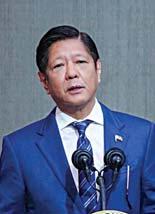
insufficient with the rapid increase of vehicles,” Artes said. He noted a study from the Japan International Cooperation Agency (Jica) has pegged the economic cost of the traffic problem to P4.9 billion in 2020.
“The economic cost of traffic can rise to P9.4 billion by 2027,” the MMDA head said.
Ongoing projects
MARCOS pointed out his administration is now prioritizing the completion of major public transport systems to address traffic congestion, including the Tutuban to Malolos part of the North-South Commuter Railway (NSCR) project, which is now 61 percent complete. He also reported the progress of
more www.businessmirror.com.ph Thursday, April 11, 2024 Vol. 19 No. 177 P. nationwide | sections pages | 7 DAYS A WEEK DEBT INSTRUMENTS SPUR 89.9% RISE IN JAN FDI PESO EXCHANGE RATES US 56.5740 JAPAN 0.3732 UK 71.4699 HK 7.2262 SINGAPORE 41.9315 AUSTRALIA 37.1861 SAUDI ARABIA 15.0832 EU 61.3262 KOREA 0.0419 CHINA 7.8227 Source BSP (April 8, 2024) BusinessMirror A broader look at today’s business ROTARY CLUB OF MANILA JOURNALISM AWARDS 2006 National Newspaper of the Year 2011 National Newspaper of the Year 2013 Business Newspaper of the Year 2017 Business Newspaper of the Year 2019 Business Newspaper of the Year 2021 Pro Patria Award PHILIPPINE STATISTICS AUTHORITY 2018 Data Champion EJAP JOURNALISM AWARDS BUSINESS NEWS SOURCE OF THE YEAR (2017, 2018, 2019, 2020) DEPARTMENT OF SCIENCE AND TECHNOLOGY 2018 BANTOG MEDIA AWARDS RECTO: PPP, ODA BEING EYED FOR MINDANAO RAIL FUNDING See “FDI,” A ranchising and Regulatory Board (LTFRB) reaffirmed the April 30, 2024, deadline to escalating
timing, BSP treads slowly on RRR cut TURKEY AND ISRAEL IMPOSE TRADE BARRIERS ON EACH OTHER AS RELATIONS DETERIORATE OVER GAZA CONFLICT THE WORLD »A8 PBBM: Traffic-busting plan focuses on mass transit Continued on A See “PBBM,” A “While workers can afford it, they will continue to buy vehicles. And even if we build so many roads, flyovers, bypass roads, those will not be able to keep up [with the increase in vehicles].”—President Marcos Jr.
Cai U. Ordinario
Citing
By
Marcos flies to US; regional peace, industries top agenda
By Samuel P. Medenilla @sam_medenilla
SECURING commitments to preserve peace in the Indo-Pacific region and cooperation on critical industries will be the priority agenda of President Ferdinand R. Marcos, Jr. during the historic Philippines-Japan-United States (US) trilateral meeting in Washington D.C., this week, the President said in his pre-departure speech on Wednesday.
vestments in debt instruments are investments made by nonresident subsidiaries/associates in their resident direct investors, i.e., reverse investment.
FDIs for the Philippines.”
Data showed nonresidents’ net investments in debt instruments soared 173.2 percent to $820 million in January 2024 from $300 million in January 2023.
BSP explained that net investments in debt instruments consist mainly of intercompany borrowing/lending between foreign direct investors and their subsidiaries/affiliates in the Philippines.
The remaining portion of net in-
“Foreign investors borrow to finance their investment in the country. This is usual practice, especially for large amounts of FDIs financed by loans/debt/credit,” Ricafort said.
“Even local investors take out loans/debts/credit from banks and also from the capital markets to finance new investments and expansion projects, both capex [Capital Expenditure] and opex [Operation Expenditure],” he added.
Fumio Kishida, Marcos said he will “reiterate the importance of upholding the rule of law and preserving the rules-based international order in the IndoPacific region.”
“The main intent of this trilateral agreement is for us to be able to continue to flourish, to be able to help one another, and of course, to keep the South China Sea as a freedom—to keep the peace in the South China Sea and the freedom of navigation in the South China Sea,” Marcos said in his departure speech at the Villamor Airbase in Pasay City. The chief executive also wanted to enhance the country’s economic cooperation with the US and Japan during the meeting.
“I intend to explore ways
Meanwhile, BSP data showed the reinvestment of earnings likewise increased by 16.4 percent to $99 million in January 2024 from $85 million in January 2023.
Data showed nonresidents’ net investments in equity capital— other than reinvestment of earnings—posted net outflows of $11 million in January 2024 from the $93 million net inflows in January 2023.
“Equity capital placements during the period emanated largely from Japan and the United States. Said investments were channeled mostly to the manufacturing, real estate, construction, and wholesale

of advancing cooperation, especially in the areas of critical infrastructure, semiconductors, digitalization and cybersecurity, critical minerals, renewable energy, as well as defense and maritime cooperation,” Marcos said.
At the sidelines of the meeting, he said he will also have a bilateral meeting with Biden, where he will discuss defense-related matters.
The Department of Foreign Affairs (DFA) earlier said a joint vision statement will be issued by the three participating state leaders after the trilateral meeting. Prior to his return to the Philippines, Marcos said he will also be meeting with American business leaders to invite them to invest in the Philippines.
and retail trade industries,” BSP said. FDI includes investment by a nonresident direct investor in a resident enterprise, whose equity capital in the latter is at least 10 percent, and investment made by a nonresident subsidiary/associate in its resident direct investor. The BSP FDI statistics are distinct from the investment data of other government sources. BSP FDI covers actual investment inflows.
By contrast, the approved foreign investments data that are published by the Philippine Statistics Authority (PSA), which are sourced from Investment Promotion Agencies (IPAs), represent investment commitments, which may not necessarily be realized fully, in a given period.
DTI hails FDI trend
THE Department of Trade and Industry (DTI) hailed the positive trend in FDI for January 2024.
“The surge in FDIs reflects the unwavering confidence and steadfast trust the global business community places in the Philippines’ economic potential,” said DTI Secretary Fred Pascual.
“This only strengthens our commitment to further improve the country’s business environment to attract even more foreign investments, which in turn will create more jobs and sustain our economic growth. In particular, we are leveraging our strengths across key sectors such as manufacturing, real estate, construction, and wholesale and retail trade,” he added.
The notable rise in FDI marks the third consecutive month of expansion, following growth of 28 percent in November and 30 percent in December, in a month-tomonth comparison with the previous year, the DTI noted. The DTI said it remains focused on further attracting significant investments in these essential sectors and other high-growth industries. By bolstering these foundational industries, the Philippines can create a more robust and resilient economy.
The announcement comes ahead of the Trilateral Economic Ministers Meeting, scheduled for April 11, 2024, in Washington, D.C. This significant event will bring together US Commerce Secretary Gina Raimondo, Japan’s METI Minister Ken Saito, and DTI Secretary Pascual. The meeting aims to explore new trade and investment avenues that promise to generate business, create jobs, and foster sustainability.
Past engagements, including Secretary Raimondo’s successful trade and investment mission to the Philippines and discussions during the Asean-Japan Economic Co-Creation Forum, have set the stage for future collaborations. These efforts underscore the robust economic ties between the Philippines, the United States, and Japan. With a report by Andrea E. San Juan
completion of other railway projects: the Malolos to Clark part of the NSCR (56.5 percent), Manila to Calamba part of the NSCR (38 percent), Metro Manila Subway Project (41 percent), LRT Line 1, Cavite extension (80 percent), MRT Line 3 rehabilitation and maintenance (85 percent), Unified Grand Central station, or the Quezon City common station (83 percent), and the MRT line from Quezon City to Bulacan (67 percent).
Department of Transportation (DOTr) Secretary Jaime J. Bautista said they are currently working with Jica in crafting a 30-year master plan for railways in the greater NCR. He said their other initiatives to improve the commuting experience in Metro Manila include enhancing the efficiency of the bus way on EDSA and the construction of more integrated transport exchanges (ITE) through public private partnerships (PPP).
They are planning to build ITEs similar to the Parañaque Integrated Terminal Exchange (PITx) in Taguig with the help of Ayala Group and in an unspecified location north of NCR, in partnership with Victory Liner.
No more extension
THE mass transit enhancement initiatives of the Marcos administration also covers the Public Utility Vehicle Modernization Program (PUVMP). The program aims to replace existing PUVs with more environmentally-friendly alternatives, such as those electric-powered. The full implementation of the PUVMP remains pending since its franchise consolidation component is still ongoing upon the demand of some transport groups.
Marcos, however, said he will no longer extend the April 30, 2024 deadline for the consolidation so the PUVMP can push through.
He assured that government will address the concerns raised by those opposing the PUVMP, such as having access to affordable PUVs.
The Land Transportation and Franchising Regulatory Board (LTFRB) reported 190,000 units UV Express, public utility jeeps, mini-buses and buses, have availed of consolidation.
Colorum crackdown
LAST, the President also said the government will initiate a crackdown on colorum vehicles—PUVs plying routes without the necessary registration or authorization. The campaign, he said, will help reduce the number of vehicles in
NCR since an estimated 30 percent of the PUVs operating in the region are colorum.
Marcos tasked the Department of the Interior and Local Government (DILG) to spearhead the campaign against the PUVs, which are operating illegally.
“That is why I will pass this problem to the DILG Secretary because it is the police, which will enforce this by making sure [PUVs] have the right franchise,” he said.
The national government will coordinate with local government units (LGU) and other stakeholders with the implementation of the said holistic plan to solve traffic congestion in NCR, according to Marcos.
“And hopefully that’s—many of the lessons that we will learn here, here in Metro Manila will be able—we can—we will be able to apply in places like Cebu City where also the problem of traffic is pretty bad,” Marcos said.
Robin: Education, discipline, enforcement keys
ROAD courtesy, discipline and education for motorists and drivers, along with clarity on enforcement of traffic laws, are among the keys to solving the scourge of traffic in Metro Manila and other urbanized areas in the country, Sen. Robinhood “Robin” C. Padilla said.
Padilla, who is heartened that the administration of President Ferdinand “Bongbong” R. Marcos Jr. is working to address the problem, said he is prepared to help through legislative processes.
“
Ilang buwan na ring pinag-aaralan ng aking tanggapan ang pag-ayos ng transportasyon sa lupa. Kasama sa mga susi dito ang kurtesiya sa daan at edukasyon, disiplina ng mga motorista—na maaaring isama sa kurikulum ng Department of Education para sa Senior High School, para maagang matuto ang ating mga mamamayan bago mapasama sa ating workforce. [In past months, my office has been studying how to rationalize land transportation. Among the keys to this are road courtesy and discipline, driver education of new motorists in Senior High School—which may be included in the curriculum of the Department of Education so our drivers will learn both national and international driving laws, the right values before joining our workforce],” he said.
Aside from this, Padilla noted it is important to determine who can use national roads, and clarify the roles of local government units (LGUs) in implementing national traffic regulations as well as who are specifically authorized to enforce national traffic regulations— including a redefined Philippine National Police Highway Patrol Group.
RECTO: PPP, ODA BEING EYED FOR MINDANAO RAIL FUNDING
statement on Sunday. Recto also said the Finance department is just waiting for the Department of Transportation (DOTr) since it is still finalizing the preconstruction activity.
Transportation Secretary Jaime J. Bautista said earlier that his agency needs to update the feasibility study, together with the National Economic and Development Authority (Neda), and look into the ridership of the railway project.
“We are willing to assist them [in] securing ODA funding,” Recto said, despite the DOF’s withdrawal from loan negotiations with China worth P83 billion for Phase 1. Phase 1 of the MRP aims to lay down a 102-kilometer train line that will connect Tagum City, Davao del Norte’s provincial capital, to Davao del Sur’s provincial capital, Digos City. The line, with six commuter trains with five cars each and 15 freight cars for cargo shipment, is projected to transport 122,000 commuters every day during its first year of operation. It will be
deployed every hour and will run through eight stations. The whole MRP will consist of a 1,544-kilometer railway and expand to the cities of General Santos, Cagayan de Oro, Iligan, Cotabato, Zamboanga, Butuan, Surigao, and Malaybalay.
To recall, the government has secured funding from Japan through the Japan International Cooperation Agency (Jica) worth a total of JPY507 billion or P188.6 billion for the first to third tranches of the loan agreement for the Metro Manila Subway Project. The DOF has also signed the loan agreement for the first tranche of financing for the Dalton Pass East Alignment Road Project (DPEARP) worth JPY 100 billion or about P37 billion.
With a total project cost of P67.4 billion, the DPEARP is one of the biggest infrastructure projects in Central and Northern Luzon, linking Nueva Ecija and Nueva Vizcaya to the Cagayan Valley Region that involves the construction of a 23-kilometer alternative road bypassing the existing 77-kilometer Dalton Pass East Bypass Route.
During the meeting to be hosted by US President Joe Biden at the White House and attended by Japanese Prime Minister
Thursday, April 11, 2024 A2 News BusinessMirror www.businessmirror.com.ph Continued from A PBBM... Continued from A
FDI... Continued from A
Marcos seeks ‘clear answer’ on WPS ‘pact’ with Beijing
By Samuel P. Medenilla @sam_medenilla & Jovee Marie N. Dela Cruz @joveemarie
PRESIDENT Ferdinand R. Marcos Jr. said he wants to determine once and for all if the previous administration had forged a “secret agreement” with China on the West Philippine Sea (WPS).
The chief executive said they are now in talks with officials of former President Rodrigo R. Duterte to get a “clear answer” on the matter since he is “horrified” by the thought of such an agreement, as this can compromise the country’s sovereignty in the WPS.
“Nobody told us about such an agreement so we are trying to clear it up to now because from the former administration, they have different answers,” Marcos told reporters in an interview after the Bagong Pilipinas Town Hall Meeting on Traffic Concerns in San Juan City last Wednesday.
“One of the former government officials under the previous administration [said] there’s no such agreement. Another [official] said there is [such an agreement], and we should honor it,” he added.
The President said he will also talk to Chinese Ambassador to the Philippines Huang Xilian to find out who approved the agreement from the Philippine side, as well as the details.
Currently, he said, they have yet to find a record of the purported agreement.
Former Presidential Spokesperson Herminio “Harry” L. Roque Jr. maintained there is such a pact to “respect the status quo” in the WPS.
This was contradicted by former Presidential

Chief Legal Counsel Salvador S. Panelo, who said he talked with Duterte, who categorically denied he had made such a pact.
China has repeatedly cited the existence of a gentlemen’s agreement made by the Philippine government, which includes the removal of the Philippine grounded ship in the Ayungin Shoal, the BRP Sierra Madre.
Last August, Marcos stressed the country will not remove BRP Sierra Madre, which strengthened the country’s claim in Ayungin Shoal.
He said he is not aware of such agreement and that he will rescind it if exists.
‘A grave mistake’
ALBAY Rep. Edcel C. Lagman said it is not possible to have any form of a “gentlemen’s agreement” with a
Metro Manila LGUs to adjust working hours
STARTING next week, employees of local government units (LGU) in Metro Manila will work from 7 a.m. to 4 p.m., according to the Metropolitan Manila Development Authority (MMDA).
During the Bagong Pilipinas Townhall Meeting on Traffic Concerns in San Juan City last Wednesday, MMDA Officer-in-Charge Romando S. Artes said the initiative will serve as the pilot implementation of the scheme before it is rolled out to other national government agencies.
“The LGUs in Metro Manila will start the 7 a.m. to 4 p.m. work arrangement because it was passed by the Metro Manila Council [MMC],” Artes said.
Under its Resolution No. 24-08, the MMC said the new scheme, which will replace the 8 a.m. to 5 p.m. schedule of the affected workers, will take effect on April 15.
Artes said the initiative, once fully implemented in the government, is part of their efforts to reduce traffic congestion in the National Capital Region (NCR).
Citing data from the Civil Service Commission (CSC), he said there are 645,000 government employees in Metro Manila.
Of which, 22 percent or 145,000 have their own vehicles, while the remaining 500,000 commute to work daily.
The new working hours, Artes said, will remove the contribution of government employees to road traffic and use of mass transit during after work rush hour, which usually starts at 5 p.m.
Colorum operations
THE Land Transportation Office (LTO) on Wednesday said it will intensify its campaign against colorum vehicle operations.
LTO Chief Vigor D. Mendoza II said the agency “will be more aggressive” in cracking down illegal public transport operation, noting that it will beef up its partnerships with law enforcement agencies such as the Police, the Coast Guard, and the Special Action and Intelligence Committee for Transportation.
“The LTO intends to double time its efforts and widen its net,” he said.
Highlighting the detrimental impact of colorum operations on legitimate transport operators, Mendoza
Bong Go brings health services to grassroots
THE Super Health Center at Manuel Roxas Street in Magdiwang town in Sibuyan Island, Romblon, was formally handed over to benefit the community in a turnover ceremony witnessed by Senator Christopher “Bong” Go on Tuesday, April 9.
This is part of collaborative efforts advocated by Go towards bolstering healthcare services in the grassroots such as island communities. The event, which coincides with the Araw ng Kagitingan, saw the presence of various local officials, highlighting their unified commitment to bring medical services closer to those in need.
“Patuloy po akong tutulong sa pagpaparami ng Super Health Centers sa bansa sa abot po ng aking makakaya. Sa mga itinayo na Super Health Centers, nakita namin kung gaano kalaki ang naitutulong nito sa komunidad lalo na sa rural areas,” Go said during the event.
“It is a significant step towards enhanced healthcare services in communities. Yunpoanglayunin ngmgaSuper Health Centers, ang ilapit sa mamamayan ang serbisyong medikal mula gobyerno,” he added.
Go shared that establishing a Super Health Center on Sibuyan Island is paramount due to its geographical remoteness and the unique healthcare challenges this isolation presents. Sibuyan, often called the“Galápagos of Asia” for its rich biodiversity, lacks immediate access to comprehensive medical services found in more urbanized regions. The said facility aims to bridge this gap, ensuring that residents of this isolated island receive essential health services without the need for long and potentially hazardous journeys. Through the collective efforts of Go, the
Department of Health (DOH) led by Secretary Teodoro Herbosa, local government units, and fellow lawmakers, sufficient funds have been allocated for the construction of around 700 Super Health Centers nationwide strategically located in various localities, including five in Romblon.
Super Health Centers are designed to focus on primary care, medical consultation, and early disease detection, further strengthening the healthcare sector in the country, especially in grassroots communities. Free consultations would be handled by municipal health offices, local government units, and the Philippine Health Insurance Corporation through its Konsulta program.
In his speech, Go also acknowledged Governor Otik Riano, Mayor Dr. Arthur Tansiongco and Vice Mayor Antonio Menese, among others, for their efforts in uplifting their community.
Mayor Tansiongco expressed profound gratitude towards Go for his support and contributions to healthcare developments in the town and the whole of Romblon. “Mahal na mahal po kayo ng taga-Sibuyan, taga-Magdiwang, tsaka ng mga taga-Romblon,” the mayor began. “Dito po talaga bantog na, if in Bisaya, alam na alam,kilalangkilalakayoditosabayanngMagdiwang,” he added, explaining how Go’s compassionate service has reached even the most remote areas of the country. Go, chairperson of the Senate Committee on Health, then emphasized the presence of a Malasakit Center at the Romblon Provincial Hospital in Odiongan to further improve healthcare accessibility, equipped to provide medical-related support to patients in need.

‘Trilateral meet to yield economic gains’
LEADERS of the House of Representatives on Wednesday expressed optimism about the potential economic benefits awaiting the Philippines as a result of the upcoming trilateral meeting involving United States President Joe Biden, Japanese Prime Minister Fumio Kishida and President Ferdinand Marcos Jr. Scheduled for April 11 in Washington, D.C., Speaker Ferdinand Martin G. Romualdez said the unprecedented gathering symbolizes a monumental stride towards fostering economic collaboration among the three nations, fostering peace and stability in the IndoPacific region, and fortifying cooperation across various spheres of mutual interest.
“chronic aggressor” such as China regarding the WPS. Lagman also condemned former President Rodrigo Duterte’s unilateral agreement with China regarding the West Philippine Sea.
“There can be no ‘gentlemen’s agreement’ with a chronic aggressor like China in the West Philippine Sea,” he said.
He echoed the sentiments expressed by Marcos, saying Duterte’s secretive pact with China’s principal official not only constitutes “a grave mistake” but also undermines Philippine sovereignty.
“I agree with President [Ferdinand] Marcos Jr. that former President Duterte’s unilateral and surreptitious agreement with China’s principal official is a grave mistake and indeed compromises Philippine sovereignty. This has no binding effect,” he said.
said the illicit activities were causing substantial financial losses, with legitimate operators reporting a staggering 30 percent decrease in daily income.
Drawing from his experience as a former member of a task group combating colorum activities, Mendoza emphasized the importance of implementing effective strategies gleaned from past initiatives.
He disclosed plans to enhance coordination with port authorities to prevent colorum vehicles from embarking on inter-island voyages, particularly utilizing Roll-On, Roll-Off vessels.
As part of the intensified crackdown, Mendoza announced that the LTO would collaborate closely with the Police and the Coast Guard to prepare criminal charges against apprehended colorum drivers and operators.
Under existing laws, operating colorum vehicles carries severe penalties, including imprisonment of up to six years and fines reaching up to P2 million.
“We will shut the doors in the various ports to prevent colorum motor vehicles from travelling from Visayas to Metro Manila,” said Mendoza. “We will also hit them at the terminals and expressways. We will control key junctions through in key cities to prevent them from plying.”
Samuel P. Medenilla and Lorenz S. Marasigan
The Malasakit Center is designed to provide Filipinos convenient access to medical assistance programs offered by DOH, the Department of Social Welfare and Development, the Philippine Health Insurance Corporation, and the Philippine Charity Sweepstakes Office.
According to the DOH, 161 active Malasakit centers nationwide have aided more than ten million Filipinos. The Malasakit Centers program, a brainchild of Go, was institutionalized under Republic Act No. 11463, which he principally authored and sponsored in the Senate.
“Bilang inyong Mr. Malasakit, anumang pagsubok ang ating haharapin sa susunod na mga araw, patuloy akong magseserbisyo sa inyong lahat dahil bisyo ko na ang magserbisyo at naniniwala ako na ang serbisyo sa tao ay serbisyo sa Diyos,” Go said.
As vice chairperson of the Senate Committee on Finance, he also supported the improvement and rehabilitation of the municipal park and plaza in Banton to further boost regional development and economic growth in Romblon.
He also supported the construction of multipurpose buildings in Ferrol, Romblon, and Santa Maria; the improvement of the municipal park in Banton; road improvements in Cajidiocan, Looc, Romblon, San Fernando, and Sta. Fe; and acquisition of ambulance units in Sta. Maria.
On the same day, Go extended his Romblon visit to Cajidiocan to inspect the ongoing rehabilitation of ML Quezon Street, a project he supported. The senator’s visit to Cajidiocan also included engagements with locals affected by job loss, where he provided support and inspiration. Additionally, Go was invited to the Provincial Athletic Meet held in the town being the Chair of the Senate Committee on Sports.
“Economic cooperation lies at the heart of this trilateral meeting, with discussions aimed at enhancing trade, investment, and development opportunities among our nations. Our country’s deeper economic integration with the United States and Japan will undoubtedly benefit our people in terms of jobs and livelihood opportunities and contribute to regional prosperity,” Romualdez said.
Highlighting the Philippines’s pivotal role as a partner to both the US and Japan in advancing regional stability and growth, Romualdez said collaboration is key to addressing common challenges and advancing shared interests in the Indo-Pacific landscape.
“As nations with strategic interests in the IndoPacific, our collaboration is essential in addressing common challenges and advancing mutual interests,” said Romualdez.
“President Marcos Jr.’s engagement with President Biden and Prime Minister Kishida underscores our nation’s commitment to upholding the principles of freedom, democracy, and the rule of law. It is also a tacit recognition of his leadership and his foreign policy of being a friend to all and an enemy to none,” he added.
Moreover, he said the focus on peace and stability in the Indo-Pacific region aligns with the Philippines’s aspirations for a secure and harmonious environment.
“By strengthening our partnerships with like-minded nations, we can address security challenges effectively
and promote peace and stability across the region,” said Romualdez.
“The House of Representatives stands solidly behind President Marcos Jr., in this endeavor, and we are ready to craft any legislation that may be necessary to advance and realize the objectives of this historic meeting,” he added.
He noted that the three leaders are also expected to explore cooperation not only towards promoting inclusive economic growth but also in the areas of developing critical and emerging technologies, climate change cooperation, and clean energy supply chains.
“The Philippines, as a vulnerable nation to the impacts of climate change, welcomes increased cooperation with the United States and Japan to implement sustainable solutions and mitigate the effects of climate change on our communities,” Romualdez said.
He added that the trilateral meeting could likewise prove beneficial to the Philippines through cooperation agreements that may be forged, which would bolster the position of the Philippines as a crucial hub in the international supply chain.
Meanwhile, anticipating a consensus on expanded economic collaboration among the three nations, Senior Deputy Speaker Aurelio Gonzales Jr. expressed confidence in the substantial advantages this summit could bring to Filipinos.
“We expect the three leaders to agree on expanded economic cooperation among their nations. The economic advantages this summit could produce for us Filipinos are potentially enormous,” Gonzales said.
Majority Leader Manuel Jose M. Dalipe said there is a likelihood of strengthened trade cooperation resulting from the discussions among the leaders.
“We have to remember that the US and Japan are among our country’s biggest trading partners,” he said.
For his part, Deputy Speaker and Quezon Rep. David Suarez said the Philippines also expects increased military and financial help from the US and Japan.
“These two allies of ours are our largest and most generous sources of official development assistance,” they said. Jovee Marie N. Dela Cruz
Future MMCAs require ministerial approval–AFP
By Rex Anthony Naval
WHILE it is feasible to hold more multilateral maritime cooperative activity (MMCA) with the country’s allies in the coming days, it must first be approved by the defense establishments of the participating nations.
“Conducting MMCA’s with allied countries in the coming days is feasible, provided that all parties approve them at the ministerial level and in alignment with the international rules-based order and International laws,” Armed Forces of the Philippines (AFP) Spokesperson Col. Francel Margareth Padilla said.
She also deferred to the Department of National Defense for additional details on the matter.
“We welcome more like-minded nations to join us in future MCAs,” Padilla noted.
The AFP spokesperson also clarified that the MMCA was done within the Philippines’s exclusive economic zone and in accordance with international law and established norms in pursuit of the country’s national interests.
“These activities serve as a resolute statement of unity reaffirming our adherence to international laws. They embody the practical manifestation of our partnerships and collaboration with like-minded nations, showing our collective resolve to ensure stability and security in the region,” she said.
Padilla made this comment after United States National Security Adviser Jake Sullivan said that there will be more joint patrols in the South China Sea. Sullivan issued the statement after the successful conduct of the MMCA by the US, the Philippines, Japan and Australia in the West Philippine Sea last April 7.
Participating units in the MMCA include the BRP Gregorio Del Pilar (PS-15) with AW-109 helicopter, BRP Antonio Luna (FF-151) with AW-159 “Wildcat” anti-submarine warfare helicopter, and BRP Valentin Diaz (PS-177) from the Philippine Navy; the USS Mobile and a P-8A “Poseidon” from the United States Navy; the Royal Australian Navy HMAS Warramunga and Royal Australian Air Force P-8A “Poseidon” maritime patrol aircraft; and the JS Akebono from the Japan Maritime Self-Defense Forces.
Govt officials cite contribution of Filipino Muslims to nation-building
SPEAKER Fer dinand Martin G. Romualdez on Wednesday marked the invaluable contributions of the Filipino Muslim community to the nationbuilding process on the occasion of Eid’l Fitr, marking the culmination of the month-long observance of Ramadan.
“As we join in the celebrations of Eid’l Fitr, let us also recognize the diversity that enriches our nation. The Philippines is home to a vibrant Muslim community whose contributions have greatly enriched our great nation,” said Romualdez.
“Let us embrace the spirit of inclusivity and understanding, fostering unity and respect for all faiths and beliefs,” he added. He stressed the importance of fostering inclusivity and understanding, promoting unity, and respecting all faiths and beliefs.
“As we gather with loved ones to share in the festivities, let us not only rejoice in the abundance of food and blessings but also in the deeper spiritual meaning behind this sacred time,” he said.
Reflecting on the values embodied by Ramadan, Romualdez underscored the significance of patience, empathy, and self-discipline, noting that it serves as a time for personal growth and spiritual enlightenment.
“Through fasting and acts of charity, Muslims demonstrate their commitment to compassion and generosity, reaching out to those in need and fostering solidarity within their communities,” he said.
“May this Eid bring not only joy but also renewed hope and optimism for our shared future. Let us carry forward the values of compassion, generosity, and unity that define this occasion, extending kindness and goodwill to all,” he added.
Reminder AS Filipino Muslims celebrate Eid al-Fitr Wednesday, Department of National Defense (DND) Secretary Gilberto C. Teodoro Jr. reminded the devout to give charity to the people needing it.
“May we also remember to give Zakat charitably to those who need it most. As the Quran says, ‘Believe in Allah and his messenger, and give charity out of the [substance] that Allah has made you heirs of. For those of you who believe and give charity—for them is a great reward,’” he said.
Teodoro said the DND is one with all Filipino Muslims as they “break the fast of Ramadan and celebrate Eid al-Fitr.”
“May the Almighty Allah accept the deeds of worship offered to Him on this day of joy,” he added.
Aside from gifts of charity, he also urged Filipino Muslims to also exchange forgiveness and understanding.
“Let us also offer a prayer for our brothers and sisters who are celebrating Eid on duty, that they may be kept safe, together with their families at home,” Teodoro said.
Jovee Marie N. Dela Cruz and Rex Anthony Naval
A3 Thursday, April 11, 2024 www.businessmirror.com.ph • Editor: Vittorio V. Vitug
file photo of the BusinessMirror, the dilapidated Philippine Navy ship LT 57 Sierra Madre is in the shallow waters of Second Thomas Shoal in the South China Sea.
IN this March 30, 2014,
Economy
Seipi banks on global market demand to see modest growth
By Andrea San Juan @andreasanjuan
DESPITE aiming for flat growth this year, the Philippine semiconductor and electronics industry is seeing some “modest” growth based on global market demand, according to the Semiconductor and Electronics Industries in the Philippines Foundation Inc. (Seipi).
“The projection is flat but there’s optimism based on global demand that we will see some modest growth,” Seipi President Danilo C. Lachica told reporters last Monday.
“We don’t react quarter to quar-
ter. You know, there’s a lot of perturbations; but for the year, while our projection is flat, we think there’s going to be some upside, some modest growth for the year, especially if you look at the global demand,” Lachica said on the sidelines of a meeting of businessmen and educators.
He said Seipi’s forecast comes despite the recent earthquake that struck Taiwan, host to the world’s top contract chip producers.
“Yes, kasi mabilis naman naka-recover ‘yung TSMC [Taiwan Semiconductor Manufacturing Co.]—within a couple of days,” Lachica said. However, he added that delays in imported wafers still
depend on if there would be aftershocks. The Philippines imports wafers and discs from Taiwan, according to the Seipi website.
The Seipi chief draws optimism from the emergence of artificial intelligence (AI) technology.
“As you know, the demand for electronics is all over. You talk about AI, the Industrial Revolution 4.0—so it’s really going to be driven by market demand,” Lachica said.
According to a Bloomberg report, the association projects that the global chip industry is “poised for a significant rebound this year with sales expected to jump to a record level.”
The report noted that this would be fueled by a “greater need for the electrical components from a broad range of businesses.”
In August last year, the Seipi revised its growth target for electronics exports from 5 percent to zero percent due to geopolitical conflicts such as trade war between the United States and China.
The Philippine semiconductor and electronics industry ended 2023 with $41.9 billion exports earnings, 9.2 percent down from the $46.15 billion recorded in 2022.
Semiconductors contributed $33.67 billion or the largest chunk to the electronic exports last year.
Based on the November 2023 data published on the website of Seipi, the top countries of destination for Philippine electronics exports were: Hong Kong with 17.19-percent share; US, 15.08 percent; China, 9.77 percent; Japan, 7.42 percent; and, Singapore with 5.43 percent.
’23 lifting of ban on new economic zones praised
By Jovee Marie N. Dela Cruz @joveemarie
ASENIOR la wmaker has expressed optimism that the lifting of the 5-year government moratorium on new special economic zones (SEZs) will pave the way for the establishment of more investorfriendly hubs nationwide.
Camarines Sur Rep. Luis Ray F. Villafuerte Jr. said he expects last year’s easing of the moratorium to lead to the creation of additional hubs that are favorable to investors. This would include the proposed SEZ in his home province.
Villafuerte quoted the National Economic and Development Authority as believing
more jobs and investments must be generated outside Metro Manila for the economy to grow a lot faster.
The senior lawmaker said he is convinced that a potent method for generating plentiful employment and fostering investment prospects beyond the capital city, thereby stimulating growth at a regional level, involves the establishment of additional SEZs in areas capable of drawing both domestic and foreign investments.
Villafuerte highlighted the proposal for an SEZ in Camarines Sur, noting that the 19th Congress could facilitate its establishment.
He stressed that such a move aligns with the objective of fostering livelihoods and investment prospects beyond major urban
centers like Metro Manila, Cebu and Davao, by advancing a longstanding bill advocating for the creation of an SEZ in the province.
Referring to House Bill (HB) 3681, which aims to establish the CamSur Free Trade Zone, Villafuerte emphasized its potential to invigorate the Bicol region and contribute to government’s goal of fostering an investment-friendly environment conducive to creating quality jobs.
In underscoring the significance of job creation in Camarines Sur and the wider Bicol region through the proposed SEZ, Villafuerte highlighted its potential to not only drive regional growth and development but also to incentivize Bicolanos to remain in their respective provinces, thus supporting the
SC: CJHDEVCO should vacate leased portion of Camp John Hay
Continued from A12
The court’s ruling
IN reversing the CA’s decision, the SC held that CJHDevCo’s petition filed before the appellate court was premature.
The SC said the CA hastily acted on CJHDevCo’s certiorari petition without waiting for the RTC to rule on its pending motion.
“By granting CJHDevCo’s petitions for certiorari and prohibition, the CA, in effect, already ruled on the merits of the proceedings still pending before the RTC,” the SC stressed.
“Without the RTC’s ruling on the same, there can be no definitive pronouncement that it indeed acted capriciously under the circumstances, ” it added.
Furthermore, the SC held that the CA failed to abide by the rules of arbitration when it modified the PDRCI’s final award without valid grounds.
The Court stressed that under Section 40 of Republic Act No. 9285, or the Alternative Dispute Resolution (ADR) Act, “[a] domestic arbitral award when confirmed shall be enforced in the same manner as final and executory decisions of the Regional Trial Court.”
It also noted that Special Rules of Court on ADR (Special ADR Rules), provides that “[t]he court shall not disturb the arbitral tribunal’s determination of facts and/or interpretation of law.”
“Thus, as a rule, the arbitrator’s award cannot be set aside for mere errors of judgment either as to the law or as to the facts. Judicial review is hence confined strictly to the limited exceptions under arbitration laws for the arbitration process to be effective and the basic objectives of the law to be achieved,” the SC explained.
“In the present case, without showing that any of the grounds to modify the award exist or that the same amounts to a violation of an overriding public policy, the RTC was thus correct in confirming the Final Award,” it added.
The Court found that the CA modified the arbitral ruling when it made an exception to CJHDevCo’s obligations to vacate and deliver the leased property to the BCDA in favor of the former’s sublessees; when it declared CJHDevCo’s obligation to vacate the leased property dependent only upon the BCDA’s full payment of the arbitral award; when it imposed additional obligations upon the BCDA, such as to respect and not disturb the
various contracts of CJHDevCo and to assist in the processing of CJHDevCo’s claim with the COA; and to arbitrate and/or litigate with CJHDevCo’s sub-lessees to determine their respective rights and interests.
“In requiring the BCDA to fulfill the conditions outside of the Final Award, the CA made its own findings of fact and provided its own legal interpretation of the parties’obligations. This is clearly beyond the power of the CA, ruled the Court,” the SC pointed out.
The Court said the PDRCI’s final award did not make CJHDevCo’s obligation to vacate the leased property contingent upon BCDA’s full payment of the amount of P1.42 billion.
The SC declared that CJHDevCo should return to BCDA the leased property together with improvements while BCDA should refund to CJHDevCo the rent already paid.
Likewise, the High Court affirmed the COA’s dismissal of CJHDevCo’s money claim pending resolution of the BCDA petition before the Court.
The Court held that the COA correctly dismissed the money claim since the issue of the execution of the final award remains under litigation and is therefore beyond the limited jurisdiction of the COA.
government’s dual objectives of decongesting the National Capital Region (NCR) and fostering countryside development.
Apart from Camarines Sur, Bicol comprises the mainland provinces of Albay, Camarines Norte and Sorsogon, as well as the island provinces of Catanduanes and Masbate.
The former Camarines Sur governor underscored the legal compliance of the proposed CamSur Free Trade Zone, stressing its alignment with PEZA requirements for SEZs. He highlighted existing PEZA-approved zones in Camarines Sur, such as the CamSur Information Technology Park (CSTIP) and the Tourism Ecozone Zone, as indicative of the province’s readiness to support economic development initiatives.
Based on the records, BCDA was created in 1992 to implement the government’s policy to accelerate the sound and balanced conversion of former United States (US) military bases into alternative productive uses and enhance derived benefits to promote economic and social development.
Among BCDA’s powers is to own, hold, and/or administer several former US military reservations, including Camp John Hay in Baguio City.
Following the transformation of Camp John Hay into the 625-hectare John Hay Special Economic Zone (SEZ), the lease and development of a 247-hectare portion was awarded to CJH DevCo.
BCDA, as lessor, then entered into a lease agreement with CJH DevCo, Fil-Estate Management, Inc., and Penta Capital Investment Corporation, as lessees, for the use, management, and operation of the leased property.
Under the lease agreement, BCDA remains owner of the leased property, while CJHDevCo shall own improvements it will introduce.
However, at the end of the lease agreement, CJHDevCo must transfer the ownership of the improvements to BCDA.
CJHDevCo was also authorized under the agreement to sublease the leased property to third persons.
Lao official cites importance of partnership for devt
EMPHASIZING the commitment of the Lao People’s Democratic Republic (PDR) to policies promoting food security, good nutrition and sustainable agro-ecosystems, Bouachanh Sihavong, the deputy secretary of the Youth Union of the Ministry of Agriculture and Forestry stressed the imperative of regional and global partnerships to address emerging challenges, during an event organized by the Association of Southeast Asian Nations (Asean).
Co-organized by the Asean Youth Organization and Mekong Institute, the Asean Youth Economic Forum 2024 (AYEF) in Vientiane, Laos, from April 4 to April 5, 2024, the AYEF 2024 successfully convened more than 190 onsite participants and more than 150 online participants from Asean+Japan countries and conducted an intensive discussion under the theme of “Fostering Food Security and Economic
Development through the Asean-Japan Collaboration.”
With the support of the AEM-METI Economic and Industrial Cooperation committee, Ministry of Economics, Trade and Industry of Japan, Asean Secretariat, Ministry of Agriculture, Forestry and Fisheries of Japan, Ministry of Foreign Affairs of Lao PDR and the Ministry of Agriculture and Forestry of Lao PDR, the AYEF 2024 became one of the largest Youth Economic Forum in Laos led by youth.
The ambassador Extraordinary and Plenipotentiary of Japan to the Lao People’s Democratic Republic, H.E. Kenichi Kobayashi, articulated a vision centered on the pivotal role of Asean youth in shaping the trajectory of cooperation. He emphasized the initiatives like the Asean+3 emergency rice reserve and the Asean FS Info System exemplified collaborative endeavors aimed at bolstering resilience and
knowledge sharing. Kobayashi reaffirmed Asean-Japan’s enduring friendship and commitment to mutual support. Dr. Roger Chao Jr, the Assistant Director of the Education, Youth and Sports of the Asean Secretariat echoed sentiments of solidarity and mutual support, affirming the pivotal role of youth in enhancing connectivity and resilience. Emphasizing the imperative of capacity building, increased youth participation in policy formulation and empowerment, Dr. Chao highlighted the multifaceted nature of sustainable agriculture and the imperative of collaborative solutions to global challenges.
Ryosuke Fujioka, the Chief representative of AMEICC and Senjaya Mulia, the Founder of Asean Youth Organization, promoted the youth inclusion in the decision making process and encouraged the youth to build a stronger cooperation amongst them.
DPWH plans to bid out six segments of bridge project
By Samuel P. Medenilla @sam_medenilla
THE Department of Public Works and Highway (DPWH) is targeting to bid out four of the six segments of the Bataan-Cavite Interlink Bridge Project this year.
In an interview with reporters last Wednesday, DPWH Secretary Manuel M. Bonoan disclosed the bidding for the contracts of the two land-based segments of the project will be conducted during the first half of the year.
According to Bonoan, the DPWH is “now inviting international contractors who have the experience in this kind of project.”
He added they are targeting to bid out in the second half of the year two other segments of the
project, which includes the longest part of the cable-stayed bridge (900 meters).
President Ferdinand R. Marcos, Jr. said once completed, the 32-kilometer Bataan-Cavite bridge to be built in the Manila Bay will be the second longest bridge in the world.
Marcos said the bridge will not only help reduce traffic congestion in Metro Manila, but also stimulate economic growth in Cavite and Bataan.
“That will make it cheaper to transport goods, make it cheaper to transport passengers [in both provinces],” the President said.
The Asian Development Bank (ADB) will finance the bridge, which will cost P219.3 billion, based on the engineering design approved by the National Economic and Development Authority last year.
‘Adequate power supply still best for Panay Island’
By Lenie Lectura @llectura
THE National Grid Corporation of the Philippines (NGCP) stressed that adequate power supply is still the best solution to improving the power situation on Panay Island.
The grid operator recently energized the P67.98-billion Cebu-Negros-Panay (CNP) 230-kiloVolt (kV) transmission backbone.
While transmission facilities are equally important as power generation, NGCP said the project is “not the sole or primary solution to the woes of power consumers, particularly in Panay.”
It added that “sufficient power generation supported by reliable transmission is the formula for optimized energy development. This will support the country’s push towards economic recovery,” said NGCP. As a transmission service provider, NGCP said it could only provide an overview of the current power supply and demand situation and endeavor to dispatch any and all available power. It cannot intervene on matters concerning power generation, NGCP stressed.
The CNP is comprised of three stages, the last of which was completed on March 27, 2024. The first stage of the CNP project added a new 230kV transmission line from Bacolod to E.B Magalona, while the second stage upgraded the Cebu Substation into 230kV level.
Energy Undersecretary Rowena Guevara commented that with the completion of the CNP, the entire backbone project in Visayas is now running at full capacity. “The importance of the completion of the CNP backbone, that’s the 230kV, is that there are now two possible routes to go to the needed islands. Before there was only one connection. The capacity used to be
Senjaya encourages the delegates and participants to connect and learn from one another as well as respecting the diversity of Asean.
The forum featured representatives from government, private sectors and international development organizations, highlighting initiatives and viewpoints on the theme such as the Understanding Food Security and Building Resilience, Asean-Japan Initiatives and Collaborative Pathways and even Youth-Led Organizations Practices and Initiates. This forum was followed by a site visit by Asean Delegates and guests to Co-Farm, a local initiative co-founded by a Lao Youth, Keerati Panyapitisophon (Max). During the visit, Max shared to all participants on how he built the initiative and supported the local farmers and the youth in his village.
380MW [megawatt] and 400MW now,” she said.
While certified as an Energy Project of National Significance in 2019, CNP project still encountered various difficulties particularly on right-of-way issues due to opposition of landowners, long and tedious judicial processes, protracted permitting processes by local government units, unreasonable demands and threats from a particular barangay official, security issues in certain areas in Negros and the Covid-19 pandemic in 2020.
“Despite the various challenges surrounding the completion of the CNP, NGCP’s commitment to delivering this important project did not falter. The dedication of our personnel who worked despite security threats, inclement weather conditions and difficult terrain and the support of concerned government agencies that assisted us were instrumental in driving this project forward,” said NGCP.
The project was filed for approval with the Energy Regulatory Commission (ERC) in four stages as early as 2013. The CNP stage 3 was filed in 2016 with a project cost of P43.41 billion. However, the ERC granted a provisional approval for only one year’s worth of capital expenditure amounting to P176.75 million in 2017 and has yet to issue a final approval.
The total cost of the entire CNP backbone project as filed with the ERC, amounts to P67.98 billion. Line 2 of the Negros-Panay Interconnection project is still pending approval by the ERC.
Partly owned by China’s State Grid Corp., the NGCP has so far invested P300 billion in grid expansion, new substations, transmission lines, upgrade of existing facilities, among others. This translates to continuously improving grid performance, including lower transmission rates, it said.

AYEF 2024 represents a unique opportunity for youths and stakeholders THIS Thursday, April 4,
A4 Editor: Vittorio V. Vitug • www.businessmirror.com.ph Thursday, April 11, 2024
2024, photo shows Bouachanh Sihavong, deputy secretary of the Youth Union of the Ministry of Agriculture and Forestry, speaking during the Asean Youth Economic Forum 2024 in Vientiane, Laos. CREDIT: ASEAN Youth Organization and Mekong Institute
develop
solutions to address food
the
and knowledge sharing, the forum aims to contribute to achieving the UN
promote
to unite, exchange ideas and
innovative
security challenges in
Asean region and beyond. By fostering collaboration
SDGs and
sustainable development for future generations.
Don’t allow GCTA for rape, heinous crime cons–solon
By Jovee Marie N. Dela Cruz @joveemarie
ASSISTANT Minority Leader and Gabriela Women’s Party Rep. Arlene Brosas on Wednesday expressed
her dismay over the recent Supreme Court ruling affirming the inclusion of prisoners convicted of rape and other heinous crimes in easily accessing the Good Conduct Time Allowance (GCTA).
Brosas emphasized that granting GCTA to such individuals may
normalize these brutal offenses, undermining the severity of the crimes and sentences and causing further distress to the victims and their families.
According to Republic Act 7659, heinous crimes include treason, plunder, murder, rape, and others.
“Granting GCTA to individuals who committed rape and other heinous crimes may normalize brutal offenses. This diminishes the gravity of the crimes and sentences, causing even more anguish for the victims and their families,” Brosas said.
In 2021, Gabriela Women’s Party proposed the exemption of persons of authority from availing themselves of benefits from Good Conduct and Time Allowance (GCTA), citing the case of rape-slay convict Mayor Antonio Sanchez. She suggested instead
Makati Police seizes P3.5M worth of shabu in 1st quarter
THE Makati Makati Police Department seized nearly P3.5 million worth of shabu during the first quarter of the year, Makati City Police Chief Col. Edward Cutiyog reported.
A total of 510 grams of shabu were confiscated during drug busts that also led to the arrest of 35 pushers and 132 users.
Mayor Abigail Binay lauded the police and vowed that the city government will continue to pursue a relentless antidrug campaign as she commended the Makati police “for their hard work and dedication to duty.”
“I exhort them to further intensify their efforts to eradicate the drug menace and strengthen collaboration with the city and
other stakeholders towards establishing drug-free communities,” Binay said.
Other accomplishments
SHE also cited their other notable accomplishments, such as the arrest of 83 wanted persons, apprehension of 23,941 violators of various city ordinances, and confiscation of 33 loose firearms.
“The sustained performance of the Makati Police does justice to the city’s substantial investments in strengthening their crimefighting and emergency response capabilities,” Binay said.
Among the equipment turned over to them since 2022 are a brand-new prisoner van, eight patrol vehicles,
Villar honors San Ezekiel Moreno on his birthday through music

IN line with a Villar family tradition, Senator Cynthia Villar led the celebration of San Ezekiel Moreno’s 176th birthday through music.
“It is through songs and music that we are able to relive the love, compassion, service and message of San Ezekiel Moreno,” said Villar.
Through the Las Piñas Chorale Festival, Villar said they were also able to create an event that not only attracts music lovers, but also people who are moved by the miracles of St. Ezekiel.
“People believe a ‘miracle’ happened as they witnessed how the raging fire in 1879, which gutted houses and establishments in the city’s Poblacion, stopped on reaching same place where San Ezekiel stood,” recounted Villar.
The birthday for this year of the Patron Saint of Cancer Patients coincided with the nation’s commemoration of the 182th “Araw ng Kagitingan.”
“San Ezekiel Moreno exemplified the courage of genuine faith and services. His life was an expression of love for the church and its people just like the spirit of the ‘Araw ng Kagitingan’ which we are celebrating on the same day,” noted Villar.
The senator distributed cash rewards to the chorale groups which won in the Villar Foundation’s Inter-Parish Chorale Competition held at the San Ezekiel Moreno Oratory, Villar Sipag complex in Las Piñas City.
Villar said the annual competition is being done to remember San Ezekiel, who has a special place in the heart of every Las Piñeros.
She thanked the chorale groups for singing the San Ezekiel Moreno Hymn.
“You have spoken to our hearts in a way that words alone cannot. When you sang here with the harmonization and blending
of your voices and music, you have indeed created something magical,” said Villar.
The Cantor’s League Chorale Group from Diocesan Shrine and Parish of St Joseph bagged the P20,000 cash reward after it was declared the Grand Champion.
Other winners in the singing competition and their corresponding prizes were: Ist Prize, Himig San Jose Chorake of the St. Joseph the Worker Parish which won P15,000; and Quoro Dei Gloriam Chorale from Mary Mother of the Church Parish, 2nd Prize which P10,000.
Special awards were also given to Mary Queen of the Apostles Parish Choir and the Christ the King Gospel Choir of the Christ the King Parish which received P5,000 each for being the best in Artistry and technical capability. The rest of the participants were also given consolation prizes of P3,000 each.
“Born in La Rioja, Spain, San Ezekiel served as Parish Priest of Las Piñas in 1876 and later served in different churches in the Philippines, according to a briefing material from Villar’s office.
During his stint in Las Piñas, he showed industry and love for its people especially when they were devastated with four huge calamities—a drought in 1876 and in 1878, chickenpox surge and a big fire in 1879.
Villar said nine years after becoming a bishop, San Ezekiel was diagnosed with cancer of the palate and died August 19, 1906.
He was beatified on November 1, 1975 and he was cited as “a living example of holiness for bishops.”
In October 1992, he was canonized as a saint by Pope John Paul II.
has
was
a
eight laptops, 10 desktop computers, five base radios, eight mobile radio equipment, and essential search and rescue gear. These include life buoy rings, safety boots, and throw bags, among others.
The mayor said the city has also continued to implement a capacity building program for police officers in collaboration with the Department of the Interior and Local Government—Makati and other government agencies. Seminar-workshops have been conducted for police officers to ensure the proper conduct of buy-bust operations and
strict adherence to procedures to promote the successful prosecution of drug cases.
MADAC
BINAY said the city, through the Makati Anti-Drug Abuse Council (MADAC), has been implementing various programs to prevent drug abuse and provide needed interventions for the rehabilitation of drug users and their social reintegration. These include intensive education campaign and advocacy promotion among students and out-of-school youth, and seminars for parents on positive discipline and
prioritizing political prisoners convicted of fabricated or politically motivated charges.
“At this point, Congress should now amend Republic Act No. 10592 and include in its provisions that persons of authority must not be allowed to avail benefits from GCTA. Instead, political prisoners who have been charged and convicted for trumped-up or politically motivated cases should be prioritized,” Brosas said. Brosas stressed that justice, not freedom, is what victims of brutal crimes demand.
She drew attention to strengthening laws to hold offenders, particularly those in power, accountable, especially as crime and impunity intensify in the country.
other tools for effective parenting.
MADAC also implements a treatment, rehabilitation and aftercare program for substance users including children who test positive for drug use or are diagnosed with mild substance use disorder.
MADAC also caters to Persons Deprived of Liberty (PDL). On the order of the court, a physician of MADAC acccredited by the Department of Health (DOH) conducts a drug dependency examination on a PDL.
Based on the results of the examination, the court orders a treatment program for the PDL upon release.
Upon reporting to MADAC, the released PDL is enrolled in a designated treatment program. Claudeth Mocon-Ciriaco

News www.businessmirror.com.ph Thursday, April 11, 2024 A5 BusinessMirror
The senator
her family
built
church for San Ezekiel where his relic
preserved in the church and church’s museum.
and
SE N. Cynthia V llar poses with the winners of the musical competition that was par t of the feast honoring San Ezekiel Moreno.



























‘Tweaks to rules allowed banks to hike lending to farm sector’
Sarisuki, Super8 team up to sell cheaper veggies
Arabica coffee trades near 18-mo high as cocoa frenzy spreads
A7 Thursday, April 11, 2024 Editor: Jennifer A. Ng T HE Phi l ipp i nes w i ll purc h ase more i mpor ted palm oi l t hi s yea r du e to t he rebou nd of t he touri sm and foodse r v ice sector s, accord i ng to a repor t f rom t he Fore i gn Ag ric u lt ur al Se r v ice (FAS) of t he Un ited States Depa r tment of Ag ric u lt ure i n Man i la. FAS Man i la sa id palm oi l i mpor ts i n ma r ket i ng yea r (MY) 2004/2025 w i ll go up by 5 pe rcent to 940,000 met ric tons (MT), f rom t he prev iou s ma r ket i ng yea r ’s 895,000 MT. “T he expected recove r y of t he food se r v ice and touri sm sector s w i ll i nc rease food demand, w hic h t r anslates to an i nc rease i n demand for palm oi l cons u mpt ion among t hese sector s,” t he repor t read. FAS Man i la sa i d t h e expans i on of s hopp i ng malls and hype r ma r ket c h a i ns suppor ts t he cont i nued g rowt h of fast-food restaur ants, w hic h spur t he demand for palm oi l. Palm oi l i s t he most cons u med oi l i n t he cou nt r y. It i s w idely u sed as cook i ng oi l i n t he foodse r v ice sector pa r t ic u la r ly i n fast-food restaur ants. It i s also u sed for cons u me r produ cts l i ke soap, cosmet ics, and med ical produ cts. FAS Man i la sa id it expects i ndu st ri al cons u mpt ion to ri se by 4 pe rcent to add ress t he i nc reas i ng demand f rom t hese i ndu st ries. “T he expected decl i ne i n coconut oi l produ ct ion w i ll also res u lt [i n] a s hi ft [to] palm oi l u se. Palm oi l i s a d irect s u bst it ute for coconut oi l among hou se hold cons u me r s.” FAS Man i la sa id palm oi l replaced coconut oi l i n domest ic cons u mpt ion due to w ide price d i scou nts of palm oi l ve r s u s coconut oi l. In recent mont h s, howeve r palm oi l prices we re sold at t he same level as coconut oi l at t he reta i l ma r kets. “F i l i p i no cons u me r s st i ll p r efe r coconut oi l as long as prices rema i n stable. Pri ce i s t he dec i d i ng factor among cons u me r s,” t he repor t read. FAS Man i la noted t h at t he Phi lipp i nes i s a net i mpor te r of ref i ned palm oi l and a net expor te r of c ru de palm oi l. Impor ts we re mostly f rom Malays i a and Indones i a w hi le expor ts dest i nat ions a re Ind i a, Malays i a, Port u gal, Si ngapore, and C hi na. As for domest ic product ion of palm oi l, FAS Man i la sa id it pro j ects output to rema i n flat i n MY 2024/202. W hi le t he re a re expans ion a reas, h a r vest i ng takes place four to f i ve yea r s f rom plant i ng. O i l palm plantat ions a re located i n Palawan, Bohol, and M i ndanao— Ag u san del Sur, B u k idnon, Cotabato, and Su ltan K u da r at. In 202 3 FAS Man i la noted t h at t he total a rea planted for oi l palm was a rou nd 65,000 hecta res. T he ave r age y ield was est i mated at 8.4 MT of f res h f ruit bu nc h (FFB) pe r hecta re. T he Phi l ipp i nes h as 10 m i lls w it h total r ated capac ity of 276 MT FFB pe r hour T here a re only two ex i st i ng palm oi l ref i ne ries w it h a total capac ity of 15 MT pe r hour “W hi le t he re i s hu ge domest ic demand, t he two ref i ne ries can only cove r a rou nd 5 pe rcent of needed s upply.” PHL palm oil imports seen rising on tourism recovery By Cai U. Ordinario @caiordinario B ANK loans extended to t h e ag ric u lt ure sector qu ad rupled after t he gover nment mod i f ied t he i mplement i ng ru les and reg u lat ions of t he Ag ri -Ag r a law, accord i ng to a membe r of t he Moneta r y Boa rd. At t he As i an Development Bank (ADB) As i a and t he Pac i f ic Food Sec urity Foru m last Tuesday, Moneta r y Boa rd Membe r V. B ru ce J. Tolent i no sa id extend i ng loans to ot he r pa r t ic ipants i n t he ag ric u lt ur al value c h a i n i nc reased ag ric u lt ure f i nanc i ng. In it i ally, reg u lat ions only allowed t he 25 pe rcent of a bank’s loanable f u nds to be spent on produ ct ion act i v it ies. Howeve r t hi s proved d i ff ic u lt as fa r me r s a re rega rded as ri sky borrowe r s. “If you b roaden t he quota so t h at it lends to t he ent ire value c h a i n, so t h at you re lend i ng not only to fa r me r s, but you re lend i ng to processor s and t r anspor te r s and m i lls and wa rehou se owne r s, t he ent ire valu e c h a i n, t hen you re bette r able to f i nance t he ag ric u lt ur al sector,” Tolent i no sa id. “Also b roaden it so t h at not only product ion i s s uppor ted, but also process i ng, d r y i ng, t r anspor t, and ot he r types of act i v it ies t h at you f i nd i n t he rur al a rea. T hen you re able to enable t he banks to lend to a mu c h b roade r swat h of playe r s i n t he cou nt r ys ide.” T hi s was t h e r efo r m t h at was needed to boost ag ric u lt ure f i nanci ng by banks and s i gn i f icantly redu ce t he amou nt of penalt ies rem itted by banks, accord i ng to Tolent i no. Pri o r to t h e amendment of t h e law, h e sa i d banks co u ld extend loans to t h e ag ri c u lt ur e secto r fo r p r od u ct i on p ur poses only. T h e law p r ov i des t h at 25 pe r cent of t h e loanable f u nds of banks s h o u ld be extended to t h e fa r m secto r Howeve r, t he ri sk of lend i ng to fa r mers d irectly was hig h hig her t h an t he penalty for not extend i ng loans. T hi s prompted t he banks to ju st pay t he f i nes to t he Bangko Sent r al ng Pi l ip i nas (BSP) t h an lend to fa r me r s. “We’ve h ad t he refor m for one yea r and i n t h at yea r, loans to fa r me r s and ag ric u lt ure h ave qu ad rupled. And t he penalt ies pa id by t he banks to t he cent r al bank h ave been c ut down by s i x t i mes,” Tolent i no sa id. “So refor ms to enable t he pri vate sector to act accord i ng to t he ir best i nte rest, and for gove r nment to prov ide t he pu bl ic goods necessa r y so t h at t he pri vate sector can do its best, a re c ru c i al.” T he BS P h ad sa i d t he p r oposed amendments to t h e Ag ri -Ag r a b i ll w i ll en h ance t he i ndu st r y’s ab i l ity to get c red it f rom banks and f i nanc i al i nst it ut ions. T he Hou se of Representat i ves approved its ve r s ion (Hou se B i ll. 61 3 4) on t hird and f i nal read i ng on Ma rc h 10, 2020, w hi le t he Senate approved its ve r s ion (Senate B i ll 2494) on Febru a r y 2, 2022. In m id-2021, t he BSP sa id it wants to i nclu de s u sta i nable f i nanc i ng—or extend i ng so-called “g reen loans” to cor porat ions—as pa r t of t he proposed rev i s ions to t he mandated lend i ng to t he ag ric u lt ure sector
AGRI-TECH sta r t up Sa ri s u k i and reta i l g roce r y Supe r 8 teamed up to offe r Fi l ip i no cons u me r s c heape r f res h produ ce. T he two compan ies w i ll sell produ ce t h at a re pri ced 40 pe rcent lowe r t h an preva i l i ng s upe r ma r ket prices i n t he cou nt r y. T he pa r tne r s hip w i ll u se Sa ri s u k i ’s ve r t ically i nteg r ated s upply c h a i n, w hi le Supe r 8 w i ll max i m i ze its ma r ket access i n t he cou nt r y. “O ur goal i s to c reate a seamless ag ric u lt ur al hi g hway, connect i ng our ve r t ically i nteg r ated s upply c h a i n to an omn i -c h annel demand networ k, an approac h t h at allows u s to prov ide f res h produ ce to Supe r 8 stores at a lowe r price,” Sa ri Su k i CoFou nde r and CEO B ri an Cu sa id i n a statement. Sa riSu k i noted t hat f resh produce prices in t he Phi l ippines a re signif icantly higher t han in neighboring cou nt ries l i ke T ha i land, where tomatoes cost 15 percent less per k i log ram t han local prices. Seve r al factor s, i nclu d i ng s upply c h a i n i ss ues and heavy dependence on food i mpor ts h ave f ueled t he price i nc rease i n t he reta i l ma r ket, plac i ng a heavy burden on cons u me r s’ wallets, accord i ng to t he company. Supe r 8 CEO Alv i n L i m expressed ent hu s i asm for t he pa r tne r s hip, emph as i z i ng its added value to ex i st i ng and potent i al c u stome r s. “We a re honored to pa r tne r w it h Sa ri Su k i to en h ance our c u stome r s’ s hopp i ng expe rience by offe ri ng a comp re hens i ve select ion of hi g hqu al ity, affordable f res h produ ce. We expect t hi s to help our goal of sol id i fy i ng our pos it ion as t he go-to s hopp i ng dest i nat ion for essent i al goods,” L i m sa id. Sa riSu k i sa id its supply c ha in approac h m inim i zes costs by c utt ing m iddlemen t raders and exped ites exter nal product ion by d irectly sourc ing f rom local fa r mers t hrough t heir nine buy ing stat ions in prov inces l i ke Beng uet, Nueva Ec ija, Nueva Vi zcaya, Batangas, Lag u na, Cav ite, Ta rlac, Pangasinan, and Quezon. T his approac h not only increases fa r mers’ income but ensures a rel i able demand for t heir products. To ma i nta i n t he f res h ness of t he produ ce, Sa ri Su k i employs va riou s st ri ngent post- h a r vest pr act ices i n its fac i l it ies. “T hi s i nclu des met ic u lou s clean i ng, prope r sor t i ng and c u ll i ng, ens uri ng opt i mal stor age cond it ions to keep t he produ cts cool, and sec urely packaged.” Currently, s hoppe r s can enj oy purc h as i ng Sa ri Su k i ’s f res h produ ce, conven iently ava i lable at 3 0 Supe r 8 stores i nclu d i ng t hose i n B u lacan, Baesa, Ant ipolo, and Lag u na. Howeve r expans ion plans a re u nde r way, au gment i ng access w it h more Supe r 8 stores i n Mol i no, GMA Cav ite, Noval ic hes, and Las Pi ñas. Sa ri Su k i C hief Comme rc i al Off i ce r and Co-Fou nde r Bam Me ji a sa id t he company i s comm itted to “t r ansfor m i ng t he ag ric u lt ur al i ndu st r y.” “O ur goal i s to b ridge t he gap between ma r ket and cons u me r s by prov id i ng i nnovat i ve solut ions t h at w i ll c reate a pos it i ve i mpact. T hrou g h t hi s collabor at ion, we hope to b ri ng Supe r 8’s s hoppe r s t he conven ience of bu y i ng f res h produ ce i n s upe r ma r kets w it hout t he need to endure t he pa i n of ove r priced fa r m goods.”
ARAB CA futures traded near their highest l e v e since October 2022 as hedge funds exiting the cocoa market are no w pi ing into coffee. Money managers increased their bu ll ish bets to the highest on record in the week ended Apri 2 , according to the l atest Commodity Futures Trading Commission data. At the same time investors have reduced bu ll ish bets in cocoa after a record - breaking ra ll y that saw prices more than doub l e this year. “ We are current l y ooking at possib l y the l argest net specu ati v e position in coffee futures in history w ithout a significant story to merit its existence , outside of cocoa market is crazy,” said Il ya Byzo v, a coffee trader at Sucafina. “H o w e v er, once the spigot gets turned on , it takes time for specu ati v e interest to stop and re v erse.” I n v estors ’ optimism o v er arabica is a l so supported by technica l factors, said Marce l o Moreira , w ho fo ll o w s coffee markets for Archer Consu ting. T he ast time futures hit as high as they are no w, in 2022 , the ra ll y on y stopped after a peak at $ 2. 4 per pound. “T hat means there s no short - term resistance ,” he said. T he recent jump in arabica futures has he l ped to w iden a premium the contract commands o v er the cheaper robusta bean. Ev en so the spread bet w een the t w o v arieties remains historica ll y l o w, meaning roasters are l ike y to rep l ace robusta for arabica in their b l ends. Wheat extends losses W HE AT extended l osses as concerns o v er adequate supp l y and soft demand offset hosti l ities in the B ack Sea region. F utures in Chicago fe ll for a second session after ra ll ying to the highest l e v e l in more than a month ast w eek. Ongoing issues w ith Russian export shipments ha v e fai ed to support prices ana l ysts at Mi lw aukee - based Brock Associates nc. w rote in a note. T he condition of the U S w inter w heat crop is s ight y better than expected and v ast l y impro v ed on l ast year, according to a progress report from the U S Department of Agricu l ture. “I t s hard to mo v e a w ay from the fact that l arge supp l ies are going to come on ine mid - year,” said Dennis Voznesenski associate director of sustainab l e and agricu l tura economics at Common w ea l th Bank of Austra ia. “L ack l uster demand is a l so a constant issue the market is dea l ing w ith.” T he crop progress ser v ed as a fresh reminder that the 2023 / 2 4 U S w inter w heat crop is in re l ati v e l y good shape , J acque ine H o ll and an ana l yst at Farm F utures said in a note. Bloomberg News
HIGH-QUALITY yield oi palm fruits. GOH SENG CHONG/BLOOMBERG
The World
Turkey and Israel impose trade barriers on each other as relations deteriorate over Gaza conflict
By Suzan Fraser The Associated Press
ANKARA, Turkey—Turkey and Israel announced trade barriers on each other Tuesday as relations deteriorated further amid the war in Gaza.
Turkey, a staunch critic of Israel’s military actions in the territory, announced that it was restricting exports of 54 types of products to Israel with immediate effect. They include aluminum, steel, construction products, jet fuel and chemical fertilizers. In response, Israel said it was preparing a ban on products from Turkey.
The announcements came a day after Turkish Foreign Minister Hakan Fidan said Israel had barred Turkish military cargo planes from
joining an operation to airdrop humanitarian aid to Gaza and vowed to respond with a series of measures against Israel until it declares a cease-fire and allows aid to flow in without interruptions.
“There is no excuse for Israel to block our attempt to deliver aid by air to starving people of Gaza,” Fidan said.

Turkish President Recep Tayyip Erdogan’s government, which suffered major setbacks in local elections last month, is faced with intense pressure at home to halt trade with Israel. Critics accuse the government of engaging in double standards by leveling strong accusations against Israel while continuing lucrative commercial relations.
Germany rejects Nicaragua’s accusations of facilitating breaches of international law
By Mike Corder The Associated Press
THE HAGUE, Netherlands—Germany
on Tuesday strongly rejected a case brought by Nicaragua at the United Nations’ top court accusing Berlin of facilitating breaches of the Geneva Convention and international humanitarian law by providing arms and other support to Israel in its deadly assault on Gaza.
“The minute we look closely, Nicaragua’s accusations fall apart,” Christian Tams, a member of Germany’s legal team, told the 16-judge panel at the International Court of Justice.
On Monday, Nicaragua urged judges to order a halt to German military aid to Israel, arguing that Berlin’s support enables acts of genocide and breaches of international humanitarian law in Gaza.
The head of Germany’s legal team, Tania von Uslar-Gleichen, said Nicaragua’s claims “have no basis in fact or law. They are dependent on an assessment of conduct by Israel, not a party to these proceedings.”
Preliminary hearings held Monday and Tuesday are focused solely on Nicaragua’s request for so-called provisional measures, including a court order for Berlin to halt military and other aid to Israel and reinstate funding to the UN aid agency in Gaza.
Closing Germany’s arguments, Von Uslar-Gleichen urged judges not to impose preliminary measures and to toss out Nicaragua’s case.
Tams said that Germany had licensed only four exports of weapons of war to Israel since October, “three of which concern test or practice equipment.” He said 98% of military exports to Israel since the October 7 attacks were not weapons of war, but other equipment.
Showing judges a photo of German aid being airdropped over Gaza, Tams added that Berlin continues to provide humanitarian support to Palestinians “every single day under extremely difficult conditions, constructively engaging with international partners.”
Nicaragua’s case is the latest legal attempt to rein in Israel’s offensive by a country with historic ties to the Palestinian people, after South Africa accused Israel of genocide at the same court late last year. It also comes against a backdrop of growing calls for Israel’s allies to stop supplying the country with weapons—and as some supporters, including Germany, have grown more critical of the war.
The Associated Press writer Kirsten Grieshaber in Berlin contributed to this report.
Erdogan, whose ruling party has roots in Turkey’s Islamic movement, has been an outspoken critic of Israel’s treatment of the Palestinians since taking office in 2003.
The Turkish leader stepped up
his criticism of Israel following its military offensive in Gaza, describing Israel’s actions as war crimes verging on “genocide” and asserting that the Hamas militant group, considered a terrorist organization by Israel, the United States and European Union, is fighting for the liberation of its lands and people.
In a post on X, Israeli Foreign Minister Israel Katz said Erdogan was “once again sacrificing the economic interests of the people of Turkey for his support of the Hamas murderers in Gaza.”
In the same post, he said he had contacted organizations in the US and asked them to stop investing in Turkey and refrain from importing Turkish goods.
Hamish Kinnear, senior Middle East and North Africa analyst at Britain-based risk intelligence company Verisk Maplecroft, said domestic considerations were behind Turkey’s decision to slap trade restrictions on Israel, saying Erdogan’s ruling party was trying
Muslims celebrate Eid al-Fitr with family reunions, new clothes, treats and prayers
By Niniek Karmini The Associated Press
JAKARTA, Indonesia—The Eid al-Fitr holiday marking the end of the Islamic holy month of Ramadan was celebrated by Muslims on Wednesday with family reunions, new clothes and sweet treats.
In Indonesia, the world’s most populous Muslim nation, nearly three-quarters of the population were traveling for the annual homecoming known locally as “mudik” that is always welcomed with excitement.
“Mudik is not just an annual ritual or tradition for us,” said civil servant Ridho Alfian, who lives in the Jakarta area and was traveling to Lampung province at the southern tip of Sumatra Island. “This is a right moment to reconnect, like recharging energy that has been drained almost a year away from home.”
Before the Eid al-Fitr holiday, markets teemed with shoppers buying clothes, shoes, cookies and sweets. People poured out of major cities to return to villages to cel-

IRANIAN
ebrate the holiday with their loved ones. Flights were overbooked and anxious relatives weighed down with boxes of gifts formed long lines at bus and train stations for the journey.
SALEMI
to “rally its base in the wake of defeat in local elections.” “Reduced bilateral trade will be the result, especially if Israel retaliates with trade restrictions of its own,” Kinnear said. “Turkey’s government has likely made the calculation that damaged trade ties are worth it for the potential gain in domestic political support.” Turkish exports to Israel amounted to $5.4 billion in 2023, according to the Turkish Statistical Institute.
Turkey and Israel had normalized ties by appointing ambassadors to their respective countries in 2022, following years of tensions.
Since January, Turkish authorities have detained dozens of people, including private detectives, on suspicion of spying for Israel, mostly on Palestinians living in Turkey.
The Associated Press writer Pamela Sampson contributed from Jerusalem.
in celebrating Eid holiday despite surge of food prices,” she said.
Former Vice President Jusuf Kalla was among Jakarta residents offering prayers at the Al Azhar mosque yard. “Let’s celebrate Eid al-Fitr as a day of victory from many difficulties... of course there are many social problems during fasting month of Ramadan, but we can overcome it with faith and piety,” Kalla said.
On the night before the holiday, called “takbiran,” Jakarta residents celebrated the eve of Eid al-Fitr by setting off firecrackers on streets that were mostly empty as city residents traveled home.
On Wednesday morning, Muslims joined communal prayers shoulder-to-shoulder on the streets and inside mosques. Jakarta’s Istiqlal Grand Mosque, the largest in Southeast Asia, was flooded with devotees offering the morning prayers.
The Indonesian Chamber of Commerce and Industry said the financial turnover during the Eid holiday this year will reach nearly $10 billion and cross sectors including retail, transit and tourism.
For Arini Dewi, a mother of two, Eid al-Fitr is a day of victory from economic difficulties during Ramadan. “Eventually I’m happy
In Pakistan, authorities have deployed more than 100,000 police and paramilitary forces to keep security at mosques and marketplaces. People were shopping as usual Tuesday, with women buying bangles, jewelry and clothes for themselves and their children.
Preachers in their sermons called on people to pray for Muslims in Gaza who were suffering after six months of war.
“This is the time for Muslims and non-Muslims to show humanitarian solidarity, because the conflict in Gaza is not a religious war, but a humanitarian problem,” said Jimly Asshiddiqie who chairs the advisory board of the Indonesian Mosque Council.
Biden says Netanyahu’s approach to the Gaza war is a mistake, deepening rift between the two allies
By Tia Goldenberg & Wafaa Shurafa The Associated Press
TEL AVIV, Israel—US President Joe Biden called Prime Minister Benjamin Netanyahu’s handling of the war in Gaza a mistake and called for his government to flood Gaza with aid, ramping up pressure on Israel to reach a cease-fire and widening a rift between the two staunch allies that has worsened as the war has dragged on.
Biden has been an outspoken supporter of Israel’s war against Hamas since the militant group launched a deadly assault on October 7. But in recent weeks his patience with Netanyahu has appeared to be waning and his administration has taken a more stern line with Israel, rattling the countries’ decades-old alliance and deepening Israel’s international isolation over the war.
Biden’s most recent comments, made in an interview that aired late Tuesday after being recorded last week, highlight the differences between Israel and the US over humanitarian aid to people in Gaza, where a monthslong war has led to warnings of imminent famine.

“What he’s doing is a mistake. don’t agree with his approach,” Biden told Spanish-language broadcaster Univision in an interview conducted on Apr. 3, two days after the strike on the WCK convoy.
He was responding to being asked if Netanyahu is prioritizing his political survival over the national interest. Biden said Israel should agree to a cease-
fire, flood beleaguered Gaza with aid for the next six to eight weeks and allow other countries in the region to help distribute the aid. “It should be done now,” he said.
Other disagreements have also shaken the relationship in recent weeks of the war, including over Israel’s plans for an offensive in the southernmost Gaza city of Rafah.
Israel says that Rafah is Hamas’ last
major stronghold, but more than half of Gaza’s 2.3 million people are currently seeking shelter there.
Biden was also outraged after an Israeli strike last week killed seven aid workers working for the food charity World Central Kitchen, most of them foreigners. His comments were made two days after that incident, which Israel said was unintentional.
Hunger in Gaza is overshadowing the Muslim holiday of Eid al-Fitr, a typically joyous festival during which families celebrate the end of the holy month of Ramadan.
Israel halted aid deliveries to Gaza in the early days of the war, but under US pressure has slowly increased trucks allowed to enter the territory. Still, aid groups have complained that supplies are not reaching desperate people quickly enough, blaming Israeli restrictions, and countries have attempted other ways to deliver them including air drops and by sea.
Israel says its has steadily ramped up aid throughout the war, opening up more entry points for trucks to enter and to reach especially hard-hit areas like northern Gaza,
an early target of Israel’s in the war.
Israel blames aid groups for being too slow to deliver aid once it’s inside Gaza. Those groups say logistical issues and the precarious security situation—underscored by the WCK strike—complicate aid deliveries.
Israel and Hamas are currently engaged in talks meant to bring about a cease-fire in exchange for the release of hostages captured by Hamas and others who stormed across the border on October 7. But the sides remain far apart on key issues, including the return of Palestinians to hard-hit northern Gaza.
Netanyahu has vowed to achieve “total victory” in the war, pledging to destroy Hamas’ military and governing capabilities to prevent a repeat of the October 7 attacks and to return the hostages.
But six months into the war, Israel is growing ever more isolated, with even its closest partner increasingly vocal about its discontent in the war’s direction and longtime trading partners like Turkey taking potentially painful economic steps to express dismay. Netanyahu is under pressure to decide
on a postwar vision for Gaza but critics say he is delaying because he doesn’t want to anger his ultranationalist governing partners, who support resettling the Gaza Strip, which Israel withdrew from in 2005 and an idea Netanyahu has ruled out.
Israel launched the war in response to Hamas’ cross-border assault, where militants killed 1,200 people, mostly civilians, and took roughly 250 people hostage, according to Israeli authorities.
More than 33,200 Palestinians have been killed in the relentless fighting, according to Gaza’s Health Ministry, which doesn’t differentiate between civilians and combatants in its count but says most of the dead are women and children. Israel says it has killed some 12,000 militants, without providing evidence.
The war has ignited a humanitarian catastrophe. Most of the territory’s population has been displaced and with vast swaths of Gaza’s urban landscape leveled in the fighting, many areas are uninhabitable.
Shurafa reported from Deir al-Balah, Gaza Strip.
Thursday, April 11, 2024 Editor: Angel R. Calso • www.businessmirror.com.ph A8 BusinessMirror
A WOMAN waves flags in support of Palestinians in Gaza during a protest in
Istanbul, Turkey on April 5, 2024.
Turkey and Israel announced tit-for-tat trade barriers on Tuesday, April 9, 2024, as relations between them further deteriorated amid the war in Gaza. Turkey, a staunch critic of Israel’s military actions in Gaza, first announced that it was restricting exports of 54 types of products to Israel with immediate effect. The products include aluminum, steel, construction products, jet fuel and chemical fertilizers. Responding to the Turkish trade restrictions, Israel said it was preparing a ban on products from Turkey. AP/KHALIL HAMRA
worshippers perform Eid al-Fitr prayer marking the end of the Muslims holy fasting month of Ramadan, in Tehran, Iran on Wednesday, April 10, 2024. AP/VAHID
PALESTINIANS walk through the destruction in the wake of an Israeli air and ground offensive in Khan Younis, southern Gaza Strip on Monday, April 8, 2024. Israel says it has withdrawn its last ground troops from the city, ending a four-month operation. AP/FATIMA SHBAIR
The World
South Korean President Yoon faces a crucial test as voters choose members of parliament
SBy Hyung-Jin Kim The Associated Press
EOUL, South Korea—South Korean President Yoon Suk Yeol faces a crucial test Wednesday, as voters go to the polls for a parliamentary election that could determine whether he becomes a lame duck for his remaining three years in office.
In the months ahead of the election, the conservatives supporting Yoon and their liberal rivals exchanged toxic rhetoric and mudslinging. Regardless of the results, Yoon will stay in power, but if his People Power Party fails to regain a parliamentary majority it could set back Yoon’s agenda and further intensify conservative-liberal fighting.
Since taking office in 2022 for a single five-year term, Yoon, a former top prosecutor, has been grappling with low approval ratings and a liberal opposition-controlled parliament that has limited his major policy platforms.
Pre-election surveys indicate that the liberal opposition parties are well placed to maintain or boost their control of the singlechamber, 300-member National Assembly. But observers said that there’s room for an upset as many districts were being closely fought and many moderate voters would make last-minute choices.
“What would matter to the People Power Party is whether it can become the biggest party or the
second biggest party,” said Choi Jin, director of the Seoul-based Institute of Presidential Leadership. “If his party loses the election, Yoon will find it difficult to move forward even a single step on state affairs.”
Of the 300 seats, 254 will be elected through direct votes in local districts, and the other 46 to the parties according to their proportion of the vote. Election observers say candidates in about 50 to 55 local districts are in neck-and-neck races.
Polling stations opened at 6 a.m. and will close at 6 p.m. As of 2 p.m. (0500 GMT), about 25 million people, or 56 percent of South Korea’s 44 million eligible voters, had cast ballots, according to the National Election Commission. That figure includes about 14 million people who cast ballots during two days of early voting last week, the highest turnout of its kind in the history of South Korean parliamentary elections.
South Korea’s conservative-liberal division deepened during the 2022 presidential election, during which Yoon and his main rival Lee Jae-myung spent months demonizing each other. Yoon eventually beat Lee by the narrowest margin ever for a Korean presidential candidate.
Lee, now the chairman of the opposition Democratic Party, is a harsh critic of Yoon’s policies and is eying another presidential bid. He faces an array of corruption investigations that he argues are politically motivated and pushed by Yoon’s government.
There was a brief soul-searching about South Korea’s divisive politics after Lee was stabbed in the neck in January by a man who, according to police, tried to kill Lee to prevent him from becoming president. But as the parliamentary election approached, the rival parties began churning out abusive rhetoric and crude insults against each other.
Ruling party leader Han Donghoon called Lee “a criminal” and labeled his past comments as “trash.”
Lee’s party spokesperson described Han’s mouth as a “trash bin.” Han accused Lee of using a sexist remark against a female ruling party candidate.
During one of his final campaign events on Tuesday, Han argued that giving too many seats to Lee’s Democratic Party will throw South Korea into political turmoil. “Tomorrow’s 12 hours will determine whether the Republic of Korea will plunge into shocking chaos and despair or overcome a crisis,” Han said, using South Korea’s official name.
Speaking ahead of his corruption trial at a Seoul court, Lee urged voters to punish the Yoon government, which he said has used prosecutors to suppress opponents. “I earnestly ask you to hand out your judgement on a government that betrays and goes against the people,” Lee said.
Chung Jin-young, a former dean of the Graduate School of Pan-Pacific International Studies at Kyung Hee University, predicted
that the opposition parties could win a combined 150-180 seats.
“That would cause a political deadlock for the Republic of Korea for the next three years, as both the ruling and opposition parties can’t pursue things unilaterally and won’t likely make terms with each other,” Chung said.
Earlier this year, Yoon saw rising approval ratings over his strong push to drastically increase the number of medical students despite vehement protests by incumbent doctors. Yoon has said he aims to create more doctors to brace for the country’s rapidly aging population, but thousands of young doctors have gone on strike, saying that schools can’t handle an abrupt increase in students.
The doctors’ walkouts eventually left Yoon facing growing calls to find a compromise, with patients and others experiencing delays of surgeries and other inconveniences. Yoon’s ruling party is also struggling with rising prices of agricultural products and other goods and criticism of Yoon’s personnel management style.
“President Yoon has said a priority would be given to stabilizing prices and livelihoods, but they weren’t stabilized, so I think that will be a big negative for the Yoon government during the election,” Kim Daye, a 32-year-old Seoul resident, said.
The Associated Press writer Jiwon Song contributed to this report.
Xi meets with Russian Foreign Minister Lavrov in show of support against Western democracies
BEIJING—Chinese leader Xi Jinping met with Russian Foreign Minister Sergey Lavrov Tuesday in a sign of mutual support and shared opposition to Western democracies amid Moscow’s invasion of Ukraine.
“We would like to express our highest appreciation and admiration for the successes that you have achieved over the years and, above all, over the last decade under your leadership,” Lavrov told Xi, according to Russian media.
“We are sincerely pleased with these successes, since these are the successes of friends, although not everyone in the world shares this attitude and are trying in every possible way to restrain the development of China—in fact just like the development of Russia,” Lavrov said.
Russia’s growing economic and diplomatic isolation has made it increasingly reliant on China, its former rival for leadership of the Communist bloc during the Cold War. In past decades, the two have closely aligned their foreign policies, held joint military exercises and sought to rally non-aligned states in groupings such as the Shanghai Cooperation Organization.
Lavrov held a news conference earlier Tuesday with his Chinese counterpart Wang Yi at which they reaffirmed solidarity in international affairs.
Lavrov said Russia and China oppose any international events that do not take Russia’s position into account.
He said Ukrainian President Volodymyr Zelenskyy’s “so-called peace formula” was “completely detached from any realities.” Zelenskyy has called for the withdrawal of Russian forces and the return of all occupied

Ukrainian territory, but is heavily reliant on support from the US, where the Republican Party majority in the House of Representatives has been holding up a new military aid package.
China and Russia are each other’s most important diplomatic partners, both holding permanent seats on the United Nations Security Council and working together to block initiatives by the US and its allies to spread democratic values and human rights from Venezuela to Syria.
While China has not provided direct military support for Russia, it has backed it diplomatically in blaming the West for provoking Russian President Vladimir Putin’s decision to launch the war and refrained from calling it an invasion in deference to the Kremlin. China has also said it isn’t providing Russia with arms or military assistance, although it
has maintained robust economic connections with Moscow, alongside India and other countries, amid sanctions from Washington and its allies.
At their joint news conference Wang repeated China’s calls for a ceasefire and “an end to the war soon.”
“China supports the convening at an appropriate time of an international meeting that is recognized by both Russia and Ukraine, in which all parties can participate equally and discuss all peace solutions fairly,” Wang said.
China’s peace proposal has found little traction, in part due to the country’s continuing support for Russia and lack of vision for what a future resolution would look like, particularly the fate of occupied Ukrainian territories and their residents.
Wang also said Xi and Putin would continue to maintain close ex-
changes this year amid expectations of visits to each other’s capitals.
“China and Russia have gone through ups and downs, and both sides have drawn lessons from historical experience and found a correct path to promote the healthy and stable development of bilateral relations,” Wang said. “Today’s good relations between China and Russia are hard-won and deserve to be cherished and carefully maintained by both sides.”
Lavrov arrived in China on Monday, while Wang and other leading Chinese figures have recently visited Russia and maintained China’s line of largely backing Russia’s views on the cause of the conflict.
China has at times taken an equally combative tone against the US and its allies. China and Russia have held joint military drills, and are seen as seeking to supplant democracies with dictatorships in areas where they wield influence. China is involved in its own territorial disputes, particularly over the self-governing island of Taiwan and in the South China and East China Seas.
Just weeks before Russia invaded Ukraine, Putin visited Beijing for the opening of the 2022 Winter Olympics and the sides signed a pact pledging a “no limits” relationship that has China supporting Russia’s line, even while formally urging peace talks.
In a phone call last week with Chinese leader Xi Jinping, US President Joseph Biden pressed China over its defense relationship with Russia, which is seeking to rebuild its industrial base as it continues its invasion of Ukraine. And he called on Beijing to wield its influence over North Korea to rein in the isolated and erratic nuclear power.
Two tribal nations sue social media companies over Native youth suicides
By Graham Lee Brewer, Haleluya Hadero & Shawn Chen The Associated Press
TWO tribal nations are accusing social media companies of contributing to the disproportionately high rates of suicide among Native American youth. Their lawsuit filed Tuesday in
Virtually all US teenagers use social media, and roughly one in six describe their use as “almost constant,” according to the Pew Research Center.
But Native youth are particularly vulnerable to these companies’ addictive “profit-driven design choices,” given historic teen suicide rates and mental health issues across Indian Country, chairperson Lonna Jackson-Street of the Spirit Lake Tribe in North Dakota said in a press release.
“Enough is enough. Endless scrolling is rewiring our teenagers’ brains,” added Gena Kakkak, chairwoman of the Menominee Indian Tribe of Wisconsin. “We are demanding these social media corporations take responsibility for intentionally creating dangerous features that ramp up the compulsive use of social media by the youth on our Reservation.”
Social media companies accused of ‘deliberate misconduct’
Their lawsuit describes “a sophisticated and intentional effort that has caused a continuing, substantial, and long-term burden to the Tribe and its members,” leaving scarce resources for education, cultural preservation and other social programs.
A growing number of similar lawsuits are being pursued by US school districts, states, cities and other entities, claiming that TikTok, Snapchat, Instagram and YouTube exploit children and adolescents with features that keep them constantly scrolling and checking their accounts.
New York City, its schools and public hospital system accuse the platforms of fueling a childhood mental health crisis that’s disrupting learning and draining resources. School boards in Ontario, Canada, claim teachers are struggling because platforms designed for compulsive use “have rewired the way children think, behave, and learn.”
The Associated Press reached out to the companies for comment. Google said “the allegations in these complaints are simply not true.”
“Providing young people with a safer, healthier experience has always been core to our work,” Google spokesperson José Castañeda said in a statement. “In collaboration with youth, mental health and parenting experts, we built services and policies to provide young people with age-appropriate experiences, and parents with robust controls.”
Snap Inc. said it provides an alternative to a feed of online content. “We will always have more work to do, and will continue to work to make Snapchat a platform that helps close friends feel connected, happy and prepared as they face the many challenges of adolescence,” the company’s statement said.
Native children are uniquely stressed out
NATIVE Americans experience higher rates of suicide than any other racial demographic in the US, according to the Centers for Disease Control and Prevention, jumping nearly 20 percent from 2015 to 2020 compared with a less-than 1 percent increase among the overall US population.
Mental health care is already difficult to access from remote locations, and generations of colonization and social stigma create more barriers, particularly when the care isn’t culturally appropriate, advocates say.
About 87 percent of people who identify as Native American don’t live on an Indian reservation, according to the 2020 US Census, and social media can help them connect with tradition, culture and other tribal communities.
But “they also might experience discrimination online. And social media companies don’t always have great, helpful policies for managing that,” said Andrea Wiglesworth, an enrolled member of the Seneca-Cayuga Nation and Shawnee Tribe who researches stress in Native populations at the University of Minnesota.
Native American identity is a complex mix of political and cultural experiences that varies from tribe to tribe and within Indigenous communities, adding a unique layer of stress onto other social pressures, Wiglesworth said.
“I won’t speak for all Native people, but from my lived experience there is this sense of shared responsibility for the well-being of our community and community members,” she added. She said Indigenous people need to think about how they carry that commitment into the digital world.
The teenage brain is wired for compulsive responses
The science is still emerging about how social media affects teenagers’ mental health. Psychologists and neuroscientists note the potential for both positive and negative side effects, and researchers have yet to draw a direct link between screen time alone and poor mental health outcomes, according to Mitch Prinstein, chief science officer at the American Psychological Association.
What researchers do know is that as an adolescent’s brain develops, it builds and strengthens the connections that guide responses for a variety of human interactions while it creates more receptors for oxytocin and dopamine. This is the brain’s reward system, Prinstein said, and it manifests in adolescents a need for both positive feedback and concern about social punishments.
“In the 1980s that meant that we were suddenly talking about who’s in which clique and who sits at which lunch table and are you wearing the right clothes to get positive feedback when you go to school. In 2024, we’re now making it possible to kind of feed that with 24/7, 365 buttonpressing for feedback and input from peers,” he said.
Prinstein called for new legislation in Senate testimony last year, saying federal regulators should have more power to prohibit exploitative business practices and require social media companies to protect the well-being of children on their platforms.
Regulatory efforts focus on TikTok
A NATIONWIDE investigation by a bipartisan coalition of attorneys general is focusing on whether TikTok is harming the mental health of children and young adults by promoting content and boosting engagement. Meanwhile, some Republican-led states have pursued their own lawsuits. Utah accused TikTok in October of baiting children into excessive social media use. Indiana’s lawsuit accusing TikTok of deceiving users about inappropriate content and insecure personal information was dismissed in November. Arkansas has two lawsuits pending, against TikTok and ByteDance.
And in Congress, a bipartisan group of senators is supporting the Kids Online Safety Act, which in part would require platform design changes to prevent harm. Tech industry groups have opposed the bill, and the American Civil Liberties Union has raised censorship concerns.
Graham Lew Brewer, who covers Indigenous Affairs for the AP’s Race and Ethnicity, reported from Oklahoma City. AP writers Haleluya Hadero and Shawn Chen reported from New York.
www.businessmirror.com.ph BusinessMirror Thursday, April 11, 2024 A9
by Xinhua News Agency, Russian Foreign Minister Sergey Lavrov, left, and Chinese President Xi Jinping meet at the Great Hall of the People in Beijing on Tuesday, April 9, 2024. Chinese leader Xi Jinping met with Russian Foreign Minister Sergey Lavrov Tuesday in a sign of mutual support and shared opposition to Western
IN this photo released
democracies amid Moscow’s invasion of Ukraine. LI XUEREN/XINHUA VIA AP
Instagram’s
company
Platforms; Snapchat’s Snap Inc.; TikTok parent company ByteDance; and
Google,
Los Angeles county court names Facebook and
parent
Meta
Alphabet, which owns YouTube and
as defendants.
De-escalation talks: A step towards peace in West Philippine Sea editorial
THE recent announcement by President Marcos regarding ongoing talks with Chinese leadership to de-escalate tensions in the West Philippine Sea (WPS) is a positive development that offers hope for a peaceful resolution to the longstanding disputes in the region. The President’s commitment to engaging in dialogue at various levels demonstrates a proactive approach aimed at preventing potential clashes and fostering a conducive atmosphere for constructive discussions. (Read the BusinessMirror report: “PHL, China talking to cool down tensions in WPS, says Marcos,” April 9, 2024).

Renato Constantino Jr.: The man who ‘apcet’ the world about East Timor
patrol drills conducted by the A r med Forces of the Philippines (AFP) in collaboration w ith the US Indo-Pacific Command, Australian Defense Force, and Japan Self-Defense Forces demonstrate a collective effort to deter aggressive actions in the W PS. T hese drills not only enhance cooperation between participating nations but also send a clear message that the inter national community is committed to maintaining peace and stability in the reg ion. W hile China’s predictable reaction of deploy ing its own combat patrol in response to the joint maritime drills may appear discourag ing, it is crucial to v iew it as an opportunity to promote dialog ue and find common ground. T he efforts by the Philippines and its allies to engage in multilateral activ ities should not be seen as provocative but rather as a means to foster understanding, build trust, and encourage peacef ul coexistence. T he government’s approach of pursuing talks and conducting joint exercises reflects a well-rounded strategy that balances diplomatic efforts w ith security measures. By combining dialog ue and militar y cooperation, the Philippines aims to demonstrate its commitment to protecting its sovereignty and promoting reg ional stability. It is imperative for all parties involved to respect the rule of law and engage in open and transparent discussions to find mutually acceptable solutions. As these talks progress, it is essential for the gover nment to keep the Filipino people infor med about the developments and the countr y’s stance on the issue. Transparency and clear communication w ill help build public t
He was, after all, present—nay, tak ing a key role though much of the time behind the scenes unless truly needed—in most of the gamechang ing campaigns of the last five decades. T hi nk September 1991, when the Philippine Senate voted to end the US bases treaty. RC was ther

a man of unflinching courage, sustained passion for freedom of people anywhere they may be found, a brilliant strateg ist, and yet, through it all, genuinely self-effac


BOEING Co. allegedly took shortcuts to ease production bottlenecks for its 787 Dreamliner aircraft that could eventually impair the structural integrity of more than 1,000 of the widebody jets in service, according to a quality engineer who worked on the planes.
www.news.businessmirror@gmail.com Thursday, April 11, 2024 Editor: Angel R. Calso Opinion BusinessMirror A10
T he primar y objective of these talks is to address the issue of Chinese Coast Guard (CCG) ships colliding w ith or using water cannons against Philippine vessels nav igating the W PS. Such incidents not only pose a threat to the safety of Philippine sailors but also escalate tensions and hinder the possibility of diplomatic negotiations. By actively pursuing dialog ue w ith the Chinese leadership, the gover nment is tak ing a responsible and measured approach to counter Chinese aggression while seek ing a peacef ul resolution. It is worth noting that the inter national community has expressed its support for the Philippines in the wake of the recent incident in which a CCG vessel fired water cannons at a Philippine supply ship. Countries like the United States, Japan, and Australia have condemned such actions and reaffir med their solidarity w ith the Philippines. T his inter national support underscores the importance of addressing these issues diplomatically and upholding the principles of inter national law. In addition to the talks, the joint maritime
rust and gar ner support for the gover nment’s efforts. T he pursuit of peacef u l negot i at ions and cooperat ive act iv it ies i n t he W PS i s a testament to t he gover nment’s comm itment to safeg u a rd i ng t he nat ional i nterest and ma i nta i n i ng reg ional h a r
W hi le c h allenges
ema i
t he ongoi ng talks prov ide a gl i mmer of hope for a peacef u l resolu -
to t he d i sputes i n t he a rea. It i s c ruc i al for all stake holders to rema i n comm itted to d i alog ue, respect i nter
onal
and
ds a f u
t ur
e t he
Phi
Sea can be a sh a r
r
at i
mony.
r
n,
t ion
nat i
law,
work towa r
-
e wher
West
l ippi ne
ed space fo
cooper
on and prosperity. By Lourdes Molina-Fernandez MUCH has been written about the courage, rock-steady principles and tireless activism of Renato Constantino Jr., “RC” to most, since he died on April 5 at the age of 79. By Siddharth Philip & Julie Johnsson
falls after whistleblower alleges 787 ‘shortcuts’
Boeing
hen so many protests were waged and lobby ing conducted to w in the hearts and minds of people. In my book, however there’s a sing ular campaign I w ill always associate w ith RC, and in my heart, w ill treasure forever, because it showed the essential RC:
i
r and A P-
In the last days of summer in 1994, we got word at the news desk of TODAY, the daily broadsheet paper published by Teddyboy Locsin, that nongover nment g roups were preparing to host what would be called the Asia-Pacific Conference on East Timor, “A PCET” for short. It had a simple goal: to awaken an amnesiac world that in Southeast Asia, a sliver of an island nation called East Timor had been illegally annexed by reg ional g iant Indonesia, and its bravest men and women were wag ing a nearly two-decade campaign for freedom. RC was t he lead convenor of A P CET, and among hi s t ru sted lieutenants for that event was the young writer-actor Joel Saracho, who prov ided the TODAY desk details of preparations daily. Apparently eager to please Indonesia, its big brother in the ASEAN —to be fair, i
r the 1986 Edsa Revolt—the Philippine President in 1994, Fidel V. Ramos, banned the holding of A PCET on Philippine soil. T hus began the long, dramatic saga of what was characterized as “the ban that backfired.” T h e embattled planemake r w rongly measured and filled gaps that can occur when air frame segments are joined together, according to Sam Salehpour, a long-time Boeing employee who made his concerns public on Tuesday. Over time, the issue could lead to “signif icant fatig ue,” accord ing to a Januar y 19 letter to US av iation safety regulators by the law firm Katz Banks Kumin LLP in Washington, which is representing Salehpour as a whistleblower Salehpour who according to his attor neys worked on the 787 from 2020 through early 2022, told reporters on Tuesday that the issues he described “may dramatically reduce the life of the plane.” T he claims intensify the scrutiny of Boeing’s manufacturing and quality practices that’s been building since a fuselage panel blew off a nearly new 737 Max 9 shortly after takeoff on Januar y 5. The allegations also extend the harsh spotlight to the Dreamliner a critical source of cash for the planemaker as 737 output is muted under close oversight by the US Federal Aviation Administration. After the allegations were made public, Senator R ichard Blumenthal, a Connecticut Democrat, announced that he had asked Boeing’s departing Chief Executive Officer Dave Calhoun to appear at an April 17 subcommittee hearing called to examine the planemaker’s safety culture. “Boeing understands the important oversight responsibilities of the subcommittee and we are cooperating w ith this inquir y,” the company said, when asked if Calhoun or other executives planned to testify. “We have offered to prov ide documents, testimony and technical briefings, and are in discussions w ith the subcommittee regarding next steps.” In separate statements, Boeing BusinessMirror A broader look at today’s business Publisher Editor in Chief Associate Editor News Editor Senior Editors Online Editor Creative Director Chief Photographer Chairman of the Board President Advertising Sales Manager Group Circulation Manager T. Anthony C. Cabangon Lourdes M. Fernandez Jennifer A. Ng Vittorio V. Vitug Lorenzo M. Lomibao Jr., Gerard S. Ramos Lyn B. Resurreccion, Dennis D. Estopace Angel R. Calso Ruben M. Cruz Jr. Eduardo A. Davad Nonilon G. Reyes D. Edgard A. Cabangon Benjamin V. Ramos Aldwin Maralit Tolosa Rolando M. Manangan BusinessMirror is published daily by the Philippine Business Daily Mirror Publishing, Inc., with offices on the 3rd floor of Dominga Building III 2113 Chino Roces Avenue corner De La Rosa Street, Makati City, Philippines. Tel. Nos. (Editorial) 817-9467; 813-0725. Fax line: 813-7025. (Advertising Sales) 893-2019; 817-1351, 817-2807. (Circulation) 893-1662; 814-0134 to 36. E-mail: news.businessmirror@gmail.com www.news.businessmirror@gmail.com Printed by BROWN MADONNA Press, Inc.–Sun Valley Drive KM-15, South Superhighway, Parañaque, Metro Manila Ambassador Antonio L. Cabangon Chua Founder Since 2005 MEMBER OF Not one to be daunted, RC Constant i no led organ i zers i n st rateg izing how to go around the FVRimposed ban. W hile lawyers questioned its constitutionality in the Supreme Court, RC’s group decided to hold the watershed conference at the University of the Philippines in Diliman, the best venue for freedom fighters. It was “defiance” w ritten in capital letters. Foreign participants were to be barred entr y, t he Phi l ippine gover nment announced, so RC, Saracho and the organizers thought of the most creative ways to sk irt the order to immigration. A few of the would-be participants were detected at immigration and denied entr y, among them the most famous, Danielle Mitterrand, w ife of the French prime minister But most of the participants, not being as well-known as Ms. Mitterrand, evaded detection at the air port, passing themselves off as disputed Salehpour’s account. T he company noted it had halted 787 deliveries for nearly two years earl ier t his decade under close FAA super v ision after it found a spate of tiny structural imper fections in the joints where the carbon-fiber barrel sections are bolted together “T hese claims about the structural integrity of the 787 are inaccurate and do not represent the comprehensive work Boeing has done to ensure the quality and long-ter m safety of the aircraft,” the planemaker said in a statement responding to the allegations, which were reported earlier Tuesday by the New York Times. Company engineers are “completing exhaustive analysis to determine any long-ter m inspection and maintenance required, w it h oversight from the FAA,” Boeing said. T he latest allegations cast Boei ng i n an u nfavorable l ight as it grapples w ith a crisis of confidence after the Januar y 5 panel blowout. W hile nobody on that flight was seriously hurt, the issue has put the spotlight on Boeing’s manufacturing and safety procedures and has led to a wholesale makeover of senior management. T he crisis has jolted investors as well. Boeing sha res fell 1.9 percent Tuesday, extending their decline to nearly 32 percent this year, the worst per for mance on the Dow Jones Industrial Average. Senate hearing SALEH P OUR, a long-t i me Boei ng employee, plans to d i sc u ss t he manu fact uri ng shor tfalls he w itnessed duri ng t he hea ri ng before t he Senate Pe r manent Su bcomm ittee on Invest igat ions sc hedu led for Apri l 17. In a Ma rc h 19 letter to Cal houn, Blu ment hal and Wisconsin’s Ron Johnson, t he panel’s top-rank ing Rep u bl i can, asked fo r Boe i ng’s “ immed iate cooperat ion” w it h t he panel’s rev iew of Salehpour ’s allegat ions. Salehpour’s attorneys flagged the issues to the FAA in a whistleblower letter dated Januar y 19. T he agency has launched an investigation and inter viewed Salehpour, his attorneys said, adding that other whistleblowers have come for ward. “Voluntar y reporting without fear of reprisal is a critical component in av iation safety,” the FAA said in a statement. “We strongly encourage ever yone in the av iation industr y to share infor mation. We thoroughly investigate all reports.” Bloomberg See “Renato,” A RC CONSTANTINO’S urn stands at the center of a fitting tableau backdropped by a mural of Filipino patriots, at his wake at the Constantino home in Quezon City, where he lies in state until 10 p.m. of April 10. CONTRIBUTED PHOTO
e, or more important, before the vote, w
ing. T hree words: East T
mo
CET.
t was Indonesia’s Suharto-led gover nment who first publicly supported the fledgling government of Corazon C. Aquino afte
ERCHANDISE trade in Asia is expected to grow in 2024 despite regional conflicts and geopolitical tensions, according to the World Trade Organization’s (WTO) Global Trade Outlook report.

that while the “adverse trade environment” that prevailed in 2023 is expected to somewhat ease trade this year and next by providing a “boost” to goods trade in 2024 and 2025, there are still the geopolitical tensions and policy uncertainty that could “limit” the scope of any trade rebound. “W hi le expor t g rowt h shou ld i mprove i n many econom ies as exter nal demand for goods picks up, food and energy prices cou ld aga i n be subject to price spi kes l i nked to geopol it ical events,” t he repor t u nderscored. W it h t hi s, WTO sa id, “C hoosi ng an appropri ate pace of i nterest rate cuts w i ll also be c halleng ing for cent ral banks i n advanced econom ies, and any m i scalc u lat ion cou ld lead to f inanc i al volat i l ity later in 2024.” Overall, t he global trade body said that while risks are tilted to the downside, there is some upside potential if trade in the European Union recovers faster than expected. “The recover y of trade may be hindered by trade cost increases and uncertainty in international relations,” the trade outlook report noted. Canal disruptions MEANWHILE, WTO emph asi zed t h at t he resi l ience of global t rade i s bei ng c h allenged by d i srupt ions on two of t he world’s ma i n shippi ng routes: t he Panama Canal and t he Suez Canal. It noted that the Suez Canal handles about 12 percent of global trade, and roughly one-third of container shipping between Asia and Europe. “T he d iversion of t raff ic away f rom t he Red Sea and a rou nd t he Cape of Good Hope h as added around 10 days to Asia-Europe journeys whi le boost i ng f uel costs,” t he repor t noted. Alt houg h global shippi ng costs ret ur ned to p repandem i c levels by t he m iddle of last yea r, WTO sa id conta i ner shippi ng rates h ave sta r ted to ri se aga i n. Meanwhi le, i n ter ms of 2023 t r ade pe r fo r mance of co u nt ri es ac ross t he globe, t he Phi l ippi nes fa i led to sec ure a spot i n bot h t he Lead i ng expor ters and i mpor ters. The top exporting countries last year were China, United States, Germany, Netherlands and Japan while the top importing countries were the United States, China, Germany, Netherlands, and the United K ingdom. However, t he Phi l ippi nes made it to t he l i st of top 30 expor ters of commerc i al ser v ices i n 2023 It ranked 21st as its commerc i al ser v ices amou nted to $48 bi ll ion last yea r a 17-percent g rowt h f rom 2022 value. T he Phi l ippi nes also made it to t he l i st of top expor ters of d ig itally del ivered ser v ices last yea r, rank ing 25t h as its d ig ital ser v ices amou nted to $29 bi ll ion i n 2023, g row i ng by 8 percent f rom t he $27 bi ll ion recorded i n 2022. By Claudeth Mocon-Ciriaco @claudethmc3 T HE Depar tment of Educat ion (DepEd) w i ll seek cla ri f icat ion f rom President Ferd inand Ma rcos Jr follow ing his statement t hat he is open to immed iately rever t i ng to t he old sc hool calenda r due to t he ext reme heat. “Rest ass ur ed t h at DepEd i s comm itted to i mprov i ng t he qu ality of bas ic educat ion and w i ll seek cla ri f icat ion f rom t he Pres ident i n r elat i on to hi s r ecent p r ono u ncements r ega r d i ng t h e r eve r s i on u pon hi s r et ur n f r om t h e Tri late r al S u mm it,” t h e DepEd statement on Wednesday r ead. T he g radu al shi ft of t he sc hool calenda r, t he DepEd sa id, as prov ided u nder its Order No. 3 was t he resu lt of extensive consu ltat ions held w it h f ield personnel, st udent leaders, pa rent organ i zat ions, and teac her organ i zat ions. “T h e sc h ed u led s hi ft i s a p r od u ct of a consens u s r eac h ed by va ri o u s stake h olde r s. T h e o ri g i nal p r oposal was a 5-yea r pe ri od fo r t h e g r ad u al r eve r s i on to t h e Ap ri l-May b r eak i n o r de r to ens ur e t h at lea r n i ng o u tcomes and b r eaks wo u ld not be comp r om i sed,” t h e DepEd added. As a resu lt of t he ment ioned consu ltat ions, however, t he orig i nal t i mel i ne of 5 yea rs was reduced to only 2 yea rs. “To reduce t he t i mel i ne any f urt her wou ld have signif icant impacts not only on lea r n i ng outcomes but also on t he well-bei ng of lea r ners and teac hers due to t he lack of su ff ic ient breaks.” T he DepEd st ressed t h at it i s al ready an establ i shed pol icy t h at sc hools may sw itc h to Alter nat ive Del iver y Modes (ADM) i n t he event of man-made or nat ural d i sasters, i nclud i ng weat her d i st urbances. To date, 5,844 out of 47,678 p u bl i c sc h ools nat i onw i de h ave sw itc hed to ADMs. T he nu mber clea rly i nd icates t h at not all sc hools a re si m i la rlysit u ated. “Hence, g i v i ng sc h ool h eads —w h o a r e i n t h e best pos it i on to acc ur ately assess t h e lea r n i ng env ir onment on t h e g r o u nd—t h e d i sc ret ion to sw itc h to ADMs p rov ides a more i mmed i ate and effect i ve r esponse to h eat cond it i ons r at h e r t h an knee- j e r k c h anges t h at wo u ld f ur t h e r comp r om i se lea r n i ng r ecove r y,” t h e DepEd concl u ded. A12 Thursday, April 11, 2024 By Andrea E. San Juan @andreasanjuan
M
THINK LONG TERM, BAUTISTA TELLS TRANSPORT GRIPERS By Lorenz S. Marasigan @lorenzmarasigan T RANSPORTATION Secreta r y Ja i me J. Baut i sta on Wednesday ass ured t he publ ic t h at t he long-ter m benef its of b i g-t i cket t r anspor t projects w i ll outweig h any shor t-ter m i nconven iences. At t h e Bagong Pi l i p i nas Town h all Meet i ng w it h President Ferd inand Marcos Jr Baut i sta u nderscored t he pivotal role of major t ranspor t i nf rast ruct ure endeavors i n en h anci ng mobi l ity and connect iv ity en masse, whi le acknowledg i ng t he tempora r y d isrupt ions t hey may cau se. He sa id t hese projects w i ll encourage private vehicle owners to take publ ic t ranspor t and w i ll resu lt i n fewer vehicles on t he road. “I want to emph as i ze t he long-te r m goal of our t r anspor t i nf r ast ru ct ure pro j ects, s uc h as ongoi ng const ruct ion of r a i lway systems, i n prov idi ng per manent solut ions to t he t raff ic problem i n t he met ropol i s,” he sa id. “O ur flagship road and r a i l i nf r ast ru ct ures a i m to allev i ate t r aff i c by offe ri ng comfor table, eff ic ient and access i ble pu bl ic t r anspor t as bette r alte r nat i ve to pri vate ve hicle owne r s, t hu s lowe ri ng t he nu mbe r of road u se r s.” Baut i sta outl i ned t he agency’s approac h l i st i ng key i n it i at ives suc h as t he Met ro Ra i l Transit (MRT) L i ne 7, t he L ig ht Ra i l Transit (LRT) L i ne 1 Cav ite Extension, t he Met ro Man i la Subway, t he Nor t h-Sout h Comm u te r Ra i lway (NSCR) System, t he Publ ic Ut i l ity Vehicle Mode r n i zat ion Prog r am, t he i mprovements of t he Edsa Bu sway, and t he Edsa Greenways Project. Acknowledg ing t he int ricate nat ure of project exec ut ion, he st ressed t he necessity for i nteragency coord i nat ion to exped ite t heir complet ion. “T he success of our transpor t projects hi nges on t heir t i mely complet ion, requiring t he cooperat ion of mu lt iple agenc ies. It requires a cohesive effor t w it h agenc ies,” he poi nted out. Howeve r Ba u t i sta sa i d a bette r t r anspo r t ecosystem i n t h e Phi l i pp i nes i s not a one-way st r eet, b ut i s a j o i nt endeavo r among stake h olde r s. He emp h as i zed t h e i mpor tance of road safety, d ri ve r d i sc i pl i ne, and t h e p r omot i on of non-moto ri zed ve hi cles to ens ur e eff i c i ent movement
hi
ma i nta i
o r de r on t
Based on t he WTO repor t, merchand ise expor ts in Asia is expected to g row by 3.4 percent t hi s yea r whi le i mpor ts a re expected to i nc rease by 5.6 percent. T he g rowt h project ion for Asi a is hig her t h an t he forecasted g rowt h rate for world merc h and i se t rade volu me, t he average
r ts and i
ts of
hic h i s seen to g row by only 2.6 percent t hi s yea r “If t he WTO’s t rade forecast for 2024 i s real i zed, Asi a w i ll cont ribute mo r e to me rc h and i se t r ade g rowt h t h an it d id over t he last two
rs,” t h
, or around 45 percent. On t he i mpor ts side, WTO sa id Asi a shou ld add 1.9 percentage poi nts to t he ant ic ipated
t he
ebo
nd i n consu mpt ion of manu fact ured goods as i nflat ion i s seen to g radu ally subside. “By symmet r y, lower i nflat ion i n 2024 i s expected to lead to a rebou nd i n consu mpt ion of manufact ured goods, whic h shou ld boost merc h and i se t rade volu me g rowt h in 2024
2025,” t he trade ou
repor t
n i
rove to be durable, pol icymakers w i ll event u ally c ut i nterest rates. T hi s shou ld st i mu late i nvestment spend i ng [albeit w it h a lag ], whic h i s i ntensive i n capital goods t rade,” it added. Hence, as cost pressures ease and business conf idence improves in the European Union, t he trade outlook repor t said consumption and investment shou ld stabi l i ze in 2024 and strengt hen f ur t her in 2025. Risks to the outlook IN cont rast, t he repor t noted t he ri sks t h at cou ld cloud t he brig ht outlook for t rade t hi s yea r For instance, the WTO explained COOL MORNING A barangay worker in San Andres, Malate, charges solar-powered electric fans, purchased from Raon, Manila, under direct sunlight. According to him, each unit costs P1,500 and can run for 6-8 hours on a full charge. The Barangay uses the electric fans to provide cooling for mourners at the Barangay’s designated mourning hall during wakes. BERNARD TESTA SC: CJHDEVCO should vacate leased portion of Camp John Hay DepEd wants to clarify school sked revert By Joel R. San Juan @jrsanjuan1573 T HE Supreme Cour t h as aff ir med t he ru l i ng of t he Reg ional Tri al Cour t of Bag uio C ity orderi ng t he Camp Joh n Hay Development Cor por at ion (CJHDevCo) to vacate t he 247-hecta re proper ty t h at it leased f rom t he Bases Conversion and Development Aut hority (BCDA) i n Bag uio C ity. T he dec i sion penned by Assoc iate Justice Japar B. Dimaampao was reac hed by t he Cour t en banc last Apri l 3 2024; however a copy of t he dec i sion h ad yet to be off ic i ally released as of Wednesday. T he Cour t’s dec i s ion g r anted t he pet it ion for rev iew f i led by t he BCDA assa i l i ng t he Cour t of Appeals (CA) ru l i ng t h at reversed t he Bag uio RTC’s conf ir mat ion of t he a rbit ral ru l i ng i ssued by t he Phi lippi ne D i spute Resolut ion Center Inc. (PDRCI). It its Februar y 2017 ru l ing, t he PDRCI d irected CJHDevCo to retur n to BCDA the subject por tions of Camp John Hay t hat it leased f rom t he latter T he arbitral proceed ings stemmed f rom t he compla int for arbitration filed by CJHDevCo against BCDA, follow ing d isputes over t heir respect ive obl igat ions u nder t he leave ag reement. T h e P DRCI a r b i t r al t ri b u nal fou nd t h at bot h pa r t ies were g ui lty of breac hes of t heir obl igat ions u nder t he ag reement, wa rrant i ng t he resc i ssion of t he cont ract. On Apri l 14, and 20, 2015, t he Bag uio RTC i ssued a w rit of exec ut ion and not ice to vacate, respect ively, aga i nst CJHDevCo and its sub-lessees occ upy i ng t he leased proper ty. BCDA, on t he ot her h and, was ser ved a demand to pay CJHDevCo t he amou nt of P1.42 bi ll ion awa rded by t he PDRCI. W hi le t he BCDA opened an escrow accou nt in t he amou nt f i xed in t he a rbit ral awa rd, CJHDevCo f i led a mot ion before t he Bag uio RTC, pray i ng t h at t he not ice to vacate be enforced only on CJHDevCo, and not its sublessees. But before t he RTC cou ld ru le on mot ion, CJHDevCo f i led a pet it ion for cer tiorari and prohibition before t he CA, along w it h t he sublessees, assa i l i ng t he not ice to vacate issued by t he t ri al cour t. In a ru l i ng i ssued i n Ju ly 2015, t he CA g ranted t he pet it ion f i led by CJHDevCo to annu l t he orders i ssued by t he Bag uio RTC. T he appellate cour t held t h at t he Bag uio RTC comm itted g rave abu se of d i sc ret ion i n enforc i ng t he a rbit ral awa rd aga i nst t hird pa r t ies occ upy i ng t he leased proper ty. It noted t h at t he f i nal awa rd d irected only CJHDevCo to vacate t he leased proper ty and to surrender t he i mprovements and const ruct ions const ructed by CJHDEVCO duri ng t he ex i stence of t he lease, but d id not make any categorical statement t hat it shou ld be enforced aga i nst t hird pa r t ies. T he CA sa id t he a rbit ral dec ision merely settled t he d i spute between CJHDevCO and BCDA. CJHDevCO was j o i ned by t hir d pa r ty i nvesto r s Jo h n Hay Tr ade and C u lt ur al Cente r Inc. (JHTCC), CJHGolf Clu b and a nu mbe r of u n it and p r ope r ty owne r s as pet it i one r s and i nte r veno r s i n t h e CA pet it i on. JHTCC, CJHGOLF and t he i nd iv idu al tenants all cla imed t hat t heir ownership rig hts over t heir proper t ies a re protected by a 50-yea r leasehold ag reement t hey signed w it h CJHDevCO. T he lease hold ag reement, accord i ng to t hird pa r ty i nvestors, rema i ns val id u nt i l 2046. L i kew ise, t he CA held t h at BCDA cannot force CJHDevCO to vacate t he leased proper ty u nt i l t here i s cer ta i nty as to when t he a rbit ral awa rd of P1.42 bi ll ion w i ll be pa id. Under ex i st i ng laws, CJHDevCo h as to f i le f irst a cla i m w it h t he Comm i ssion on Aud it (COA) for t he sat i sfact ion of BCDA’s l i abi l ity for t he payment of P1.42 bi ll ion. Continued on A
Asian trade in goods seen to grow despite conflicts
of ve
cles and
n
h e r oads.
expo
mpor
w
yea
e repor t noted. It sa id t he reg ion is also expected to add a round 1. 3 percentage points to t he projected 2.9-percent g rowt h in world expor ts t his year
2. 3 percent g rowt h i n world i mpor ts, or a rou nd 81 percent. Trade drivers ACCORDING to t he repor t, t rade g rowt h t hi s yea r cou ld be d riven by
r
u
and
tlook
noted. “If recent decl i nes i
nflat ion p
Health& Fitness
MEASLES, PERTUSSIS ARE CONCERNS IN MANY COUNTRIES, SAYS W.H.O.
By Claudeth Mocon-Ciriaco
THE World Health Organization (WHO) Regional Office in the Western Pacific (WPRO) already confirmed last April 5, 2024 that measles and pertussis are concerns of many countries because the Covid-19 pandemic lockdowns hampered routine vaccination.
In the Philippines, even as pertussis cases are rising, the Department of Health (DOH) assures the public that the outbreak response immunization is underway.
However, the national government
pentavalent (“5-in-1”) vaccine stocks, reported at 64,400 doses last March 25, are running low.
Health Secretary Teodoro J. Herbosa has ordered that other options such as Diphtheria-Tetanus-Pertussis (DTP) shall be used to prevent gaps while waiting for the new batch of 3 million pentavalent vaccines.
“We anticipate a shortage in government pentavalent vaccine supply by May, and this is the gap we are now addressing. We will have another type of vaccine, the DTP—Diphtheria, Tetanus, and Pertussis. Also, there are pentavalent and TDaP vaccines available for purchase in the pri-
vate sector; there is no physical shortage. We will welcome any offers of support and assistance from our private sector partners,” Herbosa assured.
Stocks available
MEANWHILE, the Philippine market continues to have stocks of pentavalent and TDaP vaccines in the private sector.
Data from January 1 to March 30, 2024 show a total of 1,112 pertussis cases since the start of the year (almost 34 times that of the same period last year, at only 32 cases), with 54 deaths recorded. In the past six weeks, the following
regions showed a continuous increase in the number of cases: Eastern Visayas, Cagayan Valley, CARAGA, Central Luzon, and Cordillera Autonomous Region. Of the total pertussis cases thus far recorded, 77 percent were less than five years old. Adults aged 20 and older account for only around four percent of cases.
The DOH is cautious in interpreting trends. The number of cases may still change as there may be late consultations and reports.
Furthermore, the effects of increasing immunization efforts to stem the outbreak may not be seen in the data until four to six weeks after they are started.
Govt urged to address climate change to protect kids from unhealthy, disruptive heatwaves
By Roderick L. Abad Contributor
AS the mercury continues to rise that keeps class suspensions effective in several areas nationwide, Save the Children Philippines called on the government to address climate change that results in extreme weather condition like the El Niño.
Since last week, the heat index has peaked between 42 degrees Celsius (°C) and 44 °C. In fact, the Philippine Atmospheric, Geophysical and Astronomical Services Administration (Pagasa) said that such temperature levels that brought “danger category” heat were felt last April 9, 2024 in six areas of Luzon and Mindanao, such as Dagupan City, Pangasinan; Bacnotan, La Union; Tuguegarao City, Cagayan; Puerto Princesa, Palawan; Aborlan, Palawan; andZamboanga City, Zamboanga del Sur.
Heat index, as defined by Pagasa, refers to “a measure of the contribution that high humidity makes with abnormally high temperatures in reducing the body’s ability to cool itself.” According to this agency, 42 °C to 51 °C heat indicators are perilous as high temperatures that may cause heat cramps, exhaustion, and heat stroke during continued exposure.
Unlike adults, the bodies of children are still developing and are incapable of regulating internal body temperature, making them more prone to

heat-related illnesses, asthma, allergies, cardiovascular disease, and respiratory problems.
“Educators and local authorities have been forced to make the extreme decision to shut hundreds of schools because this extreme heat means children are simply unable to concentrate in the classroom and their health is also at risk. We need to see urgent action now to limit warming to a maximum of 1.5°C above pre-industrial levels. Failing to do this will have dramatic consequences for children’s health, safety, and wellbeing,” Save the Children Philippines Chief Executive Officer Atty. Alberto Muyot said.
Climate change battle
THE long-term alteration of temperature and typical weather patterns in a place, which is commonly known as climate change, has been increasing
STUDENTS continue to listen attentively to their teacher who teaches them their
global temperatures and has been causing unprecedented heatwaves globally, with more countries like the Philippines experiencing hotter days more frequently. Together with poverty, it threatens one-third of the world’s children, or 774 million, simultaneously.
Children and youth advocates expressed concern about the effects of climate change in their education and quality of life.
“In the previous four years, we have seen changes in the school calendar and mode of delivery owing to the pandemic and to react to the changing environment, on top of all the class suspensions due to recurrent typhoons. We’re expecting another calendar adjustment as a result of El Niño,” said Rohj Olivo, a 17-year-old climate activist. Carla, a 15-year-old from Navotas City, recalled that she “used to walk home to save on fare,” but
not now “because of the heat.” For her, commuting is hard, sidewalks are small, not to mention the weather’s really hot.
She believes that inequality exacerbates climate change’s impacts, as big nations and corporations contribute to rising temperatures, leaving those with little to struggle the most. She said “They must be held accountable.”
According to some teachers from Eastern Samar and Cotabato City, the very high temperature felt by students in the classroom is bad for their health, focus, and the entire learning experience.
“A number of our students are suffering with colds and coughs. If the heat wave persists, we will need to adopt modular learning so that the children can wear light and stay hydrated at home,” shared teacher Geralyn.
For teacher Perla, schools must prepare for El Niño by providing potable water in every classroom. In the case of their school, she noticed that the classrooms lacked enough ventilation, hence, a rising heat wave makes kids restless, unable to concentrate, and feeling ill.
“We encourage everyone at school to protect the health of both the students and the staff during this hot season. We highly urge water breaks in each lesson to keep children hydrated, keep the room well-ventilated, and avoid afternoon classes. We schedule modular lessons whenever possible, especially during peak heatwaves,” teacher Nur said.
EXPERTS ADVOCATE SCREENING AND SYMPTOM AWARENESS FOR BETTER CERVICAL CANCER OUTCOMES
By Candy P. Dalizon | Contributor
SOME women with cervical cancer experience a delay in diagnosis because they thought their symptoms, such as heavy bleeding and breakthrough bleeding, are a normal part of perimenopause.
Cancer survivors, Eden Lucero and Analy Asignacion, shared that they were unaware their heavy menstrual bleeding, bleeding between periods, and pelvic pain were symptoms of cervical cancer. Lucero only sought medical attention when her pain became unbearable, while Asignacion visited a clinic only after her abnormal bleeding persisted for some time.
Unaware of the symptoms and the disease itself, they urge for better cervical cancer education and awareness.
The two cancer survivors were among the panelists at a recent forum organized by the Pharmaceutical and Healthcare Association of the Philippines (PHAP) and healthcare company MSD.
The forum titled “Together for Health : Making a United Stand Against Cervical Cancer” also featured Toots Magsino, cancer survivor and member of the Carewell Community; Horace Cruda, Committee Secretary of Senator Bong Go; Kara MagsanocAlikpala, iCanServe Founder and Cancer Coalition of the Philippines, Vice President; Dr. Jean Toral, President, Society of Gynecologic Oncologists of the Philippines (SGOP); Dr. Erwin De Mesa, Chair of the Standing Committee on Immunization for Women, Philippine Obstetrical and Gynecological Society (POGS); Dr. Ingrid Magnata, Country Program Manager, JHPIEGO; Romeo Marcaida, Project Director for Patient Navigation Program, Philippine Cancer Society, and Dr. Zoraida Guevarra, Committee Chair, Women’s Health Connected Care Circles, Healthway Medical Network.
“Cervical cancer is not a death sentence; it is preventable and, if detected early, highly treatable.
We need to continue promoting research-based information, prioritizing health education, and providing access to quality and affordable cancer
care,” said Andreas Riedel, President, and Managing Director of MSD in the Philippines, indicating that women are then empowered to make the best choice about their health needs.
“Our focus should be on placing women at the center, amplifying the voices of cervical cancer patients and ensuring that we deliver best-inclass vaccines and the latest innovations in cancer care products and services within their reach,” said Riedel.
Prevention through vaccination
CERVICAL cancer can be prevented through vaccination against HPV—human papillomavirus, which causes about 99 percent of all cervical cancers— and regular screening. When diagnosed early and managed effectively, cervical cancer is one of the most successfully treatable forms of cancer.
Yet every year, out of the 8,549 Filipino women diagnosed with cervical cancer, 4,380 or more than half of them lose their lives. The high mortality rate from cervical cancer can be attributed to the late diagnosis of most patients.
Cervical cancer is the second most common cancer among women, and am ong women between 15 and 44 years old in the Philippines. It often has no early symptoms. However, as it grows, it may cause signs and symptoms such as vaginal bleeding after intercourse, between periods, or after menopause; heavy menstrual bleeding that lasts longer than usual; watery, bloody vaginal discharge; and pelvic pain or pain during intercourse.
“The challenge that we are having with cervical cancer is the stigma because it’s sexually acquired. That is why it is not discussed but the mode of transmission is very common. It’s a virus, it’s an infection that can eventually lead to cancer. We also have other cancers that are being caused by HPV like for women, vaginal cancer and for both sexes, anal cancer and oral cancer. I think we should really stress on education regarding what HPV is,” said Dr. De Mesa.
“The number one form of primary prevention is education. We should really be aware and we should be able to discuss this with our children.
Then number two, vaccination, because the mode of transmission is very common so all of us should be protected,” added Dr. De Mesa.
The cancer survivors echoed this sentiment, stressing the importance of vaccination and encouraging young girls to get the HPV vaccine. According to the World Health Organization (WHO), the primary target group in most of the countries recommending HPV vaccination is young adolescent girls, aged nine to 14. The Department of Health is currently implementing a vaccination and information campaign against HPV infection targeting girls aged 9 to 13 in select areas of the Philippines.
Dr. De Mesa shared that the average cost in private practice per shot is P5,000 to P10,000 depending on the type of vaccine.
“There is a certain population that will receive only two doses while those 15 years old and above will receive three doses,” said Dr. De Mesa. All health experts however agreed that preventing HPV with a vaccine is much cheaper than needing diagnostic tests and potential treatment later.
Screening as secondary prevention
WHILE most high-risk HPV infections clear up naturally within a few years, some persist and can lead to cancer.
“The secondary prevention is screening. We do screening for asymptomatic individuals and that is a form of early detection so that everything that will not be prevented perhaps by the vaccine, you can identify it early through screening,” said Dr. De Mesa.
Dr. Toral pointed out that cervical cancer has a very good screening tool.
“WHO now recommends HPV DNA testing every five years and pap smears every three years for average-risk women. For HPV testing, if you get a negative result, you can repeat it after five years, starting at age 30,” said Toral.
Intensifying efforts to eliminate cervical cancer
THE Philippine government adheres to WHO’s Global
Nutritional intervention, strength training key to ‘diabetes remission’–study
By Rory Visco Contributor
MANY people believe or have likened diabetes to a death sentence, that when one has it, it would be difficult to recover from or totally eliminate it.
Diabetes Mellitus continues to be among the Top 5 causes of death in the Philippines. From January to May of last year, deaths due to diabetes accounted for 14,416 cases for a 6.2-percent share, ranking it at number 4 among the top causes of death in the country, following ischemic heart diseases (19.3 percent), neoplasms, or the abnormal growth of tissues that are either benign or malignant (10.4 percent), and cerebrovascular diseases (10.3 percent). Rounding out the Top Five is pneumonia with a 5.8-percent share.
Remission versus Reversal
IN an article published in the National Center for Biotechnology Information of the National Library of Medicine, the world’s largest biomedical library, which is a part of the National Institutes of Health of the US Department of Health and Human Services, “diabetes remission” was defined as the ability to “maintain hemoglobin A1c (HbAc1) levels below a certain threshold without any antidiabetic therapy.”
On the part of Diabetes UK, a United Kingdom-based patient, healthcare professional and research charity, it defined diabetes remission as when “long-term blood sugars fall below the diabetes level and stay there for at least three months, without the need for glucose-lowering medication.”
Medically speaking, this means having Hemoglobin A1c (HbA1c), a test that determines the body’s blood glucose levels for two to three months, levels at below 48mmol/mol or 6.5 percent, a definition that has been agreed upon by a team of international experts from Diabetes UK, the American Diabetes Association, and the European Association for the Study of Diabetes, it said.
The group, however, does not want to call it type 2 diabetes reversal “because this might sound like it’s permanent, and there’s no guarantee that your diabetes has gone forever. But yes, it may be possible to put your type 2 diabetes into remission.”
Diabetes remission through low-calorie diet
ACCORDING to Osama Hamdy, M.D., Ph.D., the Medical Director of the Obesity Clinical Program and Director of Inpatient Diabetes Program at the Joslin Diabetes Center, type 2 diabetes remission is possible for some patients through certain interventions, like the formulation of very low-calorie diets.
“We have seen encouraging results when individuals with type 2 diabetes participate in a multifaceted weight management program,” said Dr. Hamdy during an Abbott symposium at the 83rd Scientific Session of the American Diabetes Association. He said that following a very low-calorie diet and timerestricted fasting for 16 hours can help persons with type 2 diabetes lose weight, which ultimately can induce diabetes remission. Dr. Hamdy also mentioned the Diabetes Remission Outcome Protocol (DROP), which used this nutrition intervention for 12 weeks together with strength training, and then followed by nine months of a low-calorie diet and exercise.
Strategy to Accelerate the Elimination of Cervical Cancer, which aims to achieve the following targets by 2030 90 percent of girls fully vaccinated with HPV vaccine by the age of 15; 70 percent of women screened with a high-performance test by the age of 35, and again, by the age of 45; and 90 percent of women identified with cervical disease receive treatment (90 percent of women with pre cancer treated and 90 percent of women with invasive cancer managed).
Through the National Integrated Cancer Control Program (NICCP) Strategic Framework by the Department of Health (DOH) and its action priorities under the DOH Health Sector Strategy (2023-2028), the government has committed to intensify its efforts and interventions directed towards prevention and early detection services to harness the impact of reducing the burden of cancer.
Existing programs include providing free HPV vaccination (coupled with awareness campaigns increasing cancer literacy and dispelling the misconceptions that lead to vaccine hesitancy) and capacity building for primary care and specialist care providers throughout the country to improve delivery of cancer care services, including cervical cancer screening for women.
Eliminating cervical cancer requires a united front. This includes collaboration between the biopharmaceutical industry, patient organizations, government health agencies, and even donors dedicated to health promotion.
“Collaboration and innovation to address the barriers and inequalities in cancer prevention and care is critical. Hopefully, with various sectors working together, we can develop and implement an integrated and holistic approach to cancer elimination, helping achieve our national targets for immunization, screening, and treatment,” said Teodoro Padilla, Executive Director of the Pharmaceutical and Healthcare Association of the Philippines (PHAP). “We in the biopharmaceutical industry consider ourselves as partners in nation-building, because a healthy citizenry is the backbone of a strong and inclusive economy.”
In one study, he said that one year after individuals followed a very low-calorie diet as part of a weight management intervention, almost half were in remission of type 2 diabetes. At two years, nearly one in three remained in remission. Because of this emerging data, very low-calorie diets using meal replacements, including diabetes-specific nutrition formulas, are recommended by diabetes medical societies like Diabetes Canada.
Personalized Nutritional Intervention for diabetics
FOR Dr. Jose Rodolfo Dimaano Jr., Area Medical Director for Pacific Asia at Abbott, he emphasized that those with diabetes should consult first with a nutritionist. He said that while very low-calorie diets may work for some individuals, others with diabetes may benefit from personalized medical nutrition therapy to manage their condition.
“Speaking with a healthcare professional can help individuals develop a nutrition plan that is customized to their needs and lifestyle; but nutrition recommendations can be hard to customize to specific cultures or lifestyles,” said.
It is for this reason, Dr. Dimaano revealed, that Abbott, together with an international group of experts, developed what he called the “transcultural Diabetes Nutrition Algorithm” or “tDNA,” a global diabetes nutrition care model that translates nutrition recommendations based on cultural differences in diets and lifestyle to improve diabetes management and outcomes.
“tDNA is a new concept, a new tool that can be used to educate many countries around the world on what is the best nutrition intervention that can prevent the progress of their disease,” explains Dr. Hamdy.
Local experts have started to adapt tDNA in many regions and countries around the world. A clinical trial in Malaysia studied the effect of implementing tDNA in the country and found that a lifestyle intervention program using tDNA helped adults with type 2 diabetes improve their diabetes control and body weight.
For the Philippines, Dr. Hamdy said tDNA is still a work in progress. “We hope that by the end of this year we will be able to complete it and would be available everywhere for primary care physicians and patients.”
Nutritional tools, like tDNA, and advancing research, like studies looking at the potential impact of weight management programs that incorporate lifestyle modifications like low-calorie/low-gcarbohydrates diets, can empower healthcare professionals and individuals with type 2 diabetes to successfully manage their condition.
Editor: Anne Ruth Dela Cruz
Thursday, April 11, 2024 B4
BusinessMirror
the
that they
due to
lesson for the day with the aid of an electric fan to lessen
heat
feel
high temperature.
Parentlife


SOME schools have already concluded their academic year. Some are also nearing the tail end. In a few weeks or months, our children will be on their summer or school break. Summer break used to be the time where parents get to relax a bit. However, this has changed a lot through various kid activities and family vacations.
Before all our planning for summer enrichment, sports training, play dates, vacations, both long or call a parent’s “big summer breath”.
As parents, it is important to take that muchneeded pause. Give yourself that moment to pat yourself in the back for all that you have done this past school year for your kids. As much as you celebrate or feel worried about the year’s outcome for your children, focus more on your noble and purest intention to be a good parent to your children, especially the wonderful journey you and your family had the past school year.
I always impart to parents to never feel that this time, when judgment is all around, this selfacknowledgement keeps us grounded. It also provides
that much needed fuel for the coming year.
Below are some of my tips in taking that big summer breath: Spend time outdoors. Whether spending time in your own garden or going out of town to a beach, spend that mindful moment outdoors to feel the wind touch your face. Breathe in and out deeply.
I do this as many times as it allows my heart to reach a calmer state. According to www.verywellmind.com, deep breathing can help anxiety, depression, manage stress, improve focus, better sleep and faster recovery from exercise or exertion.
Take a “gratitude minute”. I would usually take out my journal or open my Notes app in my phone and start to write down what I am grateful for at that moment—about myself, my partner, my children, and for all my support system. This includes my family, friends and teachers, among others.
Personally, I also like to list down the “obvious joys” I am experiencing around me. For example, I can be grateful for the time itself that I was allowed for this short get-away; or how I was led to this place; or the sunny weather that day.
I like how the article How to Start Gratitude Journaling With Your Family by Lauren Brown West-Rosenthal, published on December 27, 2023 at Parents.com, shares that gratitude journaling is a power tool that can help create a growth mindset.
Take a spiritual leap. I always like ending this exercise with prayer. It helps us look forward to
Like what I tell myself and my family, especially my kids—celebrate yourself for your bold choices. As angsty as it might make you feel versus treading steady paths, know that you celebrate not the results, but your boldness to choose.
Why is this important, especially as a parent? goals are simple. You study hard and either become a doctor, a lawyer or a business person. You are taught to hold your emotions in check over social and issues abound. Our children’s career options tomorrow can be something so uniquely specialized or can be so diversely multi-disciplinary. Mental issues and learning disabilities are real issues that children and parents are facing. Being in the digital information age also tremendously changes our child’s environment and also our parenting. Consequently, information that is supposed to help focus on simplicity—our simple self, simple joys, of a tornado but being able to sit still and not be swept away.
For me and my family, we try trek this learning path where the aim is to discover and be comfortable their personalities as real as they can, and to not allow this to limit themselves. The aim is to live a good life of learning so every day is free from that tight anticipation if something might go wrong, but instead looking forward to another page in our life adventure. This helps me a lot as a parent, and I believe it cascades to my children as well.
For me, since my kids were toddlers up to today, I always plan with a happy learning family context hinged on play. In the next few weeks, let me share my age-by-age suggestions on how to plan for a happy learning summer.
School shooter’s parents sentenced to 10 years in prison for not stopping a ‘runaway train’
stood closely over the couple, and more lined the walls. James Crumbley, 47, had been recorded in jail making threats toward McDonald.
Before being sentenced, he stood and insisted he did not know his son was deeply troubled.
“My heart is really broken for everybody involved.... I have cried for you and the loss of your children more times than I can count,” he said.
The couple had separate trials in Oakland County court, 40 miles (64 kilometers) north of Detroit. Jurors saw the teen’s violent drawing on his school assignment and heard testimony about the crucial hours before the attack.
Jennifer and James Crumbley did not know Ethan Crumbley had a handgun—he called it his “beauty”— High School. But prosecutors convinced jurors the parents still played a disastrous role in the violence.
The Crumbleys were accused of not securing the to signs of their son’s deteriorating mental health, especially when confronted with a chilling classroom drawing earlier that same day.
The Crumbleys earlier this year were convicted of involuntary manslaughter.
“The blood of our children is on your hands, too,” Craig Shilling told the couple, wearing a hoodie with the image of son Justin Shilling on his chest.
Nicole Beausoleil, the mother of shooting victim Madisyn Baldwin, said the Crumbleys had failed at parenting.
“While you were purchasing a gun for your son and leaving it unlocked,” Beausoleil said, “I was Prosecutor Karen McDonald asked the judge to stretch beyond the sentencing guidelines and order a minimum 10-year prison sentence.
Five deputies in the suburban Detroit courtroom
Ethan Crumbley sketched images of a gun, a bullet and a wounded man on a math paper, accompanied by despondent phrases: “The thoughts won’t stop. Help me. Blood everywhere. My life is useless.”
Ethan Crumbley had told a counselor he was sad—a grandmother had died and his only friend suddenly had moved away—but said the drawing
His parents were called to a hasty meeting at school that lasted less than 15 minutes. They did not mention that the gun resembled one James Crumbley had purchased just four days earlier, a Sig Sauer 9 mm. range and took 50 more home. Jennifer Crumbley described the gun on social media as an early
during the meeting but were surprised when the a list of mental health providers and said they were returning to work.
Later that day, on November 30, 2021, their son pulled a handgun from his backpack and began shooting, killing Shilling, Baldwin, Tate Myre and Hana St. Juliana, and wounding seven other people. No one had checked the bag. Ethan
and louder—and was ignored. No one answered.” AP
A delightful taste of heaven
GLOBAL to surprise consumers with fun and exciting drinks
Rich and creamy, Seattle’s Best and more interesting with a layer of Tiramisu Cloud the perfect beverage as this refreshing drink has a smooth espresso note with the rich and decadent over-ice creation with notes of espresso, milk and the iced beverage with a distinct espresso

ICED Cloud Breve
MAKE GET-TOGETHERS WITH FAMILY AND FRIENDS EXTRA FUN
CATCH-UPS, throwbacks and inside jokes—there’s nothing quite like the thrill of having a get-together with family and friends. But sometimes, creating a lively, memorable atmosphere is key to bringing these long overdue hangouts out of your social media group chats. Whether you’re all planning for your next get-together or a spontaneous house party, you can never go wrong with having the essentials to get the party started. Here are some must-haves to add an extra dose of fun to your gatherings: PUMP UP THE FUN WITH LAUGHTER-INDUCING GAMES. Kick off your get-together with fun games to bring out everyone’s competitive spirit. Whether it’s classic card games, strategic board games, or hilarious party games, these activities are a thrilling way to set the stage for unforgettable moments.
SNAP YOUR MEMORIES WITH A CAMERA. Don’t let those priceless moments slip away. Document the laughter, spontaneous dance-offs, and genuine joy with a camera. Looking back at these snapshots or mini-reels will transport you back to these moments that will last a lifetime.
MAKE IT PERSONAL. Consider weaving in unique elements that reflect your personality or the occasion.
Personalized banners, carefully curated decorations, or even thematic party favors go a long way in creating an
atmosphere that feels distinctly personal. No party is complete without a delicious snack to munch on. When it comes to elevating your snacking experience, Granny Goose Krrrrunch can take center stage. Picture this: four layers of crunchy and flavorful goodness, in a mouthwatering Cheddar Deluxe flavor, to keep family and friends craving for more.
This crunchy corn snack is available in two convenient pack sizes—solo and buddy—with price points that won’t break the bank.
Granny Goose is a snack brand from Universal Robina Corp. (URC), maker of popular food and beverage brands.

B5 Editor: Gerard S. Ramos www.businessmirror.com.ph
BusinessMirror SAMPLES OF MY TAKING A ‘PARENT SUMMER BREATH’ My February 27, 2013 visit to The Capella at Sentosa Singapore; 20-minute beach time at Sheraton Mactan Cebu in a recent business trip; my March 10, 2013 visit to St. Francis Xavier Church in Shanghai.
note, balanced with a combination of milk and cream and topped on Facebook.
US mass school shooting were sentenced to at least 10 years in prison Tuesday as a Michigan judge lamented missed opportunities that could have prevented their teenage son from possessing a gun and killing four students in 2021. “These convictions are not about poor parenting,” Oakland County Judge Cheryl Matthews said. “These could have halted an oncoming runaway train.” The
Let’s take a big summer breath
hearing in a crowded, tense courtroom others besides the 15-year-old attacker criminally responsible for a school shooting.
Crumbley, now 17, is serving a life sentence for murder and other crimes. The parents ignored “things that would make a reasonable person feel the hair on the back of their neck stand up,” the judge said. “Opportunity knocked over and over again—louder


IN time for Philippine Veterans Week, six finishers who completed the entire 160 kilometers of the Veterans Bank Freedom March were recognized in a simple ceremony at the Bunker, Balanga City, Bataan on April 8, 2024.
The six finishers are : Second Lieutenant Ramon Quinto (Ret.Marine) of Olongapo City, Ma. Virigina Isip Dizon—an employee of the Provincial Government of Bataan, Charles Khalid S. Rico of Quezon City, Derby Canta of Binan, Laguna, Stephen Casibu of Binan, Laguna and Norman Arreo Dua of Caloocan City.
The Veterans Bank Fredeom March was organized by the Philippine Veterans Bank (PVB) in collaboration with the Philippine Veterans Affairs Office (PVAO), the Provincial Governments
of Bataan and Pampanga and the Municipality of Capas. It traces the actual route of the Bataan Death March and is a profound act of remembrance and honor, marking the 82nd anniversary of the Fall of Bataan.
The six finishers were awarded a special 160km finisher certificate by Philippine Veterans Affairs Office (PVAO) Administrator USec Reynaldo B. Mapagu, Bataan Governor Joet Garcia and Philippine Veterans Bank First Vice-President Mike Vila-Real. “These six finishers come from different backgrounds and ages. They represent the hundreds who joined us at the Freedom March. They are offered a unique opportunity to walk in the footsteps of heroes, engaging in a powerful

experience that deeply connects them with this moment in history,” said Villa-Real Close to 500 participants ranging from members of the Armed Forces of the Philippines (AFP), civic group representatives, descendants of World War II veterans, and various community members, joined the historic and poignant Veterans Bank Freedom March.
The March started at 12 midnight of March 16, 2024 at the historic Kilometer Zero in Mariveles, Bataan, to embark on the poignant 160-km Freedom March. The March concluded at the Capas National Shrine at about 9 00pm on March 17, 2024, the site of Camp O’Donnell where thousands who survived the brutal Death March were incarcerated under harsh and inhumane conditions.
It commemorates the courage and sacrifice of World War II’s approximately 76,000 Filipino and American heroes and serves as a solemn tribute to their enduring spirit.
“Those WWII veterans went beyond the call of duty defending or country despite their vintage weapons and limited ammunition. They fought starvation, sickness and a well armed enemy. As they marched, they still did not think of their own, but thought about their comrades. Our presence here today honors those heores. We walk this path to relive history, not to reopen old wounds, but to ensure that their example lives on and is passed on to the next generation.” said Villa-Real.
For more information about the event, follow https //www.facebook.com/veteransbankmarch
environmental education lecture for 279 students in Grades 4 to 6, together with their teachers. Following a turnover ceremony, marked the donation of an eco-station and trash bins that were primarily made from upcycled materials and assembled using Pioneer products by corporate volunteers. These facilities will serve as the designated collection and disposal venue for recyclables, ensuring they reach reliable recyclers for repurposing.
Since its inauguration, the foundation successfully diverted 207 kilograms of plastic waste from landfills. With this incredible turnout, PAFI aims to expand WRAP to more educational institutions and deepen its advocacy with Filipino youth and partner communities.



HE youth are the hope of the nation." This may sound cliché but the sentiment remains true as ever.
When the Philippine national hero Dr. Jose Rizal said this more than 100 years years ago, he emphasized the critical role that young people play in shaping the future of their communities and their countries.
That’s why Pioneer Adhesives Foundation Inc (PAFI) acknowledges the crucial role of educational institutions in shaping our youth of today. In a meaningful move, PAFI introduced the Waste Reduction Action Program (WRAP) to its first external audience, Majada In Elementary School in Calamba, Laguna. WRAP is designed to educate and inspire elementary students and teachers to engage in waste segregation, raise environmental consciousness, and diminish their plastic waste impact.
The successful launch of WRAP at Majada In Elementary School in Laguna serves as a jump start for the young children to live a sustainable lifestyle by loving Mother Earth and saving the environment practicing proper waste segregation, promoting environmental awareness in schools, homes, and communities, and reducing waste through proper disposal. And this could be more successful with the help of PAFI and corporate volunteers by providing collection, disposal, and recycling venues and donating eco-station and trash bins made by recycled materials and Pioneer products.
To know more about Pioneer Adhesives Foundation’s WRAP project, reach out to Pioneer Adhesives head office at JWS Center, 731 Aurora Blvd, New Manila, Quezon City. Or visit its website at https //www.pioneer-adhesives.com/products/. Robinsons
On December 4, 2023, the foundation held an
and gadgets that they would love to have.
“We are very grateful for the trust and support we’ve received from so many people over the past years. We started ‘Race to a Minute’ in 2017, and despite the halt due to the pandemic, we received tremendous support from eager customers who want to experience the thrilling fun and wonderful prizes we’ve been giving away through this competition.
We hope that we were able to transpire sportsmanship, camaraderie and fun among others through this friendly competition, and we hope to see more of our loyal customers in our upcoming games and surprises,” shared San Luis.
Over the past years, Robinsons Appliances has been traveling the country spreading fun and excitement to its patrons through “Race to a Minute.” With millions worth of prizes that have been given away, Race to a Minute participants from Metro Manila, Luzon, Visayas and Mindanao were able to bring home various home and kitchen appliances, as well as tech
Racers from as far as Davao, Cagayan de Oro, Valencia in Bukidnon, Dumaguete, Tuguegarao, Cebu, La Union, San Pedro in Laguna, Baguio, and Metro Manila showed their strength, speed and mastery of quizzes through the various pit stops created for “Race to a Minute.” Along with these are the numerous sponsors and partners who showed interest and support to make these each leg of the race happens.
This year’s Race to a Minute was divided into four legs, first being at La Union last February 24, Dumaguete last March 2, Cagayan de Oro last March 9 and just recently in Robinson Galleria last March
16. A total of 20 teams with two players each run their hearts out to receive the biggest amount that they can get to use for an amazing shopping spree at Robinsons Appliances.
Almost P2.5 million worth of prizes were given away for the entire race of Race to a Minute Year 5. Kenneth Viray and Liza Jan Mendez were named champions in the Luzon leg, Marie Chris Trumata and Marck Anthony Pajueles were the champions in the Visayas leg, Hannah Luison Yugtan and Daniel Lague led the Mindanao leg, and Maria Ruadil and Rogelio Castino Jr. bagged the highest prize in the Metro Manila leg. The remaining teams are also taking home some prizes that they could use for their shopping spree at Robinsons Appliances nationwide.
“As we bid goodbye to the fond and memorable memories of ‘Race to a Minute, we want our customers to expect for more exciting promos and deals from Robinsons Appliances as we continue to open more doors in different cities across the Philippine,”San Luis concluded.
Robinsons Appliances “Race to a Minute” Year 5 is co-presented by (GOLD SPONSORS) Aeon Credit Services, TCL, Midea, and Toshiba, (SILVER SPONSORS) Panasonic, Whirpool, Fujidenzo, Carries, Condura and Lex Services Warranty Expert, as well as Skyworth, Oppo, LG, Acer, American Home, Samsung, Imarflex, Konzert, JBL, Kolin, Hisense, Hanabishi, Dowell, Devant and Asahi.
For more news, updates, the latest promos, and activities, you may visit www.robinsonsappliances. com.ph or follow the Robinsons Appliances official pages onFacebookandInstagram.

Water Flow Foundation Celebrates World Day 2024, Honors Partners at Appreciation Night
IN commemoration of World Water Day 2024, the Water Flow Foundation Inc. proudly hosted its inaugural Partners’ Appreciation Night at its Mandaluyong City headquarters. This event brought together key partners, supporters, volunteers, and stakeholders to acknowledge their vital role in ensuring access to clean water for communities across the Philippines.
World Water Day, observed annually on March 22, serves as a poignant reminder of water’s indispensable significance in our lives and the pressing need to confront water scarcity and pollution. Water Flow Foundation Inc., a non-profit organization dedicated to providing sustainable water solutions, has been steadfastly contributing to this cause.
In the Philippines, 11 million families lack access to clean water which accounts for 41.6 percent of the 26.39 million Filipino families. (2023, National Water Resource Board [NWRB]). The situation in schools is even more serious, with 55 percent of schools lacking access to a safely managed water supply (UN and UNICEF).
The Partners’ Appreciation Night served as a platform for the Water Flow Foundation to express gratitude and extend recognition to its invaluable partners for their steadfast support. The event featured keynote addresses, inspiring narratives from the field, and a video showcasing the impact of the organization’s endeavors throughout 2023, benefiting approximately 2,347 Filipino families.
The video highligted five water community projects in Zambales, Tarlac, and Negros Occidental, where sustainable solutions were implemented to provide access to clean water. Additionally, it highlighted the humanitarian aid provided to those affected by typhoons and flooding in Bulacan and Ilocos Norte, underscoring the foundation’s commitment to emergency response and relief efforts. Furthermore, clips depicting coastal and reef cleanups in Cavite, Batangas, and Las Piñas,
where 412 kilos of marine debris were collected, were presented, showcasing the foundation’s dedication to environmental conservation.
“Our partners are the foundation of our achievements,” remarked Geegee Ranchez, representing the Water Flow Foundation. “Their unwavering dedication, collaboration, and financial backing are indispensable in our mission to provide clean water and sanitation solutions to countless communities. We are profoundly grateful for their commitment.”
During the event, the Water Flow Foundation honored several partners for their exceptional contributions, including Universal Access & Systems Solutions Inc., Highly Succeed Inc., Unleash, Corban Logistics, Megaworld Foundation Inc., Lakbay Dagat International, and Zack Fire and Rescue Group. These partners have significantly impacted lives through their dedication to the organization’s cause.
Also present were student volunteers from De La Salle University Manila who have been instrumental in supporting the foundation’s advocacy campaign.
Furthermore, the Water Flow Foundation provided updates on its ongoing projects and future endeavors, emphasizing its commitment to expanding its reach and scaling up its water solutions to meet the growing demand for water.
The Partners’ Appreciation Night culminated in resounding success, fostering a sense of camaraderie and collective purpose among the Water Flow Foundation Inc. and its partners. It underscored our collective responsibility to ensure water security for all and the transformative potential of collaborative efforts in realizing this imperative goal.
For more information about Water Flow Foundation Inc., visit https : //www. waterflowfoundation.org/.
April 11, 2024 www.businessmirror.com.ph
B6 Thursday,
SIX FINISHERS OF THE VETERANS BANK FREEDOM MARCH RECOGNIZED IN BATAAN MERALCO IMPROVES SERVICE IN PASAY CITY Manuel V. Pangilinan-led Manila Electric Company (Meralco) recently constructed a new 115 kilovolts (kV) line with a length of 2.1 kilometers to improve the reliability of its sub-transmission system in Pasay City. The PAGCOR 1-CBP1A 115 kV Line will also accommodate new customer applications and future load growth in the area. The P249.01-million project is in anticipation of the connection of the future ASEANA-1 gas insulated switchgear substation into the PAGCOR 1-Metpark 115 kV Line. As part of its commitment to #KeepingTheLightsOn and #PoweringABrighterTomorrow, Meralco continuously invests in the improvement of its distribution system to ensure the delivery of safe, stable, and reliable electricity service to its customers.
‘T
serves as a jump start for the young children to live a sustainable lifestyle
the
THE successful launch of WRAP at Majada In Elementary School in Laguna
Pioneer Foundation’s WRAP fosters environmental responsibility to
youth
Race to a Minute Year 5—Manila Leg at Robinsons Galleria last March 16, 2024. Hosted by TV host and model, Eric “Eruption” Tai, Race to a Minute Year 5 was composed of five teams from different parts of the country, who took the challenge of completing the five tasks situated at the five pits stops located inside Robinsons Galleria. Donna San Luis, Marketing Services Manager of Robinsons Appliances, shared: “We are very delighted that we’re bringing the 5th year of ‘Race to a Minute’
Appliances Holds ‘Race to A Minute’ Year 5 at Robinsons Galleria I T was indeed an exciting and prize-filled day for the five teams who outrun and outwit each other to take home amazing prices from Robinsons Appliances’
here at Robinsons Galleria, where players can feel the excitement and challenges we’ve prepared for them. We’re hoping that through this experience, we’re adding more fun and reasons for our customers to shop at Robinsons Appliances branches across the country.”



Princess vs Pauline: Marquee showdown Sports
SBy Josef Ramos
three other fencers shoot for Paris
berth when they compete in the Asian Olympic Qualification Tournament set April 27 and 28 at the Zayed Sports Complex in Fujairah, United Arab Emirates. Catantan goes for a ticket in women’s foil and joining her are fellow University of the East (UE) alumni Nathaniel Perez in men’s foil and Noelito Jose Jr. in men’s epee and Hanniel Abella in women’s epee.
“We are hopeful and the chances are great although it is still in God’s hands,” Philippine Fencing Association secretarygeneral Leah Gonzalez told BusinessMirror on Wednesday. “We have prepared the best we can and our three other hopefuls trained hard for this event.” Walter “Wawit” Torres, now a Philippine Sports Commission commissioner, was the last Filipino fencer to qualify in the Olympics in Barcelona 1992. Catantan a gold medal at the Hanoi 2022 Southeast Asian Games and a silver at the Cambodia SEA Games last year.
The 22-year-old Catantan, a former University Athletic Association of the Philippines champion from University of the East (UE), is training at Pennsylvania State University where she’s an athletic scholarship taking up Accounting.
The only way for Catantan to make it to Paris is through direct qualification by winning gold in Fujairah—she’s out of the world rankings for missing competitions because of injuries.
She’s coming off a 10th-place finish in a 24-athlete field at the US NCAA that ended last March 22 in Columbus, Ohio. Perez, on the other hand, clinched silver at the Kuala Lumpur 2017 SEA Games and bronze in Manila 2019 and Hanoi 2022.
He’s a member of UE’s seven-time boys’ champion team and five-time Most Valuable Player in the UAAP.
planned to start from
in
it is impossible to put a marketable value on winning an
medal, or on the commitment and focus it takes to even represent your country at an










 By Aldrin Quinto
Cdel Rosario had a hot start and a fine finish to move back to a familiar spot atop the leaderboard as Princess Superal weathered a day of highs and lows to keep a share of the lead in the second round



joined in the final group on Thursday by Palos Verdes champion Harmie Constantino, who remained third after adding a 73 to her opening 72 but now three strokes off pace. Chanelle Avaricio submitted another 73 and shared fourth spot at 146 with Mikha Fortuna, who carded a 71. Apo Golf winner Sarah Ababa fired a 73, while Mafy Singson shot a 75 for a share of sixth.
Mariano stood eight strokes off after a 79 following her opening 71, sharing joint ninth at 150 with Korea’s Seoyun Kim.
Mariano could not get things going even under clear skies and suffered a double-bogey on the parfour No. 2 and lost two more strokes on No. 9, also a par-four.
The 14-foot birdie on the final hole gave Del Rosario a big boost ahead of the final round and in contrast, Superal’s missed par putt from 10 feet on No. 18 was a tough end to a challenging day.
“We have played together in the final group a lot growing up,” del Rosario said.
“It’s nothing new for us and we will both be excited to be paired again.”





Games, I think it is important we start somewhere and make sure some of the revenues generated by our athletes at the Olympic Games are directly returned to those who make the Games the global spectacle that it is,” World Athletics president Sebastian Coe said in a statement. The prize money will come out of the share of Olympic revenue that that the International Olympic Committee (IOC) distributes to World Athletics and other governing bodies of individual sports. Athletes will have to pass “the usual anti-doping procedures” at the event before they receive the money, World Athletics added.
The modern Olympics originated as an amateur sports event and the IOC does not award prize money. However, many medalists receive payments from their countries’ governments, national sports bodies or from sponsors.
AVINTI, Laguna—Former Junior World champion Aidric Chan continued his solid play while South Korea’s Kim Tae Soo survived a tough day off the tee to share the lead after Wednesday’s second round of the International Container Terminal Services Inc. (ICTSI) Caliraya Springs Championship.
Chan, tied for sixth after the first round, quickly recovered from an early hiccup with a string of birdies highlighted by a monster putt on the way to another 70 for a 36-hole total of four-under 140.
Top finisher in the Philippine Golf Tour (PGT) Qualifying tournament in January, Chan sank three consecutive birdies from the 12th hole, including a 30-footer on the par-three No. 14. That made up for the bogey on his second hole, the par-3 No. 11, where he could not get up and down after hitting his shot just wide of the green, misread-
The United States Olympic and Paralympic Committee awarded $37,500 to gold medalists at the last Summer Games in Tokyo in 2021. Singapore’s National Olympic Council promises $1 million for Olympic gold, a feat only achieved once so far by a Singaporean competitor. The move by World Athletics could be seen as an indicator of Coe’s intentions for the Olympics as a whole if he makes a run for the IOC presidency. AP
able to place the ball on the right spots,” said Superal, winner of the 2022 Asia Pacific
started the day tied for the lead
Mariano but slipped with
right
She quickly regained her bearings and made back-to-back birdies from No. 2 but had a dizzying back nine of three birdies and three bogeys.
It sets up a championship flight featuring three Ladies Philippine Golf Tour Order of Merit champions.
Del Rosario and Superal will be
Daniella Uy was alone in eighth after recovering from a 78 with a one-under 71. Yvon Bisera shot a 74 after a 77 to stand in solo 11th place, while Lois Kaye Go struggled to a 78 after an opening 74.
Miya Legaspi and Marvi Monsalve were tied for 13th after scoring 77s, while Gretchen Villacencio was alone in 15th after somehow recovering from an 81 with a two-over 74.
Chan joins Kim atop leaderboard in Caliraya Springs
ing a tough three-footer. The extra time spent studying the course is proving to be crucial for the 2019 Junior World Champion.



tournament.
13 feet on Nos. 12 and 13 got him going, but Chan hopes to give himself more comfortable putts in the P2.5 million championship sponsored by ICTSI and organized by Pilipinas Golf Tournaments Inc. “I’m not missing a lot of shots. I just need to hit my approach shots closer,”
It was a struggle for Kim after an impressive opening 66, his secondround 74 marred by three bogeys on the front nine in mostly benign conditions.
The wind picked up mid-morning but Kim, playing in the PGT on conditional status after a 36th place
finish in Qualifying School, said there was no excuse for being unable to control his driver. “It was pretty

strong today, but my drives weren’t really affected by it. I was just missing it to the wrong side,” Kim said.
Keanu Jahns endured a series of lows and highs, mixing five birdies with four bogeys for a 71 to move from joint sixth to a share of third with Dino Villanueva, Clyde Mondilla and Korea’s Yu Min Heok at three-under 141.
Villanueva added a 74 to his opening 67, Mondilla shot a 71 after his first-round 70, while Yu shot the day’s best 68 following a 73 in the tournament backed by PGTI official apparel Kampfortis Golf.
Three-time Asian Tour winner Angelo Que was in solo seventh at 142 after a 73, while tied for eighth a stroke further back was defending champion Tony Lascuna, who carded a 71. Aldrin Quinto
4 PHL teams in main draw of 16-country Volleyball World Beach Pro Tour Futures
THIRTY-EIGHT teams—21 men and 17 women—from 16 countries, including four Philippine pairs, are seeing action in the sixth leg of the 2024 FIVB Volleyball World Beach Pro Tour Futures that starts Thursday at the Nuvali Sand Courts by Ayala Land in the City of Santa Rosa. The towering pair of Ran Abdilla and AJ Pareja and the Rancel VargaJames Buytrago duo lead the country’s charge in the men’s main draw with Kly Orillaneda and Gen Eslapor and Alexa Polidario and Jenny Gaviola defending



the fort in the women’s side. The tournament—one of 36 legs calendared by the FIVB and Volleyball World for the Futures event—is the second event organized by the Philippine National Volleyball Federation inside a week after the Asian Volleyball Confederation Beach Tour Nuvali Open that ended Sunday also at Nuvali. “It’s another four days of elite volleyball action,” said PNVF president Ramon “Tats” Suzara of the event backed by Smart Communications, Santa Rosa City Mayor Arlene Arcillas, Philippine Sports Commission, Philippine Olympic Committee, Asics, Senoh, Mikasa, Foton Motor Philippines Inc. and Seda Nuvali.
Before Sunday, the last time the 48-year-old Woods was at Augusta was in last year’s third round. He quit after seven holes and, soon after, underwent a procedure that fused the bones in his right ankle. This year, the last time he played in a tournament was in February, withdrawing in the second round due to an illness.
Nobody’s giving him even a teeny-weeny bit of a chance to win the Masters won last year by Jon Rahm, the burly Spaniard who rallied from four shots with 30 holes to go to win by two shots over Brooks Koepka and Phil Mickelson.
Not yet 100 percent healthy, Woods making the cut would be a bonus already.
Uh-oh. Woods, almost tragically, suffered
car crash
driving a borrowed SUV
only
he almost lose his life; his leg missed getting amputated
the skin of his teeth. Yes, he survived—miraculously. Police were themselves sur prised at how Woods came out of the accident alive.
Redemption, if not recovery, was at hand?
a
while
on February 23, 2021. Not
did
by
(president) and Al S. Panlilio (chairman)
winning their reelection bids in the just-ended polls of the National Golf Association of the Philippines. Special mention goes to Joe Dagdagan for placing sixth among the 11 victorious directors. Also to Bones Floro for retaining his crucial post as secretarygeneral. Continue the good work, guys. Cheers! TIGER WOODS is among 89 golfers listed to play in the 88th Masters set April 11 to 14 in Augusta, Georgia. He arrived at the fabled course on Sunday to sample the sport’s most iconic layout in preparation for his bid to win a sixth green jacket. But can he still do it? Will a miracle happen—again? Is his legend still capable of admonishing the talisman that brought him to heights unparalleled in the history of the game? In his howling haul of 15—three short of Jack Nicklaus’s all-time best of 18 majors—five came in the Masters in 1997, 2001, 2002, 2005 and 2019. The Masters, it seems, has been his favorite major of the four staked every year. And since we are at it, his other major wins were in the Professional Golfers Association in 1999, 2000, 2006 and 2007. His US Open triumphs were in 2000, 2002 and 2008. His British Open victories were in 2000, 2005 and 2006. When Woods won the 1997 Masters at age 21, he was so incredibly good in achieving it that he established several records in unbelievably stunning fashion. So impressed was Nicklaus of Woods’s feat that he was moved to say, “There goes the dude who is going to break my
18 majors.” Woods was on his way to fulfill his date with destiny until he ran afoul with morals, physical issues and, much later, misfortunes. Embroiling himself in serial infidelities, he lost his wife in divorce that cost him nearly $100 million in settlements. Broken in spirit, his game sputtered. But his will wrapped in steel, seemingly, Woods would rebound, finally, and won the Masters a fifth time in 2019.
THAT’S IT Congrats to both Martin Lorenzo
for
record
Catantan, 3 others seek Olympic slots in UAE qualifier
AMANTHA
KYLE CATANTAN and
Olympics
Laguna Lake swimming open Participants plunge into the Laguna Lake Open Swimming Cup 2024—a swim that lasts at least four hours from the Barangay Kabulusan Fish Port to the finish line in Estaca Barangay Burgos in Pakil, Laguna. Edrol Rain Tumulto, John Andrei Ambrocio place and Manuel Cervantes finished 1-2-3 in the race that featured the oldest swimmer, 54-year-old Army Col. Ronie Morimoto. Pakil Mayor awarded Tumulto P25,000 for ruling the event held in celebration of the municipality’s Turumba Festival. BERNARD TESTA Tiger Woods wishing for a miracle—again?
BusinessMirror B8 THURSDAY, APRIL 11, 2024 mirror_sports@yahoo.com.ph Editor: Jun Lomibao World Athletics: $50,000 for gold medal in Paris M ONACO—Track and field is set to become the first
year’s Paris Olympics. Relay teams
sport to introduce prize money at the Olympics, with World Athletics saying Wednesday it would pay $50,000 to gold medalists in Paris. The governing body of athletics said it was setting aside $2.4 million to pay the gold medalists across the 48 events on the track and field program for this
will split the $50,000 between their members and payments for silver and bronze medalists are
the 2028 Olympics
Los Angeles. “While
Olympic
Olympic
PRINCESS SUPERAL and Pauline del Rosario (below) provide suspense in the final round of the Caliraya Springs Championship. SAMANTHA KYLE CATANTAN is hard-pressed to win gold to make it to Paris.
J p
p g p p rio io und nd ICTSI
Inc “I’m
It was
marred
The
Kim,
sta
that helped me be in more spots I want to be, I know where I can be more aggressive, said Chan, adding that he had two extra rounds of practice than most in the field Birdies from m around
C A
pla Kim Tae Soo su tee to share the o Term Spring tie quick way to anoth four-unde Top finis Tour (PGT) Q Januar y Ch birdies from 30-footer on t That made th could not get u his ust w y
and organi
not miss need to hit ap Chan said.
a strug openi round 74
front nine in mo
pick
in th
fi “I felt like
AIDRIC CHAN makes his move midway through the men’s
AVINTI, Laguna—Pauline
Wednesday of the Caliraya Springs Championship.
Rosario
her first
rise from fourth to joint leader. Del
two bogeys coming home for a twoday aggregate of 142 in the 54-hole tournament.
rollercoaster ride to a second straight 71, still in prime position to get a win on home soil before her return to the Step Up Tour in Japan later this month. “My short game had worked for me in the first two days. But tomorrow, I need to improve on my iron game and be
Eyeing back-to-back titles at the scenic Caliraya Springs while on a break from the Epson Tour, Del
birdied
hole on the way to the day’s best three-under 69 to
Rosario got to twounder at the turn before nailing three more birdies against
Co-leader after one round, Superal had a
Cup. Superal
with Pamela
a bogey
on the first hole.
