

March wholesale rice price highest since Oct ’24
By Ada Pelonia @adapelonia
showed that the average wholesale price of regular milled rice rose by 12.2 percent to P44.71 per kilo in March, from P39.86 per kilo in the same period last year.
The latest regular milled rice price is the highest level in one year and five months, or since the P44.79 per kilo recorded in Octo -

ber 2024, based on PSA data.
The fastest increase in regular milled rice was posted in Central Visayas, where the price of the staple surged by over a third to 36.7 percent to P51.01 per kilo, from P37.31 per kilo in the previous year.
Furthermore, figures from the state statistics agency showed that the wholesale price of well-milled rice averaged P50.06 per kilo last month, up by 12.6 percent from P44.46 per kilo in March 2025.
Historical data from the PSA showed that the latest figure was also the highest level since the P50.08 per kilo posted in
July 2024. The fastest increase was recorded in Soccsksargen, where prices also grew by over a quarter or 26.8 percent to P49.55 per kilo last month, from P39.07 per kilo in the same period a year ago.
On a monthly basis, the regular milled rice and well-milled rice were also 7.4 and 6 percent higher than the P41.62 and P47.23 per kilo recorded in February, respectively.
Latest retail price of local regular milled rice ranges from P33 to P55 per kilo, while that of wellmilled rice settles at P40 and P57 per kilo.
These were higher than the prices recorded prior to the Middle East conflict, where regular milled rice ranged between P33 and P47 per kilo, while well-milled rice reached P40 to P54 per kilo, based on government data. With imported rice currently being sold at around P55 to P60 per kilo, the government plans to impose a price cap in order to moderate prices.
The Department of Agriculture (DA) expects retail prices of foreign rice to ease to P50 per kilo as President Ferdinand Marcos Jr. issues an executive order setting a price cap.





By Reine Juvierre S. Alberto & Andrea E. San Juan
INCREASED risks to the Philippines’s external and fiscal position from the Middle East conflict prompted Standard & Poor’s (S&P) Global Ratings to downgrade its outlook to “stable” from “positive,” as uncertainty remains high.
The credit rater on Thursday revised its outlook to stable, but affirmed the Philippines’s “BBB+/A-2” sovereign credit rating.
“Our base case assumes the war’s intensity will peak and the Strait of
Hormuz’s effective closure will ease during April, but some disruptions are likely to persist for months,” S&P said. Reacting to the S&P Global
THE two-week reopening of the Strait of Hormuz provides only temporary relief for global supply chains, business groups in the Philippines said as they urged government and industry players to move quickly while cautioning that risks remain high amid ongoing geopolitical tensions. According to the Philippine Chamber of Com-
of meat products in February, up by 22.9 percent from the 237,681 MT recorded in the same period last year. Of this, beef imports inched up by 2.49 percent to 33,191 MT from last year’s 32,386 MT. The majority of these consisted of beef cuts at 21,983 MT, followed by beef fats at 6,459 MT.
“Beef fat imports surged by nearly 50 percent, suggesting increased demand from processors,” Mita President Emeritus Jesus Cham said.
Furthermore, shipments of buffalo also surged by 96.3 percent to 7,475 MT from 3,808 MT, based on BAI data.
“Buffalo imports nearly doubled compared to the same period last year,” Cham said. “Together with the
it
as a
that the
than a resolution to ongoing disruptions in global trade flows.
PCCI president Perry Ferrer said the move could help stabilize oil prices in the immediate term, but warned that uncertainty continues to
rise in beef fat, this reinforces the view that processors are gearing up for expanded production.”
Data from the BAI also noted that chicken imports grew by nearly 28 percent to 98,926 MT in February from 77,310 MT in 2025. Mechanically deboned meat (MDM) accounted for the majority of these at 53,849 MT, followed by

By Ada Pelonia @adapelonia
chicken, and buffalo imports as of
Moody’s, Fitch: PHL’s risks from Mideast war increasing
By Reine Juvierre S. Alberto
@reine_alberto
PROLONGED Middle East
Aconflict could compound existing domestic pressures in the Philippines, threatening to dampen remittance inflows, drive up fuel and food costs and deepen fiscal and external vulnerabilities, according to analysts.
According to Moody’s Ratings, while direct geopolitical and security risks are largely contained to the Middle East, a significant escalation in the conflict could affect sovereigns in proximity. This includes remittance inflows to the Philippines, whose migrant workers in the Middle East could face reduced income and employment prospects if the conflict goes on for longer.
Hormuz…
Continued from A1
cloud the outlook.
“However, we see this temporary opening as a critical move in stabilizing global oil prices,” Ferrer said, expressing hope for a full resolution of
The Asia Pacific region, of which the Philippines is a part, is also the most vulnerable to negative credit effects from the conflict, with more than half of its sovereigns having moderate exposure, Moody’s said.
“The region is particularly exposed given its dependence on imports of crude petroleum and LNG from the Middle East,” it added.
The Philippines relies heavily on oil importation, with about 99 percent of its supply sourced from the Middle East, including Saudi Arabia, the United Arab Emirates and Iraq.
“The Middle East is also a critical supplier to Asia-Pacific of nitrogenbased fertilizers, including urea and ammonia, and particularly to South and Southeast Asia,” Moody’s added. Disruptions to fertilizer exports or shipping routes would increase
tensions in the Middle East. He added that smoother shipments through the Strait could ease fuel costs globally, including in the Philippines, but emphasized that any gains would depend on how long stability holds. The PCCI also called for tighter coordination among logistics players and government agencies to ensure that shipments are prioritized during the limited opening.
input costs for agriculture, quicken food inflation and add to import bills and higher subsidy outlays, in some cases.
“This would pose a secondary but potentially amplifying shock for sovereigns with limited policy space and high inflation sensitivity,” Moody’s said.
Fitch: Shock comes at a bad time IN a webinar on Thursday, Fitch Ratings Head of Asia Pacific Sovereigns
Thomas Rookmaaker said the impact of the Middle East conflict comes on top of “already quite significant domestic pressures.”
Economic growth dropped “quite significantly” in the second half of 2025 as a result of a corruption scandal on flood control projects that led to a decline in public capital expenditures, Rookmaaker said.
It is also committed to remaining ready to work with the government to manage the impact of continued global volatility.
Meanwhile, the Philippine Exporters Confederation, Inc. (Philexport) echoed the cautious tone, welcoming the reopening but stressing that it only temporarily eases pressure on freight costs and supply chains.
Philexport president Sergio R. Ortiz-Luis Jr.

“The Philippines is also not great positioned when it comes to the impact of the war in Iran, with basically importing virtually all of its oil from the Middle East,” he added, with the country having around 50 days of oil reserves, which is “not great.”
The extent of keeping growth up is crucial for the Philippines’s sovereign credit ratings, Rookmaaker said, more so now that the country still has “relatively high” debt at P18.16 trillion as of end-February.
“The fiscal consolidation in the Philippines is happening, but it is rather slow,” Rookmaaker said. “The sovereign needs growth basically to keep the debt-to-GDP ratio gradually declining.”
said the development provides short-term breathing space for exporters and importers, but does not remove structural risks in global shipping routes.
“While we welcome the reopening of the Strait of Hormuz, we must underscore that this is only a temporary reprieve,” Ortiz-Luis said.
He warned that instability in the region continues to expose the vulnerability of global supply chains to sudden disruptions, affecting freight rates, delivery schedules, and overall competitiveness.
Ortiz-Luis added that shipping lines may have already adjusted routes and imposed surcharges, which continue to weigh on costs even during periods of reopening.
He said the temporary window may help ease immediate pressures, but volatility in fuel prices and insurance premiums is likely to persist.
Philexport urged economic managers to stay proactive in cushioning the impact on businesses, including monitoring fuel price movements and exploring targeted support measures.
“In the face of ongoing global uncertainties, resilience and preparedness must remain at the forefront of our trade strategy,” Ortiz-Luis said. Bless Aubrey Ogerio
Imports…
Continued from A1
chicken leg quarters at 19,822 MT.
“MDM growth of 25 percent points to stronger processing demand, while higher volumes of chicken cuts suggest optimism in the food service sector,” Cham said.
He also noted that whole duck shipments continue to enter in “unusually” large volumes: “This possibly reflects efforts to develop and establish a new market segment.”
Duck shipments continued to skyrocket, soaring by 2,966.67 percent to 552 MT in February from 18 MT in the same period last year, according to BAI.
Pork shipments also rose by 22.36 percent to 151,788 MT in the reference month from 124,047 MT a year ago. The bulk of these were pork cuts and offals at 63,784 MT and 45,872 MT, respectively.
Despite the spike in chicken and pork imports, Cham noted that the majority of these could have been intended for the holiday season, but arrived late.
“A significant portion of these imports may have been intended for the previous Christmas season but experienced delayed arrival, potentially distorting current period figures.”
Downgrade…
Continued from A1
Ratings (S&P) outlook change, Bangko Sentral ng Pilipinas (BSP) Governor Eli M. Remolona Jr. gave an assurance that the central bank will continue to keep an eye on both “local and overseas data to effect policies aimed at safeguarding price and financial stability amid a challenging geopolitical landscape.”
In a statement on Thursday, the BSP said it notes the affirmation of the country’s long-term credit rating of “BBB+”(1) and short-term “A2”(2) by S&P Global Ratings (S&P), which revised its outlook on the ratings from “positive” to “stable” amid the global impact of the Middle East conflict.
BSP noted that S&P had said its stable outlook reflects its view that the country will maintain a healthy economic growth amid a declining fiscal deficit over the next two years.
“It also explained that it revised the outlook amid higher risks to the country’s external and fiscal metrics due to the Middle East conflict,” the BSP noted.
BSP said a stable outlook means a rating is not likely to change within the next two years.
The central bank said an investment-grade rating signals low credit risk and affordable access to funding.
“This enables a country to allocate funds for essential services and programs,” the BSP explained.
Inflation pressures MEANWHILE , while the energy shock is expected to be temporary, S&P warned that inflation pressures have resurfaced since the outbreak of the Iran war led to a surge in oil prices.
Inflation, which eased to 1.7 percent in 2025, is projected to rise to 3.4 percent in 2026, averaging about 3 percent over the next three years, according to S&P.
“We believe it is unlikely that external and fiscal support will improve sufficiently over the next two to three years to meaningfully augment support for the sovereign ratings,” it added.
A downgrade could be faced by the Philippines if long-term growth weakens significantly or if fiscal and debt positions deteriorate, S&P cautioned.
Nomura: Timing came early
MEANWHILE , Nomura Global Markets Research said S&P’s decision is not surprising, but the timing was earlier-than-expected as the next review cycle is still months away.
“We have argued that the ‘positive’ outlook is at odds with large twin deficits, and that the bar is high for a rating upgrade,” Nomura said in a commentary on Thursday. Based on its scenario analysis, the Philippines is among the countries most vulnerable to the impact of the war in Iran.
“After the corruption controversy of flood control projects, the nearterm growth outlook has dimmed materially, in our view,” Nomura added.
Revenue collection
ON revenue collection, S&P expects a faster increase, which will help narrow the general government’s deficit to 3.5 percent of gross domestic product (GDP) in 2025, although rising interest costs and higher spending will limit faster consolidation.
Deficits are projected to average about 2.9 percent of GDP over the next three years, with the 2026 shortfall seen at 3.3 percent.
However, S&P said uncertainty surrounds the general government deficit for 2026. “Though the government generally does not provide subsidies on fuel, cuts to excise duties may lower fiscal revenues.”
As for the country’s debt stock, S&P said this has also increased the government’s debt-servicing burden, with interest payments projected to climb to 13.4 percent of government revenue in 2026 before easing to 12.7 percent by 2029 as collections improve.
“We expect the interest burden to begin to subside as fiscal revenue picks up on improved collection efforts,” it added.
Externally, S&P said that if current account deficits were to become persistently large and lead to a structural weakening of the country’s external balance sheet, then that would put downward pressure on the ratings as well. S&P projects the country’s current account deficit to widen to 4 percent of gross domestic product (GDP) in 2026 from 3.3 percent in 2025, as the suspension of public infrastructure projects could slow the import of capital goods. However, this will be offset by substantially costlier energy imports in the wake of the Middle East war, S&P said. “Thereafter, we believe deficits will persist but moderate over our forecast years on subdued capital and energy imports as well as consistently strong remittances inflows.”
Cash remittance inflows into the country, which hit an all-time high of $35.6 billion in 2025, is expected to continue to be robust this year despite strong external headwinds due to Filipinos’ high levels of employability in labor markets around the world.
Economic activity, S&P said, will be further dampened due to the ongoing energy price shocks that started in March 2026.
“We expect consumer sentiment to be undermined, with decreased growth in household spending,” S&P said.
These weaknesses will weigh on growth in the first half of 2026, before a rebound in the second half brings fullyear growth to 5.8 percent.
“Growth in the Philippines will remain well above the average for peers at a similar level of development, on a 10-year weighted-average per capita basis,” S&P said.
“The country has a diversified economy with a strong record of high and stable growth. This reflects supportive policy dynamics and an improving investment climate,” it added.
Upgrade still possible if... A CREDIT rating upgrade remains possible if the current account deficit narrows over the next two years and if the government achieves more “rapid” fiscal consolidation.
Despite heightened political and economic pressures, S&P said the Philippines’s growth outlook remains strong relative to peers, supported by a diversified economy, sound policy framework and improving investment climate.
S&P said the Philippine government has generally enacted effective and prudent fiscal policies over the past decade.
“Improvements in the quality of expenditure, manageable fiscal deficits, and low general government indebtedness support this assessment.”
“Ongoing efforts to address infrastructure gaps, and improvements in the business climate through regulatory and tax reforms should also boost economic productivity,” it added.
According to BSP, the credit rating agency noted that the external position remains “an anchor of strength” as it also cited the BSP’s “sound record of keeping inflation low” and the domestic banking system’s stability.
As of end-March 2026, the Philippines’s gross international reserves settled at US$107.5 billion which is equivalent to 7.1 months’ worth of imports and about 3.9 times the country’s short-term external debt based on residual maturity.
“Additionally, if the economic situation worsens, the government could be compelled to absorb a higher deficit with a supplementary budget to support the economy,” it said.
www.businessmirror.com.ph
House Justice panel summons Sara lawyer
By Jovee Marie N. dela Cruz @joveemarie

THE House Committee on Justice has ordered the appearance of Vice President Sara Z. Duterte’s lawyer, Michael Wesley T. Poa, in connection with the use of confidential funds at the Department of Education (DepEd) during his tenure as chief of staff during Duterte’s tenure as Education secretary.
In a subpoena ad testificandum, the panel directed Poa to attend its April 14, 2026, hearing at 10:00 a.m. at the House of Representatives in Quezon City. He was also ordered to testify on matters related to the use and liquidation of DepEd’s confidential funds from 2022 to 2023 and to submit relevant documents.
Lawmakers specifically required the submission of DepEd’s reports to the Commission on Audit (COA) to review records tied to the agency’s confidential fund expenditures.
During a previous House hearing in October 2024, Poa said responsibility for managing the confidential funds rested with Duterte, who resigned as education secretary in June 2024.
The subpoena forms part of the ongoing impeachment proceedings against the vice president, stemming from verified complaints endorsed by several lawmakers. The panel warned that failure to comply with the order may result in penalties under the law.
See “Sara,” A9
DILG orders local govts to step up protection for children
By Jonathan L. Mayuga @jonlmayuga
THE Department of the Interior and Local Government (DILG) is rolling out its Child-Friendly Local Governance Audit (CFLGA) 2026 and is calling on local governments (LGU) nationwide to further strengthen programs and strategies that promote and protect children’s welfare.
CFLGA serves as a key performance
mechanism, measuring how effectively LGUs translate policies into outcomes that directly benefit children. The audit covers five core areas: survival, development, protection, participation, and governance.
“This is about making sure that our policies reach the ground and improve the everyday lives of our children,” the department said in a statement.
See “DILG,” A4
Coast Guard activates command in Kalayaan P
By Lorenz S. Marasigan @jonlmayuga
THE Coast Guard (PCG) has activated a new major district on Pagasa Island, upgrading its existing unit into a full-fledged command that will oversee operations in the Kalayaan Island Group.
Adm. Ronnie Gil Gavan, PCG commandant, led the activation of Coast Guard District Kalayaan Island Group on Monday, joined by Transportation acting Secretary Giovanni Lopez and Sen. Erwin Tulfo.
The newly activated district will be headed by a senior officer with the rank of commodore, the Coast Guard spokesperson, Rear Adm. Jay Tarriela, said “to ensure command by a mature and experienced leader with a strong strategic understanding of coast guard presence and operations in the area.”
The Commandant intends to deploy dedicated vessels and aircraft to the district, which will carry out the full range of Coast Guard functions, Tarriela said.
“The utilization of these assets is not limited to maritime security roles; the district will perform the full spectrum of Philippine Coast Guard functions, encompassing maritime safety like search and rescue, and maritime environmental protection,” Tarriela said.
Infrastructure development will also be a priority, he noted, specifically listing “installation upgrades and the construction of additional buildings on other occupied maritime features within the Kalayaan

Island Group.”
“The district will, likewise, receive enhanced logistical support and increased operational funding to carry out more significant operations across its area of responsibility,” Tarriela said.
The district will also deploy personnel from various technical services to deliver essential government services to Kalayaan residents—from augmenting teachers and providing medical personnel, to deploying chaplains for the community’s spiritual needs.
“This milestone strengthens not only maritime governance but also the Philippine Coast Guard’s commitment to holistic service and nation-building in the Kalayaan Island Group,” Tarriela said, noting that the activation is “in line with the President’s firm commitment to the Filipino people that not an inch of our territory shall be surrendered.”
Pagasa Island, the largest Philippineoccupied feature in the Spratlys, sits at the center of competing territorial claims in the South China Sea.
RESIDENT Marcos on Thursday called on Filipinos to embody courage in every decision, act of service, and principled stance that they uphold, emphasizing that the true strength of the nation is measured not only by its victories but by how its people rise and stand together as one.
In his Araw ng Kagitingan (Day of Valor) message on Thursday, the President reminded the nation that while the challenges the country faces today continue to evolve, compassion, unity, and patriotism must always prevail.
“ Maaaring iba na ang mga hamon natin ngayon, ngunit hindi nagbabago ang kailangan upang manaig: malasakit, pagkakaisa, at pagmamahal sa bansa,” Marcos said.
The Chief Executive also underscored the courage and sacrifices of the heroes who fought for our country’s freedom, noting that their bravery continues to inspire Filipinos to rise and strive for their families’ welfare and the nation’s betterment.
“ Ngayong araw, inaalala natin ang tapang at sakripisyo ng mga Pilipinong tumindig para sa ating kalayaan. Sa Bataan at Corregidor, pinatunayan nila na ang tunay na bayani ay hindi sumusuko sa kabilangpagod,hirap,atpagdadalamhati,” Marcos said.
The President likewise urged Filipinos to uphold courage by always choosing to be upright to achieve a Bagong Pilipinas where every Filipino thrives.
FILIPINO EV TAXI OPERATORS DEPLOY HUNDREDS OF ELECTRIC TAXIS ON GRABTAXI ELECTRIC AS FUEL COSTS SURGE
Multi-operator partnership gives commuters wider access to safe, reliable, fully electric rides while demonstrating that Filipino-owned fleets can lead the shift to more sustainable urban transport

FILIPINO electric-vehicle taxi operators – EV Taxi Corporation, EnviroCab, TaxiKo Transport Services, KateMikylla, CMAIII, ManilaTrans Taxi Corp, and Sun & Bin Transportation Corporation, have activated hundreds of hybrid and electric taxi units on GrabTaxi Electric.
The expansion comes as fuel prices continue to climb sharply across the Philippines, putting added pressure on operators of combustion-engine fleets. In early March alone, the Department of Energy flagged possible pump price hikes of P17.50 to P24.25 per liter for diesel and P7 to P13 per liter for gasoline, marking the ninth straight weekly increase for gasoline at the time. For fleet operators running traditional taxis, these swings translate directly into tighter margins and less predictable daily earnings.
Electric vehicles, by contrast, offer a fundamentally different cost structure. Operators say electric taxis, even before the latest surge in oil prices, were already running at roughly 75% to 87% lower cost per kilometer than a typical internal-combustion taxi. In the current environment, this gives EV taxi operators a more stable, more resilient, and more sustainable business model.
For the participating operators, GrabTaxi Electric provides more than digital visibility. By activating on Grab’s platform, Filipino-
owned EV taxi fleets gain direct access to millions of on-demand commuters – the kind of consistent, high-volume demand that is difficult to generate through streethail alone. Several operators report that on-demand bookings through GrabTaxi Electric now account for more than 80% of their average daily transactions, demonstrating that platform-matched demand materially improves fleet utilization.
The partnership also advances the objectives of the Electric Vehicle Industry Development Act (EVIDA/RA11697), which promotes expedited LTFRB franchise processing for EV public utility vehicles. The LTFRB has previously affirmed its support for accelerating the transition of taxi fleets to electric vehicles as part of the government’s broader transport modernization and clean energy agenda.
“When we invested in an allelectric fleet, the challenge was never the vehicle. It was the demand. Street-hail alone could not sustain the utilization rates we needed to make this business work. Activating on GrabTaxi Electric changed the equation. We now have a reli-

able stream of on-demand bookings that keep our units productive across the day. For a Filipino operator, that is the difference between an EV fleet that survives and the one that scales. We are proud that this is a partnership built on local operators and Filipino enterprise, not foreign capital,” said Eric Ke, Chief Mobility Strategist of EV Taxi Corp.
How to Book GrabTaxi Electric Passengers open the Grab app and enter their pick-up and drop-off points as they would for any regular Grab ride. From the Transport tab, they select the vehicle options for their route, then scroll to the Taxi section and toggle to “Electric taxi.” Fares follow LTFRB-regulated metered taxi rates.
GrabTaxi Electric is currently in beta, rolling out across Metro Manila hubs including Makati, Taguig, Pasig, Pateros, Marikina, Manila, San Juan, Mandaluyong, Pasay, and select areas of Paranaque and Quezon City. Grab has also announced plans to expand its eco-mobility strategy to regional cities, includ-
ing Cebu and Davao, as EV taxi adoption accelerates nationwide. Grab said the partnership reflects its role in connecting commuters to transport options that are both practical and forwardlooking. “Grab is proud to serve as a bridge between the riding public and the Filipino operators who are leading the shift to electric mobility,” shares Gines Barot, Grab Philippines General Manager for Mobility. “What makes this partnership distinct is that it is driven by local entrepreneurs who made the decision to invest in EV fleets and chose Grab as their platform to reach commuters at scale. Our role is to make sure they succeed by providing the demand, the technology, and the trust infrastructure that turns EV investment into a viable business. As fuel costs continue to rise, we believe that this model points the way forward: Filipino-owned, platformpowered, and built around a transport future that is more sustainable and more resilient.”
Safety and Trust Both
See “Marcos,” A4
ADM. Ronnie Gil Gavan, acting Transportation Secretary Giovanni Lopez, Se. Erwin Tulfo and Rear Adm. Jay Tarriela pose for a photograph at the headquarters of the newly-activated Coast Guard District Kalayaan Group. Inset is the commemorative marker.
A4
Friday, April 10, 2026
Groups want strict conditions on energy ventures with China
By Jonathan L. Mayuga @jonlmayuga
CHINA should first accept the 2016 Arbitral ruling that nullified its claim over the whole of the South China Sea before the government enters into a joint oil and gas exploration in the West Philippine Sea with that country.
This, as experts and lawmakers on Thursday warned the government against entering into a joint oil and gas exploration with China in the West Philippine Sea (WPS) citing constitutional, security, and economic risks.
“Any future oil talks with China are unacceptable unless it fully recognizes the Philippines’ 2016 arbitral ruling victory, withdraws from the WPS, ends their illegal occupation and militarization, and stops harassing Filipino fishers and frontliners,” Atin Ito coconvenor Rafaela David said in a press conference.
“Any talks of joint oil and gas exploration with China is not a solution. It is submission,” she added.
The joint exploration may reward China’s aggressive behavior and encourage regional coercion, according to the group. At the same time, a fishermen’s group said the Philippines should strictly set the parameters wherein the rights of Filipino fishermen would be respected.
“While we recognize the need to explore our oil and gas reserves amid the ongoing oil crisis, a joint exploration with a foreign country like China should set strict parameters to ensure that we are the ones who would benefit from the activity, the Pambansang Lakas ng Kilusang Mamamalakaya ng Pilipinas (Pamalakaya) said.
The group noted that there
are proposals to conduct a 60-40 sharing on a joint energy venture with China in the West Philippine Sea, to cushion the impacts of oil price shock triggered by the offensives of the U.S. and Israel in the Middle East.
While saying they are not completely against the idea, Pamalakaya said that the Philippine government must first urge China to respect the rights of Filipino fisherfolk in the territorial waters and refrain from any other forms of violations of maritime laws.
“Beijing should come clean about its intentions in the joint energy venture by assuring the Filipinos that it will refrain from its intimidation activities in our territorial waters, and own up to its series of violations of international maritime law.
“This will create an enabling environment to peacefully settle the tensions in our territorial waters once and for all,” Fernando Hicap, Pamalakaya national chairperson, said in a statement.
Moreover, the fishers’ group said that the “lack” of government support to science, technology, research, and development remains the major “stumbling block” towards exploring and making the most of our natural reserves.oint development vs. Joint cooperation
Retired Supreme Court Senior Associate Justice Antonio Carpio, meanwhile, pointed out that the 1987 Constitution reserves the country’s marine resources for Filipinos.
Carpio was part of the Philippine delegation in the 2013 arbitration case against China, which led to the landmark victory for Manila in 2016.
He also warned against China’s concept of “joint development.”
“Joint development means China owns the oil and gas and out of the goodness of its heart, it will allow us to participate,” Carpio said.
“We should use the term joint cooperation because under that term the oil and gas belong to the Philippines and we just invite other foreign companies and states to help us develop oil and gas,” it added.
Carpio said that any agreement must meet two key conditions: the oil and gas belong to the Philippines, and contracts are governed by Philippine law.
Party-list Rep. Chel Diokno called for congressional oversight and transparency in any negotiations, warning against secret or backroom deals.
See “Energy,” A9
Negros producers ask govt for cloud seeding
Lwww.businessmirror.com.ph
Legislator urges use of Rcef for assistance to
By Jovee Marie N. dela Cruz @joveemarie
THE chairperson of the House of Representatives Committee on Appropriations is pushing to tap the Rice Competitiveness Enhancement Fund (Rcef) as a potential source of additional assistance for farmers and fisherfolk, citing the limited coverage of existing government subsidies amid the continuing impact of rising oil prices.
At the hearing of the House’s 13-committee Legislative Energy Action Development (LEAD) Council, the Committee on Appropriations chairperson, Nueva Ecija Rep. Mikaela Suansing, flagged the delay and comparatively smaller allocation of financial aid for the agriculture sector, noting that while transport subsidies were rolled out as early as March 17, no funds had yet been released to farmers and fisherfolk as of April 8. Suansing raised the issue after seeking an update on the status of the Presidential Assistance for Farmers and Fisherfolk.
Responding to the query, acting Budget Secretary Rolando Toledo said that P10 billion has already been released to the Department of Agriculture (DA) in the form of allotment and Notice of Cash Allocation (NCA).
“We have already released the Presidential Assistance to Farmers and Fisherfolk amounting to P10 billion to the Department of Agriculture...just this week,” Toledo said.
However, Suansing pointed out that under the DA’s proposed guidelines, the assistance would cover around 4.17 million farmers receiving P2,325 each—significantly lower than the P5,000 subsidy granted to transport sector beneficiaries.
farm operations such as harvesting, land preparation, and irrigation.
Toledo acknowledged the limitations, noting that aside from the P10-billion assistance, only around P150 million remains available for fuel subsidies through the DA and the Bureau of Fisheries and Aquatic Resources (Bfar).
He added that the government is open to identifying additional funding sources to augment support programs. In response, Suansing proposed maximizing the Rcef, a special account in the General Fund sourced from rice tariff revenues, to provide broader assistance.
She questioned the utilization of tariff collections, citing data that showed the government generated about P34.2 billion in rice tariff revenues in 2024.
However, Bureau of the Treasury records indicated that only P10 billion was released for Rcef, as mandated under the law, leaving around P24.2 billion in excess collections. Suansing argued that all tariff revenues— not just the mandated P10 billion—should accrue to the Rcef special account.
“All rice tariff revenues should be allocated to the Rcef. This has great potential to serve as a funding source for our farmers and fisherfolk,” she said.
She added that from 2019 to 2024, excess tariff revenues may have reached as much as P50.94 billion, which could significantly boost assistance programs if properly allocated.
Based on initial estimates, Suansing said that pooling at least P40 billion from available sources could allow the government to provide aid to all farmers and fisherfolk, although the amount per beneficiary may still fall short of the desired P5,000.
“Our goal is to achieve 100 percent coverage…hopefully, we can at least match the P5,000 assistance per beneficiary,” she said.
By Ada Pelonia @adapelonia
OCAL sugar producers urged the government to imple
ment cloud seeding operations at Negros Occidental, as the onset of El Niño poses a threat to the sweetener’s yield.
In a letter to the Sugar Regulatory Administration (SRA), the United Sugar Producers Federation of the Philippines (Unifed) lamented the ongoing dry conditions wrought by the onset of El Niño.
Unifed President Manuel Lamata said the sugar industry is currently beset with “significant” challenges owing to the dry season.
“The lack of sufficient rainfall is adversely affecting crop
Marcos. . .
Continued from A3
The Day of Valor commemorates the bravery of Filipino and American soldiers who defended Bataan from Japanese Forces during the Second World War.
Teodoro: Threats to national sovereignty, integrity continue DEFENSE Secretary Gilberto Teodoro Jr., meanwhile, called on Filipinos to support the government’s efforts to contain threats to its sovereignty and territorial integrity.
“Today, the Philippines confronts growing threats to its sovereignty and integrity, while conflict beyond its shores affects the well-being of our people,” Teodoro said in his message, as the nation commemorates the 84th anniversary of the Araw ng Kagitingan (Day of Valor).
“In the face of these challenges, we enjoin our fellow Filipinos to choose the Republic. May the valor of those who came before us strengthen our resolve to defend our country, uphold our national interests, and protect our way of life.”
He noted that the heroism and sacrifice of war veterans allow succeeding generations to live in relative peace and stability.
“We also pay tribute to our men and
growth, reducing yield potential, and increasing the risk of substantial economic losses.”
With this, Lamata said an immediate cloud-seeding intervention would help alleviate water scarcity, support irrigation needs, and mitigate the negative impact of drought on sugarcane production.
“Early action will not only help preserve current crops but also ensure the stability and continuity of the industry in the coming months,” he added.
The state weather bureau described cloud seeding as putting particles like salt into the cloud, wherein the vapor will condense into water droplets.
For its part, the SRA said it is gearing up to implement cloud seeding, adding that it will coordinate
women in uniform who carry the mantle of preserving this hard-won peace,”Teodoro said. Araw ng Kagitingan marks the fall of Bataan in 1942, when Filipino and American troops fought overwhelming odds before surrendering to Japanese forces during World War II, leading to the Bataan Death March.
Cornerstone of peace, stability
US Chargé d’Affaires, a.i., Y. Robert Ewing in his speech said this year’s commemoration of Araw ng Kalayaan, “carries added significance. In 2026, we mark the 80th anniversary of diplomatic relations between the United States and the Philippines, and the 75th anniversary of our Mutual Defense Treaty.
“What began as a wartime bond has evolved into a modern, comprehensive, and ironclad Alliance—one that spans defense, economic cooperation, and innovation. From the foxholes of Bataan to advances in microelectronics and clean energy, our partnership continues to grow and adapt.”
Today, Ewing said, the US-Philippines Alliance remains a cornerstone of peace and stability in the Indo-Pacific. “Our forces work side-by-side every day to uphold a free and open region where international law is respected.”
with local governments (LGU).
Latest raw sugar production dipped by 4.2 percent to 1.35 million metric tons (MMT), from 1.41 MMT posted in the previous year, based on SRA data.
Property tax
IN a separate development, Unifed issued a board resolution opposing the proposed property tax increase in Negros Occidental.
This, after the provincial government of Negros Occidental released an advisory reminding the public of the proposed Schedule of Market Values for all real properties in compliance with Republic Act 12001 set to be implemented in 2026.
The SMV is used to compute real property tax, capital gains tax, and other documentary stamp
He added: “As we look ahead to Exercise Balikatan later this month, our cooperation continues to deepen. Our combined forces will train with advanced capabilities, including unmanned systems and expanded cyber defense cooperation, to strengthen our ability to defend Philippine sovereignty. From the northernmost reaches of Batanes to new domains of security, we are ensuring that our Alliance is prepared for the challenges of the future.
”Our partnership extends beyond security. People-to-people ties remain the foundation of our relationship. Programs like Fulbright Philippines—established from the legacy of World War II—continue to connect our nations by empowering the next generation of leaders in fields ranging from science and technology to public service. It is essential that these young leaders carry forward the legacy of Bataan—remembering both the sacrifices made here and the reconciliation that followed.
“We are also joined by partners who share our vision for a peaceful and prosperous region, including Japan—a close friend and Ally to both our nations. Together, we demonstrate that adversaries can become steadfast partners in advancing peace and stability.”
Guiding light
THE Office of the Presidential Adviser on
tax used by the Bureau of Internal Revenue (BIR).
“Imposing an increase in real property tax under present conditions is untimely and may adversely affect economic recovery and the overall welfare of the people,” Unifed said.
Furthermore, the group stressed that rising fuel prices increased transportation and production costs, significantly affecting the prices of goods and services.
Unifed said such an increase has put a strain on households, particularly those belonging to vulnerable and low-income sectors.
“Thus, any increase at the moment is going to be counterproductive and will do more harm to an already suffering nation,” it added.
Peace, Reconciliation and Unity (Opapru), meanwhile, called on Filipinos to emulate the courage and resilience of past and present-day heroes in facing current challenges.
“As we commemorate the bravery of our soldiers during one of the darkest chapters of our people’s history, the Day of Valor also calls us to reflect on the challenges our nation is currently facing. The lessons of courage, resilience, and sacrifice of our past and present-day heroes are a source of inspiration at a time when armed conflicts have erupted in different parts of the globe,” the Opapru chief, Secretary Carlito Galvez Jr., said in his message.
Galvez also said that the Philippines has emerged as a beacon of hope during these trying times due to its commitment to fostering lasting peace and inclusive development.
“Our nation’s comprehensive peace process has evolved and shifted its focus from ending armed conflicts to effectively addressing its root causes and transforming the lives of former combatants, their families and communities,” he said.
“Hand in hand, let us work together to build a peaceful, harmonious, and prosperous nation for future generations of Filipinos.” Rex Anthony Naval with PNA
She emphasized that the program would only benefit about 21 percent of the country’s farmers, or roughly one in five, while fuel subsidies targeting farmers and fisherfolk would reach only a small fraction of the sector.
“If we look at it, the coverage is very limited. The support is not as substantial compared to the transport sector,” Suansing said, stressing the rising fuel costs affecting
THE chairman of the House of Representatives Committee on Labor and Employment urged lawmakers to prioritize job protection measures as unemployment rises alongside the ongoing energy crisis.
The House Committee on Labor and Employment chairman, Cavite Rep. Jolo Revilla, made the appeal as the House convened 13 committees in a coordinated effort to address the escalating impact of high fuel and electricity costs.
Revilla pointed to recent Philippine Statistics Authority (PSA) figures indicating that unemployment rose to 5.8 percent, or about 2.96 million Filipinos, in January 2026, highlighting the urgent need to align energy policies with measures that protect jobs.
“This is not just about the price of gasoline or electricity—it is a crisis felt by every Filipino: from farmers and fisherfolk, to workers, and to every family striving to make ends meet each day,” Revilla said.
Toledo assured lawmakers that the Department of Budget and Management (DBM) would coordinate with Congress to review the implementation of Rcef and explore its use as a funding source for expanded agricultural support.
Continued from A3
Recent data reflect steady gains. In 2025, there was a 21.9 percent increase in the number of LGUs that passed the CFLGA, indicating broader alignment with childfriendly governance standards.
For 2026, LGUs are required to achieve at least an 81 percent overall rating and meet the same benchmark across all five areas to pass the audit, raising expectations for consistent and balanced performance. At the barangay level, the CFLGA will now be implemented under the Seal of Good Local Governance for Barangays, ensuring that child-centered governance is strengthened at the community level. With the audit already underway, the DILG
“The goal is to come up with clear and actionable measures that will ensure no sector is left behind,” he said. He also cautioned that employment challenges may persist even if global tensions ease, noting that energy supply and prices typically take time to stabilize.
“Even with a cease-fire, the situation does not immediately improve. In many cases, it can still worsen before it gets better,” he said.
Revilla reiterated that workers must remain at the center of policy discussions, emphasizing the need for a whole-ofgovernment approach to cushion the impact of the crisis.
“We will continue to act to protect our workers, who remain the backbone of our economy,” he said. He added that efforts to address unemployment and the energy crisis must go hand in hand to deliver both immediate relief and long-term stability.
Revilla underscored the need for the hearings to produce concrete policies that will safeguard employment and support job generation.
is encouraging LGUs to actively participate and sustain efforts, particularly in improving nutrition, access to basic services, and protective systems for children. The department stressed that investing in children is a direct investment in the country’s future, and that effective local governance plays a central role in ensuring that no child is left behind.
Early this week, Interior and Local Government Secretary Juanito Victor Remulla said as part of the safe city initiative in Metro Manila, policemen and barangays will be asked to provide security in every school to make the public feel much safer.
Every school, he said, will have at least one policeman or barangay watchman providing safety and security to school
Jovee Marie N. dela Cruz
Tourist numbers dip, but Boracay still packs beyond its limits
By Ma. Stella F. Arnaldo Special to the BusinessMirror
BORACAY Island seems to have slightly lost its allure as a favorite Semana Santa destination, after recording a four-percent dip in visitors this year.
Despite the slip, the island still breached its government-mandated carrying capacity anew, a figure determined during its rehabilitation but no longer being enforced by the Departments of Interior and Local Government (DILG), Environment and Natural Resources (DENR), and Tourism (DOT).
Data from the Malay Municipal Tourism Office showed total tourists slipped to 56,590 this Holy Week (March 29-April 5) from 59,156 during the comparative period last year (April 13-20).
Of the total visitors, Filipinos accounted for some 86 percent or 48,607; foreigners represented 13.2 percent or 7,449; while the rest were overseas Filipinos/workers at 534. This reflected similar market shares in the comparative period last year.
The island was recognized as one of the Best Beaches in Asia in Tripadvisor’s Travelers’ Choice Awards 2026, and named one of Asia’s Top 10 Islands by Conde Nast Traveler’s 2025 Readers’ Choice Awards.
Negative feeback, energy crisis IN a Facebook message to the BusinessMirror, Philippine Chamber of Commerce and IndustryBoracay president Djila Winebrenner shared: “I am not one to make assumptions, but I will say that Boracay is no longer the top destination in the country and currently has so much more competition in terms of other islands/local tourist destinations that could be offering a newer, much better guest experience. Boracay has also been receiving a lot of negative feedback for much longer than the rest.”
A number of tour operators have said as much. Compared with other beach destinations, Boracay is now less accessible what with higher fees charged by the local government on tourists and tour providers, as well as its more expensive hotel rates and dining options. Even Boracay stakeholders groups have complained of these fees imposed by local government and issued a position paper in 2024 calling for better measures to improve the island’s competitiveness. See, “WTM travel buyers not so keen on Boracay now,” in the BusinessMirror, Nov. 22, 2024.
For his part, Boracay Foundation Inc. chairman Dindo Salazar said the lower arrivals may reflect the belt-tightening attitude of many Filipinos as a result of the Middle East conflict. “My observation is that after the pandemic, when almost all resorts on the island adjusted their cancellation and rebooking policies, guest behavior also changed. Tourists now tend to book much closer to their travel dates—usually just one to two weeks in advance—because they’re still uncertain whether they will push through or not.”
Highest carrying capacity breach
FOR instance, he said, during looming typhoons, would-be guests “wait it out” before committing to a resort booking. “I think this gives them a sense of flexibility and safety, rather than risking forfeiting their bookings if plans suddenly change. So even if the long weekend was announced early, many likely held off on committing until the last minute—and some may have decided not to push through at all [because of the crisis].”
Despite the weaker arrivals this Semana Santa, the remaining tourists on the island exceeded 19,215 at any given time, a figure determined in a DENR-commissioned environmental study following the destination’s closure for a six-month rehabilitation in 2018.
Data from the Municipal Tourism Office showed the remaining tourists on the island (calculated by subtracting daily departures from the daily arrivals) was breached starting Holy Wednesday (April 1) at 22,501 through Easter Tuesday (April 7). The peak breach of 32,780 was reached on Good Friday (April 3). This was the highest breach in the island’s post-pandemic history. The last breach warning was issued in April 2022 by then Interior Secretary Eduardo M. Año in separate letters to then Aklan Gov. Florencio. Miraflores — the father of the current governor— and Malay Mayor Frolibar Bautista.
“Carrying capacity” refers to an ecosystem’s ability to support people and other living things without negative impact.
Marcos greenlights ₧8B for 42,000 barangays to shield communities from Middle East crisis
By Samuel P. Medenilla @sam_medenilla
PRESIDENT Marcos has ordered to fast-track the distribution of P8 billion to 42,000 barangays to help minimize the impact of the Middle East crisis to their constituents through security, power, and education-related projects, according to Malacañang. Since the “Bawat Barangay Makikinabang” program was launched on 24 March 2026, it has only benefitted
5,000 barangays.
“The President ordered that they [barangays] be strengthened because these frontliners are the closest to the people. They are the first to see a problem. And they should also be the ones who have the ability to act immediately,” Executive
Secretary Ralph G. Recto said in Filipino in a statement issued last Thursday.
He said the President wants to complete the distribution of the fund to qualified barangays by June. The beneficiaries will have until the end of
the year to utilize the fund.
The Palace executive said the Office of the President has partnered with the Liga ng mga Barangay “in mobilizing recipients and monitoring fund use.”
Under the program, which is being rolled out by the Department of the Interior and Local Government, each of the barangay beneficiary will be given P200,000.
They can use P100,000 for the procurement of street lights, patrol vehicles and closed-circuit television (CCTVs), as well
Palace tags fake news on Marcos health as attempt to destabilize govt
MALACAÑANG has linked the sudden rise in online fake news related to President Ferdinand Marcos Jr.’s health to attempts to destabilize the government, while it is focused on cushioning the impact of the Middle East war.
“The timing is suspect. Why the sudden surge at this time? Why resort to outright lies? Why the desperation? Regardless, the motive is clear. Distract and destabilize our government,” Presidential Communications Office (PCO) Acting Secretary Dave M. Gomez said in a statement last Thursday. He said the said rumors have not affected the work performance of the President.
“We are in a state of energy emergency.
The President will not be distracted by this noise. The President remains laser-focused on one mission: solving our energy emergency and delivering real, tangible help to every Filipino family, improving their lives and strengthening our economy,” Gomez said.
PCO’s Anti-Fake News Desk has detected a recent increase “in disinformation across social media, particularly targeting the President’s health.”
Gomez reiterated PCO is now tracking and documenting every post and comment related to the disinformation on the President’s health so it can prosecute the people behind them.
“We will identify the perpetrators, trace their networks, and file the proper charges
in court once the evidence is complete hopefully by next week,” he said.
The President’s health has been the subject of rumors online, when he lost weight after he was hospitalized last January for diverticulitis—a medical condition where the large intestine is affected by inflammation and causes stomach pain.
In an interview last Tuesday, Marcos said he is well and that he is carefully watching his diet so he will no longer gain significant weight.
“I don’t have any [health] problems. am back to my regular exercise. I’ve been back to my regular routine for the last – it’s been three months-- that I’ve been doing it consistently,” Marcos said in Filipino.
Samuel P. Medenilla
Palace assures Sen. Bam of faster fund release to LGUs to build classrooms
TBy Butch Fernandez @butchfBM
HE office of Senator Bam Aquino revealed on Thursday that Malacañang has assured him of the timely release and disbursement of funds to local government units (LGUs) for classroom construction under the 2026 national budget.
The assurance was given by Executive Secretary Ralph G. Recto in a meeting with Aquino, who, as chairperson of the Committee on Basic Education, had pushed for the allocation of P65 billion for classroom construction in the 2026 national budget to help address the 166,000-classroom backlog.
The senator’s office pointed to an update on Recto’s official Facebook page stating that “sa pakikipag-pulong ni Senator Bam Aquino kay Executive Secretary Ralph G. Recto noon nakaraang Linggo upang pagusapan ang mga programa sa edukasyon
at sa hinaharap na krisis ng ating bansa dahilansagyerasaGitnangSilangan,tiniyakniExecutiveSecretaryRectonatutukan ang classroom backlog sa pamamagitan ng on-time fund release at mas mabilis na pagbigay nito sa mga LGU.”
The 2026 national budget gives DepEd wide flexibility when it comes to the modalities for classroom construction, including partnerships with LGUs, civil society organizations, and nongovernmental organizations with proven track records.
Recto and Aquino also discussed the lawmaker’s Classroom-Building Acceleration Program (CAP) Act, which allows LGUs and non-governmental organizations (NGOs) with a proven track record to build classrooms within their jurisdictions, in compliance with DepEd’s standards and guidelines.
This is related to the bill called Classroom-Building Acceleration Program (CAP)
Act, which aims to fast-track construction of classrooms to plug the shortage and improve the quality of teaching for students. At present the estimated classroom backlog is over 166,000, Recto pointed out.
The Senate approved Senate Bill No. 1482 or the CAP Act on third and final reading via a 22-0 vote, with no negative votes and no abstentions.
Besides addressing the backlog, the bill also prioritizes streamlining the classroombuilding process and includes safeguards against corruption by instituting a price ceiling for classroom construction.
The construction of new classrooms is expected to boost employment and local economies, as it will create more than 100,000 new jobs across the country.
Recto and Aquino also tackled a wholeof-government approach in responding to the ongoing crisis in the Middle East to safeguard the welfare and needs of affected Filipinos.
Marcos calls for solidarity to combat rising costs amid Mideast tensions; Japan, US vow support
PRESIDENT Ferdinand Marcos has called for solidarity to address great geopolitical tensions, including that in the Middle East, which is now taking its toll on families by disrupting supply chains triggering a surge in the prices of oil and other basic goods and services.
Japan and the United States have backed the Chief of Executive’s call, which he made in his speech during the commemoration of the 84th Anniversary of the Araw ng Kagitingian (Day of Valor) in Pilar, Bataan last Thursday.
Marcos highlighted the importance of cooperation between the government and its citizens during such periods of adversity.
“In times of great challenge, such as the present, we need to revisit an essential part of our Filipino identity—a sense of community. We must recognize that everyone has the same needs, the same dreams, and the same experiences,” Marcos said in Filipino.
“In this way, we can deepen our trust in government, our concern for others, and our love for our country,” he added.
The President reiterated his administration
will provide the necessary support to its people to provide them relief from soaring pump prices.
“Fuel prices weigh heavily on Filipino families, those who already have the least have been subjected the most to this scourge. In moments like these, the government will do everything that is possible to cushion the impact and safeguard the welfare of our people,” Marcos said.
He said such solidarity is also important in resolving international challenges like in the case of the Battle of Bataan, wherein Filipino troops banded together with soldiers from other countries like the US and Czech Republic to repel Japanese forces.
“Their story reminds us that the fight for freedom knows no borders—and that solidarity, even in the darkest of times, is a force that binds humanity together,” Marcos said.
Japanese Ambassador to the Philippines Endo Kazuya said Tokyo will also support efforts to resolve the conflict in the Middle East to maintain freedom of navigation in the Strait of Hormuz.
Iran has restricted the passage of ships in the waterway, where a fifth of the world’s oil supply passes through after it was attacked by the US
as power generators to supply electricity to health centers and evacuation centers during disasters.
The other half the allocation will be used by barangays for their “finisher program” for college seniors.
Recto said the program aims to reduce the 39 percent attrition rate among graduating college students.
“We are protecting the dreams of students who are already within reach of graduation. We will not let them drop out of their final year of school,” he said.
The said programs are expected to help Filipinos, who are reeling from the effects of the war in the Middle East, which disrupted global supply chain triggering a surge in oil prices as well as other basic goods and services.
Marcos issued the directive after the Department of Budget and Management (DBM) projected there may be a slowdown in government spending in the first half of the year due to the high base effect from sizable capital outlays in the same period last year.
Cebu tourism braces for slump,
rolls out promos and worker support
By Carmel Pedroza
CEBU CITY Hotels, resorts, and tourism stakeholders in Central Visayas are ramping up promotions, pivoting to regional markets, and prioritizing worker protection as part of a coordinated push to cushion the impact of the ongoing Middle East crisis on the tourism sector.
At least 22 hotels and resorts in Cebu have rolled out discounts of up to 50%, alongside bundled “workcation” and “staycation” packages designed to stimulate domestic travel and attract visitors from nearby Asian markets.
Industry groups are also recalibrating their marketing strategies to focus on Asia-Pacific source markets—including China, South Korea, Taiwan, Singapore, Malaysia, and the Philippines—while maintaining a presence in key international travel exchanges.
At the same time, stakeholders are promoting longer stays in single destinations to help tourists manage transport costs, and are developing new offerings such as a proposed gastronomy circuit in northern Cebu.
Workforce resilience has emerged as a central priority. Stakeholders are expanding skills training and reskilling programs under the Filipino Brand of Service Excellence initiative, while coordinating with government agencies to create alternative employment pathways for displaced workers.
These measures were consolidated during a recent consultation led by the Department of Tourism in Central Visayas (DOT-7), which brought together industry leaders to align responses to emerging disruptions linked to the Middle East situation.
Participants described their approach as measured and calibrated, with a strong emphasis on minimizing the impact on livelihoods.
The meeting marked the first in a series of consultations aimed at harmonizing industry actions as global travel patterns remain uncertain.
Early signs of strain are already emerging across the sector.
Tourist spending has slowed, while booking cancellations are increasingly affecting transport operators, hotels, and tour guides.
Although some international flights remain
operational, the cancellation of certain routes is adding to uncertainty in long-haul travel.
Bohol Tourism Office Head Joanne Pinat reported rising inter-island travel costs, including higher fares for the Cebu-Bohol ferry, islandhopping tours, and land transportation.
Meanwhile, Mia Singson-Leon, president of the Hotels, Resorts and Restaurants Association of Cebu, Inc. (HRRACI), said member establishments are bracing for lower occupancy rates.
“Resort occupancy could fall to between 50% and 60%, while city hotels may see even weaker performance,” she said.
With the downturn threatening jobs across the tourism value chain, stakeholders stressed the need to prioritize employment stability. The consultation concluded that safeguarding livelihoods must remain at the core of all response measures.
Julie Alegrado-Vergara, co-chairperson of the Cebu Provincial Tourism Council, said she will elevate worker-focused recommendations to the provincial government, along with proposals to diversify tourism offerings and reduce operational costs.
Government agencies are also stepping in to assist affected workers. DOT-7 is coordinating with the Departments of Labor and Employment, Social Welfare and Development, and Trade and Industry, as well as the Technical Education and Skills Development Authority, to facilitate job transitions and provide social support.
DOT-7 Officer-in-Charge Regional Director Gelena Asis-Dimpas commended stakeholders for their unified response.
“This initiative falls under the Central Visayas Tourism Coordination and Resilience [CV-CoRe] Network, formed to mitigate the impact of natural and man-made disasters, and aligns with the national government’s UPLIFT program [Unified Package for Livelihood, Industry, Food and Transport],” she said.
She also praised the sector’s readiness to adapt, describing it as a “proactive and compassionate stance”in navigating ongoing challenges.
Further consultations between local tourism officers and provincial officials are expected in the coming weeks as the region works to strengthen its long-term resilience framework.
Angara grants private schools flexibility to shift to blended learning amid energy emergency
Aand Israel last February. The situation in the Strait is expected to normalize during the two-weeks ceasefire between the US and Iran, which both parties announced earlier this week.
“Japan remains steadfast in safeguarding the peace and stability in the Middle East, including the freedom of navigation,” Kazuya said.
Preserving a stable maritime and air domain in important waterways such as the Strait of Hormuz as well as in the West Philippine Sea, which is being claimed by China, through international cooperation is important for global trade and energy security, according to the Japanese diplomat.
US Embassy Chargé d’Affaires Robert Ewing said the US will also work with its allies, including the Philippines, in preserving international peace.
“Today, the U.S.-Philippine alliance remains a cornerstone of peace and stability in the IndoPacific. Our forces work side-by-side every day to uphold a free and open region where international law is respected,” he said.
Ewing hopes such cooperation will be honed in the upcoming “Balikatan” exercises later this month. Samuel P. Medenilla
S schools grapple with rising electricity costs during the national energy emergency, private schools get flexibility after Education Secretary Juan Edgardo
“Sonny” Angara has allowed private schools greater flexibility in delivering classes and teacher training.
In a memorandum dated April 7, the Department of Education (DepEd) clarified that private schools may continue holding five days of in-person classes or adopt blended learning to help manage operational expenses while ensuring students continue learning.
The guidance comes as schools face higher energy costs following the declaration of a State of National Energy Emergency under Executive Order No. 110, s. 2026.
“We understand the challenges our private schools are facing. We want to give them the flexibility to manage rising operational costs while protecting the quality of learning,” Angara said.
Under the clarification, private schools shifting to blended learning do not need prior approval, provided they follow the prescribed model and inform their Schools Division Office at least five days before implementation. The report must include the revised class
schedule and plans to ensure learning standards are maintained. Under the guidance on blending learning, for Kinder to Grade 6, schools are advised to limit remote classes to one day a week to protect foundational literacy and numeracy development. Meanwhile, Grades 7 to 10 learners may engage in up to two days of remote learning per week, and up to three days of remote learning per week for Senior High School learners. Blended learning combines face-to-face classroom instruction with remote learning, which may be conducted synchronously or asynchronously, with or without digital technology.
DepEd also encouraged schools to adopt flexible formats for teacher training and professional development, including online, asynchronous, or hybrid platforms, to reduce travel and energy consumption.
The flexibility will remain in effect while the national energy emergency is in force, the department said.
At the same time, DepEd reminded schools that face-to-face learning remains the default mode, and any alternative arrangements must continue to meet the required learning standards for students. Claudeth Mocon-Ciriaco

The World
Ceasefire threatened as Israel expands Lebanon strikes, Iran closes strait again
By Bassem Mroue, Jon Gambrell, Samy Magdy & Sam Metz
The Associated Press
TEHRAN, Iran—A ceasefire
deal to pause the war in Iran
appeared to hang by a thread
Wednesday after the Islamic Republic closed the Strait of Hormuz again in response to Israeli attacks in Lebanon. The White House demanded that the channel be reopened and sought to keep peace talks on track.
The US and Iran both claimed victory after reaching the agreement, and world leaders expressed relief, even as more drones and missiles hit Iran and Gulf Arab countries. At the same time, Israel intensified its attacks on the Hezbollah militant group in Lebanon, hitting commercial and residential areas in Beirut. At least 182 people were killed Wednesday in the deadliest day of fighting there.
The fresh violence threatened to scuttle what US Vice President JD Vance called a “fragile” deal.
Parliament speaker accuses US of breaking Iran’s conditions
THE Iranian parliament speaker said planned talks were “unreasonable” because Washington broke three of Tehran’s 10 conditions for an end to the fighting. In a social media post, Mohammad Bagher Ghalibaf objected to Israeli attacks on Hezbollah, an alleged drone incursion into Iranian airspace after the ceasefire took effect and US refusal to accept any Iranian enrichment capabilities in a
final agreement.
Iranian Foreign Minister Abbas Araghchi insisted that an end to the war in Lebanon was part of the ceasefire deal, but Israeli Prime Minister Benjamin Netanyahu and US President Donald Trump said the truce did not cover Lebanon. When the deal was announced, Pakistan’s prime minister, whose country served as a mediator, said in a social media post that it applied to “everywhere including Lebanon and elsewhere.”
Lebanon’s health ministry said Israeli strikes killed 182 people on Wednesday, the highest single-day death toll in the Israel-Hezbollah war.
“The world sees the massacres in Lebanon,” Iran’s Araghchi said in a post on X. “The ball is in the US court, and the world is watching whether it will act on its commitments.”
White House press secretary Karoline Leavitt said the closing of the Strait of Hormuz, reported in Iranian state media, was “completely unacceptable.” She repeated Trump’s “expectation and demand” that the channel be reopened.
US Defense Secretary Pete Hegseth said American and Israeli forces had achieved a “capital V military victory” and that the Iranian military no longer posed a significant threat to US forces or the region. The Iranian military said the country forced Israel and the US to accept its “proposed conditions and surrender.”
Much about the agreement was unclear as the sides presented vastly different visions of the terms.
Iran said the deal would allow it to

seeking to sabotage” the ceasefire deal.
Hezbollah has not confirmed if it will abide by the ceasefire, though the group has said it was open to giving mediators a chance to secure an agreement. An official, speaking on condition of anonymity because he was not authorized to comment publicly, said the group would not stop firing at Israel unless Israel agreed to do the same.
Iran and Oman could collect shipping fees in Strait of Hormuz
SMOKE rises following several Israeli airstrikes in Beirut, Lebanon, Wednesday, April 8, 2026. AP PHOTO/HASSAN AMMAR
formalize its new practice of charging ships passing through the strait, a crucial transit lane for oil. The White House said Trump is opposed to tolls for ship passage through the strait.
Only 11 vessels moved through the strait Wednesday, roughly the same as in prior days, according to Windward, a maritime intelligence firm. Iran was requiring shippers to pay tolls of up to $1 a barrel for outbound oil, it said. The largest supertankers carry up to 3 million barrels of crude.
The fate of Iran’s missile and nuclear programs—the elimination of which were major objectives for the US and Israel in going to war—also remained unclear. Trump said the US would work with Iran to remove buried enriched uranium, though Iran did not confirm that.

White House looks ahead to peace talks
TRUMP initially said Iran proposed a “workable” plan that could help end the war that the US and Israel launched on Feb. 28. But when a version in Farsi emerged indicating Iran would be allowed to continue enriching uranium—key to building a nuclear weapon—Trump called it fraudulent.
Leavitt said a plan that Iran presented Tuesday could “align with our own” proposal for peace.
The White House said Vance would lead American negotiators at upcoming peace talks, which could begin in Pakistan as soon as Friday. Iran’s demands for ending the war include a withdrawal of US combat forces from the region, the lifting of sanctions and the release of its frozen assets.
Meanwhile, Israeli Chief of Staff Lt. Gen. Eyal Zamir said Israel will continue to “utilize every operational opportunity” to strike Hezbollah.
The Israeli military said it struck more than 100 targets within 10 minutes Wednesday across Lebanon, the largest wave of strikes since March 1.
Arab League chief Ahmed Aboul Gheit accused Israel of “persistently
IRANIAN attacks and threats deterred many commercial ships from using the strait, through which 20% of all traded oil and natural gas passes in peacetime. That roiled the world economy and raised the pressure on Trump both at home and abroad to find a way out of the standoff.
The ceasefire may formalize a system of charging fees in the strait that Iran instituted—and give it a new source of revenue.
That would upend decades of precedent treating the strait as an international waterway that was free to transit. Such a shift would likely be unacceptable to the Gulf Arab states, which also need to rebuild after repeated Iranian attacks targeting their oil fields.
Iran’s nuclear and missile threats survive
US-ISRAELI strikes have battered Iran and its leadership, but they have not eliminated the threats posed by Tehran’s nuclear program, its ballistic missiles or its support for regional proxies, like Hezbollah. The US and Israel said addressing those threats was a key justification for going to war.
Trump said the US would work with Iran to “dig up and remove” enriched uranium. There was no confirmation from Iran.
Hegseth told a Pentagon briefing Wednesday that the US would do “something like” last June’s
joint strikes with Israel on Iranian nuclear sites if Iran refuses to surrender its enriched uranium voluntarily.
Netanyahu warned in a televised address that Israel was “ready to return to fighting at any time. Our finger is on the trigger.” Tehran has insisted for years that its nuclear program was peaceful, although it has enriched uranium up to 60% purity, a short, technical step from weapons-grade levels.
Airstrikes reported despite ceasefire announcement SHORTLY after the ceasefire announcement, Bahrain, Israel, Kuwait, Saudi Arabia and the United Arab Emirates all issued warnings about incoming missiles from Iran. That fire stopped for a time, then hostilities appeared to restart.
An oil refinery on Iran’s Lavan Island came under attack, according to Iranian state television. A short time later, the UAE’s air defenses fired at an incoming Iranian missile barrage.
More than 1,900 people had been killed in Iran as of late March, but the government has not updated the toll for days.
In Lebanon, more than 1,700 people have been killed, and 1 million people have been displaced. Twelve Israeli soldiers have died. In Gulf Arab states and the occupied West Bank, more than two dozen people have died, while 23 have been reported dead in Israel, and 13 US service members have been killed.
Gambrell reported from Dubai, United Arab Emirates, Magdy from Cairo and Metz from Ramallah, West Bank. Associated Press writers Edie Lederer at the United Nations, Natalie Melzer in Jerusalem, Abby Sewell and Sarah El Deeb in Beirut, Mike Catalini in Trenton, N.J., and Michelle L. Price, Aamer Madhani, Zeke Miller, Michael Biesecker and Josh Boak in Washington contributed to this report.
Iran publishes chart showing it may have put sea mines in Strait of Hormuz as shaky ceasefire holds
By Jon Gambrell & Elena Becatoros The Associated Press
DUBAI, United Arab Emirates—Semiofficial news agencies in Iran published a chart Thursday suggesting the country’s paramilitary Revolutionary Guard put sea mines into the Strait of Hormuz during the war, in a message that may be intended to pressure the US as uncertainty hangs over a days-old twoweek ceasefire and further negotiations are expected in Pakistan.
The shaky ceasefire has been largely holding between the US, Israel and Iran, although Tehran and Washington have offered vastly different explanations of the initial terms.
Israel insists the agreement does not apply to their war against Hezbollah militants in Lebanon and have escalated deadly strikes there, leading Iran to claim it is violating the deal. Meanwhile, Iran said it had won agreement that it would control the Strait of Hormuz, charge tolls and enrich uranium—while Trump said the deal called for the strait to be reopened and Iran to hand over its uranium stockpile.
The chart of the Strait of Hormuz was released by the ISNA news agency, as well as Tasnim, which is believed to be close to the Guard. They showed a large circle marked “danger zone” in Farsi over the Traffic Separation Scheme, which was the route ships take through the strait, the narrow mouth of the Persian Gulf through which 20% of all oil and natural gas traded once passed.
The chart suggested ships travel further north through waters closer to Iran’s mainland near Larak Island, a route that some ships were observed taking during the war. It was dated from Feb. 28 until Thursday, April 9, and it was unclear if the Guard had cleared any mining on the route since then.
Oil rose again to above $97 a barrel and
Asian stocks were trading lower Thursday on skepticism over the ceasefire. Brent crude, the international standard, was up 2.9% to $97.46 per barrel. It had fallen briefly to below $92 following the temporary ceasefire announcement. Benchmark US crude was 3.7% higher Thursday at $97.94 per barrel.
Ship-tracking data from Kpler showed only four vessels with their Automatic Identification System trackers on passed through the Strait of Hormuz on Wednesday, the first day of the ceasefire. However, that does not include so-called “dark fleet” vessels, which travel with their AIS trackers turned off. Many of those “dark fleet” ships carry sanctioned Iranian crude oil out to the open market.
Trump says US forces will remain in the area US President Donald Trump posted a statement insisting that his surge of warships and troops will remain around Iran “until such time as the REAL AGREEMENT reached is fully complied with.”
Trump’s comments on his Truth Social platform appeared to be a way to pressure Iran.
“If for any reason it is not, which is highly unlikely, then the ‘Shootin’ Starts,’ bigger, and better, and stronger than anyone has ever seen before,” Trump wrote. He also insisted Iran would not be able to build nuclear weapons and “the Strait of Hormuz WILL BE OPEN & SAFE.”
The US and Iran both claimed victory after reaching the ceasefire agreement, and world leaders expressed relief. But more drones and missiles hit Iran and Gulf Arab countries after the deal was announced. Israel also intensified its attacks on the Hezbollah militant group in Lebanon on Wednesday, hitting commercial and residential areas in Beirut. At least 182 people were killed in the deadliest day of fighting there. First responders searched overnight for missing people still under the rubble
after the deadly Israeli strikes. A fragile ceasefire THE violence threatened to scuttle what US Vice President JD Vance called a “fragile” deal.
Iran’s parliament speaker said Wednesday that planned talks were “unreasonable” because Washington had broken three of Tehran’s 10 conditions for an end to the fighting. In a social media post, Mohammad Bagher Qalibaf objected to Israeli attacks on Hezbollah, an alleged drone incursion into Iranian airspace after the ceasefire took effect and US refusal to accept any Iranian enrichment capabilities in a final agreement.
Iranian Foreign Minister Abbas Araghchi insisted that an end to the war in Lebanon was part of the ceasefire deal, but Israeli Prime Minister Benjamin Netanyahu and Trump said the truce did not cover Lebanon. When the deal was announced, the prime minister of Pakistan, which served as a mediator, said in a social media post that it applied to “everywhere including Lebanon and elsewhere.”
A New York-based think tank warned the ceasefire “hovers on the verge of collapse.”
The Soufan Center said Israel’s strikes on Lebanon on Wednesday added to the risk the deal would fall apart.
“Even if Lebanon was formally outside the deal, the scale of Israel’s strikes was likely to be viewed as escalatory, nonetheless,” it wrote in an analysis published Thursday. “Israel’s strikes can be understood both as an effort to drive a wedge between Iran and its proxies and as a response to being allegedly sidelined in the original ceasefire discussions.” Becatoros reported from Athens, Greece. Chan Ho-him in Hong Kong, Zeke Miller in Washington and Kareem Chehayeb and Hussein Malla contributed to this report.
Govt grants ₧10 per liter subsidy for PU vehicles
THE government will provide a P10 per liter fuel subsidy for public utility vehicles (PUVs) for up to three months, as part of efforts to mitigate the impact of rising oil prices, President Marcos said on Thursday.
In a video message, Marcos said the subsidy will cover up to 150 liters per week per vehicle.
The program, according to the President, will initially be rolled out in Metro Manila next week, starting along Commonwealth Avenue, before expanding to major corridors, including Quezon Avenue, España, Zapote, E. Bonifacio, Rizal Avenue, and Marcos Highway.
The subsidy will be implemented through accredited gasoline stations monitored by the Department of Energy to prevent misuse.
Mahalaga ito dahil hindi lang transport cost ang tinutugunan natin. Pinipigilan din natin ang pagtaas ng presyo ng pagkain at iba pang pangunahing bilihin
[This is important because we are not only addressing transport costs. We are also preventing increases in the prices of food and other essential goods],” Marcos said.
The measure forms part of the government’s broader response to a national energy emergency, as global oil prices surged following disruptions in supply routes, including tensions affecting the Strait of Hormuz.
Marcos said the intervention aims to protect both transport workers and consumers from the ripple effects of rising fuel costs.
The government previously rolled out a fuel cash subsidy program and is studying possible fuel excise tax adjustments to slash pump prices.
Service contract
THE government will roll out a nationwide service contracting
Sara. . .
Continued from A3
Meanwhile, the same committee also issued a subpoena ad testificandum et duces tecum to National Bureau of Investigation (NBI) Director Melvin A. Matibag, ordering him to appear at the same April 14 hearing.
Matibag was directed to submit certified copies of all records related to the NBI’s investigation into alleged threats made by Duterte against President Marcos, First Lady Liza Araneta-Marcos, and former Speaker Ferdinand Martin G. Romualdez.
The House panel said the documents, including photographs and other evidence, are needed to determine the outcome of the NBI probe and assess the evidence gathered.
The committee is currently determining whether there is sufficient basis to elevate the impeachment complaints to the plenary for transmittal to the Senate.
Clarificatory questions
THE House Committee on Good Government and Public Accountability (Blue-Ribbon) chairman, Manila Rep. Joel Chua, clarified that the April 14 proceedings will be limited to clarificatory questions and will not constitute a trial.
He emphasized that the House is conducting a preliminary investigation, not a full-blown hearing, and that cross-examination will only take place if the case reaches the Senate.
program starting April 15 to cushion the impact of rising fuel prices on commuters and public transport workers, Marcos said.
In a video message, Marcos said the initiative was approved following the latest meeting of the UPLIFT Committee, an inter-agency coordinating body led by the President to cushion the impacts of soaring fuel prices driven by tensions in the Middle East.
Under the program, the government will pay public utility vehicle (PUV) operators and drivers between P40 and P100 per kilometer, on top of their regular fare income.
Commuters will also benefit from at least a 20-percent fare discount.
The program will prioritize routes linked to train systems and major bus corridors to improve connectivity and commuting efficiency, the President explained.
“ Ipapatupad ito sa buong bansa at inaasahang sasaklaw sa halos 50,000 PUV, 1,000 operator at hanggang 15 milyong pasahero [It will be implemented nationwide, covering around 50,000 PUVs, 1,000 operators, and up to 15 million passengers],” he said.
The service contracting scheme will be implemented during off-peak hours to ensure transport availability even outside rush hours, with Global Positioning System (GPS) monitoring to ensure compliance and service quality.
The initiative revives a pandemic-era program designed to stabilize public transport operations, now repurposed to address fuel-driven cost pressures.
The move comes as the Philippines grapples with a declared energy emergency, following global oil supply disruptions linked to geopolitical tensions in the Middle East.
Samuel P. Medenilla with PNA
Chua said the panel aims to verify the authenticity of affidavits, signatures, and testimonies, stressing the importance of establishing the credibility of evidence before proceeding further.
He likened the committee’s role to that of prosecutors determining whether there is probable cause to move the case forward.
Despite the limited scope, Chua maintained that the Vice President’s right to due process is being upheld, noting that the proceedings remain open, fair, and in line with constitutional guarantees.
For her part, the House Committee on Justice chairperson, Batangas Rep. Gerville Luistro, reiterated that the impeachment proceedings remain constitutional and will continue as scheduled in the absence of a temporary restraining order (TRO).
She said the panel is strictly following House rules, the Constitution, and relevant Supreme Court rulings, stressing that the process is evidence-based and respects due process.
Luistro also underscored that impeachment is a constitutional mechanism to ensure accountability among high-ranking officials.
She added that the committee is compliant with the one-year bar rule and expressed confidence that its actions will withstand legal scrutiny.
Hearings are set on April 14, 22, and 29 as the House continues its preliminary determination of whether the complaints against Duterte should proceed to a Senate trial.
Senate Blue-Ribbon panel: No Chavit affidavit, no hearing
TBy Butch Fernandez @butchfBM
HE Senate Blue-Ribbon committee has deferred its April 14 hearing on anomalous flood control projects, pending the formal submission of a sworn affidavit by former Ilocos Sur Gov. Luis “Chavit” Singson and the needed signatures for the partial committee report, Senate President Pro Tempore and Blue Ribbon panel Chairman Panfilo M. Lacson said.
On Thursday, Lacson said he may consider calling a hearing if Singson submits at least a copy of his draft affidavit, and if five
more committee members sign the partial committee report so it can be reported out on the Senate floor.
In a letter to Singson, informing him of the deferment of the hearings until further notice, Lacson said, “The Committee has deemed it necessary to reschedule the public hearing contingent on the mitigation of the current National Energy Emergency and the formal submission of your sworn affidavit, including all pertinent supporting documents. Additionally, the Committee has deferred the resumption of the hearings pending the review and signing of the Partial Committee Report currently before its members.”
Lacson added, “We appreciate your cooperation and will provide updates regarding the new schedule as soon as it is determined.”
Lacson noted the Blue-Ribbon committee had given Singson until April 7 to submit his draft affidavit, but did not receive any response.
TMeanwhile, Lacson pointed out that only four members have so far signed the partial committee report – five short of the nine signatures needed to constitute a majority and allow it to be reported out on the floor.
Lacson said he is considering delivering a Chairman’s Report on the flood control projects issue and forwarding it to the Ombudsman with the documents, transcripts and other evidence gathered in at least seven hearings. “ Para makatulong man lang sa kanilang ongoing preliminary investigations [This is to at least help the Ombudsman in its ongoing preliminary investigations],” he said.
He said the initial invitation was sent to Singson via email on March 25. When he did not reply, the Committee sent a copy of the invitation letter to him at his residence last April 6. The letter of deferment was sent to Singson on April 7.
SC issues writ vs illegal quarrying in Angat River
By Joel R. San Juan @jrsanjuan1573
HE Supreme Court (SC) has issued a writ of kalikasan against the illegal quarrying activities within the Angat River-Bustos Dam Forest Reserve in Banaban, Angat, Bulacan. In a resolution written by Asso -
ciate Justice Amy C. Lazaro-Javier, the Court also granted petitioner Narciso A. de Leon’s prayer for a temporary environmental protection order which directed respondents Halrey Construction Inc. and other persons acting on their bahelf, to immediately stop quarrying, excavation, earth extraction, or similar activities within the watershed area.
The Court also prohibited the respondents from committing acts that may cause additional damage to the environment. The writ was issued after technical findings showed that the respondents’ activities have significantly increased surface runoff, erosion, and sedimentation within the watershed system.
The report indicated that these activities have destroyed cultivated crops, vegetation, and fruitbearing trees that serve as wildlife habitats.
The Court pointed out that a change in the natural landscape of just a portion of a protected forest reserve threatens the stability of the Angat River-Bustos Dam.
Drivers get priority in Dole rollout of cash-for-work plan
By Justine Xyrah Garcia
THE Department of Labor and Employment (Dole) is set to roll out its cash-forwork program targeting the transport sector nationwide next week, aimed at helping drivers resume operations amid rising fuel costs.
Dole Spokesperson and Assistant Secretary Lennard C. Serrano said on Thursday that the agency has partnered with the Department of Transportation (DOTr) to implement the Tulong Panghanap -
buhay para sa Disadvantaged-Displaced Workers (Tupad) program for “Tuloy Pasada.”
Under the setup, jeepney drivers—the first to be covered by the rollout—will receive wages equivalent to the prevailing regional minimum rate in their area on top of the P5,000 fuel subsidy, which some have already received while others have yet to.
Serrano said the convergence is expected to “keep the mobility of the riding public and keep the economy moving.”
“The fuel subsidy program implemented earlier may have been insufficient…so we are supplementing it with the regional minimum wage rate to encourage them to continue operating,” he said in an interview.
Tupad guidelines mandate emergency employment for 10 to 90 days only, but Serrano said they are still assessing how long the initiative can be extended for drivers.
The Dole spokesperson said the cash-for-work program will
Warning out vs illegal anti-diabetes drug
APHARMACEUTICAL company on Thursday warned consumers against using Tirzepatide or similar prescription medicines purchased from social media platforms, unauthorized online sellers, or other unregulated sources.
Zuellig Pharma issued the warning amid the growing concerns around the sale of illegally compounded Tirzepatide through unregulated and unauthorized channels.
Tirzepatide is a prescription-only dual receptor agonist of GIP and GLP-1 treatment for obesity and type 2 diabetes.
The prescribed drug, which was recently approved by the Food and Drug Administration (FDA), was developed by Eli Lily and Company and currently marketed locally and exclusively by Zuellig Pharma, under the brand name Mounjaro.
“Patients who are unsure about the
Continued from A4
“ Hindi pwedeng idaan sa secret o backroom deals ang kinabukasan ng ating bansa . Any agreement forged without transparency raises serious red flags,” Diokno said.
“We will ask the House Special
authenticity or source of their medication should speak to their doctor or pharmacist immediately,” said Zuellig in a statement, adding that several medical societies have issued public health advisories warning the public of the unforeseen health risks associated with illegally compounded tirzepatide, including the Philippine College of Physicians (PCP)1, the Institute for Studies on Diabetes Foundation Inc. and the Alliance of Clinical Endocrinologists Philippines Inc.
The medical groups said among the key risks from illegally compounded Tirzepatide include:
n Improper dosing-Without regulatory oversight, incorrect dosages may lead to severe adverse effects.
n Impurities and contamination-Testing by Lilly has identified unknown impurities in compounded products, particularly those mixed with substances such as vitamin
Committee on the WPS together with other relevant committees to exercise oversight and look into these oil talks to ensure transparency, accountability, and adherence to the Constitution,” he added.
This is to ensure that Philippine officials are acting within the bounds of the law and the national interest, according to Diokno.
B12, which may trigger harmful chemical reactions.
n Lack of safety and efficacy dataCompounded tirzepatide products have not undergone clinical trials or regulatory evaluation required by authorities2, such as the Philippines’ FDA.
be implemented in phases nationwide, with coordination ongoing with the Land Transportation Franchising and Regulatory Board (LTFRB) to identify routes with high commuter volume and those most affected by service disruption.
A pilot run will begin in the National Capital Region (NCR) next week, covering routes along Commonwealth Avenue in Quezon City, Alabang-Zapote Road in Las Piñas, and España Boulevard in Manila.
n Unforeseen health risks-Compounded products can introduce unknown risks to patients owing to their lack of safety, effectiveness, or quality assessments. Zuellig also advised consumers to consult licensed physicians before starting any treatment and purchase medications only from authorized pharmacies and distributors.

Claudeth Mocon-Ciriaco
A stark warning sign: PHL hotel rates drop as Mideast conflict triggers tourism crisis
THE Middle East conflict is primarily a humanitarian catastrophe, causing widespread repercussions far beyond the front lines. Yet, as a recent forecast from Leechiu Property Consultants (LPC) suggests, one unexpected consequence may be headed for Philippine travelers: more affordable hotel stays.
According to LPC Director for Hotels, Tourism, and Leisure Alfred Lay, room rates could drop by 10 to 30 percent over the next three months as hotels pivot aggressively to attract cost-conscious guests and corporate events. For domestic tourists who have long lamented premium local rates, this might sound like welcome news.
But let us not mistake a symptom for a strategy.
The projected rate cuts are not a sign of a healthy, competitive market. They are a distress signal. The same briefing revealed that 64 percent of hotels nationwide report “significant to severe operational impact” from the energy crisis. Eighty percent are already feeling occupancy declines. And in a particularly telling blow, 650 in-person ASEAN meetings have been canceled, devastating the high-value MICE (Meetings, Incentives, Conventions, Exhibitions) segment.
Resort destinations, heavily reliant on diesel power and fuel-intensive transport, are being hit hardest. Unlike city hotels that can absorb cost shocks more nimbly, these properties face a perfect storm of rising fuel prices, dwindling arrivals, and shrinking margins.
The industry’s response so far is a patchwork of reactive measures: value-added packages, rate reductions, or, in a troubling 6 percent of cases, energy surcharges. None of these address the root vulnerability—the Philippines’ overexposure to external shocks, from geopolitical strife to volatile energy prices.
Yet, amid the gloom, there is a glimmer of long-term hope. LPC CEO David Leechiu reports that Middle Eastern and European investors—seeking refuge from Gulf instability—are now eyeing the Philippines for hospitality, healthcare, and tourism investments. A recent “investigative tour” involving billionaires suggests serious capital is considering our shores. (Read the BusinessMirror story, “Opportunity in crisis: PHL hotels attract foreign capital,” April 8, 2026).
This is an opportunity the government cannot afford to squander. Lower hotel rates can offer short-term relief for travelers and may help some properties stay afloat. But the real challenge is this: the Philippines must use this moment to address and reduce its structural vulnerabilities. That means investing in renewable energy for resort destinations, improving domestic transport efficiency, and creating a stable investment climate that converts today’s curious billionaires into tomorrow’s committed partners.
A 30-percent discount on a hotel room is not a victory. It is a warning. The question is whether we will heed it before the next crisis arrives.

The Code of Professional Responsibility and Accountability

IN 2025, the Supreme Court (SC) resolved 3,735 cases, with a disposition rate of 19 percent for judicial cases and 27 percent for administrative and Bar matters.
In the exercise of its administrative supervision over members of the Philippine Bar, the SC penalized several lawyers for violating the Code of Professional Responsibility and Accountability (CPRA).
CPRA was approved by the Supreme Court in April 2023 (A.M. No. 22-09-01-SC) as the modern relevant, and responsive code for Philippine lawyers, replacing the 1988 Code of Professional Responsibility.
CPRA focuses on seven core values: Independence, Propriety, Fidelity, Competence, Diligence, Equality, and Accountability. Independence means lawyers are urged to engage solely in meritbased legal practice and resist being influenced by dishonest or immoral considerations.
Propriety is maintaining proper behavior in both professional and private settings, including respectful and gender-fair language.
Fidelity means upholding the Constitution and advancing a client’s cause with truth and justice.
Competence implies possession of the necessary legal knowledge, skill,
Ambassador Antonio L. Cabangon Chua
T. Anthony C. Cabangon
Lourdes
thoroughness, and preparation to handle a case effectively.
Diligence requires acting promptly on legal matters, upholding high standards of proficiency, and ensuring punctuality in appearances and filings.
Equality mandates that lawyers treat all clients equally, ensuring non-discrimination regardless of personal characteristics or status.
Accountability is upholding the integrity of the profession and facing consequences for unethical actions.
The Supreme Court stressed in several cases that if the practice of law is to remain an honorable profession and attain its basic ideals, whoever is enrolled in its ranks should not only master its tenets and principles but should also, in their lives, accord continuing fidelity to them.
Disciplinary proceedings against lawyers serve to curb misbehavior and promote excellent public service in the Judiciary.
Bar membership may be withdrawn due to the lawyer’s lack of essential qualifications including honesty, fidelity, and integrity as
Remote ready?

Cruz Jr.
Eduardo A. Davad Nonilon G. Reyes
D. Edgard A. Cabangon Benjamin V. Ramos Aldwin Maralit Tolosa Rolando M. Manangan
BusinessMirror is published daily by the Philippine Business Daily Mirror Publishing, Inc., with offices on the 3rd floor of Dominga Building III 2113 Chino Roces Avenue corner De La Rosa Street, Makati City, Philippines. Tel. Nos. (Editorial) 817-9467; 813-0725. Fax line: 813-7025. (Advertising Sales) 893-2019; 817-1351, 817-2807. (Circulation) 893-1662; 814-0134 to 36. E-mail: news.businessmirror@gmail.com www.businessmirror.com.ph


WEAGLE
pleasant surprise to see Edsa—Metro Manila’s main artery—without the usual bumper-to-bumper traffic and my daily commute that normally lasts 30 minutes now down to a third of the time.
As oil prices have doubled compared to the start of the year and with no end in sight to the Middle East conflict, a buzzword from six years past has returned as a way of easing the current financial squeeze. Work-from-home (WFH) setups turned out to be the most practical and necessary alternative to keep the economy running during the Covid-19 pandemic. But the pandemic revealed the wide digital divide and internet access disparity across regions and income groups.
Now, WFH has resurfaced as a vital (and, potentially, necessary) economic buffer to curb the looming increase in transportation costs. As a commuter myself, I spend nearly a quarter of my weekly budget travelling to work and school. The 2023 Family Income and Expenditure Survey showed that, on average, a Filipino household spends around P50 on transportation for every P1000 earned.
While willingness to work remotely is high due to perceived cost
enshrined in the lawyer’s oath.
Disciplinary proceedings are a means of protecting the administration of justice by requiring those who carry out important function in the judicial system to be competent, honorable and reliable men in whom courts and clients may repose confidence.
The primary purposes of disciplinary proceedings are to protect the public, to foster public confidence in the Bar, to preserve the integrity of the profession, and to deter other lawyers from similar misconduct.
Erring lawyers may be penalized either by suspension or disbarment for any violation of the oath, a patent disregard of one’s duties, or an odious deportment unbecoming of an attorney.
Suspended lawyers must immediately cease practicing law, including appearing in court, giving advice, or acting as a notary. Suspension is effective immediately upon receipt of the decision.
Disbarment is imposed where the misconduct and unrepentant demeanor shows a serious flaw in his character and the outright defiance of established norms that put the legal profession in disrepute and place the integrity of the administration of justice in peril.
One lawyer was disbarred for misappropriating more than P60 million of his clients’ funds [A.C. No. 14203, February 18, 2025).
Another was disbarred for neglecting to file a timely appeal for his client [ A.C. No. 10770, July 8, 2025).
A lawyer was likewise disbarred
Not only would transport costs be recuperated by WFH schemes but also increased work productivity from trading off commuting hours as well as reduced fuel consumption in favor of less-demanding albeit higher residential energy consumption.
savings, the question remains as to how prepared Filipino households are to accommodate a possible WFH shift. Based on the 2024 National ICT Household Survey (NICTHS), about 48.8 percent of Filipino households have at-home internet connections—of those, 58.9 percent are connected via fixed wired broadband which is the most recommended due to low latency and resilience from weather interferences.
It is worth noting that Filipino households cite high costs of internet subscription and equipment as the major culprit for having no internet connection at home. To put this into perspective, the average household
for repeatedly missing hearings, resulting in the loss of his client’s right to cross-examine a witness and unnecessary delay of the trial [ A.C. No. 14232, July 8, 2025). The SC also found a lawyer guilty of violating the CPRA for falsely claiming that his client had no other pending cases to secure her release. Since the lawyer had already been disbarred, the SC ruled he is not eligible for judicial clemency [A.C. No. 13646, April 22, 2025).
An Assistant Solicitor General was also warned by the SC for using disrespectful language in his pleadings [ G.R. No. 254800, January 14, 2025). However, the SC emphasized that administrative cases are meant to regulate professional conduct and protect the public, not to enforce private rights unrelated to a lawyer’s duties. It clarified that its disciplinary authority covers only acts that may affect public confidence in the rule of law (A.C. 14228, July 15, 2025).
“The title of lawyer is not an individual aggrandizement. We become lawyers only because we can ethically serve others. We become lawyers only because we understand that it is not the be-all of who we should be: that we continue to build who we are as we engage, assist, and empower others,” says Senior SC Associate Justice Marvic Leonen, who was my professor at the University of the Philippines College of Law.
Atty. Dennis R. Gorecho heads the Seafarers’ Division of the Sapalo Velez Bundang Bulilan Law Offices. For comments, e-mail info@sapalovelez. com, or call 0908-8665786.
monthly spending on home internet is roughly P1,061, which can easily get an “advertised” internet speed of up to 100Mbps. One-time upfront costs such as equipment and installation fees, however, would require at least an extra P1,500 and, more often, have lock-in periods of up to three years. This means that a minimum wage earner in Metro Manila would need to allocate roughly 6.9 percent of their monthly income to maintain a stable internet connection—around P300 more than what the average Juan dela Cruz currently spends on physical commuting. Still, this should be thought of as an economic tradeoff rather than a pure expense. It is a premium paid for not having to deal with the dire state of our public transport system and being stuck in traffic, and reclaim hours of lost productivity. However, the calculations ignore the fact that many Filipinos do not have reliable smart devices capable of connecting to the internet. An See “Eagle Watch,” A11
WATCH
Ethan Robi C. Mesina
Amicus Cuariae
Dennis Gorecho
Bond rally fades as Iran says ceasefire violated
By Sydney Maki & Alice Gledhill
TREASURIES wiped out an early rally after an Iranian official said the ceasefire deal with the US had been violated. US government debt had gained overnight, and traders slightly increased their wagers on a Federal Reserve interest-rate cut this year, after the announcement on Tuesday evening of a two-week truce between the US and Iran. The ceasefire—after weeks of war— caused oil to plunge, easing some inflation concerns.
But in Wednesday afternoon New York trading, some of those moves unraveled after Iranian Parliament Speaker Mohammad-Bagher Ghalibaf said in a statement that three clauses of the ceasefire proposal have been violated. Oil remained lower by more than 10 percent, but the benchmark two-year Treasury note, the coupon that’s most attuned to expectations for Fed policy, erased its gain for the day, to yield about 3.79 percent.
The earlier advance in Treasuries echoed heftier gains in European government debt markets. Optimism for an eventual peace deal helped to relieve some concern surrounding an oil-driven surge in global inflation and its impact on the path of central banks.
Interest-rate swaps implied traders see less than a one-in-three chance that the Fed delivers a quarter-point reduction by the end of 2026. Earlier in the day, they’d boosted those wagers to reflect a 50 percent possibility of a cut.
“The important part of all of this is trying to filter out the noise and does this really change the outlook in a major way for the economy or for inflation?” Kevin Flanagan, head of investment strategy at WisdomTree, said earlier in the day. “Our viewpoint was we were going to continue to have moderate growth and above Fed target inflation. I don’t think any of that has changed.”
The White House said the US would hold direct talks with Iran even as continued fighting in the Middle East, punctuated by Israeli strikes in Lebanon, threatened to derail the ceasefire in the six-week conflict.
Europe leads
EARLIER , US yields fell, trailing steeper yield declines in most European bond markets, reflecting the region’s greater exposure to soaring energy prices. The US 10-year yield was flat in New York afternoon trading, at about 4.3 percent, after dipping to around 4.23 percent.
Short-maturity euro-zone and UK yields plunged earlier as traders slashed wagers on rate hikes by the European Central Bank and Bank of England. As part of the two-week truce, Tehran agreed to reopen the Strait of Hormuz, a crucial transit route for oil and gas shipments.
“You can take out more hikes from the European central banks,” Myles Bradshaw, head of global aggregate strategies at JPMorgan Asset Management, said on Bloomberg TV. “The
Lula
PThe landowner-saints: Can land reform be heaven-sent?

‘TIf the ceasefire holds, the next challenge for investors will be to assess the extent of damage to energy infrastructure and the knock-on impact for energy prices in the coming months. Much will now depend on how quickly transit through Hormuz can resume.
inflation shock is relatively small and what’s uncertain is the growth shock,” he added, saying the economy was in a more vulnerable position than when Russia invaded Ukraine in 2022. “In that world, central banks will err on the side of caution.”
Markets had been pricing in stable or falling rates in Europe before the war stoked concerns that inflation would accelerate globally. Since the US and Israel launched strikes against Iran on February 28, yields in Europe soared to multi-year highs and gauges of market volatility posted a record surge. US Treasuries also sold off sharply, leading Treasuries to post their biggest monthly loss since 2024 in March.
Oil tumbled after Trump announced the truce on Tuesday, roughly 90 minutes before his deadline for Iran to reopen the strait or face a massive military bombardment.
But while falling energy costs should ease the pressure on policymakers to act to keep inflation in check, some investors say it is too soon to sound the all-clear.
“A lot of negotiation needs to take place before we can say this is over,” said Matthew Amis, an investment manager at Aberdeen. “Markets are going to be even more sensitive to headline risk over the next two weeks, therefore this doesn’t feel like a one way move in yields just yet.”
At the depth of the rout last month, swaps implied four rate hikes from the ECB and BOE this year, with the first expected as early as this month. By Wednesday, the expectations had dwindled to just two quarter-point increases from the ECB and one from the BOE later this year.
If the ceasefire holds, the next challenge for investors will be to assess the extent of damage to energy infrastructure and the knock-on impact for energy prices in the coming months. Much will now depend on how quickly transit through Hormuz can resume.
With assistance from Ruth Carson, Alice Atkins, Sujata Rao, Miles J. Herszenhorn, James Hirai and Michael MacKenzie/Bloomberg
Tito Genova Valiente ANNOTATIONS
HAT small piece of land is owned by San Pedro,” my aunt on my father’s side was talking. We were entering the lakeshore town of Buhi, the lush rice fields stretching on either side of the road. “And that,” as if comparing the previous property to the land that seemed to go on and on before us, “belongs to the Tres Marias. Not quite into the conversation, I could see three sisters. In their late 60s and 70s. Strict and living in an old rambling house. “But isn’t the biggest landowner in our town the “Santo Entierro?”
If there was any doubt as to whether my father and his siblings were talking about human landowners, the mention of the Santo Entierro, referring to the Dead Christ, ushered in a gothic, clarificatory twist to the exchange.
“Santos” or “Pasos” as they are referred to in Buhi, in other towns of Camarines Sur, and the whole of Bicol Region, can be landlords. They, as the conversation documented above, own farmlands the produce of which are used to support their material existence while they or their simulacra (in wood, ivory, silver, and gilded at times in semi-precious stones), remain on this earth.
This practice may come across as odd or exotic but behind this developed tradition lies something that is of practical import. This practice though, as reports go, may also be true in other regions
These “Santos,” in themselves spectacular vision, need money to ensure they will retain their glitter and sheen when the Holy Week comes around. There are the carrozas or “andas,” which require not only artificial flowers that look and feel so real but also natural blooms and leaves. The “camareros,” a name given to those charged with preparing his or the family’s saints, seriously depend upon a budget meant for their maintenance. Overall, the
Eagle Watch. .
. continued from A10
average mid-range smartphone costs, at the minimum, P10,000 while a decent office-work capable laptop can cost at least P30,000; both of which can last up to three years with good usage. While most companies with hybrid setups already provide for computers, it remains clear for the need to relieve employees of additional cost burdens.
Not only would transport costs be recuperated by WFH schemes but also increased work productivity from trading off commuting hours as well as reduced fuel consumption in favor of less-demanding albeit higher residential energy consumption.
On the flip side, it is important
cost does not merely cover the “icon” or “statue”; there is a complex system of support around them. Hidden behind the pomp and pageantry that these saints become participants of are their owners—the families, with their faith and devotion. Further shrouded in decent secrecy and elegant manners are the class distinctions of these families, usually belonging to the local elite, which allow them not only to own an icon but to sustain that socio-religious patronage. Here we see a kinship in reverse: where saints become titular divine guides or patron saints in the domain of the folk religion, the families now are transformed into Patrons managing the presentation of sacred statuaries. During fiestas and grand holy days of obligations, these santos are limited in number; around Holy Week, these figures multiply as the various representations of those that surrounded the Life, Passion, and Death of Christ are presented. These pasos are un-
crated from their storage or taken out from their respective human homes—garbed, bedecked in jewels, perfumed—and bestowed their exceptional spaces in a faith rendered majestic and yet wholly material.
My data and analysis of this phenomenon, where religious icons have become owners of basically rice lands and, sometimes, coconut plantations, are a product of my own experience and childhood memory. I happen to belong to a large clan, where some of the families own the so-called major pasos. These include the San Juan Evangelista, who was the only disciple who stayed on with Jesus until His crucifixion. He had the cool reputation of being the one with no beard. As a child, I witnessed the extensive accoutrements placed on Santa Magdalena, the pride of another family for her sheer physical
the island of my birth, I cannot remember if these pasos ever owned lands. In this case, the respective families must have spent for the upkeep of these sacred images by using their surplus, their wealth, or savings that were produced by their devotion, or fear of eternal damnation.
In 1996, Victor S. Venida, wrote in vol. 44 of the Philippine Studies a paper entitled “The Santo and the Rural Aristocracy.” In the said paper, he talked of how “the tradition of sponsoring a santo for the procession seems to date from the mid nineteenth century, when the Philippines was creating a large, geographically dispersed municipal elite…” Venida, an economist quoting from other sources, explained the source of wealth of this growing elite on the export of primary commodities as brought about by the opening of the Philippines to free trade. Still, Venida proposed that one could “speculate that the midnineteenth century parish priests in the Philippines may have prevailed upon the newly-wealthy landowners and merchants to provide for the Holy Week procession as a dramatic method of teaching the Catholic faith for the unlettered masses.”

allure. Her being a sinner and the greatest of repenters were part of the tales told to us. Another family guarded the Sorrowful Mother, the Mater Dolorosa, with crystal tears eternally suspended between her eye and cheek. Interestingly, on
to understand that WFH may not be applicable across industries. In a 2023 study published by Gaudena, et al, comparing Philippine and US occupations, only 12.4 percent of workers are teleworkable, which are mostly professionals, clerical support workers, and technicians and associate professionals. This share is up to 19.4 percent in 2024, suggesting that WFH remains difficult to implement in most workplaces in the country.
If left unchecked and partial towards office workers, a WFH directive may widen inequality against frontline workers. Income streams remain steady and protected for professionals whereas non-remote workers run the risk of losing job hours from crisis disruptions. The required physical presence of frontline workers would pose relatively
distances himself from top court over Banco
By Daniel Carvalho
RESIDENT Luiz Inacio Lula da Silva called on Supreme Court justices to explain apparent links to Banco Master SA, saying they must be held accountable if there was misconduct related to the collapsed bank at the center of a scandal roiling Brazil’s political system.
During a Wednesday interview with local news outlet ICL, Lula said alleged ties between multiple justices and the bank’s jailed former owner had dented the top court’s image. He warned Justice Alexandre de Moraes, in particular, not to let the case tarnish his legacy on the court.
“Alexandre knows it’s harming the court’s image,” Lula said of the judge who gained prominence for battling Elon Musk and overseeing the coup plot trial of former President Jair Bolsonaro following a January 8, 2023 insurrection attempt in Brasilia. “I’ll tell you what I told him: You built a historic legacy with the January 8 trial. Don’t let this case
throw away your legacy.” The comments marked the president’s clearest attempt to distance himself from the Supreme Court amid a saga that has thrust it into a credibility crisis while posing political risks to Lula ahead of October elections.
Moraes has come under scrutiny over apparent ties to Daniel Vorcaro, the former Master chief executive officer who has twice been arrested as part of a probe into alleged fraud at the lender.
After the central bank liquidated Master in November, local outlet O Globo reported that a law firm linked to the judge’s wife had signed a con-
tract worth millions of reais with the bank. It also reported that Moraes had lobbied central bank chief Gabriel Galipolo to approve Master’s acquisition by Banco de Brasilia SA, a transaction that was ultimately blocked.
Both Moraes and his wife have denied wrongdoing in the case, as has Justice Dias Toffoli, who has also faced scrutiny over alleged connections to Vorcaro. Moraes and the Supreme Court’s press office didn’t respond to requests for comment on Lula’s remarks.
The sprawling investigation has reignited corruption concerns among voters, dampening sentiment about governing institutions ahead of a vote in which Lula is currently tied with Flavio Bolsonaro, a senator and son of the former president.
Roughly 40 percent of voters say Lula’s allies are most involved in the scandal, compared to 28 percent who say Bolsonaro’s are, according to an
higher health and safety risks. Moreover, WFH workers could potentially accumulate more savings as on-site workers continue to bear high transport costs. The three-month fuel excise tax suspension effective mid-April, four-day work week for government agencies, and short-term ayuda for the most vulnerable sectors, among others, are all band-aid solutions, at best. A challenge to Filipino policymakers is to gain foresight and leverage (or amend) existing laws that could lift cost burden from employees.
While RA 11165 provides the legal framework for remote work, its scope must evolve to consider modern economic shocks such as the current oil price hikes. Specifically, amendments that incentivize private firms to al -
Master case
The comments marked the president’s clearest attempt to distance himself from the Supreme Court amid a saga that has thrust it into a credibility crisis while posing political risks to Lula ahead of October elections.
AtlasIntel poll conducted for Bloomberg News last month. That’s likely due to perceptions that Lula is closely aligned with the top court, which Brazilians see as more involved in the case than other institutions, the poll found.
Lawmakers from Lula’s Workers’ Party have been considering introducing judicial reform proposals to help shield him from the case. The president, meanwhile, called for a national debate on the role of the judiciary during the interview, while saying that “if someone wants to become a millionaire, they shouldn’t be a Supreme Court justice.”
He also repeated past attempts to
pin the scandal on Bolsonaro and his allies, including former central bank Governor Roberto Campos Neto, who was appointed by the former right-wing leader. It was Campos Neto who “legalized Banco Master,” Lula said. “Do you know which serpent laid the egg? It was Mr. Roberto Campos.” Campos Neto’s press office didn’t immediately respond to a request for comment. The former central bank chief had been expected to testify before a Senate committee investigating irregularities at Banco Master on Wednesday, but didn’t appear.
At the same hearing, Galipolo told lawmakers that there is “nothing that indicates any wrongdoing” on Campos Neto’s part. Campaign mode
THE 80-year-old leftist leader has begun to shift into campaign mode with his once-sturdy lead over Flavio Bolsonaro evaporating.
The role of the santos was not solely for the display of wealth of their owners. In his field site in Camarines Norte, Venida noted how the families demarcated the land given to the santo as “lupa ng santo.” It was understood that this portion of the land should never be sold, a taboo that functioned as social control albeit abetted by Heaven on Earth.
E-mail: titovaliente@yahoo.com
low remote work once certain oil price thresholds are breached. The government could further expand non-taxable benefits to include home office equipment and internet allowances. Beyond these, the government must also capitalize on the National Broadband Program to fund fully-equipped coworking spaces in nearby provinces to minimize the need for longer commutes. We should acknowledge that WFH is here to stay, not merely as an emergency response, but as one that builds long-term economic resilience and urban development.
On Wednesday, he said his government would send a proposal to reduce weekly working hours to Congress this week, and that it was working on potential measures to alleviate high levels of indebtedness among Brazilians. Lula said that if it were up to him, Brazil would ban online betting, which he cited as one of the driver’s of rising household debt levels.
“If betting causes the kind of harm we think it does, why don’t we just ban it?” he asked, although he acknowledged doing so would require congressional approval. He also argued that Brazil needs to boost defense investment amid rising geopolitical tensions, warning that “one day someone might decide to invade us.”
“Today’s world demands that Brazil take its national security more seriously, including strengthening its defense industry,” he said. With assistance from Daniela Milanese and Martha Beck /Bloomberg
Ethan Robi Capili Mesina is a graduate student in Economics at the Ateneo de Manila University. He holds a BS in Economics from the University of the Philippines Diliman and works as a
Friday, April 10, 2026
2nd Front
BusinessMirror
TALENT INDEX PUTS PHL AT TOP OF OUTSOURCING WORKFORCE
By Justine Xyrah Garcia
THE Philippines remains home to the world’s top outsourcing workforce, according to global outsourcing firm Ataraxis.
Data from Ataraxis’ Global Outsourcing Talent Index showed the Philippines ranked first out of 193 countries with a score of 90.65, emerging as the only market that combines top-tier English proficiency and talent availability— both within the top 10 percent globally—with cost savings in the top 5 percent.
Malaysia placed second with a score of 85.55, followed closely by India at 85.4, Chile at 83.5, and South Africa at 83.45.
“The Philippines ranks among the top-performing countries in the Global Outsourcing Talent Index due to its strong balance of cost efficiency, English proficiency, and large-scale talent availability, supported by a mature outsourcing ecosystem,” Ataraxis noted.
The country posted an English proficiency score of 90, placing it on a par with Ireland, Switzerland, and Monaco, and ahead of Spain, Brazil, and Mexico. It also outperformed key competitor India, which scored 60. The report added that the
country ranks second in Asia and 28th globally, maintaining a “high proficiency” classification.
On the other hand, its digital infrastructure score reached 70, comparable with Singapore and Switzerland, and higher than South Korea, South Africa, Portugal, and the Netherlands. This also exceeded India’s score of 50, with the index citing strong connectivity across major hubs such as Manila, Cebu, and Davao.
More than 73.6 percent of the population is now online, the report said, pointing to a broad and expanding digital base that supports outsourcing operations.
India’s talent depth
WHILE the Philippines led the overall rankings, Ataraxis noted that India continues to hold an edge in talent depth, scoring a perfect 100 compared with the Philippines’s 90. Even so, both countries are nearly on equal footing in terms of labor cost and business stability, posting identical scores of 96 and 60, respectively. At the same time, the report stated that the Philippines’s outsourcing industry is evolving beyond its traditional strength
$110-B goal for chip exports hinges on reforms, says DTI
By Bless Aubrey Ogerio @blessogerio
THEPhilippines’s target of reaching $110 billion in semiconductor and electronics exports by 2030 will depend largely on policy reforms and execution, officials said, as the government rolled out a roadmap to expand the country’s role in the global supply chain.
Presented during the fourth meeting of the Semiconductor and Electronics Industry Advisory Council in Malacañang, the Philippine Semiconductor and Electronics Industry (PSEI) Roadmap outlines plans to grow semiconductor exports to $70 billion and electronics shipments to $40 billion within the decade.
According to Trade Secretary Ma. Cristina Roque, the industry remains the country’s top export

driver, but sustaining growth will require coordinated action beyond investment promotion.
“Semiconductors are our number one export, and we want to keep growing that,” Roque said.
“The PSEI Roadmap tells us exactly what we need to do—and who needs to do it. We built this with the industry, and we are committed to delivering on it, because the more this sector grows, the more jobs it creates for our
people,” she added.
Data from the government showed that electronics exports climbed to $49.64 billion in 2025, marking a 16-percent increase from $42.75 billion in 2024.
At the core of the plan is a shift up the value chain, from the country’s current strength in semiconductor packaging toward integrated circuit design and eventually wafer fabrication. Roque said this transition will hinge on reforms identified in the roadmap.
“The biggest driver of that transition is not just promotion but policy reform, and this roadmap identifies exactly the reforms we need to make it happen,” she said.
The roadmap, developed with industry groups, research institutions and government agencies, lays out interventions across the production chain, alongside proposals to establish up to three national laboratories with specialized capabilities in research, fabrication and workforce development.
A parallel five-year workforce plan aims to train and upskill 128,000 semiconductor profes -
sionals to meet rising technical demands.
For his part, Executive Secretary Ralph Recto, who chairs the council, said that even if the sector accounts for nearly three-fifths of the country’s export earnings and employs about 3 million Filipinos, the roadmap’s success will depend on timely implementation.
“Otherwise, it is just paper with ambition printed on it,” Recto said, as he directed agencies to set clear timelines, assign responsibilities and identify reforms requiring legislative action, executive measures or budget support.
The government also sees the country’s 2026 Asean chairmanship as an opportunity to raise its profile as a semiconductor hub in the region.
Despite global uncertainties, industry projections remain positive. The Semiconductor and Electronics Industries in the Philippines Foundation Inc. earlier said exports could approach $50 billion by 2026, reflecting a projected 5-percent growth from 2025 levels, even as geopolitical risks persist.
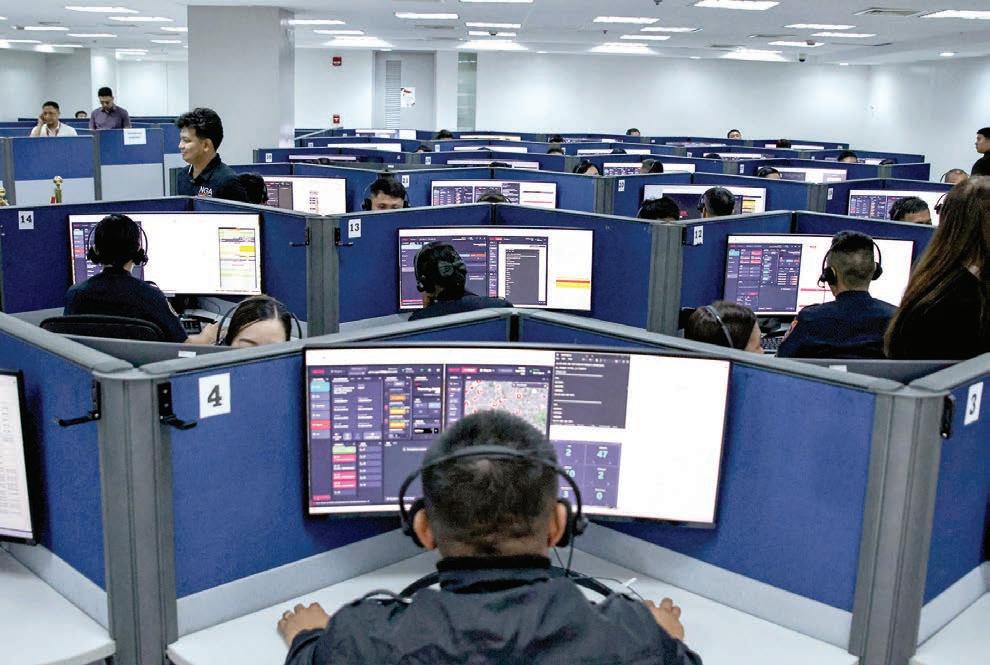
‘Probe possible oil firms’ collusion’
By Jovee Marie N. Dela Cruz @joveemarie
THE chairman of the House Committee on Ways and Means has urged regulators to investigate possible collusion among major oil companies, warning that the current fuel pricing system may be encouraging cartel-like behavior.
House Ways and Means Committee Chairman Miro Quimbo called on the Philippine Competition Commission (PCC) and the Energy Regulatory Commission (ERC) to step in after Department of Economy, Planning, and Development Secretary Arsenio Balisacan told lawmakers that regulators must actively ensure fair competition in the oil industry. He noted that markets dominated by only a few players are more susceptible to coordinated behavior.
“In Econ 101, Mr. Chair, when there are very few players in the markets, and you ask these players, the government may be asking them to cooperate, to coordinate; they are actually
asking a cartel,” Balisacan said.
With this, Quimbo stressed that stronger enforcement from the PCC and ERC is crucial, especially as global oil prices continue to rise due to tensions in the Middle East. He emphasized that despite the deregulated nature of the oil industry, the government retains sufficient authority to curb anti-competitive practices.
“In reality, [government] has sufficient powers in so far as the ERC is concerned and in so far as the PCC is concerned to be able to prevent, determine, investigate, and penalize individuals who are excessively profiteering or dominating their position,” Quimbo said.
He added that while such issues may not always be visible to the public, addressing them could significantly help bring down fuel prices.
“The intention is good on the part of the Department of Energy to prevent volatility in the market. But the purpose is good, but I think the effect is we are, in effect, promoting a cartelization, and it is the government itself,” he said.
Balisacan clarified that he was not concluding that a cartel exists but underscored the need for closer scrutiny.
The issue was tackled during the first hearing of the House’s LEAD Council, convened under the leadership of Speaker Faustino Dy III and Majority Leader Sandro Marcos. The council brings together 13 committees tasked with crafting both immediate relief measures and long-term reforms to address the impact of rising global oil prices on Filipino consumers.
Also, Quimbo raised concerns over the Department of Energy’s policy of synchronized weekly fuel price adjustments, implemented every Tuesday. Under this system, oil firms base their prices on global market movements and typically announce adjustments in advance, allowing competitors to match each other’s pricing. Quimbo warned that this setup may be weakening competition rather than promoting it, as companies tend to move in unison instead of independently setting prices.
Editor: Jennifer A. Ng
ERC clarifies orders on bid of SMC units to recover cost

By Lenie Lectura @llectura
THE Energy Regulatory Commission (ERC) on Thursday clarified earlier rulings on how the units of San Miguel Global Power Holdings Corp. can recover approximately P29.21 billion in fuel costs and losses they incurred from 2022 to 2023 from the Manila Electric Co. (Meralco).
In two separate orders, the commission told Meralco that San Miguel Energy Corp. (SMEC) and South Premiere Power Corp. (SPPC) are allowed to recover the amount from its customers and that the recovery period should be within 36 months. San Miguel Global Power is the power of conglomerate San Miguel Corp.
“It behooves the Commission to issue this clarificatory order to remove the ambiguity and grant the relief sought in Meralco’s motion for
clarification,” the ERC orders stated.
Sought for comment, ERC Chairperson Francis Saturnino Juan said SPPC, SMEC and Meralco have different interpretations of the commission’s January 2026 orders.
“Meralco asked for clarification and we just confirmed that the recovery of full amount is to be completed in 36 months,” he said.
Meralco said it received letters from SPPC and SMEC seeking payment of the total recoverable
amount divided over 36 months beginning February 2026 until January 2029. After which, Meralco asked ERC to clarify if the total amount will be remitted to SPPC and SMEC via its collection from its customers at a certain rate per kilowatt hour (kWh) starting March 2026 until the total recoverable amount is billed to customers and paid to SPPC and SMEC or if it will be directly collected from customers and remitted to SPPC and SMEC in equal amount over a period of 36 months.
It can be recalled that the ERC ruled last January that SPPC is allowed to recover from Meralco P15,850,120,000 and implement the adjustments by charging Meralco customers P0.1246 per kWh from March 2026 until the full payment of SPPC’s total recoverable amount.
Also, SMEC was allowed to recover from Meralco P13,362,490,000 by allowing Meralco to charge and collect from its customers P0.1051 per kWh starting March 2026 until the full amount is recovered.
These losses stemmed from
soaring fuel prices which SPPC and SMEC claimed made their 2019 power supply agreements (PSAs) with Meralco unsustainable, citing change in circumstances (CIC). The CIC was due to unprecedented spikes in global fuel prices, particularly with coal breaching $400 per metric ton (MT), far exceeding the $60/MT range when the PSAs were signed.
The ERC released two orders clarifying how SPPC and SMEC will be compensated. “Meralco is authorized to implement the adjustments…is allowed to charge and collect from its customers …commencing from March 2026 customer billing period and until full payment of total recoverable amount over a period of 36 months.
Meralco is authorized to adjust the collection, either upward or downward, during the last six months of the 36-month recovery period, to ensure full recovery of the total price adjustment over the 36-month recovery period,” stated the ERC orders promulgated last April 8.
SEC pushes umbrella mutual fund
By VG Cabuag @villygc

THE Securities and Exchange Commission (SEC) is calling for the establishment of an umbrella mutual fund to make it “easy” for investors to go in and out of the capital markets.
“The mutual fund industry is a key stakeholder in our capital markets. Because they’re the ones buying,” SEC Chairman Francis E. Lim said told reporters in an interview.
“If the institutional investors are small, if your retail is small, I think that’s the reasons why our market is small. So, one way to step up is to have rules that are liberalized so it’s easy to get in.”
At the moment, Lim said the practice is to have one mutual fund for one company.
With an umbrella fund, he said there will only be one entity and that there will be sub-funds for other types of investment.
Lim also said the commission is
mulling over the increase in the capital requirement for online lenders, instead of banning them outright.
The said rule could weed out the smaller players, assuming that the scrupulous players—or those who use any means to get back at defaulting borrowers—were the small ones.
“I think generally they’re in favor of higher capital so that only the good ones will remain. Because our experience is, presently capital requirement is only P1 million. And our experience is because the capital requirement is small, they’re so aggressive in lending.”
Lim said the SEC has received complaints that the smaller lending firms just scour websites for potential borrowers.
“The next thing you know, these borrowers already have a loan approval (even when) they’re just looking. That shows how aggressive these small lenders are. They’re not doing due diligence. If they (borrowers) default on even one thing, the lenders will shame them,” Lim said.
“To the extent possible we want to raise the capital requirement, so the lenders will be filtered.”
According to the draft rule, financing companies that do not operate any online lending platform should maintain a minimum paid-up capital of P20 million, while lending companies will be subject to P10 million.
For financing companies with one online platform, the minimum paid-up capital will be P30 million; P60 million for two to five platforms; and P100 million for a maximum of 10 platforms.
Meanwhile, lending companies must maintain a P20-million minimum paid-up capital for one platform; P30 million for two to five platforms; and P50 million for up to 10 platforms.
The proposed rules seek to limit the number of platforms that finance and lending firms operate to not more than 10, to ensure manageable oversight and mitigate systemic risk.
Fortune Life inks MOA with Air Cavaliers Credit Cooperative


INGAPORE-BASED Levanta
SRenewables has selected China Energy Engineering Group (CEEC) as the EPC (engineering, procurement and construction) contractor for the Barotac Solar Power and Battery Energy Storage System (BESS) project in the Visayas region.
The Actis-backed Levanta Renewables announced Thursday it signed an EPC contract with CEEC for a 166-megawatt peak (MWp) solar photovoltaic (PV) facility integrated with an 80-megawatt hour (MWh) BESS.
“This award marks an important step in advancing our greenfield portfolio in the Philippines, reflecting Levanta’s end-to-end capabilities across development, financing, construction, and operations,” said Pramod Singh, CEO of Levanta Renewables. “By combining Levanta’s development expertise with CEEC’s EPC capabilities, we are well positioned to deliver the project to high standards of execution, reliability, and safety.”
The renewable energy (RE) project will support the Philippines’s target of achieving a 35 percent RE share by 2030, while contributing to the expansion of clean, reliable power capacity in the Visayas region.
Levanta Renewables, which won
a bid at the fourth round of the Green Energy Auction (GEA4), is allotting P5 billion for the construction of the project. GEA-4 offered contracts for ground-mounted, rooftop, floating, and integrated solar with energy storage systems, as well as onshore wind technologies.
“We are honored to partner with Levanta Renewables on this important project. Leveraging our global EPC experience and commitment to quality and safety, we will ensure the successful delivery of this project to the highest standards,” said Guo Jizhong, chairman of CEEC Anhui Electric Power Design Institute Co., Ltd. Kou Bin, general manager of CEEC Northeast No. 2 Electric Power Construction Co., Ltd., added that the company will work closely with all partners to ensure the project is delivered to the highest level of excellence.
Levanta is executing a gigawattscale portfolio across key regional markets, including Thailand, the Philippines, Vietnam and Malaysia. Levanta Renewables is wholly owned by Actis, a leading global sustainable infrastructure investor and part of General Atlantic’s global investment platform, with approximately $108 billion in combined assets under management. Lenie Lectura

Banking&Finance
Rules on salary-based loans to be liberalized
HE Bangko Sentral ng Pilipi
Tnas (BSP) expects its amend ments to regulations govern ing salary‑based general‑purpose consumption loans would provide “greater repayment flexibility” to and help ease debt‑servicing burden of borrowers and salaried employees.
A draft circular by the central bank said the revised regulation would move away from a “prescrip tive prudential limit”—a rigid, rules based regulatory constraint—on loan tenor toward a “principles based approach.” Under this framework, BSP s upervised financial institutions (BSFIs) are expected to determine the appropriate loan tenor and other loan terms based on a “thorough” assessment of the borrower’s cred itworthiness.
“This assessment takes into ac count relevant factors such as the borrower’s ability to pay, sources of repayment, and repayment history, nature and purpose of the loan, consistent with sound credit risk management practices,” the BSP circular read.
According to the central bank, the repayment period may, like wise, be set through mutual agree ment between the lender and the
borrower, subject to prudent credit risk controls.
“The amendments also clarify the scope of salary based general pur pose consumption loans by distin guishing them from other personal loan products, even where repayment is facilitated through salary deduc tion or similar arrangements.”
The revised regulation would add into these loans those for education, hospitalization, emergency, travel, household, and other personal con sumption needs.
Salary b ased general p urpose consumption loans refer to the am ortized cost of unsecured loans for a broad range of consumption pur poses, granted to individuals mainly on the basis of regular salary, pension or other fixed compensation, where repayment would come from such future cash flows, the BSP noted. The latter could either be through salary deductions, debits from the borrower’s deposit account, mobile payments, pay t hrough collections, over t he counter payments or other type of payment arrangement agreed upon by the borrower and lender.
As of end December 2025, about 14.60 percent of total consumer loans are categorized as salary based general purpose. Andrea Louise San Juan
Sustainability to Biz Value: What Associations Can Do
IRECENTLY had the opportu nity to sit down with Gabriel Tan, founder and CEO of Guava International, a Singapore based global sustainability and wellness platform, for the “PCAAE Associa tion Matters” podcast.
The episode, “Scaling Sustainable Impact: A Business Case for Associa tions,” explored an increasingly ur gent question for association leaders: How can sustainability move beyond rhetoric and become a genuine driver of business value?
While our conversation produced several insights, one central idea stood out clearly: associations are uniquely positioned to transform sustainability from an abstract con cept into a practical growth strategy for entire industries. Gabriel believes associations are in a “very sweet spot.” Unlike indi vidual companies, associations bring together organizations of various sizes, capabilities, and market po sitions. This diversity gives them a powerful opportunity to curate solu tions and demonstrate what works.
Instead of simply encouraging members to adopt sustainabil ity practices, associations can show concrete examples of how sustain ability creates value. That value can take several forms: higher revenue, stronger differentiation in the mar ketplace, improved operational effi ciency, or recognition for leadership in responsible practices.
The key, Gabriel emphasizes, is demonstration.
Members often hear about sus tainability but struggle to see how it applies to their business realities. Associations can bridge this gap by identifying practical solutions and showcasing real cases where sustainability initiatives have pro duced measurable results. When members see proof that something works, adoption becomes far more likely.
Another reason associations play a critical role is their convening pow er. Sustainability rarely succeeds in isolation. Businesses often need to collaborate with governments, com munities, and solution providers. Yet effective partnerships are not easy to build. As Gabriel notes, partnering is very different from purchasing a product or service. Partnerships require understanding the motiva tions of various stakeholders and ensuring each participant benefits.
Associations, as neutral conveners, are ideally placed to facilitate this
War’s impact on borrowers’ capacity to pay loans flagged
By Andrea Louise San Juan
THE Philippine banking system could see a higher proportion of bad loans to the total loan books as the Middle East conflict saps the purchasing power and capacity to pay of Filipino borrowers especially in fuel and cost-sensitive sectors.
This was what analysts forwarded after latest data from the Bangko Sentral ng Pilipinas (BSP) showed that the gross non p erforming loans (NPLs) ratio climbed to 3.33 percent in February—the highest in six months.
NPLs, also known as “bad” or “soured” loans, are credit accommo dations that have not been paid for 90 days or more after the due date. The NPL ratio is the proportion of bad loans to total loans.
BSP data showed that bad loans of the Philippine banking system climbed to P553.677 billion in Febru ary 2026, up 7.86 percent compared to the P513.348 billion in the same month a year ago.


process. “They can help enlarge the pie,” Gabriel explains, by bringing stakeholders together in ways that allow everyone to win.
In the hospitality and MICE sec tors, this collaborative approach be comes particularly powerful. Gabriel shared examples of partnerships with various industry associations, from hotel owners and general man agers to housekeeping and concierge professionals. Each partnership ad dresses a different dimension of the ecosystem.
This ecosystem perspective high lights an important lesson: sus tainable transformation requires engaging every stakeholder in the value chain.
For association leaders wondering where to begin, Gabriel offered three practical steps. First, start with what matters most to members, not sus tainability itself, but the outcomes they seek, such as increased revenue or professional development.
Second, identify the “low hanging fruit.” Launch small experiments or pilot initiatives that are easy to implement and low r isk.
Third, work with a few commit ted members first. Pilot programs involving three or four early adopters can generate insights and real world results that encourage broader par ticipation.
Once the proof is visible, scaling becomes far easier.
Perhaps the most powerful take away from the conversation is this: associations do not need to wait for perfect strategies or large scale pro grams. By starting small, demon strating value, and leveraging their convening power, they can catalyze industry w ide change.
For association leaders, the mes sage is clear: sustainability is no longer just about responsibility. It is about competitiveness, innovation, and long term value creation. And associations may well be the institu tions best positioned to lead the way.
Octavio Peralta is founder and volunteer CEO of the Philippine Council of Associations and Association Executives, the “association of associations.” The views he expressed herein do not necessarily reflect those of the BusinessMirror . E-mail: bobby@ pcaae.org.
Total loan portfolio amounted to P16.603 trillion as of end February 2026.
Michael L. Ricafort, chief econo mist at Rizal Commercial Banking
Corp. (RCBC), pointed out that the latest NPL data has yet to fully re flect the effects of the US Israel war on Iran.
According to Ricafort, the conflict that led to sharply higher prices of crude oil and started feeding into the prices of commodities, could reduce the disposable incomes and/ or purchasing power of consumers, businesses and other institutions.”
Thereby, these factors “could also reduce sales, earnings, cost cutting measures, even some employment losses,” he added.
In effect, these economic reper cussions could reduce the ability to pay by some borrowers and debtors, which could lead to higher bad loans going forward, Ricafort said.
Philippine Institute for Develop ment Studies (PIDS) Senior Research Fellow John Paolo R. Rivera said that NPL ratio risks are “tilted to the up
side” amid the Middle East conflict. That war “can raise inflation and borrowing costs through higher oil prices, which may further squeeze repayment capacity,” Rivera said. He added that such condition could lead to a “gradual uptick” in bad loans, especially in sectors that are fuel and cost sensitive.
“Market uncertainty tends to weaken business sentiment and household confidence, which can slow income growth and increase the likelihood of missed payments,” added Rivera.
‘Normalization story’
RIVERA sees the bad loans data in February likely reflects “lagged ef fects” of higher interest rates and tighter financial conditions.
The latter, he said, “are beginning to strain some borrowers, particu larly MSMEs and households with thinner margins.”
However, Jonathan L. Ravelas, senior adviser at Reyes Tacandong & Co., considers the February bad loans ratio as “less a credit problem and more a normalization story.”
Ravelas expressed confidence that local banks can weather the risks. “At around 3.3 percent, NPLs remain very manageable and well below stress levels, with banks still well‑capitalized and properly provi sioned,” he said. Ravelas also noted the ratio is merely a “mild bump, not a red flag.”
Nonetheless, he said the ratio
reinforces the need for closer credit monitoring if rates stay high longer.
Broken down
THE NPL ratio of universal and com mercial banks settled at 3.05 percent amounting to P465.827 billion, as of end February 2026. This was lower than the 3.04 percent recorded at January 2026 and down from 3.11 percent in February 2025. For thrift or savings banks, the NPL ratio jumped to 6.43 percent, or P66.057 billion, as of end February 2026 from 6.16 percent at end Jan uary 2026, and remained below the 6.61 percent level in February 2025. Digital banks, meanwhile, posted an improvement in asset quality, with their NPL ratio easing to 5.88 percent, or P3.98 billion, as of end February 2026 from 6.16 percent at end January 2026 and 7.82 percent at end February 2025. The latest available data for rural and cooperative banks were for De cember 2025, when their NPL ratio stood at 8.05 percent, equivalent to P17.81 billion. Meanwhile, past due loans reached P715.658 billion as of end Febru ary 2026, up by 0.57 percent from P711.58 billion a month ago and higher by 12.21 percent from P637.81 billion at end February 2025. The past due loans ratio settled at 4.31 percent of banks’ total loan portfolio, higher than the 4.28 per cent as of end January 2026 and the 4.20 percent at end February 2025.
World Bank: Rising costs to swell ranks of poor Pinoys
By Justine Xyrah Garcia
THE rising costs of basic goods and commodities driven by the prolonged Middle East conflict could stall gains in poverty reduction and swell the ranks of vulnerable households in the Philip pines, according to the World Bank.
This comes as the country has been making steady progress in re ducing poverty. Data from the Phil ippine Statistics Authority (PSA) showed poverty incidence fell to 15.5 percent in 2023 from 18.1 percent in 2021, translating to 17.54 million poor Filipinos from 19.99 million.
The government aims to further reduce this to between 10 percent and 11 percent by 2027 and to between 8 percent and 9 percent by 2028.
However, the multilateral lender estimates that an increase in crude oil prices by $20 could push Philippine inflation up by as much as 0.62 per
By Samuel P. Medenilla @sam_medenilla

RESIDENT Ferdinand
PR. Marcos Jr. is now studying the proposals of advisers on how to boost employment generation, which includes releasing targeted subsidies and extension of tax incentives to some firms, amid the growing economic impact of the Middle East conflict.
The chief executive met with members of the Education and Jobs Sector Group of the Private Sector Advisory Council (PSAC) last Wednesday to discuss how to address labor displacements caused by the war in the Middle East.
“Because of the events in the Middle East, there are many more suggestions that came from the private sector side. We’ll take a look at the said sug gestions,” Marcos said in Fili pino in a video interview after the meeting.
After United States and Israel
centage point within six months— one of the highest in East Asia and the Pacific. The forecast is based on the country’s heavy reliance on im ported fuel.
This impact, the World Bank said, will be felt most acutely by poorer households, as rising fuel costs quick ly translate into higher transport fares and more expensive basic goods.
“Household expenditure data from the Philippines demonstrate that lower income quintiles allocate a disproportionately larger share of their total consumption to fuel and related transport costs, rendering them highly vulnerable to energy price shocks,” the bank said in a new report.
Based on latest inflation data from the PSA, inflation for the bot tom 30 percent income households stood at 4.2 percent, slightly higher than the national headline rate of 4.1 percent.
forces attacked Iran on Febru ary 28, about 4,611 overseas Filipino workers (OFW) fled the region and returned home.
Economists have warned the crisis may dampen the lo cal employment figures since it resulted in a rise in the price of oil and other basic goods and services.
To sustain the growth of the employment market during the Middle East crisis, the PSAC rec ommended expanding nation wide job fairs and fast tracking hiring across both government and private sectors, alongside the immediate restart of infra structure and school construc tion projects.
For OFWs, PSAC said the government should streamline redeployment processes, and implement micro c redential training across key industries, and expand support for entre preneurship and micro small and medium enterprises.
The council also recom mended providing subsidies or
Food and non a lcoholic beverages emerged as the main driver of infla tion for this group, accounting for 56.2 percent of the total, with price growth at 3.9 percent.
Transport followed, posting a 7.2 percent inflation rate, while housing, water, electricity, gas, and other fuels rose by 4.6 percent.
The World Bank said that across the region, a sustained 50 percent increase in fuel prices could erode household incomes by around 3 to 4 percent, as higher energy costs feed both directly into spending and indi rectly through rising prices of goods and services.
“In addition, an escalation of the conflict is likely to increase food in security,” it added.
Beyond inflation, the bank also noted that the country’s industrial production—which includes output from manufacturing, mining, and utilities—is expected to decline by
about 0.19 percentage point due to higher global oil prices.
“All five [East and Asia Pacific] economies experience output losses, with Thailand and the Philippines again most affected at about −0.19 percentage points,” the lender said. The bank also noted a “severe surge” in economic anxiety in several countries, including the Philippines, as the Middle East conflict drags on.
“Media analysis reveals that un certainty surrounding fuel prices and broader inflation has recently spiked to post COVID or multiyear highs across major EAP economies, including China, Indonesia, Japan, and the Philippines,” it said.
The World Bank said that while governments may turn to subsidies or price controls to cushion consum ers from rising prices, these mea sures could strain public finances and limit the policy space needed to sus tain support for vulnerable groups.
financial assistance for public utility vehicle operators to keep jeepneys and buses running.
PSAC said the government can also look into possible ex tension of tax incentives for export oriented firms to reduce the operating cost of the private sector amid rising fuel prices.
It said the government should also accelerate the roll out of digital infrastructures to enable remote work and roll out its proposed Artificial Intel ligence Upskilling para sa Digi tal Asenso (AIUDA) program a rapid re skilling initiative designed to transition workers into digital and remote roles within weeks.
Marcos said he was open to the suggestions of PSAC for em ployment generation during the Middle East crisis.
“We are very much in agree ment with the private sector ad visors on what should be done to mitigate the effects of what is happening in the Middle East,” he said.
TA
HE Government Service Insurance System (GSIS) announced last Thursday it has released P6.2
Refunds
Octavio Peralta
A ssociation World

The luxe life at Nustar Cebu

THE first time I was invited to stay at Nustar Resort & Casino was back in September 2022, and it had just opened Fili Hotel, operated by Robinsons Hotel and Resorts, while the opened half of the gaming area was already attracting a noticeably young crowd of eager players.
Covering the Asean Tourism Forum in January allowed me to stay at the integrated resort’s own ultra-luxury Nustar Hotel, a welcome upgrade from its super busy general manager Roel Constantino. Check-in was hassle-free with warm smiles from the reception staff Owen and Tina, and thereafter I was accompanied to my room by a butler, a dedicated service assured for each guest.
(I love those butlers and the concierge staff! They were always ever-so-helpful, going out their way to get me things I needed, like ordering my favorite chicken skin chicharon, or selecting a reliable, costefficient delivery service so I could send a gift to a friend staying in Mactan. So, thank you, Rhoel, Nicky, Michael, Cielto and Mitchell.)
My room, generous in size, was swathed overall in honey-toned wood set against accents of tropical colors, with floor-to-ceiling windows that allowed a sweeping view of the sea.
While one could argue that the best part of the room was the firm but relaxing Alaskan king-sized bed, my favorite actually was the massive marble bathroom with a deep-soaking tub and Guerlain toiletries, and the Japanese toilet. I have always been obsessed with Japanese toilets—they welcome users with a warm seat and adjusts to any water temperature, pressure and spout direction needed. So, amen. I received access to the exclusive Executive Club Lounge at Fili’s 23rd floor, where I had breakfast
for two days. As with most business lounges, the prepared food is limited compared to the spread at a hotel’s regular breakfast outlet. And because Asean officials and delegates were staying at both Nustar and Fili hotels, the breakfast buffet consisted of mostly Southeast Asian dishes.
As I was hankering for more Cebuano fare, lounge manager Leah was able to get me crispy dried danggit which I drowned in vinegar with crushed garlic! Lami! There was also a magtataho, who went around serving every Pinoy’s favorite healthy soya-based morning treat.
While I wasn’t able to dine on Mott 32’s sumptuous Chinese fare (boo-hoo! no apple wood-roasted Peking duck for me this time!), I had an engaging lunch at Il Primo Italian Steakhouse hosted by Nustar vice president for business development Katrina Mae “Kamae” de Jesus. (Thanks to media colleague Philip Cu-unjieng for tagging hungry me along. That tortellini and pizza were perfect at every bite.)
After covering the ATF events, each night I would do my steps at the Nustar Mall with its posh foreign fashion brands which I gaped at, mouth wide open (or maybe I was just trying to catch my breath because of the exercise). Another floor houses other dining options like a branch of Cebu’s homegrown Cafe Laguna.
Later, Kamae shared how the integrated resort, owned and developed by Universal Hotels and Resorts Inc., was close to completion. UHRI is a privately held company of the Gokongwei family, although many of its facilities, like the hotels, are run by RHR, a unit of the Gokongwei-led listed firm Robinsons Land Corp. (RLC).
After opening the Nustar Skydeck this year, Grand Summit Hotel will follow and partially open “by the end of the year, then next year (2027) we’ll open the Performing Arts Theater, the first in Cebu,” she said.
The theater, developed in partnership with RLC, will have a 1,700-seating capacity.
“They brought in (theater actor) Audie Gemora to consult on its construction and setup, and, hopefully, its operations, because it will be operated by RLC,” she added.
By 2027, the five-star integrated resort will have over 1,000 rooms, with three separate hotels—Fili (360 keys), Nustar (280) and Grand Summit (366)— catering to different visitor market segments.


The hotel and casino resort sits on a nine-hectare property in Kawit Point, South Road Properties in Cebu City. As a project, the entire integrated resort costs “P30 billion,” according to Kamae.
Like I said, Mott 32 is also located at Nustar, “which is not closing,” Kamae stressed, contrary to rumors.
A branch of the award-winning Chinese restaurant in Hong Kong, Mott 32 “has a consistent market. The weekend lunches, for one, are a hit. The Philippines is family-oriented and big Cebuano families come here. Many have realized that it’s worth the drive when they are celebrating special moments with their loved ones. On weekdays, we have the corporate market, companies who host guests.”
Kamae admitted that there have been challenges in reaching the resort’s initial target market, what with the continuing sluggish arrivals from abroad. Data from the Department of Tourism showed foreign tourists in Cebu City alone slipping to 524,514 in 2024 from 1.06 million in 2019. As such, the domestic market—visitors from Visayas and Mindanao— accounts for the majority of its guests.
But she said Nustar has been able to “pivot” its marketing strategy “and focus more on how to create and reach the market we want to reach.” For instance, Nustar has been partnering with the Mactan-Cebu International Airport management, travel and tourism companies, as well as other hospitality firms to hold projects together. This has allowed Nustar to tap travelers arriving from Australia, Macau, Japan, Korea, Vietnam, and Guam, aboard direct flights to Cebu.
“We are so happy how the Cebu community is so willing to work closely together. The level of cooperation and participation of the private sector here, and the openness to work with other entities from the private sector is so strong. So we pool our resources,” for major events like hosting events for inaugural flights, for example.
Kamae said that moving forward, “we are extremely positive because of the things we can control. We know we’re going to put out a fantastic product. It’s beautiful, it’s a meta development, and the goal is not just to make us proud, but to really put Cebu on the map.”
With its beautiful hotels, incredible dining options, and friendly accommodating staff, Nustar Cebu certainly has captured my attention.
perception of how you want your life to unfold will change your course. Don’t share too much personal information; listen, absorb and determine what and who are in sync with you, your beliefs and your values. Equality is essential. ★★★
VIRGO (Aug. 23-Sept. 22):
cause will make a difference. ★★★★★
LIBRA (Sept. 23-Oct. 22): Slow down, and think before you spend. Only offer what’s feasible and make promises you can fulfill. Discipline and ingenuity, along with completion, will lead to victory. Refuse to let laziness play a role in the outcome of a relationship. Surround yourself with those who share your expectations, and avoid a negative outcome. ★★
SCORPIO (Oct. 23-Nov. 21): Put on your thinking cap, and you’ll come up with an idea that will encourage a new adventure. A personal or professional partnership opportunity looks promising, and taking steps to ensure it unfolds in a timely fashion is in your best interest. Social events and sensitive topics of conversation will require finesse and delicate monitoring. 3 stars
SAGITTARIUS (Nov. 22-Dec. 21): Put some time, money and thought into your living arrangements. It’s time to upgrade your surroundings to suit your needs. Do as much of the work yourself as you can, and enjoy the outcome. A proper workspace will help you be more productive. A change to how you earn your living will encourage higher income or


RUINED HOUSE
SO at the height of POGO’s presence in the Philippines, the CEO rented out his house in a posh village to a Philippine Offshore Gaming Operator. The rent was tempting and paid in advance too. When these POGOs were forced to leave the country, the renter was one of those who fled. When the CEO looked at his home, it was a wreck. Worse, it was very dirty. The renter left the house in shambles and according to the neighbors, people would come and go during the renters’ occupancy and a lot of illegal activities took place. There were even talks of human trafficking. The CEO has yet to have the house cleaned and repaired because, said insiders, he is afraid of bad juju. He can’t see himself living in that house again but wants to recoup the money he spent in building it. Right now, he is staying in another house, pondering his next move.
THE RETURN
THE actor and the actress used to be one of the most popular loveteams but due to certain situations, they broke up both on- and off-screen. Now that they’re older and more mature emotionally, there are plans to bring back the loveteam. There is no issue with both stars. They both have significant others outside showbiz. The guy and his girlfriend have been together for a few years and she is very secure in the relationship. The actress was in a long-term relationship and now she is dating a man from a rich and well-known family. The actor and the actress are talented so it’s exciting to see what projects they’ll have in the near future.
PRIVATE
THE A-list actor has long been rumored to be gay but he has never confirmed nor denied this. He just lives his life and guards his private life fiercely. You’d never get information from people close to him about his comings and goings. At the height of his popularity, he was in two relationships with women (not at the same time) and very few people knew about it. So there is a new rumor that has surfaced about his (male) handler being fired because they are in a relationship so now, so said handler is under his employ. The truth, according to people associated with the actor, is that the handler resigned. He was not fired and he and the actor only have a working relationship. As far as people know, they are both straight. They have not indicated otherwise. Sometimes, it’s so easy for people to make assumptions about the gender identity of others and this is certainly true in this case.
X-DEALS AND OTHER SHENANIGANS
WHILE there are photos contradicting the rumors that their marriage has ended, the celebrity and her politician husband have reportedly been leading separate lives since last year. The politician’s family members and his closest friends all say he has never been money-hungry but when he met the celebrity, he changed. She, they say, is the one who likes social-climbing. One of the politician’s relatives talked about a party at their home a couple of years ago. The family is very low key when it comes to parties. They hire a photographer but the photos taken are never published in newspapers and magazines nor shared on social media. What the celebrity did was to hire a couple of suppliers on an exchange deal basis, meaning they were not going to be paid in cash but via social media mentions. The politician’s family was horrified because they wanted privacy so they just paid off the suppliers.
GMA RADIO STATIONS REINFORCE DOMINANCE OF MEGA MANILA AIRWAVES FOR MARCH 2026
GMA Network’s flagship radio stations, Super Radyo DZBB 594 kHz and Barangay LS 97.1 Forever!, further strengthened their leadership of Mega Manila airwaves in March 2026, according to data from Nielsen Radio Audience Measurement (RAM). Super Radyo DZBB 594 kHz, the network’s AM radio station, recorded an audience share of 56.3 percent. DZBB’s strong performance further cemented its lead against its closest competitors, DZMM Radyo Patrol 630 and DZRH 666, with 16.7 percent and 11.1 percent audience shares, respectively. Meanwhile, GMA’s FM radio station Barangay LS 97.1 Forever! also had an impressive performance. According to the same Nielsen RAM data, it recorded a 54.9 percent audience share, way ahead of its closest competitors, 90.7 Love Radio and 101.1 Yes! FM, which tallied audience shares of 15.4 percent and 6.8 percent, respectively. Listeners can tune in to Super Radyo DZBB 594 kHz and Barangay LS. 97.1 Forever from Monday to Sunday. DZBB and Barangay LS programs also can be heard on Super Radyo and Barangay LS stations nationwide. For the latest breaking news and critical and insightful commentaries, netizens can tune in to Super Radyo DZBB programs on YouTube and Facebook Live. Select programs also air on GTV from 5:30 am to 9 am from Monday to Saturday on Dobol B TV. Its podcast “Sumasapuso” is also available on Spotify through DZBB SUMASAPUSO. Super Radyo DZBB’s official social media accounts are also available on YouTube (@dzbb594), Facebook (Super Radyo DZBB 594khz or @dzbb594), X (@dzbb), and TikTok (@dzbb). Barangay LS 97.1, on the other hand, gives fans fresh episodes on its official YouTube account (@BarangayLS971), and engaging content on its awardwinning “Barangay Love Stories” and “Liham ng Gabi” on Spotify.
Show BusinessMirror
The sound of AI

THE road to AI in music proved to be fun, propitious, and circuitous at best. My journey began with the rumor that this song
“Hawak Ko ang Beat” was composed by a foreigner based in the Philippines. There is actually a name behind the beat—a French guy named Sylvain Hernandez. The cause for his uber popularity is multiple: consider the song with an infectious rhythm that would sound familiar to those already active and dancing in the 1970s. Remember the nonstop Eurodisco hits, which spawned the glorious years of the 1970s and part of the 1990s? This was the era of digital recording techniques and synthesizers, giving rise to glam metal and synth-pop, new wave, etc. We are not diminishing this anthem of TikTokers and the rest of the social media denizens. The beat, the music is all over the internet cybergeography. Athletes dance to its, well, beat; young men display their bodies to the choreography seemingly universalized by the music. Even babies so long as you have the app, you can make them hold to the beat.

But what is a celebrity without controversy? The first news that filtered out of the household of the French national was that the music was composed with a substantial use of AI tools. Experts and sound designers point to the repetition of melody, the warbling or gurgling tones that color what seems like a human voice.
The fact also that Hernandez keeps the identity of his singer a secret teases more those who ask not to despise but really to admire and honor this certified nationwide hit. And as the composer persists in his denial, claiming only the use of software that is common among composers, people are talking.
As for me, there is a huge wonderment out there—an expanding, limitless universe of smart men and women, many young and not tethered to organizations, knowledgeable enough to apply artificial intelligence to any kind of music
Fortunately and strangely enough, for a week now I am like a rowdy little brat let loose in a playground— in reverse. I am an old man or, rather, a citizen of generations gone by, coming upon a dustbin of songs hiding gilded lyrics and tunes, now burnished to rock, jazz and soul perfection. Many surprise me in their musical morphing; some are irreverently changed (but if you approach music as sacred and inviolable, then this is not your territory). Because standards in music are relative, some of the reincarnations can be ignored.
My online journey was initiated through the so-called jukebox hits of the 1970s and 1980 and the kings, queens, et al who dominated the air. Their names are florid and haunting: they remain extant and celebrated on videoke. Welcome and bow before them—Eddie Peregrina, Imelda Papin, Eva Eugenio, Imelda Papin, Victor Wood, Willy Garte, and
many other singers this generation may not clearly remember. I approach the shrine of these vocalists with a faith that is scented with humor; I come out not only a convert but a disciple ready to proselytize on the endowment of AI. Here’s a tool that could transpose a form to another form, remold a type and make it into a template of new desires and tastes.
Taking the prominent spot is Peregrina’s remake of an older love song “Bakas ng Lumipas” (Traces of Yesterday). It has never left Facebook or YouTube. It provides the theme song to endless raw videos about one’s hometown or first heartbreak. It is the de-facto soundtrack to despair, depression, and even to resolutions that are ultimately happy. For the uninitiated , these recordings or reimagining of “old” songs are announced by illustrations characterized by hyper-saturated tones and hyper-real figures. In this case, there’s an overall sepia and dark brown color illuminated by a soft spot trained upon a man, 40ish, holding a microphone noted for its chrome finish and birdcage design. The note says it’s a “soulful jazzy cover” and “R&B fused.” A sax solo enters and a voice cooly intones “Kapag ikaw ayaw umibig...” The voice goes up and develops a scratch, a by-product of whisky and world-weariness. The dulcet tone of Peregrina is but a dim memory as this present voice pushes deep its pains. Then the shock comes when the singer hits the line “Mga bakas ng lumipas sinta ay lagi kong alaala,” with the last word stretched for several measures, the notes rising to breaking point, as it tests the edges of sorrow and tears.
Then you ask the question: Has the voice been tampered? The voice would soar further with “sana’y magbalik ka hirang,” with “hirang” introduced in a deadly falsetto only to proceed to several trills and slurs, all traits of an accomplished vocalist. Is this a kind of transposition? What has just happened? Are we still dealing with human vocal chords?
In this AI-mediated music, one song could have
several versions, with a different interpretation bannered by a cover. A softer version of “Bakas ng Lumipas” is thus available. A fan, perhaps, comments how “guapo” (handsome) Eddie Peregrina (he looked like your regular guy, which could have contributed to his singular fame) was. A young man in red and white varsity jacket smiles from the cover, preparing us for a “chill” singing that is nevertheless still full of pathos. Fortunately, there are AI versions, which correct the accent of words and this version is one of them.
The song collection of Eva Eugenio is waving at me for a return to a gaudy and giddy musical past. If this were a record (LP), the cover has a young man with macho written all over his person. The thick silver cross and chain are warnings and markings. And yet he sings of ditties heavily identified with the great seducer Eva Eugenio. In this young man’s R&B proposal, his lamentation about “o tukso, layuan mo ako” (oh, seducer, away from me) sounds more of a tease and temptation. The sax changes the heartscape of this song, which now appeals to the valued nonchalance of today’s generation. Even love depends upon time and space.
But the young man’s contribution to the AI revolution in music interpretation is how he deconstructs the nearly funereal and dolorous “Gulong ng Palad” to a song that gradually grows into a triumphant hymn of hope and salvation. Growling with a voice above the brass, the singer screams: “Ang Maykapal ay marunong tumingin sa taong naghihirap...” (The Almighty knows who are those suffering). By the time he reaches “bawat isang gabi ay mayroong isang umaga” (for each night, there is a coming dawn), we all know his rage is now our prayer. And the song has moved far from the original Part II follows next week with what AI has done to our folk songs and regional tunes. The column will also attempt to make sense of copyrights and other related issues.
KATE JACKSON, JACLYN SMITH AND CHERYL LADD REUNITE FOR ‘CHARLIE’S ANGELS’ 50TH ANNIVERSARY
LOS ANGELES—Once upon a time there were three little girls who starred as private detectives answering to a never-seen boss in a show that turned into a pop culture phenomenon called Charlie’s Angels.
Kate Jackson, Jaclyn Smith and Cheryl Ladd reunited to mark the show’s 50th anniversary at PaleyFest LA on Monday night. They were greeted with a standing ovation and whoops and cheers from an audience at the Dolby Theatre in Hollywood.
The hour-long crime adventure series debuted on September 22, 1976, in a preinternet and streaming world when there were just three major television networks. It was a top-10 hit for ABC in its first two of five seasons, ending in 1981.
“I knew the show was different, special and unique,” Smith told the audience. “Three women chasing danger instead of getting rescued.” Jackson added, “We made an impact, I think.”
Farrah Fawcett-Majors became a 1970s icon with her feathered hair and sexy swimsuit poster. She left after the first season to pursue a film career. She died in 2009. She was replaced by Ladd, who showed up on her first day wearing a Farrah Fawcett Minor T-shirt. She had turned down producer Aaron Spelling three times, knowing how beloved Fawcett had been.
“I knew that there was nobody that was going to replace Farrah, so I made a joke
of myself,” Ladd said on the red carpet.
“Everybody laughed. Farrah would have done something like that.”
Jackson added, “Cheryl stepped in and we didn’t miss a beat.”
Critics weren’t kind, however, calling the show “jiggle television” because the women dressed scantily to go undercover and slamming it for vapid acting.
“It didn’t bother me,” Jackson said on the red carpet. “I knew what we were doing and Gloria Steinem knew what we were doing, and some other very impressive people knew what we were doing. We were helping to punch a hole in that glass ceiling and that makes a big difference.”
Five decades later, the show remains popular in reruns and DVDs, having spawned a film series starring Drew Barrymore, Cameron Diaz and Lucy Liu.
“We were giving people an hour to sit back, put their feet up, forget everything and watch television,” Jackson said, “and then again just kind of subtly getting the message in there that women are just as capable, intelligent, can do anything that a man can do.” The mostly older audience cheered and laughed as scenes from various episodes were played. Included in the highlights were Shelley Hack, who lasted one season after replacing Jackson, and the late Tanya Roberts, who appeared in the final season. Smith and the late David Doyle, who played

Charlie’s go-between, were on the show’s entire run. Smith, who is 80, and Ladd, who is 74, went on to prolific careers in made-for-TV movies and guesting on other shows. Jackson, who quit after three seasons, later starred in the CBS hit Scarecrow and Mrs. King. Jackson left the business nearly 20 years ago to raise her son. Now 77, she said, “I’m ready to go back.”
The trio’s sisterhood includes all of them overcoming breast cancer, with Ladd revealing for the first time publicly on
Monday that she had an aggressive form of the disease. She didn’t say when it occurred. “When Cheryl called me,” Smith said, “the first thing I did was send her my wigs.” Smith was at Jackson’s bedside during her cancer battle. Each of them urged the audience to have regular health screenings. In one of many lighter moments, the women were asked to name their favorite outfits. “I wore a lot of turtlenecks,” Jackson said, drawing laughs. Smith singled out her tiny white bikini seen in the opening credits. AP
FROM left: Kate Jackson, Jaclyn Smith and Cheryl Ladd
Unity in action: ASEAN Youth Business Summit 2026 ignites regional collaboration, innovation
The ASEAN Youth Business Summit 2026 concluded successfully, bringing together young entrepreneurs, policymakers, and industry leaders from across Southeast Asia and beyond in a celebration of collaboration, innovation, and shared purpose.
Held from March 24 to 26, 2026, the three-day summit provided a dynamic platform to strengthen regional cooperation, foster cross border partnerships, and equip the next generation of leaders to navigate a complex global business landscape.
The summit welcomed distinguished leaders including Senator JV Ejercito, the Department of Trade and Industry, and Governor Sol Aragones, whose support was instrumental to the event’s success.
Hosted by Mayor Art Mercado of San Pedro City, the summit reflected the city’s commitment to youth empowerment and regional collaboration, highlighting the importance of public and private sector partnerships in driving entrepreneurship and economic growth across ASEAN.
Delegates engaged in discussions on pressing global issues such as post pandemic recovery, economic resilience, digital transformation, climate change, the ongoing US–Israel–Iran conflict, and rising oil prices. These conversations underscored that today’s challenges,

from global health crises to geopolitical tensions and economic disruptions, require collaboration, shared responsibility, and purpose driven leadership.
The summit provided a vibrant space for knowledge exchange through keynote sessions, panel discussions, and business matching activities. Participants built cross border connections and explored innovative solutions to regional challenges, reinforcing the belief that youth are not only leaders of tomorrow but active drivers of transformation today.
As part of the summit’s experiential learning, delegates toured the Laguna International Industrial Park, one of the country’s premier industrial hubs, visiting companies such as Ionics and Concepcion Industrial Corporation. They gained firsthand insights into industrial operations, manufacturing innovation, and the critical role of global supply chains in driving economic growth.
The ASEAN Youth Business Council, cofounded by Aries B. Balanay and Rommel Sim Gerodias, continues to create platforms that empower young leaders and strengthen regional collaboration across ASEAN. On the success of the summit, they shared:
“This summit proves that when young

BYD Cars Philippines successfully capped its participation in the IronMan 70.3 Davao, with both its celebrity and corporate triathlon teams delivering impressive Top 8 finishes in one of the country’s premier endurance events.
Out of over 900 participants, the BYD Celebrity Relay Triathlon team featuring Wil Dasovich (Swim), Alden Richards (Bike), and Nico Bolzico (Run), secured a Top 8 finish out of 32 teams in the Male Relay Category, showcasing endurance, teamwork, and consistency throughout the race. This performance capped off an impressive week for the team, as Wil arrived in Davao via the ‘Drive Electric. Love Pinas.’ route, a cross-country journey powered by BYD and ACMobility in partnership with the Department of Tourism to promote electrification
leaders come together with purpose, innovation follows, and borders no longer limit what we can achieve. The youth are not just the leaders of tomorrow; they are shaping a better ASEAN today.”
The summit’s success was made possible through strong collaboration across sectors. The organizers extend their appreciation to the Government of Laguna and its partner cities, including San Pedro, Biñan, Cabuyao, and Santa Rosa, as well as government owned corporations such as the Philippine Amusement and Gaming Corporation and the Philippine Charity Sweepstakes Office. Key private sector partners including Hotel Sogo, Li Auto, and Folium Multimedia Production also played an instrumental role.
Delegates leave the summit with renewed purpose: to be part of the solution, to lead with integrity, and to contribute to a more connected, innovative, and prosperous ASEAN region. The organizers extend their deepest gratitude to all partners, sponsors, speakers, and delegates who made this landmark event possible.
Looking ahead, more youth business summits are expected throughout the year, as the Philippines takes the helm as ASEAN host for 2026, providing continued opportunities for collaboration, learning, and regional innovation.
throughout the Philippines.
While the BYD Triathlon Team, composed of two-time Olympic Swimmer, Jasmine Alkhaldi, endurance athlete and the first Filipina to conquer the Worldman Championships, Jennifer Uy, and seasoned international triathlete,Jens Jacobsen, also turned in a strong performance, finishing Top 8 out of 34 teams in their division.
The partnership with IRONMAN 70.3 Davao highlights BYD’s commitment to endurance, performance, and innovation, demonstrating how sustainable mobility can meet the highest standards while supporting athletes’ journeys.
“We are extremely proud of both teams who powered through the event; their performance reflects the discipline and resilience we value at ACMobility. We chose to partner with Ironman 70.3 Davao specifically because it serves as a powerful extension of our ‘Drive Electric. Love Pinas’ initiative. By supporting an event that demands such high endurance and extensive travel, we are able to showcase how our advanced technology and growing charging ecosystem empower every Filipino’s journey –whether they are an athlete pushing their limits or a traveler exploring our country from North to South.” says Dino Obias, Chief Marketing Officer, ACMobility.
For more information on the existing vehicle lineup and electrified solutions of BYD Cars Philippines, visit bydcarsphilippines.com.
Making space for summer even on a full schedule
SUMMER doesn’t always come with time off. For many, it looks like regular workdays, back-to-back tasks, and squeezing in mini breaks where you can. But even without a getaway, there are still many other ways to feel the season. If your days are spent working through the heat, those in-between moments start to matter more: a quick pause, something cold to recharge, or a meal you don’t have to think too much about. It’s


Globe brings telecom services closer to Capas community with new on-site distribution office
GLOBE has launched a new On-Site Distribution Office (OSDO) in Brgy. Cristo Rey, Capas, Tarlac, providing residents with easier access to essential telecom and digital services within their community. By bringing services closer to where people live, the OSDO reduces the need for residents to travel to nearby towns or city centers to process transactions or seek assistance. The facility, launched in collaboration with Riese Telecommunication Inc., serves as a convenient hub where customers can apply for home broadband plans, purchase prepaid products, and settle bills in a single location.
The new service hub comes at a time when demand for reliable connectivity continues to grow across Capas, one of the largest municipalities in the province of Tarlac. Based on the 2024 Census of Population of the Philippine Statistics Authority, Capas has a population of 162,724 residents, reflecting steady growth from 156,056 recorded in 2020.
Within the municipality, Barangay Cristo Rey is the most populous village with more than 30,000 residents, accounting for a significant share of Capas’ population. This makes the community a key service area where reliable connectivity is increasingly essential for households that rely on the internet for schoolwork, remote employment,
small enterprises, and everyday communication. At the OSDO, customers may sign up for Globe home broadband offerings such as GFiber and Globe At Home postpaid plans, enabling households to secure dependable internet access for their digital needs. Subscribers may also purchase prepaid services from Globe, TM, and GOMO, while bill payments can be completed securely through ECPay. Bringing these services together in one location allows customers to manage their connectivity requirements more efficiently.
“The opening of this OSDO reflects Globe’s commitment to making digital services more accessible to Filipinos wherever they are,” said Raymond Mancilla, Globe Area Business Head. “We want communities in Capas to enjoy dependable broadband, prepaid connectivity, and convenient bill payment in one accessible location.”
The initiative also strengthens service distribution and customer engagement in the growing province. Through community-based service points such as the OSDO, Globe continues to expand access to connectivity tools that help enable learning, livelihood, and communication for families across Tarlac.
For more information about Globe, visit www.globe. com.ph.

GLOBAL AI-first cloud communications platform Infobip is set to launch its AI-native, fully managed solution AgentOS, building on the company’s recently introduced AI Agents that power autonomous customer communications. Scheduled for global release on April 1, AgentOS is designed to help businesses automate customer interactions and manage communications more efficiently as demand for real-time, personalized digital services rises in mobile-first markets such as the Philippines.
The rollout coincides with Infobip’s 20th anniversary and reflects a broader push among Southeast Asian companies to adopt AI-driven tools to improve customer experience and operational performance.
Enterprises across retail, fintech, telecommunications, healthcare, and eCommerce are increasingly seeking faster and more contextual ways to engage customers, as consumers expect immediate and personalized digital experiences across channels.
“While interest in AI adoption is rising across Southeast Asia, many enterprises struggle to move AI projects into production because of siloed systems and integration challenges. AgentOS addresses these challenges by providing a unified platform where AI agents coordinate customer communications across channels such as SMS, messaging apps, email, and voice,” said Guray Ozturk, Head of Customer
Growth at Infobip. AgentOS represents Infobip’s evolution from a communications platform to an AI-driven system that enables businesses to move beyond traditional campaigns toward automated, goal-driven customer engagement. It combines Infobip’s Conversational Customer Data Platform with real-time journey orchestration to deliver contextual, two-way engagement across all natively integrated channels, while reducing system complexity and improving execution speed, conversion, and long-term engagement.
The platform also incorporates a human-in-the-loop model, allowing AI to manage automation at scale while human specialists oversee complex interactions and continuously refine system performance to ensure reliability and compliance.
“AgentOS enables enterprises to operationalize AI across the entire customer journey. By bringing together data, channels, and automation in one environment, businesses can move from reactive workflows to intelligent and autonomous engagement,” Ozturk added. Infobip continues to expand its presence in the Philippines, supporting local enterprises in modernizing customer communications. Its clients include SM Supermalls, Cebu Pacific, Security Bank, and PLDT, which leverages Infobip’s platform to enhance customer interactions across its nationwide network.
BYD Cars Philippines powers through at IRONMAN 70.3 Davao with strong top 8 finish
A one-stop shop for connectivity: Globe’s new OSDO in Brgy. Cristo Rey brings broadband, prepaid products, and bill payment closer to the community.
The BYD Celebrity Relay Team composed of Wil Dasovich (Swim), Nico Bolzico (Run) and Alden Richards (Bike) finished strong in the Top 8 out of 23 teams.






Motoring

BY ERIC MONTELIBANO
MY first impression of the Access was that it was a scooter that was light, easy to drive, and had a comfortable ride that handled minor road bumps well. The 125cc 4-stroke, fuel-injected, air-cooled engine was quiet and perfectly matched with the CVT transmission, resulting in very smooth acceleration. Another thing I noticed was the rather large footboard and long seat, which were comfortable for both the driver and passenger. Additionally, the large under-seat storage could accommodate a helmet and other travel essentials. The digital instrumentation was clear, displaying basic information such as speedometer, odometer, trip meter, fuel gauge, and average kilometers traveled per liter. The integrated start/ stop engine switch was also very convenient.
The morning of April 2, Maundy Thursday, I was thinking of riding the Access to visit 7 churches for Visita Iglesia. As I waited for the late afternoon (so that the ride would be cooler), I did some research on the scooter. The Suzuki website mentions the Access’s focus
Lexus


on comfort, reliability, and everyday usability. It is also positioned as a simple, practical, daily scooter. I wanted to validate how this was for a casual motorcycle rider like myself.
At 4:00 pm, I started the ride with a trip to the gas station. I wanted to begin with a full tank to see the actual consumption of the Access. I found the filler neck of the gas tank located at the rear portion of the Access quite convenient. Most scooters require you to lift the seat for access to the filler neck. The Access has an independent, separate filler neck that is opened through the ignition key.
I focused on a particular area around Better Living in Paranaque and started with the Mary Immaculate Parish Church in Levitown, Don Bosco, Paranaque. The ride took 8 kilometers from the gasoline station and went through start-and-stop traffic and intersections. I was starting to get used to the Access, and I observed the precise brake system ideal to navigate the streets. After some prayers, I proceeded to the second church, the Minor Basilica and National Shrine of Mary Help of Christians Parish, which was 3 kilometers away. The Access has a comfortable ride and does not emit heat from the engine
spin on charging stations
CHARGING stations have always been a perennial issue for Filipino motorists wishing to own an electric vehicle (EV). Where to charge your EV with ease and comfort has been a nagging question that, on many occasions, has riled EV dreamers, forcing many to quit dreaming.
But here is something to think about from Tricia Hechanova, direct from the office of Lexus Manila president Carlo Ablaza: “Lexus Philippines is reinforcing its commitment to electrified mobility by highlighting a growing charging and dealer support network for Lexus EV owners, helping make premium electric driving more practical and convenient across key areas in the country.
“By giving customers more visibility on where they can charge and get support, Lexus also encourages a smarter and more efficient approach to driving, one that makes it easier to plan trips better, reduce unnecessary detours and integrate charging into everyday routines.
PARTICIPATING DEALERS
“LEXUS EV customers can charge their vehicles at Lexus Manila Gallery in BGC, at select Toyota dealers with BEVC support, and at partner destinations such as Baguio Country Club and Acuatico Beach Resort, Batangas.


7 churches with the Suzuki Access
to the driver. It could take humps easily and has the right stiffness to absorb bumps. It is stable on the street. After 3 kilometers thru the inner back roads of Barangay Don Bosco, I reached the San Antonio De Padua Parish Church. This was a busy church, and I had to go at a crawling pace of traffic that started 20 meters from the church’s entrance. In the stop-and-go traffic, the Suzuki Access’s maneuverability is good.
The 4th church was Our Lady of the Most Holy Rosary Parish Church in Sun Valley Subdivision, a 6-kilometer ride. I noticed the smooth and gradual acceleration of the Access when I tried to be aggressive in some stretches. It’s not rough and maintains a certain level of comfort, and is less sporty compared to other scooters. I also noticed a consistent ride at this stage, whether in traffic, a brief clear stretch, or inside the streets of the subdivision. Next stop: Mary Mother of Good Counsel Parish Church in Marcelo Green Village, the 5th church. The 4-kilometer ride from Sun Valley brought me to the southbound lane of the West Service Road. After a brief stay and with the sun already setting, I felt I had to move to the next destination.
The evening was an opportunity to test the LED headlights of the Access on the way to my 6th destination: Executive Heights Subdivision, Our Lady of Fatima Chapel. In the 5 kilometers ride from Sun Valley, I shared the northbound lane of the West Service Road with several other motorcycles and vehicles. I encountered more rough road patches as I reached the inner areas, but the lightweight and firm suspension of the Access provided a pleasant ride. The LED headlights also delivered substantial road illumination of the road.
The last and 7th church was a 5-kilometer evening ride to St. Martin de Porres Parish Church in United Hills

Village. After this last church, I went to the gas station where I first filled up to check the actual consumption for my 34-kilometer Visita Iglesia journey. The Suzuki Access only consumed .87 liters, attesting to the Suzuki Access’s fuel economy.
While the Suzuki Access website claims that the fuel economy is 50-57 kilometers per liter, the figure may represent ideal, continuous straight drive conditions. The scooter’s instrumentation reflected 45.5 kilometers per liter for my ride. Nevertheless, it comes close to its claim.
The Suzuki Access lives up to its positioning as a simple and fuel-efficient daily ride, which is easy to drive and built for practicality. It is not a sporty scooters, and not built for aggressive driving, but it delivers a smooth, comfortable, and reliable ride that’s ideal for everyday use and city riding. It is also priced competitively, given its features. And with the rising cost of gasoline, the Suzuki Access delivers on its promise of providing good performance with outstanding fuel economy. Needless to say, I had fun doing the Visita Iglesia with the Suzuki Access!
Some information on the Suzuki Access:
QUICK SPECS
■ Engine: 125cc, air-cooled, fuelinjected
■ Power: ~8.6 hp
■ Transmission: CVT (automatic)
■ Fuel Tank: ~5 liters
■ Fuel Economy: ~50–57 km/L
■ Price (PH): ~₱84,900–₱93,900 HIGHLIGHTS
■ Elegant, simple styling (“retromodern”)
■ Chrome accents for a premium touch
■ Semi-digital instrument panel
mobility. “In the Philippine market, this includes the all-electric UX 300e and RZ, along with hybrid models such as the LBXh, NX 350h, RX 350h, RX 500h, and LM 350h.
“The UX 300e offers practical electric driving for daily use, while the RZ delivers a more advanced EV experience.
“For customers who prefer added everyday flexibility, Lexus’ hybrid models provide electrified performance with the convenience of conventional refueling.
■ Spacious footboard and under-seat storage COMFORT
■ Wide and long seat
■ Relaxed upright riding position ACCELERATION
■ Decent pickup
■ Not aggressive or sporty
■ Designed for smooth, predictable power delivery
■ FUEL EFFICIENCY & PRACTICALITY (THIS
IS ONE OF THE STRONGEST SELLING POINTS.)
■ Fuel Economy: ~50–57 km/L
■ Large under-seat storage (good for groceries or a helmet)
■ Lightweight and easy to handle PERFECT FOR:
■ Daily commute

design, exceptional craftsmanship, and exhilarating performance, Lexus has developed its line-up to meet the needs of the next generation of global luxury guests and is currently available in over 90 countries worldwide.
Lexus associates/team members across the world are dedicated to crafting amazing experiences that are uniquely Lexus, and that excite and change the world.
“By expanding visibility for its charging footprint, the brand helps address one of the key considerations for EV adoption: confidence in where owners can charge and get support. A wider and clearer charging network also helps drivers make the most of each trip, supporting more thoughtful route planning and a more efficient ownership experience overall.
UNDER LED
Participating Toyota dealers include Toyota North EDSA, Toyota Manila Bay, Toyota Global City, Toyota Santa Rosa, Toyota Makati, Toyota San Fernando, Toyota Mabolo, Toyota Mandaue South, Toyota Pasig, Toyota Alabang, Toyota Commonwealth, Toyota Quezon Avenue, Toyota La Union, and Toyota Batangas. “The move reflects Lexus’ effort to make electrified ownership easier to navigate for both current and prospective customers.
“UNDER its Lexus Electrified Direction (LED), the brand continues to offer a range of vehicles that combine luxury, innovation and lower-emission
“To fully appreciate the Lexus driving experience, you may also book a test drive via the official website: www.lexus.com.ph/en/contact-us/book-a-test-drive.html.
“To learn more about the Lexus Electrified line-up, visit www.lexus.com.ph/en/discover-lexus/lexus-electrified. html or follow Lexus Philippines on Facebook and Instagram @lexusphilippines.”
So there, fellas. What are you waiting for?
ABOUT LEXUS
LEXUS launched in 1989 with a flagship sedan and a guest experience that helped define the premium automotive industry. In 1998, Lexus introduced the luxury crossover category with the launch of the Lexus RX. The luxury hybrid sales leader, Lexus delivered the world’s first luxury hybrid and has since sold over 1.9 million hybrid vehicles.
A global luxury automotive brand with an unwavering commitment to bold, uncompromising
PEE STOP Isuzu Philippines Corp. (IPC), through Isuzu Makati and Isuzu Tagum, has recently delivered 205 Isuzu trucks to the Philippine Army at Camp Gen. S. A. Aquino in Tarlac City.
Yvonne Linchangco said some 117 Isuzu NPS and 88 Isuzu FTS units will be utilized for cargo operations, disaster response, recovery missions and other Army obligations as IPC put muscle to its commitment to support the Philippine government’s fleet modernization.
Yasuhiko Oyama, the IPC executive vice president, and Maj. Gen. Florante Piol Sison led the turnover ceremonies. In his speech, Oyama said: “We are honored to contribute to the government’s national defense by providing vehicles that will support the Philippine Army in fulfilling its mission to serve and protect the Filipino people.” The NPS and FTS trucks, both Euro IV compliant, are equipped with a 4x4 drivetrain, enabling troops to traverse rough or unpaved roads and mountainous terrain with greater confidence.
2011 Hall of Fame
B8 Friday, April 10, 2026

Eala gets neat lessons on clay from Ostapenko
By Aldrin Quinto
ALEXANDRA EALA came to Linz seeking lessons for the European clay season and got a neat one from a former French Open champion.
Jelena Ostapenko, winner at Roland Garros in 2017, came up with an exciting comeback from a 5-1 deficit in the second set the Round of 16 at Upper Austria Ladies Linz and pulled off a 6-4, 7-5 victory on Thursday.
The match highlighted the fine margins in the Women’s Tennis Association (WTA), with Eala struggling to close out sets after taking commanding leads.
E ala won the last two encounters with Ostapenko in tight straight-set victories on hardcourt in Miami and on grass at Eastbourne when the Latvian retired in the third set—and the Filipina looked set to chalk up another one. Then the 28-year-old Ostapenko proved why she’s a threat on clay, sliding and grinding out points to turn back Eala in an hour and 43 minutes.
E ala broke serve for a 4-2 lead but Ostapenko recovered and took the next
four games to take the first set. The Filipina also displayed poise under pressure and was a point away from leveling the match, getting to set point in the eighth game before Ostapenko again clawed her way back and won six consecutive games to seal the match. Ostapenko heads to the quarterfinals of the WTA 500 event against Elena Gabriela Rouse of Romania, who overcame Dayana Yastremska of Ukraine, 4-6, 6-4, 6-4.
Top seed Mirra Andreeva of Russia was in the Round of Eight after dispatching Sloane Stephen of the US, 6-4, 6-2, as fifth seed Sorana Cirstea of Romania also marched on as Hungary’s Dalma Galfi retired trailing 0-5. E ala now focuses on the Porsche Tennis Grand Prix in Stuttgart, where Ostapenko is the defending champion, which starts on Monday. The product of the Rafa Nadal Academy in Mallorca moves one spot up on the WTA rankings to 45 after earning 60 points in Linz. I nitially set to vie for a spot through qualifying, Eala earned a place on the main draw after world No. 37 Zheng Qinwen of China pulled out due to elbow injury.
The Porsche Grand Priz is a prestigious WTA 500 event that draws top players ahead of WTA 1000 tournaments in Madrid and Rome.
The top four in the world—Aryna Sabalenka of Belarus, Elena Rybakina of Kazakhstan, Coco Gauff of the US and Iga Swiatek of Poland—are expected to compete.
A ndreeva earned her first win over Stephens, defeating the former US Open champion in one hour and 21 minutes.
A ndreeva wasn’t at her best Wednesday, but she didn’t need to be.
“ It was a tricky match,” Andreeva said in her on-court interview. “Obviously, she’s a Grand Slam champion, so she’s got that experience. She knows what to do when things aren’t going her way. I’m just super happy that I got through this match.”
The victory over Stephens was Andreeva’s 13th over a past Grand Slam singles champion at the WTA Tour Driven by Mercedes-Benz level and her first since she beat Elena Rybakina the 2025 Indian Wells title. With WTA News

Elasto Painters try to keep win streak going
By Josef ramos
RPainters take on a struggling Converge FiberXers side in the Philippine Basketball Association Commissioner’s Cup on Friday at the Mall of Asia Arena. R ain or Shine is coming off a scary 116-112 victory over San Miguel Beer on Wednesday night at the Ninoy Aquino Stadium and are aiming for a sixth straight victory in the 5:15 p.m. game at the Pasay City venue. Head coach Yeng Guiao’s not relaxing though against Converge, which is languishing with a 1-4 card, just a victory better than cellardwelling Macau Black Knights.

on Wednesday night. PBA
“Converge’s current record does not reflect how strong they are,” Guiao said. “They are just waiting for the right moment to gel. And if they do, they are absolutely hard to beat because of their solid roster. They are affected by injuries but once they are okay, they are tough to deal with,” added Guiao, who steered the team to victories over Macau, 116-109; TNT Tropang 5G, 112-109; Meralco, 109-102; and Blackwater, 151-95. C alvin Abueva and Juan Gomez de Liaño have yet to fully recover from
injuries with Mikey Williams getting into the groove for Converge with his averages of 8.0 points and 5.2 assists in five games.
Seven-footer Converge import Kylor Kelley is also expected to anchor Converge’s frontline anew.
R ain or Shine was a team running on fumes on Wednesday night with 34 fastbreak points against San Miguel Beer’s 13 points.
Big man Jaylen Johnson had 24 points and Adrian Nocum 21 points in that scary win where the Beermen sprung back to life from as deep as 18 points down with a blazing fourth quarter rally.
Barangay Ginebra San Miguel, meanwhile, guns for its third victory in five games— and bounce back from an 82-85 loss to San Miguel Beer— when it battles a resurrected Magnolia squad (2-3) in the second game at 7:30 p.m.
Black Bulls aim high in regional hoops league
THE Quezon City Black Bulls aim for nothing but the title in the eighth season of Maharlika Pilipinas Basketball League (MPBL) that kicks off Friday.
Team owner John Christopher Tan thanked Quezon City First District Rep. Juan Carlos “Arjo” Atayde for recruiting the city’s homegrown players, who went 4-4 won-lost in the preseason tournament.
So proud of all the players that played in the D1 League, and we are
happy that we discovered them, and most of them have studied in the Gardner College,” Tan said. They showed to everyone that they are all worthy playing in a high level competitive pro league.” Jayv Olea is the head coach while the pool is composed of Pat Buena, MJ Joson, Kenz Diokno, Joeben Loria, Ryan Arceo, Jake Agoncillo, Gab Salazar, Ryan Arceo, Nonon Lastra, Jeff Morillo, Aldave Canoy, Ryan Costelo, Clark Derige, Jay Gadon, Kobe Monje, Aeron Marvin
Character-filled win for Yocte, Dy impresses in Lapu Lapu City
faltered
AKEISHA YOCTE delivered a gutsy and characterfilled performance under punishing heat and relentless pressure to outlast Vanya Go in a nerve-wracking finish and win the girls’ 7-10 title at the International Container Terminal Services Inc.
Mactan Island Junior Philippine Golf Tour (JPGT) Championship in LapuLapu City on Thursday. In a gripping duel that tightened coming down the stretch at the Mactan Island Golf Club, Yocte battled her way to an 82 to secure a two-stroke victory, finishing with a 159




Bagunu, Kai Espinosa, Joe Benzon Joven, Bryan Rosalin, charles de la Cruz, Josh Roque, Rey Publico and Ammar Cosari.
I expect that they will give their 100 percent one game at a time, offensively and defensively, in both ends of the court,” Tan said. “They will play all their hearts out here.”
Tan also clarified that Atayde doesn’t own the team’s franchise in the MPBL, but most of the players are from his D1 Basketball League program that began in 2022.


SDy was equally impressive in the girls’ 11-14 category which she overpowered with a closing 75 to win by five strokes at 146. Zuri Bagaloyos placed second at 151 after a 77, while Rafella Batican snatched third place at 155 after a 74. Winning on a course as challenging as Mactan makes this victory even more special,” said the 13-year-old standout from Singapore School Cebu, who calls Cebu Country Club her home course. “I struggled with my overall game today, especially on the greens, where my putts just wouldn’t drop.” avao’s Ethan Lago turned a tight contest into a runaway victory in the boys’ 7-10 class, unleashing a decisive birdie-eagle burst from No. 14 to transform a slim two-shot lead into a commanding five-shot triumph—he closed with a 71 for a 146 total. ucas Revilleza, who kept the pressure on throughout, birdied the 15th but bogeyed the next before holing out with a birdie for the second straight day to finish with a 74 and a 151 aggregate. arren Ong placed third at 175 I’m proud of myself because I made an eagle on No. 15, and my putting was really good,” said the 8-year-old Lago from Ateneo de Davao, recalling how his drive on the par-5 15th veered to the right. But he recovered with a solid wedge shot that landed within five feet, setting up the eagle putt. In the premier 1518 division, Tashanah Balangauan also moved within 18 holes of a dominant victory in the girls’ division, posting a 76 for a total of 155 for a 13-shot lead over Apple Gotiong, who shot a 77 for 168. Lois Lane Go followed with an 81 for a 172. “I played better today than yesterday, though I still had a number of bad breaks. I started strong on the front nine but struggled on the back, so
could really feel the passion in their game.”
This is a big boost to SBP’s hopes of making it to the Los Angeles Olympics in 2028,” Vargas added. A fril Bernardino, Kacey De la Rosa, Mikka Cacho, and Cheska Apag made Philippine basketball history with the silver medal finish in the recent tournament in Singapore. They beat Mongolia,
RAIN OR SHINE import Jaylen Johnson works his way against San Miguel Beer’s Mo Tautuua during their game
IMAGES
THE Quezon City Black Bulls with head coach Jayv Olea and team owner John Christopher Tan. QCBB PHOTO
PROUD
medalists—(from left) Afril Bernardino Mikka Cacho, Kacey
la Rosa and Cheska Apag—with their silver medals. SBP PHOTO