

BSP move on peso seen behind 7-mo GIR low
By Andrea E. San Juan
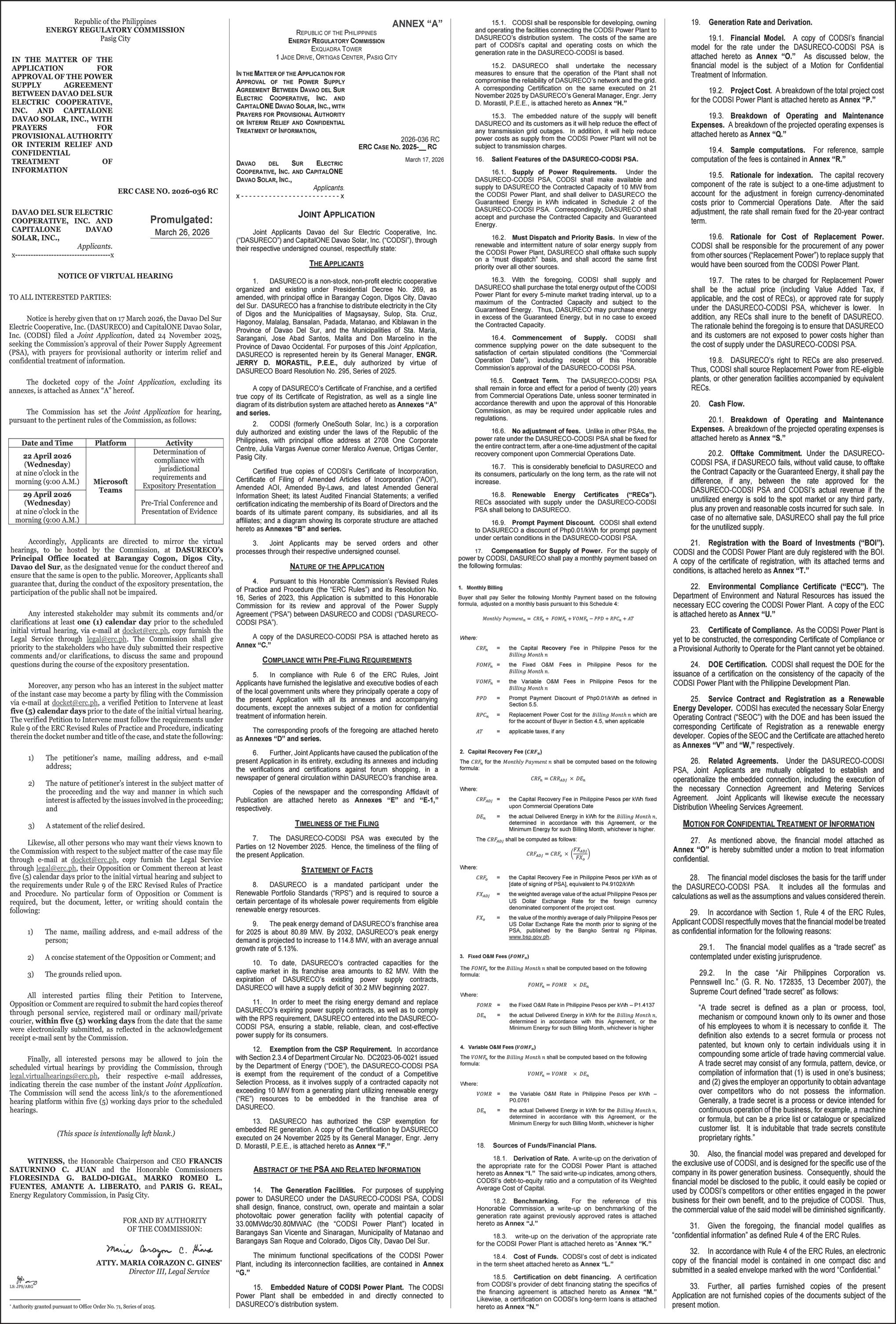
T@andreasanjuan
HE country’s dollar reserves hit a seven-month low in March after the Bangko Sentral ng Pilipinas (BSP) intervened to stabilize the peso, analysts said.
Moving forward, experts underscored that reserves may face pressure as oil prices and market volatility persist amid the ongoing conflict in the Middle East.
Jonathan L. Ravelas, senior adviser at Reyes Tacandong & Co. said: “The dip in gross international reserves to $107.5 billion

mainly reflects active BSP management rather than stress— using reserves to smooth peso volatility, settle government external payments, and absorb valuation losses as the US dollar strengthened.”
Ravelas said this after preliminary data from the Bangko Sentral ng Pilipinas (BSP) showed the country’s gross international reserves (GIR) dipped to $107.5 billion at end-March 2026, the lowest since August 2025.
The latest figure is 5.82 percent lower than the $113.264 billion recorded in end-February 2026. Year-on-year, the GIR rose by 0.78
percent from the $106.67 billion in end-March 2025.
Ravelas also noted that the Middle East conflict has added pressure “indirectly by lifting oil prices and global risk aversion, which increases dollar demand and prompts defensive FX action.”
Domini S. Velasquez, Chinabank’s Group chief economist, said the decline in the GIR may have partly reflected BSP’s foreign exchange intervention to “curb excessive and potentially inflationary exchange rate volatility.”
“USDPHP climbed from 57.665 as of Feb. 27 [before the war] to
60.748 as of end-Mar,” Velasquez pointed out. Moreover, Velasquez said gold prices declined in March, which contributed to a lower GIR compared to February.
For Michael L. Ricafort, Rizal Commercial Banking Corp. (RCBC) chief economist, the lower GIR was “largely” due to lower foreign investments arising from market volatility “that reflected the adverse effects of the war on Iran/Middle East since February 28, 2026, and also lower world gold prices that reflected the decline in gold holdings.”





THEBy Justine Xyrah Garcia
World Bank sharply downgraded its growth outlook for the Philippines this year, flagging the country’s heavy exposure to the Middle East conflict as a key risk to expansion.
In its East Asia and Pacific economic update, the Washingtonbased lender said it now expects the Philippine economy to expand by a mere 3.7 percent in 2026—1.6 percentage points lower than its earlier 5.3 percent forecast.
World Bank East and Asia Pacific senior economist Ergys Islamaj said the downgrade reflects the Philippines’s multiple transmission channels to the conflict.
“[The] Philippines is exposed to [the] conflict not only through energy and fertilizer imports but also through remittances. 18 percent of remittances to the Philippines in 2025 came from the Gulf,” Islamaj noted during the report’s launch.
He added that as long as the geopolitical tensions continues, the country’s growth could be at greater risk.
“Long conflict will hurt the economy further,” he said.
The bank’s assessment aligns with the latest assessment of the
Department of Economy, Planning, and Development (DepDev), which sees growth settling between 3.5 percent and 5.3 percent this year, as higher fuel costs, weaker remittances, and softer tourism dampen expansion.
To recall, the Development Budget Coordination Committee (DBCC) earlier trimmed its medium-term macroeconomic assumptions, projecting GDP growth at 5 to 6 percent this year, down from the previous 6 to 7 percent target. The DBCC has yet to announce whether it will recast these targets anew.
The World Bank’s 2026 projection is now the lowest forecast compared to other multilateral organizations.
For comparison, the International Monetary Fund (IMF) sees the Philippine economy growing by 5.6 percent this year, while the Organisation for Economic Co-operation and Development (OECD) projects
TBy Ada Pelonia @adapelonia
HE country stands to incur P75 billion in losses from the rice, corn, and fisheries sector if nothing is done to mitigate the impact of the global oil crisis, a senior official from the Department of Agriculture (DA) said.
With the persistent disruption in the Persian Gulf that has jacked up global oil prices, Undersecretary Asis Perez said the agency also expects rice and corn output to plunge by as much as 50 percent this year.
“The value that we’re projecting to lose—assuming we don’t do anything, the cost of inaction—for three major [sectors] alone, including rice, corn, and fisheries is already P75 billion,” the official said during a Senate hearing of the Committee on Agriculture, Food and Agrarian Reform on Wednesday.
The official also noted that palay planted between May and June would be affected by the crisis, the yield of which will be harvested by September.
Based on the agency’s initial projection, the “best-case scenario” is for the
minimum volume of losses due to the crisis to stand at 20 percent.
“It can even go up to a 50-percent decline in productivity, because farmers can’t do anything if there’s no fertilizer.”
The official noted that this translates to 2 million metric tons (MMT) of palay, adding that the projection also mirrors that of corn production.
The DA expects palay production to settle at 20.3 MMT in 2026.
“The good thing about what we’re doing is we’re anticipating a catastrophe that’s about to happen assuming we don’t act.”
The DA has issued several interventions as part of efforts to cushion the impact of rising fertilizer and pump prices on the farm sector.
Among the interventions include P100 million fuel assistance, with 14,439 farmers and 15,669 fisherfolk receiving P5,000 and P3,000 each, respectively.
The DA would also tap the P10billion Presidential Assistance to Farmers and Fisherfolk Program (PAFFP) under the General Appropriations Act (GAA) set to
over 4
in the

P2,325 each.
‘Ample supply’
MEANWHILE , Agriculture Secretary Francisco Tiu Laurel Jr. assured the public that the country’s fertilizer supply remains ample until yearend if inorganic fertilizer is blended with biofertilizer.
“As of the moment, the arrival of fertilizer is continuous. The only problem is the price,” Tiu Laurel said on the sidelines of the 2026 national food fair in Mandaluyong City.
“If we combine fertilizer with inorganic fertilizer then we have enough [supply] for the whole year if we use them as a blend.”
The DA said the country’s stockpile of the critical farm input stood at 8.11 million bags or 405,637.49 metric tons (MT) as of April 1 across six major fertilizer grades. This includes urea, ammonium sulfate, complete fertilizer, ammonium phosphate, muriate of potash, and DAP.
Fewer OFWs deployed since Mideast war started
By Samuel P. Medenilla @sam_medenilla
FEWER overseas Filipino workers (OFW) are now being deployed abroad amid the ongoing armed conflict in the Middle East, according to the Department of Migrant Workers (DMW).
5.1-percent growth.
The Asian Development Bank (ADB), meanwhile, estimates growth at 5 percent in 2026, although it has yet to release its updated outlook on April 10. For 2027, the World Bank expects Philippine growth to reach 5.6 percent, slightly higher than its earlier 5.4-percent projection.
Citing reports from the recruitment agencies, DMW Secretary Hans J. Cacdac said they have observed a decline in deployment figures since the war in the Middle East started last February after the United States and Israel attacked Iran. He noted that while there is no deployment ban in many countries in the Middle East, some OFWs have voluntarily decided to defer heading to the region due to safety concerns. “OFWs are making the decision not to continue [with their deployment], so we are giving an advisory to stay where they are,” Cacdac said in a television interview last Wednesday. The affected OFWs were mostly
from the hotels, hospitality, events management, transport, and construction sector.
DMW, however, denied reports that there were an estimated 40,000 “stranded” OFWs in Metro Manila due to the ongoing tension in the Middle East.
“I also question the use of the term stranded [in the said report] because no Filipino is stranded in the Philippines. They are with their families,” Cacdac explained.
Several countries in the Middle East, namely, the Kingdom of Saudi Arabia, United Arab Emirates (UAE), Qatar, and Kuwait are among the top 10 destination countries for OFWs.

In its latest deployment data, DMW reported that most or 61,164 of the deployed landbased OFWs last January went to KSA. The United Arab Emirates (UAE) came in second place with 57,207. Qatar was in sixth place with 22,428 and it was followed by Kuwait with 12,606.
Overall deployment for landbased OFWs last January was at 422,312—or 28.88 percent higher compared to 327,667 in the same period last year. Of the deployed OFWs this year, 162,345 went to the Middle East.
In a related development, DMW reported its repatriation efforts in the Middle East will not be affected by the announcement
of US President Donald Trump of a two-week ceasefire with Iran.
“Repat continues,” DMW Undersecretary Bernard P. Olalia said in a Viber message.
As of April 6, 2026, DMW were able to send home 4,611 OFWs and their dependents from the Middle East. Most or 3,736 repatriates were funded by the government either through booking in commercial flights or through seven governmentarranged chartered flights.
More OFWs are expected to return home from the Middle East after DMW said it has arranged two additional chartered flights, which are expected to arrive on Friday and over the weekend.
DOE to House: Fuel…
transport. “We push for staggered schedules and discounts, urging more concessions for public utility vehicles,” Garin said. On electricity, government interventions have helped temper potential increases in generation costs, limiting the increase to just one peso per kilowatt-hour instead of four. She added that 1,471 megawatts of renewable energy projects are being fasttracked to reduce reliance on volatile fuel sources.
Garin highlighted the importance of demand management to extend supply. “If we save 50 percent on fuel efficiency today, our 50-day supply could stretch to 75 days,” she said, citing initiatives like Earth Hour, which saved 145.5 megawatts in just one hour, as examples being expanded across government agencies.
Alarming MEANWHILE , Deputy Minority Leader Antonio Tinio on Tuesday flagged the Philippines’s alarming position as one of the countries with the fastest-rising fuel prices globally, questioning the DOE over transparency and alleged overpricing amid the ongoing oil crisis.
During the same hearing, Tinio presented data showing that gasoline prices surged 71.6 percent from February 23 in just one month, the second-highest increase worldwide. Diesel prices jumped 111 percent, placing the country among the top three globally for diesel price hikes.
“Why is it that, among so many affected countries, the Philippines is experiencing the highest increases?” Tinio asked the DOE, pressing them to explain the country’s vulnerability in global pricing trends.
Echoing concerns over rising fuel costs, Batangas Rep. Leandro Leviste called for an immediate reduction of the value-added tax (VAT) on fuel as a direct way to ease the burden on ordinary Filipinos. He noted that the 12-percent VAT contributes to some of the highest oil prices in Asia.
“While other countries provide subsidies to lower fuel costs, we continue to pile taxes on top, making oil even more expensive,” he said.
The lawmaker argued that government aid has proven limited, making tax reduction a more practical solution. He proposed either lowering VAT to 10 percent on all goods or suspending VAT on fuel altogether. He stressed that lowering VAT could significantly ease the impact of rising oil prices. According to his calculations, reducing VAT from 12 percent to 10 percent could cut approximately
In a statement, the BSP said this GIR level “provides a robust external liquidity buffer, equivalent to 7.1 months’ worth of imports of goods and payments of services and primary income.” The central bank also noted that it covers about 3.9 times the country’s short-term external debt based on residual maturity.
GIR consist of foreign-denominated securities, foreign exchange, and other reserve assets, including gold.
“These reserves serve as a buffer against external economic shocks, enabling a country to pay for its imports, service its foreign debt obligations, and stabilize its currency,” the BSP explained. The GIR level is considered adequate if it can finance at least threemonths’ worth of the country’s imports of goods and payments of services and primary income.
“The latest GIR level ensures availability of foreign exchange to meet balance of payments financing needs, such as for payment of imports and debt service, in extreme conditions when there are no export earnings or foreign loans,” the central bank said.
Outlook for dollar reserves
P250 billion in taxes, equivalent to around P9,000 per year or P750 per month for each Filipino household.
For her part, Garin acknowledged the steep hikes, attributing them to the Philippines’s unique oil industry structure. She explained that 94 percent of the pump price comes from the cost of goods, which includes crude oil barrels, insurance, freight, and premium costs— some of which skyrocketed from $5 per barrel to $60 per barrel amid supply shortages.
“We saw the highest increases because of our oil structure. Fully liberalized, with no buffer, no Oil Stabilization Fund, and only 30 percent of supply comes from our single refinery,” Garin said. She added that taxes, biofuel requirements, and VAT further add to pump prices, leaving companies with profit margins ranging from negative to 10 percent.
Tinio countered that the DOE used the term “liberalized” but avoided “deregulated,” emphasizing that deregulation passes cost increases directly to consumers without protective measures, unlike in other countries with subsidies or state-controlled oil supplies.
Tinio presented six months of DOE oil monitoring reports, showing that domestic prices consistently remained above international reference prices, even when crude costs temporarily fell. The analysis suggested an average overpricing of P1.34 per liter for gasoline, P1.90 for diesel, and P1.79 for kerosene, with some spikes higher.
Citing reports from IBON Foundation, he noted that oil companies reportedly earned P46.5 billion in windfall profits in March alone, raising public concern over profiteering amid a crisis.
While Garin denied overpricing, she confirmed that DOE is moving toward full disclosure following an executive order requiring oil companies to submit unbundled price data, which details import costs, taxes, biofuel contributions, and industry take. Currently, industry take—including port charges, refining, storage, marketing, and profit margins—ranges from 21 percent for diesel to 29 percent for gasoline. Tinio stressed the importance of transparency, invoking Supreme Court jurisprudence that allows confidential information to be disclosed when matters of public interest are at stake. He urged the DOE to make pricing structures public, especially during the declared national energy emergency.
PHILIPPINE Institute for Development Studies (PIDS) Senior Research Fellow John Paolo Rivera said: “Despite the dip, GIR remains adequate and continues to provide a strong buffer against external shocks. Moving forward, reserves may face pressure from elevated oil prices, global interest rates, and capital flow volatility, but should remain broadly sufficient.”
Ravelas noted that while reserves may stay “range-bound” as geopolitical risks, oil prices, and market volatility persist, this may be tempered by steady remittances, BPO inflows, and improving sentiment.
“Bottom line: this is normal reserve cycling, not a red flag,” added Ravelas.
Velasquez said the two-week USIran ceasefire has “helped improve risk sentiment and support a recovery in the peso, which may reduce the need for the BSP to use its reserves for foreign exchange intervention.”
amid the drag from infrastructure delays, global uncertainties and severe weather disruptions.
Public construction, a key component of the government’s investments in infrastructure and other capital expenditures, dipped by 17.9 percent.
“With respect to the corruption scandal, the government implemented measures to help address the controversy with the primary objective of strengthening accountability, improving project quality, ensuring value for money, and enhancing capability for faster and more sustainable long-term growth, even if it meant lower capital disbursements that weakened short-term growth,” the DBM said. For 2026, the government has set infrastructure disbursements at P1.558 trillion, equivalent to 5.1 percent of GDP.
This year’s national budget is higher by 7.4 percent from last year’s P6.326-trillion budget.
A total of P2.848.3 trillion or 41.9 percent of this year’s budget was comprehensively released on the first working day of 2026, according to the DBM. This amount includes the P2.770.2 trillion agency-specific budget, equivalent to 75.0 percent of the total P3.694.2 trillion

SC orders House, Senate to comment on pleas to stop impeach proceedings
By Joel R. San Juan | @jrsanjuan1573
& By Jovee Marie N. Dela Cruz | @joveemarie
THE Supreme Court (SC) has ordered the House of Representatives and the Senate to comment on the petitions seeking to stop the impeachment proceedings being conducted by the House committee on justice against Vice President Sara Duterte.
The order was issued by the High Tribunal during its regular en banc session on Wednesday where they tackled the petitions filed by Vice President Sara Duterte and a group of lawyers assailing the constitutionality of the alleged “mini-trial” being conducted by the House Committee on Justice pertaining to the two impeachments complaints filed against her.
T he respondents in the two petitions were given a non-extendible period of 10 days to file their comments o n the petitions.
N amed as respondents in the petitions were Speaker Faustino Dy III; t he Committee on Justice chairperson, Batangas Rep. Gerville Reyes-Luistro; Senate President Vicente Sotto III; and the complainants in the Saballa et al and Cabrera impeachment complaints.
The Court also directed the consolidation of the petition filed by the Vice President and lawyers Israelito Torreon, Victor
PAF fighter pilots engage in realistic combat training
THE Air Force (PAF) said on Wednesday participants in this year’s Cope Thunder 26-1 drills will greatly enhance their readiness through “realistic air combat training.”
Col. Ma. Christina Basco, spokesperson for the Air Force in a message to reporters, said this will be achieved as the PAF and US Pacific Air Forces (Pacaf) will deploy their top-of-the-line aircraft to make the exercises more credible.
For Cope Thunder 26-1, Basco said, the PAF deployed its Mach 1.5-capable FA-50PH “Fighting Eagle” fighter jets while Pacaf sent its premier stealth fighter, the F-22 “Raptor.” No other details on the exact number of aircraft were provided for security reasons.
During the exercise, FA-50PHs and F-22 ‘Raptors’ will focus on enhancing tactical-level skills and advanced fighter operations. The activity aims to improve combat readiness through realistic air combat training from 07 to 16 April 2026, conducted within designated Intensive military training areas,” Basco added.
To complement these aircraft, Basco said, the PAF will also deploy several attack and “intelligence, surveillance and reconnaissance” (ISR) platforms.
Rex Anthony Naval with PNA
Fernandez, Resci Angelli Rizada-Nolasco, Martin Delgra, Wendell Avisado, James Patrick Bondoc, Raul Lambino, Luna Maria Dominique Acosta-Manlitoc, Jesus Hinlo Jr., and Richard Mata. The SC consolidated these cases and, without necessarily giving due course to the petition, directed respondents to comment within a non-extendible period of 10 d ays from receipt of notice,” the SC-Office of the Spokesperson said in a statement.
Duterte, in her personal capacity, filed a petition for certiorari and prohibition with urgent application for TRO and a writ of preliminary injunction last April before the Court seeking to declare as void ab initio or void from the beginning the impeachment complaints filed against her, as well as, the proceedings in the committee which stemmed from the said complaints.
I n a statement, Duterte’s defense team said the filing of the petition assailing the impeachment proceedings
in the House should not be construed as avoiding the process.
This step was taken to seek clarity on fundamental questions, which, in our view, warrant the Court’s immediate attention,” the statement read.
This is about ensuring that the process itself complies with the Constitution. The House has the power to initiate impeachment, but that power is not without l imits,” it added.
In her petitioner, the Vice President argued that the impeachment complaints filed by Joel Saballa et al and Nathaniel Cabrera are void ab initio for violating the oneyear bar rule under Section 3 (5) Article XI of the 1987 Constitution, which prohibits the initiation of more than one impeachment proceeding against the same official within a period of one year.
T he two complaints, according to Duterte, should have not prospered following the setting aside and the withdrawal of the first two impeachment complaints filed by former lawmaker France Castro et al and civil society group leader Kiko Aquino Dee last March 2.
Under these circumstances then, the withdrawal and setting aside of the Dee and Castro complaints, respectively, operate as their effective dismissal and/or termination of at least two impeachment proceedings, whichbarsanyfurtherimpeachmentproceedings on the remaining Saballa and Cabrera complaints,” Duterte pointed out.
The petitioners noted that in its July 2025 decision in Duterte case, the SC held that the one-year-bar rule is reckoned from the time an impeachment complaint is “dismissed or becomes no longer viable.”
Furthermore, the Vice President argued that the Saballa and Cabrera complaints
suffer from fatal defects that are contrary with the Constitution and the principles laid down by the Court in the cases of Francisco, Gutierrez and Duterte in relation to impeachment proceedings.
L ast month, Torreon et al filed a petition seeking to enjoin the HoR from conducting a “mini-trial” in connection with the impeachment proceedings against Duterte.
They claimed that the House Committee on Justice abused its authority in declaring the Saballa et al and Cabrebra complaints as sufficient in form and substance.
Proceedings to continue
THE impeachment proceedings against the Vice President will continue after the Supreme Court did not issue a temporary restraining order (TRO).
M anila Rep. Joel Chua, chairman of the House Committee on Good Government and Public Accountability, said the absence of a TRO means there is no legal barrier preventing the House from carrying out its constitutional mandate.
The Supreme Court did not issue a temporary restraining order. This means there is no legal impediment to the ongoing impeachment proceedings. The House Committee on Justice will continue its work as mandated by the Constitution,” Chua, also a member of the House Committee on Justice, said.
He emphasized that the House remains respectful of the High Court while proceeding with its duties.
“ We respect the Supreme Court and its processes. At the same time, the House is duty-bound to proceed unless restrained by the Court. This reflects institutional balance—not conflict,” he said.
By Jovee Marie N. Dela Cruz @joveemarie
EGISLATORS on Wednesday assailed
LVice President Sara Duterte over her petition before the Supreme Court seeking to halt the ongoing impeachment proceedings in the House of Representatives, accusing her of misleading both the High Court and the public through her filing.
P arty-list Rep. Leila de Lima of Mamamayang Liberal took a swipe at Duterte’s legal move, accusing her camp of treating the High Court as a refuge to evade accountability.
They must think the Supreme Court is ‘Sara’s Court’—a place they can always run to in order to cover up cowardice and evade accountability,” said de Lima.
De Lima added that impeachment is a constitutionally mandated mechanism to determine whether a high-ranking public official remains fit to hold office, adding that resorting to judicial intervention at this stage undermines the process.
E choing the criticism, the House Committee on Public Accounts chairman, Party-list Rep. Terry Ridon of Bicol Saro said Duterte’s petition “is anchored on a misrepresentation of facts and a distorted interpretation of the Constitution and prevailing jurisprudence.” Ridon disputed claims that the impeachment complaints were not properly referred to by the House in plenary.
The official video footage of the February 23, 2026 plenary session, at 3:48 p.m., clearly shows that the referral of the four impeachment complaints was carried out by the House of Representatives in plenary, in accordance with Section 3 [2], Article XI of the Constitution,” Ridon said.
This was not merely an act of the Speaker or the Committee on Rules. It was an act of the House sitting as a collective body,” Ridon added. He also rejected assertions that prior deliberation was required before referral, saying no such mandate exists under the Constitution, House rules, or jurisprudence.
Ex-LTFRB chief: Misinterpretation of rules penalizes TNVS drivers
By Lorenz S. Marasigan @lorenzmarasigan
FORMER Land Transportation Franchising and Regulatory Board (LTFRB) chairman
Winston Ginez is calling for an overhaul of policies governing transport network vehicle services (TNVS) and motorcycle taxis before more drivers are unfairly penalized, saying that frameworks no longer match how platform-based transport actually operates.
Ginez, who is widely regarded as the architect of the TNVS regulatory framework, warned that “outdated regulatory assumptions and structural blind spots are putting legitimate drivers at risk—at a time when many are already reeling from rising fuel costs.”
H e said recent claims that transport network companies (TNCs)
are harboring large numbers of socalled “tempo” drivers oversimplify how the TNVS system actually works.
U nder LTFRB regulations, a Certificate of Public Convenience (CPC) is issued to the vehicle and its operator, not to an individual driver, thus a single franchised unit can therefore be legally driven by several authorized individuals under a shift arrangement—meaning the number of registered drivers on a platform will rarely match the number of CPCs or Provisional Authorities (PA) on record.
Drivers with pending CPC or Provisional Authority applications may already continue servicing passengers under existing regulations, provided they have filed for an extension,” Ginez said.
H e said drivers with pending CPC or Provisional Authority applications should not be treated
as illegitimate, noting they have already entered the regulatory pipeline.
P rocessing backlogs explain much of the gap, he said, adding that existing rules already allow applicants who have filed for an extension to continue serving passengers while their paperwork is pending.
E arlier, the Department of Social Welfare and Development (DSWD) and the Land Transportation Franchising and Regulatory Board (LTFRB) flagged several transport network companies (TNCs) such as inDrive and Grab for “filtering” their initially submitted list for the government’s fuel subsidy, calling it a “concealment.”
O n motorcycle taxis, Ginez said the current cap on accredited riders is overdue for review. Many rider-partners now split their time
Youth played key role in defending PHL in WWII

THE Filipino youth played a key role in defending the country during World War II, a senior veterans affairs official said.
Speaking during the activities honoring veterans, Assistant Secretary Restituto Aguilar, Philippine Veterans Affairs Office (Pvao) deputy administrator, said the Filipino youth sector played a key role in the country’ resistance to invaders.

Scout groups and the National Youth Commission, are always invited to this affair, Aguilar said, “ Dahil noong Ikalawang Digmaang Pandaigdig, ang mga nagtanggol sa ating bayan ay ang kabataan Ang mga sundalo natin noon ay ang edad labingwalo mayroong labing-pito nga sa kanila hanggang dalawampu t tatlong taong gulang—and this is about 80 percent noong mga lumaban sa Bataan at Corregidor. [During the Second World War, a large portion of those who defended our country was the youth. Our soldiers at that time aged 18, there were some at 17 and 23 years old—and this was about 80 percent of those who fought in Bataan and Corregidor],” he said. So, kabataan talaga iyong importanteng ma-ihanda natin para sa ating bayan Sila ang next na defender ng ating bansa [it is really important for the youth to be prepared to serve the country. They are the next defenders of the country],” Aguilar said. O n Monday, the Army commenced the commemoration of the 84th Araw ng Kagitingan (Day of Valor) and the Philip -
There is no provision in the 1987 Constitution, the House Rules on Impeachment, or Gutierrez v House of Representatives that mandates deliberation prior to referral,” Ridon said.
“At most, Gutierrez states that deliberation may take place – it is not a m andatory requirement,” Ridon said. He noted that during the plenary session, no lawmaker raised objections or sought deliberation on the referral.
More importantly, during that plenary session, no Member of the House moved to object to the referral or to initiate deliberation—not even allies, relatives, or close associates of the Vice President,” he said.
R idon also dismissed allegations of a violation of the one-year bar rule, stressing that only one valid referral was made.
The One-Year Bar applies only after a valid referral of an impeachment complaint,” he said.
Public records clearly show that only one referral of the impeachment complaints to the House Committee on Justice took place, notwithstanding the setting aside of the Castro complaint and the withdrawal of the Dee complaint,” he added. He added that jurisprudence supports the process undertaken by the committee.
Even Duterte v House recognizes that it is the process within the Committee on Justice that determines which complaints proceed and which are dismissed,” Ridon said.
“Accordingly, there is no violation of the One-Year Bar. The contrary claim in the petition is a misapplication of both the Constitution and jurisprudence,” Ridon said.
On due process, Ridon said the committee’s actions remain firmly grounded in law.
The authority of the House Committee on Justice to conduct hearings, i ssue subpoenas, and gather evidence is firmly grounded in the Constitution, the House Rules on Impeachment, and established jurisprudence, including Duterte v House,” he said.
between passenger trips and last-mile deliveries depending on platform demand—a multi-service model, he said, is simply how the gig economy functions, and one that regulations have yet to formally recognize.
He called on the LTFRB to move on four fronts: standardize how data is requested from platforms, clear the backlog of pending CPC and Provisional Authority applications, revisit the motorcycle taxi cap, and rewrite transport rules to reflect platform-era realities.
T he remarks come as fuel prices remain elevated amid ongoing Middle East tensions, squeezing the margins of drivers already operating on thin income.
In a moment of crisis, policy must not add to the uncertainty of transport workers already fighting to stay afloat—it must protect the livelihoods of the Filipinos who keep the country moving,” Ginez said.
pine Veterans’ Week with the solemn Sunrise Ceremony and wreath-laying at Libingan ng mga Bayani in Fort Bonifacio, Taguig City.
Th is year’s Araw ng Kagitingan is anchored on the theme “Giting ng Bayani, Pamana sa Salinlahi” (Bravery of Heroes, Legacy to Generations). Lt. Gen. Antonio Nafarrete, Army commander, led the Sunrise Ceremony by offering 84 flowers at the Tomb of the Unknown Soldier at the crack of dawn to symbolize new hope for the motherland.
It also served as a symbolic gesture of gratitude to veterans who fought to secure the country’s freedom.
N afarette joined Defense Secretary Gilberto Teodoro for the wreathlaying ceremony.
To cap the day’s activities, Nafarrete and Office of Presidential Adviser for Peace, Reconciliation and Unity Secretary Carlito Galvez Jr. led the Review in Honor of Veterans at the Philippine Army grandstand. Rex Anthony Naval with PNA
TBy Mary Jade Jadormio
HE Catholic Bishops’ Conference of the Philippines (CBCP) has called on dioceses nationwide to hold prayer vigils on April 11 in response to a global appeal for peace by Pope Leo XIV. CBCP President and Lipa Archbishop Gilbert A. Garcera urged Church leaders to mobilize the faithful, citing the Pope’s warning of a world “increasingly marked by conflict” and the “globalization of indifference.”
The call follows the Holy Father’s Easter Urbi et Orbi message, where he announced a prayer vigil for world peace to be held at St. Peter’s Basilica on the same day.
In communion with the Holy Father, we respectfully encourage all dioceses to organize a prayer vigil on April 11,” Garcera said. He noted that the initiative seeks to unite Filipino Catholics with the global Church in prayer for peace.
The CBCP said the vigils may be held at any time during the day, depending on what is most suitable for each diocese.
These may take the form of Eucharistic adoration, the Holy Rosary, the celebration of the Holy Mass for peace, or other appropriate liturgical or devotional gatherings,” Garcera said. He emphasized that the activity is meant to express solidarity with the Pope while reinforcing the Church’s collective call for peace.
Such a collective act of prayer will not only express our solidarity with the Holy Father but will also witness to our shared hope that true peace… may prevail in our hearts and in the world,” he said.
The CBCP also directed dioceses to relay the call to parishes and lay groups to ensure wider participation.
By Manuel T. Cayon @awimailbox Mindanao Bureau Chief
COTABATO CITY—Social welfare and subsidies to indigents eat up much of the budget of the Bangsamoro’s counterpart of the national government’s Department of S ocial Welfare and Development.
Minister Raissa Jajurie of the Bangsamoro Ministry of Social Welfare and Development, said almost 80 percent of its budget is spent on subsidies and cash aids.
Since 2019, the current MSSD has spent a total of P71,052,600,847.43.
Since 2019 to 2025, the national government allocated P51,824,048,642.84 on social welfare investments for the BARMM, coursed through ten nationally funded programs such as the 4Ps conditional cash transfer program, Sustainable Livelihood Program and social pension for senior citizens and centenarians.
The BARMM, on the other hand, allocated P19,228,552,204.59 for social welfare through the general appropriation and using the Special Development Fund.
Jajurie said it was allocated only 10 percent of its ministry budget for personnel salaries and less than 10 percent for operating expenses. This was understandable, she said, because the MSSD is the designated agency to provide welfare assistance to the indigents and marginalized sectors of the regional autonomous region.
The region is composed of the mainland provinces of Maguindanao del Sur, Maguindanao del Norte and Lanao del Sur, and the southwestern island provinces of Basilan and Tawi-Tawi. Sulu has been officially excluded by a Supreme Court ruling in 2004 which acknowledged the dissenting vote of 54 percent in a 2019 plebiscite against inclusion in the BARMM.
She said the region has to grapple also with decades of government neglect, discrimination and debilitating poverty which previously deposited all its provinces in the list of ten poorest provinces in the Philippines.
Prolonged conflict may necessitate DTI target review
By Bless Aubrey Ogerio
THE Department of Trade and Industry (DTI) is prepared to revisit its economic targets as global uncertainties linked to the ongoing Middle East conflict weigh on trade and investment prospects, Trade Secretary Ma. Cristina Roque said.
Roque said the agency may need to recalibrate not only export goals but also investment approvals if the situation drags on, although discussions on possible adjustments will be undertaken with the broader economic team.
Definitely. We will have to meet regarding that,” Roque told reporters when asked if the DTI is ready to adjust its targets. “But for now…the main now is really the food prices at least to keep it stable. That’s the priority for now.”
The uncertainty comes as concerns grow over how a prolonged conflict could affect investor sentiment and global trade flows. Roque acknowledged that investment activity could slow if tensions persist.
From January to February 2026, the Board of Investments, an agency under DTI, approved 35 projects worth P47 billion, an increase from eight projects during the same period in 2025. The jump represents a 338 percent rise in the number of approved investments.
“ It’s like now is a crisis all over. So everything will be at a standstill until
at least this [geopolitical tensions] just finishes,” she said.
Despite these headwinds, she noted that exports have so far remained steady, with some sectors continuing shipments while others are exploring alternative markets within the Philippines.
Latest data from the Philippine Statistics Authority showed that total exports reached $14.47 billion in the first two months of 2026, up 8.3 percent from the same period last year. The figure marks the highest export level recorded for January to February since 1991.
“If this continues, we expect sluggish,” Roque said, declining to give a firm outlook for the rest of the year.
A mid external risks, the DTI said it is prioritizing efforts to keep food prices stable and ensure adequate supply in the domestic market.
Roque said most manufacturers have not sought price increases, based on initial consultations, although she noted that the department is still verifying with firms that were unable to attend recent meetings.
I n March, manufacturers have com-
ERC rushes to stabilize electricity supply, prices
TBy Lenie Lectura @llectura
HE ENERGY Regulatory Commission (ERC) is accelerating its decision-making process involving critical power deals meant to augment the country’s supply and stabilize electricity prices following a declaration of a national energy emergency due to Middle East conflict-driven fuel disruptions.
A side from the temporary suspension of the Wholesale Electricity Spot
TBy Jonathan L. Mayuga @jonlmayuga
HE Department of Environment and Natural Resources (DENR)
has taken the helm of the National Blue Carbon Action Partnership (NBCap) Roadmap, a strategic framework codeveloped across government, academe, civil society, and the private sector, to strengthen the protection and sustainable management of the country’s blue carbon ecosystems for the benefit of 42 million coastal residents and climate resilience.
The NBCap Roadmap was formally handed over to the DENR at the recent Philippine Mangrove Conference 2026 in Quezon City. T he milestone underscores the country’s commitment to coordinated, science-based, and accountable action for blue carbon ecosystems.
Market (WESM), ERC chairperson Saturnino Juan his office has accelerated approvals of power supply agreements (PSAs) involving renewable energy (RE), provisional authorities to operate and certificates of compliance.
“ These are what we prioritized, and we have already decided on that so that they can implement their contracts.
We also have pending applications for certificates of compliance or provisional authority to operate of generation companies. We also prioritized these so
Undersecretary Analiza RebueltaTeh, who handles the department’s Finance, Information Systems, and Climate Change affairs, welcomed the formal turnover. Pillars of resilience
“MANGROVES may be overlooked, but they are powerful pillars of resilience,” Teh said.
This Roadmap reflects the Philippines’ strong commitment to advance blue carbon accounting and deliver tangible impact for coastal communities,” she said.
The NBCap Roadmap will provide us with an evidence-based path forward for conserving the Philippines’ rich coastal ecosystems,” Mariglo Laririt, DENR Biodiversity Management Bureau (BMB) Assistant Director, added.
“By working with our partners across various sectors, we can enhance coastal resilience, support communities, and contribute to national and global climate commitments,” she said.
L aririt said the path forward begins with convening the Leadership Steering Committee (LSC) and Technical Working Group (TWG) in April. The NBCAP Structure and Roadmap will then be for -
that they can run their plants, especially the renewable plants, which is also a priority dispatch,” said Juan.
Pending cases involving rate adjustments have been deferred until July, added Juan.
Moreover, the distribution utilities were ordered to report increase in generation charges for possible staggering and directed to maximize contracted capacity under their PSAs.
Just recently, the ERC adopted a modified administered pricing mechanism for the WESM.
malized through a policy instrument, either a DENR Administrative Order or an Executive Order, while a work plan will be developed in parallel, and early actions are already underway to sustain momentum.
Critical infrastructure
“BLUE carbon ecosystems are critical natural infrastructure underpinning the Philippines’ blue economy. By aligning governance, science, livelihoods, and investment, the NBCAP Roadmap sends a strong signal to global investors and partners that nature-based solutions are key to a climate-resilient economy,” shared Alfredo Giron, head of Ocean, World Economic Forum.
The Philippines is home to some of Southeast Asia’s most ecologically significant blue carbon ecosystems with about 327,000 hectares of mangroves, alongside seagrass beds and tidal marshes.
Th ese protect coastlines, sustain livelihoods, and store vast amounts of carbon, but once degraded, they release stored greenhouse gases and threaten the biodiversity that depends on them.
The handover of the NBCap Roadmap to the DENR represents a turning point in advancing blue carbon action and strengthening the Philippines’ leadership in coastal conservation in the region,” Edwina Garchitorena, Country Director of ZSL Philippines said for her part.
IPOPHL, cosmetics group renew IP pact to expand collaboration
Tmitted to keeping prices of essential goods unchanged for at least 30 days, with some pledging to hold the line for up to 60 days, amid pressures from global fuel costs.
The majority is still no. But I will announce… I still need to confirm with them,” she said.
She added that while there are currently no scheduled meetings with logistics firms, the DTI expects to engage t hem as fuel prices continue to fluctuate, affecting transport costs.
Coordination on fuel-related charges, she noted, may fall more directly under the Department of Transportation, while the DTI remains focused on basic necessities and prime commodities.
For the coming weeks, the trade chief said there are no immediate concerns over supply levels, although price movements remain uncertain.
“ We have no problem with supplies. It’s hard for me to speculate on the price,” she said, adding that the department is aiming to keep any increases minimal.
R oque said the DTI is expected to release updated information on prices and supply conditions within the week as it continues to monitor developments.
HE Intellectual Property Office of the Philippines (IPOPHL) and the Chamber of Cosmetics Industry of the Philippines (CCIP) are set to renew their partnership as both sides move to strengthen intellectual property protection and enforcement in the local cosmetics and personal care sector.
D uring a recent meeting, the two groups agreed to extend their memorandum of understanding, first signed in 2023 and due to expire this year.
The renewal signals continued cooperation in promoting brand protection, safeguarding innovation and supporting industry compliance with intellectual property rules.
The discussions also covered efforts to deepen engagement with industry players, including additional learning sessions and technical support for companies navigating trademark and enforcement issues.
IPOPHL said it will hold another exclusive seminar for CCIP members at its office, focusing on enforcement mechanisms and the handling of intellectual property complaints. Details of the session, including its schedule and final topic, are expected to be announced jointly.
Sp ecific trademark concerns raised during the meeting, including those involving members of the CCIP board, were acknowledged, with the agency expressing readiness to provide guidance and assistance.
O n the other hand, the IPOPHL introduced the “Women in IPO” initiative, which seeks to strengthen the role of women in intellectual property practice and leadership. Both parties signaled interest in exploring coordination at the ASEAN level under the program.
R egional engagement was also discussed, with IPOPHL confirming its availability to support CCIP-led activities in Cebu and Davao, including participation in events and serving as resource speakers.
T he meeting also touched on potential collaboration with ecommerce platforms, leveraging IPOPHL’s existing partnerships to address online intellectual property concerns.
B oth sides are considering further coordination, including a possible engagement with the Department of Trade and Industry’s e-commerce office.

Bless Aubrey Ogerio
New hope for returning OFWs: CHED uses ETEEAP to fast-track career reintegration
By Claudeth Mocon-Ciriaco @claudethmc3

THE Commission on High -
er Education (CHED) is enhancing pathways to help returning overseas Filipino workers (OFWs) who have been displaced by the ongoing Middle East crisis transition back and rebuild their careers through the Expanded Tertiary Education Equivalency and Accreditation Program (ETEEAP).
In line with President Ferdinand Marcos Jr.’s directive to ensure continued support for OFWs affected by the crisis, CHED of -
Groups seek stronger, urgent measures to protect consumers from soaring fuel prices
By Jonathan L. Mayuga @jonlmayuga
MULTISECTORAL groups on Wednesday urged the national government to fast-track measures that will shield ordinary Filipinos from the soaring fuel costs five weeks into the energy emergency triggered by the United States and Israel’s war on Iran.
Led by the Power for People Coalition (P4P), the groups said assurances from the Marcos administration and the Department of Energy (DOE) that the government is on top of keeping fuel inventories afloat and navigating the energy emergency barely help consumers who can no longer afford their energy needs.
“The last five weeks revealed how structurally absent means to protect consumers are in the country’s energy sector. How they were left to fend for themselves as pump prices kept soaring. We are all bracing for higher monthly bills as coal prices reach record highs. We remind our government that there is no time to delay decisions on price cuts, emergency aids, and alternatives–not when so many Filipinos are no longer sure where their next meal will come from,” Gerry Arances, convenor of the Power for People Coalition (P4P), said in a statement.
The costs of petroleum products put on another round of double-digit rate hikes Tuesday, prompting jeepney and other public utility vehicle operators to stop operations while prices of gasoline and diesel remain high.
Mar Valbuena, chairperson of the transport group MANIBELA, lamented that for weeks, drivers barely earn from operating their public utility. On the other hand, he said consumers are already complaining because of lack of public transportation. Oil price hikes and supply woes also spell deep trouble for Small Power Utilities Group areas, which rely on oil products for their power needs, high costs for which are subsidized through the Universal Charge for Missionary Electrification (UC-ME) collected from electricity consumers in the national grid.
“Even before the war broke out, Mindoro and other off-grid areas have long suffered expensive electricity rates and rampant outages. This is only bound to get worse, especially for the island’s fisherfolk communities whose income is eaten up by high prices of fuel needed to go out to sea or, for many, are also forced to indefinitely park their boats, much like transport workers,” Fr. Edwin Gariguez of the Social Action Center of the Diocese of Calapan, who is also the lead convenor of advocacy group Protect Verde Island Passage (Protect VIP) said. Electricity rates across the country are expected to rise in April billings, according to the Energy Regulatory Commission (ERC), owing to the US-Israel war on Iran
ficially launched the ETEEAP National Registration and Onboarding for Lifelong Learning Overseas Filipino Workers Online Enlistment System during the “ETEEAP sa Bagong Pilipinas Forum” on April 7 at De La Salle College of Saint Benilde.
The platform allows easier registration and pre-assessment for OFWs, allowing their years of professional experience to be recognized as academic equivalency under the ETEEAP.
“The objective is to improve employment readiness, enable career mobility, and support the reintegration of OFWs into the local
workforce through accessible and credible pathways to formal credentials,” said CHED Chairperson Dr. Shirley C. Agrupis.
The program prioritizes displaced or repatriated OFWs, recent returnees, and skilled workers with at least five years of experience who seek to formalize their qualifications for career advancement or transition.
To support nationwide access, enlistment kiosks will be set up in state universities, colleges, and private higher education institutions, offering on-site registration, pre-assessment, and advising services.
Institutionalized under a law signed by President Marcos Jr. in 2025, ETEEAP allows working professionals to convert years of experience into academic credits toward a college degree. Under the current implementation of ETEEAP, there are 1,409 OFWs currently enrolled while still abroad. CHED data shows that, as of February 2026, 333 OFWs have graduated through ETEEAP, many of whom have since earned promotions or secured better job opportunities.
A demand survey conducted in January 2026 also recorded 5,174 OFWs expressing interest in al -
20,000 transport workers in Central Visayas receive government cash aid
By Carmel Pedroza
CEBU CITY—At least 20,000 drivers and operators of public utility vehicles (PUVs) and tricycles in Central Visayas received cash assistance from two national government agencies during simultaneous payouts on Wednesday, April 8.
The Department of Social Welfare and Development in Central Visayas (DSWD-7) reported that as of 11 a.m., around 45 percent of the region’s 15,766 listed tricycle drivers had already claimed their aid. The distribution is being conducted across 10 locations in the region.
DSWD-7 Regional Director Shalaine Marie Lucero said beneficiaries belong to the “green-listed” drivers identified for immediate assistance. The agency is using a realtime digital dashboard to monitor the progress of payouts and ensure efficient distribution. Lucero said areas with slower turnout are being closely monitored, with personnel deployed to contact beneficiaries and guide them through the process. She noted that some delays were caused by unstable internet connectivity, as the payout system relies on online verification.
“We are checking immediately from our system,” Lucero said. Despite minor technical issues, Lucero described the overall rollout as smooth and orderly, with no untoward incidents reported. Beneficiaries have complied with

procedures, including verification and validation before receiving assistance.
Some discrepancies in names and addresses between identification cards and submitted lists have been observed. However, Lucero clarified that these will not disqualify beneficiaries. Through a “oneness certification,” local government units (LGUs) can confirm identities and allow payouts to proceed.
The agency aims to complete all scheduled distributions for the day. Beneficiaries who are unable to claim assistance immediately will still be accommodated, provided they are included in the validated list.
Lucero added that the current initiative is a one-time payout, with no confirmation yet on a second tranche.
The payout for tricycle drivers will resume on April 16, covering additional municipalities in Region 7 and other parts of the country. Assistance for public utility jeepney (PUJ) drivers is scheduled from April 21 to 24, followed by payouts for other transport sectors—including taxi and delivery drivers—from April 28 to 30.
Tricycle drivers are endorsed by LGUs, while other transport workers are endorsed by the Land Transportation Franchising and Regulatory Board (LTFRB).
DSWD emphasized that there is no fixed budget cap for the program. All beneficiaries endorsed by LGUs or the LTFRB and verified as active, registered drivers will receive assistance.
The cash relief initiative forms part of the government’s response to rising fuel prices linked to tensions in the Middle East, which have significantly increased gasoline costs.
Meanwhile, the LTFRB in Central Visayas also conducted a separate rollout of its fuel subsidy program for PUV drivers from Cebu and Bohol. A total of 56 drivers and operators personally claimed their subsidies during a distribution event at the agency’s regional office.
LTFRB-7 Regional Director Abosamen Matuan said the agency has already disbursed fuel subsidies to 13,000 beneficiaries and is targeting a total of 23,000 recipients in the region.
He clarified that beneficiaries are
DOJ files murder charges vs 10 individuals behind the killing of a man 9 years ago
Tternative higher education pathways, with the highest demand in hospitality and tourism, health and allied sciences, and teacher education.
To date, there are 112 ETEEAP-deputized higher education institutions, six HEIs offering microcredentials, and 24 open and distance e-learning (ODeL) providers expanding access for learners nationwide.
Through the ETEEAP Online Enlistment System, CHED is helping Filipino workers transform years of hard-earned experience abroad into recognized college degrees, opening doors to better
jobs,
“To
at ang inyong natutunan ,” said Agrupis who led the launch, joined by Benilde President Br. Edmundo L. Fernandez, FSC, Chancellor Benhur A. Ong, Department of Labor and Employment Asec. Joel M. Gonzales,
PNP nabs 11,676 violators on 1st full
Tday of Safer Cities initiative
HE Philippine National Police (PNP) on Wednesday said 11,676 individuals were nabbed during the first full day of operations under its newly launched Safer Cities initiative which is part of the broader effort to boost peace and security in urban centers nationwide.
“This Safer Cities initiative reflects our dedication to not only enforce the law, but to make every neighborhood safer and more livable,” PNP chief Gen. Jose Melencio Nartatez Jr. said.
Implemented by local police units, including the Northern Police District, Eastern Police District, Southern Police District, Quezon City Police District, and Manila Police District, the city safety operations recorded a total of 11,676 violators apprehended for various local ordinance offenses.
Of these, 2,478 were fined, 125 were formally charged, and 9,073 were warned or released. A combined total of P1,926,700 in citation fines were collected.
“We are out here not just to write tickets, but to remind everyone that peaceful communities
are built when people follow rules that protect us all,” Nartatez said. Violations included 3,985 cases of drinking and smoking in public, 1,135 for roaming streets without shirts, 1,004 for minors violating curfew, 269 for karaoke beyond allowed hours, and among others.
The Safer Cities effort, launched on April 6, is in direct support of the PNP’s Focused Agenda under Enhanced Managing Police Operations.
Nartatez emphasized that the initiative balances firmness with fairness.
The PNP also reminds the public: observe city ordinances on public conduct, adhere to curfew hours for minors, avoid drinking in public spaces, and comply with traffic rules. Reporting of violations or any concern about law enforcement conduct is encouraged through official channels to ensure accountability and transparency.
These accomplishments under Safer Cities demonstrate early momentum in strengthening peace and order across urban communities.
Rex Anthony Naval
‘Automatic inflation-triggered fund should be institutionalized for at-risk families in crises’
By Butch Fernandez @butchfBM
SBy Joel R. San Juan @jrsanjuan1573
HE Department of Justice (DOJ) has filed murder charges against 10 individuals allegedly responsible for the killing of a man nine years ago in Sta. Margarita, Samar.
The complaint was filed before the Regional Trial Court in Samar against Emilio Soza, Arturo Deborbon, Nelson Deborbon, Junie Deborbon, Christopher Deborbon, Rolando Deborbon, Ricky Calagos, Reymart Antivo, Joel Calagos and Sofronio Medoranda Jr. The victim, identified as Enrique Manas Sr., was gunned down in Barangay Bahay in Sta. Margarita town in 2017. “The accused, with intent to
kill, in conspiracy with one another, in consideration of a price, reward, or promise, with the use of different caliber of firearms, did then and there willfully, unlawfully, and feloniously, shoot Enrique Manas Sr. in the different parts of the body, thereby causing his death, in the damage and prejudice of his lawful heirs,” the DOJ said.
The filing of the case was approved by the DOJ through Prosecutor General Richard Anthony Fadullon.
Prior to the filing of the case, Manas’ family through their lawyer, sent a letter last March 3 to DOJ Acting Secretary Fredderick Vida, reminding the justice department of the direction issued by then DOJ Secretary and now Om -
budsman Jesus Crispin Remulla “to file the necessary information in court and ensure compliance within 10 days.” In their letter to Vida, Manas’ lawyers said: “The families of Mr. Manas continue to endure uncertainty, grief, and the emotional strain of unresolved justice. They hope for clarity and the opportunity to see the case progress, not for retribution, but to achieve closure and finality in accordance with the law.”
Manas’ family immediately welcomes the filing of the case before the court and calls for the expeditious prosecution of the case.
“The determination of the parties’ respective liabilities now rests with the trial court, consistent with due process,” Manas’ camp said.
ENATOR Sherwin Gatchalian on Wednesday urged Congress to institutionalize automatic, inflationtriggered funding for social assistance programs once prices reach critical levels, to shield vulnerable families from the full impact of rising costs for food, transport, and utilities driven by the Middle East conflict.
The proposal is one of the recommendations of the Senate PROTECT Committee to Malacañang.
Under the proposed setup, existing beneficiaries, such as those under the 4Ps, would automatically receive a three-month cash top-up if any of these triggers are met: if headline inflation exceeds 4 percent; if food inflation surpasses
5 percent; if transport or fuel-driven inflation pushes overall inflation up by at least 1 percentage point in a month; or if fuel prices surge by at least P10 per liter within a month.
Gatchalian, who chairs both the PROTECT and Finance Committees, said the mechanism ensures that once these thresholds are breached, beneficiaries can immediately receive additional monthly cash grants for a fixed period without the need to wait for a new program or approval.
The PROTECT report estimates poor households could lose up to P1,151 in monthly purchasing power. While higher-income families may lose more in absolute terms, low-income households are hit harder, often cutting food intake, delaying school expenses, or reducing health spending.
promotions, and new opportunities when they return home.
our OFWs— hindi kayo magsisimula muli. Bibigyan natin ng pormal na pagkilala ang inyong kakayahan
Department of Migrant Workers Director Andrea Luisa C. Anolin, CHED Executive Director Atty. Cinderella Filipina S. Benitez-Jaro, and CHED-NCR Director Atty. Marco Cicero F. Domingo.
ARMANDO Lovindina, 58, was delighted to receive the P5,000 cash assistance from DSWD -7 today. He said this will help augment his fuel expenses for this week.
PHOTO BY CARMEL PEDROZA
“Cash Aid,” A10

Govt, business group cooperate to blunt effect of oil price spike
THE government and key business groups have aligned measures to cushion the impact of surging global oil prices, with Executive Secretary Ralph Recto assuring sufficient fuel supply while pushing coordinated steps to keep costs and prices in check.
Re cto convened industry leaders following President Marcos’s directive to mitigate the effects of rising fuel costs on consumers and enterprises amid volatility in global energy markets.
He said the administration is moving to reduce logistics costs, decongest ports, fast-track trade facilitation reforms, and accelerate the shift to renewable energy, while expanding digital and remote work options to temper fuel demand.
The private sector, in turn, was urged to adopt energy-saving measures, implement flexible work arrangements, and help prevent unfair pricing practices.
The meeting comes as the Philip -
pines, a net oil importer, faces price pressures from disruptions in global supply routes, including tensions in the Middle East that have driven up crude prices and shipping costs.
Business groups present included the Philippine Chamber of Commerce and Industry, Makati Business Club, Management Association of the Philippines, Semiconductor and Electronics Industries in the Philippines Foundation Inc., IT and Business Process Association of the Philippines, and the Federation of Filipino-Chinese Chambers of Commerce and Industry Inc.
A lso present were Energy Secretary Sharon Garin, Socio-economic Development Secretary Arsenio Balisacan,
extended through “oil diplomacy.”
To help bring down logistics costs, Recto said the government is “managing port congestion, accelerating trade facilitation reforms, fast-tracking the adoption of renewable energy, and expanding opportunities in digital and remote work.”
D uring the meeting, Recto also sought the support of the private sector in the ongoing energy-saving measures of the government by implementing flexible work arrangements as well as preventing unfair pricing practices.
After meeting with business groups, Recto also talked with 25 executives from 14 petroleum companies for a “wide-ranging dialogue on supply, inventory and cost issues.” Samuel Medenilla with PNA
DILG to barangay, SK execs: Begin early inventory, turnover preparations
By Jonathan L. Mayuga @jonlmayuga
THE Department of the Interior and Local Government (DILG) has directed all barangay and SK officials to begin early inventory and turnover preparations to ensure seamless governance at the grassroots.
T he directive was issued under Memorandum Circular 2026021 months ahead of the scheduled Barangay and Sangguniang Kabataan Election in November.
Th e order reinforces President Marcos’ push for accountability across all levels of government and aims to prevent disruptions in basic services
Mduring the transition of leadership in November.
“All barangay and SK officials must fully account for properties, financial records, documents, and money accountabilities before the assumption of newly elected officials,” the department said.
To institutionalize the process, Punong Barangays are instructed to organize Barangay Inventory Teams (BITs), composed of barangay officials and community representatives, to oversee the documentation and turnover of all assets and records. SK Chairpersons are likewise directed to form SK Inventory Teams (SKITs), ensuring youth sector accountability is upheld.
These teams will conduct both
initial and final inventories and will work closely with City and Municipal Assessment and Transition Teams to guarantee compliance and provide operational support throughout the transition period.
The directive is anchored on existing laws, including Presidential Decree No. 1445, the Local Government Code of 1991, and the SK Reform Act of 2015, all of which mandate proper management, documentation, and safeguarding of government resources.
T he DILG warned that failure to properly turn over government properties and accountabilities may result in administrative and legal liability under existing laws, rules, and regulations.
The Upper Wawa Dam is the centerpiece of the Wawa Bulk Water Supply Project, a major infrastructure development designed to strengthen water security for the East Zone of Metro Manila and the province of Rizal. With the capacity to deliver up to 710 million liters of water per day, it is the largest water supply dam built in the Philippines in over 50 years and the country’s largest privately led bulk water supply project. Commissioned on December 31, 2025, the project permanently augments supply for approximately 3.5 million people, reducing decades-long reliance on a single water source. Developed under a tripartite agreement among WawaJVCo, Inc., Manila Water Company, Inc., and the Metropolitan Waterworks and Sewerage System, the project reflects a successful public-private partnership model that balances operational sustainability with the public interest. The Upper Wawa Dam structure was designed and built by PowerChina, while PrimeBMD delivered the Upper Wawa Pumping Station, integrating complex mechanical, electrical, and transmission systems to ensure reliable bulk water delivery. Beyond water supply, the project addresses one of Metro Manila’s most critical vulnerabilities which is flooding especially during typhoons and torrential rains. The dam’s 120-million-cubic-meter reservoir and 262-square-kilometer watershed enable the capture of excess rainfall during e xtreme weather events, significantly reducing downstream flood risk. Manila Water Wawa project on short list for
ANILA Water’s Wawa Bulk Water Supply Project-Upper Wawa Dam has been shortlisted for the Water Project of the Year category at the prestigious Global Water Awards (GWA), placing the Philippines at the forefront of international excellence in large-scale water infrastructure and climate-resilient development. Organized annually by leading industry publication Global Water Intelligence the Global Water Awards recognize the most outstanding achievements in the international water sector. The awards honor projects, companies, and technologies that deliver transformative impact, innovation, and long-term sustainability in addressing global water challenges. Being shortlisted signals that a project is among the world’s most significant water initiatives, evaluated by an international panel of experts against the highest global benchmarks.
VP…
Continued from A4
“The Constitution does not require that all evidence be attached at the time of filing. The hearing process itself exists precisely to uncover the truth,” Ridon said. D espite the petition, Ridon said the House will continue its constitutional mandate.
“In the face of these misrepresentations, Congress and the House Committee on Justice will continue to discharge their constitutional duty to hold the vice president accountable for issues involving confidential funds, unexplained wealth, and threats against the President,” he said. H e added that more documents and testimonies are expected in the coming days.
“In the coming days, documents from
Editor: Angel R. Calso
Oil prices sink and US stock futures jump as US and Iran agree to 2-week ceasefire
By Stan Choe AP Business Writer
NEW YORK—Oil prices plunged below $100 a barrel and Asia markets and US stock futures jumped after the US and Iran agreed to a two-week ceasefire that includes the reopening of the Strait of Hormuz.
Japan’s benchmark Nikkei
225 rose 4.8% and South Korea’s Kospi gained 5.6%. Futures for the S&P 500 advanced 2.3% as of 9:30 p.m. EDT, while Dow futures rose 2%.
Futures for US crude oil sank 14.3% to $96.83 a barrel and Brent crude oil, the international standard, dropped 13.3% to $94.74. Oil prices had spiked because the war snarled the production and transportation of crude in the Persian Gulf. Much of that oil
exits the gulf through the Strait of Hormuz to reach customers around the world, but Iran had blocked it to enemies.
Late Tuesday, Trump said he was holding off on his threatened attacks on Iranian bridges, power plants and other civilian targets. Iran’s foreign minister said passage through the strait would be allowed for the next two weeks under Iranian military management. The dramatic moves in prices are just the latest swings to hit


financial markets since late February because of constantly shifting signals about when the conflict may end. Even with word of a ceasefire, neither Iran nor the United States said when it would begin, and attacks took place in Israel, Iran and across the Gulf region early Wednesday.
Earlier, US stocks swung sharply during regular trading as uncertainty about the war with Iran increased after Trump had threatened that a “whole civilization will die tonight, never to be brought back again” if Iran does not meet his deadline at 8 p.m. Eastern time to open the Strait of Hormuz.
The S&P 500 fell as much as 1.2% but stocks rallied at the end of trading after Pakistan’s prime minister urged Trump to extend his deadline for another two weeks and asked Iran to open up the strait for the same amount of time.
The S&P 500 erased all its losses and ended with a modest gain of 0.1%. The Dow Jones Industrial Average dipped 85

points, or 0.2%, and the Nasdaq composite added 0.1%.
They’re the latest swings to hit financial markets since late February because of deep uncertainty about when the fighting may end.
Oil prices were likewise shaky. The price for a barrel of benchmark US crude to be delivered in May briefly climbed

The worry in markets has been that a long-term disruption will keep oil prices high for a long time and send a painful wave of inflation crashing through the global economy. Trump kept traders on edge by making a series of threats to blow up Iranian power plants only to delay several times.
above $117 before settling at $112.95.
Oil prices have spiked because the war has snarled the production and transportation of crude in the Persian Gulf.
Much of that oil exits the gulf through the Strait of Hormuz to reach customers around the world, but Iran has blocked it to enemies.
The average price for a gallon of regular gasoline across the United States has leaped to $4.14, according to AAA. It was below $3 a couple days before the United States and Israel launched attacks to begin the war in late February. In the bond market, Treasury yields eased on word of a potential cease-fire. The yield on the 10-year Treasury fell to 4.24% from 4.30% earlier Tuesday.
That’s still well above its 3.97% level from before the war, and the rise has pushed up rates for mortgages and other loans going to US households and businesses, which slows the economy.


ED CURRAN works on the floor at the New York Stock Exchange in New York, Tuesday, April 7, 2026. AP/SETH WENIG
Thursday, April 9, 2026
Manila court allows detained witness Madriaga to attend VP impeachment hearings on April 14
By Jovee Marie N. Dela Cruz @joveemarie
AMANILA court has grant -
ed the request of the House Committee on Justice to allow detained witness
Ramil L. Madriaga—an alleged former bagman of Vice President Sara Duterte—to attend the impeachment proceedings on April 14. In an order dated April 7, 2026,
FORMER Senate President Franklin M. Drilon will return to his alma mater this April for the official launch and book signing of his memoir, Being Frank:
A Memoir, with events scheduled at the University of the Philippines College of Law on April 11, 2026 and at University of the Philippines Visayas on April 14, 2026.
The Manila launch will take place during the UP Law Alumni Weekend at Malcolm Hall, where Drilon is expected to engage fellow alumni, students, and members of the legal community in a discussion on public service, law, and leadership, followed by a book signing.
A second leg of the launch will be held in Iloilo at UP Visayas, marking a homecoming of sorts for Drilon, who began his academic journey in what was then UP Iloilo College, where he finished high school in 1961. He later completed his undergraduate studies in 1965 at UP Diliman and earned his Bachelor of Laws from UP College of Law in 1969, the same year he placed third in the bar examinations.
Drilon’s memoir revisits his formative years in UP, recalling a distinguished graduating class that would later shape the country’s politics and governance.
“I graduated from the UP College of Law in 1969—a star-studded class,” Drilon wrote in his memoir. “Our valedictorian was Ronaldo Zamora...our salutatorian, Toti Corona...Miriam, who went on to become secretary of the Department of Agrarian Reform, graduated third in our class. I graduated as a member of the Order of the Purple Feather, the honor society of the UP College of Law.” He added that three members of their class—himself, Corona, and Miriam— would later serve together in Cabinet meetings under President Corazon Aquino, which “looked like mini-reunions of Class ’69.”
In 2014, Drilon was conferred the degree of Doctor of Laws (Honoris Causa) by UP in recognition of his contributions to law and public service. In 2022, the UP Alumni Association Iloilo Chapter named him as its Lifetime Achievement Awardee.
A third book launch is also scheduled on April 15 at PHINMA University of Iloilo, where his father, Atty. Cesar Drilon, completed his law degree when it was still known as Iloilo City College.
Drilon’s first memoir has drawn praise from industry leaders and observers of Philippine politics.
Edgardo G. Lacson, currently the Chairman of the Board of the Employers Confederation of the Philippines (ECOP), described the work as more than a personal account.
Regional Trial Court Branch 21
Presiding Judge Alma Crispina B. Collado-Lacorte granted the panel’s request following a March 31 letter from House leaders.
“Acting on the letter dated March 31, 2026 by Hon. Atty. Gerville ‘Jinky’ Bitrics/R. Luistro, Chairperson, Committee on Justice and Hon. Faustino ‘Bojie’ G. Dy III, Speaker of the House of Representatives, requesting the Court to allow PDL
Ramil Lagonoy [sic] Madriaga to appear before the Committee on Justice…the same is GRANTED,” the court order read.
Madriaga, identified during House proceedings as a key witness, is currently detained and facing a kidnapping case pending before the same court.
The order authorizes his appearance before the House Committee on Justice at the People Center, Batasang Pambansa
CLOAs, support package to boost Benguet farmers’ productivity
By Jonathan L. Mayuga @jonlmayuga
Complex in Quezon City on April 14, from 8:00 a.m. to 5:00 p.m., under proper jail escort. The court also directed jail authorities to submit a compliance report within five days.
Earlier, the House panel formally sought the court’s permission to secure Madriaga’s attendance as it resumes hearings to determine probable cause in the impeachment complaints against the Vice President.
THE Department of Agrarian Reform (DAR) recently distributed land titles and modern farm equipment to Agrarian Reform Beneficiaries (ARBs) in Benguet Province.
According to the DAR, five agrarian reform beneficiary organizations (ARBOs) received Certificates of Land Ownership Award (CLOAs), etitles, and farm machinery that will help them farm more efficiently and increase their income during a simple turnover ceremony.
which will help reduce labor, improve efficiency, and support farmers in coping with climate challenges.
DPWH to launch auctions for Maharlika Highway rehab and Edsa Phase 2 repair this month
By Lorenz S. Marasigan @lorenzmarasigan
THE Department of Pub -
lic Works and Highways (DPWH) said on Wednesday it is moving to simultaneously roll out the auction for the longdelayed massive rehabilitation of the Maharlika Highway and the second phase of the Edsa repair project this month, as it ramps up efforts to fix the country’s main transport backbone.
Public Works Secretary Vince Dizon said the agency has yet to start the bidding process for the Maharlika Highway but expects to launch it within April.
“Di pa kami nagsstart. This month din,” he told reporters on the sidelines of the Management Association of the Philippines (MAP) General Membership Meeting on Wednesday.
TBy Mary Jade Jadormio
The planned overhaul—estimated to cost at least P16 billion—marks the first large-scale rehabilitation of the Maharlika Highway since it was built.
The arterial road, which links Luzon, Visayas and Mindanao, has long suffered from deteriorated sections. Years of deferred maintenance have left large stretches — particularly in the Quezon and Bicol corridors — riddled with potholes, uneven surfaces and deteriorated pavement.
Dizon earlier said the DPWH is courting the country’s largest contractors, including firms that typically participate in foreignassisted projects, to ensure faster delivery and better build quality.
On Edsa, Dizon said the auction will also be scheduled for this month and will have a price tag of about P4 billion.
The Edsa rehabilitation was
restructured from an earlier plan that called for a two-year, P17billion overhaul.
Under the revised program, the DPWH trimmed the timetable to eight months across two phases and reduced costs to approximately P6 billion — saving the government P11 billion — by limiting reblocking to priority areas and switching to stone mastic asphalt, a pavement technology that offers greater durability and reduces lane disruption during construction.
Phase 2, which covers the remaining Edsa corridor from Orense to Monumento in Caloocan City, is set to be auctioned this month.
The agency has practically completed the first phase two months ahead of schedule; the remaining works include sidewalk and bike lane expansion and road lane markings.
Kalookan Diocese issues apology over viral Easter ‘Salubong’
place of a child dressed as an angel during the Salubong ritual.
HE Diocese of Kalookan apologized following concerns over a balloon-flying incident that occurred during the Easter Sunday “Salubong” at the Diocesan Shrine and Parish of the Immaculate Conception in Malabon.
In an official statement, the diocese expressed regret over the incident, acknowledging the distress it caused to the faithful and the public.
It also clarified that Cardinal Pablo Virgilio David was present at the celebration but observed only the unveiling from below the pagoda. The diocese said he was unaware of what occurred afterward.
For decades, the parish has traditionally used a live pigeon in
Continued from A6
Drilon to launch memoir, hold book signings at UP Law and UP Visayas and a weaker peso. P4P warned that costs would only spike more if the government follows through with its plan to boost coal utilization as its energy crisis response, on top of already heavy reliance on coal and gas in the national grid—especially in the National Capital Region.
“Permit me to be frank about your work of love. Your book is more than a memoir. It is a guide for those who seek not only success, but also a life at peace with oneself while navigating the complex world of Philippine politics. Each chapter reveals your character, perseverance, industry, and steadfast commitment to what is right for the common good,” Lacson said.
“In the last month, coal prices have already jumped by 17%, and liquefied natural gas by 91%. If directly


The pigeon was expected to be released immediately after the unveiling, a practice meant to symbolize peace and renewal during Easter celebrations.
Reports, however, indicated that the pigeon was tied to a cluster of balloons with its wings restrained and then released into the air.
The act drew concern from parishioners and the wider community.
The diocese described the act as regrettable and expressed deep concern for the animal’s welfare.
In response to the incident, the parish has committed to discontinuing the practice of balloon flying.
Moving forward, the dove will be released immediately after the
implemented into generation costs, blended rates could see a P5 increase. Coal and other fossil fuels are no solution; it’s a threat to consumers’ pockets that our government needs to guard against. A crucial response to the energy crisis is to establish protections for consumers by prohibiting pass-through costs, penalizing corporations for anti-consumer practices, and reducing reliance on coal, oil, and other fossil fuels in the immediate and long term,” said Arances.
According to Arances, deployments of solar rooftop systems should particularly be prioritized by the government as an emergency measure it needs to mobilize resources and unlock policy barriers for. Think-tank Center for Energy, Ecology, and Development (CEED) estimates that the deployment of one million 500W solar grids could potentially result in overall savings of up to P373,140,000.00 per month, depending on system efficiency and peak sun hours.
“Executive bodies and legislators alike have repeatedly floated
unveiling, in line with long-standing traditions of the ritual.
The diocese emphasized that expressions of devotion should always reflect both compassion and responsibility, especially toward all forms of life.
“By caring for God’s creation, we honor the Risen Lord who calls us to protect and cherish every form of life,” the statement read.
Church authorities also encouraged other parishes to evaluate their own rituals, ensuring that they align with ethical practices and environmental responsibility.
The incident has sparked wider discussions among the faithful about the balance between tradition and humane practices, reminding communities of the importance of mindful expressions of faith.
the need to switch on renewables in the aftermath of the US-Israel’s attack on Iran. Bringing it to life to relieve communities and consumers is now a test of political will,” Arances said.
“Last year, the Diocese of Calapan rolled out its own roadmap to advance renewable energy in Mindoro, with the hope that it would contribute in the momentum for an energy shift in the broader VIP corridor and the country. Communities and parishes in the island that have since installed solar rooftop PV systems are now reaping the benefits of renewable energy and are much better protected from oil and other fuel volatilities. The same needs to be done for vulnerable communities and sectors across the country,” shared Gariguez. Price control, immediate economic relief, and emergency solar PV deployments are among 10 measures for near and long-term protection against electricity and transport sector vulnerabilities put forward by the groups.
Provincial Agrarian Reform Program Officer Lailani Cortez emphasized that for many farmers, receiving land titles means security and peace of mind.
During the activity, 44 CLOAs were awarded to 71 ARBs, covering more than 57 hectares of agricultural land—giving them full rights and legal ownership of the land they have long been cultivating.
Meanwhile, nine farmers from Sablan received 13 e-titles under the Support to Parcelization of Lands for Individual Titling (SPLIT) Project, making their land records more secure and easier to manage through digital documentation.
Beyond land ownership, DAR also provided vital agricultural support to help farmers improve productivity. Five ARBOs received farm machinery and equipment (FME) worth aboutP600,000,
Among the ARBOs that benefited are the Indigenous Peoples Farmers Association of Agpay (Agpay Agrogrowers Farmers Association), Kapangdanan Bacaoag Agrarian Beneficiaries and Farmers Association, Central Poblacion Atok Multipurpose Cooperative (CPAMPC), Pappa Farmers Agriculture Cooperative (PFAC), and Topdac Multipurpose Cooperative (TMPC). The equipment distributed includes coffee processing tools, highdensity polyethylene (HDPE) hoses, hand tractors, power generators, water tanks, and sprayers—tools that can help farmers process their harvest faster, improve irrigation, and increase farm output and income across the province
The assistance was provided through DAR’s Climate-Resilient Farm Productivity Support (CRFPS) Project, which aims to help farmers adopt modern and climate-adaptive farming practices. The initiative supports the directive of Agrarian Reform Secretary Conrado M. Estrella III to strengthen rural development and improve the lives of farmers across the country. With secure land ownership and better farm equipment, Benguet farmers are now in a stronger position to increase production, improve their income, and build a more stable future for their families.
QBE CP3 crafts medals from wood pallets for ‘Million Trees’ fun run
MEDALS and plaques from pallets are being carefully crafted, not in a factory, but inside a modest community workshop run by the Million Trees Foundation (MTFI) for “A Run for a Million Trees” on April 11 at the Quirino Grandstand.
The facility, known as the CP3 Carpentry Shop, has been producing medals for runners and plaques for sponsors and partners of the Earth Day fun run, using repurposed wood materials sourced through the foundation’s partners.
The carpentry shop operates with support from the QBE Foundation, which contributed to establishing the workshop as part of its community support initiatives.
QBE Foundation is also a co-presenter of A Run for a Million Trees, a fun run event marking the Earth Day Celebration, alongside other public and private sector partners.
From industrial pallets to environmental symbols
THE wooden materials used for the medals and plaques were repurposed from discarded industrial pallets donated by San Miguel Corporation in Parañaque City. Rather than being disposed of, the pallets were recovered and transformed by MTFI workers into handcrafted awards for the event.
Inside the workshop, workers cut, sand, shape, and engrave the reclaimed wood, converting former shipping materials into finished medals and plaques for the run.
Crafting livelihood and pride
FOR workers at the carpentry shop, the project provides a source of income, as well as opportunities to develop practical woodworking skills, including carpentry,
Cash Aid. . .
Continued from A6
not required to spend the subsidy solely on fuel.
“ Itong subsidy natin ngayon is not necessarily intended for buying fuel. Actually yung nasa guidelines, pwede nilang ibili sa kung anong kailangan nila [This subsidy is not necessarily intended for buying fuel. Based on the guidelines, they can use it for whatever they need],” Matuan said.
The DSWD-7 payout is being implemented under Memorandum
engraving, and finishing. As the April 11 event approaches, the workshop has been focused on completing thousands of medals and a limited number of plaques that will be presented to runners and event partners. Each piece reflects the time, skill, and effort involved in its production.
More than just a medal WHEN participants cross the finish line at the Quirino Grandstand, the medals they receive will mark their participation in an event that supports MTFI’s ongoing treegrowing and watershed-related initiatives. The run forms part of MTFI’s broader efforts to raise awareness and mobilize public support for forest rehabilitation and environmental stewardship.
A run that goes beyond the finish line
“A RUN for a Million Trees” aims to engage thousands of Filipinos in support of watershed rehabilitation and tree-growing activities championed by the Million Trees Foundation. In addition to QBE Foundation, the April 11 event is supported by partners including the Philippine Amusement and Gaming Corporation (PAGCOR), Metropolitan Waterworks and Sewerage System (MWSS), Maynilad Water Services, Metropolitan Manila Development Authority (MMDA), the City of Manila, the Department of Environment and Natural Resources (DENR), the Philippine National Police, Prime BMD, and Netflix. By repurposing wooden pallets into event awards, the CP3 Carpentry Shop highlights how community-based initiatives can combine livelihood opportunities with responsible material use in support of broader environmental programs. Jonathan L. Mayuga
Circular No. 7, which governs the provision of cash relief assistance through the Assistance to Individuals in Crisis Situation (AICS) program.
Drivers who were not included in the initial list have been advised to coordinate with their LGUs, barangays, or transport associations. Help desks have been set up at payout sites to assist with verification and inclusion through a deduplicat ion process.
Once validated and included in the official list, they will be scheduled for a separate payout, DSWD said.
MOAH limit of EU worries coco oil exporters
ABy Ada Pelonia @adapelonia
PROPOSED regulation, which may take effect in January 2027, will pose a threat to crude coconut oil exports to the European Union, the top buyer of Philippine coconut oil, according to an industry leader.
United Coconut Association of the Philippines (Ucap) Chairman Marco Reyes made the pronouncement after the EU recently notified the World Trade Organization (WTO) of a proposed regulation to set mandatory maximum levels for mineral oil aromatic hydrocarbons (MOAH) in various food products due to health concerns. MOAH is a type of mineral oil hydrocarbon (MOH) obtained
Use RCEF
to expand aid for farmers, fishers—lawmaker
By Jovee Marie N. Dela Cruz @joveemarie
THE chairperson of the House Committee on Appropriations is pushing to tap the Rice Competitiveness Enhancement Fund (RCEF) as a potential source of additional assistance for farmers and fishers, citing the limited coverage of existing government subsidies amid the continuing impact of rising oil prices.
At the hearing of the House’s 13-committee Legislative Energy Action Development (LEAD) Council, House Committee on Appropriations Chairperson Mikaela Suansing flagged the delay and comparatively smaller allocation of financial aid for the agriculture sector, noting that while transport subsidies were rolled out as early as March 17, no funds had yet been released to farmers and fisherfolk as of April 8. Suansing raised the issue after seeking an update on the status of the Presidential Assistance for Farmers and Fisherfolk.
Responding to the query, acting Budget Secretary Rolando Toledo said P10 billion has already been released to the Department of Agriculture (DA) in the form of allotment and Notice of Cash Allocation (NCA).
“We have already released the Presidential Assistance to Farmers and Fisherfolk amounting to P10 billion to the Department of Agriculture… just this week,” Toledo said.
However, Suansing pointed out that under the DA’s proposed guidelines, the assistance would cover around 4.17 million farmers receiving P2,325 each— significantly lower than the P5,000 subsidy granted to transport sector beneficiaries.
She said the program would only benefit about 21 percent of the country’s farmers, or roughly one in five, while fuel subsidies targeting farmers and fisherfolk would reach only a small fraction of the sector.
“If we look at it, the coverage is very limited. The support is not as substantial compared to the transport sector,” Suansing
said, stressing that rising fuel costs affect farm operations such as harvesting, land preparation, and irrigation.
Toledo acknowledged the limitations, noting that aside from the P10-billion assistance, only around P150 million remains available for fuel subsidies through the DA and the Bureau of Fisheries and Aquatic Resources (Bfar).
He added that the government is open to identifying additional funding sources to augment support programs.
In response, Suansing proposed maximizing the RCEF, a special account in the General Fund sourced from rice tariff revenues, to provide broader assistance.
She questioned the utilization of tariff collections, citing data that showed the government generated about P34.2 billion in rice tariff revenues in 2024.
However, Bureau of the Treasury records indicated that only P10 billion was released for RCEF, as mandated under the law, leaving around P24.2 billion in excess collections.
Suansing said all tariff revenues—not just the mandated P10 billion—should accrue to the RCEF special account.
“All rice tariff revenues should be allocated to the RCEF. This has great potential to serve as a funding source for our farmers and fisherfolk.”
She added that from 2019 to 2024, excess tariff revenues may have reached as much as P50.94 billion, which could significantly boost assistance programs if properly allocated.
Based on initial estimates, Suansing said that pooling at least P40 billion from available sources could allow the government to provide aid to all farmers and fisherfolk, although the amount per beneficiary may still fall short of the desired P5,000.
“Our goal is to achieve 100 percent coverage...hopefully, we can at least match the P5,000 assistance per beneficiary.”
Toledo assured lawmakers that the Department of Budget and Management (DBM) would coordinate with Congress to review the implementation of RCEF and explore its use as a funding source for expanded agricultural support.
mainly from crude oil, but also from coal, natural gas, and biomass.
The EU released an update to the risk assessment of MOH in food in 2023, concluding that MOAH may be associated with genotoxicity and carcinogenicity, thus posing a risk to human health.
In its notification to the WTO, the EU said maximum levels for MOAH in food should be set to ensure a high level of human health protection.
The Department of Trade and Industry (DTI) then warned that noncompliant products may be subject to EU border rejections or market withdrawals, urging exporters to begin MOAH testing.
“The most affected product will be crude coconut oil (CNO),
which comes from copra, where MOAH contamination comes from largely due to the smoke-drying process and delivery activities to the oil mill,” Reyes told the BusinessMirror.
“More than 60 percent of the Philippines’s crude coconut oil export goes to the EU, so this is a grave issue.”
Reyes noted that there are only a few crude coconut oil exporters who are compliant with MOAH limits to the EU, with others grappling to comply due to the lab equipment being costly and difficult to operate.
“The others get a lot of difficulty being compliant because it is very complicated to make the changes from the coconut farmers, and they are not yet capable of testing locally for MOAH.”
Despite this, he said shipments of coconut milk, virgin coconut oil, and coconut water are not easily contaminated by MOAH since the whole dehusked nuts are delivered to the factory.
Reyes, however, expressed concern over turning the entire industry into MOAH-compliant.
“The difficulty right now is in transforming the whole CNO sector to be MOAH compliant,” he said. “We are talking about 2.6 million coconut farmers. It is easy to change from the factory side, but complicated on the farmers’ side.”
Interventions
MEANWHILE , Philippine Coconut Authority (PCA) Administrator Dexter Buted confirmed to the BusinessMirror that the
agency has lab equipment to test for MOAH in coconut processing.
The PCA has conducted consultations with industry stakeholders on the country’s readiness to comply with EU limits for the chemical compound in 2024.
The consultation stressed the importance of addressing EU limits to safeguard the country’s coconut industry’s export opportunities and ensure compliance amid evolving global regulations. In February, the agency also held a technical briefing on minimizing MOAH in coconut processing.
The activity gathered 100 coconut farmers from Barangay Numo, Esperanza, Sultan Kudarat, as part of efforts to improve coconut quality and ensure safer processing standards at the community level.
PHL appetite for imported pork, chicken remains strong
THE country’s meat imports jumped by nearly 23 percent year-on-year in February due to higher purchases of imported pork and chicken.
Data from the Bureau of Animal Industry (BAI) showed that the country imported 292,105 metric tons (MT) of meat products in February, up by 22.9 percent from the 237,681 MT recorded in the same period last year.
Pork shipments rose by 22.36 percent to 151,788 MT in the reference month from 124,047 MT a year ago. The bulk of the imports were pork cuts and offals at 63,784 MT and 45,872 MT, respectively.
Industry sources attributed the uptrend in pork imports to the need to plug the gap in domestic output caused by African swine fever (ASF) after it crimped local hog output following its detection in 2019. Tight domestic supply has prompted a slew

of government interventions, including repopulation efforts. Chicken imports grew by nearly 28 percent to 98,926 MT in February from 77,310 MT in 2025. Me -
chanically deboned meat (MDM) held the lion’s share of shipments at 53,849 MT, followed by chicken leg quarters at 19,822 MT. BAI data also showed that
beef imports inched up by 2.49 percent to 33,191 MT from last year’s 32,386 MT, the majority of which consisted of beef cuts at 21,983 MT.
Other meat shipments, such as buffalo and lamb, registered increments on an annual basis, growing by 96.3 percent and 109.88 percent, respectively.
Buffalo imports surged to 7,475 MT from 3,808 MT, while lamb more than doubled to 170 MT from 81 MT.
Duck shipments continued to skyrocket, soaring by 2,966.67 percent to 552 MT in February from 18 MT in the same period last year. Meat importers said whole duck imports showed sustained growth.
Brazil also maintained its position as the top supplier of meat products to the Philippines for beef (13,636 MT), chicken (55,667 MT), and pork (73,196 MT). Ada Pelonia
‘Soaring fertilizer prices to cut income of local planters’
By Butch Fernandez @butchfBM
ENATOR Risa Hontiveros
Son Wednesday warned that farmers’ monthly incomes could plunge to nearly half the minimum wage in some provinces due to soaring fertilizer prices, as she renewed her call for a supplemental aid package for agricultural workers and other vulnerable sectors.
Farmers in areas like Central Luzon—where urea fertilizer is widely used—may see earnings drop to as low as P7,275 a month, or less than half of the roughly P16,200 minimum wage (P540 daily) for agricultural workers in that region, she noted.
“Rising costs and limited fertilizer supply threaten lower yields,
higher food prices, and rock-bottom earnings for our farmers. I urge Malacañang and our colleagues in Congress to support our proposed P52.8-billion supplemental budget, which includes an initial P2.8 billion agricultural subsidy to help farmers buy fertilizer supplies,” Hontiveros said.
The Middle East conflict has driven fertilizer prices up, raising farmers’ overhead by 30 to 40 percent, she said. Increased rice imports have also caused a declining trend in farmgate prices, which may force local farmers to sell at unjustly low rates.
“This means a farmer producing 120 cavans of hybrid rice per hectare may earn only P7,275 to P11,775 a month, should farmgate prices drop to P19 or even P16 per kilo. Kulang na kulang
iyan, lalo na kung may utang pa sila sa trader at lender. Sa mahal ng bilihin ngayon, talagang lugi na ang ating magsasaka at ang kanilang pamilya [That is too inadequate, especially if they owe to traders and lenders. With rising costs of goods now, our famers and their families will really be on the losing end].”
“If their income cannot even meet half of the minimum wage in a month, many of them may be forced to stop farming. The government must step in and support our farmers before our nation’s food security is put at risk, ” she added, speaking partly in Filipino.
Hontiveros then said that while her supplemental budget bill proposes an initial P2.8-billion agricultural subsidy, the budget support needed by farmers may
actually reach P100 billion to P189 billion, should the Middle East conflict continue throughout the May to August season.
“We must expand the aid so that our farmers and the entire agriculture sector can weather the oil crisis. While the Department of Agriculture has begun assistance programs, its budget for the rice industry in 2026 is only above P50 billion. And we can’t expect Department of Social Welfare and Development crisis funds to be spent on farm production inputs,” she said.
“We must prepare to help our farmers and other struggling Filipinos not just in the next few weeks, but in the many months ahead. That is why Congress and Malacañang must work together to pass the supplemental budget bill.”
Soybean oil tumbles after US, Iran agree to 2-week ceasefire
SOYBEAN oil fell the most in three weeks after a temporary ceasefire between the US and Iran pushed crude prices lower, denting the appeal of crop-based biofuels. Palm oil also declined.
Soy oil futures plunged by the daily 5 percent limit to 66.22 cents a pound, before paring losses. Almost all grain and oilseed futures in Chicago also retreated, while palm oil extended losses for a third day in Kuala Lumpur, dropping as much as 3.3 percent.
The two-week ceasefire in the Middle East was agreed less than two hours before President Donald Trump’s deadline for attacking Iranian power plants and bridges. Crude plunged below $100 a
barrel on hopes that the reopening of the Strait of Hormuz as part of the deal will restore energy flows—at least temporarily—out of the Persian Gulf to global markets.
If talks move toward a lasting resolution to the six-week conflict, vegetable oil markets are expected to shed their risk premium and return to underlying fundamentals, said Paramalingam Supramaniam, a director at brokerage Pelindung Bestari Sdn. The recent rally was driven largely by developments in the Middle East, he said.
For palm oil, production in Malaysia in April as well as export demand will be a key focus for the market, Paramalingam added.
Wheat futures, meanwhile, dropped to their lowest since March 23 on hopes that supplies of farm inputs will increase as Hormuz opens up. However, while prices are likely to trend lower in the coming days, it’s only a matter of time until the market realizes that the “damage has been done,” said Vitor Pistoia, a senior grains and oilseeds analyst at Rabobank.
“Diesel prices are up, and they are materially up for the rest of the season,” Pistoia said. “Nitrogen prices are massively up, and they will be for the remainder of the season, he added, so farmers “are carrying these high input costs regardless of a ceasefire.”
Brent crude fell as much as 16 percent while West Texas Intermediate tumbled
the most in almost six years. Vegetable oils such as soy and palm are closely tied to movements in the crude price, as a large portion of their demand stems from biofuel production.
Copper prices COPPER rose to a three-week high after the US and Iran agreed to a temporary ceasefire and reopening of the Strait of Hormuz, easing concerns over inflation and a global economic slowdown. The industrial metal advanced as much as 2.9 percent to $12,666 a ton on the London Metal Exchange as global markets rediscovered an appetite for risk. Aluminum, the base metal most directly affected by supply concerns
during the conflict in the Middle East, also gained. A two-week ceasefire was reached less than two hours before President Donald Trump’s deadline for attacking Iranian power plants and bridges. Oil fell the most in almost six years and
PHOTO BY LUKE SHARRETT/BLOOMBERG
R. Calso
A house divided can’t defend itself
THE latest warning from cybersecurity experts should jolt every Filipino into a sobering realization: our digital vulnerabilities are not primarily a technical problem. They are a political one.
The Philippines has emerged as a cybersecurity “hotspot” in Southeast Asia, with nearly one in five industrial control system computers encountering malicious activity in just the second quarter of 2025. Yet according to experts speaking at the Bank Marketing Association of the Philippines’ general membership meeting, the country continues to lag behind its neighbors—not because we lack plans, but because we lack coordination.
The core issue, as cybersecurity expert Philip Kwa bluntly put it, is that government agencies are busy “upstaging” each other instead of executing the national cybersecurity strategy. The Department of Information and Communications Technology, the Cybercrime Investigation and Coordinating Center, the Philippine National Police, the National Bureau of Investigation—each wants to play the hero. None has a “very clear-cut mandate.” (Read the BusinessMirror story: “Upstaging’ among agencies hinders cyber security,” April 6, 2026).
This is not merely bureaucratic inefficiency. This is dangerous dysfunction.
When the PNP and NBI refuse to share intelligence because each wants to outshine the other, the only winner is the adversary. Cybercriminals do not pause to ask which agency has jurisdiction. Ransomware does not respect inter-agency turf wars. State-sponsored hackers do not wait for a new DICT secretary to settle in and “look good” with fresh initiatives.
And there lies another critical weakness: leadership churn. The recent resignation of the DICT secretary—and the inevitable policy shifts that follow—undermines the long-term sustainability of any cybersecurity plan. How can the private sector, banks, and critical infrastructure operators build trust in a system when the rules of engagement change with every new appointee?
The contrast with our Southeast Asian peers is instructive. Neighboring countries have established centralized, well-funded cyber agencies with unambiguous authority. They share threat intelligence across public-private boundaries. They treat cybersecurity not as a competitive sport among rival agencies, but as a national security imperative requiring unity of command.
The Philippines has a cybersecurity plan. It has capable professionals. It has a private sector increasingly aware of the risks. What it lacks is political will translated into structural clarity.
The solution is not complex: Congress and the Executive must finally settle the question of who is in charge. A single lead agency—with a clear mandate, stable leadership, and the authority to compel intelligence sharing among the PNP, NBI, and other agencies—must be established or empowered. Inter-agency rivalry must be replaced by inter-agency accountability.
Every day that agencies jockey for position is a day that cybercriminals gain ground. The Philippines cannot afford to treat cybersecurity as a political sideshow. In the digital age, a house divided simply cannot defend itself.
BusinessMirror
T. Anthony C. Cabangon
Lourdes M. Fernandez
Jennifer A. Ng Vittorio V. Vitug
Lorenzo M. Lomibao Jr., Gerard S. Ramos Lyn B. Resurreccion, Dennis D. Estopace Angel R. Calso, Dionisio L. Pelayo Ruben M. Cruz Jr.
Eduardo A. Davad Nonilon G. Reyes
D. Edgard A. Cabangon Benjamin V. Ramos Aldwin Maralit Tolosa Rolando M. Manangan
BusinessMirror is published daily by the Philippine Business Daily Mirror Publishing, Inc., with offices on the 3rd floor of Dominga Building III 2113 Chino Roces Avenue corner De La Rosa Street, Makati City, Philippines. Tel. Nos. (Editorial) 817-9467; 813-0725. Fax line: 813-7025. (Advertising Sales) 893-2019; 817-1351, 817-2807. (Circulation) 893-1662; 814-0134 to 36. E-mail: news.businessmirror@gmail.com www.businessmirror.com.ph


AI won’t kill your job

FJohn Mangun
OUTSIDE THE BOX
OR several decades, I will admit, I have been using AI to write my columns. It sits quietly in the bottom corner of a Word document. That basic idea now commands billion-dollar valuations and fills convention centers with executives on conference panels. My “Spell checker” is AI.
The architecture is different; the effective output can be almost the same. What changed was not the basic capability. It was the marketing, the scale, and the realization that the same type of error-detection engine now audits facts instead of spelling. The system can check whether the moon is made of green cheese. You have seen the screaming headlines. Eighty percent of workers exposed with half their jobs doomed. One weekend chart cooked up by some AI insider goes viral and suddenly every BPO worker in BGC feels like their seat will vanish by Christmas. Enough with the nonsense. Those exposure numbers are not termination letters raining down on Philippine families. They simply measure how much a chatbot might shave minutes off your workday. The public hears “exposed” and pictures their jobs disappearing overnight. That misunderstanding is danger-
ous here, where millions feed their children from the BPO sector.
A real job is not one lonely task. It is a bundle of 20 interlocking functions. Automate two of them and the human reallocates time to judgment, client retention, and escalation that actually matters. Let AI swallow the routine jobs, and a project manager suddenly finds hours to think deeper and deliver sharper results. Output compounds with productivity increases and wages eventually adjust upward.
Companies do not automate just because the technology exists. They automate when it pays off in cold, hard cash. Remember the Automated Teller Machines that were supposed to empty bank branches? Banks installed them expecting fewer branches and fewer tellers. Instead, lower operating costs funded more branches. Tellers per branch dropped, but total teller jobs rose because customers still
wanted or absolutely needed human faces for the complicated stuff. The same logic applies now.
This is where job “dimensionality” matters more than any fancy AI exposure index. A role with 20 interlocking tasks is tough to kill because quality is multiplicative. One weak link ruins everything. This is the “O-Ring” theory. Michael Kremer explained this years ago with the Challenger space shuttle disaster, where one rubber seal failed and the whole shuttle exploded.
In high-dimensional jobs like management consulting, complex customer resolution, or radiology for example, AI handles the drudgery—the data crunching and routine scans. The human focuses on the critical O-Ring tasks: strategy, empathy, and final judgment. This “focus effect” often expands employment because the final output becomes far more valuable than the individual pieces to the market.
Contrast that with pure manual ledger entry bookkeepers in the 1980s. The computerized spreadsheet replaced the entire job because the role had exactly one dimension. If your daily existence is moving a vehicle from A to B or sorting a package, you are in a low-dimensional trap. When a machine drives reliably, the job disappears. Low dimensionality gives companies a massive incentive to invest because one automation cycle can eliminate the human position entirely. Here in the Philippines, we should
worry less about the Makati office employees and more about the warehouse worker in Cavite. BPO faces pressure on routine work, but winners will climb to tasks needing Filipino English and cultural smarts. Politicians masquerading as competent policymakers quote scary numbers and demand retraining into another field. They miss the point entirely. They want to regulate the waves instead of teaching people how to build a better boat. The “sucker” move is believing that a faster hammer makes the carpenter obsolete. It just means he builds more houses.
AI is a tool, not a terminator. We have watched this same movie with every technology wave from electricity to computers. The survivors were never the ones screaming for government protection or subsidies. The survivors were the ones who looked coldly at what the machine could do and, more importantly, what it could never do. They adapted fast. Do not let the next shiny headline fool you. The real risk is not that 80 percent of jobs get affected by AI. The real risk is swallowing the hype and missing exactly where the axe is going to fall. The future belongs to those who see clearly and move fast to use AI advantageously, not to those who panic the loudest.
E-mail me at mangun@gmail.com. Follow me on Twitter @mangunonmarkets. PSE stock-market information and technical analysis provided by AAA Southeast Equities Inc.
Korean stocks, won surge after Iran ceasefire brings relief
By Sangmi Cha
SOUTH Korean assets surged after a last-minute temporary truce in the six-week old in the war in Iran raised hopes of easing energy supply disruptions, lifting risk appetite.
The benchmark Kospi surged as much as 7.7 percent, leading gains in Asia and extending advance for the fourth straight session. Chip heavyweights Samsung Electronics Co. and SK Hynix Inc. gained as much as 9.2 percent and 15 percent respectively.
The South Korean won rose as much as 1.9 percent against the dollar. Ten-year bond futures climbed up to 120 ticks, while three-year yields fell to 3.3 percent as lower oil prices eased inflation and tempered expectations of a Bank of Korea rate hike ahead of Friday’s policy meeting.

The US and Iran agreed to a two-week ceasefire expected to halt the American-Israeli military campaign, in exchange for Tehran reopening the Strait of Hormuz, portending a temporary de-escalation while broader tensions may remain unresolved.
Wednesday’s advance comes as a sharp drop in oil prices lifted sentiment for one of the region’s most energy-dependent economies, putting investors’ focus back on the artificial intelligence trade and corporate governance reforms.
“Korea is one of the clearest beneficiaries of any ceasefire because it had been squeezed from both directions: higher energy costs and weaker risk appetite,” Dave Mazza, chief executive officer at Roundhill Investments.
“But for now view it as a tactical pivot, not a full all-clear, with memory names like Samsung Electronics and SK Hynix among the clearest beneficiaries if the de-escalation holds.
The Kospi is up nearly 40 percent so far this year, adding to last year’s stellar gains. Retail investors were heavy net sellers on Wednesday, offloading a record 5 trillion won
The South Korean won rose as much as 1.9 percent against the dollar. Ten-year bond futures climbed up to 120 ticks, while three-year yields fell to 3.3 percent as lower oil prices eased inflation and tempered expectations of a Bank of Korea rate hike ahead of Friday’s policy meeting.
($3.4 billion) of Kospi stocks as of 2:00 pm, while foreign investors and domestic institutions absorbed most of the supply. A spike in Kospi 200 futures in the morning also triggered a temporary halt in program trading by the exchange.
Renewed foreign inflows have helped lift the won to its strongest level since March 11, while 10-year bond futures have climbed to their highest since March 19.
“With geopolitical risks moderating and a fundamental earnings surprise unfolding simultaneously, this moment appears to mark a pivot point where the market transitions from a war-risk-driven discount phase toward a normalization phase,” said Ha SeokKeun, chief
investment officer at Eugene Asset Management Co.
This can be seen as an indication that the energy shock—previously the main risk to the Korean equity market—now beginning to ease in a significant way, he added.
The energy shock has pushed South Korea’s government to take increasingly aggressive steps, including a fuel price cap, to shield the economy. Authorities have also signaled contingency plans to curb energy demand and stabilize prices, highlighting the extent of the strain on an economy heavily reliant on imported oil.
“This is a relief buy from the earlier excessive selloffs,” said Francis Tan, Asia chief strategist at Indosuez Wealth in Singapore. He added that the underlying drivers of higher energy prices are unlikely to shift significantly anytime soon, as lost capacity cannot be restored quickly. Meanwhile, the ongoing backand-forth tensions persist because trust between the nations involved cannot be rebuilt overnight. “So, buyers beware,” Tan warned. With assistance from Susie Kang and Jaehyun Eom/Bloomberg
Vietnam names new central bank head as war threatens growth goal
By Nguyen Dieu Tu Uyen & Nguyen Xuan Quynh
VIETNAM named the ex-head of the nation’s biggest agricultural lender to run the central bank, which is tasked with turbocharging growth despite tariffs, inflationary pressures and the war in the Middle East.
The National Assembly announced Pham Duc An, 56, will replace the incumbent State Bank of Vietnam Governor Nguyen Thi Hong, according to news website Thanh Nien. Hong has been governor for just over five years and will now become vice chairwoman of the assembly for the 2026-2031 parliamentary session.
The new governor must navigate conflicting mandates: supporting Party chief and President To Lam’s ambitious 10 percent growth target while keeping inflation under control and safeguarding the banking system. While Hong’s tenure saw Vietnam withstand the impact of the pandemic to emerge as an export powerhouse, surging oil prices are adding to already complex policy challenges.
An is the former chairman of state-owned Vietnam Bank for Agriculture and Rural Development and a former general director of Vietnam-Russia joint venture bank. He worked as the central bank’s chief administrator in 2019-2020 and is currently the chairman of Danang People’s Committee. He has degrees in law, finance and business administration, according to the Communist Party’s website.
The National Assembly announced Pham Duc An, 56, will replace the incumbent State Bank of Vietnam Governor Nguyen Thi Hong, according to news website Thanh Nien. Hong has been governor for just over five years and will now become vice chairwoman of the assembly for the 2026-2031 parliamentary session.
As Trump bullies Nato, Europeans question its deferential chief
By Andrea Palasciano
IN Nato’s glass and steel corridors, calls and texts were coming in from European governments: Mark Rutte needs to tone it down. This isn’t our war.
Less than 48 hours earlier, on February 28, European leaders had watched in shock as the US and Israel pummeled Iran without consulting their allies. Across the continent, leaders anxiously braced for chaos and economic calamity.
Yet there was the Nato chief on TV, championing Trump’s decision and saying that Europe was “extremely glad.”
At stake is not just Nato but Europe’s position in the world. With doubts growing about US commitment to Nato, Europe is trying to prepare for a military and economic reality it hasn’t confronted since before World War II: A US that refuses to defend its allies.
Despite Rutte’s unique ability to connect with Trump, the US president has cut aid to Ukraine, boosted Russia’s finances and sent the global economy reeling with his war in Iran. There is also concern that Rutte’s Iran war bullishness may have caused Trump to expect Nato would back him, one of the people said.
US-Israeli attacks has been particularly at odds with the sentiment among most Nato members, the people said. Even the UK, which largely supports Rutte’s conciliatory tactics, thought the secretary general went too far, according to one of the people. Rutte wasn’t just supporting the war, he was encouraging Americans to do so, essentially straying into domestic politics—historically offlimits for Nato leaders.
together in a tense global moment. The tactic, the official said, recognizes that Trump often changes his mind and buys Europe time to build up its own militaries.
Inflationary pressures are already building as the Middle East conflict drives up global energy prices and raises supply shortage fears. Consumer prices increased 4.65 percent in March from a year earlier. The government targets a ceiling of 4.5 percent in 2026.
It wasn’t. In fact, European allies are starting to question whether Rutte’s deferential approach to Trump—which at times turns into political cheerleading—is appropriate or even working, according to people familiar with the matter who spoke anonymously to describe private conversations.
Vietnam won’t sacrifice macroeconomic stability for short-term growth, Hong said in a central bank website post last month. The central bank, which also sets the daily reference rate for the dong, lowered its credit growth quota to 15 percent this year and told financial institutions to restrict loans to risky sectors, including real estate. Still, Vietnam remains “overly reliant on leverage, with limited transparency in terms of decision making and data,” Fitch Ratings said in January. Bloomberg
Malaysia ‘corporate mafia’ feud takes new turn as mogul sued
By Anders Melin, Tom Redmond & Niluksi Koswanage
businessman
ALAYSIAN
MVictor Chin is suing labor tycoon Aminul Islam for the “attempted hijacking” of a company, the latest development in the so-called corporate mafia case that’s drawn public attention in the Southeast Asian nation.
Chin alleged that Aminul, who’s also known as Amin and is involved in Malaysia’s recruitment of foreign workers, orchestrated pressure from law enforcement agencies and applied other tactics in an attempt to take over NexG Bhd. NexG is a provider of identification systems and Chin was the company’s chief operating officer until last September.
Chin said in a press statement that Amin is “the real corporate mafia and a key mastermind behind the attempted hijacking of securitybased technology company NexG.” He said he was suing him “for the widespread enforcement pressure, account freezes and forced leadership changes via threats and exertion of pressure.” Amin used his influence over authorities including the Royal Malaysia Police as a tool to exert pressure, Chin alleged. “Coordinated actions were taken by the corporate mafia gang to hijack the company,” he said. “I believe there is sufficient evidence to prove that I am not part of any corporate mafia network.”
Lui & Bhullar, a law firm representing Amin, acknowledged the suit and said it will file a defense accordingly. We will “set out our client’s position and ventilate all arguments in court,” Lui & Bhullar said.
A representative for NexG said it would be inappropriate to comment on the specific allegations because this is an ongoing legal dispute between private individuals, adding it is business as usual at the company. Chin has been issuing media
statements to defend himself since police raided his premises in midMarch after Bloomberg News published a report alleging that a group of businessmen, including him, worked with the Malaysian AntiCorruption Commission to intimidate executives and oust them from their companies. Chin and the MACC deny the allegations.
Chin has said he’s being made the scapegoat and has called on any investigation into the corporate mafia to also focus on the role of the MACC and the police. He’s also echoed calls for a Royal Commission of Inquiry into the corporate mafia allegations.
Prime Minister Anwar Ibrahim’s cabinet has asked law enforcement agencies to investigate but hasn’t called for a royal commission.
Chin maintains he himself was a victim of corporate mafia tactics at NexG, a Kuala Lumpur-based company that has for years supplied passport chips and immigrationrelated technology products to Malaysia’s government. In August and October, NexG won two six-year contracts worth a combined 2.46 billion ringgit ($618 million) to produce Malaysian passports and national identity cards.
This is the first time Chin has identified an alleged member of what he calls the “corporate mafia gang” at NexG.
Amin was born in Bangladesh and later became a Malaysian citizen. He’s the founder of Bestinet Sdn., which operates a system that Malaysia’s government uses to manage part of its intake of foreign workers, particularly from Bangladesh.
In January, Bloomberg News published an investigation, based on interviews with more than 100 people familiar with the matter, about persistent corruption in the recruitment of foreign workers from Bangladesh. The article highlighted Amin and Bestinet’s role in the recruitment process. Bloomberg
Despite Rutte’s unique ability to connect with Trump, the US president has cut aid to Ukraine, boosted Russia’s finances and sent the global economy reeling with his war in Iran. There is also concern that Rutte’s Iran war bullishness may have caused Trump to expect Nato would back him, one of the people said.
Meanwhile, the North Atlantic Treaty Organization, the world’s largest military alliance, has never been on such shaky ground, with Trump repeatedly questioning its relevance, menacing its members and threatening to withdraw just last week.
On Wednesday, Rutte will be at the White House on yet another Nato rescue mission, arriving just moments after US President Donald Trump announced a tentative, two-week ceasefire with Iran to allow for negotiations.
Rutte will try to temper Trump’s anger that Nato allies refused to help him protect commercial ships in the Strait of Hormuz or let the US use their bases to attack Iran. Trump also revived his grievance on Monday that Nato countries wouldn’t give him Greenland, a Danish territory.
“It’s exactly what enemies of the US and Europe want to see,” said Oana Lungescu, Nato’s former spokesperson who’s now with the Royal United Services Institute, a defense think tank. “It’s a dream come true for Russia and China.”
Rutte’s approach
MARK RUTTE is trying to be a Nato leader for the Donald Trump age.
The Nato chief eschews typical bureaucratic channels—the US doesn’t use them anyway—and instead speaks directly to Trump, sometimes by phone, sometimes by giving interviews to TV channels he knows Trump and his inner circle will be watching. In public, Rutte mirrors Trump’s talking points, lavishes the president with praise and even repeats Trumpian phrases.
The approach has won Rutte privileged access to Trump among European leaders, according to the people, although others such as Italy’s Giorgia Meloni and Finland’s Alexander Stubb are also friendly with the president. Rutte and Trump text and call each other frequently, the people said.
This backchannel has given Rutte a way to privately nudge Trump. Rutte may have helped talk Trump down from his push to acquire Greenland, the people said. And he crafted a more realistic way for allies to meet Trump’s demanded funding boost, allowing them to combine core military spending with “defense-related” expenditures.
In return, European leaders have given Rutte considerable leeway to operate. One eastern European official described the flattery as a price worth paying to keep Nato
Eastern European countries in particular are keen to keep the US engaged as a counterweight to Russia, and applaud Rutte’s strategy.
Even the Nato leader’s critics say the approach may be the best of several bad options.
“The way he operates is to keep the dialog channel open, absorb some of the shocks from DC and use that as a platform that all allies can meet from,” Lungescu said.
But red lines are being drawn.
Europeans—especially in the west— have in recent months started to sour on the Trump appeasement strategy more broadly, seeing benefits from simply saying “no.” And some officials have not appreciated moments when they felt Rutte was almost taking Trump’s side against Europe.
The concern, the people said, is that Rutte’s approach may undermine Europe’s own position toward the US.
Spain, for instance, sees Rutte as occasionally too aligned with Washington, with some senior officials privately describing him as Trump’s lackey—a perception Rutte fueled by branding Trump Nato’s “daddy.” Madrid was the lone dissenting voice on Rutte’s Trump-pleasing push to jump Nato members’ defense spending.
Nato didn’t reply to a request for comment for this piece.
War erupts
THE war in Iran has yanked these back-room tensions into the spotlight.
Rutte’s overt boosterism for the
“I’ve seen the polling, but I really hope the American people will be with him,” Rutte offered, unprompted, during a CBS interview in late March as most Americans turned against Trump’s campaign. “He is doing this to make the whole world safer.”
Europeans, however, could have played the situation better, according to a European diplomat stationed at Nato. Instead of outright rejecting Trump’s war-time demands, they could have expressed a willingness to negotiate. In the end, that’s essentially what happened, partly due to Rutte’s help, the people said.
A coalition of over 30 countries is now discussing how they can help secure shipping through the Strait of Hormuz, a vital waterway for fuel exports. Notably, though, the countries only want to do that once the war has ceased. And there’s no certainty that the just-declared pause in fighting will hold.
Meanwhile, the Nato chief has also dialed down his public Iran war support.
Longer term, Rutte’s goal is to ensure the annual Nato summit still takes place this June in Ankara, the European diplomat said—that alone would be a win, given the tense atmosphere.
Ultimately, another European diplomat said, everyone realizes Rutte can’t stop Trump from making dramatic decisions, whether the Nato chief compliments or condemns.
“It’s a tough, thankless job,” said Lungescu, the former Nato spokesperson. With assistance from Andra Timu, Jasmina Kuzmanovic, Samy Adghirni, Alex Wickham, Daniel Basteiro and Sara Sjolin/ Bloomberg
Shipowners eye Hormuz truce with 800 vessels still trapped
By Weilun Soon
SHIPOWNERS are rushing to understand the fine print of a US-Iran ceasefire that could temporarily unblock the Strait of Hormuz and open an exit for more than 800 vessels trapped in the Persian Gulf.
The vital waterway has been virtually closed since US and Israeli strikes at the end of February prompted Iran to tighten its control, triggering an unprecedented energy-supply crunch. Unable to guarantee the safety of thousands of seafarers and their cargoes, vessels have instead been loitering on either side, and traffic has slowed to a trickle.
Then, hours before a deadline set by President Donald Trump ran out during the US evening on Tuesday, the two sides agreed a ceasefire in exchange for a reopening.
Key details remain uncertain: Iran says it has agreed to two weeks of safe passage in coordination with its armed forces and within “technical limitations”, while Trump announced a “COMPLETE, IMMEDIATE, and SAFE OPENING”. It is also unclear if the two have settled on transit payments, or when the truce takes effect.
Trump said in a separate social media post that the US would be “helping with the traffic build up” and “hangin’ around” to ensure smooth flows.
For shipowners, however, the
initial news has been enough to prompt tentative optimism. The Japanese Shipowners’ Association, a major industry group, was among those which said it would check the details of the US-Iran agreement, and then relay information to members.
Most, however, warned that more clarity would be required for ships to move, and even in the best case flows would take time to resume in earnest. In peacetime, some 135 ships transit daily, a figure that has shrunk dramatically.
“You don’t switch global shipping flows back on in 24 hours,” said Jennifer Parker, adjunct professor at the University of Western Australia Defence and Security Institute. “Tanker owners, insurers and crews need to believe the risk has actually reduced—not just paused.”
Ships that transport energy make up a large part of the fleet that’s stuck inside the gulf, data from Kpler show. There are currently 426 tankers hauling crude oil and clean fuels, plus 34 liquefied petroleum gas carriers and 19 liquefied natural gas vessels. The remainder are carrying dry commodities, like
Ships that transport energy make up a large part of the fleet that’s stuck inside the gulf, data from Kpler show. There are currently 426 tankers hauling crude oil and clean fuels, plus 34 liquefied petroleum gas carriers and 19 liquefied natural gas vessels. The remainder are carrying dry commodities, like agricultural or metal products, or containers.
agricultural or metal products, or containers.
Ceasefire plans are a necessary step, but only an initial o ne, said Lewis Hart, head of marine in Asia at insurance broker Willis Towers Watson. “Even within a two - w eek window, we expect activity to restart in a measured manner rather than all at once,” he said.
Traders and shipowners will now be closely monitoring which ships start making their way to transit the strait in either direction—especially those that would not normally have Iranian protection—and how they fare.
As of Wednesday morning, more than 1,000 vessels are waiting on both sides in clusters around Dubai and Khor Fakkan.
“It’s good to see that the market is reacting the way it is, but this is day one of a tentative ceasefire,” Michael Pregent, a former US Intelligence advisor, told Bloomberg Television.
“We are likely to see the regime control who moves through,
who is charged what, and who is denied.”
The first two ships to attempt an exit since the announcement appear to be sailing as a pair toward Iran’s Larak and Qeshm islands on Wednesday morning, ship-tracking data show. One of them is the Tour 2, a US-sanctioned Suezmax that’s flagged to Iran. Sailing next to the tanker is a Greek-owned bulk carrier, NJ Earth, whose voyage history within the Persian Gulf suggests either spoofing to hide location or interference by electronic warfare. There were no contact details listed on database Equasis for its owner, NJ Earth Marine Ltd., and manager, NJ Trust Marine Ltd. Movement of LNG ships will also be particularly closely monitored, as no loaded carrier has made it through the strait since the war began and one recent attempted transit ended in a last-minute U-turn. About 20 percent of global LNG traffic went through Hormuz last year. According to an International Maritime Organization tally at end March, some 20,000 civilian seafarers are stuck onboard these ships and the other utility and support vessels. Those crew members have been facing dwindling supplies, fatigue and psychological stress, the United Nations agency warned. With assistance from Tsuyoshi Inajima, Stephen Stapczynski and Dan Murtaugh/Bloomberg
Thursday, April 9, 2026
2nd Front
BusinessMirror
GOVT SPENDING GROWTH SEEN TO SLOW IN FIRST HALF OF ’26
GOVERNMENT spend-
ing growth is seen to slow down in the first half of 2026, although this will be supported by higher allocations for human capital and agriculture, as well as measures to cushion the impact of the Middle East conflict.
In its latest national government disbursement performance report, the Department of Budget and Management (DBM) said first-semester spending will be tempered by the high base effect of sizable capital outlays in the same period last year. This was due to the settlement of accounts payables and the frontloading of some expenditures ahead of the election ban, the DBM noted.
Despite the slower start, the DBM said this year’s spending will be driven by human capital development and agriculture expenditures, particularly for education, health and social services, given their higher budgets this year.
Spending will also be buoyed by the rollout of support measures to mitigate the adverse impacts of the Middle East conflict, including fuel subsidies for public transport drivers and operators, farmers and fisherfolk; emergency livelihood and repatriation programs; and a P20-billion allocation to the De -
partment of Energy to boost the country’s fuel supply. Of this year’s record-high P6.793-trillion national budget, P4.311 trillion has been released as of end-February.
Education accounts for the largest share at P1.345 trillion, followed by public works (P530.9 billion) and health (P448.1 billion), while agriculture and social services received P297.1 billion and P270.2 billion, respectively.
Moreover, the DBM said efforts are under way to sustain infrastructure spending, particularly through the completion of flagship foreign-assisted projects.
The DBM recently released P44.2 billion to accelerate the Metro Manila Subway Project Phase I and the North-South Commuter Railway System.
Public-private partnerships are also expected to complement government spending and reduce dependence on the national budget.
“The government will likewise prioritize the cleaning up and building of a strong and credible infrastructure program pipeline, funding the completion of masterplans and preconstruction activities, and accelerating the implementation of ongoing projects,” the DBM said.
’25 infra spending plunges 14% on flood funds fallout
By Reine Juvierre S. Alberto @reine_alberto
THEgovernment’s infrastructure spending plunged to P1.324 trillion in 2025, missing its target, as the fallout from the flood control controversy disrupted project implementation and delayed payments.
According to the Department of Budget and Management (DBM), infrastructure disbursements declined by 14.3 percent from P1.545 trillion in 2024.
This was also below the P1.512 trillion program due to the Department of Public Works and Highways’ (DPWH) muted spending performance, the DBM said.
Infrastructure disbursements include the infrastructure component of subsidy and equity to state-run corporations and transfers to local government units.
This began to decline in the second half of 2025, amid the corrup -
tion in the DPWH’s flood control projects, which significantly dampened the full-year disbursement outturn.
To recall, the top 15 contractors that profited from flood control projects were revealed by President Ferdinand R. Marcos Jr. Investigations in Congress revealed connections between some of the contractors and DPWH employees allegedly involved in corruption.
This, in turn, led to delays in the implementation of some infrastructure projects of the DPWH and lower capital expenditures due to the more stringent validation measures

DOE to House: Fuel deliveries steady
By Jovee Marie N. dela Cruz @joveemarie
THE Department of Energy
(DOE) on Wednesday gave assurances that fuel deliveries from key suppliers remain steady, crediting ongoing government coordination for minimizing disruptions amid global market volatility.
At the hearing of the House’s 13-committee Legislative Energy Action Development (LEAD) Council, Energy Secretary Sharon Garin said the country’s fuel supply remains stable despite global volatility, even as the government ramps up interventions to secure supply,
prevent abuses, and cushion the impact of rising oil prices.
“Currently, our supply is on average 50.42 days. It’s not like we’re finished after 50 days. It’s the time for us to get replenishment of what we consume,” Garin told the megapanel, formed by Speaker Faustino “Bojie” Dy III to craft a coordinated legislative response to the oil crisis and mitigate its impact on Filipino households.
“So far, there have been minimal disruptions. Most suppliers continue delivering,” she said.
She said the DOE is taking proactive steps to stabilize supply chains, working with oil companies, foreign suppliers, and Philip -
pine embassies. To strengthen reserves, the government, she added, has moved to purchase additional buffer stocks, securing 1 million of the planned 2 million barrels.
Earlier, Garin announced that the Philippines is set to receive 900,000 barrels of diesel this month. The first shipment, comprising 300,000 barrels, is scheduled to arrive on Friday, April 10. The agency also confirmed that it continues to secure fuel supplies from other countries, including those in Africa, Australia, and the United States.
But Garin also noted that storage remains a limiting factor, with
nationwide capacity sufficient for only 60 days.
While price controls are prohibited under the Oil Deregulation Law, Garin said enforcement has been intensified to prevent profiteering and hoarding. “We cannot mandate or cap prices, but we ensure there is no profiteering,” she explained.
She said joint inspections with local governments and law enforcement have already addressed early market abuses, with monitoring now scaled up nationwide.
The DOE is also encouraging non-regulatory measures to ease consumer burdens, especially for
and internal controls for the settlement of progress billings and other accounts payable.
In December alone, infrastructure and other capital outlays dropped by 27.9 percent year-onyear to P105.8 billion from P146.7 billion.
Aside from the delays and slowdown in payments caused by tighter controls in the wake of flood control corruption issues.
Adverse weather conditions, particularly in the earlier part of the fourth quarter, also disrupted the execution of some DPWH projects, the DBM said.
The decline, however, was partly cushioned by higher disbursements from the Department of National Defense for its Revised Armed Forces of the Philippines Modernization Program, along with payments for building construction.
Direct payments by development partners for foreign-assisted projects, including the Manggahan Floodway Bridges and Laguna Lakeshore Road Network of the DPWH, and the North-South Commuter Railway of the Department of Transportation, also helped temper the drop in capital spending.
year is still possible.
“It won’t fix itself. Infrastructure is usually back-loaded, so spending can accelerate—if execution improves fast,” Ravelas told the BusinessMirror DPWH must unclog procurement and right- of -way issues, focus on shovel-ready projects and avoid further delays, he added.
“Macro stability also matters— when inflation or rates spike, agencies tend to freeze,” Ravelas said. “The key thing to watch now is the monthly DPWH burn rate: if spending doesn’t pick up by early Q3, hitting the full-year infra target becomes very hard. At this point, infra isn’t a budget problem—it’s a delivery problem.”
The slowdown resulted in infrastructure spending being equivalent to 4.7 percent of the country’s gross domestic product (GDP), lower than the 5.8 percent outturn in 2024 and 5.3 percent target. The Philippine economy grew by 4.4 percent in 2025, slower than the 5.7-percent expansion in 2024,
See “Flood funds,” A2
PHL faces growing threat of stagflation, says ex-BSP official
By Andrea E. San Juan @andreasanjuan
THE Philippines is now approaching a stagflation threshold—slowing growth, persistent inflation, and narrowing policy space, a former deputy governor of the Bangko Sentral ng Pilipinas (BSP) said.
In a report, former BSP Deputy Governor Diwa Guinigundo pointed out that the country is entering a “more dangerous” phase of inflation, with the March 2026 data confirming a shift from “temporary supply shocks to a broader, more persistent inflation cycle.”
“Rising oil prices, food costs, and early signs of second-round effects are pushing inflation beyond target, while expectations risk becoming unanchored,” said Guinigundo.
According to the former BSP official, what was once dismissed as a “temporary” supply shock is now evolving into something “far more dangerous: a broad-based inflation cycle with rising expectations.”
Further, he called the central bank’s 5.1 percent inflation projection for this year as “a warning signal,” as it is “well outside the 2 to 4 percent target.”
“The country faces the growing threat of stagflation, in which elevated prices begin to suppress consumption, weaken growth and constrain policy options,” he said.
The former BSP deputy governor said three forces are now “converging” as the inflation regime in the country has shifted.
For one, Guinigundo said oil prices breaching $100 per barrel is not a “short-lived” spike.
“With escalating geopolitical tensions and constrained supply routes, energy costs are likely to remain elevated well into 2027,” he said.
He also noted that as food inflation, particularly rice, continues to “exert pressure,” this reflects “structural weaknesses” in supply, logistics, and import management.
Guinigundo also noted that core inflation trending upward signals that price pressures are spreading.
“Wage demands, transportation fares and the cost of utilities adjustments and business cost pass-through are only beginning,” he warned.
Based on historical realities, the former BSP deputy governor said that if oil averages $100 to $110 per barrel, headline inflation could remain in the 4.5 to 5.5 percent range through 2026, with core inflation drifting toward 4 percent.
As to how inflation will weigh on growth, Guinigundo explained that if current conditions persist: “We expect inflation to hit 5 to 6 percent in 2026. For the BSP, policy rates may have to be hiked
by some 50 to 100 basis points.”
“With all the market volatility and tight supply and logistics situation, GDP growth could slow by 0.5 to 1.5 percentage points from the government’s baseline scenario of around 5 percent,” he added.
This, he said, is mainly on account of weaker household consumption following the “erosion” of real income.
“At the extreme, a full stagflation scenario could push growth toward the lower side of 5 percent, while inflation remains elevated, significantly complicating both fiscal and monetary responses,” he said.
With this, Guinigundo said the real test is not whether government can declare an emergency; it is whether it can govern beyond it.
“The BSP must act early and credibly; The economic team must replace signaling with execution; and energy policy must finally shift from aspiration to delivery,” he said. “Otherwise, the Philippines risks entering a cycle in which inflation erodes growth, weak growth limits policy space, and policy hesitation deepens both.”
“That is the essence of stagflation. And once it takes hold, it is far harder, and far more painful, to reverse,” he added.
At the hearing before the House Committee on Ways and Means on Wednesday, BSP Deputy Governor for the Monetary and Economics Sector Zeno Ronald R. Abenoja said the central bank will again assess its forecast for inflation, core inflation, and look at inflation expectations.
“Very important for us, we will look at the second-round effects, on the spillover of the oil shock on other commodity prices that are being consumed by the average Filipino family,” added Abenoja.
He said this exercise will help decide if monetary policy at this time remains “adequate.” In a statement on the medium-term inflation path, the BSP said the inflation risk environment has “significantly shifted” to the upside amid the ongoing conflict in the Middle East.
“A sharp and prolonged oil price shock
Jonathan L. Ravelas, senior adviser at Reyes Tacandong & Co., said a rebound in the second half of the
Editor: Jennifer A. Ng
B1 Thursday, April 9, 2026
Govt scraps RACE scheme to focus on EV production

By Bless Aubrey Ogerio @blessogerio
GOVERNMENT support for traditional auto manufacturing has effectively ended, with authorities moving to replace the Revitalizing the Automotive Industry for Competitiveness Enhancement (RACE) program with an incentives scheme for electric vehicles (EV).
Trade Secretary Ma. Cristina Roque on Wednesday confirmed that the agency is now prioritizing the Electric Vehicle Incentive Strategy (EVIS), which is expected to guide the next phase of support for the automotive sector following the completion of earlier programs. “EVIS straight away. For now, no more RACE,” Roque told reporters on the sidelines of the National Food Fair event, indicating that the government’s attention has turned fully to the new initiative. The transition comes after the conclusion of the Comprehensive Automotive Resurgence Strategy
(CARS) program, which supported the production of traditional internal combustion engine vehicles.
Roque said the shift reflects the government’s push to encourage the adoption and local manufacturing of electric vehicles.
“Since the CARS program has already concluded, we shifted to EVIS instead to further encourage the transition toward electric vehicles.”
She added that the new framework is designed to attract investors looking to produce EVs in the Philippines by offering incentives aligned with the country’s evolving industrial priorities.
“Investors who are going to make EV here in the Philippines, so we give them incentive to encourage more electric vehicles to be produced in the country.”
The implementing guidelines for EVIS are still being finalized, with the DTI working to complete the details of the draft executive order that will govern the program.
“We’re still trying to fix everything but we hope to release it soon especially with the current situation.”
While no firm timeline has been set, she said the agency is aiming to roll out the policy within the next few months.
“We hope to introduce it in less than three months, but I can’t say for sure,” Roque said, adding that updates will be provided once the issuance is close to completion.
For now, Roque said government support for traditional vehicle manufacturing has effectively ended with the CARS program, as policy direction shifts toward promoting electric mobility.
Last year, the Department of Trade and Industry said EVIS aims to deploy up to 9 million electric vehicles (spanning all types) and 400,000 charging stations by 2040, using production targets they describe as “ambitious yet attainable.”
SEC slaps CDO on Melot’s Catering
THE Securities and Exchange Commission (SEC) has issued a cease-and-desist order against Melot’s Catering Services for illegally soliciting investments from the public.
The SEC Enforcement and Investor Protection Department directed Melot’s Catering Services, owner Mary Rose Reales Ceprino and their agents to immediately cease and desist from selling and offering unregistered securities until they obtain the necessary approvals from the agency.
MWPV
ready for extreme heat
MANILA Water Philippine Ventures (MWPV), the Non-East Zone subsidiary of Manila Water Co., has rolled out preparedness measures to manage higher water demand and potential supply pressures during the hot dry season. The initiative comes amid advisories from the Philippine Atmospheric, Geophysical and Astronomical Services Administration (Pagasa) indicating that danger level heat indices ranging from 42 degrees Celsius to 51 degrees Celsius may be experienced across parts of the Philippines this April, with urban areas expected to be particularly affected.
Historically, prolonged high temperatures typically drive increased water consumption while placing added strain on water sources due to lower rainfall and reduced recharge.
Anticipating such conditions, MWPV has activated preparedness plans across its 13 operating units, which include operations in major provinces such as Laguna, Pampanga, Aklan, Samar, Cebu and Davao Del Norte. Jonathan L. Mayuga


By VG Cabuag @villygc

SM Offices, the commercial leasing arm of SM Prime Holdings Inc., on Wednesday said it saved more than 185,000 cubic meters of water across its developments through expanded recycledwater systems and conservation initiatives.
Last year, SM Offices utilized 57,190 cubic meters of recycled water from its standalone office developments and 128,700 cubic meters from its mall-integrated offices. At 185,890 cubic meters, the combined volume is enough to supply water to 775 average urban households for a year.
maintenance of landscaped areas surrounding SM Offices developments, including open spaces across the SM Mall of Asia Complex and Central Business Park 1-A district in Pasay City. SM Offices also implements several operational measures to further reduce consumption. These include installing low-flow and sensor-based plumbing fixtures, conducting regular inspections to detect leaks early, and optimizing irrigation schedules to minimize evaporation. In selected buildings, treated water is also used in cooling towers to support air-conditioning systems, further reducing the need for fresh water in daily operations.
They were also ordered to stop their online presence related to the investment scheme covered by the order, and were prohibited from transacting any business involving funds in its depository banks.
The issuance of the order follows reports that Melot’s Catering Services, through Ceprino, has been enticing the public to be financiers or investors to supposedly support the expansion and renovation of its kitchen facilities.
Upon investigation, the SEC
found that Melot’s Catering Services was not registered as a corporation or partnership with the SEC, and therefore has not been issued any license to sell securities.
Under its scheme, Melot’s Catering offered and promoted through social media investment contracts with a minimum investment of P50,000, with a promised income of 10 percent monthly interest for a period of six to 12 months.
Melot’s Catering Services’ unauthorized investment scheme also
constitutes financial fraud, the SEC said.
“(T)he act of Melot’s Catering Services through Mary Rose Reales Ceprino and its agents in selling/offering unregistered securities operates as a fraud to the public which, if unrestrained, will likely cause grave injury or prejudice to the investing public,” the order said.
As early as October 2025, the SEC has issued an advisory to warn the public to stop investing in any scheme offered by Melot’s Catering Services. VG Cabuag
A significant portion of SM Offices’ water savings comes from recycled water generated through on-site sewage treatment plants.
The treated water is reused for restroom flushing, landscape irrigation and certain cooling systems across its developments.
“Water efficiency is becoming increasingly important in modern office developments as more companies prioritize sustainability in their workplace strategies,” Alexis Ortiga, vice president and head of SM Offices, said.
“Using water responsibly helps reduce environmental impact, lower operating costs, and ensure our buildings remain resilient as water resources become more constrained.” Recycled water also supports the
Adora Mediterranea arrives in Manila Texcal

By John Eiron R. Francisco
THE Spirit-class cruise ship
Adora Mediterranea docked in the Philippine capital on Wednesday, carrying about 1,700 passengers, most of whom were Chinese nationals, along with travelers from the United States and Indonesia.
The vessel arrived at the Manila South Harbor Pier at around 2 p.m., after departing the Xiamen International Cruise Center in China on Monday night.
“Xiamen is a port that gives us another opportunity to bring in different passengers,” said Radoslav Vasilev Kalchev, cruise captain of Adora Mediterranea, in an interview with BusinessMirror while en route to Manila. “We have sailed out of Guangzhou and now Xiamen, and we’ve also been to Tianjin, so each represents a different market that the company targets.” Kalchev, a Bulgarian national, acknowledged the challenges of
adapting to a predominantly Asian, particularly Chinese, passenger base, but expressed confidence in his crew’s ability to adjust quickly.
He noted that operations have become more streamlined, with onboard services and entertainment evolving to suit the preferences of their current market.
Following their arrival, passengers disembarked to visit some of Manila’s well-known landmarks before reboarding the vessel later in the day for its return voyage to Xiamen.
The Manila call forms part of a broader series of international sailings from Xiamen, with the vessel expected to complete more than ten voyages until April 30, and additional schedules planned in the second half of the year.
The deployment includes fiveday, four-night and six-day, fivenight itineraries, as well as a nineday, eight-night cruise launching on April 10. This voyage will take guests to Manila and Coron in the Philippines, as well as Hue and Da
Nang in Vietnam, known for their coastal scenery and dubbed the “Oriental Hawaii.”
On April 18, the ship will also embark on a 13-day, 12-night “Maritime Silk Road Discovery Journey,” which will offer an extended cultural route across five Southeast Asian countries, including Vietnam, the Philippines, Malaysia, Singapore, and Brunei.
The sailing forms part of a preview of Adora Cruises’ upcoming official voyages, with the Manila–Japan–Manila route offering travelers, particularly Filipinos, a visa-free option to visit Japan as part of the cruise experience.
According to UOS Philippines, which chartered the Xiamen–Manila leg, passengers will visit two Japanese destinations, Naha and Miyakojima, during the December 21–27, 2026 sailing, followed by another voyage scheduled from December 27, 2026 to January 2, 2027.
As of this writing, bookings have reportedly reached nearly 50 percent.
CBy Carmel Pedroza
EBU City—The Department of Energy (DOE) announced the resumption of exploration and the start of development work in the Alegria oil field in southwestern Cebu.
Texcal Energy, an Indonesianbased energy company, has been authorized to proceed with oil exploration activities in the area, which has remained inactive for several years.
In a press briefing on Wednesday, DOE Undersecretary Alessandro Sales told reporters that one of the key plans under the new contractor involves building a refinery within the site to process fuel products.
“‘Yung ating present contractor diyan may experience sa onshore Indonesia of refining product in place.
So, there’s a plan to get the oil refining place in terms of bunker fuel and diesel,” Sales said.
Despite the refinery proposal, Sales said output is expected to be “modest” due to limited recoverable reserves. Current estimates indicate that less than 4 million barrels of oil can be extracted initially.
The Alegria oil field spans around 197,000 hectares, with approximately 42,749 hectares designated as the production zone.
These initiatives form part of SM Offices’ broader sustainability strategy to reduce demand on municipal water systems while providing greener workplaces for tenants. Consumption data, conservation reminders, and best practices are regularly shared with building occupants to strengthen awareness and participation, the company said.
“We are also exploring additional technologies to further reduce water consumption across our buildings.” These efforts include smart water systems that monitors usage in real time and enable early leak detection to reduce water waste.
“Through these initiatives, we can support our tenants as they grow their operations while using water more responsibly and reducing pressure on local resources.”
While total crude oil deposits are projected at about 28 million barrels, only around 12 percent is considered recoverable with existing technology.
Given these limitations, Texcal is also expected to conduct further exploration activities in hopes of uncovering additional reserves.
“Now don’t get very big ideas. Yung known reserve is small scale. Of course, it does not bar them from doing further exploration,” said Sales. “Baka sa ilalim may mas magaganda at mas malalaking ma-discovered. Pero doon po tayo mag-uumpisa.”
Aside from oil, the Alegria site also contains an estimated 9.42 billion cubic feet of natural gas. Of this, roughly 6 billion cubic feet is believed to be recoverable and could serve as an alternative energy source.
This development follows the recent approval by President Ferdinand Marcos Jr. of Texcal’s contract to operate in Alegria. The site had been dormant for about three years after operations— initially led by a Chinese contractor starting in 2018—were suspended in 2023 due largely to pandemic-related restrictions.
Alegria marks Texcal Energy’s first venture into the Philippines.
PHOTO BY JOHN EIRON R. FRANCISCO
FIVEE-COM Center in the Mall of Asia Complex. PHOTO FROM WWW.SMCPG.COM
War to make inflation more severe—analyst
INFLATION could be more severe this time since the impact of the Middle East conflict on the Philippines is more direct compared to the Russia-Ukraine War, according to Bank of the Philippine Islands (BPI) Lead Economist Emilio S. Neri Jr.
In a commentary, Neri pointed out that even if the conflict were to end soon, it may take time for oil producing countries to normalize production, which means any decline in oil prices once the conflict is over could be “gradual.”
He said inflation is likely to accelerate further in the coming months, as higher oil prices risk spilling over into a “broader range” of consumer items.
“Supply constraints may also materialize given the other commodities affected by the conflict such as fertilizers, natural gas, and petrochemicals,” Neri wrote.
“How far inflation will climb remains uncertain, as this will depend on the duration of the conflict,” he added.
Neri issued his commentary before a two-week ceasefire was announced by Washington, prompting a drop in oil prices. The price of “black gold” has been blamed by economists for the sharp spike in the March inflation print.
Shocks
IN previous episodes of oil price shocks, inflation reached 6 percent or higher, providing a reference point. As such, Neri said the inflationary episode seen in 2022-2023 may also serve as guide for what lies ahead, although inflation could be “more severe” this time since the impact of the Middle East conflict on the Philippines is “more direct” compared to the Russia-Ukraine war.
With these developments, he sees monetary authorities likely hiking policy rates in the coming months despite inflation being driven largely by supply-side shocks.
“Past oil price episodes show
Banking&Finance Peso strengthened sharply after ceasefire announced
that second-round effects tend to emerge over time, which would usually require monetary tightening. Aside from the impact of oil prices, rising inflation expectations could further fuel actual inflation, underscoring the need for policy action to anchor expectations,” added Neri.
Similar to the inflation outlook, he said the extent of rate hikes this year will depend “primarily” on the duration of the Middle East conflict.
“With average inflation now likely to breach the target in 2026, the key consideration for monetary policy is the inflation outlook for 2027. Upward revisions in the Bangko Sentral ng Pilipinas (BSP) inflation forecast for 2027 would increase the likelihood of additional tightening,” Neri said.
Uncertainty
MEANWHILE, the Manila Branch of Citibank NA maintains its call for a 25-basis point rate hike at the April policy meeting of the BSP’s Monetary Board, followed by a pause given the “high uncertainty.”
“The Philippines faces the prospect of both higher inflation and demand destruction. Yet we think the policy response of the BSP, which we consider as among the stricter inflation-targeting central banks in the region, will take into account the sequence in which these shocks hit,” a commentary issued by Citibank read.
In the near-term, BSP’s initial response may be to manage inflation expectations and curb potential second-round effects, the commentary continued.
Moreover, Citibank noted that a weaker peso as a result of wider current account deficit (higher oil import bill) also risks de-anchoring inflation expectations. This, according to Citibank, warrants a response.
While the lender maintains its forecast for a 25bps rate hike in April, it also cautions “against expecting successive or oversized moves.” Andrea Louise San Juan
GLOBAL bonds surged Wednesday on news that the US and Iran had agreed to a ceasefire, pausing a war that roiled markets for weeks by delivering the worst oil shock in years. European debt, at the heart of the selloff due to the region’s exposure to soaring energy prices, led the gains with some yields falling more than 25 basis points as traders slashed wagers on interest-rate hikes. As part of the two-week truce, Tehran agreed to reopen the Strait of Hormuz, a crucial transit route for oil and gas shipments. Crude prices plunged.
US Treasuries also rose as swaps put the chance of a Federal Reserve rate cut this year at almost 50 percent, up from near zero at the start of this week. The 10-year benchmark yield fell five basis points to 4.25 percent, the lowest since mid-March.
“You can take out more hikes from the European central banks,” Myles
ABradshaw, head of global aggregate strategies at JPMorgan Asset Management, said on Bloomberg TV. “The inflation shock is relatively small and what’s uncertain is the growth shock,” he added, saying the economy was in a more vulnerable position than when Russia invaded Ukraine in 2022. “I think in that world, central banks will err on the side of caution.”
Markets had been pricing stable or falling rates in Europe before the war stoked concerns that inflation would accelerate globally. Since the US launched strikes against Iran on Feb. 28, yields in Europe soared to multiyear highs and gauges of market volatility posted a record surge. US Treasuries also sold off sharply, leading Treasuries to post their biggest monthly loss since October 2024 in March.
Inflation expectations fell sharply Wednesday, spurring the bid in bonds. A proxy for euro area price
TBy Andrea E. San Juan
HE Philippine peso strengthened “sharply” after US President Donald Trump announced a cessation of attacks on Iran for two weeks; prompting the local currency to slide back to its P59-level, its strongest in nearly a month after hitting fresh record lows in March.
China Banking Corp. Group Chief Economist Domini S. Velasquez said the reopening of the Strait of Hormuz “further supported the rally.”
“We believe the peso’s earlier weakness was largely sentimentdriven,” Velasquez said adding that
By Jovee Marie N. dela Cruz @joveemarie

THE Department of Budget and Management (DBM) is recommending all government departments, agencies, and local government units implement savings of at least 20% on non-essential Maintenance and Other Operating Expenses (MOOE).
Speaking before the Legislative Energy Action Development (LEAD) Council, Acting Budget Secretary Rolando U. Toledo explained that non-essential MOOE includes travel expenses, certain training programs and scholarships, supplies and materials, and utility costs, particularly those that can be reduced through energy-saving measures under Memorandum Circular 114.
Toledo emphasized that frontline programs will remain protected
“a more fundamental exchange rate will emerge as geopolitical tensions reach a clearer resolution.”
As such, assuming the conflict is resolved within the next few months, she said they expect the peso “to settle near P57.60 by year-end.”
while discretionary expenditures are reduced.
He told lawmakers the DBM is drafting a budget circular “to operationalize these savings to fund relevant programs and help address the impact of the current crisis.”
According to Toledo, the savings will complement existing allocations to fund government responses to the ongoing energy and global commodity shocks.
As of now, a total of P238.6 billion has been identified for crisis-related measures, drawn from P200 billion from the 2026 General Appropriations Act (GAA), P18.4 billion from 2025 continuing appropriations, and P20 billion from the Malampaya Gas Fund special account under the DOE.
Toledo reported that P125.2 billion has already been released as of April 1, 2026. Implementing agencies
growth over the next 10 years dropped to 2.1 percent, almost fully erasing the sharp jump since the start of the war. Swaps now imply around a 30 percent chance that the ECB will hike rates by a quarterpoint later this month, down from 70 percent on Tuesday.
“If the ceasefire gets extended, an ECB rate hike in April, and beyond, becomes unlikely,” said Christoph Rieger, head of fixed income and credit research at Commerzbank AG.
Risks remain
OIL fell the most in almost six years after Trump announced the truce, which came roughly 90 minutes before his deadline for Iran to reopen the strait or face a massive military bombardment.
But while falling energy costs should ease the pressure on policymakers to act to keep inflation in check, some investors say it is too soon to sound the all-clear. Bloomberg
By Reine Juvierre Alberto @reine_alberto
HE Bureau of Customs
T(BOC) generated P224.616 million from public auctions of forfeited and smuggled goods last year.
In its 2025 annual report, the BOC said its revenue stream was boosted by the disposal of seized and abandoned goods, which generated P224.616 million from January to December 2025. Proceeds are higher by 30.57 percent than the P172.019 million raised in the same period in 2024.
The BOC successfully raised P70.156 million from the sale of 13 forfeited motor vehicles. Five vehicles owned by the infamous Discaya couple, linked to the anomalous government flood control projects, also yielded P47.762 million for the government.
“These auctions not only recover unlawfully acquired assets but also send a strong message
Michael L. Ricafort, chief economist at the Rizal Commercial Banking Corp. (RCBC), shared Velasquez’s sentiments, attributing the strength of the local currency to the pause in the war that tore into Iran since February 28.
Ricafort added he believes the ceasefire prevents “a risk of escalation.”
He also attributed the peso’s strength to the “sharp decline” of global oil prices. The peso hit fresh record lows last month as global oil prices surged while the war rhetoric by the United States and Iran intensified.
Data from the Bankers Association of the Philippines (BAP) showed the local currency closed at P59.43 after opening at P59.661 to the greenback last Wednesday. The rate is stronger by 90 centavos than the peso’s previous finish of P60.33 on April 7. This is the currency’s strongest level since March 12 when it
P59.291 and its weakest at P59.70. The peso hit its weakest level on March 31 when it closed at P60.748 against the dollar.
Philippine Institute for Development Studies (PIDS) Senior Research Fellow John Paolo R. Rivera earlier explained to the BusinessMirror that the peso’s
“This puts
are expected to obligate P84 billion, while P113 billion remains available for release.
He said the P20 billion funding for buffer oil supply under the Emergency Energy Security program charged to the Malampaya Fund, has already been released to the Department of Energy.
“Our approach ensures that funds are mobilized prudently, targeting those who need them most, while maintaining fiscal discipline,” Toledo said.
He added that the DBM has identified around P238 billion from available appropriations in response “to the crisis we are experiencing.”
“We have to be prudent. The assistance must be targeted to those who are most vulnerable,” Toledo added.
He said funds have already been released for transport assistance, along with funding for service con-
against smuggling and corruption,” the BOC said. These goods were either seized for violations of import regulations or abandoned by consignees to avoid penalties and duties, it added.
Under Sections 1118 and Sections 1139 to 1151 of the Customs Modernization and Tariff Act in relation to Customs Administrative Order No. 03-2020, the BOC is mandated to dispose of seized and abandoned goods through public auction, negotiated sale or donation to ensure transparency and compliance with established procedures.
All revenues have been remitted to the National Treasury to ensure that recovered assets ultimately benefit the Filipino people, according to the BOC.
“This shows BOC’s strong commitment to transparency, accountability, and restitution to the government,” it added.
Auction proceeds are booked as part of the BOC’s non-traditional
tracting to keep public transport operations running despite higher fuel costs.
Cash aid is also being distributed through the “Aid to Individuals in Crisis Situations” program, with disbursement ongoing as agencies submit requests. Support for overseas Filipino workers has been funded through the Department of Migrant Workers and the Overseas Workers Welfare Administration. Toledo said existing safety-net programs can be expanded if the crisis worsens, including the Department of Labor and Employment’s “Tupad” program and health interventions through the Department of Health.
For farmers and fisherfolk, around P10 billion has already been released as presidential assistance to help offset higher production and logistics costs.
revenue streams, supplementing its regular tax and tariff collections.
In 2025, the BOC’s overall revenue collection reached P933.034 billion, up by 1.8 percent from the previous year’s collection of P916.674 billion.
The BOC said this was achieved despite a 0.2-percent decline in import volume, the suspension of rice importation and the drop in global oil and commodity prices—three critical factors that traditionally undermine revenue generation.
The bureau credits its “success [to] the continued efficiency of port collections, reinforced by BOC’s aggressive push to ensure importers declare correct duties and taxes and recover revenue from smuggled and forfeited goods.”
This year, the BOC is tasked to collect P1.003 trillion in revenues. In the first quarter, the bureau raised a total of P239.054 billion.
S the ripples of a war in the Middle East reach the local market, the Pru Life Insurance Corp. of UK (Pru Life UK) offers a “safe” haven fund for jittery investors. During a briefing organized by the insurer last Wednesday, Pru Life UK Chief Investment Officer Princess Balingit said they rolled out a a multi-asset and multimanager investment-linked insurance fund to “offer some sort of safety net” amid market uncertainties.
“Everything is uncertain and when we talk about uncertainty, what we want to offer our clients is some sort of safety net that they can hang on,” Balingit said. The “PRULink Strategic Income Fund (SIF)” “actually expands that whole suite of funds that we provide to our customers. It’s globally diverse,” she added. Balingit said the fund has mul -
tiple return sources, as “they come from bonds, equity dividends, option premiums and structured products.”
She said this fund is a response to market volatility.
“In different market cycles, whether it’s down or up, we are able to be flexible with the fund. And therefore for example now that the markets are down, it is strategized in a way that would be resilient,” Balingit said.
She added that the best time to invest is when there are these types of volatilities. “You’d rather put your money where it would earn and therefore you can weather the volatility,” she said.”
According to the insurance company, the SIF gives investors access to a “curated mix of a wide array of securities across regions, sectors and asset classes.”
“The fund leverages the insights of leading global investment manag-
ers to pursue steady returns while managing risk,” read documents the firm distributed last Wednesday. The fund also “makes global diversification more accessible to Filipino investors as it will be available in both Philippine peso (unhedged) and US dollar denominations.”
According to the insurer, the SIF’s “adaptive strategy and expert oversight aim to enhance portfolio resilience, helping investors grow their wealth with confidence
while minimizing the effort and complexity of managing multiple global funds.”
Balingit noted that the fund is “ideal for those looking to move beyond locally concentrated portfolios toward a more balanced, globally diversified approach.”
“It gives investors the growth potential of global markets with the reassurance of expert management guiding every decision,” she added. Andrea Louise San Juan
Chronic diseases drive bulk of PHL hospital spending–PIDS Study
By Rizal Raoul S. Reyes Contributor
CHRONIC diseases such as cancer and cardiovascular conditions are the primary drivers of hospital spending in the Philippines, according to a new study by the Philippine Institute for Development Studies (PIDS).
The study found that a small group of patients accounts for a disproportionately large share of healthcare costs.
Drawing on an analysis of 5.8 million inpatient claims submitted to the Philippine Health Insurance Corporation (PhilHealth) in 2023, the research offers a detailed snapshot of hospital utilization and spending patterns.
Concentrated in high-cost users FINDINGS show that PhilHealth reimbursements are heavily concentrated among a small group of high-cost us -
Don’t
quench your thirst with cold, sugar-sweetened beverages–DOH
By Claudeth Mocon-Ciriaco
HOT weather causes thirst and for temporary relief, people tend to go for cold drinks or sugar-sweetened beverages (SSBs).
But the Department of Health (DOH) warned that SSBs are not a healthy option.
According to the Acta Medica Philippina, the DOH noted that six out of 10 Filipinos or 64.41 percent drink SSB daily.
Ibig sabihin, mahilig ang mga Pinoy sa mga matatamis at malalamig na inumin. [This means that Filipinos are very fond of sweet and cold drinks],” the DOH said.
SSBs, the Centers for Disease Control and Prevention (CDC), said are any drinks that are sweetened with various forms of added sugars. Examples of added sugars include sweeteners, such as table sugar, sugars from syrups and honey, and sugars from concentrated fruit or vegetable juices.
Examples of SSBs include, but are not limited to, regular soda, fruit drinks, sports drinks, energy drinks, sweetened waters, and coffee and tea beverages with added sugars.
Negative health consequences
ACCORDING to CDC, adults who often drink sugary drinks are more likely to experience health problems.
These problems include weight gain, obesity, type 2 diabetes, heart disease, cavities, and gout, a type of arthritis.
Likewise, the CDC said, children younger than 11 years should not have any added sugars in their diet.
“The best thing to drink is still water as a relief from high temperatures,” the DOH said, stressing that sugary or flavored beverages should be avoided.
To remain hydrated, the DOH said, the public is advised to drink a maximum of 3 liters of pure water daily to help prevent heat stroke as temperatures continue to rise.
ABy Patrick Villanueva
ers, defined as patients in the top five percent, who account for about 20.1 percent, or roughly one-fifth, of total reimbursements.
Nearly 65 percent of these high-cost cases are linked to noncommunicable diseases (NCDs), including heart disease, cancer, and other chronic illnesses that often require repeated hospitalizations, specialized treatment, and long-term care.
The findings are based on the study titled “Measuring Hospital Performance in the Philippines: Evidence on Quality, Efficiency, and Equity from
Social Health Insurance Claims,” conducted by researchers from the PIDS Health Economics and Finance Program (HEFP).
In 2023 alone, more than 250,000 high-cost patients generated approximately P14 billion in reimbursements, equivalent to about one-fifth of PhilHealth’s inpatient payouts.
“A small subset of patients, often those with complex or chronic conditions, consumes a disproportionate share of resources, potentially crowding out coverage for the broader population if not managed effectively,” the authors said.
However, the researchers clarified that the concentration of spending reflects the legitimate healthcare needs of patients with severe and long-term conditions, rather than excessive use of services.
Advanced, specialized care
MOST high-cost cases are treated in Level 3 hospitals, which provide advanced and specialized care, with nearly half of reimbursements concentrated in these facilities.
The National Capital Region ac -
counts for about one-fourth of reimbursements for high-cost patients, underscoring the concentration of specialized services in Metro Manila.
The study also found that adults and elderly patients make up the majority of high-cost cases, highlighting the growing burden of chronic diseases as the population ages.
Researchers emphasized that strengthening prevention, early detection, and long-term disease management could help reduce resourceintensive hospitalizations and ease pressure on healthcare facilities.
“The analysis provides evidence on how hospital resources are used and how payment systems can be improved to better respond to patient needs,” the authors noted.
Beyond highlighting cost concentration, the study offers critical insights into the efficiency of the country’s health financing system. By leveraging large-scale claims data, it underscores the need for targeted payment reforms to reduce catastrophic health spending among Filipinos while improving overall cost control.
Mary Mediatrix performs third pediatric cochlear implant in Batangas, Southern Luzon
MARY Mediatrix Medical Center successfully performed a cochlear implant surgery on a five-year-old patient with profound hearing loss, only the third such procedure conducted in Batangas and the broader Southern Luzon region.
The surgery was carried out just over two weeks after World Hearing Day, which is marked in the Philippines and worldwide on March 3, 2026, to promote ear and hearing care. The Department of Health advocates ear health awareness throughout the month.
Led by ENT–Head and Neck Surgery specialist Joy Celyn Ignacio-Fajardo, the procedure marks another milestone in the hospital’s growing capability to deliver advanced, lifechanging interventions closer to home.
“Profound hearing loss can significantly affect a child’s ability to learn language, communicate, and interact with the world,” said Dr. Ignacio-Fajardo. “A cochlear implant can give children the opportunity to develop listening and speaking skills essential for education and social development.”
Highly complex procedure
COCHLEAR implant surgery is a highly complex procedure, particularly for pediatric patients. It involves placing a receiver device under the skin and inserting an electrode array into the delicate, spiral-shaped cochlea of the inner ear. The operation requires precise planning, advanced surgical expertise, and a multidisciplinary team to ensure safety and optimal outcomes.
Timing is critical. Specialists emphasize a window of neuroplasticity during early childhood when the brain is most receptive to processing sound and developing language. Cochlear implantation is most effective when performed early, ideally before school age.
“The earlier we can provide access to sound, the greater the child’s chance of developing normal speech and language skills,” Dr. Ignacio-Fajardo explained. “This is why early diagnosis and timely intervention are crucial.”
Before surgery, pediatric candidates undergo comprehensive evaluation, including

detailed hearing tests, imaging such as CT or MRI scans, and consultations with audiologists, speech therapists, and pediatric specialists. Audiologists play a key role in assessing hearing loss severity, determining the limits of hearing aids, and preparing families for post-implant rehabilitation.
Early screening
DR. Ignacio-Fajardo also underscored the importance of early screening. “Parents should recognize the value of newborn screening, including Apgar assessment and dedicated hearing tests. Early detection of congenital hearing impairment enables timely treatment and significantly improves developmental outcomes,” she said.
Parents and caregivers are likewise encouraged to watch for early signs of hearing difficulty, such as lack of response to sound, delayed or absent babbling, difficulty recognizing voices, or delayed speech milestones. Prompt consultation with a pediatrician or ENT specialist can lead to early diagnosis and intervention.
The successful procedure highlights Mary Mediatrix Medical Center’s commitment to expanding access to specialized healthcare services in Southern Luzon, reducing the need
and personal safety, as well as yoga, Pilates, and breathwork classes for a more mindful approach to fitness.
Guests seeking rest and recovery can turn to the med spa, which features massage therapy, facials, and Pulsed Electromagnetic Field (PEMF) therapy designed to support deep restoration and overall well-being.
“We believe wellness is best shared,” said Dewey Cooper, co-founder of RYC Wellness and president of Team Combat League. “RYC is not

Bridging the gap: Health advocates push for accessible, early-action cancer care
By Candy P. Dalizon Contributor
IN the Philippines, the battle against women’s cancers, specifically breast, cervical, and endometrial cancer, is defined by more than just medical statistics; it is a race against time. While the disease itself is formidable, the true silent killers are systemic gaps in awareness, delayed diagnosis, and uneven access to specialized care. Health experts and advocates agree that to transform survival rates, the national focus must shift from reactive treatment to proactive prevention.
One of the most urgent concerns remains delayed diagnosis. According to gynecologic oncologist Dr. Renee Vina Sicam, many Filipino women seek medical attention only when symptoms become severe, often when the cancer has already reached an advanced stage.
“Screening is not yet part of our culture. Patients usually come in when they already have symptoms,” she said. “When cancer is detected early, it is more treatable, sometimes even preventable.”
The role of early detection
DETECTING cancer early significantly increases the probability of successful treatment.
for families to travel to Metro Manila for critical treatment.
Financial support
DR. IGNACIO-FAJARDO shared that the hospital and medical team also assisted the patient’s family in securing financial support to help cover the cost of the implant, which is approximately P800,000 (around US$13,000), a cost beyond the reach of many Filipino families.
“We leveraged partnerships with agencies such as the Philippine Charity Sweepstakes Office and other donors to fund one implant. Ideally, the patient would receive implants for both ears, but a single implant already provides significant benefit,” she said.
She added that she waived her professional fee as part of her advocacy for hearing health and patient-centered care.
“Our mission at Mary Mediatrix is to combine advanced medical expertise with compassionate care,” Dr. Ignacio-Fajardo said. “Every child deserves the chance to hear, speak, and reach their full potential.”
Mary Mediatrix Medical Center continues to invest in specialized training, modern technology, and multidisciplinary care programs, reinforcing its role as a leading healthcare institution in Batangas and Southern Luzon.

According to the World Health Organization (WHO), early detection comprises two distinct components: early diagnosis (or downstaging) and screening. While early diagnosis focuses on identifying symptomatic patients as promptly as possible, screening involves testing healthy individuals to identify malignancies before any physical symptoms appear.
Health experts recommend that women begin cervical health screenings at age 21, typically with a Pap smear every three years, or HPV testing starting at age 30. As women enter their 40s, the focus expands to include annual or biennial mammography, which continues through at least age 74. These are often supplemented by clinical evaluations if there is a significant family history of breast cancer.
Overcoming fear
CERVICAL cancer survivor and athlete Belay Fernando pointed to a common psychological barrier. “There’s a fear of finding out. But the more we delay, the harder it becomes. We have to overcome that fear and take that first step.”
For many, the journey is shaped not only by clinical care but by emotional, financial, and social realities. Endometrial cancer warrior Llane Cordero reflected on how the disease disrupts everyday life.
“When you hear the word cancer, the world seems to stop,” she shared. “But access to the right treatment plan gave me back a sense of normalcy, it allowed me to continue working, to have purpose, and to keep going.”
Her experience highlights how immunotherapy, an innovative cancer treatment, can transform both clinical outcomes and quality
of life. Making access to such treatments a standard of care is critical.
For Fernando, the journey also demanded immense mental strength and a robust support system.
“You can’t go through this alone. You rely on your doctors, your family, your community, it’s really a team effort. And sometimes, the people who understand you best are those who are going through the same thing,” added Fernando. Systems-level approach to care
WHILE these personal narratives highlight individual strength, they also reveal a systemic necessity—cancer care requires robust institutional support to be truly effective. The government plays a critical role in making prevention, screening, and treatment more accessible and equitable.
Quezon City First District Councilor Charm Ferrer, herself a cervical cancer warrior, emphasized the importance of community-based programs that bring services directly to women.
“When women understand that early detection can lead to treatment, and even cure, it changes everything,” said Ferrer.
She also underscored the need to expand local initiatives and encourage other communities to follow suit. By increasing the accessibility of local services, Ferrer said more women will be encouraged to step forward and seek early intervention.
At the national level, legislative support remains a key enabler. House Committee on Health Vice Chairperson Milagros AquinoMagsaysay called for more inclusive policies to support women’s health.
“No woman should have to struggle alone to access life-saving care,” she emphasized. “We must continue to strengthen programs that make prevention, screening, and treatment more accessible to every Filipina.”
Collective action and innovation
ADDRESSING women’s cancers requires cross-sector collaboration among healthcare providers, policymakers, patient communities, and the private sector. These insights were recently highlighted through Hope From Within, the cancer advocacy initiative of MSD in the Philippines, which brings together diverse voices to push for patient-centered care.
For MSD in the Philippines, the commitment to advancing oncology is both professional and deeply personal. “We are dedicated to serving patients and communities, and to doing what we can to help bring an end to women’s cancer journeys,” said Scott Archibald, Regional Marketing Lead for Oncology. Reflecting on his own family’s experience, he added, “Early detection made all the difference. It’s a reminder of why awareness and access to care are so important.”
Editor: Anne Ruth Dela Cruz
IN the photo are, from left, Allan Ancheta, Oncology Business Director of MSD in the Philippines; Dr. Renee Vina Sicam, Gynecologic Oncology Specialist; Belay Fernando, cervical cancer survivor and athlete; Quezon City Councilor Charm Ferrer, cervical cancer warrior and advocate; Andreas Riedel, President and Managing Director of MSD in the Philippines; and Pia Jimenez, moderator. Also shown is virtual participant Llane Cordero, endometrial cancer warrior.
MARY Mediatrix Medical Center helped restore the hearing of a five-year-old patient through a cochlear implant procedure in March, which is National Hearing Month in the Philippines. The medical team was led by Mediatrix ENT–Head and Neck Surgery specialist Dr. Joy Celyn Ignacio-Fajardo.
RYC Wellness now open to serve fitness buffs.
PHL, Japan formalize diplomatic notes on MM subway & Central Mindanao highway
SECRETARY of Foreign Affairs
Ma. Theresa P. Lazaro and Ambassador Kazuya Endo of Japan recently signed and exchanged diplomatic notes on two major transportation infrastructure projects.
The notes involve the Fourth Tranche Loan for the Metro Manila Subway Project (MMSP)-Phase 1 and the Proposed Central Mindanao High Standard Highway Construction Project (Cagayan de Oro–Malaybalay Section).
The ceremony was held late in March 2026 at the Department of Foreign Affairs head office. Officials from the Department of Transportation (DOTr); Department of Public Works and Highways (DPWH); De -
partment of Finance; Department of Economy, Planning, and Development; and the Japan International Cooperation Agency witnessed the formalization of the documents.
The Fourth Tranche Loan for the DOTr’s MMSP 1 amounts to ¥220 billion (approximately P84.81 billion, or $1.482 billion). Phase 1 involves the construction of a 27.5-kilometer subway line from Valenzuela City to NAIA Terminal 3 in Bicutan, Taguig City. It also in-
Amb. Santoro: Phil. utilization of EU’s scheme trade perks ‘super high’ in 2025
THE Philippines was able to utilize around 80 percent of its trade benefits under the European Union’s (EU) Generalized Scheme of Preferences Plus (GSP+) in 2025.
“It’s a super high utilization rate by the Philippines of the current GSP+,” Ambassador Massimo Santoro said at a Stratbase ADRI forum in Makati City.
“It is ending in 2027,” Santoro explained. “This is why I was mentioning before the FTA [or the free trade agreement]...I’m very much hopeful that this is the right year [to conclude].”
The GSP+ is an incentive scheme that grants the Philippines zero-percent tariffs for almost 7,000 EU product lines, provided that the country complies with its obligations to 27 international conventions covering good governance, and human and labor rights, among others.
The Philippines is currently the only Southeast Asian economy that benefits from the GSP+ scheme.
Trade outlook AT present, the EU is also negotiating a bilateral FTA with Manila, where discussions are anticipated to wrap up in 2026.
Citing the latest round of talks, Santoro said “all ingredients so far are pointing in the direction [of concluding the deal this year].”
According to him, “both the Philippines and the European Union teams

are doing an amazing job. It’s a great synchronization of targets and of efforts.”
“[When we observe what’s happening around the world…I can confirm that the reduction or bringing to zero of the tariffs in our trade relationship can help both the EU] and the Philippines,” he added. “I’m very confident that it is the right year.”
Middle East conflict
SANTORO said the current dynamics in the conflict-affected Middle East is also expected to further reinforce the two partners’ relations both politically and economically.
“The moment that this current ongoing conflict in the Middle East continues [and] extends in time, this becomes challenging not for the bilateral relationship between the EU and the Philippines, but reciprocally for global supplies, for energy-related issues,” the envoy said.
“In that case, this could be potentially an additional terrain where [both sides can] work together,” he concluded. Joyce Ann L. Rocamora/PNA


PHL
chairs
AMBASSADOR to Greece Giovanni E. Palec chaired the 40th meeting of the Asean Committee in Athens (ACAT), where he highlighted joint initiatives to promote the association in Greece.
The meeting on March 26 marked the second convening under the Philippines’ chairship of ACAT from January to June 2026, in line with the committee’s rotating leadership among the four Asean embassies in Athens.
volves the installation of a 33.1-kilometer electromechanical system; physical integration with the NorthSouth Commuter Railway (NCSR) System—particularly the Food Terminal Inc. to Bicutan segment; the construction of a depot and 17 stations; and the procurement of 30 train sets.
The Embassy of Japan cited this project as a means “to address increasing transportation demand, alleviate severe traffic congestion, and mitigate air pollution and climate change by developing a subway system in Metro Manila.”
Meanwhile, the engineering service loan of the Central Mindanao High Standard Highway Construction Project (Cagayan de Oro–Malaybalay Section 1) of the DPWH, amounts to ¥1.672 billion (approximately P644 million or $11 million). The project, with a target implementation period of 8 years
from 2026 to 2034, will involve the development of highway sections built to higher technical standards and is expected to reduce travel time between Cagayan de Oro and Malaybalay from 6.5 to 3.5 hours. For the embassy, this cooperation is expected “to strengthen and improve connectivity and accessibility between the [cities Cagayan de Oro and Davao, contributing to [Mindanao’s economic revitalization and social development].”
Lazaro said that the projects build on “the strong foundation of our existing cooperation with Japan,” and “reflect our shared commitment to ensuring that progress in connectivity is both efficient and inclusive.”
She added that the projects add leverage to President Ferdinand R. Marcos Jr.’s agenda of enhancing connectivity under the Build Better More initiative.
Asean envoys’ meeting in Athens, Greece

The envoys exchanged views on current political and economic developments in Greece and Europe, as well as recent regional issues, including the bloc’s response to the Middle East conflict and efforts to address its economic impact. Composed of the embassies of Indonesia, the Philippines, Thailand, and Vietnam, ACAT meets regularly to coordinate initiatives that promote Asean and strengthen its relations with Greece and the European Union.
Women leaders break barriers at Israel-PHL Cybersecurity Brunch
AMBASSADOR of Israel to the Philippines Dana Kursh hosted the “InnovateHer: Israel-Philippines Cybersecurity Brunch” that brought together women leaders in the fields of technology, cybersecurity, business, medicine, and media.
Beyond industry updates, the event was about creating a space where women could connect, share experiences, and spark new collaborations.
Organized in partnership with the Israel Economic and Trade Mission to the Philippines, the Philippine Chief Information Officer Association, and the Women in Security Alliance Philippines, the event highlighted the growing role of women in cybersecurity and innovation.
Kursh opened the program by stressing the importance of collaboration and inclusion in emerging industries: “Today is about partnership, about creating a space where women leaders can openly share knowledge, insights,
and opportunities. Because alongside expertise, access to strong professional networks is essential for advancing in this field.”
Abilities above access
THE ambassador emphasized that while cybersecurity is often seen as a male-dominated field, the barriers are rooted in perception and access rather than ability, which makes initiatives like InnovateHer vital.
The program featured keynote addresses from Chiqui EscarealGo who spoke on leadership and innovation, and Liat Azulay of Amdocs, who shared her journey as a female leader in technology.
Head of TradeIL Philippines and Economic Counselor Ofek Venecianer presented an overview of Israel’s cybersecurity ecosystem, highlighting it as a key sector identified by the mission to be relevant and important for IsraelPhilippine partnership.
The sector, Venecianer said, enjoys strong demand from the

Philippine side, while “Israel is well known for its advanced and proven cybersecurity solutions.”
Able representation
ISRAELI companies, including Amdocs and Check Point Software Technologies with local partner IPV Network, showcased their solutions. Dr. Carmit Yadin of DeviceTotal added her perspective as a founder and innovator. The event underscored Israel’s
global leadership in cybersecurity, with more than 550 companies and $14 billion in annual cyber exports, while also celebrating the contributions of women leaders who are reshaping the future of technology. Through InnovateHer, the Embassy of Israel in Manila said it reaffirmed its commitment to supporting women in technology, strengthening Israel-Philippines partnerships, and advancing innovation in cybersecurity.
Spanish embassy’s April cultural calendar is ‘one for the books’
THE Embassy of Spain, through the Instituto Cervantes and its Cultural and Education Offices, unveils its cultural calendar for April featuring a lineup of film screenings, a cello master class, exhibits and literary events in celebration of the International Book Day.
As part of an extended celebration of women’s empowerment, the film “Soy Nevenka” was screened on April 6 at 2 p.m. at the University of the PhilippinesDiliman’s Center for Women´s and Gender Studies Conference Hall.
The Spanish Radio Television Orchestra’s principal cellist Suzana Stephanovic will offered a master class to students of the University
of Santo Tomas’ Conservatory of Music on April 8. A native of Belgrade, she has devoted a great deal of time to teaching, and is regularly invited to prepare the cello sections of youth orchestras across Spain, as well as philharmonic ensembles in Ireland and Croatia.
The month will not be complete without the commemoration of Día del Libro, which will be packed with activities on April 25: from poetry reading to story-telling sessions, free Spanish language classes, music and Spanish gastronomy. Aside from the legendary mainstays like “Escribe el Quijote” (Write Don Quijote) and book signings, the Spanish collective Atrapavientos —specialists in children’s
literature—will offer a workshop on creative writing to local pupils.
Beyond books
REGARDING art, pedestrians traversing the Ayala-Greenbelt underpass could still enjoy the exhibit “Sorolla: A Walk through the Light,” featuring life-size reproductions of the works of Spanish painter Joaquín Sorolla (1863–1923), known as the “Master of Light.” The art group Boa Mistura has left its enduring mark in the country for everyone to see, using a basketball court in Tejeros, Makati City by coloring it with the word “UNYON” (union), and a wall in Fort Santiago embellished with “TAGPUAN” (meeting place). Art enthusiasts have until June 14 to visit and be amazed by the exhibition “Mezcla: Interwoven Cultures and the Mantón de Manila” at the Ayala Museum. At the Centro de Turismo in Intramuros, the “Four Centuries of Spanish Engineering Overseas”— a permanent exposition showcasing Spain´s legacy in the said field—can also be viewed anytime. Perhaps unknown to many, the Embassy of Spain also organizes events outside Manila. A mustsee at the National Museum in Cebu is the exhibition “Classics of Philippine Cartography from the 16th to the 20th Centuries,” which runs until June 30.
SECRETARY Ma. Theresa P. Lazaro and Ambassador Kazuya Endo at the signing of the notes
AMBASSADOR Giovanni Palec (from left), with Ambassador Bebeb A.K. Nugraha Djundjunan (Indonesia), Ambassador Sathana Kashemsanta Na Ayudhya (Thailand), and Ambassador Pham Thi Thu Huong (Vietnam).
AMBASSADOR Dana Kursh (front row, center) hosts women leaders from various sectors
EU’S top envoy to the Philippines Massimo Santoro JOYCE ROCAMORA/PNA
PLASTIC CHAIRS FOR PUBLIC SCHOOLS CMA CGM and The Plaf recently held a chair donation ceremony at Marcelo Green High School led by (from left) The Plaf founder François Lesage, the Department of Education’s Senior Education Program
BPI earns regional recognition at the 19th Alpha Southeast Asia Awards
The Bank of the Philippine Islands (BPI) received regional recognition for its transaction banking and investment banking capabilities at the 19th Alpha Southeast Asia Awards.
Organized by Alpha Southeast Asia, the annual awards recognize outstanding financial institutions and capital markets transactions across the region. The program highlights banks and financial advisers that demonstrate innovation, strong deal execution, and meaningful contributions to the development of Southeast Asia’s financial markets.
“Receiving these recognitions from Alpha Southeast Asia is especially meaningful as BPI marks its 175th year of serving Filipinos,” said Louie Cruz, Head of Institutional Banking at BPI. “BPI has been a trusted partner to businesses, and we continue to build on that legacy by delivering innovative financing and digital solutions that help our clients grow and participate in the country’s long-term development.”
The Bank, through its Institutional Banking Group, was named “Best Financial Supply Chain Bank” in the Philippines, recognizing BPI’s Digital Supply Chain Financing (SCF) Program introduced in 2024.
The Digital SCF Program is reshaping how companies manage liquidity through
a buyer-led early payment option, enabling suppliers to access funding more quickly and efficiently. Through a fully digital platform that offers near real-time invoice visibility and prompt payment requests, the program accelerates supplier cash flows by converting receivables into immediate liquidity, reducing supplier Days Sales Outstanding (DSO) to as low as 0-30 days.
The strong uptake of the program has translated into solid business performance. In 2025, transaction values grew more than threefold, reflecting rising client engagement and broader adoption of the digital platform.
BPI Capital Corporation (BPI Capital), the Bank’s investment banking arm, also earned recognition at the Alpha Southeast Asia’s Best Deal & Solution Awards for its role in advising and underwriting landmark transactions in the Philippine capital markets.
Among the firm’s recognitions were “Best IPO for Retail Investors” and “Best Equity/
Initial Public Offering (IPO) Deal of the Year” for the Maynilad IPO, as well as “Best Leveraged Finance Backed M&A Deal of the Year” for the Philippine Coastal Storage and Pipeline Corporation (PCSPC) transaction.
The P34.3 billion Maynilad IPO marked the second-largest initial public offering in Philippine history and the largest water utility IPO globally in more than fifteen years. The transaction also represented a milestone for sustainable finance in the country, as Maynilad became the first Philippine company to receive the Green Equity Label under the Securities and Exchange Commission’s new guidelines.
Meanwhile, the PCSPC leveraged financebacked acquisition involved the divestment of PCSPC by Metro Pacific Investments Corporation and Keppel Infrastructure Trust to I Squared Capital, a leading global infrastructure investment firm. The transaction valued up to USD510 million enterprise value.
“These recognitions highlight the strength of the Philippine capital markets and the confidence of investors in transactions that have a clear and compelling investment proposition, properly structured, and well-timed,” said Lester Ong, President of BPI Capital. “At BPI Capital, we remain committed to helping our clients unlock opportunities through strategic advisory and innovative financing solutions that support their long-term growth.”
As the financial landscape continues to evolve, BPI remains focused on strengthening its capabilities and delivering innovative and sustainable solutions that help clients grow, invest, and contribute to the Philippines’ economic development.
Stop Rabies empowers communities toward a rabies-free Philippines

In Puerto Galera, dogs and cats across 13 barangays receive free rabies vaccinations through Boehringer Ingelheim’s Stop Rabies initiative, safeguarding the health of the community’s furry companions. By bringing vaccinations directly to pets in their neighborhoods, the program helps prevent rabies, ensure pet well-being, and promote responsible care, contributing to safer, healthier communities for both people and animals.
STOP Rabies, Boehringer Ingelheim’s global initiative, advances towards a rabies-free Philippines through education, responsible pet ownership, and local partnerships. The program expands to Puerto Galera, Marinduque, Laguna, and Bacolod, reducing rabies risk while protecting pets and empowering families.
Rabies remains a serious public health threat in the Philippines, causing 300 to 400 deaths and about four million animal bite cases each year. In the first two months of 2026, 17 human rabies cases were reported, 13 linked to bites from unvaccinated stray animals.
“Rabies is a preventable disease, yet it continues to claim lives across the Philippines,” said Dr. Michael Banawa, Head of Animal Health, Boehringer Ingelheim Animal Health Philippines, Inc. “Through Stop Rabies,
Boehringer Ingelheim partners with communities, local governments, and schools to educate families, vaccinate pets, and promote responsible ownership, fostering safer, healthier neighborhoods.”
During Rabies Awareness Month last March 2026, Stop Rabies highlighted the urgent need for education, vaccination, and responsible pet ownership to protect communities and pets.
With over 30 years of experience in rabies prevention, Boehringer Ingelheim and the Global Alliance for Rabies Control (GARC) launched Stop Rabies to deliver community-driven solutions that protect people and animals through vaccination, education, and surveillance.
Since its introduction in Puerto Galera, the program has provided comprehensive prevention activities, from school-based education on responsible pet ownership and post-exposure treatment to free vaccination and neutering services for dogs and cats.
From 2022 to 2025, it vaccinated thousands of animals, neutered hundreds each year, and educated schoolchildren, barangay officers, health workers, and dog catchers. In 2025 alone, the program vaccinated 4,837 animals, neutered 294, and educated 588 students across four schools, demonstrating its sustained impact in empowering communities and strengthening local capacity to maintain a rabies-free environment.
Building on its success in Puerto Galera, Stop Rabies expanded to more communities, empowering local stakeholders and strengthening rabies prevention. In Marinduque, the program supported the provincial government’s mass pet vaccination and spay/neuter activities, engaged with its local veterinary office, and provided rabies vaccine storage boxes to barangay health workers.
Stop Rabies also drives prevention through information, education, and communication (IEC) campaigns in schools and communities. In Los Baños, Laguna, it conducted mass vaccination and neutering with the University of the Philippines Los Baños Veterinary
Teaching Hospital, reaching over 8,000 students across 11 schools in March 2026. Similar initiatives in Calauan, Laguna, involved partnerships with veterinary and National Service Training Program students.
In Bacolod City, Stop Rabies turned over IEC video materials to the city government and Department of Health to integrate rabies awareness into public school systems. Together, these efforts promote responsible pet ownership and raise rabies awareness in at-risk communities.
Beyond Stop Rabies, Boehringer Ingelheim Animal Health Philippines, Inc., actively supports local governments and organizations in their fight against rabies. In 2026, the company donated rabies vaccines to partners including the CCPI, the San Juan local government, Bounty Fresh Foundation, Filinvest, and Magic 89.9, and contributed to spay and neuter activities in Cavite and Pasig.
Building on these efforts, Boehringer Ingelheim continues to expand its initiatives, with plans to rollout Stop Rabies IEC campaigns at the start of next school year in Bacolod, Victorias, and Laguna.
The company also works closely with key stakeholders—including the Philippine Health Association of the Philippines, Research Institute for Tropical Medicine, Bureau of Animal Industry, University of the Philippines College of Veterinary Medicine, and the Global Alliance for Rabies Control— through the SD4G Stop Rabies Workshop to strengthen local capacity and advance sustainable rabies prevention across communities.
As part of Boehringer Ingelheim’s Sustainable Development for Generations (SD4G) framework, Stop Rabies embodies the company’s commitment to the global Zero by 30 goal to eliminate dog-mediated human rabies deaths by 2030.
By educating children, vaccinating and neutering pets, and promoting responsible pet care, Stop Rabies helps build safer, healthier communities and a rabiesfree Philippines.
inDrive records nearly 200% growth in Filipina drivers
MORE Filipino women are entering the ride-hailing industry, with global mobility platform inDrive recording a nearly 200% increase in female drivers from 2024 to 2025 alone. This growth reflects a broader shift across the mobility industry, where more women are taking on driving roles, including in motorcycle ridehailing services.
This surge shows more women are entering the ride-hailing industry to make the most out of its flexible income opportunities. During Women’s Month, inDrive reflected on how the ride-hailing industry welcomed more women as well as how this profession has bettered the lives of female drivers.
According to Sofia Guinto, inDrive’s Country Manager for the Philippines, men have long outnumbered women in the transport industry. Many jeepney, tricycle, and taxi drivers are usually men, creating the perception that women do not belong
on the road. Women may have also been discouraged from joining due to potential safety concerns. However, Guinto said this dynamic is beginning to shift. Beyond the appeal of flexible income, more women view driving jobs as a way to take greater control of their time and earnings—especially as costs such as fuel continue to fluctuate. Beyond this, many women see driving as an opportunity to provide comfort and reassurance to their passengers. For instance, Bacolod-based partner driver Darlene Asiman shared that some younger passengers choose to ride with her for some peace of mind during nights out. “Minsan, sinasabi ng mga pasahero sa akin, ‘Tita, ikaw yung kinuha namin kasi alam namin na safe kami sa’yo.’” (Sometimes, the passengers who book my car say, “We booked you because we know we’ll be safe with you.”) Meanwhile, Metro Manila-based driver Jessie
Benguet Corp. posts strong financial
results, declares cash dividends
BENGUET Corporation (PSE: BC), the country’s oldest publicly listed mining company, recently approved the issuance of its 2025 audited financial statements reflecting strong financial performance. BC posted a consolidated net income of P760 million for the year ended December 31, 2025, a 74 percent increase over the P436 million recorded in 2024. The Board of Directors simultaneously declared cash dividends for all stockholders, directly rewarding them for their continued trust in the Company. The company delivered consolidated revenues of P3.31 billion in 2025, up 38
percent from P2.39 billion the prior year. This marks the Company’s most significant top-line growth in recent years, driven by improved operational output across its core gold and nickel operations, combined with higher commodity prices. Basic earnings per share climbed 74 percent, from P0.61 in 2024 to P1.06 in 2025, reflecting not just revenue growth but the quality and sustainability of BC’s earnings. Consolidated net income of P760 million represents a 74 percent improvement over 2024, with margin expansion driven by operational efficiency and a continued focus on optimum capacity utilization.

Wilcon 10-Miler Run 2026: Every stride builds stronger community
WILCON released great news for runners, corporate partners and the general fitness community on March 26, 2026 with the launch of the Wilcon 10-Miler Run 2026.
Set on June 21, 2026, the Wilcon 10-Miler Run 2026 will take place in Parañaque City, gathering thousands of runners for a day that goes beyond fitness. With 5K, 10K, and 16K race categories, the event is expected to draw employees, media partners, valued suppliers, fitness enthusiasts, and members of the construction and design community, united by a shared commitment to wellness and social good.
For years, Wilcon Depot has successfully brought together partners, customers, and industry professionals through its muchanticipated golf tournaments. This year, the company takes a bold and inclusive step forward by introducing a fun run, encouraging more people to participate in a shared advocacy for healthier lifestyles while supporting meaningful causes.
Wilcon Depot’s SEVP-COO Rosemarie Bosch-Ong shares the objective of the event, saying, “We’re not just promoting an active, healthy lifestyle; we’re creating opportunities to make a meaningful difference in the lives of others.” She added that the initiative reflects Wilcon’s commitment to building stronger communities through shared purpose collective action.
The media launch offered a first look at the official race kits and featured engaging activities, including a raffle, setting an energetic tone for what promises to be a highly anticipated event. Attendees at the media launch also enjoyed exciting activities, including a raffle, which added to the celebratory atmosphere.
Celestial said that women are often stereotyped as bad drivers. Thus, by joining ride-hailing apps, women can prove these misconceptions wrong and surpass expectations. “Dati, maliit yung tingin ng mga tao sa mga women drivers, na parang wala kaming alam. Kaya lagi kong iniisip: ‘Kung kaya naman ng mga lalaki, kaya rin ng mga babae.’” (Before, people would look down on women drivers, thinking that we don’t know our way around. But I always think to myself that if a man can do it, so can we.) With fuel prices continuing to fluctuate, drivers are becoming more mindful of how they maximize their earnings on the road. Many are choosing platforms that offer greater transparency, flexibility, and earning potential, factors that are becoming increasingly important in today’s environment.
According to Guinto, having control over earnings is especially critical during periods of rising costs. inDrive’s low commission model allows drivers to take home more of what they earn, while its flexible system enables them to choose rides that best match their time and expenses. Flexibility is also another factor women consider before taking on driving jobs, as they often juggle work with responsibilities at home. That’s why Cebu-based driver Joy Miller is satisfied with her inDrive job, as it gives her more time to spend with her loved ones. “Ang nagustuhan ko sa ganitong trabaho ay flexible na ako sa time. Nasa amin kung kailan kami mag-start at kailan kami uuwi.” (What I like about this job is that I get to be flexible with my time. In this job, we get to call the shots on when we start and end our rides.) As more women join the TNVS community, inDrive
More than just a fitness event, it also carries a deeper purpose. Proceeds from the run will benefit selected partner organizations that champion environmental sustainability and community development. These are: Bantay Kalikasan, the environmental arm of ABS-CBN Foundation, has been recognized for its work in biodiversity protection, ecosystem management, and sustainable community development since 1998. Alagang Kapatid Foundation, Inc., is dedicated to providing humanitarian assistance and disaster response to underserved communities across the Philippines. Lastly, the Crocodylus Porosus Philippines Inc. (CPPI) is an association of commercial crocodile farms dedicated to sustainable wildlife management and conservation since 2000.
Through the Wilcon 10-Miler Run 2026, Wilcon Depot reinforces its role as a socially responsible industry leader, fostering connections, promoting healthier lifestyles, and championing causes that matter.
As Wilcon transitions from building spaces to inspiring movement, it invites everyone to be part of this meaningful journey—where every step brings positive change.
For inquiries and registration details, visit the https://mnlcityrun.myruntime. com/register/wilcon-10-miler-run-2026
For more information about Wilcon, visit www.wilcon.com.ph or follow their social media accounts on Facebook, Instagram, and TikTok, or subscribe and connect with them on Viber Community, LinkedIn, and YouTube. Or you may contact the Wilcon Depot Hotline at 88-WILCON (88-945266) for inquiries.
From left, Lester Ong, President of BPI Capital, with Siddiq Bazarwala, CEO of Alpha Southeast Asia at the 19th Alpha Southeast Asia Awards, where BPI earned regional recognition.
Wilcon 10-miler Run held its press briefing and Q&A during the media launch on March 26. On stage to address the media were, from left, Race Director Joseph Gentoleo, MNL City Run VP for Marketing Ritchie R. Cruz, CEO Ruel R. Cruz, Wilcon Depot SEVP & COO Rosemarie Bosch-Ong, Alagang Kapatid Foundation Executive Director Menchie Silvestre, Crocodylus Porosus Philippines Inc., Rainier Manalo, and Tracy Hizon of ABS-CBN Foundation to present Roberta Lopez Feliciano.
Parentlife
The nest is empty: Parents grapple with mixed emotions after children move out
By Cheyenne Mumphrey The Associated Press

Will Ashley: From childhood cravings to the big screen
RISING star Will Ashley isn’t just the new face of Jack ‘n Jill Piattos; he’s been a loyal fan long before stepping into the spotlight. Now, as he proudly represents the iconic Pinoy snack brand, Will brings a genuine connection that goes beyond the cameras.
Will’s journey from enjoying Piattos as a kid to becoming its ambassador feels like a full-circle moment, blending authenticity with star power and making his partnership with the brand all the more meaningful.
“I’m so happy and proud to be the newest Piattos ambassador, especially since it’s been my favorite snack since childhood,” he shared, recalling afternoons spent playing with friends and reaching for Piattos as their go-to merienda. “One of the reasons I love Piattos is hindi siya nakakaumay, I never get tired of it. I can easily finish a whole bag in one sitting,” he said, adding that each bag has always been his ultimate craving solver.
As one of showbiz’s promising new faces, Will has already begun carving out his path with his debut roles, proving that acting is a craft he naturally connects with. “Acting allows me to step into the shoes of different characters and embody their stories and struggles,” he said, emphasizing how comfortable he feels in front of the camera.
As a lifetime snacker of Piattos, one of Will’s favorite flavors is a classic: “It has to be Sour Cream & Onion. It always satisfies my cravings just like the other flavors of Piattos. I used to buy multiple bags whenever I hung out with friends.” Sour Cream & Onion is also Will’s go-to Piattos flavor during his me-time moments. “I try to find time to listen to music, especially new local songs, or even catch up on my favorite shows and happenings.”
From childhood snack breaks to big-screen dreams, Will Ashley’s journey with Piattos is a story of growing up, chasing passions, and staying true to what you love.
that time of year when many parents across the US see their kids head off to college or leave home to start their working lives. For parents and guardians, experts say, the separation from their children can cause mixed feelings of loss, grief, loneliness, relief and freedom, and can lead to unhealthy thoughts and behaviors.
They’re the classic signs of what is known as “empty nest syndrome.”
While not a clinical diagnosis, it can create intense long-term feelings that affect mental health, emotional well-being and relationships. Experts say acknowledging changing emotions, reconnecting with loved ones and finding new hobbies are all ways to prepare for this transition.
Here’s what experts say: How empty nesters adapt more quickly. Parents and guardians can feel a range of emotions during different stages of their children’s lives. But experts say it is important to acknowledge that the time when children move out on their own can be more intense compared to the first preschool drop off, for example. The uncertainty surrounding when parents might see their children again is part of what makes it so gut-wrenching.
Julie Gottman, a clinical psychologist and cofounder of the Gottman Institute, said regardless of your relationship with the children who are leaving, it is helpful to nurture or build relationships with people other than your children to combat loneliness. This is especially important for single parents or guardians or people whose daily lives and schedules revolved around their kid’s lives and activities.

“One of the hardest things for empty nesters is understanding that your children need separation,” she said. “It will be hard but call your friend instead.”
Diane Bergantinos, 45, said her friends have warned her about how hard dropping your child off to school can be, but knows she has supportive family and friends she can call on if she needs company. Bergantinos, a newly single parent in Honolulu, Hawaii, says she leaves in a week to help her only child move to Oregon for school.
“It’s like having a sick family member. You know their time is limited and you try to prepare yourself mentally and emotionally, but you can’t fully prepare for it until it happens,” she said.
“I’m just trying to savor every minute, cherish whatever moments I have left, and not dwell on the fact that he is leaving.”
Some experience empty nest syndrome after children leave home, but the emotions can be overwhelming before the actual move. Gottman says if the emotions begin to mirror symptoms of depression, it might be time to see a therapist or counselor.
n Relationship expert says it’s time to date— yourself and your spouse—again. When you co-parent, it is likely that each person is experiencing some of the same emotions, but experts say that those shared feelings should be addressed with each other and, if needed, by professionals.
Not everything was sad for Mike Marlow and his wife, Barbara, a couple in their 50s who over the years have had three children move out of their home in Flagstaff, Arizona.
“I remember Barb and I looking at each other over at our island in our kitchen going, ‘Hi there!’” he said, adding that they have been so thankful that they maintained a healthy and happy relationship with
WellnessHub launched
MAKATI Medical Center (MakatiMed, www.makatimed.net.ph) officially inaugurated the MakatiMed WellnessHub at the 7th Floor of Ayala North Exchange Tower 1, expanding its signature brand of care beyond the hospital into a dedicated, patientcentered wellness space.
Designed as a one-stop shop for health, the MakatiMed WellnessHub brings together executive health checkups, primary care, diagnostics and imaging, and mental wellness services in one convenient location, allowing patients to access comprehensive care seamlessly while experiencing the same level of excellence, expertise, and “malasakit” that the hospital is known for. Medical director and interim co-president and CEO Saturnino P. Javier, MD, emphasized that the facility is envisioned to set a new benchmark in care, describing it as “a model of wellness care that people
will talk about; something that is unparalleled in terms of the speed and the compassion with which patients are cared for.”
For Ryan Raymond Y. Bautista, MD, head of the MakatiMed WellnessHub, the initiative represents a shift in how healthcare is experienced. He shared that what the team has built is “a one-stop destination for health all within one coordinated system of care,” adding that the WellnessHub goes beyond diagnostics, as “health is about the whole person—their body, their mind, their lifestyle, and overall well-being.”
The MakatiMed WellnessHub offers a comprehensive range of services, including heart care such as ECG, 2D echocardiography, and treadmill stress testing; breast care with sonography and mammography; bone densitometry; as well as imaging services such as X-ray, ultrasound, and Fibroscan. It also provides
each other over the course of raising three children, who are now 29, 25 and 24 years old. Gottman, who has counseled couples over the years, said the big question empty nesters face is “Who are we?”
“There’s a beautiful thing that can happen to couples. You are able to rediscover who your partner is and the love that you have for them. Now if you have really parented a child since birth together, there is history you have shared of going through the hurdles of raising a child. You’ve shared the worries, the hopes, the dreams, the excitement,” she said. Gottman said sharing in the experience can also rekindle intimacy in a way adults might not have been able to when children were around.
Marlow said now that the children have moved out, they have had time to date each other again and really spend time on themselves, including working out more, traveling and making future plans.
n It’s not all sad. Families can experience joy in new routines and hobbies. “We focus so much on our health. We have a routine, we workout, we play pickleball and we also have separate things we work on,” Marlow said.
Experts say developing new routines and learning new hobbies are excellent ways to combat any negative emotions from becoming empty nesters. While many of these hobbies, especially traveling, depend on income, there are creative things parents can do to with the extra time they now have.
“Anywhere you can meet new people will help,” Gottman said. “Not only are you losing your child,
things together.”
For Bergantinos, working is going to keep her busy as a single mom, but she said she plans to continue a therapeutic hobby she started when her son was in high school: lei making.
“I taught myself how to make ribbon leis because I knew his graduation was coming up,” she said. “In Hawaii, leis are giveaways for every special occasion. So I decided to post it on Facebook Marketplace and see what happens.”
n Empty nesters never stop being parents and guardians. Some parents and guardians become empty nesters much later in their children’s lives when they stay through college or their first jobs, especially in intergenerational households.
For the Marlows, it felt like the empty nester title was on and off as one of their children moved back home when he started a job after school in the same city, and another child attended a local university minutes from home. But they said they knew they would continue to be a part of their children’s lives and continue to parent, even if they were away from home, and technology helps with that continued connection.
“To this day, we maintain a lot of interest in their lives. We don’t want to intrude but we want to be there to offer them advice, encouragement, praise, all that kind of stuff,” Marlow said.
Creative writing workshop available this summer for children, young adults
HOW would you like to improve your writing skills? For all children and young adults (ages 7-17 years), a schedule for a writing workshop has been announced by Brown Movement for Cultural Advancement Inc. or Kilusang Kayumanggi.
One of the country’s seasoned writers will facilitate the workshop intended to improve the participants’ grammar, writing styles, reading choices, book reviews, movie reviews, etc. Moreover, the participants shall go on field trips, such as a visit to the museums or other cultural and historical landmarks.
This creative writing workshop shall be held for four sessions, three hours per session, morning or afternoon session at P2,800. Workshop will start on April 20 (first batch); April 21 (second batch); May 4 (third batch); May 5 (fourth batch); May 18 (fifth batch); and May 19 (sixth batch). The venue is at Windsor Tower, 163 Legaspi Street, Legaspi Village, Makati City, near Makati Medical Center. Registration is now ongoing. For details, contact 8815-6925, 0918-915-9337, or chitdelatorre19@gmail.com.

PHOTO BY MD ISHAK RAMAN ON UNSPLASH
MAKATI Medical Center officially inaugurates the MakatiMed WellnessHub. In photo (from left): ribboncutting ceremony with Noel L. Rosas, MD, director of professional services; Arlyn L. Songco, senior vice president and division head, creative, communications and Sales services; Saturnino P. Javier, MD, medical
CEO; and Ryan Raymond Y. Bautista, MD, MakatiMed WellnessHub
LBy Josef Ramos
AS VEGAS, Nevada—

Jerwin Ancajas takes his turn to fight in America after a whirlwind of a successful boxing weekend pulled off by International Boxing Federation (IBF) minimum weight champion Pedro Taduran, Jimwel Pacquiao and Mark Magsayo.
A ncajas, with his alias “The Pretty Boy,” figures in his first featherweight fight, a non-title duel, on April 17 against Mexico’s Rafael Rosas Ramirez in enemy territory in Tijuana. “ So far, everything’s good with my training and I really feel fresh heading to a new chapter of my pro boxing c areer,” Ancajas told the BusinessMirror on Wednesday after his workout in a fit ness center here.
My punches are getting powerful each day. I believe I can still pull it off to win another world title in a different heavier weight class, but my focus first is this upcoming fight in Tijuana,” he said. I feel so good and comfortable in my new weight class,” he added.
A fter struggling in the flyweight and bantamweight divisions, Ancajas moved up to the 122-pound or super bantamweight class, but went even heavier at featherweight or 126 pounds. He fought as a super bantamweight last year and booked a majority draw victory against Ruben Dario Cesero of Uruguay in a non-title bout on August 2 at the Thunder Studios in Long Beach, California.
A ncajas, 34, was at ringside to support Taduran and Pacquiao Jr. at the Pechanga Resort and Casino in Temecula, California, last Friday, and Magsayo at the UFC Meta Apex in Las Vegas Sunday.
So motivated by their performance and wins. I am hoping to accomplish and win my fight, too,” Ancajas said. “Pedro, Jimwel and Mark displayed courage and great boxing skills to win, hoping to do the same next week,” he added.
A ncajas is 37-4-2 winloss-draw record with 24 knockouts.
Joven Jimenez is supervising Ancajas’s training and conditioning since February at the Knuckleheads Boxing Gym owned by i nternational matchmaker Sean Gibbons, who also houses them near the area.
J imenez is happy about the progress of Ancajas at 122 and 126 pounds.
He’s extremely comfortable and he’s fast, strong and his stamina looks okay at those weights,” Jimenez said. “We’ll see how he performs at 126 first but we can still make it at 122 if he wants to.”
“ What’s important is Jerwin is prepared for battle,” he added.
T he 35-year-old Rosas Ramirez, a natural super featherweight, is known for his rugged style and holds a 20-10-2 record with 12 knockouts.
Eala sticking it out on clay
By Aldrin Quinto
TIGHT match schedules and top-tier competition make Linz a true test for Alexandra Eala—with big ranking points and momentum for the European clay season on the line.
The Women’s Tennis Association 500 meet presents a huge early challenge for the touring pros as they gear up for the marquee events.
The 20-year-old Alexandra Eala had shown in previous seasons she can adapt quickly to the tactical demands of clay and this year she proved it again as she grabbed the upper hand early against local bet Jula Grabher and holding on for a 6-4, 6-3 victory in the opener on Tuesday.
The busy schedule in the six-day event at Design Center Linz, offering 500 WTA points and €161,310 (around P11 million) to the champion, tests the stamina and
MINDANAO’S rising stars stamped their class early over their Visayas rivals in the boys’ division, while Cebu’s homegrown bets seized control of the girls’ side at the International Container Terminal Services Inc. Mactan Island Junior Philippine Golf Tour (JPGT) Championship in Lapu Lapu City on Wednesday. A lexis Nailga turned in a commanding performance in sweltering heat and tricky greens with a two-under 66 to storm to a massive 10-shot lead in the boys’ 15-18 division at the par-68 Mactan Island Golf Club. The Bukidnon standout birdied six holes to offset a double bogey and two bogeys, showcasing the form that made him a dominant force in last year’s regional series of the event organized by Pilipinas Golf Tournaments Inc.

Ready for Final 4?

strategy of the competitors.
E ala, for one, has a short turnaround with her Round of 16 match against fourth-seed Latvian Jelena Ostapenko set less than 24 hours after disposing of Grabher.
The Filipina had beaten Ostapenko twice last season, on hard court and on grass, and their Linz matchup puts the spotlight on the consistency and poise of the young product of the Rafa Nadal Academy in Mallorca.
E ala has chalked up 60 WTA points and €15,690 (a little over P1 million) for reaching the Round of 16, and will look to add to the haul to regain ground in the world rankings after slipping from No. 29 to 46.
F or the rising Filipina star, Linz offers a preview of the European clay grind ahead, and a chance to sharpen her tactics as she gears up for the Porsche Grand Prix in Stuttgart, another prestigious WTA 500 event, and the WTA 1000 Mutua
“ I had trouble on the bunkers and greens, so I need to steady my driving and sharpen my recovery shots,” said the 16-year-old, who capped his round with three straight birdies from No. 14.
Nailga’s late surge, sparked by a long birdie putt on the par-three 14th, highlighted his 34-32 card and underscored his bid for another strong campaign this season.
R itchie Go struggled with a 76, while Sebastian Sajuela settled for a 78 to trail Nailga heading into the final two rounds of the 54-hole tournament.
I n the boys’ 11-14 category, Ralph Batican battled through a shaky start but recovered late to card a 74 and grab a one-stroke lead over Ken Guillermo, who shot 75 highlighted by an eagle on the par-5 No. 15.
M ico Woo stayed within striking distance with a 77 as the division heads into its final round.
Despite taking the lead, Batican remained critical of his performance.
I didn’t play well overall,” he said. “I tried to stay composed but couldn’t settle down.”
He pointed to a costly triple bogey on the par-3 16th after his tee shot landed on a rock and holed out with a 6.
That hole really hurt my round. I need to stay focused and improve mentally,” he added.

I n the 7-10 division, Ethan Lago carded a 75 to lead Lucas Revilleza (77), while Darren Ong fell 12 shots back after an 87.
The greens were slower, so I had to adjust my putting,” Lago said. “I made a lot of birdies and I want to keep the momentum going.”
R evilleza, however, stayed within range with a closing birdie, setting up a tight duel in the final round.
Madrid Open, which has a prize fund of over $8 million.
The clay season’s crown jewel, of course, is the French Open, the second Grand Slam tournament of the season.
Eala will seek redemption after an early exit from Roland Garros last season.
I n Linz, the 28-player field battles for a share of the prize purse of €1,049,083 (around P72 million), with world No. 10 Mirra Andreeva bannering the field.
The 18-year-old Russian, winner of two WTA 1000 events, begins her campaign against Sloane Stephens of the US, who overcame Tatjana Maria of Germany, 1-6, 7-6(5), 6-4. Ekaterina Alexandrova, the world No. 13 from Russia, is the second seed and will face Karolina Pliskova of Czechia, who dispatched Aliaksandra Sasnovich of Belarus, 6-4, 6-4. Another Russian, world No. 22 Liudmila Samsonova, is the third seed. She battles home bet Lilli Tagger, who defeated Spain’s Paula Badosa, 6-4, 7-6(5). Austrian sensation Tagger, meanwhile, scored another milestone in her rapid rise to the WTA Tour as the 18-year-old wild card upset Badosa, 6-4, 7-6(5), in two hours and seven minutes in front of her home crowd.
Tagger is ranked just 15 places beneath Badosa this week, at No. 117 to the Spaniard’s No. 102, but the result is


Valencia of Tiebreaker Times is
on the University of Santo
(UST) Golden Spikers and the Ateneo
I feel UST
her first career victory over an opponent who has been ranked in the Top 10. It’s come in just her third career WTA main draw—on her debut in Jiujiang last October, Tagger went all the way to the final.
A s a wild card in Miami last month, she saved match point against Ella Seidel. This time last year, Tagger was ranked No. 566, and she still had her greatest junior successes ahead of her—last summer saw her claim the Roland Garros girls’ title and the junior No. 1 ranking. A long the way, she drew plaudits for her rare single-handed backhand—a shot that was on song against Badosa, particularly in clutch moments. Austrian sensation Tagger, meanwhile, scored another milestone in her rapid rise to the WTA Tour as the 18-year-old wild card upset Badosa, 6-4, 7-6(5), in two hours and seven minutes in front of her



schedules moving forward, so the race for the final spot is still wide open,” Rupert says.
O n the distaff side, Julio Gabriel of the UAAP Varsity Channel thinks NU, UST and Adamson University will join the Lady Spikers in the Final Four.
DLSU is on course to sweeping the eliminations, having cleared..their toughest adversaries in Adamson and UST. Angel Canino, Shevana Laput, and Amie Provido continue to up their game, with rookie setter Eshana Nunag proving to be their most skilled setter from the jump in a long while—since Mika Esperanza over a decade ago. With motivations and usual goals in play, it’s tough to stop the team.”
and
make it to the Final Four with Josh Ybañez back to his MVP form. This might [also] be the season that Ateneo will finally break out of its fifth-place curse with grit and composure developed by multiple five-setter games,” says Justin. Rupert Marcelo of
but w ith Ateneo coming off a strong win against UP, they seem to have the slight edge. However, both teams face tough
for seriously. So which UAAP men’s teams are likely to join FEU and NU in the
“ NU is a distant second both in standings and performance. Sam Cantada has been good as advertised, and the decision to give graduating Camilla Lamina the starting nod late in the second round has paid dividends thus far, proving why she is a two-time Best Setter. Coaching decisions have been a hot topic but if things are done right, they can go all the way,” adds Julio.
The UST Golden Tigresses are early favorites turned disappointments, (but) the team could peak at the right time led by MVP candidate Angge Poyos who’s playing at her very best—perhaps better than her Season 86 rookie year. Detdet Pepito and Jonna Perdido’s final year provide enough motivation, and if they find a cure to their habits of losing big leads, they could even steal the second seed.” Adamson is no longer playing like a Shaina Nitura-only team with Frances Mordi becoming the league’s second
leading scorer after Nitura, and Fhei Sagaysay the favorite to win Best Setter. While both them and FEU have had spurts of inconsistency, I’d give the slightest of edges to the Lady Falcons for their firepower. For the Lady Tamaraws, a lot lies on the impending return of team captain and all-arounder Gerz Petallo, and Tin Ubaldo’s playmaking,” Julio says. A s for Justin Valencia, “UST can still make it to the Final Four with Angge Poyos leading the charge in her healthiest season yet.” His other choice to barge into the Top 4 is Adamson U, “as long as Shaina Nitura will have Frances Mordi’s production”. K eith Magcaling of the UAAP Media Ops Team is likewise betting on UST to make it, AdU and FEU too. “.. Kasi mukhang didiin si Poyos para ilaban ang MVP eh Sa 4th feeling ko mas lalamang ang ADU over FEU if hindi makakabalik sa full health ang FEU kasi laking kawalan ni Petallo. Tapos si Nitura at Mordi ganda ng pinapakita lately, pero need nila ng isa pang katulong para dumiin
ANCAJAS