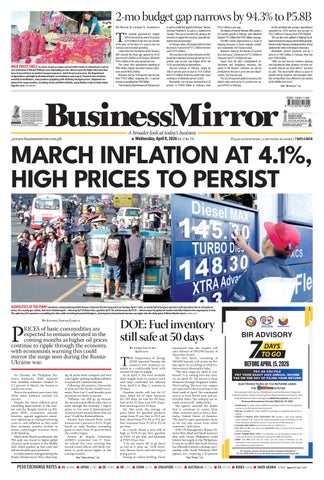
BULB PRICES SWELL An onion vendor arranges red and white onions in Cabanatuan as prices rise to between P300 and P400 per sack, depending on size, driven in part by higher fuel costs that have increased farm-to-market transport expenses. Amid the price pressures, the Department of Agriculture said eight institutional buyers are looking to source up to 16 metric tons of onions monthly from Mindoro, a key producer grappling with declining farmgate prices. Shipments are planned for major markets, including Cavite and Metro Manila, using Kadiwa trucks to help reduce logistics costs. ROY DOMINGO
2-mo budget gap narrows by 94.3% to ₧5.8B
By Reine Juvierre S.
us up for a stable first quarter of this year,” Finance Secretary Frederick D. Go said in a statement on Tuesday. “This acts as our safety net, giving us the resources to support the economy, especially during this time of uncertainty.”
In February alone, the budget deficit inched down by 0.14 percent to P171.2 billion from last year’s P171.4 billion.
This was due to the early remittance of dividends that improved revenue growth by 43.52 percent year-on-year and helped offset the 25.83-percent jump in expenditures.
Non-tax revenues in February surged by 540.23 percent year-on-year to P111.5 billion from P17.4 billion, driven by earlier-than-usual remittance of dividends earned in 2025.
Meanwhile, tax revenues increased by 6.59 percent to P249.8 billion in February from
strong fiscal performance in February sets
P234.3 billion a year ago. The Bureau of Internal Revenue (BIR) posted a 8.51-percent growth in February, with collections rising to P173.2 billion from P159.7 billion a year ago. The BIR’s steady improvement is a result of ongoing measures to boost taxpayer compliance nationwide, the Treasury noted.
Revenues raised by the Bureau of Customs also went up by 2.68 percent to P73.3 billion in February from P71.8 billion last year.
PRICES
By Justine Xyrah Garcia
of basic commodities are expected to remain elevated in the coming months as higher oil prices continue to ripple through the economy, with economists warning this could mirror the surge seen during the RussiaUkraine war.
On Tuesday, the Philippine Statistics Authority (PSA) reported that headline inflation climbed to 4.1 percent in March, the fastest in nearly two years. This is the quickest pace since July 2024, when inflation reached 4.4 percent.
Despite the latest inflation print exceeding expectations of the market and the Bangko Sentral ng Pilipinas (BSP), economists warned, however, against aggressive monetary tightening or raising borrowing costs to curb inflation as this could slow economic activity further or worse, could trigger recession. Story in B3 Banking
Much of the March acceleration, the PSA said, was traced to higher global oil prices amid tensions in the Middle East, which pushed up fuel costs and fed into broader price pressures.
A similar pattern emerged during the Russia-Ukraine war in 2022, when surg-
ing oil prices drove transport and food costs higher, pushing headline inflation to a peak of 8.1 percent that year.
Following this pattern, University of Asia and the Pacific (UA&P) economist Peter Lee U said broader price pressures are likely to persist.
“Inflation can still go up because the second-round effects take time to work through the economy. I expect prices to rise even if [international] oil prices hover around where they are now,” U told the BusinessMirror.
Reuters data showed Brent crude futures rose 1 percent to $111.53 per barrel on early Tuesday, extending gains to more than 50 percent since the conflict began.
Ateneo de Manila University (ADMU) economist Luis F. Dumlao echoed this view, warning that second-round effects will likely continue to push prices higher in the coming months.
TBy Lenie Lectura @llectura
HE Department of Energy
(DOE) reported Tuesday the country’s fuel inventory remains at a comfortable level, with around 50 days of supply.
As of April 3, the total available days’ supply, both in-country stock and total confirmed for delivery from April 4 to May 1, remains at 50 days.
Gasoline stocks will last for 57 days, diesel for 47 days, kerosene for 106 days, jet fuel for 66 days, fuel oil for 52 days, and LPG (liquefied natural gas) for 33 days.
For this week, the average oil price hikes for gasoline products range from P1 per liter to P2.9 per liter, diesel from P11.80 to P14 per liter, kerosene from P1.30 to P2.50 per liter.
As a result, diesel is now sold as high as P154.20 per liter, gasoline at P104 .10 per liter, and kerosene at P169.29 per liter.
“I do not expect [it] to go down as fast as it went up,” DOE Secretary Sharon Garin said referring to pump prices.
During an online briefing, Garin
announced that the country will take delivery of 900,000 barrels of diesel this month.
The first batch, consisting of 300,000 barrels, will arrive on Friday, April 10, according to DOE Undersecretary Alessandro Sales.
“The first cargo for April is confirmed. It is coming into the country on April 10. The source is from Malaysia through Singapore trader, Vitol trading. The next two cargoes are expected in the second up to the third week of April. The nominated source is from North Asia and potentially India. The volumes are already contracted,” added Sales.
The agency assured the public that it continues to source from other countries such as Africa, Australia, United States of America.
“We need to open agreements there so we can also access from other countries,” said Garin.
DOE-Oil Management Bureau Director Rino Abad said Saudi Aramco’s deal with Unioil Philippines could bolster fuel supply in the Philippines. It may be recalled that Saudi Aramco has officially entered a strategic partnership
jobs to our people, we (should) meanwhile work together to maintain a rulesbased world order, and make sure that we stand in defense—as you (do) every day through these ships for what is your right, just as we stand strongly in Europe on what is our rights in a difficult situation with Ukraine,” Mellbin said.
For his part, Admiral Marayag said the ceremonial launch of the commemorative logo affirmed the close ties between two nations “whose histories, economies, and futures are closely linked to the sea.”
“The maritime domain is more than a physical expanse. It is a space where peace, stability, and freedom of navigation must be sustained, and where our marine resources must be conserved and responsibly utilized,” Marayag said.
“For the Philippine Navy, this commemoration is also significant because it reminds us that maritime security is never the responsibility of one nation alone,” he added.
“With this shared maritime character, the Philippine Navy finds in Denmark a natural and enduring partner,” Marayag also said.
Manufacturing grows 3.2% in Feb on industry expansions
By Justine Xyrah Garcia
THEcountry’s manufacturing output posted a growth of 3.2 percent in February, according to the Philippine Statistics Authority (PSA).
Results from the Monthly Integrated Survey of Selected Industries (Missi) showed the Volume of Production Index (VoPI) growth in February was higher than the 1.3 percent recorded in January 2026 and a reversal of the 2-percent contraction in February 2025.
According to PSA, the growth in VoPI was largely due to expansions in several industries, led by the manufacture of basic metals which surged by 18.7 percent from a 6.1 percent decline in the previous month.
equity stake in the Filipino company.
“We will be expecting an official notification from Unioil. This was presented before and Saudi Aramco is very keen in entering the Philippine oil market again through Unioil,” said Abad.
This was followed by manufacture of food products which grew by 3.4 percent, and manufacture of beverages which increased by 7.2 percent.
On the contrary, 10 industry divisions recorded decreases in VoPI, led by the manufacture of basic pharmaceutical products and pharmaceutical preparations which posted the steep -
est contraction of 40.1 percent during the month.
This was followed by manufacture of fabricated metal products, except machinery and equipment at -23.7 percent, and manufacture of coke and refined petroleum products at -19.5 percent.
In terms of the Value of Production Index (VaPI), PSA said it grew by 4.6 percent in February 2026. This was faster than the 2.6- percent growth in January 2026 and a turnaround from the 1 percent decline in February 2025.
The growth in VaPI for February 2026 was attributed to increases in 13 of the 22 industry divisions, led by the manufacture of basic metals which expanded by 21.8 percent, a sharp reversal from its 4-percent contraction in January.
On the other hand, the remaining
nine industry divisions posted declines, with the manufacture of basic pharmaceutical products and pharmaceutical preparations registering the fastest annual drop of 39.8 percent. Meanwhile, PSA data showed that the average capacity utilization rate for manufacturing slightly eased during the month.
Capacity utilization BASED on responding establishments, the average capacity utilization rate for the manufacturing sector in February 2026 was reported at 77.5 percent, slightly lower than the 77.8 percent in January 2026 but higher than the 76 percent recorded in February 2025.
The statistics office said all industry divisions posted capacity utilization rates of more than 60 percent, with the manufacture of tobacco products recording the
highest at 83.1 percent. This was followed by other manufacturing and repair and installation of machinery and equipment at 81.4 percent, and manufacture of wood, bamboo, cane, rattan articles and related products at 81.2 percent.
The PSA said the proportion of establishments operating at full capacity (90 percent to 100 percent) reached 32.5 percent of total respondents.
Meanwhile, 41.6 percent operated at 70 to 89 percent capacity, while 25.9 percent operated below 70 percent capacity.
The Missi or the Production Index and Net Sales Index, monitors the production, net sales, inventories, and capacity utilization of selected manufacturing establishments to provide flash indicators on the performance of the manufacturing sector.
clients reassess budgets.” (See, “PHL tourism faces headwinds as fuel prices surge, flights cut,” in the BusinessMirror, March 29, 2026.)
However, John Paolo R. Rivera, senior research fellow at the state-run think tank Philippine Institute for Development Studies (PIDS), cautioned that the deficit may widen again as spending normalizes and capital outlays pick up.
experienced “a clear softening of market confidence, particularly within our MICE segment, with early cancellations and a more cautious approach to bookings as
A subsidiary of the Andrew Tanled Megaworld Corp., MHR is reputed to be the largest homegrown hotel operator with over 8,500 keys nationwide.
“The improvement may not be fully sustained in the coming months, as non-tax revenues are typically one-off or timing-related,” Rivera said, since the data shows some front-loading on the revenue side rather than a broad-based fiscal consolidation.
“Even if global price of oil stays where it is now, the next round of price increases will come from pass through to other commodities like food,” Dumlao told this newspaper.
Transport costs
PSA data showed transport costs surged by 9.9 percent in March, accounting for more than half, or 54.8 percent, of the overall increase in inflation.
This was driven by faster increases in gasoline and diesel prices, which posted inflation rates of 27.3 percent and 59.5 percent, respectively.
The agency also noted that pump inflation in March were the highest since September 2022, during the Russia-Ukraine war, when gasoline inflation hit 59.5 percent and diesel reached 74.2 percent. Food and non-alcoholic beverages likewise contributed to the March acceleration, with inflation rising to 3 percent, while housing, water, electricity, gas and other fuels (HWEGO) increased to 4.5 percent.
While some analysts see parallels with the 2022 surge, Philippine Institute for Development Studies (PIDS) Senior Research Fellow John Paolo R. Rivera said a repeat of that episode is “less likely” at this stage.
“Current baseline forecasts still point to inflation remaining within the BSP’s 2-to 4- percent target for the year, although risks are clearly tilted to the upside if oil prices remain elevated,” Rivera told the BusinessMirror
For his part, Former Socioeco -
nomic Planning Secretary Dante B. Canlas said the latest inflation spike reflects the broader spillover from geopolitical tensions, as disruptions in global oil supply—particularly from the Strait of Hormuz—raise production, transport and distribution costs.
“Domestic prices will stay elevated if the oil-price increase persists,” Canlas told the BusinessMirror
For ADMU economist Ser PeñaReyes, “Perhaps, the current situation can be better described as a temporary, externally driven flare-up with upside risks, but not yet a full-blown inflation cycle like 2022–2023.”
Poorer households hit harder
CANLAS also noted that lower-income households remain especially vulnerable, as demand for essential goods such as food stays high.
“The poor’s demand for essential commodities like food remains high, thereby keeping prices of the poor’s consumption basket high,” he said.
For Pena-Reyes, a higher inflation rate for the bottom 30 percent is a distributional warning sign. It means price pressures are not just rising, but hitting poorer households harder than average. Price pressures appear to be concentrated in essentials (especially food) and are disproportionately burdening lower-income households. It is not just an inflation story. It is a cost-of-living and inequality story, where the most vulnerable are already feeling a sharper squeeze than the headline number implies.
Based on PSA data, inflation for the bottom 30 percent of households rose to 4.2 percent in March, from 2.5 percent a month earlier. Food and non-alcoholic beverages emerged as the main driver of inflation for this group, accounting for 56.2 percent of the total, with price growth at 3.9 percent. Transport followed, posting a 7.2 percent inflation rate, while HWEGO rose by 4.6 percent.
This trend is consistent with earlier findings by the state think tank PIDS, which noted that poorer households
are often hit hardest by oil shocks— not at the pump, but through higher food prices.
‘Double squeeze on consumers’ BEYOND rising commodity prices, the purchasing power of the peso continues to weaken, slipping to P0.75 in March.
This means that P1,000 today is worth only about P750 in real terms. PSA data showed the peso’s purchasing power has not returned to its P1.00 level since it was last recorded in July 2018. Dumlao said poorer households will be “adversely affected” by this trend.
Rivera added that the decline in purchasing power, alongside rising inflation, is creating a “double squeeze” on consumers.
He explained that rising prices erode real incomes, while weaker purchasing power limits households’ ability to spend.
“This will likely lead households to prioritize essentials and cut back on discretionary spending which could dampen overall demand and slow growth in the coming months,” Rivera added.
Gov’t response DESPITE mounting inflationary pressures, Department of Economy, Planning, and Development (DepDev) Secretary Arsenio M. Balisacan said the government “stands ready to address emerging inflation pressures through strategic, well-targeted, and time-bound interventions.”
Balisacan said the government is strengthening its coordinated response through Executive Order No. 110, which created the UPLIFT Committee to identify and implement targeted measures to cushion the impact of rising prices.
These include securing fuel supply, easing transport costs, ensuring food availability, and providing targeted assistance to vulnerable sectors.
“The government is firmly committed to ensuring the continuous delivery of services, even as we pursue decisive measures to enhance the resilience of our economy and institutions, carefully balancing shortterm relief measures and longerterm considerations toward enabling the economy to recover high growth quickly,” Balisacan said.
www.businessmirror.com.ph
Energy projects dominate ₧6.43-T Green Lane list
By Bless Aubrey Ogerio
ENERGY-related investments, particu -
larly in renewable power, account for the bulk of projects endorsed under the government’s Green Lane initiative, which has reached P6.43 trillion in total approved investments as of end-March.
Trade Secretary Ma. Cristina Roque said the timely rollout of these projects is critical, especially those tied to energy supply, as the country continues to face cost pressures and demand constraints.
“Many of the projects under the Green Lane are in renewable energy and related infrastructure. Accelerating their implemen -
Data from the Board of Investments (BOI) showed that 244 projects have been certified under the program, with most concentrated in renewable energy, alongside public-private partnership (PPP) infrastructure, water, digital infrastructure and food security.
Senator assails cold storage operators for curbing farmers’ access
SBy Butch Fernandez
EN. Francis Pangilinan on Tuesday expressed serious concerns over reports that cold storage facilities are saturated with imported agricultural products, preventing local farmers from accessing essential storage services. This situation, Pangilinan said, “could worsen post-harvest losses and threaten national food security.”
Pangilinan, who chairs the Senate Committee on Agriculture, Food, and Agrarian Reform, plans to invite cold storage operators to a hearing on the current challenges facing the agriculture and fisheries sectors.
Citing that cold storage facilities play a critical role in preserving agricultural produce, he cited notes that the proper access to and use of these facilities stabilize food supply and ensure fair market prices. Complaints from farmers, however, indicate not only limited access to these facilities but also high fees and preferential treatment for big traders or importers. Such practices have effectively excluded
small-scale food producers from using cold storage facilities.
“So isa iyan, sa susunod na hearing, ipapatawag natin lahat ng cold storage operators pati mga trader. Mukhang pinipuwera,sinasadyanghindibigyanngcold storage ang ating mga magsisibuyas para ibenta nang palugi dito sa mga trader na ito.Kayabubusisiinnatiniyan,” Pangilinan said in a radio interview.
He explained that onions can last from six to nine months in cold storage, while they tend to rot easily when not stored properly.
He also called out the government for its ongoing import of onions during the harvest season, warning against abusive traders who may be responsible for the alleged restriction of farmers’ access to cold storage facilities, which forces them to sell their produce to the traders at lower prices.
“We are warning you. Huwagninyokamingpaikutinditoatkayomismosasampahan naminngkaso na agri-economic sabotage kapag nakita ang ebidensya,” Pangilinan stressed.
House starts multi-panel hearing on energy crunch
ALL systems are go at the House of Representatives for a high-level joint hearing on Wednesday as 13 key committees convene in a coordinated push to fast-track measures easing rising fuel costs and deliver both immediate and long-term solutions.
The hearing, set at 9:30 a.m. at the People’s Center Building, will be facilitated by Marikina City Rep. Romero Quimbo, chairman of the Committee on Ways and Means, marking the first formal session of the expanded panel tasked to craft a unified legislative response to the global fuel shock triggered by the escalating Middle East conflict.
Speaker Faustino G. Dy III has directed the said committees to consolidate data, coordinate with the Executive branch, and produce concrete policy interventions addressing both immediate relief and longterm resilience.
Also joining the hearing are the chairpersons of 12 other committees
leading the House response: Palawan Rep. Jose C. Alvarez (Energy), Quezon Rep. Mark Enverga (Agriculture and Food), Nueva Ecija Rep. Mikaela Angela B. Suansing (Appropriations), Camarines Sur Rep. Tsuyoshi Anthony Horibata (Aquaculture and Fisheries Resources), Antique Rep. Antonio B. Legarda Jr. (Economic Affairs), Pangasinan Rep. Maria Rachel J. Arenas (Foreign Affairs), Camarines Sur Rep. Miguel Luis R. Villafuerte (Information and Communications Technology), Cavite Rep. Ramon Revilla III (Labor and Employment), Agimat Party-list Rep. Bryan Revilla (Overseas Workers Affairs), Davao Oriental Rep. Cheeno Miguel D. Almario (Social Services), Mountain Province Rep. Maximo Y. Dalog Jr. (Trade and Industry), and Quezon City Rep. Franz S. Pumaren (Transportation). The hearing will focus on the country’s oil and energy supply situation amid tensions
See “Hearing,” A5
CamSur to launch ube development program
CAMARINES Sur is set to embark on a premier value chain program to take advantage of the purple yam’s or ube’s ready market locally and abroad.
In a recent session, the Sangguniang Panlalawigan approved Ordinance 040 series of 2026 declaring purple yam (scientific name: Dioscorea Alata) as the province’s priority crop, and establishing the CamSur Ube Development Program as the blueprint for developing “a comprehensive ube value chain from farm to export” to harness the full economic potential of this crop as another driver of the province’s rapid growth and catalyst for better lives for its small farmers.
Gov. Luis Raymund Villafuerte said this provincial board-approved program aims to “replicate—and even surpass—the success
tation is important to help address energy supply requirements, stabilize costs, and support continued economic activity,” Roque said, who is also the BOI chairman.
She added that delays in permitting and coordination remain key challenges, underscoring the need to streamline processes across agencies.
“This is why streamlining permitting and improving coordination across agencies remains a priority,” she said.
of Japan in transforming matcha or green tea powder into a superb export winner by assigning purple yam with preferential consideration in the agricultural support programs, technical assistance, extension services, enterprise development initiatives and value chain investments of the provincial government.” In Ordinance 40, its sponsor, Sanggunian member Regin Oliver Oliva, noted that their province is “endowed with fertile volcanic soil, favorable climate conditions and agricultural expertise that makes it ideally suited for the cultivation of ube with its significant potential for economic development and global market expansion.”
Citing recent market data, Oliva said that
Despite the large investment pipeline, most projects are still in early stages. Around 171 projects valued at P5.79 trillion remain in pre-development, reflecting the scale and complexity of investments that require multiple approvals and technical preparation. A smaller number have progressed further. About 46 projects worth P359.64 billion are currently under construction, while eight projects valued at P6.99 billion are in the pre-operation stage.
Meanwhile, 19 projects with a combined value of P266.85 billion are already operational, mainly in renewable energy, digital infrastructure and food security.
The BOI said the gradual movement of projects into construction and operation suggests that earlier approvals are beginning to translate into actual economic activity, including job generation and expanded access to services.
The Green Lane initiative, institutionalized under Executive Order 18, aims to speed up the processing of permits and clearances for
CDC suspends ₧1 fuel royalty fee
By Ashley J. Manabat
CLARK FIELD, Pampanga—The
Clark Development Corporation (CDC) has suspended its P1-perliter regulatory royalty fee on petroleum fuel deliveries into the Clark Freeport Zone to help ease operating costs for businesses and workers amid ongoing economic pressures.
CDC President and Chief Executive Officer Agnes VST Devanadera said that the suspension took effect April 1 and will run for two months.
The measure, approved through a board resolution under Memorandum Circular 110, s. 2026, is expected to result in foregone revenues of about P12.5 million.
Despite the projected losses, Devanadera said the move is a temporary relief measure and does not waive government revenues.
“This does not mean we are giving up revenues entirely. Regulatory oversight remains in place, but the goal is to help reduce operating costs and support business continuity within the free port,” Devenadera said.
To ensure fuel availability, Devanadera said CDC has secured a commitment from Petron Corporation to allocate supply specifically for Clark locators.
Petron has implemented a prioritization system classifying locators into essential services, support services and other business operations, based on survey data and validated fuel consumption requirements.
Devanadera added that recent fuel shipments, including those reportedly sourced from Russia, have already been unloaded at Petron’s refinery. Fuel distribution within Clark is currently being carried out through Petron stations operating in the area.
“Other gas stations may open, provided they have their own supply. For now, since only Petron has available supply, distribution is through Petron stations,” Devenadera said.
Noelle Mina Meneses, CDC vice president for the Business Development and Business Enhancement Group, urged locators to participate in ongoing surveys to help refine allocation strategies and better match supply with demand.
Meneses said transport operations within the free port remain stable, with Clark Loop routes and fares unchanged.
Beyond short-term relief measures, CDC is implementing longer-term strategies to strengthen economic resilience in the zone.
Devanadera said the agency is monitoring business activity, including reservations
in key areas such as the Parade Grounds, and noted mixed impacts across locations.
“Our people are monitoring activities and tourists. It appears the number of people who went to the Parade Grounds is still full and even establishments and hotels are fully booked,” Devenadera said.
Devenadera added, however, that businesses located farther from the Parade Grounds have experienced a decline in foot traffic.
“Those far from the Parade Grounds are feeling the reduction because visitors tend to stay where they park,” she added.
Despite these shifts, CDC expressed optimism for ongoing and planned developments.
Drawing lessons from the Covid-19 pandemic, Devenadera said they are strengthening supply chain stability through “business interdependence,” an initiative that encourages locators to share information on available products
in Clark Freeport
and services to support internal sourcing within the freeport.
“We want to expand opportunities for locators to support one another. Strengthening these linkages will help sustain our supply chain even during disruptions,” Devanadera said.
Meneses added that as part of efforts to improve the ease of doing business, CDC will roll out an automatic renewal system for authorities to operate starting April 8.
The system grants eligible locators, those in good standing with no regulatory violations, a three-year permit renewal without the need for manual application.
“For 2026, we have 194 qualified locators who will benefit from this automatic renewal,” Meneses said. “They simply wait for notification that their permits are ready for pickup.”
By Lorenz S. Marasigan @lorenzmarasigan
“We still feel investor confidence is here. For those who are not yet here, they want to be part of the Clark community,” said Meneses. “We are very positive that tourism and investment will continue to flourish here.”
Meneses also encouraged companies to adopt alternative work arrangements to manage fuel consumption, including a four-day workweek with compressed hours from 8 a.m. to 7 p.m.
CDC officials also reported sustained investor confidence in the free port. Meneses said the agency continues to close deals with investors despite current challenges.
A4
Wednesday, April 8, 2026
‘Mary Grace Piattos’ hounding
Sara in impeach case at House
THE controversial name “Mary Grace Piattos” again surfaced in documents submitted by the Commission on Audit following a House Committee on Justice subpoena to a state auditor, in connection with records tied to Vice President Sara Z. Duterte’s use of confidential funds.
In a “subpoena ad testificandum et duces tecum,” the panel directed State Auditor Gloria A. Camora of COA’s Intelligence and Confidential Funds Audit Office, through COA chairman Gamaliel Cordoba, to appear at the April 14, 2026 hearing and submit original documents covering the use and liquidation of confidential funds.
“You are hereby directed to appear before the Committee on Justice on April 14, 2026, 10:00 A.M., at the 2nd Floor of the People Center, House of Representatives, and to submit the following documents at least five [5] working days prior to the said hearing,” the order read.
The subpoena, issued in connection with the verified impeachment complaints against Duterte, compels the submission of extensive original records from both the Office of the Vice President (OVP) and the Department of Education (DepEd) covering confidential fund transactions from 2022 to 2023.
Lawmakers are seeking “all the submissions by the OVP to COA in relation to the liquidation of confidential funds” across multiple quarters, including checks, disbursement vouchers, liquidation reports, certifications and accomplishment reports, as well as proof of submissions to Malacañang, the Senate and the House. Among the documents cited were
check and voucher transactions dated from December 2022 to July 2023, liquidation reports, and sworn certifications by accountable officers.
The committee also required records that could shed light on the integrity of disbursements, including “Documentary Evidence of Payments [hereinafter, DEPs] bearing specific payee names.
“These include:
n DEP s with payee name ‘Milky Secuya’”
n DEP s with payee name ‘Kokoy Villamin’”
n DEP s with payee name ‘Mary Grace Piattos’”
n DEP s with payee name ‘Irene Tan’”
The subpoena further covered documents “where the names of the payee are either unreadable, have incomplete names, are unsigned, have no names at all, or are undated,” as well as those “showing the physical impossibility of actual disbursement.”
Subpoena to BIR THE House Committee on Justice has also subpoenaed the Bureau of Internal Revenue (BIR) to produce tax records of Duterte and her husband Manases Carpio, including nearly two decades of income tax returns, as part of the ongoing impeachment proceedings.
In a subpoena ad testificandum et duces tecum dated March 31, 2026, the panel directed BIR Commissioner Charlito Martin R. Mendoza to appear before lawmakers on April 14, 2026 at 10:00 a.m. at the House of
Representatives in Quezon City.
“You are hereby directed to appear before the Committee on Justice on April 14, 2026, 10:00 A.M., at the 2nd Floor of the People Center, House of Representatives, and to submit the following documents,” the order reads.
The subpoena stems from the verified impeachment complaints against Duterte endorsed by several lawmakers.
Lawmakers are seeking “tax compliance and reported income of Sara Z. Duterte, her spouse, Manases Carpio, and various business entities in which they hold interest,” as well as “original or certified true copies of the Annual Income Tax Returns of Sara Z. Duterte, her spouse, Manases Carpio, for the years 2007 to 2025.”
The order also covers multiple corporations and business interests allegedly linked to the couple, including Metro City Chow Foods Corp., Gencorp Industries Inc., Carpio Lawyers, 888 Bistro, CALE88 Foods Corp., Madayaw Fisheries Corp., Mati City Ice Plant and Cold Storage Inc., Amianan Shores Inc., Geometry Security and Investigation Agency Inc., and Cabletow 88 Shipping and Marine Services Inc.
The panel, the records are needed “to identify and authenticate the submissions to your office, such as but not limited to the Income Tax Returns and Annual Financial Statements of Vice President Sara Zimmerman Duterte and her spouse, Manases Carpio, as well as the various entities in which they hold interests, as well as testify thereon.”
The order was issued “by authority of the Committee,” and signed by Justice Committee chairperson Gerville Luistro of
Batangas, Speaker Faustino “Bojie” G. Dy III, and attested by Secretary General Cheloy E. Velicaria-Garafil.
Notary
THE House Committee on Justice has subpoenaed the lawyer who notarized the affidavit of Ramil Lagunoy Madriaga, ordering her to appear and submit key documents in connection with the impeachment complaints against Duterte as the panel ramps up its evidence-gathering ahead of its April hearings.
In a “subpoena ad testificandum et duces tecum,” the committee directed lawyer Cynthia Viñas-Pantonal to attend the hearing set on April 14, 2026, at the House of Representatives in Quezon City.
“You are hereby directed to appear before the hearing of the Committee on Justice on April 14, 2026, 10:00 A.M., at the 2nd Floor of the People Center, House of Representatives, and to submit the following documents at least five [5] working days prior to the said hearing,” the order reads.
The subpoena also requires the submission of the original affidavit of Ramil Madriaga, dated November 29, 2025, which the lawyer notarized.
“You notarized the Affidavit of Mr. Madriaga. Your testimony will be needed to identify and authenticate the copies of Mr. Madriaga’s Affidavit attached to the impeachment complaints,” the committee stated.
The directive forms part of the panel’s ongoing proceedings on the verified impeachment complaints filed against Duterte, endorsed by several lawmakers. With Samuel P. Medenilla
DILG chief vows to end ‘organized crime’ at BFP
IBy Jonathan L. Mayuga @jonlmayuga
NTERIOR Secretary Juanito Victor Remulla has renewed his vow to dismantle what he described as an “organized crime syndicate” within the Bureau of Fire Protection (BFP) and called on the agency’s personnel to rally behind the campaign.
“I’m going to put an end to this! Tigilna
iyan!” Remulla declared. He pointed to a deeply entrenched system spanning multiple levels within the organization. “From admission, to inspector, to firefighting, to procurement, iisa ang toka. Lahat iyan alam kung ano ang ginagawa,” he said, describing what he believes to be coordinated and systemic wrongdoing.
His statement comes on the heels of the suspension of Metro Manila safety fire
inspectors (SFIs) and the earlier filing of charges against the former BFP director, Jesus Fernandez, and other officials over alleged irregularities in the procurement of fireengines.
Remulla also acknowledged that intensified internal cleansing has temporarily affected procurement timelines, particularly for fire equipment, but reiterated that restoring integrity within the BFP is nonnegotiable, underscoring that public safety institutions must remain beyond the reach of organized corruption.
Despite his seemingly firm stance, the DILG chief called on the Bureau of Fire Protection (BFP) to stand with him to eliminate corruption and restore integrity within the organization.
Remulla’s appeal culminated the organization’s observance of the Fire Prevention Month, wherein he delivered a direct message to BFP personnel and leadership, underscoring that reform requires collective action and accountability.
“Help me clean up the BFP. Help me make the lives of the Filipino people better. Help me get rid of corruption in our Department. It is not only up to me, kailangan ko kayo,” he said.
The DILG chief underscored that while challenges persist, his confidence in the
Bureau remains.
“I still believe in all of you. My respect is still there. But you have to understand me. mean business. I don’t need anything,” Remulla added.
He emphasized that public service, especially in the fire service, is a calling grounded in trust and discipline, warning that the pursuit of personal gain erodes both credibility and purpose, even as he acknowledged the impact of ongoing reforms on personnel and their families, stressing that these difficult but necessary measures are meant to rebuild public trust and strengthen the institution.
Remulla also led the oath-taking of four newly promoted Fire Chief Superintendent Andrew A. Mendova, Robert M. Pacis, Aldwin M. Salazar, and Edwin P. Vargas. Alamkonaapektuhananginyongpagkatao, naapektuhan ang inyong pamilya, naapektuhan ang buong institusyon. Pero laginiyongiisipinnaginagawakoitohindi para sa aking sarili kundi ginagawa ko ito para sa Pilipinas,” he said.
Remulla reiterated that firm and decisive action is required to address corruption within the Bureau.
Asahan ninyo, in the long run, people will appreciate this and understand. Reform is often painful but it is necessary,” he said.
www.businessmirror.com.ph
PH, US Cope Thunder air combat exercises start
By Ashley J. Manabat
CLARK FIELD, Pampanga—Some
2,800 Philippine and United States military personnel will take part in joint air combat drills as the Air Force (PAF) and the US Pacific Air Forces (Pacaf) formally opened this year’s Cope Thunder exercises on Monday.
The opening ceremony was held at the Air Force City Officers’ Clubhouse to mark the start of the drills.
The exercise, dubbed Cope Thunder 26-1, will run until April 17 and feature high-intensity aerial maneuvers including a planned engagement between the PAF’s FA-50 “Fighting Eagles” fighter jets and the US Air Force’s F-22 “Raptor” stealth air-superiority fighters.
Maj. Gen. Dennis Estrella, commander of the PAF Air Logistics Command, led the ceremony and emphasized the importance of the exercise in enhancing the country’s defense capabilities.
“This exercise serves as a vital platform
for refining operational readiness and strengthening our ability to respond to dynamic security challenges,” Estrella said. “Pacaf is the major unit of the USAF with their area of responsibility is the Indo-Pacific region. This is purely Air Force training operations,” he added. Brig. Gen. Angelito Retuta heads the Philippine contingent, while Brig. Gen. Phillip Mallory of the Hawaii Air National Guard leads the US delegation. Estrella said the annual bilateral exercise aims to improve interoperability between Filipino and American forces, a key component of the two countries’ longstanding defense alliance. Training activities include tactical exchanges and complex air operations designed to simulate real-world scenarios.
Military officials said this year’s exercise also includes participants from Australia, Thailand, South Korea, Malaysia, Indonesia and Japan under an international observers program.
Palace: Marcos backs investigations on flood control projects
PBy Samuel P. Medenilla @sam_medenilla
RESIDENT Marcos will continue to support all ongoing government investigations on those linked to anomalous flood control projects, which will soon include his cousin, Leyte Rep. Ferdinand Martin G. Romualdez, Malacañang said.
“We know that President Marcos was the one who led the investigation into the anomalous flood control projects and he wants to hold accountable those who are behind the said anomalies,” Palace Press Officer Claire Castro said in Filipino in a statement last Wednesday.
However, she stressed that the Chief Executive wants the investigation to comply with due process and based strictly on evidence.
“Evidence is the key and due process is needed. Hastily filing cases without basis or with planting evidence is not the job of this administration,” Castro said.
“Filing cases is studied, scrutinized and not just for [getting] the [attention of the] media like some people who just make noise [about the issue], but do not help in investigating and holding those who are guilty accountable,” she added. Castro issued the statement after Ombudsman Jesus Crispin C. Remulla announced they preparing plunder cases against Romualdez, the former Speaker, as well as Sen. Francis Escudero, the former Senate President, that will be filed next month.
Remulla said the cases will involve the role of both former leaders of Congress in the passage of the national budget during their watch.
Romualdez and Escudero has previously denied they allowed questionable insertions in the national budget, when they led the House of Representatives and the Senate, respectively.
Romualdez vows full cooperation
THE camp of Leyte Rep. Ferdinand Martin G. Romualdez has underscored its readiness to cooperate with authorities, stressing respect for due process amid reports of a supposed plunder complaint being readied against the former Speaker.
Ade Fajardo, lawyer-spokesperson for Romualdez, emphasized that the camp will fully cooperate with the Office of the Ombudsman should formal proceedings be initiated.
“We respect the processes of the Office of the Ombudsman and will fully cooperate if and when a formal proceeding is initiated,” Fajardo said.
“We have taken note of news reports regarding the alleged preparation of a complaint involving Rep. Ferdinand Martin G. Romualdez,” Fajardo said.
“To be clear, this refers only to a reported preparation of a complaint—there is no filed case, no finding of probable cause, and no determination of liability at this time,” Fajardo said.
Fajardo added that they trust the Ombudsman to adhere to established legal standards in evaluating cases.
“We trust that the Ombudsman will fully adhere to the circular that he instituted and signed as then Secretary of the Department of Justice, that DOJ prosecutors should only pursue cases with ‘reasonable certainty of conviction,’” he said.
The camp also maintained that there is, at present, no evidence linking Romualdez to the allegations tied to flood control projects.
“We want to emphasize that, to-date, there is no evidence linking Rep. Romualdez to any ghost and substandard projects pertaining to the flood control issue,” Fajardo said.
“We remain confident that these matters will be resolved based on evidence and due process—not politics or speculation,” Fajardo added.
www.businessmirror.com.ph
Pork returned with vengeance during Marcos watch–Monsod
UNIVERSITY of the Philippines (UP)
economics professor Solita “Winnie”
Monsod on Tuesday said a more “sophisticated” pork barrel system, which was already declared unconstitutional by the Supreme Court (SC) in its 2013 ruling, has returned “with a vengeance” and in “obscenely larger scale” under the Marcos administration. Monsod is one of the four amici curiae or “friends of the Court” that were invited by the Supreme Court (SC) in Tuesday’s oral arguments to share their positions on the four consolidated petitions assailing the constitutionality of the various adjustments made by the Bicameral Conference committees that inflated the 2024, 2025, and 2026 national budgets. The adjustments assailed in the petitions involve unprogrammed appropriations and special accounts in the GAAs.
Aside from Monsod, former Senate President Franklin Drilon, former budget secretary and current Bangko Sentral board member Benjamin Diokno and former budget secretary Florencio Abad also appears before the Court as amici curiae.
Monsod said pork barrel came back “with a vengeance” after the SC abolished the Prior -
ity Development Assistance Fund (Pdaf) or the pork barrel fund during the term of the late President Benigno Aquino Jr. for being unconstitutional.
Under the term of Marcos , Monsod said a more “sophisticated” pork barrel system was adopted since it is now embedded in the budget allotted for infrastructure projects, including flood control projects under the Department of Public Works and Highways (DPWH).
“The entire DPWH infrastructure budget became the pork barrel,” she said. Monsod also described the current pork barrel system as “obscenely larger in scale” compared to PDAF which amounted to P24 billion.
Since 2023, Monsod said the entire infrastructure budget of the DPWH has become pork barrel which can be divided into “allocables” amounting to P393 billion and non-allocables amounting to P732 billion.
Under the current pork barrel system, the UP professor told the Court, the choice of projects are made mostly while the National Expenditure Program (NEP) is being prepared.
For his part, Drilon said the unprogrammed appropriations is not “inherently unconstitutional” as it has been a consistent feature of
the national budget since 1989.
He noted that Congress has consistently integrated unprogrammed appropriations as a component of the General Appropriations Act (GAA) in line with Article 6, Section 25, paragraph 1 of the Constitution which states: “The form, content or manner of budget preparations shall be prescribed by law.”
Drilon told the Court that only Congress and the Executive branch can exclude unprogrammed appropriations as a component of the annual budget.
“I also submit that classifying funds as either programmed or unprogrammed is an exercise of the power of the purse, whether an item is accorded immediate or a contingent funding is deliberate policy decision rooted in the wisdom of Congress to balance immediate operational mandate against contingent fiscal realities,” Drilon pointed out.
“In this perfect storm your honors the violation is not found in the text of the law but in the arithmetic of the execution,” he added.
Diokno also shared Drilon’s observation that unprogrammed appropriations has been part of the national budget since 1987.
Likewise, he noted that unprogrammed appropriations approved by Congress ex -
ceeded the proposed unprogrammed appropriations from 2005 to 2026.
However, he described the “abuses” done by Congress in unprogrammed appropriations in the last three years as “monumental.”
Abad, on the other hand, noted that past four decades budget surpluses have occurred only briefly during the administration of the late President Fidel Ramos.
He added that revenue targets have been exceeded in only a handful of years.
“This means that in the ordinary course the conditions required to validly trigger unprogrammed appropriations do not exist,” Abad said.
Abad added that the Constitution already provides a complete framework for fiscal governance.
“The issue before the Court is not whether flexibility is desirable, it is whether that flexibility may operate outside the constitutional structure that governs the budget,” Abad explained.
“The constitution allows flexibility but it requires that decisions on how public funds are spent remain in the legislative appropriation process and do not migrate into the execution stage of the budget,” he added. Joel R. San Juan
Stakeholders gather to assess new studies to address plastic pollution
VARIOUS stakeholders from the national and local governments, businesses, civil society, academe, development sector, and communities have come together to help address plastic pollution and advance a circular economy.
Called the National Plastic Action Partnership (Npap) Philippines, a locally driven multi-sector platform led by the Department of Environment and Natural Resources (DENR), the initiative brought together stakeholders from across the plastics value chain to discuss key findings of two assessments: PlastiBASE, a study that explores how plastic pollution affects ecosystems and communities in the Philippines, and a Gender Equity and Social Inclusion (Gesi) Assessment which examines how gender, communities, waste workers, and other stakeholders experience the impacts of plastic pollution.
Insights from Npap Indonesia’s similar research on plastics and biodiversity were also presented, underscoring the impact of marine debris on wildlife and reflecting coastal communities’ growing environmental awareness and concerns over the impacts of plastic pollution.
“These are critical dimensions of the plastic challenge that are too often overlooked,” Environment Undersecretary for Policy, Planning, and International Affairs Jonas Leones noted in his welcome remarks.
“Through these assessments, we are deepening our understanding of how environmental action can also advance social inclusion, community resilience, and equitable development.”
These assessments were presented during plenary sessions, followed by facilitated dialogues and breakout sessions where participants further reflected on these studies, shared perspectives from their sectors, and identified key opportunities for action. Insights ranged from scientific perspectives on marine ecosystems and biodiversity to experiences from waste management practitioners, policymakers, businesses, and community groups working on the ground.
“Plastic at the end of the day is as much about biodiversity, climate, economy, and health. But first and foremost, it is also about governance. Tackling plastic pollution will be determined by the appropriate, timely, and targeted governance and policy decisions that are being made,” Edwine Carrie, United Nations Development Fund Philippines Deputy Resident Representative, said.
“Npap’s role in this process is multi-fold, including enabling the generation of evidence so that policy and governance decisions are based on solid evidence.”
The discussions underscored how plastic pollution intersects with environmental protection, economic systems, and social realities—particularly for communities and workers who play key roles in managing plastic waste.
Participants highlighted that these impacts are not evenly distributed, with vulnerable groups—especially women and informal waste workers—bearing a disproportionate burden despite their central role in waste management systems and often facing persistent systemic barriers.
“Biodiversity underpins our economies and ecologies. According to the first report of the World Economic Forum’s New Nature Economy Report (NNER) series, more than half of the world’s GDP, equivalent to US$44 trillion, is moderately or highly dependent on nature and the gains from nature. Yet this bounty, this biodiversity, is in steady decline, including due to plastic pollution. Plastic pollution also affects women and disadvantaged groups disproportionately, as they are at the frontlines of informal waste collection and management,” shared Jeet Kar, lead for Policy and Business Engagement of the World Economic Forum.
“For Canada, we are proud to have supported the plastics and biodiversity assessment, which is complementary to several other projects that we are supporting around the Philippines looking at environment, disaster risk reduction and resilience, and addressing mitigation and adaptation in terms of carbon emissions,” says Simon Snoxell, head of Cooperation and Counsellor (Development) of the Government of Canada.
The UK Government, which supported the Gesi assessment also highlighted the importance of recognizing the roles played by women and communities in the plastics value chain, particularly in informal waste management systems.
Lloyd Cameron, Economic and Climate Counsellor of the British Embassy Manila said: “We all know that women are central to the plastics value chains, from waste collection and sorting, to community-level recycling initiatives and shaping local environmental
decisions. But this is often in an informal capacity. So when we talk about formalising the waste economy, we must make sure that the specific barriers faced by women are understood and addressed to ensure the transition is just and inclusive.”
Npap Philippines brings together stakeholders across the plastic value chain to ensure national strategies to address plastic pollution are informed by a broad range of expertise and lived experience. Jonathan L. Mayuga
PNP units ordered to beef up operations against fuel pilferage, illegal storage
By Rex Anthony Naval
THE National Police (PNP) Chief, Gen. Jose Melencio Nartatez Jr., on Tuesday directed all police units to intensify monitoring and enforcement operations against fuel pilferage or “paihi,” as well as illegal fuel storage and distribution hubs.
This, after authorities recently discovered a diesel stockpile without proper permits inside a residential compound in Quezon City. Nartatez also ordered the National Capital Region Police Office to investigate the incident thoroughly, and instructed all regional offices to intensify monitoring and intelligencegathering in their respective areas of responsibility.
He said National Support Units such as the Criminal Investigation and Detection Group were also directed to assist in the campaign.
“These illegal activities pose real dangers to our communities.
We want to send a strong message that those who would dare to ignore our warning on this matter will be dealt with the full force of the law,” Nartatez said.
During the operation in Quezon City, police found out that the diesel was being stored in drums inside a compound in a residential area. Neighbors reported unusual activity in the area leading up to the discovery of the fuel pilferage where unmarked fuel is transferred from tankers into smaller containers. Investigators are still determining how long the stockpile had been there and whether similar depots exist in other communities.
“We are already coordinating with the DOE [Department of Energy] to ensure a solid case build-up against those involved,” Nartatez said The PNP chief also underscored the role of the public in maintaining safety as he vowed that any establishment of illegal fuel depots will be dealt with firmly. Rex Anthony Naval
agency’s pre-holiday projection of 2.46 million and down from the 2.41 million logged during the same period last year.
The PPA had forecast a modest 1.70-percent increase in volumes this season.
The Port Management Offices (PMOs) of Panay-Guimaras, Batangas, Negros OrientalSiquijor, Mindoro, and Davao posted the highest passenger counts among all PMOs nationwide.
PPA General Manager Jay Santiago attributed the shortfall partly to the weight that soaring oil prices have placed on travel budgets, but said port operations remained orderly throughout the period.
“If you notice, the flood of passengers at the ports is no longer what it used to be, owing in part to the high fares and petroleum prices,” he said. “Nonetheless, Semana Santa 2026 remained smooth and organized due to our early preparations and the cooperation of passengers with the new systems we have put
exports of ube and ube-based products reached $3.06 million in 2025, with a huge demand in the US, Europe, the Middle East and Asia, “demonstrating its substantial international commercial viability and market acceptance.”
The global success of Japan’s matcha industry, which grew from a regional specialty to a multibillion-dollar global market—thanks to strategic government support, quality standardization, geographic branding, and coordinated promotion—is a blueprint that CamSur can follow for transforming a local agricultural product into an internationally recognized premium ingredient, Oliva said. Like matcha powder, ube powder represents the most scalable and commercially viable format for global distribution, offering extended shelf life, stable natural color, ease of use in industrial applications, and compatibility with food, beverage, bakery, nutraceutical, and cosmetic manufacturing.
involving the United States, Israel and Iran, as well as the broader economic impact, government response, and proposed courses of action.
A full slate of Cabinet officials, regulators, and economic managers has been invited to brief lawmakers and present policy options.
Among those expected to attend are Energy Secretary Sharon Garin, Finance Secretary Frederick Go, Migrant Workers Secretary Hans Leo Cacdac, Economy, Planning and Development Secretary Arsenio Balisacan, Foreign Affairs Secretary Maria Theresa Lazaro, and Budget Secretary Rolando Toledo.
Also invited are Energy Regulatory Commission Chairperson Francis Saturnino Juan, National Electrification Administration Administrator Antonio Mariano Almeda, Philippine National Oil
in place to improve their port experience.”
Santiago noted that some passengers also opted to travel outside peak days to avoid the holiday rush, while others chose not to travel to distant provinces at all to cut expenses.
No accidents or untoward incidents were recorded at any PPA-managed port throughout the holiday period—a result the agency credited in part to the lighter-than-expected traffic.
The PPA said it would continue developing measures to improve passenger efficiency at its ports despite the ongoing pressures of high petroleum prices.
Company representative Maria Cristina Sheila Cabaraban, and PNOC-Exploration Corporation official Adrian Ferdinand Sugay.
Revenue and fiscal officials expected to attend include Internal Revenue Commissioner Charlito Martin Mendoza, Customs Commissioner Ariel Nepomuceno, and National Treasurer Sharon Almanza.
Officials from the Overseas Workers Welfare Administration, Bangko Sentral, and National Tax Research Center are also set to attend, together with representatives from the World Bank and the Asian Development Bank.
Quimbo earlier said the joint hearings aim to gather critical data and align the House’s legislative response with the Executive branch’s ongoing efforts, leading to measures that can be rolled out quickly to protect vulnerable sectors.
He said the multi-committee body is also expected to explore targeted assistance, fiscal support, and structural reforms to reduce the country’s exposure to global oil shocks.
A6 Wednesday, April 8, 2026
Editor: Angel R. Calso
Trump widens threat to all of Iran’s power plants and bridges as his deadline for a deal approaches
By Jon Gambrell, Samy Magdy, Bassem Mroue & Will Weissert The Associated Press
TEHRAN, Iran—US President Donald Trump expanded his threat against Iran to include all power plants and bridges Monday as his ultimatum to make a deal ticked closer, after Tehran rejected a 45-day ceasefire proposal and said it wants a permanent end to the war.
“The entire country can be taken out in one night, and that night might be tomorrow night,” Trump said. He suggested that his Tuesday 8 p.m. EDT deadline was final, saying he’d already given Iran enough extensions.
The US has told Iran to open the crucial Strait of Hormuz to all shipping traffic or see power plants and bridges wiped out, sparking warnings about possible war crimes.
Israel piled on pressure by attacking a major petrochemical plant and killing the intelligence chief for the paramilitary Revolutionary Guard.
Tehran with its rejection conveyed its own, 10-point plant to end the fighting through Pakistan, a key mediator, Iran’s state-run IRNA news agency said.
“We only accept an end of the war with guarantees that we won’t be attacked again,” Mojtaba Ferdousi Pour, head of Iran’s diplomatic mission in Cairo, told The Associated Press. He said Iran no longer trusts the Trump administration after the US bombed the Islamic Republic twice during previous rounds of talks.
A regional official involved in talks said efforts had not collapsed. “We are still talking to both sides,” he said, speaking on condition of anonymity to discuss closed-door diplomacy.
And even Trump said negotiations with Iran continued.
Activists reported a new wave of strikes on Tehran early Tuesday. Israel claimed credit but offered no immediate details on what had been targeted.
Meanwhile, Japan said Tuesday a Japanese national who had been detained in Iran since January has been released on bail.
Chief Cabinet Secretary Minoru Kihara told reporters in Tokyo that his release was confirmed Monday and that Japan is demanding a full
release from Iranian authorities. He said the Japanese ambassador to Iran met the person released and that he was in good health without providing further details.
The person released is believed to be a journalist at Japan’s NHK public television. Another Japanese national, who was detained in Iran last June, was released and returned to Japan in March.
Trump says Iranians ‘willing to suffer’ for freedom TRUMP has issued ultimatums to Iran before, only to find ways to back off. But he was more explicit this time on plans to follow through.
“Every bridge in Iran will be decimated by 12 o’clock tomorrow night,” he said, and all power plants will be “burning, exploding and never to be used again.”
Asked if he was concerned about accusations of war crimes, Trump responded, “No, not at all.” He suggested that Iranians want the US to carry out its threats because it could lead to the end of their current leadership.
Iranian citizens are “willing to suffer,” he said, “in order to have freedom.” But there has been no sign of an uprising in Iran as residents shelter from bombardment.
International warnings piled up against expanded strikes. “Any attack on civilian infrastructure is a violation of international law and a very clear one,” United Nations spokesperson Stephane Dujarric later told journalists.
Egyptian, Pakistani and Turkish mediators had sent Iranian Foreign Minister Abbas Araghchi and US Mideast envoy Steve Witkoff a proposal calling for the ceasefire and the reopening of the Strait
of Hormuz, two Mideast officials told the AP. The officials spoke on condition of anonymity to discuss the private negotiations.
Iranian and Omani officials also were working on a mechanism for administrating the strait, through which a fifth of the world’s oil is shipped in peacetime. Iran’s grip on it has shaken the world economy.
Tehran has refused to let US and Israeli vessels through after they started the war on Feb. 28.
Iran’s new supreme leader makes rare statement
ISRAEL struck a key petrochemical plant in the South Pars natural gas field, saying it was aimed at eliminating a major source of revenue for Iran. The field, the world’s largest, is shared with Qatar and is Iran’s biggest source of domestic energy for its 93 million people.
The strike appeared to be separate from Trump’s threats. An earlier Israeli attack there in March prompted Iran to target energy infrastructure in other Middle East countries, a major escalation.
Israel also killed the head of intelligence for Iran’s paramilitary Revolutionary Guard, Maj. Gen. Majid Khademi, according to Iranian state media. And Israel said it killed the leader of the Revolutionary Guard’s undercover unit in its expeditionary Quds Force, Asghar Bakeri.
“We will continue to hunt them down one by one,” Israeli Defense Minister Israel Katz said of top Iranian officials.
New Supreme Leader Mojtaba Khamenei, who still has not been seen or heard in public, issued a rare statement expressing condolences over Khademi. Israeli
strikes have killed dozens of top Iranian leaders, including Khamenei’s father.
Israel’s military also said it struck three Tehran airports overnight—Bahram, Mehrabad and Azmayesh—hitting dozens of helicopters and aircraft it said belonged to the Iranian Air Force.
A Tehran resident said “constantly there is the sound of bombs, air defenses, drones,” speaking on condition of anonymity for her safety. Another detailed taking sleeping pills to get through nightly bombardments, and said people worry about power, gas and water cuts.
Airstrikes kill at least 29 across Iran SMOKE rose near Tehran’s Azadi Square after an airstrike hit the grounds of the Sharif University of Technology. Multiple countries have sanctioned the university for its work with the military, particularly on Iran’s ballistic missile program.
Authorities and Iranian state media reported at least 29 people killed across the country by strikes.
In Lebanon, where Israel has launched air attacks and a ground invasion that it says target the Iran-linked Hezbollah militia, an airstrike hit an apartment in Ain Saadeh, a predominately Christian town east of Beirut. It killed an official in the Lebanese Forces, a Christian political party strongly opposed to Hezbollah, his wife and another woman.
More than 1,900 people have been killed in Iran since the war began, but the government has not updated the toll for days.
More than 1,400 people have been killed in Lebanon and more than 1 million people have been displaced. Eleven Israeli soldiers have died there.
In Gulf Arab states and the occupied West Bank, more than two dozen people have died, while 23 have been reported dead in Israel and 13 US service members have been killed.
Weissert reported from Washington, Magdy from Cairo and Gambrell from Dubai, United Arab Emirates. Munir Ahmed in Islamabad, Isabel DeBre in Ain Saadeh, Lebanon, Edith M. Lederer at the United Nations, AmirHussein Radjy in Cairo and Josh Boak and Michelle L. Price in Washington contributed to this story.
Vietnam elects Communist Party chief as president, echoing China’s power structure
By Aniruddha Ghosal The Associated Press
HANOI,Vietnam—Vietnam unanimously elected Communist Party General Secretary To Lam as president for a five-year term, consolidating his control over both the party and the state.
The move departs from Vietnam’s tradition of shared leadership, in which the jobs have typically been held by different people, and echoes power structures in China under Xi Jinping and neighboring Laos.
It has been widely expected since Lam’s reelection as Communist Party head in January, when observers noted that his consolidation of party authority positioned him to assume the presidency as well.
After being sworn in, the 69-year-old told the National Assembly that his top priority was to maintain peace and stability, which were the foundation for fast and sustainable growth. “We aim to improve people’s livelihoods so all can share the benefits of development,” he said.
This is To Lam’s second time holding both jobs, after briefly doing so in 2024 when his predecessor as party chief, Nguyen Phu Trong, died. The concentration of power was significant since it meant that Lam had a “stronger mandate and far more political room to push through his agenda than any leaders” since the 1980s, when Hanoi launched reforms to shed a state-run economy in favor of a market-oriented one open to foreigners, said Nguyen Khac Giang, of Singapore’s ISEAS–Yusof Ishak Institute research center. “The opportunity is obvious. Faster decision-making, greater policy coherence, and a better chance of pushing difficult reforms at a pivotal moment. But the risk is that concentration of power can move faster than institutional reform,” he said.
rise to the top caps the ascent of
PEOPLE drive their motorbikes past a billboard that shows a graphic depicting Iran’s Supreme
Leader Ayatollah Mojtaba Khamenei in downtown Tehran, Iran, Monday, April 6, 2026. AP/VAHID SALEMI
VIETNAM’S
A8 Wednesday, April 8, 2026
The World
Key Fed official sees possible rate hike amid high gas prices, inflation concerns
By Christopher Rugaber AP Economics Writer
WASHINGTON—A top
Federal Reserve offi -
cial said Monday that an interest rate hike could be appropriate if inflation remains persistently above the central bank’s 2% target, the latest sign that some policymakers are moving away from a bias toward reducing borrowing costs.
Beth Hammack, president of the Federal Reserve Bank of Cleveland, said in an interview with The Associated Press that her general preference is for the Fed to keep its benchmark interest rate unchanged “for quite some time.”
And she also said the Fed might have to cut its rate if higher gas prices caused the economy to slow and unemployment to rise. But if inflation remained elevated, a rate hike could be needed, she said.
“I can foresee scenarios where we would need to reduce rates...if the labor market deteriorates significantly,” Hammack said. “Or I
could see where we might need to raise rates if inflation stays persistently above our target.”
Hammack’s comments suggest a growing concern among at least some policymakers that inflation, which was elevated before the Iran war, may require rate hikes to tame further. Rate increases by the Fed would be a sharp shift from late last year, when the central bank cut its key rate three times. Rate hikes could lift borrowing costs for consumers and businesses, including for mortgages, auto loans, and credit cards.
Other Fed officials have recently opened the door to rate hikes, including Austan Goolsbee, president of the Chicago Fed. And minutes of the Fed’s meeting in late January said that several of the 19 officials on the rate-setting committee supported altering the post-meeting statement to reflect the possibility of “upward adjustments” to rates.
A rate hike would almost certainly prompt President Donald Trump to lash out at the Fed, which
he has harshly criticized for not cutting rates further. He has called for the central bank’s key rate to be lowered to 1%, down from its current level of about 3.6%.
The government will update two inflation measures this week, though only one will likely reflect the impact of the jump in gas prices
since the Iran war began Feb. 28. Gas prices averaged $4.12 a gallon nationwide Monday, according to AAA, up 80 cents from a month earlier.
On Friday, the government will issue the March inflation report, providing a first read on the impact of higher gas and energy prices.
Economists forecast that annual inflation will worsen significantly, jumping to 3.1% from 2.4% in February, according to a survey by data provider FactSet. On a monthly basis, they expect consumer prices rose 0.8% in March from February, which would be the biggest increase in almost four years.
The Commerce Department will report the Fed’s preferred inflation gauge for February on Thursday, though that won’t incorporate any impact from the Iran conflict.
Hammack said that the Cleveland Fed’s own estimates show inflation could reach 3.5% in April, which would be the highest since 2024. Inflation spiked to 9.1% in June 2022 before slowly declining.
“Inflation has been running above our target for more than five years now,” Hammack said, and a further increase would mean it is “moving in the wrong direction, away from our 2% objective.”
The Federal Reserve is required by Congress to seek low inflation and maximum employment, and higher gas prices could threaten
both those mandates, creating a challenging situation for Fed officials.
Consumers may react to higher gas prices by cutting back on their spending elsewhere in the economy, Hammack said, which could lead to weaker growth and layoffs, which the Fed would need to respond to with rate cuts.
How the war impacts the economy will depend on how long it lasts and how high it lifts gas prices and other costs, Hammack said. Now in its sixth week, the conflict has already lasted longer than she expected when the Fed last met March 17-18, Hammack said. Hammack said rising gas prices stemming from the Iran war are “the No. 1 thing” she hears about from people in her district, which covers Ohio and parts of Pennsylvania, West Virginia, and Kentucky.
“We know that causes a lot of pain personally, as it eats up a bigger and bigger share of people’s paychecks. So it’s important for us to stay focused on it,” she added.
IN this Feb. 5, 2018 file photo, the seal of the Board of Governors of the United States Federal Reserve System is displayed at the Marriner S. Eccles Federal Reserve Board Building in Washington. AP/ANDREW HARNIK
PCO seeks DOJ probe vs FB page over ‘energy emergency’ fake news
By Samuel P. Medenilla @sam_medenilla
HE Presidential Commu -
Tnications Office (PCO) has sought the aid of the Department of Justice (DOJ) to file charges against the people behind the Facebook (FB) page, which is allegedly involved in spreading fake news of an “Energy Emergency.”
PCO Acting Secretary Dave M.
Cebu quake leaves six injured, minor damage; facilities brace for aftershocks
By Carmel Pedroza
CEBU CITY—Six individuals were reported injured while minor damage was recorded in two structures in the town of San Remigio following the magnitude 5.1 earthquake that struck northern Cebu on April 6, 2026, authorities said.
In its latest situation report, the Provincial Disaster Risk Reduction and Management Office (PDRRMO) said the injured victims were from Bogo City and sustained only minor injuries. Meanwhile, damage was noted at the San Remigio Parish and the local Bureau of Fire Protection (BFP) building in the same town.
As of 10:00 a.m. on April 7, no additional casualties or major infrastructure damage had been reported, with authorities emphasizing that the earlier incidents remain the only recorded impacts of the quake.
The PDRRMO also confirmed that a total of 15 aftershocks have been recorded since the 3:22 p.m. tremor, with magnitudes ranging from 1.4 to 3.1.
Hospitals across northern Cebu are also on heightened alert.
In a separate update, Capitol Piso Health Consultant Dr. Elise Nicole Catalan said in a 9:00 p.m. update on Monday, April 6, that facilities, particularly those along the northern corridor and near identified fault lines, remain under close monitoring.
At the Cebu Provincial Hospital (CPH) in Bogo City, safety protocols were immediately activated following an initial assessment by the City Office of the Building Official, which found minimal to no non-structural damage.
“The City of Bogo OBO conducted initial assessment. Minimal non-structural damages. We are in the process of bringing our patients to the hallways for easier evacuation, bracing for possible strong aftershocks,” said Dr. Z. Yurango, Chief of Hospital.
Governor Pamela Baricuatro has ordered the Provincial Engineering Office to conduct a follow-up assessment to further ensure the structural integrity of the facility.
Hospital personnel remain on heightened alert, with patients strategically repositioned to allow faster evacuation if necessary.
Meanwhile, Sogod District Hospital reported no structural damage, while no untoward incidents were recorded in Tuburan District Hospital, Bantayan District Hospital, and Daanbantayan District Hospital, with all lifelines stable and services continuing as normal.
Despite the tremor, several local government units (LGUs) across northern Cebu reported no damage or casualties. These include the municipalities of Sta. Fe, Bantayan, Medellin, Tabuelan, Borbon, Tabogon, San Francisco, Tudela, Sogod, and Consolacion, as well as Danao City.
The PDRRMO said its monitoring team remains in constant coordination with affected LGUs and is maintaining round-the-clock operations at its Command Center to ensure immediate response to any developments.
Officials reiterated earlier assurances that the situation remains under control but urged residents to stay alert for possible aftershocks and follow safety advisories.
Gomez went to the DOJ office in Manila on Tuesday to request for the further investigation of the “Malasakit News Pilipinas” page.
“We are submitting to the DOJ the results of our initial investigation so that they can conduct a more thorough probe, identify the culprits and file the proper charges in court,” he said in a statement.
Based on its initial probe, PCO said the people behind the page may
have violated the Cybercrime Prevention Act for making three false posts, which include a bogus “Energy Lockdown” supposedly “to scam the public into buying solar panels.”
The page also made posts on “a manufactured ‘Fuel Shortage,’ meant to sow panic by inducing the public to stock up on gasoline, diesel and LPG [liquified petroleum gas], as an invented ‘Emergency Lockdown’ on account of an imagined
“All these posts are blatant lies and fabrications that fall under the definition of ‘false news,’ the publication of which is deemed a crime punishable by up to six months imprisonment under Article 154 of the Revised Penal Code,” Gomez said.
PCO reiterated it will not tolerate the malicious and deliberate spreading of falsehoods and fabricated
contents online.
“Any attempt to mislead the public about energy security, supply, or pricing to sow confusion will be treated as a serious offense. We will not let you get away with a crime. We will go after you and hold you to account,” Gomez added.
He said Anti-Fake-News Desk of PCO will continue to intensify its campaign against fake news specially with the spread of false
information related to the Middle East crisis.
The prices of oil and other basic goods and services soared after the United States and Israel attacked Iran last February, which disrupted global supply chains.
“Our ultimate obligation is to safeguard the stability of energy supply, protect consumers and uphold the public’s right to true and accurate information,” Gomez said.
DOH urges measles vaccination after Quezon City infant dies; cases up 45% in 2026
FOLLOWING the death of a 4-month-old baby from Quezon City due to measles, the Department of Health (DOH) on Tuesday maintained that Measles-Rubella vaccines are the best protection against the viruses and their deadly complications and that they are proven safe and effective.
“We are saddened by the recently reported measles death in Quezon City. Even as the vac -
cination rate for QC is at a commendable 96 percent, infants younger than the recommended age for first dose vaccination, typically 9 months for routine; 6 months for supplementary immunization activity, remain susceptible,” said Health Undersecretary Albert Domingo, referring to the infant from Barangay Loyola Heights who died from measles on March 25, after showing symptoms of fever,
cough, and rash before passing. The unvaccinated infant was the city’s first measles-related death this year.
The DOH official also commended the city government for doing necessary steps, particularly outbreak response immunization (ORI) and active case finding (ACF), noting that it will go a long way to provide ring-fence protection around ineligible children.
“Neighbors should be vaccinated
to protect those who cannot be,”
Domingo said
The DOH has recorded 1,627 cases of Measles-Rubella (MR) from January 4 to March 21, 2026.
This is 45 percent higher than the 1,121 MR cases recorded in the same period last year.
wwThe five regions with the most number of cases are BARMM (344); XII (322); XI (163); NCR (158); and III (154). More than half (1,111 or 68%) of the recorded cases were unvaccinated. The national MR vaccination coverage rate is around 66 percent of eligible population; around 821,000 are unvaccinated even as they should be.
“Routine immunization continues nationwide, and logistics preparations for the MR supplemental Immunization activity (MR-SIA) phase 2 in Luzon and the Visayas are underway,” Domingo assured. Claudeth Mocon-Ciriaco
DepEd reaches out to 23,000 Filipino learners, educators in Middle East amid regional conflict
By Claudeth Mocon-Ciriaco @claudethmc3
TO safeguard their welfare amid the ongoing regional conflict, the Department of Education (DepEd) reached out to Filipino educators and more than 23,000 learners across 27 Philippine Schools Overseas (PSOs) in the Middle East on Tuesday. In a virtual dialogue dubbed “Online Kumustahan,” DepEd officials reassured school administrators, teachers and learners of the government’s commitment for their safety and learning continuity.
“Alinsunod sa direktiba ni Pangulong Ferdinand R. Marcos Jr.,
narito kami upang magbigay ng suporta at malinaw na gabay para masiguro ang pag-aaral at seguridad ng ating mga OFW at kanilang mga pamilya sa gitna ng hamong ito, ” said Education Secretary Juan Edgardo “Sonny” Angara in his message read during the session.
The real-time dialogue allowed DepEd officials to answer concerns from PSO heads regarding operational hurdles, including crisis communication protocols and academic flexibility under the regulations of their respective host countries.
DepEd Assistant Secretary for Operations Jocelyn Andaya and Private Education Office
Director Runvi Manguerra facilitated discussions on the shift to online learning delivery, which all 27 Middle East-based PSOs have adopted since March to ensure student safety.
School officials led by Association of Philippine Schools Overseas (APSO) president, Dr. Noemi Formaran expressed their gratitude to DepEd for the dialogue, noting the session provided a meaningful platform for mutual understanding.
“Thank you for holding this session. It was a truly enlightening discussion,” Formaran said.
To maintain the close coordination, DepEd announced these
“Online Kumustahan ” sessions will be held regularly to provide consistent support and updates. PSOs are duly-registered institutions implementing the DepEd basic education curriculum abroad. They are designed to facilitate the eventual reintegration of Filipino learners overseas into the Philippine school system while serving as cultural hubs for the Filipino youth overseas. Currently, PSOs operate in ten countries mostly in the Middle East, serving a total population of more than 25,000 learners.
DepEd said the dialogue also aimed to identify the specific needs of overseas Filipino workers (OFWs) and their families and
reassure them of the government’s steadfast protection. The Online Kamustahan follows DepEd’s intensified support for educators displaced by the conflict, particularly through the “Sa Pinas, Ikaw ang Ma’am at Sir” (SPIMS) program.
The initiative provides permanent teaching positions to returning OFWs who are licensed teachers. Since 2014, the SPIMS program has successfully integrated over 11,000 licensed teachers into the public school workforce, helping address the country’s teacher shortage while tapping into the global expertise of returning professionals.
Marcos mourns second Filipino fatality in Israel; orders repatriation of remains
PRESIDENT Ferdinand Marcos has ordered concerned government agencies to bring home the remains of the Filipina, who died after a missile attack hit her home in Haifa, Israel.
The Department of Foreign Affairs (DFA) has reported the Filipina died with her Israeli husband and elderly parents from the incident on April 5, 2026. It did not disclose the identity of the second Filipino fatality in Iran’s counter attack against Israel.
“I have directed our agencies to extend full assistance to the family and to ensure the immediate repatriation of her remains,” Marcos said in Filipino in a social media post last Tuesday.
The President expressed his condolences to the family of the Filipina.
“We mourn with her family in the midst of a tragedy that no one should have to experience,” Marcos said.
“The entire nation joins in their grief. May they find strength and solace in the midst of this tragedy,” he added.
Last month, the country recorded the first Filipina—Mary Ann Velazquez de Vera—who died from an Iranian missile attack in Israel. Iran initiated the said attacks after it was hit by United States and Israel airstrikes last February.
Marco assured the government is currently closely monitoring the situation of the estimated 2.4 million Filipinos in the Middle East amid the ongoing armed conflict in the region.
“The safety of every Filipino is our top priority,” Marcos said. Samuel P. Medenilla
Middle East conflict threatens global food supply through 2027
MORE than a month after the United States and Israel launched air strikes against Iran, commodity prices shot up to levels last seen in 2022, when Russia attacked Ukraine. The immediate effect was the spike in oil prices as Iran unleashed drone strikes on the facilities of oil-producing countries in the Middle East. Days after recording surges in oil prices, the price of other commodities like fertilizer and even services followed.
The report of the Food and Agriculture Organization of the United Nations (FAO) on commodity food prices would attest to this. Last March 30, FAO said its Food Price Index in March averaged 128.5 points, up 2.4 percent from February and 1 percent above its level a year ago. FAO said this is due largely to higher energy prices linked to the conflict escalation in the Near East.
What is concerning is the pronouncement of FAO’s chief economist who said that a prolonged conflict would affect crops production in many parts of the world. “If the conflict stretches beyond 40 days with high input costs with current low margins, farmers will have to choose: farm the same with fewer inputs, plant less, or switch to less intensive fertilizer crops. Those choices will hit future yields and shape our food supply and commodity prices for the rest of this year and all of the next.”
This means that if the war in the Middle East lasts beyond April, rich and poor countries would feel its impact on food prices possibly until the end of 2027. Rich countries that export food will not have much of a problem, but countries that rely on outside sources to plug gaps in domestic production like the Philippines will now have to think about making the necessary adjustments to output and sourcing. It would do well for our policymakers to keep in mind that FAO’s projection does not yet factor in other developments such as extreme weather events and policies like export bans.
The latest inflation data released by the Philippine Statistics Authority (PSA) showed the risks posed by geopolitical tensions to the country’s food supply chain. Increases in certain food items including rice, according to the government statistics agency, was one of the main drivers of the inflation print in March. The headline inflation rate last month was at 4.1 percent, more than 2 percentage points higher than the 1.8 percent recorded a year ago.
The spikes in fertilizer prices will eventually be felt by consumers in the weeks to come. (See, “Urea prices skyrocket due to Mideast conflict,” in the BusinessMirror, April 6, 2026). Unfortunately for the Philippines, there is little it can do about the surges in international fertilizer prices on its domestic food production since it is largely dependent on imported fertilizer. And fertilizer prices usually track the movements of international energy prices, so it is likely that the cost of the farm input will continue to go up even if the Middle East conflict ends tomorrow.
What the government can do in the near-term is to protect consumers and local farmers from profiteers and unscrupulous traders who will jack up the prices of food items as well as inputs like fertilizer. While it is true that the government cannot impose price controls, it must be vigilant against merchants that intend to profit from the conflict.
Time to be resilient
Tis
Antonio L. Cabangon Chua Founder
Ramos Aldwin Maralit Tolosa Rolando M. Manangan
daily by the Philippine Business Daily Mirror
Inc., with offices on the 3rd floor of Dominga Building III 2113 Chino Roces Avenue corner De La Rosa Street, Makati City, Philippines. Tel. Nos. (Editorial) 817-9467; 813-0725. Fax line: 813-7025. (Advertising Sales) 893-2019; 817-1351, 817-2807. (Circulation) 893-1662; 814-0134 to 36. E-mail: news.businessmirror@gmail.com www.businessmirror.com.ph
Mark Villar
THE BUILDER
HE Holy Week break may have given many of our countrymen enough time to reflect on life and the future ahead.
The past week has also reminded us of the unpleasant reality that is unfolding before us. The war in the Middle East will test our resolve to overcome its ill-effects. We all have to bite the bullet, so to speak, and resiliency will enable us to overcome the challenges posed by the war.
The national government is exactly doing that and I support its latest initiatives in alleviating the plight of Filipinos and the economy as a whole. It is time to buckle up and adapt to the circumstances at hand.
Malacañang just last week imposed sweeping energy conservation measures across all government offices in response to the Iran war that is disrupting international crude supply.
President Ferdinand Marcos Jr. essentially wants to sharply limit electricity use and reduce the number of government vehicles on the road to curb fuel demand amid rising global oil prices.
The directive is simply about implementing austerity measures for the entire bureaucracy, including government-owned and controlled
corporations. Conservation and the efficient use of energy are our best defense against oil supply uncertainties.
Major business groups agree with the Malacañang measures to cushion the impact of the Middle East crisis. Volatile global oil prices pose serious risks to economic stability and consumer welfare.
Executive Secretary Ralph Recto noted that the energy conservation policy complements the financial assistance programs for sectors affected by the oil price surge, while reinforcing a nationwide push to reduce consumption.
Energy monitors have started inspecting more than 1,000 government offices to ensure proper use of lighting, air-conditioning systems and office equipment.
Agencies under the directive are
Malacañang just last week imposed sweeping energy conservation measures across all government offices in response to the Iran war that is disrupting international crude supply.
required to scale down electricity consumption by adjusting cooling systems, minimizing non-essential lighting and limiting equipment use.
Fuel consumption is also being tightly controlled, with most government vehicles restricted to official functions. Exemptions apply only to vehicles used for public safety and health services.
The government initiative will be most effective if the private sector does its part in weathering the energy crisis.
Fortunately, Filipino business groups have committed to adopting energy conservation measures across corporate operations, optimizing logistics through flexible work arrangements to reduce fuel demand, and promoting sustainable practices among employees. They reiterated their commitment to accelerate investments in renewable energy, especially solar power, to lessen the dependence on imported fuel and enhance longterm energy security.
Carpooling is another way to conserve on gas, given the high domestic pump prices. The Metropolitan Manila Development Authority (MMDA) has taken a pro-active step
to address rising oil prices. Per MMDA Chairman Don Artes, individuals with private cars may enroll in the carpooling program, while companies may have their own shuttle service for employees.
MMDA’s draft guidelines stipulate that all authorized vehicles must have a Land Transportation Franchising and Regulatory Board (LTFRB) special permit, or official QR code and company-identification marking. Under the program, a point-topoint system will be implemented where one pick-up and one drop-off point will be approved, with no roadside loading or unloading.
Trips will also have limited hours —once in the morning (6 to 9 a.m.) and once in the evening (5 to 9 p.m.), to avoid direct competition with other public transportation.
“Our goal is to make daily trips accessible, convenient, and comfortable for commuters. This could also become a prototype model for other locations in the country,” says LTFRB Assistant Secretary Vigor Mendoza II, adding the program will not add to the vehicular volume since existing units will be used.
Creative schemes such as the carpooling system will be of great help for us to navigate the fuel crisis. Such adaptation is resiliency in the times of an energy emergency.
For feedback e-mail to senatormarkvillar@ gmail.com or visit our web site: https://markvillar. com.ph
China’s coal giants bet on chemicals as war curbs oil supplies
CHINESE coal companies are turning to chemicals manufacturing for growth, as war in the Persian Gulf constrains supply of the liquid fossil fuels more commonly used by the industry.
The country’s vast coal deposits mean that, unlike oil and gas, it requires relatively fewer shipments from overseas. In the current climate, that abundance is becoming increasingly valuable to industries that would otherwise depend on crude oil for their feedstock.
China Shenhua Energy Co., the nation’s largest listed coal miner, is shifting capital spending to coalbased olefins—the chemical building blocks for plastics, fibers and solvents—betting it will deliver stronger returns than oil-based production if Middle Eastern disruptions persist.
It’s a notable expansion in a total budget that’s shrunk 16 percent from last year’s level.
The coal-to-chemicals industry has seen rapid growth in recent years, in part because the powerful
mining lobby—heedful of the challenge from renewables in power generation—wanted to develop another source of demand for their product.
Coal’s industrial uses are gaining prominence at a time when markets for rival feedstocks like naphtha (derived from oil) and liquefied petroleum gas (from oil or natural gas) are getting tighter.
Shenhua said last week that net income dropped 5.3 percent in 2025. The firm predicted downward price pressure at its power generation business this year.
One of its remedies is to trim coal output by 0.6 percent, given that average prices in 2025 were about 12 percent lower than the previous year. A second is to press on with the expansion of its plant making polyethylene and polypropylene—two of the commonest plastics—which is expected to double annual capacity
The coal-to-chemicals industry has seen rapid growth in recent years, in part because the powerful mining lobby—heedful of the challenge from renewables in power generation—wanted to develop another source of demand for their product. Coal’s industrial uses are gaining prominence at a time when markets for rival feedstocks like naphtha (derived from oil) and liquefied petroleum gas (from oil or natural gas) are getting tighter.
by 2027 to 1.4 million tons.
“Rising oil prices could weaken the availability of petrochemical supplies, and improve demand and competitiveness for coal-to-olefins,”
Chief Executive Officer Zhang Changyan said during the company’s earnings webcast last week.
Asset purchase
Coal’s margin advantage over oil in chemicals production is now at its widest since 2015, China International Capital Corp. said in a note, while coal currently accounts for about one fifth of China’s olefins output, according to data presented by Ningxia Baofeng Energy Group Co. in its latest earnings statement. The country’s biggest coal-to-olefins producer reported a 79 percent jump in net income last year after expanding annual capacity to 5 million tons.
Chinese oil companies are joining the push, too. Sinopec Group, the biggest refiner, has revived
THE coal giant has also agreed to buy assets worth $19 billion from its parent, including coal-tochemicals operations. It’s a move aimed at weathering the pressure from China’s accelerating green transition, as well as geopolitical risks to the global economy, said Zhang.
NASA crew heads back to Earth after record trip around moon
By Loren Grush & Sana Pashankar
NASA’s four Artemis astronauts swung behind the moon and are headed home, in a journey that shattered space travel distance records and brought people the closest they’ve been to the lunar surface in more than 50 years.
“All of your flight controllers and your flight director have flipped their Artemis II patches around. We are Earth-bound and ready to bring you home,” Jenni Gibbons, a Canadian space agency astronaut and backup crew member for Artemis II, told the astronauts as they emerged from an expected communications blackout around the moon.
At their nearest distance to the moon, the Artemis II’s Lockheed Martin Corp.-built Orion capsule came within an estimated 4,067 miles of the lunar surface, according to calculations by NASA. From the crew’s point of view, the moon would have appeared roughly the size of a basketball in someone’s outstretched hand.
The spacecraft reached its maximum distance from Earth minutes later, reaching 252,756 miles, NASA Administrator Jared Isaacman said in a post on X.
The astronauts earlier broke the distance record for space travel. Shortly before 2 p.m. New York time on Monday, they surpassed the distance the Apollo 13 crew traveled in 1970 of 248,655 miles (400,170 kilometers) from Earth, NASA said.
“We will continue our journey even further into space before Mother Earth succeeds in pulling us back to everything that we hold dear,” Canadian astronaut Jeremy Hansen said as the crew broke the record.
“But we most importantly choose this moment to challenge this generation and the next to make sure this record is not long lived.” Hansen then suggested naming two craters on the moon’s surface. The first suggestion was Integrity, after the nickname for the crew’s capsule, and the second was Carroll, after mission commander Reid Wiseman’s late wife. Wiseman and the crew teared up during the suggestion and all embraced.
The close approach was the pinnacle moment of NASA’s Artemis II mission, which launched to space on Wednesday, April 1, sending NASA astronauts Wiseman, Victor Glover, Christina Koch and Hansen en route to the moon.
During the flyby, the Artemis II crew entered the predicted communications blackout before they passed by the far side of the moon, blocking their line of sight with Earth. Similar blackouts occurred during the uncrewed Artemis I mission and the Apollo missions.
“This is a poignant moment, as it’s the first time in over 50 years that we have humans completely unreachable by anyone else on Earth,” Leah Cheshier Mustachio, public affairs officer at NASA’s Johnson Space Center, said as the crew slipped behind the moon. “No matter how distant or secluded we could reach anyone living on Earth. But while the crew flies behind the moon, it’s simply im-
possible to make contact with them.”
After the flyby wrapped up, the crew spoke with President Donald Trump, who invited them to visit the White House.
“Today you’ve made history and made all America really proud, incredibly proud,” Trump told them.
The astronauts also had a unique chance to observe a solar eclipse from Orion. The sun passed behind the moon from the spacecraft’s vantage point, giving the astronauts the ability to image and study the sun’s outer atmosphere, known as the corona. They had an opportunity to see and take pictures of various planets, including Venus, Mars, Saturn and, of course, Earth.
“No matter how long we look at this, our brains are not processing this image in front of us. It is absolutely spectacular, surreal,” Wiseman said of the eclipse. “There’s no adjective. I’m going to need to invent some new ones to describe what we’re looking at out this window.”
Dress rehearsal
THE mission serves as an elaborate dress rehearsal meant to test vehicles that will be used to help land humans on the lunar surface in potentially two years.
Leading up to closest approach, the crew took numerous images of the highest priority targets on the moon’s surface, and described in detail the colors and lighting of the surface they saw with their eyes. NASA has been hopeful that the astronauts will be able to use their eyes—“the best cameras in the universe” as NASA flight director Judd Frieling put it during a news conference—to see parts of the far side of the moon that no human has seen before.
“It turns out there’s about 60 percent of the far side, I think, that has never been seen by human eyes because of the lighting conditions,” Wiseman said before launch. “Apollo always wanted that light on the front side of the moon for their landing and launch capabilities.”
In the days after launch, NASA scientists had been working to finalize the science objectives and list of lunar targets they want the crew to pay attention to during the flyby. By comparing how certain targets look from different angles and under different lighting conditions as the capsule moves, they hope the crew can help scientists learn more about how the moon’s surface evolved over time.
“The human eye, especially when it’s connected to a well-trained brain, which I assure you these four people have, are capable of, just in literally the blink of an eye, making nuanced color observations that Apollo observations told us can tell us something scientifically,” Kelsey Young, NASA’s Artemis science flight operations lead, said during a news conference on Saturday. Bloomberg
The Gift of Divine Providence
TDr. Jesus Lim Arranza
MAKE SENSE
HERE are moments in life that stop you cold—not because of what happened, but because of what almost happened. For me, that moment arrives every time I think about the Hyatt Terraces Hotel in Baguio City. I never saw it collapse. I never heard the screams or felt the ground split open on July 16, 1990. But I had been there. One week earlier, my late wife Evelyn and I had slept in that 12-story building, walked through its lobby, admired its front terrace. And then, a week later, that terrace collapsed into the lobby and killed more than 50 people.
I do not use the phrase “gift of divine providence” lightly. But when I consider that our trip to Baguio was scheduled a week later, I know of no other way to name what spared us. It was not luck. It was not coincidence. It was something I will spend the rest of my life trying to honor.
Evelyn taught me that honoring what saves you means paying attention to what destroys others. She had a gift for seeing danger in ordinary things. I remember standing with her in Baclaran, years before the earthquake, when she stopped in front of a vendor selling folding tables. She asked the man to open one. He did. She touched the steel frame, and it shook. Not wobbled—shook. She looked at me with that particular expression she wore when she was both angry and sad, and she said, “Why can’t the manufacturers build a sturdy product and price it reasonably? This table will not last.”
She wasn’t talking about the table. She was talking about everything. About the way corners get cut when no one is watching. About the assumption that quality is optional. About the terrible mathematics of substandard materials—how a few pesos saved on steel becomes a life lost when the ground moves.
The ground moved in Baguio. It moved for 45 to 54 seconds, which is nothing and forever all at once.
The Hyatt Terraces, a luxury hotel that had welcomed visitors for decades, folded like the table Evelyn touched in Baclaran. The front terrace sheared off and plunged into the lobby. The city was isolated, buried under its own rubble. And I sat at home, knowing that my wife and I had walked through that lobby, had stood on that terrace, had checked out exactly a week before the earth decided to rewrite the map.
What do you do with that kind of survival? You cannot simply move on. You cannot simply be grateful and return to normal life, because normal life is built on the same foundations that crumbled in Baguio. Evelyn understood this. She understood that survival obligates you to see clearly what others choose to ignore.
Evelyn was the one who inspired me to publish Standards Philippines Magazine. She was the one who believed that a publication could do more than feature products—that it could actually protect people by naming what endangers them. I decided to launch it on April 24, 2026, our wedding anniversary, because some debts cannot be repaid with anything less than a permanent act of remembrance.
In the maiden issue, I wrote about the smuggling of substandard construction materials. I wrote about
Evelyn was the one who inspired me to publish Standards Philippines Magazine. She was the one who believed that a publication could do more than feature products—that it could actually protect people by naming what endangers them. I decided to launch it on April 24, 2026, our wedding anniversary, because some debts cannot be repaid with anything less than a permanent act of remembrance.
high-rise buildings that become coffins when a major earthquake hits. I wrote about the Federation of Philippine Industries and our decadeslong fight against illicit trade. But underneath every sentence, I was writing about the Hyatt Terraces. I was writing about the folding table in Baclaran. I was writing about Evelyn, who touched a steel frame and knew immediately that someone had chosen profit over safety.
The magazine is semestral. It covers construction materials like steel, glass and even food and healthcare—every sector where standards matter. But its true purpose is simpler than that. We want to educate consumers. We want to work with local governments. We want to help lawmakers understand that this is not a technical issue. It is a life-anddeath issue. And I have one urgent prayer for the 20th Congress: pass a law that criminalizes the smuggling of substandard products, with no bail for violators regardless of their status. Let no one buy their way out of this crime.
I know some will call that harsh. I know others will say that the justice system must preserve the presumption of innocence. But I have seen what happens when we presume innocence for those who knowingly sell danger. I have stood in Baclaran and watched a table shake. I have read the reports of 50 people dying in a hotel lobby. And I have counted the days between my wife’s safety and disaster.
Evelyn is gone now—not from the earthquake, but from the ordinary passage of time that takes everyone eventually. But I still hear her voice when I look at a product and wonder if it will last. I still see her face when I read about a building collapse somewhere in the world and realize that it did not have to happen. She was my advocate for quality. She was my conscience. She was the reason I understood, long before July 16, 1990, that substandard materials are not an economic issue—they are a moral one.
I do not know why Evelyn and I were spared that week in Baguio. I do not know why we checked out one week early, or why the earthquake struck at 4:26 p.m. instead of 4:26 p.m. a week earlier. I have stopped trying to find a logical explanation. Some things belong to providence, not probability.
But I do know this: being spared means nothing if you do not spend the rest of your life trying to spare others. That is why I publish the magazine. That is why I write the messages. That is why I will keep fighting for a law that treats the smuggling of substandard steel and glass not as a trade violation, but as the potential mass casualty event that it is.
The Hyatt Terraces was never rebuilt. It stands in memory as a ruin and a warning. But memory is not enough. Warnings are not enough. What we need is action—the kind of action that Evelyn would have recognized, the kind that touches a steel frame and refuses to look away when it shakes.
I carry her with me into every issue. I carry the 50 victims into every meeting with lawmakers. And I carry the 45 to 54 seconds of that earthquake into every decision I make about this magazine. Time is short. The ground can move at any moment. The only question is whether we have built something that will hold.
Dr. Jesus Lim Arranza is the Chairman Emeritus of the Federation of Philippine Industries and concurrent Chairman of the Anti-Smuggling and AntiIllicit Trade Committee.
Clarification on BusinessMirror article regarding LandBank ATM cash shortage in Aritao
MAIL
THIS letter is to clarify the BusinessMirror article entitled “LandBank ATM cash shortage in Aritao prevents hundreds of employees from withdrawing salaries” published online on March 31, 2026, which cited concerns raised by Ms. Glaiza Marie Rosimo of Aritao, Nueva Vizcaya. ( https://businessmirror.com.ph/2026/03/31/landbank-atm-cash-shortage-in-
We sincerely regret the inconvenience experienced by Ms. Rosimo, a pharmacist employed by the Municipal Government of Aritao. We fully recognize the importance of timely access to her funds and are actively working with her to resolve the matter. Our investigation confirmed that Ms. Rosimo attempted to withdraw P8,000 from the LandBank Aritao Branch ATM on March 26, 2026 using a non - L andBank ATM card. While the amount was debited from her account, the cash was not dispensed. We have already expedited the reconciliation process to facilitate the re - c rediting of the amount, subject to confirmation from her ATM card provider. We also wish to correct the
impression that “hundreds of employees” were unable to withdraw their salaries due to insufficient cash at the Aritao ATMs. Bank records show that from January 1 to March 20, 2026, the Aritao Branch received only eight ATM - r elated complaints, all of which were resolved.
In a phone call, Ms. Rosimo herself clarified that she merely cited the number of LGU Aritao employees to BusinessMirror and did not claim that “hundreds of ordinary government employees, including public school teachers,” had long been unable to withdraw their salaries.
Nonetheless, we remain fully attentive to Ms. Rosimo’s concern to ensure the timely resolution of her case. At the same time, the Bank is implementing measures to address reported ATM downtime in Aritao to improve reliability and
availability. We assure our clients, especially those in Aritao, that LANDBANK is steadfast in its commitment to serve them and their communities, as we continue to strengthen our services and uphold the trust placed in us.
Thank you for your kind attention.
Very truly yours,
Catherine Rowena B. Villanueva
On behalf of SVP Villanueva, Gaudioso Carlos A. Garcia Vi (Butch) Vice President Head, Public
Land Bank of the Philippines
New Security Council draft resolution on Hormuz eases off threats of force
By Magdalena Del Valle
BAHRAIN on Monday circulated a draft Security Council resolution on reopening the Strait of Hormuz that removes language around the possible use of force, as supporters of the document tried to head off possible vetoes by Russia or China.
The latest iteration of the document, which has gone through multiple revisions and may still change, “strongly encourages” countries to “coordinate efforts, defensive in nature, commensurate to the circumstances,” to ensure security of navigation through the strait.
A previous version had said states
could use “all defensive means necessary” to secure transit through Hormuz. Before that, the United Arab Emirates and some allies had wanted the resolution to cite the UN’s Charter’s Chapter VII, which allows the Security Council to address threats to peace by explicitly authorizing the use of force or other measures.
Russia, which is allied with Iran and holds veto power on the Security Council, had expressed its disapproval over some of the earlier language, with Foreign Minister Sergei Lavrov saying it would disrupt “very fragile chances for negotiations.” China and France also voiced concerns.
“Throughout the negotiations, China, France, and Russia have signaled that they do not want support for defensive measures in the strait to be misconstrued as authorization to use unchecked military force,” said Daniel Forti, who heads UN affairs at the International Crisis Group.
The Security Council is scheduled
The Security Council is scheduled to vote on the draft at 11 a.m. New York time on Tuesday, though previous plans to consider the resolution were scrapped as nations wrangled over its language. The voting will take place nine hours before a deadline Trump has given Iran to reopen the strait. He has threatened to order airstrikes on the country’s civilian infrastructure if it fails to comply.
to vote on the draft at 11 a.m. New York time on Tuesday, though previous plans to consider the resolution were scrapped as nations wrangled over its language. The voting will take place nine hours before a deadline Trump has given Iran to reopen the strait. He has threatened to order airstrikes on the country’s civilian infrastructure if it fails to comply. Sufficient support for passage wasn’t guaranteed. The latest version calls on countries to “deter attempts to close, obstruct or otherwise interfere” with navigation through the strait—language some countries may still oppose.
If passed, the resolution nonetheless opens the door for other countries to take the lead when it comes to reopening Hormuz—which President Donald Trump has advocated. Some of the suggested methods include escorting vessels and deterring attempts to interfere with the flow of goods through the passage. The United Arab Emirates and Saudi Arabia have considered joining the US and Israeli war as Iran continues to strike major energy facilities and the strait remains cut off, Bloomberg has previously reported. With assistance from John Harne /Bloomberg
Wednesday, April 8, 2026
2nd Front Page
BusinessMirror
DTI ROLLS OUT P4-B FUND FOR MSME, EXPANDS OFW LOANS
By Bless Aubrey Ogerio @blessogerio
THE Department of Trade and In-
dustry (DTI) has launched a P4billion financing facility for micro, small and medium enterprises (MSMEs) affected by disruptions linked to the Middle East crisis, while also releasing initial loan support for returning overseas Filipino workers (OFWs) under a separate program.
The MSME Business Fund is designed to provide additional capital to enterprises facing higher logistics costs, supply chain constraints, and cash flow pressures.
The facility offers loans ranging from P30,000 to P20 million, with collateral-free borrowing of up to P5 million.
Loans are payable for up to five years, with eligible borrowers granted a grace period of up to one year before paying principal and interest.
Interest rates are set at 12 percent per annum on a diminishing balance, with processing fees ranging from 2 percent to 3 percent.
Trade Secretary Ma. Cristina Roque said loan applications may be processed within seven to 10 days once requirements are complete, noting that the system is now handled online.
Applicants may file through the Small Business Corporation (SBCorp) website or via DTI’s regional offices and more than 1,300 Negosyo Centers nationwide.
Roque said demand for the facility is expected to rise as businesses navigate ongoing uncertainties.
In a separate initiative, the DTI has also begun releasing funds under the OFW Negosyo Fund, granting an initial P2.9 million in loans to returning Filipino workers seeking to start or expand businesses.
The assistance was awarded during the “Bayanihan para sa Balikbayang Manggagawa: A Reintegration Network Fair,” which aims to support displaced or returning workers, including those affected by tensions in the Middle East.
Among the initial beneficiaries were small enterprises such as a water refilling station, pharmacy, events management service, food kiosks, hardware supply shop, printing business, and food manufacturing and repair services.
Roque said the program forms part of a broader effort to support OFWs transitioning back to the domestic economy. “To our OFW, please take advantage of this opportunity. The DTI is here to help you—as best as we can, and as aggressively as we can.”
“Through a whole-of-government approach, we want to ensure our OFWs that when you come home, you are supported. You come home to opportunities, programs, and a government ready to help you move forward,” she said.
The OFW Negosyo Fund, implemented through SBCorp, has a total allocation of P2 billion and offers both start-up and multipurpose loans.
Eligible borrowers may access financing from P30,000 up to P20 million, depending on their business track record and needs.
The program allows a grace period of up
See “Fund,” A2
Pag-IBIG Fund approves benefits package for repatriated OFWs under PBBM directive
IN adherence to the directive of President Ferdinand R. Marcos Jr. to provide timely and meaningful assistance to overseas Filipino workers affected by the conflict in the Middle East, Department of Human Settlements and Urban Development Secretary Jose Ramon P. Aliling, who also chairs the 11-member Pag-IBIG Fund Board of Trustees, announced the approval of a special Pag-IBIG Fund benefits package for repatriated OFWs, allowing them to access their savings and receive temporary relief on housing loan payments as they recover and rebuild their lives back home.
Under the approved benefits package, qualified OFW members may apply to withdraw up to 100% of their Pag-IBIG Regular Savings, including their employee share, employer share, and dividends earned, even before its 20-year maturity; withdraw up to 100% of their Modified Pag-IBIG II or MP2 Savings, inclusive of returns earned, even before its 5-year maturity; or avail of a 3-month moratorium on Pag-IBIG Housing Loan payments, free from interest and penalties, with the loan term extended by three months.
The package forms part of PagIBIG Fund’s response to the directive of President Ferdinand R. Marcos Jr. to provide timely and meaningful assistance to OFWs affected by the conflict in the Middle East.
“In adherence to the directive of President Ferdinand R. Marcos Jr., Pag-IBIG Fund stands ready to extend practical and immediate assistance to our OFWs affected by the situation in the Middle East,” Aliling said. “Through this benefits package, qualified members may access their Pag-IBIG savings and receive temporary relief on housing loan payments, giving them more room to provide for their families and meet urgent needs during this difficult time.”
As of February 2026, Pag-IBIG Fund has 891,427 registered OFW members in the Middle East, includ-
Opportunity in crisis: PHL hotels attract foreign capital
By Ma. Stella F. Arnaldo Special to the BusinessMirror
THEongoing Middle East conflict will likely result in lower hotel rates as the latter try to encourage more guests to stay and companies to hold events.
This was the forecast of Leechiu Property Consultants (LPC) Director for Hotels, Tourism, and Leisure Alfred Lay in a news briefing entitled “Challenging Path Ahead” on Tuesday. As hotels will be pivoting to offer more stay packages and value-added promotions to attract cost-conscious clients, “I expect room rates to come down somewhere in the order of 10-20 up to 30 percent over the next three months to entice more domestic travel.”
This developed as LPC Chief Executive Officer and Co-founder David Leechiu disclosed that foreign investors have been looking at the Philippines for possible investments in the hospitality sector.
“Ever since this war happened, we are seeing a lot of capital looking to move out of the Gulf into Asia, and
in particular, the Philippines and Taiwan...with particular focus on healthcare, hospitality, and tourism. And I say this after we just hosted a couple of billionaires through Manila and other parts of the Philippines as an investigative tour [so they can] invest here with their friends.”
Separately, Lay told the BusinessMirror that these investors from the Middle East and Europe were exploring potential investments in all hotel types, and the “wellness” sector as well.
Decline in occupancy recorded MEANWHILE, an Energy Crisis Impact Survey conducted by the Philipine Hotel Owners Association (PHOA) and LPC of some 40 hotels nationwide, showed that 64 percent of respondents reported “significant
to severe operational impact” from the crisis. Resort destinations, Lay added, are “disproportionately exposed—diesel dependent for power, reliant on fuel-intensive flights and ferries to move guests, and to remote to absorb cost shocks the way city hotels can. The energy crisis hits them on every front simultaneously.”
As per the survey, 80 percent of the respondents are already feeling a decline in their occupancy levels in March and April. “Rapid synchronized cost pressures are triggering nearimmediate demand pullback, leaving operators with minimal lead time and forcing swift, often reactive adjustments that heighten the risk of margin erosion,” said the LPC official.
The survey also noted “cancelations across segments and more cautious tourist spending are expected to drive declines in occupancy, with 66 percent of properties expecting more than 10 percent decline in occupancy.”
Their Meetings, Incentives, Conventions, Exhibitions (MICE) business segment, for one, has been heavily affected by the recent cancelation of 650 in-person Asean meetings and cost-cutting measures by government and private corpora-
tions. This will “dampen room and event revenues for hotels,” Lay noted. MICE impacted the most AS per the survey, 48 percent of respondent-hotels said they expect their corporate/MICE business to be the most affected by the energy crisis, followed by international leisure (28 percent), domestic leisure (14 percent), while long-stays or serviced guests will be the least affected (10 percent).
In response to the crisis, 30 percent of respondents said they will offer value-added packages instead of discounting, reduce rates to defend occupancy (28 percent), a tie to respondents who said they will keep their rates and absorb the drop in occupancy. Eight percent remain undecided on their strategy while 6 percent of respondents said they will be “adding an energy surcharge to the rates.”
The survey echoes interviews by the BusinessMirror of several hotel officials on the impact of the energy crisis on their respective properties. For one, Megaworld Hotels & Resorts Managing Director Cleofe Albiso said their properties already
ing 86,234 MP2 savers and 40,024 housing loan borrowers, with the largest numbers in Saudi Arabia, Qatar, the United Arab Emirates, and Kuwait. These approved relief measures are intended to help affected members meet urgent family and household expenses through early access to their savings, while also giving qualified housing loan borrowers breathing room from monthly payments as they recover and begin rebuilding their lives in the Philippines.
Meanwhile, Pag-IBIG Fund Chief Executive Officer Marilene C. Acosta said Pag-IBIG Fund is ready to deliver the approved financial assistance package in a manner that is prompt, accessible, and responsive to the needs of affected OFW members, in support of the government’s broader assistance and reintegration efforts for them.
“We recognize that for this assistance to be truly responsive, it must be made available to qualified members in a manner that is fast, clear, and accessible,” Acosta said.
“That is why we will make applications for these benefits available online through Virtual Pag-IBIG, while also ensuring that our more than 200 branches, OFW Centers, and service offices are ready to assist members and their families. In doing so, Pag-IBIG Fund also supports the assistance and reintegration efforts being carried out by the Department of Migrant Workers and the Overseas Workers Welfare Administration for affected OFWs. Our goal is to make sure that qualified OFW members can turn to Pag-IBIG Fund for immediate and practical support as they recover.”
Pag-IBIG Fund said members may access its services from Monday to Friday in office-based branches and from Tuesday to Saturday in mall-based branches, as well as through its digital service channel, Virtual Pag-IBIG, even as it supports the government’s energy conservation measures.
NBy Henry Empeño
AVAL OPERATING BASE, Subic, Zambales—The Philippines and Denmark renewed bilateral ties here on Tuesday, April 7, unfurling a commemorative logo marking 80 years of Philippines-Denmark diplomatic relations in a symbolic ceremony that affirmed growing economic, maritime and people-to-people exchange between the two nations.
Danish Ambassador to the Philippines Franz-Michael Mellbin, Director Ferdinand Flores of the Philippines’ Office of European Affairs, and Read Admiral Juario Marayag of the Philippine Navy led the launch of the commemorative logo aboard BRP Miguel Malvar, further signaling the shared identity between the two maritime states.
Denmark, which opened diplomatic relations with the Philippines in September 1946, is currently the Philippines’ 37th largest
trading partner.
Flores, who represented Philippine Ambassador to Denmark Pablito A. Mendoz, said formal diplomatic engagement between the two countries “has grown into a multifaceted relationship spanning maritime cooperation, trade and investment, renewable energy, and people-to-people exchange.”
“As maritime nations, our countries share a deep connection to the seas which serve as vital arteries of trade, livelihood, and cooperation,” Flores added. Ambassador Mellbin, meanwhile, also asserted that bilateral
relations between Denmark and the Philippines “are moving forward” with remarkable progress in investments, people-to-people exchanges, and cooperation in renewable energy and maritime security.
“We had a stable relationship for many years based on the maritime sector, and close cooperation when it came to seafaring. Thousands, even ten thousands of Filipinos work on Danish ships, even to this day,” the Danish official said.
Mellbin also recalled that Denmark and the Philippines were among the founding members of the United Nations, which aspired for a rules-based world order after the chaos of the Second World War.
“We may say that those original reasons for coming together, for working together as partners, are as relevant today as they have ever been,” he said.
“As the shared interests we have as
Human frailty, more than tech risks, favoring cyber crime
CYBERCRIMINALS are increasingly targeting human behavior rather than technical vulnerabilities, with global cybersecurity firm Kaspersky warning that social engineering and digital manipulation posed the “biggest” threat to ordinary Pinoys in 2025. Kaspersky data showed its products detected 10.2 million internet-borne cyberthreats targeting Philippine users in 2025, placing the country sixth worldwide in dangers associated with web browsing. At the device level, Kaspersky logged 19.4 million local, on-device threat incidents over the same period, placing the Philippines 67th globally in terms of users attacked by on-device threats.
“The Philippines has always been a highly connected society, and that connectivity is both a strength and a vulnerability,” said Sam Yan, Head of Sales for Asia Emerging Countries at Kaspersky. “Cybercriminals know that the fastest way into someone’s account or device is often not through a firewall, but through a convincing message. As long as people can be tricked, human-focused attacks will remain the preferred weapon of choice.” The scale of human-focused attacks is reflected in financial losses. The Bangko Sentral ng Pilipinas (BSP) reported that account takeover, identity theft, and social engineering collectively accounted for roughly 76 percent of cyber fraudrelated losses in the country in 2025.
“The data underscores that Filipinos are being attacked on two fronts simultaneously, and that they are being tricked into giving up their credentials, while their devices are targeted at the same time. The convergence of these two attack vectors makes the Philippines a particularly high-risk environment for everyday internet users,” he said. He urged individuals to independently verify the identity of anyone requesting personal information, financial details, or login credentials— even if the request appears to come from a bank, a government agency, or a family member. Yan also warned against clicking links in unsolicited messages, noting that phishing links have grown sophisticated enough to mimic legitimate websites and shortened uniform resource locators (URLs). Navigating directly to official websites remains the safer practice. Furthermore, he said enabling multifactor authentication (MFA) on banking, email, and social media accounts should be the standard. Users should also install a reputable security solution capable of detecting phishing attempts, malicious websites, and on-device
nations come together to bring more welfare, better economy, and more
COOLING OFF Children cool off under the spray of a fire truck in Las Piñas as Pagasa reports heat indices exceeding 42°C—classified under the danger level in several areas. The extreme heat, driven by the ongoing dry season and lingering El Niño conditions, has prompted warnings of heatrelated illnesses such as heat exhaustion and heat stroke. Local governments have urged the public to stay hydrated, limit outdoor exposure during peak hours, and take precautionary measures as temperatures continue to rise across Metro Manila. NONIE REYES
See “Crisis,” A2
DANISH Ambassador to the Philippines FranzMichael Mellbin. PHOTO BY HENRY EMPENO
Editor: Jennifer A. Ng
B1 Wednesday, April 8, 2026
SEC crafting rules for filing of amendment applications
By VG Cabuag @villygc
THE Securities and Exchange Commission (SEC) is preparing new guidelines that will allow paperless filing for specific amendment applications through the Electronic Application for Modification of Entity Data (eAMEND).
The SEC issued for public comment the draft memorandum circular, which provides for paperless filing as an optional processing lane. Corporations may still opt to file through the simple or regular processing lanes, which require the submission of hard copies of the amendment documents.
Paperless filing will cover amendments to both the articles of incorporation and by-laws. For incorporation documents, the covered amendments include prefatory clause, change in the principal office address, term of existence, increase or decrease in the number of board of directors/trustees and fiscal year for one person corporations. For by-laws, covered amend -
ments include the date of annual meeting of the stockholders/ members and fiscal year.
To avail of paperless filing, both the authorized representative and corporate secretary should ensure the creation of an Electronic SEC Universal Registration Environment (eSECURE) account and undergo credentialing to ensure the security and authenticity of their identities.
Documents submitted through paperless filing, including the scanned copies of signed and notarized amendment documents, should be recognized as valid submissions and should have the same legal effect as hard copies of documents, subject to the verification by the SEC.
Upon verification, the SEC should conduct a random postevaluation of approved amendment applications and may require the corporation to present original signed and notarized cop -
ies of the submitted documents. Failure to comply within 15 calendar days from the receipt of the directive will result in a P20,000 penalty and/or the revocation of the amendment application.
The draft guidelines further provide that paperless filings should be supported by a separate duly signed and notarized Secretary’s Certificate with Undertaking executed by the Corporate Secretary. Otherwise, the application will be deemed incomplete.
Corporations that violate the rules may face revocation or cancellation of the approved amendment and disqualification from availing of the paperless filing through eAMEND.
The SEC may also impose administrative sanctions against companies’ officers and may refer the case for appropriate civil or criminal actions.
The agency will accept comments through April 15.
Frabelle taps power from AdventEnergy
FBy Lenie Lectura @llectura
RABELLE Cold Storage Corp.
has entered the contestable market, allowing it to select its own electricity supplier for its two facilities in Navotas under the retail aggregation program (RAP) of the Energy Regulatory Commission (ERC).
This was announced Tuesday by AdventEnergy Inc., the retail electricity supply (RES) arm of Aboitiz Power Corp. AdventEnergy will provide 746 kilowatts to the subsidiary of the Frabelle Group of Companies.
“This partnership comes at a very important time, as securing a more stable and predictable supply is essential for our operations, and today’s agreement is a meaningful step toward that goal,” said Wil-
fredo Salazar, president of Frabelle Cold Chain.
The Philippine cold chain industry is projected to grow by 8 percent to 10 percent annually, according to the Cold Chain Association of the Philippines (CCAP), driven by rising food safety standards, evolving consumer preferences, and the expansion of supermarkets and modern retail outlets.
The Frabelle Cold Chain Group, operates full-service facilities strategically located near major ports and highways in the metropolitan area. It is part of the larger Frabelle Group of Companies, which has diversified interests spanning deepsea fishing, aquaculture, canning, food manufacturing and trading, cold storage, and shipyard operations, among others. “Retail aggregation provides criti-
cal industries, like food storage, with reliable and dependable power that can help safeguard food quality,” said Gina Camacho-David, AdventEnergy vice president for retail operations and portfolio management. “Our Always-on Innovation approach is aligned with the overall goal of the government in advancing energy democracy in the country.”
The RAP, spearheaded by the ERC, allows qualified end-users to combine their power demand and thereby avail of more competitive electricity rates directly from suppliers.
AdventEnergy powers over 650 commercial and industrial facilities.
It also aggregated energy supply for the SM Group and DITO Telecommunity. As of December 2025, the Aboitiz Group has a market share of 26 percent of the country’ competitive retail electricity market.
Samsung beats high estimates after AI chip sales defy war fears
SAMSUNG Electronics Co. earned a far stronger-thanexpected eight-fold leap in quarterly profit, underscoring robust demand for AI memory chips in the face of markets roiled by war in the Middle East.
Customers led by cloud service providers are ramping up orders for high-bandwidth memory and other chips used in data centers to feed artificial intelligence services, lifting both volumes and margins at the chips-to-smartphones conglomerate.
Shares of Samsung, which have slumped from their February peak, rose as much as 4.9 percent during early morning trading in Seoul on Tuesday, shaking off some of the fears that the US-Iran conflict is hurting the durability of spending on energyguzzling AI hardware. Shares of rival SK Hynix Inc. gained 5.3 percent.
Samsung reported preliminary operating profit of 57.2 trillion won ($37.9 billion) in the March quarter — up 755 percent to hit a record— versus analysts’ average projection for 39.3 trillion won. Revenue climbed to 133 trillion won, against the average estimate of 116.8 trillion won. The company will release a full financial statement, including net income and divisional breakdowns, on April 30.
“It’s all driven by memory and it’s stronger than what people anticipated,” said Sanjeev Rana, head
of research at CLSA Securities Korea, estimating that memory’s contribution may be close to 90 percent of total operating profit. Supply is “very tight” for HBM and conventional DRAM products, he said.
Korea’s largest company dominates global memory supply along with SK Hynix and Micron Technology Inc. The trio has increasingly shifted production in recent years toward HBM used in Nvidia Corp.’s AI accelerators, tightening supply of conventional memory.
Samsung’s first-quarter operating profit dwarfs its performance in other quarters and blew past the 43.6 trillion won the company generated in all of 2025. South Korea’s semiconductor exports—a bellwether of global technology demand—soared 151.4 percent in March to a record
RLC to buy Victoria Plaza in Davao City
ROBINSONS Land Corp. (RLC), the property development arm of the Gokongwei Group, on Tuesday said it is acquiring the 9.6-hectare Victoria Plaza complex located along JP Laurel Avenue in Davao City.
The company said the deal reinforces the company’s long-term commitment to expanding its footprint in key regional growth areas.
It did not disclose the acquisition price.
When the NCCC Group originally purchased the property from the Philippine National Bank in March 2019, the reported price was about P2 billion.
This estate is planned to include a multi-storey office building Cybergate Victoria which is set to be completed in the first half of 2027, RLC said.
Victoria Plaza Davao, or also known as NCCC Mall VP, is permanently closed and in the process of being demolished. The historic mall, which was the first full-scale shopping center in Davao City when it opened in 1993, closed down in December 2025.
“This strategic consolidation positions Robinsons Land to unlock significant long-term value by enabling phased, large-scale development across office, retail, residential,
hotel, and other complementary commercial components,” the company said.
By securing scale and location in a high-growth market, the company said it enhances its ability to capture sustained demand, diversify recurring income streams, and strengthen its portfolio of destination estates outside Metro Manila.
“The transaction reflects RLC’s disciplined capital allocation strategy and underscores its confidence in Davao’s continued economic expansion and rising investor and tenant demand.”
RLC said its attributable net income last year came in flat at P13.47 billion from the previous P13.21 billion.
Excluding the non-core gains recognized in 2024 from the reclassification of its GoTyme investment and from insurance, attributable income increased by 9 percent year-on-year, the company said.
Consolidated revenues reached P48.52 billion, up by 13 percent from the previous year’s P42.88 billion, driven by growth across its operating segments. The investment portfolio grew by 8 percent, while the development portfolio recorded a 30 percent expansion. VG Cabuag
$32.8 billion, government data show.
“Samsung is in the midst of a sharp profit recovery cycle,” wrote Morgan Stanley analysts Shawn Kim, Ryan Kim, Duan Liu and Cindy Huang in a report. “Significant upside exists once we adjust to earnings growth in a period of unprecedented capacity constraints.”
Analysts remain upbeat on South Korea’s biggest company, largely dismissing concerns about AI optimization by offerings such as Google’s TurboQuant or Anthropic’s Claude Mythos.
“It’s fast becoming a case of ‘Turbowhatever’, with investors glossing over the threat of the Google compression technology,” said Andrew Jackson, head of Japanese equity strategy at Ortus Advisors. Bloomberg News
THE Samsung Electronics Co. signage at the company's headquarters in Suwon, South Korea, on Wednesday, July 16, 2025. BLOOMBERG
Entrepreneur
Sales leadership in a shifting marketplace
LET me immediately address the big elephant in the room.
The current oil crisis is not just a headline—it is a real disruption affecting businesses across industries. Rising logistics costs, increasing production expenses, and tighter consumer spending are forcing companies to rethink how they operate.
For many organizations, this has created uncertainty. For sales leaders, this is where leadership is tested. In times like these, old strategies quickly become outdated. The marketplace is shifting—and so are your customers. Their priorities, concerns, and decision-making processes are evolving. The question is no longer whether change is happening. The question is: Are you leading through it?
Here are five things you can do to step up in today’s marketplace.
Reassess your value proposition
JEFF BEZOS once said, “Your brand is what people say about you when you’re not in the room.” So ask yourself: Are we still relevant? Bear in mind that worked before may no longer resonate today. Customers are more cautious, selective, and focused on outcomes—they are investing in solutions that make a real difference.
Sales leaders must revisit their value proposition. Strip away what no longer matters and strengthen what truly counts. Focus on efficiency, cost-effectiveness, and measurable impact. Make it clear to your customers not just what you offer—but why it matters now.
Stay close to your customers
ENGAGE with your clients personally, because, as Maya Angelou famously said, “People will forget what you said, people will forget what you did, but people will never forget how you made them feel.”
In uncertain times, assumptions are dangerous. You cannot rely on past insights or outdated customer profiles. What your clients valued before may no longer be their priority today. The only way to stay relevant is to stay close. Ask better questions. Listen with intent. And understand what your customers are going through. When you do, you position yourself to respond faster, more effectively, and with greater trust—which becomes your strongest advantage in a volatile market.
Equip and Empower Your Team YOUR team is your front line, and if they are not ready, your strategy will not succeed. Sales leaders must equip their people—not only with product knowledge, but with the mindset and skills needed to
navigate uncertainty. Coaching becomes essential: guide, support, and build confidence. John Maxwell put it clearly: “A leader is one who knows the way, goes the way, and shows the way.”
In challenging times, a prepared and empowered team is not just an asset—it is the competitive edge that can determine who leads and who lags.
Be agile, but stay grounded “IT is not the strongest of the species that survive, nor the most intelligent, but the one most responsive to change,” observed Charles Darwin. Adaptability therefore is critical—but it must be intentional. Yes, you need to move quickly. Yes, you need to adjust. But not every change requires a reaction. The key is to respond to what truly matters. Use data, listen to feedback, and stay connected to what is happening on the ground. Agility without direction creates confusion. Agility anchored on insight creates results. Look for opportunities, not just obstacles
EVERY disruption creates gaps— and within those gaps lie opportunities. Warren Buffett reminds us, “Opportunities come infrequently. When it rains gold, put out the bucket, not the thimble.”
While others focus on limitations, strong sales leaders focus on possibilities. They ask better questions, explore new angles, and find ways to create value even in difficult situations. The marketplace may be shifting—but needs do not disappear. They evolve. Those who can identify and respond to these evolving needs are the ones who move ahead.
Final thoughts
GOING back to the elephant in the room—the current oil crisis. It is disrupting markets and creating uncertainty. But more than that, it will reveal the difference between those who react—and those who lead. Since the marketplace will continue to shift, the big question is this: Will you adjust to it—or will you lead through it? God bless!
Alexey “Coach Lex” Rola Cajilig is the President and CEO of ARCWAY Consultancy Inc., a recognized Sales Leadership Coach, Strategic Sales Operations Consultant, Christian Motivational Speaker, and Human Ecologist. As the author of The Effective Seller and Solving the Sales Puzzle, Coach Lex empowers leaders and sales professionals to turn knowledge into action, and action into measurable results. He is also the creator of ARCH Styles, a cutting-edge behavioral discovery framework that helps individuals and teams unlock their true potential and perform at their peak. Connect and collaborate with Coach Lex at arcway.ph.
BusinessMirror
Pilmico empowers Iligan PDLs through baking skills training
ILIGAN CITY, Lanao Del Norte—In
Iligan City Jail, a three-day baking training is opening new pathways for persons deprived of liberty (PDLs), equipping them with practical skills and a renewed sense of purpose as they prepare for life beyond detention.
Bringing the core value of responsibility to life, Aboitiz Foods’ subsidiary Pilmico Foods Corporation (Pilmico) partnered with the Mindanao State University-Iligan Institute of Technology (MSU-IIT) and the Bureau of Jail Management and Penology (BJMP) Iligan for the Baking Behind Bars program.
An initiative of MSU-IIT’s WE CARE Office, the program aims to equip PDLs with sustainable livelihood skills, ensuring they have the tools to become productive members of society upon their reintegration. Thirty-seven PDLs—including 24 men and 13 women—participated in the intensive technical and handson training in bread and pastry production from March 12 to 14, 2026, at the BJMP Iligan baking facility. Nourishing potentials behind walls FOR many living behind bars, social stigma often creates a wall taller
than any prison fence, blocking the path to a productive life. However, by providing the necessary tools to nurture their potential, PDLs get more than just a second chance, but a bridge towards personal growth and change.
Pilmico views the Baking Behind Bars program as an extension of its commitment to community empowerment. Through expertled workshops and the provision of high-quality flour, the partnership transforms correctional facilities into spaces of rehabilitation and personal development.
Guiding the participants throughout the training, Quality Assurance Supervisor for Flour Operations Rodulfo Orong shared the deeper mission behind the sessions.
“The Baking Behind Bars program is aligned with Aboitiz Foods’ commitment to creating shared value with the communities where it operates, including the marginal-
ized communities. Enabling PDLs to access skills training will help them build a sustainable source of livelihood,” said Orong, adding, “It was a great and meaningful experience. More than the technical lessons and skills, we hope this initiative will open more opportunities for PDLs to have a fresh start with renewed hope.”
Kneading a path to reintegration
The three-day workshop introduced participants to the fundamentals of bread making, including flour characteristics, ingredient functionality, and costing—essential knowledge for starting a bakery business.
Through the baking equipment and facility provided by the Department of Science and Technology (DOST), participants applied their learning to create products such as cheesy malunggay pandesal, cheesy onion pandesal, and oatmeal cookies, which recipes can be shared to their families.
As part of the program’s sustainability, MSU-IIT and BJMP also plan to launch the “Bread on Wheels” project that will allow families of PDLs to sell these products outside the facility through mobile shops, turning skills into a tangible source of livelihood.
City Jail Warden JCINSP Carmelo
A. Corsame underscored how multisectoral collaboration maximizes resources for social impact and amplifies the significance of the initiative. “When our PDLs knead dough,
they are also kneading their future. This is about dignity, second chances, and reconnecting with family and community,” said Corsame.
Bringing shared value to the margins
THROUGH initiatives like the Baking Behind Bars program, PDLs are provided with tools that may help them pursue livelihood opportunities and reintegrate successfully into society.
As the ovens cooled and the last loaves were shared, the bread was proof that even behind bars, hope can rise.
“I used to think my hands were only for mistakes. Now, I see they can create something my children might taste one day,” said Mark, one of the participants.
“This training gave us the chance to learn something new and useful. We are thankful for this opportunity,” shared one of the participants, reflecting the positive impact of the program.
Ultimately, Baking Behind Bars underscores a shared belief among partners: that meaningful change begins with access to knowledge, opportunities, and inclusive support systems that enable marginalized individuals to move forward.
Through initiatives like this, Aboitiz Foods, through Pilmico, continues to demonstrate that creating shared value means empowering individuals, strengthening communities, and forging partnerships to nourish a better future.
AWS Philippines head urges local MSMEs to embrace AI for global competitiveness
ABy Rizal Raoul S. Reyes @brownindio
S the global economy pivots toward artificial intelligence (AI), Philippine micro, small, and medium enterprises (MSMEs) must upskill, experiment, and scale, according to Precious Lim, country manager of AWS Philippines.
Lim also challenged the common misconception that there is a lack of training materials. She emphasized that relevant content is readily available; the real challenge, however, is scaling that knowledge across the country.
Through the AWS Academy and Skill Builder platforms, Lim says there are extensive resources for MSME entrepreneurs and professionals to gain “hands-on” experience.
Meanwhile, Lim says the education sector has also an active participation through the “Cloud Clubs” presence at the Polytechnic University of the Philippines and National University are already producing champions in regional AI competitions, proving that Filipino talent is ready for the global stage.
Lim says the introduction of the Process to Asia (P2A) program, originally pioneered in India, to the Philippines is designed to help
businesses—especially in the BPO sector—transition from manual processes to Agentic AI.
Unlike standard automation, Agentic AI can identify and execute complex tasks across various verticals in banking and finance, healthcare, and retail and manufacturing.
For MSMEs, the barriers to entry often feel financial or structural. As a response, Lim says AWS is lowering these hurdles through Cloud Financial Management (AWS Budgets).
A common fear for smaller businesses is “bill shock”—unexpected costs from cloud usage. AWS helps MSMEs stay cost-aware through AWS Budgets and AWS Marketplace.
AWS Budgets is a financial planning and control tool that allows you
Cash aid helps Ilocos Norte MSMEs sustain small businesses
By Leilanie Adriano
LAOAG CITY—The Ilocos Norte provincial government, through its Micro, Small, and Medium Enterprise Office (MSMEO), continues to empower businesses and help improve the lives of entrepreneurs and their families. On Monday, a total of 358 MSME beneficiaries received P5,000 each, amounting to P1.79 million, as part of the final tranche of the ongoing livelihood assistance program to small business owners and start-ups to grow their operations this year. In December last year, the same beneficiaries received their initial release of P5,000, intended for business registration and the physical improvement of the establishment. For Judelyn Martinez, a souvenir vendor from Pagudpud town, the P10,000 cash assistance she received from the provincial government
was a “big help” in keeping her business going. “I was able to renew my business permit because of the cash assistance program,” Martinez said, adding that the final P5,000 tranche was used to purchase raw materials for her small business. In 2025, MSMEO supported a total of 569 beneficiaries. Each received P10,000, released in installments or as first and final tranches. Since the rollout of the program during the pandemic, MSMEO head Elma Gabriel said the program has been prioritizing small-scale businesses engaged in manufacturing, handicrafts, retail, and services, owned by women, poverty-stricken individuals, the elderly, and physically challenged individuals. Interested applicants can apply for cash aid at the Ilocos Norte MSME Incubation Center on the second floor of La Tabacalera, or through their local government coordinator. PNA
to set custom budgets to track your AWS costs and usage. Unlike analytical tools that look backward, AWS Budgets is proactive, sending alerts when your costs or usage exceed (or are forecasted to exceed) your budgeted amount.
AWS Marketplace allows businesses to be “buyers” of proven software-as-a-service (SaaS) solutions rather than “builders” of expensive custom software from scratch.
For MSMEs, the barriers to entry often feel financial or structural. Lim highlights two key areas where AWS is lowering these hurdles:
Executive strategy vs. branding TRUE transformation must be “born from the top.” It is no longer enough to treat AI as a branding exercise. Leadership must decide to inject AI into daily operations to see real productivity gains.
The impact of AI AT this stage, AI adoption in the Philippines is a fledgling stage.
Meanwhile, the Philippines market is currently driving away from its reliance on cash towards rapid digital adoption. This is a good sign, according to Krishnaraj Tantri, Global Payments Senior Vice President, for South and Southeast Asia.
He said Filipino SME AI use cases include operational efficiency and cost reduction, enhanced customer service, improved decision-making, competitive advantage and productivity gains.
AI adoption, such as chatbots and automated, low-cost tools, has enabled SMEs to reduce manual labor costs by 30 percent to 50 percent, optimize inventory and streamline logistics.
Tantri says AI-driven tools, such as chatbots, provide 24/7 support and improve customer engagement, with some SMEs reporting up to a 30 percent increase in customer satisfaction scores.
Through predictive analytics, Tantri says this allows SMEs to forecast market trends, consumer behavior and sales, with improvements of up to 80 percent in accuracy, enabling better inventory management and targeted marketing. By adopting AI, Tantri says smaller businesses can compete with larger firms by enhancing their product offerings and gaining insights into market dynamics.
In a 2025 data, 72 percent of executives noted productivity gains from AI, and 40 percent of SMEs have already adopted some form of AI solution.
Vittorio V. Vitug
PRECIOUS LIM, country manager of AWS Philippines
Early breach of BSP inflation target an impact of Iran war
By Andrea Louise San Juan
THE spike in the March inflation print, regarded as an “early breach” of the central bank’s target, mirrors the severe impact of the war in Iran on local prices.
Sarah Tan, Assistant DirectorEconomist at Moody’s Analytics told the BusinessMirror that the “early breach” of the target range set by monetary authorities suggests that pass-through from higher oil prices linked to the Middle East conflict has been “faster and stronger” than expected.
“With around 90 percent of the country’s oil sourced from the Persian Gulf, higher global oil and fertilizer prices have quickly fed through to fuel, transport and food costs,” Tan said.
However, she explained the
March inflation print does not necessarily signal a “policy misstep” of local monetary authorities. According to Tan, these risks were already on the radar of the Bangko Sentral ng Pilipinas as the central bank flagged at the recent off-cycle meeting that inflation would breach the 4 percent ceiling this year.
For now, she said they see the Monetary Board likely to hold rates at its April meeting, given that they had earlier emphasized the limits of monetary policy in addressing supply-driven inflation.
“Higher interest rates cannot offset disruptions to energy and food supply, but they would weigh on already fragile growth. Still, the latest inflation print tilts risks to the upside, increasing the odds of rate hikes later this year if inflation pressures become more persistent,” Tan told the BusinessMirror.
After the March inflation print moved past its inflation forecast, the central bank said it will “carefully consider” incoming data at its upcoming monetary policy meeting to assess the need for action in line with its price stability mandate.
In a statement issued late Tuesday afternoon, the central bank said mounting risks to the inflation outlook require “sustained vigilance.”
Year-on-year headline inflation rose from 2.4 percent in February to 4.1 percent in March. This is above the BSP’s forecast range of 3.1 percent to 3.9 percent for the month.
Average inflation in the first quarter of 2026, however, settled at 2.8 percent, still below the BSP’s target
of 2 percent to 4 percent.
According to the central bank, headline inflation spiked mainly because domestic petroleum prices surged as the ongoing Middle East conflict disrupted key global oil supply channels. Electricity rates also rose due to higher transmission and generation charges. Food inflation, likewise, increased due to higher domestic rice prices.
Farmgate prices rose due to the lean season, while postharvest, transport, and logistics costs for rice also increased due to higher fuel prices, the central bank noted.
It is worth noting that the March inflation print was not the first time actual inflation exceeded BSP’s forecast range.
The central bank said the last time the inflation rate moved past its expectation was in January 2023 when headline inflation rose to 8.7 percent year-on-year from 8.1 percent in the previous month.
“This was above the BSP’s forecast range of 7.5-8.3 percent,” the BSP has said.
Investors locked in higher yields of reissued bonds
THE Bureau of the Treasury (BTr) managed to raise a total of P40 billion from dual-tenor reissued Treasury bond (T-bonds) issuances last Tuesday, despite the sharp rise in yields. During the auction, the BTr’s auction committee fully awarded the 3-year T-bonds while partially awarding the 8-year tenor. Combined bids for the two tenors reached P65.982 billion, or 1.6 times the P41.377 billion offering.
The Treasury awarded the full P21.377 billion for the 3-year Tbonds, as demand reached P40.5 billion with a bid-to-cover ratio of 1.9 times.
Average yield of the 3-year tenor rose by 100.2 basis points to 6.298 percent from 5.296 percent in the previous auction for the same tenor on February 24, 2026. This was also
5.7 basis points higher than the Philippine Bloomberg Valuation Service (PHP BVAL) rate of 6.241 percent. The Treasury accepted investors asking yields ranging from a low of 6.150 percent to as high of 6.340. The government-backed securities carry a coupon rate of 6.5 percent and have a remaining term of three years and one month.
According to Michael L. Ricafort, Rizal Commercial Banking Corp. chief economist, the increase in Tbond yields was driven by faster inflation at 4.1 percent in March.
Despite lower demand compared to pre-conflict levels, Ricafort said the auction remained oversubscribed and could still indicate strong inves-
tor appetite to lock in higher yields before they go down further.
As for the 8-year debt papers, the auction committee only raised P18.623 billion out of the P20 billion program, as tenders amounted to P25.479 billion, or 1.2 times the offer.
Ricafort said this was due to some market hesitancy on long-dated bonds amid the continued war on Iran, as well as the weakness of the Philippine peso, which could quicken inflation.
“This is also amid relatively higher long-end bond yields in some developed countries worldwide in recent weeks/months amid concerns over long-term inflation if the [US Federal Reserve] becomes more aggressive in cutting rates,” Ricafort added.
The 8-year T-bonds fetched an average yield of 7.189 percent, slightly lower by 11.9 basis points than the
comparable 8-year PHP BVAL yield at 6.758 percent.
Yields awarded by the Treasury ranged from 6.650 percent to 6.8 percent. The T-bonds have a remaining term of eight years and six months to maturity and a coupon rate of 9.250 percent.
This April, the Treasury will auction 4-year, 5-year, 7-year and 10year tenor T-bonds to raise up to P140 billion, alongside P108 billion in Treasury bills.
The government aims to borrow P2.682 trillion this year, with a financing mix of 77:23 favoring domestic sources.
Outstanding debt of the national government reached P18.159 trillion as of the end of February 2026, higher by 0.14 percent than the P18.133 trillion recorded a month ago.
Reine Juvierre S. Alberto
Enhancing corporate governance against corruption
WHILE corporate fraud cases often begin with an insider speaking up, we still lack a comprehensive whistleblower protection law for private sector employees—leaving them vulnerable to retaliation.
Every corporate fraud investigation begins the same way: someone inside the organization decides to say something—neither a regulator nor an outside auditor but an employee with access to the records, who concludes that staying quiet is not possible any more. In nearly every documented case of major corporate misconduct, insiders are the most important figures in the chain from fraud to accountability. They are also the first to pay a price for blowing the whistle.
The Philippines has made some progress in protecting insiders who belong to the banking and finance sector. For instance, our Financial Products and Services Consumer Protection law includes reporting provisions while the Anti-Money Laundering Act has its own disclosure framework. But there is still no stand-alone, comprehensive whistleblower protection law covering private sector employees who report financial misconduct within their own organizations. This gap is consequential, and a case currently before the Securities and Exchange Commission (SEC) illustrates what it looks like in practice. In November 2025, Vibal Group Inc. (VGI) CEO Maria Kristine E. Mandigma filed a verified fraud complaint with the corporate watchdog alleging a scheme involving fictitious supplier invoices recorded over more than a decade in the company’s books. The SEC has since ordered the three respondents who hold majority shares to respond to the allegations.
who finds evidence of potential misconduct tilts sharply toward silence. The country’s legislators can change that calculation, and the VGI case— whatever its eventual resolution—is a useful argument for why it should be passed into law.
Although the SEC continues to improve its policies for the protection of whistleblowers in line with the Asean’s efforts to strengthen corporate governance and transparency, the lack of a corporate whistleblowers protection law underscores the need for stronger legal safeguards to encourage accountability in the private sector.
Regional growth center
PHILIPPINE real estate is undergoing a fundamental change: it is no longer defined by the binary of urban core versus suburban periphery. Thus, we are witnessing the emergence of polycentric economic engines that have reshaped the country’s property landscape. Cavite, in particular, has evolved from a dormitory province into a self-sustaining conurbation. This shift is not merely about housing—but also the convergence of industry, infrastructure, and strategic foresight. With Metro Manila approaching peak density, the mid-level market is migrating toward Cavite’s burgeoning corridors. These areas are not just residential escapes; they are hubs of commerce and innovation, driven by over 30 special economic zones that anchor local economies and provide high-value and stable employment.
By Reine Juvierre Alberto @reine_alberto
AFTER posting its highest-ever first quarter collection of P239.054 billion, the Bureau of Customs (BOC) is now less confident of hitting its revenue target for April as the suspension of fuel excise taxes looms.
Customs Commissioner Ariel F. Nepomuceno said the BOC is worried about its performance for April amid the ongoing crisis in the Middle East, which caused local oil prices to skyrocket.
Ngayong Abril, aaminin ko, kinakabahan [kami] pero pagbubutihin pa rin namin. Hopefully, matapos na ’yung krisis [This April, I admit, [we] are nervous but we will improve. Hopefully, the crisis will end],” Nepomuceno told reporters last Tuesday.
As of press time, Malacañang
Ahas yet to announce whether Ferdinand R. Marcos Jr. will approve the reduction or suspension of fuel excise taxes to somehow bring down fuel prices. According to officials, Marcos met with members of the Development Budget Coordination Committee on April 7 to review the Committee’s recommendation on the matter.
Fuel excise taxes may only be reduced or suspended upon the recommendation of the DBCC and if global oil prices exceed $80 per barrel for 30 consecutive days.
Nepomuceno said any cut or suspension would “definitely” reduce the BOC’s collections, noting that excise taxes on petroleum products contribute roughly P100 billion annually to state revenues.
“That’s P8 billion to P10 billion that we will lose every month. Malaki ’yon, napakalaki no’n [That’s big, really big]” added the Customs chief.
preparation and readiness work for energy infrastructure initiatives. The bank said initial contributions came from the governments of Australia, Canada, Germany, the United Kingdom and the European Union. “The RCF will accelerate project preparation by providing technical assistance and project readiness financing grants to support energy infrastructure projects. This includes feasibility studies, engineering design,
Estimates from the Department of Finance showed that suspending fuel excise taxes from May to December alone could result in about P136 billion in foregone revenues.
If the government will let go of its fuel excise tax collections and should the volume of imports will go down, the BOC’s income will also decline, Nepomuceno said.
To make up for the potential losses, he said the BOC will intensify tax efficiency measures, including stricter monitoring of goods declarations to ensure accurate duties and taxes, as well as conducting auctions every two weeks.
This year, the BOC is tasked to collect P1.003 trillion in revenues. However, Nepomuceno said that if there is no crisis happening in the Middle East, the bureau could achieve this goal.
“Confident ako dyan dahil na -
financial structuring, and safeguards assessments,” the ADB’s statement read.
The ADB added that the fund will also support policy and regulatory reforms, strengthen institutional capacity, and promote knowledge sharing to help create a more enabling environment for the Asean Power Grid—a long-running regional initiative that aims to interconnect national grids across South -
kikita na namin yung sunod-sunod at unti-unting pagpapaganda ng computation [I’m confident about that because already seeing the gradual and consistent improvement of computation],” Nepomuceno said. Kaya lang itong krisis, di naman akalaing mangyayari to—sana matapos kaagad [However this crisis, we never thought it would happen—I hope it ends soon].”
Figures from the BOC showed that petroleum and oil products contributed about P410 billion in taxes and duties in 2025.
The Philippines relies heavily on oil importation, with about 99 percent of its supply sourced from abroad.
BOC data showed that half of oil imports in 2025 came from Saudi Arabia, followed by the United Arab Emirates (30 percent), Iraq (13 percent) and other countries (7 percent).
east Asia by 2045. ADB President Masato Kanda was quoted in the statement as saying that “the Asean Power Grid is one of Southeast Asia’s greatest opportunities, with the potential to deliver energy security for nearly 700 million people and power the region’s growth.”
“Thanks to the strong support of our partners, today’s launch of this project prepara -
But before the SEC proceeding could move forward, Mandigma was removed as CEO. She filed an illegal dismissal case with the National Labor Relations Commission (NLRC), which ruled in January 2026 that the dismissal was illegal and ordered her immediate reinstatement. To enforce this, NLRC Labor Arbiter Raul M. Luna issued a writ of execution last month. However, VGI denied that it illegally terminated Mandigma and challenged the validity of a compromise agreement reinstating her.
Setting aside the specific merits of this case, the sequence it describes is familiar to anyone who has studied how internal reporting tends to unfold in organizations where the people being reported also hold controlling positions: removal from position, denial of access, and then litigation. Each is individually defensible as a legitimate corporate or legal action, but when combined, they can constitute a sustained campaign against the person who filed the original report.
A whistleblower protection law does not predetermine any outcome. It does not declare the reporter right and the reported wrong. Instead it keeps the reporter in a position to participate in the proceeding: employed, protected from retaliatory dismissal, and shielded from counter-complaints. Without this law, the calculation facing anyone
tion fund is a decisive step toward accelerating high-quality Asean Power Grid investments and turning regional ambition into action,” Kanda added. Based on the lender’s estimates, energy demand in Southeast Asia is expected to triple by 2050.
Beyond connectivity, we are seeing the rise of master-planned townships such as those being built by Endura Land Development Corp. Established in 2010, this Cavitebased developer focuses on boutique communities that integrate expansive open spaces with smarthome technology and essential services. To date, Endura Land has created four residential neighborhoods that house more than 10,000 residents in its steadfast belief that every Filipino deserves to have a dream home.
Endura Land’s recent turnover of home units to pioneer owners at the Menarra community in Dasmariñas City serves as a tangible proof of concept: that architectural sensibilities can coexist with the practical needs of the modern Filipino family. Transitioning to polycentric living bridges the gap between forward-looking design and metropolitan convenience, effectively creating next-generation cities in the emerging regions outside the capital.
Joseph Gamboa is the chief finance officer of the Asian Center for Legal Excellence, director of Noble Asia Industrial Corp.,
Joseph Araneta Gamboa
YOU make hundreds of decisions each day, from what you eat in the morning to how you respond to a difficult message. Most of these choices feel automatic, almost invisible. Yet beneath each decision is a quiet system that shapes how you interpret situations and what you believe makes sense. This system is made up of mental models. These are simple frameworks you use to understand the world. Whether you realize it or not, they influence how you judge risk, value time, and respond to uncertainty.
A mental model is like a lens. It does not change reality, but it changes how you see it. For example, if you see time as scarce, you become more selective with commitments. If you see time as flexible, you may delay important tasks. If you see mistakes as failure, you may avoid trying new things. If you see mistakes as feedback, you become more willing to experiment. The situation stays the same, but your response shifts because your model changes.
You already use mental models in everyday life. When you compare prices before buying something, you are using a model of cost and value. When you choose rest over another task because you feel exhausted, you are using a model that prioritizes energy. When you pause before reacting in an argument, you are applying a model that values long term outcomes over short term emotion. Even habits such as checking your phone first thing in the morning reflect a model about what deserves your attention.
The impact becomes clearer when your models are limited or outdated. Imagine you believe that being busy means being productive. You may fill your schedule with tasks and still feel unfulfilled. If you believe that saying yes keeps relationships strong, you may overcommit and slowly build resentment. If you believe that discomfort should be avoided, you may miss opportunities that require courage. These models may have worked for you at one point, but they can also trap you in patterns that drain your energy and clarity.
The good news is that mental models can be updated. You can choose better lenses that lead to better decisions. One practical way to start is by noticing patterns in your choices. When you feel stuck or frustrated, pause and ask what belief is guiding your action. You may realize that you are operating on an assumption that no longer serves you. Naming the model gives you distance from it, and that distance gives you options.
Another helpful approach is to borrow models from different areas of life. The idea of opportunity cost reminds you that saying yes to one thing means saying no to something else. This can make it easier to set boundaries with confidence. The idea of compounding shows you that small consistent actions lead to meaningful results over time. This can shift your focus from quick wins to steady progress. The idea of feedback loops encourages you to look at
Minding your mindset
outcomes and adjust instead of repeating the same approach.
You can also test your models in low risk situations. If you usually avoid difficult conversations, try approaching one with curiosity instead of fear. Assume that clarity can strengthen relationships. If you tend to rush decisions, experiment with slowing down and gathering more information. If you often overthink, try setting a simple rule for when enough information is enough. These small experiments help you see which models lead to better outcomes without overwhelming you.
It also helps to reflect on the results of your choices. At the end of the day, consider one decision you made and ask whether the outcome matched your intention. If it did not, think about the model you used. This habit builds a feedback loop that sharpens your thinking over time. You begin to notice what works, what does not, and why.
You do not need dozens of mental models to improve your life. A few well chosen ones can already make a meaningful difference in how you move through your day. Focus on models that help you
manage time, relationships, and energy, since these areas shape your daily experience in powerful and often immediate ways. When your thinking becomes clearer in these spaces, your decisions begin to feel less forced and more natural.
For example, consider the idea that not everything urgent is important. When you adopt this model, you begin to question the need to respond to everything right away and instead pause to decide what truly deserves your attention. This creates space for deeper work or real rest. In relationships, assuming positive intent can shift you from defensiveness to curiosity, leading to calmer conversations. For energy, seeing rest as an investment rather than a reward allows you to step away without guilt when you feel depleted.
In the end, better choices do not come from willpower alone. They come from better ways of thinking. When you understand the mental models behind your actions, you gain the ability to reshape them. You move from reacting on autopilot to choosing with intention. Over time, those small shifts in thinking create a life that feels more aligned, more deliberate, and more your own.
CAN A SINGLE THERAPY SESSION MAKE A DIFFERENCE? EXPERTS SAY YES, WITH THE RIGHT MINDSET
BY ALBE�T STUMM The Associated Press
JUST before the holidays in 2025, Julie Hart felt stuck. A nagging problem she had struggled with for years left her ruminating all day and questioning nearly everything she had ever said, done or could do. She was considering traditional therapy but decided instead to try single-session counseling. Rather than committing to weekly therapy sessions, she would get only 60 minutes to tackle the problem. It worked.
“It helped me get unstuck, is how I would describe it, in a very positive, meaningful and effective way,” said Hart, of Springfield, Virginia.
Hart joined what experts say is an increasing number of people who, at least for now, have decided to forgo the weeks, months or even years that traditional therapy implies in favor of a more targeted approach.
The therapy is what it sounds like: one session, typically an hour, where a counselor helps the client identify concrete steps toward relieving a specific problem. The intention is not to completely solve a problem, but rather to help clients walk away with a toolbox of strategies on how to approach it.
“Those strategies made all kinds of sense,” Hart said. “But you can’t identify them when you’re in it.”
WHERE SINGLE-SESSION
THERAPY COMES FROM
IT’S not new. Sigmund Freud notably offered it.
But it has become increasingly common as a way to fill gaps in access to mental health care, and the
need is greater than ever, said Jessica Schleider, a Northwestern University psychology professor and the founding director of the Lab for Scalable Mental Health.
The cost of traditional therapy has risen to several hundred dollars a month, and even those who can afford it or have insurance encounter long waiting lists. “Even if we doubled miraculously the number of trained mental health professionals overnight, we still wouldn’t come anywhere close to meeting the need for mental health support,” Schleider said.
That doesn’t factor in other barriers, such as people who can’t take time off work to attend weekly sessions.
Besides, data show that the most common number of sessions people are likely to receive is just one because many people start and don’t come back, Schleider said.
“It’s a really elegant solution to get people support they need at the moment that need arises,” she said.
HOW IT DIFFERS FROM TRADITIONAL THERAPY
Sharon Thomas, a psychologist and director of signalsession therapy at the Ross Center in Washington, D.C., said both counselor and client enter the session with expectations: “That the client will be able to have meaningful change in their life, and that we’ll see an improvement in both their self-efficacy and a decline in their symptoms in just one visit.”
Rather than do a full assessment of the client’s past and current circumstances, the counselor targets a specific problem. By the end of the session, the client walks away with a written plan of steps toward
COS CELEBRATES SPRING SUMMER 2026 SEOUL SHOW AT THE KOREA FURNITURE MUSEUM
COS hosted an intimate dinner to celebrate its debut show in Seoul, unveiling its Spring Summer 2026 collection in the South Korean capital. Held within the Korea Furniture Museum, the setting created a striking contrast to the house’s cinematic runway set. Nestled on a hillside in Seongbuk-dong—one of Seoul’s most serene and historic neighbourhoods—the evening unfolded against the picturesque backdrop of Bukhan Mountain.
Guests enjoyed a curated menu by Chef Jason Oh in the refined setting of a traditional Hanok residence. Known for his contemporary approach to Korean cuisine, Chef Oh presented a reimagined take on traditional dishes, featuring wood-fired specialties, seamlessly blending heritage, craftsmanship, and a contemporary vision. As the night progressed, guests enjoyed sets by Seoul-based DJ Xing Xing, known for her unique curation of Seoul’s rising underground music scene and collaborations with global music and culture platforms.
The evening brought together COS’ international community, including Alexander Skarsgård, Park Gyuyoung, Emma Roberts, Diego Calva, and Sophia Roe.
alleviating it.
“Not everyone wants to discuss childhood trauma,” Thomas said. “It’s very much focused on what the client wants to focus on in that moment.”
WHO IT’S FOR
MOST people can benefit from single-session therapy, whether they are struggling with a difficult circumstance like a work problem or something more persistent, such as anxiety, said Arnold Slive, a psychology professor at Our Lady of the Lake University in Texas, who helped pioneer walk-in single-session therapy clinics in Canada in the 1990s.
Slive said counselors still have an obligation to screen for risk of self-harm, and many people with chronic mental health issues could still benefit from traditional therapy or medication.
“It’s not meant to replace all those other things that mental health professionals do, but it can help people feel better,” Slive said.
Another expectation is that every client already walks in with strengths that will help them address their issue. Single sessions also often attract a different type of client, such as someone who might be skeptical about whether traditional therapy is right for them.
“It’s like putting a toe in the water,” Slive said.
EXPERTS POINT TO RESEARCH THAT IT WORKS
SCHLEIDER said research on single-session intervention has “blossomed in the past five or 10 years to where this has become a more wellestablished form of mental health support.”
FROM top to bottom: Alexander Skarsgård, Emma Roberts, Diego Calva, and Park Gyuyoung IMAGES COURTESY OF COS
PHOTO BY NIK ON UNSPLASH
PhilHealth enhances payment system with SPA Generator for self-paying members
As part of its digitalization efforts to improve service efficiency, the Philippine Health Insurance Corporation (PhilHealth) is rolling out the Statement of Premium Account (SPA) Generator for self-paying members beginning April 1, 2026.
Under this initiative, self-paying members are required to generate a Statement of Premium Account (SPA) prior to payment, ensuring that contributions are properly recorded and credited without delay. This digital system reduces errors in payment processing and helps members maintain accurate, up-to-date contribution records, which are essential in availing of PhilHealth benefits.
In accordance with PhilHealth Advisory 2026-0016, a “No SPA, No
Payment” policy will be implemented for self-paying members, including Self-Earning Individuals, Professional Practitioners, and Overseas Filipinos (excluding sea-based migrant workers). PhilHealth encourages members to begin using the SPA Generator ahead of full implementation to ensure a smooth transition.
Members may generate their SPA through spagen.philhealth.gov.ph or by scanning the QR code found in the official PhilHealth website. The system generates
a QR-coded SPA containing key payment details, which members can present to any PhilHealth Local Health Insurance Office (LHIO) cashier or any PhilHealthAccredited Collecting Agent (ACA) when making payments.
By requiring a validated SPA prior to payment, PhilHealth aims to minimize posting errors, ensure faster posting of payments, and improve overall service efficiency.
PhilHealth also reminds members to transact only with authorized PhilHealthaccredited collecting agents and to avoid sharing their generated SPA with unauthorized individuals to ensure the security of their personal and payment information.
For the updated and complete list of PhilHealth-Accredited Collecting Agents (ACAs), members may visit the official PhilHealth website.
For inquiries on the SPA Generator, members may contact the nearest PhilHealth Local Health Insurance Office or call the Corporate Account Center at (02) 866-22588. Mobile hotlines are also available: 09988572957 / 0968-865-4670 (Smart) and 0917-127-5987 / 0917-110-9812 (Globe).
BingoPlus awarded as a top advertiser at UPMG Philippines HeADliners Awards WEF ASEAN 2026 Philippines highlights global voices in
‘Insights on Women’ Manila
THE Women Economic Forum (WEF) ASEAN 2026 Philippines brought together influential women leaders from across the region and the global stage in a compelling panel discussion titled “Insights on Women,” reinforcing its commitment to advancing inclusive leadership, collaboration, and empowerment.
The panel featured distinguished voices including Dr. Maricor M. Malitao, G100 Global Chair for Business & Chambers Partnership and EVP of WEF ASEAN 2026 Philippines; Datin Dr. Hartini Osman, G100 Club Global President and WEF ASEAN President; Dr. Ramona Ines Bustamante- Raneses, member of the Advisory Council; and Former Commissioner Amielyn “Asliyah” Limbona, Country Chair of WEF ASEAN 2026 Philippines.
Each speaker shared powerful perspectives on the evolving role of women in leadership, highlighting the importance of global collaboration, digital transformation, and purposedriven initiatives in shaping more inclusive economies. Dr. Malitao emphasized the importance of building bridges between local enterprises and global opportunities, noting that “empowerment begins when women are given access—not just to resources, but to networks that enable growth and sustainability.”
From a global standpoint, Datin Dr. Hartini Osman underscored the significance of unity among women leaders across nations, sharing that WEF continues to serve as a vital platform where women can collaborate, innovate, and lead transformative change on a global scale.
Dr. Raneses highlighted the need for stronger alignment between vision and execution, stressing that meaningful impact is achieved when dialogue translates into structured programs, mentorship, and long-term initiatives. Meanwhile, Former Commissioner Amielyn “Asliyah” Limbona reinforced the Philippines’ role in the global movement, sharing her vision of WEF as more than a forum. “This is a movement, one that ensures every Filipina has the opportunity to lead, to be heard, and to create change,” she said.
A unifying message that resonated throughout the panel was the importance of community, focus, and patience.
Speakers emphasized that true growth is not rushed, but built intentionally anchored in collaboration and purpose.
As shared during the discussion, “When
we build strong communities and stay focused on our path, we begin to realize that every opportunity will come at the right time.”
The “Insights on Women” panel served as a key moment in the strategic launch of WEF ASEAN 2026 Philippines, setting the tone for deeper conversations and actionable collaborations leading up to the main forum.
As WEF ASEAN 2026 continues to build momentum, it remains anchored in its mission—to create platforms where women across sectors can connect, collaborate, and drive meaningful impact both locally and globally.
To learn more about the upcoming Women Economic Forum ASEAN 2026, please visit the official website: Women Economic Forum Official Website www. wefasean.org
Ashared vision in branding as BingoPlus was recognized as one of the Top Advertisers at the United Print and Multimedia Group (UPMG) Philippines Print Summit and Headliners Awards with the theme: The Legacy of Print and its Evolution last March 24, 2026, at Dusit Thani Manila. The award was received by Celeste Jovenir, Vice President of Investor Relations, Corporate Communications and Sustainability of DigiPlus Interactive Corporation, who also represented DigiPlusowned platform. Celebrating the power of print and digital advertisement, BingoPlus
was the only digital entertainment platform to receive the award, together with PhilHealth, Meralco, SM Malls and other recipients from the government and private sectors.
The top advertiser award was voted by the UPMG Board, once again proving the brand’s relationship with the media in sharing credible information in online gaming. DigiPlus Interactive Corporation and BingoPlus continue to evolve the brand with a purpose, upholding its message of responsible gaming and standing together as a leading platform in the digital entertainment industry.
ArenaPlus reignites PVL, Spikers’ Turf partnership for third year
Ano-brainer partnership among the best Filipino sports organizations just got a new lease on life, with a new twist.
ArenaPlus, the country’s number one PAGCOR-licensed online sportsbook, renewed its partnership with the elite Premier Volleyball League and Spikers’ Turf on Thursday, March 26, 2026, at the fabled Smart-Araneta Coliseum.
On top of its continued support, the DigiPlus-owned ArenaPlus now also holds the sole distinction of being the official sportsbook of both top-flight leagues, further pushing the envelope in an evolving sports and entertainment landscape.
Present at the landmark event for ArenaPlus was its official representative, Jasper Vicencio, who reiterated the company’s push that partnerships go beyond mere renewals and tradition, and are always for the improvement of Filipino sports.
“Over the years, we have witnessed how volleyball has captured the hearts of Filipinos, from packed arenas to millions of fans following every rally, every set, and every championship moment,” Vicencio said.
“Through this partnership, ArenaPlus is proud to elevate the sports entertainment experience surrounding volleyball. Whether inside the arena or among fans cheering from different parts of the country, the energy of the game continues to unite people and create moments that fans truly live for.”
Joining Vicencio at the event was PVL Control Committee Chairman Sherwin Malonzo, who likewise hoped that the continued partnership would further elevate Philippine volleyball to world-class status.
“We extend our heartfelt appreciation to ArenaPlus for its partnership with the Premier
Year 3: ArenaPlus renews support for PVL, Spikers’ Turf
Volleyball League and the Spikers’ Turf. Your continued investment and confidence in the PVL and Spikes’ Turf play a vital role in elevating the league’s growth, enhancing fan engagement, and strengthening the platforms for our athletes,” Malonzo said.
“This collaboration reflects our shared commitment to innovation, entertainment, and delivering a world-class volleyball experience to audiences nationwide.”
Just like the ever-growing landscape of both men’s and women’s volleyball, ArenaPlus continues to adapt and position itself as the Philippines’ premier entertainment gateway.
As the ink dries on another secured partnership with two of the country’s best sports leagues, ArenaPlus, the official sportsbook of the PVL and Spikers’ Turf, reignites its passion to be as accessible as ever to every sports-loving Filipino.
Fly Ace Corporation’s Lucio Cochanco Jr. recognized among Mansmith and Fielders’ honored CEOs
LY Ace Corporation President Lucio
F‘Jun’ Cochanco Jr. has been named one of 12 distinguished CEOs at this year’s Mansmith Awards, receiving the Mansmith Entrepreneur Award for his exemplary leadership and contributions to the Philippine food and beverage industry. The recognition affirms Cochanco’s pivotal role in shaping Fly Ace Corporation. Under his leadership and with the help of his siblings, the company has transformed from a small trading operation in Binondo into a powerhouse in the Philippine food and beverage industry, bringing world-class international brands and beloved products within reach of every Filipino household.
A brand builder at its core, Fly Ace has become one of the top Food & Beverage companies in the Philippines. Alongside his siblings, Cochanco has grown the company into the force behind household names such as Jolly, Doña Elena, Jolly Heart Mate, Good Life, and Daily Fix, demonstrating his vision and commitment to delivering quality products
for Filipino consumers, while also partnering with leading global brands like Lotus Biscoff, Welch’s and Mott’s.
Reflecting on the recognition and the journey of Fly Ace Corporation, Cochanco shared that the milestone is a testament to the collective dedication of the company’s leadership and team. This milestone reflects the collective dedication of our entire team,” said Cochanco. “It affirms our commitment to building strong brands and empowering the next generation of leaders to make a meaningful impact on the Philippine consumer goods industry.
Through disciplined expansion and strategic innovation, Fly Ace has diversified into emerging categories, including chilled and frozen food products and pet care, while strengthening partnerships with global brands, further reinforcing its reputation as a trusted bridge between world-class brands and Filipino households.
Cochanco’s leadership blends collaboration with empowerment. Preserving Fly Ace
Corporation’s entrepreneurial spirit, he has professionalized management and actively engages leaders beyond the family in strategic and operational decisions. Committed to developing future leaders, he fosters a culture of accountability, innovation, and shared ownership, positioning Fly Ace as a legacydriven yet future-ready enterprise.
Cochanco has fostered a values-driven culture, ensuring Fly Ace’s legacy and vision are passed on for long-term continuity. Today, the company stands as a trusted partner for global principals and an employer of choice, driving transformative growth in the Philippine consumer goods sector through integrity and innovation.
His recognition at the Mansmith Awards reflects not only his leadership but also Fly Ace Corporation’s commitment to excellence, innovation, and market leadership. In the coming years, the company remains dedicated to delivering quality products, strengthening partnerships, and cultivating top talent.
Celeste Jovenir, DigiPlus VP of Investor Relations, Corporate Communications and Sustainability with the UPMG Board Members.
In the photo are, from left, Dr. Ramona Bustamante- Raneses, Former Commissioner Asliyah Limbona, Dr. Maricor Malitao, and Datin Dr. Hartini Osman.
Fly Ace Corporation president Lucio “Jun” Cochanco Jr. receives the Mansmith Entrepreneur Award in recognition of his outstanding leadership and contributions to the Philippine food and beverage industry.
Editor: Tet Andolong
THE FUTURE IS IN THE NORTH
By Rizal Raoul S. Reyes @brownindio
FOR years, Metro Manila has been front and center of development in the country. Nonetheless, the region has reached a saturation point which has resulted in congestion.
Joey Roi Bondoc, Colliers Philippines research director says in a recent media roundtable that Central Luzon is now the go-to-place of high-tech companies in Clark, and the sprawling residential estates of Bulacan and Tarlac indicating a significant transformation that balances industrial might with lifestyle-centric urban planning.
Office sector
BONDOC says Pampanga ranked second among key locations outside Metro Manila in office transactions, with expansion of existing business process outsourcing (BPO) companies as the main driver. In 2025, it ranked second among all locations outside Metro Manila for office transactions.
“Vacancy improvement declined to 16.8 percent vacancy as of end-2025, from 24.6 percent. Net take reached 40,000 sq. meters, nearly unchained from a year ago,” says Bondoc. Bondoy says Central Luzon saw a dramatic improvement in vacancy rates, dropping from 24.6 percent in 2024 to 16.8 percent by end-2025. Moreover, the supply pipeline is going to be beefed up with the upcoming high-quality buildings such as Four and Five West Aeropark and SM Clark Technohub Towers 12-14 scheduled for completion from 2027 to 2029.
Residential sector
BONDOC says vertical housing is growing in Pampanga, Bulacan, and Tarlac in sustained fashion manifested by condominium launches and take - up from 2023 to 2025, with major developers such as Ayala Land, Megaworld, Rockwell Land, SMDC, and Vista Land establishing their presence in the region
“There’s strong absorption as the average take - u p rate of condominium units in Pampanga and Bulacan range from 82% to 84% as of end-2025, showing healthy demand,” says Bondoc. He points out that investors posted positive yields as notable condominium projects in Central Luzon recorded compounded annual growth rates (CAGRs) of between 3 and 11% as of end-2025 since being launched in the market.
The momentum isn't slowing. High-quality developments like Four & Five West Aeropark and SM Clark Technohub Towers 12–14 are set to go live between 2027 and 2029, catering to 3rd-party outsourcing (3PO) firms looking for Grade-A spaces without the Manila congestion.
For those seeking land, the demand is even higher. Lot-only projects in Pampanga and Bulacan boast a 94 percent absorption rate, with upscale communities like Alviera and Miravera at Altaraza seeing price surges of up to 18 percent since launch.
Industrial Sector BONDOC says Central Luzon is positioning itself as the industrial heart of the Philippines. Between 2026 and 2028, the region is expected to add 930 hectares of new industrial supply—nearly four times the projected supply of Cavite, Laguna, Batangas, Rizal and Quezon (Calabarzon).
Leisure and tourism: The domestic boom WHILE foreign arrivals globally continue to stabilize, Central Luzon has found its “gold mine” in domestic tourism.
Overnight travelers jumped to 63.9 million in 2024, with Pampanga alone drawing 2.2 million visitors. Clark’s hotel occupancy has rebounded back to 70–85 percent, a far cry from the 20 percent seen during the pandemic years. Bondoc says the Pampanga skyline will soon feature world-class hospitality brands, including Sofitel, Radisson, and Crimson, scheduled for completion by 2029.
Lifestyle retail B ONDOC says national developers are bringing “lifestyle retail” to the North. The upcoming Power Plant Mall Angeles and Capital Town Pampanga (both set for 2027) will prioritize al fresco dining, experiential retail, and green spaces. At the center of this is the SM Clark Complex, a massive mixed-use hub that integrates office, education, and MICE (Meetings, Incentives, Confer
EARTH Hour returns with a renewed global directive: give an hour for the planet we all call home—and go further. What was once defined as a symbolic call for a 60-minute lights-off has evolved into a supported commitment for environmental stewardship, urging individuals, organizations, and communities to translate momentary awareness into measurable acts. Vista Land responds to this shift through Beyond the Hour, a multi-dimensional campaign that elevates Earth Hour from a moment of participation into a platform for continued progress. By mobilizing employees, residents, and business partners, the event reinforced a shared responsibility to protect and preserve the environment and embedded sustainability in real estate development strategy and daily living.
Commitment beyond the hour VISTA Land’s 2026 campaign is activated at the community level. Beyond the Hour transforms environmental responsibility into a lived experience, shifting from a single hour to sustained hope, from infrastructure-led initiatives to lifestyle integration, and from corporate programs to community prosperity.
Rather than a passive observance, 60 minutes becomes an opportunity for intentional engagement across multiple dimensions of modern living. Participants are encouraged to use the hour to maintain physical well-being, such as taking a walk in their communities. The same can be dedicated to learning, allowing time for reading or journaling, while others may choose to reset with meditation or gardening for calm and clarity.
From moment to movement IN Camella communities, activities emphasize enrichment from nature, enabling residents to engage with open spaces. These highlight the value of landscaped greenways while promoting
Residential Renaissance: Vertical and Horizontal Prowess THE “Great Migration” to Central Luzon is backed by hard data. Major players like Ayala Land, Megaworld, Rockwell, and SMDC are no longer just testing the waters—they are building entire cities.
In Pampanga and Bulacan, condominium take-up rates reached a staggering 82 percent to 84 percent by the end of 2025. With price ap -
Beyond the Hour: Vista Land advances collective climate action for Earth Hour 2026
mindfulness and meaningful appreciation. The inclusion of eco-pledge installations allows participants to articulate their preferred sustainable practices. For Vista Residences and Vista Manors, the focus shifts to accessible initiatives suited to condominium living. Indoor plant exchanges inspire urban greening while fostering a friendly environment among residents.
Interactive tools such as Switch Off to Power Up: Find Your Eco-Persona Quiz provide individuals with personalized insights into their sustainability inclinations. Share the Hour invites participants to communicate their Earth Hour experiences, creating a collective narrative that magnifies momentum.
From initiative to integration BEYOND the Hour is aligned with the broader direction of Vista Land GreenViron Sustainability Initiative, a holistic approach that integrates responsible stewardship into everyday operations nationwide. Across Vista Land communities and commercial centers, waste is not merely managed; it is meaningfully maximized. Segregation systems are strengthened, biodegradable materials are transformed
into nutrient-rich fertilizers, and non-biodegradable items are repurposed to reduce environmental impact.
Resources are continuously reused, regenerated, and reintegrated, ensuring communities remain efficient and sustainable over time. This system strengthens operational performance and reinforces long-term value creation for homeowners and investors. Landscaped open areas are designed both for visual appeal and environmental performance. By improving air quality, reducing heat accumulation, and promoting biodiversity, these spaces foster healthier, more livable environments where sustainability is seamlessly woven into daily life.
Vista Land affirms that sustainability is not a singular act but a sustained commitment, a cycle of improvement, innovation, and impact. In shaping developments that are greener by design and grounded in purpose, Vista Land advances a standard of responsible stewardship that grows with the land, guides generations to come, and safeguards the shared home of Filipinos.
To learn more about Vista Land developments, visit www.vistaland.com.ph and follow @VistaLandAndLifescapesOfficial.
preciation (CAGR) hitting up to 11 percent, these units are proving to be lucrative investments. Meanwhile, the “sweet spot” for families is the house and lot is dominated by the P 2.5 million to P 5 million price range, perfectly aligned with the needs of local end-users and OFW households.
GREENFIELD Development Corporation
(GDC) marked another milestone in the continued evolution of Greenfield Districtwith the groundbreaking of its unique diagonal park, a new 1km green corridor designed to connect key destinations across the District to the Shaw MRT station while creating shared spaces for movement, interaction, and everyday community life.
The project reflects Greenfield’s longterm vision of shaping an urban environment where connectivity, wellness, and community spaces form the foundation of development.
The first phase of the new park introduces a 20-meter-wide pedestrian pathway running through the Mayflower Parkblock toward Greenfield Tower, creating a walkable link that will connect the district more seamlessly to surrounding establishments and activity hubs.
The development also marks the beginning of GDC’s plan to strengthen pedestrian access between Greenfield District and the nearby MRT station, making it easier for people to experience the district from one of Metro Manila’s key transit corridors.
Surrounding the pathway will be shared open spaces and retail hubs, creating a vibrant park environment designed for everyday use, from casual strolls and lunch breaks to gatherings and community activities.
Designing urban spaces around people
AT the heart of Diagonal Park is a simple but powerful idea: cities flourish when people have spaces to move freely, gather naturally, and reconnect with their surroundings.
The park will form a green pedestrian corridor that links important landmarks across the District, including Greenfield Tower, Twin Oaks Place, Zitan, and the lifestyle and wellness hubs along Williams Street and Reliance.
It will also create a more comfortable passage toward The Portal and The Hub, two of Greenfield District’s established retail and dining destinations, while improving walkability toward EDSA and the MRT station. Together, these connections create an
While a temporary spike in vacancy (reaching 23 percent in late 2025) reflects this massive influx of supply, the quality of locators tells a different story. High-value manufacturing giants like Coca-Cola and Ajinomoto are expanding their footprints, while Bulacan is rapidly emerging as a specialized hub for the pharmaceutical and manufacturing sectors.
Moving North WITH a balanced mix of
stability, high residential demand, and a surging leisure sector, Central Luzon offers a rare combination of safety and high yield. For investors and home-seekers alike, the future of Philippine real estate has moved North.
environment where residents, office workers, retail owners, and public areas work together—not as separate developments, but as a cohesive urban district designed around people.
The spine of the district
DURING the groundbreaking ceremony, GDC President Atty. Duane A.X. Santos described Diagonal Park as a defining feature of the District’s future.
“The groundbreaking marks the beginning of a new flow of life in Greenfield District,” Atty. Santos shared.
“It’s a one-kilometer stretch from one end of EDSA all the way to Sheridan. It’s a green spine that will redefine the District.”
Rather than simply connecting buildings through roads, the GDC head explained that the project was envisioned as a shared green space that brings the entire district together.
He likened the shared green space to the “living room of the whole district, where the front door of the building will open towhere everyday life unfolds, from morning jogs and lunch breaks to evening strolls and community events.”
Building community through green spaces FOR Greenfield, the creation of Diagonal Park is about supporting the well-being of the people who live, work, and spend time in the district. It reflects a broader commitment to prioritizing the well-being of everyone who calls Greenfield District part of their daily life.
Atty. Santos emphasized that thriving business districts must also prioritize wellness.
“Prosperity is of no use if well-being of the community is not taken into account” he said. In this sense, the park represents something deeper than infrastructure.
“The health, the wellness should not only emanate from the gyms, and from the hospitals—but from the green spaces between buildings,” Atty. Santos added. These green shared spaces, shaded pathways, open areas, and tree-lined walkways form an essential part of the district’s longterm vision of creating a healthier and more livable urban community.
A foundation for what comes next AS construction begins, Diagonal Park represents the next step in Greenfield District’s ongoing transformation.
More than a pedestrian path or public park, it is designed as a living space for the entire district, a place where people can walk, gather, share ideas, and reconnect with the simple experience of moving through the city on foot.
“It’s the start of something living,” Atty. Santos reflected. “The park will grow. The trees will grow. And the community will grow with it, connecting buildings, connecting people.”
Because in Greenfield District, progress is not defined only by what is built, but by the life that takes shape between them— within the shared spaces where people come together.
HANN Casino Resort
Greenfield breaks ground for new 1-km Diagonal Park
EXECUTIVES from Greenfield Development Corporation lead the ceremonial groundbreaking of Diagonal Park Phase 1 at Greenfield District in Mandaluyong.
Taduran thinking smart about purse, MP bonus
By Josef Ramos
LAS VEGAS
Nevada—Pedro
Taduran Jr. got a windfall of a $5,000 bonus from no less than eight-division world champion and Hall of Famer Manny Pacquiao before he and his winning team flew back home on Monday.
That’s a significant extra to the roughly $25,000 he banked for defending his International Boxing Federation (IBF) minimum weight title for the third time via a seventh-round knockout of the Mexican challenger Gustavo Perez Alvarez last Sunday in Temecula, California. Taduran’s purse though pale in comparison to the
Winter’s day in scorching heat in Malarayat
WINTER SERAPIO survived a near-collapse under punishing heat and swirling winds and delivered a moment of brilliance with a birdie on the final hole to secure the girls’ 7 to 10 years old crown with an 82 in the International Container Terminal Services Inc. Mount Malarayat Junior Philippine Golf Tour (JPGT) Championship in Lipa City on Tuesday.
Serapio opened the final round in complete control and her six steady pars suggested a runaway victory.
But the Mount Malarayat composite course struck with a series of bogeys and two costly triple bogeys and Serapio lost her six-stroke lead and put the challengers back in contention.
L aura Pablo seized the opportunity with a birdie at No. 15 to pull even at 15-over, setting up a tense showdown on the par-five closing hole with every shot carrying enormous pressure.
S erapio, however, was composed and birdied the final hole for the second straight day to card a pair of 41s for a 159 total.
P ablo, in her Junior Philippine Golf Tour debut, faltered on the last hole with a bogey to finish with a 78 and a 161 total.
Jehanne Mendoza matched Pablo’s 78 to share runner-up honors.
“I feel really happy and proud,” said 9-year-old Serapio, who reached the 18th in two and two-putted for birdie. “It was much tougher today. I got very nervous, so I just tried to stay focused and prayed to Jesus to help me play well.”
I n the boys’ youngest division, Kenzo Tan completed a wire-to-wire triumph, fending off a late charge from Alexian Ching with a 78, including a birdie on the final hole, for a 158 total.
Ching, who eagled the par-5 fifth, fell short after bogeys on two of his last four holes, finishing with a 77 and 161 total.
A sher Abad rallied with a 76 to catch Lauro Delen, who stumbled with an 81, leaving both tied for third at 162.
I feel great about the win. I was nervous, but didn’t overthink. I knew I had to make some clutch putts to pull it off,” said Tan, who, like Serapio, will aim for back-to-back titles when the JPGT Luzon Series resumes next week at Summit Point.
The 11-14 divisions delivered similarly gripping finales.
I n the boys’ side, Anh Chan lost his overnight lead with a front-nine 41, allowing Ryuji Suzuki to take control and Vito Sarines close behind.
C han rebounded with a spectacular pitch-in eagle on the par-four 15th, regained momentum and closed with steady pars over the last two holes to finish second 78 for a 156.
He edged Sarines by one stroke, after the latter birdied the final hole to close with a 74 and a 157.
S uzuki fell out of contention with a double bogey on No. 17, ending with a 79 and a 158.
The girls’ 11-14 division came down to a sudden-death playoff between Quincy Pilac and Maurysse Abalos after both finished at 160.
A balos bogeyed the final hole in regulation to post an 81, while Pilac calmly sank a par to close with a 79 and force the playoff.
R eturning to No. 1, Pilac repeated her heroics with another clutch par, while Abalos faltered with a bogey.
I n a dramatic reversal of fortunes, Pilac emerged victorious, her steady play under pressure ultimately securing the title.
Georgina Handog and Aerin Chan narrowly missed the playoff by one stroke, finishing at 161—Handog closed with a strong 74, while Chan shot 81.
The Visayas-Mindanao Series blasts off Wednesday at the Mactan Island Golf Course in Lapu-Lapu City.
I n the girls’ 15-18 bracket, Apple Gotiong, Lois Lane Go and Tashanah Balangauan headline a three-way duel, while Roman Tiongko, Guio Pasquil, David Gothong, Emil Hernaez and Sebastian Sajuela lead a stacked boys’ field.
millions Pacquiao got at his prime— the lighter the weight class the less the purse, and vice versa at the heavier divisions—but the pride of Libon (Albay) wants to play it smart.
I’ll talk to my wife on how we can invest these money,” Taduran told the BusinessMirror an hour before boarding a flight back to Manila. “We’ll invest these for sure, maybe a property or enter into business.”
That $25,000 purse is also not solely Taduran’s—he has to give a percentage of his winnings to his manager and trainers and, of course, taxes.
Taduran spent four straight months in the US preparing for the fight and is excited to return to his home in Cabuyao (Laguna) with wife Mary Ann and two-year-old son Gaven.
He told the BusinesMirror that he has also provided for his father, Pedro Sr., a swordsmith in Libon, with properties from his earnings in previous fights.
Now, he wants to focus his latest earnings on investments for
his family but with caution. There are many frauds around or scams. S, I must be aware of what people may offer,” he said. “But for now, we have no decision yet and we are going to deposit my latest earnings in the bank.”
Taduran is eyeing a potential unification fight with Puerto Rican World Boxing Organization minimum weight champion Oscar Collazo within the year most likely again in the United States.
Taduran’s successful title defense was one of three resounding victories accomplished by Filipino boxers in the US over the weekend.
M ark “Magnifico” Magsayo made a resounding debut as a lightweight and knocked out Feargal “Fearless” McCrory in the fifth round in a nontitle fight at the UFC Meta Apex here on Sunday.
L ast Friday, upcoming Jimwell Pacquiao—or Manny Pacquiao Jr.—also knocked out American Darrick Gates in a lightweight four-rounder also in Temecula with dad Manny at ringside.
SO’NEAL wants to find the best dunker in the world.
O’Neal—who had roughly 4,000 dunks in his National Basketball Association career, including playoffs—announced Monday night that he’s the founder and inaugural commissioner of Dunkman, which he’s touting as the first professional league for dunking.
It follows a Dunkman television series, which aired last year and the league, O’Neal said, will look to build off the popularity of that six-episode series.
I n a partnership with TNT Sports, O’Neal’s new league will have five live events—four group stage competitions, followed by a title event—featuring
Valdez, Baron make significant strides in All-Star online voting
CREAMLINE’S Alyssa Valdez and PLDT’s Majoy Baron climbed to second place for Team Heart after the third returns were counted for the 2025 Volleyball All-Star Showcase where familiar names are cropping up for the event set May 1 in Candon City.
A nother High Speed Hitter, Kath Arado, meanwhile, regained the lead in the race for libero for Team Hustle for the showcase organized by Sports Vision set on May 1 in Candon. Valdez got 14.60 percent and overtook Capital1 rookie Bella Belen (12.47 percent) for second place in the outside hitter race for Team
Heart, while fellow Cool Smasher Jema Galanza continued to the lead at 30.08 percent.
B aron moved up to second in the middle blocker race for Team Heart with 18.84 percent of the votes, overtaking Nxled’s MJ Phillips, who slipped to third with 16.19 percent.
C reamline’s Jeanette Panaga was the topnotcher with 36.91 percent also for Team Heart and Jia De Guzman remained the front-running setter with 72.05 percent.
C ignal’s Erika Santos still led the opposite spiker position with 39.02 percent and Akari’s Justine Jazareno at
24 dunkers from around the world. At stake: the title of world champion, along with $500,000.
“ These athletes are innovators and Dunkman is going to give them a global stage, real stakes, and a chance to build careers doing what they love,”
O’Neal said. “We are transforming dunking from a one-night contest to the fastest growing professional sport off two feet.”
The league’s events will air across a variety of platforms, including TNT, TBS, truTV and HBO Max, along with some social channels.
T he league said it will use “an
Olympic-level scoring system that sets a modern standard for professional dunking,” featuring a panel of expert judges.
libero with 49.76 percent. O ver at Team Hustle, Arado reclaimed the No. 1 spot at libero with 35.85 percent, moving past ZUS Coffee’s Alyssa Eroa, who slipped to second with 25.43 percent. T he rest of the voting picture remains largely unchanged across other positions for Team Hustle, with frontrunners continuing to hold their ground.
Mongolia show the rapid development and rising competitiveness of Philippine women’s basketball. I n the quarterfinals, the Philippines stunned second seed Mongolia, secured a hard-fought victory over Japan, 2119, in the semifinals but lost to a strong Australian team in the final, 18-9.
V illanueva also congratulated the men’s 3x3 basketball team for reaching the quarterfinals, its best finish in the
The senator, a staunch advocate for sports development in the country, said the dedication of the players, coaches, and support staff reflects the discipline, perseverance, teamwork and patriotism that bring honor to the Filipino people.
HAQUILLE
VILLANUEVA
WINTER SERAPIO keeps composure to win the girls’ 7 to 10 years old crown. JPGT PHOTO
ALYSSA VALDEZ remains one of the most popular pro players in the country. PVL IMAGES
SHAQUILLE O’NEAL roughly has 4,000 dunks in his career. AP
PEDRO TADURAN JR. gets a $25,000 purse for his successful defense and receives another $5,000 bonus from Manny Pacquiao. JOSEF RAMOS