Why Filipino seafarers are most preferred in the world, yet education and training is f***d
By Malou Talosig-Bartolome
Imagine where these products or raw materials are manufactured and how they are transported to where you are right now. Most likely they are shipped as 80 percent of global trade passes through the seas.
Behind these daily trading of trillions of dollars of goods are 1.89 million seafarers operating the global fleet.
One or two of these seafarers are Filipinos, making the Philippines the largest source of maritime workforce worldwide, the United Nations Conference and Trade and Development (Unctad) said.
If there is one single biggest contribution of Filipinos to world trade in recent history, it’s probably the seafarers.
So when the European Commission said in December 2021 that it would ban Filipino seafarers from European-flagged ships for deficiencies in training and education, people who are not familiar with the maritime industry were wondering—“What’s wrong?”
W hy are Filipinos the most preferred seafarers in the world’s shipping industry and yet the education and training they receive falls below international standards?
Global seafaring standards

SEAFARING is one of the most difficult professions in the world. It needs a lot of physical stamina and mental discipline to be able to
safety steer the ship to the ports, prevent disasters that could kill people and damage the environment, as well as maintain the ships to be efficient and profitable.

The International Maritime Organization, a specialized agency of the UN, has put together a standard for all countries to determine if someone is fit to become a seafarer. This set of standards is embodied under an international convention called the Standards for Training, Certification and Watchkeeping for Seafarers (STCW). It is like the driver’s license on steroids for all seafarers. You cannot be a crew or officer of a ship unless you have the ICTW, and this is being renewed every five years.
Typically, STCW trainings include:
• survival at sea
• fi re prevention
• firefighting
• fi rst aid and CPR
launching and handling rescue craft
• ship-specific familiarization
• personal and social responsibilities
• marine environment aware -

ness
• security awareness and training in case of piracy and hijacking threats
• medical fitness
These standards apply to all crew, even, for example, for waiters on cruise ships who are not likely to be required to perform firefighting or marine pollution duties. But

every rank is given a minimum set of education and training requirements for STCW certification. Masters are required more training compared to the able body seaman, the lowest-ranked crew on ship.
In the Philippines, the Maritime Industry Authority (Marina) has been designated as the “single” and “central administration” to ensure that the Philippines is compliant with the STCW Convention. The peculiar setup, though, is that the Commission on Higher Education (CHED) has administrative control over all colleges and universities in the country, including maritime schools that provide higher learning education.

Marina and CHED set specific guidelines and issue memoranda to all maritime schools and training centers on how to implement the STCW.
A s part of the agree -
ment, all countries who are signatories to the STCW Convention are required to recognize the certification issued by other contracting parties. The IMO, on one hand, is tasked to check if all the countries are STCW-compliant.


Here comes now the European Union, with 27 member-states, the world’s biggest trading bloc and whose global trade is 75 percent dependent on the maritime industry. The EU has its own set of standards, but when it comes to maritime safety, it defers to the STCW Convention. Fine, it said. But allow us to check if countries sending seafarers to our countries are indeed following the international rules.
Every 10 years, the European Maritime Safety Agency (EMSA) conducts inspections to the Philippines, being the largest supplier of seafaring manpower in the world.
What EMSA found out As early as 2006, EMSA had found four deficiencies in the education and training of Filipino cadets as against with international standards set by STCW. In subsequent audits, the deficiencies increased up to 63 areas that need improvement. The BusinessMirror has gotten copies of the EMSA audits and most of the time, the deficiencies are a matter of governance and not competence.

Continued on A2 OLEKSANDR KALINICHENKO DREAMSTIME.COM ANATOLY MENZHILIY DREAMSTIME.COM PESO EXCHANGE RATES n US 54.5760 n JAPAN 0.4143 n UK 68.2527 n HK 6.9529 n CHINA 7.9360 n SINGAPORE 41.1708 n AUSTRALIA 36.8497 n EU 59.8044 n KOREA 0.0416 n SAUDI ARABIA 14.5517 Source BSP (April 5, 2021)
A broader look at today’s business www.businessmirror.com.ph n Saturday-Sunday, April 8-9, 2023 Vol. 18 No. 174 P25.00 nationwide | 2 sections 16 pages | 7 DAYS A WEEK BusinessMirror ROTARY CLUB OF MANILA JOURNALISM AWARDS 2006 National Newspaper of the Year 2011 National Newspaper of the Year 2013 Business Newspaper of the Year 2017 Business Newspaper of the Year 2019 Business Newspaper of the Year 2021 Pro Patria Award PHILIPPINE STATISTICS AUTHORITY 2018 Data Champion EJAP JOURNALISM AWARDS BUSINESS NEWS SOURCE OF THE YEAR (2017, 2018, 2019, 2020, 2021) DEPARTMENT OF SCIENCE AND TECHNOLOGY 2018 BANTOG MEDIA AWARDS
LOOK at the house and buildings that you live in, the cars and trains that you ride, the food that you eat, the clothes you wear and the mobile phones and computers that connect you everywhere.
The International Maritime Organization, a specialized agency of the UN, has put together a standard for all countries to determine if someone is fit to become a seafarer. This is embodied under an international convention called the Standards for Training, Certification and Watchkeeping for Seafarers. It is like the driver’s license on steroids for all seafarers.
Why Filipino seafarers are most preferred in the world, yet education and training is f***d
Continued from A1
“ We have very good plans on paper, on how we implement the training and education. But when the EMSA auditors checked on individual schools, they asked, ‘How come there are no reports on how you were able to accomplish these tasks?’” Cristina Garcia, president of Blue Ocean Marine and Offshore Solutions Inc., said.
G arcia, who is also president of the Association of Licensed Manning Agencies (ALMA Maritime Group), said EMSA was very strict in cross-referencing plans of action with the actual implementation. The deficiencies, she stressed, are mainly on the implementation.
For instance, in 2014, “the main and most serious” among the EU concerns was the implementation of the monitoring of education and training by the administration.
In particular, although the authorities had presented monitoring plans that appeared to be feasible and viable, there are concerns if these plans are actually being carried out and if the deficiencies identified during these audits are being followed up,” the EC Directorate-General for Mobility and Transport explained.
The EC also said that Marina and CHED should “demonstrate” they have “all the necessary technical qualified human resources” to be able to monitor the high number of maritime education and training institutions.
A s of 2022, there were 83 accredited maritime schools in the Philippines.
Six follow-up inspections since 2006—2010, 2012, 2013, 2014, 2017 and 2020—were conducted by EMSA in the Philippines.
EMSA noted some “progress” in every inspection, but still too many deficiencies to be considered “fully compliant” with the minimum standards of STCW.
Like any inspector or customer, you keep telling your supplier, these are things you need to improve and the supplier says, ‘Yes, yes, yes.’ They keep on coming back. But nothing is happening. So I guess they got fed up and said, ‘If you do not improve on these, we will not recognize the certificates issued by the Philippine government,” retired Navy chief Vice Admiral Eduardo Ma. Santos told CNN Philippines.
Santos, now the executive vice president of the Filipino seafarers’ federation, the Association of Marine Officer’s and Seamen’s Union of the Philippines (Amosup), thinks the root cause of the governance problem is the lack of consistency in the implementation of the STCW. He noted that there have been nine Marina administrators since the STCW Convention was amended in 2010 in Manila.
Just imagine the different changes that need to happen, but in terms of administering, new
guys cannot see the historical background that are happening,” he said. There were also five changes in the maritime education curriculum since 2010.
“ We saw the behavioral problem…. Their voices seem to be in unison when you look down at the lower levels, there seems to be lack of coordination and harmony. Everybody is talking about harmonization, but it doesn’t seem to be all the harmony that we need,” he added.
EU Ambassador to Manila Luc Veron said that in the 2020 audit, the EMSA saw “significant” progress in Marina’s monitoring, supervision and evaluation of training and assistance.
Th is prompted the EC to extend its recognition of the STCW certificates, allowing the 50,000 Filipino masters and officers to continue working in EU-flagged vessels, averting what Migrant Workers Secretary Susan “Toots”
Ople said could have been a “crisis
of monumental proportions.”
Best seafarers, but schools suck INTERNATIONAL shipowners said they prefer to hire Filipino seafarers because of their competence.
Besides that, Santos said Filipinos’ “social qualities” can deal with cross cultures.
One thing that is very clear to employers is that the Philippines is not keen when it comes to uniform when it comes to education,” Francesco Gargiulo, chief executive officer of the International Maritime Employers’ Council (IMEC) said.
To illustrate, he said, if there are 30,000 Filipino graduates of maritime schools every year, only 3,000 or 10 percent are hired in the international fleet.
“ What it tells you is that there are institutions in the Philippines that have done rightly, that have the right standards, that are loved by our employers. And also, there are institutions that have not done the same level and this happens
when an organization like EMSA comes in. They don’t look at the top 10. They look at the entire country,” Gargiulo said.
He said the Philippines continues to produce the best seafarers in the world because some institutions do the right thing.
The shipping industry needs more employees than we currently have. So we would love to employ 30,000 graduates, rather than only 3,000. The issue that we have is that the 30,000 graduates don’t have the same level,” Gargiulo said.
Looking ahead
NOW that EC has extended its recognition of the Philippine STCW certificate, the more difficult task, Gargiulo said, should be addressed and that is to fully comply with the six areas that the EMSA said still needs improvement:
• Monitoring, supervision and evaluation of training and assessment
• Examination and assessment of competence
• Program and course design and approval
• Availability and use of training facilities and simulators
• On-board training
• Issue, revalidation and registration of certificates and endorsements.
This is the most dangerous time now for a football team after you scored the goal. We need to make sure to pursue the objectives that the advisory board has set itself,” he added.
Edgar Flores, general manager and ship owner representative of Eastern Mediterranean Manning Agency, told the BusinessMirror that the most difficult among the six deficiencies would be compliance with the on-board training.
A ssuming that the Philippines produces 30,000 marine graduates a year and every one needs to train onboard, the Philippines would need 600 training ships.
Even assuming that only second-hand training ships are bought, “how about the mainte -
nance? It would also cost five times the price of the ship.” Another issue: “Where do you put the training ship? As it is now, our harbors are already congested,” he said, partly in Filipino.
He suggested that the Philippines remove onboard training as part of the STCW requirement.

He said other seafaring labor supplier countries like China and India do not require onboard training. “
The poor students even have to pay local ship owners so they can have onboard training experience,” he added.
Schools should only be required to buy simulators, which can be accessed by all students.
The DMW said they will start coordinating with the EU, international ship owners and manning agencies on how to move past the STCW requirement.
O ple said she will meet with the maritime industry as soon as she arrives from Geneva, Switzerland, next week.
PHL exports of digitally delivered services up 11% to $27.66B–WTO
By Andrea E. San Juan
THE Philippines’ export of digitally delivered services rose 11 percent to $27.66 billion in 2022, from the $24.94 billion recorded in 2021, according to the World Trade Organization’s (WTO) estimates.
The WTO report titled “Global Trade Outlook and Statistics” shows that the Philippines ranked 24th among the 30 “leading exporters of digitally delivered services” in 2022. The country has a 0.7-percent share in the global exports of
digitally delivered services which reached $3.82 trillion in 2022.
In terms of region, the report revealed that Asia’s growth of digitally delivered services exports have been rising faster than the rest of the world.
In fact, the report said, “In 2022, almost a quarter of digitally delivered services originated from Asian economies, and 19 percent from North America.”
W hile Europe accounts for more than half of global exports of digitally delivered services, the report said the region’s “stagnating” growth in 2022 largely re -
flects the depreciation of the euro and the British pound against the US dollar.
According to WTO estimates, in 2022, business, professional and technical services accounted for around 40 percent of digitally delivered services exports, followed by computer services (20 percent), financial services (16 percent), intellectual property-related services (12 percent), insurance services (5 percent), telecommunications services (3 percent), audio-visual and other personal, cultural and recreational services (3 percent), and information services (1 percent).
Meanwhile, the WTO report revealed that WTO economists are now projecting global merchandise trade growth of 1.7 percent in 2023, up from last October’s estimate of 1 percent.
D espite this, the plurilateral body said the pace of trade expansion this year is still expected to be “subpar,” weighed down by the ongoing war in Ukraine, “stubbornly” high inflation, tighter monetary policy and financial uncertainty.
According to the WTO report, goods trade was more resilient than expected for most of 2022 de -
spite the drag prompted by the war between Russia and Ukraine.
In fact, it said year-on-year merchandise trade volume growth averaged 4.2 percent in the first three quarters of 2022 before a 2.4-percent quarter-on-quarter decline in the fourth quarter dragged growth for the year down to 2.7 percent.
Meanwhile, Oxford Economics said while Asia Pacific trade data in the first two months of 2023 showed exports “flattening off” after the slump in the fourth quarter, the UKbased think tank said, “we think a pickup in trade is still a tall order.”
Downside risks to the outlook have risen following recent global financial tumult. A systemic event has likely been avoided, but the impact of resulting tightening financial conditions is as yet unknown, and typically takes a few quarters to feed through,” Oxford Economics said on March 28.
While we are not changing our forecasts, recent events strengthen our view that external demand will continue to wane and exports will see a slow and bumpy decline over the next few months, if not for longer,” the UK-based think tank also noted.
BusinessMirror www.businessmirror.com.ph Saturday-Sunday, April 8-9, 2023 A2 News
PHOTOMYEYE DREAMSTIME.COM
‘We’ll kill you’: Troops film boys’ killings in Burkina Faso
By Sam Mednick & Michael Biesecker The Associated Press
OUAGADOUGOU, Burkina Faso—It was a walk 16-year-old Adama had done countless times, feeding the cows not far from his grandmother’s house in northern Burkina Faso. But one day in mid-February, the teen who dreamed of becoming an imam didn’t come home.
The next time his family saw him, it was in a harrowing cellphone video circulating on social media in the days after his disappearance. Adama lay alongside six other bloodied boys, their hands bound and most stripped to the waist. They were surrounded by about a dozen men, many in military fatigues, walking among the bodies, some taking video.
Sprinting through the frame, one man came to a halt over Adama and slammed a rock onto his head. As blood streamed from the jagged wound, the man shooting the video chuckled.
“This one ... was still alive,” said the man, referring to Adama, whose last name is being withheld by The Associated Press out of concern for the safety of his family. “Good-for-nothing! You don’t have anything to do but to kill people. We’ll kill you one after another.”
Burkina Faso’s military has denied responsibility for the killings, which are a potential war crime under international law.
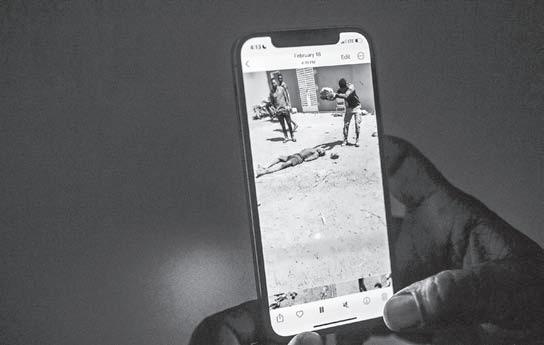
A frame-by-frame analysis of the 83-second video by the AP and an examination of satellite imagery shows the killings happened inside a military base about 2 kilometers (1 1/4 miles) northwest of Ouahigouya, a regional capital close to where Adama lived. From their uniforms and vehicles, AP also determined troops in the video were members of Burkina Faso’s security forces, which until recently received military training and hardware from the United States and European Union.
Through exclusive interviews with Adama’s mother and uncle the AP was also able to reconstruct his final hours. In response to a request for comment about the AP’s findings, the U.S. government condemned the killings as “horrific” and called for the perpetrators to be held accountable.
Wracked by violence
BURKINA Faso is at the epicenter of Islamic extremist violence cutting across Africa. For seven years, the landlocked country has been wracked by violence linked to al-Qaida and the Islamic State group that has killed thousands, displaced about 10% of the country’s 20 million people and destabilized the nation.
Frustration at the government’s inability to stem the violence led to two coups last year by military juntas vowing to stamp out the insurgency. Yet little has changed, with Burkina Faso overtaking Afghanistan as the nation with the most deaths globally from extremist violence, according to a recent report by the Global Terrorism Index.
A former French colony that won its independence in 1960, Burkina Faso is a majority Muslim country that was initially spared jihadi violence that began in neighboring Mali 10 years ago. France sent troops into the region to drive back the Islamic militants in 2013.
The violence has since swept across the Sahel region, the vast semi-arid area south of the Sahara Desert.
Despite the jihadi violence, some civilians say they are now more afraid of Burkina Faso’s security forces, who they accuse of extrajudicial killings and the disappearance of untold numbers of others accused of supporting the militants. Too often children are victims of the conflict.
The killings have grown under the junta led by Capt. Ibrahim Traore, who seized power in September. Traore promised to stem the violence, but people say they fear the repressive regime as security in the country deteriorates.
Part of the junta’s strategy has been to recruit some 50,000 volunteer fighters to serve alongside the military, but residents say this has only contributed to civilian killings as the volunteers round up anyone they suspect of ties to the extremists.

Often those swept up by government forces are ethnic Fulani, a largely Muslim group who make up less than 10% of the population and mostly live in the north, where fighting has been most intense. The Fulani are perceived to be working with the militants, who target them for recruitment in part because of their historic grievances with the state and the fact that they live in regions where the militants have seized large areas.
On the day that Adama, who was Fulani, disappeared his grandmother combed their village searching for him. Hours later she learned the truth: Her grandson and a fellow cattle herder the family identified only as Ousseni had been seized and blindfolded by six men on motorbikes and taken to a military base. Ousseni, who is not Fulani, told her the security forces briefly questioned him before releasing him.
Ousseni said while the boys were locked up he overheard the troops accuse them of being jihadis. Fearful for his life, Ousseni fled the country soon after speaking to Adama’s grandmother.
The video showing Adama’s head crushed by a rock began circulating on WhatsApp chat groups around February 14. A few days later, the teen’s body was found on a roadside several kilometers (miles) from the military base where the video was filmed.
The AP spoke to members of Adama’s family who fled their homes after he disappeared. Adama’s uncle heard his nephew was abducted by security forces from the boy’s grandmother, who recounted what Ousseni had told her. Adama’s mother heard separately about her son’s seizure from a relative, who saw him grabbed by security forces. Neither Adama’s uncle nor his mother wanted their names used for fear of reprisal.
During an interview with the AP last month, the 40-year-old uncle shook his head as he replayed the video showing his nephew’s lifeless body.
“No one can escape death, but it is the way you die that makes a difference. This way of dying is so horrible,” he said. He recognized his nephew from the blue shorts he was wearing and his body, he said.
Adama’s mother has not seen the video; the family has kept it from her to spare her further anguish. Neighbors buried his body.
Ethnic divisions
NEARLY 300 civilians have been killed in attacks involving Burkina Faso security forces between October and February, compared to about 100 during the same period a year ago, according to the Armed Conflict Location & Event Data Project, or ACLED. The violence has also taken a sharp ethnic turn, with the Fulani, including children, increasingly targeted by security forces because they are suspected of supporting the jihadis, according to rights organizations.
“During sweep operations as part of the fight against terrorism, most of the children arrested are Fulani. Those children generally tend the cattle,” said Dr. Daouda Diallo, a pharmacologist and general secretary of the Collective Against Impunity and Stigmatization of Communities, a local rights group.
He said security forces mistakenly suspect the children of being “spies who inform the terrorists. And that’s why they’re ... arrested.”
Amid the violence against civilians and ethnic divisions, the junta is trying to project an image of national unity.
Murals of soldiers mingling with residents and calling for an end to extremist violence line the capital’s streets. In one, a soldier and a civilian raise a torch over the words, “Overcoming terrorism together.” In another, a large red ‘X’ is painted under the words “No to stigmatization.”
Militants in disguise?
JEAN-EMMANUEL OUEDRAOGO, a spokesman for Burkina Faso’s government, denied its military was responsible for the deaths of the boys shown in the video. He told the AP that militants often disguise themselves as security forces and film their actions in order to blame the government.
“The training of our soldiers and our (volunteers) include a large component on human rights and in all units we have provost marshals who keep watch,” he said.
But using visual evidence from the video, the AP was able to match the location it was filmed to a military base named Camp Zondoma northwest of Ouahigouya, not far from where Adama was reported abducted. The buildings and trees in the video are consistent with recent satellite images of a compound within the base. The shadows cast by objects in the video puts the time at around 11 a.m.
Analysis of the soldiers’ uniforms and their vehicles show they are consistent with those used by Burkina Faso’s armed forces. To aid the fight against the Islamic State group and al-Qaida, the US and EU have provided Burkina Faso tens of millions of dollars worth of military training and equipment, including
AN uncle of a 16-year-old named Adama watches a video in Burkina Faso on March 18, 2023, showing a man slamming a rock onto the head of his nephew. Burkina Faso has been wracked by violence linked to al-Qaida and the Islamic State group that has killed thousands, but some civilians say they are even more afraid of Burkina Faso’s security forces, whom they accuse of extrajudicial killings. The military junta has denied its security forces were involved, but a frame-by-frame analysis by The Associated Press of the 83-second video shows the killings happened inside a military base in the country’s north. AP
armored vehicles, drones, communications gear, uniforms, helmets and body armor.
Two camouflaged pickup trucks shown in the video are Toyota Land Cruiser Series 70s with seats for troops mounted in the back. They are the same model supplied to Burkina Faso by the US and EU.
A larger troop carrier seen in the video is a Mercedes-Benz Atego. The US Defense Department delivered 10 trucks of that model and color to Burkina Faso in 2014.
Four security force members in the video wore shirts with the Burkina Faso flag on the left arm, and the boots some wore appeared to be Mil-Tecs, the same German brand the EU recently provided to Burkina Faso’s military.
Documents indicate Camp Zondoma is home to the 12th Commando Infantry Regiment of the Burkinabe army, though the AP was unable to conclusively link the uniforms worn by the men to that specific unit.
The AP shared its findings with the Human Rights Center at the University of California, Berkeley, which conducts research on war crimes and other serious violations of international humanitarian law and human rights. The center concurred that the visual evidence shows the video was filmed at the military base outside Ouahigouya and that the uniforms and trucks are consistent with those used by government troops in Burkina Faso.
In a response to AP, US State Department spokesperson Vedant Patel said foreign assistance to Burkina Faso has been restricted since the military overthrew the democratically elected government in January 2022. US officials have repeatedly raised the importance of protecting and respecting human rights with Burkina Faso’s leaders, he said.
“We strongly condemn the horrific violence as portrayed in the video,” Patel said. “Allegations of human rights violations and abuses must be investigated fairly and those determined to be responsible held accountable.”
EU support for Burkina Faso’s security and defense sector has specifically focused on human rights and international humanitarian law and no lethal weapons have been delivered or financed, said Nabila Massrali, an EU spokesperson. The EU is also investing in Burkina Faso’s military justice system and the military police to fight impunity, she said.
While the AP cannot verify the exact date the video was recorded, a former Burkinabe government official and a soldier said the boys were killed after an attack by militants on a volunteer fighter outpost on Feb. 13, the day before the video first appeared on social media. They spoke on condition of anonymity because of the sensitivity of the issue.
Security reports gathered by ACLED, the data analysis group, show that Islamic militants attacked the volunteers that day, killing at least one and injuring two. According to the former government official, army reinforcements arrived soon after, and the killings in the video were carried out by security forces.
On Feb. 15, the day after the video appeared online, the chief of staff for Burkina Faso’s armed forces issued an order for soldiers to stop disseminating images of operations on social networks, according to a copy obtained by the AP.
“These disseminations of controversial images could have negative consequences and influence on the dynamics” of the security forces, it said.
Children killed AS security deteriorates in Burkina Faso, children are bearing the brunt from all sides, rights groups say. Three times more children were killed during the first nine months of 2022 than in the same period a year earlier, according to UNICEF. Most died from gunshot wounds during attacks on their villages or from improvised explosive devices or other remnants of war, it said.
“We are concerned by the impact of counter-

Stephen Rapp, who served as the US Ambassador at Large for War Crimes Issues during the Obama administration, said the killings of Adama and the other boys in the video were war crimes under the Geneva Conventions and could be prosecuted by the International Criminal Court, of which Burkina Faso is a party.
“This would be a war crime even if the children had helped jihadis or had been child soldiers themselves,” said Rapp, the chief prosecutor in the trial of the former Liberian dictator Charles Taylor, who was convicted in 2012 of war crimes committed during the bloody civil war in Sierra Leone.
dreams they had, but quickly turned somber when she remembered his death.
An energetic child, Adama learned to walk before even crawling and was always innovative, playing make-believe with his younger siblings, she said.
After returning to Ouahigouya, he lived with his grandmother. But whenever Adama visited, his mother said, they’d stay up for hours talking about her life as a girl and his plans for the future. He wanted to be an imam and educate people, she said.
terrorism measures on children associated with armed groups while preventing and combatting threats to national security,” said Virginia Gamba, special representative of the U.N. secretary-general for children and armed conflict. Children associated with armed forces and groups should be treated as victims in line with international juvenile justice standards, she said.
Despite the Burkinabe government’s claim that their forces were not responsible for the deaths, conflict experts said militants don’t typically commit atrocities and blame state security forces. Nor do they kill children, for fear of alienating local populations.
“Jihadists usually carry (out) public executions against those collaborating with the state or opposition groups and will claim responsibility to send a message. They also don’t execute children so they could maintain popularity among the population,” said Rida Lyammouri, senior fellow at the Policy Center for the New South, a Moroccan-based think tank.
“Persons not taking part in hostilities as well as detained combatants are entitled to humane treatment and killing them is murder as a war crime under international law,” Rapp said. “As such these soldiers could be prosecuted in the ICC.”
Afraid to visit grave ADAMA’S mother said there was no sign her son had become radicalized when he returned to Ouahigouya a year ago after spending a decade studying at a Quranic school in the western town of Nouna. While he was at the school she had no contact with her son except for occasional phone calls.
Their reunion last year was supposed to be the start of a new life together, she said.
“We were thinking of building a common life and living together in joy. He would get married and build a home. Unfortunately, we didn’t have that chance,” the 52-year-old woman said. Dressed in a long veil with matching silver bracelets on each arm, she lit up every time she spoke of her son’s life and the
She recalled him studying the Quran, often by candlelight at night and quizzing neighbors about its teachings, always clutching his white prayer beads. He had the beads with him on the day he was seized, family members said.
The last time Adama’s mother saw him was in October, when he spent several weeks at her home. As he left, she warned him to be careful because the situation had become dangerous, and never to stray far from his grandmother’s house. When they last spoke in February, shortly before he was killed, they were making plans to reunite for the Muslim holiday of Ramadan.
Adama’s family has been too afraid to visit his grave, worried about being targeted by security forces.
“If he had lived long, I am sure he would have helped develop our community,” his mother said. “He would have become an imam to teach people to be good Muslims. He would have helped people live together and he would have supported the needy.”
AP Global Investigative Reporter Michael Biesecker reported from Washington.
Saturday-Sunday, April 8-9, 2023 www.businessmirror.com.ph
A3
BusinessMirror
• Editor: Angel R. Calso
The World
‘He’s a war criminal’: Elite Putin security officer defects
By Erika Kinetz The Associated Press
LONDON—On
But this was no ordinary Russian defector. Karakulov was an officer in President Vladimir Putin’s secretive elite personal security service—one of the few Russians to flee and go public who have rank, as well as knowledge of intimate details of Putin’s life and potentially classified information.
Karakulov, who was responsible for secure communications, said moral opposition to Russia’s invasion of Ukraine and his fear of dying there drove him to speak out, despite the risks to himself and his family. He said he hoped to inspire other Russians to speak out also.
“Our president has become a war criminal,” he said. “It is time to end this war and stop being silent.”
Karakulov’s account generally conforms with others that paint the Russian president as a once charismatic but increasingly isolated leader, who doesn’t use a cellphone or the Internet and insists on access to Russian state television wherever he goes. He also offered new details about how Putin’s paranoia appears to have deepened since his decision to invade Ukraine in February 2022. Putin now prefers to avoid airplanes and travel on a special armored train, he said, and he ordered a bunker at the Russian Embassy in Kazakhstan outfitted with a secure communications line in October— the first time Karakulov had ever fielded such a request.
Along with information on Putin, Karakulov’s testimony offers an intimate view of one man’s decision to defect—without telling his own mother, who he said remains a strong Putin supporter. It raises critical questions about how deep the Russian public’s acceptance of the war runs, and how Putin’s opponents in the West and
beyond might leverage any silent opposition.

While not speaking directly about his case, an official with a security background from a NATO country said a defection like Karakulov’s “has a very great level of interest.” He spoke on condition of anonymity to discuss sensitive political matters.
“That would be seen as a very serious blow to the president himself because he is extremely keen on his security, and his security is compromised,” he said. “That’s something that he would be very unhappy about -- particularly if the compromise is to do with communications, upon which a great deal relies.”
Putin is ‘simply afraid’
AS an engineer in a field unit of the presidential communications department of the Federal Protective Service, or FSO, Karakulov was responsible for setting up secure communications for the Russian president and prime minister wherever they went. While he was not a confidant of Putin’s, Karakulov spent years in his service, observing him from unusually close quarters from 2009 through late 2022.
Karakulov, his wife and his child have gone underground, and it was impossible to speak with them directly due to security constraints.
The Dossier Center, a Londonbased investigative group funded by Russian opposition figure Mikhail Khodorkovsky, interviewed Karakulov multiple times and shared video and transcripts of more than six hours of those interviews with The Associated Press, as well as the Danish Broadcasting Corporation DR, Swedish Television SVT, and the Norwegian Broadcasting Corporation NRK. The Dossier Center confirmed the authenticity of Karakulov’s passport and FSO work identity card, and crosschecked details of his biography against Russian government records, leaked personal data and social media postings.
The Associated Press reviewed the materials from the Dossier Center and independently confirmed Karakulov’s identity with three sources in the US and Europe,
who were not authorized to speak publicly. AP also independently corroborated personal details, including Karakulov’s passport numbers, date and place of birth, two registered addresses, and the names and ages of family members, but was unable to verify details of his defection.
AP also confirmed that Karakulov is listed as a wanted man in the Russian Interior Ministry’s public database of criminal suspects. The Interior Ministry initiated a criminal investigation against Karakulov on Oct. 26 for desertion during a time of military mobilization, according to documents obtained by the Dossier Center and seen by the AP.

The FSO is one of the most secretive branches of Russia’s security services.
“Even when they quit, they never talk, but they know a lot of details of the private life of the president and the prime minister,” said Katya Hakim, a senior researcher at the Dossier Center.
The Kremlin did not immediately respond to requests for comment.
Karakulov moved as part of an advance team, often with enough specialized communications equipment to fill a KAMAZ truck. He said he has taken more than 180 trips with the Russian president, and contrary to widespread speculation, Putin appears to be in better shape than most people his age. Putin has only canceled a few trips due to illness and has annual medical checkups, he said.
Unlike the prime minister, Putin does not require secure Internet access on his trips, Karakulov said.
“In all my service, I have never seen him with a mobile phone,” he said. “All the information he receives is only from people close to him. That is, he lives in a kind of information vacuum.”
Karakulov’s work brought him to luxury hotels for summits, beach resorts in Cuba, yachts— and aboard a special armored train outfitted for the Russian president.
Putin’s train looks like any other, painted gray with a red stripe to blend in with other railway carriages in Russia. Putin didn’t like the fact that airplanes can be tracked, preferring the stealth of a nondescript train car, Karakulov said.
“I understand that he’s simply afraid,” he said.
Putin began to use the train regularly in the run-up to the February 2022 invasion, Karakulov said. Even last year, Putin continued to insist on strict anti-Covid measures, and FSO employees took shifts in two-week quarantine so there would always be a pool of people cleared to travel with Putin on the train, he said.
Putin has set up identical of -
children were doing patriotic salutes and being told about bombs.
“This is not the future I would like for my child,” he said.
With Russia’s September mobilization drive, Karakulov realized that if he quit his job, he was likely to be drafted into a war he didn’t want to fight. But even if he stayed, he could get sent to the front.
He learned that some of his colleagues had been dispatched to Ukraine and killed. He saw photos of FSO crews destroyed by Ukrainian rockets, with dozens likely dead.
He was outraged that no one in Russia acknowledged those deaths.
“There’s no information about them,” Karakulov said. “What were they doing there? Why did they end up there? Why did they die there?”
He was not the only one who wanted out.
On September 27, days after Russia’s mobilization, an engineer at a regional FSO center in Siberia named Mikhail Zhilin snuck through the forest across the border to Kazakhstan. Many Russians fled to Kazakhstan to avoid the draft, but the authorities refused Zhilin’s request for asylum and sent him back to Russia. On March 20, a Russian court sentenced him to 6 1/2 years in a penal colony.
fices in multiple locations, with matching details down to the desk and wall hangings, and official reports sometimes say he’s one place when he is actually in another, according to Karakulov and prior reporting by a Russian media outlet. When Putin was in Sochi, security officials would deliberately pretend he was leaving, bringing in a plane and sending off a motorcade, when he was in fact staying, Karakulov said.
“The guys would talk about this, really laughing,” he said. “I think that this is an attempt to confuse, first, intelligence, and second, so that there are no assassination attempts.”
Faces of warriors KARAKULOV’S defection was a surprising turn for a family steeped in patriotic military tradition.
Born in Dagestan, Karakulov was raised to be ready for war, believing it was his sacred duty to defend his homeland. After graduating from a military academy, he found his way into the FSO.
“To be close to the president— it sounded pretty cool,” he said.
Karakulov’s father is a former military man, who has worked as a professional photographer, among other jobs. He is working on a project he calls “Faces of Warriors,” a series of elegant, hagiographic portraits of Russian soldiers and veterans.
Karakulov’s brother is a local government official, records show, and served as the point person for a regional, government-backed project devoted to “civic patriotism” and honoring “Heroes of the Fatherland.”
Karakulov’s job introduced him to a world beyond his family. Even as his father and brother marched in patriotic military parades, his own doubts deepened. He’s horrified to think that he might also be rallying around the letter Z in support of the war in Ukraine if his job hadn’t taught him to see through the lies of Russian state television.
“Thanks to my work in the FSO, I have seen how information is distorted,” he said.

He also began to question the conspicuous spending of Russia’s top leaders. He said he saw officials convene large delegations at luxurious resorts that cost more each night than his monthly salary. They’d all attend a brief meeting and then hang out for a week, he said.
“If this is from the budget, then the question is, ‘Is it not too much to spend this kind of money on one person?’” he said. “If it’s not from the budget, then it’s total corruption.”
Russia’s invasion of Ukraine was a breaking point, he said. He told his wife he wanted out. He didn’t want their young daughter brainwashed in preschool, where
The only conversations he had were with colleagues who seemed to relish the war. He imagined others must share his views, but he had no way to find them.
“They simply cannot even open their mouths,” he said.
Karakulov said he couldn’t tell his parents about his disillusionment either, because their minds had been molded by years of watching Russian state television.
As the war streamed in on the evening news, his parents seemed to savor the view from the front. He found it unbearable and asked his mother to turn off the TV. She refused.
He said he tried to explain to her that Ukraine is an independent country, but she immediately cut him off. “What is this?” she said to him. “You want to run away? Are you some kind of foreign agent?”
He never told them he was leaving.
In October, a series of official meetings in Astana, the capital of Kazakhstan, gave Karakulov his chance to run away. He and his wife packed their lives into three suitcases. He flew out Oct. 6 with the rest of his team. His wife and daughter joined two days later, staying in a separate hotel.
But each day, Karakulov found another reason not to go.
On the last day of the delegation, Oct. 14, he realized he couldn’t postpone any longer. His wife collected his suitcase from his hotel room to avoid raising s uspicion. He slipped away after lunch, telling colleagues that he was heading out to buy souvenirs.
He climbed in a taxi with his wife and daughter and set off for the airport around 3 p.m.
“From then on, it was only a matter of my own nerves,” he said.
He got through check-in and started getting messages from colleagues asking where he was. The flight was delayed by an hour. He could feel a distant fury building against him. By 5 p.m., he figured people had started to look for him.
“You scumbag,” read one message.
Fifteen minutes before takeoff, he switched off his phone.
His wife was very upset. They spent the 5 1/2-hour flight waiting for something to go wrong.
When they finally cleared passport control in Turkey, Karakulov said it was like a great stone had fallen from his soul.
He said he knows many people will accuse him of being unpatriotic, but he disagrees.
“Patriotism is when you love your country,” he said. “In this case, our homeland needs to be saved, because something crazy and terrible is happening in our country. We need to fix this.”
The price of dissent
WHAT the future holds for Karakulov—and anyone who might dare to follow in his footsteps—is far from clear.
Abbas Gallyamov, a Russian political analyst now living in Israel who was a speechwriter for Putin from 2000 to 2001 and again from 2008 to 2010, said he believes the majority of Russia’s elites secretly oppose Putin’s war. He added that if the West had offered them an exit strategy instead of sanctions, more might have left.
“They are all shocked,” he said. “From their point of view, there was no reason to do this because everything was okay … now all of a sudden, everything collapsed. … We’re enemies of the world.”
Gallyamov, like Karakulov, is on the wanted list of Russia’s Interior Ministry. He said a defection like Karakulov’s is a particular blow because the FSO is like a “royal elite” above other military and security structures in Russia, charged with protecting the state’s most precious asset: Putin himself.
“They will be very angry,” he said. “There will be hysterics.”
Tatiana Stanovaya, a senior fellow at the Carnegie Endowment for International Peace, said Russian public opinion about the war is divided but there is little space for public dissent, especially for people working within the system.
“The rule is that the elite stick to Putin,” she said.
Those who do leave Russia often pay a price to keep their conscience clear.
Boris Bondarev, a career Russian diplomat in Geneva, quit in May and denounced the war.
Speaking from an undisclosed location in Switzerland, Bondarev told the AP he is living as a political refugee on a government allowance, with security constraints he’d rather leave “deliberately ambiguous.” He can’t find a job and has had to move apartments several times, for both financial and safety reasons. He can’t travel freely—not even to meet a reporter for a cup of coffee in town.
“I sent my CVs to dozens of think tanks in the US, in the U.K., in Europe, and most were ignored,” he said. “I got a few answers that ‘sorry, but we already have Russia experts.’”
He said there are plenty of Russians who quietly oppose the war but don’t dare speak out, for fear of losing their livelihoods. A few colleagues who quit Russia’s Foreign Ministry after he did contacted him for advice. They were having trouble finding work. One returned to Moscow because he couldn’t make a living outside of Russia, he said.
Bondarev said he sometimes has second thoughts when he sees pictures of people eating out at nice restaurants in Moscow, living the kind of good life he can no longer afford. But then he remembers the price: brainwashing, propaganda, hypocrisy.
“I would come to my office at 9 and leave at 6 p.m. and in between I would have to produce numerous papers explaining why Ukraine attacked Russia,” he said. “I don’t want it. No, no, I can’t complain today.… I live very, very well.”
BusinessMirror Saturday-Sunday, April 8-9, 2023 A4 www.businessmirror.com.ph The World
October 14, a Russian engineer named Gleb Karakulov boarded a flight from Kazakhstan to Turkey with his wife and daughter. He switched off his phone to shut out the crescendo of urgent, enraged messages, said goodbye to his life in Russia and tried to calm his fast-beating heart.
The Associated Press reporters Aamer Madhani in Washington, Jamey Keaton in Geneva
ka in London contributed to this report.
and Joanna Kozlows
IN this image from video provided by the Dossier Center, a London-based investigative group funded by Russian opposition figure Mikhail Khodorkovsky, Gleb Karakulov speaks during an interview in Turkey in December 2022. Karakulov, who was responsible for setting up secure communications for Russian President Vladimir Putin, said moral opposition to Russia’s invasion of Ukraine and his fear of dying there drove him to speak out, despite the risks to himself and his family. He said he hoped to inspire other Russians to speak out also. “Our President has become a war criminal,” he said. “It is time to end this war and stop being silent.” DOSSIER CENTER VIA AP
BANGON MARAWI: SCHOLARSHIPS FOR STEM STUDENTS
MARAWI’S rehabilitation continues with strengthened science education.
This is being made possible by the Department of Science and Technology’s Science Education Institute (DOST-SEI) and the Mindanao State University (MSU) System when they renewed their memorandum of agreement (MOA) for the Bangon Marawi Program in Science and Technology Human Resource Development.
Through the program, more students from Marawi City and nearby towns can pursue their degrees as DOST scholars.
“Education is a powerful tool for development, and a fundamental right for all young people, especially those affected by the conflict,” DOST-SEI Director Dr. Josette Biyo said.
In Bangon Marawi, the DOST-SEI prioritizes applicants who were directly affected by the siege. The DOST-SEI and MSU first inked a partnership in 2018. In its five-year run, over 500 scholarship slots have been awarded to MSU students and faculty taking up science, technology, engineering and mathematics courses at the undergraduate and graduate levels.

Almost 400 have finished their studies, with around 70 scholars marching with high honors.
Right after the MOA signing, 73 new scholars signed their scholarship agreement, becoming the first batch of qualifiers for the approved 200 slots for the year. The remaining slots were awarded to qualifiers in the March 2023 examination.
DOST Secretary Renato Solidum Jr. ensured
DOST digs deep into PHL talents for R&D proposals
By Manuel T. Cayon
GENERAL SANTOS CITY—
Government will continue to dig deep into Filipino scientific talents which have already demonstrated their world-class ambidexterity in various fields, including innovations and improvement in genomic bio-surveillance during the Covid-19 pandemic.
the program’s continuity, emphasizing the significance of human and social infrastructures in Marawi’s rehabilitation.
“By restoring people’s confidence in their abilities and assuring them that nothing, not even poverty, war, or a pandemic, can stop them from pursuing their dreams. We rebuild Marawi from within,” he said.
MSU System President Atty. Basari
Mapupuno reiterated the University’s support to the program: “Bangon Marawi is a blessing not only to MSU but to numerous individuals who have been aided by this endeavor.”
Bangon Marawi scholars enjoy the same privileges accorded to DOST scholars, such as book and thesis allowance; accident insurance; and a monthly stipend of P7,000 for undergraduate students and P25,000 and P33,000 for MS and Ph.D. students, respectively.
The DOST-SEI also covers graduate students’ tuition and provide research grants of up to P475,000.
New undergraduate scholars Soraya AlObinay and Aiman Cayongcat, who lived in Marawi’s “ground zero” during the siege, were overjoyed at the opportunity.
For Al-Obinay, the Bangon Marawi scholarship is an answered prayer. Her family had been struggling financially after losing their business.
Cayongcat, for his part, said the siege wasn’t the only challenge his family faced as the pandemic also hit them hard. He vowed to make the most of his scholarship.
Both scholars intend to help their families, pursue graduate studies and give back to their communities. S&T Media Service
The Department of Science and Technology (DOST) has been holding call for proposals conferences around the country to motivate and inspire more researchers and innovators to participate in the 323 projects the agency intends to support in 2025 with a total budget of P5.34 billion. This city was its final leg for the call for proposals.

“We heard consistent good news in terms of the country’s innovation performance in recent years,” said Science Secretary Renato U. Solidum Jr. at the event.
In Southeast Asia, he said, the Philippines has been recognized among economies that made the greatest advances over the past decade.
“We were second in rank last year in terms of high-tech exports, which pertain to products with high-intensity R&D {research and development],” Solidum said.
In addition, in the Global Innovation Index 2022, the Philippines was classified with innovation performance that is above expectations for their level of development among lower middle-income economies, he added.
Although the country’s tier status slightly descended in terms of the GII ranking from 51st in 2021 to 59th in 2022, Solidum explained it was still regarded one of the best performers among middle-income economies, along with Vietnam and Iran, to have the fastest innovation catch-up to date.
Local talent pool
AS early as 2012, the DOST, through the Philippine Council for Health Research and Development (PCHRD), invested more than P900 million in Omics research for health.
The funding was used for programs in human multi-omics researches which identified possible genetic markers among Filipinos associated with non-communicable diseases, such as hypertension, stroke, diabetes and heart attack, said PCHRD Executive Director Dr. Jaime Montoya.
It gave way to the establishment of the Philippine Genome Center not only in Luzon, but also its satellite facilities in Visayas and Mindanao, and the launch of the Clinical Genomics Laboratory, that was in the forefront of the response and biosurveillance in the height of the pandemic.
FABRICATION of molds used for mass production of various products usually takes a minimum of 45 days for simple molds. More complex molds take longer to fabricate.
This is one of the concerns raised during a business-to-business meeting on March 24 held by the Mold Technology Support Center (MTSC) with some die and mold company locators of the Philippine Economic Zone Authority.

The MTSC is an output of the Official Development Assistance (ODA) of South Korea to the Philippines, specifically in the die and mold industry. It is being managed by the Department of Science and Technology’s Metals Industry Research and Development Center (DOST-MIRDC).
As a training and technology hub, the MTSC is expected to help the Philippines’s local die and mold companies perform on a par with global counterparts and ultimately reshape Philippine manufacturing.
It houses a total of 25 machines and equipment dedicated to serving die and mold demands in the country. It offers training programs, specifically focused on die and mold technologies.
Besides training, MTSC also offers the use
of its equipment to die and mold companies through time sharing and actual-use schemes at very low rates.
Through the services the facility offers, die and mold companies may expect lead times to be comparatively shorter than ordering imported dies and molds.
“A survey indicated that most dies and molds [in the country] are imported, and that the technical competency in die and mold making here in the Philippines is low relative to advanced countries like Korea and Japan,” said Dr. Agustin M. Fudolig, DOST-MIRDC deputy executive director for R&D.
The highly skilled and trained engineers and technical staff of the MTSC add credibility to the center—their expertise in the field of die and mold will put client companies at an advantage over their local and foreign competitors.
The MTSC, poised to become a premier training hub for mold technologies, now plays a vital role in boosting the economy, as graduates of the training programs being offered by the center are expected to fill the manpower needs of local die and mold companies. Ella Vanesa L. Lopez/S&T Media Service
With the rising oil prices and the negative impact of global warming, the DOST poured funds into the emobility program that resulted in the development of e-trikes, e-boats, and the conversion of tricycles in the country.
The DOST’s Philippine Council for Industry, Energy and Emerging Technology Research and Development (PCIEERD) helped develop an entire ecosystem of an electric transport, which included chargers for the electric vehicles, researches on storage, as well as parts that can be locally fabricated for the new vehicles, said Executive Director Dr. Enrico Paringit.
Call for proposals
THE DOST disclosed that the country was not entirely far behind in scientific discovery, innovation and development, especially during the Covid-19 pandemic, although it admitted that public response to its snowballing call for scientific proposals dipped during pandemic “because not many Filipino talents were centered on Covid-19 response.”
However, the DOST’s concentration in Covid-19 has alleviated the government response through several science-based innovations from the DOST.

Developed and manufactured were 132 specimen collection booths that were distributed to 92 hospitals across the country.
There were innovations in safety monitoring, border control and mobility assistance, optimal location of personnel and intelligent electric transportation network program.
It likewise developed mobile intelligent thermo scanner and laser robot to mitigate the spread of the Covid-19 virus.
When the call for proposals went live on April 1, 2020, the number submitted per year varied.
In Mindanao, for instance, 107 were submitted in 2020, of which 19 were approved for funding support.
In 2021, there were 138 proposals submitted, with 16 approved. Last year, the number went down to 94 with five approved.
Nationwide, the number picked up by the middle of last year when restrictions began to ease and the economy opened up in various sectors. By last
month, the total number of proposals submitted spiked to 5,499.
Armela K. Razo, chief of the Special Projects Division of the DOST Project Management Information System, told the BusinessMirror the Philippines is “not wanting in talents.”
“We have some 5,000 registered researchers in the country. The pandemic years have contributed to the low number of proposals because we concentrated in the Covid-19 response, and we expect that not all researchers have their own proposals that were not pegged with the pandemic, so they have to wait,” Razo explained.
Back on track
THE call for proposals has set priority areas from the four research and development councils of DOST: Industry, Energy and Emerging Technology; Health Research and Development; agriculture; and basic research.
The Philippine Council for Agriculture, Aquatic, and Natural Resources Research and Development (PCAARRD) has branded its initiatives and outputs as “Galing,” an acronym for Good Agri-aqua Livelihood Initiatives toward National Goals.
In 2016-2022, PCAARRD Executive Director Dr. Reynaldo Ebora said the council funded programs and projects led to significant findings in genomics, biotechnology, nanotechnology and smart farming.
In August 2015, the National Research Council of the Philippines (NRCP) initiated the country’s first comprehensive research program for Lake Lanao, the second largest lake in the country.
Dr. Bernardo Sepeda said Six NRCP projects were funded for a comprehensive study of the physical, chemical, biological, socioeconomic and political impacts of the lake.
The projects were conducted by NRCP members from Mindanao State University-Institute of Technology and MSU-Marawi to save the lake from degradation caused by human activities.
Opportunity to excel
DOST Undersecretary for R&D Leah J. Buendia said that through the Call Conference “we may again fund the next big milestone in supporting our country’s socio-economic goals.”
The period of submission is from March 1 to May 31.
Undersecretary Maridon Sahagun for the DOST’s Scientific and Technical Services, said sustainability of the project results is a key feature of the call for proposals.
“Sustainability includes strengthening the R&D for environmental preservations and conservation, protecting R&D outputs through intellectual property protection and management, and integrating smart practices to facilitate more open, collaborative, citizen-centric and digitally enabled governance systems,” Sahagun said.
In addition, she said, DOST is realigning “our resources to ensure more equitable operations at the national, regional and provincial levels to spur development not only in the metropolitan Manila and other urban centers but also to other regions of the Philippines as well.”
Examples of these are the researches and programs from universities and research institutions in Mindanao.
It includes the Niche Centers in the Regions for R&D Program on Halal Goat by the Sultan Kudarat State University-Lutayan campus, which aims to promote and sustain halal goat enterprise management through various delivery mechanisms in the region.
Another is the project of Central Mindanao University on anti-inflammatory compound, which seeks to cater to Mindanao drug researchers through in-house enzyme-based assays and bioassay-guided isolation, said Science for Change Program Head Anya Roslin.
“This calls us to reflect on the importance of sustaining innovation over time. Hopefully, we can ramp back into the 50th [in Global Innovation Index] or even higher this year. I believe 2023 offers a new opportunity to outperform ourselves,” Solidum said.
La Union food vendors get training on food safety
FOOD safety is very important in order to ensure the safety of the health of consumers and secure one’s food business.
To tackle these concerns, the Department of Science and Technology in Region I, through the Provincial Science and Technology Office-La Union (PSTO-LU), recently held a two-day seminar/workshop on “Food Safety and current Good Manufacturing Practices [cGMP]” for food vendors and handlers within the tourism area of San Juan held at the PSTO-LU MultiPurpose Hall.
The training was held in adherence to the Food and Safety Act of 2013, that protects consumers’ health and
facilitates market access to local foods and food products, and strengthens the regulatory system of food safety.
Meanwhile, cGMP was introduced being a regulation enforced by the Food and Drug Administration (FDA). It provides for structures that guarantee appropriate design, monitoring, and control of manufacturing facilities and processes.
PSTO-LU Provincial Director Jonathan M. Viernes expressed hope that the participants “will acquire the knowledge needed in your work” and encouraged them to participate actively and to transfer the knowledge to their co-workers. Project Technical Specialist I Hero
D. Galamgam, the resource speaker, introduced the overview and concepts of Food Safety and cGMP.
He discussed the different types of food hazards and their effects on food; the need for employee’s good health, hygiene and hand washing; cleaning and sanitizing procedures; cross contamination; and pest control.
He discussed the FDA plant requirements, which include the building design and construction; sanitary facilities, equipment and utensils; production and process controls; water and raw material supply; and storage and distribution. The participants were asked to write the common hazards in their
workplace, and the controls and mitigations that they do to minimize them. During the discussion, the controls and mitigations were modified to better address the hazards and add other solutions to the concerns.
Twenty-seven participants from owners and employees of different food establishments, and two applicant of Small Enterprise Technology Upgrading Program (SETUP), from Naguilian and the City of San Fernando attended the seminar workshop.
SETUP is one of the flagship programs of the DOST that provides technical and financial assistance to micro, small and medium enterprises.
A5 Science Sunday BusinessMirror Saturday-Sunday, April 8-9, 2023 www.businessmirror.com.ph • Editor: Lyn
Resurreccion
THE DOST’s call for proposals held in General Santos City for Mindanao Region is attended by DOST officials from Metropolitan Manila and regional offices, partner researchers and innovators. The DOST is expecting to receive research proposals until May 31. DOST-PCIEERD FACEBOOK PHOTO
DOST-SEI
DOST-SEI PHOTO PHL, S.
REPRESENTATIVES of South Korean die and mold companies hold a consultative meeting with DOST-MIRDC at MTSC in General Trias, Cavite, on March 24. DOST-MIRDC PHOTO
Director Josette Biyo (fifth from left) welcomes new Bangon Marawi scholars at the scholars’ orientation and contract signing held recently at the Mindanao State UniversityMarawi Main Campus.
KOREA PROJECT HANDLES NEEDS OF DIE, MOLD INDUSTRY
Easter just started; lasts for 50 days
The Church celebrates each of these eight days as Solemnities of the Lord—a direct extension of Easter Sunday.
The entire Easter season lasts 50 days, and includes the Solemnity of the Ascension of Christ, which falls on the 40th day of Easter, which this year is May 21. It ends with Pentecost, which is derived from the Greek word “pentecoste,” meaning “50th.”
Traditional Roman rite IN the traditional form of the Roman rite, Easter is known properly as Paschaltide, which includes three parts: the season of Easter, Ascensiontide, and the Octave of Pentecost.

It, thus, lasts one week longer than the Easter season in the calendar of the Missal of St. Paul VI.
Easter lasts for a total of 50 days, from Easter Sunday until the feast of Pentecost, when the Holy Spirit comes upon the apostles, Mary, and the first followers of Christ.
This year, 2023, Easter runs from April 9 until May 28, Pentecost Sunday.
Easter explained CATHOLICS observe Easter in different stages.
Easter Sunday is the greatest Sunday of the year, and it marks the start of the “Easter Octave,” or the eight days that stretch from the first to the second Sunday of Easter (also known as Divine Mercy Sunday).
Filipino priest named as apostolic administrator of Guam archdiocese

POPE Francis recently appointed a Filipino priest as apostolic administrator of the Archdiocese of Agaña on the Pacific island nation of Guam.
The pope announced Fr. Romeo “Romy” Convocar’s appointment after the resignation of American Archbishop Michael Jude Byrnes, 64, reportedly for medical reasons.
At the time of his appointment, Fr. Convocar has been serving as vicar general of the archdiocese in the US territory.
He will oversee the ecclesiastical territory until the nomination of a new archbishop.
The priest served as chaplain of the Philippine Navy before he was incardinated
to the Agaña archdiocese.
He was also a former formator at Domus Josephi Formation House of the Military Ordinariate of the Philippines (MOP) in Villamor Airbase in Pasay City.
“May the Lord continually bless and guide you in your ministry, Fr. Romy,” the MOP said in a social media post. CBCP News
Carmelite nuns transform former farm into monastery
“The 50 days from the Sunday of the Resurrection to Pentecost Sunday are celebrated in joy and exultation as one feast day, indeed as one ‘great Sunday,’” according to the United States Conference of Catholic Bishops (USCCB). “These are the days above all others in which the Alleluia is sung.”
The USCCB calls Easter “the most important of all liturgical times.”
“It celebrates Jesus’s victory of sin and death and salvation for mankind,” the US bishops say. “It is God’s greatest act of love to redeem mankind.”
The season of Easter begins with the Easter Vigil on Holy Saturday, and runs through the afternoon of the Vigil of the Ascension.
Ascensiontide begins the evening before the Ascension, with First Vespers of the feast, and ends on the afternoon of the Vigil of Pentecost-marking the first novena.
The Octave of Pentecost is an extension of the feast of Pentecost, beginning with the Vigil Mass of Pentecost and ending the afternoon of the following Saturday.
Note: This article was first published on April 21, 2022) Katie Yoder/CNA’s Washington D.C. bureau
Spain’s Easter procession events a yearlong operation
ELCHE, Spain—Spain is getting ready for one of its most revered holiday periods of the year: Easter Week, which means thousands of colorful and noisy religious street processions that draw multitudes onto the streets to watch.
The central pieces of the processions are the richly decorated gigantic floats bearing sculptures of Jesus or the Virgin and often weighing up to a ton or more.
By Sr. Marie, OCD Vatican News
‘AS the Lord lives in whose service we stand.” Many of us have often meditated upon these words of the prophet Elijah, the great inspirer of the Carmelite Order.
However, the period of construction and relocation of the new monastery gave us the opportunity to experience their validity in a powerful way.
In the words of Pope Francis, God has called us to the “periphery,” where, paradoxically, we are much closer to the people than in the centre of the big city.

Every day we can feel how God does his utmost for us and how, in a place that seemed to be “forgotten by all,” we can bear witness to the contemplative life and also invite others to the fullness of life.
We would now like to introduce you to our often “adventurous” story, which is still being written.
About Carmelite nuns
WE are a community of Discalced Carmelites, living a contemplative way of life in papal enclosure.
Our mission is prayer and sacrifice for the intentions of the Church and for the salvation of all people.
Our community, Carmel of Saint Joseph in Prague (Czech Republic), was founded in the 17th century by the Servant of God, Mother Mary Electa of Jesus. A native of Terni, Italy, she later founded monasteries in Vienna, Graz and Prague.
The journey to the ‘periphery’ IN 2005, we decided to look for a more suitable place to live.
In the monastery on Hradčany Square (next to Prague Castle), we had only a very small garden, because the building was not originally conceived for a cloistered order.
In addition, the noise was growing ever louder in the area.
In 2018, we bought a former farm in Drasty, a town near Prague. We moved there in early 2020 and handed over the Prague monastery to our brothers, the Discalced Carmelites.
Thus, we began to build a new spiritual center in Drasty, which will serve partly as our monastery, while another part will be open to the public.
Beginnings in Drasty
CONFISCATED during the communist regime, the farm property was returned to the Church only 25 years after the Velvet Revolution.
It was therefore in such a terrible state that many did not believe it could be restored.
It seemed as though someone had decided to turn what had once been an agricultural business into one big dumpsite, which later became overgrown with trees.
In order to save money, in 2018 we started going to Drasty for the initial construction work, for which we received a dispensation from the papal enclosure, for the duration of the construction.
At first, we worked alone, but later, Saint Joseph, to whom we have always entrusted ourselves daily, began to send us many generous helpers.
Years of intensive work
AFTER years in a very confined space, we took up the outdoor work with great enthusiasm. Looking back today, we see how God miraculously strengthened us.
In the first months, our main activity was loading the containers with waste. Then came weed removal and the removal of other unwanted plants—whipper-snippers and chainsaws became essential equipment. Some of the sisters also learned to drive a tractor and a Bobcat digger.
Moving from Prague
WHEN we were finally able to move, we tried to do as much as possible on our own and with the help of volunteers. And the Lord worked mightily again.
After all kinds of preparatory work, we managed to move to Drasty in forty days—which we see as very symbolic— with God’s help and with the help of dedicated people.
In the end, professional movers were only needed once, and only for a few bulky items of furniture. They were days of great, exhausting effort, which nevertheless brought us together and enriched us.
Transformations
THE farm continues to change before our very eyes. Thanks to the work of a construction company.
For example, the dilapidated “Manor House” (now the “House of Visitation”) looks like a cultural monument once again, and it should welcome guests in the future.
It will allow us to host individuals, families and groups, both for rest and
relaxation and for various spiritual programs. For now, we, sisters, live here, at least until the most essential parts of the new monastery are completed.
Building the monastery


AFTER a long process of selecting a construction company, construction of the monastery began in the autumn of 2021. The monastery will consist of the former granary building and three new wings, which will include a chapel dedicated to Saint Teresa of Avila that will also be open to the public.
At the end of 2022, the rough construction of the entire quadrangle was completed. All work is now concentrated on the interior.
However, we are still short of funds to complete the project. You can visit our website www.karmeldrasty.eu for more information.
Life in Drasty
DRASTY has become our home—a place where we can live much more naturally, in touch with nature and in a new intimacy with God the Creator, whose help and protection we have experienced almost “tangibly.”
When the building will be completed, the environment here will be even more conducive to prayer and fullness of life with God. But we already feel his presence strongly, and so do many others.
Although the site is not yet complete, people from all walks of life come to us, and use what little space we can offer them. Those who come often speak of the peace and joy they experience in this place.
So we are hopeful that Drasty will one day become a life-giving place for the whole area.
The ceremonies see brotherhoods of “nazarenos,” or penitents, with tall conical hats, monkish robes and hoods carrying or escorting the magnificent carriages through ancient streets of cities and towns nationwide.
While the processions take place over just a handful of days, preparations are a year-round affair and involve a wide range of small, sometimes family-run businesses.
The artisans are responsible for producing all the regalia, from conical hats and huge candles to palm leaf bouquets.
There are also workshops in charge of the conservation of religious sculptures, their dresses and adorning cloths.

“It’s yearlong preparation,” says Paqui Serrano, an artisan palm leaf bouquet-maker in Elche, southeast Spain, the heart of Spain’s palm tree agriculture.
Tying up the leaves on the palm trees starts in January. The process keeps the leaves a golden white instead of turning green.
Once harvested, they are woven into delicate floral decorations and set on pedestals that are carried during the processions.
Elche traditionally sends such bouquets to public figures. This year, the recipients included Pope Francis and Spain’s Queen Letizia.
Serrano’s family workshop stretches back over more than
four generations and is one of five family-based palm leaf outfits in the city.
She said new techniques allowing for the leaves to be conserved gives them more time to design more intricate braids. The work, while often painstaking, can be relaxing, she said.
“As you can see, the machines and tools are our hands, needles and scissors, and it can be stressful,” Serrano explained. “But when you are working at what you like, well, it can almost serve as a therapy because it relaxes you a lot.”
“Out of respect for the palm tree,” each tree is allowed to rest for between three to five years before its leaves are used again, she said.
Fernando Chicharro Méndez, head of the team float bearers in Madrid’s Jesus of the Great Power and Macarena Brotherhood, has carried floats for 25 years.
He says the task of carrying the floats has varied little in the brotherhood’s 83 years of existence.
Chicharro says he and his son, another float bearer, and family are constantly occupied with the processions and their preparations.
“We live it daily,” he said. “In my family, all are brotherhood members and experience it with great faith.”
Chicharro’s float is carried by 35 bearers, with brothers on standby to relieve them along the procession route. Their practice sessions frequently pique the interest of tourists and Spaniards alike as they wind their way through the streets in the weeks before Easter.
Easter this year begins with Palm Sunday on April 2. A sacred holiday for Spaniards, it generally sees millions taking trips out of town, often just to witness the processions. Bernat Armangue And Ciarán Giles/Associated Press
Faith Sunday A6 Saturday-Sunday, April 8-9, 2023
• www.businessmirror.com.ph
Editor: Lyn Resurreccion
ICON of the Resurrection depicting Christ having destroyed the gates of hell and removing Adam and Eve from the grave. Christ is flanked by saints, and Satan (foreground), depicted as an old man, is bound and chained. WIKIMEDIA COMMONS
WASHINGTON D.C.— Catholics recognize Easter or Resurrection Sunday— when Christ rises from the dead after sacrificing his life for all of humanity— as the first Sunday after the first full moon on or after the spring equinox. But, as it turns out, they can continue saying “Happy Easter” into the later days of May.
FIGURES of Jesus are undergoing restoration at the Arte Martinez workshop in Horche, central Spain, on March 16. AP/BERNAT ARMANGUE
Fr. Romeo Convocar, the newly appointed apostolic administrator of the Archdiocese of Agaña in Guam. MILITARY ORDINARIATE OF THE PHILIPPINES
THE nuns pose for posterity with volunteers on the site of the new monastery. CARMEL DRASTY PHOTOS
THE sisters working on the foundations of their new house.
Editor: Lyn Resurreccion

AMID OIL TANKER SINKING IN ORIENTAL MINDORO
Ghost of Guimaras oil spill haunts PHL
 By Jonathan L. Mayuga
This validates fears expressed by leaders of various civil society organizations, nongovernment organizations and community-based organizations, which are demanding for government transparency, and accountability from the owner of MT Princess Empress that was carrying 800,000 liters of industrial oil when it sunk off Naujan, Oriental Mindoro, on February 28.
Lessons from Guimaras CITING lessons from past oil spills, including that in Guimaras on August 11, 2006, with the sinking of MT Solar 1 carrying 2,162,230 liters of bunker fuel oil that spilled and contaminated vast water bodies around the Guimaras island province, experts say it will take years, if not decades, for the affected plant and animal species, as well as their habitats, to fully recover and perform their important ecosystem functions, and, in the process, affect natural food production capacities.
Guimaras was severely affected by what is now known as the worst oil spill in the country’s history.
It caused fishing to stop for a year and affected marine sanctuaries and mangrove forests in three of the five municipalities of Guimaras. Fishing was never the same in Guimaras after the oil spill that also reached the shores of Iloilo and Negros Occidental provinces.
Guimaras Strait, where the oil spill occurred, connects the Visayan Sea with the Sulu Sea—a rich fishing ground in the Western Visayas Region.
More than a decade after, Guimaras is still reeling from the oil spill.
But apparently as a lesson from the unfortunate incident, the province is staying away from dirty fossil fuel for good.
The provincial government implemented programs and projects to become an agri-ecotourism hub and a top producer of clean, renewable energy in Western Visayas.
Dire consequences
ATTY. Gloria Estenzo Ramos, vice president of nonprofit Oceana Philippines, said oil spills, including that in Guimaras, have dire consequences to coastal and marine ecosystems and it takes years, sometimes decades, before an affected area recovers from its adverse environmental impact.
“It’s not true that it takes only months. It takes years for affected areas to recover...before fishing activities can go back the way they used to be,” Ramos, an environmental lawyer told the BusinessMirror via telephone on April 3.
She lamented that it appears that the government should be more transparent by reporting the impact of the oil spill to properly address the problem.
“That’s why we are calling for transparency and accountability. While there is indeed a response, what we are seeing is not enough. We need a more aggressive response to this disaster,” she pointed out.
She said the Department of Environment and Natural Resources should step up its damage assessment of affected coastal and marine ecosystems and make the report public.
Unconditional support to fisherfolk
FOR his part, Fernando Hicap, Pambansang Lakas ng Mamamalakaya ng Pilipinas national chairman, said the government as well as the owner of MT Princess Empress that sunk off Oriental Mind -
oro in February should provide unconditional support to fishermen who are affected by the oil spill.
Close to 19,000 fisherfolk in Oriental Mindoro alone were ordered to stop fishing on March 2 because of the oil spill, or days after oil from the sunken vessel started to reach the shores of Naujan and Pola, then slowly spread to other coastal towns in the province.
Citing what happened in Guimaras in 2006, Hicap noted that some fishermen and their families were left out by the government during the so-called relief operations.
“Some were not even on the master list of fishermen in their towns,” he said in Filipino.
In the case of the Oriental Mindoro oil spill, he said all coastal communities should receive unconditional support.
He added that even the wives and children of fishermen also
Legarda issues warning vs extreme heat; calls for tree planting to improve air quality
SENATE President Pro Tempore
Loren Legarda has warned the public of heat stroke with the extreme heat that is expected to occur in amid the dry season, and expressed serious concern over incidents linked to the rising heat index, a news release said.
Last month 120 students were taken to hospitals in Laguna after they fainted and showed symptoms of heat exhaustion during a fire drill at a school in Cabuyao City. At a school in Makati, a student-athlete died after collapsing during a football varsity game, the news release said.
“As the average temperature rises, more lives will be at risk.
We need immediate measures to address such risks, including wide dissemination of heat stroke firstaid measures, heat warnings by local governments and through text messages, and siren warnings when
the thermometer has risen to dangerous levels,” Legarda said.
“Most of the sectors in the margins are outdoor workers. Warnings to stay indoors are economically impossible for them. There will be massive economic impacts well before heat threatens health and wellbeing,” she added.
The Philippine Atmospheric, Geophysical and Astronomical Services Administration (Pagasa) warned of an impending El Niño and high temperatures, particularly in May, the news release said. Pagasa said high temperatures might adversely affect the body, such as causing fatigue and stroke.
As the Senate Bill 1470, or the State Universities and Colleges Land Use Development and Infrastructure Plan Act, is currently being deliberated in the Senate as the youth are also at risk, Legarda said she would
introduce amendments to the bill for the introduction of biodiversity improvements, such as planting of trees.
She hopes to also file additional measures to green campuses of primary and secondary levels with native trees because these regulate temperatures better and are suitable for biodiversity, and make the campuses more conducive to learning throughout the year.
“As we face increasing temperatures globally, we can reduce immediate risks by regulating microclimates in outdoor spaces we live and work in. Small trees like kamuning and banaba are fragrant and fast growing and can also improve air quality, reduce energy use, enhance drainage and quality of life,” Legarda said.
“A changing climate is a reality, and the small and big steps we need to address it must be accepted, normalized, and widely practiced,” she explained.
to the naked eye.
Tinmar covers an area of about 1,100 hectares, comprising the islands of Taklong and Tandog.
It has 25 hectares of seagrass beds, including the Kalaparan seagrass beds, wherein the study was conducted from 2005 to 2011. Tinmar experienced two disturbances during the study.
Campos said the massive oil spill in Guimaras on August 11, 2006, “the largest in the country,” has caused “extensive damage” to Tinmar.
She said some organisms were “severely affected” by the oil spill, and while there were “signs of recovery” years after the oil spill, she noted that “recovery varies depending on the organisms.”
Effects on ecosystem services
MEANWHILE , in her presentation discussing “Oil Spill and Seagrass Meadows,” Nievales said 70 percent of all marine life in the ocean depends on seagrass beds, either as habitat, nursery, refuge, feeding ground, or spawning ground.
“There are many ways by which the ecosystem services found in seagrass meadows benefit people and other organisms,” she said.
Nievales explained that seagrass beds “support thousands of marine species, store carbon, improve water quality, protect coastlines, cycle nutrients, and create habitat corridors between coral reefs and mangroves.”
Mangroves, trees or large shrubs, including ferns and palms that grow on soft sediments in or adjacent to the intertidal zone of tropical and subtropical coasts, he said, support life, like coral and seagrass.
He said studies suggest that mangrove forests can support more than 1 ton per hectare per year of fish production.
He said short-term impacts of the oil spill in Guimaras in August 2006, as well as other areas affected by similar problems, can be observed during the first four months.
“Mangroves can be killed by heavy or viscous oil that covers its lenticels,” or raised pores in the stem of a woody plant that allows gas exchange between the atmosphere and the internal tissues, he said, describing it as a smothering effect.
It begins with the yellowing of the leaves, followed by partial to complete defoliation, and death of the plant, whether they are saplings, seedlings, or fully-grown trees.
In a telephone interview on April 3, Sadaba said recovery, could mean the recovery of the ecosystem or the habitat of the ecosystem.
“Normally, when you say, the ecosystem, it is when the mangroves is functioning the way it should be, then it can be said it has recovered,” he said.
help put food on the table and earn one way or the other from selling fish, gathering sea shells and other kinds of seafood, to drying fish to processing fish sauce or fish paste.
Effects to small organisms
AT a webinar held by the University of the Philippines Visayas College of Sciences’ Division of Biological Sciences on March 29, Dr. Annabelle del Norte Campos, Dr. Resurreccion B. Sadaba and Prof. Marie Frances J. Nievales discussed how oil spills, focusing on Guimaras, could adversely affect flora and fauna.
Campos, in her study conducted at the Taklong Island National Marine Reserve (Tinmar) off Guimaras, underscored the importance of seagrass beds in providing food, shelter and habitat to fishes because of the presence of macrobenthos, or small organisms that live at the bottom of a body of water that are visible
“Because seagrasses can survive warmer waters, they continue to provide habitat for other organisms, despite the rise in climate temperature as well as rise in sea level. So it is viewed that fisheries will become increasingly reliant on seagrasses, making it crucial for us in strengthening their protection and conservation,” she added.
While she noted that there was no smothering of intertidal seagrasses by washed-up oil, the impact on animals associated with seagrass beds is observed.
The direct mortality of animals, she noted, is due to fouling, asphyxiation and poisoning, while indirect mortality was observed due to the death of food sources and removal of habitats.
Among the observed deaths were of birds and small turtles that were covered by thick oil.
Effects on mangroves
SADABA , discussing the effects of oil spills on mangroves, said the importance of mangroves cannot be overemphasized.
However, he said an oil spill usually has long-term adverse impacts and often, some organisms die making recovery difficult, or failing to fully function the way healthy ecosystems should.

Sadaba explained in Filipino:
“There are two impacts. Acute impacts and chronic impacts. Normally, the acute impact results in death. Depending on the species, some affected species may experience abnormal growth, eventually leading to their death.”
However, he said some areas they had observed showed that through natural processes, oil-impacted mangrove areas are able to recover better without human intervention.
He noted that sometimes, attempts to save the species through the use of dispersant or removal of parts of the trees like roots affected by oil, do more harm than good.
But he said oil spill-impacted areas need more time to recover than others.
He noted that in some areas in Guimaras, it took more than four years for the ecosystem to recover. This, he said, came after the mangroves started to grow back leaves, and started to produce seeds and saplings.
10 women waste workers receive grants
PASIG City resident Rosabelle Obusan, 46, has been collecting and selling garbage since she was a small girl. She had dreamt of having her own junk shop, but lacked financial capital to do so.
Her wish became a reality when the World Wide Fund for Nature Philippines (WWF-Philippines) recently hosted a turnover ceremony at the University of the Philippines Bahay ng Alumni in Diliman, Quezon City.
Besides Obusan, nine other women grantees received their new equipment—side cars, cleaning tools, and safety gear—and financial grants to enhance their waste management businesses.
“Now I can finally get a business permit and a mayor’s permit to fulfill my dream. I have been waiting for this opportunity for a long time.
I can finally start my business,” Obusan said.
The other grantees were May
Mabunga, Marissa Gorpido, Michelle
Glor, Marife Cabe, Joan Diaz, Rose
Anne Salinas, Analyn Gerong, Kuh
Restubog and Margarita Bartolo.
The recipients came from Manila and Quezon City.
The equipment and grants were part of the Women in Waste Economic Empowerment program of the Clean Cities, Blue Ocean (CCBO) initiative under the United States Agency for International Development.
It was in partnership with WWFPhilippines and the Coca-Cola Foundation Philippines Inc. (CCFPI) as well as with Associated Resources for Management and Development Inc. and the EcoWaste Coalition’s Basic Business Empowerment Skills Training that is also funded by CCBO.
“It is impressive that women are part of our work to clean communities. It is our privilege to assist you and your families in our mission to achieve a world without waste. said
CCFPI President Cecile Alcantara in her address.
Before receiving the grants, the women underwent empowerment training under BBEST and participated in a mentorship and pitching session to a panel. The grantees were selected based on the clarity, impact, and feasibility of their business idea, and the drive of the women to implement the business model.
Besides the formal turnover, one of the highlights of the event was a sharing session among the new grantees, with some new BBEST training graduates and other women waste workers who had received their grants a few months earlier.
The women entrepreneurs shared their experiences, answered questions from the group and also offered inspiring messages to motivate the new graduates to continue pursuing their ambitions for their businesses despite the challenges. Rizal Raoul Reyes
A7
Saturday-Sunday, April 8-9, 2023 Biodiversity Sunday BusinessMirror Asean Champions of Biodiversity Media Category 2014
AS the recent oil spill continues to threaten coastal communities and marine ecosystems in Oriental Mindoro, Antique, Palawan and now, the Verde Island Passage, experts warn against the potential long-term impacts that will eventually take its toll on biodiversity and the fishing communities.
THE Philippine Space Agency DRRM Team generated new maps based on satellite images taken on March 31 and April 2 that show possible oil spill extent from the sunken MT Princess Empress reaching the bay of Pola, the northern part of Tayabas Bay and Tablas Strait of Oriental Mindoro. The small dot (green, upper center) shows the sunken tanker. The combined stretch is 36.5 kilometers and covers a total area of approximately 18.9 square kilometers. This map was from images captured by the Copernicus EU’s Sentinel-1 and Sentinel-2 satellites, and retrieved from the International Charter Space and Major Disasters; base maps are by Wikimedia Maps PHILSA IMAGE
South Korea, PHL expand cooperation via education, scholarships, exchanges
THE Republic of Korea (South Korea) and the Philippines have forged strong learning tie-ups from decades back, with Filipinos earning degrees via scholarships.
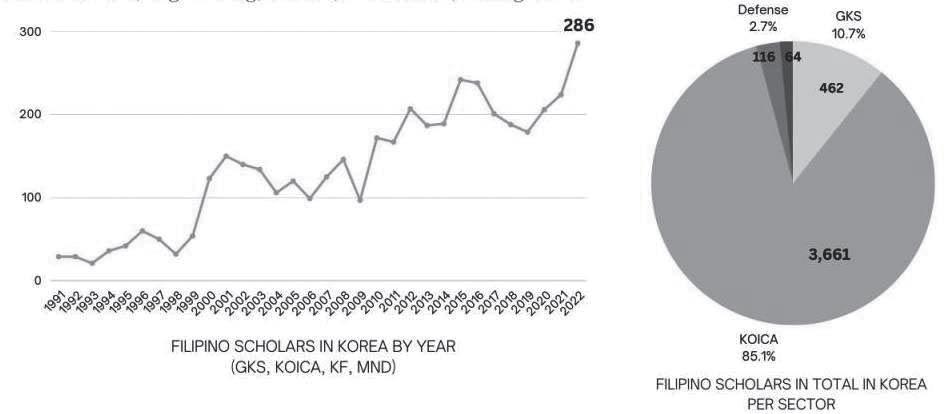
Since then a total of 4,303 Filipinos have fulfilled their degrees under various schemes, including the Korean government’s Global Korea Scholarship (GKS), Korea International Cooperation Agency (Koica) Fellowship, Ministry of National Defense Scholarship, and Korea Foundation Fellowship Visiting Program. They pursued a variety of fields, including humanities, social sciences, public
administration, engineering and defense, among others, according to the Embassy of South Korea.
Locally, the GKS program started in 1968, and has been inviting more than 10 Filipinos annually since 2010. This year it will select 45 students for the scholarship’s 2023 graduate program: 14 for the embassy track, and 31 for the university track.
The deputation has also announced
that the selection for the 2023 GKS Embassy Track, or those for graduate degrees, has been completed, and that considered applicants have already been notified.
Those left out in the list of recommendations were reminded that the latter is still open. The deputation also shared that the selection of GKS for
Yuchengco, Ayala Educ. introduce breakthrough experiential global learning with top US university
undergraduate degrees will be open in the second half of 2023.
The embassy extends its sincere appreciation to those who have expressed interest in and support for the GKS program, as it was “impressed to note that there were so many talented candidates” from the Philippines.
Assumption College’s intl exchange program enables overseas study sans add’l tuition fees
APART from working abroad, many Filipinos are trying their luck to study outside the country given the once-in-a-lifetime experience it promises and, more important, the quality education that they could get.
Here’s some good news for students who aspire for such: Assumption College’s International Exchange Program opens the door for them to learn overseas without shelling out money for additional tuition fees.
While studying elsewhere in the world, they can also immerse themselves in a new culture, meet new people from different walks of life, learn a new language, undergo different styles of learning guided by various educators, and widen their job opportunities on a global scale.
Assumption College has tied up
with reputable institutions worldwide, namely Monroe College in New York, Assumption University in Massachusetts, Hiroshima University in Japan, Kobe College in Japan, Reactor School in Singapore, and Universitas Kristen Indonesia in Jakarta, as well as other institutions in the United Kingdom, Australia, and South Korea.
Alumni of Assumption’s student exchange program can attest to the way it has helped them change for the better:
“I was able to grow into a woman of faith, community, and action through the help of the Assumption education and family,” said Alexandra Victoria Adriano Boccone, who studied in Assumption University.
“It was an eye-opening experience: I realized that we live in a big world, with a lot of opportunities to
grow,” shared Clarisse Ambray, who went to Kobe College. “If I’m allowed to enroll again, I’d do it. That’s how much I loved the experience.”
“It’s one of the highlights of my college years,” Bea Marbella, who also was in the same college for a semester. “Words can’t express how grateful I am that I joined this program. It’s really fun, and I hope [others] get to experience what I did as well.”
Meanwhile, Assumption College in Manila offers high-quality academic programs at par with global academic institution partners and counterparts. It has two main departments: Liberal Arts under the Marie Eugenie School for Innovative Learning, as well as Business Administration and Management under the Milleret School of Business and Management for Women.
The scholastic courses feature
GERMAN EDuCAtION: NOt AN ExCLusIvELY GERMAN PRIvILEGE
BEAMING with pride, Maia, Sansa and Natalia are just three of a handful of first-graders who do not have any German language background, and yet are enrolled in the German-speaking branch of the German European School Manila (GESM).
All of them speak German in school; otherwise, no one in their purely Filipino households speaks the language at home.
“We saw a significant increase in non-German-speaking families who enrolled their children in the German section,” said Christoph-Boris Frank, GESM’s head of school. “We think families in the Philippines are opening up to the idea that language learning—specifically that for the German language—will be immensely beneficial for their children in the long run.”

GESM offers schooling in two sections defined mainly by the language of instruction: English or German.

For the most part, enrollees in the German section come from predominantly German-speaking households.
But over the years, local residents
without any German background have ventured to enroll their children in this section, driven by the desire to have them learn the language, and the long-term goal of being able to send their children to a German university upon graduation.
Such is the case for Maia, Sansa and Natalia, who learned German through supervised play, and by imitating classmates and teachers while they were in the kindergarten and preschool groups. When they stepped into Grade 1, they knew the language well enough to follow the lessons without problems.
While students like the three girls mentioned used to be outliers at GESM, it’s become quite common in the current school year. Before August 2022, there were six students from non-German-speaking households in the German section from Grades 1 to 10. One year later, there are five students in the Grade 1 class alone.
And the numbers are expected to rise further.
“We’re seeing a trend develop,” shared Frank. “Last school year only
one in every 10 students came from non-German-speaking families. Now, the ratio has gone up to 1 in every 4. In our Kindergarten group, there are eight such children from a total of 15.”
GESM’s management attributes the dramatic increase to a shift in the school’s marketing efforts that position the German school as an option for families of any nationality, and not necessarily those from Germany.
Saehee Canizares, for example, opted to enroll her Korean-Filipino son Julian in the German-speaking Kindergarten after watching a GESM promotional video, which featured then-Grade 7 student Hannah Seo. A full Korean national residing in the Philippines, Seo attended GESM’s German-speaking preschool nine years ago. Now in Grade 10, she speaks German, English and Korean fluently—all while learning French.
“For us, it’s a matter of giving him double the opportunities, double the chances,” said the elder Canizares.
“Just the fact that he’d be speaking another language fluently would open
Communications to Interior Design, Education and Psychology, Accountancy, Business Administration, and Entrepreneurship.
Championing transformative education, the college is future-proofing students with a fresh approach to learning. Known as Ability-Based Learning or “ABLe,” this method of education puts an emphasis on developing Prime Life Abilities centered on its core values, while preparing students to face the real world.
Application for School Year 20232024 is ongoing. Potential enrollees may sign up through bit.ly/AssumptionCollegeRegistrationForm. For more details, they can visit the Virtual Admissions Hub, or contact the College Admissions Office via e-mail: admissions@assumption.edu. ph and mobile: +639279662341 or +639267280980. Roderick L. Abad
a lot of doors for him.”
The young Canizares has been attending the German-speaking Kindergarten for six months. At four years old, he already fully understands instructions in German, like “Hände waschen” (“wash hands”), or “aufräumen” (“tidy up”). At home, he would listen and sing along to children’s songs in German.
Long-term, parents of these students are hoping that they might be able to study in a German university after graduating from GESM. With their command of the language and eventual German school diploma, there is little doubt they would achieve this down the line.
State universities in Germany are famous for their standards, but also for being essentially without charges. Most would ask for a couple hundred euros for administrative costs, and then zero for tuition. This cost effectiveness has been catching attention outside Germany, and brings steadily more international students into the German educational system.
While many still assume that German schools are made by and for Germans exclusively, it is clear that in Manila, this notion is starting to break.
PUBLICLY listed Yuchengco-Ayala education partnership iPeople has just introduced a first-of-its-kind offering that enables Filipino students to immerse themselves in global educational experiences with top international universities and a top Philippine university, in a highly cost-effective manner.
Last year iPeople school Mapua University and “daughter schools” Mapua Malayan Colleges-Laguna and Mapua Malayan Colleges-Mindanao entered into a tie-up with Arizona State University (ASU), which has been ranked as “America’s most innovative university,” ahead of Stanford and MIT, in the past eight years.
The linkage is focused on Business and Health Sciences programs. In the latest US News & World Report online program rankings, ASU’s W. P. Carey School of Business ranked in the Top 10 in the United States across eight programs and disciplines, including the top spot for online bachelor’s in business, while that for psychology was ranked fourth.
Through this linkage, the Mapua schools also became members of the ASU-Cintana Alliance: a global network of 15 of the most innovative higher-education institutions in the Americas, Europe and Asia.

Cintana CEO and head of Asia Pacific Chris Hill was “delighted to be collaborating with the Mapua schools, [which] we selected as our Philippine champions, because of their longstanding reputation for innovation and academic excellence.
[Its recent ranking in] the Times Higher Education World University Rankings is clear evidence of the quality of a Mapúan education.”
President of Mapua University and chairperson of iPeople Dr. Reynaldo B. Vea said, “We have long been focused on delivering the hallmarks of a Mapúan education: international, digitally enhanced, outcomes-based and research-driven. Our collaboration with global leader ASU and
being part of the ASU-Cintana Alliance enable us to take these to a higher level for our students by giving them numerous opportunities to learn with a topranked US university, and other leading education institutions around the world.”
During their time at the Mapua schools students can be immersed in international learning experiences: First, they have access to ASU’s world-class content in all their ASU-enhanced courses.
Second, students are able to participate in Global Signature Courses through state-of-the-art virtual Global Classrooms which enables them to learn remotely from professors at member-universities of the ASU-Cintana Alliance, and interact with classmates from around the world, without leaving the Philippines. Students can also participate in classes jointly lectured by ASU faculty in the US.
Also, learners will have numerous opportunities to participate in dozens of student-exchange and summer-immersion courses at ASU-Cintana Alliance schools.
For Lorenzo V. Tan, who is the CEO of House of Investments—listed holding company of Yuchengco Group of Companies and majority shareholder of iPeople: “YGC has long prioritized education as one of our contributions to nation-building. It is very timely that our Mapua schools are launching this very innovative and global initiative as we celebrate the 100th birth anniversary of our past chair Ambassador Alfonso T. Yuchengco, who had always advocated for making quality education more affordable for Filipinos and had forged many successful partnerships with [global] industry leaders.” Ayala Corp. CEO Cezar P. Consing added: “This initiative will allow young people [to] access education that, while Philippine centered, is also global in quality and in reach. We want to help develop a generation of truly global Filipinos, because our country deserves the best the world has to offer.”

Education BusinessMirror
April 8-9, 2023
A8 Editor: Mike Policarpio Saturday-Sunday,
YOUNG MINDS Learners find their favorite spots at the Valenzuela Academic Center for Excellence. Inaugurated in June 2022, the 6-story building has a 3-story public library with a study hall, plus information-technology and multimedia sections, five training halls for teachers and other educationrelated programs, conference rooms, special education annex, an exhibit hall, roof deck, and the Education360 Office to strengthen the city’s education services. PNA/JOAN BONDOC
SAVE A SEAT Officials from Pasig City’s local government unit, the Department of Education and nongovernment organizations as well as students pose during a forum on March 23. The event called on the government to expand spaces for students in classrooms. PNA/JOEY O. RAZON
QUAKE DRILL With hard hats on, Baclaran Elementary School students were herded by their teachers in exiting their classrooms during an earthquake drill on March 24. The activity was part of the city’s regular preparations for the possible occurrence of a major temblor. PNA/YANCY LIM
EXECUTIVES broker various breakthrough programs from the collaboration of Mapua with Arizona State University.
Filipinos urged to honor veterans’ legacy, sacrifices
By Priam Nepomuceno
IN line with the observance of Philippine Veterans Week from April 5 to 12 and Araw ng Kagitingan (Day of Valor) on April 9, Department of National Defense (DND)
Secretary Carlito Galvez Jr. on Monday reminded all Filipinos, especially the youth, to take time in honoring the nation’s veterans.
“
Let us take this opportunity to pay tribute to our nation’s patriots and freedom fighters, honor our present-day defenders, and prepare the youth for the two-fold task of securing our nation and ensuring its bright future,” Galvez said during flag-raising rites at the DND headquarters in Camp Aguinaldo, Quezon City.

H ighlighting the theme of this year’s observance, “Kagitingan ng mga Beterano, Pundasyon ng Nagkakaisang Pilipino,” Galvez reminded the members of the One Defense Team to actively participate in the series of commemorative and special events spearheaded by the DND and the Philippine Veterans Affairs Office, to memorialize the valor and heroic deeds of the Filipino veterans.
As the designated chairman of the Technical Working Committee for the observance of the Philippine Veterans Week, I humbly request everyone for your strong support to make the commemoration meaningful through your active participation onsite, online, or by actively liking, commenting, and sharing relevant posts via social media,” he added. Galvez also urged parents to teach their children and the youth love of country and its history so they
PNA celebrates half a century of success
By Severino C. Samonte
THIS columnist was one of those invited to the celebration of the golden anniversary of the government-run Philippine News Agency (PNA) in its editorial offices at the National Media Center along Visayas Avenue in Quezon City on March 24. I accepted the invitation enthusiastically for two main reasons.
First, I wanted very much to see and meet again at least some of the former PNA men and women—editors, reporters, photographers—I have been missing since they left the agency from the last half of the 1970s and after the 1986 EDSA People Power Revolt and transferred to other media outfits or fields of endeavors or profession, either locally or overseas.

Second, to find out how the present PNA staff members would narrate the history of PNA since its birth on March 1, 1973, or five months after the controversial September 21, 1972 imposition of martial law in the country by then President Ferdinand E. Marcos Sr. I like the way the PNA’s 50-year history from its inception on March 1, 1973 was retold in an audio-visual presentation prepared by the PNA Program Director Raquel Bo -
nustro and her staff. I noted that the narration maintained the interlink of PNA with its predecessor, the privately owned PNS or Philippine News Service. Most of the former PNAers I have long wanted to see again did not come. It was easily understandable for me. Many of them are no longer capable of taking long travel from home due to age and other reasons. Some of them are very busy with their present work or now staying overseas. And worst, a number of them, I know, have gone beyond the journalistic life.
T he highlights of the celebration included the unveiling of framed portraits of former PNA general managers and executive editors from 1973 to present; presentation of greatest appreciation awards, including one posthumously, to former PNAers; announcement of photo and essay writing contest winners; and awarding of top performing editors, bureau chiefs, reporters, photographers and other employees.
T he photo gallery was unveiled by Presidential Communications Office (PCO) Undersecretary Cherbett Karen Maralit and News and Information Bureau (NIB) Director IV Raymond Robert C. Burgos. N IB, by the way, is the present mother bureau of PNA. It used to
be the Bureau of National and Foreign Information (BNFI), which was abolished during the 1987 Government Reorganization implemented by the late President Corazon C. Aquino’s administration.
T he gallery features the portraits of eight former PNA general managers led by the agency’s founder, Jose L. Pavia, who died in April 2011. The seven other photos in that section of the colonnade are those of Vergel O. Santos, German C. Galian, Gil H. Santos, Ernesto Banawis, Jorge S. Reyes, Vittorio O. Vitug and Casiano A. Navarro, in that order.
A lso in the same photo gallery are the portraits of six former executive editors: Severino C. Samonte, Iluminado “Jun” Varela, Ruben B. Cal, Danilo C. Taguibao, Faye P. Velasco and Luis A. Morente, plus that of the present one, Demetrio B. Pisco Jr.
T he posthumous award for Pavia was presented to his widow, Mrs. Loreto Q. Pavia, who was accompanied by her son Chicoy. The award was in recognition of Pavia’s distinctive stewardship of the PNA during its early years as a “martial law baby.” Cal and Samonte received “greatest appreciation award for the many years of dedication, service and continuing support to the Philippine News Agency.”
can better understand the sacrifices made by Filipino veterans and soldiers.
Galvez likewise reaffirmed his unwavering support for those who practice the Christian faith, particularly the Catholics, in their meaningful observance of this year’s Holy Week, which coincides with the celebration of Philippine Veterans Week.
“
During the Lenten break, may we empathize with the suffering of our fellowmen and find profound meaning in the death of Jesus Christ. It is my fervent hope that all these will help foster social healing, reconciliation, and national unity for nation building—these are what our veterans lived and died for, especially during that fateful Good
Friday when they conquered the infamous Bataan Death March. Our veterans did what they needed to do for the country, for the younger generations, and for everyone—including us,” Galvez said.
April 9 of every year, by virtue of Executive Order 203 signed in 1987, is “Araw ng Kagitingan” to honor the thousands of Filipino and American forces who fought for the country’s liberty and democracy.
O n April 9, 1942 or after 93 days of resistance, an estimated 60,000 Filipino and American troops were taken prisoners of war by the Japanese.
T his year, President Ferdinand R. Marcos Jr. declared April 10, Monday, a regular holiday in observance of “Araw ng Kagitingan.” PNA
Aging boomers explain shrinking labor force, NY Fed study says
By Jonnelle Marte
WHY are there so many workers missing from the labor force? Researchers at the Federal Reserve Bank of New York say the biggest factor may be simple: Workers are just getting older. W hile much attention has been paid to an increase in retirements during the pandemic, the analysis found that there wasn’t necessarily a rise in the share of people who are retired for each age group. Instead, the researchers found that more baby boomers reached retirement age during the pandemic, making age the main contributor behind the increase in retirements.
“ The aging of the baby boomers between 2020 and 2022 led to a significant rise in retirements, reducing participation,” wrote New York Fed researchers Mary Amiti, Sebastian Heise, Giorgio Topa and Julia Wu in a blog post published Thursday.
T he researchers focused on the labor force participation rate, or the share of the population that is working or looking for work. After plunging at the start of the recession, that metric has since climbed up to 62.5 percent. However, that’s still down 0.8 percentage point from where it was in February 2020, amounting to gap of about 2.1 million fewer workers, they estimate.
T he analysis looked at the share of people who are retired in different age groups and found that there was not a notable increase in the percentage of people who were retired for certain age ranges when compared to before the pandemic.
Take people between the ages of 60 and 69, for example. The share of those who are retired averaged 39.7 percent in 2018 and 2019, and 40 percent in the second half of 2022. For people aged 70 to 79, some 77.5 percent were retired before the pandemic, compared to 78.8 percent at the end of last year. And for workers above age 79, the share of those that are retired rose from 88.5 percent to 90.5 percent.
A rise in disability, including people affected by Covid-19, is another factor that could have explained the drop in labor force participation. But the research found that many of the people who became disabled during the pandemic continued to work and cited previous research finding almost no change in the average number of hours worked.
“ The increase in disability has virtually no effect on the participation gap because, as discussed above, the increase is entirely accounted for by individuals that remain in the labor force,” the researchers wrote.
Labor shortages
LABOR markets have recovered
substantially since the pandemic forced the shutdown of businesses across the country and pushed millions of Americans out of work. As the economy opened back up and demand for restaurants, travel and other services rebounded, many employers have been struggling to staff up.
D emand for workers remains high, with about two job openings for each unemployed person. The dynamic has some employers reluctant to let go of workers and hiring has stayed strong, fueling wage growth. Fed officials battling high inflation cite the imbalance between the demand and supply of workers as one of the factors that could be fueling price growth. The US central bank is aggressively raising interest rates to cool the economy and lessen demand for workers.
But there is little officials can do to address the supply shortages adding to inflation, including questions over the availability of workers. T he research suggests those worker shortages could persist.
“ Population aging is likely to continue to exert strong downward pressure on participation going forward, as more of the baby boomer generation continue to enter retirement,” the researchers wrote. With assistance from Vince Golle / Bloomberg
By Nick Tayag
SIXTY-ZEN’S WORTH
It drifted from a two-story house in the middle of that street. It was the home of a middle class family. The name of the head of the household, if I remember it right, was Tino de la Rama or Tatang Tino, for short. He was a very respectable man of the old school and an amateur violinist.
The fiddler of Padre Zamora Street MY
O ur informal gang of adolescents would suddenly stop our banter and just listen. The cacophony of loud voices arguing and radios blaring with a diversity of radio evening dramas, pop songs, and variety shows would gradually quiet down.
It was certainly different, but we were all captivated by the melodious strains because it was pleasurable to hear it in a strange, unexplainable way.
O ur street was not a classy neighborhood. The residents there were mostly struggling families. I didn’t understand it then but now I realize that, through his violin, Tatang Tino was performing an essential role of art in our world, which is to help “lift people up, not lower them down” as someone puts it.
T hat was my first encounter with so-called classical music, or should I say highbrow art. Even for some fleeting moments, the music made our ordinary commonplace street seem more beautiful and

joyful. There’s now a term for what we felt then: “aesthetic pleasure.”
O f course my appreciation of music and the arts have become more sophisticated and expansive through the years. For one, I married a woman who was educated to be a concert pianist. I have made friends with painters, filmmakers, literary writers and sculptors. My love for literature and music helped restrain me from becoming solely focused on material pursuits.
People don’t realize that we need art like we need our basic needs. It is that essential something that has been feeding our inner spirit all this time, without us being aware of it, touching and shaping our everyday lives in many ways.
Don’t we listen to music to put us in the mood? Don’t we love watching movies and TV dramas? Or play computer games? Why are some of us still addicted to reading? Why do we keep watching people singing and dancing?
W hat moves us to go to art museums or walk in beautifully landscaped gardens?
W hy do we paint? Write poems? Design homes and buildings? Why are we picky with the clothes we wear?
T hat’s because we live in a world of art, in all its forms. It is actually everywhere if we go by the definition of art as “creating design out of chaos.” We feed ourselves with
art to keep us living meaningful elevated lives. Didn’t Picasso say, “Art washes away from the soul the dust of everyday life.”
Take away art. Kill all the makers and creators of art. What are we left with? There would be nobody who would paint, make movies, music or write novels or poems. It would be a world empty of things that trigger our sense of thrill, fun, wonder, and joy. We would probably put an end to our pathetic lives because as the poet T.S. Eliot says: “Humankind cannot bear very much reality.”
So let’s get our enjoyment of art from wherever we can. Yes there are all kinds of art. Each to his own taste. We respond differently. That is what art is. A dialogue between the creator and the responder.
T hat’s why I’ve stopped categorizing the way we appreciate art. Why can’t we derive pleasure from art that is highbrow as well as lowbrow? Why bother classifying what gives us aesthetic pleasure?
W hy can’t Mang Terio the tricycle driver not attend open-air concerts by the Philippine Philharmonic Orchestra and sing the videoke versions of songs composed by George Canseco, Willy Cruz, and Ryan Cayabyab while at home?
Maybe some art forms are just a mood setter. That’s alright. For others it is something to live for.
Just ask the hubby of my sister in law. He has hampered mobility
because of a stroke he suffered several years ago. Now he has taken up the brush again and is having the most uplifting time of his life rediscovering his talent for painting and delighting his friends on social media with his finished canvases. He has discovered what the Japanese call his “ikigai”, a sense of purpose that makes you want to get up in the morning, providing inspiration to people who like him have been struck down unexpectedly in the midst of life.
Take it from an artist: “Art can’t solve our problems, or make up for our losses. But it can help us transcend them.”
T his is why I strongly believe that the more messy our world gets, the more we must have art. The more art, the better. What we should look for is not what is great art and what is a minor form of art, but what and who keeps art alive.
Only by supporting our young artists and encouraging them to create and perform art can we hope to increase our people’s art consciousness and the demand for the substantive over the superficial. Not only in art but also in our individual lives.
If some cynical friends would ask “what’s art got to do with life anyway” I probably would tell them about my beginner’s experience of art to our fiddler in Padre Zamora Street. That’s where my elevated sense of life was awakened.
www.businessmirror.com.ph Time BusinessMirror Our Editor: Angel R. Calso • Saturday-Sunday, April 8-9, 2023 A9
THE street in Angeles, Pampanga where I grew up holds many good memories. Foremost were the times when the moonlit night would occasionally be filled with the gentle sound of a string instrument lilting in the air. It stood out from the usual din in our neighborhood.
NATIONAL Defense chief Carlito Galvez Jr. PHOTO COURTESY OF DND
Six women talk about how they overcame barriers
Maravilla was one of the speakers in YouTube’s Breaking Barriers Online and Beyond event, where women content creators shared their inspiring stories of rising above challenges and how YouTube helped them make a difference.
I spent an afternoon last week at the event, which was hosted by Miss Trans Global 2020, actress, writer and content creator Mela Habijan. The other speakers were actress Candy Pangilinan, pilot Chezka Carandang, entrepreneur Jozelle Tech, and Google Philippines country director Bernadette Nacario.
Mintoo launches digital art collection in PDAX app
 BY RODERICK L. ABAD Contributor
HOMEGROWN cyber collectibles marketplace

Mintoo has launched its digital art collection available on the Philippine Digital Asset Exchange (PDAX) application, meant to pave the way for mass adoption of nonfungible tokens (NFTs) in the country. “NFTs are simply ownership or property rights on the internet, and allows everyone to participate in the burgeoning digital economy as we head to being a technological society,” Mintoo director Patrick Lao told reporters during their virtual debut event on March 28.
These digital collectibles, according to him, have special qualities, such as in-born provenance, provable authenticity, very easy to track and enforce royalties, and it opens up a very large potential market for creators, painters or artists.
NFTs, likewise, are among the most compelling used cases in cryptocurrency, added Paolo Narciso, head of NFT creation at Mintoo. He said:
“Besides it unlocking a whole platform of utilities that can be used in different spaces, which is part of our mission to execute, it also created a very valuable opportunity for artists, both digital and traditional, to utilize the tools presented by the blockchain.”
WITH millions of followers across different social-media platforms, most notably YouTube, Lyqa Maravilla is an online educational content creator who makes videos and podcasts to help people pass aptitude tests, such as the Civil Service Test, Licensure Exam for Teachers, and college admission examinations.
Coach Lyqa, as Maravilla is known, also created a series of videos in her Get Hired playlist that aims to help people prepare and land a job with tips on how to ace interviews and make resumes.
It all started when Maravilla wanted to help a group of women who could not pass the Civil Service Exam because they were busy being homemakers and mothers. She was inspired by her late grandmother, who only completed Grade 3. “Ganyan tayong mga babae, we are multitaskers. We can do so many things at the same time,” said Maravilla.
In the beginning, she had to wait for everyone in the household to fall asleep so she could film her videos. She had to share a slow internet connection with all the people in her house. Today, Maravilla has her own studio for filming.
For Maravilla, the best part about what she does is that it helps people find jobs.
“Our current average is three to five people, mostly women, reporting per day that they land jobs and get promoted,” she said.
The event was held in BGC, which is a long way from my home Fairview, but the speakers and their insights on life and content creation made the trip worthwhile. I was, quite honestly, in tears because of what these admirable women shared during the discussion.
Carandang talked about how her parents encouraged her to be a flight attendant before she studied how to become a pilot, just so she would learn the ropes while on the job. Contents like this are what her YouTube audience likes.

“It all started with one video on how to become a pilot, and after that, I was able to build a community. I get so many comments saying, ‘Chezka, I became a pilot because of you. I didn’t know it was possible to become a pilot.’”
Carandang recalls that in the beginning, she would film her videos in the airplane because she lives in a condo where the lighting wasn’t good. Today, she has over 270,000 subscribers on YouTube.
“There are videos that do better than others and I admit that sometimes I get discouraged. But for aspiring content creators, my advice is to keep going and keep creating those videos,” said Carandang.
For actress and mother Candy Pangilinan, “my burden 19 years ago has become my blessing today.”
Pangilinan’s YouTube channel features her daily life as she raises her teenage son Quentin, who has special needs. She never imagined that she would be an inspiration to other mothers in similar situations.
“We still film using a phone and I had to ask
Quentin’s permission before we started sharing our life on the internet,” said Pangilinan, who also wrote a book about her life with Quentin.
The videos on Pangilinan’s channel are very spontaneous and candid. Her subscribers like it that she shares tips about being a mom to a child with special needs.
Jozelle Tech is a YouTube content creator who has spinal muscular atrophy. Thus, she needs to be in a wheelchair. This physical barrier has not stopped her from telling either her story via her YouTube channel nor the stories of others via The Rolling Media, where she is the CEO.
“What’s harder is that I’m part of two marginalized groups—I’m a woman bound to a wheelchair. As a child, I had so many dreams, but people would always tell me, no, don’t be ambitious. But I am ambitious, and I couldn’t accept that this was going to be my life. I couldn’t walk, so that’s why I decided to run a business,” said Tech.
Habijan, who talks about all things transgender on her YouTube channel, credits the platform for the full realization of her hosting dreams, as she announced she will be hosting shows on YouTube including “Rainbow Bench,” a YouTube-first talk show focused on LGBTQIA+ stories and allyship.
Sharing her very own breaking barriers story, Nacario said, “I’ve been in tech for over 30 years now and my journey in the industry has not been easy. Back in the early days of tech, I was the only woman in a boardroom full of men. It was daunting at first but I didn’t let this hold me back. I stood my ground and believed in myself. I showed them that women can and women will.”
I remember first meeting Nacario when she was still with another tech company and since then, I have admired her for both her strength as a woman and her efficiency at what she does professionally. Be inspired by the #PinaysWhoBreakBarriersOnYouTube. Listen to their stories on the replay of Breaking Barriers Online and Beyond on the Google Philippines YouTube channel and Facebook page. ■
More efforts needed by PHL to address digital gender divide
BY RIZAL RAOUL S. REYES
THE Philippines must exert more effort to empower more Filipino women in the digital space as they can contribute a lot in economic growth.
Department of Information and Communications Technology (DICT) Undersecretary Anna Mae Lamentillo underscored the importance of bridging the digital gender divide in recognition of their talents and skills.
“Bridging the digital gender divide is a requisite of gender equality. But we cannot do this alone. When we talk about women’s rights, we also have to open the dialogue about how men can play a role in this cause; men need to be engaged in the fight for gender equality. We can achieve this by showing the value of providing equal opportunity
for women, that women’s participation is critical in our society and in the overall welfare of our nation,” explained Lamentillo in the recently concluded EmpowHer forum with the topic “Conversations on Reengineering a Female-Led Future For Tech.”
Ruoshan Tao, head of marketing for Shopee Philippines, said mentoring women to advance in tech and leadership roles is crucial as this can harness their potential to become future leaders in the tech sector.


“Our job now is to help mentor and inspire the younger ones to continue challenging themselves and continue cultivating their strengths,” shared Tao.
Yangyang Zhang, managing director for Xendit, pointed out that it would be advantageous to the financial technology (fintech) sector to have more women leaders because they offer their fresh ideas to
spur innovation.
“Viewing the needs of the current payments landscape through a gendered lens allows us to see how we can create infrastructure that is equally accessible for men and women,” said Zhang.
Enstack cofounder and CEO Macy Castillo, meanwhile, hailed the role and contributions of Filipinas in the economy and the tech sector as well. She pointed the valuable contribution of Filipinas in empowering local small and medium enterprises (SMEs)
“We’ve seen this first-hand in our interactions with thousands of women-led SMEs that have been embracing digitization through our superapp.
By providing different channels to support these businesses and foster strong linkages among women in our ecosystem, we can unleash their inherent
In Southeast Asia, the Philippines saw a massive adoption of NFT technology due to the emergence of play-to-earn games, especially in the last couple of years. Amid this development, however, there are still limitations encountered because the “vision is compelling, but reality is much more sobering,” per Lao.
“The problem needs to be solved for the mass adoption of NFTs. So here comes into the picture Mintoo. The vision is as simple as this: we want to make collection on Mintoo an easy, seamless and pleasurable experience,” he emphasized.



Knowing that NFTs are still very early in the evolution of technology, the platform provider seeks to become a pioneer and bring it to the mainstream. It envisions a wider adoption for both creators and users outside of the play-to-earn economy.






“What we want to see is create empowerment, mint engagement, rewards and loyalty programs, and the like. And what we think we’re bringing to the table are the tools for the creators to offer these kinds of things to their audience,” Narciso explained.
As a headstart, Mintoo debuted its inaugural collection of digital artworks, dubbed “Artist Series: New Horizons,” featuring a slew of thoughtfully-curated masterpieces made by 10 established and emerging Filipino NFT artists— from illustrators and traditional painters to collage artists and 3D modelers—namely, Alchemyst, Marv del Mundo, Lucius Felimus, Gian Ferrer, Auggie Fontanilla, Ab Hong, Marso, Lei Melendres, Shelly Soneja and Tontsee.
In this ongoing year-long campaign, visual artists, creators and art enthusiasts can now buy, sell, and trade digital collectibles in Philippine peso conveniently through their Mintoo account, exclusively available on the PDAX app that’s downloadable on Google Play Store, Huawei App Gallery, and App Store (coming soon), or by visiting www.mintoo.pdax.ph.
creativity to solve problems, fuel economic growth, and drive innovation,” Castillo explained.

On her part, Stephanie Sy, founder and CEO of Thinking Machines, stressed that diversity in the technology sector will lead to more growth as there will be more innovations and further growth.
“Diverse viewpoints lead to better technology. This Women’s Month, we celebrate the impact of women in technology and encourage the next generation of women technologists to drive innovation,” Sy stressed.
Inspired by the United Nations’ theme for International Women’s Day, “DigitALL: Innovation and technology for gender equality,” women leaders in tech also lent their perspectives about the past, present and future for women working in the industry.
A10 Saturday-Sunday, April 8-9, 2023 • Editor: Gerard S. Ramos www.businessmirror.com.ph BusinessMirror
MELA HABIJAN PHOTOS COURTESY OF YOUTUBE
GOOGLE Philippines country director Bernadette Nacario LYQA MARAVILLA
Italy temporarily blocks ChatGPT over privacy concerns
ROME—Italy is temporarily blocking the artificial intelligence software ChatGPT in the wake of a data breach as it investigates a possible violation of stringent European Union data protection rules, the government’s privacy watchdog said Friday.
The Italian Data Protection Authority said it was taking provisional action “until ChatGPT respects privacy,” including temporarily limiting the company from processing Italian users’ data.
US-based OpenAI, which developed the chatbot, said late Friday night it has disabled ChatGPT for Italian users at the government’s request. The company said it believes its practices comply with European privacy laws and hopes to make ChatGPT available again soon.
While some public schools and universities around the world have blocked ChatGPT from their local networks over student plagiarism concerns, Italy’s action is “the first nation-scale restriction of a mainstream AI platform by a democracy,” said Alp Toker, director of the advocacy group NetBlocks, which monitors internet access worldwide.
The restriction affects the web version of ChatGPT, popularly used as a writing assistant, but is unlikely to affect software applications from companies that already have licenses with OpenAI to use the same technology driving the chatbot, such as Microsoft’s Bing search engine.
The AI systems that power such chatbots, known as large language models, are able to mimic human writing styles based on the huge trove of digital books and online writings they have ingested.
The Italian watchdog said OpenAI must report within 20 days what measures it has taken to ensure the privacy of users’ data or face a fine of up to either €20 million (nearly $22 million) or 4 percent of annual global revenue.
The agency’s statement cites the EU’s General Data Protection Regulation and pointed to a recent data breach involving ChatGPT “users’ conversations” and information about subscriber payments.
OpenAI earlier announced that it had to take ChatGPT offline on March 20 to fix a bug that allowed some people to see the titles, or subject lines, of other users’ chat history.
“Our investigation has also found that 1.2 percent of ChatGPT Plus users might have had personal data revealed to another user,” the company had said. “We believe the number of users whose data was actually revealed to someone else is extremely low and we have contacted those who might be impacted.”
Italy’s privacy watchdog, known as the Garante, also questioned whether OpenAI had legal justification for its “massive collection and processing of personal data” used to train the platform’s algorithms. And it said ChatGPT can sometimes generate—and store—false information about individuals.
Finally, it noted there’s no system to verify users’ ages, exposing children to responses “absolutely inappropriate to their age and awareness.” AP
The HOT-S phone of the summer

LAST year, Transsion, the mother company of Tecno Mobile and Infinix, became the second top smartphone brand in the country registering a massive +89 percent growth to own 18 percent of the local market. And with the recent shuffle within the No.1 brand, Transsion may just be the one to snag that top spot this year.
This week, we take a look at the HOT 20S, the latest iteration of the series which brings several upgrades but at a slightly higher price tag.
The unit we have is the Infinix HOT 20S Free Fire Edition, which comes with a custom artwork sleeve featuring Kelly. It also has a few exclusives including four-character customized wallpapers (Kelly, Moco, Hayato, and Kla), game-inspired icons, ringtones and notification sound effects that are built into its customized XOS 12 UI.
The HOT 20S comes in four colors, Light-Rider White, Fantasy Purple, Tempo Blue and Sonic Black, which is the unit we have. It has a shiny glass-like finish that makes its plastic back look more premium and a sunray-like pattern that is quite eye-catching. The glossy finish does make it a fingerprint magnet and it will look quite messy unless you slap on a plastic case.
The phone is quite big measuring 168.65 x 76.75 x 8.47mm and weighs a hefty 202g but as far as design and build, Infinix did a fine job to make the HOT 20S look more premium and stylish without resorting to some outrageous color pattern.
The HOT series got a lot of attention for offering a 90hz display, and Infinix pushes the envelope further by making the HOT 20S the most affordable phone to have a 120hz display. The phone has a 6.78-inch display, FHD+ IPS display, with a 2460 x 1080-pixel resolution, 396 pixels per inch, and a punch-hole for a cleaner look. The earpiece on top works as a second loudspeaker for a stereo setup.
We really can’t complain about the displays of budget phones, but the HOT 20S actually has one of the better IPS panel displays we’ve seen with nice colors and contrast.
Its high refresh rate of 120Hz does deliver a smooth visual and touch experience to users. If you are worried about battery life, you get the option of three refresh rates ranging from the standard 60Hz to the
Budget-friendly roaming promos
AS global travel steadily returns to normal, telecoms giant Globe unveils its latest line-up of roaming offers tailored to meet the evolving needs of budget-conscious people who love to explore the world without breaking the bank.

“Value for money has become a key factor in travel decisions, so Globe has designed roaming options that address the challenges faced by our customers seeking affordable connectivity while abroad. With no need to change SIMs or carry a separate device, we make it easy for them to maximize their trip to the fullest so they can keep creating those core memories,” said Coco Domingo, Globe postpaid and international business vice president.
Globe’s innovative roaming offers cater to the diverse needs of today’s travelers. For one, GoRoam is an exclusive offer available through the GlobeOne app, which provides country-specific promos that match local SIM offers.
With GoRoam, travelers no longer have to get a local SIM to enjoy unbeatable rates. This convenient solution empowers them to remain connected to their loved ones and access essential information without the hassle and expense traditionally associated with roaming services.
Meanwhile, Roam Surf Longer Stay, grants travelers access to data roaming packs that get more affordable the longer you use it. For as low as P200/day, customers can enjoy up to 20GB data good for 30 days.
Available in over 90 countries worldwide, Roam Surf Longer Stay makes it easy to do cross-country trips. All you need is one promo as customers country hop from one destination to another.
By providing affordable and convenient solutions for staying connected abroad, Globe aims to capture and heighten its relevance among travel intenders during the
fastest 120Hz.
For its cameras, the HOT 20S is equipped with a 50-megapixel main camera and a pair of 2MP sensors for portrait and macro shots. It’s the same camera setup as its predecessor, but based on our tests Infinix definitely improved the camera performance especially in low light. Photos using the main camera look decent, with good detail but I wish the colors were a bit more vivid.
The front-facing camera packs an 8-megapixel sensor for those selfies. Again, photos come out okay for social media posting but the beautification here is so aggressive, they might as well have called it “beatification” mode as it makes you look like one of those saints you see in church.
Now for the most important aspect of the phone, its performance, I’m pleased to say that it does live up to its promise of being a great gaming phone for its price.
The Infinix HOT 20S is powered by a MediaTek Helio G96 octa-core processor that’s designed for gaming, a Mali-G52 GPU, 8GB of RAM, and 128GB of storage that’s expandable up to 1TB via the microSD
The processor is probably the biggest upgrade of the HOT 20S and for a phone that’s priced below P10,000, it’s the best possible chip you can use. It’s actually the same one used by the NOTE 12 4G and many other mid-range phones that’s priced way
The Helio G96 is a great choice for budget gaming and based on our gaming tests, it was able to run all of the games we installed on it very smoothly. We tried Call of Duty, PUBG, Mobile Legends, Asphalt and even Genshin Impact, and it was able to handle all of them even at slightly higher settings. I do find it a bit weird, though, that despite the FreeFire co-branding, the game wasn’t pre-installed on the phone considering the amount of bloatware I had to uninstall. Like this app called ScooperNews which floods you with a lot of useless and annoying notifications.
Throughout our review, I never noticed any lag or slowdown when taking pictures, browsing through my social media feeds, emails and other multitasking operations.
Looking around the settings, I found the Special Function tab which gives you access to options such as lightning multi-window, MemFusion to virtually increase the memory up to 5GB, game mode, video
assistant, kids mode, XClone for multi-account management, and a few more.
Then there’s Power Marathon which you can tweak to get the most out of that 5000mAh battery. In our PCMark test, we got more than 14 hours of battery life which is impressive. In our daily use, light gaming Internet browsing, blog posting, photo test and watching YouTube videos, it was easily able to last us more than a day. For marathon gaming, it should last you about five to six hours until you need to plug in that 18watt charger. Fully charging the phone takes more than two hours.
Final word: Like I mentioned in the beginning, the Infinix HOT 20S is priced a bit higher than its predecessor, but the improvements in camera, performance and that 120hz refresh rate still make it one of the best choices for gamers on a budget. Do note that this is still a 4G phone and if you need 5G connectivity, you can add P1,000 more and get the HOT 20 5G instead.
ADAPTING TO THE CHANGING TIMES
TECH is ever so changing, and with the rise of new platforms and creators, Wheninmanila.com shares the secrets of how they remain to be top of mind when it comes to different kinds of content whether on their website or social media platforms.
Founded by Vince Golangco in 2009, Wheninmanila.com was one of the first blogs that covered all categories and not just a certain niche.
“Whether its news, trending topics, travel, food, tech, or anything relevant to Filipinos and the Philippines, we cover it”, shares Vince.

“Wheninmanila.com is now 13 years old and it has really changed over the years. We had to adapt and keep up with the trends. From just the website, we now have Facebook, Instagram, Tiktok, Twitter and YouTube that help us stay connected to more of our audience,” Vince added.
Wheninmanila.com has 3 million followers on Facebook, which is one of their strongest platforms. As TikTok gained popularity, Wheninmanila.com got front-row seats. During the first two years of the app in the country, their team got a grasp of what works and built a loyal following on the platform.
Though there are many things that have changed, many things remain the same for Wheninmanila. com. They continue to create content that people love and relate to. ■
A11 Editor: Gerard S. Ramos • Saturday-Sunday, April 8-9, 2023 www.businessmirror.com.ph BusinessMirror
mirror_sports@yahoo.com.ph
Editor: Jun Lomibao
12K runners answer gun for Milo race
THE National Milo Marathon returned with more than 12,000 runners of all ages, shapes, sizes and skill set joining the kick off leg at the SM Mall of Asia Complex.

T he marathon returned after a three-year pandemic hiatus with participants competing—and enjoying—the 3K, 5K, 10K, 21K and 42K races.
T he longest-running marathon in the country marked its 44th iteration and follows the brand’s
Milo Active Pilipinas launch in January which was a call for the nation to go from couch to court with the help of Milo’s energizing nutrition and sports programs.
We started the year with a call to go from couch to court—to ease our way back into sports—and the return of the iconic National Milo Marathon is one of the ways we’re doing that,”
Milo Sports Head Carlo Sampan said. “Although it’s not on the scale that we’ve gotten used to, the Milo Marathon continues to be a safe and trusted space where Filipinos can get together to start or strengthen their active lifestyles.”
M ilo also launched its first Virtual Milo Race where more than 2,000 runners nationwide joining the festivities online.
The event also welcomed casual and first-time runners, one of them James Kevin Cruz of Montalban (Rizal) who used to run 32 kms but tested the men’s 42K and won.
I challenged myself on the 42K and with the help of my friends who run marathons, I did well,” Cruz said.
K jerstin Janikka Schei, only 10 years old and a soccer player, said that the experience was relaxing—she finished the 5K run with her friends.
Attendees also had fun activities such as the Active Zones that gave kids an introduction to taekwondo, basketball and sepak taraw and witnessed cheer dancers from different elementary and high schools and colleges.
The second leg will be in Batangas City on May 28.
THOUSANDS of skilled and leisure runners get ready to answer the gun.
By Josef Ramos
GINEBRA San Miguel clashes with TNT in Game 1 of the Philippine Basketball Association Governors’ Cup Finals on Easter Sunday with the reigning champion Gin Kings going after their fifth title in the conference that the Tropang Giga have never won.
A nd there’s Justin Brownlee, who’s aiming for his seventh crown in seven Finals appearances as import of Ginebra, which also eyes its 16th PBA championship.

O n the other end, TNT wanted this Governors’ Cup just too badly to add to its eighth league crowns—and so as Tropang Giga import Rondae Hollis-Jefferson, a certified National Basketball Association player who has yet to win a professional league title.


Game 1 is set at 6 p.m. at the Smart Araneta Coliseum.
T he Gin Kings only took Good Friday off and were unrelenting in practice the entire Lent at the San Miguel Foods Sports Complex along C5. We only broke practice on Good Friday,” said Cone, adding that everyone is in high morale heading into the best-of-seven championship.
S eason Most Valuable Player
Scottie Thompson has been in his elements with averages of 13.2 points, 6.7 rebounds and 6.3 assists in 15 games in the conference, along with big man Christian Standhardinger—a shoo in for the Best Player award— who churned out 23.5 points, 10.4 rebounds and 5.8 assists in 13 games.
There’s also high-flyer Jamie Malonzo (17.1 points and 7.1 rebounds in 15 games) who’ll be up front in Ginebra’s campaign. “ They are going to be formidable—and we know that,” Cone said. “We will just go out there and make them uncomfortable.”
Japeth Aguilar, Cone said, could also be playing from a knee injury although he said his status is day to day.
Brownlee? He’s 6 of 6 in terms of helping Ginebra win a championship in an import-laced conference— Governors’ Cup in 2016, 2017, 2019 and 2021 and Com-
GINEBRA-TNT DUEL BEGINS
missioner’s Cup in 2018 and 2022.
C one said that with Brownlee’s credentials, he’ll go down as one of the league’s best imports. I don’t think this one will make a difference in JB’s legacy whether he wins this
Olympic gold medal remains my top priority, focus–Paalam
THE road back to the Olympics looks more complicated this time for Carlo Paalam but the silver medalist at the Tokyo Games is more than determined to hunt for that gold.
one or not,” Cone said. “Even he stays at six [titles], he is going to be the greatest [import] to play in the PBA. That’s already an amazing feat.”
Getting into the finals is as enjoyable thing as the first one in 2016,” said Brownlee, who went 27.3 points, 10.5 rebounds and 6.9 assists in 15 games. “I’m just lucky and very blessed just trying to take advantage of every opportunity.”
Jojo Lastimosa— Cone’s top player in Alaska in the 1990s and is in his first Finals as a head coach in the PBA—wanted a win in Game 1 to get his Tropang Giga going.
“Winning Game 1 means we have a head start and that’s always good, but that doesn’t mean much if we lose our next game,”
Lastimosa said. “If we lose our first game and win Game 2, it’s just the same. The key is to string up a couple of games.”
R oger Pogoy is one of TNT’s main offensive weapon with averages of 19.1 points in 15 games along with Mikey Williams on a 17.6-point norm. Calvin Oftana has also been responding with 13.6 points and 7.9 rebounds in 14 games.
L astimosa said Rondae HollisJefferson would be TNT’s “great equalizer” in the series.
“ Rondae [Hollis-Jefferson] is our big equalizer and we like his enthusiasm, energy and youth,” he said. “He has a mission of winning his first ever professional title—and that’s something we can answer for Brownlee’s magic.”
“ I’m just trying to bring the title back to TNT and that’s the goal since I came here,” Hollis-Jefferson said. “That’s the focus and as long as we do everything, the Xs and Os, everything will work out fine.”
Hollis-Jefferson went 30.4 points, 10.4 rebounds, 6.5 assists and 2.2 steals in 10 games since replacing import Jalen Hudson.
The Olympics are my priority, I’ll do everything to win the gold,” Paalam told BusinessMirror before the Holy Week break. “I’m doing everything to improve my skills and keep my focus.”
Paalam, 24 and a pride of Cagayan de Oro City, has been training with other national boxers at the Philippine Sports Commission facility inside Teachers’ Camp in Baguio City.
He’s targeting another crack at an Olympic gold medal in men’s flyweight but before he does that, he has to settle as a bantamweight in the Cambodia Southeast Asian Games in May.

“
My focus is the SEA Games and then the Asian Games, which is very crucial for me,” he said.
F rom bantamweight, Paalam will revert to flyweight in the September Asian Games Hangzhou where tickets to the Paris 2024 Olympics are staked.
“
I’m making the necessary adjustments from bantamweight to flyweight. It’s a little bit challenging but it’s doable,” Paalam said.
Bantamweight is at 53.5 kgs while flyweight is 51 kgs.
Paalam is giving way to backto-back SEA Games flyweight gold medalist Rogen Ladon in the Cambodia SEA Games.
Paalam was in the most successful batch of athletes in the Olympics in Tokyo topped by weightlifting gold medalist Hidilyn Diaz-Naranjo and boxing silver medalist Nesthy Petecio and bronze medalist Eumir Felix Marcial.
Meanwhile, there will be no foreign training for the national boxers ahead of the Cambodia SEA Games, according to Association of Boxing Alliances in the Philippines secretary-general Marcus Jarwin Manalo.
Manalo said training camp will remain in Baguio City until the team flies to Cambodia for the boxing competitions that are scheduled a day after the May 5 opening ceremony and end on May 14.
T he ABAP official also said the country won’t be competing in the world championships in India and in any other International Boxing Association-sanctioned competitions. Josef Ramos
Documentary on ‘Ceb’ Debs released
JUSTIN BROWNLEE is eyeing to extend his championship run with Ginebra to seven conferences, while Rondae Hollis-Jefferson is out to get his first title in a professional league and TNT its first Governors’ Cup crown.
FORMER Red Bull OG Esports captain and backto-back The International champion Sébastien “Ceb” Debs released his first documentary about his unexpected return to the sport in 2022.
“CEB: A Major Comeback” takes a behind-the-scenes look at how Debs, the retired Dota legend, came out of retirement to help a young and inexperienced roster in need of a captain. O ut of practice and recovering from critical eye surgery, Debs
faced incredible challenges as he led his team to victory at the 2022 Stockholm Major.
The documentary did justice to the fantastic journey of Red Bull OG as it captured the remarkable comeback and shed light on the untold stories of one of the most beloved DOTA teams in the world.
“I’m excited to share my story with the world. It was an honor to be called back to Red Bull OG, and I’m grateful for the opportunity to lead this team to victory,” Debs said. “This documentary is about more than just me. It’s about the strength and resilience of a team that never gave up.”
Ceb is a Dota 2 legend and twotime T.I champion with Red Bull OG Esports and is widely considered one of the best players in the history of Dota 2. Debs retired from professional play in 2019 but returned to Red Bull OG in 2022 to help his former team. H is leadership and experience proved invaluable in setting down the foundation for the next generation of Red Bull OG players.
CEB: A Major Comeback” documentary is available now for streaming on multiple platforms, including Red Bull OG Esports’ official YouTube Channel.
LAS VEGAS—UFC President
Dana White said Tuesday that combining marketing forces with World Wrestling Entertainment (UFC) will create an even larger fan base for both organizations. The sides will work together after Endeavor announced a $21.4 billion deal on Monday to bring WWE under its umbrella with UFC.
You have the power of the fan base of the WWE, you have the power of the fan base of the UFC,” White told The Associated Press in his first public comments beyond a written statement. “And you have the power of the viral. I don’t even know what the hell this thing is yet. We can reach all these people in so many different ways. It’s fascinating.”
W hite also said the Power Slap League has agreed to a two-year media rights deal with Rumble, which will televise the next two seasons of “Power Slap: Road to the Title,” a
UFC boss White: WWE partnership grows fan bases
reality series in which slap-fighting competitors also compete. He said the deal includes eight events, with the championship of next season›s series expected to take place in Abu Dhabi, United Arab Emirates.
Power Slap League is not under Endeavor because it’s a separate venture that White and former UFC CEO Lorenzo Fertitta are overseeing.
Endeavor unites two strong fan bases, though White said there isn’t much overlap between them. The UFC has more than 700 million fans worldwide and WWE has more than 1.2 billion.
I n many ways, White said, the two will continue to operate as separate companies with the corporate leadership remaining in place under Endeavor CEO Ariel Emanuel. White remains in his current role with
the UFC, and Vince McMahon will continue in his role as the WWE executive chairman.
I can go to Ari, and Ari will make whatever I need happen,” White said. “The WWE is going to be the same way. The people that have been successful there can now use Ari as a resource to help take them to another level, and it’s just it’s the perfect relationship. He’s very good at is taking these people with very strong personalities. You got me, you got Vince and a lot of other guys that he’s dealt with in these different companies.”

W hite said it is still to be decided exactly how the new partnership will work, but he wasn’t concerned his sport would be confused for the scripted WWE even as they cross promote.
He was more than interested in promoting the Power Slap League, which has its next event tentatively scheduled for May 24 at the UFC Apex in Las Vegas.
W hite touted the viewership numbers, saying Rumble is up to more than 81 million subscribers, and the slap league is outdrawing nearly every National Football League (NFL) and National Basketball Association (NBA) team and each Major League Baseball (MLB) and National Hockey League club on YouTube.
O ne knockout video was viewed roughly 110 million times, and another received about 50 million views. The slap league YouTube video shorts totaled 250 million, which White said was more than the NFL, NBA, MLB and WWE combined. AP
Sports BusinessMirror
A12 SAturdAy-SundAy, April 8-9, 2023
CARLO PAALAM’S golden dream is embedded in his heart and mind.
last month. AP
CARMELLA leaps at Bianca Belair during the Monday Night RAW event in Boston


BusinessMirror April 8-9, 2023
‘Is the easter bunny real?’ a psychologIst’s advIce on how to answer
YEARS IN THE MAKING
The vowels they orbit released new EP ‘tuloy tuloy tuloy!’
 By Patrick V. Miguel
mostly online. “We have to do it all online,” she said.
Despite the setbacks to complete the EP, the vowels they orbit got to release “tuloy tuloy tuloy!”
“May personal connection din kami sa message ng kanta ng ‘tuloy tuloy tuloy!’ kasi kahit kami as a band, ganoon ‘yung pinagdaanan,” said Nikka.
The latest EP was released last month, March 10, which was timed around Nikka’s birthday. They celebrated both her birthday and the release last March 11 at The 70s Bistro Bar.
Their slow and romantically profound song “Here In My Arms” was written in 1994, by the father of drums and backup vocals Jeremy Sayas.
The band shared that they knew each other for years now, back when they were still in college.
Four of them were communication arts students at the University of Santo Tomas. Guitarist Gene Santiago, on the contrary, was an engineering student in the same university.
“So there’s five of us and we started as magkaka-kilala na kami basically college pa lang and then we tried ‘yung nga mag banda sa college and the vowels started with the vowels kasi limang vowels and lima kami,” Patch Javier, the band’s bass, said.
Nikka said one of the reasons was because of the COVID-19 pandemic. However, it came to a point when the slump had to end where they had to ask: “Tuloy ba?
Anong plano na’tin? ”
Keys and backup vocals Hannah Dela Cruz shared, “Lockdown pa yon we had to do them na magkakahiwalay, [and] minsan wala sa timing ‘yung coming back and forth lang talaga.”
Hannah added that meeting with their producer was a challenge since it usually requires meeting in-person, but ended up
“It’s about… heartbreak pero ended up finding the right person, so it’s like falling in love again at the right time and it’s the right person,” Jeremy shared the meaning of the song his father wrote.
“Clutch,” according to Nikka, was written in 2016, when they were still in college. Their last track “If You Come Back To Me” was written in 2019.
College days
BEFORE they were a band, they were a group of students formed through the same love for music.
They got the idea to add “they orbit” in their band name because of a fond memory. Patch said they usually practice in his house in Cavite, and there are nights where they would gaze at the stars together.
Patch added that they also like donuts, which inspired “they orbit.”
But all in all, “the vowels they orbit” was formed because they wanted to achieve a dream-like space atmosphere with their music.

“It’s connected to our music as well [as] we feel like we’re floating in space with our music [and] orbiting because very chill lang ‘ yung sounds,” Nikka explained.
“tuloy tuloy tuloy!” is available on all music-streaming platforms.
BusinessMirror YOUR MUSIC APRIL 8-9, 2023 | soundstrip.businessmirror@gmail.com 2
Bernard
Y2Z & SOUNDSTRIP are published and distributed free every Sunday by the Philippine Business Daily Mirror Publishing Inc. as a project of the The Philippine Business Mirror Publishing, Inc., with offices on the 3rd Floor of Dominga Building III 2113 Chino Roces Avenue corner Dela Rosa Street, Makati City, Philippines. Tel. Nos. (Editorial) 817-9467; 813-0725. Fax line: 813-7025 Advertising Sales: 893-2019; 817-1351,817-2807. Circulation: 893-1662; 814-0134 to 36. www.businessmirror.com.ph Publisher
Editor-In-Chief
Concept : Y2Z Editor :
Group Creative
Graphic
T. Anthony C. Cabangon Lourdes M. Fernandez Aldwin M. Tolosa Jt Nisay Edwin P. Sallan Eduardo A. Davad Niggel Figueroa Anabelle O. Flores Tony M. Maghirang, Rick Olivares, Patrick Miguel
P. Testa Nonie Reyes
:
:
SoundStrip Editor :
Director :
Designers :
Contributing Writers : Photographers :
SONGS in the new EP “tuloy tuloy tuloy! ” by the vowels they orbit took years to make, and one of their songs was actually written in 1994. They originally started recording in 2021, but took two years to release it. Why?
“Maraming nangyari,” lead vocalist Nikka Melchor broadly explained.
THE vowels they orbit
SoundSampler
by Tony M. Maghirang
Summer 2023: The Soundstrip Interviews
WE feature acts playing at the Book Launch and gig happening on April 24, at TakeOver Lounge near Katipunan Ave. QC.
P.O.T - Return of the Brown Funk Brothers
The late Karl Roy fronted P.O.T. which kicked up a legendary funky storm amidst the grunge, hard rock and fey OPM of its time. This time around, a band bearing almost the same name P.O.T (sans period after T) are sending audiences to funk cloud 9 once more. The current line-up includes former Karl Roy associates Mally Paraguya on bass and Ian Umali on guitar, augmented by Red Dela Peña on vocals and Paolo Dela Rama on drums (for local live gigs), plus Harley Alarcon on drums (when he is in town or the band is playing abroad).

SoundStrip hooked up with the band with a fabled past to tell their present story.
SoundStrip (SSS) When did the idea of starting the band set in?
as instrumentals (or with Karl’s “ghost” vocal) and posting videos of the three of them playing our music.
SSS: Is the concept to pay tribute to Karl Roy era P.O.T. or to start from that and move on to other things?
P.O.T: Sure, maybe part of it is a kind of tribute to Karl. But every time we play, our music can be considered a tribute to Karl since he was part of the whole thing. It’s more of a tribute to the music that we made decades ago, and to the band that we were at the time. There’s definitely something special about that.
SSS: Does P.O.T have any special meaning?
PAR SATELLITE. Random Spinning is A Natural High.Par Satellite is a DJ who’s made a name for himself playing tunes outside the typical norm for DJ sets. He spins his story for this feature.
SSS: Who/what inspired to get started as Par Satellite? What’s with the name?
PAR: Since the 90s I’ve been making mixed tapes/CDs and I labeled them as PARSCAP, parTunes and Pirate Satellite which eventually became my 3-hour Saturday Night radio show on NU 107 in 2006 until they went off the air. It’s a tribute to The Clash on what they stood for in rocknroll. Par Satellite is what it sounded like when my global hosts called on Pirate Satellite.
SSS: What skills go with your DJ set? What would be in your typical setlist?
PAR: Basic DJ’ing skills such as mixing and beat Match segueing. Since I started it’s been my practice to be 5 or
more songs ahead to my next song. And I don’t have a preplanned playlists then or since. For me random spinning is my natural high. The Clash and their timeless relevance have almost always been a part of my DJ set though.
SSS: What makes your set special?
PAR: I have elements of classics and new stuff in my repertoire. It’s actually the more exciting new tracks I discover from time to time that sets me apart from others

SSS: Please recall memorable experiences as Par Satellite.
PAR: Opening with flawless DJ sets for Marky Ramones’ Blitzkrieg, Bloc Party, coheadlining and official host of the late great Specials Icon Terry Hall for Fred Perry Philippines’ 10th Anniversary Special Event. Also, meeting up twice with The Clash original drummer Terry Chimes at the Manila Hotel for tea and back stories.

P.O.T: Ian, Harley and Mally reconnected online at the beginning of the pandemic. We realized how much we missed playing our music, and at first, did not even consider reforming as a live band. It was just fun being able to put the songs together
P.O.T: No special meaning. It’s not really an acronym or code for whatever. It was a play on the word “peyote”, and on the front cover of our album’s bandlogo, the “O” being the peyote plant. Now, we’re not out to present ourselves as this “new group” with “new music” that’s groundbreaking; but we would like people to hear our music the way we intended it to be heard two decades ago, because we still do believe in and we are very proud of what we’ve done.
soundstrip.businessmirror@gmail.com | APRIL 8-9, 2023 3 BUSINESS MUSIC
P.O.T (L-R) Mally Paraguya, Pao dela Rama. Red dela Pena & Ian Umali.
PAR Satellite
‘Is the Easter bunny real?’ A psychologist’s advice on how to answer
 By Elizabeth Westrupp Deakin University
For many families, Easter traditions bring a special kind of magic for both children and adults. Like Santa and the tooth fairy, the Easter bunny represents the pure innocence and fun of childhood. With a dash of imagination, and plenty of beautifully wrapped chocolate, what could go wrong?
Well, unfortunately, the truth may be what goes wrong, leading to tears for disappointed children. Thankfully, there are ways to manage this situation gracefully and even use it as a learning opportunity.
If the child is questioning and unsure: To support the child, you can relax, listen carefully and be guided by him or her. Aim to answer questions in a simple, straight-forward way. But remember, you don’t need to give the answer straight away. You might say: “Hmm, can you tell me why you think the Easter bunny might not be real?” When children learn that they are head and taken seriously, relationships strengthen.
If the child has heard other kids asking : Some kids may be asking about the Easter bunny because they’ve heard
other kids asking the question, but make it clear to you in other ways they still want to believe. You might say: “Even though other kids are asking about it, it sounds like you still believe in the Easter bunny? Should we see what happens this year?”
If the child is sad about the truth: For most kids, finding out the truth is a positive experience. But some may feel really sad and upset when they find out. For these kids, it will help if their feelings are acknowledged and validated. You might say: “I know it feels so sad and disappointing to find out the Easter bunny isn’t real.”
Celebrate the moment: You can also talk about how it’s such a big important milestone for kids to be ready for the truth. You might say: “All kids hear the story about the Easter bunny, and when they figure out it’s not real, it’s a really special moment. It shows how much you’ve grown and how clever you are at working things out on your own. I think we should celebrate!”
Coming-of-age tradition: Turn the occasion into a positive coming-of-age tradition, where children learn Easter is about family togetherness and celebration. You might tell the child: “Even though there’s no actual Easter bunny,
the magic of Easter is really about doing all the fun things together with our family and friends, and showing each other we love them by giving chocolate gifts.” Kids like to feel involved, so you could ask: “What would you like to keep doing each year to keep the magic of Easter alive?”
When are kids ready to hear the answer?
In advising parents and guardians, my usual rule of thumb is: If a child is asking a question, they’re ready to hear the answer. This goes for all topics, including painful or embarrassing ones. But kids communicate in a number of ways, so take your lead from the child.
Every child is different, and although all kids pass through broad developmental stages, some kids may want to hold onto beliefs about the Easter bunny and Santa for longer.
Rope in the older kids
HoW do you handle the situation where there are children of different ages in the family? If parents want younger children in the family to believe in the Easter bunny, it may work to “recruit” older children in on the secret.
o l der kids are more likely to support the magic of the Easter bunny for their younger brothers and sisters if they feel important and are part of something special.
However, if the younger child learns from their older sibling the Easter bunny isn’t real, that’s oK too. older siblings can help younger kids develop a range of complex cognitive skills. Watching bigger kids find out the truth about the Easter bunny may help everyone. The Conversation
Cover photo by Polina Zimmerman/pexels.com
The very strange history of the Easter Bunny
WHILE you’re biting the heads off your chocolate bunnies, you might wonder how cartoon rabbits became so central to Easter celebrations. It’s tempting to assume that because there’s no biblical basis for the Easter Bunny, rabbits and hares have no religious significance—but that’s just not the case.
Leviticus 11:6 states that the hare is an unclean animal: “The hare, for even though it chews the cud, it does not have divided hoofs; it is unclean for you,” but in Christian art, it is regularly associated with rebirth and resurrection.
In fact, the symbol of a circle of three hares joined by their ears has been found in a number of churches in Devon. Like much of our cultural “bunny” symbol-
ism, the meaning of this image remains mysterious—and The Three Hares Project has been set up to research and document occurrences of the ancient symbol, examples of which have been found as far away as China.
Rabbits and hares have also been associated with Mary, mother of Jesus, for centuries. Their association with virgin birth comes from the fact that hares—often conflated mistakenly with rabbits— are able to produce a second litter of offspring while still pregnant with the first.
Virginity or fertility?
T I TIA n ’S painting The Madonna of the Rabbit depicts this relationship. Mary holds the rabbit in the foreground, signifying both her virginity and fertility. The
rabbit is white to convey her purity and innocence.
Linking rabbits with purity and virginity is odd, however, since they’re also associated with prolific sexual activity, a reputation Hugh Hefner appropriated for his now infamous Playboy logo. Hefner’s striking sexism aside, rabbits’ reputation for fecundity has also meant that they’ve been used as a symbol of fertility for centuries and have become associated with spring.
Modern bunnies
T H E earliest reference to an egg-toting Easter Bunny can be found in a late 16th-century German text. “Do not worry if the Easter Bunny escapes you; should we miss his eggs, we will cook

the nest,” the text reads. A century later, a German text once again mentions the Easter Bunny, describing it as an “old fable,” and suggesting that the story had been around for a while before the book was written.
In the 18th century, German immigrants took the custom of the Easter Bunny with them to the United States and, by the end of the 19th century, sweet shops in the eastern states were selling rabbit-shaped candies, prototypes of the chocolate bunnies we have today.
So whether bunnies are unclean, symbols of prolific sexual activity, or icons of virginity, the enigmatic Easter Bunny looks likely to remain a central part of Easter celebrations. The Conversation
BusinessMirror April 8-9, 2023 4
You’rE leaving for your family Easter lunch, trying to make sure all children are wearing shoes and socks. Then you’re hit with the dreaded question, “is the Easter bunny real?”
ACCording to the story’s author Elizabeth Westrupp, a senior lecturer in Psychology at deakin University, one way to answer the tricky question is turning the occasion into a positive coming-of-age tradition, where children learn Easter is about family togetherness and celebration. Photo by SuSanne Jutzeler, SuJu-foto/PexelS com/
